Shared posts

28 Dec 18:50

How and When to Say No to a Freelance Client (Guiltless Tips)

by Choncé Maddox

If you’re a freelancer and you’re considering turning down potential clients and projects, first I want to say congrats. Freelancing can seem like a rollercoaster as your workload can often fluctuate.

This makes it difficult to predict the future or determine whether you’re at a place in your career where you can actually say no and be picky with certain opportunities.

Then again, if you consistently push out quality work and structure your business to scale up, you’ll eventually reach a ceiling. To avoid having an overload of client work, it’s important to find ways to say no to a freelance client without feeling guilty or burning bridges.

First, let’s discuss some signs that will help you determine when you’ve reached a point that you need to turn down work.

How to Know When You Should Say No to a Freelance Client

The Work Doesn’t Align With Your Goals

Freelancers don’t have to accept every client and assignment that is offered to them. It may seem like this in the beginning when you’re just trying to start making money. In the long run, accepting projects that don’t align with your goals can backfire.

This can lead you to clash with your client or simply not be interested in doing the work period. When you aren’t motivated from the start, you aren’t productive and take longer to do the work.

It Doesn’t Pay Well Enough

Low compensation is another reason why you may want to turn down freelance work. It’s important to determine what your ideal rate is per hour and per project. This will give you a solid range so you know what your lowest price point is.

If you accept work that doesn’t pay well enough, you may end up resenting the project over time and this can affect your work life balance. It’s crucial that freelancers focus on working smarter over working harder. Charge what you’re worth and say no to projects that won’t pay you your desired rate.

You Don’t Have Any More Time to Freelance

If your work schedule is jam-packed and you barely have time for a life, you probably don’t need to be accepting any additional freelance projects in the future.

Loading too much work on your plate can lead you to feel more like an overworked employee instead of an entrepreneur. Plus, you won’t have any wiggle room in your schedule to take advantage of spontaneous opportunities or downtime.

If something comes up and you’re unable to work, you’ll fall behind and it can take forever to catch up.

You’re Running the Risk of Missing Deadlines

No one likes to miss deadlines, but perhaps you’ve been missing them or have been cutting it pretty close. This is a major red flag indicating that you already have too much freelance work. At this point, you’ll need to either raise your rates or start saying no to additional work.

If you can’t meet deadlines due to all the work you have, you run the risk of lowering your quality standards. This can hinder your relationship with your clients along with your reputation. It can also affect your ability to get worthy referrals.

How to Say No to a Freelance Client

So now that we know all the reasons and circumstances that would prompt us to turn down a new client or additional project, here are some easy ways to do it without feeling guilty or burning bridges.

Leave the Door Open

Maybe you actually want to work with the client, but it’s not the best time. In this scenario, it’s best to politely reject the proposal, but leave the door open for a possible future opportunity.

I feel freelancers have to feel very secure to turn down work they’d potentially enjoy due to scheduling conflicts. You never know when work could dry up with an existing client.

That said, leave the door open by giving them a timeline as to when you may be accepting new clients or ask them to keep you in mind for future projects. This allows either of you to come back and pitch the other in the future.

Recommend Someone Else

When I first got started freelancing, I had established great relationships with other freelancers who’d refer me to projects they couldn’t take on. This was great for me because it allowed me to grow my business.

It was also great for the freelancer because they got to help someone else out. It was great for the client because they gained a quality freelancer. Ultimately, it was a win for everyone.

Now, whenever I can’t accept a client or project for whatever reason, I always try to recommend a quality freelancer they can work with. That way, I do something to help that person and get on good terms with them even though I’m unable to accept their offer.

Be Honest

Why do you truly not want to work with the client or take on the project? Maybe you just don’t have time and the quality of your work would suffer as a result. Perhaps you don’t feel like you’re the best fit for the type of work they’re requesting. Or, you may have ethical concerns.

Often times, honesty is the best policy and others will respect you for it. A few months back, I received a referral from another writer as someone was looking for a freelancer to write about life insurance on their site. This particular writer had no experience in the area and little did she know, I am actually licensed to sell life insurance and highly educated on the topic.

I’m sure the client appreciated how my freelancer friend was honest about her skillset upfront. In the past, I’ve also said no to some of my clients who have asked me to take on tasks in areas I don’t feel skilled in. Instead of being rude or ignoring a client’s request to work with you, simply be honest if you are going to pass on the offer.

This can also avoid multiple pointless follow-ups and back and forth which will save time for all of you.

Being able to say no to a freelance client can seem difficult at first but you can do it with grace and still remain on good terms. Practice saying no whenever you feel it’s appropriate and you will start to get more comfortable with the idea of turning down clients. Plus, you’ll be avoiding opportunities that don’t fit and allowing more time to focus on your core goals for your business.

Have you ever had to turn a client down? How did you do it?

28 Dec 18:45

In Praise of Idleness: Bertrand Russell on the Relationship Between Leisure and Social Justice

by Maria Popova

“Good nature is, of all moral qualities, the one that the world needs most, and good nature is the result of ease and security, not of a life of arduous struggle.”


In Praise of Idleness: Bertrand Russell on the Relationship Between Leisure and Social Justice

“Everybody should be quiet near a little stream and listen,” the great children’s book author Ruth Krauss — a philosopher, really — wrote in her last and loveliest collaboration with the young Maurice Sendak in 1960. At the time of her first collaboration with Sendak twelve years earlier, just after the word “workaholic” was coined, the German philosopher Josef Pieper was composing Leisure, the Basis of Culture — his timeless and increasingly timely manifesto for reclaiming our human dignity in a culture of busyness. “Leisure,” Pieper wrote, “is not the same as the absence of activity… or even as an inner quiet. It is rather like the stillness in the conversation of lovers, which is fed by their oneness.”

A generation earlier, with a seer’s capacity to peer past the horizon of the present condition and anticipate a sweeping cultural current before it has flooded in, and with a sage’s ability to provide the psychic buoy for surviving the current’s perilous rapids, Bertrand Russell (May 18, 1872–February 2, 1970) addressed the looming cult of workaholism in a prescient 1932 essay titled In Praise of Idleness (public library).

bertrandrussell3
Bertrand Russell

Russell writes:

A great deal of harm is being done in the modern world by belief in the virtuousness of work, and that the road to happiness and prosperity lies in an organized diminution of work.

With his characteristic wisdom punctuated by wry wit, he examines what work actually means:

Work is of two kinds: first, altering the position of matter at or near the earth’s surface relatively to other such matter; second, telling other people to do so. The first kind is unpleasant and ill paid; the second is pleasant and highly paid. The second kind is capable of indefinite extension: there are not only those who give orders, but those who give advice as to what orders should be given. Usually two opposite kinds of advice are given simultaneously by two organized bodies of men; this is called politics. The skill required for this kind of work is not knowledge of the subjects as to which advice is given, but knowledge of the art of persuasive speaking and writing, i.e., of advertising.

Russell points to landowners as a historical example of a class whose idleness was only made possible by the toil of others. For the vast majority of our species’ history, up until the Industrial Revolution, the average person spent nearly every waking hour working hard to earn the basic necessities of survival. Any marginal surplus, he notes, was swiftly appropriated by those in power — the warriors, the monarchs, the priests. Since the Industrial Revolution, other power systems — from big business to dictatorships — have simply supplanted the warriors, monarchs, and priests. Russell considers how the exploitive legacy of pre-industrial society has corrupted the modern social fabric and warped our value system:

A system which lasted so long and ended so recently has naturally left a profound impress upon men’s thoughts and opinions. Much that we take for granted about the desirability of work is derived from this system, and, being pre-industrial, is not adapted to the modern world. Modern technique has made it possible for leisure, within limits, to be not the prerogative of small privileged classes, but a right evenly distributed throughout the community. The morality of work is the morality of slaves, and the modern world has no need of slavery.

Writing nearly a century after Kierkegaard extolled the existential boon of idleness, Russell considers how this manipulated mentality has hypnotized us into worshiping work as virtue and scorning leisure as laziness, as weakness, as folly, rather than recognizing it as the raw material of social justice and the locus of our power:

The conception of duty, speaking historically, has been a means used by the holders of power to induce others to live for the interests of their masters rather than for their own. Of course the holders of power conceal this fact from themselves by managing to believe that their interests are identical with the larger interests of humanity. Sometimes this is true; Athenian slave owners, for instance, employed part of their leisure in making a permanent contribution to civilization which would have been impossible under a just economic system. Leisure is essential to civilization, and in former times leisure for the few was only rendered possible by the labors of the many. But their labors were valuable, not because work is good, but because leisure is good. And with modern technique it would be possible to distribute leisure justly without injury to civilization.

Art by Beatrice Alemagna for a letter by Adam Gopnik from A Velocity of Being: Letters to a Young Reader.

Russell notes that WWI — which was dubbed “the war to end all wars” by a world willfully blind to the fact that violence begets more violence, unwitting that this world war would pave the way for the next — furthered our civilizational conflation of duty with work and work with virtue, lulling us into the modern trance of busyness. More than half a century before Annie Dillard observed that “how we spend our days is, of course, how we spend our lives,” Russell traces the ledger of our existential spending back to war’s false promise of freedom:

The war showed conclusively that, by the scientific organization of production, it is possible to keep modern populations in fair comfort on a small part of the working capacity of the modern world. If, at the end of the war, the scientific organization, which had been created in order to liberate men for fighting and munition work, had been preserved, and the hours of work had been cut down to four, all would have been well. Instead of that the old chaos was restored, those whose work was demanded were made to work long hours, and the rest were left to starve as unemployed. Why? Because work is a duty, and a man should not receive wages in proportion to what he has produced, but in proportion to his virtue as exemplified by his industry.

Pointing out that this equivalence originates in the same morality — or, rather, immorality — that produced the slave state, he exposes the core cultural falsehood it has effected, which stands as a monumental obstruction to equality and social justice in contemporary society:

The idea that the poor should have leisure has always been shocking to the rich.

Born in an era when urban workingmen had just acquired the right to vote in Great Britain, Russell draws on his own childhood for a stark illustration of this belief and its far-reaching tentacles of socioeconomic oppression:

I remember hearing an old Duchess say: “What do the poor want with holidays? They ought to work.” People nowadays are less frank, but the sentiment persists, and is the source of much of our economic confusion.

That sentiment, Russell reminds us again and again, is ahistorical. Advances in science, technology, and the very mechanics of society have made it no longer necessary for the average person to endure fifteen-hour workdays in order to obtain basic sustenance, as adults — and often children — had to in the early nineteenth century. But while the allocation of our time in relation to need has changed immensely, our attitudes about how that time is spent hardly have. He writes:

Every human being, of necessity, consumes, in the course of his life, a certain amount of the produce of human labor.

[…]

The wise use of leisure, it must be conceded, is a product of civilization and education. A man who has worked long hours all his life will be bored if he becomes suddenly idle. But without a considerable amount of leisure a man is cut off from many of the best things. There is no longer any reason why the bulk of the population should suffer this deprivation; only a foolish asceticism, usually vicarious, makes us continue to insist on work in excessive quantities now that the need no longer exists.

Illustration by Maurice Sendak from Open House for Butterflies by Ruth Krauss

But while reinstating the dignity of leisure — or what Russell calls idleness — is a necessary condition for recalibrating our life-satisfaction to more adequately reflect the contemporary realities of work and need, it is not a sufficient one. Exacerbating our already warped relationship with work is the muddling of needs and wants at the heart of capitalist materialism — something Russell would address nearly two decades later in his Nobel Prize acceptance speech, listing acquisitiveness as the first of the four desires driving human behavior. He considers the radical shift that would take place if we were to stop regarding the virtue of work as an end in itself and begin seeing it as a means to a state of being in which work is no longer needed, reinstating leisure and comfort — that is, a contented sense of enoughness — as the proper existential end:

What will happen when the point has been reached where everybody could be comfortable without working long hours?

In the West, we have various ways of dealing with this problem. We have no attempt at economic justice, so that a large proportion of the total produce goes to a small minority of the population, many of whom do no work at all. Owing to the absence of any central control over production, we produce hosts of things that are not wanted. We keep a large percentage of the working population idle, because we can dispense with their labor by making the others overwork. When all these methods prove inadequate, we have a war; we cause a number of people to manufacture high explosives, and a number of others to explode them, as if we were children who had just discovered fireworks. By a combination of all these devices we manage, though with difficulty, to keep alive the notion that a great deal of severe manual work must be the lot of the average man.

Our society, Russell argues, is driven by “continually fresh schemes, by which present leisure is to be sacrificed to future productivity.” He challenges the inanity of this proposition:

The fact is that moving matter about, while a certain amount of it is necessary to our existence, is emphatically not one of the ends of human life. If it were, we should have to consider every navvy superior to Shakespeare. We have been misled in this matter by two causes. One is the necessity of keeping the poor contented, which has led the rich, for thousands of years, to preach the dignity of labor, while taking care themselves to remain undignified in this respect. The other is the new pleasure in mechanism, which makes us delight in the astonishingly clever changes that we can produce on the earth’s surface. Neither of these motives makes any great appeal to the actual worker. If you ask him what he thinks the best part of his life, he is not likely to say: “I enjoy manual work because it makes me feel that I am fulfilling man’s noblest task, and because I like to think how much man can transform his planet. It is true that my body demands periods of rest, which I have to fill in as best I may, but I am never so happy as when the morning comes and I can return to the toil from which my contentment springs.” I have never heard workingmen say this sort of thing. They consider work, as it should be considered, a necessary means to a livelihood, and it is from their leisure hours that they derive whatever happiness they may enjoy.

Art by Kenard Pak for a letter by Terry Teachout from A Velocity of Being: Letters to a Young Reader.

Decades before Diane Ackerman made her exquisite case for the evolutionary and existential value of play, Russell considers how the cult of productivity has demolished one of life’s pillars of satisfaction. Noting that modern people — true of the moderns of 1932, even truer of today’s — enjoy a little leisure but wouldn’t know what to do with themselves if they had to work only four hours a day, he observes:

In so far as this is true in the modern world, it is a condemnation of our civilization; it would not have been true at any earlier period. There was formerly a capacity for lightheartedness and play which has been to some extent inhibited by the cult of efficiency. The modern man thinks that everything ought to be done for the sake of something else, and never for its own sake.

The seedbed of this soul-shriveling belief is the notion — a driving force of consumerism — that the only worthwhile activities are those that bring material profit. A formidable logician, Russell exposes the self-unraveling nature of this argument:

Broadly speaking, it is held that getting money is good and spending money is bad. Seeing that they are two sides of one transaction, this is absurd; one might as well maintain that keys are good, but keyholes are bad. Whatever merit there may be in the production of goods must be entirely derivative from the advantage to be obtained by consuming them. The individual, in our society, works for profit; but the social purpose of his work lies in the consumption of what he produces. It is this divorce between the individual and the social purpose of production that makes it so difficult for men to think clearly in a world in which profit-making is the incentive to industry. We think too much of production, and too little of consumption. One result is that we attach too little importance to enjoyment and simple happiness, and that we do not judge production by the pleasure that it gives to the consumer.

Another result, Russell argues, is a kind of split between positive idleness, which ought to be the nourishing end of work, and negative idleness, which ends up being the effect of work under the spell of consumerism and its consequent socioeconomic inequality. He writes:

The pleasures of urban populations have become mainly passive: seeing cinemas, watching football matches, listening to the radio, and so on. This results from the fact that their active energies are fully taken up with work; if they had more leisure, they would again enjoy pleasures in which they took an active part.

Art by Ofra Amit for a letter by Mara Faye Lethem from A Velocity of Being: Letters to a Young Reader.

With an eye to our civilization’s triumphs and failures of self-actualization, Russell points out that, historically, there has been a small leisure class enjoying a great many privileges without a basis in social justice, profiting on the backs of a large working class toiling for survival. While this rendered the oppressive leisure class morally condemnable, it resulted in the vast majority of art and science — “the whole of what we call civilization.” He writes:

Without the leisure class, mankind would never have emerged from barbarism.

The method of a hereditary leisure class without duties was, however, extraordinarily wasteful. None of the members of the class had been taught to be industrious, and the class as a whole was not exceptionally intelligent. The class might produce one Darwin, but against him had to be set tens of thousands of country gentlemen who never thought of anything more intelligent than fox-hunting and punishing poachers.

Russell’s most compelling point is the most counterintuitive — the idea that reclaiming leisure is not a reinforcement of elitism but the antidote to elitism itself and a form of resistance to oppression, for it would require dismantling the power structures of modern society and undoing the spell they have cast on us to keep the poor poor and the rich rich. To correctly calibrate modern life around a sense of enough — that is, around meeting the need for comfort rather than satisfying the endless want for consumerist acquisitiveness — would be to lay the groundwork for social justice. In such a society, Russell argues, no one would have to work more than four hours out of twenty-four — a proposition even more countercultural today than it was in his era. He paints the landscape of possibility:

In a world where no one is compelled to work more than four hours a day, every person possessed of scientific curiosity will be able to indulge it, and every painter will be able to paint without starving, however excellent his pictures may be. Young writers will not be obliged to draw attention to themselves by sensational potboilers, with a view to acquiring the economic independence needed for monumental works, for which, when the time at last comes, they will have lost the taste and the capacity.

[…]

Above all, there will be happiness and joy of life, instead of frayed nerves, weariness, and dyspepsia. The work exacted will be enough to make leisure delightful, but not enough to produce exhaustion. Since men will not be tired in their spare time, they will not demand only such amusements as are passive and vapid. At least 1 per cent will probably devote the time not spent in professional work to pursuits of some public importance, and, since they will not depend upon these pursuits for their livelihood, their originality will be unhampered, and there will be no need to conform to the standards set by elderly pundits. But it is not only in these exceptional cases that the advantages of leisure will appear. Ordinary men and women, having the opportunity of a happy life, will become more kindly and less persecuting and less inclined to view others with suspicion. The taste for war will die out, partly for this reason, and partly because it will involve long and severe work for all. Good nature is, of all moral qualities, the one that the world needs most, and good nature is the result of ease and security, not of a life of arduous struggle. Modern methods of production have given us the possibility of ease and security for all; we have chosen, instead, to have overwork for some and starvation for the others. Hitherto we have continued to be as energetic as we were before there were machines; in this we have been foolish, but there is no reason to go on being foolish for ever.

In Praise of Idleness has only grown timelier by the ticking of the decades. Complement it with trailblazing anthropologist Margaret Mead on leisure and creativity, then revisit Russell on what makes a fulfilling life, our mightiest defense against political manipulation, power-knowledge vs. love-knowledge, why “fruitful monotony” is essential for happiness, and his remarkable response to a fascist’s provocation.


donating = loving

Bringing you (ad-free) Brain Pickings takes me hundreds of hours each month. If you find any joy and stimulation here, please consider becoming a Supporting Member with a recurring monthly donation of your choosing, between a cup of tea and a good dinner.


newsletter

Brain Pickings has a free weekly newsletter. It comes out on Sundays and offers the week’s most unmissable reads. Here’s what to expect. Like? Sign up.

28 Dec 18:44

Over-Collaboration vs Not Enough: How to Hit the Right Balance at Work

by Mile Živković

Thanks to the technological advancements in the workplace, collaboration is now easier than ever and teams of all sizes can reap the benefits of collaboration tools, such as increased productivity and more time to do meaningful work.

However, too much of anything can never be a good thing, and research has shown that too much collaboration can be just as harmful as too little of it. On the other hand, striking the right balance can skyrocket your team’s performance and efficiency. Here are some of the ways you can make that happen.

Can collaboration really be bad?

In essence, collaboration in the workplace is a noble cause, as two heads think better than one. There’s science behind this claim too, as a Stanford study has shown that workers who collaborated spent 64% more time on their tasks than their counterparts who worked alone. Moreover, they reported increased engagement, more success in their work, as well as lower fatigue. In another study by the Institute for Corporate Productivity, it was shown that companies where workers collaborate are 5 times more likely to perform well.

Clearly, collaboration cannot be a bad thing, right?

According to Harvard Business Review, there’s such a thing as collaboration overload. Their findings suggest that over the past 20 years, collaborative activities in companies doubled. What’s more, for some employees, they spend 80% of their time at work collaborating. Finally, the most compelling data states that 20-35% of value-added collaboration comes from just 3-5% of all employees.

It turns out that collaboration can be extremely beneficial for productivity, but only in the right amounts. Here’s how to strike the perfect balance so that you’re collaborating just enough to be at your most productive.

Don’t miss an update!Have every post delivered directly to your inbox

Thanks for your interest in Chanty!

Be picky about your tools

We live in a beautiful time when there’s an app for everything. Every day there’s a new startup with an app to make team collaboration more efficient and increase productivity. As much as this is a good thing, it can lead to situations where you’re using too many tools and employees get scattered all over the place.

Fail of PM tools

Image Source

In reality, a handful of apps should be enough to do the job. You can use a team communication app such as Chanty, a project management tool such as Trello, an online office stack such as G Suite and perhaps a tool for video meetings like Zoom.

By only focusing on a select few tools, you can streamline your collaboration and communication so that your team members know which tool is the go-to choice for which type of collaboration. For example, important communication goes through email, quick messages are sent in Chanty, task-related information goes in Trello, etc.

Cut down on meetings

Have you ever heard someone wishing they had more meetings? Me neither. Whether we like them or not, meetings are one of the staples of the modern workplace, from two-person startups to multinational corporations. They increase productivity and allow for easier collaboration between people and departments. However, they get their bad rep for a reason.

Unproductive meetings harmImage Source

For starters, 15% of the total organization’s time is lost on meetings, and this number keeps increasing by the year. Depending on your position, you’ll end up spending up to half of your total time at work on meetings (in upper management positions), and up to 4 hours on average just to prepare for meetings.

This wouldn’t be so alarming if it weren’t for the fact that 67% of all meetings are unproductive for various reasons. Participants admit to daydreaming, multitasking, checking their email, doing work unrelated to the meeting, and being absent in general.

While meetings can be a great way to foster collaboration, they also contribute to its overload. Here are some of the things you can do to make them better.

Invite only the relevant stakeholders. If someone doesn’t need to be present, they’re most likely to wander off during the meeting.

Create an agenda and stick to it. If your meetings are structured, you won’t be tempted to go outside of your schedule.

Do one thing only. Ask your participants to focus on the meeting only, without checking their phones or emails or doing other work.

Don’t spend too much time on them. Since 2000, the average meeting length has increased by 10% every year, and it’s now 31 to 60 minutes. Always aim for shorter meetings to hold participants’ attention.

Simplify the way work gets done

According to another Harvard Business Review research, the top most productive companies worldwide lose 50% less time than the rest, thanks to cutting out unnecessary collaboration. They didn’t do this through simple hacks – instead, a thorough behavioral change was required.

These companies achieved more efficiency in their collaboration by cutting down the number of stakeholders. Namely, the more people are in charge of making a decision in an organization, the longer the process takes and there’s an increased need for collaboration.

In order to cut through the noise, make your organization as lean as possible, involving only the relevant stakeholders in the decision-making process.

Spend less time on email

Much like meetings, most of us don’t really love work emails, but they’re a necessary part of the game. Here’s a few alarming stats, starting with this one – on an average, you’ll spend 28% of your week at work going through email, which makes for about 11 hours. You’ll send and receive about 124 emails per day, a little over 600 weekly.

Email issuesImage Source

On its own, you could say that this is not such great news, but no cause for alarm. However, research shows that workplace distractions such as email go way beyond the task itself. Namely, it takes 23 minutes to refocus our attention once we’re interrupted – by email, for example, several hundred times per week.

By doing a bit of calculation, we get to the figure of 1,048 hours every year spent on email and refocusing our attention. And that’s just email – imagine how much time is spent refocusing after meetings, coworkers interrupting us in the office, messages on team chat apps etc.

As email is a large part of the collaboration equation, you cannot eliminate it completely, but there are a few ways to spend less time on it.

First, dedicate specific times for email. Once or twice per day, in the morning or afternoon, take a block of time and dedicate it to email only. At all other times, turn off your notifications. If something is urgent, the person who needs you can call you.

Second, don’t send emails to people who don’t need to read them. Don’t CC and BCC large groups of people and don’t send emails to addresses such as sales@company.com so that everyone in the department gets them. Send your emails only to people who really need to read them, and encourage your coworkers to do the same.

Touch emails only once. As you read an email, reply to it immediately instead of leaving it up for later. You’ll have to re-read it and spend additional time on it, which adds up on a weekly and monthly basis.

Leverage emails fully. In many cases, a half-hour meeting can be replaced by a nicely written email, containing the right information and sent to the right people.

Learn how to say no

Much of the over-collaboration happens because we are compelled to instantly reply to each email, check each Chanty message, join every meeting we’re asked to attend. As you can see, the meetings we need to attend and messages we need to respond to take up so much of our time at work that it’s a wonder that we have time to do actual work.

Instead of forcing employees to actively participate in all collaboration at all times, empower them to say no when they need to focus on their own workload. By doing this, you’ll be able to achieve two things.

First, you will instill confidence and trust in your team members so that they can balance their workload on their own. Second, you’ll cut down on unnecessary communication and focus on work primarily.

Conclusion

Collaboration is the magic ingredient necessary to increase your team’s productivity and improve your processes. The key to effective collaboration is knowing how to dose it – too little or too much will do more harm than good and make your team lose precious time and resources. By using these bits of advice, you’ll be able to tweak your collaboration to just the right amount and achieve more with your team.

Do you have any more tips for preventing over collaboration? Do let us know in the comments, we would love to hear your thoughts!

28 Dec 18:41

Just Where Are SaaS Companies Priced After the 2018 Correction?

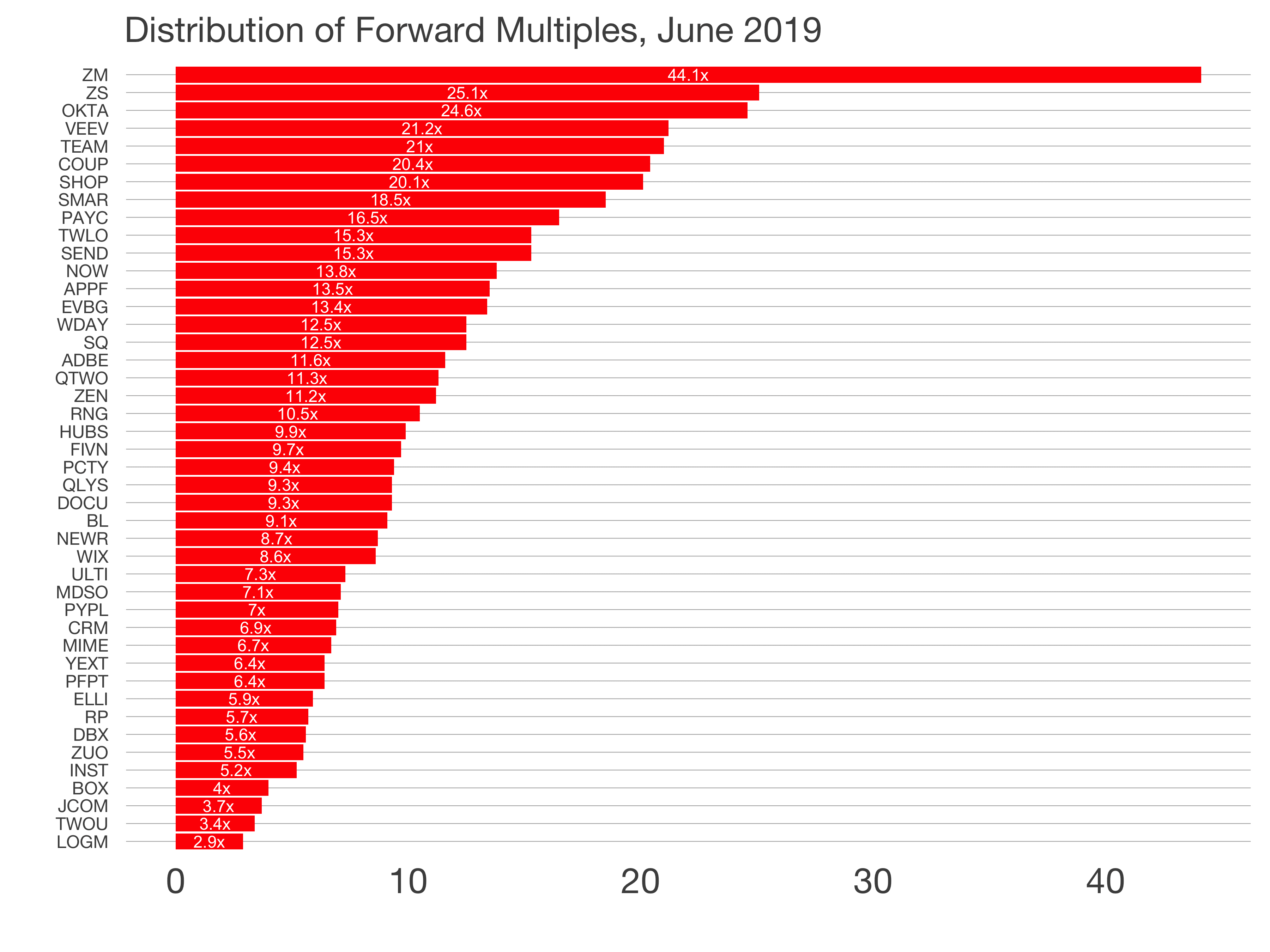
Reading the news in the past week made me wonder. Just where are we pricing SaaS companies today? The Nasdaq and the S&P have toyed with a bear market. Many stocks are down 10 to 50%. Absolute valuations are one consideration, but let’s understand it at a deeper level. Have multiples compressed?

The answer is yes, they have, but enterprise value to forward revenue multiples are still at some of the highest levels for SaaS companies in the past eight years.

In February 2014, forward multiples touched 7.7x. Then prices began a long descent into the February nadir at 3.3x forward. The market pushed higher for nearly 36 months to a new high in September 2018 at 9.5x forward.

Yes, we have fallen 25% from highs. And that’s quite a correction. But we’re not close to the 8 year median of 5.2x.

The most highly sought after businesses like Atlassian, Okta and Alteryx trade at 11x+ and top out at 15x. These are exceptional businesses growing at exceptional rates trading at exceptional prices.

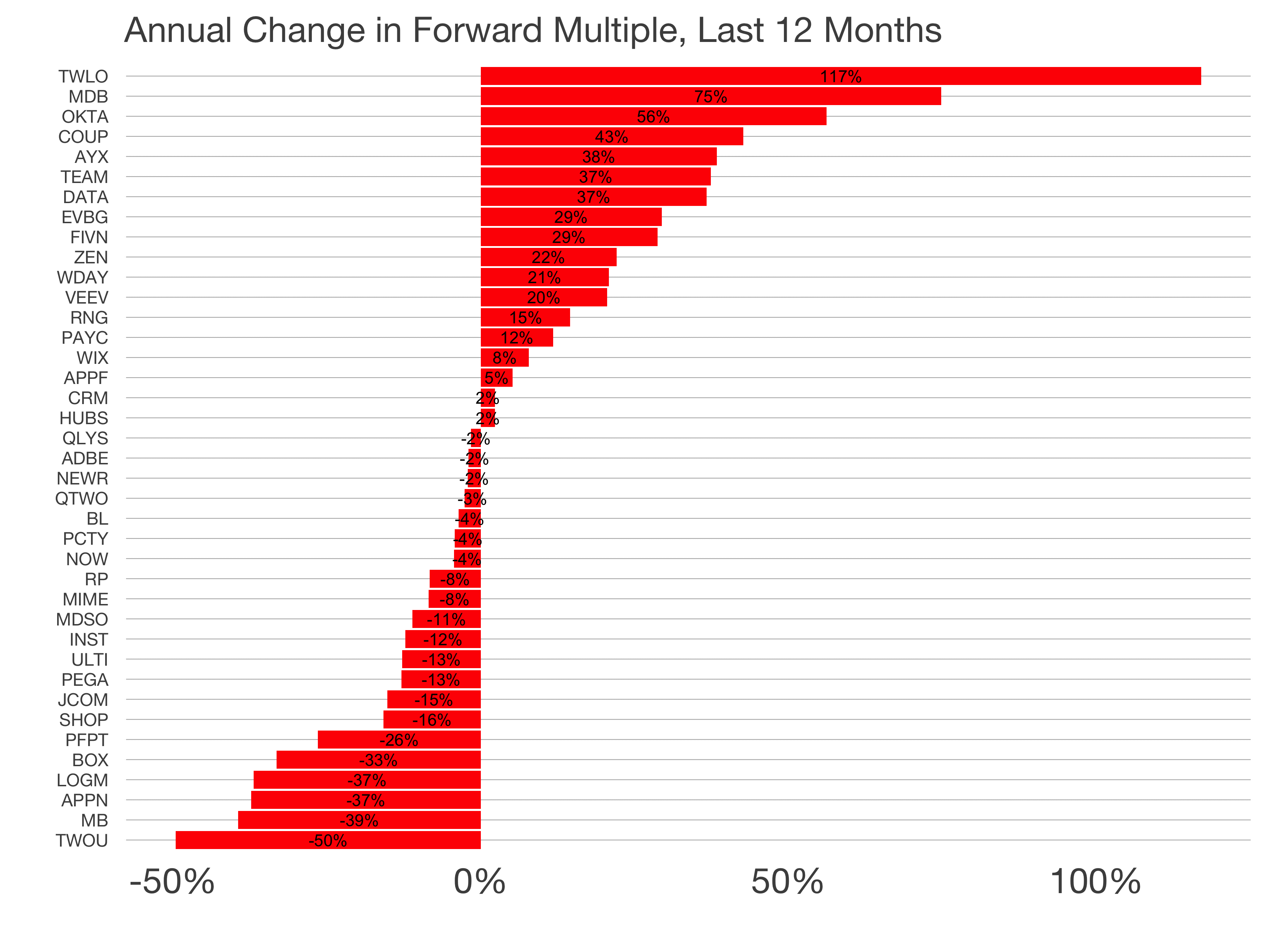
And despite the overall change in multiples, more SaaS companies have benefitted from multiple expansion over the last 12 months than those whose multiples have compressed.

What does this mean for early stage startups? If prices hold at these levels, even with the recent correction, I don’t think there’s much impact to the private markets.

With approximately $100B raised in the last 12 months by venture and growth funds, all with an approximately 3 year investment period, the supply of venture dollars should still be strong.

Rising interest rates suggest venture debt, which has been sold very inexpensively since quantitative easing decreased interest rates, may increase in price.

The exit markets may see some changes. Multiples at IPO will be lower in 2019 than for most of 2018. But 2018’s multiples were at decade highs, and 2019s figures are are 40%+ larger than the trailing 8 year median.

M&A may also slow as acquirers’ multiples have compressed as well: Google touched a 52 week low this week. SAP, Oracle, Microsoft, Amazon, Apple, and others have all suffered contractions of 20-40%. The public market perturbation may decrease the big fishes’ appetites.

Perhaps the biggest changes may be in customer budgets. From the WSJ, “Sentiment among chief financial officers, who help set budgets that will shape investment and hiring decisions, has also soured. Half of CFOs believe a recession will start within a year, and 80% think a recession will hit by the end of 2020, according to a Duke University survey.”

There’s volatility in the public markets, but SaaS companies are still some of the most expensive equities around, which is great news for startups. The biggest question is how buyers and their budgets evolve in this period of volatility.

28 Dec 18:40

10 Critical Sales Trends That Will Define 2019 (And Predictions)

by Max Altschuler
2019 sales trends predictions

It’s that time of the year again! Time for Sales Hacker’s Annual Top 10 Sales Trends and Predictions for the Future of Sales in 2019. Due to the proliferation of modern sales technology and people’s love of it, I added a new element this time. This new element is, “Companies to watch”. You know, since it’s extremely apparent that the sales technology landscape keeps growing like wildfire.

*the 2018 sales tech landscape

When growth is as rapid as this, things change quickly. In some cases, they even change back to how they were a few years ago! Our predictions are made up of the trends we’re seeing in the marketplace and sales ecosystem. With over 106,000 subscribers to Sales Hacker in dozens of different industries, we are truly beginning to see what all salespeople are talking about, not just those at tech companies.

Without further delay, here are our predictions of the biggest sales trends in 2019.

Top Sales Trends & Predictions for 2019:

Trend #1: Relevance Overtakes Personalization

People always talk about personalizing their messaging. Cool, but it’s really about making your messaging RELEVANT! Technology that allows users to surface relevant content and intent data will rise beyond just early adopters. I think we’ll start to see more training and conversations trending in this direction.

I know it’s in our upcoming Sales Engagement book in a big way.

Companies to watch: Educational resources like Sales Hacker, new training and copy companies like CopyShoppe, and intent data companies like LinkedIn, Bombora, Signal HQ, and Demandbase.

Trend #2: The Rise of Omnichannel Sales

We did our recent Sales Engagement Survey and found that LinkedIn messages and InMail are essential when it comes to modern outreach. Call it “social selling” if you want, but it’s simple: the best sales reps today just understand that they need to be where the buyer is. Finally, tech is being built to make that easier than ever with personalized video, direct mail, LinkedIn, etc. These are underutilized new (and old) channels worth testing as phone and email get even more saturated.

Companies to watch: LinkedIn as a channel. Vidyard, Videolicious, OneMob, VidGrid, and BombBomb for Personalized Video. Sendoso, PFL for Direct Mail Platforms. Outreach, SalesLoft, and any Sales Engagement Platforms that can tie it all together.

Trend #3: Doubling Down on Efficiency (Revenue & Operational)

Let’s just say it’s been a bull market for a long time and at some point, it’ll likely slow down. When it does, sales teams with the highest level of revenue efficiency will be left standing. Don’t wait for it to happen first. Start building efficiencies into your sales process and sales org now, and make it recession proof!

Companies to watch: Any companies that allow you to automate processes or allow your reps to spend less time doing manual tasks.

Trend #4: B2C Inspires B2B Influencers

Get ready for the rise of B2B micro influencers and industry-specific Trusted Advisors. Everyone can be an influencer, thought leader, trusted advisor, or subject matter expert now with the rise of LinkedIn as a network, the platform of Sales Hacker, and forums like MSP and The Revenue Collective.

People to watch: I’m including twelve up and comers here since you can see the more well-known LinkedIn Top 10 Voices of 2018 for the usual suspects. In no particular order, others include…

These are hard because I always leave people out, but those are the twelve I see cranking out a ton of solid content week in and week out that first come to mind.

Trend #5: Lower Friction Sales

Buying power is continuing to become less centralized, and in some cases, everybody can be their own decision maker. I think we’re really going to start seeing even companies that sell to the Enterprise or high-value items remove a ton of friction in the sales process and allow people to purchase easier, or even go freemium (use with fewer features) or free trial (try before you buy). One piece of easy friction to remove is lead forms and rely on chat that can be picked up immediately. This one isn’t just a sales trend, but also a buying trend: more people will begin to expect to access products and services this way.

Companies to watch: Leading the way are Drift, Intercom, and LivePerson.

Trend #6: Next Best Action

Not a big buzzword guy and Artificial Intelligence is definitely one of them but really Machine Learning and Natural Language Processing are being developed for sales at a rate we’ve never seen before. New tools that can accurately tell you the Next Best Action to take are coming and coming quick. One of my favorite use cases is sales conversations.

Companies to watch: For now, the ones doing it best are in the leaders in the Conversation Intelligence space – Gong, Chorus, Dialpad, ExecVision, and Avoma.

Trend #7: GDPR Comfortability Drives New Channel Growth

I think we’ve had some time now to see if GDPR would really affect things. For those who it did affect, they found new channels – and in some cases old channels – to leverage in order to connect with buyers, like direct mail. They found new data sources like Intent Data, Surge Data, etc. I think we will see these channels and sources take off in 2019.

Companies to watch: DataGrail for protection, G2 Crowd, TrustRadius, Signal HQ, and Bombora for new data sources, and Sendoso, PFL for Direct Mail. Will see how the known reliable data players like DiscoverOrg, Zoominfo, and even smaller ones like LeadIQ react.

Trend #8: Sales Leadership Goes Deep

As the VP Sales tenure decreases, down from 27 months in 2010 to 19 months as recently as 2017, more sales leaders will look beyond high-level sales strategies and will seek to understand the deeper inner workings of their sales orgs. Visibility, empowerment, coaching and cloning reps backed by an ever-growing amount of data. This is where the most successful sales leaders are going to be able to set themselves apart.

Companies to watch: Atrium HQ, Clari, People.ai for insights, Ambition for visibility and leaderboards, and Xvoyant for coaching. Mindtickle, Brainshark, and LevelJump for Training.

Trend #9: Technologies Aligning Sales and Marketing Get The Spotlight

This is the first time since I started publishing these sales trends that I’ve been a VP of Marketing at a larger company. Now, I have a whole new angle to gain perspective from. Sales and Marketing alignment gets more critical every year as the lines get more blurred between the two. More and more Sales Development teams are starting to roll up to Marketing. Target Account collaboration is a team sport! Any technology or best practices that can enhance that relationship will be future-proof for a long time.

Companies to watch: Sales Enablement solutions like Showpad and Highspot. Target Account orchestration solutions like Lucidchart. Opensense and Sigstr for email signatures to keep messaging consistent.

Trend #10: Buyers Have More Power Than Sellers

There’s really no debate anymore. The pendulum has finally swung. The buyer has more control than ever before with review sites, peers of theirs who have already adopted your solution, the internet, and having more options than in previous years.

Sellers, it’s ok. Embrace it. Gone are the days of the aggressive, used car salesmen. It’s time for the trusted advisor. Treat every deal like a partnership – one that will keep coming back, even when they change companies. Treat every lost deal as an opportunity to do better by the buyer in the future. The winners will be the ones who show up, genuinely offer help, and see business as more than just a paycheck.

Companies to watch: None. This is on you, the seller, to do better, be better, and show up. I watch it happen daily now. There are no software shortcuts. My advice is to be on LinkedIn sharing your expertise and engaging with others. Be on planes and show up in person. Find your “why” and do it because it means something to you.

The innovators and early adopters (and ironically, more “traditional” salespeople) are already doing the above. I think 2019 is the year we finally cross the chasm in modern sales. What did I miss? Let me know on LinkedIn!

The post 10 Critical Sales Trends That Will Define 2019 (And Predictions) appeared first on Sales Hacker.

28 Dec 18:39

How the State of the Amazon Marketplace Represents China’s Unfair Practices

by Anthony Carranza

The United States and China have been exchanging blows over the past year in their trade dispute with both announcing tariffs in response to the other’s moves. It was only this December that both countries eased off in their tit-for-tat, delaying the enactment of new tariff increases as the countries negotiate.

But while most eyes are focused on the import and export of physical goods, the internet is emerging to be an important front in this US and China showdown. The recent data breach of Marriott hotel’s guest database that exposed the data of 500 million individuals is suspected to be done by state-sponsored Chinese actors. Whether or not this would go down officially as part of the trade war, the circumstances still look awfully suspicious. US companies and government agencies have been targeted by cyber attacks of Chinese origin before.

Interestingly, Amazon is yet another US-based company that is caught in the middle of the tension between the two countries. But unlike the Marriott breach which appears to be a one-off event for the company, Amazon has ongoing Chinese-related issues, which if scrutinized the echo allegations of unfair business practices being claimed by the US. Here are three key issues in the Amazon marketplace that illustrate how China’s practices are creating an uneven playing field.

Security

This issue may not be getting much mileage but Amazon may already be in the midst of a wide-scale data leak. Recently, there have been concerns raised against Chinese payment processors Pingpong and Lianlian Pay who are allegedly asking their partner Amazon sellers to supply them with the secret keys to their Amazon Marketplace Web Service (MWS) accounts.

Amazon merchants typically have to partner with a Chinese service provider to handle payments. As such, they need to integrate systems so that order and payment information can be shared across parties and process transactions. However, letting third parties use secret keys is not the ideal method to achieve this and is actually considered a security risk. Instead, MWS has secure methods that developers can implement.

Secret keys provide the highest levels of access and could be used to access personal and financial information of customers. Considering that some sellers already hint at actually revealing their secret keys to processors, it’s possible that customer data have already been leaked.

Competition

The dominance of Chinese merchants on the platform is another issue that shouldn’t be overlooked. Over a third of Amazon’s top sellers come from China and many of them take advantage of being based close to the factories. Developments in cross-border payments technology and fulfillment services allow these sellers to offer goods directly to global customers at low prices. By sourcing their inventories directly from manufacturers, they also get to enjoy larger margins and minimal overhead.

US claims of intellectual property theft also aren’t unfounded. Numerous fake and counterfeit products made in China are making their way to customers through Amazon sellers. The non-profit website The Counterfeit Report, which aggregates fake products found on most e-commerce platforms found over 60,000 fake items listed on Amazon, and many of which are sold by Chinese merchants.

US businesses are also struggling to cope with the pressures of participating on the platform. As higher labor and manufacturing costs stateside make sourcing locally manufactured goods impractical as the cost would push product prices higher than Chinese-made products.

And, even if a product is unique, China will most likely be able to reverse engineer these products and produce low-cost rip-offs quickly. Many artists and makers already had their designs stolen and counterfeited.

Manipulation

Chinese participants are also aggressively manipulating the marketplace. The Wall Street Journal found that unscrupulous sellers are using fake reviews, artificial sales, and even bribes in order to boost their profiles and product listings on Amazon.

Amazon uses its own algorithm to rank products listed on the platform, which factors in price and positive reviews among other metrics. However, sellers are now able to game the system. Even the once-trusted “Amazon’s Choice” label can’t be accurately used as the basis for the legitimacy of both product and seller. Bots and click farms are now also used to generate positive reviews for these merchants. Some sellers even barrage competitors with negative reviews to snuff out the competition.

Even Amazon’s presence in China has made it possible for merchants to bribe employees to leak and alter data.

What This Means

Tensions between the US and China can only be expected to continue considering the temperament of both countries’ leadership. As such, it is important to keep track of how participants from these countries operate on global marketplaces and platforms.

Amazon serves users worldwide and malicious actions that are designed to stymie one nation could have an impact on everyone else. China’s activities on Amazon should warrant thorough investigation and decisive action from the company. The continued tolerance of such activities puts not only US sellers and buyers at a great disadvantage but all other well-meaning Amazon participants around the world as well.

While it is important for anyone conducting business online to exercise due diligence, it also helps if the ecosystem promotes trust and fair trade. Customer experience would be greatly improved if users can trust that the parties they engage with on the platform are legitimate and trustworthy.

Considering the gravity of these concerns, Amazon would do well addressing these issues and ensuring that the platform doesn’t devolve into a chaotic battleground for the two disputing countries while everyone else suffers.

28 Dec 18:38

Why your startup shouldn’t rush to $1 million in revenue

by David Riggs
Martina Lauchengco Contributor
Martina spent over 20 years as a marketing and product executive building and crafting strategies for market-defining software like Microsoft Office and Netscape Navigator. As an operating partner at Costanoa Ventures, she sits on multiple boards and advises companies on all things go-to-market. She also teaches at the UC Berkeley graduate school of engineering.
Jim Wilson Contributor
Jim is a seasoned sales executive with over 25 years experience in diverse technology industries. As an operating partner at Costanoa Ventures, Jim provides companies with sales and market entry strategy advice.

There is a prevailing belief that the magic formula for early-stage tech startups hinges on how quickly they achieve $1 million in annual recurring revenue (ARR). Investors in SaaS companies, in particular, are very guilty of pushing this or its equally loaded corollary, “When will you sign your first six-figure deal?”

But in the rush toward these numbers, too many startups lose sight of their primary intent: These metrics are supposed to be an indicator of product/market fit. We’ve seen companies reach $1 million in ARR in less than a year, yet not have enough market momentum to get their next million easily. We’ve seen early-stage companies so concerned about getting those first sales, they don’t validate the market and if they’re building the right product. We’ve also watched a focus on new logos make companies forget about keeping existing customers happy, introducing unexpectedly high churn — something startups can’t afford.

Those first customers and that first million are supposed to be the bedrock on which the rest of the business grows. Founders must constantly ask what they’re learning about their market, product and go-to-market approach — in that order! — so the business becomes a flywheel.

Revenue is a lagging indicator of sales success, so must likewise be prioritized accordingly. That’s not to say revenue isn’t vitally important and that there isn’t a great deal of urgency to it, but focusing on it too much too early can mask big problems that will hurt startups later when the stakes are higher.

Here are a few lessons we’ve learned by watching our early-stage companies go through this crucial phase. Every early-stage company needs to do them well.

Customer and market discovery is job No. 1

We talk about product and knowing customers a lot, but that is insufficient. Startups must understand the market, as well. How do customers do this today? Is there urgency around the problem? What is the community saying? An early investor in PagerDuty went onto Reddit and Quora and just looked at who people were talking about. It made his decision easy.

To be really successful, it is as important to understand market dynamics as it is to deliver a great product. This also helps zero in on all the aspects of your ideal customer profile; it needs to be more specific than you think! This also then helps qualify customers for future sales.

Elevate Security stood out in their super-crowded security space because they carved out a unique position around people-powered security. They used their early sales process to carefully qualify who would help them best develop their products. Their first product got shout-outs on social media from users who loved it — a rare occurrence in security — and were indicators they had found good initial customers and were creating something unique.

Build a product that sells itself

You’ll always find smart people saying, “I love what you’re doing.” Some things are so broken even a mediocre improvement is worth a change. But this is why revenue can be a false indicator for scalable success: Founders find enough early adopters to get that first million, which leads them to believe the product is enough. The company starts chasing more revenue, not investing in a product-based growth engine. If sales keeps hitting their numbers, everyone believes things are fine. Until they’re not. And then it’s usually a really heavy lift, with 6-12 months of product, sales or team upgrades.

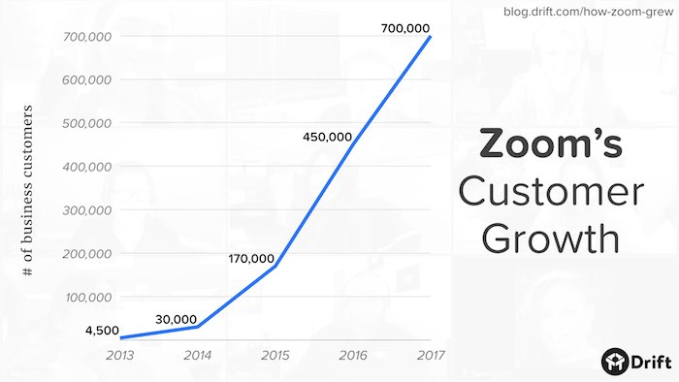
What startup doesn’t want a growth curve like this? Zoom had triple-digit growth for the last four years in a crowded, mature video conferencing category. Janine Pelosi, Zoom’s head of marketing, said the reason they were so successful before and after she arrived was they have a great product. It’s reliable, easy to use, and the founder, Eric Yuan, was selling it every day. Yuan knew the market really well coming out of Webex, and always touching customers meant he could adjust company strategy accordingly. Zoom embodied the real magic formula: know your market + build great product.

Pay attention to customer engagement and delight

Customer satisfaction is simple: It comes from the perception that people get value from their purchase; it’s much less about how much they paid. It’s also always cheaper to make an existing customer happy than it is to acquire a new one, so make sure even in the early days that you’re investing in making current customers happy advocates.

Aquabyte uses computer vision to identify sea lice in the $160 billion aquafarming market. When they showed customers FreckleID (think facial recognition for fish) to uniquely identify fish in a pen of 200,000, fish farmers loved the idea. The price they were willing to pay was 3x what the CEO thought possible. They’re likewise investing heavily in making sure their initial customer is successful with the product and are delighting them in unexpected ways (handwritten holiday cards). They have more prospects in their pipeline than they have capacity, which means they don’t need to expand sales to grow revenue fast.

Your startup may have the coolest tech, be in the biggest market and have the smartest team. No matter what your board says, remember revenue is NOT the primary indicator; it is simply an indicator. To become a breakout success, you need to read the tea leaves of all aspects of your market and build a product and customer experience that is truly superior.

28 Dec 18:38

27 Qualification Questions for Generating Leads Your Sales Reps Love

by Giuseppe D’Angelo

Tuan86 / Pixabay

Do your reps faithfully follow up on the leads you generate? If you’re like most marketers, the sad answer is likely a “no.” Why do I say that? Because research shows that salespeople pass over 80% of marketing leads.

You can overcome this with a carrot, not a stick. In other words, you won’t get far by berating salespeople for their lack of follow-up. Instead, it’s better to provide leads they can’t wait to chase down.

Sounds good, you say, but how?

Well, you’ve heard it before, salespeople want leads that have the money and the authority to make a purchase, are looking for a solution to the problem that your product or service solves, and want to take action within the foreseeable future.

But how do you ferret out leads that meet these criteria? It’s not as simple as directly asking someone, for instance, “Do you have the budget to buy this product?”
Here’s a guide to questions you can ask that will help you find the leads your reps will love.

Where’s the Pain?

Your first job is to find out how you can help in relieving someone’s pain. To do so, ask these questions:

    1. What are the biggest challenges you’re facing today?
    2. What will happen if you’re unable to address these problems?
    3. How are you coping with these issues now?
    4. Do you see any significant shifts in your business over the next couple of years?

The answers to these questions help you to uncover what your lead is dealing with on a day-to-day basis. They give you the big picture, which enables you to understand better how your product or solution might fit into it.

Would Our Solution Be a Good Fit?

The following questions will help you discover whether your solution is a good fit to solve the individual’s problems.

    1. What would you like to be able to achieve with the ideal solution?
    2. What is essential to you in a solution?
    3. What would you like to have in a solution?
    4. Are you using any products or solutions today to address the challenge?
    5. If so, what are you using?
    6. What do you like and dislike about it?
    7. What other products and solutions have you explored?
    8. So far, what do you like and dislike about the options you’ve reviewed?

Could You Allocate Budget Dollars to It?

Many business people want to solve problems. However, their resources are limited. If they don’t have the budget for it or cannot reallocate the money from some other bucket, sales will be wasting their time. Make sure this doesn’t happen by asking:

    1. How much do you think this issue currently costs your company?

This question sets the framework for a discussion about the budget. For instance, if the lack of a marketing automation system costs the company thousands of dollars in lost sales, they are more likely to want to invest in it.

    1. Is there a budget allocated to this project?
    2. What are the budget parameters? (Ask this if question 14’s response is “yes.”)
    3. This problem currently costs your company $X (the amount they answered in question 13) a year. Given that, how much could you see allocating to solve it? (Ask this if question 14’s response is “no.”)
    4. Our solution ranges from $X to $Y. Does that sound affordable?
    5. Who would authorize an expense like this?

Who Makes the Decision?

Business decisions are complex, often with multiple players involved all with different perspectives and roles in what they ultimately choose to purchase. You need to know what part the individual you’re talking with plays and who else participates on the buying team. This knowledge helps you to plan your account strategy. Dig for it with these queries:

    1. How will your company assess a solution to this problem?
    2. Who else within your business is affected by this issue?
    3. What role do they play in deciding on a solution?
    4. Should I reach out to (people on the buying team) to learn more about their concerns and objectives?
    5. Who will make the final decision? (Ask this question if the previous ones have not revealed the answer.)

Is There Urgency to Move Forward?

Despite wanting to solve a problem and having the money to do so, it still may not be at the top of the priority list. You want to know where it falls on the to-do list before you have a sales rep spinning their wheels. So ask:

    1. When would you like to have this problem resolved?
    2. How important is this issue vs. others that you’re juggling?

Are You Interested In What We Have to Offer?

Assuming you’ve provided the lead with the value proposition for your product or solution, you then want to gauge their interest and establish the next steps.

  1. Would you be interested in scheduling a “demo” to learn more about how the XYZ solution can help you? (You can substitute the next step in your sales process for “demo.”)
  2. Would next Wednesday at 2 pm be convenient for you?

In the end, ensuring your salespeople will love the leads you produce will make your job easier. Once they understand that every lead has a high potential to turn into a sale, they will be eager to follow up and convert them into customers. A full vetting of leads ensures they are qualified, so all your reps have to do is work their magic and bring home the sale.

27 Dec 17:56

Cannabis firms in conflict of interest for owning both pot producers and marijuana clinics, critics charge

by Tom Blackwell

When doctors at the Solace Health Network of cannabis clinics prescribe their patients medical marijuana, one government-licensed producer of the drug might come quickly to mind.

The clinics’ parent company, after all, is Terrascend, which also owns a cannabis grower and seller.

A direct ownership link between doctor-staffed clinics and the manufacturer of their main treatment tool would be unheard of if it involved a pharmaceutical firm. But in the fast-evolving cannabis industry, Terrascend’s arrangement is far from unique — and quite legal.

The National Post has found close to a dozen companies across the country have combined pot-producing operations and marijuana-treatment clinics under the same corporate umbrella, in what seems to be a growing trend.

Some insist they isolate the two functions from each other, but others are frank about the benefits of vertical integration. The Leaf Wise clinics in Alberta, for instance, will provide “a direct channel to Invictus-owned licensed producers,” said parent-company Invictus MD Strategies in a recent news release.

“If you have clinics, then you have patients, right? And if you have patients, you can capture a portion of that,” said Chris Churchill-Smith, CEO of Canada House Wellness Group, which owns both a producer and clinics.

The trend has alarmed some health-policy experts and regulators, who warn it blurs the lines between health professionals who are supposed to be independent of commercial interests and businesses that sell the therapies they prescribe.

“It’s an unbelievable conflict of interest,” charged Dr. Mel Kahan, head of substance-use services at Toronto’s Women’s College Hospital. “It’s reprehensible … There’s this tremendous motive for doctors to prescribe marijuana in high doses for all sorts of conditions because (their clinics) are owned by a company that’s profiting from it.”

Controversy has long swirled around the financial links between pharmaceutical companies and doctors, with drug reps providing gifts and meals to physicians, and firms hiring specialists as advisors or educators of other doctors. Studies suggest such connections can adversely affect medical decision making.

But the cannabis cross-ownership phenomenon represents a new species of medical-industrial entanglement.

“With the corporate sector and the explosive growth of this industry, it’s gone to a another level,” said Dr. Galt Wilson, deputy registrar of the B.C. College of Physicians and Surgeons. “It raises issues of conflict of interest, of messaging.”

An interior view of an Aurora Cannabis Inc. facility is shown in an undated handout photo.

Cannabis entrepreneurs, though, argue that dedicated clinics provide doctors and other health professionals with the support they need to give patients the best marijuana-aided care, when many other MDs eschew the drug entirely.

The ownership link, they say, lets producers better gear their products to what patients need and want, while customers remain free to have their prescriptions filled by any Health-Canada licensed firm.

“If you want to service the medical market, you actually have to provide a comprehensive service that navigates the patient through the process, so they can access their medicine without a lot of headaches,” said Michael Nashat, Terrascend’s CEO.

At Terrascend’s Solace clinics, the doctors are not company employees and patients choose their cannabis producer, meaning less than 50 per cent of the prescriptions are filled with the company’s own products, he noted.

The cannabis “authorizations” that clinic doctors or nurse practitioners issue do not specify a particular company, but the facilities often help patients register those prescriptions with a particular producer.

The recent legalization of recreational marijuana has, at the same time, opened up almost unlimited access to the drug.

But doctors and industry representatives say the medical cannabis system seems more popular than ever, as many Canadians still want a medical expert involved in their pot treatment.

Dozens of dedicated clinics have opened across the country, and increasingly they are either being bought by cannabis producers, or are themselves acquiring growers. The Post identified at least 11 such integrated firms, all of them publicly traded, from industry giants Aurora and Canopy Growth to the lesser-known Delta 9.

Aurora’s CanvasRx chain of 28 clinics in B.C., Alberta and Ontario “plays an important role in supporting the medical cannabis segment domestically and internationally,” it said in a document filed with regulators in September. Canopy owns 25 Bodystream and three Apollo clinics. Delta 9 controls 49 per cent of a Winnipeg clinic, indicating in a September filing that it “helps market the Delta 9 brand to patients.”

Aleafia Inc. bought the Ontario-based producer Aleafia Farms in March “to directly support its clinic operations,” said a document filed in September. But for now it is licensed only to supply other companies with marijuana, and even when it is able to market its own brands, the 22 Canabo clinics will not push company-made product, said Aleafia spokesman Nick Bergamini.

Others, though, have been candid about the business synergies they see in owning both health care facilities and producers of the facilities’ featured treatment.

Recreational users make up a much bigger pool of customers than medical ones, but they buy through provincially regulated retailers, noted Churchill-Smith of Canada House Wellness Group. Medical cannabis is sold directly to patients and, without a middleman and commanding generally higher prices, offers producers bigger margins, he said. Owning clinics creates a ready, potential market of those more-lucrative customers.

“That’s our business model. Our expectation is that we would sell a portion of Abba product to our own patients and capture the entire margin,” said Churchill-Smith.

Former RCMP Deputy Commissioner of Federal and International Policing Raf Souccar, now president and CEO of Aleafia, at the launch of a clinic in Vaughan, Ont. on Tuesday November 14, 2017.

But he said his company’s AbbaMedix cannabis will be offered at its 10 clinics in Atlantic Canada, Ontario and Alberta only together with choices from competitors, to avoid the appearance of “double-dealing.”

Ascent, whose Agrima production operation is currently under a Health Canada suspension, acquired Winnipeg’s First Circle Medical Clinic in June and said in a document filed this year it wants to build a nationwide network of clinics and a digital portal “to provide patients across Canada with easy, seamless and direct access … to medical professionals and Agrima’s extensive product range.”

At least one company has addressed the conflict-of-interest question directly with a regulator.

Ontario-based Vivo Cannabis, which owns both the Harvest Medicine and Trauma Healing Centres clinic groups, said in a November filing it had promised the Ontario Securities Commission it will not give doctors or patient “educators” incentives to tout its own products, and that clinic staff will recommend the company’s brands only alongside alternatives from other producers.

The idea of a medical clinic dedicated to treating a range of conditions with one type of therapy is unusual to begin with, not least because the evidence of marijuana’s health benefits is limited, said Dr. Nav Persaud, a family physician and health-policy professor at the University of Toronto.

The added element of cross-ownership with actual cannabis producers is more troubling, he said.

“I can’t think of a situation where there is such a serious conflict of interest,” said Persaud.

Some physicians do own “pulmonary-function” labs that test people for breathing problems, he noted, but are required to make that fact clear to patients. Cross-owned cannabis clinics should at least have to be explicit to patients about their corporate ties, Persaud said.

Despite the critics’ concerns, it’s unclear if the professionals who work in cross-owned clinics are violating any ethics regulations.

Under conflict of interest rules in Ontario, similar to those in other provinces, doctors cannot personally accept referral fees or kickbacks, or limit patients’ choice of treatments, said Shae Greenfield, a spokesman for the province’s College of Physicians and Surgeons.

But if a potential conflict involves the owners of the clinics and cannabis producers, that’s a matter for government regulators, said a spokeswoman for the Alberta college.

Andre Gagnon, a Health Canada spokesman, said nothing in the new Cannabis Act prohibits companies owning both clinics and licensed producers.

Still, deputy registrar Wilson of the B.C. college is concerned by the cross-ownership trend, and other examples he’s seen of the intimate ties between cannabis medicine and commerce. He recently investigated a telemedicine doctor who “disturbingly” appeared on his patient video link with a marijuana-producing company’s representative next to him.

“As you can imagine, we were critical of that physician and told him he must cease and desist.”

• Email: tblackwell@nationalpost.com | Twitter: TomblackwellNP

27 Dec 17:53

Considerations for Effective Qualitative Client Interviews

by Tami Berry

StockSnap / Pixabay

What do clients want? Ask them! Have you ever spent time with someone who seems to talk incessantly about herself, ignores your input and interests, and perhaps even acts as if you’re much better acquainted than you really are?

If you’re like most people, you didn’t enjoy that interaction. However, for many companies, that’s exactly how they are communicating with their clients and prospects through their marketing. And it doesn’t feel very good for them either.

How do you make sure you are engaging your clients and prospects in a meaningful conversation? Qualitative interviews can be the key to better marketing communications.

The Qualitative Interview

Simply put, qualitative interviews are guided conversations with an individual or small group of participants. The goal of the session is to uncover perceptions, challenges and interests in the subject’s own words. While the interviewer should have a set of questions prepared to guide the conversation, one of the greatest benefits of the interview is the ability to go beyond the script and probe for more information.

Who to Interview

In a best-case scenario, interviews include both current clients and prospects, allowing for a full range of views to be captured. However, for a variety of reasons it isn’t always feasible to include non-clients. If that’s the case, including more clients in the process can help to round out the perspectives.

On the client side, be sure to include people whose involvement with your firm covers a variety of experiences — both new and long-standing relationships, and those who see you as one of many vendors as well as the raving fans. No matter whom you choose to include, they should represent your ideal client.

What to Ask

Once you have determined your interviewee list, it’s time to create your interview guide. Determine about 10-15 open-ended questions that will elicit opinions and attitudes about the client’s needs, how well your company addresses those needs, and any perceptions about competitors. Again, these questions are designed to help lead the discussion rather than serve as a script.

How to Conduct the Interview

Whenever possible conduct interviews in person. Phone interviews are fine, but there really is no replacement for face-to-face contact that allows you to read non-verbal cues like facial expressions and body language. Meeting in the client’s environment also sends a signal that you value her time.

Whether you’ll be meeting in person or by phone, it is a good idea to have a second person present to handle the note taking. It’s difficult to focus on the client and the conversation when you are also trying to keep an accurate record.

In-House or Outsource

We are frequently asked if this process is something that can be done internally. It is certainly possible to have your own people conduct effective qualitative interviews with clients. Senior leadership and business development staff often have close professional relationships with their clients and feel they can have these open, honest conversations with them.

However, many firms find it beneficial to engage an external consultant to conduct and analyze these interviews. A third party brings a level of impartiality to the process and can reassure clients that their remarks will be aggregated with others and shared without attribution. This isn’t meant to imply that the interview will focus on problems or complaints, but rather to set the stage for candor.

Understanding perception and client satisfaction

Qualitative interviews are a beneficial tool for understanding your clients’ perceptions of your firm. When carefully planned and conducted they can be a source of deep insight into what you are doing exceptionally well, where there may be room for growth and how your communications are supporting or hindering your goals. A skilled third party interviewer can help to get the most from this important tool.

27 Dec 17:53

How to Develop a Successful Event Marketing Plan

by Aastha Sirohi

How to Develop a Successful Event Marketing Plan

Imagine planning the perfect Thanksgiving dinner party, but forgetting to tell your friends and family about it–how do you think that turns out?

Just like a dinner party, a business event is only as successful as the number of attendees who attend, see, and spread the word about the value they received.

That’s where event marketing comes in.

Organizing an event, personal or business, requires immense planning, attention to detail, and consistent ideating. When you host an event, online or offline, make sure to have a specific goal. This goal could range from promoting your business, product sales, networking, work-shopping ideas, or simple, valuable fun and excitement. The main idea behind event marketing is to raise awareness about your business.

But remember, it all starts with a plan.

You should start creating an event marketing plan as soon as the event idea is born. This idea is then followed by brainstorming, organizing, attending to every detail, and finally, execution. It may sound like a lot, but with the right plan–you got this. You should start creating a plan, using a guide to event marketing, as soon as the event idea is born.

8 steps to create a powerful event marketing plan

First things first, managing an event and marketing it are two completely different tasks. While event management comes much later, event marketing begins at the word go.

Let’s start creating the event marketing plan:

1. Goal

Why are you hosting the event? What is your motive and objective? What is the goal of the event? These are the first questions that need to be answered, as everything that follows is based on their answers.

An event can have a single or multiple goals, but what matters is that you name one and that you align all marketing tactics to achieve it. For example, if your goal is sales, the content you build to market the event needs to drive towards sales. Similarly, the way you attract people should focus on sales.

2. Budget

It’s normal to want it all, and want the best of everything, but that often leads to a hole in your pocket. Set a budget for your event, and stick to it. It’s easy to overspend, but it’s extremely difficult to make up for the extra money spent. You work hard for every penny, so make a budget and spend it wisely.

3. Marketing

There are two things you need to think of when marketing the event: the medium (or platforms), and the content. There are many ways to market an event. 40% of businesses use social media to market an event, however, email marketing, at 76%, is the most popular.

When you are planning your content marketing strategies, keep the goal of the event as your foundation. You could start by building an impactful website for the event, or add a pop-up or landing page to your existing site. Curate text, and video content, like an event trailer, behind-the-scenes footage, or a sneak-peek.

All content must entice the viewer to attend the event. The content marketing plan needs to create a buzz around the event, making people excited to register or RSVP. Your event marketing registration efforts should get the word out and boost your attendance.

4. Management & delegation

You can’t do it alone. If you don’t have someone that can share the content you’ve created according to your content management plan, then you can use email automation. This lets you share and manage content by yourself, but with the efficiency of having a delegated resource. Make sure the content goes out on time to see better results.

5. Promotions

Now that you have your content in place and the mediums to promote the event, it’s time to hit send. Here you need to raise awareness, reaching out to as many potential customers as possible, and ensure that your existing customers are invited as well.

6. Engagement

When future attendees are excited and see the value in your event, you create a buzz that draws more attention. Promote social sharing, social comments, audience interactions, and other discussions.

You can create a cool hashtag and urge people to talk about it; allow people an open platform to interact with your business and other attendees, or create a sense of urgency that compels people to attend the event. For example, a tweet that says, “Don’t miss out on this year’s coolest gadgets at the XYZ event,” is likely to garner more attention than one that reads, “Come to the XYZ gadget event.”

7. Collaborations & partnerships

Whether you have collaborated with sponsors, or partnered with other businesses to host the event, it’s important that you work on the same goal. When multiple businesses and sponsors work together, they can create more value and excitement for the event attendees. Sketch out your event marketing plans, in sync with all those involved, to create a more impactful and error-free plan.

8. Evaluate

Sending emails to promote your event? Measure and evaluate how they’re performing against pre-set goals and objectives. Using social media to attract registrants? Measure and evaluate the data. Promoting the event offline? Measure and evaluate the results. The point is, it is necessary to evaluate the results of your event marketing strategy to know what’s working and what isn’t. This can help you make stronger plans and tweak the strategy along the way to make the most of your efforts.

Boost attendance with effective event marketing activities

When creating your event marketing campaign, always put yourself in the shoes of the potential audience. Ask the questions, “What’s in this for me? What value will I receive from this event?”

A powerful marketing strategy conveys the answers to those questions. You know the event you’re hosting is going to be fantastic, but your audience needs to see that too. Coming full circle, this is only possible when you have a set goal for your event. It’s the goal that helps you present the value to the event attendees, and it’s the foundation of your whole event marketing plan.

Let’s use an example to see what good event planning looks like. Here is an email I received from a restaurant hosting a Halloween themed event:

event marketing example

This event marketing email works because it uses a strong Halloween design theme to instantly catch my attention. It tells me everything I need to know, but holds back some details to pique my curiosity, for example, the special menu. The email also tells me the approximate costs, which is often a big decision maker.

There’s also more to the event than just food and drinks. Showing that there are fun games and face painting lets me know this is a great event for the entire family.

Sending this a few days before Halloween is just enough time for me to make a decision. Since sending emails to subscribers is just one medium to market an event, the restaurant included hashtags, as well as social media buttons, for readers to share and engage with them online. They also aggressively promoted this event on their social media pages.

The goal of the email used here is clear: the restaurant wants to increase sales using a Halloween themed event. The goal could have been to get more people to sign up for updates on future events or to raise awareness about the restaurant, but the event email stays focused on promoting the event, which will, in turn, increase the awareness for the restaurant on its own.

Create an event marketing plan that draws in customers

Leave the stress out of event promotion with the right plan. Believe me, it’s not a tough nut to crack once you have spent enough time thinking through your event marketing plan. The best part is, it only gets easier as you host more and more events.

Remember the first time you hosted a movie night at your home? It took some effort to source the perfect movie, arrange the seating, and provide great food, but now everyone still talks about the great time they had.

You already have the skills to be a great host–you’ve done it before. It’s time to start planning.

27 Dec 17:53

One-time Bill Reid collaborator blames ‘cabal’ for keeping her collection out of museums

by Douglas Quan

GIBSONS, B.C. — Grace Mooney insists she is not paranoid. But there are hidden forces — a “cabal” — within Canada’s cultural institutions working against her, she says.

Conspiracy theories are just one of the things you have to put up with when you enter Mooney’s orbit. So are the incessant phone calls gently pleading with you to come see her collection.

Eventually, you relent. And when you do, a realization sets in that maybe, just maybe, this feisty 87-year-old grandmother and retired artist does have something valuable. You begin to understand her frustration and sense of urgency.

So you dig a little more.

What you discover is that at the peak of her career in the 1970s and 80s, Mooney commanded the attention of government dignitaries and top museums around the world. Her claim to fame? An uncanny ability to create replicas of three-dimensional artwork that were practically indistinguishable from the originals.

Locally, she worked alongside the inimitable Haida carver and goldsmith, Bill Reid, and other Northwest Coast artists.

From these relationships, Mooney amassed an impressive collection of memorabilia: a couple hundred moulds, castings and wax impressions that she has carefully preserved in bubble wrap and protective cloths; several of Reid’s original drawings and a discarded sketchbook; a gold bracelet that Reid gifted to Mooney’s daughter; and binders filled with letters, invoices, memos and personal commentary documenting her professional affairs and the growing native art scene. There is no question these items hold great historical value, experts say.

Yet, despite years of trying, Mooney has not been able to find a cultural institution that will house her collection.

Mooney and her supporters have a theory: because she has dared to publicly question the authenticity of some of Reid’s work — accusing him of taking credit for work he barely laid his hands on — she has essentially become blacklisted.

“I now believe that there is a cabal that operates within our cultural institutions in self-interest,” she says. “They should be exposed.”

Grace Mooney holds a miniature version of Bill Reid’s ‘Raven and the First Men’ sculpture.

Curious, the National Post filed a freedom-of-information request with Victoria’s Royal B.C Museum, whose staff quietly catalogued every item of her collection in 2013 with an eye towards acquisition only to change course and send everything back in 2014.

Over 800 pages of emails and memos were returned, providing rare insight into the museum’s messy deliberations. Though there is no smoking gun, one document comes tantalizingly close to supporting Mooney’s theory: a briefing note to the CEO that suggests some members of the public might not look too favourably on Mooney’s criticism of Reid and may want her records “suppressed.”

But other, more mundane, factors were also at play. Staff struggled to find appraisers who could agree on a price tag for the collection. They wrestled with lingering questions over ownership and copyright.

Mooney doesn’t buy any of those other reasons. Exhausted and suffering from frequent bouts of brain fog, she is now in a race to find a home for her collection.

“I’m just trying to deliver this where it belongs,” she says.

“I want to be free of it.”

*****

Mooney lives with her daughter, Sam McKillop, in a modest bungalow in Gibsons, about a 40-minute ferry ride from Vancouver on B.C.’s Sunshine Coast.

On the morning of my visit, it is dark and drizzly. But inside, her living room is bathed in warm colours. Mooney is wearing a slightly rumpled white shirt, sleeves rolled up, with glasses draped around her neck.

Though she can be saucy-tongued, she carries a mostly refined, professorial air about her.

Born in Quebec, Mooney completed a four-year program at the Vancouver School of Art in 1954 with an emphasis on sculpture and painting. Her post-graduate work took her to London, Paris, Rome and Florence.

Haida artist Bill Reid.

Mooney started her career working on animated films and creating three-dimensional models for television. Then, in the 1970s, after much trial and error, she developed a manufacturing process for reproducing three-dimensional art.

“I loved the problem solving,” she says.

Word spread about her unique talent and orders started coming in from the National Museums of Canada, the Metropolitan Museum of Art in New York and the British Museum for her to reproduce artifacts — everything from small totems to jade frogs — that they could sell in their gift shops.

A 1979 marketing consultant’s report, produced as evidence when Mooney successfully sued the National Museums of Canada for breach of contract, lauded Mooney’s abilities as “bordering on genius.”

“Representatives of the Metropolitan Museum (New York) recently affirmed that they have never found her equal,” the report said. “Other individuals engaged with this business have unequivocally stated that pieces she has replicated are impossible to do.”

For years, Mooney worked alongside Bill Reid. Their first collaboration took place in 1974 when the Government of Canada wanted to showcase Reid’s design of a salmon on the cover of a limited-edition book it planned to present to heads of state at an international conference. Mooney was asked to do the reproductions.

She would go on to do many more for Reid, including most notably replicas of his original boxwood carving known as “Raven and the Clamshell.” Reid’s carvers used Mooney’s castings as a visual reference for carving a much larger version of the sculpture out of yellow cedar — a version that is now the centerpiece of the Museum of Anthropology at UBC.

But their relationship was acrimonious, stemming from Reid’s alleged failure to pay Mooney for work done and to properly credit others for assisting him with jobs as Parkinson’s disease took over his body.

“He did very beautiful work early on in his career and was properly respected and applauded,” Mooney says. “Later, as Parkinson’s overtook his motor skills, he found it useful to secretly job the work to other unknown artists, take their work, put his name on it, and sell it as his own.”

The two parted ways.

In late 1988, Reid’s lawyers sent Mooney a letter informing her that he was “terminating all his business dealings” with her and that he wanted back “all moulds, wax impressions and castings.”

A few months later, Reid’s lawyers sent another letter, stating there was “no doubt that Mr. Reid owns the copyright to all works to which the moulds pertain.”

But Mooney did not budge and retained everything.

“I said, ‘Good, take me to court,’” Mooney says.

A lawsuit was filed but ultimately abandoned.

A year after Reid’s death in 1998, Maclean’s magazine published an expose that suggested Reid may have committed artistic fraud. It quoted many of Reid’s closest collaborators who “say they felt used, were badly paid and got little credit for their labour.”

Mooney served as an anonymous source for that story, a fact that was later revealed by the National Post’s Brian Hutchinson in an article in 2010. “I’m already a pariah,” she said at the time. “I have been since I began to question Bill.”

It was against this backdrop that Mooney approached the Royal B.C. Museum in late 2012 with an offer: would they work with her to find a benefactor who could buy her collection and then donate it to the museum?

*****

Records obtained by the Post show staff were enthusiastic. They took in her entire collection on a temporary basis in January 2013 so they could examine each item.

Raymond Frogner, then the museum’s archivist, recorded six hours of interviews with Mooney. As far as her written materials go, “there are not many archival fonds quite like it” and they hold “significant symbolic value” for First Nations communities in the way they document the work of local native artists, he wrote in a report in April 2013.

Frogner noted that Mooney’s records repeat criticism that Reid “relied heavily on other artists to complete some of his greatest works and these artists have not been fully acknowledged for their work. This is not unique but perhaps significant in the detail it is recorded.”

Frogner did not see this as an impediment.

“I view this as part of the discourse on art and the role of the archivist is not to edit such criticism but include it as a part of the rich context of discourse Reids’ art elicited,” he wrote.

The Royal British Columbia Museum in Victoria.

A briefing note prepared for CEO Jack Lohman in May 2013 noted the acquisition of Mooney’s collection “would support several key strategic directions” for the museum.

But it cautioned some records were “personal and critical of particular artists’ practices and would need to be restricted for some time. There may be some organizations and individuals who would want this information suppressed. We have relationships with some of the same.”

Still, the museum forged ahead. Don Bourdon, the museum’s curator of images and paintings, emailed Mooney in July 2013 to say staff believed her archival materials were “of outstanding significance” to the province and “we commit to obtaining a fair market valuation of the entire collection so that we can explore options for acquisition.”

The next month, Lohman and Bourdon visited Mooney and her daughter and took them out for Japanese food.

Lohman was “delightful, entertaining,” Mooney recalls. “It was such a warm, good feeling that this was the right thing.”

McKillop remembers them saying they couldn’t make any promises. But the meeting “left you feeling there was every reason to be very optimistic that this was going to be a meaningful end — what mom had been looking for.”

Bill Reid’s sketch book.

Days later, Lohman wrote to Mooney, saying how enchanted he was by the visit and how he appreciated her “candour and creativity.”

“I look forward to completing this fascinating acquisition and to exploring the ideas of your fertile imagination,” he wrote.

Setbacks soon followed. On Sept. 4, 2013, staff discovered a gold casting of a killer whale was missing from the collection, prompting a frantic search.

After a weeks-long internal investigation, the whale pendant could not be located, leading to only two possibilities, according to a staff memo: it had been misplaced or “secreted away with criminal intent.”

Victoria Police were notified on Nov. 18, 2013. But their investigation didn’t lead anywhere. The museum later cut a $15,000 cheque for Mooney.

Meanwhile, staff were becoming nervous about whether Mooney had rightful ownership and copyright over all of the moulds in her collection, given Reid’s previous legal threats.

“It is much more murky than we imagined which plays into her position that people are intent on protecting Reid’s reputation at the expense of hers,” Kathryn Bridge, then deputy director at the museum, wrote in an email.

They also ran into problems appraising the collection. A Nov. 6, 2013 status report for Lohman noted that while three appraisers had reached relatively similar conclusions on the value of the paper records, two appraisers who had assessed the physical objects reached wildly different conclusions, rendering them “entirely unusable.”

The two reports, later obtained by Mooney, show the valuations ranged from $46,614 to $559,885.

Mooney held firm in her belief that the collection was worth millions.

“The owner likely has an inflated view of the value of the collection,” the status report said.

A prospective benefactor who had signalled interest in the collection backed out. In an interview with the Post, retired businessman Uwe Mummenhoff of Sechelt, B.C., said he “didn’t want to be involved in anything controversial” or anything that could be “questioned.”

Besides, he was only ever really interested in the gold bracelet that Reid had gifted to Mooney’s daughter, he said.

By spring of 2014, staff at the museum seemed resigned to the fact that the acquisition was not going to happen. Records show they attempted to shop her collection to other places.

Bear door knobs that are a part of Grace Mooney’s collection.

“Several attempts to set up a private buyer and donation agreement have petered out,” Gary Mitchell, then the museum’s vice-president, wrote to the National Gallery of Canada’s Greg Hill.

“While I realize Grace herself may want a British Columbia home for her collection it is more important for the collection to be secured and preserved than to languish.”

Mooney did not get very far in her discussions with the National Gallery, nor with folks at Heritage Canada.

Sounding a tone of desperation, Mooney sent Lohman two letters in May 2014 appealing to him to reconsider and to not bow to the pressures of “Canada’s cultural mafia” whose members, she alleged, seek to perpetuate an “ongoing collusion to commit fraud on the Canadian public … by misrepresenting the actual artistic contribution of leading Canadian artists.”

“Canada needs heroes,” she wrote.

Lohman was unmoved.

“I sincerely hope a Canadian cultural agency will allocate the resources to acquire, preserve and make accessible your archival collection. It is a regret the Royal B.C. Museum cannot at this time accommodate your collection,” he wrote back 10 days later.

In the aftermath, the museum sought to distance itself from the collection, records show. When staff learned that a media outlet might be pursuing a story, Lohman told colleagues: “I am wanting to keep our name out of this altogether.”

*****

In an interview with the Post, Lohman cited a variety of factors for why he “pulled the plug” on the acquisition.

The collection just wasn’t the right fit for his museum; getting people to appraise the collection was a challenge; and there were lingering questions over the provenance of certain items.

“I know this collection was wrapped up in a little bit of controversy. I was very concerned,” Lohman said.

Asked if there was merit to the theory people were concerned Mooney’s criticism of Reid might taint Reid’s legendary reputation, Lohman said: “Certainly one wouldn’t want to injure other institutions or existing relatives and so on. We have to be sensitive to so many things.”

That said, just because certain records may have been critical of Reid wouldn’t necessarily be a deterrent, Lohman added. “Would that be a reason for not touching the collection? I don’t think so.”

Frogner, the museum’s archivist at the time, agreed.

“You’ll never find a collection of archival material that won’t have conflicting opinions. That’s the messiness of life,” Frogner said.

Grace Mooney in 2010.

Allison Andrachuk, who was recently named director of the Bill Reid Gallery (operated by the Bill Reid Foundation), said she could not comment on Mooney’s collection as none of the foundation’s current staff has knowledge of its contents. She did not respond to questions about the allegation Reid did not properly credit other artists.

Mooney’s supporters say there’s likely more truth to her theory than the museum world is letting on.

“[Reid’s] been put on a pedestal that no one wants to see him topple off of. They have an investment in it; perhaps they feel they’ll lose it,” said Lynn Maranda, former curator at the Museum of Vancouver.

Maranda shared with the Post a letter she wrote in 2015 vouching for Mooney’s unique collection. It read in part: “Its historical and research value is without parallel. It is, in fact, a significant tool essential to understanding the work and creative history of this outstanding but often enigmatic Haida artist. In particular, the first-generation mould and production materials provide the artist’s thumbprint and form the basis by which his works can be authenticated in the future, thus nullifying creations which are not truly from his hand.”

Canada’s museum community was embarrassed because it was “taken in” by Reid, says James MacEachern, Mooney’s one-time lawyer.

“Grace’s collection proves they didn’t know what they were doing or did know and went ahead in what is essentially a fraud on the taxpayer,” he said. “No one wants to admit they were taken in.”

In recent weeks, Mooney initiated talks with the Vancouver Public Library’s special collections team. Where once she sought millions for her collection, she says she’s now content to gift it away, as long as it goes to a reputable place and is accessible to researchers.

But library staff told her they wouldn’t be able to accommodate her collection as they did not have the capacity or expertise.

“Definitely they are afraid of it,” Mooney says. “That’s my opinion.”

• Email: dquan@postmedia.com | Twitter: dougquan

27 Dec 17:50

Check out our exclusive list of the top 12 venture capital firms making deals in the booming marijuana industry

by Jeremy Berke

Cannabis VCs

  • Business Insider compiled an exclusive list of the top 12 venture-capital firms making deals in the cannabis industry. 
  • Subscribe to read the list here

Ever since Colorado legalized cannabis for all adults in 2014, the cannabis industry has blossomed, with a multitude of companies competing to scale up as more states legalize the drug.

With so few institutional investors ready to write checks to cannabis companies — marijuana is still considered a Schedule I drug by the US federal government — the industry has given rise to a number of sector-specific firms that deeply understand the nuances of investing in such a highly regulated and fragmented market.

Last year, the total value of all venture deals in the cannabis space across the globe was just under $378 million, according to analytics firm PitchBook. By the beginning of October, that number nearly doubled, to $643 million. To put that growth in perspective, in 2012, the first year PitchBook had data available, there were only two deals in the cannabis sector — worth just $300,000.

According to some estimates, cannabis may become a $75 billion industry in the next few years.

These cannabis-specific funds mostly raise money from private investors or family offices that may have a higher risk appetite than the average pension fund. They get into top startups before the bigger players begin throwing their weight around, and can quickly adapt to shifting regulations and consumer sentiment.

To get a handle on who's cutting early-stage deals in the fledgling industry, Business Insider pulled data from PitchBook and reached out to the top venture-capital firms in the industry. 

Subscribe here to read our exclusive story: The top 12 venture-capital firms making deals in the booming cannabis industry that's set to skyrocket to $75 billion »

And while you're here, read more of Business Insider's cannabis industry coverage:

If you are an investor or work in the cannabis industry and want to talk, contact this reporter: jberke@businessinsider.com

SEE ALSO: The top 12 venture-capital firms making deals in the booming cannabis industry that's set to skyrocket to $75 billion

Join the conversation about this story »

NOW WATCH: Some animal fathers are impressive parents, like seahorse dads who give birth to 2,000 babies

27 Dec 17:50

AI-Powered Chat Brings Conversational Business Intelligence to Your Fingertips

by Jeff Epstein

It’s a well-known fact that data is vital to the success of any company. Data analytics provides insights into customer behavior – which in turn is used to fuel the strategic initiatives of the business. Well-curated and holistic customer data can open up a world of new opportunities based on concrete numbers.

Today, data extends beyond hard numbers. While knowing how many conversions you’re getting from your website or being able to calculate return on investment (ROI) of a marketing campaign is still important – AI-powered chat has opened up a new type of qualitatively enhanced conversational business intelligence.

A key extension to data capture and enrichment

While tools like Google Analytics can you show you what page customers are on or how many times they’ve viewed the page, it can’t tell you why. For example, say a prospect is looking at your pricing page. They’ve landed on this page three times within the past week and spent over a minute on this page each time but haven’t requested a demo or started a free trial.

With AI-powered chat, you can proactively start a conversation and ask if they need any help. Through this conversation, you may find that they didn’t quite understand what reporting capabilities you offered in which pricing packages or what type of data your CRM integration was able to pull.

Businesses can also capture customer feedback in real-time with AI-powered chat. These conversations are then used to enrich data and build better, more comprehensive customer profiles. In this instance, you helped a prospective customer and also discovered how giving better pricing information could potentially help more buyers.

Automating context through conversations

Creating customer profiles involves capturing multiple layers of data from every stage of the customer journey. Data from AI-powered chat can further augment this experience. AI-powered chat has the ability to integrate seamlessly into any customer relationship management system (CRM) – syncing conversation history to customer profiles after a chat ends.

This type of conversational business intelligence empowers businesses to provide more personalized service to customers and prospects. For customers, this type of personalized service goes a long way during quarterly business reviews (QBR). An account manager can identify concerns or upsell opportunities with pinpoint accuracy, thanks to conversation history.

For example, if a customer had a less than ideal implementation experience and mentions wanting to switch to a different vendor during a QBR, account managers can look back and address exactly what went wrong, why it went wrong, and how they’ve taken preventative action to prevent churn.

Capturing conversational business intelligence through AI-powered chat cuts down on manual effort while still giving your team a 360-degree view of your customers. Comprehensive customer profiles give you the ability to create better customer experiences.

AI as intelligent, front-line agents

Chatbots take this a step further by automating the data capture process. With data analytics captured from AI-powered chat, entire organizations work smarter, innovate faster and gain a competitive edge. According to Gartner, twenty-five percent of customer service and support organizations will integrate chatbot technology across all engagement channels by 2020, compared to less than two percent in 2017.

Chatbots can not only assist with handling tedious and repetitive data capture work but can also increase agent productivity. Setting up a chatbot to handle your most common FAQs will cut down on the repetitive, tedious work your agents have to do. Quantifying the types of FAQs customers ask can help inform your customer experience strategy, website design, and even your content strategy. For example, if prospects are constantly asking how a certain integration works, it may be worthwhile for the company to update the feature page with more information or write a more in-depth knowledge base article about it.

AI-powered chat works to give decision makers the insights they need without having to waste an agent’s time. With chatbots, businesses can capture conversations and answer questions 24/7.

Wrap-up

In today’s increasingly competitive market, conversational business intelligence offers companies the opportunity to improve customer experience, make more informed business decisions and provide more personalized service.

By bringing together metrics and conversations for a more complete view of the customer, businesses can leverage the full value of data. Departments across the business, from sales to marketing to support, can connect the dots to uncover more actionable insights and deliver better service throughout the customer journey.

Originally published here.

27 Dec 17:49

30 Must Read Articles On Brand Management

by Derrick Daye

30 Must Read Articles On Brand Management

A stronger brand – that’s our hope for every marketing oriented leader and professional that reads our insights on Branding Strategy Insider. Since 2006 we’ve shared thousands of thought pieces on the most important concepts in brand management. This year was no exception. From start to finish we recorded the shaping forces of strategy, markets, culture, consumer behavior, over-communication, category disruption, the speed in which our discipline is changing and how brands are responding to earn a place in the future.

Thank you Branding Strategy Insider readers for helping us along the journey; offering your ideas, questions, suggestions, opinions and sometimes opposing views. You have helped shape us as authors, educators and brand strategists, and have helped make Branding Strategy Insider the leading resource for marketing oriented leaders and professionals.

As we soar into a new year with more wisdom in our possession, let’s look back on the 30 most read thought pieces of 2018 on Branding Strategy Insider. May they help you develop and release your brand’s full potential.

1. Beyond The Purpose Of Brand Purpose: It’s increasingly clear that today you have to stand for something if you want to remain standing. The explosion in purpose-led brand and business transformation is upon us, and it is far from over.

2. How Brands Compete And Win: Brand battles consist of far more than just marketing tactics and consume significant managerial attention.

3. The One Competitor Marketers Underestimated: An amplified need to belong and check status has turned into hundreds of millions of personal advertising campaigns, all competing against brands for attention. Going forward, your job as a marketer is not just to engage one audience group. You also need to engage friends of friends.

4. How Brands Can Avoid Culturally Flammable Ideas: If not careful, flammable ideas can quickly hijack, jeopardize and further deteriorate your marketing activities and decrease brand value.

5. The Role Of Branded Content In Building Brands: Branded content is about the powerful intersection between brands, culture and people. It’s not a discipline. It’s a new mind-set and culture.

6. Brand Management In The Age Of AI: AI is changing your brand. Is your brand changing with it? Most of us are already awash in articles and studies about AI, blockchain, marketing automation, analytics and big data. But this focus on tools and tactics diverts our attention from the brand management implications these tools create.

7. Successful Brand Cultures Live Their Beliefs: Nearsighted brand leaders imagine their brands first from the outside in, believing that attitude – what they say and how they posture matters most. Leaders with the modern legacy mindset build from the inside out in accordance with beliefs that drive behaviors because actions matter more than words alone.

8. The Future Belongs To Brands That Connect Ideas: When Steve Jobs said he was “shameless about stealing great ideas,” he meant it in the Picasso context. Anyone can copy a competitor. True innovation occurs when you build on the ideas that came before you.

9. Brand Innovation: A New Disruption Theory: A new disruption theory counters the globally renowned, but intrinsically flawed idea that disruption is about companies who undermine legacy players based on a new technology at a lower price point.  An idea that fails to explain the iPhone, Uber, Tesla, Airbnb, Flatscreen TV’s, Netflix, 3G and most of the world in which we live.

10. Four Elements That Shape Brand Experiences: To build more relevant experiences you need to take a step back and consider the context your brand and the associated experiences will be built within.

11. How Semiotics Helps Brands Encapsulate Value: No brand is an island. It doesn’t exist in a vacuum, although marketers often mistakenly manage their brands as if they were islands unrelated to the physical and cultural environments of their customers.

12. Solving Brand Problems With Behavioral Science: One of the appealing aspects of behavioral science is that rather than being a single, over-arching theory, it’s a broad collection of biases. That means it’s flexible enough to be applied to the variety of problems we’re trying to solve for brands.

13. Four Things I Learned Building The Calvin Klein Brand: For over 17 years (1999-2016) I served as the CEO of Calvin Klein and I had the distinct pleasure of being able to work with one of the world’s most preeminent creative geniuses of our time, Calvin Klein. In order to maintain the Calvin Klein brand, I followed four rigorous steps in the execution process to make sure the brand stood the test of time.

14. Brands And The Changing Art Of Persuasion: The tools of persuasion may have changed, but the art of persuasion remains an essential role for strategists..

15. The Most Successful Brands Don’t Focus On Buyers: What makes a brand successful in the digital age? A recent study suggests that digital brands don’t just do things differently; they also think differently. Where traditional brands focus on positioning their brands in the minds of their customers, digital brands focus on positioning their brands in the lives of their customers.

16. Patagonia In The Making: My Founder’s Story: I know it’s unorthodox to be guided by both karma and profits, but that’s just one of many ways we break the rules of business these days. I think of Patagonia less as a conventional brand selling products than as an experiment, an evolving means of using business to solve social problems.

17. The Power Of Subtle Branding: What’s the minimum a customer needs to recognize you?

18. The New Era of Brand: Data, AI & Consumer Control: Many of the business fundamentals we’ve learned have been turned on their heads (or at least their sides) by the fourth industrial revolution. The same is true of branding.

19. Brands Need Both Hard And Soft Power: All companies want their brands to be powerful. Often, power is equated with worth, valuation, stock price, access to capital, growth, market share, category dominance, etc. This is what we define as hard power and its only part of the equation.

20. Building Brands With A Female Lens: The history of brand management dates back roughly seventy-five years, built in a time where men were men and women were housewives.

21. Confusing Brand Positioning With Brand Purpose: When purpose gets confused for a position, (how the brand is perceived in the context of competitive alternatives) brands lose their ability to differentiate and compete.

22. Marketing Flaws For Powerful Brand Differentiation: How admitting your flaws can lead to stronger bonds and brands.

23. How To Map Your Customer’s Journey: To identify the opportunities for growth along the customer lifecycle, it is first important to understand the customer’s experience engaging with the company and its product or service.

24. Eight Requirements For New Market Success: Why is it that some great ideas take forever to take root, whereas others flourish fast? What lessons do these patterns of struggle and success hold for new markets today?

25. One Rule For Making Brands More Memorable: We tend to remember the final moments of an experience and the most (or least) enjoyable parts. Psychologists call this the peak-end rule. This has important implications for brands.

26. How Brands Can Convert Data To Insight: Brands that focus most on the unchanging man will win the insight war.

27. Brands And The Paradox of Growth: Growth creates complexity, and complexity is the silent killer of growth.

28. How Brands Can Compete In A Polarized World: Marketers don’t have it easy right now. Accelerating change is happening globally, but around the world, markets differ in how much they trust the information they get. Here are 5 key insights for competing in a polarized world.

29. Building Brands On Community And Belonging: Brands positioned with our community in mind are often perceived as extensions of our own personas, in sync with how we define ourselves today and who we aspire to be.

30. Why All Brands Need A Brain Trust: Creating a Brand Brain Trust is a very good idea for any company that is focused on protecting and nurturing goodwill and its market capitalization.

The Blake Project Can Help Your Brand Grow: The Brand Growth Strategy Workshop

Branding Strategy Insider is a service of The Blake Project: A strategic brand consultancy specializing in Brand Research, Brand Strategy, Brand Growth and Brand Education

FREE Publications And Resources For Marketers

27 Dec 17:48

Sales Trends to Expect in 2019 from the Experts

by Amanda Seaton

The sales industry is incredibly progressive. There are always new tools to implement and new strategies to try. It is difficult to stay on top of it all. So, we decided to ask a group of sales experts this one question: What is the biggest trend you expect to see in the sales industry in 2019? 

Sales Trends of 2019  

  • Personalization 
  • AI for Sales 
  • Focus 
  • The Rise of Omnichannel 
  • More Sales Time – Less Sales Admin Time 
  • AI Power 
  • Buyer Enablement and Communication 
  • Account Expansion  
  • Sales Effectiveness vs. Noise

Personalization

Nationally recognized sales expert, Alice Heiman keeps her eye on the sales trends that will affect her clients who have a business to business complex sale. After 25 years in the biz, she knows that companies need to know what the future holds and follow best practices or suffer the consequences of flat quarters or worse losing ground. 

One of the most important trends I see is personalization. We all know that selling is personal. People buy for their own reasons, even in a business setting. The salespeople who ride this wave and figure out how to personalize every touch with a buyer will move deals forward faster, be more able to help a buying team come to a consensus and will close deals more easily.


AI For Sales  

Author | Speaker | Top 25 Inside Sales, Chad Burmeister speaks at sales conferences around the country, he’s written 3 books on sales, and he is CEO of one of the leaders in AI For Sales at ScaleX.ai and BDR.ai.

One of the trends that I see that’s going to sweep the country is the further bifurcation of the SDR and BDR function. In most cases, a sales professional who is great at digital outreach including email and social isn’t very good at telephone outreach. Companies who recognize this and create more role specialization in this area will be the winners in 2019 and 2020


Focus

Liz Heiman is the Chief Strategy Officer for Alice Heiman, LLC. She helps organizations that want to grow quickly to put the systems and processes in place to support that growth.

One of the trends I see for 2019 is focus. Sales enablement tools are being developed daily to help salespeople focus on what matters most. AI can help identify prospects that have indicated an intent to buy. It can help reps figure out who is most likely to buy and what to do to progress the sales.  Sales enablement platforms help salespeople access current content quickly. Other tools remind salespeople who they need to contact or what activities need to happen.  Sales leaders need to adopt the best tools and make sure they are implemented well.


The Rise of Omnichannel

Max Altschuler is the VP of Marketing at Outreach.io, the leading Sales Engagement Platform helping the world’s most innovative and fastest growing companies better connect with prospects and customers. He is also the CEO of Sales Hacker, the go-to educational resource and media company for B2B Salespeople. 

We did our recent Sales Engagement Survey and found that LinkedIn messages and InMail are essential when it comes to modern outreach. Sales reps are understanding that you need to be where the buyer is, and tech is finally being built to make it easier than ever. A 1-1 video, direct mail, etc. New channels worth testing as phone and email get even more saturated.


More Sales Time – Less Sales Admin Time

Orrin Broberg, Modus CEO/President: We serve large enterprises by providing customized sales enablement solutions that increase sales, reduce costs, and improve workflows. 

My frustration is with all of our sales enablement technology, salespeople are spending more than half of their time either looking for media or tending to their CRM. It recalls another famous quote: “Perfection is Achieved Not When There Is Nothing More to Add, But When There Is Nothing Left to Take Away” (Antoine de Saint-Exupery).”


Artificial Intelligence Power  

Jamie Crosbie is the CEO and Founder of ProActivate. ProActivate partners globally with sales and marketing leaders to increase their revenue and productivity. They provide top-shelf sales, marketing, and leadership talent they need to change the trajectory of their success.  

Artificial Intelligence has the power to disrupt entire industries – and sales is no exception. There are definitely a lot of ways that AI will continue to impact the world of sales in 2019. The more sales organizations implement Artificial Intelligence into their strategy, the bigger the impact on your productivity will be.  Here are the main ways that AI can help salespeople be more productive.


Buyer Enablement & Communication 

Howard Kalin is working tirelessly to help sales teams achieve revenue growth at their most important accounts.  Helping sales leadership and sales teams plan and execute on their way to winning business. 

1) Buyer enablement –  sales executives need to provide clients with the right information and insights at the right time. 2) Increased face to face and phone communication. Data and intelligence are critical to the sales process but human beings working together make deals — people buy from people and buy more from people they trust.  Customers are increasingly surprised and more importantly pleased when I contact them via phone rather than relying on digital methods. 


Account Expansion 

Sales leader, Christian Prusia, has been focused on helping connect prospects, customers, and revenue teams through identifying opportunities, clarifying points of contention, and bridging gaps that help accelerate learning and customer adoption. For 15 years, he’s been leading fast-paced and high growth sales teams through new acquisition and customer expansion.

One trend that never goes old is Account Expansion. Developing meaningful relationships within our existing customer base not only better aligns us with their goals and constraints, but positively impacts revenue and compliments our net new acquisition efforts. To make the impact lasting (i.e. a customer for life) requires genuine curiosity and empathy. When you show that you care more about a customer’s outcomes more than your own, you uncover worthy problems. And when you work shoulder to shoulder with your customer to solve them, amazing things happen for both of you. That is the magic we’re always trying to capture.


Sales Effectiveness vs. Noise 

Kevin Quan has 20 years of experience working with enterprise B2B sales teams ranging from startups to $1B+.  He is the founder and CEO of CloseQuickly, a sales playbook software platform that helps organizations scale teams with consistent and repeatable processes.

It’s a great time to be a buyer! Buyers now have access to more information than ever but are also faced with unlimited choices. Salespeople need to be more targeted, more personalized, and more human in order to build trust and relationships to help buyers on their journeys. Sales teams will need to be better trained and better equipped to effectively stand out from the noise. 


What trends do you expect to see in 2019? Leave a comment below!

The post Sales Trends to Expect in 2019 from the Experts appeared first on Alice Heiman, LLC.

27 Dec 17:48

New e-commerce restrictions in India just ruined Christmas for Amazon and Walmart

by Jon Russell

The Indian government is playing the role of festive party pooper for Walmart and Amazon after it announced new regulations that look set to impede the U.S. duo’s efforts to grow their businesses in India.

Online commerce in the country is tipped to surpass $100 billion per year by 2022, up from $35 billion today, as more Indians come online, according to a report co-authored by PwC. But 2019 could be a very different year after an update to the country’s policy for foreign direct investment (FDI) appeared to end the practice of discounts, exclusive sales and more.

The three main takeaways from the new policy, which will go live on February 1, are a ban on exclusive sales, the outlawing of retailers selling products on platforms they count as investors and restrictions on discounts and cash back.

Those first two clauses are pretty clear and will have a significant impact on Amazon — which has pumped some $5 billion into India — and Walmart, which forked out $16 billion to buy India-based Flipkart.

Both online retailers have been able to make a splash by tying up with brands for exclusive online sales, particularly in the smartphone space where, for example, Amazon has worked with Xiaomi and Flipkart has collaborated with Oppo. The new guideline would appear to end that practice, while adding further restrictions to complicate relationships with vendors. From February on, brands will be forbidden from selling more than 25 percent of their sales via any single e-commerce marketplace.

Walmart bought Flipkart for $16 billion, but already both founders of the Indian company have left [Photo by AFP/Getty Images]

Beyond restricting companies like Oppo — Xiaomi prioritizes its own Mi.com site for sales — that 25 percent ruling is a headache for Amazon, which operates a number of joint ventures with Indian retailers. Those JVs were designed to circumvent a 2016 ruling that prevented foreign e-commerce businesses from owning inventory, but now they seem outlawed.

Cloudtail India (a 49:51 JV between Amazon and Catamaran Ventures) is Amazon’s biggest seller, while another major one is Appario Retail, a collaboration with Patni Group. Together, both sell more than 25 percent of product on Amazon, use exclusive deals and are part-owned by Amazon. That’s three strikes.

Those rules will have Amazon and Walmart-Flipkart working to find alternatives, but there’s more with restrictions on discounts and cash-back offers, which could massively cramp the appeal of online commerce, which has undercut brick and mortar retailers with heavy subsidies.

Here’s the relevant part of the note:

E-commerce entities providing marketplace will not directly or indirectly influence the sale price of goods or services and shall maintain level playing field…

Cash back provided by group companies of marketplace entity to buyers shall be fair and non-discriminatory.

Exactly what constitutes a “level playing field” or “fair” may be open to interpretation, but clearly this update gives offline retailers a route to protest pricing on online retail sites.

The first thought is that these new updates are focused on the core business model tenets that make e-commerce what it is today.

“It will kill competition and there will be nothing for online retailers to differentiate on,” Amarjeet Singh, a partner at KPMG, told Quartz in a comment.

The new regulation is widely seen as a response to concerns from smaller sellers, who feel marginalized and powerless compared to larger organizations. Now, with capital-intensive policies such as discounts, exclusive sales relationships and strategic investment off the table, smaller players will gain a foothold and be able to do more from e-commerce, according to Kunal Bahl, CEO of Snapdeal — a niche e-commerce firm that once competed head-to-head with Flipkart and Amazon.

It’s shaping up to be a very different year for e-commerce in India in 2019.

27 Dec 17:47

6 CPG Marketing Trends We’ll See in 2019

by Liz Papagni

A new year is right around the corner, and with the new year, we’ll also see new trends in marketing for CPG and food and beverage brands. While some of the tactics we can expect to see more of in 2019 aren’t new, they are sure to be used both in larger numbers and to greater effect as technology continues to improve and strategies evolve.

Authentic Content

Instagram created a demand for beautifully posed photos, but customers are leaning more toward authentic content. Instead of artfully arranged images, they’d prefer to see products in use. The same goes for video marketing. Your tutorials and recipe videos get better results with buyers when they see realistic action rather than polished, perfected, over-produced video.

The name of the game is trust, and buyers are more likely to trust the content that most closely resembles the way they’ll experience your products. Get authentic in 2019 and see how your engagement and sales increase.

User-Generated Content

Millennials and Generation Z love to be involved in some way with their favorite brands. When they get a shout-out on social media from a company they love, they’ll share that to the moon and back. The same goes for any user-generated content they may share with you.

Images, video, and even product reviews from your buyers are great for sharing across your marketing platforms. You get two big bonuses from this: first, your buyers are thrilled to be included and recognized. Second, and more importantly for you, you get the added bonus of valuable social proof.

Influencer Marketing

Influencer marketing is nothing new, but we expect it to grow even more in the new year. User-generated content and authentic experiences are important to buyers, and that’s why influencers have a bigger impact that your own brand or even celebrities.

You can expect a few new trends for influencer marketing in 2019. First, influencers are likely to prefer relationships rather than one-off transactions. This means they could prefer to receive compensation in various ways, including samples, a say in your next product, or previews for upcoming sales.

You can also expect even more influencers to crop up next year. This could make your job of choosing the right influencers for your brand a little harder. Even with a larger number to choose from, you still have to vet them carefully to ensure they meet your exact branding needs.

Cross-Screen and Omnichannel Marketing

We’ve already seen a rise in cross-screen and omnichannel marketing, and we can expect to see even more of this in the coming year. Younger consumers are coming into their spending power, and these buyers are technologically savvy. Generation Z moves seamlessly between five screens every day, sometimes using more than one at a time. By creating campaigns that reach these buyers wherever they may be during the day, you have a better chance of connecting with them at just the right time.

Your omnichannel and cross-screen marketing should take all devices into account, from television commercials to push notifications on an app. Whether you create your own or use readily available programs and apps to reach your buyers is up to you. The important thing is simply that you do it.

Experiential Marketing

Again, experiential marketing is nothing new, but we expect to see plenty more of it in 2019. This type of marketing is often localized but with far-reaching results. This often involves big events or one-on-one connections with buyers, with these interactions shared by video and word-of-mouth.

Some examples you may recognize from this year include the Red Bull Flugtag, Lean Cuisine’s #WeighThis campaign, and the real-life Angry Birds game from T-Mobile. Not everyone got to experience these events in person, but we all got to relive them again and again through social media shares.

Automated Marketing

Automated marketing has been around for a while, starting with drip campaigns through email. Over the years, it has gotten much more sophisticated, especially as HubSpot continues to evolve and introduce new products.

The biggest addition to automated marketing in recent years is artificial intelligence. The introduction of chat bots has given marketers some room to take a breath as chat programs handle the most straightforward questions and complaints. By 2020, brands’ use of AI programs to handle marketing and customer service tasks will increase to at least 25%, a huge jump from last year’s 2%.

If you want to take advantage of the expected marketing trends of 2019 for your CPG brand, don’t hesitate to give us a call. We’re always here to help.

27 Dec 17:46

State of Fintech Marketing: 3 Content Ideas to Improve ROI

by Ashley Poynter

Content is flexible, reusable, and malleable. What’s more, there can never be “too much”. It can be repurposed to serve not only the needs of marketing, but sales, product teams, and other departments as well.

For fintechs who are often strapped for time and resources, this is a boon. A singular investment in creating high-quality content can yield returns for years to come, if that content is leveraged to its full extent.

Whether you’re a novice or expert in content marketing, we’ll look at some ideas for extending the shelf life of your content and doing more with less.

Written Content

Written content, or copy, makes up a large percentage of marketing content. It serves a number of roles, from educating people about your products and services on your website (web copy), generating leads (landing page copy, white papers), and enabling your audience to keep a pulse on the industry (guides, blogs, news articles). The examples below are the different types of written content assets along with tips on how to make the most of each.

Blogs/Web Articles

Blogs and web articles are a major entry point for your audience to your website. They are flexible enough to support any stage of the buyer’s journey, though they are largely used as awareness-generating content pieces. If you have a complete content strategy, you’ll likely use blogs to achieve keyword ranking goals for organic search. Blogs can also be distributed on social channels and through email campaigns. Guest posts (blogs you write and post on third-party websites) are another great way to contribute to your organic strategy as they can help increase domain authority by earning quality links back to your website. are the front doors to your website.

How to Use Blogs for Maximum ROI:

  • Target core & long-tail keywords for rankings (tip: use this keyword research guide)
  • Promote relevant content to your social audiences
  • Use them to drive traffic to landing pages
  • Cut into snippets (highlight data, infographics, fun facts, etc.) for posting on social channels
  • Repurpose blog topics into fresh articles that can be pitched to industry-specific publications like PaymentsJournal.com, PaymentsWeek.com, or mobilepaymentstoday.com
    • If you create a blog called “State of Fintech in 2019” for your blog, consider adding an angle to create a new piece that can be pitched to publications: “State of Fintech for Merchants in 2019”
  • Include links to your top 3-4 blog posts in your enewsletter
  • Link to relevant blog posts in a “p.s.” to your email subscribers or in highly targeted drip or nurture campaigns
  • Use relevant snippets of blog posts to answer relevant Quora questions to position yourself as a thought leader in your industry.

White papers

High-quality long-form content like white papers can be used as gated assets to highlight your technical expertise and generate leads. These can position your company as a thought leader in your industry and generate a lot of buzz. Additionally, it provides a way for you to present your company’s solution on a high level and in a way that is helpful to your audience. Helpful content performs best; by providing industry insights, solutions to problems or new opportunities, you become a respected authority. Decision-makers turn to respected authorities when evaluating solutions, tools, products, and services. Create a landing page with a form and distribute a link to the landing page on social channels, in blog posts, and via email campaigns to start generating leads.

How to Use White Papers for Maximum ROI:

  • Structure them correctly using this template
  • Promote your white paper landing page via blog articles and guest posts that link to the landing page.
    • E.g. If your white paper is title “State of Fintech in 2019”, consider writing a promotional blog (with a link back to the landing page) on a related topic called “What Banks Need to Know About the State of Fintech in 2019”.
  • Promote white papers to your target audience via teaser snippets on social channels
  • Break the white paper into individual blog posts that can be used to either promote the landing page (driving people to enter their name for a complete download) or as standalone pieces that target core keywords
  • Create standalone infographics from data or statistics used in the white paper
    • Use for social promotion
    • Include as visuals in related blog posts
  • Link to white paper landing page in a “p.s.” to your email subscribers or in highly targeted drip or nurture campaigns (e.g. “P.S. Get insights on the future of the industry in our latest white paper: “State of Fintech in 2019”)
  • Print for or share with sales teams to use as sales collateral/aids.

Case studies

Case studies are an excellent tool to build trust and credibility through others who have used your products or services. It can be beneficial to take your “sales hat” off and step away from your traditional brand voice with certain pieces of content. Case studies enable past or current client and customers to sing your praises and build a case for you. Case studies tell the stories of your best clients and how they benefited from working with your company. They should walk your audience through the problem/pain point as well as the solution your company implemented and the results for the client. Also be sure to include quotes from these clients, which can aid in building trust and make the story more personal for other decision makers who may be reading. Case studies can be very effective at moving middle- and bottom-of-funnel prospects to the next stage.

How to Use Case Studies for Maximum ROI:

  • Create images/visuals out of testimonials, which can be shared on social channels or featured throughout your website.
  • Promote case studies via blog articles and guest posts that link back to the case study.
  • Rewrite case studies for inclusion in your enewsletter or link to the original case study in drip/nurture campaigns as a way to follow up with prospects
  • Use quotes from the case study in sales presentations
  • Link to the case study in press releases announcing new product/service offerings to allow people to see how you’ve earned results for other clients
  • Create standalone infographics from results earned for clients (with their permission) to promote:
    • On social channels
    • As visuals in related blog posts
  • Turn it into a video case study
  • Repurpose the information from your case studies for use in webinars and at trade shows to provide concrete examples of how prospects can solve problems or accomplish objectives with your product/service
  • Link to case study landing page in a “p.s.” to your email subscribers or in highly targeted drip or nurture campaigns
  • Print for or share with sales teams to use as sales collateral/aids.

Great fintech content has the power to move mountains prospects down the funnel. High quality content doesn’t have to be a huge financial investment, either. Creating solid content from the start provides a repository from which you can pull, repurpose and recreate well into the future. The key is to create the right types of content for the right audience to ensure your message is getting in front of the right eyes at the right time.

This blog post originally appeared on the Content Rewired blog.

27 Dec 17:46

How to Generate Referrals for Your Business

by Dave Kosmayer

As almost all business owners will tell you, generating leads can be challenging. If you are a seasoned business owner, who’s been doing business long enough, it’s easy to think of a couple of sure-fire ways to generate leads effortlessly. For a novice, who’s learning the ropes, it’s a lot harder; although, it’s not impossible to benefit from referrals from either new or loyal clients and grow your business.

Referrals for Business

The Power of Customer Word-of-Mouth Marketing

There’s no marketing campaign that can measure up to the power of customer referrals. According to a Google study, about 2.4 million brand-related conversations take place in the United States every day. Clearly, customers are not shy talking about the kind of services they are receiving. With 70-92% of people relying on personal acquaintance and consumer opinion recommendations before making purchasing decisions, banking on attracting more customers through your sales marketing efforts alone won’t cut it. You also have to capitalize on the enormous power of word-of-mouth and incentivize happy customers to promote your business.

The questions remains: how do you increase referral traffic? In this blog post, we are going to explore how you can generate more referrals for your business and how your business can benefit from a formal referral program.

So, let’s get to it!

The Benefits of a Formal Referral Program

Why are referrals so important? For starters, people are generally more trusting of family, friends, and consumers that have used a certain product over any advertisements or branded messages in the media. As a matter of fact, according to a Nielsen study, referral sources are the most trusted form of marketing.

Secondly, referral marketing programs, similar to word-of-mouth marketing programs, are more or less reward systems where you’re rewarding your customers for finding leads for you. The benefit of having customers find leads for you is they typically represent higher-quality, niche leads that are more likely to result in sales. Want proof? Researchers at the Harvard Business Review looked at about 10,000 accounts at a German Bank over the course of three years and saw that customers obtained through referrals are more valuable and loyal than any other type of customer.

Sounds pretty good, right? Let’s get started on how to generate referrals.

How to Generate Referrals for Your Business

Guest post on websites in your niche

Publishing valuable content on your website is a great way to increase your referral marketing. In fact, it is the lifeblood of your website’s success; although, it’s even better when you publish great content on other websites. With that said, it’s not just about guest blogging on the first website you come across. To get high-quality backlinks, you need to target a websites in your niche that publish content on topics similar to yours. Guest posting on a website similar to yours makes it more likely they will share your content with their audiences.

Get active on social media

The 2018 Social Media Marketing Industry Report found that 89% of marketers attribute social media to being a key platform for generating more exposure for their business. This goes to show that social media is a powerful marketing tool; not to mention, a vital component of your success. And that’s not all; another consensus within the report found that 75% of marketers saw their website traffic increased significantly as a result of leveraging their social media. However, to get the most out of social media, you have to understand social timing. For instance, user data statistics from Quick Sprout found that the best time to post on Facebook is mid-week between 1 p.m. and 3 p.m.

Add value with your blog comments

Need another tip? Comment on other people’s blogs. Writing comments on other people’s blogs might sound counterintuitive. After all, you want to drive traffic to your website, not away from it; albeit, it’s actually a pretty good strategy to help generate leads for your own website. Here’s how you should do it:

For starters, you need to measure how authoritative the blogs you want to comment on are and gauge the responsiveness and receptivity of the readers.

Dedicate yourself to comment blogging for 90 days. Make sure to read each blog and study how their comments are structured, so you can give value in your comment. Only comment where you feel you can add value and design a landing page to direct readers seeking more information on your topic. Keep up on the conversations happening within important blogs in your niche and comment early.

Keep an eye on delivering quality

If you are serious about rising up the ranks and increasing your business’ brand receptivity, then you have to deliver exceptional results. I’m not saying that you have to be perfect all the time; however, the better your services, the more your customers are likely to rave about you. If in the event something goes wrong, do your best to stay on top of the matter. Customers are always keeping their eyes out for how businesses handle conflict. Keep in mind, the better your customer service, the more chances your business has to obtain referrals.

Ask customers for feedback

Your goal is to get more customers your way. And while this isn’t a direct way of getting referrals, it’s definitely a step closer to your goals. When you communicate with your existing customers to find out what you’re doing wrong and what you’re doing right, referrals become a lot easier to obtain. With this feedback, you’re sure to improve your services, making your existing customers feel valued. Showing your existing customers you value their retention will give them more reason to spread the word about your business.

reward system gifts

Have a rewards system in place for referrals

I’m not saying you have to pay your customers for promoting your business. However, having a rewards system in place makes your customers feel valued and motivates them to endorse your business. Here are a few ideas to help you out:

  • Feature your customers on your websites and social media pages
  • Offer gift cards or subscriptions
  • Personalize your follow-up communications
  • Target customers with special offers

Conclusion

Now you know the benefits of having a referral program in place and how to generate more referrals. You have learned about reward systems, comment blogging and asking for customer feedback. You have the tools; all that is left to do is use them.

27 Dec 17:46

What Account-Based Marketing (ABM) Metrics Are You Tracking?

by Joe Brannen

rawpixel / Pixabay

Many B2B companies have started employing account-based marketing (ABM) instead of more traditional marketing tactics to better align and personalize their marketing efforts to their buyer personas and identify where their accounts are in the Buyer’s Journey. This tactic has become so effective that 81 percent of North American B2B marketers claim to be using ABM, according to #FlipMyFunnel and B2B News Network. If you are currently using or planning to use ABM, what metrics are you tracking—and which ones should you consider adopting?

Coverage

Account coverage measures two things: how many accounts you are reaching and who you have actually reached. This is a key metric to track because it can serve as the base of your strategy. It’s what you will use to align your marketing efforts to the actual personas and to ensure the right message reaches the right account contacts. In order to properly get a bead on your account coverage, you should be looking at things such as:

  • Which contacts belong to which account
  • How many of those contacts have been touched
  • Where those contacts currently sit within the Buyer’s Journey

Engagement

Once you know the makeup of a current account, it’s time to answer every marketer’s favorite question: Are your leads engaging? Conversion metrics are going to be important for determining engagement. To properly gauge engagement, you will need to ensure that your tracking mechanisms—whether Google Analytics, your marketing automation platform, or a third-party service—are in place and working properly. It’s not a warm and fuzzy feeling when you push a campaign out the door and later realize you have no way of knowing what part of it did or didn’t work. And when it comes to ABM, you’ll definitely need to know how engaged your prospects are in order to take appropriate next steps.

Reach

Sure, your prospects may be engaged, but are you reaching your intended targets? Although having an ABM campaign with a lot of activity feels good, it becomes bittersweet if you don’t reach the right prospects. Tracking reach can further determine whether your efforts were worthwhile and help to plan or adjust future campaigns. It also helps to know what channels are generating the most interactions among your targets so that you can reach those prospects more quickly in the future.

Impact and Influence

If you are tracking all of the above metrics, you’ll know which prospects you are covering, how engaged they are, and what channels are most effective. Now it’s time to determine which activities really impacted the buyer’s journey. You’re already putting together a solid, modern ABM campaign. Why use outdated batch-and-blast tactics? It’s important to determine what action or set of actions will effectively move your prospects down the funnel before you execute a campaign. Are engaged contacts more likely to speak to sales or sign up for a demo after a webinar? Or maybe you have an interactive quiz that has been killing it lately.

Take things a step further by measuring the outcomes of your ABM campaigns against some of your other campaigns or established benchmarks. Did prospects in your ABM campaign close more quickly? What was the deal size? This may mean that marketing and sales get a little cozier than usual, but this will ultimately benefit both departments and increase collaboration.

ROI

Although ROI may not be the most pleasant metric to track, it’s important to know whether your ABM campaigns are worth the effort you put in. If your campaigns are costing a good deal of time and money but are only turning out a few hot leads, you may want to tweak a few things. Although the bulk of your campaign is effective, maybe it would be just as effective if you reduced your ad spend? Or perhaps you have an internal thought leader who can reach the audience just as well as the external speaker you brought in? Tracking ROI can also demonstrate the need for new technology to streamline your campaigns, meaning that the shiny piece of MarTech you’ve been after for months might finally be within your grasp.

But measuring ROI isn’t all doom and gloom—tracking this metric can also prove to your leadership team that your ABM efforts are working and fueling growth. It’s just another feather in your cap and leads to buy-in for future campaigns. Plus, since your campaign was obviously a success, you can use parts or even the campaign as a whole as a template for future campaigns which will save time and effort in the future.

27 Dec 17:46

How to Find and Connect with Your B2B Customer in 2019

by Elizabeth Rivelli

How will you reach new customers in 2019? Are you going to do things a little differently…or keep them the same?

Hopefully, you plan to shake things up a bit. We all know how fast demand generation evolves, and we need to evolve with it.

To give you some inspiration – or maybe just to back up what you’ve already decided to do – we’ve assembled ten proven tactics for demand generation success in 2019.

1. Do Your Audience Research

Want to connect with your ideal buyers? Then it’s essential to know who they are, what they want, and what their pain points are.

In other words, it’s essential to do audience research.

In fact, research indicates that successful marketers are 242 percent more likely to report conducting audience research quarterly, whereas 56 percent of elite marketers conduct research once or more per month.

Doing more audience research is a particularly nice opportunity to gain an edge on your competition. That’s because most marketers – 65 percent in fact – are not conducting much, if any, audience research.

Every demand generation strategy should be grounded in a deep understanding of your ideal prospects.

When you think about it, trying to do demand generation (or any marketing) without really knowing your audience is kind of like trying to hit a target blindfolded.

2. Think Beyond Personas (B2B customers are B2C customers, too)

Don’t get us wrong – personas are an effective way to better understand your audience. But taken too far, personas can blind us to the individual needs of our customers and prospects. Personas also distort an important reality of B2B marketing – there is rarely just one person making the buying decision.

That said, personas are a practical way to deliver more relevant information to people. They are basically “the middle ground” between marketing to everybody at once and doing one-to-one marketing (more about that in a moment).

But don’t get too caught up in your persona definitions. Just because a lead fits a persona (has the right title, works at the right company, etc.), doesn’t mean they’re an MQL. It might be wise to get them to answer a few sales-qualifying questions before you hand them over to sales.

One way to do that is with interactive PDFs like this:

Interactive PDFs can be an excellent way to qualify leads, so your demand gen efforts produce better quality leads.

3. Personalize Where Possible

Personalization has been a priority for most B2B marketers for the last few years. That’s not going to change in 2019. If anything, it will just move up priority lists.

And it should. Most business buyers – 72 percent – say “I expect vendors to personalize engagement to my needs.”

B2B marketers expect personalization now. Your demand generation strategy needs to reflect that.

That’s not an isolated finding, either. As we wrote in a previous post, “3 Reasons Why B2B Demand Gen Efforts Need Personalization”:

  • 59 percent of customers say personalization influences their buying decisions.
  • 74 percent of customers feel frustrated if a brand’s website content isn’t personalized.
  • Over 78 percent of consumers will only engage with offers that have been personalized to their previous engagements made with a brand.
  • 62 percent of customers want content that speaks to their unique needs and pain points.

If customers expect that much personalization, B2B marketers need to get on board…and fast.

4. Create Voice-Optimized Content

Voice search isn’t just a far-off marketing prediction; it’s here. Just ask Google or Alexa. Or ComScore, who predicts that more than 50 percent of searches will be voice-based by 2020 – which is less than 13 months away.

Voice search will affect everything in marketing - including demand gen.

So, what should B2B marketers do? Here’s how to optimize your content for voice search in a nutshell:

  • Optimize for longer tail keywords. Voice searches tend to use more words than text-based searches.
  • Optimize for questions. We tend to ask questions when we use voice search. So, if you can start to embed questions (and pithy answers) into your content, that will help.
  • Optimize for Featured Snippets. Featured Snippets are often what Google uses to answer voice search queries.

5. Seek Out Micro-Influencers

When done right, influencer marketing is a proven way to find and connect with almost any B2B customer. And when you focus in on micro-influencers, the results get even better. About seven times better in fact:

Influencers - particularly micro influencers - can be excellent partners for demand generation.

Follower-for-follower, micro-influencers get far more engagement than larger influencers. But that’s not the only reason to work with them. There’s also an advantage in:

If you don’t have an influencer marketing strategy in place, it’s smart to start small. Even if you have done influencer marketing before, smaller influencers often net a much higher ROI.

Niche Expertise

Most B2B marketers work in small, well-defined industries. So while it might sound cool to get Richard Branson to mention your new product, you might actually get as much cred with the people who will actually make the buying decision by working with a smaller but more relevant influencer.

Availability and Flexibility

Micro influencers don’t get 300 pitches a day. This means they might actually be available to work with you and they are more likely to be flexible about the terms of that work.

See more tips about how B2B marketers can work with micro-influencers in Kirsten Lyons’ post, “What Are Micro-Influencers and How Are They Different?”

6. Create Share-Worthy Interactive Content

Interactive content addresses a lot of the challenges in demand gen today. First, it allows for personalized content, which we know is critical to buyers. Second, it’s great for engagement. Even research-driven B2B buyers can numb out after too much text-based content, and interactive content connects buyers with what they want, faster. Third, interactive content is often reformatted from successful text-based content or research. This makes it more affordable to create, and more likely to succeed because it’s being reworked from a content piece that has already proven itself.

Interactive content also helps evenly distribute content across the buyer’s journey. Depending on which content format you choose, you can have a nice lead-generating content piece tailored to the top, middle, or bottom of your sales funnel.

Interactive content should be a core component of your demand generation strategy.

7. Leverage Events (Digital and In-Person)

Webinars – as we’re sure you know – are one of the best ways to attract and nurture B2B leads.

According to Demand Gen, B2B marketers actually say events are the most effective tactic they use to generate qualified leads at the top of their marketing funnel.

If you arent already doing events for your demand generation strategy, its time to start testing them.

For more ideas on how to implement an event marketing program in 2019, see Kara Widdison’s post, “How to Better Leverage Events in Your Demand Generation Strategies.”

8. Go Mobile

There’s still time to gain a competitive advantage with mobile. Most of your B2B peers still haven’t gotten it figured out: 45 percent of marketers are still unclear about what role mobile marketing will play in their marketing plans.

Every aspect of marketing - including your demand generation strategy - needs to adapt to mobile users.

Maybe it’s time for you to get ahead of them. That could take the form of an app, some SMS marketing, mobile advertising, or making your existing content, products or services more mobile-friendly.

9. Invest in Lead Nurturing

Remember how we mentioned that marketers now prioritize lead quality over lead quantity? If that’s true, then lead nurturing should be the belle of the ball for demand generation.

And it is – almost every B2B marketer does some sort of lead nurturing work, even if it’s just a simple email blast sent out once a week.

Hopefully you’re doing way more than that, though. Maybe you’ve got some behavior-triggered drip campaigns running, you’re segmenting email sends, or you’ve got a marketing automation system in place so you can see which prospects are getting which messages. We also hope you’re putting on in-person events, and many of the other tactics mentioned here, all in an effort to nurture prospects into repeat customers.

But even if you’ve gone that far, 2019 might be the year to kick things up a notch.

The benefits are proven. As Kirsten Lyons writes in her roundup of demand gen statistics:

  • The most effective lead nurturing programs result in a 50 percent increase in sales-ready leads and 33 percent lower costs.
  • Bundled nurturing content within a resource hub (rather than multiple emails) produced a 3X increase in lead to pipeline ratio.

We’re not saying you have to invest millions into tuning up your lead nurturing. But it would be easy to use some of the other tactics mentioned here, like interactive content, to add some interest and personalization to what you’re already doing.

Lead nurturing is an essential component of an effective demand generation strategy.

Speaking of other tactics… do you know what goes great with lead nurturing? Video. 66 percent of marketers are already using video in their lead nurturing campaigns.

10. Do More Video

You’ve probably already gotten an earful about video. You might have even heard the stat that 70 percent of B2B marketers claim that videos are more effective than other content when it comes to converting users to qualified leads.

If you’ve been holding back on doing video, know this: “doing video” doesn’t necessarily mean that you – or anyone else – has to appear on screen. There are plenty of tools that can make text, video, and footage-based short videos in an hour or less.

And don’t dismiss short-form video, either. It won first prize as the most effective content format in a recent eMarketer survey of B2B marketers:

Try these content formats for better demand generation results.

Final Thoughts

As usual, there is no shortage of things you could do to expand your demand generation program. The question is which things you should do.

Leveraging these ten demand gen tactics can help you identify target audiences, spark interest, bring leads into the funnel, and nurture more of them to conversion. However, every business is different. It’s important that you find the right combination of tactics and incorporate them into a demand gen strategy unique to your business.

For additional ideas on how to use these ten demand gen tactics, take a look at our demand gen marketer’s guide to interactive content. It’s packed with tips and tricks on how to use interactive content to supercharge marketing efforts across your demand gen strategy.

27 Dec 17:46

The Biggest IT Failures of 2018

by Robert N. Charette
Technical mishaps occurred in trains, planes, automobiles, and many more places

This year proved once again that IT-related failures “are universally unprejudiced: they happen in every country; to large companies and small; in commercial, nonprofit, and governmental organizations; and without regard to status or reputation.” Below is a review that just scratches the surface of the sundry failures, glitches, and other IT hiccups that made the news in 2018.

Airlines: Many Delays, But Fewer Than Previous Years

This year saw a slight reduction in the number of flight cancellations and delays due to computer-related problems as compared with the past three years, especially in the United States. Still, some significant incidents occurred.

PSA Airlines, a wholly owned subsidiary of American Airlines, experienced a problem with its crew scheduling and tracking system that led to nearly 3,000 flights being cancelled over seven days in June, and cost the airline an estimated US $35 million. American had brief outages of its own in July and again in November, both blamed on connectivity issues.

Spirit Airlines had multiple IT issues in 2018, including problems in February and March, as well as a system-wide two-hour problem with its dispatching system in August, which delayed dozens of flights. A Southwest Airlines computer problem with its gate and lobby check-in systems at LAX in January lasted more than three hours, causing hundreds of flight delays across its system. Delta Airlines had a three-hour “physical device issue” in September, causing a system-wide ground stop for more than an hour and the delay of some 600 flights.

Air Canada experienced two network-related failures in February and March. British Airways suffered a world-wide computer system problem in July and another computer issue at London Heathrow Terminal Five in September, while Pakistan International Airlines experienced operational issues with its new reservation system, also in September.

An air traffic control computer failure at the Eurocontrol centre in Brussels delayed an estimated 14,000 European flights in April, while over New Year’s —and for a second year in a row—the U.S. Customs and Border Protection computer systems experienced an outage, leaving thousands of international passengers across the country in long queues waiting to clear customs. Hopefully, this New Year’s won’t be a three-peat.

Finally, the recent Lion Air crash off Jakarta may show that the automation paradox is back at work.

Automakers: Another Bumpy Year

According to a study [PDF] by AlixPartners, the number of recalls required to fix defects in vehicle electronic/electrical systems has grown 30 percent per year for the past several years. The problems with vehicle electronics continued unabated throughout 2018.

Fiat Chrysler recalled 5.3 million multiple car models for a cruise control issue, while GM recalled one million pickups and SUVs to fix a steering problemToyota recalled 2.8 million hybridsSubaru recalled 640,000 of its vehicles, and Fiat Chrysler recalled 154,000 minivans, each for stalling-related problems. Software fixes were announced as remedies for all of them.

In addition, a coding error with the spot-welding robots at Subaru’s Indiana Automotive plant in Lafayette, Ind., meant 293 of its new Subaru Ascents had to be sent to the car crusher. A similar problem is suspected as the reason behind the welding problems affecting the steering on Fiat Chrysler Jeep Wranglers.

Further, studies are showing that the cost of repair of new auto safety technologies is skyrocketing, which is not good news if vehicle electronic reliability continues to be problematic.

Communications: I Can’t Hear You Now

There were sporadic communication problems reported throughout 2018. Australia’s telco Telstra suffered a software problem in May that took down its 3G and 4G services nationwide for millions of its customers. Telstra’s mobile customers experienced another outage in June, while a network outage crippled Eftpos machines and ATMS across the country in November.

In July, cuts in fiber optic cables disrupted service for 29 million Comcast and Xfinity TV, Internet, and phone customers across the United States.

Telco supplier Ericsson’s expired software certificate took down networks in 11 countries in December for nearly a day, causing major headaches for 30 million Softbank mobile customers in Japan and 25 million U.K. O2 mobile customers. Ericsson is likely to pay tens of millions of pounds in compensation.

And the first test of the U.S. presidential emergency alert system took place in October, not without some reported problems.

Cybercrime: Another Banner Year for Attacks

In January, I asked whether U.S. corporations would ever take cybersecurity seriously, and the answer during 2018 still seems to be no.

There have been numerous data breaches and ransomware attacks reported this year, including of airline systems (British Airways, Cathay Pacific), government systems (Atlanta, Matanuska-Susitna, Alaska), healthcare systems (Allscripts, Labcorp, SingHealth), hotel systems (Huazhu, Marriott), and maritime systems (Ports of Barcelona and San Diego, Cosco Shipping). Infrastructure and defense systems continue to be at risk of cyberattacks, too.

Google and Facebook had security and privacy issues this year, as well. Google decided in October to close its Google Plus social network because of a security flaw. Facebook acknowledged in April that 87 million users had their personal data improperly accessed by now-defunct data mining company Cambridge Analytica, and later admitted in September to a “security issue” that exposed 50 million accounts to cybercriminals. In December, Facebook announced that a “bug” allowed possible unauthorized access to 6.8 million users’ photos.

A December report [PDF] released by the U.S. House Oversight and Government Reform Committee into Equifax’s massive 2017 data breach stated that the breach was “entirely preventable” if the company had followed basic IT security practices. However, the report said, Equifax didn’t follow those procedures because the company had little understanding of its own IT systems or the security threat to them. This is a characterization that could fit too many organizations today, unfortunately.

Financial Institutions and Markets: A Year to Forget

This year wasn’t kind to financial institutions’ IT systems. A botched migration to a new software platform in April at TSB bank in the United Kingdom caused major disruptions for weeks, angered the bank’s 5 million customers, and eventually led to the resignation of its CEO.

Recurring IT failures at TSB as well as at other U.K. banks like HSBC and Barclays sparked such a level of public outrage that a parliamentary inquiry was initiated to examine their causes.

The year also hasn’t been kind to stock markets. Samsung Securities experienced a $105 billion fat-finger share error in April that was exploited by some of its employees, behavior that helped trigger a Japanese regulatory inquiry into brokerage companies.

There were also IT problems at the Vietnam Stock Exchange (January), Toronto Stock Exchange (April), India’s National Stock Exchange and the Multi Commodity Exchange Ltd (May), the New Zealand Stock Exchange (August), and Tokyo’s Stock Exchange (October).

Government IT: Protracted Pernicious Pain

Government IT problems were plentiful in 2018, too, although many were just continuations of problems that began years ago. Canada’s federal Phoenix payroll system that was disastrously introduced in February 2016 continues to be an “incomprehensible failure” with no replacement in sight. Minnesota’s multi-year effort to deliver a fully functional vehicle and driver services system continues to have annoying problems, while Germany’s long attempt to deliver a new high-tech frigate is not doing much better.

There were also numerous new IT operational hiccups. Florida’s effort to upgrade a major roadway vehicle tolling system in June is still trying to correct numerous billing problems six months later. The U.S. Department of Veterans Affairs so thoroughly mangled the planned year-long computer implementation of the new 2017 veteran education benefits law that the VA admits it will have to start over and take yet another year to implement the law.

The U.S. Internal Revenue Service suffered a major April tax day outage, while Australia’s taxation commissioner told businesses to quit whining about the agency’s multiple tax system outages since they were “a fact of modern life.” The commissioner also told businesses to expect more outages in the future.

New government IT privacy policies also came into effect in 2018. The European General Data Protection Regulation (GDPR) began in May which significantly increases an EU citizen’s data privacy rights, while in December, the Australian government moved in the opposite direction by passing legislation [PDF] permitting intelligence and law enforcement agencies to demand companies to disable user encryption protections. How the two laws clash should be interesting to watch in 2019.

Health IT: Running a High Temperature

IT issues plagued healthcare this year, especially concerning U.S. military-related electronic health systems. The U.S. Coast Guard finally admitted defeat after spending $67 million in its mismanaged attempt to develop an electronic health record.

The Department of Defense’s $4.3 billion new MHS Genesis electronic health record was characterized as “operational unsuitable” in initial tests by independent reviewers, while the Veterans Department’s new $15.8 billion EHR development was already running $300 million over budget less than six months after awarding a contract.

In the U.K., a debate raged over whether the military’s decade-old EHR system was putting British service personnel at risk. And some 450,000 women were said to have missed their breast cancer screenings due to an “algorithm failure,” but upon further review, this number has been reduced to a maximum of 67,000—and more likely—only 5,000 women.

In Australia, the government has changed the date to opt out from having a government-mandated electronic MyHealth Record to 1 January 2019 from 15 October 2018 after public outcry over the security and privacy of the EHR, as well as its efficacy. At least 1.15 million Australians have so far chosen to opt out.

Finally, studies in the United States indicate some physicians are deciding not to practice medicine because of the administrative burden placed on them by electronic health records. It has gotten so bad, that the American Medical Association has called for an end to electronic health record “abuse” of physicians.

Policing: AI Not Yet to the Rescue

Law enforcement agencies across the world, especially in China, the United States, and the United Kingdom, are increasingly looking to AI to improve their effectiveness and increase efficiencies. However, some experts have expressed concerns that the underlying algorithms are biased, or just don’t work very well, as in the case of automated face recognition. These setbacks are not deterring police forces, especially in the United Kingdom, where the Norfolk Constabulary has been deciding whether it should investigate a burglary based on an algorithmic assessment.

In addition, the U.K. government announced in December £1 million in funding for a new AI “hate lab” at Cardiff University which will be used to help predict outbreaks of terror and hate crimes in the country. The thought is that there will be a spike in hate crimes in the United Kingdom following Brexit.

Rail Transport: Code Derailments

IT problems also hit the rail transportation sector this year. Sydney’s trains suffered several computer signal failures in August, causing chaos for tens of thousands of passengers over the course of a week. October signal failures also caused havoc on England’s South Western Railway as well as on Hong Kong’s Mass Transit Railway.

BHP Billiton, the Australian natural-resources company, used rail signals and points in a creative way in November to derail ones of its train. The train, consisting of four locomotives and 268 rail cars filled with iron ore, traveled 57 miles at 110km/h, but without its driver. The cause of the runaway train was attributed to a combination of brake failure, and incorrect operating procedures by the driver.

Retail: The Chickens That Didn’t Cross the Road

The retail sector did not go unscathed from IT-related failures, either. German supermarket company Lidl decided in July to scrap an ineffective three-year old merchandise management system after spending more than $565 million on it.

Amazon suffered glitches for several hours in July when demand exceeded expectations on Prime Day, while several retailers had problems over Black Friday sales days. Australian retailer Woolworths also suffered a major outage in April that took down its cash registers across the country.

Demand also couldn’t be met by KFC in the United Kingdom after the failure of the logistics management system at its new supplier caused it to shut down 470 stores for several days because of a lack of chicken to fry. KFC’s clever public apology help diffuse customers’ angst over missing their fried poultry.

This listing of dozens of incidents just scratches the surface of IT-related failures, problems, and issues that occurred this year, and we didn’t even begin to explore the plethora of hardware-related or operating system problems reported, as well.

However, all of them serve to remind us how ubiquitous IT is in our daily lives, as well as how consequential it can be when something goes wrong, either by accident or on purpose. Let’s hope 2019 sees fewer IT problems, but if past is prologue, I wouldn’t bet much money on that happening.

27 Dec 17:46

10 Best Sales Articles of 2018

by Laura Hall

As we wrap up 2018, we took a look back at some of our most-read content. From email personalization to GDPR to an interactive sales personality quiz, there was a lot of variety in the articles you enjoyed this year!

The tie that binds it all? A mutual commitment to delivering a better sales experience for customers.

Did your favorites make the list?  Did you miss anything? Without further adieu, here are our 10 Best Sales Articles of 2018.

10. 5 Elements of a Winning Sales Cadence

Winning Sales CadenceThere’s a big difference between having the right tools and leveraging them effectively. Cadences allow sales reps to follow specific, top-performing playbooks in order to be efficient and effective in their sales process. They can massively improve the performance of a sales team… but only if they are set up and implemented effectively.

Our data science team analyzes millions of sales interactions; continually surfacing insights to help you optimize your sales cadences to improve outcomes while reducing the time and number of steps it takes to get there. Don’t rely on your gut.

9. 7 Deadly Sins of Selling {Infographic}

7 Deadly Sins of SellingThe original seven deadly sins are lust, pride, greed, gluttony, envy, anger, and sloth. Did you know there is a selling equivalent to those?

The “7 Deadly Sins of Selling” are scary mistakes that salespeople make in their sales processes. Learn more about each one and how they affect the buying experience in this infographic.


8. 10 Tips for Building a Strong Sales Pipeline

sales pipelineNo matter your organization’s size or industry, every salesperson needs a robust pipeline to be successful. Most leads aren’t ready to close right away. Therefore, building and maintaining a pipeline is vital. Nothing is worse than closing a string of deals… only to realize you’ve neglected the top of the funnel.

These 10 Tips for Building a Strong Sales Pipeline will help jump-start the top of the funnel and nail your quota in 2019.

7. 3 Ways to Leverage Cadences as a Full-Cycle Sales Rep {Video}

3 Ways to Leverage CadencesRegardless of your deal size or role within the sales organization, using well-defined sales cadences makes prospecting more efficient and effective. One of our own Account Executives, Brett Lange, recorded a video sharing 3 ways to leverage cadences as a full-cycle sales rep.

Brett’s cadences are set up to keep him on top of anything from scheduling first meetings and demos to sourcing referrals from and maintaining relationships with prospects or customers. Don’t miss the three specific use cases laid out by one of our top performing sales pros!

6. Analysis of 6M Sales Emails Reveals Optimal Time to Spend Personalizing

how the amount of personalization in sales emails impact performanceWhat if you could optimize the time your sales reps spend personalizing sales emails? Based on customer feedback, we decided to look at where in the email personalization has the highest impact and how much time sellers spend personalizing.

Building on our work examining over 200 million sales interactions and uncovering cadence best practices, the data science team decided to dig a little deeper, focusing solely on email interactions. This additional research answers questions about the optimal balance between effort and reward.

5. 5 Ways to Be Successful as an Account Executive

5 Ways to Be a Successful Account ExecutiveNo, that’s not a typo. It’s 5 for 5!

In your sales career, how many times have you dreaded making a sales call, wondering if the prospect really wanted to hear from you? The latest surveys and research indicate that customer experience is the most significant differentiator these days. Customers expect their experience with a company to include Nordstrom-level service.

As a sales professional, you are the main line of communication between a prospect and your company. You are the brand you represent. With that in mind, we put together a list of 5 ways to be successful as an Account Executive in this customer-focused business environment.

4. How Does GDPR Affect Prospecting?

How Does GDPR Affect Prospecting?The General Data Protection Regulation (GDPR) created some chaos in the sales community this year. How would it impact sales and marketing efforts in the European Union? Our VP of Information Security, Mike Meyer, developed a 3 part series explaining GDPR: what the heck it is, how it affects prospecting, and how to make sure your technology is compliant.

Read the whole series to understand GDPR terminology, best practices, and how it impacts the sales profession.

3. Sales Email Personalization Research Reveals Key to 2x Reply Rates

Sales Email Personalization Research Reveals Key to 2x Reply RatesSalespeople consistently struggle to connect with buyers in an overcrowded, noisy sales landscape. Conventional wisdom tells us that the more personal we are in our communications with buyers, the better results we’ll see. But do we know if sales email personalization is truly effective? What are the best practices related to the amount of personalization to include and the right balance of time vs. effort to maximize results?

Our data science team has been exploring the role of personalization and its impact on key performance metrics. The goal of the research is to answer many of the lingering questions that keep sales leaders and sellers up at night. Does email personalization really increase performance? What is the right “amount” of personalization? Find out here.

2. What’s Your Sales Personality?

Quiz: What's Your Sales Personality?Hunters, Farmers, Hybrids… not all salespeople are the same. What makes a salesperson thrive in one environment over another?

We’ve created this Buzzfeed-style 10 question quiz to help you determine: which sales personality describes you, what some of your strengths and weaknesses are, and what sort of environment you thrive in.

Share your results with us on LinkedIn!

1. Research on 200 Million Sales Interactions Cracks the Code on Cadences

Research on 200 Million Sales Interactions Cracks the Code on CadencesHow many touches does it take to get a contact to respond? Is it better to call or email a contact when reaching out for the first time? How long should you wait before following up with a contact after your first, fifth or tenth attempt? Is there a combination of sales touches that consistently outperform the rest? These are just a few of the questions that keep our customers up at night.

Over the course of a year, we analyzed more than 200 million sales interactions occurring on the SalesLoft Platform. By analyzing the behaviors of salespeople and their interactions with contacts, we developed the basis for machine learning which can predict the effectiveness of any series of sales interactions.

In our top article of 2018 – Research on 200 Million Sales Interactions Cracks the Code on Cadences – we extracted some of the most interesting and relevant research insights for you.


Thank you for reading along. We appreciate all of your help spreading the #saleslove.  Here’s to a prosperous 2019!

Looking for some light reading over the break?  Download our eBook on sales email personalization!

The post 10 Best Sales Articles of 2018 appeared first on SalesLoft.

26 Dec 18:17

These are the 7 crucial tech stories to watch closely in 2019, according to Business Insider's reporters and editors (AAPL, MSFT, GOOG)

by Alexei Oreskovic

Mark Zuckerberg, Sundar Pichai, and Jeff Bezos.

  • In 2018, many of the major tech companies found themselves embroiled in scandal, or otherwise under serious scrutiny.
  • But look beyond the headlines: These are the issues and trends bubbling beneath the surface, that will come into play in a big way in 2019. 
  • From Apple's struggles in China, to the resurgent Microsoft, to the potential decline and fall of the video game console, here are the issues you shouldn't sleep on in the new year. 

Tech companies experienced a tumultuous year marked by controversies, competition, political backlash and a volatile stock market. 

Many of those challenges are likely to continue into the new year, even as a new generation of products and innovation are set to take the stage. 

Which products, or challenges, will be the most significant in 2019?

It probably won't be the ones everyone is expecting. New developments, shifting strategies and complete surprises are likely to determine the year ahead as much as anything already underway. Business Insider's tech team tried to game out some of the biggest "under the radar" issues that could shape the tech industry in 2019. 

While there's no way to predict the complete surprises that come out of left field, here are some of the top things in tech to watch next year that aren't in the headlines right now:

SEE ALSO: 15 photos we can't stop looking at that highlight tech's wild, apocalyptic year

Facebook — Rob Price, News Editor

The big headline in 2019: Regulation. Lawmakers and consumers are fed up with Facebook's reckless attitude towards privacy.

But you should really pay attention to:

Talent retention.

Regardless of what the government does, Facebook's fate will ultimately come down to its ability to rekindle growth next year, and doing that requires top talent that understands the consumer internet business. 

Facebook lost lots of important executives in 2018. The company's ability to hold on to its stars and attract new talent, amid its seemingly endless string of scandals, will be the key issue to watch in 2019.


Uber & Lyft — Becky Peterson, Deals Reporter

The big headline in 2019: Competing IPOs. Ride-sharing companies Uber and Lyft are both slated to go public in 2019. The two companies have competed on everything from which bankers they use, to the timing of their confidential filings. Now the wait is on to find out who will ring the bell and actually go public first.

But you should really pay attention to:

How volatility on the public market impacts investors in Uber and Lyft.

Both Lyft and Uber have raised billions of dollars at multi-billion dollar valuations. But those valuations were set during an economic boom.

If the stock market continues to correct, it's likely that valuations across public tech companies will also sink. So investors who put money into unicorn startups at the end of their rise risk losing money when those companies go public: If the shares trade at a lower price than they were valued at on the private markets, some investors could lose their shirts. 


Video game platforms — Kevin Webb, Video Game Reporter

The big headline in 2019: A new generation of video game consoles is on the horizon, with early details expected about the next versions of the Sony PlayStation and Microsoft Xbox. 

But you should really pay attention to:

Cloud gaming. 

Google, Microsoft, and Electronic Arts are all developing new video game streaming platforms capable of delivering the latest titles to phones and even the most average computers, possibly removing the need for consoles entirely.

In the simplest terms, the cloud server runs the game and sends the player a video feed, while the player's controller inputs are sent back to the server. Obviously this requires a rock solid and lightning fast connection with no lag time, which is why some of the earlier attempts at subscription-based cloud gaming services have gotten mixed reviews. Now, the tech giants are trying again. 

Google’s ProjectStream entered beta testing in October with a single game, the recently released “Assassin’s Creed Odyssey.” Playable from the Google Chrome internet browser, the experience was comparable to playing on the PlayStation 4, a $300 console. In 2019, Microsoft and Electronic Arts will begin beta testing their own respective streaming services: Project xCloud and Project Atlas. 

"There are 2 billion people who play video games on the planet today. We're not going to sell 2 billion consoles," Microsoft's executive vice president of gaming Phil Spencer said in June.


See the rest of the story at Business Insider
26 Dec 18:16

47 red-hot tech startups that became worth billions this year

by Nick Bastone

GettyImages 972799818

When Instagram sold to Facebook for $1 billion in 2013, it felt like a massive sum of money. 

Five years later, we seem to be numb to the billion-dollar acquisitions and valuations around us. WhatsApp was acquired for $19 billion. Uber is valued at $72 billion

Yet, to build a billion-dollar company from scratch is still an incredibly difficult feat. Last year, CB Insights reported that the odds of becoming a unicorn — a company valued at $1 billion or more — was less than 1% for companies that had raised venture capital. 

In 2018, there were 47 tech companies in the US to reach this unicorn status, according to data provided by PitchBook

Others were included in PitchBook's list, like the makeup company Pat McGrath Labs, the fancy healthcare provider One Medical, and the publicly traded weed dispensary company MedMen. There were also international companies. For our list, we selected US companies with technology at the core of their business.

Here are the 47 US tech companies that reached unicorn status in 2018: 

SEE ALSO: America's highways and roads are crumbling — here are the 10 states that have it the worst

47. ThoughtSpot

What it does: Search and AI-based analytics

What it's worth now: $1 billion

Year founded: 2012


46. WalkMe

What it does: Guides users to navigate websites and apps more efficiently

What it's worth now: $1 billion

Year founded: 2011


45. Seismic

What it does: Software for sales team productivity 

What it's worth now: $1 billion

Year founded: 2010


See the rest of the story at Business Insider
26 Dec 18:10

B2B Sales Productivity: 5 Sales Hacks You Can Afford

by deb.calvert@peoplefirstps.com (Deb Calvert)

Every minute matters. When you’re in sales, your productivity can swing up or down based on how you manage the minutes.

26 Dec 18:09

How to Plan a Successful Influencer Marketing Campaign in 9 Steps

by Krishna Subramanian

Wondering how to implement an influencer marketing campaign? Looking for a plan to follow? In this article, you’ll discover nine steps to plan and execute an influencer marketing campaign. #1: Create an Influencer Marketing Brand Brief Brands strive to create value for their customers, and as with any form of advertising, influencer marketing content should […]

The post How to Plan a Successful Influencer Marketing Campaign in 9 Steps appeared first on Social Media Marketing | Social Media Examiner.

26 Dec 18:08

Facebook Isn’t Enough: Use These 4 Social Strategies If You Want to Reach Generation Z

by Steve Robertson

stokpic / Pixabay

Parents might be all over Facebook, but their children aren’t following suit. This means the 70 million companies using Facebook to reach moms and dads need a different social strategy to engage their Generation Z offspring. Members of this generation were born between the mid-’90s and 2000s, and they’re shaking up the social media game.

Why do roughly half of Gen Zers shy away from Facebook? They’re not trying to buck the system or rage against the machine. In truth, their generation never really adopted Facebook in the first place, and this stems from their upbringing. Gen Zers are part of the first generation to use technology as a tool and not a toy, and they crave a private, moderated experience. They’re especially fond of visually compelling platforms where they can watch and discover, as 71 percent of teenagers dedicate at least three hours a day to watching videos.

Members of Gen Z also favor curation: They’re happiest when they can let in what they want and filter out the rest. This is why you’ll see more teens and tweens active on Snapchat and Instagram than, say, Facebook or Twitter.

It’s not that Facebook is bad — it’s just not where Gen Zers go to relax, socialize, or learn. Companies that want to connect with this new generation will need to cater to their preferences and treat them as the creative, intelligent individuals they are.

Branding for the Next Generation

Like all emerging generations, Gen Z is incredibly influential to society and family life. No fewer than 70 percent of Gen Zers gently push their parents into purchases, and this means that businesses should start conversations early and often to maximize their efforts. The catch? They have to get their message right the first time.

Although a good chunk of Gen Z communication is digital, organizations can’t assume that marketing to their group online is always a slam dunk. Members of this generation live on social media, so they’re quick to cut the noise and never look back. It’s hard to find middle ground.

Companies can’t simply buy ads on social platforms that Gen Zers favor and forget about them, either. Marketing on Instagram and Snapchat requires a different approach than other platforms. The marketers using them should create relevant, compelling content that adds value at every turn, fits the social platform itself, and doesn’t feel out of place on curated social feeds. Does that sound like a tall order? That’s because it is!

It’s not impossible to win over Gen Zers, though. The key here is being extremely deliberate in ongoing engagement. Brands that can react swiftly to new preferences will be more readily accepted into a Gen Zer’s daily life.

Navigating Gen Z’s Favorite Social Networks

Want to truly get Gen Z on board with your marketing efforts? First, brush the digital dust off your business. Then, concentrate on these strategies when you’re ramping up efforts on new social networks.

1. Dump that old playbook.

Forget what you know about Baby Boomers, Generation Xers, and Millennials. If you want to be successfully curated into Gen Zers’ feeds (and lives), take a step back and look through a different lens. Accept that all the old social media techniques you used to woo consumers just won’t work with this young, tech-minded population in the same way. Gen Zers are unlike any generation we’ve ever seen, and they’re definitely different than the Millennials who came before them. They’re especially excellent at sniffing out insincerity and staleness.

To reach this generation, always aim for authenticity in your social strategy. One great way to do this is by emulating or working with influencers. Because these social stars understand curation and live and breathe the social platforms they specialize in, influencers will be able to create amazing content that still blends in seamlessly on feeds. You can even create influencers within your business. After all, you don’t need to have millions of followers to tell a unique, relevant story.

2. Hire Gen Z to sell to Gen Z.

As Gen Zers age, hiring employees and consultants from their generation will only increase your ability to communicate with them. Sure, they might not have the decades of experience that older workers do, but they’ve practically been doing business online since they were 10. They’ll help your business stay relevant by suggesting new ways to reach their peers organically and naturally.

3. Talk with Gen Zers — not at them.

If you don’t spark relevant conversations with Gen Zers, you’ll miss opportunities left and right. You don’t have to be perfect, but you should study their preferences rather than just assuming they’ll go along with what you’ve done for years. These are savvy consumers who expect to be treated with value, and we should meet them where they are.

To get to know Gen Z, our camps and programs use social media as a helpful listening tool. After all, we’ve adjusted to new generations for 40 years to better engage with them, and we’ve never looked back.

4. Exercise your creative acumen.

To get Gen Z to listen, you’ll need to flex your creative muscles.

One way to do this is by sharing exciting corporate origin and journey stories, as members of this generation are innovative and driven by causes they care about. Help Gen Z consumers realize that your business exists for a purpose and not just for profit. Give them a role in your storytelling so they understand they can have a place in your legacy if they commit to your brand.

Above all else, don’t try to pigeonhole Gen Z into the pegboard you designed for their predecessors, as they’re unlike any generation we’ve seen before. Instead, jump on Instagram, hit up Snapchat, or watch some YouTube. Get ready to uncover what makes Gen Zers tick so your brand can stick around when they take the reins.

Feeling overwhelmed as you’re trying to plan a Gen Zer’s summer? Keep things on track with this handy month-by-month guide.

26 Dec 18:07

The 3* Sales Pipeline Coverage Myth

by Bob Apollo

Large pipeline square-4

I’m no great fan of averages, and I’m no great fan of unsupported rules of thumb, either. Perhaps the best (or worst, depending on your perspective) example is the longstanding urban myth that we need to target 3* pipeline coverage in order to reliably reach our revenue targets.

I have no idea where this came from, although I have a sneaking suspicion that it may have originated from the same source that brought us BANT qualification and other similarly discredited principles. It certainly has no place in any value-selling strategy.

As a number of recent client assignments have proven, there is so much variation in sales environments that the 3* rule-of-thumb can’t be justified by any rational assessment of the underlaying data. The required coverage number clearly varies from one organisation to another…

There are many factors that influence required sales pipeline coverage. Reputation and market presence have an impact – for example, established leading brands appear to require less pipeline coverage than relatively unknown start-ups.

Whether the solution is a required or a discretionary purchase also has an impact: if the customer is inevitably going to buy something from someone, then the chances of winning their business are higher than if there is a very real chance that the prospect will decide to “do nothing”.

And those are just a few of the external factors affecting the level of pipeline coverage required…

When it comes to internal factors, all the results suggest that deal type has a huge influence on the level of coverage required. For example, an opportunity might be:

  • Net new business (we have never sold to the organisation before)
  • A new project in an existing customer
  • An extension of an existing project (such as more users or increased functionality)
  • An upgrade or migration from an existing version of the solution to a new one

In every situation I have analysed, there are huge differences in opportunity conversion between each of these opportunity types (usually net new business requires a far higher level of pipeline coverage than the others).

It’s not just the overall conversion rates that differ: these different deal types usually have dramatically different average sales cycles, times-in-stage, and conversion rates from stage to stage, not to mention our level of confidence in the projected close dates.

And I’m sure that you will also have observed that different sales people can have significantly and consistently different success rates even when it comes to apparently similar opportunities.

Given this, why do so many CRM implementations still treat opportunities as if they all behave in a similar way? And why do so many sales leaders and CEOs still cling on to the 3* coverage rule-of-thumb in spite of all the evidence to the contrary?

There is, after all, no excuse: any decent CRM system can be configured so that it recognises that there are different types of opportunity. And a regular analysis of outcomes can provide much more accurate guidance when it comes to appropriate benchmarks for required pipeline coverage, conversion rates and so on…

Of course, we have to acknowledge the issue in the first place, and we have to see value in doing something about it. We have to recognise that an over-simplistic approach to pipeline modelling and revenue forecasting is likely to result in naïve assumptions and unpleasant surprises.

We have to acknowledge that an evidence-based, data-driven approach is likely to bring much higher levels of forecast accuracy, and that we can apply analytic insights to (for example) target areas where individual sales people have room for improvement.

Fortunately, we no longer have to rely on brute-force spreadsheet comparisons or corporate analytics platforms that require in-depth (and often scarce, expensive and/or untimely) IT expertise to set them up.