Shared posts

17 Nov 16:50

Startup Marketing Essentials: #5 How To Build A Funnel Model

by Tim Matthews

How many leads do you need, exactly? Don’t know? It all starts with the funnel model. If you are in a startup and your product is ready to sell, you need to model your sales process to understand how much to invest in your sales team and marketing budget. The model also acts as a set of guideposts that will let you know if you are on track to hit your numbers. Learn how to reverse calculate from your revenue target back up through the funnel to visitors on your website. – TM

To effectively drive demand for a business, the marketing organization must have a concrete target number of leads in each state. The easiest way to calculate these numbers is to start with your revenue target and then work backward up the funnel. Using known or estimated conversion rates and the average sale size, you will reverse calculate how many sales accepted leads (SALs) and sales qualified leads (SQLs) you need to produce the required number of customers. Likewise, you will calculate how many marketing qualified leads (MQLs) you need to generate the required number of SQLs, and how many inquiries you need to produce your target number of MQLs.

There is an additional important consideration. Make certain you understand how much new revenue marketing is responsible for generating. Marketing is often not responsible for generating 100 percent of qualified leads. For example, if an organization’s revenue includes recurring annual fees, such as support and maintenance for software, or subscription renewals for telecommunications services, then sales or customer service may be responsible for handling this, and they probably will not require marketing assistance for demand generation (unless there is an attrition problem, in which case a marketing program aimed at retention will be needed).

If you work with a dedicated direct sales force, sales management typically will assume responsibility for generating 15 to 50 percent of the pipeline. These leads are sometimes referred to as sales-generated leads, or SGLs. This pipeline comes from repeat business from existing customers, pipeline carried over from previous quarters, or a desire on the part of sales leadership to make their salespeople prospect for new business. If you don’t have a dedicated sales force, then you may be expected to generate 100 percent of the pipeline.

After you have established your revenue target and percentage of qualified leads marketing needs to generate, you can start your calculations. If you do not have historical conversion data to rely on, you can obtain conversion rates from a number of marketing research firms, including SiriusDecisions and Forrester Research.

Let’s say you have a new revenue target of $10 million. Sales will take responsibility for half of this amount from the existing pipeline and by prospecting from their own contacts. So, marketing needs to generate the other half, or $5 million. To keep the math simple, our product will sell for the nonnegotiable price of $100,000. The funnel figure below illustrates our process. I’ve flipped the funnel upside down to emphasize the reverse process I use.

Building a Funnel Model

There are six steps to demand generation planning:

  • Step 1: Start with our target of $5 million.
  • Step 2: Divide this total by the price of an individual product ($100,000) to determine the number of customers we need. 5,000,000 ÷ 100,000 = 50 closed opportunities.
  • Step 3: Calculate the total number of opportunities, or SQLs, we need to generate fifty closed opportunities. Our reps believe they can close one out of every three deals. Thus, 50 × 3 = 150 SQLs.
  • Step 4: Calculate the number of MQLs needed to provide sales with 150 SQLs. Having worked with this team for a while, we know that sales accepts all of our MQLs. So, the number of SALs and MQLs will be the same. We also know that sales qualifies approximately three in every four MQLs (75 percent). 150 ÷ 0.75 = 200. So, we need 200 MQLs to generate 150 SQLs.
  • Step 5: We have to determine how many inquiries we need to produce two hundred MQLs. We know that about 50 percent of our inquiries convert to MQLs. 200 ÷ 0.50 = 400. So, we need four hundred inquiries.
  • Step 6: Our final step—and potentially the most discouraging—is to factor in the response rate for direct e-mail. In our case, this rate is 2 percent. 400 ÷ 0.02 = 20,000. Thus, to obtain four hundred inquiries, we need twenty thousand names.

The best sources for data on conversion percentages are your market nous, results from prior activities, your sales team, and firms that track these statistics by surveying sales and marketing teams, such as SiriusDecisions and MarketingSherpa. Make sure to be a realist and not a Pollyanna. Your sales price should be your average sales price—reflecting typical discounts, not your suggested list price. When in doubt, be conservative by picking lower conversion rates. Keep in mind that conversion rates are usually much higher for existing customers, so treat them well and market new products to them whenever you can. If your CFO wants to know why marketing needs so much money, show him or her the funnel, and explain the costs associated with buying or acquiring twenty thousand names.

Finally, make certain you have enough opportunities to achieve your revenue number. Marketers refer to the required ratio of opportunities to target revenue as pipeline coverage. A coverage ratio of 3:1 is typical (this is why we multiplied closed opportunities by three in step 3 above). Consequently, when you run a “pipeline coverage report,” which you should pull from your marketing automation system on a regular basis, a ratio of 2:1 would not provide sufficient coverage to achieve your number, whereas 4:1 would provide more than you need. When the coverage is too low, you should invest additional money to raise the number until you achieve your target. Conversely, when the coverage is too high, then you should consider allocating a greater share of your budget to other marketing activities (or, you can suggest raising the revenue forecast).

31 Aug 17:30

3 reasons markets lost faith in China's economy, at a glance

by The Associated Press

For decades, Chinese economic policymakers have drawn praise for keeping their economy growing strongly through turbulence, such as the Asian financial crisis of 1997-1998 and the worldwide financial tumult of 2008. But investors have begun to lose faith in Beijing's economic management.

Three reasons why:

— A STOCK MARKET DEBACLE

As China's economy slowed, the government decided to deploy the stock market to ease the pain. State-run media talked up stocks, and individual investors responded by buying shares and igniting a 150 percent run-up in the Shanghai Composite stock index in the year through June. The hope was that Chinese companies could issue shares into a rising market and use the proceeds to shrink debts.

But the stock bubble burst June 12. Shanghai stocks plummeted 37 percent. The government sought futilely to intervene, suspending trading in hundreds of companies and banning big investors from selling stakes for six months. The intervention undermined Beijing's pledge to give market forces a bigger say in the economy and left policymakers looking clumsy and ineffectual.

— A BUNGLED DEVALUATION

On Aug. 12, China surprised investors by marking down the value of its currency, the yuan. The government said it was responding to market forces: Investors had signaled that the yuan was overvalued. But skeptics worried that the devaluation was a desperation move to jolt the economy — a sign that the economy was weaker than thought.

The move followed a report that exports had plunged in July. A cheaper yuan gives Chinese companies a price advantage in foreign markets. Since the devaluation, China has intervened to keep the yuan from falling too fast, confusing markets and renewing doubts about Beijing's commitment to market forces.

— MURKY STATISTICS

Chinese economic statistics have long been viewed as dubious. Premier Li Keqiang once acknowledged that the statistics on economic output were "man-made" and worthless. China watchers tended to shrug off the uncertainty as long as it was clear that the economy was booming.

But now there's concern about what's really happening. Economists are looking at alternative measures of economic performance, such as electricity consumption. The London firm Consensus Economics asked several economists for forecasts based on the unconventional measures. These forecasters saw the Chinese economy growing just 5.3 percent in the year up to the fourth quarter of 2015. Conventional forecasts have the economy growing closer to 7 percent.

Join the conversation about this story »

31 Aug 17:24

How To Simplify B2B Customer Experience Improvement

by George Jacob

Selling in the business-to-business (B2B) space is complicated. In fact, if you watch a B2B sales manager for any length of time, there’s a 97.4% chance s/he’ll stare longingly out the window, sigh, and dream about selling in a retail setting.

OK, I made up that statistic. (But I’m 97.4% sure it’s true.)

A B2B sales manager’s job is essentially to coax a prospect into buying a problem-solving machine. Once the contract is signed, products and services need to be customized to the now-client’s specs, which usually involves multiple teams on both sides.

So even after the sale has long since been completed, maintaining a consistent B2B customer experience is no easy task. Custom work means specialized support and a variable number of employees, disciplines, and problems up in the air. That makes it possible for an issue or unforeseen circumstance to multiply and greatly impact the customer experience.

15-08-26-customer-experience-tangled-mess

But here’s the good news: that complexity also creates a world of opportunity for players in the B2B space.

About The Champion Cycle

Our reseach into B2B buyer behavior shows the opportunity lies in what we call “The Champion Cycle,” which looks like this:

The Champion Cycle

15-08-26-champion-cycle

Our research shows that improving the entire B2B customer journey—from awareness through support—has a circular impact on business. If you can improve the buyer’s experience and continue into the now-client experience, your customers will champion your company, resulting in more referrals and more business.

Where To Start Your Customer Experience Improvement

The relationship reveals a bit of a chicken-and-egg dilemma. Do prospects come from customers, or do customers come from prospects?

If you want to become a champion, where should you begin?

15-08-26-customer-experience-angry-chicken-or-egg

The short answer is simple: Start anywhere.

Because the prospect and customer experience are connected, you can start anywhere in the cycle. From the moment they think of you, all the way through their relationship with you—it’s all the same challenge.

So focus on improving customer experience in the way that best suits your own business. Start customer feedback management in the area with the most glaring need. Or collect buyer feedback by working with the least-resistant sales team. Focus on learning about your customers and gaining traction, and then branch out.

The Champion Cycle, put simply, means that happy buyers become happy customers. And happy customers lead to more buyers.

And in B2B, it doesn’t get any simpler than that.

Want More?

For tips on how you can improve the prospect experience, click on the image below. The resource is insightful for customer experience professionals and sales leaders alike. Contact us if you have any questions. We’d be happy to chat.

b2b-sales-research-study-prospect-experience

*  *  *

Image Credits:

What do you mean… by Andrew Fresh, CC BY 2.0

Angry chicken by Stewart Black, CC BY 2.0

31 Aug 17:23

Eni makes big gas find in Mediterranean Sea

by Anthony DiPaola, Bloomberg News

Eni SpA discovered a “super giant” natural gas field offshore Egypt in what the Italian oil company said is the largest find in the Mediterranean Sea.

The deep-water deposit in the Zohr Prospect in the Shorouk block may hold 30 trillion cubic feet of gas, equivalent to 5.5 billion barrels of oil, Eni said in an e-mailed statement Sunday. Eni, which wholly owns the license for Shorouk, said the discovery validates its strategy of exploring mature areas. Egypt’s petroleum ministry confirmed the discovery in a separate statement.

“Egypt has still great potential,” Claudio Descalzi, the company’s chief executive officer, said in the statement. “This historic discovery” will transform the energy industry in Egypt, he said.

International oil and gas companies are seeking new deposits as existing fields become depleted. Egypt’s energy demand is rising as the Arab world’s largest population grows, making the country more reliant on imports provided by Persian Gulf states. The latest discovery will contribute to Egyptian supply for decades, Eni said.

“A find of this size should be enough to cover a lot of Egypt’s energy gap,” Robin Mills, a Dubai-based analyst at Manaar Energy Consulting, said by phone Sunday. “They’ll likely have to meet domestic needs first, before any export plans are discussed. This will also put a damper on Israeli plans to export gas to Egypt.”

Eni will likely sell most of the fuel into Egypt’s domestic market, said a spokesman, asking not to be identified citing company policy. With a minimum development period of at least four years, it would be about 2020 before any production started in the Shorouk block, Mills said. Eni said it planned to appraise the field and start “fast track development.” It didn’t provide a time line for the project.

Companies including Noble Energy Inc., which are developing gas fields in Israel, have been pushing plans to export the fuel to Egypt since the start of the year. Delek Group and partners in the Tamar field signed an export contract with Egyptian buyers in March.

Eni is looking to divest some of its peripheral businesses as a drop in global oil prices puts pressure on earnings. The company has asked advisers to look at options for assets including interests in Nigerian oil and gas fields. In March, Eni became the first major oil company to announce a dividend cut after prices slumped.

Egypt is the first foreign country Eni expanded into from its home base in Italy in 1954. The Rome-based company already produces gas in Egypt and is a partner in a venture operating a gas liquefaction terminal at Damietta on the Mediterranean coast.

Descalzi, who became CEO a year ago, met Egyptian President Abdel-Fattah El-Sisi along with the country’s prime minister to discuss the discovery on Saturday in Cairo, according to the Egyptian petroleum ministry statement.

Descalzi led Eni in its largest natural gas find at the Mamba field in Mozambique, where the company has found 75 trillion cubic feet of gas in the offshore deposits of its Area 4.

31 Aug 17:22

4 Myths (Busted) About The Value Of Sales Managers

by Karen Brown

What’s so important about having a Sales Manager?  After all, isn’t their job really about herding cats?  To save the day? You know what I mean…micromanaging so that sales representatives never fail?

You may have heard questions to this effect — questions which reflect a devaluation of the role of Sales Manager, and the idea that a Sales Manager is a “Nice to Have,” not a “Need to Have.” (Read on to see that myth busted.)

4_myths_about_sales_managers_value_busted

That’s not the only common myth about Sales Managers. Another is the expectation that their job should come naturally to them. It might if they are hired correctly. But in reality, most Sales Managers come into the position because they are exceptionally good at sales and demonstrate some leadership potential. Unfortunately, there is little overlap between the traits required for success as a Salesperson and as a Sales Manager. This leads to questions about why these Managers can’t just get their Sales Reps to replicate what they did.

Because of myths such as these, growing companies often create the position of Sales Manager as a last resort. When they do decide to acquire a Sales Manager, they may make a poor hiring decision based in part on these incorrect assumptions. This undermines the effectiveness of their new position (which in turn reinforces the idea that a Sales Manager is not as important to their organization).

Let’s explore some more reasons why the role of Sales Manager is often under-appreciated…

There is a common perception of Sales Professionals as hungry, aggressive, self- starters that will stop at nothing to “get” a prospect to buy.  This perception leads to the belief that Sales Professionals are self-motivated beings, and that as long as there is a flurry of activity, there will be revenue.

In truth, individuals in sales roles represent a spectrum of beliefs, skills, competencies, strengths, and weaknesses — all of which impact how successful they can become.  This is where having an outstanding Sales Manager makes a significant impact on how much revenue will be generated.

Summing it up: 4 myths about Sales Managers’ value (BUSTED)

Myth: A Sales Manager is a “Nice to Have,” not a “Need to Have” — not important. 

Truth: An outstanding Sales Manager makes a significant impact on revenue generation (see our case study for an example).

Myth: A Sales Manager’s job should come naturally to them.

Truth: Most Sales Managers are promoted from Sales positions. But the best Salespeople are not naturally suited to excel at Sales Management; there is little skill overlap between the two roles. There is no reason to expect the job would come naturally to them. Part of valuing this role is investing in it and giving your Sales Managers the tools they need to help the Sales Team succeed.

Myth: Sales Professionals are hungry, aggressive, self-starters that will stop at nothing to get a prospect to buy (hence, a Sales Manager is unnecessary).

Truth: Salespeople represent a spectrum of beliefs, skills, competencies, strengths and weaknesses — all of which can impact their success, approach and motivation. An effective Sales Manager will tap into each Salesperson’s unique set of skills, personality and motivations and coach them to improve their performance.

Myth: Sales Professionals are self-motivated, and as long as they are staying busy it will translate to revenue (hence, a Sales Manager is unnecessary).

Truth: For the Sales Team to perform well, they need an effective Sales Manager to hold them accountable and ensure they are doing the right activities on the right accounts.

Rethinking the value of Sales Managers? Be sure you know what makes a good one.

What makes a Sales Manager outstanding? 

  • Developing goals that are personally meaningful to each Sales Representative
  • Keeping the Sales Team accountable to plans of action to achieve goals
  • Coaching each team member on a consistent basis to overcome weaknesses
  • Knowing how each person is motivated and executing on that knowledge

Very few people are born “outstanding” Sales Managers. We have written about the different skill sets required for success as a Salesperson versus a Sales Manager; there is little overlap. These skills can be strengthened through Sales Management development and training with a focus on coaching, accountability and motivation.

Do you want to get the most out of your Sales Team?  Start loving up your Sales Managers by recognizing and investing in the value of this role within your organization. Take the first step by tossing any erroneous assumptions you have about their potential value.

Get insight into the traits required for a Sales Manager to be successful:

sample sales manager evaluation

Do you have an opinion about Sales Managers’ value? Let us know in the comments.

31 Aug 17:22

How To Increase Sales Revenue With Seeds, Nets, And Spears

by Collin Burke

Aaron Ross is the bestselling author of Predictable Revenue: Turn Your Business Into a Sales Machine with the $100 Million Best Practices of Salesforce.com. He knows all about getting the most out of Salesforce.

More importantly, he knows how to increase sales revenue sustainably and predictably.

During his time at working at Salesforce, he “built a new tele-prospecting inside sales team and process (Cold Calling 2.0) from scratch that sourced $100m in recurring revenue,” according to his LinkedIn.

How the heck did he do it?

Well, we had the chance to speak with Aaron and learn how to increase sales revenue dramatically by understanding and cultivating the 3 main sources of your pipeline:

  • Seeds → leads generated through word-of-mouth marketing and building relationships with people.
  • Nets → leads that come from inbound marketing and growth hacking efforts.
  • Spears → leads brought in by outbound prospectors or BDRs who actively search for prospects.

The key to increasing your sales revenue is optimizing these three pipeline generators by understanding how each functions and which metrics you should be tracking. These lead sources should all be treated differently, since they have unique conversions rates, sales cycles, average deal sizes, etc.

Let’s break down each one and look at the most relevant sales metrics.

Seeds

The most reliable, highest-converting leads are generated by leveraging existing customers and getting referrals. These high-quality leads, also called seeds, are the result of your customer success team.

Seeds are an essential part of your pipeline that you don’t want to go to waste. If you have loyal customers who are crazy about your brand, creating a customer community can be a great way to boost referrals and increase sales revenue.

You should track the following metrics to gauge the success of your seeds:

  • Account Management Activities
    • Are your account managers regularly reaching out to existing customers and asking for referrals?
  • Referral-Sourced Pipeline
    • How much pipeline are your account managers creating via customer referrals?
    • How has this contribution changed over time?
    • Which stages are those opportunities currently in?
  • Revenue from Cross Sells and Upsells
    • Are you generating enough bookings through customer success?
  • Churn Rate
    • Is the amount of customers you’re losing each month affecting your growth rate?

Nets

These are leads that come through digital marketing efforts, including content marketing, social media, advertising, etc. People who find you online and give you information about themselves to download your content clearly have some interest in your product.

These marketing campaigns can generate a huge amount of pipeline, but bear in mind that they can have relatively low conversion rates. It’s up to your sales team to find out if a seed is ready to become a customer.

The best way to get a better understanding of your Nets is to track the following metrics:

  • Market-Sourced Lead Trajectory
    • Is marketing lead generation on track?
    • Which of your lead sources is most productive?
  • Lead Velocity
    • Is the number of marketing qualified leads growing over time?
  • Marketing-Qualified Leads And Opportunities Over Time
    • Is a high enough percentage of your marketing-sourced leads converting into opportunities?
  • Opportunity Creation By Campaign
    • Which marketing campaigns are generating the most opportunities?
  • Pipeline Contribution From Nets
    • Is your pipeline becoming more Net-driven over time?
    • How valuable is each lead?

Spears

These leads come directly from sales reps who actively hunt for prospects. They fit your Ideal Customer Profile (ICP), but haven’t been reached through marketing efforts.

To generate spears, BDRs source lists and cold call people who might be interested in your product.

You should track the following metrics to keep tabs on your Spears:

  • Number Of Activities
    • Are your reps performing enough activities to hit your pipeline goals?
  • Sales Activity Efficiency Ratios
    • Are your reps’ activities efficiently leading to opportunities and deals?
  • Activity Results Vs. Activity Goals
    • Are your reps meeting their activity goals?

At the end of the day, all leads are not created equal. The source of each lead matters immensely, and leads of all types shouldn’t be grouped together when analyzing your pipeline.

The key to increasing sales revenue is creating a predictable, scalable pipeline for your sales reps. And the trick to optimizing your pipeline is segmenting leads by source and understanding how each type is inherently different. By analyzing key sales metrics for each type of lead – Seeds, Nets, and Spears – you’ll gain deep insights about your pipeline that will ultimately help you improve your sales results.

To learn more about how to increase sales revenue, check out our FREE eBook with Aaron Ross: Seeds, Nets, and Spears to Triple Your Revenue.

31 Aug 17:22

5 Tips For Cultivating An Engaging Product Story

by Dolly Howard

book-case

Stories are how humans communicate and understand each other. Typically, a product does not have its own voice. This means, as marketers, we must create our product’s story and communicate it the right way. The story should align with your overarching brand strategy and should be true to who you are as a company. It should also appeal to your buyer personas.

Note: While you need to develop a core story first, there can be several different product stories that emerged over time. For example, case studies are a great example of product stories that are meaningful.

Why Do You Need A Product Story?

Knowing your product’s story will set you apart from other tech organizations, and when done correctly will help launch you to success. Why is that? Identifying, writing, and telling your product’s story will help you sell it. This does not mean that you are somehow creating half-truths, catchy taglines, or presenting unfounded claims to obtain clicks on an advertisement.

On the contrary, your product’s story allows you transfer the emotion behind why you’re in business to the consumer. The right story will build trust and evoke the feeling of wanting to be a part of something greater than what is currently in place to the consumer. It will also help you teach and provide value to your users. If you can get anything right, it is your product’s story.

To help you get started on writing your product’s story, follow these tips:

  1. Tell the truth – As mentioned above, half-truths will get you nowhere. People see through this. Be honest about what your product does for people.
  1. Understand why you’re here – Refer back to your marketing strategy. Many people start a business through passion, not for money. As a marketer, you may be once removed from this passion. Dig deep. Understand why the company started in the first place. Use this in your story.
  1. Grasp the struggle – With every great story comes a great villain. What held your product back? Identify the struggle that took place and get a sense of how difficult it was to overcome.
  1. Be the hero – Your product is doing something great in the industry. It is solving problems for companies or consumers. It overcame the struggles spoken about in the previous bullet point. Highlight this. Put a cape on your product and explain how the product came out on top.
  1. Speak in results – You don’t need to tell the product’s story with the process in mind. No one really cares about the installation process until they have the product in hand. Speak to results in your product’s story.

Use your story in every piece of marketing that you do.

Encourage your sales team to develop their product stories that can be relayed to qualified leads.  You’ll see results faster than you think!

31 Aug 17:20

5 Reasons Why B2B Lead Based Marketing Is Bull

by Sangram Vajre

BS-Banner

I’m going to go ahead and say it: the way B2B marketers look at metrics is total bull. You may disagree with me (and that’s fine if you do), but as the field of #MarTech continues to grow , we can no longer look at B2B lead-based marketing as the be-all-end-all for driving revenue.

Sure, an increase in leads at the top of the funnel might increase your engagement numbers, but it doesn’t always lead to increased revenue for sales.

Ask yourself this question “If Michael Jordan takes 1,000 shots and misses the basket every time, will anyone care how many shots he made?” Your answer is likely no and the same thinking applies to lead-based marketing programs that do not result in revenue.

michael_jordan_meme_goal

There are 5 lead-based marketing metrics in particular that I think are total crap.

  1. Clicks

If someone clicks on your banner ad, you pat yourself on the back and think it’s awesome. You’ve written great copy, and maybe even had your designer make a badass creative to get someone to click on that link, but it doesn’t really matter if you’re reaching the wrong people.

Looking at total clicks is an insane way to determine if your campaign was successful. What really matters is that the right person (who will actually buy your products or services) clicked on the link. And even then…there is more to the story!

  1. Conversions

The definition of a conversion varies so much from company to company. In lead-based marketing, a conversion is defined by a lead performing a desired action, such as clicking on your call-to-action (CTA) to download a piece of content.

I’m always happy when I see my email campaigns have a great open rate, and I’m even more excited when I see a ton of people clicked on the link that was included. But just because they clicked a CTA doesn’t mean they’re going to sign on the dotted line. Can I get an amen here people?!

It’s crazy to think we’re celebrating “net new” conversions even if these folks aren’t people who will actually make us money.

  1. Page Views

Another BS metric is how many times a person viewed a page. You can have a badass page packed with great content and optimized for SEO that is driving a ton of organic traffic to your website.

On the flip side, that traffic can also be from your department’s marketing intern who is sitting there clicking over-and-over again because she thinks it’s important to increase page views. Oh, poor intern. The sad thing is, there are lots of B2B marketing executives who have spent years in the game and still believe this metric matters.

Either way – it’s crap to think that if you increase page views then you’ll generate more revenue.

  1. Form fills

Does your company’s revenue increase every time someone fills out a form? Mine certainly doesn’t. While some form fills might result in a demo that leads to closed business, I’d bet there are other factors that contributed to the sale beyond a simple name and email address.

One example here is how we get excited when someone completes a form even if that person only filled in two fields. And even when a form fill does result in revenue, it is more often the exception than the rule.

Marketers spend a whole lot of time looking at how many people converted after a form fill. Is it the same person in your database who completed a different form? You already have that person in your database so it shouldn’t matter if they filled in a form again.

  1. Leads

All of these B.S. marketing metrics add up to counting the number of leads. Leads are ridiculously easy to get these days. Everyone already has a ton of contacts in their database. You can buy a list of leads, go to LinkedIn, or use tons of tools giving you the leads you want. Forget the leads – because if they don’t lead to revenue, it doesn’t matter how many leads you get.

This is why account-based marketing is catching fire because leads from accounts that you care about are the ones that you want. Any other lead that does not fit your ideal customer profile (ICP) doesn’t really matter, does it?

BS-Meme

Now what marketing metric will help you drive revenue? Accounts.

I’ve said it before that you don’t ask your sales team, “how many leads did you close this month?” you ask them “how many new accounts did you close?”

We’ve talked about the ways lead marketing is B.S., so now let’s focus about the good stuff. Most of you reading this post know I’m advocating this radical idea of flipping the sales funnel where we no longer focus on pouring leads in but instead focus on account-based marketing.

The beautiful thing about this new funnel is that we’re focused on one metric: revenue from accounts. This allows us to accomplish three big things:

  1. A laser-focused sales and marketing strategy
  2. Providing a better customer experience,
  3. An improved sales-marketing relationship, and, of course, more revenue.

To be successful with account-based marketing, sales and marketing teams need to take a collaborative approach. Not only will input from sales increase the effectiveness of your ABM campaigns, but marketing can provide air-cover for sales by running targeted ads with relevant messaging that helps sales to create a more powerful dialogue with their buyers.

So do you think I’m B.S.-ing you here? Well, let’s think about this scenario. If your CEO or CMO gave you task to increase revenue of the company, would you take a lead-based marketing approach, or account-based?

Before, you might have thought that it’s time to crank up that demand generation engine to pour lots of leads in the top of the funnel.

Now, do you think it’s time to start over and challenge that good old status quo of the B2B sales and marketing process? And finally, is it time to do account-based marketing and do it at scale? I think you know the answer.

I’d like to know your thoughts on doing away with traditional lead based marketing metrics. Leave me a note in the comments section below.

29 Aug 19:01

5 Reasons To Schedule Your Facebook Posts

by Apurva Jog

We are always looking for ways to make life simpler – whether it is appliances at home that can help you prepare a meal within minutes, or gadgets that can help you keep track of daily tasks and activities. You can look at content scheduling with the same perspective.

Although there are divided opinions on whether or not it is good practice to schedule posts to social media accounts – we can all agree that content scheduling makes social media management hassle-free and enjoyable.

If you are still on the fence about content scheduling, here are a few reasons that will help you cross over.

Reason #1 – It saves you tons of time
If you are a business owner, you cannot put all your efforts into social media management at all hours of the day. Content scheduling allows you to focus on other areas of your business, and still keep your social media accounts up-to-date. You can schedule posts in advance to your Facebook pages using DrumUp, and you no longer have to worry about having the posts go out on time.

For social media managers, scheduling posts can be a huge time-saver. As a social media manager, you probably have to manage multiple Facebook accounts for clients, and yes, the task can get a little overwhelming at times. By setting the posts to be published at a scheduled time, you can ensure that your client’s Facebook pages are receiving a steady stream of content.

Scheduling posts works especially well if you have clients who are not in the same time-zone. Instead of staying awake to post according to their time, you can schedule the posts and sleep easy knowing that they will be published at the right time and at the right intervals.

giphy

Reason #2 – You can build a content plan ahead of time
Scheduling posts on Facebook allows you to create a solid content plan weeks, even months, ahead of time. This basically eliminates any chances of missing out on publishing posts at the right time. Having a proper content plan also allows you to see and fill any gaps in your content calendar.

You can decide what type of content that you would like to be posted to your Facebook page, and schedule it ahead of time. With DrumUp’s new feature that supports images, you can even schedule infographics, memes and more to be published to your Facebook pages.

Reason #3 – It helps keep your Facebook pages active
It’s no secret that consistent content keeps your Facebook pages looking lively and encourages your audience to interact with your brand. You can schedule posts that ask questions or spark discussions on your Facebook pages to gain more audience engagement.

Content scheduling is also a great way to keep your Facebook pages active when you are on vacation or are unable to constantly update your pages. Since Facebook never goes on vacation, your audience will still expect to see content on your business pages. By scheduling it ahead of time, your posts get published when they are supposed to and your audience can also see regular activity on your pages.

Reason #4 – It allows you to have control over your Facebook posts
Scheduling posts gives you a lot of control over the content that is getting published to your Facebook pages, and also over the time of publication. You can keep track of the content that has been queued to be published, and if needed, you can go back and re-publish announcements, updates, promotions, etc.

With custom posts on DrumUp, you can eliminate errors that often occur while posting on social media accounts. If you see a post that was relevant when you wrote it, but will not make sense at a later time, you can easily tweak it or delete it altogether.

Reason #5 – You can target the best time for posting
To make sure you get the biggest bang for your buck, schedule posts to go out at optimal times of the day. But, the best time for posting may not necessarily coincide with the time when you are around your desk or smartphone and can post an update.

According to research conducted by Elle & Co., if you are scheduling posts on Facebook, queuing them up for publishing on Saturday or Sunday between 1 p.m. to 3 p.m. can get you more audience engagement.

29 Aug 18:58

5 Strategies Best Places To Work Use To Engage Employees

by Ryan Mead

Engage-Employees

You and your employees see Forbes’ Best Places to Work every year. Although they love the company, you know there are specific pieces of the puzzle missing to make your organization part of that list. While it might not be on the list yet, the company is on its way to making the cut to be one of the best places to work. How will you find the lost puzzle pieces? Here are 5 strategies used by companies deemed Best Places to Work to help you find the fragments you’ve been missing.

If you build it, they will come

When you look at the companies who made the list, what do they all have in common? They built it… it wasn’t a prefabricated amalgamation of mismatched cultural and engaging pieces. These companies strategically created their organizations with elements that landed them in the Best Places to Work. Martin Seligman, University of Pennsylvania Professor of Psychology, entirely reframed the idea of unhappiness and began to explore human well-being. Seligman asked:

“What are the enabling conditions of life that help people achieve greater happiness and thrive their lives? What makes people flourish?”

You have the idea of the employees you’d like to hire, so you should know the aspects that will not only attract but engage them in your organization. Build a culture based on the character you’ve established in the office. Once you’ve established that culture, you’re working ideal, those high-quality candidates will come and you will be able to engage employees.

Think like the employee. Be the employee.

There’s no way you’ll be able to encapsulate the employee lifestyle if you’re not immersed in it, and as leadership you won’t be. You’re busy with the daily happenings of middle and upper management. You can, however, gain insight into the working environment for your team through simple employee engagement surveys. Although this might sound remedial, surveys and evaluations are critical even in creating effective teams.

Using platforms that are in line with employee behavior (i.e., the use of social media) can make assessing engagement (and finding resolutions to engagement concerns) easier. Systems like Bitrix24 or Asana are specifically designed for the water cooler conversations that are a fundamental need in the workplace and team building. They involve typical social media behavior, but are founded in project management.

Employee appreciation goes a long way

Sometimes undercut as a characteristic of a friendly manager, employee appreciation is more than just a friendly comment. It instills a sense of belonging and exceptional work in your team. DHL Express, for example, shows their appreciation for employee performance in both large and small ways. Lee Chalmers, Leadership Consultant for Large Corporates, Academia and the Arts, said:

“You want your employees to go the extra mile. This is more likely from people who feel valued. If you ask people to talk about a manager who has been important to them, they will normally single out someone who has encouraged them, recognized them for what they are and what they are capable of. You need to develop them in the way your favorite boss did.”

Be a support system

The best of the best organizations use mentorship programs to help new hires and novice team members immerse themselves in their new responsibilities. In fact, 71% of Fortune 500 companies offer mentorship programs for their employees. M.D. Anderson Cancer Center provides a mentoring program for their employees – and it’s not just from the top down. All employees help each other succeed within the organization to achieve personal and professional goals. Doing so has improved employee career development, leadership development, diversity, reverse mentoring, and knowledge transferring.

Companies like Cummins even encourage their employees to be that support system for their communities. More than 27,000 of their employees worked on community service projects within the last 3 years. Encouraging service work appeals to the 84% of Millennials who feel making a positive impact in their community is more important than their own professional recognition.

Tell your story

Employer branding is everything in human capital management. Companies like Google and Southwest Airlines have made their mark on their industries and as talent competitors. Between their heightened value of employee opinion and their army of brand ambassadors, both organizations have been able to find a voice. That voice is shared by their employees and those who are invested in the companies.

Let your employees be a part of the creation of the story; after all, they are your story. They serve as some of your best PR agents because their friends, family, and followers are more likely to listen to the opinion of a person rather than an organization. Daniel Roth, Executive Editor of LinkedIn, said:

“While companies have spent the last few years amassing followers, their employees have organically done the same – on a much larger scale. On average, according to our data, the employees of a company have 10 times the social following that their company has. And those voices have much higher engagement.

The companies who made the list on Forbes’ Best Places to Work have mastered employee engagement. They’ve built their cultures from the ground up, founded on employee appreciation, employee support and creating an employer brand like no other. Use these 5 strategies to find the employee engagement puzzle pieces you’ve been missing. What’s there to lose?

29 Aug 18:57

How to know when your startup is ready to acquire its first company

by Chad Halvorson, When I Work
strategy

GUEST:

As the founder of a growing startup, one of the most common questions I get asked whenever the topic of competitors comes up is, “Can’t you just buy some of these companies out?”

From the very beginning of the dot-com boom, the idea of raising money, acquiring another company, or going public has always been sexy and exciting to people. It all seems very romantic when you’re looking from the outside in, but when you’re on the inside, the idea of acquiring another company is often incredibly daunting and stressful.

In most cases, there are a lot of conversations that have to happen, a lot of questions that need to be asked and answered, a lot of money that needs to change hands, and a lot of people that have to be involved. As a company, it’s a big step to take.


From VentureBeat
Get faster turnaround on creative, more testing, smarter improvements and better results. Learn how to apply agile marketing to your team at VB’s Agile Marketing Roadshow in SF.

So, with that all in mind, the question is this: As a founder or CEO of a company, how do you determine if your startup is ready to acquire another company?

At When I Work, we recently went through the process of acquiring key assets from a competitor, and I walked away from the experience with some thoughts that might help you decide.

Here are the top six indicators to look for:

Indicator 1: You have the right people on your team

The first real indicator you should look for when deciding if you’re ready to acquire is whether or not you have a strong team in place. You need to have the right people to help you through the acquisition process, but you also need people who are ready and able to help you scale once the deal is done.

In our case, we made sure we had the following before we even considered any sort of acquisition opportunity:

  • A handful of key advisors to help us navigate the acquisition process
  • A director of finance to help manage and facilitate the deal
  • A legal representative to help us prepare paperwork
  • An expanded team of customer support specialists and account representatives, trained and prepared to handle the increase in requests and questions that would come in once the deal was finalized
  • An expanded marketing team to help us launch a PR campaign once we had the go ahead to announce the news
  • A team of developers to help ensure that our platform was ready for an increase in activity and engagement.

This list might not perfectly align with the needs of your company, but it should get you thinking more about the resources and talent you’ll need in order to make an acquisition both possible and successful. At the end of the day, you need to be prepared for more work. That might mean training and preparing your current team, or it might mean seeking out new talent.

Indicator 2: Your churn rate is decreasing and your Net Promoter Score is increasing

Another important indicator to look for involves zeroing in on your churn rate and your Net Promoter Score (NPS). If you’re in a situation where your churn rate is decreasing and your Net Promoter Score is increasing, it means that not only are your customers sticking with you, but they also love your products or services enough to recommend them to someone else.

That’s a good place to be. It means you’ve figured out what makes customers happy enough to continue paying you month after month. In these situations, doubling down is key. For some, that might mean fine-tuning the sales funnel and investing more resources in lead generation and nurturing, for others it might mean acquiring another company and the customers they serve. Again, it depends largely on your own situation, but it should get you thinking more about what your next step should be.

If you need help calculating your churn rate, read through this handy post.

For more information on the Net Promoter score, read this.

Indicator 3: You have more than enough cash in the bank

This one might be a bit more obvious than the rest, but it’s still worth spending some time on. If you’re thinking about acquiring another company, you should have more than enough cash in the bank to make a deal. Note the emphasis on more than.

As an entrepreneur and founder, I’ve always been careful about money. I pay attention to the dollar signs, but I try not to rely or depend solely on money when it comes to making judgement calls on important decisions. For example, in the early days of building my startup, I didn’t even entertain the idea of talking to investors until we were already profitable as a company and had money in the bank. Only when we got to that point did we ultimately decide to do a Series A round. Why did we do things this way? Because I wanted to prove we could build something that people wanted through sheer hustle and grit.

When it comes to acquiring another company, it’s important that money doesn’t cloud your judgement or prevent you from making the right moves in the future.

When we started talking about possibly acquiring key assets from one of our competitors, I only entertained the idea because I knew we had more than enough money in the bank. I knew we could afford to make the deal and that the money we spent wouldn’t hurt us in the short or long term.

If money is tight at your company, or if you’re worried that the money you’ll spend acquiring another company is going to prevent you from continuing to work on your other growth initiatives, you aren’t ready.

Indicator 4: You are exceeding goals month-over-month

Exceeding goals month-over-month is another indicator that can tell you you’re ready to acquire another company. That said, don’t set goals that are easy to meet, blow them out of the water, and think that means you’re ready. It’s important to set realistic goals that are challenging to meet each month. It’s the best way to push yourself, your team, and your company as a whole, and it’s the best sign that you’ll actually be able to benefit from acquiring a competitor.

In our case as a SaaS business, some of the monthly goals we set and track include:

  • New customers
  • New trials
  • Churn
  • Lifetime value of customers
  • Conversion rate for web vs. mobile
  • Monthly recurring revenue

We use a tool called Chart.io to track goals and progress throughout the month, but there are plenty of business intelligence tools out there to choose from.

Indicator 5: You’ve positioned your company as a market leader

If you’ve successfully been able to position your company as a market leader, the right time for acquisition might be just around the corner. This isn’t something that happens overnight. It can take years to build up your company’s reputation among other companies in your industry and among your customers. It took my company five years. Here’s how we did it:

  1. We never obsessed over features — instead, we obsess over our customers and their experience with our product.
  2. We focus on doing a few things really, really well (scheduling and attendance) — we’re not interested in trying to be the one-stop shop for every business owner looking for a comprehensive workforce management platform.
  3. We value artistry. We make the back-end of our product as beautiful as the front-end.
  4. We pay attention to, learn from, and make decisions based on data.
  5. We actually listen to and care deeply about our customers.

When you’re the market leader, you have the reputation and trust needed to make an acquisition possible and successful for everyone involved.

Indicator 6: You have a clear reason for wanting to acquire

Having a clear reason and purpose is the final indicator that can tell you you’re ready to acquire.

As an entrepreneur or founder, you have to ask yourself why you want to acquire another company. What is your purpose? What are your goals? How will this change your business? Why now?

If you don’t have clear reasons or a clear purpose, you aren’t ready. Here are some common reasons you might want to acquire another company:

  • To gain more customers
  • To gain more team members and talent
  • To take a bigger piece of the market
  • To expand into new areas
  • To gain technology or other assets
  • To boost growth
  • To boost your reputation

This list isn’t exclusive — it’s simply meant to get you thinking about your own company and the reasons why you think it’s time to acquire.

Final Thoughts

It’s important to recognize that these indicators are not exclusive — there are plenty of others that founders use to decide when and if to acquire another company. These are simply indicators that led me to believe we were ready at When I Work. Your situation will likely be different depending on a wide range of things like your team, your industry, your product, and your goals. Take time to review these and make a list of other indicators that might be important to you.

What other indicators do you think should be mentioned? Add them in the comments section below. Have questions for me? Reach out to me below or on Twitter.

Chad Halvorson is founder and CEO of When I Work, an employee scheduling app. He writes about business growth, management, startups, technology, and entrepreneurship and has built three multi-million dollar companies, all of which are still operating today.


VB's research team is studying web-personalization... Chime in here, and we’ll share the results.


29 Aug 18:56

Balloon Sends a Link for Anyone to Add Files to Your Dropbox

by Thorin Klosowski

When you’re trying to collect together a lot of files, it’s a pain to everyone on the same page. If you’re a Dropbox user, Balloon is a web app that lets you create a single link you can send to people so they can add files to your Dropbox without needing a Dropbox account themselves.

Read more...

28 Aug 19:04

What Shall We Measure? Getting Executives to Agree on Metrics

by aaron.bartels@salesbenchmarkindex.com (Aaron Bartels)

In the rush to procure data and mine value, sales-operations leaders are often reduced to the role of tactical-reporting administrators. Executives can’t agree on what to measure. Directives are constantly altered and sales ops get sidetracked fulfilling ad-hoc requests for new reports, diverting attention from strategy development.

28 Aug 19:04

Implementing A Sales Process: 4 Classic Mistakes To Avoid

by Frederic Lucas

The sales process is the backbone of a company’s sales operations.

In this article, we describe the mistakes made by sales managers in the implementation of the sales process. So it is assumed that the company has defined a procedure for formal and structured sales.
4_mistakes_with_sales_process_implementation

Mistake # 1: The sales process is not integrated with CRM

Even an effective and well-structured sales process is useless if its steps are not integrated into your CRM (Customer Relationship Management). Without this integration, your salespeople cannot follow the steps and see where the opportunities lie.

The first stage of implementation with the CRM is to associate the different opportunities with good steps to allow sorting, tracking, and management. To keep the system up to date, you should ensure that salespeople enter the necessary information in the CRM. Hold them accountable.

Mistake # 2: Coaching is not based on the sales process

Coaching and sales process should always work together. In your role as a coach, you should reinforce the established sales process.

Coaching should help your sales team understand whether a stage has been executed, which validates that an opportunity is at a more advanced stage in the sales process. In addition, by placing the sales process at the center of your coaching, you help your salespeople consistently and fully integrate it into their daily practice.

Mistake # 3: The failures are not identified

When a salesperson tells his sales manager that “everything went well” and he stands by that answer, he makes a mistake. This answer has no value: it does not allow the opportunity to reflect on the sales process.

As a sales manager, you should never assume that “everything went well,” simply because the salesperson said so. The sales process is set up precisely to leave nothing to chance and allow an objective evaluation of concrete opportunities for sale. Since no execution can be perfect, it is up to the sales manager to find flaws in the activities of the sales team, using the sales process.

Mistake # 4: All elements of the sales process are put forward simultaneously

During the implementation of a formal, structured sales process, several changes in the execution of the sale must occur to respect that process.

The mistake that is usually made by sales managers is to integrate the sales process in a single block. Yet every step of an optimized sales process is essential to achieve good results. Each element of the process must be established effectively, and this necessarily requires a separate step devoted to focusing on just one item at a time.

The proper integration of the sales process is an essential condition for its operation. Without proper training, support and coaching, salespeople cannot absorb the methodology that should inform their execution of the sales process.

Key Takeaways:

Even a perfect sales process becomes worthless if:

• It is not built into a customizable CRM that integrates each of its stages
• Sales managers do not provide all the support and training necessary to perform its steps
• It is not used by all of the sales force
• It is not used as the basis for sales managers to coach their salespeople
• Salespeople do not have the necessary Sales DNA to perform all the steps
• The salespeople are not held accountable by their sales manager to apply it systematically

Want to know more about “Sales DNA”?

Download a sample candidate assessment here to see the great detail with which OMG assessments evaluate underlying strengths and weaknesses.

28 Aug 19:03

New Study Reveals the Lifetime Value of a Blog Post

by Ted Murphy

New Study Reveals the Lifetime Value of a Blog Post

As the most pervasive and arguably most important form of mass communication in the world, blogging is continually at the top of the content marketing conversation. However, despite blogging’s popularity, there hasn’t been an independent study to uncover the power and lifetime value of a blog post—until now.

Study: The Lifetime Value of a Blog Post

IZEA commissioned a new study titled “Lifetime Value of a Blog Post” to uncover the full value of blog content, giving marketers actionable data to contrast against other mediums they invest in.

Carried out by Halverson Group, the study revealed that the lifespan of a post is nearly 24 times the currently accepted measurement of 30 days (e.g. unique monthly visitors), showing that traditional measurement practices are not only imprecise, but significantly under-valuing the performance of a blog post.

The study found that only after two years will a blog post obtain 99 percent of its impressions. Only then, or by calculating for that timeframe, can true value be determined. More on that in a bit, but let’s talk about how we got our results first.

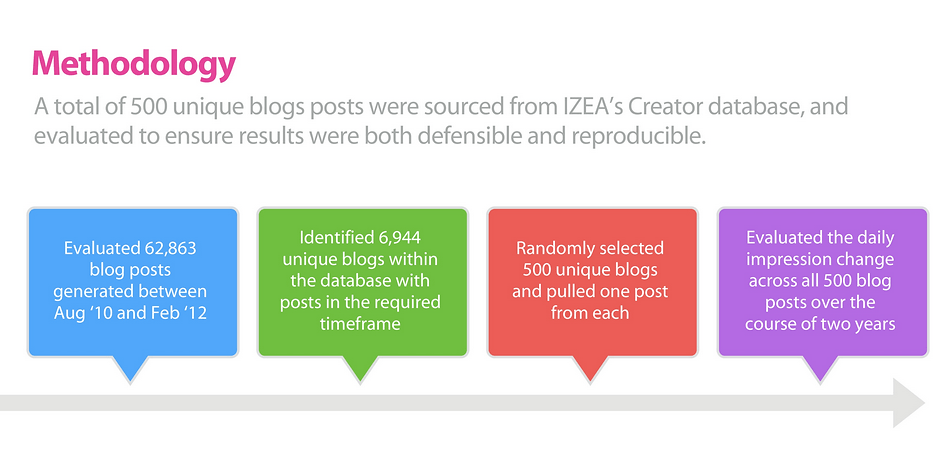
As part of the study, The Halverson Group evaluated 62,863 blog posts generated between August 2010 and February 2012. The team then randomly selected a quantitative sample of 500 unique blog posts, sourced from IZEA’s Creator database to ensure the results were both defensible and reproducible.

lifetime value of a blog post study methodology

The Three Life Cycles of a Blog Post

In addition to a blog’s lifespan, the study revealed that a blog post goes through three distinct “life phases,” further contradicting the historical use of a 30-day measurement period.

A Blog’s Post’s Lifespan

The study found that by day 700, a blog post will receive 99 percent of its total impressions. A 700 day lifespan indicates that blog posts are an annuity that provide value over a significant timeframe. This is an important data point for both blog owners who are looking to monetize their blog content and marketers who are looking to maximize return on their marketing spend.

A Blog’s Post’s Life Cycle

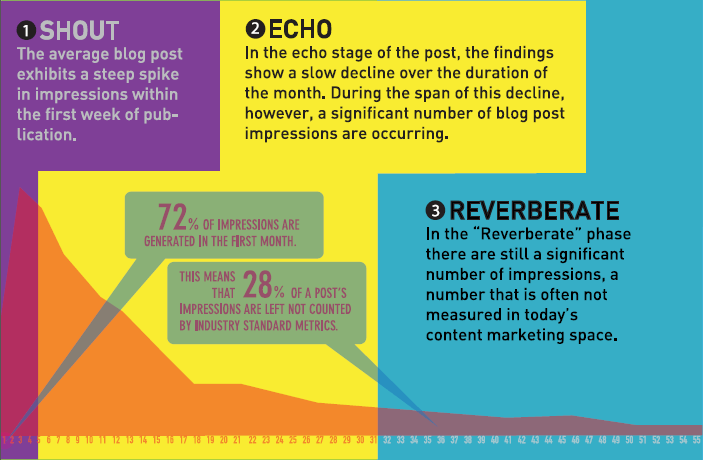
The study determined three distinct life phases a blog post cycles through, which are categorized as “Shout,” “Echo,” and “Reverberate.”

  • Shout: The “Shout” phase yields an initial steep spike in impressions that occurs within the first week to ten days, when 50 percent of a blog post impressions are generated.
  • Echo: The “Echo” phase begins shortly thereafter and lasts until day 30, when 72 percent of blog post impressions are realized.
  • Reverberate: The third, and likely least studied, phase in a blog post’s life cycle is the “Reverberate” phase. This phase makes up the 28 percent of remaining impressions and lasts from day 30-700. The Reverberate Phase is important for both content creators and marketers, as that is where the long tail value occurs. It is also the phase that most blog post impression metrics fail to take into account and quantify.

blog post lifecycle

The study also confirms what many marketers already knew: that impressions vary depending on what the post is about. While some blog posts, like sweepstakes, see a spike in engagement over the first month, blog posts on topics such as recipes and thought-leadership deliver impressions over an extended period of time.

blog post impressions data

Calculating Lifetime Blog Post Impressions

For the everyday marketer or the rank and file blogger, the study produced a research-based metric that can be used to calculate the true lifetime impression delivery of a blog post.

To calculate the lifetime value of a blog post, multiply the posts’ monthly page views by 1.4x. (highlight to tweet)

With a life-span nearing two years, blog content, and content marketing programs that leverage blogs have an evergreen value affect—especially when compared to volume-based media, such as display or search advertising, which stop delivering value as soon as the campaign investment ends.

View the full study here.

Get more content like this, plus the very BEST marketing education, totally free. Get our Definitive email newsletter.

       
28 Aug 19:03

Inside Runtastic’s $239M Adidas acquisition

by Paul Sawers
Runtastic & Adidas

EXCLUSIVE:

Austria isn’t synonymous with big-money tech acquisitions, but Runtastic put the country firmly on the global startup map this month when it was snapped up for a cool $239 million by sports giant Adidas.

VentureBeat caught up with cofounder and CEO Florian Gschwandtner this week to get the lowdown on the deal — how it came about, and where things could go from here.

The story so far

It’s fair to say that Runtastic has come a long way since it was founded out of Linz, the third-largest city in Austria, by Gschwandtner and three friends back in 2009.

While the company is perhaps best known for its eponymous GPS fitness tracking app, it offers other apps for working out at home, improving your sleep, and building six-packs. Runtastic also entered the virtual reality (VR) realm with a new app for Oculus Rift.

Besides apps, Runtastic also offers hardware, with fitness-tracking wristbands, scales, heart-rate monitors, GPS watches, and smartphone mounts for bikes.

Runtastic: Oculus Rift

Above: Runtastic: Oculus Rift

Image Credit: Runtastic

Enter Adidas

But what exactly sparked Adidas’s interest, and why sell now?

While big-name American brands such as Runkeeper and Nike+ are perhaps better-known globally, Runtastic has notched up 140 million downloads around the world, and claims 70 million registered users. Runtastic is a big company in its own right, one that often falls under the mainstream radar. It was its size that ultimately attracted the sports accessories behemoth, but Adidas wasn’t the only company sniffing around.

“After the acquisition that happened earlier this year, with Under Armour and those other players, some companies came knocking on our door,” said Gschwandtner.


From VentureBeat

The acquisition Gschwandtner is referring to is American sports clothing company Under Armour, which bought MyFitnessPal and Endomondo — two massive fitness platforms — for $560 million. It seems this might’ve prompted Adidas and others into action, and Runtastic was an obvious target.

While Gschwandtner couldn’t confirm which other companies, or how many, were showing interest, he did state that it was “more than a handful” from around the world, with talks kicking off around four months ago.

It’s also worth noting here that Runtastic had a majority shareholder in the form of Germany-based Axel Springer, one of Europe’s biggest media companies. The company bought a 50.1 percent stake in Runtastic back in 2013 for an enterprise value of €22 million ($25 million), with the Runtastic’s four founders, and a single angel investor, retaining the other 49.9 percent.

As events transpired, Axel Springer did rather well out of the deal, with Adidas paying €220 million ($239 million) to gain 100 percent control of the company. Divide that figure down the middle, and that’s not a bad return on Axel Springer’s initial investment two years ago.

To outsiders, however, Axel Springer and Runtastic was an odd pairing. Faced with interest from Adidas and others, Gschwandtner was in a position where he had to decide whether staying semi-independent or becoming a fully owned subsidiary would be the best way forward. “We said [to ourselves], our company is doing well, we’re growing in a very good way, we have 140 people now, we’re very profitable, and we have a very good roadmap,” continued Gschwandtner. “But if we find a more advanced strategic partner than Axel Springer, we would like to do it in a way that we feel good.”

Runtastic brought in a partner to help manage meetings with various interested companies but by the end there was only one real contender. “We figured that Adidas is a very good strategic fit for Runtastic — we saw the German culture, and they’re just three-and-a-half hours away from our HQ by car,” said Gschwandtner. “And there’s this common understanding — building something big, German engineering, that was just a really, really good fit.”

It’s interesting that sometimes a decision such as this can come down to simple practicalities, such as Adidas being a short commute over the border from Linz.

The future

With the acquisition now fully signed and sealed, what does the future hold for Runtastic as an Adidas company? Gschwandtner is adamant it will remain “independent” in spirit and physicality — the headquarters shall remain in Austria. But with €14.5 billion in revenues last year across the Adidas group, Runtastic is in good company, and Runtastic promises “some big improvements” in the future.

While Gschwandtner didn’t commit to any specific new products, he did give a hint as to what might come in the future.

“People always asked me, ‘Flo, when are you building the Runtastic running shoe,’ and I’d say that’s probably never going to happen,” he said. “But now with Adidas, there are many, many new possibilities on how they can help us, and we can help them to build even better products.”

For a company that started as a simple GPS fitness app six years ago, to now be talking in terms of connected running shoes is remarkable. If nothing else, it helps illustrate why startups do agree to join larger companies — it opens the door to many more possibilities.

“There are many things we can connect, and I think their [Adidas] knowledge in building the perfect running shoe and the perfect apparel, combined with our digital knowledge, could lead to something great in the future that helps you understand your way of running better,” added Gschwandtner. “There are so many potential synergies.”


28 Aug 19:02

How Do You Know Your Price is Too High?

by Mike Moran

pixabay_currency-163476_1280

I work with lots of companies to launch products. I am working with one now and the launch hasn’t gone very well. Sales are scary low–they round to zero.

This is a disappointing turn of events for sure, but I wasn’t prepared for the idea that was floated next: let’s cut the price of the product 40%.

See, the problem here is that we have no evidence that price is the problem. In fact, because sales are so low, we actually have evidence that it isn’t price at all–when the problem is price, you typically sell some but just not enough. When you sell none, you usually have one or more of these problems:

  1. Your product doesn’t solve a problem that your network will pay for.
  2. You don’t have a big enough network.
  3. You haven’t reached your network.

If any of these are the real problem, lowering the price will have no positive effect, because price isn’t the problem. All that lowering the price will do is to slash the profit of what few sales you do get, and–worse–communicate that your product isn’t that good, even if it is.

In this particular case, we have some evidence that the product is, in fact, good. We have some evidence that it is a market need. But we don’t know whether the network is large enough or whether it has been effectively reached. So, lowering the price just communicates a lack of confidence in the value.

Think about it. If I let you test drive a luxury car and it handled beautifully, looked fantastic, and had every feature you expected, but when you asked the price I told you it was $10,000; would you be excited, or suspicious? I believe many of you would start to question your own judgement of how good the car is just because the price is wrong.

Price communicates value. Lowering the price communicates low value.

I am working as a senior strategist at a few companies. One of them is Revealed Context, who has a high-quality API that identifies sentiment and other qualities of social media conversations at a level of accuracy unseen anywhere else. It costs more than some other solutions–it also costs less then some, but it isn’t the cheapest. When a client asks me why it is more expensive than other solutions, I ask them how much less they would like to pay to get the wrong answer. That often gets the conversation back where it belongs–on the value, to them, of an accurate solution.

Another company that I work with is SoloSegment, who offers a solution that improves a company’s website search results. It’s a combination governance model, scorecard, and improvement process that is unique–and effective. I have had a few companies ask me why it is priced as it is, and I say, “well, if the price is too high, maybe you should get the other one.” And they ask, “what other one?” I reply, “exactly.” You see, that kind of conversation gets us back on track–talking about the value of this unique solution to their company’s situation, rather than haggling about the price in abstract.

Now understand, I am not saying that you should raise the price artificially just to trick people into thinking something is valuable. That doesn’t work in the long run, because when people buy it, the product has to speak for itself. None of the examples I have given here are artificially priced higher–it is a simple fact that providing higher quality does cost more, which your customers intuitively understand and accept.

When you have something valuable, you must price it to indicate its value. Otherwise, there is a disconnect between how valuable you say it is and that rock-bottom price. If you simply discount your price to try to solve all sales problems, you actually create a bigger problem: you are showing a lack of confidence in your own value in front of your customers. If you don’t value what you are selling, why should they?

28 Aug 19:02

New Headline Writing Techniques that Produce Astounding Results in PR and Marketing

by William Comcowich

7 Ways to Vastly Improve Your Headline Writing Skills

or

How to Write Enticing Headlines that Produce Incredible Results

or

Tips for Writing Headlines with the Emotion of a Love Letter

or

The Headlines that Work Best in PR & Marketing

or

5 Secrets to Writing Eye-Catching Headlines

Headline writing is undoubtedly the most important writing skill in PR and marketing. It’s not a bad skill for journalists either.

headline writing tips

David Ogilvy once said five times as many people read the headlines as read the body copy. Because people are exposed to so many headlines each day in online news, email and social media, captivating headlines are probably even more important today than in the past. Sometimes, the change of a single word in an email subject line or a content marketing piece can dramatically increase click-through rates.

Some copywriters spend hours or days writing a blog post, content marketing piece or white paper, and then spend less than a minute thinking about the headline. Some experts now recommend writers spend half as much time on the headline as they do on body copy. Other experts suggest writing the attention-grabbing headline before writing the body copy – and then make sure the content lives up to the headline.

The Fantastic 4 U’s

In their Definitive Guide to Copywriting, Neil Patel and Joseph Putnam say outstanding headlines have four attributes, although writers can rarely achieve all four at once. Their four u’s are:

Unique. Customers have heard the standard sales pitches many times before. If you want to be noticed, you need to show how you are different. That may require personality and taking risks.

Ultra-specific. Readers must have enough information to decide if they are interested. Specific is preferable to clever yet vague.

Urgency. You cannot always convey a sense of urgency, but the rule works well when you can.

Useful. Conveying a benefit, what some call a value proposition, is one of the most important rules, yet companies break the rule frequently in an effort to be cute.

Proven Headline Writing Techniques

Successful marketers rely on various proven techniques to prompt readers to read an article or open an email. The following is an amalgamation of successful headline-writing techniques recommended by some the most successful web content writers. While they often agree on headline writing techniques, some tend to have a favorite style.

Start with a number. Listicles are scan-friendly and popular. A number next to text tends to attract the human eye. Follow a number with a word like reasons, ways, tips or secrets.

Breed distrust. Readers are eager to learn how they are being cheated or deceived. Examples include “What your __ won’t Tell You” or “5 Lies Your __ Tells You.”

Use strong words. Violent or ominous words can attract readers. Those words include kill, fear, dark, bleeding and war.  Other powerful words are smart, surprising, history, hacks, big/huge and shocking.

Ask a question. Asking readers a question draws them in, and the punctuation mark can catch their attention. Examples provided by WordStream include “Think You Know SEO? Quiz Yourself and Find Out!” or “Do You Want to Build a Snowman? Read This Guide First.”

Be free. Forget what you learned in school. You don’t have to be informative, objective or even grammatically correct.

Seek superlatives. Use words like most, best or worst. Some call these headlines click-bait, but the strategy has worked for many marketers. Strive to deliver the supporting content.

Telegraph emotion. Readers like being told what they’re going to feel. Upworthy likes this strategy. An example is: “Finally, Pictures of Gorgeous Women that Make You Feel Better about Yourself Instead of Worse”

In most instances, the ideal headline for any given story or promotion blends more than one of the techniques to achieve its desired effect.

Know Your Audience

Marketing experts Kim Albee and Margaret Johnson at Genoo LLC explained their views of common headline-writing techniques for marketing and their pros and cons in a recent webinar. The first step and probably most important step in writing a successful marketing headline is to identify concerns and problems of your target audience, they said. What are their primary motivators? What keeps them up at night? The better you know your audience, the better your headlines. Find the top five things that concern your audience, they recommended.

Appealing to curiosity is a common technique. Tell people enough to get them interested but not so much that they don’t need to click. Upworthy prefers this technique as in “You’ll Never BELIEVE Who Taylor Swift Is Dating Now.” The headlines are best when specific yet vague. “Did Google’s Latest Update do this to Your Website” is a superb example of the technique – but difficult to migrate to a marketing environment. While the arousing curiosity technique can be successful in marketing, when done ineptly it fails miserably. The reader is too perplexed to bother opening the email or clicking on the ad.

The offer is another popular headline style in marketing but is overused and often poorly done, Albee and Johnson said. Too often, the marketer focuses on the company instead of the consumer’s needs and wants.

The urgency and scarcity headline – that typically cites limited supplies or tout time deadlines — can be effective but backfires if overused. That’s why experts advise employing the technique infrequently and combining it with other strategies.

Another popular technique is appealing to the readers’ self-interest by promising to improve their lives or job performance. “New Techniques for Writing Enticing Headlines” is an example, grin.

News is another double-edged sword. A common mistake is to announce news about the company. The proper method is to cite a well-known news event, state how it affects the customer and how the company’s product or service can help the customer. IT security firms employed the technique successfully by citing the Target data breach (and other breaches).

Bottom Line: Writing enticing headlines is crucial to attract attention and prompt click-throughs on marketing and PR materials. Applying proven headline-writing strategies can produce improved returns on your PR and marketing efforts.

Can you write a better headline than ours for this article? Use comments section below.

This article was originally published on the CyberAlert blog.

28 Aug 19:02

Can You Pass The Question Test?

by Keenan

Question-marks-1

Would you like to take a test that measures your ability to ask questions and improve your chance to win the sale?

Can you have a conversation by only asking questions? Do you think you could have a conversation without making a single statement?  Could you do it without turning the conversation into an interrogation and making the other person/people uncomfortable?

How long do you think you could ask questions before you made a statement or became uncomfortable? Have you ever tried?

Would you be able to put someone at ease and engage with them at their level through the sole use of questions?

Do you think you could teach someone through probing questions, rather than telling or preaching?

How long do you think your conversations would last and how many questions could you ask before you slipped and made a statement? Would it be three, five, ten, twenty? How long before the conversation became awkward?

Do you feel comfortable asking questions rather than making statements?

As a salesperson, have you considered how powerful this ability would be to closing a sale? Have you ever thought about the impact questions could have on your ability to deliver value and position the sale? Have you gotten close to the end of a sale and realized you missed the mark, that you didn’t have all the information and you didn’t know something that was critical to the sale? Did you wish you had asked more questions earlier?

If this has happened to you what did you do to change it? Have you learned to ask more questions? Have you learned how to use questions in a conversational manner? Did you get the results you were looking for or are you still struggling to get the information you want and go right to telling?

Would you like to get better? Can you see the value in asking questions? Are you willing to take the test and try and see how long you can go before you break down and start making statements?

How do you think you would do? Would you pass the test?

Would you let me know how long you can go, by sharing your experiences in the comments?

So, what’s the test?

The next time you’re with a friend, or someone you trust try and carry the entire conversation without making a statement, do you think you could do that?

Good, how long did you go?

Did you 5 questions deep, 10 questions deep, 20 questions deep?

28 Aug 19:01

20-somethings say they'd give up a high salary for a job that gets them psyched to wake up in the morning

by Shana Lebowitz

Office smile happyWhen it comes to their professional goals, most people in their 20s say they're on a quest to find work that's fulfilling, as opposed to a lucrative gig.

A recent poll by Clark University, cited in the Harvard Business Review, finds that 59% of 20-somethings said they would take a lower-paying job if it meant doing something they love. On the other hand, 41% said having a high salary or pay grade is most important, even if it means working in a job they don't enjoy.

When asked to rank what would be most meaningful in a long-term job, respondents listed "a job that I will look forward to going to each day" as their top priority and a job that "pays me a lot of money" as their second. Their lowest priority was a job that "puts me in a position of power and influence."

Unfortunately for 20-somethings, their professional ambitions haven't yet come to fruition. Some 76% of respondents said they're still looking for their ideal job. 

Meanwhile, just 35% of respondents said they currently have a job that they look forward to going to each day. A quarter said they have a job that pays a lot of money. 

It's unclear whether 20-somethings are really that different from other generations in terms of what they want out of work. A Pew survey found that all generations listed "a high-paying job" towards the bottom of their work priorities.

Yet another survey found that, when asked about what they valued in their first job, older Americans were more likely to say they valued making as much money as possible. Younger Americans were inclined to say they valued doing something enjoyable or making a difference in society.

The problem with any of this research, as Fortune editor Alan Murray points out, is that we can never be sure whether survey participants are saying how they really feel — or responding in a way that seems socially acceptable. Perhaps the 20-somethings surveyed feared that they would seem crass if they listed money as their top work priority, so they put enjoyment first.

Either way, it will certainly be interesting to see future surveys on this generation of workers. At 40, will they find (or at least say they've found) a job that gets them jazzed to wake up in the morning? With young families in tow and mortgages hanging over their heads, will they still be inclined to take a lower-paying job that provides enjoyable work?

Perhaps most importantly, how will their changing beliefs and desires shape the workforce for future generations?

SEE ALSO: Psychologists just debunked the idea that you have to find the perfect job fit to be happy at work

Join the conversation about this story »

NOW WATCH: The way you write l, t, i, and y reveals a lot about your personality


28 Aug 19:01

Everything that's wrong with psychology studies explained in 2 simple charts

by Kevin Loria

old school scientists

When we talk about what new scientific research says, we want to say something understandable and digestible, especially when a finding is particularly shocking: people who don't believe in free will are more likely to cheat on their partner, for example.

But accurate science isn't usually that shocking. Science is an iterative process that gradually chips away at the truth through many studies over time.

Single studies can only show researchers getting a little closer to something true.

Researchers will sometimes even focus on data that shows what they were looking for — findings that are only true if they look at information in a certain way.

This doesn't mean their results are necessarily wrong, but it almost certainly means that a "shocking new study" is not as it seems, especially if it's the first one of its kind.

This problem is so rampant in psychology that scientists have have started to call it a potential "replicability crisis" — if studies are repeated, they may lead to different results.

A huge project from University of Virginia psychologist Brian Nosek, working with 270 other psychologists, has just put this to the test by repeating 100 studies published in three of the top psychology journals.

They published their findings in the journal Science on August 27, and what they found wasn't pretty.

Originally, 97% of the studies were statistically significant — meaning that researchers said their findings showed a less than 5% chance that they could have gotten the same results even if their data was false.

The chart below shows how the significance of the studies changed when they were repeated. Only 36% of the studies, just over a third, were still significant when repeated — these are the ones below the dashed line in the chart. The others were no longer significant.

p value skitch new

Since the statistical significance of studies is only one way to evaluate them, and some argue that the 5% cutoff that defines "significance" isn't helpful, they also looked at how much of an effect there was in the study.

As The Atlantic's Ed Yong puts it, the effect values "measure the strength of a phenomenon; if your experiment shows that red lights make people angry, the effect size tells you how much angrier they get."

The chart below shows how the effect size changed when the studies were repeated. The closer the number gets to 1.00, the bigger the effect. You can see that the median effect size for most studies, as represented by the white dot, dropped far closer to zero when the studies were repeated. 

study effect skitch


In some cases, they even found a negative effect, with results opposite the original study.

As researchers who worked on the Reproducibility Project explain, this doesn't mean that you shouldn't believe psychology. It's just that science takes time, and finding something that's true often requires repeating work to make sure that a finding is real.

"This doesn’t mean the originals are wrong or false positives. There may be other reasons why they didn’t replicate, but this does mean that we don’t understand those reasons as well as we think we do. We can’t ignore that. We have data that says: We can do better," Nosek told The Atlantic.

Nosek's Center for Open Science will be examining other fields in the future, taking a look at everything from cancer biology to computer science.

In the meantime, maintain a healthy skepticism any time you hear "a study found" or "science says" — especially if there's only one study that supports that shocking new thing.

Join the conversation about this story »

NOW WATCH: Now we're really getting an idea of how the new 'Heroes' reboot is going to look

28 Aug 19:00

Great News, Salespeople: You're Still Relevant

by esnider@hubspot.com (Emma Snider)

Earlier this year, Forrester made waves in the sales community with its prediction that one million sales jobs would be lost by 2020. Principal analyst Andy Hoar argued that salespeople who act as "order takers" would largely be replaced by buyer self-service and online information.

But it wasn't all bad news. According to Forrester, one type of sales job actually stands to grow in coming years. "Consultants" -- reps who work with a complex buyer dynamic and a complex product or service -- will increase in number as more traditional sales roles decline, Hoar explained.

Understandably, this has caused some panic among B2B sales reps. Several articles have been devoted to the topic of staying relevant in a tumultuous time by shifting outdated strategies and becoming more consultative.

However, are we worrying for nothing? According to a new Gartner study, salespeople still hold a significant amount of power when it comes to B2B purchasing decisions.  

Survey respondents were asked to rate the likelihood that a given marketing or sales interaction would influence a buying decision. Here are the five most influential channels:

  1. Direct interaction with the provider
  2. References
  3. Events (both in person and virtual) 
  4. White papers
  5. Sales presentations

That's right, salespeople -- buyers are most likely to be swayed by interactions with vendor representatives (that means you!).

Why are provider connections so compelling? Frank V. Cespedes and Tiffani Bova offered an explanation in a Harvard Business Review article.

"Business buyers must justify a decision to others in the organization, especially as capital expenditures flow less liberally in many industries since the financial crisis of 2008," the authors write. "And you are naïve if you believe that a combination of economics, solution identification, product application, risk management, and political journey through the buyer’s organization is now handled predominately online without knowledgeable and savvy sales help."

Gartner's research also found that buyers are using online informational content in addition to -- not instead of -- sales advice. With this in mind, vendor websites and salespeople aren't mutually exclusive. In fact, they might even be symbiotic.

What's your reaction to this research? How much sway do you think salespeople hold over buyers? Let us know in the comments.

Get HubSpot CRM today!

28 Aug 18:59

How Millennials are Changing the Face of B2B Sales

by Kathleen Glass

In the old days, the inside sales team was cooped up in a room together, hooked up to an auto dialer on a landline phone and told to set as many appoints as they could in 8 hours. Today, not only is that no longer a viable way to find buyers, but no one from the digital generation will ever sign up for that thankless job.

Here’s how Millennials are changing the sales model.

If you grew up in with the digital natives, or the NetGeners as Don Tapscott is calling them, you have a lot of different perceptions about life and work than any of the previous generations. In a recent Pulse post Don Tapscott says “The idea of fixed hours at work, fixed vacation times, fixed location of work, and fixed compensation pay make no sense for this new generation.”

Millennials are fast becoming the majority of the workforce, and the thing is, your buyers are part of this same digital savvy generation, so they think differently too. Your buyers don’t adhere to traditional boundaries, timelines, buyer/seller relationships and channels that existed in the past, and are much better armed and knowledgeable than ever before. NetGeners are used to being connected anywhere, anytime via mobile and social. Today, your buyers expect you to Tweet, Chat, text and Skype with them. In fact, you will need their permission before you talk with them on the phone. So why not let them engage with sales the way they want?

Are Millennials lazy? Impatient? Will they leave your job at the drop of the hat? These perceptions have come about because Millennials have a whole different perspective than previous generations, as Don Tapscott points out. What if you give them great technology to engage with the buyers however they like? Or allow them to bring their own devices? What if you offer them immediate payouts, incentives and encouragement? What if they have a flexible schedule so they can surf in the morning and work the late shift, or come in at 6 am and leave early to support their kids at softball practice? How about adding a remote work day? What if you make it fun? And how about a clear career path – if they want it?

That’s the other thing about Millennials. You need to pay attention to what matters to them and a job description from 1970 isn’t going to cut it. A Millennial might be content to have a rewarding inside sales role engaging customers for the next 10 years. Or they might be your next superstar Head of Marketing. If you hire for a wider skillset, you will not only have a better Sales Development Rep, but they’ll be able to grow into Account Management, Field Sales, or Marketing roles easily if that’s something they want. And don’t forget the mentoring and reinforcement. Just because they are digital doesn’t mean they don’t like human engagement and encouragement.

It’s time to take a look at the old sales models and adapt for the Millennial Generation.

Get more lessons on B2B lead generation in this free ebook.

b2b-lead-gen-ebook

28 Aug 18:58

5 Power Players You Need On Your Lead Management Team

by David Bunker

customer lifecycle marketingIf you could diagram the complexity of modern marketing and sales operations the intersecting lines of software, social, content, design, email and data would turn into a morass of cross hatching.

The org chart of today’s sales and marketing departments includes people in overlapping roles in left- and right-brained tasks: creatives, web developers, data analysts, database experts, strategists, sales development reps, email experts, and so on— it might sometimes looks like a cross between a digital newsroom and an app development company. But there’s good reason for that.

Marketing is no longer ad placement. Sales is no longer cold calling. Brands are becoming their own publishers, designers, development experts, all in an effort to reach the busy digital consumer.

Think of the sales lead process as a five-step system:

  • Attract: Content and SEO are the magnets here. Make sure your content is both high-value and visible.
    Content Tools: blogs, social posts, infographics, case studies, or videos.
  • Capture: Once a lead makes its way to the website, use forms (and prospecting and analytics tools) to collect email addresses and turn a prospect into a bona fide lead. Analytics tools (such as website visitor tracking apps) will give you immediate insights into the needs of your lead. Educate your lead about your product or service’s features.
    Content Tools: Webinars, guides, demos, analyst reports, eBooks.
  • Nurture: This is where you really begin to sell. You want to overcome any hesitation to purchase. Educate and inform, to make your company the trustworthy first choice. Address questions and concerns, and toward the bottom of the funnel, highlight the advantages of your product.
    Tools: Case studies, product comparisons, FAQs, demos, training materials, free trials.
  • Convert: Show what it’s like to work with you. Finalize purchase, and onboard. Follow through, and make sure the customer is satisfied with the product.
    Tools: Drip onboarding programs, user guides, videos, webinars, training materials.
  • Expand: Support loyalty and advocacy, expand usage, and upsell.
    Tools: Webinars, tips and tricks, newsletters, communities, reward programs, social media.

To complete this process, brands need the right people in the right seats. Talent – and technology – are now vital to any lead management system. And they both require you hire the right players and align them in the same team.

team

The power player roles you need to fill include Writer, Designer, SEO/PPC Expert, Web Developer, Data Scientist, Social Butterfly, Systems Expert, Collaborator, Strategist, and Analyst. Let’s take a closer look at the first five:

Writer

It’s a cluttered content world out there. Brands that find a way to grab attention in a world where billions of megabytes of content slosh through the Internet each day become the lead-generating all stars.
Talented writers that know digital content strategy are the power players you need to win the content contest. Versatile copy experts that can write attention-grabbing blog posts, educational guides, and clear and concise case studies are vital to every part of the lead process. They will make sure you have the ammunition to attract, nurture and convert valued customers.

Designer

The digital world is visual. Large hunks of gray text are immediate turn-offs for digital consumers conditioned by a world of Instagram photos and Squarespace websites. Make sure your lead management team includes a designer that can take all your content and turn it into something beautiful and easily digestible. Talented designers can tell stories with photos, visuals and animation. They can make that writer’s 1,000-word blog post look less like the first two pages of War and Peace and more like an integrated multi-media package of visual and written content.

SEO/PPC Expert

No matter how good your content is, it needs some help to get onto the smartphones and computer screens of your target audience. An SEO expert can decode the reasons why your blog post is buried on page 42 of the Google search results for “demand generation.” An SEO expert can also give you a long-term plan to make your website out-perform competitors in organic search for the terms you want to be found for. When organic search is not enough, a pay-per-click or paid search expert can recommend a search advertising program that will put an advertising boost behind your most important content.

Web Developer

Your website is not some static afterthought to your social media presence. It is where you capture leads, read their digital body language and gain a more complete picture of each lead. But to do this you need not only a great website, but the right prospecting and analytics software, and the right forms to gather contact information. Your website is the hub of your lead generation operation. Make sure you have someone at the controls who knows how to squeeze the most out of it.

Data Scientist

Data is such a rapidly progressing part of marketing and sales that the data scientist has become key. An expert at the helm assures that your data is being used effectively and that you are gathering all of the data that is available to you. Put this person at the center of demand generation. Listen to their expertise. And make sure you are tracking with the latest data developments in your industry. With new social media sites, real-time video applications and tools popping up almost weekly, it is critical that your data operation is keeping pace. Data scientists can also determine how data can be leveraged across multiple departments. The same data set you are using to segment email mailing lists might be the perfect information to help guide a hyper-targeted social advertising campaign.

Want to learn about the five other power players on the lead management team? Do you want the guidebook to world-class lead management? Download The Ultimate Lead Management Playbook and build out or beef up the team that makes your company’s lead management plan come alive.

28 Aug 18:58

Inbound Marketing: Sales & Marketing Alignment Is Critical To Success

by Kathleen Booth

Inbound_Marketing_Tug_of_War

The number of companies practicing inbound marketing (or content marketing, as some call it) has grown dramatically in the last several years, and there is research to prove it. According to Marketing Profs and the Content Marketing Institute (see their 2015 B2B Content Marketing Study), 86% of B2B companies and 77% of B2C companies are using some form of inbound marketing.

Many of these companies are seeing substantial increases in website visitor traffic and leads as a result of their efforts. The 2014 ROI of HubSpot report found that companies practicing inbound marketing with HubSpot reach, on average 2.4 times more website visitors per month and 5.99 times more leads per month within the first year of implementing their inbound marketing strategies.

Despite these successes, there is a disconnect. While the ROI of HubSpot report found that 69% of customers saw an increase in sales revenue as a result of inbound marketing, the CMI/Marketing Profs study found that only 37% of B2B companies and 37% of B2C companies consider their inbound marketing to be effective.

What is going on here?

Interestingly, while the HubSpot report asked about sales and lead-to-customer conversions, the CMI/Marketing Profs study did not address the issue of sales at all. When it comes to measuring the value of inbound marketing, sales is a key part of the equation. After all, you can generate lots of leads through inbound marketing, but if you can’t convert them into customers, what’s the point? And the responsibility for converting leads to customers ultimately falls on the shoulders of your sales team.

Sound simple? You do inbound marketing, you generate leads, and your sales team closes them, right? Nope. It’s just not that simple in practice.

The reality is that in most companies, sales and marketing don’t play well together. In fact, only 8% of b-to-b companies surveyed by Forrester Research said they have tight alignment between sales and marketing (see the B2B Sales and Marketing Alignment Starts With the Customer report). This is a problem when it comes to inbound marketing, which requires a well-coordinated hand-off between the marketing team, which generates inbound leads, and the sales team, which needs to close them. If this hand off isn’t executed well (or at all, as is sometimes the case), the company won’t close inbound leads and won’t see ROI from its inbound marketing spend.

How to improve sales and marketing alignment?

There are several factors that contribute to alignment issues. According to the Forrester research, the greatest obstacles to achieving tighter alignment between sales and marketing are:

  • Long-term thinking by marketing vs. short-term thinking by sales (58% said this was an important factor)
  • Different goals and measurements (46%)
  • Not enough time (45%)

In my 10+ years as a marketing agency owner, I’ve seen all of these and worked with clients on overcoming each of them.

Here are some strategies and tactics you can use to address these challenges and improve alignment.

1. Change the structure of your sales team

Salespeople are by nature short term thinkers who are highly motivated to close deals quickly so they can earn commissions. The problem is that not all inbound leads are going to close quickly. Think about it. Buyers are out there doing research on Google, asking for advice from friends and colleagues on Facebook or LinkedIn, reading online reviews, etc. Traditional leads have already done all of this by the time they talk to a sales person and therefore are much further along in their buying process (60 – 70% according to some statistics). This means that when your sales team engages with them, the time to close is relatively short when compared with the entire length of their buying journey.

Inbound leads, on the other hand, tend to be earlier in the buying cycle. Why? If you’re doing inbound marketing right, your content is what they’re checking out when they do their Google research and to get it, they have to fill out a form and identify themselves. Based on the information they provide, you may consider them “marketing qualified” (perhaps because they meet certain demographic requirements, etc.) and decide sales should reach out to them.

If your salespeople are used to working traditional leads, they are inevitably going to feel frustrated that inbound leads aren’t farther along in the sales funnel and therefore require more effort – and time – to close. When this happens, there’s a good chance they will simply choose not to work those leads and instead focus on the traditional leads because they’re easier and and will result in commissions more quickly. This disconnect leads to that frustration felt by 58% of companies that marketing looks long term while sales looks short term.

One way to solve this issue is to change the structure of your sales team. No, I’m not suggesting a major shakeup. That would be a disaster. In fact, I’m actually not suggesting changing much at all with your existing sales team.

Assuming they are performing, let your sales reps continue to work the traditional leads and assign someone else to work the inbound leads. This type of inside sales rep position has proven incredibly effective in working early-stage leads and nurturing them to the point that they are ready to be handed over to your outside sales reps and closed. Assigning one or two people to specifically work your inbound leads, creating a commission structure that aligns with inbound leads’ longer buying horizon, ensuring a smooth hand off from marketing, and training them on how best to engage with inbound leads will improve your lead-to-customer conversion rates and generate greater ROI from your inbound marketing strategy.

2. Educate your sales team

Its pretty striking that 46% of companies blame poor marketing and sales alignment on different goals and measurements. This leads to situations where marketing thinks they are doing everything right and knocking it out of the park, and sales is thinking “these leads suck.”

I’ve seen it happen – a lot! In fact, I’ve seen it happen enough times with my clients that we’ve changed our whole process and are now kicking off new inbound marketing engagements with a “Culture of Content” workshop.

What is a “Culture of Content” workshop? Basically, its an all-hands-on-deck, two to three hour workshop in which the entire organization comes together to learn how buyer behavior has changed, why Google play such an important role in today’s buying journey, how educational content can influence buyer behavior, and why it is so important for companies to practice inbound marketing.

These workshops aren’t just rah-rah, motivational events. We get very specific on the role that salespeople need to play in a company’s inbound marketing strategy, from generating ideas for content, to creating content, to following up on leads. The goals is to develop buy-in and make sure everyone is on the same page about what the company is doing, how it is going to do it, and what it is trying to accomplish.

Done right, a Culture of Content Workshop will lay the foundation for establishing common goals that sales and marketing can both get behind. The workshop needs to be followed up with a working session in which marketing and sales sit down and actually hammer out a service level agreement (SLA) that specifically documents the following:

  • How will you define a marketing qualified lead (MQL)?
  • How will you define a sales qualified lead (SQL)?
  • How many MQLs and SQLs will marketing commit to generating each month?
  • How will sales follow up on those MQLs and SQLs?
  • What lead-to-customer conversion rate should sales be achieving?

By documenting each of these things, companies can eliminate the disconnect that occurs when marketing and sales have different definitions of goals and measurements and ultimately strengthen alignment. When alignment is stronger and there is greater organizational buy-in for inbound marketing, watch out world – your team is bound to succeed!

3. Involve sales in content creation

I don’t care what industry you’re in, your sales people have greater insights into what your customers are looking for, the questions they have, and their pain points, than your marketing people do. Why? Because they spend more time communicating directly with customers and prospects than marketing does.

In most organizations, who creates content? Marketing, right?

See the disconnect?

If sales people have the greatest insight into customers’ needs, but marketing people are charged with creating content, then clearly sales needs to have greater involvement in content creation.

I’m not talking about shifting the responsibility for content creation from marketing to sales or even requiring sales people to blog (although it would be awesome if they did!). Instead, I’m talking about finding a way to tap into the knowledge that sales people have about buyers’ needs and interests and weaving that into the blogs, ebooks, infographics, webinars, case studies, etc. that marketing is creating.

With 45% of sales people citing a lack of time as the reason for poor marketing and sales alignment, you may think that increasing the involvement of sales people in content creation is unrealistic. In fact, this is something I hear a lot from C-level execs that call us looking for help with inbound marketing. They say things like “we want to get more leads but I don’t want this to become a distraction for my sales people.”

Given this concern, how can you involve sales people in content creation without overburdening them? Actually, they are already creating content and you just don’t realize it. If they’re like most sales people they send lots of emails every day to customers and prospects who have questions, and the information contained in those emails is inbound marketing gold.

Marcus Sheridan (aka The Sales Lion) has an ingenious solution for capturing this information, and we’ve copied it to a great degree of success with our clients. It’s so simple. Just create a new email address like “content@[yourcompany].com” and ask your sales team to blind copy it whenever they are sending emails that contain educational information, or answer prospect/customer questions. Then, make sure the emails get delivered to your marketing department, which can save them all for a time when they need content inspiration.

This works because its easy, it takes no time at all, and it doesn’t require your sales team to change the way they work. When we introduce this idea, most sales people are willing to give it a try. Because the biggest challenge is getting them to remember to do it every time, we’ve actually created custom mousepads to serve as a reminder to BCC content@ before they hit “send” on their email. This is something any company can easily copy.

There you have it

I’ve offered three easy solutions to immediately begin addressing the issue of sales and marketing alignment. These are really just the tip of the iceberg. The point is that if your company is going to make an investment in inbound marketing, you can’t forget to address the role that your sales team will play. Think about it like baseball – its no good getting a hitter to third base if you can’t get him to home plate.

Achieving strong sales and marketing alignment isn’t simple and, in my opinion, the mandate for it needs to come from the top down to overcome departmental turf battles. Getting your C-level exec to buy-in to the need for these changes is a good place to start, and then educating your whole team about the importance can help pave the way for change to take place.

Have you faced challenges getting your sales and marketing teams to work together on your inbound marketing campaigns? How did you overcome them? I don’t have all the answers and would love to know what others are doing to solve this issue. Share your strategies with me in the comments or tweet me @workmommywork.

inbound-sales-hiring-seminar

28 Aug 18:58

Skype vs Skype for Business: What’s the Difference?

by GetApp

Skype for Business or Skype: what are they, how are they different, and which one is really right for your business? Maybe you thought they were the same thing, or maybe you’ve been living under a rock for the past decade and are wondering what this Skype thing is all about. Whatever situation your business is in, we’re here to help answer these questions and decide which (if either) is right for your company.

Let’s quickly recap the history of these communications apps. Once upon a time, Microsoft offered a unified communications product called Office Communications Server (previously known as Live Communications Server), which was replaced and rebranded in 2010 with Lync. It offered features such as instant messaging, presence, voice and video calls, desktop sharing, file transfer, and mobile apps for iOS, Android, and Windows Phone.

Separate from all of this, Microsoft bought Skype in 2011 for the hefty sum of $8.5 billion. Many questioned why the Seattle-based company would buy a product that competes with its existing offering (anyone remember Windows Live Messenger?), and whether they would eventually merge into one. The integration of the two can be traced back (officially) to 2013, which leads us to the announcement at the end of 2014 that Lync would be relaunched and rebranded as Skype for Business. Let’s make one thing clear: this is not the same thing as regular Skype, and it doesn’t mean that the Skype that we all know and (some of us) love has been discontinued.

Michal Nemcok, PR and marketing manager at LIFARS, a digital forensics and cybersecurity intelligence firm, explains: “The main difference is that Skype for Business is not really Skype. What I mean by that is that besides using the same logo, there is very little they have in common.”

Spot the difference

Now we’ve made it clear that there are two different options, the next questions is which (if either) is right for your business? Microsoft’s advice is that Skype is suitable for businesses of up to 20 people, with the benefits being that it is free for Skype-to-Skype calls, and you can buy credit to make super cheap calls to mobiles and landlines. It’s also got a familiar look and feel.

Skype for Business has the same familiar look and feel as regular Skype

Skype for Business has the same familiar look and feel as regular Skype

For larger businesses, Microsoft recommends Skype for Business. There are a whole host of benefits that it can offer for your company, including Skype Meeting Broadcast, which allows you to broadcast a meeting online to up-to 10,000 people. Another neat feature is Skype Room Systems where you can use Skype for Business with standalone cameras and monitors, as well as audio equipment from Microsoft’s partner network, and the Microsoft Surface Hub a large screen device built for ink and touch.

“Skype for Business is great for meetings and conference calls with video or presentations, it also allows recording, can be accessed online, and more,” says Nemcok.

It also comes with enterprise-level security, and – currently only for companies in the US – Cloud PBX with PSTN Calling, and PSTN Conferencing. The security aspect is crucial for many businesses, including call center technology provider Call Tools, which cites it as the key reason it is using Skype for Business. “I have both accounts and I prefer Skype for Business even though we are a small business,” explains Taylor Murray, lead developer at the company. “The sole reason I use Skype for Business is because it gives you enterprise-grade security. For me it’s more important to have that peace of mind that our information is secure within the company.”

Skype for Business is part of Office 365, meaning it integrates with Microsoft

Skype for Business is part of Office 365, meaning it integrates with Microsoft’s Office productivity tools

Others have cited its integration with Office 365’s productivity apps as a key reason for using Skype for Business. Although this is not without its issues. “We have two main offices (Chicago and Malmo, Sweden) and a few sales outposts. We have Office 365 and rely on it for our collaboration,” says Christine Pietryla, VP, Global Marketing and Communications at inRiver, a product information management solution provider. “Skype for Business is more stable, but only when talking to other team members in 365. If you need to call a partner, customer or vendor (anyone outside the office)…Skype for Business is not reliable. Managing two Skype accounts that you have to log in and out of is very clunky.”

To pay or not to pay?

Since regular Skype is free and Skype for Business must be paid for through different monthly plans, are businesses getting value for money in paying for Skype for Business? Not everyone thinks so. “No one will deny that the app integration in Skype for Business is very nice, not to mention the 250-user count, but most companies do not need to make the jump from Skype,” explains Nick Espinosa, CIO of IT consultancy firm BSSi2.

Espinosa ran Skype for Business in his office for around 90 days before he deemed it really unnecessary to the workflow, and the company moved back from the business to the normal version shortly after. He explains: “The apps just weren’t being used as the main program was always up. We do have clients that have it and still continue to use Skype for Business daily, but these are clients in the service industry, specifically. They seem to love it as they integrate it into their dispatch methods.”

Nemcok has also experienced a raft of problems using Skype for Business. “It doesn’t deliver messages if the contact is offline or if the contact is on a mobile device (most of the time),” he explains. “It sometimes shows online people as being offline. My coworker was a regular user of Skype for Business, yet in my contact list it said he has been offline for more than 100 days. It also does not yet support PTSN integration. It overall seems to be an unfinished product that in some way appears to be a stripped down version of Lync with support for calling Skype contacts, yet it does not allow a user to log into their personal Skype through the same platform. You have to use both in parallel.”

Do I really need these features?

There is also the question of whether all the bells and whistles that Skype for Business offers are really necessary for a business, or whether what Skype provides is enough. “Every day my corporation has two meetings and the second meeting is always in Skype for the video conference ability,” says Espinosa. “Throughout the day we’re usually calling each other on Skype as well. The instant messaging feature is also heavily used. Beyond that we’ve found that everything else pretty much goes unused. It is also similar for our clients who seem to view Skype as a video chat application only.”

Skype vs Skype Business features list

Espinosa has also seen no real difference in terms of quality when it comes to Skype versus Skype for Business. “You’re only as fast as your slowest connection and those slow connections will ruin video for that user,” he says. “We hold daily meetings on Skype and I use it multiple times a day to talk to my people. It works well and spending potentially hundreds to thousands a year for Skype for Business is not needed. I’ve run both and we have implemented Skype and Skype for Business for our clients. Truthfully, the only benefit we’ve seen is being able to add more than 20 users to the call.”

Skype or Skype for Business? The jury is out

Opinion remains divided about whether Skype or Skype for Business is the right option for your company, with some lauding the security and innovative features, and others pointing out that it isn’t worth spending money when you can get a perfectly good communications app in normal Skype. Possibly, like many new apps (although Skype for Business isn’t exactly new), it just needs some time to bed in and for Microsoft to develop it.

“Skype for Business is a great idea, but it’s not yet executed properly,” says Nemcok. “The lack of integration with regular Skype, along with poor functionality and high network demands make it a much less desirable tool than it could be. Considering that it’s a paid software, I’d expect more. That’s not to say that it’s not a useful tool. I personally use it every day. For smaller companies, I’d say go with regular Skype and, as you grow, you might want to move on to Skype for Business. Hopefully by then Microsoft will implement more features and make it a bit more useful.”

28 Aug 18:57

20 Brilliant B2B Marketing and Digital Business Stats and Facts

by Tom Pick

B2B marketers today certainly live in “interesting times” (in the sense of the not-actually-Chinese curse).

While search, social media, ecommerce and content marketing have dramatically altered the roles of buyers and sellers, a number of traditional channels (that is, pre-dating millennials) remain highly effective.

B2B marketing and digital business statistics 2015

Image Credit: B2B Marketing Insider

The collection of facts and stats below shed light on this paradox, as well as other insights. Here are four key takeaways from this research for B2B marketers:

  • Sales people won’t disappear, but their role is changing, and many are struggling to adapt. 82% of B2B decision makers think sales reps are unprepared; product demonstrations are among the least-valued types of information for buyers; and half of all B2B purchases may be made directly online by 2018. To succeed, B2B sales people need to focus on the three Rs—no, not reading, `riting and `rythmetic, but rather responsiveness (50% of sales go to the first salesperson to contact a prospect), relationships, and references.
  • Social media accounts are like seat belts; they’re only effective if you actually use them. 55% of B2B buyers say they search for product/vendor information on social media. Yet while 95% of B2B marketers have created corporate social media accounts, half are still not active on social media on a regular basis.
  • Don’t rely too much on advertising. Ads certainly have their place in a web presence optimization (WPO) framework, as the “paid” pillar in the paid-owned-shared-earned (POSE) media model. Search ads are effective for capturing immediate demand and display ads are useful for brand awareness. But 80% of B2B decision makers prefer to get information from articles rather than advertising, and 40% of millennials don’t trust ads—so strong organic tactics need to be part of the mix as well.
  • The classics still rock. Despite the tremendous growth in digital marketing, several basic old-school marketing channels remain highly effective. Trade shows remain the top source for B2B lead generation, with 77% of marketers saying they generate a significant quantity of leads. 59% of CMOs still say print marketing is an effective channel—and 64% of buyers cite print among their trusted sources of information—while 51% still see value in direct mail.

Get more inspiration from these 20 B2B marketing and digital business stats and facts.

12 B2B Marketing Facts and Statistics

1. Death of the salesman? When purchasing online, B2B buyers rate pricing as the most useful information (though not, generally, special offers or discounts). Technical information and specifications are the next-most important topic. Product demonstrations are least valued. (V3B Blog)

2. 55% of B2B buyers search for information on social media. (Biznology)

3. Today’s sales process takes 22% longer than 5 years ago. (Biznology)

4. 91% of customer say they’d give referrals; only 11% of salespeople ask for referrals. And 82% of B2B decision makers think sales reps are unprepared. (Biznology)

5. 80% of business decision makers prefer to get company information in a series of articles versus an advertisement. (B2B PR Sense Blog)

6. B2B customers now expect the same range of omnichannel buying options they enjoy as consumers – which is why almost half of B2B buyers (49%) prefer to use consumer websites to make work-related purchases. (The Future of Commerce)

7. 52% of B2B buyers say they expect half of their purchases to be made online by 2018. (The Future of Commerce)

8. 78% of B2B customers (and 83% of consumers) say fulfillment options – such as next-day delivery – are important or very important. (The Future of Commerce)

9. Although 95% of B2B marketers have created corporate social media accounts, half still are not active on social media on a regular basis–and just 10% feel they are able to articulate the business value of social media efforts. (MediaPost)

10. Good old-fashioned trade shows remain the top source for B2B lead generation, with 77% of marketers saying they generate a significant quantity of leads, and 82% saying they generate high-quality leads. (MediaPost)

11. The average cost of a B2B sales lead varies widely by industry. Healthcare leads are most expensive ($60) followed by business/finance ($43). At the low end are leads for marketing products/services ($32) and technology ($31). (B2B Marketing Insider)

12. Just 34% of B2B organizations say they touch leads with lead nurturing on a monthly basis. (B2B Marketing Insider)

8 Other Digital Business Stats and Facts

13. Six of the ten busiest websites are based in the U.S. – but 86% of their visitors come from outside America. (TechCrunch)

14. 15 of the 25 largest U.S. tech companies were founded by first- or second-generation Americans. (TechCrunch)

15. Marketing is all about digital now, right? Not quite. 59% of CMOs still say print advertising is an effective marketing channel. 58% say the same for TV, 51% direct mail, and almost half radio and telemarketing. (AdWeek)

16. The larger the company, the higher the marketing expense budget as a percentage of revenue. Firms with revenue of $5 billion or more spend on average 11 percent, compared with 9.2 percent for those with revenue between $500 million and $1 billion. Marketing budgets as a percentage of revenue varied widely, with nearly half of companies (46%) spending less than 9% of revenue; 24% spending 9-13% of revenue; and 30% spending more than 13% of revenue. (Gartner)

17. 40% of millennials (aged 25-34) don’t trust advertising. Marketers trying to appeal to this group need to understand that, but also that this group is highly educated (33% have a college degree) but struggling financially: many have student loan debt, 52% don’t have enough money to cover basic living costs, and 35% are either unemployed or work part-time. (Heidi Cohen)

18. 50% of sales go the first salesperson to contact a prospect. (Biznology)

19. So much for the “death” of old media. Though the heyday of print may be over, the two most trusted sources of information remain the online versions of traditional media outlets (68%) and print (64%). Blogs come in at 21% (ugh). (Cision)

20. 14% of businesses fail due to poor marketing. (B2B PR Sense Blog)

28 Aug 18:57

3 Strategic Ways to Organize Sales Pipelines for Success

by Gillian Sontz

As Sales Development Reps, pipeline management is crucial to our everyday prospecting efforts. Having an organized sales pipeline not only makes sales prospecting effective, it makes it efficient.

There are many ways one can manage their sales pipeline. In fact, Kim Staib shared a strategy for a more in-depth pipeline review to remain proactive when prospecting and to uncover hidden opportunities. However, when I need to focus on organization, I have found that structuring my pipeline by the following elements is the most practical:

By Priority

Be sure to address your highest-priority pipeline first. This should include key target accounts, requested follow ups, and warm inbound leads. If you have a list of targeted key accounts, pursue those first. Second, make sure to pay close attention to your scheduled follow ups. If a prospect asks that you check back in with them during a specific time frame, be sure you follow up on their request. You will not only build your credibility by following up when you said that you would, but chances are you will have a much more productive conversation when it’s during a time your prospect picked out. Lastly, make sure to prioritize anything considered “hot” such as an inbound lead from a webinar or eBook. The longer you wait to follow up on these opportunities, the less chance you have of getting the prospect live on the phone and engaged.

By Opportunity Size

Every SDR wants to meet quota. One way of ensuring this is by focusing on the opportunity size that your offering has the most historical success in. This goes hand in hand with the target account list I mentioned previously. Review your pipeline and the potential opportunities you have in front of you. Now, sort them by size. Which are the ones that will bring in the most revenue for your company and help you to make your quota? Closing one or two big deals can be the equivalent of closing a handful of smaller ones. However, if you focus on the opportunity size that isn’t the right fit for your offering, you could be neglecting accounts that are ready to close. Bottom line, make sure not to neglect the smaller companies in your sales pipeline, they matter too!

By Demographics

Use the existing information in your sales pipeline to your benefit. If you are prospecting higher education establishments, try reaching out in the summer when they are more likely to be focusing on improvements for the upcoming school year. If your timing is strategic, they have more availability to evaluate new solutions to challenges they have been facing. If you have a handful of prospects that expressed budget concerns, reach out to them around the end of Q3 when they start their budget planning for next year. Get to know the space that you are prospecting into and understand the kind of compelling events that will push them further down your sales funnel. In terms of your prospecting strategy, identify where your accounts are located geographically and separate your pipeline by timezone. Switching up your call strategy so that you are alternately hitting various time zones in the morning and in the afternoon will increase your chances of catching someone live on the phone. Demographics can be a great way to organize sales pipeline without over complicating it.

Not every SDR has the same set of preferences when it comes to segmenting their sales pipeline. However, we all share one common objective: to turn that pipeline into revenue. Whether you choose to organize your sales pipeline by priority, opportunity size, demographic, or another method of your choice, be sure that you are putting yourself in the best position to convert. Don’t let a messy and disorganized pipeline ruin your prospecting efforts!

28 Aug 18:57

Actionable Ways to Using Twitter as a Lead Generation Tool

by Hellen Oti

twitter for lead generation

Earlier this year, a study from Forbes revealed that Twitter had overtaken Linkedin when it comes to lead generation. The report also indicated that, many top salespeople use Twitter to exceed their sales quota by over 6X. This makes Twitter one of the fast rising social media tools for lead generation.

Twitter also announced the removal of its 140-character limit with sending direct messages. Now direct messages can be more of a full blown conversation rather than bits of information. This change comes at time when more and more sales and marketing professionals are turning to Twitter for lead generation. In light of this new change, I thought a discussion on ways to use Twitter for lead generation might be forthcoming.

Using Twitter for Lead Generation

1. Use Twitter to promote your inbound marketing initiatives.

Tweeting out your content such as, blogs, ebooks, whitepapers, videos, among others, is one of the frequently used methods for lead generation through Twitter.

There are three main benefits when that can be derived from Tweeting and promoting your content through Twitter.

  • Content Amplification.

Twitter is a great tool for content amplification. In my blog post on “All You Need to Know About Content Amplification”, I explained ways to amplify your content and increase your social reach.

When it comes to using content amplification to reach a broader audience, Twitter has a unparalleled advantage as one retweet from the right social influencer to your target audience can set off a chain reaction that gets your content viral.

If your content has call-to-actions (CTAs) to help users convert, you can easily generate new leads with Twitter. The key with getting your content amplified with social influencers is to either create a relationship where you share their content and they share yours, or you create content that’s similar to what they like to share, and tweet it out directly to them.

  • Assisted Conversions.

The path to generating a lead is sometimes muddled with periods of indecision and edification that could prevent a conversion from happening right away. Using Twitter can assist with converting leads. To ensure that you can map out the journey of each conversion on your website accurately, you have to make sure that you have website tracking or analytics tool installed such as Google Analytics.

  • Direct Conversions.

A direct conversion from Twitter is gained by a follower or reader of your tweet, clicking on a link and then, directly taking the action that you will like them to take. This is the most optimal but much more challenging way to convert leads especially when you don’t have a big social presence. Nonetheless, it’s not an impossible task. I’ve had many direct conversions using Twitter. Just be consistent and don’t lose hope.

2. Monitor Tweets from Influencers and Your Target Audience.

In Twitter marketing and lead generation, using influencers to reach more of your targeted audience is absolutely essential. This is should be a part of your content amplification strategy, but at the very least, you should be monitoring influencers who communicate with your target audience regularly, to get tips on what your audience enjoys.

On the other hand, don’t rely on just industry influencers with thousands of users to connect with your target audience. Create a list of prospects in Twitter, and start fostering a relationship by tweeting out directly to them, retweeting and favoriting their tweets. This is one of the easy ways to get your own tweets noticed by your possible prospects.

3. Reach Out When The Time is Right

Just like any other relationship, timing is crucial when trying to use Twitter as a lead generation tool. When monitoring conversations, ensure that you can insert yourself at the right time. If you try to sell too soon you may end up with a connection that feels like you are only in for the sale. Think about going on a first date. Most people do not usually propose marriage on a first date as it may scare the other person away. There is the need to let a relationship naturally take its course.

In a business lead generation environment, one may not always have the luxury to wait for the lead to get to the sales-ready point on his or her own. Due to this reason, you can take action steps to give a gentle nudge along the sales pipeline rather than a sales push.

Position yourself as a thought leader, offer advice, and even free help. Then when it’s time to sell your unique proposition, it’s much easier to get the lead that has built trust and is ready to move on to a sale.

28 Aug 18:56

Interactive Content for Every Stage of the Sales Cycle

by Ashley Taylor Anderson

Sales Cycle - Interactive Content

How many sales kits or pricing sheets do you receive from vendors every week? I’m guessing that you get at least one. And I bet you trash most of them before reading them, if you’re anything like me.

This behavior points to a huge problem, one we marketers don’t really like to talk about. When we think about improving our content creation efforts, we usually focus on top-of-funnel assets—the “editorial” content that’s fun and sexy. This is the content we get excited about, the content we add to our CVs and LinkedIn profiles, the content we win awards for.

What we don’t get super excited about is sales enablement content. Yes, we create it, because our sales teams need something to support their efforts. But whenever a sales asset request crosses our desk, we groan a little inside. We think: “Another sell sheet? Really? Didn’t we just create one of those a couple of months ago? Ugh.”

Part of why we think sales content is “boring” is because we’re still using the same formats marketers were using back in the late ‘90s. PowerPoints and PDFs have been around for ages. They’re not very exciting. Yet we continue to create the same old sales assets the same old way, year after year. No wonder we’re bored!

Now think about your content marketing program. Aren’t you developing awesome, exciting stuff like videos, microblogs, infographics, GIFs, and interactive content? So why aren’t you using those formats for sales enablement? It’s time to rethink your content at every stage of the sales cycle—not just at the beginning.

Interactive content can be a really powerful tool to draw in prospects, educate them on your products or services, and help them make a purchase decision. Let’s explore how you can use interactivity to create more compelling, effective assets all the way down the funnel.

Top-of-Funnel Lead Generation Content

We’re already seeing a lot of interactive content development for lead gen content marketing pieces. A few common use cases include:

Interactive Articles

Digital publishers are really raising the bar on what constitutes an “article,” and marketers should be following suit. For example, Mashable has started to add interactive elements like infographics and quizzes to their editorial content.

Interactive eBooks

Instead of gating static, boring PDFs for lead gen, businesses are investing in rich, interactive eBooks to entertain and educate their prospects. Content marketing leaders such as NewsCred are creating interactive guides and other long-form pieces for just this purpose.

NewsCred Interactive eBook

Interactive Infographics

Infographics are a great way to educate your market and drive lead generation; interactivity can really help to bring your data to life. For example, in this interactive infographic, Salesforce tells a compelling story about wearable technology and has clear CTAs to download the full report.

Interactive Landing Pages

Some assets like lengthy research reports may not lend themselves to an interactive treatment. However, you can make your landing pages a lot more interesting by incorporating interactive elements like animations or clickable graphics that give a small preview of the full piece.

Top-of-Funnel Lead Nurture Content

For lead nurture, you can use interactive content to address your prospects’ key pain points and propose solutions that tie into your business’s offerings. In addition to the content types mentioned above, a few other ideas include:

Interactive Whitepapers

Educate your audience on a topic relevant to their industry and share your stance with an interactive whitepaper that really makes your message stand out.

Interactive Microsites

Small, interactive microsites can help provide more in-depth coverage on a topic without requiring custom coding or testing to make sure it works across browsers. This jetpacks microsite from HP is a great example.

HP Jetpacks Microsite

Interactive Quizzes

A fun quiz can be a great way to engage with leads. With a “personality” style quiz, you can also learn more about your audience’s traits or preferences based on their answers, further informing your sales process.

Mid-Funnel Lead Qualification Content

Interactive content can be an effective way to gauge whether a lead is interested in you and qualified to be a customer.

Product Overviews

Sure, you have a company website that explains what you do, but a high-level interactive product overview can be a nice asset for leads to share with their teams before a demo.

Interactive Assessments

If you have a complex lead qualification process, it can save your sales team time to pre-score leads with an interactive assessment that gets some of the standard questions out of the way ahead of time.

Interactive Buyer Guides

For highly technical or big-budget products or services, an interactive buyer’s guide can help leads dive into the details of what your company has to offer. This interactive brochure from MINI is one way to approach a buyer’s guide.

MINI Interactive Buyer's Guide

Mid-Funnel Discovery Content

Explore your value propositions and solutions based on prospect’s specific needs using interactive presentations and examples.

Interactive Presentations

Instead of using a boring PowerPoint or Keynote deck in your initial demo call, create a dynamic interactive presentation that seamlessly pulls in rich media to help you show off your offerings.

Ceros Interactive Presentation

Interactive Examples

Show how other customers are using your products or services in real life with an interactive roundup that provides dynamic examples your prospects can relate to.

Bottom-Funnel Evaluation Content

The moment when your buyers are shopping around for alternatives—and trust me, everyone shops around—is the moment when you most need to prove that your solution is the best one. Interactive content can help you make your point in a dynamic, unique way.

Interactive Case Studies

A PDF really can’t capture the excitement of happy clients or bring their story to life. With an interactive case study, you can include sound clips, video footage, and interactive stats to really wow potential customers.

ROI Calculators

If budget is an issue, an interactive calculator can be a great way to prove the payoff of using your product or services by showing the expected ROI.

Competitive Comparisons

We’ve all created competitive grids like this before, whether for internal use or for distribution to prospects:

Competitor Grid

With a little interactivity, you could make something a lot more powerful that really drives home how your tool is better than your competitors’.

Bottom-Funnel Purchase Content

Clinch the deal by providing all information and terms needed to close a deal—without sending over the usual boring documents.

Interactive FAQ

Your sales team probably has a list of common questions prospects ask during the final stages of the sales cycle. Instead of having a long, tedious web page, create an interactive FAQ that makes it easy for people to jump to the answers they care about. You can even include short how-to videos for really important or complex questions.

Interactive Pricing Calculator

Help your budget approvers figure out exactly how much your products or services will cost based on the plan they’re interested in with a dynamic pricing calculator.

Interactive Sales Proposal

A sales proposal should be easy to read, review, and share so that all team members feel good about the investment. An interactive proposal can help secondary approvers get a quick overview of what it is the team wants to buy and why it’s worth the investment.

The Bottom Line

Interactive content can help you foster richer interactions with leads at all stages of the purchase funnel. Hopefully these examples and ideas will help you get fired up about creating some new, not boring assets to help your sales team convert prospects into customers!

CRM eBook