Google Drive has everything you need to create the ultimate desktop office suite , but it has some other creative business uses as well. Using Google Drawings and Google Docs you can create great looking Gmail signatures to jazz up your emails.
Google Drive has everything you need to create the ultimate desktop office suite , but it has some other creative business uses as well. Using Google Drawings and Google Docs you can create great looking Gmail signatures to jazz up your emails.
 What Is Personal Value Level? PVL
After 2 years of struggle and failure, chasing all kinds of ideas and business opportunities, I finally had a huge opportunity when I was around 42 years old that changed everything for me.
This PVL, directly affects you and the cash that you will be bringing in from your marketing, from your network marketing business, your MLM business, your Internet Business, or even your own happiness.
Even if you have no business, you’re in a job or just thinking about entrepreneurship, this is one of the most valuable things you will learn in life. Period. Owning a business is the best way to get to know yourself and what you’re made of.
It turns out that there is only ONE WAY to substantially increase your financial lot in life. Increase Your P.V.L.
The amount of money you make today is a direct reflection of your P.V.L.
The amount of respect, recognition and rewards you receive today is a direct reflection of your P.V.L.
The amount of how you live your dreams and desires today is a direct reflection of your P.V.L.
The amount of money you make today is a direct reflection of personal value level, the systems you market and promote, power-packed with the right positioning that elegantly positions you as the credible, trusted and expert authority others should look for when it comes to building your business.
Any type of business you do – increasing your P.V.L is the ONLY way to increase your income. It starts with acquiring a skill, and positioning yourself. If you already have an online business then you need to “Position It” so it effortlessly attracts Top Tier Clients & Customers that want to give you the big-bucks that you deserve.
So you can “Beat The Odds” of succeeding in this industry.
Simply put, it’s making you the go-to person in your area of…will help you position yourself as a legitimate and credible expert and thought leader…
You achieve this now by
1. Standing Out in a Crowded Market
2. Become the Go-To Person Prize People want to work with
3. Charge Higher Fees $2,000 – $30,000 and beyond.
4. Create an Expert Positioning Hub
I have people who want to work with me on a personal level all because of my positioning, my marketplace authority and my PERSONAL VALUE LEVEL. The fact is, people are conditioned to respond to multiple modalities.
This means that your prospects are naturally conditioned to be more responsive when they not only read your message, but they hear it and see it as well. And when you communicate with them through audio, and text it creates a sense on instant trust and bonding.
They feel like they know you better because you’ve accessed different parts of their brain. And of course, this means you make more sales….and, therefore, you make more money.
So what you need to do is create value in yourself and in your business that will create, in turn, value for you customers. There are lots of ways to create value, every day I see it on Twitter, Facebook, and other blogs I read. You decide how you want to promote yourself to get to the top of the mountain, offer a value packed e-book, an app, bonuses, advice, and even the product your marketing all have a ton of value just waiting to show people.
There really is not any rocket science going on in marketing online as most Guru’s would have you think. It is about you, and how you’re promoting yourself to your audience, what systems you have in place to move the product, and lastly the product.
Once you have all these key ingredients working together, life starts to change in ways you thought of, more confidence, more dates, more money, more time, more freedom, more everything! Really hoped you enjoyed some of my endless insight into marketing mechanisms that make you a magnet for customers. Please ask questions and comment below, thank-you!
I’m killing my email newsletter and resurrecting it as something I can be proud of. Why am I doing this? Because I can’t think of an unselfish reason not to do it.

Photo Credit: virtualwayfarer via Compfight cc
Emailing you whenever I want helps me. It gets me in your inbox more often, allows me to express myself more frequently, and lets me sell you things. None of those are necessarily bad reasons, but they aren’t very compelling, are they?
So I’m changing everything. And here are my promises to you:
All of this is subject to change, of course, but I promise to tell you before I make any changes. I’m going to continue to blog when I have something to say (probably 2-3 times per week), but I’m also going to spend more time writing for other blogs and magazines, as that was how I got my start.
This really goes back to my roots of blogging. I launched this blog, creating content for it every day for an entire year. Halfway through the first year, I started an email list. Since I was already writing seven blog posts a week, I wondered what value I could add to a newsletter.
So every Sunday morning, I’d wake up early and write an original thought on writing, influence, or creativity that I’d share with the tribe. People loved it. But as I became a dad and life got busier (and I got better about boundaries on the weekend), I decided to streamline everything. I stopped blogging as much and started sending an email newsletter with the blog post to everyone.
Suddenly, some weekly subscribers were getting three emails per week. I did this, quite frankly, because I had no margin to write a newsletter on a Sunday morning. Since so many wanted links to my newsletters, it just made sense to blog it.
But the Internet changed, and people are now busier than ever. And unless you’re a news site (or Seth Godin), it’s hard to get away with sending an email to your list every day. Of course, some people are doing this, and that’s fine. I’ve heard quite clearly from my readers than anything more than twice a week sounds like noise.
So I’m listening and taking action.
When I tested this idea with some readers on Twitter just to see what they thought, I didn’t hear any objections. There was nobody saying, “I want you to send me more email.” Some were saying twice a week and some said once, but nobody said, “You’re sending me three emails, but I’d love eight.”
Nobody. That spoke to me.
So I decided to change everything, because I couldn’t find a good reason to not at least try it. And the more I thought about it, the more excited I got. What if sending fewer emails gave me more time to create higher quality content? What if it allowed me to connect at a deeper level with my tribe? What if this bought me some margin to work on my next book?
Giving myself permission to break this unspoken rule started to excite me. And in that respect, I think it’s a win/win. But honestly, even if it was just a win for you, the reader, that’s reason enough to do it. Often, I think marketers get selfish about the way they interface with their audience, without acknowledging that they are in this very position because of their audience. That seems wrong.
Don’t misunderstand. I’m not a doormat, and I do have boundaries. I can’t promise I’ll reply to every email or read every 50,000-word manuscript people send me. But I got into a bad habit of making decisions without first considering what effect they would have on my audience.
Now, I’m trying to get back to the center.
Along those lines, I’ve chosen three core values that will guide this blog and community moving forward. They are:
Personally, I plan to model these myself. But I hope that you, as a member of this community, will consider joining me. I’m excited about the opportunities to invest more time into creating video content, writing elsewhere, and doing other fun things.
If this resonates, maybe you should consider changing something that you thought could never change. This isn’t just a nice idea. It’s a smarter way to market your work. I’m convinced of it. And maybe it’s a smart move for you, too, if you’re in the business of building an audience.
My hypothesis is this will increase open rates, increase trust with readers, and decrease the amount unsubscribes. But those reasons aside, it feels like I’m taking better care of my community, which is a reward in itself.
You can also listen to the audio version of this post or find it on iTunes.
What change could you make to focus on building connection and community? Share in the comments.

Kroger is dominating the grocery industry.
The retailer has enjoyed 47 quarters of same-store sales growth.
Kroger has opened a new concept store near its headquarters in Cincinnati, Ohio. The location — the company's second largest ever — includes everything from gourmet food to clothing and housewares.
Wal-Mart and Target are struggling to revamp their grocery businesses, making Kroger's new store is a big potential threat.
Kroger is also expected to surpass Whole Foods Market within two years and become the nation's top seller of organic and natural food, according to a recent report by JPMorgan Chase.
A tipster sent us photos of the new Kroger.


NOW WATCH: Millennials are telling a big lie about McDonald's
This post appears courtesy of the Ferenstein Wire, a syndicated news service. Publishing partners may edit posts. For inquiries, please email author and publisher Gregory Ferenstein.
Stanford is continuing its ultra-popular course series on creating tech startups. Starting this month, LinkedIn billionaire Reid Hoffman will be teaching a specialized version of the course on scaling businesses from small product ideas to large companies (or what he calls "blitzscaling”).
"When you examine the history of iconic Silicon Valley companies, they quickly grew their customers, revenue, and organizational scale to fit a global market," he explained in a company blog post. "Most of the impact and value creation that Silicon Valley companies produce actually occurs during this scaleup phase."
See also: Why Silicon Valley's Tech Talent Worked For Free Over The Holiday
Interestingly, Hoffman is permitting select non-Stanford students to apply for the class. Interested parties can fill out the application form here. (Warning: It’s lengthy.) For those who don't get in, or can't fly to the Bay Area, lectures will be placed online for Course CS183C.
It's not very often that world-class schools allow non-matriculating students to walk into their halls and intermingle with students. They usually keep outsiders at arm's length with online lectures. But much of the value of a university comes with the networks between students and professors—such as former Stanford grad students Larry Page and Sergey Brin (who, I'm told, went into the search business).
Unfortunately, this gated philosophy can also perpetuate insular networks that exclude the most needy students. Opening up the course to public application is one way (albeit small) to break down these barriers.
The lectures themselves will cover everything from hiring an executive team to managing through an analytics dashboard. You can learn more about the course here.
*For more stories like this, subscribe to the Ferenstein Wire newsletter here.
Lead photo by Sheila Scarborough

I graduated from college with high hopes. I was going to dominate the marketing world. Yes, I was truly confident, of course, I understood the value of hard work and I knew that I had to work my way from the bottom up.
I was confident in my training, my background, and fundamentals in marketing. I was ready to apply the 4Ps of marketing – product, place, price, and promotion. Much to my surprise the promotional aspect of marketing taught in my marketing classes were much more different from the technical aspects of digital marketing needed today.
Luckily in my first job, I got the chance to learn as much as I could on the job, and in time, I understood the basics of digital marketing and SEO. I soon realized that was not enough, I needed to dig further and get more technical. While the basics of SEO involves keyword targeting and the ability to prove relevancy in SERPs (Search Engine Result Pages), I realized that, in order to truly be an SEO professional, I needed to understand the technical aspects of the web, and to some extent have some web development skills.
Equipped with this newfound curiosity, I embarked on my journey to learn how to code HTML and CSS, JavaScript and now, PHP. In my journey as a digital marketer and SEO professional, I’ve had to learn by doing a bit of “try and error.” After all, there isn’t really a class that can teach you digital marketing all at once, especially, when everything keeps changing at lightening fast speed.

If you read any SEO material from the past, you will notice the significance that is placed on Meta-tags: the title, description and keywords. In the not too distant past where things were much “simpler,” most SEOs had to focus on using keywords in the title and description tags as many times as possible to improve ranking on a search engine result pages.
I remember the times when I would spend days if not weeks tweaking Meta-tags to try to outrank my competition. Interestingly enough it sometimes worked. SEO today, however, involves a little bit more of a complete content marketing plan due to Google’s algorithm updates such as the Hummingbird, where emphasis is placed more on relevancy and connecting conversations.
While the evolution in search engine ranking factors, has led to a shift in focus from optimizing Meta-tags alone. This is not to say that Meta-tags should be ignored completely. They still form an important aspect of SEO, but it shouldn’t be seen as the main indicator for search engine result page rankings.
Clients without a full understanding of how SEO campaigns work, may expect SEO professionals to provide results quickly. However, most SEO campaigns especially ones that are focused on more broad and competitive keywords take a longer time to see results. It’s important to explain to clients how SEO campaigns work to help set realistic expectations. There might also be the need to focus on long-tail keywords at the beginning to see faster results, while taking into account the overall SEO strategy to rank for more general keyword.
For instance, a nationwide dental practice trying to rank nationally for the keyword “dentist” might have better results, running micro local SEO campaigns concentrated on ranking each local office for the keywords that local searchers might use such as; “dentist in Chicago.”
It’s also important to note that, SEO campaigns should be focused on conversion results rather than just ranking results. Sometimes, zeroing in on more targeted keywords might get you better results.
I’ve written about this before, I’ve seen many SEO professionals who respond to projects promising first page results for certain keywords within less than a week. Whenever you talk to an SEO company or professional who makes such wild guarantees especially, without even knowing your specific keywords, you should be weary. I’m not trying to say that every SEO Company that’s able to give you quick results is employing black-hat SEO strategies. However, most white-hat SEO strategies that are usually well thought-out campaigns that play into a bigger inbound or content marketing strategy. While these types of campaigns may not get you ranking results overnight, they build a more sustainable foundation for generating leads and increasing online visibility. Additionally they also avoid the possibility of getting penalized by search engines for using black-hat SEO strategies.
Think about building SEO strategies that can help your business in the long-term, rather than the short term. And always ask questions about how your SEO professional will get you the results that he/she is promising. If you are not presented with a concrete plan beyond spam link building, you are probably better off going with someone else.
Long-tail keywords are keyword phrases that are much more specific, usually at least three words long, that show a user’s intent to purchase. This is different from more broad and more widely searched keywords that may not necessarily show a user’s intention to buy. Going back to my previous example, an example of a long-tail keyword that the dental practice could target is; “find a local dentist near me.”
Starting with long-tail keywords helps you to not only see ranking results quickly, but also helps you achieve your sales goals as well. As usual, targeting long-tail keywords for conversions may only be effective when it’s combined with compelling landing pages or posts.
It’s very easy to get caught up with keywords, ranking results, and search engine algorithms and even forget about the most important aspect of website optimization—the end user. Even though, keyword search results and overall SEO strategies should play into your website optimization strategy, it’s also important to keep the user experience first. Think about it this way, let’s say you spend all your time focusing on just SEO metrics and somehow manage to get to page one on Google for your targeted keywords, there still aren’t any guarantees that you will get the results that you seek. If your landing pages are not built to give users a great experience that keeps them engaged and motivated to convert, a number one ranking on Google for your desired keyword, may not do you much good.
The recipe to having a successful SEO strategy, can sometimes be overly simplified especially now that there are many SEO tools out there that claim to quickly help with SEO rankings by making a few changes to meta tag titles, descriptions etc. SEO professionals today, have to understand both the technical aspects of SEO such as algorithms, keyword ranking factors, web page structures, URL structures, how to use robot.txt to help crawlers navigate a website, having the right canonicalization, among others, as well as, the non-technical aspects of SEO. If you decide to do things yourself, don’t underestimate the importance of investing some time and energy into understanding the back-end aspects of SEO and if you find opportunity cost of investing time into this not worthwhile, then you might be better served investing in an SEO professional.
Google Search Console, formerly known as Google Webmaster tools, is a free and easy tool to help you monitor website crawl issues, user experience, and generally help you ensure that your website is found on Google. When integrated with Google Analytics, it can also help you find out actual search queries that users are using to find your website currently on the web. Google search console should be monitored regularly to find, fix, and enhance website issues with the aim of increasing online visibility.
Google analytics is another free tool from Google that can help improve your SEO strategy. Other than helping you monitor website visitor activity, Google analytics is also able to track website visit sources, landing pages and keywords that get you conversions.
In addition to helping you monitor keyword performance, Google analytics can assist with improving visitor experience, and conversions when you analyze visitor drop-off points, and make improvements accordingly. You can also run A/B tests with Google Analytics.
Sometimes you work with clients who start off by saying “hey, I will like to rank for this keyword because I think that that’s what people are looking for.” To help me discover related long-tail keywords, I would go into Google analytics to find out if the client is getting impressions for the keywords that they desire. It’s sometimes interesting to find that, you may have keywords that you are already getting found with that might even be getting you conversions that you may not think about. The obvious keywords are not always the “money makers.” Keywords that are already getting you impressions, clicks, and conversions, are much easier to optimize and sometimes should be the low-hanging SEO strategies that you start with.
At some point in the past SEO was defined as a subset of SEM – Search Engine Marketing. It was then, determined that SEM should refer only to paid search engine marketing campaigns such as Google Ads and the like. The mere fact that SEO and SEM definitions were so intertwined with each other should tell you that both mediums have very strong similarities.
Think about it this way – SEO is more organic, you work towards trying to rank for certain keywords but you don’t necessarily “pay” each time you rank for that keyword. And I use pay cautiously, because if you are spending time optimizing your website to improve your SERP ranking then, you are investing some amount of money into SEO since time is money.
SEM campaigns are amplifications to your SEO strategies. Whereas with SEO you may have to wait for weeks or even months to see significant results, with SEM you can start ranking for a keyword right away. Every time you run SEM campaigns you should strive at using the “instant” keyword results to improve your existing SEO strategies.
I can’t stress how important it is. SEO projects should not to be looked at in isolation, different form other content marketing or inbound strategies. I am a big proponent of integrated marketing optimization – the concept of using all marketing channels to enhance each other. Your SEO projects shouldn’t be any different. If your content marketing strategy is to capture leads at different stages of the buying cycle with content that speaks to the different journey levels, then it’s essential to create an SEO strategy that fuels this bigger strategy.
Instead of looking at SEO projects as a one-off project, it should be looked at as a discovery or promotional channel for all your marketing efforts, either inbound or outbound. That way, you can better utilize your resources, and gain well-rounded campaign results with your SEO endeavors.
In the end, every day is a learning experience for me as digital marketer. You experience successes and challenges but through it all, it’s important to keep reinventing your strategies, make analytical data driven decisions to stay ahead of the curve.
Reaching your customers through email marketing is an affordable, effective way to grow your business. But it takes some work – and savvy – to make sure your approach is effectively reaching potential and current customers.

How important of a marketing approach, is it? Anyone who shares an email address with you is likely to convert into a customer, if they already haven’t.
So here are some email marketing tips for small business to keep in mind:
Getting a solid email address list that’s filled with potential customers is a good first step. But it won’t do you much good if you’re not sending them the kind of content they will find engaging and informative.
Something to keep in mind is segmentation and personalization, particularly if you’re sending different emails to different groups. With segmentation, you can target certain subscribers or potential customers without sending them to the larger group. The important point of segmentation is that you can provide relevant content that will keep your audience engaged.
Your content should be engaging and succinct. Make sure key points are easily scannable. Say what you need to say and don’t ramble on with words that stray from the main point. You should also always include a call-to-action – which could include a discount, a downloadable offer, a suggestion to follow you on social media channels or to simply contact you.
It’s important to establish and follow a publishing calendar that will remind you when it’s time to send your next newsletter/email. Don’t let weeks – or months – lapse without sending anything, because your subscribers may forget about you. Plan ahead and give yourself plenty of time to meet your publishing deadline.
This tip goes beyond creating engaging, punchy copy that gets to the point, but also addresses the issue of the reader’s time and attention. Breaking up your content into shorts sections or paragraphs, with subheadings and images, will make it easier for subscribers to scan through the copy.
If you’re sending a long email, consider adding a ‘read more’ link to give customers a chance to finish the content at their convenience.
Email marketing is changing every single day, the faster you hone in on what your customers are looking for, the faster you’ll get results.


It’s 10:13 AM. Your organization’s latest press release has just been distributed to newsrooms and online channels. You’ve targeted your lists of key journalists, influencers and bloggers with direct emails. You’ve shared your content across your brand’s social and owned channels.
You flawlessly executed your latest PR or marketing campaign, yet you feel like you’re still missing something.
Have you reached out to your sales team?
There has been a lot written about the breaking down of silos between marketing and corporate communications departments. That improved alignment is leading to a boom in great content and stories, helping both departments better reach traditional media, bloggers, and online influencers, as well as direct prospects and clients.
But has anyone in your organization started to crack the wall between these teams and your sales department?
Mirroring recent shifts in PR and marketing best practices, there have been major changes over the past five years in how sales professionals – especially in the B2B space – operate to meet their revenue targets.
Here are a few recommendations on how to leverage your content and communications to help your sales teams bring added value to their customer outreach.
Social Selling: Your sales staff is digitally connected via LinkedIn, Twitter and potentially other valuable social networks and groups. Even if each only has an average number of connections, the total reach can be significant and likely greater than the potential of your branded company profiles.
So how can marketers and communications professionals support this channel?
One of the easiest ways is simply repackaging some of the messaging and assets you’re utilizing in other key channels, such as press releases, content from your corporate social media accounts, pay-per-click copy, whitepapers, infographics, and videos.

Sales representatives who are utilizing social networks in the right way are starved for engaging content that could open a conversation with a potential customer.
Identifying and providing social media assets that are timely and interesting can help empower your sales team.
Take this one step further and provide sample text for sharing on multiple networks like their Twitter and LinkedIn. Providing sample text increases the likelihood they’ll use the content, and keeps reps on brand.
Credibility Building: According to Forrester Research, 56% of B2B buyers would prefer not to interact with a sales rep prior to the transaction point.
This creates a huge challenge for both gaining the interest of new business prospects as well as creating conversations with existing clients who are operating in “business as usual” mode.
So how can marketing and sales work together to address this challenge? With each individual rep working to create interest and develop credibility within their own market, there’s a lot of recreating the wheel when it comes to outreach.
By working directly with top sellers and sales leaders, communications teams can develop key email messaging templates with supporting multimedia and thought leadership assets.
Point-Of-Sale Enablement: While many things in the sales world are changing –meeting face to face with customers and prospects remains key to moving complex sales forward.
What is changing is the way these conversations are happening and the way messaging is being delivered in these meetings.
With buyers becoming more and more self-educated with digital search and the plethora of information available online, it’s becoming more and more important to move away from the traditional PowerPoint conversation and move to a flexible model to support sales conversations.
With tablet adoption on the rise, your sales team can more easily share your brand’s press releases, multimedia, case studies, ROI data and other valuable content with prospects.
When planning and designing your branded content, keep your sales teams’ conversations and technical needs in mind.
Packaging multiple assets together in a cohesive, responsively designed content piece, such as these multimedia news releases and audience engagement platforms, can go a long way in supporting your sales reps’ messaging during a client meeting.
These are just three ways that you can repurpose much of the work you’re already doing to deliver great value to your sales teams. And don’t be afraid to start small! It doesn’t take a grand plan to make an impact.
Any little bit you can do that helps a salesperson even set a meeting will begin to bring you into closer alignment, deliver more direct revenue contributions and meet your brand’s business goals.
To keep up with today’s and tomorrow’s business demands, corporate communications professionals need to reconsider how they plan their campaigns. Get more PR and marketing strategy tips in our white paper High-Impact PR Planning that Drives ROI & Supports Demand Generation.
Volkswagen AG, long associated with convenient cars for the masses, is positioning itself for an era when the automobile fulfills a bigger role than just moving people around.
Volkswagen is looking to enable its cars to send and receive data as well as drive on their own, the Wolfsburg, Germany-based company said in a statement Monday. The German manufacturer also plans to roll out 20 electric cars and plug-in hybrids by 2020, ranging from compacts to upscale sedans like the Phaeton, it said.
“We are in the process of reinventing Europe’s largest automaker,” chief executive Martin Winterkorn said ahead of the Frankfurt International Motor Show that starts this week. “By 2020, we will have transformed all of our new cars into smartphones on wheels.”
Pushed by potential threats from Apple Inc. and Google Inc. and the success of electric vehicles made by Tesla Motors Inc. in the U.S., German carmakers in particular are seeking to maintain their edge, developing fuel-efficient models that provide more media connectivity for the wired lifestyle of modern consumers.
New era
The shift in direction comes at a sensitive time for Volkswagen. The company is grappling with a declining share of car deliveries in the U.S. and a sharp slowdown in China, its biggest market. That puts pressure on the company to boost sales in Europe to meet a goal of keeping 2015 deliveries steady with last year’s record 10.2 million vehicles.
Sales in the seven months through July fell 1 per cent to 5.83 million autos, burdened by a 5.3 per cent drop in China. To spur demand, the manufacturer is presenting updated versions of the VW Tiguan sport utility vehicle, Audi A4 sedan and Porsche 911 sports car at the Frankfurt show.
Volkswagen expects the Chinese car market to recover, driven by demand in the less-developed western part of the country, Winterkorn said. To tap this potential, VW plans to roll out a budget model that will appeal to first-time buyers in that market.
China push
“We are convinced that China will continue to grow — surely no longer in two digits always, but it will continue to grow, particularly in the West,” Winterkorn said on Monday in an interview with Bloomberg Television. “We are getting ready for this.”
In addition to tense auto markets, VW is dealing with the after-effects of a power struggle that led to the resignation of Ferdinand Piech as chairman in April. Winterkorn, whom Piech tried and failed to oust, is planning to shift away from the company’s centralized decision-making structure, giving brand and regional managers more responsibility. The program is expected to be presented in the coming weeks.
The reorganization will allow Volkswagen to respond more quickly and propel growth, the CEO said in the interview. The new structure will also help to maintain jobs, as the company addresses the challenges posed by new competitors, he said.
Volkswagen’s new direction is exemplified by the Porsche Mission E and Audi E-tron Quattro concept cars. The electric- powered prototypes have a range of 500 kilometres, the company said.
“Technological leadership is no longer solely defined in terms of horsepower and torque,” Winterkorn said.
Despite the advent of tools like Periscope, Facebook advertising and mobile coupons, email remains a mainstay of digital marketing strategies. Email marketing is still one of the most powerful tools businesses have at their disposal to effectively promote their business and drive revenue.
Don’t believe me? Take a look at these stats:
With those numbers on your side, why would you ignore the power of email? As with most tools, though, the power is only as great as the user. If you are going to use email to market to your customers and prospects, you must know how to use it correctly in order to reap the benefits and capture the ROI.
While there is both science and art to successful email marketing campaigns, the fundamentals are easily mastered. If you are reading this blog, chances are you already have an email account through a service like MailChimp, Constant Contact or even HubSpot.
You have set up email templates and created an email newsletter or product announcement that you send somewhat regularly to your contact list that you have diligently created through online and point-of-sale subscription forms.
From these efforts, you see moderate success and are able to attribute some ROI to your email campaigns. So you continue to send emails to your list, each time hoping for better results that are never quite realized.
You may be on the right track. You are doing the right thing by sending emails, you just may not be sending the right message.
Oftentimes, clients come to us because they are frustrated by their lack of results from email marketing. They understand enough about marketing to know they should be sending emails, but they don’t understand why they aren’t reaping the same benefits as their colleagues or competitors. Our clients are in the same boat I just described–they are on the right track but are not sending the right messages to their list.
What we see over and over again, especially from our B2C and e-commerce clients, is a lack of nurturing and marketing and an emphasis on sales.
Take this recent client experience, for example:
A retail client recently came to us asking for help. This brick-and-mortar business was looking for ways to leverage their list of several thousand email contacts (collected through online subscription forms and sign-up sheets at the cash register) to increase in-store sales during an upcoming special event.
The client had all the right pieces in place: a sizable list, a paid account with a reputable email service provider giving them access to detailed analytics and reporting, and even a graphic designer who had created beautifully-Photoshopped email headers. All signs pointed to success.
But the problem was the message.
Instead of sending monthly emails of value and substance, such as providing tips on using their products or sharing industry news related to their business, this client only sent emails when there was an in-store sale event or new product to promote. Over time, the open rates and click-through rates were declining, as their customers grew weary of being sold to with each email.
This client is not unique. In fact, this example is rather typical. All too often, businesses just sell, sell, sell through email instead of working to build a relationship of trust and value. If all you do is sell, your audience eventually begins to tune you out, which leads to fewer opens, lower click-through rates, and reduced revenue.
Another potentially harmful side effect of constant selling in your emails is the increased risk of spam. If readers never hear from you except when you are selling something, not only are they more apt to tune you out, but they may be more inclined to mark your email as spam. This can increase your risk of spam rates, which can ultimately hurt your email sender score and make it harder for your emails to get through to the right audiences.
While email is an incredible tool to communicate about a sale or promote a product, it is also an incredible tool to generate conversations with your audience, build relationships and create trust and authority for your brand.
Unless you have specifically asked your customers and prospects to subscribe to your email list solely to receive promotions and coupons, most likely, people are expecting to receive valuable information from your email communications.
If your subscribers are expecting to receive monthly updates, interesting articles or other educational information, then you can’t just send coupons and product announcements. You must send valuable content if you want to keep your audience engaged.
What, then, defines valuable content?
Well, think about what you like to see as a user.
The irony of life as a marketer can be illustrated with junk mail. As professional marketers is that we spend hours at the office creating beautiful, slick, enticing postcards to mail to our customer lists. We proudly send them off, declaring a successful “direct mail campaign.” When we get home in the evenings, we find our mailboxes teeming with other people’s direct mail campaigns, which we promptly declare to be “junk mail” and throw away.
The same concept applies to your email mailbox.
You likely subscribe to dozens of newsletters, blogs and membership lists, both personally and professionally. Between my two email accounts, I can receive as many as 75 promotional emails in one day. (Maybe I should clean up and focus on the lists that really interest me, but that’s another blog for another time.)
Of these emails, the number I open each day or each week varies depending on:
Of those emails I do open, the ones I spend the most time reading are the ones that continue to provide value. These are the emails I make certain to open and read, regardless of how much time I do or don’t have in my day. In short, the emails I continue to read as a consumer are the emails that continue to prove relevant and interesting in my life.
Your emails should strive to hit this sweet spot for all of your consumers.
In today’s world, nearly 2 out of every 3 customers makes up their mind on what and when to purchase on their own, before they ever pick up the phone or walk into your store. Today’s consumers are dictating the manner in which they want to make a purchase. And they don’t want to be sold to all the time.
Why else are subscription services for radio, television and music streaming so popular? Consumers are willing to fork over their hard-earned income each month to avoid hearing commercials and thereby avoid being sold to.
Some skeptics may wonder how their business is supposed to flourish if you don’t broadcast sales events or promote products. The point is not to quit selling–just quit selling in every. single. email.
Popular social media and marketing expert Gary Vaynerchuk expands upon this topic in his recent book Jab, Jab, Jab, Right Hook, in which he suggests that selling online is best done with three soft asks, or jabs, before the sales pitch, or powerful right hook. Although Vaynerchuk’s book is couched in social media, the concept adapts perfectly well to email.
So what do those jabs and hooks look like? How can your business ensure that you are delivering value each time you deliver a marketing email?
Start with a content calendar. You don’t need a sophisticated template or tool, just a 12-month calendar and a pen. Plan out the year as a whole, so that you can identify the timing and themes of your messages. No matter how frequently you plan to send out emails (whether it’s monthly, weekly or just a few times a year), mapping out the themes and messages at once will help you stay on track.
Schedule around events or holidays. If you know your business will hold special events or holiday sales throughout the year, put these dates and events on the calendar first.
Fill in with interesting topics. Balance your sales and promotional emails with interesting emails that offer insight into your company without simply announcing a sale. Just as you would showcase your business’s personality in your store, on your website or on your social media channels, you should showcase your personality in your emails as well. You can introduce your staff, showcase how to use your product or service, discuss activities or events taking place in the community or promote partnerships with other businesses.
Schedule these jabs in accordance with the right hooks, building up to the big asks throughout the year. Remember to think about those emails you enjoy reading as well and model your emails in the same fashion, to resonate with your audience.
By telling a story and providing value in your emails, you are priming your audience to really listen to your message. Then, when the time is right to make an actual sales pitch, your customers are ready to come in and make a purchase instead of tuning you out and deleting without reading.
And, isn’t that the point of email after all?


Russia is taking a more active role in propping up the regime of Syrian President Bashar Assad, expanding its physical footprint in the Middle East.
American officials admitted to The New York Times that Russia is now using an air corridor over Iran and Iraq to transport military equipment and personnel to Syria despite US attempts to guard this airspace.
And Russian advisors have taken over the main airport near the capital, positioning tanks and directing flights.
Russia is reportedly transporting marines, pre-fabricated housing for at least 1,000 people, a portable air traffic control system, and other items that could be used to create an air base for air combat operations to northwest Syria, according to CBS News.
This constitutes "the most significant new Russian military foothold in the Middle East in decades," American officials told the Times. Continued Russian military buildup in Syria could "greatly enhance [Russia's] ability to project power in Syria and neighboring states," according to the Times.
"This is the most important Russian power projection in the region in decades and it will enhance Russia’s influence throughout the Levant," Stephen Blank, a Russian military expert at the American Foreign Policy Council, told the Times.
Michael Morell, the former deputy director of the CIA, told CBS News last week that flying over Iran and Iraq was Russia's last viable option for transporting the material and personnel to Russia after Turkey and Bulgaria refused to let Russia use its airspace for flights to Syria.

Iran has already agreed to let Russia run flights over the country, which leaves it up to Iraq to decide whether to stop the flights. The US has objected to the Syria flights, but Russian foreign minister Sergey Lavrov said they would continue, according to the Times.
"There's only one thing we can really do, which is try to stop the flow of these arms [to Syria]," Morell said. "... I think the diplomatic focus is now going to be on Iraq and the US is going to put tremendous pressure on Iraq to stop those flights."
But this might not be easy for Iraq to do.
"Neutrality is the best Washington can hope for in Baghdad," Ramzy Mardini, a nonresident fellow at the Atlantic Council, told the Times. "Iraq is not a dictatorial state like many of the U.S. allies in the Middle East.
"Iraq is still a fragile state whose leaders are exposed to politics. In the discourse of Iraqi politics, forcing Abadi to side with the US against Assad is like realigning him with the Sunni axis against the Shia one."

Russia, one of Assad's primary backers along with Iran, had initially said that it was only sending "military experts" to Syria to help government forces learn how to use Russian military equipment. But the Israeli defense minister and Reuters have since confirmed that the Russians are taking part in the fighting on behalf of Assad and building up their military presence in the western coastal province of Latakia.
The increased support from Russia comes as Assad is doing everything he can to hold onto power amid a bitter civil war that has created a massive refugee crisis as millions of Syrians flee their country. Assad has dropped steel barrels full of shrapnel and explosives on civilian areas and used chemical weapons against Syrians in an effort to retain his control over key territories.
Natasha Bertrand contributed to this report.
SEE ALSO: We're reportedly about to see some familiar Russian faces in Syria — and that's trouble
Join the conversation about this story »
NOW WATCH: Inside the dangerous life of Mexican drug lord 'El Chapo'
If you work in a corporate environment, you'll most likely have to work with an Excel spreadsheet from time to time. It may even be a requirement for some jobs.
But so many of us don't know how to use the software beyond the basics.
Luckily, there's a new infographic from MicrosoftTraining.net that offers seven essential Excel tricks every office worker needs to know:

SEE ALSO: 6 little-known Excel shortcuts that will impress your boss
Join the conversation about this story »
NOW WATCH: This Excel trick helps you find exactly what you're looking for in a heap of data

 If you ever had a hankering for an Egg McMuffin or pancakes at midnight — you were just out of luck. McDonalds stopped breakfast at 10:30 so they could switch the grills over to their lunch menu, which raises the question: “Who eats lunch at 10:30?”
Did McDonalds listen?
Last week, faced with massively shrinking profits, McDonalds finally announced they’ll serve breakfast all day in their restaurants. Well, isn’t that nice of them — since we’ve complained for YEARS that cutting off breakfast at 10:30 is just too early — especially for techies who’ve worked into the morning. We don’t even struggle out of bed until around noon.
Of course, that depends on your definition of “breakfast”, which, for McDonalds either includes biscuits or McMuffins (not both) and pancakes, according to Business Insider.
McDonald’s restaurants will serve either McMuffin sandwiches or biscuit sandwiches — not both — depending on local preferences, according to the company.
The restaurants serving McMuffin sandwiches will only serve three kinds: The egg McMuffin, the sausage McMuffin with egg, and the sausage McMuffin.
Those serving biscuit sandwiches will also have three options: The bacon, egg, and cheese biscuit, the sausage biscuit with egg, and the sausage biscuit.
Pancakes, sausage burritos, yogurt and oatmeal will also be on the menu.
McGriddles and bagels won’t be available. Hash browns may be available at some restaurants.
Listening to customers matters. Firms that don’t listen find themselves moved out of the consideration set for increasingly large numbers of consumers.
According to The Motley Fool (in a news report based on fact, not some spoof from the world of weird and unusual human behavior):
The move is happening because of public demand. The fast-food chain acknowledged in the press release that it’s the No. 1 request it hears from customers. “In fact, more than 120,000 people tweeted McDonald’s asking for breakfast throughout the day in the past year alone,” it claimed.
As a marketer for the last 35 years, I’ve heard all the arguments from operations, finance, and the C-suite”
We can’t afford to give customers….
We only have so much capacity, we have to make what we can.
How can you prove customers want XYZ, you only have some comments from your survey? Put some numbers behind that and we’ll talk.
Sure, some folks said XYZ about our product, but we have millions of consumers. Why should we care that we have a few folks mouthing off against our product?
Interestingly, lots of the folks who’ve said that in the past are now wondering what happened to their huge profits and are laying folks off right and left.
Suddenly, firms of all sizes consider making a few concessions to meet demands customers made for years — like McDonald’s breakfast.
For a group of people who call themselves analysts, it’s surprising there’s no consensus about the difference between listening and monitoring — hence why we have intelligent folks making some of the comments above.
Listening involves gathering and interpreting conversations. In the days before social media, this was expensive, time-consuming, and required special skills to form focus groups capable of shedding insights to optimize market performance.
Now, all you need is a good “ear” to hear conversations on social networks. It’s like being invited into your customers’ living rooms and even having an opportunity to join the conversations.
Monitoring is, according to MarketingProfs, more of a “scrape and dump” approach to social network conversations. Instead of listening to customers and analyzing their comments to provide insights, monitoring (often automated) provides counts of keywords, number of mentions, and, if you’re really lucky, a few associations between your keywords and other words in the conversation.
The benefits of listening never materialize if other managers and C-suite members don’t buy into the importance of listening. I remember teaching a class full of management-level folks from Fortune 100 firms and arguing for the importance of listening to customers. One particularly brave student basically said I was the stupidest person alive (and trust me he didn’t couch his sentiments much). Why would anyone care about what a few people said about anything when your market is millions of consumers.
Of course, that comment preceded the crash in 2008 (and let’s call it what it was, not an economic downturn). In the time after this astute manager made his crass statement, his firm lost $millions in revenue and faced a recall that nearly bankrupted the company. His company tried to reason with consumer fears rather than accepting their perception that his company was to blame.
In marketing, perception is all that matters, reality has no place in our discussions.
Period.
If consumers THINK you have a problem; you have a big problem.
Compare the response above with the response from Tylenol during the tampering scandal that rocked the firm in 1982. While knowledgeable folks predicted the tampering spelled death to the flagship J&J brand, the brand came back faster and stronger after a quick response to consumer fear. Instead of “fiddling while Rome burned” as was the fashion, Tylenol managers quickly ordered a total recall of all forms of the popular pain reliever.
Before the crisis ended, J&J spent $100 million in the recall and subsequent relaunch of Tylenol, but quick consumer response not only won over consumers, but supported other J&J products and helped launch them in their successful bid in the lucrative pharmaceutical business.
Being offered a seat at the dining room table of billions of consumers offers other benefits to brands willing to listen.
Not only is listening a great tool for taking the temperature of consumers, it offers insights into unmet needs that offer stellar opportunities for organizational expansion into new products.
Sure, some consumers might voice their desire for a pair of shoes with a lower heel or a less pointy toe, but they’re also likely to express needs that drive entire new industries.

For instance, ask any woman about her shoes and your gonna get complaints about her feet hurting — especially if she’s walking a lot or dancing at a club. But who wants to wear ugly shoes, especially out to a club. The solution? Vending machines selling cheap slipper-like shoes available for club-goers to ease their sore tootsies.
This idea based on listening to consumers spawned an entire industry of machines selling comfortable shoes and flip-flops.
Maybe you overlooked the small question mark at the end of my post title.
No, it wasn’t a mistake.
You really have to be careful who you listen to. A recent study found listening on social networks emphasizes a few folks who basically shout at us and marginalize folks like you and me who post occasionally. An important element of these findings is that those shouters are statistically different from the rest of us in terms of demographics and psychographics.
So, what does that mean?
It means you need to be careful when you’re listening. Recognize that just because you “hear” something a lot, doesn’t mean that comment is more important to your brand than comments you “hear” infrequently. That’s especially true when you’re listening to folks who aren’t part of your target audience.

Syrian refugees on the Serbia-Hungary border. (Thomas Campean/Anadolu Agency/Getty)
As the Syrian refugee crisis roils onward, it’s kicked loose a foul bit of flotsam from the murkiest parts of the Internet. A post currently circulating on Facebook begins: “It is interesting that the federal government provides a single refugee with a monthly allowance of $1,890, and each can get an additional $580 in social assistance.” Canadian retirees received less than half of that amount in public benefits, the post notes, before leaping to its conclusion: “Maybe our pensioners should apply as refugees!”
The message is inaccurate, confusing a one-time payment for new arrivals with a monthly stipend. It’s also more than a decade old and frequently debunked, including on the Government of Canada’s website. Yet, despite being completely erroneous, the message is pretty useful. It plainly states an oft-implied objection to accepting more refugees. They cost money—and we’d rather spend our cash someplace else.
For the past decade, the Canadian government has been doing just that. It has already slashed health and settlement programs, with a further $10 million in cuts on the way. When the Conservatives cut dental and drug benefits for refugees in 2012, Saskatchewan MP Kelly Block celebrated the cancellation with a mail-out hailing the savings of “your tax dollars.”
Casting refugees as freeloaders may be politically expedient but it lacks a basis in fact. Between 1979 and 1981, Canada accepted 60,000 “boat people” from Southeast Asia. Within a decade, 86% of those former refugees were working, healthy and spoke English with some proficiency, achieving the basic criteria for success set out by academic Morton Beiser in his landmark study of their integration into Canadian society. They were less likely to use social services and more likely to have jobs than the average Canadian. One in five was self-employed. They weren’t a drain on the taxpayer—they were taxpayers.
This mirrors the experience in Germany, where a 2012 study found residents with foreign citizenship paid $218 billion more in taxes than they received in social benefits. German officials have been smart to cast their willingness to accept a half-million asylum seekers each year as not just a humanitarian gesture, but as wise economic policy. “We will profit from this, too, because we need immigration,” said Andrea Nahles, the country’s labour minister.
Like Germany, Canada has a rapidly aging population. To sustain our economy and standard of living, we’ll need to attract 350,000 immigrants annually by 2035, up from 260,404 in 2014, according to a Conference Board of Canada report.
But while Germany forges ahead, Canada’s politicians are timid: the Conservatives promise to accept 20,000 refugees over four years, the Liberals say they’ll take 25,000, and the NDP want 10,000 right away and 9,000 more each year for the next four years. As inadequate as those numbers are, even worse is that the debate begins and ends with those statistics. What’s needed is not just a discussion of how to facilitate immigration—of refugees and others—but how to ensure our new residents integrate swiftly into the economy. Germany has had success with an “early intervention” model that identifies skilled refugees and pairs them with opportunities as soon as possible. But all of this requires a shift in thinking. Done properly, bringing refugees into our country isn’t about charity. It’s about investing in the future—both theirs and ours.
MORE ABOUT IMMIGRATION:
The post Why Canada should welcome more Syrian refugees—a lot more appeared first on Canadian Business - Your Source For Business News.
 Monday Tips is a short list of the best finds across the internet to start your week off right.
Today I have some podcast resources to help you build your visibility and influence. Here’s four links with tips and tricks to kick start your Monday.
Launching a recorded broadcast for your business is easy to do through several low-budget resources, and you don’t need to be an expert in order to become successful. With the right tools you can easily craft your content and produce an informative and engaging podcast. Would you like to tap into a growing online audience? Take advantage of these podcast resources, and let me know how they work for you!
When hosting a podcast you want to know how your audience is responding. Speakpipe is a great tool that allows you to receive feedback directly from your website. A simple widget can be installed, which eliminates the need for a phone call and provides faster and easier access for both you and the listener. Use this tool to improve your next podcast, and easily connect with your fans.

Do you need a better system to connect with interview prospects with a simple way of coordinating your schedules? There is a great online software tool that will do all of this for you. ScheduleOnce makes the task of booking that next great contact without the hassle of back and forth communication. This powerful tool can even be helpful for conferences with leads and is mobile friendly.

If your business has wanted engage your audience with a recorded online show then this great tool can help. Spreaker not only allows for you to broadcast live or pre-recorded, but also helps you to edit and distribute to places like iTunes, YouTube, and their own website. This tool makes it easy to build a great audience.

Are looking for an affordable host for your podcasts? Libsyn has been around since 2004, and offer great pricing for a variety of budgets. The service includes optimized audio and video distribution, fast downloads, unmetered bandwidth with flexible storage that increases over time, and the ability to publish to multiple places such as WordPress, iTunes, Tumblr, and more.

Hopefully you will find these podcast tools useful to your business marketing strategy. Are there any that you would like to add as well?

GUEST:
Many entrepreneurs looking to raise funding for their businesses first think of traditional venture capitalists or angel investors. They would be wise, though, to add corporate VCs to the mix they’re considering. My company, SundaySky, has raised three rounds of funding and is fortunate enough to work with two corporate investors along with several traditional VCs. Here’s why:
1. Strategic partnerships: A strength of one of our corporate VCs, Comcast Ventures, is its ability to act as a strategic investor from a financial perspective as well as open up to us the wealth of resources of Comcast Corporation. We have seen untold value in the form of introductions to prospective clients, partners and even other investor groups. As you would expect, the firm measures success based on the return of its portfolio companies, so it aligns closely with the growth interests of our executive team and the rest of our board.
2. Intra-introductions: Discussions with corporate VCs can provide valuable introductions to their other business units within the parent company. We’ve had discussions with some corporate investors that would only invest if we first became a vendor of theirs. We approached them not for the money but to gain access to their relevant business units through the venture arm to help grow our customer base. This approach, which we have taken multiple times, involves going into each meeting with the main goal of securing business and a secondary goal of securing investment.
I should note that while the venture arm can connect you with a company’s other business units, it’s still your job to convince the company to use your product or service. Don’t expect an investment to generate automatic revenue from the business units of a corporate investor.
3. Industry insights: Corporate VCs – particularly those in your category of business – can provide strategic market-based advice. They have years of specific experience in their respective fields and industries, and they are generally eager to work with you to scale your business. If you sell into their industries, that knowledge is invaluable. One of the biggest values we receive from our corporate investors is their ability to provide insight into the industry landscape and overarching data trends throughout the market. A corporate VC’s awareness about your market can make all the difference in how you develop your product or vision and your ability to increase market penetration.
As with any VC, not every corporate investor is going to want to take a risk on your company, and you shouldn’t accept an investment from just any investor. There are several considerations you should evaluate before working with a corporate VC.
For example, some corporate VCs are willing to invest in companies that don’t sell to the parent company – just as any other VC would. Other corporate venture arms stipulate that you have to sell to their business units and then, and only then, will they invest in your company. Others have different stipulations, such as having some type of synergy between businesses or fitting within the venture arm’s investment focus. You should also think about the investment amount a corporate VC will make – some are less focused on equity, while others will only lead a round.
What’s most important is to collaborate with investors that will ensure the relationship brings value to both parties. Corporate venture capital funds continue to rise. With the likes of Google Ventures, AOL Ventures, and Citi Ventures among hundreds of others in the game, it’s an exciting playing field.
Shmulik Weller is cofounder and CEO of SundaySky. He previously served in a number of executive positions at Veon, an Israeli startup acquired by Philips’ MP4Net Group, and he served his mandatory military service in an elite intelligence unit of the Israel Defense Forces and was awarded the prestigious Israel Defense Award for innovative software projects.


Are you ready to perform the research to determine the most successful content on specific topics? If so, there are tools that can help. We’re going to look at the metrics you will want to use and tools that will help you get them quickly to find the best pieces of content in your industry.
First, let’s define the two types of metrics you can use to determine the success of any piece of content:
Now, let’s look at the specific metrics more closely and which ones are the most important when researching content.
Buzz metrics
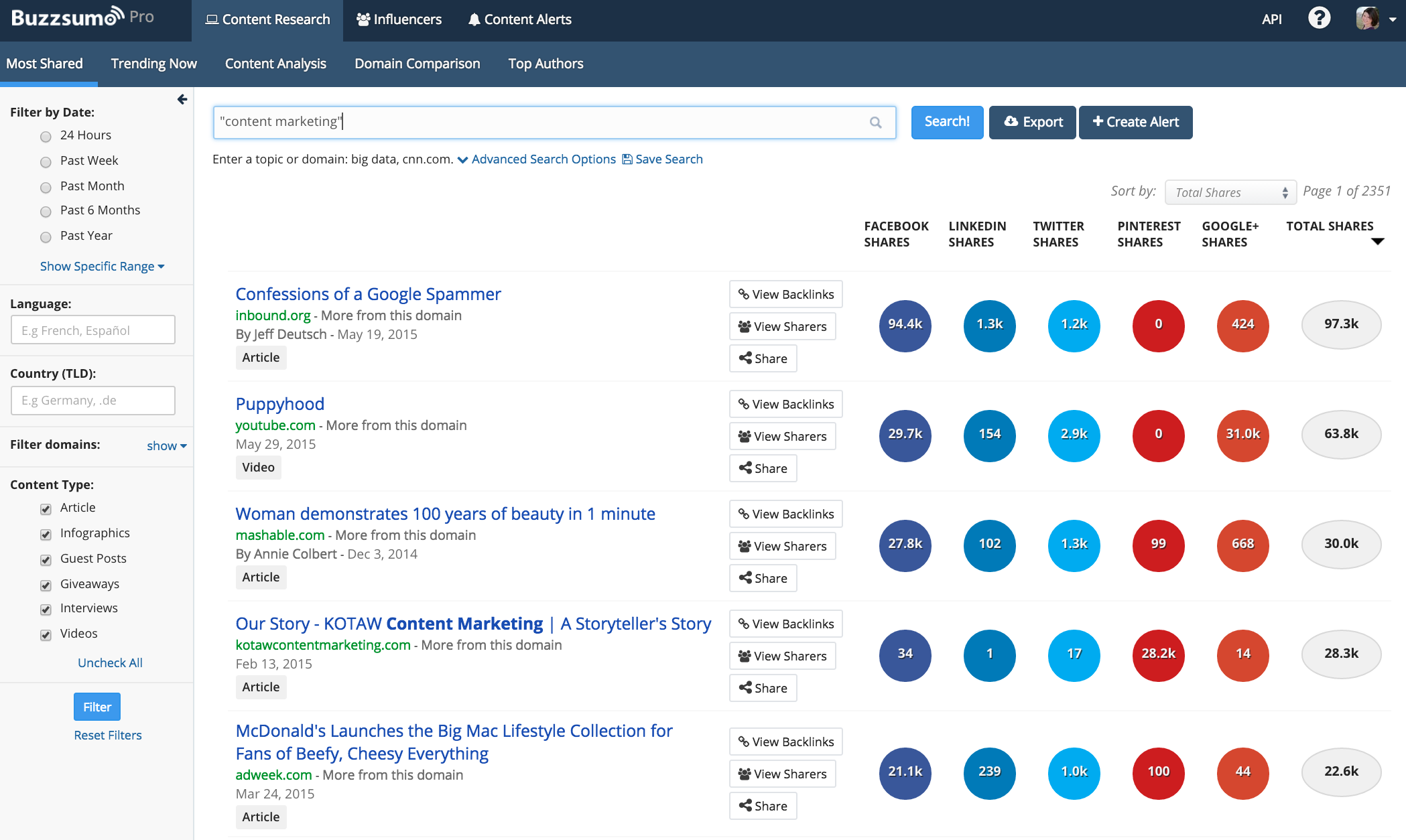
Buzz metrics typically include the number of shares and “likes” on the top social networks including Facebook, Twitter, LinkedIn, and Google Plus. Tools like BuzzSumo can help you find these metrics easily.
Click to enlarge
If you’re interested in social visibility, finding the content in your industry that gets the most social shares may be the only thing you need. BuzzSumo lets you search by topic, domain, and even author to find the top content based on social shares.
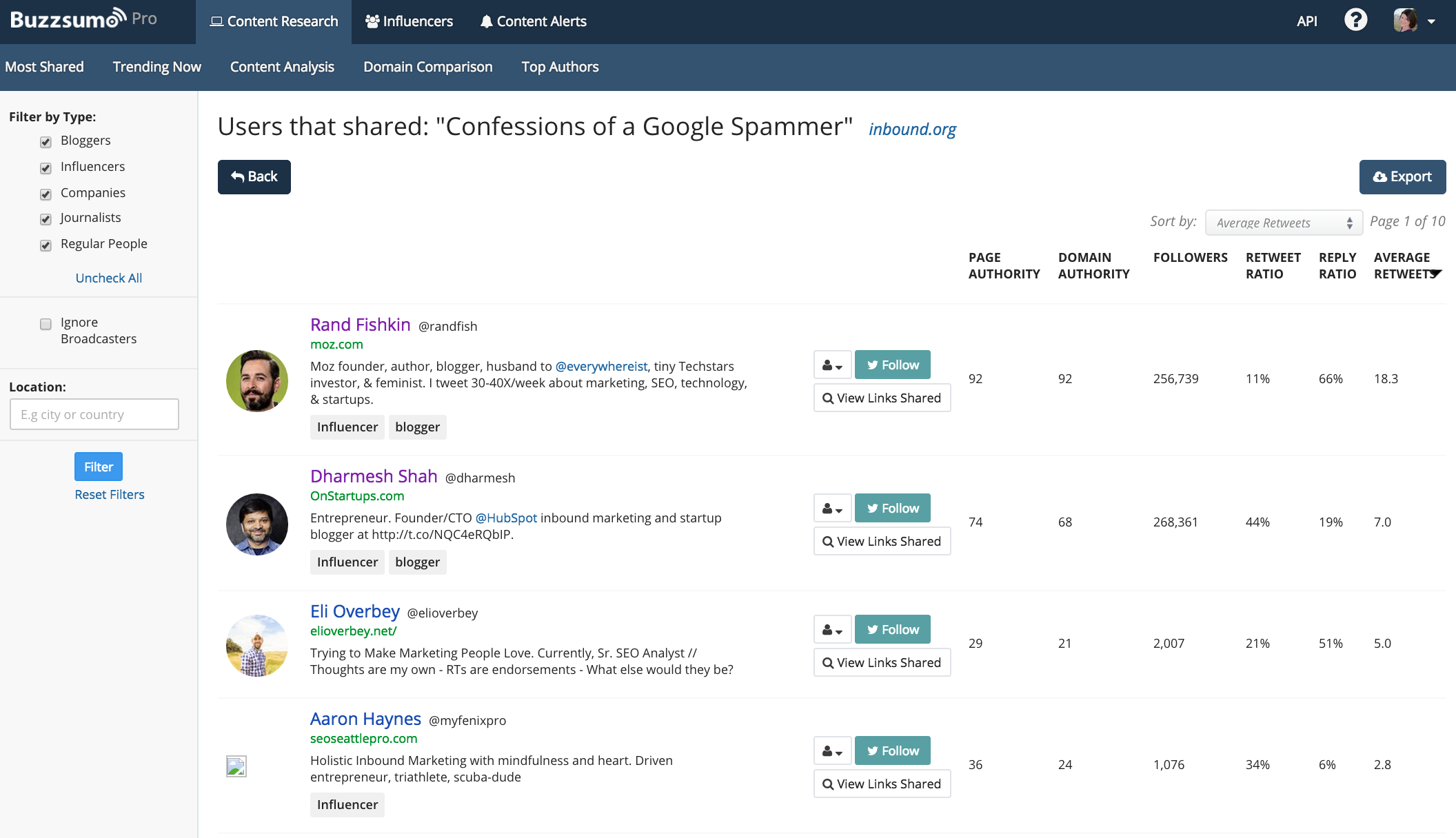
You also can click on the View Backlinks button to find backlinks from other blog posts to a particular piece of content or the View Sharers button to see the people who have shared a particular piece of content on Twitter.
Click to enlarge
Buzz challenges
The problem with judging a piece of content’s success based on social sharing is that social shares can be easily acquired. Research has shown that people share content they haven’t read. Many people do it just to keep their social accounts active. They even automate the process using services like Hootsuite, Twitterfeed, Dlvr.it, and other social media services that allow you to automatically share anything published to an RSS feed.
Speaking of people who share content without reading it, you can buy social shares. There are services that will promote every piece of content you publish and guarantee a specific number of social shares. Through sites like Fiverr, you can buy bulk packages of shares, “likes,” comments, etc., from the top social networks.
There are networks where you can create a social-sharing group that manually or automatically shares the content published by each member of the group. There are those where you can buy “credits” to promote your content to the community members in hopes that they share it on their social networks in exchange for credits to promote their own content. There also are private blogger and marketer groups on Facebook, Skype, etc., where everyone in the group helps promote each other’s content.
And, of course, there are the valuable ways of paying for engagement, such as boosted posts on Facebook, promoted tweets on Twitter, sponsored updates on LinkedIn, and promoted pins on Pinterest.
In short, anyone can inflate the social-sharing numbers for a piece of content. With the right budget, your article can make the top of any social-sharing ranking tool. While not all content creators do this, looking at social media shares is not always a foolproof way of judging content success.
Impact metrics
Impact metrics, unlike buzz metrics, are a little harder to manipulate, primarily because they combine several metrics beyond social shares. Tools like Impactana can help you go beyond social media metrics and into ones that help you determine how successful a piece of content really is.
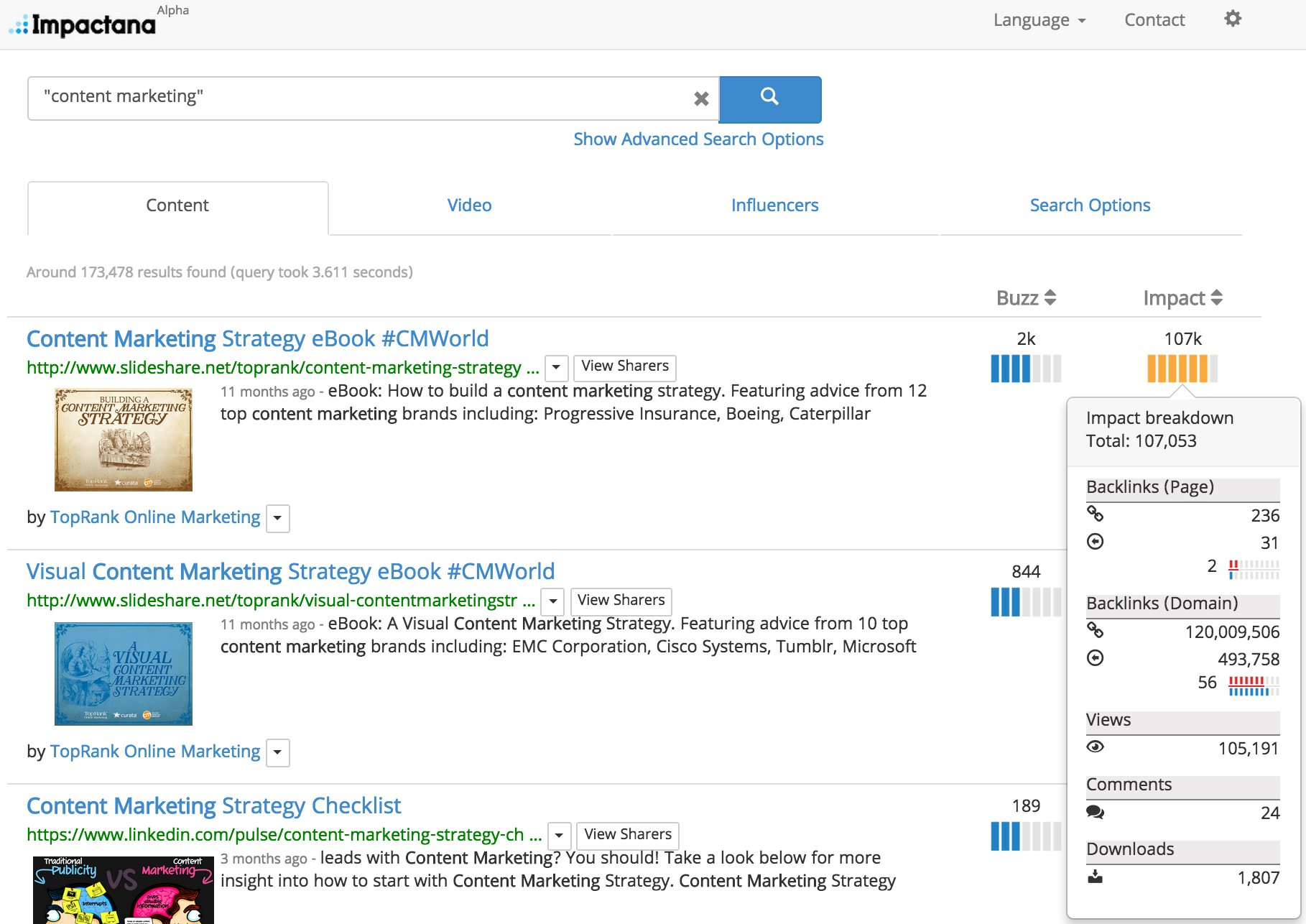
Click to enlarge
Here are some metrics you can find using this tool, and why they are important to content marketing research.
Backlinks
First on the list of impact metrics are backlinks. Yes, you can definitely buy backlinks almost as easily as you can buy social shares. But most people will not buy backlinks for a piece of content as they would for a website home or product page.
When would backlinks not be a good metric to consider for content impact? When you are looking at domains that host content, such as YouTube, you automatically have a high impact based on the number of backlinks to the domain. The fact that YouTube has 11 billion links does not necessarily make each video on its network an impactful video.
Views
Another great indicator of content popularity and true impact is the “views” metric. As we mentioned, you can obtain social shares from people who will never read your content. The problem with getting lots of social shares with no views is that you will not be able to achieve your primary content marketing goals (such as conversions) if people are not coming to your website to read your content.
Hence, the views metric is extremely important. You can use this metric to determine whether a piece of content is getting traffic from social shares and other referral sources.
When are views not a good metric to consider for content impact? When you are looking at content types such as YouTube videos. Because views are counted on the video page itself, some video owners turn to paid services to inflate their video views, similar to purchasing social shares.
Comments
Discussions on blogs and other types of content may not seem like a valuable metric, but they are an additional representation of content that receives traffic. People have to visit a piece of content to leave a comment on it, therefore, if you see a high number of comments, you know that people are making at least one visit (if not more) to that piece of content.
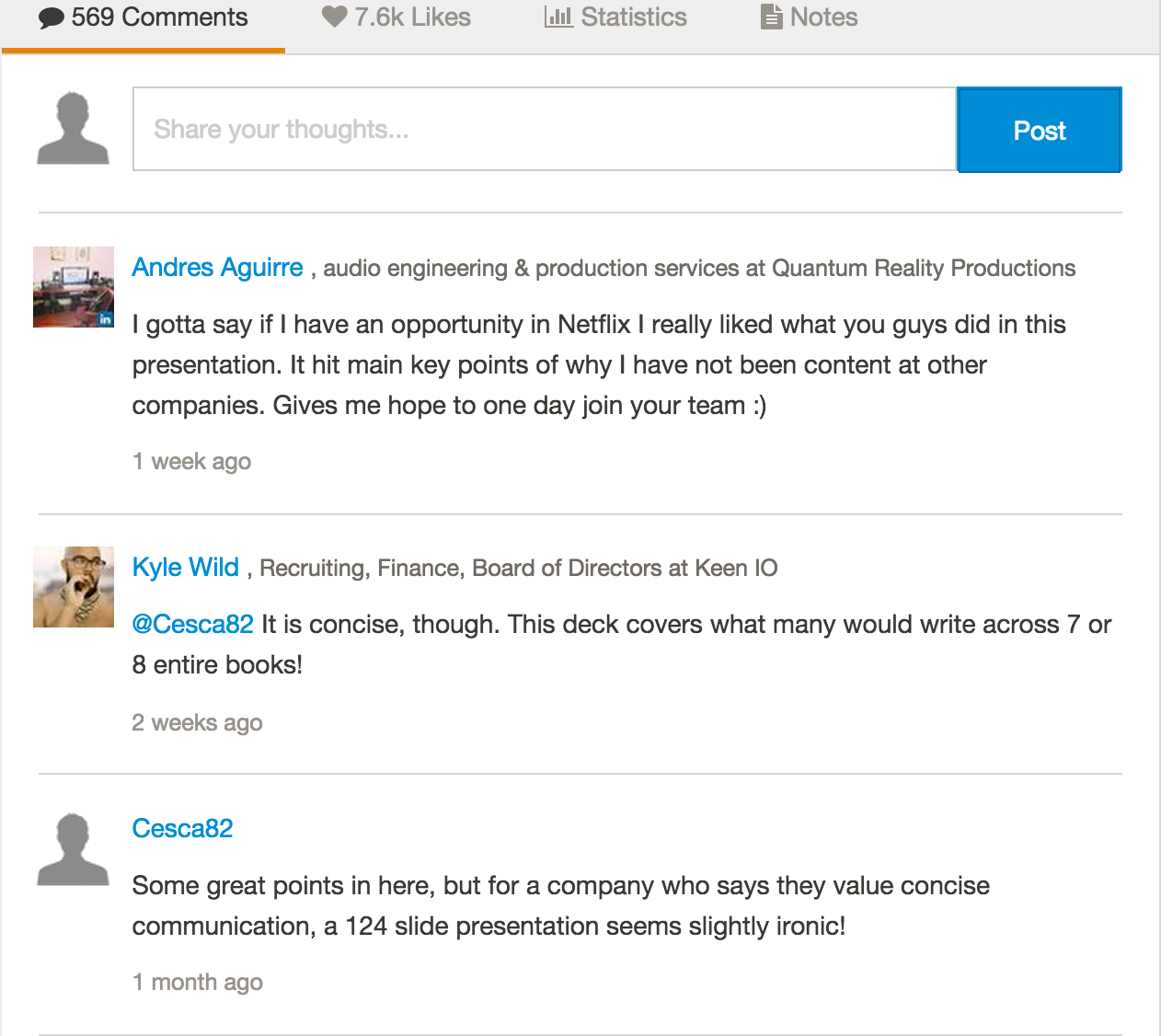
Click to enlarge
When are comments not a good metric to consider for content impact? When the comments are not adequately moderated. Some sites will publish almost any comment to inflate their comment numbers, when in fact many of the comments are from people who are using blog comments for link building to their own websites. Comments that make an impact are those that are done purely to add value to the discussion around a piece of content.
Downloads
One metric that is a little more difficult to inflate by artificial means is downloads. SlideShare, for example, is a network that allows you to share presentations with others that are available for download. In this network’s case, you may find that the best pieces of content aren’t just viewed, but are downloaded often.
Now that you know what metrics to include when researching content that makes an impact, let’s look at how you can research those metrics with the above-mentioned tools.
Find the top content on your domain
Tired of getting a partial view of your content’s performance from multiple tools that track views, backlinks, and social shares separately? Do a search for your domain to see your best content in the past year. You can do this on BuzzSumo by searching for your domain name.
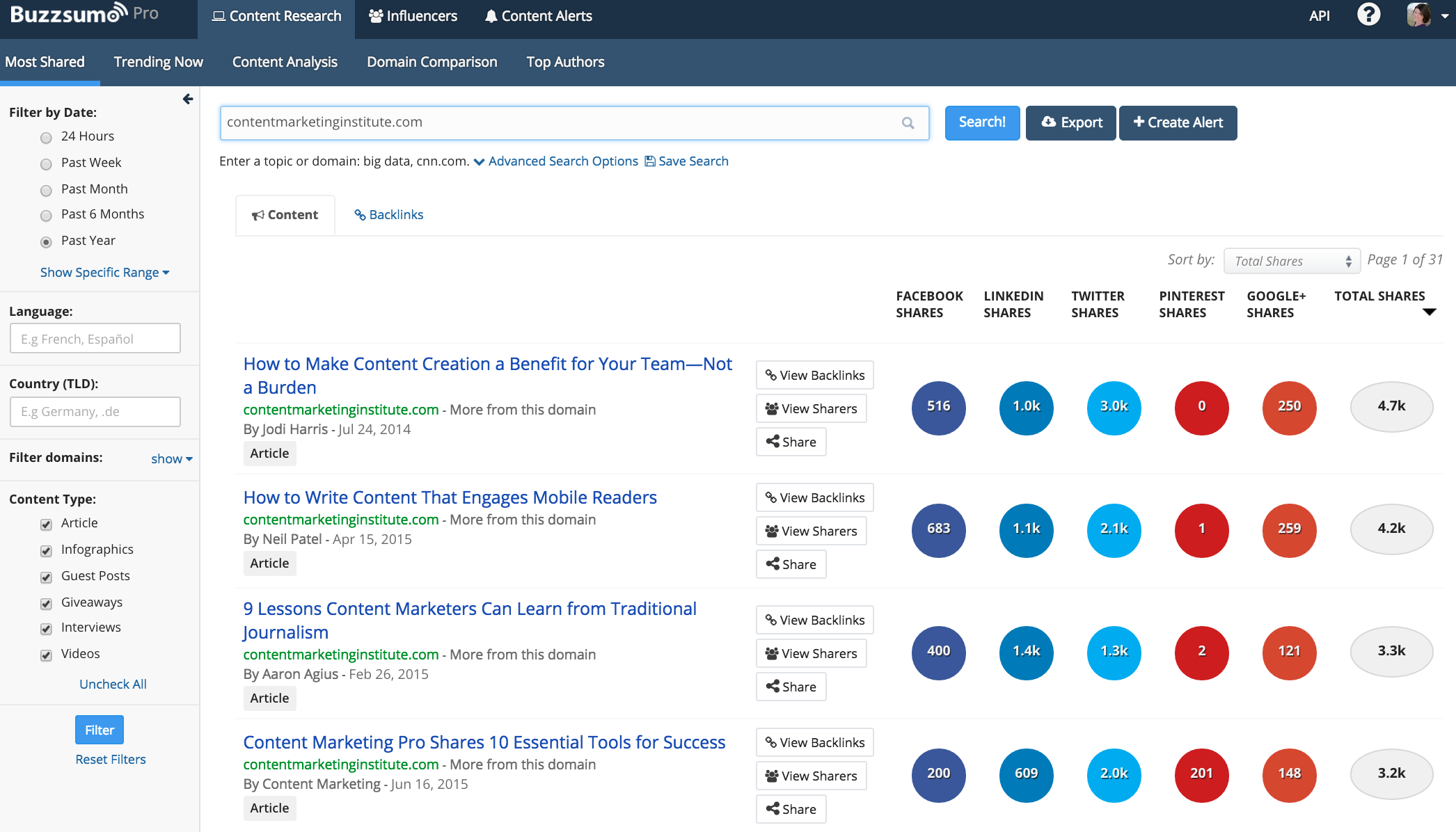
Click to enlarge
On Impactana, you can do it with the site: search operator.
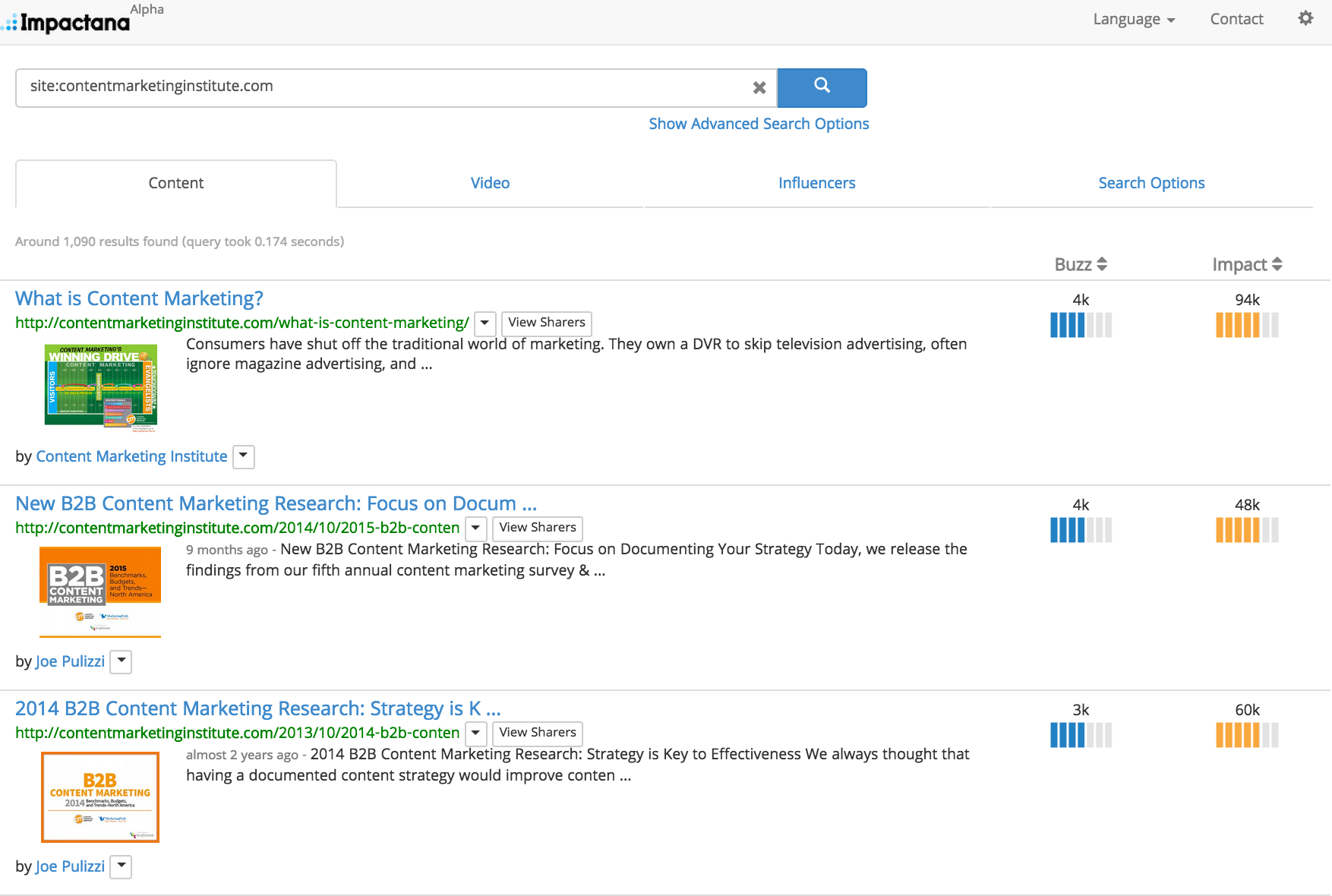
Click to enlarge
You can narrow your results by adding specific criteria for your content, such as number of views, backlinks, comments, shares, etc. For example:
You may need to adjust the numbers based on the popularity of your content.
Find your competitor’s best content
Want to know what pieces of content are the best from your competitors? Conduct the same searches with your competitor’s domain instead.
Find the most popular presentations
If you are speaking at an event, then you want to create a killer slide deck to accompany your presentation. You can do a search for the presentations that got the most social shares with the following search query on BuzzSumo. Be sure to put the domain slideshare.net first and keyword or phrase next.
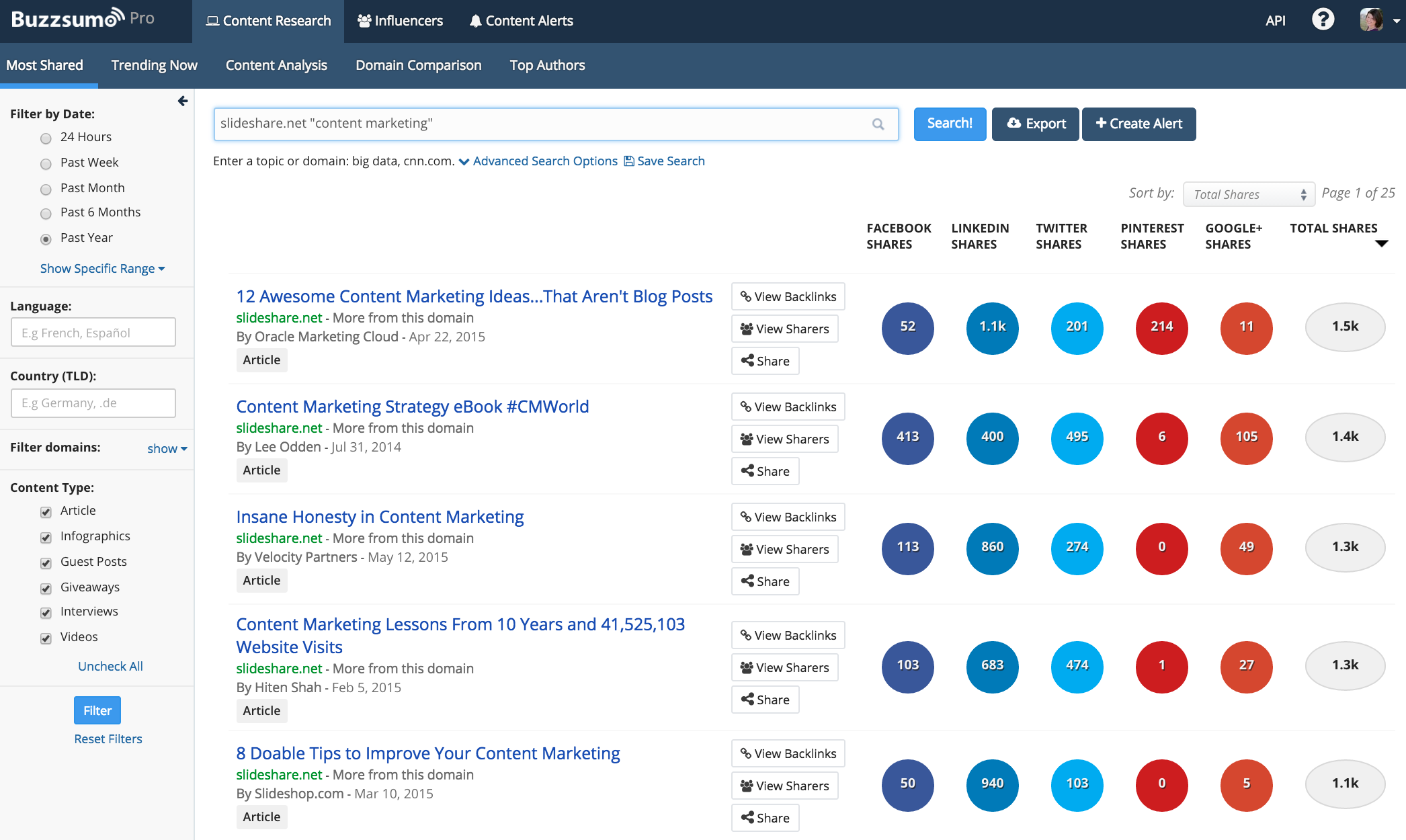
Click to enlarge
To go further, find the presentations that were downloaded most often for your topic to get some inspiration on how to create a slide deck that everyone will want to grab later with this search on Impactana:

Click to enlarge
Find the most discussed blog content
If you need inspiration for your own content, you can find it by reading the comments on other pieces of content. The goal is to find questions in the comments that remain unanswered and answer them in a blog post.
You can do this on BuzzSumo by finding the post on your topic that got the most shares and looking to see if it has comments. Or you can do a search for the most commented upon blog content on your topic on Impactana like this:
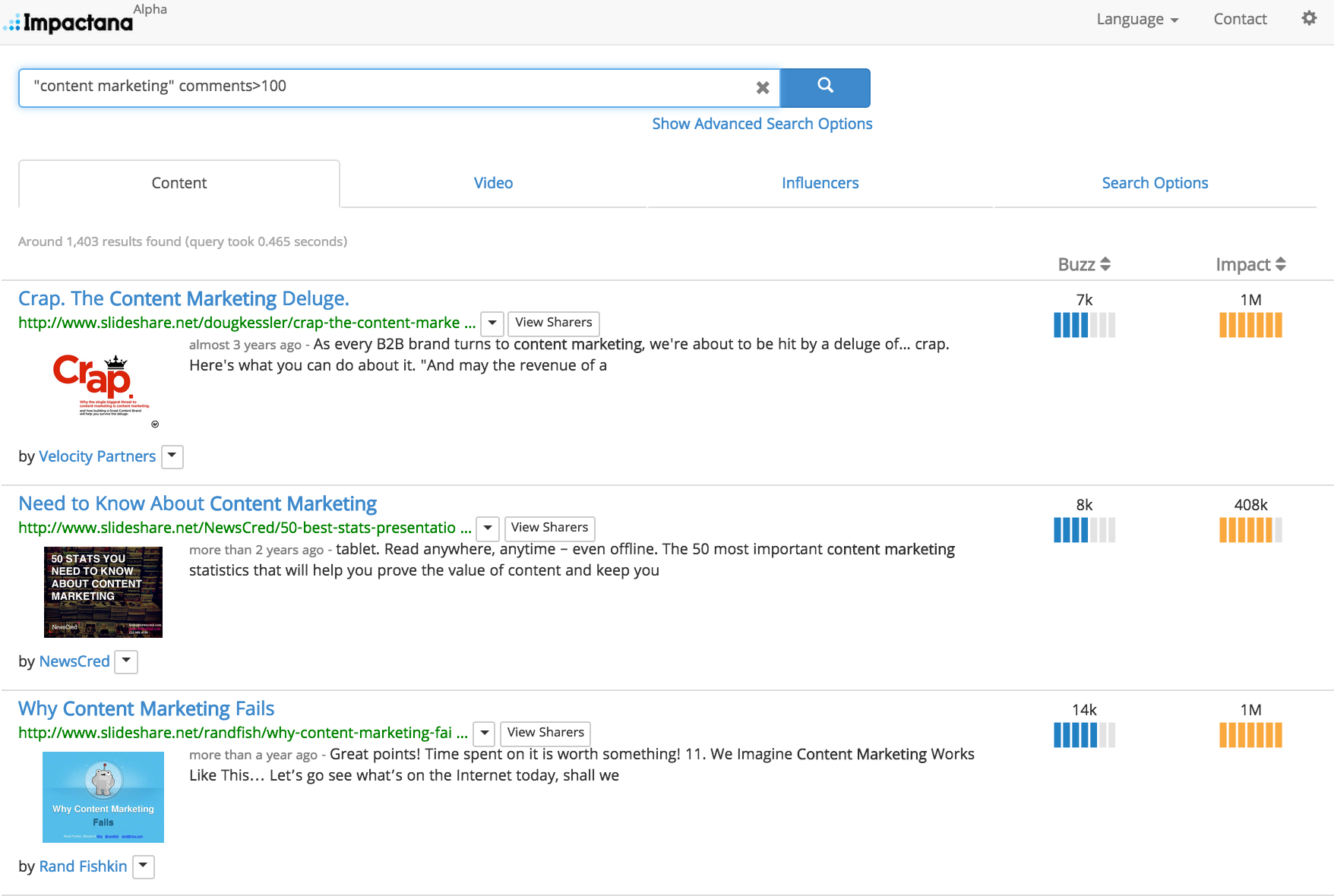
Click to enlarge
Find people discussing your brand
Larger brands may have trouble keeping up with every single blog post about them. Fortunately, you can focus your efforts on reputation management with the content that has the most impact. Search for content about your brand, excluding content from your own domain, like this on BuzzSumo:
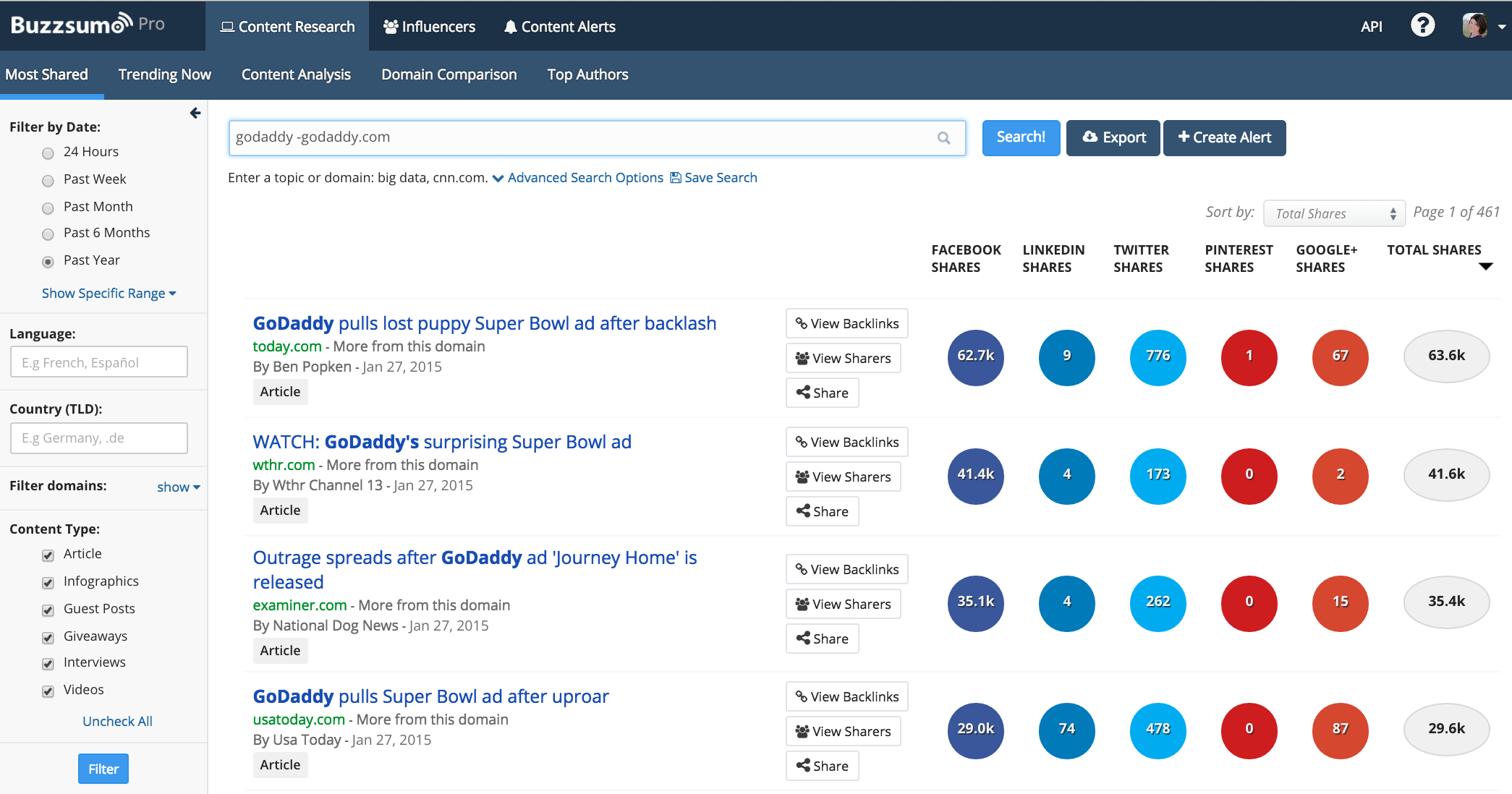
Click to enlarge
You can also do it on Impactana:

Click to enlarge
You can use these searches for reputation management as well as other marketing activities. For example, if you find a positive mention of your brand without a link on a popular website, you can request that your link is added so all of the traffic coming to that content can generate some leads for your business. You also can find positive mentions from reputable websites that you will want to promote to get more visibility for your business without having to toot your own horn, so to speak.
As you can see, there are many ways to determine the success of a piece of content. The key is to look at a variety of metrics when possible to ensure that a piece of content is genuinely popular and successful, without paid boosters.
While most in-depth content research tools like the ones in the examples are not free, they are the most powerful in terms of getting you the numbers you need to know fast. Otherwise, you would have to spend a lot of time doing manual research.
Interested in learning more about research and measurement? Visit this Content Marketing Institute topic hub for more articles and insight.
Cover image by Joseph Kalinowski/Content Marketing Institute
Please note: All tools included in our blog posts are suggested by authors, not the CMI editorial team. No one post can provide all relevant tools in the space. Feel free to include additional tools in the comments (from your company or ones that you have used).
The post How to Find the Best Pieces of Content in Your Industry appeared first on Content Marketing Institute.
Our thinking and visualizations of our sales processes, deal strategies, funnels, and pipelines often cause us to do the wrong things. It’s because we have a “one way street” mentality as we think of our deal strategies. Things progress–top to bottom, left to right (or right to left in certain parts of the world). We prospect, qualify, discover, demonstrate, propose, close, implement. Everything moves in one direction, we’re always moving forward—except when we don’t.
The other day, I was reviewing a critical deal. You guessed it, it was large and critical to the quarter end. The sales person had it moving from the proposing to closing stages of their sales process, but the deal had been stalled for some months. The sales person was insistent that it would close when projected.
In reviewing the deal, the sales person had been using the sales process. She’d been working on the deal for about 6 months, was executing the process step by step moving it through the stages until it reached it’s current point and it stopped. She was trying to move it forward, but it just wasn’t working.
There had been a major management restructuring, with new management a couple of levels above the decision-maker. A shift in corporate priorities, other projects were being canceled.
I asked, “Is the deal still a priority, is it a real deal? Should we requalify it? Given all the changes just above the decision-maker, do we need to reassess the whole thing? Should this be in the closing stages of our pipeline?”
That’s when I started seeing the nervous glances among the team. They had worked hard to get the deal to this place. They needed to close the deal. They tried hard to argue, “We’ve followed our sales process, we’ve done everything we need to do to get it to the closing stage of the process. So we just need to push it forward.” They were trying as hard as they could to push the deal through, but it just wasn’t happening.
We agreed they would go back and explore the urgency of the deal with the customer, particularly given the changes. They also found a way to meet with some of the new corporate executives.
They learned, there was some interest in the project, but it wasn’t a high priority and the funding for the project was being diverted. With some of the shifts in the corporate strategies, the needs and requirements for this project were changing. The good news was they were changing in a way that made the deal both bigger and made my client a much better fit.
While much of the work they had done would probably be very valuable, things had changed. The team needed to requalify the deal, then go through all the sales process again. All based on the changes that had occurred within the customer.
While the team intuitively knew all of this, they were blinded thinking things only go one way in the pipeline or in our sales process. We always move forward. Ideally, we do, but the sales process and the pipeline is a two way street. Sometimes things go back to the beginning of the sales process, sometimes they pop back to the top of the funnel.
Not recognizing this means we are fooling ourselves and our managers in the expectations we set in our pipelines. Not recognizing this means we are not aligned with the customer and where they are with their buying process. As a result, we aren’t creating the value we should–in fact, we may be doing all the wrong things.
They changed the projected close date–actually they left it open, since they needed to requalify the whole deal. They started developing strategies to start the whole process all over again. While it was disappointing, with out doing this, they would have continued doing the wrong things with the customer and setting the wrong expectations for their own management. They would have been wasting their and everyone else’s time.
We all have deals like that. Deals we’ve worked hard on. We’ve brought them to a certain place, but they stop. Things change, we need to reassess, restart and go through our process yet again. Perhaps we are a little smarter from having gone through it once before. Perhaps we can accelerate the buying process, based on that knowledge, but we have to go back requalify, rediscover, redemonstrate, repropose and close again on the “new deal.”
Don’t think of your sales process or pipeline as a one-way street. Things can and should move backward. Denying it, doesn’t help anything.

The diminishing effectiveness of conventional advertising and the rise of social media have led more and more brands to embrace content marketing. More and more companies are seeing themselves not just as advertisers, but as publishers, launching digital newsrooms, podcasts, and other forms of branded content in order keep their brands, perspectives, and value propositions in front of customers.
Yet even as companies have embraced their new role as content creators, they’ve largely missed out on one of the hottest trends in the world of traditional media: data journalism. This still-new form of reporting draws on the growing availability of data sets and data analysis tools to uncover and tell stories like the impact of vaccines on infectious diseases, the continuing problem of school segregation, or the differences in working hours across industries, often presenting the results through compelling visualizations or interactive applications. Newspapers such as The Guardian and The New York Times have invested heavily in data journalism because they recognize that the world of big data offers opportunities to uncover new insights, and to tell stories in newly compelling ways. Just as crucial, data-driven stories attract the kind of social media attention that publishers dream about: fresh data and infographics spread across Twitter, Facebook and other social channels precisely because they are able to tell a story in a concise, compelling and visually appealing way.
While infographics are now a standard part of the corporate communicator’s toolkit, data visualizations driven by original data are still few and far between. Look on Pinterest and you’ll see that a lot of corporate infographics are basically pretty blog posts, not data visualizations that tell an original story.
That’s an ironic oversight because today’s enterprises have access to more data than ever before. All that information could be fodder for top-notch marketing; instead, it’s treated like a state secret, and used almost exclusively to drive internal decision-making. Look up “data-driven content,” and you won’t find much about turning data into blog posts or reports: you’ll mostly find marketers using data to guide their own campaigns and marketing decisions.
The exceptions to this rule are the few companies who’ve used their own data to drive original and fascinating stories: companies like OKCupid, General Electric, and Kickstarter. My personal favorite is Jawbone, which has uncovered some fascinating insights from all the folks wearing its fitness trackers – like when people in different cities wake up and go to sleep (below). These brands recognize what virtually every brand should be doing: opening the treasure chest of data and offering some of that wealth back to customers and the public in the form of original content.

I woke up to the power of data as a content marketing resource through my work with Vision Critical: because a lot of global businesses use Vision Critical’s customer intelligence software platform, we were in a great position to develop reports like Sharing Is the New Buying (with Jeremiah Owyang) and What Social Media Analytics Can’t Tell You. Working on those reports opened my eyes to the benefits that a quantitative approach can offer any business:
Traffic. Infographics are the type of content that’s most likely to be shared on social media, so creating data visualizations that offer real value to your readers is a great way to spread your ideas and message — and to drive traffic to your site. Unlike a typical blog post, a data visualization or report has some staying power, particularly if you choose your title keywords carefully so that your posts show up whenever people search for numbers on your topic or industry.
Value. The rise of brands as publishers has led to an explosion in the volume of content available online. And let’s be honest: most of it is terrible. From the endless spew of blog posts meant to establish a “personal brand” on a given subject, to the daily grind of keeping corporate websites stocked with up-to-date releases, a lot of what’s getting cranked out offers more in terms of word count than it offers in actual information or actionable insight. When you’re sharing fresh, accurate, relevant numbers, you are offering content that gives people real value.
Authority. Sharing, curating, and analyzing data — particularly if it hasn’t been shared before — establishes your brand as the authority on a topic. If you can release a report or infographic that offers a new or definitive take on a key set of market trends or issues, you become the go-to source on that subject. That may bring earned media mentions and interview requests, but just as crucially, the report itself highlights your company’s expertise. For B2B companies in particular, underlining expertise is often one of the top aims of content marketing, and data-driven content accomplishes that goal very effectively.
Learning. Data analysis skills are turning out to be ever more important in today’s enterprise, so a lot of businesses have significant strength when it comes to using analytics internally to drive business decisions. But when you start sharing your metrics externally, you can get a whole new perspective — because seeing how other people respond to and make sense of it may give you fresh insights into numbers you think you already know inside and out. That’s particularly true if you take a page from the rise of the open data movement in government, and actually release some of your data in a form that other people can use to create their own charts or analyses: they may find patterns and insights you would never have thought to explore.
Transparency. At a moment when consumers are increasingly concerned about the way that companies collect and use their personal information, data-driven content offers a way for companies to let people see how their information is being used. That transparency not only builds trust, but helps to address their concern that they give up more value by sharing their information than they receive back from the companies who collect it. By aggregating the data in a way that preserves the privacy of individual users, and provides insight based on the patterns revealed through that aggregation, brands can help customers understand how their data is being used.
For all the value that data-driven marketing can offer, it’s still an under-used part of the marketer’s toolkit — and as a recent Nieman Lab post observed, many of the companies that have ventured into this space are doing it poorly. But precisely because well-executed data storytelling is still the exception, there’s an enormous opportunity for companies to stand out from the marketing hordes by turning quantitative information into quality content.
A common question that arises when discussing Facebook advertising is “how much does it cost?” Well, if you only had $20 cash and went out to lunch, how much would it cost? Unless you plan on running out on a bill, it will never cost you more than you have to spend. How much food you’ll get is another story.

It’s not a question of how much Facebook costs, but how far your money will go. Marketers who discourage using the platform on the basis of it being too costly are probably the same people who claim that fishing is a waste of time with their line in an oil spill.
If you go into Facebook advertising with a clear focus and follow a simple strategy, the cost-efficiency of the platform will astound you. If you run into it blind, you’ll find yourself losing money faster than Michael Jordan at a casino.
In this post, I’ll outline:
The first mistake you can make going into Facebook ads is not having a clear strategy. If you go in guns blazing with no real concept of what you’re doing in terms of targeting and ad copy, you may find yourself in a hole pretty quick. It would be like going into a football game unprepared.

The diagnoses for troubled and costly ads are usually not as complex as you might suspect. Marketers overspend when they:
This trap is easy to fall into if you’re new to Facebook advertising. Facebook boasts a ridiculously vast amount of targeting options that could leave you like a dog who found their way into the cookie cabinet.

You’ll want to pay attention to a few things when you’re outlining your general targeting, but always keep in mind that wasted impressions are wasted money.
Age Range: Make sure the age range you select is as close to your target demographic as possible. It sounds like a no-brainer, but the last thing you need is to be showing up to people who don’t understand or have any relevant use for your business.

Interests: Targeting vague interests that are “kind of sort of” like what your audience might be into is a mistake. If you’re selling boats, you wouldn’t want to target everyone who likes the beach.
Spend the majority of your time making your targeted interests as relevant to your desired audience as possible. With interest targeting, it’s easy to get stuck in the broad-thinking mindset. Really take the time to envision yourself as your targeted user. Brainstorm all of the possible topics relevant to this user and search for them. You’ll find that a few specific interests are better than a dozen extremely broad ones.
Location: Targeting outside of your market can be another costly error. If your audience is only located in a certain state, don’t target the entire U.S. This may be one of the biggest rookie mistakes in the game because the specificity of being able to target with such impressive granularity is absent on other platforms.
If your core demographic is English speaking (or any other language), you’ll certainly want to include that as well. Selecting a language or number of specific languages is critical to trimming down your audience. It will allow you to further define the type of individual who will be most likely to be interested in you.
Ignoring Reach: Keep an eye on the “estimated audience reach,” as this will let you know your approximate audience size. If you’re advertising Zumba lessons in small town U.S.A – population 12,000 – your audience size of 25 million is a bit aggressive. Keep an eye on the meter as you make changes to the targeting, it’s important to know which variables have a significant impact.
This is easily the most effective way to throw away your ad budget. I lay awake at night thinking about all of those poor souls who put their faith, dignity, and entire budget into unproven campaigns. It breaks my heart.

The truth is, you don’t have to gamble your money away on something that “might” work. The pressure to get results is always there, but the practice of testing the waters before you cannonball in might save you the shock of how cold the end result might be. Slowly get into the pool, you might stay longer.
The problem when it comes to Facebook ads is that if you don’t know where or how to start, you’ll likely end up shooting yourself in the wallet. The solution is simple though, and a little attention to detail can have a dramatic effect on your campaigns.

Building a successful account is just like building a house. You’ll want to have a strong foundation to start or it will collapse and your cat Mr. Peaches will have to wear a body cast for 8 to 12 weeks.
The strongest support for any campaign is leveraging what you already have. You want to go into Facebook looking to find individuals who are similar to either customers you have, or the customers you would like to have. Centralize your strategy around retargeting.
The best way to construct a strong retargeting foundation is through a website tracking pixel and custom audiences. If you don’t have the Facebook tracking pixel on your website, get one. Seriously. Not having one is like looking for Bigfoot without a camera.
If you need help implementing the pixel, I briefly outlined it in this blog post about Facebook for lead generation.
Let the pixel run on your website for a period of time (about a week or two, depending on the volume of traffic) and before you know it, you’ll be able to create a custom audience from it.
The next step is to upload a custom audience of either customer emails or emails of leads you have. The strategy is to refine the guessing-game of interest-only targeting. Construct the base profile of the individuals you are looking for, THEN you can add layers of interests and behaviors if need be.
To upload a custom audiences, go to the tools section of your ad manager:

Select “Audiences” and proceed to the “Create Audience” tab in the top left corner of the page:

You’ll find that you have a few options for importing your customer list or list of potential leads:

If you choose to “upload a file,” keep in mind that the file has to be in either .txt or .csv. format.
It’s not uncommon for businesses to feel uncomfortable uploading their customer information into anything. There is a level of trust between you and your customers, and it’s understandable that you may feel hesitant to give Facebook their information. However, the process of doing so will actually create a better experience for both sides. Facebook is only using the emails to connect them with current users. So technically, they already have all of their information – you’re just finding them.
Once your customer audience is uploaded into Facebook you can exclude them from your targeting. This means that they will never see your ads and you won’t waste impressions.

The strategic reason for uploading your customer list is to create a lookalike audience from it. Facebook takes the matched users in your custom audience and with the plethora of data that the platform bolsters, finds users who are similar to those you have uploaded.
Underneath where you created your custom audience, you’ll see the option for lookalikes:

Next, select the custom audience that you uploaded and the country in which you would like to target:

You are only able to create one lookalike audience per country, so if you target within multiple countries you’ll have to repeat the process for each:

As a best practice, start out with the audience meter as small as possible. This will give you the highest precision and the best possible lookalikes.
Repeat this process for those website visitors you’ve been collecting as well (no upload needed, just select it). The only difference is that you DON’T want to exclude this audience.
Next, create a lookalike to expand your reach. You can easily access these audiences when you are constructing your ad set:

As you attain more customers and website visitors, you will have to update these lists similar to how you initially uploaded them.
Now you’re ready to layer interests and behaviors to get your lookalikes to even further resemble who you’re looking for…

(Perfect)
Once you have these audiences constructed, the best way to achieve cost-efficiency is to test. Set up multiple ad sets with similar but variable target audiences. Set the daily budgets low so that it disperses across these ad sets and construct one to three competing ads for each (with different copy/ creative). Facebook automatically favors the higher performing ad, so it will be easy to cut ties with the others. The ads and ad sets who are winners will float to the top, allowing you to optimize and transfer your full budget into what is already PROVEN TO WORK.
The primary factor to achieving the lowest possible cost for your ads comes from your Relevance Score. The specifics of achieving a high relevance score lies within how “engaging” your ads are within a given ad set. Relevance Score is ad-specific, meaning that you could have three ads within an ad set with different relevance scores based on the nature of their copy and the degree with which they have been interacted with. This is why it is important to have try-outs and file down on your all-star performing ads. This practice will also improve your skills from a copy and creative perspective, challenging you to make better and more creative ads.
You should make your ads as visually captivating as possible. Remember, you’re competing for attention and engagement. This isn’t Google, they aren’t searching for value – you’re bringing the value to them.
Don’t forget about copy either. Although looking good is half the battle, your ad needs a great personality in order to be popular. Having compelling creative and lousy ad copy (or vice versa) is like putting cheese whiz on lobster.

Spend time on your ads. It’s what makes you a marketer. If you half-ass it your chances of success may literally be one in a million…

The cost of Facebook advertising is reflective of your ability to reach and engage with your target audience. Although “cost” heavily relies on your goals and what you constitute as success, these universal strategies that I’ve outlined above should put you on the goal line. The rest is up to you.

 You have a startup. And it’s growing. You’re hiring more and more people.
Which is great.
But your sales team . . .
What about them? How do you help them do what they were hired to do, even better?
Documentation. Documentation. Documentation.What’s the importance of creating excellent documentation for your sales processes and training?
Will it make a difference in how your salespeople perform?
Is it crucial to you as a new business that wants to grow and expand?
The utmost importance (if you want to succeed). And absolutely - on both counts.
Should you:Write different scripts for different desired customers?
Create extensive objection management documents?
Map out the entire sales process, draft diagrams and mold a gilded manuscript?
Yes. It’s useful to have scripts.
Yes. It’s useful to document things.
Companies spend an absurd amount of time creating “the perfect” documentation . . . the silver bullet. Then they share it with their employees, expecting everyone to adopt it at the best and highest level possible.
And then—like a dream—they forget about it.
Write a very rough, first draft. Then spend about an hour every week revising and editing and improving the scripts WITH YOUR TEAM so they actually influence the documentation. Involvement in, and contributing to a process increases the chances of actual application. In this way your employees take ownership of the script; they improve it; they make it theirs so it’s simple to adopt. Instead of spending an entire week etching the perfect script onto stone tablets, spend one hour a week/month consistently upgrading all of your sales assets.
Consistency is key here. These documents are alive. They need revisions to keep up the heart rate.
What do you think about MVP’s?
How do you build products?
Do you believe that you can build the perfect product in a vacuum and simply release it never to be touched again and all users the world over will automatically adopt and love it?
(If so you’re dreaming.)
Do you believe in building an initial, minimal version of a viable product? And then—by adopting and listening and observing what the real world does with it—improving, expanding, and further developing the product?
(Yes. This is how it’s done.)
You don’t build something perfect and never have to touch it again. It’s not a marble statue. It doesn’t work like that. Sales (life!) doesn’t work like that. Consider a muscle: you don’t just train for a while and magically gain eternal strength. You must maintain it. In sales and life alike, you’re either getting stronger, or you’re getting weaker. There is no third option.
Guaranteed, when you document anything, in any company, on any team, the critics will surface. This is BS. This is cool. Good or bad, people talk.
All good. Winners are always criticized. Always will be. Let ‘em talk. And use their input to your advantage.
If you continuously work with your team on these resources, then they’ll take them seriously and properly put them to use.
Question is: will they continue to use them? Or let them slip from memory a week later?
Not if they’re in the huddle. Not if they help call the plays.
Greatness comes with time and diligence.
Try one hour a week/month.
Crush quotas. Close deals. And make more sales than last month. Every. Single. Month.
While creating your first sales script can be a daunting task, we've made it as easy as it gets. Schedule three hours and use this quickstart guide - you'll have a solid minimum viable script ready real soon!

By Tibor Shanto – tibor.shanto@sellbetter.ca

Last Monday, in Ready Set Go – Part II I wrote about how to plan and execute the rest of the calendar year (for many their fiscal year). We looked at two scenarios, one for sellers who set themselves up for success. The second, and the focus for today’s post, is for those in the other group, the “Holy s#*t, there are only how many working days left in the year?” Don’t panic, that would just be a waste of your time, and time is something you don’t have in abundance; instead, get prospecting. Prospecting in two ways, first reworking all your current assets, the second is going beyond to prospects and buyers that you will need to identify, engage and move through the process. In essence what you should have been doing before the summer.
What I mean by reworking all your current assets are two specific activities. One look at all your “no decision” opportunities over the las 12 months. Opportunities that went into your pipeline, or sales process, progressed but died before coming out the other end as customers. These are not opportunities that bought from someone else, but that tested the market, then went back to the sideline having changed or done anything. In some instances this group could exceed 30% of things that go into the top of the pipe. They know you, you know them, things have changes, they may be more ready now, it certainly is worth a call. Even if they don’t re-engage now, they are likely starting the planning cycle for 2016; early bird is a good thing to be.
The other method is to crank up your referral efforts, both in your client base and, your indirect network, and your Referral 2.0 network. While I still believe in cold calling, referrals are nice too.
But you will also need to go beyond the comfort zone, and that’s where cold calling will come in. Specifically in two directions, first looking for opportunities that have a reasonable chance of closing this year. This does not have to be the proverbial lower hanging fruit, but could smaller deals for example. This may mean having more of these to sell, but that could not only mean shorter cycles, but also provide an initial entry point to accounts. The idea is to both salvage the year, and set yourself up for future growth.
Second, much like the successful group above, start hunting for things that will close next year, and close early. A challenge many sales people have is the start of year lull, often because they spend a disproportionate time “closing” late in the year. They return in the New Year only to find a neglected pipeline that takes time to build up and get back in shape. This can easily be avoided by starting early, starting now. Think of it as a variation to the above scenario, except in this instance we seed now, harvest in January. To avoid this, but you have to start now. I always find it interesting that prospects are able to hold
Look at it this way, at least if you miss quota this year, you will have given your employer a reason to keep you around for next year.

A brilliant presentation is worth nothing if you don't bring it home with a powerful close — that said, many salespeople still struggle with how to end a presentation. Most sales presentations end with a whimper rather than a bang, taking a major toll on prospect's interest and enthusiasm.
To help you add a little extra oomph to your presentations and consistently end pitches on a high note, we've put together some tips for closing sales presentations — complete with some helpful examples.

1. Go back to your opening anecdote or idea.
2. End with a challenge.
3. Invite your audience on a metaphorical mission.
4. Use repetition for a dramatic close.
5. Offer inspiration.
6. Surface their objections.
7. Tell a story.
8. Ask an unusual question.
9. End with a quote.
Starting a presentation with an anecdote, analogy, case study, or thought-provoking idea can set things off with an intriguing tone — and referring back to that point at the end can add an element of compelling cohesion to your pitch.
For example, let's say you're presenting on behalf of a company selling a conversation intelligence platform to an enterprise-level prospect. You might start with something like:
"Client X's sales development team was qualified, competent, and motivated. SDRs were reliably connecting with prospects, but their conversion rate was hardly over half of what leadership wanted to see. That's where we came in."
Then, you would give your presentation — offering an overview of your product, value proposition, specs, and tailored solution. Once you've covered those bases, and it's time to wrap things up, you could say:
"Remember Client X? Well, after implementing our solution, they were able to refine their messaging, provide reps with better-informed coaching, and identify the most resonant pain points prospects were consistently raising. All told, they more than doubled their conversion rates on calls while maintaining their existing cadence."
That kind of "closed loop" synchronicity is clean and interesting — that's why bringing everything together with a self-referential nod to the beginning of your presentation is one of the better ways to cap things off.
Leaving your prospects with a dramatic, open-ended challenge is one of the most effective ways to keep yourself top-of-mind after your presentation ends and motivate a buyer to act.
For instance, you might say, "Are you going to let another month pass by without addressing the crippling communication issues on your team? This is your opportunity to change things. Don’t wait."
But be careful, you need to tread lightly if you decide to go this road. Read the room and exercise caution. There's always a thin line between confidence and arrogance, and if you cross it in front of the wrong person, you could be in trouble.
If you're too brash and challenge a prospect with an "alpha" personality, you might wind up rubbing them the wrong way and do more harm than good. If you have even the slightest suspicion that your buyer might not be receptive to this tactic, go with another one.
This tactic is sort of a spin on the point above — one that's a bit more collaborative and less confrontational. Instead of challenging your prospect, ask them to join you on a mission or journey.
You might say something like:
"More than 5,000 companies have decided to leverage our solution and invest in their employees' health. Are you ready to join them?"
It's more inspirational than a direct challenge but a little less frank — sacrificing some directness in the interest of caution. Still, when done right, it can inspire action.
Research shows repetition improves a child’s ability to recall new terms — in other words, if they hear an unfamiliar phrase multiple times, they’re more likely to remember it than if they only heard it once.
But that trend isn't specific to kids — the same principle applies to adults. A repetitive rhythmic close is memorable, but its value doesn't stop there. It can also be high-energy and engaging.
Not sure what this would sound like? Take a look at this example:
"If you don’t have transparency, you don’t have trust. If you don’t have trust, you won’t get honest feedback. If you don’t get honest feedback, you’ll develop blind spots. If you develop blind spots, you’ll make poor decisions, lose talented employees, and miss crucial opportunities for improvement."
A well-chosen quote can tie your entire sales pitch together and help put things in a new light for your prospect.
Let's say you're selling a new CRM to a midsize business. The buyer is interested, but they know implementing a new system could be a long, challenging process.
With that in mind, you might close with something like:
"Look, I know the thought of changing CRMs is probably scary. But I think one of my favorite Warren Buffett quotes applies nicely here: ‘Should you find yourself in a chronically leaking boat, energy devoted to changing vessels is likely to be more productive than energy devoted to patching leaks.’
In the long run, this switch will save your company a lot of time, money, and effort."
When you sense your prospect isn’t quite convinced — or they’re not being completely open about — you can try ending your presentation by digging for objections.
HubSpot sales reps use this question: "What would stop you from moving forward?"
You can also try, "If you decide not to buy, what would the reason be?"
The thought of being so direct can be nerve-racking, but you need to keep the fact that your prospect's objections exist — regardless of whether you probe for them. Those concerns are real and will likely come to light eventually, and you can't resolve them if you have no idea what they are.
A story is one of the — if not the — most powerful communication vehicles salespeople have at their disposal. Telling a story makes your message more compelling, digestible, and emotionally resonant.
I recommend telling a hypothetical story of your prospect’s life after they’ve bought your product:
"It’s [date four months in the future]. You’ve been using [product] for [X use case]. [First pain point], which used to swallow up hours of your week, has been completely eliminated. [Second pain point] has been reduced to a 15-minute task every month. And your boss is completely thrilled with [Y results]."
By framing your presentation with immersive descriptions of the results your prospects can expect to see, you're helping them mentally place themselves as existing customers. If you can do that convincingly, this tactic can go a long way.
You don't have to cut your presentation short by asking, "Does anyone have questions?" Instead, try turning the tables by asking an anything-but-ordinary question at the end of your presentation.
This will jolt them back to the conversation at hand and give you a unique entry into the final portion of your presentation. Here are some example questions:
The conversations prompted by these questions are sure to be more interesting than an ordinary close. And it might go without saying, but you still have to follow up by answering any questions they have.
Whether it's a killer client quote or your favorite Dylan lyric, ending with a thought-provoking line will cause your audience to pause.
From there, take a few moments to ask how the quote resonated with your audience and what it made them consider. They might have offering-related thoughts — or share something completely unrelated to your business.
The point of this exercise is to snap them out of the end-of-presentation daze and get them excited and inspired to think bigger. Choose the right quote and spur your prospect to action at the end.
Here are a few other presentation ideas:
With these creative and effective ways to end and facilitate a sales presentation, your close rate is bound to improve.


Welcome to "The Pipeline" — a weekly column from HubSpot, featuring actionable advice and insight from real sales leaders.
Today's buyers are busier than ever before. So for a sales rep to connect with a prospect, they must supersede all the other tasks, priorities, emails, meetings, and notifications the prospect has on their plate at that very minute. They have to convince the buyer to put everything else down and listen to them.
Sounds like a Herculean task. And it is … if you take the same approach as every other rep. Most reps go into prospecting calls projecting an air of authority and credibility. After all, why would a buyer listen to someone who doesn‘t know what they’re talking about?
But there‘s a critical difference between coming off as amateurish vs. curious. When reps take the role of a curious student rather than an informed expert, buyers are much more inclined to engage. Most initial sales calls last about 30 to 40 seconds. So, how do you get someone’s attention in that incredibly brief span of time?
![Free Resource: 10 Sales Call Script Templates [Download Now]](https://no-cache.hubspot.com/cta/default/53/64e5789a-605c-4e14-90d9-8aa3df310ee1.png)
Your first call with a prospect isn‘t likely to be a long one, and that’s okay. Instead of trying to cram in everything you want to say before the buyer hangs up, tailor your message for the allotted time. I recommend that reps come to connect calls with a topic that can be easily explained in 30 seconds.
Every good sales call includes an ask. Does this mean you should use your 30 seconds to ask for a meeting? No — that's not enough time. Instead, ask for another two to three minutes to talk and then use that longer amount of time to request a meeting. You just lengthened your conversation by 300%!
Reps are dying to deliver their pitches, but you‘d be wise to start your conversations with something about the prospect. Kicking off the call this way helps to interrupt the buyer’s flow and get them to focus on you.
However, there's a caveat here. Make sure that your customized question or observation is totally independent of you.
Here's what I mean:
Bad: “I saw your company does X, and that's great because I can help you … "
Good: “How does your company do X?"
If a buyer senses your sales pitch coming, they'll tune you out right away. Leave yourself out of the conversation (at least in the beginning) to hold their attention.
As I mentioned above, curiosity trumps credibility when it comes to sales calls. Why? Well, if the rep approaches the buyer like a student, the buyer is likely to assume the role of a teacher. And how do teachers instruct their students? They're calm, patient, kind, and forthcoming — exactly how sales reps would like their prospects to treat them.
On the other hand, what happens when a rep takes on the role of an expert-turned-teacher? The buyer tunes out immediately. If the salesperson knows everything, the prospect has nothing to contribute.
No contribution, no engagement, no sale.
Playing up curiosity over credibility can be scary for reps. But if you maintain confidence and courage alongside your curiosity, I guarantee you will grab and hold your buyer's attention.
Here are some fantastic conversation starters that are borne of curiosity:
At some point during the call, you'll ask a question. The best thing you can do afterward? Stop talking.
The longer the silence on a first call, the better. If a prospect falls silent after you pose your query, it means they‘re thinking. Clearly, they’re interested in the conversation and getting you the best response. So whatever you do, don't interrupt the silence.
Remember that this prospect likely wasn‘t ready for or expecting your call. You need to allow them time to catch up with you and really consider what you’re asking them. Interrupting their thought process with another question or an explanation breaks their engagement and shoots you in the foot. Don't do it.
When reaching out, limit yourself to a single close. It's important that this close gets the prospect engaged, rather than being a deal advancer. Here are a few example closes you could use.
When you‘re trying to capture the prospect’s attention, it's more important to engage them in a conversation than to move the deal forward.
Before you attempt a phone call, you should have a clear plan for the cadence of your outreach. You should know how many calls you'll make and how much time will lapse between your outreach attempts.
If you make a decision about outreach cadence after the initial call, you‘ll undercut yourself. For example, if you leave a voicemail about a close, the prospect doesn’t respond, and you didn‘t create a cadence plan, you’ll get discouraged and drag your feet on following up again.
But, if you prepare beforehand and the prospect doesn‘t respond, that initial attempt won’t be life or death. Let‘s say you settled on making four attempts with this prospect. The plan you created ensures you’re committed to those close attempts. And it will be less discouraging if the contact doesn't respond after your first call.
Attention is an incredibly valuable commodity in sales. Use these six steps to earn and keep it in a very short period of time.


 Conversation and writing are two key communication connectors that will either influence a negative or positive response. Striving to influence positively will ultimately lead to increased sales.
Negative Conversation Example
Twice during a twenty-minute conversation, I was stopped mid-sentence to be told I was going back on what was previously stated. That isn’t my personal brand style and so it was highly unlikely this was the case. I stopped to ask “why” my statements were perceived in this way.
A key advantage for building business and acquiring the sale is found in Listening
The other person was too busy talking to hear my replies to what she said. I was merely responding to her points. The worst part was she didn’t want to listen even as I was walking her through the steps to retrace the origin of her miscommunication.
Writing Mirrors Conversation
If you truly want to increase your audience and client base, then your writing should be based on what clients have shared with you without using names. You may have been asked troubling questions that need resolving or confidentially told you about mishaps from which lessons were learned. These incidents are some of the best sources for providing insights online and discussing with future prospective clients.
Writing References:
* Proposals
* Articles
* Online postings
The most important sales principle applies to writing: “Keep it Simple”.
Keeping it Simple
Dedication to mobile devices makes it more important than ever to stick to short sentences. I was told to eliminate commas and other punctuation marks wherever possible.
Your Experience
Prior to delving into the heart of a meeting share a personal story or example upfront. Conveying the story so that it leads into the reason for your meeting will garner further interest. Or use your story at the beginning of your writing to draw your reader in to learn more.
Bold Topics
Topic headings make it easy to speed-read. Readers are then able to focus on the areas most important for them. Additionally the subheadings allow for quick scrolling on the mobile devices.
The same suggestion applies to the topics in your proposals. Clients appreciate the clear and concise language for easy comprehension. In some cases, proposals will need to be shared with other members of the team who weren’t able to make the meeting. Interpretation is then required if you aren’t invited to be at that next meeting. The clearer your communication, the more likely you will get the sale.
3 or 5 Star Lists
Add power to a specific point by following it up with a bulleted or numbered list with 3-5 points preferred by most. Your point will be more likely remembered.
Observation
Observed examples provide the “why” an idea is important. This principle is similar to the advertising model of the “before” and ‘after”. Share what you observed that wasn’t done well and the poor outcome experienced by others or by you. Then describe the solution as you see it and the anticipated outcome that may be experienced.
Recap
Conclude why you wrote what you did and the favorable outcome for the readers who pay attention.
Contact Me
Invite questions as they provide insight as to what else your clientele needs to know. Questions will prompt new ideas for additional materials to write. The invited questions quickly become a win-win for all which is another sales principle to live by.
Making your contact information is a necessity for business. This is the icing on the cake in regard to making it easy to do business with you.
Your personal brand will become known as the professional who makes working together easy and enjoyable. The recognition will lead you to the Smooth Sale!
The “last mile” is a phrase that can trace its origins to the communications industry, characterizing “the final leg of the telecommunications networks delivering communications connectivity to retail customers, the part that actually reaches the customer.”
It can often be a bandwidth bottleneck as the network tries to deliver communication services to the customer. This last mile wouldn’t be possible without the network in place but ignoring it jeopardizes the customer experience.
How does this apply to a sales process?
In a very similar way, actually.
You may have spent significant time and money building out a process and system to attract prospects, nurture them to a point they are ready for sales interaction, and report on costs, actions, and outcomes, but if you bottleneck in the “last mile” of the sales process – the point at which a salesperson is directly engaging with prospect in order to convert them to a customer – you are creating friction at a critical point in the buying process.
Over the last several years there has been considerable investment and optimization of the lead management process with marketing automation systems. These pieces of technology are designed to optimize the middle part of the funnel and nurture a prospect until they are ready to engage in the sales process. They capture and score online behaviors like web site visits, collateral downloads, and email campaign opens/clicks until they meet a threshold to be considered a “sales ready lead.”
At this point of hand off from marketing to sales, many processes shift gears to the customer relationship management (CRM) system as the focal point of activity where opportunity management, tasks, pipeline status and forecasting are maintained. This also is where the marketing’s role shifts from demand creation to supporting the sales process through sales enablement.
But too often, intentionally or unintentionally, marketing’s effort in sales enablement is akin to the ugly stepchild of lore. Marketing loves to focus on creating Marketing Qualified Leads (MQLs), but spends much less time ensuring that sales has everything they need to close those leads. Sales representatives, meanwhile, are asking for more content and better tools to help them close sales. (And, yes, sadly, we realize that often the problem exists in the sales representatives not being able to find the great content that marketing creates.) Therein lies the bottleneck of the last mile.
The marketing team should take a “full funnel” view and have a keen interest in everything occurring at every point in the process. This is the promise of the revenue lifecycle marketer.
Similar to the communications network, the amount of time, money, and effort expended to get to this “last mile” interaction is irrelevant if the sales representative is not prepared, doesn’t have the right content available, or is not making the most out of every sales pitch.
Crucial to completing the “last mile” is a sales enablement platform designed to deliver the most effective content to the sales representative for each individual sales opportunity and to engage the prospect via a compelling sales pitch that provides signals when it is viewed or shared. Wrapping all this together is a set of reporting and analytics that constantly informs the marketing team and sales managers of what content works best, where gaps exist, and how sales representatives are actually using the content marketing creates for “last mile” engagement.
Before marketing teams spend hundreds of thousands more dollars for incrementally more leads, they should fix the any bottlenecks they have in the last mile, and make their sales teams more effective closing the leads they spent so much money to obtain. Not only will this improve their conversion rates and ROI across all existing campaigns, but might, just might, garner a “Hey thanks, marketing! Nice work!” from the sales team.
Image via Flickr
As Sales Development Reps, pipeline management is crucial to our everyday prospecting efforts. Having an organized sales pipeline not only makes sales prospecting effective, it makes it efficient.
There are many ways one can manage their sales pipeline. In fact, Kim Staib shared a strategy for a more in-depth pipeline review to remain proactive when prospecting and to uncover hidden opportunities. However, when I need to focus on organization, I have found that structuring my pipeline by the following elements is the most practical:
Be sure to address your highest-priority pipeline first. This should include key target accounts, requested follow ups, and warm inbound leads. If you have a list of targeted key accounts, pursue those first. Second, make sure to pay close attention to your scheduled follow-ups. If a prospect asks that you check back in with them during a specific time frame, be sure you follow up on their request. You will not only build your credibility by following up when you said that you would, but chances are you will have a much more productive conversation when it’s during a time your prospect picked out. Lastly, make sure to prioritize anything considered “hot” such as an inbound lead from a webinar or eBook. The longer you wait to follow up on these opportunities, the less chance you have of getting the prospect live on the phone and engaged.
Every SDR wants to meet quota. One way of ensuring this is by focusing on the opportunity size that your offering has the most historical success in. This goes hand in hand with the target account list I mentioned previously. Review your pipeline and the potential opportunities you have in front of you. Now, sort them by size. Which are the ones that will bring in the most revenue for your company and help you to make your quota? Closing one or two big deals can be the equivalent of closing a handful of smaller ones. However, if you focus on the opportunity size that isn’t the right fit for your offering, you could be neglecting accounts that are ready to close. Bottom line, make sure not to neglect the smaller companies in your sales pipeline, they matter too!
Use the existing information in your sales pipeline to your benefit. If you are prospecting higher education establishments, try reaching out in the summer when they are more likely to be focusing on improvements for the upcoming school year. If your timing is strategic, they have more availability to evaluate new solutions to challenges they have been facing. If you have a handful of prospects that expressed budget concerns, reach out to them around the end of Q3 when they start their budget planning for next year. Get to know the space that you are prospecting into and understand the kind of compelling events that will push them further down your sales funnel. In terms of your prospecting strategy, identify where your accounts are located geographically and separate your pipeline by timezone. Switching up your call strategy so that you are alternately hitting various time zones in the morning and in the afternoon will increase your chances of catching someone live on the phone. Demographics can be a great way to organize sales pipeline without over complicating it.
Not every SDR has the same set of preferences when it comes to segmenting their sales pipeline. However, we all share one common objective: to turn that pipeline into revenue. Whether you choose to organize your sales pipeline by priority, opportunity size, demographic, or another method of your choice, be sure that you are putting yourself in the best position to convert. Don’t let a messy and disorganized pipeline ruin your prospecting efforts!

Does this situation sound familiar?
Your prospect seems like a perfect fit. You’ve run a thorough sales process. You even identified time-sensitive goals that your prospect confirmed your solution is vital to achieving. The decision maker has been involved the entire time and everything seems to be lining up.
As you move toward the closing call, your prospect repeatedly tells you things like, “This is definitely the way we want to take our business,” and “There’s no doubt that your product will help us get to our goals.”
But when you ask for the close, your prospect gives you a “think it over” objection: “I just need to wrap my head around this,” or, “I want to make sure I’ve got my ducks in a row.”
When you probe deeper and ask what they need to wrap their head around or which specific ducks they need to arrange, they can’t give you a concrete answer. They’re not budging, and it’s clear you’re not going to be able to get the contract signed today. You hang up the call frustrated because you think you conducted a nearly perfect sales process and your prospect still wouldn’t commit to buying.
You’re left asking yourself, “What did I miss?”
Recently, a few of these situations cropped up on my sales team. We dug into the deals to understand what went wrong. The deals varied in size, structure and organization type. But one common thread stuck out.
In every instance we’d been “telling,” rather than “asking.” The reps had asked some questions, but only until they heard the problem or issue they were listening for. Once they heard it, they dove straight into how their product could help the prospect rather than continuing to ask the right questions to help the prospect arrive at their own conclusions.
The sales rep -- not the prospect -- ended up driving the process and timing. All the plans they thought they’d nailed down were their idea, not the prospect’s. They assumed that since their prospects hadn’t raised objections to their proposed solution, they had bought in to the suggested plan. When t assumptions turned out to be false, deals they thought were sure things didn’t come through.
It’s a sales mistake that’s easy to make. So how can reps avoid it?
As salespeople, we can make suggestions for prospects until we’re blue in the face. But whether or not our prospect puts stock in our recommendations is a separate matter, especially considering that many are naturally skeptical and cautious. It’s much more effective to lead prospects to their own conclusions by leveraging a salesperson’s most powerful tool: asking.
Resist the temptation to jump in and present how you and your company can save the day when you hear your prospect mention a problem you can solve. More digging needs to be done to get full buy-in and ensure the prospect feels the action plan is coming from them rather than you.
What does this sound like in practice? Note the difference between these two imaginary sales conversations, and decide for yourself which one is likely to be more effective in moving the prospect toward a close.
Prospect: We’re behind on our revenue numbers.
Rep: How come?
Prospect: We don’t have the number of sales opportunities we need.
Rep: Interesting. I think we can help with that. Let me tell you about our services ...
Prospect: We’re behind on our revenue numbers.
Rep: How come?
Prospect: We don’t have the number of sales opportunities we need.
Rep: Interesting. Why do you think that is?
Prospect: The sales team doesn’t have any warm leads to follow up with.
Rep: How far behind are you?
Prospect: We need to generate three new deals in the fourth quarter to hit our goal. Each would be worth an average of $500k.
Rep: Got it. What do you think needs to change?
Prospect: Well, I think we need to help the sales team by giving them more warm leads.
Rep: What are you going to need to do differently to get these leads?
Prospect: I’ve heard from colleagues that they create content for their site to capture leads. We’ve never done that before.
Rep: Can your marketing team execute on that strategy?
Prospect: I think so. They’ll definitely need help with getting it off the ground and I want to make sure they’ve got the right tools.
Rep: Of course. When do you need to have this strategy up and running in order to generate the leads you’ll need for the fourth quarter?
Prospect: We need the leads as soon as we can get them.
Rep: Sounds good. So to recap, you need to generate more opportunities for your sales team so that you can close three deals in the fourth quarter. That’s equal to about $1.5 million in revenue, and that would put you back on track. You’re thinking the key to that is content creation and your marketing team may need some guidance to start. How soon do you want to start working on this?
Prospect: In about two weeks.
Rep: What’s in two weeks?
Prospect: I’ve got a board meeting during the first week of next month and need to discuss what steps I’ve taken to course correct.
Rep: Great. Let’s talk specifics about how we might be able to help.
It shouldn’t surprise you that Scenario 2 is the far better conversation. In the first conversation, the rep heard a problem and instantly jumped in to solve it. In the second, the rep heard the same issue, but continued to probe and ask questions to help the prospect identify a solution on his own instead of pushing him toward it.
You can drag a prospect through a sales process without even realizing it. Salespeople are experts in their product, so it’s easy to get caught up in solving a problem without fully diagnosing it first.
The takeaway? Use questions to guide your prospects toward a solution and make them think about their problem. Not only will they feel more ownership over the process, asking them questions forces them to critically examine their pain. Either they’ll realize they need to change now, or it’ll become apparent that the pain isn’t all that serious. In either case, it’s important to know where the prospect stands before you go through an entire sales process, only to get stalled at the final step.

What to Do When Your Leads Run Dry written by Guest Post read more at Duct Tape Marketing

photo credit: shutterstock
We all know the recipe to run a successful business that is filled with infinite leads. The recipe varies, but may look like this:
5 oz of content
2 additional oz of content
1 tsp of recognition
3 cups of great clients
Few dashes of word of mouth
Bake in the oven for a year or so and out comes a beautiful moist cake that is filled with infinite leads, that never run dry!
Sounds easy right?
The reason why your leads have ran dry isn’t because you stink at cooking, it’s because your networking and processes are stale.
Get back to basics!
Although this might take a big bite out of your ego, it’s always nice to settle your differences and realize that there is a ton of money out there. You may find out that your competition isn’t competition after all. All businesses specialize and your competition is no different. Find synergy, make introductions, and send business each others way.
Given the lack of parameters of the internet, there isn’t much that’s stopping us from doing business anywhere in the world.
However, try to think about where your business is located and focus on being hyperlocal.
This means that all of your attention stays within a 2 to 5 mile radius from wherever your business is located. We understand that you have ideas to make your business famous, but right now, we need to focus on getting more leads!
Focusing on being hyperlocal will allow you to gain additional items for your recipe of success and give you the ability to not only capture local leads, but expand your business throughout the community and then you can grow it to take over the world.
Use the internet to your advantage.
Try to pick an industry that you have had success with in the past, and focus on prospecting within that specific industry for a whole week. Use social media and search engines to create a spreadsheet to organize the name, email address, and phone number of your prospects.
These spreadsheets give you a 30,000 foot view of who your prospects are, which can help you to be selective in the people you target and organize them by likelihood to bite. Once you have this part of the recipe, you can start making contact.
Pick up that device that you use for everything in your life, and use it for it’s main purpose; make a call!
Whoever said cold calling is dead lied.
Take the list that you used to mine data and begin calling individuals on the list to capture a meeting. No reason to hit a sales home run on the first call, focus on a meeting first.
Once you’re at the meeting, wow the individual with a stellar presentation that leaves them speechless. Even though your new prospect may not be directly looking for your product/service in that moment, plug them into your sales funnel, follow up, and ask them a simple question:
Do you know anyone that may be interested in what I presented to you today?
As you move throughout business, and by using these simple methods in networking, they will result in additional leads for your business.
Listen, it happens, leads run dry. We can’t be perfect and have stellar lead generation all the time, but whatever you do, don’t stop!
The more you network and put yourself and your company out there, the more opportunities will come your way to sell. Sales is a numbers game and although the numbers may be stacked against you at this exact moment in time, it’ll turn around.
Create your own recipe and you’ll be a better business person because of it. Or at the very least, a better cook.
 Johnathan Grzybowski is a tech entrepreneur and pro wrestling enthusiast. The millennial entrepreneur blogs about everything tech, marketing, and motivation at Dino.


 Follow Us
 Like Us