Shared posts

20 Feb 18:20

Designing a Buyer-Centric Revenue Process: A TOPO Case on LeadMD

by Craig Rosenberg

The B2B sales and marketing universe has been writing and talking about buyer personas and the buyer journey for the last ten years. Many organizations have built buyer personas and attempted to map the associated buyer journey. For those organizations …

The post Designing a Buyer-Centric Revenue Process: A TOPO Case on LeadMD appeared first on TOPO Blog.

02 Dec 17:25

LinkedIn Company Pages: 6 Things You Need to Do

by Alice Heiman

LinkedIn Stats (2)

People ask me all the time if they should have a LinkedIn company page. Based on the statistics, I think the answer is a pretty obvious, yes, however, I like to be more thorough. Here are some questions you can ask yourself to determine if you should spend the time to create a page, keep the page populated with great content and spend time drawing people to your Company Page.

Do you need a LinkedIn company page?

Ask yourself these questions.

  • Are your customers and prospects on LinkedIn?
  • Are your employees on LinkedIn?
  • Do people search for your company on Google?
  • Do you have great content to share?

1

Add a company page.

If you don’t already have one, add a company page. Here’s the link.

LinkedIn Company Pages: 6 Things You Need to Do

2

Find content that engages the reader, including video, photos and graphics.

LinkedIn Company Pages: 6 Things You Need to Do

3

Start a conversation.

Get people to make comments. Share photos of events and tag the participants or pose a question and get the conversation started.

LinkedIn Company Pages: 6 Things You Need to Do

4

Connect with those that engage with your content.

LinkedIn Company Pages: 6 Things You Need to Do

5

Represent your brand well.

My friends at Hirevue do an amazing job at representing their brand on LinkedIn. Take a look.


LinkedIn Company Pages: 6 Things You Need to Do


linkedin 7


LinkedIn Company Pages: 6 Things You Need to Do

6

Get your employees involved

  • Are they connected to your company page?


  • Are they connected to each other?
  • Do they click like, comment, and share the posts on your company page?

LinkedIn Company Pages: 6 Things You Need to Do

Here are some other LinkedIn Resources that will be helpful:


Get started today. Need help, contact us at 775-852-5020 or answers@aliceheiman.com.

Schedule a free 30 minute laser focused coaching session on how to improve your LinkedIn presence. 

The post LinkedIn Company Pages: 6 Things You Need to Do appeared first on Alice Heiman, LLC.

01 Oct 20:01

HR Desperately Needs A Technology Makeover

by Len April

If the machines really are taking over, nobody’s informed HR

Let’s face it, HR-related tasks have always haunted us with a nightmare forged in paperwork, red tape and files of records so vast, we sometimes feel as though we’ve wandered into the warehouse scene at the finale of “Raiders of The Lost Ark.” That’s probably why staffing professionals tirelessly champion automation technologies that can streamline and optimize workforce processes: social media, vendor management systems, applicant tracking systems, emerging freelancer management systems, online recruiting platforms, people analytics, Big Data, diversity assessment and inclusion tools, contractor compliance software, and even recruiting apps retconned from online dating services.

So given this exhausting list of options, it’s crazy to learn that 48 percent of traditional HR leaders and hiring managers still use manual methods (yes, even paper and pen) to handle their talent needs. If this picture looks a lot like your organization, it’s an excellent time to consider engaging an MSP.

The 60s are over: today we boot up, plug in and connect

While some retro-chic, counter-culture hipsters may still tell you to turn on, tune in and drop out, it’s not going to help you reach the enlightened talent management satori you’re seeking. Success in this century requires remaining connected and online. It seems nearly impossible these days to have a conversation about recruiting and employment that doesn’t funnel directly into discussions of technology. Yet according to Software Advice’s recent “Human Resources Software BuyerView 2015” report, “Nearly half (48 percent) of buyers currently use manual methods, such as pen and paper or spreadsheets, to handle their HR needs, while 32 percent use dedicated HR software.”

Here’s a snapshot of the prevailing methods that Software Advice uncovered in its study.

For startups and small businesses, manual processes may not seem that problematic. Because these enterprises must remain incredibly conscientious about their overhead costs, purchasing HR automation systems might not be a budgetary consideration. In reality, however, HR analytics software helps smaller businesses save critical funds by facilitating smarter hiring decisions, which bolster return on investment. And as these businesses grow, reliance on manual processes can create more problems than solutions. For companies with a substantial employee base, the troubles only increase.

  • Entering data by hand is time-consuming and cumbersome, which becomes a financial drain on the organization — especially when multiple departments are tracking their recruiting efforts in this manner.
  • Of course people are better than machines, yet they’re also more prone to errors. Calculating time and attendance through spreadsheets, or attempting to run payroll, can result in expensive mistakes. As Software Advice points out, the American Payroll Association estimates that errors from manual processes cost companies one to eight percent of total payroll.
  • There’s also the issue of security. A few dire stories in the media would suggest that security vulnerabilities are the realm of servers and cloud-based systems. Some isolated incidents shouldn’t taint our view about how effective the security factors are for these technologies. They’re a lot safer than a password protected Excel sheet, which can be hacked by anyone through countless online tools and resources, exposing sensitive employee data to higher risks of tampering.

The big need for big data

“Looking first at those using manual methods,” Software Advice writes, “the biggest pain points are improving efficiency and organization (44 percent) and automating HR processes (22 percent).” Although the desired functionality varies by audience, personnel tracking ranked at the top. For HR, the biggest automation needs Software Advice found were:

  • Personnel tracking
  • Recruiting
  • Performance reviews
  • Time and attendance
  • Payroll
  • Learning management
  • Onboarding

For recruiters:

  • Applicant tracking
  • Job posting
  • Resume/CV attachment
  • Candidate feedback
  • Interview scheduling
  • Candidate searching/sorting
  • Reporting
  • Resume/CV parsing
  • Candidate portal
  • Mass email
  • Screening questionnaires

Perhaps the most surprising discovery in Software Advice’s research involves the types of companies looking to move beyond their manual processes. You’d typically expect this sort of decision from a larger organization or one experiencing explosive growth. Yet the push is coming from small and mid-sized enterprises. Companies ranging from one to 250 employees account for 60 percent of the respondents looking to automate.

Workforce technology: the bonus prize for hiring MSPs and staffing curators

Remember the excitement you felt as a child while digging out the prize from a box of Cracker Jack or Captain Crunch? Or when, in college, you found your roommate’s loose change in the sofa cushions? As an HR or hiring manager, you can relive those joyous moments again through an MSP. When you outsource your recruiting and talent management efforts to an MSP, there’s almost always an extra prize waiting for you: HR automation technology.

MSPs and their staffing partners possess superior working knowledge of the market-leading systems. Their professionals are adept at generating reports, analyzing data and producing mission-critical business reviews for program performance. Hiring managers may not have the experience or time to utilize the systems to their fullest extent in satisfying core business objectives. MSP teams also have systems administration knowledge, allowing them to easily configure the tools, adjust privileges, administer users and produce ad hoc data.

At their core, VMS systems offer an end-to-end technology solution capable of managing all non-employees globally, strengthened by rich workforce analytics and reporting tools. They allow clients to build a policy and technology infrastructure that supports the communications, collaboration, controls and visibility necessary to effectively oversee a contingent workforce:

  • Program and policy design
  • Master contract terms and pricing
  • Individual labor requisitioning
  • Time tracking and approvals
  • Invoice consolidation and reconciliation
  • Supplier and laborer performance measurements

And they’re evolving to integrate with other critical workforce technologies. Leading VMS infrastructures no longer limit their focus to staffing partners and their talent — they now incorporate automated processes for handling freelancers, online recruitment, direct-hire applicant tracking, Statement of Work (SOW) and services spend, independent contractor compliance and administration, social recruiting media, and more.

Purchasing internal software, along with the databases and servers required to maintain it, can be cost-prohibitive for smaller firms. However in an MSP/VMS program, they receive a robust business analytics solution to manage their teams, their talent, their accounts receivable and payable, their operations and their margins. The system tracks, among countless other things:

  • Number of calls required to connect with candidates
  • How many connections are required to qualify candidates
  • Submittal-to-interview ratios
  • Percentage of offers accepted or declined
  • Percentage of placements that start
  • Retention and turnover rates
  • Assignment data
  • Spend
  • Performance scorecards
  • Screening results
  • Placement rates

It used to be that sufficient volumes of spend were required to justify a managed services solution — that cost efficiencies could only be attained for programs in excess of 100 temporary workers and more than 10 staffing companies. Yet as we noted in August, progressive providers are launching “MSP/VMS Light” programs that are tailored to meet the needs of smaller businesses — the very organizations aggressively seeking an automated HR solution, according to the Software Advice study. And because the majority of MSP/VMS programs use supplier funded models, clients receive HR technology and the staffing experts to run it without incurring the financial burdens of a self-managed program.

Staying connected

The modern workplace is changing. New philosophies of management and new approaches to the very nature of work are being introduced. Workers themselves are changing. And all of this ties into technology. Today’s talent stand at the epicenter of the changes that are shaking up industries, business strategies and employment initiatives. The growth of generations Y and Z has signaled a dramatic demographic shift, bringing workers who are more connected to the world and their communities through an expanding digital ecosystem. During the next five years, Millennials will occupy 46 percent of the entire workforce. By 2025, they will have risen to become the uncontested majority at 76 percent. And it’s difficult to deny that these dynamics are heavily influenced by and linked to technology.

Because talent today have such an affinity for online interactions and digital socialization, Google has dubbed them Generation Connected. This young breed of talent represents the best in breed leadership of tomorrow. Manual processes will likely be an alien concept to them. The technology that will support the workforce they create already exists, and engaging an MSP/VMS is the best way to seize that future today.

-msp-vms-recruiting-model

01 Oct 20:01

The Top 2 B2B Content Marketing Excuses Destroyed

by Peter Geisheker

The biggest excuse why the senior management of many B2B companies say that content marketing (blogging) will not work for them, and that it is a waste of time and money, is because their product/service and industry is boring and there is nothing to write about.

This assumption is dead wrong and costing you potentially millions in lost sales.

B2B blog posts are not boring

If your product and industry was boring, your product and industry would not exist. There would be no products or services in your industry. There would be no trade shows or trade associations in your industry. There would be no businesses in your industry. There would be no people or businesses who buy the products or services you sell. You would not have started a business if your product/service was boring and nobody cared about it.

The fact of the matter is that the industry you are in, and the products/services you sell, exist because they serve an important purpose. They solve problems. They make the lives of people easier. And making a person’s life easier (be it the life of a consumer or a business that buys from you), is mighty interesting to the people who lives benefit from your product/service.

It does not matter if you sell industrial ball bearings or industrial freezers or industrial gravel sorters. There is a group of people and businesses (your niche market) who care a heck of a lot about it. It is for those consumers and business buyers that you create your content (blogs) for so they will see you as an expert in your industry who provides helpful information, and they will want to buy from you.

Simple B2B Blog Topics to Write About

“Okay Peter, you are right saying that I should blog. But what on earth should I write about?”

Simple. First, create a list of the 20…50…100 questions people ask about your product or service and you create a new blog post for each question. Then, every time a new question comes up, you create a new blog post to answer it. To create a big list of questions, ask all of your employees to provide you with a list of at least 10 questions people ask them about your product/service.

Here’s more to blog about: what are the misconceptions people/businesses have about your product or service or your industry in general? Each one will make a great blog post.

Another biggie to write about is how you price your products/services. The first question that comes to a consumer or business buyer’s mind when they are considering buying your product or service is, “how much does it cost?” A mistake made by a lot of companies (including mine for a long time!) is they do not provide any pricing on their website and they tell their prospective customers that they need to either call them or complete an email contact form to get a price quote. Guess what? People HATE that because they assume it means your product or service is going to be really expensive or that they are going to get stuck talking to a salesperson who is going to try and hard sell them into buying. So, put your pricing on your website, even it you just give a price range. People will thank you for it and you will get more leads and sales because of it.

The Second Biggest Excuse B2B Companies Give for Not Blogging

A second excuse B2B companies give for not blogging is they don’t have time to write blog posts. The truth of the matter is that blogging does not have to take that much time. You don’t have to write 10,000 word epic posts and try to win a journalism award. Many of the best blog posts are short, written in very simple language, and get to the point quickly.

If it only takes you a couple of sentences to answer a question that people often ask about your product/service, that’s fine for a blog post. It’s always much better to write something short, simple, and helpful than to write nothing at all. In the world of content marketing, writing something is always better than writing nothing. If you can help a person by providing 30 words of advice, that’s a valuable blog post.

The quantity of words for a blog post does not equal quality. In fact, much of the time shorter blog posts are better because people are busy and they may not have time to read really long blog posts. There is no reason to write about something for 2,000 words when you can say the same thing and provide the same value in 200 words or less.

You also need to promote your blog posts to get them in front of your niche market

Unfortunately, just writing and posting articles to your blog is no longer enough to be successful with content marketing. If you want to get a lot of people in your niche market reading your blog posts, you need to promote your blog posts to your niche market using Facebook’s custom audience post promotion tool.

In summary, every B2B business should be doing content marketing (blogging) of at least one new post per week to provide valuable information to their niche market. Two or three new posts per week is even better. Then, you should promote your blog posts to your niche market using custom audience post promotion on Facebook. Doing so will increase your number of leads and sales, especially if you’re doing content marketing and your competitors are not, or they are rarely doing it.

01 Oct 19:55

Five Tips For Maximizing Your Marketing Technology Investment

by Peter Deluca

Marketing Technology

We all agree (don’t we?) that this is an exciting time to be a marketer. Over the last few years the proliferation of marketing technologies has been incredible, with the number of companies in this space almost doubling in the last year alone. These technologies create many new possibilities for attracting, engaging and growing customer relationships. This rapid expansion is also fraught with considerable confusion and trepidation for marketers responsible for enhancing their Customer Engagement capabilities. Factor in the army of salespeople pitching their wares and the situation becomes rather annoying, too.

As the volume of options increases, utilization and adoption of those new technologies is often slow and the full benefit of the solution is rarely realized. An admittedly non-scientific study I’ve been conducting with clients and colleagues suggests that utilization and adoption of a new technology platform hovers somewhere between 0% and “I have no idea.” I told you it was non-scientific. The point is that with the increasing importance organizations are placing on technology to solve their problems – not to mention the money being spent – far more rigor must be placed on getting the most out of their marketing technology investments.

Below are five tips to achieving higher utilization of your marketing technologies:

  1. Always, always, always start with a strategy
    • It may seem obvious but many clients jump right in and buy without a clear plan. Although marketing technologies can do many wonderful things, at the end of the day they are simply enablers of a strategy. Not knowing how you’re going to engage with your consumers, utilization will languish and a return on investment will be harder to achieve. A Customer Engagement strategy should clearly define the objectives, the audience segments, the channels to be used, the cadence of communications and offers, the level of personalization, the content that will be delivered, the granular business rules that should be applied, and the measurement criteria. The strategy should be developed with an understanding of the company’s current marketing capabilities and it should guide decisions on new technology investments that need to be made.
  2. Do your detective work before buying anything
    • Adding a new marketing technology often requires system integration, platform customization, hiring of resources, and, in certain cases, organizational change. This can lead to a “structural bond” between the company and the technology. That’s always great for the seller, not always great for the buyer. Any mistake can be a lasting source of frustration and cost. Marketers must do their homework before making any buying decisions. In fact, a company may already have what they they’re looking for; it just takes a little digging to find those hidden gems of functionality that just need to be dusted off or turned on. However, if a true gap is identified, the marketer must be thorough during the evaluation process. A few rules of thumb I recommend are: 1) Assign a dedicated resource (or team) responsible for documenting requirements and narrowing the options. If available, lean on objective advisers from other business units, or a consulting firm, business partners, or an agency to help with the evaluation and selection process. 2) If there are multiple technologies required, adopt a phased approach to ensure your baseline requirements can be met faster and easier, while also minimizing up-front investment. 3) Consider SaaS wherever possible to lower or eliminate capital expenditure, faster speed-to-market. This also limits any unnecessary burden on internal IT resources. 4) Consider multi-function platforms: the fewer the integrations the better. An example of this is a marketing automation platform that can natively perform audience segmentation, creation of automated, trigger-based campaigns, and the ability to message through email, mobile and web channels.
  3. Identify the right resources, wherever they may be
    • It’s imperative that the right resources are in place to drive adoption of your new technology. Yet depending on the newness of the technology, those resources may not currently exist in your organization. If not an internal resource, an external resource such as an agency partner, a consulting partner, or even the vendor you purchased it from could be an option (although not all of them have a services model and those that do may not have competitive pricing). It goes without saying but this resource planning should be done before the technology investment is made.
  4. Plan on integrating the new with the old
    • We hear a lot about silos in marketing organizations and there’s no exception with marketing technologies. The added benefit of many of the newer marketing technologies is that they can amplify a brands’ overall customer experience. This is where system integration comes in to play to ensure engagement activities happening through one technology can influence – or be influenced by – activities happening in another. Only then can you get closer to the notion of omnichannel that the salesperson likely spoke about.
  5. Push the new technology to its limits
    • Make sure you don’t lose interest in your shiny new toy. It takes innovation, curiosity and a lot of trial and error to maximize the value of any new marketing technology. And it typically comes from a cross-functional group that is doing the pushing. For example your CRM strategist, project manager, solutions consultant and the end-user of the technology should work closely together to ensure those engagement ideas that look great on paper turn into functional requirements that can be built and executed. This should happen continuously.

While it is certainly an exciting time for marketers to imagine and re-imagine what is possible, it is imperative that companies considering an investment in marketing technologies have a well-defined plan and are positioned to use them to their fullest extent in order to continually innovate how they engage with their customers.

AAEAAQAAAAAAAAZXAAAAJDVjOTEyNzdjLWJkYzEtNGFkMC04OGZkLTE2MjM0M2IyMjkyZgPeter DeLuca is Head of Marketing Technology at OgilvyOne.

01 Oct 19:53

4 ways employers may adjust to looming employee benefits tax as enrolment for 2016 draws near

by CB Staff

The taxman is coming to employer-sponsored health insurance, and his visit may trigger changes to your benefits.

The health care overhaul calls for a 40-per cent tax starting in 2018 on the value of employer-sponsored coverage that costs more than $10,200 for single plans and $27,500 for family insurance. Employers are working to avoid this tax by cutting costs that have been rising for several years.

As a result, your boss may unveil some adjustments to benefits later this fall during the annual open enrolment period, a time when workers can review and change coverage for the next year. Benefits consultant Mercer found that more than half of the roughly 1,200 employers who responded to its survey expect to make some changes to coverage in 2016.

Here’s how your employer might react to this tax and, in some cases, how it may affect your coverage:

1 — ENCOURAGE HEALTHY LIVING

The push by employers to make employees healthier may get stronger in 2016 and beyond.

Mercer’s survey found that 42 per cent of employers were considering adding or expanding programs to improve employee health, specifically to avoid the excise tax. These programs often start with a health risk assessment and coaching to help employees improve their well-being. That might include help for those who want to quit smoking, eat better or manage chronic conditions like diabetes.

Companies have become more aggressive with this approach in recent years by levying surcharges or added costs on employees who smoke or don’t take a health risk assessment.

Employers want workers to take better care of their health with the hope that this wards off future medical expenses. Simply put, a worker who manages his diabetes or improves cholesterol levels may prevent a heart attack.

2 — ADJUST COVERAGE

If your spouse can get coverage through his or her job, expect your employer to encourage this. More companies are adding surcharges to the cost of coverage for spouses who have other options.

Companies also have been raising deductibles, or the amount a person has to pay before most insurance coverage begins. This lowers the premium or cost of coverage. It also can encourage patients to shop for better prices on some forms of care. Companies are offering some help with these high deductibles.

A quarter of employers surveyed by Mercer say they are considering adding a consumer-directed health plan to the coverage choices they offer or working to increase enrolment in one to help avoid the tax. That’s in addition to the 41 per cent that have already done this. These plans pair coverage that has a deductible topping $1,200 with an account that lets the employer or worker save for medical expenses.

Some businesses also may cut back on their use of flexible spending accounts, which can give workers who don’t have a consumer-directed health plan a chance to set aside money before taxes for out-of-pocket health care costs. The amounts that employees set aside count toward the thresholds that trigger the tax.

3 — OFFER NEW ALTERNATIVES

More employers and insurers are attempting to shave costs by providing telemedicine options that connect people virtually with a care provider through a smartphone, tablet or desktop computer for relatively minor conditions. These visits can cost half as much as a trip to the doctor’s office, which can run around $100 for people with high deductible coverage.

Some companies also are considering moving their employees to a private insurance exchange. For that coverage, employers give workers a set amount of money and then send them to an exchange that offers several different plans.

The exchanges themselves do little to lower the cost of health insurance for the employer, but research shows that employees tend to pick less expensive options when given choices, said Tracy Watts, a senior partner with Mercer, which operates a private health exchange.

More employers also are offering supplemental accident coverage that can help patients with medical expenses left by a high-deductible plan, according to the insurer Sun Life Financial. That coverage doesn’t count toward the tax threshold.

4 — WAIT OUT THE DEBATE

Some employers may choose to do nothing for now until they see what happens with the tax.

Both Republicans and Democrats in Congress are calling for its repeal. The so-called “Cadillac Tax” was aimed at excessive health insurance coverage, but it stirs worry because the threshold levels that trigger it will rise slower than the cost of care.

That means that each year, a growing percentage of plans may hit it.

If a repeal doesn’t happen, politicians may push to soften its impact by preserving the use of things like flexible spending accounts. The IRS is still finalizing tax guidelines.

“Even if it doesn’t get repealed, at least there’s a really strong voice for some major changes to how it’s calculated,” Watts said.

The post 4 ways employers may adjust to looming employee benefits tax as enrolment for 2016 draws near appeared first on Canadian Business - Your Source For Business News.

01 Oct 19:53

Elon Musk’s Tesla Model X launch was a marketing and PR disaster

by John Koetsier
tesla model x

OPINION:

Elon Musk is a genius. He’s a business icon. He’s a massive force for good on our planet, and he’s one of the most impressive people of this century, having founded PayPal, SpaceX, SolarCity, and, of course, Tesla.

(Having even one of those on your resume would be amazing.)

tesla model xBut what’s not amazing is Elon Musk’s public speaking abilities, or, apparently, his ability to orchestrate and manage a major launch event. At least, if you go by the disastrous Model X launch last night.

Prominent venture capitalist and Tesla customer Stewart Alsop posted angrily about the event, which was delayed by almost two hours, calling it “unacceptable” and “insensitive,” and worse, saying the presentation and slideshow was amateurish. But really, all anyone who wanted to know how it went needed to do was watch the video stream Tesla made available on its website.

(I’d embed it, but Tesla is not enabling that.)


From VentureBeat
Got translation? You got problems. We’re here to help. Localization and translation tips from the best minds in marketing.

The video stream starts mid-sentence and goes downhill from there. Way downhill. Musk looks and sounds nervous at the beginning, stumbling frequently in his presentation and throwing in frequent “ums” and “ahs.” That’s not nearly the worst part, though.

The worst part is the content.

Tesla is a game-changing company. Its product is a game-changing car — one that Consumer Reports said was the best car they’ve ever tested. The new Model X is a major addition to the line-up and a hotly awaited SUV version of the company’s eco-friendly vehicles. It’s beautiful. It has self-opening doors! Gull-wing doors! It’s gorgeous. Sexy, even. Exciting. And painstakingly designed.

And Musk starts with safety. Minutes and minutes of safety. Maybe 10 minutes of crashes, crumple zones, collision-detection systems, risk of death, and chances of serious injury.

tesla model x doorsA little clue here for Tesla: When you are marketing, sell what’s awesome. Pitch what’s exciting. Focus on what is aspirational, inspirational, emotional. For example, if you’re an airline, don’t sell “we don’t crash and you won’t die.” Instead, sell getting where you need to go, having fun, exploring, enjoying, maybe saving money, and so on. If you’re a car company selling a $130,000 electric SUV, sell design, style, luxury, planet-friendliness, technology, excitement, membership in a movement, partnership in saving the planet … and, sure, some safety.

Maybe a minute of it, simply by saying: “And the Tesla Model X is the safest SUV ever built, achieving the highest safety rating of any car ever.”

Where was marketing? Where was PR? Where were the people around Musk giving him advice and prepping his presentation and slide deck? This is not rocket science. This is not a secret.

Musk got stronger as the evening went on and he actually demoed the product. And it’s really helpful to have a rock-star product that basically sells itself. But to begin this way seems to indicate a serious lack of preparation, of self-awareness, of attention to detail. I know it’s an unfair comparison for anyone, really, but given Musk’s incredible entrepreneurial achievements, I can’t help comparing him to Steve Jobs. Jobs famously was not only a top-notch presenter, but he was also famously a rigorous preparer for launches.

Jobs understood the value of beginnings, the value of events, and the value of prep time. I suspect that after this event, Musk will too — if he gets honest feedback from those around him.

But I also suspect that this has been painful, because he must know that this was not nearly the triumphant success it could have been. As Alsop posted, “Dear @ElonMusk: You should be ashamed of yourself.”

Tesla will go on. The Model X will sell well. And Elon Musk will continue to be an outrageously successful individual.

But it could have been much better.

More information:

Powered by VBProfiles


01 Oct 19:51

What Does The VW Scandal Tell Us About Branding?

by Andrew Wilson

To put it lightly, the fallout from Volkswagen’s recent diesel emissions scandal has been rather eyebrow raising. Eleven million VWs, Audis, SEATs and Skodas worldwide may have to be recalled; Martin Winterkorn resigned after eight years as CEO; a wave of internal investigations are disrupting operations; some very expensive advertising has had to be pulled; and, most eyebrow raising of all, nearly one million tonnes of extra pollution has been emitted into the atmosphere. All things considered, they really dropped the ball on this one.

Earning as much brand clout as VW…couldn’t have been done without establishing strong consumer trust

But what really makes the whole episode so damaging to Volkswagen is the fact that it appears to be the result of dastardly and deceitful diesel-emission trickery. Those crafty car manufacturers did it on purpose. They saw an opportunity to pull the wool over our eyes and took it with both hands. Plus they were laughing and smoking cigars and drinking expensive scotch in a mahogany-lined boardroom while they did it, probably.

A reliable brand story

For a brand like VW, which for years has been synonymous with reliability and safety, this is a kick in the chops. Putting a cash figure on it, valuation consultancy Brand Finance has estimated VW’s brand value to take a $10 billion hit. Ten. Billion. Perhaps it’s not so much a kick in the chops as a volley of flying knees to the groin. Brand Finance CEO David Haigh said, “The very future of the VW brand is in doubt,” and I’m inclined to agree.

The chap in charge of recovering this loss of consumer trust is VW’s Teutonic new CEO, Matthias Müller. If I was to make a snap judgement about his personality, he seems the sort of hard-nosed businessman that’s taken a few flying knees over the course of his career and as such has a groin of granite. Which is all very handy as his task is a tall one.

YouGov BrandIndex, an authority on consumer perception, found that VW’s score in the US market dropped from 12 just before the scandal to -24 just after. I don’t exactly understand what those figures mean, but apparently this is their lowest level of consumer perception in the US for more than six years. I’m guessing that across Europe and elsewhere the story isn’t too dissimilar.

In recent years Volkswagen has poured heaps of money and energy into environmentally led advertising campaigns; campaigns in which ‘clean-diesel technology’ has been a message one VW Vice President wanted to hammer home.

These marketing efforts include a global programme named ‘Think Blue’, a riff on the brand’s classic ‘Think Small’ tagline. We’re led to believe that the programme’s aim is to support projects around the world that illustrate how much fun it can be to live a little bit more eco-consciously. The first line on the website reads, “Ecological sustainability at Volkswagen is a major corporate objective.”

Eroding trust

Naturally, the public took to social media. Negative tweets about the brand rocketed from 1,187 in the seven days before the news broke to 99,900 in the week after. Facebook also proved a popular platform for people to vent. As Audi (owned by VW) continued to air TV adverts that include its ‘Truth in Engineering’ slogan, one user left the comment ‘Engineering the Truth’ on VW’s Facebook page. I know, right?

The take-home message is you cannot play fast and loose with public trust these days. We’re in an age where only complete transparency is currency, so when you tell your brand story, you better tell the truth.

It was Volkswagen’s disregard of that integrity that has brought about almost irreversible ramifications

What’s the point in having a brand if you’re not going to remain true to the values behind it? With something as globally recognised as Volkswagen’s, its longstanding brand image is all but erased. If you publish marketing materials that harp on about how wonderfully eco-conscious you are then turn around and release a million tonnes of pollution into the air while no one’s looking, you shouldn’t be surprised when it comes back to bite you.

Earning as much brand clout as VW did over the years prior to this crisis couldn’t have been done without establishing strong consumer trust. When that trust is flouted (brazenly flouted in VW’s case) it can result in severe implications that impact the entire business. It was Volkswagen’s integrity that earned them such a widely appreciated brand, and it was Volkswagen’s disregard of that integrity that has brought about almost irreversible ramifications.

This goes for all brands, regardless of the values it champions. I haven’t got a VW or an Audi or a SEAT or a Skoda or any car for that matter, so I don’t know what it feels like to be deceived by a brand that I’d been so loyal to and spent so much money on. It must really sting. So for businesses creating their brand, the lesson here is to choose your values wisely and be true to them, as well as your customers, no matter what.

01 Oct 19:27

5 sales mistakes costing you time & money

by steli@close.io (Steli Efti)

Sales isn’t for the faint of heart. It actually takes effort!

salesmistakecomic

Sales mistakes create serious consequences. Wasted leads equal lost revenue for your business.

Plus, an unconfident salesperson’s attitude can spread like wildfire, causing your team to consume countless hours trying to boost morale.

Stop costing your team time and money!

Here are five mistakes hurting your sales mojo and solutions to correct your ridiculous blunders.

1. Responding too quickly to a request for more information

When cold calling, insecure sales reps fall victim to this classic question from a prospect: “Can you send me more information?”

And just like clockwork, self-doubt kicks in and the rep sends them “more information” via email in less than 60 seconds. It’s a clear sign that you don’t know what you’re doing.

The prospect doesn’t want more information. Duhhh! The person is just not interested and wants to let you down easy.

Next time this happens, don’t be so quick to deliver the prospect generic information. Instead, send them personalized sales material to get them hooked on your service. Follow these steps:

Step 1: Ask for their email address.

Step 2: Say: "I want to make sure that I send you the most relevant piece of information. Can you tell me, _______ [easy to answer qualifying question, e.g. are you guys more interested in X or Y]?"

Step 3: Engage in a real conversation by asking more follow-up questions.

In the end, you will send your prospect additional information. However, the material will be more valuable because you know more about their needs.

This engagement strategy isn’t hard. Keep practicing to see results, and sign up for our FREE sales course to learn more techniques.

2. Not calling your trial signups

Startups sometimes fail to invest in potential clients who try to purchase their products. Founders constantly complain about having 500 trial users and only 2 customers.

Want to convert more trial signups to paying customers? Call your trial users.

Yes, put the time and effort into making the sale. To get real results, call your new users within 5 minutes of them signing up.

Research shows that “the odds of contacting a lead if called in 5 minutes are 100 times higher versus 30 minutes.” Moreover, qualifying that same lead is 21 times higher!

So, what do you say? Use this sales call script below:

Hi, my name is ___. I wanted to personally reach out and say hi.

I saw that you just signed up. I know you didn’t have a chance to play around with it a lot, but I wanted to see if you have any questions that I can answer or give you any guidance.

What can I do to make sure that you get the maximum out of your trial experience?

People love great customer service. So, give it to them.

While on the call, ask specific questions and offer answers in a personable tone. The key is to get trial users totally invested in your product and brand.

So, stop complaining! Optimize your sales funnel. Persuade trial users to buy your product.

Case study: Paddle

Paddle offers a single SDK for app developers. Their most popular features include a beautiful overlay checkout, analytics, and app store rating prompts.

The company struggled to find a CRM that worked for their team. Problems included excessive time to manage leads and difficulty with monitoring overall progress.

Paddle liked the Close.io platform because it solved all these problems and improved their sales cycle and techniques.

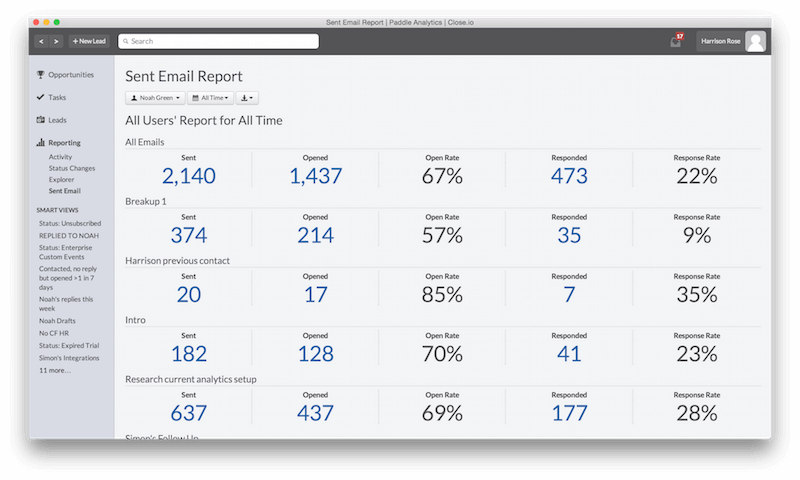
Outreach is important to Paddle. Here’s how their team tracked emails with our software:

3. Talking price, then value

“What’s the price? How much will it cost? Can you give me a price range?”

No matter how potential clients ask it, they’re all interested in knowing the price of your service.

Where most salespeople go wrong is telling the prospect the price before offering them value.

Once you give up the price, you essentially give away your sales power. Then, the person sees your product as a commodity rather than a solution.

DO THIS INSTEAD: Own the sales conversation. Establish value first.

Then, gather relevant information about the prospect, and turn their cost mentality into an investment mindset.

Be firm and tell the prospect you need more insights before quoting a price. Check out this list of questions:

  • Is this a small, medium or enterprise-sized prospect?
  • How much support does this prospect need?
  • What are their overall wants and needs?
  • Will the prospect require consulting?
  • What's their budget?

Even if the prospect doesn’t want to divulge their budget, get them more emotionally engaged. Turn that energy into a hot lead.

Christopher Penn, VP of Marketing Technology at SHIFT Communications, says, “Relationships versus sales is a false choice. It’s not an either/or; it’s a dependency. In order to get the sale, you need to have the relationship first.”

Quoting a price can backfire. So, don’t do it!

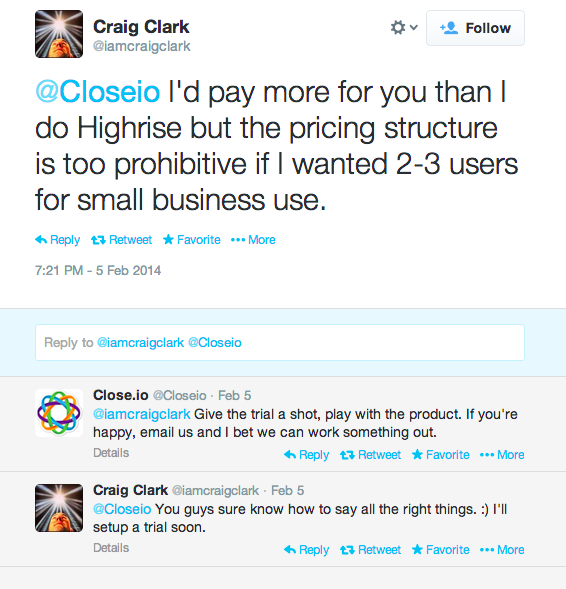
Create solutions and empower your potential client to make an investment in their company. Here’s a great example:

4. Selling like a telemarketer

Stop selling to people like you’re a lifeless human being with no soul. Break free from the telemarketer approach.

Refrain from calling prospects in a monotone voice with no excitement. What happens when you blurt out incoherent sentences? The lead hangs up or curses you out for wasting their time.

Remember this: If you confuse prospects, you lose prospects.

Speak clearly and allow people to understand your message. Stick to one point and don’t start blabbering about your 10+ product features.

Let your words flow. Try this script:

You: “Hi, this is Steli.” [Pause a second]

Prospect thinks: “Steli, Steli… do I know this guy?”

You: “I’m calling from Close.io.” [Pause a second]

Prospect thinks: “Close.io? Humm… should I know them?”

You: “What we do in a sentence is we’re helping sales teams close more deals. Is this a bad time for a quick chat?”

When the prospect says no, permission has been granted. It’s your time to pitch!

If you need to listen to yourself during a call, Close.io can help. Our platform makes it easy to automatically record all your sales calls. Try our FREE 14-day trial now.

5. Not rebounding from shitty sales calls

We’ve all had bad sales calls. I mean horrible calls ‐ where the prospect was rude and borderline abusive.

Then, the domino effect happens. A colleague listens to your venting session, and another dips into your cubicle to “check on you.”

After three hours, the whole office is exchanging stories about their sales calls from hell. Productivity is lost, and time is wasted.

Complaining cures nothing! Grow up and literally move on.

When a bad call happens again (because we know it will), learn to bounce back.

Step away from your desk. Take a five minute break. Grab a coffee.

But whatever you do, DON’T bring negative energy to your team. It’s not worth the wasted time or money to bring everyone’s mood down.

Lift your spirits with a Close.io motivational quote or watch a funny Youtube video. After that, pick up the phone and start closing the next deal!

Founder of Score More Sales Lori Richardson states that “[t]here is nothing better than getting a win under your belt to help with confidence.”

Treat bad sales calls as opportunities to grow in the profession. Take a productive approach. Ask yourself:

  • What could I have done better?
  • How could I have managed the situation differently?
  • How can I deal with feeling bad?
  • How can I develop more emotional stability?

Stop making the same mistakes

Sales doesn’t have to be difficult. Be proactive by avoiding these common mistakes.

Give value, then discuss price. Actually call people who’ve signed up for your trials, and leave your feelings behind after shitty sales calls.

Take action! Become the ultimate salesperson, and sign up for our FREE sales course to close more deals.

01 Oct 19:27

3 Tips To Save Time In Your Sales Development Process

by Gillian Sontz

As SDRs, we all know time is a precious commodity. Not only are we tasked with finding qualified opportunities, but we must also ensure that these prospective customers reach the closing phase quickly and with minimal hiccups along the way. It takes hard work to accomplish this task so here are three tips to save time in your sales development process:

1. Target Title

Make sure you are reaching out to the right person.

Before even picking up the phone SDRs should have an idea of the best “target title” to reach out to and make sure to contact these people first. Your target title is the person or people at a company who would be the best person to speak with because they are a decision maker or at the very least, an influencer. If you are looking to speak with someone in the IT department, your target title might be Vice President or Director of IT. Reaching out to someone in marketing when you are trying to speak with someone about IT services would be a waste of time. The same could be said for reaching out to titles that may be IT related, but at such an entry level position that they would be too far removed from any decision-making responsibilities to provide any value to your prospecting efforts. That being said, don’t completely exclude the prospects outside of your target title, just know they may not be able to provide much help other than a referral.

Quick tip: Start by reaching out to the most relevant title and work your way down your contacts list from there. Another rule of thumb is to research each prospect on LinkedIn so that you do not waste a phone call on someone who is no longer with the company!

2. Target Profile

Make sure the company you are reaching out to is the right fit for your offering.

Another helpful way to save time in the sales development process is by eliminating the companies on your list that don’t fit your “target profile.” Your target profile should be a description of your ideal customer. Depending on your market, your target profile may consist of anything from company size, revenue, number of users, or current technology being leveraged. Creating a target profile can help highlight companies that would be a great fit for you and save you time by removing ones that are not a fit and won’t convert into opportunities.

Quick tip: Strategize with your account manager to best understand the key factors that make a company a fit for your offering. Then, organize your account list views by these various factors to quickly distinguish the accounts that are best to target first. Organize these ideal accounts into a separate list view to stay focused.

3. Target Messaging

Make sure you have the right messaging.

As soon as you get a prospect live on the phone, you have to know what you are going to say. If you are talking to someone with a technical background, cater your messaging to terminology they are familiar with. That being said, if you are speaking with someone who may not be familiar with this area, you have to be clear about what you are talking about so as not to confuse the conversation. Don’t read word for word from a script, but it is always good to have a messaging map to help with conversation flow. As I mentioned in the beginning of this post, our time is a precious commodity, and we want to qualify and pass opportunities without wasting time. Target messaging can help this.

Quick tip: Focus on 3 key questions you need answered from your prospect in order to qualify or disqualify them as a prospective customer. Using these questions to guide your conversation will keep you on track and will not waste your prospect’s time or your own. Also, don’t get caught off guard, prepare a 30-second “what we do” statement so that when the question is asked (and it always is) you are ready.

The sales development process can be much more efficient if you know you are reaching out to the right people at the right companies with the right messaging. Before you pick up the phone and make your next dial, be sure to do your research and always stay prepared!

01 Oct 19:27

5 Steps To Personalizing Your Sales Emails At Scale

by Andy Farquharson

There’s a lot of content out there in sales blogging land about the automating the sales process when trying to find the next opportunity. However, the most important aspect is crafting a message that speaks to the individual. You want to make them feel like ‘Yes, this is an important issue for me. This person understands my challenge and can help me resolve it.’ You want to answer the prospect’s questions of ‘Why you, why now?’

There is no doubt that creating that personalized message has a huge impact, but it also takes a huge amount of time. This begs the question, “How do you scale your personalization efforts to reach more prospects and open more conversations?”

Here is 5-step guide to personalize your sales email messaging at scale.

1 – Segment by Ideal Customer Profile fit

You should have a good understanding of who fits your ideal customer profile (ICP); the customer most likely to purchase your product or service, who would respond to a similar value proposition. There could be a number of factors you have identified to fill out this profile – title, industry, company, geography, etc.

Not all of your prospects are created equally. ‘A players’ on your team regularly rank their leads by level of strategic importance and confidence in their fit for your business. For example:

  • A, 10% of target customers
  • B, 30% of target customers
  • C, 60% of target customers

Do this segmentation either in a spreadsheet or your CRM.

2 – Create the format for the email

To create a personalized message at scale, you need to create a framework to insert your personalization and value proposition.

The latest research from companies like InsideSales.com point towards the need for multi-touch- campaigns to reach the prospect, using a framework creates an easy way to test and iterate each messages performance.

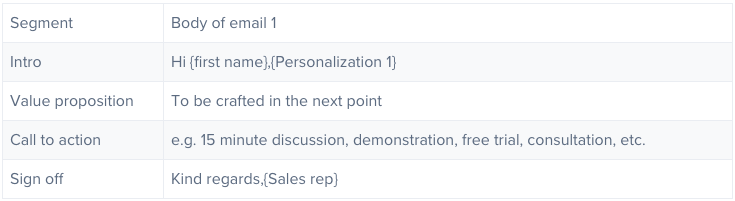
An example may be:

outbound sales template

3 – Build out targeted value proposition – Answer the ‘Why you?’

Personalizing at scale requires you to create value proposition that will appeal to all of your prospects and provides a framework on which you can hang your custom variables. Typically these statements make up the bulk of the email, educating the prospect on potential challenges you can solve or providing social proof as to why they need to speak with you.

Often the most compelling messages involve sharing the success of a current customer how tried your solution and received a clear return on investment within a specific time frame. For example, Customer X was able to increase sales by 27% within the first 3 months.

4 – Do the research to populate {Personalization 1}

This is the first custom variable after the prospect’s name. Research is the most important part of the process and the most time intensive. That means you need to allocate the appropriate time in proportion to the importance of that lead.

For example, you might allocate your time by as follows:

A Grade Leads: These require a highly personal approach that merits targeted information about the individual – 10+ minutes per lead.

B Grade Leads: Your time can be focused on researching a company or gathering competitor intelligence – 10 minutes spread across a small pool of leads.

C Grade Leads: You can afford to be less personal there. Look for some industry specific news that can be positioned as important and ask for a referral – 20 minutes across the a larger pool of leads

The research involves you searching through the social media, news outlets and company reports to find the specific to the segment or the individual.

Today there are many tools and technology to make this easier, such as Rapportive and Discover.ly. NeedNudge is a new one that looks interesting.

‘A Players’ on your team are always looking for new ways to scale this element of their job. One popular method is to document your research process and look for outsourced partners that can do the research for you. Companies like UpWork, Elance, and Freelancer are great resources to help recruit outsourced partners.

Enter the research into a new column in your leads table in PersistIQ, spreadsheet or specific field in your outbound sales platform.

5 – Time to execute your campaign

Traditionally you had two options to execute these campaigns:

  1. Leverage marketing automation technology to send bulk emails which provided minimal customisation capability but great analytics on success.
  2. A manual and tedious process involving a spreadsheet, your mail application and a lot of time.

Previously, a sales rep had to decide between either convenience and speed or personalization and control.

However, it’s important to note that there’s a profound difference between marketing automation and sales automation.

Technology has evolved with a plethora of sales driven outbound email automation solutions, and companies like PersistIQ are at the forefront. PersistIQ enables you to efficiently increase your outbound email activity, provide the capability to personalize and then measure performance.

Once you’ve built out your campaign, it’s time to review your emails and press send!

Conclusion

Hopefully, these 5 steps help set you up to scale your outbound email activity while providing the personalization you need to cut through with your prospects. Remember, this is just the start of the process. You need to continually test and iterate your value proposition, content and personalization variables to optimize your open rates, responses and deals won.

Good luck & happy selling!

Want to improve your outbound sales with more personalized emails and campaigns? Let us show you how with PersistIQ.

01 Oct 19:27

A Visual Guide to Creating a Winning Sales Pipeline

by leslieye@hubspot.com (Leslie Ye)

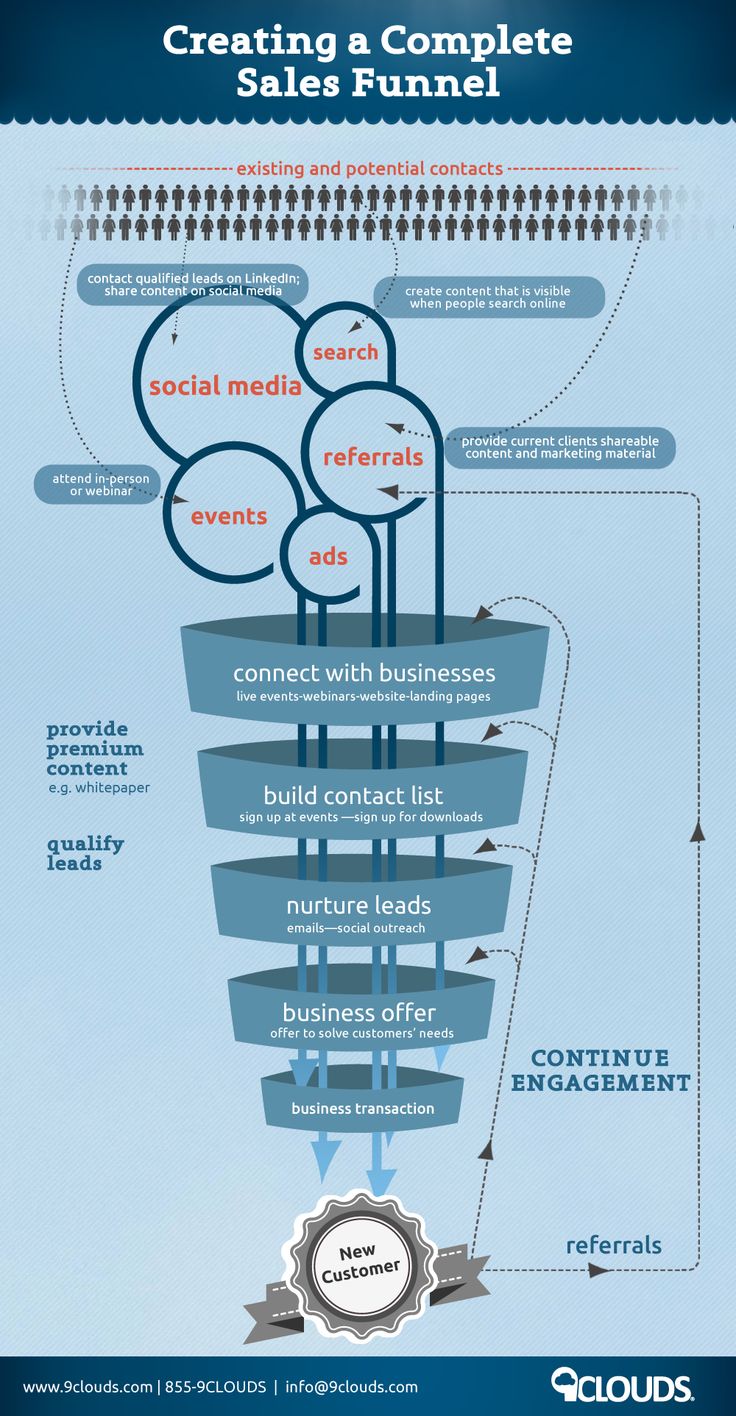
“Sales pipeline.” You’ve probably heard the term before, but if you haven’t, a sales pipeline (or funnel) is a collection of all the leads a sales rep or sales team is currently working. Overlaying the company’s sales process onto the pipeline helps reps and managers analyze how many deals are likely to close this month and how many new opportunities need to be created to beat quota.

Depending on what CRM or other sales tools your team uses, there’s a good chance you can work from a visual representation of your pipeline. Instead of poring over a spreadsheet, a visual pipeline is an easy way to represent how many deals in progress you (or your team) have at each stage of the sales process.

But what should a sales pipeline look like?

This handy infographic from 9 Clouds visually depicts a basic sales pipeline, accompanied by explanatory notes and types of activities reps should be engaging in at each step of the sales process. Your model will likely differ from this template based on your industry and sales process, but you can easily modify it to fit your specific needs.

get the free hubspot crm

01 Oct 19:26

How Important Are Your Competitors? What To Watch And What To Forget

by Juli Durante

In business, watching competitors is generally a good idea – but perhaps not in the way you think. Effectively, it’s essential to understand your competitors, what they do, and why they do it, but it’s a mistake to obsess over your competitors and every action they take.

How do you know what to look at, how often to consider it, and what you can actually forget about? Here’s a sanity-saving shortlist of what you should be looking at:

Products/Services

Watch it:

It’s a good idea to know how your products and services differ from those offered by the competition. Have they added a new technology that you’re not ready to roll out? Is there a security vulnerability that they have not yet addressed? Knowing what action your competitors are taking in these areas can be important for sales and marketing messages.

Forget it:

When your competitor has a new product, service, or feature, don’t scramble to copy it. First, ask yourself questions such as:

  • Does it actually help our customers?
  • Does this make sense for our business?
  • Do we have the time and budget necessary for development?
  • Does it support our value proposition?
  • Do we already have a partner who offers it?

Of course, there are times when radical new features become the new standard (iPhone, anyone?). In these cases, it’s important to diversify your offerings – but still stay true to your core reasons for doing business and helping your customers.

Content

Watch it:

Always take a look at the kind of content your competitors produce. Are they blogging, writing case studies, creating infographics, releasing eBooks, or performing other marketing activities? What is the overall quality of their content? Are they using their content to generate leads (the same leads that you want to convert on your website)? How do your competitors position their solution in the world?

These are all important considerations when looking at competitors’ content. They give you a baseline for how your competitors communicate. They can give you ideas for blog posts or premium content. They can provide an example of how you don’t want to position your product.

Forget it:

Don’t blatantly copy everything your competitors do. If they release an eBook or blog post on a particular, you aren’t obligated to do the same. In fact, there may be many reasons why you don’t want to cover that topic. Ultimately, visitors will engage with your content because it is unique and speaks to their needs, so focus on that instead.

Media Mentions

Watch it:

It’s not a bad idea to set up some Google Alerts for your competitors’ names or brands so you know if they’ve been mentioned in a news article or have released a new product. If many people are talking about your competitors, you should know – it may be important information for your business or industry in general.

Forget it:

Again, don’t be obsessive. If a journalist writes about a competitor, that’s not an open invitation to spam them with tweets and news releases asking for a feature. Just like your customers and leads, journalists are humans who are looking for the right information at the right time.

The Bottom Line

Too often, companies are so focused on the competition that they forget to be themselves. They’re chasing competitors and not standing on their own two feet. Never lose sight of what your company does and why you do it – that’s why employees show up every day and customers are happy to keep working with you.

01 Oct 19:26

How to Make a Personalized Quiz to Drive Sales

by Josh Haynam

What if you could be more like Amazon and offer just the right products at the right time to personalize your product recommendations in an almost creepy way? If you could do that, you’d experience an immediate 7.8% increase in sales, you’d also have a much better understanding of your customers, and your boss would definitely give you a thumbs-up.

This all sounds amazing, except for one problem – you are not Amazon, you don’t have thousands of engineers to work on perfecting every single aspect of your personalization program. Most likely you also don’t have tens or hundreds of thousands of dollars to build personalization into your product CMS, and you are a marketer, so doing any coding yourself is incredibly daunting.

Trust me, I’ve been there. Which is why what I’m going to show you today is so incredible. We’re going to look at the exact method used to turn a personality quiz into a powerful personalization tool. What we’re about to go through together is the ultimate growth hack for E-Commerce marketers. Let’s look at the precise way a quiz makes your site personal to every visitor.

How to Make a Personalized Quiz to Drive Sales

Part 1: Identify personalities for your quiz

Before you start formulating the innards of your quiz, you have to figure out what the results will be. These results are always related to your products. The personalities of your personalization quiz can be formed in one of two ways.

1. Your actual products. If you are a specialty shop and only have a handful of products, you can just make individual products the results of your quiz. This tactic can also be used for larger brands by making category-specific quizzes. For example “Which Facemask is Right for You?” from a makeup brand.

2. A “style” related to categories of products. If you have a wide variety of products and they fall into general categories (such as Chic, Rugged, or Modern for clothing), then you can give people a personality based on the categories and then recommend products to the personality.

Part 2: Write an attention grabbing Quiz title

The title of your quiz is incredibly important, and fortunately equally as simple to come up with for product quizzes. It’s either “Which (product) are you?” or “What’s Your (blank) Style?” depending on which of the categories you chose in the previous section.

quiz title

Part 3: Create interesting questions

Creating the questions can be the trickiest part of the process. You have to walk a fine line between delivering an accurate quiz result and entertaining your audience. There are a few ways to do this well.

1. Use lots of pictures. Products are highly visual, all of your marketing is visual, don’t drop the ball on your quiz and ask questions with text answers! I did a study and found that all 100 of the top 100 quizzes created at my company have at least one image question.

2. Inject personality into the text. Remember that your quiz is a one-to-medium, an opportunity to speak directly with customers and ask them preferences. Since you are only talking to one person at a time, keep it very personal.

3. 6-8 questions per quiz. This number of questions will take approximately two minutes to complete on web and mobile devices. That’s the sweet-spot for timing to maximize completions and leads generated.

quiz image questions

Part 4: Set up Lead Capture

Something to consider when making a quiz is whether you want to collect new leads inside the content. Since you’ll know the quiz takers’ personality or recommended product, you can send follow-up drip campaigns based on their type, but first you have to get the contact information, here’s how to convince people to give you their information.

1. Incentivize subscription. There is the obvious draw of being able to see your quiz results (they are “gated” by the lead capture form), but you also want to give people an added bonus for subscribing. For example, the quiz below promises to send out “Personalized messages designed with your style in mind,” which is pretty cool.

2. Be honest about what you are going to send. Tell people exactly how often you will send marketing communications and what you’ll be sending. It’s much better to say “We send one email each week” than “We’ll send you our newsletter.”

quiz lead capture

Part 5: Follow up with personalized recommendations

Whether or not someone chooses to opt in, you get an opportunity to make a sale in the results of your quiz by recommending personal products. There are a couple of tips that will help you get a higher conversion rate.

1. Connect the personality type to the product. Tie in the person’s personality traits (based on what they just told you), to the products you are recommending. This will seem like magic to the quiz taker, but it’s really simple.

2. Be positive. No one likes a downer, your results descriptions should be encouraging, not off-putting. It turns out that positivity is the most shared emotion, so being encouraging in your quiz results can actually increase the effectiveness of the quiz.

3. Include links. This might seem obvious, but make sure to include links or buttons to purchase the products that you recommend. Not everyone will purchase right away, but you can still pique their interest.

quiz retail personality

Part 6: Close more deals with pointed automation

Most people won’t buy immediately after taking your quiz. That’s not unexpected, it would be ridiculous to assume that everyone is immediately ready to buy. However, if someone takes your quiz and chooses to opt-in, there is at least a glimmering of interest in making a purchase down the line. There is a method for closing sales down the line using what you’ve learned about people from the quiz.

The first part of this method is to immediately send an auto-response email thanking people for taking your quiz and sending their result via email. You have to do this to introduce yourself and remind people why you have their email address. Otherwise they’ll forget and you’ll be accused of spamming.

After that you should continue to reference the person’s personality type when sending product recommendations and content. Don’t be overly pushy, remember that these people are interested, but they found your products through a personality quiz – don’t go for the hard close.

targeted email marketing

We can’t all be Amazon and constantly push the envelope of what’s possible with personalization, but we all can use simple personality quiz logic to provide a more tailored experience to web visitors and cash in on the benefits of recommending products to people based on their interests.

Hopefully this guide has sparked some ideas for you, and I encourage you to give a product personality quiz a try today!

The post How to Make a Personalized Quiz to Drive Sales appeared first on Social Media Explorer.

30 Sep 16:47

The Not So Sexy Secrets To Small Business Success

by Steve Gumm

Honestly, I am exhausted with marketing. I live the stuff. I’ve kept up and continue to keep up, but it’s becoming abundantly clear that the clutter, noise and growing number of shiny objects is only going to get worse.

It’s the “in thing” to talk about everything digital. It sounds great and gets press to talk up the latest craze as if it’s a silver bullet to big money and a dream business or lifestyle. In fact, many people now make careers out of selling information on how to make a fortune using this thing or that.

Don’t get me wrong- I love shiny objects. I’m fascinated by the potential in new innovations and often see the abundant opportunities available to the right company leveraging them.

But the focus and attention on all of this is killing a lot of entrepreneurs and small businesses.

The things that are supposed to take your business to the next level and help you keep up with the times are distracting you from the not so sexy things that make remarkable businesses remarkable.

What ever happened to building relationships, creating unique experiences, over-delivering for customers, following up and making sure your product or service was worth talking about? It’s drown out by the smoke and mirrors of needing to be on Twitter, creating a Facebook post that will get more likes, blasting out emails, launching pay per click campaigns and building a following on Instagram.

In most cases, the businesses that win are those who zag when everyone else zigs. These are companies who are more focused on that one customer today rather than the two hundred likes on a social site. These are companies who are loved not because they have a major digital strategy, but because of their ability to simply overdeliver on the basic steps of the entire consumer experience. These are companies who understand that far more important than anything else is building relationships, making sure the product or service is nothing short of spectacular- every time, giving customers an experience worth talking about, staying in touch and showing you care.

Once the foundation is in place, THEN and only then do they look at shiny objects as a way to build more connections or share the experience with more people. The tools and new shiny objects become a way to enhance the overall vision.

If you do nothing else today, take a step back and look at the foundation of your business. If it’s not remarkable, in every way, then make it remarkable. Instead of focusing on getting another hundred twitter followers or what kind of witty Facebook post to put up today – focus instead on over-delivering for your customers and building in a Wow-Factor that leaves them in awe.

The purpose of this recorded webinar I’m sharing with you here  is not to overwhelm, but instead to inspire you to look at the various elements, each of which can have a huge impact on your business.

I want you to think about your business and the experience a customer has from the time they have no idea you exist, until they become a customer and finally a referring evangelist for your business.

The new shiny object is just having a damn good business people can’t imagine their lives without.

30 Sep 16:47

4 Inspiring Stories of Women Entrepreneurs From Around the World

by Rebekah Iliff
From the Philippines to Malaysia, four women share what being an entrepreneur means to them -- and it has nothing to do with becoming the next billion-dollar unicorn.
30 Sep 16:46

Ace an Impromptu Speech With This Template

by Kristin Wong

If you’ve ever been asked to give a speech or a toast on the fly, you know how much pressure it can be. You can deliver a solid impromptu speech by remembering these five elements.

Read more...

30 Sep 16:42

Stephen Harper makes direct pitch to Chinese Canadian voters

by The Canadian Press

RICHMOND HILL, Ont. — At a Mid Autumn Festival celebration in a Toronto suburb Tuesday night, Stephen Harper took the stage in front of hundreds of Chinese Canadians and was handed a brush for the traditional painting of the dragon’s eyes, done to awaken the sleeping giants so they can begin to dance.

Harper had his choice of coloured beasts to anoint but of course chose the one in Conservative blue.

The Conservative leader was at the event in Richmond Hill, Ont., to awaken another giant — the Chinese Canadian vote.

There are an estimated 1.4 million Canadians of Chinese origin, and in several of the coveted ridings in the greater Toronto area in particular, they are the dominant ethnic group.

The Conservatives should be their natural party, Harper told a banquet hall where people stood in the aisles ten deep, many holding their phones aloft to record his remarks.

“A strong work ethic, a commitment to education, dedication to family and faith are keys to success,” Harper said.

“These are the values of the Chinese Canadian community and they are also Conservative values.”

The Conservatives have more candidates of Chinese origin than any other federal party, Harper said, listing off people running in Vancouver, around Toronto, Ottawa, Windsor, Ont. and Quebec.

Harper has long courted coverage from the ethnic press, of which Chinese-language media is a dominant force in Canada.

Now, much like the Conservatives have used their own communications tools to reach around English and French media and go directly to voters, they’ve also launched a Chinese-language version of their website.

Harper billed it Tuesday as an effort to connect more directly to Chinese speakers. The home page of chinese.conservative.ca includes a picture of him and his wife Laureen in China with a panda on their laps.

In Harper’s speech, he hyped his three missions to China, and the various investment agreements that had been signed as well as increased tourism between the two countries.

But he also stressed achievements of his government on the domestic front directly in response to community concerns, among them a GST exemption on acupuncture products and the announcement of an advisory board on traditional Chinese medicine.

While all of Harper’s speeches are about his government’s record, the one Tuesday night was unique. Instead of a room packed with card-carrying Conservatives, he was speaking to hundreds of people who’d gathered for the festival, to which he was an invited guest.

There was clear support for the party in the room _ the emcee referred to Jason Kenney as his favourite MP and another host, Benson Lau, said as a former citizenship judge he approved of the Tory decision to try and ban the niqab at citizenship ceremonies.

But many of the hundreds of people there also chatted animatedly between themselves during Harper’s 13 minute address, a low hum of conversation in the room that the Conservative leader couldn’t quite through.

While the Conservatives have spent years doing outreach into ethnic communities, they had some concern going into this campaign that the fact many immigrants arrived under the Liberal government of Pierre Trudeau could soften their support.

So Harper also took the opportunity to remind Chinese voters of the Liberal record, starting with the imposition of the head tax, to immigration backlogs and all the way up to the current Liberal party’s approach to the legalization of marijuana.

Kenney, Harper’s point man for ethnic outreach, said in an interview with The Canadian Press after the event that while millions of new Canadians have only ever known a Conservative government, there is still a need to directly connect them to the party and remind them of Canada’s political past.

The first-ever Chinese Canadian elected to Parliament was Conservative Douglas Yung in Vancouver, he noted, which many people in that community don’t know. They also don’t know the Liberal record, he said.

“It’s a constant work of education,” he said.

The post Stephen Harper makes direct pitch to Chinese Canadian voters appeared first on Macleans.ca.

30 Sep 16:41

The tidal wave of seniors has to be seen to be understood

by Jason Kirby
 THE CANADIAN PRESS/Frank Gunn

Frank Gunn/CP

The moment Statistics Canada has warned about for the last decade is finally here: Canada now has more seniors than children aged 14 and under. To be precise, there are 5.78 million seniors compared to 5.75 million kids.

While we’ve known this was coming for a long time, the news is still a wakeup call, because so many of our assumptions about the future are built on outdated concepts about Canada’s population. For instance:

—Having fewer workers will hold back growth of the labour market (even if more seniors keep working) and act as a drag on growth.

—Fewer consumers and homebuyers will potentially reduce asset prices (i.e., if Boomers hope the price of their homes will keep rising to pay for their retirement, they could be in for a shock).

—Fewer taxpayers will make it harder for politicians to pay for their promises while balancing the books.

—We’ll need many, manymore immigrants to fill the gap, though even that won’t really help us.

Yet, as much as we’ve talked about the wave of aging Boomers, it’s hard to appreciate it without seeing it in action. Here, then is how Canada’s population has morphed since 1971. The gif, based on Statistics Canada population estimates, shows the number of Canadians of each age from year to year.

Sept 29—Population by age 1971 to 2015

(Note: The oldest age on this gif is 89, because StatsCan didn’t consistently offer detailed population estimates for ages older than that over the full time period.)

While the wave of Baby Boomers flowing into retirement is obvious from the animation, the rise of the echo-boom generation (the children of Boomers) shows itself in the latter years, a reflection of increased immigration.

Not all provinces are going through this at the same time, mind you. Alberta still has a ways to go before its old people outnumber the young (though, if the oil-price rout continues, that trend might speed up).

While the headline this week was that seniors had overtaken the under-14 age group, the ranks of seniors aren’t going to stop there. Over the next few years, expect more and similar headlines as Canada’s grey brigade bypasses other age groups.

The post The tidal wave of seniors has to be seen to be understood appeared first on Macleans.ca.

30 Sep 16:41

This 100-metre long luxury yacht can break through ice and explore the furthest corners of the planet

by Dennis Green, Business Insider

A new yacht unveiled at the Monaco Yacht Show promises to take owners to the coldest (and most remote) parts of the world.

The new SeaXplorer, by Dutch shipbuilding company Damen Group, is a luxury expedition yacht that can break through ice in the Arctic and Antarctic.

With outdoor heated decks, icebreakers, and a 40-day run time before needing to return to port, the SeaXplorer is one tough ship.

Keep scrolling to see what else this 100-metre behemoth can do.

From afar, you’d never know the SeaXplorer is an expedition yacht capable of breaking through ice to explore the furthest corners of the planet.

Damen Group
Damen Group

With its reinforced, Polar Class hull and an ice-breaking stern, it can easily traverse the Arctic reaches. It’s the world’s first private expedition yacht built to the Polar Class specification, which will be required to visit polar regions by 2017.

Damen Group
Damen Group

The top deck Sky Lounge has multiple fire pits to keep guests warm.

Damen Group
Damen Group

The SeaXplorer is also ideal for visiting remote tropical islands. It can travel for 40 days without a port call, and there’s plenty of space to store a personal submarine and diving equipment.

Damen Group
Damen Group

The ship’s interior is sleek and modern, with clean lines and large windows.

Damen Group
Damen Group

The observation lounge offers incredible views of the surrounding nature.

Damen Group
Damen Group

The SeaXplorer is available in three sizes, the largest of which measures 100 metres long.

Damen Group
Damen Group

The 100-metre ship has enough space to sleep 30 guests and 50 crew.

Damen Group
Damen Group

There’s space for a helicopter pad on the back, as well as a fully equipped helicopter hanger with a lift system.

Screen Shot 2015-09-30 at 11.46.02 AM

30 Sep 16:39

How the party leaders could cool the housing market—and why they won’t

by Michael McCullough
Justin Trudeau giving a speech with the Vancouver skyline visible in the background

Liberal Party leader Justin Trudeau at a campaign stop in Vancouver, September 10, 2015 (Jonathan Hayward/CP)

Deficits and the refugee crisis are the issues dominating the federal election campaign, but for the eight million Canadians living in greater Toronto and Vancouver, there is one subject that will still be discussed around the dinner table for months to come: soaring home prices. Markets in these two cities have decoupled from national housing trends even further. The Teranet–National Bank House Price Index found that prices increased 9.7% in Vancouver and 8.7% in Toronto last month compared with a year earlier, whereas the rest of the country averaged just 0.2%. Affordability is worsening, too. In a recent report, RBC concluded that servicing the mortgage on a two-storey house (assuming 20% down) would cost the average Toronto household 67.5% of its pre-tax income. In Vancouver, it’s an eye-popping 90.6%.

All of this explains why, when campaigning in Vancouver in August, Stephen Harper promised $500,000 to study the impact of foreign home buyers on these two markets, a group some believe is driving prices higher. In a similar fashion, Justin Trudeau announced on Sept. 9 that a Grit-led government would “review” the distinctive affordability issues in Vancouver and Toronto. (The NDP has so far refrained from singling out the two cities in its housing platform.)

Housing experts applaud the parties’ intentions to ask questions about market forces before they start shooting, but the reality is there’s only so much a federal government can do to corral these runaway markets. What they’ve proposed so far isn’t likely to help first-time buyers much. Other options available are politically unpalatable and risk alienating the very voters the next government seeks to placate. Despite the candidates’ concern about affordability, the Toronto and Vancouver markets will continue to move according to their own agendas.

The feds have previously made substantial policy changes to temper the housing market. “The biggest actions have already been taken,” says Craig Alexander, vice-president of economic analysis for the C.D. Howe Institute. Since 2012, Ottawa has changed mortgage insurance rules four times by increasing down payments and shortening the period buyers have to repay their loans. It has withdrawn mortgage insurance for investment properties and homes valued over $1 million. More recently, the Tories changed the rules for immigrant investors such that they can’t simply invest in Canadian real estate or fixed income and call it job creation. Yet these tweaks paled in the face of the market’s momentum. “We found that the effect of those changes wore off in four to six quarters,” says Diana Petramala, an economist at TD Bank. “The market just readjusts to a new equilibrium and starts back up again once the impact of the new regulation fades.”

One surefire brake on house-price increases would be a hike in interest rates, Petramala says, but that is the bailiwick of the Bank of Canada. That institution has other concerns, the most immediate being inflation and generalized economic growth. Moreover, if the end goal is affordability, higher interest rates will produce the opposite effect by increasing mortgage carrying costs.

This mostly leaves the feds tinkering around the edges. The Liberals and Conservatives have both vowed to expand the RRSP withdrawal program that allows buyers to use retirement savings for a down payment, provided they replenish the savings (with no tax deduction) over subsequent years. The Conservatives want to boost the withdrawal limit to $35,000 from $25,000. The Liberals, in contrast, would widen eligibility rules to allow more Canadians in different life situations (moving for work, for example) to take advantage of the program. Economists mostly dismiss this as a minor gesture. If anything, freeing up more money to chase escalating prices only drives the market higher, making this move counterproductive.

Meanwhile, a rising chorus in Toronto and Vancouver is calling for special restrictions to be placed on foreign property buyers, who some contend are largely responsible for multimillion-dollar home purchases. That concern is likely behind the Conservatives’ pledge to study the role of foreign buyers, and the Liberals’ more general plan to look at the affordability issues in both cities. Research by David Ley, a University of British Columbia geography professor, has found that purchases by wealthy immigrants and foreign real estate speculators have a “trickle-down effect” that helps inflate prices across the housing spectrum. Australia, New Zealand and Singapore have already taken steps to lessen the impact of foreign money on local real estate markets. Depending on the form they take, restrictions on foreign buyers would alleviate demand from less price-sensitive foreign buyers, advocates argue. Australia’s rules, for example, limit foreign buyers’ purchases to new homes, effectively taking them out of the detached house market in city cores. Even with these rules in place, however, house prices in Australia still jumped by 10% year-over-year, driven by desirable markets such as Sydney and Melbourne.

This line of thinking is not without controversy, either. Some commentators object to the whiff of xenophobia surrounding policy that might target offshore buyers. “Let’s put a stop to the insidious characterization of Chinese investors as villains in our affordability problems,” wrote Yuen Pau Woo, president of HQ Vancouver and former CEO of the Asia Pacific Foundation of Canada, in an op-ed in The Tyee.

Ultimately, the root of the current imbalance of power between those Canadians who own homes and those who do not lies in the Canadian tax code, says Thomas Davidoff, an economist at the University of B.C.’s Sauder School of Business. He recommends shifting the tax burden off personal income and onto real property. The feds could initiate this by striking a deal with lower levels of government to raise property taxes across the country, kick the proceeds up to the federal level and provide broad-based income tax relief, effectively taking money from the people who own real estate and giving it to those who don’t. “That’s the most direct and least harmful way to do it,” Davidoff says. Such a change would allow renters to better afford to live in the city of their choice and save for a down payment. This is how the U.S. treats taxation, and Davidoff argues it’s the reason home ownership is more attainable there than in Canada.


That plan, however, would face daunting challenges in the political arena. Roughly two-thirds of Canadian adults are homeowners, and they would likely resist such a change. It’s also naive to expect co-operation from different levels of government on the issue. Last spring, Vancouver Mayor Gregor Robertson wrote B.C. Premier Christy Clark, requesting an amendment to the city’s charter that would enable it to raise tax rates on the most expensive homes and levy a tax targeted at flipping. Clark turned down the request on the grounds that meddling in the market in this way might disadvantage existing homeowners.

Fortunately, Davidoff has another, more workable suggestion that’s already in the wheelhouse of the Canada Revenue Agency: Cap the capital gains tax exemption for primary residences. The Internal Revenue Service in the U.S. already does this, applying income taxes on gains from home sales in excess of $250,000 for individuals and $500,000 for a married couple filing jointly. A similar approach in Canada would discourage speculation in the property market (which is believed to contribute to price appreciation) and only penalize people who have already realized a substantial gain.

Whether this is the kind of intervention voters want, however, is an open question. Slapping a new tax on this long sacrosanct asset class—even amid worsening affordability—might be a very tough sell.

MORE ABOUT HOUSING MARKETS & FEDERAL ELECTION 2015:

The post How the party leaders could cool the housing market—and why they won’t appeared first on Canadian Business - Your Source For Business News.

30 Sep 16:39

In world swarming with free news to read, most young people don't pay - but 40 per cent do

NEW YORK, N.Y. - In a world flush with free information, some young people are still willing to shell out for news they read.
30 Sep 16:37

Mark Carney warns investors of ‘potentially huge’ losses from climate change risks

by Scott Hamilton, Bloomberg News

Bank of England Governor Mark Carney said investors need to wake up to the potential for huge losses from a sudden shift in regulations designed to curb global warming and the use of fossil fuels.

“The challenges currently posed by climate change pale in significance compared with what might come,” Carney said in a speech at a Lloyd’s of London dinner in the U.K. capital late Tuesday. “Once climate change becomes a defining issue for financial stability, it may already be too late.”

Carney is the most prominent figure yet from the world of finance to set out his concerns on how climate-related issues could destabilize financial markets in the years to come. His remarks prodding the Group of 20 nations to act on the issue also support campaigners led by environmentalist Bill McKibben as well as institutions such as Oxford University and the Rockefeller Brothers Fund Inc., which have pledged to shift away from investments in polluting industries.

“He chose his setting perfectly,” said Stephanie Pfeifer, chief executive officer of the Institutional Investors Group on Climate Change, which represents 110 funds controlling $12 trillion. “We welcome his focus on more consistent and reliable carbon disclosure that will allow investors to make a more informed assessment of the climate risks in their portfolios.”

The U.K. central bank has been looking into the economic and financial-stability risks posed by climate change, and Carney spoke as the BOE published a report on the impact on the British insurance industry. As well as physical and liability risks, U.K. insurers, which manage almost 2 trillion pounds ($3 trillion), also face threats from the re-pricing of investments in fossil fuels in the move toward a lower carbon economy, Carney said.

Insurance Risk

“The exposure of U.K. investors, including insurance companies, to these shifts is potentially huge,” Carney said, noting research suggesting current modeling in the industry may be under-pricing risk by 50 per cent if current weather trends become normal.

The key danger is that changes in policy leave oil drillers and coal miners with stranded assets — reserves that have little value because the fight against climate change will require them to be left in the ground. While disputed by energy companies, the issue has been gaining attention in the past year and is a focal point for a round of United Nations talks on global warming due to culminate in December.

At most, just over a quarter of fossil-fuel reserves can be used if warming is to be limited to 2 degrees Celsius above pre-industrial levels, scientists convened by the UN have concluded. The so-called carbon budget compatible with the 2-degree goal goal would be used up in about two decades at current levels of fossil-fuel consumption.

“A wholesale reassessment of prospects, especially if it were to occur suddenly, could potentially destabilize markets, spark a pro-cyclical crystallization of losses and a persistent tightening of financial conditions,” Carney said. “The speed at which such re-pricing occurs is uncertain and could be decisive for financial stability.”

Risks will be minimized if companies and investors begin adjusting early and policy follows a predictable path, the governor said.

In an echo of the push to increase information disclosure following the financial crisis, Carney suggested that the G-20 could set up an industry-led group, a Climate Disclosure Task Force, to design a voluntary standards for detailing emissions by those companies. The G-20, whose member states account for around 85 per cent of global emissions, is in a prime position to lead the initiative on this, he said.

–With assistance from Jennifer Ryan and Alex Morales in London.

Bloomberg.com

30 Sep 16:34

How Volkswagen Can Begin To Restore Its Brand

by Guest Author

Restoring Trust In The Volkswagen Brand

When leaders start an important new job, the media and pundits typically give them a 90 day grace period to learn about the organization. You’ll see listening tours and factory visits, quiet lunches, and deep-dive briefings as they try to grasp the organizational politics before laying out their future vision.

Matthias Muller doesn’t have that kind of time. Today marks the third day of his first full week at Volkswagen CEO, and time is of the essence. The organization lost $22 billion in market value in just two days last week as the emissions cheating scandal broke, affecting 11 million vehicles and tarnishing the company’s vaunted brand, perhaps permanently.

Restoring trust won’t be easy. Some product categories are more intimate than others. From a branding perspective, a car defines your identity publicly (you’re using it to signal to others who you are) and literally protects you and your body. If an envelope company cheated this way, you’d denounce their ethics. When Volkswagen does it, many of their ardent fans felt viscerally betrayed. Muller has a difficult – but not impossible – task ahead of him. Here are three things he needs to do this week to stop the spiral and get the company back on track.

1. Admit the severity of the problem. So far, Volkswagen has set aside $7.3 billion to cover expenses arising from their deception. Wrong answer. Between class action lawsuits, recalls, and the discounts that will be necessary to lure customers into buying new Volkswagens (who would want to, otherwise?), the damages are likely to be much, much greater. Muller needs to rip the bandage off now and show that he understands exactly how grave the problem is by giving an honest estimate of costs, not the current, absurdly low figure. The New York Times asked Kelley Blue Book to estimate the buyback value of defective cars just in the United States – a mere 5% of those affected. The cost? $7.3 billion. Try again, VW.

2. Show that it will never happen again. The next step in crisis management is to prove to customers, and the authorities, that a scandal like this will never happen again. One way to do this is bringing in an outside leader who is independent and beholden to no one. Sadly, VW has already failed on this score, since Muller – the former head of the VW subsidiary Porsche – is an insider with three decades at the company. With that decision already made, Muller should take the next best step and launch an exhaustive, independent investigation into the scandal led by trusted outsiders and serve as a complement to the inquiries the U.S. and German governments have already begun. Of course, VW is already looking into the problems internally. But they need to tap a trusted elder statesman (or stateswoman) to lead the charge – essentially, the German equivalent of former U.S. Senator George Mitchell, who led key projects on everything ranging from Middle Eastern peace to steroids in baseball.

3. Recognize that VW has changed irreparably. The automotive industry is the pride of Germany, and a key economic driver. VW is at the center of it all: it’s the largest carmaker in Europe and employs nearly 600,000 people. Yet all that has changed in the past week. Volkswagen shares are now down more than 60% from their March high, and Muller is taking the helm of a changed company. VW needs to recognize its new position in the world. Muller isn’t stepping in to run a swaggering powerhouse; it’s a humbled giant that will likely need to reinvent itself, organizationally and attitudinally, into the automotive equivalent of a ‘boutique firm.’ It will be smaller, less influential, and subjected to heightened scrutiny in all its future dealings for years. The new CEO must act accordingly and accept those strictures with grace.

Volkswagen’s scandal was egregious – less deadly than the cover-ups perpetrated by some automakers in years past, but perhaps more shocking because of its coldblooded and willful intention to deceive from the start. Few customers today will be rushing out to buy Volkswagens, but in order to prevent an even further plunge in market value, Muller needs to act fast to control the damage and reassure the public that the problems have been fully identified, a swift resolution is in the works, and that procedures are in place to prevent such malfeasance in the future. If he handles himself right in the next two days, he may be able to save the company.

Dorie Clark is a marketing strategist and professional speaker who teaches at Duke University’s Fuqua School of Business. As a former presidential campaign spokeswoman, she specializes in crisis communication and branding.

[Complimentary Webinar] Video Growth Is Accelerating: Are You keeping Up? Learn the key trends in video consumption and discover planning and measurement practices you should adopt. Join us Oct. 22 at 1PM ET –  Featuring: Jim Nail, Forrester Research

The Blake Project Can Help: The Brand Positioning Workshop

Branding Strategy Insider is a service of The Blake Project: A strategic brand consultancy specializing in Brand Research, Brand Strategy, Brand Licensing and Brand Education

FREE Publications And Resources For Marketers

30 Sep 16:32

10 Marketing Lessons I’ve Learned From Pat Flynn of Smart Passive Income

by Katie Leimkuehler

Pat Flynn

Pat Flynn of Smart Passive Income has been a marketing inspiration of mine for years. Not only does he run a successful blog, online business, and podcast, he’s a genuine and authentic person who has nailed his marketing and branding. Since I’ve learned so much from him over the years, I’ve decided to share some of the key insights I’ve gained and learned from his marketing efforts.

1. Give away free content that provides valuable insights to your audience.

ebooks gratis descargar

People love free stuff, and even though it may seem counterproductive at first, it will help you in the long run. By offering free content you are giving your audience the chance to “test” you out and see that what you are providing is high quality content. When your audience knows with certainty your content is excellent and that it’s something they want– they will come back for more, even when it’s not free.

Pat Flynn is the master of this– he gives away high quality content on his blog with in depth articles that everyone has access to. One of my favorites is The Ultimate Guide to Adding Bonuses to Your Products (That Help You Convert More Customers). He also demonstrated this when he offered a niche site full of free resources and information for his audience. The website began to generate profit, gaining up to $50,000 in net profit at one point; this was a great example of how sometimes offering something for free can make you money later on.

2. Repurpose content on different mediums.

Source www.gotcredit.com

Source www.gotcredit.com

If you have created great content on one of your channels, there is no reason why you shouldn’t continue to use that content in other ways. A great method to accomplish this is to repurpose your content for another medium. If your content was originally a blog post, why not make a podcast out of it? If it was originally a video, why not try to translate it into an e-book? People respond to different mediums, so there’s no shame in repurposing your content across many outlets in order to get your message out. Pat Flynn believes that your most popular content should be used for success and even offers many tips on how to make it work harder for you.

3. Be transparent and authentic.

public-domain-images-free-stock-photos-high-quality-resolution-downloads-unsplash0071-1000x666

One sure way to get people to want to read your content and view you as a credible expert is to be open, honest, and transparent with them. If you are real with your audience, they will relate to you and feel comfortable coming to you for content. There are many great ways to do this, including showcasing behind the scenes. Your audience will enjoy seeing the process behind your work and it will make them develop a closer bond to you and your product in return.

If you want ultimate transparency take a page out of Pat Flynn’s book who not only shares valuable knowledge, but an inside look at his financial business. Every month he posts his monthly income reports for everyone to see that tracks where he is making money and how. Most people would balk at this kind of openness, but it’s definitely what sets Pat Flynn apart from the competition and has proved himself as a credible entrepreneur who knows how to run a thriving business.

4. You will only find success when you take action.

social media

While this lesson may seem obvious, it still needs to be said. Pat Flynn preaches that you absolutely must take action and be consistent with your actions in order to find any kind of success. You can read, prepare, plan, and dream all you want, but nothing will ever come of it until you step up and act on it. You should also always be doing something to help your business or blog grow. Don’t just sit back and expect your blog to become successful off of a few items. Continue to be proactive, doing anything you can to grow your blog and make it more attractive. Get out there and take action!

5. A / B Test your website and email campaigns for the most effective strategies.

 a / b testing

The two main goals for any website design is to catch people’s attention and make the content so amazing and full of value they don’t want to leave. Bringing people to your website is the only way you’re going to grow your business and build an audience so you have to make sure your website design is top notch. A great way to do this is to run a split (A / B) test which will compare different versions of your site (for many different criteria) and let you know which one is more effective. You can use this tool to test different colors, graphics, the organization of your content, and even the location of the content on your page. Using these tests will help you determine the absolute best method for building sales, clicks, and audience members. Pat Flynn offers a great rundown of these tests and even how to run one through Google Website Optimizer on his page.

6. Offer an amazing email opt-in.

pat flynn

Offering your audience an incentive for signing up for your email opt-in on your website can be a great idea that will kick-start your following. A great opt-in example Pat Flynn uses is giving away a free ebook. By offering the ebook for free Flynn believes that it helps establish authority in his field. Right away your audience is provided with valuable content that shows that you are an expert in your industry.

Offering something like an ebook, cheat sheet, or guide for free is also a fantastic way to make a great first impression on your audience. By giving them a good chunk of quality content right upfront, all just for doing the email opt-in, shows your audience what’s behind the curtain and what type of future content you might provide at an even higher value. Additionally, if your ebook or cheat sheet is full of quality content, it will leave your audience wanting the rest of your content, even if they have to pay for it.

7. Surround yourself with experts to cut your learning curve in half.

Teamwork and team spirit

While your ultimate goal is to be considered an expert in your field, it’s unlikely you are or will be viewed as one from day one. You have to learn the lay of the land and build credibility with your audience. Building this kind of rapport can be time-consuming, but there is a way to speed that process up and that’s by asking for help. Build relationships and network with other people in your field who already have credible brands and learn from them. By watching them and learning what they’ve done right and wrong you can cut your learning curve in half and get ahead of the game.

You aren’t the first person in your field and you won’t be the last, use that to your advantage. Why not learn from someone who has already been there? This could be a business coach, social media mentor or a trust advisor that can provide you feedback and advice. By creating relationships with other people in your field, you will end up building a bigger audience for your own brand and grow your business quickly. Pat Flynn does this by surrounding himself with high level peer mentors in his mastermind groups where they discuss their businesses and exchange insights and feedback to make them better.

8. Always stay consistent – the key to building credibility.

key

One of the best ways to help your brand build credibility is consistency. You absolutely have to keep a consistent nature to your brand whether this is through blogging, videos, or podcasts. The content you share must be shared regularly to make the most of your marketing efforts. If you take long periods of time without posting any content or updates, you will not only lose credibility, but you’ll begin to lose audience members as well.

Try to keep a set schedule of when you plan on posting content to your blog or site and stick with it. If you post content on a regular basis you will keep your audience entertained and engaged, desiring to come back for more. Your fans will love that they will be able to know when to expect new content from you and trust that you’re a reliable source for any new content. As Pat Flynn says, success doesn’t happen overnight so being consistent is key.

9. Highlight your best content so it’s easy for people to find.

pat flynn

Your audience is visiting your website because they are looking for help, they have problems, or they are looking for the best advice out there in your industry. So make it easy for them! They want to read your most valuable and popular content, so don’t make them work hard to get there. Highlight your best content to make it easier for your audience to find. You can dedicate a single page to your top blog posts or podcasts to give people a one-stop shop of your best content. You’ve undoubtedly created some content that’s better than others, so take advantage of it. Pat Flynn offers many different tips for creating popular posts that will end up being your top content, and compiling them all together is a home run for your blog.

10. Share your mistakes and how you overcame them.

Wrong Way

We’ve already discussed how being honest with your audience can work wonders for you and your business, and owning up to your mistakes is a huge part of that. Everyone is human after all, and your audience wants to know that they can relate to you. If you’re coming across as a perfect person who makes no mistakes, no one will find you believable or be able to relate to your journey. Instead, you should discuss your mistakes and how you overcame them. Pat Flynn does this by discussing what he’s struggling with and keeping an open line of communication with his audience about his problems and how he’s working to get past them. Not only does this show a sense of honesty with your audience, but you will be teaching them great lessons of overcoming mistakes as well. Pat Flynn even does this with his podcast guests by asking them to share their business struggles and how they overcame them to inspire his audience and let them know they aren’t alone on their journey.

Hopefully some of these marketing techniques and insights I’ve learned from Pat Flynn have also been valuable you to you as well. If you want to find out more about him and his business visit Smart Passive Income, you won’t be disappointed.

30 Sep 16:32

Justin Trudeau: Ready or not

by Paul Wells
Darren Calabrese/CP

Darren Calabrese/CP

Last Friday morning, on the day after the campaign’s first French-language television debate, Justin Trudeau walked into GG Fabrication, a factory in Brampton, outside Toronto, and watched with an attentive grin while a piece of heavy machinery stamped a Liberal “L” out of some sheet metal. News photographers took photos. A crowd of area Liberals, arrayed photogenically on risers a short distance from the metal press, clapped cheerfully. Staffers from Trudeau’s national campaign, including his chief of staff, Cyrus Reporter, and his national campaign co-chairman, Dan Gagnier, looked on.

Trudeau was wearing what has been the approved Liberal campaign uniform since David Peterson, the former leader of Ontario’s provincial Liberals, ditched his horn-rimmed eyeglasses and clunky suits for what seemed, in 1985, peppier attire: dark trousers, white shirt with rolled-up sleeves, bright red tie. Informal, ready to work. Thirty years later, it’s hard to imagine a Liberal leader straying far from the prescribed attire. Jean Chrétien wore this outfit, and Dalton McGuinty, and Stéphane Dion and Michael Ignatieff. And if there is even a whiff of magic left in the uniform that the latter two stumblebums managed not to stomp out of it on their way to successive historic-worst Liberal election scores in 2008 and 2011, then maybe it will help Trudeau.

He was in Brampton, Ont., to draw attention to the city’s four Liberal candidates, all first-generation Canadians from India: Rameshwar Sangha, Sonia Sidhu, Raj Grewal and Kamal Khera. The Liberal party used to rely on the votes of new Canadians, but, like much else the Liberals used to rely on, the immigrant vote has become something they cannot take for granted. Jason Kenney has spent most of a decade in the fastest-growing parts of Toronto, Vancouver and Montreal, wooing new Canadians to the Conservatives. Trudeau was here to get some of that vote back.

He began with a truncated version of his standard campaign stump speech: After 10 years in power, Stephen Harper is “out of touch with Canadians” and “won’t help Canada’s middle class in any meaningful way.” And if Harper “won’t help,” then the NDP’s Tom Mulcair “can’t help, because he’s signed on to Stephen Harper’s budget.” This was a reference to Mulcair’s insistence that he will run balanced budgets if elected. The vow has severely constrained the NDP leader’s ambition, because Harper has taken care to leave very little taxpayer money in the kitty in case of defeat.

Trudeau, on the other hand, is promising a series of “modest” $10-billion deficits. It gives him room to make more extravagant promises, as he is careful to remind crowds at every stop. “Canadians need help now,” he said, “not two or three elections from now. We’ll start by making the most significant investment in infrastructure in Canadian history.”

Trudeau takes great pleasure in depicting his opponents as interchangeable. “Harper and Mulcair want to keep sending cheques to millionaires,” he said. “We have different priorities. We will use that money to lift 315,000 kids out of poverty.”

There is a measure of revenge in Trudeau’s habit of painting the Conservatives and NDP as birds of a feather. For a decade, under Harper and Jack Layton, the two parties executed a squeeze play on the Liberals, gaining support at every election from 2004 to 2011, while the Liberals lost, in instalments, about 80 per cent of the ridings they held when Chrétien was the party’s leader.

When this long campaign began, it seemed that all of Trudeau’s youth and energy, and all the magic of his family name, was good for very little. The end of July found him in an extended polling slump, stuck in third place yet again, as low as 23.4 per cent in one Ekos poll—lower than Dion’s share of the 2008 popular vote, lower than Ignatieff was at the start of the 2011 election, before Harper and Layton kicked the Harvard prof a little lower still.

But one of the biggest surprises of this autumn is that Trudeau has managed a modest comeback. The poll aggregator ThreeHundredandEight.com found the Liberals and Conservatives tied in public support in the campaign’s eighth week, with the NDP mired in third. The three parties are still so close in support that none can pop champagne corks yet. But Trudeau’s resurgence has been fuelled, at least in part, by his energetic performance in the proliferation of televised debates his Conservative and NDP foes conspired to foist on him, in a bid to trip up this youngest and least experienced of the national party leaders. The electoral gods do not always look kindly on smug assumptions. Mulcair, in particular, silver-tongued and once supremely confident, will be glad when the debates are finally behind him.

There is more to Trudeau’s success than style. That basic decision to spend more than the precariously balanced budget books permit has allowed him to make big promises that capture public attention. Ignatieff was hamstrung in 2011 by a balanced-budget pledge that left him offering forgettable policy trinkets. His outrage against Harper knew no bounds, but his proposed remedies were negligible. At least in comparison with Ignatieff, Trudeau is offering a bigger, gaudier Liberalism.

Friday’s show at the sheet-metal factory was a case in point. Trudeau said GG Fabrication was the fruit of the labours of generations of the same family who came, a few at a time, from India through the middle and late 1990s. Those who arrived sponsored their relatives. “Stephen Harper is putting this success at risk,” Trudeau said. Family reunification is much harder under Harper than it was under Chrétien. “The wait time now to bring parents and grandparents to Canada is almost four years, on average. If your family lives in China, Pakistan, the Philippines or India, you can expect to wait five or six years, or more.”

A Trudeau government will change that, he promised. He’d double the number of applications from immigrants who want to sponsor their parents and grandparents, to 10,000 a year. He’d double the budget for processing these family-class applications.

“Making it easier for families to be together here in Canada makes more than just economic sense,” he said. “When Canadians have added supports, like family involvement in child care, it helps drive productivity and economic growth. And it brings in skilled workers we need so badly.” It was one of the less coherent paragraphs I’ve heard in a while: Driving productivity and attracting skilled workers are not “more than economic sense”; they’re the very definition of economic sense. But churning out campaign rhetoric is a rough-and-ready business at the best of times, and Trudeau has gained attention, not with finesse, but with a sort of neon-bright optimism.

As he wrapped up his prepared remarks, Trudeau vowed to “repeal the unfair elements of Bill C-24 that creates second-class citizens.” C-24 is a new Harper law that permits the government to revoke the Canadian citizenship of dual citizens who are convicted of terrorism, treason or other serious offences. “No elected official should ever have the exclusive power to revoke Canadian citizenship,” Trudeau said. “Under a Liberal government, there will be no two-tiered citizenship; a Canadian is a Canadian is a Canadian.”

Related:
This or that? See where you stand this election with our Policy Face-Off Machine

The time came for questions from reporters. I asked about C-24. It doesn’t put your citizenship at risk for jaywalking, after all. It’s for people who contemplate or perform armed assault against Canada. What’s wrong with that?

Trudeau turned 30 degrees from where the reporters’ microphone was located, toward the television camera that would record his response. “I think, any time you have a state that has the power to remove Canadians’ citizenship—that makes a distinction between Canadians who have chosen Canada and those who have been here with their families for generations—is problematic,” he said. The rule of law means that penalties should apply equally. “But the idea of imposing a radically different penalty, depending on whether or not your family was born in Canada or not, goes completely against a rule of law and a respect for justice that I know Canadians expect,” he said.

“Quite frankly, Conservatives themselves, who are supposed to not want a particularly interventionist state, should be particularly concerned that an elected official could somehow decide to revoke your Canadian citizenship. There are consequences for anyone convicted of a heinous crime against Canada, terrorism or acts of war against Canada. Severe consequences. And there should be. But we should not be creating two classes of citizenship. That goes against everything that Canada has ever succeeded in creating, as a country that is strong, not in spite of our differences, but because of our differences.”

As you might expect, the response drew hearty applause from the crowd of predominantly immigrant Liberals at GG Fabrication. But Trudeau would soon be reminded that, in any clash of ideas between a challenger and an incumbent, unique options are available to the incumbent alone. Hours after Trudeau spoke, Zakaria Amara became the first Canadian to have his citizenship revoked under the auspices of Bill C-24.

Governments normally refrain from momentous action during campaigns, because their authority to do so is in the process of being weighed and judged by voters. It is impossible to believe that the moment of Amara’s revocation was accidental. Amara, born in Jordan, was one of the ringleaders of the so-called Toronto 18 plot. He was arrested in 2006 for planning to detonate truck bombs laden with fertilizer in downtown Toronto. If he and his fellow plotters had succeeded, hundreds of people could have died. Now he has been stripped of his citizenship under provisions of a law Trudeau and Mulcair oppose.

Jason Kenney, the defence minister who is speaking to reporters more than the rest of the Conservative campaign combined these days, told the National Post that only a very small number of dual citizens stand to lose their Canadian citizenship under C-24, but that Amara obviously qualified. “Somebody who meticulously planned to slaughter hundreds of his fellow citizens for ideological reasons? Yes, I think that’s the worst of the worst.”

For Trudeau, it was, at the very least, a test, if not a trap. He had spoken in the abstract, on the campaign trail, of the value of equal citizenship for all Canadians. The Conservatives had offered up a concrete example: a would-be mass murderer. Trudeau responded as he has done in the face of earlier tests: He refused to back down. At the next televised debate, on Monday from Roy Thomson Hall in Toronto, C-24 came up again. The resulting exchange between Harper and Trudeau produced one of the most bitter displays of stark ideological difference in recent Canadian political history.

Harper was the first to mention the citizenship law. Trudeau returned to it later, as if eager. “Despite 10 years to do something about it, he just revoked someone’s citizenship,” he said. “Quite frankly, it worries me when the first response is not, ‘This person needs to be in jail,’ but it’s, ‘This person should be given a two-tiered citizenship’—that we recognize that someone can be judged differently by our system of laws and rights, because their parents were born in a different country. That is not Canadian.”

“Are you seriously saying, Mr. Trudeau, we [should] never be able to revoke citizenship from somebody?” Harper asked. “Because we revoked the citizenship already of war criminals. And why would we not revoke the citizenship of people convicted of terrorist offences against this country?”

“Mr. Harper, a Canadian is a Canadian is a Canadian,” Trudeau replied. By now, the Liberal and the Conservative were speaking more or less simultaneously. “You devalue the citizenship of every Canadian in this place, and in this country, when you break down and make it conditional for anyone.”

Harper was having none of it. “The individual in question, Mr. Trudeau, was convicted of planning the most heinous attacks ever against this country. A few blocks from here, he would have detonated bombs that would have been on a scale of 9/11.”

“The politics of fear, once again,” Trudeau said. “We are not a country dominated by fear. We are a country of law and rights.”

Only a fool would try to guess who, among the spectators who broke into applause during the latter part of this exchange, was clapping for which leader. It was all a bit of a mess. But let nobody claim, when voting day comes, that there are no stark differences among parties. The difference over Zakaria Amara’s fate is only one that separates Harper and Trudeau.

But the two men also have something in common.

In 2004, I wrote in this magazine that members of the newly united Conservative Party of Canada should choose Stephen Harper as their leader because, among his other qualities, he was unapologetic, and the new party would need more than a little cheek as it faced its challenges. Harper has made it as far as he has since then because he has met his share of opponents who are easily abashed, who step back from a confrontation, whereas Harper does not step back. I imagine Ignatieff was his favourite. Three or four times, the former Liberal leader made as if to bring an end to the Parliament in which he was Opposition leader, the better to bring the wrath of the voters down upon Harper’s head. Each time, Harper growled at him and Ignatieff postponed the reckoning. By the end of it, he was unconsciously reciting Conservative attack ads against him and saying things like, “Do I look like I’ve been steamrolled?” in public, when that was precisely how he looked.

This summer and fall, Harper has been beset by unapologetic people. Rachel Notley, the new premier of the province he represents in Parliament, is one of them; Kathleen Wynne, the premier of the province where he has spent most of this campaign, is another. He calls their management disastrous and they fire back. But the most disturbing, surely, is Trudeau, because Harper has been whacking away at him for two years, with millions of dollars of advertising money, yet Trudeau is still there. Worse: He keeps doing the very things Harper finds outrageous about him.

A year ago, Trudeau withheld his support from Canada’s military participation in the coalition against the so-called Islamic State. That, plus a dumb joke about Harper “whipping out his CF-18s,” earned Trudeau reviews as a lightweight. Six months later, he reiterated his position, even as members of his own caucus whispered around town that they wished he’d change his mind. This was in March, and it led me to write this about Trudeau: “He is beginning to be predictable, at least: Whether the issue is legalized marijuana, niqab-covered faces, boycotting Sun News or forbidding pro-life stances in his caucus, he doubles down on his positions once they get him in trouble . . . Liberal caucus members can stop asking whether he’ll shift positions once things get hot; he plainly likes the heat and isn’t for shifting.”

Of course, cheek is no guarantee of success in politics. On the tiny number of citizenship applicants who want to wear a niqab while taking the oath, Trudeau is offside the great majority of public opinion, in Quebec and outside, as measured by more than one pollster. And on the revocation of citizenship. And on the military’s mission in Iraq and Syria. If he loses this election—and there remains a very good chance he will—a season of second-guessing will begin among Liberals, and most of them have way more experience at that particular hobby than he has at leading a party.

But already he has weathered better than his opponents expected, and come through obstacles designed to bring him down, and he is not only standing, he seems for all the world to be enjoying himself.

One more bit of torment for Harper to ponder: Whether it’s one of them, or Mulcair who is prime minister, however briefly, after this election is done, it seems likely that Trudeau will be the first Liberal leader since Paul Martin to stay on as leader after his first election. The year he spent in the polling doldrums succeeded only in acclimating Liberals to the possibility he might not win. Which means he will probably be granted more than one chance to try. Assuming, of course, he needs more than one. Harper’s last campaign has been dedicated to keeping Trudeau down; at that, at least, Harper has already failed.

The post Justin Trudeau: Ready or not appeared first on Macleans.ca.

30 Sep 16:28

Finding and Selling to a Hidden Influencer

by John Jantsch

Finding and Selling to a Hidden Influencer written by John Jantsch read more at Duct Tape Marketing

The Challenger Customer

Marketing Podcast with Matthew Dixon

The way people buy has changed just about everything about sales and marketing today.

The way people buy in B2B has grown so complex that just understanding the buying landscape is half of the battle.

My guest today for the Duct Tape Marketing Podcast is Matthew Dixon, co-author of The Challenger Customer: Selling to the Hidden Influencer That Can Multiply Your Results. We talk about influencers, why they matter to your marketing goals, and how to reach them for the best results.

In his previous work, the Challenger Sale, Dixon and his co-authors presented research that overwhelmingly suggested a new way to prospect and sell and even a new way to view sales hiring.

In this addition to the Challenger series, they talk about the need to identify and work with the “hidden influencer” in every B2B selling environment.

Questions I ask Matthew:

  • What is a hidden influencer?
  • How do you identify and engage a hidden influencer?
  • How does a salesperson insert themselves in the customer journey earlier?

What you’ll learn if you give a listen:

  • How buyers have changed, and how salespeople must change with them.
  • How to approach businesses that use network-based decision-making.
  • The different groups of stakeholders to identify.
30 Sep 16:28

Why Online Videos Are Better Than Other Media Types

by Yonas Prayudhi

We create and promote explainer videos, but what is it that makes them work? Is it simply because their format is better than other media types?

Do they really sell more?

We conducted a collective research project to find out why explainer videos are superior to other formats, and want to now share those findings in this article. Our hope is to help you better understand the importance of using digital videos in your marketing plan.

Reason 1: Other Medias Are Often Ignored And Are Not Relevant

Did you ever feel that your conventional marketing plans are becoming less and less relevant?

Above the line advertising, such as billboard and TV broadcasts, are eating into your marketing budget very quickly.

While people still watch Game of Thrones on Sunday night, we found that most viewers switched to another TV channel during commercial breaks, or even left the room. Binge watching is popular because commercials on TV are considered as annoying as mosquitos in summer. Therefore, some people just wait until the regular television season ends and then download the show they want to watch.

Conventional marketing is not the best way to spend your marketing budget – unless you have millions or billions of dollars in that budget. Professional marketing agencies have shifted their focus to online video advertising because these are more effective than TV ads. Digital videos are less expensive, generate more views, and with the right strategy, will reach more people.

Digital videos present a great opportunity for marketers, as online viewers are receptive to ads (particularly when they’re seen during documentary, sci-fi and talk shows). In addition, according to an IAB study conducted by Nielsen, that particular demographic is growing among hard-to-reach viewers like adults 18-34 and light TV watchers.

Reason 2: Online Videos Can Help Your Marketing Campaign Reach More People

When assessing the market for videos, marketing numbers tell the story well. More users are watching more videos, with more frequency than ever. According to the latest report of the Interactive Advertising Bureau (IAB), only two types of online advertising have grown in revenue every year since 2010: mobile advertising and online videos.

Moreover, as content providers push to put more videos online, online consumption habits will follow. The action/reaction cycle is real: People watch videos; content producers make more videos and more people watch those videos. Since videos aren’t platform-dependent (mobile versus desktop), the trend toward increased engagement is likely to accelerate.

Reason 3: The Massive Growth of the Internet Makes Other Media Types Obsolete

The idea of primetime is somewhat dead. People are still consuming content, but the desire to watch it and pay for it on their own terms, based on individual wants and needs, has caused a shift in behavior.

People have gone from actually sitting in front of a television to view shows when they air to recording those shows to watch at their convenience. They also avoid commercials whenever possible.

This has led to the growth of Internet streaming video services such as Netflix, Hulu, HBO Go, Amazon and YouTube, all of which are easily accessible from a variety of devices 24/7.

We’re not saying television is dead – considering its reach and the fact that everyone still watches it – it’s not going anywhere anytime soon. However, there is a shift in advertising that you should be aware of when planning advertising budgets: moving some television advertising dollars into online advertising, specifically digital video ads.

TV commercials are able to measure only the effects of a part of that advertising – such as viewer numbers, or by tracking the number of calls to a tracking number.

Online videos are able to capture so much more rich data – who, when, where and how – and put the data at your fingertips. Platforms such as YouTube and Wistia provide plenty of dashboard data about video metrics such as views, minutes watched, likes, shares, subscribers, etc.

The biggest success advantage that online videos hold over traditional TV is the ability to track clicks and engagement with your website. With TV, it’s impossible to track how many users watched your commercial then went to your website and bought your product.

Online video ads enable you to see clearly how users interact with your site after they engaged in your advertisement.

Reason 4: Looking At Video Helps Viewers Retain Most of the Information

By now you must have been realized that videos are better than other media types.

Research found that looking at videos helps viewers to retain 80% of the information, while reading text articles only allows for a retention rate of 20%.

The Internet changes the way we think, read, and remember. Hypermedia makes it harder for us to pay attention to one particular item; before we finish focusing on one thing, our attention moves to another dazzling message. Videos grab the viewer’s attention for longer periods of time than mere text or audio, so those viewers can absorb more.

This video shows the reason why videos are better than other media forms.

Reason 5: Explainer Videos Explain An Idea Much Better Even Than Verbal Explanations

Direct explanation is not the most effective communication. Did you know why?

Imagine a professor explaining how to start a computer to a group of folks who speak a different language. Since his explanation is given in words they don’t understand, it’s certainly not the best way to teach his students how to turn on the computer.

Compare it with how an explainer video shares information – visually with straightforward directions.

Videos are the perfect format for quickly grabbing a busy audience’s attention. It enables strong storytelling in a short but memorable format that viewers can enjoy—and marketers can measure.

Grabbing the attention of potential customers is more important than ever in a world where buyers do most of their own research online before ever contacting a vendor. We have to cut through the noise, and engage our prospects with content that entertains, inspires, and educates them about what we do and who we are, including the culture of our companies.

Reason 6: Online Videos Have A Better Chance To Get Viral Results From Social Sharing

The basic elements of highly successful online videos are really just fundamental principles of human interaction, and you can apply them to nearly any form of communication (especially marketing).

While there’s no way to guarantee that anything will “go viral,” studying and applying those basic elements can significantly increase the impact, engagement, and sharing of the marketing pieces you’re already put together.

Marketing is expensive, so you might as well make it count for as much as you can.

As for viral, we have some tips for you on creating a video that stands a good chance to go viral:

1. It MUST Evoke Emotion

Posts inspiring feelings of awe, anger or anxiety are shared more often than others. Now, businesses will want to stay away from inducing anger in their audience, but awe clearly works well, if it is appropriate to the brand. Humor is another strong emotion that is safe for brands to play with.

For brands, making people gasp in astonishment or laugh out loud are safe and popular goals.

2. It Should Portray Your Brand’s Image, Without Being Overly Promotional

The material to inspire these emotions has to be original. Once something has been done before, move on: don’t imitate. Think back to your company’s history, your company’s mission, why your loyal customers love you – and draw from that.

3. You Must Have A Marketing Plan

‘Viral’ shouldn’t be your goal. Building your brand’s reputation through engagement and great content is a goal that can lead to a piece of content going viral, but more importantly it will give you a loyal, dedicated follower base.

A video should reflect your core philosophy as a brand; it should resonate with your audience and be a part of a wider strategy to build trust and commitment over time.

4. Other Branding and Marketing Efforts Must Be In Place

Viral success is possible, but even with preparation and great material, you can’t rely on all your success coming from one marketing channel.

The best creative minds all have a plan for acquiring new customers, readers, fans, and users. The rise of social media, the connections created by social networks, and the massive amounts of competition out there fighting for our attention. Data comes at us so quickly that we expect to see, hear, learn and know facts instantaneously. This material comes at us at warp speed and if we have to stop and think about something we feel that time has slowed down and we are wasting the precious moments we have allotted for information input.

Without a good plan, we will simply become lost in all the noise. We need to make marketing and PR the core of every business idea.

As you formulate your plan remember: Whoever we are, we want to grow, and that growth rarely happens accidentally or in a straight and steady line.

If you are interested in understanding more about the way in which we have created more than a thousand explainer videos, and what’s really crucial behind each one of them — join our 8-day explainer video course below.

need ideas 1

30 Sep 16:21

What CROs Need to Know About Sales Analytics and the Buyer’s Journey

by Sharmin Kent

As business-to-business buying moves online, companies must develop a fundamentally different approach to the sales process and how they interact with buyers. Buyers are researching products and services before contacting a salesperson which, depending on how sales leaders are collecting and analyzing data, can provide a roadmap for how to understand the buyer’s journey.

Accurate sales metrics have never been more important, and sales executives are feeling the pain of inaccurate and inconsistent data. According to Accenture, 94 percent of sales executives believe timely and accurate metrics are critical to sales strategies. But advances in data science are delivering a better way for sales to optimize the buyer’s journey and close the deals that matter.

This new approach provides sales leaders with meaningful insights into sales team performance and the patterns in buyer behavior that can make forecasting more accurate. The most successful sales leaders know that operating on intuition is no longer enough: sales leaders and their teams need tools that accurately measure buyer engagement, empower salespeople to exceed buyer expectations, and close more deals.

The Buyer’s Journey Is Changing

Today’s B2B buyers are reshaping the sales funnel. They’re are taking matters into their own hands, using the Internet to research products, communicate with colleagues and influencers, and narrow down choices before they ever contact a vendor. The job of sales then becomes interacting with a buyer in a way that doesn’t just answer questions – it must build trust. Gartner writer Hank Barnes asks the following questions:

“Do those interactions confirm or clarify insights [buyers] learned from providers? Do they demonstrate that you understand the buyer’s business challenges? During this time, they continue to look for validation from external influencers but the balance is leaning more closely toward your organization.”
—Hank Barnes, Gartner

Like marketers have learned that data can take an unknown person to a known prospect, sales leaders are learning that data can also move a prospect to a customer. Sales leaders must take cues from the buyer’s journey to build relationships and close deals faster. That means determining how buyers interact not just with salespeople, but with the content your company creates: the presentations, proposals, contracts, and other sales materials your prospects receive and engage with online. Most companies already have this data; it’s collected in CRM, CPQ and other systems. By analyzing existing data and identifying patterns, sales leaders and their teams can respond more quickly and competently to each stage of the buyer’s journey.

The Role of Sales Is Changing

While sales will always center on the human element and relationships, buyers are demanding different kinds of interactions from sellers: according to Accenture, just 12 percent of buyers want to meet in person with a sales representative. That means salespeople must be agile and creative in how they engage with buyers and how they present their products’ differentiators.

And differentiation matters: 52 percent of participants in a recent Gartner poll said it’s hard to see competitive advantages of one vendor over another. Because buyers are more educated than they’ve ever been, it’s now up to sales to demonstrate who they are, what they do, and why they’re different – and to do it more quickly than the competition. The ability to know when and how a prospect interacts with the sales materials they receive gives salespeople the insight they need to reach out at the right time and advance the buyer’s journey.

This also presents an opportunity for marketing teams to gather valuable insight from data sales materials and determine which content is most engaging and effective. When sales and marketing teams work together to identify the assets necessary to accelerate the buyer’s journey, the entire organization benefits. Companies like mobile app pioneer DoubleDutch understand that sales-marketing alignment can accelerate the buyer’s journey, and worked together to provide their sales team with valuable insights to close deals.

The Relevant Metrics Are Changing

To measure and optimize sales in this new era, organizations have turned to sales analytics. But many existing solutions are based on a model that offer limited utility for sales teams – the people who actually close deals. Those sales analytics solutions focus on salesperson activity, often relying on salespeople to enter data and activity into multiple systems.

But companies have an opportunity to optimize sales by examining the content they already have. Online documents provide salespeople real-time data on how buyers interact with the sales materials they’re sent. Documents in a connected, mobile-first environment can also save sales valuable time and deliver the real-time insights sales leaders need to forecast accurately.

More importantly, a sales process built around mobility and connectivity prioritizes the buyer experience. A recent IDC report says that 50 percent of people surveyed need to exchange documents with organizations that use different systems or applications. Choosing solutions that integrate well with existing technology – or use universal platforms like HTML – make it easy to share information with buyers and collect buyer engagement data. Buyers who can view presentations, proposals, contracts and other sales materials online can engage and make decisions more easily.

Marketing technology has developed and refined prospect analytics; it’s time for sales to do the same. As buyers move the sales process almost completely online, customers will determine from whom, how often and when they buy. That means it’s more important than ever that sales leaders learn to read the digital interactions that show when and how a deal is moving. By moving analytics and forecasting from intuition to science, sales leaders and their teams can identify exactly how to navigate the buyer’s journey and close more deals.

The post What CROs Need to Know About Sales Analytics and the Buyer’s Journey appeared first on OpenView Labs.

30 Sep 16:21

The Challenger Customer: Selling to the Hidden Influencer Who Can Multiply Your Results

by Dylan
Four years ago, bestselling authors Brent Adamson and Matthew Dixon unleashed a bold new approach that would revolutionize the sales world with The Challenger Sale. Now, they have teamed up with fellow CEB leaders Pat Spenner and Nick Toman to deliver the missing component to the strategy that everyone has been talking about since 2011.

In The Challenger Customer: Selling to the Hidden Influencer Who Can Multiply Your Results, the authors use data from thousands of B2B marketers, sellers, and buyers around the world, to reveal that being a challenger seller is only one part of the equation. It turns out only a very specific type of customer stakeholder has the credibility, persuasive skill, and will to drive consensus and effectively challenge his or her colleagues to pursue a purchase decision more ambitious than the status quo. These cus­tomers help get deals to the finish line far more often than friendlier stakeholders who seem so receptive at first. In other words, Challenger sellers do best when they target Challenger customers.

The book provides a blueprint for not only finding the Challenger customer, but also engaging and equipping them to effectively challenge their own organization. You’ll learn how to:


  • Identify your B2B customer based on their specific profile (the Go-Getter, the Teacher, the Skeptic, the Guide, the Friend, the Climber, or the Blocker) and focus on the stakeholder who will mobilize and drive consensus more readily than the others.
  • Use commercial insight to challenge your customer’s way of thinking and get them to disrupt their colleagues’ way of thinking.
  • Take control of consensus creation to have your customer stakeholders multiply your results.

With consensus-driven sales and “purchase by committee” emerging as today’s new normal, even the most seasoned sales professionals are left to rethink time-tested strategies to reach decision-makers and drive change within organizations.

Based on a global study of more than 700 customer stakeholders across hundreds of organizations, authors of The Challenger Sale (#1 bestselling sales book of the past decade and a 2011 WSJ bestseller) reveal a bold new approach to selling in the age of consensus. As large company purchases now involve an average of 5.4 stakeholder, with more competing perspectives and priorities than ever, customers tend disagree amongst themselves, and either choose the lowest-cost option—or none at all.

To reach key decision makers and help them make an effective consensus decision, sales strategy needs to change. Sales and Marketing teams must work together to identify and empower the most skeptical decision maker—the “challenger customer”—to win over the whole buying group. With insightful tips and expert perspectives, The Challenger Customer will unlock B2B sales potential in today’s consensus age.


ABOUT THE AUTHORS

BRENT ADAMSON, coauthor of The Challenger Sale, is a principal executive advisor in the sales and marketing practice at CEB. MATTHEW DIXON, coauthor of The Challenger Sale and The Effortless Experience, is the group leader of the fi­nancial services and customer contact practices at CEB. PAT SPENNER is the strategic initiatives leader in the sales and marketing practice at CEB. NICK TOMAN, coauthor of The Effortless Experience, is the sales practice leader at CEB. All four authors are frequent contributors to the Harvard Business Review and live in the Washington, D.C., metro area.

ABOUT THE ORGANIZATION BEHIND THE CHALLENGER CUSTOMER:

CEB is a best practice insight and technology company. In partnership with leading organizations around the globe, we develop innovative solutions to drive corporate performance. CEB equips leaders at more than 10,000 companies with the intelligence to effectively manage talent, customers, and operations.

For more on The Challenger Customer, visit www.thechallengercustomer.com.