Shared posts

30 Sep 16:38

Dropbox Is MySpace, Box Is Facebook

by Owen Thomas

I was having a deep conversation about puppies and socks with Box CEO Aaron Levie in the BoxWorks press room Tuesday afternoon when, as Levie is wont to do, he said something true.

"It's about the platform. It's always about the platform."

See also: How Facebook Beat MySpace: From College Dorm To Platform

This came as a punchline to a string of vaguely off-color jokes about memes (Levie's brain is a cloud-storage service for Millennial Internet arcana). Nonetheless, it's serious business.

Enter The Platform

This year's BoxWorks user conference was something of a coming-out party for the Box Platform, the distilled set of storage-and-collaboration services meant for developers to embed in their apps. Box first teased us with what would become the Platform in April at its BoxDev conference, and in the subsequent months, it was available only as a closed beta.

That changes in October, when a free developer version and a paid enterprise version of the Platform become generally available. When that happens, Box will go from a business that charges companies a fee per employee who uses its service to a business that charges developers a fee per user.

It takes Box out of the business of competing with Dropbox and Google Drive, in other words, and puts them in a category more like Amazon Web Services—or Salesforce, Stripe, and Twilio, three platform businesses Levie compared Box to in his keynote.

Box took its first steps towards this model in 2014, when it started charging developers for its content-storage service based on "API actions"—views, shares, etc. But this is a more decisive move towards profiting from apps developers build on top of Box.

Box Platform Enterprise Edition has a pricing structure loosely similar to the older Content API, with a free developer tier for building and testing, and a paid tier starting at $500 a month for 100 app users.

Jeetu Patel, who recently joined Box as its chief strategy officer and senior vice president of platform, told me that the per-user price will fall rapidly with volume and that "pricing will not be the reason people don’t do business with us."

The risk for Box will be that developers will go straight to, say, Amazon or Microsoft, buy storage in bulk, and build apps on their own. Levie and Patel are betting that customers like Raymond James Financial—which demonstrated a feature for viewing mutual-fund prospectuses and other brokerage documents at BoxWorks—will find it cheaper to use Box.

Why Box's Platform Could Make Dropbox Irrelevant

It's no secret that Dropbox is floundering when it comes to its product direction—particularly with respect to developers. At the TechCrunch Disrupt conference earlier this month, Dropbox CEO Drew Houston barely talked about the company's platform.

See also: Dropbox Must Avoid The Fate Of Your Fax Machine

Dropbox hasn't held a big developer conference since its first (and so far only) DBX event in 2013. And the Dropbox platform advertises itself as primarily a way to access files in users' Dropbox accounts.

Contrast that to Box, which sees Platform as a way to get past the idea of making users sign up for accounts in the first place. Instead, app users get the features of Box's storage and collaboration services within whatever Box-enabled app they're using.

Remember MySpace? It, too, touted the number of users it had. It took years for Facebook to surpass it in raw numbers. When Facebook rolled out its platform, however, it was game over. Facebook had an army of developers at its back, and MySpace's belated effort to catch up in the platform race never caught up.

Social networks are very different beasts than enterprise services. If they share anything, it's the power of platforms. Dropbox's API lets developers access Dropbox. Box lets them build apps we can't imagine. If Dropbox doesn't get its developer story together, and soon, it will look like many a service that had a heyday of popularity—and then faded.

Photo by Owen Thomas for ReadWrite

30 Sep 16:37

4 Social Media Management Tools Dominating 2015

by Brooke Ballard

As a Community Manager (CMGR) it can be difficult to keep up with daily tasks of one online community, much less several!

Thankfully, we CMGRs have the luxury of using social media management tools to help us with our day-to-day activities, and even help some of us grow.

And while there are practically a million and one tools you can choose from when it comes to social media management, there are four that are absolutely dominating the social sphere right now.

Can you guess which ones they are?

2015-social-media-management-tools

Our friend Ian Anderson Gray of Seriously Social recently wrote a post about these four standout social tools.

And while I wasn’t surprised about some of the top contenders, there were actually a few very surprising finds!

Ian used information from G2Crowd, which is a leading industry review site for users by users.

What does that mean to you?

Well, it means this isn’t some arbitrary list. It means users who are actually users of these tools rated these sites.

And that, my friends, is hard to come by.

Best 2015 Social Media Mangement Tools Infographic

The Top 4 Rated Social Media Management Tools of 2015

Infographic brought to you by Seriously Social and G2 Crowd

What was the scoring methodology?

Ian looked at 8 factors:

  1. User satisfaction. Winner: AgoraPulse.
  2. Product direction (meaning the software’s ability to meet the latest trends and features). Winner: Agorapulse.
  3. Easy-to-learn (maintenance). Winner: Sprout Social.
  4. Support. Winner: AgoraPulse
  5. Usability (ease-of-use and improve productivity). Winner: Sprout Social.
  6. Meet requirements (ability to meet business needs). Winner: AgoraPulse
  7. Market presence. Winner: Hootsuite.

How does pricing come into play?

Hootsuite led the smallest investment to get started while Sprout Social rounded out at the highest priced platform.

Why should this matter to CMGRs?

Having used all of the platforms listed in this infographic other than Sendible, I can honestly say that businesses and CMGRs need to do their homework when it comes to using social media management tools.

Early in my career, Hootsuite made the most sense as it was the most “popular” and my boss at the time was cheap and didn’t fully understand the value of investing in tools that could help with productivity.

In my own opinion, Hootsuite met my needs when I was just starting out, but I would later find that it was clunky and not as intuitive as Sprout Social.

Sprout Social was the next social media management tool I turned to.

I have been with this Sprout for over four years, and they have been wonderful for me, my team, and our clients.

sprout-social-swag

[Sprout Social is great at surprising and delighting customers — just check out my recently delivered Sprout swag]

Recently, as a writer for AgoraPulse, I started to dive into the platform and how it works.

I know what you’re asking … if I’m so happy with Sprout, why bother?

Again, what works for me now may not work for our team as we grow.

And it’s my job as a savvy business owner to make sure I’m getting my needs met (#6 on the list), increasing productivity for our team (#5 on the list) and doing all of these things with the most bang for my buck.

When is the last time you checked out a tool in comparison to the one you’re using now?

If it’s been over six months, my suggestion is to GET TESTING.

Nearly every platform listed has some sort of free trial … so you’ve got no excuse when it comes to taking a look at what’s out there!

Start with the clear winner, AgoraPulse, and then try Sprout, Hootsuite, or Sendible.

You can bet I’ll be checking out Sendible as a possible platform for B Squared Media and our team of talented CMGRs.

Find The Right Solution For YOU

It’s my belief that you can’t know what you’re missing until you try it.

Go ahead, make a plan to test these top four platforms before the end of the year so you, too, can dominate the social sphere.

And don’t forget to use a site like G2Crowd when researching any software for your business, so you can see real reviews from real users.

By knowing and understanding what’s available on the market, you’re not only helping you/your team be the best they can be, but using the best available tools to ensure your business is the best it can be.

Curious: What social media management tools have you tested? Share your favorites with us in the comments section below!

30 Sep 16:36

Marketing Trends for 2016 – Will we be in a post-digital era?

by Dave Chaffey

Our look at the latest trends in digital media and technology and how they will impact marketing this year

At the start of each year, there is always a lot of interest in predictions for the year ahead and the latest marketing trends."What's Hot?" and "What's Next?" are always the most common questions when I give webinars and talks! As we near the end of the first month of 2016, and people look to the year ahead, the interest increases. Since it's that time again, in this post and a series of others looking at customer lifecycle tactics, I'll look at what I see as the latest trends in marketing which look set to continue into the rest of 2016.

Download Expert Member resource – Marketing Forecasting Techniques guide

In this guide we review the techniques which are most relevant to creating forecasts given the impact of digital disruption. This guide is a briefing on 8 key techniques. It is designed to help all those involved in marketing who are keen to support the change process in their organisation to make more use of digital marketing.

Access the Marketing Forecasting techniques for marketing planning guide

What do you think will be single biggest trend in digital media and technology in 2016?

To inform my thinking on marketing innovation, I'm always interested to hear the view of "hands-on" marketers in businesses running digital marketing activities as to what they see as the most important trends and I'm grateful for readers input into research like that shared in our Managing Digital Marketing report which we will be updating later in the year.

In a poll launched in the Autumn I asked readers to give their views on which digital marketing techniques will matter most to their businesses in 2016. The question was:

Since we're talking trends, I'm interested to hear your opinion on THE biggest trend in digital marketing as shown by what will make the most difference to your business (or your clients if you work for an agency or as a consultant), i.e. which digital marketing technique will give you the most uplift or incremental benefits?

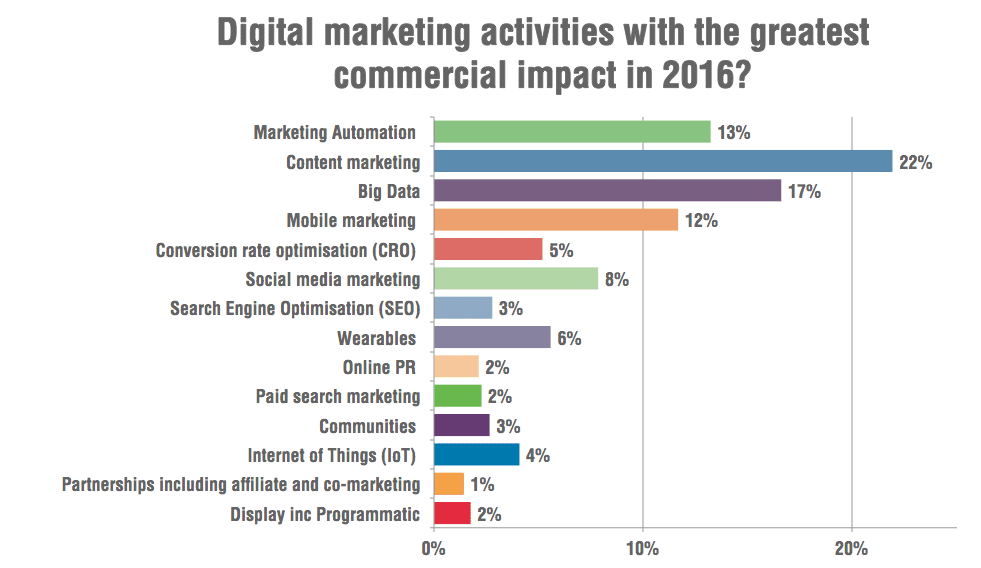
This graph shows the results of our survey as of 8 February 2016. Our poll received over 1,500 answers, so thanks to all those who took part.

Digital Marketing activities with the greatest impact

Here, for your reference, is the full alphabetical break-down of activities which helps explain the results. For example, Big Data is surprisingly high, but this includes market insight and predictive analytics

  • Big Data (including market and customer insight and predictive analytics)
  • Content marketing
  • Communities (Branded niche or vertical communities)
  • Conversion rate optimisation (CRO) / improving website experiences
  • Display (Banners on publishers, ad networks social media including retargeting and programmatic)
  • Internet of Things (IoT) marketing applications Marketing Automation (including CRM, behavioural Email marketing and web personalisation)
  • Mobile marketing (Mobile advertising, site development and apps)
  • Paid search marketing, e.g. Google AdWords Pay Per Click Online PR (including influencer outreach)
  • Partnerships including affiliate and co-marketing
  • Search Engine Optimisation (SEO) S
  • Social media marketing including Social CRM and Social Customer Care
  • Wearables (e.g. Apple Watch, activity trackers, augmented reality)

Trends in consumer purchase behaviour

Following the views from marketers and businesses, changes in consumer use of digital media and technology is core to understanding trends in digital marketing. Today's consumer buying decision is certainly getting more complex...

The increasing complexity of the purchase decision

We're continuing to see consumer decision behaviour increase in complexity. This example of today's complex consumer purchase behaviour from research analysts GfK shows the complexity of today’s customer journeys across multiple devices and through time, particularly for high involvement or high-value purchases, such as insurance in this instance.

Car Insurance Multichannel journey

The graphic shows how involved today's purchase decision is. Over a 35 day period it averaged 9 visits to 5 different websites amounting to 34 minutes in total. The influence of online channels is clear with 82% of purchasers researching online against 4% using offline only.

Increasing mobile usage

This year we have also seen a continued strong growth in mobile use, shown clearly by Mary Meeker's annual mobile trends round-up from earlier in the year. So, unsuprisingly, the use of mobile marketing will continue to be one of key trends to follow in 2016.

Digital Transformation: From 'Digital Silos' to Integrated teams

For some time, there has been increasing talk of a need for a 'post-digital marketing world' marketing world where the use of digital media and technology in marketing has become so ubiquitous we no longer complete separate "digital marketing activities" since they should be fully integrated and simply part of marketing. This thinking is partly driven by changes in consumer media consumption where they continue to consume content in different formats without consciously thinking about which devices or channels. The 'post-digital' thinking is also driven by problems of managing marketing activities in a business where a common problem with upskilling in digital is that 'digital silos' are created where different parts of marketing and their agencies don't communicate effectively giving rise to campaigns that don't work across media.

For example, according to an interview with TFM, HSBC global head of marketing for commercial banking and global banking and markets, Amanda Rendle, has said she has banned the word ‘digital’ to encourage her team to think beyond organisational silos. Rendle says:

We need to go back to what marketing is, and the product is marketing. More people need to remember that, get off the drug of digital being something separate and get back to what we do best".

She says the types of roles she is looking for might end up being called customer engineers or customer journey engineers. A key problem for HSBC, she says, is that it has an abundance of insights on customers but having staff to translate that into actions is a hindrance.

"We need customer insight roles where their job is insight but it’s also about looking at what do those insights really mean? You have so much insight now but can you tell me what we need to do? How do you take all that and turn it into something really useful for our customer? That’s what we absolutely should be doing."

Similarly Jeff Dodds, the Chief Executive of Tele 2 Netherlands since April 2014 and previously CMO for Virgin Media speaking to the CIM Catalyst magazine in Sept 2014 says:

"To talk about digital as some kind of separate entity is to not understand it. Our lives ARE digital is not a thing, it is simply a more flexible, response and efficient way to do business."

He continues,

"There is too much talk about roles: digital job titles, digital strategies". Digital is not something that needs a job title. This perpetuates the myth that it is a singular, siloed thing. I find some of the terminology that is used incredibly frustrating".

Interesting. This certainly shows the way thinking should be heading in future, but it's a long way from the reality for many businesses who are only just starting to get to adjust to digital marketing. In his article, A "Post Digital" World, Really?, Y&R Chairman and CEO David Sable makes the case that, far from being post-digital, we are only at the beginning of being digital, and that fresh ideas can be found everywhere.

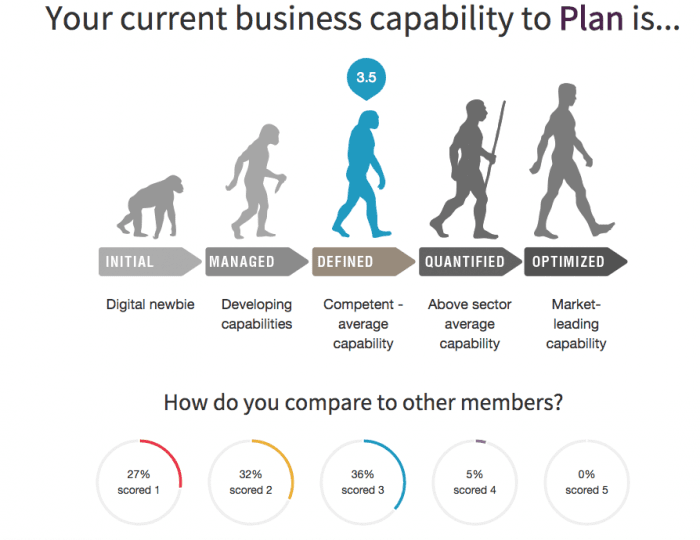
When I talk to businesses and we ask businesses to rate their digital capabilities I find that many are an early stage of adopting digital marketing techniques. Results from our new interactive "Digital Marketing Benchmarking tool" which asks about the detail of what could and should be marketing, shows that many are still at level 1 or 2 on a 5 point maturity scale.

The way I see it, at early levels of adoption you have to make the commitment to transform marketing by setting goals for digital marketing, setting an integrated digital strategy and bringing in specialist digital marketing skills - through a combination of new hires for new roles, use of agencies and re-skilling existing marketers. New marketing processes are also needed which integrate digital to the heart of strategy, investment and marketing campaigns. Naturally this can't happen overnight, particularly since changes in marketing technology are also needed to support the integration of digital marketing, so many businesses now have digital transformation programmes to support this.

Ultimately the aim in the mature organisations should be to reduce specialist digital skills and agencies as digital becomes integrated as part of marketing activities. Digital silos should shrink and specialist Digital marketing managers should reduce in number although I believe there will always be a need for a 'Digital Centre of Excellence' to evaluate the latest digital marketing trends, set standards, manage technology projects and complete advanced optimisation.

The rise of the Chief Marketing Technologist

Another trend within the management of marketing today is the shift in control of marketing technology from IT and Sales to Marketing. Selecting the most relevant Martech from the increasingly complex Marketing Technology landscape is a major challenge as we now literally have thousands of different cloud services vying to be part of the Marketing Stack.

The challenge of integrating digital and traditional marketing

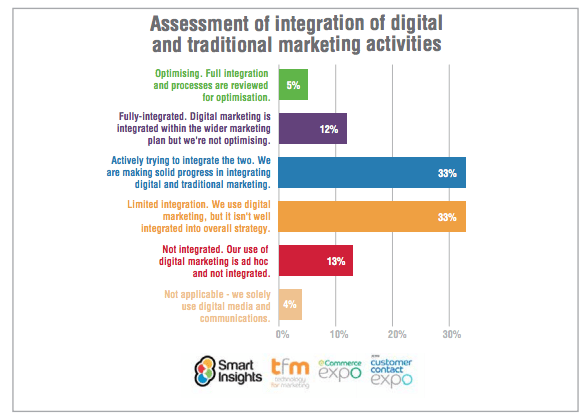
Our latest research on Managing Digital Marketing in 2016 suggested progress as marketers move towards integrated planning of digital and traditional activities, but there is still plenty of room for improvement with only one-quarter of companies satisfied with their level of integration across digital and traditional communications and 5% fully integrated and optimised.'

assessment of integration of digital

The chart certainly shows this is a challenge which many businesses are trying to meet. The most detrimental factor to 'integrated planning' is the lack of planning, as many companies have separate traditional marketing and digital marketing teams who work independently when it comes to planning their marketing as Amanda Rendle refers to when she says:

“In many organisations where they are behind on digital what happens is they hire in someone to be a head of digital or ecommerce as separate functions.”

All of a sudden, that person hires a load of marketer/customer experience champions, so you end up with two marketing departments. For any organisation it’s huge waste of resource to have two teams doing the same thing. That’s the real danger

How do you see it - do we live in a "post-digital world" or do you think specific digital marketing skills and roles will be required.

To see more predictions from Smart Insights commentating on which marketing techniques you should pay attention to in 2016 see our compilation of Digital Marketing Trends for 2016. It covers social media, email marketing and search.

30 Sep 16:36

Why You Should Give Away Your Best Work for Free

by With Gary Vaynerchuk
Gary Vaynerchuk, CEO of digital agency VaynerMedia, describes how he has increased the value of his work.


30 Sep 16:35

How To Keep Your App Users With The 3×3 Rule

by Dave Hoch

With so many apps available to today’s mobile users, there’s a strong risk that your users might be distracted or wooed to some other app – or simply become inactive. In fact, 58% of app users churn in the first 30 days after they download your app, on average. And, over the first three months, 75% of app users will churn.

App User Churn - On Average - Localytics 2015

While this is a scary proposition, the news isn’t all bad. As it turns out, there is a high correlation between app success and how often your app is launched in a certain timeframe. We call it the 3×3 rule.

The More Sessions, The Less Churn

Before we dive deeper, let’s start with the definition of churn. Churn means “inactive” and is usually described in terms of users – i.e. “users who churn” or “users who are inactive.” In the case of an app, churn is further defined by a given timeframe, most commonly a 30 day period.

Our recent research suggests a strong negative correlation between the number of app sessions (a basic unit of measurement for apps) and user churn. In other words, the more sessions app users complete in the first 30 days after downloading an app, the less likely they are to become inactive.

App User Churn by # of App Sessions - Localytics 2015

In the chart above, the X axis is the number of sessions per user in the first 30 days after a user downloads an app. The Y axis is the percent of users who will churn (and return) to your app in the same timeframe.

The data shows:

  • 75% of users who log just one app session in the 30 days after the app download will churn.
  • Only 14% of users who complete 11 or more sessions in the first 30 days will churn.

The 3X3 Rule: 3 Sessions X The First 3 Days

For some apps, like travel apps, 11 sessions in one month is simply unrealistic. Other apps strive for less frequent but longer sessions but, even for these apps, their ultimate goal is still to keep their users engaged over time.

Digging into the numbers even further, we can identify a minimal threshold – or the minimum number of sessions a user must complete – to suggest they have seen value in your app and thus be considered an active user.

If the average percent of users who churn is 58% then, using the graph above, we can deduce most people only use an app 1 – 2 times in the first 30 days.

That means, on average, the critical hurdle is 3 app sessions a month.

Yet, knowing you need users to log 3 sessions may still be not enough. The harsh reality is you’re still facing the potential loss of over 50% of your users. Measuring churn within a 30 day window is the most common benchmark for user churn and retention, but our research found a more critical window to concentrate on when trying to influence retention: the first 3 days after an app’s download.

Why? Because only 29% of your users will churn if you can encourage them to have 3 sessions in the first 3 days after they’ve downloaded your app.

Thus, the 3X3 rule.

The 3X3 Rule for App User Churn - Localytics 2015

3 Ways To Encourage 3 Sessions In The First 3 Days

1. Nail the first session – i.e. the initial onboarding experience – with in-app messaging.

We all know the importance of a good onboarding strategy: using funnels and screenflows, you can track your users through the first steps they take to understand and optimize their first interactions with you. But while you test and optimize, you need a tool to lean on that helps your users get to that a-ha moment.

Enter in-app messaging. Apps that send in-app messages show 2-3.5x higher user retention and 27% more app launches than apps that do not. In-app messages serve as navigational beacons to the app and they can incentivize future use with things like special offers.

2. Remind users of your app with a remarketing campaign.

Forrester recently found that mobile users spend 80% of their time in five apps. While you are growing your userbase and introducing new users to your app, borrow those “mobile moments” by targeting new users with remarketing campaigns on Facebook. After all, it costs more to acquire a new user than it does to keep an existing one.

3. Offer a “new friend” promotion with a targeted push notification or email message.

Push notifications and emails are great communication tools to reach users who are not currently active in your app – when used appropriately. The key is using all the data you have about your users. You can then send a “new friend” promotion with content personalized to them (and personalized just enough to not be creepy).

With 3 sessions in 3 days, you’ll overcome a critical hurdle for retaining your users. But, the 3X3 rule is only the beginning. Churn is a complex challenge that can happen at any stage of a user’s journey with your app. There are many additional strategies for reducing user churn, including predictive app marketing, but regardless of what strategies you employ, the critical next step is to identify your churn risk factors. Learn more about the reasons why a user may churn here.

Methodology

Localytics is the leading lifecycle engagement platform across more than 2.7 billion devices and 37,000 mobile and web apps. Localytics processes 120 billion data points monthly. For this study, Localytics used retention cohort analysis to examine the number of users who were still engaged with the app 30, 60, and 90 days after download. Further, for the 3×3 Rule, Localytics examined the effect of app engagement specifically in the first 3 days and it’s overall impact on 30, 60, and 90 day retention. The timeframe for this study was users who downloaded apps in May 2015 and their retention in the subsequent 3 months. The sample is across over 40 million Android and iOS devices.

10-ways-to-better-engage-users-cta

30 Sep 16:35

6 things every tech company should consider before going public

by VB Staff
stock exchange

SPONSORED:

This sponsored post is produced in association with Avalara.

An IPO may be one of the most significant events in the life of your business. But graduating to the big leagues means big responsibility. When your company is in its high growth phase, you’re probably not thinking about compliance. You are probably more focused on ramping up the business instead. But as you near a liquidity event, that is when you need to address certain issues that weren’t on the radar before.

Here are six fundamental tax and control considerations CFO’s of any high-growth tech company should contemplate when preparing for an IPO.

1. Sales tax of prior period exposure and ongoing compliance

As you get ready for your IPO, you want to get an idea of your sales tax exposure. Even if you don’t take the time to totally clean it up, you want to at least know how much you owe, so you can be prepared for the auditors and put that money aside.

The first thing to consider is where does your company have nexus? Nexus is a situation where a state can obligate you to pay sales tax for a product sold or service delivered in that state. Generally, nexus is created when you have a physical presence, offices, warehouses, and in some cases, even a sales representative, in that state.

Without a physical presence, you may be able to sidestep sales tax. The problem is, states determine nexus differently. What’s more, digital products sometimes fall under different categories as well, so you want to make sure you’ve got all your basis covered.

2. Planning and structuring for international sales tax

As an online company, one way to expand profits is by selling your physical or digital wares across national borders. But this is where you have to be careful. As you start selling global, you want to keep an eye out for the value added tax, or VAT.

VAT is usually due where goods and services are consumed, even if the seller does not have a local presence. Most countries (with the notable exception of the U.S.) have VAT. However, some countries have more than one type. And even though these VAT regimes have many features in common, different countries vary on how they implement the tax.

As you plan for your IPO, VAT is one thing you don’t want to get wrong. Failing to deal with local VAT obligations can lead to audits, backdated demands, having goods seized, and even fines and interest. Fortunately, products like Avalara AvaTax automate both U.S. tax and VAT calculation, keeping you up-to-date in an ever-changing compliance environment.


Join us for a live webinar on Thursday, September 30 at 10 a.m. Pacific, 1 p.m. Eastern, as three high-power tax consultants from the tax audit firm Armanino share critical info on what you need to know if you’re considering expanding, selling, or launching an IPO.

Register here for free.


3. Valuing and understanding limits on net operating losses

Net operating loss (NOL) is a tax credit you earn if your deductions for the year are greater than your revenues. Generally speaking, you can deduct accumulated NOLs from taxable incomes. But here’s where it gets tricky: once you go public, your NOL may be limited.

Section 382 of the Internal Revenue Code imposes an annual limit on the NOL carryover after an IPO or other change of ownership. In order to estimate the availability of NOLs, you will need to conduct a detailed analysis of changes in capital and ownership structure over a three-year period as well as valuation of the company at different dates.

4. Consider upgrading to a sophisticated cloud-based ERP

Rules and rates for corporate sales tax change constantly. Keeping up with those changes is not for the faint of heart. If you are using an outdated back-office enterprise resource planning (ERP) system or shopping cart technology, you risk being non-compliant. Legacy solutions that aren’t cloud-based are particularly vulnerable to this.

If you want to stay compliant, look for an ecommerce shopping cart software that integrates with your company’s inventory, purchasing, catalog, and fulfillment functions. A cloud-based solution, one that updates automatically, can ensure you have the functionality and the comprehensiveness you need when it comes to managing sales tax.

5. Setting up internal controls and prepping for SOX

Getting IPO ready means putting in place the systems and controls you will need to produce financial information quickly and accurately. Right after you file your F-1 Form with the SEC, and at least three months before going public at a minimum, you want to develop a checklist starting with Sarbanes-Oxely (SOX).

Among other things, SOX requires you to certify that your financial reports are accurate and complete and that you have the proper controls in place to quickly predict shortfalls and ferret out fraud. Setting up internal controls and SOX compliance must be in place well before the IPO process, so make sure you get a head start on this.

6. Reconciling revenue recognition issues

For many private companies, the process of going public requires a fundamental shift in reporting and planning. This brings us to our final item: Revenue, one of the most important measures of your company’s financial health. In your S-1 filing, you’ll need to indicate how and when your company counts sales as revenue.

Sounds straightforward, but it’s not. The Financial Accounting Standards Board (FASB) recently announced a new revenue recognition standard. Even though the first applicable reporting period is in 2017, the time to begin preparing is now, especially if you choose to adjust the results from prior periods and provide the three-year comparison required under retrospective application of the new guidance.

For many high-tech companies, going public means you’ve made it. But staying successful after the IPO means bringing tax and valuation issues to the forefront. Your major accounting systems need to be ready for prime time. Smart CFOs who want to stay on top of their game increasingly look to SaaS technologies as a cost-effective method for meeting the rigorous accounting requirements of a public company.


Sponsored posts are content that has been produced by a company that is either paying for the post or has a business relationship with VentureBeat, and they’re always clearly marked. The content of news stories produced by our editorial team is never influenced by advertisers or sponsors in any way. For more information, contact sales@venturebeat.com.


30 Sep 16:34

Nietzsche on How to Find Yourself and the True Value of Education

by Maria Popova

“No one can build you the bridge on which you, and only you, must cross the river of life.”


“Do you have the courage to bring forth the treasures that are hidden within you?” Elizabeth Gilbert asked in framing her catalyst for creative magic. This is among life’s most abiding questions and the history of human creativity — our art and our poetry and most empathically all of our philosophy — is the history of attempts to answer it.

Friedrich Nietzsche (October 15, 1844–August 25, 1900), who believed that embracing difficulty is essential for a fulfilling life, considered the journey of self-discovery one of the greatest and most fertile existential difficulties. In 1873, as he was approaching his thirtieth birthday, Nietzsche addressed this perennial question of how we find ourselves and bring forth our gifts in a beautiful essay titled Schopenhauer as Educator (public library), part of his Untimely Meditations.

Nietzsche, translated here by Daniel Pellerin, writes:

Any human being who does not wish to be part of the masses need only stop making things easy for himself. Let him follow his conscience, which calls out to him: “Be yourself! All that you are now doing, thinking, desiring, all that is not you.”

Every young soul hears this call by day and by night and shudders with excitement at the premonition of that degree of happiness which eternities have prepared for those who will give thought to their true liberation. There is no way to help any soul attain this happiness, however, so long as it remains shackled with the chains of opinion and fear. And how hopeless and meaningless life can become without such a liberation! There is no drearier, sorrier creature in nature than the man who has evaded his own genius and who squints now towards the right, now towards the left, now backwards, now in any direction whatever.

Echoing Picasso’s proclamation that “to know what you’re going to draw, you have to begin drawing,” Nietzsche considers the only true antidote to this existential dreariness:

No one can build you the bridge on which you, and only you, must cross the river of life. There may be countless trails and bridges and demigods who would gladly carry you across; but only at the price of pawning and forgoing yourself. There is one path in the world that none can walk but you. Where does it lead? Don’t ask, walk!

Illustration by Tove Jansson for a rare edition of Alice in Wonderland. Click image for more.

But this path to finding ourselves, Nietzsche is careful to point out, is no light stroll:

How can man know himself? It is a dark, mysterious business: if a hare has seven skins, a man may skin himself seventy times seven times without being able to say, “Now that is truly you; that is no longer your outside.” It is also an agonizing, hazardous undertaking thus to dig into oneself, to climb down toughly and directly into the tunnels of one’s being. How easy it is thereby to give oneself such injuries as no doctor can heal. Moreover, why should it even be necessary given that everything bears witness to our being — our friendships and animosities, our glances and handshakes, our memories and all that we forget, our books as well as our pens. For the most important inquiry, however, there is a method. Let the young soul survey its own life with a view of the following question: “What have you truly loved thus far? What has ever uplifted your soul, what has dominated and delighted it at the same time?” Assemble these revered objects in a row before you and perhaps they will reveal a law by their nature and their order: the fundamental law of your very self. Compare these objects, see how they complement, enlarge, outdo, transfigure one another; how they form a ladder on whose steps you have been climbing up to yourself so far; for your true self does not lie buried deep within you, but rather rises immeasurably high above you, or at least above what you commonly take to be your I.

Art by Isabelle Arsenault from ‘Mr. Gauguin’s Heart.’ Click image for more.

With this, Nietzsche turns to the true role of education in the excavation of this true self — something Parker Palmer addressed a century later in his beautiful meditation on education as a spiritual journey — and writes:

Your true educators and cultivators will reveal to you the original sense and basic stuff of your being, something that is not ultimately amenable to education or cultivation by anyone else, but that is always difficult to access, something bound and immobilized; your educators cannot go beyond being your liberators. And that is the secret of all true culture: she does not present us with artificial limbs, wax-noses, bespectacled eyes — for such gifts leave us merely with a sham image of education. She is liberation instead, pulling weeds, removing rubble, chasing away the pests that would gnaw at the tender roots and shoots of the plant; she is an effusion of light and warmth, a tender trickle of nightly rain…

In a sentiment that calls to mind David Foster Wallace’s superb commencement address on the true value of education, Nietzsche concludes:

There may be other methods for finding oneself, for waking up to oneself out of the anesthesia in which we are commonly enshrouded as if in a gloomy cloud — but I know of none better than that of reflecting upon one’s educators and cultivators.

Complement the altogether fantastic Schopenhauer as Educator with Nietzsche on the power of music and his ten rules for writers, then revisit Florence King on how to find yourself and Parker Palmer on how to let your life speak.

Thanks, Dani


donating = loving

Bringing you (ad-free) Brain Pickings takes me hundreds of hours each month. If you find any joy and stimulation here, please consider becoming a Supporting Member with a recurring monthly donation of your choosing, between a cup of tea and a good dinner.


newsletter

Brain Pickings has a free weekly newsletter. It comes out on Sundays and offers the week’s most unmissable reads. Here’s what to expect. Like? Sign up.

30 Sep 16:34

10 Sales Productivity Hacks that Worked for Us

by Jeremy Boudinet

Want a more productive salesforce? You came to the right place. We break down 10 ways to drive sales productivity.

Like washboard abs, a perfect golf swing and the total respect of your in-laws, the quest for sales productivity is one in which the end goal will likely never be obtained.

The journey still matters. Incremental improvements in sales productivity leave everyone thankful. And as we’ve profiled before, you can never get enough good sales productivity advice.

10 Proven Sales Productivity Hacks

For this post, we’ve selected 10 of our favorite sales productivity enhancements that are proven, cost-effective and relatively easy to implement.

We recommend trying all of these at least once in your sales team, especially if you follow an inside sales process.

As for selection process: We’ve tried dozens of sales productivity hacks in our own sales force. We whittled down the 10 that worked best for us, and profiled each one below.

1) Run a Team Sales Contest

Want your next sales contest to enhance productivity better than any you’ve run before? Run a team sales contest.

Team sales contests work better than your regular ol’ sales leaderboard. Your goal is to achieve sales productivity enhancements across as much of your sales force as possible, right?

team sales contest

These types of sales contests add another layer of motivation that reaches not just top performers, but middle and lower-tier performers as well.

Last but not least, a team sales contest shakes things up. The average sales rep’s brain will respond much better to this type of contest than participating in your company’s 35th consecutive monthly sales contest focused around individuals striving to end up on a leaderboard.

Enhancements to sales productivity:

  • Shake things up.
  • Get the whole team involved.
  • Create opportunities for peer coaching and collaboration.

2) Track an Advanced Sales Metric

Nothing hurts productivity more than the feeling that you’re a hamster on a wheel. Which is why you should throw advanced metrics into the mix of sales metrics your team is tracking.

advanced sales metrics

lead conversion

Advanced metrics (example: lead conversion rate) track performance, instead of productivity. Your hard-working reps will appreciate that their core competencies are being valued as much as their hustle.

And perhaps most importantly, advanced metrics add continuity to your sales reps’ conception of their sales process. They illuminate the foundational “Why?” behind the “How?” and clarify the path to success.

Enhancements to sales productivity:

  • Emphasizes performance, not just productivity.
  • Increase understanding of the sales process
  • Add a “Why?” to the “How?” of your sales process.

3) Experiment with Social Selling

As we discussed in our guest editorial for the Salesforce Blog, the best way for sales managers to combat the inevitable distractions their team faces is to co-opt them.

social selling

Bonus points if they shout out your Marketing Director.

All joking aside, though, social media is a prime example that adds additional value by breaking up the repetition of one’s daily cold call/email grind. In other words, it leads to a less monotonous sales process.

Sales-Marketing alignment receives benefits as well, as social selling forces reps to take a step back and think like a marketer. Efficient sales teams will use this tactic to foster more and better conversations between sales and marketing.

Enhancements to sales productivity:

  • Break up the monotony of calls and emails.
  • Proactively combat potential distractions.
  • Increase sales-marketing alignment

4) Trial a Sales Automation Tool

For those unfamiliar, sales automation tools are platforms you can add-on to Salesforce, phone systems, etc.

salesvue

They perform a few key functions, such as automating CRM data entry, mapping out your call and email list for the day and providing insightful analytics on where you are excelling and struggling in your process.

There are lots of great tools out there, but we recommend giving SalesLoft first crack.

Sales productivity enhancements:

  • Automate CRM data entry and tedious productivity-killers.
  • Puts the process in front of the rep.
  • Less uncertainty. More action.

5) Create a Sales ‘QBR’ Leaderboard

QBR stands for Quarterback Rating and signifies the NFL’s preferred method of measuring overall QB performance.

Incorporating a number of metrics into its algorithm, QBR provides a holistic, single score conceptualization of performance. Your sales reps should have their own version of this.

sales leaderboard

Sales QBR Leaderboards are perfect complements to standard, revenue-based leaderboards.

They offer recognition not just to high performers, but those who brought the highest levels of process adherence, sales competency and sales productivity for the duration of the contest.

Sales Productivity Enhancements:

  • ​Rewards total performance.
  • Puts focus on process.
  • Complements classic, revenue-based sales leaderboards.

6) Challenge Another Office

If you manage a larger sales force, with multiple offices, and you really want to get the juices flowing – challenge a rival office to a week-long sales competition.

Up the stakes by creating your own version of the Golden Egg Trophy and let the winner keep it until the next matchup.

sales competition

The sales productivity benefits here are more short-lived than from others. But for prideful, closely-matched sales offices, the competitions themselves will be epic enough to justify the cost of a trophy.

Sales Productivity Enhancements:

  • Increases sales force transparency.
  • Creates unique, compelling stakes (office pride and reputation).
  • Incentivizes pervasive coaching and collaboration.

7) Invest in Email Signature

For $40 per person, you can automatically increase the credibility and effectiveness of your cold emails. Further, you can reinforce professionalism in your sales team’s overall email correspondence.

I bought Wisestamp out-of-pocket several few months ago and can vouch for its effectiveness.

sales productivity email

Even though I’m in marketing, I still frequently send my own version of sales pitches (usually requests for media coverage) fairly frequently.

Having this image automatically generate at the end at the end of my emails lets recipients know I am a real person, provides multiple ways for them to connect with me and my company and projects an all-around more professional sensibility.

Best of all, it gets me in the right mindset and makes me feel more ownership of my correspondence’s content. It’s worth the investment and even better for sales teams than it is for me.

Sales Productivity Enhancements:

  • Personalizes cold emails.
  • Increases inclination to correspond savvily and professionally.
  • Give prospects links to key sites and media.

8) Adopt an Email Tracking tool

Ever since Cirrus Insight integrated Salesforce and Gmail, sales teams have been able to track and update the results of their email correspondence in simpler, more insightful fashion.

Cirrus and similar tools like Yesware let senders see who keeps opening their email, when and how often.

Yesware

Again, I began paying out of pocket for Yesware ($10 per month) and haven’t regretted it. Our whole sales force uses Cirrus Insight and gives it rave reviews.

All in all, a highly justifiable expense that will boost your sales productivity.

Impacts on Sales Productivity:

  • Cheap, effective way to gauge prospect interest.
  • A/B test subject lines, attachments/links and messaging.
  • Typically fun to use and integrate with Salesforce.

9) Replace Sales Gongs with Song Clips

Our industry colleagues at Hoopla did it first and we’ve followed suit.

For Hoopla and Ambition users, the sound they hear upon closing a huge deal is no longer a gong, but a 10-second song clip of their choice, taken from Youtube.

Unsurprisingly, sales reps in their mid-20s tend to get much more fired up by hearing “Started from the Bottom” by Drake as opposed to a gong that was en vogue way back in 8th century China.

Sales Productivity Impacts:

  • Much more powerful recognition.
  • Able to customize/personalize.
  • Appeals to Millennials.

10) Put 80s Action Movies on Office TV

Just saying — it works for us.

sales productivity

30 Sep 16:33

Why a Hot Seat Is Shockingly Good for Business

by Pamela Wilson

How a professional group helps grow your business

Back in 2004, the heat was on for me and my little marketing and design studio.

In those days, I was a single mom with a 10-year-old and a 12-year-old, and I desperately needed my business to produce.

And by that, I mean produce profit. I needed money, honey — to support my family, run my household, and build my business.

I knew it was time to ramp up my efforts. My business was successful, but it was time to take it to another level.

Around that time, I started hearing about mastermind groups.

And now, when I look back, I recognize that joining a mastermind group profoundly changed my business for the better, especially because of one specific exercise these groups do.

That’s what I’m going to share today. Because earlier this month, we began doing something similar inside one of our communities at Rainmaker Digital.

Mastermind groups around every corner

You know that thing that happens when you’re interested in something and all of the sudden you start seeing mentions of it everywhere?

It’s called frequency illusion, and that’s what happened to me with mastermind groups. Everywhere I looked, I saw mentions of them.

But every mastermind group I found met in person, either early in the morning or later in the evening. And those were both times of the day when I had to be on Mom Duty. Attending a meeting outside the home wasn’t an option.

And yet, I was convinced that a mastermind group was what I needed. I knew I would benefit from the experience and viewpoints of other business owners, and it would help me position my business where it needed to be.

So, I continued to search and finally found a “virtual” mastermind group that met by phone. I applied, was accepted, and prepared myself for our first meeting.

Group therapy for my business?

I was a little nervous going into the first meeting. Was it going to be like a confessional? More like group therapy? Would I feel comfortable talking to these strangers about my business?

Every scenario I imagined had some level of discomfort baked in.

At the start of the meeting, the group leader explained that we would take turns sitting in the “hot seat” talking about our businesses.

We’d start by reporting successes — what had gone well in the past month. Then we’d move to sharing our biggest challenges — what we needed help with. The group would listen and contribute ideas to help the person in the hot seat.

Here’s where I was wrong

This is embarrassing to admit, but here’s what I thought:

“When it’s someone else’s turn, I’ll listen politely, provide the best feedback I can, and count the minutes until it’s my turn. And when it’s my turn, I’ll get a lot out of sharing my successes and challenges, and hearing the feedback from the group. The real value will come from taking my turn in the hot seat.”

I couldn’t have been more wrong.

I learned a lesson that day and relearned it every single time we met as a group.

All the different businesses that exist in the world share many common problems.

When I look back on my mastermind meetings, I got as much or more from listening to other business owners talk about their triumphs and tragedies as I did when I shared my own.

Here’s what happened:

  • The mindset tips shared with the chiropractor? I was able to use them to improve my own mindset.
  • The negotiation techniques offered to the professional organizer? I used those the next time I needed to negotiate something.
  • The website advice that went out to the voice coach? It made me look at my own site in a new light.

The funny thing about calling your time in the spotlight a “hot seat” is that the name is only partly accurate.

Instead of feeling like you’re under interrogation, you feel like you’re being warmly embraced by a community of professionals who support and encourage your efforts.

Maybe they should be called “warm seats.” :-)

New: Authority Business Coaching calls

Last month, we began offering Authority Business Coaching calls inside our private site for advanced content marketing training.

We’ve brought a taste of this “warm seat” style of education to Authority, and the results so far have been pretty amazing.

The main challenge our first guest brought to the session was a need to improve cash flow in his business.

Here’s what we heard from our webinar attendees:

Money is so hard! And talking about it is even harder. This conversation is great.

And this:

I absolutely relate to this conversation. This is a great session.

And from the person sitting in the hot seat? Here’s what he said after it was over:

The session reinforced my ideas about what needs to happen, but it also gave me a sense of direction and more clarity. I feel a bit overwhelmed at times, and the coaching call left me with a sense of ‘I can do this.’

As a member, I think it is a highly appealing format for a show. It helps build a sense of community, while at the same time having a chance to be informative and valuable. All of us are in different stages of growth and success, but the problems we face are very similar.

Exactly. The problems we face are very similar.

And you’ll find that you can learn a tremendous amount by listening and sharing with people who own businesses that are quite different from yours.


Find out when Authority will open again

Our Authority Business Coaching calls happen once a month inside Authority, our private community for advanced content marketing training.

Our community is temporarily closed to new members. You’ll be the first to find out when it reopens when you sign up on this page.

About the author

Pamela Wilson


Pamela Wilson is Executive Vice President of Educational Content at Rainmaker Digital. Follow her on Twitter, see her Copyblogger images on Instagram, and find more from her at BigBrandSystem.com.

The post Why a Hot Seat Is Shockingly Good for Business appeared first on Copyblogger.

30 Sep 16:29

How To Enable Salespeople To Navigate B2B Buying Dynamics

by Tamara Schenk

shutterstock_310254482Sailing requires a lot of capabilities. As a sailor you learn various mechanical principles – how the equipment works, and based on that, what to do on the sailboat. You have to become an experienced sailing practitioner to be able to sail the ocean. But these mechanical skills aren’t sufficient. You also have to learn the essentials of how to navigate.

Sailing experience is actually built on all the things you can control – managing the sailing mechanics on the boat – and on your ability to navigate all the things you cannot control – nature’s dynamics.

Mechanics are predictable. Dynamics are probabilities in uncertainty

Imagine the mechanical steps you take to create a new account or a new opportunity in your CRM system. Mechanics describe precisely in which way something has to be done. Mechanics have a lot to do with “if/then” clauses. In this example, you need the account data before you can create your opportunity. Mechanics are pretty predictable. If all the required data are entered, a new account or a new opportunity will be created.

Dynamics instead represent probability, possibility, and uncertainty in often complex environments. Imagine your recent conversations with different B2B buying teams. Were these situations predictable? You have probably developed a few scenarios to get prepared for the conversations. But at the end, a slightly different scenario may have happened. Dynamics are not really predictable.

Navigating different dynamics along the customer’s journey

  • Change dynamics in the awareness phase of the customer’s journey:
    A challenge occurs, the situation gets analyzed, and options for tackling the challenge are discussed. Customer stakeholders often come from different functions and roles, and have different approaches regarding how to address the situation. The key question is, “Do we change the current state for a better future state: Yes or no?” The decision can be “yes,” “no,” or “not now.” For sales professionals, the biggest challenge here is to provide perspectives that help the stakeholders make a decision to change the current state for a better future state.
  • Decision dynamics in the actual buying phase of the customer’s journey:
    The buying team may change, because some senior executives may delegate the project and procurement people may join the buying team. Decision dynamics are focused on how to make the best buying decision as a team with different perspectives and approaches to achieve the best results and wins with the lowest possible risks. Decision dynamics have different characteristics than change dynamics. For sales professionals, the biggest challenge is to contribute to the customer’s value calculation in a way that’s beyond TCO or product-driven ROIs to be perceived as the best possible buying option. Business value ideally tackles the top or the bottom line.
  • Value dynamics in the implementation and adoption phase:
    When the implemented products and services deliver the value that has been bought, thoughtful value confirmations tailored for each buyer role are they key to developing future business. This step is often overlooked, but as buyers have different approaches regarding how to tackle a situation, they will also have different perceptions of value.
    For sales professionals, the biggest challenge is to get back to the initially involved senior executives, even if they have delegated the project for implementation. These value confirmation conversations can lead directly to new opportunities.

What makes the difference in these situations? Mechanics or dynamics?

Mechanics, as we defined the term above, are everything that can be controlled by the sales professionals. Dynamics are what happens in reality, in complex situations with different stakeholders, and their different approaches, changing objectives and an often-changing situational context. In those complex, often unpredictable environments, sales professionals need a solid foundation of skills and competencies, customer, market and product knowledge, strategies and specific expertise – just to remain in the game. What makes the difference is their ability to quickly adjust their strategies, behaviors and activities to new, changed and complex situations. That’s navigating dynamics.

Navigating dynamics requires adaptive competencies – a key challenge for sales enablement

Developing adaptive competencies happens in iterations of training, practice, learning and coaching   Whatever the specific challenges in a sales organization might be, a solid foundation of selling competencies, various knowledge areas, and customer management strategies has to be in place before adaptive competencies can be developed.  You don’t train a new sailor to navigate the ocean before learning the basics.

Adaptive training sessions can consist of various highly interactive sessions, including real-world simulations. Those curriculums should consider cycles of training, practice, and learning, reinforced by coaching before the next cycle begins with training. Those cycles ensure that people can learn what works for them and adjust what didn’t work so far. This approach also requires that coaching is an integral part of reinforcing and building adaptive competencies. Integrating the frontline sales managers early builds the foundation for execution and reinforcement. Key learning objectives should include situational awareness, applying principles instead of rules, and creativity, as well as critical and strategic thinking.

Adaptive competencies are what sales professionals need as an add-on to their mechanics. Adaptive competencies enable them to navigate the dynamics of today’s ever-changing, complex, buyer-driven world.

Questions for you:

  • How do you navigate complex B2B buying dynamics?
  • How important is the alignment of your sales process to the customer’s journey to successfully navigate buying dynamics?
  • How does your engagement principle reflect buying dynamics?

Related blog posts:


This article was initially written for Top Sales Magazine, September 29, 2015.

The post How To Enable Salespeople To Navigate B2B Buying Dynamics appeared first on Sales Enablement Perspectives.

30 Sep 16:29

Stop Treating Your B2B Buyers Like a B2C

by Laura Ballam

Google Logo

Make your B2B customers happy by treating them right.

Although the B2B buying experience is currently changing and beginning to resemble more of a B2C experience, that doesn’t mean you should treat your B2B buyers the same way. According to Customer Experience Insight, the B2B buying experience is increasingly going mobile, buyers are doing more research before they purchase and there is a larger focus on quality customer service – all historically B2C traits. Still, the fact that B2B buyers are different than B2C remains, and you shouldn’t treat them the same. Having the right customer service tools will help you provide the best B2B service, but the right tools can only help so much. It’s imperative that you’re focusing on the right things and treating your customers like the businesses they are.

Really know your buyer
In B2B customer service, you need to know what your buyer needs and why. Remember, you’re not selling to a single consumer. Your buyer is a business, and businesses don’t make frivolous purchases. Every time a business buys a product, it’s for a reason. You need to help make sure that the product or service you’re selling is constantly providing a solution to the business. You can be sure of this by really knowing what the business does and how it does it. If you understand how your product or service fits into their overall business, you can make sure to continue to support its needs as time goes on.

Build a relationship
Getting to know your clientele and how your products and services fit into their needs is the start of what should be an ongoing and communicative relationship. B2B business is about building a strong relationship. While some would say that the B2C relationship works the same way, there is no doubt that the dynamics of the relationship are different in B2B. You can’t treat your B2B relationships the same way you would B2C. For example, B2B relationships are focused on value and expertise, whereas B2C relationships are about providing the best deal and focusing on trends, according to HubSpot. B2B relationships are often about mutually beneficial situations. This means really listening to each other. According to Business 2 Community, your focus can’t be on plugging your product. You need to actively listen and converse with B2B customers so you’re finding real solutions to problems.

When you listen to your customers as much as you should, you’ll collect a lot of data. Customer service software can help you organize and utilize this information. Without a place for all of your customer information to live, customer service reps can’t build a strong relationship because they will rehash information the customer has already provided. This means the relationship is moving backwards instead of forward. In addition, customer support software allows reps to collaborate on tickets to provide customers with the best possible answer. This type of customer service helps to build a strong rapport with your customers and expand relationships in the future.

Realize that there are many people involved
In most B2C transactions, there’s one or maybe two people making the purchase. This isn’t the case in B2B. You can have a large group of people making the decision, so you need to make sure you’re pleasing all of them. This can put considerable strain on your customer service team. Customer support software helps you manage all of the information on the people involved in the purchasing process. Having a central repository for all your customer information makes it easier for customer service reps to access it when they need to.

Looking for the right B2B customer support software for your business?

See how TeamSupport stacks up against the competition in G2 Crowd’s 2015 Help Desk: Best of Breed Report: 

Get the Report

30 Sep 16:29

3 Easy and Effective Ways of Building Your Reputation as a Sales Pro

by KC Claveria

TOP 3 WAYS OF BUILDING

To thrive as a sales professional today, you can’t afford not to build your reputation. That’s because today’s buyers have more information and more choices than ever before. Before contacting a salesperson, a buyer is more likely to learn more about your company by going online. When the buyer does that, you, as the salesperson, want to be included somehow.

So how do you establish your credibility and expertise online? You don’t have to be a marketing or SEO expert in order to do that. Here are three dead-simple steps you could take to start building your presence online—and be more likely to be found by potential buyers and leads.

1. Build your social media presence.

If you work in sales and you’re not on social media yet, you’re doing it wrong. Social selling is the name of the game now, and modern B2B sellers see the value of using social platforms not just to connect with their buyers but also to build their own profile.

Start with the basics: a compelling and kick-ass LinkedIn profile and a public Twitter account. (If you choose to keep your Facebook profile private, that’s totally acceptable.) In these platforms, be sure to fill out your profile completely. Also, use an appropriate profile pic—no avatars, please!

More importantly, post regularly on these profiles. Share content that your buyers will be interested in. Think about your buyers’ industries, and find content that speaks to their business challenges.

Of course, you want to keep it social—that is, actually engage with other people on these networks. On LinkedIn, be sure to “like” and comment on other people’s posts and join relevant discussion groups. You might even want to occasionally recommend someone on LinkedIn. On Twitter, retweet and reply to other people’s tweets. When buyers see that you actually engage in these platforms, that helps build your credibility and expertise.

but-why-meme-generator-social-media-why-1a8b62

2. Produce original content.

The best way to position yourself as an expert is to show off your expertise. Creating valuable, interesting and timely content can help you do that.

If your company has a corporate blog, work with the editor and regularly contribute to it. You should also consider working with your company’s PR team and contribute articles to external websites. (Ideally, these websites have high authority and are media outlets that your leads go to for information.) If your company produces ebooks, work with your marketing team to see if you can be involved. Having ebooks in your name tells buyers that you’re legit and you are someone they should believe.

By regularly creating content that is useful and relevant to your buyers, you’re increasing the likelihood that when they go online to find answers to their business questions, your content will show up. The key to content marketing is to think about it from your buyers’ perspective: what type of information would they be searching for, and how can your content help with their business?

When you create new content and it is relevant to your leads, don’t forget to share it with them. Don’t assume that just because you tweeted your content, your leads will see it. Have a distribution strategy to make sure that your leads see any new content you’ve produced. At the very least, you should send it through email and post it via social media. Be sure to measure engagement metrics like page views and PDF analytics to see if your content is resonating with your buyers.

3. Secure speaking gigs (including podcasts).

If you’re a great public speaker, securing speaking gigs can help you and your company attract leads. Ideally, you’d want to speak at conferences that your target market attends. You’d also want your presentation to be relevant to your buyers and related to what you’re selling.

That said, it’s critical to be not too sales-y when giving presentations. There’s no easier way to lose an audience than to give them a hard sell during your talk.

So how can speaking at conferences help build your online reputation? For one, videos for these presentations are often curated on the web. Some conference attendees also write summary blog posts, which can appear when people search online. Finally, building reputation isn’t entirely an online thing. If you’ve vetted the conference properly, then the event’s attendee list should be a great pool of leads. Impress them with your knowledge and they might approach you—instead of the other way around.

Success in the sales profession today requires building your expertise and marketing yourself. When you provide value to your prospects and leads, it can build your personal brand and ultimately help you sell more.

30 Sep 16:29

When Sellers Can’t Sell

When salespeople struggle to win deals and meet their goals, several things might be causing the problem. It could be because they don’t know how to have conversations with buyers or write effective emails. Or it could be because of issues with sales management.

30 Sep 16:29

6 Revealing Sales Follow-Up Questions to Use on Your Next Call

by esnider@hubspot.com (Emma Snider)

If you've done your pre-call prep work, you probably put together a list of sales questions to ask your prospect an hour or two before your appointment. That's good -- preparation is an important key to success in sales. 

However, there's also a downside to using questions prepared in advance on a sales call. Not sure what I mean? Here's an example.

Salesperson: Can you tell me about your production process?

Buyer: Sure thing. Well, we take Step A first, then Step B, and Step C. But it wasn't always that way -- the entire routine has undergone a major change since Mary took over the team. I wonder if that's the best way to do things ... but that's a story for another day.

Salesperson: Oh, great. Um ... What technology do you use during Step A?

Yikes. The buyer provided a perfect opening for the rep, but because the salesperson was so focused on his prepared questions, he completely missed it.

Sometimes reps can be so worried about getting through all the questions on their list that they fail to truly listen to their prospects. By tuning into what the buyer is telling you -- and the unspoken cues that signal they're holding back -- salespeople can adroitly pivot their approach to get to pain faster and better understand the situation.

When you sense there's more to discover in a particular area, set your questions aside for a moment and unleash one of these six follow-up questions. 

1. "Why is that?"

Salespeople love it when buyers are forthcoming about the issues they're facing. But not so fast -- are these issues really problems? Or are they symptoms of a totally separate root cause? To get to the true source of the pain, ask your buyer to reflect on why the issue is happening. They could be right or wrong about the cause, but their answer will reveal their current understanding of the scenario as well as the larger implications for the company.

2. "So what you're saying is ... ?"

According to sales trainer Melanie Lane, one of the most powerful things a salesperson can do is rephrase their buyer's words. This not only helps to prevent misunderstandings, it also prompts the prospect to explain further. In addition, paraphrasing indicates you're fully tuned in to the conversation.

3. "And what does that mean for you/the business?"

Sure, a problem might be annoying. But until the salesperson understands how it impacts the prospect or the company, they won't be able to get a grip on its importance. Prompting a buyer to talk about the implications of an issue can also solidify pain in their mind, inspiring them to pursue a solution sooner rather than later.

4. "Is that like what you said earlier about X?"

Drawing connections between the prospect's comments signifies your active interest, in addition to helping you more fully understand the problem at hand. Strive to get as complete a picture of the issue as possible by tying together loose strands and fitting all the pieces together.

5. "[The same question stated slightly differently?]"

If a buyer doesn't answer your question completely, don't be afraid to rephrase and re-ask. The worst thing you can do is pretend you understood and move to a different topic. Keep in mind that you can't help the prospect if you can't grasp their needs. Therefore, acting like you're on the same page when you really aren't is a waste of both parties' time. 

6. "Oh?"

The simplest question on this list can also be the most impactful. If it's clear that the prospect is holding something back and just needs a bit more prompting to spill their true feelings, a simple "Oh?" can do the trick. Asking another question might break the buyer's train of thought, but "Oh?" keeps the flow going and the buyer talking.

On your next sales call, adopt the mindset of a journalist. Instead of sticking religiously to your list of questions, listen for openings and pursue them. Allow the conversation to take an turn if it helps you get a better handle on the buyer's business needs. By getting up to speed faster, you'll be able to provide help faster. Win-win.

Subscribe to HubSpot's Sales Blog

30 Sep 16:29

How to Revamp Your LinkedIn Profile to Sell More [Infographic]

by esnider@hubspot.com (Emma Snider)

You're not the only person doing research in advance of a sales call. While salespeople look up their buyers on LinkedIn, buyers stop by reps' profiles to get a handle on who they'll be speaking with. So your page better be complete, current, and compelling.

But profiles that appeal to prospects are significantly different than those that catch recruiters' attention. Hiring managers are keen to discover how often you beat quota, and by how much. On the other hand, buyers couldn't care less. 

Is your profile packed full of braggy stats and anecdotes? If you're looking for a job, by all means, carry on. However, if you're striving to sell more, you need a profile makeover -- ASAP.

Use the following infographic from Sales For Life to revamp your profile to spark buyers' interest, and rev the revenue-generating engine. 

sales linkedin profile

Get HubSpot CRM today!
30 Sep 16:28

10 Clever Tricks to Get a Buyer's Attention in 8 Seconds or Less

by Conner Burt

We've all heard the claim our attention spans are shorter than a goldfish's -- and shrinking by the minute. The thing is, that's not really true. In fact, "Goldfish can perform all the kinds of learning that have been described for mammals and birds," says Professor Felicity Huntingford, who's spent more than fifty years studying fish behavior.

She continues, "They've become a model system for studying the process of learning and the process of memory formation, exactly because they have a memory and because they learn."

Your prospects might have the ability to focus more than eight seconds. The problem is, they just aren't willing to give most salespeople more of their time and attention without them having earned it.

So, like the best bull riders, saddle up, and use these eight tactics to grab a prospect’s attention in eight seconds or less and send better email.

How to Get a Prospect's Attention

  1. Use a GIF
  2. Reference their LinkedIn
  3. Engage with them on social
  4. Write a clever subject line
  5. Call out someone who works at their company
  6. Be humorous
  7. Provide choices
  8. Revamp your email signature
  9. Send a video
  10. Leave a voicemail

1. Insert a custom or funny GIF

Visuals are often more impactful than words. Depending on what you’re selling, think about the picture you want to paint for the prospect, and literally paint it.

GIFs are quick to create at scale if you use a combination of PowerPoint or Keynote and my favorite free utility: Licecap.

Here's a custom GIF I made to ask for a meeting with Movoto:

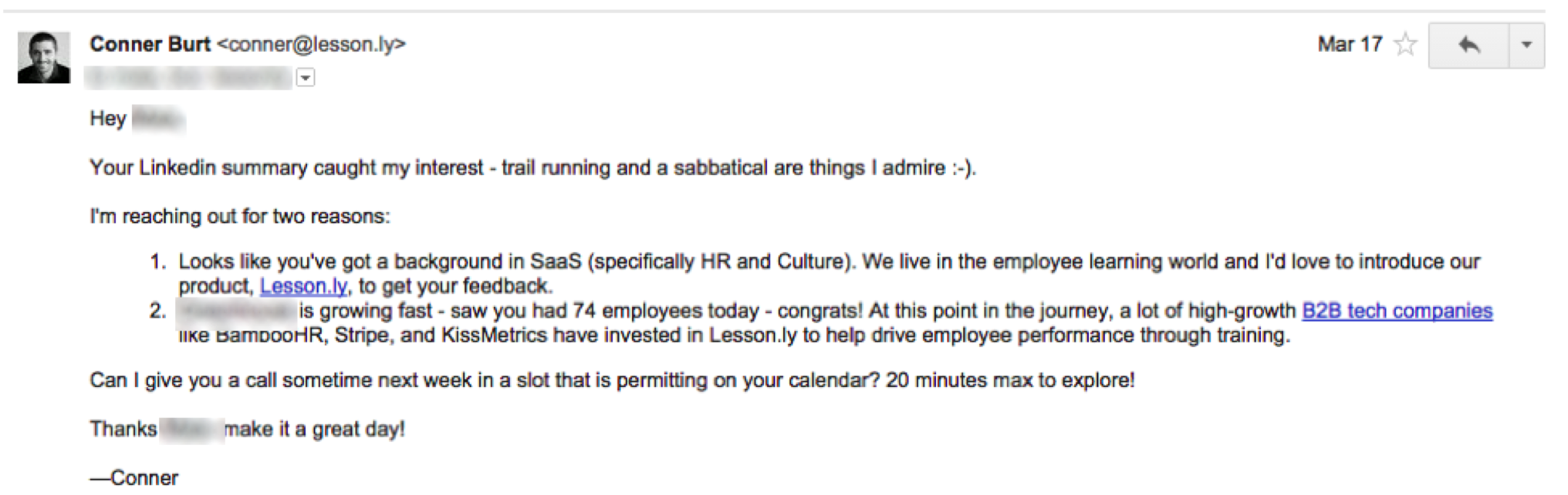
2. Reference the prospect’s LinkedIn bio

The prospect’s LinkedIn summary is your best friend. Insert a reference in your outreach to something that genuinely caught your eye, or a relevant responsibility that makes the prospect a good fit for your offering.

Here’s an example:

(Click to enlarge)

3. Use a social one-two punch

We’ve found that favoriting a prospect's tweet and then requesting them on LinkedIn before sending an email can increase response rates. Social media can take a static, professional relationship and loosen the necktie -- and maybe even create a digital or real-life friendship.

4. Write a clever subject line

Prospects are receiving umpteen junk emails a day. You’re setting yourself up for failure if your subject line mimics those of the usual junk. In fact,35% of email recipients open email based on the subject line alone. In our own testing, a mention of the prospect's company name gets you to at least 65% opens.

Don't be afraid to use humor to get a foot in the door. Here are some funny email subject lines to give you some inspiration.

5. Call out specific company figures

Many public sources and articles reference company-wide goals. Use them to your advantage to catch a prospect's attention.

For example, here’s an email I got from a service provider Lesson.ly ended up partnering with:

(Click to enlarge)

This worked because the salesperson caught our attention with something we knew well: Our annual revenue targets. But it doesn’t have to stop with revenue.

For more on how to source and connect with new prospects, check out this list of tips to help sellers identify and connect with uber-busy buyers. Use them wisely, and you’ll be surprised at the response.

6. Be funny

Take a look at the following screenshot. The prospector's first line is relevant to me, he uses specific fundraising amounts, and then ends with a clever remark: “How was the company party?

Recipe for success.

(Click to enlarge)

Here are several highly effective, unconventional sales email templates real salespeople use.

7. Provide choices

A sales manager once taught me about the "Dear Gibby" email. When you’ve gotten to the point where you’re out of ideas but you haven't been able to prompt an answer, giving the prospect options (with the goal of soliciting some response) will definitely catch their attention.

Here’s an example:


Hey [first name],

Apologies we haven't been able to get in touch! Holler if we (Lesson.ly) can help at some point. To make it easy, feel free to respond A, B, or C.

A) Interested, let's chat ... or

B) Interested, bad timing though ... or

C) Not interested, you failed ... kind of like this poor cat!

via GIPHY

send-now-hubspot-sales-bar

8. Revamp your email signature

We've found that a surprising amount of clicks come in the P.S. line, or in a well-crafted signature. Pro tip: Show some personality. Reps that include “My favorite blog today is ... or “Current song on repeat ... get more human responses to their outreach.

In addition, we use a service called Sigstr to help turn our email signatures into marketing opportunities. Our best campaign to date has been to let potential buyers “meet the team.

9. Send a video

Adding videos to your email can increase click rates by 300%. You don't need to have a video with high production value. A simple iPhone video with light editing can serve as a friendly, personalized way to conduct outreach to your prospects. 

Keep the following three things in mind when you're adding video to your sales emails:

  • Capture attention: Use “video” in your email subject lines and include the thumbnail in the email body. 
  • Establish credibility: Give your prospects a reason to engage with you before asking them to pull out their checkbook.
  • Make it personal: Learn about an individual and their business and use that information to connect with leads individually.

10. Leave a voicemail

Voicemail is still one of the most powerful resources available to a salesperson. Here are some tips for leaving the perfect sales voicemail

But make sure to always send a follow-up email. It gives your prospect a choice in how they get back to you and increases the chances they'll respond to you at all. Just remember these few pieces of advice:

  1. Keep your message short at 30 seconds or less.
  2. Lead with your name.
  3. Get right to your ask.
  4. Close with your phone number -- this ensures that in the age of phone dictation, the last thing your prospect sees is your number, making it easy for them to call back.

By using any of these 10 tricks, you can catch your prospect’s attention fast. Imagine if you deploy a combination of them! You’ll be closing deals with time left on the clock ... to close more deals. Just make sure you're adding value in your email so your prospect gets something out of reading it.

HubSpot CRM

30 Sep 16:28

Deep-value stocks could be on the verge of a turnaround

by Bryan Borzykowski
A Xerox employee slices open a pellette of their product

A Xerox employee slices open a pellette of their product. (Daniel Acker/Bloomberg/Getty)

Many investors are getting reacquainted with that panicky feeling they felt back in 2008. One type of investor, though, may be welcoming the correction. Deep-value buyers—people who look for stocks that are trading at a large discount to what they appear to be really worth—have had a rough go over the past few years. The TWM Deep Value Index, which includes 20 undervalued dividend stocks, such as Xerox Corp. (NYSE: XRX) and Halliburton Co. (NYSE: HAL), has fallen 11.3% since September 2014. Many other stocks considered deep value, such as Staples Inc. (Nasdaq: SPLS) or Reitmans (Canada) Ltd. (TSX: RET), have dropped dramatically as well.

The underperformance is widely attributed to the efforts of central banks to inject liquidity into the markets since the recession. When markets rise across the board, value stocks tend to suffer, says Timothy Rankin, a portfolio manager with Franklin Templeton Investments. People look for companies that are keeping pace, not ones that are trying to turn themselves around.

In a down market, by contrast, investors start paying attention to the stocks that are already beaten up, Rankin says. Value stocks trade at a discount to their peers or their past valuations, so they don’t have as far to fall in a correction. And when they do finally demonstrate sustained earnings growth, the discount shrinks. The upside can be huge.

In fact, value stocks have outperformed growth stocks over time by around three percentage points, and broader indexes by 50 to 100 basis points annually, says Eric Kirzner, the John H. Watson chair in value investing at the University of Toronto. That’s partly due to reversion of the mean, he says, which is the idea that depressed stocks eventually return to their true value.

Value stocks also languished during the Internet-obsessed bull market of the late 1990s. When tech went bust, value came back into style. Kirzner expects value stocks will have a similar moment in the near future.

Right now the energy sector, and commodities in general, is littered with deep-value opportunities. A lot of good companies have been beaten down because of the low price of oil. Dependent as these outfits are on a commodity price out of their control, though, investors have to be extra patient. They may have to hang on for five years before seeing capital gains. However, Rankin thinks gains are generally coming faster than they used to. “Value is getting realized more quickly,” he explains. “There’s more interest from strategic and private-equity buyers, so the value is staying hidden for less time now.”


Choosing deep-value stocks can be tricky. You can fall into a value trap, where the stock price never recovers. So investors must determine the reason the stock has fallen in price and whether its fundamentals still look attractive. When it comes to deep value, as opposed to just value, the catalyst for improvement is often not clear, says Rankin. Maybe another company will buy a part of the business, or its legal issues will be settled or its balance sheet is strong enough to ride through a financial downturn. “You have to have some ideas around how the value could be realized, but it may not be immediately clear how it will happen,” he says.

MORE STOCK PICKS & INVESTING IDEAS:

The post Deep-value stocks could be on the verge of a turnaround appeared first on Canadian Business - Your Source For Business News.

30 Sep 16:28

Content Marketing’s $40 Billion Miss

by Paul Gillin

14975539251_1709ca1fbb_k

Forrester Research has a new report that should serve as a wake-up call to B2B marketers, but probably won’t. Research Director Peter O’Neill is blunt about describing the current content marketing landscape. On the question of the value buyers derive from the content B2B marketers put in front of them, O’Neill reports that “They delivered a resounding thumbs-down,” in Forrester’s most recent research, “responding decisively with phrases such as ‘trash’ and ‘useless.’ ”

Ouch. But maybe not surprising, given the consistently poor grades buyers have awarded marketers in surveys about content marketing.

Two years ago, McKinsey published a startling report entitled “How B2B companies talk past their customers.” It found a nearly total disconnect between the issues that matter to buyers and the messages vendors put in the marketplace. On four of the top five themes that buyers said were most important to them, the amount of content marketers were delivering was deemed “not statistically significant.”

Apparently little has changed in two years. Asked about their opinion of the content vendors provide them, 65 percent of business decision makers told Forrester, “much of it is useless.” Nearly two-thirds of IT decision makers said they routinely scan the information and then throw it in the trash.

Why do B2B marketers so consistently miss the boat? In my opinion, it’s because they are denied access to the buyers they need to reach. Instead of understanding them as people, they file them into sterile demographic categories. Ask a typical B2B marketer to profile his or her audience and you’ll get a laundry list of data about buying authority, title, company size, and budget.

These things have nothing to do with buying decisions. In scenarios involving millions of dollars, buyers are far more likely to be motivated by factors like trust, confidence, security, pain avoidance and perceived value. However, most B2B content marketing I’ve seen focuses on features and comparisons. They sell a solution without getting a clear fix on the problem.

Understanding buyers means talking to them. That might involve attending a trade show, convening a buyers council or simply picking up the phone. It means asking them about their motivations, fears, ambitions and anxieties. In my experience, marketers aren’t averse to doing this, but their sales organizations guard their customers like a dog protects a prized bone. The head of sales in companies like these needs to understand that marketing can’t do its work without learning the language of the people they market to.

Analyzing customer motivations can yield eye-opening insights. While conducting a content marketing seminar for a large software company last year, I split the group in half and asked each group to model the personas of one of their two most important buyers. They discovered that one target group tends to be free-wheeling risk-takers while the other inclines toward caution and certainty. Yet the group was talking to both of these diametrically opposed personality types with the same language. Hopefully, they aren’t doing so anymore.

North American marketers spent more than $40 billion on content marketing in 2012, the most recent year for which I could find statistics. That seems a lot to gamble trying to reach people you don’t even know.

Creative Commons photo by Dave Crosby via Flickr.

30 Sep 16:20

Sales Ops Makes Sales Boring

by Colin Fong

Sales is a bipolar profession. A single day in the life of a sales rep can go from gut-wrenching despair to utter ecstasy in a matter of minutes. Those swings are driven by uncertainty. Most salespeople have no idea if they will hit their number until midnight on the last day of the month.

The thrill of the chase is what makes sales exciting, and the uncertainty of missing your number makes it terrifying.

Those who can handle the extremes thrive in sales, and everyone else looks for a new line of work. That’s why the average tenure of salespeople is less than two years.

This is the accepted state of the world, but it shouldn’t be.

Salespeople should love their jobs, and prospects should love salespeople. After all, the foundation of good salesmanship is problem solving — and everyone has problems they want solved. The disconnect is salespeople often try to sell to the wrong people, which in turn makes it hard for prospects to trust them.

That reality is reflected by the fact that leads are always a top concern for salespeople. Good leads represent people who have problems a salesperson can solve. Bad leads are everyone else. Sales is less exciting when you only talk to people whose problems you can solve, but it’s a whole lot more fulfilling.

To take the bad excitement out of sales, you need someone dedicated to helping salespeople only engage in conversation with the right people. That “someone” is Sales Operations.

Sales Operations keeps the sales process buyer focused.

Matching the sales process to customer needs isn’t a one-off project. Sales processes require constant attention, updates, and refinement to be effective over a long period of time. That’s a lot of work — work that sales reps and managers simply don’t have time for.

However, it’s work that needs to be done. Buyers don’t work in a salesperson’s framework anymore. They do their homework ahead of time and expect vendors to match the steps on their buying process. Companies have to adjust the steps in their sales process to be buyer focused.

If you don’t, you end up with a lot of dissatisfied prospects and end-of-month jitters. If you do match buyer expectations, prospect behavior becomes a lot more predictable, and you’ll always know what to expect at the end of each month, quarter, and year.

Better process = more accurate goals

Goal setting is critical to optimizing sales performance and keeping the sales team happy. It’s nearly impossible without a good process in place.

Nothing frustrates sales reps more than a goal that is out of their reach. There’s no faster way to burn out sales reps than to set overly-ambitious sales goals and expect them to grind until they hit them.

Sales processes that are in-tune with the buying process are predictive. They help managers break down their team sales goal and keep their reps motivated and active with goals that stretch them without pushing them outside their limits.

Accurate goals improve performance

Keeping the sales team in that sweet spot creates a better sales culture, reduces employee churn, and simplifies the hiring and onboarding process. Even more importantly, understanding the breakdown of sales goals enables sales managers to pinpoint areas for improvement.

Sales Operations is the driving force that optimizes sales performance. A Sales Operations team can dedicate its time to understanding buyer behavior and then creating, measuring, and improving the sales process to match it. Sales reps and managers are simply too busy selling to develop and maintain the sales process.

That’s why, if you are hoping for boringly consistent bookings, it’s time to invest in Sales Ops.

Sales Career Path CTA Banner

30 Sep 16:20

Use A Sales Funnel To Generate More Sales

by Susan Gilbert

How A Sales Funnel Can Generate More Sales From Your Website

How to Use a Sales Funnel to Create More CustomersAre you getting a lot of traffic without enough conversions?

Would you like to attract a larger audience to your brand or business?

If your business has worked hard at building a great website along with a focused marketing and content strategy then your expectations should be to start generating sales from these. The key is to get your readers interested in what you have to offer them whether this be a product, service or both.

A sales funnel is one way to attract new leads who can be converted into sales. Take a look at this example from Hubspot of how the process can work for your business:

smarketing-funnel-Hubspot

The basic process of a sales funnel is to first capture leads through content, images, video, ect. with the goal in mind of convincing them that they need your product or service. Once this has been achieved your business should be nurturing these sales to encourage word of mouth marketing and new leads.

The more sales your business generates the easier it is to sell to them again, especially with high-value offerings. Online marketers and businesses can especially benefit from this process with several elements in place.

Start with fresh, original content

The first impression of your audience is publishing blog posts that answers their questions and meets their needs in a compelling way. This could include a mixture of content such as how-to videos, infographics, and great images. Optimizing for mobile is very important as well in order to tap into a growing audience who no longer use their computers to find information and make purchases. Once you have captured a reader’s attention with great content chances are they will be perusing your website to find out more. This is where an optin form or sales page can come in, which provides something of value such as a free report, tips, ect.

Nurture your email subscribers

It is not enough to just capture a name and email from your website. Your business needs to stay in communication with your prospects through a series of emails that provide useful information, invitations to special events and webinars, and discount or free offers. Entrepreneur Amy Porterfield does a great job at this with her offers and webinars:

AmyPorterfield-email

As you build trust and interest you can create an automated process that constantly provides new information for your leads and customers.

Monitor your efforts

Once your business has attracted leads who have decided to stay and either subscribe from an optin or made a purchase from a sales page the next step after nurturing through email is analytics. In order to fully track what is going on you will want to ensure that all of your optins are connected to your email marketing software of choice such as MailChimp, Aweber, Constant Contact, Infusionsoft, ect. Lead capturing services like LeadPages will provide these statistics for you. You can also track your progress through payments systems such as PayPal or Google Wallet for Merchants. Setting up tracking with Google Analytics will also give you valuable insights into how your keywords are performing for your content, website clicks, activity, and more.

When your business follows a sales funnel model you are able to better focus your marketing efforts to attract more leads in your target market. Not all strategies are the same depending on what you are offering, but the basic model provides a starting point you can take advantage of to generate more sales online.

30 Sep 16:20

Your System to Grow Lead Generation and Sales Online

by Todd Giannattasio

Basic Marketing Funnel GraphicIt’s surprising to me how many conversations take place about how to design a website, drive traffic, and capture leads when the answers already exist.

Attracting and converting customers online is far from new, so why are companies still trying to figure things out?

I get it, if you don’t know what you don’t know, how can you make the right decisions?

This outline is going to provide you with an overview of the process that will help you grow your leads and sales online. The details for each step may vary based on your industry and your company’s positioning, but the building blocks are the same.

Use this information to guide your company’s efforts, or have a discussion with your marketing team to make sure your resources are being put to the best use.

The Big Picture

In order to predictably grow your lead generation and sales, you need a system. You don’t need to start this system from scratch, since the system has been built and proven time and time again, even before online marketing came into existence.

This system has been helping businesses grow leads and sales for decades. The only difference now is that we have more advanced tools to build and implement this system for your business.

Here are the basic steps for creating your system:

  1. Build your funnel
  2. Drive validation traffic
  3. Build your back end
  4. Make adjustments to improve conversions
  5. Build your front end
  6. Roll out new traffic channels
  7. Build more funnels

Building Your Funnel

What’s A Funnel?

A funnel is how a person will go from stranger to contact to customer to referral source to repeat customer.

By plotting out this funnel, you will be able to take action on filling your funnel and generating business out of it. Each element along the way plays a role and by measuring and tweaking those elements, you will be able to make your funnel more efficient.

This means more customers for you.

Elements Of Your Funnel

  1. Traffic Source
  2. Landing Page – Lead Capture Mechanism
    1. Offer
    2. Headline
    3. Copy
    4. Images
    5. Form
  3. Follow Up Sequence
  4. Ascension Sequence

Your Traffic Source

This is how you will get people to your website. For this conversation, we are talking about cold traffic. People who have not yet visited your website and probably do not know about you yet.

Common traffic sources include PPC ads on Google, targeted Facebook ads, banner ads on relevant websites and email newsletters, organic SEO, organic social media promotion, guest blogging, and email.

Traffic that we can control (paid traffic, guest blogging, links from our blog posts, social media promotion, email to an existing and relevant list) will be sent to a Landing Page which is dedicated to your campaign with a specific offer that is relevant and timely for your ideal customers.

Landing Page & Lead Capturing

What is a landing page?

Unbounce, a leading landing page software provider, gives us this definition, “A standalone web page distinct from your main website that has been designed for a single focused objective.”

And specifically a lead generating landing page, “The sole purpose of the page is to collect information that will allow you to market to and connect with the prospect at a subsequent time.”

Landing Page Elements

In order for your landing page to be successful in converting a visitor into a contact, there are necessary elements that must be included.

1. Your offer is what people will be filling out the form to receive.

Without an offer, you do not have a marketing campaign. As the Godfather of direct marketing, Dan Kennedy says, without an offer, you are “sending money out to play a backyard game with no rules; worse, no scorekeeping, no clear means of judging victory or defeat. A chaotic mess.”

The offer is what drives conversions. You can’t just hope that people will remember you down the road. You need to offer something (of value) that your ideal customers will exchange their email address for. This is how you get permission to start marketing to them, and if you’re smart you will use that permission to build equity in your relationship and create a lifelong customer and evangelist for your company.

Most people will not buy from you on the first visit. Instead of wasting the effort getting them to your landing page, we want to get their contact information with something that is low-risk, low-commitment from them (exchanging their email address).

When driving cold traffic to your website, you are going to want to use a Lead Magnet as your offer before you try to get them to pay you for anything. This will provide value to your audience with little/no time commitment from your end (after it’s created), and can be “paid for” with a low risk cost to them (their email address).

Win-win.

2. Your headline is what speaks to your audience and gets them interested in reading the rest of your page. It also MUST align with the message they read that got them to this page in the first place. If you are running ads, that ad headline must be consistent with your landing page headline.

If it is not, then your reader will either think they got duped with a bait and switch or that they ended up in the wrong place. Neither of those are scenarios you want to create.

3. Your copy is what will convince your reader to opt-in to your offer. There are several copywriting strategies that can be used here. Make sure you aren’t just throwing info together or writing from your own perspective (this is for your customers, not for your self-expression).

Always remember that clear is better than clever.

4. Images on your landing page should be consistent with what got them there as well. They should also be quickly recognizable and resonate with your target audience.

5. If your landing page doesn’t have a form, then how can it capture leads? Forms are a must-have for your landing pages.

A quick tip for your landing page forms: the fewer form fields you use, the more conversions you will get. Stick to what you absolutely need for getting to the next step of the relationship. Usually it can be simply First Name and Email Address. You can get more info from there.

This form needs to be connected to your email marketing service provider and should:

  • Automatically add your new contact to a segmented list in your CRM based on what they are opting in for
  • Trigger an automated email sequence that delivers what they requested
  • Put them through a series of relevant emails to nurture them to the next stage of your sales funnel
  • Notify your sales team

Validation Traffic

Validation traffic is what you’ll use to validate that your offer is worthwhile to your customers and that people will actually be interested in doing business with you.

The fastest way to drive traffic for validation is through paid advertising. This can be Google Ads that show up in search results when someone searches Google or social media ads like Facebook where you create a targeted audience demographic that aligns with your offer (do not confuse Facebook Ads with clicking the “Boost Post” button, they are distinctly different things).

With a relatively low budget, you can validate your funnel before dedicating more resources building out the back end sequences and offers that ascend your customer relationships and before you start putting more resources into driving traffic.

Build Out Your Funnel

Once you’ve validated your short funnel (an ad, a landing page, and an offer), then you can start building out your follow up sequences, increase your ad budget, and start rolling out other traffic sources like SEO, social media promotion, partnership promotions, etc.

Follow Up Sequence

After someone fills out a form on your landing page, you will not only need to deliver what they requested but also build your relationship with them and move them through your sales funnel.

Make sure your email marketing software provider offers a connection to your website forms and an automated email campaign tool. Most of the email marketing platforms today do this.

Now that you have permission, you should be sending a personalized email campaign that is relevant to your offer and will nurture that new contact into a paying customer. This is not something to feel badly about, as long as you believe that you actually add value to your customers.

If you believe that you add true value to your customers, then you have an obligation to earn their business. Don’t be lazy and wait for people to come calling, most of them won’t.

Ascension Sequence

Once someone has expressed interest in what you have to offer, it’s time to move them up the value ladder.

This means giving them more value and you making more money. A fair trade, right?

Again, these sequences can and should be automated so they can be delivered at scale without any effort or potential of slipping through the cracks. We all make mistakes, but an automated system can help us reduce those mistakes so that our customers can get more value from us and so that we can make more money in less time and without unnecessarily duplicating efforts.

Drive More Traffic

Now that your funnel is ready to scale, it’s time to send more people to your landing page.

Assuming that you’ve used a paid channel to drive your validation traffic, now is when you increase your spending. You have a funnel that you will be investing money into, and it will be multiplying that money in customers on the backend.

With a profitable funnel in place, you can begin expanding your growth exponentially by building your organic traffic through Search Engine Optimization and social media marketing. Explore each channel. Make sure it is trackable so that you know to keep investing or to move your resources to something more profitable.

Build More Funnels

Once your system is in place and multiplying your investments with customers, start creating more funnels and continue multiplying your customers.

30 Sep 16:19

10 Reasons Why B2B Companies Can’t Live Without Account-Based Marketing

by Sangram Vajre

Megan_Heur_Banner

If you are in B2B marketing and don’t know about SiriusDecisions, then you are missing out. I’d highly recommend following Megan Heuer on Twitter. Before we get into 10 reasons why B2B companies can’t live without account-based marketing, here’s a little about more about Megan. She’s is a sales and marketing thought leader with more than 20 years of industry and professional services experience.

Megan has worked to create a variety of sales and marketing tools which drive systematic, predictable growth. As Vice President and Group Director at SiriusDecisions, she leads the organization’s account-based marketing (ABM) and marketing operations services. Megan’s goal is to help her clients bridge the divide between best-practice theory and real-world requirements to deliver exceptional customer experiences.

Terminus was privileged to have Megan attend this first-ever #FlipMyFunnel conference to share her thoughts about ABM. In this blog post, we’ll discuss:

  • Why Account-Based Marketing Makes Sense Now
  • Where Companies Are on the ABM Journey
  • 10 Reasons Why B2B Companies Can’t Live Without ABM

Check out Megan’s full presentation here

Why Account-Based Marketing Makes Sense Now

Megan explained why account-based marketing is a great way to think about not only flipping the funnel but also embracing the idea that marketing and salespeople have behave differently with their customers. “We have to embrace the reality of how our buyers buy and what our customers want from us,” Megan said.

Account-based marketing is where B2B marketing has to go, she told the #FlipMyFunnel crowd. “Salespeople talk about accounts, they talk about customers…they don’t talk about leads. Salespeople think about how they’re going to win accounts in the first place, then how they’re going to keep and grow those accounts.”

As Megan said, the future of B2B marketing is not just thinking like salespeople but thinking like a blend of sales and customer service people. This allows marketing to bring together a “toolkit” showing customers what they need to know so they get value, stay longer and buy more.

Where Companies Are on the ABM Journey

SiriusDecisions conducted the 2015 State of Account-Based Marketing (ABM) Survey in partnership with Demandbase. Of about a hundred companies, 92% said account-based marketing is essential or really important.

Here are four classifications of account-based marketing:

  1. Large Account marketing for a very small number of existing or targeted accounts
  2. Named Account for a moderate number of defined existing or targeted accounts
  3. Industry/Segment for any number of new or existing accounts in the same vertical or other specific segment
  4. Customer Lifecycle moderate or large number of customers who receive differentiated outreach

The last one – Customer Lifecycle – is one which marketing teams are guilty of not always thinking about. “In order to be successful in selling to Large Accounts or Named Accounts of any kind you have to have an underpinning of value that you’re delivering to your existing customers,” Megan said.

“If you have a list of companies that your sales people care about, you need account-based marketing,” Megan explained. “It’s that simple.”

B2B_Account_Based-Marketing

1. Do the Math. It’s essential to make your budgets map to sales opportunities. Marketing must align its efforts to the accounts, sellers, and actions most likely to deliver growth. Then, marketing must execute in a way that respects and engages individual accounts based on their needs, preferences, and timing.

“You’ve got this math problem and this personality test,” Megan said. “You use those two things together to set your budgets and to target your actions to the things that will work, and that your customers want, need, and care about.”

2. You Need a Strategy in Place. This isn’t just a technology play, Megan explained. “This is a play that says, ‘I know where growth is going to come from and now I’m going to get the data I need to make smart choices, to work with sales, to deliver the things I need to deliver to get to the outcomes that I can observe and measure.’ That is a strategy, not a tactic. A strategy. You fit your tactics into the strategy.”

Here’s what an account-based marketing strategy includes:

  • Account Data – What and who do we know in this account? What solutions are in play?
  • Account Goals – What needs to be done in this account, with whom, and when to achieve relationship and financial goals?
  • Account Actions – What tactics can marketing and sales deliver to accomplish goals?
  • Account Outcomes – How will we know if the actions are successful? What can be observed?

3. Focus Must be on Supporting Sales Productivity. “What we need to do is help our sellers spend most of their time working with them on things that matter, in front of customers, helping to close business, helping to develop relationships,” Megan said. “All the things they want to be doing too.”

Here are a few examples of things to take off the salesperson’s plate:

  • Finding information and contacts
  • Getting initial engagement
  • Thinking of things to say
  • Curating content
  • Making it easier for them to engage on social channels

4. Leveraging Your Technology Stack. When you’re considering what tools you need for the buying cycle, the modern B2B marketer must also consider what are the tools you need for the customer life cycle? Then think about what are some tools that you need that cut across both.

“These categories are all valuable to account-based marketing,” Megan said. “They all help make it scalable, more productive, and help you measure it; but please, have a strategy and prioritize, too. “

5. Prioritize Tech Investments. According to the SiriusDecisions survey, 61% of B2B companies said they’re planning to invest on technology to help with account-based marketing this year.

“I have companies come to me very often and say, ‘Hey! I put this great technology in it. I was really excited about it but I’m just not seeing the results.’” Megan explained. “Well, then I ask, ‘What was your goal? What were you hoping to get out of it? What kinds of things did you think would work?’ If there’s a pause after I ask that question, I know what the problem is. Know why you’re acquiring a technology and make sure that your marketers can use it.”

6. Help Marketers Build New Skills. Roughly 47% of companies doing account-based marketing said their marketers don’t have skills they need to be successful, according to SiriusDecisions.

“This was a finding that made me sad,” Megan said. “About half of companies who are doing ABM told us they didn’t think their marketers had the skills they need to be successful. That’s not okay. Make sure your marketers are learning what’s different.”

7. Leverage Customer Experience. The SiriusDecisions survey asked “What was the most significant driver of decision to select vendor of choice?” Here are just a few stats:

  • Customer experience generally is 71% of the reason buyers said they purchase from a company. “If we forget that, we fail.” Megan said.
  • Just 18% of survey respondents said their buying decision was based on the promise of the product to meet their needs.
  • Only 9% of survey answers said that their purchase decision was based on price

“Customer experience trumps everything in B2B buying decisions,” Megan stated. “We need to prioritize our marketing efforts accordingly.”

8. Treat Customers Differently. Megan explained how buyers have a different need from customers. “Buyers are trying to buy something. They want to make a purchase,” she said. “Customers have done that. They want to get value.”

She went on to say the buyer’s journey and the customer life cycle are two different things. “Think of the buyer’s journey as an episode, it’s Law & Order. It all gets wrapped up in a nice neat bow,” she said. “The customer life cycle is a soap opera — it never ends.”

9. Focus ABM on Relationships, Too. With account-based marketing, we have a buying cycle and a customer life cycle happening at the same time with different people at different places, Megan explained, and as such, there are two different sets of goals.

  • Opportunity goals – What else am I going to sell?
  • Relationship goals – How do I make sure this company wants to stay my customer?

“If your account-based marketing only focuses on opportunity, and God forbid, top of the funnel opportunity, you’re missing the boat,” Megan stated. “This is a holistic view of your customers and your prospects and what they need from you whether they’re buying or whether they’re customers.”

10. Measure More Than Lead Volume. You can’t do account-based marketing if all you’re measuring in marketing is leads. “It doesn’t mean you can’t bring value, it just means the value you bring must be measured differently,” Megan said.

“If marketing is going to be engaged to focus on customers after they buy and not just to sell them more, you’re not generating leads.”

So what did you think about Megan’s presentation? I’d love to know your thoughts on how your team got started with account-based marketing. If you need any assistance, then please download our #FlipMyFunnel ebook to take the first step to becoming an account-based marketing maven.

FlipMyFunnel_Marketing_CTA

29 Sep 16:13

Twitter has created an entirely new Wall Street ecosystem — here are the companies leading the way (TWTR, GS, AAPL, TRI, APO)

by Jonathan Marino

traderTraders are turning to Twitter to get in front of big market-moving trends.

That in turn is creating an eco-system of companies looking to make sense of Twitter data and pull the signal from the noise. 

According to a TABB Group report issued last week, the industry is growing at a rapid pace.

“There’s not going to be one firm on top,” said TABB’s Valerie Bogard, a research analyst. “There’s going to be multiple firms.”

Some of the startups have already been snapped up by bigger corporates looking to get an early edge on analytics.

Twitter itself spent upwards of $130 million just a year ago to buy Gnip, now used to help disseminate data to startups that in turn relay that information to hedge funds, among other clients.

Elaine Ellis, a marketing manager at Gnip, told Business Insider that Twitter also sells data to banks and hedge funds directly. 

She said: "We know Tweets move markets. Our public, real-time nature positions us perfectly to be a source for the financial industry. We believe that in the future, this will evolve from a nice to have to a must have for all industry participants."

Bogard told Business Insider that everyone from investors in munis to traditional funds with long-only strategies are trying to turn real-time commentary into critical analysis ahead of the tape.

Not all social signals are created equal, of course. In fact, some are created to throw Wall Street’s brightest minds off the scent of what’s actually happening. 

Here are some of the startups looking to turn Tweets into trading signals:

Selerity is partnering with Wall Street disruptor Symphony

Selerity put itself on the map earlier this year when it broke the news of Twitter’s earnings on Twitter, of all places. The startup paws through about 8 million documents daily, also factoring in social signals on top of media reports to generate insights for users.

Now, it has also partnered with Symphony, the messaging system out to chip into one of Bloomberg’s key lines of business. The New York company will be filtering key data to network users and also directing them to related media away from the messaging system. Selerity last raised capital in 2013, and has taken on little funding to date, and charges based on a “per-user licensing fee,” CEO Ryan Terpstra said.  


iSentium has backing from Goldman Sachs alums

iSentium is one of the older players in the social sifting game. That’s part of the reason it’s already profitable, having raised cash from Goldman alum David Heller and Marc Spilker, former president at Apollo Global.

The Miami-based startup is even working with a yet-unnamed investment bank to launch a Twitter sentiment ETF product, although CEO Gautham Sastri says it won't launch until next year, thanks to regulatory approval issues. He says social analytics is here to stay on Wall Street. “If you don’t look at social media, you’re blind,” he told Business Insider. 


TickerTags puts 350,000 social cues to work

Dallas-based TickerTags tags social media cues and draws trends together over time to view how they impact companies. That entails anything from “gluten-free” dieting fads to people complaining about the lines at a theme park.

The angles for analysis are endless; there are more than 350,000 “tags” that are filtered against 50 million tweets. But, at $10,000 a month for its API (once they want to customize their profile), it isn’t cheap. For about $30 a month, users can also access a limited number of "tags." The company also offers a free version of the product. “You can see things bubbling up on the social web in real time,” said CEO Chris Camillo.


See the rest of the story at Business Insider

NOW WATCH: Markets sell off again — US equities down 10% over 5 days

29 Sep 16:05

How to become a TFSA millionaire starting with these two stocks

by Nelson Smith, Motley Fool

Even though a million bucks isn’t worth what it used to be, it’s still a pretty sizable nest egg.

For most retirees, having $1 million in a TFSA is a pretty ideal solution. They don’t have to worry about taxes on withdrawals, or converting assets into a RRIF, or anything like that. All they need to do is withdraw what’s needed.

To many folks, a million dollars seems like a huge burden to overcome. But if you’re aggressive in utilizing your TFSA, and if you get generous returns while investing inside of it, it really isn’t that hard.

Let’s assume you have $41,000 in your TFSA already, which is the maximum possible contribution thus far. If you max out contributions at $10,000 per year for the next 30 years, you’ll end up with a little more than $1.6 million. And that’s just assuming an 8% annual return, which is a little less than what the TSX Composite has delivered over the last few decades.

Even if you don’t have the $41,000 to start out with, it’s still very possible to amass $1 million in your TFSA. If you start with nothing and contribute $10,000 per year, you’ll end up with $1.2 million after 30 years, assuming the same 8% return.

Of course, putting $10,000 per year away isn’t the easiest thing in the world. But if you can, becoming a millionaire is something that’s very possible. Even after inflation has reared its ugly head after 30 years, being able to draw $40,000 per year from a TFSA worth more than $1 million will help any retiree.

The only issue is what stocks you should choose to get you there. I think two good ones to start with would be Telus Corporation (TSX:T)(NYSE:TU) and Fairfax Financial Holdings Ltd. (TSX:FFH). Here’s why.

Telus

Don MacKinnon for National Post
Don MacKinnon for National PostDarren Entwistle has returned to the helm at Telus Corp as president and chief executive.

Telus is rapidly becoming Canada’s dominant wireless provider.

There are a few reasons why the company continues to gain market share. Firstly, it’s keeping the price of plans competitive, while Rogers Communications seems content to capture the higher end of the market. For many customers, looking for a cheaper plan starts with Telus. And since the company offers a discount on a customer’s wireless bill for people with more than one Telus service, they’re more likely to consider some of the company’s other services.

Additionally, Telus has invested in its customer service, doing things like giving front-line reps the freedom to offer discounts for customers who are threatening to leave. That’s helped the company get its churn rate to the lowest among its competitors.

Perhaps the best part of an investment with Telus is the company’s strong dividend. Shares yield just under 4%, meaning all an investor needs is 4% annual return from the shares to hit an 8% return. Telus shares have easily done that in the last decade, returning 72% from price appreciation alone.

Fairfax

Canadian Press
Canadian PressSince Prem Watsa took over Fairfax in 1985, results have been extraordinary.

There’s a reason why Prem Watsa, Fairfax Financial’s CEO, is commonly called Canada’s Warren Buffett.

Since he took over Fairfax in 1985, results have been extraordinary. The company has grown book value by approximately 20% per year for the last 30 years. That kind of record rivals the greatest money managers of all time.

Watsa’s big advantage is the insurance float. When customers pay their premiums, Watsa is free to invest this money, knowing that the company won’t need it for payouts for a while. Most insurance companies stick to ultra-safe assets, like bonds, while dabbling a bit into blue-chip stocks.

Not Watsa. His portfolio is littered with interesting things like value stocks and derivatives. He has large positions in beaten-up companies like BlackBerry, and has recently put money to work in Greece.

Perhaps his most interesting bet is on deflation. Fairfax owns derivatives that are set to pay out billions if the Consumer Price Index in North America and Europe falls only a few percent from current levels. When Fairfax started buying these a few years ago, nobody noticed. These days, they’re an interesting option on a company with a lot of other things going for it.

Fool contributor Nelson Smith owns shares of BlackBerry. The Motley Fool owns shares of ROGERS COMMUNICATIONS INC. CL B NV. Rogers Communications is a recommendation of Stock Advisor Canada.

The original version of this article can be viewed at www.fool.ca

29 Sep 15:59

Recipe for Content Your Audience will Love

by Sandra Giffin

I love the feeling I get when I happen upon a Facebook Page, a Pinterest Board a Blog or a Site that has great content on a subject I am interested in.

Somebody took the trouble to find or create that content and share it. They thought about it, organized it, wrote about it and found images or videos to support it.

What is it that separates truly great content from good content?

What lessons can be learned that can help us in our own content marketing efforts?

My Food Blog Inspiration

I am a foodie. I like to cook. In my spare time I enjoy visiting food blogs to feast my eyes on a bit of food porn or get a new recipe.

I recently discovered an excellent food blog by Sasha Martin called Global Table Adventure, in which she shares her passion for cooking food from all over the world. It has all the ingredients for truly great content.

If you want to serve up a great dish of content to your audience take a lesson from Global Table Adventure.

Here is your list of ingredients:

1. Engaging Headline – Global Table Adventure gets you hooked right away.

Where to Eat

2. Attractive Visuals – Each recipe (piece of content) has a feature photo.

Breadsticks

Blog posts should definitely use a feature image but it is just as important to use images in social media posts.

Tweets with images get 18% more clicks, 89% more favorites and 150% more retweets according to a Buffer study.

Facebook posts with photos on brand pages got 87% of total interactions according to a study by Socialbakers.com.

3. Teach Valuable Lessons – Share mistakes you made or tips.

In her post about Swedish Princess Cake Sasha shared the top 5 mistakes she made while baking the cake.

swedish pricess cake

This makes it easier for people trying to replicate her recipe.

4. Use Curated Content created by others

Sasha shared a video made by a Swedish baker which demonstrates how to assemble the complex Swedish Princess Cake

Third party content is essential to your content marketing strategy. It helps round out your in-house content and offers the opportunity to feature content created by others.

Maybe it is a third party video or blog post about your product or service. Or it could be a piece of content on a subject that is interesting to your audience.

People value well curated content. Don’t miss the opportunities it offers to build a loyal following.

5. Tell Stories

Sasha tells us about her childhood in a recipe post for Colombian Steak and Eggs.

Sasha and her brother would dress up as the Lone Ranger and Tonto and go play for hours.

Once in a while when they arrived home for dinner, her brother would be delighted to have his Mom’s special steak.

Stories like this share personality and evoke emotion. They make the content more interesting and attractive. They help your audience get to know you and to form a bond with you.

6. Make your Content Easy to Share

social sharing buttons

  • Use social sharing buttons on your blog.
  • Add a print button to your blog so each post can be easily printed.
  • Add an email button so your posts can be emailed.
  • Enable Twitter Cards on your blog or website. Twitter cards allow you to share photos, videos and media in your tweets.
  • Use Click to Tweet . You can add a tweetable message to a blog post, email or piece of content. When a user clicks on the message it is automatically added to their Twitter status box. This can bring additional traffic to your content, website or blog.

7. Have a Content Distribution Strategy

Global Table Adventure posts content on various social media sites and blog syndication sites. New content is also made available to subscribers by email and RSS.

You should share your content or links to your content on multiple sites such as:

  • LinkedIn
  • Medium
  • Facebook
  • Pinterest
  • Google Plus
  • YouTube
  • Instagram
  • Syndicated sites and Blogging Communities that cater to your market niche such as: Business2Community, AllTop, BizSugar, BlogLovin

8. Group Content into Categories

Global Food Adventures uses categories like food types, courses and lifestyle.

Food Type Food CoursesLifestyle

If you are creating content you can do a series of pieces about a certain subject. This will help you to establish yourself as an authority on that topic.

If you have a blog that is well organized readers will have an easier time finding content. They will probably stay longer on the blog and check out multiple posts.

9. Curate Content on Related Themes

Global Table Adventures has a nice collection of Pinterest Boards.

The boards are on subjects related to food and entertaining such as Table Settings, Style, Parties, Special Occasions, Food Photography, Fashion, Crafts and Writing.

Pinterest Boards

You can easily execute this tactic on other social media like Facebook, Instagram, Google +, and Twitter.

Think about subject areas that are related to your topic and would be of interest to your target audience.

Or think about the needs, wants and aspirations of your audience.

Curate and share content on those topics.

10. Be Inventive with your Content and Have Fun

One of the best content marketing resources I discovered was Jared Bauman’s Content Marketing for Photographers course on Creative Live.

Although I am not a Photographer, I found his suggestions for content marketing to be inventive and applicable to many different markets.

Jared runs a Wedding Photography business in San Diego. He has found ways to include content in his marketing that is “outside the box”.

For instance, his blog at Bauman Photographers has posts about fun company events:

Like this candid shot and post about a Bauman company lunch at a local restaurant.

chicken shop

or this funny post about a Bauman company Bridal Bouquet Toss Contest

Bouquet toss

These posts have lots of candid shots that ordinary folks can identify with. It humanizes the photographers and makes the idea of a photo session seem fun instead of terrifying.

Cook Up a Content Storm

These are just a few ingredients you can use in your content recipe. Mix and match, have fun and be creative!

With a bit of imagination, your next content dish can be a real show stopper.

Photo Credit for Feature Photo: Andreas Klodt

Photos and Graphics from Food Blog: Global Table Adventure

Photos from Photography Blog: Bauman Photographers

29 Sep 15:54

The 5 Deadly Mistakes of Sales Prospecting Emails

by esnider@hubspot.com (Emma Snider)

Contrary to what most people believe, prospecting is not a numbers game. You don’t have to send 100 emails just to hear from one or two of them. You know the numbers are true if you’ve been conducting cold or warm outreach for a while.

In fact, some people boast a response rate of 20%. While I can’t give you a specific number for my cold email response rates, I can tell you I’m sending cold emails -- a lot.

I also receive a lot, so I’ve identified the lethal cold emailing mistakes I see most often. Avoid these cold emailing mistakes, boost your response rate, and land more clients. Whether you’re sending a sales pitch, a guest post, or asking for a quote -- these mistakes can kill your productivity and your chances.

If you have no idea how to write a sales pitch, no problem. I’ve got some templates for you too.

Mistake 1: Missing the decision maker

Your cold emailing campaign will hit a wall if it’s sent to the wrong person.

If you’re lucky, someone will forward it to the right person. But even in this case, you’ll miss the opportunity to personalize your email content and establish a connection with the receiver.

A common lazy salesperson’s practice is asking an employee at a prospective company to send you the contact information of the key decision-maker. It’s like asking them to do half your job for you and it delivers a strong message: “I know nothing of your company and I don’t care.

Trish Bertuzzi gets a lot of these emails -- and she gets pissed off every time. I’m talking about this kind of email:


I'm sorry to trouble you.

Would you be so kind as to tell me who’s responsible for marketing competitive intelligence and how I might get in touch with them?

Regards,

[Lazy Salesperson]

send-now-hubspot-sales-bar

The best way to avoid this is by doing your homework during the prospecting process and finding the right decision maker to reach out to.

How to find the right decision maker?

If you’re selling to a large company with many sections, directors, and managers, look for the sections related to your product. For example, if you’re selling a sales-related product -- like a sales management platform -- you should contact a sales manager or director.

It’s reasonable to assume a director has a more purchasing power, so reaching out to them might be more fruitful.

If you’re targeting a small company or startup, the right decision maker is likely the CEO. So, unless you find a different director or manager responsible for a section -- like a content marketing manager or social media manager) -- confidently reach out to the CEO.

As a rule of thumb, you can guess the decision maker based on the company’s size:

  1. 0-10 employees: The decision maker is usually the CEO, unless the company has co-founders in the vertical you’re selling into (e.g., CTO for Product, CMO for Marketing) or has experienced VPs.
  2. 10-50 employees: VPs generally have buying power here.
  3. 50-500 employees: At this size, look for specialized roles, such as Sales Manager, Business Development Manager, etc..
  4. 500+ employees: Find regional, specialized roles, such as East Coast Rep, North America Rep, New York City Rep, etc..

Check out the company’s website or use LinkedIn or Crunchbase to find the role in a company.

Simply type the company’s name in LinkedIn’s search bar and click “See all employees on LinkedIn.” You’ll then see a list of people who work in that company.

LinkedIn’s search filters give you even greater possibilities. You can search by adding titles, schools, connections, locations, past companies, or industry to find the exact person on LinkedIn.

To find the email address of a contact, first check the company’s website. Chances are there’s an “About us” or “Our Team” page including the email addresses of people in that company. You can also check out their LinkedIn profile and click on “Contact and Personal Info” to see if they’ve included an email there.

Speaking of LinkedIn -- don’t forget you can export connection email addresses. Simply head over to the “My Network” tab and click “See all” on the right side of the screen.

Then, click on “Manage synced and imported contacts” and “export contacts” to have a spreadsheet of your connections’ contact information.

If you’ve had no luck with their website or LinkedIn profile, search their names to find out if they have a personal website. You should be able to find an email address there.

If this didn’t work out, you can do some guessing.

Typically, the email address of a company’s employees is formatted in one of these ways:

  • first@company.com
  • first.last@company.com
  • firstlast@company.com
  • firstinitiallastname@company.com
  • firstlastinitial@company.com

You can test each one of these formats in MailTester to find the right one.

Alternatively, use a Chrome extension called Sales Navigator by LinkedIn to find out if an email address is associated with a LinkedIn account.

How do you know if a company has a buying intent?

  1. If they engage with your content: Assuming you’re producing and sharing the right kind of content on your blog and social media, you can be quite certain a company’s representative engaging with your content is interested in your product.
  2. If they engage with your competitor’s content: Have an eye on your competitors’ blog and social feed. If relevant roles in a company engage with them, it could be a signal of their buying intent. You can also check competitors’ social followers to find a valuable point of contact. Monitoring your competitors’ content is a great way to out-market them.
  3. If they mention some industry-related keywords: Mentioning some keywords on social media might signal buying intent. To monitor keywords and mentions, use social media monitoring tools such as Mention or Brand24.

Some free social monitoring tools include Hootsuite (Allows to monitor mentions of a keyword on Twitter), TweetDeck (A Twitter monitoring tool), SocialMention (Searches blogs, microblogs, images, and videos to find your keyword), and Boardreader (Enables you to find mentions of keywords on popular forums and messaging boards).

Mistake 2: Tricking them into opening

I’m subscribed to around 100 email newsletters, and there are a few that have earned my distrust over time. They generally use clickbait subject lines to get opens. Here are a few examples from my inbox:

  1. Want my website?” (This person was a selling his website themes)
  2. I told you not to do this” (I had no previous communication with them)
  3. Your subscription is expiring” (What subscription?)

The latest revolutionary technique of these people is using “Re:” in their subject lines without ever starting a conversation with me.

  1. Re: your invite
  2. [last chance] Re: your offer
  3. Re: Join . . . in London on October 19th - save your spot now!

I get so frustrated when I see these emails in my inbox. Send me a few clickbait emails and I’ll doubt whatever claims you make -- anytime, anywhere.

If you’re wondering what makes a clickbait title, here are some cases:

    1. Deceptive about who the email is from:Did I leave my jacket at your place?” seems to be from a friend, but it’s not.
    2. Deceptive about previous email exchanges: the blatant “Re:” type
    3. Deceptive about urgency of a message:Urgent -- Update your information.” You click on it just to find it’s a promotional email.
    4. Deceptive about action taken by the subscriber: Your Reservation Confirmation,” “About your order,” “Thanks for your order!

So, how do you write email subject lines that are attention grabbing and honest?

There are two things you need to do:

  1. Be relevant: Citing the article they’ve written, a person you both know, any new projects their company is working on, or a problem they’re facing (and how to solve it) will make your subject line more relevant. Subject lines like, “We both know [a person]” or “A word on your [name of the project],” “Could your sales team produce more leads? Here’s how,” or “How I lost your Sperry's ... and why you should meet with me” still rock.
  2. Use your industry’s hottest news: If a personality, product, number, or practice is trending in your industry, use it in your subject line. It will pique the receiver's interest and get a click. Some examples are “Facebook dropped the ball -- we picked it up,” “The new Amazon feature rocks but there’s a catch,” and “AI helping you get more leads?” If you’re not sure about how to position your product while entertaining the receiver, consider talking to an expert consultant.

Mistake 3: Not establishing a personal connection

Ever received one of those emails brimming with “I’s” and “We’s?” The kind of emails that refer repeatedly to the sender, what they like, what they find interesting, and what they plan to do. A typical response to those deluded self-flattering sales people is “Do I know you? Why should I care?” If you’re a busy C-level manager, you won’t even think about it -- you hit delete immediately.

I’m not telling you not to introduce yourself or mention what you do. I am saying the main character in your sales pitch should be the receiver, not the sender. You should write about their stuff, not yours. Using “I’s” and “We’s” is no problem if the main character of the sales pitch is still the receiver (Check out the template below).

Before you send an email, research the following:

    1. The person you’re sending the email to: Visit their personal website, sign up for their newsletter (and tell them about it in your email), read their content, see if they were mentioned in the news, research their position and tenure at the company, and find out who they’ve worked with and the challenges they face.
    2. The company’s recent news: See if the company has had a recent achievement, reputable client, an article featured in a major publication, or a new feature released. Make sure none of the challenges or wins they experience go unnoticed.

Use this information in your sales pitch to make it more personal. Here’s a personalized cold email template for a company offering prospecting solutions:

Could your sales team produce more leads? Here’s how

Hi [Prospect name],

Your article on [Publication] left me speechless. Your line of thought reminded me of [a famous thought leader in your niche] and her ideas concerning [the issue], so I couldn’t resist sharing it on my own feed.

I checked out your company’s website and I noticed you’ve worked with amazing clients such as [name of their customers].

I’m reaching out to offer [your offer + how it functions + benefits such as “A platform that sifts through social media to find leads with strong buying intent.”].

Our platform [include a social proof such as “Is used by companies such as [Name] and has delivered over 3 million leads.”].

Interested in a free demo of how our platform [include a core benefit such as “Could get you more leads [Name]?”]?

Warm Regards,

[Your name]

send-now-hubspot-sales-bar

There are a few things I’m considering in this email:

  1. My subject line is interesting for any decision maker in a SaaS business, and it’s a question and promise to solve a problem.
  2. I’m comparing the receiver with a famous thought leader in my niche, so they’ll be flattered.
  3. I’m mentioning their company’s biggest achievement: Working with impressive clients.
  4. I’m positioning my company’s platform as a product that will help them achieve their goal: Having more qualified leads.
  5. I’m establishing my company’s credibility by mentioning our biggest achievements (The number of leads we’ve delivered and our greatest clients.).
  6. I know they already have a sales management platform, so they must be worried about integration issues. I assure them that’s no problem.
  7. I end the email with one easy question. Once they answer, we’ll discuss whether the demo would be online, on site, or on the phone.

Mistake 4: Offering too many benefits

Many cold emails go unanswered because they leave the receiver in decision paralysis. They provide too many options to choose from and ask for too many things.

Determine one core benefit to deliver in your sales pitch. Build your pitch on top of that core benefit and prove yourself credible by citing past achievements.

So, how do you arrive at an effective core benefit? Here are some points to consider:

  1. An effective core benefit transforms the receiver's current self to a desired self. As Consulting explains, people are extremely driven by the desire to be transformed from their current self to an ideal self.
  2. Research your receiver’s pain points and potential needs and position your product as a solution to their problem.
  3. Prove yourself credible by citing past experience and big clients.

End your sales pitch with a clear question. Here are some effective options to try:

  • Would this be a problem for you?Assuming you’ve explained a possible problem they’re facing -- such as having too many cold leads -- in your sales pitch, ask this question to ensure they’re on the same page.
  • Interested in a free demo of how our platform can [cite the benefit]?You’ve identified their problem and offered your platform as a solution. This is the most risk-free benefit-loaded question you can ask. Once you receive a “Yes,” discuss if the demo will be delivered in person or online.
  • I think the best way to discuss what we can do for you is over the phone. Would you be interested in that?Most busy business people aren’t a fan of this question, but if you’ve personalized your email, identified their problem correctly, and positioned yourself the right way, they should be interested in a phone chat with you.

Here’s another cold email template with a core benefit offered:

This email contains a mind-blowing sales pitch -- Really

Hi [Prospect name],

Not a good way to open an email, but my sales pitch is going to blow your mind in a minute.

But before we get to that, I’m here to tell you about your [Challenge, such as “lead generation strategy”]. You work for a successful company, and it’s important to offer [Your product with a benefit such as “A new sales intelligent platform that finds qualified leads across social media.”].

You no longer need to [Difficult or confusing process like “Waste a lot of time and money reaching out to the cold leads that aren’t interested in your product.”].

Our platform [Insert solution your platform offers]. All you need to do is [expand on next steps like “Set some lead criteria based on your ideal point of contact.”].

Interested in a free demo of how our platform will earn you more qualified leads?

Warm Regards,

[Your name]

P.S. We’ve delivered over 3 million qualified leads to our clients such as LiquidWeb, HootSuite, and Salesforce.

send-now-hubspot-sales-bar

Mistake 5: Not following up

Cold emailing isn’t a numbers game. If the contacts you’re reaching out to show strong intent to buy because they’ve engaged with your competitors or mentioned industry keywords, you’ll enjoy a higher rate of success.

If you don’t hear back from a prospect, take a deep breath and follow up on your previous email with another well-crafted one. In many cases, it takes eight emails to book a meeting with a contact.

There are some reasons why you should send follow-up emails:

  1. As a salesperson, persistence is the primary skill you need.
  2. It showcases your self-confidence in sales.
  3. It keeps you a top-of-mind solution to a very real problem.

When to start sending your follow-up emails?

Follow up one week after sending your original sales pitch. Send your next follow up ten days later and the next one two weeks after that. Space out the following emails, sending one three weeks later, then one every month, every other month, and, finally, every three months.

What to include in your follow-up email?

Include a short recap of your sales pitch and an easy question at the end of each follow-up email. Here’s a template:


Hi [Prospect name],

A week ago, I sent you an email offering [Product + benefit].

I know you have a busy schedule, but I’m wondering if you have time to see a demo of how [Deliver a benefit such as “... Our platform can get you qualified leads”]?

Warm regards,

[your name]

send-now-hubspot-sales-bar

Respect your receiver's time by being concise, show their response is important to you, and remember they don’t owe you a response.

Here’s an annoying follow-up email I got recently:

“Ummm, okay, this is the last time you’ll hear from me -- pinky swear.

Did you happen to check out our article on developing our own mobile marketing strategy?

If you don’t reply, I’ll assume you were kidnapped by wolves and are now being raised as one of their own in the wilderness.”

That’s it.

It’s offensive (especially if sent to a C-level manager) and blames me for not replying.

I had no idea why I should have checked out their article or even what the article was. After reading the original email, I realized they wanted a link to their mobile marketing strategy article simply because I’d linked to one by another company. To me it seemed like a lame incentive. Why should I ever do that?

Boosting your response rate and landing more clients through your sales pitches is not easy work. It needs testing and measuring.

A very low response rate from your cold emails might happen if you contact the wrong person, use clickbait subject lines, don’t send a relevant or personalized sales email, offer multiple benefits in your email, or don’t follow up. Avoid these five lethal prospecting email mistakes and you’ll find great success.

HubSpot CRM

29 Sep 15:53

3 Steps to Formulating an Effective Customer Nurturing Strategy

by Vyoma Kapur

iStock_000049140004_Small

If you’re a consumer marketer, you may have heard of “lead nurturing” and simply dismissed it. After all, a “lead” is exclusive to B2B marketing that typically involves long sales cycles and complex deals, right?

But guess what, individual buyers need to be nurtured as much as businesses do. Whether your business is an e-commerce enterprise, a for-profit university, or health insurer, your target audience needs to be engaged through acquisition, retention, loyalty, and ultimately, advocacy.

Customer nurturing involves building effective and long-term relationships with potential customers throughout their self-directed journeys. Creating a customer nurturing strategy that is based on best practices starts with putting goals in place, implementing the best solution, and integrating your nurture programs. Let’s dive into these three areas in more depth:

1. Set the right goals

First things first, ask yourself a range of questions to evaluate your current customer management process, including:

  • What does the customer journey look like today, and where are the drop-offs happening?
  • How many customer segments are there, and how do you talk to them differently?
  • What is your product range and goals for each product?

Addressing these will give you a perspective on how to improve your current workflows and provide a foundation for setting both quantitative and qualitative objectives. Keep in mind that increasing the customer base is not always the primary goal you need to work towards. Improving their journey, brand perception, and ultimately converting them into advocates are also objectives that customer nurturing can help you achieve.

2. Select the right technology

An engagement marketing platform is the backbone of customer nurturing. Engagement marketing means building a solid relationship with your customers as individuals based on what they do, wherever they may be.

To be able to engage your customers in a personalized way at scale, you need a robust engine that is built for marketers, with the customer at the center. There are three main things to keep in mind when picking the right tools for your customer nurturing:

  • Does it help you meet your goals and develop long term relationships with customers?
  • How far can it scale beyond your current customer base?
  • How does it integrate with your current tech stack?

With the number of marketing technology providers today, you have several options to evaluate and make your selections from. Make sure you’re assembling a team made up of both end users and decision makers to get the most balanced input. It is highly recommended to have representation from all stakeholder groups.

3. Integrate nurture into your overall mix

Just like other marketing activities, don’t think of nurture in isolation. By itself, it is effective, but in combination with other programs, it can be an incredibly powerful engine to drive engagement. Consider the following:

  • What’s the frequency of your email campaigns, and how does nurture fit into the mix?
  • How will you time the nurture program with other marketing programs?
  • What kind of rules and logic will you set to ensure all your activities are well orchestrated?

At the end of the day, always put yourself in the customers’ shoes. Would you want a disconnected experience consisting of batch emails hitting your inbox, or a well-coordinated series of touches that take you through a journey based on your interests? One of the top benefits of customer nurturing is automation—you can set up and let programs run based on behavior-based rules, and optimize them on an ongoing basis.

There is a lot to customer nurturing, from segmentation, scoring, and cross-channel implementation, but don’t worry—we’ve got you covered! For a comprehensive overview of customer nurturing for consumer marketers, check out our Definitive Guide to Customer Nurturing.

29 Sep 15:53

Maybe ROI Isn’t Our Biggest Problem?

by Erika Goldwater

According to AdAge, a whopping 93% of CMOs are under pressure to deliver measurable ROI (Return On Investment). Shocking? Not really, but what is shocking is that most marketers can’t or don’t measure ROI so what’s a CMO to do?

In working on the second annual B2B Enterprise Demand Generation Study by ANNUITAS (almost ready for release), I find I am looking at data and statistics about marketers all day long. Most of the statistics aren’t surprising like the AdAge stat on CMOs, but a few are pretty outrageous. The one that really gives me pause is from our study this year that only 7.3% of organizations rate the skill set of their marketing personnel as very effective in executing Demand Generation Strategy. How does the rest of the team perform if less than ten percent are very effective? Not well enough to make up that kind of difference you can assume.

ion interactive  stat
Here’s a look at ion interactive’s newest infographic, 75 Essential Content Marketing Stats with some statistics on content marketing that may make you stop and think back to the AdAge stat and the challenge for CMOs. For example, if 55% of marketers expect to increase content marketing spending in the next 12 months but only 38% of content marketers say their content is effective (data from the 2015 Content Marketing Benchmarks, Budgets and Trends from CMI and MarketingProfs)…isn’t something wrong here?

No wonder almost every single CMO is under pressure to deliver measureable ROI. Marketers need to stop producing more content just because we think we should produce more. More isn’t better. Until we can understand what our buyers want, know when and how they want to consume it, aren’t we wasting our time and resources? Invest in understanding your buyer first, then and only then can you build out a Demand Generation or Content Marketing Strategy that will deliver results. Maybe that is one of the reasons why ROI is so tough to measure?

29 Sep 15:53

The Sales Manager’s Number One Misconception

by SalesDrive, LLC

Biggest Hiring Misconception of Sales Managers


Is your sales team underperforming? Are you thinking about hiring more salespeople to meet the new business numbers your company needs?

Adding more salespeople to your team seems like the obvious solution to low performance, but before you start hiring sales reps, take a hard look at what you already have.

Chances are, what you need is a better strategy for utilizing your current team, not more salespeople.


Why Not Just Hire More Salespeople?

Have you heard of the 80/20 principle?

It is the idea that 80% of an effect is created by only 20% of the cause. The 80/20 principle tends to hold true for sales teams, which means that about 20% of your sales team is likely responsible for 80% of your sales.

You might think that the most lucrative method for maximizing sales would be to focus on motivating the low-performing 80% of your team but, surprisingly, the opposite is true.

If instead, you focus on clearing the way for your top performers to maximize their time, you will see a much greater return on your investment of time and money than if you spent your efforts on attempting to help the 80% at the bottom catch up to those at the top.

Still, you might be thinking, I should just hire a few more salespeople and hope that 20% of those new sales hires will turn out to be top performers, and my numbers will go up proportionally.

Truthfully, you could do that, but hiring sales reps can be expensive and risky, plus it takes time to see returns on the investment in new hires because they have to complete onboarding and learn a whole new system of operating.

All in all, adding salespeople to your team should be your last step, after taking all the steps you can to maximize your current team’s productivity.


What Should I Do Instead?

  1. Identify top performers.

    Take a look at your numbers. It is likely that one or two salespeople are leading the rest of your team by a large margin.

    Make these team members your priority as you determine what strategic changes you can make to their responsibilities and your sales structure for maximum productivity.

    Meet with your sales stars and find out what motivates them to perform, what gets in the way of sales and how to help them make as much time as possible to exercise their strengths.


  1. Stop wasting time.

    Is your top performing salesperson responsible for filling out paperwork? What about cold calling or customer service?

    As much as you can, clear these time-wasting responsibilities from your sales star’s plate so he can have more time to spend on what he excels at: selling. Every hour he spends on something that does not help your bottom line is time poorly spent.

Successful Salesperson Wasting Time on Cold Calls instead of Selling to Good Prospects


  1. Get an assistant.

    If your top salesperson creates more paperwork and customer care needs than the rest of your sales team and office staff can handle, consider hiring an assistant specifically to take care of his administrative tasks.

    If there is not room to hire an assistant, look at how your sales team is structured.

    Do you have a salesperson that is great at finding leads but not so great at closing?

    Consider pairing a top performer up with a great lead generator and offloading some of the administrative work to the salesperson that is not as comfortable closing deals, as well as giving the closing responsibilities to the better salesperson.

    With partnerships like this, you give top performers more time to close and give lead generating salespeople credit for their hard work even if closing is not their forte.


  1. Reward appropriately.

    It is less expensive to keep good people than it is to find new ones, so make sure your top salesperson feels like he is appreciated and fairly compensated.

    It is also important to provide incentives beyond commissions if your sales star has the tendency to slow his efforts once he is satisfied with his paycheck for the quarter.

    Consider creating career development opportunities or promotions to motivate the sales star who might feel like he has made enough commission this month. If your top salespeople are already succeeding at a rate that makes it difficult for other salespeople to compete for recognition, consider creating a second tier for your sales star to isolate his numbers from the rest of the group.

    This way, lower performers can feel motivated by their more evenly matched competitors.

  1. Maximize your leads.

    How does your company generate leads?

    If a large portion of your sales team has trouble making sales from the leads they have, it might be time to re-evaluate your lead generation strategy.

    Is your company positioning itself to be most visible at the moment when potential customers will be most ready to buy?

    If you are paying for leads, consider investing money in a lead generation service that will qualify your leads more thoroughly.


  1. Keep the customers you have.

    Just as it is cheaper to keep good employees, it is always more lucrative and sustainable to hang on to current customers and upsell when possible than it is to find new business.

    Perhaps some of your lower performing salespeople will flourish when given the opportunity to focus on taking care of current customers and maximizing opportunities for upgrading their service.

    Sales Manager Shaking Hands with Satisfied Customers


  1. Bring on the right talent.

    If you have done everything you can to maximize the productivity of the salespeople you currently have, you might be ready to start hiring sales reps.

    But if your last batch of hires turned out to only be partially effective, it is important to be extremely careful with the new people you bring on board.

    Successful salespeople have a Need for Achievement, Competitiveness and Optimism that make them perfect for the demanding and fast paced world of sales.

    Utilizing a sales aptitude test at the beginning of the interview process is the best way to ensure that new hires have the Drive required to be happy and successful in sales and make your team as productive as possible.


The post The Sales Manager’s Number One Misconception appeared first on SalesDrive LLC.

29 Sep 15:52

The Definition of Sales Process [In Under 100 Words]

by esnider@hubspot.com (Emma Snider)

If your team doesn't work from a defined sales process, you've probably been told that you should get one. But what is a sales process in the first place? Here's a definition, in under 100 words.

What Is a Sales Process? 

A sales process is a step-by-step plan that details how salespeople convert leads into customers. It explains each action reps should take, and in what order. 

While the specific steps and order differ from organization to organization, all sales processes generally adhere to a common format.

The basic stages of a sales process:

  • Source leads
  • Connect
  • Qualify
  • Present/demo
  • Issue proposal
  • Close

Sales experts recommend that team leaders customize their CRM to reflect the organization's unique sales process. Many teams affix numerical probabilities of winning a given deal based on its position in the sales process, which can improve forecast accuracy.  

get the free hubspot crm