
It might be tough to summarize all of your expertise and skill into one simple title, but that’s precisely what you should do with your LinkedIn headline: keep it simple.
It might be tough to summarize all of your expertise and skill into one simple title, but that’s precisely what you should do with your LinkedIn headline: keep it simple.

Skyline of Taipei, Taiwan. (Craig Ferguson/Lightrocket/Getty)
The Trans-Pacific Partnership (TPP) negotiations could wrap up this week. Headlines focus largely on the impact on Canada’s dairy and auto sectors. However, this will be a ground-breaking deal that goes far beyond dairy and autos. It is the most ambitious trade negotiation under way globally today. The TPP will mean moving beyond the rules established under the North American Free Trade Agreement (NAFTA) to set the new rules for the next era of global trade.
The negotiations aim to create a high-standard and comprehensive agreement, opening up trade in nearly all goods and services and establishing rules that go beyond those set out under the World Trade Organization or NAFTA. There are 12 partner countries, including the U.S., Japan, Australia, New Zealand, and Canada, as well as several fast-growth Latin American and Asian markets.
One less visible aspect of the deal is that it intends to open up services markets. This matters for Canada, because our economy is 70% services. And services—such as engineering and computer services—are among our fastest-growing exports.
These are high-value services, supporting high-wage jobs in Canada. As new Conference Board research shows, demand for these high-value services is strong and growing, not only in the U.S. (Canada’s main market for services), but also in other parts of the world, including in TPP partners.
Our strong, high-value services foundation, combined with significant demand, means Canada has much to gain from more transparency and fewer barriers to selling services globally. This may not make headlines but is critically important for Canada’s economic future.
This is but one aspect of TPP. Moreover, we do not yet know the details of the deal—and the details matter a great deal. What is clear is that if the TPP gets completed, it will set the new rules for global trade, in which Canada has a critical stake.
Danielle Goldfarb is director of the Global Commerce Centre at the Conference Board of Canada.
MORE ABOUT INTERNATIONAL TRADE:
This post originally appeared at the Conference Board of Canada.
The post How the Trans-Pacific Partnership will grow Canada’s service exports appeared first on Canadian Business - Your Source For Business News.

Canada’s Parliamentary Budget Officer Kevin Page speaks to journalists after testifying at the Commons finance committee on Parliament Hill in Ottawa April 26, 2012. (Chris Wattie/Reuters)
OTTAWA — The Liberals and NDP have been locked in a tit-for-tat war of words over their spending promises, whether it be how much the former would spend on First Nations education or the finer details of the latter’s fiscal plan.
Some accusations say various numbers are misleading, or even outright lies; others suggest that promised revenues are overly generous, or that spending promises are too small to meet their stated goals.
It’s enough to baffle any voter trying to make a difficult decision in a narrow, three-way race.
However, all those attacks and counter-attacks could evaporate in a moment if either party has a chance to follow through on a pledge to give more teeth to the parliamentary budget officer.
Those extra teeth would give the parliamentary budget officer the mandate to evaluate the costing of each party’s platforms, removing some of the partisan spin that muddies the water during an election campaign.
An additional proposed measure to open up government spending would level the playing field even further, eliminating a political advantage for the incumbent party, which knows the fine details of government finances.
Gone would be the days where an opposition party takes power, only to later claim that the outgoing party booby-trapped the books.
Former parliamentary budget officer Kevin Page said all those rules combined would give Canadians a chance to see the numbers clearly, but also know exactly how parties and governments plan to operate if financial forecasts turn out horribly wrong — or beyond expectations.
Sahir Khan, a former assistant parliamentary budget officer, described the promises as a political “game-changer for more open and transparent government.”
The Liberals have said they want to bulk up the parliamentary spending watchdog, including having the PBO review campaign spending promises.
In a speech last month, NDP Leader Tom Mulcair promised to bring in broader rules that would require the government to be more transparent in its financial forecasting and spending reports.
Such a move would require the federal government to operate like a publicly traded company, requiring a financial; forecast at the start of each fiscal quarter, allowing Canadians to measure that performance at the end of it.
Currently, federal finance officials keep their internal forecasts secret.
Canadian taxpayers would then be able to measure the impact of government spending cuts in areas like employment insurance payments and veterans’ benefits, issues that the parliamentary budget officer has found difficult to determine in the absence of data from departments.
Page, who now teaches at the University of Ottawa, said he has his students try to track spending on a program over years through federal budget and spending documents. In the end, he said, “most of them get completely lost. They cannot follow the money.”
Countries like the U.K. and Australia have similar rules that make it more difficult for the government to hide lapsed spending, surpluses and the effect of budget cuts on services. A 2014 analysis by Khan and Page showed fiscal talk moved to more medium- and long-term measures — debt as a percentage of the economy, for instance — that economists argue are more important than whether the government is running a small deficit or surplus.
Canadians would get a clearer idea if the government can sustain its spending on programs without either raising taxes, taking on debt, or cutting spending elsewhere. Quarterly spending and forecasts would make it difficult to hide bad economic news _ because the forecasts would show growth or contraction — moving debate to how best to keep the economy moving, and less about balancing the books.
“We found that stakeholders broadly expressed confidence in the objectivity and authoritativeness of their new approach,” Khan said.
“Canadian taxpayers deserve nothing less.”
The post Former PBO members call for tighter controls on campaign money messaging appeared first on Macleans.ca.
Every day, Maclean’s Show and Tell infographic series will highlight interesting data in a visually appealing way, bringing clarity and context to some aspect of the campaign—whether it’s one of the election’s major issues, or a less-discussed concern. Read this daily chart series in our special daily “Bulldog” edition.
All the parliamentary hopefuls have filed their nomination papers, and they’ve collectively set at least one record: More women are running for office than ever before. When the nomination deadline passed on Sept. 28, the NDP had nominated the most women. A historical analysis reveals that this year’s election features both the greatest number (530) and greatest percentage (29.6 per cent) of female candidates compared to any prior election. It’s worth noting that, while 105 more women are running now compared to 2011, the percentage increase is only marginal (28.5 per cent in 2011). See which parties boast the most female candidates in the chart below.
Related: Frank talk about women in politics

The post Chart of the day: Women grow their share in Canadian politics appeared first on Macleans.ca.

Conservative leader Stephen Harper speaks at a rally during a campaign stop in Quebec City on Wednesday, September 30, 2015. (Nathan Denette/CP)
Hi. Remember that great joke I had a few weeks ago about the two hikers chased by a bear, and the one guy starts lacing up running shoes, and the other guy says you can’t outrun a bear, and the first guy says, “I just need to outrun you?” That joke? And how Stephen Harper was the bear, and the hikers were Justin Trudeau and Tom Mulcair?
Yeah. Turns out that joke doesn’t work if the bear eats the slow guy and then runs down the one in sneakers.
In English: Perhaps Stephen Harper is winning this campaign. No, strike the “perhaps.” As far as I can tell, Stephen Harper is winning this campaign.
From the archives: Is this the last stand of Stephen Harper?
Now, winning a campaign isn’t necessarily the same as winning an election, but, if recent trends hold, it won’t even be necessary to make that distinction.
Here are the trends: The NDP has lost support over the past month. The Liberals have gained support, but not much. And the Conservatives have gained more.
Here are the results, from the polling aggregation website ThreeHundredEight.com. The website’s owner, Éric Grenier, has kept a running average of public polls for each week of the campaign. After the first week, the NDP stood at 35 per cent. By Week 4, it was at 34 per cent, then fell to 29 per cent at the end of Week 8. The Liberals have risen at glacier pace from 27 per cent after Week 1 to 31 per cent after Week 8. Plainly, Justin Trudeau brought his sneakers for this hike.
Related: How Gerald Butts plans to make Justin Trudeau the next prime minister
Ah, but the bear. The Conservatives spent the first half of the campaign losing support, falling from 30 per cent to 27 per cent by Week 5. But then they reversed course, rising to 31 per cent by Week 8, a straight tie with the Liberals and a statistical tie with the NDP. What’s the fuss?
The thing is, these trends have continued through this week, the campaign’s ninth. On Tuesday, Nanos showed the NDP down three more points, to 26 per cent. And on Thursday, two pollsters—Forum, whom I never take seriously, and the Angus Reid Institute, whom I do—both showed the Conservatives pulling well ahead of the others. Angus Reid Institute showed them at 34 per cent, with the others tied at 30 per cent.
The numbers bounce around and vary from pollster to pollster. What’s been most striking about this campaign has been the way three parties have contended realistically for power until now; how close this race has been. But the Conservatives have gained faster than the Liberals, and the NDP slump is serious. Historically, polls have modestly underestimated the Harper Conservative vote and exaggerated other parties’, compared to the final election result. If the Conservatives gain a couple more points, then get a ballot-box bonus of a couple more, it’s not impossible to imagine them winning another majority.
What happened?
First, the Mike Duffy trial took a recess until November. The revelations from the trial about Nigel Wright and Ray Novak’s amazing bubble-like impermeability to news from his colleagues’ offices made August a lousy month for the Conservatives, but then they stopped. For days, Harper took questions on no other subject. In the last three televised debates, there has been essentially no substantive mention of the Duffy trial.
Second, the economy is looking less queasy. The wee first-quarter recession ended with growth, now officially confirmed, in June and July. Encouraging economic news always depresses the “time for a change” vote.
But, of course, I’m saving the most significant events for last. On Sept. 2, Alan Kurdi’s body washed up on a Turkish beach. Thirteen days later, a Federal Court of Appeal panel dismissed the feds’ appeal over veiled citizenship ceremonies. And, 10 days after that, Justin Trudeau reaffirmed his opposition to a Conservative law that provides for citizenship to be revoked for terrorism or other grave crimes. Later that day, the Harper government revoked a convicted terrorist’s Canadian citizenship. That was last week; this week, we learned the government has sought to revoke other convicts’ citizenship, including that of a native-born Canadian who has never seen the land where he has another, inherited citizenship.
On this rockpile of events and fears, the Harper campaign has found purchase for a steady climb. The Prime Minister’s response to little Alan Kurdi’s death—insisting on military engagement against Islamic State as well as refugee resettlement—struck some observers as callous. But, within days after his comments, France joined allied airstrikes against ISIS in Syria and, this month, British Prime Minister David Cameron will ask Parliament for a mandate to do the same. Their rationale matches Harper’s.
Related: How the refugee crisis went from burden to boon for Harper
On refugees, some commentators were disheartened by Chris Alexander’s insistence on security—which implies the refugees are a threa—in increasing the rate of settlement. But, in Europe, even the most welcoming leaders—Angela Merkel, the European Council’s Donald Tusk—pivoted rapidly from an open-door policy to a far more diligent policing of the Union’s external borders, because the refugees number in the millions. “Recently, I visited refugee camps in Turkey and Jordan, and I heard only one message: ‘We are determined to get to Europe,’ ” Tusk said in Brussels on Sept. 24. “It is clear that the greatest tide of refugees and migrants is yet to come. Therefore, we need to correct the policy of open doors and windows.”
So Harper has support for his positions, including, it is becoming increasingly clear, from voters who will change their vote on the issues he has chosen.
Veiled citizenship ceremonies are an exquisitely slim wedge on which to build a comeback: Since everyone taking the oath must reveal her identity minutes before the oath, and since nothing stops anyone from putting a veil back on minutes later, this is a dispute over how an infinitessimal fraction of the immigrant population should behave during a few minutes of their lives. Critics of Harper’s policy see that as sufficient reason to mock it. Quebec’s National Assembly, unanimously, agrees with Harper’s policy. Denis Coderre, the longtime Liberal MP who is Montreal’s popular mayor, and who could pick any side of this debate that pleases him, agrees with Harper’s policy. A lot of voters outside Quebec seem to agree with Harper’s policy.
Justin Trudeau doesn’t, and finds himself sailing into the wind. Tom Mulcair doesn’t, and it is not clear his campaign can recover. The trends I’ve described could be reversed in the less than three weeks remaining in this campaign. But it’s hard to see what could happen that would be as momentous as the events that set this dynamic into gear. The polls showed an effective tie for weeks. Everyone waited for the tie to break. It has broken in Harper’s favour. His detractors were sure he could not win in 2006 and 2008 and 2011. He is used to the feeling he has now.

The post Paul Wells: ‘As far as I can tell, Stephen Harper is winning’ appeared first on Macleans.ca.

Screenshot from HBO’s “Silicon Valley,” featuring fictional internet company Hooli.
The other day I got a press release for Ruumi, a new U.K.-based company that has set up an Airbnb-like service for finding roommates in London. I didn’t find the service itself that interesting, but the name stood out.
The same day, Peeple was making news for its about-to-launch service, which lets people rate… uh, other people. The app is stirring up controversy, but that’s not why I noted it. Again, it’s the name that stuck with me.
Websites, apps and services are increasingly adopting strange names, or strangely spelled names, and it’s bugging me. It’s turning me into the veritable old man yelling at a cloud, pictured above.
Whether it’s Ruumi or Peeple, or the likes of Lyft, Shyp, Shomi or even Flickr and Tumblr, technology companies are making a mockery of the English language. At the rate this is going, today’s kids are going to grow up substituting “y’s” for every vowel, or dropping vowels entirely. Pretty soon, they’ll be calling me Petr, or worse yet, Pytyr.
The worst part is, it’s not the companies’ fault. Aside from the age-old challenge of trying to think up a name and brand that will be catchy to consumers, there’s the additional 21st century problem of coming up with something that isn’t already taken. And that’s a near impossibility with the amount of cyber-squatting going on today.
I’ve got firsthand experience. Think Alphabeatic.com was my first choice for my website? Nope. More like my 81st choice. The same goes for my wife. Her business’s name, HappyKitty.ca, is the product of weeks of brainstorming and searching. It’s okay, but far from ideal.
Here’s a fun exercise: think up 10 names for a new business and then look them up to see if the domain names are available. Ten bucks says they aren’t.
Here’s another fun one: take a week and think up 10 more, then look them up. Once again, those names are virtually guaranteed to be taken. Probably by someone who spends all their time thinking up word combinations and registering them. They’ll gladly sell you the domain name you really want, for a handsome price.
Some efforts to fix this problem have arisen. The Internet Corporation for Assigned Names and Numbers, the organization that’s in charge of this stuff, routinely approves and releases new domain extensions, but it’s not an elegant solution. Nobody really wants a .io, .airforce or .blackfriday as part of their website name. Everyone just wants a .com.
Shopify and others also offer tools that generate business names for you – simply type in a word you want to include and voila, you get a list of available domain names that include it. It’s a functional option, but it’s again not that elegant or creative. You might be better off spending your time thinking of how you can mangle vowels or drop letters to get the name you really want.
MORE ABOUT BRANDING AND WEBSITES:
The post Why all new tech startups have stupid names appeared first on Canadian Business - Your Source For Business News.
Often times, sales teams will spin their wheels trying to win deals by relying too heavily on product features, benefits, pricing, and following a traditional sales process. What they fail to realize is that in doing so, they are commoditizing both their product as well as their sales people.
The reality is that many SaaS product categories are crowded and solutions have become somewhat commoditized. Because of this, SaaS providers must be able to create differentiated value, and subsequently a competitive advantage, not just through their solutions, but through the approach and sales process they use to sell those solutions.
When selling enterprise SaaS solutions, a typical sales process usually goes something like this:
The problem with this approach is that the sales process the account executive used is most likely almost identical to that of the other vendors that the prospect is evaluating. In doing so, they are relying solely on their product’s features and price to win the deal.
Nothing has really been done to establish any trust. There is little if any working relationship at this point.
The account executive is viewed merely as a sales person in the eyes of the prospect, not to mention the prospect has invested nothing and 95% of the work throughout the evaluation process was executed by the AE.
A sales process that will enable your to team to possess a competitive advantage is one that initiates a working relationship with the prospect before your competitors do.
It is a process first – product last approach. It is a rigorous focus on process before technology, business results, and building trust. And perhaps most importantly, it positions your sales people as valuable resources, not run of the mill sales people in the eyes of your prospect.
At ClaraStream, we are constantly selling our solution against larger, more established players. I quickly learned we were never going to be successful by focusing on our product features and getting into “bake offs”. The way to win was going to be our ability to get our prospects invested in the evaluation process, provide value almost immediately and build their trust. This was going to be how we initially created a competitive advantage.
The way to win is to get prospects invested in the evaluation, provide value & build trust.
Click To Tweet
So what does that process look like?
After a lead is generated, the account executive conducts an initial discovery call to further qualify the prospect. This of course represents no change from the norm.
The second step is where things really start to change.
Instead of conducting a demo of your solution, conduct a “process demo.” Take 60-90 minutes with the prospect and have the prospect demonstrate their business processes and systems they are currently using. Give them the ability to show your sales people how they are doing things now, where the gaps are, and most importantly what problems are being caused as a result.
The more information you can get them to share the better. We will often spend time building flow charts with prospects to map out business processes and discuss how they need to change. We’ll even jump into their existing software systems with them to see exactly how they’re doing things now.
Jump into their existing software systems w/ them to see exactly how they’re doing things now.
Click To Tweet
After conducting the process demo, ask the prospect to send over data and pertinent information which can be used to create a demo environment.
Only when the AE truly understands the prospect’s challenges and processes should they conduct a demo of your solution.
The difference is that a demo is not merely a walk through of the features of the solution, but a highly contextual demonstration which specifically addresses the business challenges the prospect is looking to address — with the added touch of showing this with their data loaded into the system.
Standard software demos are a dime a dozen and are not much better than a 30 minute video demo of your product. The real value comes from building prospect specific demos that focus on real business problems and directly answer the question of “How will this tool get me the results I need?”
Every step in the evaluation process up to this point is collaborative. The prospect has committed time and energy and feels invested in the project. A working relationship has been established, even before a contract is signed. In doing so, the prospect has automatically qualified themselves as a serious buyer. The process of generating a proposal should be no different.
The account executive should work with the prospect to build a solution and business case that both parties feel is in the prospect’s best interest. This final and critical step gives the sales person the best chance of getting to a decision.
The account executive should work with the prospect to build a solution…
Click To Tweet
By enabling the prospect to play a critical role in building the proposal, they will have yet again created a level separation from their competitors.
While this sales process certainly represents a change from the norm and goes a long way in creating a competitive advantage, it’s not entirely defensible. Yes, most of your competitors won’t have the wherewithal to use this approach and will rely on standard sales processes. But at the end of the day, this sales process can be implemented in fairly short order.
The long-term competitive advantage comes from the ability to build a culture and team of sales people who are able to provide an immense amount of value and insight to your prospects throughout the sales process.
They are sales people who, through continuous training and education, not only possess unconscious competence of your solution, but also possess strong industry knowledge and an ability to recognize and solve business problems. They are viewed by your prospects as consultants, not sales people, who are able to use their insight and knowledge to establish trust and credibility before your competitors can, or ever will.

The post Using The Sales Process To Create a Competitive Advantage appeared first on Sales Hacker.

Email marketing is at the heart of B2B marketing. It’s our bread & butter, the Laurel in our Hardey, the red blood cells that deliver oxygen from our demand gen lungs to th… sorry, I got carried away.
Anyway, we B2B marketers love emails, and we would like to think that our prospects and clients love our emails too. That depends on a whole bunch of factors, many of which, luckily enough, we can control. A good example is Whether and How our emails render on our audience’s email clients.
There’s plenty of resources on the web to help email designers and coders do their job, but the truth is, we at Converto still see quite a few examples of emails out there that either fail to render properly on specific clients (Gmail anyone?), or just employ design elements that, while great for web pages, damage the email viewing experience (yes, animated GIFs, we’re looking at you!)
Now, while normally the job of ensuring emails are properly designed and coded is the job of your web design studio of choice, it’s a good idea to send them, along with the creative & technical brief, also some useful details about do’s and don’ts in marketing email design.
So, this post has two parts: the first contains some explanations and is meant for you, the less-technical marketer. Then, in the following section, we’ve included an abbreviated list of the same tips that you can simply copy and paste into your own brief document for your studio. Aren’t we helpful??
OK, here’s what you, dear B2B email marketer, need to know about email design.
The decision of whether or not to include any graphics in an email depends on the type of email, its purpose and its overall marketing context. There are certainly cases where you’re better off having no graphics, as in specific types of nurture emails, or heavily personalized emails designed to appear like they truly came out of the mailbox of a person, typically a sales person.
Nevertheless, in a world increasingly dominated by design, emails that look good have their own kingly place and time. For those cases, keep the following rules in mind:
Animated GIFs are awesome, yet some clients, most notably the newer versions of Outlook (2007, 2010, 2013 and probably 2016 as well, since they all use the same clunky MS Word rendering engine) won’t show the animation. Instead, they will show the first frame of the animation.
To overcome this, many email designers ensure that vital information—perhaps a call-to-action, offer, or headline—is included in the first frame of the GIF. Also, take into consideration that large GIF files can damage UX especially in mobile, avoid them. If you must, keep animations short and to the point.
While it is not a best practices to design web pages with tables, when designing emails they are essential. Using tables is, as tough as it is to admit in 2015, the only way to have your design render correctly across multiple email clients.
Did you know that 3 out of 10 professionals read work emails on their mobiles at home because it’s an effective coping mechanism with kids-generated noise & mayhem? Ok, so I can’t empirically prove that, but real research has shown that over 50% of emails are read on mobile devices. Which means that using non-responsive emails is a non-option.
Responsive emails are made so primarily through the use of nifty little styling critters called ‘media queries’. Don’t worry, you don’t need to know how to code CSS – BTW, have you heard of this new attribute, Font-Facepalm? – But you should make yourself at least a little bit familiar with the technique. At minimum, to the degree that you can ask your email designer or HTML specialist whether they have mastered it.
Also, whenever possible, try and stick to single column designs. Only use multiple columns if you really must and it serves the marketing purpose of the email. Single column design simplifies and improves the odds of your email looking well across platforms and screen sizes.
Importantly, responsive web design rules don’t apply equally to all email clients. Case in point: the super popular Gmail web and mobile app clients lack media query support, not to mention they require all CSS to be inlined within email markup. This makes our tips about tables and dimensions below even importanter (don’t you wish this word actually existed?!)
Each individual mail client renders based on its own CSS and HTML standards, therefore your design will not always look the same across all mail clients (e.g. why you shouldn’t use background images, see below). Also, “pixel perfect HTML” is a good place to aspire to, but hard to achieve in email.
Please note the breakdown of CSS support in all web clients – Outlook 2007 and higher is the Sith Lord to most email design Jedis, but Gmail, surprisingly enough, is not too friendly either.
Dimensions: keep email width at 600px. Nuff said.
Unfortunately, using special fonts in your email design is not very recommended since – you guessed it – not all email clients support them. The safe bet is to stick to cross-platform fonts like Sans Serif Web Fonts, e.g. Arial, Tahoma or Verdana. You know what they say: no email designer ever got fired for choosing Verdana. Oh, no one says that? ok…
If you must use non web safe fonts, make sure to properly load the fonts in your HTML header tags, and then to reference them on the right CSS and/or body tags.
A little known fact is that sender history is a strong determinant of whether Gmail will filter your emails to your audience’s Promotions tab, there to be likely ignored as marketing spam. The more clicks and opens your emails generate, the more likely it is your emails will not get ‘promoted’ to the Promotions tab. Which is just another reminder to focus on those attention grabbing subject lines and value-dripping calls to action.
![Email-Marketing-Dos-and-Donts-Cover-Image-2000x1200[1]](http://cdn.business2community.com/wp-content/uploads/2015/10/Email-Marketing-Dos-and-Donts-Cover-Image-2000x12001-300x180.png.png) Do not use flash or video embeds, they won’t work.
Do not use flash or video embeds, they won’t work.That’s about it. Hopefully you have a better understanding now of a few of the key principles of good marketing email design.
As promised, below you can find an abbreviated list of the above tips for your email designer. Simply copy this list into your next brief doc:
We hope you’ve found this post useful. Here are some of the resources we used to compile it.
It’s been a few months since the launch of Google’s new Postmaster Tools for Gmail and by now, many large senders have either heard of or started using the platform. In case you’re not familiar – this free tool is a real game changer for email marketers, it provides multiple dashboards which help drive deeper deliverability insights on how your campaigns are doing within the Gmail network.
As mentioned in an earlier blog post, the site offers seven dashboards that include Spam Rate, IP Reputation, Domain Reputation, Feedback Loop, Authentication, Encryption, and Delivery Errors. All of these dashboards are critical pieces of information to determining whether your campaigns are having deliverability problems at Gmail. In working with large senders, it seems that many are still getting to know the tool at a surface level and are learning to troubleshoot more in-depth data pulls. For those of you who haven’t signed up yet, give it a try and use these four points below to give your deliverability analysis a boost.

After multiple conversations with email marketers, and some extensive usage of the Gmail Postmaster Dashboards ourselves, we found the “dashboard trio” that every sender should monitor: IP/Domain Reputation, Authentication, and Delivery Errors.
The Domain and IP Reputation dashboards give a sense of whether the Gmail spam filter might mark emails from that Domain or IP as spam or not. Keep in mind that spam filtering is based on thousands of signals, and that Domain & IP reputation are just two of them.
The Authentication dashboard shows traffic that passed SPF, DKIM & DMARC, over all received traffic that attempted authentication. The SPF Graph shows the percentage of mail that passed SPF vs all mail from that domain, that attempted spf (ie. excludes any spoofed mail). The DKIM Graph shows percentage of mail that passed DKIM vs. all mail from that domain, that attempted DKIM (ie. excludes any spoofed mail). The DMARC graph shows percentage of mail that passed DMARC alignment vs all mail received from the domain, that passed either of SPF or DKIM.
The Delivery Errors dashboard shows rejected/temp-failed traffic vs all authenticated traffic coming from that domain, within a single graph. Typically messages are rejected or temp-failed with the SMTP error codes 550 or 421 respectively. Click a data point in the graph to see a table with the reason behind why the traffic was rejected or temp-failed.
The IP Reputation dashboard is one of the first areas email marketers will typically visit in the Postmaster Tools, as most senders are concerned with how Gmail interprets their sending IP address. Gmail is heavily focused on the sending domain, so senders should also review how Gmail interprets their sending domain.
The Domain Reputation dashboard shows similar statistics, but broken down by domain. By reviewing the dashboard below, you can quickly determine what Gmail thinks of your sending IP address. The ratings – Bad, Low, Medium, and High, are displayed by day. Here is how Gmail defines each rating:
Senders should research this data on a daily basis and match this data against the daily sending campaign reports.

The Authentication dashboard is another key dashboard that email marketers should be paying attention to as well. Signing and passing with SPF and DKIM are critical to deliverability when it comes to delivering your campaigns to Gmail and other ISPs. DMARC is another form of authentication that Gmail looks out and was created to cut down on phishing attacks. As you can see from the dashboard below, the DKIM success rate is 100%, while the others are at 0.0%. 100% for DKIM only is not an ideal situation, as you always want to make sure that you are at 100% for all email authentication on each day in this dashboard.

Another key dashboard is the Delivery Errors dashboard. This dashboard, combined with the metrics that you receive from your Email Service Provider, should help you understand what bounces and errors you are receiving from Gmail. Gmail will provide you details on those emails that are being rejected or temp-failed within their network. This is usually caused by senders that have IP and/or domain reputation problems, or recipients not engaged with your email campaigns.

As we’ve been getting familiarized with the tool ourselves this past week, we’ve also seen quite a few senders run into common roadblocks while trying to get Postmaster up and running. Here are some questions we’ve seen pop up most frequently – study them up to keep your Postmaster Tool experience running smoothly.
When first creating an account and setting up a domain, many get confused as to which domain to add. If you add the domain name, the data seen in the dashboards will include traffic aggregated over all subdomains of that domain. For example, say test.com authenticates mail with 2 other subdomains: a.test.com and b.test.com. Adding test.com will give you analytics for traffic authenticated by “a.test.com,” “b.test.com,” and “test.com.” Once you add and verify ownership of a domain name, you can add subdomains of that domain and view data without having to verify each of them independently.
Most of the Postmaster Tools dashboards will display data only when there is a sizable daily volume of email traffic (up to the order of hundreds) coming from your Authenticated Domains and/or certain other conditions (provided by Gmail), in place to prevent abuse. I recommend continually reviewing the dashboard after you start sending more sizeable volumes so that Gmail can provide the proper data back to you.
Gmail will cap the number of IP addresses shown in the tables to 500 IP ranges per reputation group. This covers the sending IP ranges for most email marketers. Also, some marketers may see values of 0.0% as a value in some of the dashboard tables. This essentially means that number is low enough to be almost negligible and has been rounded down to zero. The value is included because the triggering reason seen in the table might still be of interest to the sender.
Gmail makes every effort to exclude forwarded mail and forward to a friend data within Postmaster Tools. Due to mail forwarding, the IP reputation dashboard in rare cases might display IP addresses from which you have not sent any mail. For the most part, all forwarded mail is already filtered out when computing the data.
And there it is, the basics of collecting deeper insights from Gmail’s Postmaster Tools. We’re excited to see the volume of data and insights we’re able to pull from these dashboards and are looking forward to future updates from Gmail.
What are some other tips or tricks you’ve picked up from working within the tool? Share with us in the comments below.
After one of the worst quarters for Canadian stocks since 2011, market watchers say it may be time to start buying Canada again.
Brian Belski, chief investment strategist at BMO Capital Markets, said the S&P/TSX composite index, excluding energy stocks, is now trading at a price-to-earnings ratio below its long-run average after its third-quarter decline put the index down nearly 10 per cent for the year.
At the same time, Canada should increasingly benefit from a strong U.S. economy in the next year, bolstering the earnings of TSX-listed companies.
“Canadian stocks fell into correction territory in Q3; however, we believe that much of the bad news is now priced in and Canada should become increasingly correlated to a strengthening U.S. economy,” Belski said in a note.
There were a couple of encouraging data points for Canada this week, including better-than-expected GDP data for August. The World Economic Forum also ranked Canada’s banks as the world’s soundest for the eighth year in a row.
Greg Taylor, vice-president and portfolio manager of equities at Aurion Capital in Toronto, said his firm is eyeing deals in the market.
“We’re getting close to the point of pulling the trigger,” he said. “I think we might see a shaky October, setting up for a bounce in November and December. And in that scenario, if I were to say anything, I would say it’s time to start looking at financials, because the first sector that bounces when people come back to the market is financials.”
It has been tough to be a bull on Canadian stocks since 2010, with the S&P 500 set to trump the S&P/TSX composite for the fifth straight year.
Much of the recent underperformance has been due to Canada’s slumping economy and fears over what the crash in oil prices will do to the country’s red-hot housing market. BMO Capital Markets notes that short interest in Canadian stocks has been steadily increasing this year, and is now at its highest level since the summer of 2014.
But sentiment may be shifting. Belski said Canada’s economic indicators have consistently beaten expectations so far in the second half. He also said that much of the panic over the energy sector has subsided, with most analysts now seeing oil prices as “low for longer” — a view that potentially benefits energy companies if oil prices surprise to the upside.
Taylor believes defensive and quality stocks will lead any rally on the TSX if one materializes toward the end of the year.
“You’re going to see a bit of a defence trade, and maybe a bit of a value trade in the next few months,” he said. “I think the next leadership is going to come out of financials, and then a defence trade.”
Belski identified real estate investment trusts as another space that could help lead a rally. He notes that valuations have steadily declined this year and are firmly below historical averages.
But he also warns against investors being overly bullish on Canada. He still expects the S&P 500 to beat the TSX in the long term, given the “inconsistency of emerging markets, reliance on commodities and reluctance to seek other more stable alternatives.”

Pattison Group president Jimmy Pattison. (Illustration by Alvaro Tapia Hidalgo)
In late June, Jimmy Pattison was looking forward to a road trip he expected would fill up the first week and a half of July. With Mary, his wife of 63 years, and his golden retriever, Pattison was planning to drive a Ram pickup some 2,000 kilometres through rural Saskatchewan. “I’ll start with Major; go up to Luseland, Unity, North Battleford, Meadow Lake, Prince Albert; then work across to Kelvington, Saskatoon; then over to Hudson Bay—that’s the old Hudson Bay Junction—then down to Yorkton and over to Moosomin,” he says. “The big circle.”
It’s not surprising that the names of Saskatchewan whistle stops should trip so easily off the tongue of Pattison, whose Jim Pattison Group owns everything from the Save-On-Foods stores that blanket Western Canada to Toronto’s Ripley’s Aquarium and a large share of the billboards and car dealerships in between. His family left Luseland for Vancouver when he was five. Mary grew up in Moose Jaw, Sask. Jimmy spent summers working on his mom’s family farm in Major, and as a teenager barnstormed church camps around the province, playing his trumpet. Pattison doesn’t know exactly when he’ll be in which town, so he hasn’t made reservations. “We’ll stay in motels,” says Canada’s wealthiest individual (worth $7.9 billion as of last fall). “Motels that take dogs.”
An 86-year-old embarking on what might be one last trip to visit childhood haunts: It could be the bittersweet plot of a film like Nebraska or About Schmidt. But the sentimental storyline would have missed the mark. In truth, the rationale for the trip has as much to do with gold as golden age. Early in 2014, he picked up two John Deere tractor dealerships that operate 15 locations in Saskatchewan. Then in July of the same year, he bought nine Prairie radio stations. Pattison’s big circle route connects many of the new businesses, which, in most cases, weren’t given any warning that he’d be showing up.
Getting a visit from Jimmy is always a little nerve-racking, even when it’s routine, former employees say. When Pattison arrives on site, it’s partly to fly the flag, but it’s also to confirm in everyone’s mind that, while independence and initiative are valued and supported, the rationale behind everything is the pursuit of growth and profit—and the proprietor is definitely watching.
Of course, the question in a lot of people’s minds is how long an 86-year-old can keep up his intense personal scrutiny of a sprawling business empire that grosses $8.4 billion annually and employs 39,000. When will this road trip end, so to speak? And, perhaps more important, what will happen to the Pattison Group when Jimmy reaches his destination?
Lots of people, whether customers, competitors or employees, are asking the second question. But those 39,000 employees had better not be thinking the answer to the first one is “soon.” During the course of an increasingly rare interview, the founder and sole owner of one of Canada’s largest private companies gives no indication of slowing down. He comes across as exactly the hyperfocused operations guy he was at, well, 75. In many cases, he even offers up the same responses, which are often folksy and, even more often, unrevealing. Pressed as to whether Pattison has changed during the 52 years she’s been with him, his personal secretary, Maureen Chant, laughs. “He’s smarter than he used to be,” she says, but otherwise, nope, not a bit. Nor has there been a let-up in his 60-hour work weeks and unrelenting travel. “I’m travelling more than I ever have,” Pattison says. “We have over 500 locations, and we’ve always spent our time in the field as much as we can.”
With one exception, Pattison’s packing strategy has not changed much either. He carts along up to seven briefcases, each one dedicated to a different stop—the distinction being that he now carries two smartphones as well. These days, the Pattison empire extends past the borders of British Columbia and Alberta, which helps explain his fleet of three private jets. These are clearly a source of pride and hint at a fascination with transportation, one of the few things that seems to interest him beyond translating enterprise into money.
Pattison’s dad had been in the car business, and Jimmy got his own start selling cars before acquiring his own dealership at 32. He now has almost two dozen of those, selling 15 makes, and recently picked up the B.C. distributorship for Peterbilt trucks, in addition to those John Deere dealers in Saskatchewan. Then there’s his 150-foot yacht, the Nova Spirit, which he can see at its mooring from his office, high up in Vancouver’s Shaw Tower. Pattison moved his headquarters here more than a decade ago, as soon as it became clear the new skyscraper would ruin the view of mountains and harbour from his old digs across the street.
Pattison is often referred to as Canada’s Warren Buffett, and the comparison has merit, especially in his focus on long-term value creation and his avoidance of industries that he claims not to understand, like technology. But there are some distinctions. His empire is private, for one, so he doesn’t answer (or have any fiduciary duty) to anyone but himself. Pattison’s a hands-on operator rather than an investor and, unlike Buffett, has a taste for at least some of the trappings of success. The Peter Gzowski quote that appeared on the jacket of his 1986 autobiography, Jimmy, remains as true as ever: “Part altruist, part egoist, partly private, part show-off.”
The Jim Pattison Group remains an old-fashioned-seeming conglomerate organized into eight divisions: advertising and media; automotive and agricultural equipment; entertainment; food and beverage; forest products and port services; packaging; periodical distribution and marketing; and signs. Each competes within its sector to be a market leader, whether in B.C. or continent wide. He has limited exposure outside North America, but he did recently buy U.K.-based Guinness World Records, and his companies buy and sell billions of dollars in goods from and to countries in Asia.
If there is one overriding characteristic Pattison has worked to see embedded in the company, he allows, it is a focus on customer satisfaction. Beyond that, the $8.4-billion empire is pretty much the inevitable result of showing up for work in the morning.
Or at least that’s what his responses to my questions imply. On his position in a rapidly consolidating auto retail industry, for example: “We’ve been in it a long time—car dealers for 54 years,” he says. “The manufacturers, they’re the boss. They have targets, and our job is to do our portion.” On the shrewd decision to grab a chunk of B.C.’s forest industry while it was scraping bottom a little over a decade ago: “Anything that’s a commodity, it’s going to go up and it’s going to go down. We got involved with Slocan [Forest Products], and at that time, it had gone through some hard times and the stock was quite low. We started to accumulate some Slocan stock and then some Canfor stock.” (Canfor later acquired Slocan.)
Of the recent move to partner in the construction of a 54-storey office tower in downtown Vancouver, after decades of avoiding real estate development, he says, “We just sort of backed into it. We’re not real estate people. That came from our Toyota dealership. The opportunity came up to develop the whole block there.” (Temporarily situated elsewhere, the dealership will move back to its old address at the tower’s base.)
Pattison’s “conservative” estimate of the number of deals he looks at every year runs between 300 and 400. “Some are not very big. They’re opportunities where we can make our minds up pretty quick,” he says. “We have a team of about three people who look at these things. We’ll buy eight or 10 a year, and maybe they’re just extensions.”
He’s as wary as ever of relying on the public markets for money. A few years ago, he took subsidiary Sun-Rype Products private. “Being a private company has advantages. You don’t have to tell anybody your business, including your competition. Your access to capital is not nearly as good, but that hasn’t been an issue for years.”
Still, the very size and complexity of the Jim Pattison Group has forced it to develop a management and reporting structure adept at encouraging divisional initiative while still providing adequate oversight. A system of quarterly meetings sees every division report on what it’s doing, with metrics that allow comparisons across the company. “If you owe the bank enough money, you decide what you have to do to pay your bills. It was trial and error. We’re car dealers, and then as we struck out into new things, they didn’t manage themselves. So we evolved a process that worked for us,” Pattison explains.
And so on and so on: the little guy from Luseland plodding from one billion dollars to the next. In the company described by Pattison, the next stage, the one in which he’s no longer there, will present few challenges. But then there’s reality. In fact, says former Jim Pattison Group managing director and vice-chair Nick Geer, “Jimmy is the glue” holding together what may be the most fragmented conglomerate in the country. He’s not just glue but some sort of rare epoxy with near-magical capabilities. “He has more business sense in his little finger than most of us have in our entire bodies,” says Geer.
Geer, who left the Pattison Group in 1999 after almost two decades as one of the top executives in its tiny head office (still just 22 people), paints a picture of a company that owes a huge share of its success to an autocratic owner with a very particular set of attributes. First, Geer says, “he’s very good at reading and understanding people.” This is all the more significant since Pattison is essentially an introvert who doesn’t socialize with his employees and, says Geer, “would be uncomfortable at a dinner party.”
Second, “he’s a great buyer,” Geer says. When examining an acquisition, “he’s very patient; he never overpays.” Third, except for a couple of recent forays into the commodity business, Pattison has concentrated almost exclusively on businesses that are cash-flow oriented and management sensitive. “And the management style we had was well suited to most of them,” Geer says. Pattison gives his divisions a lot of leeway to do what they like as long as they meet targets, believing that his role extends, explicitly at least, only to the hiring and firing of the president. Still, says Geer, every Monday morning Pattison and a small head-office team pore through the receipts and expenditures of every company, looking for trends and anomalies. “Sometimes,” he says, “we might call for an explanation.”
Finally, Pattison has been effective at retaining talent. That’s impressive, since no equity carrots are dangled and he is a hard taskmaster. “Very hard,” emphasizes Geer. “He pushed hard, and if you broke, you didn’t belong. But once proven, you were allowed to make mistakes.”
It would be one thing if the ethos described by Geer were confined to head office, but in fact, it has percolated throughout the company, says longtime West Coast adman Alvin Wasserman of Wasserman + Partners. “There is a rigour,” he says of the dozens of Pattison managers and executives he has dealt with. “They’re disciplined and accountable. And they are very results focused.” Wasserman attributes some of this to smart hiring and culture, but also to the knowledge that Pattison is looking at the books and asking questions. “He’s not just overlooking,” he says. “He’s into the critical details. He’s got a way of finding that detail.”
So Jimmy’s shadow is seen everywhere, from fish-canning lines to the parts department at the John Deere dealer. But what happens to the Pattison Group when Jimmy’s no longer calling the shots?
No one can do more than guess, says University of Toronto management professor Richard Powers. Still, there are two likely scenarios. “The company could become part of an estate and sold off,” whether intact or piece by piece, he says. “The pieces might be worth more than the whole,” Powers suggests; it’s possible that some or all could ultimately be reconfigured as a public company. Alternatively, the beneficiaries could retain professional management and continue to run the company more or less as is, perhaps in the form of a charitable trust. In that scenario, however, it’s hard to see whence its current appetite for growth and risk will come. Its organizational behaviour would almost certainly change.
One advantage the Pattison Group may have over a lot of companies where succession has become a distraction is Jimmy’s aversion to nepotism. Only one of his three children, Jim Jr., has ever had any involvement in the company. He only recently rose to the top job at Ripley Entertainment, flagship of the entertainment division, while nearing a conventional retirement age himself. Pattison Sr.’s past comments about the need for children to earn their own way have led some observers to conclude he does not intend to leave more than a modest inheritance to his offspring.
Immediate continuity does not appear to be a critical problem. Three longtime executives sit on an advisory board that also includes figures such as Blake Nordstrom, president of Nordstrom Inc., and William Fatt, CEO of Fairmont Raffles Hotels. The most senior of the three is Michael J. Korenberg, deputy chairman and managing director of the Pattison Group. The second is Jim Pattison Jr. The third and, for Pattison’s captain-of-industry peers, most surprising prospective successor on the operational level is group president Glen Clark, whom Pattison hired in 2001 after an economically stormy and scandal-plagued stint as NDP premier of B.C. Still, these three are the names that come up most often when Kremlinologists speculate about who might take charge. They’re sometimes joined by managing director of corporate development Dave Cobb, a relative newcomer who arrived in 2011 following a run as deputy CEO of the Vancouver Organizing Committee for the 2010 Olympics.
Pattison himself has never commented on succession beyond confirming that there is a plan. “When I finally decided in the late ’70s that we were going to survive, I put a succession plan in then, and I update it every year,” he says. “If I don’t get home tonight, everything is set to go.”
Judging from his current form, that seems unlikely to occur any time soon. Then again, anything can happen when you’re sole owner of a multibillion-dollar company, as illustrated by the Saskatchewan road trip. Jimmy and Mary had yet to complete the great circle when business realities intervened, and Pattison had to jet off to Winnipeg and then Regina to announce the construction of new supermarkets. Maybe some of those John Deere dealers are breathing a little easier. But there’s always next summer.
MORE ABOUT LEADERSHIP & SUCCESSION PLANNING:
The post On the road with Jimmy Pattison, “Canada’s Warren Buffett” appeared first on Canadian Business - Your Source For Business News.
Sexy as closing calls may be, they don't happen without solid discovery calls laying the groundwork. The smoothness of your sales process, the quality of your sales conversations, and ultimately, the difference between a closed-won deal and one that hits a wall can all rest on the success of your discovery.
Not all prospects are created equal — so no matter how sound your offering might be, there‘s no universal guarantee that everyone you talk to is a perfect fit. A well-structured, thoughtful discovery call gives you a sense of the size and viability of a deal — cueing you into whether the 10 to 20 hours you’re going to spend with a prospect will be worth the effort and resources.
Now, you might be thinking, “These discovery calls sure do sound important — but where on Earth can I go to learn more about them?” Lucky for you, you‘re in the right place. Here, I’ll offer more context about what discovery calls are, the best questions to ask whether your prospect is a good fit, and some handy discovery call scripts. So what are we waiting for? Let's dive in!
![Free Download: 101 Sales Qualification Questions [Access Now]](https://no-cache.hubspot.com/cta/default/53/e97d6603-b40e-4085-ad55-0074b7351ead.png)
Table of Contents
The discovery call is your tone-setter, and I mean that in a few ways. For one, it's the first opportunity you have to talk to your prospect at length — making it crucial in establishing sound rapport.
It also gives you valuable context about your prospect‘s goals, needs, interests, and pain points — giving you a roadmap for how to most effectively structure your sales efforts around your prospect’s specific circumstances.
In short, it can be the difference between establishing an authoritative relationship or spending your whole sales process playing catch up.
Admittedly, I‘ve made my fair share of shoddy, shallow discovery calls at points in my career. The result? I’ve had an equally fair share of unduly complex deals that I thought would be straightforward.
Discovery calls are central to understanding any prospect‘s situation. And that makes sense — you can’t understand the nuances of what a potential buyer is dealing with if you don‘t ask them about, well … what they’re dealing with.
Luckily, in my experience, prospects are generally okay with participating in a discovery call — so long as it's not an interrogation.
Discovery calls pose some key benefits, including:
As you can probably tell at this point, I‘m a big discovery call guy. I sincerely believe that delivering on yours is critical to a successful sales process — so at this point, you’re probably thinking, “Oh baby, Dan! I‘m sold on this whole ’discovery call' thing! But where do I go from here? How in the gosh darn heck do I handle these calls?”
To that, I say, “Good question, reader!” Here's the answer — asking the right questions. Let's take a look at some of the questions I often incorporate into my discovery calls.
For context, sales discovery generally involves four parts: setting the stage, qualifying the prospect, disqualifying the prospect, and establishing next steps. You won’t be able to cover every question listed here on every call — and it might not make sense to — but I find as you go along, you should get a sense of the right questions to ask.
You‘ll notice that all of the questions I’ve listed are open-ended — that's because you want to get your prospect talking on a discovery call. If you limit a prospect to “yes” or “no” answers, you limit your ability to get as robust a picture as possible of their circumstances.
Let’s take a closer look.
This is where you validate your research and learn about the customer’s situation. This gives you the proper insight you need to move forward.
This seemingly simple question begins with an easy topic: The prospect’s own company. This gives them a chance to introduce themselves on their own terms, but be careful — if you ask this question too early, it might seem like you didn’t do any research at all. I generally begin by stating what I already know, then I ask this question, so they can build upon my description of their business.
With this question, you can begin to find out more about the employee (not the business) in a more casual, low-pressure way. I don't dive too deep into the details when I ask this question. Keep things lower stakes here — and in my experience, prospects are usually excited to share.
Here’s where the pressure begins to mount. I find that prospects don‘t always touch on what they’re responsible for when asked the previous question. You need to ask this to uncover that information. The language here is also very important — I always use the word “metric.” You need to ask about a quantifiable measure of success. That will allow you to concretely quantify how your offering can improve that metric.
After you’ve learned about your prospect, it’s time to identify their goals and clarify their pain points. You can use the Budget, Authority, Need, and Timeline (BANT) framework to help formulate the questions you'll be asking during your discovery call.
Learn about their problems so you can solve for the customer.
In many cases, I append a timeline to this question: "Tell me about your goals for the next month/quarter/year" — adding that kind of specificity tends to produce more pointed, valuable insight. I usually choose a timeline depending on the implementation process of my product. For instance, if I was selling an enterprise-level tool that takes six months to set up, I might ask about yearly goals instead of monthly goals.
While the prior question might hint at a timeline, this question explicitly asks when your prospect must achieve the goal. A yearly goal might be "To increase revenue by 5% year-over-year,“ but the cut-off date for that is in three months, just in time for the New Year. ”Yearly“ does not mean ”next year." It could be as soon as this quarter.
Does this question seem vague to you? That's because it is, and I have a good reason for that — that vagueness prevents you from pigeonholing a prospect into giving you a certain answer. I always want to give them a chance to bring up any problem they're facing. That way, I can get a better sense of their business challenges at a more overarching level.
This question lets you lock in on the nuances of your prospect's pain points after the one above. I still keep things open-ended with this one, but now, I drive them toward a specific area of their business. I know this is technically a “yes or no” question — but it still prompts a prospect to think more deeply about their challenges.
I always ask this question right after the previous one — that sequence lets me uncover key pain points or areas of friction. My prospect might not know what their problem is, but if I don‘t understand why they’re having the problem, I can't hone in on the source as something I can eliminate. Knowing the source of the problem is key to creating an irresistible sales pitch.
I‘ll occasionally skip over this question — but only if my prospect naturally reveals why their problem is a priority in the previous answer. That said, if I think asking this will give me a better sense of exactly why the problem they mention is a priority, I’ll go ahead and do it. It can provide valuable context around how urgent this problem is for your prospect.
I find that knowing the roadblocks a prospect has faced in solving their problems can hint at their current roadblocks (or the ones they might face down the line). For instance, when a prospect cites budget as an issue with me, I know to focus on that as a qualifying factor.
I ask this question to find out how a prospect envisions resolving their problem — even if the answer might not include my solution. Asking this gives you a sense of where their strategic vision and priorities lie. It offers a valuable look at how they problem-solve, giving you some perspective on how to tailor your value proposition to suit how they think.
I ask this to get a sense of what their image of success looks like, and it's not always realistic — but it generally gives me a picture of whether my solution legitimately suits their ideal outcome. Listen without judgment here, but be sure to take note of their expectations to confirm whether you can actually help.
This question always gives me a sense of how urgently they need a solution for their challenges. If they say they don‘t have a plan in place or can’t envision solving the problem another way, then I know they're not a good-fit prospect.
Next, ask questions that might disqualify the prospect. Find out what you can about the decision process, from budget to scheduling.
Even if I have an idea of the roadblocks a prospect will face, I still ask this question to get a straight answer from them. Sometimes, you need to put a prospect on the spot a bit — a frank question like this can get you some hard context on what they're facing.
This question is one of the more important ones I‘ve listed here. If their timeline and my timeline aren’t compatible, I can more or less automatically disqualify them. The “T” in BANT is there for a reason — asking this question is the easiest way to reveal that context.
Here‘s another frank, necessary question. You always need to know if there’s enough money for them to invest in a new product or project if you‘re going to allocate the time and resources for a sales engagement. I find that when it comes to sales, it’s never too early to talk about budget.
Measure up the tone of the conversation before asking this question. It might be too probing for a prospect who’s not well acquainted with you yet. If you and the prospect are on comfortable terms, find out where exactly the money will be coming from.
An executive sponsor is a senior-level employee who’s directly involved in a project and is committed to its success. Whether that’s your prospect’s direct manager or a C-suite executive, it’s important to know whether the owner of the budget is a single person or the entire department.
Lastly, ask questions that move the prospect along the pipeline. Provide a solution and offer next steps.
This is a critical question for understanding whether your prospect is a gatekeeper, influencer, or decision-maker. Indirectly, you’ll also find out just how involved the decision-making process is.
If you’re speaking with a smaller firm, then the answer will most likely be no. But this question is important if you’re working with enterprise businesses. Try to get access to the decision criteria if possible.
Knowing what your prospect has tried before will be instrumental in establishing a competitive advantage. You should be prepared to uphold your product above the competition’s even if the prospect doesn’t mention them by name.
Who else is your prospect considering purchasing from? This question will uncover that without sounding whiny or defensive.
If you’ve gotten to this point, you’ve probably built a high level of trust with your prospect. So you can ask right out about the purchase process without pushing them away.
While question #14 alluded to roadblocks, this question will reveal if there will be any unexpected changes that might bring the deal to a halt. Plus, if the prospect didn’t share too much when you asked about roadblocks, this question could do a better job of uncovering them.
The prospect might not have anything for you, or they might ask for additional resources and documentation. Either way, you want to give them a chance to articulate ways you can make the process easier.
You can instill relief in your prospect by helping them envision how their work life will improve after they purchase your product. This will do a lot of work when it’s time for your prospect to present your solution to stakeholders.
Will they have more customers? Or will they have wasted less time doing menial tasks? Again, nudge them to envision how things will be better with your product on hand.
Close the call strongly by suggesting a date to follow up.
You’ll know that you’ve run a good discovery call if you and your prospect are able to create a written sales plan and delineate the next steps. If there’s still uncertainty when you hang up the phone, schedule another call to iron out remaining details.
Next, I'll review the sales discovery process, talk about how to run a discovery call and share a full discovery call template that you should follow for a greater chance of success.
This process is the first step in the connect phase of the sales process — and while it might revolve around teasing pressing and relevant insight out of your prospect, you can't go into it knowing absolutely nothing.
A discovery call calls for some prep work. If you approach your prospect without any context, you can‘t ask the kind of questions that will reveal the kind of information you need to thoughtfully consider whether they’re worth your time. You‘ll also run the risk of undermining your credibility with a prospect by coming off as disorganized — or you might lead them to believe that they’re just another name on a list for you.
Spend as much time as you can researching and understanding your prospect’s business. Know their vertical, their challenges, and their goals. Take a look at their engagement history with your company — how did they demonstrate interest in you?
For instance, if they downloaded a guide on your website about SEO best practices, you can deduce that they might be struggling with their existing organic search demand generation infrastructure.
Having that kind of insight cues you into their goals and needs — and leveraging that perspective can inform much more thoughtfully tailored, effective discovery questions.
This sales meeting playbook can help you target your research efforts.
A discovery call‘s value goes both ways. You’re not just looking to impress a prospect — you're trying to determine whether a sales engagement with them is worth your time and effort.
That's why thoroughly understanding what you're looking for is just as important as understanding what they're looking for. Have a comprehensive understanding of your ideal customer profile and buyer personas.
Know who buys from you — along with what your solution can and can‘t offer them, their ideal price points, their buying habits, their typical pain points, and any other information that helps you understand the rationale behind your solution’s typical purchase.
All of this will help you structure the kinds of discovery questions that will reveal whether the prospect has needs and interests that align with your most productive customers.
.png)
An effective discovery call isn't haphazardly strewn together. It needs to have some degree of structure — arranging the call with this progression is one of the more straightforward, productive ways to get there.
Social proof and hard data are two of the most valuable resources you can leverage during discovery. People trust industry peers and numbers more than they do a random salesperson on the other side of a call.
Having content like relevant case studies or recent research on hand to help give context and reassurance to prospects can go a long way on a discovery call. Reassurance and urgency are two of the most important elements for supporting virtually every aspect of the sales process — and discovery calls are no exception.
Showing that your offering has helped similar businesses or pointing to broader industry trends that your solution suits particularly well can help reveal business needs or pain points they might not have considered and establish that your offering can accommodate them.
Discovery calls are primarily related to qualification, but that‘s not where their utility ends — they also provide an excellent forum for hard selling your solution. They allow you to introduce the ways your solution can suit your prospect’s needs and interests.
That‘s why you need to have a sense of a prospect’s goals — and that generally comes from conducting thorough research ahead of the call and practicing active listening throughout it.
If you conduct your call right, your prospect may very well mention their goals and pain points explicitly — but they'll also allude to more “under the surface” ones they might not have considered.
Regardless of what the insight you get out of them might be, find a way to align your solution with it. Connect what you do with what they need — briefly speak to the benefits they can expect to see.
Be careful though, you‘re not closing on this call, so don’t get too caught up — that can read as overbearing or aggressive. Check out these sales pitch examples if you’re looking for inspiration.
%20CAU%20One%20Off%20Emails/screenshot-2024-03-25-at-35554-pm-6601d6d17fece.webp)
I mentioned it earlier, but I'll say it again — spend as much time as you can researching and understanding your prospect’s business. In my experience, under-preparing for a discovery call is the easiest way to simultaneously undermine your ability to ultimately appeal to a prospect and wind up wasting your time on a deal that goes nowhere.
A discovery call is an invaluable opportunity — you get the chance to convey value towards the beginning of the sales process and gauge the viability of a potential sales engagement before you invest extensive time and resources in it.
If you don‘t do your research, you’re selling yourself extremely short.
Every sales meeting needs structure, direction, and clarity — and discovery calls are no exception. They may seem lower-stakes because they occur towards the start of the sales process, but in my experience, that's the worst possible mindset to approach them with.
I‘d go so far as to say that discovery calls have some of the highest stakes of any sales conversation because they decide where the deal will go. So you need to establish a clear picture of what’s going to happen on the call.
Doing so will help bolster your authority, let prospects know that you value their time, and if things don't pan out, give you a clearer frame of reference for where you have room for improvement.
Send your agenda to your prospect ahead of time, and give them the flexibility to add any more items they see necessary — that will ensure you're covering everything they want to talk about.
When you send the agenda, set a time and date that works for both parties. Ask your prospect how much time they’ll have. If they’d prefer to meet for 30 minutes instead of an hour, take that into account.
Depending on their flexibility, you might even be able to do a product demo during the discovery call. Be careful with this approach: If you demo the product too early, you might forget to focus on the prospects’ needs and challenges.
I find that discovery calls can be a little awkward for salespeople and prospects, alike — so always keep things light and approachable at the start. Open it up with some easy conversation.
Ask how their day or week has been, or what they did over the holidays, and as you go into the following steps, be sure to keep the tone conversational. This isn’t an interview — it’s a way to get to know each other better.
It’s time to use the discovery questions above. These questions are a great place to start:
You can skip the last question if they share their metrics of success when they describe their day-to-day work.
Just by the previous questions alone, you’ve probably gotten a good idea of whether your product can help. Further qualify the prospect by asking at least three of the following questions:
Remember to keep the tone conversational. These questions should flow naturally.
It’s just as important to disqualify the prospect as it is to qualify them. That way, you don’t waste your time. Ask the following questions:
Feel free to make the tone less conversational here and get a little more firm. You want the prospect to think carefully through their answers and not just throw out the first thing that comes to mind.
Last, set up next steps. There should be no question about what the prospect (or you) should do to move the deal forward. Be sure to ask:
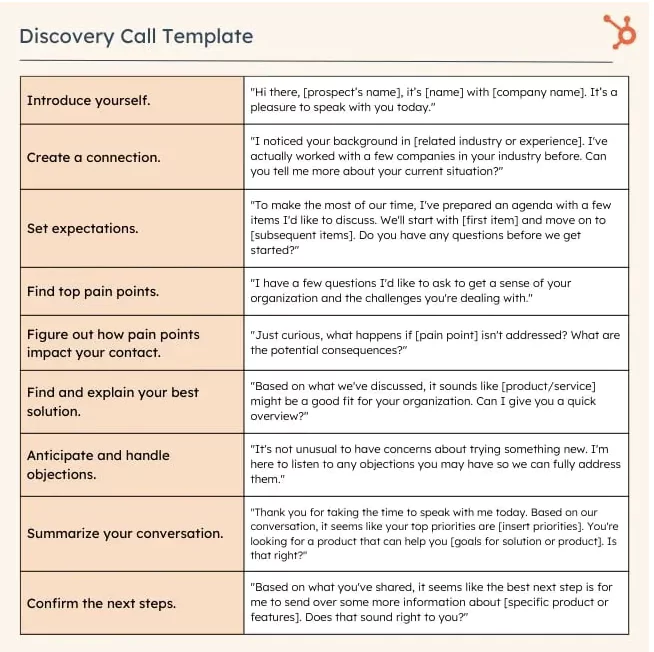
You‘ve done your research, have your questions ready, and are set to begin your first discovery call. But if you’re new to sales or are trying to meet aggressive goals, it can be tough to keep conversations casual.
If you need some inspiration to keep the conversation flowing, it can help to have a discovery call template with some quick discovery call scripts, like the ones below.
These suggestions are organized in chronological order, so you can create a custom template from the choices in each section, or pick and choose from the sections that are most useful for you. Doing so can help you structure a thoughtfully constructed discovery call script to reference when making your calls.
If these starters feel too fast or formal for your prospect, check out this list of conversation starters.
In addition to the qualifying questions above, creative open-ended questions are a great way to surface pain points.
This guide to objection handling is essential if objections are a deciding factor in the outcomes of your discovery calls.
It's also a good idea to take notes on your summary so that you can include specific details in your follow-up email.
Focus on whether the prospect is ready for your product before figuring out how to implement it. For example, a legal or procurement process isn’t a roadblock to a sale, but a lack of a business plan is.
Get the big-ticket items out of the way first. For example, establishing a pain point or goal and talking through potential choices. Then you can move on to the details of the deal.
Clear communication will make the difference in whether you close a sale. It can be tempting to jump to the questions that will bring you closer to close, but that could lead to missed opportunities.
Let your prospect share any insights that could give you context for their business needs and goals. “Why” questions can help you uncover the root of a prospect's challenges. They can also help you understand what has motivated them to find a solution and how urgent the problem is.
Ideally, a discovery call will either clearly surface a sales opportunity or definitively disqualify a prospect. You should come out of your calls with an understanding of your prospect’s needs and how you can help solve them.
Shane McEvoy, Founder of Flycast Media, says, "Over the years, I‘ve honed a couple of secret moves for discovery calls that really pack a punch. First off, active listening isn’t just a buzzword in my playbook — it‘s the golden key. Locking into every word a prospect says lets me dive into understanding the exact pain points they’re wrestling with. It helps me gather the intel needed to tailor a pitch-perfect solution that resonates on a personal level.
"It‘s how I turn lukewarm leads into raving, loyal clients. Then, there’s the art of the open-ended question — my go-to tool for getting prospects to spill the beans. These are the kinds that invite a story, drawing out the juicy details you can‘t get with a simple yes or no. It’s like opening a door and inviting them to walk me through into their world, revealing the hidden gems of what they really need.
“This approach, done right, can skyrocket conversion rates and increase client satisfaction tremendously. It proves that a dash of curiosity and a genuine desire to connect can transform a run-of-the-mill call into a game-changing conversation.”
Always add value to each discovery call. This may mean offering recommendations or simple ways to help. And be sure to personalize so your value-add doesn't seem self-serving.
If you leave the prospect with a positive impression, they are more likely to reach out when they become sales-ready (if they aren’t currently).
According to Lilia Tovbin, Founder and CEO of BigMailer.io, transparency is central to productive discovery calls. According to her, you need to "[be] upfront about your intentions and the purpose behind the discovery call.
"From our experience, being transparent right from the start sets a positive tone and promotes trust with the prospect. This helps align our expectations and ensures that both parties are on the same page, which is crucial for a fruitful discussion.
“I recall a recent discovery call with an e-commerce client. Right from the outset, we transparently mentioned that we wanted to explore how our platform could provide solutions that fit their needs. This immediately created a favorable ambiance for the conversation, as the client appreciated our honesty. It also encouraged them to openly share their challenges and eventually allowed us to be part of achieving their goals.”
Aseem Jha, Founder and Head of Customer Delivery at Legal Consulting Pro, says, "Imagine stepping into a discovery call armed not just with a pitch, but with a personalized strategy that resonates deeply with your prospect. As a seasoned sales leader, I‘ve learned that the secret lies in meticulous preparation coupled with genuine empathy. Before the call, delve into your prospect’s world — understand their industry, challenges, and aspirations.
"During the conversation, prioritize building a rapport that goes beyond the transactional. Share insights gleaned from your research, but more importantly, listen intently to their story. It's in these moments of active listening that you uncover the nuggets of information that can transform the trajectory of your sales pitch.
“I‘ve found that by focusing on understanding rather than simply selling, I’ve not only closed deals but forged lasting partnerships. This approach isn‘t just a strategy; it’s a mindset shift that has consistently delivered results in my sales journey.”
Lev Tretyakov, CEO and Sales Director of Fortador, "I explain what would happen if they do not solve the problem. We often focus on discussing what would happen if they solve the problem and forget to address what would happen if they don't, which is the key to creating urgency. Ask second and third-layer questions like, ‘How will this impact your business’s revenue, cost, and risk?' This week, I was talking with a potential client who was concerned about the efficiency of their cleaning solutions.
"He felt their cleaning was not up to par. Moving beyond the immediate benefits of our steam cleaners, I steered the conversation to discuss what would happen if they did not upgrade. They would incur more maintenance costs, lower customer satisfaction, and risk of shutdown due to noncompliance with health regulations.
“This highlighted the benefits of our products but created a sense of urgency and necessity. People appreciate it more when you come off as a consultant. So, make a real human conversation beyond checking off a list of questions.”
Kristy Galea, Director Of Sales at Cadence SEO, says, “When conducting discovery calls, I begin the conversation around the client's goals and build the call around how value can be attributed to those goals and benchmarks — overall, discussing value and educating the client on how they can solve the issues promptly. Their needs are the most important at all times.”
Chris Riley, Founder of Cuppa AI, says, "My top tip for conducting effective discovery calls is to go in with a learning mindset, not a selling one. Ask open-ended questions to deeply understand your prospect‘s key challenges and priorities. Listen for what’s not being said, read between the lines, and probe further.
“Too often, reps go into calls with a rigid agenda, talking over the prospect. An effective discovery call should be a conversation, not a pitch. Let the prospect‘s challenges and needs guide the discussion. The more you listen, the more they’ll open up. And the more they open up, the better equipped you'll be to provide real value. An insightful discovery call builds trust and sets the foundation for a long, successful partnership.”
Samantha Odo, Real Estate Sales Representative and Montreal Division Manager at Precondo, says, "It‘s crucial to establish a clear agenda for the call. Let the client know what topics you’ll be covering and what they can expect from the conversation. This helps set expectations and keeps the call on track.
"Always follow up on any action items or next steps discussed during the call. Whether it‘s sending additional information, scheduling a follow-up meeting, or providing answers to specific questions, make sure you’re proactive in moving the conversation forward.
“These strategies have been instrumental in my success as a real estate sales representative. By setting clear agendas, asking open-ended questions, actively listening, and following up diligently, I‘ve been able to build strong relationships with clients and ultimately close more deals. Give them a try, and I’m confident you'll see positive results too.”
Investing time and energy in creating a great discovery call will let you know for sure whether a prospect is a good or poor fit for the product. This will help you focus your time on the prospects who are more likely to close. This can help you exceed quota and become a standout performer in your team.
Editor's note: This post was originally published in October 2015 and has been updated for comprehensiveness.


The market is always moving. When the Internet took off, the immediate goal was to build a website but it was then just an adjunct to the bricks and mortar store(s). Over time and particularly after Amazon took off, people realized that it was possible to operate without bricks and mortar completely, if enough people found and used the website. There was a lot of effort to make the websites easy to use, to load complete catalogues of inventory and tie sales back to inventory, and some websites even built a virtual model of people so that they could “try” on articles before buying.
All that was good but the key was if people could find the website when they searched. Search Engine Optimization became the next big thing. Google was the default search engine then and, even though they didn’t disclose the algorithms used, people were able to reverse engineer the websites depending on where they showed up in a search. The goal is to be on the first page – and near the top – as survey after survey revealed that the nature of people is to ignore the millions of hits to a search. The most relevant are usually on the first page, and if they aren’t, the people just rewrote the search. It took too long to search all of the hits otherwise. A side effect is that websites “landing” site are built to load quickly, due to people’s impatience with the slower loading sites. This also led to faster and faster data transmission and the phone companies built faster and faster transmission methods. And the hardware companies built phones, tablets, and laptops to take advantage of them – because most search is done on mobile devices.
So what is the next big thing? You have a website that loads quickly and is optimized to be found and ranked high by search engines, still mostly Google but Bing is catching up. Now you want to convert looks to sales. Conversion optimization is what you want and you want it to be as high as feasible. But, how do you do that?
All good salespeople work very hard at conversion optimization. They read body signals, try trial closes, move from interest to “owning” (see how Buick is offering 24 hour test drives. After 24 hours people think of it as theirs!), and even baldly ask questions such as, “What would it take for you to take this home today?” It is not so easy to do that through such an impersonal means as a website.
Jeremy Smith wrote an article on Marketing Land on September 3, 2015 that sheds light on this subject. It turns out that the best techniques aren’t using such minor tactics as button size or colors – they are really based on psychological factors of human decision-making. One of these is labeled as mere-exposure effect. In very simple terms this means that people generally prefer things with which they are most familiar. This is then also called the familiarity effect. And, most importantly, the mere-exposure effect builds dramatically based on the number of exposures or interactions between the subject and object.
There have been numerous studies, monographs, and papers on this subject. The late Robert Zajonc, a 20th century psychologist, was justly renowned for his research on this subject. He tested both verbal and auditory exposure and found that even when the objects were completely made-up nonsense, the more exposure the subjects had to them the more they liked them. This mere-exposure effect even works on animals. If certain frequencies and sounds are played to chicks before they are born, while they are still in the egg!, they prefer those frequencies and sounds when they hatch.
If mere-exposure effect has this effect, how can you make use of it?
1. Make your website look like other sites. Although we claim to value originality and independence, familiarity breeds acceptance. Notice how even the teenage rebels all look and dress alike? So, if your website layout and look doesn’t differ dramatically from other websites with similar offerings, it is accepted. In particular, features like “Buy” or “Checkout” buttons must be placed in similar locations and look the same as others. People don’t like change!
2. Mere-exposure of your Unique Selling Proposition (USP) increases the conversion optimization. A corollary to this is that you must understand your target audience as well as possible. There is no substitute for perceptive observation. Once you do, feature your USP, show your USP, talk about your USP, and display your USP to them over and over. Remember, familiarity fosters acceptance. Hollywood PR agents say, “There is no such thing as bad publicity.” They understand this phenomenon viscerally.
3. Evaluate the effect of the mere-exposure on your target audience. There are infinite subgroups and niches and you want to maximize the effect on your selected demographic. For example, millennials are going to react much differently than baby boomers. Which one do you want as your audience?
4. Observing the mere-exposure effect is a cost-effective and valid way of cross-checking the conclusions of big data. There are discrepancies if you market on more than a few social media sites. Observation helps validate the data. In the words of the article, “When you define psychographic data to the extent of intuiting the mere-exposure effect, you’ve gained a powerful conversion optimization advantage.”
5. Study of the mere-exposure effect will reveal things the analytics can’t. Odd but true – the way people react when they are on a mobile device differs significantly from how they are on a home PC. In fact, if possible you should segregate the data from mobile searches from those from static devices. There are limitations to big data analytics due to the way they handle data processing, access, and collection. While familiarity fosters acceptance, too much “breeds contempt.” People just tire of the ads.
6. Your presence must be ubiquitous to foster conversion. There is a marketing rule of thumb that says people don’t even register your advertising until they have seen it seven times. And, there are innumerable other ads competing for their attention. To counter, you must do whatever is possible and feasible to make your advertising exposed in as many locations as you can.

Hong Kong (AFP) - Pro-democracy protesters have retreated from the streets of Hong Kong but education is increasingly becoming a political battleground as students and teachers say academic freedoms are under threat.
China's central government and the Hong Kong authorities were unswayed by last year's pro-democracy rallies -- sparked when Beijing insisted on vetting candidates before a public vote on the city's next leader.
Activists have since been prosecuted for their involvement in the protests, and many teachers feel the spotlight is now on them.
Educators say there is increasing self-censorship as staff worry about losing their jobs.
"Teachers are on alert," says one secondary school teacher who gave her name as Siu siu.
"If an important topic is sensitive, they will think about whether or not it is a must," says Siu, 28, who teaches liberal studies, covering politics, social issues and current affairs.
Some political questions on liberal studies exam papers have gone from mandatory to optional, Siu says, with teachers concerned the subject is being watered down.
Siu says teachers felt targeted during the democracy protests, which became known as the Umbrella Movement.
The education bureau warned them against participating and a hotline was set up by pro-Beijing activists where callers could report names of those taking part.
It has left a residual paranoia, says Siu.
"We don't know whether some teachers were blacklisted," she says.
"Maybe there could be future attacks."
- Jobs at risk -
It is not the first time there have been concerns over academic freedom in Hong Kong.
Tens of thousands marched against "national education" in 2012, a government proposal to bring Beijing-centric patriotic teaching into schools.
That plan was dropped, but some feel the authorities are closing in once more.
Former school counsellor Hui Lai-ming says she was asked to resign for openly attending last year's protests.
She was caught by television cameras during a rally outside the city's legislative council building, where some protesters tried to break in.
Hui, in her 40s, says she was not involved in the attempted break-in and has never faced any charges over her participation in the protests.
"In November (2014), the principal told me the Chinese Liaison Office (Beijing's representative office in Hong Kong) had asked the school's board of directors to command her to ask me to leave," Hui told AFP.
Hui says she was told her contract would not be renewed, despite a good relationship with the principal.
Her contract ran until the following August, but she left voluntarily in April.
"In Hong Kong the school system is always bound to the political structure. You can talk about things that are good about the government, but you can't talk about the negative aspects," Hui added.
Principal Fung Shui-lan refused to comment when contacted by AFP.
Student leader Joshua Wong, 18, who spearheaded both the 2012 national education rally and last year's protests, told AFP: "The principal or the school may put pressure on a lot of the teachers and students who support universal suffrage."
- Political appointments -
Tensions have also been running high at Hong Kong University, where council members Tuesday rejected the appointment of liberal law scholar Johannes Chan to a top administrative post.
Some council members are appointed by the city's unpopular leader, Leung Chun-ying, who activists claim is manipulating the university's autonomy.
Officials had delayed their decision on the appointment, prompting more than 1,000 academics from the city's universities to sign a letter to the government, calling it a "worrying sign of political intervention".
"It creates a warning to all academics in Hong Kong that should they fight for democracy or the rule of law, even if they are not radicals... they can be punished," political commentator and university professor Dixon Sing told AFP.
Hong Kong's education bureau says academic freedom is enshrined in the city's constitution and is "an important social value treasured by Hong Kong".
In an emailed response to AFP, it said warnings to teachers against participating in protests were a "friendly reminder" and argued there had never been compulsory materials for liberal studies.
- Fight goes on -
Once a British colony Hong Kong was handed back to China in 1997 and is allowed far greater civil liberties than those enjoyed on the Chinese mainland.
But the city remains divided over its political future, split between those pushing for democracy and those who are loyal to the mainland.
Education is a natural arena for those tensions to play out, says Sonny Lo, a social sciences professor at the Hong Kong Institute of Education.
"Educational developments have been highly politicised by the external environment, whether in 2012, or by the Umbrella Movement in 2014," says Lo.
"Issues like what has happened at HKU... perhaps characterise the politicisation and polarisation of Hong Kong in the past several years."
Analysts agree the battle is set to continue.
"They (the government) have always tried to change education, but it has been relatively difficult because of the resistance of education professionals," political analyst Ma Ngok said.
"I think that's always been there because Hong Kong has never been a democracy."

Sen. Marco Rubio (R-Florida) is set to give a speech Friday where he'll present his plans to aggressively confront Russia should he win the 2016 presidential race.
According to excerpts released by his campaign, Rubio will vow to issue visa bans and asset freezes against Russian officials, distribute military hardware to boost Ukraine's fight against Russian-backed separatists, and issue a new round of sanctions.
"We are barreling toward a second Cold War, and strong American leadership is the only force capable of ensuring that peace and security once again prevail," Rubio will say.
"The more our current president fails the test of leadership against Putin, the more important it becomes for our next president to pass it. I will pass this test. Over the last five years, I have consistently spoken out on the need to contain Russian aggression, even when it wasn't popular."
In an "60 Minutes" interview that aired last Sunday, Russian President Vladimir Putin was asked to react to Rubio's accusation that he's governed as a "gangster."
"How can I be a gangster if I worked for the KGB?" Putin responded, according to CBS' translation. "Come on. That does not correspond to reality."
Rubio is set to double down on that Putin rhetoric in his Friday speech.
"Under my administration, there will be no pleading for meetings with Vladimir Putin. He will be treated as the gangster and thug that he is. And yes, I stand by that phrasing," Rubio says in his prepared remarks.
Putin has repeatedly US foreign policy goals in recent years. Most recently, Russia launched an airstrike campaign in Syria against enemies of President Bashar al-Assad's regime — and evidence suggests that they've targeted US-backed rebel forces more than fighters from the Islamic State group (also known as ISIS or ISIL).
"The significance of Russia's recent military activity in Syria cannot be downplayed," Rubio will say. "It is no less noteworthy as a power play than the invasion of Ukraine."
Rubio's upcoming speech fits into his overall campaign-trail strategy of stressing his foreign-policy credentials. Rubio, who sits on the Senate Foreign Relations Committee, often says that the first responsibility of a president is national security and readily contrasts his foreign-policy knowledge with his rivals.
View the full Rubio speech excerpts below:
We are barreling toward a Second Cold War, and strong American leadership is the only force capable of ensuring that peace and security once again prevail.
The more our current president fails the test of leadership against Putin, the more important it becomes for our next president to pass it. I will pass this test.
Over the last five years, I have consistently spoken out on the need to contain Russian aggression, even when it wasn’t popular. I have highlighted the dangers of the Obama/Clinton “reset” with Russia. And in 2014, I urged a rapid and forceful response to Putin’s annexation of Crimea.
As soon as I take office, I will move quickly to increase pressure on Moscow. I will impose a new round of sanctions on The Kremlin’s senior leadership and other Russian entities, including Gazprom, and will work with Europe to exclude Russia from the SWIFT interbank payment system.
I will immediately provide Ukraine with lethal military assistance and increased intelligence sharing to ensure that Putin’s violation of Ukraine’s sovereignty comes at a price.
I will impose visa bans and asset freezes against high-level Russian officials, and move to isolate Russia diplomatically by ceasing efforts to engage Moscow on issues not essential to resolving the crisis in Ukraine.
Under my administration, there will be no pleading for meetings with Vladimir Putin. He will be treated as the gangster and thug that he is. And yes, I stand by that phrasing.
…
The significance of Russia’s recent military activity in Syria cannot be downplayed. It is no less noteworthy as a power play than the invasion of Ukraine.
He is using military power to prop up Bashar al-Assad, a vicious dictator who is intentionally slaughtering the Syrian people and helping prolong ISIL’s terror in an attempt to retain power.
And let’s be clear about something: No matter what Putin says, he is not involved in Syria out of an altruistic desire to defeat ISIL. The first airstrikes Russia conducted were in areas where ISIL is not present. They are targeting other moderate opponents of the Assad regime.
Putin is involved for the purpose of keeping Assad, or someone like Assad, in power; keeping Syria as a client-state for Russia; and distracting from his actions in Ukraine.
…
Even as we must confront Russia in Europe and the Middle East, we need to increase our support to the Russian people. It is important to note that our concerns with Russia are not with them – for it is they who suffer most from Putin’s lies, thievery and repression. Unlike this President, I will speak frankly about who Vladimir Putin is and what his regime represents.
I will increase our efforts to counter Russian propaganda so that the Russian people have access to accurate information. And I will use all the tools at my disposal to sanction those Russian officials involved in human rights abuses, including those who target members of the Russian opposition and kill true Russian patriots like Boris Nemtsov.
As the Obama/Clinton record has shown, the longer we wait to stand strong against Putin’s Russia, the higher the price of our inaction will be.
SEE ALSO: 'How can I be a gangster if I worked for the KGB?'
Join the conversation about this story »
NOW WATCH: Here's why Ann Coulter thinks Donald Trump has a real shot at winning it all
Another real estate transaction in Vancouver involving Chinese buyers has people talking, but this time the eye-catching number is for a commercial property.
A small office tower — the 212,000 square foot United Kingdom building, which might best be described as a B class structure — in the heart of downtown Vancouver sold for $122 million on Monday. The deal has yet to close, so details remain scarce other than that the buyer of 409 Granville St. was from mainland China.
“It sold for more (than) $600 a square foot,” said one source, who said that might be 50 per cent more than the going rate for similar office buildings in the area. “When I heard the number, I thought ‘no way.’ But the thing is it’s right on top of a SkyTrain station. I think the Chinese are buying the land for speculation as much as the building.”
Quietly, Chinese investment in the Canadian commercial market is heating up. Reuters reported in August that Anbang Insurance Group Co. Ltd., a Beijing-based company with a reported $114 billion in assets, which made a splash in New York’s property market last year by buying the famed Waldorf Astoria for US$1.9 billion, purchased a land lease that gives it control of the HSBC building in Toronto’s financial district.

Sources told the Financial Post the land lease for 70 York St., which gives the buyers ownership of the building for a set period of time, was purchased from Brookfield Office Properties for about $110 million — one of the highest recent valuations for a building in Toronto.
Chinese investment in Canada is still a small part of the overall foreign investment in the country. Over the past five years, not including these two recent deals, only about US$192 million of Chinese money has bought Canadian commercial property, a paltry amount of the the approximate US$10.5 billion invested in the country during the period, according to data from Real Capital Analytics.
We got beat out by the Chinese on 70 York
Like the residential world, tracking of Chinese commercial real estate investment can be difficult because deals can be done through numbered company and investors represented by a Canadian law firm.
But more and more Chinese entities are popping up in some key transactions. In 2014, a Chinese company bought the Fairmont Le Château Montebello in Quebec for $28.8 million. The decision by Shanghai-based Greenland Holdings Group Co., one of the largest real estate development companies in the world, to buy into a condo/hotel project in Toronto’s entertainment district helped legitimize Canada as an investment opportunity.
Paul Finkbeiner, chief executive of GWL Realty Advisors, said there is little doubt there is a growing interest from Chinese buyers in Canadian commercial property.
“We got beat out by the Chinese on 70 York. We came in second to them, I think,” he said referring to the Toronto office deal won by the insurance giant Anbang.
According to another source, Anbang has privately told real estate people it is ready to invest another $1 billion in Canada and is looking for more acquisitions.
A litmus test for foreign investment in Canada, specifically from China, could be the the largest transaction ever expected in the Vancouver marketplace. Ivanhoé Cambridge Inc., the majority owner of the Bentall Centre which has four towers, said Wednesday it will sell its stake in a deal expected to top $1 billion.
“There is a lot of Chinese interest and they’ve bought some property,” said Michael Gill, a principal at real estate company Avison Young. “There is no question the mainland Chinese investors are more on the scene than ever.”
Even small investors seem to be getting more interested in Canadian commercial property, as they look for alternatives to residential. Nick Yanovski, managing director of capital markets with real estate firm Cushman & Wakefield, said he closed a deal this week for $7 million for small strip mall in Brantford, Ont.
“There are local Chinese Mandarin-speaking agents dealing with (overseas) clients looking for investment in a stable market and they see anything in around Toronto as something they like,” he said, referring to the mall, which has about a dozen stores and one major bank as a tenant.
Ross Moore, national research director for CBRE in Canada, said the size of some of the recent deals is turning heads, and may result is higher prices in some markets.
“Some of the prices being paid by Chinese investors are exceptional,” he said.

Even if you weren't a big fan of the phone before you took a sales job, you learn to love it. Why? Salespeople make more calls than any other person on the planet. (Okay, that's not an airtight fact, but as any rep will tell you, it certainly feels that way.)
And while making calls day in and day out, reps start to notice patterns in their conversations. For instance, prospects are likely to make at least one objection. There's probably a certain statistic or fact that grabs buyers' attention every time. Reps might even begin to observe similarities in their reactions to prospects' behavior.
As a tribute to the sheer number of calls reps make each and every day, we've laid out the 17 stages of a sales call below, GIF-ified for your sharing pleasure.
What other emotions do you go through on a sales call? Share your thoughts (or favorite gifs) in the comments.



Data-driven storytelling is poised to be the next big trend in content marketing. Indeed, companies are already harnessing its power at every stage in the customer relationship lifecycle—from building up-front brand awareness to reminding customers of their success. Here’s how to use data at each step in the marketing journey:
Build brand awareness, like Allstate. Allstate has put data at the heart of its communication strategy, leveraging a range of information sources and marketing channels to increase awareness of its brand. The insurer releases an annual report on America’s best drivers (see the map below), frequently features data-driven insights and infographics on its blog, and through its foundation offers data-rich resources on teen driving safety and domestic violence. Allstate also uses an eclectic mix of in-house, pre-existing and commissioned data sources to drive its frequent data-driven blog posts, reports and infographics: it used a range of publicly available sources in its blog post and infographic on auto theft that tells readers how to reduce their risk, commissioned a survey to address distracted driving, and used a combination of claims and polling data to look at holiday hazards. Once you’ve achieved some initial successes in building brand awareness with data-driven content, follow Allstate’s lead and look for ways to extend that success into in-depth reports or by tapping into a wider range of data sources.

Generate leads from your key audience, like IBM. When you’re going after a specific market or audience, it’s not enough to build brand awareness: you need to generate leads. A smart strategy is to create data-driven content that’s a must-read for your target—like the content IBM has built from its series of surveys with C-level executives, including The Customer-Activated Enterprise. By surveying thousands of CEOs, CMOs and other top executives—and then gating the results – IBM created a data asset that all but guaranteed it would get contact information from thousands of executives worldwide.
Close the deal with your expertise, like Intuit. Intuit has made data-rich infographics a key part of its content marketing strategy for TurboTax, covering subjects like the generational differences in spending habits, tax implications of crowdfunding, and the cost of attending Comic-Con. The company’s infographics draw on a range of pre-existing third party data sources, like Pew Research, the IRS and Gallup. Even though this content runs the gamut from playful to practical, it all testifies to the company’s deep expertise and passion for all things financial. By making dry data points come alive with compelling visuals, clever reframing, and on occasion, interactivity—like this interactive infographic on unclaimed tax refunds, which lets the reader see the value of unclaimed refunds in their own state—Intuit’s content helps turn prospects into buyers.
Show customers what you do with their data, like Jawbone. Jawbone makes fitness trackers that capture data on sleep patterns and physical activity—and being able to see that data is exactly why people buy Jawbone’s products. But Jawbone sees that data too—and by telling interesting stories with that data, Jawbone lets its customers know how their information is aggregated and analyzed. Of course, the company has also captured significant earned media attention with stories that have timely media hooks: when it looked at sleep patterns the night of the 2014 California earthquake, relative to the quake’s epicenter; the graphic (see below) attracted hundreds of mentions in the mainstream media and online. The Jawbone blog has also featured posts on what people eat and drink on Valentine’s Day, how many more chicken wings people eat during the Super Bowl, and the impact of the World Cup on Europe’s sleep. If you’re using your customers’ data for your own insights and business decision-making, sharing that data back to your customers as content is a great way to build traffic and let your customers understand how your analyze the data they share with you.
Build customer engagement and loyalty, like OkCupid. Too many companies end the marketing journey at the moment of sale. But keeping customers is as important as winning them—and by telling your customers how to get more from your products and services, data-driven content can help you keep your customers. That’s a big part of the value of OkCupid’s long-running data blog, which has explored a wide range of topics by tapping into users’ dating profiles. While the company has attracted a lot of media attention—and generated a book!—with topics like racial bias in dating and the role of appearance in dating preferences, its posts have also offered concrete insights that can help users themselves optimize their dating experience. From the optimum number of characters for an on-site message (see the chart they published below, “Men Contacting Women”), to the best questions to ask on a first date, OkCupid’s data-driven insights help its users find love. The data your company uses to optimize its business performance may well offer insights to your customers, too; if you can find a way of sharing those insights, you make your customers’ experience better—and your product or services stickier.

Celebrate your success, like Kickstarter. Just because you’ve won customers and kept them happy doesn’t mean you can rest on your laurels. In a year that included some harsh media criticism of Kickstarter failures, the company used data to make a compelling case for its success (see the map showing the geographic distribution of their backers). That’s particularly crucial when your customers are not only buyers but partners in your business, as is the case with Kickstarter: it needs would-be project leaders to see that the platform is a valuable and dynamic way to raise funds. The company blog frequently uses data to underscore its success stories, whether it’s the story of individual projects like the Coolest Cooler, or milestones like reaching 5 million backers. Its blog is one of the few that actually makes “data” one of its main post categories—a practice that other companies would do well to embrace, since it makes it easy for readers to find the original insights you share. If you are eager to take your company’s story directly to customers and investors—rather than waiting for the media to do it for you—then producing and releasing your own performance metrics is a great way to take control of the narrative.

As these companies show, data can play a powerful role in telling your story at every stage in your relationship with customers. And of course, there are many more success stories out there, particularly among companies that are in the business of telling stories with data, like media companies, data companies and graphic design shops. But the examples here show that you don’t have to be in the business of data journalism to do a great job of telling stories with data—and keeping your customers engaged.
I recently presented a story about my past success in winning an Eloqua Markie for ‘Metrics that Matter’ at a recent Atlanta Eloqua User Group. The success in the account came from moving beyond the simple volume of leads and anecdotal assumptions by aligning Sales, Brand and Product Marketing to showing the true value of our marketing programs. What really rocked the ‘Metrics that Matter’ world was our standardized reports that could be used to drive strategic insights to maximize our efforts.
 The group asked how to take basic steps to make ‘Metrics that Matter’ happen, realizing not everyone is ready to win a Markie. A great deal of work goes into a successful program, especially one that wins a Markie, so there is no single answer. I was honest about the time required, intense process development, training and technology requirements that went into aligning all parties involved to make this account a success. However, the first step to a successful program and ultimately, having ‘Metrics that Matter’ means you need to have a clean database. That means taking the time clean (and delete) more than a few contacts to ensure your database current and compliant as part of any best practice.
What data to clean and delete?
Everyone gets nervous before they hit that ‘delete’ button. There are a few easy ways to purge the non-marketable contacts in your database.
Cleaning the database is a big first step in achieving email best practice. Hand-in-hand with the database cleanup, another best practice would be creating agreed upon standardized field values so that you can showcase your effective reporting and demonstrate how you’ve achieved your business objectives. I’d go into more detail of why that’s important and how to tackle that slow-moving train, but standardization deserves it’s own post! Stay tuned and start deleting.

Yearning for a sales cliché? Try this: no one is more properly equipped to connect with potential buyers than a sales professional.
But wait, there’s more, only this is not a cliché, it’s a fact. The best, properly equipped salespeople bring more to the table. They know how to uncover a customers needs by asking the right questions and helping to coach the prospect through the sales process. In today’s world, many enterprise customers have already done research on products and services before contacting the sales professionals. With that said, the value of a sales professionals knowledge has not changed.
A sales pro should use their skill set to gauge the needs of the customer in order to close more deals. Here are three strategies a sales pro should focus on and use to their advantage.
1. Change is Coming! — or is it?
Realizing the customers established demand early in the conversation will help you to best tailor the rest of the sales process. What I mean by established demand is finding out how open the customer is to allowing change from their current processes. Whenever a salesperson can determine a customer’s possibility to change, they have a better idea of the clients desire to challenge their own system. If you’re a sales pro, this completely alters your approach from pushing the customer to buy and instead emphasizing the customer’s willingness for something more.
The customers who are openly seeking change and open to the opportunity of learning more are nothing short of solid gold to a sales rep.
2. Personalize the Follow-Up
Plain and simple, you need to follow-up with all your leads. A true sales professional should have follow-up questions to help you further uncover a customer’s needs.
When you’re asking questions, don’t be afraid to get personal and be sure to take notes; really listen to the answers given. A customer, current or potential, says something like, “We want a solution for the smaller businesses we work with,” your response must be tailored to hit those needs.
Say that is the question you’re asked, here are a few examples of follow-up questions:
– Are there specific small businesses you work with?
– Have any of your clients asked about certain features?
– Do you have a potential small business in mind?
– Have you looked into other solutions for that vertical?
The tone of these questions should come off as conversational, not sales-y. At this point, your goal is to extend the conversation with the customer while simultaneously honing in on targeted needs.
3. Was it Something We Did?
This strategy is to really prod the customer into finding out what got them interested in you, or your product. Make sure to structure this question in an open ended format because it has the potential to allow the customer to uncover major needs or challenges they face. Their answer should give a better overview about both their desire and timeline in finding a solution. Take both into consideration, though don’t just blurt out any old answer.
Be aware that the prospect probably put some serious time and effort into their answer(s). Equip yourself with the right mindset and have an idea of a solution. Be sure to ask follow-up questions to continue the conversation too.
While it’s cliché to state that a sales professional has the best ability to connect with prospects, it’s still true. Use these strategies to your advantage in order to tailor each conversation correctly and professionally. One question can open a floodgate of opportunities for you and the potential client.
And remember, “you miss 100% of the shots you don’t take.”
 Honesty is fundamental to advertising, marketing and sales, but very few businesses are willing to be insanely honest; so honest that it’s a little bit (or a lot) uncomfortable.
Being insanely honest means actively volunteering the weakest parts of your business. That’s a terrifying prospect, especially in your marketing. Conventional wisdom tells us to put our best foot forward, making sure our prospects get the best picture of our businesses from the very start.
But what if instead of your best foot, we put your “worst foot” forward?
At INBOUND15 Doug Kessler, co-founder and creative director at London-based B2B content marketing firm Velocity, gave us his thoughts on insanely honest content marketing. Here are his 6 reasons you should put your worst foot forward in your marketing and advertising:
No one likes people who boast about themselves day in and day out. Does your marketing function the same way?
Sound familiar? None of those statements are particularly compelling, convincing or charming. Even worse, they are the same things your competitors are saying. Maybe its time to change your approach:
Being honest about where your weaknesses are is surprising and creates an approachability not afforded by traditional marketing.
Successful companies have a clear picture of themselves, their products, their competition and their customers. It’s this confidence that lets companies be strategic about the clients they take on or the services they offer; saying “no” to short term revenue to better capitalize on opportunities more in line with their business.
Communicating this confidence is extremely difficult.
One of the easiest ways to show your business’ confidence is to admit where it’s weakest. Being up front with what your business doesn’t do (and why that is) could be the first step to showing your prospects how confident you are in your strengths.
Gaining trust is the most important part of marketing and sales. Without trust, converting leads and customers is nearly impossible.
What better way to build trust than being honest? Being up front with your business’ weaknesses means your prospects can trust you when you talk about your strengths.
Wasting your time on leads that aren’t qualified isn’t just inconvenient, it costs your business time and money. Being precise with your audiences and marketing will improve the percentage of qualified leads.
The best way to filter out less than qualified leads is to be honest with your business’ weaknesses. Those weaknesses will inevitably come up in your sales process, so why not be up front with them?
Instead of wasting your valuable time on deals that are far less likely to close, why not filter them out early and spend more time on those leads you know you can win?
While honest content filters out unqualified leads, it also attracts ideal leads. Your ideal leads are those prospects that won’t be turned away by what your company doesn’t do, and are inherently more interested in your strengths.
Your sales and marketing teams shouldn’t be wasting their time-fighting battles they know they can’t win. Trying to spin your negatives into positives isn’t just a time sink, it can cause prospects to lose trust in your business.
Instead, focus your conversations on battles you can win. Addressing your weaknesses head on means you can more effectively talk about your strengths.
How can honest content marketing improve your position in the marketplace?
Re-engage With Leads & Increase Sales – Easy, Effective Ways to Bring Back Visitors Who Intend to Buy written by Guest Post read more at Duct Tape Marketing

photo credit: Flickr
We’ve all found those pennies behind the couch pillow, and that occasional quarter in the crevice can eventually pack a punch—a cup of coffee here, a trip to the movies there. But how much does that analogy reflect on those lost leads that slip through the cracks in our customer buying funnel?
Below are some easy and effective ways to re-engage with visitors who have visited your website but may have forgotten to get back to their project, or worse, may already be engaging with your competitors. In any case, you’ll want to creatively remind them to re-visit your site and finish the purchase.
Re-marketing ads are ads that display to people who have previously visited your website, or leads from whom you collected an email address. They’re offered by many publishers and serving platforms. While some of the larger advertisers use products like Adroll or Criteo, other large and small advertisers still see a lot of advantages re-marketing directly in the publishers. Some of the most popular publishers are Google Adwords, Facebook, Twitter Ads, and even Instagram as of late. However, many would agree that Google and Facebook are probably the top two options for the most impact of performance.
Whether or not you are using Google for paid search or contextual ads, consider an Adwords remarketing ad campaign. Adwords provides great tools for tracking performance and easily creating image ads, even for those of us with no creative capabilities—making ads is as easy as uploading your logo or image and drafting some text in the tool.
Facebook Ads is another great channel for re-marketing. One and a half billion people hangout on its social platform providing an extensive reach, and many agree that the advertising costs are still quite low compared to other channels.
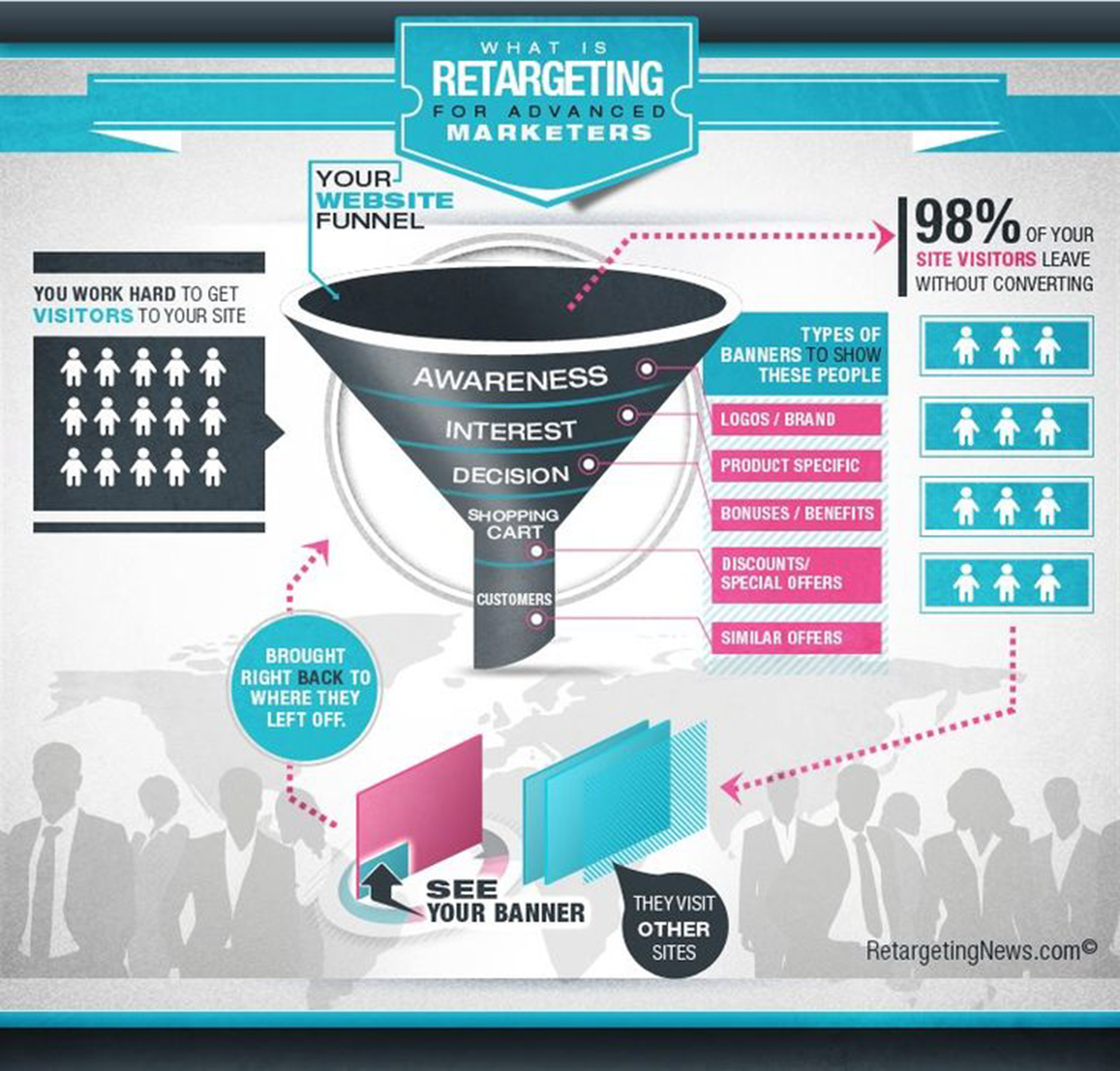
Like the target settings that segment audiences by page visits and actions on the website, Facebook, Twitter Ads, and others allow email list uploading. You can then easily create ads to show to your most valuable emails, which is great if you are scoring leads from a CRM and want to focus efforts based on lead quality or positions of a conversion process.
Since re-marketing ads are not free, many advertisers roll up their sleeves and take steps to increase their ROAS (Return On Advertising Spend). Both Google and Facebook allow advertisers to create rules that will allow spend to only show ads to people who have taken specific actions on a website or in a conversion path. Try setting up uniquely targeted campaigns to people who have visited your shopping cart in the last seven days, but who have not made a purchase. Or, run an ad exclusively to people who have filled out a form to learn more about your business.
By targeting only users who have shown certain levels of intent to purchase your product, marketers often save money by eliminated wasted ad spend on traffic that bears no fruit.
Implementing re-marketing ads to help bring users back into the conversion funnel should be common sense. But don’t forget to use good data when making decisions about your investment. These tools all offer robust tracking to enable insights into what’s working and what might be cut out.
Read some good resources about tactics that work for other businesses and apply to refine your efforts. Whatever you do, don’t leave those open leads to your competitors.
Engage with those lost gems and drive results to your top and bottom line.
 David Johns is the Digital Marketing Director for RushOrderTees, a national screen printing company that specializes in custom printed apparel for every occasion. He is a senior PPC, SEO, and SMO marketing specialist with skills and experience optimizing ROI through advanced data-driven strategies. He hails from San Francisco, but currently resides in Philadelphia.

Qassim Ali (left) and his friend from the refugee shelter at the power station in Veltheim, Germany. (Photograph by Adnan R. Khan)
When Qassim Ali first turned his life over to human traffickers in Pakistan, he had a very specific image of where he’d end up. The traffickers themselves had only given him the vaguest of ideas: Europe, they’d said. But for Ali, an 18-year-old labourer from Gujranwala, a raucous industrial city of more than one million in Pakistan’s Punjab province, the dream of a new life was more specific. He pictured the broad streets and electric energy of Berlin, with its promise of work and a network of Pakistanis.
So when he set out from his rundown inner-city home, making the gruelling journey of more than 6,000 km across eight borders, hiding in the trunks of cars, stealing through fields and forests in the dead of night and, finally, clinging for life to the gunwale of a rickety old boat crossing the Aegean Sea, it was the image of Berlin that kept him going.
“The whole time, I pictured finally arriving and walking under Brandburger Gate,” he says, mispronouncing Berlin’s iconic Brandenburg monument. “I thought: Once I’m there, I can finally say, ‘I have arrived.’ ”
He never got that chance. Ali’s journey didn’t end at the refugee registration centre in Berlin’s Moabit neighbourhood, where thousands of other men, women and children from some of the world’s most dangerous places have congregated during Europe’s refugee crisis. Overwhelmed German authorities, desperately looking for ways to house the vast crowds, instead put him on a train, along with dozens of other refugees, mostly Syrians. He eventually arrived in Minden, a picturesque town in Germany’s northwest, and, from there, was bused to a refugee shelter set up in a decommissioned coal-fired power plant in the village of Veltheim, on the banks of the Weser River. “When they first brought us here, I thought they were taking us to another border and releasing us into the forest,” Ali says.
In Germany, where upward of half a million refugees have arrived—passed on like a hot potato by European countries fearful of a Muslim invasion, or simply unable to care for the vast numbers pouring in—it’s becoming more and more common to find bewildered refugees strolling along bucolic country roads and biking through farm fields to the local market.
Their presence has caused some controversy—and even outright violence, in some cases—in places that have little experience with visible minorities and virtually no contact with Muslims. Veltheim, a farming village of slightly more than 1,000, has taken in nearly 300 refugees so far, all of them housed in the local power plant. Other villages making up the administrative district of Porta Westfalica (Vennebeck, Eisbergen, Lübbecke and Kleinenbremen) have taken in hundreds more, while at the state level, North Rhine-Westfalia, a region two-thirds the size of Nova Scotia, the numbers are approaching 100,000.
Housing shortages have forced local authorities to distribute the refugees in temporary shelters throughout the region, occupying refurbished farmhouses, storage depots and schools in a frantic attempt to cope with the unprecedented influx. Tent cities are popping up everywhere, officials say, where refugees may be housed for up to six months, despite the fact that winter is coming, leaving some scratching their heads over the wisdom of Germany’s refugee policy.
“The decision to let in so many people when the rural infrastructure is not ready for it could backfire,” says Karl Schmeding, Porta Westfalica’s deputy mayor. “The authorities are overwhelmed. The pace of the refugee influx is difficult to manage and everything is happening last-minute. We’re often given as little as two days’ warning before refugees arrive, two days to find and prepare a shelter for them. Then, when that shelter is built, another request comes in, and then another.”

(Photograph by Adnan R. Khan)
Housing is only the first stage of the emergency response, local volunteers say. Feeding the refugees, providing them with access to medical services in a region with limited public transport, and enrolling children in schools are just part of the everyday challenges administrators are facing. While most locals in Porta Westfalica have responded positively to the humanitarian side of the crisis, the reality is slowly setting in that the country may not be able to handle the influx and the growing social stresses that come with it.
While Germany has hosted large numbers of refugees in the past, the current wave is unique, says Hartmut Haselau, a volunteer at the refugee shelter in Kleinenbremen, 10 km northeast of Veltheim. “The last time I saw a refugee influx like this was during the early 1990s, when people of German descent arrived after the collapse of the Soviet Union,” he says. “At that time, the refugees were embraced by the local communities. This time, the response has been more cautious. You can see it in the way local people deal with them. They help, but the looks on their faces and their body language tell me that they also want to keep their distance. Seeing a black person, or a woman with a headscarf shopping in the local market, makes them nervous.”
Schmeding agrees and warns that government officials in Berlin have not done enough to give Germans a clearer picture of what the future holds, focusing most of their energy instead on trying to find a way to shift Germany’s burden to other nations. “We’re only just starting to make the attempt to let people know that some of these refugees could be here for a long time, even permanently,” he says. “We need to do a better job. It doesn’t look like the world is going to step in to relieve the pressure Germany is under. If people think this will all be over soon, and then it drags on, public opinion here could change.”
Concerns are already mounting over Germany’s neo-Nazi movement. This year has witnessed a spike in violent attacks on refugees, particularly in Germany’s east, where fascists draw much of their support. Porta Westfalica has been largely spared, but its mayor is still not taking any chances.
Two recent attacks on refugee houses have prompted a large security response: The newly built shelter at the power plant is under 24-hour guard, while other shelters have been fitted with surveillance cameras and floodlights. Locals have also offered to help, providing refugees with personal phone numbers in case of emergency, or simply to provide transport in case it is ever needed.
“This is a violent fringe,” Bernd Hedtmann, Porta Westfalica’s mayor, tells Maclean’s after addressing an anti-fascist rally in the village of Hausberge, the district’s administrative centre. “Of course, we’re worried about them. We don’t want to give them any space to operate. Gatherings like this one send the message that they are not welcome here.”
For the refugees, fascists are one concern, but uncertainty is the overarching mood. At one refugee shelter in Eisbergen, the isolation of country life is beginning to take its toll. As many as 35 people, including women and children, share two converted storage depots on an empty stretch of country road, hemmed in on one side by a railway line and on the other by a two-lane highway and farm fields. On Sept. 16, one of the houses was fire-bombed, causing some damage to an exterior wall but failing to cause any injuries.
“It was frightening, especially for the younger children,” says Barzan Ismail, a 28-year-old Iraqi who has lived in the shelter for nearly three months. “We’re very isolated. It took the police around 15 minutes to arrive after the attack, and when I asked them why we are here, they told me there is no other place; Germany is full. But being here is difficult. There is nothing to do except eat, sleep and wait.”

Locals from Porta Westfalica attend an anti-fascist demonstration in Porta Westfalica’s administrative centre. (Photograph by Adnan R. Khan)
And they may be waiting a long time. The scale of the crisis has created a major backlog in Germany’s asylum procedures. Recent attempts by German authorities to slow the flow of refugees into Germany by setting up invasive checks along its open border with Austria have been met with protests by Germany’s pro-refugee activists, who say the official mood is now becoming less welcoming. More worrisome, they say, is a new asylum law being drafted by the German parliament that would severely restrict the social benefits refugees receive, while quickly rejecting the asylum requests for those deemed to be “economic migrants” arriving from “safe” countries. The law would also restore the Dublin III regulation, which German authorities suspended at the end of August, allowing Germany to deport refugees back to the first European Union country from which they arrived.
Critics argue that the law represents the dark side of Germany’s apparent open-door refugee policy, designed to placate the violent right wing. Those most at risk of deportation—Pakistanis and Albanians, for instance—say they are losing hope of meeting the new criteria for refugee status. “Syrians are the priority now,” says Lilit Mkrtchyan, a 32-year-old mother of two from Armenia. “We all realize this: The Syrians will get everything and we will be forgotten.”
To counter the new law, German activists say they are prepared to stop the deportations using all the means available to them, including preventing airplanes transporting deportees from taking off, a tactic that has been used in the past. But Mayor Hedtmann defends the policy, pointing out that those most in need of protection must come first. “The Syrians alone represent millions of refugees,” he says. “Sending some people back is not an easy decision for Germany, but one that we have no choice but to make.”
He, along with his deputy, Schmeding, both emphasize that the world is only witnessing the first stages of a crisis likely to continue for the foreseeable future. Rather than looking for excuses not to accept refugees, the world should focus on the positives. “Particularly in smaller places like Porta Westfalica, where migration to the cities is draining the workforce, refugees offer a unique opportunity,” says Hedtmann. “We have a real chance here to revitalize our rural economies, and refugees can play a big part in that.”
The question is if the refugees themselves are willing to stay. Many tell Maclean’s that life in rural Germany is too isolating, and the lack of access to urban infrastructure—such as public transport and immigrant social networks—makes planting roots difficult.
A few, however, see things differently. “I don’t mind the countryside at all,” says Aliya Haddad, a 33-year-old mother of two from Latakia, Syria, now living in Veltheim’s power plant. “In Syria, the cities are in ruins; in Turkey, the crowds became too much for me. I’ve had all I can take of city life. When I smell the soil here and see the horses, I feel like I have reached a kind of paradise. I think I could get used to it.”
The post What’s become of Germany’s refugees? appeared first on Macleans.ca.

Racial disparities in life expectancy are a key indicator of inequity in health outcomes. Although the United States has made progress in narrowing the gap in life expectancy between blacks and whites, from 7.6 years in 1970 to 3.8 years in 2010, a disparity remains — largely from blacks’ higher death rates at younger ages from heart disease, diabetes, and cancer, as well as higher risks for HIV infection, homicide, and infant mortality.
Leaders in government, business, and health care must address these persistent disparities at the national, state, and local levels, as both an ethical and an economic imperative. In fact, eliminating racial disparities in health care is vital to pushing the entire health care system toward improving quality while containing costs — so-called value-based care. In its 2001 “Crossing the Quality Chasm” report, the Institute of Medicine identified equitable care as one of six core aims of high-value health care systems. And since 2003, Congress has mandated that the federal government produce the annual National Healthcare Disparities Report as part of the effort to monitor national progress in this domain.
In 2011, Richard Allen Williams and I outlined five principles for eliminating racial disparities as part of health care reform:
Racial health disparities are associated with substantial annual economic losses nationally, including an estimated $35 billion in excess health care expenditures, $10 billion in illness-related lost productivity, and nearly $200 billion in premature deaths. Concerted efforts to reduce health disparities could thus have immense economic and social value.
Employers and health plans have an important stake in these efforts. For example, reducing disparities in effective asthma treatment by 10% for African American workers could save more than $1,600 per person annually in medical expenses and costs of missed work. Similarly, eliminating racial and ethnic disparities in access to outpatient mental health treatment could reduce costs, particularly for people on Medicare or Medicaid, by limiting emergency room visits and hospitalizations for mental illness and other medical conditions such as diabetes and heart disease.
Much of what we know about reducing racial disparities has come from organized systems of care, such as health maintenance organizations (HMOs), as they have advanced information systems for collecting data on health care quality and are often subject to public reporting. For example, to guide quality-improvement efforts, the state of Massachusetts required hospitals beginning in 2007, and health plans in 2009, to collect information on the race, ethnicity, and language of their patients. In 2009 the Institute of Medicine called on all health systems to collect these data to help monitor and remedy disparities in care. Recent efforts to achieve racial equity in health care have focused on measuring and reporting disparities in health care quality and outcomes, followed by interventions aimed at reducing those disparities — interventions which are then themselves measured and evaluated.
Such interventions can have a major impact. As colleagues and I reported in 2005, Medicare HMOs had reduced racial disparities in basic processes of care, such as testing cholesterol and blood sugar levels in older adults with heart disease or diabetes. However, substantial racial disparities persisted in how well those parameters were controlled in this population, thereby contributing to greater risks of heart disease, kidney failure, and stroke among the black community. Nearly a decade later, we found that racial disparities have been eliminated in control of high blood pressure, blood sugar, and cholesterol within Medicare HMOs in the western United States, where quality of care is highest. In contrast, these clinical outcomes remain substantially worse for blacks than whites in the Northeast, Midwest, and South, despite evidence that treating high blood pressure is highly cost-effective.
Optimal control of high blood pressure, blood sugar, obesity, and smoking could further improve life expectancy by 5 to 7 years for African American adults by preventing or postponing deaths from cardiovascular disease, diabetes, and cancer, particularly for those with low incomes in the rural South. Unfortunately, most blacks in the South live in states that have opted not to expand Medicaid under the Affordable Care Act, so those with the lowest incomes will continue to experience disparities that could be prevented by better access to effective health care.
In addition, racial disparities in death rates from colorectal cancer have widened as screening rates for blacks nationally have not kept pace with those of whites. Encouraging evidence from New York City has shown the benefits of coordinated public and private efforts to promote colorectal cancer screening. As rates of screening colonoscopy rose from 42% of eligible adults in 2003 to 62% in 2007, large disparities in this service were eliminated for black and Hispanic adults. The costs of screening more middle-aged adults can be largely offset by long-term Medicare savings in preventing colorectal cancer, which is expensive to treat.
Efforts to eliminate racial disparities in health care are important, but they alone will not erase the racial disparity in life expectancy in the United States. The efforts must be coupled with broader policies and partnerships to promote community health through racial equity in education, employment, housing, and the judicial system. Better integration of these approaches to reduce racial disparities in health care and community health will sustain and accelerate progress in narrowing the racial gap in life expectancy, and it will enhance the economic value that comes with better health and longevity. Until then, efforts to combat racial inequality will remain as important in health care as they are in many other facets of American society.

Baby Boomers are the largest generation of active workers. Their workplace strengths are, according to Ivey Business Journal, their “organizational memory, optimism, and willingness to work long hours.” They grew up working as individuals in large corporations with traditional hierarchies.
But…Baby Boomers are quickly being replaced as that largest generation of workers by Millennials, and the differences are striking.
Instead of management hierarchies, flat management structures are becoming the norm. Instead of the powerful individual, jobs are now teamwork-based. Instead of a lifelong career, job hopping is all the rage. What’s going on?
Millennials are those who were born between 1980 and before 1995 (though this date range is up for debate). They came onto the scene after Generation X, and instead of the unstable home life that many Gen Xers laid claim to, Millennials had parents who focused on giving them structure through planned activities and constant encouragement. They grew up with people concerned that they have high self-esteem, and they are also where you will find your first true digital natives, those individuals who have no memory of what life was like without computers and the internet.
PwC, an international company specializing in accounting, realized that a growing number of younger workers seemed to be motivated differently than previous generations of workers. Out of both curiosity and concern, they commenced a revealing study (along with the University of Southern California and London Business School) in 2013 of these Millennial workers to find out what made them tick, gathering data over two years.
What did they discover after gathering 40,000 responses during that time period?
That there were some work approaches that were different from other generations of employees, but surprisingly, the differences were not as drastic as some might think. They discovered that managing Millennials meant understanding a new generation, but it didn’t mean you had to throw all previous understandings of employee management out the window.
Millennials have their own opinions on the workforce, mind you. The Deloitte 2015 Millennial survey revealed that this generation thought 75% of businesses were more focused on their own goals rather than on helping society (this is important, and we’ll talk about this more later). They also felt that they weren’t being given a chance to use all of their skills.
So how do you create a workplace where you are able to manage Millennials and see positive results when there seems to be clashing views of how work gets done between the different generations?
Millennials have been managed their entire life. Play dates, school activities — from early on, adults in their lives have made sure that their time and focus was used wisely. Perhaps it is this experience with management that makes Millennials difficult to manage: they crave opportunities to make their own decisions instead of having them made for them.
So what’s a manager to do? Quite simply, you lead Millennials instead of managing them.
Gone are the days of micromanaging how employees work, where they work, what they wear, what they can say, who can approach leadership in the hierarchy, and mind-numbing communication red tape.
Millennials are looking for leaders (both as a leading company in an industry, and leaders within the company) who, according to the Deloitte study, place the most emphasis on employee well-being, growth, and development, instead of controlling the work experience of each employee. They believe, according to that study, that “an organization’s treatment of its employees is the most important consideration when deciding if it is a leader.” To the Millennial generation, being a good leader means you must:
This point about management is crucial: Millennials are looking for leaders who care about people. The very first key to managing Millennials in the workplace is to stop trying to manage them, and instead learn to lead them.
Millennials tend to want to know why.
With other generations of workers, instructing them on what you wanted them to do was enough; they’d do the work without too much fuss. But a Millennial worker generally wants to know why you want them to do it.
Knowing what you want them to do must be accompanied with also knowing why it needs to be done. Perhaps this feeds into the need to understand their place in a situation or the need to make sure the work they are doing has value. Millennials don’t want to be given busy or meaningless work just to keep them occupied; they want to be sure their work matters in the larger scheme of things. They want to be given work that they feel they “own” and can run with, knowing they are making a difference.
Part of this need to understand the context of the work they are given is a need for more frequent feedback than other generations of workers.
Millennials are a generation that was raised, as mentioned in the beginning, by parents who praised them and were concerned with their self esteem. They still need that encouragement.
Plus, consider the fact that they are digital natives, having grown up with computers and the internet. They are accustomed to instant feedback, according to author Daniel Pink. If they need to find something, the click the search button and get instant feedback. They play video games and get a score on their performance. They send text messages, and receive quick replies.
Millennials are used to feedback, and lots of it. It’s how they know they are doing what they are supposed to be doing, and that they are doing it well.
41% of Millennials (compared to 30% of non-Millennials) want to be recognized monthly (or, preferably, more) for the good work that they are doing. If you think positive feedback at a six-month or yearly review is enough, you will have unhappy Millennial workers.
While they like to take projects and run with them, they also want regular feedback during the process. Feedback includes praise and constructive critique, and ties very directly into that idea that you need to lead instead of manage Millennial workers.
The key to feedback, especially the constructive critique variety, is to take on the role of a coach (who inspires and encourages) instead of a taskmaster (who controls and corrects) with your Millennial workers.
You can encourage and recognize their good work by monthly one-on-one meetings with employees where you let them voice concerns and talk about their work. You can reward your team (or even teams within teams) for a job well done by having a surprise pizza lunch at the office. Whatever you decide to do, be sure your encouragement is genuine and that any critique you offer also has a dose of encouragement with it.
Part of the workplace culture that Millennials desire is making it team-oriented.
It might seem contradictory, but there is a tendency for Millennials to want to maintain a strong sense of individuality while still preferring to work in groups and teams. They want to be a unique individual but also be part of a group (i.e. they matter as a single person, and they are part of a larger movement doing work that matters).
Keep in mind, though, that this is a generalization. Not every person, no matter what generation they are from, likes to work in groups. Personalities will vary and will play a strong role in what your employees preferences are.
Because you can’t create a blanket approach to honor all of your employees’ preferences, though, consider a mixed approach. Be flexible if employees want to partner up and work in teams. Respect those who would prefer to work alone and bring a final product to the team, and find a project where that would work well. Though more challenging, it’s possible to harness the strengths of individual workers as well as teams.
Millennials seem to blur the divide between work and personal life. Where previous generations were willing to dedicate significant time to work, then go home and live a private and separate life away from coworkers once they were off the clock, Millennials take a slightly different approach.
First, Millennials often mix personal life with work life. Millennials want to socialize and do things with their coworkers, so creating planned and regular activities in the workplace (or after hours) might fit nicely into this generational trait. They also talk about their personal lives with their team members, and may expect to talk about personal aspects of life with managers. While you don’t want to be invasive, expressing both a genuine interest and concern in the personal lives of your Millennial employees shows you care about them.
So yes — Millennials bring their personal life into their work.
However, the PwC study revealed that 71% of Millennial employees (compared to 63% of non-Millennial employees) said that work demands interfering with their personal lives was not acceptable. So in that sense, Millennials don’t want their work life to invade their personal life.
Millennials are not as easily convinced that they ought to give up their personal freedom and interests for the job, which is quite different from previous generations. In fact, 15% of male Millennial employees and 21% of female Millennial employees would be willing to take reduced pay and even slow down or lose promotional opportunities if it meant they could work fewer hours. Millennials are not as sold on the idea that the rat race of work is more important that a robust personal life full of exploration and experiences.
So what’s the takeaway from seemingly conflicted approaches to the work/life divide?
Remember this crucial aspect of Millennials: They want to feel like their life is making a difference. It’s not a contradiction when you remember that Millennials want, more than anything, to live a fulfilled life. Being personal at work is different than bringing work home and letting it invade personal time.
When it comes to work life and personal life, creating a work environment that isn’t an “exclusive” priority is the key, allowing them to blur personal life with work life. If you demand exclusive access to large chunks of their life, Millennials will most likely leave and find a new place of work. By providing a mix of socialization at work as well as giving Millennials more free time, flexible vacations, the option in pay reduction for reduced hours, sabbaticals, and other benefits that allow them that personal exploration of interests, you’ll create an ideally balanced environment. You give them the chance to find that work/personal mix that they want on an individual level.
Connected to the idea that Millennials blur work and personal life is their preferred approach to being flexible with how work actually happens.
With past generations, work was a bit more standard. Employees came to work, worked for X hours a day, five or six days a week, and then went home. With Millennials, who are seeking an overall life balance, you’ll need to provide more flexibility in what their work looks like.
Consider this: 64% of workers would like to occasionally work from home, while 66% would like to adjust their work hours. Notice something important in that statement. This study data refers not just to Millennials, but to employees in general.
Perhaps managers and companies have been missing the boat on this one, but workers from many generations would like more flexibility in how and where they do their work. One key difference between the generations on this aspect, however, is that Millennials view this desire for flexibility in a peculiar way. They do not see productivity as something you can measure by how many hours a person is working in the office, but instead, by what a person actually does. According to the PwC survey (page 8), Millennials “view work as a ‘thing’ and not a ‘place’.”
So what does adding flexibility look like? It means considering:
Any business with workers from several generations knows that flexibility is important to getting along and being productive. The only difference with the Millennial generation, perhaps, is that technology has made it possible to vastly expand what level of flexibility to can offer all of your employees. In the essentials, they are not that different from other generations of workers in this area.
“The Millennial Generation has learned to be two things during the recession: resilient and nomadic. As the job market improves, the level of confidence will improve along with it and cause many in this age group to reevaluate their current situation, possibly seeing value in seeking greener pastures.”
– Rich Milgram, Founder and CEO of Beyond.com—The Career Network
Milgram is correct; Millennials see great value in greener pastures, beyond mere dollar signs.
It’s time to do away with the standard HR approach that says you need to screen out “chronic job hoppers.” If you don’t, you’ll soon have a very small hiring pool to choose from. Millennials change jobs. A lot.
It is not a mere stereotype to say that Millennials don’t stay with a job as long as past generations. According to the PwC study, 38% of Millennials do not expect to stay at a job for more than nine years. In practice, most Millennials stay at a job less than three years. This job-hopping stereotype is not a myth.
Unlike previous generations, where a job was for life and you could possibly expect a pension for doing as much, Millennials know that they don’t have that safety net as a reward for sticking with a job long-term. They know they live in a society where tech is making inroads into the workplace, replacing workers, and that life-long jobs are no longer a guarantee.
Studies show that Millennials tend to leave a job when they feel they aren’t appreciated or that their employers are not willing to be flexible so that they can enjoy their life. Non-millennials, however, tend to leave a job if they feel they aren’t receiving competitive pay or that they have no opportunity to advance their career.
That’s a generalization, of course. Millennials still leave a job and take another for many of the same reasons as other generations (pay increase, life changes, conflicts at work, etc.), but much of it also stems from the idea of those perceived benefits — flexibly work location and schedule, workplace culture — or the lack thereof. It’s not unheard of that Millennials will take a job with less pay if these non-financial benefits are available, because to them, the value of the quality of life is as important as the paycheck. Job hopping, for whatever else its worth, can lead to a sense of job fulfillment; it leads to new experiences, changes in geography, and a sense of building a wide range of skills.
It’s important to understand job hopping in this manner, rather than as a form of continual quitting. Millennials see their life as a constantly evolving entity; they want to constantly learn and experience new things to add to the “collection” of their life. Sitting in the same office for 30 years is not appealing in that regard, and so after a while, they naturally start looking for something new to feed that hungry curiosity machine.
The cost of retaining workers isn’t low, though it beats the cost of losing them. Consider that, according to one survey, 51% of business responded by saying that the most expensive thing about Millennials is training and development. If you pour all of your money into the front end only to have that employee leave, retention becomes an issue for your bottom line as much as anything. That same study found that 71% of businesses said losing Millennial employees greatly increased the stress and workload that other employees felt. In this case, retention becomes a workplace cultural issue, too. Clearly there is incentive to hang onto your Millennial employees as long as you can.
Keeping your Millennial workers employed with you means forming an emotional connection between them and your company. Millennial employees most often say, if asked why they stayed with a company, that it was a “good cultural fit.” What does that mean? It means that you must:
While you can’t keep your Millennials forever, you can hold onto them longer (and attract new workers) by offering the culture and opportunities that they crave. Remember, changing jobs frequently isn’t a sign that Millennials aren’t motivated. The Deloitte survey found that 53% of Millennials wanted to become a leader or senior executive within their current organization. Millennials are as motivated and driven as any other generation; they just take a different approach. Variety of experience is seen as more valuable than a continued same experience.
Unfortunately, Millennial workers have gotten a bad rap lately.
The stereotype that Millennials prefer digital lives, or that they expect their employer to provide everything for them, are among the more prevalent. Millennial workers are often said to be less committed to their work, a key myth that can lead to management clashes. These stereotypes are false. Though Millennials approach work differently than other generations, they are no less committed to getting the job done, and do not expect everything handed to them by employers.
Remember, these are generalizations for a large generation of people — you will always find exceptions to these rules. Not every Millennial will adhere to these preferences because not every Millennial has had the same life experiences. Still, you will notice flavors of these characteristics running through your Millennial workers.
When in doubt, keep in mind three things:
Millennials are positive-thinking with an entrepreneurial and hard-working spirit who want their lives to matter, believing they can change the world. They are a fantastic addition to your team, and, perhaps more importantly, a huge workforce that you will continue to rely on heavily in the future.

Challenge yourself to lead a better life.
Making a change for the better isn't always easy, but it's worth the effort all the same.
So what tough-but-worthwhile tricks can you start applying to your life today?
The posters on this handy Quora thread had some excellent suggestions. Business Insider also scoured the web for other ways you can challenge yourself to live a better life.
Here are some uncomfortable habit changes that could ultimately help you improve your life:
SEE ALSO: These 13 daily habits will seriously improve your life — and they each only take 5 minutes
DON'T MISS: A woman who has reviewed more than 40,000 résumés outlines the 8 most annoying mistakes she sees
SEE ALSO: Disappointing photos show what 9 supposedly-glamorous jobs look like in real life

Ekin Öcalan said he loves to wake up before sunrise because it provides the perfect study-and-work environment. While everyone else sleeps, waking at 5 a.m. is the perfect, albeit challenging, way to begin the day in silence, he wrote.

Yeah, there are super humans among us who crave that pre-sunrise workout (that, or they're just really good liars). Still, for everyone else, waking up at the crack of dawn to sweat and get sore probably doesn't sound ideal.
But the morning is probably the ideal time to exercise. By starting your day with exercise, you'll prevent yourself from putting it off.
Think about it this way: If some of the busiest people in the world can find time to workout, so can you. For example, "What the Most Successful People Do Before Breakfast" author Laura Vanderkam notes that former Xerox CEO Ursula Burns schedules an hourlong personal-training session at 6 a.m. twice a week.
"These are incredibly busy people," Vanderkam said. "If they make time to exercise, it must be important."

Taking a frigid shower at the end of a long day doesn't sound too relaxing.
But research indicates that cranking up the cold can be good for your health. According to Medical Daily, the cold water can improve your skin, soothe your stress, and boost your body's circulation.
Plus, people who've given icy showers a chance have reported feeling more alert, motivated, and ready to tackle the day.
 We live in a different world today. Noted author Daniel Pink often comments that we’ve moved from a world of caveat emptor, or buyer beware, to a seller beware environment. Many commentators and analysts have talked about how in today’s world the customer has the vast majority of control in the sales process.
While this observation certainly isn’t new (I’ve been personally blogging about it for more than 10 years), most selling organizations are still well behind the curve, still tweaking and attempting to enhance processes that are simply no longer effective, no matter how well they are executed.
The way in which customers learn, engage, gauge opportunities and ultimately, purchase has radically changed. Research demonstrates that your prospects and customers have greater access to information and knowledge than ever before. Regardless of what you sell or who you sell it to, traditional sales approaches are simply not sustainable.
Gone are the days when a beautiful brochure, powerful sales presentation and a strong salesperson could adequately sway a prospect/customer’s opinions about the value of your products or services. Today, you don’t have the opportunity to “learn about the customer” before you tailor “your pitch.”
Long before you have the opportunity to meet a prospect, they have already researched, judged, and in many cases selected the vendor they are going to work with. This period of time where the prospect is researching on their own is called the Zero Moment of Truth (ZMOT).
When designing your sales and marketing efforts, there are three crucial areas areas that must be structured correctly to compete and win effectively and to be able to scale growth without the complexity and costs of growth becoming overwhelming. They are:
There are many times I long for the simpler days when you simply needed to recruit some “hunters” that were highly motivated, let them loose and manage the sales as they came in. While it was certainly never quite that simple, designing effective sales approaches today can feel like you’re working with quadratic equations in comparison.
If I could end only one horrible practice in sales, it would be the idea that hiring a salesperson to manage the entire sales process was a viable idea. The idea is bad for several reasons:
Success in B2B sales today requires focus and specialization. This is important so that you can match the talent of the individual to the task at hand, and to gain the efficiency and effectiveness that focus brings.
There are three critical functions to the sales process:

There is only one reason that this model should not be adopted by an organization in today’s B2B world. The single-word reason is laziness. It’s easier to just have one person handle the whole process. There’s less risk of communication mistakes, management of the function feels easier and you don’t need to develop and manage the systems needed for such an approach.
The lead generation function is responsible for four important objectives:
While the primary responsibility of this function lies within your marketing function, it is critical that your marketing and sales functions be fully aligned and integrated for successful implementation.
Prospect Segmentation
Not all prospects are created equally, and not all prospects should be managed in the same way. At its simplest, you want to separate strategic prospects from standard prospects. Strategic prospects represent your best growth opportunities, and they should be handled with greater focus and separately from normal opportunities.
Lead Generation Teams
Ideally you’ve got three teams in place to support your lead generation effort:
I realize that some companies are not big enough to support three full teams. In those cases, there are two approaches you can take. You can maintain this three-team approach, realizing that one or more people will comprise multiple teams.
A 2013 study identified generating high quality leads as the number one challenge for B2B marketers. In our experience, of the leads created by an effective inbound marketing approach between 50% and 90% will never become qualified in any fashion. This rate is highly dependent upon the industry you’re in, how clearly you’ve segmented your market and how effective your process and strategy is.
It’s important to note that generating low quality leads is not, in and of itself, a bad thing. For companies whose message (and offer) appeals to a broad marketplace, and yet whose actual products and services appeal to a small percentage of that market, will experience a fairly high low-quality lead percentage.
At Imagine Business Development, for example, we typically run between a 12% and 16% quality lead rate (meaning as many as 88% of the leads we generate are low quality and never enter any type of nurturing or pipeline process).
As you embark upon or enhance your inbound marketing efforts, the development of an effective lead management process is crucial to maximize the ROI of your lead generation efforts.
From our experience, here are the five attributes of an effective lead management process:
The power of building out a full funnel is that it builds predictability and scalability into your growth efforts. The frustrating part is that just because someone is a “qualified lead” doesn’t mean that they’re ready to buy or talk to a salesperson. According to Gleanster Research, that applies to 50% of your qualified leads, and I’ve seen stats that indicate it could be as high as 80%.
Building a strong lead management process has a direct impact on your ability to scale growth. Consider:
The extreme shifts in buyer behaviors certainly make the process organizations must go through to predictably and sustainably grow revenues far more complex. The upside is that those business that reorient their approach around the three structures I shared in this post will gain tremendous advantages over their competition and in so doing also power the approach to create greater opportunities and growth than ever before.

I recently presented a story about my past success in winning an Eloqua Markie for ‘Metrics that Matter’ at a recent Atlanta Eloqua User Group. The success in the account came from moving beyond the simple volume of leads and anecdotal assumptions by aligning Sales, Brand and Product Marketing to showing the true value of our marketing programs. What really rocked the ‘Metrics that Matter’ world was our standardized reports that could be used to drive strategic insights to maximize our efforts.
 The group asked how to take basic steps to make ‘Metrics that Matter’ happen, realizing not everyone is ready to win a Markie. A great deal of work goes into a successful program, especially one that wins a Markie, so there is no single answer. I was honest about the time required, intense process development, training and technology requirements that went into aligning all parties involved to make this account a success. However, the first step to a successful program and ultimately, having ‘Metrics that Matter’ means you need to have a clean database. That means taking the time clean (and delete) more than a few contacts to ensure your database current and compliant as part of any best practice.
What data to clean and delete?
Everyone gets nervous before they hit that ‘delete’ button. There are a few easy ways to purge the non-marketable contacts in your database.
Cleaning the database is a big first step in achieving email best practice. Hand-in-hand with the database cleanup, another best practice would be creating agreed upon standardized field values so that you can showcase your effective reporting and demonstrate how you’ve achieved your business objectives. I’d go into more detail of why that’s important and how to tackle that slow-moving train, but standardization deserves it’s own post! Stay tuned and start deleting.
Author: Kathleen Hoehn @KathleenHoehn Marketing Automation Consultant, ANNUITAS

Organizations looking to develop a referral program have a lot to consider. Everything from finding the appropriate technology to determining the best date for launch to figuring out their reward structure, it all takes deliberate thought to make sure the right decisions are made. Of all the moving parts to consider, following these top five must-dos will ensure your program is a success:
1) Devote the time, money, and resources needed to set the program up right the first time.
Companies sometimes think launching their referral programs as pilot studies and then growing them into more robust programs later is the way to go. Typically this is because they either don’t have the IT resources available to create important integrations, or they don’t have complete buy-in from corporate. This is a mistake. Referral programs need to be designed and implemented from the get-go to be full-fledge functional and efficient tools for the audiences they serve. Approaching a referral program with “one toe in the water” will net potentially inconclusive and often mediocre results. If the referral program is going to be an integral part of the enterprise, then find a way to incorporate all the parts of the enterprise necessary to ensure program adoption and success right from the start.
2) Understand IN PRACTICE how leads are currently making it into the sales funnel.
A potential customer came in with an existing referral program that needed improving. Their executives explained how the sales process worked: sales reps were currently using a home-grown referral database to enter leads and then managing those leads using their CRM. But the home-grown referral database was unsophisticated and the data proved hard to track referral marketing success; they needed a more streamlined approach whereby the sales reps could simply enter leads into the referral program and have them sync to the CRM, updating automatically as the sale progressed. After much hard work, the customer launched a cool new referral platform that met their requirements. The result? Their sales leads decreased by half. Why? Because the business did not understand how their sales team actually used their CRM. As it turned out, reps had never utilized the home-grown referral database at all; instead, they were entering the leads directly into the CRM. By developing a new process to “streamline” things, they had inadvertently introduced a whole new step in the sales process. This is not an uncommon discovery for companies when they start to dig into the details of how their sales processes work. Before considering a referral program, companies need to truly understand how their sales team interacts with the tools they are provided when it comes to current customers and potential leads. There are ways to successfully integrate referral programs into CRM systems that can streamline the work being done and increase ROI without introducing a change in the organizational culture or sales process.
3) Make the call-to-action for customers crystal clear.
Drop-offs in referral program participation often occur in two spots: the registration point for customers, and the call-to-action point for leads. Why? Because customers may be drawn to look at what the referral program is offering, but at the point they need to make a decision to join, if the message is vague or cumbersome, they are less likely to complete their registration. Similarly, leads may click through the emails or social posts from their friends, but if they can’t tell what they get for providing their personal information, the drop-off rate will increase.
A company with a successful referral program used the following headline in their recruitment emails to customers: “Get a $20 card and 1000 reward points when you get your friends to buy our product.” In the body of the email, there were three steps to achieving the reward. That’s it.
The message is simple: 1) Tell your customers what you want them to do. 2) Tell them how to do it. 3) Tell them what they will get for doing it.
4) Promote the referral program everywhere customers go, and promote it constantly.
Research on referral program success rates shows that broad promotion of a company’s referral program is a significant step in getting customers to refer multiple times. On average, twenty percent of customers will register for the referral program. A significant proportion of those who register for the program will only make one successful referral during the lifetime of the program. Customers who have a positive experience with the referral program are twice as likely to successfully refer again, and one-fifth of any company’s customers who register for their referral program will refer successfully multiple times. One of the key values customers who refer successfully over and over bring to a company’s sales process is their knowledge of others who are in the market for a particular product. However, timing is critical. If a current customer gets a referral program invitation email from a company but has no referral in mind, the email will be ignored. However, weeks later, the same customer may identify a referral and will need to be able to easily find a link to the company’s referral program, preferably on the website or through the online account pages.
On average, the number of days between successful referrals for customers who will refer more than once is sixty-three. Companies must advertise their referral program everywhere their customers go, and promote it constantly through as many channels as possible. Without frequent and continued promotion, referral program success is left completely to chance.
5) Follow FTC compliance and IRS tax laws.
Companies with referral programs need to be aware of the various laws and regulations around solicitations (CAN SPAM), promotions, and rewarding. In an earlier blog post I talk about CAN SPAM, but there are two other regulatory considerations companies need to keep in mind:
First, the Federal Trade Commission recently passed a law under its 16 CFR Part 255, “Guides Concerning the Use of Endorsements and Testimonials in Advertising.” The regulation states if a person makes a post on any social network (such as Facebook, Twitter, Instagram, Pinterest, or LinkedIn) and stands to gain a profit from the endorsement or testimonial, he or she must at a minimum include a statement such as, “This is a paid endorsement,” or “#paidad.” Your referral program Terms and Conditions should include this language so you can be certain your program is compliant with the most current statutes and you are protected against legal action.
Second, depending on the amount of the referral reward and the rigor it takes to achieve it, companies need to consider how much money any one customer could potentially earn in a calendar year. The reason for this is simply the IRS. If a customer receives over $599.00 per year in rewards, to be compliant with US tax laws the company who paid those rewards must collect a W-9 from that person and submit a 1099 to the IRS on the customer’s behalf. There are referral program vendors that will track 1099 information and disseminate the paperwork as needed to be certain you stay compliant with US tax laws. Be sure to ask if these are features of their platform when talking with a potential referral program vendor.


 Follow Us
 Like Us


