Shared posts

15 Jan 17:30

The New Value Proposition: Sense-Making

by Dave Brock

As it should, the concept of the value proposition has changed dramatically over decades.

When I was taught the concept of a value proposition, back as people were just learning how to shape wheels from stones, it was basically an enhanced version of feature, advantage, benefit (FABs).

Over time, the value proposition became a financially justified business proposal, demonstrating the specific improvements the customer should expect from our solutions. These value propositions focused on revenue/profit increases, cost reduction. Some versions would look at quality, productivity, the experience our customer could create for their customer and so on.

These principles of these value propositions have existed for decades. Ironically, the majority of sales people don’t know how to create these and don’t incorporate them in their selling process.

In recent years, the concept of value proposition has expanded further, not only focusing on the value our solutions created when implemented, but the value sales people create with the customer in their buying process.

Lots of research shows customers don’t know how to buy, so the concept of creating value through helping the customer more effectively navigate their buying process has been critical as an element of the value proposition.

But the concept of the value proposition continued to expand. Challenger introduced the notion of insight (some of us think it is a re-introduction, but a much better articulation of ideas that have been around a long time). In this, we further enhance our value by helping the customer recognize a need to change; stated differently, inciting them to change.

To be honest, while these expanded concepts of value propositions have genuinely enhanced the value some sales people create, as a result setting them apart from everyone else; most of sales execution is still sitting in some enhanced version of FABs. There is a huge gap in execution and the state of what value propositions and value creation can and should be.

However, I believe there is a new value proposition. It builds on the legacy, so all those previous concepts are table stakes.

But the new value proposition focuses on sense making.

As we look at the worlds of our customers, indeed, our own companies, the word that best describes them is turbulence.

Everyone faces massive disruption, transformation, need for change. World economies are changing dramatically, markets and industries are disrupted, technology (AI/ML, bio-engineering, iOT, additive manufacturing, robotics, nano-micro-macro analytics) are in turmoil. The very nature of work is being turned upside down, particularly for knowledge workers.

Layer on top of that, what each of our customers–individuals and enterprises face–massive complexity, information overload, overwhelm, distraction, time compression, ambiguity, uncertainty, risk, fatigue/exhaustion.

And this will persist for the forseeable future.

In this turbulent world, in which all of us live, and in which all of us seek to grow and achieve, the new value proposition is sense making.

The greatest thing we can do for our customers is help them make sense of all that is happening to them, to figure things out, to cope, to learn, to move forward, grow and achieve. Those sales people and sale organizations that can help customers make sense of what they are doing will outdistance themselves from everyone else.

We can’t help the customer make sense of everything, just those challenges they face, for which we are the world’s best at addressing. But that’s more than enough—it’s far more than what is happening now and it’s just what our customers are in such desperate need.

Sense making requires very different skills and competencies from our sales people. Sense making requires very different content from our marketing organizations. Sense making requires a very different engagement process.

Within our own organizations, we face the same turbulence. The way managers create value for their people, their colleagues, and their organizations is sense making within their own organizations. (Isn’t it interesting–what we do in our organizations, what we learn from that, can be immediately deployed in helping our our customers with their own sense making.

We have the foundations of being able to do this now. The legacy of value propositions and value creation are the base. We are starting to understand issues around complexity and radical simplification. We have increasing experience in lean and agile methods. Great work is being done in problem solving, critical thinking. Some sales organizations have incorporate curiosity into their training. We are thinking much more in terms of teams and internal/external collaboration. These are all elements of skills and capabilities we will have to deploy in helping our customers.

What are you doing to learn and apply these?

How will you start helping your customers in sense making?

15 Jan 17:24

The 20 Best Sales Development Rep Interview Questions

by ebrudner@hubspot.com (Emma Brudner)

If your sales team has grown large enough to warrant role specialization, you'll not only need to shake up the organization's structure -- you must also revamp the hiring process. Prospecting and closing are two distinct tasks, so it doesn't make sense to ask the same interview questions to both sales rep and business development candidates.Find the best salesperson for the job with the help of this roundup of 100  sales interview questions. 

Different jobs require different skills which necessitate different interviews.

Whether you're hiring your very first sales development rep, or have a well-established SDR program, these questions can help you identify the very best prospectors. 

SDR Interview Questions

  1. "How do you deal with rejection?"
  2. "Give me your life story in 90 seconds."
  3. "Pretend I'm a prospect. Describe our product or service to me."
  4. "Why do you want to sell this product or service?"
  5. "What's the last thing you learned that you thought was really interesting?
  6. "What are some questions you'd ask prospects to evaluate if they're qualified or not?"
  7. "Have you ever been in a customer service role? What were your favorite and least favorite parts?"
  8. "Are you a team player?"
  9. "If you had to teach a beginner an advanced concept, how would you approach the task?"
  10. "Tell me about a time you faced a challenge. How did you deal with it, and what motivated you to keep going?"
  11. "Leave me a voicemail."
  12. "Could I give you some feedback? I would change X, Y, and Z. Now could you try again?"
  13. "Do you have any questions for me?"
  14. "What are some words or phrases you think would resonate with our target customer?"
  15. "What separates the best SDRs from average SDRs?"
  16. "Tell me about a time you had to get really good at a skill. What did you do to achieve that goal?"
  17. "Where would your research a prospect before you reach out?"
  18. "What do you think will be the most common objections you'll hear during a call? How would you handle them?"
  19. "Do you enjoy being on the phone?"
  20. "How would you talk about our biggest competitor?"

1. "How do you deal with rejection?"

As the people primarily responsible for cold calling and emailing, SDRs deal with an awful lot of rejection. If the candidate admits they get flustered or frustrated after an extended period of rejection, they're probably not cut out for the job. "Fall down seven times, stand up eight" is the mantra of the best SDRs.

2. "Give me your life story in 90 seconds."

As Mark Twain once said, "I didn't have time to write a short letter, so I wrote a long one instead." Brevity is a talent, and it's one that prospects appreciate. This question reveals the candidate's ability to hit the critical points of a story in a short amount of time. 

3. "Pretend I'm a prospect. Describe our product or service to me."

This question will not only reveal the amount of research the candidate did before the interview (which bodes well for their prospect researching skills), it also gives the hiring manager a chance to evaluate their ability to speak clearly and persuasively. 

4. "Why do you want to sell this product or service?"

As Daniel Pink argued in his book Drive, internal motivators such as autonomy, mastery, and purpose often trump external motivators like money or prestige. If the candidate has a personal reason for wanting to sell your product or service in particular, they'll likely approach their job with more passion and care. 

5. "What's the last thing you learned that you thought was really interesting?"

A sense of curiosity is necessary in sales development. SDRs have to ask insightful questions to get to the heart of prospects' problems, and investigate their current environments. People with natural curiosity won't have a problem enthusiastically sharing something they learned with you. But if the candidate struggles to come up with an example, it might be a red flag.

6. "What are some questions you'd ask prospects to evaluate if they're qualified or not?"

Questions are key to an effective sales process. Listen for inquiries that go beyond BANT and indicate a deep understanding of your target buyer's problems and your company's solution.

7. "Have you ever been in a customer service role? What were your favorite and least favorite parts?"

People who have worked in customer service, retail, or the restaurant industry have undoubtedly dealt with complaints. If the candidate was able to keep their cool under pressure, they're likely well-equipped to field objections and handle rejection as an SDR. In addition, listen for a passion for helping others. They don't have to believe that the customer is always right, but they should maintain that the customer always deserves to be heard and supported.

8. "Are you a team player?"

Depending on your sales team structure, an SDR might support one sales rep in particular, or a number of reps. Ensure your candidate works well with others and takes pride in setting their colleagues up for success.  

9. "If you had to teach a beginner an advanced concept, how would you approach the task?"

After countless hours of product training, salespeople are intimately familiar with their wares. Prospects, on the other hand, have a comparatively cursory understanding of your product -- no matter how much independent research they've done. For this reason, it's important that SDRs are able to explain potentially tricky or confusing topics in clear and simple terms.

10. "Tell me about a time you faced a challenge. How did you deal with it, and what motivated you to keep going?" 

Prospecting is tough. An SDR might make 10, 20, or 50 calls in a row with no answer. Where will they draw their inspiration to keep dialing? This question will expose the candidate's primary motivators. 

11. "Leave me a voicemail."

Short, personalized voicemails are the ideal. But if your candidate rambles on or stumbles a bit, no problem. Simply follow up with the next question.

12. "Could I give you some feedback? I would change X, Y, and Z. Now could you try again?"

Coachability is critical for sales development reps. Observe how well the candidate incorporates your feedback into their second attempt. This will indicate their level of coachability, as well as demonstrate their listening skills. 

13. "Do you have any questions for me?"

To keep a prospect's attention, an SDR needs to model their conversational style after a game of tennis. Every time the prospect lobs the ball their way, they should send it right back with a question or interesting insight. If the candidate poses thought-provoking questions instead of the standard interview queries, chances are, they'll pepper their sales conversations with compelling questions.

14. "What are some words or phrases you think would resonate with our target customer?"

Sales is all about word choice and phrasing. Whether your organization uses a sales script or not, it's good to check if a candidate naturally gravitates to emotionally-charged words that will strike a chord with buyers.

15. "What separates the best SDRs from average SDRs?"

More activity doesn't always translate to better results. While solid performers work hard, the best SDRs work smart. 

16. "Tell me about a time you had to to get really good at a skill. What did you do to achieve that goal?"

That being said, an SDR's day-to-day involves a lot of repetitive tasks in pursuit of a higher objective. Make sure they're up for it. HubSpot's Global Director of Business Development Justin Hiatt asks this question to make sure candidates understand goal-setting and are willing to put in the time to perfect their skills.

17. "Where would you research a prospect before you reach out?"

Even if a candidate isn't well acquainted with your industry, they should still understand the power of social networks and search to familiarize themselves with the prospect's background. "What do you mean, research?" is probably an interview-ending answer.

18. "What do you think will be the most common objections you'll hear during a call? How would you handle them?"

Anticipating and preparing for objections is the key to neutralizing them. If the candidate has already thought about the objections they'd field as an SDR before the interview, you can rest assured that they understand and live this rule.

19. "Do you enjoy being on the phone?"

Phone prospecting is a huge part of any SDR's day.

"I’ve had candidates tell me they’re hesitant to be on the phone all the time, which is a huge red flag for me," Hiatt writes. "You simply cannot be in sales and be afraid of the phone."

Make sure your candidates are comfortable being on the phones for long stretches of time -- it's a crucial part of their job.

20. "How would you talk about our biggest competitor?"

When SDRs reach out to a new prospect for the first time, the prospect might have comparison questions between your product and that of your competitors. It's important that SDRs are equipped with the right talking points to compare the products and qualify the prospect while being respectful.

Listen for answers that suggest the candidate has done research about your industry, your product, and its competitors. But if they haven't, make sure their response is measured, objective, and not disparaging. You don't want your employees to be known for bad-mouthing the competition, which will devalue your legitimacy and make your team appear to be untrustworthy.

Want more sales interview questions? Read our list of job interview questions to ask sales managers.

Sales Interview Questions Resource

  Click here to sharpen your skills with the help of our social media workbook.
15 Jan 17:24

7 Clever Ways Small Businesses Can Benefit From Digital Currencies

by Hassan Mansoor

Technology is changing company processes and the entire financial landscape. The response of both small and established businesses to these new technologies determines whether or not they will swim or sink. Some of these fantastic technologies include various cashless payment options such as Bitcoins and Blockchain.

According to experts, the digital currency bubble isn’t bursting soon despite the fluctuating prices. In fact, it brings forth many benefits, particularly for small and medium-sized businesses. These enterprises can make the most out of cryptocurrency technology in the future. But following the footsteps of other companies blindly can be a big dampener because what has worked for one company might not work for every business. Besides, you don’t have to rush into integrating these ‘fancy’ techs without weighing their relevance, pros, and cons.

That said, here are seven clever ways small and medium-sized businesses can benefit from digital currencies.

1. Fast and secure transactions

International bank-to-bank cash transfers and payments are becoming more complex and sometimes might take several business days to complete. Most startups and consumers may not want to wait that long. Fortunately, Blockchain and its laser-fast digital currency transfers can be helpful.

The Blockchain is simply a distributed ledger that collects and keeps data across thousands of nodes (various PCs connected to a particular network) globally. This implies that Blockchain commands a major computational power that makes it easy for users to transfer digital currency within a few seconds.

Besides, there’s no central entity to confirm and manage these transfers. No one can hack easily hack this kind of network to manipulate the ledgers. These instant, incorruptible, and transparent transactions on the Blockchain don’t cost much. This gives small and medium-sized businesses a special edge over established market players who majorly depend on time-proven, slow, expensive transfer solutions and financial institutions.

2. No intermediaries

Digital currency has eliminated the need for intermediary institutions such as money transfer systems, law firms, real estate organizations, and banks. Additionally, this technology holds the potential of enhancing transparency by offering citizens control over voting.

Startups can enjoy the benefits of eliminating the middleman. These benefits include fewer mistakes, massive reduction in both production and service costs, higher operations efficiency, and more. Smart contracts, one of the important elements of Blockchain, facilitate performance with no recourse to the courts. Once you execute these contracts, you cannot modify or revoke them. They simplify all statements, eliminate ambiguity, and render court trial process useless.

The moment a company starts using smart contracts, they get the ability to save their hard-earned revenue by reducing the bank fees and legal fees as well. Probably this is the reason an increasing number of startups are working toward integrating Blockchain in their operations.

3. Better management on the Blockchain

Basically, Blockchain is the cornerstone of many digital currencies. It allows small and medium-sized businesses to reduce the costs associated with transactional systems significantly. The major benefits of cryptocurrencies are that they are digital assets. They are data rather than conventional currency.

Various business networks in use today are vulnerable to data breaches, inefficient, and expensive. A transparent, resilient, and secure Blockchain technology particularly smart contracts, is impenetrable to an unauthorized party interference can be a reliable solution to the problem of data breaches.

Note that smart contracts are computer-generated protocols that function as self-authenticating, immutable, and legally-binding agreements between the agreeing parties – employers and employees or buyers and sellers. The self-executing ability of smart contracts makes it easier for the parties to digitize and streamline the administration of company management process. Smart contracts can do the following.

  • Eliminate many company management mistakes by offering a higher level of automation
  • Accelerate transactions and minimize their cost
  • Eliminate the risk of mismanagement and fraud
  • Shorten various business cycles and increase their efficiency
  • Establish a higher level of trust between two or more contracting parties

Experts assert that Blockchain is an excellent business tool that promises better security, resilience, and transparency. It can help business owners to laser-focus on a more important strategy rather than getting bogged down with boring, routine tasks.

4. Huge investment opportunities

Well, there are countless practical uses of cryptocurrencies. But you don’t need rocket science knowledge to know that these currencies can be partially used to boost the financial holdings of business organizations and individuals. For instance, if you bout one Bitcoin in 2010 when its price was less than one dollar, you could have thousands of dollars today.

While most countries don’t recognize digital currencies as an investment and financial instrument, the legal and regulatory digital currency landscape is changing rapidly. Russia, Japan, China, and other countries are striving to legalize the use of cryptocurrencies. Therefore, it makes sense for any business or individual who uses the digital currency to buy more crypto now and get better investment rewards in the future.

5. Recognition at a universal level

Digital currency is not bound by interest rates, exchange rates, transaction costs, and other country-specific charges. Thus, you can safely use it at an international level without experiencing difficulties. This can save a lot of money and time in the part of any company.

6. Customer anonymity

Your valuable cards like credit cards, ATM cards, and debit cards are all linked to your home address, name, and other personal identification details. With insecure systems, these details can be accessed by unauthorized third parties. Digital cryptocurrencies are associated with highly secure systems, and that means your personal and financial details are secure.

7. Stay ahead of the competition

Let’s face it; competition is real, and every company strives to outshine the other. Digital currency is gaining popularity, and if your company starts using it now, you are likely to have an edge over your competitors in the future. You will be seen as an innovator offering the best to their customers. Besides, you will be able to attract the right prospects and retain customers.

The bottom line is, the digital currency has the power to grow your company significantly. You can use to open a new, more reliable payment process for your clients, track your inventory, stay ahead of the competition, and more.

15 Jan 17:22

Bootstrapping Relevance: Making Web Conversions Meaningful for Long Sales Cycles

by Derek Gleason

Most hurricanes that reach the United States start off the coast of West Africa. Those storms join and split with other minor systems as they move across the Atlantic. Some dissipate into a mild breeze; others devastate coastal areas along the Eastern seaboard.

So what does an afternoon rainshower over Cape Verde tell you about the next Category 5 hurricane? Often, little more than a form fill tells you about the potential for a five-figure sale months down the road.

Google Analytics insights frequently end with raw counts of goal completions, leaving a yawning gap between on-site behavior and sales for companies with long sales cycles.

More challenging still, the space between marketers’ realities and solutions is equally vast: Seamless integration of marketing and sales data or a Google Analytics 360 subscription is aspirational.

This post details four steps that any organization can follow to estimate the value of on-site conversions more accurately:

  1. Identify every potential touchpoint.
  2. Organize existing data into an idealized customer journey.
  3. Integrate data into goal completions.
  4. Analyze and act on that data.

No solution is perfect, but incremental progress is possible—and worthwhile.

Why bother? Analytics incentivize behavior

The data-related challenges of long sales cycles are well known: Between a form fill and a sale, there may be dozens of touchpoints spanning weeks or months. Those interactions occur across teams (marketing, sales, customer support) and platforms (analytics, CRM, email).

The challenge of joining those datasets resigns many marketers to limited measurement: We know our data is incomplete, so we might as well just count form fills.

Yet analytics incentivize behavior, and if marketing teams can’t see past total goal completions (euphemistically, “leads”), they’ll devote resources to those efforts—even if a painfully low percentage ever become sales-qualified leads.

The limits of attribution

A common focus for companies with long sales cycles is attribution. But even data-driven attribution, robust as it may be, usually improves attribution of form fills or PDF downloads—marketing metrics that may be weak indicators of sales.

Goal completions can become stronger predictors of sales by pushing data about the relative value of each goal completion back into analytics.

Attribution’s relevance depends on the known value of the conversion.

Regardless of how much data you have, you will make decisions on how to allocate marketing resources. Partial data—or even anecdotal data—can, at the bare minimum, form the basis for experimentation and a means to test your assumptions.

It starts with a survey of all known customer data.

Step 1: Identify every potential touchpoint.

“Long lead time before the sale is an opportunity to do more data collection,” offered Snowplow Analytics’ Anthony Mandelli, “which will ultimately help you in the long run.”

Compare the number of touchpoints in a year-long sales process to the purchase of novelty socks (Mandelli’s example). The latter is a single image, the former a feature-film—a complete narrative with deep insight into what influences consumer behavior.

“It’s a long sales cycle for a reason,” Mandelli continued. “Leads are conducting online and offline research.” The starting point, then, is to “get all your data together somewhere—start with the first interaction, then all the way to purchase.”

That data may include:

  • Form fills
  • PDF downloads
  • Phone calls
  • Email opens/clicks
  • Webinar signups/views
  • Demo requests
  • Free trial signups, etc.

It may also include reports from your sales team, estimates by executives, or other offline sources. At the outset, you simply want to know all the potential sources of data (regardless of whether you’re able to gather them into a Customer Data Platform that curates “a single source of truth“).

You may be missing key data or may not be able to integrate it in future steps, but knowing what exists—and what is or isn’t accessible—helps establish the immediate path forward and guides future improvements.

Step 2: Organize existing data into an idealized customer journey.

Sketching an idealized user journey—or reviewing one already created—is not about forcing users into a linear funnel but about creating a structure to help organize your data.

A customer journey map, Hull’s Ed Fry explains, “highlights the macro-conversions that many teams in the company optimize for (like a new user signing up) vs. micro-conversions that concern few other people.” Each stage in the journey, in turn, is delineated by a conversion:

In a customer journey, the step-by-step progress of a user usually includes a measurable conversion in a digital channel. (Image source)

In an example Mandelli shared, a flooring company had no visibility into what happened between a potential buyer’s $10 sample purchase and a $10,000 sale. Building an idealized user journey—based on data from a real customer—helped the company organize the data they had by the steps the customer took:

  1. Web ad (Google AdWords or Bing)
  2. Visit the website
  3. Order a sample from the website
  4. Review samples
  5. Receive drip email marketing campaign
  6. Purchase flooring (through the web or on the phone

With existing data points plotted along the idealized user journey, ask yourself: “Where are the biggest gaps between touches?” (In the above example, it’s Step 4.) “The goal is not to sink under analysis paralysis,” writes Fry. “It is to simply understand the backbone of your customer journeys.”

A data gap does not invalidate conversion values for long sales cycles. Charles Farina of Analytics Pros explained:

If you are able to qualify a lead quickly, work to connect your metrics to center on qualified leads. From there, try and work further down the funnel.

In other words, if a form fill can be qualified with a second interaction (say, responding to a phone call), that data—the percentage of form fills who become qualified leads—can guide conversion valuation, even if months pass before those qualified leads become sales.

Even with complete data, Farina suggested, you’ll rarely optimize based on close-of-sale metrics: It simply takes too long. If you make changes to service pages today, would you put everything on hold for months while you waited to see how many leads from the updated pages became customers?

What you really need, Farina suggested, is a two-stage optimization process:

Focus on bringing more quality into your funnel, then use the fully connected journey to make additional optimizations on top.

For many, the perspective is liberating: Data points from one or two steps post–form fill can make conversion data vastly more relevant, no matter how long the sales cycle stretches past the initial conversion.

Step 3: Integrate data into goal completions.

There are elegant solutions for integrating Analytics data with CRM data and similar sources:

The potential value of an integration—like pulling Salesforce data into Google Analytics—is clear, but securing the budget is, for most, unrealistic. (Image source)

In the prior example of the flooring company, Snowplow joined the data from web analytics and marketing automation tools to provide ongoing visibility about how users progressed through the journey. But that ongoing portrait—while closer to the ideal—isn’t mandatory.

If you don’t have a sizeable analytics budget or an in-house team of developers to manage multiple connections, use a snapshot of your post-conversion data to adjust Goal Values in Google Analytics.

1. Make periodic calculations for Google Analytics Goal Values

Goal Values assign dollar values to conversions—replacing the faulty “a conversion is a conversion” logic with estimated revenue from on-site actions.

To set Goal Values, you need to calculate the value of a lead on a goal-by-goal basis. In its simplest form, the process divides the total number of goal completions by the revenue from those conversions.

  • 100 form fills
  • 5 form fills convert to sales
  • Each sale generates $10,000 in revenue

Thus, a form fill is worth $500. The calculation requires two data points outside Google Analytics: The number of web leads who became customers, and the value of each sale. (If you don’t have access to both, skip to the second option.)

In a perfect world, the calculations are exact enough to establish ROI for marketing efforts. However, for long sales cycles, obtaining that degree of accuracy is almost impossible—but that shouldn’t keep you from using Goal Values.

Goal Values Are fixed numbers…with relative value

When it comes to long sales cycles, setting the Goal Value of a form fill is less about ROI and more about weighting the impact of on-site behavior. Relative differences in dollar values, as detailed in the fourth step, allow for better comparisons of how each page or channel performs.

For example, if a lead who initiates an engagement with a phone call—tracked via CallRail or Marchex—closes at twice the rate of a form fill, that difference will be reflected in the Goal Value. Likewise, a newsletter signup from a blog post will probably be weighted less (by using sales data from newsletter subscribers).

To think of it another way, not assigning Goal Values gives every goal the same value: $0. If your Goal Values aren’t accurate enough to determine ROI—whether left as $0 or calculated based on sales data—you might as go with the calculated estimate that at least has a chance of being directional.

Note: If seeing “inaccurate” Goal Value figures will ruffle feathers in other departments, create a new View with the same Goals and add estimated Goal Values.

Use Lookup Tables to generate dynamic Goal Values

Not all form fillers—even of the same form—are equal. A Lookup Table in Google Tag Manager (GTM), as Bounteous details, can set dynamic Goal Values based on form inputs.

So, for example, if a form question includes the size of the company, you can adjust the Goal Value based on the likelihood of conversion, average order value, or lifetime value of that demographic.

Set a different Output (Goal Value) for each based on Input (the form-field options):

The Default Value is used if none of the other criteria is met.

Create a Data Layer variable to capture the business category data (the Input field) upon submission. Then, create an Event that pulls in the business category information and the associated lead value from the Lookup Table.

Finally, use the Event value as the Goal Value for the that conversion:

Even if you don’t know the value of a given type of lead—or any lead at all—you still have another option.

2. Estimate the relative value of online touchpoints

If quantitative data on lead conversion rates and order value isn’t available, you can add relative values. Branko Kral of Orbit Media detailed the process for a stem-cell clinic with a long sales cycle and limited data.

They identified the primary touchpoints, then assigned relative values from $100 to $10—the actual dollar values were irrelevant—to gauge the impact of campaigns that spurred a range of micro- and macro-conversions:

  • First-time calls – lead to most new business
  • Repeating calls – also highly valuable
  • Call-back requests – capture contact info and explicitly ask to be contacted
  • Blog subscriptions – capture contact info and indicate trust
  • Video views > 50% of the video length – patients who book often mention they’ve watched the patient testimonial videos
  • Email link clicks – typical for inquiries higher up the funnel
  • Social share clicks – spread the word
  • Views of a Contact Us page – a subtle but valuable indicator of interest

It’s easy to poke holes in the process: How do you know that a social share click is worth say, half that of a video view? You don’t. However, that initial, heuristic estimate is a baseline for hypothesis development and testing.

After all, if you don’t assign Goal Values, you’re still allocating resources based on which actions you perceive to be most valuable. Adding relative Goal Values to on-site conversions makes it easy to visualize the implications of your assumptions throughout your site.

Step 4: Analyze and act on that data.

Adding calculated or relative Goal Values to conversions populates one metric (Page Value) and makes others—even basic channel grouping reports—more instructive.

Page Value

The Page Value metric provides URL-by-URL valuations of every page. (Image source)

In Google Analytics, Page Value “is the average value for a page that a user visited before landing on the goal page or completing an Ecommerce transaction (or both).” As Effin Amazing notes:

Goals are a Session dimension metric, which means that you cannot use them in a Hit dimension report like Pages report, Event reports, or any type of Custom report built around a Hit dimension.

Page Value bridges the gap between these Session dimensions and Hit dimensions by tying a specific page URL to a monetary value when users complete a goal or transaction.

It’s one way to see the value of content at a URL level. With a Goal Value calculated from actual sales data, the Page Value metric may (roughly) estimate revenue; without it, it still offers a weighted estimate of importance for pages in the conversion process.

That URL-by-URL view can break down further into:

  • Mediums (e.g. organic vs. direct visits to the same page or group of pages)
  • Website sections (e.g. /case-studies/ vs. /whitepapers/)
  • Anything else you can think to add as a secondary dimension.

A caveat on taking action

A one-time estimate of close rates or average order value is good for only so long. The more often (monthly, quarterly) those calculations can be reworked—and Goal Values adjusted—the more reliable that data will be. (Goal Values are not assigned retroactively.)

Further, if an initial estimate suggests that email visitors are more lucrative than those from other channels, that may justify a push to acquire more email addresses—only to capture the addresses of less-relevant, less ready-to-buy visitors.

Every update of your Goal Values, then, is an opportunity to spot diminishing returns and shift marketing resources to another channel or site section. Disappointing as it may be to realize that you’ve exhausted a strategy, you’ll never notice unless you rerun the numbers—all you’ll see is conversions trending up, a vanity metric reaching ever-higher to nowhere.

Conclusion

When it comes to long sales cycles and web conversions, “perfect” is often the enemy of anything. But just because you don’t have uninterrupted lead-to-sale data doesn’t mean you can’t make your web analytics more meaningful.

Indeed, the second and third interactions after an on-site conversion—those you’re most likely to have on hand—may be the most influential metrics no matter how much data you accumulate.

Importing calculated Goal Values based on those metrics back into Google Analytics offers a more accurate valuation of the actions that take place on your website.

Even if those values are relative, you gain visibility into the assumptions you have about your site. Whether or not they hold true, the outcome will improve your marketing.

14 Jan 19:21

How to Adapt Your Sales Organization in the Subscription-Based World

by Jeff Kalter

Software that’s sold with a traditional license and maintenance contract is rapidly taking on dinosaur status.

According to Gartner, “By 2020, all new entrants and 80% of historical vendors will offer subscription-based business models.” Clearly, the software as a service (SaaS) model is here to stay; most vendors that sell via the long-established model need to contemplate making the switch.

As businesses move from a one-time sale to an ongoing subscription service, however, they likely need to change how they handle their sales processes. Because there are pros and cons associated with potential options for sales organizations, the answers are not always crystal clear.

First, it helps to look at how the sales process changes.

The Once and Done Sale

The one-time sale that came with a high price tag was ideally suited for the tenacious and independent field salesperson. These salespeople built face-to-face relationships, met with C-level executives, delivered powerful presentations and closed large deals. Once they wrapped up the sale, they moved on to the next one.

How the Subscription Model Changes Everything

The subscription sale is a different animal.

There is no longer the high price of entry for the customer. They often pay as they go and may even have a free trial before making a monetary commitment.

On the sales side, reps cannot make the sale and move on. Because businesses need to renew contracts to ensure their long-term success, ongoing customer relationships are more important than ever. So someone needs to manage the account actively.

One Salesperson or Two?

That brings us to the crux of the issue. Should companies that transition to a SaaS model have one salesperson who does everything — closing the deal and managing the account? Or should they split the task between two reps — one who hunts down the sale and the other who nurtures the customers over time? Some organizations have three reps: one to hunt, one to close and another to nurture.

The Pros and Cons of Using One Rep

When one salesperson handles both account acquisition and retention, the customer can develop a deep relationship with that individual. They do not feel let down after the deal closes, and they find out someone new will be handling their account. Also, there’s no doubt about who is responsible for the customer’s success, and there’s no room for miscommunication.

That’s all good, but there’s another side to it.

The skills to acquire new accounts are different than those of nurturing one. The excitement of closing a deal, which fires up some reps, is over. Day-to-day account management can seem boring in comparison. The rep who seals the deal may not be suited to this role. Alternatively, other reps may find it easier to spend their time supporting customers than seeking new ones. Some are great hunters, but don’t have the skill to close the deal.

The bottom line is that reps often naturally gravitate to one role or the other which can lead to some critical sales activities falling through the cracks. Not to mention the risk if you only have one salesperson managing an account and your sales rep quits.

Is a Relay Team Better?

Given these issues, many companies decide to use two roles. At a minimum, one to close deals and one to manage the ongoing relationship. The advantage of this model is that you can hire the right people for each position. The independent “hunters” can close deals, and the methodical, patient “farmers” can nurture and develop the accounts.

Splitting the two roles also gives the sales manager more control of how salespeople spend their time. If more time is required to nurture accounts, they can hire more people for that role and vice versa. Also, businesses can use inside sales reps to support customers which increases efficiency. After all, the inside reps cost less in compensation and expenses than field salespeople.

There is, however, the issue of when and how the handoff between the hunter and the farmer should take place. As mentioned previously, the salesperson who closes the deal has developed a relationship with them and also has the knowledge base. A handoff could put both of these at risk.

For these reasons, it’s best not to transfer the account as one might a baton in a relay race. Instead, there might be a period when two salespeople ride tandem, both working with the customer with shared goals and incentives. This gives time for the inside sales person to develop a relationship with the customer and learn about the account. That way, the customer will feel better about the transition, and it’s less likely anything will fall through the cracks. Of course, a well-populated customer relationship management (CRM) system can also help with this process. Sometimes the hunter is also the nurturer, and the closer is the one making the presentations and closing the deals.

No Easy Answers

As stated previously, there are no easy answers when switching sales models to reflect a fundamental change in your product and pricing configuration. Each company and product is different, so you have to weigh what will work best for organizational efficiencies as well as customer success and satisfaction.

The post How to Adapt Your Sales Organization in the Subscription-Based World appeared first on OpenView Labs.

14 Jan 19:15

How “Sales-speak” Limits Us

by David Brock

Every profession has it’s own language. It’s a shorthand that enables people in the profession to more effectively and efficiently communicate with each other and to get things done.

For example, finance types talk about debits, credits, accruals, depreciation, assets, liabilities, and so forth. They have their own acronyms like A/R, A/P ROCA, EBITDA and so forth. If you are a financial professional every other financial professional understand you, as a result you can have very productive conversations. They also have tools like income statements, balance sheets, cashflow statements, budgets that help them look at or model various situationsLikewise, engineers, programmers/IT, manufacturing people, HR, and others have their own language.

Sales is no different, we have our own vocabulary, terms like prospecting, qualifying, objection handling, pipeline, funnel, discovery, closing, quota. We also have endless acronyms, ARR, CLV, ABC, and so forth. Along with those, we develop tools that help us with those things, for example, objection handling techniques, closing techniques, qualifying techniques, and so forth. When we talk this way, use these techniques and so forth, we must be “selling.”

But here’s the problem. While these languages, tools, techniques, make it very effective and efficient for people in the profession, for example financial types, to communicate with each other and to get work done, there’s a problem with sales people using our “sales speak.”

Unless we just sell to other sales people. All the ways we talk, the techniques we use, how we tend to communicate are a foreign language to our customers.

The language of selling, drives how we think and the work that we do. We prospect, qualify, discover, propose, close, handle objections, etc. Those are helpful for us, but foreign to our customers. We use these terms to shape our work and our approaches, not only when we talk to each other, but when we engage customers.

We know we need to change our language to better connect with customers. When we talk to financial types we use their words/terminologies to connect with them.

Increasingly, we are recognizing we have to change our models/words and the work we do to more align with how our customers do things. For example, we no longer talk about our selling process, we focus on the customer buying process–because that’s how they do the work of buying, and how they communicate with each other.

Focusing on the buying process, the language of the customer, and the work they do to buy helps us better connect with the customer and enables them to help them buy. If, instead, we focus on the selling process and the work we have to do to sell, we become unaligned and, often, in conflict with the customer.

So, unless we are talking to sales people, the language of “Sales speak” and how that shapes the work we do, puts us into conflict with the customer, how they speak, and the work they do.

But let’s dive, deeper. The work our customers do actually is very similar to the work sales people do. But we call them different things and we leverage certain different tools and techniques.

For example, as customers work on solving a problem and buying, they often have disagreements and differences of opinion. They also want to persuade to get their point of view adopted. If we were talking to sales people, we tend to view those as objection handling and pitching, and we have secret techniques we leverage to deal with those things.

But customer think differently and use different tools. They think of problem resolution, they leverage tools of constructive conflict, they create arguments and debate. They have a different language and tools they use to do the same things that sales people do, except sales people have this secret language and approach, known only to them.

Likewise, sales people think of closing and have developed huge libraries of closing techniques. We choose the assumptive close, the puppy dog close, or any number of techniques. When customers reach a decision point on a project, hey don’t think in terms of “closing.” A customer doesn’t think, “Maybe I’ll use the assumptive close to gain agreement and move forward.”

As you think about this, we’ve created this artificial, in fact, foreign language about selling. We’ve created tools and techniques that enable us to sell. But this Sales-speak, and our selling approaches are foreign to customers who are trying to do the same thing–solve a problem and make a buying decision.

This difference creates a chasm between people who do the work of selling (sales people) and people who do the work of solving problems (customers), even though the work has identical goals!

Imagine, what if we completely change our language and adopt how we work to be completely aligned with the customer. For example, I know if I am in Paris, I am much more effective if I speak French and act in ways that Parisians do, than if I insist on speaking in English and act as Americans do.

As a result, rather the handling objections, we would work on problem resolution, healthy debates, leveraging constructive conflict. We would use the language and techniques customers already use, and which they are comfortable using, rather than using a “foreign approach” that may leave them feeling uncomfortable and manipulated.

Likewise, rather than “closing,” we would work on coming to agreement and taking action.

It turns out the work customers do to identify, address, and solve problems is very similar to the work sales people do, but we are doing the same work in a completely different language and customers. What if we just started speaking one language, using the same tools and customers? Wouldn’t that reduce the gap and confusing the exist between sellers and buyers?

14 Jan 19:14

Digital Marketing Funnel: How To Create Content For Every Stage

by Katrina Balmaceda

When marketers craft a digital marketing campaign, they typically perform a crucial step: mapping out content for each stage of the marketing funnel. Simply put, a marketing funnel is a series of steps a person takes in his or her journey towards becoming a customer.

Think of the last time you bought a product or subscribed to a software service online. What steps led you to make the purchase? What content informed your decision, and what finally convinced you?

Chances are you were exposed to various types of content produced by the company before you became a customer. Maybe you searched for an ‘easy video editor’ on Google, and suddenly an ad for a certain video app is appearing on your email and Instagram feed.

What are these steps, exactly, and what measures of success should you look for? Let’s find out below.


Content and metrics for each part of the funnel

A more concrete answer to the question, “What is a marketing funnel?” is to outline its components:

marketing funnel components

When you plan your content calendar, you’ll need to map out content for different stages of the marketing sales funnel, in line with your digital marketing strategy.

Let’s go through the funnel step-by-step to understand the role each stage plays in a cohesive digital marketing strategy, and see what content types and metrics are relevant at each stage.


Awareness

marketing funnel awareness stage

At the awareness stage, you’re simply trying to get the word out about your brand. It’s not about the number of sales, but the number of people who actually know about you and your products or services.

At this point of the marketing funnel, you’re not developing sales messages. The goal is to create content that matches what your potential customers search for online. Awareness-level content will help boost your organic search rankings by matching people’s search intent. It also creates a buzz around your brand.

Types of content for the awareness stage

marketing funnel awareness stage

An idle browser on Instagram’s IGTV will come across different ‘channels’ featuring vertical videos. The video featured in the screenshots below quickly catches the eye with its neon colors. It shows a walk down a fun, quirky street.

awareness stage content

The video, though, wasn’t posted by the person featured – Haruka Kurebayashi – but by Instagram itself. It offers a glimpse of both what you can see and do on IGTV.

And it doesn’t end with awareness. It seeks to get the user engaged by including a call-to-action to follow Kurebayashi on IGTV. That’s a win for both Kurebayashi and Instagram, because you become a potential follower. This call-to-action helps drive the customer down the next stage of the digital marketing funnel.

Another example for the awareness stage is this simple, brief article by HubSpot explaining what lead scoring is. Place yourself in the potential customer’s place and imagine you were searching the phrase “what is lead scoring”. It leads you to this short article.

The keywords used in your search reveals that you’re new to this aspect of sales – which means you’re probably not about to buy a lead scoring platform any time soon, but might do so in the future.

awareness stage content

The best content, then, is one with a low barrier to engagement. This article by HubSpot achieves that, as it doesn’t ask for any personal information or for too much of your time.

It does, however, try to lead you further down the marketing funnel with an e-book offer.

awareness stage content

Metrics to measure: To measure customer awareness of your brand on social media, you can track metrics such as reach and likes.


Acquisition

marketing funnel acquisition stage components

It’s one thing to give people information; quite another to spark and keep their interest. Marketers do this by offering valuable content behind a form that asks for an email address. Sometimes, the form may also ask about the person’s line of work.

As a rule of thumb, the more valuable the content and the further down the marketing funnel the customer is, the more questions you can ask.

At the customer acquisition point, though, you’ll want to keep it short. The email address will help you continue reaching out to the person long after he or she has left your website.

Types of content for the acquisition stage

marketing funnel acquisition stage content types

To acquire potential customers, you can use content like e-books, email newsletters, guides, and linked stories on Facebook, Instagram, Snapchat, YouTube, and other video platforms.

These types of content provide more value than those offered at the awareness stage, but don’t ask for a high level of commitment from the customer.

This type of content should encourage engagement. A good example is this Facebook Canvas ad by Royal Carribean, a cruise operator. The ad came in the form of a video that users can tap on, scroll through, or zoom in on to get a sense of what life at sea is like.

marketing funnel acquisition stage content types

Royal Caribbean also invited users to enter their sweepstakes for the chance to win a free cruise.

For another example, let’s go back to HubSpot’s lead scoring article. To target users at the acquisition stage, HubSpot offers a longer article explaining how to do lead scoring.

marketing funnel acquisition stage content types

There’s an e-book on offer at the end of this article, too.

Let’s take the ‘Introduction To Lead Generation’ e-book as an example. When you click on the download button, you’ll arrive at the landing page explaining what you’ll get from the e-book. The e-book itself is gated by this form:

marketing funnel acquisition stage content types

If your job requires you to be good at lead scoring, you most likely won’t mind giving out some information about yourself in exchange for the e-book.

Here’s a glimpse of its contents:

marketing funnel acquisition stage content types

Metrics to measure: Measure page follows, likes, organic reach, clicks, conversion rate, number of leads, and number of newsletter subscribers.


Activation

marketing funnel activation stage

At the activation stage, you’re trying to increase the lead’s engagement with your company. This can take place on social media channels, websites, emails, and live videos.

As the potential customer moves further down the digital marketing funnel, your decisions become increasingly tailored to the potential customer. That means you’ll be looking at the person’s past actions to decide what you’ll offer next.

Make sure to optimize landing pages, too, by testing different elements one at a time. You might want to see if changing the color of a call-to-action button makes it more clickable. You might tweak the headline or the position of the sign-up form on the page.

Use tools like Optimizely and Google Optimize to conduct A/B tests and analyze the results.

Types of content for the activation stage

marketing funnel activation stage

Content at the activation stage should encourage sign-ups.

Here’s an example from the Massachusetts Institute of Technology, delivered by email.

marketing funnel activation stage

For students who have expressed interest in learning more about data science courses, they offered free access to a talk by a research scientist.

And since it’s a live webinar, the recipient of this email has to act quick to reserve a spot. Freebies are another way to gain sign-ups. Remember the HubSpot lead scoring e-book we downloaded?

It ended with a call-to-action to sign up for a free product and tutorials:

marketing funnel activation stage

By focusing on its free CRM and the loads of information you’ll receive when you sign up, HubSpot drives activation or signups without rushing to the conversion or purchase stage.

And sometimes, getting to experience a product – be it trying out an outfit or a software demo – is exactly what it takes to nudge customers closer to a purchase.

marketing funnel activation stage

Metrics to measure: The most important activation metric is the number of sign-ups for your offer.


Conversion

marketing funnel conversion stage

Marketing and sales teams work more closely together towards the bottom of the marketing funnel. The conversion stage is where you’ll finally convince your leads to become customers, which means purchasing your product or service.

While ads can and should be created for different stages of the funnel, they’re crucial at the conversion stage. This is where you finally talk directly about what you can offer the customer.

Digital marketers typically achieve this with persuasive content, such as case studies and heavy product demos. You can also bring in customer testimonials, as well as influencers who can advocate for your product or service.

Ad placements must go beyond the usual social media feed. On Facebook, for instance, one can place ads in Messenger, either featured at the top of the inbox or delivered as a direct message. Here’s how that looks like:

marketing funnel conversion stage

Source: Facebook

Types of content for the conversion stage

marketing funnel conversion stage

Earlier, we talked about how direct messages can help convert online shoppers who have abandoned their carts.

Recart provides a good example of an abandoned cart campaign using Facebook Messenger:

marketing funnel conversion stage

It’s personal and also convenient, sending the user the link for check out. All he or she has to do now is click.

Sometimes, people need just a bit more convincing before they make a purchase. Videos are a great way to do that because they can help the potential customer visualize how much easier (or interesting, successful, and so on) life would be with that product or service.

A video is the very first thing you’ll see on HubSpot’s lead scoring product page, explaining how the software works and what benefits it provides.

marketing funnel conversion stage

There’s also a chat bot offering direct messaging. Once you reply, you’ll be connected with an actual salesperson.

marketing funnel conversion stage

Metrics to measure: Conversion rate is the main metric at this stage of the marketing sales funnel. However, depending on what you’re selling, and on what platforms, you can track specific measurements, too.

For example, you can track customer acquisition cost, as well as the number of website visits it takes for a lead to convert. You can also track socially-assisted conversions through Google Analytics. That means the conversions that were aided by visits to your social media page.

For online shopping, analyze the rate at which people abandon their cart. It’s possible they just got distracted before purchasing – but if plenty of people are leaving just before checkout, there must be something wrong with their user experience.

Investigate and resolve this with your UX (user experience) teams. Meanwhile, remind shoppers of their carts by using a combination of ads and emails or direct messages.


Retention

marketing funnel retention stage

Once you’ve won over your customers, do your absolute best to keep them. This is especially important if they need to pay monthly for your product or service, or to keep replenishing their stock, as in the case of cosmetics.

Digital marketers can help at this stage by offering content that delights the customer by being either helpful or entertaining (or better yet, both). If you sell makeup, for instance, offer customers exclusive access to video tutorials and product previews. Reward them for their loyalty with promotional incentives.

Most of all, get customer feedback on the product or service, and assure them you’re continually testing ways to improve their level of satisfaction.

Types of content for the retention stage

marketing funnel retention stage

The last thing you want is for the customer to finally start using your product – only to give up out of frustration. So help them out by improving their experience as much as possible.

How-to videos and product maintenance guides are good examples of this, such as this video by Dyson.

marketing funnel retention stage

So are recipes for people who purchase cookware or kitchen appliances, like KitchenAid blenders.

marketing funnel retention stage

For HubSpot, once they get people to start using their product, the company makes the learning curve easy with video and written tutorials and tips.

marketing funnel retention stage

Metrics to measure: Check your client retention rate, as well as their engagement with the content you offer.

Meanwhile, continue learning about your current customers so you can anticipate their needs. Failure to do so leads 50 percent of customers to switch brands, according to Salesforce.


Referral

marketing funnel referral stage

Happy customers become brand advocates. And honestly, that’s the most powerful marketing tool.

Transform your satisfied customers into evangelists by asking them to post a review online. The good news is that reviews are more likely than not to influence purchase decisions.

Research shows that 85 percent of consumers trust online reviews as much as personal recommendations. This was certainly true for Express Watches, a Seiko watch dealer, which increased online sales by 58.29 percent by adding a customer review widget to its e-commerce site.

You can also get customers to fill out a satisfaction survey right after purchase. Meanwhile, remember your loyal customers during special occasions. Offer a discount during their birth month and on major holidays. Invite them to exclusive events and allow them to bring a guest or two.

And of course, continue engaging them with useful content.

Types of content for the referral stage

marketing funnel referral stage

Lastly, you’d want people to tell both their friends and strangers about how awesome your product or service is.

HubSpot offers an affiliate program for people to do just that, and earn a commission as well.

marketing funnel referral stage

Companies’ Facebook pages can feature user reviews, too.

Metrics to measure: One key metric at this stage is your Net Promoter Score. As time goes by, you can track how much of your new business is driven by referrals, perhaps by giving customers unique referral codes. Companies that apply this tactic successfully include Uber, Dropbox, and Facebook.

14 Jan 19:13

6 B2B Content Strategy Pitfalls to Avoid

by kniemisto

In the marketing world, content marketing is crucial for businesses to scale, or even get discovered. We all know that; so, what we are NOT going to discuss in this post is the importance of content marketing. Instead, we’ll talk about how to avoid six pitfalls in your B2B content strategy.

Let’s proceed with two eye-popping quotes regarding content marketing investment:

  • “Content creation is the area of content marketing where there has been the most reported increase in spending over the last 12 months (56%).” —Content Marketing Institute
  • Almost 40% of B2B marketers were using content with no particular strategy.” —B2B News Network

Kind of baffling, isn’t it? We spend more money on content creation, but around 40% of us are squandering that money away, aimlessly.

There’s a lot to cover, so let’s get right to the point:

Pitfall #1: Writing Blog Posts Without SEO

Without a proper SEO strategy that aligns with your brand, you aren’t fully leveraging the power of blogs.

In this day and age, we have quickly moved from optimizing for rankings to optimizing for discoverability. It’s really about understanding user intent, emotion, state of mind, extrapolation of thoughts, semantic connections, understanding entity-relationship models, etc.

It’s about figuring out what your users want, even when they don’t know that your business solution can be the answer to their prayers.

We live in a demand generation world, where our leads or prospects have completely redefined marketing. We have to first show how our solutions can help, and we hope they’ll consider us—amongst the ten other vendors they’re researching.

There is much competition and information overload, so it’s essential to make your B2B blog stand apart. From my experience, clients do focus on branding and tone (which is absolutely critical), but SEO always comes second—which always has been the most significant missed opportunity.

The Solution:

Hire someone else to create your blog strategy from an SEO perspective, suitably a content marketing agency, or an agency that does SEO AND creates content.

For us, typically the points-of-contact we interact with are not only responsible for blog content (not to mention other types of content such as infographics, videos, webinars, etc.) but other online digital activities as well.

In such instances, one cannot afford the time to appropriately focus on blogs. The same applies to in-house teams as well. Eventually, you’d scale to a point where you’d need to leverage the digital content creation services of experts that are outside of your organization. While you do that, also look into SEO strategists that have prior experience in your industry—especially with blogs.

The Takeaway:

Writing blog content is a heavy investment. Add outside help, if not for writing, then certainly for SEO strategy. Ultimately, 57% of B2B marketers expressed that SEO generated most number of leads than any other marketing channel.

Pitfall #2: Not Having a Documented Content Strategy

Marketing Profs Content Strategy Graph

What is a “documented content strategy,” you ask?

In plain terms, it’s a living and breathing document that highlights your content marketing goals, the efforts you’d have to make to achieve those goals, and how you’d measure the success or failure.

But that’s only a good documented content strategy. A great documented content strategy addresses the roadblocks and challenges your business faces that prevent you from being number 1 in your industry, and how you’d use content to overcome those challenges.

A great documented content strategy addresses the roadblocks and challenges your business faces that prevent you from being number 1 in your industry, and how you’d use content to overcome those challenges.

Sorry, but not sorry. I had to write that twice to show how essential that is. And to all the CEOs reading this, you simply have to be a part of this process!

If you aren’t, you’d only have yourself to blame for the doom of your content marketing efforts. The direction of where you see your organization of content needs to come from you, and your executive team.

The Solution:

I know what you’re thinking! This sounds like hosting meetings, meetings, and more meetings.

Honestly, you’re right! It does. But the only solution here is to get started on this ASAP.

Time is money!

The Takeaway:

Seriously, have a documented content strategy that adapts and evolves, just as your organization does. I cannot get more direct than this!

Pitfall #3: Not Having Personas

B2B Buyer Personas Example

This could also be a part of your documented content strategy. 77% of the most successful B2B content marketers use personas to create valuable content.

It makes sense.

They’re directly communicating with their customers to gain a deeper understanding of their target audiences’ needs and wants.

Plus, personas help with more than just content. It creates a brand experience that is unique to your business’s solutions, and believe it or not, it will help you attract the right kind of talent for the job openings you have.

The Solution:

As said, while creating your documented content strategy, you could create personas too. In this particular instance, involving your sales or customer support team might be beneficial—as they’d have firsthand knowledge on how customers/leads reach out to your business.

The Takeaway:

If you have personas, evaluate if they’re on par with your marketing goals—especially concerning content. If you don’t, get moving, now! And remember: personas need to evolve too, as and when your organization does.

Pitfall #4: Ignoring Changes to SEO and Search Algorithms

According to the Content Marketing Institute, 61% of B2B marketers expressed that changes in SEO/search algorithms are one of their top content marketing concerns.

Can you blame them?

After all, Google and all prominent social media platforms are designed for their users, not for websites. Further, Google ranks pages, not websites (a fine distinction that many marketers often forget). Consider this: Have you ever encountered a top Google search result, where the page you went to only had a paragraph written?

Yet, it ranked number one? Do you know why?

Google felt that the page would be the most capable candidate for answering the user’s query. So is it always about writing long blog pieces, fluff, and producing content for the sake of producing?

Certainly not!

The Solution:

Again, the most recommended solution here would be to hire content marketing services of an agency who understands search behavior, and it’s part of what they do. It can be a game changer! If not, as said, hire them for content strategy, another reason for considering SEO in your content.

The Takeaway:

In our experience here, writing content isn’t necessarily the number one problem our clients have. The problem revolves around producing quality content frequently, and most definitely about a lack of SEO in their content strategy.

To thrive organically, you need to have an SEO strategy that bolsters your content performance; it’s as simple as that.

Pitfall #5: Ignoring Video 

We live in an instant gratification marketing world. In other words, if there is a problem, we need a solution NOW!

Don’t know how to make pasta? You’ll probably YouTube it, or even better, Google it first.

Are you aware of how to install a new RAM on your desktop computer? It’s very likely you imitate the same behavior. You’ll search for a solution.

Think about it, videos are the best way to demonstrate how to fix a problem, or more accurately, provide a better solution. You may know how to make pasta, but maybe you’re looking to make pasta quicker and better. Unlike textual content pieces, videos directly present an answer; however, this can be tricky in the B2B world. You may not be able to easily record your product and present to your clients. You need to have a teaser and show what your products or services can do, as opposed to revealing the entire system or solution. Still, video could be your biggest converting asset.

Think this is baloney? How about the fact that video marketers get 66% more qualified leads in a year? Without a doubt, videos are the perfect medium to communicate what you have to offer. I mean, haven’t we all gone to a movie at the theater, because we liked the trailer we saw beforehand?

Here’s the kicker. Videos aren’t limited to only your products. You can incorporate them in your blogs, conduct interviews, create webinars, join discussions, appear on television, share company culture, and more. There’s a ton of source material out there to learn from and develop your own strategy.

The Solution:

If you don’t know where to start, ask! Tell your marketing department to look into what video development looks like and see what your competitors are doing.

Look into the infrastructure you have in place that will support your video marketing efforts. Do you need to get a CDN, do you need to buy more servers? What can you do with LinkedIn and Facebook? Is it time to hire outside services for videos?

The Takeaway:

Aren’t sure how to start with video marketing? That’s fine, start with questions!

Pitfall #6: Not Thinking About Customer Journey & Engagement With Content

Remember what I said about “optimizing for discoverability…”? Let’s dive into that a little more.

The biggest problem I’ve seen with content is that sometimes, the top dogs in the organizations look at content as a direct sales channel. There is a huge lack of patience here concerning the time it takes before content does anything. The issue really originates from the fact that a single content piece that is produced is primarily evaluated against how much money it has made (and how quickly), versus how much engagement it generates.

Wait, isn’t sales the end goal here? Yes, it is, but you need to be subtle about it with content.  You need to nurture the relationship you’ve built with your audience and convince them that what you’re saying is beneficial.

Imagine this, you go to your boss, and say, “Hey, by the way, let’s spend 50k on content this quarter. However, let’s not evaluate those efforts directly against how much money it’s making, but rather how much engagement it’s generating.” Tough conversation, right?

I’m here to tell you that it’s important to have that conversation, and it sounds tough, but it shouldn’t be. In my experience, I’ve rarely seen content make money without engagement. It’s precisely the essence of content. Will users convert if they don’t find your content useful? Will they play your video if they aren’t curious? Will they click on that internal link to your product page, from your blog post, if they aren’t piqued to learn more about what you have to offer?

Also, will Google continue to rank a page in its SERPs if no one clicks on it? Will it also continue to rank a page if users quickly bounce? Will it rank a page that takes 20 seconds to load?

The Solution:

You need to pay more credence to engagement and user experience with content—as a measurement of performance. Keep track of what kind of content creates most opportunities, what kind doesn’t, and what you need to do to optimize engagement, address user needs, and become a trusted voice in your industry.

Being perceived as reputable, trustworthy, and an expert is an intangible benefit. I challenge you to go to your tools and to use whatever method you’re using to track content performance. I bet that in 90% of the cases, the content that made money, performed well, or generated leads would be the pieces that had engagements.

If your content has had engagement but isn’t contributing to leads, the problem then lies with mismatch user expectations, which in itself is another investigation to find out the disconnect.

The Takeaway:

Write content for discoverability, engagement, and knowledge nourishment. Become the go-to source for your clients and your prospects (before and after you close the deal).

Trust me, money will follow these tactics. Change your thinking on how you evaluate content performance and remember money comes second. I know it sounds counterintuitive, but you will make more money if engagement comes first.

In Conclusion

Content will be a very big piece of the marketing puzzle in 2019. Use it wisely, but more importantly, stay in the hunt for unique content opportunities. Experiment, try new tactics and create an identity.

Content is an investment that will reap benefits in the long run. If you’re looking at it as a method to make quick money, then you’re no better than the person who judges an elephant by its ability to climb a tree.

To end, I’d like to invoke Henry David Thoreau, “Many men go fishing all of their lives without knowing that it is not fish they are after.”

Don’t fall into the 40% of people who do content without a strategy. Realize and introspect what you’re really trying to accomplish with content and what value you want to create for your B2B organization—through content.

The post 6 B2B Content Strategy Pitfalls to Avoid appeared first on Marketo Marketing Blog - Best Practices and Thought Leadership.

14 Jan 19:12

12 inside sales skills you need to master to be a top-performing rep

by Ryan Robinson
Inside Sales Skills Matthew Wolf of Wall Street

If you’ve got ambitions of becoming a top inside sales rep at your company, you’re going to have to build and sharpen these critical sales skills first.

Many of these sales skills can be relatively quickly learned and cultivated through self-education and a relentless dedication to bettering yourself in your sales role.

However, several of the other sales skills we’re breaking down here today are going to be best learned (and actually retained) by seeking regular mentorship from the right sales managers and fellow reps who’ve been around the block a few more times.

Want to master today's most important sales skills?

GET FREE ACCESS TO THE SALES LIBRARY NOW

12 inside sales skills you need to master to be a top-performing rep

First, we’re going to cover the soft sales skills you’ll need to master—personal attributes that enable you to interact effectively with others and navigate the complexity of your role.

Then after that, we’ll dive into the hard sales skills every rep needs to hone, like how to use specific tools & technologies, prospecting, lead qualification, negotiating and more.

Let’s get to it!

1. Problem-solving.

best sales skills-problem solvingThe most important sales skill you’ll need to master above all else, is the art of becoming a great problem-solver—one that can learn to navigate the ever-changing tools, tactics, techniques, problems and new relationships you’ll experience as an inside sales rep.

No matter how strong your other sales skills may be, it’s an inevitability that you’ll run into challenges, obstacles and failures throughout your career. That’s why it’ll pay dividends for you to develop a repeatable process for how to best solve new problems and work through foreign environments as they often present themselves.

In school, we learn about mathematics, history, grammar and a litany of other subjects, but the vast majority of us are rarely explicitly taught how to learn and solve problems on our own out in the real world after graduation.

Aside from luckily stumbling into a strong mentor you can learn sales problem-solving from out in the field, it’s easy to find yourself in a tailspin when a brand new challenge comes your way and your first couple of attempts lead to lackluster results. That’s when your problem-solving mindset needs to kick into high gear.

At its core, there are four basic steps in solving any problem:

  • Defining the problem: While on the surface this may sound like the most simple phase of problem-solving, it’s actually the most critical and often mistaken step. Why? Well, you need to make absolutely certain that you’re addressing the real problem at hand—and not just one of its symptoms. For example, if you’re not closing enough sales during a given quarter, your first inclination might be to think the problem is with the volume or quality of leads coming across your desk. However, if you look deeper and be completely honest with yourself, the real issue might be something like a lack of proper training or an unreasonable workload.
  • Generating alternatives: Another temptation when dealing with new problems, is to quickly go with the first new solution that comes to mind—rather than deliberately slowing yourself down for a moment (when time is on your side), to consider multiple alternatives. The best way to come up with alternative solutions, is to start with your own (and your organization’s) core beliefs to determine what the ideal outcome should eventually look like. Then it’s time to move into more specific brainstorming activities that can help generate creative ideas to eventually be tested once you’re ready.
  • Evaluating and selecting alternatives: The best problem solvers can identify the difference between the first acceptable solution and the best possible solution to a problem—and at this stage it’s important to use a series of different considerations when choosing your course of action. Consider factors like how a particular alternative may create other unanticipated problems as a byproduct, whether or not everyone else on your team accept the alternative at hand, and if the solution fits within the constraints of your job function and company policies.
  • Implementing solutions: Once you’ve chosen the right solution to test out, your mission isn’t complete until you’ve built feedback channels to ensure monitoring and testing of the future outcomes against your expectations going into the experiment. Know that future changes will be inevitable (as the nature of selling is always growing and evolving), so expect to update even your proven solution over time to continue adapting.

Training yourself to become an effective problem-solver will take time, repetition, and most of all—a willingness to proactively challenge yourself to be in a position of vulnerability, when solving difficult problems comes with the territory.

Look for new responsibilities, challenge yourself and don’t be afraid to take on a side project or two if there aren’t enough growth opportunities in the office.

2. Effective communication over the phone (and email).

best sales skills-communication

While it’s an absolute necessity to have email and sales call scripts that address common objections and questions you’ll field from prospects who enter your sales funnel, there’s no replacement for being an effective communicator yourself.

How well can you quickly establish a connection and build relationships with the people you’re talking to?

If understanding the mindset of your prospect and being able to tweak your interaction style comes somewhat naturally to you, then you’ve already wrangled the foundation of one of the most critical sales skills you’ll need in order to become a top-performing rep.

On the other hand, if this sounds like more of a learned behavior you’ll have to acquire, then it’s time to pick up the phone and practice your cold calling—because the quickest path to improving your communication skills, is to do a lot more of it (and solicit constructive feedback on your call recordings from managers with more experience).

With repetition, feedback and experimentation, you’ll become a more effective communicator—but you still need to be trained on today’s best practices for cold calling and emailing.

Mastering the art of cold calling.

What happens when you dial a prospect and they pick up the phone?

You better have a plan (and a sales script to follow).

While it’s important not to come off as a robot just simply reading through each of your sales script, loosely following a script—and adapting as needed—will force you to really think your sales conversations through in advance.

Through the act of even developing a sales script and writing everything out word for word, you’re bringing structure and clarity to your thinking. (If you're not convinced that you should use a sales script, or you don't clearly understand why every sales person should have a script, read this.) You won’t always follow the exact progression of the conversation, but it provides a backbone to help you get to a place where you can achieve your primary goal of qualifying a lead and moving them to the next stage of your sales process.

Here are the basics of building a successful cold calling practice:

  • Develop a bulletproof sales calling script that can move your leads through the sales funnel and into the next stage of qualification.
  • Craft compelling answers to the most common sales objections you’re bound to face, like the classic email me your information, I don’t have time to talk, and we’re not ready to make a decision yet objections. By workshopping replies in advance to each of these objections that can still keep the ball rolling towards proper lead qualification, you’ll become much more successful in your cold calling.
  • Set activity goals, like the number of calls you need to make each day, in order to hit your key objective of closing a certain number of deals each week.
  • Learn to embrace rejection and celebrate the inevitable no’s that are coming your way as a natural part of your daily workflow. Not every prospect will be a good fit for becoming a customer, and that’s ok.
  • Understand the success metrics and benchmarks you should be aiming to hit with your cold calling efforts, so that you know when something isn’t working as it should—then it’s time to go back to becoming a problem-solver to get back on track.

Dig into our ultimate guide to cold calling for even more granular advice, strategies and workflows you can use to improve your cold calling game.

Mastering the art of cold emailing.

Just as when you’re starting a conversation with a prospect over the phone, it’s equally as important to make a strong first impression over cold email—one that isn’t riddled with grammatical mistakes or immediately asking them to purchase something without knowing anything about their business or their needs.

We all have overflowing inboxes, so it pays dividends to make your cold email stand out even from the subject line (because if they never open your email, that doesn’t get you very far). Within the body of your email, you’ll want to start establishing a connection and peak their interest with a clear value they’d be able to get from your solution.

Here are the basics of crafting a compelling cold email to your prospects:

  • Write a simple subject line that captures the recipients attention without tricking them into opening your email. Write like a human, avoid using silly slogans, use lowercase text, and follow our other best practices in these highly effective cold email templates.
  • Once you get to the body of your email, don’t waste your prospect’s time with long paragraphs of text (especially in your first email). Be very brief, but give enough context for them to properly evaluate your message, and always end your email with a single, clear call to action.
  • Finally, experiment with using creative formatting to your advantage by bolding important information, using bulleted lists to break up the visual flow of your email, and to generally make it feel easier for your prospect to actually read the full email.

For an even more detailed tutorial on implementing a winning sales email campaign, check out our in-depth guide to writing cold emails that convert.

3. Relationship-building.

best sales skills-relationship buildingThere’s been a lot of talk in recent years about relationship selling as the “way of the future” in sales, but putting all jargon talk aside, the ability to build relationships with your prospects (and customers) will always be one of the most important sales skills to master.

Put simply, relationship-building is your ability to effectively engage with other people, and work to establish a level of connection that can last beyond just the prospect of a quick transaction and instead span the course of months and years to come.

This shift in mentality comes with recognizing that while there may not be an immediate need for your solution today, your prospect’s situation could be very different even just six months down the line.

Even more importantly, these relationships—when they’re genuinely built on a foundation of providing upfront value without the expectation of immediate reciprocation—can lead to exciting opportunities like getting referrals to their friends and colleagues, or being the first call when your prospect takes a job at a new company where they could use your solution.

4. Time management.

best sales skills-time managementTime is consistently reported as being the most valuable resource to small business owners, making this sales skill of time management essential not only to your own benefit (and personal productivity gains), but to your prospect’s as well.

At the end of the day, your effectiveness as a salesperson is measured by your level of sales productivity—the amount of revenue you’re able to generate, for the number of hours you worked in a given period. That makes the ways in which you choose to manage your time, essential to delivering the results your team expects.

In my own personal time management system, this translates into focusing solely on doing one mission critical task at a time throughout my workday, rather than allowing myself to multitask or get distracted by inbound requests for my time. That means closing out of Slack, exiting out of my email inbox and putting my phone on silent so that I can go deep into the task I’m working on.

If I’m making sales calls or prospecting for new client leads, then that’s the only activity I’m doing for at least a solid one or two hour block of time, which allows me to get into a flow state, really feel like I’ve picked up momentum and achieve a sense of accomplishment regardless the end result of the day.

This level of isolated focus on one key activity at a time, paired with thoughtful scheduling of when you’ll be doing each specific task throughout your day, will buy you more time and make you feel significantly more productive as a sales rep—which should lead to stronger results in all categories of your work. That’s why this sales skill is so crucial to master.

Don’t forget that your prospect’s time is equally important as yours.

Instead of being on the phone talking through a potential new tool you want to sell them, your prospect could be fulfilling orders or following up with their own leads.

Stay respectful of the time your prospect is giving you while you’re on the phone, and tailor your conversation to strike a balance between showing genuine interest and giving the clear impression that you intend to take as little of their time as possible.

5. Team collaboration.

best sales skills-team collaborationIn a fast-paced selling environment, it’s often easy to forget that as a sales rep, you’re still operating within multiple different layers of teams—both at the sales organization level and from a company-wide standpoint.

Like it or not, as an inside sales rep, you’re not a lone wolf salesperson. Your success in your role depends partially on how well other people in your company perform their jobs too. And that makes being a strong team player a very important sales skill to master early on in your career.

Ultimately, this sales skill translates into how effectively you can work with your manager and fellow teammates to align your personal goals, quotas, tools, workflows, and schedule to function in a way that supports your entire team (and company) goals.

Embracing sales team collaboration includes proactively developing:

  • A willingness to work on tasks, leads and projects that you aren’t always excited about when there’s a clear team (or company) benefit
  • A readiness to pick up the slack when other teammates are out, under-performing, or in need of a little help and guidance
  • A bias toward personal action (and communication) when there’s ambiguity around ownership of a particular task or project

On top of cultivating these traits and behavioral characteristics within your role, today’s sales teams are more connected than ever with tools like Slack, CRMs that enable team transparency, Google Docs, and Zoom making it possible to easily collaborate across geographic locations.

Remember that company-wide sales success requires different roles and outcomes from each member of the team—and you’ve got a role to play in harmony with others. A lack of teamwork will often contribute to falling short on everyone’s sales goals.

Want to master today's most important sales skills?

GET FREE ACCESS TO THE SALES LIBRARY NOW

6. Storytelling ability.

best sales skills-storytellingJust about every great salesperson is well-versed at wrapping their pitch inside a compelling story that does more than just communicate the reasons why a prospect should buy.

Storytelling not only drives home the more entertaining, real-life examples that help prospects connect the dots to how a product or service could impact their own unique situation, but they also serve to build stronger connections that transcend the often transactional nature of a sales conversation.

Why are stories so effective at selling? Because we remember them.

When facts, data and examples are framed within the context of a captivating story, you’re much more likely to retain your prospect’s attention and guide them through the process of connecting the key takeaways from your story—into their world.

The perfect side effect of implanting a memorable story in your prospect’s mind, is better recall. When you’re able to accomplish this, and a prospect either is already or soon finds themselves in a situation like the one you described in your story, you’ll come to mind.

No, it’s not mind control. This is science.

Sales Skills You Need to Be a Top Performing Rep Science of Storytelling

Memory recall is a natural human response to a story that creates an emotional response when its taken in, and your prospect will be much more likely to recall your interesting story, over just a numbers & data driven pitch they got from another salesperson during the same week.

So, how do you become a better storyteller? Practice a lot. But getting started with improving your storytelling skills can be easier than you might think.

Here’s a framework we’ve worked to perfect over the years internally here at Close:

  • Collect existing stories from your team. Not just from sales reps and managers who’ve been around longer than you, but strive to include marketing, product, devs and leaders too. Get everyone involved.
  • Evaluate the stories you’ve collected. Do this together with your sales team and get the full scope on which stories have been successful at closing prospects in the past.
  • Figure out what’s missing. Are the stories you already have good enough to build on, or do you need new and more compelling stories?
  • Create new stories. Based on your current story inventory, you might need to create new stories that are better suited to tackle your most common prospect objections today.
  • Test your stories. Test both your existing and newly crafted stories on your leads. Start first with less important leads, and once you learn what’s working (and what’s not), begin using your most effective stories on more important leads.
  • Maintain your story inventory. Keep an inventory (a team-wide spreadsheet will do) of your most successful stories that can be accessible to your entire sales team.
  • Do consistent check-ins. Are the stories working as well as they used to? Can they be replaced with better stories? Are you getting new objections that warrant the need for new stories? Keep an eye on the use of stories to make sure they achieve your end goal of building better relationships and closing more sales.

Follow this process, repeat it with regularity, practice it on your calls and demos—then you’ll be well on your way to sharpening this sales skill.

Plus, over time as you grow in your ability to tell relatable stories that compel listeners to take action, it can become an integral part of your personal brand, that in turn helps you leverage better opportunities for yourself to move up in your career.

Alright, now from here on out we’ll be transitioning away from the softer sales skills that take a good amount of time, practice and repetition to master—and into the more trainable hard skills that can be perfected within shorter time frames with the right level of commitment and consistency.

7. Understanding your product inside and out.

best sales skills-understand productThere’s nothing worse than being on a demo with a potentially lucrative prospect, and running into a feature that doesn’t perform as expected (or how it used to work).

Face meets palm as you scramble to move forward or side-step the awkward situation.

How about when you field a product question you should know the answer to, or when you miss out on a major opportunity to tailor a particular feature to a specific use case your prospect expresses? Yikes.

While these situations are inevitable in the very early days of joining a new company while going through your sales training process, these types of mistakes (that can be solved in most cases by just using your product in different ways for a few hours), quickly become inexcusable reasons to lose a sale out in the field.

That’s why (before completing your sales training), it’s so important make sure you have an intimate knowledge of the features, benefits, and weaknesses of your product.

Otherwise, you’ll have immense difficulty formulating your pitch to individual use cases and connecting prospects with the right features for their needs. Remember, selling in today’s world is increasingly more about fitting for the customer—not just why your product is so great.

On top of just the obvious advantage that it pays dividends to know what you’re talking about (and selling), this sales skill comes with the added benefit of helping you to be viewed as a domain expert.

8. Maximizing the effectiveness of your CRM.

best sales skills-CRM effectivenessA CRM (customer relationship management tool) like Close will easily become your most powerful sales tool, if you allow it to be.

Within the context of how your sales process functions today, are you getting the most out of all the features your CRM has to offer?

If your CRM can deliver automated email sequences to new leads as they enter your funnel, yet you’re still manually writing dozens of these emails yourself each day, then there’s some serious room for improvement. This change alone could free up hours every week.

If your CRM has built-in (one-click) calling as a core feature, yet you still find yourself dialing prospects from your phone, that’s another major time suck, waste of resources and under-utilization of the functionality at your fingertips.

On the flip side, are there any major gaps between how you can best close more leads—and the limitations of how your current CRM can be used to help achieve that end goal?

We built Close with the single goal of helping every sales team become drastically more productive. Here are just a few of our core CRM features that are built to maximize sales productivity:

  • Smart Views and Dynamic Lead Lists: Having the ability to group and dynamically sort your prospects based on key filtering criteria such as geographic location, lead status, source, recent interactions and a nearly infinite number of other data points, means your team can get extremely specific in the leads they’re targeting or prioritizing on a daily basis.
  • Bulk Email, Automated Sequences and Shared Templates: By leveraging intelligent bulk email sending to custom lead lists based on dynamic filtering, you can personalize your email (at scale), sort just the leads who will be most receptive to your offer, and exclude everyone else to create high-impact campaigns sending to thousands of targeted prospects with one click.
  • Follow-Ups: By using our one-click follow up reminders, tasks, and email snoozing features, you’ll never forget to check in on the prospects in your pipeline, even after they’ve left your automated sales sequences.
  • Built-In Calling: Close is the only CRM on the market with built-in calling that keeps you reps inside just one application to do all of your core tasks, saving even more time. And with the addition of our predictive dialing call automation software, you’ll drastically cut down on the amount of time spent listening to dial tones.

There’s a lot to it, I know. But, all of this makes your ability to most effectively employ a CRM for the purpose of converting more leads into paying customers, a crucial sales skill that needs to be honed over time.

And remember, while it’s a natural advantage for you to be using the best type of CRM for your small business or startup, it also pays to be adaptable—so that you can learn to leverage new tools & technologies as they emerge onto the scene.

Want to master today's most important sales skills?

GET FREE ACCESS TO THE SALES LIBRARY NOW

9. Delivering compelling demos and presentations.

best sales skills-demos and presentationsStructuring compelling demos and sales presentations is something you'll get better at with the more experience you accrue, making it a sales skill you can actually build quite quickly.

Plus, the more often you give demos, the stronger your instinct will be—and the better you’ll be able to adapt presentations on the fly to changing circumstances and information.

That being said, here are our tried and true basics of delivering strong demos.

Always start with larger macro ideas before getting to relatable micro examples.

When you’re demoing a feature to a prospect, you have to start with the big picture first.

The moment you realize you’re giving a demo about a product or particular feature, and it’s apparent that your audience doesn’t already know the purpose of what you’re covering, you’ve already failed.

For example, if you know you’re giving a demo to a busy entrepreneur and they want to get straight to the single feature they care most about rather than covering everything you have to offer, it’ll pay big time if you can adapt to jumping straight into the positive impact that feature will have on their business—instead of wandering through topics that won’t be of immediate interest in their mind.

It’s your job to immediately connect the dots and proactively answer the question, “Why is this person showing me this?” well before it pops into your prospect’s mind—otherwise, you haven’t properly explained what you’re going to demonstrate.

Begin your demo with a bang.

Once you've gotten your introduction out of the way and you get into the meat of your actual product demo, it's important to start with something sensational that’ll capture their attention.

Examples could be an interesting bit of research that impacts your prospect, dispelling a common myth in their industry, or a game-changing feature (with a relevant example) that’ll completely change the way your prospect approaches a part of their business.

Speak your prospect’s language.

If you've noticed that your prospect likes to use certain words and phrases in their conversation, do your best (in a non-creepy way) to subtly mirror those same words and phrases into your own speech.

Look over their website and make a note of the kinds of wording they use publicly. Go through your previous email exchanges and study the terminology they use. Or use a sales prospecting tool, like CrystalKnows, that is built to do just that. Make a concerted effort to feel connected to them and speak their language.

Always end your product demo with a close.

The purpose of giving your demo in the first place is to eventually ask for your prospect’s business, right? Well, what's your closing statement going to be?

Wrap up with a strong, clear call to action.

It's your job to get the prospect to take the next step, not give them wiggle room to “think about it” for a week and get back to you.

If they’re uncertain about purchasing now, then why? Get to the bottom of their objections, work to alleviate those concerns and keep pushing for a definitive yes or no.

10. Lead qualification (to avoid bad-fit customers).

best sales skills-lead qualificationBeing adept at quickly qualifying the leads (and disqualifying them) as they come across your desk, is a highly underrated sales skill worth more than most give it credit for.

Your ability to make speedy and reliable decisions about how likely a prospect is to become a customer—based on key data points about their business, insights drawn from your conversations and how they fit as a decision-maker within their organization—will dictate your close rate (and how much time you spend chasing bad-fit customers).

Lead qualification is all about asking the right questions. And there are four main areas you’ll want to focus on with your questions—whether it’s over the phone, via email, or through doing your own research beforehand.

  • Customer profile fit. How well does the prospect match your ideal customer profile? How many employees do they have? Which industry do they operate in? Are they geographically located in a good place for you? What's their ideal use case for your product or service? Which tools have they tried in the past?
  • Their internal needs. What are your prospect’s needs? Will your offering help them reach certain revenue figures? Equally as important, what are the needs of the individual, the team, and the company? Remember, you're still selling to people here, not companies. You have to know how to fulfill their needs on multiple different levels, or your pipeline will dry up. What are the results they want to achieve? How will those results affect them, their team and their company overall?
  • Decision making process. How does both the individual and company make decisions? How many people are involved in the decision-making process for an offering like yours? Which departments have a say? How much time does it take them to make a purchase?
  • The competition. Who are you competing against for the sale? Which other companies have they worked with before? Are they evaluating your solution vs. building their own internally? What are the criteria they’ll base their decision on?

If you can gather the answers to all of these kinds of questions and begin drawing conclusions, you'll have a really clear idea of whether or not this prospect aligns well with becoming a good-fit customer today.

11. Following up like a pro.

best sales skills-follow upThe earlier you learn the importance of mastering the sales skill of following up until you get a clear answer from every single prospect, the better.

No matter how qualified and motivated your lead may be, life happens. People get busy. Something comes up either at work or in their personal life, and their evaluation of your product gets put on pause for the time-being.

It’s your responsibility to guarantee that the ball gets picked up and you reach either a clear yes or no—and if it’s a no, strive to gather as much context as possible around why not today. What you can’t afford to do, is live your sales life in the maybe zone.

All of this being said, following up is more of art than a science. The more practice you have at it, the better you’ll get. Here are some basic frameworks we use to determine how to follow up on our own sales team here at Close. Let’s start from the top…

How often should you follow up?

If you reach out completely cold and have never interacted with the recipient, we follow up a maximum of six times. When it’s totally cold outreach with zero connection, you really don’t have the kind of relationship that’d justify further interruption.

However, if you’ve already had some sort of interaction with the prospect you’re following up with, and that interaction was not a clear no to your offering, then it’s your responsibility to follow up for as long as it takes to get a clear answer.

Let me say that again… never stop until you get a clear response.

What’s the right follow up frequency?

This can vary quite a lot from industry, to company, selling style and relationship comfortability, but a general schedule we use for timing our follow ups looks like this:

  • Day 1: First follow-up (+2)
  • Day 3: Follow-up (+4)
  • Day 7: Follow-up (+7)
  • Day 14: Follow-up (+14)
  • Day 28: Follow-up (+30)
  • Day 58: Follow-up (+30)
  • … (from here on out, once a month).

Keeping track of when and how to manage your follow ups can be equally challenging.follow-up-crm-tool

That’s why in Close, we built a very simple feature called follow up reminders so that you’ll never have to think twice about remembering who to check in with (and when). And with our email sequences feature, you can even put your follow-ups completely on autopilot, without ever having to set or review follow-up reminders manually.

12. Closing the sale.

best sales skills-closing saleAll of the sales skills we’ve talked about here today, will contribute together, to how effective you’ll be at closing more deals.

The better you are at qualifying leads, the less time you’ll waste on the phone with prospects that won’t close. Your follow up game can make or break the number of deals that get to the finish line. Your communication skills will dictate how well you’re able to build relationships with prospect.

Closing a sale is the culmination of all these sales skills working harmoniously together.

However, you still need to ask for the sale. As Steli often says, “the biggest mistake salespeople and founders can ever make, is not asking for the sale.

On the surface it sounds obvious, but even salespeople who’ve been actively selling, often wait too long to ask for the sale. And for that reason, they miss out on opportunities.

Then when is the right time to ask for the sale? Before you think they’re ready.

If you’ve done a good job of qualifying your prospect, delivering the pitch, answering their objections and still believe they’d be a good-fit customer, then ask for the sale.

Expect an initial no, or at least some apprehension from most prospects, but build this into your closing process. You’ll often catch a prospect off guard and they won’t immediately have a clear reason to say no when you’re both on the same page about value.

And if they reply with a no, follow that up with the question, “What’s the process we’d need to go through in order to get you ready to buy?

That’ll disarm them a bit, and give your prospect the breathing room they’ll need in order to think, come around and feel that they’re either ready to pull the trigger or keep the ball rolling with their internal purchasing process if more approvals are necessary.

While these certainly aren’t the only sales skills you’ll need to build throughout your career, developing a command of these as quickly as possible will set you well along your way down the path to becoming a top-performing rep.

Want to master today's most important sales skills?

GET FREE ACCESS TO THE SALES LIBRARY NOW

12 Jan 18:46

Mental well-being took center stage at CES 2019

by Brian Heater

This week, the Las Vegas Convention Center was packed with many of the year’s biggest new devices. But over the last several years, The Sands has become the place where the real magic happens. The segment of the show known as Eureka Park is where the startups and accelerators congregate, often times showing off products that are still years away.

A quick walk around the floor (insofar as someone can walk quickly with that much humanity slowly shuffling through the halls) sheds a lot of light on the industry’s biggest trends. Plenty are holdovers from previous years — smart home and wearables continue to dominate —  but others offer insight into where the next several years of technology may be going.

One key trend that absolutely exploded this past year is mental well-being. Between the sleep, relaxation, concentration and meditation products on display, you couldn’t walk five feet without encountering another pitch. The list includes some familiar faces (to us, at least) like the Muse meditation and sleep headsets and a whole slew of new entrants.

The trajectory tracks if you consider many of these products a kind of extension of the fitness trackers that were all the rage a few years back. First startups pushed to keep our bodies in shape, moving on to sleep tracking and, eventually, our minds. The accessibility of sensors that can track things like basic brain activity have helped push the concept along.

It’s a worthy cause, of course. The proliferation of many technologies has done some pretty rough stuff to our bodies and brains over the years. Wouldn’t it be great if tech could also turn that around.

In many cases, the use is clear. Decades of scientific studies have demonstrated the value simply sitting quietly during meditation practice can have on your stress levels and mental health. If a product can help you get into a routine, great. But there’s an even larger opportunity for snake oil salespeople than we saw on the fitness side.

Certainly the FDA has a role to play, ensuring that companies can’t make untested medical claims for their products, but much of the burden here will ultimately be placed on journalist and consumer alike. When it comes to this category, the placebo effect is very real.

12 Jan 18:45

Customer Journey Mapping: An Art or a Science? Part 2

by Ian Williams

Customer Journey Mapping – which way now?

There are a number of different ways in which journey mapping can be done. There are four main approaches, namely the research route, the diagnostic route, the behavioural route and finally a combination of the three.

The research route – Voice of the Customer

The research approach utilises market research techniques to ensure that the as-is journey that is being plotted provides an accurate reflection of the customer’s experience by directly utilising their feedback. A combination of qualitative and quantitative research, which is sometimes referred to as Voice of the Customer or VoC, is employed to generate an empirically based journey map.

Voice of the Customer allows the business to plot CX ‘Curves’ that detail the current and expected or ideal performance of the business across each of the touch points along the journey. CX Curves allow the practitioner to identify Moments of Truth (points on the journey when customers’ expectations are at their greatest) and pain points (points on the journey when delivery performance is at its lowest OR where the gap between the customer’s expectation and the delivery is at its greatest). Furthermore, multiple regression analysis of the VoC data allows the business to identify the key drivers of certain types of behaviour (e.g. loyalty, repurchase and/ or likelihood to recommend) depending on the questions that have been asked.

The diagnostic route – Mystery Shopping and Walking the Processes

The next approach can be referred to as diagnostic, as it utilises the skills of an expert practitioner to diagnose the existing experience. There are two ways in which this can be done, namely Mystery Shopping and a technique known as Walking the Processes.

Mystery Shopping is often referred to as a research technique, however differs from classical market research as it utilises the skills and experience of an expert witness to provide personal insight on their experiences. With Mystery Shopping, an individual performs the role of an actual customer. Unknown to the staff of the business, the Mystery Shopper transacts or interacts with the business as a customer to understand the reality of the journey first hand.

They are able to personally experience the Moments of Truth and pain points, although as a qualitative technique we are not able to substantiate the experience using statistical significance. What they are able to do, however, is potentially identify why a Moment of Truth or pain point is occurring, thereby providing some level of explanation to the data gathered via the VoC research.

Walking the Processes mirrors Mystery Shopping, as an expert witness follows a similar journey to that of the customer, however this time from the perspective of the employees of the business. With this Systems Thinking based approach, the expert witness tracks the journey of the customer from the inside-out, getting to understand the strengths and weaknesses of the processes and systems utilised by the business for service delivery.

The purpose of this exercise is to understand where time is being spent managing value demand (doing things of value to customers, i.e. doing what the business should be) and failure demand, i.e. dealing with service delivery failures (e.g. complaints). This exercise can often be driven or backed up through the analysis of operational data, which can reinforce the findings of the expert witness.

The behavioural approach – human psychology and observation

The third technique is a behavioural science based approach. This technique looks at the behaviours of customers and attempts to understand the underlying psychological motivations behind them. From an as-is perspective, the technique can be useful to observe behaviour in certain settings to make practical decisions about how things should be best designed to meet customers’ needs, such as the layout of a retail store.

However this technique is also extremely useful when the business is looking to design future-state experiences in a physical or non-physical setting, e.g. the ideal customer journey for someone dealing with a call centre. The technique looks at the various touch points along a journey and utilises groupthink practices (e.g. a workshop) to attempt to understand what a customer might want to think, feel and do in an ideal scenario.

This technique is often described as the business undertaking a storytelling exercise, creating detailed narrative across the journey touch points to describe what the experience might be like for different personas from a think-feel-do and 5 senses perspective. It is certainly the most creative approach that can be utilised for customer journey mapping.

Elements

Considering all of the information in this article/ blog so far, we are able to build up a process flow, detailing the different stages that can be followed when undertaking customer journey mapping.

1. Journey Framework

The first is the creation of a journey framework. Principally, this step is about creating a framework around which the entire journey mapping exercise can be built. The framework typically identifies the generic stages and phases of the customer journey, as might be experienced by any customer from any persona within any channel. For example, stages could be Awareness, Consideration, Purchase, Usage, Help, etc.

2. Current-State Customer Journey Map

The current-state journey map details the current chronological experience. It needs to consider different channels and touchpoints, different personas or segments, identify the Moments of Truth & pain points along the journey and also identify both the functional and emotional experiences along the way.

It can include a combination of the techniques detailed within this document (VoC, CX Curves, Mystery Shopping, Walking the Processes/ Systems Thinking and Behavioural Science) and culminates in a brown-paper workshop exercise undertaken by the business to pull all of the findings into maps for each persona or segment.

3. Future-State Journey Map

Future-State Journey Mapping looks to design an improved, expected or ideal chronological experience by persona or segment. It can utilise the CX Curves as a starting position to understand the empirical ideal or expected experience; including the utilisation of pain points, Moments of Truth and key behavioural drivers for prioritisation. However the mapping exercise is ultimately led utilising behavioural science techniques to ensure that the storytelling narrative captures both the functional and emotional expectations (Think, Feel & Do) of the improved experience. Again, a brown-paper workshop exercise is undertaken by the business to pull everything into maps for each persona or segment.

4. Gap Identification and Gap-Closing initiatives

Although this step is not strictly speaking part of Journey Mapping, it is a natural follow on, as it compares the current-state and future-state customer journey maps in order to identify gaps between the two; and ultimately initiatives that the business should consider to close the gaps. This step is the link between the research and the transformation.

And that, as they say, is more or less that. Of course, this article may not be completely exhaustive, and there are likely to be other techniques that could be included in this article. Naturally, thinking will evolve.

12 Jan 18:44

How open source software took over the world

by Jonathan Shieber
Mike Volpi Contributor
Mike Volpi is a general partner at Index Ventures. Before co-founding the firm's San Francisco office with Danny Rimer, Volpi served as the chief strategy officer at Cisco Systems.

It was just 5 years ago that there was an ample dose of skepticism from investors about the viability of open source as a business model. The common thesis was that Redhat was a snowflake and that no other open source company would be significant in the software universe.

Fast forward to today and we’ve witnessed the growing excitement in the space: Redhat is being acquired by IBM for $32 billion (3x times its market cap from 2014); Mulesoft was acquired after going public for $6.5 billion; MongoDB is now worth north of $4 billion; Elastic’s IPO now values the company at $6 billion; and, through the merger of Cloudera and Hortonworks, a new company with a market cap north of $4 billion will emerge. In addition, there’s a growing cohort of impressive OSS companies working their way through the growth stages of their evolution: Confluent, HashiCorp, DataBricks, Kong, Cockroach Labs and many others. Given the relative multiples that Wall Street and private investors are assigning to these open source companies, it seems pretty clear that something special is happening.

So, why did this movement that once represented the bleeding edge of software become the hot place to be? There are a number of fundamental changes that have advanced open source businesses and their prospects in the market.

David Paul Morris/Bloomberg via Getty Images

From Open Source to Open Core to SaaS

The original open source projects were not really businesses, they were revolutions against the unfair profits that closed-source software companies were reaping. Microsoft, Oracle, SAP and others were extracting monopoly-like “rents” for software, which the top developers of the time didn’t believe was world class. So, beginning with the most broadly used components of software – operating systems and databases – progressive developers collaborated, often asynchronously, to author great pieces of software. Everyone could not only see the software in the open, but through a loosely-knit governance model, they added, improved and enhanced it.

The software was originally created by and for developers, which meant that at first it wasn’t the most user-friendly. But it was performant, robust and flexible. These merits gradually percolated across the software world and, over a decade, Linux became the second most popular OS for servers (next to Windows); MySQL mirrored that feat by eating away at Oracle’s dominance.

The first entrepreneurial ventures attempted to capitalize on this adoption by offering “enterprise-grade” support subscriptions for these software distributions. Redhat emerged the winner in the Linux race and MySQL (thecompany) for databases. These businesses had some obvious limitations – it was harder to monetize software with just support services, but the market size for OS’s and databases was so large that, in spite of more challenged business models, sizeable companies could be built.

The successful adoption of Linux and MySQL laid the foundation for the second generation of Open Source companies – the poster children of this generation were Cloudera and Hortonworks. These open source projects and businesses were fundamentally different from the first generation on two dimensions. First, the software was principally developed within an existing company and not by a broad, unaffiliated community (in the case of Hadoop, the software took shape within Yahoo!) . Second, these businesses were based on the model that only parts of software in the project were licensed for free, so they could charge customers for use of some of the software under a commercial license. The commercial aspects were specifically built for enterprise production use and thus easier to monetize. These companies, therefore, had the ability to capture more revenue even if the market for their product didn’t have quite as much appeal as operating systems and databases.

However, there were downsides to this second generation model of open source business. The first was that no company singularly held ‘moral authority’ over the software – and therefore the contenders competed for profits by offering increasing parts of their software for free. Second, these companies often balkanized the evolution of the software in an attempt to differentiate themselves. To make matters more difficult, these businesses were not built with a cloud service in mind. Therefore, cloud providers were able to use the open source software to create SaaS businesses of the same software base. Amazon’s EMR is a great example of this.

The latest evolution came when entrepreneurial developers grasped the business model challenges existent in the first two generations – Gen 1 and Gen 2 – of open source companies, and evolved the projects with two important elements. The first is that the open source software is now developed largely within the confines of businesses. Often, more than 90% of the lines of code in these projects are written by the employees of the company that commercialized the software. Second, these businesses offer their own software as a cloud service from very early on. In a sense, these are Open Core / Cloud service hybrid businesses with multiple pathways to monetize their product. By offering the products as SaaS, these businesses can interweave open source software with commercial software so customers no longer have to worry about which license they should be taking. Companies like Elastic, Mongo, and Confluent with services like Elastic Cloud, Confluent Cloud, and MongoDB Atlas are examples of this Gen 3.  The implications of this evolution are that open source software companies now have the opportunity to become the dominant business model for software infrastructure.

The Role of the Community

While the products of these Gen 3 companies are definitely more tightly controlled by the host companies, the open source community still plays a pivotal role in the creation and development of the open source projects. For one, the community still discovers the most innovative and relevant projects. They star the projects on Github, download the software in order to try it, and evangelize what they perceive to be the better project so that others can benefit from great software. Much like how a good blog post or a tweet spreads virally, great open source software leverages network effects. It is the community that is the source of promotion for that virality.

The community also ends up effectively being the “product manager” for these projects. It asks for enhancements and improvements; it points out the shortcomings of the software. The feature requests are not in a product requirements document, but on Github, comments threads and Hacker News. And, if an open source project diligently responds to the community, it will shape itself to the features and capabilities that developers want.

The community also acts as the QA department for open source software. It will identify bugs and shortcomings in the software; test 0.x versions diligently; and give the companies feedback on what is working or what is not.  The community will also reward great software with positive feedback, which will encourage broader use.

What has changed though, is that the community is not as involved as it used to be in the actual coding of the software projects. While that is a drawback relative to Gen 1 and Gen 2 companies, it is also one of the inevitable realities of the evolving business model.

Linus Torvalds was the designer of the open-source operating system Linux.

Rise of the Developer

It is also important to realize the increasing importance of the developer for these open source projects. The traditional go-to-market model of closed source software targeted IT as the purchasing center of software. While IT still plays a role, the real customers of open source are the developers who often discover the software, and then download and integrate it into the prototype versions of the projects that they are working on. Once “infected”by open source software, these projects work their way through the development cycles of organizations from design, to prototyping, to development, to integration and testing, to staging, and finally to production. By the time the open source software gets to production it is rarely, if ever, displaced. Fundamentally, the software is never “sold”; it is adopted by the developers who appreciate the software more because they can see it and use it themselves rather than being subject to it based on executive decisions.

In other words, open source software permeates itself through the true experts, and makes the selection process much more grassroots than it has ever been historically. The developers basically vote with their feet. This is in stark contrast to how software has traditionally been sold.

Virtues of the Open Source Business Model

The resulting business model of an open source company looks quite different than a traditional software business. First of all, the revenue line is different. Side-by-side, a closed source software company will generally be able to charge more per unit than an open source company. Even today, customers do have some level of resistance to paying a high price per unit for software that is theoretically “free.” But, even though open source software is lower cost per unit, it makes up the total market size by leveraging the elasticity in the market. When something is cheaper, more people buy it. That’s why open source companies have such massive and rapid adoption when they achieve product-market fit.

Another great advantage of open source companies is their far more efficient and viral go-to-market motion. The first and most obvious benefit is that a user is already a “customer” before she even pays for it. Because so much of the initial adoption of open source software comes from developers organically downloading and using the software, the companies themselves can often bypass both the marketing pitch and the proof-of-concept stage of the sales cycle. The sales pitch is more along the lines of, “you already use 500 instances of our software in your environment, wouldn’t you like to upgrade to the enterprise edition and get these additional features?”  This translates to much shorter sales cycles, the need for far fewer sales engineers per account executive, and much quicker payback periods of the cost of selling. In fact, in an ideal situation, open source companies can operate with favorable Account Executives to Systems Engineer ratios and can go from sales qualified lead (SQL) to closed sales within one quarter.

This virality allows for open source software businesses to be far more efficient than traditional software businesses from a cash consumption basis. Some of the best open source companies have been able to grow their business at triple-digit growth rates well into their life while  maintaining moderate of burn rates of cash. This is hard to imagine in a traditional software company. Needless to say, less cash consumption equals less dilution for the founders.

Photo courtesy of Getty Images

Open Source to Freemium

One last aspect of the changing open source business that is worth elaborating on is the gradual movement from true open source to community-assisted freemium. As mentioned above, the early open source projects leveraged the community as key contributors to the software base. In addition, even for slight elements of commercially-licensed software, there was significant pushback from the community. These days the community and the customer base are much more knowledgeable about the open source business model, and there is an appreciation for the fact that open source companies deserve to have a “paywall” so that they can continue to build and innovate.

In fact, from a customer perspective the two value propositions of open source software are that you a) read the code; b) treat it as freemium. The notion of freemium is that you can basically use it for free until it’s deployed in production or in some degree of scale. Companies like Elastic and Cockroach Labs have gone as far as actually open sourcing all their software but applying a commercial license to parts of the software base. The rationale being that real enterprise customers would pay whether the software is open or closed, and they are more incentivized to use commercial software if they can actually read the code. Indeed, there is a risk that someone could read the code, modify it slightly, and fork the distribution. But in developed economies – where much of the rents exist anyway, it’s unlikely that enterprise companies will elect the copycat as a supplier.

A key enabler to this movement has been the more modern software licenses that companies have either originally embraced or migrated to over time. Mongo’s new license, as well as those of Elastic and Cockroach are good examples of these. Unlike the Apache incubated license – which was often the starting point for open source projects a decade ago, these licenses are far more business-friendly and most model open source businesses are adopting them.

The Future

When we originally penned this article on open source four years ago, we aspirationally hoped that we would see the birth of iconic open source companies. At a time where there was only one model – Redhat – we believed that there would be many more. Today, we see a healthy cohort of open source businesses, which is quite exciting. I believe we are just scratching the surface of the kind of iconic companies that we will see emerge from the open source gene pool. From one perspective, these companies valued in the billions are a testament to the power of the model. What is clear is that open source is no longer a fringe approach to software. When top companies around the world are polled, few of them intend to have their core software systems be anything but open source. And if the Fortune 5000 migrate their spend on closed source software to open source, we will see the emergence of a whole new landscape of software companies, with the leaders of this new cohort valued in the tens of billions of dollars.

Clearly, that day is not tomorrow. These open source companies will need to grow and mature and develop their products and organization in the coming decade. But the trend is undeniable and here at Index we’re honored to have been here for the early days of this journey.

12 Jan 18:44

5 of the Most Popular Blog Article Types (And How to Create Them)

by Connor Gillivan

rawpixel / Pixabay

Business blogging is one of the best ways to gain traction with audiences. But you have to reach them first before you can deliver your message. Knowing what type of blog articles appeal to people – and how to create them – is vitally important to any business content strategy.

The following blog article types have been widely proven to be the best for SEO and content marketing online. When Google AND your audience both love the content that you’re producing, you can’t go wrong.

Check out these 5 most popular blog article types and try building a content strategy around them to test out what fits your business goals and audience type.

List Articles

Create articles from compiled lists of useful things – like this article! – to inform your target audience and give them options to choose from depending on their more specific needs. People like to know what’s out there, and giving them a neat list saves them a lot of time – which they will thank you for.

Examples:

1.25 Proven Strategies to Increase Your Blog’s Traffic by 1064%

2.14 Reasons We Love List Articles

3.15 Tasks a Graphic Design Virtual Assistant Can Take Off Your Plate

Round Up Articles

Put together a nice piece with the combined opinions of different experts in your niche to share credible evidence towards a specific conclusion. This helps people see the different salient points on a topic so they can weigh the pros and cons without having to do too much research and get lost in the piles of content online.

Examples:

1.21 Marketing Experts Share The 6 SEO Services You Should Never Outsource

2.CEOs Rank 2017 Best & Worst States for Business

3.Top 25 Talent Acquisition Strategies from the Pros

How To Articles

Write up clear processes with step by step instructions that can be immediately and directly applied by your audience to provide awesome value. Many people want to do something but just don’t know how to get started or what they will be facing once they do. Make it easier for them.

Examples:

1.How to get real followers for Instagram in 2019

2.How to Grow Your Ecommerce Business with Freelance Talent

3.The Right Time and Way to Outsource Your eCommerce Store

Guide Articles

Build out great guides for readers that they can come back to time and time again for poignant advice on getting things done well. Make these guides comprehensive with lots of details and examples so that they can be a prime source of complete information on a subject.

Examples:

1.The Advanced Content Marketing Guide

2.The Ultimate Guide to Dropshipping

3.A Beginner’s Guide to Outsource Adwords to a Freelancer

Comparison Articles

Clarify distinctions that people often find vague to help make ideas easier for your audience to grasp. Bring together opposing viewpoints to show contrasts to help them make better decisions. It can show them what your business can really do for them and why they need you.

Examples:

1.Advertising vs. Marketing: What’s the Difference and Which Do I Use?

2.Acquisition vs Retention: The Importance of Customer Lifetime Value

3.Enterprises vs. Startups: Is Outsourcing Right for You?

Final Thoughts

Entrepreneurs and marketers should always do a bit of experimenting when it comes to content. Even if these are proven strategies, there’s never a one-size-fits-all solution because each business is unique in some way.

Make sure you keep track of the performance of each of your blog articles with Google Analytics. You will want to see which specific blog article types are performing the best for your targets, and tweak your content strategy to match. This way, you can keep creating the content that your targets want, and thus keep attracting them to your business.

12 Jan 18:43

5 Pricing Pitfalls to Avoid When Transitioning from Prem Based Solutions to an SaaS Pricing Model

by Barry Witonsky
“To increase the value of our business by 2-3.5x all we need to do is convert to a SaaS based pricing model? Let’s do it!”   I hope your CFO does not believe it is that simple.  Unfortunately, we hear from
12 Jan 18:40

If You Want to Become a Sales Rep, Here’s Everything You Need to Know to Get Started [+ My Tips for First-Time Reps]

by dtyre@hubspot.com (Dan Tyre)

If you’ve been wondering about how to become a sales rep and are looking for resources to help you get started, I have wonderful news for you: You’re in the right place.

Download Now: Free Sales Training Plan Template

Whether you’re drawn to the thrill of closing deals, the potential for high commissions, or just love the idea of chatting with people all day (strategically, of course), a career in sales can be exciting, rewarding, and — I’ll keep it 100% real with you — highly lucrative.

In this post, I’ll cover everything (yes, everything) you need to know about pursuing a career in sales before actually going through with it. I’ll also talk about the required experience and skills, salary/pay, how to land your first sales role, and other stuff that’ll help you decide if the sales rep path is the right job for you.

Table of Contents:

Want to know one of the most extraordinary things about starting a sales career? With the right mindset, effort, and external support, you can start as a complete beginner and grow into a top-tier performer. No one begins a career in sales with all of the required skills, but everything you need to succeed can be learned and developed. It’ll just take some time.

Overall, sales is a fast-paced field, especially when you’re a sales rep; figuring out where or even how to start can be intimidating.

Don’t let that fact scare you, though. As I said, adapting to the sales world can be much smoother than you think if you're open to learning and embracing new challenges. Plus, once you understand the role, you’ll be well on your way to upward mobility.

Sales representatives are often the go-to folks for fostering customer relationships and driving revenue for their company. Although selling is a core component of their role, they’re also responsible for other things, including:

  • Identifying and solving customer needs
  • Managing the sales pipeline through each stage of the sales process
  • Following up with prospects post-close for feedback and opportunities for upselling and cross-selling

On average, sales reps spend their time carrying out the sales process, but how they do this is game-changing. I spoke to Bri Lopez, Small Business Account Executive at HubSpot, to better understand what tools, tricks, and resources real-life salesfolks use to make the sales process easier, faster, and more unified. (You’ll also see Bri’s insights sprinkled throughout this post, so be on the lookout.)

Check out the list below to get a closer look at what Bri had to share and for a general overview of what the sales process involves, top to bottom:
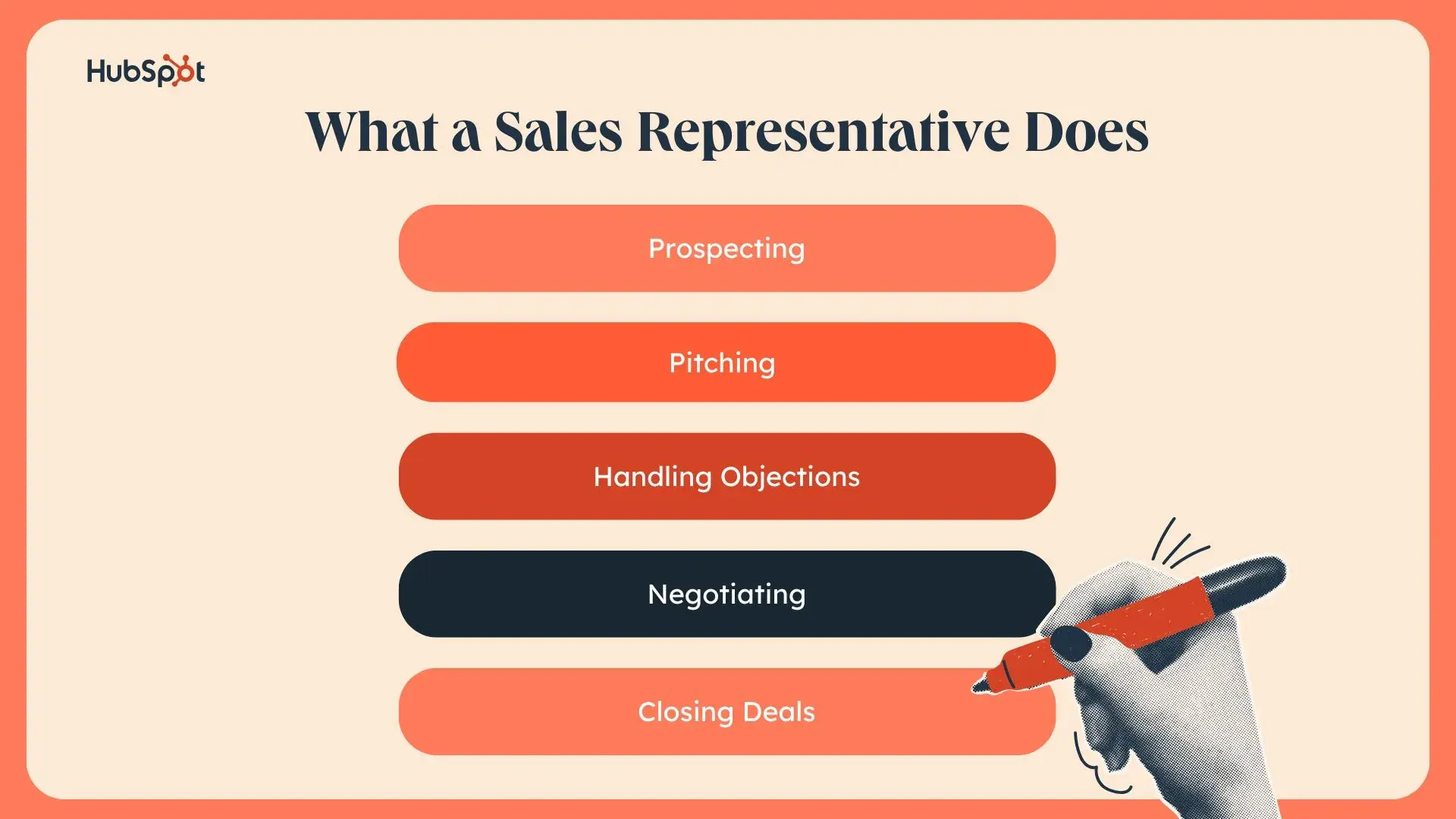
a hubspot-branded graphic detailing what a sales representative does

1. Prospecting.

As you’ve probably already guessed, prospecting is the first step in the sales process. During this (very early) stage of the sales process, you’ll identify potential customers who may be a good fit for your company’s product or service.

When I poked Bri about how she navigates prospecting, one thing about her answer stuck out to me: her use of AI. “Much of the initial research for my sales strategy relies on AI. ChatGPT, HubSpot’s Breeze technology … I use AI to [get a bird’s eye understanding of] what their business does, then I reach out, ask my prospect more specific questions, and recommend products based on what I find out about their company,” she shared.

Prospecting will look pretty different for every sales rep because it’s all about approach. Some folks prefer to prospect through 1:1 relationship-building, while others prefer more automated and data-driven prospecting (like Bri). If you don’t know what your prospecting strategy will be, it’s okay. You’ll find your groove in due time.

Regardless of your spin on or preferred style of prospecting, it primarily requires that you master the following elements:

  • Researching businesses and potential stakeholders
  • Leveraging social media platforms (i.e., LinkedIn)
  • Cold calling and/or emailing prospects
  • Attending and engaging in networking events

There are two goals behind doing this preliminary work: 1) to generate and qualify leads and 2) to ensure you’re targeting high-potential prospects before investing time in deeper sales conversations. Always keep these priorities in mind.

2. Pitching.

Once you’ve made it beyond the prospecting stage, you’ll deliver a compelling sales pitch to your prospect. This is where you’ll showcase how your company’s offerings (a product or service) solve their pain points. Pitching is usually done through several methods of communication, such as:

  • Email (there’s already some great advice on email pitching, like this article)
  • Phone call
  • Virtual meetings
  • In-person presentations

Typically, the most successful pitches emphasize value over features, so ensure that yours demonstrates why your offering is the right solution for your specific prospect.

3. Handling Objections.

Here’s the unavoidable thing about being a sales rep: Not every potential prospect will be immediately sold on a product, and that’s where your ability to influence their purchase decision comes into play. As a sales rep, you’ve got to be skilled at addressing concerns, skepticism, and hesitations from the prospects you’re courting. Thus, this part of the sales process requires you to be good at the following:

  • Listening to prospects
  • Displaying empathy
  • Problem-solving for prospects
  • Comforting prospects through any anxieties they may have about making a purchase

But I’ve got a sales secret to share with you: Most prospects have objections around the same core categories: pricing, product fit, timing, and competitors. Knowing what prospects will raise concerns will make helping them through the decision-making process much easier.

4. Negotiating.

After you pass the hump of mitigating a prospect’s doubts, you’ll enter the negotiation phase. This is when details like pricing, contract terms, and other specifics of your deal get ironed out. Expect to do a lot of back-and-forth during this stage. You’ll also need to lean on your strategic thinking and engagement skills to ensure a win-win outcome for both the customer and your company.

Robust negotiation skills take time to develop, so don’t rush it. Seriously. And if it’s any consolation, just know this: Once you hone them, you’ll secure better deal terms and long-term client relationships in no time.

5. Closing Deals.

At this final point in the sales process, you have one last job: Convert leads into paying, loyal customers. Closing a deal is, without a doubt, the most important (and tedious) aspect of the sales process, so it warrants doing some last-minute housekeeping tasks, such as:

  • Finalizing paperwork
  • Getting approval from decision-makers
  • Ensuring your customers are happy with their purchase
  • Answering any final questions your customer may have about the deal

Oh, and one last thing: This portion of the sales process will require you to complete it as quickly as possible. Don’t feel bad about applying pressure to close a deal at this stage. Spearhead those necessary follow-up meetings or additional communication! Most customers appreciate this. Additionally, a successful sales rep always does their best to close strong. A well-executed close can lead to repeat business and referrals.

Unfortunately, mastering the sales process doesn’t happen overnight (even when you really want it to). It takes time, practice, and planting seeds early on to get it right.

Sales Representative Requirements

If you’re officially sold on becoming a sales rep, that’s fantastic news. But you should know that the excitement and potential of a life in sales also comes with a bit of a trade-off … you’ve got to commit to checking off some boxes. Want to know something reassuring, though? You may have more of them taken care of than you think.

Before you enter the big wide sales world, I’ve compiled a list of everything you’ll need to fulfill to go from aspiring sales rep to qualified sales role candidate. Check it out below:
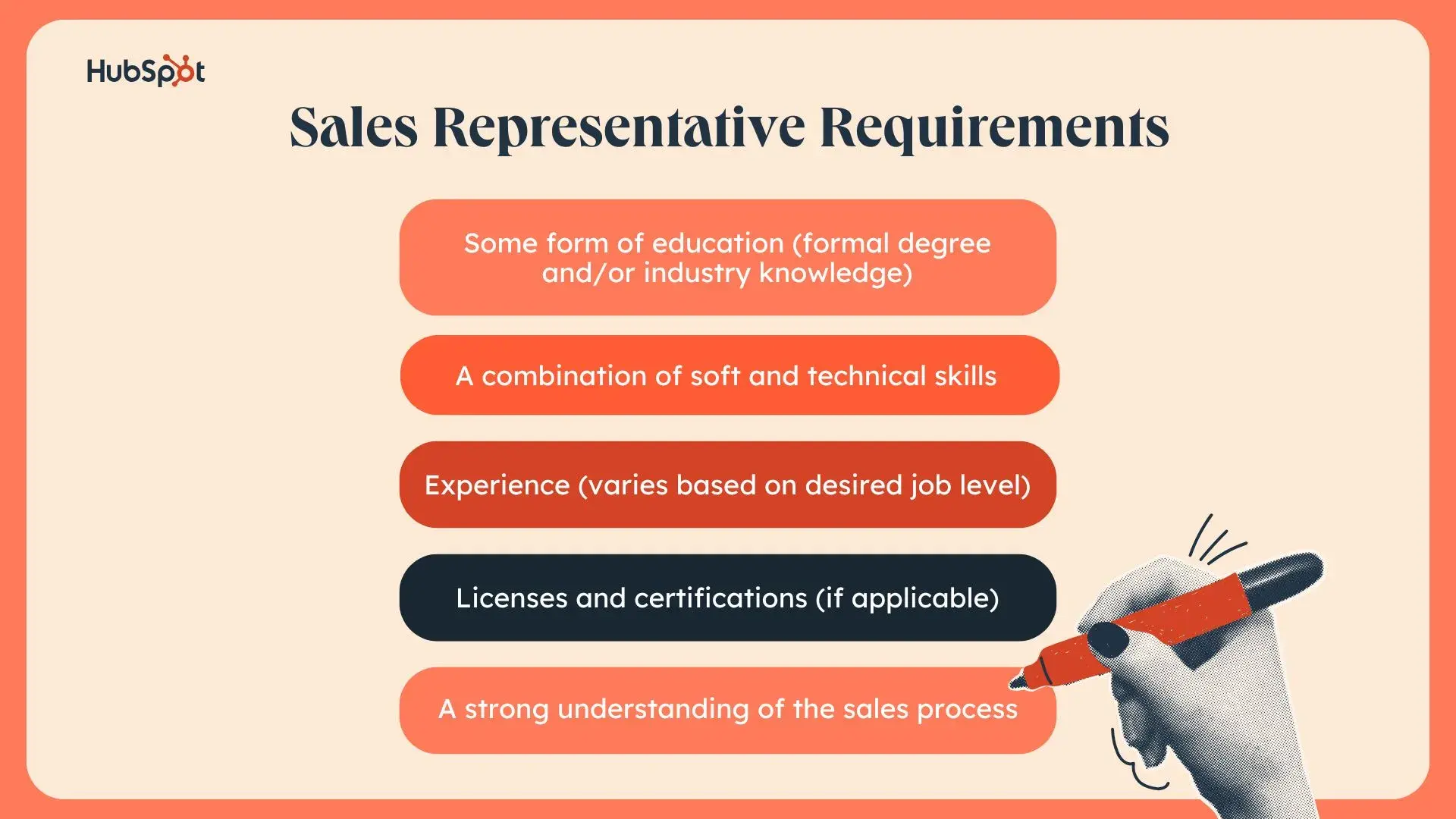
hubspot-branded graphic listing all the requirements a sales representative should have

1. An aspiring sales representative should have some form of education.

While many sales roles don’t require a specific degree, having some form of education attached to your resume is a plus. Whether your credentials be a high school diploma or bachelor’s degree in a specific career field (for sales, it’s typical to have a bachelor’s degree in business, marketing, communications, or finance), whichever proof of education you possess, it can serve as a firm foundation for your career.

And if you don’t have a formal degree, that’s totally okay. Don’t sweat it. Just be sure to supplement that experience with something else: mentorship, additional learning opportunities (i.e., courses/classes, micro-internships, externships, etc.), or whatever has helped you fruitfully gain sales knowledge.

If my encouragement wasn’t affirming enough, just keep this fact in mind: Employers care about how you’ve sought growth opportunities as much as they care about your education and where you got it from.

2. An aspiring sales representative should have a combination of soft and technical skills.

As much as I’d love to tell you that a sales job is about talking, I don’t believe in lying.

Unfortunately, a successful sales career doesn’t solely depend on how much you can gab. You’ve got to balance both soft skills (i.e., time management, active listening, etc.) and “hard” ones (i.e., knowledge of sales methodologies, ability to complete market research, etc.) to make it in this role.

If you’re wondering why, here’s your answer: The combination of these skills separates top-performing reps from those who struggle to close deals.

But don’t get too caught up on that right now. Later on, I’ll revisit this topic and go more in-depth into desired core competencies. I’m here to help you thrive, not overthink.

3. An aspiring sales representative should have some sales experience (don’t take this too literally … just stay with me).

Say it with me now: You don’t need years of sales experience to land your first sales role.

Tons of high-performing sales reps didn’t start in the corporate sales space. And, being candid, many of ‘em started just like the rest of us: working in retail, customer service, even in the non-profit space. No matter where you spent the first couple of years building your work experience, you likely spent that time doing all the things you’d be doing as a sales professional.

If you’ve ever had to convince someone or bargain for something, congratulations — you’ve already got the chops for sales under your belt.

4. An aspiring sales representative should have licenses and certifications (if applicable).

Some sales roles, especially in real estate, finance, and medical sales, require specific licenses or certifications. There’s no saying which ones you should be getting over others, but to help you filter through your options, I’ve researched several of the most popular ones for your consideration. Take a moment to explore — and maybe sign up for — them below:

5. An aspiring sales representative should have a strong understanding of the sales process.

While you wait to hear back about any potential sales roles you’ve applied to, there’s only one thing you should be doing to prepare for an interview: Do all the research on the sales process.

Knowing the ins and outs of the sales funnel, how to prospect, what lead qualification looks like, along with any other sales timeline stuff, will help you feel like you’re in familiar waters once you start your job.

So, if you find yourself in the middle of a free moment (or hour), use the time to read up on industry best practices, consume sales content (The Pipeline newsletter is one of my faves), and, if possible, spend time connecting with experienced reps who can share real-world insights. Preparation can go a long way in making you primed for success.

Sales Representative Skills

Remember that blend of soft and technical skills that I mentioned earlier? Well, if you thought it wasn’t that important for your sales career, you slightly underestimated just how essential they really are.

In this section, I’ll give you a bit more context into what developing these skills will mean for the trajectory of your sales career. I’ve even researched how they’ll separate you from other emerging sales folks. Scope out what I found below:
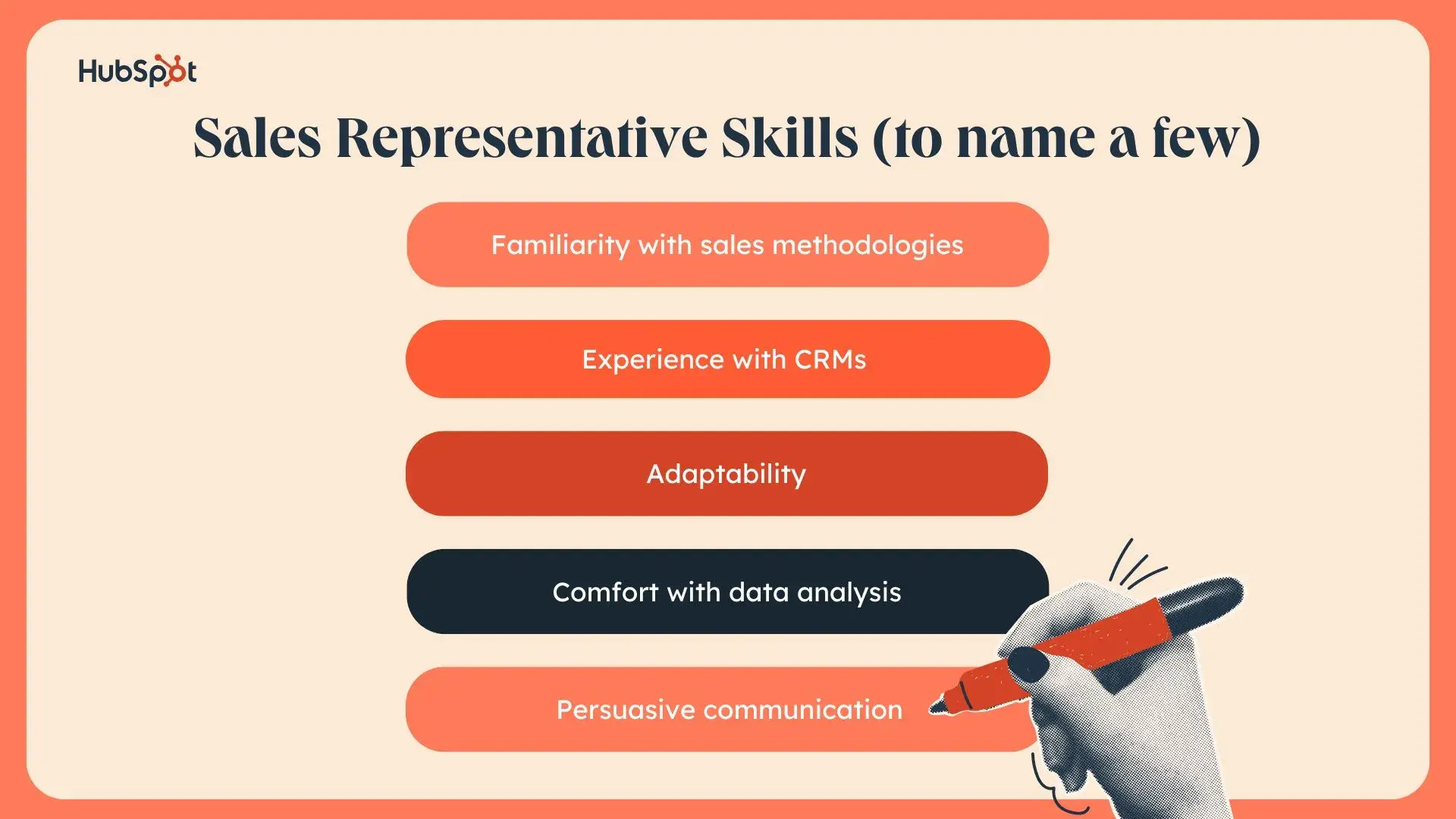
hubspot-branded graphic listing all the requirements a sales representative should have

1. Familiarity with sales methodologies.

As I previously stated, working in sales isn’t solely about having a great personality or being a decent conversationalist. It’s about understanding and applying structured selling techniques.

Familiarity with popular sales methodologiesSPIN Selling, Challenger Sales, Sandler Selling, or Solution Selling — can help you build stronger relationships with prospects and close deals more effectively. The best sales reps don’t rely on guesswork; they follow proven frameworks to guide conversations, handle objections, and tailor their pitches to customer needs.

2. Experience with CRMs.

Customer Relationship Management (CRM) software is the backbone of any modern sales team.

Whether it’s HubSpot’s Sales Hub or some other CRM, knowing how to track leads, manage pipelines, and analyze sales data will transform how you sell. Many employers look for CRM proficiency when hiring, so being comfortable with these tools will make you a more attractive candidate.

3. Adaptability.

What worked last year in the sales industry might not work today. Welcome to the reality of modern selling.

Whether it’s adjusting to changing buyer behaviors, new industry trends, or evolving sales technology, the best sales reps know how to pivot and experiment with new strategies. Being adaptable also means:

  • Staying open to feedback
  • Learning from both wins and losses
  • Continuously refining your approach to match what works best for your target audience

4. Comfort with data analysis.

Gone are the days when sales were purely about gut instinct. Today, successful reps use data to drive their decisions.

Tracking conversion rates, identifying top-performing outreach strategies, analyzing customer behavior … you name it, a sales rep is likely doing it to sell smarter, not harder.

Understanding KPIs like lead-to-close ratio, sales cycle length, and customer acquisition cost (CAC) will allow you to optimize your efforts and improve performance over time.

5. Persuasive communication.

At its core, sales is about influence. Clearly articulating value, handling objections, and building trust with your prospects can (and will) make or break your success.

Persuasive communication isn’t just about talking more. It’s about listening, asking the right questions, and tailoring your message to what truly matters to your prospect.

Sales Representative Salary and Pay

Up to this point, I’ve talked a lot about what you’ve got to bring to the table to become a sales rep. However, it’s finally time to switch gears and give you some insight into what you can expect after landing your dream sales position.

According to Payscale, the average base salary for business development representatives (BDRs) is about $53,000. That said, I already know what you’re thinking: In today’s economy, a $53,000 salary isn’t the most appealing. But before you write off the role entirely, here are a few things you should keep in mind about earning potential in sales:
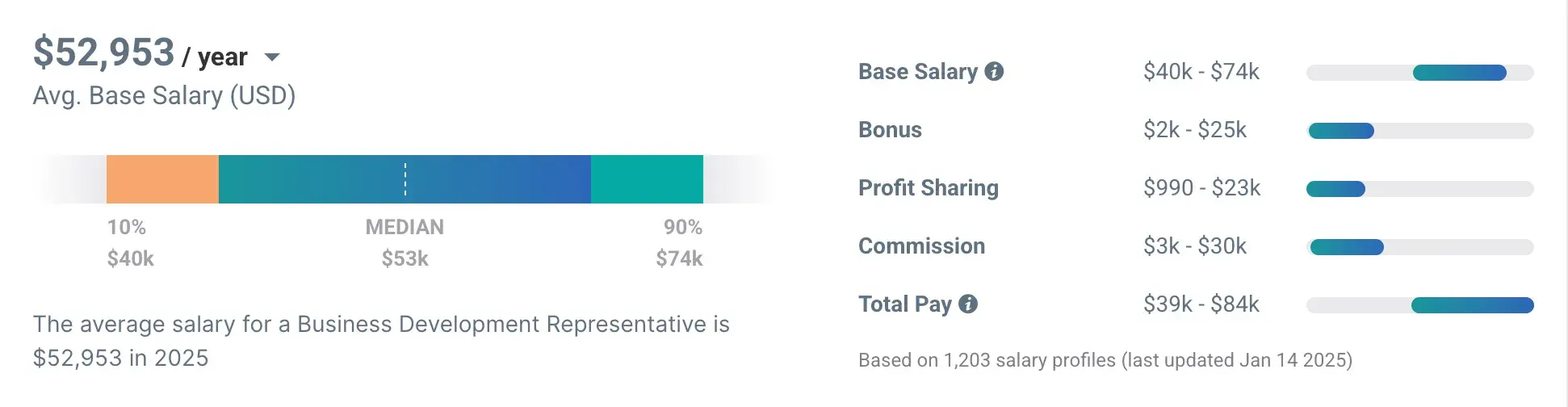
a screenshot of average base salary information for a business development representative in 2025 from Payscale

Source

  • Like every other job, what you get paid as a BDR/sales representative is determined by where you live and how much knowledge, skills, and experience you have
  • BDRs/sales representatives are likely to receive bonuses and commissions on deals (sometimes, vested bonuses are integrated into BDR/sales rep roles)
  • BDR roles are high-growth roles (meaning that there’s tons of potential for folks to get promoted very quickly)

To help you better gauge what the sales representative job landscape currently looks like, have a peek below at the various job listings I found from real-life employers.

There’s a ton to learn from these postings, not just about what you’ll do but how much you’ll get paid for it:

1. Business Development Representative at Adobe
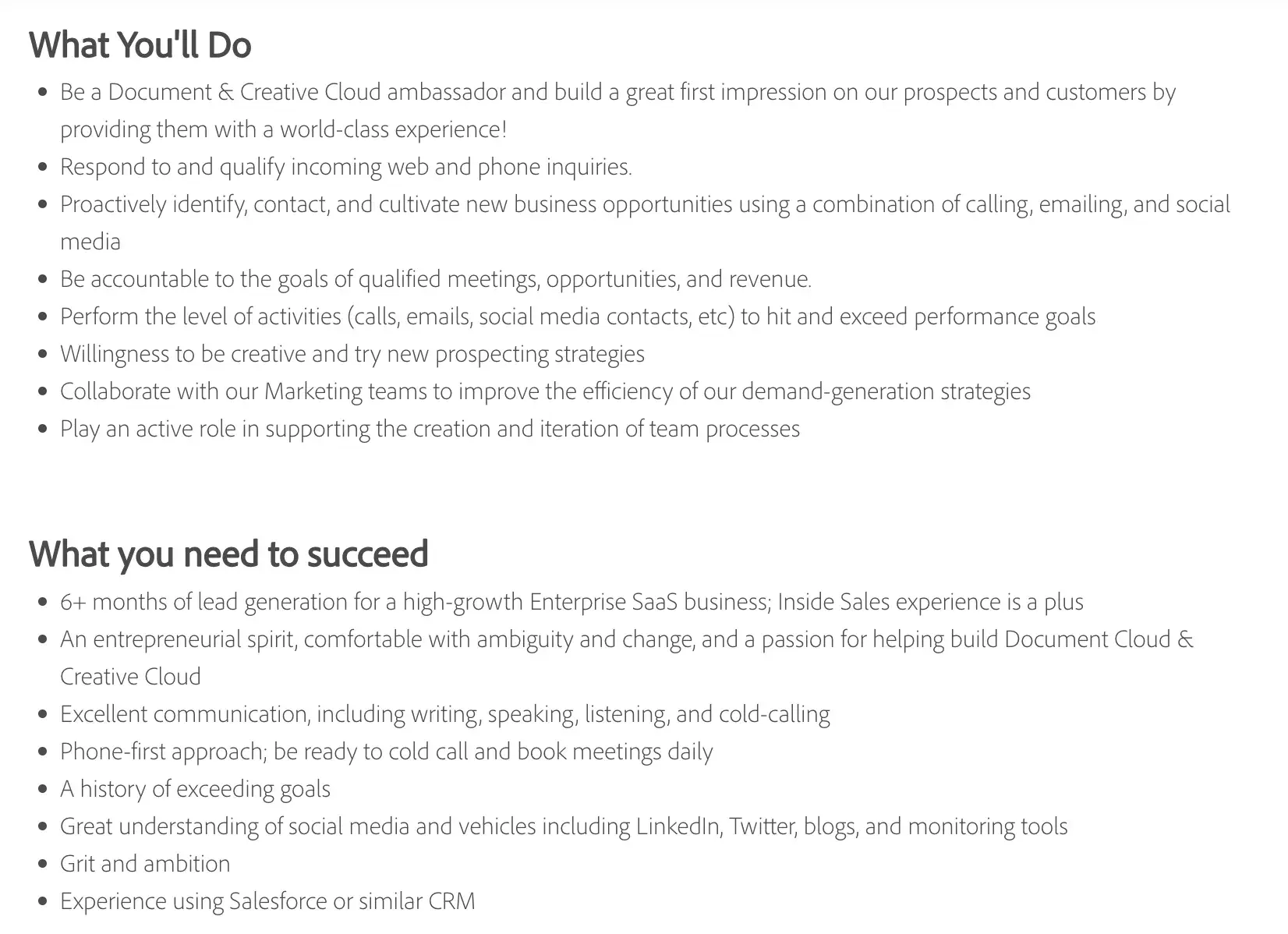
 a screenshot of a business development representative job listing posted by adobe

Source

Adobe posted this Business Development Representative job. The pay range for this position is $70,200 – $112,900. This role emphasizes the following responsibilities and qualifications:

  • Collaborating with Adobe’s Marketing teams to improve demand-generation strategies
  • Performing prospecting and qualifying activities to hit and exceed performance goals
  • Previous experience at an Enterprise SaaS (B2B) business
  • Excellent communication skills (specifically written and verbal)
  • Experience using a CRM

2. Outbound Business Development Representative at HubSpot
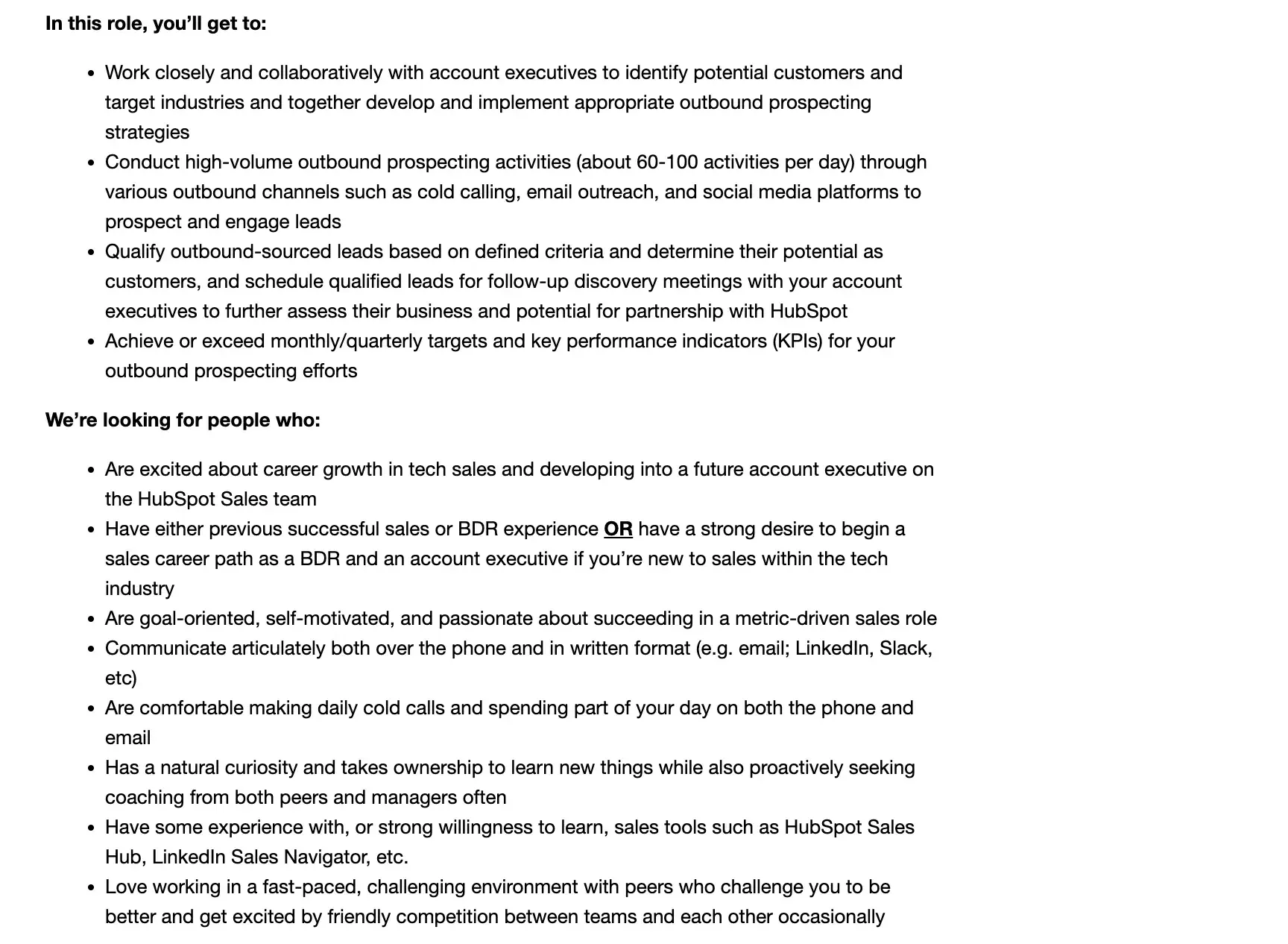
 a screenshot of an outbound business development representative job listing posted by hubspot

Source

HubSpot posted this Outbound Business Development Representative job. The base salary for this position is $49,910 (with an on-target commission of $21,090). This role emphasizes the following responsibilities and qualifications:

  • Making daily cold calls and emails
  • Qualifying outbound-sourced leads based on criteria and scheduling qualified leads for follow-up discovery meetings
  • Conducting high-volume outbound prospecting activities through cold calling, email outreach, and social media scouting
  • Experience with/willingness to learn HubSpot Sales Hub, LinkedIn Sales Navigator, and other sales tools
  • Previous successful sales or BDR experience OR have a strong desire to begin a sales career path as a BDR if new to sales

3. Business Development Representative at Impact.com
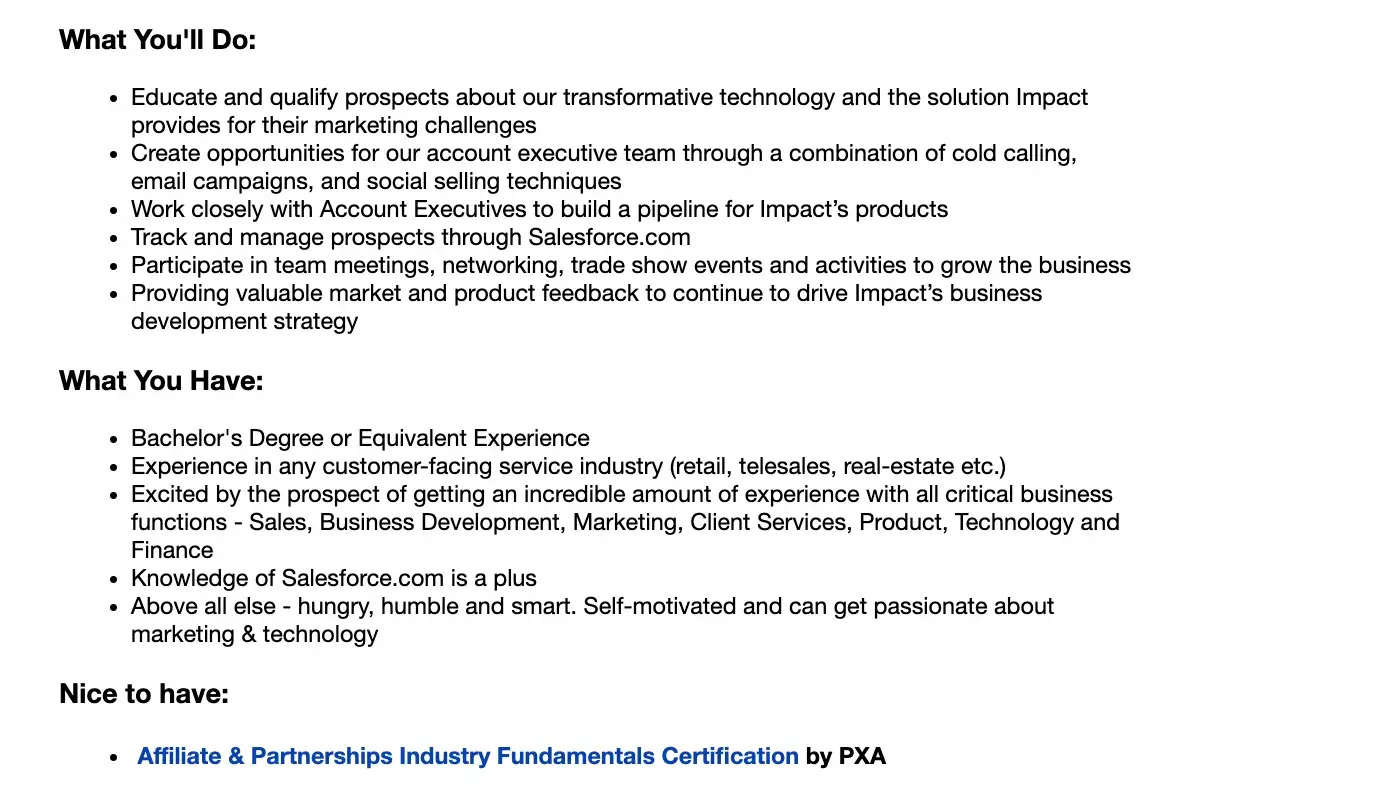
a screenshot of a business development representative job listing posted by impact.com

Source

Impact.com posted this Business Development Representative job. The base salary for this position is $76,500 (with on-target commission earnings included). This role emphasizes the following responsibilities and qualifications:

  • Educating and qualifying prospects about Impact.com’s technology
  • Participating in team meetings and networking efforts
  • Tracking and managing prospects as they go through the sales process
  • Must have a bachelor’s degree or equivalent experience
  • Experience in any customer-facing service industry (retail, telesales, etc.)
  • Hungry, humble, smart, and passionate about marketing and technology

4. Sales Development Representative at Webflow
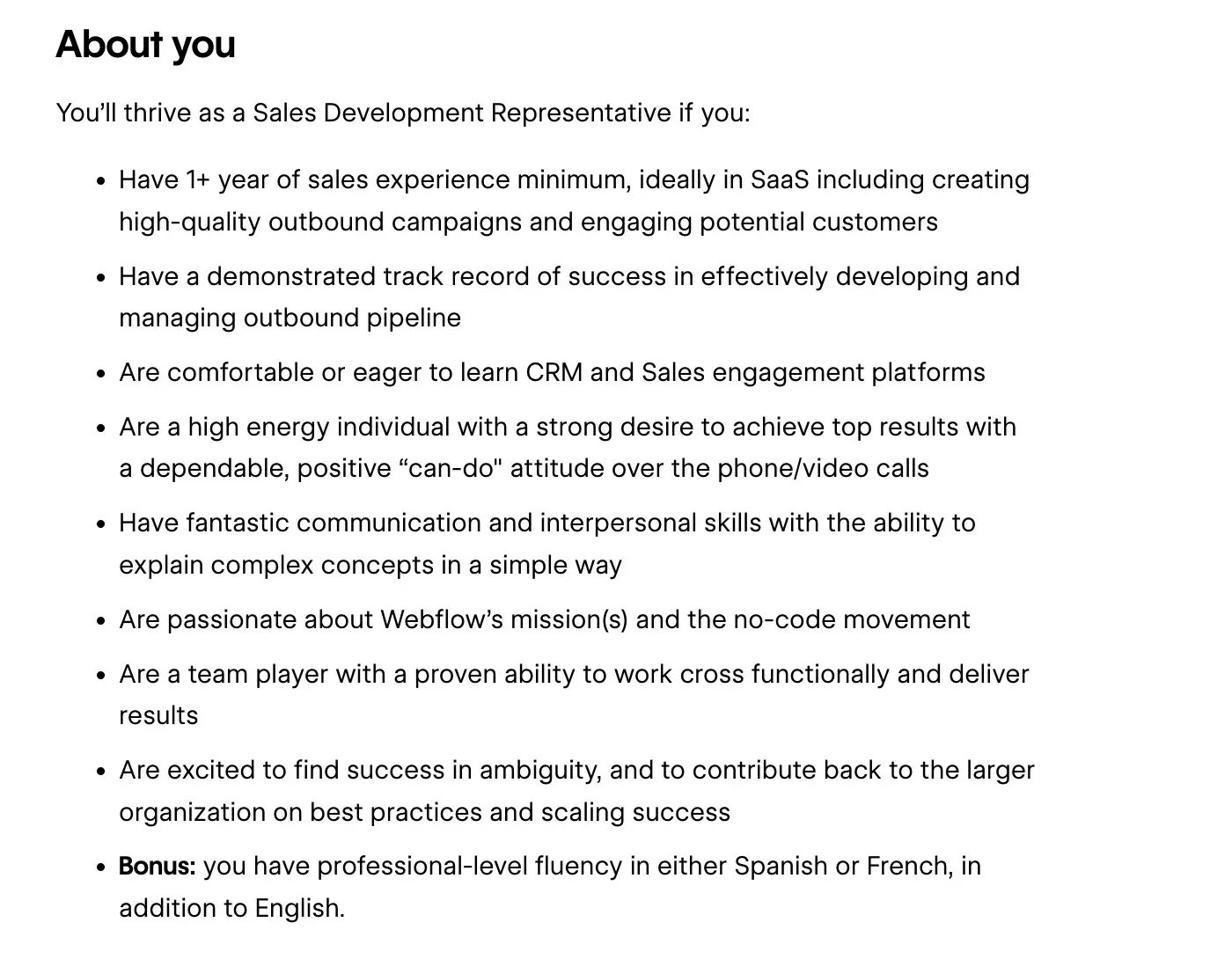
a screenshot of a sales development representative job listing posted by webflow

Source

This Sales Development Representative job was posted by Webflow. The base salary for this position is $90,300 (with on-target commission earnings included). This role emphasizes the following responsibilities, experience, and qualifications:

  • 1+ years of sales experience minimum (ideally in a SaaS company)
  • Comfortable learning CRM and other Sales engagement platforms
  • Establishing rapport with all levels of buyers, including senior executives
  • Working cross-functionally with partners (like Marketing & Ops) to iterate processes and ideas for successful lead-generation campaigns
  • Evaluating and improving Webflow’s sales processes with an emphasis on building to-scale

How to Become a Sales Representative

Becoming a sales representative is part seeking out the right roles, part self-investment.

While scouring the internet for your next sales role, you should also plan to do some personal development. If you identify as a budding sales rep, scan through some of my proactive recommendations for getting prepped for industry expectations:
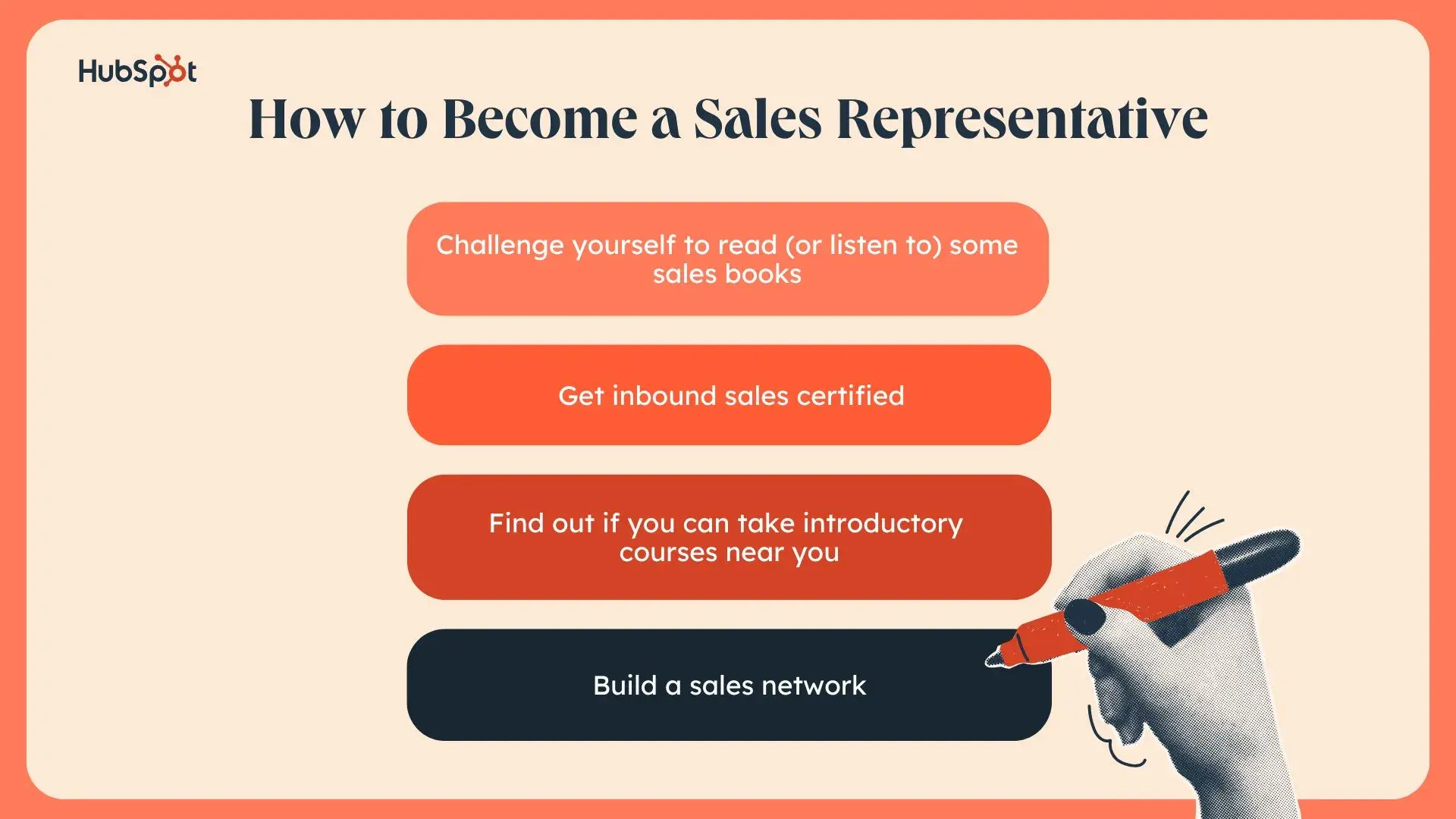
a screenshot of a hubspot-branded graphic detailing how to become a sales representative

1. Challenge yourself to read (or listen to) some sales books.

Sometimes, returning to the basics means getting the best perspective on what works. Reading books is a super valuable way for ambitious sales professionals to get wisdom from seasoned sales pros without hunting high and low for expert advice.

Many sales books are available on various topics, from developing an entrepreneurial mindset to the psychological and behavioral aspects that affect sales success. Pick what best suits your needs, then read to learn from experienced professionals how to grow your skills and leverage your already-learned ones.

If you’re unsure of what books to buy, here are a few to start with (from my bookshelf to yours):

2. Get inbound sales certified. Seriously.

I tapped Kyle Jepson, former Senior Professor (and current Principal Marketer) for HubSpot Academy, to get his opinion on how far an inbound sales certification can genuinely take the up-and-coming salesperson. You’ll find his answer rather eye-opening, particularly if you’re looking for ways to grow your sales expertise fast.

The Inbound Sales Certification is designed specifically for new sales reps. It gives actionable tips and strategies that salespeople can implement on their next call or in their next meeting, regardless of what industry they’re in,” Kyle told me.

Other sales training programs, whether entirely online, on-site, or hybrid, are also worth considering; that way, when you find one that piques your interest, you can best incorporate time for learning into your schedule.

3. Find out if you can take introductory courses near you.

If you’re hoping for a more traditional sales training program, take introductory sales courses at your local university or community college.

Many educational institutions offer business classes in sales development. If you can find a class to take, I guarantee that, along with getting a foundational education in sales, you’ll learn from experienced professionals and can begin expanding your sales network.

4. Build a sales network.

Working in sales is different from virtually any other profession; if you’ve ever been a sales rep before, you already know that you’ll feel the difference before you realize how fast-paced it is.

As you ease into the adjustment of being a sales rep at a new company (even if you’ve done it before), utilize every opportunity to seek out more established sales folks. Why? Well, for two reasons: 1) to understand how their positions work and 2) to get well-informed advice on the skills you should develop to be successful.

This means doing some serious social media scouring. Bri has done this herself as well. “I think it really starts with following people on LinkedIn that you admire. Once I started engaging with sales and marketing leaders on there, LinkedIn recommended other people to connect with,” she said. “The key to building a sales network is to post on LinkedIn frequently, share relevant content, and, [once you’ve built a community], connect the people you meet to others who can help them.”

Additionally, if you’ve already done the work to get your sales certifications or take university courses, talk to your instructors. Ask them if they have specific folks they think would be beneficial to chat with, then simply send them a note on LinkedIn. It doesn’t have to be complicated or scary.

Pro Tip: Want to start seeing salesfolks on your LinkedIn but don’t know where to start? Here’s a list — perfectly curated by moi, of course — of sales professionals posting helpful content on LinkedIn. Feel free to stalk as you see fit:

How to Become an Independent Sales Representative

You may want to pursue independent sales once you’ve gained adequate sales experience.

As this section title suggests, an independent sales rep works for a company but is independently in charge of its operations (marketing, customer service, bookkeeping, etc.) and business practices. Independent reps sometimes contract for multiple companies at once. Kinda dope, right?

There are two critical factors for becoming an independent sales rep; they’re as follows:

  • Having sales experience, preferably in-house. It’ll be challenging to succeed in the role if you don’t understand how the sales process works, so developing solid selling experience is essential before embarking on a more independent journey.
  • Being comfortable working for yourself and able to work for yourself. This means that you don’t struggle if there isn’t anyone standing over your shoulder monitoring your progress because you can monitor your progress and get your work done. It’s important to note that you still have to report back to the business you work for; they’re just not likely to monitor your everyday progress.

Pro Tip: Having in-house sales experience opens doors to new opportunities. It’ll help you develop a network of contacts and relationships that can help you when you start working independently, whether by introducing you to potential clients or giving you credibility within the sales industry.

Still, there’s more to the story. Becoming an independent sales rep isn’t just about having experience — it’s about knowing what you need to handle the responsibilities of working for yourself. All of this said, here’s what it takes to thrive as an independent sales rep:

1. Start with your goals.

If you’re learning to sell, start from the very end and work backward. Knowing your goals and measuring your performance against them (more on that later) is the best way to lay a foundation for success. You can anchor yourself in this reflection process by asking yourself questions like …

  • How many customers do you or your company need, and in what time?
  • How many leads do you need to close that many customers?
  • How many connections do you need to generate that many opportunities?

Once you’re done, multiply your customer goal by the average sale price of your company’s product to get the revenue you should aim for.

Make sure you set personal sales goals as well. You can always tell when a salesperson is in the top 2% of their organization. They command attention, work at their craft, provide a consistent experience, and execute. These behaviors and actions typically precede results.

Aim to be in the top 2 percent of your organization. It won’t happen tomorrow and it won’t be easy, but always strive for the top.

2. Recognize that sales is a process.

Sales is not an art. It is a science and a technology that is changing rapidly, but simultaneously, it has a standard formula that will always be the same. To get customers, you’ll have to establish their needs and interest in your product, address inertia in their business, and determine a timeline to sell.

However, here’s the caveat for your consideration: How your company (and every company, honestly) moves through the sales funnel will be unique. You have to understand that every business has its playbook for a reason.

Before you get on the phone with a prospect, sit down with your managers and get all the information needed to thoroughly understand your company’s process. By doing so, you’ll learn the following (and then some):

  • How to position your product
  • Strategies for speaking with prospects
  • Understanding your key value propositions
  • Discovering what your ideal customer looks like

Pro Tip: Pete Caputa, CEO of Databox and former VP of Sales at HubSpot, and Harvard Business School professor and former HubSpot CRO, Mark Roberge, are some of the most successful sales executives (and scientists) I know of. They’re scientists and excel at making the classic sales process scalable. Follow them both on LinkedIn, pay attention to their content, and get as much as possible from engaging with any insights they share.

3. Identify business pains.

You must identify and distinguish your prospects’ business pain points from their run-of-the-mill business problems. If a step of their process is a slight annoyance, who cares?

Pain isn’t getting a cut on your arm. Pain is your leg falling off. Real business pain is discussed daily in the executive office and the boardroom. Someone has probably set aside a budget to solve it. If it’s a critical factor to their business’ success, you’ve discovered a real business pain.

Still, even after addressing their pain points, proposing a solution, and closing a deal, your relationship doesn’t end after the sale — you’re required to live up to your promise. Prepare your prospects for the transition to your product and give them all the help they need, and you’ll have a happy customer on your hands.

4. Measure every step.

Anything worth doing is worth measuring, and anything that can be measured can be improved.

Remember when you set your goals? Be fanatical about measuring your performance against them. At the rate you’re selling today, will you hit your numbers by the end of the month? Are your closing strategies converting prospects to customers? If not, change something up.

Don’t wait until it’s too late to reach your numbers this month. If you measure everything you do, you can solve problems as they arise. And these days, there are boatloads of coaching resources to help you through this.

A simple Google search for an area you’re struggling with will return a massive amount of material that can help you. Your managers will also be happy to help you, especially if you ask for assistance before it’s too late.

5. Sell to the right people.

This principle is at the heart of the inbound sales methodology.

Instead of trying to convince everyone to buy your product, focus on prospects who actually need what you’re selling. When (or if) you become an independent sales representative, your time will be incredibly valuable, so targeting the right audience will ensure that your efforts yield higher conversion rates and long-term customer relationships.

Pro Tip: Here are my suggestions for finding the correct folks to sell to:

6. Embrace team selling.

When starting in sales, you want to make a name for yourself. Many reps think the fastest way to do this is by blowing away the competition alone. That approach can be isolating, and you miss out on a lot.

For example, if you’re unsuccessfully trying to speak with the CEO of a large company, ask a sales leader if they can get you in the door by leveraging their seniority and making that first call. This collaborative approach doesn’t just help. It strengthens your chances of closing deals.

No matter their experience level, modern reps should embrace team selling; Bri agrees, too.

“Looping in another team member that you think would help you sell because they just closed a big deal, bringing in a [sales specialization partner] … even reaching out to people on Slack is what has constantly built up my knowledge as a sales rep,” she told me.

In light of Bri’s honesty, here’s my advice: Don’t be afraid to utilize your team's expertise to close more deals. It’s not cheating; it’s maximizing your resources. You’ll learn valuable skills and blow your quota out of the water.

8. Shadow your peers.

Along those same lines, you can learn a lot about excelling in sales by listening to the best — your peers and teammates alongside you.

Take some time each week — or each month — to listen to how your teammates conduct successful sales calls. Whether you’re listening live or listening to recordings, you can pick up phrases, rapport-building techniques, and closing strategies that you can personalize your calls.

9. Find a mentor.

Checking in with peers to hone your selling skills and day-to-day workflows is valuable. But pairing with a mentor who can impart wisdom, help you plan and grow your career, and guide you through challenges is likely the most advantageous thing you can do. This person should help you visualize where you see yourself one, five, or even ten years later.

That said, be sure to identify a mentor who:

  • Has found measurable success in the career you aspire to be in
  • Has accomplished specific achievements or milestones you admire
  • Has relevant experience that applies to your career path

Once you’ve identified someone with the experience and availability to be your mentor, don’t be a scaredy cat. Set up monthly or quarterly meetings with them to discuss how you anticipate spending that time so you can walk away with mutual value and new knowledge.

10. Build a personal development plan.

Every salesperson has strengths and weaknesses. As an independent sales rep, you must constantly re-evaluate your strengths and skills. This starts with pinpointing areas of the sales process that you do well, such as building rapport or asking good questions, and keeping tabs on how you refine them.

When you start, you are unconsciously incompetent – you don’t know what you don’t know. Then, over time, you become consciously incompetent – you do know what you don’t know, and you can make a plan to continue learning and filling in skill gaps. From there, finally, you become consciously competent — you have the qualities you need to do the job well.

I suggest assessing your new skills and creating a personal development plan (PDP) to facilitate this process. This can be a simple document that defines the two to three things per month that you want to work on to improve your skills.

You should aim to revisit this document with your manager or mentor regularly to ensure you’re on track with your learning.

11. Start a film club.

Professional athletes watch many films and footage of their performances. Salespeople can benefit from the same approach.

I recommend that new salespeople build a film club to accommodate different learning styles, with a handful of their peers trying to improve their skills. Here’s how a sales film club can work:

  • Set aside an hour, and have one person bring a recorded call and a standard evaluation template
  • Have the group listen to the call and note what they hear
  • Beginning with the person who recorded the call, have participants provide feedback on what worked and what could be improved

This group dynamic helps new salespeople work together to reduce their anxiety and learn to improve their sales skills in a safe environment.

Take a Chance on a Career in Sales

Taking a chance on a career in sales might feel like a big leap, but if you’re willing to put in the effort, it can be one of the most rewarding decisions you’ll ever make. And while it can be demanding, the payoff — both financially and personally — makes it worth the hustle.

Over time, you’ll develop skills that aren’t just valuable in sales. You can take whatever expertise you nurture to other industries, opening doors to leadership roles, entrepreneurship, and beyond.

If you’ve been hesitant about becoming a sales rep, consider this your sign to go for it. Take the first step, invest in your development, and embrace the learning curve. Your next deal might just be selling yourself on a lifetime career.

Editor's note: This post was originally published in May 2015 and has been updated for comprehensiveness.


12 Jan 18:40

How To Measure Account-Based Marketing In 7 Easy Steps

by David Crane

In many ways, account-based marketing (ABM) has more in common with art than science. Success in ABM requires a great deal of personalized outreach, and because ABM is centered around human relationships, it can be challenging to measure the returns on account-based marketing campaigns.

B2B marketers can’t only rely on quarterly revenue reports to measure the success of ABM efforts. Instead, we must shift to new methods of success measurement to deliver accurate projections and scalable results to stakeholders within our organizations. Brandon Redlinger, Director of Growth at Engagio, says,

“Since ABM is a fundamentally different approach, it requires different metrics – metrics that provide an account-centric lens to your measurement.”

The implementation of any account-based marketing plan requires new tools for measuring readiness, progress, responsibilities and other aspects of ABM success. To capture ABM wins and achieve continual improvements, it’s best to measure campaigns using dynamic methods.

7 Steps to Measure Account-Based Marketing

Step 1: Assess ABM Readiness

According to Altera Group research, 97% of B2B marketers report ABM drives higher ROI than other marketing activities. While improved revenue is an attractive outcome, there are numerous benefits beyond these account-based marketing success stats.

The lesser-known benefits of ABM adoption can include:

  1. Better sales team utilization
  2. Less time spent processing leads (and other inefficient tasks)
  3. Improved company morale
  4. Decreased customer turnover rates
  5. Stronger sales/marketing alignment

While these outcomes are likely to appeal to every B2B organization, it doesn’t mean your company should adopt an ABM strategy without first determining whether it makes sense for your organization’s business model and resources. Use a worksheet to score organizational readiness across all relevant factors, including whether your product, services, customers and sales cycles are strong candidates for an ABM strategy.

Other factors to consider are the organizational capacity to create targeted content and leadership buy-in.

Worksheet_A

Step 2: Create Monthly and Weekly ABM Progress Metrics

Achieving ABM success requires a clear strategy for pipeline, lead and contact volume to meet quarterly or annual sales goals. Create specific, measurable and attainable goals for tracking progress by building a worksheet that breaks down revenue targets into lead or contact volume goals based on close-won percentages.

Update your lead-opportunity-close goal model worksheet on a monthly or quarterly basis. By implementing a spreadsheet-based model for calculating progress against revenue targets, you’ll enable your organization to continuously pivot your ABM strategy to reach and exceed your goals.

Worksheet_B

Please note, this screenshot is not reflective of the entire ABM lead-opportunity-close goal model on Integrate’s worksheet. At the end of this blog, you can download free, customizable copies of each of the featured ABM worksheets.

Based on monthly progress targets calculated in the last worksheet, create ABM metrics for expected weekly progress. Tracking weekly attainments and opportunities can provide robust data for sales/marketing conversations and give your marketing team the intelligence needed to perform in-flight ABM campaign optimization.

In the spreadsheet for creating weekly progress metrics, track opportunities created, live conversations and sales-qualified opportunities. When used in conjunction with quarterly and annual metrics, weekly progress goals can allow B2B marketing teams to remain in control of ABM revenue success.

Worksheet_C

Step 3: Establish ABM Team Roles and Responsibilities

If your team is new to ABM or formalizing sales-marketing alignment efforts, you should document process ownership by team or individual. Additionally, update ABM roles and responsibilities to reflect changes in strategy, introduction of new technologies and implementation of account-based marketing plans.

Worksheet_D

ABM adoption requires cross-functional collaboration, so it is no surprise that it also creates a significant cultural shift for many B2B organizations. To mitigate confusion among teams, create a living document that serves as a quick overview of responsibilities and ABM-related processes. Share it with marketing, sales and customer success teams.

Worksheet_E

Step 4: Assess Account & Persona Development

ABM is human-focused, and therefore requires the creation and maintenance of ideal customer profiles (ICP) for each target account vertical. It’s also necessary to regularly update your buyer persona profiles, which will enable you to better target specific decision-makers within your target accounts.

For fast insight into your ideal customers, track personas in a worksheet. Ideally, insight into your target accounts and account decision-makers should come from a variety of qualitative and quantitative sources, including sales reps, CRM, MAP, predictive analytics, intent data providers and other analytics tools and service providers.

Begin by defining types of target accounts and proceed to determine motivations, pain points and a relevant value proposition to shape messaging for each role.

Worksheet_F

Step 5: Track Account Planning and Lead-Account Mapping

Tracking progress on target accounts requires agility in B2B marketing and sales organizations. Use worksheets to track engagement and account/contact data on every targeted account. Record potential revenue opportunities and account contacts details in your CRM to gain a comprehensive view of the sales pipeline.

Account planning and lead-to-account mapping worksheets are not meant to replace your CRM data. Instead, these worksheets enhance CRM insights by serving as a resource for sales/marketing meetings. Additionally, worksheets capture insights that aren’t always efficiently reflected in your CRM, like customer relationships and referrals.

Worksheet_G

Step 6: Catalog Content Assets by ICP, Personas and ABM Funnel Stage

The savviest B2B marketers have mastered the art of repurposing and recycling content to fill the ABM pipeline with highly targeted resources that are relevant to each ICP and decision-maker persona. At the onset of each ABM strategy, it’s valuable to record existing and planned content assets to ensure coverage across all targeted organization types and job roles.

Tracking content asset by account type, buyer type, buyer’s journey stage and other criteria can be dynamically executed in a spreadsheet-based worksheet. Include titles for quick reference, and customize each of the fields to match the organization’s defined account stages, prospects and other key definitions.

Worksheet_H

Step 7: Blueprint ABM Technology Adoption

Widespread adoption of account-based marketing may have originated in the 1990s, but the idea has evolved significantly in the last few years. Today’s ABM strategies rely extensively on technology to automate the many processes that drive an ABM program.

The core of every successful ABM strategy contains a marketing automation platform (MAP) and CRM platform, which are often augmented by other technologies (such as predictive analytics, programmatic display, content experience, web analytics and personalization, and much more). To assess your organization’s MarTech resources, create a spreadsheet to audit existing technologies and vendors. If applicable, also project an adoption schedule for new marketing technologies.

Worksheet_J

When assessing prospective technologies, it’s beneficial to have cross-functional software selection committees access insights on each vendor. Use a spreadsheet to track vendor and platform insight from valuable sources (e.g., research agencies, influencers, peer insights, MarTech vendors, etc.).

Worksheet_K

Effectively Measuring Account-Based Marketing

ABM adoption represents a dramatic cultural and strategic shift for many B2B organizations. Account-based demand generation requires in-depth research into target accounts, close sales-marketing alignment and cross-functional strategies. It also requires new methods of measuring readiness, progress and responsibilities throughout the organization.

Whether your team is new to ABM or working toward ABM maturity, adopt a formal approach to measuring progress, technology and content to provide full funnel transparency and improved team morale.

For free, customizable copies of each of the worksheets featured in this blog and the necessary advice and guidance to scale and execute an account-based marketing strategy, download your free copy of “The 2nd Edition ABM Workbook.”

11 Jan 18:02

Is your sales pipeline full of fatbergs?

by bob@inflexion-point.com (Bob Apollo)

Fatberg SquareThe sewer systems of of our towns and cities are struggling to cope with a phenomenon known as the “fatberg”. These fatbergs are formed by an unappetising combination of oil, grease, food waste and other materials that have no place in the system.

Unfortunately, as these fatbergs harden and grow, they cause obstructions that require specialist equipment to remove. The problem is largely avoidable, it’s obviously a pretty unappetising story, and you may wonder why I’m sharing it with you.

Something very similar is going on in many sales pipelines. They are clogged with so-called opportunities that haven’t moved for ages and are unlikely to close any time soon. And the longer you delay clearing them out, the harder it gets to remove them...

Most studies of sales pipelines indicate that at least one-third of the opportunities show no meaningful signs of life at all, and that figure gets much worse when you drill down into the pipelines of the least effective sales people and organisations.

These "fatberg opportunities" have no place in the pipeline. Some should never have been introduced into the system in the first place - they were never well qualified. All too often, the prospect was never actually likely to buy anything, and even if they did, they were never likely to buy from you - and this could have been established through some elementary qualification.

In other cases, there might initially have been the elements of a potential opportunity, but either the customer’s circumstances have changed, or we failed to execute our sales strategy as well as we could have and as a result the opportunity is now well and truly stuck.

The projected close dates - if they were ever accurate - are now no more than a figment of the sales person’s fevered imagination. And because their value continues to be counted in our overall pipeline numbers, we may feel a false sense of security about our future revenue potential.

Trying to close the unclosable

It’s no wonder that forecasting is such a challenge in these sales environments. And it’s no wonder that this really comes home to roost at the end of the Financial Year - when sales people are often desperate to play the “Mission Impossible” game of trying to close the unclosable.

For as long as they hang around in our pipelines, these stuck opportunities reduce our capacity to move the remaining well-qualified opportunities through the system. They offer false hope, and they distract focus from the deals that actually deserve our attention.

By the way, this is almost never a problem with your most effective sales people. They tend to have too much respect for their own time to waste it pursuing opportunities that they judge (usually accurately) they are never likely to win. They also tend to have a far higher win rate from qualified opportunities, and as a result need fewer of them to make their numbers.

If you suspect that the fatberg effect applies to any element of your sales environment, the time to act is now. The start of the New Sales Year offers a uniquely timely opportunity to clear out all those stuck opportunities and start afresh with a clean pipeline.

Active disqualification

One of the most effective tactics is to insist that sales people justify - based on evidence, rather than hope or supposition - why every currently active opportunity deserves a continuing place in their pipeline. Think of this as active disqualification.

If their arguments are weak or unconvincing, they should be guided to remove them from the pipeline. You’ll get some pushback, particularly from sales people who have come to regard the apparent value of their pipeline as a comfort blanket.

And, as a sales manager, you need to look at your own behaviour and ensure that it isn’t sending the wrong signals to your sales people. Criticising or punishing your sales people for having a smaller pipeline when all they have done is to eliminate deals that should never have been there in the first place won’t help.

A new approach for a New Sales Year

Then - most importantly - you need to put systems and processes in place to avoid building up a new generation of future fatberg opportunities. You need to insist that sales people apply a disciplined and consistent approach to qualifying new sales opportunities.

You need to monitor the time-in-stage for all opportunities, establish benchmarks, and focus particular attention on opportunities that have failed to move forward as quickly as you would expect a well-qualified opportunity to do.

You need to create a culture which encourages sales people to continuously re-qualify their opportunities. You need to encourage them to recognise when - despite all their efforts - it is proving impossible to breathe new life into stuck opportunities.

You need to tell them that it is OK - in fact, it is expected - that they eliminate these discredited opportunities. And you need to encourage them to invest the time that is freed up to target and pursue the right sort of new opportunities.

It can be very helpful to work out exactly what it is that your top-performers do differently and distil those lessons down into a simple playbook that equips the remainder of your sales people to emulate their winning habits.

Flush those fatberg opportunities away now!

We’re still in January. This is the time to take decisive action. Get your protective gear on, turn on your power hoses and flush away all those stalled deals that are never likely to go anywhere. And then start as you mean to go on.

Will your apparent pipeline values decline in the short term? Almost inevitably, but only because the value in those opportunities wasn’t real anyway. Will your pipeline values recover? Pretty quickly, if you focus your teams on uncovering inherently high-quality new opportunities.

Will your future forecasts prove more accurate? Unquestionably. And what about your revenues? Well, if those opportunities were unclosable, they were never going to generate any revenues anyway. So, you’re unlikely to lose in the short term, and very likely to gain - probably significantly - in upcoming forecast periods.

What’s stopping you?

This article was originally published by the author on LinkedIn


ABOUT THE AUTHOR

bob_apollo-online-1Bob Apollo is a Fellow of the Association of Professional Sales, a member of the Sales Enablement Society, a regular contributor to the International Journal of Sales Transformation and the Sales Experts Channel and the founder of Inflexion-Point Strategy Partners, the leading UK-based B2B value-selling experts.

Following a successful corporate career spanning start-ups, scale-ups and market leaders, Bob is now relishing his role as a pro-active advisor, coach and trainer to high-potential B2B-focused sales organisations, systematically enabling them to transform their sales effectiveness by adopting the proven principles of value-based selling.

11 Jan 18:02

Are Your Ideal Customers In The Room?

by Betsy Kent

I belong to a dynamic business organization that has hundreds of paying members. Every Wednesday, many of us attend a one-hour meeting where we share our successes, promote our businesses, and network with each other. The meeting attracts between 35 and 40 members, and always a handful of guests.

At one point in the meeting, each person will get up and give a “30-Second Commercial” (also known as an “Elevator Speech”) about their business.

For me, membership in the organization is a slam-dunk. I get referrals every week through members, many of whom are not themselves, my ideal customers.

But this is not the case for everyone. Every now and then a member drops out. When asked why, the most common reason is:

“My customers aren’t in that room.”

I certainly understand why a busy entrepreneur doesn’t want to invest his or her time to attend a weekly meeting that doesn’t bring in new business.

But I look at it this way:

  • Someone in that room is my ideal customer, and I don’t know it yet.
  • Someone in that room knows someone who is my ideal customer.
  • Someone in that room has a customer who is my ideal customer, too.
  • Someone in that room is going to meet my ideal customer.

During my 30-second commercial, I articulate my business story in a way that clearly conveys the value of what my company does, who we do it for, and the outcomes. That’s why I continually receive strong leads through the meetings (not because of my good looks).

And, I’ve noticed something interesting about a lot of the people who have stopped attending meetings:

Their elevator speech…well, it sucked!

If you struggle with your elevator speech, have left a networking group because you don’t get leads, or are thinking about joining a new networking group, I want you to stop and get totally clear about your ideal customers right now.

Don’t walk away from the opportunity because you think your “customers are not in that room”.

(Shameless self-promotion time)

I’ll teach you how to get totally clear about your ideal customers and craft an elevator speech that falls trippingly off your tongue…and gets you leads. I’ve created a unique process and formula that really works.

Here’s what my clients have to say:

“With Betsy’s help, I have made so much progress. I used to have trouble explaining my consulting business, but now clients actually listen and respond.”

“Not a painless process, but when completed, we are very, very confident about what we needed to say and to whom. Highly recommend her process and approach.”

Betsy’s “Ideal Client” model helped me transform my sporadic workflow of random projects into a steady stream of relevant work by targeting new and returning clients who my skills serve best.”

My ideal client, now that I totally get her, moves quickly through the like-know-trust continuum and quickly says, “Yes!”. I now close 80% of my enrollment conversations!

11 Jan 18:01

Bringing You Practical Answers Through the Strong Towns Knowledge Base

by Daniel Herriges

If you missed it, on Monday my colleague Jacob Moses announced a new project we’re super excited about here at Strong Towns: the Strong Towns Knowledge Base. Located at help.strongtowns.org, the Knowledge Base is a new platform dedicated to giving you—the citizen, the elected official, the city planner—the practical advice you need to take action.

Anyone can ask a question they’d like to see answered in our Knowledge Base. Anyone can post a comment with a partial answer or helpful advice. And over time, we're going to build out the base as a repository of answers, advice, links and references on all things Strong Towns.

A big part of that is by crowd-sourcing your wisdom and expertise to help us answer your questions. The Strong Towns Network knows much, much more, collectively, than the Strong Towns staff. You’re our secret weapon.

Another part of the project of filling out the Knowledge Base involves digging up and linking to some of the great content we’ve published over the years that already helps answer your burning questions, but which you might not have seen if you’re newer here (and most of you are—our audience has grown dramatically each year). Heck, I’m the Content Manager, and I routinely find great Strong Towns articles from 2015 or 2016 or earlier that even I’ve never seen.

There’s a ton of collective wisdom in this movement. The Knowledge Base is a big part of how we want to get it in front of you when you need it.

Every week on Friday morning, we’re going to post an update from the Knowledge Base—taking a new question or two that was answered that week, or maybe some excellent, insightful comments we received, and spotlighting them on our blog. Here’s the first installment.

This week, after launching the Knowledge Base on Monday, one of the first new questions submitted to us was, “How can downtowns in disinvested, midsize cities incentivize retail again? What are some cities that have successfully done this?”

Here’s a partial answer. I say “partial” because no question like this can ever be definitively and conclusively answered. The Knowledge Base is a living document, so if you’ve got more to add, head over to help.strongtowns.org and comment. The question answered below is available on the Knowledge Base itself right here.


How can downtowns in disinvested, midsize cities incentivize retail again? What are some cities that have successfully done this?

Bringing new life back to a struggling downtown is not an easy thing to do, and there's no one-size formula. The process is going to look different in every city, but here are a few questions your city's elected officials should be asking, along with involved citizens who want to see this kind of progress, groups like a Chamber of Commerce or Downtown Business Association, etc.:

• Who currently uses your downtown? What are the major employers? Is there existing retail or nightlife that draws people—is there a reason to be there after 6 p.m. on a weekday, or is it a ghost town? Take stock of the assets you're starting with.

• Do people live in your downtown? It's going to be much, much easier to interest retail businesses in an area where they have a permanent customer base. One block of typical Main Street retail requires 1,500 to 2,000 housing units within a short walk. Jason Schaefer describes how this type of insight motivated discussion about the need for residential development in downtown Grand Forks, ND. Talk with residential developers about what it would take for them to build downtown, if they're not already interested.

• Who works in your downtown? And do they venture out of their offices for lunch or happy hour? Don't assume all employers are created equal—as Arian Horbovetz warns from his experience in Utica, New York, big, institutional "campus" employers are going to add a lot less vitality to your streets than are small, local businesses.

• How connected is your downtown to the rest of your city? In a lot of small and midsize cities, it is difficult to walk downtown from adjoining neighborhoods. There may be physical barriers like large, dangerous stroads, or a forbidding sea of parking lots. There are likely low-hanging fruit projects to improve these connections and re-integrate downtown with the city. Read Chuck Marohn's thoughts on what looking for the low-hanging fruit looks like in his hometown of Brainerd, MN.

• If there is a block or two that is more lively than the rest, look at what barriers might be keeping that block or two from creating a virtuous cycle for the areas around it. For example, do you have pockets of walkable streets hemmed in by desolate areas full of parking lots? Check out the article "We Forbid What We Value Most" by Benjamin Ledford, on how parking minimums can stifle downtown revitalization.

• Make it legal, practical, and easy for businesses to start small. As small as possible. This could mean low-cost pop-up shops, like this successful experiment in Muskegon, Michigan that was one of the reasons Muskegon won our 2018 Strongest Town Contest. It could mean food trucks. It could mean a temporary pop-up farmer's market or a craft fair. Find the aspiring entrepreneurs in your city and ask them what they need, and what the barriers they face are—regulatory, practical, financial.

• Consider focusing first on attracting and nurturing the kinds of businesses that create an identity and attachment to an area: what Arian Horbovetz describes as "high experience, low commitment."

• Don't underestimate the power of public art and public events. In Fort Smith, Arkansas, a placemaking nonprofit called 64.6 has used these strategies to tremendous effect to get residents to come downtown and take pride in downtown, and new retail and housing have begun to follow. An important part of the 64.6 model is that the organization serves as a convener, sparking dialogue and collaboration among those whom have a stake in downtown's success.


In the time after this question was posted and before we put together some of the above bullet points, we received two comments:

— Derek Hofmann on 01/08/2019

Eliminating the city's sales tax would remove a disincentive against shopping elsewhere. Relax height limits, minimum setbacks, maximum floor area ratios, and minimum parking requirements in order to support more stores in the same area of land. Streamline the permitting process. Make sure it's easy for people to get in and out of shopping areas.

— Jacob Moses on 01/08/2019

Muskegon, Michigan, took an incremental approach to incentivizing retail downtown by creating low-cost pop-up shops in chalets for prospective small businesses. The pop-up shops were a success, as the city has continued to construct more chalets—plus, some of the vendors went on to have permanent storefronts in downtown. You can read more about it here: https://bit.ly/2D0NsjD.


So the discussion doesn’t have to end with the posted answer—nothing is final in the Knowledge Base. Keep piling on good advice. We might even take some of it and add to the “official” answer, as I did, by way of demonstration, with mysterious stranger Jacob Moses’s helpful comment about Muskegon.

Send us your burning questions, either by visiting help.strongtowns.org, or using channel #knowledge_base on Slack. And comment on Knowledge Base posts with your own helpful answers, too! Let’s build this thing together.

(Cover photo by Michael Coghlan via Flickr)

11 Jan 18:01

The True Cost of Losing a Customer

by Susan Preiss

One negative customer experience may seem like a drop in the ocean of all your customer interactions, but it’s never that simple. Consider these statistics from a recent survey from NewVoiceMedia:

After experiencing poor customer service:

• 37% of customers would change their supplier
• 28% would post a negative online review
• 26% would complain via social media
• 13% would tell friends/colleagues
• 10% would inform the media

It’s worth mentioning that many customer relationships can be saved even after a bad experience with the actual product or service, particularly if they choose to contact a customer service rep. But if that interaction also results in a negative experience, the customer support experience can become the straw that breaks the camel’s back.

The far-reaching impact of a damaged reputation, the lost lifetime customer spend, and the expense of winning back that customer and/or acquiring new ones add up to a significant loss – in terms of both revenue and reputation.

Calculating Lifetime Customer Value

Obviously, the cost of losing a customer isn’t as simple as the loss of one particular sale or the associated make-good. You have to assume that had that customer had a positive experience – both with your product/service and with your customer service team – they would have continued to buy from you and recommend your brand to others.

According to research, only 42% of companies are able to accurately measure lifetime customer value. This is a knowledge gap that prevents companies from comprehensively understanding the impact of a single customer on their revenue, and, in turn, how their customer experience impacts the company’s success.

If you’re ready to tackle the math, check out this post from Hubspot.

The LVT calculation can play an important role in determining the ROI of your customer care team, and specifically, the customer save team.

The Cost of Customer Retention vs Acquisition

It’s common knowledge that it can cost five times as much to acquire new customers versus retaining existing ones – and 70% of surveyed companies agree it’s cheaper to retain. Acquisition costs are seen in sales efforts, marketing, and advertising as well as customer onboarding, but it’s retention that appears to gain the most profit in return; a mere 5% increase in retention rates can garner 25-95% extra profit.

How do these statistics help us determine the cost of losing a customer? At its most basic, every lost customer creates the need to acquire a new one. And, as we can see, acquiring those “replacements” can get expensive.

A Real Life Example

A client of ours operates with entitlement contracts for their highest-value enterprise-level customers, requiring parts and labor onsite within either a two- or four-hour window (depending on contract terms) if that customer experiences an outage.

When one of our client’s customers experienced multiple cases of delays in part deliveries, the customer threatened to switch suppliers. In response, we at Blue Ocean created a 24/7 team of Subject Matter Experts dedicated to supporting this particular customer. We established separate KPIs for the team and empowered them to make decisions and take action outside of standard protocol. In addition, we collaborated closely with our client’s warehouse and logistics partners to ensure we were aligned in overcoming any obstacles that impacted on-time deliveries and feeding data upstream to prevent future delivery delays.

With this approach, results improved from an average of 71% on-time delivery to 95%+ on-time delivery rates month after month. This is an example of a company that understands how important it is to deliver outstanding service to existing customers. Their retention efforts, in this case, were complex but essential to avoid the devastating impact of losing a top tier customer with a significant LVT to the company.

Protecting Against the Cost of Losing a Customer

Losing a customer isn’t as simple as losing a single sale. The impact is far-reaching, and companies must have a thorough understanding of the extent of this cost in order to understand the true importance of excellent customer service and experience.

From a ruined reputation to a lost lifetime of sales to a never-ending cycle of replacing old customers, the cost is considerable. Are you ready to protect yourself against this expense? We’d love to chat with you about building a better customer experience.

11 Jan 18:00

How Robocalls Affect Businesses

by Riley Panko

A recent survey revealed that most people receive at least one robocall per day, and about 40% of people receive more than one a day.

Despite repeated government attempts to regulate automated phone calls, robocalls continue to grow at an alarming rate. Data shows that people are unlikely to answer calls from numbers they don’t recognize.

As a result, many legitimate businesses are negatively affected by robocalls.

In this article, we’ll explain how robocalls are affecting businesses and offer tips to help you work around the challenges.

We’ll also share examples of how some businesses are adjusting their tactics and easing customer concerns along the way.

How Robocalls May Be Affecting Your Business

In this section, we take a look at how robocalls are affecting your customers’ behavior.

Although some automated calls, or “robocalls,” are an attempt to market products, many come from criminals trying to scam private information or money from people.

One of the reasons robocalls are increasing, despite government regulations, is that it can be hard to track down the source of the calls. Voice-over-Internet-Protocol (VoIP) makes it easy and inexpensive for scammers to alter caller IDs to display a different number than the one they’re calling from.

According to Rick Dionisio, senior vice president of operations for customer phone number retailer RingBoost, “Illegal telemarketing operations could be generating their calls from overseas,” and “That makes law enforcement or fines nearly impossible to levy.”

Robocalls are more than an annoyance – they can pose a danger to any person who engages in conversation.

For example, in 2017/2018, there were 30 complaints filed with the New York City police from people who were scammed out of a collective $3 million.

Other robocalls try to imitate human conversation to provoke a “yes” response that’s recorded and used to try and gain access to utility or bank accounts.

Today, nearly 70% of people avoid answering calls from unknown numbers due to the risks involved, and this creates a challenge for businesses.

Adjust Your Outreach Tactics

One of the challenges businesses face is how to conduct sales outreach when they’re used to picking up the phone to connect with new people.

Some businesses are finding alternative ways to reach out to customers.

For example, Buy Life Insurance now conducts more face-to-face calls instead of prospecting solely by phone.

“Canvassing face-to-face has increased many of my agents’ presentation ratios,” Owner David Duford said. “It allows my agents to integrate good body language to convey trust and rapport, such as eye contact, smiling, and hand-shaking, all of which is inaccessible on a phone call.”

Businesses that rely on phone outreach will need to get creative about new ways to connect with customers. However, this one-on-one human connection can be a positive experience in an age where robots are preventing people from answering their phones.

Businesses may also want to seek outside expertise. If your business is too overwhelmed to conduct professional and personalized phone outreach, outsourced help, like a virtual receptionist, can help.

Pay Special Attention To Customer Concerns

Robocalls have affected the trust that consumers have in all forms of telecommunications.

Many phone-based businesses will need to take additional steps to ease customer concerns over new fears inspired by robocalls.

For example, VoIP communications service provider VirtualPBX, a company that helps people select business phone numbers, often faces situations in which consumers are wary about the legitimacy of new phone numbers.

VirtualPBX helps build customer confidence in this situation by offering businesses the option to transfer existing numbers to their own system until they find a new local or 800 number.

VirtualPBX content specialist Casey Houser explained, ”Customers’ concerns about our service have been heightened by the prevalence of robocalls. Although spammers often target individual consumers — not businesses — to earn a quick dollar, the fear of spam calls creeps into conversations with our sales team. Businesses don’t want to be hassled, and rightly so.”

As consumers become more careful about the businesses they trust, brands will need to take proactive steps to ease their concerns and build customer confidence. While this may be a challenge for some companies, it’s also an opportunity to build stronger, more long-lasting connections with customers.

Stay Informed About How Robocalls Might Be Affecting Your Business

We’re likely to see the robocall epidemic get worse before it gets better. So, rather than wait for robocalls to disappear, businesses should prepare creative solutions to offset the challenges created by automated phone calls.

The good news is that there’s a decent chance technology will solve the problem before too long.

Current government action hopes to employ technology that will actively validate legitimate phone calls.

One such possibility, called STIR/SHAKEN, would certify legitimate calls with sophisticated technology not unlike the SSL certificates used to validate websites.

In the meantime, keep in mind that an estimated 35% of phone calls placed in the U.S. are now robocalls. Your customers and potential buyers may be hesitant to answer their phones, and there’s a good chance you’ll need to take steps to regain or build their confidence in phone communication.

Stay informed, understand how robocalls affect your customers, and adjust your outreach tactics to meet the challenges caused by robocalls in 2019.

11 Jan 17:59

Think Toll Lanes Are Unfair? Let's Talk About These 10 Transportation Issues First.

by Joe Cortright

Strong Towns member Joe Cortright (Twitter: @Joe_Cortright) runs the think tank and blog, City Observatory. The following essay is republished from his site with permission.


There’s a growing interest in using congestion pricing to help tackle traffic issues in major cities. Putting a price on peak hour road capacity is the only thing that’s been shown to effectively reduce congestion, based on experience in London, Stockholm, Singapore and other cities, and high occupancy toll (HOT) lanes in a growing number of US cities.  But proposals to put a price on something that’s widely–if inaccurately–perceived to be “free” invites all manner of arguments from those who might have to pay. And a favorite argument is that road pricing is somehow punitive to the poor, and inequitable.

Any time we charge a positive price for anything, the cost of paying that price is a higher burden on the poor than it is on the rich. It takes a special combination of myopia and tunnel vision to look at the prospect of congestion pricing anything other than a minor blip on a system of transportation finance that is systematically unfair to the poor and those who don’t own (or can’t afford) a car.

Here is our list of ten things that are more inequitable than road pricing.

1. Flat vehicle registration fees. Many states charge the same amount to register a used economy car as they charge to register a new full-sized SUV.  As we demonstrated in our commentary, the Suburban and the Subaru, whether based on miles driven (a measure of value received from public roads), income or value (a measure of ability to pay) or weight (a measure of damage done to the roadway, a flat fee is simply unfair to lower income families.  On a per mile basis, the owner of a ten year-old Subaru can easily end up paying registration fees three times higher than the owner of a new Suburban.

Not pricing roads means these travel more slowly, which is unfair to low income households.

Not pricing roads means these travel more slowly, which is unfair to low income households.

2. Not pricing roads, which results in slower bus speeds. As we pointed out last year, those who depend on public buses are the victims of congested roadways. Where there is congestion, buses travel more slowly, are a less attractive alternative to car travel, and are less efficient (each bus and driver carry fewer passengers per hour or day). Not pricing roads makes bus travel worse for those who are dependent on it.

3. The storm sewer subsidy. Some of the most expensive infrastructure out there is the massive stormwater systems cities are building to deal with runoff during storms. Impervious surfaces like roadways account for up to half of urban stormwater, and much, if not most, of the toxic material in stormwater comes from cars (leaking oil, tire residue, brake material, precipitated air pollutants). But road budgets (and therefore car users) generally contribute nothing to the cost of collecting or treating stormwater:  the entire cost is usually added to city sewer and water bills. The result is that city tax and ratepayers pay the cost of dealing with pollution, which comes from those who drive, many of whom are non-residents. It’s a huge burden for economically distressed cities, like Akron, which is spending over a billion dollars for giant new sewers to eliminate storm runoff. Akron city residents tend to be poorer and have low rates of car ownership, so they will pay for storm sewers; suburbanites who commute into Akron, use the roads and surface parking lots that create the runoff, and who have higher incomes, won’t pay. It’s inequitable.

4.  Insurance rates. Virtually all states require motorists to purchase liability insurance as a condition of owning or operating a motor vehicle.  While insurance is privately provided, the fact that it is legally mandated makes it much like a tax. And insurance rates are not discounted for the poor.  If anything, there is abundant evidence that both the poor and urban residents pay more for car insurance than do high income and suburban residents.

5. Gasoline and gas taxes. Nearly all vehicles are fueled by gasoline. Gas taxes, the principal user fee for roads, are not pro-rated by income. Low-income households pay the same per gallon tax as high-income households.  Gas taxes, as a result, tend to be much more regressive than other forms of taxation. That’s just as inequitable, on its face, as congestion pricing, yet we’ve never seen a serious argument that we ought to discount the price of gasoline for poor households.

6. Tax credits for the purchase of new electric vehicles.  The federal government and many states offer tax credits for the purchase of electric vehicles.  Poor households both have much lower rates of car ownership, and are far less likely to purchase new vehicles; most can only afford used vehicles, for which tax credits are not available. Giving $7,500 tax credits to households who are rich enough to afford a new Tesla (MSRP: $46,000) isn’t equitable. Some 200,000 Tesla owners have already gotten the credit, which will now be dialed back to $3,750 per car. Doubtful that any poor families qualified.

Is high priced parking fair to the poor?

Is high priced parking fair to the poor?

7.  Paid parking.  In many locations, particularly dense city centers, you practically can’t use a vehicle for transportation unless you are willing to pay for its parking space either at a metered space on the street, or at an off-street lot or parking structure. While cities do provide free parking for disabled citizens (a perk that is frequently abused), parking meters don’t charge different rates to users based on their income; you have to pay the same amount to park your used Jetta as you do your new Mercedes. Again: the cost of parking bears more heavily on the poor than on the rich, both as a share of income, and in relation to the value of their vehicles. Plus, we haven’t even said anything about the provisions of the tax code that subsidize parking, chiefly for high income workers. That’s inequitable.

And parking can be so cheap it undercuts transit, and makes cities less walkable.

And parking can be so cheap it undercuts transit, and makes cities less walkable.

8.  “Free” parking. As Donald Shoup has demonstrated time and again, there’s nothing free about free parking.  The effective requirement that people have to build new parking as a condition of getting a building permit for a store, office, home or apartment, drives up the cost of new construction and housing. In addition, those who don’t own cars, who walk, cycle and ride buses, end up subsidizing those who get the free parking. One study estimates that carless renters pay almost half a billion dollars a year for garage parking that’s bundled in their rent, but which they can’t use, because they don’t own cars. As we wrote in our commentary on the triumph of parking socialism, the law in its majesty provides free parking to everyone, whether they own a vehicle or not. As a practical matter, “free” parking, like free roads, benefits those with higher incomes who can afford and who use cars extensively.

9. The property tax exemption for cars. Unlike houses and other forms of real property, cars are seldom charged property taxes. For example, Oregon completely exempts cars from state and local property taxes, a provision that costs local governments $989 million per biennium in revenue. And naturally, the exemption is a benefit only for those who own cars, and disproportionately rewards those who own expensive newer cars. If we extended the property tax to cars—with, say, an exemption on the first $10,000 of value, so that someone driving a ten-year old clunker would pay nothing—the system would be much more equitable.

10. Unfair taxation of greener, safer, less congesting modes of transportation. Consider the fiscal conditions imposed on scooter operators as part of Portland’s experiment with fleets of shared electric scooters last year. The city required the scooter companies to pay $1 per scooter per day to cover the cost of streets. As we noted at City Observatory, that’s vastly more that the amount charged to cars, considering that cars take up dramatically more road space, cause more congestion and air pollution, and damage roads more. If cars were charged proportionately to scooters relative to their weight or value, cars should be paying $10 or $20 per day to drive in the city. Again:  a transportation finance system that’s not equitable.

Peak hour congestion pricing actually tends to affect higher income households more because they are the ones who commute by car at the peak hour.  As we documented at City Observatory, peak hour car commuters in Portland earn roughly twice as much on average, as those who commute by car or bus or in non-peak hours. Similarly, unlike flat tolls, congestion pricing can have low or even zero charges during off-peak hours, creating a low-cost or free alternative for those with limited means but flexibility in travel schedules.

There are plenty of things we can do to ameliorate any of the perceived negative effects of congestion pricing. First, as we noted in number two (above) road pricing actually benefits the poor and transit-dependent by speeding buses. But beyond that, there are good reasons to believe that we could rebate some of the funds from congestion pricing to offset the negative effect on low income households. In addition, we can spend congestion-pricing revenue on transit and other alternative forms of transportation.

Playing the “equity” card as an objection to pricing the roads actually turns out to be a way to advance the interests not of the poor, but of those who benefit already from the wealth of subsidies to car ownership. We seem to be perfectly fine with all kinds of inequity in our transportation finance system, so long as it benefits wealthier car owners.

If we’re going to talk about equity, let’s not apply it to one isolated part of the transportation system. Instead, let’s ask what it takes to create an overall system that is fair to all, considering all aspects of how the system is paid for, who benefits, and who bears the external costs (of things like crashes, air pollution and runoff). If we do, congestion pricing can be at the heart of a system that is both more efficient and fair.

Note: This commentary has been revised to correct a typo in the headline, h/t to @stevenspinello.

(Cover image: WSDOT via Flickr.)


11 Jan 17:50

[Report] Future of Life Insurance Industry: Insurtech & Trends in 2018

by Shelagh Dolan
  • Life insurance is fundamentally hard to sell; it’s morbid to think about, promises no immediate rewards, and often requires a lengthy paper application with minimal guidance.
  • Despite the popularity of personalized products in other areas of finance and fintech, life insurance largely remains unchanged.
  • A small, but growing pocket of insurtech startups are shaking up the status quo by finding ways to digitize life insurance and increase its appeal.

Life insurance is a fundamentally difficult product to sell; it requires people to think about their deaths without promising any immediate returns.

Life Insurance Graphic

And, despite tech innovations and the development of personalized services in other areas of finance, life insurance remains largely unchanged.

Luckily, there is a small but growing pocket of insurtech startups looking to modernize it. These companies are finding ways to digitize life insurance to  appeal to consumers — and they’re giving incumbents the opportunity to revamp traditional offerings, either by partnering with them or using their technology.

Business Insider Intelligence, Business Insider's premium research service, has forecasted the shifting landscape of life insurance in the The Future of Life Insurance report. Here are the key problems insurtechs are tackling:

  • Lack of education: Forty percent of US consumers told the Life Insurance and Market Research Association (LIMRA) that they feel intimidated by the life insurance application process, often drastically overestimating its cost and facing uncertainty about how much or which type of coverage to buy.
  • Inconvenient application process: It can take weeks or months for coverage to take effect because of the sheer number of meetings and parties combing through paperwork in each round of the application process. The risk for the insurer often warrants reviews from the carrier, a team of underwriters, a broker, and even a medical examiner.
  • Low customer loyalty: Life insurance tends to be a “set it and forget it” type of purchase, with very few people revisiting it after buying. Insurers and consumers therefore have limited contact for most of the relationship — with the exception of an annual bill, of course.
  • Inefficient data management and processing: The aggregate data life insurers rely on is typically fed into algorithms that make broad assumptions about particular populations, and often incorporate outdated medical documentation — all of which can delay applications and result in unnecessary rejections.

Want to learn more?

The need for modernization in life insurance is clear: Overall sales are slowing and policy ownership is hitting record lows. And because it’s such a tightly-regulated space, innovation from incumbents has stagnated — but they’re not helpless. Consumer-focused and insurer-focused startups have emerged to offer new technologies and process improvements.

The Future of Life Insurance report from Business Insider Intelligence looks at the two main strategies life insurtechs are adopting to drive change in this market, for the benefit of both buyers and sellers. In full, the report discusses best practices incumbents and startups should adopt to steer clear of the risks attached to applying emerging technologies to such a tightly regulated product.

Insurtech startups will soon set new industry standards and consumer expectations around this complex product. That, in turn will serve as a catalyst for innovation among legacy players.

Companies included in this report: Ladder, Haven Life, Getsurance, Tomorrow, Fabric, Atidot, AllLife, Royal London, Polly, Life.io, Legal & General, Vitality, Discovery, John Hancock, Dai-ichi Life.

Join the conversation about this story »

11 Jan 17:50

Prophets of Profit 2019: ABM Experts Predict the Future

by Brandon Redlinger

abm prophets of profit 2019

Organizations with visions are trailblazers. They succeed where others fail. By working towards the prospects of a different future, they are, in turn, creating the future. Having vision and foresight is a crucial component to succeeding as a business.

For the third year in a row, we bring you the “prophets of profit” where we ask some of the top thinkers in B2B marketing what they believe the future holds for Account Based Marketing.

These trailblazers offer their predictions of trends in the B2B marketing world for 2019. Enjoy!


matt heinz prophets of profit

– – –

Matt Heinz,
President, Heinz Marketing

I believe far more companies will migrate part of their marketing strategy to ABM but won’t outright call it ABM. The more B2B marketing organizations narrow their focus on the right customers, work closely with sales at every stage of the buying journey, and help to build consensus amongst the internal buying committee at those target accounts, they’ll improve their impact and results.

justin gray prophets of profit

Justin Gray,
CEO, LeadMD

I predict that marketing begins to focus on the comprehensive customer lifecycle – moving past acquisition and concentrating on customer marketing. We’ve seen this in many of our top customers who are utilizing an ABM go-to-market focus and they are using it as a means of reducing marketing vs sales friction. I see the potential for a lot of organizations to do the same and shift customer LTV into the spotlight as a marketing KPI.

jessica fewless prophets of profit

Jessica Fewless,
VP, ABM Strategy and Field Marketing

While the promise of AI-fueled intent was touted in 2018, 2019 will be the year marketers actually put it to good use! And those that do, will really change the game!

The Promise of Intent – Get out ahead of the competition. Better anticipate what prospects and customers need to hear from your organization. Leverage intent signals to drive segmentation for your marketing programs. Get the intent data into the hands of your Sales team to inform their strategy, outreach and interactions.

The Challenges with Intent – There is a steady stream of intent signals. It’s not practical or effective to react to all signals on a constant basis. So how do you operationalize intent to consume and react to all that data? What intent deserves immediate action? And what is just a signal or another data point for you to consider in the broader picture? And when you decide which signals receive which treatments, how do you build the processes to activate on those signals in meaningful and effective ways?

In 2019, Marketers will tackle these challenges and really change the game for B2B marketing. They will wrap their heads around all of this data and start leveraging it in ways that impact the revenue-generating potential of their organizations. They will put the processes and technology in place to help them realize the promise of intent and scale their ability to generate and accelerate pipeline.

katie martell prophets of profit

Katie Martell,
B2B Marketing Speaker and Consultant

The ABM train has left “new shiny object” station and is currently right in the middle of “broad adoption depot” as B2B firms come to realize they can’t create sufficient demand without it. What that means, of course, is more competition for the attention of key buyers at your target accounts.

It’s not enough to have the best tools and technology this year (that’s table stakes). The battlefield in 2019 moves to creativity and insight.

How you engage a target account indicates the quality of your thinking, the value you bring to the table, and the forthcoming experience a buyer will have doing business with you. (You know what they say about first impression.)

ABM is where thought leadership should be brought to bear.

As more companies adopt an account-focused strategy, it forces us to raise the game on the type of brand experience we create with each touchpoint. Don’t skimp on low-quality direct mail pieces, waste time with ordinary email campaigns, or burn a bridge with irrelevant personal outreach.

If every brand is using ABM to connect with a limited # of target accounts, the quality of each of your touchpoints matters more than ever. Get creative, get relevant, get customized, and get to work.

craig rosenberg prophets of profit

Craig Rosenberg,
Chief Analyst, TOPO

In 2019, ABM will go mainstream.

Organizations are doubling down on investment and more organizations are coming online. Account based has been the hottest topic in B2B sales and marketing for two years. As a result, the B2B market is shifting furiously to account based. At the beginning of 2018, only 18% of the market was mature (2 years+ in account based). The number of organizations executing account based increased significantly in 2018 and will continue to rapidly grow in 2019.

The growth in the account based market growth is fueled by the validation from early adopters that account based strategy deliver on key business outcomes.

Data from TOPO’s recent account based benchmark confirms this:

Account based delivers on strategic, board-room metrics:

  • 80% of respondents improves customer lifetime values
  • 86% say it improves win rates
  • 76% say it delivers higher ROI

Account based creates opportunities and pipeline (target account pipeline):

  • Respondents cited a 20% opportunity rate – that means for every 5 accounts targeted, a new opportunity in a target account is created.

peter isaacson prophets of profit

Peter Isaacson,
CMO, Demandbase

ABM will become a core platform for marketers in the MarTech stack.

While CRM is the system of record for all sales activity and marketing automation systems are used by almost all sophisticated B2B marketers, each carries well-known limitations. In particular, both focus on known, individual contacts. In an account-based world, that’s not enough. As a result, ABM platforms are quickly becoming the third leg to the B2B marketing tech stack. Together with CRM and marketing automation solutions, B2B marketers can span individual to account, and known to unknown in their marketing and sales activities.

eric wittlake prophets of profit

Eric Wittlake,
Senior Analyst, TOPO

Account based has moved from a cool, new trend to a proven, high ROI foundation for go-to-market strategy. The market growth will be fueled by wider adoption and current account-expansion.

The number of account-based programs will grow by at least 150%.

  • Account based is entering a new phase in growth as the early adopters validate the potential for real business outcomes (win rates, lifetime value) and campaign success (predictable opportunity rate). the market sees the proven outcomes from early adopters.

Current programs will rapidly expand with an expected 33% budget increase in 2019.

We anticipate the budget increases to be applied to two areas of program expansion:

  • Target account list expansion – For example, programs that ran their account based on 100 accounts, will expand to 200.
  • New segment expansion – Most organizations choose one segment to test their account based programs, now they will expand into another segment (or segments). For example, a program focused only on a small number of their top, enterprise accounts will expand their account based efforts into their wider target accounts supporting a different sales organization. In this use case, programs would go from heavily (75-100% customized) to semi-custom programs (20% customized).

jon miller prophets of profit

Jon Miller,
CEO, Engagio

There are two trends I want to highlight for ABM in 2019. The first is more ABM automation at scale. Over the last couple of years, we’ve seen a lot of companies piloting ABM – they’re executing campaigns, direct mail, events, etc. Not everybody is there yet, but I think we’re starting to see more companies that are figuring it out. They know what they want to do and they’re executing well, so the next level is automating parts of it. They’re asking smart questions, like “How do I automatically trigger the right interaction at the right time based upon what the account is doing?” So, just as we saw 10 years ago when people were figuring out how to do marketing at scale (i.e., “marketing automation”), we’ll see people begin to automate ABM.

The second trend we’re going to see is marketers spending more time and energy thinking about the full funnel and post-sale opportunities with ABM. This may pick up more in the latter half of the year, but we’re seeing it beginning to gain momentum now.

10 to 15 years ago, people thought marketers were the group that threw parties and made color brochures. But then, we all helped changed that and became part of the revenue engine. Now, we are a vital piece of the revenue team. But even today, the concept of marketing as a revenue engine is primarily focused on generating net new pipeline and net new business. This means they’re not really part of the full revenue engine.

In a recurring revenue business, most of the revenue is coming after the sale, so it’s time for marketing to evolve again. We went from parties to revenue. Now it’s time to become full-cycle revenue. Don’t just think about landing new business – think about expanding and retaining existing customers. It’s going be a significant change for marketers, but I think we’ll see that happen in 2019.

11 Jan 17:49

What’s The Customer Business Problem?

by David Brock

My friend, Tim Ohai, made an interesting statement, “Sadly many sales people have no idea how to identify when no customer problem exists.”

I think there is a lot of truth to the statement. Perhaps the reality is that too many sales people aren’t even identifying the customer problem–the customer is.

There’s some evidence to support this, increasingly, sales people are getting involved later in the customer buying process. Depending on the research you believe, the customer is anywhere between 57-90% through their buying process when they first engage sales people. The customer has already determined they have a problem, now they are looking for solutions.

Or what about the very high percentage of buying journeys that end in no decision made? While a lot of that is the customer inability to navigate their own buying process, some of it is the customer hasn’t been able to crystallize their own definition of the problem and impact. If sales people knew how to identify the problem, helping the customer understand it, and the impact on their business, wouldn’t the percentage of buying journeys ending in no decision made be reduced?

Think about the prospecting calls or emails you get, “Hi, I’m Susan from XYZ Cool Solutions. Our products help customers do this….. Are you interested in learning more about how we can help you?”

There are thousands of variations of this pitch, but it puts the onus on the customer to think, “Do I have the problem this company solves, should I talk to this person?” Unfortunately, they are doing that in real time, since they are busy and distracted, they probably don’t take the time to figure it out, instead they respond, “No, we don’t need that…” or “I’m too busy right now…”

Of course, some sales people ask a few simple discovery questions, trying to elicit a problem. Usually, these are very focused questions with the customer listening for a specific response, triggering a sales pitch.

It may go something like, “Are you finding enough qualified prospects to help your sales people fill their funnels?” If the customer responds, “No…,” this triggers the sales pitch, “Our solution eliminates this problem….”

Too often, the sales person fails to ask the right follow up questions, like, “Why aren’t they finding the right number of prospects” followed by “how many do they need to find/what’s the gap,” followed by “How are they doing it now,” followed by ” What’s the impact of this on their ability to achieve their goals,” followed by, “How is this impacting the overall ability of the organization to achieve their goals.” followed by……..

The reality, is too many sales people aren’t really determining if the customer has a problem, how important it is to them, and whether they want to do anything about it.

As a result they waste a lot of their time and the customers’ or they fail to create the value they could or should.

Before we even begin to present a solution, sales people need to determine:

Does the customer have a problem?

Do they believe they have a problem?

Do they understand how that problem impacts their ability to achieve their goals?

Do they care about solving the problem?

Do they have a sense of urgency about solving the problem?

Each of these present an opportunity to drill down, engaging the customer in thinking about their business, their priorities, and their abilities to achieve their own goals.

Each of these present an opportunity to create value with the customer, providing leadership in their problem solving and buying process.

Each of these present an opportunity to differentiate yourself as a problem identifier and problem solver, instead of putting the onus on the customer to be the problem solver.

Each of these present an opportunity to differentiate yourself from the competition.

Perhaps our perspectives are incorrect. At best, we position ourselves as problem solvers. But that means the only people we can engage are people that are looking for solutions to problems.

What if we positioned ourselves as problem finders or problem identifiers? We would find a lot more opportunities because the majority of prospects may not even recognize they have a problem.

Before we can help the customer solve their problems, we have to, first, help them find and identify them.

11 Jan 17:49

What is Product Led Growth?

by Guido Bartolacci

Editor’s Note: This article first appeared on New Breed Marketing’s blog here

Every company marketing in the B2B SaaS space is looking for ways to grow and scale their business. But for every Slack, HubSpot, or Dropbox that has managed this feat, there are many more that have struggled to do so. So how have these companies succeeded where so many others have failed? Obviously, there is a combination of factors that come into play, but a common theme has begun to emerge: Product Led Growth.

What is Product Led Growth?

Product Led Growth (PLG) is an emerging term coined by OpenView to help define the way in which these companies have scaled their business. However, while the term itself has only surfaced within the past year or so, SaaS marketing pros have been using product led growth strategies for over a decade to acquire, retain and expand their customer base.

At its core, PLG is a go-to-market strategy that relies on the value of a company’s product to enable them to attain rapid growth. The principle is that as users gain value from interacting with a product they will begin to weave it into the way they operate day-to-day. As more people at the company use the product, it becomes integral to the business as a whole.

How Slack Leveraged PLG

Slack is a great example of how this works. Slack allows teams to communicate and collaborate together to get work done quicker and easier. Let’s say an employee downloads Slack to work on a particular project with a teammate. Pretty quickly the rest of the team will join Slack to work on the project with them. Soon enough other teams at the company will notice and join Slack themselves. As this happens other teams will have different needs and features that they will want to access and ultimately purchase from Slack. So from one employee, Slack gains a large number of new users accessing plenty features in a short amount of time.

You’re probably thinking, “well that’s great, my product is not viral like Slack or Calendly.” While that is absolutely fair, and PLG does not work the same for every company, I would ask that you temper your cynicism for now. In order for your product led growth strategy to be successful, you do not need to be Slack, but you may need to consider lowering the barrier for a customer to obtain value from your product. Many companies who have adopted a PLG strategy have used a freemium model or similar strategies to do just that.

How PLG Leverages Freemium Models

Today’s buyer landscape is drastically different than it was ten years ago. People no longer want to be sold to. They want to do their own research to find the best solution for their problem and try before they buy. So adding a freemium solution within your product offering is a great way to accommodate for that. The trick is finding where the value of your product lives.

Product features will always come into play, but apart from that Slack cares about how many users you have, Wistia cares about the number of videos you host, HubSpot cares about how many contacts you have – you get the idea. As a customer begins to approach certain thresholds for any of those metrics that will trigger them to become a Product Qualified Lead (PQL), which will alert the sales team to reach out.

So while the value your product provides may not be the same as Slack (nor should it be unless you’re trying to compete with them) you can still build a freemium model around the value of your products to obtain the same effect.

How PLG Fits Into the Flywheel

Last year HubSpot introduced a new concept called the Flywheel that killed their marketing funnel. The marketing funnel of old was a linear process where energy was applied to each stage of the buyer’s journey to produce customers. Where this approach falls short is that all of the energy it took to produce customers is not recycled. The flywheel changes that by leveraging your existing customer base for growth, and it’s broken into three stages:

  1. Attract: by creating helpful content that can be used to start a conversation with a future customer.
  2. Engage: by building lasting relationships and introducing solutions that align with their goals.
  3. Delight: by providing an incredible experience that adds value and turns customers into evangelists.

These three stages revolve around your customer base to create a circular process to continuously drive revenue. As you add value and reduce friction at each of these stages your flywheel will begin spinning faster and faster. Since a Product Led Growth strategy fits into the Flywheel perfectly by adding value early in the buying process and nearly eliminating friction along the way.

The post What is Product Led Growth? appeared first on OpenView Labs.

11 Jan 17:45

Confirm These 3 Things and Move Everyone Closer to a Sale

by Julie Thomas
Confirm These 3 Things and Move Everyone Closer to a Sale

Editor’s Note: This guest post was contributed by Julie Thomas, CEO of VauleSelling Associates.

With the start of a new year, it seems almost anything is possible, even presenting a more accurate sales forecast.

Face it. Forecasting is stressful, and it almost always brings up uncertainty as to which deals might close by end of the month or quarter. While guess work is not a reliable strategy, building a pipeline of qualified prospects is. Having a good handle on where the deals are and what is keeping them from moving forward is a solid strategy that will improve the win rate of deals you include in your forecast.

While no one can truly predict the future, everyone can more precisely forecast where their sales will be in the future—in the next month, quarter or year. It’s quite elementary. Invest the time to do the upfront work and then continually qualify opportunities throughout the sales cycle.  This strategy will lead to only qualified leads in the forecast, thereby improving the odds of winning opportunities and meeting or exceeding your target.

When reviewing prospects in your pipeline to determine their place (or not) in your forecast, ask yourself:
 

1.     Do I understand this prospect’s business objective?

You need to understand what fundamentally drives an organization: profit or mission. While most commercial businesses are profit-driven, and most non-profit organizations are mission-driven, both are ultimately driven to make money, manage costs, and gain market share. It’s important to know going into a conversation with your prospect what objectives are most valuable to his or her organization. With this understanding, align your approach to uncovering the business issues that when solved, will achieve the prospect’s primary objectives.

To gain this insight, prepare well thought-out probing questions to find out what is ‘eating at’ the prospect. Refrain from expounding into a sales pitch and instead guide the conversation to discover a need that the prospect may not even realize exists. By asking the right questions, you will be able to reveal how your solutions address their challenges, and ultimately satisfy their business objectives.

2.     Am I talking to the right person?

Too often we devote a lot of time and energy to working with someone, only to discover they are not able to purchase and, worse, lack any influence with those who do. One way to improve the odds of landing a deal and determining when that will happen, is to make sure you are dealing with the person in power who can make the buying decision.

Yes, it may time to get through gatekeepers and crammed calendars to connect with decision makers, but it beats wasting efforts that go nowhere. Do your homework not only on an organization, but also on those working within it. What are their roles in the purchasing process? Can you demonstrate enough impact to their business issue, and to them personally, to motivate them to make a change?

Make sure to keep track of executives since they may move to another company, and without much notice. One way to keep track of executives is by setting up LinkedIn monitoring in LinkedIn Sales Navigator. If you do not have LinkedIn Sales Navigator, you can still manually track executives of interest within your personal LinkedIn account.
 

3.     Why now?

Timing is important. Here again, excellent business acumen will pay off because you may sense when there’s a market shift on the horizon and be able to discuss potential impacts with key executives. This will not only impress them, but also build your credibility. Whether publicly traded, privately owned or a not-for-profit, every organization is always preparing for possible challenges ahead. By being viewed as a trusted partner, you are well positioned to gain or maintain future business during up and down economic cycles.

Have you created a sense of urgency to reduce delays? Have you mapped out the path forward and are they comfortable with it? Have you and your prospect agreed to a timeline for implementation? If you’re nodding your head, then include this deal in your forecast.

There always will be variables we couldn’t have imagined when we set our sales projections, but these are three ways to stay on target so that by this time next quarter or next year, you are turning more opportunities into orders.

I’ve said many times that there are three options to any deal: win, lose, or draw (as in no decision is made). Review your pipeline honestly to predict to the best of your abilities where your greatest opportunities lie. This is the key to forecast accuracy. Know where you are, so you know where you are going!
 

For more insight into the latest trends in sales, subscribe today to the LinkedIn Sales Blog.


11 Jan 17:45

How Smart B2B Brands Engage Their Customers and Prospects

by Harpreet Munjal

According to a recent study, 38% of the b2b buyers visit at least four websites before making their first purchase. More than 50% would spend a week or more before selecting any brand. In consumer marketing space, do we linger on with a product for so long? No. It is apparent the buying behavior of a B2B customer is not sane as a B2C customer.

Buying behavior is a combination of rational and emotional factors. Although both the elements are present in both, B2B, as well as B2C buying, the proportion varies. That is what makes selling to businesses different from selling to consumers. While consumer targeting companies touch the emotional part of the consumer, B2B create selling processes that satiate the rationality need of their business customer.

The underlying cause for different buying behavior of b2b customers is the fact that the ticket size is high, products are complex, and the number of suppliers is increasing in every niche. A wrong decision can cost them an arm and a leg and sometimes a fortune when they are selling the product to the end user.

Therefore, it has become quite challenging for the b2b suppliers to attract worthy customers and retain them. Capturing new leads is not as significant a milestone as engaging them and nurturing them. Smart marketers understand that it costs five times to win a new lead as much as to retain an existing customer. Therefore, they focus more on strategies to engage their current customers than fiddling around to attract more leads. In this article, we will see how smart b2b brands engage their customers and prospects.

Branding Matters

Competition in B2B is increasing each day. The apparent result of high competition is the price war. To escape from the price war and charge what you deserve, smart b2b suppliers position themselves as a brand and authority and soar above the rest.

Branding does not stop at having a logo. It is a perception you build in the minds of your customer that you are professional and the best. From visuals to style guide you choose the different elements of branding to create a personality of your brand.

Visuals are an essential element of branding. Carefully select the color pallet of your brand (colors have their own language), the tone of your voice, style of writing, graphics, fonts, user experience and the layout of your site.

Online Is the New Thing

Although digital e-commerce is a popular channel amongst b2c customers, the shift is moving toward b2b as well. Smart b2b suppliers are moving every stone possible to engage with their customers be it offline or online.

With the habit of finding products to reviewing and closing the deals online in the consumer space, people expect the same buying experience from the b2b suppliers. Marketers do what their customers want, right? So, in this era, you simply cannot ignore your online and social media presence. In fact, that’s the key how you can engage your customers the most.

Be present on the social media channels that are relevant to your niche. Engage them with helpful and educative content. Videos and infographics are consumed like hot cakes. Although, find out where your target audience hangs out and what type of content works for that channel.

Helping vs Selling

Teaching is the new marketing!

Smart b2b sellers have descriptive blogs on their websites.

Blogs are a double-sided sword. It does not just help you improve the SEO of your website but also educates the customers.

jill konarth sales

Having video tutorials or blogs is not a ‘good to have’ option for a b2b company rather a necessity. B2B products are complex. A first time customer may not be comfortable with jargons of your industry, what purpose does your product solve and why he should buy it.

Step into the shoes of your customers and dig out what they want at first glance.

Intelligent b2b suppliers have content for all the stages of a buyer’s journey. If you do not have a brand name, create ample content for the top of the funnel and attract first-timers and catch them young!

Project Managers

Often, different departments of the organization work in silos. Smart marketers share the customer data collected at various touch points across the departments. This leads to a better understanding of customers requirements and a great user experience.

Some organizations employ project managers for big clients. The project manager hand holds the client throughout his buying journey supplementing them with all the information and assistance required at every step. This leads to better engagement and retention of the client.

Targeting & Segmenting Your Customers/Prospects

This is when you are planning your email marketing or social media marketing strategy. Not all customers would be on the same stage of the funnel. Some of your customers must be the loyal ones, some would be prospects evaluating different options, some might have seen you for the first time.

How do you make sure that you send them the relevant information that is required by them to nudge them down the funnel further? Many companies employ marketing automation for this.

A marketing automation tool gathers data from various touch points and segments your customers/prospects. This way you can send them highly relevant content that leads to a higher engagement rate.

With the above strategies mentioned I hope you must have got an idea of how smart businesses are engaging their b2b clients more effectively.

Almost all the strategies are easy to implement and does not cost you pretty penny. Digital presence and content marketing are changing the way businesses are done. Let us know in the comments your views on engaging b2b customers/prospects, what has worked well for you and which strategies should be avoided.

11 Jan 17:45

10 Email Metrics You Need to Impress in 2019

by Lane Harbin

Is one of your top business goals for 2019 to improve the ROI of your emails? If so, you may have added redesign your email template, change up your subject lines, or start a newsletter on your list of things to do in the new year.

However, to truly drive your email marketing campaigns forward, you need to measure the right metrics. This will allow you to see what is and isn’t working, where you can make improvements, and how you can make your emails stand out from the crowd. Without these metrics, you’ll never know if the changes you implement affect your opens, click-throughs, and ultimately your revenue.

Below, we’ll discuss the top 10 email metrics you need to watch to boost your success in 2019.

Why are email metrics so important?

As a marketer, you already know metrics help drive forward any marketing campaign. They demonstrate exactly what content, copy, and calls to action resonate with your audience, and what doesn’t.

Focusing on the right metrics will help you analyze each campaign before improving the next one. In fact, according to Forbes, marketers who base their decisions on data can boost their profitability six fold.

Therefore, before you spend hours revamping your entire email marketing strategy, you should know which metrics to study, how to calculate them, how often you should check them, and what may affect each.

Sound like a lot? Read on to uncover these all-important email metrics, their definitions, and why they matter.

The top 10 email metrics to know for 2019

1. Delivery rates

Delivery rates tell you how many of your emails actually arrive in the right place, i.e. your recipients’ inboxes.

To calculate, simply take the number of emails that have been successfully delivered and divide this by the total number of emails sent.

If too many of your emails don’t make it to the right inboxes, you could have a problem with deliverability.

A number of factors can impact your deliverability. For example, if your rate is quite low, you may have an outdated list that contains a lot of old, invalid email addresses. Alternatively, you may have included phrases in the email that triggered a spam filter with certain email clients.

This is why it’s important to frequently clean up your recipient list, so you remove any invalid email addresses. It’s also worthwhile removing any recipients who haven’t engaged with you for a long period of time (i.e. a year).

2. Bounce rates

This is the number of emails that couldn’t be delivered to your recipients. To calculate, divide the number of bounced emails by the total number of sent emails.

There are two types of bounces, hard and soft.

Soft bounces occur when someone’s inbox is full, their server is down, or your email is larger than their provider’s size limit. Hard bounces happen when your email address gets blocked by the recipient’s server or it’s an invalid email address that you’re trying to send to.

Hard bounces are the most detrimental to your email campaigns as they negatively affect your sender reputation. So always keep an eye on this metric and check to see if the majority of your hard bounces are coming from the same server. If they are, this may mean they’re blocking you and you need to get in touch with them.

3. Complaint rates

This is the number of email recipients who have marked your email as spam. To calculate, divide the number of complaints by the total number of emails sent.

Why may senders do this?

They might be sick of getting too many emails, they’re not having a very good day, they couldn’t find your unsubscribe button, or they accidentally ticked your email as spam when highlighting several others. There are various reasons why a sender may highlight your email as spam, even if that reason isn’t true.

For instance, a subscriber may have forgotten they signed up for your email subscription list and thus mark your email as spam.

Monitor your complaint rates regularly (at least weekly) and be sure to make sure you are:

  • Using confirmed opt-ins: This ensures people have actively signed up to your email list and, therefore, want to receive your emails.
  • Not sending too many emails: Don’t bombard your recipients with loads of emails or you risk being highlighted as spam.
  • Making it easy to unsubscribe: Always have a clear unsubscribe button at the bottom of your email so recipients can easily opt out if they no longer want to receive your emails.

The below example from Duolingo clearly shows recipients how they can unsubscribe quickly and easily.

unsubscribe

Image Source: Really Good Emails

4. Unsubscribe rates

This is the number of recipients who have hit “unsubscribe” after receiving your email.

To calculate, simply divide the number of unsubscribes by the total number of messages sent.

Getting some unsubscribes each time you send an email is inevitable but monitoring how many people unsubscribe can warn you if you’re making mistakes in your email marketing.

For example, your unsubscribe rate may increase if you start sending too many emails or they aren’t relevant enough to your customers. And by monitoring when this happens, you’ll be able to do something different if you notice an uptick in your unsubscribes.

Equally, segmenting your customers so you can accommodate their personal preferences, demographics, and so on will help keep your unsubscribe rate at a minimum.

5. Open rates

Now you’re able to calculate the deliverability of your emails, it’s time to see how well your emails’ content performs.

First, look at your open rate by dividing the number of people who have opened your email by the total number of emails delivered.

This key metric will show you how well you engage your audience and, perhaps more importantly, how well your subject lines stand out in crowded inboxes. Your open rates also give you an idea as to whether or not customers find your emails relevant and valuable.

Subject lines play a huge role in the open rate of your emails, and you may find that the sender’s name has an impact, too. A/B testing will enable you to see what resonates best with your customers.

6. Click-through rates

After people have opened your email, you’ll want your subscribers to perform an action. This involves clicking on a call-to-action (CTA) and actually visiting your website.

You can calculate your click-through rate by dividing the number of people who click through to your website by the total number of messages delivered.

Several things can impact this metric, including the wording and visibility of your CTA, the link between your content and subject line, and the number of times the CTA is included within your email.

It’s important to get the right balance between giving clear CTAs but without making people feel forced into clicking on the link. For example, in the below email from Sephora, the CTAs are clear and concise without being pushy.

CTA example

Image Source: Campaign Monitor

7. Conversion rates

You’ve successfully delivered your email to your client’s inbox, you’ve got them to open it, and they’ve clicked through to your site. But are your subscribers making that all-important conversion?

Your conversion rate is calculated by dividing the number of conversions (the goal of your email, i.e. a purchase, download, or referral) by the total number of delivered emails.

Knowing how well you’re converting your customers will help you figure out where the weak points are in your sales funnel. For instance, if you have great click-through rates, but poor conversion, you know your website isn’t optimized for conversions. Or if you have a low click-through rate, but a large number of those people are converting, you know you need to spend your time and energy optimizing your emails to increase your click-through rates.

If you manage to get a high click-through rate but your conversion rate remains low, consider how you can better convert your customers, e.g. creating a more engaging landing page.

8. Forward rate

This is the number of recipients who have shared your email with a friend by hitting the share button or forwarding it on.

Calculate by dividing the number of forwards/shares by the total number of emails delivered.

If you can get your existing recipients to share your emails, you know you must be doing something right with your content. And a direct referral works wonders in generating new leads for you. Plus, it doesn’t cost you anything.

You may even want to make a conscious effort to encourage your recipients to share your emails, perhaps offering an incentive like Ace & Tate has done in the email below.

incentives for recipients to forward emails

Image Source: Really Good Emails

9. List growth rate

This metric indicates how your email list has grown over a given period.

To calculate, deduct the number of complaints and unsubscribes you’ve had from the total number of new subscribers. Then, divide this figure by the total number of subscribers you’ve had over a specific period.

This is crucial because if you’re not continually growing your list, then it’s dying. While everyone can expect a certain amount of churn from their email list, you never want to lose subscribers faster than you’re gaining new ones. After all, not only are you going to get people unsubscribing but you’re also going to lose recipients as they change their email addresses.

Always look at the ways you can add to your email list, checking your list growth rate at least once a month.

10. Campaign ROI

Measuring how much revenue each email generates will tell you how much return on investment (ROI) you’re getting as well as which emails perform best.

You can calculate this by deducting the amount invested from the amount made in sales before dividing this figure by the amount you’ve invested.

Even though this is quite a difficult metric to monitor (an email may lead to sale months down the line), it is worth trying to get a rough idea of how well a campaign generates revenue for you and your company. Comparing the performance of your different email campaigns, especially at peak times, will allow you to adapt and change your emails to ensure you’re always using the most effective campaigns.

Wrap up

Getting into the habit of checking these important email metrics in 2019 will not only ensure your emails are more engaging but that you’re getting the most bang for your buck.

Knowing where you’re going wrong and where you can make improvements will allow you to refine your strategies accordingly. And as you continue to learn from these metrics, you’ll be able to create more impactful campaigns that boost your results.

Want to find out how your email marketing stacks up? Take our quiz!

11 Jan 17:45

Sales Meetings: 10 Secrets to Making Them Excellent and Last Less Than One Hour

by Mark Hunter

It’s the time of year when companies put on full-day or multi-day sales meetings and everyone jumps in to help make it a huge event. This is all great except for one thing: there is so much time and effort put into the big annual meeting that nobody pays attention to the weekly sales team meeting.

I’m sure you know what I’m talking about. This is the weekly snooze-fest many sales managers have for the sake of keeping their managers happy. Trust me, I remember all too well forcing myself to stay awake during pain-filled meetings when I was a sales representative. The only good thing that came out of those boring meetings is I learned to drink coffee. Can you relate? Now, let’s get serious.  Are you a sales manager whose salespeople dread attending your meetings?

There is no reason why the weekly sales meeting can’t be beneficial for everyone and there is no reason why they can’t be brief. If the meeting is only for the benefit of management, something is wrong. If the meeting drags on and is nothing more than updates, something is wrong. Salespeople are only making money for themselves and their company when they’re with customers.

One year ago, I was with a sales manager who claimed his meetings were only 90 minutes long and a huge benefit to the team. These comments were misguided, because I did not hear the same thing from the sales team. The team said the meetings were pain-filled because they were nothing but the sales manager droning on about what they didn’t do the week before. As for the length of the meetings, they rarely went longer than 90 minutes. But in reality, they killed a half-day. Each person spent, on average, two hours in travel time getting to the office. Additionally, they had to update numbers before the meeting and provide the manager with follow-up info after each meeting. Two salespeople said that they have to block out 6 hours to be safe! Add all this up, and it was clear why they had tons of turnover and far too many salespeople missing their quotas.

To help end the madness, I’ve put together an E-book that outlines 10 things you can do quickly and easily to have a great sales meeting. The sales manager mentioned above began implementing the 10 things, and I’m pleased to say he’s lowered his turnover, and he just finished the quarter with 7 of his 9 salespeople meeting their quotas.

Here’s the link to download the E-book. For your benefit and the sake of the sales team you lead, download it now! Once you begin putting the steps into practice, I’d love to know your results. I can’t guarantee you’ll have the same results as this other sales manager, but maybe you will wind up with even better ones!

Let’s make this year the best it can be by starting to up your game with better sales meetings!

If you are having a sales kick-off meeting, let’s talk!  I would love to help get things rolling. My keynote and training session based upon my book, High-Profit Prospecting, continues to be a huge success.

Don’t forget: A coach can help you excel in your sales career. Invest in yourself by checking out my coaching program today!

Copyright 2019, Mark Hunter “The Sales Hunter.” Sales Motivation Blog. Mark Hunter is the author of High-Profit Prospecting: Powerful Strategies to Find the Best Leads and Drive Breakthrough Sales Results