Shared posts

10 Jan 17:38

Make public libraries custodians of smart city data: board of trade

by James McLeod

The Toronto Regional Board of Trade has a novel proposal to break the logjam of data policy concerns that threaten to stifle smart-city projects: let the public libraries figure it out.

In a report published Wednesday, the Board suggested that the Toronto Public Library be tasked with managing the proposed civic data trust that would handle information culled from Sidewalk Toronto smart-city project planned for the city’s waterfront.

Board of Trade vice-president Brian Kelcey said that while the group likes the library proposal, they are not married to it — mostly, the Board was just trying to offer some creative ideas to help advance the Sidewalk Toronto policy debate.

“We think the library is a great idea. We’re open to others. The important thing is, the debate had become deadlocked, because everybody acknowledged that the next step needed to be that we need better policies to deal with these legitimate (data) questions” Kelcey said. “Nobody was coming forward to say who should actually be the arbiter or lead on deciding what those policies should be. So we made a pick.”

Kelcey said that the Toronto Public Library was a good fit for the job because they’ve got a trusted public brand, they’re neutral, and they have lots of expertise serving as custodian for information in the public interest.

The Board of Trade also proposed that the province’s Information and Privacy Commissioner be involved when it comes to oversight and enforcement of policy.

Sidewalk Labs, a sister company to Google LLC, is entering a critical phase for the proposed smart city development — “built from the internet up” — in Quayside, a 12-acre parcel of land on Toronto’s waterfront. In the first half of 2019, Sidewalk Labs will deliver a master innovation and development plan, which is expected to lay out a detailed roadmap for all aspects of the project, after more than a year of public consultation.

But critics of Sidewalk Labs have been digging in, and are trying to stop the development from proceeding altogether, citing concerns about data privacy, surveillance, governance and the intellectual property that will be generated from public data system.

Last fall, Sidewalk Labs put forward a proposal for a civic data trust, an independent body that would approve all proposals for sensors collecting data in public places at Quayside and make the anonymized data available to all.

But Sidewalk Labs left aspects of the data trust proposal vague, including who would operate it.

Meanwhile, within Toronto’s tech community, some players have been worrying that concerns about privacy and data issues could stall the Sidewalk Toronto project, and put a chill on investment in the city.

Janet De Silva, president and CEO of the Board of Trade, said that they were partly responding to those concerns by stepping into the conversation.

“This is not a Sidewalk/Quayside thing. This is the new economy,” she said.

“We’ve got to get ourselves better positioned and more actively deploying this great research that’s happening here.”

But would the Toronto Public Library actually want to take on the job of guiding policy and maintaining custody of urban data?

“We are happy to consider the recommendations and discuss potential models that are in keeping with public library values with stakeholders including Waterfront Toronto and Sidewalk Lab,” library spokesperson Ana-Maria Critchley said in an email shortly after the Board of Trade released its proposal.

“Public libraries are defenders of digital privacy and have expertise in data policy and information management. We have long played a role in city building and welcome the opportunity to discuss how we can continue to evolve this role in the civic data realm.”

Kristina Verner, vice-president of Innovation, Sustainability and Prosperity at Waterfront Toronto, the federal-provincial-municipal agency directly responsible for oversight of the Sidewalk Toronto project, was receptive to the idea of the Toronto Public Library getting involved.

But Verner said it could also be a new independent institution that would handle data issues, or maybe a university.

Sidewalk Labs also welcomed the ideas from the Board of Trade, without actually supporting the proposal to give over data governance to the Toronto Public Libraries.

“We are pleased to see actionable proposals from a leading organization in Toronto and hope that others will follow with their own proposals,” spokesperson Keerthana Rang said. “The launch of Sidewalk Toronto has sparked an active and healthy public discussion about privacy, data ownership and governance in cities.”

10 Jan 17:36

7 Gmail Hacks to Boost your Productivity in 2019

by Chris Christoff

The new year is the perfect time for improvement. Everything can get a fresh start again, including you. A popular goal or resolution for many people is to improve their productivity; they want to quit wasting time and get more done.

But don’t just make a goal to be more productive and hope that it happens, use some easy hacks to make sure you boost your productivity. You can start with just a few simple Gmail hacks to give you a push in the right direction.

Let’s clean up your inbox and get you back on track this year. Check out these 7 gmail hacks to boost your productivity in 2019.

1. Use canned responses.

Instead of wasting your time writing the same email reply over and over again, use canned responses. A canned response is a pre-written message that you can use to reply to business emails with just the click of a button. Go to Settings > Advanced > Canned Responses (Templates) > Enable. Then click Save Changes. To create your first canned response, start composing your template in a new email. When you’ve finished writing your message, click More Options, Canned responses, and then New canned response…and OK.

Then anytime you want to use your canned response, all you have to do is insert the canned response of your choice from the Insert section. Canned responses are a great way to deal with mundane emails you receive on a regular basis and increase productivity.

2. Enable keyboard shortcuts.

Enabling keyboard shortcuts in Gmail is another great way to save yourself a ton of time. To enable keyboard shortcuts, go to Settings > Advanced > Custom keyboard shortcuts > Enable. You can also open up the Keyboard Shortcuts tab in Settings after you’ve enabled them to configure your own keyboard shortcuts.

Now when you want to report an email as spam, mute a conversation, compose an email or take any other action, all you have to do is press a button on your keyboard instead of searching for the action button on your screen.

3. Use Smart Compose.

You can further increase your productivity by utilizing Gmail’s Smart Compose. Gmail’s predictive text feature can sense what you’re typing and complete the phrase or word for you. As you’re typing you’ll see the predictive text in grey, all you have to do to complete the phrase is hit the Tab button.

The Smart Compose feature will save you a lot of typing time, especially if you’re one of those “hunt and peck” typers.

4. Use tasks.

Stay organized and make sure you complete everything on your email to-do list by using Tasks in Gmail. Simply open up an important email that you need to get to later and click on the More button > Add to Tasks. Then your Task window will pop open on the side of your screen where you can see all of your tasks and you have the ability to check them off once they’re complete.

Utilizing the tasks feature in Gmail will make sure your most important emails won’t get lost in your inbox again and help to ensure that you stay on track with your messages.

5. Create a filter.

Tired of manually marking emails as important or having to delete emails constantly? If you are, create a filter to do the work for you. With filters in Gmail you can filter mail by from, to, certain keywords, attachment sizes or date. Then you can get Gmail to automatically delete all emails from a certain sender or automatically mark all emails with certain keywords as important for instance.

To create a filter go to Settings > Filters and Blocked Addresses > Create a new filter and then choose your filter criteria and what action you want Gmail to take, when you’re finished click the Create filter button. Using filters in Gmail is like having your own personal assistant to take care of your inbox.

6. Get an unread message icon.

When you get a new email in Gmail on your desktop, there’s no fancy “You’ve Got Mail” sound effect to alert you. And you can waste a lot of time and get easily distracted by going back to the Gmail tab throughout the day to see if you have any new emails. So, to increase your productivity, get Gmail’s unread message icon. Go to Settings > Advanced > Unread message icon > Enable > Save Changes.

After you’ve enabled the unread message icon, you’ll be able to see the number of your unread messages displayed overtop the Gmail logo on the tab. No more time will be wasted checking your email account, you can just glance at it quickly and keep it pushin’.

7. Install some extensions.

You don’t have to stick to just the features Gmail offers to increase productivity either, you can install some extensions too. There are a number of Gmail extensions for Chrome that can super-charge your email productivity including:

  • ActiveInbox – schedule emails to send later, add follow-up reminders, attach notes to emails that only you can see, includes the GTD (Getting Things Done) productivity system and more
  • Sortd – turns Gmail into a Trello-like task board
  • Checker Plus for Gmail – allows you to get popup window notification for new emails but it’s not just a notification, you can interact with emails and even mark it as read or delete it
  • DraftMap – make sure your emails are professional and well-written, this tool highlights repetitive words, cliches and more

For any type of action you want to be able to perform in Gmail, there’s probably an extension for it.

Over to you.

Don’t let distracting emails and an overflowing inbox get you off track ever again. With these Gmail hacks to boost your productivity, in the new year you’ll become a taskmaster and coworkers and friends will be asking you what your secret is for staying so on top of things.

10 Jan 17:33

4 Ways to Empower the Leaders on Your Team

by Rick Goodman

geralt / Pixabay

You won’t be the leader of your business forever—and part of your job is making sure there’s someone ready to take over for you when you exit.

In other words, part of your job description is identifying the people on your team who have leadership potential, and then cultivating that potential. The question is, what can you do to empower your team members to flex their leadership muscles? Here are four strategies I’ve found to be effective.

4 Ways to Nurture Leaders

  1. Stop thinking you can do everything on your own. This may be the hardest thing for leaders to do—but if you really want to empower the people around you, you have to step back! Relinquish control of certain tasks, delegating them to the team and allowing them to figure out how to complete the job. (Of course, you should always be available to offer guidance when needed.) Also make clear to your employees that you value their opinions and ideas; invite promising young leaders into your decision-making processes.
  2. Inspire your team with a sense of vision. Something else you can do to nurture leaders is to provide them with a clear sense of motivation. That means articulating your company’s vision. It means explaining why you’re all doing what you’re doing. And, it means showing each employee how their job contributes to that vision.
  3. Develop a culture of open communication. Simply put, nobody wants to step up and be the leader of a business that is badly broken, closed-off, or unhealthy. It’s vital that yours is a culture in which people feel comfortable speaking up about their ideas, their criticisms, and their opinions, without fearing any kind of retribution. One way you can put this into practice is by having an open-door policy and always welcoming employees who come to you with feedback.
  4. Offer opportunities for professional development. Finally, remember that your employees may sometimes benefit from formal training opportunities, and ways to hone their leadership skills—whether that means you send them to a seminar or bring an executive coach in-house to work with them.

As a leader, you play a vital role in inspiring the other leaders who surround you—so take that job seriously! These steps should point you in the right direction.

10 Jan 17:32

Move Over Alexa It’s Time to Re-Humanize the Sales Process

by Bernie Borges

Effective Sales A.I. Is Great, But There Are Human Things It Can’t Replace

Most sales professionals these days are excited about the ways A.I. is changing the sales landscape. Automated lead generation and lead nurture, as well as the way follow-up can be streamlined effectively, are just some of the benefits technology is bringing to the world of sales.

But there are certain things tech can’t and shouldn’t replace. Among those is the human quality of empathy. In this conversation, Shari Levitin explains how empathy builds trust, why it takes a human to express it, and how sales leaders can strategically hire and build their teams around the soft skills needed to complement new sales technologies and close more deals.

The PEOPLE Who Implement Your Sales Process Make The Biggest Difference

Shari points out that if we neglect the human aspect of sales, we do so to our own peril. There is a person on the other side of every sales conversation or interaction and the responses to their needs that lead the sales process forward are the ones that are most human.

Drawing from a new book, “The Road To Character,” Shari points out that there are two kinds of virtues in people – Resume Virtues and Eulogy Virtues. Both are important, but it’s the Eulogy Virtues that are of greatest value when it comes to hiring and training effective sales teams.

What ARE Eulogy Virtues? They are the kinds of things people would emphasize or memorialize in a eulogy – things like kindness, curiosity, drive, and a growth mindset. Hiring managers need to have these in view as they consider candidates for the sales positions in their organization. Why? Because they are the traits that enable sales reps to be agile enough to learn, hustle, and build trust with customers in the fast-paced sales world we live and work in.

You May Be Missing Quota Because Your Sales Process Is Not Human Enough

In its 2018 – 2019 Sales Performance Study report, CSO Insights revealed that 53% of sales professionals are missing their sales quotas. That’s a consistent drop from recent years. In this conversation, Bernie was very curious how Shari interprets the research and asked for her opinion. He was mostly curious whether it reveals that the adoption of sales tech has distracted sales reps from the more human aspects of the sales process.

Shari says that very often, the issue with missing quota is not that sales reps aren’t making enough calls, but that they are not making the right kind of calls. She means that their sales presentations and conversations are lacking some of the human skills needed to make them effective. The good news is that it’s a problem that can be fixed. Listen to learn how.

Why Your Sales Reps Must Do What Alexa Can’t Do

As A.I. is implemented more and more in the sales industry, the effective salespeople of the future will be skilled at doing what Alexa and the other technologies can’t do. Shari refers to those things by using the acronym C.A.L.L. It describes 4 things that only a human can do…

  • CONNECT to another human
  • ASK questions that get to the heart of why people would buy
  • LISTEN to the emotion, what is not said, what’s being said by things like body language
  • LINK all that to a brighter future for the customer that connects to their product or service

Listen to this great conversation. You’ll see why Shari is one of the most powerful and compassionate speakers on the sales circuit. You’ll also understand why you should consider purchasing her new book Heart and Sell and see her speak live at the upcoming Frost and Sullivan STAR event February 11 – 13, 2019. Look below for a discount code for the event.

Featured on This Episode

Outline of This Episode

  • [0:44] Why Shari is on the show to discuss the importance of building trust
  • [3:28] It’s important to keep the human factor in the sales process, in spite of A.I tech
  • [5:50] The soft skills needed and why sales leaders are accepting Shari’s message
  • [8:30] How to hire sales people in light of humanizing the sales process
  • [11:28] Dealing with your existing situation means leaders have to lead the way
  • [13:49] How much of missing quotas is that sales reps lack a human component?
  • [20:12] Is it harder to sell today than it was 20 to 25 years ago?
10 Jan 17:31

The New Value Proposition: Sense Making

by David Brock

As it should, the concept of the value proposition has changed dramatically over decades.

When I was taught the concept of a value proposition, back as people were just learning how to shape wheels from stones, it was basically an enhanced version of feature, advantage, benefit (FABs).

Over time, the value proposition became a financially justified business proposal, demonstrating the specific improvements the customer should expect from our solutions. These value propositions focused on revenue/profit increases, cost reduction. Some versions would look at quality, productivity, the experience our customer could create for their customer and so on.

These principles of these value propositions have existed for decades. Ironically, the majority of sales people don’t know how to create these and don’t incorporate them in their selling process.

In recent years, the concept of value proposition has expanded further, not only focusing on the value our solutions created when implemented, but the value sales people create with the customer in their buying process.

Lots of research shows customers don’t know how to buy, so the concept of creating value through helping the customer more effectively navigate their buying process has been critical as an element of the value proposition.

But the concept of the value proposition continued to expand. Challenger introduced the notion of insight (some of us think it is a re-introduction, but a much better articulation of ideas that have been around a long time). In this, we further enhance our value by helping the customer recognize a need to change; stated differently, inciting them to change.

To be honest, while these expanded concepts of value propositions have genuinely enhanced the value some sales people create, as a result setting them apart from everyone else; most of sales execution is still sitting in some enhanced version of FABs. There is a huge gap in execution and the state of what value propositions and value creation can and should be.

However, I believe there is a new value proposition. It builds on the legacy, so all those previous concepts are table stakes.

But the new value proposition focuses on sense making.

As we look at the worlds of our customers, indeed, our own companies, the word that best describes them is turbulence.

Everyone faces massive disruption, transformation, need for change. World economies are changing dramatically, markets and industries are disrupted, technology (AI/ML, bio-engineering, iOT, additive manufacturing, robotics, nano-micro-macro analytics) are in turmoil. The very nature of work is being turned upside down, particularly for knowledge workers.

Layer on top of that, what each of our customers–individuals and enterprises face–massive complexity, information overload, overwhelm, distraction, time compression, ambiguity, uncertainty, risk, fatigue/exhaustion.

And this will persist for the forseeable future.

In this turbulent world, in which all of us live, and in which all of us seek to grow and achieve, the new value proposition is sense making.

The greatest thing we can do for our customers is help them make sense of all that is happening to them, to figure things out, to cope, to learn, to move forward, grow and achieve. Those sales people and sale organizations that can help customers make sense of what they are doing will outdistance themselves from everyone else.

We can’t help the customer make sense of everything, just those challenges they face, for which we are the world’s best at addressing. But that’s more than enough—it’s far more than what is happening now and it’s just what our customers are in such desperate need.

Sense making requires very different skills and competencies from our sales people. Sense making requires very different content from our marketing organizations. Sense making requires a very different engagement process.

Within our own organizations, we face the same turbulence. The way managers create value for their people, their colleagues, and their organizations is sense making within their own organizations. (Isn’t it interesting–what we do in our organizations, what we learn from that, can be immediately deployed in helping our our customers with their own sense making.

We have the foundations of being able to do this now. The legacy of value propositions and value creation are the base. We are starting to understand issues around complexity and radical simplification. We have increasing experience in lean and agile methods. Great work is being done in problem solving, critical thinking. Some sales organizations have incorporate curiosity into their training. We are thinking much more in terms of teams and internal/external collaboration. These are all elements of skills and capabilities we will have to deploy in helping our customers.

What are you doing to learn and apply these?

How will you start helping your customers in sense making?


10 Jan 17:30

Survey of the 2019 security landscape reveals some surprising bright spots

by Cory Doctorow

Chrome security engineer and EFF alumna Chris Palmer's State of Software Security 2019 is less depressing than you might think: Palmer calls out the spread of encryption of data in transit and better signaling to users when they're using insecure connections (largely attributable to the Let's Encrypt project); and security design, better programming languages and bug-hunting are making great strides.

Palmer also identifies the rise of tech worker protests over unethical projects (drones, censorship in China, etc) as a major advance, even if you don't agree with their specific goals, saying it's "good news that our generation of engineers is growing beyond the 'I could build it, so I did; what are consequences?' mentality."

On the downside, Palmer is less bullish about the prevalence of C++ ("untenably complex and wildly unsafe"); worried about Meltdown, Spectre and related bugs; and the proliferation of scams, crapware, and stalkerware.

He's also in the camp that does not believe that proof-of-work provides good security and predicts dire environmental backlash against the cryptocurrencies that rely on it.

Missing from Palmer's analysis: the security debt created by massive silos of overcollected data in the hands of incompetent firms facing overmatched adversaries (Equifax was the beginning, not the end); the role of state vulnerability hoarding in promoting insecurity; and the growth of mandates banning working crypto from China to Australia.

Still, I see people really shipping software improvements that seemed impossible 20 or 10 or 5 years ago. We really are making progress. Here’s what I want to see in 2019:

* Throwing away the idea of using ‘engagement’ as the sole or primary metric.

* Socializing policy thinking in the engineering community. It’s time to put on our grown-up clothes. The stuff we do matters (otherwise we wouldn’t do it, right?), and that means we need to think about and deal with the consequences. Affordances to improve web performance across the board: a larger JavaScript standard library; performance improvements in frameworks; improvements in tooling; client-side interventions and budgets.

* Eroding the idea that memory-unsafety is acceptable, and shipping more software in safe languages that would previously have been written in an unsafe language. This includes not so much straight-up rewrites of existing applications (which Joel says is bad); mostly, I see piecemeal, in-place rewrites of components (like Servo), and also new applications in well-established categories (like Xi and CrosVM). New applications also give us a chance to re-think old designs, as Xi notably does (with its cross-platform, client/server, multiple-front-end design).

* Socializing the value of simplicity, and throwing away complexity, at all levels: UX, languages, libraries, frameworks. In particular, nobody should start a new project in C++.

The State Of Software Security In 2019 [Chris Palmer/Noncombatant]

(via Four Short Links)

10 Jan 17:30

The rise of (societal) resilience tech

by Danny Crichton

If you follow millennials on Twitter (and god help you), then you know that Anne Helen Petersen’s piece this past weekend “How Millennials Became The Burnout Generation” struck a deep chord for many.

It’s longform and detailed, but Petersen’s primary thesis is that my generation has been dumped into one of the worst moments for economic and social mobility in recent memory (global financial crisis, etc.), which has led us to massively over-optimize our lives to try to extract any value we can. Baby boomers could work at a big company for thirty years at 40-50 hours a week with stable and increasing pay (with pensions!), while millennials have to simultaneously hold down four gigs and make their Instagrams and LinkedIns look great lest they fail to land their next gig, all while operating under the pressure of horrific levels of student loans.

Nod or shake your head, but I also think Petersen is getting at a much tougher challenge for society, one that I think will be one of the richest areas for investment in the coming years for founders and venture capitalists.

That thesis is around wellness and resilience, but not just of the health/physical variety. It also encompasses the reliability of our products, the level of income we receive each week, whether a storm might knock out our power, and how we read the news. Modern life is complicated and also chaotic, jumping from crisis to crisis we can barely understand. The question then becomes whether there are solutions that can absorb some of that complexity and chaos to simplify and satisfy our lives.

This week, rivers of glistening ink flowed over Lambda School, a Y Combinator alum that is using income share agreements to fund tuition at its schools. ISAs as a financial model are reasonably simple: if you go to a school, you agree to repay that school a fixed percentage of your income over a set period of time (let’s say purely for ease 10% of income for 10 years). Lambda School argues that this provides incentive alignment, because the school wants its graduates to be as successful as possible, while the Twitterati snarks that the startup has invented “taxes.”

First, fuck the snarkers who don’t spend any time learning about new, innovative models for offering services.

That aside, Lambda School is really offering a pathway to a more resilient life. If the economy collapses, student debt today still has to be paid on a fixed schedule, regardless of employment opportunities. Yet Lambda’s take ebbs and flows with the changes in the macroeconomy, offering to absorb the complexity and chaos around us. Want to take a year away from a high-paying job to work at a non-profit? You can, and Lambda adjusts without you even having to make a phone call.

This resilience tech isn’t limited to just education — it touches pretty much every facet of innovation. Just take a look at some startups I have profiled in the past year. Gremlin is using “chaos engineering” to reduce downtime and increase software reliability for web applications. Even is building out a savings model so that anyone can plan for financial independence. Wild Type is manufacturing salmon that can provide more sustainability to our environment and absorb climate change shocks.

There has been an enormous academic debate for more than two decades about the meaning of GDP, and whether there are alternative models worth exploring like Gross National Happiness. There are deep intricacies in that debate, but I would offer you this conclusion: we can wait for top-down permission to make a more resilient society, or we can create bottoms-up solutions that take some of the complexity and chaos out of modern life today. In a world of constant change and disruption, it’s the startups that increase stability that will reap rewards this decade.

TechCrunch is experimenting with new content forms. This is a rough draft of something new — provide your feedback directly to the author (Danny at danny@techcrunch.com) if you like or hate something here.

What’s next & obsessions

After a bit of a hiatus from the holidays and avoiding CES, I am back. Arman and I are still exploring our obsessions from last year, including 5G deployments, China tech geopolitics, next-gen semiconductors, and GPS.

But the new direction we are going to spend some cycles on is this resiliency theme described above. How do we innovate for climate change? How do we handle the increasing complexity of modern life, whether it is educational/informational, financial, or health? What does water security mean, and how is the world going to adapt and innovate to ensure ten billion people have access to safe drinking water?

I love hearing from readers, so if you have thoughts, opinions, articles or books, share them with me: danny@techcrunch.com.

Stray Thoughts (aka, what I am reading)

  • The Planet Remade – Oliver Morton takes an imaginative look at geoengineering and its potential to solve climate change. Recommended to me by futurist writer (and reader) Eliot Peper.I read the first two chapters last night, and I enjoyed Morton’s framework around innovation and climate change. He poses two key questions: 1) should we take serious action on climate change, and 2) do you believe that taking action is very hard? He posits that if you are in the “yes/yes” camp, then today’s solutions offer nothing that will slow let alone reverse the effects of climate change. Therefore, it is incumbent on us to start exploring alternatives — i.e. geoengineering. I found the framework and his explanations lucid and compelling, and I’m looking forward to sharing more notes in the coming days/weeks.
  • The melting pot of JavaScript – I found this essay by well-known JavaScript engineer Dan Abramov quite compelling. He argues that the messiness of JS is a feature and not a bug, representing the flourishing of human creativity rather than a militarized top-down “BDFL” model that you see in other languages. That leads to complexity and “fatigue,” but also to much more rapid innovation. He has some suggestions on how to ameliorate that complexity’s worst effects, including improving default configurations to reduce cognitive load on engineers. Sounds like resiliency if you ask me.
  • On a more personal front, I wrote a long list of my personal favorite reads and writes of 2018.

Reading docket

What I’m reading (or at least, trying to read)

10 Jan 17:29

Be Your Best Salesperson

by Elliot Begoun

Founders selling.png

Sales never come as soon or as fast as you’d like and no one on your team or in your ecosystem has the same passion for your brand as you. These are simple truths.

I am asked all the time by founders how to speed up the sales process. They tell me that they’ve hired a great broker, sales agency or even a salesperson but, sales still aren’t coming fast enough. They share that there is white space in the market, they’ve armed their team with aggressive trade promotions, social media spend, and even free fills. Still, not enough buyer meetings are taking place and even fewer yeses being given.

My immediate questions in return are:

1. How many sales presentations have you been on?

2. How many phone calls have you made?

3. How many emails have you sent?

For whatever reason, founders often disconnect themselves from the sales process and that is a massive mistake. Your brand may have awesome products, great positioning and true differentiation, but the superpower is you. It is your visceral passion in and belief of what you are doing that is the most compelling force.

Further, no one is going to work harder than you. You can’t expect that of others, it just doesn’t happen.

Don’t cede your responsibility for sales, it is on you. That account you want, go get it. Sure, leverage the relationships that your broker, sales agent, or employee may have, but don’t simply leave it to them to make it happen. Chances are it won’t or at least not fast enough.

The smart play is to recognize that you’re a vital part of the sales team and process. That you working in support of your team makes everyone better and more effective.

Join every sales call you can. Put a list together of the accounts you want and work with your team on a game plan to go get them.

For those accounts where your team doesn’t have any connections, there are all kinds of ways to get in front of a buyer. Be scrappy. Simple tricks like using LinkedIn to find out a name and then send a connection request. Here is one that is crazy, call the office and ask for the name of the buyer. Crowd surf sending an email to your network with a list of five buyers you want to meet. Ask them to make an introduction for you.

Don’t worry if “sales aren’t your thing”. You must make time for it even if it doesn’t come naturally. So what if you don’t know all the industry jargon. You’ll learn over time and buyers are the best teachers. What’s far more important is that you find yourself sitting in front of the decision maker sharing your passion and conviction.

This approach is especially important in more disaggregated channels. Conventional Retail is pretty consolidated but that doesn’t hold true if you want your products in coffee shops, college bookstores, corporate campuses or elsewhere. In those channels, you must be a bigger part of the sales effort.

The bottom line is if you want your sales to really grow you need to lead the effort. You can’t afford to cede that responsibility to anyone else.

10 Jan 17:29

Avoid Ostrich Syndrome: Top 10 Questions for Assessing Your Value Proposition

by Helen Blake

Let’s face it; we all know it. 2019 is going to be a year of challenge and change and for some businesses there will be changes right across the spectrum: political, economic, social and technological – or PESTR if you add regulation or PESTLE if you add legal and ethical considerations.

But how is this going to impact our customers, our people and ultimately how we do business?

As humans we hate uncertainty. Psychology tells us that uncertainty means inaction. Let’s take a real-life example. I’ve been dithering about buying a new fridge (and let me tell you that the words ‘I’ and ‘dithering’ aren’t normal bedfellows) but despite the lures of the commercials bombarding me, I’m holding off to see what’s going to happen in a few months’ time. I’m telling my increasingly-irritated husband that I’m hedging my bets and carefully weighing up what I want, what we should be willing to pay, whose fridges will be obsolete before the end of January, and whether there’s going to be a ‘fire sale’ at some point in late March. In other words, while I am doing my best to convince my husband (and me) that I am being careful and canny, the truth is I’m actually dithering because I just. don’t. know.

Popping my professional hat on, I’m seeing the business equivalent to fridge-buying dithering starting to creep in.

Faced with uncomfortable scenarios, the ‘keep calm and carry on’ approach to business suddenly looks attractive. The trouble is, behaving like an ostrich and popping our heads in the sand now will put us behind the competition when the impact of the changes that lie ahead finally become clearer. The ability to adapt to change means considering a range of likely scenarios and planning for them, not only in financial terms but more fundamentally challenging our current corporate beliefs. Reassessing the total value proposition of the business must be an intrinsic part of this assess and challenge process.

Get your head out of the sand and get ready for ’19

Top 10 Questions for Assessing your Value Proposition

If you want to avoid ostrich syndrome, sharpen your market position, and get ahead of the game, then may I suggest you have a crack at answering the following 10 questions.

They’re specifically designed to help you check whether your total value proposition is in good shape, whether it needs attention, and where to focus your effort: on your customers, your people, your business culture, and / or your product or service offerings. If you can’t answer some of these questions in detail, then you will know your total value proposition needs an update:

1) What do your customers value and not value about working with you?

It’s equally important to know and be very clear about those 3 or 4 things that make customers come back to you repeatedly and also those few things that customers could do without. These might be aspects of your offerings, but they could just as easily be more emotional things such as levels of trust, working relationships, and account management delivering valuable insights.

When we are customers, we have an implicit hierarchy of why we do business with any company. Finding out what that hierarchy is for your customers and your business, then making it explicit, is at the heart of developing your total value proposition.

2) Are sales faltering? Do you know precisely why? It’s easy to assume this is due to the uncertainty in the economy … but is it really?

There could be many reasons for weakening sales. It could be due to outdated competitive and market positioning, inadequate products and services, the skills of the sales people or poor sales leadership, weak marketing and limited brand exposure – any of these reasons and many more against a backdrop of a weak economy. However, we have worked with businesses that regularly buck the economic trend and turn themselves completely around in recessionary times by focusing on creating and building a new total value proposition that’s built on truth, not hype.

3) Are you always chasing new business?

If you’re always chasing new business and find it difficult to win repeat business from existing customers, then you need to find out why your customers are not totally happy. It could be that offerings are poorly constructed or that sales compensation structures are geared towards new wins only. For most businesses it’s too costly to continually go chasing new business.

4) Who are you targeting? (Geography/sector/sub-sector/job title/stakeholders)

Are you precise about what countries you are selling in or want to enter? What market sectors and sub-sectors you’re going to focus on targeting in each different country? Within each market sector/sub-sector who are the different types of buyers and influencers you’re going to target? What are the job titles of the various buyers and influencers? What does the whole stakeholder map look like and who holds the power / influences buying decisions?

You need to be very clear and detailed about your targeting plans and how your offerings match your target profiles.

5) For each of the above target groups, what risks do your customers perceive if they choose to work with you?

Understanding risk means that you can attempt to mitigate that risk. This requires honesty, insight and research. A typical risk for smaller companies might be size – you may be perceived as too small both financially and number of people, or for larger companies it can be lack of evidence or proven track record in a particular sector. You need to know.

6) What ‘pain relief’ do you offer your customers?

A basic selling point; you need to be able to explain what pain your offerings will take away from customers. What business issues or problems can you resolve for them? It’s easy to tell customers what you do, or what benefits your products or services deliver, but can you put yourself in your customers’ shoes and help them to address the business issues they face? If you can’t answer that then you need to go and find out…or qualitative insights and experiences research, as we tend to call it.

7) What are your offerings that will both relieve this pain and add measurable value?

Can you describe your offerings in detail and how all your offerings fit together e.g. what products and services might go together to make up a tailored solution?

If you can’t, then you need to spend more time with your customers understanding how your offerings make a difference to them. You need to know and be able to quantify in detail what each offering does, how it saves time, reduces costs, increases revenue, improves productivity etc.

8) How are you different from your competition?

Do you know who your competition really is, as well as the substitutes and alternatives to your offerings? Where do your offerings have parity and where / how do they differ? How do those differences translate into benefits and real value for customers?

If you are not clear or not up-to-date because of innovation or disruptors entering your marketplace, then you need more research in order to be able to demonstrate and differentiate your value within this new competitive landscape.

9) How do you provide evidence to support your claims of value?

Do you have case studies and customer testimonials (ideally with customers named but generic if not), total cost of ownership or ROI tools / models, articles or papers written together with customers, independent or proprietary research that supports your claims about your results that can be made public?

Are you providing enough proof to your prospects and customers or is lack of evidence prolonging your sales cycle? Providing evidence can help de-risking the buying journey and ensure move through the market review process carried out by your potential customers.

10) Have you clearly constructed your value stories and messages across all internal and external communications?

External messaging is about layering, using a mix of channels and mediums to build confidence in your potential buyers that you can deliver their expectations of value.

Let’s face it – buyers do more research than ever and most of it is carried out before they begin any discussion with sales. The brand can no longer be a corporate promotional activity with no relevance to the sales process – customers expect a positive brand experience at every touch point with the organisation. Internally all staff need to understand how their behaviour impacts on customer experience – the way they interact or speak with customers will either support or taint customer value.

Ultimately value is defined by your customers and their experience of your business and not by what you say about yourself. How many potential sales or customers are lost because emotional needs are not understood or even considered? Customers’ buying decisions are never one-dimensional.

All the questions above have an equal weighting because all the points are interconnected. If your answers to the 10 questions have the ‘dither’ factor in them (and let’s be honest here), then it is time to reassess your core value and how you’re delivering value to your customers.

Value like beauty is contextual; it’s in the eye of the beholder. It depends not only on functional, rational factors such as price, security and speed but also on emotional factors such as, ‘can I trust this company?’ and ‘might they let me down, how will this make me look?’. People are often unaware that they are making buying decisions based on unconscious, emotional factors. That’s why just asking people what they want doesn’t work.

A renewed value proposition brings directness, clarity and simplicity into what you do, how you think about your company and how you portray this to customers, both through your offerings and communications.

No more head in the sand, no more dithering. Let’s get engaging with customers and punching up that value proposition to get ahead of the competition in a challenging market. Right – I’m off to buy a new set of kitchen units. It turns out the fridge wasn’t actually the issue…

10 Jan 17:28

Why Are Millennials Outpacing the Pack in B2B Sales?

by Sean Callahan
LinkedIn State of Sales

If you’re like Albert Einstein, and subscribe to the belief that experience is the best teacher, then you’d be reasonable to expect that millennial sales pros lag behind B2B selling veterans. I mean, we’re talking about a profession that benefits from deep business knowledge, an expansive network, and knowing how to navigate intimidating C-suites with nuance.

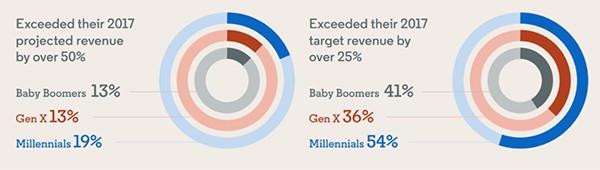
But it turns out the opposite is true. LinkedIn’s State of Sales 2018 report indicates that millennials have found the fast track to success. In 2017, this cohort was more likely than Generation X and baby boomer sales pros to exceed their projected revenue targets, and were 46% more likely to “go big” by exceeding their target by 50%.

How can that be? Here are two key reasons why millennials are outpacing the pack, and how you might adjust your B2B sales strategy accordingly.

Millennials Are Quicker to Adopt New Sales Strategies and Technologies

We asked sales pros to rate the sales technology platforms they consider “very important” or “important” to closing deals. As you can see, top sales professionals place a higher value on sales technology across the board, with “networking platforms” being the biggest differentiator between top sales professionals and others.

By and large, millennial sellers are leveraging sales technology at similar rates as the top sales professionals. That gap should continue to widen, with 62% of millennials (65% of top-performing millennials) saying they anticipate spending more time with sales technology this year, compared to 56% of Generation X and baby boomer sales pros who said the same.

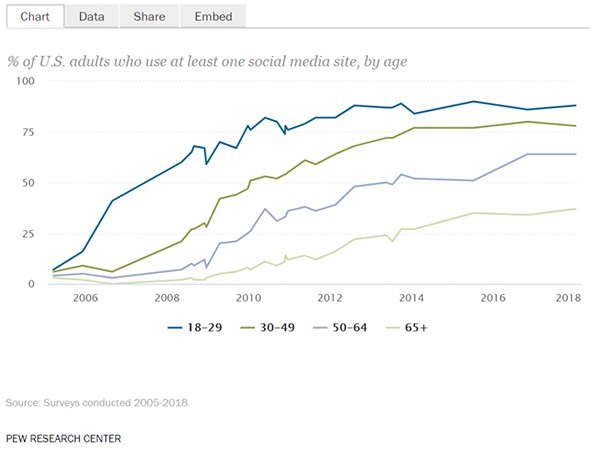
It’s also important to note that “experience” has become more subjective in B2B sales. For instance, when it comes to experience using social networking platforms, millennials clearly have a leg up, according to Pew Research Center.

In an era where you’d be hard-pressed to get a sales prospect to answer a cold call or cold email — tactics that once worked in the experience of most Generation X or baby boomer sales pros — millennials are more open to not just using sales technology to find the right people, but also to engage them in conversations online. Whereas Generation X and baby boomer sales pros had to “relearn” sales engagement, millennials can in many cases simply tap into their natural tendencies.

It’s no surprise, then, that millennials are also more apt to attribute their success to sales technology. Millennials were more likely than their Generation X and baby boomer counterparts to describe both their CRM applications and sales intelligence solutions as “extremely critical.”

Millennials Are Making Nice with Marketing

Here’s another area where experience can be highly overrated. For Generation X and baby boomer sales pros, a hit-and-miss (but mostly miss) relationship with marketing has been the standard.

On the other hand, millennial sales pros know that sales and marketing haven’t always seen eye-to-eye, but that’s not stopping them from making inroads with their marketing counterparts. Top-performing millennials are 23% more likely to say they work “very closely” with marketing than Generation X and 73% more likely than baby boomers.

This past year, the partnership grew stronger yet, with millennial sales pros being 12% more likely than Generation X and 24% more likely than baby boomers to spend more time working with marketing than in past years. This alliance appears to be paying off for millennials, who say they see excellent leads from marketing at 56% higher rates than Generation X, 115% higher than baby boomers. Inexperience might actually be an advantage for sales pros as it relates to working with marketing.

Having grown up online, millennials know what a contextual experience should feel like, and they’re willing to work with marketing to deliver it to sales prospects. While veteran sellers certainly have plenty to teach the younger generation, in this regard the reverse is also true where sales strategy is concerned.

Learn more about how top sales pros of all stripes are separating themselves from the pack by downloading the State of Sales 2018 Report.

10 Jan 17:28

Stop Trying to “Sell”

by John Barrows

Sales shouldn’t be thought of as trying to “sell” anyone anything. We are either helping people achieve their goals or solve their problems.  That’s the mentality we need to have.  If you’re trying to sell people something they don’t need and using tactics to convince people to do something they otherwise wouldn’t do, then you’re the reason the profession of sales has such a negative perception.

I’ve said it before and I’ll say it again, sales is the greatest profession in the world when done right and the worst when done wrong.  Sales is done right when we’re helping clients achieve their goals or solve problems.  It’s done wrong when we’re trying to convince people about something they don’t need.

Selling to Goals

The goal when qualifying a customer is to find out if their goals or problems are big enough to make a change.  If our solutions are only going to make a marginal difference, then it’s most likely not worth making the switch since the cost of transition and adoption usually will outweigh the marginal benefit.  We should be searching for clients where our solution can make a substantial difference or whose goals or problems are so significant that they need to do something different to address them.

Selling to goals versus problems is about selling to pleasure versus pain.  Most of us are taught to sell to pain which is important. Pain drives inbound leads, is easier to identify, usually has a shorter sales cycle and most people can agree to what the pain is.  The problem with pain is that it’s mainly felt by (and therefore evaluated by) people below the ‘power line’ who are focused on the short term. Think about it, how many C level executives or decision makers come through inbound?  It rarely happens.

Selling to Pain vs Selling to Pleasure

Selling to pain is important but if we want to elevate the sale and get executive engagement we need to focus more on selling to pleasure which is all about helping companies achieve their goals.  This type of sale usually leads to executive engagement, larger sized deals and is more competitive proof. I’ve gotten companies to spend 2x more with me than my competitors because I was able to paint a vision for them that aligned with their business objectives and showed them how I would help them achieve them.

Tactically, I phrase my questions in terms of “opportunities” and “challenges” and I ask both throughout the process.  I typically like to start with pleasure-oriented questions to get the client talking about something they like and then see where the conversation goes from there.  If I start the conversation with a pleasure-oriented question and they answer with a pain they are experiencing, then I go down the pain funnel with them. That said, when I start with a thoughtful pleasure-oriented question about their goals and opportunities sometimes I don’t need to ask many more questions because the client opens up and tells me everything I need to know.

You can even ask the client “is this conversation about helping you solve a problem or helping you achieve a goal?”  With either answer you need to then dig into how big that problem or goal is and what are the implications if they don’t address it.  A question I think we should all ask is “what happens if you don’t make this decision.”  If the answer to that isn’t specific and meaningful, then we’re either not talking to the right person or we probably shouldn’t bother continuing the sales process.

Lastly, I feel like we should try to disqualify prospects more than we try to qualify them.  Find the reasons why they shouldn’t work with you before they do.  This approach tends to get the client to want to work with you more, especially if you’re open and honest about the strengths and weaknesses of your solution and where it fits and where it doesn’t.

Make it Happen!

The post Stop Trying to “Sell” appeared first on JBarrows.

10 Jan 17:27

How to Humanize Sales Process Automation (While Doubling Your Transactions)

by David Lawrence

And it makes sense if you think about it.

After all, every time you set your auto-reply or make a direct deposit to the phone company, you’re using automation to make life easier. Now you can spend that time having an actual face-to-face with someone, or working on something that really moves the needle for your business.

Why shouldn’t that also apply to your life as a sales rep?

Why should you care about sales process automation?

When we think of automation we tend to think of one of two things: giant machine-based assembly lines or terrifying scenes from Westworld. But for most of us, the reality is much less sexy or ominous.

According to research by Princeton social psychologist Roy Baumeister, repetitive, routine-heavy tasks cause a phenomenon called “decision fatigue.” Basically, the more choices you make throughout the day, the harder each one becomes. Your brain gets overwhelmed, so you start looking for shortcuts.

image3 2

Roy is a pioneer in the psychological study of self-control, a.k.a. “self-regulation”. In his presentation at the Florida Institute of Human and Machine Cognition, he recommends playing offense with your personal reserves of self-control to protect your willpower for the most impactful items on your daily power list.

Because when your brain is spread thin from decision fatigue, it’s easy to miss important cues in your prospect calls and communication. And even easier to start treating people like numbers. But more of us have more work than we can handle. Almost 65% of a reps’ time is spent on non-revenue-generating activities. This fact means it’s becoming harder and harder not to let your commissions slip through the cracks.

Here are some of the ways smart sales automation tools can help you spend your energy on the things that matter most and make your leads love you way more in the process.

Stay close to past clients

Despite the fact that it’s much more cost-effective to keep your current clients than endlessly chasing new ones, many reps still suffer from a severe case of shiny lead syndrome.

But with the cost of acquiring a new customer estimated at being anywhere from five to 25 times more expensive than retaining an existing one, some salespeople are finally starting to understand how important it is to maintain a healthy client relationship.

Here’s how The Graham Seeby Group turned a list of just 279 contacts (some of which hadn’t heard from them in years) into $90 million in real estate transactions in just 4 years.

  • On the 15th of every month, the team sent a postcard to everyone in the database.
  • Then, on the 7th of every month, they sent a short 90-second video email.
  • On the 21st of every month, an email.
  • Once a quarter, all contacts on the list would get a phone call.

Once they had their timeline nailed down, all they had to do was set up the reminders, emails, and mailers to go out automatically, straight from their CRM. When a past client replied, the agent would simply engage in a convo leading to a low-pressure ask for a referral.

image1 2

Make your marketing relevant

There’s a reason personalized emails generate up to 6X more revenue than non-personalized emails. But the recent trend of over-automation has tempted too many reps into using technology as a crutch, rather than a way to deliver genuine value to prospects.

Barry Jenkins is a Virginia Beach real estate broker who nearly doubled his transactions to 240 deals in 2017, while working just 25 hours per week.

Not only that, each lead in his database got a better experience due to Barry’s amazing automation skills. “Everybody just wants to put their leads on autopilot. The problem with that is that robots and machines are never going to be as relevant as humans are,” explains Barry.

So he decided to go against the herd.

Rather than blasting leads with generic content, Barry and his team focus on creating a relevant message and automating that message to be delivered in a way that feels personalized — never spammy. “We always come from a place of contribution, that’s why our drip content is so popular. It’s not like those long campaigns where you can tell it’s pre-written content.”

image2 2

With automation in the mix, Barry and his team can even send direct mail pieces to contacts who haven’t given them an email address.

“When someone checks their home value on my website, they have the option to register with their phone number and email. But many people don’t want to do that. They just want to give me their address. In these cases, the lead goes from the website to Follow Up Boss and then we’re able to send that lead to Zapier which then sends the lead’s address to Thankster, where we’ve got a template for a handwritten card set up. All we have is their address and we know they want to check the value of their home.”

They don’t even have the lead’s name. Yet, they’re able to reach out with a heartfelt offer. The mailer says something along the lines of, “Automated home values are helpful, but if you really want to know what your home is worth, reach out to us and we’ll do an assessment. No strings attached.”

Get more social proof

In the sales world, we’re pretty accustomed to big talk around “pushing it” and “killing it” and “crushing it”. But wouldn’t it be great if you could get the deals flowing without the try-hard tactics?

Ron Howard is the owner of Baltimore’s leading real estate team. He closed over 470 homes in 2017, without following the conventional “sales” advice. From the beginning, Ron understood that the concepts of social proof would be crucial in helping him create a bond with prospects.

By maintaining a steady focus on service, 60% of Ron’s business comes from his local community events. But he also gets a slew of phone calls coming in every day from Zillow, where Ron Howard & Associates have over 700 reviews.

image4 1

“People competing in our market have around 200 reviews so to have 700 it’s just like…boom,” says Ron. In the early days, Ron was faced with the same decision many reps are faced with:

Where should you focus your reviews?

In today’s world of online everything, it’s tempting to spread your efforts too thin. But after only moderate success with LinkedIn, Facebook and Google reviews, Ron realized Zillow was really the place where his customers were actually using that social proof.

So he set up an easy automated system to make collecting reviews one of the most passive yet profitable tasks within his business.

And their process for collecting customer reviews is surprisingly simple.

  • One of Ron’s assistants sends a reminder out once a month.
  • On the backend of Zillow, there’s a simple ‘Request Review’ button. You enter the client’s info and send the request.
  • The client gets sent a link to submit their review.

The whole process is beautifully automated.

Of course, Ron always gives the customer a heads up. At settlement, he tells them, “My assistant’s going to send you a request for a review. You think you can give us a good one?”

9 out of 10 times, they’re happy to do it. Before he even gets back to the office, Ron calls his assistant and asks her to send out the reviews right away while it’s still fresh in the customer’s mind. And with automation, it can all happen in a series of single clicks.

Outrun the competition

According to Hubspot’s 2018 State of Inbound Report, 61% of B2B companies send all leads directly to sales, even though only 27% of those leads qualify as “serious buyers.”

And Marc Wayshak’s recent research found that at least 50% of your prospects are not a good fit for what you sell. At least, not right now.

The brutal truth about the new game of sales is that it’s no longer about who gets there first. It’s about who can stay in the game the longest.

But again, there’s only so many hours in the day. And we’ve all got our quotas to crush. It’s humanly impossible to follow up with an entire database of people on a regular basis. At least, it is without the help of automation. Especially if you want the experience to feel relevant and human.

image5 1

The right automation tool can help you put long-term follow up on autopilot. And show you which leads to focus your energy on every day in the office. Instead of reaching for the flashiest tool. (One jam-packed with features.) Look for one that will help you reduce decision fatigue and protect your focus.

Remember…

A good rule of thumb is to use a sales automation tool that alerts you to a few key behavioral factors:

  • When did my lead last engage?
  • When did I (or a member of my team) last engage?
  • What type of content does my lead engage with?

Leverage simple things. Like leads who were on your website in the last 5 days and haven’t had a call, email or text. Doing this helps you narrow your focus to the highest priority leads. All without getting distracted by the many trivial factors that often get baked into complex lead scores.

And for those that are less ready to engage, resist the urge to put them off or keep them stuck on an endless loop of 12-month drip campaigns. A little extra effort to tailor your follow up based on who they are and what they’re looking for can pay you back tenfold.

Remember, the thing that separates the top earners from the rest is long-term consistency. Automation makes sure you’re able to give the best you got each and every time you touch a lead.

10 Jan 17:27

The Costs of Running an Affiliate Program

by Mihaela Olaru

Are you thinking of turning to affiliate marketing in order to promote your products or services and boost your sales? Now is the best time to do it, and Rosemarie Spiher did a great job explaining why in this recent post of hers.

Affiliate marketing budgetOf course, before you get started, you want to know how much it will all cost you — so that you can plan your budget. I have good news and bad news.

The good news is that running an affiliate program will cost less than you would spend on most other marketing campaigns to promote your products and services by yourself.

The bad news is that it is impossible to give you an exact figure because the costs will depend on your decisions, on whether you build and run your program in-house, on an affiliate network, or both, on whether you manage it in-house or you outsource, on the specifics of your business, and even on the performance of your affiliates.

Moreover, there are both up-front and ongoing costs you need to be aware of. The set-it-and-forget-it approach does not work in affiliate marketing.

If you were hoping to set up your affiliate program and continue making a profit without investing in it, you should think again. You will understand why by reading this post.

In a nutshell, the costs of running an affiliate marketing program can vary from as little as a few hundred dollars to thousands of dollars. Most costs will fall into four major categories that we will review below.

4 Costs Categories to Take Into Account

When budgeting for affiliate marketing, we recommend taking into account four components of your future affiliate program. As Geno Prussakov explained in the second chapter of Affiliate Management: An Hour a Day, when planning your affiliate program, you need to budget for costs related to:

  1. Platform
  2. Creative inventory
  3. Product feed and affiliate landing pages
  4. Affiliate program management

Let’s look at them one by one and see what types of costs each may entail.

1. Affiliate Program Platform(s)

Affiliate program softwareBefore you can build your affiliate program, you need to make an important decision that will weigh heavily on your budget:

Will you build your program in-house, on an affiliate network, or will you exploit both alternatives?

In order to make this decision, you should be aware of the main differences between an in-house affiliate program and a network-based one.

Running an In-House Affiliate Program vs. Joining an Affiliate Network

  • In order to build and run your program in-house, you will need your own platform. The costs can go as high as $500 a month, even more, depending on the platform you choose. Affiliate networks provide the infrastructure (tracking, reporting, creatives hosting, payment solutions). For more information, review the post on what affiliate networks do and what they don’t do.
  • When running your program in-house, you have full control over all its aspects and a chance to work directly with your affiliates. This is a good thing when you have an experienced and knowledgeable affiliate program manager or you outsource to your program’s management to professionals but it can be costly. When running your program on an affiliate network, you still need an affiliate manager but the burden on their shoulders may be a bit lower, especially if they are already familiar with the affiliate network. They receive all the information they need in an easy to read format, and they may have access to a pool of publishers to recruit affiliates for your program.
  • Obtaining results with an in-house affiliate program takes more time than with a network-based program. You would have to build the program, advertise it, recruit affiliates, and review their performance. When you join an affiliate network, you gain instant access to a huge number of potential affiliates and to a wide range of tools and solutions.
  • An in-house affiliate program involves higher starting costs but lower long-term expenses. A network-based program is cheaper to start but can be costlier in the long run. As mentioned above, affiliate platforms costs reach hundreds of dollars monthly, without counting program management costs. Affiliate networks charge around 30% override. This means that, for every $100 you pay as commissions to your affiliates, you will pay ~$30 to the affiliate network. The important thing to remember is that network costs, similar to affiliate commissions, are performance-based. If you have to pay them, it means you’re selling and making a profit.

Taking into account the above, if this is your first affiliate program, I suggest that you start by joining an affiliate network. You will spend less and obtain results faster, with fewer hassles.

Later on, when you start scaling and gaining a better understanding of affiliate marketing, you can build and run your in-house affiliate program.

This will give you a chance to compare the results and the costs and decide whether to continue on both fronts or settle for one option alone. Check out this post that explains why using both options is a smart decision!

If you want to know more about affiliate networks and what joining them means, you can check the terms and conditions of the most popular affiliate networks in the U.S. According to our recent analysis of Affiliate Marketing in the USA, these are:

  • ShareASale – close to 6,000 programs
  • CJ Affiliate – over 1,700 programs
  • Rakuten LinkShare – over 1,400 programs
  • AvantLink – close to 700 affiliate programs
  • Pepperjam – over 500 programs

2. Creative Inventory

Affiliate creativesNo matter if you run your program in-house or on an affiliate network, you will need a creative inventory. The term refers to text links, banners, videos, flash content, and any other materials that your affiliates can use to promote your products and services.

A smaller, simpler inventory may seem a viable solution to save money. However, without adequate materials, publishers won’t commit to promoting your products or services. Even if they do, their performance could suffer.

Depending on your graphic design and programming skills, you may be able to create everything yourself and avoid spending money on professional services.

If you already have someone qualified for the job on your team, obtaining the materials you need while keeping costs under control could be easy.

When your skills and staff resources are not enough, outsourcing their creation remains the only option available. Unless you or your staff members really know what you’re doing, you should consider outsourcing as a solution to ensure great results.

If outsourcing to professionals is too expensive for you, freelancer platforms are a more affordable alternative to obtain the creatives you need. You or your affiliate manager will have to invest a little more time into finding a reliable freelancer, explaining your needs and expectations, and reviewing their work, but you will save big money.

One factor that will impact how much money you spend on creatives is your platform-related decision.

If You Run Your Affiliate Program In-House

In this case, you will need to create everything from scratch. How much it will all cost you depends on the specifics of your business:

  • If your business focuses on subscriptions or a limited number of services or products, referral links may be enough. Your expenses could be reduced to the costs of an affiliate tracking software like CAKE, HasOffersRefersion, or a similar solution.
  • If your offer includes numerous products and services, the size of your creative inventory should be directly proportional to your products and services inventory. Your affiliates will need not only text links but also banners of different sizes, videos, category-specific and campaign-related materials. These could cost you a fortune.

If You Run Your Program on an Affiliate Network

In this case, your creative inventory requirements and costs would be lower. Many affiliate networks have specific tools that allow affiliates to create the materials they need by themselves.

For example, ShareASale has its Product Discovery Tool, a bookmarklet which allows affiliates to create their own text links and banners. CJ and Pepperjam have their bookmarklet link generators that allow affiliates to create text links to any page or product on the merchant’s website with a single click.

There are also merchants who choose to invest in such tools or apps that enable their affiliates to create their own materials. Although such an investment would yield considerable initial costs, it can bring about valuable long-term savings. How?

The expenses related to your creative inventory do not end once you’ve put it together. You will need to update it and enrich it as you launch new products or services, make changes to your website, or initiate new marketing campaigns.

This will bring about additional costs that you can avoid or at least diminish if you give your affiliates the solutions they need to create their own materials automatically.

Of course, there are many more aspects to take into account when it comes to your creative inventory, too many to cover in this post. However, if you are on a tight budget and you are offering a wide variety of products or services, joining an affiliate network could be a way to reduce initial costs.

3. Product Feeds (and Landing Pages)

Depending on the specifics of your business, your budget should also cover the costs of creating product feeds and/or affiliate landing pages.

Product Feeds

Affiliate product feed Affiliate product feeds are files listing all of a merchant’s products and some of their attributes (product name, ID, price, page, category, etc).  They are fundamental for the activity of several types of affiliates, especially price comparison sites, paid search affiliates, content sites, loyalty affiliates, and more.

If you’re an online retailer and you rely on affiliates to sell more, you should not even consider starting an affiliate program without product feeds.

You will need them no matter if you’re running your program in-house or on an affiliate network. Since each affiliate network has its specific requirements when it comes to product feeds, it is important to create your feeds starting from those requirements.

The costs will obviously depend on the specifics of your business, your inventory, your affiliates’ experience and commitment, you or your affiliate program manager’s skills, and the tools you use.

If you know where to recruit your affiliates from or how to educate and motivate them, there are several powerful tools available to affiliates as well. See this helpful list of such tools.

Landing Pages

If your offer only covers one or two products or services and you rely on affiliates to generate leads, investing in separate landing pages would probably be a smarter approach.

One merchant who does this successfully is Bluehost. They create custom co-branded landing pages for their affiliates, making it look like their affiliates are offering special benefits to their referees.

Here is what their official landing page looks like (at the time of this post):

Bluehost affiliate program

And here is what their landing page for one of their top affiliates, Jeff Bullas, looks like:

Affiliate cobranding example Jeff Bullas

To visitors referred by another affiliate of theirs, Money Done Right, they show a different version — one looks like this:

Co-branded affiliate landing page

If you check the details, you will see that the offer is basically the same. However, the custom landing page makes visitors feel they are receiving special benefits and goes a long way to convert leads into sales. It also makes it easier for the merchant to track the source of their leads.

Even though signing up for a service or buying a product through a referral link does not always bring you additional benefits you should not bypass the affiliate. After all, they were the one who introduced the product or service to you, so they deserve their commission.

Creating custom landing pages may seem costly, but it doesn’t have to be. If you check the example above, you will see that the page layout and the content are basically the same. There are only small adjustments referring to the offer presentation, affiliate name, and background photo.

4. Affiliate Program Management

Affiliate program managementAt this point, you should have your affiliate marketing program ready to go live. You’ve hopefully decided whether to run it in-house or on an affiliate network, you’ve created the materials your affiliates will need, and the necessary product feeds and/or landing pages.

Before you go for it, there is one more category of costs you should be ready to face: program management costs. You will need to cover recurring costs related to:

  • Recruiting and activating affiliates
  • Creating and maintaining your program’s rules and policies
  • Efficiently communicating with your affiliates
  • Optimizing your affiliate program and creatives according to industry best practices, trends, and affiliate performance reports and requirements
  • Creating and managing marketing campaigns, and more

Affiliate Program Management Costs

It should be obvious that you will also need an affiliate program manager. They can be one of your staff members, you can hire an affiliate manager, or you can outsource to a professional. Whether you go with an in-house or an outsourced solution, Ryan Hindes’ Guidebook on How to Be an Effective Affiliate Manager in 2019 should come in handy!

Putting a staff member in charge of your affiliate program may work in the beginning, if you are a small business joining an affiliate network. You would pay less and work with someone you already know and trust. However, there is no guarantee your employee will learn and do everything right, so working with them may not benefit your program.

Hiring an experienced affiliate program manager could be a worthwhile alternative but will cost more and bring about additional hassles for your HR department.

If your plans are to consistently and continuously grow your program and recruit and activate more affiliates, you should seriously consider outsourcing to an agency.

Professional affiliate program management services cost more, but they come with guaranteed access to a huge package of benefits. Depending on whom you outsource to, you could get:

  • Access to the newest and most effective tools and techniques
  • Extensive experience in online marketing and affiliate marketing, not only as a program manager but also as a publisher and merchant
  • Close knowledge of all the major affiliate networks and platforms
  • Excellent reputation and extensive resources for running successful marketing campaigns
  • Performance-centered

This post on affiliate manager compensation (as well as ways to pay your affiliate managers) is a must-read on the subject.

Additionally, as your affiliate marketing program thrives, an important part of its ongoing costs will be tied to affiliate payouts and network fees.

As mentioned above, affiliate networks charge around 30% of the commissions you pay to your network-based affiliates. It is entirely up to you to review and compare networks and identify the best ones for your program.

As for affiliates, you should reward them according to their performance, namely to the customer actions they generate (hence the Cost-Per-Action name). As Geno Prussakov explained in his Affiliate Management: An Hour a Day, there are

Four Main Affiliate Compensation Models

  1. Pay per Sale or Cost per Sale (PPS or CPS) – You pay a commission to your affiliates for every sale they generate, just as you would pay a commission to a sales representative.
  2. Pay per Lead or Cost per Lead (PPL or CPL) – You pay a commission to your affiliates for every user they convince to register on your website, even though that user does not become a paying customer. It becomes your job to convert them.
  3. Pay per Click or Cost per Click (PPC or CPC) – You reward your affiliates for the traffic they send to your website. However, since there are many fraudulent ways to send traffic to a website, you should only consider this payment model if you have effective means to monitor traffic quality and conversion. Otherwise, choose from the previous two options instead.
  4. Pay per Call (PPCall) – You reward your affiliates for every inbound call they generate. One way of tracking your affiliates’ performance would be to assign them different phone numbers, through a platform like Invoca.

Of course, depending on the specifics of your business, you could reward other actions as well, through payment models like pay per view, impression, download, installs, etc.

An effective method to boost sales and motivate affiliates is to combine several payment models. This means setting a commission for every action you wish to reward. If you have a competent affiliate program manager, they will be able to recommend and implement the best solution for your particular needs.

If you decide to adopt a pay-per-sale payment model, you will want to pay special attention to how you define qualifying sales and how you treat voids and reversals. In other words, you have to decide whether to pay your affiliate’s commission if the payment authorization on a sale they generated fails or the buyer cancels the order or requests a refund. Duplicate orders are another scenario to consider.

If your plan is to reward affiliates on completed, final sales only, you or your affiliate program manager should carefully explain that in the program’s description. You should also set a lock-in period or lock date.

It is a period you give yourself to review and decide whether to reward the transactions your affiliates generated. It can be of 10, 15, 30, or even 60 days. The main aspects to keep in mind when setting this period are your trial offers and/or money back guarantees.

Sales reversals usually have less, if anything, to do with the affiliate’s performance and more to do with the customer behavior. Therefore, you may want to consider adopting a Non-Reversal Policy.

It may bring about slightly higher costs, but it will get you more affiliates and help motivate the ones you already have.

Final Thoughts on the Costs of Running an Affiliate Marketing Program

No matter how you decide to run your affiliate marketing program and how much money you are willing to invest, your success will depend on the quality of the products (or services) that you offer and competitiveness of your prices.

If you offer poor quality products or services, the word will eventually get out, and no one will want to promote them. Additionally, if your product isn’t priced competitively, it will have a negative affect on your website’s conversion rate, which, in turn, will cause low affiliate EPC too. Therefore, before investing in an affiliate marketing program, make sure you have valuable products and services to sell, excellent customer service to support them, and attractive prices.

Then, to receive answers to all your questions and guidance as you navigate the uneasy waters of affiliate marketing, consider turning to specialized services. They may cost a little more upfront, but they will get you huge savings and returns on investment in the long run.

Through AM Navigator, Geno Prussakov and his team have been offering affiliate marketing consulting and management services successfully for years. You too can benefit from their extensive experience in affiliate program setup, management, and auditing and you can even arrange for one-on-one training for you, your affiliate marketing manager, or your affiliates. Contact us if you need help. No email remains unanswered.

The post The Costs of Running an Affiliate Program appeared first on Affiliate Marketing Blog by Geno Prussakov.

10 Jan 17:27

Grow Your Business in 2019 with These 4 Tools

by Susan Gilbert

Tools to Help Kick Start Your Business in the New Year

Tools to Help Kick Start Your Business in the New Year

Do you need to accelerate your business growth over last year? By using the right resources you can attract more leads and sales for this new season. There are several ways to make this process more successful whether you are just starting out or ramping up your efforts. Do you need to get a better start for your business this year? Take advantage of these tools, and let me know how these work for you!

1) Increase sales and marketing – Datanyze

Use technographic data in order to tap into buying habits and gain a competitive advantage. Datanyze software will help you keep track of your customers’ actions using the latest technology along with powerful insights on what they will be buying next. This intuitive tool will pull information from your website, and include predictive analytics and technology resources that fit your business. The resource can help your business build a stronger presence online with precise insights and data.

2) Grow your audience and bottom line – ConvertKit

Would you like to improve your email marketing reach with better insights? ConvertKit helps you to generate targeted emails to your subscribers with a link to a sale page. There are over 35 integrated marketing services such as Squarespace, Gravity Forms, Teachable, LeadPages, and more. This is a great resource for those who want professional results and more website sales growth.

3) Powerful business analytics – Chartio

Gather the business data you need to grow with visual charts. Chartio help you to pull information online without the need to know complicated SQL language. The results are turned into visual stories that are clear and easy to follow so that you can learn exactly how your business is being viewed online. Easily create beautiful data through their interactive dashboard for you and/or your team.

4) Improve your customer satisfaction rate – SatisMeter

Reduce your churn rate and start accelerating your sales growth through customer feedback. SatisMeter collects important information on your business’s products or services on the Internet and through email. Provide what your customers need with surveys and real-time analytics. Their Net Promoter® system will allow you to measure your progress and build a loyal following.

Hopefully you will find these tools for business useful to your sales growth. Are there any that you would like to add as well?

09 Jan 19:05

Sales Management Training: 9 Keys for a High-Velocity Team

by Marc Wayshak

Do you manage a sales team or an organization that has a sales team? If so, you might often find yourself thinking, “I feel like with just a couple of small tweaks, we could be making so many more sales…”

If this sounds familiar to you, you’re not alone. One of the most common questions I get from sales managers is, “How can I make some small changes that will allow my sales team to sell significantly more?”

Simply put, small tweaks have an outsized impact in sales.

We see that high-velocity sales teams do certain things just a little bit differently—and it makes a huge difference. These small changes might not seem transformational on their own, but taken together, little tweaks can take a team from average to high-velocity.

In this video, I’m going to show you some top sales management training tips on this concept. 

Check out the 9 keys to building a high-velocity sales team now: 

Why Prospects Push Back on Price

1. Scalable offering.

1. Scalable offering.

Scalability is basically the starting point for building a high-velocity sales organization in the first place. You simply must have an offering that’s scalable; there must be a strong product-market fit. People must actually want or need what you’re selling. If you don’t have the right offering for the right people, then trying to scale is like building a house on a foundation made of clay.

One of the most important sales management training ideas is the concept of putting a product in place that essentially sells itself in some ways. Now, obviously, many products or services are either invisible or commonly available, which makes it hard to literally throw them out into the market to sell on their own. But it’s up to you as the sales manager to do the legwork to make that product or service as saleable as possible. That way, your sales team is starting with an advantage. Making sure your offering is scalable is the number one way to give your sales team an edge from the start, setting them up for high-velocity selling.

2. Career progression.

2. Career progression.

When it comes to sales management training, one of the biggest mistakes I see sales organizations make is that they try to exclusively hire seasoned sales veterans. The problem is two-fold. First, it’s really hard to find seasoned sales veterans who want to leave the organization where they currently work. And second, most people, particularly in the younger generations, want to see career progression at a company. They want to know that even if they start out lower (such as in a business development rep position), they can achieve higher levels of success (moving on to be an account executive, for example). But if those roles are already filled with seasoned veterans who are going to stay in their positions forever, the outlook for career progression is bleak at best.

Creating an environment where you have true career progression on display is one of the keys to building a high-velocity sales team. This way, if reps are really successful in their role, they know they can move on to become a sales manager, a director, a VP—or whatever it is. Fostering obvious career progression will allow you to hire top-performing talent at the lower levels. People who start out at your organization in a sales entry-level position can prove themselves, learn about your company, master your processes, and then develop into high-performing salespeople.

3. Right people.

3. Right people.

One of the most critical sales management training credos is that you must have the right people in the right roles. This might sound obvious, but sales managers and sales leaders say to me all the time, “Oh man, I just can’t get my people to really close deals. I have no idea why.” My first reaction is always to ask, “Well, do you have the right people in the right roles in the first place?” It often turns out that they don’t.

I like to think of this in terms of sports. When building your sports team, you’ve got to start with people who are at least athletic. They don’t necessarily have to be experts in the particular game you’re playing, but they should at least be generally athletic. That’s true of sales, too. You’ve got to hire the right people who can grow into the position. The important factors are potential, eagerness, drive, and will. Find those people and show them real career progression is possible at your organization. Have a process in place for hiring the right people for the right roles on a consistent basis.

4. Align incentives.

4. Align incentives.

One of the biggest barriers to creating a truly high-velocity sales team is lack of alignment. What I mean by that is, if we don’t have clear alignment between what the company wants to accomplish, and why and how salespeople are rewarded for their efforts, then we’re not going to be successful. Aligning incentives is the backbone of any successful sales management training initiative.

The ideal situation is one in which the compensation (and in particular, the commission) is rewarding the right sales behaviors. For example, if you want people to be creating their own leads, then you’ve got to incentivize them to do that. Break down your sales organization into teams and roles and incentivize each group in alignment with company goals. People on the lead generation side should be rewarded for setting appointments. Account executives should be incentivized to close deals…and so on.

By aligning incentives appropriately, you can make sure that even when people are working from home and you’re not watching them every day, you have aligned incentives. If you’ve got go-getters in the right roles, they’re all going to march forward.

5. Lead gen.

5. Lead gen.

This may sound trite, but sales teams will struggle without a lead generation process in place. Lead gen can look very different at different organizations. It could be that you have a business development team whose sole job is to schedule appointments for your closers. Or maybe you just have a really strong marketing group that can also schedule appointments for your closers. But what we don’t want to do in today’s world of selling is ask closers to generate their own leads.

Closers can certainly leverage referrals, introductions, and client relationships to get just a couple of extra appointments on top, but they shouldn’t be in charge of setting appointments in general. Closers shouldn’t be doing cold prospecting because A) they’re typically not very good at it, and B) they really don’t want to do it. Instead, by having a strong lead gen process in place, you can make sure that your closers are doing what you actually want them to do: closing deals.

6. Sales process.

6. Sales process.

This sales management training tip goes back to the idea of career progression. If you’re hiring veteran senior salespeople, they’re going to bring their own sales processes with them. But obviously that comes with a lot of baggage, too. High-velocity sales teams typically hire people who are relatively newer in their career, and then they provide them with the sales process to follow. That way, they can train the sales team on the exact process they want them to use.

When you teach your sales team the same proven sales process to follow, you know that they’re out there having the types of conversations you want them to have. And ultimately, you’re all speaking with the same vocabulary. When a sale doesn’t go well, you’ll have the right vocabulary to understand whether those salespeople did what they really should have done in any particular situation. This all starts by having an organizational sales process in place.

7. Organized system.

7. Organized system.

This is pretty boring, I know. But having an organized system in place is one of the key pillars of sales management training that can’t be ignored. I see sales organizations all the time that aren’t using their CRM system at its full capability—or they’re not even using a CRM system at its minimal level. They may even just have a bunch of Google Docs or Excel spreadsheets instead of a CRM system.

The key here is to organize all of the systems in place at your sales organization—not just the CRM. What system are you using for your cold email outreach? What system are you using for your phones? How does all of it organize into one smooth stack of technology that allows your salespeople to do as little operational and administrative work as possible? Answer these questions and you can make sure your sales team is ultimately laser-focused on what you want them to do: sell.

8. Coaching.

8. Coaching.

I find that while most sales managers and sales leaders say they coach their sales teams, they actually do much less coaching than they really should. They get mired in the administrative stuff, just like salespeople do, so they’re not doing enough of what actually matters: coaching.

The number one activity that any sales manager can do is coach. If you’re not consistently coaching your reps, then you’re not really doing your job as a sales leader. Coaching typically involves using some technologies, such as call recording or Zoom recording, to record each team member’s sales interactions. Then, you should be taking your reps through a process of actually watching or listening to themselves on the recording.

This reminds me of when I played college football, and our coach would tape our practices and we’d watch it right after we practiced. And then the coach would say, “Well, what happened here, Wayshak?” The tape doesn’t lie. So, when you’re consistently coaching your salesperson on their call or Zoom recordings, you have something concrete you can go over with them, to help them develop and create their own path for growth.

9. Accountability.

9. Accountability.

Accountability ties together all the pieces of sales management training that we’ve been talking about so far. Having strong accountability processes in place is the best way to hold reps accountable to what you want them to do— having the types of conversations you want them to have, doing the type of sales activity you want them to do, sending out enough proposals, or moving prospects through the sales pipeline as quickly as they need to be. Having some real metrics to hold salespeople accountable to actually takes a lot of pressure off the sales managers. When you have an accountability system with metrics in place, the automatic reporting does a lot of the management work on its own. As a result, managers need not constantly check in on what salespeople are doing. The data on what they’re doing is already there. You can see exactly what’s happening—and that’s a huge step in the direction of building a high-velocity sales team.

So there you have it. Now you know 9 sales management training keys to building a high-velocity sales team. Which of these ideas will you implement with your sales team now? Be sure to share below in the comment section to get involved in the conversation.

More Keys for a High-Velocity Team…

Could your company’s sales culture be stronger? If so, you’re not alone.
In just the past few years, we’ve seen an unprecedented amount of change in the business world. Without a world-class sales culture, organizations simply haven’t been able to withstand the turmoil.

Since 2000 alone, a whopping 52% of Fortune 500 companies have either gone bankrupt, been acquired, or disappeared completely. At this current rate, about 50% of all S&P 500 firms will be replaced by 2027.

At the same time, the average life expectancy of a Fortune 500 firm was around 75 years in 1960. Today, it’s less than 15 years, and declining all the time. Specifically in the world of sales, the data is equally bleak. The average tenure of a VP of sales has dropped precipitously from 26 months 7 years ago to 19 months today, and that’s across all industries and geographies.

Quota attainment has dropped as well, from 63% about 5 years ago to 53% today. But there are some tactical, tangible strategies you can implement to build a world-class sales culture that can withstand these brutal changes.

In this sales management training video, I’m going to show you 9 tactical strategies for a world-class sales culture. Check it out:

Be sure to download Marc’s incredible Key Pages & Worksheets Guide mentioned in this video! Just click here to get the Key Pages & Worksheets Guide instantly.

10. Thoroughly assess your existing team.

10. Thoroughly assess your existing team.

I can’t tell you how many managers and business leaders come to me and say, “I need you to train my salespeople because they’re doing a terrible job.” Now, that may sound logical to some people at first. But it’s completely illogical when you really think about it. The reality is, there are probably some people on that team who shouldn’t even be there. And so, before we ever get into sales training, we want to first assess the existing sales organization.

Up front, we want to understand: Are the right people on the team in the first place? If not, then my suggestion is to either move them to another department where they might be happier, such as operations or customer service, or let them go and find a job elsewhere. You need to have a team of salespeople who are coachable, buildable, and willing to implement new ideas. If you don’t have this, then everything else is going to be a waste of time. No amount of sales management training will help you. You need to have the right people from the start, so assess your existing people before you do anything else.

What I suggest you do is rate them on an A to F scale. A is obviously superior performers. F is someone who really needs to be elsewhere. If anyone is below a B-minus, then they’re probably not the right fit for your team. You want to be focusing only on those higher performers.

11. Use a process for identifying superior talent.

11. Use a process for identifying superior talent.

You may not be actively involved in the sales hiring process at your organization. But if you’re a manager or even the CEO of a good sized organization, you need to make sure that the process for hiring talent is going to yield superior performers. That means having a systematic process for hiring with multiple steps that force potential sales hires to demonstrate their selling ability. This is something I implement with my clients all the time, because we need to ensure the people we’re hiring are going to be the right fit.            

Now, nothing is 100% certain. But you can mitigate a lot of uncertainty around the hiring process by making sure it’s systematic, it’s intentional, and it uses all the tools available to ensure someone is a superior fit. Some of those tools might include online assessments that assess both behavior and cognitive fit; pre-screen calls that test candidates’ ability on the phone through roleplays; and other highly structured methods of assessing potential sales hires.        

12. Know the strategic math to grow your sales.

12. Know the strategic math to grow your sales.Every manager, CEO, and sales leader must understand the exact math that goes into increasing sales.    

There are only three ways to actually increase sales. First, you need to increase the conversion rate of every opportunity that’s in front of you. Next, increase the average size of each sale. And finally, increase your sales pipeline, or the actual raw number of prospects that you’re getting in front of.                              

Most organizations tend to focus on the first and last. They’re thinking about how to increase conversion rate and how to get in front of more people. But very often, the easiest one is increasing the average size of each individual sale so that sales increase. If you combine all three of these together, they have a multiplicative effect: You can actually double sales by increasing each of those areas by only about 26%. So, you can make smaller tweaks to each area to have a knock-on effect that’s huge. Understanding that math is vital to ultimately growing your sales.    

13. Implement leveraged prospecting.

13. Implement leveraged prospecting.So many CEOs and sales leaders come to me and say, “I want our salespeople to be making more cold calls.” My first response is always, “Well, help me understand. Is cold calling the most effective use of their time?” Now, in some cases, it can be — but very rarely.                     

This doesn’t mean that making a call to a person you don’t know is ineffective. It just means that the act of a pure cold call — where the other person has no idea who you are, has never received anything from you, and is just getting a random phone call from you — is probably not going to be the best use of a salesperson’s time.

Instead, we want to use leverage to make sure that every action by our salespeople has the highest likelihood of leading to either a meeting or a sale. So, leveraged prospecting simply means that we use every prospecting tool possible to make sure that salespeople are going to be effective. That typically looks like having a real sales prospecting campaign that salespeople are following, including a combination of emails, phone calls, LinkedIn messages, voicemails left, packages sent, etc.

Give prospects lots of content throughout this process and lots of ideas they can implement. Then, by the time you actually get the person on the phone, it’s most likely to lead to some kind of a real next step. We want to have leveraged prospecting. We don’t just want our salespeople to be making more dials. Make sure those dials are effective. 

14. Have a structured sales process.

14. Have a structured sales process.This is a tough one. Many organizations are all over the place when it comes to sales process, so at the end of the day, they just end up letting their salespeople do whatever they want.

The problem with this is that it’s like herding kittens. Everyone is going off in different directions. Everyone is doing different things, and there’s no common sales philosophy within the organization. Quite frankly, what most salespeople are deciding to do on their own is probably not the most effective use of their time.

Put a structured sales process in place that walks salespeople through how to get prospects on the phone or how to get in front of prospects. What does that initial discovery process look like? How are they presenting? What do the proposals look like? Once we actually close a sale, how are we onboarding prospects into our general processes?

Structuring out that sales process is key. If your organization is small, then it’s probably just about finding some basic sales training to give your entire sales team. If you’re a bigger organization, you can really customize that process to make sure that it fits exactly in line. Every step, every question, every line is understood so that way, even if people aren’t following it exactly by the script, there is a process that they can follow, and you can manage that exact process. 

15. Track discovery meetings closely.

15. Track discovery meetings closely.Managers, CEOs, CSOs, and VPs of sales always ask me, “Marc, what is the most important KPI or what’s the most important metric that we can be tracking of our salespeople?” There is no one right answer to that question, but if I were to generalize one answer that is accurate for most organizations, it would be the number of discovery meetings that salespeople are setting. Discovery meetings are those initial sales meetings that are in the calendar for that first introduction.

If managers are tracking that number, they’ll have the most likely indicator of that salesperson’s success because discovery meetings are the ultimate leading indicator of success. If a salesperson has tons of discovery meetings in their calendar, then you probably have a pretty good idea that they are likely to be successful in the following months.

Use your CRM to really track those discovery meetings and make sure that salespeople are setting enough discovery meetings. A whopping 90% of the issues I see in terms of prospecting are simply due to salespeople not setting enough discovery meetings, and so they have this empty pipeline, and all of the issues snowball from there. Make sure that the one thing you’re really tracking besides of course sales numbers is the number of discovery meetings that salespeople are setting or that they have on the books.

16. Let your CRM do the heavy lifting.
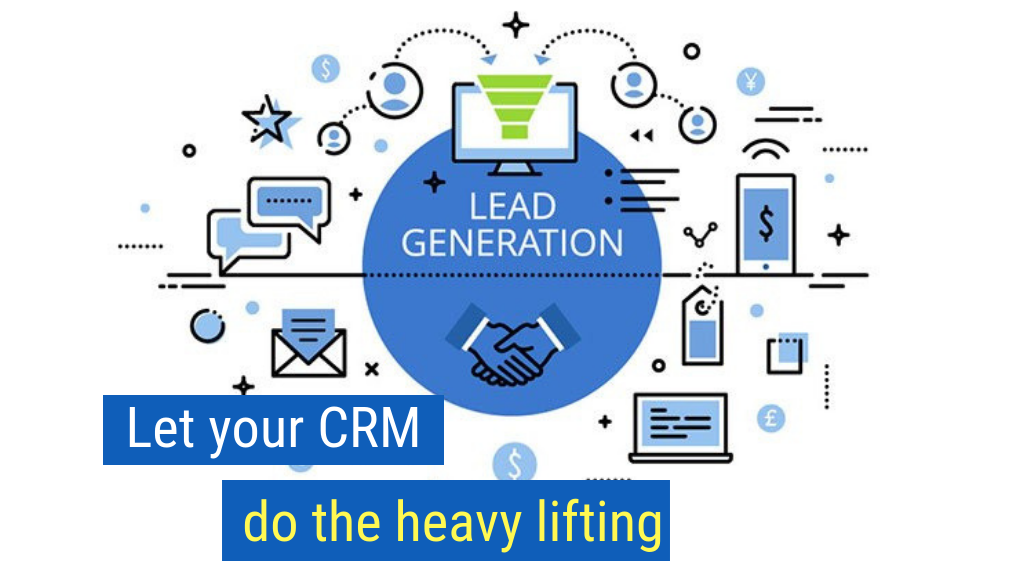
16. Let your CRM do the heavy lifting.

I always ask managers, owners, and CEOs the same question: “Do you know exactly what your salespeople are doing on a day-to-day basis?” What’s amazing is that they often can’t answer that question in the affirmative. They say, “Oh, yeah. I think we generally have an idea.” I say, “No, no, no. Do you know exactly what they’re doing on a day-to-day basis? Can you track that? Can you see what’s actually happening?” Most managers, even VPs of sales at pretty sophisticated organizations, simply can’t say yes to that question. But the success of the organization depends on your ability to know what salespeople are doing.

 This isn’t about being Big Brother. In fact, it’s quite the opposite. It’s about letting your CRM present to you a story of what salespeople are actually doing. That way, you don’t have to stop in on their office or poke your head in and say, “Hey, what’s going on today? What are you doing today?” It’s the exact opposite. You can see exactly what’s happening in the CRM. You know exactly how many meetings they’ve scheduled, how many calls they’ve made, how many referrals they’ve asked for. Those key metrics are being tracked in the CRM so you don’t have to play that Big Brother role.

17. Run a structured sales meeting.

17. Run a structured sales meeting.Have you ever been in a meeting that was just completely unstructured? Suddenly, you look at your watch, and it’s been 90 minutes. You’ve accomplished exactly nothing. Well, this may be the experience that your salespeople have when they sit in on your sales meetings.

Now, I don’t mean to be aggressive about this, but it is so important that managers run structured sales meetings with their salespeople. There must be a clear agenda to every meeting, along with a clear set of commitments that each salesperson is 100% committed to accomplishing over a specific period of time. Likely, a period of time that will lead to the next sales meeting, when we will then check up on those commitments to see if they’ve actually done what they’ve said they were going to do. Start to run those structured sales meetings, and it’s amazing how meetings suddenly become more valuable.

A structured sales meeting means that it is regularly scheduled, there’s an agenda, and that the follow-up is consistent. You may run a meeting once a month, or you may run it once a week. It depends on the type of organization you have. Make sure the cadence is completely consistent, so salespeople can start to expect that consistency. Accountability starts to drive performance when salespeople know that there’s real consistency. Be sure to run that structured sales meeting.

18. Coach with intention.

18. Coach with intention.Coaching is one of those things that most managers know they need to be doing more of it. Yet, they don’t do much of it at all. It tends to be very reactive.                               

As managers, when we coach with intention, it means that we have a systematic process to coaching people. One of the things that I teach my clients is how to coach in a way that is leading to the answer, but not leading with the answer. It’s really easy for a manager to just say, “Hey, so I just watched what you did, and here’s what I think you should do differently.”

It’s really easy to do that. We tend to, as managers, be very driven and we just want to get right to the point. But what we actually want to do is have a systematic approach to asking questions of our salespeople to get them to lead themselves to the answer.

We want to ask questions of the salespeople. I call it the Rule of Three. Any time you have a coaching point that you want to make, ask three questions to get there. Let’s say you’re in a meeting with a salesperson and they just completely botched the budget part of the conversation with the prospect. Rather than saying, “Hey, you really want to be getting right into budget,” start with, “So, walk me through what you think could have been done differently in that meeting.”

Maybe they recognize the budget thing. Maybe they don’t. You say, “Well, help me understand the budget piece. What was your takeaway in terms of what their budget really is,” and now, we want to dig into that. Keep asking questions to get them to articulate that there was a challenge. This is what coaching with intention is all about. Whether you’re the CEO managing the VP level, or you’re the VP managing your managers, or you’re the manager managing your salespeople, or you’re the business owner managing your own salespeople, you need to be coaching with intention.

So, now you know 9 tactical strategies for a world-class sales culture. I want to hear from you. Which of these ideas did you find most useful? Be sure to share below in the comments section to get involved in this conversation.

Why-Prospects-Push-Back-on-Price-Sales-Web-Training

09 Jan 19:03

12 Ways Anyone Can Be a Memorable Salesperson (Series)

by deb.calvert@peoplefirstps.com (Deb Calvert)

There’s no such thing as a natural-born salesperson.

Success in sales isn’t reserved for a fortunate few with certain personality characteristics or charisma.

09 Jan 18:59

What I Learned Crafting Strategic Narratives for 100+ Companies

by Andy Raskin

Editor’s Note: This article first appeared on Medium here

The most Japanese of Japanese proverbs, to my mind, is “Three years, even on a rock” (石の上にも三年). The literal meaning is that even a stone is worth sitting on for a long time because it will eventually heat up. In other words, persistence begets rewards.

A little over three years ago, I perched myself atop a rock called “Helping CEOs align their teams around a strategic story,” and there are still plenty of chilly moments. Every time I kick off a new engagement with a CEO and leadership team, I feel nervous: Will I really be able to align these smart, driven people around a simple, powerful story?

But overall, the rock has gotten a bit toastier. Now, hardly a day passes when a CEO doesn’t reach out to me saying, “I’ve realized that a huge factor in our success will be how we tell the story” or some version of that. I’ve worked with leadership teams around the globe, learning from all of them what works and what doesn’t.

A few weeks ago, my database of consulting clients (mostly VC-backed startups) hit 100 companies, so it feels like a good time to reflect on what I’ve learned so far. Here are the five biggies:

1. Conversations about messaging are really conversations about strategy.

If you’ve been following me from the beginning, you might recall I made exactly the same point, two years ago, in What I Learned Crafting Messaging for 15 Startups. But it’s still my biggest learning, so I’m calling it out again.

Think about it: how is strategy communicated? You can write up complex plans or sketch out diagrams of Porter’s famous five forces, but those things can’t be conveyed throughout a large organization. Ultimately, the only way to get strategic alignment is with a simple story. I still think Ben Horowitz, of Andreessen Horowitz, put it best:

“The company story IS the company strategy” — Ben Horowitz

2. The sales narrative is the core narrative.

Early in my career, I was on the receiving end of a lot of messaging and positioning work that sat on a shelf once the consultant left the building. It was usually delivered as either a positioning statement (“For customer with problem X, our product Y is a …”) or a generic positioning presentation. Those positioning assets were supposed to guide the messaging of everything else —  CEO keynotes, sales decks, website copy, content, etc.— but it never worked that way: the positioning assets were just too different from what we had to build.

A little over a year ago, I decided to abandon positioning assets and make the sales deck the primary instrument of my strategic narrative engagements. It was a risky move: not every CEO believes he or she should be bothered with authoring the sales presentation. (And, of course, many salespeople hate using them.)

But it’s turned out to be a great decision. The sales narrative (as I defined it in The Greatest Sales Deck I’ve Ever Seen) has all the “pieces” of the story. When you get it right (after testing and refining it in actual sales calls), your website messaging, content themes — even your investor deck — practically flow right from it. Even salespeople who never use the deck can learn its narrative flow to better create urgency and engagement.

And when a team tells me their CEO doesn’t have the time to take the lead in drafting the sales narrative —even with handholding from me and support of their leadership team — I politely decline to get involved.

3. Aligning is the hard part.

Three years ago, I thought the most valuable skill I brought to the table was a knack for boiling down complex ideas into simple narratives. While that’s important, I’ve learned that what CEOs value even more is getting their teams bought in. As the CEO of a San Francisco tech company that’s raised over $56 million in VC cash told me last month:

I realized we needed a narrative, so I wrote one I thought was pretty good. But my VP of sales didn’t like it, so I changed it a little for him. But then my VP of marketing didn’t like it, so I had to change it for her. What I realized is that the hard part is the aligning, not the crafting. That’s why I called you.

I’ve heard that sentiment from so many CEOs over the past year that I changed how I describe my engagements in proposals:

4. Customer input is SO not optional.

One of the biggest mistakes I made early on was making customer interviews optional. After all, teams I work with boast millions of dollars in revenue. Aren’t their leaders a reliable enough proxy for customers?

I’ve learned that the answer is often no. Even when teams have already done customer interviews, they’ve usually been asking what customers think of the company and/or its products. To build a story that truly drives urgency, we have to shift the focus to what’s happening in customers’ lives: What is changing that gives rise to stakes?

Earlier this year, I shared the questions I ask customers to build the narrative in this post.

5. A strategic narrative can be a powerful execution tool.

In the last few months, several CEOs have asked if we could extend our work together beyond narrative crafting and alignment. As one put it:

Now that we’ve aligned around the story, can you help us make it come true?

It follows that if “the story is the strategy,” it should be a guide for execution. This year, I’ll be working with these CEOs to see how I can support them as they deliver on the story, not only in sales and marketing but also through product, recruiting and fundraising. As the rock heats up around that stuff, I’ll report back.

About Andy Raskin:

I help CEOs align their leadership teams around a strategic story — to power success in sales, marketing, fundraising, product, and recruiting. Clients include teams backed by Andreessen Horowitz, KPCB, GV, and other top venture firms. I’ve also led strategic storytelling training at Salesforce, Square, Uber, Yelp, VMware and General Assembly. To learn more or get in touch, visit http://andyraskin.com.

The post What I Learned Crafting Strategic Narratives for 100+ Companies appeared first on OpenView Labs.

09 Jan 16:44

Too Much Drama per Dollar

by Tibor Shanto

By Tibor Shanto

Professional who excel understand that there is more to that success than just core skills. Beyond how they execute their craft, other life skills can enhance the experience for participants and the outcome. One element many top performers employ is a touch of theatre. Whether you call it “bedside manner,” “courtroom presence,” or good old swagger, there is no question that little theatre art in high school can pay big dividends down the line. The best sales calls have clear elements of “performance,” mostly as a means of facilitating conversation and information exchange. Unfortunately, and I can mostly speak from a sales perspective, many confuse the need to elevate the experience by introducing some theatre, with overloading to the whole thing with drama.

Melodrama

You don’t need to ride along with a rep to be part of the drama; you can see it unfold back at the office. Always being able to articulate “the problem,” while not willing to take proven steps to address or improve the situation. Whether it is a discussion on quota, territory, or the state of an account, these are all excellent indicators of where a rep is will to invest their skills and time, and more importantly, your time and resources.

There are many contributing factors, but it is usually a question of what a rep is willing to do to achieve quota, which is the sum of all the specific things they were ready (or not willing) to do on an account or individual meeting level.

The good news is that when you look at it on that micro level, specific actions vs. drama deployed to avoid change or work, you have two clear indicators, and opportunities to act. On the one hand, you can identify specific things the rep is not comfortable with, where they are leading with drama. You can put an improvement program in place to address situations when they are small and are identified relatively early. Helping them overcome the challenge not only has immediate payoff but sets an environment of continuous learning and improvement. Not addressing this early just signals to all the also-rans that they can glide and live off a fat base.

To act can also mean fire or replace. Yes, if you take steps to help them overcome the cause of their drama, be that skills or attitude based, and they don’t match your effort to help with effort to implement and grow, then you need to be loyal to your mandate and employer and bring in a resource that will do a doable job.

Learned Behaviour

This question needs to be looked at organizationally not just at the rep level. Managers can be as dramatic as their reps, but with more significant impact for all, especially your customers (and revenues). Once you allow drama to survive, it has no option but to grow, and grow in all directions. Assuming that your Board of Directors checks drama at the ‘C’ level, CEO’s must actively remove drama from their direct reports, and ensure that their team extends that through all levels right through the front line.

Drama Has Real Cost

While some may consider drama entertaining, and it is, but it comes at a high cost. But any cost can be measured, analyzed, and based on these and other inputs, be forecasted and limited. There are costs in sales, your stack, labour costs, and others. Organizations set targets for these for these, and when goals are missed, an action can (should be) taken.

While it may be hard to quantify drama, you can begin to frame it in simple terms. How much time is a rep spending being dramatic vs. time prospecting? Is a rep better able to articulate the drama he/she is facing better than what is driving the buyer’s purchase decision? There are others, and some will vary by industry, but they all add up to a drag on your ability to deliver revenue and positive customer experience.

Figure out how much “drama” you are willing to “spend” per rep. As they approach exceeding the level you set, focus on helping them address their challenge, be it theirs or systemic. But if they continue in the same direction, you have no choice but to take the same steps you would with any other underperforming asset.


Wednesday, January 16, 2019, 5:30 PM to 8:30 PM
Kramers Bar and Grill
1915 Yonge St. · Toronto, ON

If you are in the Toronto area, keep your eyes open for the Sales & Talent TO Meetup.  The group will explore all elements of success in B2B sales.  There will be featured guests from all side of sales, including buyers, sellers, service providers, and many others to help you take up your sales in 2019 and beyond.  Not to mention a great opportunity to network and connect with your peers.  Keep your eyes on this spot for updates and announcements.

LEARN MORE & RSVP

The post Too Much Drama per Dollar appeared first on TiborShanto.com.

09 Jan 16:44

Pricing, empathy, emotions and the customer journey

by Steven Forth
190108.png

Pricing is sometimes seen as an analytical discipline, concerned with numbers and optimization. A place where squishy concepts like empathy and emotion have little place to play. Economics is sometimes known as the dismal science, and pricing is sometimes seen as a little subset of economics. It is not.

190108_meetup-logo.jpg

In Vancouver? Join us Thursday, January 17th for the first meeting of the Value, Innovation and Pricing Vancouver Meetup. The theme will be Value and Pricing Along the Customer Journey.

A compelling pricing strategy weaves in the emotions of the buyer and the seller. At Ibbaka we do this by using both economic and emotional value drivers in market segmentation and pricing design. Buyers have a strong emotional response to price and pricing fairness and will reject pricing (or pricing changes) perceived to be unfair.

I was reminded of this over the holidays while reading The Undoing Project by Michael Lewis. This book is a good complement to the Daniel Khaneman classic Thinking Fast and Slow. It tells the personal story of Nobel prize winners Amos Tversky and Daniel Khaneman and their intellectual love affair as they undid the assumptions of utility theory and replaced it with prospect theory. This work dates back to the early 70s and over the past few years it has been washing through the pricing community as behavioural pricing (see this blog post by Frank Kroeze from Simon Kucher as an example).

Behavioural pricing talks a lot about things like framing effects, risk aversion and isolation effects. Each of these play an important role in pricing (see below), but when you boil it down, prospect theory and behavioural pricing are about the emotional inputs into human decision making. When deciding if a price is fair, all of the aspects of prospect theory are in play.

Prospect Theory

Framing (reference point): Framing is one of the most important effects in pricing. In standard techniques like Economic Value Estimation (EVE) it shows up as the Next Best Competitive Alternative. On pricing pages it can be seen in how each tier shapes perception of the relative price and value of the ones to either side. To control the pricing conversation you need to control the framing.

Risk Aversion: Most people will pay more to avoid a loss than they will to win a gain. This is indicated by the shape of the above curve, where the value of gains flattens off quickly. For pricing this means that how value is communicated will have a gig effect on price acceptance. There is a risk discount built into B2B subscriptions. Finding ways to reduce that discount can lead to better pricing outcomes.

Isolation Effects: People are risk averse when it comes to gains (we prefer a sure thing) but will gamble to avoid a loss. Accepting a price is basically a gamble that you will get more value than you will pay in price. One can persuade people to take this gamble and pay a higher price by positioning the purchase as a way to avoid a loss. This is basically how insurance is priced. The same approach is being taken in forward pricing of professional services.

Prospect theory gives an economic grounding to emotional effects in B2B pricing. In the design world, empathy is widely seen as being central to design thinking. At some level, empathy is sensitivity to another person’s emotions. One will struggle to design a compelling solution (even a pricing solution) without empathy with the buyer. What does ‘empathy’ mean in the context of pricing? This question is worth deeper exploration, but it certainly includes the following:

Respecting the customer’s buying process

Communicating how and when value will be delivered (and reinforcing this communication across the customer journey)

Aligning value delivered to your customer (V2C) with how to claim back part of that value through price

Understanding how your solution will impact your customer’s financials

It takes a lot of work to really empathize with a corporate buying unit, and the whole process of buying, rolling out and adopting a commercial solution. Tools are needed to help us with this. Customer journey maps are a good way to organize the information that shapes the emotional response of buyers and users as they move through the buying process and adopt a new application. One should go beyond this of course, a good customer journey map follows the customer all the way to the end, when they leave your solution.

At Ibbaka we layer price and value onto the customer journey map. We want to capture the emotional and the economic aspects of value and how these evolve across the customer journey. This gives us insight into whether they buyer will experience the price as ‘fair’ and will help to make sure that Value to the Customer (V2C) is larger than the Customer Lifetime Value (LTV). These are two of the keys to sustainable pricing.

Permalink

09 Jan 16:44

Take 2019 By Storm: Get Inspired By These 11 Content Marketing Quotes

by Anne Leuman

Inspiring Content Marketing Quotes

Inspiring Content Marketing Quotes Another year. Another strategy. Another budget. Another long to-do list. Ushering in the new year is both an exciting and grueling time for content marketers everywhere. We’re celebrating accomplishments from the previous year. We’re taking stock of misses and opportunities. We’re working to weave in emerging content trends into next year’s plan. And we’re setting goals. But just like New Year’s resolutions, it can be hard to stick to the plan and tick off all of the things you want to accomplish. After all, the year is long and plans change often in today’s evolving digital landscape. To help you take on 2019 and muster up the motivation and inspiration to achieve your goals, we gathered several inspiring (and perhaps reassuring) quotes from respected and seasoned marketing leaders. From content strategy to execution, they’ll help you find success in the New Year.

#1 - “Your brand is not for everyone.”

Tamsen WebsterTamsen Webster Founder & Chief Message Strategist Find the Red Thread Oftentimes, marketers attempt to cast a wide net for their audience, hoping that more reach and more eyeballs can help them gain more traction. But in today’s content marketing landscape, personalization is essential if you want to reach (and hopefully fill your funnel) with the right people. And this bit of wisdom from Tamsen Webster serves as a great reminder that your brand doesn’t need to be everything to everyone. “Your brand is not for everyone. It isn’t. It’s for the people who want something you can help them get, who value the same things you do, and who see the world the same way you do. And that’s not everyone. Full stop.” [bctt tweet="Your brand is not for everyone. It’s for the people who want something you can help them get, who value the same things you do, and who see the world the same way you do. @tamadear" username="toprank"] Read our full conversation with Tamsen on how to drive change in marketing. Follow Tamsen on LinkedIn or Twitter.

#2 - “Audience members will MAKE time for content if they find something that interests them.”

Andrew DavisAndrew Davis Keynote Speaker & Best-selling Author Monumental Shift Think your audience doesn’t have enough time for you? Andrew Davis urges you to reconsider. In the world of Netflix, Hulu, and YouTube, audiences are bingeing more content than ever before, he told attendees of Content Marketing World 2018. The challenge marketers face isn’t whether or not audiences have time to engage with you, but whether or not your content is worth engaging in. “Audiences will make time to consume content that contains their interest.” [bctt tweet="Audiences will make time to consume content that contains their interest. @drewdavishere" username="toprank"] Get more advice from Andrew with our recap of his #CMWorld 2018 session. Follow Andrew on LinkedIn or Twitter.

#3 - “Stories have the power to engage prospects with an emotional hook that endears them to a brand.”

Heather Pemberton LevyHeather Pemberton Levy Vice President of Content Marketing Gartner At this stage in the game, storytelling and marketing have become married at the hip. But too often, stories come in second place to our larger marketing goals and objectives. Heather Pemberton Levy challenges marketers to change that. If you truly want your message to resonate with your audience, the story needs to come first. “Many marketers still talk about their products and services in terms of what they can do for their audience rather than what the audience cares about, why that’s important, and how their solution can help solve the problem. Stories have the power to engage prospects with an emotional hook that endears them to a brand more successfully than standard marketing copy. [bctt tweet="Stories have the power to engage prospects with an emotional hook that endears them to a brand more successfully than standard #marketing copy. @heathrpemberton" username="toprank"] Read our full interview with Heather to learn more about her story-first marketing approach. Follow Heather on LinkedIn or Twitter.

#4 - “Content marketing should be an active and discrete business model within the organization.”

Robert RoseRobert Rose Chief Troublemaker The Content Advisory More and more brands are pulling their content marketing in-house. But Robert Rose has a word of advice for brands internalizing their content marketing in 2019: don’t treat it as an internal agency. Content marketing needs to be a part of the larger business strategy, not a department that services other internal teams. “Content marketing (and content strategy) should be an active and discrete business model within the organization. Thus, the content team is more akin to your R&D team, your legal team, or your accounting team. “You would never look at the legal team as an internal agency (or firm) that services internal clientele. No. It’s part of the fabric and strategy of how the business operates. It is a strategic leader within the organization, and the legal team serves as experts to lead the business through legal issues. The content team should be viewed the same way.” [bctt tweet="#ContentMarketing (and content strategy) should be an active and discrete business model within the organization. @Robert_Rose" username="toprank"] Discover the rest of Robert’s top content trends for 2019. Follow Robert on LinkedIn or Twitter.

#5 - “It’s important to slow down our marketing to get the basics right.”

Ann Handley Chief Content Officer MarketingProfs Content marketing is no longer a shiny object—it’s a core strategy and tactic for most B2B and B2C marketers alike. Content marketing is just “marketing” in the modern digital era. However, the majority of marketers feel like their efforts aren’t as effective as they could be. In order to grow sophistication and be more effective, you need to master the basics. For Ann Handley, this means we all need to slow down. “It’s important to slow down our marketing to get the basics right. Like developing a documented content strategy. Like doing the required research. Like developing robust, non-one-dimensional Flat Stanley buyer personas. Like articulating your bigger story. Like investing in quality: excellent writing (and editing) and storytelling.” [bctt tweet="It’s important to slow down our #marketing to get the basics right. @annhandley" username="toprank"] Find out what Ann says are her secrets to success. Follow Ann on LinkedIn or Twitter.

#6 - “Thought leadership is about solving, not selling.”

Mina Seetharaman Executive Vice President, Chief Strategy and Creative Officer The Economist When it comes to writing compelling content, marketers need to break the product-plug habit. Mina Seetharaman reminds marketers that your audience doesn’t care about your product, they only care about their problem. “Thought leadership is about solving, not selling. People wake up thinking about their problems, not your product. In our research, Thought Leadership Disrupted, only 28% of marketers cited helping their audience become more knowledgeable as a primary objective. True thought leaders don’t push product, they understand their audience and share ideas to help them tackle issues.” [bctt tweet="True thought leaders don’t push product, they understand their audience and share ideas to help them tackle issues. @minaseeth" username="toprank"] Follow Mina on LinkedIn or Twitter.

#7 - “There’s so little content out there that truly connects with people…”

Tim WasherTim Washer Keynote Speaker Ridiculous Media Resonating with your target audience takes more than a carefully crafted message. It takes evoking emotion. Whether it’s a story or a joke, as long as it inspires an emotional reaction and avoids self-promotion, you’ll be forming more meaningful connections with your audience. According to Tim Washer, when done right, infusing a bit of comedy into your content can do just that. “These days, there’s so little content out there that truly connects with people. … So much of marketing is telling people how great we are. But with comedy—we can show them that we’re not always going to tell you how great we are. And if you can make someone laugh, that is the most intimate connection you can make.” [bctt tweet="If you can make someone laugh, that is the most intimate connection you can make. @timwasher" username="toprank"] Make more connections with your audience by reading the rest of Tim’s tips. Follow Tim on LinkedIn or Twitter.

#8 - “Data helps marketers work more productively.”

Stacy MartinetStacy Martinet Vice President of Marketing Strategy and Communications Adobe At every point in the customer journey, and even outside of it, your audience is leaving valuable data breadcrumbs in their wake. Looking ahead, Stacy Martinet hopes to inspire marketers to collect and analyze these breadcrumbs in order to better understand customers and boost productivity. “Data helps marketers work more productively, create the right content faster, and deliver that content to the right customer, across the right channels, at the right time. Companies that integrate data and creativity in their day-to-day practices actually drive two times the growth of companies that have those capabilities but manage them separately.” [bctt tweet="Data helps marketers work more productively, create the right content faster, and deliver that content to the right customer, across the right channels, at the right time. @stacymartinet" username="toprank"] Follow Stacy on LinkedIn or Twitter.

#9 - “Building trust with customers is one of the biggest opportunities for marketers in 2019…”

Lee OddenLee Odden CEO TopRank Marketing In a world with increasing privacy and security concerns, our CEO Lee Odden, encourages brands to double down on trust, transparency, and credibility. The more you can align your brand values with that of your customers, the more trust and loyalty you will receive in return. “Building trust with customers is one of the biggest opportunities for marketers in 2019. Brands that lead with values and purpose can create opportunities to communicate transparently and with authenticity – leading to greater trust with buyers. Belief-driven buyers now make up the majority of consumers in every market. In 2019, we’ll see many more businesses articulating their brand purpose to more effectively connect with and engage customers.” [bctt tweet="Brands that lead with values and purpose can create opportunities to communicate transparently and with authenticity – leading to greater trust with buyers. @leeodden" username="toprank"] What else does 2019 have in store? Learn the rest of Lee’s digital marketing trends for 2019. Follow Lee on LinkedIn or Twitter.

#10 - “Always be listening.”

Dan GingissDan Gingiss Vice President of Marketing Persado From social media to comment cards to online reviews, your customers are not afraid to let you know what they think. If you want to optimize your business around the needs of your customers, Dan Gingiss challenges you to actively seek out, collect, and act upon that feedback. “Always be listening. People will generally tell you everything you need to know about your business—what’s working, what needs fixing, and what could be your next big hit. Marketers need to embrace the feedback, including compliments, questions, and complaints.” [bctt tweet="Marketers need to embrace the feedback, including compliments, questions, and complaints. @dgingiss" username="toprank"] To learn more of Dan’s marketing tips, read our full interview with him. Follow Dan on LinkedIn or Twitter.

#11 - “You must have a call to action.”

Ursula RinghamUrsula Ringham Head of Global Influencer Marketing SAP No matter what you’re creating, Ursula Ringham has an important reminder: Don’t lose sight of the goal. Give your audience the next step. Nurture them through the customer journey. Otherwise, the marketing stories and best-answer content that you’re creating will do little in terms of helping you produce meaningful, measurable results. “You must have a call to action. What’s the point? What’s your end goal? How are you defining success? Where are you sending them? “Whether your goal is brand awareness or lead gen, if you’re telling a story that has people on the edge of their seat, you need to give them a natural next step to continue their journey.” [bctt tweet="Whether your goal is brand awareness or lead gen, if you’re telling a story that has people on the edge of their seat, you need to give them a natural next step to continue their journey. @ursularingham" username="toprank"] Get more of Ursula’s advice by reading our full conversation about her journey, influencer marketing, social media, and more. Follow Ursula on LinkedIn or Twitter.

Take 2019 by Storm

It’s a new year. And it’s time to bring a breath of fresh air into your content marketing efforts. Hopefully, these insightful quotes can help inspire you to do just that. After all, they’re important reminders that no matter how marketing evolves year-to-year, you need to put your audience’s needs first, guide them on the journey, use data to light the path, and more. Need more insight into how to drive marketing results in 2019? Read up on our 2019 trends and predictions:

The post Take 2019 By Storm: Get Inspired By These 11 Content Marketing Quotes appeared first on Online Marketing Blog - TopRank®.

09 Jan 16:43

5 Retail Marketing Tips to Drive More Calls and Revenue in 2019

by Derek Andersen

All in all, 2018 was a happy holiday for retailers across the US. According to Mastercard SpendingPulse, retail spending from November 1 through December 24 increased 5% from 2017, its best growth in six years. Online shopping in particular increased 19% compared to 2017. Overall, shoppers spent more than $850 billion during the holidays.

On the heels of this impressive holiday shopping season, we’ve put together some call-related marketing tips to help retailers continue their momentum into 2019.

Consumer Calls Are Important to Many Customer Journeys

Most retailers are working to create seamless consumer experiences online and in-store, but there’s a third conversion channel that should not be ignored — one that helps drive revenue for both — consumer phone calls. According to a study by DialogTech and 4C, 2018’s substantial Black Friday and Cyber Monday gains were accompanied by an upsurge in phone calls. Retailers received an increase in inbound call volume of 27% and 14% on Black Friday and Cyber Monday, compared to previous weeks.

Calls are a common way for retail shoppers to ask questions, check store hours/inventory/pricing, and, in many cases, order products. They call while at home, at work, traveling near a store, and even from inside a competitor’s location.

To optimize SEO and digital advertising ROI and drive revenue, retail marketers are now taking a data-driven approach to driving these valuable call conversions. Below are 5 strategies you can follow to generate more calls and create a seamless online-to-offline consumer experience that results in more loyal customers and sales.

1: Track Each Caller from Marketing Source to Sale

It’s easy for retail marketers to track the results of their digital advertising campaigns when interactions happened online. However, offline interactions — like calls — are often a blind spot. To measure and optimize SEO performance and media spend, it’s important to attribute call conversions to understand how your search (paid ads and organic listings), digital advertising, and website drive calls and the role those phone conversations play in driving revenue (either on your website, over the phone, or at your retail locations).

You should track calls and capture information on the caller and the marketing channel, ad, keyword search, or other marketing source that drove it. If the lead called from your website, you should also capture the path they took that led to the call. And you should connect that data — along with what was said on the call — to any resulting store visits, sales, and revenue.

2: Use Call Analytics to Personalize the Caller Experience

When a shopper calls your store location or contact center, the experience matters. Retailers need to not only answer these calls promptly, but also offer callers the right experience to convert them to customers. Expectations for today’s consumer journey have never been higher, and the call channel experience is often lacking — 32% of consumers say phone calls are the most frustrating customer service channel.

Most frustrating customer service channel survey

Source: Aspect

To provide seamless experiences when online shoppers call, retail marketers can use the data they capture on each caller to personalize the on-call experience in real time. When you provide a frictionless transition from online research to offline conversation, you increase the chances of winning that caller’s business significantly.

Retail customer experience preferences

Sources: Salesforce, RetailNext, RightNow Technologies, Digiday

One strategy to personalize the caller experience is to connect each caller quickly in conversation with the right retail location and agent so they can get the right assistance right away. To do it, marketers are using call analytics data — including the keyword and webpage the person called from, their location and history, and day and time of the call — to automatically route each caller to the location or agent for the best result.

Another strategy is to prioritize the specific ads, search keywords, or pages on your website with a proven track record of generating sales make sure those caller get answered right away. Have those callers “jump the line” by sending them to a priority queue where an agent can assist them immediately. A best practice retailers often use is to prioritize calls consumers place from a shopping cart. This minimizes lost revenue, since quickly speaking to a representative can be the difference-maker between a sale and abandonment.

Finally, when calls come in, many retailers are now passing information on the caller and marketing source that drove the call (channel, ad, keyword, etc.) to their agents. By knowing a caller’s online activity before a call, agents can better anticipate caller needs, deliver a seamless online-to-offline experience, and tailor the conversation to win the sale.

3: Analyze Conversations to Score Leads, Assess Agent Performance, and Track Conversions

Tracking what marketing sources are driving calls to your store locations and contact centers is a great start, but it’s also important to gain insights into the quality of those calls, as well as how they were handled. These insights include:

  • Which of your inbound calls are qualified sales leads
  • The quality of each phone lead
  • Which ads, keywords, website pages, and programs drive the best sales calls
  • Which locations are receiving the most qualified sales calls
  • Common keywords or questions consumers are voicing on their calls
  • Why callers did or did not convert to customers
  • Which agents are best and worst at converting callers to customers
  • Which locations are best and worst at converting callers to customers
  • What percentage of calls go unanswered by each agent or location

Marketers are capturing conversation analytics data by leveraging call analytics solutions with AI and machine-learning algorithms. With this full view of the call channel, you can make the right digital marketing optimizations to drive high-quality calls and the right adjustments at your locations or contact center to improve the caller experience to improve your ROI from those calls.

4: Integrate Call Data with Your CRM and Digital Advertising Tools

Once you’re capturing the right call data, you should put it to use to drive better business results. To accomplish this, you should integrate your call data into your marketing stack — including your CRM, bid management, web analytics, and other tools — to get a holistic view of the consumer journey and know exactly how to allocate budget and optimize campaigns to generate the greatest return for your business.

Integrate retail call data with Google Ads

5: Target Past Callers and Lookalikes with the Right Ads

After someone calls your business — whether it’s to a contact center or store location — marketers need to know what the next best action is for that caller. Knowing not just that a caller is a quality sales lead, but where they are in the customer journey after the call, is the only way to accurately determine what to do next with that consumer. For example:

  • Should you retarget them with a particular search, Facebook, or display campaign?
  • Should you add them to a particular email campaign?
  • Should you use them to improve your lookalike campaigns?
  • Should you spend budget remarketing to them at all?

If you don’t know what product the consumer called about and whether or where they ended up in the customer journey after the call, you can’t answer those questions. You then risk wasting budget retargeting customers with ads for products they’re not interested in. Or you risk targeting customers who have already converted over the phone. Finally, you risk missing out on new or repeat business by failing to target callers that are ready to buy. By capturing calls from each marketing source — and their outcomes — you can drive better remarketing results.

Refine Your Approach

Once you start getting attribution and analytics on calls, you should measure performance and optimize for what is driving the best results. You can then scale your effort for what’s bringing in the most customers — online, over the phone, and in stores — while correcting issues that hurt your ROI. It’s a learning loop that can have a powerful impact on conversion quality, sales, and customer loyalty.

09 Jan 16:43

8 Telltale Signs You Need a Word-of-Mouth Strategy [A Checklist]

by Jay Baer

8 Telltale Signs You Need a Word of Mouth Strategy

The best way to grow ANY business is for your customers to grow it for you. That’s where word of mouth comes in: customers going out of their way to tell other people (prospective customers) about your products and services.

Since the cavemen days, this has been the most effective and cost-effective form of customer acquisition. Yet today, even though (and perhaps because of the fact) we are surrounded by advertising options, we almost reflexively design marketing programs that talk TO customers, instead of letting the customers talk with each other.

At Convince & Convert, we believe that every company in the world could benefit from a better word of mouth strategy. But some companies need word of mouth more acutely. Are you among them?

Here’s our quick checklist that helps determine if you really need a word of mouth boost:

1. Your Customer Acquisition Costs are Going Up

One of my favorite sayings isn’t ENTIRELY true, but it’s true enough. It’s from Robert Stephens, founder of GeekSquad:

Advertising is a tax, paid by the unremarkable.

If you have to buy every click, every lead, and every sale you simply are working too hard to get new customers.


Advertising is a tax, paid by the unremarkable.
Click To Tweet


2. Your Sales Team Has to Tell Your Entire Story, Every Time

This one is more B2B than B2C. If potential customers show up and don’t know ANYTHING about your company or your offerings, it’s because nobody told them about you first; they just parachuted into your funnel, probably from Google. Unless you have an incredible sales team, those cold leads are the hardest and most expensive to close.

3. You Have Low Branded Search Traffic

Speaking of Google, if very few people are searching for the name of your company or your products/services, it typically means (unless you’re new) that you have insufficient awareness and brand-name demand. That can at least partially be solved with a strong word of mouth strategy.

4. Your Budget Allocation is Lopsided

A report from Adobe said that approximately 80% of the average B2B company’s revenue comes from existing customers, in some form. Yet, those companies spend approximately 2% of total budget on customer experience and customer service — the very things that create word of mouth and referrals.

B2B Close Rates

If your marketing and operations budget for customer acquisition is dramatically larger that the budget for CX and retention, you probably need better word of mouth.


80% of the average #B2B company's revenue comes from existing customers.
Click To Tweet


5. You’re Losing Deals on Price

If your potential customers are looking at you vs. competitors and consistently going with the lowest price, you aren’t giving them anything psychological or emotional that justifies the economics. This is one of the great benefits of word of mouth strategy: real people make recommendations that make it okay for other people to make a purchase.

Word of Mouth Recommendations Make It Okay for Other People to Make a Purchase

Look at Peloton, the wildly popular exercise bike/treadmill and online classes system. Peloton word of mouth is so strong, it’s almost cultish. But the raving fans are what powers the brand. Taken out of context, and absent that word of mouth, it would be tough to justify the expensive bike + the ongoing fees.

6. You Don’t Have a Consistent Differentiator Bubbling up in Social or Reviews

One thing we know to be true is that competency doesn’t often create conversation. Customers expect you to be competent, so meeting that expectation isn’t particularly talkable. What creates word of mouth are elements of your experience that are OUTSIDE the norm; things customers do not expect.

When you have something like that (we call it a talk trigger, and have a whole strategy system for creating them for our clients), it shows up consistently in social media and online reviews.

For example:

(here are a bunch of others)

7. You Have Poor Social Media Engagement

There can be other reasons why your social media is mediocre or worse. But one consistent element of companies that have strong word of mouth is that their organic social gets engagement. Customers WANT to interact with the business, and they WANT to tell the story to their friends.

8. You Have High Employee Turnover

Like social engagement, there can be other culprits here. But, we find that companies with strong word of mouth have a culture aligned around the customer experience, and making it talkable. It’s no accident that those businesses also work hard to create an outstanding experience for their personnel. This is all about the values of company leadership, ultimately.

Because if your employees aren’t your biggest advocates, you have problems much bigger than word of mouth.

It’s possible to have strong word of mouth without a great corporate culture, but a lot less likely.

So there you have it: our checklist for whether you need word of mouth in your business. If we can help you, ask us for a free call to discuss.

And, we have two Webinars next week (no cost) on this topic. Tune in!

How to Grow Your B2B Business Without Wasting Money on Ads

How to Grow Your B2C Business Without Wasting Money on Ads


The post 8 Telltale Signs You Need a Word-of-Mouth Strategy [A Checklist] appeared first on Convince and Convert: Social Media Consulting and Content Marketing Consulting.

09 Jan 16:42

Sales-Ready Messaging vs. Marketing Messaging

by Laura Hall

Guest post by John Barrows, CEO @ JBarrows Sales Training
There’s a difference between sales-ready messaging and marketing messaging. Unfortunately, too many companies don’t understand the distinction. The unintended consequence is that they hurt their sales team’s prospecting efforts.

Marketing Messaging vs. Sales Messaging

Marketing messaging typically focuses on the overall features and benefits of a solution and includes the requisite buzzwords like transparency, synergy, and ‘leading provider of.’ Sales teams then take this messaging and put it into their e-mails and call scripts. As a result, sales communications sound like a regurgitated marketing talk track.
The easiest way to explain the difference between marketing and sales messaging is that marketing messaging usually says stuff like “on average our clients see a 32% increase.” Sales messaging should be more specific. It should convey something like “we showed XYZ client in your industry how to increase their conversion rates by 32%.” See the difference?
Marketing is a broader, more general message. Sales-ready messaging should be specific and focused.
To break through the noise, sales reps need to be as precise and targeted with their messaging as possible. This doesn’t mean templated communications aren’t useful, but a little personalization goes a long way. SalesLoft did a great study on this.
For the sake of effectiveness, sales teams must find the right balance between effort and reward. SalesLoft’s data science team found that 20% is the optimal amount of personalization in an e-mail to maximize performance. Outside of that 20% personalization, the rest of the content (template or not) needs to be targeted to ensure relevancy to the person you’re sending to. Sales messaging is important to get right so that your team’s efforts aren’t wasted.
Sales email probability of replies proportion of personalization
To develop sales-ready messaging, begin by breaking down your addressable market by the target industries. Then, section out the personas within those industries. Finally, research the top three challenges and priorities these people face, in the current year.

How to Develop Sales Messaging

  • Break down your addressable market by target industries.
  • Section out specific personas within those industries.
  • Research the current top three challenges and priorities these people face.

For example, CIOs in the healthcare industry have different priorities than CIOs in the manufacturing industry. Also, CIOs in the healthcare industry have different challenges in 2019 compared to 2018. Only after you understand the details of each persona’s particular challenges and priorities can you map the specific components of your solution to each need they help address. Then, you can tie in an expected result.
Most companies have multiple products and/or components of their solution that can add value to customers. However, too many organizations make the mistake of combining them into one overall value prop or elevator pitch. That is the job of marketing. Sales should carve up the overarching value prop and segment it to address a prospect’s specific needs.
John Barrows at SalesLoft's Rainmaker

A Real World Example

Let’s use my sales training as an example. The typical value prop or elevator pitch is “We provide sales training and consulting that focuses on prospecting, meeting execution, negotiation, objection handling, and closing.” That’s great but what if I send that e-mail or make that call and you don’t respond? What’s the next thing I’m going to say?
“Hi, it’s me again. Touching base, checking in…”
“…Did you get a chance to see my first e-mail?”
“…Bubbling this one up to the top.”
Instead, we should section out the value prop to tell a story. The story we communicate aligns different components of our solution with specific challenges and priorities a certain persona is facing.
The result of this process is multiple messages the sales team can use to tell their story. These serve as templates, personalized to specific personas. Once the messages are constructed, split test them to determine which ones work the best. They should sound something like this:
“CIOs in the Healthcare industry leverage (insert targeted solution component) to see (desired result).”
Pro Tip: Tie the results to a case study in a similar industry, if possible.
A closing thought on usage. You can have the most targeted, persona-specific sales-ready messaging in the world and it won’t do you any good if your sales team doesn’t use it. Making content easily accessible across the sales organization is necessary to enable personalization at scale.
For more reading, check out these 6 free sales training tips from John.


For additional, in-depth help going through the process of creating sales-ready messaging, join the JBarrows team at Salesloft’s upcoming Rainmaker conference, March 11-13 in Atlanta. On March 11th, John will be hosting a session that will detail the creation of sales-ready messaging for your organization in the Level Up workshop.
John and his team provide customized sales training and consulting services for clients like Salesforce.com, Google, Slack, and many others with a focus on driving results with proven techniques and reinforcement tools that impact adoption and behavior change.
Learn more and purchase tickets here.
Rainmaker 2019
09 Jan 16:41

10 Ways to Accelerate Your Sales

by Mark Hunter

How are you doing with making your quota? Are you allowing yourself to get stuck where you are and to not progress up to the next level? If you’re not challenging yourself to get better, it’s amazing how quickly you can become stagnant. Being stagnant is not an option for anyone in sales.  Being stagnant is settling for mediocrity.  You shouldn’t settle for anything but being in a state of constant improvement.

Your goal each day should be to end at least a little better than when you started. Life can quickly consume you and when it consumes you, each day will become nothing more than reacting to what’s going on around you. If you are intentional about ending the day better than when you began, you’ll have more control over your day.

Below are 10 things you can do to accelerate your sales and avoid merely being average. You can start doing these things right now!

1. Establish a dedicated time to prospect each day and follow through. Don’t use this time preparing to prospect or thinking about prospecting. Your dedicated time must be when you’re actually talking with prospects either on the phone or in person.

2. Never allow yourself to believe you can’t or your customer won’t. The biggest naysayer you have is your own mind and it can be quick to tell you something can’t be done.

3. Create a peer group / mastermind with other high-achievers. We become like those who spend time with associate with the most so it only makes sense to make sure we’re associating with other high-achievers.

4. Following up with a prospect/customer is always your #1 or #2 priority. Along with prospecting there’s nothing else that is as important. Too much business is lost because salespeople fail to follow up.

5. Never stop realizing the most valuable asset you have is your time and your #1 objective is to make as much of that to be “customer facing” time.

6. Before you do anything ask yourself if what you’re about to do is going to produce revenue. Ask yourself after you get done with every activity and everyday if what you did generated revenue. Being busy is not your issue, being productive is.

7. Always be finding new ways you can demonstrate value with prospects / customers with the insights you share and the questions you ask. The who customer who chooses not to buy from you, or seeks a price reduction is one who does not yet fully understand the full value of how you can help.

8. Build out the profile of your perfect customer and update the profile each year. The more you can be focused on selling those most like your perfect customer the more sales you will make.

9. Begin each with the confidence of to help others, uncover new opportunities and seek out the unexpected. Our outlook on the day will determine our outcomes from the day.

10. Accept the fact not every prospect you speak to will appreciate you. View them as people who are not ready to accept how you can help them.

Don’t forget: a coach can help you excel in your sales career. Invest in yourself by checking out my coaching program today!

Copyright 2018, Mark Hunter “The Sales Hunter.” Sales Motivation Blog. Mark Hunter is the author of High-Profit Prospecting: Powerful Strategies to Find the Best Leads and Drive Breakthrough Sales Results

09 Jan 16:39

Understanding the Difference Between a Sales Lead and Prospect

by kniemisto

Sales teams are the lifeblood of any organization. Whether large or small, businesses rely on sales. Seems like an obvious thing to say, but closing sales is also one of the hardest things to do.  We could talk all day about marketing qualified leads (MQLs) or sales qualified leads (SQLs). But the primary goal must be focused on getting leads and prospects into the sales funnel.

But what is a lead and what is a prospect? This blog distinguishes between the two so you can focus on creating marketing campaigns that attract leads, and then convert them into prospects. 

Leads and prospects are ubiquitous terms used in marketing. However, when it comes to defining them, most of us get it wrong. More often than not, the words are used interchangeably, which should not be the case. If you do a quick Google search on definitions, you will be surprised how many sources fail to provide clarity. So first, we should distinguish between the two, so you can approach demand generation from marketing the right way in order to create marketing campaigns that aim to attract leads and nudge them through the sales funnel. 

What is a Sales Lead?

Lead generation is critical to sustained success and growth of all businesses. Typically, generating leads is the first step in the sales process. The easiest way to get our heads around the term is that a lead is at the start of the journey. A lead is someone who may be interested in a product or service that you provide, but you have no context as to what or why. And you certainly do not know when a sale is likely to be made.

Indeed, you probably do not have any information beyond perhaps name and email address. But you could be lucky and have location, age, sex, and job information! This is a basic lead, but they are also  known as sales-qualified leads—leads that have been qualified and even profiled by your sales team —an SQL.

These leads have often been checked and verified by one of your sales teams. They ascertain whether they have a genuine need for your product or service and determine whether the lead is ready to be contacted by a sales representative to, ultimately, close the deal.

The most common type of lead that all businesses have is someone who has clicked through to your site and then entered their details into a data capture form such as a contact us form.

Typically, leads have been communicated to en masse. Campaigns are directed specifically to its target audiences through social media, email marketing, integrated campaigns, and more. From that campaign, an individual has likely clicked through to a website and provided some contact details.

To sum it all up: A lead is a person who has provided at least some basic information that suggests a potential interest in buying from you.

The main objective, once you have a lead, is to focus on learning more about them. This could be through enticing them into some form of engagement with you (two-way communication) and converting them into a prospect.

Who is a Prospect?

The main difference between a lead and a prospect is that your lead has moved beyond one-way communication and has now engaged with you. Such two-way communication suggests that the lead has real potential to buy from your business. This is when the lead becomes a sales prospect.

But let’s take a step back. A prospect, by nature of the term, is someone who has the potential to develop into becoming a customer. This is signaled by two-way communication: they respond to something you send them, such as an email, a phone call, or a good old-fashioned mail drop!

A prospect is a potential client who has shown interest in your goods or services. Ideally, the prospect has some challenges that you can leverage to create value, or conversely, disqualify them if they fail to perceive the value you intend to create.

The typical journey an individual goes on to transition from being a lead to a prospect is that the lead is nurtured down the sale funnel through a communication back from the business to entice them to respond further. Should the lead choose to respond to this additional contact—such as email—then the lead becomes a prospect as they have initiated two-way communication.

The main difference in the communication methods is that while a lead is one-to-many, a prospect involves one-on-one two-way communication.

Differentiating Between Leads & Prospects

Now, having defined a prospect and a lead, it should be clear that they are quite different in the sales process. Therefore, logically your marketing approach for the two cannot be the same.

As a marketer, it is imperative for you to understand that a lead has not attained the status of a prospect. Therefore, you have to skew your marketing activities to suit them. There is no blanket marketing approach for sales leads and prospects. Overall, the goal should be to progress a sales lead through the pipeline to become a sales prospect—it’s about sales and marketing aligning and working together. However, generating leads in the first place is often the hardest part, no matter what lead management process you follow!

For you to determine if a lead is a prospect, you have to qualify them before making contact. Do they fit specific criteria that you have pre-determined to ensure that they are right for your business? For example, you may require individuals to be from a certain industry, or be at a company of a certain size with a minimum annual revenue before reaching out to them. Falling below these thresholds could make the effort you put in to convert them pointless as they would never be interested in buying from you.

Typically, this may involve targeted and personalized emails (perhaps through an email marketing campaign), a meeting, and phone calls. For prospects, you have already realized their challenge and determined that they are sales-ready.

Simply put, for the lead, you aim to determine their challenge to make them interested in buying from you. For the prospect, the goal is to close a sale.

How Should You Approach Each of Them?

While we understand your need for persistence with your prospects and leads, you must also be aware that there is a thin line between being annoying and persistence when communicating with them.  Therefore, you must determine that the person you are dealing with is the right contact—a decision maker—and then you can determine what level of persistence is required.

Persistence, when used in the right amount, can transition a lead to a prospect. Equally, persistence can also convert a prospect to a sale.

On the other hand, persistence can also be an obstacle for both the lead and the prospect.  If you act too desperate or chase them to the extent of annoyance, that can be a turn-off for your lead or prospect. Lead management is critical to filling your sales funnel and generating sales for your business.

As a marketer, you must understand the peculiar needs of leads and prospects. If you are dealing with prospects, then you have to emphasize the benefits. Getting this wrong can cause friction between sales and marketing when you should be looking to align sales and marketing!

Identifying the Needs of Leads & Prospects

Remember, you have already identified the needs of the prospect. So, you must demonstrate what tangible business value you can provide them.

For leads, you must ensure that you are dealing with the right person. Remember that not everyone in your database will automatically become a prospect. A lead has simply identified themselves as someone who wants more information. This is where you must ensure that your database is up-to-date. Your CRM software allows you to segment your audience and identify those leads that require more research.

However, when handling a prospect, the essential criteria to use is to ascertain the stage of the buying process of the prospect:

  • How much do they know about your offering?
  • What do you know about their business, industry, and specific challenges?
  • How often have they visited your site?
  • What do they understand about how your product or service could help them?
  • Do they have a budget?
  • Would they appreciate a proposal?

Clearly understanding these questions will enable you to determine the amount of follow-up and persistence required.

Differentiating for Success

Numerous articles have been written on sales leads and sales prospects, but the most important thing a marketer must remember is that the two are at different stages of the sales process.  Therefore, the marketing strategy must be tweaked to favor the stage they are in lest you lose a sale.  Most of the time, one leads to the other, and your campaigns should seek to nurture and convert leads into prospects.

The post Understanding the Difference Between a Sales Lead and Prospect appeared first on Marketo Marketing Blog - Best Practices and Thought Leadership.

09 Jan 16:38

10 Top Tips for Building a Customer-Driven Company in 2019

by John Aves

PhotoMIX-Company / Pixabay

The world is changing fast. Customers are in control. They expect to shop when and how they like, 24/7. Rising customer expectations present a challenge for retailers and other suppliers who are having to extend their hours of business and the channels they support to keep pace with what customers are demanding.

Companies are responding in a variety of ways. Omnichannel, bots, Artificial Intelligence, Augmented Reality, big data, predictive analytics and smartphone apps are just some of the technologies and the science being adopted to keep up with the expectations of customers.

You can be forgiven for thinking therefore that my list of top tips for 2019 would start (and possibly end) with these ‘game changing’ technologies. Whilst they are key to improving response time, personalisation and so much more, strategy – and not technology – in our view needs to lead. I have framed all my top tips around the benefits to customers (and employees) and identified how technology can support the delivery of an enhanced, competitively distinct customer experience.

Tip 1: Shape a distinctive CX strategy

Customer experience is an enterprise-wide strategy in exactly the same way as product leadership and (low) cost leadership. As Forrester has reported, the number 1 reason why CX efforts disappoint is that companies have not developed a company-wide CX strategy. Technology has to follow strategy, not the other way around.

Tip 2: Develop a clear brand/customer promise

Customers’ trust in and their loyalty to brands has dropped in recent years. The importance of aligning the marketing message with the reality of the experience is key for companies looking to build brand trust. In addition, a critical element of a CX strategy involves the development of a robust customer promise. A customer promise is a detailed description of what the organisation is planning to deliver to customers. Its purpose, in contrast to an advertising strapline, is to provide guidance internally to the company’s leaders, managers and employees about what they should invest in, prioritise and the leadership and front-line behaviour that will drive higher levels of customer loyalty.

Tip 3: Engage ‘the people’ early in the process

The UK Institute of Customer Service concluded in their January 2018 The State of Customer Satisfaction in the UK report that trust, openness, transparency, over the phone conversations and how the organisation handles queries and complaints were the major factors driving high levels of customer satisfaction. Involving employees early is important – to get their input on improvements that will make a difference for customers and to ensure they support and are able to able to deliver the improved experience that will be introduced.

Tip 4: Focus on your most profitable customers

All customers are not created equal. By studying the promoters, those customers who are so satisfied they become brand advocates, companies will be able to identify the loyalty drivers – those factors that drive the buying behaviour of customers. The challenge then is to deliver these loyalty drivers to an ever-increasing percentage of the customer base in order to shift the bell curve further to the right on the customer satisfaction scale. Personalisation, made possible by the analysis of customer preferences, is what drives emotional loyalty. Spotify curates tailored playlists and Amazon offers product suggestions that are relevant and life-enhancing– which is why so many of us are prepared to pay £8 per month for the privilege of becoming Amazon Prime members.

Tip 5: Ensure access is easy and seamless across channels

Making it easy for customers to buy, use, access after sales support, complain and obtain a refund or an exchange is recognised as important. Many organisations track their Customer Effort score and focus on how they can make life easier for customers.

Customers expect to be able to easily contact companies they buy from whenever and however they choose – and they expect a seamless experience across multiple channels and contact points. The fact that retail, the contact centre and the billing department have separate systems that do not talk to each other is the organisation’s problem. Customers do not expect to have to repeat their story each time they speak to an organisation which is why best in class companies ensure their systems are joined up and that they capture the customer’s history.

Tip 6: Build relationships with customers through data

By leveraging predictive analytics and other database techniques that enable companies to understand the preferences, usage patterns and life stages of their customers, organisations are able to build a personal relationship with customers. Front line branch staff at Allied Irish Bank are prompted by ‘next best actions’ to discuss the products and services likely to be relevant for individual customers, based on their financial history with AIB. The AA – the roadside motoring organisation – have been developing their Connected Car technology through which they can predict a fault with a member’s car before it breaks down. The AA patrol on the roadside will become a much rarer sight in the future thanks to predictive analytics.

Tip 7: Move from products and services to experiences

As Ikea, John Lewis, Disney and other best in class companies understand, the creation of experiences builds strong brand commitment. Whether it is a pop-up restaurant built around Ikea’s products, a night in a store to try out a JohnLewis bed or the smell of freshly baked doughnuts, the experience creates strong emotional memories for customers. The advent of Augmented Reality apps enables customers to ‘try’ a product and see how it suits them before they buy – whether it be a beauty product from L’Oreal or a sofa for their home from Ikea.

Tip 8: Balance high tech and high touch

Artificial Intelligence, bots and online solutions are increasingly being used in ways that benefit customers. Online banking and sophisticatedATM machines enable customers to conduct routine banking faster and more efficiently than ever before. Bots have revolutionised customer support. Up to 30% or more of the calls into a contact centre can be deflected and handled by bots, leaving agents to deal with the more complicated issues that require human judgment and high touch. However, we have all experienced the frustration of being referred to a company’s website, to the FAQs and been given the run around by call centre IVR systems when we are trying to get some help or advice not available online. As those of us who bank with First Direct know, the customer-driven organisation makes it easy for customers to speak to a human being quickly and easily.

Tip 9: Increase speed and urgency

In addition to the easy access referred to in tip 5, speed is also a critical deliverable. Research will help identify where the speed of response or follow up falls short of where it should be and best in class companies focus their improvements at those touchpoints where the customer’s emotional state is heightened (positively or negatively). We recently helped a banking client shorten the time it took them to process applications for a new banking facility. The reduction from over 40 days to 14 days made all the difference to their clients and dramatically changed the uptake of this new product by their existing customer base.

Amazon managed to surprise and delight me recently when I returned a product. Having deposited the tracked item at the post office in the morning, I received a notification before I had got home that the refund was on its way to my bank. Now that’s fast!!

Tip 10: Measure what matters to the customer experience

Over time, as customer experience has grown in importance, companies have adapted the financial and operational metrics they have long captured to inform them about the success of their CX efforts. The problem with this approach is that existing measurement methods often do not measure the right things. Here are some key principles that should inform the development of a customer experience measurement framework that is fit for purpose:

  1. Get clear about what you want to deliver. As outlined in Tip 2, developing a customer promise – a granular statement of what you intend to deliver for target customers – is key. Armed with a clear customer promise the next step is to map the promise across the main customer journeys. The measurement framework should focus on delivery of the promise, by journey, as well as the capability and performance of the organisation’s people, processes, systems, technologies and the strength of it’s products and services.

(See our blog on measuring the ROI from your CV investment: https://www.cp2experience.com/measure-retail-customer-experience/5324/)

  1. Bring together all sources of customer intelligence. In addition to on-going customer research (which should cover all available channels), customer complaints and compliments and social media data should all form part of an integrated voice of the customer system. Missing out any of these key data sources runs the risk of providing only a partial view of how customers are feeling.
  2. Build a continuous improvement culture involving the front line. Create a closed loop feedback system enabling people at the front line to provide their feedback on what is working well and where improvement is needed. Feed this data into the teams working on the redesign of the end to end customer experience – under the leadership of journey owners appointed, with cross functional authority.

Direct Line Insurance in the UK have been very successful in creating front line ownership for the customer experience. The first thing their call centre agents do is to listen to the previous day’s customer feedback


About cp2experience

cp2experience is a specialist customer experience consulting and training company. We help clients improve their customer experience in ways that drive profitable growth. We know that organisations which put customers and their people at the heart of their business outperform the competition. These enlightened companies create better places to buy for customers, better places to work for employees and better places to invest for shareholders. We are committed to sharing our knowledge, experience and insight with clients, friends and partners. To that end we hope you find this guide of value.

For more information:

London office:

John Aves, Chief Executive. Email: johna@cp2experience.com

Dublin office:

Mark Gould, Managing Director, Ireland. Email: markg@cp2experience.com

The post Ten top tips for building a customer-driven company in 2019 appeared first on cp2experience.

09 Jan 16:37

2019 Email Marketing Statistics: We Analyzed 1,000 Emails from Today’s Top Experts

by Liz Willits

Nearly every business with an email marketing strategy wonders how to write the perfect email. They question the length of their emails. (Short or long?) They wonder how they can get more people to open their emails. (Should I capitalize my subject lines or not?) And they debate even the little things. (Emojis or no emojis?) And there isn’t a simple answer to these questions — until now. With the help of AWeber’s data scientist, we analyzed 1,000 emails from 100 of today’s top marketers. Our goal? Gather email marketing statistics that will answer these questions. The 100 experts we analyzed are the best of the best. Their email strategies engage thousands and drive millions in revenue. Many of them see unheard of results (like 80% open rates and 30% click-through rates).

In this post, we answer 4 important questions:

And more!

Want to skip to a specific section? Click on one of the questions above.

Email marketing statistics: Words in an email

The average email length

Of the 1,000 emails we analyzed, we found that emails have 434.48 words on average. 434 words takes approximately 3.3 minutes to read.

Email marketing statistics: Words in an email

Why some pros go with shorter emails

However, more than 50% of the emails we analyzed contained 300 words or less (a 2.3 minute read time). With people receiving more emails than ever before, it makes sense that experts are sending shorter emails. Email marketers need to stand out to captivate their readers. Short emails might be a good strategy for doing so.

Henneke Duistermaat is the founder of Enchanting Marketing and one of the 100 top marketers whose emails we analyzed. She often sends emails with less than 300 words.

“Have you ever heard someone complaining they’re not getting enough email?” Duistermaat said. “Everyone’s inbox is overflowing. We’re all time-starved. So, we love succinct messages that help us make a quick decision: whether to reply or not, whether to click through or not.”

Why some pros send long-form emails

Yet, 24.1% of the emails we analyzed contained 601 words or more. And 11.4% of them had more than 901 words, a read time of approximately 6.9 minutes.

These experts stand out by sending long emails packed with valuable content, like Ann Handley. Handley is the Chief Content Officer at Marketing Profs, a marketing education company, and one of the top 100 marketers we included in our research. She sends her newsletter TotalAnnarchy via AWeber every other Sunday. On average, her newsletters contain 1,838.5 words, which takes roughly 14 minutes to read.

Handley said, “It’s not that long-form emails are effective. Rather, what’s effective is emails that have value for the people on your list. I don’t set out every other Sunday with a goal of writing the longest email I possibly can. But I do have a goal of writing an authentic, valuable, fun letter to each and every subscriber on my list. I put my heart and soul into it, and that’s why people respond.”

Matt Kepnes, author and founder of travel blog Nomadic Matt, is also on our list of top marketers. He sends long-form emails as well. On average, they contain 802 words. Instead of linking off to posts on his blog, he includes entire articles within his emails. These messages see high open and click-through rates. “People will read longer emails if the topic is important enough,” Kepnes says.

How to choose your email length

So how do you decide whether to send short or long emails? It depends on your unique business goals, according to Andy Crestodina, a top email marketer and the founder of website consulting company Orbit Media. “If your goal is simply awareness, long or short is less important. If subscribers see it, like it, and smile, you met the goal! If your goal is traffic, then give the recipient the minimum amount of information needed to decide to click. The CTR (click-through rate) is everything and more text just means more noise in their inbox.”

Email marketing statistics: Characters in a subject line

The average character count of a subject line

Email subject lines play a huge role in whether your messages get opened. In fact, 47% of email recipients open email based on the subject line alone, according to research done by Business2Community.

After researching 1,000 subject lines, we found that email subject lines have 43.85 characters on average.

Email marketing statistics: Characters in a subject line

82% of experts send subject lines with 60 characters or less. Which makes sense considering most desktop email clients, such as Gmail and Yahoo!, only display approximately 60 characters before a subject line gets cut off.

Why you should consider using short subject lines

46% of emails are opened on mobile devices, according to research conducted by email testing service Litmus. So it’s important to consider how mobile devices affect the ideal subject line character length.

Most email clients stop displaying an email subject line on mobile devices once it reaches between 33 and 43 characters. The exact number varies from one email client to another.

Since they don’t get cut off in the inbox, shorter subject lines may outperform longer ones. And because only 10.9% of subject lines contain 20 characters or less, it may also be an opportunity to stand out.

Brian Dean, founder of SEO company Backlinko and one of the 100 top marketers whose emails we analyzed, sends subject lines with an average of 15.1 characters. “After lots of testing I’ve found that short subject lines get much higher open rates,” Dean said. He believes these results are due to two factors:

  1. Short subject lines reach the inbox more frequently.
  2. Short subject lines are more mysterious.

“I used to try to outline the entire message in my subject lines. And it gave people no reason to actually open my email,” Dean says.

Email marketing statistics: Emojis in subject lines

The percentage of emails with emojis

Only 6.9% of the 1,000 email subject lines we analyzed incorporated emojis. That leaves a whopping 93.1% of subject lines without them.

Email marketing statistics: Emojis in subject lines

Why only 6.9% of emails contain emojis

Experts might see emojis as a risk, since they can display differently, and sometimes incorrectly, in email clients.

In fact, subscribers opening emails on old computer operating systems may not see emojis at all. “Windows 7, which holds a major market share of 48.4%, offers very limited support for emojis, displaying in black and white or not at all,” email testing company Litmus says in its research on emoji support in email.

[Image source: Litmus]

Why you should consider using emojis in your subject lines

While only 6.9% of subject lines included emojis, that doesn’t mean you shouldn’t. In fact, this may mean you should test them with your own audience. It could be a huge opportunity to be unique.

And emojis might actually increase open rates — as long as you use the right emoji, according to Mark Asquith, marketing expert and founder of Rebel Base Media. (Asquith is one of the 100 top marketers whose emails we included in our research.) He frequently uses the icons in his own subject lines. “A well-placed smiley, timer, or contextual emoji used alongside a well-thought-out subject line will really make your message stand out within someone’s already very busy inbox,” he said.

Try a/b split testing two email subject lines — one with an emoji and one without. The results from your split test can help determine if emojis boost open rates with your own audience.

Email marketing statistics: Subject line capitalization

The 3 capitalization formulas for email subject lines

To find out how top marketers use capitalization in their email subject lines, we examined the subject lines from our 100 experts to see if they relied on a particular capitalization formula.

We found 3 common formulas: sentence-case capitalization (the first letter of the first word is capitalized), title-case capitalization (the first letter of every word is capitalized, except for articles like “the” and “an”), and all lowercase capitalization (every letter is lowercase).

As an example, here is the same subject line with these 3 different formulas applied to it:

  1. Sentence-case: This is an email subject line
  2. Title-case: This Is an Email Subject Line
  3. All lowercase: this is an email subject line

How experts capitalize their subject lines

60% of email subject lines use sentence-case capitalization, 34% use title-case capitalization, and only 6% use all lowercase email subject lines.

Email marketing statistics: Subject line capitalization

Are lowercase subject lines an underused secret?

The majority of the experts we analyzed use sentence-case capitalization. But a few experts consistently send emails with entirely lowercase subject lines, like email marketing expert Val Geisler. Geisler is a freelance consultant and writer who specializes in email marketing, and we analyzed her emails for our research.

Geisler points out that people are more likely to open an email if it’s from a personal connection or friend. “If you’re writing an email to a friend, are you going to title-case the subject line? Probably not. You likely won’t even use sentence-case capitalization,” she said.“I write my emails like I’m writing to a friend so my subject lines follow the same principles. Does it work? I’ll let my ~80% open rates and ~30% click rates speak for themselves.”

How should you use these email marketing statistics?

Use these findings as a guide the next time you’re writing an email.

Want to stand out? Try a strategy that most people aren’t using — like emojis in subject lines or lowercase subject lines.

Want to follow a proven strategy used time and again by the experts? Use the findings in this report to follow time-tested email copy strategies used by the majority of experts.

About the data from this research

We analyzed 1,000 marketing emails from 100 successful businesses and entrepreneurs. While we didn’t randomly select these businesses, we chose experts across multiple industries and from numerous countries.

See the complete list of the 100 businesses we included in our research (and follow them!) here.

08 Jan 21:51

The Fatal Flaw of the Three Horizons Model

by steveblank

A version of this article first appeared in the Harvard Business Review

I’m a big fan of McKinsey’s Three Horizons Model of innovation. (if you’re not familiar with it there’s a brief description a few paragraphs down.) It’s one of the quickest ways to describe and prioritize innovation ideas in a large company or government agency.

However, in the 21stcentury the Three Horizons model has a fatal flaw that could put companies out of business and government agencies behind their adversaries. While traditional analysis suggests that Horizon 3 disruptive innovations take years to develop, in today’s world this is no longer the case. The three horizons are not bound by time. Horizon 3 ideas – disruption – can be delivered as fast as ideas for Horizon 1 – existing products.

In order to not be left behind, companies / government agencies need to focus on speed of delivery and deployment across all three horizons.


When first articulated by Baghai, Coley and White in the 20th century, the Three Horizons model was a simple way to explain to senior management the need for an ambidextrous organization – the idea that companies and government agencies need to execute existing business / mission models while simultaneously creating new capabilities.

The Three Horizons provided an incredibly useful taxonomy. The model described innovation occurring in three time horizons:

  • Horizon 1 ideas provide continuous innovation to a company’s existing business model and core capabilities.
  • Horizon 2 ideas extend a company’s existing business/model and core capabilities to new customers, markets or targets.
  • Horizon 3 is the creation of new capabilities to take advantage of or respond to disruptive opportunities or to counter disruption.

Each horizon requires different focus, different management, different tools and different goals. McKinsey suggested that to remain competitive in the long run a company allocate its research and development dollars and resources across all three horizons.

And here’s the big idea. In the past we assigned relative delivery time to each of the Horizons. For example, some organizations defined Horizon 1 as new features that could be delivered in 3-12 months; Horizon 2 as business/mission model extensions 24-36 months out; and Horizon 3 as creating new disruptive products/business/mission models 36-72 months out.  This time-based definition made sense in the 20th century when new disruptive ideas took years to research, engineer and deliver.

That’s no longer true in the 21st century.

Today, disruption Horizon 3 ideas – can be delivered as fast as Horizon 1 ideas.

For example, Uber took existing technology (smartphone app, drivers) but built a unique business model (gig economy disrupting taxis) and the Russians used existing social media tools to wage political warfare. Fast disruption happens by building on existing technologies uniquely configured, packaged and/or delivered, and combining them with a “speed of good-enough deployment as a force multiplier” mindset.

What’s an Example of Rapid Horizon 3 Implementation?
In the commercial space AirBnB, Uber, Craigslist, Tesla, and the explosion of machine learning solutions (built on hardware originally designed for computer graphics (Nvida)) are examples of radical disruption using existing technologies in extremely short periods of time.

In the government space, Russian interference with elections, and China building island bases in the South China Sea as well as repurposing ICBMs as conventional weapons to attack aircraft carriers, are examples of radical disruption using existing technologies deployed in extremely short periods of time.

What’s Different about Rapid Horizon 3 Disruption?
These rapid Horizon 3 deliverables emphasize disruption, asymmetry and most importantly speed, over any other characteristic. Serviceability, maintainability, completeness, scale, etc. are all secondary to speed and asymmetry.

To existing competitors or to existing requirements and acquisition systems they look like minimum viable products – barely finished, iterative and incremental prototypes. But the new products get out of the building, disrupt incumbents and once established, they then refactor and scale. Incumbents now face a new competitor/threat that obsoletes their existing product line/infrastructure/business/mission model.

Why Do the Challengers/new Entrants Have the Edge?
Ironically rapid Horizon 3 disruption is most often used not by the market leaders but by the challengers/new entrants (startups, ISIS, China, Russia, etc.). The new players have no legacy systems to maintain, no cumbersome requirements and acquisition processes, and are single-mindedly focused on disrupting the incumbents.

Four Strategies to Deal With Disruption
For incumbents, there are four ways to counter rapid disruption:

  • Incentivize external resources to focus on your goal/mission. For example, NASA and Commercial Resupply Services with SpaceX and OrbitalATK, Apple and the App Store, DARPA Prize challenges. The large organizations used startups who could rapidly build and deliver products for them – by offering something the startups needed – contracts, a distribution platform, or prizes. This can be a contract with a single startup or a broader net to incentivize many.
  • Combine the existing strengths of a company/agency and its business/mission model by acquiring external innovators who can operate at the speed of the disruptors. For example, Google buying Android. The risk here is that the mismatch of culture, process and incentives may strangle the newly acquired innovation culture.
  • Rapidly copy the new disruptive innovators and use the incumbent’s business/mission model to dominate. For example, Microsoft copying Netscape’s web browser and using its dominance of operating system distribution to win, or Google copying Overture’s pay per click model and using its existing dominance in search to sell ads. The risk here is that copying innovation without understanding the customer problem/mission can result in solutions that miss the target.
  • Innovate better than the disrupters. (Extremely difficult for large companies/government agencies as it is as much a culture/process problem as a technology problem. Startups are born betting it all. Large organizations are executing and protecting the legacy.) Successful examples, Apple and the iPhone, Amazon and Amazon Web Services (AWS). Gov’t agency and armed drones.

Lessons Learned

  • The Three Horizons model is still very useful as a shorthand for prioritizing innovation initiatives.
  • Some Horizon 3 disruptions do take long periods of development
  • However, today many Horizon 3 disruptions can be rapidly implemented by repurposing existing Horizon 1 technologies into new business/mission models
  • Speed of deployment of a disruptive/asymmetric product is a force multiplier
  • The attackers have the advantage, as the incumbents are burdened with legacy
  • Four ways for the incumbents to counter rapid disruption:
    • Incentivize external resources
    • Acquire external innovators
    • Rapidly copy
    • Innovate better than the disrupters
08 Jan 21:49

IBM unveils the world's first quantum computer that businesses can actually use to solve previously impossible problems (IBM)

by Rosalie Chan

Ginni Rometty

  • IBM unveiled the IBM Q System One on Tuesday, billed as the world's first quantum computer that businesses will actually be able to buy and use.
  • Previously, quantum computers have only been confined to research labs — Microsoft, Google, IBM, and lots of others have been racing to bring a viable quantum computer to market. 
  • Now IBM will partner with commercial clients to give them access to this technology, which can allow businesses to model complicated data such as investments and risk.
  • Quantum computers have the potential to perform seemingly-impossible computing tasks, but they're still in their very early stages.
  • The computer itself is in a nine-by-nine glass cube that maintains it at the exactly correct temperature and other conditions it needs to do its work — a kind of fragility that means that you can't just order one and have it sent; customers will access it via the IBM Cloud. 

For many years, quantum computers have only been within the confines of the research lab.

On Tuesday, though, IBM unveiled the IBM Q System One, billed as the first-ever quantum computer designed for businesses to put to their own use — though the company is clear that this is only the first step towards a broader revolution. 

Quantum computing is considered one of the most promising early-stage technologies out there today. That's because quantum computers can process exponentially more data and have the potential to completely transform entire industries. For example, they could potentially streamline aerospace and military systems, calculate risk factors to make better investments, or, perhaps, find a cure for cancer and other diseases. 

"Data will be the world's most valuable natural resource," IBM CEO Ginni Rometty said on stage at the Consumer Electronics Show in Las Vegas, where the IBM Q System One was unveiled. 

Don’t expect to install one in your office any time soon, though. While the computer is open to paying customers, developers will access its power from the comfort of their own homes or offices via the IBM Cloud.1

Computers today store data in binary, as either zeroes or ones — strings of ones and zeroes represent numbers or letters. However, quantum computers are much more powerful. That's because they store data using qubits, which have a special property that allows zeroes and ones to exist simultaneously. This seemingly-small thing gives quantum computers the ability to do exponentially more calculations at once, making them powerful enough for incredibly complicated tasks like drug discovery, intensive data analysis, and even creating unbreakable codes. 

Enclosed in a nine-foot-tall, nine-foot-wide glass case that forms an air-tight environment, this sleek computer is IBM's first effort to bring quantum computing to businesses. The casing is important: Qubits lose their quantum computing properties outside of very specific conditions. A quantum computer has to be kept well below freezing, in a mostly vibration- and electromagnetic radiation-free environment.

IBM's new system aims to address this challenge with an integrated quantum computer that solves all of that on behalf of customers — hence the casing, which keeps everything in ship-shape. However, this relative fragility is why you won't be installing an IBM Q System One in your own office — while it's definitely a major step forward, it's a far ways away from being something you can order and have delivered.

"The IBM Q System One is a major step forward in the commercialization of quantum computing," Arvind Krishna, senior vice president of Hybrid Cloud and director of IBM Research said in a statement. "This new system is critical in expanding quantum computing beyond the walls of the research lab as we work to develop practical quantum applications for business and science."

Read more: Here’s why we should be really excited about quantum computers

Later this year, IBM will also open its first IBM Q Quantum Computation Center for commercial customers in Poughkeepsie, New York. At this lab, clients can use IBM's cloud-based quantum computing systems, as well as other high performance computing systems. 

IBM isn't the only company that's been working on quantum computing, as the technology is still far from ready for mass deployment.

Google is researching how to make quantum computers more stable and better able to find and fix errors, and it has also created and tested qubit processors as it pursues the technology. Microsoft is working on creating hybrid quantum computers, which combine the new technology with more conventional processors. Intel, too has been working on making big bets on quantum computing chips. 

Join the conversation about this story »

NOW WATCH: Saturn is officially losing its rings — and they're disappearing much faster than scientists had anticipated

08 Jan 21:45

Like it or not, everyday items for the home are getting smarter — and creepier

by The Associated Press

NEW YORK — One day, finding an oven that just cooks food may be as tough as buying a TV that merely lets you change channels.

Internet-connected “smarts” are creeping into cars, refrigerators, thermostats, toys and just about everything else in your home. CES 2019, the gadget show opening Tuesday in Las Vegas, will showcase many of these products, including an oven that co-ordinates your recipes and a toilet that flushes with a voice command.

With every additional smart device in your home, companies are able to gather more details about your daily life. Some of that can be used to help advertisers target you — more precisely than they could with just the smartphone you carry.

“It’s decentralized surveillance,” said Jeff Chester, executive director for the Center for Digital Democracy, a Washington-based digital privacy advocate. “We’re living in a world where we’re tethered to some online service stealthily gathering our information.”

Yet consumers so far seem to be welcoming these devices. The research firm IDC projects that 1.3 billion smart devices will ship worldwide in 2022, twice as many as 2018.

Companies say they are building these products not for snooping but for convenience, although Amazon, Google and other partners enabling the intelligence can use the details they collect to customize their services and ads.

Yoon Lee, right, senior vice president, Samsung Electronics America, uses the Family Board on a refrigerator during a Samsung news conference at CES International.

Whirlpool, for instance, is testing an oven whose window doubles as a display. You’ll still be able to see what’s roasting inside, but the glass can now display animation pointing to where to place the turkey for optimal cooking.

The oven can sync with your digital calendar and recommend recipes based on how much time you have. It can help co-ordinate multiple recipes, so that you’re not undercooking the side dishes in focusing too much on the entree. A camera inside lets you zoom in to see if the cheese on the lasagna has browned enough, without opening the oven door.

As for that smart toilet, Kohler’s Numi will respond to voice commands to raise or lower the lid —or to flush. You can do it from an app, too. The company says it’s all about offering hands-free options in a setting that’s very personal for people. The toilet is also heated and can play music and the news through its speakers.

Kohler’s smart toilet Numi. CES 2019, the gadget show opening Tuesday, Jan. 8, will showcase many internet-connected devices. Kohler’s Numi will respond to voice commands to raise or lower the lid, or to flush.

Kohler also has a tub that adjusts water temperature to your liking and a kitchen faucet that dispenses just the right amount of water for a recipe.

For the most part, consumers aren’t asking for these specific features. “We try to be innovative in ways that customers don’t think they need,” Samsung spokesman Louis Masses said.

Whirlpool said insights can come from something as simple as watching consumers open the oven door several times to check on the meal, losing heat in the process.

“They do not say to us, ‘Please tell me where to put (food) on the rack, or do algorithm-based cooking,”‘ said Doug Searles, general manager for Whirlpool’s research arm, WLabs. “They tell us the results that are most important to them.”

Samsung has several voice-enabled products, including a fridge that comes with an app that lets you check on its contents while you’re grocery shopping. New this year: Samsung’s washing machines can send alerts to its TVs — smart TVs, of course — so you know your laundry is ready while watching Netflix.

Other connected items at CES include:

— a fishing rod that tracks your location to build an online map of where you’ve made the most catches.

— a toothbrush that recommends where to brush more.

— a fragrance diffuser that lets you control how your home smells from a smartphone app.

These are poised to join internet-connected security cameras, door locks and thermostats that are already on the market. The latter can work with sensors to turn the heat down automatically when you leave home.

Chester said consumers feel the need to keep up with their neighbours when they buy appliances with the smartest smarts. He said all the conveniences can be “a powerful drug to help people forget the fact that they are also being spied on.”

Gadgets with voice controls typically aren’t transmitting any data back to company servers until you activate them with a trigger word, such as “Alexa” or “OK Google.” But devices have sometimes misheard innocuous words as legitimate commands to record and send private conversations.

A vendor demonstrates the CareOS Smart Mirror at CES 2019.

Even when devices work properly, commands are usually stored indefinitely. Companies can use the data to personalize experiences — including ads. Beyond that, background conversations may be stored with the voice recordings and can resurface with hacking or as part of lawsuits or investigations.

Knowing what you cook or stock in your fridge might seem innocuous. But if insurers get hold of the data, they might charge you more for unhealthy diets, warned Paul Stephens, director of policy and advocacy at the Privacy Rights Clearinghouse in San Diego. He also said it might be possible to infer ethnicity based on food consumed.

Manufacturers are instead emphasizing the benefits: Data collection from the smart faucet, for instance, allows Kohler’s app to display how much water is dispensed. (Water bills typically show water use for the whole home, not individual taps.)

The market for smart devices is still small, but growing. Kohler estimates that in a few years, smart appliances will make up 10 per cent of its revenue. Though the features are initially limited to premium models — such as the US$7,000 toilet — they should eventually appear in entry-level products, too, as costs come down.

Consider the TV. “Dumb” TVs are rare these days, as the vast majority of TVs ship with internet connections and apps, like it or not.

“It becomes a check-box item for the TV manufacturer,” said Paul Gagnon, an analyst with IHS Markit. For a dumb one, he said, you have to search for an off-brand, entry-level model with smaller screens — or go to places in the world where streaming services aren’t common.

Thinh Ha stands in a display for Airia smart air fresheners at the Procter & Gamble booth at CES 2019.

“Dumb” cars are also headed to the scrapyard. The research firm BI Intelligence estimates that by 2020, three out of every four cars sold worldwide will be models with connectivity. No serious incidents have occurred in the United States, Europe and Japan, but a red flag has already been raised in China, where automakers have been sharing location details of connected cars with the government.

As for TVs, Consumer Reports says many TV makers collect and share users’ viewing habits. Vizio agreed to US$2.5 million in penalties in 2017 to settle cases with the Federal Trade Commission and New Jersey officials.

Consumers can decide not to enable these connections. They can also vote with their wallets, Stephens said.

“I’m a firm believer that simple is better. If you don’t need to have these so-called enhancements, don’t buy them,” he said. “Does one really need a refrigerator that keeps track of everything in it and tells you you are running out of milk?”

——

AP writers Joseph Pisani and Matt O’Brien in Las Vegas and Frank Bajak in Boston contributed to this story.