Shared posts

15 Oct 21:24

How to Design the Best Landing Page for Your Email Marketing

by Brandon Olson

This is a guest post from Adam Tanguay, who leads organic growth programs for the DIY website builder Weebly and also runs Weebly’s Inspiration Center, where experts from around the world share advice to help entrepreneurs and small business owners bring their best ideas to life. Weebly now integrates with AWeber. Not using Weebly? Check out our Weebly partner offer.

Building a specialized landing page for your email campaign is an excellent way to improve the outcomes from email engagement. Whether you’re looking to drive sign ups, downloads or just form completions, a properly tuned email landing page can provide real value by bringing your visitors to a page targeted directly to their needs. According to report by MarketingSherpa, over 45% of marketers build a new landing page for every new campaign.

Here are some tips to keep in mind to design the best landing page for your email marketing programs.

Remove distractions and use white space.

You want to guide visitors toward a desired action with minimal distraction. This means removing unnecessary content and focusing on the primary goals of the campaign. Start by stripping down the layout to the most important and impactful elements and remove standard, but unnecessary pieces of normal web pages, like top navigation and search boxes.

This email landing page from Lyft shows the power of removing distractions like the top navigation. Focus is placed on the primary goal from the second a visitor lands, driving a Lyft app download. Without the top navigation present on the rest of the Lyft site, visitors are left distraction-free to find Lyft’s value proposition and app install buttons.

White space is also an important part of email landing page design. This isn’t just about placing content on a white background, but using negative space between page elements to create visual impact. Look at the way white space is used on the Lyft page.

lyftlandingpage

This simple section provides a natural break between landing page sections, making it easier for the eye to follow content. The white space also highlights product benefits and gives more space for the call to action.

Compare Lyft’s white space with the “Setup” section on this Twitter for Business landing page. It feels awkward right? This use of white space actually distracts from the primary goal of the campaign, making it less pleasing for the eye to follow content through the page. Use white space carefully and thoughtfully; it’s a powerful tool.

Many landing pages suffer because there’s just too much going on. Approach landing page design with a feeling of respect for the time of the visitor. By making a clear and digestible landing page, you can do more with content because you aren’t forced to slam a loud call-to-action button awkwardly into a crowded space. Proper white space and a distraction-free page lets you speak more directly and intelligently with your audience.

Complement your email design and deliver powerful CTAs.

A visitor to your email landing page has already engaged with your content from his or her inbox, so you know they’re interested in what you have to say. With this captive audience concept in mind, create landing pages that augment your initial email style.

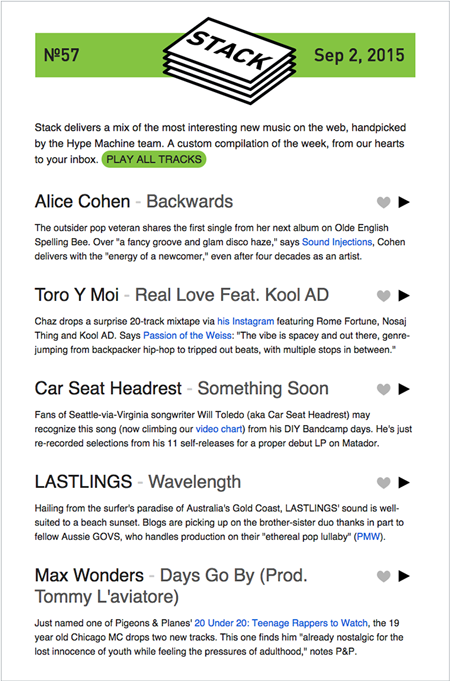
Hype Machine’s newsletter landing page closely mirrors the design and layout of the email itself, but with some clever additions like a “Play All Tracks” button and some extra graphics on the header. These subtle touches promote landing page engagement while keeping the experience familiar. There is an aesthetic harmony between email and landing page that improves the chances of interaction.

hypeemail hypelandingpage

Email on the left. Landing page on the right. Feels good right?

Powerful CTAs are also an important part of successful email landing pages. Look at this IFTTT landing page CTA. That is not a small button. Try not clicking on that button. Once you visit the IFTTT page from the email, it’s very clear what you can do next. You don’t want to make visitors guess or even have to think deeply about an action. The CTA should be obvious and ready to capitalize on the feeling they’re bringing from email click to landing page.

To make the email landing page even stronger, it’s important to incorporate multiple CTAs throughout the content that match thematically. Even with the giant IFTTT button there is still a text link for the same task available in the copy itself. The Lyft example has another CTA just underneath the app download buttons. Always provide multiple avenues to accomplish the desired event for the email campaign. With a strong CTA and a landing page that complements the original email, you’re bound to have a successful program.

Think about SEO.

Remember that the landing page isn’t just about the email campaign. This content is public, so it will be discovered and digested by non-email visitors. Make sure that you can maximize that public value by following some basic SEO strategies.

Make sure the page itself is crawlable, so you’re not blocking it from search in the robots.txt file or through noindex tags. You also want the page to have some clean HTML markup with crawlable text and a strong title tag, meta description and URL (some basic guidelines from Google for reference). Put the page into Google’s Keyword Planner to get ideas for keywords you could incorporate into some of these elements. Run your email landing page through Fetch as Google to check crawlability.

Since visitors from organic search traffic may be completely unfamiliar with you, make sure that the landing page represents your brand in a meaningful way. You don’t need to sacrifice any specific language or design pieces; just make it easy for your page to live on its own and do more outside of the campaign. This means incorporating your logo into the design, and using subtle elements like a small footer sign up or learn more section that new visitors can use.

Landing page content often has some extremely good value for long-tail keywords, so some basic landing page SEO can provide new traffic for a long time, providing extra value on top of your initial email landing page investment.

By following these tips you can create landing pages that will delight visitors with great design and content, which will help your email campaigns deliver even better results over time.

The post How to Design the Best Landing Page for Your Email Marketing appeared first on Email Marketing Tips.

15 Oct 21:24

Value in the Internet of Things | @ThingsExpo @VitriaTech #IoT #M2M

The Internet of Things (IoT) is about the digitization of physical assets including sensors, devices, machines, gateways, and the network. It creates possibilities for significant value creation and new revenue generating business models via data democratization and ubiquitous analytics across IoT networks. The explosion of data in all forms in IoT requires a more robust and broader lens in order to enable smarter timely actions and better outcomes. Business operations become the key driver of IoT applications and projects. Business operations, IT, and data scientists need advanced analytics tools incorporating predictive analytics, prescriptive analytics, and machine learning for rapid development and innovation to divine timely value out of IoT networks.

read more

15 Oct 21:21

The Most Important Sales Development Step, A Sales Tips Video

by Leah Bell

The most challenging part to any process is getting started.

Whether it’s a writer’s blinking cursor on a blank page, an artist’s first stroke of paint on a white canvas, or a salesperson’s first call of 100 — that first lunge off the starting block is the hardest.

In sales development, a curated prospect list is the foundation for call success. Take it from SalesLoft Director of Sales Anthony Zhang and VP of Sales Derek Grant — two sales leaders who still believe prospecting to be the most valuable tool in kicking off your sales process.

Sales Tip 16

Even at the Director and Vice President level, prospecting is considered to be the key tool to getting started in sales. Anthony’s advice on nurturing prospects through a cadence of touchpoints like emails, calls, and social touches turns a cold, hard prospect into a warm qualified opportunity. But in order to get each of those prospects on a cadence, the list must first exist.

That’s where Derek’s sales tip comes into play. You have to make prospecting a part of your daily routine. If you treat prospecting it as if it’s the most important step of your entire sales process, and make it a priority, then you will reap the rewards down the road.

Take that curated list of prospects, follow Anthony’s nurturing advice, and you’ll find yourself lightyears ahead just from taking the time to focus on prospecting.

What advice do you have for sales prospecting? Comment below if you have any tools or tips that have helped you in kickstarting your sales process.

The post The Most Important Sales Development Step, A Sales Tips Video appeared first on SalesLoft.

15 Oct 21:20

How to Make Yourself Relevant on LinkedIn

by Kaeleigh Phillips

LinkedIn is a powerful resource for employees and businesses. This online resource connects career oriented individuals to the business community and forges valuable connections. Networking is an essential part of the business world and knowing how to navigate this online workspace can be an essential asset.

Maximizing Your Profile

Implementing as many details as possible into your profile is important for businesses and fellow clients to understand your value as an employee. A professional picture that is used across all social media channels helps in the image search which leads more people to your LinkedIn page. Using keywords and a detailed description of your skillset helps to build stronger connections and stronger online connectivity to your profile. Putting your resume online also indicates confidence in your skillset and promotes a more transparent profile.

Joining Groups and Networking Articles

Linking articles is a way to increase productivity on your LinkedIn profile and get noticed by potential businesses and clientele. Joining relevant groups to your industry and posting comments and articles demonstrates ingenuity and interest which is an attractive quality on the website. Writing relevant blog posts and linking them online generates more traffic to your profile and if the blog posts are written well, shows knowledge and relevant opinions towards topics in your industry.

Employer Recommendations

Obtaining recommendations from your employer helps enhance your credibility on LinkedIn. It is important to have at least 10 recommendations from relevant individuals in the industry. This ensures references are available online for a business or employer to see and helps to create a rounded LinkedIn profile. Trading recommendations with industry related co-workers is a good way to increase recommendations.

LinkedIn can be a valuable resource in the working world and learning how to maximize its potential can provide a whole new experience which could help you in meaningful ways.

Sources

http://career-intelligence.com/linkedin-to-your-advantage/

http://theundercoverrecruiter.com/9-ways-maximize-your-linkedin-profile/

15 Oct 21:20

3 Ways to Add More Value for Your Sales Reps

by Rachel Clapp Miller

Papers_and_Meeting.jpgWhen it comes to running a sales organization, no one can afford to waste time. High-performing leaders focus where they can provide the most value to their sales reps, before, during, and after sales activities.

The best sales leaders see through the clutter to identify those high-impact opportunities.Here are three ways you can add more value for your sales reps.

Valuable Role Plays

Role playing can often be awkward, time-consuming, and less than valuable. Done right, however, role playing can make the difference between a lost opportunity and a signed contract. Here are some best practices for conducting effective role plays.

1. Be sure that the person playing the buyer is fluent in the account. Pre-call planners can be effective tools to ramp up the other participant quickly.

2. During the role play, listen for these key things:

  • Does the rep open with a purpose and clear agenda, and gain agreement on those points?
  • Does the rep clearly state what they already understand about the opportunity?
  • Does the rep ask discovery questions that move the conversation toward attaching buyer problems to the seller’s solution?
  • Does the rep help the buyer connect the conversation to others in their organization?
  • Does the rep close with a clear, concise update and state the next steps to move the sale forward?

3. Use the feedback portion to offer both positive and constructive feedback based on these questions. Use the tips in this article to improve your feedback skills, or listen to this podcast.

Positive Opportunity Coaching

Often, salespeople view opportunity reviews as a chance for their managers to tell them everything they’re doing wrong. Many sales organizations call these opportunity inspections. That’s what they feel like, an inspection of all the negatives. Instead, approach reviews as an opportunity to coach your reps to success. Think of yourself as the motivator to help them bring the opportunity to fruition. Here are some best practices.

1. Prepare

Show respect for your reps by maximizing their time in reviews, and bringing feedback that will both encourage and genuinely help them.

2. Involve the team

Maximize the value of feedback by conducting coaching in a group setting. You’ll give everyone the benefit of each other’s feedback, and demonstrate that everyone has the entire team at their back.

3. Prioritize objectives

Focus on discussion relevant to where the opportunity is in the pipeline and how to effectively move it forward.

4. Protect Time and Agenda

Stick to the allotted time and the desired agenda. Be purposeful and efficient.

5. Provide the ‘How.’

Give the salesperson actionable next steps to focus on, and check that the seller is comfortable executing those steps. This is a good time for a focused role-playing session.

Proactive Accountability

When Harvard Business Review surveyed more than 700 sales professionals, they found that in under-performing organizations, only 13% of respondents felt they were held accountable for results. At high performing organizations, more than 60% of salespeople said they were held accountable.

To keep your salespeople on track, set up a clear path and a cadence to talk about progress on opportunities, and any challenges in moving the opportunity forward. Make the person who owns the deal responsible for the cadence, not you the manager.

Focus on building predictability and consistency into both your coaching and seller performance. For an example of how to build these core competencies into your organization, read this article on building accountability in the sales planning process..

Organizations that have leaders who are committed to coaching and growing their reps abilities will reap the rewards of consistency – an increase in average deal size, market share and overall revenue.

New Call-to-action

15 Oct 21:20

4 Ways Facebook Lead Ads Can Change the Social Advertising Game

by Jeffrey Kranz

Facebook lead ads are here!

Facebook has rolled out a new form of advertising that’s now available to marketers everywhere. Lead ads make the process seamless for marketers to ask for info like emails, names, job titles, and more. The process is smooth and easy for Facebook users, too, as they never need to leave Facebook. (It’s very similar to how a Twitter lead gen card might work.)

I find this pretty exciting for a few reasons:

  1. Generating leads from Facebook may have just got a whole lot simpler.
  2. We can’t wait to try them out ourselves!

As we’re learning tons about how these work and the best way to implement them, we wanted to share a few reflections on Facebook’s latest tool for marketers.

facebook lead ads

First off, what are Facebook lead ads?

TL;DR: Facebook’s lead ads let you generate leads without the person ever needing to leave Facebook.

The lead-generation forms that would normally live on a landing page are automatically prefilled with Facebook user data. Woohoo!

For example, let’s say we wanted to promote our social media strategy email course on Facebook to grow our email list. These new ads make it super simple for people to hop aboard—without ever leaving Facebook.

Here’s how that works:

First, someone in our targeted audience sees the ad. It looks very much like an everyday Facebook advertisement.

facebook-lead-ads

But check out that sweet “Sign up” button! If someone’s interested in taking this course, here’s what happens when they click on that button:

facebook-lead-ads-form-fill

Facebook automatically fills in the person’s email address from their Facebook profile! Our friend Marcus didn’t have to leave Facebook or even type in his email address for anything: all he has to do is tap “Submit” at the bottom.

And when he does . . . BOOM! He’s all signed up, just like that.

facebook-lead-ads-confirm

Why are lead ads such a big deal?

That’s what I wondered at first.

After all, Facebook has allowed interactive ads for a good long time now. We can already run ads that allow people to perform all kinds of cool actions by tapping a button, including:

  • Liking a Facebook business page
  • RSVP-ing for an event
  • Install or open apps
  • Get a special sales offer

But Lead Ads can change the game in a few major, major ways—especially for the small business owners doing their own marketing atop everything else.

4 ways Facebook lead ads change the social media advertising game

The team and I have put together a list of ways this new kind of Facebook advertising might be super helpful.

1. Lead ads pull from data that Facebook has already collected

One thing that’s difficult for me as a marketer is getting “enough” information about leads. A lead is created when someone trades some form of contact information in exchange for something of value. A rather popular lead-generation exchange we see in marketing involves someone trading their email address for an ebook or whitepaper.

But is an email address enough? Sometimes yes, sometimes no.

I’ve found that in many cases, an email address is just the starting point, but you need some more bits of information to know if they’re the kind of people you should be targeting your marketing efforts on.

For example,

  • Sometimes you need to know if a lead is a decision-maker at their organization. In this case, you may need their job title.
  • Sometimes you need to know where they’re located, which might involve getting their state or ZIP code info.
  • Sometimes you might even need a phone number.

But asking for more information often makes for a longer form, and longer forms can get abandoned—because not everyone wants to fill them out!

Facebook’s lead ads seem to make a big difference here. Instead of people hitting a form with multiple fields to fill out, Facebook fills out those boxes for them—because they’ve already given Facebook that information on their profile!

2. Lead ads help you capture leads without needing to build landing pages or forms

This might be the most popular aspect of Facebook’s lead ads: now, you don’t need to build any more assets between your offer and your ad. You can just capture those leads straight from Facebook!

Here’s why that’s such a big deal:

Without lead ads, if you wanted to run a lead gen campaign using Facebook ads, one way to do it would have been the traditional lead-gen way:

  1. Create your offer (that piece of content like an ebook or whitepaper that you’d trade to people for their contact information).
  2. Create a form to capture leads’ email addresses (and maybe some other info).
  3. Create a landing page for that form to live on.
  4. Create some ads pointing your target audience to your landing page.

That’s a lot of work. Not only do you have to create that piece of content you’re giving away, but then you need to build landing pages and forms just to make it available to the people you made it for.

And that’s assuming you can create landing pages and forms yourself. I’m not so handy with code, which means if I’m a small business owner, I may have to pay for extra services to help me create those forms and landing pages. (There’s nothing wrong with this of course—it can just get a little pricey!)

But Facebook lead ads don’t need landing pages. They let you set up the ad, and then the ad handles all the work of capturing that information. You don’t need to make a landing page, you don’t need to write AJAX forms, none of that. Woohoo, right? =)

3. Facebook lead ads put fewer steps between your audience and your offer.

Remember those four kinds of marketing assets we listed in the previous section?

  1. Content you’re giving away
  2. Form
  3. Landing page
  4. Ad

If you flip that list upside-down, you see what your audience’s experience would look like. It’s roughly four steps long:

  1. Click an ad
  2. Leave Facebook to go to a landing page
  3. Fill out a form
  4. Get that free content!

There’s nothing wrong with this process. (I’m pretty used to it as a customer!) But Facebook’s lead ads eliminate the need for landing pages and forms . . . which means the user’s experience goes from four steps long to only three:

  1. Click an ad
  2. Confirm my info
  3. Get that free content!

Wow. At first glance, this is already shaving about 25% of the complexity out of this process—which is terrific. But I think it gets even better . . .

4. Facebook lead ads don’t pull people out of Facebook

I feel like this is a golden, golden win for everyone.

We looked at how, with lead ads, your audience doesn’t need to visit a landing page to get to your awesome lead-generation content. It’s a simpler, more straightforward way to get to your offer. (Huzzah!)

But that means your audience gets to stay in Facebook, which can be a huge win for two big reasons:

  1. Your audience feels less interrupted. With lead ads, your audience can see your ad, sign up to get your content, and then smoothly transition right back to browsing their News Feed.
  2. Your audience doesn’t have to wait for a new page to load. Instead, they’re served up that option to confirm info immediately. This can be a HUGE deal for mobile users especially!

A great resource on how Facebook lead ads work

Jon Loomer has written a fantastic summary of how Facebook lead ads work. He’s got a detailed step-by-step tutorial lined up, along with some thoughts on how they have worked for his lead generation campaigns. Thanks so much for the fantastic article, Jon! =D

Over to you

What do you think? Have you taken lead ads for a spin? If so, I’d love to hear how they’ve worked for you!

I’m also curious: We’re running a lead ads campaign right now ourselves—would you be interested in hearing how that goes in a future blog post?

I cannot wait to chat over this with you in the comments!

15 Oct 21:19

4 Tips to Build a Sales Team That Gets Results

by Marcel Florez

You’ve got a great product with a winning value proposition. Now all you need is a top notch sales team to bring in the revenue.

Hiring good people is the first thing many sales managers think to do, but the right process has to be in place before the right people can perform their best and deliver the results you need. And you want results today, so a long ramp-up period is out of the question.

These are the tenets I used to build a global sales team focused on demand generation and closing sales for cloud technology services, but they apply to business of all sizes that market a wide variety of products or services.

1) Measure by customer lifetime value.

In many cases, the value of an initial sale has become almost irrelevant. Instead, knowing how much each customer is worth over the course of an entire relationship is the gold standard metric. A client with 50 employees who needs a licensed software solution with yearly renewals could be worth more than one with 500 employees who needs office chairs with 10-year life spans. 

2) Identify sales blockers in the funnel.

In technology sales, I've learned that more than 75% of prospects need technical expertise before converting. Integrating tech support team members directly to remove sales blockers and better support new customers has yielded impressive results.

No matter what you are selling, it pays to identify where sales blockers pop up in your funnel, and address them. Make sure product experts who can answer tough questions are part of the sales process and not siloed off in some other department.

3) Use the right headcount/budget breakdown.

Even though salespeople have to be more multi-talented than ever, they are still stratified into distinct roles based on experience and compensation. And different team breakdowns impact top line revenues drastically.

Minor tweaking of the headcount and budget numbers may be necessary in certain industries or selling scenarios, but this formula is an excellent starting point for any sized sales team.

  • Lead qualifiers Headcount: 20% Budget: 10%
  • Opportunity nurturers Headcount: 25% Budget: 20%
  • Large sales reps Headcount: 20% Budget: 25%
  • Customer success reps Headcount: 10% Budget: 10%
  • Support experts (pre-sale) Headcount: 15% Budget: 20%
  • Support experts (post-sale) Headcount: 10% Budget: 15%

4) Serve after the sale. 

Your sales team should never look at conversion as an end game. Once a prospect becomes a customer, salespeople must help drive utilization of goods or services in order to create internal brand advocates, repeat business, and upsell opportunities. Achieving higher adoption increases customer lifetime value, and your bottom line. Sales teams must ensure customers successfully adopt, use, and advocate for their products.

There are many ways to impact the success of your sales organization. Marketing automation, SEO campaigns, and data augmentation are all important aspects of a successful sales strategy; but make no mistake, the structure and function of the sales team is the single biggest factor in removing blockers in the funnel and producing results.

Get HubSpot CRM today!  

15 Oct 21:19

The Best Sales Process Comes from Successful Sellers

by Rosalie Pope

The Best Sales Process Comes from Successful Sellers

One thing we know about successful sales organizations is that they take guesswork out of the equation for sales professionals. They establish a consistent sales process and language, and this means that sales professionals don’t have to recreate the wheel or figure things out as they go along. Instead, they are able to follow a process that has been tested, prove its value, and provide a roadmap to next steps.

A critical challenge for sales organizations in onboarding new hires is the length of time before they become productive. They have to learn the product that they’re selling, the company’s culture, the clients, and the prospects. Any steps to shorten that coming-up-to-speed period contribute to the productivity of sales professional and the organization.

At Richardson, we believe a common language and sales process helps bring sales professionals up-to-speed faster and serves them better throughout their career. By telling them, “This is how we do it, step by step,” sales professionals get better and quicker at turning a sales lead into a successful deal.

The way that Richardson works with clients to create and validate an effective sales process — one that clearly identifies leading indicators of success — begins with what we call an affirmative inquiry. We interview senior leaders and then ask them to nominate sales professionals who consistently perform at top levels. The goal is to determine what these top performers do that works so well within their environment. We want to understand each step, from the moment that they’re given an opportunity until it becomes a done deal.

With that input, we create a vocabulary to describe each step and ask the sales professionals to verify our description of their approach. We also tap our industry knowledge to add best practices that apply to the situation. This additional insight gives even the best sales professionals new ideas and tools to be more successful.

We sketch out a sales process that encompasses a number of stages that move a sales opportunity to completion. These include identifying, engaging, exploring, assessing, and developing them, through to positioning and follow-up, negotiating, closing, and then maintaining and expanding relationships.

We then share this with the senior leaders who nominated those to be interviewed. We ask their feedback on our findings, the best practices that we recommend, and whether they think that the proposed sales process would work in their environment, division, product line, region, etc. Once we gain concurrence, we customize a training program to their culture to get everyone on board.

When sales professionals enter the training session, most think that they already know all there is to know about sales processes. That’s natural, as most have been selling for quite some time. But two elements really catch their attention and interest: the dramatic changes in B2B selling in recent years and a customized process based on what is really happening in their day-to-day world.

They pay attention because we’re not talking about theory; we’re describing how really successful sales professionals keep blowing past their quota. They know that we’ve talked to sales legends in the company, and they want to know their secrets.

They also see that there is flexibility built into the process to accommodate the different clients that they work with and changing circumstances. They appreciate being measured on outcomes rather than a series of activities. So, even though we get some skepticism from sales professionals entering training, once they see the relevance and benefit, their interest in training grows.

What really matters is whether the sales process makes a difference in their selling and in their results. We can say with certainty, based on our experience working with long-term clients, that this is the case. Having a solid sales process based on the success of top performers provides a clear path for others to follow and achieve their goals.

sales process coaching

The post The Best Sales Process Comes from Successful Sellers appeared first on Richardson Sales Enablement Blog.

15 Oct 21:19

Don’t Forget About Your Older LinkedIn Published Articles

by Bob Woods

Don't Forget About Your Older Published Articles on LinkedIn

I’m always excited when I click “Publish” on a new Long-Form Post here on LinkedIn. For me, it’s like showing off a new car, a new suit or even a new tie. (I don’t wear ties a lot; when I do, though, they’re pretty great.)

When those things get older, though, they get traded in, given to Goodwill, etc. (I will say I keep my old ties so long that my wife gives me dirty looks until I throw them out.) Out of sight, out of mind.

That’s what a lot of people do with their aging LinkedIn Published articles. Once they’re out and the liking/commenting/sharing frenzy is over, they tend to get pushed out of the writer’s mind very quickly.

Here’s the difference between an old suit and a LinkedIn post: You can’t really alter a suit all that much, but you can change a lot LinkedIn post. Having the ability to do the latter is a good thing… for the most part.

Why You Would Want to Change a Post

Overall, you would want to go back and change old articles for relatively minor reasons. While this article deals with LinkedIn Published Long-Form posts, the below could easily be said of any kind of blog-type posting.

Here are three reasons:

  • Copyediting mistakes. Despite your best efforts, you made an obvious mistake or two in the editing of your article, and you didn’t catch them before you clicked “Publish.” You had an obviouss typo. MAybe your error was in capitalization. And so on and so forth. Then you notice it after you’ve published, or someone pointed out your error(s) in the Comments section. Fixing the problem is easy: Just go back and change it. No harm, no foul. One tip, though: If someone does point out your error in the Comments, be sure to reply to her or him with your thanks for flagging it.(Here’s a second tip: If you want to decrease such mistakes, check out Grammarly. Trust me on this one. I’ve been writing professionally since 1986, and I find a lot of value in it.)
  • Updates. If you’ve previously published something that now has an update or is obsolete, go back and update the article at the TOP of the piece. Bold and all-cap the word UPDATE, and then write your update in italics. Here’s an example of how I updated a previous piece. Note that in this example I actually didn’t put my update in italics, but that’s only because I included a blockquote where the text was already italicized.You may even want to update the original piece by linking to a new article you’ve written about the change, update, etc.
  • Changes or updates to calls-to-action and/or bio paragraphs. This particular point was the genesis for this article. I have a number of old articles where I referenced that I would soon be launching my company. Because that business is now launched and doing well, I went back and changed the bio paragraph at the end of the article to reflect the company’s operational status.Feel free to do the same thing when changing a call-to-action (CTA) that’s now expired, out-of-date or just plain old. And always keep up with the CTAs in your old posts, too, so they don’t get old.

If you can think of other examples, let’s discuss them in the Comments section. (And please don’t flag the typo or capitalization error in the first bullet point above, as those were examples I thought were cute and illustrative.)

Just Because You Can Doesn’t Mean You Should

Having this “Wayback Machine” is a good thing… for the most part. You may, however, be tempted to re-visit your old Published articles and change entire paragraphs, sections or even whole pieces to change the tone, points made… even the entire idea or premise behind the article.

Please… don’t do that.

Changing the tone of an article, or even doing a complete 180-degree on an idea you asserted at one point is—in my book—intellectual dishonesty. Pure and simple.

Another thing to consider comes from the “memory” of the Internet. Let’s say you received a link to your old article. And let’s say you believed at one point that X was the case in your industry, but now you believe in Y… which, is the complete opposite of what X is. The aforementioned link says you believe in X, but when clicked, the reader is taken to the article which asserts Y is the greatest thing since sliced bread. You now have zero credibility with the person who was interested enough in clicking on that link.

I’m not saying you can’t change your mind, but to go back and alter an article is like writing a book, doing that 180, and then sneaking into all libraries and bookstores around the world and replacing your original book with a new one that replaces everything you said in the first tome. It’s just not cool.

All is not lost, though. Just use the “update” idea I introduced above but write a new article that fully explains why you now like Y and disdain X. Then link the old “I like X” article to the “I now like Y” one. This preserves your integrity; at the same time, you’re now “on the record” with your new view.

So go forth and alter your old content. But don’t change it completely.

This article originally appeared on LinkedIn, and was featured in the LinkedIn Tips channel.

15 Oct 21:15

6 Revenue-Boosting Tips to Revitalize Your Neglected Social Network

by Kevin Thomas Tully

Sales professionals understand both the power and practical applications of social media.

By utilizing your most powerful prospecting tool and the epicenter of the social selling universe – LinkedIn – today’s socially savvy sales pro easily makes inroads into accounts and secures introductions to champions and key decision makers.

But it’s been a while, and much like all relationships – personal and professional – your LinkedIn network most likely could use some much-needed attention.

Remember, it’s six times easier to sell to an existing client than it is to generate new business. Now is the best time to conduct a top-to-bottom audit of these valuable social connections – before it’s too late.

With an eye firmly fixed upon the bottom line, follow these six sure-fire social selling tips to rejuvenate and pump new life into your LinkedIn network:

1) Make new connections

Sounds simple, doesn’t it? It is. Perform an advanced LinkedIn search using strong keywords specific to your ideal buyer persona. Once you’ve identified a prospective connection, avoid the hard sell approach. Keep it casual – don’t propose marriage on the first date. Craft a personalized connection message that provides both context (describe why you are sending your prospect a connection request) and value (position yourself as a valuable resource of information for a specific topic.)

2) Talk to existing connections

LinkedIn offers another easy search feature that may yield surprising results. Clicking the “Connections” tab from your home page opens your existing LinkedIn network. You can sort your connections by most recent conversation and also search your network for a particular person. Shocked that you haven’t spoken with that hot prospect or named account in months? Don’t panic – you can message him/her directly from this page. Remember, when sales professionals show they are human and make a personal connection through conversation – building a relationship without trying to sell – the sales process naturally evolves.

3) Join a new group – and participate

Participation is paramount. Ask yourself this question: why are you joining a LinkedIn group if you don’t have something to offer? Being a sponge is OK – you do learn from listening – but it’s time to get on the dance floor and show off your best moves. The first step is always a little awkward, but once your content or comment receives that first like, comment, or share – it’s all worth it. LinkedIn allows you to join 50 groups – find groups that fit your buyer persona and allow you to establish thought leadership. It will pay dividends.

4) Give an endorsement

You’ve undoubtedly done business with someone in the past, or recently, who had a positive experience with your product or solution. Perhaps a long time has passed (or what seemed like a long time), so you are reluctant to contact this client. Don’t be. Start with an endorsement of his/her skills – not just the top skills listed on his/her LinkedIn profile or only those listed. I like to send my client a message stating, “I’m thinking about endorsing you for these skills (list skills). Are there any skills in particular for which you wish to be endorsed?” More than 10 million endorsements are given every day on LinkedIn, and an average LinkedIn user receives 5 endorsements. Give endorsements first – and freely – without expecting anything in return. You will be pleasantly surprised where this conversation leads.

5) Provide a recommendation

A LinkedIn recommendation is more powerful than an endorsement. It is an excellent way to demonstrate the value you’ve offered in previous working relationships. Your buyers review your LinkedIn profile as a part of their due diligence process, and recommendations help to establish your credibility and demonstrate that you’ve solved similar challenges. Again, I like to give recommendations without asking for one in return. I will only ask for a recommendation when I know that I’ve done something worth recommending. And please, keep your recommendations business-like. I’m certain my mother would recommend me (I hope), and I know my secret chocolate chip cookie recipe is worth recommending – but not on LinkedIn.

6) Share content

I’ve written this in previous blog posts, and I cannot emphasize this statement enough: content is the lifeblood of social selling. Without a constant source of relevant and helpful content, your prospects and potential buyers will wither on the vine and die like spoiled fruit. It’s not difficult – set aside five minutes each day to review your LinkedIn home feed and like, comment, or share something on LinkedIn. It does not matter whether you create, curate, reuse, recycle, or repurpose – but publish, or your existing LinkedIn network will perish.

Sales professionals, how do you keep your social network healthy and thriving?

15 Oct 21:15

7 Traits of a Great SaaS Sales Rep

by Cara Hogan

There’s a common idea in the world of Software-as-a-Service you may have heard:

Great SaaS products sell themselves.

This is completely, utterly wrong. As anyone who has worked at a SaaS company will tell you, organic sales growth has a limit. While your SaaS startup may be able to grow at first with a group of enthusiastic early adopters, these customers will only get you so far. At some point, your SaaS business will have to cross that chasm, and appeal to buyers who won’t be swayed by your product features alone.

Sales (together with Marketing) are there to show prospects exactly how valuable and innovative your SaaS product truly is, and why it’s worth the price. The best SaaS sales reps are able to do this with ease — however these top reps are few and far between. As a sales leader, you’re always on the hunt for these top reps who can take your team to the next level.

So what makes the best SaaS sales reps rise above the rest? It’s a combination of skill, determination, and SaaS-specific knowledge. If you’re building a powerful SaaS sales team, these are the 7 qualities you should be looking for when hiring new sales reps.

1. Fluent with Technology

It’s almost a no-brainer, but any rep selling SaaS software must be comfortable with both using and discussing technology. Traditional sales reps can often get away with only understanding their own product well, but this won’t fly in SaaS. Reps have to understand not just their product’s technical specs, but also how it fits in with and complements other technology in a business’ software stack. SaaS reps can never be caught off guard by a prospect asking technical questions about the software’s compatibility with X data or Y product.

SaaS reps must sell to a highly technical market, and have to pay attention to not just their industry, but general technology trends and developments. Technology doesn’t have to be their personal passion, but top reps pay attention to the latest developments and changes to the industry. The best SaaS reps are technologically fluent, able to easily understand new technology and learn to use it quickly.

2. Understands the Value of the Product

One of the biggest challenges of SaaS sales is that your product is often replacing a difficult or manual process like tracking data in Excel spreadsheets or managing financial payments. While your product might be amazingly innovative, prospects may not see it that way at first. Many people will believe they’re managing just fine with their current workflow, and have no need to upgrade to SaaS software. Prospects often don’t have the budget or see a pressing need to change the status quo, and that’s where sales comes in.

Great SaaS sales reps can convince prospects of the true value of your product, and how it will revolutionize the business from within. They can easily prove true ROI of a SaaS product, and convince prospects that they’re losing out on a huge opportunity if they don’t buy. A strong value proposition is the key to SaaS success, and top reps know exactly how to position and pitch a product to achieve maximum impact.

3. Knows the Ideal Customer Profile Inside and Out

Understanding your ideal customer is important for any sales rep, but it’s especially vital in SaaS. In traditional sales, reps might be able to get away with selling a product to a customer who isn’t exactly the right fit in order to hit quota or cross the goal for the month. But in SaaS, sales reps are actually hurting the business if they close a deal with the wrong type of customer. Customers that don’t fit the ideal profile are generally more likely to churn and waste the resources and investment the company makes in onboarding them.

Great SaaS sales reps know to look for specific characteristics when talking to a new sales prospect — including size, industry, and technology stack. If a prospect isn’t quite the right fit for the business, the best reps are completely comfortable disqualifying the prospect and shutting down the sales process before it goes too far. This saves the business time and money by focusing the rep’s attention completely on the best possible prospects, and lowering the overall churn rate.

4. Values Long-Term Customer Success

Similar to understanding the ideal customer profile, top SaaS reps always think about the long-term success of a new customer. In some industries, it’s not a big deal if a sales rep over-promises a product’s capabilities to a prospect in order to close the deal. However, in SaaS, if a product doesn’t deliver what a sales rep promised, that unhappy customer is likely to churn rapidly.

Great SaaS sales reps are always looking out for the success of the overall business, not just themselves and their quota. Even if it means missing their goals, top reps won’t lie to prospects in order to close the deal. These reps realize that every SaaS deal isn’t a one-time payout and know the vital business importance of payback period for every customer. By being honest with prospects, reps ensure that prospects become happy customers, who will stick around and will be open to upsells in the future.

5. Always Minimizes Discounts

In SaaS, discounts are even worse than in traditional sales. Because of the financial structure of SaaS deals, discounts compound over time and will hurt the business long into the future. For example, if a SaaS rep offers a prospect a 10% discount to a prospect today, that discount will apply not just to this month, but to every month going forward. It’s not really a one-time discount, it’s a recurring discount that cuts into profits every month.

Because of this, the best SaaS reps always have an eye on the bottom line. These reps are able to focus on the value of the product, not on the price, and always steer prospects away from numbers-based negotiation. Top reps will hold firm, and refuse to discount because their product is worth the price they’re charging.

6. Understands Venture Capital

Most of today’s biggest SaaS companies started out as VC-backed startups, and often sell to similar companies, depending on the market. SaaS sales reps should really understand the world of Venture Capital, and what it means for a company to be funded, have an IPO, or be acquired by another business. These may seem outside the realm of traditional sales skills, but SaaS prospects will often ask reps about their company’s funding, and reps must be able to answer intelligently.

Great SaaS sales reps can reassure prospects that their business will be there tomorrow, next month, and years from now. They understand who is venture-backed and what it means for the business, and how it can help them sell their product more effectively. For example, if a rep is targeting high-growth startups, those companies have a lot of pressure to grow quickly. A top SaaS rep will then position their product as a tool that will help the prospect’s company grow, and hopefully, close the deal.

7. Creates Strong Connections

The traditional traveling sales rep doesn’t exist in today’s SaaS companies. Most SaaS businesses focus almost entirely on inside sales, with reps calling and emailing prospects daily. SaaS reps often have to close deals without ever meeting prospects in person or shaking their hand. This means that reps have to build strong interpersonal relationships just using email, phone calls, and maybe a video chat or two.

Top SaaS reps have great written and spoken communication skills, and understand the challenges of inside sales thoroughly. It’s really tough to build a strong rapport with someone you’ve never looked in the eye, but great reps can do it with just a few phonecalls. The best SaaS sales reps can engage prospects through email and the phone almost as well as traditional reps can close deals in person.

Not every SaaS sale rep will naturally have these specific skills from the start, but if you hire reps that are talented and learn quickly, you can teach them to adapt. Build your sales team to embody these top SaaS sales reps qualities, and you’ll be on the path to building a powerful SaaS business.

15 Oct 21:15

Tool Kit: Selling with LinkedIn

According to IDC research, 75% of B2B buyers and 84% of C-level/vice president executives use social media to make purchase decisions. LinkedIn, in particular, can put you in close proximity to and, ultimately, connect you with these buyers. However, it isn’t enough to simply create a profile. You must grow your network, post articles, comment on posts, participate in groups, and more. To help you get started, we’ve created a tool to help you optimize your LinkedIn profile and use LinkedIn for your sales efforts. 

15 Oct 21:14

Don’t Drop the Ball on Communication: Follow Up Like This

by Mikita Mikado

In a fast-paced sales environment, it’s easy to drop the ball on communication.

In fact, 44% of salespeople give up after one follow-up, Dustin W. Ruge explains in his 2014 book, The Successful Sales Manager.

But in sales, persistence wins. The saying “the squeaky wheel gets the oil” rings true here. The only way to remain top-of-mind to prospects is to keep in touch with them and follow up consistently.

Here are some tips to help make following up easier:

1. Create a plan in advance.

Determine how often and when you and the team will follow up with prospects, and stick to it. Make your workflow visible to everyone in the organization using a digital document management platform or intuitive CRM, so team members can hold one another accountable for follow-ups.

2. Use tech to help you stay organized.

Leverage the power of technology to help you stay organized. Record all prospects in the CRM and categorize them based on where they are in the sales process.

For example, create separate tabs for new prospects, qualified leads, and warm leads. Set reminders to alert you to follow up after each call or email and document when and how the prospect was last contacted.

Use a digital document management platform to create, send, and receive proposals. Choose one that allows prospects to comment on documents with questions, so you can address them quickly.

3. Record where you left off with a prospect.

Each time you speak with a prospect or lead, record what you discussed in your CRM. Also, note which gateway you left them in and what information you need to help move them through the next gateway. Instead of accidentally repeating the same information again or, worse, asking where you left off, you’ll already know. It’s your job to keep track of where your prospect or lead is, not theirs.

4. Email on a Tuesday.

Emails have a relatively short life-span. In fact, fewer than 1% of emails are opened, if left unopened in an inbox 16 to 24 hours after delivery, according to a 2013 Get Response study. If you’re going to communicate with clients this way, be strategic about your timing.

Get Response found Tuesdays have the highest email open rates, and people happen to receive the highest volume of emails on this day, too. Although it’s a busy day, reach out to prospects on Tuesdays. They might be kicked into high gear and ready to respond.

5. Always reopen the conversation with what you and the prospect have in common.

Prospects don’t want to hear about what you want them to buy right away. Always begin the conversation with something that aligns you and the prospect. Start the conversation with a common value or vision you share. Or, if you can connect on a personal level with a common hobby or interest, talk about that.

Then you can ask them how their current process or situation is, identify what’s valuable to them and share how your product or service has helped others like them achieve success. But in each conversation, alignment must always be established first.

6. Be consistently responsive.

Follow up consistently to build trust and show prospects you’re reliable. When prospects buy, they enter into a long-term relationship with you and your product or service. They need to know they can count on you to respond should they have any problems, questions, or concerns.

Ultimately, sales are fueled by the relationships you build with people. Keeping in touch consistently is the key to nurturing a relationship. So, don’t drop the ball on follow ups, and use tech to help you stay on track.

What are some other ways to make following up easier? How might digital document management or an intuitive CRM help? Share in the comments below!

15 Oct 21:14

4 Data-Driven Sales Prospecting Tips

by mrenahan@hubspot.com (Mike Renahan)

I didn’t like numbers at all growing up. Math was my least favorite subject and science was a close second. 

But, inevitably, the older I got, the more I valued the two subjects. In fact, nowadays, every decision I make is influenced by numbers. For example, I only buy plane tickets on Sundays and fly on Tuesdays. (Thanks, science!)

With this in mind, it wasn’t a surprise to me to learn that top sales reps use data to drive their strategies and choices. What was surprising is how many aren’t taking advantage of the scores of freely available data at their fingertips.

Do you feel that your sales strategy could benefit from an injection of data? If so, it’s your lucky day. Here are four prospecting tips, backed by data.

1) Timing is everything.

The average buyer receives over 100 emails a day, opens just 23% and clicks on just 2% of those emails, according to Tellwise. With those odds, it’s going to take a lot to make an impact on a prospect. 

The data says:

  • The best times to email prospects are 8 am and 5 pm, according to Get Response.
  • Tuesday emails have the highest open rate compared to other weekdays, says Experian.
  • If a salesperson sends an email Tuesday morning, the best days to call and follow up are Wednesdays and Thursdays from 6:45 am - 9 am and 4 pm - 6 pm. The worst days to call are Mondays from 6 am to noon and Fridays in the afternoon, according to a study from RingLead.

Here’s how to use these statistics to your advantage in the context of a sales outreach campaign. 

Step 1: Write the copy, and save it as a canned response.

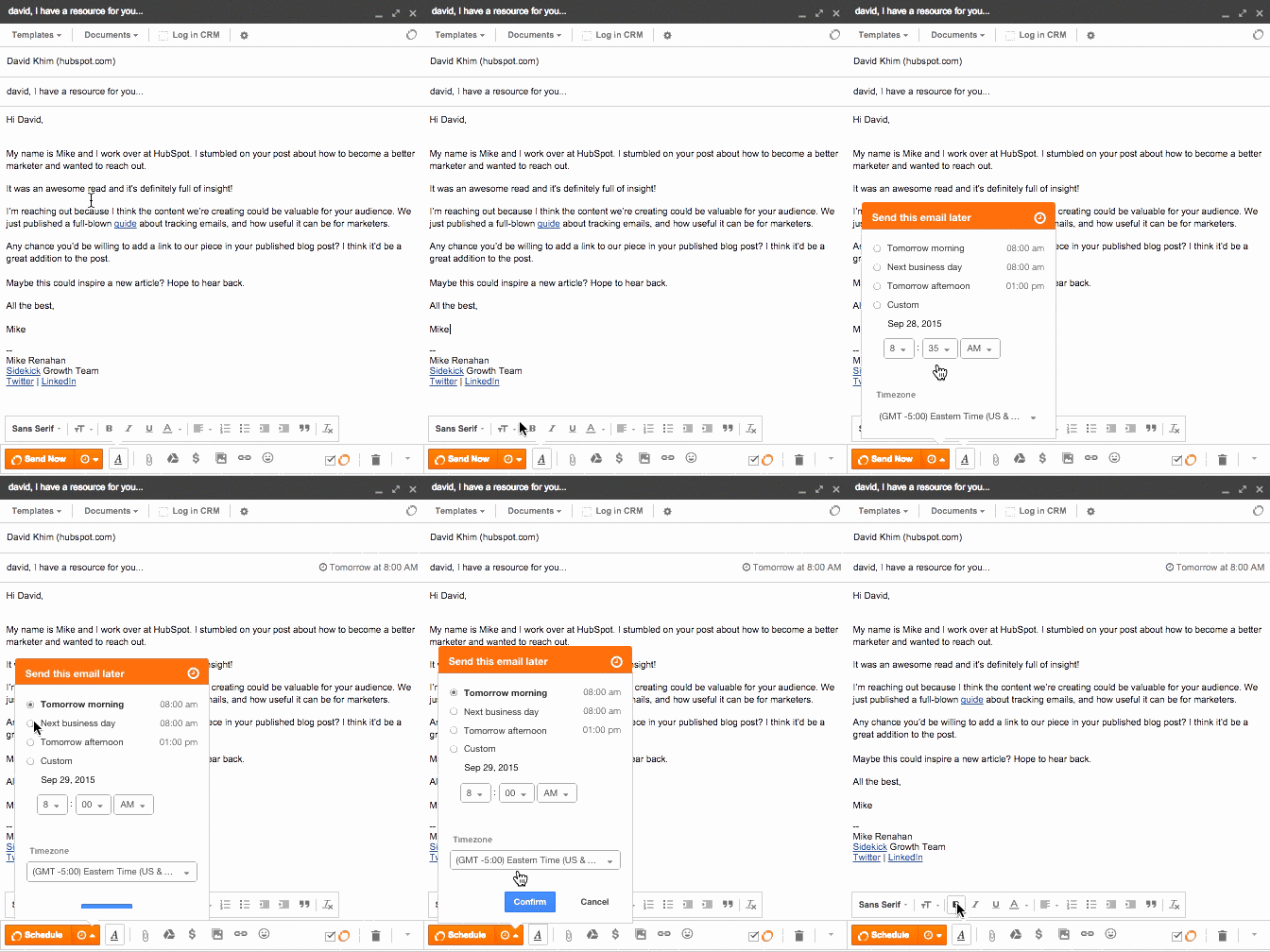
By utilizing canned responses, salespeople can easily personalize their emails before sending. With templates built, reps can then tailor a few key areas to improve the chances the prospect will open and respond. (Psst: Here's how to create a canned response in Gmail.)

For instance, include something personal in each email, such as the buyer’s name. Personalized emails improve clickthrough rates by 14%, and conversion rates by as much as 10%, the Aberdeen Group found. In addition, Retention Science found that subject lines with the recipient's first name also have higher open rates.

Step 2: Schedule the emails.

Instead of having to save all of these emails as drafts in my inbox and do a major email dump on Tuesday morning, I use sales automation to schedule them to go out at the right time. It’s an easy way to wrap up the day and not have to worry about sending 100 emails when I get to the office.

Scheduling with HubSpot Sales Hub works like this:

schedule emails ahead with hubspot sales hubI now have personalized emails set to arrive in my prospects’ inbox at 8am on Tuesday morning, improving the chances these prospects open and read what I’ve sent.

2) Establish trust.

Here’s a reality check: 90% of companies report they will only buy from organizations they trust.

We enter the world hardwired for social connections, and we’re more likely to trust someone who is similar to us in some dimension. That’s why establishing a connection is so important.

The data says:

  • 83% of consumers are comfortable making a referral after a positive experience, Texas Tech University found.
  • Vorsight found that sales reps are 70% more likely to get an appointment on an unexpected sale if you join LinkedIn Groups.
  • Customers are 4x more likely to buy when referred by a friend, according to Nielsen.

Establishing a connection starts with doing the research. Find your buyers on LinkedIn, Twitter, and any industry-specific social groups well before you reach out so you get a general idea of who you’re emailing. 

I spoke with two top salespeople last week who identified these three things to look for:

  1. Where the prospect went to college
  2. Where they grew up
  3. The topic of their personal blog (if applicable)

All of this information and more is readily available on buyers’ profiles. And these tidbits provide an easy way to start a conversation. 

Establishing a connection on linkedin based on profile information

3) Send helpful content.

Ninety-five percent of buyers chose a solution from a company that “provided them with ample content to help navigate through each stage of the buying process,” DemandGen Report discovered in a study.

As a content marketer, I’m a little biased here. But I do believe having ample content is important to the sales process.

The data says:

  • 57% of the journey is completed before the buyer talks to sales, according to Corporate Executive Board.
  • iMedia connection found 68% of buyers feel more positive about a brand after consuming content from it.
  • 82% of buyers viewed at least five pieces of content from the winning vendor, according to Forrester.

In terms of using content in sales, the most important thing to remember is to gather and disseminate story-driven content. Having story-driven blog posts, infographics, and testimonials at the ready to prove your product’s results is huge. Dan and Chip Heath found that 63% of sales presentation attendees remember stories, but only 5% remember statistics.

By sending along relevant client case studies, prospects can discover for themselves how a customer went from problem to results with the right product.

4) Stay persistent.

Salespeople quit too quickly. Forty-four percent give up after one follow-up, according to Scripted.

Unfortunately, humans are wired to look for immediate results when we take on a new task. Whether it’s getting in shape, saving money, or making prospecting calls, we want to see progress right away.

In the likely event we don’t hear back from a prospect immediately, the key is to send a follow up note. The data says:

  • 80% of sales require five follow-up phone calls after the meeting, according to The Marketing Donut.
  • Inside Sales found that web leads followed up within five minutes are nine times more likely to convert.
  • The average salesperson only makes two attempts to reach a prospect, according to Sirius Decisions.
  • In a study, Lap Job found that only 2% of cold calls result in an appointment.
  • 93% of converted leads are contacted on the sixth call attempt, according to Velocify.

There’s only one step to staying persistent, and that’s following up! Track where each prospect is in the funnel, and stick to a consistent follow up cadence. Keep a schedule of when the next email or call should go out so valuable prospects don’t slip through the cracks. 

What was once considered a career about technique and style has become data- and science-driven. Taking someone from a prospect to a customer is a skill that can be taught, learned, and iterated.

Editor's note: This post was originally published in October 2015 and has been updated for comprehensiveness.

15 Oct 21:13

The dangerous confusion of sales and content marketing

by Mark

sales and content marketing

By Tom Webster, {grow} Community Member

Recently, I had the pleasure of attending a keynote speech by Daniel Pink, author of To Sell Is Human: The Surprising Truth About Moving Others, at the Inbound conference in Boston. In his speech, he asked an audience of roughly 14,000 marketers “How many of you sell?” Nearly every hand went up–it seems like a reasonable thing to agree with these days, right?

Pink went on to talk about how sales used to be in the days prior to the Internet by giving the example of the used car salesperson. Twenty years ago, if you walked into a dealership, the salesperson had ALL the information—what the invoice price was, how much the options really cost, how much your car was worth, and so on. The buyer, however, had little information. In short, it was a time of information asymmetry, which resulted in a profitable situation for the seller.

Today, however, a car buyer walks into a dealership with near total information—sometimes more than the salesperson! So how can the seller succeed? Pink argues that salespeople need to become “servant sellers,” providing helpful information, answering questions, and generally providing a good experience—before any sale is made.

Sounds a lot like content marketing, doesn’t it?

Why you should be worried about content marketing

In fact, that’s exactly what content marketing does, and Pink left that audience of 14,000 marketers fired up with the charge to become helpful, servant sellers by creating content that is helpful and useful, so that the well-equipped buyer will inexorably come to the right decision—to buy our products and services.

Think about what actually happened after that speech, however: 14,000 marketers left the room fired up to take what a good salesperson is supposed to say to a customer, and…uh…write it down.

Are we sure that’s marketing?  Because it sounds like what sales has become, only without a commission.

Frankly, I’m worried about content marketers. The field has taken Google’s Zero Moment of Truth stat, that online buyers consult 10.4 pieces of information prior to a sale, a little bit too close to heart.  Try this: Google “how to create a content calendar” and tell me how many answers you get. Look also at the authors of those articles—the first 10 pages are all companies that want to sell you something related to building a content calendar, right?

Sometimes all you want is a burger, hold the content

Now think of an electric car you want to buy (if you do.) Dollars to donuts you WANT to buy a Tesla, and you didn’t read 10.4 pieces of jack squat to get there.

You want a Tesla, because you WANT a Tesla.

We are irrational actors, and we certainly don’t need 10 pieces of data to decide to buy. We do, however, consult 10 pieces of data AFTER our irrational brain comes to this decision, in order to justify a purchase decision that we’ve likely already made.

Don’t believe me? Consider that the year before Google’s 10.4 stat, in 2010, that number was a little over 5. Did our brains change? Did our cognitive processes really require twice as much information as they did the year before? Patently absurd. Yet someone is out there, writing article number 577,000,001.

Does content really contribute to sales?

The proliferation of nearly identical content has reduced the value of that content to something approaching zero, which leaves the odds against that content actually contributing to a sale in a meaningful way as quite slim, indeed.

Think about this: what would cause you to lose your job? What would have to go down? You very likely had one of two answers: Sales, and Leads.

Consider the former. If Sales are down, and marketers get fired, doesn’t that seem a little perverse? Shouldn’t the sales team get the blame here? These metrics do not help you—and only serve to confuse the sales and marketing functions in ways that don’t help you, help your organization, or help you with the goal of ANY business: to create a customer.

That leaves leads—which seems more reasonable, right? If we are providing more leads, but the sales team doesn’t close those leads, we’re safe, aren’t we?

Am I really a lead?

Well, consider this: have you ever signed up for a webinar or white paper, and then gotten an absolutely cringeworthy, ham-handed sales call as a result? I sure have. For a long time I blamed the sales team—their training, hiring, and (frankly) ability to interact with humans. But I’ve come to a different realization.

If I watch a webinar to learn something, am I really a lead for that company?

Overwhelmingly, those of us who sign up for these content pillars have NO interest in buying from the company. We just want the content. But marketing dutifully delivers our contact info into the hands of the sales team regardless, to give us a one-degree-warmer than cold call.

Who’s really to blame when those leads don’t convert?

The quantity and quality of leads is a trailing variable, and not the end itself. Our goal as marketers is to understand the consumer, speak with their voice at the highest levels of your company, and create a marketing-led product that people (and not your product team) WANT. It’s not to serve as a bullhorn for the company, pointed out into the ether—it’s to be a bullhorn for the customer, pointed at the CEO, the product team, and yes—the sales team.

The dangerous confusion of sales and marketing has turned many content marketers into Smarketalsers: salespeople without the upside. And what gets lost here is what the central goal of Marketing-With-A-Capital-M really is: uncovering or creating demand. It’s not to “sell” a product created by a passionate founder or product team in a vacuum, but rather to ensure that every product we create is so imbued with the needs, wants, and desires of our customers that a sale is inevitable.

I leave you with this: “A good deal of what is called ‘marketing’ today is at best organized, systematic selling,” a quote that perfectly sums up my argument. Those words were written by Peter Drucker — more than 50 years ago. Drucker also wrote that “Marketing is the distinguishing, unique function of the business.”

Unique and distinguishing. It’s a high bar, but it’s the right bar—and the key to fighting the dangerous creep of Smarketalesing.

tom websterTom Webster is a Vice President of Edison Research and co-host of amazing The Marketing Companion podcast.

Illustration courtest Flickr CC and Jim Linwood

Book link is affiliate link.

The post The dangerous confusion of sales and content marketing appeared first on Schaefer Marketing Solutions: We Help Businesses {grow}.


Comments

Related Stories

 
15 Oct 21:13

Convert 67.5% More Leads With This Sales Technique [Infographic]

by leslieye@hubspot.com (Leslie Ye)

You’ve probably heard the expression, “You can lead a horse to water, but you can’t make it drink.”

It can sometimes feel like this saying applies to prospects in the sales process. The good news is that qualified buyers can be educated and ultimately guided by a sales rep to make an informed decision about whether to purchase or not.

Educating buyers properly isn’t always easy, however.

Salespeople spend more than 30 hours a month looking for and re-creating content they can’t find because it’s often stored in up to five or six different places, according to an infographic from Unboxed.

As a result, a mere 12% of sales leaders believe their sales force is perceived as trusted advisers, while half of buyers say sales reps fall short in understanding their needs and objectives.

Guided selling, a sales approach that emphasizes standardized discovery questions and diligently tracking data from deals, can help fix these issues. Guided selling is commonly associated with ecommerce or online sales, but has applications in a B2B context as well.

Reps who practice guided selling ask prospects to-the-point questions that will either lead them to a “yes” or “no” decision, decreasing the ambiguity of the sales process. Teams that use guided selling on average convert 40% of their leads to customers -- a rate two-thirds higher than teams that don’t.

By using guided selling, sales organizations are able to:

  1. Conduct and document a consistent, thorough prospect needs assessment
  2. Create complete product recommendations that include cross- and upselling opportunities
  3. Present and adapt recommendations so prospects get a solution customized to their needs
  4. Onboard new reps more quickly with updated collateral, positioning, and pricing
  5. Make decisions informed by real data collected from buyers and non-buyers

Check out the infographic below for even more insights into the benefits of guided selling.

get the free hubspot crm

15 Oct 21:13

Plug the Leaks in Your Sales Funnel: A How-To Guide to Sales Enablement

by Robert Wahbe

In nearly every function of a modern business, teams are using data to improve both their effectiveness and their efficiency. The evolution of the sales cycle is another way that businesses are becoming data-driven. Historically, the process relied heavily on intuition and anecdote — the correlation between activity and business impact was very difficult to measure. But now, thanks to software, systems are better able to track the movement of customers from initial impression to lead, lead to opportunity, and opportunity to revenue.

A common mistake made by emerging companies is to have marketing focus almost exclusively on top of the funnel activities, so called demand generation. While everyone can agree that demand generation is absolutely crucial, it is only the first stage of the funnel and the first step on the buyer’s journey. Marketing must pay attention to every step of the buyer’s journey and work effectively with sales to enable the right conversations and close deals. Otherwise, companies are just pouring money into a leaky funnel.

Apply Closed-Loop Marketing to Sales Enablement

At the top of the funnel, with marketing automation analytics, marketers can answer the key business questions about the Awareness and Consideration stages. Which programs are most effective? Which channels yield leads that convert to revenue? The reporting system provides complete transparency into the business impact of marketing investments. At the top of the funnel, marketers connect directly with prospects. They are able to apply closed-loop marketing to analyze the true results of every program in real time.

Sales enablement 1

But, in most organizations, the bottom of the funnel remains a content black hole, where the business impact of marketing content is as difficult to measure as it has always been. Marketing creates a seemingly endless stream of documents and presentations, trying to tell a compelling story and convince customers to buy, but have no insight into what is working. What content are the sellers using? What content is most effective at engaging prospects and driving conversions? Businesses need to be able to answer these questions in order to optimize sales effectiveness.

The same goes for training programs — every sales organization knows it must teach sellers the skills and knowledge they need to be effective — “get them smart and keep them smart.” But, do companies have the right training programs and do they actually work?

Modern sales enablement tools enable a closed-loop sales cycle for the bottom of the sales funnel. They make sellers much more effective as they engage with customers by:

  • Connecting the sales team to the most relevant content for each situation
  • Providing flexible ways to present content to customers
  • Delivering real-time visibility into customer engagement
  • Applying advanced analytics to optimize content and pitches
  • Enabling sellers to get the training they need and measuring how effectively that training delivers bottom line results

The Bottom Line

Ultimately, the goal of sales enablement is to make reps more effective at closing deals and driving revenue. The opportunity is large — companies that are the best in class in their industry have 50% higher quota attainment than average companies.

sales enablement 2

And those best-in-class companies are twice as likely to be using a sales enablement solution that addresses major obstacles to driving sales:

  • The time needed by a new seller to become effective (on average, 7 months)
  • Seller turnover (typically 30%)
  • Time wasted searching for and creating selling materials (3-4 hours per week, per rep)

The result is that sellers engage more effectively with customers, and engagement is the lifeblood of a successful sales process.

To learn more about how sales enablement can turbocharge your business, check out the Definitive Guide to Sales Enablement as well as Sales Enablement Tools and Software for a complete list of sales enablement vendors.

The post Plug the Leaks in Your Sales Funnel: A How-To Guide to Sales Enablement appeared first on OpenView Labs.

14 Oct 16:38

The Lightest Metal Ever

by Newswise Trends
Newswise imageBoeing has invented microlattice, the lightest metal ever. The material that is 99% air, will be used for aerospace-engineering, such space as rockets.
14 Oct 16:37

9 Quick Tips for B2B Lead Generation to Implement Today

by Sesame Mish

iStock_000008614689_Small

B2B lead generation is a huge topic. Every marketer has favorite strategies and top tips, as well as stories about huge wins and equally epic fails. Leads are the lifeblood of your business.

Previously, we combed through a host of data and concluded that content marketing, in-person connections, and referrals are the big B2B lead generation tactics that are worth most of your time. With those three strategies running smoothly, your brand is in good shape for a long time to come.

But if you’re just starting to nurture those relationships, and your content marketing strategy is still building momentum, how do you get more leads in the funnel in the meantime? This is where B2B lead gen can feel hard, making you question: Which strategies actually work and which ones should you try? What will deliver the best ROI?

We dug through scores of strategies and analyzed the data to provide a list of 9 quick B2B lead gen strategies for you. Some of these are time-tested goodies, some may be new to you, but all of them are proven strategies to get more qualified leads in your sales funnel while you’re working on some of the longer-term strategies.

Here they are!

1. Add Relevant CTAs

Optimize high-performing content by adding a call-to-action (CTA)—or updating an old one. Ask users to sign up, share, or follow. Here are best practices for effective CTAs:

  • Keep it above the fold/scroll, and/or pin the CTA to the screen so it scrolls with the viewer.
  • Limit the decision-making with one, clear CTA that encourages prospects to act now.
  • Use text on the button that describes the action—“Download the Ebook” or “Reserve My Seat,” rather than “Submit.”
  • Use visual cues, like arrows, and eyes of images pointed at the CTA to direct the viewers’ attention and train of thought.

2. Use Exit-Intent Pop-ups

Immediate pop-ups can make web visitors shiver, but a strategically placed exit-intent pop-up can keep prospects warm. If you are going to implement this type of pop-up, be sure to employ proven techniques like these:

  • Provide a “Yes” and a “No” option, instead of just one CTA, to increase conversions by 30-40%.
  • Create clear action triggers with one or no images and simple text.
  • Make designs responsive. Don’t paralyze a mobile user who can’t engage with or get out of your ad.
  • Measure results with A/B testing. Mix it up and see what works for your brand and your audience.

3. Create a SlideShare

SlideShare is a slide hosting service that allows users to upload presentation slides to share online. Over 70% of SlideShare traffic comes from targeted searches by professionals looking for specific solutions. That makes these leads more relevant. To dazzle them, implement these tips:

  • Think of title slides as teaser thumbnails: use bold headlines and visuals, optimized with relevant keywords.
  • Use fewer words and more pictures, and break it up with targeted text.
  • Showcase your meaty content with more slides (around 60 for this audience) that tell your story.
  • Reveal one big idea with each slide, key features in charts or diagrams, and make your brand the obvious solution.

4. Create a Webcast on Udemy

Udemy is a platform that allows experts to create online courses that they can offer either for free or for a tuition fee. It provides an unparalleled opportunity to use video to present to an online audience who already demonstrates a deep interest in what you offer.

Stand out from the competition by taking your video content to the next level, and establish your brand as an industry leader and the go-to business when someone is ready to buy. Use these techniques to share your expertise:

  • Create excitement with headlines that promise to solve pain points.
  • Send a welcome communication beforehand, identifying key questions you’ll address in your course.
  • Link to your website within your course for free resources or content (promotional materials should be saved for a bonus lecture).
  • Send reminders, follow-up emails, and industry news after you’ve connected.

5. Gate Premium Content

Gating some of your high-value, premium content can help you gather contact information for new, qualified leads to start nurturing. And B2B buyers are not opposed to it: 74% expect to access simple content like infographics without registration, but 77% are willing to provide basic info for white papers or ebooks. Here are a few tips for getting the most out of your gated content:

  • Use intelligent forms to avoid repeat fill-out requests.
  • Create an SEO-optimized landing page for each piece of gated content.
  • Redirect the landing page to a “Thank You” message after the buyer downloads, and include links for social shares.

6. Repurpose Content

Breathe new life into existing content by grouping several of your hottest posts into a “Best of” list, or bundling them together for downloading. Repurpose it for different channels:

  • Use a well-performing blog post as a conversation topic in LinkedIn groups to get your ideas in front of a new audience and to learn what your target audience has to say about the topic.
  • Bundle a series of articles into a well-designed ebook and host it on a landing page with a gated download to collect fresh email addresses for new leads.
  • Take key statistics from a report or whitepaper, and design an infographic for Pinterest, Instagram, Facebook or SlideShare to expand your audience and draw new attention to existing work.

7. Co-Brand/Co-Author Your Ebook

Create a strategic partnership with complementary businesses by co-branding or co-authoring an ebook. It’s a great way to double your efforts: Your brand name gets a fresh, new audience, and your partners get great content to market. When considering partners, choose:

  • A company with products that complement yours, something your potential customers may need anyway.
  • A highly-reputable company—large or small—that’s established in another channel.
  • A company who slightly expands your demographic, like a younger or older generation.
  • Industry experts that can bring credibility to your offering.

8. Offer a Free Assessment, Trial, or Demo

Free offers are a great way for you to learn more about your prospects’ likes and dislikes, their immediate and secondary goals, and their challenges and pain points. Here are a few tips for creating a great free offer:

  • Provide a link to an assessment that helps prospects understand if your product is right for them.
  • Give a demo that offers some immediate value but is only a taste of what you have to offer.
  • Offer an introductory trial that gets customers over the threshold of buying and provides them an easy way to continue buying.
  • Allow time and space for feedback so you can keep learning.

9. Create a Small, Personalized Direct Mail Campaign

Reach out to customers who have done business with you in the (perhaps, distant) past, or anyone who has signed up for your email list but hasn’t taken the next step. Employ these tactics:

  • Segment customers and buyers based on buying patterns and time lapsed.
  • Target lists with a personalized message customized just for them.
  • Provide an incentive to contact your organization by offering a free report or white paper.
  • Prep your customer service so that when a potential customer makes contact, they feel like your company already knows them.

The key to B2B lead generation is to give your prospects more ways to discover you. Diversify your marketing touchpoints and magnetize your value proposition. Though most page views don’t represent a user who is ready to buy, when you give useful information and new ideas, you can be rewarded with interest. That keeps interested parties filling your pipeline and thinking of you when they’re ready to buy.

Now, get out there and start employing these tactics! And to learn more about this topic, download our Definitive Guide to Lead Generation.

It’s your turn! Do you have a tenth quick lead gen tactic to add to this list? Let us know in the comments below!

14 Oct 16:37

Fully transparent solar cell could make every window in your house a power source

by Chloe Olewitz

The first completely transparent solar cell could mean the future of solar power, turning every window and any clear material into a solar power source.

The post Fully transparent solar cell could make every window in your house a power source appeared first on Digital Trends.

14 Oct 16:36

Next Month, You'll Be Able to Activate Windows 10 with Windows 7 and 8 Product Keys

by Eric Ravenscraft

Upgrading to Windows 10 is easy if you’re already on Windows 7 or 8 . However, if you want a clean install , you have to install an older version first. Next month, the first big update to Windows 10 will fix this.

Read more...

14 Oct 16:34

Sorry millennials, if you’re under 29, your job outlook is grim no matter where you live

by National Post Staff

Sorry millennials, if you’re under 29, your job outlook is grim no matter where you live

14 Oct 16:29

4 Methods To Get More Blog Traffic From Twitter

by Guest Blogger

This is a guest contribution from Marc Guberti.

No matter how much blog traffic we get, we will always want more, right? More blog traffic opens the door to more opportunities, relationships, and sales.

Not only do we want more blog traffic, but we also want to get blog traffic from a variety of platforms. This is why many bloggers are active on multiple social networks.

I have experimented with dozens of different methods for gaining more blog traffic. I pin, post on Facebook, and write guest posts, but my most successful platform for driving traffic to my blog is Twitter.

Twitter alone is responsible for close to 50% of the traffic that my blog gets, and the amount of traffic I gained from Twitter has dramatically increased in a short period of time. In 2013, Twitter brought 3,408 people to my blog. The following year, Twitter brought 97,321 people to my blog. The big increase in traffic also led to a big increase in opportunities, relationships, and sales.

Many people ask me how I made such a quick transition. How did I suddenly go from getting 3,408 visitors from Twitter to almost 100,000 visitors from Twitter in just one year? I am going to share with you the methods I used to get more blog traffic from Twitter and make my big shift in just one year.

Pin A Tweet Of Your Most Popular Blog Post

When you pin a tweet of your most popular blog post to the top of your Twitter timeline, that tweet gets more exposure because its lifespan is infinite. The reason most tweets get some engagement when they are first posted but then get virtually no engagement a few days later is because most tweets have short lifespans.

Although the lifespan of each tweet differs, most tweets’ lifespans end in a day because other tweets take its place on your feed, and your followers’ home feeds are filled with other people’s tweets at that point. Pinning a tweet to the top of your profile page guarantees that the tweet will be seen by anyone who views your account. Thus, the lifespan of the tweet is infinite (until you unpin it from the top of your feed).

Pinning your most popular blog post to the top of that feed will lead to more traffic for that blog post, and all of that extra traffic for your popular blog post will equate to a better search engine rank.

The first tweet I pinned to the top of my feed was a tweet that promoted one of my free eBooks. While most of my tweets get around five retweets and favorites, the pinned tweets has been retweeted and favorited over 100 times.

Pinned tweets will get more engagement than your average tweet, so if there is a popular blog post that you want to give special attention, tweet it out and pin the tweet to the top of your feed.

Include Visual Content In Your Tweets

The value of visual content can no longer be overlooked. On every social network, including an image in the post leads to more engagement than not including the image in the post.

On Twitter, including the image in the tweet leads to a 150% increase in engagement for that tweet. It makes sense that tweets images get more engagement because the human mind processes images 60,000 times faster than text.

Buffer tested out what type of impact images have in tweets. Here’s what they found:

twitter

Including an image in your tweets is important, but not any image will do. The best images are often the ones that we create ourselves because we can create an image based on what we want in the image instead of trying to find the best (but not perfect) match on Google.

IT turns out that creating your own picture is surprisingly easy. Here are the two tools I use to create my own pictures:

#1: Canva

This free tool lets you create pictures in any pixel dimensions you want, and the tool also offers pictures perfectly sized for social media posts. Canva comes with numerous free features and images to choose from, and if you can’t find the image you are looking for on Canva, you can upload pictures from your computer to Canva.

Canva easily allows you to add text to your images and play around with the background.

#2: KeyNote/PowerPoint

Normally, when you think of KeyNote or PowerPoint, you think of creating a presentation. However, these tools also allow you to create your own pictures.

You can resize the slides in your presentation to any dimensions. You can make a slide 1000 pixels wide and 4000 pixels high if you wanted to. You can add shapes, text, and other pictures from your computer to the slide.

I primarily use KeyNote for creating Infographics because of the flexibility that KeyNote provides. I can easily move one part of the slide anywhere I desire, and I can see a full preview before I put the infographic on my blog.

Tweet The Same Blog Posts More Than Once

One of the biggest secrets about Twitter is that it is okay to tweet the same thing more than once. If you do it right, it is okay to tweet the same thing more than 100 times.

I schedule my tweets using the HootSuite bulk scheduler which means I send tweets in a cycle. Every 4-8 days, you will see the same tweets delivered in the same exact order, and these tweets always get engagement.

Since I send over 100 tweets every day, the identical tweets are barely noticeable. I get interaction for my tweets to this day as if I had never tweeted them before. Here are some reasons why it is okay to tweet the same blog posts (and for that matter, identical tweets) more than once:

#1: You are going to get new followers who have not read any of your tweets before. For these followers, your tweets are actually new.

#2: Many of your followers will miss your tweet the first time. If you send your tweet at 4 pm on a Monday, then your followers must be logged in at that time to possibly see the tweet on their crowded home feeds.

#3: The world has different timezones. If it’s 4 am in New York, then it’s 9 am in London. If you send a tweet at 4 am eastern time, many of your followers from New York won’t see the tweet. You can schedule the same tweet the following day at a better time for your followers on the east coast so they can engage with it all the same.

Optimize Your Tweets For More Engagement

Having an image in your tweet is just one step towards optimizing that tweet for more engagement. The more you optimize your tweet, the more engagement it will get. Here are some of the additional methods you can use to optimize your tweets for more engagement.

Twitter is the main reason my blog gets so much traffic. In one year, my blog traffic jumped leaps and bounds primarily because I focused my time on growing my Twitter audience and promoting my blog posts to that audience.

Getting hundreds of daily blog visitors from Twitter takes patience, but that patience will eventually allow you to get hundreds of daily visitors to your blog from Twitter alone. Constantly experiment with your tweeting frequency and what you tweet to determine what impact it has on your audience and blog traffic.

Do you use Twitter to get more blog traffic? And if you aren’t using Twitter to get more blog traffic, when will you start?

Marc Guberti is a teenage entrepreneur, author, and digital marketing expert who shares his advice on his blog MarcGuberti.com. His mission is to teach teenagers how to become entrepreneurs.

The post 4 Methods To Get More Blog Traffic From Twitter appeared first on @ProBlogger.

14 Oct 16:29

Don’t Let Your Inbox Focus Your Attention

by Paul Philp

PrioritizeI often feel that I work for my inbox, not the other way around. Many of the customer success managers I speak with have a similar experience. The inbox is full of customer issues, customer information requests, product updates, new customer onboarding requests, sales meetings, ….. it is all important.

The problem with the Inbox is that it tends to be first-in, first-out time management system. The first email, at the top of the inbox, is the one that gets attention first. There may be more important issues from more important customers further down the inbox, but our inboxes don’t help us find those.

How can we focus our attention on the right customer, at the right time?

  • Prioritize by Segment and Tier – The first place to start building a focusing algorithm is with customer segments and product tiers. Different segments have very different values and receive different levels of service. In much the same way, different product tiers naturally need different levels of care. For example, the ‘Enterprise’ tier is typically more complex and, as a result, more difficult to implement. Enterprise customer both need and pay for higher levels of service.
  • Prioritize by Customer Potential – Segment and tier are a good place to start. However, the potential size of a customer is equally important. A new customer may start with a smaller version of your product, but they may have the potential to grow into a much higher value product set. It’s in your interest to give these customers the highest possible care.
  • Prioritize Health Score (and other risk indicators) – The next factor to consider is the health of the customer. For example, a relatively minor product bug might be a low priority issue for a relatively healthy customer. However, if that customer already has a low (‘red’) health score, a minor problem might just be enough to have then give up.
  • Prioritize Lifecycle Stages – A very similar logic can apply to the customer’s lifecycle stage. A product issue that is a minor concern for a mature customer in the 8th month of a 24-month contract, might well be a serious issue during the onboarding phase, or 30-days before contract renewal.
  • Prioritize Issues – Not every issue, demands the same priority level or attention. If a customer encounters a product bug, but the same customer hasn’t used a certain key feature yet, the product bug will be a relatively minor priority.
  • Prioritize Outcomes – A customer has success factors that defines the outcomes they want to produce in a particular stage in their journey.
  • Prioritize Opportunities – A customer may be doing very well every month – quickly adoption the most valuable feature sets and producing a high levels of outcomes – may become an opportunity to upsell them to a new product tier, and to cross-sell them some new capabilities. If we only focus on negatives (complaints, low health scores) we will miss these opportunities to create and realize more value.

Dynamic Priorities

This sounds like a lot of work. How can you do this accurately? In real-time? Without spending all your time on prioritization? The answer is Dynamic Priorities. The ideal solution is a system that is purpose-built for the customer success business process. It should combine many different types of customer data – CRM, email, support tickets, billing, user activity, outcomes, lifecycle stage with flexible rules and automation to provide you with Dynamic Priorities than change as the data changes. This gives you a dynamic priority that is always accurate and calculated automatically.

For example, a simple, and traditional way to get started with dynamic priorities is to use account tier and the health score to set the priority dynamically. Here are some typical rules for this scenario:

  1. Tier 3 customer has a Low priority by default. When the health score turns red, the priority is increased to medium.
  2. Tier 2 customer has a Medium priority by default. When the health score turns red, the priority is increased to high.
  3. Tier 1 customer has a High priority by default. When the health score turns red, the priority is increased to critical.
  4. Critical accounts get attention first.

A more sophisticated example is to include customer context in the calculation of the dynamic priority. Examples of customer context include Growth Potential and Lifecycle Stage.

Tier2 + On-boarding + High Growth Potential + Red Health Score = Critical Priority

This type of dynamic priority allows for very precise definitions of priority that ensures that the CSM is focussing on the right customer at the right time for the right reason. This is a powerful way to improve productivity and performance.

The ultimate goal is to use the customer outcomes to shape the dynamic priority calculation. The primary function of customer success is to ensure that the customer is producing the outcomes they expected by using the product. For example, leads are a typical outcome for a marketing automation application. Using outcomes to calculate the dynamic priority create an opportunity to create extra value for the customer. For example,

Low Lead Count + Tier1 Account + Renewing Soon = Critical Priority

This allows the CSM to proactively reach out to the customer and help them understand why their outcome levels are below their goal, and to create a plan to improve their performance. This is an example of proactive, outcome-focussed customer success. It is a long way from letting your inbox focus your attention.

If you’d like to see Dynamic Priorities in action, request a demo of Amity here.

14 Oct 16:29

Pipelines & politics: Where the parties stand on oil & gas issues

by Yadullah Hussain

barrels2

If elected, the Liberals will launch an immediate review of Canada’s regulatory process for oil and gas projects, the NDP will work with provinces to put a price on carbon, and the Green Party’s Carbon Fee and Dividend Plan will give every Canadian over age 18 an annual carbon dividend. The incumbent Conservatives oppose all these plans, as the Canadian political parties paint starkly different visions of the country’s oil and gas sector.

Here are their views on key oil and gas issues:

Are you in favour of, or opposed to, TransCanada Corp.’s Keystone XL project?

Bloc Québécois: This decision is up to the Americans. However, the Bloc Québécois supports ambitious targets gas reduction of greenhouse gases and tar sands development is incompatible with the achievement of these objectives.

Conservatives: Yes. Keystone XL will create jobs for Canadian and American workers, while enhancing the energy security of North America. We agree with the U.S. State Department that Keystone XL should be approved on its merits. The State Department has indicated it can be developed in an environmentally sustainable manner. Canadian and American crude carried by Keystone XL will replace imports of insecure crude from Venezuela, which has the same or higher GHG emissions.

Green Party: As Elizabeth May said: “Every pipeline – whether it’s Enbridge’s Northern Gateway, Kinder Morgan’s expansion through Burnaby Mountain to the Burrard Inlet, Energy East, or Keystone XL, are all about one thing: getting raw, unprocessed bitumen to coastlines. These pipelines and supertankers are premised on a risky economic strategy. We have already seen how Harper’s strategy of putting all our eggs in the bitumen basket has hurt our economy.”

Liberals: Liberals support Keystone XL. On balance, it would create jobs and growth, strengthen our ties with the world’s most important market, and generate wealth. It would also offer much needed flexibility to a constrained continental energy delivery system.

The Conservative government has failed to move the yardsticks on approval for the Keystone XL pipeline. Instead of working together to resolve obstacles to approval, the Prime Minister and others have taken every opportunity to make it harder for the Americans to allow Keystone to proceed.

If we had stronger environmental policy in this country – stronger, transparent oversight, tougher penalties, and a means to price carbon pollution – the Keystone XL pipeline would have been approved already.

If we do not demonstrate to the world that we have our act together as a country on the environment, we will find it harder and harder to get our resources to global markets.

NDP: We don’t think this is the right project for Canada. Keystone XL will ship away thousands of quality, well-paid jobs south of the border. The government should be doing more to protect value-added upgrading jobs right here in Canada. Stephen Harper has been ignoring environmental concerns and pushing full speed ahead with a pipeline proposal, and Justin Trudeau has been cheering him on.

The reality is that there are serious concerns on both sides of the border about the Keystone XL project, and Hillary Clinton’s recent comments in opposition to the pipeline reflect this reality. Conservative inaction on the environment has led to widespread opposition and is threatening our relationship with some of our closest trading partners. We need to find the right balance, something the Conservatives have refused to do.

Danny Johnston / The Associated Press
Danny Johnston / The Associated PressThis May 24, 2012, file photo shows some of about 500 miles worth of coated steel pipe originally for the Keystone XL pipeline.

Are you in favour of, or opposed to, Kinder Morgan Inc.’s Trans Mountain XL project?

Bloc Québécois: This decision is up to the Americans. However, the Bloc Québécois supports ambitious targets gas reduction of greenhouse gases and tar sands development is incompatible with the achievement of these objectives.

Conservatives: We do not take positions on specific proposals for energy infrastructure before thorough, rigorous, science-based review by the independent regulator is complete. Subject to independent review, our government supports energy infrastructure that would generate revenue for critical social programs including health care, pensions and education. We have been clear: projects will only proceed if they are safe for Canadians and safe for the environment. Proposals can only move forward once the proponent satisfies the independent National Energy Board’s conditions and demonstrates the pipeline can be operated safely.

Green Party: The Green Party is opposed to Kinder Morgan’s Trans Mountain XL project. Kinder Morgan proposes a seven-fold increase in oil sands tanker traffic through Vancouver and Burnaby. The Kinder Morgan pipeline will endanger local ecosystems and economies. The Green Party strongly opposes any increase in tanker traffic, and has advocated for a legislated ban on supertankers on the British Columbia coast.

As an intervenor in the NEB approval process, Elizabeth May has fought against the expanded pipeline. Lynne Quarmby, Green Party Science Policy Critic and candidate (Burnaby-North Seymour), became the face of public opposition to Kinder Morgan’s pipeline expansion when she was arrested as a protester on Burnaby Mountain in November 2014.

Liberals: Liberals believe that Canada needs new infrastructure, including pipelines, to move our energy resources to domestic and global markets. However these projects must earn the trust of local communities, respect indigenous rights, and cannot put our lands and waters at risk.

The Kinder Morgan Trans Mountain project is undergoing an environmental assessment, and it would be inappropriate to pre-judge the outcome of the review.

The Conservatives have not gotten a single pipeline project approved in 10 years because they torqued the review process and ignored environmental concerns and proper consultation. Their polarizing approach to resource development and pipelines has hurt rather than enhanced Canada’s ability to get resources to market.

NDP: Every project needs to be evaluated on its merits, like safety, environmental soundness and economic impact, with full community consultation and strong environmental protections. This project can’t be given a proper review in the absence of a thorough, credible, complete assessment process – something that the Conservatives have dismantled. We will adopt a responsible, sustainable environmental review process that puts communities and Canadian interests first.

FP0507_TransMountain_C_JR

Are you in favour of, or opposed to, Enbridge Inc. Northern Gateway project?

Bloc Québécois: The Bloc Québécois defends the prerogative of Quebec and the provinces to decide whether pipelines can cross their territory. It is up to British Columbia and its government to accept or reject the Northern Gateway project. However, the Bloc Québécois defends ambitious targets gas reduction of greenhouse gases and tar sands development is incompatible with the achievement of these objectives.

Conservatives: The government accepted the independent Panel’s recommendation to impose 209 conditions on the Northern Gateway Pipelines’ proposal. The proponent must demonstrate to the independent regulator, the National Energy Board, how it will meet the 209 conditions.
It will also have to apply for regulatory permits and authorizations from federal and provincial governments. In addition, consultations with Aboriginal communities are required under many of the 209 conditions that have been established and as part of the process for regulatory authorizations and permits. No proposals can proceed unless they are safe for Canadians and safe for the environment.

Green Party: The Northern Gateway pipeline asks B.C. to take an unacceptably high risk with our natural environment, salmon, Great Bear Rainforest, coastlines, tourism and fisheries. It is a twinned pipeline over a thousand kilometres, over some of the most rugged wilderness. We strongly support the legal challenge of the unbalanced decision by eight First Nations, four environmental groups and one labour union to overturn the approval.

Liberals: Liberals reject the Conservatives’ decision to approve the Northern Gateway Project in British Columbia. We have serious concerns about how this pipeline will affect the coastal economy and the environment, local communities, and First Nations.

The entire review process failed to consult adequately with local communities and Indigenous Peoples, and Canadians have not been reassured that the local economy and environment will be protected.

We are committed to reversing the decision to approve this pipeline if we should form the government after the next election.

NDP: New Democrats oppose the Northern Gateway project because it puts jobs and the B.C. coastline at risk. It’s not surprising that the B.C. Government, First Nations and communities have rejected this project. The proposal would send Eiffel-Tower-sized supertankers into some of the world’s most dangerous waters, off of one of the world’s most fragile coastlines. The risks are simply unacceptable. Even a modest spill will contaminate this pristine coastline for decades—ravaging the tourism industry and the salmon fishery. The only people that seem to be interested in pushing through this project are Stephen Harper’s Conservatives.

Darryl Dyck / The Canadian Press
Darryl Dyck / The Canadian PressCheryl Bear, left, a councillor with the Nadleh Whut'en First Nation, and Hereditary Chief Pete Erickson, of the Nak'azdli First Nation, listen during a news conference about the Enbridge Northern Gateway pipeline in Vancouver, B.C., on Thursday, October 1, 2015. Multiple legal challenges aimed at overturning the federal government's approval of the pipeline project began being heard Thursday at the Federal Court of Appeal.


Are you in favour of, or opposed to, TransCanada Corp.’s Energy East project?

Bloc Québécois: The Bloc Québécois is opposed to any new pipeline project in the territory of Quebec for export, including East Energy project.

Conservatives: Again, we support proposals for energy infrastructure subject to thorough, rigorous and science-based review by the independent regulator. We’re disappointed the Liberals refuse to clearly express their support for this job creating proposal. New proposals for energy infrastructure create Canadian jobs and further replace foreign crude in Quebec and Atlantic Canada with a secure source of Canadian crude.

We support energy infrastructure that would generate revenue for critical social programs including health care, pensions and education. Proposals can only move forward when the proponent satisfies the independent National Energy Board’s conditions and demonstrates the pipeline can be operated safely.

Green Party: We oppose Energy East and its proposal to increase tanker traffic through the Bay of Fundy. Even the Ontario Energy Board has ruled that Energy East poses more risks than benefits.

Liberals: Liberals believe that Canada needs new infrastructure, including pipelines, to move our energy resources to domestic and global markets. However these projects must earn the trust of local communities, respect Indigenous rights, and cannot put our lands and waters at risk.

The Energy East project is undergoing an environmental assessment, and it would be inappropriate to pre-judge the outcome of the review.

The Conservatives have not gotten a single pipeline project approved in 10 years because they torqued the review process and ignored environmental concerns and proper consultation. Their polarizing approach to resource development and pipelines has hurt rather than enhanced Canada’s ability to get resources to market.

NDP: Moving oil from west to east makes sense, but it’s not responsible to go ahead with Energy East unless there’s a strong environmental review regime in place. We know that the Conservatives just want to rubber stamp these projects. Refining Canadian oil in Canada makes sense, but we need to ensure that a strong environmental review regime is in place to determine if projects like Energy East are safe and sustainable before they can proceed. An NDP government will strengthen the environmental assessment regime to ensure that the public interest and our environment are protected.

FP0410_EnergyEast_C_JR

Do you believe there is need to reform and strengthen oil and gas regulatory agencies such as the National Energy Board?

Bloc Québécois: The Bloc Québécois believes that Quebec laws , and environmental proceedings, including public hearings led by the Office of Public Hearings on Environment (BAPE ) , should apply to all pipeline transportation project in the territory of Quebec. The Bloc Québécois also requests a veto right for the Government of Quebec and the provinces with regard to any new hydrocarbon transportation project or hazardous materials by pipeline , train or boat

Conservatives:
The NEB regulates 73 000 kilometres of pipeline transporting energy across Canada with a safety record of 99.999%. They examine emissions that would emit directly from the construction and operation of each pipeline proposal. Our government has introduced new measures intended to enhance Canada’s resilient record of pipeline safety even further. Recent measures increased annual inspections of pipelines by 50 percent and doubled the number of comprehensive audits. There’s now an inspector for every 1217 miles of federally regulated oil and gas pipeline in Canada, compared to every 5830 miles in the U.S. We also introduced financial penalties on pipeline companies for small infractions to prevent larger incidents from occurring.

Green Party: We need to return democracy to review processes and let all concerned Canadians have their say. As the review process for the Kinder Morgan project has shown, the National Energy Board’s pipeline review process is broken. In Bill C-38, the disastrous omnibus budget bill, Stephen Harper repealed the Canadian Environmental Assessment Act and placed pipeline environmental assessment reviews in the hands of the NEB – an organization that has denied the public access and refused to include climate change as an issue of concern. And in so doing, as Elizabeth May has said, “The NEB is now basically a pipeline approval agency.”

The citizens of Canada must have a definitive say about these risky pipeline projects. The Green Party is committed to immediately reviewing and reforming the NEB process to ensure that communities, members of the public and First Nations – who have long been at the forefront of stalling irresponsible resource development projects – are fully integrated into decision making.

Liberals: Yes. Canadians must be able to trust that government will engage in appropriate regulatory oversight, including credible environmental assessments, and that it will respect the rights of those most affected, such as Indigenous communities. We will launch an immediate, public review of Canada’s current assessment process. Based on this review, a Liberal government will replace Mr. Harper’s changes to the environmental assessment process with a new, comprehensive, timely and fair process that: restores robust oversight and thorough environmental assessments – which have been gutted by this Conservative government – of areas under federal jurisdiction; ensures decisions are based on science, facts, and evidence, and serve the public’s interest; provide ways for interested Canadians to express their views and for experts to meaningfully participate in assessment processes. We will also, in full partnership and consultation with First Nations, Inuit, and Métis Peoples, undertake a full review of regulatory law, policies, and operational practices. This will ensure that the Crown is fully executing its consultation, accommodation, and consent obligations on project reviews and assessments, in accordance with its constitutional and international human rights obligations. These include Aboriginal and Treaty rights and the United Nations Declaration on the Rights of Indigenous Peoples.

NDP: The Conservatives have systematically dismantled environmental assessments and limited public input into major project reviews, meaning that a rigorous and credible assessment just isn’t possible under these circumstances. We will work with provinces, industry and with indigenous and other communities to revamp the environmental review process for the approval of major resource infrastructure such as pipelines. Canada’s NDP government will rebuild public trust by seeking Canadians’ input on development projects that impact them. We will also end the Conservatives’ arbitrary limits on public participation in project reviews, and we’ll remove cabinet’s ability to overrule the National Energy Board based on ideological whims.

Jonathan Hayward / The Canadian Press
Jonathan Hayward / The Canadian Press pipeline is pictured at the Kinder Morgan Trans Mountain Expansion Project in Burnaby, B.C.

What is your view on carbon pricing? If elected, how would you implement it and at what price?

Bloc Québécois: The Bloc Québécois believes that the system of cap and trade right of emissions of greenhouse gases (Spede) under the aegis of the Western Climate Initiative between the Government of California and Quebec remains the best vehicle for set a price on carbon emissions. The Government of Canada should do more to find new partners.

Conservatives: The Liberals and NDP say Canada needs a price on carbon. Their carbon pricing schemes would set hard working middle class families back with higher prices and higher taxes, while putting Canada’s economic stability and competitiveness at risk. Prime Minister Stephen Harper will continue to implement a responsible sector-by-sector regulatory approach that is aligned with our major economic competitors – like the United States – to ensure Canadian jobs and our economic competitiveness is protected. We are the first government in Canadian history to reduce greenhouse gas emissions and we are doing so without raising taxes.

Green Party: We must work together to put a national price on carbon. In the complete absence of federal leadership, the provinces have taken up the challenge of climate change on their own. Although some progress has been made, notably in British Columbia, Ontario, and Quebec, this patchwork of climate strategies is an inefficient way to tackle an issue that faces all Canadians.

The Carbon Fee and Dividend Plan is the smartest, most efficient, and most effective way to shift away from burning fossil fuels. We will place a fee on carbon, and pay the funds it generates directly to every Canadian over age 18 in the form of an annual carbon dividend. A carbon fee would be set at $30 per tonne of GHGs, for the first three years and rise over time. This plan will defend our climate, diversify our energy mix, grow our economy, and ensure energy security for Canadians.

Liberals: Climate change is an immediate and significant threat to our communities and our economy. We will provide national leadership and join with the provinces and territories to take action on climate change, put a price on carbon, and reduce carbon pollution. Together we will attend the Paris climate conference, and within 90 days, formally meet to establish a pan-Canadian framework for combatting climate change. We will work together to establish national emissions reduction targets, and ensure the provinces and territories have targeted federal funding and the flexibility to design their own policies to meet these commitments, including their own carbon pricing policies. 

NDP: To ensure that polluters pay the real costs of the pollution they create, we will work with provinces and territories to put a price on carbon and reduce emissions. We will do this by preparing a pan-Canadian cap-and-trade system, which will establish emissions limits for Canada’s biggest polluters to ensure companies pay their environmental bills and to create an incentive for reducing greenhouse gas emissions. Provincial and territorial governments will be able to opt out of the federal plan if they have carbon pricing plans that meet or exceed federal goals, and we will help provinces and territories co-ordinate efforts and integrate within a harmonized pan-Canadian system. We will advance an integrated continental cap-and-trade system that ensures a level economic playing field for North American businesses. The price will be determined by the market but any federal revenues collected will be reinvested back into provincial and territorial efforts to reduce carbon emissions.

Richard Clement / Reuters
Richard Clement / ReutersA demonstrator holds up a sign during a march past the White House to protest against the Keystone XL pipeline in Washington in 2013.

Do you believe Canada should be building more refineries, even if it involves government funding?

Bloc Québécois: However, the Bloc Québécois defends ambitious targets gas reduction of greenhouse gases and tar sands development is incompatible with the achievement of these objectives.

Conservatives: Generally, we’re very supportive of anything that helps us process Canadian oil within our own country. Since 2005, Canada’s dependence on foreign sources of crude has decreased 42 per cent. We saw last month a pipeline proposal approved that will further replace foreign oil in our country with less expensive supply from Canada. So, in principle, it’s a great idea, we’ll leave it to the private sector to decide whether these projects are viable. It has helped that our government has made it a priority to attract business by keeping taxes low, while the Liberals and NDP are promising to increase business taxes and reduce Canada’s competitiveness.

Green Party: Given climate realities and volatile international oil prices, expanding oilsands production is simply not on. Most of the bitumen in the Alberta oilsands must remain in the ground. While ramping down oilsands expansion, we will create new jobs in Canada’s oil and gas sector by refining the product we already produce, rather than shipping it out raw for refining in other countries.

Liberals: The refining sector is an important contributor to the Canadian economy, and provides a significant number of well-paying jobs across the country. We support the sector’s ability to determine the amount of refining capacity it needs to meet market demand.

NDP: We know that processing Canadian oil in Canada makes sense. It’s a win-win-win for producers, consumers and for Canadian jobs, and it will reduce Eastern Canada’s dependence on oil imported from the Middle East. The Conservatives have repeatedly championed massive export pipelines that would send Canadian oil – and jobs – out of the country. We need an approach that doesn’t sacrifice energy security and that isn’t premised on shipping thousands of jobs out of Canada along with our unrefined resources.

Jason Franson / the Canadian Press
Jason Franson / the Canadian PressThe Suncor refinery in Edmonton.

Do you believe Canada should focus on developing the LNG industry even if there is local and/or aboriginal opposition?

Bloc Quebecois: The development of natural resources within the jurisdiction of Quebec and the provinces. Any decision in this regard will be taken by the Quebec government, after holding public hearings in accordance with the Quebec environmental assessment process, which will be open to the participation of first nations. However, the Bloc Québécois defends ambitious targets gas reduction of greenhouse gases and tar sands development is incompatible with the achievement of these objectives.

Conservatives: We believe that economic and environmental partnerships offered by resource proposals can provide First Nations the opportunity to share in the benefits of responsible resource development. According to the Public Policy Forum, over 400,000 Aboriginal youth will be entering the workforce in the next decade, creating an unprecedented opportunity for cooperation between Aboriginals and the oil and gas industry.

Green Party: Reducing our reliance on fossil fuel exploitation also means reducing our reliance on Liquefied Natural Gas (LNG) development. Liquefying natural gas requires enormous amounts of energy, and new investments for export are inconsistent with our commitment to move toward a low carbon future. The LNG industry in British Columbia depends on fracking. Fracked LNG has the same carbon footprint as coal. There are better more sustainable ways to take advantage of this resource, provide stable well-paying jobs, and reduce the negative environmental impacts. Our position on LNG development involves: respecting First Nations land claims and rights; repealing the federal 30% tax break for LNG investments; adopting the international shipping safety standards set by the Society of International Gas Tanker and Terminal Operators; expanding marine protected areas around proposed LNG projects; and banning industrial seawater cooling systems.

Liberals: Liberals support the sustainable development of Canadian energy resources, but development must at the same time respect Indigenous rights, our natural environment and earn the trust of local communities.

NDP: We support sustainable LNG development and export as part of a diversified and prosperous economy. It’s common sense that each project needs to be looked at individually and in terms of cumulative impacts, and they need to be sustainable and done in partnership with First Nations. The fact is, in the 21st Century, important natural resource projects simply won’t move forward without meaningful consultations with First Nations. Treaty rights and inherent rights are well-established and recognized by courts. A failure to live up to Canada’s legal and international obligations will only hurt Canada’s bottom line and result in costly delays and lengthy court challenges.

Darryl Dyck  / The Canadian Press
Darryl Dyck / The Canadian PressA FortisBC employee walks past a storage tank at the existing FortisBC Tilbury LNG facility.

What is your strategy to involve First Nations in the development and expansion of the oil and gas sector?

Bloc Québécois: The development of natural resources within the jurisdiction of Quebec and the provinces. Any decision in this regard will be taken by the Quebec government, after holding public hearings in accordance with the Quebec environmental assessment process , which will be open to the participation of First Nations. However , the Bloc Québécois defends ambitious targets gas reduction of greenhouse gases and tar sands development is incompatible with the achievement of these objectives.

Conservatives: Through our plan for Responsible Resource Development, we are helping build partnerships between governments, industry and First Nations so we can all participate and benefit from resource development. For example, I announced a new office designed to specifically focus on building this cooperation in British Columbia. It’s contributing to new milestones related to the restoration of fish habitats, land stewardship, skills training and other areas. We have enhanced the Participant Funding Program to further assist those who wish to participate in the process. I am personally engaged in many of these discussions.

Green Party: The Green Party believes that all negotiations between the federal government and Aboriginal communities should occur on a nation-to-nation basis. We recognize that First Nations communities have been at the forefront of stalling irresponsible resource development projects like the Enbridge pipeline. We will work with First Nations and with the provinces to ensure that the responsible development of Canada’s natural-resource wealth benefits all Canadians, beginning with the free, prior, and informed consent of the peoples on whose traditional territories they exist.

The Green Party is fully committed to the implementation of the United Nations Declaration on the Rights of Indigenous Peoples. This means enshrining true principles of free, prior, and informed consent into law. All resources decisions on First Nations territory require not just consultation but an actual right to say no. Anything less is unacceptable.

Liberals: Liberals support the sustainable development of Canadian energy resources while at the same time respecting Indigenous rights, our natural environment and earning the trust of local communities.

NDP: Ensuring Canada’s success means we must also build and sustain a real nation-to-nation relationship with indigenous communities. Canada must honour its legal duty to consult and accommodate First Nations. We’ll ensure, right at the cabinet level, that everything we do respects treaty rights, inherent rights and our international obligations. We’ll make consultation and partnership a priority, which will help smooth the waters for the kinds of projects that create opportunity and prosperity.

Darryl Dyck / The Canadian Press
Darryl Dyck / The Canadian PressProtesters are silhouetted while carrying cutouts of salmon during a demonstration against the Enbridge Northern Gateway Pipeline in Vancouver, B.C., in 2014.

If elected, what would be your message to delegates at the United Nations Climate Change Conference in Paris regarding Canada’s oil and gas sector?

Bloc Québécois: Bloc Québécois will demand that Ottawa continues to sabotage international climate conferences and rather put out a plan to fight climate change in line with targets set by the international community. The Bloc Québécois endorses the objective of the Government of Québec to reduce its GHG emissions 80 % to 95 % by 2050. The Bloc Québécois demands a territorial approach by province in the calculation of greenhouse gas emissions , so that polluters undertake realistic reductions of emissions rather than cashing in on the efforts of places like Quebec.

Conservatives: Canada is a secure, reliable and responsible producer and supplier of energy to the world that is firmly committed to a continental approach on energy and emissions. Canada benefits from one of the cleanest electricity mixes in the world, with 65 percent generated from renewable sources — the highest level in the G7. Over the past decade, Canada’s economy has increased while emissions have decreased. We have invested in new world firsts in carbon capture technology and innovation. Our Government will continue working constructively with our international partners to establish a fair, effective international agreement that includes all major emitters. Canada, the United States and Mexico recently established a new North American Energy Ministers’ collaboration on climate change. This “supports the implementation of climate change goals of each of the three countries, including respective Paris targets” including emissions from oil and gas. We are enhancing energy security and the environment while protecting Canadian competitiveness, jobs and the economy. Unfortunately, the Liberals and NDP denigrate Canada’s strong record while proposing measures unilateral measures that would kill jobs and put Canada’s economy at a disadvantage.

Green Party: COP21 represents the last, best and only chance for humanity to avert an intensified climate crisis and to prevent runaway global warming.

Only by electing Green MPs can we ensure Canada can lead in these critical negotiations. We are committed to serious action to avert a climate crisis. Canada’s economy is about more than oil sands. The same amount of C02 in Alberta comes from burning coal for electricity as it does from oil sands production. Canada has played a shameful and destructive role at climate negotiations during Stephen Harper’s time in power. With the old parties’ support for new pipelines, increased tanker traffic, and expanded oil sands production, only Green MPs will lead the way with realistic and pragmatic climate leadership. We will fight to restore Canada’s reputation as a nation that makes us proud at a pivotal time in human history.

The federal government should convene a First Ministers Conference immediately after the election to prepare credible Canadian proposals to take to the international climate negotiations in December.. We will present our ambitious emissions targets in Paris and the clear steps we intend to take to meet them.

Our plan is to move to the virtual elimination of fossil fuel use in Canada by mid-century. Our short-term target is 40 percent below 2005 levels by 2025, and we are calling for 80 percent reductions below 1990 levels by 2050. The Green Party also supports making our fair share of global contributions to the Green Climate Fund. Our goal should be an annual commitment of $500 million each year beginning in 2016.

These are ambitious targets, yet the scale and urgency of this challenge demands nothing less. As Canadians, we will rise to this challenge and, in doing so, create a strong, stable, and prosperous economy today and for our children and grandchildren tomorrow.

Liberals: For too long, we have been told we must pick between the environment and the economy. The simple fact is that in 2015, pretending that we have to choose between the two is as harmful as it is wrong. We will ensure that Canada can tap into the economic opportunities of our environment and create the clean jobs of tomorrow. It will undo the damage done by the previous government, and give to our children and grandchildren a country even more beautiful, sustainable, and prosperous than the one we have now.

NDP: To make Canada a leader on the world stage, the NDP will bring a clear plan of action to the 2015 United Nations Climate Change Conference in Paris, to advance global action on climate change. Canada’s oil and gas sector will continue to be an important part of the Canadian economy. Our natural resources will continue to be a great source of prosperity for Canada, but future development will occur within a framework of balanced and sustainable development, one that doesn’t simply download the environmental, social and economic costs of development onto future generations. An NDP government will ensure that reviews are meaningful and account for a project’s impact on our climate, and respect our new international obligation to reduce greenhouse gases. Our plan is one that ensures sustainable prosperity. It will create jobs, grow Canada’s economy and protect the environment.

yhussain@nationalpost.com

14 Oct 16:25

The Anatomy of a Terrible Cold Sales Email [Infographic]

by leslieye@hubspot.com (Leslie Ye)

Sending cold sales emails is a tricky business.

On one hand, they can be a more efficient way to reach out to prospects -- after all, it’s faster to send 100 emails than to make 100 calls.

On the other, if you don’t immediately capture your buyer’s attention, they’ll just delete or ignore your email. It’s far easier psychologically to ignore an electronic communication than to hang up on a real person.

Sending cold emails adds an additional level of difficulty. Your buyer has no preestablished relationship with you, so you have to provide value and “hook” your prospect so they want to respond.

Yet many sales reps haven’t perfected the art of the cold sales email. Check out the infographic below for some of the biggest mistakes sales reps can make when reaching out to buyers for the first time.


Share This Image on Your Site

<p><strong>Please include attribution to Blog.HubSpot.com with this graphic.</strong><br /><br /><a href='http://blog.hubspot.com/anatomy-of-a-terrible-cold-sales-email'><img src='http://cdn2.hubspot.net/hubfs/53/Anatomy_of_a_Terrible_Cold_Sales_Email_Infographic.jpeg?t=1438092783351&width=600&height=1684' alt='terrible cold sales email' width='600px' border='0' /></a></p>

subscribe-to-inbound-sales-content

14 Oct 16:23

11 Actions Sales Management Must Take Now!

by Ken Thoreson

11 Actions Sales Management Must Take Now!

Sound investment portfolio-management advice ranges from “hold firm with your existing stocks” to “take advantage of a great opportunity to buy at today’s basement prices”. Holding firm assumes that your existing portfolio contains quality securities, is properly diversified and has been managed with an appropriate, long-term perspective.

For our sales management world, let’s make the same positive assumptions – our sales team consists of quality people with good attitudes and successful track records, and has been properly managed. However, there’s one big difference. Sales leaders must continually keep their sales teams focused on goals and activities that make their teams and companies successful. Therefore, their perspective must be short-term revenue generation.

Today’s tenuous political and economic situation is very distracting and may be having a negative impact on your team’s morale and drive. Lousy economic headlines and layoffs may have left staff suffering from survivor’s guilt, lamenting about the loss of comrades and security.

Now is the time to rally your troops. The nation’s leaders are encouraging spending and investing to boost our economy. This also is an opportunity to build a better sales team that will increase your market share as competitors lag. The following tactical program features 11 key sales and marketing management actions that will help your sales management approach take advantage of the opportunity of a lifetime during the lifetime of this opportunity:

  • Mobilize by motivating.
    1. Keep your team focused on activity, and decrease distraction by tuning into the attitude and motivation of your sales team. Build belief in your company, and boost your team’s confidence in its products/services with visits to your satisfied customers, reference letters, or customer visits and presentations to your entire organization about their satisfaction. Make your sales meetings fun. Create sales contests/games that are focused on achieving activity levels that will increase your sales pipeline and sales opportunities. Find out what is important to your sales team, and create rewards that will reinforce these.
  • Review your product/service packaging and pricing tactics to ensure that you are capitalizing on your strengths and meeting competition.

This is a perfect time to review your existing profit margins and sales-cycle length by product line, and make short-term adjustments to determine the elasticity of your product that will increase revenues and margins. Create or amend the features or offerings in your various packages or even create new packaged offerings. Confuse your competition with new offerings and you may even find new added-value options that have been overlooked. Find ways to be different.

  • Analyze and profile the sales team and distribution channels that you need to penetrate your markets.
    1. Your channel partner strategy should complement the efforts of your team, not cannibalize them. Look to your partner’s business model to determine how to capture “share of mind,” and reward them for their achievements. Quantify the results of each partner, and keep senior channel management updated.
    2. Analyze your existing strategy and each channel partner as to how they match up to your profile. You may find new partners/alliances that will open up new accounts and even new markets. If your #1 choices for partners aren’t interested, pursue #2 choices with the argument that you can help make them #1. You also may find it advantageous to discontinue some relationships.
    3. First list the attributes necessary to maximize sales of your product, and then determine if this is best accomplished through a company sales organization or channels/partners or both. Second, create a customer focus group and ask them how to best serve them and what they are looking for in a relationship. What levels of support do they require? Third, make a decision on the five most essential attributes or profiles for your sales employees and channel partners.
  • Muscle up your sales team.

With so many very good salespeople available and looking for the right opportunity, it’s the perfect time to increase your recruiting and potential hiring. It is far better to hire the best person for the job, and not the best available person. Create the ideal five attributes of successful salespeople, and establish a “tight” interview process that ensures you increase the quality of your team. Guideline: spend 25% of your time interviewing.

  • Analyze and strategize each sales opportunity.

If your industry is facing fewer opportunities and increased competition, each opportunity is even more precious. Schedule time with salespersons individually or in a team setting to think through each near-term sales opportunity. Provide your team with effective tools that analyze the status of each opportunity and develop the various tactics to increase your probabilities. Specifically:

    1. Pinpoint and develop ways to counter objections
    2. Determine buyer decision criteria
    3. Establish client decision makers and influencers
    4. Initiate multi-level contact with multi-level influencers in the prospect’s company.
  • Seek supporters who will recommend your product/service.

Analyze the type of organizations or people that impact your client’s decision process. These “influencers” may be consultants that work in the same market or leverage the same prospect base, accounting firms, bankers, industry analysts. Consider other sales organizations that would benefit directly or indirectly from the sale of your product or service. Develop a plan to establish who the decision makers at these organizations are. Enlist your sales and management teams in a campaign to present these influencers with advantages of your firm, and secure a commitment from them to work with you. This on-going action can lead to the equivalent of a normal salesperson’s quota value of sales!

  • Create new sales leads with an active target-marketing campaign.

Create a smart, targeted campaign, not a blast or mass-appeal plan. First, establish profiles of current clients, and determine the five reasons they use your products/service. Second, hit your market with a strong, clear message – ROI and productivity gains – through case studies in publications that your market reads and a customer reference list. Third, establish a plan of action for the next six months and make sure you have included a sales follow up contact – execute your management review.

  • Review your current compensation plan to ensure that it supports company goals.

Clearly document your current plan and tabulate payments against results over time. Is the plan achieving your original goals? Is the plan reinforcing desired sales activity behavior? If not, develop a new plan, and gain internal buy-in from your team. Focus on shorter-term goals, and implement a new plan with commitment to keep it in place for at least six months. Use the existing market opportunity to focus on short-term achievements.

  • Increase your investment in training – sales skills, product/service knowledge.

In tighter times, your team must perform more effectively. Review your past efforts, and take an inventory of training needs based on individual salesperson comparisons against your desired profile. Schedule ongoing training programs. Develop your own internal programs to ensure your salespeople fully understand and can sell your product/services and then arrange for commercial sales skill training programs. You will experience both short-and long-term benefits. Focus on increased levels of training for six months.

  • Develop an active program to contact every customer.

This is a great time to establish a program to make contact with each existing client to fully understand their situations and use of your product/services, to offer new packages, and seek references for new potential clients. Make sure you are effectively using your CRM or SFA programs, and update your database with each customer contact. Verify that your sales team’s recent contacts with every prospect and client are appropriate. Develop, execute, and monitor a program of continuing contact with all targeted clients, prospects, influencers and partners. Review your progress each week/month at your sales meetings.

  • Build better planning into your sales organization.

Failure to plan is the number one obstacle thwarting revenue generation. First, define the specific steps of your sales process, and ensure that each salesperson executes those steps effectively. Second, develop detailed six-month individual salesperson business plans. Third, create specific named account tactical sales plans for those key strategic accounts, and follow up on your salespersons’ actual actions.

You’ll find the word “execute” many times in this brief article because action is critical.

Successful sales managers plan, successfully focus, and execute their programs. Take these 11 actions, and you will enhance your sales team, increase revenues, and build a focus in your organization when it is critically important – NOW! Take Action. Stay Positive.

14 Oct 16:23

Account-Based Marketing: Flip Your Thinking, Flip Your Funnel, Flip The Switch

by Kelly J. Waffle

flip the switch

Flip Your Thinking

Account-Based Marketing (ABM) is hot right now. According to SiriusDecisions’ 2015 State of Account-Based Marketing (ABM) Study, more than 90% of B2B organizations consider it a “must-have” tactic. Many say that they will have a pilot program up and running in a few months.

I don’t buy it.

I think that a lot of marketers (perhaps even you) like the concept of ABM but when it comes to execution, they find that it is a lot of disruptive work—and push it off to the future. Their budgets are not set up to accommodate ABM. Their resources and skills are not deep enough to drive ABM. Their content is not customized to advance ABM. Their technology is not robust enough to support ABM. It is much easier to say “we have plenty on our plate right now; we’ll consider it later.” I have seen the same behavior when it comes to marketing automation. Acceptance and adoption are two different things.

I often find that it is not Sales that has to be sold on Account-Based Marketing, it is Marketing. With ABM, Sales finally sees Marketing as being on the same page. Marketing has to flip its thinking and focus on revenue, not leads. As Sangram Vajre, Co-founder and CMO of Terminus, notes, “A B2B marketer’s role is not lead generation. It’s revenue generation. Lead generation is just a step to get to revenue, but many marketers mistakenly think of lead generation as a goal.” Marketing also has to rethinking its delivery. Silos won’t work. Targeted integration is the solution.

So let’s sell you on ABM now so that you can begin working with Sales and rolling out campaigns in the next few months. Why should you carve out some of your precious time, budget, and resources for Account-Based Marketing? Because it works. Not only does it work, but according to a recent survey by the ITSMA, more than 84% of companies say that Account-Based Marketing delivers higher or significantly higher ROI than other marketing initiatives.

Here is some real-world validation. In a recent Demand Gen Report ABM Special Report it was noted that Dell leveraged display advertising for ABM—resulting in a 63% lift in site engagement with targeted advertising and a 71% boost in sight engagement wither personalized banner ads. CSC saw a 37% in website views from targeted accounts with company-targeted advertising.

Flip Your Funnel

ABM FunnelThe Account-Based Marketing platform company Terminus does a great job of pointing out that the Traditional Sales and Marketing Funnel is lead-based and is focused on numbers. It is all about filling up the top of the funnel with as many names as possible. With ABM, as Terminus points out, you need to flip your funnel so that you can focus on specific customers and accounts. This flipped approach enables you to go deeper at every stage of the funnel. It is an investment in quality, not quantity.

Of course, you cannot do it alone. You need the right people, processes, content, and technology. Fortunately there are a number of product and service vendors such as Demandbase, EngagioInfluitive, LinkedIn, Markistry, and Terminus to help you at those funnel stages. Whether your entire sales model focuses on selling to existing customers or you want to segment a group of named accounts, be sure to flip your funnel as you plan out your strategy and build your campaigns.

Flip The Switch

Now is the time to start the change to ABM and begin the planning. Going back to the ITSMA survey, I think one of the most compelling points in the survey was this: of the companies that already had ABM initiatives in place 72% said that they plan to spend more on ABM in the coming year. Twenty-eight percent said that they planned to spend the same on ABM. No one planned to spend less. Yes, Account-Based Marketing requires a bit of investment of time and effort to get budget, resources, processes, content, and technology in place, but once you are set up, it pays dividends for a long time in terms of customer revenue, loyalty, and advocacy. Flip the switch today.

Photo credit: hearbetterohio.com

14 Oct 16:23

How to Use Interactive Content to Find, Qualify, and Close Your Best Customers

by Elizabeth Wellington

“The more the merrier” is true for most things, including the number of friends at your birthday party – and B2B leads for your funnel. A strong prospect pool is the seed of your client base, but savvy marketers know you can’t stop at the top of the funnel.

One of the core functions of marketing is whittling down your pool of leads to those that fit your target buyer profile and might be ready to talk to sales. Not every lead will be a match, and that’s okay — in fact, it’s more than okay. Good marketers pass only the best leads over to sales by segmenting, qualifying, and nurturing new prospects.

Easier said than done, right? If you’re struggling to identify the best leads for your business, keep reading – here’s how interactive content can help you find, qualify, and close your best customers.

The Challenge of a Quality Lead

For marketers, lead generation can feel like a push and pull between quality and quantity. We’re measured on providing more, more, more leads – but our lead-to-opportunity conversion rates will suffer if those leads aren’t the right contacts.

In many organizations, it seems like quantity is winning – according to Pardot, 61% of marketers pass every lead on to the sales team, but only 27% of these leads are qualified. This approach leaves sales teams to sift through a pool of leads, of which 73% are unqualified.

For salespeople, that’s like going to a singles event to find out 73% of attendees are in committed relationships. Following up with those unqualified leads is a waste of time, and chances of success are low.

It gets worse. Once sales teams narrow down the pool of prospects to qualified leads, only 50% of them are ready to buy. That’s a lot of work for sales, right? After identifying quality leads, they need to gauge actual interest among a large group.

By pre-identifying the leads that will match your needs as a business, you can bypass an otherwise grueling sales process. Larry Kim, CEO of Wordstream, suggests that companies “Focus on building a happy client base by putting the legwork into ensuring an ideal match before committing.” It’s worth the extra effort from your marketing team.

How do you actually identify those leads? Learn as much as you can about your prospects, then use that data to prioritize leads by demographics, business priorities, and readiness to buy.

Step 1: Unlock the Right Data

If you want to discern the strength of a new lead, develop a two-way conversation that gives you a clear view into a potential client’s needs and expectations. Ask questions like: How much business are they going to give you? What is the scope and cost of the work? What are their business priorities?

HubSpot suggests adding an extra question or two to a lead form to give marketers greater insight into these questions. But longer lead forms often limit engagement, and you want to give yourself every opportunity to succeed. So, what now?

Create feedback loops through interactive content. By embedding data-driven questions into existing content, you can identify qualified and ready-to-buy leads before you even start a sales conversation.

When Ecova, an energy management company, included a quiz on their landing page, they were able to identify hot leads to prioritize in their sales funnel. This extra insight powered a 33% success rate with leads from their quiz, along with increased data on the business behaviors of their prospects.

Ecova's quiz

With 92% of Content Marketing Association members using customer data as an aspect of their strategy, this approach is transforming the sales funnel. Mick Hollison, CMO at Inside Sales, predicted that in 2015, “Salespeople will gradually adopt data-driven methodologies to target high-value prospects, keep existing customers on board, and expand existing opportunities.” Interactive content, unlike other avenues of collecting data, entertains and educates your audience, yielding high engagement that adds value on both sides.

Step 2: Ask the Right Questions

Incorporating data-seeking questions into your content marketing plan not only helps you to prequalify important leads, it boosts strategic growth. Perry Marshall, author of 80/20 Sales & Marketing suggests that the age-old 80/20 rule applies to marketing, too. 20% of the leads represent 80% of your potential growth, and 20% of your new clients will yield 80% of your profit. Imagine if you approached your sales funnel accordingly?

Integrated questions could help identify your strongest leads, allowing you to segment and respond appropriately. Perhaps your company also wants more projects of a specific size or to focus on a particular service. Dynamic content makes it easy to identify the leads with needs matching your offering, so your sales team can pursue the strongest opportunities to grow.

Step 3: Guide Prospects to the Right Solution

Interactive content not only helps you to sift through leads to find the most lucrative clients, it raises conversion rates across the board. Once your team has processed data from interactive experiences, analyze the answers to discern the best product for each lead. That way, instead of offering a bunch of options — some of which will definitely not be relevant — you narrow suggestions based on the segments in your sales funnel.

The buying capacity, industry, and business priorities of your leads all paint a clear picture of their perfect product match. Your job is to connect the dots — and bring your lead to an awesome solution.

NetProspex, a marketing and data company, adopted this approach to clinch their sales leads. By transforming a white paper into interactive content, they collected data on the business priorities of prospects. Empowered with greater awareness of each lead, their team led companies to stellar solutions with a 48% lead conversion rate.

Gathering data through content marketing is a powerful way to steer your ship in the best direction — you limit the headache for salespeople, increase the efficiency of your sales funnel, and intentionally grow in the direction of your choosing.

Conclusion

Marketers face a choice: do I send more leads over to sales, or do I send better-qualified leads?

With interactive content, you’ll convert more leads overall – with compelling calls-to-action and a value-rich experience that averages 45% lead form conversion – and gather critical qualifying data to append to every lead record. In other words, you don’t have to choose.

If you’re ready to send more, better leads to sales, take a look at interactive content. Not sure if it’s right for your team? Take our quiz below and find out if you’re ready to go interactive.

Screen Shot 2015-10-14 at 8.49.14 AM.png

14 Oct 16:23

Dear Marketers, Sales Doesn’t Care About Your Content

by Daniel Watson

Sales Enablement Tips

I have an unpleasant truth to share with B2B marketers and communicators: Sales doesn’t care about your content.

They don’t. Really. I promise, as does Forrester Research and the American Marketing Association. According to those organizations, sales actually doesn’t care about 90% of your content.

But your content is awesome and you’re driving leads like crazy on the Snapface and Twitbook! Why wouldn’t they care?

It’s simple: Sales is its own distinct marketing channel that reaches your prospective and current buyers, just like the paid, owned, social, and earned sources you’re currently leveraging to drive awareness, demand, and revenue.

So if you’re expecting them to use content that you developed for a different channel without customization, you’ll end up with a metric ton of content sitting in that ghost town you call your intranet.

While content may be heralded by many as “king,” B2B sales is not dead. It’s more influential than ever for closing your largest sales opportunities.

According to data released by SiriusDecisions at their 2015 Sales Enablement Summit, sales representatives are interacting more than 50% of the time during the buyer education stages, with percentages directly correlating to the size of the deal. In addition, your top business developers and account managers are a top of funnel channel for you. They generate leads and are usually very good at it.

So why aren’t you training them to generate leads in a way that helps your demand generation efforts and achieves the goal everyone cares about: Revenue?

Now that I’ve sold you on your sales team being your new best friends, what’s next? Here are 5 ways to help customize and promote the content you’ve already created and drive increased ROI with a smart sales enablement strategy.

1. Create a focus group of champions.

It’s always easiest to find your sales rockstars. Just look at your revenue dashboards. Then beg, cajole, and bribe these representatives to give you some of their valuable time to figure out what they’re doing that’s working with clients.

Ask them which materials (videos, whitepapers, infographics, proposals, etc.) are the most helpful at proving the value of your solutions, and more importantly why they believe these assets work. This will give you a valuable new lens to use when sifting through your current content library.

2. Go back to the well.

Armed with these new insights from your reps, you will likely realize that a large percentage of the content you have will never be effective for sales. But there’s probably a lot of things your reps can use across the entirety of their sales cycle.

If your sales team uses any kind of sales methodology, make sure you understand it and how they work a deal from opportunity to close. That will help you understand their process and ultimately where your content can supplement and lend credibility to their efforts.

Map out a plan of a few pieces of content as potential value-adds, and then go back and leverage your group of champions to validate your efforts.

3. Develop clear “reasons to care.”

You’ve identified the content that you and your sales reps find interesting and engaging, but why would a potential or current client read it? Why would they open an attachment to an email or go to your website’s knowledge center and spend valuable time consuming it?

Based on our experience at PR Newswire, not helping reps get clients hooked is where we have the biggest drop-off in a content piece being used. Most reps simply don’t have the bandwidth to really learn the content and then create client-facing messaging that fits the client and the situation.

If you can help develop these simple messaging points – usually in email form and leveraging CRM, marketing automation, or some other workflow or software where reps live, you can greatly increase the usage rate.

4. Create a cadence of internal promotion.

How many pieces of content do you have on your website? 50? 100? Videos, infographics, blog posts – oh my! How is a rep going to know what’s fresh and new?

Create an internal mechanism to promote and serve up the content and those “reasons to care” on a weekly or bi-weekly basis. Put it in a place the reps look, such as a CRM “Chatter” platform or in a short, concise email. And cover a few topics each week across your offerings and buyer types (I recommend 3).

By taking this approach, you might just serve up the right piece of content at the right time, or show a rep a perfect reason to reach out to a client who has gone dormant or is facing a renewal.

5. Promote successes.

The easiest step of all. Every time you’re driving a meeting or an opportunity – not even a sale – you’ve already helped make the life of your reps easier and put money in their pockets.

As soon as other reps see your success, you’ll see everyone trying to leverage content to make their outreach and selling easier.

The best part about all of this is that just by leveraging assets you’ve already created, you might start making an impact on revenue directly without spending any additional budget or time creating new content. And that’s a success you can promote to your boss.

Learn more about using an intelligent mix of communications channels with our latest white paper Maximize the Reach of Your Message with a Strategic, Multichannel Plan.