Shared posts

18 Jan 18:05

Communicating With Clients During the 4 Stages of the Buyer Journey

by Lee Frederiksen

I’d like to talk to you about connecting with your clients during the four stages of the buyer’s journey. What are those stages? And how can you communicate with your clients at each stage of the journey?

TRANSCRIPTION:

I’d like to talk to you about connecting with your clients during the four stages of the buyer’s journey. What are those stages? Well, that occurs before, in your pre-purchase is the first stage, that’s before they’ve become a client. And we often think about a buyer’s journey then, how do they determine they have an issue and how do they decide if this is the right time to seek some kind of help with that issues? So, that’s one part of the buyer’s journey you need to understand.

The second part of it is during the client experience. We think a lot about client satisfaction and what it’s like, but it’s more than just satisfaction, it’s also what is the value they’re getting from your service? What’s a real value you provide? And here’s a hint. It may not be what the client was originally looking for, oftentimes clients find other value in your services that you’re not maybe even aware of that you provided.

The third stage, and this is one that’s often overlooked, is between engagements. You know, the nature of much professional services is that you have an engagement, you do it for a period of time but then that engagement may be over and may be between seasons or it may be the client doesn’t need that service again for a period of time. How do you work with the client then? How do you maintain that tie? So, when the time is right and you can help them understand when the time is right to use your services again.

The fourth and final stage is that of a former client. Let’s say you’ve done a service, they’re no longer a client, how do they think about you? What do they think about that experience? Do they make referrals, do they speak favorably of you? If you want to understand more about the client journey, we expect…explore Hinge University. There’s a wide variety of courses and other support material to help you understand all aspects of the client journey and how you can benefit from it.

18 Jan 17:48

Top 10 Benefits of Email Marketing

by Amreen Bhujwala

Top 10 Benefits of Email Marketing

A study from Adobe estimates that millennials spend about 6.4 hours each day reading their emails.

It’s not just millennials using email. Most people use email daily, and they check their inbox everywhere: while working out, eating, and even using the bathroom.

Email marketing provides a reliable form of communication between your brand and your customers. It’s a cost-effective solution to reach customers where they visit every day — their inbox.

Find out the other benefits that make email marketing a smart solution for communicating with your audience, finding new customers, and growing your business.

Why email marketing works

Unlike some other marketing channels, email marketing allows you to keep in touch with your customers on a consistent basis. Be it a simple, “Thank you for subscribing,” a cheery, “Welcome on board,” or a sincere “Happy Birthday,” email is the easiest and most effective way to let your customers know you value them. Customers love it when a business treats them as an individual, not just like everyone else.

That value should show in the emails you send, and the more value you provide to your target audience, the more they’ll look forward to hearing from you. When that happens, it’s easier to get them to engage with your call-to-action.

There’s plenty of data to back up the benefits of email marketing:

  • 91 percent of US adults like to receive promotional emails from companies they do business with. (MarketingSherpa)
  • Email is almost 40 times more effective than Facebook, and Twitter combined in helping your business acquire new customers. (McKinsey)


Take your marketing to the next level with email

Email continues to be one the best ways to reach out to your customers and potential leads alike. There are several benefits to planning out the perfect email marketing strategy for your business:

1. Targeted and personalized content

Email marketing allows you to segment your customers into different lists based on their preferences to send highly personalized content. From crafting the perfect subject line to images that resonate with your customer, and valuable content that helps your audience, email is the perfect channel to drive engagement.

Adjust your messaging for different audiences so your emails are always engaging. Ignore the impulse to push for a hard sell too early in the process. Cultivate a strong foundation of trust between your brand and the recipient first, and create a bond with your customer than can grow over time.

2. Build credibility

Emails from an unknown sender or with a shady subject line can feel like spam. It just feels off, and customers often just delete these emails.

For some customers, an emoji will make them click and be happy. For others, the same subject line might make them go hunting for the unsubscribe link. You need to tailor your content according to what your readers want. Knowing your readers’ interests and needs gets your email into the inbox, instead of the spam folder.

Creating a permission-based email list that includes a checkbox for users to opt-in to your mailing list ensures that a customer knows which emails they’re signing up for, and how often they’ll be receiving emails from you.

3. Better brand recognition

Some of the most recognizable brands in the world today are so well-known that they are synonymous with the industry in which they operate. Spotify is a great example. All of their emails are relevant and brilliantly curated.

Now imagine your small business standing out as a clearly identifiable brand like Spotify.

Email marketing is a great way to develop your brand identity because it gives you a direct line to the email inboxes of your customers or potential customers. Once you begin creating valuable content for the customer, you’ll have an edge over your competitors.

You can even use your emails to get useful feedback. Are customers happy with the content you’re providing? Would they like to learn something different?

Use a survey or start a discussion on social media. Once you get them involved in the process, you’ll know exactly how to provide valuable content in your emails.

4. Boost sales

Marketing Week reports that email generates around $37B retail sales annually.

Email marketing provides a great opportunity for impulse buying. You can entice a customer to make another purchase in a few ways:

  1. Feature items that are often purchased alongside the products the customer bought.
  2. List similar items to the customer’s past purchases.
  3. Create a special offer or discount for future purchases.

Customers often act on impulse when they get an email letting them know about a relevant product which is related to their previous purchase. This is especially true if there is a relevant promotion.

5. Stronger customer relationships

Your customers appreciate a good email. The time and effort it takes to draft the perfect email doesn’t go unnoticed. They want to know what’s happening with your business, and how they can get involved.

It’s nearly impossible to reach out to all your customers in person or by phone. Email marketing campaigns bridge that gap. You could even set up a drip marketing campaign to help you smooth out the process.

Drip campaigns are ongoing and drive the user down the buyer’s journey to a final conversion point. They’re often used to provide constant value to subscribers while helping keep your brand top-of-mind. Often times, these emails slowly “drip” helpful information, products, or tips, over days, weeks, or months.

For example, the emails you receive when you browse Amazon, but don’t buy anything, are a drip email marketing automation at work.

6. Optimize your time and budget

With any business, but especially within a small business, there are always time and budget constraints. While big businesses can afford to go all out and buy advertising space during the Super Bowl, small businesses don’t have that luxury.

Even targeted direct mail campaigns that deliver flyers to nearby mailboxes can be costly. Between designing, printing, and mailing costs, you could spend several dollars per flyer delivery.

All this time spent not focusing on your business is lost revenue, and a lost opportunity to connect with your customers on a personal level. One of the most significant advantages of email marketing for small businesses is the efficient use of time and budget. Designing a professional email marketing campaign is not complicated, or time-consuming. Sending emails to many subscribers is also still cost-effective.

7. Metrics to learn what works

There is a quick window of opportunity when it comes to customers opening your emails. They see your email in their inbox, and depending on how well the “From name” and subject line resonate, they decide whether to open the email or ignore it. A good open rate means that your customers know your brand well enough to want to hear from you, no matter the time of the day.

Next up is your click-through-rate (CTR) which generally gives you a good idea of how many customers took the time to go through your email content to click on the links within. The average click-through rate across all industries is around 7%.

After a customer has clicked through your email, ideally the next goal is to get them to convert – in other words, to follow through on the action your email has asked them to take. Your email conversion rates are an important metric to track, for they tell you how well the call-to-action in your email has performed.

8. Increased traffic to your website

Emails are a great way to get customers to visit your website. You can include relevant links to your site within your email content. You can also use your email campaigns to get customers to engage with other great pieces of content available on your website or blog.

For example, a local design school could send out emails to let them know about their new design class that has a limited number of seats. Many of their customers and potential leads may have missed out on this opportunity to attend the class, had they not revisited the website in time. The design school then can fill all the seats more quickly, instead of waiting for reservations to trickle in.

Include social sharing buttons in your emails to encourage your customers to promote your content across their own social channels.

9. Establish authority

When you run your own business, your goal is to be seen as an expert in your industry. Establish that to position yourself and your business as the authority in the eyes of your customers.

Your customers have signed up for your marketing newsletters because they want to hear from you. They like the content you send and keeping them engaged is one of the biggest wins for any email marketer. Your content is one of your most valuable marketing tools and you can use it to build other areas of your marketing strategy. If people love what you do, then they will sign up to see more great content.

10. Build excitement

Everyone likes to belong to a special group, especially email consumers who like exclusive perks.

Your customers aren’t all the same, and the one-size-fits-all approach doesn’t work. Use your email campaigns to drive home the message that your customers are unique and important to your business.

Whether you’re giving a section of customers a sneak peek into an upcoming product launch, or simply rewarding them for being loyal customers, they all love a sweet deal. Volkswagen offers email subscribers free movie tickets several times a year. Starbucks gives their gold members free drinks around the holidays.

As a small business, you might not be able to go around giving free stuff to your customers, but a little something extra can go a long way. Rewarding your customers is a nice gesture, and from your side, it’s a great way to accelerate your marketing goals. Everybody wins.

Start communicating with your customers through email

It’s easy to get caught up in the intricacies of building out an email marketing campaign that works for your customers and your business. There’s a lot of learning involved, but there’s also a lot of opportunity to communicate with your customers, rather than just sending emails all the time.

With email marketing, you can build your brand, out-do your marketing goals, and set yourself up as an expert, all without breaking your budget. No matter your level of experience, you can create professional email marketing campaigns quickly. That means less time spent worrying about marketing details and more time spent working on making your business successful.

17 Jan 17:10

Are You Selling Your Experience Or Your Value?*

by David Brock

Too often, we confuse our experience with creating value. While they are linked, they are distinctly different.

Our experience focuses on us–perhaps reference customers that we have worked with in the past. “We’ve worked with Google, Microsoft, Siemens, General Motors……” These are supposed to demonstrate our customer base, implying we’ve done great things with them, and perhaps, to generate credibility as we speak with customers (if they are relevant references).

We may talk about our deep experience and expertise in certain industries or solving specific problems. These are important, they help our customer understand our capabilities and whether we might be helpful to them in addressing their challenges.

But we can’t confuse these experiences with our value.

Our value is always unique and specific to the customer. It’s based on what we can help them achieve, for example growing sales by 20%. Problems we can help them solve, for example, reducing customer attrition by 15% or reducing costs by 7%.

Our value may be the value we create in helping the customer in their buying process. The specific things we do to facilitate the customer in their buying journey. Or perhaps the things we do to help customers make sense of what’s happening around them.

Both experience and value are important to the customer. The experience may get the customer interested in considering us. Additionally, our experience contributes to our abilities to create value. But our value is squarely focused on them and, specifically, how we can help them.

It’s important to understand the distinction and to know, our success is ultimately based on the ability to create differentiated value with the customer.

*This title was inspired by an article by the same title in Forbes. While it is on improving your job search/interview skills, it’s an interesting article.

17 Jan 17:10

The 12 Most Profitable E-Commerce Marketing Emails

by Steve Faber

The “Dirty Dozen” E-Commerce Marketing Emails That Drive Revenue

Email and E-commerce create a powerful marketing and sales machine that’s more than the sum of their parts. E-mail is often the missing ingredient that kicks your store’s earnings into high gear. Better still, it does this far out of proportion to the traffic growth created.

There are dozens of powerful strategic opportunities to send email for ecommerce marketers. It works to both increase sales to existing customers, and bring in new ones.

One look at the customer acquisition costs should be enough to convince any e-comm exec that focusing mainly on new customer growth can be a huge folly. The exception obviously, is for new or small brands looking to scale.

Are you using all 12 of these e-mails in your e-commerce store? Go through the list to make sure you’re not missing one. It could be an expensive mistake.

Here are 12 of the Most Effective Emails We’ve Found for Driving E-commerce Revenue.

1 – Welcome

Start relationship building from the first contact so you can trust-build and position your brand as the “go to” one in your space. It also helps set contact expectations. Condition them to expect your contact.

In fact many studies show that customers already do expect a welcome email. Give it to them. In addition it’s a one-off marketing opportunity too. The welcome email is your perfect timing for introductory specials and other offers. It’s also the perfect time to get them into your newsletter, an influential way to deliver them long term value and deepen your customer relationship.

Finally, the welcome email is found in study after study to be the most profitable single email you’ll ever send. That’s reason enough to be using one….

WELCOME E-MAIL PERFORMANCE TIP:

Don’t use just one blanket welcome email, unless you’re selling a single SKU or very narrowly-focused product family. Customize your store’s welcome emails to better fit your customer, based at the very least on what they’ve purchased. Adding more segmentation data points often boosts conversions.

2 – First Order

These are very powerful. It’s a once-in-a-lifetime chance to “Wow!” your new customer with an amazing initial customer experience. There’s only one chance to help make the first purchase impression, and this is it!

It’s also a fantastic opportunity to:

  • Show them how they can use their specific purchase
  • Tips and tricks to do more with what they bought
  • Cross sell and upsells that help them get more value from their purchase. (see below)

All of those build value and help deepen the customer-brand relationship. Competition’s fierce and the more powerful your relationship is with each customer, the more likely they are to be repeat buyers.

3 – Re-Order Reminder

Recurring revenue is one of the most powerful business models ever conceived, but not if it doesn’t recur! Don’t leave your re-orders to chance. Re-order reminder emails help your customer by preventing them from running out of a product at an inopportune time. They help your business by keeping the repeat orders flowing in.

When is the perfect time to send re-order reminders? We use order gap data for each customer and AI to discover that. Each customer likely has a different time between orders. Once you have enough data for each customer, you’ll be able to nail down the perfect timing.

All else aside, reorder reminder emails are a win-win for your store and the customer!

4 – Prospect and Customer Education

Edu emails are powerful stuff. Pre-sale, they help nurture leads an increase your lead conversion. They aid brand positioning, and boost customer satisfaction by steering customers toward your products that are best suited for their needs.

That’s vital. If your brand is the one with the customer’s ear, and mind, there’s a much better chance that your product is the one they buy.

Post-sale, they value build by helping your customers discover more and better ways to use their purchases.

Education Email Performance Tip:

Use customer feedback to help create content for them. Often, your customers discover value you may have missed, that can be perfect for your other customers. After all, they have something in common with the audience; they have a problem or passion your product could be perfect for.

5 – Lead Nurturing

Today’s sales process is different than in years past. There’s often plenty of research on the customer’s part, and more than a little hand holding on your company’s part before they make their buying decision. A lead nurture series keeps your brand at the prospect’s “top of consciousness”, reinforces that you’re there for them, and leads them down the path to purchase.

Lead nurturing emails are part of a marketing automation workflow. They’re often event triggered.

6 – Repeat Customer

A repeat customer is a repeat opportunity for your brand. Given that marketing research from Stitch Labs found that repeat customers deliver an average 120% more revenue at only 1/7 a new customer’s cost, they represent a mammoth profit opportunity.

Moreover, you can “step it up” a little bit when they’ve bought from you before. It’s similar to how you can say something to a friend that you’d probably not say to someone you just met.

Don’t go overboard hammering them over the head with “buy” messages; that poisons their customer experience. Do ask for the sale with additional products that make sense (for them) based on their purchase and browsing pattern though.

7 – Immediate Post-Purchase

Lifetime customer value is a number to know and maximize. Sending an immediate post-purchase email after each sale is a vital part of maximizing LCV. Follow up is one part of a first-rate customer experience, and it starts with the immediate post-purchase email.

Include info and special tips that help them get more value from their purchase. The more use they get from your product and the more value it delivers, the more likely they are to recommend your products and brand to others. They’re also one step closer to another purchase from your store.

E-commerce giants such as Amazon long ago discovered the importance of showing customers products that they may like based on similar customers and purchases. It drives cross sells and adds revenue. The Immediate post purchase emails is often the perfect time to include this kind of messaging.

8 – Page Abandonment

These are sometimes called “browse abandonment” emails. Where was their bounce “jumping off” point? Your analytics know when a visitor left and what page they left from. You should too. Your business benefits big from your team going over this data with a fine-toothed comb.

  • Why did they leave?
  • Do some pages generate far higher page abandonment percentages than other similar product pages?

Besides giving valuable customer experience insight, it lets you send a page abandonment email when and where it makes sense to do so.

Page Abandonment Email Performance Tips:

  • Stick to info on variations of the products they were looking at, in case they didn’t see exactly what they wanted.
  • Start with using these emails only for your highest profit and margin items.
  • Send 2 emails – +60 min and + 24 hours after they abandoned the page.

9 – Cart Abandonment

profitble ecomm marketing emails - cart abandonment

Many more customers abandon their online shopping carts than actually buy. The number is significant; 60-75% depending on the industry and study you’re looking at. It’s an e-commerce fact of life, but not one you should leave alone. Analyze your checkout process, your cart appearance and send abandoned cart emails.

One recent study discovered that “(First name), You Left Something Behind” was the most effective cart abandonment subject line, when it came to open rates.

10 – Re-Engagement

Sometimes, contacts start ignoring your brand. Gasp! No, really, it’s true, but that doesn’t mean they’re necessarily gone for good. Re-engagement email sequences are proven effective for reviving moribund customer relationships.

It won’t resuscitate every customer relationship, and it may not work immediately. If fact, it’s likely not to have an immediate effect. Industry studies show that it can sometimes take many months before they even open your re-engagement emails. If they get opened at all, it was still a good send, though.

11 – Up-sell / Cross-sell

Up-sell and cross sell emails directly generate revenue. It’s that simple. You sen an email and customers buy; often immediately. Happy days are here again! Up/cross-sell emails are an extension of similar shopping cart functionality, and like your shopping cart’s suggestions, they work too.

At the lowest level, it’s yet another opp to reach out and touch your customer. Like other kinds of touching, doing it wrong is creepy and sends the wrong message. Don’t be creepy.

Hammering your folks with forceful “BUY!!!” messages basically screams the wrong thing to your audience. They know you want them to buy now. After all, it’s a store. However, instead of helping forming mutually beneficial partnerships, those messages put your customers on the defensive. They hear “Give me your money!!” and instinctively clutch their wallets that much tighter, lest you vacuum away their hard earned dollars.

12 – Product Updates (Prospects and Existing Customers)

ecommerce marketing emails - Upgrade

These can be huge. It’s another opportunity to deliver value for your customer, and an additional sales opportunity for you. Whether it’s announcing a software update for a product they already own, a new version of an existing product, or a major feature release, these can be immensely profitable emails.

They work for both existing and prospective customers. Existing customers can get more value from add-ons, feature updates, and new product versions.

Prospects that didn’t buy initially often reach their tipping point thanks to updates that make a product better suited to their needs and wants. Maybe it was missing a key feature that kept them from buying, they didn’t love the UI, or maybe there’s now the perfect color they can’t resist

Don’t fear products that are often updated. Embrace them. Each update is another opportunity to reach out to your customer with more relationship-deepening value, and of course, another sales opportunity.

Product Update Email Tip:

You know exactly what you customer bought, so when writing update emails, speak their language in a voice that resonates with them from the product user’s perspective. That’ll kick up conversions and drive more sales.

Whatever the reason, product update emails are too valuable to ignore for e-commerce marketers.

Data Driven E-Mail Makes You Money

Take a page from B2B marketers and use customer, visitor, and prospect data. You have an opportunity to collect plenty of data points that will help conversions and per customer revenue. Using data’s the norm in a B2B environment, but less common among B2C marketers. Use it for your marketing automation workflows, email timing, and content.

All 12 of these emails benefit from data-driven optimization.

Another Tip: Personalize emails and subject lines. With e-comm, you have the necessary data to personalize and it boosts both open rates and engagement.


17 Jan 17:08

What’s The Big Deal? It Might Be More Than You Think...

by Hayden E. Stafford
Big Deal

How do you define the value of a newsworthy big deal? If your answer stops at a dollar sign, think again. Really big deals are defined and driven by the business value we bring to the customer, not the revenue we gain. It could be about helping a customer cut costs by consolidating complex, antiquated, or redundant systems, which in turn leads to better security and data integrity. It could be about strengthening their competitive edge or reducing their exposure to risk. It could even be replacing a myriad of varying self-integrated, third-party applications. These are the sorts of problems we’re addressing with larger deals.

Adopt a big deal mindset

To get on the track of a big deal, start with your own mindset. When I ask sales teams to define a big deal, too often they’ll say something like, “$500K to a million.” And that’s where you can immediately slip up because it’s an arbitrary threshold. A big deal isn’t just about a dollar amount, it’s about business impact and long-term benefit for the customer—or even their own customers. You can make that impact with a big win, but you could also start with a small, strategic use case that expands over time.

Just stay focused on the customer’s event horizon rather than your own goals, and you can make bigger deals than you ever thought possible.

Or to put it another way, shift your thinking from a growth mindset to one of a growth and big deal mind set. Here’s another example of growth mindset versus big deal mindset. I’ve heard people say that smaller markets like the Asia-Pacific region can’t support large deals. That’s just not true—large deals are being made all over the world today, including in developing economies. But if you don’t keep an open mind anchored on the totality of the benefit delivered to the customer, you’ll miss those opportunities.

Consider applying a similarly agile, flexible mindset to customers too. One size doesn’t fit all—needs vary, and so should your selling strategy. For example, pay attention to key trends and trigger points. An industry might be going through a digital transformation like application modernization, or there could be massive cost-cutting initiatives like we’re currently seeing in industrial sectors. You might target companies that are going through mergers and integrating complex systems, or divestitures looking to shed redundancy and duplication. Or maybe a new CEO is entering an organization with a fresh agenda.

Build trust and strategic relationships

As I discussed in my last blog, getting that level of insight into the customer, and access into the business, is all about building trust and providing a great experience. You need to establish credibility, and you do that by understanding the industry, trends, and the competition.

This is where the Challenger Sales methodology, and its emphasis on creating constructive tension, can be useful. Once you’ve established credibility, you can ask customers to step outside their comfort zone, think about what their competition may be doing, and consider your innovative solution for their problem.

But here’s where I might differ from the Challenger mindset, which typically isn’t as focused on relationship-building as I would like it to be. Your due diligence should include a “Map & Gap” analysis that identifies where your solution aligns with the needs of not just your primary target or sponsor, but their subordinates, leaders, and peers – consider every axis on the relationship map. Then you can get the people on your team, including executives, lawyers, and CFOs, aligned with those vertical and horizontal roles to tell your story and validate the solution based on their respective lens.

Knowing how to build customer relationships gives you more flexibility. There isn’t just one approach to handling a large deal. You can make a big splash, solve the customer’s problem, and you’re done. Or, you can take the land and expand approach. Start small in one line of business, build a value case, and engage everyone around your sponsor to seed the vision. And soon, you’re gaining support across multiple lines of business and you’ve got a real big deal. I can give many examples of this approach. But whatever methodology you choose, keep the customer’s business case as the hub of your negotiation wheel throughout the sales process. Remember the business case is your anchor, your compass rose, your True North (or whatever you may call it) throughout the sales cycle. Used early, often, and with great specificity, a business case that is validated by your customer’s data will enable you to sell more profitable deals that often grown quickly over time. You’ll build the kind of momentum that drives game-changing deals for both you and the customer.

Sell value, not just product

Remember, when it comes to selling value, it’s about the benefits you bring to the table as well. You’re enabling the customer to invest in success, not just a product. You’re on the same team as your customers, so put yourself in their shoes. Assuage concerns around areas of risk by making use of design architects, clearly defined milestones, and regular steering committee engagement.

And in your role as trusted advisor and collaborator, you can enlighten your customers. If you think outside the box, so will they. A bank can benefit from approaches used by retailers, or a manufacturer might find inspiration in the best practices of service companies. It’s always about surfacing new, thoughtful points of view from adjacent or even completely different industries. This is the same type of thinking used in the land and expand approach within an organization. Show value in one line of business and align the solution with the needs of others across the organization.

For example, my team recently closed a large deal with a multinational software firm. The customer was going through a major merger/acquisition, and needed a more modern, future-proof sales and customer service platform. We beat our competitor not only because we have great products, but because we were consistent with the way we positioned value at every touchpoint. Winning big is a team sport on both sides of the signed contract. Keep that in mind, and it’ll be a bigger win for everyone but your competition.

If you’re interested in accelerating your digital transformation, check out a new type of business application. One that breaks down the silos between CRM and ERP, that’s powered by data and intelligence, and helps capture new business opportunities. Find out how you can help enable success with Microsoft Dynamics 365.

To keep pace with the latest sales insights from industry leaders, subscribe to the LinkedIn Sales blog.

17 Jan 17:06

2 Must-Read Sales Engagement Trends for 2019

by Laura Hall

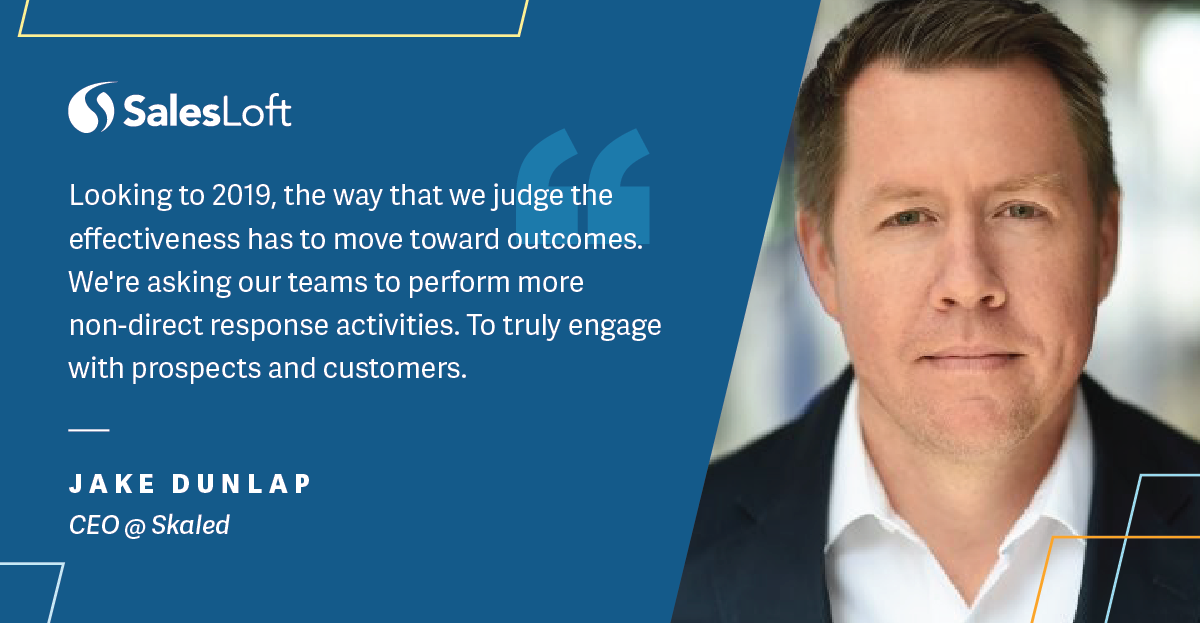
Guest post by Jake Dunlap, CEO @ Skaled
As the CEO of Skaled, I had the privilege to work with 120 different companies in 2018 alone. We’ve rolled up our sleeves on 60 different SDR outbound overhauls and hundreds of deployments of sales engagement software. This experience has provided me with fresh insights into how organizations are winning, as well as where the greatest opportunities are right now.
I’m going to distill all of that data down to the two sales engagement trends that I think everyone needs to pay the most attention to in 2019.
The 2 Sales Engagement Trends for 2019

Trend #1: Overhauling Our KPIs

As sales leaders, how are we measuring the impact of sales engagement?
When a phone was the only method to connect with prospects, volume was THE metric. Number of dials per day translated to performance. There was a time when email wasn’t used to nurture and convert sales. The concept of multi-touch attribution – and email, for that matter – didn’t exist yet.
Then came high-speed internet and, by 2015, everyone was able to send emails en masse. What a concept!
Thus began the race to see who could do “more.” More dials, phone time, emails sent… all of these activity-based metrics by which a salesperson’s success was measured. Who cares how many meetings an SDR set when they only made 20 calls today, right? Wrong.
“More” does equal saturation. Approximately 269 billion emails were sent in 2018 between businesses and consumers, and that number is predicted to grow by 4.4% in 2019. However, “more” does not equal effective.
To put it simply, more just isn’t working.
Looking to the future, the way that we judge the effectiveness has to move toward outcomes. We’re asking our teams to perform more non-direct response activities. These are value-add activities that allow salespeople to truly engage and partner with prospects and customers.
For example, if your team is struggling to convert contacts into opportunities, take a step back and examine your engagement strategy through the lens of personalization and relevancy. High-volume touch does not equate high-quality engagement. Context is everything.
Could you start measuring eight meaningful connections every day instead of 60 activities? I believe it is feasible.
TL;DR: Fixating on and rewarding for meaningful connections that focus on outcomes versus volume is sales engagement trend number one.
Trends in sales engagement

Trend #2: LinkedIn is Changing the Game

It’s shocking to me how little value we place on a thorough, targeted LinkedIn strategy.
As sales leaders, we review email copy call scripts. We do what it takes to drive toward numbers. Why do we still view LinkedIn as merely an extra little thing reps do? We’re (de)prioritizing the single most impactful platform for B2B communication as a “nice to have” instead of giving it the respect and attention it deserves.
It should be clear by now that an omnichannel approach is necessary for 2019. An omnichannel approach delivers a seamless experience for your customers. Noticing a trend here? In fact, companies with a strong omnichannel customer engagement experience retain, on average, 89% of their customers. Compare that with the 33% retention rate of companies with weak omnichannel strategies.

89%

Let that sink in. What would an 89% retention rate mean for your business?
Building rapport on LinkedIn fosters relationships, both new and old. Therefore, it’s important to pay attention to how your customers perceive your team’s LinkedIn presence.
Did you know that 64% of corporate website visits originate from LinkedIn? I’m not talking about social referral traffic. I’m talking about all traffic. Over half of B2B website visitors are coming directly from the social network. The value should speak volumes to you if you are serious about growing your business.
Maybe some of you are already embracing LinkedIn and empowering your team to utilize the platform. But how do you most effectively enable your team?
Coach them on how to optimize their profiles. Teach your sales reps to share ideas and content that is relevant to your buyers. Do you think your buyer cares that you are an award-winning sales leader or that Johnny made president’s club? They don’t.
LinkedIn is no longer merely a place to look for a job. It’s a place to share knowledge.
Make sure the profiles of your sales team speak to the right audience. Then, encourage your team to be active on the site. Lead by example, developing genuine relationships and engage in real conversations. Share unique content. LinkedIn posts are more simple to produce than a blog post. A 200-word LinkedIn article or post without an image can actually perform extremely well on the site.
LinkedIn is going to be a beast for engaging with buyers and setting appointments. It already is for those who are using it effectively. Don’t be left behind.
TL;DR: Giving LinkedIn the attention it deserves in 2019 is sales engagement trend number two.

Conclusion

I am platform agnostic. I’m not married to LinkedIn and will not cry if, years ahead, LinkedIn loses its steam. My needs are simple. To be able to make connections, build relationships, drive sales, and engage with buyers regardless of the sales flavor of the moment.
Here’s what I know. Results-Based Management will continue to gain speed in the next couple of years. LinkedIn is where people are winning today. This is what is working right now.
Change the way you measure your sales team’s effectiveness by starting with outcomes and getting involved on LinkedIn. Think buyer first, resume second.
These are my top Sales Engagement tends for 2019. I hope to connect with you at Rainmaker, if not before on LinkedIn.


To hear more sales insights from Jake Dunlap and others, join us at Rainmaker – the sales engagement conference – March 11-13 in Atlanta. On day 1, Jake will lead an interactive workshop, Level Up, where you learn to level-up and standout to your prospects. He will also present additional trend insights in a session, Sales Engagement: Now and The Future, on day 2.
Jake has developed and led high-performing sales and operational functions for 2000 global organizations and start-ups, specializing in building out repeatable sustainable processes. As CEO and Founder of Skaled, Jake helps companies optimize their sales processes using the latest sales technologies to accelerate growth.
Learn more and purchase tickets here.
Rainmaker 2019

17 Jan 17:05

Email Prospecting: 7 Things You MUST Do Before Hitting ‘Send’

by Jarvis Edwards

Need to make sales, quick, but you despise cold calling?

Not a problem—there’s a better solution that doesn’t elevate your blood pressure nor increase the billable hours of your psychotherapist. It’s none other than email prospecting; a proven strategy that can work miracles, if and only if it’s executed correctly.

According to eConsultancy, to out of three marketers rate their email return on investment as either good…or excellent! But before you queue that perfectly-crafted message and fire it off to your prized database, ask yourself: “Will it make much sense to spend hours, days, weeks and even months emailing these people, just to hear crickets when I check my inbox?”

Seeing only, “sorry, this email couldn’t be delivered” messages in your inbox? No, it doesn’t make much sense at all, and it’s something you can steer clear of. Get prepared to join the 66% of marketing professionals getting huge ROI from their email campaigns, by doing these 7 things, before hitting “send.”

1. Shorten That Subject Line

Depending on your industry, it’s likely your prospects are checking some of their emails from a smartphone. And as anyone using such a small device can attest, you have a very limited amount of screen real estate to get your message across.

As a matter of fact, you have just a few words to make that happen, because your subject line is the first thing Johnny Businessman will see. If that title is too long to fit his vertically-positioned screen in its entirety, he just might delete it. One best practice to avoid this issue is to make sure the complete subject line can be seen at a glance.

One of MailChimp’s representatives agrees, saying, “For most users, there is no statistical link between subject line length and open rate. But for subscribers reading your campaigns on mobile devices, shorter may be better.”

2. Remove Spam Trigger Fodder

Following the best advice to a tee will do nothing to help you, if words commonly known to trigger spam filters are being used in your messages. If at all possible, remove any words known to trigger spam filters from your messages. Below is a list of trigger words Hubspot has found to be detrimental, when used in email marketing campaigns.

Source: Hubspot

Another useful tool to keep you out of the spam traps and boost your prospecting ROI, is Mailchip’s subject line tool, which can help identify words that may help or hinder your email deliverability.

Source: Mailchimp

3. Save the Commitment for Marriage

Successful prospecting email requires some sort of call-to-action that not only guides your reader to making a decision, but which also brings you closer to sealing the deal. However, that rarely happens on the first email or subsequent email follow-ups until the prospect’s trust level increases, or unless there’s a clear need for your offering.

Remove any pressure or intimidating commitment on the recipient’s behalf. Asking the recipient to make a purchase today or book an appointment with you this week, will surely rub her the wrong way— and may cause her to push that unforgiving “spam” button.

While it’s true the responses you get back will be far and few between, even when doing everything correctly, it’s counterproductive to lower it even more, by placing unrealistic expectations on the already-overworked person reading your email.

4. Remove That General Mailbox or Gatekeeper’s Address

*Remove that “info@” address and hunt for a decision maker’s email address until you get weary. Don’t take the lazy route and blast off emails to an info@ or contact@ address, although it can be tempting and time saving. As far as you know, those emails arrive in a fiery pit of digital hell, never to be seen or heard from again.

The person fielding messages sent to general inboxes are often unqualified to address them. They typically have no authority to make decisions, or they’re too busy to figure out to whom it should be forwarded, and will ignore or delete it—without blinking or losing sleep. I shared a bit of insight explaining how to find a decision maker’s email address here, in case you need it.

5.) Reduce Those Paragraphs to Less Than 200 Words

Essays disguised as email are outright bad for business. People are busier than ever nowadays; they’re impatiently sifting through cluttered inboxes, in search of messages worth reading. Emails not fitting that bill will be promptly overlooked or ignored, if not send to the trash bin immediately. Being greeted by paragraphs of text if they choose to open yours, won’t help get you closer to that dotted line being signed.

Recent data from Boomerang found emails with 75-100 words had the highest response rates, with more than 50% of recipients responding the emails. While that data suggests you condense your emails to less than 200 words, it’s good practice to format your text with ample white space, to improve the readability of your emails. I typically limit my emails to 125 words or less, but your mileage will vary.

6. Refrain from Using Subject Line Gimmicks

Don’t learn the hard way. That subject line you’re banking on may seem clever, but in many cases, clever is just a synonym for deleted. While crafting the perfect subject line requires you teeter the fine line between invoking curiosity and being disregarded as a ploy, it’s very easy to get the opposite reaction instead of that which you intended.

Here are some examples of subject line ruses to avoid at all costs:

“Re: Our conversation last week”
…when in fact, this is the very first time you’ve made contact with the person.

“Referred to you by Mary in sales”
…actually, Mary didn’t refer you and even worse: there is no Mary in the company.

“Can I work for you for free?”
…he soon realizes after reading, only the last month is free, after they’ve paid $1,999.35 for 5 months.

7. Get a Tracking Solution Before Hitting ‘Send’

Sending emails to your prospects without knowing if and when they’ve read them, is equivalent to shooting mosquitoes in a barrel—blindfolded, at night, with a gun that jams every other shot. Maximizing the opportunities you’ll come across can only happen if you have data to support each and every decision made.

  • Was my email delivered successfully?
  • Was my email ever opened?
  • What time and day was it read?

Those are important question by which your prospecting campaign lives or dies. When you know an email has been successfully delivered and read, you can queue the follow-up messages that are relevant to the reader, at the right time. Furthermore, it’s much easier to segment your prospects in groups—categorizing prospects by those who’ve read the messages, and those who haven’t.

Your follow-ups can then be customized with different messages tailored to prospects who’ve read your emails, and the stragglers who haven’t opened them. In the two email intro sentences below, can you tell which example might garner a response from a prospect?

Example 1:
“Hi Jane, I sent you an email last Friday, but I don’t know if you had the chance to read it yet…”

Example 2:
Hi Jane, I’m following up because I noticed you haven’t had a chance to read the email I sent last Friday..”

If you guessed example#1—winner, winner, expensive dinner (soon)!

To track your emails relentlessly and increase your chances of closing more deals or booking more appointments, myself and numerous others highly recommend Mailtrack as your go-to solution. They have several pricing options, including a free version—and it’s a tool that my digital agency wouldn’t be caught without.

Source: Mailtrack

It works with Google Chrome and integrates seamlessly with Gmail, allowing you the option of using a Gmail account or a private domain. Don’t bother sending prospecting emails without using Mailtrack, or a competing solution that’s just as capable.

Ready, Aim, Send!

Now that you’re armed with 7 best practices for prepping those potential deal makers, apply them immediately—and watch your response rates increase significantly.

17 Jan 16:59

How “Sales-Speak” Limits Us

by Dave Brock

robinsonk26 / Pixabay

Every profession has it’s own language. It’s a shorthand that enables people in the profession to more effectively and efficiently communicate with each other and to get things done.

For example, finance types talk about debits, credits, accruals, depreciation, assets, liabilities, and so forth. They have their own acronyms like A/R, A/P ROCA, EBITDA and so forth. If you are a financial professional every other financial professional understand you, as a result you can have very productive conversations. They also have tools like income statements, balance sheets, cashflow statements, budgets that help them look at or model various situationsLikewise, engineers, programmers/IT, manufacturing people, HR, and others have their own language.

Sales is no different, we have our own vocabulary, terms like prospecting, qualifying, objection handling, pipeline, funnel, discovery, closing, quota. We also have endless acronyms, ARR, CLV, ABC, and so forth. Along with those, we develop tools that help us with those things, for example, objection handling techniques, closing techniques, qualifying techniques, and so forth. When we talk this way, use these techniques and so forth, we must be “selling.”

But here’s the problem. While these languages, tools, techniques, make it very effective and efficient for people in the profession, for example financial types, to communicate with each other and to get work done, there’s a problem with sales people using our “sales speak.”

Unless we just sell to other sales people. All the ways we talk, the techniques we use, how we tend to communicate are a foreign language to our customers.

The language of selling, drives how we think and the work that we do. We prospect, qualify, discover, propose, close, handle objections, etc. Those are helpful for us, but foreign to our customers. We use these terms to shape our work and our approaches, not only when we talk to each other, but when we engage customers.

We know we need to change our language to better connect with customers. When we talk to financial types we use their words/terminologies to connect with them.

Increasingly, we are recognizing we have to change our models/words and the work we do to more align with how our customers do things. For example, we no longer talk about our selling process, we focus on the customer buying process–because that’s how they do the work of buying, and how they communicate with each other.

Focusing on the buying process, the language of the customer, and the work they do to buy helps us better connect with the customer and enables them to help them buy. If, instead, we focus on the selling process and the work we have to do to sell, we become unaligned and, often, in conflict with the customer.

So, unless we are talking to sales people, the language of “Sales speak” and how that shapes the work we do, puts us into conflict with the customer, how they speak, and the work they do.

But let’s dive, deeper. The work our customers do actually is very similar to the work sales people do. But we call them different things and we leverage certain different tools and techniques.

For example, as customers work on solving a problem and buying, they often have disagreements and differences of opinion. They also want to persuade to get their point of view adopted. If we were talking to sales people, we tend to view those as objection handling and pitching, and we have secret techniques we leverage to deal with those things.

But customer think differently and use different tools. They think of problem resolution, they leverage tools of constructive conflict, they create arguments and debate. They have a different language and tools they use to do the same things that sales people do, except sales people have this secret language and approach, known only to them.

Likewise, sales people think of closing and have developed huge libraries of closing techniques. We choose the assumptive close, the puppy dog close, or any number of techniques. When customers reach a decision point on a project, hey don’t think in terms of “closing.” A customer doesn’t think, “Maybe I’ll use the assumptive close to gain agreement and move forward.”

As you think about this, we’ve created this artificial, in fact, foreign language about selling. We’ve created tools and techniques that enable us to sell. But this Sales-speak, and our selling approaches are foreign to customers who are trying to do the same thing–solve a problem and make a buying decision.

This difference creates a chasm between people who do the work of selling (sales people) and people who do the work of solving problems (customers), even though the work has identical goals!

Imagine, what if we completely change our language and adopt how we work to be completely aligned with the customer. For example, I know if I am in Paris, I am much more effective if I speak French and act in ways that Parisians do, than if I insist on speaking in English and act as Americans do.

As a result, rather the handling objections, we would work on problem resolution, healthy debates, leveraging constructive conflict. We would use the language and techniques customers already use, and which they are comfortable using, rather than using a “foreign approach” that may leave them feeling uncomfortable and manipulated.

Likewise, rather than “closing,” we would work on coming to agreement and taking action.

It turns out the work customers do to identify, address, and solve problems is very similar to the work sales people do, but we are doing the same work in a completely different language and customers. What if we just started speaking one language, using the same tools and customers? Wouldn’t that reduce the gap and confusing the exist between sellers and buyers?

17 Jan 16:57

5 Ways a Sales Engagement Platform is Sales Operations’ Secret Weapon

by Gideon Thomas

Sales Engagement Platform Sales Operations’ Secret Weapon

There are very few secrets in the world of sales operations. Most organizations are playing by the same rules, using the same tools and tactics. One area that has not yet seen widespread adoption – but will see huge growth in the next five years – is Sales Engagement. This secret weapon could help you produce a pipeline full of prospects who are delighted in your sales process and develop a team of sales ninjas who exceed their quotas.

While the concept of “sales engagement” is not a new one, the definition of a Sales Engagement Platform (SEP) has evolved. Once limited in functionality as a tool to automate call dialing and lead nurturing, SEP has grown to become a valuable sales technology that not only automates the sales process but delivers key analytics and insights on buyer behavior, enabling sales teams to build deeper relationships with buyers based on their needs at different points in their buying journey.

Top performing sales reps use data and productivity tools 30% more than average performers. (Salesloft) A Sales Engagement Platform brings all of the core sales software together, integrating the CRM with tools that gather intelligence and inform the sales rep at various points in the sales funnel. When these tools are brought together into a unified platform, sales reps engage prospects quickly and efficiently, deliver content that helps drive the relationship further and have access to data and buyer insights that inform further communications, leading to greater success in closing sales.

There are significant benefits to connecting all parts of the sales funnel. A focus on buyers and their needs, and serving them better throughout the buyer’s journey, leads to higher close rates and smoother onboarding.

Take a look at the current Sales Engagement Landscape to see where some of the leading SEPs are providing value.

sales engagement platforms for sales funnel stages

A Unified Sales Engagement Platform Optimizes These 5 Areas

Where a standard SEP helps organizations track sales touchpoints at the top of the funnel (prospecting, qualification, and justification), a unified, end-to-end SEP carries the data, content, and prospect relationship forward to the middle and bottom of the funnel, through quoting and negotiating, to closing and onboarding.

A unified SEP adds value in the following ways:

Reduces Administrative Time

It’s estimated that only 30% of a sales rep’s time is spent talking to prospects. An SEP reduces time spent on admin tasks like data entry, writing emails, searching for the right content to share, and scheduling calls. A unified SEP goes beyond logging and tracking interactions with prospects; it also reduces time spent configuring quotes, drafting proposals, and chasing down signatures. Having all parts of the sales funnel connected in one platform, integrated with a CRM, increases sales team efficiency, productivity and effectiveness, and reduces the sales cycle. Selling faster means more time to sell.

Boosts Cash Flow and Reduces Spend

A more effective sales process and reduced sales cycle naturally translate to higher revenue. An SEP helps you hone in on buyers’ needs and gain insights into what they respond to best, resulting in a laser focus for your sales team and better results.

Streamlining and consolidating your sales stack, whittling it down to only the software needed to produce optimal results reduces tech spend. Other cost advantages of a slim sales stack include less time spent managing multiple platforms and vendors, eliminated time spent maintaining data in multiple locations, and reduced training time.

Reduces Training Time

In their 2017 report on SaaS AE Metrics, Bridge Group found that the average ramp time for account executives is 4.5 months and full productivity averages 25 months. Part of the issue is that new sales reps that don’t use a sales engagement platform aren’t using a sales playbook to guide their selling and have difficulty locating the sales content they need at the precise moment need it.

Automating parts of the sales process helps new hires learn quickly. Research by Velocify found that “high-performing sales organizations were almost twice as likely as underperforming organizations to describe their sales processes as ‘closely monitored’ or ‘strictly enforced or automated.’” An SEP places guardrails around the sales process, so reps optimize their time and can focus on serving their potential customers.

Provides a Unified Buyer Experience

An SEP makes the buying experience seamless. When everyone on the sales team, from the SDRs to the in-house or field sales reps, is working from the same platform, the buyer gets the sense that their needs are at the forefront. The intelligence gathered at the beginning of the relationship is carried forward, without annoying the buyer by asking for the same information at multiple points along their journey. Each step informs the next and creates an experience for the buyer that makes them feel like their rep is paying attention to them, not simply logging data in a CRM.

An all-in-one SEP exists in an environment where every piece of content and every buyer interaction is on-brand and produced from an up-to-date sales playbook. Buyers notice and appreciate the professionalism.

Gives Insights on Buyer Engagement

In Richardson’s 2018 Selling Challenges Study, 22% of respondents cited “understanding the buyer’s decision-making process” as a top challenge for sales teams. A unified SEP not only provides data and insights on buyer engagement (the what and when of how they respond to content) but provides the framework and tools to effectively nurture the relationship based on buyers’ needs and level of interest. Buyers are empowered to make informed decisions because the sales team is prepared to engage with buyers in ways that are most meaningful to them. Content such as case studies, interactive videos, ROI calculators, and testimonials help tell the story that resonates best with buyers.

Digital engagement insights and real-time buyer behavior data help sales teams learn, personalize, and optimize the sales process for each buyer. Cookie cutter sales decks are a thing of the past and are replaced by personalized content that connects with buyers, supported by data.

selecting a sales engagement platform

Ready to be a Sales Engagement Ninja?

If you’re looking for your sales secret weapon, we challenge you to consider a Sales Engagement Platform. Most companies don’t yet understand the role an SEP can play in improving their sales operations and increasing revenue. Implementing a unified, all-in-one Sales Engagement Platform will give you the competitive edge you are seeking.

Schedule a demo today to learn how DealHub.io can put the power of sales engagement to work for your business.

17 Jan 16:57

Build a B2B Sales Organization from the Ground Up

by Liz Heiman

Start building your B2B sales organization by laying a foundation for success. When you are building a house, before you do anything else, you put the infrastructure in place and lay the foundation. A solid foundation ensures a stable structure. The same is true when you build a sales organization. Think about what needs to be in place to build a stable organization that will support sustained growth. 

Before you start or continue hiring, make sure you have these critical things place.   

  1. Sales Strategy
  2. Lead Generation Process
  3. Sales Messaging
  4. Sales Process
  5. Sales Funnel
  6. Hiring Criteria

Follow these 6 steps to build a successful sales organization from the ground up

Step 1. Define Your Sales Strategy

Your vision and your goals are your roadmaps to success, and the more clearly your sales team understands it, the better able they are to embrace it. When you are first starting, you and your team may live the vision, but as you add people, the vision needs to be stated clearly.   Be sure everyone on your team understands why your company exists, what you sell and who will buy it, and why that matters to your market. Next, set out clear sales goals and explain how you will hit them. When you are the only one selling it may not seem necessary to explain, but you are laying the foundation to hire your first salesperson and probably many more after that. 

Step 2. Create a Lead Generation Process

How do you generate leads now? Will that lead flow be sufficient to support a salesperson? Salespeople don’t magically generate sales. It’s your job to provide a lead generation process that includes criteria for the type of companies most likely to buy. Include size, geography, industry and other essential criteria that will identify your best targets. A list of companies you want to pursue, and what products you want to sell is a must to keep your team focused. If you don’t have a marketing department, you can outsource, but lead generation is a must. If your new salesperson spends their time researching and building a list from scratch, it will be a long time before you get a return on your investment. The better marketing can support sales in the lead generation process, the better results you will get. 

Step 3. Craft Sales Messaging

It is a common misconception that salespeople will know what to say. Often, they don’t. And, if you don’t tell them, they will make it up. Before you hire a sales rep, have a solid understanding of your market position and the message that will attract your target customer. The most powerful tool your team will have is your value proposition.  That language is focused on your customer’s problems rather than your products. Have your value prop(s) ready, teach it to your new sales rep and practice it with them before they go out to talk to customers.  The better prepared your sales reps are, the quicker the return on your investment, because your new rep will be able to have the kinds of conversations that build relationships and close deals. 

Step 4. Outline a Sales Process

The clearer your sales process, the easier it is to follow it.  If you have been doing the selling, the path from meeting a prospect to closing the deal may seem obvious. It won’t be to a new sales rep, so document it and teach it to your new sales rep won’t waste time figuring it out for themselves.  The process will change over time, so start where you are today. Your company’s sales process works best when it reflects your customer’s buying process. Understand how your target customers buy and map it.  Then be sure the process you want salespeople to use matches the way your customer wants to buy. Make it easy for your customers to buy, and you will be able to accurately predict your sales revenue. If you want an accurate forecast, a process is critical. 

Step 5. Construct a Sales Funnel

Effectively track sales opportunities as they move through the funnel is the secret to managing sales. Set your CRM up to mirror your sales process and provide reports that help salespeople effectively pursue leads without missing anything. The more complex your deals, the more information and people there are to keep track of, and the longer the sales cycle. Accurately tracking leads becomes critical. As the sales leader, your sales funnel is your lifeline. At any moment in time, you need to have clarity about what will close and when. Your funnel should provide this clarity if you manage it properly.  

Step 6. Determine Hiring Criteria

Every selling environment requires a different type of salesperson.  Understanding your sales environment will help you hire the right people.   Now that you are clear on your sales process from targeting your customers to closing, onboarding, retaining and growing, you will have a better idea of whom to hire.  Depending on what part of the sales process your sale people are responsible for, you will know what skills need to be strongest.  Every sales rep has strengths and weaknesses hire the one that best leverages your company strengths and weaknesses. 


Learn more by registering for our 6-week, live, online program Start Up Your Sales

The post Build a B2B Sales Organization from the Ground Up appeared first on Alice Heiman, LLC.

17 Jan 16:57

6 Best Practices For Increasing Security In AWS In A Zero Trust World

by Louis Columbus

  • Amazon Web Services (AWS) reported $6.6B in revenue for Q3, 2018 and $18.2B for the first three fiscal quarters of 2018.
  • AWS revenue achieved an impressive 46% year-over-year net sales growth between Q3, 2017 and Q3, 2018 and 49% year-over-year growth for the first three quarters of the year.
  • AWS’ 34% market share is bigger than its next four competitors combined with the majority of customers taken from small-to-medium sized cloud operators according to Synergy Research.
  • The many announcements made at AWS Re:Invent this year reflect a growing focus on hybrid cloud computing, security, and compliance.

Enterprises are rapidly accelerating the pace at which they’re moving workloads to Amazon Web Services (AWS) for greater cost, scale and speed advantages. And while AWS leads all others as the enterprise public cloud platform of choice, they and all Infrastructure-as-a-Service (IaaS) providers rely on a Shared Responsibility Model where customers are responsible for securing operating systems, platforms and data. In the case of AWS, they take responsibility for the security of the cloud itself including the infrastructure, hardware, software, and facilities. The AWS version of the Shared Responsibility Model shown below illustrates how Amazon has defined securing the data itself, management of the platform, applications and how they’re accessed, and various configurations as the customers’ responsibility:

Included in the list of items where the customer is responsible for security “in” the cloud is identity and access management, including Privileged Access Management (PAM) to secure the most critical infrastructure and data.

Increasing Security for IaaS in a Zero Trust World

Stolen privileged access credentials are the leading cause of breaches today. Forrester found that 80% of data breaches are initiated using privileged credentials, and 66% of organizations still rely on manual methods to manage privileged accounts. And while they are the leading cause of breaches, they’re often overlooked — not only to protect the traditional enterprise infrastructure — but especially when transitioning to the cloud.

Both for on-premise and Infrastructure-as-a-Service (IaaS), it’s not enough to rely on password vaults alone anymore. Organizations need to augment their legacy Privileged Access Management strategies to include brokering of identities, multi-factor authentication enforcement and “just enough, just-in-time” privilege, all while securing remote access and monitoring of all privileged sessions. They also need to verify who is requesting access, the context of the request, and the risk of the access environment. These are all essential elements of a Zero Trust Privilege strategy, with Centrify being an early leader in this space.

6 Ways To Increase Security in AWS

The following are six best practices for increasing security in AWS and are based on the Zero Trust Privilege model:

  1. Vault AWS Root Accounts and Federate Access for AWS Console

Given how powerful the AWS root user account is, it’s highly recommended that the password for the AWS root account be vaulted and only used in emergencies. Instead of local AWS IAM accounts and access keys, use centralized identities (e.g., Active Directory) and enable federated login. By doing so, you obviate the need for long-lived access keys.

  1. Apply a Common Security Model and Consolidate Identities

When it comes to IaaS adoption, one of the inhibitors for organizations is the myth that the IaaS requires a unique security model, as it resides outside the traditional network perimeter. However, conventional security and compliance concepts still apply in the cloud. Why would you need to treat an IaaS environment any different than your own data center? Roles and responsibilities are still the same for your privileged users. Thus, leverage what you’ve already got for a common security infrastructure spanning on-premises and cloud resources. For example, extend your Active Directory into the cloud to control AWS role assignment and grant the right amount of privilege.

  1. Ensure Accountability

Shared privileged accounts (e.g., AWS EC2 administrator) are anonymous. Ensure 100% accountability by having users log in with their individual accounts and elevate privilege as required. Manage entitlements centrally from Active Directory, mapping roles, and groups to AWS roles.

  1. Enforce Least Privilege Access

Grant users just enough privilege to complete the task at hand in the AWS Management Console, AWS services, and on the AWS instances. Implement cross-platform privilege management for AWS Management Console, Windows and Linux instances.

  1. Audit Everything

Log and monitor both authorized and unauthorized user sessions to AWS instances. Associate all activity to an individual, and report on both privileged activity and access rights. It’s also a good idea to use AWS CloudTrail and Amazon CloudWatch to monitor all API activity across all AWS instances and your AWS account.

  1. Apply Multi-Factor Authentication Everywhere

Thwart in-progress attacks and get higher levels of user assurance. Consistently implement multi-factor authentication (MFA) for AWS service management, on login and privilege elevation for AWS instances, or when checking out vaulted passwords.

Conclusion

One of the most common reasons AWS deployments are being breached is a result of privileged access credentials being compromised. The six best practices mentioned in this post are just the beginning; there are many more strategies for increasing the security in AWS. Leveraging a solid Zero Trust Privilege platform, organizations can eliminate shared Amazon EC2 key pairs, using auditing to define accountability to the individual user account level, execute on least privilege access across every login, AWS console, and AWS instance in use, enforce MFA and enable a common security model.

17 Jan 16:57

Empowering Your Channel Partners: It’s All About Marketing Alignment

by Louis Gudema

Channel partners are an important source of revenue for many software companies. SAS has the goal of getting 50 percent of mid-market revenue from its channel partners; for some vendors their contribution from channel partners is even higher.

At the same time, the challenges of managing a successful channel partner program are many and legendary. These can include:

      • Channel conflict with the company’s inside and field sales teams
      • Training channel partners and keeping them up to date on the latest enhancements to the software
      • Creating and managing an effective compensation structure to incent the partners and their salespeople
      • Maintaining mindshare with the channel partner salesforce so they actually sell the solution (this can be especially challenging for software startups)
      • Managing or eliminating underperforming partners
      • And many more

But it’s rarely discussed that channel partners are often very poor at marketing and lead generation. They don’t generate nearly as much revenue as they could. This is especially true for the channel partners of companies selling non-marketing software such as software engineering tools, business process management, fintech, databases, endpoint management, supply chain management and more (the partners of MarTech companies are often marketing agencies that are adept at marketing).

Companies that market more grow faster. When I studied the marketing programs of hundreds of B2B companies with 50-1000 employees, I found a huge discrepancy between software companies and everyone else. While software companies are using a median of 7 of the 9 digital marketing programs that I scored companies on, non-software companies – including professional services firms like many channel partners – are using a median of only 3 of the 9. And this matters: software companies with the most robust programs were growing about five times faster than those that were doing little marketing.

Often software companies that have robust, mature marketing programs themselves are being under-served by channel partners that do little marketing, and this slows the growth of the software vendor.

How to empower your channel partners

It’s not unusual for companies to offer programs to help their channel partners. CPG companies invest in co-op marketing programs with retailers. Many software companies offer programs like sales and enablement training to their channel partners. But there are few companies that help their partners improve their marketing. This is a significant opportunity.

Software vendors need to:

      • Educate channel partners on the importance of marketing, how they themselves use it to drive growth, and how channel partners can use it to generate more leads and sales for themselves and the software vendor
      • Provide channel partners with marketing insights into customers and why they buy

But education isn’t enough. The channel partners who have little experience in marketing will also need help developing and implementing their marketing strategies and action plans, as well as adding the needed personnel, marketing software and third-party data. Since the software vendors are busy with their own marketing, some channel partners may need consultants or an agency to act as a virtual marketing department to ramp up a new marketing program, with the goal of helping the partner staff up and transfer management of the program to an internal team over six to twelve months.

With dozens of marketing channels, and the noise generated by thousands of MarTech vendors, many channel partners are overwhelmed by the marketing landscape and wouldn’t know where to start even if they were inclined to. In another recent post, I described that a number of marketing approaches that get a lot of attention, such as inbound marketing and organic social media, have actually passed their peak. Companies that don’t already have robust results from those marketing channels will find it hard and slow to produce them. I also described a way for companies new to marketing to produce results relatively quickly and inexpensively.

Software vendor support for the marketing of their channel partners isn’t going to be a silver bullet that produces new results overnight. All experienced marketers know that consistent, repeated execution is central to success. But by empowering their channel partners with superior marketing knowledge and resources, software companies can significantly grow their revenue from that channel.

The post Empowering Your Channel Partners: It’s All About Marketing Alignment appeared first on OpenView Labs.

17 Jan 16:57

What’s The Big Deal? It Might Be More Than You Think...

by Hayden E. Stafford
Big Deal

How do you define the value of a newsworthy big deal? If your answer stops at a dollar sign, think again. Really big deals are defined and driven by the business value we bring to the customer, not the revenue we gain. It could be about helping a customer cut costs by consolidating complex, antiquated, or redundant systems, which in turn leads to better security and data integrity. It could be about strengthening their competitive edge or reducing their exposure to risk. It could even be replacing a myriad of varying self-integrated, third-party applications. These are the sorts of problems we’re addressing with larger deals.

Adopt a big deal mindset

To get on the track of a big deal, start with your own mindset. When I ask sales teams to define a big deal, too often they’ll say something like, “$500K to a million.” And that’s where you can immediately slip up because it’s an arbitrary threshold. A big deal isn’t just about a dollar amount, it’s about business impact and long-term benefit for the customer—or even their own customers. You can make that impact with a big win, but you could also start with a small, strategic use case that expands over time.

Just stay focused on the customer’s event horizon rather than your own goals, and you can make bigger deals than you ever thought possible.

Or to put it another way, shift your thinking from a growth mindset to one of a growth and big deal mind set. Here’s another example of growth mindset versus big deal mindset. I’ve heard people say that smaller markets like the Asia-Pacific region can’t support large deals. That’s just not true—large deals are being made all over the world today, including in developing economies. But if you don’t keep an open mind anchored on the totality of the benefit delivered to the customer, you’ll miss those opportunities.

Consider applying a similarly agile, flexible mindset to customers too. One size doesn’t fit all—needs vary, and so should your selling strategy. For example, pay attention to key trends and trigger points. An industry might be going through a digital transformation like application modernization, or there could be massive cost-cutting initiatives like we’re currently seeing in industrial sectors. You might target companies that are going through mergers and integrating complex systems, or divestitures looking to shed redundancy and duplication. Or maybe a new CEO is entering an organization with a fresh agenda.

Build trust and strategic relationships

As I discussed in my last blog, getting that level of insight into the customer, and access into the business, is all about building trust and providing a great experience. You need to establish credibility, and you do that by understanding the industry, trends, and the competition.

This is where the Challenger Sales methodology, and its emphasis on creating constructive tension, can be useful. Once you’ve established credibility, you can ask customers to step outside their comfort zone, think about what their competition may be doing, and consider your innovative solution for their problem.

But here’s where I might differ from the Challenger mindset, which typically isn’t as focused on relationship-building as I would like it to be. Your due diligence should include a “Map & Gap” analysis that identifies where your solution aligns with the needs of not just your primary target or sponsor, but their subordinates, leaders, and peers – consider every axis on the relationship map. Then you can get the people on your team, including executives, lawyers, and CFOs, aligned with those vertical and horizontal roles to tell your story and validate the solution based on their respective lens.

Knowing how to build customer relationships gives you more flexibility. There isn’t just one approach to handling a large deal. You can make a big splash, solve the customer’s problem, and you’re done. Or, you can take the land and expand approach. Start small in one line of business, build a value case, and engage everyone around your sponsor to seed the vision. And soon, you’re gaining support across multiple lines of business and you’ve got a real big deal. I can give many examples of this approach. But whatever methodology you choose, keep the customer’s business case as the hub of your negotiation wheel throughout the sales process. Remember the business case is your anchor, your compass rose, your True North (or whatever you may call it) throughout the sales cycle. Used early, often, and with great specificity, a business case that is validated by your customer’s data will enable you to sell more profitable deals that often grown quickly over time. You’ll build the kind of momentum that drives game-changing deals for both you and the customer.

Sell value, not just product

Remember, when it comes to selling value, it’s about the benefits you bring to the table as well. You’re enabling the customer to invest in success, not just a product. You’re on the same team as your customers, so put yourself in their shoes. Assuage concerns around areas of risk by making use of design architects, clearly defined milestones, and regular steering committee engagement.

And in your role as trusted advisor and collaborator, you can enlighten your customers. If you think outside the box, so will they. A bank can benefit from approaches used by retailers, or a manufacturer might find inspiration in the best practices of service companies. It’s always about surfacing new, thoughtful points of view from adjacent or even completely different industries. This is the same type of thinking used in the land and expand approach within an organization. Show value in one line of business and align the solution with the needs of others across the organization.

For example, my team recently closed a large deal with a multinational software firm. The customer was going through a major merger/acquisition, and needed a more modern, future-proof sales and customer service platform. We beat our competitor not only because we have great products, but because we were consistent with the way we positioned value at every touchpoint. Winning big is a team sport on both sides of the signed contract. Keep that in mind, and it’ll be a bigger win for everyone but your competition.

If you’re interested in accelerating your digital transformation, check out a new type of business application. One that breaks down the silos between CRM and ERP, that’s powered by data and intelligence, and helps capture new business opportunities. Find out how you can help enable success with Microsoft Dynamics 365.

To keep pace with the latest sales insights from industry leaders, subscribe to the LinkedIn Sales blog.

17 Jan 16:57

12 of Our Most Effective Marketing Tips to Skyrocket Sales

by Patricia Wilson

According to the State of Inbound 2018 report, selling is the aspect that most companies prioritize. 69% of the respondents identified “converting contacts/leads to customers” as their top marketing goal.

image1

(Image. Source)

Are you achieving that goal? Truth be told, there’s always space for getting better.

Well it’s time to do all the right things to skyrocket sales. We’ll give you 12 really effective marketing tips that will get you there.

12 Effective Marketing Strategies to Boost Sales

1 Start by Improving the Customer Support System

You want to sell more? Be there for everyone who’s interested in your products or services. Be there for the previous and current customers, too! You want them to be happy, so they will recommend your brand to others and will come back for more purchases.

  • Hire the right people. You want highly motivated agents who care about the business goals. To get the best customer support agents in the industry, you need to pay them more than the average.

However, keep in mind that money is not the only factor of motivation. These people have career goals. They don’t want to be in customer service for a lifetime. If you offer opportunities for growth within your organization, they will be more motivated to do their job. =

  • Be present on all channels. People will contact you via email, social media, phone, and the official website. Make sure everyone gets a timely response.
  • Establish the rules for returns and refunds. You want to keep the customers happy. If they are not happy with a product, you should solve the issue ASAP.

2 Offer Free Gifts

Everyone likes free gifts!

Some business owners, however, are afraid of giving away free products. This is their mindset: “If I give this for free, will this person be motivated to pay for it in future?”

Well if your product or service is good, of course they will be motivated to pay for it. Why do you think that most apps and services offer trial periods? Netflix, for example, invites everyone to try the service for free before they commit to it.

The similar strategy works with products. When you give away free stuff, people get to try it. If they like it, they will return to you. They will also recommend the product to their friends and social media followers.

But who will receive these gifts?

  • You may turn this into a challenge. Whatever product or service you sell, make people compete for it. That’s how you’ll boost the brand awareness and you’ll really engage your audience.

Check out this Instagram challenge as an example: the host invites people to participate by posting yoga poses every day. They should tag the host and the sponsors in each post, so the point of brand exposure is covered. The winners get outfits, free membership on a subscription service, and a book. Yes; the brand has to make an expense for each challenge, but the exposure is well worth it.

image4

(Image Source)

3 Invest in Retargeting Ads

Behavioral retargeting is an effective marketing strategy, since it aims at people who are already interested in your products or services.

Here’s how it works: a pixel on your website informs the ad network that a user visited the page. Then, the ad network will target this user with relevant ads for your product or service.

Your ad will start popping up in the user’s Facebook feed all the time. It will constantly remind them that they were interested in this product and it’s still available to meet their needs.

4 Be an Industry Expert

Your sales will skyrocket when people start believing in your expertise.

Check what Neil Patel is doing. People are not paying for consultations with this guy just because he offers such a service through his website. They do it because he’s an established industry expert.

He showed what he could do with websites through his own projects. All his posts convey his level of expertise, so the target audience trusts him.

image5

(Image Source)

That’s what you want to do.

  • Start the personal branding process. Be present on social media. Connect with people and invite them to ask any questions. Respond with the intention to help. In addition to social media, Quora and Reddit are very effective platforms for personal branding.
  • Start your own blog. Publish high-quality blog posts, case studies, and other types of content that helps you get noticed and recognized as someone who knows what they are talking about.

5 Make a Mobile App

According to the latest stats, 62% of smartphone users have purchased something online through their mobile devices over the last six months.

This means that most of your potential buyers enjoy the convenience of mobile ecommerce. You want to make it as easy as possible for them.

  • Invest in a mobile app. When developed properly, it will boost the sales.
  • Pay attention to the way you promote the app. Take specific marketing steps to increase downloads and in-app sales, so you’ll see the real effects.

6 Connect with Social Media Influencers

When you get an influencer to promote your products or services, you’re gaining tons of exposure. These are people with large social media following.

Their followers trust them even when they know they are affiliated with brands. That’s because the reviews and recommendations they post are thorough and based on personal experience.

Check out how Michael Dameski, a star from World of Dance, promoted Lull mattresses:

image3

(Image Source)

Obviously, this is paid partnership. That fact is clearly outlined in the Instagram post. Still, it’s an effective marketing step because the followers are more likely to trust shared experience than a traditional ad.

7 Create High-Quality Content

Content is the essence of successful online marketing.

When posting on social media, you’re creating content. When you want to make your website better, you develop content. When you want to inform your audience about the products and services you sell, you create content. When you want to rank well on Google, you develop content.

You get the point.

Your entire marketing campaign depends on the content you develop, so you better make it good.

Maybe it will be necessary for you to invest in photographers, graphic designers, and SEO writers. It will be a significant investment, but it will give you great results when planned properly.

8 Make the Website Really Good

The website is the face of your business. No marketing trick could make up for the damage a bad website creates. It has to be responsive, clean, and easy to navigate.

  • Start by examining successful ecommerce sites, such as Amazon. It’s really easy to use the search bar when you want to find a particular product. The categories are also detailed.
  • The website is your biggest investment. Hire a great team and keep in mind: the best professionals don’t drop the price because they know how much they are worth.

9 Invest in Pay Per Click Advertising

Let’s do a simple experiment: we’ll search the keywords “Pennsylvania jewelry stores” in Google. The search engine will give us the results, but will also include several ads at the top. That ads are the very first thing you see. Chances are, if you’re really looking for jewelry stores in Pennsylvania and you get a relevant ad, you’ll click on it.

image2

These ads will cost money, but they can produce great return of investment. Google targets them very carefully to users who are likely to make the purchase.

10. Invest in SEO

Speaking of Google, you want your website featured on the first page of results. Search engine optimization strategies will get it there.

SEO is not easy. If you have no idea where to start, it would be smart of you to take an online course. If you realize you need a team to take care of this step for you, you can hire an agency or hunt for talented freelancers through Upwork or other platforms.

11 Use Videos

The stats that go in favor of videos are pretty convincing:

  • 90% of customers say that product videos helped them make a buying decision.
  • By 2019, 80% of all web traffic is expected to be taken over by video content.
  • Adding videos to promotional emails may enhance the click-through rate by 200-300%.

What does this mean?

You gotta invest in high-quality videos. You can film them in the form of ads for Facebook. You may engage influencers to promote your products through Instagram and YouTube videos. You can connect with popular YouTubers, who will film elaborate reviews. The opportunities are endless.

12 Get the Social Proof

Before people buy your products or services, they will want to see the reactions of real buyers. If someone wants to get an antioxidant supplement, they will make comparisons between the reviews for different products. They will get the one that achieved the best satisfaction levels among the customers.

You want to get such social proof for your brand.

  • First of all, it’s important to offer a great product/service that meets the buyer’s expectations. The customer support system, packaging, and speedy delivery also matter.
  • Invite your customers to share their opinions. Allow them to review the product on the official Facebook page.
  • Feature the best testimonials on the website.

Are You Ready to Start Selling?

Of course you want to boost the sales. But are you ready? The question is: have you done enough effort through your marketing campaign?

We gave you 12 great tips on how to get to the results you want. Now, it’s your turn to take action.

16 Jan 18:21

Creativity Month: How to Add Fresh Ideas to Your Marketing Plan

by Emily Sidley

“Creative thinking inspires ideas. Ideas inspire change.” – Barbara Januszkiewicz (American painter, filmmaker and creative activist)

How often do you come up with new ideas for your business? This is the month to focus on creativity! January is designated as International Creativity Month, a time that reminds us, “Thinking outside the box is just as important (if not more important) than simply following established procedure.”

How do you come up with fresh, innovative ideas for your business’ marketing plan and put them into action? Keep reading for suggestions to embrace your creativity and for 6 steps to make them a reality.

How to Embrace Creativity & Develop New Marketing Ideas

An image of a child wearing pretend wings and looking towards the sky with Hitchcocks quote superimposed on top.Where do you find your marketing ideas?

“Ideas come from everything.” – Alfred Hitchcock (English film director and producer)

When you think of coming up with creative ideas, there are probably the standard tidbits of advice that come to mind:

  • Keep a notebook with you to write down thoughts when they pop into your head
  • Change your environment; work somewhere different
  • Write down everything you think of (even if they initially seem like bad ideas)
  • Put down the cell phone, tablet and other electronic distractions
  • Doodle or draw to use a different part of your brain
  • Read the news and your industry’s trade publications
  • Embrace downtime
  • Play
  • Get a good night’s sleep
  • Do something new that’s out of your comfort zone

Research: Developing Creative Marketing Ideas

An image of a child playing in a box with science symbols and the Einstein quote superimposedFind marketing inspiration by following this research.

“Imagination is the highest form of research.” – Albert Einstein (German-born physicist)

But what does research say? According to studies conducted by the Positive Psychology Center at the University of Pennsylvania, the number one thing you can do to increase creativity and develop new ideas is: Be open to new experiences.

What that means is constantly challenging yourself beyond your comfort zone, constantly questioning assumptions, being intellectually curious and appreciating beauty. Personal growth is intimately tied to openness and experience…Any exposure to things that take you out of your normal way of viewing the world really increases cognitive flexibility and is a core part of creativity.

Research also shows that new ideas can be generated from simple, every day activities like going for a walk and taking a shower. The thought is that nature, movement and relaxation all play a part in your mind creating innovative thoughts. Another theory is that transition activities like walking, jogging, showering and falling asleep allow the mind to wander, providing an opportunity for it to develop new creative solutions to a problem at hand.

Additional research-backed insights show that creative new ideas can stem from:

  • Making time for solitude as well as collaboration. “Research has found that creative people frequently require solitude in order to generate interesting new ideas, and then turn to collaboration to spin those ideas into a coherent concept or product.”
  • The ability to shift your mindset to, “Think like a kid,” or an outsider that’s new to your field. As this study shows, “There is a benefit in thinking like a child to subsequent creative originality.”
  • The determination to keep trying. As numerous highly successful people have said:
    • “I have not failed. I’ve just found 10,000 ways that won’t work.” – Thomas Edison
    • “Do not fear mistakes. You will know failure. Continue to reach out.” – Benjamin Franklin
    • “I can accept failure; everyone fails at something. But I can’t accept not trying.” – Michael Jordan
    • “It is impossible to live without failing at something, unless you live so cautiously that you might as well not have lived at all, in which case you have failed by default.” – J.K. Rowling
  • The color green. A study published in Personality and Social Psychology Bulletin showed, “When students were given creativity tests, those whose test-cover pages had a green background gave more creative answers than those whose pages were white, blue, red or gray.” It’s thought that this is because, to many, green represents fertility, growth and renewal.
  • Daydreaming. It’s been shown that letting your mind wander gives it the opportunity to subconsciously come up with new approaches to problems you’re facing.
  • Moderate drinking, perhaps because it releases some inhibitions.
  • Watching funny videos. Those funny cat videos you find on YouTube are shown to put viewers in a positive mood, which is linked to higher creativity.

Instilling New Ideas Into Your Marketing Plan

An image of a computer, notebook and coffee with Disneys quote superimposed on top.Are you ready to take action on your marketing plan?

“The way to get started is to quit talking and begin doing.” – Walt Disney (American entrepreneur, cartoonist, animator, voice actor and film producer)

Here are 5 steps to add your new, creative ideas into your company’s marketing plan:

  1. Keep a list. As you go for a walk or take a shower, write down new ideas that pop into your head. Make sure you’re following the advice above by making time to think by yourself or approaching your field like a child might. Maybe surround yourself with the color green, whether it’s getting out into nature or surrounding yourself with houseplants (or even pictures of trees), or take a break to find some funny videos on YouTube. Write down any and all new ideas that come to mind, even if you can’t see a connection to your marketing plan right away.
  2. Review your list. Do any of your new ideas stand out to you? Can you think of ways to relate them to your business’ marketing plan? Don’t be afraid of something that may seem “out there.” New and creative approaches can seem crazy, but are often worth considering.
  3. Prioritize. Which ideas do you want to try first? It’s much better to try one new approach at a time. You want to do it well and really take the time to see how it works rather than split your focus between numerous ideas you don’t have the energy and resources for.
  4. Set a goal. What do you hope to achieve with your new idea? And by when? Make sure the goals you set for yourself are SMART:
    • Specific
    • Measurable
    • Attainable
    • Relevant
    • Timely
  5. Create a plan of attack. How will you put your new idea into motion? What tactics will you use as you implement it into your marketing strategy?
  6. Evaluate. After a reasonable amount of time (likely 6 months to a year), consider how the new tactic went. Was it a successful part of your marketing strategy? Is there something you should change about it and try again?

Slowly work your way through your list of new ideas, and keep track of the ones that work well and the ones that don’t. Implementing new tactics into your business’ marketing one at a time will allow you to regularly breathe fresh life into your plan and prevent your business’ public relations strategy from getting stale.

Marketing Resources for Putting Creative Ideas Into Action

An image of two goats with Sue Graftons quote on top.Don’t miss these helpful marketing resources.

“Ideas are easy. It’s the execution of ideas that really separates the sheep from the goats.” – Sue Grafton (American author)

What if you need some outside resources for implementing your new marketing strategies? Don’t miss this helpful list of websites that can help:

  1. Canva.com is a fantastic resource for creating visuals. In fact, I used it to design the quote images throughout this post! Through this website, you’re able to select the dimensions of the image you’d like to create based on how you plan to use it (Facebook, Pinterest, etc.) and manipulate pictures and text to design a custom image for your business. In addition to being able to upload your own photos to use, Canva also has a stock image library; you can choose from their free pictures or purchase the rights to the one(s) you like for $1 each.
  2. Adobe Spark is a helpful resource for creating video slideshows. It’s easy to use, comes with stock background music and is free or inexpensive, depending on which plan you choose to use.
  3. Hubspot created 5 infographic templates you can use to design your own visual guides!
  4. If you want to add more timely updates to your blogging, social media marketing or other elements of your content marketing plan, DaysOfTheYear.com is a great resource! In addition to listing all sorts of upcoming notable days, they list months of the year for you to reference (such as Breast Cancer Awareness Month or International Creativity Month).
  5. Free Stock Photos is another Hubspot resource that allows you to create custom content for your company. Their image library includes all sorts of pictures you can download and use in your business’ marketing efforts for free.

In Conclusion

An image of a child dressed as a superhero holding the world with Robin Williams quote on top.Are you ready to change the world with your marketing messages?

“No matter what people tell you, words and ideas can change the world.” – Robin Williams (American actor and comedian)

Although International Creativity Month is only during the month of January, as a business owner it’s important you are constantly coming up with new, innovative strategies year-round. Do you have any suggestions to add to my advice? Share your tips and insight in the comments below! I’d love to hear what’s worked well for you and your company.

16 Jan 18:06

A deep dive into the technical feasibility of Bloomberg's controversial "Chinese backdoored servers" story

by Cory Doctorow

Last October, Bloomberg published what seemed to be the tech story of the year: a claim that Supermicro, the leading supplier of servers to clients from the Pentagon and Congress to Amazon, Apple and NASA, had been targeted by Chinese spies who'd inserted devastating, virtually undetectable hardware backdoors into their motherboards by subverting a small subcontractor in China.

But the story didn't quite add up. After it was published, the tech giants implicated in it released detailed, unequivocal denials, themselves almost without precedent -- Big Tech's PR strategy during this kind of scandal is usually limited to terse denials that do not delve into detail. Instead, companies named in the story went into lavish detail explaining why it wasn't true, and couldn't be true.

These denials also don't add up: Bloomberg says it sourced its story from multiple (anonymous) sources who had direct knowledge of the incidents and who had been employed in the named organizations while they were unfolding. Bloomberg stood by its reporting, and implied that the idea that all these sources from different organizations would collude to pull off a hoax like this.

Faced with the seemingly impossible task of sorting truth from hoax in the presence of contradictory statements from Big Tech and Bloomberg, technical experts began trying to evaluate whether the hacks attributed to the Chinese spy agencies were even possible: at first, these analyses were cautiously skeptical, but then they grew more unequivocal.

Last month, Trammell Hudson -- who has developed well-regarded proof-of-concept firmware attacks -- gave a detailed talk giving his take on the story at the Chaos Communications Congress in Leipzig.

Though Hudson points out several possible weaknesses in the Bloomberg story, he mostly comes down on the side that it was at least possible.

More importantly, he describes the structural challenges in preventing this kind of attack: what we think of as a "computer" is actually a network of often very capable computers, each with their own firmware, and most often, that firmware takes the form of an unauditble, proprietary blob of closed-source code. While this has been on the security community's radar since at least the advent of BadUSB attacks, the power of the embedded systems in our computers has only increased, as has their opacity.

Without open access to both schematics and source, it's virtually impossible for external experts to audit the security choices made by vendors and decide whether to trust them (to say nothing of the legal risks of publishing vulnerability reports, which often gives rise to threats against security researchers who dare to say that the emperor has no clothes).

This is an excellent analysis, even if it leaves me no closer to understanding whether the underlying Bloomberg story is true.

Beyond the mystery of whether the Bloomberg report is true, there's the other mystery: if it is, why is Big Tech risking the reputational hit of fielding detailed rebuttals that will completely demolish their credibility when the truth comes out (the news that Big Tech can't be trusted in detailed technical statements would, in some ways, make the Snowden revelations look like small potatoes when it comes to trusting them in future). And if it's not, how the fuck did Bloomberg get hoaxed.

I've heard so many theories about this, each more bizarre than the last (one trusted spook-adjacent friend of long acquaintance said that they'd heard that the Trump administration planted the story to find a leaker and it got away from them!). I can't even imagine an explanation that fits all the facts we do know.

Contrary to Supermicro CEO's assertion that their designs are more secure because of their secrecy, I believe that openness will make our systems more secure. Servers from the Open Compute Project include full schematics, bill-of-materials, gerber files for the boards, etc. All of which motivated customers can use to validate that their hardware matches what is intended and that nothing has been added.

Open source CPUs like RISC-V make it even more likely that we can have some trust in our systems, especially for things like the trusted execution environments. There should be no secrets in the setup and configuration of the TEE and we should be able to inspect the implementation for sidechannels or other leaks.

Open Hardware also requires Open Firmware to be trustable. Closed source binary blobs in our firmware makes it impossible to trust what is going on in the early stages of system initialization and also hamper efforts to detect attacks. Unless we know what is supposed to be running in the BMC or early host firmware and have a reproducible way to built it ourselves, we have no way to know what has been installed the OEM or by an attacker. The LinuxBoot project, which I co-lead with Ron Minnich of Google is a way to replace much of the proprietary host firmware with Linux and its more trusted device drivers (I gave a LinuxBoot talk at 34c3).

Modchips [Trammell Hudson]

(via Four Short Links)

16 Jan 18:03

Creating a Values Statement that Sticks

by Meg Manke

athree23 / Pixabay

When productivity takes a hit, when the numbers aren’t met, and when morale is low, it’s time to write a new Values Statement. A better Values Statement. But, here’s the deal: not all Values Statements are created equal. A great Values Statement uplifts, inspires, and refocuses a team to perform at a higher level. A poor Values Statement parrots a catchy phrase that is meaningless to everyone, including the C-Suite. A terrible Values Statement zaps employee motivation and reinforces the idea that leadership is out-of-touch. What’s worse, because no one believes in it no one abides by it – not even you, leader.

Throughout my career, I’ve seen many leaders write terrible Values Statements that end up doing more harm to their company than good. Often, the CEO or the executive team gathers in their own echo-chamber and writes something they think sounds nice. Heads around the table unanimously nod, and BOOM, a new Values Statement comes into being and no one else in the organization has an opportunity to give input (or more accurately, insight).

The result is a Values Statement that is written for the people the executive team is trying to impress, instead of for the people it should be trying to reach.

I have one piece of advice: choose the right audience.

Your stakeholders, board of investors, and executive team are important. They care about the company—it’s in their financial and moral (we hope) interest to do so. However, they aren’t the people who are going to make the company succeed or fail.

Your values statement is for your team. No one else. It’s for the people on the ground, who are turning the gears, who are keeping the operation running. It’s a battle cry for those people to join arms with you and run towards the goals, head on. It’s their link to your world and makes the two worlds one. It’s the opportunity to see smiling faces that trust you and support you – even when you look in the mirror. The opening song of The Star Wars movies might be playing in your head right now because this sounds so epic and dramatic – GOOD! This is serious folks!

What does a Values Statement do?

  1. Inspires and motivates the team.

This is, above all else, is what a Values Statement is for. What do you think your team cares about? What gets them excited to work at your company? What moves them to be their best selves at work?

  1. Acts as an accurate representation of your company culture.

If a Values Statement is at odds with company culture, it will feel fake. Mismatched. Out-of-place. Is your company fast-paced, or is it steady or predictable? Does it have an entrepreneurial spirit? Whatever the culture of your company, make sure that your Values Statement accurately represents it.

  1. Signals to new hires whether or not they will make a good fit.

A new hire should be able to look at your Values Statement and get an idea of whether or not they will mesh with your company.

Values Statements that stick

Below are Values Statements that resonate with the team. They are unapologetically authentic, honest, sometimes funny, and always insightful.

Ben and Jerry’s Ice-Cream

  1. We strive to minimize our negative impact on the environment.
  2. We strive to show a deep respect for human beings inside and outside our company and for the communities in which they live.

I’m willing to bet that everyone at Ben and Jerry’s not only knows the Values Statement of the company, but personally subscribes to them. Notice how specific the language is? As opposed to short Values Statements like “honesty” or “integrity”, this company chose to explicitly state exactly what their company represents. The result is a Values Statement that feels genuine.

Zappos

  1. Deliver WOW Through Service
  2. Embrace and Drive Change
  3. Create Fun and A Little Weirdness

Even though this Values Statement consists of classic themes (create great service, embrace change, have fun), Zappos still tailored it to their company culture. These values don’t read like something the C-Suite just threw together over coffee. Instead, they read like a “sneak-peak” into what it’s really like to work for Zappos.

Facebook

  1. Be bold
  2. Focus on impact
  3. Move fast

That’s Facebook, alright. A company that has to adapt as quickly as Facebook needs a Values Statement that inspires the team to evolve along with the company. When “Be bold” is the number one value of a company, its team members know that they won’t be shot down for taking chances and moving forward in a big way. The CEO of Facebook, Mark Zuckerberg, lives as an example of these values by relentlessly defending his C-Suite and ignoring the emotional attacks on the organization. While he acknowledges the claims of election tampering and privacy meddling and encourages his team to investigate, he casts off the ridicule of the media. He, beyond all social scorn, believes in the values of “be bold, make an impact, move fast”. Now, I’m no expert in social media, media generally or government relations so if Facebook is muddying the legal-waters, they’ll have to deal with the consequences. But make no mistake, their value proposition to employees is crystal clear.

When writing a Values Statement go beyond what sounds good to the C-Suite and stakeholders. Talk it over with department heads and team members on the ground. Get direct feedback from your team. Ask them what they think matters most to the company and what matters the most to them. Be sure you’re living as an example of your values – your people are always watching. Above all else, write your Values Statement in a way that inspires and motivates the people who really matter: your team.

16 Jan 18:01

Is Your Sales Pipeline Full of Fatbergs?

by Bob Apollo

Fatberg Square

The sewer systems of of our towns and cities are struggling to cope with a phenomenon known as the “fatberg”. These fatbergs are formed by an unappetising combination of oil, grease, food waste and other materials that have no place in the system.

Unfortunately, as these fatbergs harden and grow, they cause obstructions that require specialist equipment to remove. The problem is largely avoidable, it’s obviously a pretty unappetising story, and you may wonder why I’m sharing it with you.

Something very similar is going on in many sales pipelines. They are clogged with so-called opportunities that haven’t moved for ages and are unlikely to close any time soon. And the longer you delay clearing them out, the harder it gets to remove them…

Most studies of sales pipelines indicate that at least one-third of the opportunities show no meaningful signs of life at all, and that figure gets much worse when you drill down into the pipelines of the least effective sales people and organisations.

These “fatberg opportunities” have no place in the pipeline. Some should never have been introduced into the system in the first place – they were never well qualified. All too often, the prospect was never actually likely to buy anything, and even if they did, they were never likely to buy from you – and this could have been established through some elementary qualification.

In other cases, there might initially have been the elements of a potential opportunity, but either the customer’s circumstances have changed, or we failed to execute our sales strategy as well as we could have and as a result the opportunity is now well and truly stuck.

The projected close dates – if they were ever accurate – are now no more than a figment of the sales person’s fevered imagination. And because their value continues to be counted in our overall pipeline numbers, we may feel a false sense of security about our future revenue potential.

Trying to close the unclosable

It’s no wonder that forecasting is such a challenge in these sales environments. And it’s no wonder that this really comes home to roost at the end of the Financial Year – when sales people are often desperate to play the “Mission Impossible” game of trying to close the unclosable.

For as long as they hang around in our pipelines, these stuck opportunities reduce our capacity to move the remaining well-qualified opportunities through the system. They offer false hope, and they distract focus from the deals that actually deserve our attention.

By the way, this is almost never a problem with your most effective sales people. They tend to have too much respect for their own time to waste it pursuing opportunities that they judge (usually accurately) they are never likely to win. They also tend to have a far higher win rate from qualified opportunities, and as a result need fewer of them to make their numbers.

If you suspect that the fatberg effect applies to any element of your sales environment, the time to act is now. The start of the New Sales Year offers a uniquely timely opportunity to clear out all those stuck opportunities and start afresh with a clean pipeline.

Active disqualification

One of the most effective tactics is to insist that sales people justify – based on evidence, rather than hope or supposition – why every currently active opportunity deserves a continuing place in their pipeline. Think of this as active disqualification.

If their arguments are weak or unconvincing, they should be guided to remove them from the pipeline. You’ll get some pushback, particularly from sales people who have come to regard the apparent value of their pipeline as a comfort blanket.

And, as a sales manager, you need to look at your own behaviour and ensure that it isn’t sending the wrong signals to your sales people. Criticising or punishing your sales people for having a smaller pipeline when all they have done is to eliminate deals that should never have been there in the first place won’t help.

A new approach for a New Sales Year

Then – most importantly – you need to put systems and processes in place to avoid building up a new generation of future fatberg opportunities. You need to insist that sales people apply a disciplined and consistent approach to qualifying new sales opportunities.

You need to monitor the time-in-stage for all opportunities, establish benchmarks, and focus particular attention on opportunities that have failed to move forward as quickly as you would expect a well-qualified opportunity to do.

You need to create a culture which encourages sales people to continuously re-qualify their opportunities. You need to encourage them to recognise when – despite all their efforts – it is proving impossible to breathe new life into stuck opportunities.

You need to tell them that it is OK – in fact, it is expected – that they eliminate these discredited opportunities. And you need to encourage them to invest the time that is freed up to target and pursue the right sort of new opportunities.

It can be very helpful to work out exactly what it is that your top-performers do differently and distil those lessons down into a simple playbook that equips the remainder of your sales people to emulate their winning habits.

Flush those fatberg opportunities away now!

We’re still in January. This is the time to take decisive action. Get your protective gear on, turn on your power hoses and flush away all those stalled deals that are never likely to go anywhere. And then start as you mean to go on.

Will your apparent pipeline values decline in the short term? Almost inevitably, but only because the value in those opportunities wasn’t real anyway. Will your pipeline values recover? Pretty quickly, if you focus your teams on uncovering inherently high-quality new opportunities.

Will your future forecasts prove more accurate? Unquestionably. And what about your revenues? Well, if those opportunities were unclosable, they were never going to generate any revenues anyway. So, you’re unlikely to lose in the short term, and very likely to gain – probably significantly – in upcoming forecast periods.

What’s stopping you?

16 Jan 17:53

3 Reasons Why Technology Is No Longer Optional For Canadian Businesses

by Dottie Chong

From predictability to productivity, it’s now or never to get on the tech train

According to the International Data Corporation (IDC), at least 50% of the global gross domestic product (GDP) will be digitized by 2021. That’s a mere 24 months away. Sure, some industries such as construction and F&B will remain in their brick-and-mortar forms, but customers and vendors will (if they haven’t already) expect the ability to process transactions in seconds, with high accuracy and a secure environment to match.

For small businesses, the pressure is on. The failure to digitize could spell demise, and the countdown may begin sooner than expected.

1. Technology helps you gain control when all else is unpredictable

It was a big year for Canadian businesses. From Bloomberg to Twitter, family dinners to the office break room, perhaps no news was more prominent than tariffs and trade negotiations.

According to a recent TSheets survey, 51% of those in construction believe the steel and aluminum tariffs will impact overall economic growth negatively. This is leading many in the industry to consider completing more work faster and sourcing for cheaper materials, as possible countermeasures.

Yet the same pool of respondents is risking human error and inaccuracies by using pen and paper to track employee time and process payroll, instead of relying on technology to consistently save on payroll costs while shaving hours off manual administrative work. Why add to the uncertainty of the trade wars when there are predictable deliverables already available to your business?

2. Automation boosts productivity and growth

For some businesses, the realization that technology is a friend happened long before “technology” became a buzzword. In 1999, the Sandhu family’s beloved samosas were gaining popularity among the restaurants and grocery stores in the Toronto area. There was only one problem: The Sandhus couldn’t make them fast enough. The brothers, Harpal and Harminder, knew automation was the only solution, but they weren’t able to find the right machine.

Undeterred, they decided to modify a pierogi maker. Today, the almost entirely automated Samosa and Sweet Factory in Etobicoke makes 150,000 samosas daily, along with other traditional sweets and dishes, catering to domestic and international demands. Harpal credits the machinery for keeping costs down, yields consistent, competitors away, and clients coming back for more. “When we decided to go with automation, it was definitely an investment and a risk. But it paid off. We would not have been able to grow as we did otherwise,” Harpal told TSheets.

3. Brand personalities resonate with the help of technology

As technology allows the reach for every business to go global, it’s become vital to have a friendly face and online presence to connect with your target audience, wherever they may be. Sure, it may not be possible to meet every customer in person, but it’s definitely possible to emotionally engage with the help of technology. And it has been consistently proven that emotions drive brand loyalty, oftentimes edging out rational elements like price and quality.

Yet 59% of Canadians surveyed by GoDaddy and Redshift said they don’t even have a website, and only a third planned to build one. Some respondents said they don’t have the time, others said building a website was too expensive or beyond their technical expertise. Together, these businesses missed out on $1.8 billion, or 24.6 million digital buyers, in 2017.

An online brand personality is something near and dear to TSheets that we’ve benefited greatly from. From our website to our blog and emails, our online presence has helped us compete, establish ourselves as an industry expert, and build connections with our customers beyond borders.

So if your business is considering a business investment in 2019 and technology has yet to gain a foothold in your operations, it’s time to get on board.

This article originally appeared at TSheets.com.

16 Jan 17:53

How AI Improves Customer Lifetime Value and Makes It a Primary KPI

by anguyen

Picture John. He’s just become a customer of your B2B software company and agreed to buy your product, which comes with a year of support and maintenance. After 12 months, John will have to renew his contract to keep his licenses active.

Now it’s time to record the sale and move on to acquiring the next customer, right? Not quite.

You’ll record John’s initial transaction value, of course, but that’s just the beginning of John’s customer lifetime value (CLV). With fragmented audiences, expensive advertising, and fierce competition, marketers must become more strategic in how they view customers’ revenue potential.

Today, once a sale is closed, many marketers consider their job (mostly) done. They may occasionally send out a newsletter or collaborate with sales on an upsell campaign, but for the most part, it’s off to the races to find the next John.

Not so fast! The marketing landscape is changing rapidly—and buyers now expect larger-than-life experiences and personalized engagement. That’s why pairing advancements in artificial intelligence (AI) with CLV is quickly becoming a critical component of any sophisticated marketing strategy.

Calculating CLV

CLV is actually simple: It’s the present value of future cash flow attributed to the consumer throughout the entire relationship with the company. In other words, it’s the entire amount of revenue you make from a customer like John throughout their life cycle.

Additional value can come from supplemental revenue through upsells and cross-sells.  The better a marketer understands CLV, the easier it is to create strategies that attract and retain the most loyal and profitable customers.

Want to dive deeper? Watch our on-demand session about calculating CLV.

Incorporating AI

Thankfully, you don’t have to do all the calculations yourself—AI is here to help. In fact, 2019 will be the year of AI in marketing. Forbes ranks it as the top digital marketing trend to watch. 

Change is coming. Not only can AI help calculate and improve customer lifetime value, it will also compel marketers to use CLV as a primary KPI metric.

Why? Because there’s much more to be gained from a customer like John outside of initial transaction value. And now, AI gives us the power to track, analyze, and understand it all. What digital marketing channels drove John to your brand? What created the strong relationship that ultimately led to higher lifetime value?

With the ability to process and analyze massive amounts of data over a customer’s lifetime, AI helps marketers make metric-driven decisions to tailor their strategies and encourage customers to:

1. Close Faster

You know John is unique, so show him. It is possible—if tedious—to listen to a single customer and determine how to best engage with them at every touch point. But doing that at scale? Impossible.

Until now, that is. AI does the deep listening and learning for you so you can deliver relevant content that’s most likely to create strong relationships and convert customers. Armed with metrics and insights, you can now prioritize how much to invest in every customer. And if a certain spend isn’t attracting a customer, AI can tell you when it’s time to throw in the towel, saving you precious time and money.

2. Buy More

AI can change how you greet every customer and what you offer them. Leveraging the abundance of data, you can use AI to create a holistic and hyper-targeted approach that encourages customers to purchase additional products and agree to longer commitments.

Plus, with a deep understanding of personal preferences gleaned from past purchasing behavior, you can deliver offers that feel like they’re tailor-made just for John. AI equips you with the tools to build trust and turn short-term conversions into long-term loyalty.

3. Renew Quickly

When you embrace technology that helps John feel valued and understood, he becomes much more likely to stick around and grow into a loyal customer.  Better yet, as an AI-empowered marketer, your insights give you the ability to predict what he might want or need next. By incentivizing John with incremental sales and longer-term commitments, you can keep growing his CLV at a fraction of what it costs to acquire a new customer.

4. Evangelize Enthusiastically

When marketers focus on CLV as much as they focus on acquisition, brands begin to feel personal and indispensable. And with AI helping you calculate CLV, you can pinpoint and reward your best customers. That means high-value customers like John will share and recommend your products and services, and you can replicate your strategy to attract more people just like him.

Changing Metrics

As AI continues to enhance marketing strategies, the focus on discrete, or leading, metrics—like email opens, clicks, and impressions—will decrease. That’s because AI can sort through customer data and automatically adjust to optimize the results more quickly than a human ever could.

Marketers, then, are freed to shift their focus to improving aggregate performance, like CLV. However, aggregate—or lagging—metrics are reactive, meaning marketers look at end products of actions to gather data instead of the actions themselves.

The problem with lagging metrics? You won’t know what’s working until after actions or strategies have been implemented. By the time you realize a certain type of content isn’t resonating with John, for instance, it’s too late to adjust and fix it.

AI can help. By keeping data up to date, tracking it over time, and analyzing the relationship between the two types of metrics, the technology allows you to measure progress and focus on outcomes. This can help you predict what actions and inputs will achieve the desired results.

Using AI to create a detailed picture built from both leading and lagging metrics, you can see how KPIs change and interact. You can then determine an agile strategy to capitalize on what’s working, adjust what’s not, and meet—and exceed—your marketing goals.

Predicting the Future

While marketers have gotten better at connecting marketing investments to revenue impact, many aren’t taking the next step: calculating CLV.

With AI, you can predict CLV with increasing accuracy. And when you use AI to increase the value you provide customers like John, he gives it back by purchasing additional products, agreeing to longer commitments, and referring your organization to his friends and colleagues.

It’s all part of a shift toward using the power of AI to glean valuable insights, drive better decision making, and nurture and prospect more effectively.

The future is here. Are you ready?

The post How AI Improves Customer Lifetime Value and Makes It a Primary KPI appeared first on Marketo Marketing Blog - Best Practices and Thought Leadership.

16 Jan 17:47

5 Compelling Reasons Small Businesses Benefit from Sending Email Newsletters

by Susan Friesen

5 Compelling Reasons Small Businesses Benefit from Sending Email Newsletters

Boost Your Brand Visibility with this Simple Email Marketing Strategy

“I don’t want to annoy people.”

That’s one of many excuses I hear from clients when I ask them about sending out consistent email newsletters to their followers.

Are you guilty of thinking this way too? Well stop it!

When someone comes to your website and enters their name and email address to sign up for your newsletter, they are literally putting their hand up and saying, “yes, I want to hear more from you!”

You are actually doing them a disservice by not keeping that relationship going with them.

Sending consistent email newsletters to your followers gives you the ability to develop a “Know, Like and Trust” relationship with them that will dramatically increase your brand visibility and market reach.

Yet many business owners and entrepreneurs pass up this golden opportunity to build relationships and increase sales. Are you one of them?

Let’s say you are a nutrition coach and offer valuable services on helping women balance their hormones, lose weight or simply have a better quality of life. A regular newsletter is a prime opportunity for you to keep in touch with your followers until they are ready to make that move and work with you.

As you know, people buy from people they trust, and a newsletter is a perfect way to develop the trust needed to take that next step with you.

So if you don’t already send out a weekly newsletter, here are 5 compelling reasons every business should start one now:

  1. Tells customers what you do

    No one wants to be sold to, but everyone wants to buy if what is being offered meets their needs. Writing a regular newsletter gives you an opportunity to educate potential customers about your offerings and more importantly, share your expertise so that they can get to know, like and trust you over time.

    Sending quality, value-filled articles allows you to talk about the challenges your clients face and share your expert advice that will help them. When your followers truly understand what you do and that you understand their struggles, they are much more likely to click and buy your products and services.

  2. Builds relationships and trust

    When you first connect with a new prospective client, it takes time to build a relationship and email is a direct, personal and casual way to connect. Reaching out regularly with an email newsletter gives you the opportunity to build a one-on-one relationship with potential customers. As they develop trust in your brand, they are more likely to buy and spread the word about what you do.

  3. Expands your market coverage

    . When you mail a newsletter to your list, not only does it go to their inbox, but your newsletter can also be leveraged in multiple ways for your business. It’s a genius way to instantly expand your visibility on multiple channels and reach new prospects through content marketing.

    For instance, you can publish the article on your blog and post links to the article on social media and various article directories. Moreover, posting the article on your website can also drive organic search engine traffic to your website and boost your search engine rankings.

  4. Creates a 24/7 sales force on your behalf

    In addition to sending your newsletter on a weekly basis, you can also setup autoresponders with a series of emails through your newsletter service provider as follow-ups to the free giveaway that first got them into your list.

    Imagine having an automated messaging system that sends helpful tips to your target market! Best of all, you can automate the process using services like aWeber, Constant Contact, MailChimp or even 1ShoppingCart.

  5. Develops a “ready-to-buy” market list

    When you take the time to nurture a relationship with your subscribers, your mailing list becomes the perfect means to announce new products and services you are launching.

    Now when you create a new service, product, or have a special promotion, you’ll have a group of eager-to-buy prospects that are excited to hear what you have to offer.

So what are you waiting for?

Hands down, email marketing and sending out consistent newsletters is one of the most effective marketing tools for your business. If you are busy, delegate this task to a professional marketing team who can take care of the writing, marketing, and technical aspects needed.

I invite you to take the plunge, start a newsletter, and watch your sales and brand visibility grow!

If you haven’t started up a newsletter yet, please share below your reasons for not doing so (yet) and if you have any questions that I can help answer about the process.

Originally published here.

16 Jan 17:43

Is the Telephone Still Effective for Prospecting?

by Mark Hunter

It’s time we put this question to rest once and for all! I can’t even begin to tell you the number of times people ask me this question either when I’m speaking or via email.

Whenever I’m asked this question, I always ask the other person for their answer to the question before I answer it. At least 95% of the time, the response I get is “no” followed by some explanation about how they’ve never been able to make the telephone work. Once they finish talking, I ask them if they like getting phone calls. I get the same answer about 95% of the time: “no”. Let’s cut to the chase and call out the ugly duck: the person who says the telephone doesn’t work for prospecting is the person who doesn’t like talking on the telephone. These are the people that would rather curl up in a corner and spend all day scrolling through Facebook or Instagram and somehow think they are doing their job.

These same people who shun the telephone and rely solely on social media to prospect are the same ones who keep missing their quotas. These are the people who create the turnover in the sales community.

Here are 4 reasons why the telephone still works:

  1. The level of information you can exchange with a person in just a two minute phone call will be far greater than what could be exchanged in a series of emails with the same person. Not only do you get to exchange information faster, but you also have the opportunity to make sure it’s being understood properly. There’s nothing worse than an email trail that goes sideways because something is misunderstood.
  2. The telephone allows your personality to come through. We’ve all been given a great personality (except maybe for the crazy uncle or bizarre aunt lurking in everyone’s family!) and the telephone is the perfect place to let it come through. Think about the time you were on a call where it just clicked because the two of you had personalities that played well with one another. Most likely, you’re not going to get that with an email, unless you throw in a dozen stupid emojis.
  3. The telephone has immediacy. The other person asks you a question and boom, you can answer it immediately. No need to wait for an email response. Wow! That almost seems surreal to say that an answer on the telephone can come faster than via the Internet.
  4. You can move the conversation in a different direction by speeding it up or slowing it down based upon what you’re hearing. I don’t care how fast you respond to emails; your ability to talk on the phone and move immediately is a huge benefit.

There’s zero reason to shun the telephone. Of course a lot of calls go unanswered or not returned, but stop and ask yourself: is that any different than emails you send? The answer is no! The telephone works. Give it a shot, and you’ll be amazed at what you hear.

Don’t forget: A coach can help you excel in your sales career. Invest in yourself by checking out my coaching program today!

Copyright 2019, Mark Hunter “The Sales Hunter.” Sales Motivation Blog. Mark Hunter is the author of High-Profit Prospecting: Powerful Strategies to Find the Best Leads and Drive Breakthrough Sales Results

16 Jan 17:43

Why Hiring Mistakes in Sales Are Even More Costly Than You Think

by Daniel Weinfurter

Editor’s Note: This guest post was contributed by Dan Weinfurter, Managing Partner of Chicago Growth Consultants.

Today, United States firms spend about $900 billion annually on the deployment of professional sales organizations. That’s more than 3x their total spending on advertising, more than 20x their spending on digital marketing, and more than 50x their current spend on social media.

Selling is, by far, the most expensive part of strategy execution for most firms. At a minimum, CEOs and Senior Executives must fully understand what drives both efficiency and effectiveness within the sales organization. This is not always easy, as sales is generally not considered a discipline along the lines of finance, marketing or engineering, and as such, many executives do not have the background or context to fully understand the levers that can be adjusted to improve overall sales effectiveness.

Investing time and effort to improve sales effectiveness will pay big dividends. There is no single area where the impact can be greater than in hiring and retaining the right sales talent. Just getting the correct talent can double overall firm revenue with no incremental headcount. Each mistake in a typical business to business complex sale environment is likely to cost your firm more than $1 million – each one.  In recurring revenue models where valuations are driven off a multiple of revenue, talent mistakes quickly balloon into huge numbers from an enterprise valuation perspective – think $4 to $6 million unrealized enterprise valuation for each hiring mistake.

The Importance of Talent

In many (I’d argue most) companies today, there is still a version of the 80/20 rule that exists. A small minority of the sales organization typically produces a disproportionate level of the results. Sometimes this ratio is 90/10 (less than 10% of the total sales headcount drive 90% of the revenue), or sometimes it is 65/35. Regardless, in nearly all cases, at a minimum, the bottom 20% of the sales force is not remotely competent for the role they are in. This situation has largely remained unchanged over the past 30 years, due in no small part that despite overwhelming evidence that in the intermediate to long term, the quality of talent a firm is able to hire and deploy is the most important business discipline and the only sustainable competitive advantage for a business.

Ironically, recruitment is also, in most cases, the least disciplined process in the business. Hiring is often done without the level of rigor and science that can and should be applied. Hiring decisions are made without a full understanding that every sales role for every company at every stage of the company’s life cycle are different. Candidates are often selected after just a couple pf interviews, despite the evidence that even skilled interviewers are unlikely to be able to accurately predict performance based solely on interviews. Many firms still do not routinely use predictive assessment tools, or they fail to properly calibrate these tools to the roles that are unique to their company. Further, firms do not engage in a pattern of continuous recruitment and instead recruit only when there is a need, which leads to suboptimal hiring decisions.

Hiring talented, top-tier people with the potential to grow with the company is the goal of any leader. But how do you define talent in the context of the specific position? How do you recognize it in a candidate? More importantly, how are you enabling your front-line managers to assist in recruiting and continually coach the talent that you’ve worked so hard to get

When deciding how to make the right hires, here are a few essential questions to consider:

  • Should one value experience over potential?
  • Do you have adequate training resources to bring the less experienced new hire up to speed quickly?
  • How important are academic credentials?
  • How much can you rely on the candidate’s past success?
  • What if a person has worked for you before in a different firm or in a different capacity in the same firm?
  • How important is fitting in with the company culture?

Putting rigor behind the way you hire and retain high-performing sales talent is critical to your long-term success. Without the right people in place, you will struggle obtaining profitable revenue growth.  Based on decades of recruiting, hiring, and retaining high-performing sales talent, the following five principles will improve your odds of reducing bad turnover and retaining top performers. 

Principle One: Define the job and the selection criteria

Before beginning a search for the perfect candidates to fill needed roles, you need to define each position in terms of its specific goals and responsibilities. Take the time at the front end to define the job and the criteria with sufficient rigor and discipline so that you’ll be able to hire the right person.

Principle Two: Process and discipline

Put in place some sort of recruitment process, and one that has process and discipline associated with it. Set up a procedure to follow including standardized assessments for all candidates and create a fact-based profile for candidates that correlates scoring with high performance. Implement a structured interview process with a set of questions specific to the role.

Principle Three: Don’t settle for mediocrity

Studies have shown that the cost associated with hiring the wrong person is far greater than the cost of leaving an existing position unfilled. If you are not really excited about the person you are considering hiring, keep interviewing. Settling on the best candidate of those that are left in the process, but not someone you are thrilled with, inevitably leads to suboptimal decisions and downstream turnover.

Principle Four: Enable your managers

The impact that your managers have on new hires is significant. People will quit their bosses before they ever quit the company. Still, the role of the managers is often neglected, as the majority of the focus lies with rep level activities. Enable your managers with the right processes, content and tools to:

  1. Delegate and promote top performers.
  2. Train and develop “B” players
  3. Manage out lower performers.

Principle Five: Always be recruiting

Good people can come from any number of sources, and you need to remain vigilant to find talent. You always need to be prepared for someone leaving, someone you need to fire or the person who will leave your team because he/she has been promoted. Develop a rhythm around building up your recruiting bench True top-tier talent is rare; you have to be searching for it all the time.

Your organization is only as strong as its people. As you build your business and gear up for strong growth, a relentless focus on getting your hiring strategy right is the surest way to achieve your goals. Most importantly, recognize the acquisition, development and retention of talent as the most important role for each manager and leader. Paying attention to this will do wonders to drive growth in your business.

Keep pace with the latest thinking in sales management: Subscribe today to the LinkedIn Sales Blog.

16 Jan 17:43

A B2B Coloring Book that Generated Leads and Then Some

by Bernie Borges

Every organization needs to increase lead generation. This episode highlights an incredibly creative way one B2B company increased lead generation. What did they use? An ink and paper coloring book for compliance professionals.

Bernie’s guest is Sean Freidlin. Sean is currently Senior Product Marketing Manager at Hanzo. But, when this episode was recorded, Sean was Director of Proposition Marketing at SAI Global- the company whose content marketing campaign is highlighted in this conversation.

In his role with SAI Global, Sean was instrumental in many key campaigns. He spearheaded the creation of “Compliance Officer Day”, “Corporate Compliance and Culture Cards,” AND….the subject of this episode, “The Compliance Coloring Book.”

You heard that right…The Compliance Coloring Book!

In this episode, Sean explains how the idea to create a coloring book for chief compliance officers was born, why it was such a big hit, and how it became a great lead generation tool. You’ll be inspired by this modern marketing approach. It combines a little old school marketing with a digital approach. The end result was a very successful lead gen marketing campaign.

Good Lead Generation Depends On Targeting The Right Need

Content marketing aims to provide valuable resources that a target market can use to solve problems. The team at SAI Global understood that their target market – Chief Compliance Officers – deal with an immense level of stress day to day. What could they do to help increase quality of life by reducing stress for those individuals?

One of their surveys provided the answer: When asked what they do to relieve stress, many of their respondents said they liked to draw or color. That got the team thinking… should they create an adult coloring book around the topic of compliance?

This conversation reveals why they decided it was a good idea, what they did to make it happen, the unexpected response they got as a result. You’ll love the ROI.

The Right Marketing Mix Generated Leads That Were Unexpected

compliance coloring book for sales lead generation

Since the SAI Global team was providing a piece of content for their audience that was hard-copy rather than digital, they weren’t sure if digital means of marketing would be effective. But they discovered that the right mix drove the campaign far beyond what they expected.

They used a combination of email that included drip campaigns and social media promotions. In particular, LinkedIn pulse articles performed very well. To their surprise, word of mouth and social out-performed everything else. They received 500 requests for the coloring book within the first week. And though they targeted the U.S. market, there was great international interest. Within 2 months they received requests for the coloring book from 61 different countries.

The outcome? The Compliance Coloring Book generated a tremendous number of leads at a very low cost. At only $2 per lead, even with printing and shipping, anyone would call it “successful.” You can hear the entire story on this episode.

A Lead Gen Tool That Brought New Life To A Difficult Topic

compliance coloring book for sales lead generation

Even though the Compliance Coloring Book was a great tool for generating leads, there was a negative side. Some voiced concerns that the coloring book made the issue of compliance seem too light-hearted.

Sean and Bernie feel that sort of response was a good sign. It indicates that they stirred up conversation and created buzz in a way that drew attention to compliance, rather than detract from it. The positive feedback made it clear that the coloring book was helpful to compliance departments. It enabled them to educate about compliance in new ways that made the stodgy, boring stereotype less of a barrier to those in the student role.

Unexpected Results: Parent/Child Relationships Were Strengthened

The SAI Global team began their campaign based on the premise that a coloring book would be a quality of life tool. Stress-relief through the use of the book was a primary intention. But there was another life-improvement benefit that came from the coloring book.

Many compliance professionals completed the pages in the coloring book with their children. This sparked conversations about what the parent actually did at work. Children were able to see the importance of what mommy or daddy did all day. Parents were able to share an important part of their lives with their children.

In the end, the SAI Global team achieved their end-goal – quality of life improvement for the Chief Compliance Officer – in a way they never anticipated along with lead generation. Listen to this podcast conversation to hear the entire story.

Featured on This Episode


Outline of This Episode

  • [0:41] Shawn’s expertise regarding compliance as lead generation
  • [3:28] Factors behind why Shawn combined old-school and new marketing approaches
  • [9:01] Why a compliance coloring book for compliance education?
  • [12:10] Modern marketing tactics used to get the book into the hands of the right people
  • [17:21] Feedback and response: unexpected input and outcomes
  • [24:24] Key lessons and takeaways: Zig when others zag and discover how to be sticky
  • [26:58] How the sales team is using the coloring book resource

Resources & People Mentioned

15 Jan 17:38

New Evidence of Superconductivity at Near Room Temperature and High Pressure

by Brian Wang
Researchers at the George Washington University have taken a major step toward reaching one of the most sought-after goals in physics: room temperature superconductivity. The key to this discovery...

[[ This is a content summary only. Visit my website for full links, other content, and more! ]]
15 Jan 17:28

4 Secrets to B2B SaaS Growth

by Amanda Nielsen

Editor’s Note: This article appeared on New Breed’s blog here

B2B SaaS growth can be an intricate puzzle. Growth requires going beyond customer acquisition. It requires communication, retention, teamwork, alignment, and so much more. But that doesn’t mean it’s a puzzle you can’t solve. We’ve outlined our secrets to B2B SaaS growth that fall outside the normal discourse of lead generation and team alignment.

1. Understand Your Niche

Ready-to-use SaaS products service a specific need — they’re more enticing than creating software or purchasing an in-house product and versatile enough to offer a comprehensive solution but still specialized enough to provide a unique value proposition. For these reasons, SaaS products, when correctly marketed and sold, can be in extremely high demand. It’s hard to be successful as a SaaS company if you spread yourself too thin. In other words, if you try to offer a wide range of basic functions rather than a limited range of exceptional functions, you’ll lose your market.

For every SaaS company, there’s a balancing act that needs to occur in order to be successful. To find your niche, consider the level of competition in your target segment, how penetrable the market is and if your product offers anything new (or addresses a different audience). Constantly re-evaluating your market and your product’s position within that market is key to growing in the right direction.

2. Nurture a Strong Partner Network

Nurturing strong relationships with businesses that leverage your product is a great way to increase revenue without spending more money upfront. But cultivating strong partnerships requires time and energy, so it’s important to focus your efforts in the right place.

First, determine the traits you’re looking for in a co-marketing partner. How many customers does your ideal client have? What size is their company? What industries do they serve? You should also ask yourself what types of partnerships you want to avoid. Learn more about what potential partners do and how best to approach them. For any partnership to be successful it must be viable and mutually beneficial — whether that means revenue sharing or some other indirect benefit. If you identify possible challenges upfront it will be easier to adapt your model accordingly. Partnerships can be either low-touch or high-touch; advocate partners require less interfacing than do strategic partners who are working with you to achieve a common goal — though both types of partnerships offer unique value.

While no other business is going to do all of your promotion and selling for you, it may significantly extend your reach and customer network. Kissmetrics’ partner network helped them increase their user base by 1,000 percent in six months. They transformed from a small B2B startup into a recognizable industry player and name.


.@NewBreedMktg outlines 4 secrets to B2B #SaaS growth including understanding your niche and nurturing a strong partner network. Read the other secrets here:
Click To Tweet


3. Connect key Business Metrics to Product Development

One of the best ways to ensure that you’re keeping your customers satisfied and creating the best product for your target market is through agile development in small increments. The beauty of cloud-based SaaS products is the ability to perpetually update and test out new features on an active customer base. This allows you to solve for challenges in real-time, as long as you keep careful tabs on the evolving needs and pain points of your customers.

Tracking key business metrics can give you a better sense of whether your product is being used as intended. What functions are used most frequently and what features aren’t gaining traction? What are possible reasons for this experiential gap? Customer satisfaction surveys and outreach are also great ways to evaluate the effectiveness of your product in order to make the most essential improvements. They key with metric and feedback-driven growth is constant testing and reevaluation: customer needs are perpetually changing and the best tech responds to those changes in real time.

4. Teach Prospects How to Succeed

SaaS products are meant to be easy to use and efficient, which equates to time and money savings for your customer. In order to ensure widespread adoption of your product, it’s important to teach customers how to use it to the greatest effect — whether that’s through consultation services, in-product chat features, blog posts, new feature tutorials, training videos, email workflows or certification courses.

These customer support services should focus on delighting and empowering customers, but should offer more value than simple operating instructions. The most effective and “sticky” educational features teach prospects how to be better at their jobs, in addition to teaching them how to use your software platform successfully. After all, even the most innovative software isn’t a cure-all— it’s a tool intended to accentuate strengths and enable users, but it cannot stand in for talent and industry expertise. What better way to ensure customer loyalty than to offer your customers all the tools and information they need to succeed in their position? Drawing the link from your product to real strategies and human processes gives it greater staying power and relevance.

For example, Hubspot offers a “Hubspot Academy” feature, a section of their SaaS platform devoted to helping customers grow and become more savvy, successful marketers.

With the secrets outlined above on your side, you’ll gain an advantage over your industry competitors and make smarter growth decision.

The post 4 Secrets to B2B SaaS Growth appeared first on OpenView Labs.

15 Jan 17:28

Stop Phoning In Your Emails: Evaluate Your Email Marketing Resolutions for 2019

by Katie Sweet

email marketing resolutions

These days, you’re probably spending some time thinking about all the new trends and technologies that will affect your business this year. This is definitely important, but while you’re reading marketing predictions and contemplating how you’ll react to them, it can be easy to forget about your existing strategies.

Take email marketing, for example. Email marketing has been around for a long time, but that doesn’t make it unimportant. In fact, it remains a great channel for engaging customers and prospects directly. But all you have to do is look at your inbox on any given day to see that many marketers aren’t approaching their email communications strategically. They are simply bombarding people with more and more emails they won’t open.

With that in mind, take this opportunity to think about your email strategy and outline a few email marketing resolutions for 2019. I’ve taken the liberty of putting together a few that you might want to consider. Let’s dive into them!

I will focus on the basics

If you’re looking to improve your email communications this year, you should start at the beginning. According to Jon MacDonald, Founder and President of The Good: “Your list, your messaging, your follow-ups. Those are the fundamental components of an effective email strategy. Within that framework are the building blocks: List sanitation, your content strategy, your campaign automation. Every piece is critical. Every piece leads prospects along the journey from interest to purchase. Every piece must be in place.”

This year, you may be looking to invest in new technology or try eye-catching new subject lines to improve your email marketing success, but make sure you focus on the foundational elements first. Do you have a defined email strategy? Is your list a mess? Does your list segmentation make sense? What does your process for content look like? Chances are, there’s a lot of room for improvement in the activities your team does every day without thinking. Focus on those things first in 2019.

I will reevaluate my KPIs

While not always the most exciting aspect of marketing, metrics are essential. The KPIs you track end up guiding how your team thinks about your emails. Litmus has found that brands track an average of 4.3 email marketing metrics — while roughly a quarter track six and over 5% track 10 or more!

Referencing this data, Chad S. White, Research Director at Litmus, says, “The majority of brands should probably be questioning whether the KPIs they’re tracking are the right ones and all necessary. The more KPIs you use, the higher chance that you’re focused on the wrong ones.”

The new year is a perfect time to evaluate your KPIs. What are your email KPIs telling you about the success of your emails? Will improving those KPIs actually improve your email success? If not, you’re probably not tracking the right ones.

I will focus on long-term relationships over short-term open rates

In a similar vein, looking at the wrong metrics can lead you to adopt some practices that aren’t actually helping your business. Take, for instance, a reliance on open rates. If you put too much emphasis on generating more opens, you may find yourself writing endless clickbait subject lines that improve the metric, but ultimately frustrate your subscribers.

In the words of Chad S. White again, “Getting the subscriber to open an email that was irrelevant to them could cost you future opens, clicks, and conversions by causing the subscriber to ignore subsequent emails, could cost you the ability to reach them via email if they opt out or complain, and could cause you brand damage if your tactics generate negative social media buzz or word of mouth.”

Rather than focus on getting as many people as possible to open your emails, focus on getting the right people to open your emails. One person that regularly opens and clicks through on your emails is worth a lot more to your company than one hundred people that open one or two emails but never click through to engage with your offer or content. So make sure you’re considering the long-term impact of your emails. A misleading subject line may improve your metrics in the short term, but don’t forget about the damage it will do in the long term.

I will write copy for my audience, not for me

This probably sounds obvious, but as someone who has written an email or two in her lifetime, I know it’s actually really hard to remember to write copy for your audience. You know your company backwards and forwards — and the message or promotion you have to share is probably very important to you. It takes a little longer for many of us to think beyond what this message or promotion means to us and translate it into what our subscribers will care about.

Put yourself in your subscribers’ shoes every time. Ask yourself: “If I were a busy person who received this email in my inbox, along with many others, would I open it? Does the content interest me enough to click to learn more?” With each email, take the extra few minutes to figure out how to phrase your message in a way that resonates with your audience. And if you can’t do that, is the email worth sending?

I will send better emails, not more emails

As your open rates and/or clickthrough rates decline, it can be tempting to send more emails to keep your KPIs constant. But that’s a dangerous spiral to find yourself in. As you send more emails, your subscribers get more annoyed and opt-outs increase, so you need to keep sending more and more emails to achieve the same impact. It will never end.

This year, take yourself out of the spiral. Focus on making your emails as individually relevant to each person as possible. Leverage all you know about a person from their engagement with you across channels (what content they have engaged with or what items they have shopped or purchased — and what that activity says about their unique preferences) to populate the content of your emails with uniquely relevant content for each individual.

Send those personalized emails to all or a subsection of your list, or trigger emails to each person based on some criteria such as actions a person has taken or not taken, updates to your product or content catalog, or external conditions like the weather.

Once your emails provide real value to each person, you won’t need to send an infinite number of emails just to get a few clickthroughs. Your subscribers will want to engage with your emails because they’re meaningful to them.

I will stop relying on best practices from lists like these

I know I’ve just made a list of things you should be doing with your emails this year, so it doesn’t make sense for me to tell you not to listen to it. But just like there is no one-size-fits-all experience for each subscriber, there is no one-size-fits-all email marketing plan for each company.

Take the ideas from this list that make sense for your company.

The new year is a great time to revisit your approach and think about how you can do better. If you think you’ve slipped into complacency with your emails at all in recent years, now is the time to resolve to change.

15 Jan 17:27

How to Measure & Optimize Customer Service in an Omnichannel Support World

by Jared Gardner

Today’s customers expect companies to meet them on their terms across many support channels. While this is convenient for the customer, it creates challenges for organizations to deliver a cohesive and consistent support experience. To ensure you’re meeting customer expectations and delivering the same level of support across all channels, it’s important to collect feedback from each channel. In this article, we’ll discuss the metrics you should be measuring and which support channels work best for your business.

Knowing your metrics

Knowing what customer service metrics to measure is the first step to optimizing your customer service. There are two types of data to measure: experience data (X-data) and operational data (O-Data). X-data is the human factor data — the beliefs, the emotions, and the sentiments. It’s the human feedback that points to the gaps between what you think is happening and what’s really happening. Examples include customer satisfaction (CSAT), net promoter score (NPS), and customer effort score (CES). O-data are tangible records of tangible activities such as sales data, finance data, and HR data. Examples include first response time, overall resolution rate, and customer ticket request volume.

It’s important to measure both X-data and O-data to get a complete picture of the customer experience. Many organizations only measure operational metrics, and they miss what the customer actually wants entirely. For instance, your overall resolution rate might be very high but your customers are dissatisfied because it took too much effort to get their issue resolved. Looking at the X-data would show a low CES score and that would be the metric to improve.

Omnichannel support requires omnichannel customer experience

Consumers today expect an omnichannel customer experience where they can put down one device and pick up right where they left off on another. Gone are the days when companies created separate experiences for desktop, mobile, and tablet. Now, there should be one consistent experience that customers can access from any device.

This translates to your support experience as well. Consumers want the ability to contact you on the channel of their choice and get the same level of support. This means your customers should have the same ease of service by calling on the phone and chatting with you online.

Your digital properties have to pull double duty

It’s important to make it as easy to find support contact channels as it is your sales and marketing channels. Customers should be able to find customer service information on your homepage and live chat should always be present.

Corporate website

Most consumers will go to your corporate website to find support options. The support or contact us tab should be easy to find. For example, on the popular project management software maker, Atlassian’s website, there is a support tab present in the top navigation.

Live chat

92% of consumers are satisfied with live chat, making it the highest-rated engagement channel, according to ZenDesk. Consumers love live chat because it’s easy to use from any device and they can multi-task while chatting. On the flip side, your agents can also multi-task and speak to multiple customers at once, saving time, serving more customers overall, and increasing sales.

Social media

Consumers who contact you through social media want a fast response. In fact, 32% of social media users who contact a brand expect a response within 30 minutes, and 42% expect a response within 60 minutes (The Social Habit). Furthermore, a Gartner study found that not responding can lead to a 15% increase in churn rate. You must constantly monitor social media mentions and using a digital tool like SproutSocial or Mention could help.

Phone numbers

Although many customers would rather use a digital channel to contact you, some would still rather speak to a live representative. Your phone support hours should be listed on your website and one support option should be 24/7 available and listed next to the phone number in case the customer wants to reach you after hours.

Email

Email is the most commonly used support channel, according to Forrester, and most consumers want a response within one day. The best service companies target a response time of under one hour.

Use software to keep data centralized

To keep data organized, make sure all your feedback is going to a central place to be analyzed. A single dashboard will allow you to see how your support levels compare on each channel and where you need to make improvements. It will also be easier to get executive buy-in and activate your entire organization.

The customer experience is changing and consumers value convenience when getting the support they need. By measuring and optimizing the right metrics, you’ll be sure to understand your customer’s expectations and stay ahead of the competition.

15 Jan 17:21

After more than 20 years working for brands like Dove, Ben & Jerry's, and Hershey, I'm convinced the key to business growth is the same in any industry

by Todd Tillemans, Contributor

Todd Tillemans Hershey

  • Todd Tillemans is the president of Hershey US. Before Hershey, he worked at Unilever, on brands like Dove and Ben & Jerry's.
  • After more than 20 years in business, he's convinced that companies of the future won't be able to grow until they get clear on one thing: their purpose.
  • He's found that a clear purpose serves society in meaningful and relevant ways, but also accelerates growth.
  • This article is part of Business Insider's ongoing series on Better Capitalism.

Working for a purpose-driven company has always been important to me.

For more than 20 years at Unilever, I helped drive purpose narratives for Dove and Ben & Jerry’s. Now finding my home at Hershey, I passionately believe that companies that have an authentic purpose at their core are set for the most long-standing success in business. It’s this purpose that inspires the actions of an organization, its partners and key stakeholders around shared values and the unique way they serve society.

When talking about purpose, to clarify, I am not talking about corporate social responsibility programs — these days, that’s table stakes for almost every company. It’s so much more than that.

Purpose is the why you exist — the whats (products, programs, policies) are proof points. They demonstrate who you are and what you stand for. This is what drew me so strongly to Hershey — a company that recognizes profits are a byproduct of establishing its place in the industry and around the world.

For example, during the Great Depression, our founder Milton S. Hershey allocated the company’s profits to build a town in Pennsylvania with housing and cultural attractions (i.e. theatre, gardens, hotel). In the short-term, he helped create jobs for the community; in the long-term, he created a town that has become a family destination and continues to be a significant economic driver for the region today.

Much like I did at Unilever, it is part of my personal mission to integrate purpose into everything we do at Hershey to serve society in meaningful and relevant ways — something I also believe will accelerate growth. When I was at Unilever, we found that brands with a well-articulated purpose, or why, grew twice as fast as those without. The Dove brand and its Real Beauty campaign is a powerful example of this. The campaign had an amazing 10-year run of growth across the Dove portfolio from $2.5 to $4 billion in sales.  

I firmly believe that moving forward, businesses will not be given the permission to grow without purpose. Why? When employees — who are the greatest ambassadors of a company — align through a clear purpose and vision, we see a positive work environment and a sense of personal achievement. When employees are driven by purpose, the products and services created are all the more authentic and valuable to consumers and the community.

My good friend Nick Craig explores the power of purpose  in his new book, "Leading from Purpose." In it, Nick generously describes my own journey to discovering purpose and shares the statement I use to describe my purpose: “To be Buzz Lightyear, inspiring others to know no bounds, take bold action, and achieve great things.” As I’ve learned from Nick, having a meaningful purpose statement helps make your personal purpose relatable to those around you.

The same can be said for corporate purpose. Yet often, companies or brands struggle in the search for their purpose or in the process of expressing it through their actions.  What can they do?

Here is my advice for a company or brand facing this struggle:

  1. Ground your purpose in a human truth. Your purpose should be something easily understood and experienced by your consumer. In Dove’s case it was the human truth that most women don’t feel beautiful because of beauty stereotypes and societal expectations. In Hershey’s case, it’s that consumers crave connections and shared experiences.
  2. Allow your employees to find their purpose. I often say that personal development leads to business development. If you put an emphasis on employees finding their purpose, you’ll be amazed at how quickly those individual instruments become an orchestra of purpose-driven growth.
  3. Set measurable goals & find partners. Purpose isn’t just about a marketing campaign. It’s underpinned by real, measurable goals set by your organization around moving the needle to impact society.
  4. Live your purpose together as ONE team. Recently, Hershey hosted its annual all employee-volunteerism program, Good to Give Back Week, which culminated in our fifth annual Rise Against Hunger meal-packing event. I kicked off the high-energy meal-packing event reminding nearly 800 employees in the room that our purpose is enduring. Our company was built on a foundation of creating connection — through our iconic brands, with our remarkable employees and our legacy of helping children to succeed. The meals we packed will help nourish children in El Salvador. When children are fed, they have the capacity to focus on their studies and dream bigger about their place in the world.

My final thought: Your brands and company each have a role to play. Your company will live your purpose in big ways setting lofty goals that will inspire sustained change over 10, 20, 50 or 100 years. Your brands create the doorways to accelerate meaningful change by establishing a shared human truth with consumers.

While the ways of expressing it may be slightly different, the foundational purpose is the same. You’re marching in the same direction, and hopefully leaving the world a bit better than you found it.

As Hershey’s US President, Todd Tillemans leads the company’s flagship US business, including its brand marketing, sales and go-to-market teams. Todd’s passion lies in nurturing iconic brands, accelerating growth, building talent and teams, and continuing to enrich the purpose-driven legacy of The Hershey Company.

SEE ALSO: Billionaire investor Mark Cuban says it's time we recognize 'having a social conscience is good business'

Join the conversation about this story »

15 Jan 17:21

Increasing sales prospects is main objective for marketing strategies

by Joanna Carter

Chart of the Week: 64% see increasing leads for their business as being the primary objective for their marketing strategy When it comes to marketing strategy goals, increasing the number of leads or sales prospects is the primary goal for …..

The post Increasing sales prospects is main objective for marketing strategies appeared first on Smart Insights.