Shared posts

27 Oct 16:13

Alberta shouldn’t change royalty rates for three years: CAPP

by Geoffrey Morgan

CALGARY – The country’s largest oil and industry group is pushing for even lower royalty rates in Alberta to offset the effects of the province’s recent corporate tax hike and higher carbon levies.

The Canadian Association of Petroleum Producers submitted a list of 60 recommendations to Alberta’s royalty review panel on Monday, which included requests for new cost deductions for oil and gas producers under an updated royalty system.

Among its recommendations, CAPP asked that “any climate policy costs introduced by government be offset through a corresponding reduction in royalties collected.”

It’s unlikely Alberta Premier Rachel Notley will agree to cut royalty rates. During the election campaign this past spring she described the province’s royalty rates were among the lowest in the world.

Notley’s NDP government appointed a royalty review panel shortly after sweeping the long-ruling Progressive Conservatives from power in the spring. The province also formed a climate change panel to develop policy recommendations on carbon pricing.

“Any changes that we make on royalties need to take into account all costs,” CAPP president and CEO Tim McMillan said, noting the province recently hiked corporate taxes by 20 per cent and increased the carbon levy large emitters pay.

“We recommend that the royalties be a mechanism through which balance can be found,” McMillan said.

Alberta Energy Minister Marg McCuaig-Boyd would not comment on CAPP’s submission, saying the royalty review panel is operating independently of the government.

“I look forward to receiving the review panel’s advice when they are done their work,” McCuaig-Boyd said in an email.

Revenues from oil and gas royalties in Alberta have plummeted along with the fall in crude prices, which has led to an expected $6-billion shortfall in the province’s budget.

On Tuesday, Notley  will introduce her government’s  first budget, which will not include any changes to royalty rates but is expected to include new taxes.

McMillan said Alberta’s royalty rates and tax regime need to be competitive with rates in the United States, which “has eaten our lunch in the last decade on investment, development and production.”

“We have dropped from attracting 36 per cent of North America’s oil and gas investment into Alberta two decades ago, whereas today’s we’re in the teens,” he said.

CAPP recommended the province give a three-year warning period before any change in oil and gas royalties come into effect, which is roughly double the timeline provided by the province. The government announced Aug. 28 that it would not change the province’s royalty rates until 2017.

CAPP has also asked that new royalty rates only apply to new production.

The last time Alberta conducted a royalty review, in 2008 under then-premier Ed Stelmach’s government, the new royalty structure subjected all oil and gas production – past and present – to the new rates.

“Alberta was quite an outlier to impose a new financial regime on investments that were committed to under a past one,” McMillan said. He said the government of Saskatchewan continues to charge old royalty rates on old production.

gmorgan@nationalpost.com

Twitter.com/geoffreymorgan

27 Oct 16:13

Health care still has best EPS growth outlook despite selloff: DB

by John Shmuel

The sharp pullback in health-care stocks this month has soured sentiment on the sector, but Deutsche Bank is still bullish on the future.

The health-care segment of the S&P 500 was one of the best performers at the start of the year, but it is now flat for 2015 and risks posting a negative annual return as sentiment remains bearish. Outrage over drug pricing and other scandals have hit a number of companies recently.

But strategists David Bianco and Ju Wang think the negativity has been overdone. They point out that among the sectors of the S&P 500, health-care companies have the best earnings per share growth outlooks and the most potential to see price-to-earnings upside following the recent drop.

“Health care has margin risks, but also upside potential,” the two strategists said in a note to clients. “We expect 6-9% EPS growth. We doubt the S&P delivers better growth.”

Perhaps most enticing for investors is that health care is currently trading at a discount to the broader S&P 500, which is a very rare occurrence (it normally trades at a 10-per-cent premium to the index).

“We believe growth in healthcare products will stay strong owing to an aging population and increasing efforts to treat conditions with drugs and maximize the productivity of scarce healthcare labor with as many tools and conveniences as conceivable,” the strategists said.

Within the health-care space, they recommend investors buy biotech, pharma and devices/equipment companies, while remaining cautious on managed-care and other health-care services and facilities companies.

27 Oct 16:11

Twitter Tips: How to Create Value for Your Followers

by Bill Faeth

twitterWhy are you using Twitter? Is it to benefit you or your followers?

Hopefully it is the latter.  If you strive to provide value, educate, and engage, then your followers will return the love as you start to build trust with them.

Don’t get me wrong – Twitter can significantly benefit you and your business in many different ways, but when you listen to succussful Twitter users you usually hear the same thing:

Twitter becomes more beneficial to you when you “Give to Get”.

I have been using Twitter for several years.  It is amazing how many different ways you can use it, but it always seems to come back to enhancing the lives of your followers.  The more effort you put into enhancing your follower experience, the more that will come back to you.

Are you creating value for your Twitter followers?

  • What are you giving to your followers?
  • Are they finding value in your tweets and included links?
  • Why did they follow you and what are they looking for?
  • Have you asked them?

Obtaining answers to these questions will help you provide more valuable content to your followers and increase your engagement and value with them.  Most importantly, don’t be afraid to ask your followers some of these questions.  It will improve their experience with you and yours with them.

Are you solving problems for your Followers?

If you are able to solve problems for your followers, then you are being useful.

This is obvious, but so many overlook this aspect of communication in real life and forget to apply it to Twitter and their overall social media strategy.

Solving these problems for your followers really starts by identifying the personas you want to attract.  Once you have defined these personas, which you should already have for your marketing and sales team, you can start to solve their problems with content.  When you are developing these personas, ask yourself what each persona needs.  What problems do they have?

This becomes much easier if you are blogging with the same principles in tact.  Now you can use your blog posts as the ‘value add’ inside of your tweets with a link.

Answers to these questions should get you started:

  • What’s the demographic of your potential customers?
  • What problems can you solve for them?
  • How does a specific product or service you offer make their life or job easier?
  • What are their personal interests?
  • What are they tweeting about?
  • Do they love to laugh or tell jokes?
  • Do they have a desire to connect with a community about a specific interest?  What is that interest?
  • Are they interested in the latest news?
  • Do they have an interest in entertainment, sports, tech?

The list of questions to ask yourself could go on and on.  These are just samples to get you started as you will want to tailor your questions to your followers and to your potential customer base.

Learn more about how to make the most of your social media efforts with this Social Media Tune Up!

The Social Media Tuneup

27 Oct 16:11

How to Increase Affiliate Marketing Sales

by Elvis Michael

Among various overall traits, successful affiliate marketing websites have three main things in common: Trust, consistency, and relevancy. Those who struggle to increase affiliate marketing sales are typically missing several ingredients which lead to a large amount of money lost over time.

Here are some of the most common reasons why you are not making many (if any) sales, and ways to improve your chances for success.

Build a Trusting Relationship

I have seen countless bloggers that don’t waste time in sending me the newest affiliate product – merely two days after signing up to their newsletter.

A person may subscribe to a mailing list for a variety of reasons, but this does not mean there is a close, trustworthy sense of trust with the blogger in question. Without this trust there is hardly ever a sale, and much less a returning customer.

Before anything else, prove to your subscribers that you are worth of their time and hard-earned money not only by providing value, but by exceeding their expectations. Then, and only then, some money may finally be deposited into your bank account.

Don’t Spoil Your Followers

The internet marketing world uses the phrase “Freebie Seekers” quite often, a term that refers to people only interested in obtaining everything for free. Providing free content and materials is always a great thing… as long as this tactic doesn’t overstay its welcome.

It’s ideal to give readers incentive to sign up to your newsletter or keep coming back to your website. However, one of your biggest priorities is to ensure that you build enough trust (as stated above) so that you can confidently offer relevant products before long.

Providing nothing but free value simply spoils people’s expectations; once you pitch any given product, people are likely to be turned off by the perceived bait-and-switch tactic.

To avoid this potential mess, provide roughly 80% free value along with the occasional 20% product recommendations from the moment people start following you. This has helped successful affiliate marketing websites and mailing list owners due to the realistic approach it entails.

Don’t Sell Products You Don’t Normally Trust

It’s tempting to become a product affiliate of those that are relevant to your website; after all, it means yet another piece of paid content to promote to your niche market.

Luckily, blog readers and subscribers are much more savvy and aware of lazy or otherwise questionable sales tactics.

To help ensure you make the sale, provide an honest product review and point out some of the bad qualities of said product. Remain realistic and useful, but still show them why they should buy the product nevertheless.

Otherwise, provide genuine testimonials and give your readers a darn good reason why they should be using a product that you evidently trust and depend on.

Implement a Sense of Urgency

increase affiliate sales

Creating a sense of urgency normally involves selling a product for a limited time, or providing a discount only to a certain amount of people. This works mostly if you sell your own product or service, but there are ways to implement it into someone else’s product as an affiliate.

Contact the product seller and ask if he could offer a small discount only to your website and your followers. If you have enough influence (niche traffic and trust) most product owners are more than happy to provide you with that deal, even if only for a limited time.

Pitch the Same Offer Twice (Or More)

For one reason or another, some affiliate marketers are hesitant to pitch the same product more than once, fearing that they could come off as overly pushy.

Whether you execute a soft sale (mentioning the product in passing) or a hard sale (promoting the product heavily) let’s remember that not every prospect will buy the very first time. In fact, even some giant outlets experience this behavior for various reasons, despite their long-standing popularity and trustworthiness.

If you truly believe in the affiliate product in question, sell it as many times as you need to (while following the above tips) until you are satisfied.

There are many other ways successful affiliate marketing websites and bloggers sell their products, but the above are some of the more common problems and solutions for active affiliate marketers.

Do you have any tips of your own? Share them with us in the comments below.

Also don’t miss:

A Definitive Guide to Affiliate Marketing

27 Oct 16:11

8 tips from Siri’s cofounder: How to build a company that really matters

by Ken Yeung
If You Really Want To Change The World

Practically every day a new startup launches, each with the hope of solving a particular problem its founders have identified. Whether in the consumer, enterprise, ad-tech, or publishing space, there’s always at least one innovator trying to create something unique: a so-called breakthrough service that’ll be the next SpaceX or Facebook. Many will try, but let’s be honest in admitting that very few will likely succeed.

If You Really Want To Change The World” offers insight and concrete steps the hopeful can take to advance their dreams of building something meaningful and long-lasting. Co-authored by Henry Kressel, a senior partner at private equity firm Warburg Pincus, and Norman Winarsky, cofounder of Siri and past president of SRI Ventures, this 189-page book offers advice to entrepreneurs who “really do want to make a dent in the world — to bring internet to villages in Africa, to develop new treatments for diseases, to improve the life of the elderly, and disabled, to provide clean water to all, and more.”

Norman Winarsky

Above: Norman Winarsky

Image Credit: Harvard Business Review

How to make a company that matters

In order to provide an actionable framework, Kressel and Winarsky have boiled their lessons down to eight key points:

  1. Identify a large market opportunity with potential for rapid growth.
    Great companies have the ability to transform entire industries and services. In order to succeed, entrepreneurs have to identify the points that could trigger a transformational shift in how the market operates. This can be as a result of new governmental regulations, the convergence of technology with the market, a disruptive technology platform that either creates new products and services or destroys existing ones, or the expansion of international market access.
  2. Discover what makes your technology better than the competition.
    When dealing with competition, entrepreneurs need to focus on why their company is superior. Sometimes that answer doesn’t lie with the core technology, but rather with a slew of other capabilities.
  3. Build a team of people who know what they’re doing and have the leadership, energy, domain knowledge, and commitment to move the company forward.
    Founders cannot do everything themselves so they’ll need people who are equally as committed to the venture’s success. Bringing on board temporary help won’t be enough. Putting an effective team in place starts with identifying who will be the CEO and then establishing who will fill out the rest of the roles and the benefits they’ll receive.
  4. Develop a value proposition and business plan to entice investors.
    Fully detail the value your product or service provides for the world. The book outlines the seven parts of a solid business plan, including having a succinct mission statement, a compelling vision, a sound business model, a go-to-market strategy, a deep understanding of your competition, and more.
  5. Find the investors and members of the board who will be active in building value in the venture.
    It’s one thing to get funding, but choosing an investor is an important decision. Founders need to select those who will be partners, mentors, and supporters of their company. Not only will they provide financial capital, but they’ll need to advise on strategic issues in order to help you succeed. You win, they win.
  6. Build the organization, and execute with power, speed, and agility.
    Once your company has gotten off the ground, it’s time to take another look at the organizational structure and to get feedback on your product from your customers. Always be testing and looking for responses from the user.
  7. Manage success when your company evolves from a startup to a large company.
    By this stage in the process, you’ve hopefully received some substantial investment that will help propel you from a startup to a much larger company. Look at your options for your company’s future: Should you sell, merge, find new investors, or go public? Here’s when you’re going to think strategically about the next 5 to 10 years (at least).
  8. Ensure the future: don’t stop innovating.
    Don’t stop innovating or you’ll find your company struggling. Your startup was born out of a desire to change the world, or at least the market — it can’t run out of steam now, can it?

Heard it before, but it’s different coming from Siri

“If You Really Want To Change The World” has a lot in common with business books already on the market, but what sets it apart are the examples that Kressel and Winarsky cite throughout. Instead of mentioning the likes of Airbnb, Uber, Facebook, Google, and Apple as pioneers in breakthrough technology, Kressel and Winarsky guide us through experiences laid out by SRI companies such as Nuance and, of course, Siri.

Many know Siri as the feature on Apple’s popular iPhone, iPad, and Apple TV. But building an artificial intelligence assistant wasn’t easy. The opening chapters recount Winarsky’s experience building Siri, culminating in its acquisition by Apple.

“The breakthrough idea behind Siri was simple and powerful: in contrast with search engines, we decided that Siri would be a ‘do engine’ that would allow people to use their natural spoken language to get answers to their queries rather than by clicking on the smartphone; all the effort to get the answers would be done by Siri…Siri would allow people to buy tickets, make reservations, get the weather report, and find a movie by speaking into a smartphone. Siri would give them answers, not links.”

Henry Kressel

Above: Henry Kressel

Image Credit: Harvard Business Review

The book is filled with many interesting case studies, and this is an organization that should know something about breakthrough ventures. Besides Siri and Nuance, it has helped to contribute to speech recognition and translation products, created the real-time airline reservation system, developed LCD technology, invented the mouse, and created ARPANET, which gave rise to the Internet as we know it.

Certainly, Kressel and Winarsky have the backgrounds to speak with authority about creating long-lasting and market-changing technology. I have to say, much of what they cover has been written about before, and some of the concepts felt familiar. But if you want to look at the relevant case studies these innovators have to offer, along with their insights into an industry they know inside and out, then “If You Really Want To Change The World” may well be for you.

“If You Really Want To Change The World” is on sale now.

More information:

Powered by VBProfiles


27 Oct 16:10

Salesforce — not a VC firm — is now the top investor in one of the hottest tech industries (CRM)

by Eugene Kim

Salesforce CEO Marc Benioff

This might just be one of the best-kept secrets in Silicon Valley's venture capital scene: Salesforce, the $50 billion cloud software maker, is beating all VC firms in funding some of the largest private software companies in the world.

According to the investment bank JMP Securities, Salesforce had the largest number of companies under its portfolio from JMP's annual "Hot 100" list, which tracks the best private companies in the software industry. 

The report, published last month, said Salesforce has investments in 20 of the 100 biggest business software companies, topping some of the most prominent VC firms in the Valley, including Andreessen Horowitz, Battery Ventures, and Sequoia Capital.

Companies under its portfolio include: Dropbox, Twilio, Docusign, Domo, and Insidesales, cloud software companies that were all valued at more than $1 billion.

"The rise of Salesforce.com as a force in the venture industry is quite remarkable," the report said. "This strategy helps Salesforce.com keep its finger on the pulse of innovation."

Here's the chart:

Salesforce JMP Securities

Salesforce's investment in private companies has been ballooning in recent years. According to its latest earnings report in July, Salesforce invested $449.7 million in privately-held companies, nearly 3 times what it spent six months ago in January 2015.

And the money is turning out to be well-spent too. The fair value of Salesforce's investments in privately-held companies went from $280 million in January 2015 to $631 million in July 2015, it states in its 10-Q report.

Salesforce's success in the software investment space may be due to its unique strategy to solely focus on cloud enterprise software makers — the same industry segment that Salesforce itself is in.

But Salesforce is also becoming more aggressive with the size of its investment, according to Menlo Ventures' Matt Murphy, who has over 20 years of experience in the VC world. 

“What’s more unusual is Salesforce leading rounds and its willingness to invest $10 to $50 million," Murphy told us in a previous interview, noting most corporate VCs tend to invest less than $5 million in a single round. “They are definitely one of the most active and collaborative corporate VCs in the valley.”

The clear goal of all this is to grow and nurture the overall enterprise cloud software space, an industry that Salesforce has pioneered since the late 90s. But as Tom Roderick, managing director of investment firm Stifel, told us previously, it also puts Salesforce in a better position for potential acquisitions.

“This certainly gives them more visibility in the companies that they might look at as partners or potential acquisitions down the road,” he said.

SEE ALSO: A $1.5 billion start-up that's been hiring a bunch of ex-Salesforce executivess is growing like crazy

Join the conversation about this story »

NOW WATCH: What processed meat really is — and why it could give you cancer

27 Oct 16:04

Your Best Sales Person Just Left

by Arthur Palac

If you needed anything done you could always rely on her.

She was light years ahead of anyone in your sales force.

She was a superhero.

When it came to performance and execution, there was no one in her league. She took your goals and crushed them. Month after month, year after year, she performed and earned more than any other sales person in your organization.

Her relationships with her clients were unbreakable.

Her work ethic was unbelievable.

She, was rainmaker.

But then it happened.

She started to talk to you and the other people in charge at the organization. She voiced her concerns about the problems she was seeing within the organization. Being a superhero she had X-Ray vision and saw the inner workings of your sales force beginning to rot.

She continued to share here concerns. But those concerns fell on deaf ears.

Soon enough, she felt as if she and her colleagues no longer mattered.

She continued to accelerate in her role, hoping this extra drive would help change things and make people appreciate her and her opinion.

As time progressed, she noticed that company morale was taking a turn for the worse. Things were becoming ever more stagnant. Her opinion, along with everyone else’s opinion started to lose weight.

The day arrived. She walked into the office and told you that she was planning on leaving the organization.

You sat there, hardly paying attention to your best sales person.

You reluctantly asked “why?”

She voiced her concern one last time. She poured her out on your desk. She told you that your sales force was rotting from the inside and she couldn’t take it anymore.

But nothing was done.

After all those years, your action or lack of, summed up the true value your best sales person had.

Now she’s gone to your competitor.

What are you doing to prevent your best sales person from leaving?

What are you doing to prevent your sales force from rotting from the inside?

27 Oct 15:56

4 Lessons Learned From Making Customer Value Your Priority

by Stefan Wolpers

Building a valuable, useable and feasible product does not happen overnight. These are my four core learnings from focusing on customer value, looking back at the projects I have been pursuing over the years.

Lessons Learned #1: Customers Don’t Know What They Want. And You Cannot Just Ask Them.

It’s really hard to design products by focus groups. A lot of times, people don’t know what they want until you show it to them.

The famous Steve Jobs quote that everyone in product design and management has heard of before. Fact is, that it is pretty useless to ask prospective customers in advance what features they would appreciate in a new product. Whether you send questionnaires or you ask them directly in an interview, they will usually fail to imagine both the situation as well as the new product in a way that will provide you with actionable insight. The problem is called “psychological interference” due to the high level of required abstract thinking.

Rebecca Hamilton of the McDonough School of Business is a Professor of Marketing at Georgetown University and wrote about this in the article “Bridging Psychological Distance“. There is also good podcast with her dealing with that problem: “Psychological Distance is Product Management“.

And how to avoid this effect? Test your ideas with real customers – even a simple prototype will help you avoiding this particular effect. (Of course, it does not hurt to invest more, see this prototype example built with Marvel.)

Wrap up: Talk to customers only when you can show them at least a prototype.

Lessons Learned #2: Start Loving Experimenting

There is an old saying: You can’t get good at something without the freedom to be bad at it first.

Innovation is always a fruit of failure – provided that you have established a learning culture that allows to fully utilize every outcome of the build-test-learn cycle, including the (many) failures. Speaking of which, Mr Edison had the right attitude in that respect: “I have not failed. I’ve just found 10,000 ways that won’t work.

So, go and break some things from time to time. Make testing hypotheses as fast as possible the most important KPI for anyone involved in product design/management. Measure the cycle-time and improve it over time.

The sooner you start testing, the earlier you start gathering data, insights and customer feedback that allows you to validate or invalidate your hypothesis. Keep iterating with additional experiments, if an idea seems to lead to something useful, feasible and valuable.

And stop working on ideas that don’t result in a positive feedback from the first five to seven prospective customers you are talking to. It really does not take more interviews to validate an idea; a larger sample would just increase the workload without providing more insight.

Wrap up: Become an expert in testing hypotheses by running (small) experiments as fast as possible.

Lessons Learned #3: Get Out of the Building And Test in the User’s Natural Habitat

Getting out of the building is at the core of the customer development process, defined by Steve Blank. (If you’re not (yet) familiar with the term, invest 5 min of your time and watch this video: “The Lean Approach: Getting Out of the Building: Customer Development”.)

The question is: Where should these customer interviews be held – in a user research lab with see-through mirrors?

To my experience, it is best to hold them at the typical location and in the typical situation the product is normally used, for example in a customer’s office. However, this is not always possible, or it might be too complicated and/or expensive. It therefore makes sense to hold the interviews at a neutral location that does not influence the candidates, as happens regularly, for example, in corporate offices. An external location guarantees the desired separation of the interviews from the hectic stress and distractions of the corporate office.

Wrap up: Don’t use UX research labs, don’t use your office but the customer’s place, where your product is being used, whenever possible. Settle for a neutral place or a coffee shop if that does not work.

Lessons Learned #4: Love the Problem, But Don’t Fall In Love With Your Solution

It is interesting to observe, when entrepreneurs fall victim to their very own reality distortion field and starting loving their solution to a perceived problem, instead of falling in love with their customers’ problem in the first place. (It happens to the best, me included.)

Instead, stop padding your own shoulder and focus solely on providing value to your customers. And while you’re at it: Solve the most the difficult (technical) problem first. The rest will fall in place after that.

Four Lessons Learned From Making Customer Value Your Priority – Hands-on Agile

And try walking in your customers’ shoes from day one by generously eating your own dog-food. And your „product“ isn’t just limited to apps & websites, but the whole user experience. (Particularly if that involves services provided in the real world.)

Wrap up: Keep your ego at bay and focus solely on providing value to your customers. Consume your own dog-food and become your most vocal critic.

If you like to learn more, I wrote an ebook on the topic: Lean User Testing.

27 Oct 15:53

3 B2B LinkedIn Marketing Lessons to Apply to Your Own Company Page

by Candis Roussel

Today’s digital world has numerous opportunities and options for buyers and providers to connect. Yet, despite the prevalence of other social networks or online communities, one professional network has continued to reign supreme over the years: LinkedIn.

Not only is LinkedIn the world’s largest professional social networking platform, it also ranks as the most popular and most effective among professional services firms, according to Hinge’s own research.

With almost 400 million members, LinkedIn is also a popular tool for buyers of professional services to learn more about the marketplace and check out potential providers. In fact, of the over 1,000 professional services buyers we surveyed, a staggering 70 percent identified LinkedIn as their most commonly used social media platform for checking out prospective services.

Yet, with more and more companies joining LinkedIn every day, how can you ensure your professional services firm stands out from the crowd? The answer is simple: look to the experts.

Take a look at these three companies’ LinkedIn tactics and consider how you can apply their LinkedIn expertise to your own page.

HubSpot

You’d be hard-pressed to find a better example of effective digital marketing than HubSpot — and their presence on LinkedIn is no exception.

Their professional LinkedIn page is updated consistently with a wide variety of content, like eBooks, guides, blog posts, infographics, podcasts, industry news, and webinars. They regularly interact with their followers by responding to comments and answering questions.

HubSpot also knows the importance of breaking up their posts for maximum impact and making sure to call special attention to certain items.

For instance, whenever posting about a recently available eBook, HubSpot offsets their status update with brackets and capital letters, as seen below:

B2B LinkedIn Marketing - Hubspot

So, how can you translate HubSpot’s example into real-world social media marketing?

  1. Make your statuses stand out. If you’re sharing something important, make sure your followers take notice.
  2. Mix it up. Don’t always share the same type of content. Your followers are more likely to enjoy seeing your posts pop up on their feed if they know they can expect a variety.
  3. Be professional. Make yourself familiar with the stylistic standards of LinkedIn and don’t make a newbie mistake of simply cross-sharing between your social media accounts. Case in point: LinkedIn doesn’t use hashtags.

Deloitte

Even though LinkedIn is designed to be a professional social network, that doesn’t mean companies can’t show a little personality on their pages.

Take professional services giant Deloitte, for example. They use their LinkedIn page to not only share educational content, but also to share stories and information about what it’s like to work at Deloitte.

B2B LinkedIn Marketing  - Deloitte

This strategy is a great way to add a human element into the characterization of your firm. By giving prospective buyers a glimpse into what it’s like to work at your company, you can create some additional interest for your followers—and it may even help you score your next all-star employee.

Boston Consulting Group

After determining that their audience was less active on Facebook, Boston Consulting Group switched their social media focus primarily to LinkedIn and Twitter. In addition to connecting with their target audience, they also use social media and LinkedIn to distribute to employees and recruits.

B2B LinkedIn Marketing - Boston Consulting Group

BCG is a prime example of the power behind focused social media marketing. Even as a small organization, it can be tempting to fall into the trap of signing up for every social media platform simply to increase your presence.

However, rather than casting a wide net, it’s much better to plan and focus on a few key social media accounts that coincide with where your target audience tends to spend their time.

Next time you log in to LinkedIn, try using some of these firm’s tactics to make your company page more interesting and appealing to your current and future followers.

Above all, you want your LinkedIn page to be a true reflection of your organization—especially since we found that about 60 percent of buyers use social media to check out a prospective provider. Your presence on LinkedIn could very well be your first impression with a potential new client.

LinkedIn Guide for Professional Services Executives

27 Oct 15:52

How to Build an Agency, Drive Leads, and Gain Credibility … with a Book

by Rainmaker.FM

ap-arnie-kuenn

Arnie Kuenn only has two books to his name, but as you’ll see, it’s not the quantity of the books you’ve written that matters, it’s how you use them.

Arnie is the CEO of Vertical Measures, a frequent speaker, and author of the award-winning content marketing book Accelerate! (available on Amazon) and his second book, Content Marketing Works, which is available for free download.

He’s also an instructor for the Online Marketing Institute and the Content Marketing Institute.

In this episode of Authorpreneur, host Jim Kukral and Arnie Kuenn discuss:

  • How to use a book to drive more leads and close new business
  • Why Arnie wrote a book and how it helps build his agency
  • The reason Arnie has only written two books so far
  • What a book does for Arnie’s business and what it can do for yours

Click Here to Listen to
Authorpreneur on iTunes

Click Here to Listen on Rainmaker.FM
About the author

Rainmaker.FM


Rainmaker.FM is the premier digital marketing and sales podcast network. Get on-demand digital business and marketing advice from experts, whenever and wherever you want it.

The post How to Build an Agency, Drive Leads, and Gain Credibility … with a Book appeared first on Copyblogger.

27 Oct 15:51

Sales Emails Gone Wrong

by Kori Self

In today’s competitive sales landscape, SDRs must be more strategic with the content of their emails. Decisionmakers’ inboxes are flooded on a daily basis and only those that stand out will get a reply. Lots of factors come into play here, like sending emails at specific times of the day or writing a catchy subject line. These strategies might get a prospect to open your email, but getting a response to your call for action — that all depends on the content.

Let’s stop this vicious cycle with more targeted messages today. Below are some classic mistakes that can send your messages straight to the trash:

1. The Mass Blast Disaster Email

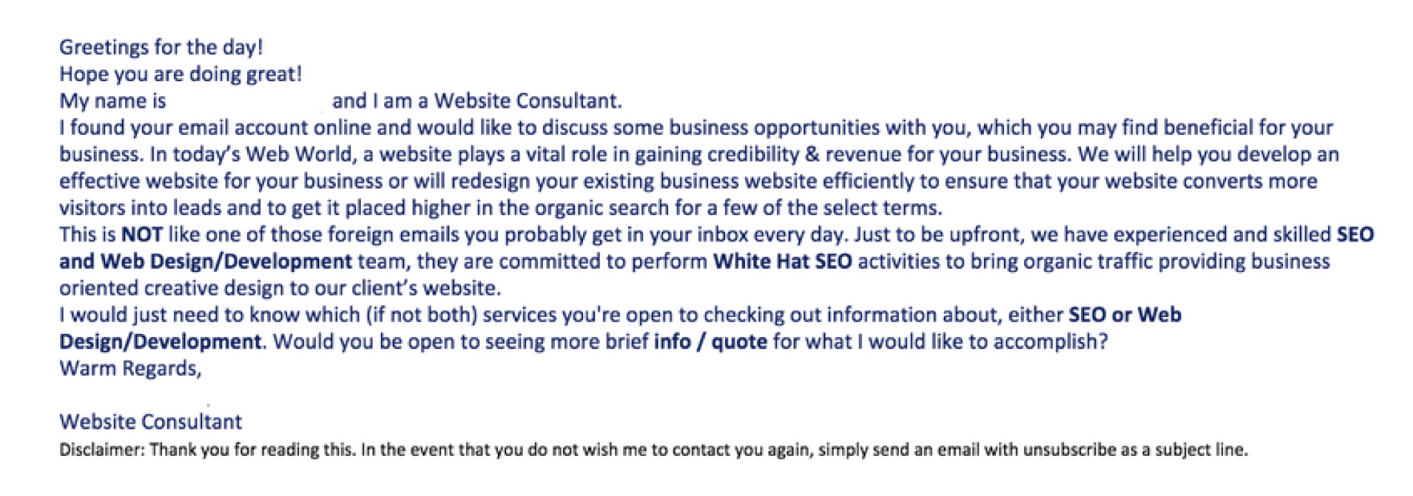
kori screenshot 1

There’s a lot going on here. Decisionmakers are constantly on the go –in and out of meetings or on the road. Your messages should be easily readable from a smartphone. Here at SalesLoft, we recommend no more than 3-5 short paragraphs/lines of content. If you add too much information, you run the risk of overwhelming your prospects.

There’s also a lack of customization and professionalism here. This email wasn’t addressed to the recipient, and includes unsubscribe instructions. It also has two greetings both ending with an exclamation mark. You want your prospects to be excited by your content (not by your use of punctuation).

Sending mass email blasts can be effective for marketing. But in sales, if you want to get the attention of your prospect, you must personalize your content. If you don’t take the time to craft a custom message, why would they for you?

Side note: One thing they did successfully include here was a clear call to action. Without this, you could leave your prospect questioning the whole reason you emailed them in the first place.

2. The “Sorry, Not Sorry” Email

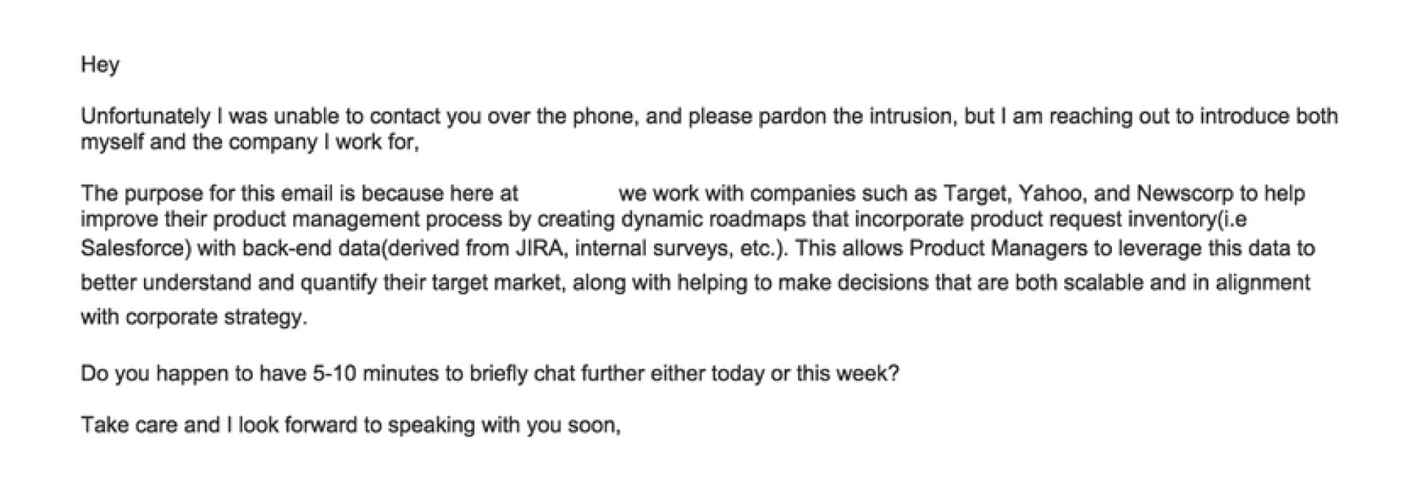
kori ss 2

I recently received a reply to one of my emails that stated, “Not at this time. Love your subject line though, I’m going to use it. Also, I appreciate the apology email tactic… I use it as well.” At first, I didn’t understand — I never apologized to him in any of my emails. And then dawned on me, he was apologizing for not responding to my various touch points. Through personalization, I was able to establish enough rapport that he felt he owed me a response.

This can’t be achieved by apologizing for making contact. If you assume you are intruding, then your prospects will assume the same. If you do your research and spend enough time customizing your emails, your prospects will appreciate what you send (even if they’re not interested).

Nevertheless, this email was on point in several ways. The length was realistic, it had a clear call to action, and it included social proof, which is essential to warming up your prospects. If they took it one step further and included companies in the same space, that would have been even more valuable.

3. The Dreaded “Just Checking-in” Email

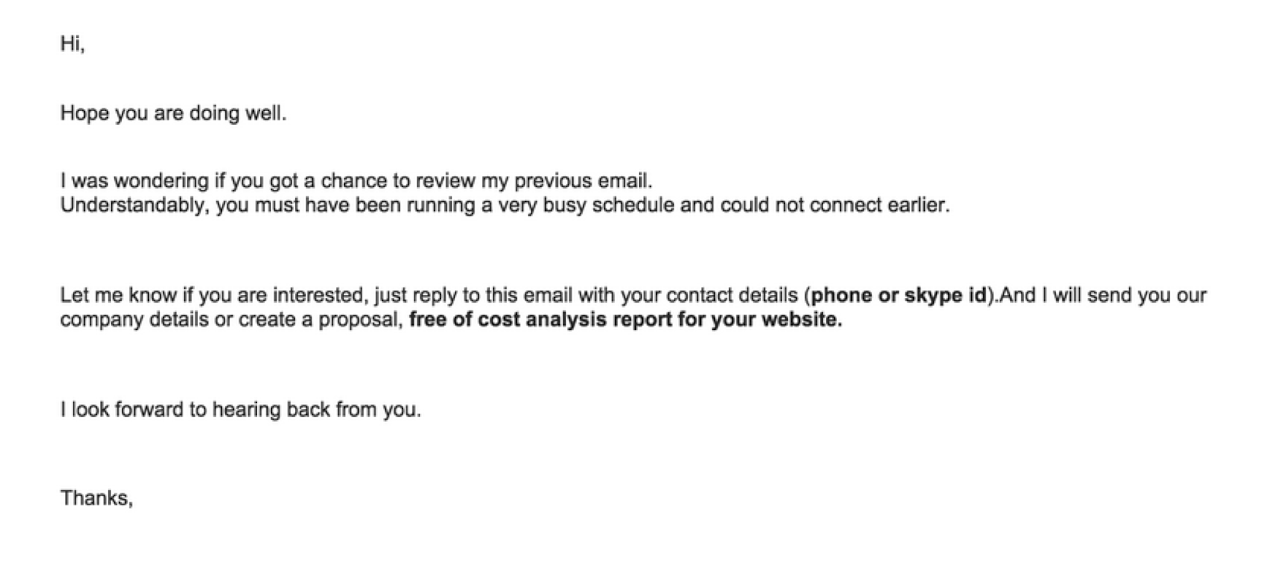
kori ss 3

The reality of your prospect filtering through their inbox to find a previous email they already disregarded is slim to none. Not only do you not  want your emails to be repetitive, but you really don’t want your prospects to have to do extra work to understand your message.

While this email was the appropriate length, it was empty. We don’t know who they are or what they do, and vice versa. A great way to avoid this is to provide something valuable to your prospects, which once again works towards building rapport.

Pro-tip: When you don’t know what to say, don’t just send fluff. Find a piece of relevant content to share and explain why. An empty email is a waste of your time and theirs.

Let’s try this again… If we avoided all the errors made above, a perfect sales email would look like this:

“Hi Anthony,

I really enjoyed your latest Sales Tips video. I totally agree with your thoughts on constructively breaking down calls/demo recordings during 1:1 meetings.

While on your site, I also noticed that you’re currently hiring for several new SDR positions. As you continue to build out your team, do you have a scalable process in place to ensure your Reps keep track of their valuable leads?

To keep it simple, SalesLoft is a strategic platform that combines phone, email, and social touches to ensure consistent execution of your sales cadence or outreach. I would love an opportunity to chat with you to learn more about your current process.

When are you free for 30-minutes on Monday or Tuesday for a call?

Cheers,

Kori”

Always remember to keep your emails short and concise. Be confident with your prospects — they will respect you more for it. And finally, take an extra minute to personalize your message. While customization can be time consuming, there are ways to expedite this process through dynamic tags and semi-automation. Check out SalesLoft Sales Email for a quick and easy way to remain personal but efficient with your sales emails today.

SalesEmailCTA

The post Sales Emails Gone Wrong appeared first on SalesLoft.

26 Oct 16:55

Learn to love the “no” (and win in sales)

by steli@close.io (Steli Efti)

Hearing the word “no” is never fun—but think about it this way: If everyone said yes, there wouldn’t be a need for salespeople. The reason why you have a job is because people say “no,” all the time.

Because rejection is something that everyone struggles with, it provides you with an incredible opportunity to distinguish yourself as a salesperson and rise to the top of the pack. If you want to be a better salesperson, learn to love the “no’s.” In doing so, you’ll give yourself the edge you need to excel.

Work with the “no’s” instead of despite them.

Expect the word “no.” Anticipate it, and be prepared to hear it often.

Let’s run through the different types of “no’s” you’ll encounter as a salesperson, and how you can transform each into an opportunity to forge forward.

The generic “No”

“It is easier to resist at the beginning than at the end.” — Leonardo Da Vinci

In the early stages of your deal, the objections you’ll field will often be less substantive than the ones you get later in the sales process. You need to manage these generic “no's” differently than a “no” that comes later in the sales process.

When people say things like, “I don’t have time,” “it’s too expensive,” or “I’m not interested,” early in a call, they’re not saying “no” directly to you or your product. They’re giving you generic “no’s.”

At this point, your prospects can’t possibly have enough information to know that your product is of no interest to them.

What they’re really objecting to is giving you time, attention, and credibility.

"What they are really saying is, “I’m saying ‘No’ or a form of ‘No’ because you haven’t given me enough of a compelling reason to buy from you or have satisfied all of my concerns and priorities.” — Keith Rosen

Don’t get thrown off your sales game and hang up the phone. These are the easy “no’s”—be prepared for them. The way you respond, like the way you respond to all rejection, is your opportunity to stand out, and differentiate yourself from all the other salespeople who stutter, “uh, well, but, why?”

Anticipate the “no,” and disarm them with great attitude: “I didn’t have a chance to explain myself to you. I completely understand your position. This morning, I said 'no' to a salesperson—it’s the most normal thing in the world. But at this point, neither of us can know for certain if our offer could provide massive value to you. My guess is we can, because we've helped a lot of companies similar to yours. Let's take one more minute to figure out if this is worth exploring”

You've acknowledge the position that you’re putting your prospects in. But you’re also communicating to them on a more subtle level that they haven’t really said “no” yet, or even taken the chance to hear you out.

"Make people feel okay about telling you ‘no’"Andrea Waltz

If you say it with the right energy, confidence, and clarity, it’ll make all the difference in the world—and start turning the original “no” into a “yes.”

Case study: Elastic Sales

At this stage of the sales call, you’re trying to see if you can build a long-term, mutually beneficial relationship with your prospect—and to do so, you have to get past the generic “no’s.”

For example, when we started ElasticSales, our Sales as a Service business, we built our business from cold calls before our service even existed, before we even had a logo or a website.

We began with only a list of a few hundred companies and a highly-targeted sales script:

“Hey, my name is Steli. I’m calling local startups in the area to see if they might be a good fit for a beta program we’re running. In a sentence, what we do is offer startups a sales team on demand. Does that sound like something you’d be interested in?”

Right away, the prospect gets:

  • a reason for the call
  • a one sentence elevator pitch
  • an exploratory question

For each response, wherever it was on the spectrum between “yes” and “no,” we’d respond: “Gotcha. What does your sales process look like?

Here’s why. At this point in the sales process, none of these responses could be truly substantive. Our prospects didn’t know whether our offer was a good fit—and neither did we. Any final decision would have been premature for both parties. Our initial goal was simply to get them more engaged in the conversation.

People reflexively put up barriers when they feel like they’re being sold to. Instead of selling, try to educate your prospects, and learn more about them. See if you and your product can shine a light on a different aspect their business that they haven’t considered. Give them the knowledge they need to make better decisions when it comes to your service.

If the information you provide is valuable and insightful, you’ll cultivate increased buyer interest, and position yourself as an expert in your field.

You'll start building the traction and trust necessary to make the sale.

The maybe “No”

The later in the sales process you hear a “no,” the more seriously you have to take it. These objections will be more specific, and tend to center more around your actual product—but they’re also not the end of the road. A lot of times, “no” really means “maybe” or “not yet.”

"Each of the “no” responses you get to a request for a meeting after that first “no” is a judgement on how you’re doing differentiating yourself and proving that you can make a difference in their business." — Anthony Iannarino

The only way to tell is to try to work around this type of “no,” and dig deeper.

A prospect will say, for example:

  • “We talked to our VP of sales, and she said that this sales software didn’t have enough reporting functionality when it comes to charting leads in the sales funnel.”
  • “This marketing solution didn’t have enough email integrations with Outlook or Gmail.”

These objections aren’t necessarily fixed, or permanent.

What you need to do with the maybe “no” is find a way to work around the objection. Dig deeper into the root causes of the objection, and if you decide to develop a solution, follow up with your prospects to close the deal.

Find root causes

Manage the maybe “no” by delving further into the actual problem and use case behind these objections, rather than just listening to proposed solutions.

Don’t retool your product or tack on features because a prospect asked you to. You’ll end up with feature creep that will dilute your product and distract your development efforts.

These are the questions you need to find answers to from your prospects:

  • Why do they need this specific feature or solution, and how would they implement it?
  • Is this objection one that we see often in our target market?
  • Is this a crucial feature we need to build that would boost the overall value of our product?

The maybe “no’s” you receive from prospects will often point to holes in your product that you can improve upon to deliver more value to all of your customers. But before actually building new features for your product, make sure that they align with your larger business goals, and your product development roadmap.

Follow up

If you’ve developed solutions to specific objections, stay on the grind and follow up with your prospects. Keep them posted with changes to your product that could win them over.

Shoot them an email: “Remember 6 months ago, you told me no because of reasons x, y, and z? We’ve improved x, we’ve improved y, we’ve developed z, and these are some new customers we’re working with. Would you be up for a quick call next week to re-explore an opportunity to work together?”

If they say no again, or don’t respond, email them again in the next quarter. And the next.

Tenacity and perseverance pay off in the long run. When the time is right and they need a new software solution, guess who they’ll think of? You.

The “No” = No

Sometimes, “no” means “no.” Push too hard, and you’ll waste time and resources, damage your company’s brand, and worst of all, waste an incredible learning opportunity.

"Continuing to chase an opportunity after a no takes time. It takes away from other opportunities. There is a cost to chasing after the no." — Jim Keenan

Say that three months into a deal, new information surfaces, and it turns out that your product isn’t the right fit for the prospects you’ve been talking to on a daily basis. Don’t explode.

Take the opportunity to learn, and find out more about why they said “no”:

  • How did we fail to deliver or show value to the prospect?
  • How do people think about the problem we’re trying to solve?
  • Should we change our sales approach, and how we pitch our product?

Maybe your sales approach is flawed because you’re approaching the wrong customers, or maybe you don’t fully understand the key points where your product provides value.

Find out. Dig deeper into the “no,” and embrace it as a chance to learn. See if you can extract trends and patterns from your prospects’ objections, and iterate them into improving your sales process, your product, and your business.

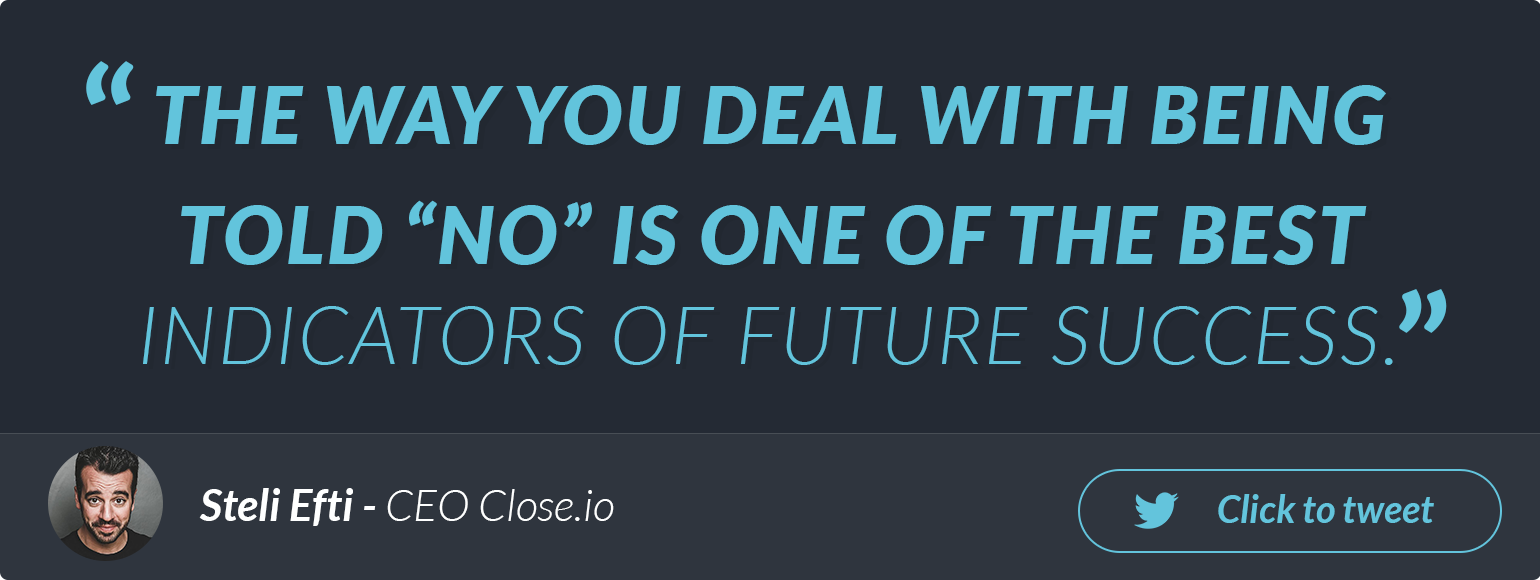
Handle rejection with grace. Smile. The way you deal with being told “no” is one of the best indicators of future success.

ClickToTweet_dark_The-way-you-deal-with-being-told-no

Look at your rate of failure

Measure your success in no’s. Don’t just look at how many deals you win—keep track of your sales rejections, too. Keep a scoreboard for your average rate of failure:

  • How many times a day do people say “no” to you?
  • How many deals do you lose?
  • How many email responses do you get, saying, “not interested”?

As Chris Dixon, founder and angel investor puts it, “If you aren’t getting rejected on a daily basis, your goals aren’t ambitious enough.”

You actually want to have a high rate of failure, if it means you’re thinking big, expanding your sales outreach, and constantly testing new opportunities.

Find inspiration from being told “no.” It’s more than just a “glass is half full” frame of mind. It’s about maximizing upside from living in risk-taking and unpredictability. You don’t want to just survive rejection—you want to turn it into a strength.

Failure breeds success

keepmovingforward

The desire to succeed is natural. But if you work inside a system where you’re always succeeding and winning, you cripple your potential for maximum growth—the parameters for your success is small. You always win, but the cost of constant success is the breadth of that success.

Innovation depends on risk-taking, boldness, and challenge. It depends on the “no’s.”

The “no’s” provide you with the feedback and insight you need to improve—but more importantly, they motivate you to try harder. They push you to constantly test boundaries, and strive at new heights. You chase more opportunities just outside your grasp.

You fail more, but you also win bigger and better.

In 2008, you could have bought 10% of Airbnb for $150,000—all seven investors they approached said “no.” Airbnb kept going strong, and today it’s a $25 billion dollar company.

Turn the “no” around into a positive force for constant movement and growth, and you’ll see outsized returns. Harness the power of the “no” to leap past the competition, and into the future.

26 Oct 16:55

Girls and Boys and Math Anxiety

by Art Markman

When you wander around college campuses, you see the effects of strong gender differences in preferences for majors.  At many schools, there are far more women than men majoring in psychology and biology, but far more men than women majoring in math and engineering.   

This observation has led researchers to explore reasons why men and women differ in the fields they choose.  One of the factors that has been explored is math anxiety—the amount of anxiety that people anticipate or experience when thinking about or doing math.  A common observation across many studies is that when women are asked about their anxiety about math in general they exhibit a higher level of math anxiety than men.

An interesting study by Thomas Goetz, Madeleine Bieg, Oliver Ludtke, Reinhard Pekrun, and Nathan Hall in the October, 2013 issue of Psychological Science examined three questions. First, they wanted to replicate the finding that women exhibit higher levels of math anxiety then men.  Then, they asked whether women who are currently taking a math class or a math exam are actually experiencing more anxiety than men.  Finally, they explored reasons for the differences in math anxiety.

Across two studies, they got measurements from about 700 German students in grades 5-11.  In one study, students were asked for their general level of math anxiety and then were asked to assess their anxiety twice while taking a math exam.  In the other study, students were asked about their general math anxiety and also their specific anxiety in the middle of a math class.  Students were also asked questions about how good they thought they were at math and information was gathered about their math grades.

Both studies found that the girls were more anxious about math in general than the boys.  Interestingly, when the questions were asked during an exam or during a class, the girls and boys were equal in their level of anxiety (and both boys and girls had very little anxiety in the moment).  

What is going on here?

It isn’t math performance.  The girls and boys in both studies were doing equally well in their math classes.

Instead, it seems to be related to differences between boys and girls in how good they think they are at math.  The boys’ ratings of their competence at math were consistently higher than those of the girls.  Statistical tests show these differences in ratings were related to differences in general math anxiety.

These findings suggest that it would be valuable to help all children get better calibrated about how well they are doing in math classes.  Knowing their level of performance could help them to reduce their anxiety about math in general.  In addition, it might be useful to take children who have general math anxiety and to help them to realize that they do not experience that much anxiety when they are actually doing math.  

Clearly, math anxiety is not the only factor that leads to differences in the majors that people pursue in college and the careers that they establish.  But, anything we can do to reduce the influence of general anxiety on career choices is a good thing.
26 Oct 16:53

Mapping the Client Journey: A Model for Professional Services

by Lee Frederiksen

Customer journey mapping is not new. In fact, it’s commonly used in consumer marketing. But despite its tremendous benefits, it has not been widely adopted in professional services.

You see, customer journey mapping encourages you to look at the entire lifecycle of a client — identifying every point of contact between your firm and your buyers.

It’s a tool that allows you to identify gaps in your marketing, sales and service processes. And you’ll see where your tactics, online and off, may break down.

Customer Journey Mapping Defined

Customer journey mapping involves researching and detailing the steps a client takes to move through the buying and customer cycle. It’s a systematic and comprehensive view of their experience that you can summarize in a customer experience map or an infographic.

The mapping process puts you in your client’s shoes so you can understand and enhance their experience. And better client experiences are a critical ingredient to building your business.

You’ll be compelled to answer questions like, “What goes on inside your buyer’s brain before they launch a project with a service provider?” and “How do buyers make decisions?” By wrestling with these questions, you’ll be able to improve the way you connect with prospective clients — and boost your chances of closing the sale.

But many firms end their mapping process there — at the point where a prospect becomes a new client. That’s too bad. You should never think of a new contract as the end — after all, it could be the beginning of a years-long relationship. So your customer journey map should also explore what goes on during the client engagement, what happens between engagements, and how you can encourage former clients to become reliable sources of referrals.

Such a comprehensive, detailed customer journey map helps you analyze your client’s experience and better communicate with them. But where do you start? The rest of this article introduces you to a simple model you can use to map out and enrich your client’s lifecycle.

To get started, your map will consist of four parts, each representing a stage of the client lifecycle:

  1. The pre-client experience
  2. The client experience
  3. The between engagement experience
  4. The former client

Mapping the customer journey

Here’s how to tackle each part:

Stage 1. The Pre-Client Experience

The pre-client experience starts when potential clients realize they have a problem — one they can’t solve themselves. As they look around for answers, they become aware of your firm (as well as your competition, of course). That’s great! You’ve overcome the first hurdle — your prospect is aware you exist.

Next, prospects need to determine whether you can help them. They might talk to colleagues, check out your website (and those of your competitors), and get on social media to find out how others have solved similar problems. Ultimately they want to find out if your firm’s expertise and past experience are relevant to their problems.

Once your potential clients decide which service providers make their short list, they usually do further research to make a final choice.

At this point, there are three possible outcomes:

  1. You’re hired. Good for you!
  2. Not now. Frustrating, but actually not such a bad place to be…the buyer has good feelings about you, but the timing is not right.
  3. No way — you don’t make the cut. In this situation, you may not even know you were in the running. In fact, the buyer might have completed their research without ever contacting you.

Okay, now let’s consider what happens after you’ve been hired.

Stage 2. The Professional Services Client Experience

During a client’s initial engagement, they find out what it’s like to work with you and the value you provide. While one-and-done projects generate incremental revenue, repeat clients fuel long-term growth. So it pays to build enduring client relationships. To win repeat business, you need to meet or exceed your clients’ expectations. So as map out your client journey, ask yourself some questions: Are you living up to your promises? Are you easy to work with? Are you hitting deadlines and staying within budget? During every engagement, you need to ask yourself how the project is going and what you can do to improve the client’s experience.

Eventually, your initial engagement will wind down. What happens next?

Stage 3: The Between Engagement Experience

After you’ve completed your first project — especially if you’ve made a positive impression — the client may decide they want to use your services again. They may not have an immediate need, but you will be the first firm they call when they are ready.  Consumer marketers might call this a loyal customer or regular user.

Now, most customer mapping models ignore the stage between engagements, but we believe it’s critical. That’s because it represents a significant opportunity, one that’s often missed.

Let’s consider an example. Suppose at the end of a successful engagement you determine there is a low chance you will be working with the client in two to three years. You may have a problem. That’s a long time for any company to remember you. If you don’t reach out in the interim, they are likely to slip away forever.

Here’s another example. Often, clients hire you for one thing, and in their minds that one thing is the only thing you do. Just as any actor who has played James Bond becomes typecast, your firm runs the risk of being pigeonholed. You can easily lose out on a job that should be yours simply because the client doesn’t associate your firm with other services you provide.

So as you map your journey, think about what it takes to avoid being typecast. It’s not enough to nurture leads — you need to nurture clients, too, educating them about everything you do. The more they know about you, they more likely they will be to give you a call when the time is right.

Eventually, every client runs its course. But they still have value. Let’s find out how.

Stage 4: The Former Client

Clients leave for a variety of reasons. Perhaps you could prevent some. Others are completely out of your control.

In one camp are clients that had a poor experience. Maybe you dropped a ball or two. Or maybe it was bad chemistry. Either way, they aren’t coming back and they probably aren’t going to recommend you to others. Say goodbye to these forever (or at least a long, long time).

In the other camp are clients who had good experiences. They just don’t expect to need your expertise again. But that doesn’t mean you should forget about them. That would be a terrible mistake.

Why? Well, consider a residential construction firm that designs and builds a couple’s retirement home. Does that firm walk away from that couple forever? No, they stay in touch — maybe fix a leaky faucet or stuck cabinet drawer for free. You see, that happy couple is going to talk to their friends about the great experience they had building their new home. And at some point, an impressed friend is going to hire that same company to build or renovate their own home.

So former clients can be powerful advocates for your firm. Just don’t let them forget you.

Why do most companies ignore this final phase? Probably because it doesn’t fit conventional customer journey models. And it’s far easier — and more exciting — to look to future opportunities than to pay attention to the ones that have slipped into the past. But if you keep in front of your best former clients, you will find that they can be exceptionally loyal, and lucrative, friends.

Mapping Your Touch Points

Every phase in the customer’s journey is connected to others. So you need to be able to step back and see how it all works. That’s where the customer journey map comes in. Begin by identifying how and when your firm interacts with clients during each stage. Then note these touch points on your map.

What does an actual customer journey map look like? It can take a range of forms — from a highly visual infographic to a spreadsheet to a basic Word document. The tool you choose matters less than the quality of the data that goes into it. The goal is to recognize the critical decision points (see illustration above) where clients will either hire you or take another avenue. Only then can you see how you can meet their expectations and tip the scale in your favor.

At Hinge, we work with a wide range of data to map out a client’s entire customer journey. To understand the pre-client phase we conduct interviews with prospects in the marketplace, as well as the “got-aways” who ended up selecting another firm. That way we learn what prospects want out of a service provider.

We also talk to current clients to understand the quality of their experience with their professional service provider, as well as to learn whether they understand the full breadth of our client’s services.

Finally, we research former clients to understand where they stand on the map and what future prospects they offer: Are they between engagements, or are they gone for good? How likely are they to refer the client, and why?

You can plot your own customer journey map with information you may already have — client satisfaction surveys and follow up with former clients. But without detailed research into prospects and “betweeners” — and without a clear understanding of how much clients at every stage know about your range of services — there will be significant areas of terra incognita on your map.

To understand where the gaps exists, you’ll need to analyze each client stage. What proportion of clients experience each outcome? For example, how many prospects become clients? How often do clients move into the “between engagements” stage? How many former clients are recommending you? And, of course, why? Most important, what could improve your clients’ experience — and create better outcomes?

If you can’t answer all these questions you may need to conduct research to see the full picture and make the most of all of your opportunities.

Inside the Buyer's Brain: A practical guide to turning buyers into believers

26 Oct 16:52

Write a Better Speech by Practicing It On a Novice

by Kristin Wong

If delivering a speech isn’t intimidating enough, writing one can be just as difficult. And if you’re dealing with a complex topic, it might be hard to gauge whether or not you’ve simplified that topic enough for people to understand it. One way to make sure you have is to practice that speech on a novice.

Read more...

26 Oct 16:46

Autonomous Car Sets Record in Mexico

by Jeremy Hsu
Image: AutoNOMOS Labs

An experimental self-driving car has set a record for an autonomous road trip in Mexico. The trip from the U.S.-Mexico border to Mexico City provided the opportunity to collect data and prepare for an even longer upcoming road trip from Reno, Nevada to Mexico City.

The autonomous car in this case was a 2010 Volkswagen Passat Variant named Autonomos. The modified, self-driving vehicle can automatically control speed, direction, and braking without human driver intervention, but it also relies upon GPS to safely follow preset routes. Researchers prepared special maps containing terabytes of data detailing the number of lanes, highway markings, exits, intersections and traffic lights.

“We covered 250 to 300 miles daily, so it took a week to arrive to Mexico City,” said Raul Rojas, a visiting professor of robotics and intelligent systems math at the University of Nevada, Reno, in a press release. “Some parts of the highway were scary, but we had no important safety incidents.”

The 2,414-kilometer  (1,500-mile)  Mexico road trip took place along Mexico’s Highway 15. About five percent of the route included construction work and potholes. But the bigger challenge for the self-driving car came from the lack of lane markings along lengthy stretches of highway due to repaving work over the summer. 

Rojas previously tested  the same car  in autonomous driving mode on a 306-kilometer round trip from Berlin to Leipzig in  Germany. He and his colleagues outfitted Autonomos as a “driving laboratory” with seven laser scanners, nine video cameras, seven radars and a GPS roof antenna.

For the Mexico trip, Rojas brought along three German colleagues. Everyone took turns as safety drivers; one person kept an eye on the road in the driver’s seat and one person watched the computer and navigation systems to see what moves the autonomous car planned to do next. The remaining pair of people followed in a support vehicle.

The Mexico road trip represented just one leg of an planed 6,437-kilometer trip from Reno to Mexico City. Eventually, Rojas hopes to improve the autonomous car’s ability to predict the behavior of other drivers and pedestrians. Such capabilities would go a long way toward making autonomous cars safer beyond just highway driving.

“If a human can drive with two eyes, I am sure that we will be able to drive autonomously with a computer the size of a notebook and just a handful of video cameras in just a few more years,” Rojas said.

Huge tech companies and automakers have increasingly been testing self-driving cars on public roads. But semi-autonomous features have also been creeping into existing commercial cars. For example, Tesla Motors recently uploaded new Autopilot software to its Tesla Model S vehicles. And in 2014, the Mercedes-Benz S Class already brought semi-autonomous features to the commercial car market with adaptive cruise control and automatic collision prevention.

26 Oct 16:43

13 apps that will stop you from wasting time

by Nathan McAlone

clock tower

Time often seems to just slip away. And whether you want to prevent yourself from wasting time, or make your work time more productive, there are lots of apps that can help.

These 13 apps will make scheduling less painful, help you keep track of what you are spending your time on, and even punish you for checking social media too much. They'll also help you see a big picture of how you spend your time and show you small tweaks that can carve out a few more hours of leisure time.

Here are 13 apps to stop you from wasting time, many of which have been featured on Product Hunt.

SEE ALSO: These 17 apps will help you live the dream of traveling around the world while working from wherever you want

Sunrise is the best way to bring all your calendar services together.

Sunrise’s secret weapon is its beautiful and simple interface, as well as integration with all the other popular calendar services. It also connects with other apps as well, like Facebook, Google Maps, and Evernote, and features a handy calendar-within-a-keyboard that makes scheduling a meeting easy.


Price: Free (Web, iOS, Android, Mac)


RescueTime gives you a picture of your daily computer habits.

RescueTime helps you track how much time you spend on different applications and websites. It runs in the background and lets you get a snapshot of your daily habits, and change them if you need to. It can even categorize activities and show you how much time you spend on things like entertainment, social networking, and news.


Price: Free (Mac, PC, Android)


Timewaste Timer charges you money for overusing Facebook.

Timewaste Timer is a hilarious app that punishes you every time you use Facebook more than an hour per day. The app charges you a dollar (from an account you fund) every time you give in and peruse Facebook for too long. The only thing we wish is that the proceeds went to charity.


Price: Free, sort of (Web)


See the rest of the story at Business Insider


26 Oct 16:43

Venture capitalist Mark Suster laid out the case for a tech bubble

by Sam Shead

Mark Suster

Mark Suster, an entrepreneur who sold his business to Salesforce before becoming a venture capitalist, has called into question the valuations being achieved by many of today’s technology startups.

The Upfront Ventures general partner published a blog post earlier this month where he predicts what will happen to the venture capital market next year.

In Venture Outlook 2016, Suster writes, "our late-stage, privately held technology market is clearly in a bubble," adding that "we’re doomed to repeat history. Boom and bust."

Suster believes that the "over-heated private tech markets will cool" in 2016, however, he concedes that he’s been saying that for the last two years.

The number of so-called unicorns (firms with a valuation in excess of $1 billion [£650 million]) has risen sharply in the US over the last 18 months, going from 30 in 2013 to more than 80 today.

New unicorns

Some young companies such as Airbnb and Uber have raised vast amounts of money from investors and they’re now considered mega-unicorns, with valuations of $24 billion (£16 billion) and $70 billion (£45 billion) respectively.

"Either we’ve discovered magical beans and elixir or perhaps we’ve gotten ahead of ourselves on valuation," writes Suster.

Suster believes that the valuations of private tech companies are being over-inflated largely as a result of new investors entering the market, specifically corporate investors, hedge funds, mutual funds and crowdsourcing. 

Corporates graph

Corporates piling in

Non-VCs led the vast majority (78%) of funding rounds in the 80 $1 billion-plus companies in the last 18 months, Suster wrote.  

"Corporate investors including Google, Rakuten, Alibaba, Comcast and others have increased their investments in venture and often don’t have the same profit motive (and thus pricing motive) as traditional investors," according to Suster. "This isn’t a damning statement or indictment of corporate investors – it just should be acknowledged that often there are strategic reasons for making investments beyond what a purely financial investor would be expected to do."

When interest rates go up it's likely that non-VCs will stop investing in startups so much and focus on more traditional asset classes instead.

"The only reason now there is so much investing in startups from non-VCs is the lack of yield in any other asset class," wrote Val Tsanev in a comment underneath Suster's post.

Tsanev added that a lack of investment from non-VCs would force many of the unicorns to either go public or get profitable "because no VCs can cover $2 billion - $3 billion rounds."

Join the conversation about this story »

NOW WATCH: Clever iPhone tricks only power users know about

26 Oct 16:40

How to Fire a Client

by Sarah Aderson

If you haven’t fired a client yet, then you will.  More likely than not, you’ve already encountered this situation, but you chose to grin and bare it.  This behavior doesn’t serve you or your clients.  The truth is that most entrepreneurs aren’t prepared to handle these tough situations.  This can have many harmful effects.  In fact, withholding your truth and denying your values actually block your financial abundance.

Sometimes it simply isn't a good fit between you and your client.

Sometimes it simply isn’t a good fit between you and your client.

When you’re solely focused on the end result of making money, then firing a client may seem unthinkable.  The end result is pointless if you’re unhappy.  If you want to work with people that you dislike, then you should probably go be an employee.  As an entrepreneur you have the power and freedom to say NO.  By focusing solely on making that next sale, you relinquish your power.  In turn, you lose your entrepreneurial spark.  That light in your eye dims.  Your energy is sapped.  Dare I say it?  Your business becomes more like a dreaded J.O.B.  All of your business activities are shrouded in negative energy.  You’ll even attract more clients like the first client that you should have fired.

You’ve bought into the idea that a client is better than no client.  Not true.  All clients are not good clients.  Of course every client will not be your ideal client either.  As hard as you’ve worked to get your clients, there will come a time when you have to fire one of them.  Trust me, I know that you want to help everyone, but you can’t.  You are here to help a specific group of people.  These people get you.  They respect and value you.  They will feel like your extended family.  Compassion, respect, and honesty towards others are non-negotiables in building strong client relationships.

Your body will give you signals when a client needs to be fired.  You’ll feel tension, anxiety, and even pain at the sight or mention of your client’s name.  These warning signs occur in order to get your attention.  Picture a flashing, bright yellow neon sign with the words “You’re Out of Alignment” in front of you.  Your body is telling you that you’re working with the wrong person.

In addition to your internal indicators there are also external ones.  Here are 5 reasons to terminate your professional relationship with a client :

  1. Your client participates in activities that violate your moral and ethical codes of conduct.
  2. Your client has asked you to participate in activities that violate your moral and ethical codes of conduct.
  3. Your client is disrespectful, insulting or demeaning towards you.
  4. Your personalities and energies do not mesh together.  It happens.
  5. Your client isn’t ready.  They may not have the necessary mindset, dedication, finances, or intention to work with you in this capacity.

Once you’ve gained awareness and identified your reason, then it’s time to address the issue.  The problem will not go away if you just ignore it.  It will only get bigger until you take action.  Use this 3-step process to handle difficult conversations with clients:

  1. Politely inform your client of the situation or behavior.  They probably aren’t even aware that they did something improper or that it came across that way.  This can be considered their first warning.  Clearly state the consequences of another incident.  Follow-up with an email highlighting what was discussed.  Be honest and considerate of their feelings.
  2. (Optional) Speak to your client again if the situation or behavior occurs a second time.  Changing a habit takes time.  This may be the first time that anyone has spoken up about their behavior.  This is where compassion comes in.  You may elect not to perform this step depending on the severity of the situation.
  3. Terminate your professional relationship with your client.  Politely and calmly remind your client of the initial conversation.  Then, inform them of the second (or third) violation.  Tell them that you will no longer be able to assist them professionally because it’s simply not a good fit.  To maintain goodwill you should refund all or a portion of their payment depending on the nature of your business/services.  Also, you can give them a 15% coupon to use on any of your digital or physical products.  After the conversation you need to take a deep breath and release any lingering tension.  Simply, let it go and move on.

A few words of caution:

  • Do not speak to your client when you’re upset, angry or extremely emotional.
  • Never fire a client without giving an initial warning.
  • If you’re going to make an exception in steps 1 or 2, then clearly state that it’s a one-time thing.
  • Do what you say you’re going to do.
  • Focus solely on the undesirable behavior and the facts.  Do not make it personal!
  • Remember, your objective is to end the relationship on good terms and in a professional manner.

It’s time to stand up for your values and speak your truth.  Are you ready to become an Empowered Entrepreneur? When you serve others from a place of total alignment, then waves of financial abundance will flow to you.  You’ll attract clients that truly value and respect you and the services that you provide. Comment below and share how you’re going to align your business and values.  I’ll come back and join in the conversation.

26 Oct 16:39

7 Ways to Get Buyers Wavering on Money to Pay Full Price

by arts@businessbyphone.com (Art Sobczak)

I ran into a local Chinese restaurant at lunchtime to get a takeout order from the lunch menu. I asked if soup came with the order. The woman at the counter told me that they did not have soup to go with the lunch specials.

I really wanted some hot and sour soup.

"So how can I get soup?" I asked.

She pointed to the menu and said all they had was the big container for two, for six dollars.

"How about just filling it halfway, making it for one, and charging me half price?"

She smiled and said, "The soup is for two and is $6."

I bought it.

That was a great example of standing firm on price.

It is isn't rocket science, but it's an age-old dilemma: salespeople dropping their price at the first sign of resistance, or request for a better price. And the ones who do it, who cave in to price statements and questions, give away pure profit. Usually, needlessly.

But perhaps they don't have the confidence or know-how to avoid falling into this trap. Here are some ideas you can use as well to avoid giving away profit.

1) Raise your value in their mind, or the cost of the problem, higher than your price.

It's quite simple -- if a buyer perceives their potential return as higher than your price, then price is not an issue. Ask questions to get them to attach dollar figures to pains or problems. "What does that cost you?" "How much extra time does that take?"

2) Delay discussing price until you have established value.

If asked early about price, respond with a statement along the lines of, "So I can give you the best price for your situation, let me ask a few questions ... " Then circle back to value.

3) State your price with unwavering conviction.

If you hem and haw, this indicates you are not firm with your price and it's open to negotiation. Say your price with the same confident tone of voice you would use if someone asked you in which city you live.

4) Realize that price comments are not price objections.

When someone says, "Wow, that's more than what I expected to pay," they are not saying they will not buy. You do not even need to respond to this comment. However, many sales reps offer to cut price at this point.

5) Have a quick response on hand to "Do you discount?"

How about: "No, that's the price." Or, if they ask, "Can you do any better on price?" say, "That's the price." Simple.

6) Qualify for money.

I do not like asking about budgets, since it can kill a sale when they say their budget has been spent. If a prospect wants something badly enough, they normally can find the money for it, if you are talking at the right level.

Sometimes, however, you need to learn if you are even in the same ballpark. I once heard a very successful sales rep say, "Our product has a useful lifetime almost double anything else on the market. That also means it's not the cheapest initial investment, but a better value over time. That's not a reason for us to stop talking, is it?"

7) Help them find the money.

In some cases, the money might be tight. Then ask about the past: "What have you done before when you wanted something that would give a return on your investment, but did not have the funds available?"

Use these ideas and you will find that every dollar you don't give away is a dollar of pure profit.

Editor's note: This post originally appeared on Smart Calling Online and is republished here with permission.

Get HubSpot CRM today!

26 Oct 16:39

Have You Been Social Selling All Along?

by Susan Marshall

Have You Been Social Selling All Along

Chances are, you’ve read a blog post, joined a webinar or attended a conference that celebrated the “social selling” revolution. Supporters of the social selling movement claimed that LinkedIn, Facebook, Twitter, and other social sites would bring an end to the stereotype of pushy, disconnected, quota-hungry salespeople and give rise to a new breed of relationship-first sellers who use social media to seek connections instead of transactions; who share valuable resources instead of pushing products; who listen instead of talk.

Yet despite the promise of social selling, just one in four salespeople know how to use social media to sell, and a mere 31 percent of reps report using social media at all in their sales process.

The meager adoption of social selling, however, isn’t because it doesn’t work. In fact, 73 percent of social salespeople strongly outperform their traditional selling peers. The problem is that the concept of social selling is woefully misunderstood.

Many salespeople tend to think of social selling as an entirely new discipline: “I know how to sell in the real world, but now I need to learn how to sell on Facebook, LinkedIn, and Twitter.” But the simple truth is that social selling isn’t new. The same traits that determine if you’re a good salesperson offline—being honest, helpful, and informative—are what make salespeople successful in the social sphere. Social media are tools. Being a good salesperson is a mindset. (highlight to tweet)

So, although you may have at first been intimidated by the concept of social selling, understanding the similarities between selling online and traditional selling will help put you at ease. You’ve been social selling all along, and you didn’t even know it.

LinkedIn: Like Trade Shows Without the Travel

Trade shows are a massive investment in time and money. The average attendee travels more than 400 miles to each show and spends more than eight hours meandering through a maze of exhibits in search of leads. The grueling days and hefty travel expenses are worth it, though, if each trade show visit results in new relationships forged on the exhibit hall floor.

It’s that same ability to build meaningful, long-lasting relationships that makes LinkedIn so valuable to salespeople.

Contrary to popular belief, LinkedIn is more than a job-hunting destination—it’s an incredibly deep research and prospecting tool that can be used to unearth new prospects and identify key points of entry into the businesses you’re targeting.

Consider how you select which trade shows to attend before buying a badge. You visit the trade show website, do some research on who’s slated to speak and which companies are signed on to exhibit, and then make a judgement call on if you think it’ll draw the type of prospects you’re looking for.

Finding and connecting with prospects on LinkedIn is even easier. Featuring a variety of search options and detailed profiles, LinkedIn enables you to quickly find the people you want to connect with and makes it easy to ask existing connections to introduce you to their connections to broaden your network.

Following through on our analogy, if you think of LinkedIn as a trade show, then LinkedIn Groups are the swanky, invite-only after parties. And, just like at real parties, nobody likes a pushy salesman crashing a LinkedIn Group. Groups aren’t a place to hawk your products and services. Rather, they’re a place where you can answer questions, share relevant and informative resources, and engage in conversations. By joining in on these real—albeit digital—conversations, you’ll earn a reputation as an expert whose products or services are worth paying attention to.

Twitter: A Warmer Alternative to Cold Calls

Think those cold calls are working? Think again. According to sales research group Huthwaite, 91 percent of people never respond to cold calls and, even worse, 71 percent find them annoying. Even salespeople hate cold calling: 63 percent of reps say it’s what they hate most about their jobs.

Even if cold calling is a necessary evil to filling your funnel, wouldn’t it be nice to know just a little bit about a prospect before reaching out to them? Well, think of Twitter as a tool for making cold calls warmer.

The best thing about Twitter is that you don’t need to tweet a single thing to start seeing its value—all you need to do is start “listening.” Twitter is the perfect tool for conducting some basic pre-sales research, because you can search for specific keywords and phrases to identify prospects. Plugging in a competitor’s name might turn up a Twitter rant from an unhappy customer looking to make a switch. Or, you might find that a prospect is narrowing down their shortlist and looking for suggestions from the Twittersphere. You may even stumble upon some of your own customers requesting (or, in more severe cases, demanding) help.

Twitter enables you to find and engage with prospects at every stage of the sales cycle, and can even help you intervene should a current customer be having a hard time. And, should you be so inclined to share some tweets of your own, you’ll find that the Twitter audience is eager for advice: 73 percent of people trust the information they receive from Twitter.

Now, isn’t that better than taking a shot in the dark on a cold call?

Facebook: A Friendlier Way to Nurture Leads

Potential buyers don’t become customers overnight. In fact, according to MarketingSherpa, 79 percent of marketing leads never convert into sales due to lack of lead nurturing. Conversely, leads that are effectively nurtured make 47 percent larger purchases than non-nurtured leads, according to The Annuitas Group.

Relationships are critical in today’s sales cycles, and the only way to build those relationships is by communicating with buyers throughout every stage. Phone calls and email have been the two biggest lead nurturing mainstays among sales reps, but Facebook presents a unique opportunity for salespeople to connect with prospects and maintain relationships over time.

While Facebook started as a way for college kids and, eventually, friends and family to keep in touch, it has evolved to become an important source of news and information for the majority of adults. Nearly 80 percent of people consume some news when checking Facebook, including a small percentage who consider Facebook their primary news source. In other words, it’s no longer taboo to share information (provided it’s relevant and useful) with your Facebook friends.

Nurturing leads on Facebook is no different than nurturing them on a phone call to check in or an email that includes a relevant case study. Nurturing—using any communication channel—is less about closing the sale, and more about answering and asking questions, providing valuable content, and engaging in real conversations. And because Facebook is a place where people are more inclined to share what’s happening in their personal lives, it can lead to even deeper, more meaningful connections.

You’re Already a Social Selling Pro

Social Selling isn’t a new concept; it’s simply taking the same traits that make people good at selling at trade shows, on phone calls, and throughout the nurturing process and applying them across social channels. If your goal is to provide useful information and forge a meaningful relationship, then you will see your sales spike regardless of if you’re meeting in-person on the trade show floor or on LinkedIn, making contact through a cold call or on Twitter, or nurturing through follow-up emails or Facebook. Simply put: social selling is selling.

Get more content like this, plus the very BEST marketing education, totally free. Get our Definitive email newsletter.

       
26 Oct 16:38

How The Sacramento Kings Completely Transformed Their Sales Strategy

by Ryan Estis

How the Sacramento Kings Completely Transformed Their Sales Strategy

Phil Horn found himself at a crossroads.

As Vice President of Ticket Sales and Service for the NBA’s Sacramento Kings, his job was to fill the arena every night, ensure an incredible experience for the fans and foster growth for his employees. That’s no easy job under the best circumstances, but if you follow professional basketball, you know how the Kings fought hard to keep their beloved team through some very challenging circumstances.

For the first few years of Phil’s tenure, rumors swirled that the Kings would relocate to a different city. Would they leave Sacramento and head to Anaheim? Seattle? Phil’s Ticket Sales and Service team faced the difficult task of keeping the local fan base engaged, excited, and coming out to games. Phil also had to keep his sales group motivated and committed during uncertain times when they didn’t know whether they’d have a job the next day.

He and his management team watched their sales staff shrink from 50 to 15. With an uncertain future and a duty to help their employees grow, they helped salespeople find jobs elsewhere in sports. Every day was a question mark. And then, things changed. Fans and the citizens of Sacramento rallied and worked tirelessly to fight for their team. In 2013, Vivek Ranadive led a dynamic and diverse group of investors to purchase the Sacramento Kings, securing the team’s future in California’s capitol city. Vivek’s on- and off-the-court “NBA 3.0” philosophy marked a new era in Sacramento.

The goal: Grow the city and Kings brand globally. Make a positive impact on the local community. And do it all through powerful, cutting-edge technology.

For the Kings Ticket Sales and Service team, that meant reinventing the sales strategy. They needed tools to help them attract the best new sales employees quickly and reach out to a huge influx of demand from newly-committed fans. Phil started looking for technology that complemented the team’s new vision — tools that would help them achieve “Sales 3.0.”

Finding Disruptive Sales Technology

Phil came up with an acronym, SAC — social, accelerated, collaborative — to guide his search for the technology he needed to achieve his goals. “We were looking for sales tools that did three things,” he says. “They had to be social — help us amplify our story through social conversation. They had to be accelerated — allow us to do what we’d normally do faster and more efficiently. And they had to be collaborative — foster a team-selling environment that would make everyone better and help us share ideas.”

Phil talks more about the team’s use of technology in this video:

No More Cold Calls

“We looked at our data and our sales strategy and realized we weren’t selling to buyers in the way they wanted to buy,” Phil says. “No one wants to answer their phone anymore. Everything is text; everything is digital. We decided to sell the way people want to buy.”

And, they decided to let their sales staff sell in a way that was more comfortable to them, using tools that mirrored their personal lives — social media and smartphones instead of cold calls.

“We made a deal with our team that no one would ever have to make a cold call again — but they did have to try the new tools we were testing. We promised our people we’d help them become smarter, faster and more efficient — and they’d have an opportunity to make more money.”

Kings sales leadership also made an important decision about who would have access to the new tools. “We decided that we were going to roll out all the tools to everybody. These wouldn’t be special tools for the top people. From day one on the job, everyone got access to really cool new technology. Everyone got an equal opportunity. That became powerful for our recruiting. We were making a significant investment in tech and training, and it set us apart in the industry.”

Because of their emphasis on forward-thinking new technology, the Kings started attracting the best sales talent in the business. A sales team that was once shrinking was now booming with new candidates knocking on the door.

Humanyze

One of those cool new tools is called Humanyze, which uses smart wearable badges to monitor sales reps’ activity and find out which behaviors are most important in the sales process. This fall, Fast Company featured The Kings and Humanyze:

“…The Kings sent their sales staff into the stands before and during games while wearing the badges. They discovered two things: the reps who spent the most time and energy in motion (both through the stands and in front of customers) sold twice as much as their peers; and the less they talked, the more they sold. Taking these lessons to heart, the Kings tripled their in-game sales last season compared to the previous year. The team has since abandoned cold-calling for face-to-face interactions, quadrupled its sales staff, and started a mentoring program to teach new recruits.”

Humanyze also showed the team that the most senior sales reps weren’t spending much time talking to rookies. “That was a miss,” Phil says. “There was a lot of value that could have been passed along there. As a result, we created a mentorship program that gives veterans and rookies one-to-one mentorship.” The program encourages mentorship pairs to get to know each other, and uses monthly contests with incentives based on pairs’ sales performance. “We’ve seen some rookies really take off because of that opportunity.”

There’s one common thread that Phil says connects all of the team’s new sales initiatives. “None of these new techniques would be working without the amazing willingness and excitement of our staff to try new things,” he says.

The Kings story is a powerful example of using disruptive technology to shift a sales strategy, motivate people and overcome challenges. I’m excited to see where the sales team goes from here, and I’m including a full version of this story in my new ebook on sales and engagement, coming soon.

26 Oct 16:28

A Lead Is A Terrible Thing To Waste – Sales eXecution 314

by Tibor Shanto

By Tibor Shanto – tibor.shanto@sellbetter.ca 

Garbage

Every day around the globe thousands if not hundreds of thousands of leads are created. Some are created by nice marketing folks, others by sales, some at trade shows, probably a few on your site, some are inbound, many are outbound, and frankly some are nowhere bound, but there is nothing but hope and blue skies at the point they are created.

But many of these leads never have the opportunity to grow into viable leads, delivering their full potential, evolving into prospects and finally full blown sales. No, many leads are wasted, ignored, sadly forgotten, and like so many before them, end up being another “might have been”, the latest addition to a pile of unrealized business cards.

Waste is never good, especially when what’s being wasted has real potential. It is especially sad when many sales people are begging or Jonesing for leads. Normally people are careful with a resource in shortage, in this case leads, and the ultimate finished good, sales and customers, sellers should be working leads full out, not wasting them. While leads may be a renewable resource, that’s no reason to waste or be casual with them, if you don’t want to work them, someone else will. Each of these leads has the opportunity to reward you now, and pay dividends well into the future. So why do people in sales allow, and at times deliberately set out to, waste and squander leads. After all, a lead is a terrible thing to waste.

Some have told me that they are not wasting these leads, but allowing them to “fully develop”. Why just last week, during a review with an IT sales rep, he told me that the lead was “not real, they are not looking to buy for another six months.” The sales version of the glass half full routine. Where I saw a good runway to build rapport and understanding, he only saw something wasting his time. “What’s a good lead?” I asked, “Someone ready to buy now, not next year.” I followed up and asked how long his sales cycle normally was, he told me six months. I tried explaining to him, but he insisted that there was no point in engaging with them for another six months.

While you can forgive the stupidity of the above, what is not forgivable, are those know what they have to do but don’t do it. Follow up once, twice and then punting, is wasting. But it takes effort to develop and execute a good pursuit plan. On the other hand so does whinging about the quality of leads you get from marketing, I mean how many times can we hear the same story.

Better use of that energy is to develop a plan for maximizing every lead. The plan should take the emotion and guess work out of maximizing a lead. Outlining the specific steps to take in converting a lead to a prospect will take the emotion and the effort out of it. You will be there early, you will do things to build rapport as time moves forward, and you’ll be the right person at the right time. Not late because you were were waiting for the perfect time, trying to get that right is a waste of time and leads. And you know what they say, “A Lead Is A Terrible Thing To Waste”.

Tibor Shanto    LI Bottom banner

26 Oct 16:28

The Challenger Conundrum: What If Marketing Isn't Up to the Challenge?

by bob@inflexion-point.com (Bob Apollo)

As regular readers will know, I’m a great fan of the principles set out in the best-selling “The Challenger Sale”. But there’s an unspoken difficulty: what if the smarter members of the sales team “get it”, but marketing is not yet ready or able to support the initiative. Do you have to admit defeat, or wait for things to change? Not necessarily...

I’m delighted to introduce a guest article by Jack Dean, co-founder of FAST Partners, who confronts the issue head-on - and offers some highly practical advice about what to do next. The article was originally published here. Over to you, Jack, and thank you for your permission to share this:

The Challenger Conundrum: What If Marketing Isn't Up to the Challenge?

"You want to become a Challenger Rep®, but your company’s marketing organization is not supporting your personal aspiration.  Houston, we have a problem.

The Challenger SaleReading between the lines of the The Challenger Sale (authored by Matthew Dixon and Brent Adamson of CEB), a sales rep acting alone faces almost insurmountable odds of becoming a Challenger Rep.  Marketing’s strong support is an essential prerequisite for transitioning a sales rep into a fully-credentialed Challenger Rep.  According to CEB, “Challenger Reps are made, not born”. “Challenging is about organizational capability, not just rep skills."  To reinforce the “organizational capabilities” messaging theme, CEB walks the talk and offers a provocative insight directed squarely at the marketing organization.  “It’s one thing to tell reps ‘Be a Challenger’.  It’s another thing altogether to tell them exactly what you want them to do.”

A Challenging Conundrum

You’ve read The Challenger Sale, and on your own, made the decision to drink the Challenger Kool-Aid.  Or perhaps your manager has told you to “just go out and do it, be a Challenger”.  Your company may have even officially embraced the Challenger Sales Model and kicked off a multiple-year implementation journey recommended by CEB.

But you observe a potential problem: your company’s “organizational capability” to support a Challenger implementation is weak or worse yet, missing altogether.  Your marketing and product groups are stuck in a rut spewing out product-centric collateral and late-to-the-buying-process leads which do little to support a true Challenger transformation.

Instead what you need from marketing are a series of “commercial teaching pitches” and “provocative insights” that could help you deliver tailored customer conversations that will change how your customer thinks about their business and ultimately your company’s solutions.  If you are a territory rep, you need these teaching pitches and insights to be scalable and repeatable across a customer segment defined by need.  And, if you are a named-account sales executive (or a major/strategic/key account manager), you need customer-specific teaching pitches and provocative insights - not generic one-size-fits-all insights.  After all, your named-account customer deserves, and expects, sophisticated customized insights and perspectives.

You face a challenging conundrum; what’s an aspiring Challenger Rep to do?

Be Assertive and Take the Lead

Challenger Reps are, by their nature, assertive.   If your marketing organization isn’t currently up to the challenge of helping you become a Challenger Rep, I recommend you take the lead.  Resist the temptation to whine and complain.  Instead, re-direct your energy to more constructive actions that will move you closer to achieving your personal goal.  Consider this temporary roadblock a personal challenge, a test of your discipline and creativity.  Challenger Reps are tenacious; they constantly push customers (as well as their own company colleagues) to think and act differently.  Use this situation to practice Challenger skills and behaviors.

Recommendation

1. Form a team – Four eyes are better than two and six eyes are better than four.  Find at least three other like-minded colleagues to informally join you on this journey.  One of them should be a well-respected sales colleague who best exemplifies the skills, knowledge, and behaviors inherent in a Challenger Rep. Another team member should be recruited from the marketing organization, products group, or sales enablement team.  Your marketing organization as a whole may not be providing the right support, but there is a high likelihood that a true ally is sitting somewhere amongst their midst.  The third team member is crucial: someone from your finance organization who thoroughly understands the financial benefits of your solution and who is recognized as an advocate of your sales organization.  In my experience, all finance organizations have these sales support superstars.  You need a financial person on the team to help you elevate the financial content of your commercial teaching pitch.

2. Select a target account and identify priorities – Resist the temptation of starting with your solution and how you articulate its business benefits.  Instead, first select a target account.  Conduct research and identify the company’s emerging business initiatives.  Then, solve backwards to identify the solution(s) that will help them accelerate their business outcomes.

3. Select an under-appreciated solution – Identify a relevant solution(s) that is generally misunderstood and undervalued in the marketplace.  The attributes of this solution create competitive differentiation, but your customers don’t fully recognize its uniqueness and value at this point in time.

4. Craft a commercial teaching pitch – Get creative and leverage your team members for this critical step.  Craft a unique company-specific insight and point of view that the customer likely hasn’t heard before from your competition.  Incorporate a strong financial element to your insight and point of view.  Outline a conversation guide that demonstrates your customer acumen and factually supports your point of view.  If done well, the customer conversation, when executed, will eventually lead to the under-appreciated attributes of your solution.

5. Practice, test, and implement – Practice delivering the commercial teaching pitch as a fluid customer conversation, not a formal presentation or a deadly interview.  Use role play simulation and story-telling techniques, and make it real.  Try it out on internal colleagues; get their reaction and refine it.  Then, implement it in the field with your target account.

6. Document and socialize - Document the process and customer reaction and share this information with your sales and marketing organization.  Encourage others to join your effort to become a Challenger rep.  Create a central repository of example unique insights, commercial teaching pitches, and best practices."

About Jack Dean: Jack is the co-founder of FASTpartners, a sales training company focused on helping sales and marketing professionals gain customer executive sponsorship, influence investment decisions, and accelerate customer business outcomes and financial performance.  A former Fortune 500 CFO, Jack has over a decade of experience working with sales and marketing professionals to improve their business/financial acumen, customer acumen, and executive selling skills.

Thanks, Jack! I hope that you’ve enjoyed his practical perspective. For more information on FASTpartners, go to www.fastpartners.com or contact Jack at jdean@fastpartners.com. And if you've got your own perspectives or experiences on how best to adopt Challenger Selling in your own organisation, please share them here.

26 Oct 16:27

9 Places Salespeople Can Find New Prospects Fast

by dkhim@hubspot.com (David Ly Khim)

How to Find Prospects

  1. Job Boards
  2. Twitter Searches
  3. Business Journals
  4. Industry Blogs and Forums
  5. LinkedIn
  6. CrunchBase
  7. Local Chamber of Commerce Website
  8. HubSpot CRM
  9. Quora

Prospecting can be tedious and time-consuming, but it’s something that has to be done to keep pipelines healthy.

However, while sales reps can’t avoid prospecting, they can certainly make it easier for themselves. By having a go-to list of places to find prospects, and a procedure for each platform, we no longer have to wonder where or how to find prospects.

Here are nine ways salespeople can find prospects fast and keep filling up their pipelines month after month.

Where Do Salespeople Find Prospects?

1. Job Boards

Job listings are windows into understanding prospects' needs. For instance, if you notice that a company is hiring an HR benefits analyst and you provide compensation services, this is a good organization to reach out to. They are likely struggling with benefits and would be interested in hearing from someone who can help (read: you).

In addition, new jobs are often trigger events for buying new products or services. If you notice that a company is hiring an executive or senior employee in the function you sell into, keep an eye on when the listing goes down. Then search for the newly-hired decision maker, and send your pitch.

Job boards to look at include:

2. Twitter

The key to making the most out of Twitter is to have a list of the top three or four keywords your target prospects care about. Then run Twitter searches on variations of those keywords to find people who are talking about those topics.

Some people might be asking questions. Others might be complaining about how difficult something may be. In any case, you can jump in and add value to the conversation -- and potentially pick up some prospects along the way.

Once you have a few leads in mind, use private Twitter lists to keep an eye on them, as well as other relevant people.

Here are some Twitter lists you might want to create:

  • Prospects within your territory that you want to keep tabs on
  • Bloggers and media that report on companies in your territory so you can find out about new companies
  • VCs in the territory to find out what they’re investing in and what funding round companies are in

3. Business Journals

Local business journals cover news on big events happening at companies in the area, whether that be a lawsuit, a new location, or additional funding. By keeping an eye on these events, you can find out about businesses you might not have heard of and discover relevant trigger events on which to base your outreach.

These trigger events can be used as a point of reference when you send your first email or make the first call to your new prospect.

4. Industry Blogs and Forums

I’m a marketer in the software industry so I’m subscribed to forum newsletters like GrowthHacker.com and related forums like Product Hunt. I also subscribe to newsletters of entrepreneurs in the software industry.

These newsletters keep me up to date about new companies and often contain case studies of businesses that are doing well.

There are three benefits to subscribing to these newsletters:

  • Find out about new companies
  • Learn about successful companies
  • Stay up to date on industry trends and strategies

If you don't find a new prospect directly through blogs and forums, the knowledge you gain will help point you in the direction of leads. For instance, you might discover that everyone in your target industry is struggling to deal with a certain new compliance law.

You can then search for the name of this law on Google or LinkedIn, and surface active conversations prospects are having. Join the debate, and pick up some valuable leads.

5. LinkedIn

If used correctly, LinkedIn can be a gold mine of prospects.

In addition to the job listings, LinkedIn groups are full of people looking for help. You can head to the "Discover" section of your groups homepage to source new industry related groups to join.

Join relevant groups, add to the conversation, and help the community. While it wouldn’t be a good idea to go in and sell right off the bat, keep these individuals and companies on your list of prospects to monitor and engage with.

If you know your ideal buyer persona, you can easily find people who match that criteria with the help of advanced search. Whether you search by location, the company they work at, their industry, or language they speak, it's easy to find specific communities of people. And if you've already found a company you want to get in touch with, you can search for people at that business to contact.

Once you find companies that you'd like to pursue, follow the organization's profile for updates and trigger events that will help you customize and personalize your messaging.

For more on LinkedIn prospecting, check out this article on LinkedIn Sales Navigator secrets, and this one on little-known ways to find new prospects on LinkedIn, and this one all about how to send a LinkedIn message to absolutely anyone.

6. CrunchBase

CrunchBase provides information on funding, company exits, and tech events. Note: This only applies to public companies, so if you sell to private organizations, this site won't be of much help to you (outside of gathering competitive intel).

When a company gets money, that money needs to be spent. See where I’m going with this?

Find out which companies recently got funding and then research whether or not any of these organizations would be a good fit for your product or services.

We can also use the advanced search feature to narrow search results down to companies within our territory or category.

find-prospects-crunchbase-compressor

7. Local Chamber of Commerce Website

While it might not be the most enjoyable website to peruse and the listings may not be totally comprehensive, your local Chamber of Commerce website offers a directory of local businesses.

The Boston Chamber of Commerce business directory organizes businesses by industry. This is perfect if you know your ideal customer persona.

8. HubSpot CRM

Wouldn't it be great if you could source new prospects directly from your CRM? HubSpot's free CRM tool offers just this capability. By clicking the "Companies" tab, salespeople can search a database of companies and filter results by location, industry, and employee count.

Click here to try it out for yourself.

9. Quora

Quora is a Q&A platform where users post questions, source answers, and “upvote” good responses from community members -- giving these answers more visibility and authority.

Sound like Reddit? There are some important differences to note. Mainly, while Reddit lets users be anonymous, Quora has users link their profiles with Facebook or Twitter accounts. This increases user accountability and has elevated Quora's reputation for business networking.

Simply create an account, follow "channels" relevant to your industry, add your own areas of expertise, and follow other users.

As a best practice, follow other salespeople in your industry and buyers or clients you currently work with. View questions they're asking and threads they're currently involved in to get greater insight into other valuable channels to join.

From there, start asking genuine questions and providing answers when appropriate. Just be sure you're adding value before dropping a pitch. Never be overly spammy or repetitive. And share links sparingly. Check out this article for more on sales prospecting on Quora.

When talking about qualified leads -- there's no such thing as "fast prospecting." It takes time to build mutually beneficial relationships and develop the rapport necessary to reach out to a prospect for the first time. But these sources will give you quick access to large pools of leads just waiting to be developed into your next qualified prospects.

HubSpot CRM

26 Oct 16:26

7 Reasons Sales is Still a Great Career (& 7 Reasons Why Not)

by leslieye@hubspot.com (Leslie Ye)

Every person who has considered a career in sales has asked the following question: Is sales a good career?

With high turnover rates and reports of burnout in sales floors, sales might not seem like a worthwhile career. But this job path packs a lot more positives than you might think — and a few negatives you should think about if you’re looking for sales roles.

In this post, we’ll cover what you need to know if you’re considering a career in sales.

Download Now: Free Sales Interview & Hiring Templates

Here are a few reasons sales is a great career:

  • High Pay: Unless your employer places a cap on commissions, the sky is literally the limit. You can bring in well over $100K/year in the right sales role.
  • Clear Career Path: As an entry-level salesperson, you’ll be able to move into management roles or shift laterally into business development.
  • Personal Growth Opportunities: You’ll grow both your professional and interpersonal skills in a sales role. Talking to strangers every day will help you improve your communication and problem-solving skills.
  • Always in Demand: Sales jobs are always available and are forecasted to continue growing. Mid-level sales manager roles are growing at a 7% rate, and that's without accounting for entry-level positions.
  • Transferable Skills: Once you land a job in sales, you can do anything. You can use your communication skills to go into customer service, or your product knowledge to go into marketing.

is sales a good career: 5 reasons

Overall, working in sales requires grit, resilience, and a thick skin. It can be one of the most rewarding jobs you’ll ever have, but keep in mind you’ll face a lot of rejection.

However, not all sales jobs are created equal. A cold calling job is much different than an inbound sales role, where the people you speak to are genuinely interested in the product you sell. While cold calling is part of most sales jobs, especially during the prospecting process, it can’t make up the bulk of what you do or you’ll quickly face burnout.

When you’re interviewing for a sales job, ask targeted questions that help you understand the employer’s sales process. Ask them how they primarily get their prospects and how they determine whether the prospect is a sales qualified lead. If they can’t provide a clear answer, continue looking for another role.

Pros and Cons of Sales Jobs

Pro #1: You determine how well you do.

Most salespeople are paid a base salary plus commission. The amount you’re paid is based on the number of deals you close.

A base salary-commission pay structure might strike fear into the hearts of some, but great salespeople know that if they invest time and energy into consistently generating new pipeline and go the extra mile for their prospects, it can pay off — big time.

Con #1: Poor performance can affect your pay.

A hefty portion of what salespeople bring home is determined by how well they did the previous month. There will be months where your pay dips, whether it’s because of seasonality in your sales cycle or because the deals you were counting on didn’t close.

Of course, results affect compensation in every field, but sales is one of the few professions where a huge chunk of your salary is directly tied to your performance. And what if you have a bad month?

Pro #2: You have the power to choose good leads.

Top-performing sales reps don’t “spray and pray.” As a new sales rep, you might be tempted to focus on activity levels (calls, emails, and meetings) to judge your performance, but the best salespeople know they have to balance quantity and quality.

Instead of leaving yourself at the mercy of 100 random prospects, you might cherry-pick your 15 or 20 best leads. This will enable you to deeply understand those prospects’ problems and suggest tailored solutions, dramatically increasing the odds that you’ll get their business.

Con #2: Not all good leads will turn into a closed-won deal.

You can send as many resources, make as many calls, and send as many emails as you can. But at the end of the day, you can’t make your prospects buy; you can only try to persuade them.

Pro #3: There’s a clear measurement of success.

Sales quotas may seem intimidating, but they aren’t randomly determined by an out-of-touch leadership team. In fact, they’re carefully calculated and represent the part of the company that you are personally responsible for. The best reps understand this and approach their quotas as an invitation to be part of their companies’ growth.

In a more Darwinian sense, quotas are also one of the most meritocratic measures of job performance. We all know someone who doesn’t seem to ever do anything, but manages to get promoted based on their charm and personality alone. Well, that doesn’t cut it in sales. Quotas mean reps who consistently underperform have nowhere to hide.

Con #3: Quotas can be stressful.

Salespeople live and die by their quotas. You could be the best relationship-builder on your team, but if it doesn’t translate to deals, it doesn’t matter. When you’re having a bad month, your quota can seem like an arbitrarily set value designed to make your life miserable.

Pro #4: You can easily exceed prospects’ expectations by being helpful.

People are wary of sales reps because they believe you’ll contact them incessantly with information about products they don’t need and won’t buy. The good news about such low expectations is that they’re easy to exceed.

The best salespeople know they can’t — and shouldn’t — strongarm prospects into a purchase. Instead, they arrive at a mutually agreed-upon solution to a defined problem. By being hepful, you can establish yourself as a trusted advisor and problem-solver.

Con #4: People think salespeople are sleazy.

Prospects who have had the misfortune of working with manipulative or pushy salespeople will be more reticent and more difficult to sell to. You’ll need to work through these biases as you try to sell to prospects.

Pro #5: You will continuously build your muscles for certain tasks.

Prospecting, calling, emailing, and creating pitch decks are all tasks you’ll repeat day in and day out. These foundational tasks, while not inherently exciting, are the building blocks of the big, exciting moments in sales. Your ability to soldier through the “boring” parts of the job are the sole determinant in whether you’ll feel the thrill of winning a big deal.

Con #5: Sales can get repetitive.

There’s no way to get around it. Success in sales requires a lot of repetitive tasks. You will have days when you have to prospect at scale or send so many emails that your eyes will get blurry.

Pro #6: You’ll be solving different problems for different customers.

Every sales process is different. Each and every customer has a unique problem, so you’ll never have the same conversation twice, keeping your week-to-week exciting and engaging.

You’ll also become an expert in your field and be able to develop highly custom plans for your prospects. If you feel like you’re getting déjà vu in all of your sales calls, reexamine your notes to see whether you’ve been having an overly general conversation.

Con #6: You only sell one thing.

At the end of the day, you still sell one thing (or just a few products). Talking about one product, one set of features, and one value proposition can get monotonous.

Pro #7: You’ll build your ability to handle rejection.

Rejection is a part of sales. It’s not a reflection on you, and it’s built into the sales process — after all, you wouldn’t need to prospect and qualify at scale if you could close 100% of your leads. At first, it will be hard, but as time goes on, you’ll be able to bounce back quickly and approach each new conversation with a positive attitude.

Con #7: You’ll need to handle a lot of rejections.

Rejection sucks. It’s discouraging, and after a string of 10 “no’s” in one day, it’s natural to want to give up and quit. However, this will serve as an opportunity to differentiate yourself and prove that this career is right for you. You simply pick up the phone, prospect again, and solve more problems for your customers.

Sales Is an Excellent Career for the Right Person

Sales has an unfairly bad reputation, but it’s an exciting and challenging career that will help you grow personally and professionally. If you view the items on this list with excitement and anticipation, a career in sales is right for you. Prepare as well as you can with the best sales training materials, and you’re looking at a successful future in sales.

Editor's note: This post was originally published in October 2015 and has been updated for comprehensiveness.

26 Oct 16:26

The Seven Deadly Mistakes To Avoid In Cold Calling

by Barbara McKinney

The Seven Deadly Mistakes to Avoid in Cold Calling

In B2B telemarketing, whenever you make a cold call to a prospect, understand that there is always a likelihood that that prospect would turn you down.

But know this: Not all leads decline out of their own accord. Most of the time, it’s by making mistakes in your cold call campaign that’s keeping you from growing your conversions.

In this post from Salesforce Search, financial services consultant Brett Evans has listed the seven mistakes in prospect engagement and respective ways on how to treat them.

#1: No Filtering of Prospects

When at all possible, you don’t want to be cold calling at total random. Time spent refining your list–and familiarizing yourself with the individuals you might call-will rarely be wasted compared to the hours lost making calls at random.

#2: Lack of Preparation

Know who you are cold calling before they pick up the phone. This seems obvious, but too many sales people stumble on names because they’re reading them on the fly-and names are the bare minimum you should strive to know in advance.

Successful IT Telemarketing Campaign starts with a good plan!

#3: Losing Track of Goals

Don’t get lost in the conversation and forget why you’re cold calling-it can be easy to allow a conversation to lose focus and drift. This can be an egregious waste of time even when the call ends in a sale-more likely, your unfocused conversation will end up a complete and total waste.

#4: Being A Pushover

Cold calling puts you in the ‘bad guy’ seat with a lot of potentials, so there’s pressure to be as nice as possible to keep them on the line-but that can backfire, especially in business-to-business calls. You are a professional with something to offer, match your tone to theirs and keep a backbone.

#5: Lack of Flexibility

Being well-prepared makes the difference between good and bad cold calling, but being a slave to your outline (or worse, a script) doesn’t do you any favors. If you learn something useful in a conversation, or see a different route to the end you seek, take it.

#6: Not Pushing for Commitment

Even if a call ends on an up note, you haven’t won yet. Get a commitment of some sort from your prospect, or you’re likely to find yourself in a perpetual limbo where your follow-up calls only annoy an individual who ‘hasn’t gotten around to it yet’.

#7: Getting the Details Wrong

If you put in even the bare minimum of effort, it’s simple to avoid getting names wrong. Cold calling a business? Look them up online. Don’t call and ask for ‘whoever deals with X at your company’, ask for ‘Jim Winners in Accounts Management’. Even if you don’t get an immediate hang-up, you’ve set the level of the conversation to ‘amateur hour.’

26 Oct 16:26

12 Must-Know Marketing Trends from HubSpot’s State of Inbound

by Jessica Bowers

Important Takeaways from HubSpot’s 2015 Industry Report

state of inbound reportHubSpot recently released its annual Inbound Marketing report, State of Inbound 2015. The 73-page monster doc is a comprehensive look at the challenges, triumphs, trends, and tips that marketers and sales teams around the world have learned this past year. HubSpot surveyed 3,957 people in all regions of the globe, from B2B, B2C, and Nonprofit companies with less than 10 employees to over 1,000. So suffice it to say, the report is packed with valuable information.

If you’ve been meaning to bone up on the contents of the report but haven’t found the time to tackle it yet, let us summarize they key ideas you should take away from this year’s findings.

The Five Most Important Conclusions

1. Inbound is King

Surprisingly, or maybe not so, depending on who you ask, inbound marketing is hands down perceived as the most important and effective marketing activity of the day. To the point which 3 out of 4 marketers worldwide prioritize inbound marketing over other types of marketing tactics.

More and more companies are finding that creating content over developing ads, attracting customers rather than pushing products and brands onto them, is what really gets people’s attention and wallets to open. This is especially true for small and medium-sized businesses, with over six times as many respondents from companies with fewer than 25 employees using inbound as their main marketing strategy.

84% of small businesses are predominantly using inbound marketing. 

2. Increasing leads and conversions are top priorities

No matter the size or type of the company, the top priorities among marketers are increasing leads and getting those leads to convert, with at least 60% of respondents in all categories saying so. B2B and Nonprofits, and companies larger than 201 employees place a greater emphasis on lead generation, while B2C and medium sized businesses say conversions take precedent.

But for small businesses with less than 25 employees, both leads and conversions are equally important, with 71% of respondents choosing these top answers. While this may seem like a no-brainer, leads and conversions claimed importance over activities such as increasing revenue from existing customers, proving ROI of marketing efforts, and reducing costs of lead acquisition. In fact, respondents were three times less likely to cite reducing costs as a priority than increasing the number of customers. It’s obvious that the pursuit of growth is what fuels the marketing fires in 2015.

3. The biggest challenge: Proving ROI

While marketers’ main goals are to instill growth in their business and turn potential customers into actual customers, many still struggle with showing how their efforts are creating a real value. Respondents from all sizes of companies said proving ROI was the top challenge, with only nonprofits putting it at second place behind managing their websites.

It’s shown that inbound marketing is a long game, and those looking for instant gratification should probably seek that elsewhere. But it’s still important to be able to show superiors- and themselves- that the time and money spent is worth it. So much so, that marketers would also like more resources. Securing a greater budget for marketing activities lands at the second or third biggest challenge currently facing those in the marketing industry. Which brings us to our next point:

4. Tracking ROI leads to an increase in budget – but not everyone is tracking ROI

67% of respondents who showed a greater return on investment over the previous year received a higher budget, and the one thing all respondents had in common? Everyone wants more budget. But the report finds that if you’re not tracking ROI, you’re not proving positive ROI. And not proving positive ROI means no increase in budget.

Respondents who tracked ROI in the first place were 20% more likely to receive a greater budget. Even while respondents said top priorities were generating leads and conversions, lowering costs for said leads and conversions was not a priority, with less than 30% of respondents in all sizes of companies citing it as such. Bottom line: if you’re still not tracking your ROI, you might want to start now. 

5. Paid Advertising is the most overrated marketing activity – and everyone knows it

Amongst respondents whose companies favor inbound marketing practices, 20% more named paid advertising, as in print, TV, and billboards, as the most overrated marketing tactic than the next item on the rankings. Additionally, 32% of respondents who primarily practice outbound marketing named paid advertising as the number one most overrated activity, a full 2X more than the second place overrated activity.

The least overrated marketing practices? Sales, enablement, collateral development, and blogging, were all at the bottom of the heap as the least overrated activities for both inbound and outbound marketers.

This Years Trends

6. Go to your executives if you want to try inbound

HubSpot’s report found that the higher up you are in your company, the more you are likely to favor the inbound approach to marketing. Of managers or senior managers surveyed, more favored outbound strategy over inbound, 43% to 37% respectively. But for respondents at the executive level, 31% favored inbound, with only 24% favoring outbound.

7. Content creation is no longer left up to staff

With the age of freelance and remote work upon us, it makes sense that this year’s report saw more marketing content being created by out-of-house contractors. With freelance and agency partners up 1% and 2% respectively from 2014, staff written content is also down from 46% to 41% from last year. Additionally, content created by executives is up from last year, showing that everyone is valuable in creating a company’s story.

8. Marketing dollars go farther with inbound

Overwhelmingly, companies with smaller marketing budgets spend their money on inbound practices over outbound, with companies spending $100,000 or less on marketing being 4X more likely to use inbound methodology. This is probably because across the board, regardless of annual spend, organizations were 3X more likely to see positive ROI for inbound practices than they were for outbound.

Companies are 3x as likely to see higher ROI on inbound marketing campaigns than on outbound. 

9. The more often you check your analytics, the greater success you’ll have

51% of respondents who check their marketing analytics three or more times per week saw a greater ROI over the previous year, versus only 40% of respondents who check their analytics two or less times per week seeing greater ROI.

Inversely, 48% of those who check their analytics two or fewer times per week, saw lower ROI from the year before. Meaning, if you check your analytics less than 3 times a week, there could be a greater chance of you decreasing your ROI, than actually increasing it.

10. Leading marketers use tools

Of marketers using automation software, over half saw an increase in ROI over the previous year. Only 41% of marketers who did not use automation for their marketing saw an increase in ROI, and even more telling, 14% saw either a decrease in ROI or no change at all. Subsequently, 60% the marketers who used marketing automation tools said that they received a greater marketing budget in 2015. Bottom line is marketing automation software helps marketers analyze their marketing activity, keep track of ROI, and in turn see better results.

11. Marketing and Sales go hand-in-hand

If you thought that all these increases in ROI were thanks solely to fantastic marketing teams, you could be only partly correct. HubSpot’s report shows that 47% of companies whose marketing and sales teams were closely aligned by having a Service-Level Agreement (SLA) saw greater ROI over 2014. In comparison, only 35% of companies who did not have an SLA had an increased ROI from the previous year.

Marketers who check their metrics 3x+ times a week areover 20% more likely to achieve positive ROI. 

Not only that, but 52% of companies with SLAs saw their sales teams grow in 2015, as opposed to 54% of companies without SLAs who saw stagnant or decreasing sales teams. When marketing and sales come together in an understanding on generating and following up on leads, more customers are secured, and the company grows.

12. Bonus: International Inbound

HubSpot’s State of Inbound report covered all corners of the globe, with a whopping 82% of responders coming from outside North America. That being said, the world does agree on one thing: inbound is the methodology of choice. Marketers who considered their operations inbound-driven versus outbound led 3:1 in every single region. Similarly, the number one challenge faced in every region was proving ROI for marketing activities, though North America leads in actual ROI tracking. Additionally, North America was the only region where more than half of responders said they check their analytics three or more times per week.

Final Thoughts

If there’s one thing you should take away from this year’s HubSpot State of Inbound report all tied up with a bow, here it is: no matter your size, type of business, or location, inbound marketing practices are what will drive your company towards growth. Have a solid partnership with sales, use marketing automation tools and check those analytics regularly, and you’ll see a positive ROI resulting in an increase in budget for next year.INFOGRAPHIC: Marketing to Millennials

26 Oct 16:25

Finding A Prospect vs. Creating A Prospect

by info@sharondrewmorgen.com (Sharon Drew Morgen)

You place a call to get through to the decision maker.finding a prospect
You call to find someone who needs your product or service.
You try to get an appointment.
You analyze names to prospect based on demographics, company size, job title.

YOU’RE PLAYING A NUMBERS GAME

You’re trying to find those 10 leads out of 100 that will even consider a conversation in which you can possibly place your solution – and then you’ll close 5 of them if you’re lucky. But a prospect is someone who WILL buy, not someone who SHOULD buy.  Unless a buyer is

  • sitting and waiting for your call,
  • seeking an external provider AND need one at that exact moment,
  • already convinced that none of their vendors or colleagues can manage the problem for them,

they will ignore or reject your outreach. You’re seeking a prospect who needs YOUR solution NOW. But what if they are buyers? What if you merely need to help them take the right steps that enable them to buy?

When you’re just calling to ‘get your foot in the door’ or get someone to talk so you can ‘ask a few questions’, or just to ‘educate’ or make an appointment,  the only people who will respond are those already seeking a different solution than the one they’ve got in place now – the low hanging fruit. And off you go, merrily trying to convince, manipulate, or influence, finding the best way to get your solution sold. Yet by the time they’ve taken your call, you’re already in a competitive situation.

THOSE WHO WON’T SPEAK TO YOU NEED YOU

But what about all of the others – the 90%+ who won’t speak to you? Do they not need your solution? Of course they do. But your approach precludes them buying anything. Those who are not speaking with you

  1. don’t want an appointment, or see the need for an appointment, or see the need to do anything different (regardless of whether they have a need or not);
  2. may have a recognized need but are getting push back from other stakeholders and don’t know how to manage whatever issues would face change once a different solution is brought in;
  3. may have a need but have not yet decided to use an external resource rather than a known vendor;
  4. have buying patterns different from your selling patterns and don’t like your approach even though they like/need your solution.

By focusing on finding a prospect who will hear you discuss your solution, willing to spend time to see you, or is willing to offer you data about their status quo, you are eliminating over 90% of those folks who could buy from you (regardless of whether you are selling a service or a product). And keeping yourself in a competitive situation.

People buy something when they cannot resolve a business problem AND they have gotten appropriate buy-in from those folks and departments who will be involved with a new solution (stakeholders – usually unknown to sellers) AND whose buying patterns match a seller’s selling patterns (Remember telemarketing? Their solutions were fine – it was their selling patterns that were problematic.).

People do not buy because you’ve got a great solution or a shining personality. The last thing buyers need is a new solution. They merely want a well-functioning system (culture, company, group). Buyers must have answers to these questions before they can consider bringing in a new solution (regardless of their need, the efficacy of your solution, or your delightful approach):

  • How will folks know that bringing in something new could add to what they are already doing and offer minimal disruption?
  • How can buyers be assured that a new solution will work with their current solution in a way that will cause minimal change management issues?
  • What sort of change issues would come up when your solution is implemented, and how does that effect the group, the company, the stability of the company policies and relationships?
  • How do buyers go about ensuring that everyone who must be on the Buying Decision Team (everyone – even those not obvious) is on board and able to add their 2cents to the discussion?

NEEDS AREN’T DEFINED UNTIL ALL STAKEHOLDERS DEFINE THEM

Buyers must know the answers to these questions. Their decision to purchase goes well beyond what you might consider a ‘need:’ They need to manage these Pre-Sales problems with you or without you, and the sales model – a solution placement model – does not offer the real consulting expertise that addresses this. And the time it takes them to accomplish this is the length of the sales cycle.

When you first speak with a receptionist or a manager, they have no idea what the full extent of, or how to manage, these internal change and buy-in issues. Nor can they understand the parameters of their need: a the need can’t be defined until all relevant stakeholders define it.

To get in earlier, to become a real Trusted Advisor, to help buyers facilitate all of their necessary Pre Sales buy-in/change management issues and help them down the path that leads to purchasing your solution, add a new job to your sales activity: help buyers recognize and manage all of the internal issues they must address. Because until or unless they do, they will take no action to do anything different.

I’ve developed a model called Buying Facilitation® that works with the sales model to first find the exact right prospects and facilitate their Pre-Sales activities on your first call. Instead of seeking the low-hanging fruit – trying to find prospects at the moment they are ready or think they have defined their need – start off by helping prospects determine what excellence will look like and how to get their entire Buying Decision Team assembled. Remember: they won’t even understand the full extent of their needs until they do. So help them. It’s not about needs. It’s not about your solution. It’s about finding the prospects who WILL buy, rather than those you think SHOULD buy.

____________

See my new Entrepreneur Programs: Getting Funded; Creating a Selling Machine; Marketing to Buying Decisions

____________

Sharon Drew Morgen is the NYTimes Business Bestselling author of Selling with Integrity and 7 books how buyers buy. She is the developer of Buying Facilitation® a decision facilitation model used with sales to help buyers facilitate pre-sales buying decision issues. She is a sales visionary who coined the terms Helping Buyers Buy, Buy Cycle, Buying Decision Patterns, Buy Path in 1985, and has been working with sales/marketing for 30 years to influence buying decisions.
More recently, Morgen is the author of What? Did You Really Say What I Think I Heard? in which she has coded how we can hear others without bias or misunderstanding, and why there is a gap between what’s said and what’s heard. She is a trainer, consultant, speaker, and inventor, interested in integrity in all business communication. Her learning tools can be purchased: www.didihearyou.com. She can be reached at sharondrew@sharondrewmorgen.com 512 771-1117
www.didihearyou.com;www.sharondrewmorgen.com

Finding A Prospect vs. Creating A Prospect is a post from: SharonDrewMorgen.com

26 Oct 16:25

How to Use Twitter To Increase Reach and Engagement

by Elena Lockett

How to use Twitter to increase reach and engagement

Twitter.

It’s a big scary social media platform (for those who don’t know how to use it right).

But an incredibly useful engagement tool for those who do.

At first glance it can seem that Twitter is just for sending endless promotional tweets out to the people who have chosen to follow you. This is all well and good, BUT, did you know you could be using Twitter to increase the reach and engagement of your brand?

For example, Twitter’s recent upgrade of their search function allows you to filter searches on a range of different criteria; from ‘Accounts’ to ‘Photos’, to ‘Videos. Pinpointing users and content that are super-specific to your niche enables you to deliberately shift the conversations about your brand.

Social media search on how to use twitter to increase engagement

It’s important to approach Twitter conversations in the right way, with preparation and planning.

In this article, I will outline the key steps for increasing reach and engagement by creating conversations across Twitter.

Picking who to create conversations with

The important thing to remember about being proactive on Twitter is that you can interact with as many people as you like – but if they don’t influence your business or brand, then they aren’t doing you any good.

You can have 250,000 followers but only engage with 2 of them OR have 10,000 followers and engage with 100’s. Selection is vital.

Industry influencers are probably the most important connections you will get because your customers trust their opinion on social media.

Quality signals include having a large following, presence across various social networks and obvious signs of engagement on their website or blog. If they influence you, then they are most likely to influence the people who care about your industry.

Connecting with these influencers will increase your brand awareness, likeability and all round image.

Ability to spy on the competition

The convenient thing about Twitter is that you have an open view of what your competition is doing. This ability to actively follow competition basically provides you with a look into their PR strategy.

There are three steps to spying on your competition:

  1. Follow a range of your competitors on Twitter. This includes employee accounts to ensure you don’t fall behind the latest press release.
  2. Monitor their replies so you can see any issues the competition are having. Twitter is great when customers like you, but when they don’t, it provides a live audience to all. If you see your competitor’s customers stating an issue with their brand, it opens a chance to steal away business. 83% of customers have deserted a purchase after receiving poor customer service so why not make that sale yours instead! The key with this is not to appear to be selling a sales pitch, instead be friendly and offer a different alternative leaving the power with the customer.
  3. See what social media platforms they link to their Twitter, so you can ensure you are at the same level and using them at least the same amount or more.

Social streams for how to use twitter to increase engagement

Proactive searching for new leads

Businesses on Twitter usually follow one of these strategies; reactive or proactive tweeting.

Being reactive on Twitter means reacting to situations as they happen, so if a competitor’s system fails, you could use it to steer those customers in your direction.

Proactive on the other hand means to actively hunt down new customers, by writing new blog posts, sending out tweets to the correct audience and commenting on related content.

Choosing between the two is dependent on where your business is at, and whether you’re more interested in gaining new customers or keeping the current ones.

I’m going to focus on gaining new ones, and finding the right people on Twitter using the data they provide.

Finding audiences based on different data

Twitter users readily provide a vast amount of personal data about themselves or their business. These span from their bio, use of hashtags or interactions with blogger chats and current events.

For example, if you’re trying to find some potential local customers around the London area, simply use the “places” option in the Twitter advanced search, and set the radius you’d like to focus on. This can ensure you are not pitching to an area you cannot supply to.

When promoting your product or service, using the information users have written in their bio is crucial. A fashion blogger for example is most likely to have the words ‘fashion’, ‘blogger’ or ‘fblogger’ featured at some point. All together this work can lead to many different things, from simply interacting with more relevant consumers to directing a sales pitch.

The important thing to remember is to focus on the person and not just the tweet.

A Twitter bio is rich with Meta data that you can utilize such as URL, location, what the person does for a living, hobbies etc. This data means it becomes a lot easier to find new targets to contact, rather than just searching through tweets. For example, a business professional may note their job in their bio but never mention it via their tweets.

Proactive search for how to use twitter to increase engagement

The proof

If you still don’t believe that proactive Twitter activity can work here’s a stat for you – a total of 724 proactive interactions in related areas, can convert to an average 33% action rate, a 25% click through rate and an amazing bounce rate of just 50%. These statistics were taken from only a two month time span, through interacting with a range of relevant business people, all of different areas and with different ideas.

This is just by putting more time into creating conversations with people who will actually be interested, rather than just sending a blanket tweet to all.

So why bother?

So I’ve showed you some insight into creating those vital conversations on Twitter, with the right people.

Quality rules over quantity in this case, and if you interact with the right person who opens the door to a whole new area, the benefits will be worth it.