Shared posts

26 Oct 16:46

Q&A: Why Fully Autonomous Robot Cars Hail from the 20th Century

by Jeremy Hsu
Photo: iStockphoto

A vision of fully autonomous, self-driving cars allowing human owners to nap or read in the car seems to come from the future. But David Mindell , a historian and electrical engineer at MIT, says that the idea of such fully autonomous vehicles roaming the streets represents a more rigid vision left over from the last century. Mindell casts some doubt over the current course along which Google and other huge tech companies are racing to build self-driving cars that don’t require any human supervision.

In his new book, released this month, titled, “Our Robots, Ourselves: Robotics and the Myths of Autonomy” (Viking/Penguin), Mindell envisions a future in which humans are kept in the loop for (mostly) self-driving cars and other robotic technologies, rather than taking them completely out of the equation. To back up his argument, he points to historical examples such as the U.S.-Soviet space race, remotely-controlled underwater submersibles, autopilot systems in commercial aviation, and the rise of drones.

But Mindell is no armchair historian. He draws in part upon his own experiences in developing and piloting remotely-operated and autonomous underwater vehicles used to explore the undersea sites of ancient Greek shipwrecks, the ill-fated passenger liner Lusitania that was sunk by a German U-boat during World War I, and the submerged graveyards of World War II battleships. He is also a qualified civil aviation pilot who has logged more than 1,000 hours of flying time. Among his many titles, he’s an IEEE Senior Member .

This interview has been edited and condensed for clarity.

IEEE Spectrum: You say that today’s drive for fully autonomous vehicles represents a 20th century narrative. Why is that?

David Mindell: I argue that full autonomy is an old idea. The real frontier is collaboration, which includes autonomy but different levels of autonomy at different moments under the control of a human operator. There is no natural kind of progress; it’s up to us to choose the kinds of progress we want to make in technology. I think this [collaborative] progress is both more productive and humane.

The robot is a 20th-century, labor automation idea. We have plenty of robots, but they’re not freestanding, fully autonomous workers. The U.S. Department of Defense put out a report a couple of years ago saying that there are no fully autonomous systems, just like there are no fully autonomous soldiers, sailors and Marines. Everything is embedded in relationships between humans and technology.

Spectrum: What do you think of all the tech companies and automakers that have invested heavily in the idea of fully autonomous self-driving cars?

Mindell: Most of the automobile companies are not pushing for full autonomy. Most of them are pretty realistic about building up automated features and still letting drivers manage them. It’s not an easy problem to solve, but it’s a worthwhile problem. Whereas going to sleep in the trunk [of a self-driving car] is maybe not the way to think about it. Why not use technology to engage people more deeply in the world rather than cocoon them?

Spectrum: There may be some people who like sitting in the cocoon rather than being more engaged as they drive. What about them?

Mindell: I think you’ll see fully autonomous vehicles in niche applications such as Disney World, college campuses, military bases, or senior citizen centers—places with well-controlled conditions and environments that are not changing much. But everything we know about dangerous machines under the control of complex software systems says we still want people there to mitigate the risks to human life.

In a sense, full autonomy is the idea that engineers have understood the [driving] task and environment completely before the trip begins. We know people on the frontline see things in the environment that are difficult to foresee. Why not allow for their input?

Spectrum: How about the supposed safety benefits of fully autonomous, self-driving cars?

Mindell: Who has demonstrated a fully autonomous car that is safer? Any tech system that you multiply by the overall scale of automotive use in this country or across the world is going to have even the minute flaws magnified in thousands of deaths. Every reason we should think about new technology is to keep making driving safer. There’s no evidence that taking human judgment out of the loop is going to make it safer.

Do people make mistakes? Yes. Stupid mistakes? Yes. But people are also making small corrections and improving the system by reacting to small failures and small uncertainties and unpredictable things, including other people. It would be crazy to get rid of the risk mitigation factors that people provide. Those are not dramatic examples because they don’t prevent accidents in an obvious way. But we’re a long way from a [fully autonomous] software system that can manage that.

Spectrum: What about historical examples of how autonomous systems performed compared with semi-autonomous systems?

Mindell: The Soviets, in the ‘60s and ‘70s, had spacecraft that were more automated than those operated by NASA—mainly because they had less-advanced [analog computer] technology. NASA’s Apollo moon program had digital, fly-by-wire computers and software. But those advanced technologies enabled NASA to have a better, more nuanced inclusion of astronauts in the loop rather than automating them out. You see time and again that the most advanced technology is the most flexible.

Spectrum: That’s very interesting. Many people tend to think that full autonomy represents the most advanced technology.

Mindell: This is part of the thesis of my book. We shouldn’t assume the most automated technology is the most advanced. Want to build an airplane that can take off, get around weather and land by itself? We solved that 20 years ago. But doing it in the social context of taking off into the same crowded airspace that others are using, flying over people’s heads and landing at a busy airport? We’ve barely begun to solve that problem. Time and time again, for most autonomous systems to be really valuable and useful and economically viable, they need to operate in close proximity to human systems.

Spectrum : What do you think of the current focus of Google and other tech companies pursuing self-driving cars?

Mindell: Overall, robotics is still focused on full autonomy as the ultimate goal. Researchers should be working on a “perfect five” with trusted, transparent, flexible collaboration between people and autonomous systems. (The “perfect five” refers to the middle of a scale for automation that ranges from very low at level 1, to fully autonomous at 10; the concept is based on the work of Tom Sheridan, professor of mechanical engineering at MIT.)

Such systems should have the ability to turn on autonomy when it can be helpful. Autonomy can reduce human workload and fatigue, but humans should still be present in the system. That’s an empirical argument based on everything we’ve seen in the last 40 years of autonomous systems. People are always thinking that full autonomy is just around the corner. But there are 30 to 40 examples in the book, and in every one, autonomy gets tempered by human judgment and experience.

Spectrum: You’ve said that the best way forward involves a mix of humans, remotely-controlled systems and autonomous robots. Do you think the future you’re hoping for is the one we’re likely to see?

Mindell: I’m hoping the likely future is the one I’m arguing for. There is a quote in the book from the chief of BMW saying “People buy our cars because people like driving them; we’d be crazy to cut them out of the loop.” I think the world is ready for a more nuanced approach to robotics.

26 Oct 16:44

5 Online Freemium Tools for Start-Ups and Agencies!

by Navneet Kaushal

Freemium tools are the basics needed to get things going for free – here are five to help start-ups on their way.

Do you want tools that will grow as your business does? If so, freemium is the way to go. Freemium tools allow start-ups to use the basics needed to get things going for free, while also offering paid plans. This way, as businesses evolve and needs change, the tools can grow and adapt too. In this post, we’re going to look at five of the top freemium online marketing tools businesses can use at every stage.

Choosing the Right Tools

Before we get started, here are a few questions to ask when choosing freemium marketing tools for your start-up:

  • Will the tool save you time in your day-to-day marketing efforts?
  • Does the tool help you do tasks that have a direct result on your bottom line?
  • Does the free version of the tool offer all of the features you need to get started?
  • Will the free version’s limitation lead you to paying for the premium version? If so, would you be better off going with a non-freemium tool?

These are good questions for any business to ask before choosing a tool. They are especially important for start-ups so you don’t end up investing time into things you may not necessarily need.

Now, let’s look at some of the top freemium tools that marketers use in businesses of all sizes. I have selected these tools based on popularity, freemium or free usage options, and their unique applications throughout your marketing campaign.

1. Hootsuite

Hootsuite is a powerful social media management tool that allows you to manage various aspects of your Twitter, Facebook, LinkedIn, Google+, Instagram, and WordPress accounts. Through the app directory, Hootsuite offers even more solutions to connect with additional social networks and platforms beyond the defaults. This allows you to manage your accounts in easy-to-browse columns all in one place.

5 Online Freemium Tools for Start-Ups and Agencies

Hootsuite’s freemium model allows you to start with three social media accounts and basic features for free, which is more than enough to get your start-up’s social media presence moving on the top social networks. Paying for The Pro Level Plan increases your account to 50 social profiles and includes more advanced features, such as team members, advanced scheduling, unlimited RSS feeds, and additional security. Companies that need more can request a demonstration of the full-feature Enterprise Level Plan.

2. SEMrush

SEMrush is a powerful search marketing tool that allows you to research your competition’s paid search tactics, organic keyword visibility, and much more. You can use it for a variety of tasks, including backlink research, keyword research, search engine traffic volume, and previewing paid search ads.

5 Online Freemium Tools for Start-Ups and Agencies

While SEMrush does not have a freemium pricing model, I think it is an important tool because it still allows guests to perform a limited number of searches that increases once registered for a free account. A paid account gives businesses access to full reports and additional features. Larger businesses can consider a more substantial paid plan that includes access to unlimited projects, broader data, branded reports, and a larger number of users.

3. Fruition’s Google Penalty Check

Whether you know you’ve been involved in shady search engine optimization practices in the past or not, it never hurts to keep an eye on your website’s health, as far as Google is concerned. Fruition’s Google Penalty Check lets you to see how various Google search and algorithm updates have affected your website.

5 Online Freemium Tools for Start-Ups and Agencies

Fruition’s freemium model lets start-ups review the effects of Google search and algorithm updates over three months old and add up to two domains for free. Paid accounts have access to more recent data, or an option to analyze more websites.

4. Zapier

Want to connect the social networks, apps, and tools you use for marketing and general business tasks all together? Zapier offers a service that allows you to do just that. It has the ability to integrate over 400 platforms to create custom, automated workflows. These tasks, referred to as zaps, allow you to do things like save Twitter search mentions to an SQL server database – a relational database management system. Additionally, you can post a user’s tweet to Yammer and other automations, as shown in the image below.

5 Online Freemium Tools for Start-Ups and Agencies

Zapier’s freemium model allows you to create five tasks, also known as “zaps,” for free. From there, you may buy a plan based on the amount of additional zaps you may need. If your business needs more automated tasks, you can also request more information about large corporate level plans.

5. Cyfe

Cyfe is used to track analytics and data from a variety of sources. This all-in-one business dashboard solution enables you to bring your website analytics, social media analytics, SEO metrics, and more into one shared and easy-to-read dashboard. In the example below, you can see widgets pulling in data on year-to-date revenue from Salesforce, website visitor locations and funnel paths from Google Analytics, tweets from Twitter, keyword rankings from Google, and email marketing analytics from MailChimp.

5 Online Freemium Tools for Start-Ups and Agencies

Cyfe’s freemium model allows limited usage of their platform, and you are allowed up to five widgets. To earn additional widgets, you can refer friends to Cyfe – one new widget per referral. Purchasing a premium package provides unlimited usage and complete functionality of all features, like exports and regular email reports. Enterprise level users can contact Cyfe for additional features like white labeling.

The key to finding great tools that will go the distance for your business is to ensure they cater to everyone, from small businesses to large enterprises and agencies. This means you never have to worry about outgrowing your favorite tool and start from scratch as your business scales in size. Begin by identifying areas in your marketing strategy where you think a tool might be beneficial for saving you time. From there, you can research the options to find the program that best compliments your professional needs.

26 Oct 16:44

Britain's biggest wine retailer just totally changed its business

by Oscar Williams-Grut

A woman poses for a friend's picture at the Vinitaly wine expo in Verona April 3, 2009. Italy, the world's biggest wine producer, sees the economic crisis as a way to build on the trend to higher-quality, higher-priced wines, Lamberto Vallarino Gancia, the chairman of the Federvini trade group, said on April 2, 2009 on the sidelines of the sprawling Vinitaly wine fair. Picture taken April 3, 2009.

Majestic Wine wants to transform itself from a retailer you visit once or twice a year to a mainstream shop by abolishing one of its most defining features — the six bottle minimum.

Majestic, Britain's biggest specialist wine retailer, has a network of "warehouses" based outside of town centres and in unfashionable areas where it stocks crates of wine. It's typically the shop you go to to stock up before a Christmas party or a big dinner party.

A big reason it's only worth the occasional visit is because Majestic has a policy that customers have to buy a minimum of six bottles. That makes it more like a wholesaler such as Costco rather than a Tesco or Sainsbury's.

But on Monday Majestic announced it is abolishing the six bottle minimum as part of "a new pricing strategy throughout its store network and online."

Majestic is also introducing more customer-friendly changes such as free delivery and free glass hire, and a money back guarantee if customers aren't satisfied.

It's a big change to the business and CEO Rowan Gormley is clear that this is about transforming Majestic into a mainstream retailer.

Gormley says in the statement:

Our customers were telling us that they wanted simpler, clearer pricing, and an end to the six bottle minimum. This new structure is part of our wider plan to reposition Majestic Wine to become the go-to destination for the best quality wines at the best prices. There are now no barriers to shopping at Majestic, the pricing structure is very straightforward and I'm sure our customers will see this as a great move.

Earlier this year Majestic bought online wine retailer Naked Wines as part of its growth strategy.

SEE ALSO: There's a new service that lets you order wine over text

Join the conversation about this story »

NOW WATCH: How one simple mistake cost 'Real Housewives' superstar Bethenny Frankel millions

26 Oct 16:42

Article: Mobile Payments Will Triple in the US in 2016

The number of people in the US using their phones to pay for goods and services at the point of sale will continue to climb steadily, with 2016 being a year of significant growth for the technology. According to the latest proximity mobile payments forecast from eMarketer, the total value of mobile payment transactions in the US will grow 210% in 2016.
26 Oct 16:40

5 steps to standing out when you first meet a VC

by Jeff Thermond, XSeed Capital
prepared

GUEST:

I often ask entrepreneurs I’m meeting for the first time to imagine that our meeting just ended and it was a great success from their point of view. Then I ask, “What made this such a great meeting for you?”

It is a dependable way to guide a conversation to a meaningful outcome and lead entrepreneurs away from the Tyranny of the Pitch Deck. But strangely enough, no entrepreneur has ever asked me that same question back. Were someone to do so, I would tell them that the meeting went great because the entrepreneur had already completed five tasks that made them stand out from the scores of deals we see weekly. Here are those five tasks.

1. Prove to me that you know you are attacking a big pain point that demands immediate buyer action to resolve. Prospective customers can always postpone buying an efficiency improvement, but they will not defer action on a big hairy problem that causes constant pain or, at least, annoyance. Since successful startups depend upon very rapid sales growth, short sales cycles with determined buyers are highly desirable, and eliminating big pain points is a surefire way to achieve short sales cycles. They have many other beneficial side effects as well.

2. Come to the meeting having already interviewed tens of prospective customers in depth about why they feel the pain and what they would like to see in a solution. We love this for three reasons. First of all, it shows discipline and grit, which any VC loves in an entrepreneur. Secondly, it means diligence on the market and product/service is going to go much quicker and will likely throw off more accurate results to help with our investment decision. Lastly, these interviews often yield secondary insights about how to price and position against direct and cross-substitute competitors. We have seen portfolio companies shave months off of securing key market insights by doing this work even before the entrepreneurs asked us to invest. That is good for everyone.

3. Come to the meeting with a bottom-up buildup of why the market you are attacking is so large that even if you get only single-digit market share, you can still be a company hitting $100 million in revenue in your fifth year. Please avoid quoting market researchers, pundits, or using top-down estimation to calculate market size. I do not know a single VC who finds that kind of analysis convincing. What that type of breezy analysis usually convinces me of is that we should pass on the deal because the entrepreneur is not paying sufficient attention to a very critical part of building a business.

4. Have a credible first pass operating plan that consists of a pro forma income statement, cash balances, and headcount by function over time. We prefer to see the first two years broken out quarterly and the last three simply as yearly totals. A credible plan will let us see how quickly revenues grow, how profitable the company can be at scale, and, roughly, how much capital the company will need as it becomes a great success. A credible plan also is the foundation of the discussion about the company’s go-to-market plan, which is essential to building a hyper-growth startup.

5. Have the core nucleus of a great team and a good instinct for the organizational holes that need to be filled over time. The team members may not be on board yet, but they are identified and ready to go as soon as the startup gets funded. The standout entrepreneur already knows that we are far more impressed by commercial or technical accomplishments than by where someone went to school.

When an entrepreneur can demonstrate in a first meeting that they have found a huge pain point in a really large market, that they have interviewed many prospective buyers and discovered valuable insights about how they will buy and what they want, when there is a credible operating plan, and when there is a great team being built, we get really excited. And great things ensue.

Want to stand out from the crowd? Do these five tasks before we meet and we will have a great meeting.

Jeff Thermond is a Venture Partner at XSeed Capital and has been involved in information technology and computer networking for over 30 years. Prior to XSeed, he was CEO of Woven Systems, CEO of Epigram (which he sold to Broadcom for $498 million in 1999), and vice president and general manager at 3Com. He currently sits on the board of directors at Lex Machina.


26 Oct 16:38

B2B Cold Calling: Is it Really That Bad?

by David Hurley

Cold calling is without a doubt one of the most controversial and discussed topic in the role of a salesperson. Some swear by it, while most, well most despise it. This leads to an enormous amount of blog articles, talks, and even books written on the subject of cold calling. Many claim that cold calling is a waste of time. But others consider cold calling, and specifically b2b cold calling can be the best way to grow your business. Rather than declare one group right and the other wrong let’s take a slightly different approach to the topic. First, we’ll explore 2 reasons why cold calls are a waste of time and then we’ll look at 3 reasons why cold calling is amazing.

2 reasons cold calling is a waste of time.

Many people hate the idea of talking on the phone. Worse yet, they don’t like to be called. If we are looking at cold calling we should keep in mind there are two sides to every situation. Just as much as salespeople don’t like cold calling, most people don’t like to receive a cold call. Most recipients find cold calling annoying. They don’t like to feel that they are being “sold” something when they didn’t ask for it. They don’t like to be bothered. This is a major annoyance and disruption to their day. But there’s a an important couple words in our earlier statement, they’re bold to make them quicker to spot. People don’t like to be sold…but they certainly don’t mind more information if they are actively seeking it. This is our first hint which we’ll explore in more detail later.

The second way that cold calling is most frequently considered a waste of time is from the perspective of the salesperson. We talked about this before, but most sales staff hate cold calling. Why this deep seated dislike for the use of the telephone? Mostly because they find cold calling intimidating. The potential for rejection is incredibly high. Humans crave validation and respect, the act of generating leads through cold calling is a dangerous and risky behavior. As a result, cold contacting random strangers is an intimidating and somewhat terrifying part of their job.  The result is clearly found in this statistic:

“The average salesperson only makes 2 attempts to reach a prospect.”
– Sirius Decisions

When cold calling is this intimidating and frustrating the result is a minimum amount of effort put into following up and pursuing cold calling. It’s hard. It’s not fun. The reason is because you are doing cold calling wrong.

Let’s stop for a minute. We’ve now identified that most people don’t like to be called and most people don’t like to make the call. If both sides seem to hate the idea of cold calling why would anyone consider cold contacting a good thing? The answer is simple. Cold calling has been improperly defined in this previous section. The form of cold calling we have discussed so far is annoying and intimidating and unpleasant for everyone. We’ll consider this cold calling failure.

So, what is cold calling success? What type of cold calling is not a waste of time, resources and energy? What would be considered cold calling best practices? Here are 3 reasons why cold calling is amazing. But first, let’s start with a better definition of cold calling.

We’ll consider cold calling to be the act of contacting a specific, interested person with whom you have not had significant personal interactions previously. Notice, this is different from just picking up the phone and calling someone at random. Cold calling done right is amazing for three specific reasons.

3 reasons cold calling is amazing.

1. Done right, cold calling is helpful

Unlike the cold calling mentioned in the first point, cold calling can be incredibly helpful. If you put into practice the definition of cold calling we just reviewed, then cold calling is the actually a helpful and beneficial opportunity for both you and the person you’re calling. The key to remember to make sure your cold calling is helpful is the “interested person” part of our definition. You are not calling random names in a phone book. You’re calling someone who is interested in what you’re wanting to sell (or offer). But how does this happen? The key is to successfully nurture leads before making contact. This not only saves you from having to perform the dreaded unwanted cold call, but it also saves you valuable time. You’ll only call those leads who want to speak with you already. You know they want to because they’ve been nurtured. This lead nurturing is best done through casual and continual interactions.

2. Good cold calling is welcome

The next reason cold calling is amazing is because when you do cold calling successfully you are actually welcome to call. This is because when you know you are goign to be helpful (see above) then you can be confident the lead you are calling is going to be eager to speak with you. They will welcome the call because you will answer their questions! You are not answering questions they don’t have (i.e. pushing something on them) but instead you are answering very real and pertinent questions which already exist in their mind. When they start talking to you and find the help they actually need they will welcome the privilege to speak with you. Great cold calling only happens when the timing is right. Your calls will be welcome and your information will be helpful when the time is right.

3. Following cold calling best practices yields results

The final reason we’ll discuss for cold calling involves the results you should see from following cold calling best practices. Cold calling best practices means taking the two points above and following them precisely. When you do this and stick to it you will find cold calling is amazing because it works. You will join the ranks of the many who proclaim cold calling is critical to your business success and you will be able to point to metrics that back up your claim. Examples like this quote from a recent magazine survey:

“80% of sales take a minimum of 5 cold calls”
– S&MM Magazine Survey

You absolutely need to be persistent but you need to use cold calling effectively. You want to experience cold calling success; follow the steps above. How does this happen? What are the real steps to put into practice to follow best practices in cold calling? We mentioned them in the points above but how do you actually do these things in real life? Cold calling success is found in marketing automation. Marketing automation is software your organization should absolutely be using.

The name might be confusing, but marketing automation is not just for marketers. Sales people who understand and use marketing automation will be far more successful than everyone else. Because, as we shared, marketing automation gives you the power to nurture visitors, random strangers, and generate new leads. Marketing automation software does this through a variety of means which you can read more about elsewhere on this blog. The bottom line is this: Marketing automation takes the pain out of cold calling by making sure your potential leads are interested, wanting help, and will welcome your call. Now, when you perform cold calling you are merely following up on a lead that’s prepared and ready. Your cold calls are hot leads. All of this is thanks to marketing automation.

As you have learned then, the idea that cold calling is a waste of time is in fact not completely true. By following just a few simple cold calling best practices and using your marketing automation software effectively you will learn to love cold calling and your business will be better as a result. If you’d like to learn more on how to use marketing automation to get the best out of your B2B cold calling efforts, click here to request a personal demo.

26 Oct 16:37

When “Free” Converts (and When It Doesn’t)

by Alex Birkett

If I asked you, “what’s the most persuasive word in the English language,” what would you say?

Many would say “free” – and that may or may not be accurate. It’s one of those CRO ‘best practices’ that is often repeated but rarely discussed in detail.

There are studies that support its power, but there is also plenty of data that supports the idea of ‘free’ being detrimental to optimization.

The Irrational Psychology of ‘Free’

The irrational power of free is well-noted. Behavioral economist Dan Ariely wrote about a study in his book Predictably Irrational in which they gave people the option to choose between two offers. One was a $10 Amazon gift certificate for free, the other was a $20 gift card available for $7. More people chose the $10 gift card even though the other option provided more value.

Another study from Predictably Irrational asked people to choose between a 1 cent Hershey Kiss or a 15 cent Lindt truffle (about half its actual value – it’s usually considered a richer, better chocolate). The results:

Image Source

Next, they reduced the price of each chocolate by a penny; the Lindt truffle was now 14 cents and the Kiss was free. The results:

Image Source

The verdict: “free” captures our attention in a powerful way. The Lindt item truffle, by all measures, a higher value. But when asked to choose between a free Hershey’s Kiss or a dramatically discounted Lindt truffle, most people took the free item, even though it wasn’t the best deal.

The Power of Free Shipping

Chris Anderson wrote about a similarly mystical case study in his book “Free.” Once Amazon implement their free shipping offer, sales went up in each country except for one – France.

The difference? France charged 20 cents instead of free. 20 cents is basically free, at least in proportion to the item you’re purchasing, yet the 20 cent shipping charge made a drastic difference. Once they changed it to free, sales went up in France as well.

There have been similar case studies around free shipping. For example, VWO published a study where NuFace increased their AOV by 7.32% by adding a free shipping threshold. And we’ve mentioned in the past, free shipping is something that works more often than not in conversion optimization (though it’s an important operations decision, not just a quick A/B test).

Moral of the story: free is in a league of its own. As CityLab put it, “We gravitate towards the free choice, regardless of its intrinsic value.”

How Costco Drives Revenue With Free Samples

Let’s look at another case study you’re likely familiar with: grocery store free samples.

In specific, Costco is famous for its free samples. A few fun facts:

But how does it affect the bottom line?

It appears to positively affect business. There have been cases in which sales were boosted by as much as much as 2,000 percent due to free sampling. It’s also been known to change consumer behavior, persuading people to buy things they normally wouldn’t purchase.

Here’s a chart from an Atlantic article that shows the “Average Percentage Increase in Sales After Product Samples in the Past Year, by Product Type”:

Image SourceImage Source

While there are differences in categories, it’s most fascinating to me to see the magnitude of the sales increase across the board. Another fascinating visual from the Atlantic shows the “Percentage of Shoppers Who Purchased Items Being Sampled, by Product”:

Image SourceImage Source

Here’s how the writer summed up the effect of sampling:

“People come to their stores to some extent because it’s fun, and then a variety of psychological mechanisms kick in, compelling them to buy more products over a longer period of time.”

So, even though the amount of academic literature on free samples is lacking, there is some pretty compelling evidence to say that giving free samples is beneficial to Costco.

National Donut Day

Another related case study is the absurdity that is National Donut Day.

A multitude of brands, like Dunkin’ Donuts, participate in what’s known as National Donut Day. It was a holiday started by the Salvation Army in the late 1930s to honor the women who ferried donuts to U.S. soldiers on French battlefields during WWI.

Nowadays, it’s an excuse to wait for hours in long lines to get a decadent baked good. An article on City Lab asked the right question: “Why are we so willing to queue up for free things that are already cheap to begin with?”

Image SourceImage Source

Back to Ariely. In his book, he explains that, regardless of the downside, free things emotionally charge us and compel us to act irrationally. Here’s a quote from the book:

“Most transactions have an upside and a downside, but when something is FREE! we forget the downside. FREE! gives us such an emotional charge that we perceive what is being offered as immensely more valuable than it really is.”

There’s also another psychological factor at play with free things: reciprocity.

Reciprocity: A Powerful Instinct

Everyone knows what reciprocity is by now. Basically, people, by nature, feel obliged to provide either discounts or concessions to others if they’ve received favors from those others. If I give you something, I get something in return.

By giving free samples, consumers are implicitly indebted to grocery stores. By accepting free donuts, the same trigger is at play. Here’s a quote from Dan Ariely in the Atlantic about reciprocity:

“Reciprocity is a very, very strong instinct. If somebody does something for you, you really feel a rather surprisingly strong obligation to do something back for them.”

When Free Converts: A Case Study

So far, we’ve seen Free work in grocery stores and academic studies. How does about websites?

Copywriters have known about the power of free for a while. A recent Shopify article listed it alongside 3 other words (new, guaranteed, and you) as one of “4 Magic Words That Increase Sales.” Herschell Gordon Lewis put it at the top of his list of power words in On The Art Of Writing Copy. Gregory Ciotti listed it as one of the 5 most persuasive words in the English language.

As such, quite a few people have tested the word Free in their copy. One recent case study was published by VWO. In the study, Corcentric tested their CTA copy, changing it from “Get a Demo” to “Free Demo.” Here’s the original:

Image Source

And the variation:

Image Source

The results?

The variation with “Free Demo” emerged as a winner with an increase of 99.42% in the click-through rate. VWO has published a bunch of other case studies where the word Free performed well. Here are a few of them:

Though, to be clear, many of the case studies above make no mention of statistical validity, nor do they publish the full conversion numbers. Jeremy Smith also noted with skepticism that, on one of the case studies, there was “noticeably no comment on the statistical validity of the test, the test size, the duration of the model, and the surrounding context of the conversion action.”

Still, there is some modest quantitative, as well as anecdotal, support for the word Free in conversion optimization. But is it the silver bullet that many suggests? (If you’re a regular reader, you know where this is going…)

When Free Fails: Part 1

The word Free does not always convert better. In fact, there are some compelling case studies on the internet that show that it can often perform worse than variations that lack the word free. One example comes from HubSpot, who A/B tested two emails:

  • Version A had the word “free” in the subject line, sprinkled into the body three times, and included as text on the supporting image.
  • Version B was completely void of the word “free.” Instead of “Free Guide,” they used “SEO Guide” in the subject line.

Image SourceImage Source

They tested both deliverability and click-through-rate and the results were interesting.

First, Version A (with “free”) got delivered to 99.25% of selected recipients, and version B got delivered to 99.24% – there was only a .01% difference in deliverability.

However, when they measured click-through, the version without the word ‘free’ performed 17% better than the version with ‘free.’

This is, of course, just one isolated example completely dependent on context. This is how HubSpot analyzed it:

“Either HubSpot subscribers are especially keen on SEO, or they already know that our content is free, and therefore, the word does not add value. Either way, it’s fascinating to see that “free” — a term that seems to be regarded as an all-powerful, silver bullet in the marketing world — did not win this competition.”

When Free Fails Part 2: CTA Copy

Another example of when free fails comes from a recent talk by Oli Gardner. At CTA Conference 2015, he spoke about the four corners of conversion, and when he talked about CTA copy, he presented some interesting data.

Basically, they took the data across all the landing pages built with Unbounce, and looked at the difference between CTA copy that said “Free” and CTA copy that didn’t say “Free.” The results? Free at 9.24% and No Mention of Free at 10.79% (lift of 16.8%):

Screen Shot 2015-10-19 at 10.12.31 PM

Though it’s impossible to say what the reason might be for Free performing worse in each case (each is dependent on its own context), Oli offered a few possible reasons:

Oli GardnerOli Gardner:

“It might be because it seems like you’re trying to hard, or it might be because like, “I don’t think it’s free because I have to give you my email address.” That’s currency. So, I don’t know what it is about that, maybe it devalues it, but try not putting the word free in there.”

Free Attracts The Tire Kickers and Bargain Hunters

Roger Dooley explained in an article that it’s not always economically advantageous to use the word Free. He says that, when you want to encourage sampling from a very specific audience, a modest charge can throttle demand but eliminate most samplers who have no use for the product. Here’s the example he gave:

RogerRoger Dooley
“For example, I don’t own a cat. I don’t even care much for cats. But if the supermarket had a big display of “Free Cat Food Samples” there’s a good chance that I’d pick one up, thinking that I’d give it to a friend. Or maybe hang onto it for when one of the inevitable stray cats shows up. Hey, it’s FREE! – I’ll grab it now, and figure out what to do with it later.

If Ariely’s research is to be believed, pricing the cat food sample at a mere ten cents would almost certainly slash inappropriate sampling by people like me. A few legitimate cat owners might avoid the sample, too, but the overall cost/benefit of the program would likely improve.”

Adding a price (or price ranges for consulting) can also act as a qualifier for leads. Take, for example, our agency page. We add a price tier on our form. Sure, it makes the form longer and increases friction, but the leads we get are higher quality.

Screen Shot 2015-10-19 at 11.27.24 PM

Again, the word “Free” does not always convert better, and it’s not always best for your target audience.

Conclusion

Here’s the deal: sometimes the word free works, and sometimes it doesn’t.

There are a lot of psychological underpinnings to the value of the word free, from its irrational sway over our value estimation, to its reciprocity triggering at grocery stores. However, there can also be adverse effects of the word free. Some see it as spammy. Others miss it entirely because it is overused and trite.

As Jeremy Smith put it, “It’s not that I’m upset about the word itself. I am, however, concerned that conversion optimizers are slinging around the word with indiscriminate abandon.”

Either way, if you can take away one thing from the variety of research on the word, it is that, while it works sometimes, it is not a silver bullet. Nothing is. And if you’re feeling lazy, at least test the word “Free” to make sure it’s converting as well as you think it is.

Note: Jeremy Smith wrote an excellent post on the word Free. Read it.

26 Oct 16:36

How to Bring Art and Science to Managing a Content Calendar

by Quinn Whissen

art-science-content-calendar-cover

One of the most important tools in content marketing is – without a doubt – the content calendar. It can guide all your content marketing efforts, bring your strategy to life, and help you stay consistent on your way to positive content ROI. While tons of templates and spreadsheets are out there for the calendar itself, what advice is available on how to manage a content calendar?

If you are a marketing manager of any sort, you know calendar management is not a topic for the faint of heart. Managing a content calendar goes way beyond plugging in author names and publication dates. It’s about juggling multiple priorities, coordinating many people’s calendars, and all the while trying to find opportunities for good messaging and lead generation. The best way to think of a content calendar is as a road map, guiding you toward your goals and pointing out the landmarks and potholes along the way … and believe me, it can be a bumpy ride.


Managing a content calendar goes way beyond plugging in author names and publication dates
Click To Tweet


Managing a content calendar sits right in the middle between art and science. With a healthy understanding of how the parts of the spectrum can work together toward a common goal, your content calendar can soar. Let’s take a deep dive into the left- and right-brain elements of managing a content calendar and see if we can more fully understand the importance of this essential tool.

Science

The science of a content calendar is something marketers understand intellectually but don’t always put into practice. It’s been proven again and again that content marketing works for organizations that go all in and follow these principles. They:

Strategy

Strategy is essential to aligning your people, processes, and priorities around agreed-upon goals. Having a strategy also is an indicator that you are more likely to be successful at content marketing. According to research done by CMI:

  • Forty-eight percent of B2B organizations with a documented strategy consider themselves effective at content marketing.
  • On the flip side, 77% of the least effective marketers lack clarity on what content marketing success looks like.

What it comes down to is simple:

  • Create a strategy.
  • Document it.
  • Let everyone on your content team know about it.
  • Keep on truckin’. (Don’t miss this step or your content calendar will fall flat regardless of what you try.)

Organization

Having a strategy sometimes is worlds apart from implementing the strategy. Get familiar with the hockey-stick effect. You can see this effect clearly in the chart below. This graph of HubSpot benchmark research shows the tipping point for increased inbound traffic, getting an upward jolt after 400 total blog posts. Companies that publish more than this number receive double the amount of traffic than those with 301 to 400 posts. This hockey-stick effect indicates that the more content you publish on your website and your blog, the more benefits you receive – more indexed pages, more traffic, and more leads. What does that equal? More business.

impact-of-total-blog-posts

To have more than 400 posts takes some time, serious commitment, and consistency. A content calendar can help keep you honest about your publishing capabilities, and help you (and any of your content creators) stick to a schedule so you can reap the rewards when the time comes.

Tools

Depending on your scale and resources, your content calendar can be as simple as a bulleted list or Excel spreadsheet. Or it can be a more robust system that’s part of a content tool or marketing automation platform. The calendar is your most vital communication tool, so make sure it works for your organization and is easily accessible by anyone who touches your content marketing strategy.

content-calendar-spreadsheet

Click to enlarge

Measurement

I had plenty of hunches about what I thought would work for my content marketing strategy over the years. To be honest, a majority of them were wrong. I have learned that intuition is great to jump-start a new tactic, but I must pay attention to the data to see the truth of what works or falls flat. Your content marketing strategy shouldn’t be set in stone. Keep it flexible by auditing your content performance and analyzing patterns and trends to adjust the strategy as necessary.

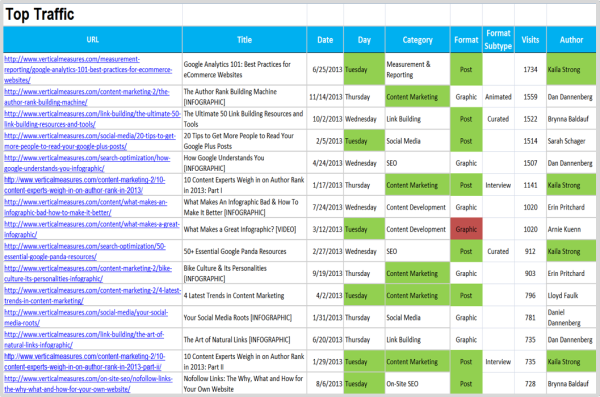
For example, a simple audit like the example below revealed the more successful days of the week and authors. You also can find additional insights within that raw data to help you continue to refine your strategy and your content calendar.

top-traffic

With the structure around strategy, organization, and tools, as well as the data from measurement, you can ensure your content marketing strategy and implementation is effective by being able to answer questions, such as:

  • How do we maintain consistency and quality? The creation of a publishing schedule forces you to be more consistent. Incorporating tools such as a project management system also can help improve the process to ensure both consistency and quality.
  • What does the data tell us is working or not? Regular content audits (monthly or quarterly) allow you to review data and create actionable plans to adjust your strategy.
  • Are we generating leads and sales? You can evaluate how well your content marketing contributes to the ultimate conversions sought by your organization.
  • How are we communicating our plans company-wide? Creating a culture that embraces content marketing within your organization is essential to success. Review your editorial calendar and consider how the content could be more effective with help from your team and others within your organization, whether they assist in content creation or promotion.
  • Does our content align with our strategy? With this information, you can assess whether your content reflects the content marketing strategy. If it does, you’re on track. If not, identify if the strategy needs to change or if the content does.

Art

The science of managing a content calendar takes will and determination. The art of managing a content calendar takes tact and, well … artistry. The art of content calendar management has more to do with the subtle things that propel a strategy. It involves curating talented content creators, aligning priorities, and figuring out successful internal processes.

People

People are the lifeblood of your content marketing strategy. Managing a content calendar is really about managing people and doing it with thoughtfulness and sensitivity. These prompt questions can help in improving the content team:

  • Who outside of the marketing department can create content?
  • What talents do our employees have that might be an asset?
  • What can we do to incentivize content creation?
  • Who can we rely on to submit quality content on time? Who cannot meet deadlines?
  • How can we tailor topics for our team based on expertise?
  • How can we find opportunities to showcase our team’s talents?

Priorities

Creating and managing a successful editorial content calendar is impossible if content marketing is not an organizational priority. Even if you use external resources, many of your content creators will come from inside your organization and already have full-time responsibilities that don’t involve content. Given that these subject-matter experts live and breathe your business every day, they can provide the best content if they are given the time.

How can you tactfully and sensitively navigate competing timelines and still get what you want out of your content calendar?

First, you need buy-in from the boss, upper management, or whoever calls the shots. Content marketing needs leadership as much as it needs articles and videos. Leaders are the ones who can ignite the content spark and sell the idea of content to everyone. This support helps ensure your team can follow through with the plan detailed in your calendar.

Next, you need understanding. Until your team members truly understand the power of content marketing, how it can work, and how they can play an important role, they won’t make it a priority. Get everyone involved and host content marketing training to get priorities aligned before diving into content assignments and deliverables.

Process

Process sounds like a scientific word, but in this case, it’s a craft to master. Without process, your calendar lacks any means of making an impact on your end goals. Your challenge in successfully managing a content calendar is to sculpt a process that works for your people, aligns with your priorities, and produces measurable results.

Processes can set expectations around:

  • Timelines – editing, publishing, promotion, etc.
  • Brainstorming strategies
  • Communication principles and tools
  • Internal and external resources
  • Project management systems
  • Talent management and training
  • Tracking and measurement KPIs

Artistic questions to ask:

  • Does our content help solve our audience’s problem? Gauge this by your own gut feelings, but don’t be afraid to ask your audience or your clients if what you are producing is useful to them.
  • Do our team members feel their efforts make a difference? Talk with your team and get feedback about their contributions. They will be more invested in contributing to the success of the content marketing strategy.
  • Are we being useful and helpful in our content? View your content to make sure it keeps selling to a minimum. Every piece of content should be rooted in this ideal.
  • Should we incentivize great content creators? Consider how to reward the most successful contributors, possibly through bonuses or other awards. This can go a long way for boosting morale and the longevity of your content initiatives.
  • Did we reveal our personality in our content? Your content should reflect your brand’s reputation, voice, etc. Assess the consistency of your tone and overall vibe. Make sure it reveals the real you, not a fake persona.
  • How can we better align our goals with our actions? Take a hard look at your processes to see if they are healthy and sustainable. Identify places where projects get delayed. You may need to delegate or reconfigure some responsibilities.

Culture is key

Managing a content calendar is about much more than timelines and coordination – it’s the most important tool to make your content marketing work and get the results you want to see.

With that said, content marketing will be more successful when you can create a culture where content marketing is integrated and valued. Processes flow easier, people willingly offer ideas, and the content works better with your audience. This takes time, dedication, and patience, but the more you can align your team – your whole team across departments – to adopt a content marketing mindset, the better and quicker the results will be.

Want to take in the art and the science of content marketing? Watch the diverse presentations tackling content marketing success from Content Marketing World 2015 with the video-on-demand pass.

Cover image by Joseph Kalinowski/Content Marketing Institute

The post How to Bring Art and Science to Managing a Content Calendar appeared first on Content Marketing Institute.

26 Oct 16:28

The 8 Metrics I Use to Run My SaaS Company

by Fred Shilmover

When we started InsightSquared almost 5 years ago, I was beginning a new chapter in my career: first-time CEO. The transition wasn’t easy, and I found myself running as fast as I could to figure out what exactly I was supposed to be doing. Between building my team, fundraising, and trying to market our evolving product, I barely had any time to do the one thing every CEO must do: make sure your company is hitting sales goals and bringing in revenue.

There were so many pieces of information coming at me from all angles that I started to feel like I was drowning. It became almost impossible for me to separate the signal from the noise. How are we doing in terms of creating new pipeline? Is my sales team efficiently turning that pipeline into deals? Are we set up to hit our upcoming revenue goals?

These were the questions I needed to answer, but unfortunately I was finding it hard to do so because I was getting barraged by so much information from all sides. I knew I needed to pare it down. For my own sanity and the sake of my company, I needed to focus on what mattered most and try to disregard as much of everything else as possible.

I had to learn to trust my sales & marketing leaders to handle their departments and report their progress to me by sharing the few, essential metrics I needed to make sure my young company was on track.

So I decided to make a guide that kept everything as simple as possible for me.

My CEO Crib Sheet

What I ended up with was a slim document that boiled down my company’s sales & marketing performance to its essence. I was left with eight straightforward metrics ‒ four for each sales and marketing ‒ that I could use to quickly (yet comprehensively) understand how each team was performing.

Instead of spending my days diving further into the weeds, trying to wrap my head around every little detail of my company, I was able to rightsize my perspective and take in all of the necessary metrics. Finally I felt like the metrics I reviewed regularly matched my priorities as CEO.

These days, I talk to a lot of CEOs looking for ways to triage the data they track about their companies’ Go-to-Market performance. I’ve gotten so many questions about the right metrics to track I’ve officially lost count. But now I have a guide to give them.

As I mentioned, it’s a fairly simple document divided into two categories: The 4 key sales KPIs and the 4 key marketing KPIs that all CEOs of growing companies should use to keep tabs on their company’s performance.

Sales KPIs

With sales, it all comes back to one thing: hitting your number. In the early days as CEO, I tracked these 4 metrics (making sure to get a good mix of leading and lagging indicators) to ensure that my product, my pipeline and my sales team’s execution were all on track to hit our bookings goal.

  1. Predictive Forecast. Are you on track to hit your upcoming bookings goals? Ultimately this is what it’s all about: Will you hit your number?
  2. Sales Pipeline Over Time. Has your pipeline been growing or shrinking over time? This is critical for identifying trends between pipeline growth and bookings growth.
  3. Pipeline Inflow/Outflow. Are you creating pipeline fast enough to feed your team? This helps you ensure that you are adding new opportunities to your pipeline quickly enough to replace Closed-Lost opportunities, which is critical for a growing team with rising bookings goals.
  4. Lost Reasons. Why are you losing deals? If you’re losing a lot of deals at the finish line, it’s important to know why. Is a competitor besting you? Is your price too high? Is your product missing features? This doesn’t come out of the box with Salesforce, so I added it as a standard customization because I knew I needed to help improve my product and sales team’s objection handling.

Marketing KPIs

When I want to evaluate my marketing team’s performance, it’s all about pipeline creation. Are we generating enough leads and opportunities to feed my sales team and create sales?

  1. Lead Trajectory. How are specific marketing channels performing against goals? I knew that I needed to make sure I was fueling the right channels (at the right cost) to ensure that I wasn’t leaving my sales team hungry. Looking at lead generation over time and by channel allowed me to crank the knob on cost-effective channels so that I wasn’t hurting my sales team and pipeline for the future.
  2. Opportunity Creation. How many opportunities are coming from marketing? Leads are great, but they’re really only valuable if they’re converting into sales-ready opportunities.
  3. Best Campaigns. Which campaigns are generating the most leads, opportunities and deals? Ultimately, you need to fuel the right marketing campaigns, and this means understanding exactly which campaigns are most effective.
  4. Marketing-sourced Bookings. How much revenue is marketing bringing in? At the end of the day, marketing’s value is determined by how many deals can trace their history back to a marketing campaign.

My business has outgrown its training wheels and a lot has changed around here, but one thing remains constant: I still use these 8 metrics to measure the success of my company. Instead of falling victim to paralysis analysis, I’m able to track the most mission-critical elements of my business. Now you can, too. Get the CEO’s Guide to KPIs today.

24 Oct 18:21

Council on Competitiveness Report: HPC Transforms Manufacturing

cover

Today the Council on Competitiveness published a new report from the National Digital Engineering Manufacturing Consortium (NDEMC). Entitled “Modeling, Simulation and Analysis, and High Performance Computing: Force Multiplier for American Innovation,” the 88 age report explores how HPC transforms manufacturing.

The post Council on Competitiveness Report: HPC Transforms Manufacturing appeared first on insideHPC.

24 Oct 18:20

Carter kicks inspire All Blacks into World Cup final

New Zealand's fly half Dan Carter converts the first try during a semi-final match of the 2015 Rugby World Cup between South Africa and New Zealand at Twickenham Stadium, southwest London, on October 24, 2015

Twickenham (United Kingdom) (AFP) - Dan Carter's 10 points anchored New Zealand to a 20-18 victory over South Africa in the World Cup semi-final on Saturday.

The All Blacks fly-half -- the first foreign player to score over 100 points at Twickenham -- converted both their tries, slotted over a penalty and landed a drop goal.

New Zealand will play the winners of Sunday's semi-final between two-time champions Australia and Argentina also at Twickenham.

Join the conversation about this story »

24 Oct 18:20

NSA chief: This is what keeps me up at night

by Jillian D'Onfro

Admiral Michael Rogers

Admiral Michael Rogers, director of the National Security Agency and US cyber commander, doesn't think that the United States will ever have a digital equivalent of Pearl Harbor. 

Speaking on stage at the Wall Street Journal's WSJDLive conference, Rogers dismissed that analogy because he doesn't think that a massive cyber attacks could ever be as surprising today as the attack on Pearl Harbor was in 1941. 

It's not a matter of "if," it's a matter of "when."

Rogers outlined three things that concern him the most when thinking about cyber-threats to the United States:

1. Cyber attacks that do infrastructure damage

"It is only a matter of 'when' that someone users cyber as a tool to do damage to the critical infrastructure of our nation," Rogers said.

"I'm watching nation states, groups within some of that infrastructure. At the moment, it seems to be really focused on reconnaissance and attempting to understand the characteristics of the structure, but it's only a matter of time I believe until someone actually does something destructive." 

2. Data manipulation

"Historically, we've largely been focused on stopping the extraction of data and insights, whether for intellectual property for commercial or criminal advantage, but what happens when suddenly our data is manipulated and you no longer can believe what you're physically seeing?" he said.

"As a military guy, who's used to the idea that, 'I can look at a display, I can look at a set of data, and I can very quickly draw conclusions and start to make risk-based decisions quickly,' what happens if that gets called into question? I believe that's going to happen."

3. Non-state actors

"What happens when a non-state actor, who literally has no interest in the status quo — take ISIL for an example, whose vision of the world is diametrically opposed to ours — starts viewing the web as not just a vehicle to generate revenue, to recruit, to spread the ideology, but instead they view it as a weapon system?" he asked hypothetically on stage.

'This stuff is going to happen'

Rogers says that he believes that all these concerns will actually play out.

"I fully expect that during my time as the commander and the director of the NSA, this stuff is going to happen," he said. "And the nation is fully counting on us to be ready."

The NSA has faced intense scrutiny since former National Security Agency contractor Edward Snowden leaked documents revealing many of its intelligence apparatus, including global surveillance tactics. 

SEE ALSO: It turns out the NSA was collecting voice calls, photos, passwords, documents, and much more

Join the conversation about this story »

NOW WATCH: How to supercharge your iPhone in 5 minutes

24 Oct 18:18

Selling like Steve

by Seth Godin

Have you thought about the fact that just about every time Steve Jobs appeared in public, he was selling us something?

And yet few rolled their eyes and said, "oh, here comes another sales pitch."

Jobs sold us expensive, high margin hardware that we knew would eventually become obsolete, and yet people lined up to hear the pitch. How come?

I think it's because he was saying:

"Here, I made this. It might be worth talking about."

Inherent in this statement is the flip side, "it might not work."

And in almost every case, he was right. That it might be worth talking about, and that it might not work.

In almost every case, skeptics pounced. People discussed his work. 

Sometimes he was early, but he was usually interesting. That's a slot that's available to more people than ever before, regardless of industry or audience.

Average stuff for average people is getting ever more difficult to sell. If that's all you've got, get something else.

       
24 Oct 18:13

From the 150,000 babies born to the strong education: Eight things you don’t know about Syrian refugees

by Alia Dharssi, National Post Staff

On Wednesday, prime minister-designate Justin Trudeau vowed to make good on a campaign pledge to bring 25,000 Syrian refugees to Canada by the end of 2015, though the logistics of how this will be accomplished have yet to be worked out. As Canada and other countries grapple with how best to respond to the outflow of refugees, the National Post’s Alia Dharssi counts down eight things you might not know about the crisis.

1. More than half of Syria’s pre-war population of 22 million has been displaced

The United Nations High Commission for Refugees reports that there are more than four million registered refugees outside Syria, while the United Nations Office for the Coordination of Humanitarian Affairs estimates that another 7.6 million are displaced within the country. In addition, almost half a million Syrian refugees have fled to Europe and North America. More than 2,400 have resettled in Canada. But, with the situation constantly in flux and thousands of unregistered Syrians in the Middle East, the real number of those displaced may be much higher.

2. Tens of thousands of Syrian babies have been born as refugees

According to an April 2015 study by Refugees International, more than 60,000 babies have been born to refugees in Turkey alone. Murat Erdogan, a professor at Hacettepe University in Turkey, estimates the total could be closer to 150,000. These children are at risk of becoming stateless. Syrian citizenship is passed down through the father, but many Syrian men have died or are currently fighting in the civil war, and in many cases their names aren’t written on birth records. This will make things tricky for the refugee babies, especially because the countries surrounding Syria don’t give out citizenship for being born on their territory.

ARIS MESSINIS/AFP/Getty Images
ARIS MESSINIS/AFP/Getty ImagesA woman holds a baby as refugees and migrants arrive at the Greek island of Lesbos after crossing the Aegean sea from Turkey on October 21, 2015.

3. More than half of the Syrian refugees are children

More than half of the registered refugees in the Middle East and North Africa — 51.1 per cent or about 2.1 million people — are children under 18 years of age. More than 1.6 million of these children are under 12 years old. International agencies and non-profits working in the region are trying to get and keep these kids in school, but resources are limited and some children haven’t studied since the conflict started. For example, in 2013, UNHCR reported that 80 per cent of refugee children in Lebanon were not in school, while the World Bank found that Syrian children were dropping out twice as fast as Lebanese ones.

4. More than three-quarters are women and children

Seventy-seven per cent of refugees are women and children. According to a study by CARE International, a non-profit working with Syrian refugees, about one-quarter of refugee households in Jordan are headed by women, as compared to eight per cent of households in pre-war Syria. With many men absent or killed, refugee women who haven’t worked before are struggling to feed their families. Non-profits report that early and forced marriage of Syrian girls is on the rise because families are in dire economic straits.

ARIS MESSINIS/AFP/Getty Images

5. Terrorism does not have deep roots in Syria

Though some fear that refugees may bring terrorism with them, Salafi Islam — the ultra-conservative strain of Islam that has inspired notorious terrorist groups like al-Qaeda, Boko Haram and ISIL — doesn’t have deep roots in Syria, in part because Bashar al-Assad’s oppressive regime didn’t tolerate dissent, says Thomas Pierret, an expert on Islam in Syria at the University of Edinburgh. Fundamentalism only gained prominence in Syria after the civil war began in 2011. Pierret suggests that with ISIL fighting a two-front war in the Middle East it needs every fighter it can get, and that extremists are unlikely to be “getting on boats and trying to cross the Mediterranean.”

6. Religious strife in Syria was not as bad as you might think

Prior to the war, Syria’s main ethnicities and faiths — including Christians, Shia Muslims, Jews and the Sunni majority that made up 74 per cent of the population — co-existed in relative harmony, albeit under the thumb of an oppressive dictatorship. “There’s often an analysis of the conflict or of Syria’s politics from a sectarian perspective, which I think is misleading,” says Marwa Daoudy, a professor at Georgetown University. Daoudy says the strong national identity that started to emerge under colonial rule was strengthened under the Ba’athists through school curricula and foreign policies that championed Arab causes. Religion is important to Syrians, but many “feel strongly that religion should be a private matter,” says a report published by the Cultural Orientation Resource Centre, a U.S. organization that helps with refugee resettlement.

(AP Photo/Lefteris Pitarakis, File)
(AP Photo/Lefteris Pitarakis, File)In this Sunday, June 14, 2015 file photo, Syrian refugees are helped into Turkey after breaking the border fence and crossing from Syria in Akcakale, Sanliurfa province, southeastern Turkey.

7. Syrian refugees are relatively well-educated

In a bid to cement his power, Assad made public schools available throughout Syria and presided over a number of reforms to the education system. “The state was very powerful and extending access to education was one aspect of that power,” says Elizabeth Buckner, an expert on education in the Middle East at Columbia University. As a result, pre-war Syria had an 86 per cent literacy rate with 96 per cent of youth aged 15 to 24 able to read and write. Those who progressed to high school learned some English and French. By 2007, 91.4 per cent of 10 to 14 year olds were attending middle school. This, says Buckner, was high when compared to other middle-income countries with a comparable level of economic development, even though attendance dropped off in high school and beyond.

8. Syrians from all socioeconomic backgrounds are fleeing

Before the war, Syria was a middle-income country with a GDP per capita of $5,200 in 2010. With most of the populated regions of Syria along an international border, people from all social classes started leaving Syria very early on, says Pierret. “The poorest people would end up in camps. Wealthier people, middle class people, would usually find a way to rent a flat somewhere.” Now, four years into the conflict, with refugee camps filled to the brim, refugees are living wherever they can find a space. Mercy Corps, a non-profit working with Syrian refugees, says on its website that its staff have met refugee families living in chicken coops and storage sheds. As for the ones leaving for Europe, they’re usually middle class, says Daoudy. “They have the means to be able to cross (the Mediterranean), to take the boats and pay the smugglers.”

23 Oct 17:05

10 Motivating Steve Jobs Quotes That Will Prepare You to Take on the World

by esnider@hubspot.com (Emma Snider)

It's the second-to-last day of the month, and quota is nowhere within sight. As you leave the office for the day, you can't help but feel defeated. What's even the point of showing up tomorrow? Might as well call in sick and take your loss.

All salespeople have been there at one point or another. At certain times, you just can't seem to muster the energy to pick up the phone and make just one more call, or take to your keyboard to type out one more email. You just don't have it in you.

But the great thing about your mindset is that it can be changed with the simplest dose of motivation. I'm willing to bet the following quote can lift even the most miserable rep out of their funk:

"I'm convinced that about half of what separates successful people from the non-successful ones is pure perseverance."

With this Steve Jobs quote rattling around your brain, suddenly picking up the phone again doesn't seem so hard. You might even catch a second wind and pick it up five or 10 more times.

The next time you're feeling low, click through the following SlideShare, containing 10 of Steve Jobs' most memorable and motivational quotes. Nothing can transform your mindset from zero to hero faster.

Get HubSpot CRM today!
23 Oct 17:05

9 Sales Goals for Reps to Help them Achieve

by mrenahan@hubspot.com (Mike Renahan)

If your reps only have one goal — meeting their quota — they’re selling themselves short (literally). Hold your reps accountable to smaller weekly or monthly goals, and you’ll increase the likelihood they’ll meet their bigger number.

Smaller goals let your reps build confidence with incremental wins. They also help track your reps’ progress toward larger goals, giving you more time to work with struggling reps.

Download Now: Sales Conversion Rate Calculator [Free Template]

A Dominican University study found setting specific goals increases motivation beyond simply telling yourself, “I’ll just do my best.” The study ultimately reported professionals who stuck to a goal-oriented plan performed better than those who didn’t. What would improved performance from each of your reps look like for you?

Below, find out how to set sales goals on an individual and team level. It might seem like a lot of work, but the result is motivated salespeople who have the support they need to succeed.

1. Calculate your monthly sales goal.

If you’re setting personal sales goals or team goals, they should align with annual sales goals. Figure your monthly sales goal by working backward from your company’s annual revenue target. Once that target is defined, calculate how much your department, teams, and individual reps need to sell to meet that goal.

Be sure to take seasonal or staffing fluctuations into account. If you’re onboarding three new salespeople this fall, it may be hard to meet aggressive goals during Q4, as staff may be tied up in training those employees. However, because you’ve planned for this, you can adjust goals and push harder in Q3.

You should pull it all together in a sales goal chart, like the one below.

How to set sales goals: calculate monthly sales goals with chart

Create your own sales goal chart using our free sales conversion and close rate template.

Monthly Sales Goal Example: “Sell $100,000 worth of product by the first day of each month.”

This monthly sales goal is easy to understand — but don’t let it stagnate your team. If you keep the same number every month, it’ll be easy to plateau and fall out of pace with overarching revenue goals. You can increase this number every month, or keep it the same until your team meets it and exceeds it.

Remember to work backward from the companies’ annual revenue target. Be sure to bring in any higher-ups who want to have a say on the monthly sales figures they’d like to see from your team.

2. Set waterfall goals.

The waterfall goal system is when a team works linearly toward a set end goal. This approach is better for morale because missing goals can increase fear and squash motivation. The waterfall approach also produces higher quality work and better numbers. Your team won’t experience burnout from the increase in work, and you’ll give them time to ramp up quality.

Waterfall Sales Goal Example: “Add $3,000 more revenue in Q2, $4,000 in Q3, and $5,000 in Q4.”

Get each of your reps contributing $5,000 more per month than their current averages by ramping them up over the course of the year. Waterfall goals are fantastic for keeping team morale high and for being more flexible. If, for instance, one of your reps falls just slightly behind, while another exceeds expectations, you can adjust their individual numbers accordingly.

3. Sequence goals.

This is another way of saying “prioritize your goals.” Determine which goals bring the highest value when hit, and make sure your reps are meeting those first.

If you’re sequencing goals for a junior sales rep, set goals around where they can improve.

Sequencing means even if your reps don’t meet every goal, they’ll meet the ones that matter most to your company’s bottom line or their professional growth.

Sequence Sales Goal Example: “Set up X product demonstrations per week/day.”

For a rep who struggles with product demonstrations, set a goal of giving a team member a demonstration once a day, then twice a week, to sharpen their skills.

If a rep struggles to move discovery conversations to the next phase, make a goal for them to set up three demonstrations per week, then four, then one a day.

4. Set activity goals.

An activity goal is a behavioral objective for salespeople. These activities can generate cash flow, opportunities, and generate visibility depending on the task assignment.

Activity Sales Goal Example: “Share one sales article per week.”

Does your rep need to be more visible within your organization? Set a goal of having them share one article per week on your team Slack channel or internal communication portal. Or ask them to contribute one article per quarter to your company's blog.

5. Incentivize goal attainment.

Incentivizing goal attainment is a way to give your team more motivation at different levels of achievement. Receiving bonuses, getting variable compensation, and even keeping their job are all incentives for reps to meet their quota.

Incentivized Sales Goal Example: “Hit a retention number greater than X%.”

If your reps are easily closing new business, but that business churns three months in, that’s not good. Set goals that incentivize reps to close only quality leads that are a match for your business. For example, you might give a cash bonus to every rep hitting quota whose retention number is higher than a specific percentage.

Don’t have the budget to offer a monetary incentive? No problem. Position company-wide recognition or extra vacation time as a reward for goals met.

6. Monitor goal progression.

Goals are of no use if they’re not being monitored. Track progress via a dashboard in your CRM or have reps enter their weekly numbers the old-fashioned way — in an Excel spreadsheet. If someone on your team isn’t hitting their weekly numbers, talk to them before it becomes an impediment to meeting their monthly quota. Monitoring these small goals makes them worth the extra implementation time, so don’t skimp here — even if it’s tempting.

Progressive Sales Goal Example: “Reduce the amount of time it takes to convert a lead to a customer.”

Speeding up the sales process closes deals quicker — this means the company will realize the revenue faster, and the sales rep will have more time to spend on other deals and prospecting activities. Creating a goal to reduce the amount of time it takes to move a lead to an opportunity or an opportunity to a customer will speed up the sales cycle.

7. Set stretch goals.

A stretch goal is a goal exceeding their primary goal, which can be effective. Think about the old saying: “Aim for the moon. If you miss, you’ll be among the stars.” Keep in mind that this isn’t right for everyone. If a rep is struggling to meet their quota every month, a stretch goal will only increase their anxiety. But if you have a high performer, set realistic stretch goals that will challenge and motivate them.

Stretch Sales Goal Example: “Upsell 12X more customers than you did the previous month.”

A stretch goal pushes your high-performing team — or, at least, your highest performing rep — to do their best work by putting a seemingly unattainable goal before them. Remember, you should only suggest stretch goals if your team is already exceeding expectations. If they’re still progressing toward your primary goals, it’d be wise to use another type of goal to motivate them and track their progress.

8. Suggest mentor goals.

If a rep is having trouble ramping up or hits a rough patch (it happens to everyone), suggest they find a mentor or two. Provide a framework you'd like them to work through or advise them to create one with their mentor. Having someone to confide in besides their manager can be just what they need to thrive.

Mentor Sales Goal Example: “Attend one professional development event per month.”

If a rep isn’t attending professional development events, set a goal of one per month to start. That’s an easy way for them to get the mentorship they need from distinguished voices in the industry.

9. Create a collective goal.

A collective goal is a specific objective co-created by a team to focus and achieve — like hitting X number of calls/meetings/emails, X amount of revenue, or X% client retention.

Collective Sales Goal Example: “Book the most meetings of any rep on the team.”

Strike up friendly competition by challenging your reps to see who can book the most meetings or demos this week. If you’d like to truly have fun, you can post the numbers up on a leaderboard, highlighting the top three or the top ten sales reps.

Now that you know how to set goals, let’s take a look at some templates that can help you create them without needing to start from scratch.

Sales Goals Templates

1. Sales Conversion and Close Rate Calculator

Sales goals template: Conversion and close rate calculator

Download Your Free Template Now

Want to get to the numbers straight away? Then use our sales conversion and close rate calculator to outline your financial goals in one simple, frills-free place. It’ll help you automatically create annual goals with the months broken down as well.
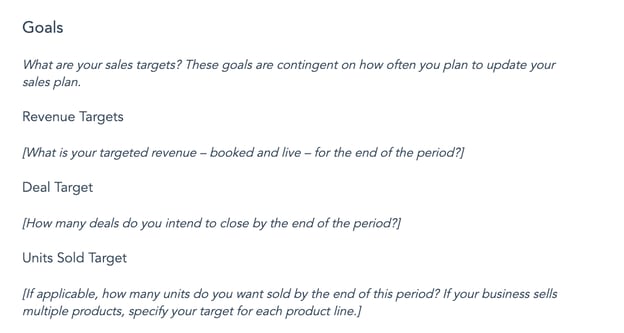
2. Sales Plan Template

Sales goals template: Sales plan

Download Your Free Template Now

Our sales plan template will help you create more traditional, qualitative goals. You can write goals not only in numeric terms but in terms of what you want your sales organization to achieve at large. It’s a great starting point if you don’t want to dive into the nitty-gritty of your sales goals just yet.
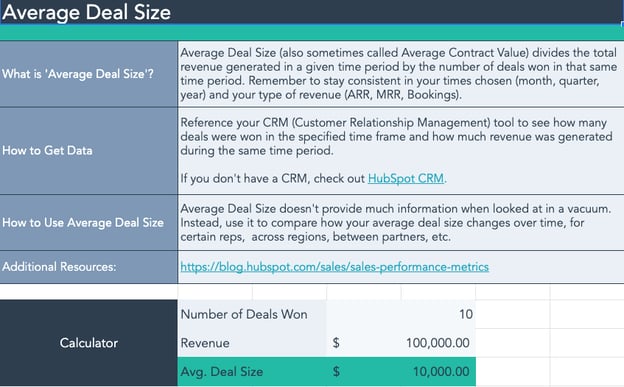
3. Sales Metrics Calculator

Sales goals template: Sales metrics calculator

Download Your Free Template Now

To set realistic sales goals, you first need to know how you’re doing and track these metrics across time. Our sales metrics calculator will help you lay the groundwork for creating better and more effective sales goals. It will also help you get more acquainted with sales metrics you might not have considered tracking in the past.
4. Objectives and Key Results Template

Sales goals template: Objectives and key results

Download Your Free Template Now

Setting OKR sales goals is another effective method for improving your team’s performance. Like our sales plan template, this OKR template will help you set goals in more general, qualitative ways — so you don’t have to know the exact numbers just yet. You can refine as you go, change goals as necessary, and track your key results.
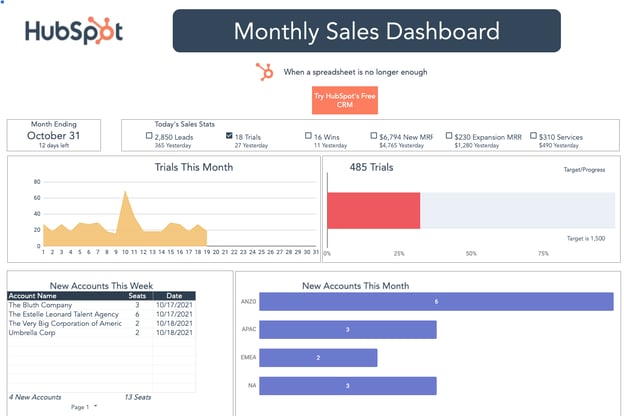
5. Sales Dashboard

Sales goals template: Sales dashboard

Download Your Free Template Now

Pull it all together in a sales dashboard where you can see all of your goals — and your progress toward those goals — in one place. You can set targets and track your progress toward those targets. If you don’t work in the tech industry, you can change the names of the fields to better fit your business.

Once you’re ready to set goals in a more automated environment, consider upgrading to a CRM that will help you set better and better sales goals every quarter.

Now that we’ve talked about how to set goals, let’s take a look at some examples that you can adapt for your team.

Goals for Sales Managers

1. Reduce customer churn.

As a sales manager, you oversee the success of your company’s sales department. Some of your main goals should be centered on improving your retention rate and reducing your customer churn.

Customer churn is the rate at which customers stop using your product or service. So the higher your churn rate is, the more likely your business has room for improvement to delight customers — and there are many different approaches managers can take to achieve that goal, the primary one being to only sell to best-fit prospects.

2. Increase average deal size.

If there’s one thing better than closing a deal, it’s closing a large one. Managers that make goals to increase the average deal size put their sales team in a position to create profitable relationships with high-profile, target customers.

Ways to increase deal size can look like bundling more products or services into a contract, or rewarding customer loyalty with exclusive discounts.

3. Increase customer lifetime value.

Customer lifetime value is a business metric that measures total revenue that can be earned from a customer over time.

Managers that set this type of goal can optimize the performance of their sales team’s strategy and create longer-lasting client relationships that will extend the business value to customers.

4. Improve average win rate.

The average win rate is the rate at which final stage prospects become customers. As a sales manager, you want to form a solid strategy and train your team members on how to effectively win more deals with their clients.

5. Lower customer acquisition cost.

As a manager, you want to keep costs as low as possible without compromising your team’s ability to succeed. A sales manager could work with reps to better source qualified leads based on the types they’ve found the most successful.

Goals for Sales Reps

1. Invest in continuing sales education.

One of the best ways to grow as a rep is to invest in your sales education. Expanding your product knowledge, negotiation skills, or sharpening your business acumen.

2. Shadow high-performing team members.

You can run this goal by your sales manager to see whom they think would be the best fit. But shadowing someone who consistently exceeds their sales numbers may just be what you need to help you reach your sales goals and refine your skills.

3. Perform more prospecting activities.

If your company is trying to expand into new verticals, why not help them reach their goals by prospecting a number of new clients per target industry? You’ll not only impress your manager, but you’ll also help the business break new ground, giving you a sense of accomplishment and fulfillment.

4. Follow up with more prospects.

Some sales reps struggle to stay in touch with new customers. If that’s you, make it one of your goals to touch base with each of your new clients by phone or email at least once a month, then once every two weeks, to keep relationships strong.

5. Schedule a specific number of qualified sales conversations.

Are you tired of wasting time with prospects who aren’t interested? Set a goal for yourself to schedule qualified sales conversations that have higher interest or value in your offering. After all, you want to give your time and effort to those who are actively looking for a solution you can provide.

6. Schedule a specific number of discovery conversations.

If you’re having trouble finding prospects and scheduling discovery calls, it’s time to set that goal for yourself. The more frequent you conduct them, the better you’ll get at matching client goals and needs to your offering.

7. Reduce the amount of time it takes to convert a lead to a customer.

Making it a goal to improve your lead conversion rate can potentially save you time and reduce your budget. This is also commonly known as shortening the conversion cycle.

8. Improve closing ratio.

Perhaps you’re a rep that contacts a lot of leads, but you're not reaching the finish line with a lot of your prospects. The closing rate is one of the most important metrics to monitor because it’ll identify sales team strategies that yield the most success. You'll want to progressively increase that number. You should procure additional training if needed and hold yourself accountable for your percentages.

9. Achieve an important revenue number.

Giving a revenue goal to your team on a monthly or quarterly basis can encourage sales reps to work toward an idea that’s more attainable. This type of goal setting can also be accompanied by incentives featuring bonuses or even extra PTO for added motive.

Now, let’s break these goals down even further by aligning them with the SMART goal framework.

SMART goals are a proven framework for progressing toward a desired end result. They can help you stay focused. “SMART” stands for:

  • Specific
  • Measurable
  • Attainable
  • Relevant
  • Time-Bound

All of the above goals are SMART sales goals. Let’s dissect a few of them.

1. To reduce customer churn by 20%, I will train my sales team to better provide support over the next six months.

  • Specific: Tackling the issue of customer churn rate.
  • Measurable: Customer churn rate is a measurable formula.
  • Attainable: A 20% improvement is realistic.
  • Relevant: Training the sales team to better support customers can affect loyalty.
  • Time-Bound: This goal duration is six months.

2. Increase average deal size by bundling two or more services in a limited time offer for the next three months.

  • Specific: The goal is to increase the average deal size.
  • Measurable: Average deal size can be calculated over a period of time..
  • Attainable: It’s feasible to increase the average deal size in a scaling company.
  • Relevant: Bundling services is a way to increase sales, a primary goal for sales teams.
  • Time-Bound: The goal duration is for three months.

3. In six months, we’ll increase customer lifetime value by 10% by offering larger discounts.

  • Specific: The goal is to increase customer lifetime value.
  • Measurable: Customer lifetime value is a metric that can be tracked and calculated.
  • Attainable: 10% is a feasible amount of change.
  • Relevant: Discounted offers can affect customer lifetime value.
  • Time-Bound: The goal duration is for six months.

4. For the next quarter, I want to improve the average win rate by 15% by refining our lead prospecting strategy.

  • Specific: The goal is to improve the average win rate.
  • Measurable: Average win rate is a measurable formula.
  • Attainable: An incremental change of 15% is feasible.
  • Relevant: Lead prospecting directly correlates to sales win rates.
  • Time-Bound: The goal duration is for the upcoming quarter.

5. In the next three months, I will lower customer acquisition costs by $500 through adjusting our paid search to better reach prospects that fit our buyer personas.

  • Specific: The goal is to lower customer acquisition costs.
  • Measurable: Customer acquisition costs can be tracked and calculated.
  • Attainable: $500 is a realistic amount of money for small businesses.
  • Relevant: Adjusting paid search to target buyer personas directly affects acquisition costs.
  • Time-Bound: The goal duration is three months.

6. I want to be promoted to a sales manager in the next year by investing in continuing sales education.

  • Specific: The goal is to be promoted to the role of sales manager.
  • Measurable: While not numeric, the completion of continuing sales education classes can be documented and hold weight.
  • Attainable: It's feasible for sales reps to continue education for betterment.
  • Relevant: Candidates who invest in education are seen in a positive light for promotions.
  • Time-Bound: The goal duration is for one year.

7. For the Spring, I will shadow two high-performing team members to learn how they build rapport with customers.

  • Specific: The goal is to learn how to build rapport with customers.
  • Measurable: By studying the actions of high-performers, there can be identifiable behaviors that can be enacted into someone else’s strategy.
  • Attainable: It's feasible to observe team members at work with permission.
  • Relevant: It’s possible to learn how to build rapport from high-performing salespersons.
  • Time-Bound: This goal duration is for the Spring season.

8. Attend at least one professional development event per month to engage in more prospecting activities.

  • Specific: The goal is to attend one professional event on a monthly basis.
  • Measurable: The number of attended events can be tracked overtime.
  • Attainable: It’s possible to set aside time and seek out professional development events.
  • Relevant: Networking at professional development events can lead sales people to engage in more prospecting activities.
  • Time-Bound: This is an on-going goal, but it’s bound to a monthly basis.

9. I will follow up with more prospects after our initial interaction by setting up automated emails in the coming quarter.

  • Specific: The goal is to follow up with more prospects.
  • Measurable: Automated emails can be made and tracked in a CRM system.
  • Attainable: It’s feasible to reach back out to prospects through email.
  • Relevant: Setting up follow up emails is a great way to follow up with prospects.
  • Time-Bound: This goal duration is tied to the upcoming business quarter.

10. Schedule at least three demos with enterprise-level prospects over the next three months.

  • Specific: The goal is to schedule a minimum of three demos with enterprise-level prospects.
  • Measurable: This is a quantifiable goal that can be tracked.
  • Attainable: This is feasible for a big business selling at an enterprise-level.
  • Relevant: Demos with high profile prospects are relevant to the goals of a sales team.
  • Time-Bound: The goal duration is for the next three months.

11. Reduce the amount of time it takes to convert a lead to a customer by 25% over the next year.

  • Specific: This goal is to reduce the time necessary for average lead conversion.
  • Measurable: This can be tracked and calculated in a CRM system.
  • Attainable: 25% is a feasible amount of change.
  • Relevant: Lead conversion time can affect the productivity of a sales team.
  • Time-Bound: This goal duration is for the next year.

12. Schedule five more qualified sales conversations for next month to improve closing ratio.

  • Specific: The goal is to schedule five more qualified sales conversations.
  • Measurable: This quantity of calls can be tracked.
  • Attainable: This number is a feasible increase of conversations.
  • Relevant: Qualified sales conversations can affect the closing ratio.
  • Time-Bound: This is an on-going goal, but it’s bound to a monthly basis.

13. Sell $100,000 worth of product by the first day of each month.

  • Specific: The goal is to sell $100,000 worth of product.
  • Measurable: This metric can be tracked and calculated.
  • Attainable: This is feasible for big businesses selling at an enterprise-level.
  • Relevant: This goal is directly tied to revenue, a primary metric for sales.
  • Time-Bound: This is an ongoing goal, but it’s bound to a monthly basis.

Keep Your Sales Reps Happy with Sales Goals

As you’re setting new goals or revisiting old ones, check in with your reps and ask how they’re feeling. Make sure goals are remaining realistic, challenging, and attainable. That’s the recipe for happy, successful reps.

Editor's note: This post was originally published in October 2015 and has been updated for comprehensiveness.

Improve your website with effective technical SEO. Start by conducting this  audit.  

23 Oct 17:01

The cloud is raining cash on Amazon, Google, and Microsoft — about $90 billion last night alone

by Jack Clark and Ian King and Dina Bass, Bloomberg News

Amazon.com, Google, and Microsoft all topped profit estimates last quarter, highlighting the widening gulf between companies that deliver computing via server-laden warehouses and a generation of latecomers to the cloud boom. Together, the three companies added more than US$90 billion in market cap in after-hours trading following their earnings reports on Thursday.

The trio shares a reliance on technology that comes from powerful machines lashed together in bunkers the size of football fields. These data centers are capable of providing a broad range of services at a low cost—be it Microsoft’s personal and business software, Amazon’s e-commerce and computing power, or Google’s Web search and advertising algorithms. Contrast that with technology firms, such as IBM, Hewlett-Packard, EMC, and Oracle, which are suffering from slowing growth or declines as cloud operators shun traditional hardware, software, and services.

Google, Microsoft, and Amazon get added revenue as they become sellers of computing power to a growing number of other companies on the hunt for low-cost alternatives. Compounding that, the large clouds don’t buy as much hardware and software from traditional IT providers and also pull potential customers away by renting them the IT services they’d typically buy from IBM, HP, EMC, Oracle, and others.

“You are seeing the cloud shift everyone was talking about, and Microsoft and Amazon are benefiting from it,” said Sid Parakh, a portfolio manager at Becker Capital Management, which has about US$3 billion under management. “Oracle, IBM, even VMware are reporting very weak numbers and really no momentum in cloud.”

Amazon reported sales on Thursday that beat analysts’ estimates. Driving that performance was its Amazon Web Services division, which grew 78 per cent from a year ago with sales of US$2.09 billion. That helped the company report a profit when analysts had predicted a loss.

charttech

Microsoft, which is moving more users of Office and other corporate productivity tools to versions hosted online through its own server farms, reported profit and sales that also beat estimates. Revenue in a segment called “intelligent cloud” was US$5.89 billion, exceeding an estimate of US$5.72 billion based on the average of four analyst projections compiled by Bloomberg.

“While many companies are developing commercial cloud offerings, there are really only two driving enterprise cloud platform innovation at massive scale: Amazon and Microsoft,” Microsoft Chief Executive Officer Satya Nadella said on a conference call discussing the company’s results.

Don’t count Google out. Its parent company Alphabet is selling more ads and keeping spending under control, fueling better-than-projected sales and profit last quarter, the company said on Thursday. That enabled it to continue beefing up its cloud division, Google CEO Sundar Pichai said on the earnings call. “We’re investing a lot and playing for the long term,” he said. “When I look at new customer adoption, we’re seeing tremendous momentum.”

At IBM, the future doesn’t look so bright. Shares dropped to a five-year low after the company cut its profit forecast earlier this week. The company cited a looming global economic slowdown and a strong dollar as factors hurting its overseas business. Another issue, which the company didn’t bring up, is that the biggest players in cloud build much of their own equipment and write much of their own code.

EMC, which agreed to merge with fellow legacy hardware company Dell, reported sales and earnings that met analysts’ relatively low expectations amid slowing demand for its storage devices. Hewlett-Packard recently partnered with Taipei’s Foxconn Technology Group to produce low-cost servers to be sold to providers like Google and announced this week that it would shut down its own public cloud service by early 2016.

Even Oracle, which is known for the stability of its business in tough times, is running into trouble as sales of its new software and hardware fall while it tries to convert customers to the cloud. Earlier this month, Amazon announced a slew of tools and services designed to make it easier for businesses to move from Oracle’s software to Amazon’s own cloud.

There’s no end in sight for this trend — or at least, that’s what one of the early leaders thinks. “It just reflects a secular shift,” said Google’s Pichai. “Every business in the world is going to run on cloud eventually.”
Bloomberg.com

23 Oct 16:53

3 Aggressive Sales Closing Tactics That Make Prospects Say "Yes" & When to Use Them

by matthew.cook@saleshub.ca (Matthew Cook)

Though pushy sales tactics are usually frowned upon in today’s business world, there is a time and a place for aggressive closing strategies. While they have a poor reputation, they’re sometimes the best option at the end of the sales process.

However, it’s critical for salespeople to understand when and where to use them and when not to. If you use them at the wrong time or with the wrong client, you could lose the sale, but sometimes, taking away other options for your clients can be your best move. It’s no doubt risky, but it can be effective at times.

The three aggressive closing strategies below can be successful when used appropriately.

1) The Time Limit

Sometimes your clients need a little push to make a decision in a timely manner. Turning up the pressure and putting a time limit on an offer can sometimes get you the results you’re looking for. It can make your clients believe that they’ll lose out on money or a great opportunity if they don’t act quickly.

Some of these strategies include telling the client he only has a certain timeframe to make a decision or the pricing or some of the features could change after a certain date; telling him that his business goals could be negatively affected if he doesn’t close a deal by a specific day; or raising the competitive aspect by telling a client that he could have an edge if he obtains a certain product or service before his competitors do.

Here's what this might sound like in practice:

Prospect: “I’m not sure if I’m ready to commit to this purchase yet. I’m going to need more time to think about it.”

Salesperson: “I understand. But I should let you know that this reduced price that I’m offering you today is only available until the end of the week. Why don’t I give you a couple days to think about it and touch base with you at the end of the week?”

This strategy is best used with the impulse buyer who is less likely to buy something the more time he takes thinking about it. However, stay away from this tactic if your client is known to put a great deal of thought into every purchasing decision. Rushing this type of thoughtful buyer will only hurt your chances.

2) The Persistence Close

Salespeople who quickly give up on a prospect when they hear the word “no” tend to have a lower sales record than those who are more persistent. With some clients, it pays to continue pressing the issue by raising more closing questions. Sometimes, when you’re persistent enough, you can actually turn that “no” into a “yes:”

Prospect: “No, I’m afraid I’m going to have to pass.”

Salesperson: “What can I do to change your mind?”

Beware, though, this aggressive closing strategy can turn on you in the blink of an eye, turning off the prospect and giving you the opposite reaction than what you were hoping for. It’s best used as part of an overarching closing strategy than on its own. But if the prospect seems very ready to buy but still a bit reluctant, you can likely overcome the resistance with persistence on its own.

3) The Take Away

This is one of the most aggressive closing strategies, and it can only be used right at the end of the sales process when the prospect has already shown interest and narrowed down his selection of choices, but is still hesitant to make the deal official.

With this strategy, you’re pushing the close out of the client’s fear of losing more than he’ll gain. You could offer to reduce the cost by eliminating either features or products that the prospect is interested in the most; offer to delay signing the contact but point out that he may lose out on benefits due to the postponement; or offer a less expensive alternative but explain that it won’t fully meet his needs.

An example:

Prospect: “I’m interested in features X, Y, and Z of your product, but I don’t think I have enough money in the budget.”

Salesperson: “I can reduce the total cost of the product by eliminating feature Z. How does that sound?”

Using this particular aggressive closing strategy can be difficult and risky. It should never be a first-line tactic and should only be used if you are sure that your alternative suggestions will be declined.

These three aggressive closing strategies can be effective in certain situations, but it takes practise and technique to deploy them successfully. They should not be used as a first option to close deals. Rather, they should be used as a last resort when your customer-centric and collaboration-based techniques haven’t worked.

subscribe-to-inbound-sales-content

23 Oct 16:51

Myanmar jade rush muddies promise of change, fuels conflict

by Esther Htusan

In this June 15, 2015 photo, freelance jade miners collect jade stones in an earth dump of a companies' mining field in Hpakant area, Kachin State, Northern Myanmar. Uncontrolled mining of Myanmar’s famously valuable jade deposits is enriching individuals and companies tied to the country’s former military rulers while exacting a growing human and environmental toll on impoverished Kachin state. (AP Photo/Hkun Lat)

HPAKANT, Myanmar (AP) — Villagers in the jungles of Myanmar's northern Kachin state stand upon staggering wealth: Jade worth tens of billions of dollars. Yet they see almost none of that money, even as the precious stone is dug out from under them.

They've lost land, homes and entire communities to jade mining. The industry was worth more than $30 billion last year according to a new estimate by Global Witness, a group which investigates misuse of resource wealth. But there is so little investment in the region that cars on the main road to the state capital need elephants to rescue them from the mud. And while big, well-connected companies rake in most of the jade, informal miners risk and often lose their lives digging for the scraps.

At one site, dozens of men balanced on a shifting hillside of dirt and rock, jabbing with metal-tipped sticks for the telltale ring of jade as a house-sized dump truck disgorged its load of earth. A basketball-sized boulder tumbled from the dump bucket and barreled down the white and gray slope. The bright-shirted jade pickers scattered in all directions, and as soon as the danger passed they were back, jabbing the dirt again.

In another corner of the 55 square miles transformed into moonscape by the jade industry, several men were buried alive in May when one of the mining-waste mountains collapsed. Photographs taken by a local man showed four corpses pulled from the dirt, streaked with dust and bloodied. They are among dozens maimed or killed in the past year.

Myanmar has changed much in the four years since a notorious military junta gave way to a nominally elected government and the long-isolated nation began opening up to the world. The biggest change for Hpakant, the epicenter of the jade industry in Kachin, is that the pace of mining has turned frenetic. The lifting of many sanctions by the West has made it easier for local companies to import the battalion of Caterpillar, Volvo, Komatsu and Liebherr machines that now dig and haul around the clock

Researchers believe the dark green rocks that can be the size of giant boulders are enriching individuals and companies tied to Myanmar's former military rulers. The rapacity and industrial scale of the effort to extract jade is fueling a separatist conflict in Kachin state. And it is adding to doubts about the government's commitment to political reforms and fair economic development since ending its international isolation in 2011.

"Many people have been killed because of these huge mining companies. We hate these companies," said Kai Ra, a member of a group that formed a year ago after there was no accountability or compensation for children and adults killed by trucks and landslides. "It's so painful to see these huge machines and whenever we see these earthmovers, we think these are murderers," she said

In January, a landslide of unstable waste earth killed at least 30 jade pickers, according to lawmaker Kyaw Soe Lay. The tragedy barely registered beyond Hpakant and no official death toll has been announced.

Authorities carefully monitor the area, particularly prohibiting foreigners, partly because of clashes between the military and independence fighters seeking autonomy for Kachin. Apart from rains, only attacks by Kachin fighters have interrupted the mining. The Associated Press gained access to Hpakant this year, interviewing residents and recording images that show a reckless rush to cart away the area's riches.

Jade is most prized in Myanmar's giant northern neighbor China and is more valuable than most precious gems: Last year, a jade bead necklace was sold for $27.4 million at a Sotheby's auction in Hong Kong. The Global Witness report released Friday estimates Myanmar's jade trade, official and illicit, was worth $31 billion in 2014. That dwarfs Myanmar's famous opium poppies, estimated by the United Nations at $340 million last year.

The group says its yearlong investigation shows the jade wealth is being divided among the over-lapping factions of the country's military, political and business elite rather than aiding development of a country where GDP per head is about $1,200.

No scrap of ground, no part of daily life in Hpakant is left untouched by the fleets of canary yellow trucks and backhoes that carve out the land to uncover thick jade deposits.

In the dry season, the dust is everywhere. In the rainy season, the villages flood. The small Hpakant river can't absorb the massive runoff from the denuded distorted landscape.

As children walk to a school that sits near a precipice created by mining, the machines claw at the earth just meters away.

"There are many different kinds of accidents," said Ye Tun, superintendent of Hpakant Public Hospital. "There could be landslides, stones hit the people, there could be floods," he said. "People are hit accidentally by the machines or crushed."

"It's always very often that we received those kinds of patients."

Secrecy surrounding the jade industry in Myanmar has made precise estimates of its value difficult.

Sales at officially sanctioned emporiums are in the hundreds of millions of U.S. dollars but thought by experts to represent just a fraction of production, much of which is smuggled. Harvard's Ash Centre for Democratic Governance estimated two years ago that jade sales were worth $8 billion in 2011.

The Global Witness investigation arrived at its $31 billion estimate for last year's production from multiple sources: Chinese import figures that show about $12 billion of jade imported from Myanmar last year, Myanmar government production figures, industry estimates of the proportions of smuggled and officially exported jade, valuation data from official emporiums and the Ash center's estimates of the proportions of the three major grades of jade.

Sean Turnell, a Myanmar economy expert at Macquarie University in Sydney, said the magnitude of Myanmar's jade business is a "growing revelation" that adds it to gas and narcotics as a source of illicit funding for the military. He said the methodology behind the $31 billion estimate is "more than sound."

David Dapice, a Harvard professor behind the Ash study, said $31 billion is possible though not certain. The Chinese import figures alone make it clear "a lot of money" is involved. "Without jade, peace in Kachin state would be a lot easier," he said.

Global Witness said its investigation shows the dozens of companies mining in Hpakant are controlled by a small number of players that include the family of former dictator Than Shwe, major military owned enterprises, ministers in the current government, a drug lord and business groups that were cronies of the junta government.

"What's happening to the money is the real question," said Global Witness analyst Juman Kubba. "It certainly isn't helping the people of Myanmar or the people of Kachin state," she said.

Hkyet La Lawt, a 43-year-old who is one of the leaders of Maw Maung Layang village in Hpakant, said they had little choice but to move the entire village when mining began to encroach upon it.

"This is not only my village. This is happening in every single village," he said. "They just throw earth left and right and destroy our roads. You are going on one road and the next day it will have disappeared."

"They've destroyed everything. It's like we, the local people, are using their roads."

___

Stephen Wright in Bangkok contributed.

Twitter: @estherhtusan11 @stephenwrightAP

Join the conversation about this story »

23 Oct 16:49

10 things in tech you need to know today (GOOG, MSFT, AMZN)

by Rob Price

dollars money 100 bills hands

Good morning! Here's the tech news you need to know to finish off your week.

1. Google's stock has soared on an earnings beat and monster buyback programme. The company beat Wall Street expectations for the quarter and is buying back as much as $5 billion (£3.3 billion) of Class C stock, sending stock shooting up 10% after-hours.

2. Amazon shares went wild after an earnings beat. The stock price jumped as much as 11% in after-hours trading.

3. Microsoft's stock has hit its highest point since a judge ruled it broke antitrust law back in 2000. The company's quarterly earnings report beat Wall Street expectations on Thursday, and stock jumped 8% in after-hours trading.

4. Facebook has fired a shot against Google and Twitter by making its search more powerful. It has now indexed 2 trillion public posts.

5. British broadband supplier TalkTalk was hacked. Customers' information — including bank details — may have been stolen.

6. Pandora stock plummeted 20% after it missed analyst expectations for the quarter. Revenue was up 30% year-on-year.

7. Microsoft has quietly laid off as many as 1,000 employees. The layoffs come from multiple divisions.

8. Jack Dorsey is giving a third of his Twitter stock back to employees. The stock currently has a total value of around $214 million (£139 million).

9. London startup GoCardless is in talks to raise a huge new round of funding. Sources say it’s in the “tens of millions.”

10. Google-backed Magic Leap could be raising $1 billion (£650 million) in funding — one of the biggest deals ever. The secretive startup builds augmented reality technology.

Join the conversation about this story »

NOW WATCH: If you think Apple is a cult, you haven't been to a Tesla event

23 Oct 16:48

Lost Sales and the Bottleneck Boss

by Keith Rosen

In the time it takes you to read this article, your sales manager may have caused the death of a sale. Here’s how to avoid it.

When your direct reports approach you with a question or problem, the easiest, most visceral reaction and path of least resistance is to leverage your experience and provide what you perceive as value in the form of an answer or solution. This way, you can get back to the prior reactionary task or responsibility you were dealing with that got dumped on you at the last minute which needs to be handled immediately and as such, becomes your ever-shifting priority.

But wait! Before you regurgitate a solution or directive, think this through; all the way through. Not just to the myopic result that was achieved with your help around one particular issue. Look two or three steps or consequences beyond that and consider how your daily reactions and the choices you make compounded over time affect the overarching culture you create amongst your team.

Your Defining Moment Is Now

What if the next conversation you have with a direct report is your defining moment and will determine how you will be remembered as a leader?

If you’ve followed my work over the years, then you have heard me talk about the need for managers to resign from their role as Chief Problem Solver and how the majority of the time consuming challenges managers face are actually self-induced!

If this isn’t enough to inspire managers to change how they communicate and learn how to coach effectively, then maybe you need something that’s a little less esoteric. Something more costly and measurable.

Something like, a sale, perhaps?

Salespeople Aren’t the Only Ones Who Lose Sales

As a manager, the next choice you make can very well brand you as a bottleneck boss.

Here’s a perfect example. Let’s say you work in the IT world. One of your customers has a license agreement that is up for renewal. However, it seems that your competitors have pushed their way into the door and got the ear of the decision maker—your decision maker! You know the person I’m talking about, right? The customer who you have a “great relationship” with?

The competitive landscape has changed in an instant. Discounts are being asked for. Features, functionality and benefits are being evaluated. “Consumption? Selling down the line of business? Adoption? Business capabilities? Review the enterprise agreement? Value analysis? Business agility? Insight into customer data? Who is asking these questions?”

RFP Wars

“Nooooooo!” You scream in agony, as you come to find out that a renewal you thought you were going to close for this quarter is going out to bid. Whether you could have avoided this unwanted situation or not, the fact remains:

The RFP war begins.

“Dammit!” The adrenaline kicks in. You look at your watch before pulling up your calendar for the week. You review what you’ve already committed to this week. All those appointments. It doesn’t matter. Your calendar just blew up. You know the road ahead of you. You’ve traveled down this path many times before.

The manager decides to use their 20-20 hindsight. “If only we kept our finger on the pulse of this client. We need to stop being so reactive when it comes to chasing new business and more proactive and consistent with our touch points and customer support. We’ve got to focus on customer intimacy. Maybe, just maybe, if we focused just a little more on customer retention, this time-consuming nightmare could have been avoided.”

Great hindsight but that doesn’t help your quota. Your salesperson was counting on this deal. You were counting on this deal!

The scrambling begins. Your sales team puts together a competitive RFP. Other than a few financial components and data points which they need you to provide, your team anxiously awaits your review and approval before sending the proposal to the customer.

Of course, there’s one little caveat. The RFP needs to be sent out today if there’s even a chance of being considered for this critical engagement.

You look at your desk, inbox and phone, along with a slur of other deadlines and decisions that have to be made. Something has got to give, and your salespeople are still waiting on you.

And here it is. The defining, yet costly moment. A compilation of complications.

Because of all the other priorities pulling at you, compounded with a few unforeseen commitments, meetings and additional blazing infernos you had to fight, you are unable to respond to your salespeople and get this time sensitive proposal back to them.

You convince yourself, “My team will understand. We’ll make this work somehow. The customer has to be reasonable, right?”

No, they don’t!

Business doesn’t have a pause button. The fact is, you were unresponsive to your sales team and consequently, your salesperson was unresponsive to the customer’s timely needs and request.

Becoming Something You Hate

Congratulations! You have now officially become the very bottleneck you try to avoid!

A week goes by. Your salesperson texts you.

“Just letting you know that we’re no longer being considered for this engagement. We lost it.”

The opportunity is gone. A once profitable customer of many years vanishes from your pipeline and wreaks havoc on your forecast accuracy.

But what stings the most is the fact that this sale wasn’t lost due to poor service, mistakes or inferior quality; nor can you point the finger of blame at the salesperson.

A large, profitable sale, but more important, a long-term client relationship was lost because of one person.

The manager.

Ouch. This example painfully illustrates the hard cost of being the bottleneck boss.

Now, according to this manager, a situation like this could have been avoided. But it wasn’t.

So, what’s worse? The fact that the manager recognized the problem during his postmortem rant or that, even after going through this situation time and time again, nothing is still going to change?

The Choice of a True Leader

Ultimately, it comes down to choice. Managers can choose to take control of every problem or solution, hoping this will drive results. You can still hold on to the mistaken belief that providing answers actually saves time as opposed to coaching someone to self-assess, take ownership of and generate their own solutions.

Do the math. Picture your team and how many people you are responsible for. Now, try totaling up the number of questions, problems, challenges and customer issues that land in your inbox and on your shoulders. While companies strive to improve efficiency and productivity, growth and innovation become stagnant when you create a team of people who are dependent on the manager for everything.

Managers Are Scared to Coach

All because you couldn’t resign from your role as Chief Problem Solver. All because deep down, you have a fear of coaching and letting go of control. That’s right! Managers have a fear of changing their communication style and learning how to be a great coach. It can be intimidating because it’s new for them, and they want to get it perfect, which is so not going to happen the first or second time around! As such, this challenges their inner game of what it means to be a great leader, going against management’s visceral reaction to want to give the answer and drive their agenda. Consequently, you will succeed in leaving your legacy as the bottleneck boss.

The healthier choice is the one that the world’s best-in-class leaders make; to become a great coach. Consider what would be possible if you search for the strength and talents in others rather than living in a constant state of reaction, believing that you need to jump in to fix or control the outcome? What type of team and culture could you create if you become more curious, ask really good questions and seek to tap into other people’s energy and understand someone else’s point of view, opinions and ideas before you share yours?

And listen closely, because I’m going to let you in on a little secret. Your salespeople; your direct reports, your peers, and yes, even your boss; they all want you to be a really great leader and coach. Just ask any of your direct reports to describe the ideal type of leader who they want to be managed by. Because when you become that type of leader or declare that is who you are as leader and honor that declaration you made, then they will, in turn, want to be coached and managed by you!

Erosion Is Not an Isolated Incident

Consider your two choices here; to fall amongst the common ranks of the directive manager and bottleneck boss or to rise above and become the coach and the leader you can be. A leader who stays true to their vision, and purpose. A leader who unconditionally honors their priorities, values and coaching, especially during uncertain and challenging times. A leader who doesn’t compromise their guiding principle: to make their people more valuable.

If you’re looking for a quick solution, I’d be doing you a disservice if I said there is one. Let’s be clear. This costly situation that was created by the manager took some time!

Think of the organic widening of a river and the compounded effect of erosion, day after day. There is not one isolated incident the manager can point to which caused this one bottleneck, which is why ending your reign as the bottleneck boss cannot be resolved by asking your salespeople a few well-crafted coaching questions.

The good news is, managers have the power to protect and insulate valuable client relationships that your competitors are taking from you by consistently and effectively coaching your sales team; a skill that the very best managers know they need to learn. Not by reading a book or an article but by being coached themselves by an experienced, master certified executive sales coach.

I know you’re committed to attracting and retaining more customers. And the managers I know authentically want their people to succeed. Unfortunately, you’re not going to find the long-term solution you seek in an app or in your CRM. Achieving greater success this year and beyond will require you to look within yourself for the answer, along with a full reset around how you choose to manage, coach and communicate in every conversation for one simple, yet powerful reason.

That is, when you change the conversation, you change your outcome.

Just think about all the different conversations you have on a weekly basis. Every deal or customer review, forecast review, performance review, team meeting, strategy session, even the daily challenges your people share with you. If you still approach every conversation using the communication style you have in the past, you don’t need to be clairvoyant or have a crystal ball to know that nothing is going to change.

This is the damaging and costly consequence that ensues when managers don’t refine the coaching conversations and the questions they ask in every conversation. So, consider this undesirable scenario a result of the compilation of choices that a manager made every day when they chose not to coach. Compound this over time and you’ll see exactly why the manager is in the situation they are in today, and it’s all a result of the choices they made yesterday.

Questions Change Your Choices — and Results

Twenty-twenty hindsight is worthless without changing your insight. This is where it all starts. The choices you make every day fuel your behavior and activities. Regardless of how you are being managed, or what you have learned, every day you make a choice to lead your team and communicate with them in a certain way. Then the compounded effect kicks in.

That’s why it’s imperative to change the questions you ask yourself. After all, what precedes any decision you make are the questions you ask, starting with the questions you ask yourself every morning.

For example, the most common question managers ask themselves each day is, “What am I going to do today to hit my goals and business objectives?”

Where’s the focus of this question? On generating results. And the manager is making it about them! Subsequently, this manager will then make choices based on this question which, in turn, will drive their behavior.  While the results are critical, it’s these types of questions that spawn the bottleneck boss.

The really great leaders are the ones who ask themselves, “What can I do today to make my people more valuable than they were yesterday?”

Think about how this question will shift your focus, efforts and attention towards what matters most; your people because it’s not about you! Only then can you truly change your behavior and your conversations for the better. The byproduct is, you create the breakthrough results you want.

When you make this shift in your thinking and in the questions you ask yourself, your behavior and activity will evolve so that you can effectively coach to tap into and leverage the greatest power you have — your people. Rather than being the bottleneck, you now become the conduit and the coach. This way, everyone, especially your customer, wins.

The future of intelligent selling is powered by data. Learn more by downloading the free Salesforce e-book.

23 Oct 16:42

3 Intriguing Statistics From Analyzing 1000 Salespeople’s Personalities

by jia.min@idealcandidate.com (Ji-A Min)

Solution sellers, insight sellers, challenger sellers: the debate over the “perfect” sales personality rages on.

While there might not be a 100% “right” answer, we decided to dig into this question to shed some light on what personality characteristics make for high performers using Ideal Candidate’s Selling IQ Sales Personality Assessment.

The Selling IQ Sales Personality Assessment was built using 10 predictors proven to correlate with sales performance. Through a series of assessment questions, these predictors form seven sales personalities.

Depending on their responses, each candidate falls into one of the seven types:

  1. The Relationship Builder prioritizes the quality of the sales experience over price and features.
  2. The Problem Solver strategically uses facts and figures to win over buyers.
  3. The Achiever values autonomy and has a killer work ethic.
  4. The Team Player understands the value of collaborating with others in the sales process.
  5. The Competitor wants to succeed and outperform their colleagues.
  6. The Charmer is skilled at overcoming objections and creating rapport.
  7. The Straight Shooter tells it like it is and stays true to their word.

Two things we know for sure are A) certain personality traits are more correlated with selling success than others, and B) the best way to measure these sales personality traits is to use an objective assessment.

An analysis of the personalities of 1000 salespeople who completed the SellingIQ assessment reveals some interesting and surprising trends. Below is the distribution of 1000 candidates based on their number of years in sales.

3 Intriguing Findings

1) Roughly 30% of respondents are Relationship Builders

Overall, about a third of salespeople in our sample have a relationship-building sales personality, with problem-solving and achieving rounding up the top three.

2) New salespeople filter into Team Player and Competitor profiles

When comparing brand new salespeople (i.e., those who are in their first sales jobs) to seasoned salespeople (i.e., those with seven or more years of sales experience), newbies are more likely to be Team Players (14% vs. 9%) and Competitors (12% vs. 7%).

3) Experienced salespeople trend towards Relationship Builders and Achievers

Seasoned salespeople, on the other hand, are more likely to be Relationship Builders (31% vs. 28%) and Achievers (26% vs. 15%) compared to brand new salespeople.

What are the driving forces behind these statistics? We have two theories.

Theory 1:

As salespeople start their sales careers, they may be more driven by having something to prove, and this focus lands on their colleagues: they’re more likely to be either Team Players or Competitors. As they become more experienced, salespeople may gain confidence in their abilities and learn to focus on the customer instead: they are more likely to be Relationship Builders and Achievers.

Theory 2:

Depending on the company sales culture, type of product or service, and industry, selling may be both more competitive or collaborative today than it used to be. This may attract salespeople who thrive in collaborative, team-based sales cultures or autonomous, performance-driven sales cultures.

What Do You Think?

Our two theories are simply initial thoughts. Now we’d like to know what you think.

  • Do salespeople learn to focus more on the customer over time? Is it possible a competitive spirit is a strong skill out of the gate but over time a relationship-building approach is adopted?
  • Is today’s sales world more collaborative and competitive? The younger generation of salespeople has grown up with more social networking -- perhaps this has led to more team builders? At the same time, are some sales teams leveraging new technology and creating more competitive, performance-driven sales cultures?
  • Disagree with both explanations? Think there’s a third explanation? Let me know in the comments!

Are you an outlier? A young Achiever? An experienced Competitor? Discover your unique sales personality at www.SellingIQ.com and let me know! Find your strengths and close more deals.

Get HubSpot CRM today!   

23 Oct 16:41

Why We Hate The Term Social Selling

by Rachel Clapp Miller

mobile_with_social_iconsWe’ve been in several conversations recently where the term social selling has been the focus. It’s not surprising that sales organizations are feverishly trying to equip their reps with the tools to communicate value and differentiation digitally.

It’s a direct result of how we’re communicating. Research shows that leveraging social in your sales process drives results.

  • Social Media helps sellers exceed quota. (Source: Forbes)
  • Most corporate decision makers use social media to inform their purchase decisions. (Source: IDC)
  • Best-in-class sellers use social media to build a stronger pipeline. (Source: Aberdeen)

However, the term social selling gives us pause. (That’s a nice of way of saying we don’t like it). The term implies that social selling is (1) a different type of selling and (2) that social media can do the selling for you. Both are fundamental misunderstandings.

Social selling isn’t a magic bullet. Encouraging your people to share content on LinkedIn or Twitter doesn’t mean that the leads will start pouring in and the sales will close automatically. Using social in the sales process provides a way for salespeople to engage with prospects and customers digitally.
Your salespeople can gain hundreds of followers, thousands of likes and even make valuable connections, but if you don’t have a system that capitalizes on these interactions, you’ll never see the kind of return that drives bottom-line impact.

When you use social in your sales process, you aren’t “social selling.” Rather, you’re using the media to bolster your connections and remain visible in front of contacts. You use social networks to build engagement throughout the customer lifecycle. Social Media Expert Jill Rowley uses the term magnets. Forget the hunter/farmer mentality. Today’s salespeople need to be magnets for their prospects and customers. You become a magnet by sharing valuable information and engaging digitally as well as through traditional avenues with prospects, clients and customers.

Social selling isn’t the easy fix to your sales struggles. Doing a one-day training on Twitter isn’t going to enable your teams to engage digitally with their buyers, if it doesn’t draft into other sales behaviors and accountabilities.

Think about it. If social selling is replacing your day-to-day sales activities, then why are there social selling conferences? Shouldn’t we just do live Twitter chats?

Those who attend a conference on “social selling” still understand the importance of having a conference. They get the value of a face-to-face meeting. That’s why we hate the term social selling. Social selling is simply selling. Good sales behaviors work in social just like they work in person.

Social needs to draft into those tried and tested methods of B2B sales – articulating the value and differentiation of your solution in a way that has meaning to the customer. Social media are tools that help you meet your buyers where they are and communicate that message of value and differentiation digitally. They don’t replace the importance of an in-person conversation or interaction.

social media in your sales process

23 Oct 16:41

Why Sales Should Care About Demand Generation

by Craig Rosenberg

Today’s guest post is from Carlos Hidalgo, demand generation expert and author of the book, Driving Demand.

demand generation

With marketing now playing a more strategic role in organizations as they seek to align closer to their buyers, there seems to be this notion that sales has now become less important and that marketing is now poised to unseat sales as the preeminent department.

While marketing indeed needs to transform in order to meet the needs of the modern buyer, I do believe it is rather premature to so readily dismiss sales and relegate them to the back seat. Today’s B2B buying process has changed dramatically and in most cases, the buyer leads more of the buying process than ever before. However, this change does not mean that sales is irrelevant.  What it does mean, however, is that just like their marketing counterparts, sales also needs to adapt to the new Buyer 2.0 world in which we currently live.

One of the areas where sales need to be more involved/adapt, is in the development of demand generation strategies.  Having sales involved in this process is a change that both marketing and sales will have to make and it is necessary for sales to be involved. I spoke to a director of demand generation last past week about their approach to demand generation and he asked, “How do we get sales to take time out of their day-to-day jobs to get involved?”

The answer was pretty simple . . . you ask them.

The truth is that many marketing departments have designed marketing campaigns, content and go-to-market activities all without any input from sales and are then incredulous when sales does not respond favorably. Conversely, many sales teams have resisted the notion that they should have to be involved in the developmental stages of marketing at all and simply want a chance to lend approvals before programs are launched. This is not only unrealistic, but it only causes greater misalignment between marketing and sales departments.

To ensure that marketing and sales are working together in the development of perpetual demand generation programs a few things need to happen:

1.  Remember it is about the buyer

Too many organizations take an inside-out view of their buying process and in developing insights into their buyers. This is where things can start to fall apart. Sales does indeed have a unique perspective on buyers, but if this is the only view taken, it is one that is too internally focused and cannot deliver a true buyers perspective.  At the end of the day, demand generation is all about educating and qualifying the buyer and if the buyer’s perspective is not accounted for, it is at best, guesswork.

2.  Marketing & Sales Are Equally Important But Have Different Roles

Both marketing and sales play equal but different roles in the development of demand generation strategies. There is no doubt that marketing’s role in the development of content, demand generation and customer experience has grown in stature and importance of late, but one of the overarching goals of marketing is to pass highly qualified opportunities to sales. Marketing and sales have different and equally important roles and when the two departments stop competing, the sales and marketing process becomes more fluid.

3.  Sales Must Be Enabled & Educated

As buyers today consume more content, involve more people in the purchase journey and take longer to engage sales than before, it is vital that sales understand the context to how that buyer (qualified opportunity) was routed to them for follow-up. While in the majority of instances the buyers purchase path will be digital, there still exists (in most cases) the intersection of digital with human interaction. One of the key roles of marketing is to educate and enable sales to continue the conversation by knowing the path the buyer took digitally or otherwise. Continuity of the buying conversation is key to sales success and it is the responsibility of marketing to enable sales to have this.

The times have changed for marketing and sales and no longer are sales the only leader. Marketing is vital to any sales organization and both departments need to make some serious changes to adapt to the buyer of today. The time to do this is now as buyers are continuing to grow in sophistication and complexity, and those organizations that respond quickly and adapt will have the competitive advantage to those that remain static.

To learn more about advanced approaches to Demand Generation and the changes that sales and marketing needs to make to drive true organizational transformation, purchase Driving Demand, the new book by Carlos Hidalgo. Driving Demand provides insight and instruction into what B2B sales and marketing team must do to meet the needs of the modern buyer.  Order today by clicking here.
About the image:  OLY1014-MeslerBearHug5319copy.jpg: University of Florida track and field alum Steve Mesler gives Justin Olsen a bear hug while teammates Curtis Tomasevicz and former U.S. Army World Class Athlete Program bobsledder Steven Holcomb carry the Stars & Stripes for The Night Train squad that struck gold in the Olympic four-man event Saturday at the Whistler Sliding Centre in British Columbia. Photo by Tim Hipps, FMWRC Public Affairs

23 Oct 16:40

Does Digital Marketing Help Or Hurt Your Sales Team?

by Ruthie Abraham

Does Digital Marketing Help or Hurt Your Sales Team?

If you’re ever having a conversation about inbound marketing (of which we have many), you’ll notice that the discussion usually starts with exposition about how consumer behavior has shifted over the last several years, and how that affects the marketing and sales processes.

If a prospect wants to know something about a product or service, they don’t wait for a sales team to provide them with the information. They Google their question, and receive an answer right away.

According to Telenet and Ovation Sales Group, in 2007 it took an average of 3.68 cold call attempts to reach a prospect. Today it takes 8 attempts.

As with any new methodology, the question becomes: what happens with the old one? It’s certainly a question that’s been asked of me by clients, who wonder what becomes of their sales team if inbound marketing and marketing automation starts doing all of the work.

Well, the answer to alleviating those concerns is quite simple:

Marketing isn’t replacing sales. It’s enabling it.

Your sales team is still integral in closing leads, but inbound marketing filters down the right leads, the hot, qualified, leads that are primed to purchase.

Consider this: Gleanster Research reports that only 25% of leads are legitimate and should advance to sales. This might explain why, according to a recent study by Marketo, when sales and marketing teams are in sync, companies became 67% better at closing deals.

Your sales team should only be focusing on real leads, and marketing can help it narrow in on which those are. Inbound marketing pulls quality potential clients to your sales team and makes closing the sale easier and more profitable.

But that only works if marketing communicates with sales. A study by CSO Insights claims that 42% of sales reps say they don’t have the information they need when they make a call. Marketing can only enable sales if they’re sharing with them all of the information they need.

That means doing more than just handing over the names and email addresses of qualified leads. Your marketing team should also provide your sales reps with the content and information that can help transform prospects into customers.

One of inbound marketing’s biggest mantras is the importance of content in securing buyers. According to Forrester research, 82% of buyers viewed at least 5 pieces of content from the winning vendor. But content isn’t just a piece of your marketing team’s toolkit as they aim to attract visitors to your site and convert them into leads. It’s also an incredibly strong weapon for your company’s salespeople, who can use relevant content that has been proven to appeal to your target customers in fielding questions and objections from those very customers, as well as in reengaging cold leads.

Your sales team can and should use content to establish their own expertise, and to nurture those leads through the very end of the funnel.  And this is where the marketing team can be a huge help to their sales counterparts. See, if your sales team can’t find content, then they can’t use it. Marketing has not only created the content that’s relevant to your prospects, but has also been tracking the consumption of said content. They will, therefore, have an idea of what content will best nurture or convert a prospect, and can hand off the right content to your sales reps accordingly.

One way to do this is to have your marketing team create a library for the sales team. SalesForce recommends building out a spreadsheet that includes what content is available, and how it can be used contextually–broken down by the prospect’s role and buying stage. This library shouldn’t include full-length pieces of content that would be difficult for your sales team  to sort through, but rather smaller pieces that can be easily integrated into their sales presentations.

Marketing also helps your sales team through marketing automation, which scores leads based on certain behaviors that signal a lead’s degree of sales readiness–what articles they’ve read, what offers they’ve downloaded, how often they’ve visited the product page, etc. . Marketers can help your sales reps prioritize leads in real time, instead of having them scramble over who to call first.

Salespeople need to know what their leads are interested in, and digital marketing puts a system in place that generates that information, as prospects consistently reveal their interests through what they choose to click. Engagement with online content and offers reveal their interests and what they’re likely to purchase in the future. All of that information is incredibly valuable to your sales team, and should be shared accordingly.

So your sales team is not being replaced by digital marketing. On the contrary, it can be optimized through inbound marketing efforts. 50% of sales time is wasted on unproductive prospecting. That doesn’t mean we replace the sales reps; it just means that we make better use of their time. Automated inbound marketing efforts and content creation can help marketers identify the right leads to send to your sales team–the leads that are ready to have the sales conversation. In that way, your sales team can spend more time talking to purchasers, and say goodbye to poor prospects.

23 Oct 16:40

Lead Generation for Telecom: Are You Doing It All?

by Barbara McKinney

Lead Generation for Telecom: Are You Doing It All?

A challenge question is now imposed on telecom lead generation and marketing: Are you doing it all?

Like any other sub industry of IT, telecom companies find it hard to fuse their hectic activities and marketing. But there are still who can manage and even write about it.

So far these are the lessons we have learned:

Solve’s a prospects’ problem

Marketing telecom products isn’t just about selling, it is solving the customer’s problem. Present them the factual benefits they could gain and how it could bring solution to the current problem.

Reach out using available online materials

Extend your reach with the available resources online. Talk about your expertise through blogging, distribute your post over social media and make the article so good that readers and google could not afford to ignore it.

Analyze your data

Question is: Are you getting the right visitors on your website or all you getting were noise? Did any of those visitors converted into leads? From that observation, you can instantly check your efforts on SEO, are you over doing things or some strategies aren’t just as effective anymore?

Use telecom product for telemarketing

Telecom peeps are forgetting the most effective way of advertising, consume your own product.

Learn it from the expert

The three of the most successful telecom companies had given their focus on branding and engagement. Give time to make your customers understand your intention as a business as well as the benefits of your products / services.

Outsourcing to a third party

While some of us don’t have time, wise telecom companies have invested on outsourcing. Relying their marketing and lead generation to trusted and expert B2B marketing company that can handle generating new customers for them while they focused on producing newer products. This is quite a wise choice though selecting the right third party to trust requires an intricate process of researching reviews.

What else do you have in mind? Share below.

Lead Generation for Telecom

23 Oct 16:39

3 Steps To a Successful SDR Hire

by Sean Daly
Screen Shot 2015-10-22 at 11.54.30 PM

Hiring a sales development rep is no easy task, particularly because they typically only have 1-2 years of work experience, or perhaps in a tight employee market, you may be hiring someone right out of college. So how do you ensure that they will be successful in the position if they don’t have the work experience or references to ensure they are the right fit? Here are some simple steps to make sure your SDR hire is a successful one:

  1. Have a Sales Process

If you don’t have a sales process in place, you need to get one. Quick. Otherwise you’re going to put the entire outbound top-of-the-funnel process into the hands of an inexperienced salesperson.


If you don’t have a sales process in place, you need to get one. Quick.
Click To Tweet


It doesn’t have to be perfect, but you should at least have steps that you know will be successful in getting to a sale. For example, if your SDR is going to be calling, here is a sample script:


Hi {First Name},

I’m {name} calling from {Company}. How are you doing?

Fine

I’m calling specifically to demo our eCommerce product SaleMove, do you have a second so I can explain it?

Sure (If lead says no/ too busy/ send me an email… follow Scenario 2)

We tell you when a customer hits a certain dollar amount in their shopping cart, it allows  you to proactively begin reaching out to them. We’ve seen conversions go up by 66% by doing this. I’d like to show you this in a 15 minute demo. Are you available next Tuesday at 4pm?


In 600 test calls, you found that this script generated a 10% booking rate (meetings you booked) and a 90% demo completion rate (leads you actually attended the demo). From the completed demos, you secured one sale. This process creates, at least, some level of proof of concept.   

You can make this process as in-depth as you like. Here at SaleMove, we have a 25-page outbound calling script with scenarios and workflows. The more in-depth, the more likely the success!

Note: this is just an example workflow

  1. Understand Successful Traits

Because an SDR has no real experience, you have to look for some personality traits that will help get them quickly up-to-speed and traits that demonstrate they will consistently make your sales process better. Once you have identified the traits, come up with ways in which you can test them.

Coachability – This is extremely important in anticipating how quickly the rep will be able to learn your sales process and apply it. Former athletes are an example of a very coachable candidate. However, the candidate doesn’t have to necessarily be an athlete to be coachable.

You can test coachability by asking the prospect employee to pitch you on your product and then ask them how they rate themselves. If they rate themselves a 9 or a 10, beware, they probably are too proud to admit when they do not know what they are doing. If they rate themselves a 7 or lower, ask them for feedback. Was it reflective and analytical? If so, they are most likely a candidate who would be willing to receive feedback and constructive criticism.

Above and beyond – Beyond just learning your sales process, they need to be able to consistently improve the sales process. Do you want a rep that simply takes a script and recites it? No, you want a rep that is willing to try new things to get more leads and more sales. Look for things in their resume that show that they went above and beyond – e.g. state champion in wrestling, a paper in college that won awards. Some may not have this on their resume, so you could ask them for a time where they believe they truly went above and beyond. Good candidates will provide you an inspirational story.


You want a rep that is willing to try new things to get more leads and more sales.
Click To Tweet


Curiosity – There is no better salesperson than one who consistently wants to learn more and perfect their craft. Testing curiosity is a great way to understand whether your rep is going to be willing to work extra hours outside of their workday. Asking how often they partake in sales continuing education will get them to open up on what kinds of activities they partake in. Most candidates will tell you they read articles, so if they mention they read, ask how often and what their most recent sales/business book was.

  1. Develop a Scorecard

As Mark Roberge, SVP Sales of Hubspot, brilliantly noted in his book The Sales Acceleration Formula, the way to develop a predictable hiring process is by hiring everyone the same way.


The way to develop a predictable hiring process is by hiring everyone the same way.
Click To Tweet


The best way to hire everyone the same way is by asking the same questions and numerically weighing them. Developing a scorecard has been a fantastic way to disqualify candidates who I would normally be on the fence about. After all, numbers don’t lie! For this exercise, open an Excel spreadsheet, and create six columns:

Column 1 – Take your traits from Step 2 and list them here

Column 2 – List your question or series of questions that will help point to a score

Column 3 – On a  scale of 1-10, score the answer the candidate gave here

Column 4 – On a scale of 1-10, list how important this particular trait is; for the example below, the candidate’s strengths and prior success are weighted stronger than his/her preparation for the interview

Column 5 – Displays their weighted score, the weighted score is column 3 divided by column 4

Column 6 – Maximum score is column 4 multiplied by ten (hence your maximum score)

In order to get a final score, simply divide the sum of your weighted score by the maximum score.

Here is an example phone screen assessment scorecard. Note your business will most likely require a different scorecard:

Screen Shot 2015-10-22 at 8.36.23 PM
Hiring an SDR is no simple task, but with these three steps, you will be on your way to maximizing your chance for success!

The post 3 Steps To a Successful SDR Hire appeared first on Sales Hacker.

23 Oct 16:39

5 Ways to Improve Your Sales Productivity Strategy

by Sharmin Kent

As companies focus on growth, sales leaders need new approaches and field-tested strategies to increase efficiency, boost effectiveness and close more deals. Today’s high-performing companies consistently strike that critical balance by addressing the needs of their sales teams, their customers, and the technology that helps connect there. Here are five proven ways sales leaders can use technology to improve their sales productivity strategy and enable their sales teams to sell smarter and faster.

1. Prioritize the Customer

Hyper-connected buyers are searching, posting, tweeting, reviewing and texting their way through the sales cycle, working with their peers to identify the best possible solution for their challenges. In fact, it’s estimated that 84% of senior B2B buyers use online technology like social media to help them make their purchasing decisions.

Accenture calls this the Nonstop Customer Model, which is more dynamic, accessible and continuous than the sales cycles of old. To compete and win today, sales organizations must anticipate buyers’ needs by investing in sales technology that surfaces information and insights to deliver personalized interactions at exactly the right time – whether that’s an email, call, proposal or contract.

2. Establish Clear CRM Objectives

CRM is the center of a sales team’s universe, and it works best when salespeople make it a “one-stop shop” to access the systems and information they need to create, nurture and close a deal.

However, salespeople only have incentive to incorporate CRM into their daily lives when it helps them be more efficient and effective. Sales teams work best when they can focus on customers, not tools – so sales leaders must set clear CRM objectives that make it easy for sales teams to adopt and deliver consistency and accuracy throughout the sales process.

3. Identify Influencers & Champions Faster

It’s easy to fall into the trap of making sales more about dashboards. But ultimately, people want to buy from people, not lines or entries in a CRM. With the right technology, sales teams can access relevant data to identify the decision-makers, measure engagement and build relationships that close deals.

Sales leaders must choose technology that makes it easy to determine who’s engaging most with the sales materials they send. By leveraging data from CRM and other technology, sales teams can derive valuable insights into prospect engagement they never had before: who opens, views and forwards sales materials. With that information, salespeople can build stronger relationships, close more deals and crush their numbers.

4. Combat App Creep

Choosing the right technology also means using it wisely. With enterprise companies using an average of 397 cloud apps, the weight of too much tech can become a drag on sales productivity. The adoption of a dizzying array of apps leads to “app creep,” the sales-slowing reality achieved when disconnected solutions fail to deliver any discernible gains in efficiency or effectiveness.

Eliminating app creep requires determining which tools sales teams use most, mapping those tools to the sales process, and ensuring the tools will scale as the organization grows. It also requires sales leaders commit to regularly evaluating the sales technology their teams use, and retiring outdated or underused apps.

5. Adopt Electronic Signatures Now

When it comes to increasing sales productivity, numbers don’t lie. A recent Aberdeen Group report found that integrating electronic signature into the B2B sales cycle can more than double a sales organization’s productivity. Companies surveyed that using electronic signatures sent an average of 22.6 sales documents per rep per month, while sales teams that didn’t sent just 10.4 documents per rep per month.

Implementing electronic signature makes it easier for prospects to “say yes” from any device, anywhere. Educating both sales teams on the convenience and legal validity of electronic signatures can put them at ease and accelerate the sales cycle.

Each of these tips offers practical advice sales leaders can implement today to deliver results for their sales teams.

The post 5 Ways to Improve Your Sales Productivity Strategy appeared first on OpenView Labs.

23 Oct 16:39

5 Considerations for Winning Complex Sales Conversations

by Andrew Davies

Our team loves the work of Tim Reisterer and Erik Peterson of Corporate Visions — a leading marketing and sales messaging, tools and training company that helps global B2B companies create more sales opportunities.

We’ve had the pleasure of hearing both gentlemen speak several times this year on the B2B sales and marketing conference circuit; and having re-read their business bestseller Conversations That Win The Complex Sales, I thought it prudent to boil their work down to five considerations that have tangibly impacted the Sales team of my SaaS technology company, idio, this year.

1) Forget stated needs, consider unconsidered needs

The temptation in all sales conversations is to articulate how your product’s capabilities can solve the known needs of your prospect. The problem with this is that this invariably leads to ‘commoditized conversations’ where both you and your competitors lead with capabilities-first discussion. At best, in the mind of your prospect you enter an undifferentiated ‘competitive bake-off’ where you are viewed to be on parity with your competitors, at worst it forces your prospect to stick with the status quo and not make a purchase decision at all.

Crucially, timing is everything: leading with unconsidered needs is more powerful than responding to stated needs and then introducing an unconsidered need at the end. Thus was the conclusion from Corporate Visions’ research in conjunction with Stanford School of Business professor Zakary Tormala (you can read more about the study here).

2) Use original insights: the more visionary the better

According to Forrester Research, 74 percent of executive buyers that “commit to making a change will go with the company that is able to create buying vision.” Yet, Corporate Visions’ contention is that many B2B organizations are guilty of regurgitating languid stats that don’t force change or create buying vision — in fact, quite the opposite.

A practical question we ask of ourselves is what proprietary research can we create in the near future that will both differentiate idio and defeat the status quo. These insights need to be at the very least ‘authoritative’ (ideally, incorporating the work of respected third parties like industry analysts), but better still, they need to be visionary; insights that both predict and define what’s next and how it will affect our prospects’ business. The key to a truly visionary insight is that it is provocative and unique enough to make the status quo ‘untenable’, and position your proposition as the best option for your prospect to future-proof against coming change.

3) Who is in your marketing database?

According to analyst firm IDC, 80 percent of B2B decisions are being signed by decision makers with VP or higher titles, yet sales teams continue to spend the majority of their time speaking to lower-level employers. On one hand this is understandable: it’s exactly these people that will likely be using your product and — at a capabilities level — will benefit from it. However, B2B selling a team sport: it takes 5.4 people to formally sign off on each purchase according to Harvard Business Review. The output of this is to make sure that from the outset your database contains these senior decision makers and that they are also being targeted with relevant messaging.

4) Make sure the story continues at lead handoff

Even when Marketing has devised a compelling message with visionary insights that raise unconsidered needs, all that hard work can be lost at lead handoff if Sales is unable to continue the story.

The key to solving messaging alignment problems, according to Reisterer, is providing your salespeople with tools that help them connect the dots between your demand generation and sales enablement stories. Our Sales team uses idio for Salesforce to understand a lead’s content consumption history and what their interests are based on the content they’ve engaged with. This means that when a lead comes through: our SDRs and sales execs not only receive a first name, last name and last action, but also a profile of that individual’s current and emerging interests — as gleaned from the content they looked at on your site before becoming a lead. It’s as if you can read your prospect’s mind.

5) Fix the “business acumen gap”

The sales-facing imperative of 80 percent of B2B decisions being signed off by senior executive is that SDRs and salespeople need to be comfortable having ‘elevated’ discussions with these buyers.

SiriusDecisions research shows that executive decision-makers prefer discussion about business trends, issues, and insights four times more than product knowledge-driven sales conversations. Solution selling is insufficient to reach these customers, and product selling does not connect with their requirements. These C-level buyers seek salespeople who can move on from discussing business process problems and solutions to discussing the overall business results the customer’s company is trying to achieve. Unfortunately, a recent Forrester study revealed business buyers felt 88 percent of salespeople who call on them are knowledgeable about their products and services, but only 24 percent understand their business issues. In short, there is a “business acumen gap.”

Conclusion

Creating ‘conversations that win’ is no easy feat. However, through considering unconsidered needs, formulating visionary insights, re-evaluating your marketing database, making sure Marketing passes on lead context to Sales, and taking steps to fix the business acumen gap, B2B sales organizations will be much better placed to have conversations that win the complex sale.


The future of intelligent selling is here. Download the free Salesforce e-book to learn more.

23 Oct 16:39

5 Lead Gen Mistakes to Avoid Now

by Mike Wolfe

lead_gen_mistakes_blog

When it comes to lead generation, mistakes can be costly. They can hinder results and slow progress for any marketing team and, in turn, limit the success of a sales-driven company if the marketing department can’t produce enough qualified leads for the sales department to close.

Here are 5 common lead gen mistakes that, when avoided, will help you turn your marketing team into a well-oiled, lead-generating machine that’s firing on all cylinders:

1. Assuming every action a prospect takes qualifies them as a lead for sales.

One simple action taken by a prospect, like clicking an email or downloading a tip sheet, doesn’t necessarily mean that they’re ready to buy your product or speak with someone in sales about it. Handing those kind of “leads” over to a sales rep won’t be very conducive to success for the sales team that is expected to convert those leads into sales. Before handing a prospect off to sales, nurture the relationship by using forms and calls-to-action to learn more about the prospect. Offer valuable content for download and ask lead-qualifying questions to get budget and purchase decision workflow information. Once you identify who they are, what their organization’s purchase process is, and what persona category they fall into, you can decide to nurture them further with targeted messaging, help them get other stakeholders in their organization interested in your product or service, or decide that they truly are ready for an interaction with the sales team as a valuable lead.

2. Putting content behind forms that are too long.

In order to nurture a prospect into a lead, you need to know who they are and what their situation is (persona, pain points, etc.) and gated content is a great way to collect that information. But people don’t fill out forms that aren’t worth the effort. Don’t miss out on conversions, and the key information you need from those conversions, because the length of your forms are too long. The length of the form should only be as long as the perceived value of the offer behind it. Forms with 2-3 fields are probably okay for a tip sheet or an infographic and a few more fields for something more valuable like a whitepaper or an in-depth case study.

3. Sending broad, untargeted messages.

Do you feel like your message isn’t resonating? Consider the audience. It might not be resonating because it isn’t relevant to the people that received it. Targeted messages that speak directly to specific personas and their pain points will have more of an impact than messages that focus solely on your products and services. So writing content with specific personas in mind will help to zero in on specific interests or pain points that resonate. Once you know who it is you want to target, you can speak to their interests and how they can solve their problems with your products and services. Without targeting your audience, your message is more likely to come across as a spam message with irrelevant info.

4. Not including a CTA on every page.

A call-to-action guides prospects through your marketing funnel by prompting them to take the next step towards a lead qualifying action. Maybe you want to highlight certain sections of your website for a first time visitor, or offer premium downloadable content to a returning visitor. Or perhaps you want them to learn more about your products or services by seeing a demo or having a conversation with a sales rep. Every page or landing page on your site should lead the reader to another section with some type of CTA. And you should have a CTA for each stage of the buyer’s journey that guides them towards taking the next step. Without a call-to-action, prospects are less likely to take ANY action or move forward at all.

5. Giving up on a strategy too quickly.

While some marketers will claim certain strategies to be the best, others will say those same strategies don’t work. The most important thing is to determine the best approach for you. You can do some research and take advice from others, but the only way to find out what really works for you is to try a strategy, then dig into it’s success or failure to understand why it worked or why it didn’t. If it wasn’t successful, perhaps it wasn’t executed properly. Consider factors like timing, audience, design, copy, etc. to A/B test and adjust before simply abandoning a strategy that may have worked with a little more effort.

Making mistakes, and learning from them, can help you determine what works best for you, your organization, and your industry. For those that can’t afford to make those common mistakes, or for those who are wanting a faster way to overcome them, there are several tools and partners that can help you boost your effectiveness and drive your organization forward. Use this list as a starting point in evaluating your lead generation efforts and need for expertise.

What are some other common lead gen mistakes to avoid? What lead gen mistakes have you made that you wish you had avoided sooner?