Shared posts

28 Oct 16:16

4 Social Media Tools To Get Small Business Owners Off The Treadmill

by Pratik Dholakiya

4 Social Media Tools to Get Small Business Owners off the Treadmill

I know you understand…

Content marketing is effective and social media is a great way to interact with your customers.

But we all only get 24 hours in a day, and if you run a small business, you probably have two things scheduled for every single one of those hours already.

So how are you supposed to do content marketing on top of that?

Finding time and content to Tweet, blog, and share your opinion on Facebook takes up time and energy you might just not have.

And even if you do have the time, wouldn’t you like to know how to do it faster and easier?

Here are the top tools you need to get off the social media treadmill and start making real progress.

1. Feedly

Feedly - example of social media tool

The first hurdle in social media marketing is what to Tweet or post. We know from studies that it makes sense to blog three times a week, Tweet three times a day, Facebook at least twice, and so on.

But that’s a lot of talking.

You’ll need news to comment on and cool ideas to pass on if your content marketing efforts are to reap the rewards and meet these crazy standards. That’s where Feedly comes in.

What does it do?

Feedly helps you build a news feed of content that interests you or fits with your space. It lets you collate blogs, news articles from papers and magazines, YouTube videos and more, so you never have to go looking for something to post about again!

It also monitors the web for news about your business – a crucial aspect of reputation management. The service claims over 15 million users and offers integrations with Chrome and Google Apps.

Get off the treadmill with Feedly

Start your content marketing session with your Feedly news feeds. Split them by categories according to the interests of different customer groups and you are away – a quick intro, a link, and you’re Twittering like a boss (you are a boss; you know what I mean).

One more thing…

The Shared Collections feature lets you discover, read and distribute content collaboratively.

Pricing

Feedly is free: Feedly Pro, with Evernote and Pocket integration and more features in the pipe, is $5/month.

2. Tweet Jukebox

Tweet Jukebox - example of social media tool

While writing Tweets isn’t the most time-consuming process you’ll do in a working day, it’s a grind if you’re trying to Tweet multiple times – six or eight isn’t uncommon – throughout the day.

You could write your Tweets into a spreadsheet, then copy and paste them throughout the day, but that’s still a drag and besides, this isn’t 2001. And dumping a dozen Tweets on your audience all at once is a surefire way to make sure none of them are read.

Enter Tweet Jukebox, which lets you schedule multiple Tweets throughout the day or week, solving the problem of getting content out there.

What does it do?

Tweet Jukebox is based on the concept of a jukebox. For you whippersnappers, a jukebox used to mount a stack of short-playing records and then play them one after another, or at least that’s what Wikipedia says.

Tweet Jukebox does the same with Tweets. You preload it, and then leave it to Tweet for you at specified times and days of the week.

On Friday, Tweet Jukebox will automatically thank the people who mentioned you on Twitter during the week. Unlike the majority of Twitter scheduling services, Tweet Jukebox allows you to construct multiple ‘jukeboxes,’ alternate or switch between them and run big ones on repeat, so when they reach the end they start at the beginning again.

Get off the treadmill with Tweet Jukebox

Log in and start assembling Tweets to fire off at preset times and days. Use jukeboxes to tweet your blog posts several times – the best way to get more engagement with your blog!

One more thing…

Tweet Jukebox’s creators, Tim Fargo, and Len Sixt, built the app for Tim’s business. It wasn’t designed to be marketed, but once they saw what they had, they had to let us have it too!

There’s a bonus too. For a small business owner the Tweet Jukebox library is a huge time saver. You can grab some quotes or photos for free and instantly spice up your Twitter feed.

Pricing

Tweet Jukebox is free, but there’s a pro version in the works for $9.99/month.

3. Buffer

Buffer - example of social media tool

You’re browsing the web in your (legendary) free time, and you come across a piece of content you’d really like to share with your fans. If only there was a way to shoot it out to all your social networks really easily, without opening half a dozen windows, copying the link and wearing out the CTRL + V keys on your laptop.

Enter Buffer.

What does it do?

Buffer began life as a scheduler, but there’s way more to the service than that.

Unlike Tweet Jukebox, you can’t schedule evergreen content to repeat and have to reenter it manually and there’s also a less granular level of control. But what it does allow you to do is pick up any piece of content and effortlessly disseminate it across your social networks via the Buffer instant sharing button, which you’ve probably seen – it’s on plenty of blogs!

Get off the treadmill with Buffer

When you find a piece of content you like, instantly share it, staying on trend efficiently and without disrupting your content strategy.

One more thing…

Buffer integrates well with Feedly, as well as other content management apps.

Pricing

Buffer has a range of plans, from Individual, which is free, through Awesome at $10/month to Large Business Plan at $250/month.

4. Raven Tools

Raven Tools - example of social media tool

So you’ve got your content management tools up and running, you’re pulling relevant content from Feedly and the web and dropping great posts into your Twitter feed and Google+ (don’t neglect it; Google still loves it) and Facebook pages.

What’s the result?

As Peter Drucker famously said, ‘If you can’t measure it, you can’t manage it.’

So a content management strategy that takes you off the treadmill of guesswork and hoping should include measuring outcomes as well as controlling output.

That’s why you need Raven.

What does it do?

Raven Internet Marketing Tools includes everything you’d expect from a standard social media marketing analytics suite.

But it made this list, so there’s more, right? Right.

Raven also gives you CRM-like functionality, like the ability to manage and schedule responses to Tweets and Facebook posts in the dashboard. You can assign tasks, control access within your organization and – well, you can do anything you can do with a CRM, because Raven includes one.

It also includes some scheduling functionality, a customized reporting system and some SEO and advertising tools.

Get off the treadmill with Raven

Use Raven to plan multi-channel campaigns that use AdWords and social channels together. Light a fire under your content marketing!

One more thing…

Raven integrates with Google AdWords, so you can create AdWords campaigns directly from the Raven dashboard.

Pricing

Pro plan is $99/month; Agency plan is $249/month.

Summing up

In all probability, you’re already using Buffer or Feedly. However, if you aren’t and you’re a small business, you’d do well to use all of these tools in conjunction with each other.

These will solve all the main problems of social media posting; curation, targeting, scheduling and analytics. You can finally get off that treadmill!

28 Oct 16:14

A master networker shares his top 20 networking tips

by Richard Feloni

jon levy

At one of Jon Levy's house parties you could find yourself, as we recently did, making fajitas with Grammy-nominated singer-songwriter Regina Spektor and leading snake venom expert Zoltan Takacs before watching live presentations from Bill Nye the Science Guy and break-dancing pioneer Richard "Crazy Legs" Colón.

Levy may not be a Wall Street billionaire or hotshot advertising executive, but over the past five years, he's built the Influencers, a network of over 400 interesting and impressive people that includes everyone from Nobel laureates to Olympic athletes.

Twice a month, Levy holds private dinner parties and TED Talk-like "Salons" in the sprawling New York City apartment he inherited from his parents, who are successful artists now living in Israel. As an independent marketing consultant specializing in consumer behavior, a diverse, strong network is beneficial to his career. But beyond that, Levy has a genuine passion for connecting influential people from different fields and seeing what these relationships yield.

We asked Levy to share some of the tactics he used to go from a low-profile New Yorker to the leader of a growing network of power players. Here are his top networking tips.

SEE ALSO: Brilliant management advice from LinkedIn's billionaire founder

1. Appreciate that the most influential people operate on a different level.

A seminar on personal success several years ago inspired Levy to start a network that became the Influencers. He says he left thinking about this quote: "The fundamental element that defines the quality of your life is the people you surround yourself with and the conversations you have with them."

If you want to surround yourself with executives and successful entrepreneurs, you first need to understand and respect that the lives of high-demand people are fundamentally different from even most chronically busy people, Levy says. Their schedules are likely filled with travel plans and meetings, with scarce free time dedicated to family.

"Everybody's coming to them for answers. Everybody's asking them the same questions millions of times. You can begin to think about, 'OK, what is something different that I could provide this person that would make it worth their time to speak with me or meet with me?'" Levy says.


2. Add value without expecting anything.

On that note, you should be thinking of how you can add value to a potential connection without expecting anything in return, at least immediately. Levy is a proponent of Wharton professor, bestselling author, and Influencers member Adam Grant's theory on "givers," those who seek out opportunities to help people they respect and appreciate.

"If you're a giver, then you build quality relationships, and with those relationships you're exposed to opportunity over the long term," Grant told Business Insider last year. "You actually increase your own luck so far as you contribute things to other people.


3. Create memories.

Rahzel, former member of The Roots and beatboxing legend, joined the Influencers over a year ago and says that he's amazed by Levy's memory. "Jon can pinpoint people and the places and exact time he met them," he says.

Levy says he's boosted his memory with a simple trick. "For the most part our memory is visual, and it works based on novelty for something to really stick out," he says. "If there's somebody I meet that I really want to connect with, I try to create a moment that's memorable and that can serve as tradition."

This can mean sharing a special toast or asking a question that will elicit a unique response. For example, Levy met a Tinder exec recently and asked her about the first thing most people ask her. She said men who use the dating app often nervously ask if Tinder employees can read guys' messages to other users. "Now I'll never forget her!" he says.


See the rest of the story at Business Insider
28 Oct 16:14

Tracking Our Next Digital Steps

by Brian Solis

Screenshot 2015-10-25 19.18.17

It’s been a bit of a whirlwind since the launch of X. In the last two weeks, I’ve hosted conversations about the promise of experience design in London, Düsseldorf, Oslo, Sydney and Geelong.

Somewhere along the Atlantic, I was asked to answer a few questions ahead of my arrival in Geelong for the Pivot Summit by Courtney Crane of the Geelong Advertiser. Thanks to the magic (or curse) of inflight wifi, I was able to make her deadline. But it was more than a Q&A, it was the purpose of the conversation that stopped time to reflect on how this once bustling city is proactively investigating how to build upon its history to adapt for the future.

Geelong is a port city located on Corio Bay and the Barwon River, in the state of Victoria, Australia, about an hour outside of Melbourne. The city is losing its Ford manufacturing and Alcoa aluminum plants and it has many city officials and citizens banding together to explore ways to transform the city from the likes of a Detroit to that of an Austin. Tech is of course at the heart of that conversation.


Geelong: a view from my room at the Novatel. The event is hosted at the end of the pier

I hope this conversation helps Geelong. And, I also hope that it helps you…

First of all, could you define what you see as a “meaningful experience.”

Experience is an emotion that someone feels in response to each engagement with the product, brand and also representatives throughout the customer lifecycle. A meaningful experience is something intentionally designed with reliability, believability and other attributes that align with someone’s intentions and/or expectations.

A meaningful experience is not functionality, capability, brand, customer service or the result of simply transacting with customers.

xteaser1lores_pdf__page_2_of_29_

Is “cultivating an experience” different from brand management?

Brand management and marketing are often associated with the term experience. At the same time, customer support and service is also tied to experiences. But more so, the way that brand, marketing, and support strategists think about experience is often mechanical or procedural. The entire idea of cultivating an experience is understated or under appreciated.

Brand management is tied to brand strategy. And brand strategy is often a byproduct of brand architecture and promise. In the book, I talk about the reality of the “experience divide” which is a simply test in comparing the brand promise to the experience people have and share. To that regard, brand management surely comes into play as the company needs to, and often doesn’t, close the gap because they prioritize pushing the brand story rather than bringing it to life.

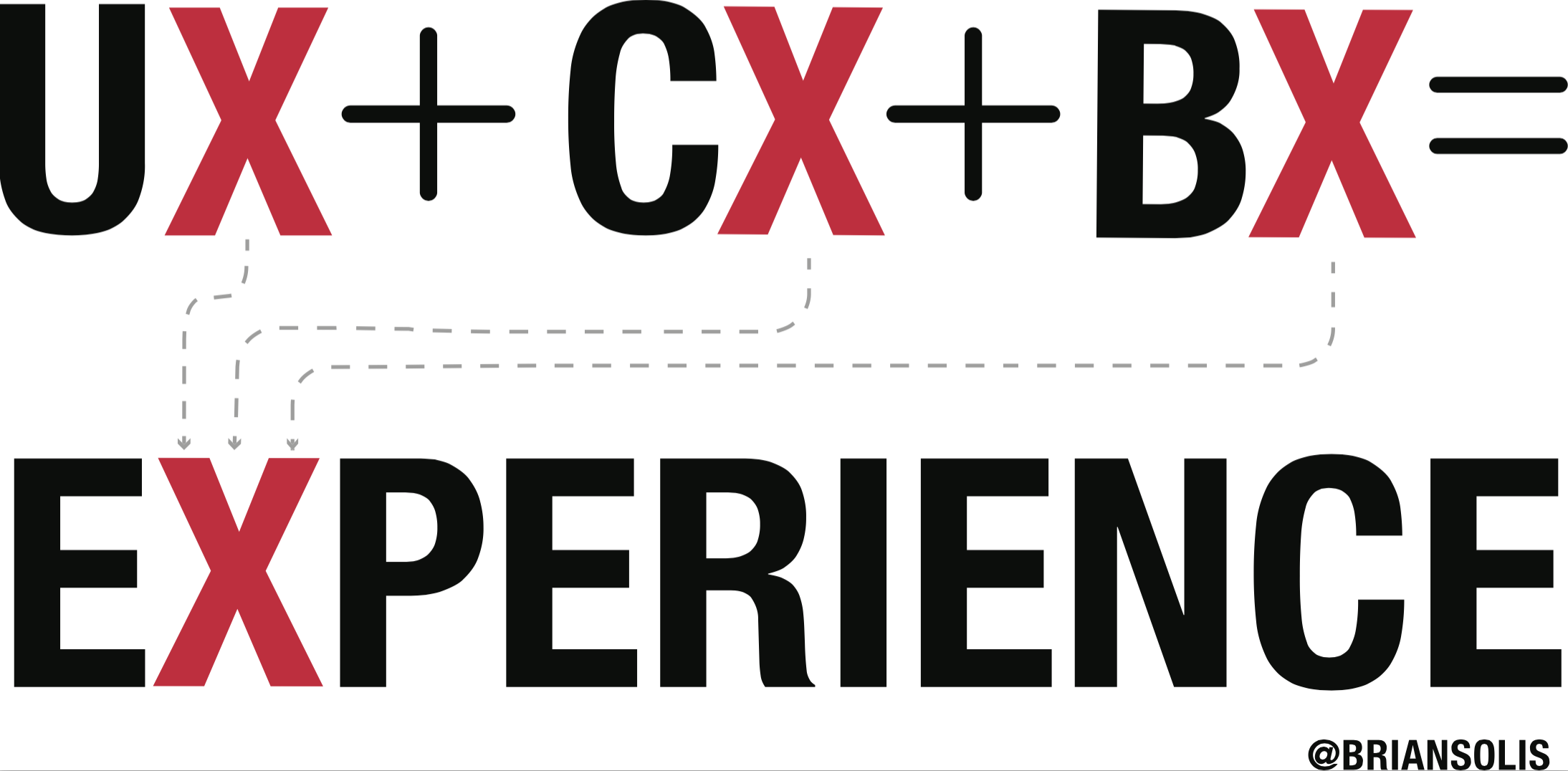
X = experience.

It’s the confluence of BX + UX + CX. To bring desired, meaningful experiences to life requires that we don’t start with brand architecture, we instead start with experience architecture. Then brand management has a higher purpose to serve the bigger mission. Experience is the brand. And the experiences people have becomes part of marketing.

c04uf010_pdf__1_page_

Many of our readers own or manage small local businesses- your average cafes, plumbers, retail stores, etc. How important is it for these “average joes” to understand the digital landscape and be able to cultivate meaningful experiences?

Experience is everything. Small business is the heart of any economy. But too many are falling behind in the world as it evolves simply because they are intent to hold onto the way things have always been. Technology is one of the key pillars to delivering and managing meaningful experiences because customers are increasingly living digital lifestyles. They don’t go backward. Their behaviors and expectations only continue to evolve. It’s up to the “average Joes” to adapt or not.

I think about Victor Churchill and the incredible experience they’ve created around the idea of a traditional butcher shop. It’s world famous because their marketing is rooted in the experiences told to and through people who love it. I personally had to visit it and was completely enchanted by the experience. But what’s important is that they intentionally set out to create this experience and everything they do becomes a form of experience management.

Are those who think simply having a good product and good customer service is enough to be successful kidding themselves?

We live in a world where having a good product and/or good customer service is a competitive advantage. And it’s true for the time being. But when you study where consumerism is shifting and ultimately where it will be in the short while, the desire for all around experience, before, during and after buying, is the new “good enough.”

Studies show that people are willing to pay up to 25% more for a product because they believe they are going to have a great, productive or “experiential” experience. Competing for the hearts and minds of customers is quickly replacing competing for their wallets.

Can a mediocre product or business thrive by creating an exceptional experience around it?

I’m sure that dazzling customers this way has and will work somewhat until they recognize that they’re not able to do what it is they set out to do the way the intended to do so. Mediocrity kills. Competing for it is a short-term game. An exceptional experience means that you understand customer friction, aspirations, frustrations, vision to drive your innovation and overall experience architecture.

FullSizeRender

Technology and the online world is evolving so quickly. What key advice do you have for businesses looking to adapt and make smart decisions?

Technology is an enabler for a bigger vision. It is not the solution. Too many businesses look at technology as a way of scaling the ideas, processes, and metrics of customer engagement models of yesteryear. Start by studying the experience gap. Look at how customer behaviors and expectations are evolving. Look at your competitors, but also look at other companies in other industries the manage the types of customer experiences and relationships you want. Following the path of business as usual and using new technology to achieve it, does not change your core.

Iteration improves things.

Innovation opens new doors and creates new value.

Disruption shifts behaviors and markets.

Every business must do at least two of the above.

Are there any key trends in the digital world you believe Australian businesses should be aware of right now?

One of the reasons I believe UX is so important in the formula of experience architecture is inspired by the consumerization of technology. Without going through every trend that Australian businesses should watch, we should focus on immediate expectations. Apps like Uber, Tinder, Clear, et al., are changing how people navigate apps to accomplish goals or trigger outcomes. How they interact with these apps is one part. Add to that new services such as AirBnB and you start to see that people want services that cater to their evolving needs.

The biggest thing to realize here is that digital is changing how people make decisions and how they want to do business. They expect to engage EVERY company the way they do with their personal apps. This means that the entire funnel, the entire customer journey, each and every touch point from the Web, to sales and service teams to physical stores to CRM must be re-imagined to feel more natural to the way digital trends are impacting people.

Experience is everything…

SolisBook_X_Designs_080113_pdf__page_9_of_19_

Connect with me… Twitter | LinkedIn | Facebook | Youtube | Instagram | Pinterest

28 Oct 16:14

Resist Temptation When Hiring Becomes Urgent

by Jenny Stilwell

Resist Temptation When Hiring Becomes Urgent

Let’s imagine, just for a moment, that you desperately need to find someone to help take the load off you, or some of your team.

This may be because you’ve lost one or two people from your business, or you’re growing and just have too many things on the go.

You decide beforehand what sort of help you need and what the job description is for the new person. (You do create a job description before you start the recruitment process, don’t you?)

During the interview, you get on really well with the person, you can imagine working with them on a daily basis, you suddenly think of other things they could help you with, and you’ve already employed them in your own mind.

STOP!!

Ask yourself these question:

1) How much am I prepared to do to train this person?

When people say they’d love to work with your company because they want to ‘learn more’ about your industry or products or services, what that means is that they will NOT hit the ground running. You will have added to your work load AND be paying someone else for the privilege. They may bring a fantastic attitude to the role, and if you’re prepared to invest your time and patience into training them, then go ahead. If you can delegate the training to someone else in your team who won’t be adversely affected with their productivity, then go ahead.

If you don’t have the time or the will to do that, then do not employ such a person.

2) Does this seem like a good ‘next step’ for this person?

I helped a client interview someone recently, who had experience in many of the right areas and would fit in very well from a personality and attitude perspective. But, she kept talking about how important a team is to her, and how she takes care to mentor her team and that training her people is all-important.

Nothing wrong with that, but in this instance, she would be the team!

She needed other people to be a core component of her role.

Tempting, but not the right fit for now.

3) Be very honest about your priorities – where do you most need help?

It’s tempting to find someone who could add a lot of value to your business, but not immediately in your priority areas. Unless you have the funds to employ two people at once, don’t do it.

Finding experienced and capable people isn’t always easy, and when you do find them it’s so tempting to lure them into your business on the spot!

If you’re prepared to train people who have potential, do so. If you need someone to hit the ground running and be productive straight away, and you can’t afford two people, then keep focused on your highest priorities and recruit to those, not to lesser priorities.

Keep temptation at bay when hiring becomes urgent by asking yourself these three questions.

28 Oct 16:13

The Competitive Edge for Sales: Dedicated Sales Enablement

by Jeff Day

Does your organization have a sales enablement strategy?

It should!

No matter the organization size or industry, a thoughtful strategy for sales success—including a dedicated sales enablement (or sales readiness) team and a Sales Enablement platform—is a game changer.

Clients often come to us because they need help closing the divide that exists between sales and marketing, and our platform can help do just that. But, the platform is only one part of the equation, and we were curious how many companies have implemented holistic sales enablement programs across the board, what they consider as sales enablement activities, how effective they are, and how actively are organizations executing them.

So, that’s why we partnered with Heinz Marketing to conduct a study comprised of nearly 450 B2B sales and marketing professionals, aimed at answering those questions, and more. You can read the full survey report here.

In the interest of time, we’ve summarized the top five observations we gleaned from the study, which should help you plan your 2016 marketing investments.

1. If you think your sales team isn’t effective, you’re not alone.

It may seem like sales is getting thrown under the bus, but just over half of the survey respondents were from sales departments! This is a clear indicator that sales teams need more help, especially because 60-70% of the buyer’s journey happens before a prospect ever talks to sales. However, it’s the sales team’s job to engage with the customer and close the deal, and only 48% of survey respondents ranked their sales efforts as effective. Organizations with dedicated sales enablement teams scored much higher in this area. It’s worth noting, too, that a good sales enablement program can boost sales’ ability to meet quota by 50%, so the opportunity for improvement in this area is significant.

2. Companies with sales enablement teams perform much better on meaningful business metrics.

Across the board, organizations recognize the importance of sales enablement activities and rank them high in value. Sales enablement teams produce real business results, including:

  • increased conversion rates,
  • helping increase sales productivity,
  • improving sales’ ability to sell, and
  • improving marketing’s ability to deliver the right content to support sales efforts.

Organizations without sales enablement teams report very mediocre effectiveness in sales enablement tasks.

3. Sales enablement drives effectiveness in key areas.

The numbers reliability pointed to the effectiveness of a regimented sales enablement program: 57% of respondents with sales enablement teams reported that their sales efforts were effective or very effective versus only 35% without. Organizations with sales enablement teams were also significantly more effective (by as much as 25%) on key sales support activities versus organizations without.

4. Unfortunately, most organizations are slow to focus on Sales Enablement.

Even though its importance appears widely recognized, only 37% of organizations have a dedicated, focused sales enablement team. It makes perfect sense, then, that 31% of all companies reported that their sales enablement efforts were ineffective. The opportunity here is wildly untapped. And considering the benefits a dedicated sales enablement team brings to sales performance, organizations should make this a priority for 2016.

5. Content is king. But only if it’s in the right hands at the right time.

Four of the eight activities that defined sales enablement centered on content; producing, organizing, distributing, training on, delivering to prospects and measuring content. Solving the “content problem” requires a complete solution, including publishing, organizing, making accessible by sales, presenting or emailing to customer and measuring quality and performance. Without a reliable, structured way to distribute content, all of the other aspects of it become moot. The fact is, more than 70% of respondents rely on email to distribute content to their sales organization, and more than 45% rely on a shared network drive to deliver sales collateral and content—this is not efficient or effective. And without a closed-loop process to measure the performance and quality of content, marketing has no reliable way to improve content effectiveness. Only 12% have a dedicated Sales Enablement solution in place, which would help solve almost every aspect of the content problem, aside from actually creating the content in the first place.

How does your organization stack up in these areas?

If you’re falling short, don’t be discouraged. This is a relatively new area, and the study shows that most organizations have much room for improvement. Think of this as an opportunity to create a competitive advantage, not a problem.

For better sales performance, Make Sales Enablement a priority in 2016.

It’s very clear to us that:

  • Dedicated sales enablement teams deliver results because they help reduce the friction that often exists between sales and marketing and drive towards the common goal— increasing revenue
  • The right Sales Enablement platform can fix the “my sales teams can’t find the content” problem, and focus both organizations on creating better conversations with customers

Want to learn more about Sales Enablement?

Download the full “State of Sales Enablement 2015” report.

28 Oct 16:13

The Magic of Mobile: How to Sell Without “Selling”

by Andrew Gazdecki

blog_image_new_42

We consumers have pretty much accepted the fact that everyone is trying to sell us something. In response, we’ve developed a keen awareness for sales situations to be avoided: we know the shortest route through the mall perfume carts and generally ignore unexpected calls from 1-800 numbers. Of course, there’s a time and place people are more open to being sold, and the best salespeople know when and where that is.

Timing aside, salespeople still have the ever-more-difficult task of pitching people on things without making them feel like they’re being pitched. Plenty of tactics are leveraged to give consumers this warped sense of camaraderie—from buttering shoppers up with banter to asking questions that ease them toward the right answers—and you know it’s been done right when you walk out of a store feeling like you just made a purchase (and a new friend!) entirely on your own volition. But there comes a point when the sale is out of the salesperson’s hands, and closing comes down to the consumer’s mindset and the pragmatism of marketing efforts surrounding them.

Here’s where many companies miss the mark on mobile marketing. The phone in your pocket has the incomparable advantage of being non-threatening and full of sales opportunity. With mobile-optimized websites and native apps, you can turn a sales & marketing tool into a commodity for consumers, who end up digesting offers along with insider tips and convenience-based features that appeal to them on a non-salesy level; you embed your marketing messages with other content that draws them in.

Tough for a salesperson to do all that on the spot. A lost deal is typically just a lost deal, but if you can get an ambivalent shopper to download an app before they walk out the door, you’ve just extended the sales process. They may leave empty-handed, but their pocket’s full of promise—you have the opportunity to work marketing seamlessly into their trusted little devices.

5 Tips on Making Mobile Sell

1. Buffer ROI features with tools that cater to customers’ needs—continually. They should see the app as something that works for them, not for you, and provides long-term value. No savings-minded user will uninstall if they’re accumulating points and rewards through your app.

2. Name features according to their use and benefit to the customer, not their business advantage. The subtleties in perception make all the difference.

3. Offer general, industry-relevant tips and info through push notifications. Customers appreciate a friendly word from time to time—not just messaging that constantly pushes promotions.

4. Include customer-to-customer interaction opportunities whenever possible. Connection draws and keeps users around.

5. Emphasize mobile exclusivity and reward people for joining the club. Everyone likes feeling special, after all.

Salespeople will be the first to tell you that nothing replaces human contact. It’s vital in pretty much any industry, which is why technology hasn’t wiped us out completely. Mobile should be treated as a tool that ups efficiency and bridges the gap an employee can’t cross, unless you’re cool with them following customers out the door or crawling into their pockets to make the sale.

28 Oct 16:13

The One Metric You Should Obsess Over As An Manager

by Jacob Shriar

one metric for managers

Managers have started to pay more attention to metrics, which is a great thing, but more often than not, they measure vanity metrics.

Vanity metrics are metrics that are easily manipulated and don’t necessarily measure anything that matters.

This happens often in the software world, where things like pageviews and number of users are used to justify the success of the business.

The problem with these metrics is that they don’t mean much.

It would make much more sense for a software company to look at active users or engagement instead of raw pageviews.

So what if someone viewed the page, did they click? Did they share your article? Comment?

In the HR world, an example of a vanity metric would be number of employees hired in a given year. Who cares!

Did they stay? Are they top performers? Are you getting better at recruiting in some measurable way?

The first step to measuring is to decide which metrics matter.

It’s important to be measuring whatever you’re measuring frequently.

You don’t check your bank statement once a year, so why would you treat any other business metric differently?

Annual surveys don’t work, so more frequent measuring is needed.

One problem that many managers face is an overload of data. Once companies decide to become more metric driven, the sheer amount of systems and reports available can be overwhelming.

To keep things simple, pick one metric and focus exclusively on improving that.

But which metric is the best metric of them all?

The Employee Net Promoter Score

What Is The Net Promoter Score

In 2003, Fred Reichheld published an article in Harvard Business Review called “The One Number You Need to Grow” that talked about how the Net Promoter Score (NPS) was created by trying to find the best question to measure customer loyalty.

It’s a simple survey to find customers who love your company and products.

It’s simple because you only ask your customers one question: How likely is it that you would recommend my product/service to a friend or colleague?

The answers are based on a 0-10 scale.

Since NPS was created, it has become the most popular way of measuring customer loyalty and many Fortune 500 companies incorporate NPS surveys into their businesses.

Fred Reichheld eventually co-authored a bestselling book called The Ultimate Question 2.0, which gave tons of examples of companies using NPS.

I did a video interview with the co-author of the book, Rob Markey from Bain & Company:

There are two big mistakes that many companies make with NPS that I’ll explain how to avoid.

The first big mistake, is only asking one question.

The Two Questions To Ask

The original NPS measures customer loyalty, but what you want to measure is employee loyalty (which is called eNPS).

The question used to measure customer loyalty is “How likely is it that you would recommend my product/service to a friend or colleague?” but for employee loyalty, the question becomes:

nps question

Ignoring the second question that you need to ask is where a lot of companies make a mistake.

You need to find out why they gave their answer, and more importantly, what you could do for them to raise their score.

The NPS is a number, but the real value comes in the form of qualitative feedback written by employees.

Ask an open-ended question like:

What’s the reason for your score?

This follow up question can change depending on the number chosen (more on this later) but you need to ask a follow-up. Otherwise, you’re leaving a lot of valuable information on the table.

How To Calculate Net Promoter Score

Calculating your NPS is pretty easy.

net promoter score calculation

  1. Add up the total number of responses.
  2. Add up everyone that gave you either a 9 or 10 (promoters)
  3. Add up everyone that gave you any score between 0-6 (detractors)
  4. Subtract the percentage of detractors from promoters

Why don’t we include scores of 7 or 8?

Because a score of 7 or 8 is considered neutral, we don’t include them since they could go either way.

What’s considered a good score?

The worst score you can get is -100 (if everyone gives you 0) and the best score you could get is +100 (if everyone gives you 10). Any score above 0 is good, any score above 50 is great, and any score above 70 is amazing.

For example, suppose there are 10 responses, two 10’s, one 9, two 7’s and five 5’s, your NPS score would be 20. In the example, you had 30% promoters and 50% detractors, 50-30 = 20.

Important: Your employees hold your company to a higher standard than your customers. It’s very common for an eNPS to be lower than an NPS score from customers.


What To Do With Your Score

The second big mistake that companies make is not following up after the survey is complete.

It’s cool to know your score, and it’s cool to know that someone gave you a 9, but why did they give you that score?

There are two big opportunities here.

  • Ask What They Like

    If an employee gives you a 9 or 10, you should ask them what about the company they enjoy the most (almost like a stay interview).

    There’s a few ways you can go about this. You can either have the employee fill out a small survey using something like Google Forms, you could ask them to email you what they like the most, or simply thank them for participating.

    Here is an example of a template you can use:

    Thanks for your feedback! I’m glad that you feel that way :) If you have 30 seconds, would you be willing to answer a few more questions about what your favorite parts of the job are? Here’s a URL…

  • Ask What Could Be Improved

    If an employee gives you any score between 0-6, you should ask them what you could do to make things better at work.

    Here is an example of a template you can use, the messaging could change slightly depending on how low the score is.

    Thank you for your honest answer. We’re always growing, and looking for ways to make this an even better place to work. What’s the #1 biggest problem that you have at work?

Conclusion

The eNPS is a great way to tell if your employees genuinely like the company they work for, which at the end of the day is all you really care about.

The reason it’s so good is because of how simple it is.

The participation rate and completion rate should both be incredibly high because of that.

Remember to ask a qualitative “why” along with a follow up email to get specific ideas to improve.

There’s no general rule for how often to conduct an NPS survey, some companies do it weekly, some monthly, some quarterly. Do whatever works best for your business.

Have You Ever Used The Net Promoter Score?

Anything we should keep in mind or look out for? Let us know your thoughts.

28 Oct 16:12

Where Is The Value In The Tech Stack?

by Fred Wilson

Yesterday’s discussion was fantastic. Days like that are where the USV community really shines.

David argued that data is the new oil, not software. There’s a lot of validity in that comment.

Kirk pointed out that ISPs are the pipelines of the digital revolution and I liked that.

And TR followed Kirk with this observation:

Oil in all its various forms (software)
Pipeline/delivery (networking/access)
Infrastructure/Drilling Equipment (hardware)

What they were all discussing is the tech stack and where the value is.

A simple version of the tech stack of the information revolution would look something like this:

Data

Applications (software)

Infrastructure (software)

Hardware

Access

At USV, we have invested mostly in the top three layers, and most actively in layers four and five (Applications and Data), but we are increasingly drawn to Access and Infrastructure (software).

But, as I tried to point out in the Dentist Office Software Story, software alone is a commodity. You need data to provide defensibility and differentiation. And so most of USV’s investments have been companies that combine software and data to provide a solution to the market that we believe is defensible, usually via network effects which are a data driven phenomenon.

So why would we move down the stack to Infrastructure (software) and Access? Well there are data driven network effects in those layers too if you know where to look for them. And, increasingly, we are finding them there and finding them at prices that make a lot more sense to us too.

So, in summary, I agree with David that software alone is not the new oil. But neither is the entire tech stack. That’s why I moved away from the phrase “tech is the new oil” that I used in the comments the day before. I also don’t think data alone is the new oil.

The new oil is going to be found in various places in the tech stack where software and data come together to produce a service that has high operating leverage at scale and is defensible by the network effects that the data provides. That’s a mouthful. Software is the new oil sounds a lot better. But the mouthful is more accurate.

28 Oct 16:09

It’s time to shake up the enterprise software market

by Kristoffer Lundegren

Kristoffer is chief executive at Starcounter.

The enterprise software industry as we know it is changing significantly. Recently, it’s seen a rise in ‘best of breed’ apps, which in turn, has contributed to the fall of the enterprise monopoly. More specifically, there are three factors fueling this change, including the reality of the problem, the collective app economy, and new technology enabling the next generation of business applications.

The reality of the enterprise problem

Over $600 billion is spent on enterprise software each year. And to date, modern enterprises have had two options: buy big, unfocused packages that excel in nothing; or buy small, focused ’best of breed’ apps and risk an integration nightmare.

First off, the major software platforms purchased by IT departments provide tools to make thousands of different features for thousands of different types of users. These products are cumbersome when they are overloaded, often perceived as hostile by the user, and difficult to learn. What’s more, this obstacle isn’t bypassed when they move to the cloud in an attempt to keep up with changing trends. But since these products seem to solve everything, they’ve been successful for quite some time and become the status quo in the software market.

In the meantime, the ’best of breed’ apps have been the preferred choice by business executives, and they have increasingly received support among all employees. With the consumerization of enterprise technology, products now enter a company from the bottom up, rather than the top down.

In the private space, you can easily compose your own suite of software tools to accomplish a task. To throw a birthday party, for example, go to the app store and get a calendar app, a social app, an invitation app and you’re set.

Those who have grown up today with the ease of an app store are entering into the positions at enterprises. They want their daily business tools such as accounting and smart marketing tools to be as accessible as messaging apps and car navigators. Enterprises must endorse this through the fast and easy delivery of efficient tools to employees who need a certain software to accomplish a special task.

Although these have been the two prevalent options among enterprises, the reality is that 68 percent of IT projects fail. These failures are forcing CIOs and CEOs at enterprises to seek change from the status quo.

The collective app economy

When multiple small apps band together, they can upend the status quo – this is the new collective app economy. Today, new technology is allowing this to happen:

  • Allowing enterprises to mix and match best of breed apps without the need for complex and expensive integration projects.
  • Allowing each vendor to be on top of its own food chain.
  • Allowing new business models to outperform the existing ones in the enterprise software business.
  • Allowing app stores, for example, to deliver interoperating apps and to be truly polylithic.

The ’best of breed’ app vendors often have an innovative edge because of their focus and domain knowledge. Though they still cannot check off as many boxes as the big vendors with their ecosystem of piggy-backers, and buyers shun complex, expensive, lengthy and risky integration projects.

The incumbent software platforms will not be replaced by a single app, no matter how elegant, intuitive, and powerful the app is. That’s because a single app can never replace the full functionality of the large players’ platforms. The best of breed apps must be able to be mixed-and-matched without the need for complex integration projects.

A single mobile payment app, for example, cannot replace a full retail solution. However, combining best of breed apps for accounting, product stock and point of sales results in a virtual retail suite that can outperform the larger players. These new apps are promising and must meet two critical conditions to gain any significant market share:

  1. It must be possible to run multiple independent business apps by different vendors side by side in a modern web user interface. Together they create your virtual business solution.
  2. The apps must operate on the same set of data without knowing about each other. All apps being aware of all other apps simply does not scale. APIs have been the peer-to-peer glue between apps for 50 years, and independent business apps still do not operate on a single set of data.

As new technology is now solving the vital, if not all, components of the ”shared data and shared screen” problems, this will have a major impact for enterprise software vendors and enterprises.

The next generation of business applications

Technology comes before revolution. Always. Though not typically obvious when first introduced, the importance of truly novel technology is not something reserved for tech geeks; in fact, it is and has always been vital for the evolution of the human race. Modems and computers were not invented to power the web. Rather, the web was discovered because we had computers and modems.

The new generation of in-memory application platforms will not only transform the database industry; it will forever change the enterprise software industry. How? By combining an in-memory database engine, data processing and application server into a single business operating system. This technology can deliver the capabilities of a huge data center in that single server. It can allow many small independent applications in combination to replace a monolithic application. It can remove the need for a single application to be the master of all others. Plus, the speed, radical efficiently, low costs and openness will help drive fast and wide adoption.

Time to band together

The enterprise software landscape will change dramatically in the near future. The new software landscape will be simultaneously fragmented and connected, with new business models created by collaboration among many small vendors.

It is time for vendors and talents to band together in order to provide businesses with the freedom to use the best tools needed to meet their goals, instead of being locked into a single vendor that is a jack of all trades, but master of none.

It’s time to shake up the enterprise software market originally published by Gigaom, © copyright 2015.

Continue reading…

Related research and analysis from Gigaom Research:
Subscriber content. Sign up for a free trial.

28 Oct 16:09

More buyers are buying than being sold, so dig deep into buying motives

by David Plumb

In every sales training class that I facilitate, I start by telling participants that they may consider my background either lucky or unfortunate for them. That’s because I’m not a “professional” trainer. What I am is a professional salesperson, with 30 years of experience under my belt. The last 15 of those years were spent as a senior vice president of sales in the IT services industry.

With this background, I have witnessed just about every sales scenario imaginable. And because I was responsible for premier accounts — those that billed in the top 40 — I developed an expert ability to deal with large, complex sales with long buying cycles.

During my career, I have also witnessed dramatic changes in B2B selling, as the availability of information has created more sophisticated and informed buyers. In my sales days, customers relied on me to provide them with information. Now, customers want salespeople to validate information that they’ve discovered on their own.

The way I describe today’s selling environment is that “more buyers are buying than being sold.” We have all seen these numbers previously, but they are worth communicating again. According to SiriusDecisions, buyers now digitally complete 67% of their decision processes before ever contacting a salesperson. Forrester Research goes even further, citing that 60% to 90% of the buyer’s journey occurs before he/she ever engages a potential provider.

Another important change is the number of people involved in the buying process. We used to talk about finding the economic buyer: the primary and ultimate decision maker. If the customer is a mid- to large-size company, it is rare for there to be a single decision maker. More often, there’s a buying committee that takes into account the input of the business units and others that will be impacted by the decision.

Additionally, executive leaders are less inclined to make unilateral buying decisions (as they might have in the past). They prefer a consensus approach, with many stakeholders included in the process. They also expect their staff to conduct research into every known supplier for the desired product or service.

All of this has direct implications for how salespeople need to prepare for and conduct their sales calls. It starts with their own research, digging deep under the covers in order to examine buying motives. As I tell participants in every sales training class, You have to know your market and your prospects in order to offer relevant insights that add value to buyers.

Among the questions that they need to find answers for are the following:

  • What is the current status of the market in your targeted business area?
  • What are the common themes surrounding the problems and business issues that buyers face?
  • What are the buyers’ customers looking to get from them as vendors?
  • Why are the buyers’ customers resistant to changing vendors, and why will this be an obstacle for them? Most salespeople don’t examine the buying motives of customers as thoroughly as they should in today’s environment. These motives might not just be for the value or the return on investment that comes from a particular solution. The reason for the buy might also include its impact on other departments and areas of the business, and these departments and areas might be underfunded and not adequately prepared if the proposed solution is put into place. This is where insights from the salesperson can help buyers understand all of the ramifications and possibilities.

Too often, salespeople jump to comparing features and functions, touting their product as superior to a competitor’s. If both products can solve the same problem, the decision comes down to price, performance, and commoditization. A better tactic is to talk about what will happen once the product is in place and how it will help the business grow and meet its objectives.

Only by providing such insights to buyers can salespeople hope to become a collaborative business partner. If they stick to features and functions, chances are good that they’ll be relegated to vendor status and quickly discounted from the buying process based on circumstances beyond their control.

The key is to establish credibility and continue to add value by providing new ideas and insights. That’s the way to move from being a vendor to an essential partner, working with buyers as part of the team in an ever-changing sales environment.

Download a Consultative Selling Brochure

Learn more about Richardson’s Consultative Selling Sales Training Solutions.

consultative-selling-sales-tip-shorter-sales-cycles

The post More buyers are buying than being sold, so dig deep into buying motives appeared first on Richardson Sales Enablement Blog.

28 Oct 16:08

4 reasons why the iPhone can't be stopped (AAPL)

by Steve Kovach

tim cook apple china

It was another big quarter for the iPhone.

Apple said it sold 48.05 million iPhones last quarter. And it expects next quarter to be even bigger, setting a new record past the 74.46 million it sold in the holiday quarter of 2014.

Why does the iPhone continue to sell so well? And how does Apple know it'll be able to keep it up?

In an interview with The Wall Street Journal, Apple CEO Tim Cook said there are four key areas that make the company confident the iPhone will continue to sell at record levels:

  1. The first is the fact that there are still a lot of people using older iPhones with small screens that haven't upgraded yet. The iPhone 6, which launched last year, has a 4.7-inch screen. The iPhone 6 Plus has a 5.5-inch screen. (The new iPhone 6S and 6S Plus have the same sizes.) But older iPhones have 5-inch screens or smaller. There are still plenty of people due for an upgrade to one of the big-screen iPhones, Cook told the WSJ.
  2. Next, there's Android. Apple has consistently said it's seeing record levels of people switching to Android to the iPhone since the introduction of the iPhone 6. This quarter, Apple got a little more specific. Cook told the WSJ that 30% of iPhone buyers last quarter were Android users.
  3. After that, there's China. The iPhone continues to perform well there as a premium device. It's the biggest growth market for Apple, and Cook told the WSJ that more middle class Chinese people are now able to afford it.
  4. Finally, there's the hefty price. Even though the iPhone can be twice as expensive as other devices, that has turned out to be an advantage for Apple, according to the WSJ. The iPhone is seen as a luxury item worth spending the extra cash for.

Join the conversation about this story »

NOW WATCH: This iPhone feature is draining so much data that Apple is getting sued — here's how to turn it off

28 Oct 16:07

9 Secrets Of A Successful Sales Letter

by Troy Hollenbeck

9 Secrets of a Successful Sales LetterMost entrepreneurs spent years working long hours to reach the success they have today, and lot’s of failure along the way too. And, there is always a shortcut to success, as I have discussed in my previous blog posts.

Usually, it takes years of trial and error to figure out these secrets. And having a bad sales page is not going to do you any favors, only cause you more grief seeing sales and conversions going down the tube.

So let’s see what I can do to help you to improve that…and improve conversions

While the secrets I’m going to share really are not too secret after all, but these are tips that I have implemented into my business to make it a success. If you have created an original information product or identified an affiliate product you want to promote, you have completed half your task as an Entrepreneur, and the other half is the presentation to your customers, your sales page.

Here are some useful tips for doing just that…here’s an example.


web-3-sales-letter-elements

Use Video In Your Sales Letter

One of the things I notice is the lack of using video on sales pages. Not only are you coughing up conversions, you are also forgetting that video is the best way to present yourself and whatever it are your selling. People like watching real people on video and can make a big impact on their buying decision.

One of the best course out there for creating a video series for your company and your personal brand is James Wedmore with 48-hour film school and can be found here if you’re interested in creating a 5 part video series, highly recommended.

Use A Picture Of Yourself

This is really east to overlook, no picture on your sales page. Using a nice picture with a nice smile goes a long way to creating trust and people like knowing who they are buying from. So use a picture.

Sales Page Defined

A sales page essentially is an advertisement for your product. But unlike traditional print advertising like a newspaper or magazine ad or a television or radio commercial, your sales page has to not only explain what your product is all about but also convince the prospective customers reading it that it is essential that they buy your product. As such, sales pages don’t so much suggest as they demand.

If you are just starting out in online marketing, you probably don’t have a big marketing budget.

Creating an effective sales letter is the perfect option for a low-cost or no-cost Internet marketing campaign because you can use squeeze pages, Search Engine Optimization, and other no-cost techniques to attract traffic to you sales page.

Sales Page Structure

Once visitors find your sales page, it should follow a predictable structure. Remember that your readers arrived at your sales page by following a link on your squeeze page or by clicking on a URL on the Search Engine Results Page (SERP) for your product’s niche.

If you present your readers with the structure that is unfamiliar they very likely will click off your page immediately. If your sales page looks like a lot of other sales page, don’t worry: Your customers arrived there because they are looking specifically for the kinds of products you are promoting.

Now all you have to do is to use the copy on your sales page to convince them to do what they already want to do in the first place.

Write Catchy Headlines

The headline on our sales page is your first opportunity to draw your readers into your text. It should get right to the point and use direct, active language to engage your readers. I’m usually pretty good for crafting a unique eyeball catching title, that stands out and portrays what I’m talking about. Include a keyword (s) in your headline is also a smart idea.

Because you have only a moment or two to connect with your readers, you want to use your headline to express a powerful result: What is it that your product is going to do to improve your readers’ lives.

In other words, let your prospective customers know right away why they can’t live without your product. In addition to using action words in your headline, try to include emotionally stirring language so your headline “pops” off the page and immediately connects with your readers.

Create Demand

Beneath your headline, you want to provide details about your product that are going to make it irresistible to your readers. In the first section, you want to set up a common problem that your readers may have. Then introduce your product as the best and possibly the only solution for that problem.

Near the end of your sales letter, you want to incentivize your readers to purchase your product. One of the best ways to do this is to create scarcity. Tell your readers there is only a limited number of your product available if it is going to be unavailable in the very near future, or come up with another way to motivate your readers to act immediately otherwise they may risk not having access to your product again.

Having a product that the marketplace truly wants and desires also creates demand, and demand creates sales.

Bonuses, Upsells, And Back-End

You can add value to your product by including one to three free bonuses that your customers will receive when they purchase your product. Typically, you want to mention what each bonus is worth so that later you can show how much buyers are getting for their money.

Upsells and back-end offers are secondary offers that are made after your customer already has decided to purchase your product. Usually, after they submit their payment information, they are taken to another screen where you can offer them more – usually higher priced – products that are related to your original product.

This is an absolute must and needs to have a high-ticket item included in your business model. For my business, I use a funnel (s) to start with my own product up front then graduate into a high-ticket item that people can add into their business investment. It’s more money but a ton more value and learn things that the top marketers use and implement into their 6 or 7 figure businesses.

  • Note that in today’s marketplace you need a high ticket, upsells and time sensitive bonuses item to compete and scale up faster than your competition.

The Guarantee

You almost always want to offer an unconditional 30- or 60-day guarantee. This removes any risk for the customer.

Including these familiar elements to your sales page will help convert visitors into customers. Also besides a guarantee you really need to stress that you will be there and committed to your customer.

Use Testimonials

And my last tip on creating an effective sales letter is using real customers testimonials. Customers that love your product and had results from it should be advocating other people that this product is a winner, and silently they are doing the selling for you and adding credibility to you.

And I did say “real”. The worst anyone can do is create false testimonies, which will backfire on you worse that your first car you got in high school.

And real ones give your cold customers confidence to buy, it’s that simple.

That’s all I have for today’s post on creating the effective sales letter that convert. Any questions leave a comment below and I’d be happy to answer you!

28 Oct 16:05

5 Keys to Successfully Selling to Fortune 500 Companies

by ryan@digitaltalentagents.com (Ryan O'Connell)

Fortune 500 companies are in their own league. Not only will successfully selling to them give your business a significant revenue stream and huge credibility boost, it can also lead to lucrative referrals. Not to mention, you may be able to consistently grow your partnership over time by expanding into different departments, regions, and/or subsidiaries.

Unsurprisingly, you can’t show up with a barely modified version of your standard pitch. Fortune 500 companies aren’t your typical prospects, which means you’ll need to adjust your strategy. Here are five tactics that can help you sell to Fortune 500 companies.

1. Identify your target contacts.

According to Stacey Ferreira, Director of Workplace Strategy at WorkJam, finding the right contact is essential to winning big contracts. She says,

"Selling success comes down to three main things: understanding the extent and cost of your customer's pain, providing a valuable solution and service with outstripped returns for them and building a positive relationship with the right people within the organization.

How many times a lead is looking at your website and how often a lead is looking at your website are two great indicators of the extent and frequency of the customer pain. From there, its about connecting with the right person internally and showing them how your service or product can provide value."

One of the advantages of selling to SMBs? You can normally hone in on a specific person as your primary influencer or contact. To give you an idea, you may always reach out to the startup’s head of sales.

Unlike working with SMBs, roles at Fortune 500 companies aren’t always consistent with those at other organizations. The vice president of marketing at one Fortune 500 could have a completely different role than her counterpart at another. Titles may vary as well for identical jobs.

To be successful, you can’t think in terms of title — you have to think in terms of function. Use LinkedIn, company bios, and personal websites to determine the best people to connect with based on responsibilities, KPIs, and relative authority.

If you end up getting in contact with the wrong person, but they’re open to a conversation, use them as a resource and advocate to get connected to the right person.

And don’t limit yourself to just these initial contacts. Ask them for introductions to the other stakeholders; forging multiple relationships means you’re less vulnerable if one of your contacts finds a new job, loses influence, or decides to focus on different priorities.

2. Map out the decision-making process.

The larger the company, the more complex their decision-making process usually is. You’re likely dealing with a buying committee of three to five people — who will need sign-off from the executives, board, Procurement, and/or Legal before the deal officially closes.

While this might seem intimidating, it’s actually a great opportunity. You can set yourself apart from other salespeople by helping your prospect navigate the buying process. Not only will you earn their trust and gratitude, but eliminating friction means you’ll get the contract in less time.

According to research published in HBR from Nicholas Toman, Brent Adamson, and Cristina Gomez, those who make the buying process easy are 62% likelier to win a high-value deal.

Wondering how you’re supposed to figure out a corporation’s decision making process on their behalf? First, ask if they’ve ever purchased a similar product.

Let’s say you sell VR employee training software. Since VR is an emerging technology, it’s unlikely your prospect has bought a VR solution before. But employee training isn’t new — so you might ask, "Have you invested in a training tool before?"

Your follow-up questions would include:

  • "How did the approval process work?"
  • "Who was involved? What was their role (i.e. researcher, budget authority, etc.)?"
  • "When did they get involved?"
  • "Approximately how long did the entire process take?"
  • "Which departments and/or teams were involved?"

Chances are, this process will be pretty similar. Use your prospect’s answers to make recommendations and volunteer your own resources. For example, if they say, "Our head of People Ops got involved when we’d narrowed down the list to two vendors," you’d respond, "Great — she’ll probably want to see some customer references, so I’ll work on pulling those for you."

You should also ask your champion or main contact for access to Procurement relatively early in the process. Ask the Procurement team the following questions:

  • "What do you look for in vendors?"
  • "Do you have an SOA (standard operating agreement)? If yes, can we please have a copy?"
  • "If we win the proposal, which information will you need?"
  • "How does the approval process typically work, and what’s the general timeline?"

As you work with larger companies and become better-versed in their processes, develop a customer buying map. This map should outline the five to 10 steps your customers take to decide on a specific vendor, the obstacles they face at each stage, and the proactive ways you can help.

3. Expect a longer sales cycle.

Selling into Fortune 500 companies is a long, strenuous process that can last twice as long (or more) than your typical sales process. In an SMB, you often work with just one person or a small team to close a deal. But because the Fortune 500 decision-making process includes more stakeholders, the time it takes to negotiate and close a deal with one will take you much longer. Your ability to navigate and stay focused is that much more important, so forecast extra time for negotiations and for the purchase to be processed.

Spend time refining your content nurturing process for brands. Content serves a dual purpose: To educate, and to move prospects down your sales funnel to the point where they’re deciding — on their own — to use your product or service. This is especially important for Fortune 500 companies. Make sure you have reasons to reach out, and double down on providing useful resources.

4. Provide immediate value.

Fortune 500 companies are constantly plied with sales pitches, which means giving your standard value proposition and presentation won’t be enough. To differentiate yourself, look for creative ways to add value upfront.

Your help doesn’t have to be related to your product or service. For example, HubSpot channel sales manager Greg Fung once landed the second-largest deal in HubSpot history by connecting his prospect with a customer who had experience with mergers in the right industry. Because his prospect’s organization had just gone through a huge merge, this introduction was incredibly timely and useful. Does HubSpot’s software have anything to do with mergers? No. Yet this move made Fung into a trusted advisor.

"Due to our network and publication relationships, we’re able to connect influencers with organizations in their industries," writes Boomn co-founder and managing partner Ryan O’Connell.

"For example, Gina McDuffie, chief marketing officer at VER (formerly at GES), was looking for great organizations to join, so my team connected her to the incredible community at The CMO Club. She went to the first event and loved it. Soon after, GES became a client of ours and has been wonderful to work with. Helping other prospects in ways like this has helped us gain trust early on because it shows we truly care about being a resource to companies."

5. Establish your credibility.

Although Fortune 500 companies have huge budgets, they tend to be more risk-averse. Why? Leaders don’t want to do anything that could reflect badly on their department — or worse, hurt share values — so they stick to the status quo. In addition, big corporations attract less experimental employees. And internal promotions are the norm, which means many of the people at the top have been with the company for a long time and are relatively unwilling to try out new ideas.

The net result: To win a Fortune 500 contract, you have to prove you’re a safe bet. Leverage case studies, testimonials, press clips, and references. Show your influencer your product has a record of success. And use risk-reversal language, such as:

  • "It’s easy to cancel if the product isn’t working."
  • "Setup takes just a few hours and is almost painless."
  • "We guarantee X level of service."
  • "If you’re not satisfied, we’ll refund your purchase."
  • "In 20 years of business, only one customer has ever asked for their money back."

Gong’s research shows these disclaimers can increase win rates by 32%.

To build your personal credibility, try blogging. Nothing tells a prospect you’re knowledgeable about the industry like well-written, relevant content. If you’re not confident in your writing skills, you can achieve the same effect by finding content tailored to their specific challenges, goals, and position, and sending it with an explanation of why you thought it would be helpful and how it's relevant to their situation.

Fortune 500s can be tough sells, but landing just one account could transform your business. Understanding the differences between pitching a major brand and a smaller company is the first step toward nailing the sale and moving your own organization to the next level.

Editor’s note: Ryan O’Connell contributed to a previous version of this article.

28 Oct 16:04

No Secret Formula

by Jim Lobaito

Problem: Many salespeople wish there was a secret formula to prospecting successfully for new customers. We often hear salespeople moan, "If only more people would listen and talk to me. We know they would buy our service.”

Analysis: Prospects are bombarded with sales messages and buying opportunities. One recent study estimated that on average each of us is exposed to more than one thousand messages every day. Add to this the complexity and pace of business, prospects have no real way to cope but to screen out much of what they hear and see. Further, prospects buy for their own reasons and at the time that is right for them-not for your reasons or timing.

Solution: Follow these fundamental rules of prospecting for business:

  1. Make a one-hour appointment with yourself every day to prospect. This takes discipline and is easy to put off. Don't.
  2. See the end before you begin. Clearly identify the sales results you want and lay out the steps or "campaign" on how you will accomplish it.
  3. Develop your cold call script and introductory pain probe that fits with your prospecting activity and the objective you want to accomplish in your call. Refine your script frequently to maximize results.
  4. Research and create a list of your most likely prospects and make as many calls as you can. This improves the quality of calls. More calls are always better than less.
  5. Keep calls brief (no more than 2-3 minutes). Remember the purpose of your call: to find out if the prospect has enough pain to warrant spending time with you to talk about it.
  6. Work without interruption. The more you prospect, the better you get and the more momentum you will have. The hour will fly by.
  7. Call during off peak hours to take advantage of better times to reach your prospects and to avoid times when high volumes of other calls are being received by your prospects.
  8. Be organized and keep records of whom you called and what was discussed. Schedule the timing of callbacks so you don't miss them.
  9. Stay with it. Sustained effort and positive activity leads to results. There are no exceptions.
  10. Reward yourself when you accomplish your prospecting goals. Positive reinforcement helps you sustain the effort.

Good Selling!!

28 Oct 16:03

The 3 Critical B2B Sales Pipeline Metrics

by Bob Apollo

Doctor_TrimmedHow healthy is your sales pipeline right now? And what steps are you taking to progressively improve its fitness? Just as your own doctor might measure your body temperature, heart rate and blood pressure before putting you on a personal fitness regime, a pipeline doctor would want to understand your qualified pipeline value, average sales velocity and average sales win rate – and how these factors had changed over time – before coming up with their diagnosis. Here’s why these three measures are so important…

There are three fundamental things you can do to improve your sales figures: you can generate more qualified sales opportunities, you can shorten your average sales cycles, and you can increase your average sales win rates. Steadily improving all three factors will have a powerful multiplier effect on your sales – and dramatically improve your revenue predictability.

Bottlenecks and Best Practice

But if you’re not regularly measuring and reviewing all three factors at every level in your sales organisation – from each individual sales person through to the whole sales team – you’ll struggle to identify either where your most pressing performance bottlenecks lie or (and this is equally important) to identify pockets of best practice which if adopted more widely would enable you to systematically increase your overall sales performance.

Value, Velocity and Win Rate

Proactive pipeline management involves paying particularly close attention to all three factors – value, velocity and win rate. Together they represent what we have come to regard as the essential pipeline success formula.

Pipeline Success Formula 300 And just in case you wonder whether the effort is worthwhile, a series of studies have shown that organisations that take a data-driven approach to proactive pipeline management show significantly accelerated revenue growth compared to their peers.

Qualified Pipeline Value

The key word here is qualified. Measuring pipeline value without imposing a company-wide universally agreed definition of what a qualified sales opportunity ought to look like will simply generate misleading, unhelpful and ultimately useless data. And “leads” or “enquiries” don’t count. As I’ve pointed out before, tracking the number of leads generated in the absence of a consistent quality standard tells you nothing and may even lead you to do more of the wrong thing.

You’ll need to craft qualification criteria that address the specifics of your offering and your markets, but at minimum, a qualified sales opportunity must satisfy all of the following:

    • Have they identified a clear need?
    • Are they likely to buy something?
    • Do we have a reasonable chance of winning?
    • Would they make a good customer?

Sales Cycle Velocity

Most sales managers would acknowledge that the longer a deal hangs around in the pipeline, stuck at its current stage, the less likely they are to buy. Sales cycle velocity – the amount of time it takes for an opportunity to move from start to finish, and from stage to stage – is, therefore, an incredibly important predictor of sales success. And if you can shorten your average sales cycles, you have the capacity – without increasing your resources – to sell more.

Given all of this, it always surprises me to see CRM systems that are not set up to report on how long each deal has spent at each stage, or to throw up an exception report when opportunities have been stuck for long than the typical time taken for winning deals to progress. If you’re not measuring or reporting on this, take an initiative today to deal with it. In fact, if your current CRM system can’t provide it, I would seriously think of changing it. It’s that important.

Sales Win Rate

This is an obvious metric, but even here not all organisations track it with enough granularity to learn the significant lessons this metric can provide. You need to be tracking all possible outcomes. In most complex B2B sales environments, there are at least four:

  1. You win the deal
  2. A competitor wins the deal
  3. The prospect decides to implement an internally developed solution
  4. The prospect decides to do nothing

You’ll miss the opportunity for incredibly valuable learning if you categorise the last three outcomes simply as “lost”. If you’re not evaluating the outcome of every opportunity into at least these four categories, I strongly suggest you start doing so today – and that you retrospectively analyse recent sales outcomes.

Measure at Every Level

My final recommendation is that you measure these three metrics at every level within your organisation, as well as analysing outcomes by source of opportunity – including comparing different marketing campaigns. You’ll inevitably find outliers in both directions: poor performance that clearly needs to be corrected, and exceptional success that needs to be replicated.

In fact, the latter may provide some of the most valuable learning opportunities: where are you currently being most successful today, what can you learn from this, and how can you enable the rest of the organisation to embrace the winning habits you have identified?

The Power of Sales Analytics

Your ability to analyse patterns of performance – to identify both winning and losing habits – will be dramatically amplified if you implement one of the growing number of sales analytics packages – we’ve seen clients have particular success with InsightSquared. If you’re serious about metrics, you’ve got be serious about your data, and your ability to analyse it.

10-Point Online Healthcheck

28 Oct 16:01

How Is Marketing Attribution Different Than Other Marketing Measurement Tools?

by Jordan Con

Many marketing tools — ones that most B2B organizations already use — claim to do attribution, or at least some version of it. For CMOs, it’s natural to want to use these tools for attribution as well, since they’ve already committed to the rest of the tool. But unfortunately, when you take a closer look, you will see that they don’t really do what you need and you will end up with the same problems you were trying to solve with attribution in the first place.

Attribution vs. Other Tools

Web and Other Channel-Specific Analytics — “Hacking” an Attribution System

It’s a common belief that marketers can hack together an attribution system themselves, using a combination of web and channel analytics, plus some Excel expertise. If you’re spending hundreds or maybe a couple thousand on paid advertising a month, then hacking something satisfactory is probably achievable. However, if you’re investing any significant amount, a hacked solution will not suffice.

When it comes to attribution, web analytics (e.g. Google Analytics) and channel-specific analytics (e.g. Facebook Insights) are limited in that the furthest down the funnel they track is form conversions. In a B2B situation, form conversions are still just a proxy for revenue — a pretty distant one, too. It’s not bad for a free or inexpensive tool, but even after quite a bit of work to create a usable attribution solution — meticulous use of UTM parameters, event setting, and connecting spreadsheets full of channel-specific data in order to dig into the necessary granularity of each channel all the way through to revenue — there’s still the problem of decentralization.

Because the attribution is done by each marketing channel separately (decentralized), marketers face the challenge of double-counting credit. For example, if a visitor clicks on an AdWords ad on Monday, a Facebook ad on Wednesday, and then buys something for $100 on Friday, both your AdWords data and your Facebook data will claim 100% conversion credit. That’s because they don’t communicate with each other. When you bring both data sources into your spreadsheet and enter in that the conversion was worth $100, your report will show $200 of revenue — 2x your actual revenue — a big, and potentially embarrassing, problem.

Double Counting Attribution

Marketing Automation

Another set of marketing tech, marketing automation (e.g. Marketo, Eloqua, Pardot, Hubspot), focuses on lead creation and typically looks at attribution measurement from a broad channel or campaign perspective. They are great at telling marketers what channels impact the middle of the funnel (lead creation), but they don’t do a good job looking at bottom-of-the-funnel metrics (sales opportunities and revenue) with granularity needed for optimization, such as by paid search keywords, by specific blog posts, or by which events were contributing as the source.

Because they are so focused on lead creation, they also do a poor job with the top of the marketing funnel. Marketing automation tools don’t connect back to the first anonymous touch, which is vital in understanding the start of the customer journey. Without that first touch, would the visitor have come back to request a demo?

Without the initial step in the funnel or the bottom-of-the-funnel metrics, marketing automation doesn’t fulfill the multi-touch attribution needs of most B2B marketing teams.

Moreover, their tracking is often inadequate to capture the full B2B customer journey. (This is also true of most channel-specific analytics.) Most have cookies that expire within 30-90 days of the contact creation date. It’s fine for B2C marketers (and built with them in mind), where the decision process ranges from hours to a few weeks, but as B2B marketers know, the B2B customer journey is often longer than 90 days.

Marketing Automation Problem

You don’t use marketing automation for web analytics, SEO, or advanced A/B testing, so why would you for something as critical as revenue attribution?

Business Intelligence Visualization Tools

Business intelligence tools (e.g. Tableau, DOMO, Qlik) are designed to help marketers visualize lots of data at a time, and they do just that. However, because they don’t actually create data (e.g. use cookies to track visitor behavior and marketing activities) they are only as useful as the data that is inputted, which means you’ll still have to hack together data from several sources that aren’t designed to work together. You’ll also run into the same limitations as the other marketing tools because you are relying on their data. For example, if the source data only tracks visitors to form conversion, business intelligence tools won’t help you past that.

The Biggest Difference Is…

Finally, the biggest limitation of all of these marketing tools is that they don’t connect into a CRM. Because of that, they can’t connect to specific customers and therefore doesn’t connect to the sales department and revenue. This is often serviceable for B2C attribution because there isn’t a sales team process, but it doesn’t cut it for B2B attribution.

In the 2015 State of Pipeline Marketing Report, CMOs disproportionately reported using total revenue as the primary metric to measure marketing performance, while less experienced marketers reported that they use higher funnel metrics, like leads. Essentially, the more senior the marketer, the more important the bottom-of-the-funnel metrics are.

However, that also means that while CMOs may think their primary metric is revenue, their team is using other metrics, and that may be because they don’t have the right tools — only 21% of non-CMO level marketers believe they are using the right attribution model. To find out why the team is focusing on top and middle-of-the-funnel metrics, CMOs should ask them questions like:

  • What was last month’s revenue by AdWords keyword by first (anonymous) touch?
  • What multi-touch attribution model are we using? W-shaped?
  • Why are we using our current attribution model?
  • Does our attribution model include first (anonymous) visitors? How about accounting for account based marketing?
  • Do we look at digital channels such as paid social and offline channels such as events/conferences with the same attribution model?
  • What metric(s) does it help optimize for?

CMOs might be measured based on revenue, but if their team is optimizing for other metrics (e.g. leads), the marketing will be misaligned and will underperform.

For B2B marketers to accurately report on these bottom-of-the-funnel metrics, it is absolutely necessary for the attribution solution to seamlessly integrate with the CRM.

While many tools claim to do attribution, if you really look into it and ask the right questions, you’ll find that they don’t fit the bill. To learn more about attribution, as well as what you should be looking for in an attribution tool, check out The CMO’s Guide to B2B Marketing Attribution.

 The CMO

28 Oct 16:01

5 Ways Top Sales Reps Can Use Marketing Automation to Close More Deals

by Chris Gillespie

iStock_000011148319

Marketing automation software is a huge blessing for sales teams, but unfortunately, it’s usually a tool that few salespeople leverage. So, often sales reps are too busy to learn about what the marketing team is up to and continue prospecting by sending one-off emails and guessing at which companies and people are the right ones. Little do they realize that if they took the time to understand what marketing automation does, they wouldn’t have to spend nearly as much time looking for leads. So, I’ve put together a primer on how you can utilize your organization’s marketing automation platform to help you close more deals. (You can thank me later).

First, let’s address the elephant in the room. The outstanding question that’s really keeping you from taking the plunge:

If marketing automation is so great, why isn’t it closing my deals for me?

It probably will be, before long. But we’re not quite there yet. The bottom line though is that marketing automation is sales’ best friend but also probably its most misunderstood ally. As a sales rep, just know that your marketing team invested in software that listens to what your prospects do online, figures out what they’re interested in, and messages them to see if they want to talk to you. Sound familiar? It’s basically doing part of your job.

So how can you use marketing automation to your benefit? Here are five ways that you can maximize your sales efforts with marketing automation software:

1. Provide timely feedback

Just like a new employee, the marketing automation software needs to learn what’s good and what isn’t before it becomes a truly productive member of the company. Without feedback, it’s going to assume that most leads passed on to reps are good until proven otherwise. To speed up the learning process, provide some feedback. Let’s say that you are a sales rep and that you are constantly receiving leads from marketing that turn out to be high school students doing research on your website. They fill out the “request a demo” form and you end up spending time on a lead that will never buy. Don’t just complain—help solve the problem! Pass that valuable feedback to marketing and let them know students don’t convert and they’ll dial in the scoring system to redirect them.

In turn, when you receive a great lead, actually go out of your way to let marketing know that it was a good one! There’s a story to how that lead got to you, and odds are, your marketing automation software can identify what was unique about it and find more high quality leads for you and your sales team.

2. Find out who’s poking around on your website

Your marketing automation system is already tracking the people you want to talk to. All anonymous visitors who land on your website become “anonymous leads.” The system finds out their location and company and tracks their behaviors until they fill out a form which allows you to learn more about them. Some 98% of all website visitors fall into that category and never fill out a form and yet only about 70% of those visitors “bounce” or leave the website after one page click which means they weren’t interested. This signifies that there’s a margin of nearly 30% of all visitors to your website who are interested in what you do but aren’t raising their hand to talk yet. Go after those people! Either look them up if your marketing automation system has a sales insight tool or ask for a list from your marketing department and search for interesting company names. It’s a pretty good bet that if you have a few different visitors from the same company, they’re worth talking to.

3. Automate your prospecting emails

At one time it made sense to keep Excel spreadsheets with dates and times for when you emailed people so that you knew when to follow up. At the right time, you would write an email to that person. At that rate, you can get four to five emails out per hour. Luckily for us, those days are gone the way of VHS and Betamax (go ahead, google it). Modern reps automate that entire follow-up process so all they do is send the first email and let marketing automation follow up with targeted, personalized, sales-oriented emails every four or five days. For every email you send, it’s like sending five. At this rate, you can reach hundreds of prospects every hour. It handles the follow-up, knows not to send on weekends, and inserts fields like “first name” or “company” for you. If you don’t have this set up, talk to your marketing team about how they can help you get this rolling with a few campaigns based on verticals or competition.

4. Fish with dynamite

If your marketing team has regularly scheduled email sends, and those emails are set to reply back to the lead’s owner (aka you), you’ll receive the “out of office” replies from all of the recipients. Save these! They’re often full of contact information that you would have never gotten otherwise, like “I’m out of the office today, but you can reach me on my cell at (123) 555-1234.” It’s guaranteed to be a working number, unlike what you get from data providers, and it also tells you when they’ll be back in the office so you know when to pick things up and have a topic of conversation.

5. Pursue tactical marketing

This is the black belt level of sales and marketing alignment. When it comes down to it, everyone is being measured on complimentary metrics: more marketing leads mean more sales leads, and if you can provide insights that the marketing team might not have because they aren’t talking to prospects every day, you, too, can help generate more demand. Set up a meeting with someone in demand gen, express your interest in working more closely, and ask how you can help. Someone on our sales team recently shared some news with the marketing team that generated $200K in pipeline for the company!

Savvy sales reps recognize a good thing when they see it and it’s all about working smarter, not harder. Recognize your marketing team’s software as the blessing that it is and get involved to make sure that it’s working for you.

Which of these tactics have you tried or hope to try soon? Share your experience in the comments section below!

27 Oct 16:21

How to Actually Put Your Marketing Data to Use

by Benjamin Gilad
oct15-27-DAVE_WHEELER_Analytics-and-Data
Dave Wheeler FOR HBR

In most companies, marketers are in charge of assessing the competition. Because of this, close to 60 percent of all competitive intelligence professionals report to marketing. Yet the majority of marketers fail to use their competition analysts strategically, instead using them to gather more “recon” data. In other words, they’re taking a snapshot of the present, not coming up with a perspective on the future.

This is the most frequent complaint I hear from the competitive intelligence analysts in my certification classes: their marketing bosses are exceedingly tactical in their requests for competitive data.

The rise of Big Data seems to have only exacerbated this tendency. And I understand the appeal. Big data providers from Nielsen to Gartner to IMS specialize in painting a picture of the market at any moment. Marketers in the Fortune 500 companies are well known for chasing competitors’ market share figures to the second decimal point.

There is little doubt that Big Data and analytics are changing the face of marketing. But that doesn’t make marketing more strategic, just more precise. Instead of blasting a single ad everywhere, Big Data allows for incredibly targeted messages delivered to customer segments according to their very personal preferences and the specific media they consume. That makes marketing today analogous to guided bombs that changed the face of air campaigns in battles. Still, as military experts will tell you, air campaigns don’t win wars.

So marketers today have unprecedented “weapons” and “recon” in terms of technological tools and access to data. But what they seem to often lack is effective “war planning” — the strategic ability to assess likely future scenarios regarding enemy moves and countermoves.

There are, of course, exceptions — and other companies can learn from them. To get more strategic value out of your competitive intelligence analysts:

Impose focus with a strategic framework. At UCB, a medium-sized pharmaceutical company headquartered in Belgium, Heresh Rezavandi and his manager Michelle Maddix-Sovero are leading a young strategic intelligence function that’s part of the strategic marketing practice. Rezavandi’s strategic early warning methodology starts with the company’s existing strategy, then synthesizes the cacophony of competitive information into hypotheses about the future using Michael Porter’s strategic frameworks (think: substitutes, buyers, and suppliers). This helps keep the team’s efforts focused. Before joining UCB, Heresh was working at a pharma consulting company, where he witnessed the widespread practice of managers who have little idea what they need, and instead ask, “Tell me everything important.” He says, “When I joined UCB, I quickly realize that unlike consultancy, information is just the beginning.”

Get business leaders involved. At Cintas, a leading uniform and business services provider headquartered in Cincinnati OH, an internal network of 1,600 managers and executives belong to its CI collaboration community (out of 30,000 employees). Members represent all levels in the organization, all geographies and every business unit. The highest-ranking officers at Cintas are members of this network. Says Troy Pfeffer, Director of the CI process, “this is one of the most fundamental aspects of our intelligence function. If you want intelligence, you will participate in the creation of that intelligence.”

Troy is a passionate preacher of this approach. “The person asking [for intelligence] often times has relevant and deep information of the intelligence topic. To ignore that information source is to lessen the quality of the intelligence. By involving the person who’s asking for the intelligence in the creation of said intelligence, you vastly increase the likelihood of it being acted upon, and deepen the intelligence culture of the organization.”

Anticipate other companies’ moves. In 2014, Atrion — a privately owned Technology Services company based in Warwick, RI — had a problem. Founded in 1987, its core business had traditionally been the sale, installation and ongoing support of IT infrastructure technology, the source of 80 percent of its revenue. However, as cloud computing started to grow, Atrion’s clients suddenly had cheaper options.

Insight Center

Luckily for Atrion, the rapid rise of cloud computing didn’t catch it off guard. Back in 2012, its intelligence analysts identified cloud computing as the number one strategic threat. Dave Ramsden and his team sought input from clients and analysts to start tracking weak signals. As rates of cloud adoption started to grow, red flags began showing up on their dashboard.

So in 2014, Ramsden’s team mocked up a 5-year growth scenario, showing expected growth given historical performance, and an alternate projection that combined growth with predicted declines in the infrastructure side of the business. Ramsden also drew a strategic clustering map using publicly available competitive information to illustrate the strategic decisions other technology services companies were making in the changing market. The team facilitated discussions about critical questions: who did Atrion want to be? Did it want to hang on to hardware dependence? Become a cloud services company? Evolve into a professional services firm?

The company chose to increasingly focus on growing services sales. Atrion adopted a more consultative approach, focusing on understanding the business outcomes desired by its clients. It also began innovating new services offerings to diversify its portfolio. In the fiscal year that ended in Jun 2015, Atrion’s overall gross revenues grew by approximately 19 percent, but service revenue grew by 44 percent.

Form hypotheses — and test them. Man-Wai Chow is leading the strategic intelligence efforts at Eastman, a chemical company. His intelligence process is hypothesis-driven. These hypotheses about the major industry forces structure his team’s efforts in providing actionable insights to the business. Hypotheses often start with certain beliefs that the business has, which might be wrong or right. As the strategic intelligence leader his task is to sharpen these beliefs and test them.

Man-Wei’s team develop the hypotheses — another name for perspectives — then identify specific signposts or leading indicators and try to validate and triangulate them. Again, Porter’s models frequently help in getting a perspective clearer. “We often develop ‘what-if’ questions that should prevent myopia,” says Chow “And there is close cooperation with the business that improves decisions based on the insights.”

In too many companies, marketers are still regarded as responsible for executing strategy but not for shaping it. The marketing “brigade” marches in after the fact. They are in the same boat as Human Resource, where changing the title from personnel did little to foster strategic roles, or business development functions which often are regarded as “just sales.”

But as marketers know, marketing is no longer about advertising or press releases alone. Gone are the days where marketers simply designed coupons. Marketing today encompasses data scientists and analytics functions which gather and analyze huge amount of customers’ data, whether transactional (still the dominant form) or textual (mining social networks) to design the optimal “customer experience.” New technological tools can help, but can’t replace what savvy strategic thinkers do. As Man-Wai Chow says, “There is no algorithm that can replace the human intellect in doing the work we do.”

27 Oct 16:17

Angela Bassett among stars focusing on technological advances in TV series ‘Breakthrough’

by CB Staff

LOS ANGELES, Calif. – As a resident of parched California, Angela Bassett is used to playing water warden at home.

“I’m a mom with (twin) kids, 9-year-olds, trying to teach them how to wash dishes, how to wash clothes” in a time of drought, the actress said. “And to turn out the lights. I feel like the father figure in ‘Long Day’s Journey into Night,’ saying, ‘Turn that light off!'”

As the director of “Water Apocalypse,” she’s talking to a bigger audience about water crises here and around the world and the technological advances that may help resolve them.

The hour-long program is part of “Breakthrough,” a six-part series on scientific innovation from filmmaking partners Ron Howard and Brian Grazer.

“Breakthrough” debuts Sunday (9 p.m. Eastern) on National Geographic Channel with “Fighting Pandemics” and concludes Dec. 13 with “Water Apocalypse.”

Bassett, who also turned director on this year’s TV movie “Whitney,” was among the Hollywood names invited to take charge of one topic from an array that included energy alternatives and brain research.

It’s the scientists and others doing innovative work in those fields that are the stars here, not the famous directors — but Howard and Grazer say their creative talents were key.

The goal was to look at each subject “in a really personal way. That’s why we partnered with these storytellers who are very humanistic and passionate and know how to connect with an audience,” Howard said.

Bassett said she’s not presenting herself as an authority.

“I see myself as going in wide-eyed and trying to learn something. Going in with wonder, going in with questions, and hopefully we can come away with a bit more understanding,” she said.

The big-picture approach of “Water Apocalypse” takes in a remote Ethiopian village where an Italian architect, Arturo Vittori, is trying to help residents conquer a lack of accessible, safe drinking water by building a unique water-collecting tower.

“Decoding the Brain,” the Nov. 15 episode from director Brett Ratner (“X-Men: The Last Stand,” the “Rush Hour” franchise), includes Dr. Steve Ramirez’s study of how to implant or erase memories to potentially benefit those with post-traumatic stress disorder.

“The Age of Aging,” which Howard directed, includes researchers who believe that the field’s great achievement would be extending the human “health span” — the period of life spent without disease — as opposed to our life span. It airs Nov. 29.

Why did he assign himself that subject?

“It’s not quite as cinematic in some ways,” Howard said, “but I felt it was something that we’re all thinking about. What does it mean to people in their 80s now? What does it mean to younger people?”

Grazer, who detailed his own questioning approach in the book “A Curious Mind: The Secret to a Bigger Life,” said the series parallels his films with Howard, such as “Apollo 13,” that offer “the experience of entering a world that has a problem and has a solution in it. We like those thematics.”

The pair also had towering figures including Thomas Edison top of mind with “Breakthrough.” (GE, created by an 1892 merger of Edison’s firm with a competitor, joined with National Geographic on the series and its scientists’ work is included in it, although not exclusively.)

“Looking back, we know who the giants were,” Howard said, adding that “Breakthrough” could end up “catching one of those giants in action today.”

Although such progress is more likely to become apparent in retrospect, Howard said his “Age of Aging” was lucky to record “scientists in motion achieve a goal that is a significant part of the challenge.”

No spoilers here; Howard didn’t elaborate.

The other episodes and their directors:

— “Fighting Pandemics,” Sunday, from Peter Berg (“Ballers,” ”The Leftovers”). Follows those who jump into action when Ebola or other outbreaks occur and who are searching for tools to counter HIV, influenza, malaria and other killer diseases.

— “More Than Human,” Nov. 8, from Paul Giamatti (“Sideways,” ”American Splendor”), about the merger of biology and technology, including research that could help people with traumatic spine injuries walk again.

— “Energy From the Edge,” Dec. 6, from producer Akiva Goldsman (“I Am Legend,” ”Fringe”). The scientists and engineers behind alternative energy projects, including the National Ignition Facility that’s attempting to corral the energy of controlled fusion, are the focus.

___

Lynn Elber is a national television columnist for The Associated Press. She can be reached at lelber@ap.org and on Twitter at http://twitter.com/lynnelber.

___

Online:

http://channel.nationalgeographic.com/

The post Angela Bassett among stars focusing on technological advances in TV series ‘Breakthrough’ appeared first on Canadian Business - Your Source For Business News.

27 Oct 16:12

Jeff Bezos, Marc Benioff, and Drew Houston just invested in this 6-month old startup

by Eugene Kim

Convoy CEO Dan Lewis headshot

Anytime you can get funding from the likes of Amazon CEO Jeff Bezos, Salesforce CEO Marc Benioff, and Dropbox CEO Drew Houston, all in one bucket, it probably means you’re doing something interesting.

Convoy, a six-month old startup founded by ex-Amazon executive Dan Lewis, just did that. It announced on Tuesday that it raised $2.5 million in seed funding from a bunch of star investors, including Bezos, Benioff, and Houston, as well as eBay founder Pierre Omidyar and ex-Starbucks president Howard Behar.

So what exactly is Convoy? It’s a service that helps connect freight companies, or shippers, with local trucking companies, allowing them to bypass brokers who typically charge a hefty fee. It automatically comes up with the right pricing based on variables like distance and weight, and can track the shipment in real-time — basically serving as an on-demand, Uber-like service for truckers and shippers.

Lewis argues there’s a real need for a service like Convoy in the trucking industry. Most shippers rely on brokers who manually call a bunch of trucking companies to find available trucks on short notice, and in many cases, the pricing and tracking systems aren’t transparent enough, he says.

“It’s a fundamentally fragmented industry. A lot of it is inefficient and slow — there’s just a massive opportunity to be disrupted,” Lewis told Business Insider.

Lewis has a point. The trucking sector may not be the sexiest business, but it's absolutely huge: in 2013, it took in $650 billion in total revenue, or roughly 84% of the entire US commercial transportation industry’s sales.

And that’s one of the main reasons why he thinks he was able to attract so many high-profile investors.

“This is a clear business that needs to be improved,” Lewis added. “And when you have folks like that, who’ve built big, successful businesses, they want to get behind that.”

In fact, the trucking industry has seen a number of new startups raise millions of dollars recently, including guys like Trucker Path and Cargomatic. But Lewis says his team's strong engineering foundation (mostly comprised of ex-Amazon and Google engineers) give Convoy an edge.

"We went to market in just 5 months. We probably have the best engineering team pound-for-pound in the trucking industry," Lewis said.

Convoy has been in beta operation for the last six months and will become available to the general public starting today. For now, it'll mostly focus on the local trucking network, but Lewis sees Convoy becoming much larger than that.

"There's a big opportunity to really reinvent the trucking industry," Lewis said. "We want to build a big, easy-to-use trucking network that solves a lot of problems."

SEE ALSO: This $2 billion startup gives $3,000 to every new mom because 'unlimited' leave is expensive

Join the conversation about this story »

NOW WATCH: This homeless man had a brilliant response to being excluded from Chick-fil-A's free-food giveaway

27 Oct 15:55

Financial planning for millennials requires a new kind of advisor

by Alexandra Bosanac
New School of Finance founder Shannon Lee Simmons

New School of Finance founder Shannon Lee Simmons. (Portrait by Erik Putz)

In a mad dash to attain the trappings of a successful adult life, a certain segment of millennials—defined as young adults in their 20s and early 30s—is overextending itself. They dive in headfirst to get the car and the house while still carrying student loans. To their friends on social media, their lives appear stable. But behind every cheery-looking Instagram photo lurks the truth: They likely don’t have the means to pay for it all.

Shannon Lee Simmons, a Toronto financial planner, sees both sides of the equation. Those people with the new house on Instagram? They’re her clients. “They’re miserable,” she says.

After honing her chops in the world of private wealth management for high-net-worth clients, Simmons founded The New School of Finance, which caters to people ready to dip their toes into financial planning. The monetary habits of millennials are coming to the fore, as they now outnumber baby boomers in the labour force. At the same time, boomers are finding their retirement plans affected by children who are increasingly relying on their support well into adulthood. When talks between parents and children disintegrate, the younger party turns to Simmons for advice.

They come in feeling “super frustrated and alienated,” she says. “They have information overload—that’s why they’re confused.” She can relate: At 30, she’s a millennial herself. And like her clients, she enjoys posting on her Instagram stream, often showing a split image. The one on the right is Simmons doing something fun, like going to a spa or buying new furniture; on the left, it’s her holding the bill. The message? There’s a lot of pressure to look like you have an interesting life on social media, but not all millennials are honest with themselves about the cost.


Well-intentioned yet outdated advice from boomer parents and their financial advisers can make things worse, Simmons warns. It tends to emphasize ownership—buying a house and a car and paying them off over a lifetime. But that doesn’t square with the economic realities facing Gen Y, which have nurtured the growth of the sharing economy. Many millennials would rather borrow or rent a car, a bike, a dwelling, a power tool.

The advice Simmons dispenses isn’t revolutionary—prioritize debt repayment, live within your means, sock away money into your savings account each month—however, the way she frames it is. Many of her conversations with clients revolve around goal setting. “I introduce them to the power of saving an extra hundred bucks,” she says. “They don’t realize that saving that amount per month can shave four or five years off their student debt.” She typically limits financial plans to easily foreseeable five-year scenarios, and lays off the RRSP hard sell.

One scenario she’s encountered several times is where high-net-worth parents foot the bill for their children without setting expectations or deadlines. An increasing number of youth are taking longer to achieve the typical markers of adulthood—full-time job, spouse, car, house —and it’s a source of shame and anxiety for the millennials receiving assistance. Establishing clear boundaries and expectations for repayment can alleviate some of that guilt for both parties, she says.

The other hallmark of millennials: They value transparency but will withdraw if they feel someone is passing judgment on them. “Nobody likes to admit they don’t know anything about money,” says Simmons. “But at this point you’re 30, and you should, so you don’t say anything at all.”

MORE MARKET MOVERS:

The post Financial planning for millennials requires a new kind of advisor appeared first on Canadian Business - Your Source For Business News.

27 Oct 15:55

5 Marketing Challenges For 2016 That B2B Marketers Need To Start Thinking About

by Jordan Con

b2b-marketing-challenges

It’s that time of year again, when everyone starts thinking about what next year will bring. It’s a time to both reflect on the gains of this past year and think about what we can do to prepare ourselves for the future.

Marketing technology changes faster than anyone can keep up, but at the same time, many of the challenges of the past few years remain challenges today. Here are five B2B marketing challenges that marketers will face in 2016:

1. Continued Maturation of Account-Based Marketing

Account-based marketing (ABM) became a huge focus for B2B marketers this year. It’s been a sales term for a while now, but marketers are finally catching up…and more importantly, they are now starting to have the technology to catch up.

Right now, account-based marketing entails things like setting up specific LinkedIn ad campaigns targeted at big accounts, and making sure that the messaging of those ads match the type of work the sales team is doing on those same accounts.

But what’s the next step?  How do marketers leverage the advances in digital marketing and the vast amount of data that is being collected to do even more effective ABM? What does ABM look like in 2016? We’re not sure…and that will be the challenge marketers face this upcoming year.

2. Marketing-Sales Alignment

SiriusDecisions research shows that “highly aligned B2B organizations achieve 19 percent faster revenue growth and 15 percent higher profitability.” According to the State of Pipeline Marketing survey, only one-third of organizations consider their marketing and sales teams tightly aligned. Organizational alignment, according to SiriusDecisions, is when an organization has a collection of technologies that are selected and architected to effectively execute core sales, marketing and product processes, measure the results and achieve those functions’ collective goals.

State of Pipeline Marketing Survey: Only ⅓ of organizations consider their marketing and sales teams tightly aligned

In 2016, marketers will need to think outside of their marketing silo when considering new technology and processes. It will take a shift in mindset to begin thinking about how their marketing decisions affect the sales team and the product team, in order to ensure that there is strategic organizational alignment.

3. Focusing on Quality Content, not Quantity

Content marketing is thriving in the B2B marketing world. It seems like just about every company has adopted it as a major marketing priority, and that of course leads to one thing: major clutter. In 2016, B2B marketing teams will need to figure out how to break through the clutter and that will be through quality — creating content that both resonates and has compounding value.

Compound value of content marketing

[Source: Tomasz Tunguz]

How do you know what content will live on and keep producing value? How do you recycle and optimize content for different formats?

4. Mapping the Customer Decision Journey

Knowing your customer has always been a pillar of marketing. It’s the fundamentals. That’s why it is so shocking that even in 2015, only 13 percent of companies firmly believe they understand the decision journeys of their customers, according to the Marketing Disruption Study (ANA and McKinsey & Co). And nearly half can’t measure the critical stages of that journey. With the amount of data that is now available and with all of the advances in marketing technology, that isn’t acceptable.

B2B companies, if they want to gain a competitive advantage, will need to research and invest in the marketing tools necessary to better understand the customer journey. Once marketers can better map the customer decision journey, they will be able to provide more value by matching their content and offer strategies to the correct stages in the funnel.

5. Connecting Marketing Spend to Revenue

According to the Walker Sands State of Marketing Technology 2015, 51% of marketers say their companies don’t invest enough on marketing technology.

And if you talk to their executives, that’s because marketers are currently unable to prove the value of their investments. If marketers want their bosses to invest, they have to be able to connect their activities to revenue — show that the money going out is doing something to bring money back in.

51% of marketers say their companies don’t invest enough on marketing technology (Walker Sands State of Marketing Technology 2015)

The 2015 State of Pipeline Marketing Report found that marketers who use marketing automation tools, CRMs, and attribution solutions enjoy a greater ROI…and are able to prove it through attribution.

ROI by marketing technology

[2015 State of Pipeline Marketing Report]

Marketing attribution connects marketing activities to their downstream revenue, allowing marketing to accurately receive revenue credit. It gives credit where it’s due. For example, with attribution, marketers will be able to say that the $30,000 spent on the PPC campaign drove $100,000 in revenue. If marketers can report like this, rather than saying it drove X amount impressions or Y amount of clicks, companies will be more open to investing in new marketing technology.

It all comes back to revenue.

Are you ready to take these challenges on?

 2015 State of Pipeline Marketing Get the inside look on sales alignment, attribution, top channels, and more. Download Now

27 Oct 15:52

Never Mind the Sales Process - What About the Buyer’s Journey?

by bob@inflexion-point.com (Bob Apollo)

winding_pathWhen organisations talk about their sales process, they are usually thinking in terms of a sequence of sales activities, typically encapsulated in a series of pipeline stages, which are designed to move a prospect from first contact to a successful sale. There’s overwhelming research to prove that having a formalised sales process has helped many organisations to improve sales performance.

But if my recent observations are anything to go by, many well-established sales processes seem to have something of a blind spot when it comes to two absolutely critical elements of successful B2B selling: what is the prospect doing and thinking at each point in their buying decision process, and what can we do to recognise where they are and facilitate their onward journey?

It’s all too easy to follow a prescribed sales process and fool yourself into thinking the opportunity is far more advanced - or your chances far more positive - than they really are. And relying on feedback from a single contact without awareness of the behaviours of the whole decision making team is equally dangerous - particularly if your prime contact hasn’t demonstrated an ability to mobilise their colleagues around the need for change or persuade them of the superiority of your approach to solving the problem.

Mobilising the decision team

In a world of increasingly well-informed prospects and consensus based decision-making, the ability to understand and influence the decision team’s perspective is increasingly vital. But that is hard to achieve if the sales person hasn’t identified and engaged with all the key stakeholders, established their motivations, and worked out where they fit in to the decision process.

There are two obvious antidotes for these common sales challenges: firstly, base your pipeline stages and milestones around the typical stages in your prospect’s buying decision process and second, carefully and thoughtfully assessing the credentials of your prime contact to determine whether they are a true mobiliser capable of leading their colleagues through the inevitable twists and turns of their decision journey.

Base your pipeline stages around the buyer's journey

A growing number of enlightened sales organisations have already recognised the benefits of redefining their pipeline stages around the key phases and milestones in the prospect’s typical buying decision process, for example: unaware and unconcerned, initial interest aroused, establishing appetite for change, agreeing basis of decision, evaluating shortlisted options, negotiating and validating preferred solution, and confirming and approving final decision.

It forces an interesting inversion in the sales person’s thinking - from what do I need to do to move this opportunity forward to what does the prospect’s decision team need to know and do before they can move forward - and what can I do to facilitate the process. Unsurprisingly, taking the prospect’s perspective often results in the recognition that many deals are actually far less far advanced than the sales person might have hoped or supposed.

Is your contact really capable of driving change?

The CEB have revealed the results of a great deal of research into the second challenge: am I really working with a mobiliser who can make change happen within their organisation? - in their recently published sequel to the Challenger Sale, “The Challenger Customer”. In a nutshell, most sales people gravitate towards sponsors they find easy to deal with - but most true mobilisers are hard to convince but ultimately highly rewarding to work with.

Perhaps it could be time to take a look at your own sales process and pipeline stages, and to reassess your judgements about the effectiveness of your primary contacts in your prospects to affect the sort of change you are proposing to them? Understanding the nature of their buying journey and the dynamics of the decision team could make all the difference between winning that opportunity or losing it to either a competitor or (as is increasingly common) to “no decision”.

This article was originally published in the October 2015 edition of the International Journal of Sales Transformation. It's an excellent publication - I recommend you subscribe.

10-Point Online Healthcheck

27 Oct 15:51

5 Ways to Organically Generate Qualified Sales for Your Business

by Ayodeji Onibalusi

The success of a business is often measured by how much sales it’s able to generate. It’s not uncommon for customers to check out two or more of your competitors at the time of contacting you. This makes qualifying your leads even more critical. To guarantee sales in this age, making sure your business generates qualified leads should be top of agenda.

Social media is a proven tool to generate new sales for your business. According to an independent survey by Marketo, 58% of marketers who’ve been using the medium for 3 years or more state that it has helped them boost sales.

Since social media has proven to be effective at lead generation, it’ll be interesting to know what other ways to organically generate qualified leads and boost sales for your business.

Blogs

Blogging has taken the lead as one of the most effective ways to organically acquire customers for businesses consistently. A 2013 survey by inbound marketing SaaS company, Hubspot, found that 87% of marketers that blog daily generated a customer through their blog compared to 57% who blog monthly.

A business can relate directly with its audience through a blog and give the audience reasons to buy from it. There has never been a platform that offers such control and exposure without the associated costs of controlled publicity.

Aside demonstrating the expertise of the people behind the products or services you offer, a blog also gives the customers a firsthand opportunity to know and relate with these people.

Guest Posts

For those that are willing to take blogging to the next level, there are even more opportunities to be explored through guest blogging. By blogging for other sites, you are directly communicating with the audience of the blog you’re writing for. This gives you the opportunity to actually sell yourself to this new audience. Such an opportunity does not come freely in the business environment.

Due to the high demand in content, other websites are willing to host your content on their blogs in exchange for a bio that allows you to advertise your brand to their audience without discrimination.

No form of customer acquisition is more organic.

Influencer Marketing

When you have an opportunity to let influencers in your niche share your brand with their audience, it will help you reap in the trust they have earned from their followers. As a business, reaching out to influencers can help boost sales and attract qualified leads to your sales funnel.

The first step in creating a successful influencer marketing campaign is identifying the right candidate for your campaign. You should also identify which of your offering their audience is more likely to connect with the best. This will ensure there is little friction in how well your brand is received by their audience.

An even better way to get results from influencer marketing is to team up with influencers to promote a vertical of your offering. A great example is the Lake Tahoe influencer campaign with Mom Bloggers. The influencer campaign focused on the strength of mom bloggers to draw their audience to the season of the resort when there is less demand.

A good influencer campaign will take advantage of the strength of the influencer and focus on the right verticals to promote to their audience.

Join Communities

Communities help bring people with common interests together. By being active in several communities, you have the opportunity to be seen as an authority with the potential to convert more customers.

A variety of communities are available to be explored, such as Google+ communities, LinkedIn Groups, forums and so many others. The opportunities these platforms present are worth the effort invested.

Participating in communities can help you display new products to a willing and ready-to-buy audience, drawing into your sales funnel a prequalified set of leads.

For example, a case study shows how Farfetch used Google+ to showcase new products, which cumulated to 116% Google+ followers that converted to buyers at a 1% conversion rate.

Client Case Studies

Testimonials are very powerful means of converting readers into customers. One of the reasons they convert so well is because case-studies help establish trust with new audience. Before people put their money down for something, they want to make sure they are making the right decision. There is only one effective way to assure them of this, through client case studies.

Today, 9 out of 10 people are looking at product reviews, posts on social networks as well as recommendations from friends prior to making a purchase decision. Case studies are very essential when it comes to assuring buyers that what you’re offering is valuable and of good quality.

Just how effective are cases studies? According to the Content Marketing Institute, UK marketers use 12 different marketing tactics, with case studies taking the fifth place on popularity. They also reported that 63% of UK marketers believe that case studies are effective marketing tactics.

Conclusion

Generating qualified sales for your business can be streamlined by employing proven and efficient marketing tactics such as the ones I’ve shared in this blog post. Do you have other tactics that can be used to generate qualified leads for a business, share them with us in the comment section?

Featured Image credit (Flickr: Sreenivas Digidm)

27 Oct 15:51

The Most Important Personality Trait of Leading Sales Reps

by mrenahan@hubspot.com (Mike Renahan)

What does it take to be a great salesperson? When you’re hiring someone for your team, what do you look for?

A lot of sales experts say reps have to be friendly, personable, goal-oriented, task-focused, likable, and loyal, among other characteristics. And while all of these are important to be successful in sales, I think one trait is frequently overlooked: Curiosity.

In recent years, the way buyers buy has dramatically changed, and as a result, salespeople need to change as well. In light of this fact, those of us in sales need to constantly adjust our styles, techniques, and motivations.

And in the new inbound selling era of “always be helping” instead of “always be selling,” curiosity becomes much more important than in the past.

This article from Harvard Business Review suggests that curiosity is just as important as intelligence. The author, Tomas Chamorro-Premuzic, writes that while IQ (intelligence quotient) measures how much we can actually learn, CQ (curiosity quotient) measures what we’re interested in learning.

And when you want to learn more, you’ll find a way to do it. A 2002 study that tested the curiosity of three-year-olds found that by age 11 the more curious toddlers boasted a higher IQ -- about 12 points higher.

The term to describe this phenomenon in the HBR article is “hungry mind,” and this is precisely the trait that’s most important to look for in a salesperson today. Here are three reasons why.

1) Curiosity keeps you focused.

A study conducted by Charan Ranganath found that people who were curious about certain subjects were able to make it through the boring, mundane tasks that surrounded the subject better than their less curious counterparts.

During the study, Ranganath showed participants random faces without explaining why. The more curious group of participants recalled the faces much better than those who were less enthralled. In other words, more curious participants retained the “incidental -- even boring information” better than the non-curious participants.

In sales, this ability can play a major part in a rep’s success. Oftentimes, reps are faced with performing repetitive, somewhat mundane tasks over and over: things like writing and sending follow-up emails and researching clients and markets.

While these tasks can be somewhat taxing, the reps that are curious, according to the study, will ultimately retain the information better. And as a result, during a call with a prospect, curious reps are more likely to remember the minor details that play a major role in a buyer’s decision making process.

2) Curiosity inspires happiness and confidence.

As Dr. Barbara Fredrickson points out, being curious can lead to being happier. After all, curiosity is an activator. It stimulates the mind and inspires thought. And according to Becca Martin, happy salespeople convert more leads than their counterparts.

Surprised? You shouldn’t be. A study from February of this year found that happiness can actually spread from one person to another. In fact, a happiness chain reaction can spread as far as three degrees beyond the initial relationship.

So when a rep connects with a prospect for the first time, their general happiness will shine throughout their words and encourage the prospect to be happy, too. And this positive attitude might even spread beyond the prospect they’re speaking with to other influencers and decision makers.

In addition, curiosity can help us be more confident in uncertain situations. The thinking goes that curious people approach ambiguous situations with the attitude that they’re going to learn something new. In this frame of mind, they’re able to think about what’s ahead with joy instead of dread, and handle new events with energy and enthusiasm.

The day of a salesperson is filled with uncertain situations. How will the demonstration go? Will the prospect be in a bad mood? Are they going to try to get a price discount? Do they really have any interest in the product? People who are uncomfortable with uncertainty are not going to be very happy -- or effective -- sales reps.

Being able to handle these uncertainties is crucial to success in sales. And the research suggests that curious people are the ones who can take it in stride.

3) Curiosity makes for better conversations.

Reps need to qualify and develop relationships with their potential clients. One of the best ways to accomplish these ends is to ask questions during the process. And who better than a curious person to ask questions?

According to ExperienceLife.com, curious sales folks are naturally inclined to connect with people. The site references a study that placed strangers in a room for only five minutes. After the time was up, the participants were asked to make judgments about their conversation partners.

What the researchers found was that participants who were identified as curious people were “talkative, interesting in what they say and do, confident, humorous, less likely to express insecurities, and lacking in timidity and anxiety compared with less curious people.”

The study goes on to point out that curious people, by nature, keep the conversation light, playful, and engaging -- which helps support the development of good relationships.

So the next time you interview a candidate, probe into their curiosity. What are they interested in? Curiosity killed the cat, but it just might go a long way for you and your company.

Get HubSpot CRM today!

27 Oct 15:39

6 Sales Strategies That Suck

by mrenahan@hubspot.com (Mike Renahan)

Every day there are several new blog posts about the next best sales technique for converting leads to customers. These strategies are popping up all over the place, and they have a lot of reps both curious, and confused.

How can there possibly be this many ways to sell a product? All of these tactics can’t work, right?

If you’re skeptical, it’s with good reason. While there are a ton of great sales strategies out there, there are a few that sales reps could do without. Here’s a list of six techniques that are dated at best, and flat out dangerous at worst.

Ready? Here we go.

1) The "You’re Perfect" Technique

People really like compliments. So if you’re a salesperson, complimenting a prospect on their business, or their home, or their car is a great way to build a relationship and eventually close a sale. In fact, compliments actually build trust between two people.

Praise is great! That is, until some sales reps take it over the top. Salespeople using the “you’re perfect” technique dole out compliments like candy during sales meetings.

After so many compliments, the prospect starts to think, “Hey, I’m pretty great. I don’t need to listen to this salesperson at all!” And the plan ultimately backfires.

The right way to use this technique is in the early stages of the process. Opening with a compliment puts the prospect at ease, but it’s also important to offer critical feedback. For example, a landscaper might say, “I really like what you’ve done with your yard, but what if we put these flowers back here? We could brighten up the whole yard with this quick solution.”

The lesson: Compliments are great -- until you overuse them. Offer real feedback, and create a solution.

2) The "I’m-Not-Taking-No-For-An-Answer" Technique

This is one that comes up all too often. This technique entails relentlessly following up with a hesitant prospect over and over and over again, until the salesperson finally gets a “yes.”

However, while persistence is a virtue in sales, there’s a time to call it quits. If you haven’t gotten an answer to your initial outreach, by all means, pursue. But if you’ve heard back and the prospect has let you know they aren’t interested, it’s best to lay off and refocus later.

Remember, in the world of sales today, your best bet is to offer help, not try to force a prospect to buy something they don’t want. If you get a “no, I’m not interested,” don’t try to fight it. A few weeks down the road, send a piece of helpful content or a valuable referral to the prospect with an accompanying note: “Thought you would enjoy this message/benefit from this introduction.” This will spark a conversation, and keep you and your product top of mind.

The lesson: Don’t bombard buyers. Keep it friendly and helpful.

3) The "Cold Call After Cold Call After Cold Call" Method

Cold calls represent one of the more difficult parts of the sales process, but the majority of companies and reps still use the strategy every day. Simply put, cold calls have become a challenge for reps because buyers screen their calls, and use executive assistants and other gatekeepers to avoid any and all salespeople.

In fact, it takes an average of eight attempts to reach a prospect using cold calls. Eight attempts. This statistic makes it clear that no one wants to answer a call from a salesperson they don’t know.

So what are companies and reps supposed to do? Start sending warm emails instead.

Focusing on the research phase of the sales process allows reps to really know their prospects before they reach out. By taking the time to dive into your buyer's social profiles, or reaching out to common connections for advice on how to approach them, a sales rep can get the necessary information to really make this connection work.

But it’s not just social media where reps can reap information. A company’s website is a great place to gain insight. Normally, reps can read about the accomplishments highlighted by the company here, the employee’s history, and where they are from.

The lesson: Cold calls are unpleasant. Warm emails, however, really speed up the sales process.

4) The Information Overload-er

Sales reps need to do a fair amount of research on each prospect if they want to understand that buyer’s business and create a connection. Unfortunately, sometimes they do a little too much research and go into an information overload rant.

After preparing a presentation, a rep might see so many connections between the buyer’s business and their product that they just start listing them off. The product can do this and this and this, so you don’t have to do that and that and that.

Before the prospect actually has time to digest all the information and benefits that matter for their business, the rep is already focused on the next set of things that their awesome product can do. Ultimately, the prospect becomes confused, and shies away.

Be an information provider, not an information overload-er. The right way to present your research is to have three to five benefits ready to go that tie into each prospect’s business.

For example, if the buyer is looking for a dishwasher, ask what they don’t like about their current one. Maybe it takes too long to clean the dishes. In this case, take the opportunity to explain how fast this your dishwasher operates. Maybe their current model can’t take as many plates and glasses as they’d like, so sell them on how many plates and glasses yours can handle.

The lesson: Instead of listing every great thing your product does, do research on your buyer, and then highlight very specific details and focus on relevant benefits. This is by far the best way to pique interest.

5) The “As Active As Possible" Technique

It’s a hot debate inside the sales arena right now: Should salespeople prospect for as many leads as they possibly can, or take a more low-volume, high-quality approach? Both techniques have shown to be successful in different circumstances, but in my opinion, there’s a clear loser. The high-volume, as-active-as-possible technique is the wrong way to go.

Qualified leads are more important than just leads. And only a targeted search will surface qualified leads. Sales reps tend to get caught up in keyword searches on LinkedIn and assume that all 600 results are the right fit. Then they just go down the list, reaching out to each and every single “lead.”

But by narrowing prospecting searches down to very specific people in very specific fields, reps can come up with a list of targets that actually need and could use their product.

This is important because of customer lifetime value. While the initial sale is great, bad fit customers might ultimately churn or cancel down the road and cost your company money (and depending on your compensation plan, cost you money). By taking the time to find high-quality leads up front, a rep increases the odds that these converted customers will stick with the product for the long haul.

The lesson: Put all your energy into developing a list of highly relevant targets and pursuing them. Instead of writing 600 emails, write 200, and spend the extra time doing research and fine-tuning your pitch.

6) The Indirect Route

While nobody wants to hear, “Give me a call, now!” there is a case to be made for being somewhat direct.

Oftentimes, reps get too caught up in the “I need to be helpful” mentality and forget they’re trying to actually sell a product. Emails that end with, “If you have a second, give me a call” or “Hope to hear back!” can be dramatically less effective than simply being forward and asking what time is best for the person to connect with you.

Without being somewhat direct, there is no rush for the prospect to respond or make a purchase, and this defeats the whole purpose of reaching out to them.

The key with this method is to include a call to action in every email you send, moving the discussion forward. It could be as easy as sending a calendar invite after the first email exchange, or listing times for a follow-up meeting.

The lesson: Be friendly and helpful, but move the conversation forward.

Being an effective salesperson comes down to working hard, honing your craft, and making improvements every day. What might work for some reps won’t work for you, and what works for you won’t work for others. What we can all agree on, though, is that some strategies don’t work at all.  

Get HubSpot CRM today!

27 Oct 15:38

5 Ways Top Sales Reps Can Use Marketing Automation to Close More Deals

by Chris Gillespie
iStock_000011148319

Author: Chris Gillespie

Marketing automation software is a huge blessing for sales teams, but unfortunately, it’s usually a tool that few salespeople leverage. So, often sales reps are too busy to learn about what the marketing team is up to and continue prospecting by sending one-off emails and guessing at which companies and people are the right ones. Little do they realize that if they took the time to understand what marketing automation does, they wouldn’t have to spend nearly as much time looking for leads. So, I’ve put together a primer on how you can utilize your organization’s marketing automation platform to help you close more deals. (You can thank me later).

First, let’s address the elephant in the room. The outstanding question that’s really keeping you from taking the plunge:

If marketing automation is so great, why isn’t it closing my deals for me?

It probably will be, before long. But we’re not quite there yet. The bottom line though is that marketing automation is sales’ best friend but also probably its most misunderstood ally. As a sales rep, just know that your marketing team invested in software that listens to what your prospects do online, figures out what they’re interested in, and messages them to see if they want to talk to you. Sound familiar? It’s basically doing part of your job.

So how can you use marketing automation to your benefit? Here are five ways that you can maximize your sales efforts with marketing automation software:

1. Provide timely feedback

Just like a new employee, the marketing automation software needs to learn what’s good and what isn’t before it becomes a truly productive member of the company. Without feedback, it’s going to assume that most leads passed on to reps are good until proven otherwise. To speed up the learning process, provide some feedback. Let’s say that you are a sales rep and that you are constantly receiving leads from marketing that turn out to be high school students doing research on your website. They fill out the “request a demo” form and you end up spending time on a lead that will never buy. Don’t just complain—help solve the problem! Pass that valuable feedback to marketing and let them know students don’t convert and they’ll dial in the scoring system to redirect them.

In turn, when you receive a great lead, actually go out of your way to let marketing know that it was a good one! There’s a story to how that lead got to you, and odds are, your marketing automation software can identify what was unique about it and find more high quality leads for you and your sales team.

2. Find out who’s poking around on your website

Your marketing automation system is already tracking the people you want to talk to. All anonymous visitors who land on your website become “anonymous leads.” The system finds out their location and company and tracks their behaviors until they fill out a form which allows you to learn more about them. Some 98% of all website visitors fall into that category and never fill out a form and yet only about 70% of those visitors “bounce” or leave the website after one page click which means they weren’t interested. This signifies that there’s a margin of nearly 30% of all visitors to your website who are interested in what you do but aren’t raising their hand to talk yet. Go after those people! Either look them up if your marketing automation system has a sales insight tool or ask for a list from your marketing department and search for interesting company names. It’s a pretty good bet that if you have a few different visitors from the same company, they’re worth talking to.

3. Automate your prospecting emails

At one time it made sense to keep Excel spreadsheets with dates and times for when you emailed people so that you knew when to follow up. At the right time, you would write an email to that person. At that rate, you can get four to five emails out per hour. Luckily for us, those days are gone the way of VHS and Betamax (go ahead, google it). Modern reps automate that entire follow-up process so all they do is send the first email and let marketing automation follow up with targeted, personalized, sales-oriented emails every four or five days. For every email you send, it’s like sending five. At this rate, you can reach hundreds of prospects every hour. It handles the follow-up, knows not to send on weekends, and inserts fields like “first name” or “company” for you. If you don’t have this set up, talk to your marketing team about how they can help you get this rolling with a few campaigns based on verticals or competition.

4. Fish with dynamite

If your marketing team has regularly scheduled email sends, and those emails are set to reply back to the lead’s owner (aka you), you’ll receive the “out of office” replies from all of the recipients. Save these! They’re often full of contact information that you would have never gotten otherwise, like “I’m out of the office today, but you can reach me on my cell at (123) 555-1234.” It’s guaranteed to be a working number, unlike what you get from data providers, and it also tells you when they’ll be back in the office so you know when to pick things up and have a topic of conversation.

5. Pursue tactical marketing

This is the black belt level of sales and marketing alignment. When it comes down to it, everyone is being measured on complementary metrics: more marketing leads mean more sales leads, and if you can provide insights that the marketing team might not have because they aren’t talking to prospects every day, you, too, can help generate more demand. Set up a meeting with someone in demand gen, express your interest in working more closely, and ask how you can help. Someone on our sales team recently shared some news with the marketing team that generated $200K in pipeline for the company!

Savvy sales reps recognize a good thing when they see it and it’s all about working smarter, not harder. Recognize your marketing team’s software as the blessing that it is and get involved to make sure that it’s working for you.

Which of these tactics have you tried or hope to try soon? Share your experience in the comments section below!


5 Ways Top Sales Reps Can Use Marketing Automation to Close More Deals was posted at Marketo Marketing Blog - Best Practices and Thought Leadership. | http://blog.marketo.com

The post 5 Ways Top Sales Reps Can Use Marketing Automation to Close More Deals appeared first on Marketo Marketing Blog - Best Practices and Thought Leadership.

27 Oct 15:38

How A Content Marketing Strategy Impacts Your Bottom Line

by Andrea Lehr

Content marketing is having a moment. More than 75 percent of companies plan to increase their content marketing budget this year, with the increase set to comprise a substantial portion of the budget: On average, companies are planning to allocate nearly a third of their total marketing budget to content marketing.

Why the push for an inbound approach? Content marketing is about attracting attention through a more genuine connection. Instead of something overly promotional, your audience expects something that has high value with very little branding. The goal is to encourage engagement through this content that eventually fosters a relationship and will lead to a conversion.

Attention, relationships, and conversions all make up various levels of the sales funnel, and part of content marketing’s appeal is it can reach your target audience at each stage. Fractl recently outlined how an effective content marketing strategy – specifically one that combines an alignment of on- and off-site content – can help brands throughout every step of the sales funnel.

Here’s how content marketing impacts three stages of the funnel: generating awareness, building trust and converting leads.

Increase awareness through an off-site promotion strategy that targets authoritative sites.

Content marketing success relies heavily on authoritative publishers, and luckily for marketers, these publishers are always looking for a steady stream of great content. Another benefit to working with publishers? It is the most effective way for your content to impact consumers at the awareness level. More specifically, additional gains from earned media include:

  • Search engines indexing your site higher through a strong inbound link portfolio
  • Growth in traffic to your site from new and returning visitors
  • A higher return on the content you created because you’re actively promoting it versus simply relying on natural syndication

A great example of an effective outreach strategy is Groove’s highly targeted guest blogging efforts, which helped the software startup reach more than 1 million people. One guest post alone, for instance, earned the company more than 10,000 social shares along with more than 20,000 unique visitors. Although the overall influence of the content can be impacted by multiple factors – including the date and time of when the post is published – one thing is clear: Guest blogging is a cost-effective way to impact the top of the sales funnel.

Establish yourself as a thought leader and build trust with your target audience through valuable on-site content.

An effective blogging strategy doesn’t have to rely solely on earning guest posts, though. An on-site blog is a great way to establish authority – a crucial step in the sales funnel that will continue to drive your leads down to possible conversions.

The growth of KISSmetrics’ blog is a perfect example of one brand using on-site posts to position itself as a leader in its industry. Last January, more than 60 percent of the site’s leads for that month were generated through the blog.

Other on-site content that can increase your authority? White papers, case studies and eBooks—especially when grouped together. For instance, Cox Media created a “Success Kit” for small businesses that included an eBook and video. The bundle led to more than 500 downloads and generated more than 2,000 leads.

Drive conversion events through gated on-site content to optimize bottom line results.

It’s clear that a mix of on- and off-site content can generate awareness and drive traffic – a successful content marketing strategy has the potential to increase traffic by 850 percent – but how do you ensure conversions? Make sure your content includes a call to action.

Remember that although the goal of any content should be to drive conversions, it has a greater chance of driving conversion events. A common one is asking your audience to provide an email address in exchange for your content. This initiates a conversation with a potential consumer and offers the opportunity to provide them with additional content that can drive them further down the funnel.

However, this content can also be optimized for lower-funnel conversions. For instance, BuzzStream launched a combination of large-scale, research-based campaigns that earned placements on high-authority sites. These campaigns were hyper-targeted to consumers who were already close to conversions, and because all off-site content led to a gated on-site asset, the company managed to break its record for new subscriber sign-ups.

Another way to optimize bottom line results is to shorten your sales cycle. For example, PR Newswire launched a content marketing strategy in an effort to accelerate its sales funnel of more than 25,000 potential consumers. Through highly targeted, automated emails and expanding its client interaction to multiple channels, the company shortened its sales cycle by 30 percent in only a year.

The biggest takeaway from our research?

Carefully align content with your business goals while maintaining high value for your consumers.

Although there is no go-to content marketing strategy that will ensure every potential lead ends up at the bottom of your sales funnel, offering highly targeted, off-site content that leads back to conversion-optimized, on-site content will help initiate a conversation with your target audience.

Check out this deck highlighting five additional case studies that reveal how content marketing can drive your bottom line. Understanding how your content can benefit each stage of the funnel will help stimulate ideas that will have a profound impact on awareness, traffic, search rankings, and lead generation.


How Content Marketing Works for Your Bottom Line

revcontent-98%25-of-sites-get-denied-are-you-in-the-2%25

27 Oct 15:37

The Advantages of Adopting a Sales Playbook

by Jeremy Jadczak

What Is A Sales Playbook?

A Sales Playbook is the engineering and development of better sales processes. This is a team driven approach where the Sales Playbook is designed to make business development efforts more productive. The Playbook is often highly detailed with specific instructions to follow.

The Sales Playbook are also a living document that defines the strategy and goals to achieve a success. They can and do evolve over time. In it includes detailed description of the products and services your organization offers, group exercises, and relevant content like links to websites, client lists, etc.

There are also instructions for improvements, tools and resources to essentially be handed to a new hire to review on their first day on the job. Think of the Playbook as new staff orientations for those in business development.

Also included are written out coaching and techniques unique to your environment so you can Turn No Into Yes! When a playbook is well written, has clear instructions, etc. and if the sales representative has the aptitude for the job, they should be successful very quickly.

Why The Need For A Sales Playbook?

businesspeople-with-hands-in

If you surveyed CEO’s and VP of Business Development chances are that training, and development are keys to reaching their sales quotas. Training a new hire is time-consuming. Playbooks are a coaching tool intended to get workers up to speed quickly, and defines the company culture. Sales Playbooks save everyone time and cuts down on confusion. Everyone knows their roles and if you stick to the plan, the sales program runs itself.

Even the best sales representative needs guidance and development from time to time. Then are those in sales with less experience who find it difficult to learn the ropes when there is no instructional manual. They are sent out into the world woefully unprepared expecting to close deals right out of the gate. Some of us are successful right out of the gate but most need help. That’s where the Sales Playbook is most effective.

They are repeatable and actionable steps that have been proven to close deals. If you stick with the script and have the aptitude to sell, then it works. If what you are doing is not working, then you make adjustments. You memorize the steps involved and know from experience what does not work. That’s essentially why a Playbook is necessary. A good sales representative has mental playbooks already. The key though is sharing that information or institutional knowledge so that the organization nets more sales.

Creation of the Playbook can help to change the company culture by following a uniform strategy. By stepping back and defining goals and providing a roadmap, an organization change their business processes, systems (CRM, etc.) and internal staffing structure in one swoop.

I Know From Personal Experience

First off, I have written several Playbooks. I know they work and I have seen the results. When I have written Playbooks for the companies I worked for, in some instances I would come in and would be the first hire for business development. I eventually wrote a Playbook because I easily forget things. I have gotten so comfortable abiding by Playbooks that I won’t go into an organization with at least some concept or plan for battle.

ranking-leadsBut let me back up a minute. I feel that the need for the Sales Playbook, is to help newbies be professional and treat everyone with respect. Sometimes I hear such horror stories about how the prospect was treated or misled by a competitor when evaluating their product or services. This makes my job even harder because when I met with the same prospect, after my competitors met with them, I am treated with caution.

The prospect may assume that meeting with me might be an uncomfortable “buy now!” experience. After the meeting, the feedback I receive was positive. I need to have all members of our sales team have a positive experience and by following the Playbook, this ensure uniformity in our approach.

I close a lot of business simply because I observe the Golden Rule: Treat others and you would want to be treated. I am respectful and honest with my prospects. I learned this through years of experience. Whenever I am bringing on additional members to the sales team the first thing they will read and understand is the Golden Rule. I want to start them off right. I wished all our competitors in our industry would follow a Playbook.

Advice For Creating a Successful Playbook

  • Do not make it too overly instructional. I always hate it when a boss, who has had some early success selling the product or service, tells you do only do it their way. Everyone in business development has their own style and their approach to developing deals. The Playbook needs to be a flexible document, or more of staying in between the lines.
  • Avoid industry speak in the Playbook. Keep in mind the Playbook is relevant mostly for new hires. They may not yet know the jargon just yet. Further, one of the sections of the Playbook should include a FAQ section and also common industry acronyms. In a couple of the playbooks I have written I even included buyer personas and explained the job function of ideal target prospects.
  • The Playbook is the law of the land. There are no if’s, and’s or but’s! The Playbook should also include the job description for every member of the business development team (appendix is fine) and their corresponding goals and objectives. The Playbook should be considered the judge, jury and executioner. Keep in mind that since the business development team creates and periodically reviews the Playbook together, it’s not like anyone won’t have input.
  • Playbooks require significant collaboration/alignment/change of culture and drive major productivity of the sales team. Playbooks require sales representatives to actively contribute and offer their own experiences to enhance the foundation of the playbook. Sales playbooks are highly specific documentation that tells the salesperson what to do when and how to do it and why it is being done.
  • Review it periodically. You should get in the habit of scheduling a review ever quarter or at the very least twice a year. This is an opportunity to review of your sales team’s processes, strategies, and what is working. This is a group driven effort where the sales and marketing team has a chance to bond and develop ways to be highly successful as a team. The review is also an opportunity to improve team communications and work out any issues.

Experience Counts

project-management-keyConsider outsourcing the management of the Playbook as a new project. If your organization is concerned about employee buy-in, fairness, or has doubts about launching the Playbook, then bring in someone to manage the project. You could hire me, I have written several playbooks and have the steps memorized. I know what works and what doesn’t. If not me, than do your research, but make sure that your solution is not necessarily “coaching” or “training” in a one-day seminar. There are firms that can do this as well as the coaching and or training as part of the process.

27 Oct 15:37

Sales Saturation: Is Your Sales Team Getting Soaked?

by Mike Weir

Here’s a scenario I’m sure you can relate to as a tech marketer: You generate an abundance of leads for your sales team only to find out that the reps have barely even touched them. What gives? Don’t your sales reps realize there is gold in that mountain of leads you’ve presented to them?

The unfortunate reality is that upwards of 80% of leads generated by marketing are neglected — never acted upon by a sales rep. Why does this happen? There are the common scenarios discussed such as lead quality, lead readiness for a sales person (sales ready leads) and lazy sales people…but let me share the least discussed reason in marketing circles, Sales Saturation!

All too many marketers believe their objective is to deliver as many leads as possible to their sales teams — and even sometimes, dare I say, this belief is really just to have a big number of leads to plug into their “sales contribution” calculation to show their CMO how awesome they did. Regardless, marketers tend to look at their lead generation goals too broadly, not taking into account the sales teams’ structure and focus. The most difficult, and therefore overlooked, is the amount of leads each individual sales person is able to contact on a daily, weekly or monthly basis. The result?

Sales Saturation: salespeople have more leads than they are physically able to follow up with.

How is a marketer to know if they are hydrating their sales reps or soaking them? Here’s a simple equation. Multiply the amount of available time a sales rep has in a week to follow up on marketing leads by the amount of time it takes to follow up on each lead. This is the number of leads a rep is able to handle each week and, therefore, the number of leads you should be delivering to them. Additionally, remember that each lead comes at a cost. That cost must be factored into the equation as well, in order to understand what is happening to the marketing investment made to deliver these leads. Because when leads go ignored, marketing dollars are wasted; it’s just a matter of how much.

Let’s run some hypothetical numbers:

Sales Capacity

  • Time each week each rep has to follow up with leads: 2 hours
  • Time it takes to follow up with one lead: 30 minutes

Number of leads each rep can follow up with per week: 4 leads

  • Number of sales reps you have to call on leads: 10

Total Sales Capacity per Week: 40 leads

Marketing Investment

  • Marketing’s cost per lead: $75 per lead
  • Number of leads delivered to sales each week: 100 leads

Marketing’s weekly investment in lead generation: $7,500

Sales Saturation

  • Number of leads marketing is delivering each week: 100 leads
  • Number of leads sales can follow up with each week: 40 leads
  • Number of leads neglected each week: 60 leads

Total marketing investment wasted each week: 60 x $75 = $4,500
…Each Month: 4 x $4,500 = $18,000
…Each Year: 52 x $4,500 = $234,000

In this situation, $4,500 in lead generation investment by the marketing department is potentially wasted. Every. Week. Which accumulates to a minimum of $234,000 a year. That’s a huge amount of waste. Additionally, every week those leads are compounding exponentially into neglect (aka upset clients if they directly asked to be contacted) and lost potential revenue (if they’re highly qualified buyers).

When we, marketers, generate leads where leads are not needed or able to be called on, we overwhelm and frustrate the sales team and waste valuable marketing resources. Run the sales saturation equation and start making the change today. Once you have a better understanding of the sales team’s capacity, here’s what you need to do:

  • Set more realistic goals: Adjust your efforts to focus on quality leads that fit your sales teams’ focus and deliver a realistic number of leads your sales team can follow up with each week.
  • Amp up your lead nurturing strategy: Refine your lead nurturing efforts to further qualify and prime your leads. This way, Marketing delivers a fantastic client experience with continued education during their process and the leads you do hand off will be of higher value to your sales reps and more worthy of their time.
  • Work to deliver both quality and quantity: Focus on providing the leads your sales team needs, both in quality and quantity. Communicate with your reps to understand the quality of the leads you’re delivering and how they can be improved.

Consider this a call to arms, folks. We have access to the range of ad and marketing technology that makes this approach more of a reality than ever before. Let’s use it to begin optimizing our lead generation strategies to set realistic goals, have marketing own more of the education process via lead nurturing, route quality, sales-ready leads and watch as sales closes them like pros (hopefully ☺).

The post Sales Saturation: Is Your Sales Team Getting Soaked? appeared first on OpenView Labs.