Are you going through a sales slump? No matter how hard you try, you can’t seem to close a deal? Here is how it starts, and six steps to break out of it.

Are you going through a sales slump? No matter how hard you try, you can’t seem to close a deal? Here is how it starts, and six steps to break out of it.
Spencer Gardner is a Strong Towns member and regular contributor who recently moved to Spokane, Washington. This is the third in a series of posts about Spokane. You can read Part 1 here and Part 2 here.
“A dirt road leading to one of Spokane’s oldest neighborhoods near Kendall Yards will be paved this fall using fees collected from motorists throughout town.
The Spokane City Council voted unanimously Monday afternoon to approve the roughly $300,000 project, which will pave a 900-foot span of dirt road leading down from Kendall Yards to the Lower Crossing neighborhood, a small cluster of nine homes. Residents said the street became rutted in the spring and winter, preventing access for trash trucks and snow plows. There were also concerns about fire danger.”
Shortly after we moved to Spokane last summer, the above article in the local newspaper caught my attention for three reasons. First, the project is only a couple of blocks from our home, so I was actually familiar with the location in question. Second, it’s unusual to see or hear about dirt roads in such a central, urban location. Third, paving a dirt road has a clear connection to the kinds of things we talk about here at Strong Towns.
To summarize: the city approved funding to pave a short stretch of dirt road that serves a handful of properties in the Lower Crossing neighborhood at the bottom of Spokane’s river gorge.
In terms of the overall city budget, this project is pretty minor. Its impact is also very isolated, so it was never likely to get much scrutiny from local media or advocacy groups. Although there were some objections raised during the approval process, the unanimous council vote indicates any dissent on the part of decision makers was minor—certainly not an indicator of a philosophical split in the city’s body politic. To quote Strong Towns founder and president Chuck Marohn: “Our cities struggle not from the lack of a cultural consensus, but because of one.”
Reading through another news report reveals a lot about the cultural consensus Chuck refers to. Proponents made their case based on very real concerns about safety and fairness. The benefits for fire prevention, stormwater runoff, and improved access are unquestionably good things. It’s easy to see why any opposition to the project quickly melted away.
And yet, there was one topic left undiscussed during the whole episode: what is the impact of the project on the city’s long term finances? No one has done the math. The math, in this case, is a simple calculation of the tax revenue generated by the isolated properties served by the project. Does the tax revenue from the Lower Crossing neighborhood justify the expense of paving the road?
This case is an interesting one in part because the costs and benefits are so neatly isolated. The road in question exclusively serves local traffic for the few properties at the bottom, so the benefits of the project are not widespread the way those of an arterial road or highway project might be.
Before we dive into the numbers, I have no doubt some observers will point out the project was paid for out of car tab fees, a separate revenue stream from property taxes. This is technically correct but fails to take a broader view of the fiscal issues. To begin with, the initial construction is only part of the total cost to the city. This road will now require regular service and maintenance. One day, it will need to be replaced completely. Where does the money come from to pay for that? In fact, this road is actually a liability on the city’s overall finances. (This is true regardless of what the accountants are allowed to show on the balance sheet.) In any case, whether any of the costs are paid out of one municipal fund or another is like whether I pay for a hamburger with cash or with a debit card—it’s a reduction in my overall balance sheet either way.

Tax revenue information for the properties affected by this paving project. Most communities make this data readily available online.
Now let’s do the math that didn’t make its way into the conversation this summer. The total assessed value of the 15 properties in the neighborhood based on 2017 tax records was $2,860,340. The total 2017 tax revenue was $33,697.39. The accompanying table shows the tax revenue for each parcel. For those of you interested in doing the math in your own community, this is all public information I looked up on the Spokane County assessor’s website. Most cities and counties make this information easily accessible.
Let’s consider these numbers in the most absurdly generous light possible. Let’s assume that these properties incur no additional costs to the city in the future: no emergency services needed, no school children to educate, no use of other roads in the city, no use of water or sewer infrastructure... you get the picture. In this impossible scenario, the $330,000 invested in this area will be repaid through tax revenue in about 10 years.
Think of it this way: We, the voting shareholders of the corporation known as the City of Spokane (did you know cities are technically corporations?), are investing over $330,000 in a depreciating asset that will generate about $1 million in tax revenues over its useful life of about 30 years, at which point without further investment we’ll be left with a virtually worthless pile of rubble where the road used to be, and the accumulated cash from taxes levied. That’s an annual return of about 4% on our initial investment of $300,000. And that’s the most absurdly, unrealistically generous scenario.
Thankfully, we already have a useful calculation that covers a more realistic scenario. Our target ratio of private investment to public investment should be a minimum of 20:1, and preferably closer to 40:1. Translating this into our present example, the total assessed value of $2,860,340 justifies a maximum of about $140,000 in public infrastructure investment (20:1 ratio). That’s for roads, sewers, water, etc. In other words, this road alone represents far more public investment for the neighborhood than any sensible person would be likely to accept in their own personal finances. And we haven’t even tallied the cost of the nearby sewer lift station and other infrastructure that makes this area habitable.
Now, my point isn’t to criticize the residents of the Lower Crossing neighborhood. They’re not receiving undue consideration or special treatment. In fact, that’s exactly the point. This inexorable math represents the financial reality in the vast majority of Spokane (and the rest of North America). I’ll quote Chuck again: “What we at Strong Towns have seen so clearly is that our cities struggle not from the lack of a cultural consensus, but because of one.” No one questions the provision of various municipal services and infrastructure. These are unassailable rights in our day and age, and this reality has put us in a predicament. I’m not here to suggest we cut municipal services, I’m simply doing math.
In fact, it’s worth thinking about reasonable responses to this problem. There are two sides to the equation. Cutting services and leaving infrastructure to rot attacks the problem from the cost side, but one could just as easily improve the situation by increasing private investment in the neighborhood. It’s difficult for a city to induce private actors to invest in an area, but at the very least the city can remove barriers that discourage it from happening.
This road alone represents far more public investment for the neighborhood than any sensible person would be likely to accept in their own personal finances.
To continue with our example, the city currently only allows single-family dwellings to be constructed in Lower Crossing. In other words, this area is built out with the maximum amount of private investment allowed under city code. Sure, an upgrade or a teardown and new build on one of the lots may increase the wealth a small amount, but we need orders of magnitude more investment. If the city needs more private investment here, the least it could do is modify the zoning to allow more of it.
Another reasonable response would be for the city to cut its losses by purchasing all the properties and abandoning the infrastructure completely. This would be politically challenging and costly, but not as costly as the perpetual maintenance and eventual rebuild of all the infrastructure serving the area.
The truth is, we will never marshal a level of private investment commensurate with public infrastructure in all areas of the city. We have vastly overbuilt. This isn’t unique to Spokane. I won’t pretend to know how this will play out across Spokane or elsewhere in the future. What I do know is we aren’t doing ourselves any favors by ignoring the financial realities at the root of the problem.
(Cover photo: Kate Hudson)
After listening to How Slack Leverages Freemium to Add $1M in New Contract every 11 Days I considered a couple of points made by Fareed Mosavat, Lifecycle Product Manager at Slack.
My first takeaway? The importance of a holistic view of your product and what it means to be a product-led company.
My second takeaway centers on “first value.”
Often, I think we consider value the outcome of the overall experience or engagement. However, “first value” implies there are touchpoints or a series of experiences that define the value of said product or service.
Interesting. So true.
Many people mention, opine, comment, and even rant about how much they DON’T like LinkedIn. Hah, I get it. There are days I feel their frustration. I’m part of a group of LinkedIn trainers that highlight their own annoyance with LinkedIn. There are so many comments I can’t keep up with the thread of the conversation. They need to devise workarounds and alternatives to accomplish what should be a simple activity on LinkedIn.
Beyond the lack of customer service, wonkiness, counterintuitive user experience, and unannounced changes, the question remains, “Do you receive value from LinkedIn?”
I submit you do.
Pre-LinkedIn your world and therefore your market share was smaller. You and your people, although you may have been well connected, were siloed and isolated. Your messaging while brilliant was not necessarily easy to find, and it cost you more to distribute it to the right people.
The value that’s yours for the taking:
LinkedIn’s creates a series of “first value” that once you get past their user experience enables you to showcase your most important asset; you.
All you need to do is show up like you’re interested. You are interested, right?
If you need help getting past LinkedIn’s wonkiness, let us know. We can fill in the gap and help you turn LinkedIn into a key business asset.
LinkedIn is a powerhouse for B2B businesses, and can even have incredible uses for B2C brands looking to make business connections, too. This is the only real social media platform that emphasizes professional development at its core, and this year it’s gone through some big changes to take us into 2019.
Increased functionality of LinkedIn video was one of the amazing things that we got this year. Users can now upload video not only through mobile, but also desktop, to engage their followers and connections.
While video is commonly used on other social media marketing platforms, it hasn’t really caught on the same way on LinkedIn. After talking to some of my clients, I realized that it’s because most businesses don’t know how to use it.
In this post, we’re going to go over everything that you need to know about LinkedIn video marketing and some best practices to help you see results quickly.
LinkedIn video can be just as beneficial is video marketing on other platforms, and it pains me a bit to know that so many businesses are accidentally leaving money on the table by not using it.
Nothing highlights this as well as the fact that in-feed content gets a total of 9 billion impressions per week, even though 3 million users share content on a weekly basis. There’s less competition here, and video can help you really go the extra mile and stand out.
Originally, LinkedIn video was only available through mobile uploads, but you can now upload the content natively through the desktop site, too.

In terms of basic video requirements, here’s what you need to know:
There are obviously a lot of benefits to using LinkedIn video, but seeing the results you want will require you to know more than just the basic video file size restrictions.
Let’s take a look at a few best practices and strategies that you can use to get the most out of your LinkedIn video marketing.
While having edited, high quality videos are important, you don’t want to take your business’s personality out of them completely. Act like a real person– relatable, authentic, and personable– and people will be more excited to watch your content and hear what you have to say.
Treat the viewer like someone you’re talking to, not someone you’re selling to. Using videos as a conversational tool instead of a sales pitch will help you a lot here, and using over-hyped, generalized inspirational speeches won’t work.
The video example above does a great job of providing value and advice while being personable and authentic.
People are on LinkedIn to learn about professional content directly relevant to them, and sharing an inside look at breakthrough, cutting-edge industry news in video form is an excellent strategy.
In the video ad above, a user shares video of new AR technology. It’s incredibly captivating, combines text to add context and video clips to show users what this is like. This video is instantly more effective than a post just describing what it looks like, making it valuable.
While you don’t want to have the majority of your content focused on the hard sell, there’s nothing wrong with showcasing your products and services from time to time.
The video below does an excellent job of taking viewers behind the scenes and showing the value in their product.
Seeing forklifts quickly and efficiently move burning-hot metal without missing a beat is undeniably effective. There’s no doubt that this can do exactly what it says it will, making it appealing to potential customers. It’s also not an aggressive sell, which can be welcome in feeds.
Storytelling still has a place in the B2B world, because it even though business purchases are more logical, we’re still more likely to remember that which resonates with us emotionally. And stories are the key to doing this well.
The example above tells a heartwarming story of a man doing good in the world. You can take the storytelling aspects and apply it to your own brand stories. Do you work with a charity? Is your brand mission personal for you? Make a video explaining why. People want to work with businesses who do good, and this can help improve your reputation while bolstering brand awareness.
If you’re running ads on LinkedIn (which is an outstanding choice for B2B marketers looking to expand their reach), you can use video to increase their effectiveness.

LinkedIn video ads allow you to use video and storytelling to engage users who aren’t otherwise familiar with you, helping to establish trust more quickly.
In order to use LinkedIn video ads, you need to to choose sponsored content, which will appear in users’ feeds. You can optimize for video views, and receive detailed analytics about view engagement, view retention, and video completion rate.

LinkedIn video is an outstanding opportunity for businesses and individual users alike to stand out in their followers feeds, leave a lasting impression, and drive real results.
Use these native videos to increase engagement and to build brand awareness. Since video isn’t as common on LinkedIn, it gives you a chance to do something different in a slightly less competitive field. Try out our best practices and use cases and see if it works for you.
Want some help creating videos for your LinkedIn marketing? Sign up for your free trial at Shakr now!
This story was delivered to Business Insider Intelligence IoT Briefing subscribers hours before it appeared on Business Insider. To be the first to know, please click here.
UK-based multinational telecommunications company Vodafone and leading tech company IBM have formed a wide-ranging partnership to jointly pursue solutions in a variety of developing technology sectors, reports TechCrunch.

IBM will supply Vodafone’s business-to-business (B2B) unit with cloud computing capabilities and space along with other managed services over the next eight years as part of a $550 million deal. The agreement should help drive forward both companies’ digital solutions and could inspire more wide-ranging collaborations between tech leaders and telecoms.
The deal shakes out in two major ways:
Wide-ranging partnerships between tech leaders and telecoms can offer benefits for both parties, but can also lull telecoms into complacency. Different cloud providers and technology vendors generally offer comparable baselines.
Where they usually vary is in their specific areas of expertise — one potential partner could emphasize edge computing AI capabilities, for instance, while another is more apt to suggest and pursue enterprise AR and VR solutions.
Companies of all stripes are racing to develop solutions that utilize forthcoming 5G networks, and executives in the telecom space see a variety of potential revenue opportunities. What telecoms need to be wary of, though, is restricting themselves to one path through a partnership that might leave them blind to other opportunities.
While that doesn’t appear likely with the IBM/Vodafone partnership, it's important for telecoms to stay abreast of wider industry trends rather than just developments within their ventures.

|
Content like this delivered straight to your inbox daily |
|
|
Access to 250+ expertly researched reports plus all future reports |
|
|
Forecasts of new and emerging technologies in your industry |
|
|
And more! |
One of the most important responsibilities that professional services executives and marketing directors face is sustaining the health of their firm’s brand.
A carefully managed brand is arguably your firm’s most powerful asset. However, if you aren’t diligent, the strength of your firm’s brand may begin to deteriorate. Your firm’s differentiators and positioning can lose their potency, confusing potential buyers and making it more difficult to recruit and retain top talent.
One of the ways business leaders can gauge the health of their firm’s brand is to assess its brand alignment. Now you may be thinking “brand alignment” sounds like one of those fluffy, academic business terms that has little value in the real world. But that would be a mistake. Just as poorly aligned tires can affect your vehicle’s overall efficiency, an unaligned brand degrades the performance of your firm.
In this post, we’ll offer a clear definition of brand alignment, describe the telltale signs of an unaligned brand, and point the way to a solution.
Brand alignment is a measure of how well your firm fulfills its brand promise. The strength of your firm’s brand alignment is driven by how well your employees understand, communicate and deliver on your brand’s key messages.
Are your people on the same page when it comes describing your brand and service offerings? And once your firm has been hired, do they do the things they said they would? Brand alignment gets you to “yes” on both counts.
1.) Buyers Are Confused — One sure sign your brand is out of alignment is when your buyers tell you they are confused. Buyers who haven’t worked with your firm before rely on your website, marketing materials and sales team to understand your firm. If you are not delivering clear and consistent messages about who you are and what you do, you aren’t going to instill confidence in your brand. Many buyers won’t have the patience to tease out your true story. Instead, they will move on to another firm. But occasionally a buyer will tell you that they are confused or frustrated. Don’t ignore these buyers — they are doing you a favor.
2.) Your People Describe Your Brand or Service Offerings Differently — Another sign that your firm’s brand alignment is off is when different members of your team members talk about your firm to buyers or clients in very different ways.
Try this brand alignment test: Ask your delivery team members to describe your core services. How similar are their answers? How about your business development team — how do they answer the same question? If you get a wide-ranging set of answers, you have a brand alignment problem. If your firm was a choir, your people would be singing in different keys. Stop the singing. This is a problem.
Do you have a core messaging architecture document that provides language your team can use to describe your firm and address common objections? If not, you haven’t equipped your employees with a powerful alignment tool.
Large firms that work across multiple industries or regions are particularly susceptible to brand alignment problems. Messaging architecture can keep far-flung team members on the same page (literally!).
3.) Your Firm Has Trouble Differentiating Itself — One the keys to professional services marketing success is a firm’s ability to differentiate itself in the marketplace. Few things will spoil your differentiation faster than bad brand alignment.
Imagine if your business development team forgot to mention your firm’s proprietary technology on a call with a potential buyer. Or what if your new marketing director went into your website and edited out important keywords related to your differentiators. Scenarios like these are more common than you’d think.
Without a strong messaging architecture for your employees to lean on, it’s easy to forget or mishandle key messages that differentiate your firm. If your team members aren’t actively thinking and talking about your differentiators, that’s another sign that your people are not aligned about your brand.
4.) You Have Difficulty Recruiting and Keeping Top Talent — In a study on employer branding, we discovered that 3 out of the top 5 business challenges faced by professional services firms are related to recruiting and talent retention. In that same study, we also found that firm culture was more important to recruits than their salary.
It’s not hard to see how poor brand alignment can create problems for firms attempting to recruit and retain top talent. After all, firms that struggle to instill a clear set of brand values in their employees usually have weaker cultures. If your firm struggles to attract and keep top talent, it could be a sign that you have a brand alignment problem.
We’ve seen how bad brand alignment can create wide-spread problems for your organization. So how do you measure brand alignment and fix any problems?
It starts with brand research. This involves conducting in-depth interviews and/or online surveys to capture the perspectives of three crucial audiences:
While you can do this research yourself, you are much more likely to get an accurate view of each audience if you hire an impartial third party to conduct the interviews.
Once you have collected responses from these three audiences, you can begin comparing their perspectives and looking for inconsistencies. Are there alignment gaps within each audience group (for instance, among different roles in your organization)? What differences do you see between groups? Does the way your internal team views the firm match outsiders’ perspectives? Or is your team’s perception unrealistic? Are there recurring, systemic problems that are driving clients out the door?
Armed with this intel, you can begin to look for patterns, inconstancies and critical problems with delivery. Then it is a matter of prioritizing the issues and addressing them, one by one. If you don’t have a messaging architecture document, create one. It gives your team the language and ideas they need to deliver consistent, differentiated messages to your clients and prospects. From there, you will be able to confidently fine tune the alignment of your brand and ensure that your firm is presenting a powerful, well-aligned brand to the world.
Most of today’s SaaS businesses already have a Customer Success department built in order to improve the experience provided to their customers and to help them achieve the desired outcomes.
We all know that an organization is not going to be fully successful until customers are put at the core of the business. One of the factors that will lead to a company’s success is to make sure that Customer Success is properly done internally, before manifesting it externally.
A cross-functional approach helps organizations build a customer-centric mentality. It unites departments into working together to find out the clients’ needs and to make them achieve their goals. The lack of cross-functionality leads to departments which are working individually, with their own solutions and encourages silos. Silos are harmful to your organization, as it affects communication between departments and it leads to the lack of a common goal – an exceptional experience of a customer throughout all the journeys within your organization.
A customer’s success, or their decision to churn, is not necessarily tied to your CS team’s effort only; it is in the hands of the entire organization and its different departments: marketing, sales, product, operations.
Marketing and Customer Success have to align their strategies when it comes to customer marketing. They have to make sure that, for each project, the right customers are being targeted and that the appropriate values are being communicated. Customer Marketing should be perceived as an investment in retention and growth.
Customer Success and Sales should work together on at least the below aspects:
How else can you improve your customers experience, engagement and satisfaction if not by aligning CS with Product? Some aspects that you would find beneficial:
Maybe a department that you wouldn’t find as important in the alignment with CS, but still one that can impact your customers’ success:
As you can see, developing a cross-functional approach to Customer Success brings you several improvements over time: the recurring revenue will become higher, churn rates will be lower, you will form more champions among your clients, and the referrals will increase. And last but not least, you will have more harmony among your departments, which will automatically reflect in all your other external processes!
A cornerstone of Aberdeen’s methods is something you’ve been hearing about: Buyer intent data. This refers to information we capture about online research conducted by actual buyers who emit a discernible purchase intent signal. Armed with this information, the possibilities for Marketing and Sales functions seem endless. But as with any business boon, there are moving parts and limits one must consider, master, and overcome. In a post on Leadspace’s blog, Ari Soffer explores the limits of intent data that you should be aware of.
As Soffer breaks it down, buyer behavioral data spans from buyer intent captured on your own website to buyer intent captured on a third party’s website. Most Sales and Marketing functions use predictive platforms to synthesize their amassed intent data. Use cases include:
Rolling out a predictive platform, however, is not the key to gleaning actionable, qualified leads; there are hard limits to how valuable this data is. To deliver real value and to truly qualify leads, your intent data needs context.
For example, a user might show a cursory level of interest in a topic on your site. Lacking context, you might not realize that the user is an entry-level copywriter trying to define “ABM,” and not the decision maker you assume them to be. Therefore, the personalized martech stack content you send them is both irrelevant to them and a waste of your time. Beyond directing personalized content to the wrong folks, incomplete buyer intent data can produce unqualified leads. Without context, intent data is essentially surplus unstructured data you’re hoping is of high quality, and hoping indicates a high likelihood of a purchase. But with the right context, intent data is immensely valuable.
In simpler terms, Sales and Marketing shouldn’t count on any buyer intent data until they’ve verified the bigger picture of each buyer persona. We agree! But at Aberdeen, our requirements for a complete “bigger picture” extend beyond a predictive intelligence platform. And that’s why we do what we do, because not every organization is prepared or able to surmount the limits of intent data. Not every company can roll out the necessary predictive platform, strategy, tactics, personpower, and expertise.
Aberdeen provides the data intelligence you need to get the most out of the B2B purchase intent data in your market. We also provide the intent data itself and the context, too. Whereas a platform provides output, we offer expertise and actionable insights into over 200 marketspaces, in addition to our unmatched expertise gained over 30 years as a market research firm. We know what is being researched, when it is being researched, and at which company location, and we establish the qualified part of your qualified leads.
In his blog post, Soffer almost nails the complete picture as Aberdeen sees it, but you can’t truly overcome the limits of buyer intent data with tech and context alone. A little bit of expertise (see: 30+ years) and an impressive amount of insight into the Buyer Behavior Index go a long way.
If you tried to navigate Chicago with a map of Seattle, you’d get lost.
In the same way, if you tried to build a B2B demand generation strategy based on faulty assumptions–or outright myths–you’d probably fail, too. At the very least, you wouldn’t get anywhere near the results you could have gotten if you weren’t hindered by misinformation.
Demand generation marketers, in particular, have a patchwork of myths to work through. And it’s an expensive, time-consuming process to figure out that the assumptions you’ve been working under aren’t true.
This can be especially frustrating if you’ve got limited time and you need maximum results. The more pitfalls you can avoid as you plan a B2B demand strategy, the better.
So here’s your shortcut around the most prevalent demand generation myths. It should help to get you where you want to be much faster. Many of the myths and misconceptions mentioned below are just based on old ways of doing things. It’s 2019 now, so we need to update our thinking, just like we update our tools.
Have you ever used the terms “demand generation” and “lead generation” interchangeably? You can be honest–we won’t tell.
You certainly aren’t alone if you have. Even Google will return pages about lead generation for certain demand generation keywords.
While it’s really common to confuse them, demand generation is more than lead generation. As explained in one of our of recent blog posts, 5 Skills Every Demand Generation Marketer Should Master, “Demand generation is the umbrella under which all other customer acquisition and early funnel efforts find their footing.”
Demand generation generates interest in your products or services. Lead generation aims to get contact information from people who have presumably (but not necessarily) expressed an interest in your product. Demand generation generates that interest. That interest may turn into leads, but the interest can also come from existing customers.
Content for demand generation tends to have the primary KPI of brand awareness. Content for lead generation tends to be measured by, well, leads.
This may be why we see these two measurements typically competing neck and neck as one of the primary goals for content marketing.

Because its goal is more brand awareness, demand generation content will do better if it is not “gated” (doesn’t require someone to give their contact information in exchange for access to the content).
If demand generation is for brand awareness, we don’t have to be targeting our demand generation content for specific audiences, right? This is branding–we just want to get the word out to as many people as possible.
Not so fast. You do want to get the word out, but you’re only going to see results later on if you target the right people. You aren’t going to find a lot of CRM software buyers at a kids’ astronomy club.
Remember, too, how much value B2B buyers put in personalized content these days. In fact, 72 percent of them say, “I expect vendors to personalize engagement to my needs.”
These buyers expect a personalized experience, which means they expect to have content designed for them. In fact, if they are saying, “I expect vendors to personalize engagement to my needs,” it sounds like they expect us to personalize the entire buyer’s journey to their needs.

Most marketers do know that most of the modern buyer’s journey now happens before anyone talks to the sales team. As we discuss in Demand Generation: An A-Z Guide for B2B Marketers (with Strategies & Examples), “Both Forrester and Gartner predict that by 2020, 80 percent of the buying process will occur without any human contact. Consumers are now in the driver’s seat in their buyer journey.”
And yet, we’re still structuring our sales funnels like we can control what these buyers do. There’s this hidden assumption in how many B2B marketers talk that suggests, “sure, these buyers have gone out and done their research, but now that they’re talking to us–to me–we can guide them through their buying decision from here.”
It just isn’t so. Even after a potential buyer has spoken to sales, they can still go do absolutely whatever they want online. They can bounce around through your content with no discernible logic. They can go into forums and find customers who might not have had a perfect experience with your company. They can go check out Glassdoor, and read a review of how your company “really” works from that one disgruntled employee you let go five years ago.
Buyers are completely free to do all of that. Or, they may simply get distracted from the project they needed your product for, and not respond to any sales contacts for two years.
And you can’t control one bit of it.
The only thing you can control is how you handle the situation. You can set up your content and your CRM so that whatever stage of the funnel your prospects are in, or however they want to behave, you can meet them where they are.
It sounds almost philosophical. But grasshopper, you cannot control “your” B2B buyers.
This point plays off the last one. We can’t control what our prospects do before they contact us, or even after. We do not control the research and buying process.
In other words, the buying process, or sales funnel, or buyer’s journey (or whatever you want to call it), is not static.
But the content we use to help people through the buyer’s journey shouldn’t be entirely static, either.
Here’s the problem: As you know, there’s a vast sea of content available to B2B buyers. They are practically drowning in content.
Particularly text-based content. And text-based content is getting less and less engagement. Even static PDFs aren’t getting as much engagement as they used to.
In fact, your audience may not even be reading most of your text-based content. Most readers scan. And the longer a document is, the more they scan.

This is why marketers are so interested in video, podcasts, events, and other content formats. One of the most interesting stats we’ve seen recently is that “64 percent of B2B buyers say they prefer podcasts at the top of the funnel, while 48 percent say webinars are valuable to them in the mid-stage of their buying journey.”
But content that responds and changes based on a user’s input is the type of content that’s more likely to catch and hold people’s attention.
We don’t mean just digital interactive content, either. Events, for instance, are excellent for demand gen.

Because demand generation is about awareness–awareness of your products–it tends to be associated with the beginning of the sales cycle. That’s where we get people to learn about us for the first time, right?
Yes, but that’s not its only application. Demand generation can and should be happening throughout the sales funnel, all the way to customer retention.
Examples of mid- to late-funnel content that can be used for demand generation would include webinars, events, and database activation campaigns.
When people talk about demand gen, they almost universally talk about “the buyer.” This is good in one way: They are at least talking about the person who will be interacting with your content and working through your sales funnel.
But you are rarely dealing with just one buyer.
B2B businesses don’t generally send one person out to make a purchase. Even a coffee run gets input from multiple people. And according to research, many B2B purchases are made based on the input of six to ten (or even more) buyers or influencers within a company. The larger the organization, the larger the buying committee is likely to be.

So try to shift how you talk about “the buyer.” Your demand generation strategy may work better if you can envision the real team of people who are assessing your services.
Maybe…if you’re in a pinch. But not if you really want to rock a demand generation program. True demand generation marketers have a specific set of skills, including:
See how this might not be the job for someone weak in analytics skills? That’s no diss to right-brained, more creative thinkers, but a demand generation marketer is going to be doing a lot of heavy number-crunching. They need to be facile with data analysis and martech. Some marketers could be very happy with these sorts of responsibilities. Other marketers, not so much.
There’s one important thing to mention about B2B demand generation myths before we go: One person’s myth can sometimes be another person’s truth.
As you know all too well, what works for one company may not work for another. What works for one project may not work for another. So it’s possible you could find some truth to a few of these “myths,” and you may find that a few “sure thing” demand generation strategies fall flat.
This is what makes marketing interesting. Things don’t always work, and sometimes, stuff you were sure wouldn’t work…does. It can be pretty humbling.
So that’s the real “big idea” takeaway here: Test assumptions. Some things may end up being myths, other things may end up being true. Still, wherever possible, try to learn from other marketers’ mistakes. It can save you a lot of time and money.
While you’re at it, learn how your content can boost demand generation and qualify leads better, and faster. Here are some examples of brands that are seeing a huge ROI on their content and driving thousands of leads each month.
We all know the importance of conducting discovery calls. In principle, a discovery call is to help us learn more about the customer, their needs, problems, dreams, and goals.
Once we “discover” these, we can determine whether the customer has a need that we can address, we can assess the urgency and interest the customer might have in addressing those needs.
But there’s something lacking in the majority of the discovery calls I see. There are the standard questions, to which there are always the standard answers: “Of course I’m interested in growing my business and revenue, of course I’m interested in increasing the profitability of my company and improving results, of course I’m interested in getting more leads or visibility to my target customers [replace this with whatever your function/job is], of course I’m interested in beating my competition…..”
“Yes, I’d like to spend less time on admin and overhead tasks; Yes, I want to improve my personal productivity/performance, as well as that of my people…..”
Every once in a while, just for kicks, when someone asks me if I want to drive more business growth, I respond, “Not really, we have to much business, do you know someone I can give some business to….” It’s so much fun doing that, it really screws with a sales person’s mind. (Yes, I know I’m a bad person, but it’s not my fault you are asking me brain dead questions.)
Usually, that’s where discovery ends, because the sales person says, “Oh we can help you with those problems. We help companies grow their revenue, we help companies…. Let me tell you how we do this, can I invite you to a demo?”
Or sometimes, there’s the question list. It’s very focused on eliciting certain responses. Sales people go through that list, mechanistically, listening for the response that enables them to stop discovering and start pitching. After all, for these people, discovery is only a route to pitching.
But what has the sales person discovered? They have simply discovered the obvious, but they haven’t learned about the customer, what they are trying to do, why, what’s holding them back, whether they even want help (even if they may need it).
There’s so much more we can learn, just a few: We can understand how they currently do things, the problems that creates. We can begin to quantify the impact of their current challenges and how it limits their ability to achieve their goals. We can probe to learn why they haven’t take action on these issues. We can also learn who it impacts, who might be involved in making a buying decision, how they organize themselves to make a decision, how they would get funding and resources to make a change. We can learn what other alternatives they are considering.
We can help them learn through our discovery questions, “Have you ever thought of doing this….., What would the impact be if you made this change…, How would doing this impact the results you produce…, What happens if you choose to do nothing….?”
We might consider that while we are conducting our discovery, the customer may be going through the same process, conducting discovery of their own. The customer is learning about the issues, what they should be considering in their buying process, even what they don’t know, but need to.
But of course there are some challenges with doing this type of discovery, we have to know something about the customer – both the individual, their function within the enterprise, and their enterprise. We have to understand how these people work, what typically stands in their way, why those are problems. We have to understand how to co-discover the impact of these issues with the customer.
We have to engage in a two way conversation enabling us to learn from the customer, while they learn from us. We have to guide the customer through both their discovery and our discovery.
This takes time, it takes work, deep understanding of how the types of problems we solve and how they are manifested in the customer environment.
Discovery is powerful, both for us and for the customer. Discovery is actually where you win the sale. It’s where you and the customer discover what they should be doing, the potential impact, and why it’s so important to take action. It’s where the customer discovers not only what they should buy but how to buy.
Are you conducting discovery or non-discovery?
External links are a necessary part of the web. The internet lives off them. They’re a necessity, so why is it that people shy away from linking out?
Are they afraid their site will get hurt? That Google will penalize them, decimate their traffic? Do they cringe losing visitors to their competitors? That their business will fail and go to others?
I think it’s a little bit of everything, and it’s really hurting honest webmasters in the SERPS.
Luckily for you, this article is going to help you get over your linking out anxiety, but that’s not all! You’re also going to learn about 5 awesome hacks you can use today to extract SEO value from every link you send out.
Sounds exciting?
Let’s go!
The entirety of the web is interconnected; one whole; one living, breathing entity. And your site is a tiny part of it. Yes it is, no use denying it.
So be a part of it.
Stop pretending like you’re the only one there is. Stop acting like you’re special, the only one in your niche. You’re not.
So give. Link out liberally and you will get something in return- simple.
Linking out- this is the foundation and all hacks and tips you’ll read below build on top of it.
Good question:)
There are two types of website that are going to get your links:
You earn benefits from linking to both types of sites, but there’re differences too, so let’s cover them here.
Note: did you know that Ahrefs found that linking to DR 70+ is helpful with Google rankings?
Here’s what you’re telling Google when you send a link to a trusted website in your industry.
Hey Google:
So one link to an authority site gets you a very small but direct SEO boost, and an indirect gain from being associated with the best in your industry.
This is passive benefit you automatically get when linking out.
But there’s also an active benefit you can get from being proactive just a bit.
In other words: you need to reach out and let them know about the mention.
Now, you might think they’re such a huge website, that they must get dozens of emails like this every day, so they’re not going to pay attention.
But that’d be a mistake because other folks have that dilemma too. and most will never outreach. You do it, and you’ll stand out and be remembered.
Here’s a template you can borrow:
Hey there,
My name is (your name) and I blog at (yourwebsite.com)
This is a quick email, just to let you know that I recently published a blog post about (topic) and within that post, there is a link to your article about (topic). Your guide is superb and deserves a mention.
Have a nice day:)
P.S.
Here’s the link if you want to check it out:
(article link)
When they receive your email they’re going to be intrigued and’ll want to check you out. And if your piece is good- they’ll share it.
And they’ll certainly remember you, which is your main goal.
The benefit here is that you can connect directly.
Small sites are usually run by one passionate webmaster, and since they all love their blogs so much, they’re going to really appreciate it when you reach out to them and tell them you linked out to them.
It’s out of the blue, unexpected, pleasant surprise.
Here’s a template you can use:
Hi ( their name)
My name is (your name) and I blog at (yourdomain.com)
This is a quick email just to let you know that I recently wrote an article about (topic) and within the piece, there’s a link to your blog post about (X).
Great stuff- it deserves that mention!
Here’s the link if you want to check it out (link),
and have a nice day,
Your Name
This kind of email out of the blue would get your name etched in their memory. And not only will they share your blog post, but they’ll actively look for a way to pay you back (hint: future links, shares, guest post opportunities…)
Nofollow tag has its purpose and it was invented with a reason. But that purpose and that reason are not to use it when linking out.
In my opinion, it’s better not to link at all than to link out with a nofollow tag.
Why?
Think about it.
Most webmasters really care about their sites.
And they work painstakingly hard to put together the best user experience they can. From design, to content, to everything else.
And then you swoop in, use the information they’ve gathered on their blog, and you link to them- with a nofollow link.
That’s a true slap in the face.
You took advantage of their hard work and then you went out of your way not to help them with their rankings.
Again- it is better not to link than to give out a nofollowed link.
Because, the webmaster will probably not be grateful you mentioned them, but they also might grow to dislike you as someone who takes advantage of people.
I’m talking about this from my own experience.
I remember the time I built my first link. It was a link roundup, my first, and I was very excited and eager to give the best possible contribution I could.
So I did my best and when the post went live I checked on my link and it was followed.
Oh what a joy, I tell you, you never forget your first “real” link.
I wanted to jump through the roof with excitement because I could already picture oodles of traffic coming my way.
Then tomorrow, when it was time to get back to work, I wanted to check again on my link to make sure all was ok and to encourage myself to continue plugging away.
I checked… and it was nofollowed.
It turns out the webmaster went into the post and selectively (so not all of them) made some links nofollow.
I guess he thought he could preserve PageRank like that (hint: Page Rank sculpting no longer works- PR dissipates through nofollow links).
I felt really offended, I admit it.
Note– For this tactic to work, you need to have guest-posted on other sites in your niche.
If you have- great! Get to work:)
Here’s what you need to do. Next time you write an article on your site, make sure you keep near you a list of sites you guest-posted on, so you can link to them when it makes sense.
That’s nothing wrong from Google’s point of view because you’re simply linking to other useful and relevant content that lives on other websites, and that just happens to be authored by you.
You get three benefits from doing this
#1-Your guest posts will get more authority to their name which means more equity will flow back to your site through your links.
#2– Your guest post will rank higher, which means more traffic and more people clicking and visiting your site. This builds up your brand.
#3- You strengthen your relationship with the webmasters to whom you’re linking out; which is always a good thing.
I know I said three, but there’s a fourth benefit, and it’s a true hack- brace yourself.
#4– This Majestic study showed that PageRank flows through internal links on a website and that a page that has many internal links pointing to it is much stronger than the one with only a few, or none.
This is nothing revolutionary, right?
Yes, but picture this
You guest on a website, not once but for example, four times.
So you have the perfect opportunity to interlink your guest posts, and here’s how exactly.
Then what?
Then you build links to the fourth guest post you did.
And that equity will flow through internal links to other three guest posts. But also remember that the second and third guest post also have valuable internal links, and finally, all four articles host direct links to your money site.
That is how you make that every link works for you:)
Here’ an illustration:

Image source- Nikola Roza
When you do, you present yourself as a good citizen of the web, ultra cool and above all, confident that you possess so much value that you’re comfortable in sharing it with others.
This impression of you will help you get established as an authority in your niche.
There are two things I must say though:
#1– Don’t link to the exact page you’re competing against in the SERPS. That’s just nuts because your link will tell Google that their page is better than yours and that they should rank it higher. Which is exactly what you don’t want to achieve.
#2– Don’t use keywords. If you and your competitor are both vying for “red shoes” keyphrase (the most overused example in internet marketing- I know); then don’t use the anchor “red shoes” or even “these are the best red shoes online”.
Use generic anchors like “click here”, “go there”, “read this”…
Linking out to competitors helps you much more then it helps them.
How come?
I speak from experience, and I know that most of my competitors are gigantic sites compared to mine (are you in the same situation?).
So when I link to them it helps them a little.
But when they notice me contributing and start returning the favor by linking back, then their links help me a lot.
Because:
Linking out is great, it has many benefits attached to it. But that doesn’t mean your post should be littered with them. Take a look at this mess:

Image Source- Nikola Roza
Is this something that looks appealing to you? Would you click on every link? Would you even read?
I thought so…
Here’s another reason why you shouldn’t go overboard with linking out- loss of PageRank.
Yes, PR is still alive and flowing through every link on a page, internal and external. So, have too many links and your page will become weak and all internal links on it will become sterile and unable to flow authority and help your site rank better.
Why?
Because it’s good UX. People that click on them might be interested in that other post. but they probably don’t want to leave in the middle of reading yours.
Also, keeping folks longer on your site has all kinds of positive SEO ripples. It increases dwell time and reduces bounce rate. And that person might later share the post, and leave a comment.
They might even link to you!
Bottom line– External links get their own browser tabs- Make it so!
You want to prevent 404 errors from creeping into your site and ruining the impression you give off to the readers.
If you’re on WordPress, the easiest way is to install a plugin that’ll scan your site and tell you about all 404’s you need to fix
So go and install a plugin called “Broken Link Checker” (https://wordpress.org/plugins/broken-link-checker/). The plugins is :
Once you have it, go turn it on and let it do its thing.
If you have a small website you’ll get your report in minutes.
If your site is humongous with thousands of pages, then the scan will last a couple of hours. But that’s ok too; you only need to do this once in a while.
Note: this plugin will discover all dead links. Meaning both internal and external. That’s great because internal 404’s leak link equity and steal away from your rankings.
Fix them all and it is an easy win for you:)

Image Source- Nikola Roza
The web is interconnected, and it thrives on links. And you can either be a part of the thriving community, holding and owning your rightfully earned place; or you can shut yourself in your ivory tower never to be heard of, never to be seen.

Montvalent / Pixabay. Are you still inside? You need to get out, now.
Total internet obscurity- accomplished.
But hey, it’s not all so black in there. At least you won’t’ be linking out!
That’s something too…
Thank you for reading, if you have questions leave them in the comment section below and I’ll respond to each and every one.
Have a nice day:)
When it comes to disruption on the modern business landscape, company size is no safeguard. 88% of Fortune 500 companies in the 1955 -2017 period 1 have either gone bankrupt, merged with other firms, or dropped off the list for other reasons. What’s more, it’s estimated that digital disruption will wipe out 40% 2 of today’s Fortune 500 companies in the coming decade.
Considering these sobering statistics, it’s little wonder that even the world’s largest companies are increasingly pursuing bold innovation strategies to withstand disruption, rather than resting on their laurels. Lending credence to this trend, a recent study by McKinsey & Company 3 found that 80% of executives considered their existing business model to be at risk.
So how are heavyweights like Amazon, Ford, and Samsung tackling innovation? How are they implementing strategies to foster a spirit of ideation to generate new ideas, while also spearheading initiatives to overcome target challenges? In this article, we’ll explore five inspiring examples of innovation in business (both disruptive and incremental), and what lessons they offer concerning survival on today’s uncertain corporate landscape.

It would be naive to suggest that there’s only one definitive innovation example from retail titan Amazon that enterprizes could benefit from emulating. However, the development of Amazon Custom offers a particularly insightful example of an open innovation initiative that has reaped the benefits of both incremental and disruptive methodologies. As the name suggests, this bold new initiative allows vendors, for the first time, to sell products via Amazon that could be customized (i.e custom text, personalization, etc).
Adapting agile principles, Amazon launched the Beta version of Amazon Custom in a short time frame, allowing existing customers to provide feedback directly. This, in turn, allowed Amazon to refine their disruptive new product incrementally and continuously. Most importantly, it enabled the company to retain the element of speed which, according to a notable report by BCG 4, can lead to lower development costs, greater forecasting accuracy, and the chance to secure a greater market share. Amazon was able to secure the edge in speed because their new initiative could be developed on the fly, eliminating the need for excessive incubation and pre-launch research.

A report from BCG highlighting the critical importance of development times for securing innovation ROI.
Amazon epitomizes how allowing a disruptive idea to be honed and improved incrementally via open innovation can yield substantial returns.

Philip Morris International: Innovating Via ‘Self-Disruption’
Surviving on the rapidly shifting business landscape can at times require fundamentally altering your business trajectory, regardless of how well-entrenched and successful it has been. Philip Morris International (PMI) presents a prime example of this. Despite being the world’s largest tobacco company, PMI is investing billions in creating a smoke-free future – initiating one of the leading “self-disruption” strategies in modern business. Already, the company has launched more than 3,400 patents 5 for new technology that will potentially provide healthier alternatives to cigarettes.
In order to power their transformational strategy, and generate new ideas for tobacco-free products, PMI has harnessed the power of crowdsourcing. By implementing Qmarkets innovation management software, PMI has engaged more than 65,000 employees worldwide. The software enables employees to submit their ideas for customer-centric products and services that align with the company’s new ‘self-disruptive’ ethos. By giving employees from multiple departments and backgrounds a means to contribute suggestions, as well as assess and develop them, PMI is able to smooth its transition to a whole new paradigm. Check out this fascinating webinar to learn how PMI has managed this‘self-disrupting’ transformation initiative.

Samsung: Harnessing the Power of the Creative Elite
One of the world’s leading technology companies, Samsung is widely recognised as one of the most innovative conglomerates on earth. Their innovation management strategy entails deploying an experienced ‘creative elite’ to take the lead with new projects, ensuring they are primed to incorporate the best-practices and yield maximum KPI.
To achieve their objectives, Samsung’s creative elite make use of open innovation and corporate tech scouting approaches. For example, when new products are released, Samsung utilizes customer feedback to inform their TRIZ problem solving methodology 6 – which examines contradictions in customer’s expressed desires and technological capabilities to establish a clear picture of where innovation efforts should be focused. Once the clearer picture is gained, Samsung then approaches relevant scientific, technological, or corporate bodies that can deliver the expertise and resources needed to make the innovation project happen.

Charged with leading innovation projects, Samsung’s creative elite combine TRIZ techniques with scouting approaches to acquire new knowledge, remain on the cutting edge of new scientific approaches, and expand their core abilities to maintain project ROI.
An example of this two-fold approach in action is Samsung’s strategic partnership with the Russian Academy of Science7. After using the TRIZ method to pinpoint gaps in the market where lucrative innovation efforts could be made, Samsung’s creative elite worked with members of the Academy to help develop an array of products, ranging from new LED bulbs to 3D mapping technology.

Nestle: Powering Agile Ideation With Startups
As the world’s largest food and beverage company, Nestlé offers some particularly outstanding examples of innovation in business. With a presence in 189 countries worldwide, and employing 339,000 staff, Nestlé has invested heavily in innovation campaigns geared towards overcoming logistical barriers and anticipating disruption from competitive startups.
Nestlé has adopted a two-pronged approach to drive growth via internal and external innovation. In 2014, the industry giant used Qmarkets innovation software to launch the ‘InGenius’ global innovation accelerator – designed to enable Nestlé employees to collaborate and provide solutions for business challenges, without being hindered by geographical or language barriers. A wide variety of disruptive ideas submitted to the platform have already been implemented as company initiatives, ranging from the use of drones and new apps to streamline inventory tracking, to projects designed to improve irrigation in developing countries.
To harness the potential of open innovation, as well as the creativity and flexibility of startups, Nestlé launched its Henri@Nestle project in 2016. Also powered by Qmarkets software, this collaborative project incentivises agile and creative start-up companies to pitch idea proposals to Nestlé. These startups are given the chance to earn stakeholder sponsorship and funding towards bringing their vision to life.
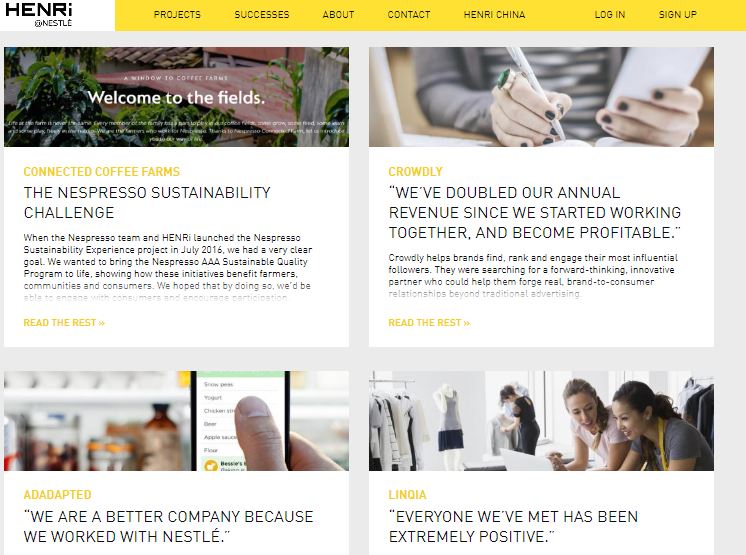
The HENRi@Nestlé project is one of the most notable examples of innovation in business geared towards startup collaboration.
This external innovation strategy reflects a growing trend, with more than 67% of the largest companies in Europe seeking out early-stage start-up interactions.

Ford: Accelerating Innovation with Crowdsourcing
The rise in digital technologies and increased urbanization is set to fundamentally change the roadways of the future. Silicon Valley, along with a variety of auto tech startups, have begun to intensify their focus on achieving disruptive change in the sector. These factors have played a key role in shaping innovation efforts at Ford Motor Company, which is making use of crowdsourcing methods to foster ideation on multiple fronts.
To engage employees to contribute suggestions and tackle a variety of innovation projects efficiently, Ford uses its IdeaSpace innovation accelerator. Powered by Qmarkets innovation management software, ‘Idea Space’ allows innovation challenges to be set to involve a select group of participants (such as a department) or the company as a whole.
A notable innovation project Ford is currently working on is the Intersection Priority Management System (IPMS). Utilizing hybrid wireless connections, the IPMS is designed to enable vehicles on the road to share trajectory data so they can move through intersections safely without having to stop.
What Can Be Learned from These Examples of Innovation in Business?
Naturally, a five-hundred-page book would be insufficient to detail all the innovation lessons to be learnt from these companies. The following are just a few of the most outstanding and practical techniques companies can emulate from these examples of innovation in business:
While it’s important to learn from the best, there is no one-size-fits-all method when it comes to innovation. Companies will need to formulate their own innovation strategies to target specific objectives, incorporating large scale, and often complex workflows and incentivising internal and external stakeholders to participate. However, by utilizing idea management software, a diverse range of innovation strategies – such as the ones explored above – can be implemented for maximum impact.
I am flattered that Brandon Bornancin wants to interview me for his upcoming book on the secrets to selling. I fear that I may be a little disappointing.
When Brandon and his team first asked, my response was, “The real secret is there are no secrets. You have to do the work!” I’ve been saying this in this blog, in keynotes, on LinkedIn—wherever I have the opportunity.
Somehow, that’s not what people want to hear. Somehow they want to believe there is just one thing, properly executed, causes the customer to immediately succumb, granting a meeting, issuing a PO, doing something.
And of course there are 100’s of guru’s who cater to this wishful thinking. They proclaim to have discovered the secret, usually stating, “If you just do this……” That’s usually fallowed by a “Buy my book, enroll in my seminar, sign up for my video series….”
Of course they’ve discovered the secret to their sales, a quote attributed to PT Barnum states, “There’s a sucker born every minute.”
There are no secrets to effective selling, we’ve known what drives sales success for decades, if not centuries. Sadly, too few people are committed to doing those things that drive success.
It’s those people who do those things day after day, week after week, month after month that achieve success. It’s those people that do those things in every customer encounter, every time that create differentiated value causing customers to want to buy from those people.
Perhaps, in my darker moments, I wonder if all of this is a sham, maybe people don’t really want to be successful. There’s some evidence to this, both at a managerial and sales person level. It’s the commitment to continuing to do the things that don’t work. Why would people who want to be successful be so committed to continuing to do the things that don’t work? Even worse, why are they so committed to doing these things that don’t work at ever escalating volume and velocity?
All one has to do is open email, look at (please don’t answer) incoming calls, look at LinkedIn or other social channels. We are pummeled with people committed to doing what doesn’t work. Whether by choice or because their managers are telling them to do. All we have to do is agree to one sales call. 90% of all the calls I see are about them and their product. They just want to pitch, it becomes my job to figure out whether I want to buy. Very few actually try to help me buy. They think they are, but all they are doing is regurgitating facts about their solutions and talking about how wonderful it will be.
Happily, there are some sales people and managers that want to excel. There are some who want to be the best, to have an impact on their customers, and to be successful. There are those that recognize the shortcut to success is doing the work. And they execute that work daily. And in the excellence they bring to that execution, people wonder, “what’s their secret to success,” when that secret is in front of them.
How well do you understand your prospective customers? These days, it’s not enough to brush up on top-level insights from a target account list. You have to meet your future and current customers where they are and on their terms.
To do that, you have to do your homework to uncover the broader insights that will cue you into their pain points, whether they’re actively looking for a solution like yours, how immediate their need is, and what may have triggered that need.
This is where a 360-degree approach comes into play. By committing to understanding how your customer accounts function, you’ll begin to see through their eyes what they’re interested in and when, what roadblocks they’re facing, who they answer to, and who answers to them. Armed with that knowledge, you’ll discover ways your team can eliminate friction, create hypertargeted and personalized messaging, and prevent missed opportunities like never before.
Let’s take a closer look at how taking a 360-degree approach can improve your customers’ buying experience, shorten the sales cycle and increase deal sizes:
When marketing campaigns are built on a narrow view of the target account, without a complete understanding of who they are and what they really want and need, you typically fail to hit the mark. At worst, you risk losing their business altogether.
Let’s paint a quick scenario. Let’s say you go to a nutritionist for assistance with meal planning, and rather than look at your chart for insights on tailoring care specifically to you, she hands you an in-depth monthly plan with — you guessed it – multiple foods you’re highly allergic to. On one hand, props to her for making a detailed effort. But on the other, it was useless because she ignored your specific needs. Not exactly conducive to a positive experience. You’re clearly not going to implement the food plan or trust her with your health in the future.
Nobody likes to feel misunderstood. But this is how it feels when the company trying to sell you a solution really doesn’t know you after all. And while being unprepared won’t cause you physical harm like a nut allergy might, it can sure increase the odds of killing a deal.
By now we’re in agreement there’s no one-size-fits-all plan for every prospective customer that comes your way, so it’s critical to spend the time to understand how your customers function. In other words, you need a 360-degree view of your accounts.
The formula for account-based marketing success hinges on a three-prong model of Fit, knowing your target accounts; Intent, knowing which of your target accounts are actively researching or buying so you can prioritize these accounts; and Engagement, creating engagement with the right people in the right accounts.
If you’re at this point, you will have already created your ideal customer profile (ICP) and built a target account list based on fit. That leaves intent and engagement as the two concepts key to a 360-degree approach.
How would you discover if your accounts are interested in what your company is selling? It starts with monitoring for indications your accounts are searching for services or products similar to yours, or are looking for information on third-party websites about the issues they’re having that your solution could potentially solve.
Here’s an example. Imagine you sell a SaaS product for physical therapists. Based on your ICP and research history of your current customers, you know your prospective customers are likely searching for content about cloud-based electronic medical records, streamlining documentation, billing and outcomes tracking, among other concerns a clinic director might face. Intent data can arm your team with this key information to help inform decisions and next steps.
More specifically, with the help of technology, you’d also have the ability to suss out different types of intent signals to help your sales team determine where the account lands in the funnel, giving them the visibility they need to tailor their strategies.
While intent is all about identifying interest and catching it early to help inform your sales and marketing teams’ strategies, engagement insights demonstrate the ways in which accounts are currently interacting with your brand, online and off.
With engagement insights, you’ll know which accounts are visiting your website, attending your events, opening your emails and downloading content — all signaling a high level of engagement. This data adds to the 360-view of the account by revealing exactly what the account is interested in and when, providing tremendous value to your marketing and sales team so they may take steps to tailor their messaging and improve the customer experience going forward.
It sounds like a heavy lift to gather all of these intent and engagement signals, but your organization likely has all of this information. You just need to break it free from its silos and organize it. Getting into one central hub that everyone has access to will enable the entire team — marketing, sales, customer success, etc. — to gain a 360-degree view of the customer and help you work as one team to build a deeper relationship with that customer.
Leverage the data from your CRM, marketing automation platforms, any predictive or listening software you may already be using. Whether you use a spreadsheet or more sophisticated ABM platform like Terminus, gathering information from all of your current sources will help your team make informed decisions and determine what the next move needs to be.
Building a 360-degree view of your best-fit accounts takes some work, but the return is significant. You’ll be able to leverage this data to create hyper-personalized messaging, and adjust your strategy as needed, which will improve the customer’s buying experience, shorten sales cycles and increase deal sizes.

Last year’s Edelman Trust Barometer indicated that people are more likely to trust “a person like myself” over almost any other source. The only two options viewed as more credible were technical experts and academic experts.
Consumers report trusting their peers more than analysts, employees, business executives, or journalists.
It’s easy to see why: We see ourselves in others like us. Their experiences are similar to our own. Their opinions and recommendations seem less likely to be shaped by ulterior motives.
That’s why customer advocacy is rising to the forefront of commercial consciousness. And while it’s generally viewed as a marketing directive, I see it as an excellent opportunity for sales and marketing orchestration, with the two sides aligning on a shared focus: developing brand evangelists who can essentially become authentic extensions of the sales team.
Who is the ideal customer? Think back to your favorite experiences as a seller, and the most fulfilling (personally and professionally) deals you’ve swung. Most likely, those buyers were enthusiastic, receptive, and easy to work with. They appreciated your sales approach and they ultimately loved what they bought.
These happy customers are golden, and their influence can be powerful. If we want to connect with more prospects like them, they serve as critical conduits. They have built-in credibility with those similar to them, as the aforementioned Edelman data shows. These advocates can pave the way for seamless sales engagements, allowing the seller to step in with a head of steam.
Last week, I read a good piece by Ben Gibson at Martech Advisor discussing Why Authentic Storytelling is the Key to Customer Advocacy. As you’d expect, the Nutanix CMO speaks from a marketing angle, but as I scanned through Gibson’s three keys to successful customer advocacy, I couldn’t help but think about the unstated potential for sales to get involved.
It would be awesome if we had an army of advocates out there, autonomously pointing their peers and colleagues toward our solutions. In most cases, that’s not realistic. Human beings are inherently self-interested, especially when it comes to their careers.
Therefore, we must collaboratively find ways to encourage and incentivize advocacy. Let’s examine this from a sales-centric perspective across the three recommendations laid out by Gibson.
“When reaching out to a potential new customer, it is crucial to stay mindful of quantity and quality of touchpoints to start the relationship off on the right foot,” writes Gibson. As any sales pro can probably attest, prospects tend to withdraw if they feel they’re being pestered.
With that in mind, we should always reach out with a purpose. The “just checking in” message isn’t necessarily a misstep, but it shouldn’t come two days after you last spoke. If every interaction you initiate is transparently driven by your own interests, that won’t likely lead to trust and advocacy.
As Gibson puts it: “Don’t simply reach out when you need something; reach out to spark a conversation and make them feel valued and trusted as a long-term partner.”
Work closely with marketing to manage touchpoints across social media and other channels. Ensure that your customers and prospects aren’t being hit with an overwhelming barrage of brand messaging. Seek to provide them with what they need, when they need it, and take steps to make yourself available if they have questions.
When it comes to requesting a referral or warm introduction, don’t just send out a blanket template message. You’ll likely have more success by personalizing the ask. Through Sales Navigator, you can use TeamLink to identify a customer’s connections with organizations you’d like to get in front of, and then get specific with your request: “Hey, I see you’re connected with Joe from Acme – any chance you’d be willing to make an intro?”
Not only are buyers are 5x more likely to engage with a sales professional when introduced through a mutual connection, but the good word – “I worked with Sherry when we bought our software, she was fantastic” – can make all the difference once that conversation gets underway.
Everyone recognizes the value of case studies and customer testimonials. Marketing loves putting them together and sales loves having them available as collateral. When done well, they are legitimately persuasive. Finding subjects who are willing and eager to participate isn’t always easy, though.
Gibson smartly suggests we improve our odds by framing these narratives around the customer, rather than our own products and services. You want to tell the story of how your solution helped them accomplish something; not how your solution accomplished something. It’s a subtle yet vital distinction.
Customer-centric marketers are becoming more naturally predisposed toward this type of storytelling. Salespeople on the front lines can offer unique insights about the buying process, and might be able to help develop an angle that resonates.
Once you build up a library of customer advocacy content, you can collaborate with marketing to create a versatile format mix. Videos, PDFs, infographics, and other materials should be included.
With a repertoire in place, sellers can create customized PointDrive packages that are attuned to a specific prospect’s situation and consumption preferences. It’s a lot more effective when you can say, “Click this link and you’ll find a quick video featuring a company similar to yours, plus a data sheet with specs,” as opposed to, “Go to our website and watch all the testimonial videos.”
Is creating customer advocates a priority focus for your business this year? If not, should it be?
While this initiative has typically been associated with marketing, it’s impossible to miss the potential benefits for sales when customer advocacy is done right. And, as we’ve established here, there are plenty of opportunities for the sales team to become instrumental in producing these advocates.
“Given customer advocates have a significant impact on how others perceive your brand, it’s worth the time and effort to build real, authentic relationships with customers and foster strong customer advocacy,” Gibson concludes.
Who could argue with that?
Subscribe to the LinkedIn Sales Blog so you never miss out on the latest big deal in B2B sales.



janeb13 / Pixabay
Increasing amounts of noise have led businesses to take a more targeted, account-based approach to their sales marketing strategies. In case you’re unfamiliar, account-based marketing (ABM) is the practice of expanding your brand recognition among different personas in a single company across a list of named accounts. ABM has seen a spike in popularity among B2B companies in the last three years. In fact, according to the Information Technology Services Marketing Association, 84 percent of companies say that ABM delivers higher ROI than other types of marketing. With an overwhelming number of testimonials that ABM does, in fact, work—there are a few steps you can take to make sure that your ABM strategy spans the entire length of your campaign.
Account-based marketing expands the traditional sales coverage model. It used to be that cold-calling as many CEOs and VPs as possible was the quickest way to start and close a cycle. This can still be true today, but due to decreasing accessibility to these individuals, sales reps are spending more time calling into multiple levels of the account. By and large, this is the reason why cold-calling is being replaced by more productive activities in the “best practices lineup.”
Your sales team should be contacting leads in all levels of an organization that have previously been nurtured and exposed to your messaging by marketing activities. This is essentially like prying open a door by putting a wedge at the base, the top, and the middle to get the most leverage. After enough wedges have been added, the slightest tap of your hammer (your sales team) can burst that door wide open.
For Example, you identify 40 named accounts and say to your team “I want to acquire revenue from these companies this year.” From there, your sales team spends its time gathering information on who the decision makers, champions, and influencers are within these accounts. This process is a mixture of paid and inbound marketing, and good old-fashioned research. Then they can set up a sequence to make sure that each of the individuals within each account gets touched the appropriate amount of times.
According to TOPO, it takes 18 calls on average to connect with a buyer. Do the math—18 calls to each member you’ve identified across 40 accounts. With numbers like these, it’s never been more critical to align your ABM strategy across sales and marketing.
The simplest way to target is the old “pay-to-play” model. Various ad platforms, such as LinkedIn, have made it simple to target the exact accounts, roles, and industries based on whatever criteria you need. Keeping a pulse on paid initiatives is key, because you want to make sure you’re continually maximizing your ROI.
For Example, your sales team is ready to target 25 financial firms and will be calling everyone from the firms’ customer service reps to their VPs. Make sure that before they get someone on the phone, the person they’re calling has seen an advertisement or organic post for a persona-relevant piece of content on LinkedIn. For your sales team, this can mean the difference between a hang-up and an initial conversation.
Because inbound is heavily centered on attracting high-quality leads from out in the internet-wilderness, it might seem a bit off to incorporate that into an ABM strategy where you already know who your leads are. This is not the case. Remember that providing value is the cornerstone of any marketing strategy—or else you come off too “salesy.” The leads you are pursuing in your ABM strategy will be educating themselves before they speak to sales, and your content is the perfect opportunity for them to do that. Creating content and conversion opportunities that are in line with the various buyer personas will allow you to build your brand recognition within those accounts by giving them something they’re already looking for. Inbound can also be a great way to find named accounts to add to your strategy.
For Example, if you’re selling sales enablement software and targeting real estate companies, you might want to create an infographic that would attract buyer’s agents, and then create an e-book that would resonate with the realtors in those accounts. Before long, your solution will be brought up in efficiency conversations as a relevant solution they “stumbled upon.”
If you align these key elements and take a scientific approach to measuring ROI, you will begin to notice the benefits of a holistic strategy. As with everything, patience is key. If you put in the work building a sound strategy on the front end, you’ll spend less time putting out fires and fixing disconnects over the life of your ABM strategy.
The 21st century has proven to be an era of immense technological change. No longer is technology something that only the engineering and computer industries need to incorporate into their ongoing strategies. Every company needs to consider how to better prepare their current and future leaders to meet the challenges presented by technological disruption.
Leadership roles have already shifted significantly as a result of these changes. Successful organizations are trying to build agile leaders who have the flexibility to connect, adapt, and deliver, often requiring leaders to manage from a distance due to the virtual nature of many organizations. remotely-located virtual teams. As cross-functional teams become a fixture of dynamic organizations, these leaders must also learn effective strategies for influencing without authority.
Technology has created unprecedented levels of disruption across numerous industries, forcing leaders to balance multiple challenges while navigating change and promoting innovation. Successful leaders will not necessarily be the people with the most experience or expertise, but those who possess and develop the key competencies of agile leadership.
There are three principle capabilities that set agile leaders apart:
They Connect: Agile leaders understand their teams and know how to inspire, influence, and encourage collaboration. Leading by example and making an effort to establish meaningful connections with others, they can successfully drive engagement and have the personal integrity that convinces people to buy-in during tumultuous change initiatives.
They Adapt: The ability to recognize shifting circumstances and make the proper adjustments quickly is a hallmark characteristic of agile leaders. Their situational awareness helps them to understand how changes will impact a company’s effectiveness, as well as how to implement those changes without undermining employee performance. In an era of technology-driven disruption, agile leaders seek a balance between improving efficiency and promoting innovation.
They Deliver: The best agile leaders understand how to generate reliable results by investing in the right accelerators and cultivating high-performance teams. They prioritize effectively, identifying long-term goals and taking concrete steps each day to make them a reality. If their ability to connect and adapt puts them in a position to succeed, their ability to deliver is what helps them keep their teams productive, efficient, and engaged to fulfill the organization’s mission.
As technology changes the workplace and forces companies to reassess how they pursue their goals, agile leaders will be the ones to successfully navigate these challenging waters. They may be called upon to make decisions without a clear blueprint for action, often in reaction to shifts in the marketplace or changing customer needs. Organizations that invest in the assessment and development strategies to identify and promote their high-potential, flexible leaders will have a tremendous advantage over their competitors.
Of course, technology isn’t all about disruption. It also allows organizations to leverage global resources to bring together talented employees regardless of distance limitations. With 70 percent of people around the world working remotely, virtual teams are already an integral part of many companies. The demands of leading these virtual teams, however, presents huge challenges to leaders who are more accustomed to managing face-to-face teams.
Effective virtual leaders can implement a number of best practices to ensure sustained success:
Build Trust: Trust is the coin of the realm when it comes to effective virtual teams. Team members need to know they can depend on one another if they’re going to engage in productive collaboration. By emphasizing accountability and eliminating toxic behavior, virtual team leaders can build a culture that helps people to stay engaged and focused on achieving key organizational goals.
Create a “High-Touch” Environment: With communications technology making virtual interaction easier than ever, leaders can promote ongoing contact that allows team members to get to know one another better and stay on the same page. Encouraging frequent contact keeps team members from becoming disengaged and less accountable. Online chat tools and virtual meeting software are useful not only for exchanging vital information, but also for encouraging the kind of camaraderie that remote-based teams often struggle to build.
Empower Team Members: Virtual teams need to be given the power to work independently, especially because team members may work in different time zones or keep different schedules. The best leaders find ways to set up systems that monitor progress and ensure that everyone remains accountable for their work while avoiding micromanaging. Project management software makes it easier than ever for team members to stay on task while still making it possible for the rest of the team to determine the status of critical projects.
Organizations that embrace virtual teams cannot afford to overlook the value of leaders who can build trust and drive engagement from a distance. Simply treating virtual teams the same way as colocated teams will only lead to frustration, low productivity, and, eventually, turnover. Effective leaders learn how to leverage software tools to create a team culture that emphasizes collaboration and accountability. Investing in good virtual leadership training programs will prepare leaders to realize the potential of these virtual teams.
In today’s fast-moving economy, all companies must think of themselves as technology companies. Whether they’re leveraging technology to get products to market more effectively or using it to deliver better services and customer experiences, companies can’t afford to cling to siloed mentalities. One effect of this shift in thinking is the proliferation of cross-functional teams that include members from multiple departments across the organization. Reaching agreement on these teams can be a challenge because leaders often lack direct authority over other members.
To be successful leading cross-functional teams, leaders need to learn the secrets of influencing without authority:
Find Common Ground: Teams cannot build consensus when their members don’t share the same values and goals. When leaders establish a common purpose, they can create an environment in which everyone is working toward the same solution, making it easier to utilize influencing strategies.
Build Trust: No influencing strategy can be successful without trust. By demonstrating reliability and being as transparent as possible, leaders can build their teams on a strong foundation that promotes accountability and mutual respect.
Establish Credibility: Leaders must earn the respect of their teams before they can expect to influence them successfully. People with track records of honesty, expertise, and integrity are more likely to find their requests taken seriously.
Know the Team: When leaders know how their team members think and behave, it’s easier to empathize with them and facilitate better communication. Successful leaders build close relationships that make it easier for teams to collaborate effectively.
In a cross-functional team, it’s also important to understand when to utilize the right influencing strategy for the situation. For team members who respond to logical arguments, that could mean appealing to reason rather than seeking to inspire them or consult with them to collect their input. By their very nature, cross-functional teams approach problems from multiple perspectives, which is tremendously valuable in an era when technology is impacting businesses in unpredictable ways. Learning the right skills to promote more effective collaboration in these teams will help leaders to make the most of their potential.
Changes in technology are driving changes in leadership roles for many of today’s organizations, regardless of their size or industry. Only by accepting this reality and taking steps to facilitate that change can they hope to find success and continue to thrive in the future. For many companies, that will mean embracing new approaches to developing effective leaders and building engaged, productive teams that can deliver the innovative solutions needed to drive business results.


kaboompics / Pixabay
When evaluating software, it’s easy to fall back on what you’ve done in the past. Your work computer likely has Windows and the Office suite installed directly on the machine, so why shouldn’t you have software for sales, customer support, marketing, or other industries right alongside it?
To answer this question, there are some instances where an on-premise install, or having software physically installed at your location makes total sense…
You’re holding top secret data that nobody can and should access, closely guarded by a fancy security system
And, outside of maybe a handful of other situations, that’s about it. In modern business, SaaS (Software-as-a-Service), or “cloud”, solutions are now strongly preferred for almost all industries and companies. Here are a few reasons why so many companies have made the switch to SaaS…
It’s accessible anywhere, anytime – One of the best parts of SaaS is that it’s accessible wherever and whenever you want. Employees from all over the world can access SaaS solutions easily, both from their work computers and their phones, and be more efficient working on the go.
Minimized risk of physical data loss – With an on-premise install, you’re relying on physical backups that can and will fail. SaaS solutions create data backups in real-time and, should they fail, you almost always lose at most minutes of data instead of hours (or even days) with a physical tape.
Browser based system decreases operating issues – When dealing with on-premise software installs, there can be lots of installation and upkeep headaches. Joe from accounting has a Mac, while Gabriella in IT needs to run on a Linux machine. Chances are the on-premise software won’t work for them. But, if it does, both employees not only need custom installs of the software but also specific security and product updates to be installed by a specialist. Unlike an on-premise software solution built specifically for one operating system, SaaS solutions can work will with a wide array of operating systems. All you need is a web browser!
Increased collaboration – With so many fewer hurdles to get a SaaS solution up and running compared to on-premise, the last reason why so many companies are moving to SaaS is because it greatly increases collaboration. The modern business world is moving more towards online conversation and data-driven decisions, both of which fit perfectly into SaaS solutions.
Instead, the wide and numerous benefits of SaaS are far outweighing the very unique and specialized need for an on-premise solution. Companies experience better collaboration, less operational issues, and increased accessibility to their system by leveraging SaaS technology. In the future, expect SaaS solutions to not only be adopted more frequently but also to evolve and becoming an even more integral part of business operations.So, is on-premise software dead? Not necessarily, but it’s become a very niche solution instead of the standard way of doing business. A SaaS solution won’t be as secure as the very best on-premise solution – but let’s be real for a second – only a very, very small number of companies require that level of data security for their business.

You’re going to hear a lot about HDMI 2.1 in 2019. It’s the latest iteration on the A/V connection format that consumers have used since it replaced previous A/V connections nearly two decades ago, and with 8K TVs ready to beat down the door into your living room, HDMI 2.1 is a necessary and much-anticipated upgrade.

In the SaaS world, getting users to understand the value of your platform and adopt it into their daily lives is of utmost importance. When prospects take a free trial, you want them to quickly see how easy your solution is to use and why it is worth the investment. And when new customers sign on, you want to do everything you can to usher them through the onboarding steps that will ensure their success and long-term satisfaction.
But each user is different and will engage with your platform at their own pace. Some new users or free trial users can be slow to get moving with a new SaaS solution, while others can be very invested in moving quickly.
How can you nudge your users forward with a strategy that addresses both the laggards and the fast movers? Triggered emails, personalized to each individual at open time, can help you improve onboarding and trial conversion results. In this blog post, I’ll explain why and offer some tips on how to implement it successfully.
Traditional onboarding email sequences have been relatively successful at delivering a prescribed series of content doled out over a set timeframe. However, if a particular user falls behind the ideal/expected timing or runs well ahead, your emails won’t provide much value.
Triggered email programs allow you to schedule emails to your new users after they have taken or not taken some key actions within a certain time period. This allows you to send emails to your customers when they’re truly relevant to each person — not when you expect them to be relevant to the average person.
Of course, you can control when to send an email but you can’t control when it gets opened. By the time a user opens the message, she may have already completed the action the email asks her to take. This is why it’s important to pick the content that will be displayed when the email is opened, not when it is sent (read more about how it works in this blog post about open-time email personalization). With this approach, the content can be updated based on that user’s status/stage/progress at that very moment…even to the point where if she re-opens the email again at a later time, the next relevant element will appear in the email.
Before you send any emails, you need to make sure you are tracking the right actions within your platform. Use your personalization solution to track the key actions that users should take when onboarding or when taking a free trial. A great way to start this process is to analyze the actions of successful users to then determine the steps/order and quantity/frequency of those actions that are similar for your “ideal” new users and pilot/trial scenario users.
Once you can identify those key actions, you’ll be able to identify when a user has or has not taken those steps and trigger emails to send based on that information.
Let me describe a few examples. First, you can trigger emails to help free trial users find value in your platform. Let’s assume you typically provide prospects with a three-week trial period and you have an email outreach flow that sends emails every three days to guide free trialers through various important steps.
With personalized triggered emails, you could tailor your series of emails to only send when they’re relevant to a specific individual, and to include only the most up-to-date information about what their next prescribed step should be — so no user will be prompted to take any steps that don’t make sense to them at that moment. Most importantly, when a free trial user has completed the final step (any critical step you have identified in your platform) or after the user has spent X amount of time using the product or performed a total of Y actions, you could provide her with a suggestion to convert to a full subscription, driving faster trial conversions among engaged users.
For onboarding new users, your approach can look very similar. You would set emails to trigger when users hit certain moments in their onboarding process, but update the content of the emails when they are opened to ensure they’re always up to date. Practically speaking, we recommend setting up a few triggered emails to coincide with specific actions or lengths of time of inaction but keeping the subject line generic (such as “Your Next Step”), so that the email can populate with the most relevant step once the user opens it without conflicting with the context of the subject line.
Typical triggered email flows do a great job of sending planned content out to new users at set points during onboarding or trials, but this type of approach does NOT take into account those that are running ahead of your typical user timeline — or those that have fallen behind. By pairing triggered emails with open-time personalization capabilities, you can present your users with the right content at the right time to drive user success and potentially accelerate pilot conversions.

To be really effective for our clients Ibbaka has to go beyond its normal pricing strategy, analysis and design work. One of the key things we do with our clients is provide them with an understanding of market segmentation, customer targeting and above all value-based pricing. We do this in several different ways, all of which we organize using the performance improvement cycle.
We have been using this cycle with some of our larger clients to organize how an organization can build pricing as a core capability.

Performance begins with goal alignment
The overall goal is to drive superior performance. To execute on pricing an organization needs to be aligned on its pricing goals. Pricing can deliver on many different goals, but not all at the same time. The most common goals are …
Creating and growing a market
Increasing market share
Driving top line revenue
Growing operating profit
Improving unit economics (Value to Customer, Customer Lifetime Value, Customer Acquisition Costs)
Driving sales effectiveness
Clarity on goals is especially important once one gets to measurement.
Even with the best goal alignment, a pricing strategy will fail without great execution. Many things feed execution, one of them being competencies. What skills and competencies are needed to develop a pricing strategy and then execute?
Skill and Competencies
In 2018, Ibbaka worked with TeamFit to identify the skills required for pricing expertise. You can find our report on this here. We also published a number of blog posts, as did TeamFit. One of the more interesting outcomes of this work was the identification of three quite distinct roles that pricing experts play plus one emergent role.
The strategist – works with the C suite on how to use the pricing lever to achieve organizational goals.
The analyst – crunches data, lots of data, and finds patterns. This role was prominent in the B2C and distribution industries, but with new technologies like deep learning, it is becoming more in demand at B2B companies.
The coach – works with other functions to clarify, shape and help implement pricing strategy. There are sub-patterns depending on whether the focus is sales, sales operations, product development or product marketing.
The designer – combines pricing skills with skills from design thinking and customer service design. This is the approach that Ibbaka is taking and may be an important part of our differentiation.
In 2019 we will use TeamFit’s new skill and competency model management tools to build and share job descriptions and skill profiles for pricing. You will be able to use these competency models to guide the development of the pricing function at your own organization and to identify skill gaps.
Learning
Once you identify skill gaps, your own and your organization’s, you need a plan to close them. Learning can play a large role in this. Over the past few years, Ibbaka has been working with one of our major clients to build online learning and performance support on marketing strategy in general and pricing in particular. These are customized modules to introduce core marketing and pricing concepts and to provide a wealth of case studies and examples from within the company.
The Professional Pricing Society also provides a good set of basic learning materials and as president Kevin Mitchell indicated when we interviewed him last year, their plan for 2019 includes the introduction of a series of advanced courses.
My own learning plan for 2019 includes going deep into the work of Judea Pearl and his team on causal inference, to develop better ways to use Monte Carlo modelling in pricing analysis and to find ways to use conjoint analysis in market segmentation. I will complement this with ongoing study of design and business model innovation.
Performance Support
Learning is not enough of course. What is critical is how learning gets put into action. Pricing can involve a lot of analysis. There are good frameworks to support that from Economic Value Estimation (EVE) to models for the interaction of price elasticity and cross price elasticity, and on and on. One can learn these concepts, and have a good understanding, but applying them consistently in collaboration with other people is not easy. Performance support tools make a big difference. At Ibbaka our key performance tool is our internal data analysis platform that we call Geode. Geode is built in R (the statistical programming language) on Ruby on Rails and it applies a variety of different clustering algorithms to help identify market segments.

One question that frequently comes in pricing is the impact of a price change. When we do this at Ibbaka we generally build some fairly complex predictive models using clustering data from Geode. We apply Monte Carlo methods to explore a range of outcomes and identify where the key risks are. But this can be overkill. Sometimes you just want to explore some simple questions around the impact of a price change on volume, revenue and profit. If you understand the math you can easily build a spreadsheet to do this. But why? It is better to provide a simple tool that let’s you do this and explore different elasticities and prices. These performance support tools are also easy to share and are a great way to build a shared understanding of the impact of pricing decisions.

Measurement
Performance improvement relies on measurement. This works on many different levels. We need to be able to reflect on our performance. One of the most important books on high-level work is The Reflective Practitioner by Donald Schön. On a computational level, today’s machine learning systems rely on constant training to improve. AlphaGo would not have become the best Go player in the world if it did not get feedback on which games it had won and which it had lost. Measurement is a key part of the performance improvement cycle.
Ibbaka measures outcomes across several levels. We ask if the skills in the competency model and the learning are actually contributing to performance. We evaluate the market segmentation, value proposition and see how these are impacting pricing. We review the pricing model to test its assumptions and see if it is performing as intended or if things are drifting. Too often, pricing is a frozen accident. Good measurement can catch this and bring pricing, markets and strategy back into alignment.
Learn more about the performance improvement cycle over on the TeamFit blog.
Want a 429% better chance at demand generation success?
According to a study by Convince & Convert, here’s the secret: Set clear goals.
You might be thinking, “How do I set concrete goals?” That’s a smart question.
“In our work with thousands of B2B marketing teams, we’ve found that goals can vary greatly depending on the maturity of the marketing organization. While documenting annual goals to guide your demand strategy is important, it’s essential to define target outcomes for all core demand generation activities and programs. You’ll never get anywhere if you don’t know where you’re going.” – Triniti Burton, Marketing and Communications Director at Integrate.
The best marketers understand how to set themselves up for success by defining clear, achievable goals and crushing them. While goals change from organization to another, we’ve cherry-picked five goals growth-oriented B2B marketers should adopt in 2019.
Before deploying a demand generation campaign, consider the following:
Orienting yourself around these qualifiers helps you construct realistic and objective goals. Furthermore, we know that goals vary based on your sales/marketing lifecycle. Rather than focus heavily on numeric metrics, we’ve outlined the baseline goals and objectives that align with all stages of growth:
1. Maximize Marketing-Influenced Leads
The first (and obvious) goal of high-impact demand generation campaigns is to increase marketing-influenced leads. Today, inbound marketing initiatives — content syndication, display advertising, blogging, social media, email and paid search — reign as some of the leading methods for procuring a high volume of marketing-influenced leads. More importantly, there needs to be some clarity around how you define marketing-influenced leads — top-of-funnel, middle-of-funnel and bottom-of-funnel. Moreover, you need to be able to correlate a specific marketing function to the lead effectively.
2. Onboard New Technology Effectively
Strive to fully adopt new technology quickly and efficiently. When a marketing team fails to comprehensively onboard the right MarTech tools, disruptions to marketing activities are more likely occur.
Moreover, a failure to transfer insights from one marketing solution to the next may result in a loss of critical data—intensifying the need for your entire MarTech stack to be integrated, with all tools working in conjunction and sharing accurate information.
3. Build the Right Marketing Team
Commit to creating high-powered and demand-focused B2B marketing teams. There are many different methods to build the right marketing team. However, as a baseline, businesses should try to fill the following roles (one person may fill multiple roles):
The Leader: Someone to lead the team to victory. This person should be able to manage and coach the team, but also, roll up their sleeves and get work done.
The Search Expert: Someone who is a SEO guru. This person should know SEO best practices and work to position your business as expert in your industry—while optimizing search engine results.
The Content Expert: Someone who writes. This person should have a masterful command of writing —email, blogging, social media, etc.
The Developer: Someone who knows web development. This person should be well-equipped to construct web experiences to drive meaningful demand generation.
The Analytics Expert: Someone who understands data. This person should be able to review data and provide demand generation recommendations based on incoming insights.
The Customer Advocate: Someone who understands your target personas. This person should advocate for the customer in all marketing activities, ensuring the messaging you produce is relevant and valuable for your target audience.
4. Increase Conversion Rates & Efficiency
After you’ve captured a lead, your goal should be to convert that lead into a happy customer. Start by identifying “choke points” in the funnel. Is there anywhere where conversion rates are impeded or lower than desirable? Identify those roadblocks and look for opportunities to bolster your nurturing sequence during each customer lifecycle stage. Doing so will increase lead velocity and generate more meaningful conversions with sales.
Additionally, look for ways to increase your conversion efficiency. To calculate efficiency, add your total working hours and divide them by the pipeline value. This simple calculation may reveal some startling revelations about your organization’s overall marketing efficiency. These insights will allow you to pivot and avoid major catastrophe later on.
5. Commit to Clean Data
Finally, the best digital marketers commit to clean data in their demand generation efforts. Quality marketing data is the key to unlocking marketing’s potential to drive maximum business value and create happy, high-value customers. Data-driven marketers should dissect, organize and disseminate insights across stakeholder groups. There are a number of causes and consequences of dirty data including:
Digital marketers streamline demand generation practices, deliver valuable lead nurturing and boost revenues by doing routine analysis and assessment of data.
Demand generation efforts are nothing without clearly defined goals and objectives. Ask yourself: What should my demand generation campaign accomplish and how will I get there? With a clearly defined roadmap in place, you can become a demand generation superstar.
Take your demand generation efforts to the next level with the Demand Marketing Assessment Guide.

Growth hacking is a great way to increase revenue. It’s an especially appealing tool for fintech startups that may be slightly hamstrung by budget and lack the internal resources to have a powerhouse marketing team. While we don’t doubt the influence or talent of a sole in-house strategist, we do understand the struggle.
Growth hacking helps companies grow fast, acquire a ton of new users, and boost revenue. We’re going to hone in on some specific ways to apply growth hacks to content for fintech startups. Why? Because content and content marketing are invaluable tools for this industry, and specifically for startups looking to build trust and credibility.
So let’s get started.
When it comes to calculating revenue from organic search, it’s as simple as basic math. In short, your revenue from organic search equals how much traffic your site gets multiplied by your sales conversion rate multiplied by the average order value. Based on that definition, we have to go one level deeper to figure out what traffic is. Traffic equals search impressions multiplied by click-through rate.
Quick breakdown:
Traffic x Sales Conversion Rates x Average Order Value = REVENUE (from organic)
-and-
Traffic = Search Impressions x Click-Through Rate
Cool. From there, we have several different ways to increase sales from unpaid (organic) search:
What does that mean? In other words, how do we do that? Several ways:
Based on the math above, your first option is to boost search impressions by creating more content. Maintaining a blog that you regularly publish to is a great way to do this. Not only does it help position your brand as a thought leader that keeps a finger on the pulse of the fintech industry, but it helps SEO. As mentioned in the Fintech Marketing Strategy series, content is at the heart of SEO and subsequently, at the heart of getting seen more in search engine results. This is especially important for fintech startups and disruptors who may actually be driving search lexicon. Do your keyword research (free help here) and build a plan.

Don’t forget about alternative media formats, either. Fintech startups may find it’s hard to boil down complex technological and financial terms into simple information that is understood by the target audience. Video is a great tool to overcome the jargon roadblock and really connect with your audience. According to research, by 2019, more than 80% of web traffic will be from video content. Video content is easy to understand and it is interesting. Experiment with different types of videos to provide free value to your audience and start building trust:
The best content marketing for fintech startups is based around a data-driven strategy. That means you should have mapped out your goals and objectives already. If SEO wasn’t a part of your initial goal-setting and strategy process, it should be now. Hope back to the previous section to grab our keyword research checklist and start building out your core keywords. These will be an important part of improving organic results. Make sure you have mapped your core keywords back to the key pages on your site. Blog posts may focus on long-tail keywords.
Once your mapping is complete, you’ll need to be sure that your keywords are present not only in the copy for each of those pages, but in the title tags and meta descriptions as well. It’s a bit of an art and a science to optimize these: you want to include the keywords but you also want to make the information highly compelling so that people actually click.

Jamming in high-value keywords only gets you so far, and frankly, is completely useless if people aren’t actually clicking. You may even want to a/b test some titles to see what gets the most click-throughs and apply the findings to the rest of your site/blog. Some ideas for great SEO titles:
Keywords are important, but connecting with an audience is, too.
These are both strategic, tried, and true ways to improve ROI on content marketing and move the needle for fintech startups. In Part II, we’ll cover off on optimizing landing pages for better conversions and making sure you’re targeting not only the right people, but the best people, for the best results. Stay tuned for more great content growth hacks for fintech startups.
This post originally appeared on the Content Rewired blog.
The US healthcare industry as it exists today is not sustainable. An aging patient population and rising burden of chronic disease have caused healthcare costs to skyrocket and left providers struggling to keep up with demand for care.

Meanwhile, digital technologies in nearly every consumer experience outside of healthcare have raised patients’ expectations for good service to be higher than ever.
One of the key mechanisms through which healthcare providers can finally evolve their outdated practices and exceed these expectations is wearable technology.
Presently, 33% of US consumers have adopted wearables, such as smartwatches and fitness trackers, to play a more active role in managing their health. In turn, insurers, providers, and employers are poised to become just as active leveraging these devices – and the data they capture – to abandon the traditional reimbursement model and improve patient outcomes with personalized, value-based care.
Adoption is going to keep climbing, as more than 80% of consumers are willing to wear tech that measures health data, according to Accenture — though they have reservations about who exactly should access it.
A new report from Business Insider Intelligence, Business Insider’s premium research service, follows the growing adoption of wearables and breadth of functions they offer to outline how healthcare organizations and stakeholders can overcome this challenge and add greater value with wearable technology.
For insurers, providers, and employers, wearables present three distinct opportunities:
Want to Learn More?
The Wearables in US Healthcare Report details the current and future market landscape of wearables in the US healthcare sector. It explores the key drivers behind wearable usage by insurers, healthcare providers, and employers, and the opportunities wearables afford to each of these stakeholders.
By outlining a successful case study from each stakeholder, the report highlights best practices in implementing wearables to reduce healthcare claims, improve patient outcomes, and drive insurance cost savings, as well as how the evolution of the market will create new, untapped opportunities for businesses.
Saturday morning, I was waiting for my appointment to get my haircut. Regina (my hairdresser) had just finished with a lady. As she was paying, the lady asked for a bottle of shampoo.
As Regina got the bottle, she also pulled a bottle of something else. She told the customer, “You may want to also consider this…..” I don’t really know what it was, but the lady asked some questions. Regina replied, “It’s a little expensive, but it will help you with this problem you have with your hair.” They talked “hair stuff” for a few minutes, the customer bought the shampoo and the other bottle. Regina and the customer thanked each other, scheduled the next appointment, the customer left the shop.
As Regina and I walked back to her station, I said, “Great job of up-selling and objection handling!” Regina looked at me asking, “What do you mean?”
I played back what I’d seen, but using sales terminology around the upsell, objection handling and creating great value for customers. Regina listened patiently, saying, “I didn’t realize I was doing that. All I wanted to do was help her.”
She went on to say that her customers wanted to look good. Regina always wanted to help them, as a result, in addition to giving fantastic haircuts (I guess it’s styling for others), she makes recommendations for products that might be helpful. Over the years, she’s sent me home with a few things, each of which has been very good.
I asked her, “Why do you do this? Do you get a commission?” She replied, “I get a small commission, but I don’t sell the products for that. My relationships with my customers is too important to sell them something they don’t want. Primarily, I sell them products because I genuinely think it will help them. I don’t push them, I explain why I think they might like it, what it will do for them.”
She went on, “I like selling them products that help them. Also, it helps the shop. The revenue from the products helps the shop with some of its overhead, so I like to do that. It makes the salon a much better place to work and for our customers.”
Regina didn’t consider herself a sales person. All she wanted to do was make her customers feel happy about themselves and how they looked. She knew if she did that, they would both come back and refer others to her.
Regina still insists she isn’t a sales person. When I told her she was, she frowned, “I don’t want to be one of those……” But when I described she was doing what great sale people do, she smiled–“Dave, you still won’t convince me, I just want to help my clients.”
Great sales people are simply driven to help their customers. They know if they do, the revenue will follow.
Nasdaq’s BVP Emerging Cloud Index measures the performance of a portfolio of 45 SaaS stocks. Like much of the tech world, and the stock market in general, the final quarter of 2018 was not terribly kind. The good news is that there are signs of life.
On November 19th, SaaS stocks had a noteworthy bad day. Everything was down, way down. As we reported, some examples included:
All of these stocks are part of that Emerging Cloud Index. That day, the index hit $792.95. It would not be the lowest point of 2018. That came about a month later, on December 21st, when it plunged to $778.39.

Jason Lemkin, managing director at SaaStr Fund, a firm that works with SaaS founders, says in spite of the last quarter, it wasn’t a terrible year for SaaS stocks. “Cloud stocks still way outperformed the broad market in 2018 — way outperformed. But they are not immune to the broader economy. It just has some insulation to it, due to recurring revenue and also the mission criticality on many B2B apps,” he told TechCrunch.
The day after I wrote the story on this cloud stock debacle, my colleague Jon Shieber looked at the overall tech stock losses, which totaled a staggering $1 trillion in the year-end slide. That’s a ton of lost value, but cloud stocks were taking a hit right along with the rest of tech, even when the future appeared very bright indeed.
Today, the Emerging Cloud Index is showing signs of recovering nicely, and all of that gloom and doom seems to be yesterday’s news. The index has been climbing steadily since that pre-Christmas low (to $956.46 as we went to press). There is no guarantee that will continue, but it certainly makes more sense given that earnings reports have been mostly positive and the market potential is still growing.
As Synergy Research’s John Dinsdale told me in November, “In terms of ongoing market growth and future prospects, absolutely nothing has changed. The market forecasts remain extremely healthy. Indeed, if anything our next forecast update will likely result in us nudging up our forecast growth rates a little.”
Perhaps, the SaaS market did not deserve to be Wall Street’s whipping boy in December, and the recovering index shows that investors have come to their senses where SaaS stocks are concerned.
By the time a sales engagement reaches the negotiation stage, the rep can see the revenue at the end of the tunnel. If they can just engineer a win-win deal for both sides, they'll be that much closer to making quota.
But negotiations can go awry quickly and in any number of ways.

While there's no surefire way to barter a positive outcome, avoiding a handful of common mistakes can decrease the likelihood of the negotiation getting derailed.
Here are the worst mistakes reps make when they negotiate. If you lose more deals in the final stretch than you'd like, one of these common behaviors could be to blame.
A critical part of the sales process is identifying the ultimate decision maker early on, and speaking directly to that person. Unfortunately, too many reps don't realize they're not talking with the final decision maker until the negotiation phase.
Negotiating with a person who doesn't possess the authority to sign a contract is a recipe for disaster. Let's say you make a handful of concessions and settle on a number that's 10% less than your regular price. Now the prospect passes this figure along to the final decision maker … and negotiations start all over again. Only this time, the starting number is the already reduced price. The sales rep has to honor the concessions they made in the first round, and make even more in round two.
The lesson? Never get into numbers until you have the final signatory in front of you.
You can also lump phrases such as "this is non-negotiable" or "it's a dealbreaker" in this category. When salespeople dig in their heels during a negotiation with these sentiments, they feel like they're exuding confidence and strength.
However, the more limitations you introduce into a negotiation, the less likely it is to be successful. The best negotiators put the most options on the table, not the fewest. For both sides to emerge victorious, negotiators must be open-minded and flexible. Keep hard restrictions to yourself if at all possible.
Most salespeople want to get a negotiation over as quickly as possible. They fear the more time that passes, the less likely the prospect is to sign.
This is the exact opposite of the truth. The longer people are engaged in a healthy negotiation, the more likely both parties want it to end favorably. It's perfectly okay to allow for some healthy pauses or take a break to run an idea by a colleague.
Resist the temptation to negotiate too quickly because you're nervous. Slow the discussion down, and have some intentional silences built in.
No one wants to feel like they lost a negotiation -- especially a buyer. Their perception of your negotiation will ultimately color their conception of your product or service -- whether they become a customer, or not.
With this in mind, salespeople would be wise to build a few concessions into their negotiation strategy. But many don't. Instead, they structure the conversation so as to determine a "winner" and a "loser." This is unhealthy for both salesperson and prospect -- no matter which side each is on.
Create a few points where when the prospect says "yes," they feel like they won something. Strive to guide the negotiation in such a way that there is no loser -- just two winners.
One of the biggest mistakes a sales rep can make is over-negotiating. When a rep plans to make a concession or respond to the prospect, the rep is likely anxious and often negotiates too much.
Let's say a rep is on a phone call with their prospect. The prospect says, "We can’t move ahead with this if the final price is over $12,000."
The rep responds and says, "If I can get the price down below $12,000, will you buy? When can we send you the contract?"
This is an example of over-negotiating. The prospect is simply stating that threshold of what they're willing to pay. Instead of immediately jumping to change the price and giving them a contract without a signing date, the rep should have asked clarifying questions about why the prospect needed the price below a certain amount. This way they could come to a mutual agreement, and the prospect knows exactly what value they're getting for the purchase price.
A technical win is an admission by the customer that your product or service is the best, bar none. You'll know if your products and services are better than the competition and why they're the best.
If you're going to negotiate pricing or terms, you'll need to have a technical win. Without the technical win, you’ll be more likely to over-negotiate and price match with the next competitor.
Negotiation is one of my favorite sales topics, so you can expect to see more posts from me on this subject. But for now, focus on reversing these mistakes and laying the groundwork for effective negotiations. Both you and your prospects will be happier for it.
To learn more, check read about the things you should never say in a negotiation next.


“Remarkable” is an overused word that has come to mean “really great.” But as marketing guru Seth Godin has noted, something that’s remarkable is something that we feel compelled to remark upon.
Godin’s famous example is a purple cow. You don’t talk about all of the black-and-white cows that you’ve seen, but a purple cow, that’s remarkable.
In the SaaS category, there are two paths to become remarkable. One is to establish and maintain a high-bandwidth dialogue with customers and then automate as many customer-pleasing activities as possible into the product. The other way is to release a minimum viable product and then focus on evolving it to meet as many consumer needs as possible. Both paths will get you there, but the second may be a better way to build lasting value.
As we have previously defined it, product led growth is a go-to-market strategy that relies on product features and usage as the primary drivers of customer acquisition, retention and expansion. It’s a capital-efficient way to engage customers and prompt them to evangelize for your company in a way that leads to hypergrowth.
For example, Expensify’s flagship offering is an app for creating expense reports. The app lets users take a picture of their receipt and then gleans all of the relevant info. While no one gets excited about doing expense reports, Expensify’s product takes the pain out of the process.
You could imagine a new employee complaining about having to log expenses, but then a seasoned coworker says, “No worries. They use Expensify here. It’s really easy. It will take you like five minutes.” Yes, that sounds like an ad, but the goal of product led growth is to get real people to talk that way.
Typeform markets conversational forms and surveys that businesses can use to learn more about their customers. Not surprisingly, this focus has helped Typeform to view sales differently than the typical organization.
As Pedro Magriço, Director of Growth at the company, has explained, the focus is on helping customers to get the most out of the product rather than looking for larger sales opportunities. “The message is very much, ‘Hey, I saw that you just started using Typeform. That’s great. I’m here to make you successful. How can I help?’”
In this scenario, the sales team assumes a different role. Sales reps become trusted advisors who understand their buyers’ pain points and direct them towards solutions that will help their businesses. Dialogue with such customers fuels the evolution of products to get your product to do as much as possible.
The other path is to operate with little or no sales outreach. Consider the case of Expensify. Like many great companies, Expensify started out as something completely different. Founder David Barrett had originally created a prepaid debit card. But people who saw the demo said while the card was cool, the expense report function — which he built merely to provide proof-of-concept for the card — was even cooler.
“We would go to our users and say, ‘Look, you seem to be excited about whatever it is we’re doing. Tell me why,’” Barrett told OpenView. That sort of feedback informed Expensify’s growth.
Barrett’s discussions with customers were the same as the kind Typeform’s sales team was having. The only difference was that Expensify relied more on the product to sell itself. This type of focus is a little like burning the boats in the harbor — you have to close off other options and put all of your focus into one thing, the product. As Barrett explained it, he would talk to customers about their dream product and then modify the product to suit their dreams.
Typeform and Expensify are both great companies that got to the same place taking separate paths. Betting everything on your product development is a tougher way to go though and I would bet if you took 100 companies that took the first path and 100 that took the second that the first group would come out a little ahead.
That’s because one hazard with the sales-based approach is that the enterprise-level buyer has more say than the end user. “The enterprise buyer will just make crazy requests. They’ll pick anything under the sun. They’ll be like, ‘I want a helicopter pad,’ and the sales person, because they’re commission-oriented, says ‘Done, helicopter pads on the way,’” Barrett has said. That salesperson thinks they’ll get a huge commission out of one huge deal so they’ll promise more than they can deliver even if what they’re promising makes no sense.”
Leaning on a great sales team can also allow you to put less emphasis on the product because you can rely on their selling acumen instead of making the product great.
That’s not the end of the story because either path can work fine. Business success isn’t so much about following a game plan as it is figuring out what customers want and giving it to them. What they want most of all is a purple cow.
The post There are two paths to product led growth. One is harder and possibly more effective. appeared first on OpenView Labs.


