
You might have heard that it’s best to let the other side make the first offer when negotiating. However, if you only find out what they want at the table, you may be at a disadvantage. Instead, research first.
You might have heard that it’s best to let the other side make the first offer when negotiating. However, if you only find out what they want at the table, you may be at a disadvantage. Instead, research first.
If you’re not already using Facebook advertising, you probably know you should be – it’s cost-effective, the reach is huge, and the targeting capabilities are phenomenal.
But there’s more to Facebook Ads than just the ads! If your campaigns are going to succeed, you also need great Facebook landing pages. Although creating compelling visual ads for your Facebook campaigns is crucial, it’s only half the battle – your accompanying landing pages need to be just as strong (if not more so) to ensure your visitors go the distance and convert.

In this post, we’ll be looking at everything you need to know about Facebook landing pages, from how to ensure continuity of your messaging from ad to landing page, to what elements you need to consider when designing the landing pages themselves. By the end of this post, you’ll be equipped to make your own ass-kicking Facebook landing pages, so let’s get started.
Before we go any further, it’s important that we clarify what we’re actually talking about when we mention Facebook landing pages.
Not so long ago, Facebook landing pages were pages that advertisers could create using third-party platforms to prompt users to complete a desired action. This could be something as simple as “Liking” a page, or a more involved action like completing a web form. The example below is of one such page for Coca-Cola:

This is a great example of what is known as a “Like gate,” a pop-up or page designed to prompt the user to Like a page before allowing them to access the content they’re interested in. There are many variations of this type of “landing page,” such as competitions, special offers, limited-time downloads, and online tie-ins to real-world promotions, such as code redemption offers for digital goods etc.
However, for the purposes of this blog post, we’ll be talking about actual landing pages. Facebook landing pages are pages that a visitor is taken to after clicking on a Facebook ad. You might think there’d be nothing much to distinguish Facebook landing pages from their paid search counterparts, but there are several elements you should consider before launching your campaigns.
One of Facebook ads’ greatest strengths is that they’re inherently visual. Given that Facebook restricts advertisers to using just 20% of an ad’s virtual real estate for text, Facebook ads often look great, which makes them easier on the eye and significantly more clickable. They also blend in much more effectively with organic content in users’ news feeds, resulting in a much better experience for the user.
However, this also means more work for advertisers – or, at least, more things to think about. With text ads, you can send visitors to pretty much whatever page you like (as long as it’s relevant to the ad), but with Facebook ads, you have to consider the user experience once they’ve clicked on your ad. Let’s take a look at some examples.
Here is an ad, captured from my Facebook feed, for a winter coat sold by Duluth Trading Co. (a coat I happen to own already and bought online, proving there’s room for improvement, even for Facebook’s powerfully granular targeting options):

When I click on this ad, I’m taken to this page:

Obviously, this landing page features the exact product that was advertised in my Facebook feed (a solid plus in terms of relevance), but it doesn’t provide me with any incentive to click around if, for whatever reason, I decide I’m not in the market for a new winter coat, or this coat in particular.
Now let’s look at an example from HubSpot:

This ad is obviously promoting HubSpot’s CRM product. The ad features some compelling copy that emphasizes the product’s benefits, such as “100% free forever” and “Unlimited users and contacts.” It also makes use of the “Sign Up” call-to-action button that lets visitors convert directly from the ad. If I were looking for a CRM solution, this would likely pique my interest, so I click on the ad – only to be taken to this page:

Woah, woah, woah – hang on a minute, HubSpot. I clicked on that ad expecting to learn more about HubSpot’s CRM, not to sign up for anything. Sure, this page tells me that HubSpot’s CRM “is the flexible, intuitive solution for managing your prospects and sales pipeline,” but this copy doesn’t tell me anything substantial. It’s precisely the kind of copy I’d expect from any CRM vendor. Now, for all I know, this landing page has a crazy-high conversion rate, but it’s definitely not what I expected.
Secondly, this landing page immediately presents me with a web form. Sure, it’s not asking for a lot of information – just an email address and a company URL – but it’s still more information than I’m prepared to hand over at this stage, which is precisely none. Remember – I came to this page from a Facebook ad, which means I’m most likely not in a commitment frame of mind. Yes, HubSpot’s CRM is “100% free forever” as the ad informed me, but that still doesn’t mean I’m ready to sign up for anything.
If I perform a search with high commercial intent on Google for desktop, I’m probably much more focused on elements such as functionality, features, and pricing, and more likely receptive to a landing page like this. If I click an ad from Facebook on mobile, I’m almost definitely not going to be interested in an even slightly harder sell like this, particularly for this kind of product.
Remember how we said that one of the greatest strengths of Facebook ads are they’re visually rich? Well, this provides both opportunities and challenges for advertisers, as visual continuity between your ads and your landing pages becomes even more important, especially on mobile.
Let’s take a look at another example to see what I mean. Here’s a Facebook ad for clothing retailer Five Four Club:

This ad makes excellent use of text despite Facebook’s 20% rule, and even manages to sneak in some additional branding with the inclusion of the logo. Now that the ad has caught my attention with its promises of stylish clothing at a 50% discount, I click on the ad, which takes me to this page:

See how closely the ad and the landing page are aligned in terms of aesthetics and overall design? It’s the perfect progression from ad to landing page, and gives me exactly what I expect when I click on that ad. The landing page also follows a number of other best practices, such as reinforcing the benefits of the service, including compelling language with minimal copy, and featuring the coupon code to get the 50% discount promised by the ad.
There’s still room for improvement here, however. This Facebook landing page could have emphasized the discount offer featured in the ad much more strongly – it’s obvious that this page was not created specifically to accompany that Facebook ad, which is why Four Five Club opted for the temporary banner beneath the page’s navigation bar. Still, it’s a great example of how matching visual continuity from ad to landing page can be very effective for Facebook advertisers.
Almost half of Facebook’s 1.49 billion monthly active users only access Facebook from a mobile device. Let that sink in for a minute. That means that 655 million people – more than twice the entire population of the United States – NEVER access Facebook from a desktop. This trend is likely to continue, as it has for almost two years now.

Image via VentureBeat
With this kind of data, failing to optimize your Facebook landing pages for mobile could quite literally doom your campaigns to failure. You won’t see any major brands making this mistake, but if you’re a small brand or new to Facebook advertising, the risk of overlooking mobile-friendly landing pages is much higher.
Let’s take a look at an example of a mobile Facebook landing page done right. Here, we have an ad for SundanceNow Doc Club, a streaming video subscription service for new independent documentary films (think of it as Netflix for documentary geeks):

This ad most definitely pertains to my interests, and so I click on the ad, which takes me to this landing page:

Everything about this mobile Facebook landing page adheres to best practices. The design and messaging match the ad, the copy is brief but compelling, it makes the benefits of the service abundantly clear, and the call to action is bold, easily clickable, and well phrased. Despite being pretty image-heavy, this mobile landing page also loaded very quickly, even on an older Android device.
I cannot stress the importance of mobile-friendly landing pages enough when it comes to Facebook advertising. Not only are millions of people only accessing Facebook from a mobile device, but this is the kind of user experience that today’s Internet users have come to expect. If you try forcing them to scroll around a page to fill out a web form on a page that isn’t optimized for mobile, you can forget about ever converting them – and you’ll probably damage your brand while you’re at it.
Unlike Google, Facebook does not offer advertisers much in the way of best practices to follow with their landing pages.
While there are many similarities between search and social landing pages, the most crucial distinction between the two is that with Facebook, you’re searching for users – they aren’t searching for you. This means you can effectively think of Facebook ads as a component of your landing pages, or the first action in a longer process. Some campaigns may be able to offer users a simple, direct path to conversion directly from Facebook, but other campaigns may necessitate a longer, more indirect conversion path in which a Facebook ad is just the first step.
For example, one of our most successful Facebook advertising campaigns was for a content download. Here’s the ad:

The copy is punchy and focuses on the benefits of reading the guide (and leverages the mystery about AdWords’ Quality Score to create additional interest), and the image proved immensely popular with our audience. Seriously, people love this kid. Here’s the landing page that users were taken to from this ad:

As you can see, we’re asking for quite a lot of information on this landing page. Nevertheless, this campaign performed extraordinarily well for us. Granted, traditional engagement with the ad – likes and comments – was low (as you might expect), but in terms of conversions, this ad/landing page combo is one of our most successful.
The complexity of your landing pages will depend greatly on the desired action you want prospects to take, and their content will depend on the nature of whatever you’re offering. A landing page for a whitepaper download, for example, might include some brief details of what the guide contains, whereas a landing page for a more costly service or product, such as a school or training course, might include more comprehensive information about the school and its programs.
As with any marketing initiative, Facebook advertising campaigns should be designed around the intent of the user. However, following the guidelines above, and landing page best practices in general, will help you increase conversion rates and provide a better experience for users interacting with your brand on Facebook.


Just this week we wrote about a tool that can personalize automated outreach emails, and now we’ve come across a new offering from Automated Insights that will analyze data and write personalized reports.
The service, called Wordsmith, is currently in private beta and already being used by giants like Yahoo!, Comcast, Samsung and others. To begin, users first upload a spreadsheet or an alternative form of numerical data. The system will then convert the individual fields into variables, which are used populate a text template. Users can also apply rules to the data to create certain phrases or sentences within the text. For example, if a number is greater than a certain value, a specific set of words can be used. Namely, if the sales from this month’s datasheet were greater than last month’s, words like “It was another great month” can be inserted. The users will still have to know which data correlates to which information, but once the various rules are preset, the task will become much more streamlined.

We have already seen an AI-powered tool that can turn legal contracts into simple visual charts, and a service that will share a post on multiple platforms with one action. What other administrative tasks can be automated through similar innovations?
Website: www.automatedinsights.com
Contact: support@automatedinsights.com
The post Software turns spreadsheets into written reports appeared first on Springwise.


Retirement is becoming an increasingly problematic topic for citizens and the government at large. While people are more or less focused on saving for the future, some factors are outside of any individual’s control. People are living longer now, putting pressure on many of the entitlements our country provides through programs like Social Security.
Today’s workers might face delayed retirements due to government mandate and increased health care costs. As it stands, this is how Americans, on average, spend money over the course of their lives.
The age of child rearing is where expenses increase, but with a strain on our Social Security system and longer life expectancies, the expectations of what the government can provide are in question — meaning even young adults in the workforce should be thinking long term.
The team at Credio looked at equity mutual funds with the highest 20-year returns to date. These funds, through economic highs and lows, show high returns overall. If you’re in a position to grow your retirement savings for a couple decades, these funds might be good investments for you.
Twenty-Year Annualized Return: 11.17%
Net Assets: $2.46 Billion
Share Class: Retirement
Investment Style: Large Blend
Twenty-Year Annualized Return: 11.20%
Net Assets: $355 Million
Share Class: No Load
Investment Style: Industrials
Twenty-Year Annualized Return: 11.22%
Net Assets: $471 Million
Share Class: No Load
Investment Style: Consumer Cyclical
Twenty-Year Annualized Return: 11.26%
Net Assets: $2.46 Billion
Share Class: Retirement
Investment Style: Large Blend
Twenty-Year Annualized Return: 11.41%
Net Assets: $5.42 Billion
Share Class: No Load
Investment Style: Real Estate
Twenty-Year Annualized Return: 11.51%
Net Assets: $1.34 Billion
Share Class: Retirement
Investment Style: Real Estate
Twenty-Year Annualized Return: 11.55%
Net Assets: $499 Million
Share Class: No Load
Investment Style: Industrials
Twenty-Year Annualized Return: 11.62%
Net Assets: $3.28 Billion
Share Class: A
Investment Style: Technology
Twenty-Year Annualized Return: 11.74%
Net Assets: $3.21 Billion
Share Class: No Load
Investment Style: Large Growth
Twenty-Year Annualized Return: 11.80%
Net Assets: $1.46 Billion
Share Class: N
Investment Style: Small Value
Twenty-Year Annualized Return: 11.82%
Net Assets: $777 Million
Share Class: No Load
Investment Style: Industrials
Twenty-Year Annualized Return: 12.19%
Net Assets: $40.6 Billion
Share Class: Retirement
Investment Style: Mid-Cap Value
Twenty-Year Annualized Return: 12.32%
Net Assets: $1.19 Billion
Share Class: No Load
Investment Style: Consumer Cyclical
Twenty-Year Annualized Return: 12.39%
Net Assets: $8.72 Billion
Share Class: No Load
Investment Style: Health
Twenty-Year Annualized Return: 12.73%
Net Assets: $2.74 Billion
Share Class: No Load
Investment Style: Technology
Twenty-Year Annualized Return: 12.96%
Net Assets: $1.26 Billion
Share Class: Retirement
Investment Style: Mid-Cap Growth
Twenty-Year Annualized Return: 13.53%
Net Assets: $13.4 Billion
Share Class: No Load
Investment Style: Health
Twenty-Year Annualized Return: 13.78%
Net Assets: $3.15 Billion
Share Class: No Load
Investment Style: Communications
Twenty-Year Annualized Return: 13.90%
Net Assets: $550 Million
Share Class: No Load
Investment Style: Moderate Allocation
Twenty-Year Annualized Return: 14.89%
Net Assets: $1.09 Billion
Share Class: No Load
Investment Style: Real Estate
Email marketing is one of the fastest ways to drive sales of any online channel. Think about it… What other channel can you launch something and drive sales immediately?
But the biggest challenge most businesses face is they don’t have an email database (which I’ll interchangeably refer to as a ‘list’) big enough to see the benefits of email.
It’s hard to build an email database of 10,000 people or more (which is how big it needs to be to really start seeing the power of email marketing).
The ‘traditional’ method of growing an email database is to give away a special report, video or e-course in exchange for an email address.
The challenge with this method is that even if you can get a cost-per-subscriber of $5 (that’s $1 per click and a 20% conversion rate on your landing page) you’ll need to spend $50k to generate a 10,000 person database. If your cost-per-conversion is $10, then it will cost you $100k.
How many businesses can afford to take away $50k from their online advertising channels to grow their email database? Especially when you really need to grow your email database fast (you should aim to build an email database of 10,000 people in less than 6 months).
The good news is that there are a lot of different ways you can grow your list fast, at a much lower cost-per-subscriber than $5.
Here are some of the best approaches being used today…
A viral competition is a competition where you enter with an email address, and then get extra entries for every person who signs up from your referral.
Here’s an example of one we ran for Web Profits…

And here’s the page you see after you enter…

As you can see, you get 3 extra entries for each person who signs up through your referral link. Plus you’re encouraged to share it via email, Facebook, Twitter, Pinterest or LinkedIn.
For this viral competition we generated 2,987 emails for a total cost of $6,661.11 in just over a month. That’s a cost per email subscriber of $2.23!
There are 3 keys to running a successful viral competition…
Viral competitions are one of the fastest ways to build up a qualified email database. The software we use to run the viral competitions is KingSumo Giveaways.
The SumoMe apps are some of the best apps I’ve used for building an email database (and I’ve tested a lot).
The two apps I’ve seen the best results from are List Builder and Scrollbox.
The List Builder app is a popup that can be triggered when a visitor is about to leave the site, or after a certain amount of time being on the site (SumoMe recommends that you test displaying the popup after a visitor has been on the site for 15 seconds).
Here’s an example of the List Builder app…

With the List Builder app we convert 2.24% of visitors into email subscribers, based on visitors who are about to leave the site.
The Scrollbox app appears at the bottom of the page when the visitor scrolls a certain percentage down the page.
Here’s an example of the Scrollbox app…

With the Scrollbox app we convert 2.59% of visitors into email subscribers (note: these are mostly different email subscribers than people who subscribe via the List Builder app). We display the Scrollbox when a visitor scrolls 50% down the page (and we’re testing it against one that displays when a visitor scrolls 20% down the page).
I’ve tested the Welcome Mat and Smart Bar apps as well but they didn’t produce anywhere near the conversion rate of the List Builder and Scrollbox apps (note: that doesn’t mean you shouldn’t test them on your site… it’s just that they didn’t perform that well on our site with the setup we used so we removed them so not to distract the visitor too much while we figure out new ways to test them).
Tip: make sure to add an exclusion for email traffic in all of your SumoMe apps so your database doesn’t see these apps when you you email them (as they’re already part of your database). This might not apply if you’re promoting something specific in the apps (eg the launch of a new e-course).
You can certainly get away with using the free version of the SumoMe apps… but if you really want to take your results to the next level you should upgrade to the paid version of the apps.
Why?
With the paid version of SumoMe you can customize the apps for specific pages on your site. So instead of having a generic popup asking you to subscribe, you can actually customize the popup to the content on the page.
Let’s take a look at an example…
Here’s the generic popup we use, which converts at 2.24%…
But when we created a popup specific to this article…

And used this popup…

The conversion rate jumped to 3.58%!
Now it won’t make sense to do this on every page on your site but you should definitely check your ‘top pages’ report in Google Analytics and customize the List Builder and Scrollbox apps to the content of your top 10-20 web pages.
With the paid version of SumoMe you can AB test the messaging in the apps to maximize the conversion rate. So instead of just coming up with your best guess for what will convert, you can create 2 versions of each popup to figure out the one that converts best, and then try to improve on that.
Let’s take a look at an example…
Here’s the original popup we’re using, which converts at 2.21%…

And here’s a variation we’re currently testing…

Pretty similar, right?
Well, by just changing the text in the popup, the new variation is converting at 2.58%… an improvement of 16.77%!
And if it continues like this we’ll stop the original and then try to beat the new control.
One of the best parts of the SumoMe AB testing functionality is you can choose to test your new variation on a smaller portion of your traffic first so you don’t risk too much of your traffic on an unproven version.

If you have a website with any traffic at all, go and install SumoMe right now ;)
An epic post is a post so good that readers are compelled to link to it, share it, print it out, forward it to their colleagues… you name it.
An epic post is usually longer than 3000 words and delivers real value to its readers. It’s often backed by data, provides useful insight, and includes actionable advice that readers can implement.
Writing an epic post not only helps drive traffic to your website through search engines and social media… it also builds your credibility faster than most other online marketing initiatives because of the level of insight that visitors gain from reading it.
And when you combine epic posts with some of the other tactics I mention in this article (like SumoMe, Content Upgrades and Leadboxes) you’ll see a big increase in your email subscribers.
Epic posts will usually take around 15-30 hours to write and require a huge effort from the author (this article took me about 15 hours to write).
Epic posts are often hard to outsource because they require a level of expertise only gained through experience. It’s easy to see when a post has been outsourced because the entire tone of the article lacks experience – it might be long, but it won’t be epic (there are ways around this but it’s definitely hard to do).
Here are some examples of epic posts:
A Content Upgrade is where you offer an ‘upsell’ piece of content within an article in exchange for an email address.
Here’s an example of the Content Upgrade we use on The Iconic website review…

This Content Upgrade is an 81-point Ecommerce CRO checklist that includes a list of everything we look at when reviewing an ecommerce site (we use the same design style for the Content Upgrade as Brian Dean does at Backlinko).
The key to getting the best results from a Content Upgrade is to create a piece of content that perfectly aligns with what the original article is about, and offers additional value that is so good that readers are compelled to enter their email address to receive it.
Content Upgrades work best with an epic post, however the real requirement is that you have content on your website that receives traffic each and every month.
To get started, find the top 5 -10 content pages on your website and create a custom Content Upgrade for each post. Once that’s done you can continue on down the list until you have a Content Upgrade for every page on your site that receives a good amount of traffic each month (note: ‘good’ is in context of your website, your traffic and your business – for some businesses it’s 100 visits per month on a content page, for others it’s 1,000).
If you get it right (and depending on the traffic source) you can expect to convert anywhere between 1% and 10% of the readers that land on the page.
It’s a bit of work to setup but if you’re getting ‘free’ traffic to your content each month from search engines, social media or directly then all you need to do is set it up once and let it run forever.
The key is to make sure the Content Upgrade is evergreen (ie not time-based).
Noah Kagan shared this tip at the Digital Elite Camp conference I attended in Estonia this year.
You and your team send hundreds of emails each day to people who might not be subscribed to your email newsletter.
The idea is to add a newsletter signup link directly in your email signature (and the email signature of everyone in your company) to grow your emails absolutely free.
Here’s how Noah Kagan does it…

Which links to…

At Web Profits we use links in our email signatures to promote different things – currently we’re promoting our Fluid Online Marketing approach, as follows…

Which links to this landing page…

For us (right now) it’s more important to promote this new initiative than to build up our email database (as we have many other list building initiatives under way).
For your business, you can use it to build emails, promote offers or share news.
We recently ran a few events with General Assembly.
The aim of these events was to deliver value to both of our audiences and to expand our reach… General Assembly emailed their database and we emailed ours.
Here’s one of the campaigns we sent to our database…

And here’s the landing page for that event…

A side benefit of this campaign was that we both received the details of the people who registered and attended the event so we could add them to our respective email databases – anyone who attended the events as a result of our email marketing would have received emails from both General Assembly and Web Profits soon after they registered.
The key with a strategy like this is to have an automated email marketing sequence that introduces your company to new subscribers and builds your credibility (eg by sharing high-value content).
It’s also critically important that the privacy policy of the page where people register clearly states that the data will be shared with all of the companies involved in the promotion.
You can implement this type of strategy for an event (like we did), you can create a joint content piece (like a special report), or you can create any other value-added promotion you can think of that will deliver value to both of your audiences.
A Content Cliffhanger is similar to a Content Upgrade… the main difference is that with a Content Cliffhanger you create a ‘list’ article with say ’25 ways to XXX’ but only deliver 10 of them in the article… the readers can then enter their email address to get the remaining 15 items.
Personally, I’m not as much of a fan of a Content Cliffhanger as I am of a Content Upgrade.
Why?
Because with a Content Cliffhanger, the content you’re delivering is incomplete which means it won’t be shared as much, you won’t get as many links and you might alienate some of your readers.
If you are going to use a Content Cliffhanger then make sure that the information you include pre-opt-in is amazing.
Optimonk is a behavior-based popup software where you can show a popup based on the actions a visitor takes on your site, similar to SumoMe.
For example, you can create a popup that only displays if someone visits 2 pages on your site and is about to leave…
Or if they’re in your shopping cart and are about to exit.
The main difference between Optimonk and SumoMe is that with Optimonk you can create much better designed popups with more customized messaging (it’s also more difficult to setup than SumoMe).
Here’s an example of an Optimonk popup…

You can also use Optimonk for more than just email capture. For example, you can use Optimonk to reduce cart abandonment rates (see #18 in the list).
This is one of my favorite strategies and will be something that we’ll be using at Web Profits a lot more over the next year.
The strategy here is to offer an upsell on the page after a person has opted in, in exchange for them referring other people who sign up.
Here’s an example from the Traffic 1m course launched by Noah Kagan (yes, Noah is featured a few times in this article because he’s really good at this stuff) and Nate Desmond…

When someone opts in to receive the free course, they’re redirected to this page…

People who have just signed up to receive the free course now have the option of receiving +$2,500 worth of free bonuses if they share a Tweet and send an email about the course.
Here’s the Tweet they used…

Here’s the email…

And here’s the page where you get the bonuses (once you’ve shared the Tweet and sent the email)…

Traffic 1m would have received a ton of email subscribers through the 10,200 shares they received on Twitter (I don’t have the data on how many emails were sent).
The best part about a viral loop is that you can potentially achieve negative churn… which is where your database grows for every person who subscribes (rather than decreasing slowly over time as people unsubscribe – referred to as ‘churn’).
You can use a viral loop for any type of email opt-in campaign you have running (eg free report, discount coupon, free content etc) – the key is that the upsell is as closely aligned as possible to the original opt-in offer.
A viral pre-launch campaign follows the same approach as a viral loop for opt-ins, except with a viral pre-launch campaign you’re using it to launch a product and you’re giving away free product or advanced access in exchange for referrals.
A lot of startups use this strategy to launch their businesses to a crowd, rather than launching first and then figuring out how to get users.
Here’s the campaign that generated 138,790 users for SpringSled in less than a month…
SpringSled designed a landing page that pre-sold their project management tool…

When people subscribed they were taken to this page, where they could get the software for free if they invited 5 people who signed up…

It’s a really simple approach that can be super powerful if done correctly.
The key with this strategy is to have a product that people really want, and make it as compelling as possible for subscribers to share it with their friends and colleagues – the better the upsell offer (eg 12 months free) the more likely the campaign will go viral.
Here’s another example…
This campaign generated 100,000 emails for Harry’s (a men’s grooming brand) in less than a week…
Harry’s designed a landing page pre-selling their grooming products…

When people subscribed they were taken to this page, where they could receive free product for each person they referred – the more people you referred, the more free product you received.

Again, it’s a pretty simple strategy (a 2-page microsite) that can achieve extraordinary results.
If you’d like help creating a pre-launch viral campaign like this one, click here to get in touch.
This tactic really depends on what type of business you have and it likely won’t apply to most ecommerce or serviced-based businesses (even though I’m seriously considering it for Web Profits).
The stategy here is that your home page is often the most visited page on your website, and often time by people who already know you (ie return visitors). So why not use this page as an opt-in page that sells visitors on joining your email database?
Here are a couple of examples of home pages that are opt-in pages…
This is the home page of Brian Dean’s Backlinko website…

And this is the home page of Bryan Harris’ Videofruit website…

This type of strategy works best for businesses where content marketing is a key part of their online conversion strategy, such as bloggers, information marketers, and well-known personalities.
Use this tactic with caution as you don’t want to hurt the conversion rate of your main offering just to build your email database.
The tactic here is to maximise every part of a blog post to capture emails. In this instance it’s to add an opt-in to the author byline below the headline of the article.
Here’s an example…

When you click on the link it opens up an opt-in box, like this…

We use Leadboxes from LeadPages to manage the opt-in process because it’s fast and easy to use. The other benefit is that you can AB test the messaging in the popup to incrementally increase the conversion rate over time.
This is a strategy for driving traffic without spending money on advertising.
The Poster Boy Formula is where you become the ‘poster boy’ for another company by writing an epic case study on the positive results you achieved from using their product.
You email the company about your case study and (if you’re lucky) they use it in all of their marketing.
The Poster Boy Formula was developed by Bryan Harris who generated 400 opt-ins after writing a case study on how AppSumo’s ‘How to make a $1000 per month business’ helped his business grow.
AppSumo emailed their database of over 600,000 people, featured him on their home page, included him in a Lifehacker article, and worked with him on a product launch.
Here’s the website where Bryan was the ‘poster boy’ for the ‘How to make a $1000 per month business’…

There are a few keys to success with this strategy:
The best part about this strategy is that (if done correctly) you can start with zero traffic, not spend a cent on anything (except the product) and drive a ton of new email subscribers.
This is another strategy for driving traffic without spending a cent on advertising.
You’ve probably already heard about guest posts. If not, a guest post is where you write an article on somebody else’s blog – that’s it.
The key with using guest posts to build up an email database is to find websites that have a big audience, and where that audience is similar to the type of people who fit your target market demographic.
You then write them an epic post and include Content Upgrade style calls-to-action within the content and within the About The Author section.
Neil Patel shared this strategy about how he guest posts for sites like Mashable and Entrepreneur to drive traffic (and opt-ins) for his business.
If you implement just one of these hacks you’ll start to see some results. But if you want to get the best results my advice is to implement as much as possible from this list.
Just do it and see the results for yourself – and then come back here and share them :)
Do you have any other list building hacks? If so, feel free to share them in the comments section below.
Last month we introduced Campaigns, the new email automation platform by AWeber. Now we’re going to show you all the neat ways you can use Campaigns to connect with your audience on a deeper level, starting with welcome campaigns. Stay tuned for more!
Imagine meeting a new friend for the first time. Even if you instantly bond over your shared hatred over the word “moist,” you still have a lot to learn about each other. Over time, your relationship (and maybe your vocabulary) will grow stronger.
That’s kind of what it’s like when a new subscriber signs up for your email list. They opted-in because they like you. Once they get to know you better, your relationship with them will grow stronger. They might even become a loyal, paying customer.
But to get there, you’ve got to give them the chance to get to know you. That’s why you need a welcome email campaign.
A welcome email campaign is a series of automated emails that your new subscribers get as soon as they sign up for your email list. The purpose of a welcome campaign is to help your subscribers get to know you while keeping them engaged over time.
The first message in your campaign – the welcome email – has a few different jobs:
Your welcome email should provide everything your new subscribers need to start learning about your business. After that, you’ll want to use the rest of your welcome campaign as a “best of” guide to your business by finding your strongest content and spreading it throughout your series.
If you’re new to the idea of email automation, a welcome campaign is the perfect place to start. I’ll walk you through each step of creating your welcome email campaign.
While you should include the basic information listed above in your welcome email, the content in your welcome campaign will depend on the experience you want your new subscriber to have when they sign up for your list.
That first welcome email will help set the tone for the rest of the emails in your campaign. To get a better idea of the type of welcome campaign you can send, here are a few examples of welcome emails from real businesses.
Type of welcome email: Contest entry
When you should use it: If you’re collecting subscribers through a contest you’re promoting, this welcome campaign is for you.
Pro-tip: Remind your new subscribers that they’re on your list now because they entered your contest. Bootprints sends all contest participants a confirmation email before sending their welcome email to give people a heads up that they’ve entered and that they’ve signed up for the email list.

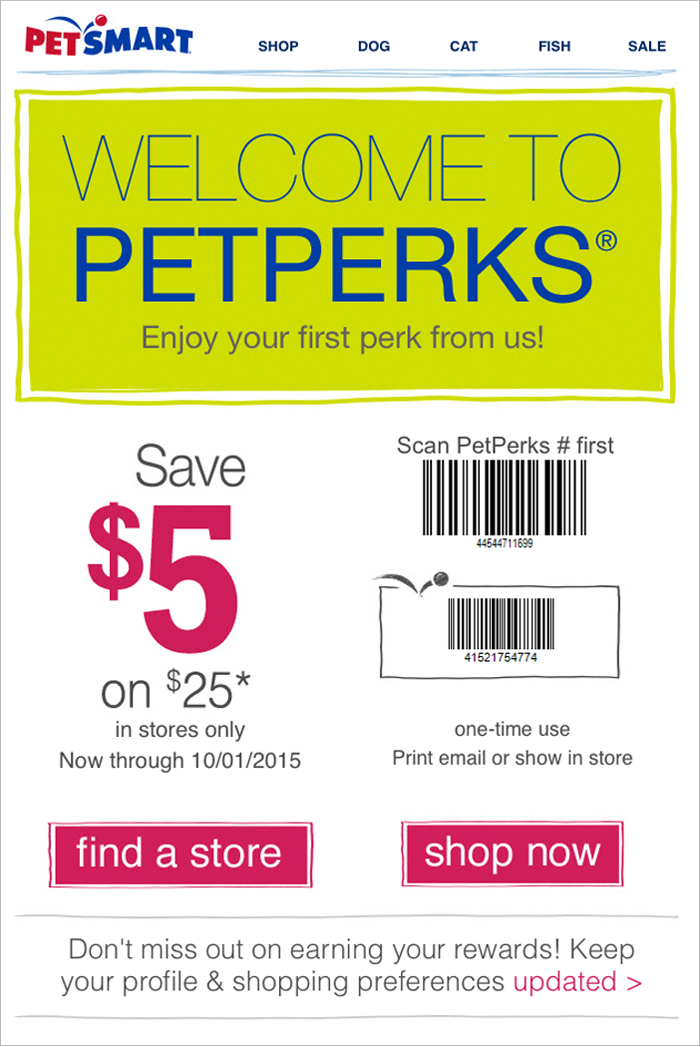
Type of welcome email: Incentive
When you should use it: If you offer an incentive on your sign up form in exchange for email addresses.
Pro-tip: Always deliver your subscribers’ coupon in that first welcome email – don’t make them wait!
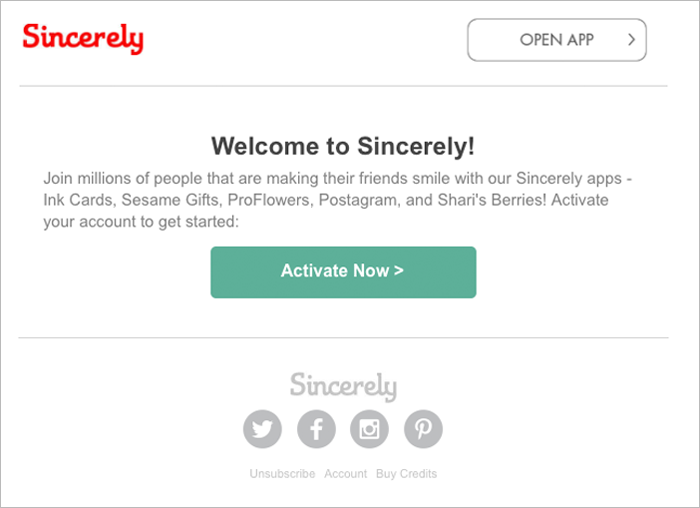
Type of welcome email: Log in to get started
When you should use this: If you have an app or website with a trial offer or membership
Pro-tip: Make it easy for people to get started by linking directly to the place where they can log in.
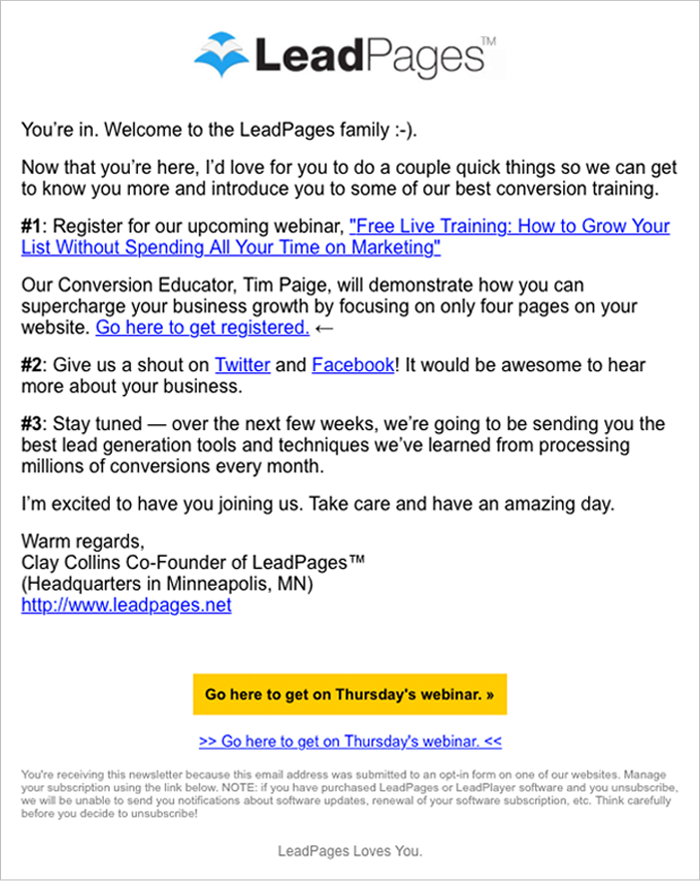
Type of welcome email: Steps to getting started
When you should use this: Do you have existing content, upcoming events and/or other promotions you want new subscribers to know about up front? Then this type of welcome email is for you.
Pro-tip: Don’t overload people with information. Give them 2-3 resources to get started, but save some content for the rest of your welcome campaign.
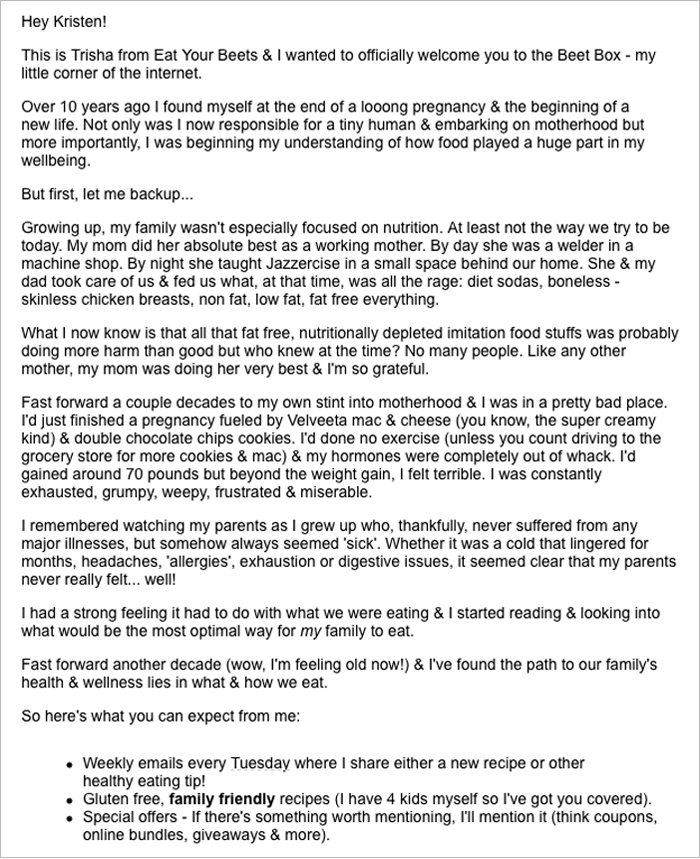
Type of welcome email: Get to know you better
When you should use this: This is a great option to help you make a more personal connection with your subscribers.
Pro-tip: Not everyone will have a hard-hitting story like Trisha from Go Eat Your Beets (below), but that doesn’t mean you can’t include a few tidbits about yourself to show that there’s a real human being behind those emails.
Once you’ve established the information you want to include in your welcome email, you can begin structuring the rest of your welcome campaign.
Before you figure out the content of each email, you should outline your goals to ensure that your content aligns with them. Here’s a sample outline that you can use to structure your welcome campaign:
Timing: Immediately after signing up
Email #1: Welcome Email
Goal: Introduce people to your business and anything else you want to accomplish with your welcome email.
Timing:
Email #2:
Goal:
Timing:
Email #3:
Goal:
Timing:
Email #4:
Goal:
Now let’s look at that plan in action. If you’re a natural foods blogger and your goal is to promote your blog and sell your e-course to new subscribers, your welcome campaign could look like this:
Timing: Immediately after signing up
Email #1: Welcome email with an introduction and recipe ebook incentive
Goal: Introduce people to my blog and deliver their incentive
Timing: 3 days after Email #1
Email #2: A popular blog post featuring a healthy recipe
Goal: Show off a popular post so my subscribers will see how cool my blog is
Timing: 3 days after Email #2
Email #3: Another popular blog post featuring a list of healthy living resources
Goal: Send useful resources to build trust
Timing: 3 days after Email #3
Email #4: Explain the value of my e-course with a link to sign up
Goal: Get people to sign up for my e-course.
Timing: 1 day after Email #4
Email #5: A survey asking subscribers what they’d like to see next
Goal: Get feedback from my new subscribers
Pretty simple, right? There is no right or wrong length for a welcome email campaign. You can start with just two or three emails and add to it later if you’d like.
As for timing, you should experiment to figure out the most effective timing for your subscribers. If your goal is to sell a particular product or service, don’t start your welcome campaign with your promotion. Wait until you’ve offered your subscribers a few pieces of content for free, then present your promotion later in the campaign, like in the example above. This gives your subscribers a chance to check out all the great content you have to offer first. By the time you offer your promotion, they’re ready to buy from you.
It’s always a good idea to include a survey at the end of your welcome campaign. Your survey could be as simple as asking people to reply directly to your email with their feedback about your business. Use their feedback to inform the type of content you include in your welcome campaign moving forward.
Now for everyone’s favorite part: figuring out which content to include in your automated emails.
The content you use in your welcome campaigns should be your pillar content, meaning that it covers a handful of topics that address your audience’s biggest questions and needs.
For example, when I signed up for the Wine Awesomeness email list, one of the first messages I received linked to an article about screw caps vs. corks – a hotly debated topic among wine aficionados and newbies alike. (I hope my preference for screw caps doesn’t sully your opinion of me.)

Your pillar content will usually be the most popular content on your website. If you’re still not sure which content that is, here’s how to use Google Analytics to find it.
Once you know what your pillars are, look at the content you’ve already created to find content that fits inside those pillars. Try this strategy that blogger John Corcoran recommends for creating your first welcome campaign:
“Take six articles that you’ve written already that are the most valuable content for your target audience,” he said. “Turn them into autoresponders and spread them out over six weeks. You will know that anyone added to your list will get one email a week from you for six weeks and they can get to know you.”
Don’t have six articles? That’s ok – start with two or three, then add to it later.
Don’t have a lot of content created already? That’s ok too. Your subscribers still need to get to know you, right? You can create an FAQ-style welcome campaign explaining more about your business and the value of the products or services you provide. If you’re a design consultant, your campaign might look like this:
Welcome Email: Introduce people to my business with a printable incentive
Goal: Show off my design expertise with a fun incentive
Email #2: How smart design can help your business grow
Goal: Explain the value of having great design
Email #3: Here’s a few of the design services I provide
Goal: Answer common questions about my services with a link to request a consultation
Email #4: What are your biggest design challenges?
Goal: Get a better understanding of what my subscribers need help with
The best part? Just about anyone can create this type of welcome campaign – so not knowing what to write is no longer an excuse. :)
The fun doesn’t have to stop at the end of your welcome campaign. By the end of your welcome campaign, your subscribers know a lot more about you. They might even be ready to take your relationship to the next level.
To do that, you can automatically tag them after they receive the last message in your welcome campaign and send them another campaign. Linking one campaign to the next gives you the opportunity to promote yourself to people who are already engaged with you – and as a result, are a lot more likely to become loyal customers.
It doesn’t have to end there, either. You can link your second campaign to a third, and so on. Stay tuned – in a few weeks, I’ll tell you everything you need to know about linking campaigns.
In the meantime, log in to your AWeber account to get started with your welcome campaign.
Not an AWeber customer yet? Start your free trial today!
CALGARY • The Trans-Pacific Partnership trade deal would promote energy investment and facilitate the movement of people between its dozen signatories, but lack of pipelines targeting exports to Asia and poor industry conditions mean few immediate benefits for Canada.
According to terms of the deal made public Thursday, regulatory scrutiny of foreign takeovers would not be required for deals valued at less than $1.5 billion, compared to $600 million under current rules, which are set to rise to $1 billion by 2019.
However, the higher threshold does not apply to acquisitions by foreign state-owned enterprises involving taking control of Canadian companies, which would still be subject to a review under the Investment Canada Act if they are worth more than $369 million.
The TPP would reduce tariffs and trade barriers among the United States, Canada, Mexico, Chile, Australia, New Zealand, Japan and five other countries.
Canada’s biggest oil and gas energy export potential among TPP members is with Japan. Some of the country’s largest companies established a Canadian presence in recent years, hoping for the start up of a liquefied natural gas industry and for bitumen pipelines between Alberta and the West Coast.
But Carlo Dade, director of the Centre for Trade and Investment Policy at the Canada West Foundation, said Australia and the United States are better positioned to immediately take advantage of opportunities.
“They have the capacity to move supply to Japan, the world’s third-largest energy consumer,” Dade said. “It points out that not having pipelines to the Pacific is painful in that regard.”
Mike Tims, vice-chairman of private investment firm Matco Investments Ltd., believes the TPP’s impacts on Canadian sector investment would be modest.
“Many of the companies that might be of interest to non-Canadian buyers will be larger than $1.5 billion, because ‘scale’ is important to many buyers,” he said.
“The new higher deal limit does not apply in the case of acquisitions by state-owned entities, which have been among the historical acquirers,” he said.
Even more important, Canada is seen by foreign buyers as a medium-cost to high-cost region, so it will take higher oil and gas prices to revive interest, Tims said.
One advantage of the deal is that it makes it easier for people to move between TPP markets, which would support energy investment, Dade said.
“I am excited by what I see in the movement of people,” he said. “That is thinking more creatively.”
The planned changes are consistent with former Prime Minister Stephen Harper’s strategy of easing investment restrictions with the country’s historical trade links — North America, Europe, Japan — while increasing scrutiny of investments from outside of Canada’s historical commercial partnerships, targeted largely at emerging countries such as China.
China has been one of the biggest sources of investment in Canadian energy in recent years, causing the Harper government to tighten scrutiny of investment in the oilsands by state-owned enterprises.
Chinese companies have expressed concern about their inability to get work permits for Chinese staff to work in Canada.
Canada is also raising the threshold for reviewing foreign investment from European Union countries to $1.5 billion as part of its trade agreement with the region, which was signed in 2013 but has yet to be ratified.
“The services and investment obligations in the TPP will provide Canadian services suppliers and investors in the oil and gas sector with greater access to TPP markets,” Foreign Affairs, Trade and Development Canada said on its website.
“The agreement will facilitate investment, for example, by ensuring non-discrimination of foreign investors and by protecting investors’ rights through the investor-state dispute settlement mechanism. Through these robust provisions, Canadian service suppliers and investors will benefit from greater certainty and predictability when operating in key oil and gas markets such as Mexico and Brunei.”
With files from Bloomberg News
A modern marketer’s job is never dull. It never ends either. Especially when the marketing technology stack keeps growing and we use so many different applications and technologies in our daily tasks. We are learning on the job every second of the day because more than any other industry, marketing is dynamically changing every day. Demand generation, public relations, customer success and uses of channels like social media and even email are much different today than they were a few years ago. Not to mention, the rules of engagement change constantly (CAN-SPAM, new Google algorithms) and success is measured by impact on the business versus vanity metrics like clicks and opens. Truly, only engagement, conversions and revenue matter at a high level for most organizations. And for marketers, that makes our jobs tougher than ever.
 So then, how do we learn? How do we become successful in new areas like data analytics or marketing automation? Individuals learn at different speeds, and respond to different methods, so one size doesn’t fit all. And for organizations trying to provide training or access to new information for their marketing teams, it is critical to understand how different people learn to optimize marketing enablement efforts.
In general, there are three types of learning that are well-known and it’s largely accepted that most people need a combination of all three styles to learn effectively:
A recent study indicated that organizations rate their marketing personnel as less than 8% effective in executing demand generation. For this reason, it is important to offer a variety of training options to suit employees, and to encourage them to gain new skills or perfect existing skills. Engaged employees are more productive, by 22% in fact according to an article in Harvard Business Review. Even more significant, engaged organizations have double the rate of success than less engaged organizations.
So, let your employees learn, help them learn and provide a variety of options for their learning—a once a year trade show won’t cut it to keep the best employees engaged. Let them seek out new ways to learn and when you are creating content for your buyers—remember, one size doesn’t fit all. We all learn differently and have preferences on how we like to consume information.
Author: Erika Goldwater CIPP/US @erikawg Vice President, Marketing for ANNUITAS

One million U.S. B2B salespeople will become obsolete by 2020. That’s the bold prediction from Forrester Research, a respected research agency, in its report Death of a B2B Salesman.
According to the report, B2B buyers “overwhelmingly prefer” to do their own research online but companies still force buyers to talk to salespeople as part of the buying process. It argues that “websites, not salespeople, are at the heart of how B2B companies buy and sell” today.
If you’re a B2B sales pro, Forrester’s prediction might seem scary. Tech has already disrupted so many professions and this report indicates that sales is next on the target list. But it’s not all doom and gloom for the sales profession. With the right tactics, sales people will continue to be relevant and to thrive, providing value to both businesses and buyers.
If you’re a salesperson, here are three tips on how you can accomplish that.
1. Build your expertise.
One study that contradicts Forrester’s claim is one that was released by the advisory firm SiriusDecisions in May 2015. The study says “buyers interact with sales representatives at every stage of the buyer’s journey” and that the perception that the relevance of salespeople are “declining due to a disintermediation by digital buying behaviors” is mostly untrue.
“The new way to think about b-to-b buying is that human interactions still occur and matter, and that the rise of digital marketing doesn’t mean those interactions go away,” said Jennifer Ross, Senior Research Director at SiriusDecisions. “It just means that buyers and providers are interacting in new digital ways. Just because buying behavior is done digitally does not mean that sales representatives are no longer required to instigate or facilitate a buying process.”
That’s good news for salespeople, but there’s an important caveat: for buyers to actually come to you, you have to establish your credibility and position yourself as an expert in the field that you’re selling at. The best ways to do that is to create useful content—something that speaks to the business challenges facing your buyers. If you’re deemed as an expert, buyers will always come to you.
2. Evolve your skills.
The business landscape continues to evolve, and the only way to stay competitive as a sales professional is to keep your skills up to date. At the very basic level, you should familiarize yourself with different selling approaches because the way people buy also change purchasing expectations. For example, solution selling used to be an effective approach when the needs of the buyers were more well defined. Today, however, the most effective salespeople tend to embrace the challenger sales model, bringing provocative insight into the sales process. This change in sales approach is one illustration of how effective sales methods could eventually become out of date.
Part of this is also embracing new technologies and getting comfortable with them. With the rise of social selling, for example, you have to make sure that you’re comfortable communicating via social networks and you know how to use social tools to move the sales process along. Upgrading your skills means getting familiar with new sales tools, whether that’s learning new CRM systems or playing with tools that will help you research about a prospect.
Finally, salespeople need to be more comfortable with data and analytics. The wide availability of digital tools means many of your activities can now be measured, so sales pros should leverage analytics to drive their efficiency and effectiveness. If you blog, for instance, be familiar with Google Analytics. If you use Twitter to build your online reputation, you should be checking Twitter Analytics on a regular basis. And if you write or send ebooks, info sheets and other PDF content to your prospects, use a tool like Orangedox to get page-by-page analytics and determine which sections resonate most with buyers.
3. Focus on results.
You will never become obsolete if you consistently show amazing results. That means being able to move the sales process along and closing deals. That means not just meeting your quota—but actually exceeding them. That means showing continued growth and beating your number over time.
Results make you indispensable. It’s that simple.
How do you keep your sales skills relevant? Let me know in the comments below.

Last week, I shared one surprising stat from our B2B research: Only 44% of B2B marketers know what success and effectiveness look like. Another finding that jumped out at me – having internal content creators become stronger writers was the lowest-ranked priority for marketers. Really?
We took this finding to our B2B research roundtable panelists, and they were surprised too, saying that writing is a discipline that needs to be prioritized and practiced. Read on to get some practical ideas from our B2B roundtable on how to do that and learn what the CMI LinkedIn community suggests you consider when looking for a great writer.
Thanks to the participants: Ardath Albee, B2B marketing strategist with Marketing Interactions and author of Digital Relevance; Vishal Khanna, director of digital marketing for Wake Forest Innovations; Carla Johnson, president of Type A Communications and co-author of Experiences, the 7th Era of Marketing; Jeannine Rossignol, vice president of marketing for Xerox Consulting and Analytics Services; and Linda Crowe, vice president, digital marketing solutions of Brightcove.
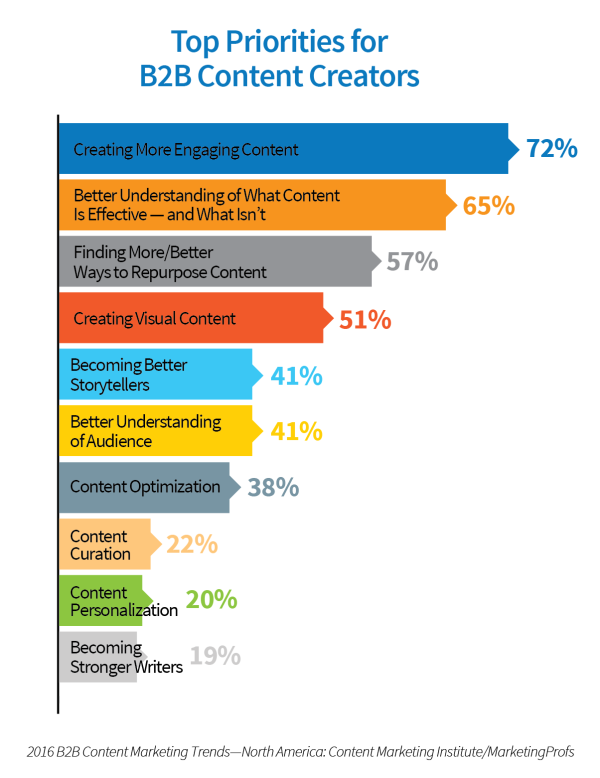
As you can see in the research below, creating more engaging content was a top priority, and becoming a better storyteller ranked in the middle. How can you do these things without becoming a better writer?
Jeannine explains that even though you may have great thoughts, if you don’t communicate them well, they won’t make a good story and your content won’t be engaging.
I don’t know how you can tell your story if you are not a good writer … For instance, things would come to my desk to take a look at, I would get out my red pen and sit there and I would mark it because it wasn’t good writing. It was a good thought. It was a good idea. It would have made a good story, but it wasn’t written well.
Poor writing also reflects negatively on a brand. Ardath cited research from Acrolinx that said the biggest turnoff for more than half of buyers was grammatical errors and bad writing on a website.
Why is writing perceived to be such a low priority? There are multiple reasons. Perhaps it’s because everybody considers themselves to be a writer these days. Or maybe it’s because people have other pressing priorities. Whatever the case, the group offered several suggestions on how to become a stronger writer.
Read
Reading was the first tip that sprang from everyone’s lips. While this is not a new idea, it’s so important to read regularly, not only books and articles related to your industry but also classics and any other genres that interest you.
Copy great writing
I loved this idea from Vishal:
I have an MFA in creative writing and the favorite exercise I was given was to start typing Hemingway. Just type Hemingway and when you finish typing the chapter, keep on writing. What happens is you learn to write like Hemingway, because you learn the cadence of the rhythm of the author. I think you can do the same thing with writing good content for the web. Look at what works well and write that and go further and write your own content.
Have a structure
Ardath shared a story about how she trains writers, and she explained the general structure that makes a good story:
They don’t know how to structure things. What makes a good story? What creates a good flow? You need to start with a hook and then prove your premise with three points and then tie back to the hook and wrap it up with a bow at the end. That’s the basic structure. Most people don’t understand how to put those things together.
Have discipline
As with any skill, you need to continually write if you want to excel at the craft. Most of the panelists have seen their roles shift from writer to editor, and Carla and Ardath are big fans of writing something every day, regardless of whether it’s free writing, fiction, or anything else that suits your fancy.
Even when you find a great writer (ideas on that below), you need to train that person to write for your specific brand within your style. Here are a few other tips to help you work with your writers:
Going back to the first question on editorial mission – we have a mission that we want to have in all of our work. We train our writers, pretty in depth, to make sure they get it. But, what it takes is a red pen for the first two months. That’s usually what it takes to get a good writer. Then they get it and the red pen gets used less and less then they are on their own. Even great writers have to be trained to write within the narrow confines of your brand.
While the B2B roundtable didn’t spend time talking about how to find a good writer, this challenge was alluded to in a situation Ardath described:
My client came to me and said, “I need to hire 10 writers.” I said, ‘Oh great, this is wonderful.’ Then it took us six months and we interviewed a 100 of them before we found 10.
I couldn’t help but think of a recent and active conversation on CMI’s LinkedIn Group that addresses how you find the right writer. Here are several of the ideas:
Amanda MacArthur says to focus on a cover letter instead of a resume:
When we hire, we ask them to nix their resume, and write us a cover letter that explains their experience, passions, and why they want to work for us. This is writing sample No. 1. If they can’t sell themselves with their words, how will they do it for your company?
Doug Rekenthaler Jr. believes you need to find writers who can write specifically for your brand:
The content marketing space is choking on anemic writing that lacks distinction as well as a capacity for grasping a brand’s fit within its space (i.e., they crank out content that could fit you OR any of your competitors, which isn’t particularly useful).
You also need to define your project. As Jan Coopman explains:
First of all, the initial work will be on you. Define what type of work you need, and write an accurate job description. Blogs? Press releases? How much creativity is desired? How much initiative? Experience? Supervision? (You) can ask for samples and links to work.
Kate Eidam adds to this:
Also make sure to clearly communicate the goal, objective, and audience for each piece. In my experience, when this isn’t done from the outset, it’s easy for things to go off the rails.
Ann Gynn (our very own CMI editor) has the following tips:
I also recommend asking the finalist candidates to set up a project if you want to see their approach/creativity. You identify the primary goal or objective and ask the person to come up with some content ideas, distribution, and promotion (depending on the job). Also have them list any questions that they need answered to complete the creative development. This enables you to see behind the person’s approach to content development, etc.
You also need to give writers a chance to refine their work, as Bob Balm shares:
A first draft is rarely spot on, both in content and in tone of voice. Especially if it’s the writers’ first work for you. You may not like a first draft of a text, so if you only give a potential one chance to deliver a good result, you may not get the best piece of work.
Perhaps worse, I think a writer’s ability to process your feedback into the piece of work and, over time, get the hang of your desired tone of voice, is a big plus. And you won’t discover that ability if you just give him/her one shot at spitting out the perfect text. You might end up with someone who was lucky enough to write something that appealed to you that particular time, but ends up not fitting the mold you were looking for in the long run. So in short: Appreciate that content writing is a process, and test your potentials to see if they do so too.
Are you part of the 19% who consider becoming a better writer to be a priority? Are you a part of the 72% who consider creating more engaging content to be a priority? While fostering stronger writing within your team (regardless whether you have internal or freelance writers) takes time, it’s worth it because you can’t create stories or be the go-to resource in your niche if people don’t want to read your content.
And to all, when you have found that writer you love, hold on tight and treat him or her well.
What other tips do you have to share?

View the other B2C and B2B research videos in these roundtable discussions:
Want to learn more about what B2B, B2C, and nonprofit marketers are doing now and planning for 2016? Download the latest from CMI’s research center.
Cover image by Joseph Kalinowski/Content Marketing Institute
The post Why Strong Writing Is a Skill to Prioritize in 2016 (And How to Hire Great Writers) appeared first on Content Marketing Institute.

Planning is an essential part of a top salesperson’s success. The best hitters in baseball take batting practice before every regular season game for up to 30 minutes before it starts. Facing live pitching prepares their reflexes, timing, and mental awareness.
Sales works the same way. If you want to win more deals than you lose, you have to do your prep work.
Top performers keep all non-essential customer interactions to non-work hours. For me, that means I spend every Sunday night prepping for the week. My wife makes fun of me because between the hours of 4:00 p.m. and 6:00 p.m., I’m working, and I refuse to go out. I have missed concerts, plays, ball games, and dinners to do my prep work, and my friends think it’s dopey.
But that dedication and time means I’m prepped, confident, and ready to hit the ground running when I walk into the office at 7:00 a.m. on Monday morning.
Here’s everything I do to prepare for the week ahead.
I review my notes from customer-facing meetings to make sure I’m up-to-date on action items and follow-up correspondence. I update my CRM and review any outstanding commitments to send follow-up information to prospects.
I travel a lot for work, so I often miss internal meetings and other non-essential commitments. I make sure I’m fully caught up on what happened at meetings I wasn’t able to attend so I’m up to speed with my team -- or I’ll send an email that says I won’t have time to review this material.
Bonus tip: Ask one of your colleagues to recap the top three things they learned from the session, so you can consolidate an hour of training into three bullet points.
During the week, my schedule is packed with prospect and customer meetings. Anything that’s not urgent or essential has to wait until Sunday. I block out time to finish any emails that are in my drafts folder, as well as respond to emails I’ve been sitting on all week. Create a “Review” folder where you can park half-finished emails or messages that need reviewing so you can concentrate on your top priorities during normal business hours.
Because I’m physically out of the office so much, I have to guard my time closely. I review all my available timeslots so I know when to book meetings with prospects, and set up out-of-office replies so I don’t have to worry about missing a day. Putting travel time in your calendar as soon as you know you’re going to be out ensures you don’t book and and then reschedule a ton of meetings, which saves time and effort.
Prospecting is absolutely necessary to success, but it’s easy to skip if you’re busy with other things, or you procrastinate, or you’ve thought up 1,001 other reasons not to pick up the phone. To keep myself accountable, I schedule time in my calendar specifically for prospecting. This way, I don’t neglect the most important part of a sales professional’s job -- filling my sales pipeline with new opportunities.
The last thing I do to organize my time is schedule all internal meetings for the week ahead on Sunday nights. This way, my colleagues will have the calendar invites in their email inboxes when they walk in on Monday morning and can accommodate my schedule. This is especially important if you work remotely or in different time zones.
For each call I have during the week ahead, I do the following:
Since HubSpot is a software as a service company, we create demonstration portals for each prospect, as well as offer free trials. So I’ll check prospect activity in trials and portals to look for activities that determine whether this buyer is a good or bad fit, as well as spot trigger events that would be a good reason for me to reach out. Determine what similar types of activities are good indicators for your product and review them during this time.
For the rest of the week, five minutes before each call, I review my notes from Sunday again. It’s helpful to do this twice because you always see things differently the second time you look at a document, and it reinforces important points of discussion.
I write around two to five new emails every Sunday night. These emails should be extensions of a sales process, not prospecting emails. I aim to:
I schedule these emails to sent by 7:45 a.m. local time on Monday morning so I’m at the top of my prospects’ email inboxes when they start their weeks.
I work with marketers, so I use the last half hour of my prep to read about what’s new in their world. If there are changes to major social media platforms or Google’s search algorithm, for example, I need to know about it so I can explain to my prospects how the HubSpot platform can help.
You should be keeping up with similar activity in the industries you sell into. Use this time to step into your buyers’ shoes and determine what will be top-of-mind for them in the week ahead.
Next, I need to keep up with what’s new in HubSpot’s universe. If there are any internal product updates -- a new feature, a new policy, or any other customer-facing development -- I need to know about it so I can provide my prospects with the most accurate information possible.
Whether it’s an email about a competitor’s new product line or general tips for selling, I want to read things that help me become a better salesperson.
The end result of doing these two hours of prep each Sunday is that I’m calm before I walk in on Monday. Sunday evenings are a non-stressful time when you don’t have any deadlines or other obligations looming over your head.
It’s a huge advantage to be in your prospects’ inboxes and colleagues’ schedules before the week even begins, and it means that when you walk into work you’re ready to hit the phones and get a fast start to the work week. By following this checklist, you’ll learn something new every week, get better at your job, and set yourself up for success.

 To be effective, sales follow-up emails must change. Dramatically.
Generic messages that reference “just following up” or “just checking in” no longer work. For example:
Hey [enter customer name],
Thought I'd check in and say hello. How's everything going? I know it's been a little bit since we last spoke, so I'm just following up. Thanks.
- Annoying Sales Rep Allen

A prospect has no reason to respond to this email.
And while it includes their first name, it’s a generic message. It lacks the core components necessary to move this prospect into the next phase of the sales process.
By including a few critically important features, reps can finally stop sending pointless and obnoxious emails, and start sending ones that actually get responses and result in customers. The traditional method of high-volume generic emails doesn't work. It’s time to be human with our prospects.
Here are three things to keep in mind each and every time you write a sales email.
It’s your job to move the buyer you’re emailing into the next phase of the funnel, which is why including a call-to-action is critical. Whether it’s in your subject line or the final remarks at the end of the email, discussing what’s next in the process is necessary for success.
In fact, including a CTA can boost a prospect’s curiosity, making it more likely that they follow up with you. The Drive Theory of Curiosity holds that when we have a general idea of what’s supposed to happen next, we’re more motivated to check it out and see what actually happens.
Here are some easy CTAs to include in your follow-up sales emails:
It’s great to include a prospect’s first name in an email, but you should strive to get a little more personal than that. Sales reps and buyers now have access to tons of information about one another. A sales rep knows where their prospect works, how long they’ve been there, where they’re from, and more.
With this knowledge, sales reps can -- and should -- personalize each of their sales emails. After all, sales is ultimately about personal relationships.
Include phrases such as:
For more examples of personalized emails, check out this blog post.
Content continues to shape how customers make their buying decisions. People value trustworthy content, and they want to read what others are saying about a product or a service.
Using content in sales isn’t a new idea, but it’s still not widely adopted. Sending a story about a company or person in a similar position as the prospect that describes how your product or service helped solve their problems is huge for sparking interest.
Consider sending one or more of the following types of content:
1) A case study or testimonial.
Customers love hearing from other customers. Here’s your chance to boast about your product or service -- without actually doing it. Humans love stories and they value their peers’ opinions.
2) A blog post from you.
Building credibility is also critical if you want to be successful in sales. Taking to the internet and producing some content around the industry you sell into is a great way to do this. After you write something, be sure to send it out to your prospects. Not only will this build your credibility, it also gives you a reason to reach out and share something with your client, which will keep the conversation going.
3) Content around your company.
Again, buyers love to read about products before they talk to salespeople, especially in the form of media articles or blog posts. They are doing as much research as they can before making a decision, so why not help in that research by providing some content?
There’s no point in sending an unnecessary “just following up” email to a prospect anymore. The playbook has changed. Nowadays, the goal is to be in tune with your prospect, research and get to know them, and develop an email strategy around what you’ve learned.
Ideally, you begin sales engagements with the knowledge that buyers are interested in your service. As a sales rep, it’s your job to build relationships based on this initial interest, and maintain them. With this these three tips, you can craft compelling emails that will help you do just that.


Marketers have a lot of how questions when it comes to demand generation: How do we connect with our target audience? How do we drive sales? How do we engage with one person and everyone at the same time?
The answer is always personalization.
Personalization is not just adding someone’s name to a marketing email — it’s so much more than that. To understand the difference between generalized and personalized content, think about the contrast between a meaningful coffee date between two new friends and an awkward cold call from a telemarketer. In both settings, the person you’re talking to knows your name — but you most likely hung up on one of them immediately.
In marketing, you want to give something to your audience. And not just anything, but something relevant, or you’ll be like that telemarketer and send them running.
How do you know what’s relevant to your audience? Just ask.
If you’re worried about whether it’s worth your while to speak to one person at every step of the buyer’s journey, consider these statistics:
It’s inevitable — to join the crème de la crème of the marketing world, you need to incorporate personalization into everything you do.
Here at SnapApp, we love buyer personas — they are the clearest way to carve out a path toward personalization. For B2B buyers, these personas are defined, not by demographics per se, but by work-related attributes that allow you to target prospects.
The personalization process starts with segmentation. Kevin Bobowski, VP of Demand Generation at Act-On Software says it best:
“Great marketing and a great customer experience is all about personalization. And personalization is driven by segmentation — specifically, understanding your buyers and their needs.”
Knowing your buyers and their needs comes down to specific data at your fingertips. You need to find and dive into digital information to figure out who you’re reaching.
These characteristics not only give you an aggregate visual of your average lead but they create distinct blueprints of each and every lead. Mike Weir, LinkedIn’s Global Head of Category Development told Content Marketing Institute that he recommends content marketers focus on these 5 characteristics, and segment their leads accordingly:
When you meet someone for the first time, chances are, one of the first things you ask is, “Where are you from?” The distinct locations of your audience members shapes the way they interpret your content as consumers. Plus, knowing where your fan base lives can help you speak to leads directly.
In the B2B marketing world, the seniority level of your prospect can make an impact on how you communicate. Are they the decision maker? An executive will have a very different intention in checking out your services than a mid-level manager.
To understand the needs of your client, you need to understand the basics of their role within a company and within their lives. Every stage of the buyer’s journey should be oriented to a particular pain point of your audience. Without understanding their role, you will not be able to identify the problem to address.
Individuals in different industries will implement and benefit from your product in varying ways. Segmenting by industries allows you to develop niches and boost referrals within individual sectors.
The size of a company radically affects both the scope of a potential project as well as the process of clinching a sale. Marketing to solopreneurs and Fortune 500 companies can and should look very different.
Personalizing your marketing campaigns into one-to-one conversations starts with identifying these unique characteristics. Through interactive content, you pose questions that engage leads and naturally segment your prospects into distinct groups.
Within a piece of interactive content, you can guide a potential client along a personalized journey based on their preferences and interests. Instead of creating different pieces for different segments, you can create one experience that serves everyone by offering different routes along the same journey.
This kind of interaction replicates a natural two-way dialogue in an easy, affordable way for marketers — with no developers or IT folks needed! In other words, you create content that speaks to everyone at the same time while engaging on a person-to-person basis. What’s better than that?

Marketing a product can be very difficult. The product landscape is cluttered, leaving customers overwhelmed with information, options, and benefits. Product managers are often under pressure to accelerate sales cycles and get products out there. And when a product isn’t doing well? The solution for many companies is to cut the marketing budget even further to avoid catastrophic losses.
Would you be surprised to learn that failed products aren’t actually the result of this perfect storm of issues? The problem goes much deeper into the assumptions you make about marketing your products.
So how does today’s product team get new products into the hands of the customers that need them on a timeline that works for your company’s needs? The key lies in unearthing and eradicating the following three deadly assumptions you’re making about how to market your product.

Most software executives are technical people at heart. They love building products, and they are analytic, techy, and all sorts of other geeky things. They’re comfortable talking about features because features are (or easily can be) quantified, and procurement-led RFPs reinforce the need for quantifiable proof one product is better than the other. Unfortunately, this leads logic-minded executives to fail to understand the role emotions play in purchase decisions.
At at some point in the sales process, buyers switch from being feature-focused to wanting to know two things: do I like you (because I won’t do business with people I loathe), and can your product do its job well enough that I won’t get fired?
These are two very emotional questions, and no amount of features can answer those questions or overcome objections. Ultimately, the emotional aspect trumps any amount of features. Companies who don’t understand that the buying process switches from features to emotions miss opportunities to frame their capabilities and value proposition in a way that helps sales.
A great example of this concept comes from Apple’s online store. The product description leads with features like screen size and clock speed, but does anyone really understand the benefits of different clock speeds? Most customers will say “Faster is better,” but we can’t internalize how much better that is. In the end, we make a decision and use the features to rationalize the purchase after the fact.
Calling something “marketing strategy research” makes it seem like a big-budget item. But, truth be told, a good marketing strategy must definitively answer three questions:
How you go about answering those questions (and how much you spend doing so) is entirely up to you, but you can’t value execution over strategy. You can find the answers through customer development interviews, surveys, or personal experience, but you can’t find the answer to those three questions in better execution.
In the 1890s, John Wanamaker quipped that half his marketing was wasted. The trouble was he didn’t know which half. A lot has changed in the last 120 years; a lot of marketing spend may not produce tangible benefits, and it’s still incredibly hard to attribute sales to marketing. Combined with a predilection towards quantifiable features and a belief that the product is what customers buy and it leads companies to put all of their resources into improving the product before they consider more marketing.
In any other scenario, this might sound like a good idea. However, under spending on marketing means your sales team has to work that much harder. They spend more responding to statements like, “I’ve never heard of your company/product/service/widget,” and appointments get harder and harder to book. Rather than relying on your sales team to pick up the slack, spend more on marketing to help support your sales team’s performance.
If you’re struggling to market your product, don’t make these deadly mistakes. Instead, focus on replacing your dangerous assumptions with a more comprehensive strategy to get new products into the hands of customers than need them.
 Sales is a competitive field. Reps on the same teams compete, companies compete, products compete -- even customers compete against each other. It’s one big competition, really.
And while a missed sale might come down to what an individual rep is doing wrong, other times it can be chalked up to what the competition is doing right.
So what are the most effective ways to study and learn from your competition?
There are a few different options, and depending on how much time you have during the day, one might be better than the other. Here are three methods of researching your competition, accompanied by an explanation of how to get the most out of each.
If you aren’t sure who your competitors are, a quick Google search can change that. For example, realtors can identify their competitors by searching “Realtors [location]” in Google and perusing the results.
You can also use LinkedIn’s advanced search for this purpose. Learn more about the ins and outs of advanced search here.
For Facebook and Instagram, monitor your competitor’s pages. Spend a few minutes studying what they are posting every week.
On Facebook, look to see if they’re sharing a story. Several businesses use the platform for this very reason. For example, they might showcase employees working with the Mom and Pop stores of the neighborhood. From a sales perspective, this lets you know who a competitor is going after. If you notice constant interactions with Mom and Pop businesses, they’re targeting the small businesses of the market. That’s where they want to dominate. In order to compete against this company, you have to either try your hand at selling to the same small businesses they are going after in a different way, or pursue medium to large businesses.
With Instagram, the main thing to watch is who the company is interacting with and the type of language they are using. Similar to Facebook, if you notice a ton of photos of small businesses, or flyers about a Saturday Sidewalk Sale, you can determine that this company is targeting the small business market. That’s clearly who they want to appeal to, and who they want to interact with.
On Twitter, take advantage of lists to keep tabs on your competition.
To set up a list, head to a competitor’s profile. Once there, click on the “settings” button, and choose the option “add or remove from lists.” Finally, set up a list titled “competitors,” set it to private, and then add your rival.
 Here’s what salespeople can learn from Twitter lists:
Chances are, your customers became intimately acquainted with your competitors during their buying process. So why not ask them for their opinion?
Client feedback can take anywhere from a day to several months to gather, but it’s always worth it. Customers are the heart of your business, and gaining input from them can help business leaders dictate which direction your company heads in.
There are three primary ways to gather input from customers: surveys, events, and direct interviews.
The key to a great customer survey is to offer a reward for participation, and avoid questions that take longer than 10 minutes to answer. This is your chance to get the information that matters to you. If your physical therapy practice isn’t attracting new customers, ask questions about your marketing, strategy, and what other practices are doing better. Remember, today’s average attention span is about eight seconds, so make your questions quick. You’ll not only learn a lot about your competitors, you’ll learn about what parts of your strategy are working.
Alternatively, you could host an event. Invite customers and folks from the area to learn about your company, and what you’re trying to do. Offer free food and beverages, and ask them for their observations about your market and competitors, and their thoughts on how you can improve. Maybe you can find out why someone in your neighborhood decided to use X real estate firm versus yours. An added bonus: You can advertise your company, and potentially source new leads.
Finally, you can hold one-on-one interviews with customers and prospects. Next time you sell your product, ask your new customer why they chose your service over another competitor. And in the event you lose a customer, don’t give up -- follow up. Inquire about what they liked about your competitor and what made them leave.
The best part about using advertising for competitive research is that it’s easily found. Study your advertising versus your competitor’s advertising. Are they sharing case studies or testimonials? What type of language and imagery do their ads use? What type of “feel” and brand identity are they going for? By analyzing your competitors’ positioning, you’ll be able to adjust yours accordingly.
It’s also important to look at the advertising channels your competition is using. Are they advertising primarily online or are they spending money on TV ads? Do you notice promoted campaigns on social media or flyers at coffee shops? Use this knowledge to inform your own marketing and advertising strategies.
Learning from your competition is critical. It doesn’t matter if you work for a new business or a seasoned company; the competition is part of what’s going to determine your success.
The other part is you. How do you adapt? How do you counter? Social media, customers, and advertising are three easy ways to learn about your competition, and discover how to gain the edge.

I could not be more excited for 2015 to come to a close. Not because anything was wrong with the year, it was a great year. Not because I think we could have done things any better, I see amazing work everywhere I turn. I can’t wait for it to end because it opens up a new chapter.
This new chapter is in our company, in our industry, in our depth of knowledge, and in ourselves. New chapters are steps further into the story. We understand some of the characters more, the plot has moved into a new area, and we have no idea what will happen.
When I think about it, I am so excited it gives me goosebumps.
Right now I am sitting in the lobby of the Westin Hotel in Boston on the last day of MarketingProfs B2B. Just in the past 15 minutes, I have seen Joe Pulizzi walk by with a smile on his face and of course, wearing some orange. Ann Handley has just commented on the video of her I posted on Facebook and shared a gorgeous photo of the sunrise. Several attendees just got up for a run and a yoga session so there was probably $20,000 worth of spandex and other stretchy articles of clothing in the lobby, and I am here to experience it all.
So why am I here, because I am a fan.
I am a member of the audience of those who contribute to the sharing of information and continued education in marketing. I am a fan of MarketingProfs, Content Marketing Institute, Top Rank Marketing, DivvyHQ, EPiServer, Brightcove, more speakers than I can count, and the list goes on and on. There are so many companies represented here doing things right and others are still not seeing the big picture. But to what problem? The problem of audience, intent, and commitment.
So let’s start with a basic understanding of the audience and run through a few simple scenarios based on this event. The event is MarketingProfs B2B Forum 2015 in Boston. MarketingProfs has built a remarkable brand around educating the audience of marketing professionals. In the name of the event, you see the acronym B2B, which represents companies marketing their goods and services to other businesses. And finally, the use of the word forum makes you believe it will be collaborative. The expectation of the audience is the experts who are presenting the topics, the companies who are represented here, and the organizers are here to help them learn.
Now that we understand the event let’s look at the definition of the word audience. Google (and whatever sources they borrowed it from) defines an audience as “the assembled spectators or listeners at a public event, such as a play, movie, concert, or meeting.” Ok, that sort of points us in a direction, but let’s break it down into parts.
First, the word assembled conveys a gathering. People gather because they have a common interest. This could be a myriad of reasons that are temporary or long term. So when people gather around a street performer, their grouping is based on a passing interest and once the performance is over, the audience disassembles. When people gather around content delivered by a brand, they are gathered as long as the content is regularly distributed and it is of value to them.
When spectators or listeners show us the intent, they want something. Typically this means they want to be entertained, educated, or both. The intent, along with the presentation, helps drive what makes our offering valuable.
And finally, this definition has the audience gathered in a public place. Rather than thinking about this being public and all that goes into that, think of this as not private. Now private means there is a sense of discretion and to be aware of others rather than just aware of yourself.
So in the case of B2B Forum, the public gathering of marketing professionals with the intent of continuing their education that is entertaining and educational is what brought us all together this week.
In your content marketing efforts, you too will have an audience. These people will gather around you based on what information or offering you provide and the problems solved by it. Based on the content offered, you will be setting out the expected intent and delivery frequency of the audience. Their intent for consuming the value you offer and the length of time you deliver on the expected delivery cycle is what keeps the audience together.
So you will be creating content of a particular type distributed through a single or set of locations where it can be consumed. That outlet could be a blog, social media network, email newsletter, event, print magazine, or whatever else makes sense for your industry and the spectators or listeners you are reaching.
So in the beginning, I listed a few companies and individuals representing businesses who were present at the B2B Forum. Each of them has different outcomes and goals for being here, but they are here because they want to reach this particular audience. The three categories I will break these folks into are: event organizers, speakers, and exhibitors. Rather than give names, we will use these titles for the rest of the article when describing the pros and cons of their actions.
The event organizers formed the conference for a reason and it is assumed they have the most invested in the gathering of the audience. By educating a group of marketers in the B2B space during the three days, they hope to drive their own business goals of: getting signups for next year’s event, the sharing of excitement and treasures with their own audience, and the consideration of the other offerings they have. These are not their only goals. They also know they play a part in the vested interest of all of us, which is the continued growth of knowledge and experience sharing in the marketing community. Since it is content marketing, they will ensure there are outlets for attendees to move toward these goals and light the path for maximum accessibility.
The speakers offer their presentations and expertise to the event for a few different reasons. Those could be the awareness of their own content, products, and/or services, as well as the ability to grow in thought leadership or industry status. Usually with speakers at these types of events it is a combination of both, but you it could be just one or the other. In my case, I wanted to deliver content based on the audience’s desire to continue their education of B2B marketing. The potential outcomes for offering the content is the brand awareness of AJi and a connection for future delivery of content through other mediums. At the same time, I wanted the ability to demonstrate thought leadership to the organizers and the other speakers to allow for future opportunities to share similar content and expertise with their audiences.
And finally, the exhibitors are here to communicate information about their products and services to the audience, in hopes of their own audience growth and generating leads. A few shared educational content for the audience with no expectation of a sale to grow their own audience and others were there for to close the deal or get leads.
In the description of the goals from the speakers, the event organizers, and the exhibitors you will find a direction shift from the original intent of the audience, to the expected journey of the deliverer of content. Those with the expectations most aligned with the reason of the audience gathering have a better chance of conversion that the others but only if their content is of enough value to pull the recipient in.
So consider this story. Let’s pretend we have a group of vacationers in one location, and their cars are packed, families loaded, and ready to set out on a journey for entertainment. To select the destination of that journey, they have three options: a single-lane road to a wonderful water park, a two-lane highway to the office, or a 6-lane interstate to Disney World.
Their selection will be based on their original intent of a vacation that is entertaining. The likelihood of them selecting the two-lane road to the office is minuscule unless their office is a theme park or vacation destination. So with two ends left and the intent in consideration, the value delivered to each destination will be the next consideration. If it is found that one is far more valuable than the other, then the width of the road will probably not be a factor. However, if the value is about the same or the family is limited in time, the time to reach the destination will weigh heavily.
With both examples in mind, I will attempt to illustrate a few comparisons of what I experienced:
I see this as a comparison of the speakers who present the same presentation at CM World, Inbound, and B2B Forum year after year. Even though these events are so close, two the same week, some of the attendees will go to more than one. If they enjoyed your content at one conference and return the next year or attend one of the others and you present the same material, you are the equivalent of the It’s a Small World ride. It was entertaining at first, but a major decrease in value will be experienced if the audience member returns expecting something new and you just regurgitated the same ole stuff. This happens far too frequently and I hope the event organizers take this into consideration in the future. For a conference at this level, we can expect a high percentage of return or shared audience. Produce new content or move out of the way of the others who will.
This goes out to all the exhibitors who present themselves as having the expected intent of the audience in line with the event but once the audience experiences it, they are left wanting the time back. These types of activities are VIP parties that go out to everyone, sponsored gatherings that are not interactive, when people are left on their own to make connections, and the worst ones are paid sessions that just end up being a sales pitch with no value in line with the intent. Not all of these were at this conference but I have experienced all of them this year. If the intention of the audience is to learn about B2B marketing, you better deliver on that promise. The reason no one came to your booth was partly due to the traffic flow but also due to you not being able to provide value that was attractive. Those who came to your event with an expectation to learn and grow and you didn’t deliver have now grown further away from you than before you met.
I like to align this one to the event organizers. Of the two major marketing events I attended this year, I feel they both did an excellent job of running and organizing a compelling offering. There were sessions I enjoyed and others I didn’t much like at all. There were events that I loved and made good connections and friends and others that I felt out of place and not welcome. There were exhibitors that I would have loved to help them get them out of the expo as quick as possible to make room for more tables for collaboration and continued education and others I gained information based on my original intent to learn. While there were bad experiences, they were outnumbered by the good. I plan, and know of many others, to attend each of these events next year.
I don’t know how to say this without my blood boiling, but if you work a booth, please, PLEASE, put your dang phone away and stop talking crap about other people in your area. You are representing your company and good money was spent for that booth. Be alert, be prepared, know what you can and can’t offer, and smile. When someone comes by, don’t sell them, help them with what they are looking for. If you can’t offer it, show them someone who can or point them to someone else who can.
Another matching event to this scenario is if you are a speaker and you are there to educate people at an event around education, make yourself available. Don’t just huddle around your friends and exclude the attendees as if you are some sort of elite. Don’t just fly in right before your presentation and fly out after. Don’t go places where people are supposed to come to you for advice and put off the vibe that you are busy while you leave your freaking laptop open the whole time. YOU ARE NOT THAT IMPORTANT! In fact, you are a part of the labor force which is here to help with the guest. These guests want to learn more about marketing and it is your job to offer it. Sure, you can unwind and you don’t always have to be on, I get that. But when you are at the event and a guest comes your way, you better make them feel invited and offer your assistance. If not, you’re just making the person feel bad. Empathize that! Think of a time you felt left out and not wanted around and how crappy it was to your self-esteem and changed your opinion to return.
Ok, off my soapbox…
All of us need to leverage the audience others have built to help amplify our own efforts. That could be a search engine, a social network, a regional business group, the people connected to our customers, and large events like MarketingProf’s B2B Forum.
When we are interacting with any of these audiences, we should provide value in line with the purpose of the initial gathering. Search engine users are looking for answers, not to sign up for a sales pitch. Social Networks users are looking to connect with people; have social interactions; and obtain more information through trusted sources, not a disruption to their feed with the promise of value and the lack of execution. And large events are formed around explicit expectations of the audience and before you participate you should make yourself closely aligned with that intent.
If you plan to be a stop on a journey with any of these, the more you can determine the intent in advance, the higher the chance you have of making an impact and attracting them to your own audience. Then continue to deliver content based on the reason they joined you with new forms of education or entertainment.
And finally, write it all down so you don’t forget it, as well as remember others who join you along the way.
One of the most common questions I receive from small-to-mid sized business owners and entrepreneurs about LinkedIn is, “Should I create a LinkedIn Company page in addition to having an individual profile?”
I always give the same reply: “Think about it this way – would you rather do business with a logo or a real person?”
Given a choice, I’m always going to recommend 1-on-1, personalized marketing and lead generation using LinkedIn or any other platform.
With that caveat aside, there’s still some significant value available if you understand how to utilize LinkedIn’s Company Pages the correct way.
Let’s jump in.
Now, if you’re Nike, Google or Microsoft, a LinkedIn Company page makes a lot of sense. When you have thousands of employees and millions of customers worldwide, it’s helpful to have one large “hub” where you can house all job openings, company information and updates on LinkedIn.
Now, if you’re a small-to-medium sized business, LinkedIn Company Pages can still be valuable, but it depends in large part on how you utilize them. (More on that later.)
If you haven’t explored this avenue yet, LinkedIn Company Pages are free to set up and essentially serve as an extension of your company website.
You’re able to post job openings, links to company news and blog posts, create “showcase pages” highlighting certain departments or service offerings and more.
Also, LinkedIn will automatically reroute people who click on your company name or logo on the LinkedIn platform to the attached Company Page. It will also allow your company to become “discoverable” inside of LinkedIn’s Search box and on Google and other search engines.
In addition, employees can link back to your company page when filling out their individual LinkedIn profiles, helping drive traffic to your Company Page via those individual profiles.

One other benefit of having a LinkedIn Company Page is the ability to create “Sponsored Posts” through LinkedIn’s laser-targeted (and quite expensive) advertising platform. (For a primer on how LinkedIn Advertising works and who should use it, go here.)
If you have the budget to spend on LinkedIn ads, you can place “sponsored posts” that originate from your Company Page in front of your ideal prospects.
As an individual (as of this writing, anyway) profile holder on LinkedIn, you cannot create and place “sponsored posts” or updates into the feeds of LinkedIn members. This advertising play only works if you have a LinkedIn Company Page.

First, let me start by saying that most small-to-mid sized business owners I know are beyond busy, with only so much time and attention to go around when it comes to using LinkedIn for lead generation.
With that in mind, I’d much rather you leverage the individual LinkedIn profile of your company’s CEO or Owner to prospect on LinkedIn than take the time to create and maintain a Company Page.
I advise doing all active prospecting and outreach this way (running everything through your Business Owner or CEO’s individual LinkedIn profile) for a few reasons.
First, nobody likes getting unsolicited invites or messages from a person with “sales” or “business development” in his or her title. That’s just reality. However, if the Owner or CEO of a company personally invites meto connect or sends me a personalized LinkedIn message, I’m much more likely to pay attention to it and respond.
And once that happens, it’s easy to farm out those incoming leads to the members of your team who are in charge of lead generation and sales.
Use a simple “handoff”-type script to follow up with a prospect that responds to an invite or message that comes from your CEO or Owner’s personal LinkedIn account.
Here’s an example: “Hi [Prospect Name], our Owner [Owner Name] passed your reply on to me about [Topic XYZ] and asked that I follow up about [Topic XYZ].”
The second reason I like using this method is that the Owner or CEO – who is likely not leaving the business anytime soon! – gets to collect and keep all these new LinkedIn connections and sales leads in one place.
If you’re the owner of the business, you’d rather have your sales team using your account to collect and engage all your potential customers, because inevitably sales people move on (and take their networks and clients lists with them!), and then you’re back to starting over as far as LinkedIn lead generation is concerned.
Third, it’s great branding and visibility for your company on LinkedIn to have your CEO or Owner posting status updates, publishing content, sending out invites and the rest.

With all that as preamble, if you do decide to create a LinkedIn Company Page, you should utilize the same “client-facing” approach that works so well within an individual LinkedIn profile.
Here’s an example of a small-to-medium sized business that has an effective LinkedIn Company Page setup:

Notice the client-facing image that instantly explains what type of services Summit AR offers and who their audience is.
Also notice in the immediate summary area below the main image the ALL-CAPS style of “WHAT WE DO,” “HOW WE DO IT,” “WHO WE SERVE,” and “THE RESULT” as eye-grabbing headlines. Because LinkedIn doesn’t (yet) allow you to italicize or bold text on profile pages and summaries, using ALL CAPS to call attention to certain phrases helps online readers quickly scan to find what they’re looking for.
Summit AR also has client-facing “Showcase Pages” that delve more deeply into the specific service offerings and niche audiences they serve.
Whether you’re large or small, you’ll want to employ the same type of “client-facing” approach with your Company Page. Then, depending on your budget, you’ll want to utilize LinkedIn’s advertising platform and content marketing to attract your ideal clients and customers over the long haul.
Above all else, remember this (paraphrased) quote from Dale Carnegie: “Your customer doesn’t care about you or your company. He cares about himself – morning, noon and after supper!”
So whether you decide to utilize a LinkedIn Company Page or not, don’t forget to make it all about the audiences you serve, the problems you solve and the value you provide as a result!
Download my free eBook “8 Secrets to Selling More on LinkedIn” and register for my Free Webinar on using LinkedIn to generate more sales leads, clients and revenue:

At one time, websites were created with desktop and laptop computers in mind. But consumers increasingly use mobile devices to read email, search the Internet and read content, making it more important than ever that businesses give prudent thought to mobile content marketing. When content is consumed on small touchscreens and while readers are surrounded by distractions, it’s essential that brands reconfigure their content marketing efforts to match.
There are several things to consider as you evaluate your current strategies for areas that need improvement. Here are a few mistakes businesses often make when optimizing content for mobile:
Marketers often cite examples of winning mobile content marketing strategies when advising businesses on their own content. However, what works for a big brand like Red Bull or Coca-Cola may not work for every business. CMOs tend to watch those big corporations closely as an example of what works, rather than reading content on their own devices to truly get a feel for the user experience.
You must also pay close attention to the demographics of customers who interact with brands on mobile to make sure your content is geared directly toward your likely readers. Millennials between the ages of 18 and 24 are by far the largest users of smartphones and tablets, spending more than five hours a day on their smartphones on average.
The number of hours spent on a smartphone each day decreases with each generation group, with the upper half of millennials spending only 3.5 hours and 35- to 44-year-olds spending 3.4 hours each day on their phones. This is important to realize as you craft your own marketing strategy, especially if 18- to 24-year-olds are a target market for your products or services.
When mobile devices first grew in popularity, businesses scrambled to make their existing sites fit into smaller screens. Some marketers steered clients toward microsites, which satisfied the demand for mobile content while also letting businesses have control over what customers see. But today’s customers expect content to blend seamlessly between devices. Microsites can confuse customers and distract them from the message you’re trying hard to convey.
Instead of continuing to rework an existing site, throw out your current design and start over. Go through your site as though you were a customer on a smartphone, trying to locate specific information. Not only do people have increasingly shorter attention spans, but when they’re browsing on their smartphone they’re also subject to a number of distractions. Try to keep your content short, interesting and easy to navigate using a touchscreen.
Apps serve as the perfect alternative to mobile websites for some businesses. They can provide a way for customers to easily purchase products, schedule services, or just provide a fun game that builds your brand. With so many customers using Facebook to discover great apps, many businesses now opt for Facebook mobile apps instead of standalone apps that customers find through the app store.
That said, it’s far worse to create a poorly-functioning Facebook app than to have no app at all. Imagine a customer who is exited about downloading the app you’ve been promoting, only to find it doesn’t work. If that customer has paid for the app, the experience could easily turn into a customer service nightmare. Delay launching your app until you’ve ensured you’ve worked out all the glitches that are normally present with a new app.
Many businesses get so excited about the fact that they’re developing an app, they neglect to spend time making sure the app is easy to use. Whether you’re crafting an app for Facebook, the iTunes Store or Google Play, user experience is essential for a successful app.
Look at the app through a customer’s eyes and try to remember at all times that a customer will be interacting with the app on a touchscreen. Long forms with multiple fields can be a nightmare for a customer on a mobile device, so it can be a big help to transfer those details over through a customer’s login.
Usability experts can be beneficial when it comes to ensuring the user experience is a good one. If you can’t afford a professional team to offer feedback, consider using a crowd-sourced approach, or ask friends and family members to try the app out. You may even be able to get local college students to help out in exchange for a small fee or free products.
For businesses to succeed in their content marketing efforts, they must make mobile an important part of their marketing strategy. When brands look at their websites and mobile apps through the eyes of the customers using them, they they’re more likely to create an experience that keeps customers coming back.

 LinkedIn is the networking haven for professionals and entrepreneurs, so don’t miss out on this opportunity to gain new leads and grow your business.
For obvious reasons, LinkedIn does not allow you to add just anyone to your network. Being identified as a spammer on LinkedIn is equal to the end of your online reputation and it’s difficult to recover from that.
However, there are effective and adequate ways to generate more leads from LinkedIn by connecting and posting the right way. Here they are:
LinkedIn groups are created so that people with common interests and professions can discuss privately. If you post status updates to everyone in your network, there will be a lot of people who are not interested in your links and content. Posting in a relevant group sends the message to people who are directly interested in what you have to share. Be active in your groups not only by posting your content, but also by answering questions, trying to solve problems, and being a valued resource to others.
If you grow your reputation as a helpful and knowledgeable person, group members are more likely to trust your business and become not only potential customers but even your business’s advocates.
LinkedIn is not like Facebook, people who viewed your profile had a solid reason to do so. Maybe they identified the kind of skills they need in their organization or they want to find out more about you as a person before doing business with you. Whatever the case, look up each person who has browsed your LinkedIn profile and try to find out if they are a potential client or business partner.
Even if you do not start a business relation with these people immediately, having them as contacts will help you get more exposure to other potential leads.
Don’t be lazy when asking someone to accept you as connection. The biggest no-no is sending the standard LinkedIn generated message as an invitation to connect. It tells people that you don’t really care about them, you just want to hit the “500+” goal as fast as possible.
If you want to establish a business rapport with someone, treat them courteously with a personalized message including their name and a valid reason why you want to connect with them. People are very careful about building their connections network on LinkedIn, they analyze a profile and an invitation carefully before accepting any connection request.
Top industry experts and thought leaders share valuable insights and content which you can comment on and re-share on your personal profile or company page. If you are smart about getting in touch with influencers, they might start following you or your company. This equals to a powerful referral which will represent a warranty for many people that you are a true professional and your products or services are worth trying.
These four easy steps represent a sound strategy for building a network of valuable leads. Remember one thing, though. For LinkedIn in particular, the art of gaining more customers is not trying to sell them anything directly.
Curious about how LinkedIn fits into your business’s marketing? Get in touch to discuss with a social media pro today.

Minister of Families, Children and Social Development Jean-Yves Duclos looks on as Innovation, Science and Economic Development Minister Navdeep Bains holds up a copy of the long form census Parliament Hill in Ottawa Thursday, November 5, 2015. THE CANADIAN PRESS/Adrian Wyld
The new Trudeau government has restored the long-form census as one of its first moves. Ministers Jean-Yves Duclos and Navdeep Bains made the announcement on Thursday morning in Ottawa, but provided little actual detail. I think restoring the mandatory nature of the census is a good start, but it is not sufficient—more work needs to be done before we have a census that’s ready for the 21st century.
Before addressing the future, it’s worth recalling why the census generated such passion in some quarters. The previous government and its supporters often used the cancellation of the long-form census as the prototypical example of an issue mattering only to people in the ivory towers of academia or other “Laurentian elites.” If you want a thoroughly technical and nerdy academic answer to why the census matters, you can read my article with UBC colleague David Green here, or watch a more accessible video version put together by Tammy Schirle here. But the census really affected many Canadians outside the leafy quadrangles of academia, too.
On Twitter I interacted with an official from the University of Saskatchewan college of nursing who was trying to plan outreach to Aboriginal communities. Statistics Canada suppressed 2011 National Household Survey (NHS) information for almost half of Saskatchewan communities because of low data quality, meaning she couldn’t figure out the education and Aboriginal demographic profiles of the communities she was trying to serve. Helping bring nursing services—and nursing career opportunities—to historically disadvantaged Aboriginal communities does not strike me as an elite thing. The census matters.
But how exactly should we go about repairing the damage? Census questionnaires need to be thoroughly tested, and then they must be printed. You can’t do this in a few months. According to the Huffington Post, for 2016 the government will use the already-tested questionnaire for the planned 2016 National Household Survey and simply make its completion mandatory rather than voluntary. While 33 per cent of Canadians were requested to fill in the 2011 NHS, apparently only 25 per cent will be asked in 2016. Still, if compliance rates go back to 2006 levels, this should yield a larger number of completed surveys. But much more importantly, the sample should be much cleaner because we won’t have the skewed non-completion problems that plagued the 2011 NHS.
This strategy strikes me as sensible battlefield medicine. Time is short, so the government is constrained in what can be achieved in the few short weeks before sending the census forms to the printer. Making the 2016 NHS mandatory solves the largest problem we had with the 2011 NHS. However, I hope this is just the beginning of a new conversation on the census—and data in general—rather than a one-off restoration of past practices.
In the United Kingdom in 2010, the newly elected Conservative government also had some concerns about their census. But, instead of acting impetuously, they put in place a process to rethink how governments ought to be collecting data in the 21st century. The initial report of this process came out in 2014, and a new “Census Transformation Programme” is at work on plans for the 2021 U.K. Census.
What should Canada do next? Well, the main recommendations of that 2014 U.K. report were to make greater use of existing data already being collected for administrative purposes and greater use of Internet-based census forms. Canada was already doing both those things in 2006. I believe there is room for much more innovation.
I gave a guest lecture a year ago to a meeting of data librarians outlining my thoughts on the future of data in the social sciences, the notes from which can be found here. I remarked that we have more and more administrative data, such as tax, Employment Insurance and immigration records, at the same time as surveys (like the census) are becoming harder to conduct. If we move to greater use of administrative data, we need to be sure we properly balance privacy concerns, researcher access, cost, and data accuracy.
Restoring the mandatory basis for the 2016 survey was necessary, but also easy. The true test of the resolve of the new government on data will come in the actions they take as we begin to plan the 2021 census.
The post Why it’s not enough to simply restore the long-form census appeared first on Macleans.ca.
Millennials are drawn to the promise of unique experiences, which creates an opportunity for brands to leverage physical environments to develop a connection with customers. Whole Foods recently revamped three of its store locations to focus on bold visuals, local details, and authentic messaging catered to Millennials. With illustrated phrases such as “Change the world every time you gather around the table” written across the walls, the in-store experience evokes an immediate emotional response from the consumer.

Source: Inc.com
By establishing a presence in environments where Millennials are already operating, or positioning a product that matches their current lifestyle, brands can increase awareness and relevance with new target markets. Chandon won big with Millennials by adapting their sparkling wine packaging, price point, and purpose to inspire everyday celebrations. With bottles adorned in splashes of pink and blue, nautical stripes and gold scribbled phrases like “The party starts here” — the packaging and messaging presented the perfect Instagram opportunity and at an affordable price point, Chandon’s new sparkle instantly became a lifestyle blogger’s dream.

Source: fastcompany.com
Every Monday at noon on the dot, fitness enthusiasts across the country are refreshing the SoulCycle reservation screen to book a front row bike with their favorite instructor. Decked in Soul-branded gear, the company’s cult-like following crams into cycling studios across the country for a high-intensity workout. A pack mentality is built into every part of the SoulCycle experience, inspiring a “ride together” mantra that keeps customers coming back for more, despite the $34/class price tag.

Beyond offering free trials of products or services, brands can also offer industry knowledge to win customer loyalty. HubSpot has a library of free downloadable guides on marketing topics ranging from increasing blog traffic to creating a newsletter and writing an e-book. By sharing quality resources to attract new visitors to the site, HubSpot is able to immediately add value to readers, while rapidly building their database of prospective clients and brand awareness amongst relevant communities.
When it comes to encouraging entrepreneurship, corporate support is not limited to financial resources. Brands like Campbell Soup Company are investing in young entrepreneurs by giving them access to expertise and industry knowledge to help them accelerate their businesses and careers. Through the Camp Campbell program, Campbell Soup Company is supporting almost 180 young female founders and change makers who share a passion for food and values-driven leadership. In return, Campbell can look to this community for feedback and thought leadership.

Last year, Marriott launched Canvas, a global concept lab that allows entrepreneurs, chefs, bartenders and food artisans to pitch their own food or drink concept for select Marriott locations. By tapping into the creativity of young food and drink entrepreneurs, Marriott sources a range of innovative ideas and a pipeline of talent to help attract new customers and delight foodies with select pop-up concepts at hotels around the world.
Coca-Cola is continuously coming up with fun interactive experiences to engage and excite its customers, including the recent “Share a Coke” campaign featuring personalized bottles. The campaign is inherently viral by prompting Coke drinkers to share a drink with others. Beyond their creative call-to-action packaging, the company also leverages “freestyle” fountain machines, where drinkers can mix their own unique mash-up flavors (with over 100 combinations available). Not only does this concept allow customers to try out new drink concoctions, but the dispensers themselves supply Coca-Cola with an incredible amount of consumer data on beverage preferences for future product development.

By finding sponsorship opportunities that align with a brand’s ethos, participants and guests can connect in a more authentic way with the sponsor. Naked Juice and Lululemon have sponsored Daybreaker, a word-of-mouth 7am rave that convenes swarms of Millennials to start their day with a crazy dance party. As two brands committed to inspiring an active, healthy lifestyle, the sponsorship was a natural fit to support creative, adrenaline-pumping experiences focused on enriching people’s lives.
GoPro’s award-winning Instagram strategy shares user-generated footage of awe-inspiring moments taken on GoPro cameras. By empowering GoPro users to share their own photos and videos (and rewarding their favorite submissions with cash prizes), the brand not only engages customers with a multimedia journey of epic adventures and immersive visuals from their loyal community, but also showcases the vast range of their products’ capabilities to inspire purchase-intent.

Nothing solidifies long-term customer loyalty like the emotional connection of shared values. Patagonia stands by its mission statement to “build the best product, cause no unnecessary harm, and use business to inspire and implement solutions to the environmental crisis” with every decision the company makes. Whether Patagonia customers walk in the door because of the company’s products or the company’s purpose, they keep coming back because the values and vision of the brand resonate with them.

Originally published at purposegeneration.com on October 20, 2015.

Thirty minutes of exercise, five days a week, is the standard recommendation for heart health, according to the American Heart Association and others. But a new study suggests that there’s nothing special about that cutoff. If you want to be healthier, the only rule you need is: more is better.

I recently had the opportunity to observe some great speakers — Mitch Joel, Tom Webster and Laura Fitton — and I learned a few things that I am incorporating into my keynote presentation style. I think they’ll help you too.
 Tom Webster did something I had never seen before in a presentation and it was very effective. When he came to a transition point or wanted to punctuate a statement, his slide deck flipped to an all-black slide.
This is a simple idea with big impact. First, there was absolutely no distraction. All eyes were on Tom. This was particularly effective on a large stage where literally the spotlight was on Tom and nothing else. The technique commanded your attention and emphasized the point Tom was making.
I immediately incorporated this idea into my presentations. I use slides as visual prompts and obviously a black slide is not a good visual prompt … so you really have to know your material before you use this technique.
There were a couple slides in my deck that had important messages but I thought the slides were too busy … so I’m going all-black on these.
 Here is one thing I learned from many years on the stage — something ALWAYS goes wrong. So I’ve tried to create either a buffer or work-around for anything I can think of that would jeopardize my talk.
At a recent conference, the lighting in the auditorium was funky. The stage lights were so bright and the projector was so weak that it was difficult to see many presentation slides, especially if they had small type or a thin font.
The only presenter who overcame this was Mitch Joel because most of his slides only had a few words in a bold, white font on a black background. Your slides should not be too busy any way, but it was easy to see that Mitch’s slides would show up well in almost any circumstances.
When slides are too busy, the audience is trying to read your lides instead of listen to you — an added bonus of the Mitch Joel keep it simple school of presenting.
 If you have the speaking slot before lunch or at the end of the day, you’re going to need something extra to connect with people and hold their attention.
Laura Fitton was up to the task when she created a Halloween-themed presentation for the very difficult right-before-lunch slot.
When she was introduced, a loud witch cackle thundered from the balcony. There was Laura, dressed in a witch costume. Her entire presentation was filled with zombies and ghouls, which added that spark of entertainment to push people through to the break.
I also saw this done recently when a presenter dressed like Doc Brown to pull off a “Back to the Future” theme.
 I spoke at the same conference and “led the league” in Twitter mentions during the two-day event. Was it because my presentation was the best? Was it because my topic was the most conversational? Or was it because I made it easy for people to tweet me?
At nearly every conference, I want to tweet the best content but may have no idea what the Twitter handle is for the presenter. Sometimes I might look for it, but most of the time I just give up. Would conference attendees know that Tom Webster is @webby2001 or Laura Fitton is @pistachio? How many people would know I have a “w” in my Twitter handle — @markwschaefer.
To make it easier for my content to spread, I have the conference hashtag and my Twitter handle at the bottom of many of my slides as a “footer.” It’s just a nice courtesy to help the most active tweeters remember who you are.
I hope these little ideas will have a big impact on your presentations, too!

The Frankenstein monster isn’t fiction. It’s living in your sales department.
Every day, sales managers struggle to find tools that help personalize the customer’s buying experience—cobbling together 5 or 6 tools like a mad scientist. But the monster turns on you, because now you have to manage multiple logins to systems that don’t talk to each other, and you’re losing precious time entering data in several tools. Instead of a better sales system, you end up with inefficiency and chaos.
We’ve been there. But we’ve found a simple and highly effective way to boost sales team efficiency and create amazing customer experiences: HubSpot CRM and Sidekick.
Most sales teams battle with their CRM system to keep up with data entry—it either consumes most of their time, or they ignore it completely and then struggle to recall information and context for their sales communication.
The HubSpot CRM is an intuitive system that frees up valuable selling time by automatically logging emails, recording calls, and managing sales data.
“Traditional sales technology is necessary but not sufficient,” said HubSpot’s Brian Halligan. “HubSpot’s Sales Platform is designed to arm sales teams with the context they need to improve how they engage with companies, prospects, and leads to drive sales instead of driving people crazy.”
The HubSpot CRM equips you to conquer these challenges with these supercharged features:
HubSpot’s CRM automatically creates company records, associates contacts, de-duplicates leads, and takes care of all the little details you shouldn’t be distracted by.
It’s hard to help a customer in distress when you’re trying to listen and take notes, while also searching around on different screens for context. You need to be fully engaged in calls with customers, and the HubSpot CRM lets you easily make calls with one click from your browser, then automatically log notes and recordings of calls for future reference.

To complement the HubSpot CRM, there’s Sidekick—a powerful tool that provides you with intelligence to improve sales communication.
With Sidekick’s Insights, you can quickly gain valuable insight about a prospect you’re researching online, and you can access additional lead intelligence from HubSpot and your CRM. Using this information, you can personalize your approach to opportunities based on data and context, and quickly add information into HubSpot with just a few clicks.

When communicating via email, you can go to Sidekick Insights and get relevant information about the contact’s history, social and marketing engagement, and sales opportunities. Armed with this information, you can supercharge your email to personalize the customer’s experience and send real-time data updates back to Sales HQ.
Sidekick’s email integration also equips you with the ability to…
We’re using the HubSpot CRM and Sidekick, and we’re thrilled with the results. Our sales team spends a lot less time on data entry and a lot more time strategically connecting with prospects in ways that delight. And because they’re HubSpot tools, everything is integrated with our marketing team. So no silos to burn down.

It’s easy for investors to forget that stock prices are not real money. At base, they’re the market’s best estimates of what an asset is worth. So when your favourite stock goes from $10 to $20, you haven’t really made a sawbuck. In fact, you haven’t really “made” anything until you sell the thing and have the cash in hand.
It’s the reason that deciding when to sell is so important. But the relationship between real capital and asset prices might also help investors understand when to buy.
When money flows into an asset class, prices rise. When money flows out, prices fall. One buy strategy, therefore, is to try to get ahead of the game, and gain exposure to assets you expect capital to flow into before those flows actually happen. The corresponding “sell” strategy would be to get out of an asset class when capital flows into it are already high.
Of course, this isn’t a simple task. For one thing, capital flows are far more complex than they used to be, in part because they are more international in scope.
Another big challenge is getting down to the “why” of them. If money is out of an asset or asset class, there might be a very good reason for that, and those who try to get ahead of an expected capital flow might be waiting for a long time for it to happen. (Hello, energy investors in 2015.)
This doesn’t mean we can’t look for opportunities, though. And one potential place to find them is in situations where there is money “on the sidelines” and pent-up demand, along with structural barriers that prevent investors from buying. When those barriers come down, money can flow in and prices can go up.
A couple of examples played out on the global stage this week.
One was the initial public offering by Japan Post on Wednesday. Now, it might sound weird, but Japan’s post office has for decades been among the biggest deposit banks in the world.
Its subsidiary, Japan Post Bank, holds about 180 trillion yen in deposits, mostly from risk-averse Japanese households, which have been earning roughly nothing on them for years. For comparison purposes, that 180 trillion yen is more than $1.9 trillion, or roughly equivalent to Canada’s GDP.
The IPO, to say the least, was a hit. Combined with simultaneous minority offerings from parent company Japan Post Holdings and its insurance arm, Japan Post, the Japan Post Bank IPO was one of the biggest in the country’s history, and shares soared well above the offering price on Wednesday.
It’s not hard to see why: the new shareholders will likely earn a two-per-cent dividend — an immediate bump on the minuscule interest they’ve been earning on deposits.
A side effect of the IPO is a shift in the investment philosophy behind this huge pool of funds. Once bound to invest primarily in domestic securities, Japan Post Bank plans to put 60-trillion yen ($650 billion) to work on global opportunities, potentially including real estate income trusts and infrastructure. That is a lot of motivated cash looking for places to go.
Another sign of money getting ready to flow came from China, when an online article from the People’s Bank of China seemed to confirm that a trading link between the mainland Shenzhen exchange and Hong Kong would be in place by the end of the year.
In early trading, shares in Hong Kong (a proxy for China easily accessible to international investors) as well as Shenzhen and Shanghai rose sharply. At one point, the stock of the Hong Kong exchange’s operating company rose so high that it was the most valuable bourse in the world.
Turns out, the article was, well, wrong. It was based on a snippet of a speech made months ago, and Hong Kong officials were quick to clarify that no link was coming by year’s end.
But the gaffe did reveal a couple of valuable things for investors.
One, there is money eager to get into China, particularly tech-stock-rich Shenzhen. And, two, as barriers to investing in mainland China come down (there is already a trading link with Shanghai, for example), prices there and in Hong Kong are likely to soar, especially if a link between Shenzhen is ever established.
Warren Buffett once famously wrote, “Be greedy when others are fearful, and fearful when others are greedy.”
Now, most of us mere mortals don’t have Buffett’s patience, nor his deep pockets. But shifting our focus to where the money will be tomorrow, rather than where it is today, should be well within our grasp — and just might lead to better returns.
OTTAWA — The new federal cabinet has a lot of issues to tackle, and not a lot of time to learn their files. Here is an idea of what each new minister faces:
1 of 32
Minister of Public Safety and Emergency Preparedness Ralph Goodale: The new public safety minister must tackle the reversal of some of the more contentious anti-terrorism provisions contained in Bill C-51, and oversee a promise from the Liberals to have more parliamentary oversight of Canada’s national security agencies.
Minister of Agriculture and Agri-Food Lawrence MacAulay: A former farmer heads up a portfolio where dairy farmers are concerned about the effects of a new trade pact on their livelihoods, and where he will have to go overseas to sell Canadian products and produce to emerging markets.
Minister of Foreign Affairs Stephane Dion: Dion will become Canada’s face on the international stage (when Trudeau isn’t available) and deal with counterparts in the United States, Canada’s largest trading partner, members of the G7 and G20 group of nations, and oversee a foreign service in charge of diplomatic duties around the world.
Minister of Immigration, Refugees and Citizenship John McCallum: The Liberals committed to bringing 25,000 Syrian refugees to the country before the end of the year, a promise that carries a lot of logistical issues to tackle — including how to bring them here and where to house them upon arrival — and not a lot of time to get it done.
Minister of Indigenous and Northern Affairs Carolyn Bennett: Bennett has spent years working on the Liberals’ relationship with First Nations and she’ll have to use those skills in what will be difficult consultations on the scope of a promised inquiry into missing and murdered indigenous women.
President of the Treasury Board Scott Brison: Public service unions were quite happy to see the Conservatives lose the election, even actively campaigning against them, and it now falls on Brison to deal with the unions and the outstanding contract negotiations where issues like sick leave remain outstanding.
Government House leader Dominic LeBlanc: With an ambitious legislative agenda, it falls to the House leader to make sure that bills and business are organized wisely in the Commons.
Minister of Innovation, Science and Economic Development Navdeep Singh Bains: The federal government annually hands out grants to companies that work on developing new technologies and, in the process, create jobs; the Liberals promised during the election campaign to help companies that develop green technologies.
Minister of Finance William Morneau: The finance portfolio may be the most high-profile portfolio outside of prime minister. Morneau will be in charge of setting the government’s budget so that they don’t run deficits more than $10 billion, as they promised in the campaign, and keeping a close eye on the economy to make sure the Liberals can meet a promise to balance the books by the end of their four-year mandate.
Minister of Justice and Attorney General Jody Wilson-Raybould: The federal government is running out of time to craft new right-to-die laws after the Supreme Court of Canada struck down the existing provisions earlier this year. Wilson-Raybould will have to oversee that legislation and how the government goes about legalizing marijuana.
Minister of Public Services and Procurement Judy Foote: Foote is in charge of one of the largest departments in the federal government and some of its biggest procurements, including replacements for the aging CF-18 fighter jets. The Liberals vowed not to buy the F-35, but also promised an open competition.
Minister of International Trade Chrystia Freeland: As one of the last acts in government, the Conservatives signed on to the Trans-Pacific Partnership, a massive trade pact with Pacific Rim countries. Trudeau said on the campaign trail that he wanted to read the agreement before taking a stance on it; whatever the stance, it will be up to Freeland to handle the fallout.
Minister of Health Jane Philpott: The provinces have direct responsibility for health care, but rely on the federal government for funding. Philpott will be talking with the provinces who want more money and commitments that funding will rise higher under the Liberals than under the Conservatives.
Minister of Families, Children and Social Development Jean-Yves Duclos: Replacing the universal child care benefit with a new, income-tested benefit for families with children will be top on Duclos’s list of priorities. Also on his radar will be working with the provinces on some type of a national child care program — a promised vaguely spelled out in the Liberal platform document.
Minister of Transport Marc Garneau: The Lac-Megantic rail disaster in July 2013 focused attention on rail safety in the country, but that isn’t the only issue that Garneau will have to deal with: How to deliver security at airports, deal with shipping issues at the nation’s ports, and a new crossing of the Detroit River to ease congestion at the busiest border crossing between Canada and the United States.
Minister of International Development and La Francophonie Marie-Claude Bibeau: Despite work to improve maternal and newborn health abroad, the previous Conservative government was criticized for not doing enough on the international aid front. Trudeau said Canada would do more on international aid, with Bibeau in charge of those efforts.
Minister of Natural Resources James Carr: The previous Conservative government put a heavy emphasis on turning Canada into a natural resources powerhouse. Oil prices remain low and there are still issues surrounding the development of the mineral-rich Ring of Fire region in Northern Ontario.
Minister of Canadian Heritage Melanie Joly: The Liberals made promises to increase funding to cultural groups, but also roll back cuts at the CBC. Joly will oversee all that along with now fairly advanced plans to mark Canada’s 150th birthday in 2017.
Minister of National Revenue Diane Lebouthillier: The Canada Revenue Agency was roundly criticized for auditing charities whose political activities ran against the Conservatives. The Liberals have promised to change that and crack down on international tax cheats.
Minister of Veterans Affairs Kent Hehr, also associate minister of National Defence: The Conservatives outraged veterans with the closure of service offices. Hehr will have to repair relationships on the file and find ways to deliver services to veterans young and old.
Minister of Environment and Climate Change Catherine McKenna: First challenge for the Ottawa MP happens at the end of the month when international climate change talks in Paris take place with countries ready to set ambitious goals for reducing greenhouse gases.
Minister of National Defence Harjit Singh Sajjan: Canadian fighter jets and soldiers remain at war with the so-called Islamic State in Iraq — a military commitment the Liberals have vowed to end with Sajjan, who served three tours of duty in Afghanistan, to oversee the withdrawal.
Minister of Employment, Workforce Development and Labour MaryAnn Mihychuk: The Liberals have promised to create tens of thousands of jobs for young people and repeal laws that required unions to disclose finite details of their spending _ two issues that Mihychuk will have to oversee in this newly created portfolio.
Minister of Infrastructure and Communities Amarjeet Sohi: A cornerstone of the Liberal plan to grow the economy was to spend an extra $16.9 billion over the next four years on infrastructure across the country that include public transit, social infrastructure and “green” environment.
Minister of Democratic Institutions Maryam Monsef: The Liberals promised that last month’s federal election would be the last under the first-past-the-post system. Monsef will have to oversee what will take over in its place, such as a ranked ballot or proportional representation.
Minister of Sport and Persons with Disabilities Carla Qualtrough: Overseeing Sport Canada, Qualtrough will keep an eye on the purse strings that have helped turn Canada into a more competitive nation at the Olympics and other international competitions, but also make sure that there are opportunities for all Canadians to participate in sports.
Minister of Fisheries, Oceans and the Canadian Coast Guard Hunter Tootoo: Fishing is a major employer on two of Canada’s coasts while the Canadian Coast Guard is responsible for all three coasts. Tootoo will have to oversee ways to improve search and rescue response times, keep fisherman happy and employed, and the annual seal hunt.
Minister of Science Kirsty Duncan: The Liberals vowed that decisions around the cabinet table would be based on science and research. They also promised to bring back the mandatory long-form census that could be in place in time for the next national census in 2016.
Minister of Status of Women Patricia A. Hajdu: It has been five decades since a royal commission on the status of women identified a slew of hurdles women faced to full political, legal and workplace participation. Hajdu will have to see what still needs to be done in Canada, and also be an advocate for women’s rights on the world stage.
Minister of Small Business and Tourism Bardish Chagger: Trudeau caused waves in the election campaign when he said a large number of small business tax filers were really wealthy Canadians incorporating to take advantage of the lower tax rate. The Liberals plan to reduce that rate further and Chagger will have to handle how to make that happen with new rules Trudeau wants to make sure the country’s top earners aren’t using the small business tax rate as a tax shelter.
The post The Trudeau cabinet and its to-do list appeared first on Macleans.ca.
VANCOUVER — Telus Corp. (TSX:T) says it’s planning to reduce its workforce by 1,500 positions in an effort to cut annual costs by up to $125 million.
The Vancouver-based company, which operates one of Canada’s biggest telecommunications networks, provided few details about the downsizing except that many of the cuts include voluntary departures and early retirements.
Telus also announced its dividend to shareholders will increase 10 per cent to 44 cents per share, payable Jan. 4, as well as a higher profit and revenue in its latest quarter ended Sept. 30.
Revenue was up 4.2 per cent from last year, rising to $3.15 billion from $3.03 billion in last year’s third quarter.
Both net income and adjusted net income were up about 2.8 per cent, rising to $365 million and $398 million respectively.
The adjusted income amounted to 66 cents per share, which was up 3.1 per cent from last year and better than estimates.
Analysts had estimated 64 cents per share of adjusted net income and $3.16 billion of revenue.
“Our company continued to deliver solid financial and operational results in both our wireline and wireless businesses,” Darren Entwistle, Telus resident and CEO, said in a statement.
He also said Telus has just completed one of its biggest year’s in terms of capital projects, which he described as “generational investments” that include initiatives to improve processes and efficiency.
“We are increasing our efficiency initiatives by an additional $125 million in the fourth quarter, which will include a net reduction of approximately 1,500 full-time positions, a notable number of which are voluntary departures and early retirements. These are very difficult decisions to make but a necessary element of aligning our organization with the growth, customer service and capital allocation activities we are implementing.”
The post Telus to cut workforce by 1,500 positions appeared first on Macleans.ca.

You’ve put your sample marketing plan into place. Personas identified–check. Content created–check. Site optimized to capture and then nurture leads–check and check.
But there is one more piece of the puzzle to address. Because putting the system and strategy in place is the first step, but after we do all of the above, we might be faced with challenge of no one knowing that it’s in place. No one knows Safety Inc. is there.
Which brings us to the sort of bonus step 5: going out and getting new eyeballs for the business.
Since we have a clear idea of who Fred is, what his needs are, and how we’re going to help solve them, our next point of action will take us to where Fred is hanging out online, what he’s doing when he’s online, and how Safety Inc. can meet him there.
We’ll get familiar with industry sites, forums, and online magazines—sites that are part of the facility management safety space—and look for ways to get in front of Fred when he’s on those sites. He knows those sites, but he doesn’t know Safety Inc. So we need to slide into where he already is online, and create a moment of discovery for him where he gets to find out about Safety Inc.
One way of doing that is guest posting, which is purely about serving the buyer persona where they are. We’re taking the same relevant content that’s on Safety Inc.’s website and blog, and putting that ability to serve through knowledge in a place where Fred is spending his time. We mentioned industry sites and blogs, but another great resource is industrial consultants. They’re always looking for content to share with audience, and value to add to their audience. Plus we’re meeting them as a potential tool through which they can refer more clients.
One thing that’s important to remember when talking about outreach is to make it a win-win. We don’t just send emails that say “Can I write a guest post, or post this on your blog?” There are issues of spam and SEO with guest posting, and such requests raise major red flags.
Instead, we’ll establish a relationship with these people. We’ll use LinkedIn to find relevant connections, and then reach out and build a relationship without asking for anything. Once there’s a relationship in place, we’ll create the win-win for them. For example, we’ll offer to interview them or feature them as a guest writer on Safety Inc.’s site.
We’re not only creating more valuable content for readers, but also crafting a piece that the consultant who we’re featuring would share with their own audience. Everyone loves to be featured, and then share with their circles that they’ve been featured, so this is a great approach.
After we’ve given, we can ask to take. We’ll ask if it would be possible to share a guest post with their site. Note that this is NOT an opportunity to pitch. We’re not filling that guest post with how great Safety Inc. is, its features, and the number to call for more information. In fact, we won’t mention Safety Inc. in the blog post at all until the About the Author section at the bottom. We’re coming at this through a place of serving, of being valuable and helpful, of creating content that truly makes a difference in lives of facility management and safety managers.
So outreach is all about leveraging other, large sites in a way that’s helpful for all. We’re telling them you have the traffic, we have the content and expertise—let’s work together and create something valuable. And over time, as we get Safety Inc. out in front of their personas through other sites, and build brand awareness, it’ll start building up traffic to their own website.
Part of that circle comes from building up thought leadership. We always like to have one person in the company become the public face of the business’s thought leadership.
Maybe a marketing or sales person, or someone we can give the title “Facility Management Consultant.” This is the person who will be given as the author for all published content, and who will show up on guest posts.
Then this one person’s face, name, and experience are being seen around the web, and Fred is running into it multiple times, creating a relationship whereby Fred starts to see this person as expert in space. That means his ears are more open more to listening, he respects this person, trusts this person, and is eager to hear what this person has to say. It creates these invaluable sales signals in the relationship between Fred and Safety Inc. before Fred is even in sales funnel.
And that’s what it always comes back to. Inbound marketing is about creating this place where you don’t have to sell or market anymore. You just have to serve and be valuable to others in this specific strategy, and then everything kind of happens and flows the way it’s supposed to.
The plan that we’ve laid out over these several posts is a way for you to visualize how we go from inbound methodology to an actual play-by-play of what an inbound strategy would look like for a B2B company. These are steps that will be useful in your business, and that you can directly integrate into your strategy of serving your customers long-term.
So we encourage you to take the above plan, plug in your business name wherever it says Safety Inc. and see how effective it can be for you!

Innovating how we innovate. Improving how we improve. Analyzing how we analyze. Gimmicky workplace wordplay? Absolutely! But effective prods and provocations for inspiring organizational introspection and insight, as well. Exercises like these, often known as “going meta,” focus managerial attention on what creating new capabilities might mean. That’s important for any business.
Psychologists and educational researchers, for example, stress how metacognition — the awareness and understanding of one’s own thought processes — is integral to enhanced learning and better decisions. Rigorous “thinking about thinking” boosts cognitive capabilities, and framing business competences and aspirations in meta-context invites ingenuity around their fundamentals.
“Going meta” offers a simple yet powerful heuristic for organizations intent on defining the measurable essence of change. Making the ends a part of the means can prove enormously influential.
Here’s an example: At a professional services firm rolling out KPI dashboards, a breakthrough came when a cross-functional design group and IT considered creating a KPI dashboard to manage KPI dashboards. What literally began as joking comments about “dashboard management” turned into creative debates around designing “master dashboards.” How could disparate KPIs be effectively aggregated and synthesized across the enterprise?
That macro-perspective fundamentally altered the mission. Designing KPI dashboards for KPI dashboards transformed how the team perceived its opportunity to impact top management, as well as individual users.
I witnessed comparable meta-behaviors at a global engineering giant committed to a bold predictive analytics initiative. The data scientists and their business counterparts first identified the opportunities most likely to generate the biggest impact and best results within a year. They then debated which predictive analytics might prove most strategic over the next five years.
But as the teams better understood each other’s capabilities and aspirations, they began wondering if predictive analytics could generate better predictive analytics. Using predictive analytics to analytically predict next-generation predictive analytics created completely different — and important — conversations. The result was an innovative predictive analytics roadmap that no one would have — sorry — predicted.
The common theme? Organizations became more introspective about being introspective. They gave greater thought to the impact they were trying to have. This injected a level of creative rigor. “Going meta” encouraged people to double down on making sure they understood their mission-oriented outcomes. What seems like a cheap semantic trick turns out to have profound organizational implications.
There’s another example in A.G. Lafley’s first tour as P&G CEO. Making the global consumer products behemoth more innovative was a top priority. But Lafley explicitly eschewed calls for his company to build on its traditional models and methodologies for innovation success. Better extrapolating and extending P&G’s storied past into its innovation future was no longer good enough. Lafley consequently asked his company to become “more innovative at being innovative.”
In other words, he challenged leadership to devise new business and technical models for innovation. The company’s “connect & develop” initiatives and dedicated emphasis to design thinking became part of both P&G’s value creation process and culture. Lafley’s “going meta” substantively changed the company’s innovation rhetoric.
Implicit in the meta-approach is the importance of measurement. What turns “analyzing how we analyze” and “improving how we improve” from slogans or mantras into actionable, implementable design rules is measurement. That is the “meta” challenge and opportunity. Making metrics “meta” requires a commitment to measurement, not just rhetoric.


