Shared posts

05 Nov 16:33

The Changing Economics of App Development

by Peggy Anne Salz
nov15-04-fst067012

In many ways, app developers, like popular consumer brands in a supermarket, are locked in a fight for two scarce resources: consumer attention and shelf space.

In the supermarket, consumer purchases are influenced by familiarity and availability, and few shoppers will endeavor to buy what they can’t find or simply don’t know exists in the first place. It’s why brands invest heavily in marketing, pricing strategies, and store positioning to raise awareness, encourage engagement, and drive sales.

In the digital app store, the situation is similar.

The virtual shelves that line the Apple iTunes and Google Play app stores are brimming with 3.1 million apps as of July 2015. The iTunes app store alone sees 1,600 new submissions daily. So users rely on tools, primarily search, to navigate the “aisles” and find the apps they want.

So while the App Economy booms, there are signs that its rapid expansion is a challenge for the current search, marketing, and monetization models — models that have been largely fashioned by blockbuster app titles and the big spenders behind them. A newer generation of app developers – the so-called “middle class” of independent app creators and companies – is finding success by better catering to customers’ demand for choice and variety, even as they bump up against challenges like app discovery and advertising.

For evidence of this trend, consider new research released this week by Priori Data, a mobile app store intelligence company headquartered in Berlin, and Pollen VC, a FinTech company helping app developers and companies realize app store revenues, which helps demystify this burgeoning middle class of app developers and examines how many million-dollar apps there really are.

A snapshot of the data produced in the first phase of the research program known as the Millionaire Index reveals that a total of 1,887 app developers and companies have already generated $1 million in revenues from a mix of app purchases and in-app purchases in the last 12 months.

Overall, over 20,000 app developers and companies will have made over $100,000 in revenues — or $8,333 per month — from their apps in 2015.

The Priori-Pollen research program findings run counter to popular app developer surveys that suggest over half of developers make less than $500 per app per month. (This discrepancy is likely tied to a difference in methodology as the snapshot is based on concrete app store data while popular surveys draw from the self-reported input of app developers willing to reveal their monthly revenues.)

What’s more, the research program results point out that nearly half (45%) of app store revenues — or $2.3 billion — will have been generated by publishers outside the Top 100 ranked apps in 2015.

But these findings don’t just highlight the increase in the number of independent app developers and companies making money with their apps. The research confirms the rapid advance of a “long tail” of app developers and companies, a new segment of developers proving that many of these apps benefit over time from tapping specific audiences and consumer tastes that run outside the mainstream (like the types of niche audiences that might like indie music or genre-specific games).

Which all sounds great – until you try to actually find one of these niche apps in one of the popular app stores. For smaller app developers, understanding the nuances of discovery and user acquisition is still critical.

First, there is something I call the “Discovery Dilemma.” App store research, which I collected in my book, Apponomics, reveals only 5% of apps accounted for 92% of downloads in 2013.

Popular apps rise to the top ranking, while the others are lost in the heap.

Recent Google research reveals that one in four app users discover apps through search. And The State of App Discovery 2015 — a new study released by attribution analytics company TUNE, drawing from an online poll of 2,100 smartphone users in the U.S. — reports app store search accounts for more than 67% of actual app discovery.

So understanding app store optimization is high on the agenda as developers and companies invest in the tools and talent to optimize mobile apps. They believe that higher rank leads to increased visibility, which tends to translate into more traffic and more downloads.

Being featured or chosen as the “app of the week” among the top titles can be a huge boost to visibility and discoverability. But it’s certainly not a silver-bullet (or sustainable) solution to the Discovery Dilemma.

And, even if app developers and companies invest in paid promotion campaigns to achieve the massive volume of downloads needed to rocket an app to the top of the charts, fame can be fleeting. (The numbers are murky, but mobile app marketing company TradeMob did a little investigating. It found that the magic number for getting into the top 15 in the U.S. App Store was 60,000 downloads over a 24-hour period.)

Recent internal research also conducted by Priori Data and Pollen VC shows that both daily downloads and revenues for app developers “fizzle out within a matter of weeks” of being featured in an app store.

The joint research produced by Priori Data and Pollen VC examined 50 free-to-play and 50 paid iOS games featured at launch in the iTunes App Store during the second half of 2014. It found that on average, daily revenues after the app was featured fell by more than 75% within 30 days and then by more than 85% after 60 days.

Significantly, the data shows that app revenues can reduce to a trickle within 90 days. This is roughly the same period in the app lifecycle when developers and companies should be doubling down on user acquisition. This is also a critical time, especially for smaller scale developers, when resources can wear thin waiting for revenue to surface from app sales or in-app purchases. The lag time between making a sale and getting paid by the app store can be up to 60 days, or more, and that’s an eternity in the mobile world.

Interestingly, the TUNE survey shows, it is word-of-mouth and advertising that motivate users to search for apps in the first place. A significant number of users look for apps by name, suggesting that they are becoming accustomed to seeing apps as brands. So even though advertising can stretch a smaller budget, it still matters for reaching new users.

As more and more app developers compete for users (there are nearly 5 million developers worldwide, and tech research firm Vision Mobile expects that number to grow by about 800,000 this year) the overall costs of user acquisition – including CPI or cost-per-install — have jumped. App marketing technology provider Fiksu reported recently that the costs associated with retaining one “loyal user” – that is, someone who opens an app three times or more – hit a whopping $4.04 in August, representing a 36% increase month over month and 117% percent rise year over year.

Mobile ad networks also add to the friction. They are designed to accommodate large brands and big budgets. While many ad networks offer automated “self-service” platforms, thus allowing app developers and companies to spend on paid promotion to acquire users at scale, the approach is completely out of step with the requirements of smaller app companies. This is because self-service, which requires ad network customers to pre-pay, forces app developers to use credit cards to finance their app advertising campaigns.

The approach may have worked in the early days, but Oliver Kern — a veteran in the mobile industry who has helped a wide range of app companies, ranging from independent app developers to market giants like Rovio and Wargaming — argues the self-serve platform offer is a “gross mismatch” with the needs of today’s developers and companies to launch and scale their mobile apps quickly and on smaller budgets.

There was a time when developers could run short-term campaigns that cost a few thousand dollars to advertise their apps in order to catapult them into the top rankings, where organic growth would take over from there, Kern recalls.

But the ability of big-name app publishers like King and Supercell — through a extensive portfolio of titles supported by even bigger advertising budgets — to chalk up millions of app installs every month, means that a campaign to gain and maintain top-notch spot in the app store charts costs hundreds of thousands of dollars. That is an expense well beyond the scope of most app developers.

App developers and companies will need to continue to think strategically about new ways to bridge the “funding gap” — the time between making a sale and getting paid by the app store. They will need to be more flexible than ever and know exactly who their audience is and how to best reach them.

And we will have to watch closely to see if the app developer middle class can help move the needle in terms of better ways to facilitate user discovery.

The App Economy offers a wealth of opportunity. But cashing in requires independent app developers and companies to understand the barriers that stand between them and success.

05 Nov 16:33

Sales Enablement Software Reimagined

by Jeff Day

The winds of change are blowing rapidly through the sales and marketing hallways of your company. Technologies come and go, and some, like the mp3 player, take a few iterations and some macro-level changes in order to get right. Sales Enablement technology is one of those.

While the efforts of sales enablement—helping sales professionals be more effective and efficient, through better content and knowledge training—have been around for nearly two decades, the technology to support this effort has gong through a series of attempts and misses.

It has been proven, however, when organizations get it right, there are incredible benefits to be gained. Aberdeen’s research shows companies with proper sales enablement can improve sales performance in very meaningful ways:

  • 99 percent total team quota attainment– a 62% improvement over average companies
  • 13% year-over-year revenue growth compared to 4.3% growth on average
  • 3% improvement in average sales cycle versus 0.4% for industry average

And IDC states that when sales enablement drives better alignment across marketing and sales, it can contribute as much as 10% to top line revenue growth. So why don’t more organizations have this as a priority?

Mostly it’s a “twice bitten, thrice shy” syndrome in that many marketing and sales organizations have attempted to put sales enablement software in place, but the technology failed them and they are now reticent to try again.

But the winds of change are blowing. Innovation doesn’t stop and macro conditions—namely cloud and machine learning technology—have changed to make this problem eminently solvable.

Highspot has learned from the failings of the past and taken advantage of modern technology and UX design to reimagine the ideal solution for sales enablement professionals.

Learning from Previous Mistakes

The development of a state-of-the art sales enablement platform didn’t happen overnight. Indeed, it took learning from a generation of solutions before it was understood that Sales Enablement was complex enough that it required a dedicated solution.

Previous solutions failed in a number of ways:

  • Early centralized content solutions such as SharePoint solutions and web portals, driven by IT, were inflexible, and not designed for the changing needs of sales. Because change orders had to go through IT, which was often backed up, they were difficult to scale and adapt to the changing selling environment and the variety of needs of a global sales force.
  • Solutions based on a uniform file-folder structure (such as network drives or even newer cloud file systems) were organized by the publisher (usually in Marketing) and often did not align to how the sales force wanted to consume content or how different global sales teams wanted to organize content.
  • In every case, publishers had very little insight into how, when or where the content was being consumed, and thus had no ability to measure and improve content quality.
  • Poorly designed or “clunky” software solutions drove sales reps to save documents to their laptops, breaking any ability to update content versions, measure usage and content management.
  • Most solutions were not mobile enabled.
  • Content delivery to the customer (email, online presentation, social) was not part of the solution, so the workflow between finding content and using content was disconnected, eliminating any hope of measuring content performance in terms of customer engagement or revenue influence.

Because of these problems, sales organizations quickly Balkanized, with content repositories springing up everywhere, making content management very difficult and measurement impossible. This phenomenon persists today.

Next Gen Technology Enables Closed-Loop Sales Enablement

Today, technology has advanced to the point where we can solve these problems. Marketing Automation and performance analytics has shown marketing and sales organizations the power of closed-loop systems to drive real improvements in team performance.

Four macro-level revolutions in technology over the last 10 years have opened the door to next generation closed-loop solutions:

  • Cloud-based applications have put buying, deploying and operating enterprise software solutions into the hands of the business organizations (marketing and sales in this case), making it easier to manage and quicker to adapt to the dynamic needs of sales.
  • Internet access is ubiquitous. Sales reps are always connected. And “anywhere, any device” is the norm with software-as-a-service (SaaS) applications.
  • Data science and machine learning have advanced to the mainstream in application development and are empowering solutions to be inherently “smarter.”
  • The “Consumerization of IT” has set a higher bar for software design and user experience (UX), driving up user adoption of well-design solutions. This is especially critical for sales, who have little patience for anything that creates friction in their process or takes time away from selling.

These macro-level changes have opened the door for a better approach to Sales Enablement tools. But that doesn’t mean that old solutions with suddenly work. Just the opposite, in fact. Next generation solutions have to reimagine and re-architect the ideal solution, from the ground up, based on these technological advances.

Building Blocks for Next-Generation Sales Enablement Software

There are five main components that separate Highspot’s next generation solution for solutions of the past.

1. Content Management Designed for Sales

The content management system is flexible, intuitive and easy-to-manage such that it works for each individual sales team in a global organization, as well as content publishers. Content publishers must be able to organize content in a way that makes sense for them to manage, but enable field teams to organize the content they way they need it. The German sales team for product ‘A’ is going to want a different set of content from the Japan sales team for product ‘B,’ and yet, marketing wants a unified global view of all content in order to track, measure, version and generally manage the content.

It must be intuitive and easy to use. Sales teams must be able to find the content they need quickly and easily. That requires powerful search, browsing with faceted filters and content recommendations, depending on whether the rep knows what they want or needs to learn what they should be using. And marketing needs to easily manage and curate content so sales reps find the accurate pricing sheets, latest product specs, and best pitch decks, and are confident they are always using the right collateral.

2. End-to-End Engagement

Second, the system must include customer engagement capabilities that are efficient, professional and help the sales rep be more effective. Today, most sales conversations are done online, and sales reps need a way to build a conversation around the content that is professional and error-free and drives the deal down the buying cycle. Reps are more effective when they receive alerts when the customer engages—views, downloads or shares—the content.

3. Closed-Loop Analytics

A closed-loop system is necessary for any process that wants to measure success and optimize. Sales Enablement is no different. Highspot includes performance analytics for every step of the sales enablement process, including content mapping, content usage, pitching performance, customer engagement and business impact, so content publishers can improve content quality and sales management can share best practices.

4. Powered by Data Science

Highspot’s platform is data science driven, with a machine learning, content genomics, and predictive analytics powering many capabilities. Content is scored and recommended based on what is engaging customers and closing deals, not how someone in marketing may think it’s working. Machine learning tracks how content is performing on stage conversion velocity and closed deals to inform content recommendations within the Salesforce opportunity. And Content Genomics—the ability to track content performance as it is modified in the field—enables publishers to track and understand how presentations are being modified in order to make real-time improvements to messaging. When sales teams and the number of content pieces grow beyond a fairly small number, a process that depends on manual organization and scoring breaks down. Modern systems require machine learning and predictive analytics in order to scale.

5. Design that Sales Reps love

Design matters. If sales teams don’t use the product because it is clunky, confusing or just plain ugly, then nothing else matters. Highspot designers take great care to make the software intuitive, easy-to-use and designed for sales.

The Power of Sales Enablement Reimagined

Today’s sales enablement software empowers the sales representative to become far more effective—closing more deals within the pipeline—and more efficient—spending more time actually selling instead of looking for collateral material and getting it to the customer. As discussed earlier, leading companies are taking advantage of this with incredible results on quota attainment and revenue growth rates. This is because modern solutions have changed the game.

If you’re a veteran sales enablement professional who’s been down this path before, it’s time to look again at Sales Enablement software solutions. Think about why previous solutions didn’t fulfill your expectations and what you’d want to see in your ideal solution. Then come take a look at Highspot. It’s different.

Take a look at the Definitive Guide to Sales Enablement to see our view on how Sales Enablement practices should be defined, including best practices, getting started recommendations and a complete list of Sales Enablement software and tool vendors.

05 Nov 16:33

Mind Control 101: A Neuromarketing Primer, Part 1

by Mark Brooks

This post also appears on Wearable.ai, a news summary and intelligence gathering service for the emerging wearable computing industry. For inquires, please email interviewer and publisher Mark Brooks.

Neuromarketing may sound like the latest in science fiction mind control, but research has increasingly shown that the human brain responds to particular stimuli in very distinct ways that may surprise you. 

For the budding startup business looking to connect with customers, knowing how to tap innate responses can make all the difference. Wearables makers should also take note: As more companies seek to study the phenomenon, wearables will become an important tool in gathering the necessary data to inspire the desired reaction from a target audience.

I spoke with author and neuromarketing expert Darren Bridger, who shared some insights into the opportunities this form of marketing can bring with it—and the large roles that elements like neuroaesthetics and neurotesting can play. 

Mark Brooks: What is neuroaesthetics?

Darren Bridger: Marketers are often thinking about their designs (ads, packaging, point-of-sale materials etc.) at a high level: i.e. their meanings, cultural references, injecting humor or style.

However, a lot of lower-level elements can be missed. Things like the complexity of the image, its level of colorfulness, and compositional elements (like symmetry or where text is positioned in relation to images) can all play a crucial role in how effective the design is.

Since classical times, artists have been interested in figuring out the rules of aesthetics but the effects of design are only just being discovered thanks to our increasing understanding of the brain, and new research tools at our disposal. Some of the most powerful effects of designs occur within a second of seeing them and are non-conscious (hence people find it hard to describe their reactions to the design). 

Darren Bridger

MB: Could you give us some examples relevant to marketers and designers?

DB: A couple of examples of this that marketers need to pay closer attention to are first impressions and visual saliency. Webpages are a good example of first impressions. Web-users tend to be impatient and fickle: often clicking on a page and clicking away again within seconds. Research shows that people form a first impression of a page within 0.05 of a second, too fast for them to consciously process the detail of the page, and the impression formed strongly biases how they view the page in general.

The first impression effect is largely influenced by the simplicity of the design, or its lack of clutter. Secondly, visual saliency is a property of an image that makes it grab our eye: something crucial to print ads or package design. Putting some attention on good old fashioned design elements that draw the eye—for example, color contrasts, large and/or clear text—is often overlooked but can be critical to the success of a design.

MB: How do you use neurotesting to find optimal pricing? What are the indicators?

DB: A range of prices can be displayed paired with a product image or logo and there are neurotests, usually implicit response or EEG, for finding which pairings feel most natural to the consumer. You can also test different ways of expressing a special offer or price reduction to measure which is most emotionally appealing. 

The Future Of Neurotesting

MB: How do you think neurotesting will be done in 20 years? What new technologies are being considered?

DB: Shoppers will increasingly be carrying web-connected devices, giving marketers access to far richer, real-time, real-world data on shopper behavior. This explosion of data will demand neuromodels to understand behavior in order to yield understanding and insights.

One scenario is that tech/software companies "disrupt" the traditional market research industry by gathering, modeling and predicting shopper behavioral data in far more direct and sophisticated ways. For example, this could include factoring in data from cameras on people's facial expressions and eye-movements, and perhaps even physiological data from wearable devices, like smart-watches, on people's real-time emotional reactions.

In terms of technological developments: The main story is likely to be the existing technologies becoming cheaper, faster, and more sophisticated. Our growing understanding of neuroscience and research companies developing their own databases and increasing computing power will likely drive this. Equally, I see a growth of the use of computational neuroscience: software models based on the human brain that can analyze things like images and videos and predict their likely real-world performance.

One possible new brain-scanning technology that could be in wider use in 20 years is fNIRS (Functional Near-Infrared Spectroscopy). This is essentially a cap, like an EEG cap, that shines near infrared light through the skull then uses sensors to measure the diffusion of light through the brain to figure out which parts of the brain are "working harder." Currently, if you want to measure activity in the deeper regions of the brain you need to use an expensive, and uncomfortable fMRI scanner. These scanners will likely improve in affordability and comfort in the coming years but fNIRS could be an even cheaper, more portable, and less invasive alternative. 

For more, including the opportunities of neurotesting in the Internet of Things and wearables, check out part 2. 

For daily essential wearable computing news summaries, subscribe to the wearable.ai newsletter.

Lead photo courtesy of Shutterstock

05 Nov 16:32

How to Use Google Analytics to Create an AWesome Welcome Email

by Tom Tate

You can deliver a wealth of value to your new subscribers in your welcome email without reinventing the wheel. How? With Google Analytics!

If you’re not using Google Analytics to track the traffic on your blog or website, stop reading this post now and get to trackin’. (Then come back to this post when you have some data, of course.)

Google Analytics tracks so much information that will help you be more successful. I recommend reading this guide from Moz if you are just getting started.

In this post, you’ll learn how to use Google Analytics to curate your best content, and also how to set up tracking codes to see how your email campaigns perform.

Determine your best evergreen content

Let’s assume you have Google Analytics on your site and you’ve been tracking data for a decent amount of time. Twelve months of data would be optimal, but anywhere from one to six months should be sufficient.

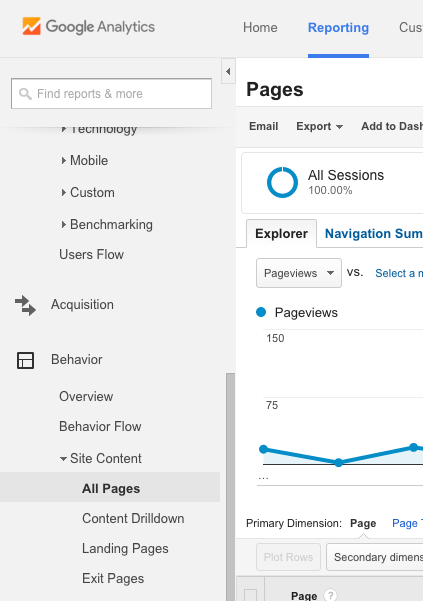
First, select your site’s profile and navigate to Behavior > Site Content > All Pages in the left sidebar. (Click these screenshots to see them at full size.)

Google Analytics All Pages

The All Pages view will display data on all of your pages.

Google Analytics All Pages Results

These pages will be sorted by the most viewed pages descending. The default time period for Google Analytics is 30 days, so expect to see your most recent blog posts and published pages at the top. Also, expect to see things like “/” (your index, or homepage,) or “/page/2″ (or any pagination pages) in the list. We don’t want to use these for our welcome email.

If I change the date range to the previous month, you will see that the list changes dramatically.

Google Analytics All Pages Monthly Results

Now, if I change the date range to be the entire length of the blog’s existence, I see even more popular posts rise up, along with a few I’ve seen before.

All Pages View - All Time

These views of traffic over time should give you a sense of what posts resonated the most with your audience, and over specific periods of time.

Now what should we do with this data?

Share those posts or pages

Setting up your automated welcome email using our new automation platform Campaigns is a breeze. We have a couple great posts and videos that explain what to include in your welcome email.

Here are some tips to consider:

  • Welcome and thank them for joining,
  • provide some details about the content they’ll receive in future emails,
  • include a description of who you are and what you do,
  • and provide your contact information.

These basics are great to establish the relationship that you are about to form with a new subscriber, but stopping here can lead to a dead-end. You haven’t given the subscriber a call-to-action, or a way to learn more about you.

Solve this by simply including a section that states: You might be interested in our most popular content. (Or some copy relevant to your audience.)

Pick three to five articles or pages from your curated Google Analytics lists that are still valuable and relevant to your target audience. It doesn’t matter how old the content is, as long as information is up-to-date and subscribers will benefit from it.

If you do not mind the manual maintenance, you could even title this section, “Check out last month’s most popular content,” and curate a new list each month.

Assume that subscribers are new to you and your brand, and give them more to help them get to know you, how you can serve them, and what to expect in the future.

Track email as a traffic source

Using UTM tracking codes on your links will allow you to capture and analyze email referral traffic within Google Analytics. Unless you are investing in paid digital advertising, you may not have experimented with using these. Here’s a quick overview on what UTM codes are, and how to start using them in your next email.

UTM codes, or parameters, are special tracking codes that are appended to normal links. Here’s an example of what one might look like for an AWeber campaign:

http://www.aweber.com/campaigns.htm?utm_source=welcomeemail&utm_medium=email&utm_content=bluebutton&utm_campaign=campaigns

(Before you get frazzled – I’ll break down everything in the link above, and Google has a great tool for generating these easily.)

Tracking parameters

Source

Where did the click come from?

This could be something like “newsletter”, “octoberbroadcast”, or whatever you want to identify as the source of the traffic.

In my example, I used “welcomeemail”.
utm_source=welcomeemail

Medium

What is the medium of the source?

In our case, it’s an email. If you choose to only use UTM parameters for email campaigns, then you can default to email every time for medium. This would change if you wanted to track a cost-per-click campaign, and you tagged a URL with “cpc” as the medium.

(Let’s stick with email :) )
utm_medium=email

Content

What distinguishes the content?

In this case, let’s imagine our email promoting our new platform Campaigns has two Call-To-Action buttons, or CTAs. The first button is blue, and we know it appears in the upper quarter of the email. The second button is red, and appears by the footer. If we want to test which button is more effective at achieving a set goal, we must differentiate the two links with the Content parameter. (This post doesn’t get into setting up Google Analytics goals. It’s a bit more advanced, but incredibly powerful. I recommend this post by KissMetrics to learn more.)

Let’s assume our link is being generated for the blue CTA button.
utm_content=bluebutton

Campaign

What is this overall email campaign?

Google Analytics will track all data associated with this campaign across different mediums. So, if we run Facebook, cpc, and email campaigns for Campaigns, we’ll want to designate the utm_campaign to be ‘campaigns.’ Wow, that was a mouthful. Here’s the example:
utm_campaign=campaigns

Stringing it all together

When we string it all together, the URL looks like the regular link with a question mark at the end of it, followed by each parameter, joined by ampersands (&). Like this:
http://www.aweber.com/campaigns.htm?utm_source=welcomeemail&utm_medium=email&utm_content=bluebutton&utm_campaign=campaigns

Again, Google has a great tool, which will cut down significantly the amount of time it takes to generate these, and help to ensure correctness.

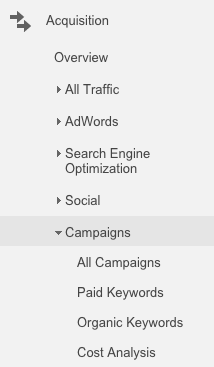
If you tag all of your awesome welcome email links with a campaign parameter of “welcome”, and distinguish the links with the “content” parameter, you’ll be able to track the data in Google Analytics under Acquisition > Campaigns > All Campaigns.

campaigns

Refine over time

Data is vital to measure past performance, but it’s important to remember that the real purpose of data (in my modest opinion) is to help us make more informed and profitable decisions for the future. Once you’ve developed a nice system to curating popular content, and tagging links to test their success, set up a regular reoccurring calendar request for yourself to peek in on performance and iterate as needed.

Your content, your business, and your audience will change over time, so it only makes sense that your email campaigns (even the automated ones,) will change over time as well.

This post only scratched the surface of what email marketers can do with Google Analytics. If this is an area of interest, let me know in the comments, and I’ll work to provide more relevant content that can help you #DoMoreWithEmail!

In the meantime, here are a few resources worth reading:

The Absolute Beginner’s Guide to Google Analytics – Moz
4 Google Analytics Goal Types That Are Critical To Your Business – KissMetrics
Email campaign tracking with Google Analytics – Smart Insights

Not an AWeber customer yet? Get started for free today!

The post How to Use Google Analytics to Create an AWesome Welcome Email appeared first on Email Marketing Tips.

05 Nov 16:31

What happened to Industry Canada? Trudeau elevates scientific research in new cabinet role

by Geoffrey Morgan

The Industry Ministry, once considered a key cabinet portfolio, is no more. Absent from Prime Minister Justin Trudeau’s cabinet appointments on Wednesday was any minister solely responsible for industry in Canada.

Instead, Trudeau wrapped together into one innovative-sounding package the ministries of science and technology and Industry Canada, with his appointment of Ontario MP Navdeep Bains as Minister of Innovation, Science and Economic Development — imagery clearly meant to conjure fewer mental pictures of steel mills and more of laboratories and fibre optics.

Observers say the combined portfolio is likely to result in more federal research and development spending for manufacturing and other industries.

On the surface, it also signals an elevated role for scientific research in Canada, University of Calgary assistant professor of political science Melanee Thomas said.

“I see this as a specific move away from the previous government’s treatment of science and evidence-based policy making,” Thomas said, adding that attaching science to the industry portfolio seems to give science a higher priority level within the new government.

Under former prime minister Stephen Harper, science and industry were separate ministries. James Moore served most recently as industry minister while Ed Holder was minister of state for science and technology.

Minister Bains, who did not respond to a request for comment, is widely expected to blend those portfolios together, rather than run each separately.

Spokespeople at Industry Canada could not confirm whether the government department would continue to exist in its current form. The Privy Council Office did not respond to a request for comment.

Most recently, Bains has been a visiting professor at Ryerson University’s Ted Rogers School of Management and previously worked as in accounting and finance at the Ford Motor Co. of Canada, which has a large assembling and manufacturing plant in Oakville, Ont.

“To the extent that governments can help, we need to help transform Canada’s manufacturing sector from low-end processing to higher-end value added activities,” University of Toronto Rotman School of Management professor of competitiveness Walid Hejazi said.

Hejazi criticized previous provincial and federal government efforts to save manufacturing jobs rather than create incentives or make funding available for the development of new manufacturing technologies.

“If we’re protecting low-value jobs, I think that’s a mistake when governments get involved to protect those kinds of jobs because they’re not sustainable or they’re not consistent with Canada’s comparative advantage,” Hejazi said.

He added that Canada’s comparative advantage in manufacturing is using technology to develop high-end goods, a category in which the country runs large trade deficits, and in higher-value processing.

In its annual report card on domestic innovation released this week, the Conference Board of Canada ranked Canada ninth out of 16 “peer countries” for innovation, which was an improvement from 13th place last year.

The think-tank gave top marks to Sweden, Denmark, Finland and the United States, which the Conference Board said have all developed national innovation strategies.

Thomas said she will be watching for the federal government’s financial update to see whether Trudeau increases science funding for the newly combined ministry. Funding levels will show whether the combination is symbolic or substantive, she said.

“The other thing I think (the combined ministry) signals is that Canada is going to continue leading the (Organization for Economic Co-operation and Development) for public support for research and development,” Thomas said, adding that public spending on R&D is not necessarily a good thing.

“In other countries, at least in the OECD, private business funds much more of its research and development than what we do in Canada. In Canada, a lot of this (research) gets shuffled through to universities through tri-council funding,” Thomas said.

gmorgan@nationalpost.com

Twitter.com/geoffreymorgan

05 Nov 16:29

These are 8 things Google looks for in a manager

by Stéphanie Thomson

Larry Page

In 2001, less than five years after it was founded, Google had already opened its first international office, offered search in 15 different languages and built a team of 400 employees. Larry Page, one of its founders and now CEO, was determined to continue growing while keeping the company nimble and bureaucracy-free. So he did something bold: he decided to fire all engineering managers.

The experiment didn’t go down well and in the end failed. After only a few months, the engineering manager role was restored. It turns out that far from creating an unnecessary layer of bureaucracy, a good manager is actually key to a happy and productive team. Google’s latest research, which they published last week on their new platform, re:Work, confirms this: “Teams with great managers were happier and more productive,” they concluded.

But what exactly makes a manager “great”? They’ve also done some research into that, through their Project Oxygen. Using data from staff surveys and performance reviews, along with double-blind qualitative interviews, they found eight common characteristics shared by all great managers.

Google managers re:work

Google hasn’t just released its findings on what makes a good manager: it has also published guides and tools to help people develop those skills. For example, those interested in learning more can find out how to create and communicate a clear team vision, support and develop their teams both professionally and personally, and motivate people.

All the tools and guides are based on the training Google’s managers receive – and seem to value highly. Speaking to the Harvard Business Review in 2013, Eric Clayberg, a Google software engineer manager, praised the training, saying it helped him see the bigger picture: “I now spend a third to half of my time looking for ways to help my team members grow.”

Join the conversation about this story »

NOW WATCH: There's a hidden wire stretched above American cities — and few people know what it's for

05 Nov 16:28

More small businesses hurt than helped by low loonie: CIBC survey

by CB Staff

TORONTO – Exporters may be happy about the low loonie, but the average small business, well, not so much, according to a new survey released by CIBC.

In fact, the bank (TSX:CM) says far more small businesses report being hurt than helped by the lower currency.

It says 37 per cent of small business owners who responded to the survey reported that the decline in the value of the loonie versus the U.S. greenback had hurt their business.

That compares with just 19 per cent who reported seeing a benefit from the lower dollar and 44 per cent who said it had little or no impact.

The dollar has slipped from a high of US$1.04 in September 2012 to about 75 cents at present.

The online survey was conduct Sept. 23 to Sept. 25 among 751 randomly selected Angus Reid Forum panellists who are small business owners.

The polling industry’s professional body, the Marketing Research and Intelligence Association, says online surveys cannot be assigned a margin of error because they do not randomly sample the population.

The post More small businesses hurt than helped by low loonie: CIBC survey appeared first on Canadian Business - Your Source For Business News.

05 Nov 16:28

Was This Helpful?

by Keenan

“Was this helpful?”

“Was this helpful?”

I always end every client call, customer meeting AND sales call with that question. People aren’t used to being asked that. There is always a pause of bewilderment before their response.

I ask this question because it occurred to me that just because the meeting happened and we have next steps and I thought it was a good meeting doesn’t mean everyone else did.

I believe that when people commit their valuable time to a meeting, I have a responsibility to making sure they get value for that time and the best way to find out is to simply ask; “Was this meeting helpful?”

Whenever I ask this question, and after the brief  pause of bewilderment, I almost always encounter an honest reflection.  I can see their eyes dart to the upper right as they evaluate their experience and whether or not it was helpful or valuable. (If it’s on the phone, I can always hear them pause as they think about the meeting and what they got out of it.)

Asking if the meeting was helpful is a fantastic gauge. I’ve never had someone come right out and say “no.” But, you can always tell if you didn’t deliver by their reaction. When you killed it, they use words like absolutely, definitely, this was great, it was very helpful, I learned a lot, it was definitely worth our time, etc. When I miss the mark they say things like; yes it was or just yes. Typically, these yes’s come with a depressed, mono tone. The verbal and visual cues are present. When that happens, I simply take control and say; “It feels like we left some things unresolved or you could have gotten more out of this. Tell me, what can we do to make sure you get more value from this meeting?”

The door is now open, and I have the opportunity to insert more value into the engagement. I can provide more information, answer more questions, provide alternative solutions, be clearer, etc. By asking, “Was this helpful?” I minimize the chance of someone leaving an engagement with getting value.

At the end of your next meeting or client call, end it with, “Was this meeting/call helpful?” Then, just listen.

You’ll learn everything you need to know.

05 Nov 16:28

Hiring Pitfalls: How Recruiters Break Trust With Candidates

by Jamie Nichol

Earlier this week, the CultureIQ recruiting committee met to refine our hiring process. We all came to the meeting armed with our personal job searching horror stories. Our goal: Don’t let that happen here (and also to recruit high-potential talent that aligns with our values and required job function… but we’ll cover that in a future post).

From a candidate’s perspective, navigating the recruiting process can be nerve-wracking, even in the best situations. It’s often challenging to put yourself in the candidate’s shoes, and even harder for the candidates to put themselves in your shoes. This leads to wires crossing, communication mix-ups, and misguided assumptions on both sides. And not to mention, a whole boat load of anxiety.

In the interest of avoiding hiring pitfalls, I’ll share a few things that have come up in various discussions around here. Admittedly, we aren’t perfect yet, and we’re still figuring out our rhythm and style. But the important thing is that we are proactively working on it and dedicated to improving this process.

Beware Of Tedious Hiring Processes

Looking for new role already feels like a full-time job (and sometimes it is), so unnecessary steps or a poorly planned process can take a toll on the candidate. It also can send the message that you don’t respect the candidate’s time. A study by Staffing.org reported that 47 percent of candidates chose not to apply for a particular company because of its frustrating and tedious hiring process.

That isn’t to say that candidates should not have to provide substantial information and take the hiring process seriously. However, there is value in separating the crucial details from the fluff that won’t help you make a better decision. If your company’s initial application looks like a manual more than a questionnaire, it may be beneficial to cut it down. Similarly, vague and poorly worded questions and unguided conversations only create more confusion and take up both of your time.

Fill The Information Gap

Another common complaint from candidates is a general lack of information in job descriptions. Candidates weigh their interest in a company by a wide variety of factors, such as job tasks, benefits, salary information, work schedule, and company culture. If only some of these factors are addressed, you not only let false expectations creep in, but you may also cause quality candidates to turn away because they are simply unsure.

Don’t Leave Them Hanging

A Careerbuilder study revealed that 52 percent of employers stated that they tend to respond to less than half of their applicants. This general lack of communication leaves a bad taste for candidates, who also reported being less likely to buy from companies with whom they had a poor hiring experience. Inevitably, things come up in a company thatimpact the decision-making timeline, and that is okay. The important thing is to keep candidates in the loop, whether it’s letting them know that you haven’t forgotten about them, or sending an updated timeline if possible. To make this easier for recruiters, provide a general email template for each stage of the process. Always customize the email when possible (sometimes you just don’t have enough information) to show that you’re recruiting people, not resumes. Not only does this prevent confusion, but it also sets a precedent of a culture of trust and respect.

In fact, if I were to sum up all of these points into one word, it would be respect. The recruiting process is full of managing delicate dynamics, busy schedules, and important legal considerations, but try to not let that swallow the human element. If you treat the candidate with respect every step of the way, it will translate into an authentic, positive candidate experience.

05 Nov 16:27

The Anatomy Of Effective Sales Feedback

by Jeremy Boudinet

Effective sales feedback is all about providing timely, actionable insight into performance. Today, we run through the key characteristics of quality sales feedback with surgical precision.

Yesterday, we looked into the 7 deadly sins of sales feedback. Today, we’re diving deep into the subject — taking a look at some of the concepts every manager should keep top of mind when providing sales feedback.

For what it’s worth, I’m terrible at receiving feedback. Back in school, I couldn’t even read through my English papers when my teacher gave them back to me. If there was a 94 at the top of it, I didn’t want to see what got my 6 points docked.

I’m a huge wimp when it comes to receiving feedback — but even I will respond favorably to feedback when it’s presented in the manner explained below. Here’s the anatomy of effective sales feedback.

Anatomy Of Effective Sales Feedback

A great starting point is John Kaplan’s post for Force Management, “5 Ways to Give Better Feedback to Your Sales Teams.”

Kaplan provides some great insight and offers 5 short, sweet pieces of advice for sales feedback that will make your conversations that much more impactful.

1) Disarm The Recipient

Kaplan’s analysis opens with two critical points:

  1. Stay Positive.
  2. Let the Receiver Go First.

The rationale for these two approaches is simple. Most people enter conversations that involve feedback guarded and on the defensive. They may shut themselves off from truly hearing what you have to say.

By taking these two initial steps in your sales feedback, you disarm the recipient and let them know you intend to have a dialogue, rather than a monologue. You also demonstrate that the feedback is meant to be helpful and provide a 360° analysis of their performance.

2) Provide SMART Analysis

Kaplan lays out an excellent acronym to adhere to with your sales feedback.

The following five characteristics of sales feedback present an all-encompassing overview of the type of feedback you should give your sales reps:

  • Specific
  • Measurable
  • Achievable
  • Realistic
  • Timely

Kaplan’s post is a must-read on this topic, so prior to having a one-on-one with a rep, check yourself to make sure the feedback you plan to provide is specific, measurable, achievable, realistic, and timely.

3) Make It Part Of A Sales Contest

A great way to ensure that sales feedback gets followed is to run a sales contest.

We love Mark Roberge’s Hubspot post, “6 Tips to Run an Incredibly Effective Sales Contest.”

In this post, Mark also points out how effective sales contests — especially team sales contests — can be at reinforcing desired behaviors on your sales floor.

We’ve provided our own list of epic sales contest ideas we think you should follow, so check those out as well.

4) Focus On Coaching

As we alluded to in yesterday’s post, all sales feedback should incorporate coaching.

Jeff Hoffman’s post for Hubspot, “4 Differences Between Sales Coaching and Feedback,” comes down a little harshly on the concept of “sales feedback” in general. But, he does make some valid points about the need to make the focus of feedback coaching.

In this post, Hoffman fleshes out key distinctions between what constitutes effective sales coaching and mere feedback.

Getting The Most Out Of Sales Feedback

Effective sales feedback will get the maximum value out of your sales team.

You need your one-on-one meetings with sales reps to be as effective as possible, and leave resonant, immediate and sustainable impacts on their mentality towards selling.

Follow the approaches listed above and don’t forget to check out our 7 deadly sins of sales feedback post. We’ll see you next time on the Ambition Blog.

05 Nov 16:25

4 Ways to Optimize Email for Your Buyers

by Anna Muehlenhaupt

4 ways emailThe resurgence of email marketing means more opportunity for email marketers – so how can you optimize your email marketing campaigns to take advantage of this?

The good news is the audience is already there: 91% of the US population has at least one email address they check daily, and 71% of email users use their primary email address to sign up for marketing and advertising emails. This means that more than two thirds of outgoing emails are landing in actively maintained inboxes.

This surge in constant email use delivers the benefit of a large audience – but also offers challenges to marketers. One of the most important: Buyers have higher expectations of the emails they receive: More than 70% of consumers expect that brands will deliver marketing information specific to their purchase history and tailored to their current interests.

The beauty of email marketing is that you can customize the messages to fulfill those expectations. Here are four simple steps that can endear your buyer and put you ahead of your competition:

1. Customize the Subject Line

The subject line of your email is the single most important 50 characters of the entire email – it is your first point of contact with the buyer, and it can singlehandedly win or lose a lead. Creating a good subject line depends on three key elements:

Keep it short and sweet: Choose succinct words that pack a punch – you have the rest of the email to inform your buyers of your intention, but only a few words to grab their attention. Active, descriptive words will catch their eye and hold it long enough to get the email open.
Appeal to their needs: Consider these two subject lines:

Studies show simple and effective methods to personalizing email marketing help businesses increase their numbers”

vs.

Get 20% better email results: Act-On shows you how

  • The first is 99 characters long; the other is only 42 (That’s less than half as long, 58% shorter).
  • The first is impersonal, third-person; the other reaches out to you as the recipient.
  • The first one is abstract; the second makes a specific promise to a specific person: you.

Personalize your subjects: Take the second subject line above and add the recipient’s company name: “Jackson Lumber Brokers: Get 20% better email results.” Suddenly, the email sounds like it’s from someone who knows the company and has insight into what they want. Buyers enjoy feeling as if they’re in on something exclusive, and adding first names or company names can do just that by using some simple coding and a well-maintained list.

Another important element to consider is the preheader – in most email clients, the pre-header shows up with the subject line, and gives you the opportunity to embed a call-to-action before the buyer even opens the email. Don’t waste this valuable space.

2. Make Content Relevant and Segment Your Lists

Make your content relevant to the recipient. Remember: 75% of consumers expect content to be related to something they bought or did; relevance to the buyer can make your emails stand out and be noticed.

List segmentation is an easy way to send relevant emails to prospective buyers. It can be simple or very complex, but it’s a good idea to stick to the basics:

  • Gender, age, title, industry, and geographical location can indicate specifically what information they might be interested in – for example, Bostonians won’t be too thrilled to get an email about swimwear in November! But Australians could appreciate it.
  • Tracking buyers’ past behaviors and demonstrated interests. If they tend to buy commodities at certain times, you could forecast when that next buy will be and perhaps upsell them. If they bought computers, maybe now’s the time to pitch an upgrade or a complementary product. If they always visit a specific product page on your website, send them a targeted special offer.

3. Use the Right Frequency

Walking the line between effectively reaching buyers and bombarding them is a constant challenge. Too few emails can fail to properly market your brand; too many emails can scare subscribers, create email fatigue, and ultimately disengage buyers.

Personalizing frequency by the type and immediacy of the information presented keeps buyers engaged and responsive. Bulldog Reporter outlines three frequency types for optimal email scheduling:

  • Daily newspaper
    • Ideal for 24-hr/flash sales
    • Send the night before or day of to encourage a sense of immediacy
    • Beware the balance of frequency! If everything is important, nothing is
  • Weekly or monthly catalogue
    • Ideal for weekly/monthly promotions
    • Used in place of daily emails to relieve email fatigue
    • Subscribers expect weekly emails, and are more likely to engage
  • Monthly newsletter
    • Distribute useful information – without the intent to sell
    • Content-driven to extend your brand’s voice/persona
    • Use to show your expertise within the industry and build trust

4. Optimize Email for Mobile

mobile emailSounds like a no-brainer, right? However, 42% of email marketers rarely or never optimize email campaigns for mobile, leaving the 88% of buyers checking emails on their cellphones out of the loop. In fact, 71% of the buyers using a mobile device will simply delete emails that aren’t optimized for mobile, leaving less than 30% of the original mobile audience engaged.

Optimizing emails for mobile is trickier than it sounds – simply shrinking the content to fit smaller screens can leave content illegible and badly organized. Creating narrow design to fit a mobile device will look sloppy on desktops, diminishing the desktop users’ experience and engagement.

A responsive layout, however, adjusts based on the user’s screen size, meaning the email is just as accessible and well designed on mobile as it is on a desktop. With a responsive layout, you can design so that the mobile viewer gets mobile-only content (e.g. custom call-to-action, link to open an app) and doesn’t see desktop-specific information (e.g. link to open email in your browser).

Future-Proof Your Email

Email marketing will continue to evolve. Amazingly Effective Email GuideBut these steps should be good for a long time, helping you create more effective email marketing campaigns to reach your buyers in a way that’s meaningful for them – and to engage more subscribers for longer, more loyal relationships.

And if you are ready to move past the basics of email marketing, Act-On has a great guide to help get you started. The Amazingly Effective Email Guide will give you five easy steps for more successful and more profitable email campaigns.

05 Nov 16:25

The Strange Reason Sales Reps Should Call Buyers in the Morning

by mrenahan@hubspot.com (Mike Renahan)

Reps who can create relationships and develop trust are thriving in today’s sales environment. They know their customers and prospects extremely well, and have discussions that go beyond work and the service they provide.
But sales reps sometimes encounter folks who aren’t as honest about their business as they need to be. And when a prospect isn’t totally honest, it makes it difficult for the salesperson to create a solution that truly caters to their needs.

Obviously, you can’t accuse your buyer of lying. So what should you do?

If you suspect your prospect isn’t giving you all the information you need to be successful, there’s a science-backed way to try and get the real scoop from this person -- and it starts with being an early riser.

Studies have shown that people are actually more honest in the mornings. In fact, according to one study, between 8 a.m. and 12 p.m. is when people are at their most honest.

As the hours pass, our tendency towards deception becomes more powerful. Why? As our day goes on, we become tired, and our ability to make clear decisions gets worse as our willpower weakens. Instead of saying no to that fourth cup of coffee, for example, we have it because we just don’t have the power to resist.

Now, let’s take this concept and apply it to sales. If your prospect has had a long day, their willpower is lower than it normally is, and the idea of answering qualification questions (and providing 100% accurate answers) is too much to handle.

Want to get the whole truth and nothing but the truth from your buyers? Consider implementing the following two steps.

1) Schedule your next call or meeting early in the morning.

The first thing to do is to get prospects on the phone early in the morning. A prospect’s willpower is likely at their best during the early morning hours and the odds of a completely honest conversation are the highest they will be all day.

How early can you call? Most American workers arrive at their office at 7:55 a.m., according to FiveThirtyEight.com.

Use this statistic to your advantage, and strive to set up meetings or conduct calls when your prospect first gets into their office. An easy way to do this is to send a list of times that work for you -- all between 8 a.m. and 12 p.m.

2) Prepare the right questions.

Sales reps need accurate information in order to solve their prospects' problems. Some of this information might be personal or embarrassing to admit, so sharing it is difficult for certain prospects. But if you’re able to get your buyer on the phone early in the morning, it might just be easier for them to cop to their mistakes or shortcomings and provide totally honest answers.

Here are some questions sales reps would be wise to ask their prospects:

  • Why are you considering fixing this problem now?
  • Why my service?
  • What are your goals for this project five years from now?
  • Our service is X dollars per month; can you afford that?
  • What challenges do you come across every day?
  • How does this problem affect you personally?

Questions like these allow you to dive deeper into the business and better understand how to help the buyer.

The ability to create strong relationships, even with reticent or difficult prospects, is the number one talent of a great salesperson. If you’re struggling with getting the right information from a prospect, schedule an early call. You might just find that the rising sun can act as a powerful truth serum. 

Get HubSpot CRM today!

05 Nov 16:24

Is Your Email Marketing Strategy Set Up For Success?

by Lauren Brubaker

Email Best Practices

As marketers, we understand the worth of a stellar email marketing campaign. In fact, the Content Marketing Institute revealed that 83% of B2B marketers use e-newsletters as a primary content marketing vehicle. What’s more, a study from Ascend2 revealed that 48% of B2B marketers agreed that email marketing is their most effective tactic—even above websites and landing pages.

But not all email campaigns are created equal. We must put on our strategic thinking caps when implementing our email marketing strategies so that we can maximize the value of our messaging to make the greatest impact on our buyers.

The best way to optimize your brand’s messaging is to ensure that your database isn’t undermining the deliverability of your messages. You must evaluate the health of your marketing contacts to ensure that the names, addresses, job titles and company names aren’t expired or duplicated. Your marketing database atrophies at 3% per month, so if you aren’t monitoring your data on a regular basis, many of your emails are guaranteed to bounce. This is a stat marketers can no longer afford to avoid.

You can ensure your data remains in tip-top shape month after month by deploying marketing data management software. This software will automatically cleanse, de-duplicate and even enhance your database by completing information that’s missing from some of your contacts—like an accurate email address, for instance.

Once you’ve completed the necessary preliminary work, you can focus on implementing tactics that will help you create messages that better align with the specific phases of your buyers’ journeys. Here are a few techniques and tools email marketing whiz kids find to be the most effective:

  • Split A/B testing: Increasing your open and response rates can be as simple as changing one small variable. Split A/B testing is a tactic marketers can use to find out if changing an element in their emails might improve resonance with buyers. So, next time you send an important email, try sending half of your contacts a standard subject line, and the other half a cheekier one…or even use a compelling stat. That is the basics of A/B testing – once you’re comfortable conducting proper experiments, you can do really cool tests to find out the exact length your message where people stop reading, or how different types of photography can impact clickthru rates. This will also enable you to create an email content strategy based on real numbers.
  • List segmentation: When you’re confident that your marketing database is a dependable source from which you can glean buyer insights, you can optimize your email marketing messages to align with your different buyers’ pain points, interests, budgets, and careers. You can segment your audience into different categories so that you can create more personalized messages, which will result in more targeted and relevant email campaigns and higher response rates. This also is pretty basic, but you’d be surprised how many marketers we work with that aren’t doing this as strategically as possible…or even at all.
  • Email automation: Automating your emails can help with the frequency and consistency of your campaigns. For instance, when you must craft a string of messages that target individuals various phases of the buying cycle, you can use automation to pre-schedule emails to be sent on specific dates to help maintain consistency. What’s more, you can also assign different paths for a prospect to take, based on their behavior. For instance, if your potential customer clicks the “register for our webinar” button, the next email to be automatically sent will be a “thank you for signing up” message, including event reminders. When you’re ready for more advanced steps, you can do things like mapping people’s email activity to their stage of the buying cycle, and then use that information to show specific display advertisements for retargeting purposes.

We are officially here. The day when it is no longer okay to send batch, untargeted, one-time messages to a list pulled from a dirty database. Take the time to map out your data management strategy, invest in a marketing automation platform, and train your team to create engaging messages and data-driven campaigns will truly drive opportunity creation (and revenue) for your company.

05 Nov 16:24

7 Sales Phrases That Will Supercharge Your Credibility with Buyers, According to HubSpot's Sales Director

by dtyre@hubspot.com (Dan Tyre)

So, like, I’ve been a salesperson for years and, well, I’ve learned kind of a few things. And today, I want to, um, share some of what I’ve learned with you — if that’s okay?

If you’re a salesperson and you speak like this, here’s a reality check: It is going to be very, very hard to convince prospects to buy. No matter how much you know, if you don’t speak like an authority figure, you’ll never be treated like one. And prospects don’t buy from salespeople they don’t trust.

It’s not easy to build authority, especially if your prospects can’t see you. When Leonardo DiCaprio wanted viewers to believe he was the Wolf of Wall Street, he had his whole body to prove the point. But when an inside sales professional wants to establish their authority over the phone, they need to use their voice tone and pacing to get the point across.

Download Now: Free Sales Closing Guide

What Not to Say

Unless you remove the following problematic soundbites from your vocabulary, you won’t be able to fully achieve the authority you need.

1. Filler words

The opening sentences of this post are full of unnecessary filler words: “um,” “like,” “well,” “maybe,” “I think.” Sales reps who use these words sound like hesitant amateurs, so be very careful to avoid them.

2. Overly enthusiastic language

Part of a salesperson’s job is to stay positive. You can’t get upset or annoyed at yourself if you want to stay productive, and you certainly can’t become frustrated with your prospects. But you can overdo it — acting overly excited or eager makes you seem juvenile.

Words and phrases such as “awesome,” “cool,” and “oh my god!” should be deployed sparingly. Overuse will make you sound like you’re back in high school, and decrease the likelihood of prospects taking you seriously.

3. Profanity

You never know who you might offend. In some fields, swearing is accepted (from personal experience, I know the copier industry and Wall Street use colorful language), but in most cases, it’s not. If you sense that your prospect is a bit more foul-mouthed than average and you can get away with it, go right ahead.

4. Jargon

Speaking like an authority figure doesn’t mean talking like a pretentious robot. Talk like a businessperson, but don’t assume deep knowledge or expertise in your buyers' industry.

7 Phrases That Make You Sound Like an Authority Figure

When you’re qualifying prospects, you’ll need to ask some variation of the eight questions below to get the information you need. But there’s a good way and a bad way to find out who a decision-maker is. Phrase your qualification questions like so to establish yourself as a credible authority.

1. “Tell me about your business pain.”

This is a question that gets to the heart of need. You don’t want your prospect to tell you every little problem they have — you need to hear about the challenge that’s keeping their CEO up at night. Ask a prospect what problems they’re having and they won’t know what to say first. Ask them about pain and you’ve focused them on the one thing that’s their biggest obstacle.

2. “What is your biggest inhibitor to growth?”

The phrase “inhibitor to growth” makes you sound like a college professor. It’s also the natural follow-up to the previous phrase. You’ll gain even more authority if your prospect’s not sure and you’re able to work with them to identify blockers.

3. “What type of return on investment are you looking for?”

With this question, you’re tossing the ball to your prospect and giving them an opportunity to show off what they know. It’s also an easy way to ingratiate yourself with results-minded individuals. Instead of asking a vague question about goals, find out exactly what they expect to get back from the money they’d put toward buying your product.

4. “What do you know about [name of solution]?”

Ask this question if your product is fairly differentiated and affiliated with a certain business philosophy. For example, a HubSpot sales rep would ask prospects if they were familiar with inbound marketing or inbound sales.

Like #2 and #3, this question plays double duty — it’s a gracious statement that allows your prospect to share their knowledge, but it also shows you exactly how much your prospect knows and reveals how much you’ll need to educate them.

5. “Do we need an executive sponsor?”

In B2B sales, an executive sponsor is a high-level employee on the seller’s side who can provide guidance, expertise, or education to buyers. I’ve offered an executive sponsor to prospects hundreds of times — but I have only been called on to deliver one once or twice. Letting prospects know early on that this is an option available to them makes them feel taken care of.

6. “Let’s talk about the implementation process.”

This statement lends itself to walking through a methodology. It demonstrates to prospects that you have an orderly onboarding process in place and that you’re not about to haphazardly slap something together.

7. “Who besides yourself on the senior management/executive team is interested in this?”

Asking a prospect flat-out if they’re a decision-maker is rude and condescending. Your prospect may not be anywhere near the senior management team. However, this phrasing flatters the prospect while simultaneously uncovering exactly whose sign-off you’ll need to get.

As a salesperson, the only two things you can control in your job are how you spend your time and how you communicate with prospects. Be highly deliberate about the words you say so you’re able to command any prospect conversation.

New call-to-action

05 Nov 16:24

Expanding the New Frontier of Account Based Marketing

by Craig Rosenberg

 Editor’s note: This post is an excerpt from The #FlipMyFunnel eBook from Terminus.

chap-2-22.jpg

As marketers, one question we always ask ourselves is “How do we expand our reach?” For years we’ve struggled to cast a wide net to as many people as possible to pour leads into the top of the funnel. Now – it’s time to flip that funnel on its head.

FlippedFunnel-v2.png

Once sales has worked to identify target accounts (perhaps supplemented by one of the marketing technologies mentioned in the previous chapter), it’s marketing’s job to take that list of accounts and engage with them. This is where account-based marketing comes into play.

The second stage of the flipped funnel is “expansion,” which is what I want to focus on in this blog post. The Expand stage involves maximizing your reach within the list of target companies and influencers identified during the previous stage.

 In the B2B game, we often hear an analogy about how marketing is like going fishing. Knowing where trout are in a stream is a great first step toward identifying and catching the exact type of fish that you want, but how much easier would your job be with a fish finder? Not only can you see where the fish are located — you can also get more insight into the size of the fish so that you know you’re on the right track.

chap-2-23.jpg

This is the main point of this blog post I want to address, as this is likely the toughest stage for marketers who are used to traditional lead-based marketing, where the expansion process begins by choosing a set of channels instead.

Think about account-based marketing as your fish finder, except instead of using sonar-based technology, you’re using cookie- and IP-based targeting to track your target customers on the channels that they’re actively using. This allows you to target your marketing messages to your best-fit customers on the channels where your ads are most likely to be seen, whether that’s social media, display advertising, video, or mobile.

With this kind of IP-based tracking in place, you can do more than target individual leads — you can open the door to entire accounts. This is particularly important for modern B2B marketers given these two facts:

1) The length of the sales cycle is growing longer

2) Purchasing decisions now involve more stakeholders than ever

In a survey of B2B marketers conducted by Carat Enterprise and Google, 76% of respondents indicated that it takes up to 6 months to research and make a purchase. This study also revealed that 33% of B2B decision-making units contain up to 10 people, and more 50% contain up to five. To top it off, according to the Buyersphere Report 2015, CEOs are involved in 38% of B2B buying decisions. That’s a lot of contacts in an account to try and build a relationship with.

The good news is, with account-based advertising, your company’s marketing messages can be placed in front of all of the decision makers within an account. That way, when a pitch for your product is escalated to upper management, that brand awareness is already present.

chap-2-24.jpg

Expansion in action

Here’s an analogy: let’s say that a healthcare company is actively targeting enterprise employers in the San Francisco area. With a list of employers in hand, our healthcare company can not only target specific leads that they may have already engaged with, they can automatically present personalized ads to other decision makers in those accounts on the same channels that they’re already using. This increases their reach within those accounts, and makes it more likely that leads will already have been exposed to marketing messaging by the time that sales is actively reaching out.

As Craig Rosenberg, the mastermind behind this fine blog said:

“One of the key differences between ABM and outbound sales is that marketing is signed up to deliver ‘always-on’ campaigns to multiple stakeholders in the account.”

chap-2-25.jpg

The key here is to present marketing messages on the buyer’s schedule, not on yours. In fact, this is a huge differentiator between account-based marketing and outbound sales.

Your “Expansion Pack”

Let’s take a look at a few of the account-based technologies that might feature prominently in your marketing stack for the expansion stage of #FlipMyFunnel.
terminus-logo-600.png


Hey, that’s my company! Terminus specializes in the account-based marketing space and helps marketers target influencers within the accounts they would like to reach. With Terminus, you can simplify your account-based efforts by marketing and optimizing on the fly across all stages of the buyer’s journey.

images.png

Demandbase is an account-based marketing and web personalization tool that makes it possible for businesses to deliver personalized ads across the web.

images.jpg

LeanData, Inc. is taking a completely new approach to account-based selling by making it possible to pull everything under accounts within Salesforce CRM. Their account-based lead management suite also includes account-based reporting for a complete look at your marketing efforts.

Want to learn more about expanding the new frontier of account-based marketing? Download the #FlipMyFunnel ebook now!

MarketingeBookCTA.png

Today’s author: Sangram Vajre is the co-founder and CMO of Terminus, a B2B account-based marketing company. Before Terminus, Sangram headed up Marketing at Pardot, which was acquired by Salesforce in 2013.

Sangram Vajre.jpegSangram is a passionate Marketing geek at heart and loves to solve problems, both analytically and creatively. In today’s marketing world, when companies need to rapidly adapt to changing buyer-centric communication, Sangram finds comfort in all things technology to keep pace with this challenge.

Over the years, Sangram has amassed invaluable experience from his exposure to startups, consulting, and global companies. You can follow him on Twitter at @sangramvajre.

05 Nov 16:24

Common Sales Terms Demystified

by Alexandra Levit

What does a funnel have to do with revenue? If you’ve ever wondered what your process teams were going on about, you’ve come to the right place.

You know the feeling. You’re meeting with someone from sales or marketing and you’re listening attentively as they passionately describe their project. You want to understand what they’re talking about, but you don’t have an MBA and some of the vocabulary is just lost on you. However, you don’t want to sound clueless, so you don’t ask. We hope this post with common sales terms definitions offers some relief and can serve as a handy reference in the future!

AIDA

An acronym that stands for Attention/Awareness, Interest, Desire, and Action. These are the individual steps of the sales funnel (see below), in which your pool of potential customers moves from large to small as prospects get closer to a sale.

BANT

An acronym used for qualifying leads, which stands for Budget, Authority, Need, and Timeline. Salespeople use this to assess whether a prospect has the money and the decision-making power to result in a sale, and also whether your product or service solves a critical customer problem in the right timeframe. In other words, BANT helps salespeople determine if all the stars are aligned for a deal to take place.

Buyer Persona

Based on research and outlining what, where, when, why, and how a customer buys. Buyer personas are often provided to salespeople to educate them about the ideal prospect and about the most effective way to approach that prospect.

Churn Rate

A metric based on the value of the customers you retain. To calculate churn rate, you take the number of customers you lost in a given time period and divide it by the total number of customers you had at the very beginning of the period. For example, if you had 100 customers at the start of the year and only 80 customers at the end of January(discounting brand new customers), your churn rate would be: (100-80)/100 = 20/100 = 20%.

Closing Ratio

The percentage of prospects that a salesperson closes successfully. This ratio is used for all sorts of things, including individual salesperson performance, evaluation of profits, and sales forecasting. The better qualified a salesperson’s leads are, the less likely they are to be turned down (and the higher their closing ratio generally is).

Qualified Lead

A prospect that learned about your product or service, was interested, and contacted your organization to receive additional information. This kind of lead is most likely to result in a sale because half of the work is already done!

Sales Funnel

The process of converting prospects into sales. All prospects are fed into the top of the funnel and converted sales drop out at the bottom. As a sales opportunity moves down the funnel, time to closing decreases and the probability of the sale occurring increases. The sales funnel metaphor allows you to visualize where all of your prospects are in the buying process at a particular point in time.

UPB

An acronym that stands for Unique Perceived Benefit, this is a customization of your product or service based on detailed research of your prospect’s organizational needs. A prospect is more likely to buy from a salesperson with a strong UPB because it is clear how the product or service solves an immediate, pressing problem.

10 Productivity Tips for Work

05 Nov 16:23

Bulletproof Your Frontline Sales Strategies, A Sales Tips Video

by Leah Bell

No one knows frontline sales strategies like Sales Development Reps. They know the ins and outs of prospecting and cold-calling (or as we like to call it, “warm-calling,” if you’re doing your prospecting homework) because they do it every single day. SalesLoft Sales Development Team Leads Mitch Touart and Tyler Bliss are leading the charge with their tips to bulletproof your calling and prospecting tactics.


Mitch and our SDR team recently revamped their call scripts to create more valuable conversations on initial call touchpoints. These scripts were designed to make SDRs more succinct and efficient on the phone, allowing them to spend more time uncovering pain points and setting demos. The more efficient a rep can be on the phone, the more valuable the call will be to both the rep and the prospect.

But in addition to familiarizing themselves with value-adding call scripts, reps should be familiar with the profiles of the prospects they’re calling. Tyler uses SalesLoft’s platform to pull up company and individual LinkedIn pages to get as much information as possible about the prospect BEFORE calling, so that when the time comes to run through the call script, he’s prepared for the call and the conversation is smooth.

Preparedness is the number one way to walk into a “cold call” with confidence and conviction. By running a cadence of prepared call scripts on researched prospects, you’ll turn your cold calls warm and bullet proof your frontline selling strategies.


What do you do as sales development reps when preparing for a call? Leave a comment below and let us know if you try one of these guys’ sales tips!

SalesLoftPlatform

The post Bulletproof Your Frontline Sales Strategies, A Sales Tips Video appeared first on SalesLoft.

05 Nov 16:23

How to Get Featured on LinkedIn Pulse

by John Nemo

Ever since LinkedIn began allowing members to publish original content on the world’s largest social media network for professionals, I’ve been searching for the secret to getting your posts exposed the largest possible audience.

I think I might have found the answer living in South Africa.

His name is Gericke Potgieter, and I think he may have cracked the code when it comes to getting featured on LinkedIn’s powerful Pulse news network.

222

Why Publishing on LinkedIn Matters So Much

In case you didn’t know it, LinkedIn is now, in its own words, “the definitive professional publishing platform” worldwide.

It makes sense if you think about it. With nearly 400 million professionals in more than 200 countries gathering in one place online, this was bound to happen. Long-known as a place to find and hire top talent, LinkedIn has expanded over the past decade to also incorporate online training programs, lead generation and sales opportunities and much more. So publishing long-form, informative content specific to a certain industry, business type or professional audience makes total sense for the platform.

LinkedIn has done a smart job of balancing professional news partners like The New York Times and The Wall Street Journal with “influencers” like Richard Branson and Bill Gates to provide original content, along with opening up the entire blogging platform to all 400 million members.

333

LinkedIn Pulse and the South African Mystery Man

Each of us now has the ability to publish our own blog posts on LinkedIn as often as we want, and LinkedIn then filters, sorts and collates our posts into specific “Channels” on its Pulse network.

The real magic happens when your post is featured in one of the Pulse channels, because that opens up your content to get read, liked, shared and engaged with by hundreds of thousands – if not millions – of potential buyers or customers.

That leads me back to the beginning of this post and this mystery man in South Africa – Gericke Potgieter.

A self-confessed data and spreadsheet fanatic, Potgieter begin toying with LinkedIn’s publishing tool several months ago. He became determined to figure out how LinkedIn sorted through millions of member posts to figure out which ones to feature on its Pulse channels.

Potgieter and his team spent a month analyzing more than 500 top-performing LinkedIn posts across nearly 50 different Pulse channels.

The result was his book, “How to Feature on LinkedIn Pulse,” and you can get it on Amazon.com.

It’s a great read for many reasons – first and foremost, the findings and tips on how to get featured on LinkedIn Pulse are outstanding. A secondary and pleasant surprise to me was all the practical, solid marketing advice Potgieter packed into the book as well.

Intrigued, I tracked him down and interviewed him for an upcoming episode of my LinkedIn Riches Podcast:

555

And while I can’t transcribe that entire conversation in this space, I do want to spend the rest of this post giving you some of Potgieter’s best tips on how to get your posts featured on LinkedIn.

LinkedIn Tip 1: Keywords Conquer All

LinkedIn has almost 50 different channels on its Pulse network, so your first order of business is to figure out which channel (or channels) you want to try and feature your work on. The channels range from “Technology” to “Sales Strategies” to “Green Business” to “Professional Women” to “Healthcare” and many, many more.

Spend some time on the channels you want to get featured on. Notice the keyword trends you see in the various post titles, headings and other areas.

According to Potgieter, LinkedIn uses a specific algorithm to identify keywords, tags and related keyword or tag “clouds” to sort and send posts into specific Pulse channels.

For example, I studied the “Sales Strategies” channel and noticed that the main keywords were “Sales” and “Strategies,” of course, but also the “cloud” tags and keywords I saw over and over again included words like “salespeople,” “selling,” “buying,” “outbound,” “inbound,” “calls,” “buyers,” “funnel,” “relationships,” “leads,” “referrals,” and more.

See how it works? I now know that my best chance to get featured on the “Sales Strategies” channel starts with using those main keywords in the title of my blog, and then using other keywords from the “cloud” throughout my post, especially in section headings and the body of my content.

Note: According to Potgieter’s research, keyword density (how often you put the keywords into your post) does not matter nearly as much as the quality of keywords you use.

Also, it’s important, he notes, to remember you’re writing for two different audiences on LinkedIn. One is the actual algorithm that sorts and judges where to send posts and whether or not to feature them on channels.

The second (and more important audience) is the actual professionals who will read your post. Make sure you aren’t so obsessed with plugging in keywords and tags that you fail to deliver compelling, quality content that is valuable and useful to your target audience. (Especially because LinkedIn posts are one of the best sources for warm leads that you’ll find on the entire platform!)

LinkedIn Tip 2: Audience Interaction Matters

One of the other trends Potgieter noticed was that the more audience engagement – views, likes, comments, shares, etc. – a post receives, especially early on, the more likely it is to get picked up and featured on the Pulse channels.

So once you hit “publish” on a new piece of content, your work has just begun! You now need to drive traffic to the post. Use your email list, other social networks and LinkedIn itself (through your personal news feed, LinkedIn Groups, Company Pages, messages to your contacts, etc.) to let people know about your new post and invite them to check it out.

The quicker you can create what Potgieter calls “velocity” with your post in terms of audience engagement, the better odds you have of LinkedIn taking notice and moving into a featured spot on a Pulse channel.

777

LinkedIn Tip 3: Odds and Ends

Some other “strange but true” findings from Potgieter’s research and book include:

  • For some reason if you use 8 photos (and it is exactly 8!) in your post it can fare better than others.
  • Adding videos or multimedia content seemed to hurt some posts in terms of ranking and trending on Pulse.
  • Negative and overly emotional-sounding titles didn’t seem to work as well. (“Why I HATE Cold Calls” vs. “Why Cold Calls Are No Longer Effective”)
  • Numbers in titles also didn’t work as well. (“3 Reasons NOT to Use Numbers on your Next LinkedIn Headline!” vs. “Why You Should Avoid Numbers With LinkedIn Headlines”)

There are other “oddities” like this sprinkled through Potgieter’s research, but there is an important caveat attached: LinkedIn is very secretive about its algorithm and analytics, so test everything you try!

For example, I have seen posts with numbers in the title on some LinkedIn Pulse channels. Maybe those are the exception, but either way, don’t get too hung up on or trapped into absolute thinking on these findings.

Rather, tinker and experiment and use common sense.

For example, yes, you need keywords in your headline, but if it’s a boring headline, nobody will read your post to begin with … even if it does get pushed into a featured spot on a Pulse channel.

So, like anything, you need to blend, good, common-sense marketing skills with the raw data Potgieter provided via his exhaustive study of LinkedIn Pulse.

Start Publishing on LinkedIn Pulse … Or Else!

With all that in mind, the bottom line remains the same: You need to be publishing on LinkedIn as often as you can.

If nothing else, you’re going to find that publishing original, quality content aimed your ideal customer or buyer is going to bring you scores of fresh, hot leads every time you hit “publish,” assuming you’ve followed some best practices for crafting a killer post on LinkedIn.

So there you have it … check out Gericke Potgieter’s book and then get publishing ASAP! 

Want More Sales Strategies Tips Like This?

Download my free eBook “8 Secrets to Selling More on LinkedIn.”

05 Nov 16:22

How To Get Celebrities to Engage With You on LinkedIn!

by John Nemo

IMG_1438-1024x768

As evidenced by the photo above, I’m just another guy wearing a plastic popcorn bucket on his head while playing “Star Wars” with my boys.

Yet in the past few months I’ve been able to get New York Times Bestselling Authors, internationally known business icons and other “big shots” to not only engage with me on LinkedIn, but even promote my LinkedIn trainings to their massive audiences.

And I want to spend the rest of this post teaching you how to do the exact same thing – even if you’re a virtual “nobody” like me!

LinkedIn Has Killed The Gatekeepers

LinkedIn Has Killed The Gatekeepers

The first – and most important – step in this process is understanding how to go about contacting your ideal “big shots” in the first place.

In every instance, I’ve found LinkedIn to be the most effective method. Here’s why: LinkedIn has killed the gatekeepers.

When you send someone a direct, 1-on-1 message on LinkedIn, not only does the person see it in his or her LinkedIn inbox, but he or she also might get an alert on his or her phone (if they have it enabled) along with getting an email sent to his or her primary email address. (Almost everyone who originally set up a LinkedIn account, even years ago, used his or her primary email address. This is key!)

With that in mind, here are several ways to connect with your “big shot” on LinkedIn:

  • Send a personalized invitation to the “big shot” inviting him or her to connect. Choose “We’ve Done Business Together” as the way you know the person, and choose the job title of yours that you think will be most interesting/intriguing to the big shot.
  • With the text of your invitation, treat the big shot like a normal person. Don’t fawn and gush over him or her. Instead, acknowledge what you like about his or her work, why he or she will want to connect with you and why you’re reaching out. Save the hype and hyperbole – be straightforward, friendly and professional in tone.
  • If the “big shot” doesn’t allow random connections (meaning you have to have his or her personal email to send a LinkedIn invite), I’ve got a way around that too. Look at his or her individual profile page on LinkedIn, and see what Professional Groups he or she is in. Go and join one of those Groups, and once you do, within a few days of becoming a member of that Group you can send the “big shot” a 1-on-1 message since you’re both members of the same group – even if you aren’t connected. (Note: The “big shot” might have turned off the ability for other Group Members to send him or her messages, so if that’s the case see the step below.)
  • If none of the above approaches work, you can always pay to send the “big shot” a LinkedIn InMail as well.
    Either way, LinkedIn affords you several methods to reach your “big shot” directly.

In my case, I reached out to a handful of “big shots” on LinkedIn, and almost all of them mentioned in their replies to me that they noticed my message personally. Many than handed me off to an assistant or employee to work on the details of our new relationship, but my point is this: they engaged with me! I had the start of a relationship to build from.

The next section is going to show you what you must offer the “big shot” in order to get him or her to not only take notice of you, but also want to reply as quickly as possible.

Be Creative. Establish Credibility. Bring Real Value. Repeat.

Alist

In approaching a big shot, you’ll want to be creative, credible and quick.

One of the A-List business celebrities who has given me permission to talk at length about our relationship is Chris Brogan.

Chris is a New York Times and Wall Street Journal International Bestselling Author, Speaker and Consultant who works with clients including Google, Disney, IBM, Microsoft and many more.

To paraphrase Will Ferrell’s character from “Anchorman,” Chris Brogan is “kind of a big deal.”

He’s also humble, genuine, self-deprecating and one of the nicer human beings on the planet.

Brogan

I approached Chris cold on LinkedIn, but dropped the name of my business coach in my introduction since I know he and Chris are friends.

In your own situation, think about what elements you can utilize to make yourself more credible in the eyes of the “big shot.” Is it someone you both know? A big-name company you’ve worked at? An award you’ve won? A professional accomplishment? Something else?

With my first message, I told Chris that I wanted to rewrite his entire LinkedIn profile for free. I explained that he didn’t have to invest any time or effort in the endeavor. Instead, I’d take all the risk – I just wanted his permission to try. I’d send him a Microsoft Word document with my suggested changes, text and notes on how to improve his LinkedIn profile. He could take what he liked and leave the rest. Or just ignore it completely.

In short, I was taking all the risk and asking nothing of Chris Brogan.

This is important! Too many of us are out there with our virtual hand out, asking for free advice, asking for someone to promote us, asking for someone to buy from us … and we’re doing it without first earning the right to make that type of ask.

I knew that with someone like Chris Brogan, I had to earn everything.

I started by trying to earn his attention with a creative, credible and quick invitation to do something I thought he’d find valuable.

Next, I needed to earn his respect and additional attention by actually delivering what I promised – a great LinkedIn profile rewrite.

What I found interesting in reaching out to Chris and other influencers at his level was that nobody else had offered this type of service to them.

“I’m going to take you up on your offer, John,” one of the other “big shots” told me in a message. “It’s funny, because I know a ton of LinkedIn ‘experts’ who are good friends, but none of them have ever offered to actually rewrite my profile for me. So, sure, go for it!”

Do Your Best Work and Deliver the Goods!

Finger-point-YOU-1024x680

When you get the permission to do someone like Chris Brogan a free favor, do it like they are paying you top dollar!

Do your best work. I spent hours researching Chris Brogan’s brand and backstory, doing my best to get into his professional and personal head so that I could create a revamped LinkedIn profile that was both authentic to who he was and helpful to his business goals.

I did the same with the other “big shots” I approached.

Remember: If you want to get someone’s attention, do great work! Dazzle them. Impress them!

If you do, people feel socially and professionally obligated to return the favor. It’s proven that when we give someone something for free, and without (initially) asking for anything in return, the law of reciprocity works its magic. The bigger the favor we do, the more obligated the person feels to pay you back.

Leverage, Leverage, Leverage!

After I’d earned Chris’ attention and proven my worth by delivering a killer profile rewrite, I made a couple of key “asks” when the time felt right.

The first was to ask Chris to share word about my free LinkedIn webinars with his audience, which he did in a very generous way via his email list and social media channels.

The second was to ask him for a public testimonial, which he again did:

Happy Endings? Not Always.

In addition to working with Chris, I’ve reached out to dozens of “big shots,” and I’ve rewritten dozens of profiles that took countless hours. All without getting paid a dime.

In some cases– like Chris – my efforts resulted in huge, game-changing wins for me and my business. As one of Brogan’s followers mentioned to me in a note after Chris promoted me to his tribe, “John, congrats on the anointing!”

Despite putting in the same type and quality of work with several other “big shots,” results weren’t always so grand. But that’s okay. I learned a lot about what people at the “A-List” level are like in the business world – what makes them tick, what to watch out for, and much more.

And while some “big shots” didn’t want me to publicly mention I rewrote their profile, they did agree to serve as a private reference when I approach other “A-List” types in their area of the business world.

Like anything, every single attempt doesn’t always result in a home run. But I learn something in each instance, and improve the next time out.

With that said, I’m already busy cultivating several more relationships with “big shots” that I think will catapult my business and brand to “A-List” status, and it’s not by accident.

The Reality of Becoming an “A Lister” on LinkedIn

Hollywood Walk of Fame - Classic film camera representing motion picture

Hollywood Walk of Fame – Classic film camera representing motion picture

You must put in the work. Nobody owes you anything! Be smart, be creative and be great at what you give these people.

In researching the stories behind so many of today’s biggest business authors and influencers, I’ve also seen a common trend: They all started small and worked their faces off to get where they are today. Nobody handed these guys anything.

Why should you expect your journey to be any different?

One final thought – you only have so many hours in a given day. Swing for the fences with your life and business! Reach out to the influencers in your profession, and follow the blueprint I’ve outlined in this post. Whatever it is you do, you have something of value you can bring to others, no matter how popular or famous they are.

Figure out what that is, and then deliver it without asking for anything in return. Then, once you’ve built a relationship and demonstrated your value, figure out some “win-win” type “asks” you can make of those celebrities.

Once you do, it can change your professional – and personal – fortunes forever!

Want More LinkedIn Tips Like This?

Download my free eBook “8 Secrets to Selling More on LinkedIn” and register for my Free Webinar on using LinkedIn to generate more sales leads, clients and revenue:

Linkedin Webinar

05 Nov 16:20

4 Ways Social Media Can Help You Sell

by Tibor Shanto
Pic october 15

The Pipeline Guest Post – Megan Totka

An essential part of the sales process is getting to know your prospects and building relationships – and social media is the perfect avenue to help you accomplish this effectively. Social media is a really powerful tool to help you accomplish your business goals and can open you up to new markets you may otherwise not have the ability to reach. It’s also an inexpensive way to market your products, services and brand – and small business owners always want to know ways to build a business on a budget.

So how can you use social media to make sales and increase your bottom line? Consider these four ways to help you leverage social media as a way to build relationships and make more sales.

Determine the best way to connect with prospects.
Prior to using social media to make sales, you need to know your client base. Social media is only a smart selling tool if your clients and prospects are using it. I they are spending their time somewhere else, social media is a waste of your time.
It’s likely your prospects are using at least one of the popular sites though, so try to identify which is the best for connecting and interacting with them.

Consider Instagram and Pinterest to increase visibility and sales. Do more than simply post about your products. Engage with the community, present products in fun ways and offer images and posts that appeal to the lifestyle of your prospective user too.

Build relationships.
Everyone wants to know some ways to get more appointments in less time. Salespeople need to always remember that they need to develop relationships more than to develop leads. Good relationships foster sales. Statistics from the National Sales Executive Association show that only 2 percent of sales are made on the first contact, while 80 percent are made on the fifth to twelfth contact. People share information about themselves, and if you truly listen to what they are saying, you will eventually engage in a meaningful conversation with them.

Engage in conversation.
If you write a message with a generic pitch and a link to your website hoping for a sale, you better not have all of your eggs in one basket. People aren’t interested in sales pitches. They want to know you care. Explain some solutions to their problem and suggest that maybe your product or service can help them. Let people know you genuinely care about their problems.

Another way to do this is by creating a Facebook group related to your product or service and invite prospects to join. You can engage in conversation on your page and talk with members who are active in your group. Always share good content, it will spread easily and increase your visibility with new leads.

Create a persona.
Make sure you are active within your community. Identify who you are and make sure you show others that you are likeable and trustworthy. If people think you are rude or not helpful on social media, they won’t do business with you. Don’t misuse social media. Show your network that you are a loyal and helpful resource and engage with your customers and the expectations of the community.

Remember that in order to succeed, it is key to cultivate relationships. Social media platforms are an excellent place to share more about your business and engage your prospective customers. Take time to listen to and engage your audience and watch your conversions grow.

How do you use social media to increase your bottom line?

About Megan Totka

Megan Totka is the Chief Editor for ChamberofCommerce.com. ChamberofCommerce.com helps small businesses grow their business on the web and facilitates connectivity between local businesses and more than 7,000 Chambers of Commerce worldwide. She specializes on the topic of small business tips and resources and business news. Megan has several years of experience on the topics of small business marketing, copywriting, SEO, online conversions and social media. Megan spends much of her time establishing new relationships for ChamberofCommerce.com, publishing weekly newsletters educating small business on the importance of web presence, and contributing to a number of publications on the web. Megan can be reached at megan@chamberofcommerce.com.
Website: www.chamberofcommerce.com

Photo credit


05 Nov 16:19

How to Utilize LinkedIn’s New Messaging Platform

by John Nemo

LinkedIn just did something brilliant.

And if you pay attention to what I’m about to tell you, it’s going to make selling on the world’s largest social network for professionals much easier – and fun – as a result.

Before I reveal LinkedIn’s bold new move, I want to recap what several hundred years of psychological research (and common sense) have revealed about human beings:

  • We love to laugh.
  • We love to be entertained.
  • We love to be surprised.
  • We love expressing our emotions.
  • We love to have personal, friendly conversations with one another.

linkedin new messaging platform

LinkedIn Messages: People Matter!

Let me ask you – when’s the last time you sent (or received) a business-related message that encompassed the items I just listed?

When we make the mistake of viewing someone purely as a potential transactioninstead of real person, we miss the opportunity to make more sales. (And, frankly, to be a better human being!)

We also, I believe, make a mistake when we think people only want data-driven, bland communications instead of more personal interactions via messages.

Sales research has proven beyond a doubt people buy when they’re emotional.We just use the data and logic later on to justify the purchase to ourselves or others.

The Big Reveal about Linkedin Platform

Here’s where LinkedIn’s big change comes in.

In case you missed it, LinkedIn has completely overhauled and redesigned its on-site messaging system. If you don’t already, you’ll soon have access to it both via the LinkedIn App and the desktop version of the platform.

In short, LinkedIn has tried to make the 1-on-1 messages we send to other professionals we’re connected with more fun.

Think of how you text or instant message with friends … it’s chatty, its’ fun, it’sconversational. You might even insert images or animated GIFs to illustrate a point or share how you’re feeling.

Happy Emoji in linkedin new messaging platform

LinkedIn Messages Tip: Blend Personal and Professional!

Well, LinkedIn’s new messaging system now allows you to do all of that with ease, and it’s a brilliant business move.

A caveat: This doesn’t mean you should start sending goofball messages and silly cat videos to all your contacts on LinkedIn just for the heck of it.

Instead, try and blend the personal and professional. You still need to deliver whatever information or value you have to someone, but you can add in some personality and entertainment while you do it.

I call it “info-tainment” (information + entertainment) and it works wonders online.

I understand, depending on who your audience is and who you are, that joking around or sending silly GIFs might not be appropriate in some instances.

But let’s not forget something important: The person on the other end of your LinkedIn messages is still a person. He or she likes to smile and laugh. He or she wants to be noticed, recognized, respected, and complimented. He or she wants to talk about his or her passions, interests and goals.

make fun in linkedin new messaging platform

That’s why hyper-personalized, 1-on-1 marketing is the secret the success when it comes to selling more of your product or service on LinkedIn.

And – great news! – LinkedIn just made it even easier to accomplish with this new feature.

Get to it!

Want More Tips Like This? Get on the Free Webinar!

Register for my FREE WEBINAR on using LinkedIn to generate more sales leads, clients and revenue:

LinkedIn Webinar, LinkedIn Free Webinar

05 Nov 16:19

14 Effective Sales Prospecting Techniques You Should Be Using, According to the Data

by matthew.cook@saleshub.ca (Matthew Cook)

Though many salespeople despise prospecting, it’s an important part of sales.

Unfortunately, the majority of reps use ineffective and outdated sales prospecting techniques, instead of the effective practices that could actually lead to a higher volume of well-qualified leads (and make them more partial to prospecting).

Just like every other aspect of the sales process, you need to put in the effort and focus required. This is the only way to prospect efficiently so that you don’t waste your time on unqualified leads that aren't suited for your product or service.

Use these modern sales prospecting techniques to help you better find leads who you can serve, engage, and eventually, convert to customers.

Download Now: Free Sales Prospecting Guide + Templates

Sales Prospecting Methods

Sales prospecting methods are any way a salesperson conducts outreach to source new leads or engage with existing leads. Effective prospecting methods can vary by sales organization and industry and can include email outreach, social selling, event networking, and warm outreach over the phone.

Traditionally, there were two very different types of prospecting: outbound and inbound. Outbound was an approach that required the salesperson to conduct "cold" outreach in which they called and emailed prospects who had not opted in to speaking with them.

Inbound sales took the opposite approach, encouraging salespeople to build relationships with their prospects and call or email only those prospects who had expressed interest in their product or service.

Today, most sales experts agree the best approach to sales prospecting is a combination of both inbound and outbound selling.

1. Make warm calls.

Your initial contact with new prospects doesn't have to be — and in fact, shouldn't be — completely cold. It can be incredibly useful to warm up your prospects before making the initial contact.

You can increase your chances of a warmer reception by familiarizing the prospect with your name or your company affiliation before you make your first call or send your first email.

A few ideas as to how to achieve this: get introduced by a shared connection, comment on a piece of content the buyer shared on social media, or "like" a status update or job change announcement on LinkedIn.

2. Become a thought-leader.

By establishing yourself as a thought leader or subject matter expert in your industry, you can establish your credibility and trust before reaching out to new prospects.

Ways to establish yourself as a thought leader include starting a blog, writing guest articles for industry publications, and speaking at trade shows and conferences.

This also helps you familiarize your leads with your name before the initial contact, which was discussed in the first technique.

3. Be a trusted resource.

To be successful as a salesperson, you have to do more than sell. You have to be your client's go-to person and support them after you’ve closed the sale.

By changing your position from salesperson of products and services to a provider of solutions, you can increase your chance of getting referrals from happy customers.

Draw on these referrals when it comes time for you to introduce yourself to a new prospect. When you become a resource for your clients, before and after the sale, they’ll remember your help and will be willing to help you in return.

4. Reference a script.

For new salespeople, referencing a basic script while prospecting can help them reduce uncomfortable pauses, use the right language, and respond to common objections.

Experienced, seasoned sales representatives often recommend not using a script in order to sound more natural during conversations.

However, some do still use a script — it’s just so ingrained in their minds that it comes out sounding natural and unrehearsed. But whether you use a script or not, make sure to actively listen to your prospects and customize your conversation based on their needs.

5. Don’t sell.

Prospecting is the first step in selling, but in and of itself, it is not selling. It’s about sourcing leads who can then be qualified and entered into the sales funnel. Only once these steps have taken place can the selling begin.

If you want to be successful in today's sales environment, you need to focus on building relationships while prospecting. Start selling too quickly and you’ll put undue pressure on the prospect.

Building a foundation of trust can help you and the prospect become more comfortable with each other, so once selling techniques come into the picture, they’ll be more effective.

6. Follow up.

Keep the prospect in the loop and follow up at each step of the deal. Whether you're confirming a time for your next meeting or sending over additional resources, an email or call helps you build a relationship with your point of contact.

And it gives you the opportunity to further establish yourself as a trusted resource for the prospect, rather than simply following up with "just checking in".

7. Use video.

Make your outreach even more enticing to prospects by including a video. Use it to introduce yourself, provide additional content, or to recap your connect, discovery, or qualification call.

Capture the prospects' attention by adding "video" in the subject line, and include a thumbnail image that links to the video.

8. Block of time for prospecting.

Set aside dedicated prospecting time on your calendar each day. Prospecting isn't easy — more than 40% of salespeople say it's the most challenging part of the sales process.

By blocking off time to prospect, you'll be better off in the long run because you're actively filling your pipeline, which often results in more conversations and better win rates.

9. Spend time on social media.

Implement a social selling strategy and meet prospects wherever they are. It's likely that a fair amount of people who've researched your product are active on social media (e.g., Twitter, LinkedIn, Facebook, etc.). Answer their questions and share content that's relevant to their research.

And your social selling activities can have a positive impact on your sales. In fact, companies who use social selling practices regularly are 40% more likely to hit their revenue goals than those who don't have a social selling process.

10. Host a webinar.

Webinars are a perfect place to source leads, because you know the attendees have a demonstrated interest in the topic. Partner with another organizations in your industry to host a webinar on a mutually beneficial topic.

After the webinar, poll your audience to see who's ready to learn more about your product/service. Consider a polling form that asks them to answer "Yes" or "No" to statements like "I'm ready for a demo," or "I'd like to learn more about [Your company name.]"

Follow up with those who responded positively to your poll or post-webinar survey within 24 hours, and schedule time for them to learn more. And don't give up on those who said they weren't yet ready to buy.

Place them into nurture campaigns, and stay in touch over the next few months to see if their buying position changes.

11. Ask for referrals.

If you're not asking for referrals, you're leaving your most reliable prospecting well untapped. Once you've successfully closed new business, ask your prospect or champion if there's anyone in their professional network you might connect with.

It's also a good idea to use follow-up communications over the next few months as another moment in which to ask for new connections.

For example, after your customer has onboarded (and is happy with their experience) ask, "I'm so glad you're already finding value in Sunrise Staffing Software Solutions. Is there anyone in your professional network who might also benefit from chatting with us?"

12. Network at events.

First, find the right events to attend. Identify why people are attending a certain conference, if the agenda has topics relevant to your ideal customer, what the size of the community is, and the overall purpose of the event.

If you sell project management software to entry- and mid-level designers, you might want to avoid a conference targeted toward design leaders or creative directors who aren't in the weeds with the types of software their designers are using.

Once you identify the events that will give you the greatest ROI, map out which sessions you'll attend, which happy hours or networking events you'll work, and whether or not your company will have a booth or speaking presence there.

13. Answer questions on Q&A forums.

Seek out ways to educate your audience on trends and best practices in your industry — and eventually educate them on your product.

Online forums, like LinkedIn Groups and Quora, allow likeminded people to post questions to the group members or audience and source answers from experts in the field. Join these platforms, and start by listening.

Get used to how people pose questions, review what is and is not allowed, and chime in on a few conversations before answering questions yourself. Once you've built some clout in the community, identify questions you can answer without bias.

For example, if you sell machinery for large agricultural operations, you might answer a question someone asks about the impact of AI on farming.

14. Get involved in Twitter chats.

Twitter chats are a great way to build rapport with prospects, and are an effective social selling tactic. In a recent article on gathering B2B sales leads, HubSpot's Managing Blog Editor Meg Prater says, "Twitter chats are when a group of people meet on Twitter to discuss a certain topic, trend, or interest area using an agreed-upon hashtag.

For example, if you sell a PPC tool, you might join the weekly #PPCChat, in which chat runners or guest hosts share a discussion topic ahead of time and industry folks share their thoughts and questions."

Questions are shared by the chat host and participants chime in with their answers using the chat hashtag.

Prater says, "Show up to these chats regularly and know when to contribute and when to listen. You’ll make connections with people each week, and you can ask if it’s alright to follow up with a few of them offline, after you’ve built foundational rapport."

Don't just stick to the same old sales prospecting playbook because it's what you've always done. Practice different techniques until you find the right mix of modern and effective sales techniques that effectively support your prospecting efforts and your sales goals.

To learn more, check out these ways to connect with prospects easily next.

Editor's note: This post was originally published in November, 2015 and has been updated for comprehensiveness.

New Call-to-action

05 Nov 16:19

A Free Sample Marketing Plan: #4 Nurture And Close

by Ruthie Abraham

A Free Sample Marketing Plan: #4 Nurture & Close

If you’ve made it this far through our sample marketing plan, then you’ve seen how we’ve successfully been able to leverage the right content for the right people into tangible leads on our site.

But capturing that lead through premium content isn’t enough. You need to be engaging your lead at every step of their process, so that you don’t lose them before they’re ready to commit.

Which brings us to….

Step 4: Nurture that lead.

We successfully offered Fred an offer of value, and he gave us his email address in return. And now what? Is he pressing purchase? Is he taking the next step with us? Answer: probably not yet.

See, 50% of leads are qualified, but not ready to buy. So if we’re not nurturing them through the end of the funnel to the sales team, then we’re basically burning the connection. The proof is in another statistic: 80% of new leads never become sales.

Lead nurturing is the process of developing relationships with buyers at every stage of the sales funnel. You need to truly understand the needs and timing of your leads so that you can better establish contact with them at the right time.

Two factors are going to come into play here. The first is email marketing; we want to continue to be offering helpful, valuable, informative, and interesting content to Fred through his email inbox. The second is marketing automation–software that allows companies to nurture prospects with highly personalized, useful content without the manual input of your sales/ marketing teams.

Until this point, you’ve been driving prospects into the top of your marketing sales/ funnel. You want to now hit ‘automate,’ so that the bottom of the funnel spits out hot , qualified leads to the sales teams. Email marketing and marketing automation together will allow you to nurture and track a lead fully through the sales process.

And what do you get when you combine email marketing and marketing automation? Email workflows.

Workflows are timed email campaigns that helps segment your leads, allowing you talk to them in different ways depending on where they are, and nurture them in a way that is relevant to them, and fits his actions, interests, and place in the sales funnel.

You can automatically trigger timed emails based on your lead’s behavior, or set custom timing depending on a relevant launch date or to spread emails out from one another. You can then build out workflows to continually add value, while also pushing the lead down the funnel. You can set a goal for your workflow–for example purchasing a product, or submitting their information for a consultation–which, when hit, will take the lead out of the workflow.

Let’s go back to Safety Inc. to see how this would work. We set up an email workflow that is triggered as soon as someone downloads the ebook we created in step 3, the one that breaks down the specific, unique challenges that each season presents to facility managers. Let’s call it our Seasonal Guide, and the workflow, our Seasonal Guide workflow. The goal of the workflow is for Fred to purchase the Safety Inc. patented safety gloves.

Fred clicks the relevant landing page for the Seasonal Guide, submits his email address, and downloads the ebook.

He is automatically entered into the Seasonal Guide workflow, and receives Email #1: the ebook delivery email. This thanks Fred for downloading the book, and gives him a taste of what he’ll find inside. It also, of course, includes a download of the book.

But we want to nurture Fred–not just forget about him as soon as he gives us his information. So we’ve built out the workflow to send out more messaging over time.

A few days after the delivery email, Fred receives Email #2, which will be a piece of valuable content that’s related to the offer he sent. It might be a section of the ebook, or even a copy-paste of a blog post that addresses similar seasonal issues for facility managers. There could  be a call-to-action at the bottom of the email that encourages him to buy the gloves, but nothing in the text says anything about them–it’s just more informative, valuable, relevant content for our lead.

Fred hasn’t bought the gloves yet, so he’s still in the workflow. That means the workflow will automatically send him the next email four days later.  Now, every workflow will be different. You might want to nurture long-term, if your product is maybe more expensive and with a longer sales cycle, so you can keep sending out what we call ‘added value’ emails–emails that just share relevant content.

But we think that Fred is nearly ready to purchase, so Email #3 will include a straight out push-to-buy for the product. We’ll reference the ebook, say something along the lines of, “You’ve seen the importance of having a durable pair of safety gloves for each season. Now it’s time to get the best pair possible.”

If he still hasn’t purchased, we don’t call it a day. We automate an Email #4–another added value piece. And then an Email #5, which pushes him not to buy the gloves, but to download a different offer we had written detailing 10 reasons why safety gloves are the most important tool in a facility manager’s toolkit. Then let’s say Email #6 is another added value, and we push him to buy again in Email #7.

And all of this is automated. All of this is set into motion as soon as Fred downloads the offer. He is primed to get all of those emails, spread out over a certain amount of time–let’s say we decide a variance of 4-7 days between each. And if he purchases? He stops getting the emails that will no longer be relevant to him.

In this way, we have a system in place that will nurture our lead from his point of demonstrating interest, downloading the book, until he’s ready to buy.

Further, marketing automation and email workflows allow for strong segmentation and key analytics, as we filter out our leads based on their actions.

So in short, marketing automation and email marketing allow you to create a lead nurturing process that’s tailored to the needs and challenges of your prospects, and offers solutions at the right parts of the sales and life cycle of a given lead, ultimately resulting in you closing that lead into a customer.

Through that lead nurturing, we’ll get Fred to a stage where he’s ready to interact with Safety Inc.’s sales team. That’s when we pass it on, he becomes a hot qualified sales lead, and we know that we’ve successfully done our job of bringing him through the marketing funnel.

But just because you’ve brought him through to sales doesn’t mean your job is over. Get ready for the bonus step 5…

04 Nov 17:53

2016 will be a defining year for the Hyperloop

by Cadie Thompson

Hyperloop Technologies

The Hyperloop will become a reality in 2016, Hyperloop Technologies CEO Rob Lloyd said on Wednesday.

The LA-based Hyperloop startup has spent the last two years developing its technology and plans to ramp up testing over the next few months with the goal of finishing its test track by the end of next year, Lloyd told CNBC during an interview at the Web Summit in Dublin.

The Hyperloop, of course, is the futuristic mode of transportation that consists of passenger pods traveling through tubes at speeds of more than 500 miles per hour.

In January, Lloyd’s company will start its first tests on its propulsion system in an outdoor environment, he said. So far the motor system has only been tested in a closed environment.

“This company is moving so quickly, it’s astounding what we accomplish in days as weeks go by we make increasingly significant progress,” Lloyd said.

“We’ll be moving our first test system 400 miles per hour and all of that test system comes together in 2016 as we prove our own Kitty Hawk moment in moving this capability as an architecture at 700 miles per hour for a couple miles.”

Hyperloop Technologies announced Lloyd, a former Cisco executive, would be joining the company in September. The company also revealed at the time that it was working to close an $80 million round of funding.

Lloyd told CNBC that he expects to have the round of funding complete by the end of this year.

Assuming the company closes the round, the company plans to complete construction of its Hyperloop test track by the end of 2016 or in early 2017.

“There is a global movement that seems to be happening that says we want something different and we believe Hyperloop can be part of the solution in the future," Lloyd said. 

Hyperloop Technologies

Hyperloop Transportation Technologies, which is another California-based startup working on the technology, also said it plans to complete its test track in the next two years.

Tesla and SpaceX CEO Elon Musk first revealed the Hyperloop concept in 2013, but he made research open source so other entrepreneurs could pursue commercial development of the futuristic rail system.

However, Musk’s rocket company SpaceX is hosting a Hyperloop Pod competition beginning early next year. The contest, which is aimed at college students, is meant to help find the perfect passenger pod design for the system.

SpaceX is planning to complete a one-mile test track by June so selected participants can test their pod design. 

Check out Lloyd's interview below. 


Join the conversation about this story »

NOW WATCH: The Best Features Of Elon Musk's Hyperloop

04 Nov 17:53

Check out the £30 million super yacht that's like a mansion on the sea

by Max Slater-Robins

Twizzle

Even by super yacht standards Twizzle is stand-out at over 57 meters long and 60 meters tall, which makes her one of the tallest boats around.

Twizzle has three decks, space for up to 11 cabin crew, both sails and motors, a cruising speed of 11 knots (12mph), and every other luxury that comes from a yacht with a price tag of £30 million ($44 million, €40 million). 

Built in 2010, both the interior and exterior of Twizzle are designed by Redman Whiteley Dixon, one of the most famous yacht manufactures in the world. The care and attention to detail are evident, setting Twizzle apart from other super yachts. 

Here's what Twizzle looks like inside. 

Everything is well-appointed and modern. The yacht includes an office and has a WiFi connection meaning that guests can take an Instagram of the beautiful sunset off the bow of the boat and upload it right away.


Alongside space for guests, Twizzle can also house up to 11 staff who cook, cater and clean for everyone on board. While 11 may seem like a large number, on a boat this size there is plenty of space.


Thanks to the combination of sails and motor power, Twizzle can travel great distances without using much fuel.


See the rest of the story at Business Insider
04 Nov 17:53

Three key takeaways from our Multichannel Customer Intelligence report

by Jack Simpson

The humble website is still the most popular channel for collecting customer data, although data from mobile channels is seen as the most critical for achieving overall marketing success. 

This is according to our new report, Multichannel Customer Intelligence, in association with Station10, which explores how brands integrate data into their organisations and manage that data across multiple channels. 

Read more...

04 Nov 17:51

7 Tools for Building an Infographic in an Afternoon (Design Skills or Not)

by Sandrine Sahakians

Infographics are such a fun and effective visual way to display information. We at Buffer have certainly used them quite a few times to share information.

I always enjoy looking at them, but always feel like there is no way I could ever create one myself.

Or is there?

200

There are so many tools being released every day allowing us to easily create better and better images— including infographics—to share and use in our marketing efforts.

Even folks (like me!) who never thought it possible to create one ourselves!

I had a lot of fun researching and testing out a handful of different infographic makers, and I’d love to share the seven tools I liked best to easily create beautiful infographics.

Watch me build an infographic in an afternoon (in 3 minutes)

The key to working fast on an infographic? Finding a solid template! I’m really grateful for the amazing tools out there that make infographics as easy as can be. Check above for a quick video of how I tried my hand at creating my own infographic!

A couple highlights:

  • 0:09 – Found a great template!
  • 0:40 – Drag-and-drop design parts

(We’d love to know how videos like these feel for you! Keen for us to make more?)

And here is my finished infographic. Total time to create: 15 minutes!

Tardis Life infographic

The 7 Best Infographic Makers for Building an Infographic From Scratch (Design Skills or Not)

Canva

1. Canva

  • Price: Free
  • Paid options: Canva allows you to purchase some elements like icons and photos. Canva for Work, their new business plan, starts at $9.95/month
  • Ease of Use: Easy
  • Time: 30 minutes

Canva is a powerful online image tool (and infographic maker) that allows you to create a variety of designs even if you do not have any design knowledge.

Canva provides many different templates for you to pick from including Twitter posts, Facebook posts, Tumblr banners and many more—including infographics.

infographic template canva

Since we are looking to make an infographic, let’s take a look at the features Canva offers for you. You can pick from a variety of of templates (the templates themselves are free, and some include elements like icons and pictures that you can purchase or replace with your own elements).

Here are some sample templates that Canva offers (all completely customizable):

Screen Shot 2015-11-02 at 1.38.11 PM Screen Shot 2015-11-02 at 1.37.51 PMScreen Shot 2015-11-02 at 1.40.24 PMScreen Shot 2015-11-02 at 1.40.10 PMScreen Shot 2015-11-02 at 1.40.02 PM

(click any of the above to enlarge)

Once you select your template (you can also select a blank canvas to start with), Canva offers a variety of options, including a vast library of elements (some free and some you can purchase). You can also upload your own and add to your image.

Et voila! You have your very own infographic!

Venngage

2. Venngage

  • Price: Free
  • Paid options: Upgrade for $15/month
  • Ease of Use: Easy
  • Time: 30 minutes

Similar to Canva, Venngage offers you a few different options to pick from in terms of what it is you want to create. You will find templates for things like reports, posters, promotions and of course, infographics.

Within the infographic section, you will also find additional options to pick from that tend to deal with particular topics and categories of infographics, like:

  • Statistical
  • Informational
  • Process
  • Comparison
  • Timeline
  • Geographic
  • Charts
  • Tutorial

Below you will find a variety of templates to pick from (some free and some premium that require a Premium Plan):

venngage-example2f417c03-f364-4e7e-94b2-16c80c586e30 a17e2ac7-2a09-4c63-b07e-401cad04de70

(click any of the above to enlarge)

Once you find a template you like, it’s time to customize! Venngage allows you to insert what they call “Widgets,” which can include things like maps and charts based on the specific info and data you have for your infographic.

Piktochart

3. Piktochart

  • Price: Free
  • Paid options: Plans starting at $15/month
  • Ease of Use: Easy
  • Time: 30 minutes

Piktochart is another good option to create different types of infographics. You can pick from a few different formats, including a traditional infographic size (tall and skinny), presentation size (for slide decks), poster, and report.

You can then either create your own infographic from scratch or select one of their templates (some are free and others require you to either have a Lite or Pro plan). Here’s a sample of some of the Piktochart templates:

large (1) large (3) large

Once you have selected your template, you can simply drag and drop to add any graphic elements and text to your canvas. You can also upload your own images.

Easelly

4. easel.ly

Price: Free or Pro Account starting at $3/month
Ease of Use: Easy
Time: 30 minutes

easel.ly makes it really easy for you to create infographics. When you arrive on their main page, all you need to do is either pick one of the many templates they offer or “Start Fresh.” They also offer a way for you to search their template library by category. Here’s a sample of some of the easel.ly templates:

easely template songs easely template geeks easely template walkway easily meals infographic easely template inforgram easely template WalkWell2

Once you have found a template you like (or even when you start from scratch), you will be directed to a new window where you will be able to customize your infographic however you want. easel.ly provides a variety of tools such as backgrounds, shapes, text, charts, and more.

Visme

5. Visme

Price: Free or Upgrade starting at $7/month
Ease of Use: Easy
Time: 30 minutes

Visme is a new service that is still in beta according to their website. It allows you to create presentations, animations, mock-ups, banners and of course infographics.

Once you login with your account, you will be greeted with a visual of all your projects (the space will be empty if you haven’t created any projects yet). You can click on “Create New Visme” to get started.

visme-dashboard

Then it’s time to pick the type of project you would like to create. We of course would be the “Infographic” tab. You will notice that some of the templates are free to use and others require a premium account. Here’s a sample of some of theVisme templates (some are free and some require a premium account):

Visme infographic 01 visme infographic 02

You will then be able to customize your infographic however you like with a variety of tools. Visme even allows you to animate objects, although I personally haven’t really played around with that feature.

Visme-infographic 04

Other Infographic Maker Tools

infogram

6. infogr.am

Price: Free or Upgrade available starting at $15/month
Ease of Use: Intermediate
Time: 45 minutes

infogr.am offers simpler infographic templates for you to use. Here are some of the templates they offer:

infogram templates

Once you have picked the template, you can edit the elements on the page. infogr.am is a good option when dealing with statistics. I personally found it a bit harder to use than some of the other options mentioned on this list.

infogram infographic 1

infogram infographic 2

Visualize me

7. Visualize.me

Price: Free

Visualize.me is a different type of infographic, they help you create an “infographic resume.” Once you login, you can start creating your resume. You can even connect to LinkedIn to populate some of the information automatically.

On the left you will be able to input your information as well as pick the theme for your infographic resume.

Here is an example of a template and some very basic information I filled out:

Visualizeme infographic 02

Quick tip on sharing infographics to social media

One of the amazing benefits of infographics is that they’re a wonderful visual asset for sharing on social media. The only catch: They’re not quite the ideal sized image for sharing.

Twitter and Facebook tend to favor horizontal or square images, and infographics are extremely vertical! (Great for Pinterest, btw.)

One thing we’ve done to work around this:

Take screenshots of different parts of the graphic.

For instance, with my infographic I built above, I could share this smaller-sized image as a teaser for the infographic.

infographic sample

Over to You!

I find it incredible how easy it is to create beautiful images and infographics nowadays. I hope these tools will be helping in you creating your own.

What are some of the tools you use to create infographics? Any I missed? I would love to learn about your workflow. :)

New post! 7 Tools for Building an Infographic in an Afternoon (Design Skills or Not) https://t.co/vkBmuKHKll pic.twitter.com/AedQwqijBK

— Buffer (@buffer) November 4, 2015

Image sources: Unsplash

04 Nov 17:40

Risk-averse investors flow into telecom, but for how much longer?

by Christina Pellegrini

Equity investors in search of returns have fled riskier investments in energy and banking this year and found a safe haven in Canada’s stable — but maturing — telecom sector, catapulting these stocks to rich valuations.

During the past six months, the S&P/TSX Telecom Service Index has gained 7.6 per cent, trailing only the S&P/TSX Consumer Staples Index, while the benchmark S&P/TSX composite has tumbled 10.6 per cent. In the past three months, telecom is the only index out of 10 that isn’t in negative territory.

“We cannot recall another period where both macro and bottom-up factors so jointly aligned to drive such strong relative outperformance from the Canadian telecom sector — particularly off valuation levels that were already at multi-year highs,” analysts at RBC Capital Markets said in a lengthy report, adding that the country’s largest wireless operators have particularly generated attractive returns in 2015.

Class B shares of Rogers Communications Inc. have led the way, rising close to 16 per cent so far this year to $52.33, and closing the valuation gap between it and its peers. Shares of BCE Inc. have gained close to six per cent in the same period to $56.36 and Telus Corp. is up 4.1 per cent to $43.62.

But with P/E and EV/EBITDA multiples reaching near six-year highs and the rate of growth beginning to stall, the valuations for the so-called Big Three are being considered too pricey for some.

The analysts also noted that these stocks trade at a premium to U.S. carriers, but that the strict pricing discipline in Canada reduces the risk profile and supports these premiums.

For now, the lingering low-interest-rate environment, a relapse in Canada’s energy sector and rising global economic uncertainty are the reasons driving fund flows at a macro level, the analysts say. Other more fundamental drivers are the currently subdued regulatory, competitive and political arenas.

These factors are driving local, risk-adverse funds in search of yield, but portfolio managers with more tolerance for risk and an international scope are likely looking elsewhere. For Canadian telecom stocks, the glass can be half full or half empty — and both views are “reasonable,” RBC says.

cpellegrini@nationalpost.com

04 Nov 17:35

What Engineering a Reverse Innovation Looks Like

by Amos Winter
nov15-04-103263125

When a company investigates a new product opportunity, it is important to define the problem, and the requirements that will dictate a viable solution, independently from the company’s existing lines of similar products or preconceived ideas of what a solution should entail. This is especially true when businesses are considering entering emerging markets or aim to realize opportunities to create high-performance, high-value products and services that appeal to consumers in poor and rich countries alike.

For example, clean cookstoves, many versions of which have been designed for developing countries to reduce harmful emissions from the combustion of biofuels, have had questionable impact on the quality of life for many users. These issues are not technical in nature — in laboratory tests, many stoves make significant reductions in carbon monoxide and particulate emissions. However, usage practices, how families value the stoves, and the fact that many cooking operations are not done on stoves, have affected their integration into, and impact on, peoples’ lives. These issues indicate that the full set of design requirements have not been addressed to provide users with healthier, affordable cooking solutions.

The primary challenge to creating products for emerging markets is delivering solutions of adequate quality at a price affordable for the masses. Companies may have to deliver 70-100% of the performance of their Western product equivalents for a tenth to a thousandth the price. Determining the performance required by a technology (in the case of cookstoves: emissions reduction and usability) and the price at which it will be adopted is the critical first step in creating products for emerging markets (Lines 1 and 2 in the graphic below).

W151026_GOVINDARAJAN_REVERSEINNOVATIONS

After these core technical and socioeconomic requirements are defined, then a company can contrast what their existing product line can offer, and whether it can satisfy the new market requirements. Any product family, or family of related technologies in an industry, will have performance that scales with price (the existing technology curve in light blue in the graph on the left). The “Ferrari” solution will be at the top of the curve (the bleeding edge), and the “Tata Nano” solution will be at lower end of the curve (the trailing edge). If a company finds that the performance and price of their existing technology intersects their core requirements, then there is no reason to reinvent the wheel; simply adapting an existing product to be cheaper might be a viable solution. Procter & Gamble figured this out when they packaged the exact same shampoo sold in the West in small, low-cost, single use sachet packets.

In many cases, challenges faced by emerging markets will require innovative solutions that deliver a higher comparative performance at a lower cost than what existing technology can provide. For example, no family in the developing world will say that they are happy to accept dirty water, a higher infant mortality rate, and polluted cities just because they are poor. The reason so many development challenges persist that impact billions of people is because obvious solutions do not exist; if our Western solutions could be easily adapted to poor consumers, they would have been already. To solve these challenges, which often have unique technical and socioeconomic factors behind them, we as designers cannot simply adapt; we have to disrupt.

Engineers are very good at solving problems they know are problems. Visualizing the disparity between what existing technology can provide (the existing technology curve above) and the performance and price requirements that a new product must deliver (the red circle in the graph in the middle) will produce innovative solutions. The cliché that “necessity is the mother of invention” is absolutely true in the engineering community, and it can be seen in numerous examples in history such as saving the Apollo 13 astronauts by hacking together a device to remove carbon dioxide from the Lunar Module, the creation and dissemination of the polio vaccine in the 1950s, and the rapid decrease in vehicle emissions realized over the past decade. The constraints imposed by developing and emerging markets have formed a fertile bed for novel product development and academic research, which will drive the innovation of high-performance, low cost technologies (the black arrow in the graph in the middle).

Realizing that a disruptive leap is necessary to hit a product target gives an organization insight into how a new product could impact an emerging market, but also how the technology could be disseminated worldwide. A product that delivers significantly more performance at a lower price may become the basis for a new product platform, which can have features added or removed to adjust its price and performance to the specific needs of wealthy or poor markets (the dark blue Reverse Innovation curve in the graph on the right). GE Healthcare has demonstrated this idea with the customization of its low-cost ultrasound and electrocardiogram machines, which started as emerging market products and then evolved into valuable devices for North America and Europe.

Companies can envision the process of engineering reverse innovations before any metal is cut, plastic is molded, or prototypes made. By charting performance and price constraints in a market, and the solutions that existing technologies provide, companies can envision a global product line around a new technology platform, and use benchmarks of other products in the market space to understand how it can undercut competitors while delivering as good or better performance to consumers. By scoping worldwide market opportunities, and understanding the unique constraints and requirements in emerging as well as developed markets, companies can engineer reverse innovations to impact markets and consumers worldwide.

04 Nov 17:33

The chief digital officer of WPP's GroupM tells us why his company just acquired Google's digital media agency Essence (GOOG, GOOGL, WPP, WPPGY)

by Lara O'Reilly

rob norman

GroupM, the media investment arm of the world's largest advertising agency holding group WPP, confirmed on Wednesday that it had acquired a majority stake in independent London-based digital media agency Essence Digital.

The financial terms of the deal were not disclosed (London Stock Exchange rules dictate that companies do not have to disclose the price of an acquisition if it is not material to the business, in this case, WPP.) Essence is a 10-year-old agency that employs more than 500 people, managing more than $700 million of digital media spend for clients including Google, HP, and The Financial Times.

We caught up with GroupM chief digital officer Rob Norman to find out why the deal came about and what value it will add to GroupM, the largest buyer of media in the world. 

The process of buying Essence was like "being mugged by a tortoise"

Norman told Essence has been an object of desire for GroupM for "years," but it was not willing to sell. The company had gained fame by being the ad agency that utilizes Google's ad products better than Google does, and through the creation of its own internal content management suite Olive.

He described the process as like being "mugged by a tortoise." He retells a joke of a tortoise crawling into a police station, battered and bruised. The tortoise laboriously makes his way through the door and takes ages to get inside before he slowly taps on the window. He's asked what on earth happened to him, and the tortoise goes on to say that he was attacked by three other tortoises. "Can you give me a description of who did this to you?" the police officer asks. And the tortoise responds: "No, it all happened so quickly." (Norman admits the long, stand-up version of the joke is better.)

Christian Juhl"I'm sure everyone had a look at Essence," Norman said, although he declined to say which other companies were competing to buy the agency. Business Insider understands Dentsu Aegis also held talks with Essence, although a Dentsu spokesperson said the company had a policy to decline comment on rumors.

Norman says the process was less of a bidding war, and more that the company's shareholders and employees went where they felt there was a cultural fit — although he admits price probably played a part.

Essence CEO Christian Juhl met with GroupM's executives in Cannes back in June 2014. But it was at CES this year, when he met with GroupM CEO Dominic Proctor, that conversations about a potential acquisition really accelerated.

Essence helps WPP become a more friendly "frenemy" with Google

WPP CEO Sir Martin Sorrell has long described Google as the "frenemy." Google is WPP's biggest media partner — GroupM spent $2.9 billion, or 4% of its media bookings with the tech giant last year —yet Google also carves off huge chunks of WPP's potential revenue through its ad tech business.

martin sorrellAs Google's digital media agency, Essence gets first-mover advantage and is allowed access to alpha and beta testing of its new tools. Will that remain now Essence is no longer an independent agency? Will it be more willing to fraternize with the frenemy? Norman thinks so.

He said that Google's view is that if Essence's work gets visibility within GroupM, then that's a good thing. Hopefully that will mean the desire to use Google's products will probably go up in the minds of the big media buyers within GroupM. (It's worth noting that Essence isn't the only outside agency Google works with. OMD Worldwide, owned by Omnicom Group, works with Google on traditional media buying, for example.)

And Google is "very happy" that Essence CEO Juhl is on the GroupM executive committee, Norman added.

Essence will give GroupM access to a huge new pool of talent

Founded just 10 years ago, Essence is an agency that was born without the shackles of a legacy business. Its employees are all digital natives — some of which are so young that Norman jokes he was seen as the "grandfather" when he visited Essence's San Francisco office.

While he was there, he asked them all two questions: "Where were you before Essence, and what school did you go to?"

The answers ranged from IT company, agency, to start-ups. When it came to schools, three people in a row said "Princeton."

"That was really interesting to me. No offense to our business, but we don't have a huge queue of new starters to join us from Princeton, I feel very encouraged by that," Norman said.

He added that people often refer to the "war for talent" within the advertising agency world. But he feels he has "won a significant battle" by acquiring 500 people in one go — including Essence's leadership team and an impressive CEO who has now become the youngest person on GroupM's executive committee, representing the smallest agency company on the committee.

GroupM plans to let Essence stay autonomous — for as long as it wants to

While GroupM is acquiring the majority of Essence, it will continue to operate as an independent brand. The Olive system won't just be retro-fitted to GroupM's network, for example, and it will continue to compete for new business independent of the other agencies in the group — although it will collaborate with them on some work.

Norman said: "If we decide to change the Essence culture, we will lose its people. The senior people have lots of chops in the game, so if we make it culturally difficult, they will leave."

But he adds that there's some "reverse psychology" at play: "The more you tell someone 'you can stay independent,' the more curious they will get about the opportunities you can give them."

GroupM's other agencies include Mindshare, MEC, MediaCom, and Maxus.

SEE ALSO: 'I'll see you in 45 years, guys — bring your beanbags,' Saatchi & Saatchi CEO says about the fight with Google and Facebook for creative talent

Join the conversation about this story »

NOW WATCH: A Google employee lives in a truck in the parking lot to save money