Shared posts

11 Nov 17:29

The 15 most influential thinkers in business

by Richard Feloni

Clay Christensen

Behind some of the world's biggest trends in business are management thinkers whose research influences powerful executives and scrappy entrepreneurs alike.

You can credit Harvard Business School professor Clayton Christensen, for example, for sowing the seeds that became Silicon Valley's obsession with "disruption." And there are INSEAD professors W. Chan Kim and Renée Mauborgne, whose book "Blue Ocean Strategy" has sold 3.5 million copies and been translated into 42 languages over the past decade, making it one of the most popular business books of all time.

To honor these thought leaders, authors, and management professors, Des Dearlove and Stuart Crainer started Thinkers50 in 2001, a biennial award ceremony that the Financial Times dubbed the "Oscars of management thinking." The Thinkers50 team selects its top 50 list by determining the tangible impact of the individual's ideas on the global marketplace.

We've highlighted the careers of the 15 top-ranked thinkers below, and you can find the full list at the Thinkers50's site.

SEE ALSO: 10 TED Talks that will make you smarter about business

DONT MISS: The 27 jobs that are most damaging to your health

15. Alexander Osterwalder & Yves Pigneur

Osterwalder, an entrepreneur, and Pigneur, a professor at the University of Lausanne, have been working together for the past several years. Their work includes developing the Business Model Canvas tool for managers and the 2014 book "Value Proposition Design."


14. Richard Florida

Florida, who serves as the director of the Martin Prosperity Institute at the University of Toronto's Rotman School of Business, is best known for his research on the growing importance of creative types across all industries, as well as how that's affected the evolution of American cities.


13. Vijay Govindarajan

In 2009, Tuck School of Business at Dartmouth professor Govindarajan worked with General Electric CEO Jeffrey Immelt to develop an approach of "internal disruption" that was later codified in his 2012 book "Reverse Innovation." It explains innovations made in the developing world due to a lack of resources should be adopted by major corporations as a way to stay nimble and efficient.


See the rest of the story at Business Insider
11 Nov 17:29

A Ton of Useful Information on Social Media Marketing Measurement!

by Mark Schaefer

social media and roi

In today’s post I’ve provided two wonderful resources to get you over the hump of social media marketing measurement … subject that seems to preoccupy so much of the online conversation.

A few weeks ago, I wrote a post explaining WHEN we measure our efforts is as important as WHAT we measure. This was one of my most popular posts ever and I was rewarded that it helped so many people!

With some magic from my dear friend and art director Sarah Mason, we’ve turned some of the concepts from this post into a slick and colorful slide presentation that you can use for free in your own companies! Here it is:

But wait … there’s more!!

One of the things I love to do most of all as a college educator is hanging out with students and talking about their business problems. I thought it might be fun to open this opportunity to the world by holding open conversations on Blab.

The video embedded below is the first “Social Media Office Hours” program and it is a great one. On this edition I spend about 45 minutes hanging out with marketing measurement and analytics expert Rob Petersen and, together with some of our {grow} community, we tackle the hardest questions in the field around social media and ROI.

A few key ideas from this presentation:

  • Awareness – engagement – ROI … what to expect.
  • When you have an integrated marketing campaign, how do you tell the value of social media marketing?
  • “Conversations – Amplification – Applause” and the importance to your business.
  • Expanding social media value beyond ROI
  • The importance of qualitative measures
  • The most important metric that I use with all of my clients
  • Learning from competitors
  • How the ALS Ice Bucket Challenge leveraged sentiment analysis to build momentum
  • Is there any way to work around new Facebook restrictions to measure success?
  • It’s time to adapt and adopt to Twitter and Facebook restrictions and get creative in measurement
  • Why “Big Data” is so dependent on social media interactions
  • How to prove your “social media worth” with clients
  • How to use metrics to teach and grow your customer.
  • The importance of building in quick wins and milestones.

I hope you enjoy this discussion. You’re sure to get a few big ideas out of this video. Let me know what you think and what you would like to discuss with me in the future.

Illustration courtesy of Flickr CC and threesisters

11 Nov 17:28

Amazon explains its secret weapon in the cloud wars

by Matt Weinberger

Original story here: http://www.businessinsider.com/amazon-web-services-lambda-explained-2015-11

Join the conversation about this story »

NOW WATCH: This woman got a prime seat at a Trump rally, and spent the whole time reading a book about racism

11 Nov 17:28

Best Sales Practices For Your Investment Portfolio of Companies

by Emma Vas

Let’s say you’re a private equity firm that’s invested in a software company, and then works with that company to develop a better sales methodology. After seeing the results, you’re pleased with the increase in sales revenue – and the impact it’s likely to have on company valuation. Now, it’s time to make that successful process scalable.

Discover five best sales practices for your investment portfolio of companies.

If you could apply this sales methodology to the rest of your portfolio of companies, you’d begin to reap major rewards from these private equity investments.

In order to create a sales process that’s repeatable, efficient and scalable, you need solid data, transparency and the tools to share best practices with reps and sales managers at similar companies across your portfolio.

Best Sales Practices For Maximizing Sales For Private Equity Portfolio Investments

1. Rigorous Recruiting
Before you take your product to market, you need to hire the best salespeople for the job. A great process doesn’t amount to much if you don’t have the right people to implement it. Rigorous testing as part of your recruiting process helps you identify the critical attributes for success and hire the people who deliver the combination of strengths you need.

2. Ongoing Training
Sales training doesn’t stop with new hires. Ongoing training and coaching helps to ensure your sales reps are armed with the necessary tools to move leads through the pipeline and quickly convert them to closed deals.

3. Dynamic Team Management
What was known as the “art of the sale” is being transformed by today’s technology and data analysis methods. One-on-one coaching and mentorship still play an important role in managing sales teams, but those interactions are informed by metrics and training processes that use CRMs such as Salesforce, intelligent sales automation and call-tracking software.

4. Transparent Reporting
For the companies in your portfolio to grow, they need continuous access to the real-time dashboards and forecasts related to their sales and marketing program. The first step is to establish custom Key Performance Indicators, then put reporting mechanisms in place to analyze those KPIs in terms of trends and insights that drive revenue.

5. Incremental Optimization
With a scientific, data-driven approach, customized sales analytics make it easy to identify the lead management efforts that are performing best, as well as the tactics that fail to connect with prospects and drive revenue. These insights then allow your portfolio of companies to continuously refine the sales strategy with tweaks that generate more qualified leads and improve efficiency.

These five best practices help you to share knowledge across your portfolio of companies, creating a scalable, successful sales process that maximizes the value of your private equity firm’s investments.

6 Steps To Warmer Leads And Shortened Sales Cycles

11 Nov 17:24

The New “Regional CMO”: How Field Marketing Content Drives Modern B2B Field Marketing [Infographic]

by Erica Lindberg

The role of the B2B field marketer has undergone a monumental shift—and field marketing content sits at the center of transformation.

Once considered “the last mile” of marketing, implying that marketing strategies and supporting content were forcibly “handed down” from corporate, the B2B field marketer has re-emerged with greater control over their regional marketing strategy and field marketing content.

As the new “regional CMO,” B2B field marketers support regional sales goals by building a marketing strategy specifically for their region or business vertical. And in the “age of the customer,” B2B buyers go through 57% of their purchasing process, doing the majority of their research online, before ever talking to sales. This means that trade shows and “face-time” tactics alone don’t cut it.

To stay relevant in today’s B2B world, field marketers must leverage corporate marketing programs so they can deliver highly personalized field marketing content to their prospects, customers, and sales teams to speed up the sales cycle and drive results.

But instead of spending time researching their market to develop a targeted regional strategy, field marketers often find themselves caught in the middle of a sales and marketing alignment nightmare, for example:

There’s a new product launch coming up, but corporate marketing hasn’t communicated any of their timelines, supporting content, or campaigns—making it nearly impossible to prepare a supporting regional campaign. Sales needs to communicate the new product to customers and prospects, but doesn’t have content to leverage (or can’t find it). Or worse, the content corporate marketing provides is so off-target for your region, you end up re-writing it all.

You’re frustrated, sales is frustrated, and corporate doesn’t get it.

The infographic below highlights some of the tactics B2B field marketers can leverage to establish a cross-functional, collaborative field marketing strategy that empowers sales teams and integrates with corporate marketing strategies so you can focus on optimizing field marketing campaigns and proving your contribution to revenue.

B2B_FieldMktg_infographic_FINAL

11 Nov 17:22

Should you move from self-serve to sales-supported SaaS?

by steli@close.io (Steli Efti)

You’ve got a great self-serve SaaS product. You have leads coming through your funnel, signing up for a trial and upgrading—without you having to lift a finger.

You’ve had a taste of success and you’re wondering whether now is the right time to hire salespeople, ramp up growth even more and make more sales through all of these inbound leads you are generating.

This is an extremely important decision in the life of a SaaS business. Hire too soon and it could be a massive momentum killer for your self-serve business.


But hire too late and you’ll miss out on the potentially massive revenue growth that comes from going upmarket into the enterprise. If your competitors have a sales team in place to take advantage of these large leads, then they are going to be the market leaders.

To make this decision, you need to think systematically about your business, not just go with your gut. Here’s the thorough decision framework you need to determine whether now’s the right time for your company to build a sales team.

The decision framework for hiring a sales team

when to transition from self-serve to sales-supported SaaS

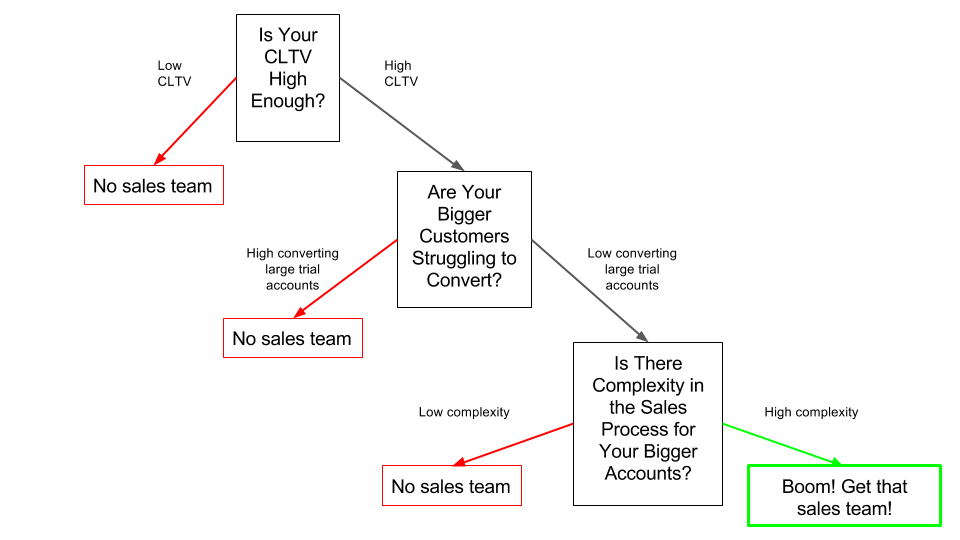
You need to do just 3 things to see whether you need to transition from a self-serve to a sales-supported SaaS:

  • Decide whether you have a high CLTV business that can support a sales team
  • Segment your large trial accounts and see if they are converting
  • Reach out and identify their friction and challenges.

All along the way, you’re looking for places where a sales team can add value to trial accounts by making the buying process much easier.

1. Is your CLTV high enough?

The first question you need to ask yourself is whether the economics of your business can support a sales team.

Take a look at your customer base. Are the vast majority of them individuals or prosumers? If so, it’s likely that your customer lifetime value (CLTV) will be too low to acquire customers efficiently through sales. That’s because each additional sale won’t be worth the sales rep’s time it took to close the deal.

Use this as a rule of thumb: if your customers have a lifetime value of less than $1,000, then it’s most likely that a sales team isn’t a good fit for your business. You’ll need a frictionless way to acquire customers at scale, not a high-touch sales process.

If your CLTV is too low right now, you’re left with two options:

  • Go upmarket, build a self-serve premium version of your product at 2x–5x the price, and then revisit this question after you’ve gotten some customers, or
  • Focus 100% on scalable, frictionless customer acquisition.

If your CLTV is over $1,000, then it’s possible that you have a segment of high value customers for which a sales process makes sense.

self-serve-sales-supported

2. Are your bigger customers struggling to convert?

The next step is to take a deeper dive into your high CLTV customer-base. If bigger trial accounts convert from trial to paid at a lower rate than smaller ones, that’s an indication that bigger customers are encountering difficulties with your self-serve process that a sales rep could help fix.

Start by segmenting your trial accounts by size—small, medium, and large—then, evaluate their conversion rates. Here's how.

Lead score your inventory

When a trial account signs up, they give you information about themselves and their company. At a minimum, you have their email address—and you can use that alone to generate a lead score for your customer.

For example, a regular Gmail or Yahoo email address is likely just from an individual customer, but a company email means that you potentially have enterprise interest. Pull up the name of person who signed up on LinkedIn to learn more about their role and the company they work for. If you're automatically adding your trial account signups as leads to Close.io, you can also use our Clearbit integration to enrich your lead data with their LinkedIn data and other social profiles.

Funnel segmentation

Add this one simple question to your current onboarding funnel that'll separate the business accounts from the individual sign ups: How big is your team?

This number feeds into your lead score to determine which segment the trial account will fall into. Also consider asking for the customer's role, company information, company size, budget and more.

You can do this quantitatively, or with a SaaS tool that helps you create lead scores—or you can just go through your trial list and do this by making rough, qualitative judgments on each account.

Enterprise self-selection

The final way to segment your customers is to get them to self-select.

Have your regular 2 or 3 priced tiers, then start a 4th tier with all the regular enterprise offerings—multiple accounts, enterprise single sign on, awesome support—and write “Contact Us” instead of the price.

Large companies are used to buying a certain way, and will actively be looking for this type of sales channel. If you don’t have it, your big customers will try a regular account, but they'll turn around and leave when they hit an issue that would be easily solved by an account manager.

When you add a “Contact Us” plan, you’re giving the large accounts that have difficult buying requirements a way to head straight to you. If you have enough companies coming through this channel, you’ll know you need a dedicated sales team.

Finally, look at your conversion rates

You’ve segmented the large trial accounts from the rest. Now take a look at their conversion rates from trial to paid.

If your large accounts are converting at the same rates as the rest of your accounts, then there’s not much that a sales team could do to raise those conversion rates.

However, if large accounts are converting at a lower rate than small accounts, you need to transition to sales support. Low conversion rates mean these accounts need more support to reach a buying decision, since self-serve isn't working for them.

3. Is there complexity in the sales process for your bigger accounts?

The last step in deciding whether to build your sales team is for you, the founder of your company, to run an experiment. You need to call your large accounts and walk through the buying process with them.

This isn’t a sales call. You’re not in sales mode yet.

All you want to do right now is learn. Gain insights into the buying processes your customers are going through, find their friction and identify challenges. You need to figure out whether a salesperson could make a difference to their lives and their businesses. You need to identify any complexities in their buying process where human help could significantly increase conversions. These are your opportunities.

And you need to do that yourself, now, before you hire a single salesperson.

Find the friction

When you get on these calls you want to find out one thing: Are they the decision maker?

If you’re talking to these larger trials and they are the decision maker, they have a credit card in hand and they have the budgetary responsibility to make the call, then a salesperson isn’t going to be much use in these scenarios.

But if you are talking to people who don’t have the decision making authority to pull the trigger on your product today and have complex buying cycles, then you have a great case for a dedicated salesperson who can make a substantial difference.

Buying cycles that have friction will include:

  • customers evaluating not only your solution, but also your competitors
  • multi-stage buying processes
  • multiple stakeholders involved in decision-making

If the potential customer is evaluating you alongside your competitors and comparing your offerings, then getting a dedicated account manager or salesperson will put you at least on par, if not at a massive advantage.

You’ll be able to listen to their concerns and address them, rather than leaving your customer with no one to turn to for help and guidance. Having salespeople will also move the needle in terms of converting these leads into customers.

Identify challenges to buying

Additionally, there are business customers who have difficulty onboarding onto any new product due to significant business challenges that are nearly impossible to self-manage.

These might be specific to their business. Concerns about security, scalability, privacy, integration and data management are likely to come up when dealing with enterprise-sized customers.

Even a great FAQ won’t be able to answer these thorny issues. The customer is going to want to get on the phone to talk things through with you and your team.

Another sticking point might be budget. In a self-serve scenario, with no opportunity to negotiate, they might decide that they can’t afford your product. But if a salesperson can get on the phone with these customers and negotiate, this can be a win for both sides.

Concerns like these, which are difficult to address, are a good indicator that a salesperson could to make a great difference for that type of buyer during the trial.

If they’ve got friction or challenges that you can identify and resolve, then it’s time for a sales team!

Now get started!

If you’ve gotten to a yes, it’s time to get started building your sales team.

Note that this isn’t a pass-fail test that will define your business forever. You need to re-run this experiment constantly.

As your business grows and your product changes, you might find that you start to have these enterprise clients hidden within your typical customers. By running through this decision framework you drill down into your data and find the accounts that need sales support.

Want to learn more about selling SaaS products? Click below!

Register for free online crash course on SaaS sales success strategies

11 Nov 17:21

6 Organic Content Promotion Channels That Really Work

by Scott Lambert

content-promotion-channels-isIf you want your prospects to find you online, creating compelling content is a must. In fact, quality content lies at the foundation of effective content marketing strategies for thousands of successful companies.

But content doesn’t promote itself. Even the most compelling written, visual and multimedia content needs help attracting readers and viewers who will hopefully enter your sales funnel.

This is where organic content promotion comes in. Like paid content promotion, organic promotion is designed to boost the visibility and effectiveness of a content marketing campaign. Unlike paid promotion, it doesn’t involve direct payments for ad space, “boosts” or sponsorship.

However, organic promotion does still require a substantial investment of time, effort and creativity.

These six organic content promotion strategies can boost traffic to your content, improve lead generation statistics, drive conversions and enhance key revenue metrics.

1. Learn and Follow SEO Basics

Every organic campaign for written content starts with search engine optimization. Also known as SEO, search engine optimization makes blog, website and even social media content more attractive to search engines such as Google and Bing. Numerous factors influence a given piece of content’s SEO value, including:

– Inbound link quality
– Keyword placement
– Headline length and quality
– Technical factors, including website navigation and load time
– Directory submissions

Effective SEO can boost your content’s position in search rankings, increasing the likelihood that people searching for relevant keywords will find and click on your result, not a competitor’s.

2. Network With Thought Leaders through LinkedIn

You can probably think of some peers and competitors you look up to and emulate. These people are your industry’s thought leaders, and they’re great people to know.

The most effective way to network with industry thought leaders and become a thought leader yourself is to build a formidable LinkedIn presence by:

– Actively connecting with thought leaders
– Joining or starting relevant LinkedIn groups
– Sending personal messages that tout your capabilities
– Publishing high-value content that establishes your own thought leadership credentials
– Sharing said content with other thought leaders

Of course, your thought leadership content shouldn’t be limited to LinkedIn. Every high-quality piece of content that you create should be published in parallel on LinkedIn and your company blog.

3. Perfect the Art of the Press Release

An SEO press release is a great way to tout your company’s achievements and capabilities without coming across as overly salesy. Make sure your releases strike the right balance between news and self-promotion. Although distribution is likely to be limited by your budget, make sure to spread your release across as many news wire services as possible. However, optimized press releases are also great organic promotion tools: Simply repost your release on your blog and social media pages to boost your reach!

4. Invest in Media Outreach

SEO press releases can be powerful, high-ROI tools in your digital marketing campaign. Under the right circumstances, going one step further and investing in media outreach may achieve an even greater payoff.

You don’t need to pay a PR firm to network with journalists: Simply build a mailing list of bloggers and reporters who cover your niche and reach out to them directly with press releases and personalized inquiries.

5. Forge Guest Posting and Content Licensing Partnerships

Guest posting and content licensing partnerships aren’t always organic. Although the practice isn’t as common anymore, many such partnerships involve a financial exchange.

On the other hand, many publishers are only too happy to host your content in exchange for a reciprocal link. Like self-starting media outreach, building a guest posting and content licensing network requires a mailing list and a lot of friendly outreach.

6. Get People Talking

While influencers undoubtedly help raise your profile, they’re not the only people capable of giving your content marketing efforts a popular boost. In fact, grassroots organic content promotion is often a far more authentic, positive and appealing approach.

Depending on what you sell and which buyer personas you’re targeting, your prospects and customers may prefer to learn about your products’ benefits from a friend or neighbor. Hearing from a VIP in a suit doesn’t necessarily do it for them.

With this in mind, make sure your content is as engaging as possible and distributed throughout social media. Not every piece of content is going to get a million hits, but highly engaging content is much more likely to be shared and reposted than not-so-engaging content, even if the “boring” content is just as useful.

Remember, every organic share that comes from a random social media user, regardless of whether they’re a current customer of yours, is a share that you don’t have to pay for or organize on your own. It’s also an opportunity to spread awareness of your solutions, generate leads and convert undecided prospects.

Get Started Improving Your Digital Marketing

Thanks to ongoing algorithm tweaks by Google and evolving best practices by leading marketers, the rules of the game are always in flux. What works one month might not necessarily work the next.

11 Nov 17:21

Demand Generation Issues You Should Fix Before Your Boss Finds Out

by Bodhi Short

demand generation issues you need to fixDemand marketing gets more complicated by the day. In order to get everything done and still ensure great customer experiences in this always-on environment, we often find ourselves cutting corners.

But one shortcut can quickly grow into many, until our entire demand gen engine is compromised. Here’s a list of issues that may start off small, but can end up resulting in big problems down the road:

1. Only optimizing the top 10 rows of your 1000 row lead report

Take this common scenario:

You have 15 content marketing partners, each with 5-10 sub-sources on all three of your quarterly demand gen initiatives. These initiatives break into two specific geo regions, each with their own budgets.

Your job is to figure out where the best return is coming from based on the feedback report you received from your analytics database. 15 x 5 x 3 x 2 = 450 unique lead source distinctions for which you can change payout and allocation to yield better results.

But to do that, you would have to send at least 15 emails to your publishers and then get in arguments over a couple hundred details — all while scrubbing, normalizing and possibly manually uploading lead files into your marketing automation. The result? You sort your analytics report by worst offenders and execute changes on the top 10. You’re not lazy, you simply lack an effective method of executing optimization at scale.

With all the other efforts required to keep your demand marketing engine running, optimizing each lead source and demand gen tactic seems insignificant. But it incrementally adds up, like “engine sludge” in those Castrol Oil commercials – the engine will eventually down.

2. Using the same content marketing partners instead of testing new ones

It takes a lot to find a good partner, so once you do, it’s often seems more effective to keep budget allocated to the same small circle, quarter after quarter… If it’s not broken why fix it right?

Often the reason we limited ourselves to “trusted partners” isn’t because they’re the best in the industry, but rather because they’re the best we’ve found so far. We don’t have the time to find others. It often requires resources to research new sources of good prospect data.

But a problem exists when organizations, industries, opportunities change, which they do very often. It’s a good idea to continuously test various sources and audiences, and learn from each, optimizing all along the way. Otherwise, you risk diminishing prospect data quality, fewer insights about what’s working, increasing cost per opportunity and a generally lower-performing demand marketing machine.

3. Picking publishers based on booth size or steak flavor

This issues often leads into the previous one. Think about these questions:

  • What data do you have on your publishers/content marketing partners before you run with them?
  • Have you analyzed performance data from their campaigns with competitors?
  • Do you know their average launch time for a campaign, proven volume in your vertical or average acceptance score for their leads?
  • Or, did they have the biggest booth that led to an extremely enjoyable happy hour? (Not that this is a bad thing).

Maybe you decided they were legitimate because they footed the bill for expensive steak, which is great. But when it comes down to it, is this what’s really best for your organization…or your marketing career?

There’s nothing wrong with putting value into relational merits, but they should never outweigh proven performance data? Getting this info upfront is best, but if you can’t get it, then it’s always a good idea to test.

4. You have a mysterious section of your lead workflow known as “the black hole”

Leads need to be nurtured and worked by sales to produce a result. Depending on how well those efforts go, the lead can be re-routed to various destinations.

Your marketing organization has become complex. You have several workflows that all funnel to the appropriate teams, but when a lead hits a certain score or is dispositioned a certain way, you can’t push it further for the time being. It gets bucketed into the “revisit in the future” list.

Sales, however, prioritizes focusing on fresh leads and so do you. Your time consumes your focus on getting the newest leads to your team. You’ve already been evaluated on the leads you generated last quarter, so you have no pressure to revisit, while you have a TON of pressure to make sure this quarter is good to go. You’ll do it next quarter.

These leads represent wasted budget and resources, which saps the value of your demand marketing programs. Setting up a specialized reengagement nurture track is generally easy and often pays off in sizable dividends.

5. You don’t actually have access to your marketing automation system or your CRM

This is far more common than you’d expect. Some of our largest customers employ demand generation practitioners that don’t have access to either of these systems, even though their organizations have invested in such marketing technologies. There are different teams for each.

If this is the case for you, your quarterly wrap-up is the only time you learn how those leads performed for your sales team. But, how does this delayed feedback affect overall performance in an era of real-time EVERYTHING!?

When it takes 90 days to get the feedback you need to adjust sources and tactics, you can end up wasting half your budget. Huge opportunities are missed in this way. Some of the highest performing marketers I come across are those who provide real-time performance visibility for every demand gen role – so insisting on this at you 2016 planning meetings is a very wise idea.

outbound-demand-generation-ebook

11 Nov 17:21

The Rise Of The Sales Development Cloud Begins At Sales Stack

by Kyle Porter

The rise of the sales development cloud will begin at Sales Stack this week. The research on Sales Development is in, the pundits have spoken, and businesses have proven it through results:

Sales Development is its own independent function inside the revenue generating organization.

Sales Development demands this. It requires specific training, hiring, motivating, and tactics. And in the course of its function to “connect with, qualify, and convert prospects to an opportunity,” sales development needs its own technology ecosystem.

Today, the SalesLoft team will be attending the Sales Stack conference as the Platinum sponsor. The term “sales stack” has been thrown around a lot and I love it. It connotes that there isn’t one sole vendor who will solve all of our problems, rather, multiple technologies working together to accomplish a goal. I couldn’t agree more.

The sales stack is split down the middle between two areas:

1. Pre-qualified appointment
2. Post-qualified appointment

The first is “Sales Development.” The second is “Sales.” (See the infographic here).

Key roles in any function (especially the two above) require an application of record – think accounting software, HR software, engineering, product management, marketing, etc.

The sales application of record is obvious. It’s Salesforce.com, most specifically their “sales cloud.” But there are many reasons why Sales Development Reps can’t depend on the sales cloud:

    1. Calling, emailing, and dropping social touchpoints are all unavailable.
    2. CRMs are becoming an enterprise-wide applications, built for servicing the entire ecosystem of users — particularly if you are in a sales pipeline or a known customer. But there’s too much clutter and too many functions that don’t apply to their role specifically, causing confusion and too many clicks.
    3. Given the broad nature of CRM tools, the workflow of methodically and systematically targeting hundreds — if not thousands — of leads tends to come up short for many of our customers.
    4. The integrations in CRMs aren’t hyper-focused on the roles and goals of a modern SDR.

This needs to change. We’re going to change it.

There are too many amazing vendors who help SDRs in need of a platform to serve them value. It’s time to change business for the SDR. It’s time for the Sales Development cloud. This cloud is uniquely focused on the Sales Development Rep and accomplishes the following:

  1. Hire people onto it, then train and coach them.
  2. Bring in lead data.
  3. Execute communication via email, phone, social, text, notes, etc.
  4. Schedule appointments and hand over qualified opportunities to Account Executives.
  5. Analyze the results, and predict the future.

It’s the place where SDRs spend their time. It’s their workflow app.

Data and people go in, qualified appointments come out. Business improves.

Now, as a single vendor, we’d be crazy to think we can accomplish all of this. That’s why we’ve begun seeking out the very best in the Sales Development stack:

  • Predictive analytics vendors
  • Organization health vendors (hiring, coaching, training, one-on-ones)
  • Contact data vendors
  • Text analysis and sales intelligence vendors
  • Email APIs
  • Phone APIs
  • Analytics vendors
  • Calendar APIs
  • CRMs

This ecosystem makes up the Sales Development cloud. We don’t intend to own it; but merely help bring it to life.

If you’re in SF, come see us at Sales Stack. We’ll be talking about the rise of the Sales Development cloud.

Share us your thoughts — what applications would you like in your Sales Development Cloud?

The post The Rise Of The Sales Development Cloud Begins At Sales Stack appeared first on SalesLoft.

11 Nov 17:21

4 Types of Sales Content That Marketing Is Not Delivering

by Paula Crerar

looking for sales contentOur workshops on content strategy are attended by members of sales, marketing, training and other departments who have a stake in sales content. In these discussions, marketing professionals tell us that although they are responsible for content creation, sales content takes a back seat to their content marketing initiatives.

It’s understandable. In B2B companies, marketing is focused on providing leads to sales. That’s how they’re resourced, organized and measured. So they put much of their effort on creating content for demand generation. But the material needed to convert visitors to MQLs (marketing qualified leads) is not designed for converting an MQL into a customer. As a result sales reps are missing content to help them establish a trusted relationship with prospects and close business.

Your experience may vary, but we’ve observed that there are four types of critical sales content that aren’t sufficiently addressed by marketing teams:

Content to prepare for the sales conversation

In the era of the engaged buyer, B2B sales reps need to be much more knowledgeable than ever before about the needs of each buyer persona. Some reps have to be able to pivot from a conversation about the challenges of a marketer in the pharmaceutical field to the latest trends facing a CFO in a growing high tech firm. Adding substance and insight to these conversations is not something that a rep can do without a lot of preparation.

Marketing teams can help them with content to support sales conversations using this structure:

Key Messages to best position the company’s unique value propositions

Questions that are relevant to the buyer’s challenges and how the company’s solutions can help

Insights, such as what other companies in their industry are doing to solve similar problems

Competition and competitive positioning in an intelligent, non-disparaging manner

Objections typically asked by the buyer and the best responses

This content should take the form of a script instead of bullet points or lengthy paragraphs. Reps should be able to use this content naturally, in their spoken or written conversations. The scripts must be brief, clear and uncomplicated.

Content for every stage of the buyer cycle

Marketing teams create lots of great content that can be used early in the buyer cycle, but sales reps need content to support their conversations all along the buying process. Here are some examples of effective content for each stage:

Sales content throughout the buyer cycle

Content for every persona

Delivering one generic message to every prospect does not work (contrary to this 30 Rock excerpt). Intuitively and anecdotally we know this is true, and there are multiple stats to prove it. Yet marketing teams often provide just one or two sets of corporate overview slides for sales reps to use. Competitive battlecards come in one flavor and demo scripts don’t provide benefit statements for each buyer persona.

To build trust during sales conversations, both content types above should be targeted for every buyer persona and that may mean creating multiple versions of each. Marketing teams should not expect sales reps to spend time personalizing each piece of content for each prospect. Repurposing and customizing content is not their core competency. Besides, reps should focus their time on selling activities to maximize productivity.

Sales training content

Successful reps have ample knowledge and experience about their buyers’ industries and challenges, and how to best position company offerings for each sales situation. To transfer this knowledge quickly to new and less successful reps requires training. In today’s environment, that means providing online training courses in the form of short videos.

Some organizations employ training professionals to create sales training content. Others turn to internal content creators, designers, editors and managers for help, and usually these resources reside in the marketing department.

Fortunately there are many tools and resources to help marketing create training content. Chances are your marketing team already owns and uses some of them, so investment and learning curves are low. Subject matter experts, including sales executives and top performing reps, can provide the knowledge and source content.

The resource challenge

Content marketing is under pressure to create lots of engaging content quickly for both inbound and outbound campaigns. Schedules are tight, budgets and resources are low. So can we realistically expect marketing to take on more responsibilities and place a high priority on creating sales content?

For sales to succeed within the context of the new buyer reality, organizations need to develop, implement and manage a sales content strategy. This includes continuously sourcing, creating, organizing, distributing and measuring sales content. You have two options for how to organize your sales content production team:

  • If company execs decide that the marketing should take on this program, they need to support them with the right resources in terms of budget, people (the right headcount and skills), process, and sales enablement technology. Time to understand sales reps’ challenges and opportunities is also key. Consider having marketing team members shadow salespeople and create an open forum where marketing can hear reps’ honest experiences and feedback from the field. To ensure that marketing prioritizes their sales content efforts appropriately, management should review and realign the marketing organization’s structure, KPIs, incentives and compensation plans as needed.
  • If executives decide that the responsibility for sales content programs resides within sales (with the sales enablement team, for example), marketing should still be involved in key aspects of the strategy. Marketing professionals should provide source content, positioning and branding so that messaging remains consistent for buyers, from first introduction to the brand all the way to closing the sale. Ideally they will collaborate during the review process to catch any inconsistencies and to keep up to date with the sales content editorial calendar and next steps in the program.

5-steps-higher-sales-productivity-ebook

11 Nov 00:53

4 Keys to Avoiding Bad B2B Sales

by Al Davidson

B2B sales teams are (understandably) focused on always trying to increase their sales numbers, but the reality is, there really is such a thing as a “bad sale.” The problem is, you sometimes don’t know which sales are the “bad” ones until it’s too late. Here are a few key points to help your business avoid selling to the wrong customers or selling in the wrong situations.

Screen the potential buyer 

Ask plenty of questions. Not just a lot of questions, but the right questions. Think of it as “pre-qualifying” the sales lead by learning more about their needs and finding out whether their priorities and goals are aligned with what you sell. Many bad sales can be avoided by weeding out people who aren’t serious buyers with a good line of questioning. The questions should focus on deciding whether the customer is a good fit for your solution or services, in the same way as the customer is deciding if you’re a good fit for them. “Interview” the customer. Find out their goals, future plans, and what brought them to you in the first place. This can help you match their needs to what you can provide – or decide if they’re not really the right fit for what you sell.

Pay attention to implementation costs 

Deciphering whether or not a buyer is ready to spend money for your solution is a top priority. This is also a part of the pre-qualifying and screening process. You may have to talk again about fine details on pricing during the deal-closing negotiations, but making a soft determination about a buyer’s spending intentions in the beginning will help you immensely. Many B2B salespeople make the mistake of going aggressively after every new sale, even though the buyer isn’t ready to cover all costs. If a customer is already objecting to price in the early stages of the sales process, they might fail to keep their promises when it’s time to close, or try to renege on the price at the last minute – and this can turn a once-promising sale into a money-loser before you know it.

Listen to your intuition 

Sales can’t be forced. Sometimes, even after all your hard work, it’s best for you to walk away. Sometimes a bad sale or a lost deal will be your fault, other times, it’s completely out of your control. A client may have been dishonest about their budget. They may be way too busy to call you back, or too disorganized to give you a clear answer. If you get the impression that a client may give you the runaround, it may be time to abandon the sale before you waste more time or money.

Post-close follow-up

Once the sale is closed, there is another phase of the sales cycle – the post-close follow up. In some cases, clients get “buyers remorse,” and the “closed” sale becomes unclosed. This situation can often be handled by pinpointing the client’s worries and answering their questions again. Sometimes, you may not be able to recover the sale for reasons beyond your control.  The important thing is that you’ve done everything right up until this point. Good post-close follow-up should help make sure the customer is happy, help resolve any questions or pain points during the implementation process, and also open up the opportunity to ask the customer for referrals.

Once you have made the sale and the contract has been signed, it is your chance to match your words with your actions. Some clients will still feel shaky and it is your job to reassure them that they’re in the right hands. Bad sales can’t always be avoided, but bad customer service can. Every stage of the sales process is about building relationships. If a prospective buyer at any point seems like they’re not quite the right person that you want to have a business relationship with, then that is a sign that you might want to say “no” to this sales opportunity, and move on to the next one.

11 Nov 00:53

Are You Using Your Buyer’s Journey for Analytics?

by Mike Moran

pixabay_business-925900_1920

Every digital marketer worth his salt has identified a buyer’s journey–maybe more than one for different audiences or different personas. If you are doing it right, you are targeting your content to the personas and the steps in the buyer’s journey. By doing so, you are making your content persuasive, with the goal of moving people to the next step. I am seeing many smart marketers re-orienting their content marketing in this way. They are using analytics to show which content is working and which is not. Very smart.

But what I am not seeing is important, too.

I see far fewer marketers who are using the buyer’s journey to analyze broad swaths of content to see how their buyers are actually progressing. But it’s the logical next step.

After all, if you’ve aligned your content to the buyer’s journey, you can actually identify which content belongs to each step, so your analytics system can track buyers moving from step to step. Just as you can calculate a conversion rate for those who actually buy, you can calculate micro-conversion rates for each step.

I did experimental work for IBM on this in 1999, and Avinash Kaushik names the concept micro-conversions a few years later. (I had called them mini-conversions, but Avinash’s name stuck–and what you call them isn’t the big news here.) It’s taken a while for marketers to really decide to orient their content marketing around personas and the buyer’s journey, but we really shouldn’t be waiting this long to take this obvious next step.

I’m sure that some marketers out there are doing it, but I don’t see it as often as I would expect. What about you? If you’re serious about content marketing and analytics, are you putting them together to see the big picture?

11 Nov 00:52

Sales Automation: A Race to the Bottom

by Daniel Barber
Sales Automation

Stop doing what everyone else is doing and be creative about how your brand engages with consumers – Glenn Llopis, Author

What’s Your Brand Worth?

People’s willingness to buy, recommend, work for and invest in a company is driven 60% by their perceptions of the company, and only 40% by their perceptions of their products – David Edelman, McKinsey

The holy grail is future advocates, yet you treat people as prospects — this is shaving 16% off of the lifetime value of your customer.

Moreover, the spray and pray (read: linear) model doesn’t quantify the value that leaks out of your figurative bucket from irritated or unengaged buyers. Traditional funnel marketing relies on a linear buying process, and yet marketers and sales leaders continue to use this method to push buyers into customers.

Sales and marketing are two ends of a continuum. At the sales end your outreach is narrow and deep. At the marketing end it is broad and shallow – Jessica Livingston, Y Combinator

If we assume there is still some value left in the funnel model, a defined and generally quantifiable number of buyers will reach the bottom and make a purchase. This number is not only diminishing, but may not actually define your ideal customer.  

This results-driven focus has a long list of shortcomings, however the bigger question remains: why are sales and marketing leaders choosing short-term gain over long-term value?

41% of online revenue comes from Returning and Repeat Purchasers, who represent only 8% of all visitors – Adobe

But this is for consumer-facing businesses, right? Wrong.

State of Diminishing Returns

Does the image below look familiar? It should. The same Marketing funnel that was developed by St. Elmo Lewis in 1898 was adapted by Aaron Ross and others to illustrate the process of outbound prospecting (circa. 2011).

5 Steps To Creating A Lead Gen Machine & The Predictable Revenue That CEOs Love

Example Spears Funnel (Cold Calling 2.0)

But wasn’t this model used by Salesforce.com to increase recurring revenues by $100M? Yes, in 2004.

The average corporate employee in 2015 receives upwards of 84 emails per day, and at the F500 executive level that number can be as high as 2000. If we assume the volume of email will continue to rise, how can we expect the same results by asking for a referral from the C-Suite?

Imagine this scenario: urgent emails from my boss, emails from colleagues requesting meetings, and a few emails from vendors that I’ve worked with previously. Which do you think I open? Urgent from boss, the majority from colleagues, and maybe, if they’re lucky, one from a salesperson. Which salesperson do I choose? Which do you choose? The one who sends incessant, repetitive communication, or the one who has demonstrated value, given you information that you’ve used as ammo, and is generally respectful of your time? 

Today’s buyer expects a different approach to communication, and yet so many sales organizations continue to leverage a linear conversion model to forecast results.


Today’s buyer expects a different approach to communication…
Click To Tweet


With the advent of Sales Automation, the modern salesperson has access to technology that supports emailing and calling 1000s of people with just a few clicks. Furthermore, established email marketing metrics (open rate, click rate, and reply rate) are now being transposed into sales to determine the effectiveness of sales campaigns.

This is a slippery slope. More email does result in more customers, and so the cycle continues.

Activities: The Lazy Manager’s North Star

If you have to tell people how to do their job, you have the wrong people or the wrong people running the people. Either way, you have the wrong people. – Jim Keenan, Author

Activity-based sales management assumes that through the execution of a set number of activities, an individual will achieve the desired results. This model is built upon a linear assumption and observes the same shortcomings found in the marketing funnel.

Moreover, activity-based management assumes that every buyer is at the same stage, possesses the same challenges, and is generally responsive to the same message. This binary approach to sales also assumes that salespeople are merely the delivery mechanism for your marketing message.

In contrast, a Results-Based approach involves outlining a set of actionable metrics that can be measured throughout the sales process. Taking a holistic view of the process, a sales leader can look at the following:

  1. Qual Call % (Phone calls that result in a meeting)
  2. Email to Opportunity % (excludes calls, marketing events, and LinkedIn)

While these metrics still measure conversion, the magic happens when you’re able to use them when coaching reps to guide them toward improving their conversations within email or over the phone. Using email engagement data (opens, clicks, and replies) or call recordings will further unlock the secrets of the hyper-performers.

Human Personalization vs. Sales Automation

The purpose of a pitch isn’t necessarily to move others immediately to adopt your idea. The purpose is to offer something so compelling that it begins a conversation, brings the other person in as a participant, and eventually arrives at an outcome that appeals to both of you. – Daniel Pink, Author

Sales training often follows a familiar track: 1) learn the product 2) learn the pitch and 3) rinse and repeat. This curriculum is designed to enrich the recipient with the necessary skills to discuss the product offering, while simultaneously building a conversational foundation to engage with prospects.

The missing link in this model: the customer.

In both B2C and B2B sales, the sheer volume of communication noise is overwhelming for today’s buyer – no one wants to listen to a non-tailored sales pitch. Unfortunately, this organization-centric model of sales training is often directly transposed to outbound email communication.

Sales Email Example

Referral Example #634

Furthermore, with the advent of Cold Calling 2.0, sales teams will often use the Appropriate Person or Quick Question format within email as a guise to peddle their pitch-first ask later message. The above message was sent by a leading provider of API integration to a member of my team (who works in Sales, not IT).  

Sales Automation providers fuel the fire by supporting this model via platforms designed to automate the salesperson. Consequently, sales and marketing management have a new level of control in the messaging sent by their salespeople.

Without personalization, what value does the modern salesperson provide?

Are you employing people simply to create another email address to deliver your marketing message and press send on an automated voicemail?

Before jumping to conclusions, I support the use of technology to empower the modern salesperson. This nuance involves combining a level of human personalization to engage the future-advocate, while providing persona-based value through the delivery of content.

What’s the delta between Human Personalization and No Personalization? 230% increase in replies. Thank you to Peter Kazanjy for the data below:

TalentBin

Personal Email Selling Graph

Human personalization can be broken down into three layers:

  1. Affinity to support emotional connection
  2. Assessment of buyer sophistication
  3. Delivery of tailored content that assists the buyer education process

Enter Sales 3.0: Personalization at Scale

The framework for the modern salesperson requires 1) leverage technology to remain competitive 2) remain human 3) combine the best of both worlds to achieve personalization at scale. The cost of remaining status quo is detrimental to your brand, and will likely land you in the spam folder.  

Let’s leave behind robo-mailers that turn sales into a number game – and inspire salespeople who create advocates, not opportunities.

The post Sales Automation: A Race to the Bottom appeared first on Sales Hacker.

11 Nov 00:51

Re-Imagining Marketing Through Agile Principles

by Joel York

yin-yang-red-400Marketing has always paid more attention to madness than to method. Cool brands, viral campaigns, and hot leads: these are the things we want from marketing. Contrary to conventional wisdom, cool brands, viral campaigns and hot leads are not the result of big ad budgets and the latest Internet technologies. They result from the hard work of smart, creative marketing teams.

Marketing Management: Part Art, Part Science

If you examine the budget of any marketing department, you will discover a surprising and universal fact: most of the money spent on marketing is spent on people. Not ads. Not technology. While the majority of marketing spend is invested in people, very little attention is given to managing that investment. Dissertations have been written on how to get the most out of people in sales, engineering, and manufacturing, but marketing has refused to be pinned down by any standard process—until now.

agile-marketing-money Marketing is as much an art as a science. What matters more: a market survey percentage point or the unique insight of a single customer? Click-throughs or brand engagement? For any given customer on any given day, either opposite might be the right answer. Moreover, marketing projects come in a bewildering variety: creating a website, putting on a conference, pitching a story, designing a product, etc. Each marketing function from product management to public relations appears to follow its own unique process. Despite the wide variety of marketing projects, however, there is a core commonality to all marketing work. Like engineering, marketing is a creative process performed by cross-functional teams acting toward a common goal. Like sales, marketing work is subject to a great deal of uncertainty. Success or failure can hinge on the strength of a personal relationship, for example getting a reporter to cover a story.

The Promise of Agile Marketing

As if by fate, marketers everywhere are discovering the power of agile marketing. Over the last three decades, agile management principles have transformed thousands of engineering and manufacturing organizations into efficient, flexible, high performance teams. It is somewhat surprising that it has taken this long for marketers to get on the agile bandwagon, because agile and marketing go together like chocolate and peanut butter.

Finding balance amongst complexity and contradictory forces is agile marketing’s strength. From the agile marketing point of view, the long term is just the sum of the short. Uncertainty is fact yet to be revealed. Quantity is quality taken one at a time. And, yesterday’s expectations are today’s results. Agile methods simplify complex, cross-functional business processes in the face of uncertainty to maximize throughput, increase flexibility and enable continuous improvement. Don’t let the hype fool you. Agile is not religion, fad or fluff. Agile is a field-tested, proven business management approach based on solid operational principles. Agile marketing is exactly what marketing managers need to tackle the difficult organizational challenges of modern marketing management.

agile-marketing-ebook

If you like this post, then check out the full ebook: The Art of Agile Marketing: Re-imagining Marketing Work through Agile Principles.

11 Nov 00:51

Avoiding the Pitfalls When It Comes to Buying Company Data

by Kate Boyce

Theredohedited’s one thing that you just can’t live without in business – and that’s leads. As even the best sales person in the world will quickly grind to a halt without anyone to pitch to.

And it’s not just any old leads you need. You want to be spending time and energy on the warm leads and those people who have a genuine interest or need for your product or service. With a consistent stream of these type of contacts you could soon be sat back just watching the deals pour in.

So where and how should you be marketing your company to find this elusive tap of warm leads?

In your quest to find one you may be considering buying in a company data list. On the surface that may appear to be a strategy that ticks all the boxes: It’s quick. They can be very targeted with options to filter down by things such as position, company size, sector and even geographically. They can give you the email and contact number for your primary target and importantly help get you past the dreaded gatekeeper. Problem solved…..well in theory anyway.

But sadly, while that all sounds great on paper, back in the real world things might not be quite so rosy. Now we’re not saying all lists are riddled with issues and inaccuracies. They’re not and you may get lucky and generate a healthy return on your investment. But before you reach for the company credit card, just make sure you are aware of these five common pitfalls and are geared up to ask all the right questions. Compare providers and make sure you know exactly what you’ll be getting.

Avoid generic info

General company emails and phone numbers are not going to help you if you’re after people in specific job roles. You need accurate information on the level of the target individual. It’s no use shelling out for a data list where many leads then come to you with just generic info.

Data that’s past it

The information on any data list needs to be regularly ‘cleaned’ and by this we mean kept up-to-date. People and teams are changing all the time and if it’s not checked and updated often then leads will quickly become worthless.

Overused

Nothing is going to annoy people more, and make them less receptive to an approach, than getting call after call. If their data is on a list that has been sold on many times it won’t take much for them to quickly lose patience.

Not opted in

There are many issues of data protection that you need to adhere to when it comes to dealing with people’s personal details, with most breaches coming with a hefty fine. But even on a personal level, if someone hasn’t opted in to say they’re happy to be contacted then they’re not going to be impressed if they start having to dealing with sales calls.

May not even be useable

Before you buy anything you need to think long and hard about how you will use the data. Email marketing systems such as MailChimp are getting more and more intelligent when it comes to stopping you using this type of data, as it can end up blacklisted as spam. If that’s your plan then it could prove a waste of money.

So what should you do? Take it into your own hands. It may take time and resource but there really is no better data source than one you have built up yourself and that you know is being kept up-to-date. If you compile all the contacts and leads that you’ve grown through your marketing activity and organically – such as through networking, referrals, website visits, enquiries, content marketing etc etc – then you’ll start to see real results.

But even more than that, by using software such as Lead Forensics that uncovers previously anonymous web visitors, you are able to build a list of leads who have already shown an interest in your products and services, but who haven’t reached out to you yet. Your own database is the biggest asset in your business, treat it as such, nurture it and grow it and over time it will fill your pipeline again and again.

Turbo-charge your lead generation by uncovering warm leads you never knew you had. Lead Forensics is the B2B lead generation software that will instantly identify your anonymous website visitors.

11 Nov 00:51

6 Little-Known Hacks to Get Maximum Value From LinkedIn

by chris.wright@fiftyfiveandfive.com (Chris Wright)

For the B2B salesperson, LinkedIn is like a party that all your prospects are attending. With close to 400 million members and counting, there’s no other platform that lets you find out so much about the people you want to build relationships with. The social network is often viewed as a hunting ground for recruiters, yet salespeople might be surprised just how much they can get out of it, too.

There are a lot of commonsense ways salespeople can use LinkedIn to build their network and drive more leads. Ensuring you connect with new prospects as soon as you meet them, messaging contacts when they join a new company, or simply reading your prospects' profiles before a call are all smart ways to use LinkedIn for sales. However, if you want to dig deeper, there are many more tools and tricks to help you use LinkedIn to its full potential.

At Fifty Five and Five, we use LinkedIn as another weapon in our arsenal to drive leads -- and it’s a pretty powerful one at that. Below are six tricks we use to make the most out of the social network.

1) Maintain your professional headline.

A lot of people treat their LinkedIn professional headline as if it were their job contract -- something that must stay permanently the same. Not so! As in the screenshot below, I’ve changed my professional headline so it makes reference to a report my company is currently promoting.

Why maintain your professional headline? Simple -- every time you change it, everyone you’re connected with receives a notification. And this keeps you at the top of their agenda. 

2) Contact people when they change roles.

When one of your contacts leaves their current role, that’s an opportunity for you. As they begin their new job at their new company, they’re likely to bring some of their old contacts along with them.

Worked with them before? Make sure you work with them again. By clicking on the "Connections" tab, the platform will show you all of your contacts who have recently changed positions. A short congratulatory email will remind them of your past work together and might lead to new opportunities.

3) Track your InMails.

If you’ve crafted the perfect sales pitch to a potential prospect, how do you know if he or she has actually read it? Attach.io, that’s how. Attach.io generates a unique link to share in your InMail which lets you track who opens them and when they read them. 

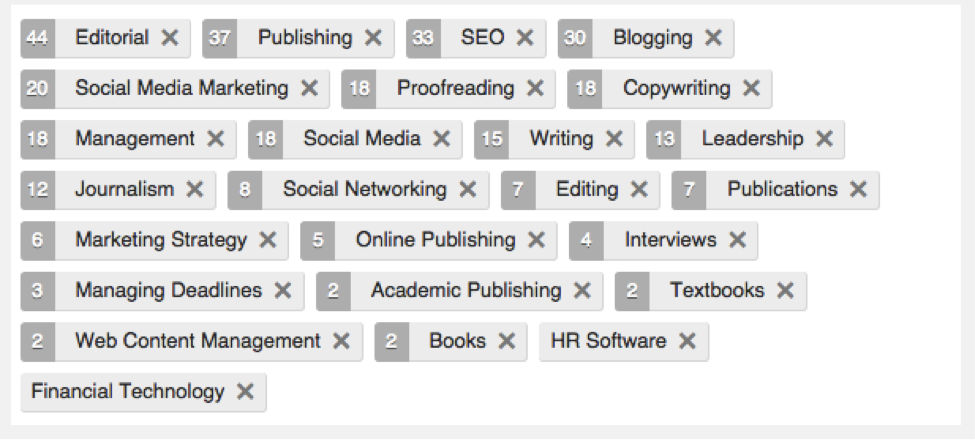
4) Show your most important endorsements first.

Your endorsements list can change a buyer's perception of you. However, all too often endorsements lists are little more than a hotchpotch of random skills.

You naturally want your contacts to read about your strongest attributes first. Here's how to rearrange your endorsements to make this a reality:

  1. Click on the "Skills & Endorsements" section.
  2. Drag and drop your skills in the order in which you'd like them to appear.

(Kudos to LinkedIn Insights for this tip).

5) Email your connections.

Most people don’t know you can get the email addresses of all your LinkedIn contacts, but you can. Learn the exact steps here. You can then use your email provider to take your LinkedIn discussion offline and reach out to the warmest of these contacts with a personalized, customized message. 

6) Come first in search.

LinkedIn’s mobile app lists contacts alphabetically when you search for people. Even before one of your contacts has begun typing a name, they’ll be confronted by the Abbies and Adams of this world.

So, how can you stay at the top of your prospects’ priority list? Stick an Emoji before your name and you’ll come top of the alphabet -- even if your name is Zac Zebediah.

What other LinkedIn tricks do you have up your sleeve? Share in the comments.

Get HubSpot CRM today!

11 Nov 00:51

3 Steps to Improve Marketing and Sales Alignment

by Lee Anne Wimberly

Whether you’re more like Ham or Smalls, chances are you’ve had a conversation with sales that included some miscommunication. Whether it’s unfamiliar terminology, information overload or inconsistent rules of engagement, every enterprise marketer has been guilty at some point of creating more frustration than value.

You're killing  me

Ham Porter: Hey, you want a s’more?
Smalls: Some more of what?
Ham Porter: No, do you want a s’more?
Smalls: I haven’t had anything yet…so how can I have some more of nothing?
Ham Porter: You’re killing me, Smalls.
 The Sandlot

So, how do you build a partnership that builds revenue instead of resentment?

A solid lead management framework is key to shared understanding and accountability. Lead management frameworks define how and when leads are qualified, scored, and managed throughout the sales process.  If you find yourself in need of some clarity between marketing and sales, review these steps to make sure you’ve built the right foundation for your demand generation program:

Step 1: Talk the Talk

MQL, SAL, SQL, OMY (OK, I made that last one up) are just some of the acronyms you may be using in conversations with sales. Even though you may be using what you believe are industry-standard terms, is everyone speaking the same language? No matter what terms you use, sales and marketing should agree on the definition for each stage a lead goes through and what place it has in your lead qualification model, along with any corresponding lead scoring values. This should be documented and become part of any on-boarding process for new hires.

Step 2: Filter the Noise

When communicating with sales on performance, focus on the key performance indicators (KPI’s) that are most closely related to revenue. You have lots of levers you can pull to improve your demand generation program, but many of them are pretty removed from what sales people can relate to. Click-thru rates, landing page conversions, impressions – these are all examples of some of the measurements you can use to see optimization opportunities, but when you sit down with sales to review performance, zoom in on the areas where they can have the most impact and where you can work together to make improvements. For example, discuss upstream metrics like number of leads per stage and the current or optimal velocity of the lead qualification model. Of course, you need to include pipeline and revenue as well as taking a look at metrics that measure how well you’re managing the hand-off between marketing and sales. But start with a focus on what is most closely related to revenue.

Step 3:  Make a Commitment

According to the 2015 B2B Enterprise Demand Generation Survey, close to 40% of enterprise companies do not have documented standards or service level agreements (SLA’s) between marketing and sales. It’s hard to have a conversation about how the hand-off process is going if there’s no agreement on what that hand-off should look like. If you have agreement on what a sales-ready lead is, then agreeing on how to manage those important company assets should be a no-brainer.

Even when SLA’s are documented, they don’t always work. When that happens, there are often a few reasons why they’re not taken seriously:

  • There was no real joint agreement on SLA’s.
  • SLA’s are inconsistently applied, varying across campaigns, departments and sources.
  • Poor application of what determines a sales-ready lead. When sales is asked too many times to jump right on something that is more nurture-ready than sales-ready, their pain threshold increases for being out of compliance.

When you have SLA’s established, ensure you can the ability to manage the data to determine how well they’re being followed. Reports should be a part of your regular check-ins with sales to review how well the hand-off is being managed and performed. Establishing the service level agreement is the first step, but make sure to have viable reporting to optimize the process as a next step.

Author: Lee Anne Wimberly @lwimberly is Director, Strategy for ANNUITAS

11 Nov 00:51

3 Steps to Improve Marketing and Sales Alignment

by Lee Anne Wimberly

Whether you’re more like Ham or Smalls, chances are you’ve had a conversation with sales that included some miscommunication. Whether it’s unfamiliar terminology, information overload or inconsistent rules of engagement, every enterprise marketer has been guilty at some point of creating more frustration than value.

You

Ham Porter: Hey, you want a s’more?
Smalls: Some more of what?
Ham Porter: No, do you want a s’more?
Smalls: I haven’t had anything yet…so how can I have some more of nothing?
Ham Porter: You’re killing me, Smalls.
The Sandlot

So, how do you build a partnership that builds revenue instead of resentment?

A solid lead management framework is key to shared understanding and accountability. Lead management frameworks define how and when leads are qualified, scored, and managed throughout the sales process. If you find yourself in need of some clarity between marketing and sales, review these steps to make sure you’ve built the right foundation for your demand generation program:

Step 1: Talk the Talk

MQL, SAL, SQL, OMY (OK, I made that last one up) are just some of the acronyms you may be using in conversations with sales. Even though you may be using what you believe are industry-standard terms, is everyone speaking the same language? No matter what terms you use, sales and marketing should agree on the definition for each stage a lead goes through and what place it has in your lead qualification model, along with any corresponding lead scoring values. This should be documented and become part of any on-boarding process for new hires.

Step 2: Filter the Noise

When communicating with sales on performance, focus on the key performance indicators (KPI’s) that are most closely related to revenue. You have lots of levers you can pull to improve your demand generation program, but many of them are pretty removed from what sales people can relate to. Click-thru rates, landing page conversions, impressions – these are all examples of some of the measurements you can use to see optimization opportunities, but when you sit down with sales to review performance, zoom in on the areas where they can have the most impact and where you can work together to make improvements. For example, discuss upstream metrics like number of leads per stage and the current or optimal velocity of the lead qualification model. Of course, you need to include pipeline and revenue as well as taking a look at metrics that measure how well you’re managing the hand-off between marketing and sales. But start with a focus on what is most closely related to revenue.

Step 3: Make a Commitment

According to the 2015 B2B Enterprise Demand Generation Survey, close to 40% of enterprise companies do not have documented standards or service level agreements (SLA’s) between marketing and sales. It’s hard to have a conversation about how the hand-off process is going if there’s no agreement on what that hand-off should look like. If you have agreement on what a sales-ready lead is, then agreeing on how to manage those important company assets should be a no-brainer.

Even when SLA’s are documented, they don’t always work. When that happens, there are often a few reasons why they’re not taken seriously:

  • There was no real joint agreement on SLA’s.
  • SLA’s are inconsistently applied, varying across campaigns, departments and sources.
  • Poor application of what determines a sales-ready lead. When sales is asked too many times to jump right on something that is more nurture-ready than sales-ready, their pain threshold increases for being out of compliance.

When you have SLA’s established, ensure you can the ability to manage the data to determine how well they’re being followed. Reports should be a part of your regular check-ins with sales to review how well the hand-off is being managed and performed. Establishing the service level agreement is the first step, but make sure to have viable reporting to optimize the process as a next step.

11 Nov 00:50

What Metrics Are Important to Track for Revenue and Growth Goals?

by Juli Durante

Quite simply, every business has goals. Some may seek to increase revenue while others need to maintian customer satisfaction. How do you define a goal? How do you set yourself up to successfully meet your goal? Read on to find out.

What’s a Goal?

If you want to meet a goal, you need to first have a goal. We recommend that you start with a good goal: one that’s Specific, Measurable, Attainable, Realistic, and Time-Bound or SMART. A SMART Goal isn’t saying, “We want to increase sales,” it’s saying “We want to increase sales by 15% by the end of this Fiscal Year.” The main goal, increasing sales, is included. It’s made more specific with the inclusion of the phrase “by 15%” and time-bound with “by the end of this fiscal year.” We know that sales numbers are measurable (otherwise this blog post would be a moot point!). If there is a good demand for this product or service and the fiscal year is a sufficient length of time away, then this goal is also Attainable and Realistic.

So, you’ve set a goal and it’s nice and SMART. Now it’s time to start tracking the right metrics to meet that goal. This list specifically addresses the metrics you should consider to track goals surrounding revenue and growth:

Cost to Acquire a…

Lead

How much does it cost your company to acquire one new lead? This is a foundational metric to track when deciding which avenues are best for sales reps and marketing teams to pursue. To calculate, choose a time period that mirrors your goal (e.g. one fiscal quarter or one fiscal year). Add up your total number of leads generated and divide by lead generation costs during that period (salaries are optional).

Marketing Qualified Lead, Sales Qualified Lead

As a variation, you may also want to calculate how much it costs to generate a qualified lead. Use the same method as calculating cost to acquire a lead, but add your total number of MQLs or SQLs instead.

Opportunity

First, calculate your expenses for generating opportunities. This should include lead acquisition costs plus anything that helps an opportunity get et. Frequently, business development or inside sales teams will work in this function, although including salaries is still optional. Next, tally up your number of opportunities for the set time period. Then, divide the number of opportunities by the total cost.

Customer

Customer Acquisition Cost is the next step. Take the number of customers you’ve acquired in your specific time frame and divide it by the amount of money you’ve spent on generating those customers. This should include costs from lead or opportunity generation plus any additional money spent during the sales or “closing” process.

Why these costs?

If you’re trying to increase revenue by a certain amount or percent, it’s important  to know how much you should expect to put out to bring in enough to meet your revenue goal. You may also want to calculate:

  • Cost to Upsell a Customer if relevant to your business model. Use the same method as above but only use the budget you’d put toward presenting new opportunities to existing customers
  • Customer Lifetime Value, especially if your goal is for an extended period of time. To find this, calculate the length of time you keep a customer  and multiply it by the average revenue from customers during one unit of that time period.

How Many _____ You Need

New Sales

This number can include new customers or upsells to existing customers. Based on your goal and average deal size or customer lifetime value, how many new sales do you need to reach your revenue goal?

New Opportunities

Because you know how many new sales you need, you can calculate approximately how many opportunities you need to reach that goal. This number is your Opportunity to Customer Rate. To find it, divide the number of won opportunities for a time period by the total number of opportunities (won or lost) in that same time period. To turn this into a goal for new opportunities to be created, divide the number of new sales you need by your OTC rate.

New Leads

With a goal for new opportunities, you can next back into new leads. Take the number of opportunities created during your time period and divide it by the number of new leads generated during that same period. You can also do this for MQLs or SQLs. This is your Lead to Opportunity Rate, MQL to Opportunity Rate, or SQL to Opportunity rate.

And So On

If your goal involves inbound marketing or website lead generation, you’ll want to go one more step backward and calculate the visitor to lead rate for your website. If you’re attending many tradeshows to generate leads, use the average number of qualified leads generated at a show to calculate how many shows you need to attend (and how much that will cost).

Next Steps

With your goal in place and the necessary metrics tracked, it’s time to roll up your sleeves and being the hard work of reaching your goal. Give yourself some mini goals at regular intervals in your main goal time period. These “mini goals” serve as checkpoints to ensure you stay on track and will end up successful at the end of that period.

11 Nov 00:50

Marketing Tech Buyer Journey Statistics and My Takeaways

by David Crane

marketing tech buyers journeyI came across a great report yesterday – the Walker Sands “State of Marketing Technology 2016: Understanding The New Martech Buyer Journey.”

The report comprises survey results from more than 300 marketers involved with marketing technology purchasing decisions. While most of the findings were expected – e.g., 51% of respondents think their companies need to invest in more tech – a few stats got me thinking…

35% of marketers cite difficulty in implementation as a top obstacle to MarTech adoption

Implementation problems was the second most cited issue with tech adoption (the first was understandably budget). And while 35% certainly isn’t insignificant, I feel as if this is a much lower figure than a few years ago. Technology has in recent years become so embedded in our everyday marketing lives that we’re learning how to handle it much better.

However, that isn’t to say we couldn’t all benefit from a few helpful tips regarding smooth martech rollouts. And the best advice I ever gained was this: “Focus on a couple quick wins and expand steadily from there.”

This means selecting a pilot program that’ll allow a specific group to experience, test and evaluate a new technology and adjust processes as needed before large-scale deployment.

Unforeseen issues often arise, so selecting a pilot based on a balance of priorities and easy wins is a very good idea. It’ll allow you to gain experience (and skills) with the new system while showing impact to the stakeholders who approved the investment. Nothing’s worse than being denied a renewal just when you’re starting to reap full value form a tech investment.

Also, set goals before your implementation. It doesn’t matter how off they turn out – they’ll help you track progress against which you can later measure post-pilot performance. They’ll also help you identify shortcomings in processes, resources or even the technology itself.

Perhaps most important is that you have a power user(s) in mind before investment. Marketing tech these days is very sophisticated, requiring much customization – to processes, strategies, tactics, and the tech itself. The most successful tech rollouts are attached to key individuals, who learn the ins-and-outs during the pilot and then lead subsequent rollout phases.

Only 11% of marketers consider sales reps very influential while researching MarTech solutions

This statistic astonished me. Understanding sales’ priorities, concerns and processes enables us to gain valuable information used to boost marketing’s impact and value.

Moreover, only 5% learn about new technology from sales reps, and 65% say they’re at least halfway to a decision before contacting a sales rep.

As my friend Kyle Gale once put it:

“Think of the customer acquisition funnel as an Olympic relay team; the team may be made up of four Usain Bolts, but it’s not going to matter much if they can’t figure out how to pass the baton (the customer). Marketing may own 60% of the funnel, but you still need sales to finish the race.”

Sales is the lens through which marketing is seen. Sure lead volume and MQL conversion rates are great metrics for marketing’s performance, but if a forecasted number of those leads don’t convert to customers, it’s going to reflect on marketing just as much as sales (possibly even more).

The fact of the matter is that marketing’s value is in many ways resting in the hands of sales. So it makes sense to include sales on tech decisions. Often they have differing perspectives that you wouldn’t think of on your own, which often makes the proposed tech investment even more valuable than initially thought.

44% of marketers begin their search for MarTech “when they recognize a need”

Although this report focuses on marketers’ search for and adoption of marketing technology, it drew my attention to a common, marketing-wide misconception; namely, the notion that B2B tech-buyers recognize needs in a vacuum.

The report does this when it states (like so many reports and articles before it) that recognizing a need is the primary catalyst for individuals to begin searching for new technology.

I find this misleading. “Recognizing a need” is so broad that it means almost nothing. Yet, when it’s simply stated (as in this case), it implies that an individual one day magically discovers a hole in their process, one that needs to be filled. And so that individual does the first rational thing that comes to mind – googles a solution.

This concept has in many ways been the cornerstone of inbound marketing’s importance in recent years. And the typical conclusion is that marketers need to get their website, blog and SEO games right, which they certainly do.

But in doing this – in positing this idea of “needs found in a vacuum” – it causes marketers to neglect half of their content strategy, specifically the part where you look at external distribution to generate demand.

Instead, marketing resources are typically unbalanced toward initiatives that focus on the buyer journey after prospects reach your site. Why would we want to neglect tactics that go out and bring prospects to our websites and blogs?

Good content is what causes tech buyers to recognize needs. Waiting for such needs to be recognized on their own is ridiculous. Good content strategy promotes awareness of needs well beyond blog posts and SEO. If your audience is at your website, they’ve likely already recognized the need. Blogs are definitely useful in creating needs awareness, but even the best blogs have limited reach.

You need to get your content out to where audiences are having the conversations, because they’re not going to magically appear at your website.

Unfortunately, outbound marketing (such as content syndication) is often given only cursory consideration: “Oh, here’s a white paper. Go get me some leads.” But when done right, with thoughtful strategic planning and orchestration, marketers grow their pipeline value significantly.

Marketing-Ops-Outbound-demand-generation.png

11 Nov 00:50

8 Stats That Prove Email Is Still the King of Marketing

by Andrew Sheridan

Among all marketing channels, email marketing still reigns supreme. It is one of the simplest channels to implement and maintain, yet it still produces some of the most substantial results for your business. Email marketing isn’t going anywhere, and if you’re not making the most of this powerful channel here are 8 stats that will change your mind.

Marketing via email yields an average 4,300% return on investment for businesses in the United States (Direct Marketing Association). That means for every $1 spent on email marketing, the average return is $44. How many other marketing channels could give such a high return?

49% of B2B marketers spend more time and resources on email than on other channels (BtoB Magazine). Although the vast majority of marketers are regularly using email marketing, this doesn’t mean email requires a lot of resources. Email blasts are relatively easy to setup and don’t require much maintenance after distribution.

Email is nearly 40 times better than Facebook and Twitter at acquiring customers (McKinsey & Company).This is because email is often more personal than social channels. You can customize your emails to a specific recipient (different subject lines, including their name, offers based on past purchases, etc.) making it much more likely they open your emails and take action.

96% of organizations believe that email personalization can improve email marketing performance (Aberdeen Group). It’s no secret personalization is one of the most successful methods for converting prospects. To drive conversion it is crucial to personalize every marketing interaction: from the inbox, to your website, and all the way to your caller experience.

Lead nurturing emails have a slightly higher unsubscribe rate (1%) than individual email sends (0.5%), indicating their effectiveness in removing unqualified leads from the sales funnel (HubSpot). Email marketing isn’t only effective for acquiring new customers, but also for weeding out people who will never turn into customers. This is another layer of protection for your sales team, and one that is easy to establish at a large scale.

The two biggest factors influencing open rates are the organization the email is from (64%) and the subject line (47%) (Chadwick Martin Bailey). Getting people to open your emails is always the first step towards email success. Having a solid sender reputation and strong copy in your subject line are best ways to improve open rates. Once you get people opening your emails, the next step is having a compelling call to action.

91% of consumers check their email at least once per day on their smartphone, making it the most used functionality (ExactTarget). With so many people reading email on smartphones, it is crucial that your emails are optimized for smaller screens. If your emails are not properly formatted for mobile you’re making it harder for recipients to see your message, and chances are they won’t take the desired action.

67% of all emails are opened on a mobile device (smartphones and tablets), and smartphones alone make up 50% of all opens (Movable Ink). The data shows the majority of emails are read on a mobile device, with half of all email opens occurring on a smartphone. Your call to action needs to be adjusted for mobile users. Most mobile users don’t want to be directed to a landing page with a form, which is too cumbersome to fill out on mobile devices. Instead a well-placed click-to-call button receives better results.

If you’re going to be optimizing your email experience for the mobile world, this means you need to be driving your readers to call your business. To track these mobile call conversions, you need call attribution technology to prove the full ROI of your email programs. To learn more about proving (and improving) the return on your email marketing, check out our white paper: The Definitive Guide to Call Tracking for Email Marketing.

11 Nov 00:50

How to Solve the Disconnect Between Marketing and Sales for B2B Companies

by Elizabeth Dyrsmid

marketing and sales teams working together

The sales team is from Mars and the marketing team from Venus or so it seems sometimes. These two groups usually struggle to work well together. Why is this? The disconnect between the marketing department and the sales department is usually because of a communication gap that can be fixed with clear communication systems.

The marketing team focuses on getting leads. The sales team then has to establish contact and ideally get a sale. But not all leads are equally valuable and this is where lead quality control needs to be established. Today we are going to look at how the marketing team can make the sales team’s job so much easier by focusing on attracting someone that is likely to buy. In the process, everybody’s job will become easier because it will improve the overall health of the company.

Want to Get Your Marketing and Sales Teams Working Together? It Starts with Communication

Somewhere the duties of marketing and sales need to overlap and they need to start talking on a consistent basis. These two need to embrace each other as the absolute perfect couple. Together they can make up the powerful engine that drives the business. Or because of failure to experiment and communicate they can continue in dysfunction and frustration.

By communicating effectively, productivity will increase and so will their ease in working with each other. That’s good news for each department and for your company’s bottom line. – Kayla Matthews, RickWhittington.com

Where does marketing stop and sales begin? Every company is going to have a different answer because there are a lot of factors at play. Sometimes the marketing team is shorthanded and the sales team overstaffed or vice-versa. One team might have to take up more tasks while another team might have to start focusing on other things.

Marketing Should Attract the Right Type of Lead and Fend off the Wrong Type

When the content the marketing team creates starts attracting the ideal customer for the sales team to close, you are in business heaven. The sales team are the field operatives of your business. They have practical and intimate knowledge of the most important person in the company, the customer. When that knowledge can be transferred to the marketing team you can create virtually flawless content that speaks to the right people. But what usually happens is marketing tries the “shotgun in the dark” approach.

Your content shouldn’t be attracting everyone. It should actually be designed to disqualify some people so you can have quality leads over quantity. Your marketing team should be aware of exactly who this “ideal customer” is. Which type of lead do you want to attract on a consistent basis and which type usually turn out as time-wasters? Your sales team can answer that.

Here are two practical tips for the marketing team that can help them to disqualify some leads right off the bat:

1. Add More Fields to Your Optin Forms

When you add more fields to the optin forms that guard your white papers your optin numbers will go down but your quality in leads will go up. For example, if you add number of employees as a field in the optin form you can automatically qualify or disqualify some leads. The sales team now has a better idea of who they will be calling up or emailing.

2. Change the Titles of Your Articles or Ads to Attract a Smaller Audience

The title of this post could have been called Solving The Disconnect Between Marketing and Sales but we added the “for B2B Companies.” B2C is disqualified. Your traffic to your site will become more targeted and the result is better quality leads.

When you speak to a specific persona your voice becomes stronger. Your message becomes clearer. Marketers that are running smaller type boutique agencies want to be loved by a smaller group of customers rather than be tolerated by the masses. No-one that just tolerates you is going to trust you with big money.

Marketing and Sales Must Work Together

marketing and sales teamsWhen the marketing and sales team start working together to attract ideal customers instead of just trying to please everybody you can count on closing a lot more deals with a lot less frustration.


A decision maker needs to arrange frequent correspondence between the two teams. If you are not that decision maker talk to someone in your company about this. If you want more information on how to create great content that attracts the right leads or if you still need to find out who your ideal customer is we have a whole library of resources that you can get to at our resources page for free.

ultimate marketing guide high growth

11 Nov 00:50

The 5 Types of Metrics Every Small Business Must Track

by John Jantsch

The 5 Types of Metrics Every Small Business Must Track written by John Jantsch read more at Duct Tape Marketing

small business metrics

Management consultant extraordinaire Peter Drucker famously said, “What gets measured, gets managed.”

Now, while terms like measurement and management might seem like big company jargon, the fact is you can’t successfully grow a business unless you track what works and what doesn’t work.

I guess I should add you can grow a business without metrics a lot like you can win at roulette from time to time. The question is what is not measuring costing you in terms of wasted money and lost opportunity?

There’s an entire industry built around data measurement, tracking, and intelligence. New tools aimed at making analytics for small business owners and marketing a snap come to life seemingly daily.

And while tools are awesome until you fully understand what you should track and why it’s hard to gain the benefit of any tool – no matter how wonderful the website makes it sound.

Oh, and I should add – this takes work, and I wish I could tell you there is one tool that will do all of this for you, but as of yet I have not found it!

Below are the five types of metrics every small business must rely on to navigate growth and profit

Money

This is perhaps the metric category that is most understood – if only in rudimentary ways. The traditional accounting world isn’t much help here, and many of the tracking tools built for this world only tend to confuse.

Newer tools like Xero and Freshbooks are more “real world” friendly and produce reports that can help you guide your business in ways that balance sheets never will. (I’ve used Quickbooks from day one and in recent years it has gotten better.)

Below are the financial metrics I find important in my business – I highly recommend picking up Greg Crabtree’s book Simple Numbers or Mike Michalowicz’s Profit First

  • Sales – This isn’t very telling on it’s own, but you certainly need to know if sales are up or down. I also believe in sales projections, a lot like goal setting, as a driver of growth.
  • Profit – Too many business owners view profit as enough money to pay themselves, which of course, is a job. If you ever want to sell your business, you need to think about how to show 15% profit after you pay yourself. That’s number straight from Crabtree, but I love it.
  • Expense – This, of course, is a big piece of the profit number, but it’s also a place to look for waste. I suspect many businesses could afford to pay someone to work on this number exclusively and come out ahead.
  • Cash Flow – When you can no longer balance cash demands and expenses in your head, you better rely on a weekly cash flow report.
  • Productivity – Profit per labor dollar is a critical measurement if you can find it. It’s a great deal like cost to acquire a new client. If you can get very good at these two KPIs, you’ll always know what you can spend of marketing and labor.

Go here to grab some highly useful spreadsheet templates from Simple Numbers.

Scorecard

dasheroo

There’s a lot going out there in the many channels small business owners and marketers find themselves, and it’s very helpful to use tools that help you keep track of marketing related metrics.

You might also want to check out this post on some non-online measurement – 7 Marketing Metrics Worth Obsessing Over

This is a space that’s getting crowded, but I like Dasheroo (I’m an advisor) and Cyfe and, if you want to pay to sync offline stuff, Domo.

Don’t forget a lot of this data can be had with free tools like Google Analytics, Facebook Insights, and Twitter Analytics.

Below are the scorecard metrics I like to keep tabs on.

  • Overall traffic – This doesn’t mean that much, but I still like to keep this number in mind as a starting point for both my sites and those of my clients.
  • Site traffic sources – This a far better metric than overall traffic. I want to understand where my traffic is coming from and how what I do impacts that. In Google Analytics, you can find this report through Acquisition > Overview
  • Social community – If you’re spending time building your social presence and engagement you’ll want to keep track of these efforts, even if you’re simply tracking follower growth. In Google Analytics, you can find a useful set of reports through Acquisition > Social > Landing Pages. The tools mentioned above excel at delivering this kind of report in a much more digestible format.
  • Keyword report – Organic traffic comes from ranking for keyword phrases, and the only way to improve ranking is to track it. Google no longer delivers this info so you’ll probably need to seek out a tool like ahrefs of Moz to get good data here.
  • Email performance – No matter if you use Mailchimp, AWeber, Constant Contact or Infusionsoft you need to grow your email list and grow your email list conversions. The best way to do that is keep close tabs on list growth, open rates, and click-through rates. Most email service providers produce these reports, and increasingly dashboard makers are integrating with the ESPs.

Conversion

I suppose I should start and end here because this the point of it all – figuring our what turns a prospect into a client – but you’ve got to build the foundation metrics before you can get to this.

Understand that many things are a conversion, not just a sale. When you get this, you start to realize that your goal here is to figure out how to guide prospects and visitors on the journey they want to take. With that in mind, a conversion is an email sign-up, a form completion, a registration, a request for information, an appointment and yes a click on the buy link.

You must get very good at understanding how people move through your website and your business, where they bog down and what makes them abandon the path.

There are some very powerful and relatively inexpensive solutions for this, but the free Google Analytics is pretty good at this.

  • Goals – The first step in conversion measurement is to define what a conversion looks like. For example signing up for your newsletter might be the first conversion goal while attending a webinar might be another important conversion goal. Whether you are using an all in one tool like Kissmetrics or Mixpanel or the free Google Analytics tool, you’ll start here.
  • Conversion funnels – The way to bring more power to the process is to hook goals together like a traditional sales funnel. All of the tools above allow you to design a conversion funnel that links several actions or groups of actions together so you can gauge how many people move from one stage to the next and more importantly where they fall off. This allows you to zero in on one element with a fix in mind.
  • Research – I suppose this isn’t a metric per se, but don’t skip the research step. Lots of people see something isn’t working and assume the just need to test something new. A key component of conversion testing is understanding why something isn’t working. Using a tool like Hotjar you might be able to see where people abandon your forms so you can address how to fix them.
  • Testing – Testing is a key element in conversion and landing page tools like Unbounce or Optimizly make the process of split testing elements webpages very practical. (Kissmetrics has testing as well.)
  • CRM role – Many CRM tools today can automatically measure progress and score leads and visitors by the actions they take, such as visiting a landing page or filling out a form. Hubspot and Active Campaign are built with this activity in mind.

Competition

There are many reasons to keep tabs on competitors, not the least of which is you might learn a thing or two from them.

Here again, there are many tools that provide competitive research. Tools like SEMRush and MOZ can give you lots of information about SEO and SEM – things like keyword ranking, backlinks, and even AdWords spend.

I also rely heavily on a service called RivalIQ. RivalIQ produces very nice reports that show you how you stack up with some basic SEO and SEM, but where it shines is in comparing social networks, social content, and social engagement.

Content

buzzsumo-content

Understanding how your content performs is crucial if you are going to understand how to make it perform better. Understanding how others people content performs, including your competitors is one of the keys to ramping up your content. Understanding how the most shared content performs and why is how you make content marketing a key weapon in your marketing arsenal.

One tool I talk about a lot is BuzzSumo – it’s kind of my marketing swiss army knife. (Check out How and Why I Use BuzzSumo)

BuzzSumo is essentially a search engine that tracks how content is shared and how it performs. On top of that is can show you who shares what content and who links to what content. You can find content ideas, influencers, and guest post opportunities using this powerful tool.

But, few people understand how useful it can be for monitoring content. Hidden among the various features is a tab called Content Analysis. Put in any search term, website or competitor and it will produce a report that shows you:

  • What network is best
  • What content type is best
  • What day is best
  • Average shares by content length

This kind of information can prove very useful and differs significantly by industry and business type.

So yes, I know, it was a lot of work just to read this far, but guess what – it’s a lot of work for your competitors to set up and track what they are doing so there’s a pretty good chance that measurement just might be the competitive advantage you’re looking for.

The good news is that once you set everything up once and figure out the reporting you need, it gets a lot easier to run your business. If this seems like a monumental project then pay someone to set it for you – it might be the best money you ever spend.

10 Nov 01:01

Vancouver to Paris, France - $662 CAD roundtrip including taxes | late May and early June 2016

by chris_myden

Paris, France

I'm not sure what it is about Paris lately, but the flight deals from Vancouver have just been getting better and better.

This latest deal is from Icelandair, who have dropped the price of their late May, early June flights between Vancouver and Paris down to just $662 CAD roundtrip including taxes.

This is not to be confused with the recent deals on Air France and KLM, which were for travel up until late April, early May.

How to find and book these flights

1. Start with this search on Momondo.ca

search - Momondo.ca - Vancouver to Paris, France flights

2. Click through from Momondo to Flight Network

3. When you get to Flight Network, it will show up as $672 CAD. You can bring it down $10 more by using the promo code 3P10OFFS132 at checkout.

Here's a screenshot of where to enter the promo code, it can be difficult to find.
http://s17.postimg.org/ee0f9z4v3/Clipboard01.jpg

screenshot from Flight Network of the price before applying the promo code:

Trying other dates in late May, early June

There are other date combinations that are pretty cheap. The key is to depart May 16.

You can return on May 28, 29, 30, 31, or June 4, 5, 6, 7, 11, or 12 for similar prices.

Where to stay in Paris?

The following AirBNB link will lead you to some great deals on places to stay in Paris for under $99 CAD/night for 2 people.

AirBNB in Paris, France - 300+ listings for under $99 CAD/night

Live deal discussion & travel advice

For live discussion of this deal, or to get some amazing travel advice (about anywhere) from your 32,200 fellow passengers in Vancouver, join us in the
YVR Deals Facebook Group.
^^^ click the 'Join Group' button when you arrive.

Hit Like if you like this deal! Click Share or Send to show your friends on Facebook.

10 Nov 00:48

Ericsson and Cisco Announce Strategic Partnership Seeking $1B in Revenue by 2018

Partnership

Cisco and Ericsson have announced a partnership that allow that two companies to work strategically on their whole lineup of offerings.

Ericsson and Cisco are both large vendors in the telecommunications and networking industry. Both businesses will ensure that telecom, enterprise networking and carrier infrastructure will be standardized so that both brands can interconnect and work seamlessly.

The deal goes on to be described to include routing, data centers, networking, cloud, mobile, and global service capabilities.

Ericsson CEO Hans Vestberg was quoted as saying: "I am excited to work with Cisco on continuing to shape the Networked Society. Foremost, we share the same vision of the network’s strategic role at the center of every company’s and every industry’s digital transformation.

The Ericsson CEO continued by adding: "Initially the partnership will focus on service providers, then on opportunities for the enterprise segment and accelerating the scale and adoption of IoT services across industries. For Ericsson, this partnership also fortifies the IP strategy we have developed over the past several years, and it is a key move forward in our own transformation."

One of the big questions is how this strategic partnership will playout for the 75,000+ combined employees of companies. It should be noted that this deal hasn't been described as a full blown merger.

In fact, the strategic partnership is said to create over $1B extra in revenues for both of the companies by 2018. If this is truly the case, then this is wonderful news for both Ericsson and Cisco.

Chuck Robbins, the CEO of Cisco was quoted as saying: "With the pace the market is moving, the successful companies will be those who build the right strategic partnerships to accelerate innovation, growth, and customer value. Today’s announcement brings together two visionary industry leaders, with complementary cultures and track records of innovation."

Robbins goes on to say, "We have worked with Ericsson during the last year on developing a strategy for future industry leadership, and can start executing together today. Our partnership will drive growth for both companies, unique value for our customers, and incredible innovation for the industry.”

The post Ericsson and Cisco Announce Strategic Partnership Seeking $1B in Revenue by 2018 appeared first on CloudWedge.

10 Nov 00:46

Five Reasons Why Your Marketing Approach Will Fall To Pieces In 2016

by Mark Masters

marketing_approach

If you don’t evolve your marketing approach at some point in the near future it’s going to crumble.

It’s the equivalent of having the smartest looking barbeque grill in your neighbourhood.

Given enough time, any piece of iron will change to rust and disintegrate. If you don’t maintain the barbeque, it becomes worthless.

You can’t stick resolutely to the same old tactics that you were using three years ago.

You can’t start letting your business turn from a glisten piece of kit that you are proud of to a rusty mess that you hide from.

Here are five challenges you perhaps need to get over or you will turn into a rust bucket before the end of 2016.

1) Chuck Everything Into The Marketing Funnel And Call It Marketing

Everything is being thrown into the top of the marketing funnel with the expectation of a return.

Whether it’s a thinly veiled informative piece presented as a 20 page PDF or the email that tells everyone that they need to buy now, as consumers we have become tired and pessimistic of a poorly constructed and considered approach when it isn’t relevant.

There has to be a consideration for the audience and at what stage they want to interact with you. A business that sees an audience as a field that needs cropping straight away (meaning the quickest route to a sale) is an approach that doesn’t work.

This is the way that I now approach and visualise what I do.

  • Top Of My Funnel – At the top of the funnel are the articles that I write every week and share on my blog. They are readily available and for people to understand what I stand for and what I believe in.
  • Near The Top Of My Funnel – Those who are on board my approach, have the option to move to the audio side and listen to the Marketing Homebrew podcast.
  • Halfway Point Of My Funnel – This is when people make a further commitment by subscribing to the weekly You Are The Media newsletter. The link isn’t shared on any social channel, just a digest from me every week.
  • Bottom Half Of My Funnel- This is when people come to the events that I am part of and invest half a day of their time at the Once Upon A Time event.
    • Bottom Of My Funnel – This is where it becomes personal. These are the in-person events (the Content Revolution Workshops) or the one to one projects that I am asked to be part of.

2) Tweeting Links Every Day Does Not Represent Part Of A Strategy

A company that doesn’t have a strategy in place for why they exist and the role that they play within a marketplace is like playing pin the tail on the donkey where you are blindfolded in one room and the A3 drawing of the donkey is upstairs.

Have a read of this article from Fast Company, Rebecca Lieb (VP of content at Teradata Marketing and a Talking Content Marketing participant) states that 70% of businesses operate without a documented content strategy.

A strategy represents having a responsibility. To many companies it’s a case of, ‘we need to tell everyone how good we are.’ That’s ok, this is the way that has been drummed into us since children and the messages around us where we have to prove to everyone that they are missing out and you are having a better time than them (all you need to do is look at your Facebook timeline to prove that point).

This is what you need to consider…

Write on a piece of paper the words, ‘WE ARE…’ and respond.

Underneath that ask yourself, ‘WHY ARE WE DOING THIS?’

You need to find the most fitting audience with the best stories for them. To do this it’s time to ask: who should you be targeting?; is there a niche that would be receptive?; what is your differentiating value; can you entertain, guide and inform others?

3) Recognising A Target Audience As ‘Those Who Breathe’

One size doesn’t fit everyone. Following on from point one, you can’t throw something out there and see what hits.

Lets look at it this way, you are not your target audience for the content you produce. You live, breath and hopefully believe implicitly in what you produce. There are people out there who have no clue what you do and how you can potentially make their lives better.

This is what you need to consider…

It is your role to educate and inform an audience, so depending on your business goals you can target a number of audiences.

To keep everything simple, start with one target audience persona. So, what do you need to know? I think we have to go deeper than what are a person’s current pain points and the knowledge gaps they may have, but to find people who share a mindset.

4) Trying Content Marketing For Three Months And Then Giving Up

Running out of steam and not being ready for the long game, I believe, is the biggest reason why efforts turn into rust. To many businesses the responsibility of creating content does not fit a part of a job description (or it becomes part of a campaign).

The ability to create ongoing content to many people becomes an addition to the initial objectives from a job description that was originally formulated from a past generation.

Writing an article on a blog that showcases a different point of view, taking the reigns by creating a podcast or ongoing video content (by the way apart from Jay Baer’s Jay Today does anyone use YouTube on a consistent basis), takes time and has to be a persistent approach.

This is what you need to consider…

You have to get in a frame of mind where you allocate time. You also have to achieve buy-in from those who work with you.

I have found that blocking time to write has been one of the best ways to concentrate and switch off. I also make sure I use Evernote to collect my thoughts in an ‘ideas’ folder.

I have lost hundreds of good ideas to potentially develop and explore over the past few years because I never noted anything down. Thinking that good idea in the shower will still be with you at lunchtime, I promise you, it won’t, and something else will have jumped the queue.

In order to create assets of work (be it written, audio or visual) you have to become more disciplined and the equivalent of making sure you go to the gym not just the first three weeks of January but well into summer too. You can create a rhythm where you don’t lose momentum.

5) Business Is Transactional Not Relational

You put everyone into a funnel, you have no strategy, everyone is treated the same and creating content is seen as an hindrance not an opportunity. These are all ways where an approach to business is purely transactional.

I have seen many businesses over the years take whatever means necessary to make a sale ie. we do the work, you pay the invoice.

This is what you need to consider…

The relationships that develop become the crux for your ongoing success. Why do businesses constantly look for new customers and do whatever means necessary (such allocating a significant amount of marketing budget on Google Adwords) to try and convert a stranger to someone who will pay for a product or service.

Doesn’t it make sense that once someone has bought into an ethos, it becomes easier to continue a relationship built on trust and the ability to consistently deliver value that goes beyond the thing that you do?

To Round Up

You have to stand back and assess where you are to get to where you want to go. We are all in a period where we have to evolve our practices and approach.

Investing time and effort to perhaps become slightly uncomfortable, is how you begin to stand proud knowing that you are relevant to a marketplace. The thought of anything turning to rust doesn’t even enter the vocabulary when an approach is continually maintained.

Image at the top courtesy of Graham Milldrum

10 Nov 00:45

Startup Marketing: 4 Questions With Boomerang for Gmail

by Matt King

Despite the rising influence of social media platforms and messaging services, email has maintained its position as a primary online communication method, and many of us struggle to keep up with the ongoing flow of new messages in our inbox each day.

Boomerang for Gmail, a popular browser extension for Chrome, Firefox and Safari, has earned a wide and reputable following for helping people better manage this problem. Notable features include the “send later” button, snooze messages, read receipts and more.

Following its early launch in 2010, word of mouth played a big role in growing Boomerang’s user base, with fans recommending the product to friends and colleagues that shared similar headaches over managing their daily email flow. Search and referral channels also proved successful in recommending Boomerang to audiences that were actively seeking out email productivity “hacks.”

More recently, as Boomerang continues to ramp up its user acquisition strategy, the company has been looking for ways to share its story with people who may not know that such email workflow solutions currently exist. In order to reach these new audiences, Boomerang teamed up with Taboola to promote its story on top publisher websites across the web, leveraging the power of content discovery to educate people about its innovative service.

The two companies just published a case study about the partnership, and I sat down with Boomerang’s Head of Marketing, Chris Cichon, to learn more about his approach and advice for fellow digital marketers working at fast-moving startups.

1. Now that Boomerang is ramping up its “discovery” strategy, how do you balance or optimize your overall acquisition strategy across multiple channels (e.g., search, social, referral, display)?

At Boomerang, we use data as much as possible to inform how we allocate budgets and resources in our acquisition strategy. The cost of acquiring a new customer varies by channel and by week, so we have to remain flexible and keep our eyes on the analytics.

Of course, we optimize towards the channels that are providing the highest return on investment (ROI), but we also try to keep a balance of channels to engage potential customers in multiple places across the web and throughout the conversion funnel. So we look for the optimal mix of strong ROI while also engaging customers and prospects throughout the customer lifecycle.

Taboola’s “discovery” channel has helped us cast a broader net for potential customers in many different places online, and has been effective for us, particularly at the top of the funnel.

2. As evidenced in the case study, your team really puts a priority on analytics and optimizing campaigns through testing. Are there any particular metrics or measurement capabilities that you find to be the most valuable?

It’s important to start by deeply understanding the metrics that drive your business. In order for growth marketers to be successful, you need to know what things are critical to your company’s success and focus relentlessly on those.

Since we’re a SaaS company, we focus primarily on cost per acquisition for our paid channels. We’ve calculated that if we can acquire a new customer under a certain cost then we will have a positive ROI. We test and optimize channels to lower our cost per acquisition. Depending on industry and business model, other people’s mileage may vary, but find the one metric that you can hone in on and experiment to find channels that work for you.

We also put a priority on regularly measuring and reviewing our analytics. We look at our marketing metrics as a team every week and do a deeper dive every month. This enables us to stay on top of trends and quickly reallocate our budgets towards the optimal mix.

3. It’s amazing to see the impact and scale that Boomerang has achieved in such a short time. Can you provide three tips for other digital marketers that are working in a startup setting for the first time?

Thank you, we appreciate that—hats off to the entire team who have worked really hard over the last few years to build a great product that our customers love and that we’re proud of. Thank you also to all of our incredible customers (including you guys at Taboola!) who have made all of this possible.

  1. Start with marketing MVPs (minimum viable products) — Engineering time is precious, especially at a startup. Avoid taking engineering or design time when you don’t need it. For this recent test, we built our test pages on Wix instead of hard coding the pages ourselves because it was faster and didn’t take up our engineering team’s time. Once we found the pages that converted the best, only then did we have the engineering team hard code them. Doing this enables us to run experiments faster and more efficiently from a cost standpoint.
  1. Pay attention to every part of the funnel — You can’t do this all at once, but systematically analyze and move your focus to each part of the funnel over time. Fix the biggest leaks first. If customers are coming to your site but are bouncing, do some user testing to figure out why they aren’t finding the value that they thought they would when they came to your site. If users are churning, figure out why they stopped using your product and address it.
  1. Focus on your process — We frequently test new channels and look for ways to improve the ROI of current ones. We’ve established a process for how we approach, test, and optimize new channels. Sean Ellis has a helpful framework, particularly for new startups, called High Tempo Testing.

Early on, we used to make the mistake of leaving our test campaigns running as they were after finding a new channel that was successful. We’ve since improved our process and now when we find a new channel that has a strong ROI, we double down and expand on our early successes.

This case study is a perfect example; after promising initial results, we took the top performing pages and made more variants of them and did another test to find our best performing page. Once you find a successful channel, seek to understand why it’s working—keep testing and optimizing. Don’t stop after one test, there’s likely more success you can squeeze out.

4. Boomerang is a favorite tool for many of us at Taboola. Are there any exciting plans slated for the coming months that we can be on the lookout for?

That’s great to hear! We have some really cool stuff coming down the pipeline that I can’t share quite yet, but we did just launch our newest product, Boomerang for Outlook. We’ve had great reviews already from people who use Outlook or Office 365 for work.

revcontent-98%25-of-sites-get-denied-are-you-in-the-2%25

10 Nov 00:45

What Makes You Different?

by Dave Brock

What Makes You Different?

It’s probably one of the most powerful questions in sales and for sales people. There are so many important dimensions to this question.

Customers challenge us with that question. If we focus our differentiation on our products, solutions–too often, the only differentiation is our price. We have to find different answers to that question.

Some years ago, Geoffrey Moore suggested that what makes you different wasn’t the product–but the total product or extended product offering. Things like customer service, quality, the power of the brand, our expertise, the reputation of the company. But again–there are lots of quality alternatives, so we get sucked into price competition.

Insight helps make us different. We shift our perspective to helping disrupt the customer’s thinking about their businesses. Perhaps helping them identify new opportunities, maybe opportunities to improve their operations or internal performance. Insight gets our customers hot and lathered, wanting to change–but change is difficult. Too often, on the way, they lose their way (according to the CEB, often around 37% through the buying process.)

Being prescriptive in the opportunity/problem solving/buying process makes it easier for the customer. It helps them avoid the pitfalls that may derail them. It helps them know what they don’t know, it helps them understand what it takes to be successful in achieving their goals. We provide a lot of value to the customer helping them with this. After all, we’ve been through the same process hundreds of times with our customers–so we can create a lot of value with the customers. If we are alone in helping the customers do this, then that makes us different.

Customer experience is becoming an important differentiator. It’s a huge source of differentiation–really reflecting the long-term experience customer have with our organization.

But maybe there’s another step–it’s even more important. While it’s important to us to be perceived as different– and superior to the alternatives, these forms of differentiation are really about us.

But what about our customers? What makes them different? It’s an important issue for them in competing and growing their businesses. Perhaps, the question we should be considering is not what differentiates us in our customers eyes, but what is it we can do to help our customers differentiate themselves to their customers.

How can we help our customers differentiate themselves? Do we offer a proprietary technology that enables them to set themselves apart from their competition? Do we offer capabilities that enable them to shift the competitive landscape? Do we bring them new processes, different ways of doing business that enable them to differentiate themselves.

Perhaps as we engage our customers, the most important way we can be different is by helping them be different.

There’s another completely different area where this issue, “What Makes You Different,” is important to us. It’s as sales professionals, what sets us apart from all other sales professionals? Is it your ability to make the numbers consistently–but what is it that you do to achieve that? Is it your commitment to continue learning and developing? Is it your commitment to doing the work? Do you manage your time more effectively? Do you engage customers more effectively?

If you aren’t different from every other sales person, it’s difficult to differentiate yourself and your company to your customers, and even more difficult to help your customers answer the question for themselves.

10 Nov 00:39

Drip Marketing, Email Marketing, and the Honeypot Approach

by David Hurley

Marketing from the perspective of the organization is natural. How many press releases have you read that talk about the great things happening within a company? These are somewhat interesting but they don’t elicit any deep emotion or excitement from you as the reader. Why? Because they don’t affect you. Drip marketing campaigns, email marketing campaigns, and your marketing automation software should all be processes and tools you use to make your marketing sweet and sticky. Sweet and sticky…like honey. This is why we’re calling this the honeypot approach to marketing.

Everything you do should put these two factors, sweet and sticky, to work in your social marketing, email marketing and marketing automation process. Let’s look at what each of these two factors and apply them to your marketing plan.

Sweet

Think about when we spoke in the beginning about perspective. Your want your marketing perspective to be focused on how what you are doing affects your target audience. Target audience is such a cold word, instead think of them as your friends. When you’re speaking with your friends you are sharing, you’re not often speaking to as much as you are speaking with your friends. When you change your perspective you sweeten your communication. Your friends want more. They want to engage and interact with you. You will find the communication becomes a conversation. Like honey, this is a sweet and welcome change from a boring, bland, press release. Your email marketing is not an email blast but merely a sweet start to a continuing discussion or engagement.

Sticky

The second factor is the sticky factor. This is really where your drip marketing comes into play. You should make sure your marketing campaigns and your marketing strategy is focused on the long-term benefits and value offered to your friends. You are not looking for a one time “bounce” from a website visitor. Instead you are seeking to craft content, engineer emails, and lay out landing pages that draw the reader in to do more. Not just doing more but coming back time and again. This is the sticky factor. Drip marketing accomplishes this by providing relevant information at key points in time or at key steps in the sales funnel. You are nurturing your leads along a process. This nurture marketing is focused on being a source of continually engaging, fresh content for your leads.

The Honeypot Approach

These two factors, when used together, create the honeypot approach. They engage the user through sweet content and they keep the user through sticky, repeated visits. When your drip marketing and email marketing focus on these two factors you’ll find all types of improved benefits. You will notice a decrease in your website bounce rate, an increase in repeat website visitors, higher search engine ranking, and ultimately a greater conversion rate.

Use your automated marketing software to engage with your leads at precisely the right time, your email marketing to keep them informed, and your landing pages and forms to keep them coming back.

Interested in learning how to develop the best “sweet n’ sticky” email marketing automation strategy? click here to request your private marketing automation demo.

10 Nov 00:39

8 Powerful Trends That Mean More Call Conversions For Your Business

by Katherine Buchholz

As marketers we’re used to change. From the emergence of search engines, the birth of social media, and now the power of mobile, we continually adapt our strategy to engage with customers. Right now, in today’s mobile-first world, that means leveraging new marketing trends to drive more inbound phone calls. Research shows call conversions become revenue 10x more frequently than web conversions and are the leads sales teams want most.

These 8 powerful trends mean more call conversions for your business and shouldn’t be ignored.

1. Shifting Ad Dollars To Mobile

I can’t start a blog post like this without mentioning how marketers continue to shift digital ad budgets to mobile. By 2019, 72% of all digital ad spend will be spent on mobile marketing – marketers recognize the need to take a mobile-first approach to their campaigns. More ad dollars shifted to mobile will generate more calls: by 2019, mobile marketing will drive 162 billion calls to US businesses.

2. Increasing Mobile Phone-Through Rate (PTR)

Our DialogTech Insights report revealed the average PTR from mobile landing pages is 2.3% (compared to form fills at 2.4%). We mentioned that because when marketers fail to measure PTR, they could be making a 49% ROI mistake. We’re seeing PTR increase every month, meaning marketers not on top of this trend will continue to misattribute conversions and be at a competitive disadvantage.

3. Mobile Commerce Growing Faster Than Desktop

M-commerce is growing 5x faster than desktop e-commerce, yet a monetization gap has emerged. Consumers spend a lot of time browsing, but don’t convert on mobile. They either convert via desktop or perform a secondary action, such as call or visit a store. Marketers optimizing mobile campaigns for secondary action rates (especially phone calls) versus click-through rates (CTR) have seen improved conversion rates.

4. “Near Me” Searches On Google Have Doubled

80% of those “near me” searches occur on a smartphone. When searching for places or services near to them, people desire relevancy and are ready to take action. And calling remains the easiest way for them to take action on a smartphone. In fact, 70% of mobile searchers have used click-to-call on a SERP to talk to a business directly (which leads me to my next point).

5. Introduction Of Call-Only Ads

Google and Bing took call extensions one step further by introducing call-only ads. Mobile searchers want to call from search results – and innovations like this make it easy for marketers to connect with them in conversation. Call-only ads allow marketers to create paid search ads with a single call to action: a phone call.

6. New “Call Now” Buttons On Social Media

Marketers shouldn’t be surprised to hear that social media users access the platforms via mobile devices. What you may not know is that calls from social media advertising will increase 5x by 2019. Both Facebook and Twitter have introduced a “Call Now” button marketers can include within their advertising to drive more call conversions from mobile users.

7. Considered Purchases That Require Conversation

When you are considering a big purchase, sometimes it requires a conversation. In fact, 67% of online shoppers call a business directly for any purchase greater than $100. If your product or service is expensive or has a long, complicated buying process, consumers will call for more information and call to complete a purchase. To convert more callers to sales and revenue, you should also think about optimizing the caller experience.

8. Advanced Call Routing Capabilities

Advanced call routing technology that offers customizable routing rules impacts how callers convert to revenue. A caller that connects to the right agent, store, or location on the first try is less prone to frustration and more likely to convert. For performance marketers, pay-per-call marketing has resurfaced as a result of the growth in calls from mobile marketing, and there are ways to optimize pay-per-call routing to drive more call conversions.

Trends change, but right now more mobile marketing means more calls. And every marketer needs a versatile call attribution and conversion platform to drive more call conversions. Request a demo to see how it can work for your business.