Shared posts

12 Nov 17:15

How Four Seasons is fighting back against Airbnb

by CB Staff
Four Seasons CEO Allen Smith

Four Seasons CEO Allen Smith at the hotel’s Toronto location. (Portrait by Thomas Dagg)

There was a time, less than a decade ago, when a clever concierge could impress hotel guests with a bit of foresight—maybe hold a dinner reservation for them on a busy night when their flight gets in late or have a taxi waiting before they’ve requested it. This level of service has always been one of the defining traits of Four Seasons Hotels and Resorts, but even CEO Allen Smith admits it’s no longer enough.

“Guests now expect you’ll be able to anticipate what they want,” he says. He points to services like Apple Music and Amazon, which know what customers will like before they even know it themselves. Consumers have become accustomed to this kind of personalized algorithmic assistance in their lives, Smith says. (Four Seasons has adapted by offering an app that will soon let guests log customized personal preferences, from room temperature to pillow firmness.)

But that’s not all hotel customers have grown accustomed to. According to a recent report by Skift, a travel industry intelligence firm, today’s luxury travellers are looking for more than rest and relaxation—they want “inspiration, a sense of personalization and a drive toward self-discovery.” Whether it’s a wine tour in California or a manta ray petting safari in Bora Bora, guests want to immerse themselves in new experiences. Back in the day, merely staying at a Four Seasons was a signal to the world that you were fully self-actualized, that you wanted for nothing. Now the chain must offer its guests not just exquisite food and high thread counts but personal fulfillment, too.

And if it doesn’t, someone else will. The five-star hospitality business, once the domain of a few select brands, is teeming with new competitors. What’s more, the sharing economy, with Airbnb as its poster child, is growing fast—and going glam. “There’s long been a sense that the sharing economy is not for the luxury traveller,” says Skift’s Greg Oates. “That’s no longer true. The sharing economy is now a threat to luxury hotels.”

All of which means that as Smith prepares to kick-start an ambitious expansion of the chain that’s synonymous with luxury travel, he’ll be facing challenges Four Seasons has never experienced before. In many respects, Smith’s timing is good: His industry is in the midst of an unprecedented boom. Luxury travellers made 46 million trips last year—up 48% from 2009—and hotel occupancy rates have risen to their highest level in three decades.

But while both the luxury market segment and Four Seasons’ competitors are growing fast, the Toronto-based chain spent much of the past half-decade seemingly stuck in neutral. In 2010, the company had 85 hotels to its name. Since then, it’s grown its portfolio by about two properties per year, to a total of 95. That’s not fast enough for Four Seasons’ majority owners, Bill Gates’s Cascade Investment and Saudi Prince Alwaleed bin Talal’s Kingdom Holdings, both of which are eager to claim a larger slice of this growing luxury travel pie. So is founder Isadore Sharp, who still retains a 5% stake in the company he founded with a single motel more than 50 years ago. Their patience has already worn thin. When Sharp stepped down as CEO in 2010, he gave the job to his hand-groomed successor, Kathleen Taylor. A mere three years later she was dismissed, reportedly for failing to meet the owners’ growth expectations.

After an exhaustive search, Four Seasons plucked Smith from his position as head of Prudential Real Estate Investors—where, as a major investor in hotel properties, Smith learned the ins and outs of the hotel development cycle—to take the helm. Smith has one job: open more hotels. “We have ambitious growth objectives,” he says. “Five years from now, we will be in the range of 120 to 130 properties.”

Forebodingly, he is now entering his third year as CEO. If Taylor’s experience is anything to go by, the year ahead will be the make-or-break one for Smith—and possibly for Four Seasons itself.


Four Seasons’ French Riviera location

Four Seasons’ French Riviera location. (Four Seasons)

Though Smith took over from Taylor, there’s no denying that it’s Issy Sharp’s shoes he has to fill. And judging from first impressions, they suit him well. Thin and fit at 58, Smith is soft-spoken, even-keeled, confident and knowledgeable, his attention clearly focused on the people around him. After spending two years commuting back and forth from his New Jersey home, he settled in Toronto this past summer with his wife, his youngest daughter (of four children) and their three miniature Labradoodles. He is no stranger to Canada: His mother’s family was Canadian, and he is diligently going about the paperwork required to become a Canadian citizen.

He is also diligently going about the business of opening hotels–four so far in 2015, in Bogotá, Bahrain, Seoul and the French Riviera. He hopes to add a fifth, in Casablanca, Morocco, before the year is out and to top the 100-property mark in 2016.

Smith says the company’s pipeline of active projects, at various stages of development from design to construction, is currently close to 60. That number, however, is full of caveats. The hotel development cycle can last 10 years or more, and can take many unforeseen twists and turns. To get to at least 120 hotels by 2020, Smith will have to more than double the company’s pace of annual growth from the past five years. And while the current boom in luxury travel should help him reach his objective, he also admits that the entire industry is waiting for the other shoe to drop. “This has been a pretty extended recovery in the hotel cycle,” says Smith of what is now a six-year upswing. “When you get to unprecedented levels of recovery, people just begin to get nervous. What could change?”

The truth is that a lot has already changed. Four Seasons has long been an industry pioneer, the innovator behind dozens of in-room perks, from custom mattresses to shampoo samples to pillow chocolates. But every self-respecting hotel offers these things now, so whatever competitive advantage they once conferred is long gone. Meanwhile, it’s no longer lonely at the top. The Hong Kong–based Shangri-La chain has reached beyond its original borders, in lockstep with China’s influence, and now counts nearly as many hotels as Four Seasons. Ritz-Carlton, a brand once left for dead, was revived through the ’90s and early 2000s to also become Four Seasons’ equal in terms of global properties.

Yet even as these firms grow, high-end customers are showing a willingness to try smaller, newer brands. The man credited with the Ritz’s revival, Horst Schulze, launched an ultra-luxury hotel brand in 2006, Capella Hotel Group, which now has 13 properties under management and a half-dozen more in development. Montage Hotels & Resorts, founded in 2002, currently has six properties in North America. Six Senses, which offers spa-focused retreats, now counts 12 resorts across Asia. And independent boutique hotels are surging in popularity because the experiences they offer, by their very nature, are unreplicated anywhere else. “The pendulum has swung completely away from standardization of service and design,” says Chris Fair of Resonance Consultancy, a travel industry research and marketing firm. “Guests want the sense that they are staying at a unique and differentiated place everywhere they go.”


Four Seasons’ Bahrain location

Four Seasons’ Bahrain location (Four Seasons)

It’s precisely this trend that the sharing economy serves so well. Online services such as Airbnb and VRBO have jolted the entire industry with an explosion of available rooms, no two of which are alike. It took Airbnb four years to reach one million guests; now it serves a million guests a night. “The challenge with the sharing economy is that it’s a less transparent form of supply,” says Smith. “If a competing brand announces a new location down the street, I can see it. I can count the rooms. I can understand what its impact will be.”

The competitive effect of the sharing economy may be harder to quantify, but it’s mutating fast and deliberately moving in on Four Seasons’ territory. For any major international city, Air­bnb’s listings feature dozens of available accommodations at Four Seasons price points—tasteful highrise condos for upwards of $600 a night. Other sharing-economy companies have set their sights squarely on the luxury market. Websites such as U.K.-based OneFineStay.com and Montreal’s LuxuryRetreats.com have staff curators who visit every property, selecting only the most exquisitely located, designed and appointed for their listings. And these sites charge Four Seasons prices without any Four Seasons amenities: no pool, no fitness centre, no valet parking.

Traditional players in the industry are now hedging their bets against the rise of the sharing economy. Hyatt Hotels purchased a stake in OneFineStay earlier this year. Wyndham Hotels, operator of the Ramada and Travelodge brands, did the same with another U.K.-based site, LoveHomeSwap.com. InterContinental has partnered with Stay.com, which helps travellers plan their urban excursions.

Amid all these changes, Four Seasons risks being perceived as luxury travel’s fusty dowager, its aging lady in pearls. Smith, demonstrating remarkable ice in his veins, perceives just the opposite. “I think, with the passage of time, those types of providers will become more and more adept at providing additional services within their higher-end offerings,” he says coolly. “And when they do, they will compete more clearly with us.” In other words: Everybody’s still trying to ape Four Seasons, and the anybody-can-do-it ethos of the sharing economy will reach its limits soon enough. “What they will have a very hard time replicating is the culture, the quality of the people and the commitment to service at the level we do it. I feel very confident of our competitive position in the marketplace.”

That’s not to say Four Seasons is above the trend. When the Toronto location decided to shut down its Café Boulud restaurant this past summer to overhaul both its design and menu, they opted to make rotisserie chicken—Canada’s second-lowest common denominator of restaurant meals, one step up from a burger and fries—its signature dish. The move is not so much a step down for Four Seasons as a big step up for chickens, which come out tender and succulent, not dry and leathery. But it’s part of Four Seasons’ efforts to offer the kinds of unique, locally flavoured experiences travellers want. In the same vein, as Smith looks to grow the Four Seasons portfolio, he’s also looking to diversify the architecture and design experience for loyal Four Seasons guests by mixing in rebranded historic property acquisitions alongside new builds. Two of its openings this year, the Casa Medina in Bogotá and the Grand-Hôtel du Cap-Ferrat in the French Riviera, are storied hotels with illustrious local and international pedigrees.

And hotels aren’t the only properties Four Seasons is adding to its portfolio. Next year it will reopen the legendary Surf Club near Miami Beach, Fla., a development that will include more than 150 private residences, something that has become an increasingly important part of Four Seasons’ business. Three-quarters of its new projects include residential components, says Smith. Without them, he explains, many property developers cannot make sufficient returns to justify the construction.

As a result, Four Seasons is now not just a hotel manager but an experienced residential property manager, too. In fact, the company is branching out into purely residential property management without any hotel component, with a stand-alone residence in Los Angeles under development and others on the horizon in major international cities. It’s a different kind of hedge against the sharing economy: Expand your core hotel management business beyond hotels. When the travel cycle finally takes its downward turn, Four Seasons’ residential business will steady its bottom line, while competitors who invested in sharing-economy sites may find themselves overexposed.

But hotels remain its focus, and a gentrifying China has become the firm’s most crucial growth target—not least because it’s the nation that is most rapidly cranking out new millionaires. Next year Four Seasons will open a hotel in Tianjin, the company’s eighth in China. But Smith says the market for luxury hospitality on the mainland is in its infancy.

“Many of China’s markets currently don’t support the rates that luxury hotels like ours need to charge in order to make sense of our business model.” China doesn’t have the same tradition of luxury service either, so Four Seasons is busy developing and training its workforce in the country to meet the company’s exacting standards. Smith calls it a maturation process—one that, once complete, will result in a massive new market.

Of greater urgency, says Smith, are outbound Chinese travellers, who now make more than 100 million international trips per year. When Four Seasons decided to develop a mobile application, it ended up creating two separate apps: one for China and another for everybody else. “The Chinese app isn’t just a literal translation of the North American or European mobile experience,” says Smith. “The iconography, the design—everything about the mobile experience in Chinese is different.”

Hearing Smith tell the story, you get the impression Four Seasons is building a brand new company, parallel to the one it already has in place, to serve China and the Chinese market. Four Seasons will soon offer Mandarin-language concierge services at every Four Seasons hotel and resort. Menus will expand and adapt to cater to different tastes.

The trick, for Four Seasons, is to find a way to replicate itself for a clientele that didn’t exist 10 years ago, one that’s utterly foreign to the Four Seasons brand—and to do it fast.

MORE ABOUT HOTELS, HOSPITALITY & LUXURY CONSUMERS:

The post How Four Seasons is fighting back against Airbnb appeared first on Canadian Business - Your Source For Business News.

12 Nov 17:11

Set Your Freelance Rate with an Emotional Pricing Scale

by Melanie Pinola

When figuring how much you should charge for your freelance services, you probably use practical strategies and tools to come up with a rate. Author and coach Mark McGuinness suggests linking your price to feelings.

Read more...

12 Nov 17:09

Facebook’s new Notify app merges RSS feeds with push notifications

by Nathaniel Mott

Facebook has released a new application called Notify that will allow its users to receive push notifications about breaking news, new movie trailers, and more.

The move into real-time news is significant because could help Facebook achieve two goals: It could make the company more important to the media, and it could increase the traffic it sends to publishers. Now, whether the app will be successful or just something that clogs up your phone’s notifications feed is another set of questions all together.

But as for the app itself, Notify users are tasked with choosing “stations” they want to follow. These are divided into categories from sports and politics to health and entertainment. Stations are managed by sources like the New York Times or People Magazine. Every source can offer multiple stations devoted to different areas of interest.

That might sound confusing. An easier way to think about it is that Facebook has basically taken the RSS feeds publishers used to have on their websites, renamed them, and made it so they can send push notifications to their followers’ phones instead of quietly updating in the background of those followers’ RSS readers.

It’s also brought them into an application it can control, and which will receive credit if publishers get extra attention for their stories. Facebook is essentially appropriating RSS feeds — a freely available tool any publisher could use — the same way it took the Web page and sought to replace it with Instant Articles.

Facebook has been transparent about its efforts to become the only platform that matters to large publishers. Instant Articles promise many benefits, especially the speed with which they load on mobile devices, but their primary function is keeping Facebook users engaged with its platform instead of the broader web.

Many publishers have bought into this scheme. Startup companies like Vox Media quickly supported Instant Articles, and even old media publishers like the Washington Post have decided to publish all of its stories directly to Facebook. Facebook is already the most important referrer to most news sites, and it offers publishers a cut of advertising revenues — so, why not give Instant Articles a try?

Notify makes a similar value proposition. The notifications sent by the service appear on someone’s phone almost instantaneously; most RSS readers don’t offer similar mechanisms. Modern readers are all about speed, and making it so they don’t even have to load a website to read something is as fast as it gets.

Push notifications could also help Facebook bolster the traffic it sends to publishers. Digiday reported earlier this week that referral traffic to large publishers fell 32 percent between January and October. Such a large decline seriously threatens the control Facebook is able to exert over the media. But that’s only if people have stopped clicking on article links while also avoiding Instant Articles. The fall in referral traffic could well have been influenced by the rising popularity of Instant Articles, Digiday reports, because they’re specifically meant to keep users inside Facebook’s products instead of sending them away.

There’s also a bright side: Instant Articles are reportedly shared more often than links to outside websites. Facebook might have damned the media industry by making publishers rely on its service for traffic, but it might also have provided the solution by creating a content delivery mechanism its users actually prefer.

The same principle could hold true for Notify. The app will buzz people’s phones when one of their stations shares something, and those people could then share that notification to Facebook. (They don’t even have to unlock their phone to do so; a “share” option is available right next to the notification on the lock screen.)

All of which means Facebook could funnel more users into its products instead of other solutions, just like it did with Instant Articles. In the process it could benefit publishers who support it and condemn the publishers who don’t because its users would rather share things via Notify than another service.

Notify is restricted to iPhone owners in the United States at launch. It’s not clear when it might expand to other platforms or locations — Facebook only says that it’s “excited to explore this evolving medium with participating sources.” This most likely means Notify’s performance in the US will dictate any expansions.

Facebook’s new Notify app merges RSS feeds with push notifications originally published by Gigaom, © copyright 2015.

Continue reading…

Related research and analysis from Gigaom Research:
Subscriber content. Sign up for a free trial.

12 Nov 17:04

Is It Time to Close the Sale? Don’t Miss Your Chance!

by Deb Calvert
Buyers have a process for buying, just like sellers have a sales process. When the buying and selling processes line up neatly, everyone feels good about the transaction and about the relationship. Sometimes, though, things aren’t quite so neat. Usually, this misalignment happens when a seller gets ahead of a buyer – for example, trying […]
12 Nov 17:04

5 Steps That Can Light Up Your Marketing Efforts

by Stephen Moyers

Guest author Stephen Moyers is an online marketer, designer, avid tech-savvy blogger. Associated with Los Angeles-based SPINX Digital Agency, he writes about online marketing, web design, development, social media marketing and more.

With roughly 27.9 million small businesses in the United States and many more mid-sized companies, having a good digital marketing plan is crucial for standing out. Marketing is how you get your brand in front of people.

Without a campaign, your business doesn't have a voice. In fact, a recent survey by CB Insights found that 17% of startups fail because of poor marketing; many of these startups actually had a fine product and an otherwise decent jumping-off point.

See also: How To Target The Right Customers

Marketing to your online audience is the only way to make yourself available all hours of the day, every day of the week. The average consumer today shops for convenience; they want to research your brand and be able to buy when they decide the time is right. Digital marketing does just this.

Simply setting up a website and sending a few email messages isn't enough. Digital marketing campaigns are like a living, breathing being that needs to be cared for in order to grow up and do well in the world. They're tremendously helpful in bringing attention to a brand and establishing a voice and audience. So why do so many marketing campaigns fail?

Build A Foundation

To start, many marketers don't establish clear-cut plans for their marketing campaigns. This dooms them to failure. A decent marketing plan will include a written analysis of your businesses needs and goals. A plan should include:

  • Customer persona. Research demographics, background, income, and anything else relevant about your ideal consumer. You can target your marketing efforts with these buyers in mind, but it will come in handy whenever your produces anything – whether it’s a new product or an online form.
  • Customer challenges and goals and how your business can address them. What are your customer’s pain points? What knowledge do they already have, and how can you help them? With this information in hand, you can make the most of your readers’ time.
  • Business objectives and milestone goals on the way to each. Also work out some key performance indicators (KPIs) you can use to show progress for each objective and goal. This will help you evaluate your success and streamline any changes.
  • Marketing budget and how it will be used to achieve these goals.

Essentially, your marketing plan should outline your business goals, how the marketing plan fits into those goals, and the financial manpower you will need to get there. This plan serves as a foundation, a backbone that you can reference in the event that something changes, which of course, it will at some point. A strong foundation will enable you to adapt more easily.

Start With Baby Steps

Trying to do too much at once is another common mistake marketers make. Many professionals hope to pull off a grand plan from the start, attempting to reach as wide an audience as possible. But the truth is, small, targeted efforts work just as well as large campaigns, and sometimes are even more effective. This is where your marketing plan comes in.

Do you have the resources to commit to a wide, multi-channel campaign? Will your budget sustain the campaign throughout its life? Probably not. It's better to start with concentrated efforts in one facet of your campaign than to try and launch everything at once. Choose an achievable and measurable goal, and start with that. Maybe you want to begin your efforts by bringing in a specific number of unique visitors every month. If so, you can use those visitors to refine your customer persona.

Whatever you decide to focus on first, make sure you have parameters in place for measuring success. You should track the campaign for several months (that's usually how long it takes to see significant results). If your KPIs show progress, great; if not, it's time to rethink this sector of the campaign.

Get To Know Your Audience

Understanding your audience is the most important concept behind a successful marketing campaign. If you don't understand your customers, you're wasting your marketing efforts. It’s like screaming through a wall: You’re putting all your vocal efforts into your pitch, but the audience will never hear you, no matter how hard you yell.

You need to profile your customers and get into their heads. Think about their hopes and dreams, their jobs, their home lives. Put yourself in your customers’ shoes. What do they want from your business? What kind of problems do they have, and how can your brand solve them? Whether you're targeting an older audience, hip millennials, or someone else, you need to know how to speak their language. It may be helpful to give each persona a name and description.

The marketing team at Pardot even went so far as to create cardboard cutouts of their personas, complete with demographic information, goals, and obstacles. It wasn't just for fun; now the marketing team has a constant reminder of who their customers are. Whenever they need to realign their marketing efforts, all they have to do is visit their cardboard customers. Really, your patrons are the center of your business, and you should honor them accordingly.

Choose Your Channels Wisely

Social media is a fantastic way to start getting some attention for your business. Many marketing campaigns tend to go overboard in this department. Consumers use social media to stay connected and discover new brands, but not all consumers use the same accounts. Spreading your marketing campaign too thinly across every channel will weaken your campaign and waste money.

This is where your customer persona profiles come in handy. Use your buyer profiles to determine what type of social media your customers are more likely to use. Your strategy should focus on user persona and channels that align with your brand personality, not on what's trendy.

If you look at your competitors and see what channels they're using, it should point you in the right direction. Then, see which of their social media channels get the most action. Wherever they see the most engagement is where you should concentrate your efforts.

As with all marketing campaigns, make sure to measure your efforts and achievements continually. If one of your four social media channels just isn't getting the engagement numbers you were expecting, get rid of it. You'll have more time and money to spend on the other three.

Make Your Content Meaningful

Even when marketing campaigns have a reliable foundation in place and target all the right channels, they can still fail. What's the reason? Content. Content is how you deliver your message to your customer personas, and bad content will sink your campaign quickly. To make sure you produce only the most valuable content, you need to study marketing trends and your audience.

Focus on converting your visitors into customers. Whatever content you choose to reach your customers should be relevant to your brand, engaging, and helpful. There are hundreds of ways to create content like this. Video is a huge trend in the marketing world now; so big that it's impossible to ignore. Likewise, textual content, such as blogs and landing pages, create the background for your campaign.

Integrate these, and you have a dependable way to pull in new visitors, get them interested in your brand, and convert them to buyers – if the content itself is valuable. Google search algorithms are constantly improving their standards for what makes good content, and so should you. The focus now, more than ever, is high quality.

Crafting and launching a successful marketing campaign doesn't have to be as hard as it seems. As long as your teams have a deep understanding of your brand and customers and have realistic expectations, your efforts should naturally fall into place. As with most things in life, the key is setting achievable goals and taking baby steps to reach them.

Lead photo courtesy of Bigstock Photo via Stephen Moyers; chart courtesy of Relevanza

12 Nov 17:04

How to create a social media marketing plan for B2B [video]

by Hugh Macfarlane
I was asked how to how to create a social media marketing plan for B2B. Frankly, I'm not sure you should. You need an overall sales and marketing plan (aligned), and any social tactic needs to be a part of an overall flow of tactics (what's next / what's before it / what's along side it in the buyer's journey?). But you certainly need a plan for those social tactics. We've reviewed the wisdom from five popular sites like Forbes and the Content Marketing Institute and summarised their conclusions in the blog, but here are mine: The primary aim of a content strategy is likely to be positioning in category Reach each audience where / how they want to be reached Track known movers and reconnect Track new movers Consider LinkedIn posts for discussion rather than your blog Also to trouble buyers a little Make your content lead to a gap they need fixing Selectively, also to trouble them a lot Cold outreach new movers based on a researched Valid Business Reason Let me share with you what the five articles offered on how to create a social media marketing plan for B2B, and build the case for these conclusions a bit.

read more

12 Nov 17:04

Why Brands Should Publish eBooks (And How To Do It Effectively)

by Jawad Khan

eBooks have been around for almost 20 years now. However, it wasn’t until the smartphone and mobile revolution that the eBook market really blossomed.

Between 2008 and 2013, the unit sales of eBooks per year went up by almost 400 million. Out of the total book sales worldwide, the share of eBooks is expected to reach 25% by 2018, almost double the figure in 2013.

While the US still remains the most profitable market for eBook sellers, other parts of the world, especially Asia Pacific, are quickly catching up, and expected to have a major chunk of eBook sales in the coming years.

ebook stats1

In a 2013 survey by Statista, almost 53% Americans owned a dedicated e-reading device (Amazon Kindle, iPad etc.) for reading eBooks and other forms of digital content.

Unsurprisingly, eBook and e-reader sales within the US peaked in the states with the highest average personal income.

I couldn’t find the exact figures for this, but to give you an idea, here are some of the US states with the highest and lowest average income, according to CreditRepair.

Income-per-state-map-THUMB

In short, eBook consumption throughout the world is on a steep rise and the trend is only going to get stronger. That is why selling eBooks is a popular business among freelancers, solopreneurs, consultants and even small businesses.

For business owners, there’s a huge branding, marketing and even profit making opportunity in publishing eBooks even if your business has nothing to do with publishing.

Even if you’re not interested in directly making money from eBooks, there are several compelling reasons why you should consider publishing them from time to time.

1. People Are Consuming More Content Than Ever Before

Online content consumption is at an all-time high right now. According to Pew Research, nearly 64% of American adults own a smartphone device. The majority of them use it for reading blogs and eBooks.

A recent survey by Nielson indicates that almost 54% of eBook buyers prefer reading on their smartphones. While an average internet user reads 5-10 blog posts every day.

In short, people are consuming more content than ever before. Which gives you a great opportunity to get your message in front of your target audience that is ready to read it.

2. Creating, Designing, Publishing and Selling eBooks is Simple

Just a few years ago, creating and publishing eBooks was a real hassle. You had to hire designers and writers who could complete you eBook. You then needed to go through painfully long technical procedures to set up your eBook for download.

You also had to set up your payment gateway and make sure that the whole procedure was secure.

However, creating, publishing and selling eBooks is a lot easier thanks to different user-friendly tools that are available to everyone on the web.

For example, instead of hiring a designer to create a book cover design, you can simply use Canva to create amazingly professional and eye-catching eBook covers.

Screen-Shot-2015-10-01-at-6.08.39-PM

Instead of hiring an editor to look for mistakes in your content, you can use Grammarly and instantly detect mistakes and irregularities.

Screen-Shot-2015-10-01-at-5.27.40-PM

And instead of hiring expensive website developers to add eCommerce features to your website and set your eBook up for download, you can use Selz, a tool that makes digital selling simple and easy.

Sell-your-ebook-on-your-blog-with-Selz.com_

Selz manages everything from setting up your eBook for download, to payment collection (if you’re selling it), and integration with popular email services like MailCimp and AWeber. You can also mark your product as free, if it’s just a giveaway.

kristi1

In short, you don’t need to spend thousands of dollars to create, publish and sell eBooks. You can do it yourself using the countless tools that are available on the web.

3. eBooks Increase the Credibility of Your Business

Publishing eBooks is a great way to differentiate your business from your competitors and build credibility in the eyes of your potential customers.

For example, if you have a design agency, you’d appear much more credible if you have a couple of detailed eBooks on your website related to the different aspects of web design.

Studies suggest that nearly 57% consumers consider companies that publish industry specific eBooks more trustworthy, even if they don’t read them.

inbound1

By publishing an eBook, you’d be able to demonstrate your industry knowledge and address a particular topic in much more detail than a blog post. Your readers and potential customers will be exposed to your content for longer periods of time which will give you a better opportunity to make a positive impression on them.

4. eBooks Help You Build Your Email List

Did you know that 91% of US consumers check their email every day?

quicksprout

No matter what business you’re in, if you have an online presence, you need to build your email list. A large and engaged email list not only gives you direct access to your subscriber’s email inbox, but also becomes your permanent business asset that can be used in several ways.

But converting your website visitors into subscribers is not as simple as it once used to be. Now you need to offer something highly valuable to your readers in exchange for their email addresses.

Research shows that eBooks are the most effective email list magnets, and people willing share their email addresses when offered eBooks.

This gives you a dual benefit.

Not only are you getting more subscribers, but your eBook is also getting more readers, which means more consumption of your content.

5. eBooks Open New Marketing Avenues for Your Business

One of the great benefits of publishing eBooks is that it immediately establishes you as an industry expert. This leads to several other marketing and branding opportunities.

For example, eBook authors are frequently invited to different conferences and industry workshops as guest speakers and experts. This opens new networking opportunities that often lead to new clients.

Neil Patel, the owner of marketing agency QuickSprout, is a classic example of this. Neil is a sought after speaker, and frequently attends conferences and workshops in different parts of the world – and gets paid for it. He has published dozens of high quality eBooks on his blog that frequently bring him more visitors, readers and customers.

6. eBooks Generate Qualified Leads for Your Business

I’ve already mentioned how eBooks are great for attracting more subscribers. But the benefit goes beyond that.

eBooks are equally effective in converting subscribers into leads – people genuinely interested in your products and services.

According to the conventional inbound marketing cycle, you first convert visitors into subscribers, then subscribers into leads, and finally leads into customers.

When a visitor downloads your eBook and becomes a subscriber, he’s already showing a certain level of interest in the information you’re offering for free.

But if your eBook has real value, there’s every chance that this subscriber would want to know more about your paid services. Because you’ve already convinced him about your industry expertise with your eBook.

As a result, the leads generated through this process are much more likely to convert into long term customers.

7. eBooks Help You Earn Authority Backlinks and Mentions

There are mainly two ways to get natural backlinks from other high authority websites.

You could reach out to your target websites and request them to link back to you. Or you could create something so valuable, authentic and useful that other people willingly quote you and link back to you.

This is where eBooks are more effective than any other form of content.

A detailed, high authority eBook always gets dozens of backlinks from other websites. When people see that your work is well researched and you know what you’re talking about, they quote you and link to you.

This not only enhances your website’s SEO but also gives you valuable PR absolutely free of cost.

And do you know what positive PR on a leading industrial blog can do for your business? Yes, it can open floodgates of new subscribers and potential customers.

Wrapping Up

As a business owner, your success lies in differentiating your business from your competitors, and earning the trust of your target market. Publishing, and even selling, eBooks is a great way to not only differentiate but also to explore countless other marketing and branding avenues for your business. With specialized publishing designing and e-commerce tools available, there’s no reason why you should not leverage this powerful marketing, branding and sales channel for your company.

12 Nov 17:03

The Most Important Question You’re Not Asking Your B2B Customers

by Rachel Foster

If you had the opportunity to meet your customers face-to-face, what questions would you ask them? Unfortunately, many B2B marketers leave out the most important question…

“You must get to know your customers.”

We’ve all heard this a million times.

But how do you actually do this?

Header image for blog

Discover how you can learn more about your customers and engage them more effectively.

Last week, I attended SpiceWorld 2015. I had the opportunity to sit down with Sanjay Castelino, vice president of marketing at Spiceworks, where we discussed how B2B marketers can learn more about their customers.

Spiceworks hosts regular Unplugged events, where tech marketers get to meet IT buyers face-to-face and ask them questions.

“The questions that marketers ask at these events are self-serving,” says Sanjay.

Marketers tend to ask the IT pros questions such as “What makes you open an email?” and “Do you read white papers?” Check out this article for questions and answers from a recent Unplugged event in Toronto.

Woman sitting with friends in a movie theatre eating popcorn and looking thrilled while watching the screen

Nothing is more important than getting to know the people you want to engage with.

As you can see, most of the questions center around “What do you think of our marketing?” Instead, marketers should ask, “What is your day like?”

“If you ask IT pros about their lives and their jobs, you’ll get the most interesting answers,” says Sanjay.

Many marketers think they are too busy to talk to customers. Although many haven’t spoken with a customer in a long time, they regularly make decisions on how to engage customers.

“Nothing is more important than getting to know the people you want to engage with,” says Sanjay. “This is how you will find real differentiators for your marketing.”

The more you learn about who your customers are, the more you can help them do their jobs better. Your customers will see that you understand their challenges and want to help them. Then they’ll be more likely to engage with you and choose you over your competitors.

Customers – whether they are IT pros, executives or consumers – buy from people they know and trust. If you focus on helping – not selling – your customers, they’ll trust that you have their best interests in mind.

A group of people with coloured speech bubbles.

By helping people, you not only create customers, but advocates.

Even if the person you’re helping doesn’t become a customer, he or she may still become an advocate and refer others to you.

Sanjay also adds that speaking with your customers will make you more productive. “If you learn the 10 things that will help your customers the most, you might be able to cut 50 items from your to-do list,” he says.

3 Ways To Apply This Information Now

  1. Download 15 Marketing Questions That Won’t Make Your B2B Customers Die of Boredom for some great conversation starters.
  2. Read “Why IT Buyers Aren’t Responding to Your Content” to learn how to make your marketing less robotic.
  3. Click to share this article on LinkedIn. Sharing quality content increases your visibility and credibility with your existing contacts, creating conversations and potentially new business.
12 Nov 17:02

Always Have This Close Handy….

Always Have This Close Handy….

By Mike Brooks, www.MrInsideSales.com


How many times do you get the objection, “Well, let me talk to my (partner, boss, manager, spouse, etc.)”?  In any kind of sale, this is one of the most common objections or stalls prospects use.  And they use it because sales reps don’t seem to have any effective come back to it.  Variations on this objection include:

“Let me run this by…”

OR

“I’ll have to get with….”

OR 

“Let me check with…”

OR

“I’ll show this to my boss and see what he wants to do…”


I’m going to give you the right rebuttal to this and give you a real life example of how I used this – and what I learned – just this week while I was closing a prospect on one of my training programs. 

I was speaking with a customer who had recently purchased one of my book of phone scripts.  I had never spoken to her before, but decided to call her and see how the scripts were working out for her. 

During our conversation I learned what her company was about, what they sold and how many reps they had.  I established that she was one of the owners. 

After listening to exactly what she was trying to accomplish, I suggested helping her by writing customized scripts and having her record those sales presentations so I could revise and perfect her scripted sales approach. 

Then I asked how that sounded.

And that’s when I got the objection above.  She said: “I’ll run this by my partner…”

Now this is where 80% of sales reps let the prospect go with, “O.K., when should I follow up?”


That is the wrong thing to do.


Instead, the proper technique is to isolate this objection by taking the other decision maker out of it so you can gauge how your prospect truly feels about it. 

Because let’s face it: if your prospect isn’t sold, the other decision maker isn’t going to be either…

So here’s the close you need here: I told her: “That’s great, definitely show it to your partner.  Let me ask you: If you’re partner says it sounds good, what would you do then?”

And this is where this technique really pays off.  If she had said, “I’d do it!” then I would have set some coaching times (nothing in stone; just set some tentative dates – another form of a trial close), but if she said what she did, then I would know exactly where I stood. 

She said, “I’d then go back to my reps and tell them to use the scripts I just bought and see how it goes.  I’d tell them I’d already spent a lot of money on them and they needed to produce before I’d be willing to spend more.”

How’s that for a good answer?

Now you’re probably thinking, “Good answer?  Mike, it doesn’t sound like she’s going to buy!” 

But that’s O.K.  Some will, some won’t, who’s next? 

You see, what’s so good about this technique, and her honest answer, is that she revealed that she isn’t going to be a deal.  That means I get to move on…


Compare this to how most sales reps would just schedule a call back and then begin chasing her? 

How many of these types of unqualified leads currently clog your pipeline?

When I say this is the type of close to always have handy, I mean it.  Every time you find yourself in this situation, always, always, isolate this objection/stall to find out where you really stand. 

It will save you tons of time (and frustration); time you can spend prospecting and finding real buyers…


If you found this article helpful, then you'll love Mike's Completely Updated and Revised eBook, “The Complete Book of Phone Scripts.” Now over 130 pages of powerful and effective scripts to help you easily get past the gatekeeper, set appointments, overcome objections and close more money!

Visit: http://mrinsidesales.com/completescripts.htm and find out why Jeffrey Gitomer, Brian Tracy, Tom Hopkins and many others recommend Mike’s ebook of Phone Scripts!

Do you have an underperforming inside sales team?  Talk to Mike to see how he can help you and your team reach your revenue goals.  To learn more about Mike, visit his website: http://www.MrInsideSales.com


12 Nov 17:02

Are You Missing Out Not Using Twitter?

by Robert Nissenbaum

Are You Missing Out On Web Traffic By Not Using Twitter?

While Twitter is one of the best social channels a small business owner can leverage, far too many I speak with want little to do with it. That’s an absolute shame.

Are You Missing Out Not Using Twitter?

When I look at the effectiveness of a social media strategy, I’m looking to see how much web traffic is being driven more than page growth or post activity. Those numbers are valuable, but in the end, your relationship building, page growth and likes, comments and shares have one end goal – increased sales. Since most social posts don’t usually convert directly, they, along with your activity elsewhere on these social sites, need to drive traffic to an external lead generation point – your website. Of course you still need the traffic to convert but that’s the role of your website and sales teams, not your social pages and profiles.

How well a social channel does at driving traffic to a your website depends on a number of variables, but all things being equal, or at least similar, Twitter is one of the best social platforms for that purpose. Since I have active and engaged profiles on each of the six major social sites and I post similar content, it’s easy to see just how well (and easily) Twitter works.

So how well does Twitter work?

Social media referral traffic drive to tacticalsocialmedia.org over a 90 day period

  • Twitter drove more traffic as reported by Google Analytics than the other 4 big sites.
  • Twitter drove as much traffic as organic search over the same time period.
  • Twitter was actually the 2nd highest source of web traffic during the time frame measured.

[bctt tweet=”#BeTactical: Twitter is an amazing platform for converting social engagement into leads.”]

What’s even more impressive:

  • Twitter had the lowest percentage (58.04%) of 1st time visits meaning it drove the most repeat traffic (and if they’re coming back, you know your content is on the mark and your tweets are crafted properly).
  • Twitter had the 2nd lowest bounce rate (Google+ was tops in that category).
  • Twitter had the most pages per session and the highest measurable onsite time. (Not a valuable measure in and of itself but notable for comparison purposes.)

Google Analytics report showing how well Twitter drives website traffic, 2015

To be fair, Twitter’s conversion rate for goals I have set was minimal BUT anecdotally, it drove the 2nd most business (behind LinkedIn). The low numbers could be due to the goals I am measuring and/or how Twitter users chose to reach out to me when they decided to purchase. Twitter users may simply have chosen to come back by going directly to my site rather than through Twitter. With direct traffic being the second highest source of website views, the lowest bounce rate and the highest conversion rate at close to 17%, the latter is certainly plausible.

[bctt tweet=”Direct traffic is a good indication of effective branding.”] Unless someone knows your site URL (generally through traditional marketing, networking or social activity), they wouldn’t be going directly to it. In my case I haven’t done any traditional advertising and do (as of now) minimal networking. The majority of my branding is done via online activity (and I’ll add – none of it paid).

What makes Twitter’s ability to drive traffic even better? The ease of using it.

How Easy Is It To Drive Traffic Using Twitter?

The beauty of Twitter is in how little posting, and therefore time and effort, it takes to drive traffic. You still need good content and to learn how to craft your Tweets to attract attention, but master it (heck, just moderately excel at it) and you’ll be surprised at how well it works.

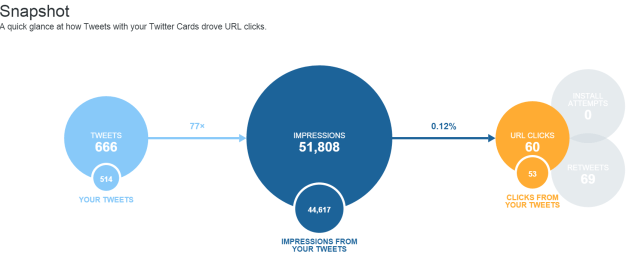
Over a 90 day period, I post just 514 Tweets from content on this site (the smaller light blue circle).

Twitter traffic report: Twitter Card data from May 20 to Aug 19, 2015

Those tweets earned 44,617 impressions and 53 link clicks (the smaller circles)! My following at the time? Roughly 2400-2600; a relatively small number by standards.

How Little Work Was Actually Involved?

Think about it. Only 514 tweets over 90 days. That’s less than 6 per day! Since my content was already written, all I did was leverage my previous work. My tweets came directly from work I already did. Posting time? My Tweets were scheduled via Hootsuite‘s bulk scheduler reducing the actual time spent posting to maybe an hour one afternoon per week! (Not sure how to do this?)

Here’s a better graphic showing just how much value I received from only a handful of Tweets. You can clearly see the number of impressions relative to the number of tweets.

Twitter traffic report: Twitter Card data from May 20 to Aug 19.2

Disclaimer:

Simply posting a handful of 100 -140 character snippets from your blog posts probably won’t drive the traffic you need but it will get you on the right track. I’m actually tweeting 15+ times per day. It’s the additional posting, the sharing content of others and being social, which has helped increase my following and build the great relationships which have contributed to my results.

Yes, it does mean more time posting, but since there is no stress on me to find or post content, I spend more time reading, engaging, being social and having fun. That makes it easy and enjoyable to find a few minutes at various points during my day to Tweet. It’s actually time I look forward to having. As an added bonus, it has made finding content almost effortless too! (Things tend to fall into your lap when you’re not really looking.)

The bottom line

Twitter is phenomenal for building relationships, creating visibility for you or your brand and driving traffic to your website. If you’re not using it, why?

12 Nov 17:02

How to Make the Right Sales Hiring Decision Every Time

by Keith Rosen

Costly hiring decisions that are doomed from the start can easily be avoided if you simply make the choice to do so.

Firing someone is never easy. Even when it’s glaringly apparent that it’s the right choice, I’ve never met a manager who likes letting someone go.

Sales managers often wait until the very last possible moment before coming to that often painful, almost shocking realization that they need to terminate someone’s employment — hoping that they’ve done everything in their power to turn that person around and make them successful in their role. But even after this difficult decision has been made, sales managers still wonder: How did it even get to this point?

Think about the people on your team who just don’t fit your culture or lack the necessary aptitude, attitude, and discipline to be successful. Most of the time, a sales rep doesn’t work out because they were never the right fit to begin with. They’re getting fired mostly because they should have never been hired in the first place!

Whether you hired them or inherited them, are you aware of the gap in your hiring and interviewing process that allowed this person to fly under the radar undetected and land on your team? Maybe the gap has nothing to do with your process, and everything to do with your attitude around hiring.

Make Hiring a Choice, Not a Need

Even if you have all the procedures in place to ensure a successful hire, the biggest mistake employers make is hiring from need rather than choice. In other words, if you are in a position where you desperately need a salesperson and you’re looking for a quick solution, there’s a strong chance that you are going to force the process. Think about how the mis-hires on your team initially made the cut.

In general, finding, assessing, hiring and onboarding top talent is a fairly high-pressure, time consuming activity. During the time that a vacant spot exists on a sales manager’s team, your company could be actively losing money. Leadership often makes it clear that somebody needs to be hired as soon as possible to fill that position to cover a territory where your competition is quickly securing market dominance.

This turns up the heat for the manager. They look at the list of the non-negotiable knowledge base, characteristics, competencies, experiences, relationships and skills needed to ensure a successful hire. Then, they review the potential candidates. They look at the clock. The pressure intensifies.

And in that instant, the deterioration begins. The managers start to concede on their list of necessary attributes.

The Erosion of Integrity

Whether you are engaging in crisis management tactics because your top salesperson left, you have more leads than you can handle, or you simply feel you can’t take on the added responsibility that comes with hiring a salesperson, taking shortcuts and omitting the necessary steps in the hiring process compromises your staffing objectives, as well as your standards of professionalism and excellence.

As time ticks away, the manager’s criteria start to erode. A candidate might not have all the necessary, non-negotiable traits, yet because of the mounting pressure to get the position filled, the justification process ensues. “Well, they have five out of eight critical, non-negotiable competencies needed. That’s not so bad, right?”

In desperation, the sales manager tells herself, “I can definitely train that new rep to develop those skills. I’ll just have to invest a little more time in them, that’s all.” Subsequently, an offer is extended to a person who is not a fit, and will likely never be.

The moment the manager feels pressured to fill the empty position in as little time as possible, the hiring process is doomed. The irony is whatever standard or value you compromise will likely become the reason you fire them or that salesperson quits.

The Cost of Compromising Your Standards

Because sales managers are reluctant to let people go, this ill-suited rep will consume a significant portion of the manager’s time over the coming months (or even years) dealing with problems that could have been avoided if they simply hired the right person to begin with!

It becomes a vicious cycle: the more time a manager gives, the less they want to admit that it isn’t working out. And for some strange reason, there exists a great population of managers who actually believe, “If I have to fire them, then I failed! And I don’t want to fail!”

And while the manager invests their precious and limited time in the wrong person, they’re not doing so with the right people on their team — the ones who actually hit their goals and make the manager look good.

The bottom line is: You can’t make the wrong hire the right fit.

Remember, you’re not serving that person, the company, or yourself keeping someone around who shouldn’t be there in the first place. In fact, you wind up hurting everyone instead.

If you make the wrong hiring decision, own it, learn from it, adjust, adapt, and move on. Otherwise, you’re bound to spend the rest of that person’s career trying to make the wrong person the right fit. And that is a quintessential exercise in futility.

Hire Slow. Fire? No!

In order to hire right, you have to hire slow. Hiring decisions made under time constraints are bound to be bad ones. And if you hire slow, you’ll be in fewer situations where you have to fire.

Take the time to find the right person for the job, and you’ll actually save countless stressful, unproductive hours. Your reward will be a positive ROI, less stress, a happier team, and more productivity.

The future of intelligent selling is powered by data. Learn more by downloading the free Salesforce e-book.

12 Nov 17:02

The 7 Habits Series #1: Know Your Audience

by Amanda Wilson

Have you read the Seven Habits for Highly Effective Sales Content yet? Don’t worry – either way, we’ve created this series of posts to highlight those 7 habits for success.

Habit #1: Know Your Audience

Think quick: Whom are you trying to reach with your content?

Unfortunately, too many sales content professionals would probably reply “anyone who will respond.” (At least this is better than “anyone with a pulse,” but not by much!)

In some way, their instincts are correct. After all, if you think about it, the first job of content is to gain attention and fill the top of the sales funnel with anyone who expresses interest. It then becomes up to salespeople or inside sales reps to further qualify these leads until they become unresponsive, “deals lost,” or more hopefully, paying customers.

So on one hand, it may be easy to rationalize the use of general content as the best way to cast a wide net and haul in prospects like proverbial fish – of all different shapes, sizes, and types to be sorted through later.

Yet in doing so, content development professionals are missing a significant opportunity to create much more effective content. By seeking to truly know their audience, what motivates them, and what type of content they are looking for. It’s the first step in attempting to create more personalized, more engaging content that can lead to better sales results.

Envision your audience

With a database full of contacts, it may seem like there’s no discernible way to truly get to know your audience. Yet there are a number of strategies you can use to categorize potential buyers to best develop content to align with their goals.

First, you can create positioning/messaging documents that attempt to categorize potential buyers into common categories such as their business role or department. This worthwhile exercise helps you begin to visualize various buyers or influencers and consider what criteria – and content – are more important to them in the buying cycle.

This exercise also shines a light on your existing content and makes it easy to determine if you need additional tools for a particular buying segment. For example, if HR is an influencer, do you have enough content that shows how your solution can help them achieve compliance with a specific regulation, improve recruiting/retention or other HR-focused metrics? If not, maybe you should.

But you should also attempt to use data fields and preferences to get to know as much about each prospect as possible. After all, you’re really attempting to engage in one-to-one marketing with your customers and prospects. For example, if your prospect is tech savvy, you may want to consider serving up content that they can open on a mobile device. Or, if not, create content that can easily be viewed on a computer or could even be printed.

Investing a little time up front to better understand your audience may seem like an extra step, and one that busy professionals may want to skip. Yet these small steps can pay huge dividends down the road and help content professionals develop much more effective – and successful – content.

Interested in learning more? Please download our whitepaper, Seven Habits for Highly Effective Sales Content, to get a closer look at seven proven strategies for developing highly effective content.

12 Nov 17:01

3 LinkedIn Updates That Are Lead Generation Gold!

by John Nemo

In case you missed it, LinkedIn recently released its quarterly earnings report, which in most cases would be yawn inducing to anyone who isn’t an investor.

However, this particular report included some important nuggets that can help you generate more sales leads, clients and revenue for your business.

Read on to find out what I’m talking about and how you can benefit from some of these new developments!

Close up of a man using mobile smart phone

LinkedIn Tip: Mobile Means Business!

LinkedIn Says: “Mobile usage on the platform continues to grow at double the rate of overall member activity, and now represents 55 percent of all traffic to LinkedIn.”

Why it matters to you: One of my favorite strategies to utilize on LinkedIn is teaching others to use the platform to funnel, fresh, targeted leads over to key landing pages on your website.

Given that more than half the people engaging with your content on LinkedIn are now looking at it via a mobile device or the LinkedIn mobile app, you better make sure your landing pages and website are mobile friendly! If not, you’re going to have a big disconnect in terms of people jumping off of LinkedIn’s app or mobile site and over to your website to sign up for a webinar, download an eBook, join an email list or whatever other type of “Call to Action” you insert inside of your LinkedIn content.

Speaking of which, you are inserting a “Call to Action” directly into your LinkedIn blog posts, aren’t you? Remember, one critical way to generate more business for yourself via LinkedIn is getting people off LinkedIn and over to your website instead. Inserting a call to action at the bottom of your LinkedIn blog posts or status updates is a great way to move the conversation off of LinkedIn and over to your online “house” instead.

Vintage Typewriter

LinkedIn Tip: Publishing Paves The Way

LinkedIn Says: “Connecting our members to relevant news, knowledge, and skills is another strategic priority integral to creating member value. Our publishing platform is central to this effort. In Q3, the number of long-form posts published per week reached more than 150,000.”

Why it matters to you: If you want to generate more sales leads, clients and revenue from LinkedIn, you must bring some sort of value to all the prospects – 400 million in more than 200 countries – gathered on the platform.

That’s why you must understand not only how to utilize, but also how to get featured on LinkedIn’s powerful “Pulse” publishing platform. Once you do, you’ll be able to add countless inbound leads and prospects almost overnight.

LinkedIn is making it clear that they want as many of us publishing on the platform as possible, and that it will reward content that brings targeted audiences valuable insights, tips or news in the process.

In your case, think about the biggest questions, challenges or problems your ideal audience faces. Start publishing LinkedIn posts that answer those questions or solve those problems, and leads are sure to follow.

This is very important: With LinkedIn, you must eschew traditional sales pitches in favor of a “Teach first, sell later” type approach. This is the 21stCentury. You cannot simply ask someone for his or her time or attention, let alone his or her money. You must earn it by being creative and helpful!

Again, you’ll find massive success if you take a moment to “reverse-engineer” your products and services into blog posts with titles like, “What Every [TARGET AUDIENCE MEMBER] Needs to Know About [SERVICE I PROVIDE].”

SEO Concept

For example, say you want to sell SEO services to Small Business Owners that you find on LinkedIn. Instead of just connecting with Small Business Owners and spamming them with 1-on-1 messages asking if they need SEO services, write a LinkedIn blog post that says, “What Every Small Business Owner Needs to Know About Choosing the Right SEO Partner.” Or an alternate title could be, “How Choosing the Right SEO Partner Can Save Small Business Owners a Fortune!”

Put some thought into the post about what you typically tell a Small Business Owner who says, “Look, I’m busy. I get this SEO stuff is important, but I have no idea where to start or how to pick an SEO agency or consultant. Just tell me what I need to know and how it’s going to helpme make more money if I do it!”

To carry this example a step further, you would then lay out in your post on LinkedIn the top questions a Small Business Owner should ask a potential SEO partner. You could even publish it like an FAQ section from a website or something similar. And, of course, you should play to your strengths as far as what types of questions you ask and the answers you give. At the end of your LinkedIn post, include a “Call to Action” where people can visit your website to learn more, or call you to discuss SEO services you provide, etc.

Not only can you publish that post publicly on LinkedIn for anyone and everyone to discover, but you can also utilize it as part of a targeted, 1-on-1 messaging campaign that can be carried out with ease using a tool like LinMailPro.

Either way, people pre-qualify themselves by first reading your content,second realizing they want/need these types of services because of how it will make them more money, and third they get to know, like and trust you by reading your content. So once they finish your LinkedIn post or watching a video you’ve made, they’re ready to talk more in the heat of the moment, and they’re already sold that you know your stuff and can bring them value. Make sure your call to action is clear on how they can take the next step with what you have to offer.

A quick caveat: Your “ask” or call to action should always be in direct proportion to the amount of trust you’ve earned. If you know that a single blog post isn’t typically enough to lead someone to immediately buy your services, make sure your “ask” reflects that! Instead of asking for a quick sale, invite the reader to download a free eBook, or get a free consultation, or join a webinar, etc. Whatever the next step is in your trust-building process is, send people to it. Once you’ve built up enough trust, then make the ask!

Sending sms

LinkedIn Tip: Messaging Matters

LinkedIn Says: “We replaced the traditional LinkedIn Inbox with Messaging, a more lightweight and casual communications interface. While still early, we have already seen a double digit percentage increasein the number of messages sent between members, and a significant lift in one day reply rates.”

Why it matters to you: Like it or not, LinkedIn messaging is here to stay. The key for you is understanding how to best utilize LinkedIn’s new messaging platform to blend the personal and professional elements that are critical to moving someone from stranger to prospect to client.

Personally, I love the new LinkedIn messaging platform, which feels more like text messaging a friend than exchanging emails with other professionals. The reason I’m so excited about this development is that there is no more powerful and effective way to sell online in the 21stCentury than with a personalized, 1-on-1 approach.

LinkedIn remains the best network on the planet to do that if you provide any type of B2B products or services, especially Business Coaching, Consulting, Training or other products or services that other professionals and companies need to utilize.

The key is understanding how, when and where to deploy this approach, and (most important) how to do it in an efficient and effective fashion. If you do, you’re going to generate more sales leads, clients and revenue than you know what to do with!

Want More LinkedIn Tips Like This?

Download my free eBook “8 Secrets to Selling More on LinkedIn” and register for my Free Webinar on using LinkedIn to generate more sales leads, clients and revenue:

Get your Free Linkedin Webinar and Linkedin Ebook

12 Nov 17:01

107 Mind-Blowing Sales Tips That Apply to LinkedIn

by John Nemo

I have to admit, when I first saw this title I thought the same thing you might be … Hyperbole Alert!

But trust me, these stats are indeed eye opening and in some cases, mind-blowing as well.

Here’s the story: I recently came across a SlideShare presentation from HubSpot titled, “107 Mind-Blowing Sales Statistics That Will Help You Sell Smarter.”

Here’s the full presentation:

(Are your “Hyperbole” or “Clickbait” alarms going off again? Just keep reading.)

I’d like to pull out three of the more shocking findings and how they should change your thinking when it comes to using LinkedIn to generate more leads, clients and revenue for yourself or your business.

Ready?

Shocking Statistic #1: 44 Percent of People Give Up After One Follow-Up … Yet 80 Percent of Sales Require FIVE Follow-Ups!

How it applies to your efforts on LinkedIn: If you take the time to track and organize your daily LinkedIn interactions with a tool like Dux-Soup, you can easily export and sort Excel spreadsheets or lists of which prospects you’re talking to, what you’re talking about and when you last talked.

That sets you up for the ability to place, ahem, follow-up “Reminders” directly on LinkedIn or via your online calendar. That way, you can reach back out to targeted prospects at the appropriate time with your follow-up messages and notes ready to go!

(FYI, the “Reminder” feature on LinkedIn is easy to use. When you’re on the individual profile page of a prospect, right under his or her photo and headline area is a box that has “Relationship” and “Contact Info” tabs. Click on “Relationship” and then “Reminder” and you’ll see how to have LinkedIn automatically remind you to reach back out to that person within a specific period of time:

LI Reminders

Shocking Statistic #2: Research shows that 35-50 percent of sales go to the vendor that responds FIRST.

How it applies to your efforts on LinkedIn: Here in the always on, 21stCentury, we are always impatient and want instant replies and responses to our queries on social media and elsewhere. (This is especially true here in the United States, where “fast-food” type service is expected anywhere you go!)

Case in point: I recently needed to hire a Virtual Assistant (VA) for a project. I put out some feelers to VA’s I’m connected to on LinkedIn, and ended up selecting the one who replied first. I did so because I was in a hurry, her experience/references/etc. looked great and I was ready to cross this item off my “To Do” list as fast as possible. The other VA’s who replied were just as qualified and had similar backgrounds and costs, and even though some responded within a few hours, it was too late – I was on to my next project!

Here’s the part you can pay attention to: The VA who won my business responded from her mobile phone while riding home in the car from a family vacation. Even though it was just a quick message saying she was traveling, she was very interested and would send more information to me later, it triggered me to go look at her LinkedIn profile, which impressed me and cemented in my mind she would be the person I needed.

Attention - Clicking Red Keyboard Button.

See how this works? I’m not saying you need to be online 24/7 to land every deal, but I can tell you that responding fast to alerts, notifications or inbound LinkedIn messages (made especially easy if you use the LinkedIn mobile app or enable notifications on your laptop computer) makes all the difference in landing those critical clients and deals we all crave.

You might not like it, and certainly I don’t live as a slave to my devices and notifications, but it’s how business gets done these days!

Being an early bird not only gets you the worm, but it also garners people’s attention and respect. And even if you don’t land the client on this particular go-round, you can bet they’ll remember you the next time they need something in your wheelhouse.

One more bonus stat from the HubSpot presentation before we leave this topic: If you follow up with a lead within 5 minutes, you’re 9x more likely to convert them!

Shocking Statistic #3: After a presentation, 63 percent of attendees remember stories. Only 5 percent remember statistics.

How it applies to your efforts on LinkedIn: I’ve said before that storytelling is the secret sauce of sales and marketing.

At our core, no matter how professional people appear or how stuffy their industry is, they are still human beings.

And, as human beings, we are hard-wired to love a good story. More important, stories make us emotional – they engage us, move our hearts … and open our wallets!

Vintage typewriter

One quick example not related to work: Our family recently volunteered for an hour at a Feed My Starving Children (FMSC) food-packing event. You spend an hour in a hairnet, scooping various dry ingredients like rice into what becomes a pre-made, ready-to-eat meal pack that looks like a steak dinner to a starving child.

Afterward, we sat down for a presentation where a FMSC volunteer shared some statistics about worldwide hunger and how many kids are in need of nutrition. (I can’t remember any of that, by the way.)

Then, he played a short video that told the story of one family of homeless kids in Africa who literally saw their lives saved and their future brightened because of these meals – just like the ones we were packing – being delivered by caring volunteers.

The story moved me to tears, and as soon as I finished crying my face off, the lights came on and the FMSC volunteer told us if we felt so moved, we could donate additional money on the spot to help buy more ingredients to feed more kids like the ones we’d just watched in the video.

I couldn’t pull out my credit card fast enough!

hands holding the sun at dawn

The same is true in business – we buy when we’re emotional, and we use reason later on to justify our purchase.

I made an impulsive, emotional choice to give a bunch of money to a charity, and later, sitting at the kitchen table with my wife, I cited statistics and data about FMSC’s high-marks with charity watchdog groups and the tax write off as additional reasons to feel good about our decision.

See how story works?

You need to be employing it all across LinkedIn – with the posts you write, the videos you share, the images you utilize and more!

Parting Thoughts

I realize I only hit on 3 or 4 of the 107 “Mind Blowing” statistics mentioned above, but trust me when I say more are coming soon in a future post!

For now, these tips should have you motivated to rethink your process and approach on LinkedIn, so get after it!

Want More LinkedIn Tips Like This?

Download my free eBook “8 Secrets to Selling More on LinkedIn” and register for my Free Webinar on using LinkedIn to generate more sales leads, clients and revenue:

Get your Free Linkedin Webinar and Linkedin Ebook

12 Nov 17:01

How to Generate an “Earthquake” of Leads on LinkedIn

by John Nemo

If Karen Nierlich’s office doesn’t fall into the ocean, she’ll be in great shape thanks to a unique new approach she’s utilizing on LinkedIn.

“I’ve been in business for a long time,” Nierlich, a San Francisco-based website developer, told me on a recent podcast interview. “I’ve done a lot of in-person networking. A lot of our business came from word of mouth and networking, meeting new people in groups. And, about two years ago, I decided that LinkedIn and all these connections could really help me. I just saw the potential to have my network online. I saw the potential to be able to take my LinkedIn network with me, if I decided I wanted to go someplace. You know … if California had its earthquake.

LinkedIn Tip #1: The Time is Now!

I’ve said it before, and I’ll say it again until I run out of oxygen – we live in the single best time in human history to turn your passion into a profession.

Nierlich is no exception.

“I have this picture of flexibility,” she says. “My kids are going to college pretty soon, and so I have this picture of myself taking off somewhere. Maybe … or maybe not. But, that’s what I wanted. So, I spent quite a bit of time reading about LinkedIn.”

LinkedIn Tip #2: Target Your Ideal Audience! 

What she found in her studies was an instant ability to target her ideal audience using the world’s largest social media network for professionals:

LinkedIn Tip #3: The Riches are in the Niches!

Nierlich also learned that, on LinkedIn at least, the riches are often found in the niches.

“Like a lot of people, I was very resistant at first to picking a niche,” she says. “I run a web and marketing business called ‘Almost Everything.’ I really enjoy working with a variety of clients. I it exciting and new, to go from one industry to another. Then in the last few years, I’ve been working with a business coach who specializes in general contractors. However, I still did not specialize in general contractors until (I got serious about LinkedIn).”

LinkedIn Tip #4: Make Your Profile Client-Facing!

One day, Nierlich decided to give the client-facing, niche approach a shot on LinkedIn.

She reconfigured her entire profile to appeal to specific clients in a specific type of industry.

The results were immediate – and ongoing:

“I got a handful of sales leads within the first couple of weeks,” she recalls. “And within a few months I’d generated 150 or so targeted, new leads for my business.”

Today, Nierlich is happy to report that she’s “100 percent full … and then some” in terms of her current client workload, with more leads lining up for work later this year … and almost all of them have come in via LinkedIn.

It almost seems too good to be true, until you understand the dynamics of LinkedIn and one of the most basic approaches to successful selling.

LinkedIn Tip #5: Understand the Opportunity!

First, there’s LinkedIn. With nearly 400 million members in more than 200 countries, and with two new members joining the network every single second, it’s the best one-stop shop there is to find and connect with other professionals worldwide.

Because it followed Facebook’s lead in terms of gathering as much personal information about each member as possible, LinkedIn makes it easy to sort and search its platform by everything from physical location to industry type to job title to schools attended and much more.

Step 1 is realizing your ideal client base is already on LinkedIn, just waiting to be found and connected with.

LinkedIn Tip #6: Understand the Psychology of Selling!

Step 2 involves understanding how to approach, engage and ultimately sell to those prospective clients.

As Dale Carnegie noted in his bestselling book How to Win Friends and Influence People, “I know and you know people who blunder through life trying to wigwag other people into becoming interested in them. Of course, it doesn’t work. People are not interested in you. They are not interested in me. They are interested in themselves – morning, noon and after dinner.”

What Nierlich embraced over on LinkedIn was making her profile more “client-facing,” following Carnegie’s lead and moving away from what so many other LinkedIn profiles look like – a virtual résumé.

To illustrate the difference, here’s the first sentence of Nierlich’s new-look LinkedIn Profile: “WHAT WE DO: We help high-end residential contractors … grow their business with marketing and modern websites.”

The rest of her summary area flows into a natural evolution of how she helps her ideal audience (residential contractors) achieve one of their goals (crafting websites that attract them more business) while solving some of their biggest pain points (lack of time and expertise when it comes to creating websites and/or online marketing services).

Nierlich finishes off her summary area with social proof, including testimonials from happy contractor customers:

Screen Shot 2015-09-08 at 11.56.13 AM

The best part was, she didn’t have to reinvent the wheel – all the content she needed was already there, just waiting to be re-formatted and shared in a way that would appeal to this target audience.

Now, does this mean Nierlich only does websites for contractors? Of course not! But in terms of identifying one specific type of customer and/or target market, it’s an ideal approach on LinkedIn.

(And, if you want to appeal to multiple audiences in different verticals, there’s an easy way to do that as well.)

“When I realized much easier it was to attract clients within a niche, suddenly it made a lot more sense to me,” Nierlich says. “That one could reduce one’s time, marketing efforts . . . and, now that I’ve started down this path, I feel like I’m being more helpful, because the advice I’m giving is so targeted to a certain profession.”

LinkedIn Tip #7: Stop Spinning Your Wheels!

She’s also eliminated one of her biggest challenges as it relates to everyday lead generation efforts.

“What I hadn’t been able to figure out was what to do on a daily basis,” she recalls. “I was spinning my wheels. I was thinking, ‘I should go do a little of this. And then a little of that.’ It was very unsatisfying because it felt so unfocused.

“So, the idea of focusing on a niche has been very significant for me. It makes me feel very confident in talking to people, and when I started publishing content on LinkedIn just for contractors, I realized I had information specific to contractors that could be very, very helpful to them. And, I had somebody contact me, just from one of my LinkedIn posts, to do work for them!”

The Rest of the Story – Listen to the Podcast!

There’s much more to share, including the daily routine Nierlich utilizes for lead generation on LinkedIn.

Podcast Cover 3

Bottom line: Anyone (and I mean anyone!) can replicate the success Karen Nierlich is having by following a few simple steps and rethinking your approach over on LinkedIn.

So what are you waiting for?

12 Nov 17:01

Track These 4 Metrics & Watch Your eCommere Business Grow

by Allen Burt

metrics to help grow ecommerce business

Have you noticed how popular tracking and collecting data have become recently? Just look at the plethora of wearables that have emerged to track fitness over the past few years: Fitbits, Apple Watches, Jawbones, and more. Why has wearable technology skyrocketed in the past few years?

Tracking human behavior has become a trend that is here to stay and expand. Wearables offer people insights into valuable data that not only lets them know how close they are towards reaching their goal, but also analyzes each bit of activity in regards to the person’s overall health. The result? More often than not, people are losing weight and becoming healthier in the process.

Now, take that concept and apply it to the health of your business. Tracking things regularly can help you understand where your ecommerce company is at in regards to a certain revenue, growth or market share goal you may have.

When it comes to eCommerce, tracking four key metrics can give you an accurate pulse on your ecommerce business, help you address key areas that increase your revenue, and help you refine your marketing process.

Learning from the Past

My previous eCommerce business, Offmap, focused on providing affordable adventure travel packages guided by your smartphone, instead of a tour guide. After my launch, and just weeks into the business, I began tracking several metrics. Because of the knowledge I extracted from this data, I was able to successfully increase my revenue just one month after I began tracking.

offmap ecommerce startup allen burt

[my previous startup, Offmap]

This post will discuss my experience with these top four metrics by analyzing data specific to my previous eCommerce company, and will outline ways for you to implement the same strategy into your own business.

Cost per Acquisition

One metric I was very fortunate to tackle early on in Offmap’s life was Cost per Acquisition (CPA). This metric was one I intentionally built into my launch strategy to keep my CPA low from Day 1.

Because of the limited number of trips we could offer in Offmap’s early days, we placed all new users on a waiting list. To incentivize sharing via Facebook, Twitter, and email, I offered users the ability to get bumped to the front of the line… but only if at least two of their friends also signed up through the unique referral link. I then incentivized sharing even more by increasing the benefits to the user: the more friends they signed up, the sweeter the deal for the user (one of the rewards was even a free trip).

ecommerce growth via social sharing incentives

As sharing is free on social media sites, my only cost was programming my site and integrating the social functionality ensured that I could validate users’ access via successful shares and signups. The main costs I incurred were those of the rewards I was giving away.

Implementing this social sharing element into my initial launch reduced my CPA from what it would have been without the sharing incentive, even with the cost of the free trip and discounts I gave out. Had I not used this acquisition strategy, I would have faced much higher costs in ad spend. I chose to bet on word of mouth via social media – plus, it’s free!

To determine your cost per acquisition, take your total marketing spend for a specific channel over a period (year/month), and then divide it by the number of customers you acquired via that channel during that period.

For example, if you spend $100 on Twitter and acquire 10 customers from that channel, your CPA would be $10 per customer for your Twitter channel.

Whether you never heard of CPA before or haven’t spent the time to monitor it in the past, it’s never too late to begin. Here are a few questions you can ask yourself to identify opportunities to lower your CPA:

  • What are my best performing products?
  • Do the products on my homepage resonate with my target demo?
  • Are my customers sharing a certain product on social media more than others?
  • Do I have channels that aren’t performing?
  • Are the people clicking on my ads being directed to relevant content?

Once you have an answer to these questions, be aggressive. By optimizing your content based on an analysis of your current CPA, you can lower your future CPA significantly. Place your best performing products on your homepage, and share them on your social media channels. Implement unique tracking URLs or offer unique discount codes to customers. Monitoring customer response to changes will give you incredible insight into what they actually want to see and buy. Your audience is your best advisor!

Shopping Cart Abandonment Rate

Offmap got off to a good start. With some early PR achieved pre-launch, we built a strong customer base within a few weeks of going live. After travel packages began selling, I decided I needed to monitor how many people were abandoning their carts by adding an adventure package, then removing it and leaving the site, or as it’s more commonly called: an abandoned cart.

Customers are tricky: Unless they are die-hard, committed fans of your brand (like Nasty Gal loyalists), chances are they will change their mind during their purchase process on your site. This can be caused for a variety of reasons, from security concerns to a poor checkout UX. In the case of Offmap, I figured out the reason for our abandoned carts was related to our customer’s mindset: they were often just ‘browsing’ or planning for the future, and not necessarily ready to buy right then. They would add the trip package to their cart, browse around, maybe view their cart, and then exit.

Sale lost… Or was it?

When I made the connection that the lack of a purchase was because these customers simply weren’t ready to buy, I began to think about my abandoned cart rate differently. It didn’t necessarily mean I was losing that percentage in sales, just experiencing the effects of a delayed purchase.

This made those users qualified sales leads, and I clearly needed to nurture this relationship. My channel of choice was email: There’s nothing more personal than a message to a customer’s Inbox. Conveniently, Offmap required users to provide their email in step 1 of onboarding, so I had a substantial list to work with.

ecommerce cart abandonment reduction require email address

[Example of my onboarding process: user email required to continue]

My recovery efforts centered around building and sending abandoned cart reminders. By showing my interested (but yet unconvinced) customer what they left in their cart and coupling it with a personalized message and reiteration of my value proposition, I was able to convert 10% of my abandoned cart users to paying customers. That percentage may not seem very high, but my product price tag was significantly higher than most consumer purchases (ranging from $800 – $1,000 USD), so 10% equated to a pretty decent amount in recovered revenue.

Although this exact scenario may not apply to you, it does highlight another very popular reason for cart abandonment: sticker shock. In fact, 56% of shoppers leave a site without making a purchase because of unexpected costs (source).

An effective strategy in minimizing “sticker shock” is to offer free shipping. Not only should you offer it, you need to make it visually apparent – front and center – that you are giving your customers this break. Though it may not be a significant reduction in overall charges (sometimes only a few dollars), simply making the customer aware that you are consuming some cost on their behalf plants the right psychological seed. When the customer sees their shipping charges zeroed out in the checkout process, they are more likely to follow through and complete the purchase knowing they are saving some cash.

To read about this subject more in depth (and how you can really leverage free shipping to your advantage), check out this blog post.

Repeat Purchase Rate

As we’ve previously noted, only 32% of customers place a second order in their first year as a customer!

Since data like this suggests that many customers visit ecommerce websites to simply buy once and fulfill a need, it’s difficult to determine if your repeat purchase rate is healthy or something that needs improvement.

Your repeat purchase rate can be calculated using this simple formula: Customers that have purchased a second time / total customers.

A year into Offmap, my repeat purchase rate was around 15%. Though this may not seem like a good number, I was only looking at a year. I couldn’t draw any firm conclusions. The travel industry, in general, needs a very large amount of data for analyzing and improving their repeat purchase rate. After all, most people only take one big trip per year. So, looking at my numbers after a year wasn’t ideal.

Still, I wanted to increase my repeat purchase rate. My initial instinct was to hit the inbox, similar to my approach with my abandoned carts. To connect with my customers who had already purchased one trip, I:

  1. Analyzed their purchase to find what they were interested in
  2. Segmented my email list into customers with similar interests
  3. Implemented this data into my ad campaign strategy, since existing customers are 14x more likely to buy as a result of marketing.

From a business development perspective, learning about your customer is one of the best investments you can make in your ecommerce business. However, figuring out which of your existing customers are the most likely to purchase a second time is the more difficult. However, tracking your repeat purchase rate is crucial to lowering your costs. If I hadn’t learned what adventure packages drew most of my customers in (the ones at a certain price point, or the ones to specific countries), and what packages were purchased repeatedly, Offmap would have drained itself of cash after that first year just in marketing costs.

Customer Lifetime Value

Since my product at Offmap had a much higher price point than many other ecommerce businesses, my typical customer would purchase from us once (maybe twice) in a 12-month period. Even though they made only one purchase per year, my customer’s’ lifetime value to my business was not any less important. In fact, it was even more important than it is for other businesses. I needed to do everything in my power to please these customers and make their experience as high quality as possible, in hopes they would return and spread the word about Offmap.

A customer’s lifetime value can be thought of as the dollar value of a customer relationship (source). You want to have a positive number for your CLV that is greater than your CPA, making your customer worth more than it cost to acquire them.

Determining your CLV is done by answering these three questions:

  1. What is my customer acquisition cost (CPA)?
  2. What is my annual profit per customer?
  3. What is my customer retention rate (CRR)?

Once you’ve figured out your CLV, it’s time to refine your data even further. Filtering these results by channel (such as AdWords, Instagram, Facebook, etc.) will provide you with insight into which channels are giving you the highest CLV. This will allow you to determine which channels to nurture further, and which to consider cutting back on. For example, if your Facebook Ads CLV is $500 but your Instagram CLV is $800, it would be wise to increase spend in your Instagram campaign.

At Offmap, my highest-value CLV channel was Facebook, and that is what spawned my incremental rollout of sharing initiatives. After the first sharing incentives proved successful, I began rolling out larger sharing rewards (successfully sign up 5 friends, get an entry for a free trip). As a result, my CPA lowered and my CLV increased.

What Gets Measured Gets Managed

Tracking these four metrics can improve your revenue figures by shedding light on your customer behavior, highlighting areas for improvement, and dialing in your marketing strategy. Think of these metrics as a “Fitbit for your business” – you’re tracking its health, measuring your progress and growth, and giving your business what it needs to thrive.

We’d love to know if you are tracking any of these metrics! If so, how is that going and did this post give you some ideas on how to get more out of the data? For those not tracking, are you going to get into the game of tracking?

12 Nov 17:00

5 Killer Reasons to Offer an E-Book on Your Website

by Rachel Parker

5 Killer Reasons to Offer an E-Book on Your Website

Recently I got a call from a marketer who was looking for “the next step” for her brand’s content marketing strategy. Their blog, social media, and email content were humming along, and they really wanted to amp things up and start growing their audience.

I said, “Great — what about an e-book?”

Silence.

“Umm, hello?”

“Yeah, I’m still here. It’s just … what the heck would we write an e-book about?”

And that’s where far too many marketers stop. They’re fine with the idea of creating content for blogs, emails, even podcasts … but an e-book? Isn’t that something only “real writers” do?

Relax. If you can write a good blog post, you can put together a terrific e-book … and here are five reasons why they’re worth the time and effort:

1. An e-book grows your thought leadership.

By gathering your expertise on a particular topic into an e-book, you set yourself apart from … well, everyone in your field who hasn’t. When you publish an e-book, you show your audiences not only that you know enough about this topic to fill some pages, but also that you can communicate your insights — and that you’re willing to share your expertise.

2. An e-book is great for lead generation.

It’s standard practice to ask visitors for at least their names and email addresses on your e-book download page; some B2B companies include fields for company name, title, and/or phone numbers as well. Once a person has submitted his or her request, you have a new lead with whom you can follow up — someone to whom you can offer further resources and eventually invite into a sales conversation.

3. An e-book is a fantastic sales tool.

One of the biggest problems your sales reps face is coming up with a reason to follow up with prospects. When you publish an e-book, you solve this problem by giving them a powerful follow-up tool: “Hey, Dan, I recall you had some questions about [topic], and I think you’ll find our new e-book extremely helpful …”

4. An e-book keeps on giving.

Unlike the average blog post or social media post, your e-book has a long shelf life, which means it can be delivering new leads week after week, month after month. Once your e-book is published, remember to continue linking to it from related blog posts, posting about it on your social media networks, and mentioning it in your podcasts and webinars.

5. An e-book grows your e-newsletter list.

Let’s face it: People don’t sign up for e-newsletters like they used to. Ask someone to sign up for your weekly tips, and you immediately conjure up an image of one more email in an already bursting inbox. But offer to send them something of value in return for their email address (which happens to put them on your list), and they’ll happily comply. (Note: While this practice is quite legal, there are better and worse ways to go about it. Consult your email marketing provider for their recommendations on best practices.)

OK, your turn: How are you using e-books to grow your list … and your thought leadership? Share your insights in the comments — we’d love to hear from you!

12 Nov 17:00

3 Social Media Strategies To Ensure Marketing Success Across Your Social Team

by Jasmine Sandler

In my daily work, I come across marketing organizations of all shapes and sizes. In this digital age and moving forward into what I call “The Age of Increasing Technology Individualism,” every company, no matter the size, requires a solid social media team and working process. There are multiple components of this team, and, most importantly, detailed metrics to measure its success. If your marketing organization has not yet invested in full social media strategies or your firm is building out its social media marketing programs, you need to have best practices deployed. Let me share here some initial social media strategy recommendations that will get you and your social team or person on your way.

Social Media Team Strategy #1: Do Not Look at Social Media as a Junior Position

Too many times, now and in the past, I have walked into mid-market and enterprise corporations where a junior person is being held responsible for an experienced marketer’s work. To ensure success in social media marketing, a professional with solid social marketing management experience should lead a team. If you do not have that person, that person can be hired or a social media trainer like myself or someone else can be brought in to train staff for the appropriate marketing skills based on recognized social media strategies. The way you can test this is to review who you have on your staff and what marketing experience they have and what what PR experience they bring to the table. A junior person can be a great supporter or coordinator if trained and managed well but should not be the main person responsible for managing your entire social media program. Social media marketing, when optimized, requires skills in analytics, writing, art direction or graphic design, marketing communication, advertising management, and adoptive use and understanding of technology. Implementing social media strategies is a serious job requiring serious and professional attention.

Social Media Team Strategy #2: Include your Sales Leader in Social Marketing

Social Media Marketing has a heavy social sales component. Social Media Marketing is about community and relationship building. Social Selling, Social Marketing, and Social Branding all support each other and follow the agreed to social media strategies. You should include your sales leader inside of your organization in weekly meetings and get an idea of how they are or are not creating and engaging in prospect social selling relationships. In the social sales continuum, marketing plays a key role in driving leads into the social ecosystem funnel. The sales leader can provide insight into what is happening in his or her team’s social selling program which will affect social media strategies and social marketing programs.

The reverse holds true as well. Content Marketing is a perfect example. Your sales team can be your best arsenal to properly distribute your corporate message and drive ongoing impressions in influential, vertical social communities.

Social Media Team Strategy #3: Your CMO or Even CEO Can Be Your Strongest Social Brand

Prospects, investors, and partners are looking in social or having their junior people research online your executives to make key buy decisions about your business. By having a C-level person from your organization with a solid online reputation actively engaged in online conversations with your communities and the online media, you have a major leg up against your competition. Social branding of the executive means creating an online brand that delivers education and value to the constituents of your organization. The executive online brand needs to have its own individual online market position and needs to deliver communications in a truly authentic manner. By leading social marketing from the top, your prospects that are highly active in social will respect your other online marketing programs. This is where true credibility can be driven in a digital age.

These are just three high-level social media strategies for social media team building. Feel free to connect with me in social and ask questions. I will continue to share stories of effective social marketing and related tactics, strategies, and new technologies in my next MENG Blog post. Finally, I hope you will join me as I lead “Social Branding for Marketing Executives,” a MENG Webinar on December 10 2015.

MENG is the indispensable community of executive level marketers who share their passion and expertise to ensure each member’s success.
Learn moreApply for Membership

11 Nov 17:31

Cosmic Crisp

by Tim Manners

cosmic-crispA new and improved version of the Honeycrisp apples may be destined for dominance, reports David Karp in The New York Times (11/3/15). Called Cosmic Crisp, it is described as “dramatically dark, richly flavored and explosively crisp and juicy.” This is an improvement over the Honeycrisp, which “set the standard for crispness, juiciness and upscale pricing. But for all its popularity, the apple is soft, quickly dissolving in the mouth. Its flavor is inconsistent and fades in long storage, and it is maddeningly difficult to grow.”

The Cosmic Crisp is “a cross of Honeycrisp and Enterprise, is firmer but not too hard to bite, and much easier for farmers and packers to manage. Firmness is crucial because it helps apples keep longer, and supermarkets demand year-round availability.” The apple, which is also “high in both sugar and acidity, not only tastes great off the tree but also retains a balanced flavor and crispness all year, even after weeks in a warm kitchen.” The bad news is that even though it was developed in 1997, it “won’t be available until 2019.”

The Cosmic Crisp’s developer, Dr. Bruce Barritt, “predicts that it could eventually account for as much as a quarter of Washington’s apple production as standards like Gala, Fuji, Braeburn, Red Delicious and Golden Delicious fade.” Other new hybrids, such as Ambrosia and Jazz, are on the ascent — sales of Ambrosia, for example, grew by 47 percent last year, while Red Delicious dropped 15 percent and Macintosh by 9 percent. This is because “many consumers are fed up with mass-market fruit chosen mainly for looks and shelf life” and want more flavor and crispness.

The post Cosmic Crisp appeared first on The Hub.


Related Stories

 
11 Nov 17:31

How the Perfect Name Changes Everything

by Pamela Wilson

the wow factor behind a great name

Take a look at the image we chose for this post.

Ten years ago, any woman reading this would have looked at the woman’s hair and thought, “Oh, her roots are growing out.” If a woman lightens her hair and then doesn’t repeat the procedure, her natural hair color starts growing in, and you see the effect above — the hair is lighter at the bottom, darker at the top.

Over the years, hair salons have earned millions of dollars helping women to keep this from happening to their hair. Until a few years ago, that is.

Now, that hairstyle has a name — it’s the “ombré effect.” According to Wikipedia, ombré “… describes the gradual blending of one color hue to another, usually moving tints and shades from light to dark.”

That’s the transformative effect of a perfect name.

The right name can legitimize a style, an approach, or a movement. It can make something that was unacceptable suddenly acceptable — even desirable!

How can you find the perfect name for your next product, project, event, or service? That’s what we’ll cover in today’s post.

The right name makes everything OK

Ten years ago, it was rather embarrassing to admit that you planned to use your vacation time to stay at home. What a lack of initiative, right?

Enter the “staycation.” A staycation is when you take time off from work, but rather than travel somewhere or plan an adventure, you don’t go anywhere at all. You stay at home.

As soon as taking time off work and spending that time at home had a name — staycation — it wasn’t embarrassing anymore. You could confidently proclaim that you planned to spend your vacation days on a staycation, and everyone understood, nodded in agreement, and thought about planning one of their own.

Can a superb name create fun where fun isn’t supposed to exist?

One thing I’ve had to adapt to since I joined the Rainmaker Digital team last year is weekly meetings with different team members so we can make decisions together and keep projects moving forward.

And meetings aren’t inherently fun, are they? Although I have to say, we manage to make them pretty fun around here. :-) We share information and make decisions, and our conversations are spiked with laughter and good-natured ribbing.

One of my weekly meetings is with Chief Content Writer Demian Farnworth and Editor-in-Chief Stefanie Flaxman. In this meeting, we set the upcoming editorial direction of the Copyblogger blog.

We finalize details about the posts we’re going to run in the week ahead and take a look at what we want to accomplish in the month as a whole. We discuss the images we need to create and any bonus content we can develop.

Fascinating stuff. But a meeting is a meeting, right?

Except early on, Stefanie made the brilliant move of naming our weekly meeting. It’s now called “The Thursday Dream Team Meeting.”

That name reflects the epic nature of what we do each week and inspires us to rise to the occasion each time we get together.

The right name can legitimize a movement

The concept of crowdfunding has been around for a long time.

Think about the local playground that was upgraded when everyone in the community chipped in a little to make it happen. Or The Statue of Liberty-Ellis Island Foundation, which has raised more than $700 million in funds to repair, restore, and maintain these two important pieces of American history.

Around 2006, we began to call this kind of social fundraising “crowdfunding.” It happened at about the time this started to become a common practice online.

Sites cropped up that allowed aspiring product developers to post their ideas and get funding so they could manufacture them. Other sites allowed people to post descriptions of important causes and ask for donations.

Crowdfunding became a thing you could easily do online. And that concise word described a complex social interaction in a way that made it easy to share the concept. It legitimized something that might have otherwise been seen as risky.

Names can describe a market you may not have realized existed

Doing business online has been called a lot of things over the years:

  • Electronic commerce, or e-commerce
  • Online marketing
  • Internet marketing

Lately, we’re using the term digital commerce to refer to the subset of e-commerce companies that create digital products and services. These products and services are marketed, delivered, and supported completely online.

(By the way, have you seen our Digital Commerce Academy? It's designed to help you build a successful digital commerce business. Take a look.)

For everyone who’s been creating ebooks, online education, membership sites, downloadable software, and offering web hosting and software as a service (“SaaS”), digital commerce describes your business.

What kinds of things deserve to have a special name?

As we’ve seen, a thoughtful, well-chosen name can add an air of legitimacy to new ideas. It can lend authority to brand-new concepts. It can rally the troops around a job to be done.

The perfect name can change everything.

Obviously, your business and your website need a solid name. But what else could use a special name?

  • New products: the right name will help prospects grasp the benefit they’ll experience from using your product.
  • Ongoing projects: even if it’s just used as an internal reference point, a solid name can help keep everyone focused on the ultimate project goal.
  • Upcoming events: the perfect event name creates excitement and shares why potential attendees should aspire to attend.
  • Work teams: help members of a team stay on track when the team name reflects what the team is contributing.
  • New services: the right name uses aspirational language to explain the service and how it will help those who use it (more on this below).

How to create a memorable name for your new “thing”

Be specific, but not too specific: Your name can be a double-edged sword if you’re not careful. On the one hand, it might perfectly describe the market you want to reach and how you serve those people.

For example, the name “Copyblogger” combines copywriting and blogging. It’s a brand we’re proud of — but on the other hand, it became limiting as a company name.

That’s one of the reasons our company rebranded under the Rainmaker Digital banner.

Ideally, you’ll find a name that appeals to the market you want to reach, but uses words that can be interpreted in multiple ways. You want to aim for a remarkable name that’s also flexible enough to grow with your business.

Use aspirational words: As Darren Rowse mentions in his excellent post, The 3 Ingredients in Our Best Selling eBook Titles, including aspirational words that evoke emotion can help position your product, service, or team in a way that makes those on the outside want to join in or buy.

Aspirational words like stunning, ideal, beautiful, perfect, and confident invoke the feeling you hope people experience when they buy your product, join your program, or become part of your team.

Words to avoid when creating your name

Avoid nonsense words: Google, Kleenex, Trello. We know these names now, but each of these brands had to spend time and energy associating these made-up words with their product or service.

Unless you have a lot of time and a big advertising budget, it’s best to avoid made-up words. The English language has plenty of words that can be combined in original ways to come up with new words that have specific meanings baked in.

Avoid proper names: This one might be a bit controversial — and of course there are exceptions to this rule — but if you’re naming a business or website, it’s generally more effective to aim for a name that explains what you offer rather than a proper name.

Take “Pamela Wilson & Associates.” What does that company do? Proper names have the same problem as nonsense words: in and of themselves, they don’t say what the business offers.

You have to spend marketing time and energy establishing the relationship between the proper name and the product or service. And if the person who owns the name decides to exit the business, things can get tricky.

So unless you’re a fine artist, musician, actor, or other creative, stick to a name that describes the benefit that will be experienced by the person who buys, joins, or attends — and avoid proper names.

It’s all in the name

The right name can inspire, motivate, and have a direct effect on your bottom line.

The stakes are high, but it doesn’t have to be daunting.

Follow the guidance here, brainstorm lots of options, recombine them in different ways, and keep at it until you’ve come up with the perfect name for your next big thing.

About the author

Pamela Wilson


Pamela Wilson is Executive Vice President of Educational Content at Rainmaker Digital. Follow her on Twitter, and find more from her at BigBrandSystem.com.

The post How the Perfect Name Changes Everything appeared first on Copyblogger.

11 Nov 17:28

Content Shock is here. Now what?

by Mark

content shock is here

About two years ago, I wrote a blog post called Content Shock: Why Content Marketing is not a sustainable strategy. And it looks like the idea may be showing up in measurable ways.

The premise behind Content Shock is simple.

In any human, natural, or economic system, when there is an overabundance of some commodity, and there is a limited capacity to consume that good, something has to change. My post was a call to arms, pointing out that what worked in content marketing a few years ago — when content was a novelty — will not work in this era or overwhelming information density. Simply, the economics of content are changing.

The evidence is in

Since then, the signs of Content Shock have rippled through every channel. Organic reach on Facebook and other platforms has dropped precipitously for most brands, while spending to promote and boost on those channels has risen dramatically. One of the predictions I made was that businesses with the deepest pockets would be in the best position to survive the slide, since the obvious options are to produce even better content (at a cost) or advertise/promote the content (also at a cost).

Buffer, a company that specializes in social sharing, reported recently that despite consistent efforts at producing unique and useful content, their social referral traffic dropped by 50 percent in just 12 months. They opined that Content Shock had something to do with it.

This week, BuzzSumo reported an even more somber view of the situation. It revealed that for even the most respected content sites on the planet — including Buffer, Copyblogger, and MOZ — social shares of content have plummeted:

content shock is here

Even more startling, the company reported that these declines occurred even when year-over-year publishing INCREASED.

The research, which analyzed the shares and links of 1 million posts, found a low level of content engagement they characterized as “striking:”

  • 50% of randomly selected posts received 8 shares or less
  • 75% of these posts received 39 shares or less
  • 75% of these posts achieved zero referring domain links

Content Shock is here

What was the reason for this poor content performance? In the words of the report’s author Steve Rayson:

Whilst in earlier years it was possible that if you produced good content it would get found and shared, almost by virtue of its quality, this is no longer the case. There is now so much content that even producing great content is not enough. The bar is way higher. Popular sites with great content are also being affected by content shock.

So while marketers around the world have been “sensing” the effects of overwhelming information density (lower traffic, fewer comments, more promotion to simply hold ground), we are now beginning to quantify it.

Of course these are just a few data points — we need to be careful about making absolute statements about causation. It is likely that the true cause of these declines is a complex cocktail of reasons. But information density and the battle for attention certainly plays some role.

So what do we do about it?

My friend Rodger Johnson recently passed on this funny story.

I mentioned your book Content Code and your blog post on content shock in my media literacy class today. What’s the first thing students do? Google it! One student was reading content shock while I was lecturing, and at one point he interrupts class with, “F#%&! We are screwed” … Which opened a whole new discussion!

Are we all screwed?

Copyblogger, Moz, and Buffer are doing a lot of things right. They have websites that are established, respected, and powerful. All of them are creating the best content in the business. If they are having problems, how can lesser content creators ever hope to compete?

You can. But it requires a change. A big change.

Great content alone does not “rise to the top.” Great content alone is no longer the finish line. It is the starting line. The answer is not in simply producing more content, or even better content. It requres a new focus on “ignition.”

The economic value of content is zero unless it is seen and shared. This suggests the need for a new marketing competency. Just HOW do we get that content to move on the web?

This is what I have articulated in my new book, The Content Code: Six essential strategies to ignite your content, your marketing, and your business. This book explores all of the possible options for an ignition-based marketing strategy, including:

  • Tactics to make your content significantly more shareable
  • The appropriate use of influencers and “borrowing trust”
  • The special role of branding in this environment
  • The unexpected influence of site authority on social sharing
  • How to find and nurture the “Alpha Audience” most likely to share your content
  • Social proof and social signals that help get your content to move
  • The new role for distribution, promotion and SEO

Information density is by far the most important trend impacting digital marketing today. It’s like a hammer pounding an anvil that will create new strategies, new platforms, new monetization strategies, and even new organizations.

I have a special treat for you today. If you want to be up to the very minute on this topic, I recently hosted Chad Pollitt on Blab and we discussed how his business, Relevance, is cutting through the content clutter with new strategies and research. Chad tells us:

  • How to find an opportunistic content niche
  • What distribution tactics are working today
  • New forms of content promotion that might be on the horizon
  • The unexpected impact mobile technology may be having on social sharing metrics
  • New pressures on content views and shares
  • Insights on content sharing and distribution trends being dictated by Facebook, LinkedIn, and Google

We are also joined on this video by Steve Rayson of BuzzSumo who provides his own take on Content Shock and how it is impacting even the best content today. Enjoy!

Click here if you cannot view the video: Social Media Office Hours: Content Distribution and Promotion

Illustration courtest Flickr CC and John Fowler

The post Content Shock is here. Now what? appeared first on Schaefer Marketing Solutions: We Help Businesses {grow}.


Comments

Related Stories

 
11 Nov 17:26

Here are the 2 best ways to keep your top employees happy — and neither costs a cent

by James Kosur

zappos happy employees

When it comes to driving employee engagement and motivating workers, there are two specific incentives that stand out among all others: Providing the ability to work autonomously and attend to work and life responsibilities on their own schedules.

Chris Gobalakrishna, the CFO of WorkStride, sat down with Business Insider to discuss the best ways to incentivize employees. 

Workstride is a company that provides employee incentive and recognition software for enterprises, helping companies develop positive office cultures.

Gobalakrishna admits that employees will always care about career advancement and compensation, but he says those are not the biggest drivers of employee retention and success in today's market. 

1. Employees want to work with a high level of autonomy.

"Employees want the ability to execute their job responsibilities as they see fit," Gobalakrishna explains. "They want to add value using their unique skill sets, to express their opinions, and contribute to the company's strategy."  

Asking employees to help develop company strategy and implement their ideas in a fast-paced environment isn't just a good idea, it's critical in today's competitive and quick-moving business world. 

2. Work-life blend is increasingly important to employees.

Forget "work-life balance." These days employees want to mix their personal lives with their work. The need to achieve a strong work-life blend is especially important to people working in the technology field, where many employees set their own schedules.

"Employers need to be flexible about where and when employees can work," Gobalakrishna says. "People don't see their careers as purely linear paths anymore and expect to make many twists and turns along the way. As such, they have multiple interests and like the ability to be able to do everything."

The idea of blending work and life has become increasingly popular of late. Alphabet CFO Ruth Porat said she doesn't believe in "balancing" her work with family responsibilities, but instead looks to "mix" them together throughout her day.

We are now seeing more parents who make it to their child's soccer match, while continuing to sporadically work from their iPad during the game. It has simply become easier for employees to pull out their mobile devices and complete a work-related task regardless of where they are or what they are doing at the time. 

SEE ALSO: The workplace frustration that plagues nonprofit CFOs is something most workers can relate to

Join the conversation about this story »

NOW WATCH: This mesmerizing video will show you why the French are good at soccer

11 Nov 17:25

It’s Time to Charge Up Your Laser Guns for Digital ABM!

by Mike Telem

MKTG-11182_iStock_000049237048_Illustration

Account-based marketing (ABM) may be the latest buzzword on every B2B marketer’s mind – but that doesn’t make it a new concept by any standard.

For years, companies have realized the importance of adopting an account-centric approach, concentrating their efforts on attracting target accounts that have particularly high strategic or financial value.

So, what’s changed? For one, the playing field is now largely digital. Long gone are the days where cold-calling and face-to-face meetings were the only option. Today, marketers have the opportunity to not only target, but also engage directly with the right people from the key accounts they’ve identified— and they are able to do this much earlier in the sales cycle.

A Quick ABM Refresher: Targeting Accounts That Matter Most

Before we dive into ABM’s digital transformation, here’s a quick refresher for anyone less familiar with the concept. Generally speaking, marketing strategies are often designed to reach and engage a relatively broad audience. Basically, marketers typically aim to attract as many leads as possible, and then move on to qualify them afterward.

ABM turns this approach on its head, and encourages marketers to map out strategic target accounts first, and then pursue those accounts using tailored content and personalized campaigns. Some liken this to fishing with net (broad-reach marketing) versus fishing with a harpoon (specific and focused).

The Evolution of ABM

Marketing and sales teams have been targeting lucrative enterprises since day one. The roots of ABM as we think of it today dates back to the 1990s, when companies started realizing the need to shift away from mass marketing and move toward customized campaigns that target individual customers.

Back then, it was nearly impossible to engage a prospect at the early stages of the buyer’s journey. For example, if a decision maker at a bank read an article in CIO magazine that referenced your company or they received a brochure from a friend recommending your software, you would never know. There was not the technology in place to capitalize on that expressed interest, or even know it was happening. There was no website for him to visit or, if there was, it likely didn’t have enough content.

At that point, companies often had to hope prospects would approach them independently. When it came to ABM in the 90s, cold calling, direct mail, industry events, or in-person meetings (which mostly revolved around sales, not marketing) were the only options. Although these activities are still very valid today, they tend to be more relevant for later stages of the sales and marketing funnel. Someone early in the awareness or interest phases likely won’t engage in these activities.

More recently, with the introduction and explosion of digital channels, a new world of account-based marketing options has emerged. Marketers now have the ability to know the company a prospect is from at the very first touch point—on their blog, website, or even ads. Now marketers can take that information and nurture this interest in real-time, using the most relevant content available.

Digital ABM: Harpoons? How About Laser Guns!

The concept of ABM, as we know it today, only began catching on in the 2000s, with the rise of demand generation and content marketing. Not surprisingly, the shift in marketing trends came hand-in-hand with another major change—the dawn of online product research.

Organizations began spending more of their time leveraging digital channels, such as websites, blogs, and videos, to educate visitors looking to learn about their products and services independently. If we fast forward to very recently, in 2014, the Acquity Group found that 94% of business buyers do some form or online research before making a purchase—with 84.3% checking business websites and 77% percent using Google search to learn more.

This surge of online research has led to the evolution of ABM and the transformation into its new digital form. This evolution has enabled marketers to implement real-time personalized account engagements as early as the awareness phases. The ability to directly engage with prospects at the earliest stages of their journey, while they’re just beginning to look into your product, is priceless. Real-Time Personalization can help identify specific individuals who belong to key accounts, and then effectively engage them by displaying the most relevant content, messages, and visuals to convert them, as well as alert relevant sales teams.

Unlike the early days of ABM, today, even if a prospect is anonymous and has never filled out a form or even visited your website, you can still know the details of their organization, based on reverse IP data, and target them with laser-sharp campaigns. Once they click through and reach your website, you can monitor which specific ads or channels they came from, and use this information to continue offering them content of interest.

The Future of ABM

The very fact that decision makers conduct research on digital channels has served as a boon for B2B marketers using ABM. It not only expands the number of options for connecting with prospects from strategic accounts, but it also enables us to engage with them from the very start of their journey.

In the past, ABM was primarily considered an outbound sales tactic; sales teams had no way to track the interest of their audience, and often relied on disruptive techniques to reach them. Digital ABM helps build a bridge between sales and marketing efforts, by letting companies pursue the “big fish” and target them with much more accurate laser guns, instead of the traditional nets, spears, or harpoons.

How have you taken your Account-Based Marketing to the next level? Share your experience in the comments section below.

Interested in learning more? Check out our webinar, Optimize Your Funnel With Account-Based Marketing.

nov-15

11 Nov 17:25

CFOs can immediately improve HR with these 4 simple changes

by James Kosur

employee

The role of the CFO is changing. Among those changes is the need to more closely align finance with strategy. 

One of the areas CFOs tend to overlook the most is human resources. 

A strong HR focus can strengthen a company's ability to find and retain top employees, cut down on training expenses, and deliver a higher level of employee value. 

Business Insider spoke with Workstride CFO Chris Gobalakrishna about how CFOs can become an integral part of the human resources equation. 

Workstride is an incentive and recognition firm that works with companies to deliver an improved workplace culture through recognition software for enterprises.

Here are the four ways CFOs can work with HR to create a more competitive workforce: 

1. Involve HR in the planning process for future company goals.

Gobalakrishna says the HR department needs to understand company goals so it can "be more effective in strategic areas such as succession planning, talent sourcing, employee satisfaction, and retention."

He argues that HR and finance need to share information so the right hiring choices can be made based on the most pressing needs of the organization. 

"Finance works with quantitative data, but does not always have the insight into employee issues that will have an impact on the budget," Gobalakrishna says. 

"Meanwhile, HR needs information from the executive team as to what resources, capabilities, and skill sets will be needed to keep the company competitive. The CFO usually has insights into all of these areas because of his or her involvement in budgeting." 

2. CFOs need to share key metrics with HR so they can understand immediate talent requirements.

The CFO has excellent insights into key business priorities that should dictate the company's people strategy. 

Gobalakrishna explains that HR needs a lot of questions answered in order to determine a strong hiring trajectory. 

"Are you trying to onboard new customers faster? Add more prospects to the pipeline? Improve your product? The type and quality of talent HR recruits is essential to achieving these goals," he explains. 

Job seekers listen to prospective employers during a job hiring event for marketing, sales and retail positions in San Francisco, California, in this file photo taken June 4, 2015. REUTERS/Robert Galbraith/Files

3. The CFO must push HR to meet quantitative goals to keep the company competitive. 

CFOs must understand that HR needs to have its own clearly defined metrics that measure its success. 

"HR should be held to the same level of rigor and discipline [as other departments] by the CFO," Gobalakrishna says. "Sales has quotas to meet; marketing has costs per acquisition; operations has time from scoping to launch or quality metrics."

To reach this goal, he counsels CFOs to push HR to track retention, measure employee satisfaction, and do compensation analysis at the company versus the rest of the industry.

4. The CFO must advocate for employee development when speaking with their executive team.

The CFO needs to be an advocate for employee career development.

Many of these programs will cost the company money upfront, but they can be invaluable in terms of retaining employees and building new skill sets among employees. 

"The CFO can advocate for employee development within the executive team to ensure that HR gets the needed resources," Gobalakrishna says. "Because there is often no immediate return on investment, the CFO may need to give weight to the initiative to get executive buy-in."

SEE ALSO: The workplace frustration that plagues nonprofit CFOs is something most workers can relate to

Join the conversation about this story »

NOW WATCH: This 580-ton monster machine is building bridges across China


11 Nov 17:23

The Free Tool That Provided Me With 5 Killer Sales Openings

by Amar Sheth

As a modern salesperson, if you want insights into what buyers are doing and saying online, start growing your LinkedIn network.

Unfortunately, many sales reps are falling behind. Research shows that more than 50% of sales professionals still have fewer than 500 connections on LinkedIn. Approximately 25% maintain between 500-1000, while less than 20% have more than 1000 connections. Going just by the numbers, salespeople have a ways to go.

But the value of your first-degree LinkedIn connections you have doesn’t lie in their number. While the size and quality of your network matter (don’t let anyone tell you otherwise), it’s more important that you use insights from your connections to nurture and engage them along their buyer’s journey, especially those that you want to serve and do business with.

What Do You Talk to Your Connections About?

Think of LinkedIn as a big social function. You’re there with 500 people you kind of know. There’s no point of attending if you don’t take the time to get to know your fellow attendees. But what do you say?

Many sales professionals (including me – I’ll often revert to good old-fashioned selling) will launch into sales pitches. I’m an addict; I can’t help it sometimes. Like you, I love what I do.

But the smarter thing to do is to talk about what’s important to these individuals. How do you determine those topics? It’s a pretty loud room, but by focusing on one group of individuals, you’re able to hone in on their conversations. You realize they’re talking about something you have knowledge about.

It’s time to step up to the plate.

How Do You Interact Online?

There are many tools that can provide you information about prospects and buyers. One free tool that’s particularly useful to salespeople is Newsle, a company that LinkedIn recently acquired. I’m a huge fan of Newsle because it helps me have targeted, relevant, and contextual conversations with my first-degree connections.

Imagine having your own personal assistant who scours the planet’s top news websites looking for news stories about your connections. In Newsle, this content feed is updated real-time and it can even be emailed to you in a digest form. Newsle keeps you informed of what’s going on and what matters to your prospects.

Here’s an example of an article Newsle curated for me:

newsle-

This company’s CEO is one of my LinkedIn connections and a prospect of mine. He may not be ready to buy right now, but I can use this information to do a whole host of things.

Here are five conversational starters I thought of approximately 30 seconds after I read this article.

I could:

  1. Congratulate him on raising venture capital (VC) funds to grow his business
  2. Provide insights into how growth-stage companies like his have invested in sales training to grow revenue and provide examples from our existing client base
  3. Let him know how one of our VC clients is advising companies in their portfolio to seek guidance from us to help grow sales
  4. Discuss changes happening in his industry
  5. Ask him how he plans to deploy these funds to help grow sales (something his investors will want to see!)

I couldn’t have begun to speak at this level if I didn’t have these insights.

The Bottom Line

The way I see it, modern sales has three components (all of which can include social selling):

  1. Insights selling
  2. Trigger event selling
  3. Referral selling

In the example above, Newsle provided me with the insights needed to practice insights and trigger event Selling.

To stand out to buyers, you need to start having targeted, relevant and contextual conversations. Newsle is a great way to gather insights that can help you start conversations with your first-degree connections. Don’t worry about the number of your connections yet – focus on nurturing and engaging those you’re already connected to.

Have you tried Newsle? What do you think of this approach? Tweet me @AmarSheth or connect with me on LinkedIn to share your thoughts.

get the free hubspot crm

11 Nov 17:23

How We Learn – One Size Doesn’t Fit All

by Erika Goldwater

A modern marketer’s job is never dull. It never ends either. Especially when the marketing technology stack keeps growing and we use so many different applications and technologies in our daily tasks. We are learning on the job every second of the day because more than any other industry, marketing is dynamically changing every day. Demand generation, public relations, customer success and uses of channels like social media and even email are much different today than they were a few years ago. Not to mention, the rules of engagement change constantly (CAN-SPAM, new Google algorithms) and success is measured by impact on the business versus vanity metrics like clicks and opens. Truly, only engagement, conversions and revenue matter at a high level for most organizations. And for marketers, that makes our jobs tougher than ever.

shutterstock_242822344So then, how do we learn? How do we become successful in new areas like data analytics or marketing automation? Individuals learn at different speeds, and respond to different methods, so one size doesn’t fit all. And for organizations trying to provide training or access to new information for their marketing teams, it is critical to understand how different people learn to optimize marketing enablement efforts.

In general, there are three types of learning that are well-known and it’s largely accepted that most people need a combination of all three styles to learn effectively:

  • Visual: Uses visual objects and prefers seeing information graphically to learn. Develop content like white papers, eBooks, infographics or analyst reports for visual learners.
  • Auditory: Learns best through hearing and speaking. Think about webinars, podcasts and lectures as types of content for auditory learners.
  • Kinesthetic: This type prefers a hands-on approach to learning via demonstration over verbal explanation. Workshops, hands-on keyboard training sessions and live trainings work best for these learners.

A recent study indicated that organizations rate their marketing personnel as less than 8% effective in executing demand generation. For this reason, it is important to offer a variety of training options to suit employees, and to encourage them to gain new skills or perfect existing skills. Engaged employees are more productive, by 22% in fact according to an article in Harvard Business Review. Even more significant, engaged organizations have double the rate of success than less engaged organizations.

So, let your employees learn, help them learn and provide a variety of options for their learning—a once a year trade show won’t cut it to keep the best employees engaged. Let them seek out new ways to learn and when you are creating content for your buyers—remember, one size doesn’t fit all. We all learn differently and have preferences on how we like to consume information.

11 Nov 17:23

Case Study: When Tragedy Strikes Your Supply Chain

by Ram Subramanian
nov15-11-200175116-004-vert

Laura Cronenberg, the CEO of Tots & Teens, sipped her black tea in the lounge of Shahjalal International Airport and took some time to collect herself before her flight departed. The past few days had been a whirlwind, and she was still trying to make sense of how her work life had transitioned so abruptly from celebration to crisis.

Editor's Note

This fictionalized case study will appear in a forthcoming issue of Harvard Business Review, along with commentary from experts and readers. If you’d like your comment to be considered for publication, please be sure to include your full name, company or university affiliation, and email address.

On Monday she’d been feting T&T’s employees in acknowledgment of the company’s fiscal-year performance. The New Jersey-based children’s clothing retailer had increased its profits by 5%, and Laura had gathered everyone at headquarters for a champagne toast. But then T&T’s chief operating officer, Jim Zappa, had pulled her aside to tell her the shocking news: A garment factory in Bangladesh that produced and packaged merchandise for T&T and other retailers had collapsed in the middle of a workday. She and Jim booked flights right away, landed in Dhaka the following morning, and took a car to the disaster site.

It was a horrible scene. Bulldozers were clearing large debris, rescue workers were searching for survivors, and a group of mothers sobbed and held up pictures of their missing sons and daughters. The area looked like the aftermath of an earthquake. According to news reports, the building had been constructed quickly and cheaply with substandard materials on a filled-in pond. More than 2,000 workers had perished, and many more were injured.

Surveying the wreckage, Laura felt queasy. The human loss was devastating, and as a mother herself, she didn’t want to imagine what the parents of the dead and injured workers were going through. But she had to stay strong; she had a job to do. The company would have to find a way to support the victims and their families and to tighten up oversight of its supply chain. Even more pressing, it needed to find a replacement facility. The fall line, which typically accounted for 80% of T&T’s revenue, was scheduled to go into production in two weeks. Laura had to quickly decide if another Bangladesh contractor could do the work or if she should shift to a factory they were already using in China.

Pros and Cons

She and Jim spent the rest of the day touring other facilities, and the next morning they returned to Shahjalal, en route to Shenzen, where they would visit one of their Chinese contractors. Now Jim joined Laura in the lounge carrying two bottled waters and an extra-tall coffee. He looked as haggard as she felt.

“That was rough yesterday,” Laura said. “I can’t stop thinking about the rubble — and the sobbing.”

“Yes,” Jim replied, nodding. A Texan and a former Marine, he could sometimes be taciturn.

“What’s your view on keeping operations in Bangladesh? Can we be sure this will never happen again?”

“I’m not sure,” he said. “Of course, there are pros and cons. A few years ago, when we decided to stop carrying other brands and create our own, we chose to manufacture in Bangladesh for the cost and convenience. Labor and transportation are cheap, quality is relatively good, and all the factories are clustered in a small area. The other pro is that Bangladesh has duty-free access to the European Union, which China and the African countries don’t have.”

Laura nodded. T&T’s five-year strategic plan called for expansion into the United Kingdom, France, and Spain, and the tax breaks would be helpful. “What are the cons?”

“Well, obviously, even though Bangladesh has established worker safety laws, standards, and regulations, they’re often sidestepped or ignored. We had no idea this factory was in such bad condition, but clearly the owners didn’t care, and the inspectors looked the other way for far too long. The facilities we saw today appear to be up to snuff. But there are no guarantees — especially when we and other retailers create so much pressure for fast turnover. There’s also a lot of corruption and chaos.”

“Can we change things for the better? What about the effort that’s under way to pull together an industry coalition for worker safety?”

“That won’t be easy or quick,” Jim said. “Moving everything to China would be more expedient and less risky. But I worry about what will happen if we just pack up and leave. I think—”

Interrupted by their boarding announcement, he broke off. “That’s us,” he said, picking up his bag.

But Laura knew exactly what he meant. If T&T exited, and others followed, where would that leave Bangladesh and its workers? She’d seen the stats. Work from the fashion industry had helped cut poverty in the country by a third and now accounted for a third of its GDP. A mass exodus would be devastating to its economy. But what if T&T stayed, and nothing substantial changed? They might have to face another disaster.

When Laura had decided that T&T should launch its own clothing lines and engage more directly with the supply chain, she’d never imagined that anything like this could happen. Now, as she and Jim walked down the tunnel to their plane, she was at a loss. In her five years as CEO, she’d successfully managed stock market crashes, layoffs, a recession, strikes, downsizing — but nothing had prepared her for this.

Costs and Risks

“We can expand operations, no problem,” Kevin Chen, the owner of the Shenzen factory, told them.

A graduate of Wharton who spoke fluent English, he was a gracious and gregarious host. And he’d been a great partner. Tots & Teens was currently producing 36% of its merchandise in China and had never had any problems there. The hangarlike factory — full of humming sewing machines and workers wearing face masks — was both pristine and efficient. Still, Laura wondered whether Kevin could execute on the promises he was making.

As she and Jim were chauffeured to their hotel in downtown Shenzhen, she picked Jim’s brain again. “Kevin says they can ramp up their operations, but do you really think they can do it as fast as he says?”

“I have no reason to believe otherwise,” Jim replied. “But I suppose there’s no guarantee.”

Laura wasn’t satisfied. “I need more than that.”

“We already use China for a large percentage of our manufacturing, and so far we’ve been happy,” Jim said. “They’ve been doing this for a long time, and they’re good at it.”

“But with an increased production load, will they be able to handle quick turnarounds?”

This was a big issue for T&T. Formerly, it took about six months for the company to design a piece of clothing, send it into production, and get it into stores. But now, because of competition from fast-fashion retailers and the capricious demands of buyers, many T&T lines were restyled every four weeks. The Dhaka factory had manufactured those products.

“I think so,” Jim said, but without his usual confidence.

Laura’s phone pinged with new e-mails. She saw a note from T&T’s head counsel, who was drafting language for the worker-safety coalition, and one from the company’s communications chief to alert management that a protest group had announced plans to assemble outside T&T’s headquarters the following afternoon.

Laura sighed. She could answer those when she got to her hotel room. She turned back to Jim. “And the cons?”

“The cost of labor in China is significantly higher and rising. But my main concern is risk. Right now we’re spread out among China, Bangladesh, and, to a lesser extent, Vietnam, Cambodia, and a few other countries. If we move more of our manufacturing into China, we’ll have 50% of our production there and we’ll be…”

Laura finished his sentence: “Exposed.”

Jim nodded. “I worry about what will happen if costs spike further. We can’t afford to have the margins drop on half our merchandise. Even worse, there could be a worker strike — or a natural disaster — which would mean half our goods delayed or destroyed.” The same scenarios had already occurred to Laura.

The car pulled up to the hotel entrance. After checking in, parting ways with Jim, finding her room, and replying to e-mails, Laura called room service for a hamburger. But by the time it arrived, she realized that she’d lost her appetite. All she wanted to do was lie down and close her eyes.

A Son’s Question

Laura had never been so happy to see the Newark airport. A 15-minute taxi ride later, she was at home in Summit and surprised to see her son, Devon, a sophomore at Columbia, sitting at the kitchen table eating chips and guacamole. “I took the train down,” he said. “Dad told me you could use some cheering up. And I was sick of dining hall and takeout food.” He grinned.

Laura asked about his classes; Devon was a political science major with a focus on international relations. Soon the conversation turned to the disaster in Bangladesh.

“The whole thing is messed up,” Devon said. “My professor says that U.S. companies are exploitative and care only about themselves. He says they’re trying to shirk their responsibilities. Is that true? I can’t believe T&T is involved in this.”

His words stung, but Laura understood. Devon reminded her of herself as a college student: passionate, idealistic, confident, and, well, naive. If only life were so simple…

“I’m sorry, Mom,” Devon said quickly. “I didn’t mean to freak out. I know this isn’t easy for you. If it’s any consolation, I’m sure you’ll make the right decision. You always do.”

Laura smiled. Unfortunately, the “right decision” had never before seemed so elusive. What would be best for the company? For T&T’s employees and customers? For the people who made its dresses, shirts, and sweaters all over the world?

Question: Should T&T relocate its production from Bangladesh to China? 

Please remember to include your full name, company or university affiliation, and e-mail address.

11 Nov 17:23

Why Cross Selling Usually Doesn't Work

by Mel Lester
No doubt you're aware that it's easier and more cost-effective to sell to existing clients than to new ones. That's reflected in the fact that 70% of architectural and engineering firms' work comes from repeat clients. So naturally most firms make it a priority to sell additional services—what's called cross selling—to existing clients.

Unfortunately, this common-sense approach falls short more often than not. Lack of success with cross selling is among the most common complaints I hear when helping firms improve their rainmaking process. Why is this so difficult? Here are the reasons I uncover most often, and what you can do to overcome them:

Discomfort selling outside your area of expertise. Not that this is a legitimate reason why cross selling doesn't work, but it certainly qualifies as a popular excuse. Ironically, many of these same professionals who feel inadequate to cross disciplinary boundaries to talk to clients about their needs will gladly pass the torch to the firm's business development specialist— despite that individual's lack of technical credentials.

Solution: Specific expertise can be a hindrance rather than a help in sales. It tempts you to look for problems that fit your skills rather than openly exploring needs from the client's perspective. Learn to ask great questions and develop your general problem solving abilities. Then bring in the proper expertise when necessary.

Management inadvertently promotes a lack of cooperation between business units. The fact is that many firm leaders complain about the paucity of cross selling while ratcheting up the pressure for individual business units to meet their sales budgets. You can't expect people to look out for the greater corporate good when the focus (and the pressure) is predominantly on how well their own group performs.

Solution: Reward people for succeeding at cross selling, or dispense with the notion that it will ever work. The firms that excel at cross selling are typically those that actively promote cross-business unit collaboration in general. Or better still, they organize as a single profit center to minimize the inter-company competition.

The difficulty of engaging different buyers within your clients' organizations. In concept, it seems straightforward to expand business with your best clients. But the reality is often quite different. For much the same reason as my previous point, your current client contacts may not be that motivated to introduce your firm to other parts of their organization. They may love you, but what's in it for them? Plus they may not know their colleagues in other business units well enough to provide you much leverage.

Solution: Selling succeeds when you can create win-win scenarios. The same is true in motivating your clients to help you cross sell. Focus on those opportunities where it's in their interest for you to serve other parts of their organization. For example, can you export a winning solution or approach to another business unit where your client contact gets the credit?

Distrust in your colleagues to deliver. Most professionals are understandably reluctant to entrust their client relationships to peers who might not uphold the same standard of care. So they resist cross selling efforts involving individuals or groups they aren't confident will come through. This situation is far more common than many firms recognize because it's rarely discussed openly.

Solution: If you suspect this problem exists in your firm, it's best to investigate it through private conversations. To encourage transparency, avoid taking sides or putting people on the defensive—simply uncover the facts (remember, perceptions in such matters effectively form the reality of the situation). Once you feel you understand the concerns, then work with the involved parties to try to resolve the issues identified.

Lack of client focus. I once participated in a planning meeting where one of the firm's executives began sketching a matrix that listed their top clients and what services they were providing to each. The purpose of this exercise was to identify where their best cross selling opportunities existed. But the most important question was ignored: What other needs do our clients have that we might help them with?

Perhaps the most prominent reason cross selling doesn't work is the lack of true client focus. When you approach the issue motivated by self interest, you're unlikely to have many productive conversations with clients about new services. Don't you think they can detect what's really driving your interest in the subject?

If you're genuinely motivated to serve your clients, cross selling becomes a natural byproduct of your commitment to help. It's driven by the client's needs, not your firm's desire to sell more. Plus, client focus is the secret to overcoming most of the problems listed above. There should be no discomfort in serving, no lack of incentive to help clients succeed. Navigating the client's organization is easier when you offer true business value. And subpar service and quality within your firm is no longer tolerated.

So my advice for cracking the code on cross selling is this: Pursue a culture of true client focus. It's not a quick fix, but it is the most powerful way to solve your shortcomings at cross selling—not to mention a whole host of other corporate benefits.
11 Nov 17:22

Change is the Real Constant in a Content Marketing Strategy

by Tracy Vides

That the ecosystem of content is built on shifting sands is an understatement.

Just the last 30 days saw five major changes in how the world’s largest social network operates.

  • Our default go-to for any sort of information – Google – has updated their algorithm nearly 100 times over the past five years.
  • Apple launches a new version of its iOS operating system nearly once a month.

This means that any marketer engaged in promoting their business on Facebook, Google or on the App Store has had no chance to stop for even a short breath.

The relentless pace at which the demands of content ecosystems have been growing mean that watching for new developments and making adjustments for them are de rigueur components of a content marketer’s job.

change-is-constant-content-marketing-strategy

Why Change?

These reforms in content strategy are not simply to keep up appearances, obviously. There are a host of reasons why continuous metamorphosis of content forms makes perfectly good sense, including the following.

Organically growing search rankings and search traffic

The regular search algorithm updates and tweaks made by Google and company mean that even the most complacent content marketer needs to revise the style of their content to match changing guidelines.

From dropping exact match domain names to avoiding inbound links from low authority sites, from removing duplicate content on your site to cleaning up your presence on local directories and listings, there are a million and one things that determine how high your site and content ranks on Google.

Better rankings mean more referral traffic from organic search. Win!

Managing organic social media engagement rates

The last couple of years have seen social media engagement rates take a sharp nosedive.

Besides the push from social networks across the board for businesses to pay to reach their fans and followers, the changes that are constantly made to users’ timelines and feeds mean that businesses have to tweak the type of posts they put up on social media to be even spotted by their fans occasionally.

This is where social media monitoring and management suites come in handy.

Oktopost is one such tool that can help you keep a watch on industry conversations in real time and get a better understanding of what drives your customers.

Oktopost also has a recommendation engine that can suggest types of content for you to share based on historic engagement and conversion rates.

By integrating your social media activity with CRM platforms like Salesforce, enterprise businesses are no longer at the mercy of changing social media rules.

Businesses can now engage one on one with users on other platforms like email using the insights that they gain from social media.

Establishing and maintaining credibility

Imagine a high schooler showing up to class sporting a mullet and a varsity jacket. So unbearably 1980s, right?

Well, just as no high school kid would be caught dead in fashion that is not on the bleeding edge, make sure you’re not spouting yesterday’s style with content and strategy.

A website that sports contemporary styling and offers content that speaks to your users’ current problems hits the right notes and will attract more viewers.

Offering content that your audience values builds your reputation and helps position your business far above your competition.

Keeping up with the Joneses

Finally, however much we may want to deny it, being flexible with one’s content strategy is also about appearances.

When your competition is flexing its digital muscle by offering users content in the forms they appreciate most, on the channels and platforms that they’re flocking to, you risk getting left behind if you don’t adapt quickly as well.

Consider it as a necessary rite of passage and get on with that long overdue content makeover.

why-change-content-marketing-strategy

What Next?

Now that we have a handle on how critical it is to have a flexible content marketing strategy, it’s probably a good idea to look at what changes to expect in the year ahead and how we can gear up for them.

Mobile will continue to dominate

2014 was the year mobile finally overtook desktop browsing as the primary means of internet access worldwide.

2015 was when Google unleashed its Mobilegeddon update in response to this fact.

2016 will see businesses falling in line with the diktats of Google and not just building mobile optimized websites, but also developing content that is mobile first.

This includes using responsive images in content marketing, creating mobile friendly forms, using larger fonts, being generous with white space, and avoiding Flash and focusing on HTML5 instead for each piece of content created.

Video will become more important

We saw the beginnings of a video revolution in 2015.

Apps like Periscope and Meerkat took social media by storm and suddenly there was a glut of video content – real-time, user-generated as well as brand driven.

This trend will step up in the year ahead.

With Instagram’s new Vine-like video app Boomerang, Facebook’s new tweaks to video content and YouTube going paid with YouTube Red, the video content scene is where all the action will be.

Personalization will take center stage

For the last few years, we’ve been hearing about how vital personalization is and how deeply it can impact a potential sale.

Unfortunately, we still haven’t seen the needle move in terms of actual adoption of personalized content by businesses.

Over 70% of brands fail to personalize even that simplest of platforms – email. Some major reasons for this shortcoming are the difficulties of harvesting targeted lists, creating accurate user profiles and segments across devices, and connecting with them by applying actionable information mined from the data overload that businesses are crushed under.

However, 2016 will see all of that change.

Big data is now not so big and scary anymore.

With features like User ID in Google Analytics, it is now possible to track individual users across multiple devices and channels.

The data from this feature can inform new marketing decisions that can target individual behaviors and extract the maximum bang for each buck spent.

Social media will be more ROI driven

So far, we were happy engaging with our fans and followers on social media.

For many businesses, this engagement and conversation became an end in itself. However, a large majority of for-profit brands have struggled to show the impact of all that social media engagement on bottom line numbers.

This struggle combined with a steady push towards commercialization by social networks themselves means that the balance of paid vs. organic content will now tilt to the former.

Businesses realize that paid ads on social media offer them a level of granular customer data that no other platform can match.

The results are further proof that social advertising works.

Another development that brands need to gear up for in the times ahead is selling directly on social media. Instead of creating content to drive traffic back to one’s website, businesses can now entice buyers to seal the deal on social media itself.

what-next

To Sum Up

Jack Welch famously said, “Change before you have to.”

If nothing else, keep that in mind when you work on your content strategy today, and you’ll be alright.

What changes are you facing with your content marketing strategy? Share with us in the comments below!

11 Nov 17:21

5 Tips to Use Networking to Actually Get More Work

by billcates@referralcoach.com (Bill Cates)

Formal networking groups can be a waste or time or a great opportunity. It all depends on how you “work it.”

I don’t remember who said it, but the saying goes something like “It’s not called net-sit, or net-eat. It’s called net-work.” Here’s a checklist of five habits you want to establish to make the most out of a networking strategy.

1) Be referable.

This is, by far, the most important item on the list. If your networking colleagues don’t fully understand how you provide value to your prospects and clients, they won’t refer you. And if they don’t like you and trust you, they won’t refer you. You have to have both conditions going for you.

One way to accomplish this is to talk about why you do what you do. Talk about your value in a way that’s personal to you. Tell your story. Provide clear examples. This brings your value to life and fosters a personal connection at the same time.

2) Meet outside the group.

It’s pretty hard to become referable in short encounters at group meetings. Identify the members who are most likely to know the types of people you want to meet. Then meet with them outside your normal meeting (over a meal is nice).

Make sure you fully understand their value and they fully understand yours. Hint: This often takes more than one meeting.

3) Give referrals.

Just because you give referrals to someone doesn’t necessarily make you referable, but it sure can help. When you do give referrals, practice the Golden Rule of Referrals: give referrals unto others as you would have them be given unto you. In other words, make valuable introductions and strive to create real connections.

4) Remember that leads are not the same as introductions.

Have you noticed how hard it is to reach people these days? Don’t settle for leads or low-level referrals (“Tell him I sent you,” “Here’s the name of a guy who could use your services -- give him a call,” etc.) Make sure you arrange an introduction. Then take the next logical step by saying to your referral source, “Let’s talk about how you introduce me to Laura. First, I want you to feel comfortable in doing so. Second, I’d like to pique her interest in hearing from me. Could you say something like ... ”

5) Get a few members to become your clients.

If there’s a “magic bullet” to making networking groups work, this would be it. It’s one thing for you to tout your value. It’s so much more effective for someone else to do so.

The members of your group who have actually experienced your value are the ones mostly like to become your advocates. Once you get one or two, the popcorn starts to pop. More and more members of the group will either want to work with you or feel more confident introducing you.

With this in mind, strive to get at least one new client out of a networking group. Then watch the work roll in.

How do you approach networking? I’d love to hear from you. Send an email directly to me at BillCates@ReferralCoach.com 

Get HubSpot CRM today!