A look into each of the characteristics top performing sales teams have in common. Watch this video to help your team achieve their full potential.

A look into each of the characteristics top performing sales teams have in common. Watch this video to help your team achieve their full potential.

congerdesign / Pixabay
Having employees can be a great way to grow your business and get more done. In fact, you may reach a point where you feel you can’t move forward with your operations until you hire some help.
While having employees is supposed to help your business progress, it can backfire if your employees are wasting too much time and not being efficient. Essentially, you’re paying them for their time. In that time, they must be able to get certain things done. If they’re not, you’re wasting money and not getting any results.
If you want to avoid this problem and employ a productive team, here are a few ways to minimize employees wasting time at work.
One of the best things you can do to minimize employees wasting time at work is set an example by being more efficient yourself. As a business owner, you set the tone for the entire team. You determine what the workflow is like along with the work-life balance.
It’s important to make sure you’re working as efficiently as possible before you start to direct a team. Set a clear start and stop time for your daily work tasks, eliminate distractions, block social media sites, and try time-blocking to get more things done before the typical afternoon slump.
If you’re just spinning your wheels and have a mile-long to-do list, you can’t really expect your employees to be much better if you’re not providing any structure. Set an example work improving your efficiency first so you can know what works and make recommendations when it comes to productivity.
Let team members know what you expect from them early on and help them create a schedule. If you’re managing a remote team this can be difficult if they intend to set their own schedule.
However, you can determine deadlines for certain tasks to help everyone stay on track. Provide thorough training so employees know how to do tasks efficiently and set expectations on how long you feel it should take them to complete the task.
Keep open lines of communication so your team can provide you with feedback on the things they’re working on and any situations that may come up during the process.
In terms of keeping lines of communication open, you can actually take this a step further and schedule regular progress meetings with your staff. This can be a perfect time to share announcements, exchange updates, and address and pending issues with the workflow or results.
You also want to make sure your employees have everything they need from you in order to be efficient. You can brainstorm during your meetings to see if there’s a better way to take on certain tasks.
Overall, your meetings don’t have to be super long. You can do 30-minute weekly or bi-weekly meetings just to make sure everyone is on track. This will provide accountability for everyone and more clarity in your business.
Yes, you read right. Giving your employees longer breaks could actually work out in your favor. According to a report from Salary.com, employees who admitted to wasting time at work said that common time-wasting activities were talking with other co-workers (43%), online activities (34%), and texting and on personal phone calls (4%).
As you can see, nearly half of the employees that were surveyed said they wasted time by chatting with other coworkers and over a third said they were browsing online.
These are all common time-wasting activities that tempt each one of us during the workday. Feeling the urge to do these things can be our mind’s indirect way of saying we need a break to recharge our focus.
Instead of trying to force employees to work more, you may get better results by giving a longer break so they can do these time-wasting activities off the clock and recharge for the rest of the workday. You can also give more frequent breaks if you’re working with a team on-site.
We all get distracted and sometimes it helps to fight it but other times, it just makes it worse. Consider increasing the break time you give employees by at least 30 minutes per day and see if it has a positive impact on the workflow.
Sometimes, incentives can go a long way. You’d be surprised at how often people are motivated by money. We all are actually. While it’s important that your employees work in your business because they understand and support your mission and genuinely like their work, a little incentive doesn’t hurt to boost productivity.
This incentive can be in the form of a bonus, prize, etc. The idea is to motivate employees to hit certain benchmarks and reward them when they do. This will help eliminate employees wasting time at work.
When I worked for a small web design start-up, I remember my boss giving us a goal each month and a bonus incentive if we reached it. While I was already pretty self-motivated, I was even more motivated to manage my time wisely and make progress during the entire month so my team could get out bonus.
If we didn’t manage time well, we’d often opt to stay late toward the end of the month to catch up. This was a voluntary action but I learned to work efficiently each week to avoid falling behind.
Other incentives I remember being offered was earning an Amazon gift card for getting our clients to leave us a review on Yelp. At the time, the company was really looking to get some more Google and Yelp reviews on our service so this was a great way for my boss to incentivize the team to ask clients for reviews.
Overall, an incentive can really give employees that extra push to get things done and avoid wasting time on daily tasks.
Ultimately, time is money and you want to minimize employees wasting time at work so your business can become successful. Use these tips to allow yourself and the whole team to be more efficient and meet important goals within the business.
China’s fast-paced growth has resulted in it being one of the most extremely flexible nations in terms of technological integration into existing infrastructure. With its relatively newer institutions and organizations, China can easily adapt existing infrastructure around current and potentially future technologies. Because of the rise of automated vehicles and their specific criteria, many have wondered how to properly establish specific infrastructure to support such technology. This is where China has an opportunity to thrive: Its more robust mechanisms for change have the capability to implement such technology on a large-scale, enabling smart highway and roads as the baseline for future infrastructure projects worldwide.
There are many definitions for the term “smart highway,” but the general consensus is that this type of roadway will allow for technological integration into current transportation roadways, including, but not limited to, functions such as generating power through solar panels, integration with self-driving cars and sensors and structural maintenance monitoring systems. Smart highways have the opportunity to turn from serving a singular purpose in being the backbone of various countries’ transportation systems to providing additional value added through the generation of power, safety feature implementation and the gathering of key data points for both drivers and transportation administrators.
In the wake of incidents such as the death of a driver in a Tesla on Autopilot mode, as well as the death of a pedestrian during an Uber self-driving pilot program, smart highways would allow for improved safety mechanisms. Automated vehicles, smart highway sensors and software programs would have increased capability to identify and stop incidents as they occur, allowing real-time feedback to enable safety features to prevent, or at least mitigate, any injury or harm to drivers. Instead of simple commands issued to the driver, which are still prone to human error, a smart highway would enable smart vehicles to work with sensors and other roadside-integrated technologies to create tools such as full-stop fail-safes in the event of an incapacitated driver.
The rise of automated vehicles throughout the world has also given rise to the idea of smart highways.
Additionally, world power consumption is on the rise, with energy demand being projected to increase by more than 25 percent by 2040. On the same note, fossil fuel consumption will also decrease, increasing the need for sources of renewable energy. Smart highways will be able to ensure full utilization of the millions of miles of roadways across the globe, dual-utilizing these vast spaces to produce energy to power not only highway-specific infrastructure, but also potentially nearby areas, such as towns, cities and even power plants. Smart highways represent an opportunity for sustainable energy growth, allowing power generation for key infrastructure, as well as potentially even charging electric vehicles as they drive.
Data aggregates collected from smart highways would also be very useful in urban planning, allowing for increased travel efficiency as well as decreased environmental pollution from vehicles. One potential example of smart highways utilized to produce results would be engineers utilizing real-time data to analyze traffic flow in a specific area in relation to lane mergers and freeway exits, optimizing roadways to ensure the least amount of time a car is stopped at any specific traffic choke point.
With the advent of automated vehicles and other smart technologies, smart highways are simply necessitated to ensure the full integration and use of such innovation. These potentially life-saving tools can be utilized to increase driver and pedestrian safety, increase clean energy consumption and promote sustainability — and even help engineers with urban, road and traffic planning.
There have been many attempts to create parts of smart highways, with specific efforts focusing on solar roads and smart traffic infrastructure projects. However, many of these efforts have been met with mixed results, running into a variety of issues that include, but are not limited to, true power efficiency and monetary cost.
In October 2014, the Netherlands established the SolaRoad pilot project, creating a 70-meter stretch of bike path. This project was met with resounding success, producing nearly 10,000 kWh in its first year. More projects are being developed off this specific one, moving to more heavy traffic areas for testing in 2019. However, this project is specifically focused on developing solar roads, and not fully integrated solar highways, in order to increase renewable energy consumption in the area.
In September 2016, Idaho-based Solar Roadways built a nearly 14-square meter roadway in Sandypoint, Idaho. However, Solar Roadways’ own report to the U.S. Department of Transportation noted how its panels “used about one-third of the electricity they generate to power their built-in LEDs,” drastically affecting efficiency of energy created, generating a mere 52.39 kWhs in six months. This has affected other solar roadway development in the United States, halting a planned 2017 Missouri solar road project near Conway, due to what Solar Roadways calls “a variety of complex red tape factors.” This project has been a cause of concern for many because of its high costs and relatively low efficiency factors in terms of energy production.
December 2016 saw what began as a Wattway, Hannah Solar and Georgia Department of Transportation-sponsored 50-square meter roadway evolving into The Ray. At nearly 30 kilometers on I-85 in Troup County, Georgia, The Ray has become one of the most comprehensive smart highways today, encompassing a solar-powered vehicle charging station, tire-safety check station and the aforementioned solar road.
Also, in December 2016, France opened a roughly 1 km solar road in partnership with French company Colas. Unfortunately, this road has not lived up to expectations, generating only 409 kWh of energy per day as opposed to an original estimate of 17,963 kWh per day, costing the French government millions of Euros to install and maintain, with 5 percent of the solar panels already requiring replacement.
As one can see, portions of smart highways have been met with limited success throughout the world. Cost, bureaucratic interference, true energy output and sustainability are just some of the many concerns that can potentially drive or tank such projects.
China’s unique nature as a rising nation seeking status as a developed one gives it immense opportunity to implement smart technologies. With a mobile-first mindset helping to carry internet to hundreds of millions of people without desktop computers, China has shown the capability to implement technology quickly and relatively efficiently. Therefore, China is the most likely place for the world’s first true smart roadways because of its unique infrastructure environment, relatively flexible bureaucracy in terms of technological implementation, as well as the robust nature of manufacturing and supply chain refinement in China.
Opening in December 2017, the largest stretch of solar road currently lies in eastern China’s Shandong province, created by Pavenergy and Qilu Transportation, with an area of 5,875 square meters. In this specific instance, China’s more rigid concrete-based roads allow for a better placement of thin solar cells, as opposed to the asphalt-based American highway system. This unique infrastructure environment allows for the easier implementation of solar technologies on such concrete-based roads.
Additionally, the Chinese are well-versed and experienced in traditional road construction, building China’s expansive expressways, as well as a lot of road infrastructure in Latin America and Africa. This is only added on to by China’s reputation as a very expeditious infrastructure builder, with Chinese companies setting records, such as building a 57-story skyscraper in 19 days and a railway station in just 9 hours. These unique infrastructure traits make China the perfect ground to build the world’s first true super highway.
China’s manufacturing might is also a key indicator of success in terms of implementation of a smart highway.
China’s relatively flexible bureaucracy, specific to technological implementation and innovation, also helps in supporting the argument of the world’s first superhighway being in China. With China clearly dominating the mobile-first environment — with 1.1 billion mobile internet subscriptions in 2017 (nearly twice the amount of the U.S. at the time) — Chinese consumers actually purchase more through mobile phones than computers, with the Chinese government playing an active role to establish infrastructure to support mobile-first technologies.
In the case of drones, China’s Civil Aviation Authority released a clear set of federal guidelines and regulations governing their use in 2016. In contrast, many Western nations have very mixed rules when it comes to drone use, with federal, state, county and municipal agencies often implementing confusing and sometimes even contrasting rules. These two examples showcase how China is very quick to implement technology throughout its country, and how its government is very forward-leaning and early adopting in this specific respect.
China’s manufacturing might is also a key indicator of success in terms of implementation of a smart highway. China’s very strong manufacturing power has catapulted it into success, from constructing simple consumer goods, to being the premier assembler of iPhones, and now to the development of very inexpensive and efficient solar panels. China has refined its supply chain process immensely well, to the point where Chinese factories are optimized from start to finish, from having the initial components of specific products mere kilometers from one another, to having the ability to ship millions of packages every day. This overwhelming efficiency has led to a key component of smart roadways being China’s premier business, with China becoming the manufacturer for roughly 70 percent of all solar panels today.
Additionally, China leads the world in solar power production, installing 34.5 gigawatts of new solar energy capacity in the first nine months of 2018 alone, while consisting of 53 percent of all solar installations in 2017 and more than 50 percent of all global installations in 2016. This heavy industrial development of solar panels within China is a huge benefit for Chinese solar roadways, allowing localized firms to quickly manufacture and implement solar roadways, and, to a further extent, smart highways. With an unrivaled manufacturing capacity and a very well-developed supply chain, China represents the most likely place for the world’s first true smart highway.
All in all, China is not only the most likely place, but the premier environment, for the world’s first smart roadway because of its unique infrastructure environment, fast-paced technology implementation standards and dominance in global manufacturing and supply chain.
The rise of automated vehicles throughout the world has also given rise to the idea of smart highways, encompassing all sorts of technologies such as sensors, solar panels and software to create a safer and more efficient driving environment. While nations such as Dubai have announced plans to develop and integrate existing smart technologies into their traffic systems, China is one of the first, if not the first, to announce plans to build a projected 161 kilometer-long smart road in its eastern Zhejiang province, integrating safety features to support autonomous driving tracked with sensors, an Internet-of-Vehicles system and solar panels.
Chinese scientists also continue to innovate in the solar sector, a key component of smart highways, achieving a record 17.3 percent power conversion efficiency rate on organic solar cells. Therefore, we can only conclude that the world’s first true smart highway will be in China, leading the way to fully integrate smart technology with current traffic infrastructure.
I am flattered that Brandon Bornancin wants to interview me for his upcoming book on the secrets to selling. I fear that I may be a little disappointing.
When Brandon and his team first asked, my response was, “The real secret is there are no secrets. You have to do the work!” I’ve been saying this in this blog, in keynotes, on LinkedIn—wherever I have the opportunity.
Somehow, that’s not what people want to hear. Somehow they want to believe there is just one thing, properly executed, causes the customer to immediately succumb, granting a meeting, issuing a PO, doing something.
And of course there are 100’s of gurus who cater to this wishful thinking. They proclaim to have discovered the secret, usually stating, “If you just do this……” That’s usually followed by a “Buy my book, enroll in my seminar, sign up for my video series….”
Of course, they’ve discovered the secret to their sales, a quote attributed to PT Barnum states, “There’s a sucker born every minute.”
There are no secrets to effective selling, we’ve known what drives sales success for decades, if not centuries. Sadly, too few people are committed to doing those things that drive success.
It’s those people who do those things day after day, week after week, month after month that achieve success. It’s those people that do those things in every customer encounter, every time that create differentiated value causing customers to want to buy from those people.
Perhaps, in my darker moments, I wonder if all of this is a sham, maybe people don’t really want to be successful. There’s some evidence to this, both at a managerial and sales person level. It’s the commitment to continuing to do the things that don’t work. Why would people who want to be successful be so committed to continuing to do the things that don’t work? Even worse, why are they so committed to doing these things that don’t work at ever escalating volume and velocity?
All one has to do is open email, look at (please don’t answer) incoming calls, look at LinkedIn or other social channels. We are pummeled with people committed to doing what doesn’t work. Whether by choice or because their managers are telling them to do. All we have to do is agree to one sales call. 90% of all the calls I see are about them and their product. They just want to pitch, it becomes my job to figure out whether I want to buy. Very few actually try to help me buy. They think they are, but all they are doing is regurgitating facts about their solutions and talking about how wonderful it will be.
Happily, there are some sales people and managers that want to excel. There are some who want to be the best, to have an impact on their customers, and to be successful. There are those that recognize the shortcut to success is doing the work. And they execute that work daily. And in the excellence they bring to that execution, people wonder, “what’s their secret to success,” when that secret is in front of them.
This is a preview of a research report from Business Insider Intelligence, Business Insider's premium research service. To learn more about Business Insider Intelligence, click here.
Between housing costs, utilities, taxes, insurance, loans, and more, US adults paid an estimated $3.9 trillion in bills last year.
 That market is growing slowly, but it’s changing fast — more than ever before, customers are moving away from paying bills via check or cash and toward paying online, either through their banks, the billers themselves, or using a third-party app.
Thanks to rising customer familiarity with digital payments, an increase in purchasing power among younger consumers more interested in digital bill pay, and a rise in digital payment options, nearly three-quarters of bills will be paid digitally by 2022, representing a big opportunity for players across the space.
In theory, banks should be in a great position to capitalize on this shift. Nearly all banks offer bill payment functionality, and it’s a popular feature. Issuers also boast an existing engaged digital user base, and make these payments secure. But that isn’t what’s happening — even as digital bill pay becomes more commonplace, banks are losing ground to billers and third-party players. And that’s not poised to change unless banks do, since issuer bill pay is least popular among the youngest customers, who will be the most important in the coming year.
For banks, then, that makes innovation important. Taking steps to grow bill pay’s share can be a tough sell for digital strategists and executives leading money movement at banks, and done wrong, it can be costly, since it often requires robust technological investments. But, if banks do it right, bill pay marks a strong opportunity to add and engage customers, and in turn, grow overall lifetime value while shrinking attrition.
Business Insider Intelligence has put together a detailed report that explains the US bill pay market, identifies the major inflection points for change and what’s driving it, and provides concrete strategies and recommendations for banks looking to improve their digital bill pay offerings.
Here are some key takeaways from the report:
In full, the report:
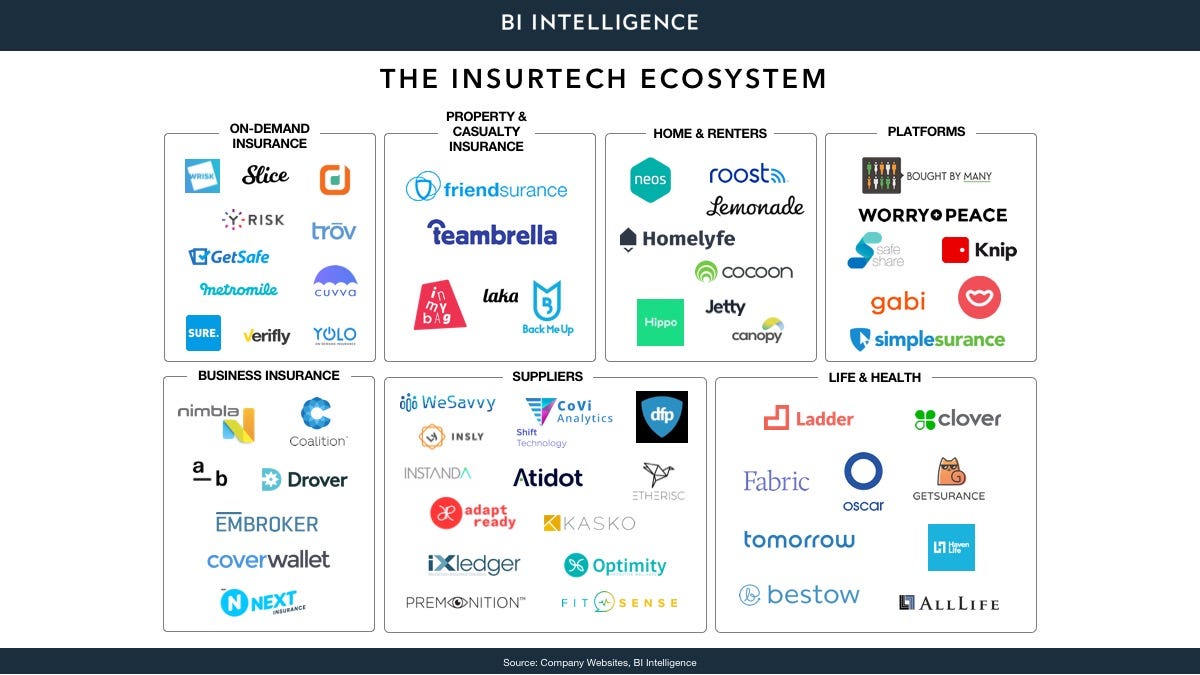
Tech-driven disruption in the insurance industry continues at pace, and we're now entering a new phase — the adaptation of underlying business models.
That's leading to ongoing changes in the distribution segment of the industry, but more excitingly, we are starting to see movement in the fundamentals of insurance — policy creation, underwriting, and claims management.
This report from Business Insider Intelligence, Business Insider's premium research service, will briefly review major changes in the insurtech segment over the past year. It will then examine how startups and legacy players across the insurance value chain are using technology to develop new business models that cut costs or boost revenue, and, in some cases, both. Additionally, we will provide our take on the future of insurance as insurtech continues to proliferate.
Here are some of the key takeaways:
In full, the report:

|
This report and more than 250 other expertly researched reports |
|
|
Access to all future reports and daily newsletters |
|
|
Forecasts of new and emerging technologies in your industry |
|
|
And more! |
“They were really interested, but the deal just fizzled out.”
Read: I didn’t do a good job helping the client understand the implications of not changing.
“The client couldn’t understand the value of our solution.”
Read: I wasn’t able to effectively convey the value of our solution.
“I would have won the deal, but my competitor beat me with their lower pricing.”
Read: The value I created wasn’t compelling or different enough for the client to pay more.
“This deal is stalled out.”
Read: I didn’t effectively gain the commitment that would have kept this deal on track.
“The client decided to go a different direction.”
Read: I didn’t get the executive sponsorship that would have ensured this initiative was funded.
“My primary contact, champion, and coach just took a new position.”
Read: I was single threaded on this deal and knew no one else.
“The gurus on LinkedIn say I should social sell and wait for inbound.”
Read: I am afraid of the very people I am supposed to be trying to help, and this allows me to pretend I am doing something to create opportunities.
“The client prefers email, so I sent them the proposal and pricing.”
Read: I lost control of the process and prefer not to have any small conflict that might cause the client not to like me.”
“No one answers their phone.”
Read: I don’t make very many calls and would prefer deals come to me.
“Clients really want to learn a little bit about who we are. It builds trust.”
Read: I don’t believe that I can create enough value myself, so I prefer to lean on the company’s history and our products to do the selling because that is where the real value is for them.
“Every client wants the lowest price.”
Read: I don’t yet know that leaders invest and buyers always ask about a lower price.
“I don’t like to read books.”
Read: I don’t understand just how critical my personal and professional development is to my results.
“My territory is terrible. That’s why I can’t make my number.”
Read: I look for excuses that I can use to rationalize my failure before I even try.
“I’ve been selling for 20 years.”
Read: There is nothing for me to learn because I prefer to have the same year over and over.
“My business is different.”
Read: I don’t want to believe that the principles of sales apply to me.
“Selling should be easier.”
Read: I don’t want to have to change.

You need to make sales. You need help now. We’ve got you covered. This eBook will help you Seize Your Sales Destiny, with or without a manager.
Download NowThe post What You Say Isn’t What I Hear appeared first on The Sales Blog.
Editor’s Note: Many of you found Strong Towns through our articles on the fiscal unsustainability of the prevailing American development pattern. A central theme of our work for ten years has been the observation that many of the places we’ve built aren’t making us wealthier over time. Rather, they are failing to even generate enough wealth to pay for the long-term maintenance of their own infrastructure. Put another way: the more of this stuff we build, the poorer we get. And it’s not hard to demonstrate this with a bit of data savvy. (For a beginner’s guide to tax-value-per-acre analysis, go here.)
Which is why we love to see advocates around the country #DoingTheMath in their own communities, sometimes in very creative and compelling ways. Logan Meyer, a mechanical engineer, lives in Denver’s Capitol Hill neighborhood and owns a historic triplex. He runs the blog Strong Denver, and he drew our attention to this analysis he conducted, which showcases which Denver neighborhoods have enough concentrated wealth and activity to pay their fair share for public infrastructure, and which ones don’t. The original post has been abridged and edited for a national audience. –Strong Towns staff.
Denver, like most American cities, has a lot of infrastructure debt that future generations, and urban dwellers in particular, are going to get stuck with the bill for maintaining and paying off. Perhaps more surprising, though, is just how many seemingly-wealthy suburban neighborhoods aren’t capable of covering the cost of their own infrastructure.
By far, the largest portion of a Denverite’s taxes goes to infrastructure (34%), and in an America that is addicted to traveling by cars and to the single family homes that require them, who is actually paying for these roads, sewer pumps, water lines, parking garages, storm water systems, parks, libraries, firehouses, and sidewalks extending into far-flung suburban neighborhoods?
While the costs for all of these pieces of infrastructure are relatively constant (a mile of road costs the same in one corner of the city as it does in another), the property tax is directly proportional to value. This property tax (20% of Denver’s revenue) combined with sales tax spent in Denver (34% of revenue), “Charges for Services” (20% of revenue), Operating Grants (9%), and Lodging Tax (5% – a 10.75% tax on AirBnBs and hotels) make up the lion’s share of Denver’s revenue (88%).

https://www.denvergov.org/content/denvergov/en/transparent-denver/revenue.html#
So with all this income, where is it getting spent? Thanks to Denver’s neat Tax Receipt Tool, we can see a breakdown of where our taxes are going. Denver uses an example of $56,258 for household income, with a $400,000 house and the tax receipt looks like this:

Click to view larger. https://www.denvergov.org/content/denvergov/en/denver-department-of-finance/financial-reports/city-budget.html
As you can see, Infrastructure (also known as “Capital Projects”) makes up 34% of the spending and is composed of all of the roads bridges, and public facilities that makes living in Denver so great. This leads to the first realization: Property taxes alone don’t cover the cost of the infrastructure to access, service and enrich Denver’s properties. With infrastructure making up 34% of Denver’s expenditures and property tax only making up 20% of the income of Denver’s budget, Sales tax receipts and “Charges for Services” largely cover the 14% discrepancy between the expenditure and revenue. Ultimately, 41% of the Capital Projects budget comes from sources other than property taxes.
Takeaway #1: 41% of Denver’s infrastructure costs to access, service, and enrich residents are paid by a source other than property taxes.
We did a deep dive into Denver’s data sets to figure out which neighborhoods are contributing more or less toward the cost of infrastructure. Let’s start with the disparity in property value per square foot across neighborhoods:

Property tax paid per square foot by neighborhood. See here and here for zoomed in neighborhood detail…
Denver’s average paid tax is $0.62 per square foot of land. This is roughly the average value per square foot of the Sloan’s Lake neighborhood (pictured). That means that in addition to property owners overall having their infrastructure subsidized by other revenue streams, residents in neighborhoods with less concentrated value than the Sloan’s Lake neighborhood are additionally being subsidized by residents in more productive (typically more dense) neighborhoods.

Many of Denver’s largest neighborhoods (by number of housing units) tend to be overwhelmingly single unit. 56.1% of units and 86.2% of land is for single family housing in Denver.
Takeaway #2: Property that pays less than $0.62 of property tax per sq. ft. land is being offset by property that pays more than $0.62 per sq. ft. land. The more productive neighborhoods are typically closer to downtown, and have residents that are typically younger and more likely to rent, according to Denver’s last census and datasets.
Let’s add another factor. Infrastructure costs are not the same for every property or neighborhood. Larger land areas require more road and sewer infrastructure to serve. If we approximate infrastructure costs by land area, the 34% of the city’s budget that goes to infrastructure comes to $1.0254 of spending per square foot of land. (Also verified by 3.32 B total expenditures * 34% infrastructure / 1.07B sq. ft. of property.)
So what if Denver charged homeowners for the actual cost of infrastructure to access and service their homes? The result would look something like this:

Click to view larger. Neighborhoods above the break even line generate enough tax to pay for their true cost of infrastructure. Neighborhoods below the break even line create annual infrastructure liabilities for the City of Denver, despite their property taxes.
Here are zoomed-in views of the left and right halves of the above graph.
Overall, older and more dense neighborhoods closer to downtown tend to be more able to pay for their own true cost of infrastructure. Suburban-style neighborhoods that tend to not pay for themselves are those with low property value per square foot—which doesn’t always mean low property value, period. Notable among the least solvent neighborhoods are some relatively well-to-do ones including Virginia Village, Green Valley, and University Hills. This is in line with emerging national awareness of these problems as described by Chuck Marohn of Strong Towns.
The above values, while only as accurate as Denver’s public data sets, represent the annual cost or benefit of the neighborhoods in regards to paying for their infrastructure. And yes, the most egregious offender on this list is Montbello, a large neighborhood of suburban-style homes, creating a $44.3 million infrastructure liability each year, followed by Virginia Village creating a $20.7 million infrastructure liability each year. This is in contrast to Denver’s downtown neighborhoods: the CBD (downtown) more than paid for its infrastructure along with a $4.3 million surplus, followed closely by LODO creating a $3.9 million surplus.
Takeaway #3: Property owners paying less than $1.054 of property tax per sq. ft. land are not paying their proportional share of Denver’s infrastructure costs. The shortfall is being covered by more productive neighborhoods, and by revenue streams other than property taxes.
(Cover photo by Kent Kanouse via Flickr. Denver’s Five Points neighborhood.)
The deal is good for your prospect. The prospect will receive all the value you promise and more, but at a price that makes it impossible for your company to generate the profit necessary to serve the client and sustain a responsible margin. The deal is great for your prospect, great for you, but bad for your company.
Your client has terms and conditions on their paper (read: contract) that shifts the liability so far in your direction that any profit you would stand to make would come at too great a risk. You want the deal, and your dream client wants the deal, but the risk-bearing party does not.
The demands your prospective client is going to make on your operations is unlike anything anyone in that role has ever experienced—or anything any other clients has ever expected. It’s not that the service level agreements are going to stretch the operations team, but rather that they’ve been set up to fail with impossible demands that would break the laws of physics. The prospect really wants what they want, and you really want the business, but it will harm people responsible.
A great company makes for a great prospect. They are financially strong and stable, and one of the ways they have such amazing cash flow is by stretching the companies that serve them with payment terms that are beyond the pale. Worse still, even though they have the money to pay and pay promptly, they make their suppliers ask for the money over and over before they pay their bills. They need your help, and you want the logo. Your company, however, doesn’t believe it is a bank.
You serve your clients, and you need to care about them. They also need to believe that you create enough value to treat you like a partner, not a supplier or vendor. The best relationships are built on mutual respect and trust, something that is difficult to do with people who have a low moral intelligence (MQ).
The company you work for is your house. It never makes sense to burn your own house to the ground.

"In The Lost Art of Closing, Anthony proves that the final commitment can actually be one of the easiest parts of the sales process—if you’ve set it up properly with other commitments that have to happen long before the close. The key is to lead customers through a series of necessary steps designed to prevent a purchase stall."
Buy NowThe post Your Loyalty Is Required appeared first on The Sales Blog.
No salesperson should ever lie to win a deal, speak poorly about your competitor, exaggerate claims about what you sell, give up too soon, lack the resourcefulness to be creative in achieving your goals, be undisciplined, be pessimistic, be negative, be cynical, allow disempowering thoughts to guide your actions (or lack thereof), fail to follow up, respond to an RFP without reading and challenging it, believe they don’t need to plan a sales call, show up to a meeting without a pen and paper, rely on their company’s history to prove they’re worth doing business with, stop reading books on their craft, stop reading books that make them more conversational, fail to continuously improve their ability to create value for their clients, waste time listening to politics or sports between sales calls, leave the office without a list of phone numbers you can dial from the road, not carry something to shine their shoes in the car, pretend they can’t use the technologies necessary in sales now, believe that their business is so different that the principles of selling don’t apply to them, lead with pricing (when that is not your business model), negotiate with their sales manager before negotiating with the client, ask for the commitment to decide before going through a process that earns you the right to ask, leave a meeting without another meeting, treat the gatekeeper and other stakeholders as if they are unimportant, watch hours of television (or Netflix) at night, avoid a necessary conflict, fail to prospect every day, fail to build a pipeline that protects you from needing bad business, take on a nightmare client for the money, share your compensation model with your client, lack credibility, accept their lack of business acumen, avoid dealing with all the stakeholders who are going to be impacted by a deal, go without executive sponsorship, send a proposal by email, give the client a demo that shows them every feature, read the client your proposal out loud, or use a high pressure sales tactic to bully a prospect.
"In The Lost Art of Closing, Anthony proves that the final commitment can actually be one of the easiest parts of the sales process—if you’ve set it up properly with other commitments that have to happen long before the close. The key is to lead customers through a series of necessary steps designed to prevent a purchase stall."
Buy NowThe post Things No Salesperson Should Ever Do appeared first on The Sales Blog.

Fewer Americans are taking public transit each year.
It’s not hard to believe, either. Around the country, service is being cut and delays are rampant in old, crumbling systems like in New York City, Washington D.C. and more. All the while, fares keep climbing.
But new research could counter arguments that the decline in ridership — posited as an emergency by some transit experts — is fueled only by those service cuts. Instead, a team from the University of Kentucky has found the introduction of ride-hailing services like Uber and Lyft have had a drastic impact on cities across the United States.
"Our research finds that standard factors, such changes in service levels, gas price and auto 11 ownership, while important, are insufficient to explain the recent ridership declines," the trio of engineers writes in the paper, presented last week at the Transportation Research Board's annual meeting.
"Our results also suggest that for each year after Transportation Network Companies (TNCs) enter a market, heavy rail ridership can be expected to decrease by 1.3% and bus ridership can be expected to decrease by 1.7%."
Using a random-effects model (similar to a common regression analysis) the team set out to look at ride-hail and transit trends in 22 of the US' largest cities. The study accounted for 10 different variables, including population, density, proportional car ownership, gas prices, and transit miles in each metro area.
Professor Gregory Erhardt, an assistant professor of civil engineering and an author of the study, says the question was catalyzed by a City Lab article from last year. That essay stated something quite bluntly of buses: "More Routes = More Riders," citing research from Canada's McGill University which said service cuts were behind declining bus service.
Ride-hailing effects are so substantial that, if the current trend continues, bus service in cities studied could be hit nearly 13% over the 8 years. And Erhardt says it won't be a problem easily fixed by just adding more buses on streets.
"We found that wasn't the case, there's something else going on" Erhardt said in an interview. "In order to offset the magnitude of this, you would need to increase bus service by about 20%, and a lot of transit agencies simply aren't going to have the resources to do that."
And even if its a faster, and sometimes possibly even cheaper, option than taking a bus — ride-hailing simply can't replace public transit due to space constraints.
"When you take those people out of a bus and into an Uber," said Erhardt, "You increase traffic and congestion for everyone, and even slow that original bus down."
Some cities, including Los Angeles and New York, have considered a congestion tax on drivers for entering downtown areas to help combat this issue. Other studies, like one by San Francisco's county transportation authority, have found that ride-hailing services also increase traffic congestion.
To that end, Uber has supported congestion pricing in cities that are considering it.
"While studies disagree on why US transit ridership is declining, everyone agrees on the solution," it said in a statement. "We need tools that help ensure sustainable travel modes like public transportation are prioritized over single occupant vehicles. That’s one reason we believe in comprehensive congestion pricing, which would provide millions to invest in cities’ public transportation systems."
Its closest competitor, Lyft, has partnered with many transit systems and even included public options inside its app in many cities. A spokesperson said that it’s committed to transportation equity for all riders.
"Lyft was founded with the mission to improve people’s lives with the world’s best transportation and many of our most popular pick-up/drop-off spots are adjacent to public transit stations, indicating that Lyft is complementary to public transit," it said in a statement. "Lyft is committed to effecting positive change for our cities by promoting transportation equity through shared rides, bikeshare systems, electric scooters, and public transit partnerships."
The final solution, though, won't be in one policy effort. Erhardt hopes his team’s research might provide useful tools as policymakers debate solutions to public transit that hemorrhaging riders, and streets that will only become more congested with time.
"The exact scope of those policies is a point of discussion," he said. "It might include congestion pricing or changing how we allocate right-of-way between cars, buses, transit, bikes, and pedestrians.
"These are the sorts of discussions we ought to be having at a policy level - its not as simple as adding more buses."
Do you work at Uber, Lyft or another ride-hailing company? Got a tip? Get in touch with this reporter at grapier@businessinsider.com. Other secure contact methods are available here.

We’re all trying to engage our key accounts, but if we really want to get better results, we have to understand what’s holding us back from reaching our goals. Furthermore, the challenges of today are not the same as those of yesterday.
To help you get a better grasp on this, I asked Katie Martell, “What’s the biggest barrier to engaging your key accounts?” Katie is one of the best on-demand B2B marketers out there, and in this video, she offers some key insights to help you break through the noise and start more conversations.
Enjoy!
TRANSCRIPT:
Brandon:
What’s the biggest barrier to engaging your key accounts? Hey there! Brandon Redlinger here, Director of Growth at Engagio, and to answer that question today, I want to bring on my friend Katie Martell. Now she is one of the best on-demand B2B marketers out there, so she definitely has some insights on this. So Katie, what is that barrier and how do we overcome it?
Katie:
Hey, Brandon. This is a great question so thank you for asking it. However, it is the same question we’ve been asking ever since ABM became anything B2B marketers have done.
Now, the key in 2019 is that more companies than ever are adopting ABM. Studies show that a majority of B2B marketers are either planning to adopt ABM or currently in the process in 2019. A majority. That likely means that not only you, but your competition is starting to adopt these tactics. So, it’s not about having the right tools, the right data, or the right technology. That is table stakes. Now it’s back to what marketing is all about, the quality of that touch point.
The truth is, buyers are going to look at every single email, direct mail campaign, ad that they see targeted to their account as an indication of the quality and the caliber of your organization’s thinking. No pressure, but I think that ABM is really where this concept of thought leadership is brought to bear.
Before you send that campaign, make sure it indicates how you can help a buying organization solve their challenges differently. Make sure it shows that you understand something about this buyer’s world that they don’t and make sure it demonstrates that you can teach them something new in order to help them get ahead. If you’re able to make that clear with every touch point, your chances of engaging that account are much higher.
B2B buyers in 2019 are looking to you for guidance and leadership. The question is: what are you going to do to make sure that is clear in every single engagement touch point for your target accounts? Good luck.

Spokespeople. Brand advocates. Experts. Sponsors. Thought Leaders. Influencers. Call them what you will, but leveraging the voices, expertise, appeal, and reach of influential people has been a standard marketing and advertising practice for at least a century. In the B2C realm, that is.
As TopRank Marketing CEO Lee Odden recently pointed out: “B2B brands are running a little behind B2C in terms of influencer marketing sophistication and have not been investing as much in technology, staff or the influencers themselves.”
In fact, recent research shows that an impressive 48% of B2C influencer programs are ongoing, however, just 11% of B2B influencer programs are always-on. But on the flip side, research also shows that interest and commitment are growing. In fact, 65% of multinational brands will increase influencer marketing spending in the next 12 months, reaching $10 billion over the next five years.
So, how do we reconcile the different worlds these statistical snapshots create? From my perspective, it all comes down to perceived value. B2B marketers, who have the difficult task of nurturing buyers through a long and winding sales cycle, want to ensure that a traditionally B2C tactic can drive the kind of results they need and want.
In a digital landscape that’s bursting with content, bubbling with consumer distrust, and growing demand for personalization—influencer collaborations offer enormous value and benefits. But don’t just take my word for it; take it from influencer marketing leaders at a range of B2B brands.
The post How Can B2B Brands Benefit from Collaborating with Influencers? Let’s Get the Scoop from the Experts appeared first on Online Marketing Blog - TopRank®.
Editor’s Note: This article first appeared on LinkedIn here.
“Who knows, you may be that close. You could be uncovering a blind spot or two away to take your career to the next height…” Assegid Habtewold, The 9 Cardinal Building Blocks: For Continued Success in Leadership
Blind spots, we all have them and they have the potential to be damaging. Unfortunately, everyone but ourselves can see these as clear as day. For sales leaders, these blind spots create unwelcome consequences. They interfere with decision-making, reduce our scope of awareness, and sabotage sales results.
A blind spot could be an unrecognized weakness. Within this context, it has the potential to undermine sales growth. The most dangerous blind spots affect those sales leaders who are unaware of the impact this may have on their sales team.
Most of the time, it’s easier to see blind spots within other sales teams than within our own. Ignorance is a sales disadvantage. Instead, sales leaders must learn to recognize the things they don’t know within their sales team and see the reality with an objective sales eye.
Blind spots can be the Achilles heel of sales leadership. Weaknesses within your sales team are aspects you can intentionally strengthen with planning, preparation and practice.
“We all have blind spots – those areas for improvement and growth. It is this acknowledgement that enables us to take the first step toward change.” Rhonda Louise Robbins
At the core of every member of your sales team, lies a beating heart. Without a heart we become lifeless. The same can be said in regards to your sales team that without a beating sales heart your sales team become sales lifeless.
How well are you coaching your sales team to invest in their heart?
What sets you and your sales team apart from every other competitor? The one thing they can bring to the business table is their heart. Combining authenticity, values, hard work and determination can drive sales success.
Wouldn’t you like to discover a new way to grow sales? Let’s remove the blinders, as you discover why the heart is at the center of your team’s sales growth.
“Know thy value, know thyself.”
Sales professionals add compelling value. The question for sales leaders, how many of your sales reps can clearly and concisely articulate their value proposition? What’s the value of each and every one of your sales reps? Do you know the value they bring to your clients and prospects?
Your sales reps must gain confidence by bringing competence and articulating value. Unfortunately, many sales reps struggle with understanding the value their buyer wants, let alone what their clients value.
Quick exercise. Ask every member of your sales team to write down their Value Proposition. If they come back uninspiring, all about them, your company and your offerings; you need to fix this now!
Value is more than just reciting the company mission statement or spouting off bullets from a brochure. Compelling value comes from combining the offerings of your company with the strengths of each one of your sales reps. This then gets filtered through what your clients say they value. This results in a clearly communicated value proposition.
Of all the challenges your sales reps face, it’s their ability to convey a valuable message that will make them or break them. The challenge is not so much as ‘getting in the door’, but it’s more a case of getting a ‘share of mind’.
“Value before Visibility – Victory.”
Without compelling value, your salespeople are going to battle completely unarmed.
Plain and simple, your sales reps must be able to drive conversation. The art of conversation is a necessary skill for your entire sales team. Conversations are the bridging mechanism to people when prospecting in and outside of your client base. Without conversations as the foundation for those relationships, your sales reps will have a hard time building a social network, uncovering sales opportunities or advancing a sale.
Great conversations require skill in driving business conversation. Great business conversations start with high levels of business acumen. It’s no longer enough for your team to be experts in your company offering’s to be successful salespeople. It’s imperative they need to be an expert in your client’s business if they want to be valued.
Business acumen is understanding the combination of the way that your client’s business works along with the way your own business works.
Are your sales reps losing sales opportunities because of their lack of business acumen?
Are your sales reps comfortable speaking with executives regarding financial matters?
Conversational Intelligence + Business Acumen = Great Sales Success
“If you’re your authentic self, you have no competition.”
Authenticity is one of the biggest challenges for salespeople in a profession riddled with scrupulous, fake and disingenuous sales reps; that quite frankly many buyers despise them. However, authenticity separates sales reps from sales professionals and this is what you need; sales professionals.
How clearly can your sales reps define themselves? Are they living as the real deal and not someone else? Do their thoughts match their actions? Does their walk match their talk?
Unfortunately, a tremendous amount of sales reps are taught old school manipulative sales tricks – strategies to sell as fast as possible. These sales strategies make it all about them and not the buyer.
“We must bring the human approach back to sales and make it about our clients, the buyer and what’s important to them.”
It starts by leading with the heart, not with the wallet.
Authenticity is a choice. It’s not easy, but for your sales team this could be the difference between just getting by and making it happen. I ask you to self-reflect for a moment, what would it mean to have your sales reps lead an authentic sales lifestyle? It’s hard work. It’s looking right into the mirror, asking tough questions and answering them. You’re in charge of your sales team and their success!
The heart gives us life. Your sales team must become more astute emotionally, intellectually and inspirationally. The heart of a sales champion lies with value intelligence, conversational intelligence and authenticity intelligence.
Your clients and prospects crave this and all you need to do is ask!
The post Attention Sales Leaders…These Three Blind Spots Could Be Holding Back Your Sales Team! appeared first on OpenView Labs.
Over the last few years, the phrase, “sales and marketing alignment” has become a major buzzword. But aside from all of the flashy stats touting the success of closely aligned sales and marketing departments, there isn’t a ton of advice out there on how to actually align sales and marketing at your company.
That’s why today, we’re taking a look at the full picture of marketing and sales alignment by exploring the what, why, and most importantly, the how of building an aligned marketing and sales department.
First things first, let’s get clear on what we’re talking about when we say sales and marketing alignment. Simply put, sales and marketing alignment is the process of creating a shared vision of the problem your company solves for your customers, and a shared goal of driving revenue.
This shared understanding is then employed by marketing to create content, campaigns, and lead nurturing programs that support the sales team in identifying the best leads to follow up with. It also helps your sales team get your best prospects over the finish line, faster.
The why of aligning sales and marketing teams is a no brainer today, with 91 percent of buyers preferring not to engage with sales until the middle or end of their buying journey. As a result, marketing content and campaigns have to do the work that sales reps used to do in the middle of the nurture process.
In fact, misalignment between sales and marketing costs B2B companies 10 percent of revenue or more per year. Companies with good “smarketing” (sales and marketing alignment) practices in place generated 208 percent more revenue from marketing efforts. And when sales and marketing teams work together, companies see 36 percent higher customer retention and 38 percent higher sales win rates.
While the what and why of sales and marketing alignment are hard to ignore, the how is often where companies end up getting stuck. Like most things in life, aligning sales and marketing is much easier said than done, but success doesn’t require a massive budget or an organizational overhaul. You can start seeing the benefits of aligning your marketing and sales teams by employing some of these simple ideas.
Start by creating more opportunities for your marketing and sales teams to build a relationship across both departments. Strengthening the connection that individual team members feel will allow information to flow more freely between departments and encourage joint creative problem solving.
This kind of connection can be difficult to force, which is why it’s important to create opportunities for it to occur organically within your company culture. So try creating a peer mentor or partnership program to pair up marketing and sales team members and encourage new personal relationships between teams.
The physical set up of your office is also important to consider here. Experts recommend seating marketing and sales teams near each other, and employing “team tables” of four to six people to encourage maximum team cohesion and group problem solving.
Building sales and marketing alignment ultimately requires a constant flow of information between marketing and sales, but that kind of seamless communication requires structure, especially when you’re working to implement changes in how your teams communicate. Not to mention, trust is absolutely critical here.
Joint editorial and content development meetings can help your marketing team draft content that your sales team wants and can actually use, based on feedback they are hearing from prospects.
 [Source]
Setting up recurring time for sales and marketing to connect on what is working on each side can also help further align your teams behind their shared ultimate goal: building revenue. Carve out time for teams to review successful sales calls and accounts together, and review messaging that is resonating with prospects. Marketing can also share top content performance, and keep sales in the loop on upcoming campaigns and tactics.
Ultimately, closely knit marketing and sales teams rely on data flow between teams to inform a more targeted, and tightly aligned strategy in both departments. But to see the kind of success described in flashy statistics requires a much more sophisticated flow of information than word of mouth can offer.
Above all else, successful sales and marketing alignment relies on marketing’s ability to send qualified leads to sales. Today, that means employing marketing technology to improve lead quality. By jointly identifying terms like MQL, SQL, and lead scoring models between marketing and sales, both teams can ensure they are working to identify useful information about prospects. Most teams will require marketing automation technology to build sophisticated lead scoring models that encompass these jointly created definitions [more on this here].
It’s also important not to overlook qualitative information in the flow of data about your prospects between marketing and sales. Tools like interactive content can help you ask questions of your prospects that help decipher buying interest from buying intent, improving the likelihood that sales is following up with the right leads.
Whether you are working to hone the processes of sales and marketing teams that are already aligned, or bringing together two teams who rarely communicate, these ideas can help marketing and sales better understand their individual needs, and create a process for working together seamlessly moving forward.
Read more on how content can support your demand generation and sales and marketing alignment efforts in our guide below.


As a developer of interactive trade show games, we’ve participated with hundreds of exhibitors as they research, select, and execute their in-booth activities. And while we’ve seen many succeed, along the way we’ve unfortunately seen exhibitors repeatedly make the same 7 avoidable mistakes. I want to share those with you, so you can avoid them:
Because trade shows require an astounding amount of details, exhibitors are notoriously overworked and time-starved. As a result, some exhibitors wait until it’s almost show time before looking for an in-booth activity. By then they are so anxious to have any activity in their booth, they jump on the first passable idea they find. With better planning, they could have taken the time to brainstorm and select a better in-booth activity. Even worse? They may have waited so long that they throw up their hands and do nothing.
While exhibitors’ main goal for their in-booth activities is to boost traffic, be mindful of the activity’s effect on their brand. If you choose an activity doesn’t mesh with your brand, you will actually cause confusion — and damage — to your reputation. Instead, choose activities that will reinforce your company’s personality and brand attributes – not fight them. And another aspect the activity should match, besides brand? Be appealing to the exhibitor’s target audience demographics.
While interesting and engaging in-booth activities pull people out of the aisles by itself, you can get even more attendees with pre-show promotion announcing your in-booth activity. Use trade show promotions across multiple media:
Booth staffer training is essential for successful in-booth activities. Your booth staffers need to know what their roles are and how to actually do the activity. You may think, “Our booth staffers don’t need to be trained, because our activity is completely performed by a third-party” (such as an entertainer or event agency). However, your booth staffers still need to know how to convert people who stopped to watch or participate in the activity into leads. And if the activity is very successful, booth staffers need to know how to “work the line” and find the qualified leads among the people waiting to do the activity.
What’s the point of hosting an activity that can’t be seen? Since most exhibitors choose their in-booth activities to catch people’s eyes as they walk down the aisle, then your activities need to be placed next to the aisle. Even better, place your activity next to the busiest traffic aisles. That said, some activities are best situated in more private settings, because the exhibitor wants to prevent distractions and keep the attendee in their booth longer. Work with your exhibit designer to set the proper stage.
Some exhibitors are fortunate to create in-booth-activities that really bring in a crowd. Unfortunately, their flow of attendees is rarely uniform, but has peak times where there are more visitors than they can handle. And then? Hard-earned leads are lost. To fix this, your can scale up your booth staff rosters in anticipation of peak traffic needs, not just average traffic needs. Your can also bring self-serve in-booth activities that can capture leads, so interested, unattended visitors can still ask to be contacted.
Unless your overriding goal is raising brand awareness, it’s a big mistake to host an activity or giveaway a promotional item without capturing the attendee’s lead data. And this is a very common mistake: in a recent SocialPoint survey, 61% of exhibitors said they had experienced not capturing lead data from visitors that took a giveaway. Plan when and how during your in-booth activities you will request and gather lead data, or else attendees will slip away anonymously.
You can host successful in-booth activities that facilitates your trade show goals, if you plan ahead, stay on brand, promote your activity before the show, train your booth staff, place the activity in the proper booth location, anticipate peak traffic times, and capture lead data.
This blog post previously appeared here.

“What is the most effective psychological ‘trick’ you use?” asks redditor PM_ME_UR_PUPPYDOGS. In a thread that’s still going strong, people are answering. Here are our favorites so far. We’ll start with a devious one from redditor usrnmtkn1:
If you’re reading this, you’re probably thinking about your current website and whether it truly meets your needs or not. A website redesign isn’t always something that a business or organization wants to do, but often is a matter of necessity. Whether your site has grown long in the tooth or simply isn’t performing as well as you like, it may be time to finally move ahead with your revamp.
But how often should you redesign your website? The truth is that depends on a number of different factors.

Credit: iStock
Time is money, so let’s get the simple answer out first. Typically, a good rule of thumb is that an average website has an approximate “shelf life” during which it is seen as new, functional and convenient for users. For the typical brand, that timespan is between 18 and 30 months – or 1.5 to 2.5 years or so.
Now that isn’t a hard and fast rule – some sites may not need a full redesign in that time, and some may need to be refreshed more frequently as business goals or market demands change. After all, age is only a number, right? However, for the reader looking for a quick answer, it’s usually a good idea to think about refreshing your website about as frequently as most of us get a new smartphone.
Outside of that broad perspective, the main driving factor behind most website redesigns is the need to solve a problem that you’re having. For some organizations, that may be a decline in business or a drop in visibility in search results. For others, it may be a more dramatic spark like a site hack or a competing site stealing content. Whatever your concern, a smart redesign may help.
When building out a renewed site, discuss the challenges you want to overcome with the team involved in designing your new site. If you want the site to drive leads, it’s important to focus on incorporating a flow of pages to lead to a form submission or information request page. If you want to sell online, on the other hand, you need pages to identify a visitor’s needs and provide them the right product or service solution as quickly and conveniently as possible. Or, if its greater visibility and traffic you want, you need to include pages and content that can be optimized for SEO – search engine optimization – to build up your online presence.

Credit: iStock
Another reason to invest in website design is more cosmetic – your site’s look and feel. Think of your website as a home. People arrive at the site and immediately get their first curb appeal impression of your brand. Is it telling them that you’re modern and engaged and capable of delivering the product, service or support they need? Or is it dilapidated, featuring outdated design elements like traffic counters or flashing banners and reeking of something past its prime? If the latter, a redesign is almost certainly what you need.
Investing in the look of your website is like renovating your home before sale. If the bathroom or kitchen haven’t seen fresh paint or new fixtures in a few decades are likely to steer buyers away in the same way that a site that looks like it’s from the early days of the internet is likely to get visitors bouncing.
But, in the same way that not every renovation project will help your home sale, you don’t need to necessarily upgrade every aspect of your existing site to see an impact. Sometimes simply giving the home page and key categories pages some TLC and applying a new look to existing content elsewhere can be just the boost you need at a fraction of the time and expense.
If your site doesn’t perform well, that’s another sure sign that it’s time to invest in a new site. This is a fairly subjective idea, however, and can take many forms and manifest in different ways. For example, if your site features high-quality content that is buried seven pages – or seven clicks – deep, that’s not an effective design. If your site has many links that lead nowhere or to defunct pages – links that lead to error or 404 pages, whether on your own site or offsite – or your pages load slowly or your site isn’t mobile responsive (a cardinal sin in today’s web), these are all signs that it’s time to kick off a website redesign.
It’s also worth considering if your site works right for you and your visitors. Is it serving as an informational resource for visitors? Are they finding what they need easily? Are you able to make updates or changes to product information, service features or inventory items easily on your own? If the answer to any of these questions is “no,” the answer to whether you need a redesign is a resounding “yes.”

Credit: iStock
Regardless of what steers you toward the redesign, you should try to make sure that any new site is as future-focused as possible to help you get the most from your investment. That means thinking about these “seven S’s” of site design:
There’s nothing wrong with coming to the decision that it’s time to put your current look out to pasture. The web is constantly evolving and adapting, and if you’re not moving to adjust with it, you’re bound to be left behind. Invest in building a new site not because you think you should, but because you need to if you want to stay relevant and offer the best content and experience to your visitors. Approaching a redesign smartly means you can work to make something that’s nimble and adaptable so you can update and change with the web. Remember that at the end of the day, redesigning and launching a redeveloped site marks just that – a launch of something new – and that work to improve and adjust it is never truly done. Your site is a living story about your brand – make sure it’s telling the right one.
This article was originally posted on the J. Fitzgerald Group blog.

Being memorable in sales translates into making more sales.
This 12-part series on how to be a memorable salesperson includes specific ways you can make yourself stand out to buyers. Each post in this CONNECT2Sell series includes research from a study with 530 B2B buyers and in-field observations from a sales coach.
This post describes how to be more memorable by doing more collaborating with buyers.

 You can subscribe to just about anything today. I can remember, as a kid, that one of our neighbors got a fruit of the month shipment. We were fascinated by what kind of fruit he might get the next month and when the box arrived – we were all there for a peek and a taste. It wasn’t just that we didn’t see a lot of papaya in Minnesota, but it was the novelty of the monthly shipments.
Fast forward to 2019 and you can subscribe to pretty much anything from razors to dog toys to clothes, cosmetics, ingredients for a complete dinner or fine wines from a specific region of the world. On the B-to-B side, there’s Leadership in a Box, MentorBox and many more. In case you think it’s all consumable products, Porsche even has its own subscription offering.
There are quite a few websites dedicated to telling buyers about their subscription options. Those websites had over 37 million visitors in 2017 and the numbers are rapidly climbing. It’s a fascinating cultural shift and it’s worth thinking more about, in terms of how we go to market with our products and services.
Like most trends, this one snuck up on us a little. Technology made companies like Netflix and Spotify seem natural. Why wouldn’t we want hundreds of thousands of movies and other videos at our fingertips for a small monthly fee? Why buy CDs when you can mix and match your music on a whim for a few dollars a month?
The subscription market has grown by more than 100 percent a year over the past five years, according to McKinsey and many of the big brands like P&G, Under Armour and others are now jumping in. 46 percent of consumers subscribe to some sort of streaming media service and if we have one, we’re likely to have more. The McKinsey study found that the “median number of subscriptions an active subscriber holds is two, but nearly 35 percent have three or more.”
What are the elements that make a subscription model work?
Personalization is key: In many cases, it’s the ability to cherry pick the items or types of items that are appealing to the subscriber. The personalization might also be in frequency of delivery or the number of items in the shipment.
A specific why: Some subscription services like Dollar Shave Club are all about having a steady supply of the items. The fashion boxes are all about having someone else recommend the right look for you and then do all the work of putting together just the right pieces. Some are a blend of the two. The meal subscriptions are about having someone else figure out what’s best for you and serving it up right when you need it. The B-to-B boxes like MentorBox are about access to information and insights.
Creating a connection: All subscribers drift off eventually. The key is to maintain the subscription for as long as you can. The longer they subscribe, the more profitable it is for you. The tone of your communication, the access you offer to your CEO or leadership team and the secrets you let your subscribers in on can all deepen the relationship and extend the subscription.
Build a community: There’s incredible power in word of mouth, referrals, and reviews for subscription services. Find ways to connect your subscribers, whether it’s a Facebook group, a car window decal or exclusive events where they can meet in person.
What do you think? Could your business jump on the subscription bandwagon? Before you dismiss it out of hand, do a little legwork. I think you’ll be surprised about who is active in the space.
The post Do you subscribe to the subscription trend? appeared first on McLellan Marketing Group.

Booking high-quality meetings is one of the most underappreciated opportunities sales teams have. We all want to learn the best tactics for negotiating and closing deals. But try getting people excited about appointment setting. Yet, no matter how you look at it, there’s one truth in sales: You can’t win a deal if no one’s willing to talk to you.
B2B appointment setting might not be the sexiest topic to cover. But it’s the foundation that your entire sales process is built on.
In this post, we’re going to run you through everything you need to know about setting better appointments, from how to set more appointments, when and how often to send reminders, to what to do after the call and how to turn no-shows back into hot leads.
Want to up your cold emailing game and start booking more sales appointments? Download our free appointment setting email template here.
Appointment setting is both a science and an art. Sure, there are tools and techniques that have been proven to increase your response rate. But the art is in how you sell the meeting.
Yet most sales teams don’t pitch the value of the meeting itself. We assume everyone knows what a product demo is and why they’d want to spend their time going through one. But why should that prospect give you their time?
Think about the last time someone called or emailed asking for a few minutes of your time. If you said yes, it was probably because they proved to you the ROI of taking the meeting.
That’s exactly what you need to do when you’re trying to set more appointments. Don’t give some long-winded request or backstory. Just get to the point and show the prospect that setting this appointment is going to save them time and help them get to a better decision faster.
The last thing you want is to fall into the trap of what Rachel Williams, Director of Sales and Partnerships at Calendly, calls, the “show up and throw up” appointment setting call or email. These are where you list all the ways your product is amazing in the hope that one of them sticks. But your prospect doesn’t have time for this. Plus, they don’t know you. So why should they care?
If you don’t sell the appointment, you can never sell your product. So don’t underestimate the importance of your appointment setting outreach.
One of the biggest questions in sales and in appointment setting is whether you should reach out by email or phone. The simple answer is both. The more complex one is that it depends on your team and your customer.
First, ask yourself how big of a sales opportunity is this? Is this a high-pressure situation where you need a response now and should call? Or is your sales process longer and it’s fine to email and follow up online?
Next, where and when is your customer most likely to respond? You know your prospect better than anyone. Do they respond better to cold calls or emails? Are they going to see your number pop up on their screen and take that call? Or do you need to email them when you know they’ll be sitting down at their computer?
Cold calls and emails aren’t your only option either. When you’re trying to set more appointments you need multiple touchpoints with your prospect. Add them on social media or comment on one of their latest updates. Let them know who you are and that you’re interested in talking to them.
Whichever method you choose, when a prospect gets back to you, set the appointment as soon as possible. Ideally, that same week. If you set an appointment too far in advance, you’re going to have to continually check back with them and get their buy-in. Capture the momentum of a quick call and push your prospect into your pipeline.
Like all cold emails, your appointment setting messages will do better if you know exactly who you’re sending it to. This means having a deep understanding of who your ideal customer is and how you can sell the value of taking the meeting to them.
That means sending an appointment setting email that is:
It’s a lot to pack into a few sentences. Which is why one great tip is to share your email with the ideal customer within your own company.
So for example, if your ideal customer is a VP of Marketing, then show your email to your VP of Marketing. Is it something they’d open and read? Does it make them want to connect with you? Ask for their honest opinion, because they’ll know better than anyone else.
And don’t be afraid to get creative, either. Scott Barker, Head of Partnerships at Sales Hacker and his team use a “Fake Cold Call” email template for their cold outreach. Not only has it helped them land hundreds of sales appointments and contracts, but they consistently get a 70-80% response rate.

When it comes to setting appointments over email, you also need a tool that lets you send personalized emails at scale and be incredibly organized so you can respond quickly and timely.
Close's integrated Sales Inbox lets you quickly see all your appointment setting activity in one place—including emails, calls, voicemails, tasks, and reminders. This way you can track every touchpoint with your lead as you set appointments.

And with our two-way email syncing, you can set automatic follow-up reminders, use personalized templates, and send bulk appointment setting emails, all from your CRM.

Depending on your prospect and your industry, a cold email might not be the best way to set sales appointments. Plus, if you don’t have insight into the deliverability of your emails, you don’t know if they’re ending up in the spam or just being ignored. And with new data protection laws like the GDPR coming into effect, cold emailing lists might be a thing of the past.
That’s why cold calling is another fantastic option for appointment setting. But again, it comes with its own specific best practices.
For one, it’s always a good idea to let a prospect know who you are before you call them. This is as easy as following them on social media or checking out their LinkedIn page. Just a bit of engagement can go a long way in creating a “warm call” rather than a strictly cold one.
Second, you need to have insights into the success rate of your calls and how many it takes to land an appointment. This is where having a CRM with built-in VoIP calling like Close is so important for appointment setting.
Not only are you able to make more calls thanks to one-click dialing and our built-in Power Dialer call automation, but all appointment setting calls can be recorded and tracked to give you insights into how effective your cold calls truly are.

As Troy Logan, Founder and VP of Operations at Saleshuntr explains:
“Saleshuntr Inc. started out as an ‘appointment setting and tracking’ CRM product. We hired multiple software developers onshore and offshore to build the features we were looking for. But after a couple of years of mediocre results someone told us about Close.”
“Close had all the features we were looking for and more. Incorporating VoIP with a CRM changed our business model. We became an outsource appointment setting company. Today Saleshuntr Inc. uses Close exclusively to set appointments for our clients.”
For Saleshuntr, using Close to set appointments has changed the way they operate their business in a number of ways:
“We tried a host of other CRM's and I can tell you, some VP of engineering must of have designed them,” explains Troy. “They are not sales friendly, it's cumbersome and an outright pain to use.”
“We love Close. I can't imagine using anything else.”
Once you’ve set your sales appointment you job isn’t finished. No matter what a prospect says, you need to keep them committed to show up to the meeting you worked so hard to sell.
Right after you’ve booked the appointment send your prospect a high-level agenda of what you’re going to cover during the meeting. This should cover the essentials, like what you’re going to show them, as well as remind them why they took the meeting in the first place by covering how your product is going to solve their pain points. You can even embed this agenda into the calendar link you send over.
Next, if you haven’t already, send them a LinkedIn request to establish the relationship and show that you’re invested in it. LinkedIn is abused way too much by salespeople. And so sending a request after they’ve agreed to the meeting is a much better way to get into their network.
Lastly, if you’re selling to multiple stakeholders within a company, you’ll also want to send this information directly to the person you want as your internal sales champion. This is someone who will organize the logistics behind the scenes and make sure everyone who needs to be at the meeting is there. An easy way to do this is to just be transparent and ask:
“It’s probably going to be tricky to organize this meeting with all six stakeholders as they’re all C-suite executives. What’s the best way to get this done?”
Not only will your internal champion be able to navigate the politics of bringing everyone together. But they also have a vested interest in looking good in front of their bosses. So while it might take a bit of time to find and develop this relationship, it’s invaluable to have once you’ve set a meeting.
If you’re setting a ton of appointments, you’re going to live and die by your reminders. And your prospects are the same. The more you can remind them of your appointment and get continued buy-in, the less likely they’re going to no-show on you.
Calendly’s Rachel Williams suggests doing a minimum of 2 reminders before your sales appointment:
It’s completely fine to send these reminders over email and you can even set them to go out automatically in Close. However, if you’re meeting in person and it’s a large time commitment, it’s probably a good bet to call in advance to confirm.
From time to time, you might also run into a situation where a prospect agrees to an appointment but doesn’t actually RSVP to it. In this case, reminder emails are a great option to tell them why they agreed to the appointment in the first place, and give them a chance to put it in their calendars.
There’s nothing worse than doing the work to set the appointment, sending reminders, and then having a prospect no-show. But it happens. And the last thing you want is for a no-show to ruin your entire day.
Let’s say, you’re waiting for a prospect to show up for a virtual demo. If they haven’t signed on after 1–2 minutes, send them a quick email such as:
“Hey, I’m in the GoToMeeting/Zoom. Here’s the info. Let me know if you have any questions about getting logged in.”
Wait no more than 10 minutes. After that, send them another quick email saying you missed them and then use your CRM, such as Close, to send an automated reschedule campaign.
At this point, you’ve done the work to convince them to set the appointment, so your messaging should be super clear and to the point. Something like:
“We missed you and would love to reschedule. Here’s a link/Does Tuesday at 11am work for you?”
Days get busy, and in most cases your prospect will reschedule. However, if they don’t after a few tries, you need to close the loop so you can move on. As a last effort, you should send them a final “break up” email saying:
“We’ve rescheduled a couple of times. If you’ve shifted gears and this isn’t a priority or you’re going in a different direction let us know.”
In many cases, the prospect will still want to connect with you. And so these emails have a surprisingly good response rate and often give you much more insight into what’s happening on their end.
And while you might get a no from them (or more silence), a no is the second best thing you can hear from a prospect. It let’s you know this is a dead end and that your efforts are better suited elsewhere.

- Set the agenda and expectations for the call. “We have these people from us/you. We’re going to talk for 30 minutes about X, Y, and Z. There will be time at the end for questions. Etc…” This creates structure for the call and gets buy in.
- What you should know at the end of your call: Who they are. What they care about. Who owns the business outcomes. Pain points and challenges. How you solve them. Their next steps and your next steps.
- Take notes and book 10-20 minutes after your call to add them to your CRM
- Record calls if you have to, but you’re most likely not going to listen back through the whole thing to take notes. Good for training purposes.
- Every call should end with a future commitment.
- Send a high-level recap of what you talked about. Make it digestible. This could also be a personalized video summary (Scott said this is like “sending them a training video of how to position your product or service”)
- Include a commitment calendar - the key dates working backwards from the close. Ask them to confirm.
- Find creative ways to stay engaged. Rachel from Calendly says to work with your content team to put together and send over useful information 3 days after the call to stay top of mind.
If your prospect won’t agree to talk to you, you’ll never be able to sell them anything.
Setting appointments is the first step every prospect needs to take if you want to turn them into a customer. But getting people over that initial hump takes skill and creativity.
Explain why the meeting is valuable to them in a short, personalized, and clear message. Give them an easy CTA for setting the appointment. And then use your CRM to send reminders and follow-ups to keep them committed to showing up when they said they would.
It might be cliche to say you only get one first impression. But setting appointments the right way makes sure your relationship with your prospect starts off in the best possible way. And while you won’t be guaranteed the sale, you’ll be one step closer to getting it.
Want to supercharge your appointment setting outreach? Download our free appointment setting cold email template here.


Are you hitting your lead generation targets but your conversion into sales opportunities is not meeting your expectations? Not only does a weak lead conversion rate increase the sales team’s lack of interest and faith in marketing qualified leads, but more importantly it is hurting the company’s bottom line.
After spending money and efforts into generating leads, how can you ensure they are moving down the funnel and generating more revenue?
Here are 5 best practices that will help you improve your B2B lead conversion efforts.
It is no secret that marketing and sales can be quite disconnected from each other. Marketing is working on a new product launch, while sales might be focused on growing a different side of the business which often results in marketing efforts not being properly followed up on and sales complaining about not getting the right support. Bringing these teams together is a key success factor to increase conversions.
One of the first rules in marketing is to understand your audience well. However, to what level of complexity you choose to segment your audience is up to you. If your organization is suffering from a low lead conversion rate, refining your targeting strategy is a must!
You have spent time and money on generating new leads, but they are not ready to buy and are stuck in pipeline limbo. The good news is that someone who has already raised their hand is much more likely to convert than a new lead. In other words, you are sitting on great untapped potential that just needs to be warmed up a little longer until you have either gained their trust or the time is right for them to buy from you. Leverage the work done from defining buyer personas to build strong and tailored nurture streams and provide engaging and relevant content until they are mature enough to be handed over to your sales team.
Here is an example of a nurture stream:
By the end of this nurture stream, if the time is right for them, you have their attention and the sales team will be happy to take over.
The beauty of digital marketing is that you can make fast changes to your campaigns and try out different strategies with little or no additional investment. This is particularly true with email marketing but is also applicable throughout your entire digital presence.
Here are a few things you can easily test out and tweak along the way with very little effort:
Trying out different strategies can help you understand what works best for your audience and optimize their nurture streams to efficiently move them down the pipeline. To optimize and speed up this process, you can decide to do some A/B testing to test two different versions at once.
One pitfall that any organization can fall into is to be focused on what’s coming next without taking the time to reflect on recent achievements, particularly if the ROI target wasn’t met. Nonetheless, there is a lot to learn from mistakes and testing out new strategies and tactics. With the vast amount of marketing tools available to execute, optimize and analyze campaigns, marketers have the opportunity not only to show the organization how they are contributing to the company’s growth but also the ability to constantly fine tune their marketing strategy and activities in order to optimize its results.
These five steps to improve your B2B lead conversion rate are not a one-time thing but rather an on-going strategy that helps successful marketers continuously improve their ROI and contribute to the company’s growth.
Prospecting is not an afterthought. Prospecting is the foundation sales should be built upon. Furthermore, sales is what business is built on, and business is what drives the economy. If you remove prospecting from the equation, business and in turn the economy will be affected very quickly.
Several years ago, I created a list titled “20 Sales Truths: The Guide to Sales Freedom.” I have now expanded that document to a list of “50 Prospecting Truths”. Starting today, I will share 10 of those truths with you. Next week, I will share 10 more and so on. This week’s list of truths 1-10 is called “It’s Your Job!”
To be successful, you cannot rely solely on others, however, when it comes to prospecting, many salespeople do. They tend to rely on others to do what they should do. I believe salespeople are doing this for one of two reasons: first, they feel it is beneath them to do it, like it’s a task that either marketing or new salespeople should be handling for them. In fact, when salespeople do this, I think they are doing it so they have someone to blame when they miss quota. The second reason people are relying on others in prospecting is because they are simply afraid of rejection. Studies consistently show that number one reason why salespeople quit the profession is their inability to generate enough leads that they can close to be successful.
Here is part one of “It’s YOUR Job!” and the 10 prospecting truths centered around you:
1. Accept reality: It’s your responsibility to prospect. Do not rely on others for your leads.
2. Prospecting is not something you do when you have time or don’t have enough business. Prospecting should be a daily activity, just like showering.
3. Prospecting is a muscle. Like any muscle, it must be regularly worked to remain healthy.
4. Thinking about prospecting is not prospecting. You might be thinking of your prospects, but they are probably not thinking about you.
5. Networking is not prospecting.
6. The perception of bad leads is just that, a perception. Bad leads are a result of a bad process or mindset. Fix the mindset and the process, and you’ll fix the leads.
7. Be thankful that sales is not easy. It’s the reason why there is so much money to be made in sales. Let’s face it, if sales was easy, it wouldn’t pay well.
8. Always know that it will probably take you at least twice as many attempts as you think to engage a prospect.
9. Don’t start what you can’t finish. Follow-up is the norm, not the exception.
10. Prospecting is not about you. Prospecting is about the prospect.
There you go! That is the first 10 as part of “50 Prospecting Truths”. Chew on them for a while and then get serious about the one that most speaks to you. Honestly, my goal is to make you feel uncomfortable with these 50 truths, but that’s the best way for me to help you.
I would love to hear your thoughts. Let me know what you’re going to do differently after reading these 10. See you next week with truths 11 – 20.
Don’t forget: A coach can help you excel in your sales career. Invest in yourself by checking out my coaching program today!
Copyright 2019, Mark Hunter “The Sales Hunter.” Sales Motivation Blog. Mark Hunter is the author of High-Profit Prospecting: Powerful Strategies to Find the Best Leads and Drive Breakthrough Sales Results

Do you have a dedicated team that is providing content for sales enablement within your organization? In the modern marketing world companies that don’t build a vault of sales resources are essentially expecting their sales team to produce results without the proper tools. You can find out how to build a vault of content that will accelerate your sales team’s results by listening to Bernie’s conversation with Viveka von Rosen.
You probably know Viveka. She is widely recognized in modern marketing circles. In addition to being one of Bernie’s 3 co-founders at Vengreso where she has the role of Chief Visibility Officer, Viv is an international keynote speaker, a Forbes Top 20 Most Influential Personal Branding expert, and a published author of 2 books and 2 courses on Lynda.com.
On this episode, Bernie and Viveka outline exactly what content for sales enablement is, why it’s vital to the modern marketing function, and the results that can be expected by putting together a great vault of content that enables your sales team to influence buyers at every stage of their buying journey.
Content marketing should be a practice you’re very familiar with. It’s the ongoing act of publishing and sharing valuable content that helps potential buyers become educated about how to overcome the pain or problems they need to address. Content marketing builds visibility for a company, serves to attract and retain an audience, and influences that audience in their buying decisions.
Sales enablement takes content marketing a step further, providing the sales team with content they need in order to engage in conversations with potential buyers, address needs in specific ways, and answer questions that arise throughout the buyer’s journey. Viveka outlines how content marketing and content for sales enablement work hand in hand, so be sure you listen to the entire episode.
Your sales team will be much more effective if they have the right tools to do their job. That means they need to have a wealth of resources they can provide to buyers at the various stages of the buyer’s journey. We’re talking about content pieces designed to answer specific questions, demonstrate effectiveness or application, or address particular needs a buyer might have. This content, provided to your sales team, is what we are referring to when we say “content for sales enablement.”
Viveka points out that sales enablement content needs to be organized in a “vault” of sorts that sales teams can draw from on an “as needed” basis. They use it to engage with their prospects by providing resources that help make informed buying decisions. In the modern sales environment, sales enablement content is not an option if you want to empower your sales team to close more deals because buyers are hungry for this content. Listen to this episode to learn how to establish your own sales enablement content vault and to hear examples of companies that have done it right.
Most sales professionals have heard the traditional 3-step description of the Buyer’s Journey. Viveka expands that to 7 steps when she discusses content for sales enablement because the additional steps define different types of content the sales enablement team can create. Here are Viv’s 7 steps to the buyer’s journey:
Can you see how the creative team behind sales enablement efforts can focus on the creation of content in each of these categories, catalogue them according to where they fit in the buyer’s journey, and make them available to the sales team? And, can you see how providing vaulted access to content organized this way is a powerful way to equip your sales team with relevant content they can use to start and continue sales conversations with their prospects?
Listen to this episode of The Modern Marketing Engine podcast to hear Bernie and Viveka outline the types of content that fit in each category and highlight best-practices.
As Viveka explained her expanded 7-step buyer’s journey, she was careful to point out that though she’s speaking in terms of “steps,” marketers and sales professionals should never think of the buyer’s journey in linear terms. By that, she means that it always loops around and starts over, therefore it’s better to think of it as a circular journey.
Practically, that means you should never close a deal and walk away as if your work is complete. You’ve got to continue the process again with that customer to earn referrals and repeat purchases. Not only will you generate more leads and make more sales, but you’ll also reinforce the value and service you’ve already provided to existing customers, solidifying the relationship for the long haul.
Check out below some of the companies mentioned by Viveka and Bernie who embody this approach to the circular customer journey using content for sales enablement strategies.

Free-Photos / Pixabay
Interested in implementing an inbound sales methodology? There are several steps you can take to make the process smoother while transiting your team from an outbound to inbound sales approach.
Let’s start by defining outbound sales. Outbound sales is an older, more traditional approach to sales. It is where a sales rep reaches out to a prospect, whether by networking or by cold-calling a list, to sell a particular product or service. The actions of the sales rep may be outlined in a sales process document and tracked in a sales tool such as a CRM (customer relationship management).
An inbound sales approach may also be outlined in a sales process document and tracked in a CRM, but it allows the sales rep to focus on warmer, more educated leads and to change the narrative of the sales conversations to be more helpful and personalized for the prospect. The ultimate goal is to close sales that benefit both the prospect and the sales rep.
A transition from outbound to inbound sales is more than just a change in the sales process—it is a behavioral change. It is a change in the way that sales teams approach a prospect to close a deal. Instead of a sales rep focusing on what they can say to help close the sale (as they do in outbound sales), the inbound sales methodology encourages the sales rep to focus on how they can help the prospect solve their problem.
When implementing an inbound sales approach, it is important to educate and provide sales training to your entire sales team on the inbound sales methodology. The methodology aligns with the way buyers make purchase decisions. The four main steps within the inbound sales methodology are Identify, Connect, Explore, and Attract, and these steps overlap with the Buyer’s Journey. These steps assist sales reps with understanding which prospects they can help and where they should focus their efforts to help buyers make a purchase decision.
Today, buyers are much more knowledgeable as they research ways to solve their problems using online and offline resources. The buyer may reach each stage in the Buyer’s Journey long before they ever speak to a sales rep, and therefore, may be highly educated before their first conversation with a sales rep. Therefore, a sales rep becomes most effective when they become a trusted advisor to the prospect, offering information and resources to help the prospect solve their problems during the sales process. A sales rep should shift their mindset and act as a consultant and trusted advisor to the prospect as they execute an inbound sales approach.
There are many useful tools to help sales teams successfully execute an inbound sales strategy and become trusted advisors to prospects as they move away from an outbound sales approach. Most of these tools focus on gathering knowledge and intelligence about the prospect as they interact with the sales rep and the company’s online resources. HubSpot is one example of a tool that offers an all-in-one platform to organize, monitor, and track information about prospects engaging with your company’s digital assets. By having insight into what the prospect is researching online, the sales rep can provide additional, helpful resources during the sales process based on what is most valuable to that particular prospect.
With inbound sales, the lead nurturing process doesn’t stop once a prospect is speaking with a sales rep. A sales rep should continue to nurture the prospect by providing educational resources at all stages of the sales process. Resources may include comparison sheets, guides, e-books, white papers, blog articles, or infographics that outline ways to overcome the prospect’s pain points. Resources should be mapped to the buyer personas and each stage within the Buyer’s Journey. These resources should be stored in a shared folder to be used by the entire sales team. It can also be useful to outline email templates and sales presentations for sales reps to utilize during the sales process. The provided language should then be personalized by the sales rep to be most useful to the prospect instead of the standard promoting the company’s products and services to push a sale.
As you transition from an outbound to inbound sales approach, measure the results from implementing the new inbound sales strategy. Determine which sales resources your prospects are engaging with the most and which ones helped generate new customers. Track your sales reps’ activities, and monitor and measure their performance. Keep an eye on key metrics such as sales cycle and revenue generation, and watch for improvements within the sales process. Schedule ongoing meetings with the sales team to discuss what is working and what still needs improvement.
Remember, switching from outbound to inbound sales takes time, and it requires a behavioral and process change within the organization. There isn’t a one-size-fits-all approach for all sales teams. If your sales team focuses on providing personalized and helpful information to prospects, the results should yield more customers that are happy and truly benefit from your company’s services.
Some years ago, our firm conducted a lead management audit for a technology client who was struggling to convert raw, inbound inquiries into sales qualified leads. During the audit, it became quickly apparent that one of the major issues was at the very front end of the lead qualification process.
At this particular company, all leads flowed first to a team of Sales Development Reps (SDRs), and were required to be contacted and qualified by that team before proceeding further along the funnel. As a result, and due to the low rate at which the SDRs were able to engage with those leads, more than 80 percent of inquiries stalled at the very first step of the lead management process.

This anecdote – and others like it – underlines the fact that SDR engagement is a critical factor in the ability of companies to qualify leads and maximize their return from inbound lead generation. It’s also why the data contained in a new report from Insidesales.com is so compelling. In their “State of Sales Development: 2018 Report, ” the authors deliver 43 pages of benchmarks and trends that illustrate how today’s leading companies are succeeding in sales development.
As a demand generation marketer, 2 data points from the report stood out:
– contact rates were 400% higher when SDRs used 3+ media types; and
– contact rates increased 100X when a call was attempted within 5 minutes
In the context of the report, the first point argues for SDRs to employ other channels beyond just phone and email. The second makes the case for fast response times. But I would argue that both points are also a business case for the integration of automated lead nurturing and sales enablement campaigns into the SDR process.
I’ve written previously in this space about how automated lead nurturing works best, not as a dumping ground for unqualified leads, but as something that works in parallel with sales development to increase lead conversions and maximize SDR productivity. Indeed, in the client example I related earlier, when we implemented a series of automated emails as a complement to SDR outreach, lead conversions jumped more than 33 percent.
Yes, you can tightly manage lead distribution and SLAs to ensure that leads get called within 5 minutes. But how much better if that first outreach is automated? It ensures that every lead gets a prompt, personalized response, regardless of sales bandwidth, and the resulting engagement with that first touch (or lack of engagement) gives the SDR more information with which to prioritize human follow-up.
Similarly, though SDRs now have options beyond email and phone for outreach, notably LinkedIn, the benefits of such outreach are multiplied when they’re supported by marketing, perhaps by a simple remarketing program through a programmatic ad network or a channel like Facebook. This is lead nurturing beyond the inbox, and part of a larger B2B trend towards omni-channel marketing, a reflection of multi-channel synergies and the simple fact that not all prospects like to be contacted in the same way. (Spoken as someone that never answers his phone, ever.)
Now that more and more SDR teams live within the marketing organization, there’s even less excuse for those inside sales teams to function without closely coordinated marketing support. By bringing the right technology, strategy, and creative to bear, the marketing team gets better bang for their demand generation buck through higher lead conversions, and SDRs are more productive – and successful – thanks to leads that are “warmed up” and more inclined to engage with sales.
This past weekend I got some great exposure to the freestyle skiing scene while taking in my son’s first competition in the sport. I have to admit that it is quite exciting to watch, especially the high-flying tricks in the two main events: moguls and slopestyle.
Interestingly, in both categories winning depended on the athletes’ willingness and ability to take risks when descending the course, even though the approaches were slightly different.
It struck me that this was not unlike investing, in which the results are also often strongly correlated to an individual’s appetite for risk, adjusted for the current market conditions.
With that in mind, here is a freestyle-inspired look at two different kind of portfolios, and why it is imperative to determine what type of investor you are in order to devise a plan that offers the greatest chance of success.
The mogul portfolio
In the mogul event, it is common for 80 per cent of the points to be awarded based on how well and how fast an athlete carves the bumps (i.e. staying on track and the form and technique of turns) with the remaining 20 per cent assigned to the execution of the jump (trick, level of difficulty, landing and take-off). However, freestyle athletes sometimes fall into the trap of focusing too much on the excitement of the jump, which can prove to be a very costly mistake.
Likewise, investors are often enticed by high-growth segments of the market that are exciting or sexy — or that command a lot of attention given their strong recent performance.
Trying to keep that 80-20 balance in mind, however, is crucial.
This doesn’t mean risks can’t be taken — a steeper pitch for skiers, a higher equity allocation for investors — but that it can’t detract from the 80 per cent that really determines the outcome.
Based on our experience, most high-net-worth investors fit within a mogul-type portfolio.
So, for example, a high-net-worth investor in a balanced portfolio would have no more than 10 to 20 per cent of their holdings within a higher growth component, 40 to 60 per cent in moderate growth (international blue chip equities), and a minimum of 25 to 30 per cent in fixed income, which will soften the blow in the event of a crash.
The slopestyle portfolio
In the slopestyle event, freestyle skiers are judged by their ability to perform a sequence of tricks on rails and large jumps. They are scored based on amplitude, difficulty, execution, variety, progression and combinations.
With more tricks, the event can be exhilarating to watch and inherently more risky than the moguls.
But that doesn’t mean it is all high risk, all the time. Offsetting some of those big tricks with the more technical rails section can provide a winning formula too.
For investors who take the slopestyle portfolio approach, that could mean a majority weighting to equities with as much as 15 to 20 per cent to fixed income depending on where the market conditions are at the time.
Higher growth segments (i.e. FAANG stocks, private equity, alternatives etc.) could encompass a larger part of the equity portfolio but would be matched by more moderate segments such as blue-chip equities in developed countries.
Either way, one must be willing to accept that the pain of crashes is often correlated to the excitement of a high-flying portfolio and in that way, investing at the extremes may be more of a younger person’s sport.
Martin Pelletier, CFA is a Portfolio Manager and OCIO at TriVest Wealth Counsel Ltd, a Calgary-based private client and institutional investment firm specializing in discretionary risk-managed portfolios as well as investment audit and oversight services.

Editor's Note: As 2020 begins, we're looking back at some of the year's most popular posts on the LinkedIn Sales Blog. This post, which was contributed by David J.P. Fisher, President of RockStar Consulting, ranked No. 2.
The future of the sales profession seems to be changing daily. New technology and rapidly changing customer needs are combining to reshape the foundations of the success as we move into the heart of the 21st century.
So it begs the question:
How can you stay relevant and excel as a sales professional? What skills will keep you on the path to success?
Luckily, the LinkedIn 2018 Emerging Jobs Report that came out at the end of 2018 has some answers. It makes a compelling case that salespeople will continue to fulfill a valuable role in the near future. And in an increasingly high-tech world, it points to the value of some decidedly old-school skills as the key to sales success.
First of all, salespeople can breathe a sigh of relief. It's pretty clear that there is continued demand for sales professionals. These types of positions aren't going to be completely replaced by technology anytime soon. Of the top ten emerging (high growth) jobs listed, five of them are some form of sales role: Application Sales Executive, Professional Medical Representative, Relationship Consultant, Sales Development Representative, and Business Support Consultant.
Even though technology and automation are replacing some of the roles and responsibilities in the sales process, we're not ready to surrender the entire sales process to AI. Human interaction still plays a key role in connecting and engaging with new customers. There continues to be high demand for those that can find and develop new customer relationships.
We need to look at what skills are needed to excel in these roles. What are employers looking for? It turns out that they aren't the technical and product-driven skills you might think.
With the rise of technology, it would seem that time spent developing "hard skills" would be useful. It's easy to think that future-proofing your sales career would come from product knowledge and getting the latest industry certifications. Likewise, learning the ins-and-outs of AI, CRM platforms, and marketing automation stacks seems an obvious place to focus your professional development.
But those areas will only get you so far. Industry knowledge and digital fluency are critical, but they're just a start.
When you dive further into the Report, you'll find the section entitled "Skills with the Biggest Skills Gap" listing. These are the skills that have the highest demand and the lowest supply. They indicate what employers are looking for and what they are having a problem finding.
And what are employers looking for?
People skills. The soft skills that revolve around human interaction and the less quantifiable aspects of business are highly sought after. In fact, they represent six out of the top ten areas with the biggest skill deficiencies. They include: Oral Communication, People Management, Social Media, Business Management, Time Management, and Leadership.
The skills that are going to drive success for salespeople are the ones that focus on human-to-human interaction. And those who are best at being "human" are going to be in highest demand.
When focusing on your professional learning, it's important to focus on these soft skills. The market is making it clear they want professionals who can master these less-quantifiable business areas. They are harder to define and quantify, but they are key to driving business.
The six soft skill areas that the report lists are key places to focus. As the report outlined, "people with these skills are hired faster than people without these skills." Whether you are trying to get a new sales job, keep the one you have, or move up in your organization, it's valuable to grow in one or more of these areas to move your career forward.
1. Oral Communication
The report makes it clear: "Oral Communication remains the skill group with the biggest shortage in nearly every city across the country." The ability to communicate is the foundation skill of a salesperson. Many things can be outsourced or automated, but conversations can't be. It's especially hard to replicate empathetic conversations that create trust, uncover challenges, and secure commitments. It's more than just being a good talker. It's about creating a connection and moving a relationship forward.
We still live in a world where people want to talk to other people — it’s human nature. Use yourself as a judge. Do you want to talk to a person or an automaton? Ultimately, this comes down to basic supply and demand. The ever-growing reliance on tech as a tool is creating a talent pool that isn’t very good at an essential skill and this means excellent communicators will be increasingly in high demand as this gap continues to widen. — Douglas Vigliotti, author of the Salesperson Paradox
2. People Management
There are more people involved in buying decisions than ever before. When the sales cycle involves connecting with your principle contact, their boss, a finance representative, an internal champion, and an end user, you need to navigate and influence the dynamics between them. It's going to be critical to manage people through the process. Likewise, you need to marshal your resources and team. That means skills like teamwork, collaboration, and mediation are going to be more and more important.
The skills of a great sales professional mirror the skills of a great coach. You have to have great questioning and listening capabilities, know how to be supportive, and always be looking for collaborative opportunities. One of the keys to developing these is self-awareness, because the more you know how you are wired, the easier it is to understand other's preferred work and communication styles. — Mike Allison, host of T he Sales Training and Coaching Podcast
3. Social Media
Digital communication is here to stay. Even though the platforms, capabilities, and etiquette continue to evolve, the ability to connect with a broad audience quickly and with minimal effort is going to continue to grow in importance. Sales and marketing are going to continue to overlap and it's important for you to harness the power of personal brand and online content to spread their message and stay connected to prospects and customers.
Sales is marketing and marketing is sales in today’s digital landscape. There is no way around it. To drive demand, you must build brand. Understanding how to use marketing as the key driver of getting visible, valuable, and connected to your buyers six months before they are ready to buy is crucial in today’s selling landscape. Attention at scale is one of the newest forms of prospecting (they used to call marketing). — Jack Kosakowski, CEO of The Creation Agency
4. Business Management
The salespeople that bring the most value to their prospects and customers are the ones that can help them make better business decisions more quickly and with less effort. That means that they must understand how their customers can leverage the services and products that they offer. Just providing information isn't enough in this information-soaked environment. You need to provide usable business intelligence that customers can act on.
Businesses need context, not product catalogues. It's important to understand how your offering fits into their larger goals. Sales professionals that can add value to a conversation by injecting insights that allow their partners to make better and faster business decisions will dominate their industry vertical. — Will Barron, host of T he Salesman Podcast
5. Time Management
If this sounds like a lot, it's because it is. But the demands on sales professionals' time aren't likely to diminish anytime soon. The ability to create efficient processes and structures to guide your time use is going to be critical. From mapping out tactical plans on a daily basis to creating quarterly and annual strategies, it's going to be important to bring those meta-skills to bear on your sales activity. The salespeople that can identify and stay focused on the most important activities are going to thrive.
Time management is less about managing your time and more about managing yourself. You have 86,400 seconds to spend every day that don't carry over and can't be repeated. So it's all about defining and working towards clear priorities. When you make something your priority you will know exactly how you want to spend your time and with whom. —Judy Hoberman, author of Selling in a Skirt
6. Leadership
The lone wolf salesperson is increasingly a thing of the past. Not only do salespeople need to know how to navigate their customers' businesses, they have to lead their own teams. Managing your internal team to sell and then deliver your solutions will is going to be key. Sales is more relational and less transactional, and it's necessary to be able to rally and guide your team through the entire life cycle of an engagement.
The seller behaviors that buyers desire are more typically associated with leadership than with selling. In our study with 530 B2B buyers, we learned that buyers are more likely to meet with and more likely to buy from sellers who show up as leaders. They inspire, challenge, enable, and encourage their buyers along with modeling clear and consistent values that demonstrate credibility, trustworthiness, and a desire to collaborate. — Deb Calvert, author of Stop Selling and Start Leading
To keep pace with the latest thinking in sales, subscribe today to the LinkedIn Sales Blog.