Shared posts

05 Dec 00:49

Maximizing Business Growth Through Customer Lifetime Value

by Jerry Jao

As CEO of a SaaS company that caters to B2C marketers, I’m used to advocating for Customer Lifetime Value (CLV) as an invaluable metric to evaluate the success of a business. It’s no secret why: It makes good business sense to prioritize both acquisition and retention efforts on customers who bring the most profit to your company over time. And as we know per the Pareto principle, roughly 20% of your customers will generate 80% of your future business. It’s a no-brainer that you should identify and nurture that 20%.

For B2B businesses, especially SaaS businesses, it’s also important to identify your most valuable clients. However, finding the average CLV of your client base can also help you understand and strategize for your business in significant ways. In this post, we’ll break down CLV calculations and how to use this insight as an advantage for your business.

CLV: The Calculations

While there is some debate on how to calculate CLV for SaaS businesses, we’ll focus on one that is more generally accepted. To get started, you need the Average Revenue Per Account (ARPA), as the monthly recurring dollar amount, and the average customer lifetime with your business. To calculate the average lifetime, use the below formula:

Average Lifetime = 1 / Churn Rate (monthly %)*

*Since we’ll be using the Monthly Recurring Revenue (MRR) format for the ARPA amount later, make sure you calculate the monthly churn rate for accurate calculations.

For instance, if you have a monthly churn rate of 4%, your Average Customer Lifetime would be 1 / 0.04, which is 25 months.

Then plug those variables into the following formula to calculate CLV:

CLV = ARPA x Average Customer Lifetime

If the ARPA is $7,000 per month, with the average lifetime of 25 months from before, the CLV would be $7,000 x 25, which is $175,000.

Alternatively, you can divide the ARPA by the churn rate to arrive at the same figure.
CLV can also be adjusted for gross margin for accuracy. However, since gross margin is usually quite high for SaaS companies (above 80%), I haven’t included it in the above formula.

Using CLV For Business Decisions

Once you have the average CLV amount, you can use that information to take a pulse check of your business as well as help you strategize on action plans.

1. Pulse check: CLV to CAC ratio

Compare your average CLV to the average Customer Acquisition Cost (CAC) to see if you’re overspending on acquisition.

CLV:CAC Ratio = CLV / CAC

According to leading industry opinion, a ratio of 3.0 or higher is a sign of a successful SaaS business. If your average CLV is $175,000 per the previous example, and your average CAC is $50,000, your CLV to CAC ratio would be 3.5.

2. Nurture valuable customers (& go after more of them)

We routinely advise our B2C clients that CLV is important to know which segments to nurture, but also to identify the acquisition channels that have the highest ROI.

In the same vein, use CLV on your segments to identify which group or vertical has the highest average CLV. Make sure to provide extra service to keep them engaged.

The vertical with the highest average CLV is also a good indication of being a good fit for your services. Use that information to shape your business as you grow, and go after clients you know will find value with you.

An Important Metric – But Not the Only One

CLV is definitely an important metric for SaaS companies, but it’s also crucial to note that it’s not written in stone. If you have a small client list, for instance, your CLV will be based on too small a sample size to be statistically accurate, or might fluctuate too much over time to be of significant use.

Still, even looking at the components that make up CLV can be a helpful exercise in evaluating how your business is doing. Keep an eye on the Average Revenue Per Account to think about how you lay out your pricing. Churn rate itself is a vital metric to continually check to make sure your customers are happy with your services.

These factors play into calculating CLV, but it’s important to consider them individually as well as together. Use all of them to help make decisions to maximize your business growth and potential.

The post Maximizing Business Growth Through Customer Lifetime Value appeared first on OpenView Labs.

05 Dec 00:49

A Wall Street CEO perfectly explained the hot theory for the economy, markets and everything

by Matt Turner

deflating duck

Moelis & Co. chief executive Ken Moelis was on CNBC's Closing Bell on Thursday, and brought up one of his favorite topics: technological deflation.

The idea here is that technological advancements help drive prices down, whether it's through lowering the cost of production (think manufacturing), accessing new resources (think shale) or increasing price transparency (think Amazon).

That then leads to below-target inflation, or deflation. That then impacts central bank policy, as monetary policy is at least partly based on an old world view of inflation. 

It is a really big picture idea, but it's gaining traction with people on Wall Street. We've heard a number of people bring it up now. 

Here is an edited transcript of what Ken Moelis had to say [emphasis ours]:

I actually think we're in a deflationary world. But a deflationary world that should not scare people. The fact is if you polled most American people and you said 'Do you want to buy more for less?' I think 99.9% of the people would go, 'Yeah, that's what I want.' And that is what deflation is. 

They don't want to make less, but deflation is being able to purchase more for less. And there's only a small amount of people that seemed concerned about this and it seems to be the central bankers of the world.

I think in our world right now, you have so much technology driving price transparency, pricing power, efficiency. These are great things. I mean, what Amazon is doing - if you are a retailer, look, you better take your profit down and give the consumer an awfully good deal if Amazon is going to replace you. 

This is what people ask me. What sectors are hot, and I say, you know the interesting part in M&A it's every sector because it's not a sector - there's not a sector theme to this. There is a deflation theme. Everbody has to look for cost synergies. Everybody has to take every cost out of their income statement they can possibly find. And that's why you're seeing large-scale mergers, trying to take out corporate overhead, bring down the cost of goods sold, this is all what's going on.  

I think this is a long term trend, this is not a cycle. We don't have a lower oil because of a new oil field that was discovered in Saudi Arabia. We have lower oil because of a new technology. And by the way, there's probably a better technology that will come a year from now. Technology doesn't seem to cycle. It seems to accelerate. So if we are in a technologically driven deflationary market, I think you will see it last longer than people think. And that's why I think you will see rates stay low for a long period of time.  

The attack of technology and regulatory environment really on every asset you have is going to surprise people how quickly their assets become obsolete. So I think you have to be careful as to how you finance your companies right now.  

Join the conversation about this story »

NOW WATCH: How a successful investment banker used insider information to bankroll his mistress and child

05 Dec 00:48

3 (Easy) Ways to Truly Surprise Your Audience

by Michele Linn

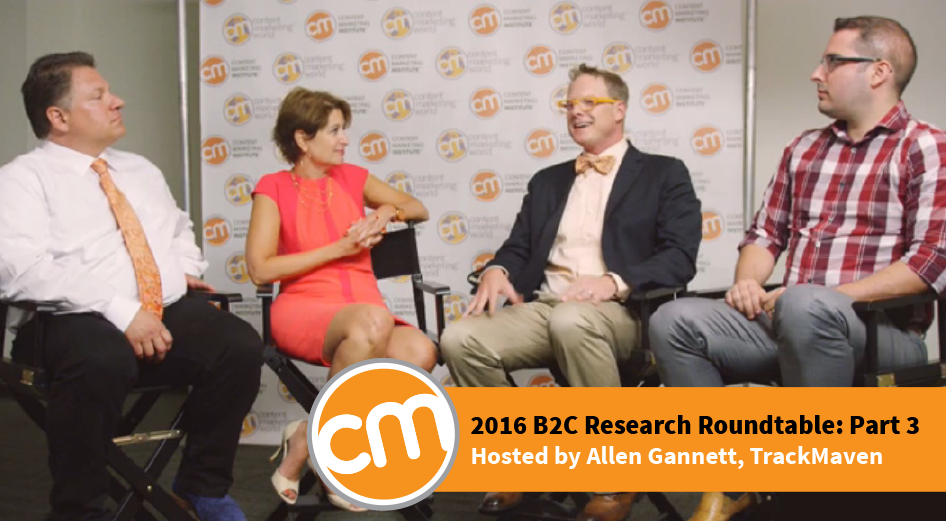
b2c-research-roundtable3-cover

Year after year, one of the top findings – and challenges – identified in our annual content marketing research is that marketers want to create content that is more engaging. It’s a top priority for any marketer no matter how effective or how big the company.

One way to engage: Surprise your audience.

In the latest – and last – installment in the B2C research roundtable, our panelists share ideas on how you – and your content – can be more engaging and unexpected. Thanks to our participants:

  • Andrew Davis, author of Brandscaping and Town Inc.
  • Julie Fleischer, former senior director, data + content + media, Kraft Foods Group
  • David Rodgers, senior digital marketing manager, ShurTech Brands
  • Buddy Scalera, senior director, content strategy, The Medicines Company
  • Allen Gannett, CEO, TrackMaven (moderator)

Surprise with outreach

Dave started the conversation by sharing something ShurTech does that usually delights customers. They have someone whose sole responsibility is influencer marketing, and she often has one-to-one conversations with those using the products (think: Duck Brand® duct tape).

She picks up the phone and talks to people who are using the product. They’re the people that know the most about it — the power bloggers, your brand advocates, just the average YouTuber who makes a duct-tape craft. It’s incredibly powerful to reach out to them directly because they don’t expect it. It’s not something that brands do a lot.

The conversation continued:

Julie: “They’re proud of it, right? That’s their project.”

Dave: “‘Oh my, you’re calling me? Amazing! Do you have time to do this?’ “Yeah, sure.”

Andrew: “Yeah, it’s so easy.”

Andrew shared a similar example. The CEO and president of a high-end consumer brand called two customers a day: One in the morning and one at the end of the day.

It’s the most shocking calls. They used to slot 30 minutes for these calls, expecting people to chat, but the people are like, ‘What? I didn’t expect you to call. This is crazy. Let me tell my wife.’ I think it’s something more brands could do.

If you’re thinking, “This sounds great, but how does this translate into engaging content?”, Andrew explains:

We are talking about content marketing, but I think there is a lot you can learn from those personal interactions, all the way up the chain, that end up being great stories on their end and really insightful research on the brand end.

Consider: What can you or someone on your team do to delight an influencer or customer? Make a call? Send a personal note? Even though this does not directly impact the content you create, it impacts your audience’s experience with the brand – and someone who is delighted personally is more apt to read and share your content.

Surprise with placement

Among the most surprising content marketing and even surprising event-based marketing are the consumer brands that show up where you don’t expect them. Andrew was at a video game convention, and all of a sudden, Rohto eye drops was there.

So began the conversation on another way to delight your audience with content. Appear in unexpected – but relevant – places. Andrew continued his story:

It was very odd and their booth was packed, ’cause people were like, ‘Why are you here? What do I do? What do I get?’

What a clever way to get your product – and content – in front of the right audience in a way that no one would expect.

As another example, just down the hall from this roundtable at Content Marketing World, Naturepedic hosted a relaxation room, complete with its mattresses, fluffy robes, and tea.

naturepedic-cmworld

If you want your content to surface in unexpected places, think about what your content truly competes against – often it’s outside your industry, as this conversation among Dave, Buddy, and Julie demonstrates:

Dave: “Our competitors are anybody who is taking away the time of our guests. If you are a Kraft brand and your goal is to have people use Kraft on a Saturday morning, what else are they doing? Are they playing Minecraft? Minecraft is a competitor.”

Buddy: “Minecraft is a competitor of Kraft?”

Julie: “That was the other craft.”

Consider: What opportunities do you have to put your content in front of a related audience who may not be expecting it, but would get a lot of value from it?

Surprise with seamless experience

Once you have engaged with your audience, what can you do to keep them engaged? Buddy takes the Rohto eye drop example one step further:

Make sure you pull it through … Have something in your channels that says, ‘We were here. Yes, you really saw us here.’ So often that website is the big monolithic and impenetrable thing that (makes visitors go), ‘Was that the same company that was at the video game conference?’ … Give people the ability to go, ‘Oh, that was the thing I wanted.’

Consider: Whatever you decide to do, remember that one-off surprising experiences are only the first step. How can you continue to delight your audience? What can you do to continue the conversation with the influencers you reached?

Andrew’s sentiment is a perfect way to end our roundtable series:

The more effective content marketing isn’t just about doing whatever you think everybody else is doing. It’s about experimenting and really understanding what your audience needs and finding the right things to do in unexpected ways.

What can you do that is unexpected? How will you delight your audience?

Share other examples of content and experiences that have delighted you.

View the other B2C and B2B research videos in these roundtable discussions:

Want to learn more about what B2B, B2C, and nonprofit marketers are doing now and planning for 2016? Download the latest from CMI’s research center.

Cover image by Joseph Kalinowski/Content Marketing Institute

The post 3 (Easy) Ways to Truly Surprise Your Audience appeared first on Content Marketing Institute.

05 Dec 00:42

Innovation, Disruption and Groundbreaking

by admin

pitch-session“Our technology is disruptive” said every founder at a recent venture capital pitch fest.

If that had been the case, it would have been a wonderful evening. As it turned out, not a single deal was discussed after the last slide deck reached its end. All said, the words innovative, disruptive and groundbreaking were frequently used and never accurate.

I have seen the same with marketers. As with startup founders, if you don’t understand the difference between these concepts, or you buy your own hype and assume your product is in a status it isn’t, you are unlikely to be profitable.

Innovation:

To innovate is to make changes in anything established (things that are disruptive are innovations as well, but of a different caste). If you devise a small enhancement to a product category that creates a minor but marketable advantage, you have an innovation. Likewise, if you overhaul your existing product to offer no new features but be much easier to use, you have an innovation. In short, innovations add value but do not fundamentally change anything. You market innovations as tie-breakers – differences that will swing a deal away from competitors.

Disruption:

Disruptions are radical changes. Competitors can easily deal with challenges from innovators, but disruptive changes require them altering product strategies. The market and target buyers remain the same, but disruptive products attach to different buyer motivations. Contact list software met a disruptive change when the concept of customer relationship management was introduced, because company-wide customer care is a different goal than simply knowing who is who at a customer location. The marketing goal is to make prospects believe the new way is how to fundamentally change their way of life or doing business, negating serious consideration of existing alternatives.

Groundbreaking:

Pioneers break new ground, quite literally. They till soil that has never been farmed. Groundbreaking products are ones that create new markets – products that simply never existed before. Apple created a truly “personal” computer. Google created a cross-silo data amalgamation engine for advertising. GoPro created a machine to capture experiences. Marketing a groundbreaking product requires demonstrating the benefits because customer’s do not yet understand the need.

Before pitching your product – be it to a venture capitalist or a paying customer – make sure you are honest with yourself about if the product is innovative, disruptive, groundbreaking … or none of the above.

05 Dec 00:39

Rate of foreign ownership of Toronto, Vancouver condos has risen, CMHC says

by CB Staff

MONTREAL – The number of Canadian condominiums owned by foreign residents grew over the past year in Vancouver, Toronto and Winnipeg, says the Canada Mortgage and Housing Corp.

CMHC released a survey Thursday that sheds some light on what has been a politically charged issue, particularly in British Columbia.

It says foreign buyers owned 3.5 per cent of condos in Vancouver in 2015, up from 2.3 per cent last year. That’s the highest rate of all 16 metropolitan areas tracked in the agency’s research.

In Toronto, the rate of foreign ownership rose to 3.3 per cent this year, up from 2.4 per cent the year before. The rate of foreign ownership in Winnipeg’s condo market rose to 2.7 per cent, a jump from 0.1 per cent last year.

Concerns have arisen recently that wealthy foreign buyers are driving up the cost of homes in Vancouver, making them unaffordable for local residents. Critics have suggested that the market could crash if those buyers decided to cash out and sell.

CMHC CEO Evan Siddall said there’s not enough data to predict what, if any, impact foreign investors are having on housing prices.

“The potential impact is if all that money leaves at the same time, which is probably not likely because they would all have to be subject to the same personal factors in the same country,” he said after speaking to the Montreal Board of Trade.

The federal housing agency says it is exploring ways to broaden the scope of its research to include other types of housing, such as single family homes.

CMHC says more information is also needed about what is motivating foreign buyers. For example, some may be purchasing properties to house their families, while others may be seeking revenue, either by renting the property out or by selling it when its value increases.

CMHC began to survey foreign ownership in condos last year. It is now talking to Statistics Canada and local real estate organizations to broaden the survey to include house ownership.

Montreal was one of the few cities where the rate of foreign ownership of condos fell, decreasing to 1.3 per cent from 1.5 per cent.

For the purposes of the survey, the CMHC defined a foreign resident as a person whose primary residence is outside of Canada.

During his speech, Siddall flagged general housing affordability as a “key concern.” The average Canadian spends a little more than 20 per cent of their total income on housing, he said, but it is nearly double that for the bottom 20 per cent of income earners.

He also touched on housing conditions for aboriginals on reserves, noting that nearly 40 per cent of natives live in dwellings in need of major repair.

“We must do better,” he said. “And since Canada’s aboriginal population is growing rapidly, we are falling further behind.”

The post Rate of foreign ownership of Toronto, Vancouver condos has risen, CMHC says appeared first on Canadian Business - Your Source For Business News.

05 Dec 00:39

Marketing to Millennial Business Buyers

by Ruth Stevens

pixabay_student-849827_1920

The Millennial generation has been out in the workforce for a while now, and this cohort is now entering the stage of their careers where they are part of the business buying process. They may not all be decision-makers quite yet, but they are certainly important influencers. So we B2B marketers must consider how to appeal to them effectively. Much has been written about Millennial preferences as consumers, but how about them as business buyers? Let’s take a look.

Millennials were born in the range of 1977 to 1995, more or less—some researchers put it at 1980s to 2000s. So they range in age today from around 20 to late 30s. As consumers, they are tech dependent, they value authenticity, and they are attracted to brands that think and act like them. Here’s what this means to B2B marketers.

Broaden your communications media channels. Millennials prefer mobile text and IM networks like WhatsApp for direct messages. For advertising, use social media like Facebook and LinkedIn.

Streamline your lead gen. Make it effortless. Use auto-populate techniques for forms, where possible. Ask for minimal data elements (but fill in the company profile using an outside provider like ReachForce).

Mobile-enable all communications. This means mobile-friendly website and email formats.

Ask for referrals. Millennials are very loyal once they establish a trusted connection with a brand. So they are likely to refer, especially if you ask.

Avoid marketing speak. Be real, authentic, and truthful (they fact check). Get to the point quickly (but make plenty of information available if they want it). Don’t be too serious—make them laugh.

Don’t sell too hard. Not only do they fact check, they’ll also look at reviews, comments, and other online validation.

Be active on social media. The b2b value of social has been proven again and again. If you’re still not convinced, the behavior of Millennials should be enough to put you over the top. This generation expects you to be tweeting, blogging, posting on Facebook, and participating in LinkedIn groups.

Tell stories. These respond to emotion. Use case studies, testimonials.

Treat them uniquely, not as a member of a group. This translates into taking full advantage of personalization techniques, like dynamic web page serving and data-driven customized messaging.

Talk about efficiency, and results. These are the themes that interest Millennials. They want to operate faster, cheaper, better. And they want their efforts to change the world. If you can help with those missions, say so. These are the product positioning angles that are meaningful to the new business buyer.

Any other ideas to add to the list?

05 Dec 00:39

7 Email Marketing Metrics You Should Track (and What They Mean)

by Brandon Olson

You just finished writing the perfect email to your subscribers. Way to go! Now, how do you know all that time you spent crafting it was worth it?

The answer lies in your email analytics.

Analytics are an essential (and often overlooked) part of your email marketing strategy. When you know things like how many subscribers are opening your emails and what links they’re clicking, you get a look into how your subscribers feel about the content you send them. And as you discover the story told by your analytics, you can identify opportunities to make improvements and bring more value to your readers.

So what should you be looking for to measure the impact of your emails? Here are seven email marketing metrics you need to track (and what they mean):

Open rate

Your email open rate measures the effectiveness of your subject lines, as well as the best times to email your subscribers. With this insight, you can identify how you can get more people to view your emails.

Open rates are calculated by taking the unique opens (i.e., the total number of unique subscribers who open your email) and dividing it by the total number of recipients. For example, if I send an email to 100 subscribers and 30 of them open it, I would have a 30 percent open rate.

Here’s a piece of advice as you track your open rates: since you want to know how many subscribers are actively engaging with your emails, you’ll want to track unique opens instead of total opens.

Total opens represents the number of times an email is opened, which can be misleading because a subscriber may open your email multiple times. counting those as “opens.”

Take the previous scenario for example. If the 30 subscribers who opened your email opened it twice, that would mean you have 60 opens and you’d have a 60 percent open rate. Not an accurate metric, right?

Unique opens, on the other hand, only counts the number of subscribers who opened your email – regardless of how many times they opened it.

While observing your unique opens provides a more accurate picture, tracking email opens isn’t fool-proof. Every open is detected when an invisible tracker image embedded within the email is displayed. However, if your subscribers have disabled images in their email client, it won’t track their opens, which impacts your open rates.

To help resolve this, ask your subscribers to add your “from” address to their address book. This not only guarantees that your emails will arrive in the inbox, but it also will ensure that opens are being tracked (remember that little invisible tracker image I mentioned).

Click-through rate

Your email click-through rate tells you whether or not your email content and call to action is relevant to your subscribers. The insight you gain from your click-through rate metrics can help you optimize the content of your emails; if you notice a lot of people clicking a link to one blog post instead of another, you can assume they’d prefer to receive more content on that topic in the future.

Similar to open rates, click-through rates can be calculated based on unique clicks or total clicks. To get a more accurate idea of how many subscribers are engaged with your emails, you’ll want to look at the total unique clicks (i.e., the number of subscribers who clicked on a link in your email) and divide it by the total number of recipients.

Again, don’t fall into the trap of calculating click-through rate based on total clicks (i.e., the number of times a link was clicked). This is misleading because a subscriber may click the same link multiple times, counting those as “clicks.” Instead, check your unique click-through rate to determine exactly how many subscribers are engaging with your email content.

You can also use your click-through rate to see what type of content your readers find compelling, and what they’re less interested in. With this information, you can focus more on content you know your subscribers will enjoy instead of sending random emails.

Web traffic

If a goal of your email marketing strategy is to increase traffic to your blog or website, you’ll want to track your web traffic results as well.

Web analytics will not only show you how many people are coming through to your website from your email, but also how long they’re staying on your site, where else they’re going on your site, where they’re leaving your website, and more.

To track web traffic to your site from your emails, I recommend using Google Analytics. Adding UTM tracking codes onto links in your emails allows you to capture and analyze email referral traffic within Google Analytics. (If you’re an AWeber customer, here’s how to integrate Google Analytics with AWeber.)

If traffic is low, for example, that might mean you need to make your email content more engaging. Or perhaps the content you’re sending them to isn’t compelling enough, and you should try sending them a web page or blog post related to a different topic.

Sales

Are you selling a product or service in your emails? To see how much revenue your emails are generating, you can track the sales that resulted from each email.

Sales from your email are tracked when someone opens you email, clicks through to your site, and makes a purchase.

To get this information, use Google Analytics to set up sales goals and tracking conversions. This is typically done using a destination goal within Google Analytics with your destination being a landing page where buyers land after making a purchase.

By using the appropriate UTM tracking codes on your email links, you’ll be able to track sales conversions from your emails. However, this approach won’t allow you to tie the revenue to specific subscribers, limiting your ability to segment and target those subscribers in the future.

AWeber Pro Tip:

Did you know you can track sales in your AWeber account? This allows you to tie a revenue amount to each subscriber, giving you the ability to build segments and send more targeted emails to different types of buyers, or those who haven’t purchased anything yet.

All you need to do is install email web analytics on your website, set up your sales tracking in your AWeber account, and presto – start seeing the actual revenue your subscribers are generating.

Unsubscribes

Losing subscribers is difficult for any email marketer to cope with. You want to have as many people on your list as possible, but you also want to send to people who truly want to hear from you.

Rest assured that unsubscribes are a normal and common part of maintaining a healthy email list.

There are many reasons someone may unsubscribe from your emails. Maybe your email content isn’t satisfying their needs anymore. Or perhaps you’re sending too frequently.

Subscribers typically have a few different options when unsubscribing from your list. They can click the “unsubscribe” link in your email, or use an app like Unroll.me to get the job done. In Gmail, people also have the option to click the “unsubscribe” link next to your name and email address. Regardless of how they choose to remove themselves from your list, you should make it easy for them to do so.

To learn why people are leaving your list, ask them for their feedback. This will help you better understand the reasons why they left and what you can do to bring them back or prevent others from leaving.

If more people are unsubscribing than they are joining your list, it might be time to re-evaluate your email content strategy and your open and click-through rates. If they’re low, you might need to see how you can send more relevant and compelling content.

Bounce rate

Bounces are a good indication of the health of your email list, and they’re calculated by taking the total number of bounces and dividing it by the total number of recipients.

Bounce rates are broken out into two categories: hard bounces and soft bounces.

A hard bounce means a recipient’s email account is closed or invalid. Most email marketing providers will automatically unsubscribe someone who hard bounces.

A soft bounce means a recipient’s email account is temporarily unavailable. This typically happens when a server is unavailable or a recipient’s inbox is full. Most email marketing providers will continue to send to a soft bounce several times before automatically unsubscribing them from your email list.

Ideally, you want to aim for a bounce rate that is less than five percent. To do so, my advice is to maintain a clean, active and engaged email list.

Complaint rate

Complaints occur when a subscriber marks your email as spam. Your complaint rate is calculated by taking the total number of complaints and dividing it by the total number of recipients. Your goal should be to keep your complaint rate no higher than 0.1 percent.

A consistently high complaint rate can have serious consequences on your deliverability and potentially get you into trouble with your email marketing provider. Again, sticking to email marketing best practices will help you “>maintain a low complaint rate.

How are your emails doing?

Focusing on your analytics is essential to improving your email marketing game. With them, it makes it easier to gauge whether your emails are delighting subscribers.

What email marketing metrics are you tracking? Share in the comments below or tweet them to us at @AWeber.

To learn more about email marketing metrics and get tips for improving your stats, download our free guide Understanding Your Email Stats.

The post 7 Email Marketing Metrics You Should Track (and What They Mean) appeared first on Email Marketing Tips.

05 Dec 00:38

7 Email Marketing Metrics You Should Track (and What They Mean)

by Brandon Olson

You just finished writing the perfect email to your subscribers. Way to go! Now, how do you know all that time you spent crafting it was worth it?

The answer lies in your email analytics.

Analytics are an essential (and often overlooked) part of your email marketing strategy. When you know things like how many subscribers are opening your emails and what links they’re clicking, you get a look into how your subscribers feel about the content you send them. And as you discover the story told by your analytics, you can identify opportunities to make improvements and bring more value to your readers.

So what should you be looking for to measure the impact of your emails? Here are seven email marketing metrics you need to track (and what they mean):

Open rate

Your email open rate measures the effectiveness of your subject lines, as well as the best times to email your subscribers. With this insight, you can identify how you can get more people to view your emails.

Open rates are calculated by taking the unique opens (i.e., the total number of unique subscribers who open your email) and dividing it by the total number of recipients. For example, if I send an email to 100 subscribers and 30 of them open it, I would have a 30 percent open rate.

Here’s a piece of advice as you track your open rates: since you want to know how many subscribers are actively engaging with your emails, you’ll want to track unique opens instead of total opens.

Total opens represents the number of times an email is opened, which can be misleading because a subscriber may open your email multiple times. counting those as “opens.”

Take the previous scenario for example. If the 30 subscribers who opened your email opened it twice, that would mean you have 60 opens and you’d have a 60 percent open rate. Not an accurate metric, right?

Unique opens, on the other hand, only counts the number of subscribers who opened your email – regardless of how many times they opened it.

While observing your unique opens provides a more accurate picture, tracking email opens isn’t fool-proof. Every open is detected when an invisible tracker image embedded within the email is displayed. However, if your subscribers have disabled images in their email client, it won’t track their opens, which impacts your open rates.

To help resolve this, ask your subscribers to add your “from” address to their address book. This not only guarantees that your emails will arrive in the inbox, but it also will ensure that opens are being tracked (remember that little invisible tracker image I mentioned).

Click-through rate

Your email click-through rate tells you whether or not your email content and call to action is relevant to your subscribers. The insight you gain from your click-through rate metrics can help you optimize the content of your emails; if you notice a lot of people clicking a link to one blog post instead of another, you can assume they’d prefer to receive more content on that topic in the future.

Similar to open rates, click-through rates can be calculated based on unique clicks or total clicks. To get a more accurate idea of how many subscribers are engaged with your emails, you’ll want to look at the total unique clicks (i.e., the number of subscribers who clicked on a link in your email) and divide it by the total number of recipients.

Again, don’t fall into the trap of calculating click-through rate based on total clicks (i.e., the number of times a link was clicked). This is misleading because a subscriber may click the same link multiple times, counting those as “clicks.” Instead, check your unique click-through rate to determine exactly how many subscribers are engaging with your email content.

You can also use your click-through rate to see what type of content your readers find compelling, and what they’re less interested in. With this information, you can focus more on content you know your subscribers will enjoy instead of sending random emails.

Web traffic

If a goal of your email marketing strategy is to increase traffic to your blog or website, you’ll want to track your web traffic results as well.

Web analytics will not only show you how many people are coming through to your website from your email, but also how long they’re staying on your site, where else they’re going on your site, where they’re leaving your website, and more.

To track web traffic to your site from your emails, I recommend using Google Analytics. Adding UTM tracking codes onto links in your emails allows you to capture and analyze email referral traffic within Google Analytics.

If traffic is low, for example, that might mean you need to make your email content more engaging. Or perhaps the content you’re sending them to isn’t compelling enough, and you should try sending them a web page or blog post related to a different topic.

Sales

Are you selling a product or service in your emails? To see how much revenue your emails are generating, you can track the sales that resulted from each email.

Sales from your email are tracked when someone opens you email, clicks through to your site, and makes a purchase.

To get this information, use Google Analytics to set up sales goals and tracking conversions. This is typically done using a destination goal within Google Analytics with your destination being a landing page where buyers land after making a purchase.

By using the appropriate UTM tracking codes on your email links, you’ll be able to track sales conversions from your emails. However, this approach won’t allow you to tie the revenue to specific subscribers, limiting your ability to segment and target those subscribers in the future.

Unsubscribes

Losing subscribers is difficult for any email marketer to cope with. You want to have as many people on your list as possible, but you also want to send to people who truly want to hear from you.

Rest assured that unsubscribes are a normal and common part of maintaining a healthy email list.

There are many reasons someone may unsubscribe from your emails. Maybe your email content isn’t satisfying their needs anymore. Or perhaps you’re sending too frequently.

Subscribers typically have a few different options when unsubscribing from your list. They can click the “unsubscribe” link in your email, or use an app like Unroll.me to get the job done. In Gmail, people also have the option to click the “unsubscribe” link next to your name and email address. Regardless of how they choose to remove themselves from your list, you should make it easy for them to do so.

To learn why people are leaving your list, ask them for their feedback. This will help you better understand the reasons why they left and what you can do to bring them back or prevent others from leaving.

If more people are unsubscribing than they are joining your list, it might be time to re-evaluate your email content strategy and your open and click-through rates. If they’re low, you might need to see how you can send more relevant and compelling content.

Bounce rate

Bounces are a good indication of the health of your email list, and they’re calculated by taking the total number of bounces and dividing it by the total number of recipients.

Bounce rates are broken out into two categories: hard bounces and soft bounces.

A hard bounce means a recipient’s email account is closed or invalid. Most email marketing providers will automatically unsubscribe someone who hard bounces.

A soft bounce means a recipient’s email account is temporarily unavailable. This typically happens when a server is unavailable or a recipient’s inbox is full. Most email marketing providers will continue to send to a soft bounce several times before automatically unsubscribing them from your email list.

Ideally, you want to aim for a bounce rate that is less than five percent. To do so, my advice is to maintain a clean, active and engaged email list.

Complaint rate

Complaints occur when a subscriber marks your email as spam. Your complaint rate is calculated by taking the total number of complaints and dividing it by the total number of recipients. Your goal should be to keep your complaint rate no higher than 0.1 percent.

A consistently high complaint rate can have serious consequences on your deliverability and potentially get you into trouble with your email marketing provider. Again, sticking to email marketing best practices will help you

05 Dec 00:38

Sales Reps Need to Ditch the Toxic "It's Not Me, It's You" Mentality

by mrenahan@hubspot.com (Mike Renahan)

pointing_fingers.jpg

I wake up at about 6:30 a.m. every day. Once noon rolls around, I go for lunch, and an hour later, I work out. I follow this routine and these habits because they work.

It wasn’t always this way, though. I used to sleep in late, have breakfast around noon, and go to the gym in the evening. But I wasn’t seeing the results I wanted and I wasn’t nearly as productive as I could have been.

Sound familiar?

Several jobs -- and lives, really -- are built around routines. Doing the same things every day to get closer to your goal.

And sales is no different. Reps often rely on the same tactics they’ve used for years to hit their quota and create new business.

But a funny thing happens when the same old techniques no longer work. Instead of trying to understand what went wrong, and how to fix it, most reps just move on to their next call, thinking, “It’s not me, it’s you.” In other words, they blame the prospect for the bad result instead of themselves.

Well, sales reps, turns out it might actually be you.

For example, many reps still use cold emailing to spam long lists of prospects. But when only 1.7% of people respond to a cold email, reps' strategy is often to tweak the subject line or the copy, instead of ditching the cold email altogether in favor of well-researched and personalized warm emails.

But is this really the answer? Put yourself in the buyer’s shoes and ask yourself: Who really wants to answer a generic email from someone they have no familiarity with?

When you continue to send spammy cold emails in the face of abysmal success rates, what you’re really saying is:

“It’s not me, and my technique -- it’s the prospect. They just didn’t like the subject line or something.”

Another example. In a study, 18% of buyers said their biggest sales pet peeve was when their rep didn’t listen to them.

So why do the majority of sales reps insist on rambling off a script filled with irrelevant product points instead of trying to gather information from the buyer?

If you’re doing this, I hear you loud and clear:

“It’s not me, and my technique -- it’s the prospect. The script is awesome. They just didn’t get it.”

Finally, most of us like to take the time to think about a major purchase before we go all in. But to some sales reps, weighing the options isn’t really an option. Instead, they want to push buyers through the sales funnel as quickly as possible so they can hit quota or bank a big commission check.

Too bad that a solid 25% of buyers hate it when reps don’t respect their company’s buying process.

Are you clinging to the notion that high-pressure tactics help buyers decide? If so, this is what you’re really saying:

“It’s not me, and my technique -- it’s the prospect. They just suck at making decisions."

When sales tactics such as cold emailing, scripted calls, and high-pressure closes lose their effectiveness, it’s time to look in the mirror, and make a change. Are you and your sales team adjusting to the desires of the modern buyer, or are you pointing your finger at prospects?

As 2015 comes to a close, take some time to reflect on this quote:

“A wise man adapts himself to circumstances, as water shapes itself to the vessel that contains it.” - Chinese proverb

Get HubSpot CRM today!

05 Dec 00:35

Newsjacking Can Work For You! My new course will show you how

Earlier this week I shared an example of how Trent Silver, a young entrepreneur who learned Newsjacking from me, uses the technique to grow his businesses. Just one of Trent’s newsjacking efforts generated $250,000 in new revenue for his young company.

Since that post, many people have asked if newsjacking works for other organizations such as business-to-business outfits, nonprofits, and consultants. Some people have been skeptical about the applicability outside of consumer brands. 

05 Dec 00:34

The 100 Year History Lesson On Marketing Operations and MarTech

by Andrew Nguyen

“There is a science to advertising. Experienced advertisers have watched and recorded, tested and logged, and left records of countless campaigns. In these conditions the advertising and merchandising becomes a science. Principles are learned and proven by repeated tests” (Scientific Advertising).

This was written in 1923. And this was the beginning of the accountable marketing mindset.

In the 1920’s the careful attention to costs measurement of marketing effectiveness began. This mindset is alive and well today and we call it pipeline marketing.

While the goal and mindset were set in places decades ago, marketers dealt with technological challenges in closing the loop between initial impression and sales. Let’s take a look at how far we’ve come in order to get a grip on where we are today with pipeline marketing.

Let’s Go Back In Time, Time, Time….

The 1970’s were the pre-teen years of marketing operations — there were new ideas and experimentation (with new technology).

Before point of sales systems and databases, marketers used “bingo cards” (i.e. reader service cards) in magazines to track which ad readers saw and which publication they saw it in. It’s much like today’s UTM parameters.

Ads had a phone number printed at the bottom that corresponded with an identifier number on the bingo card. The publisher would forward these inquiries to the advertiser, proudly asserting that it was this publication that was responsible for generating these valuable sales leads.

This is still being used today, although it is diminishing in usage in favor of tracking incoming leads by establishing unique websites / landing pages and phone numbers specific to campaigns.

bad-grandpa

This technology has flaws. Before database marketing and CRM software, marketers miscounted leads, double counting or not giving enough credit to those channels responsible for brand discovery.

Closing the loop would take several more decades.

The driving force for such innovations in advertising rested on the marketer’s desire for predictability and a clearer understanding of where to spend their budget.

The Birth of Marketing Technology

In the 1980’s database marketing and barcode readers kicked off the information age. Marketers could now segment their audiences and track sales. Marketers experimented and pushed boundaries. Call this the teen years for marketing operations. From direct mail to the email in the 1990’s, marketers could segment and target their audiences based on purchase history and demographic factors. They experimented with tailored messaging and marketing mix modeling.

They arrived a step closer to understanding how their marketing efforts related to the relevant indicators and trends that affected their companies as a whole. This was before KPIs.

In the 1980’s the marketing dashboard was wholly unreliable. It wasn’t even called a marketing dashboard. It was called the “executive information system.”  Its purpose was to support senior executive information and decision-making needs. It didn’t do that.

Marketers couldn’t provide the information for decision-making needs. Early marketing dashboards suffered from slow refresh rates, bad data handling, incompleteness, and disconnected, spread across too many different sources. Marketing data was not usable.

There were no KPIs or marketing dashboards that could accurately help marketers understand the health and performance of their campaigns. Marketing operations was dazed and confused during the teen years.

useless-marketing-KPIs

Rise of the Revenue Marketer and the Tracking Pixel

Marketers driven by the need for rigorous and accountable marketing reached young adulthood in the 2000’s. With the publication of Rise of the Revenue Marketer, Debbie Quaqish outlines the playbook for marketing ops and revenue marketing.

This includes connecting marketing automation to the CRM to track revenue generated from marketing activities.

Technologies like the tracking pixel allowed marketers to measure the performance of their online marketing campaigns. Creating an actionable marketing dashboard was no longer a futile exercise.

Today marketers can seemingly track everything. They’ve conquered the web.

But, like all stages in life, different questions and problems arise during transitions. And we’re in the midst of a transition right now.

While the introduction of the tracking pixel allowed marketers to map the customer journey with a high level of detail, without a connection to customer and revenue data, marketing is still seen as a cost center, unable to connect their efforts to values of profitability.

When marketers rely on marketing automation or Google Analytics alone, they still all too easily double-count leads and begin optimizing based on CPL, rather than revenue-per-lead.

tracking-pixel-accuracy

Meet the Pipeline Marketers

Pipeline marketing is defined by a complete focus on the ultimate outcome of marketing: revenue and business impact. For companies with a sales team, pipeline marketing helps marketers understand the long customer journey and accurately report on where marketing spend is most effective.

Right now, there is a shift in thinking as CMOs and marketers turn their attention to getting the most accurate picture of the customer journey. They’re shifting their thinking from using tracking pixel and cookies, to connecting their marketing platforms to the CRM.

Pipeline marketing requires the following actions:

  • Connecting marketing activities to the same metrics used by sales: opportunities and revenue.
  • Enabling multi-touch modeling through advanced attribution solutions
  • Identifying the channels that drive revenue, rather than vanity marketing metrics

Pipeline marketing is how marketers think about their goals. While the job role may differ, all marketers are accountable for driving results that are connected to business value. Whether it’s marketing operations or demand generation, any marketer who chooses the right metrics and can measure their impact on the organization, and the bottom line, is a pipeline marketer.

 2015 State of Pipeline Marketing Get the inside look on sales alignment, attribution, top channels, and more. Download Now

05 Dec 00:34

The 1 Simple LinkedIn Profile Tweak That Will Have Sales Prospects Salivating!

by John Nemo

No joke: I think 95 percent of people are still using LinkedIn the wrong way.

What I mean by that is people are still using LinkedIn as little more than a glorified online résumé – Here’s where I went to college, here’s where I’ve worked, here’s awards I’ve won, etc.

There’s just one small problem with that approach:  IT’S NOT ABOUT YOU!

The harsh reality is, people care far less about you and your accomplishments thank you think.

What they DO care about is this: Me, Myself and I.

It’s All About … Them!

Meaning you have to refocus, repurpose and reframe every sentence of your LinkedIn Profile to answer this question: How does what I’m saying right now help YOU make more money?

Every single sentence of your LinkedIn profile should aim to answer that question. How does what I’m writing or sharing right now help my clients or customers? How does it solve one of their problems? How does it make their lives easier? How does it make them more money?

If you want to send your business skyrocketing and start closing every deal you come across on LinkedIn, drop everything you’re doing today and DO THIS RIGHT NOW!

Go to your LinkedIn profile right now, and follow these steps:

  1. Rewrite your professional headline (the profile heading that goes next to your name) so it explains what industry/niche you work in and HOW you help customers or clients in that niche! IMPORTANT: Before you start, use LinkedIn’s Search tool to see what the most popular keyword searches are related to your industry. How are people finding the products or services you offer? What search terms are they using? Try to think like your prospects – If I were in their shoes, what would I punch into LinkedIn Search to find someone offering what we do?
  2. Edit your Contact Information area’s Website and Blog listings. Instead of choosing “Company Website” or “Blog” or one of the other pre-set options LinkedIn offers, choose “Other” and then write in a brief phrase hinting at a need you meet or a problem you solve. Say something like “How We Help YOU Get More Clients” or “Media Training Tips” and have the URL point to a page on your blog or website that does exactly that!
  3. Start your LinkedIn profile’s Summary section with ALL CAPS to highlight things like WHAT WE DO or SERVICES WE OFFER. LinkedIn doesn’t allow bold or italic or other text formatting, so ALL CAPS is a great way to make something stand out! Again, make sure your summary is client facing!
  4. Add in multimedia clips (videos, online presentations, links to pages on your website, photos or portfolios, etc.) to your Summary section that highlight products or services you offer, and include a client-facing caption. Link to talks or presentations or website pages that demonstrate your expertise so you can build credibility with your prospects!
  5. Repeat Steps 3-4 for every single job you have listed on your LinkedIn profile – edit the job title and summary, then add clips and work samples as well.

Trust me, if make these changes, you’re no longer going to be chasing your tail on LinkedIn! Instead, prospects are going to find their way to your virtual front door through LinkedIn Search and other avenues (more on that in another post!). And when they do, they’re going to be banging it down, because your profile will be offering them exactly what they are looking for!

linkedin-logo (1)YOUR TURN: Take The Challenge!

Have you tried this yet with your LinkedIn Profile? If not, are you willing to give it a shot? Tell me your story in the Comments! I want to hear how it goes for you! Having trouble tweaking your profile? Ask me in the Comments for advice – I’m happy to help!

Was This Post Helpful? Then Share The Love!

Do you know someone who needs to do this with his or her LinkedIn Profile RIGHT NOW? Then share this post with him or her! I’d be grateful if you’d take the action and help spread the word about LinkedIn Riches!

Want More Sales Strategies Tips Like This?

Download my free eBook “8 Secrets to Selling More on LinkedIn” and register for my Free Webinar on using LinkedIn to generate more sales leads, clients and revenue:

03 Dec 18:00

4 Ways to Stay Mindful During the Busiest Time of the Year

by Tim Pickard

Almost ubiquitously across industries, disciplines, and borders, December is one of the most stressful months for workers. The end of the year means salespeople are racing to hit their goals, product developers are pushing to finalize their projects, and employees are rushing to solidify accounts before the holidays. The resulting professional environment is thin on both time and patience, which are incidentally two of the things service workers need most.

It’s easy to lose sight of quality service and professionalism in the flurry of the season, but it doesn’t have to happen. There are a few easy steps that you can take to ensure that your customers stay satisfied, your boss stays happy, and you stay sane as the year winds to a close.

1.  Get personal

One of the biggest determinant factors in customer experience is the level of personal attention customers feel like they’re getting. During the holidays, it is easy to fall into generic, somewhat spam-y engagement that borrows typical “season’s greetings” clichés and promotions.

Thanks to modern technology and CRM, we have access to more data about our customers than ever before – so use it! Do more than the store wide seasonal deal alert; highlight items specific to your customers’ needs. It does take a bit  more time to tailor your approach on a customer-by-customer basis than it would to use a generic approach, but it makes a world of difference in the customers’ takeaways. No one remembers a “fine” customer experience. It’s the little, thoughtful, personal touches that resonate. And it’s those kinds of touches that will eventually set a customer service organization apart. Holiday cookies are delicious; cookie-cutter campaigns — not so much.

2.  Make yourself comfortable

Seriously. Customer service requires patience and attentiveness in spades, so why strain yourself in areas you don’t need to and risk compromising that? As pressure spikes at the end of the year, take a look at your task load and work environment and prioritize. Are there small changes you can make that will enable you to perform better?

Enterprises embracing cloud technology often provide a legitimate option for employees to work remotely while still being able to access all of the resources they need to do their job well. If you’re traveling or have the option, it might be a good opportunity to cut out distractions and focus on what matters: keeping customers happy.

3.  Know their pain

Remember, during the end of the year customers are primed with their own anxiety and stress related to work, holiday travel, and family. Empathize with your patrons, but don’t fall into their cadence of haste, panic, or frustration. You can’t fix a customer’s problem without knowing its root. So before you dive in too deep, make sure you take time to really understand what it is that your customers need.

One of the biggest temptations that arises as things get busier is the urge to find a quick fix. But the problem with quick fixes is that they don’t always end up staying fixed. Check in with yourself at the beginning of every call and ask yourself: do I truly understand what this customer needs? If you can answer that question with confidence, then move it along! If not, take the time to really get to the bottom of it — it’ll end up saving you time in the long run.

4.  Work as a team

Too often, customer service feels like a long stream of one-on-one interactions between the service rep and the customer. But there’s something to be said about working as part of a team. Service professionals have access to real-time customer feedback, which is one of the most valuable resources that a company could have. If you come across information that you think might be valuable to other departments or to other service members, share it.

If other members do the same, everyone stands to benefit. The holiday season is filled with cross-team, cross-channel opportunities. Use what you know to grow your business beyond basic customer service. Share insights that improve future interactions, bolster sales and ignite positive brand engagement.

It’s easy to feel buried in the mound of tasks that inevitably come with the end of the year, but by prioritizing carefully and using your resources smartly, it doesn’t have to be painful for you, your co-workers or your customers. And when it all slows down, you can always reward yourself with a big holiday dessert!

Give your customers incredible service every month of the year. Download the free Salesforce e-book for four steps to incredible customer service.

03 Dec 17:38

When Targeting New Clients, Start With Those You Already Have

by Bill Faeth

Model Your Prospects After Your Most Profitable Clients

use-customers-to-find-prospects

The key to success in any business is being able to grow by acquiring new customers. In order to grow, you must determine which types of potential clients to go after and understand where to find those target groups.

Before you start prospecting for new clients, one of the most important things you can do is to identify the most profitable customers currently doing business with you. This will help you to develop a profile of your target clients and understand where to find those prospects.

Identifying Your Most Profitable Clients

To begin, review your books over the last three years and identify your top 20 clients based on annual spend. Evaluate each of these accounts to gain a year-over-year perspective of their spend with you. This is important to realize whether the client’s spend is consistent, declining, or increasing.

If the spend of a particular client is increasing then you need to identify why and continue to replicate what is working.  If the spend is decreasing for a client, then there are opportunities to identify new solutions and recapture lost spend.

Evaluate the strength of your relationship with each of these top 20 accounts, on a scale of 1-10. Consider how happy the client is with your products or services, as well as the personal relationship you have with the individuals on these accounts.

Take Other Expenses Into Account

Once you have identified your top spending clients, look at the services they use most often to identify which products or services you offer are the most profitable. Understanding profitability will provide long-term growth opportunities, instead of focusing solely on increasing revenue.

To understand profitability you will need to know:

  • Hard costs associated with the types of services you are providing to the client
  • Costs associated with phone calls, emails, and other account management efforts
  • Insurance and labor costs for employees

I think you may be surprised that the clients you think are the most profitable may not be. The point of this exercise is to allow you to focus on the profitable customer types moving forward as you prospect for new business.

Many companies will take on any new client, but they may fail to factor in how many phone calls are taken (labor), edits or changes to work are needed (labor), additional projects requested which may not be billed for, profit margin, etc.  These are all important factors to consider when targeting new clients.

Profitability + Relationship = Growth

Your existing clients with the most profitability and the strongest relationships are the ones that you want to target for new customer acquisition. These clients are also the ones you want to leverage for warm introductions to other prospects and for data mining similar prospects.

When you have identified your most profitable existing clients, you can use this list to develop your Hot List of new targets.

Your decisions to leverage these client relationships is determined based on the client’s profit value combined with the strength of your relationship. You must be 100% honest with yourself regarding the relationship. Remember, you never want to harm an existing relationship in the pursuit of new business.

Modeling your prospects after your current profitable clients will keep you focused on growing in the right direction, instead of spending valuable time and resources chasing potential business that does not align with your growth goals.

Once you have identified your target prospects, work with your sales team to develop lead nurturing and lead scoring opportunities to systematically pursue these business opportunities.

Prospect-Persona-Creation-Worksheet

03 Dec 17:33

A Leader’s Perspective on Purpose

by Jim Haudan

Purpose. When people believe what they do matters they show up differently, they engage differently, and they contribute differently. I believe we all have a driving purpose. As a leader, it’s what motivates me to get up and bring my best self to work. But as in the words of Cheryl Bachelder, CEO of Popeye’s Louisiana Kitchen, “it is a leader’s responsibility to bring purpose and meaning to the work of the organization.”

When I first started the company, I knew asking people to separate their purpose from their work lives would be impossible. How can you ask someone to set aside their personal goals and intentions for the better part of their day … five days a week? As technology has eroded the divide between our work and personal lives, it’s simply too difficult to separate our business and personal lives. Therefore I believe it’s absolutely vital for people to have the ability to integrate their personal purpose with their organization’s purpose. It is a sure-fire way to get people to commit their whole selves to doing the best work possible. I was recently presenting with one of our young leaders when she was asked why she joined the organization she works at. Without hesitation she said, “I wanted to work at a place that first shared my personal values and second that wanted to aim high in making the world a better place.”

But what about those people who voluntarily separate their personal selves and their work selves?

Sure, in some cases it is possible to find success at a job that doesn’t reflect their personal value or have a valued purpose. However, it won’t be a long-lasting career. Scenarios where people are merely doing what they need to do without feeling a personal investment become transactional situations – show up, do the minimal work needed to get by and get paid. Managers and leaders might feel this is enough … but just imagine what would happen if these people find a way to engage in what they value and act on an inspirational purpose!

When we are able to live out our purpose, our cause, our beliefs at work – that’s when our best capabilities are called to the forefront.

Embracing Your Personal Purpose

Whether we like it or not, fear is one of the dominant forces in the workplace. Unfortunately, many organizations struggle with creating environments that foster engagement, trust and safety. As a result, people just don’t feel safe to say what they really think. They fear being vulnerable. So purpose has to be nurtured and nudged out. People have to realize their leaders honestly want to know what they believe in, and that we want to connect with them.

I think the best organizations are seeing how important connecting with their people is on a personal level – it’s exploding, but it’s not commonplace. As leaders, we have lots of work to do. But the benefit of tapping into our people’s personal passions has amazing benefits – it’s how we can motivate, engage, and connect with them to do their best work.

In Cheryl’s words purpose inspired people “arrive early and stay late, they find creative solutions to problems, and they raise the energy level, commitment, and performance of the teams” they serve on.

Living out your purpose is more important than you can imagine. In the book The Top Five Regrets of The Dying, written by a woman who spent years working in palliative care, I learned the most common regret people have at the end of their lives is that they didn’t have the courage to live a life true to themselves. When people realized their lives were almost over, they often felt unfulfilled because they had made choices based on what others wanted – or to please others – instead doing things based on their own beliefs. This validates the importance of identifying and living out your personal purpose. We need to find the courage to do what we are really called to do – to embrace and live and breathe our purpose. It’s such an important piece to living without regret.

03 Dec 17:33

From billions on your hydro bill to bus driver background checks: 13 things to know about Ontario’s AG report

by Ashley Csanady

Ontario Auditor General Bonnie Lysyk slammed the province’s government for a slew of oversight gaps that leave the most vulnerable exposed, poor policy decisions that cost energy consumers billions and long wait lists for health care services in her annual report.

The 770-page long document is teeming with criticisms of the Liberal government. Here are 13 of the lowlights:

Consumers are paying billions for poor energy decisions

By ignoring their own energy planning legislation, the Liberal government has cost consumers billions on their hydro bills. The average electricity bill rose 70 per cent between 2006 and 2014, at least in part because the government ignored its own expert advice, the report notes. That has already cost consumers $37-billion in payments to power generators under what the government calls Global Adjustment. By 2032 they’s pay another $133 billion — or $170 billion over 26 years.

Green energy policies added billions to your electric bill

The wind turbines and solar panels that dot the province are adding to those high electricity rates. Lysyk said, “consumers have had to pay $9.2 billion more for power from renewable energy projects” under the current pricing scheme once the 20-year term is up. She also noted that compared to some U.S. jurisdictions, Ontario continues to overpay for green energy.

Hydro One is charging more for less consistent service

This is the last time the auditor will be able to comment on Hydro One, as the government is in the process of privatizing 60 per cent of it. But as a parting shot, Lysyk said the transmission company and distributor is charging more for power but providing less consistent service — meaning more blackouts and bigger bills.

Children’s Aid Societies leave kids exposed

Children’s Aid Societies often close cases too quickly, only for them to later be reopened, often for the same complaints that were initial dismissed, the auditor found. She also noted that some investigations take as long as seven months to complete instead of the recommended 30 days. In half the cases reviewed, caseworker home visits only happen every three months instead of every month as recommend. And, the report notes that societies did not always run background checks on people involved with the children or the kids themselves, meaning past allegations or instances of abuse might be missed.

Bus drivers don’t always get criminal background checks

Though the report finds school buses are generally a safe way to get kids to class, the report finds that the consortia who hire bus operators have inconsistent approaches to background checks. That means some drivers haven’t undergone criminal background screenings. The report also notes that different boards have different policies for access to bussing, which creates unequal access across the province. And it noted there could be more oversight of maintenance checks and driver audits.

Long-term care homes allocated just $7.87 per senior per day for food

The report details a litany of issues in long-term care homes, including longer delays in investigations and inconsistent plans to follow-up after reported incidents of violence or abuse — a backlog of complaints grew from 1,300 in December 2013 to 2,800 in March 2015. In one 2014 incident involving a sexual assault, it took the ministry eight months to follow up, when the minsitry found the home was still not in compliance. Residents in provincial long-term care homes are fed on just $7.87 a day. And 30 per cent of facilities still don’t have automatic sprinkler systems and legislation doesn’t require they do until 2025.

Some people wait over a year for home care

Five years after the auditor’s office first told the government patients were waiting too long for home care, people in some parts of the province wait up to a year just for an assessment. That means the elderly, those with critical illnesses or disabilities are waiting too long for care. A lack of provincial standards is also creating unequal access across the province but it also means the agencies that provide home care are paying vastly different amounts to provide the same service.

Infrastructure to support the Ring of Fire development is a long way off

A remote, massive deposit in northern Ontario could contain billions in minerals — but first mining companies need to get there. Lysyk said the province is “still not close to having the basic infrastructure necessary to encourage mining investments — and there are no detailed plans or timelines in place for developing in the region.”

The government’s embattled welfare payment system will take until 2016 to fix

The Social Assistant Management System (SAMs) blew up into a big story when thousands of Ontario Words and Ontario Disability Support recipients received over or under payments last year. There were still over 771 serious issues with the software when the audit was conducted and the total cost of those mistakes is at least $90 million and could still rise. That brings the total cost of the problematic program to $290 million.

Corporate welfare for the few

Of the $1.45 billion in grants, economic development and “employment-support funding” — money given to companies to get them to move to Ontario or stay here — the province has doled out since 2004, 80 per cent of it has gone to companies who were invited to apply and never publicly posted. Lysyk called it a “selective process” that leaves out small-to-medium sized businesses. No start-ups have ever received money from the fund.

The province has no plan to tackle debt ratio

Ontario net-debt-to-GDP ratio — the amount the province owes versus the size of its annual economy — rests at an eye-popping 39.5 per cent, the second highest in the country behind Quebec. The province has long said it hopes to return to a rate of 27 per cent, which is considered healthy by many economists, but the report notes it “has no communicated any detailed strategy on how it will tackle its goal.”

Universities should consider filing more patents

The auditor wants the province and the universities it provides research funding to to rethink how it and follows up on that money. The ministry of research and innovation doesn’t track how much money all ministries and agencies invest in research, but Lysyk’s office estimates $1.9 billion has gone to universities over the last five years. She wonders if that could produce more value for money: universities could take out more patents and better collect revenue from the intellectual property. Lysyk said she’s not saying all research funding should be consider for its possible returns, but that it’s a conversation worth having.

The government delays the release of its own annual reports

The audit reviewed 57 government agencies and found just five per cent of their annual reports over the last three years were tabled within the timeline required. These reports are supposed to be released within six months of the end of the fiscal year but 68 per cent of them are tabled more than a year later and six per cent have never been tabled. It’s not because the agencies aren’t writing them, but because the ministry received them but did not “act in a timely manner to make them public.”

03 Dec 17:33

Ways to Set Up Business Grade Wi-Fi Networks

by Steven Scheck

office-624749_640

Setting up robust Wi-Fi networks for business is far from being a nerve-wracking experience. With the Bring your Own Device trend on the rise, a large number of tablets and smartphones are making their way into the corporate networks. With the passage of time, this number will rise.

A large number of devices like Google Nexus 7 tablets and Amazon Kindle Fire are Wi-Fi. This puts a strain on the existing Wi-Fi networks. The businesses that are late to the Wi-Fi bandwagon or looking forward to overhauling the anarchic wireless infrastructure need to consider a few points.

How Many Access Points Do You Require?

Take some time to find out the number of access points you require. Find out how many users will be using them. Some access points can cope with 5 to 10 devices that are connected simultaneously while some can cope with 30 of them. You need to decide on the number of access points you will require before you move ahead.

Where Do You Place the Access Points?

Spread the access points throughout the building. You can mount them up high or on the ceiling. There are several tools that help to plan and place the business Wi-Fi access points. These tools aid with plot placement, indicating the signal strength based on the type of wall, distance and obstructions.

Did you Weigh the 2.4GHz and 5GHz Bands Carefully?

Now, there are chiefly two frequency bands designed for the 802.11 Wi-Fi networks. The larger amount of bandwidth that is available with the 5GHz band makes it a preferred option in the business environment. Most business grade APs have the capacity to operate in both 5GHz and 2.4GHz frequency bands.

Most Wi-Fi clients do not work on the 5GHz band. While iPad2 works on the 5GHz band, the low-end tablets like Google Nexus 7 will connect on just the 2.4GHz band. Most smartphones are also 2.4GHz.

Recognizing the uneven support for 5GHz Wi-Fi, a few APs are possible to configure for backhauling data over the 5GHz frequency band. This will allow to serve the clients on 2.4GHz band. This is chiefly useful for strengthening weak wireless reception in places the wired cables find it hard to reach. There are also options to set up an environment where both the 5GHz and 2.4GHz radios will be in use simultaneously. Devices that support the 5GHz frequency band are possible to direct to connect on this frequency, reducing congestion on the crowded 2.4GHz band.

Is There Any Need to Broadcast Multiple SSIDs?

The business grade Wi-Fi networks enable broadcasting multiple SSIDs or networks from all the access points. You can set up an internal wireless network for the staff to get online and access the internal services. Another SSID can allow the guests access only the internet and not the internal network. Think about restrictions you would like to place on these networks. For protecting your brand and business, you can block access to undesirable or illegal content.

How to Secure Business Wi-Fi Network?

In business, safeguarding and securing data is of prime value. This necessitates network level scanning. This is possible to build into Wi-Fi solution.

Should you Implement Strong Management and Security Mechanisms?

Security and management of the Wi-Fi networks is a prime aspect businesses need to consider. Attempt to configure several APs individually in business environment is not just inefficient, but it is prone to errors as well.

A properly designed management system has a significant role to play when it comes to dealing with an array of APs. Moreover, the ever evolving security landscape has enhanced the value of built in security features. The Wi-Fi vendors, today incorporate several security features, which among other things aids in the identification of the unauthorized networks and defend from spoofing attempts. The capacity to log significant system or the security events to a Syslog server or a console is significant, making it possible to identify both security threats and wireless bottlenecks.

You can also consider offering SSO or single sign-on while you set up business Wi-Fi network. This permits the users to sign in only once for accessing an array of apps and services. This makes space for faster and more streamlined work, ensuring greater productivity.

03 Dec 17:31

5 Lessons for Data-Driven Sales Teams

by Javier Peralta

The role of the sales team has always been to develop relationships to strengthen the new business pipeline, and advances in technology have created an ever-increasing pool of resources to help organisations maximise sales and improve customer relationships.

Today, businesses understand that through social media, web analytics and customer prospecting, they are creating a goldmine of consumer data just waiting to be analysed. However, with so much data now available many businesses are finding themselves overwhelmed with information and don’t know where to start in terms of utilising it. Here are five ways enterprise sales teams can find the relevant data and use it as a guide for sales success.

Embrace the Unknown 

The best sales professionals and their managers understand that they can’t predict the future and data analytics is not a crystal ball. Sales teams must be comfortable with the ambiguity that the sales process inevitably produces and should simply concentrate on constant improvement. When managing a sales pipeline, directors should be looking for patterns and weak links where past sales have fallen through, while also allowing for a relatively high level of variance at the beginning for potential risk factors.

Value High Quality data

An enterprise-wide commitment to a data-driven culture is necessary for buy-in and management should lead the charge to enforce best practice data collection. When it comes to data collection and the consequent decision making, businesses will reap what they sow. If bad data goes in, inaccurate information comes out, leading to poor decisions. To ensure the most accurate data is being collected, the entire sales force must be aligned and consistent in their data entry. Managers should always be evaluating their methods and investing in new tools that capture data automatically, such as wearable CRM tracking devices.

Collect Diverse Data Sets

In sales, it is impossible to predict what will make or break a successful quarter and the winds of fortune can change direction in an instant. The most experienced sales managers realise that nothing should be taken at face value. Everything can be broken down and segmented to look for specific clues into recipes for success. Data can be collected and analysed in an endless amount of ways, but no stone should be left unturned. Have you run correlation between overall revenue growth and personal sales standouts? Did a new team member with a new approach shorten the team’s average sales cycle? Did last year’s extended dry season have an impact on numbers? Asking these types of questions, and searching for the best data to answer them, will help drive useful and actionable insights that make an immediate impact on top-line growth.

Build predictive models to Optimise Outcomes 

While it’s critical to ensure that the data collected is as accurate as possible, the data alone is worthless. What really matters are the insights data can provide. In order to tap into the value of data and pull out diamonds of intelligence, it’s necessary to build models that predict sales outcomes while improving level of certainty and improving performance. Hypothesis-driven models can generate accurate potential outcomes and help managers and sales reps predict which prospects are worth pursuing. Be careful not to get too carried away by statistical analysis and predictive modelling. In short, aim for the least complex model that would improve the performance of the sales team.

Learn from Mistakes 

Data is not an all-seeing-eye, but if organisations focus on constant improvement, sales teams will avoid falling into bad habits. Data shows managers the particular areas where sales are falling through, or prospects are mismanaged, and gives sales reps a chance to redeem themselves going forward. By studying each sales rep in the context of their specific sales pipeline, managers can pull insights that will help that rep improve quickly and dramatically. There’s no one-size-fits-all solution for any team or individual sales rep, but data analysis gives business managers the chance to break down each employee’s performance into customised reports to identify strengths and weaknesses.

In our experience it’s best that enterprise sales teams adopt a data-driven culture rather than wait for a massive implementation of solutions. This is a step-by-step evolution for any sales team and shouldn’t be seen as a one-time event. By understanding that data collection tools, methods of analysis and even the information itself, will constantly be changing and evolving as time goes on, organisations will be well positioned to build a superior, data-driven sales team that will ultimately deliver business success.

03 Dec 17:22

Providing Effective Customer Support to B2B Customers Varies From B2C

by Laura Ballam

Providing effective customer support is essential for any kind of business, but customer service for B2B companies is different than B2C, and it’s important you treat them appropriately.

Some key differences
B2B customers are generally part of a smaller customer base, and they need more attention because their problems can’t be as easily resolved as many B2C customer challenges. This means B2B customers must be treated as partners more so than a typical customer. As noted in the Gallup Business Journal, your customer service team needs to completely understand the businesses they support, including their industry and their own customers. A centralized customer support software solution can make customer service easier by cataloging every bit of customer information gathered over the course of the partnership in one place.

Additionally, B2B customers tend to be a part of your customer base for longer periods of time than B2C customers. The overall lifetime value is quite high in the B2B sphere, which means it’s paramount for your business to provide the right kind of support for all of their needs. Many B2B companies get a portion of their business from referrals, so focusing on long-term partnerships with businesses not only helps improve customer retention, but it also has a positive impact on customer acquisition. Still, these aren’t the only differences between B2B and B2C customer service.

“In B2B customer service, you work with multiple people spanning several departments.”

B2B problems usually involve many different parts of the business
One of the most apparent differences between B2B customer service and B2C is the relationships themselves. B2B customers typically include multiple people. This requires you to maintain focus while working across a number of departments and with several different people. B2B customer support software makes it easier to keep track of all customer data so nothing is lost while assisting multiple departments or teams. The difference is that a B2C solution typically won’t include a customer database or be able to consolidate information at a company level. Since these teams are often divided up and operate in silos it can make understanding the company as a whole very difficult, but it is essential in order to understand your customers and solve any problems efficiently.

Google Logo

Bringing in a senior leader to help facilitate service recovery can be smart.

Senior leaders are important for service recovery
While it might not seem worth it to bring in a senior lead for customer issues, doing so can have a positive influence on the situation. When senior leaders are a part of the service recovery strategy, customers become aware of how important they are to the business. Also, when senior leaders are able to back up their account and customer service reps, customers begin to have faith and trust the reps that service them, making customer ties even stronger. Your customer support team can help facilitate this process by providing senior leaders with all the information they need to know to address the customers. They can issue a sincere apology or assurance that any problems will be resolved in a timely manner. While you don’t want to have senior leaders be a part of every customer interaction, their presence can help customers stay engaged during service recovery.

By focusing on treating B2B customers as the unique entities they are, you can work to provide even better customer service.

Since B2B customer support issues tend to be more complex, collaboration can help solve those issues faster. Learn more in our white paper: Leverage Your Team’s Collective Knowledge for Better Customer Support

Download

03 Dec 17:22

Designing The Perfect Transactional Email: Going Above And Beyond With Templating

by Arnaud Breton

We all agree that email is an amazing channel to engage with our users (if not, start reading this). It’s a space where people get work done, communicate with their personal network and let brands in as well. On top of that, transactional emails drive four to eight times more opens and clicks than marketing email. Transactional email are automated messages that are sent to a user after they’ve taken a predefined action, often to complete or summarize an operation. This includes password resets, shipping confirmation and receipt. Consumers are more likely to engage with this content because it’s information they’re expecting.

In addition to it being important to timely land in the customer’s inbox, we also know that they’re looking for highly personalized content that’ll make the information feel more relevant, valuable and even more credible at times. Imagine receiving a bank statement with “Hello customer”. Now imagine one that starts with a personalized “Hello {{first_name}}”. You probably feel like the latter is more credible right?

Making email more personal is already a big improvement versus generic email. Yet, we can do way better and go way beyond that.

Today, to make this easier for our users, we’re proud to announce that our Send API for Transactional will support templating markup. Leveraging a syntax inspired by the most popular templating languages, like Jinja2 or Twig, so it’s familiar to you already, it allows our users to delegate all the processing of the messages so that you can just focus all your energy on designing great templates that your own contacts will love.

For something with such great value add, it can be frustrating (especially for us developers) how challenging and time consuming it is to build the system pieces needed to achieve that, while not being a core value of your business activity.

Let’s dive deeper into it – starting with a simple example. Since the release of episode VII of Star Wars is happening very soon, let’s use it to contextualize the following example.

We would like to send a different email layout to the good side of the email force, and another one, to the dark side. We store in our backend the side of the force a given contact is on. Knowing that, we can define the following HTML, including Mailjet Template Language conditions on the contact status:

We can also add conditions on the email subject:

This example is quite short and intentionally limited, yet it features the value of adding templating logic in email. Without such a feature, you would have had to define two templates, one for the Jedis and another one for the email dark side. Twice the maintenance effort, many repetitions: it would not have scaled nicely.

Obviously, there are many more – and useful – things to achieve with it, such as including or removing entire sections of the email depending on your contact’s profile, easily including a list of items (loop structure) and many other things we can’t wait to see you implementing from your side.

The Mailjet Template Language for transactional is fully integrated with our Transactional Send API, meaning it accepts both a template or an HTML/Text part containing some templating markup.

Putting everything together, this email can be sent by issuing the following API call with curl:

All this put together would result in an email with the subject “Hello email Jedi!” and with a text/HTML body “Dear Jedi, welcome to Mailjet! May with you, the delivery force be” for passenger@mailjet.com (because obviously, Mailjet Passenger is an email Jedi!) and another one with subject “Do you have a dark side?” and text/HTML body “Powerful you have become, the dark side I sense in you.” for let’s say darkvador@mailjet.com.

As always, the same flow can be achieved via SMTP via two new SMTP custom headers we’ll introduce.

The Mailjet Crew has been geeking over this templating feature for quite some time now and we’re super excited that we’re finally able to share it with you. We hope you’re just as pumped as us about the first step of our transactional toolkit. The feature is now available in private beta from today onwards. Reach out to us at api@mailjet.com to be granted access. Don’t worry if you don’t get around to beta testing though, we’ll be releasing it to the public by the end of the year.

Stay tuned – more exciting product releases (like this one) are coming soon!

03 Dec 17:13

Top 3 Strategies to Reignite B2B Marcom

by David Deans

reignite marketing communications

Does your brand message stand out in the marketplace? Does your narrative convey bold ideas, new experiences and customer stories that engage and excite people to learn more about your company? Has your marketing team fully embraced the tools and techniques of content marketing? Or, are your efforts still being surpassed by more progressive competitors?

Back in October of 2013, I published an editorial entitled “Why Social Media is Not Valued by CEOs” and promised that I would write a follow-on piece about how CMOs can recover both the control and the execution of their essential corporate marketing communications. While I didn’t anticipate a two-year pause before I would be ready to share my thoughts, I’m glad that I waited.

I’ve had time to reflect upon the root causes of the symptoms that I shared previously. I’ve also considered the key trends in my area of marketing practice — the Technology, Media and Telecom (TMT) space — and the most viable solutions to the biggest challenges. Truly, I see an abundance of opportunity, to rectify the mistakes of the past and reimagine our roles and responsibilities as marketers.

In the following, I’ve distilled some insights and wisdom from my recent experiences. Granted, these scenarios (and my associated recommendations) may not reflect your environment, but it’s likely that you’ll be able to find common threads where you can apply your own worldview.

Déjà vu: Been There, Done That

Can you relate to some of these situational circumstances? You work at a multinational company where the marketing communication practice hasn’t evolved significantly in the last decade. Your company’s marketing budget is still applied to ‘buying mindshare’ — only instead of purchasing advertising in trade media publications, now you buy ads on LinkedIn, Twitter, Facebook, etc.

Much of the content on your main corporate blog reads like an old-school press release. Numerous product marketing people within the acquired business unit (BU) silos at your company have launched their own product-centric blogs in isolation from each other. The publication of this dry, internally-focused narrative talks to the least-influential decision-makers. Nobody seems to care that little, if any, of this activity has improved customer sentiment towards your brand message. You know you can do better. One question remains unanswered. How?

Given that illustrative backdrop of marketing communications at many technology vendors today, now consider these examples of the upside potential for change — a marketing breakthrough.

First, move past denial, and accept the reality:

  • Applying old, tired inside-out legacy mass-marketing thinking to the online medium isn’t likely to result in progress. Move on: it’s time for fresh thinking and learning new skills.
  • Traditional trade media will continue to disappear. People won’t miraculously start to pay attention to your inert online ads. Step up: self-publishing substance is the new normal.

Marcom Strategy Development

Distinctive Point of View – Effective marketing communications starts with compelling ideas. If your narrative appears to be virtually identical to all the other companies in your space, then you will struggle to convey any real value-added benefit. Invest the time and effort to get to the heart of why customers choose your company, given the alternatives. Moreover, if the components of your product and service portfolio are unknown to current customers, then revisit your core competency messaging. Multinational companies that have acquired numerous start-ups tend to experience a prolonged period of messaging chaos. Those same organizations strive to adapt their narrative as they attempt to move up the value chain, but they fail to address the information needs of different stakeholders during the buyer’s journey. Your marketing communications must build upon a solid and substantive messaging foundation. Be courageous – dare to be different.

Managing Editor Guidance – You’re likely missing opportunities to present a compelling and cohesive strategic storyline that includes all related aspects of your product and service portfolio. The whole company could benefit from the guidance and mentoring that would result from the adoption of a Managing Editor(s) role, for ongoing editorial content development across BUs; for better search engine optimization; and for consistent social media amplification. Current symptoms might include single-dimension blog posts that lack the inclusion of related product/service components; lack of backlinks to product/service landing pages; lack of cross-links to other related prior blog posts; lack of primary topic keywords in the post title; story structural problems (clear beginning, middle and end of the narrative). Tell better stories – hire a proven commercial storyteller.

Story World for Content – An effective way to influence the production of more outside-in oriented content is to produce a market-centric ‘story world’ map. Armed with a plan, you’re now able to position individual storyline elements within the context of an episodic story arc. You can describe your vision across the three phases of event chronology for the timeline — where we’ve been (hindsight), where we are today (insight) and where we’re going (foresight). Therefore, you could start by listing the main topics for an editorial series. Then you can create content that adheres to a more compelling content strategy — one that covers the full spectrum of topics that’s likely to drive more traffic to your website. Moreover, you must translate your core competency to better apply to the needs and wants of Executive Business decision makers — i.e. the Line-of-Business (LoB) leader.

Marcom Tactical Execution

Content vs. Ad Campaigns – You are likely spending a considerable amount of your product marketing budget on Paid Search advertising; this approach may not be sustainable, given the rising cost. You can foresee that numerous me-too vendors with larger marketing budgets will out-bid you for your primary choices. Bid prices for these keywords on Google Ads will escalate. However, you can reduce your current dependence from ‘buying mindshare’ with Paid Search, to ‘earning mindshare’ — with more meaningful and substantive content that will help improve your Organic Search results. Therefore, you should focus more on creative market development ideas, compelling content strategy and thereby focus less on how you’re going to spend your limited available budget on Ads. Just because it’s easier to buy Ads shouldn’t make it a priority.

Commentary vs. Press Releases – You may still view communication within the marketplace through the lens of a legacy media relations perspective, and it’s limiting your company’s ability to effectively compete with more progressive competitors. Press releases typically contain carefully worded phrases to describe current events, such as product launches, using passive language. In contrast, corporate blogging is about opinion (thought-leadership) that more effectively conveys your forward-thinking perspective. Blogging, when applied in the correct manner, contains active language that articulates a clear and compelling point-of-view. To stand out, you will need a bold and decisive voice in your editorial narrative, to rise above the constant drone of other vendors. Therefore, your blog narrative needs to evolve. Be bold, be remarkable, and become influential.

Buyer vs. Sales Enablement – Much of the current content that’s being developed at your organization likely focuses more on ‘sales enablement’ (helping a salesperson sell) rather than ‘buyer enablement’ (helping a buyer procure). When the market becomes saturated with many “me-too” vendors and not enough informed buyers, you have a situation where actionable information is highly valued. Uninformed buyers need guidance on the right questions to ask during the initial stages of the procurement process. Buyers search proactively for content online long before they contact a salesperson. Besides, vendors can quickly become a trusted adviser (differentiated) when they help customers/prospects find the best-fit solution for their particular requirements. Therefore, you will need to produce more content that’s specifically intended to accelerate the self-directed buyer’s journey online.

Influencing Sentiment vs. Counting Page Views – Overall market perception shapes individual sentiment towards your company. Unique organizations that champion a cause lead a ‘movement’ in the marketplace. The best narrative effectively targets the key buyer community within that movement, and is very likely to influence positive sentiment about your company. In contrast, typical vendor blog post editorial lacks a clear and compelling focus. In this regard, merely counting page views on a website is a pointless metric. Besides, rather than potentially squandering funds on trivial advertising, you can apply your budget to pay skilled freelance authors to write meaningful and substantive editorials (purposeful thought leadership that includes a meaningful call-to-action).

Just-in-Time Editorial Publication – Your CEO likely has a corporate goal to create a unified story for your brand. If you truly want to reach the larger addressable market for your offering, then you must produce more meaningful and substantive thought-leadership content on a routine basis. This includes publishing more frequently on your corporate blog. However, the current editorial draft approval process at your company may inhibit rapid ‘trust-based’ online publication. Therefore, your current review process may need to be streamlined, with the intent to remove any unnecessary steps and accelerate the remainder. By all means, scrutinize your content for substance, but not legal risk. If you hire smart writers, you can bypass the litigation filter.

Repurpose Content Archive – While you prepare to produce the buyer-oriented content mentioned above, you have a near-term need for content that’s proven to be useful and actionable. According to your web analytics report, a relatively small percentage of your published content is likely being consumed by its intended audience. In the absence of primary market research that defines customer/prospect content needs in the marketplace, you can use the current content asset usage data to identify the good stuff. You can then repurpose that superior content into other online assets (white papers converted into presentations, etc). Therefore, you probably need to conduct a content audit. Again, you’re looking for substance.

Mobile Media Publication – Today, more people discover new content via Mobile Search. You may have already invested in mobile applications, to directly share content with your loyal customers. However, it’s unlikely that Executive Business decision makers would download and use a vendor-specific app. In contrast, some mobile savvy executives already use the popular Flipboard app to consume a variety of content on their mobile devices. Flipboard has more than 100 million users, and many subscribe to multiple publications via the app. To attract and retain a broader business-oriented following, you should use content curation to create a stream of informative market research and related news clips, and then insert your own useful editorial into the mix.

Editorial Syndication of Blogs – Once you have achieved the production of more thought-provoking content on your blog, you can utilize other platforms to increase your market reach. LinkedIn Pulse has proven to be an effective syndication site, due to the business-centric focus of its membership. Plus, there’s no cost associated with re-posting your best editorials on LinkedIn. Posts can also be shared with relevant LinkedIn Groups that welcome non-promotional content. These public posts are also indexed by the GoogleBot. Therefore, armed with your informative and compelling outside-in narrative you can now start to identify content to syndicate in this manner. Also, once you’ve learned to master basic manual syndication, then you can advance to auto (via RSS) syndication on trade media sites, such as SysCon Media.

Digital Marketing Practitioner Community – Who are the most active digital marketers at your company? Do they engage with each other and share the results from their online market development? The answer to these questions is often unclear. If you’re like most people that work within legacy-oriented marketing organizations, you know there’s an apparent need to gain more skilled practitioners that are able to plan, design, produce and promote meaningful and substantive content online. Therefore, it’s imperative that your company begin to train and mentor more of the traditional marketing communication employees to attain the knowledge and skills required for the digital marketing era. If your marketing culture isn’t proactive and collaborative, then you’ll need to fix this flaw ASAP — the total impact of your efforts could become much greater than the sum of the siloed parts, when you collaborate.

Next Steps: Progressive Marcom Practice Development

Growth Hacking isn’t just for start-up companies. Savvy growth hackers are using techniques such as search engine optimization, website analytics, content marketing and A/B testing to gain a competitive edge, thereby rapidly increasing the depth and breadth of their influence in the marketplace. Join the GrowthHackers online community to learn more about these techniques.

Become a lifelong learner; do it now. The longer you wait to elevate your digital marketing skills, the harder it will be to catch up to the market leaders in your industry. Investing now in digital marketing training for you and  your team will pay huge dividends well into the future. Launching a mentoring program will also ensure that your marcom team members apply what they learn.

Take a fresh look at your corporate website. Remember, offering a superior customer experience must include addressing the unique information needs of different stakeholders (i.e. target personas). You already know that solving the global multilingual challenge requires a strategy — one site, segmented by language, or many sites. Likewise, multi-stakeholder engagement also requires a strategy — one site, or the addition of a microsite dedicated to C-level executive decision makers. Either way, the narrative targeted at a low-level technical decision maker is unsuitable for C-level stakeholders. Parse your narrative; don’t be lazy.

Raise the bar of expectations; say something that’s truly remarkable, and don’t let your best commercial narrative get lost in translation. Seek the guidance of someone who is skilled in the language of senior management — a digital marketing practitioner that has proven experience creating a powerful message that’s in the vernacular of bold strategic business outcomes. Why settle for anything less? Take action now, and reignite your marketing communications methodology for the 21st Century.

03 Dec 17:13

The Difference Between Sales Pros and Amateurs – Is The Silence

by Tibor Shanto

By Tibor Shanto – tibor.shanto@sellbetter.ca 

Thinking man

Everyone knows that the prospect should be doing most of the talking during a sales call. Knowing it and doing it, well you know. That is one of the big challenges in sales, everyone knows what they have to do, but do they do it?

So ya, active listening, always in style, ever the fashion, but it means so many things to many different sellers, but there is more to the whole thing. It’s not just the listening, it’s what you do with it.

Buyers are practiced too, they can see when it is real, and when it’s shtick, even when it’s good pundit shtick. Sales person makes eye contact, does not interrupt, nods almost on cue, and takes copious notes to preserve every word the prospects utters. Then as soon as the prospects stops, bam, jump on the next thing.

That’s where pros differ from the pack. Watch effective sales people conduct a sales interview, and what you’ll see is that they not only talk less, but revel in the silence. Specifically the silence between when the prospect stops speaking, and when they start their next sentence. They take the time to not only take in what the prospect was saying, but more importantly time to digest and reflect.

If you jump right on the prospects sentence, you may convince them that you were listening, but do little to make them believe you took in what they said, considered it, and incorporated it into the rest of the interview. That’s where the silence comes in. Those precious seconds where you actually think about what they said, not just wrote it down for later, when you need fodder for the CRM.

I know that seconds seem like hours, especially in the heat of the sale, but if the buyer does not buy that you are understanding them and incorporating it into to you flow, the confidence and trust will diminish. After all, if you do not take the time to fully digest what you just heard, it is valid for them to ask if you are focused on them and their direction, or just pitching; one takes time, the other does not.

Part of the challenge is we tend to think faster than we listen or people speak, making it easy to race along, and instead of fully listening and digesting, just consuming things they say. So every time they say something that fits your script you jump in, or move to confirm a data point rather than taking in the whole point, said or implied. Remember, an agenda is not a script, you can change up the sequence and direction of things based on what the buyer is saying. And what they are saying is not always right, which give you the opportunity to explore why they see it that way, take in their explanation and use it as an opportunity to educate the buyer, and have them change direction. And the will, if they see that you are taking into consideration what they present, something you can do during the silence. One method I was taught is to base a question on what they just said that also introduces new elements you feel need to be part of the discussion. Stop, think, one steamboat, two steamboat….., and as the silence fills the room, ask away.

Tibor Shanto

Like what you read, have it delivered directly to your inbox!

03 Dec 17:13

7 Reasons You Scared That Buyer Away

by mrenahan@hubspot.com (Mike Renahan)

ScaredStockPhoto.jpg

Unfortunately, people are skeptical of sales reps. Sales elicits unsavory labels and adjectives such as “persuasion,” “cold calling,” “intrusive,” “trickery,” and “yuck.” The modern sales rep has to work incredibly hard to overcome customers’ preconceived notions in order to make a sale.

But as good salespeople know, sales isn’t about cold calling and trickery any more. While most reps still cling to these outdated and cringe-inducing tactics, modern reps have stopped taking these wrong turns and embraced a new methodology.

The buyer has changed, and reps need to adjust. Modern sales is about building trust, not persuading someone into buying something they don’t want or need. Below are seven behaviors that scare today’s buyers away.  

1) You cold called / emailed way too often.

I don’t know about you, but I screen my calls. If the number doesn’t show up in my contacts, the odds are I won’t answer, and if the caller doesn’t leave a voicemail, I won’t call back.

This approach isn’t uncommon. Telenet found that it takes 3.68 cold calls on average for a seller to make a connection with a prospect. And calling four times before someone even answers is a bit much. Calling too much can overwhelm the prospect, and cement your reputation as a stalker.

The modern buyer isn’t interested in taking your call totally cold or answering an email from someone they’ve never heard of. They’re way too busy for that.

So what’s the answer? It’s not just calling and emailing with a spammy message over and over and over again. Remember, 12% of buyers' biggest sales pet peeve is reps being “too pushy, aggressive, or disrespectful.”

Instead, warm up the interaction so that buyers will pay attention to your calls and emails the first time. An action as simple as “liking” something a prospect posted on Twitter, or engaging in a discussion with them on LinkedIn makes your name familiar, and helps build credibility.

Use your email and phone wisely; that is to say, only when you’re legitimately adding value.

2) You didn’t let them make the next move.

Every prospect is different, and it’s important to remember that their individual buying journeys will be different, too. Some prospects will have only one decision maker calling the shots, and a pressing need to do something quickly. Other companies are looking at the big picture, and trying to decide among several stakeholders which product they are going to use for the next 10 years.

Tom Atkinson found that 26% of buyers’ biggest pet peeve is when a sales rep doesn’t follow their company’s buying process. Sales reps need to adjust to different buyers’ preferences and schedules. This means offering guidance and not trying to force them through your company’s sales funnel.

Forcing buyers through your funnel will make them feel like they aren’t in control. Whenever someone is looking to make a purchase, they need time to think about it and do their due diligence, according to their buyer’s journey.

Reps nowadays need to put away their timetable and stop focusing on closing deals the last day of the month to hit their quota. Instead, be there when the prospect needs you, and offer your best advice and guidance throughout individual buyers’ journeys.

3) You didn’t personalize the message.

A pain point for one business might be a strength at another. Everyone has their own different struggles and their own problems to solve. It’s up to the sales rep to spend time getting to know the business before they reach out and try to solve a problem. In today’s world, scripted sales calls and emails are no longer working.

Non-personalized messaging drives buyers away because they have no reason to care. If you treat a prospect like just another deal, why shouldn’t they treat you like just another salesperson (and ignore your message)? Relationships matter in sales, and building rapport starts with making each prospect feel like they know you and you know them. Personalized messages are the best way to get off on the right foot.

The best reps put in the extra time to get to know each of their prospects before they reach out. They learn about the business, know the market, and can start to understand, based on their research, if and how their product can help the prospect.

When in doubt, personalize, personalize, and personalize some more.

4) You didn’t provide value.

The “just checking in” email is dead, same as the “just thought I’d try again” phone call. Every time a rep reaches out to a prospect, they need to provide value. As Andy Paul points out in Amp Up Your Sales, ensuring buyers see a return on their time invested is critical.

By failing to provide value, sales reps encourage prospects to merely delete emails or voicemails before they even read or listen to them. They know there’s nothing important for them there. Not providing value kills a relationship before it even starts.

There are several easy ways for a rep to provide value. It could be something as simple as sending along a testimonial, or some media coverage of the buyer’s market. People love content, especially reviews. Giving buyers something helpful to read is the easiest way to provide value, without coming off as pushy.

5) The information wasn’t clear.

Trust me, you’re going to want to keep it simple when trying to sell a prospect. Clear, concise information around price, functionality, and customer reviews is key in order to keep buyers interested in your product.

Unclear information scares prospects away because they can’t be sure of what they are actually buying. If the buyer isn’t clear on what your product is going to do and how it’s going to help their business, they’re not going to buy.

The modern buyer has their own specific journey to get through before they decide to make a purchase. They gather tons of information, talk to as many people as they can, read everything they come across, and then make the call. The modern rep needs to adjust and remember that sales is now about helping, not closing.

6) You used hard closing tactics.

Sales reps should never force a buyer into a close. Whether it’s offering a deal that’s only good for the day, or demanding that the prospect signs the contract now, hard selling tactics flat out scare customers away.

Being pushy only serves to annoy buyers and cause them to turn against you. As Steve W. Martin points out, “It’s human nature to resist high-pressure tactics.”

Modern buyers do research, develop a buying strategy, conduct a quick trial, gain consensus, and then commit to a product. Reps need to guide, not force, buyers through the funnel on their terms.

7) You made overly big asks too soon.

There’s nothing quite like the employee who accepts a job, then asks for a raise a week in. Similarly, sales reps who request a credit card in their first email might be asking for a bit too much, too soon.

And making a big ask early before you provide any value isn’t just scary for buyers -- it’s detrimental to the deal. As HubSpot’s Scott Tousley put it, “every time we ‘add value,’ the greater the probability we will get something in return.” With this in mind, provide value first, and make your ask later.

Today’s buyer doesn’t have time or patience for old-school sales tactics that once defined the field. The most successful reps today are focused on a new playbook built on relationships and providing value to their prospects.

Get HubSpot CRM today!

03 Dec 17:13

Must-Read B2B Sales Predictions for 2016

by CeCe Bazar

2016 is quickly approaching and as we reflect back on the past year of B2B sales, and before we plan for the year ahead, we must first take pause to acknowledge the upcoming trends in B2B SaaS sales that are likely to impact your team next year.

Building Out Career Path Plans

As predicted, last year was the year of the BDR/SDR. Companies across the country hired, ramped, and trained young sales professionals, and now with a year under their belts and a red-hot hiring market, those millennial hires are currently wondering “what’s next.” This year we should be sure (and wise) to formalize career paths for the sales organization, which means we must identify benchmarks, traits, and skillsets necessary for BDRs and SDRs to move up the proverbial ladder. Be prepared to introduce these items as early as the interview process.

Unfortunately, companies invested so much time into hiring and ramping new classes of BDRs and SDRs that they failed to lay out what career progression might look like. Setting expectations early hasn’t been part of the onboarding program. So, in order to retain top talent and turn successful programs into feeder systems for the rest of the company, Managers, Directors, and VPs will need to focus their attention on building out a career path and program that keep their teams hungry, motivated, and focused for the year ahead.

Formalizing Onboarding and Training Programs

If 2015 was the year of proving the sales model, 2016 is the year of doubling down on that investment. Building out onboarding programs and ongoing training schedules will not only decrease ramp time, and increase revenue, it will keep those all-star hires armed with the resources they need to meet and exceed their goals (read: happy and not looking). While building out a best in-class training program certainly takes time away from closing, it is essential to the long-term success of the team and company. And if you are unsure of where to start, take a page out of Hubspot’s manual and first determine what the “baseline viability” is for all the roles on your sales team by determining what all new hires need to “ramp quickly and successfully in their new role at the company.”

Leveraging Benchmarks and Data

It’s already been stated that 2016 will be the “Year of the Sales Stack,” but more importantly, note that the influx of sales technology will bring an overwhelming amount of data for companies to sort through. In the next year, benchmarking and data will become part of the daily conversation. From the C-suite down, everyone will know where things stand against their personal and company-wide goals, and will leverage analytics to make smarter business decisions. Data-guided awareness will be brought to the sales organization, and with the advent of technology like ProfitWell, SaaS metrics won’t be just a thing for the boardroom.

Messaging that Focuses on the Customer

This year, SiriusDecisions debunked the theory that buyers are 67% through the buying process before engaging with a salesperson. Now the onus is on the sales team to effectively communicate the value of their product to their prospects at every stage of the buyer’s journey. In 2016, we will see companies ramp up their outbound efforts in order to fill their funnels and really hone in on the appropriate messaging that their prospects and customers want and need to hear.

Bonus: AI Testing

Whether we are ready or not, the Artificial Intelligence wave has hit the sales scene. In 2016, we expect far more message testing (see above) with the help of virtual sales assistants. Teams will begin to test out the technology and determine whether or not it works for their model.

2016 is likely to bring great change to your sales organization. Make sure to get a jump on the new year by implementing some of the biggest trends before the year’s end.

The post Must-Read B2B Sales Predictions for 2016 appeared first on OpenView Labs.

03 Dec 17:12

5 Big B2B Website Mistakes That Are Driving Your Customers Crazy

by Rachel Foster

Most B2B websites miss the mark when it comes to engaging visitors, boosting conversions and driving sales. Here are five major mistakes that cause many B2B websites to fail …

cartoon head swearing with title 5 Big B2B Website Mistakes That Are Driving Your Customers Crazy

Discover the five major mistakes that cause many B2B websites to fail.

If you think of your marketing as a solar system, your website is your sun.

Most – if not all – of the content that you create orbits around your website. Your social posts and ads drive people to pages where they can opt in for your content. Prospects go to your website to learn about your products and contact sales reps. Your website contains your thought leadership and is a strong reflection of your brand.

So, why do so many B2B websites miss the mark?

Forrester identified 10 basic criteria for effective B2B websites. Then, it evaluated 30 companies against these criteria. Unfortunately, only four out of the 30 companies passed the test.

One major problem is that B2B websites don’t give visitors enough valuable content. A TechTarget report revealed that 65% of buyers download four to seven pieces of content before they create a vendor shortlist. So, if your website lacks useful content, you won’t get as many conversions, leads and sales.

Here are five more reasons why your B2B website may fail to engage customers:

1. You don’t have enough case studies on your site.

Today’s B2B buyers want proof that your products and services deliver results. When they need a new product, they are more likely to seek peer recommendations than sales content.

Cartoon man with clip board and books and title You don’t have enough case studies on your site.

Over 71% of B2B buyers think case studies are the most influential type of content.

Case studies are an excellent way to provide buyers with social proof that your products and services deliver results. In fact, a hawkeye study found that between 71% and 77% of B2B buyers think case studies are the most influential type of content.

Displaying case studies prominently on your website can enhance your credibility and help you attract more high-quality leads. Telling stories from your customers’ perspective – not your sales team’s perspective – also makes your brand more relatable and human.

2. You talk about your company, not your customers.

As a marketer, you face a Catch-22. Other people in your company may push you to talk about your features, your news and how great you are. However, you know that customers don’t care about these things. Instead, they want to see that you understand their challenges.

Cartoon business man sleeping at a desk and the title You talk about your company, not your customers.

Many B2B websites don’t speak to the issues their prospective buyers are trying to solve

“The biggest problem [with B2B websites] is that the majority of content talks about the company, what its products and services do, and how many awards they’ve won, but doesn’t speak to the issues their prospective buyers are trying to solve,” said Laura Ramos, VP-principal analyst at Forrester.

The more you focus on your customers, the better results you will achieve. Customers will be more willing to opt in for your content, buy your products and recommend you to others.

3. Your visitors can’t find what they’re looking for.

Take a step back from your website and look at it from a customer’s perspective. Is your key information easy to find?

The 2015 B2B Website Usability Report found that most vendor websites are lacking basic information – including their contact details and product information.

Website usability report data and title Your visitors can’t find what they’re looking for.

Most vendor websites are lacking basic information – including their contact details and product information.

If customers can’t find what they’re looking for, your website might be too complicated. For example, you may have important information buried underneath layers of navigation. Or you might put information about Product X front and center, when your customers really want to learn more about Product Y.

Check your analytics to see how visitors are interacting with your website. What are they looking for? Where are they spending the most time? Where are they clicking away from your site?

4. You don’t have enough opt-in offers.

You likely have premium content that customers can opt in for, such as white papers or webinars. And you likely promote these offers on your blog and in ads throughout your site.

However, you can take your offers a step further to give your conversions a big boost. One way to do this is by creating content upgrades or “tie ins” for your blog posts.

Download Icon with the title You don’t have enough opt-in offers.

Boost conversions with content upgrades.

For example, if you publish a blog post on network security, you can offer readers a checklist that helps them determine their level of risk. Since your readers are interested in the topic, they will likely want the additional resource.

Creating a content upgrade isn’t as involved as creating a white paper or ebook. Two-page documents, such as checklists, cheat sheets and tool recommendations are easy to create and useful for your readers.

However, it can become cumbersome to create a content upgrade for all of your blog posts. Start by creating upgrades for your top-performing posts. You can also plan a blog post series around a specific topic and reuse your upgrade on all of these posts.

Click here to download a Content Upgrade Checklist that takes you through the steps of creating these targeted resources.

5. You don’t tell stories.

Stories help you cut past the “sales speak” and connect with B2B buyers.

Cartoon people at a desk telling stories with title B2B Websites don’t tell stories.

Stories help to build trust in your brand or product,

Yesware blogged about the psychology of storytelling for sales. According to the blog post, “A series of experiments performed by neuroeconomics pioneer Paul Zak found that stories that are highly engaging and contain key elements — including a climax and denouement – can elicit powerful empathic responses by triggering the release of oxytocin. Often referred to as the ‘trust hormone,’ this neurochemical promotes connection and encourages people to feel empathy. When released in the brain of your prospect it can help to build trust in your brand or product, and in doing so increase sales.”

Where do you have opportunities to use stories? How can you use them to connect with your ideal customers?

Most B2B websites are missing the mark when it comes to engaging customers.

According to Forrester, the first thing to check is whether your website talks about your company or talks about things that interest your customers. The better you align your website with what your customers want to know, the better results you will achieve.

03 Dec 17:12

How Sellers are Adapting to the Virtual Sales Revolution

by Nick Hedges

It is more apparent than ever that we live in a digital world. When was the last time you read a newspaper made of paper? Today, news is largely consumed online, prescriptions ordered via text message, and movies delivered on-demand to our living rooms. Nearly every aspect of our lives has been affected by the Internet and our jobs are definitely not an exception.

Specific professions, such as sales, are particularly fit for adaptation in this new digital landscape. In fact, today’s buyers, both consumer and business, are demanding an online engagement. As a result, we’ve seen a dramatic shift away from field sales and towards inside sales. And businesses are investing more time and money into virtual selling in order to meet buyer demands and scale like never before.

Here are the top four ways sellers are adapting to buyer demand for an increasingly virtual engagement:

  1. Specialization to Better Server Buyers – The sales position historically consisted of a field sales representative, tied to a location, forced to become a jack-of-all-trades, adapting the sales pitch for each prospect in that territory. As geographical limits fall away, inside sales representatives have become much more specialized, and are therefore able to better serve customers by having a clearer understanding of their needs. For example, inside sales representatives have the potential to be assigned leads based on several factors, including product expertise, personal relationships, social proximity (how closely connected they are through social networks), or a myriad of other criteria. This creates a far better experience for the buyer and a much more effective way to sell in general.
  1. Personalization at Scale – Buyers today are talking to more companies, and getting more rich information in a shorter span of time than ever before. This requires sellers to step up their game as well, scaling their efforts but in a highly personalized way. At my company, Velocify, we use Salesforce as our customer relationship management platform and rely heavily on the ability to use Chatter (the salesperson’s version of a Twitter exchange) to exchange notes on deals across the company and gain product knowledge running up to important meetings. That process simply took much more effort when one had to rely on a series of phone calls to get the same information.
  1. Greater Accessibility to Training – Several industries have been reshaped due to the Internet, with MOOC (massive open online course) being one example that revolutionized traditional education. I would argue that sales training has been transformed by the Internet as well. Virtual training allows salespeople to learn at scale. A prime example of this is ELEVATE, a virtual training event Velocify is hosting in December, which will be the world’s largest-ever sales kickoff event. We have organized the event within merely two months, aggregating some of the top sales experts and leaders to train sales executives on how to be successful in the coming year. The fact that the event is virtual allows accessibility for an unlimited amount of people and no time lost in traffic!
  1. Trust – Most people generally believe that trust is formed through in-person interactions and largely through eye contact. This may have been true for past generations, but salespeople have increasingly shown the ability to gain trust virtually, through new tools like LinkedIn. Today’s customers have grown accustomed to digital interactions in their business and personal lives. In fact, many buyers actually prefer a virtual relationship to physical meetings. For that reason, golfing or wining and dining isn’t necessary for the vast majority of deals. In today’s digital world, buyers tend to judge based on your social connections on LinkedIn and your participation in online forums and groups as a means to determine whether they can trust you.

The shift to a virtual world has transformed the sales industry to one that is faster, smarter, and more agile. The customer experience will inevitably improve, and the entire approach to sales will prove to be far more effective as inside sales technologies become more advanced.

03 Dec 17:12

How To Add Emojis to Your LinkedIn Profile & Posts

by John Nemo

I know, I know … LinkedIn is a serious, business-oriented professional network.

I can hear the “harrumph!” from here of those who think animated GIFs, emojis and similar pieces of content are tacky, uncouth expressions better suited for 13-year-old girls than on a “professional” network like LinkedIn.

To those critics, I say this: Lighten up and hear me out!

Why Emojis Matter

To be clear, I’m not suggesting you channel your inner 7th grader and go bonkers loading up your profile with emojis galore.

Rather, I’m suggesting you take a closer look at the value of these eye-catching, colorful expressions of creativity and branding and how they can enhance your LinkedIn presence.

It’s been scientifically proven that our brains process images far faster than we do text, and human beings are visual creates – a creative image makes our brain stop and take notice online.

So, I’d argue, emojis, when used correctly and with good taste, have their place over on LinkedIn. They’re also a great way to express your “personal brand” creatively as well!

Hand using emoticon keyboard

Using Emojis on Your LinkedIn Profile Page

Want to add emojis to your LinkedIn profile page?

It’s simple – just copy-and-paste the emoji you’d like to use directly into any text area of your profile and it should work. That can include your headline, job titles, summary areas, and so on.

Go here and visit this live post on LinkedIn to see what they look like in action.

NOTE: If you’re unsure how to access emojis on a desktop or laptop computer keyboard (and it varies depending on computer type), then use a mobile device.

Open up your iPhone and send yourself an email of then emojis you want to use.

(When composing a message on an iPhone, you’ll see an emoji face at the bottom of the keyboard as you type. Just click that face to access and insert emojis.)

Open that email up on your desktop or laptop computer, and then copy and paste those emojis right onto LinkedIn.

You can also open the LinkedIn mobile app on your iPhone and edit your profile from inside the LinkedIn app, adding emojis that way.

Screen Shot 2015-11-24 at 9.32.59 AM

Adding Emojis to LinkedIn Posts and Headlines

It works the same way – just copy-and-paste the emoji you want to use right into your LinkedIn blog post headline or directly into the post (including the headline) itself.

Screen Shot 2015-11-24 at 9.33.13 AM

Should You Use Emojis on LinkedIn?

I understand in some situations and with some industries or professions or job types, it might not be “appropriate” to utilize emojis.

At the end of the day, it’s up to you and what you’re comfortable with. For me, I want my personal brand to stand out and showcase my personality and creativity. Emojis, when used correctly, help my profile page, posts, headlines and overall “brand” stand out a bit more in the flood of text that flows in front of people’s eyes on LinkedIn day after day.

If nothing else, I love that LinkedIn is with the times, giving us options galore to express our creativity and branding on the platform.

Have fun!

Want More Sales Strategies Tips Like This?

Download my free eBook “8 Secrets to Selling More on LinkedIn” and register for my Free Webinar on using LinkedIn to generate more sales leads, clients and revenue:

03 Dec 17:11

Want Better Leads? 7 Tips to Achieve Sales & Marketing Alignment

by Ashley Zeckman

marketing-and-sales-growth

There is often a struggle between sales teams and marketing teams to prove who is most valuable. However, when marketing and sales combine their efforts, that is when they can be the most effective and powerful.

Recent research has found that nearly 60% of the sales cycle completed before prospects even speaking to a salesperson. That means, now more than ever, marketing has become an even more integral part of the sales process.

Below are some tips to help sales and marketing teams collaborate in a meaningful way that meets both business objectives and marketing KPIs.

#1 – Communicate Well & Often

One of the biggest causes of misalignment between departments is infrequent communication. Some simple ways to begin collaborating more frequently include:

  • Meet monthly to review lead quality.
  • Encourage the sales team to share questions, feedback, requests that they receive from prospects and utilize that information for marketing intiatives.
  • Have the marketing team participate (silently) in a few sales calls. It may spark something they didn’t consider previously.

#2 – Set & Align Goals & Objectives

Teams that operate independently are far less likely to be successful. Instead work together to align business objectives with marketing goals and determine a set set of metrics and criteria that will be used for reporting.

#4 – Optimize For the Customer Sales Cycle

Digital marketing can be an incredibly useful tool in helping to move prospects through the sales cycle. Today’s buyers are savvy and spend time self-educating on the web. In order to best meet their needs, marketers need to create integrated digital strategies that account for the following phases:

  • Attract: These tactics and topics will draw the prospect in.
  • Engage: Here you will begin to build credibility and loyalty.
  • Convert: When the need is present, you will be top of mind.

While you do want to create a strategy that is well optimized for search engines, your first priority should always be to optimize for customers.

#4 – Collect, Analyze & Act on Data

The truth is, data doesn’t lie. It can be easy for sales and marketing teams alike to have a bias for a particular process, topic or initiative. If both teams are relying on the same set of data then it will remove barriers that may cause tension.

Review the data as a team and determine:

  • Did the marketing initiatives create a conversion?
  • What path are prospects taking to contact?
  • Which tactics and strategies are performing well and which ones need to be altered?

#5 – Create Mutual Accountability

Sales teams are often given sales metrics for success, as well as benchmarks that need to be achieved each month. Similarly, the marketing team should have a certain standard that is maintained and goals for growth.

When the two teams work together, both will be better informed and have an increased chance of success.

#6 – Nurture Leads

The amount of effort that goes into marketing and sales departments generating leads is no small task. However, what are you doing to nurture these leads once they’ve converted in some way (newsletter subscription, asset download, contact form, etc.)?

Always know what you hope to achieve before embarking on any digital marketing initiative. This will help all parties understand what is expected as well as the business goals that these campaigns help support.

#7 – Bring In Reinforcements

Sometimes you may not have the manpower or expertise in-house to accomplish complete sales and marketing alignment. When that happens, consider engaging a company like TopRank Marketing to help develop an integrated digital marketing strategy that aligns with business objectives and marketing KPI’s.

While this post may only scratch the surface for some, hopefully it helps you understand the necessity for alignment between sales and marketing, and how it ultimately impacts business objectives. As a sales or marketing person, what have you found to be the biggest benefit to aligning with your counterparts?

Image via Shutterstock


Email Newsletter Gain a competitive advantage by subscribing to the
TopRank® Online Marketing Newsletter.

© Online Marketing Blog - TopRank®, 2015. | Want Better Leads? 7 Tips to Achieve Sales & Marketing Alignment | http://www.toprankblog.com

The post Want Better Leads? 7 Tips to Achieve Sales & Marketing Alignment appeared first on Online Marketing Blog - TopRank®.

03 Dec 17:11

How To Embed Podcasts, Tweets and More on LinkedIn!

by John Nemo

LinkedIn is done kidding around.

The world’s largest professionally themed social network recently made what could be a game-changing upgrade to its publishing platform.

Here’s the scoop: You can now directly embed Tweets, Podcasts, Polls, Charts, Vines, Videos, Presentations and much more directly inside a LinkedIn blog post. 

LI Phone 33

How it Works

LinkedIn has made this incredibly simple.

All you need to do is copy-and-paste the URL of the content you want to embed, and LinkedIn’s built-in blogging CMS (Content Management System) does the rest.

(Make sure you go out and view this live post on LinkedIn to see how all this works and looks on the platform.) 

Content You Can Embed on LinkedIn now includes:

  • Tweets
  • Podcasts (via SoundCloud)
  • Polls (via PollDaddy)
  • Charts (via ChartBlocks)
  • Videos (YouTube, Vimeo)
  • Slide Presentations (SlideShare)
  • Vines
  • And more!

GIFs Have Also Arrived!

You can even put animated GIFs, or animated, moving images that loop over and over, directly into LinkedIn blog posts … something previously only available within the LinkedIn newsfeed and via 1-on-1 LinkedIn messages to another person.

Now, if you jump over to LinkedIn to see this post in a “live” environment on the platform, you’ll note the examples I’m sharing there are (mostly) goofy and entertaining. With that said, the business and personal branding possibilities are limitless.

Why This Matters So Much

LinkedIn is dead serious about becoming a one-stop content shop for professionals worldwide to get the news, views and insights that relate to their specific industries, types of professions, areas of the world and more.

In addition to bringing in A-List media partners like The New York Times to supply articles and celebrity “LinkedIn Influencers” like Bill Gates and Oprah to blog on the platform, LinkedIn also gives you and me (and 400 million other professionals in 200 countries) the ability to create and share our own original content on the platform.

It’s a brilliant strategy – in addition to having high-end, respectable news partners and celebrity bloggers, LinkedIn taps the global marketplace to provide additional insights, opinions and content at no cost to LinkedIn.

The “win” for you and I, of course, is exposure for our original content and the ability to demonstrate our credibility, expertise and insight to a targeted audience of professionals who will likely be interested in our products and services at some point in the (near) future.

(The key to this, of course, is having a content marketing strategy in place and understanding how to use your content as an entry point for people to learn about you and the products or services you provide!)

It’s the perfect situation, and I couldn’t be more excited about the opportunities ahead when it comes to creating and sharing content over on LinkedIn.

LI People 1

Why LinkedIn Is Doing This?

It’s simple, really.

The more time we spend on LinkedIn creating, consuming and sharing all this content, the more LinkedIn can charge for the display Ads that appear all over the site.

Also, the more deeply we engage with and consume content that carries specific tags, themes or keywords, the easier it is for LinkedIn to (hopefully) create more targeted and relevant Display Ads, Sponsored Updates or InMails to put in front of us.

In addition, think about all the time we already spend on LinkedIn to find a job, hire someone, do online education and training (via the Lynda.com acquisition), and it’s obvious … LinkedIn has the potential to become the professional equivalent of Facebook.

I, for one, love the new publishing upgrades – it makes it that much easier to create, share and directly embed original content that can set you apart from the competition, build your personal and professional brand and attract new clients and customers.

Can’t wait to see how you decide to utilize all these new features inside the publishing area. Make sure you invite me to connect over on LinkedIn and send me some examples once you’ve had time to create some new posts!

Want More Sales Strategies Tips Like This?

Download my free eBook “8 Secrets to Selling More on LinkedIn” and register for my Free Webinar on using LinkedIn to generate more sales leads, clients and revenue:

03 Dec 17:11

Dynamic Sales Process Leads to Dynamite Results

by James A. Brodo

In my previous post — Sales Process? You Should Probably Call It a Pursuit Process  — I talked about the different types of sales processes that companies have, if they have one at all.

In this post, I’ll add some proof points that speak to the value of using a dynamic sales process within your organization.

In my current role, I sit in countless interviews with top-performing sales professionals while in the process of working with companies to develop their own customized and dynamic sales processes. I get to hear what those who excel do and do well to get results, and these approaches become part of that company’s dynamic sales process. What they do might also be considered best practices that can be adapted and more broadly applied.

For example, in a recent interview, one top performer talked about considering not just his external clients but his internal ones as well. Imagine that! These were the company’s experts who he would be touching base with for their input and feedback as he assessed the prospect’s needs and his potential solution. He said that most sales professionals tended to look at their sales organization and the prospect’s organization, but there was great benefit in developing relationships with internal sources who might support the sale or provide key insights. His recommendation as a best practice: identify internal experts who should be a part of the process.

Whether or not this specific practice would work for his colleagues was not as important to them as the fact that a top performer provided real-world insights and tips that were then incorporated into the sales process. Sales professionals listen more closely to other sales professionals because they know what works better than an executive who never sits face-to-face with prospects does.

It’s this kind of input, discovered through interviews with numerous top performers and other stakeholders, that makes the dynamic sales process relevant, effective, and credible. The adoption rate is quicker, and people begin to see immediate benefits. In terms of quantitative measures, forecasts become more accurate and reliable. And while volume in the pipeline typically shrinks, there’s quality instead of quantity in opportunities, and the close rate improves.

This is why I say that a dynamic sales process is worth the time to invest in creating — because it has been shown to produce results for companies.


The post Dynamic Sales Process Leads to Dynamite Results appeared first on Richardson Sales Enablement Blog.