Thinking hard about how your approach to pricing impacts conversions and sales? When applied with know-how and finesse, the right psychological pricing tactics can turn your customers brains into buying machines. Well, almost. Here's how to put the basics of "price psych" into action. Read the full article at MarketingProfs
In July, Tim Cook met Donald Trump in the Oval Office to deliver a simple message. “Our view on tariffs is that they show up as a tax on the consumer and end up resulting in lower economic growth,” the executive told the President. ”And sometimes can bring about significant risk of unintended consequences.”
Cook ultimately got his way, with Trump giving some of the company’s products a last minute tariff reprieve. Even so, when time came for the company’s latest earnings report, Cook placed much of the company’s relatively weak showing on two-way tariffs and the looming trade war they represent.
The impact of tariffs has been been profoundly wide ranging, impacting everything from solar panels to soy beans. Harley Davidson famously projected costs in excess of $40 million last year. Yesterday, The New York Times noted tumbling sales and stock prices in the washing machine industry, thanks in part to tariffs starting at 20 percent on imported products.
Consumer electronics, which are so often the product of components from wide ranging sources, have been hit with an outsized impact.
“The cost of the current tariffs remains an issue, and the uncertainty of potentially more tariffs combined with export controls is a real threat to our global leadership 5G, artificial intelligence and robotics,” CTA President and CEO Gary Shapiro told TechCrunch. “The tech industry – responsible for 10 percent of U.S. GDP and more than 15 million American jobs – has already been dealt an enormous blow by tariffs this year. Our industry can’t continue to pay $1 billion dollars extra in tariffs every month — tariffs are taxes.”
Over the past several months, manufacturers have been faced with the choice of raising prices or absorbing costs — neither a particularly great option in a volatile economy. This has left Massachusetts-based iRobot, which has been a key driver in consumer robotics, in a difficult position.
CEO Colin Angle told TechCrunch that, while the company has less price sensitivity with its premium priced Roomba devices, the company is still feeling a major crunch.
“The tariffs suck,” said Angle. “In Q4, we absorbed the cost of the tariffs. We did not adjust pricing, and I think we estimated the impact to our profitability for the year at $5 million. In 2019, we, like all of the other manufacturers of robots and most of the manufacturers of consumer goods, have raised the price, because our business model doesn’t allow us to take that hit. What that means is the growth rate of the industry is going to be negatively impacted.”
On the more industrial side, the robotics industry has been hit hard by the rising price of steel imports. “With the tariffs that have recently been placed on a lot of the steel in particular that’s getting imported from China, it puts a lot of pressure not just on Eckhart, but a lot of the companies that we compete against in addition to our customers,” Andrew Storm, the CEO of collaborative robotics maker Eckhart said in a recent interview with Fox Business.
Things have been less pronounced for China-based drone giant, DJI. “We’ve seen some impacts from tariffs on components and miscellaneous gear, but not on our drone business,” a spokesperson told TechCrunch. “We always have to take into account tariffs, currency fluctuations and other factors like that in setting prices for countries around the world, so I don’t want to overstate the impact here. We are monitoring the situation closely, and since we can’t directly affect these trade issues, we’re staying focused on trying to make the best drones people can buy.”
For now, at least, it seems that even a looming trade war with China can’t stop the inevitable rise of robotics and automation — it could, however, serve to hamper its growth.
“The tariffs that we are seeing are having an impact on the manufacturing industries, such as automotive manufacturing, which are the traditional buyers of industrial robotics and automation technology,” IDC’s Research Director covering commercial service robotics John Santagate said in a statement offered to TechCrunch. “There was a bit of a slip in 2018 in terms of orders of robots to automotive manufacturing, but we also saw a significant increase in orders of robots in other industries. The growth of robotics in other industries is showing strong growth, that will likely continue regardless.”
Are you having trouble measuring the success of your account-based marketing (ABM) programs? Or worse, are your ABM programs only generating vanity metrics that don’t contribute to down-funnel sales pipeline or revenue?
The quality of leads garnered through programmatic display efforts are often under intense scrutiny. However, when you tie display investments to your ABM pipeline, you will reach actual decision-makers at your targeted accounts–and see a lift in other ABM channels.
Begin thinking of your ABM strategy as the engine of your marketing vehicle. Programmatic display is the oil that keeps your ABM motor running and boosts the efficiency of varying components under your marketing hood: social media, third-party demand generation (e.g., CPL campaigns), paid/organic search and email.
Here are a few ways that programmatic display investments enhance full-funnel, cross-channel demand orchestration:
Jump your social media battery: How display affects social media results
58% of B2B audiences use social media channels to research products and services prior to purchase, solidifying social platforms as useful tools for B2B marketing success. However, many B2B marketers mistakenly silo social media and programmatic display efforts in their ABM programs. When unified with display advertising channels, social media platforms can be used to strategically amplify your top content (whitepapers, eBooks, webinars, etc.) to prospects who have previously shown interest in your company.
Social platforms give you the ability to use tracking pixels to gather prospect information and effectively retarget on display networks as they move through the purchase funnel. For example, say a potential customer is interested in attending an awareness-stage webinar hosted by your company and completes a LinkedIn Lead Gen Form to sign up. You can now use tactical messaging sequences to retarget them effectively as they move down funnel and into the consideration stage.
Rev your search strategy: How display efforts boost paid and organic search results
Display advertising is a very effective brand awareness and demand generation tool that boosts overall response rates and ROI on various downstream tactics. Display ads are typically served to audiences at times when they’re not actively searching for your product or service, but meet the requirements of your specified ideal customer profile. Therefore, you must teach audiences about your product or service by delivering high-value content through strategic display ads.
Programmatic display provides brand recall and drives prospective customers to the consideration stage where business decision-makers will be using search engines to research your company. Use data gathered from display campaigns to target contextual keywords in your SEO and PPC campaigns.
Put the pedal to the floor: How programmatic display enhances CPL efforts
Most B2B marketers work with several third-party demand generation partners that host their marketing materials and disseminate gated content to a designated target audience. However, if CPL campaigns are your only demand generation tactic, you’re missing out on holistic cross-channel marketing opportunities.
You can make your account-based demand generation efforts actionable by targeting programmatic display ads to leads gathered from CPL campaigns (e.g., content syndication). Real-time user data and user behavior allows you to deliver targeted messaging via landing pages, whitepapers, eBooks, etc., throughout your ideal customer’s path to purchase.
Nurture contacts gathered from CPL efforts (as well as other targeted job titles at those companies) through targeted display ad campaigns. Serve customized messaging and creative assets to targeted users based on the type of content they or their colleagues downloaded from your content CPL campaigns. For instance, if a decision-maker at a targeted account downloads an awareness stage piece, reinforce the connection through display advertising, by serving display ads to that job title and other relevant roles at that account. By consolidating third-party demand and display, you’ll amass far more contacts to nurture and eventually send to sales. Your sales team will also be able to spark meaningful conversation with potential customers based on the content they engaged with.
Pro-tip: Merge all third-party demand gen partners efforts into one system to eliminate wasted time and manual efforts juggling a variety of vendor platforms.
Get in the fast lane: How display strengthens email marketing campaigns
By combining programmatic display and email efforts to serve targeted accounts down-funnel content (like an eBook, whitepaper or blog post) that addresses their pain-points, you can highlight your competitive advantage and spark meaningful conversations for your sales team.
Use data collected through programmatic display and other top-of-funnel efforts to personalize and distribute messages based on role and function within your target customers organization. Be sure to keep your content digestible, conversational and applicable to target buyers.
Take a moment and imagine your spam folder in your email inbox. What messages turned you off to a product or service that you were originally interested in purchasing? Always remember your goal is to engage with your potential customers, and not bombard them with messaging that is overtly promotional, or worse, not relevant to their specific function within their organization.
Use the Right Mix of Channels to Drive Full-Funnel Pipeline Revenue from Your Display Investment
Put the days of focusing on targets who will never buy your service in your rear-view mirror. Invest in strategic account-based programmatic display and achieve enhanced performance on a variety of ABM channels.
Merge programmatic efforts across various channels to get your message in front of your ideal prospects, increase efficiency and optimize full-funnel conversion. Invest in a strategic display advertising partner and propel pipeline revenue across various ABM channels.
Sales reports provide insight into a business’ customer base and market position. They typically provide information on the number and value of deals closed, as well as potential leads.
But a sales report is more than a simple presentation of data.
Sales managers use it to analyze performance and develop strategies. They also measure the sales team’s progress towards their goals and assess individual rep performance.
Founders, CEOs, and CFOs also take sales reports into account when preparing business forecasts, plans for growth, and product or service development.
What metrics should you include in a sales report?
First, this will depend on the purpose of the report.
For example, are you responsible for a startup’s business development? You’ll need to include data on prospects.
On the other hand, is the R&D team considering products to develop? You can provide information on your company’s top-selling products or the types of service contracts with the highest value.
Or perhaps potential investors asking how you fare against your competition. As part of the CEO’s report, you’ll need to contribute data on your market share.
Typically, a sales team will conduct sales presentations every month, quarter, and year. For these regular reports – such as monthly sales reports – you’ll likely use recurring metrics.
Here are the key metrics to include in a regular sales presentation or report.
Sales progress vs goal
Compare the total value of your sales for the month with your goal. Provide both the value in dollars, as well as the percentage.
For example, if you targeted $15,000 worth of sales but only achieved $13,000, you’d have achieved 86% of your goal. You’ll also need to explain how many transactions or deals it took to reach that amount. Compare this with the number of deals you initially forecasted.
Sales forecast for next month
Typically, the sales team will have set monthly forecasts at the beginning of the year. However, the sales manager may adjust this to reflect the past month’s performance.
Let’s say the sales forecast for this month was $15,000, and $17,500 for next. However, your team achieved $20,000 this month – and have plenty more deals about to close in the pipeline.
The sales manager can then decide to make next month’s forecast $20,000 or even $22,500.
Sales performance by rep
There may be more to sales rep performance numbers – and that’s typically explained in sales presentations. For example, different sales reps may be assigned to different industries and types of customers.
One might target direct consumers, who tend to make decisions quickly and make purchases of $300 or less.
Another sales rep may be assigned to business clients in an industry that takes a long time to make purchase decisions. It might be due to various hurdles to overcome, but when they do sign a contract, it’s worth thousands of dollars.
Sales forecast by rep for next month
This will be relative to your overall sales forecast for the next month. Reps may also increase their next month’s target if they have plenty of deals about to close.
Sales reps planning to go on vacation for 10 days the following month may have to manage their expectations and present realistic targets.
Leads generated vs goal
Leads are the people or businesses who are likely to purchase your products or services. You’ll need to work closely with your marketing team to identify leads.
Present the total number of leads achieved this month, compared to your goal. To put the numbers in perspective, you can present a chart that provides a month-on-month comparison of the number of leads generated.
Leads generated by channel
This part identifies the different online and offline channels used to create leads. This can include Facebook retargeting ads, Google ads, YouTube videos, organic search, and events.
Lead to sale
Calculate the percentage of leads that were converted into sales, by channel.
Total lead value
Present the total sale value of the converted leads, by channel.
Visualizing sales metrics
Once you have the data, think of how you’ll present it.
After all, you’re a sales rep. You know that in order to get people to buy, you’ll need to capture their attention, curiosity, and desire.
It’s best to use charts and graphs when presenting lots of numbers. You’ll have to test which type of visual best explains the data.
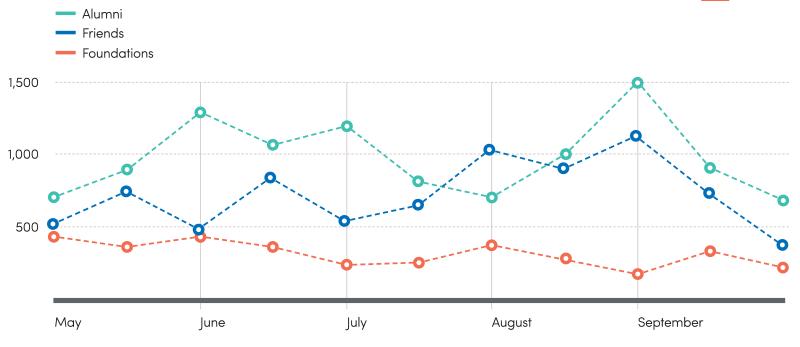
Use a line chart to represent continuous data, such as daily sales numbers. Line charts are great for spotting trends and patterns over time, as well as comparing different data sets.
As you’ll see in the example above by the University at Buffalo, the data sets are made clearly recognizable with the different colors. Important data points in time, such as the number of alumni, friends, and foundations at the beginning of each month – are marked with a dot.
In their 2017 report on the global state of social media, Hootsuite presented plenty of data. They mostly used bar graphs when comparing whole numbers among different geographical areas.
In the example above, Hootsuite used bars to represent different countries. The higher up the graph went, the more Internet users it represented. To make it easy for readers to follow the data, the bars were arranged from the highest to the lowest value – rather than randomly or alphabetically.
You can make your bar graph even more interesting by making it circular, especially when comparing statistics by country. That’s what Ernst & Young did to visualize fintech adoption across different markets:
Pie charts are useful for showing the components of a whole. That’s why they’re typically used to represent percentages.
In the example above, CB Insights showed homeownership for each generation in the US, relative to the country’s entire population.
For precision, the exact percentage is written on the ‘piece of the pie’ that represents it. Otherwise, your sales presentation would end up being a guessing game of ratios and percentages.
Scatter plots can look daunting, but. this type of visualization is actually quite useful when you need to present three variables.
It also shows the distribution of data, making it easy to spot clusters.
For example, in their Global Extreme Poverty report, researchers Max Roser and Esteban Ortiz-Ospina used a scatter plot to display extreme poverty levels for each country, as well as GDP per capita. The third variable is each country’s population, represented by the size of the dots.
With this scatter plot, one can easily see that extreme poverty rates tend to decrease the higher a country’s GDP per capita gets. The distribution shows that African countries tend to experience both extreme poverty and low GDP per capita, while the opposite goes for European countries.
Now let’s look at how we can put all these data and visuals together in a sample monthly sales report.
A guide to creating a monthly sales report
1. Cover Page
Begin by creating an attractive and professional cover page. Personalize it with your company logo and the name(s) of the writer(s).
Since this is a monthly sales report template, identify the month covered by the report.
2. Monthly Sales Summary
Start the report with a summary of your overall performance for the month.
This first page shows upfront how much the company has made this month in sales. When presenting sales, provide the total value, as well as the number of deals it took to reach that value.
Next, compare the actual sales achieved with that month’s target, and show the rate of progress towards your goal. Show how many deals you projected to close in order to reach the goal.
A line chart is used here to show the difference between performance and goal. Instead of a simple line, we suggest using dots to make it easier to gauge how you fared each day.
Also, when comparing different data sets, use highly contrasting colors, like light gray and dark blue.
Now that you’ve looked back on your performance, present the goals for the next month:
On this page, you have your forecasted value and number of transactions. We’ve also added the timeline.
If you prefer to identify goals per agent, you can show a scatter plot and differentiate agents by using differently colored dots.
3. Sales Team Performance
Like a report card, it each salesperson’s performance. Here’s an example, based on the same monthly sales report template:
Here, we’ve used a bar chart to clearly compare the value of the sales achieved by each salesperson.
Make important numbers stand out by using larger fonts. Here, for example, average sales value and average pipeline are presented in a larger, bold font.
Next, still with a bar chart, present your forecast per sales rep. Add takeaways that are based on information not shared on the graphs, such as reasons behind the sales performances of each rep.
4. Marketing Channel Overview
The next important part of a monthly sales report is an overview of the marketing channels that generated leads and drove sales.
It will look something like this:
Here, we used an area chart to compare the number of leads generated by each marketing channel. Notice the total number of leads generated by all channels that month is displayed.
Meanwhile, think of the ‘lessons learned’ section as a behind-the-scenes explanation for channel performance. What important data do you have that the chart can’t fully explain?
For example, we’ve written the following lessons:
XX channel delivered a spike of leads on XX holiday
YY channel tends to deliver more leads on weekdays than on holidays and weekends
Next, take a break from graphs to provide key numbers:
How many leads did you generate this month, divided by your goal? If you targeted 13,500 leads but instead generated 23,000, that means you achieved 170% of your goal.
That sounds good, but how exactly does that affect the business? Translate that into opportunity value, and into results – meaning how many of the leads became customers.
In the example above, 7.5% of the 23,000 leads were closed by sales reps this month. That’s equivalent to 1,725 closed deals.
5. Lessons and Takeaways
Finally, add your lessons and key takeaways based on the sales figures, each sales rep’s performance, and the marketing channels overview.
Your turn to make a sales report
As a sales rep, you most likely do a lot of presentations beyond monthly sales reports. And some of them will be more stressful than most – like sales pitches, for example.
Don’t fret – we’ve created sales pitch templates that you can easily edit whenever you need them. Try them out here:
The modern buyer journey is changing and becoming increasingly more social. At the same time, a buyer’s trust in brand messaging is at an all-time low. More than ever, consumers (both B2C and B2B) are seeking out authentic feedback in social media as part of their decision journey. Simultaneously, brands are encouraging employees to become that trusted voice through employee advocacy programs.
The reason employee advocacy is so impactful is because of an employee’s unique position within the company. They know all the details of the brand and product and are usually perceived as having valuable “insider information” to share.
“Employees have the potential to be brands’ biggest champions and can be the key connectors between your brand and the market influencers.”
According to LinkedIn, employee-shared content is regarded as being three times more authentic and, therefore, typically sees a click-through rate that is twice as high as when the corporate mouthpiece shares the same data.
According to @LinkedIn, employee-shared content is regarded as being three 3X more authentic a CTR that is twice as high as when the corporate mouthpiece shares the same data. Click To Tweet
In addition to increased reach, engagement, and brand awareness, employee advocacy allows brands to have a voice earlier in the buyer journey.
The report cites that 85% of customers seek out trusted expert content when considering a purchase and 84% of C and VP level buyers use social media in their decision-making process. Because of this, most of the buyer’s journey is complete before the buyer is even known to the company, increasing the value of early influence. This is reflected in the fact that leads generated through employees have been found to convert seven times more than any other lead gen source.
85% of customers seek out trusted expert content when considering a purchase. Click To Tweet
There are also less quantifiable benefits, such as increased brand trust and confidence and more effective retention and recruiting efforts as visible, motivated employees help attract future talent.
Brands Can’t Just Buy Employees’ Influence
Brands are realizing that employees are a powerful influencer group they can always access, but they should not assume that access equals control. An employee’s personal influence is just that —personal — and usually not for sale. Companies may find ways to incentivize broadcast sharing of branded content, but, unless the employees are internally motivated, the full potential of their advocacy is falling short. Shifting the company view of employee advocacy from ‘owned’ to ‘earned’ media is a fundamental and required mindset shift. Finding what motivates the employee advocate to go beyond sharing branded content to creating their own content and connecting with external influencers is the secret to unlocking the power of these programs.
‘Employee advocacy 2.0’ describes moving from Content Amplification to Employees as Influencers.
Here is my favorite advice from the report on leveraging your own internal influencers:
Find What Motivates Employees
In a study conducted by Hinge Research Institute, 46% of millennials saw employee advocacy as an opportunity to develop skills high in demand; 39.4% view it as access to more job opportunities and 38% saw it as differentiation from peers. Brands should focus on helping employees develop skills and become more influential rather than viewing them as a broadcasting channel.
46% of millennials see employee advocacy as an opportunity to develop skills high in demand. Click To Tweet
Key ways to do this include:
Helping employees identify personal goals that align with program goals
Identifying external influencers and engagement opportunities
Providing tools and training to make it easy and remove doubt
Help Employees Identify Goals
Often employee advocacy programs are hindered by three main barriers:
It’s not clear what content to share or how to share it
Expectations are not defined
Employees don’t see the value of using social media in the workplace
To begin understanding what motivates employees, conduct an audit, grouping likely participants into persona categories based on audience size and social activity to allow for customized training and activation efforts.
The idea is to help employees simultaneously increase their network size and social activity if that’s a desired goal; not all employees will move to the ‘influencer’ persona, based on their own motivations and alignment with the company message.
Integrating disconnected employee advocacy, social selling and influencer marketing programs begin to leverage the content creation efforts across the sales and marketing teams. Focusing on content that prioritizes problem-solving and innovation in highly relevant and relatable terms builds upon unifying themes and lead to more authentic and useful content. Encourage employees to engage with industry content and create their own commentary or responses, rather than relying solely on branded content.
Identify External Influencers and Engagement Opportunities
Every employee has passion and expertise related to his/her field and role, and this passion is the conduit for connection to external influencers and experts. Facilitating these connections gives employees both permission and a shortcut to begin building relationships with key external influencers. In addition, empowering employees to follow these influencers more closely expands the brand’s social listening capacity and responsiveness and helps make future content creation efforts more relevant to target audiences.
Provide Tools and Training to Remove Friction and Doubt
A key shortcut to avoid is using the same training and activation content for the various personas. Instead, craft training materials and set expectations based on the employees’ current skill set, personal goals and preferred learning style. Craft a simple and approachable social media policy that outlines expectations and success. Implement social listening, content sharing and influencer mapping tools to help make the process as easy as possible. Build confidence by encouraging C-Suite and senior management to pilot the program to lead by example.
Measure the Success of Your Internal Influencer Program
Defining desired outputs and outcomes is essential to analyzing program success, but brands must also exercise patience. Avoid trying to accelerate results through stringent KPIs or risk losing the authentic voice that makes employee advocates so valuable. Some structured metrics are in the table below, but it’s just as important to celebrate the one-off and individual wins that program participants achieve that are the early building blocks to long term employee advocates.
Turn These Tips into Employee Advocacy 2.0
As you consider your own business, here are 3 actions you can take right away:
Evaluate your content through the eyes of your employees. Is your branded content so valuable employees are happy to use their influence to share?
Level up social listening and external influencer efforts. Finding and activating employee advocates is only part of a successful program. Can you begin building the topic hubs and influencer lists that will eventually map back to specific employee efforts?
Pilot a program with senior leadership. Where do your senior leaders fit in the persona category chart? Are there influencer networks you can tap into? What are the basic first steps to modeling this behavior in advance of a company rollout?
These first steps will help prepare your company to mobilize and motivate employee advocates. Ready for the next steps? We work with the world’s most interesting brands,—let us help you build your plan of action.
It’s a big question – but it’s important to get right, because leads are key to business growth. With that in mind, we’re putting our extensive B2B tech marketing background to work to answer it correctly. Because, admittedly, there’s a lot of noise out there.
Here’s how we’ve helped MSPs build consistent lead generation machines to keep new business coming in:
Define the audience.
Refine the message.
Make the website work.
Build intelligent paid ad campaigns.
Create impactful content.
It’s worth noting that these pieces should (almost always) be completed sequentially – so you wouldn’t be able to, for instance, “create impactful content” before “defining the audience”.
Okay – let’s dive in.
1. Define the audience.
Defining the audience is foundational to the success of any marketing campaign, and that certainly holds true for lead generation efforts.
It seems obvious, but poorly-defined audiences are actually all-too-common. For instance, we’ve worked with a provider that had a great IT service product for businesses above 20 workstations – yet their marketing communicated that they were a generalist. Consequently, their sales team spent a lot of time dealing with non-fits, or mom-and-pop shops that were too small to afford them.
By defining the audience, you can ensure the leads you’ll generate will actually have buying interest.
This starts on a company level. For managed service providers, there are generally three potential methods of audience targeting:
Location. It’s okay to be a generalist if you’re focused on a certain location. Target and speak to the business community in your location, and you’ll be able to make an impact.
Business size. Some managed service providers, for example, may only want to target businesses with between 100 and 200 workstations. There may be enough similarities in needs and service offerings in this context to justify a broad industry target if sizing is consistent.
Business / industry type. I’d argue that this is better than pure size for targeting purposes, simply because needs tend to vary across industry (and even if they’re similar, the language in which they’re expressed changes). This might mean focusing on managed services for healthcare practices, or specialized manufacturing, etc.
With a company target in mind, the next step is to hone in on the individual buyer personas that would be involved in the sale.
For instance, MSPs targeting mid-level businesses might sell to Chief Technology Officers, while providers targeting smaller businesses would probably target the owner. While you’ll probably have a pretty good idea of who you’ll typically be dealing with just given the nature of the company, the best way to verify this kind of buyer data will be through research.
2. Refine the message.
Okay, so you’ve got an audience identified. Now, it’s time to put that target to use by refining your message so that it best speaks to them.
For managed services providers, this is where you start to identify the unique needs your audience faces. If they’re healthcare providers, could you speak to HIPAA compliance? If they’re in retail, should you speak to protection from data breaches?
There are a variety of tools to help you work through this; at New North, we like Hubspot’s Buyer Persona questions, the Storybrand framework, and the Empathy Map. Basically, these are scripted questions or narrative formats that help you to identify pain points and the true value in your service.
No matter what you use, though, the end results should be:
You’re able to communicate the problem, solution, and value that your service addresses in three to five sentences.
You have a clear and effective unique selling proposition.
Your message is in the language of your target audience – not just in the language of managed service providers. This means that you’ve avoided jargon.
3. Make the website work.
From a high level, defining your audience and refining your message should give you confidence in your strategic direction. The next step is to put it all to use on your website.
We view the website as the hub of your marketing and lead generation efforts. In fact, every other channel – from email to SEO to social media to paid campaigns – should revolve around your website, both in terms of messaging and in terms of driving attention, because the website is the key mechanism in showcasing your business to potential clients.
Your website’s goals should be to generate relevant traffic and convert visitors into high-value contacts.
To those ends, your website should have:
Consistent, refined messaging.
Clear explanations of your services (both in terms of technology and processes).
Pricing. Some businesses are still hesitant, but we recommend showing at least a general idea of pricing upfront; it lays a foundation for sales conversations and helps to qualify potential leads.
Case studies and/or testimonials to provide validation of your expertise.
Clear calls-to-action for prospects to begin sales conversations (i.e. “Get a Free Consult”).
Clear calls-to-action to build email lists (whether through content offerings or newsletter signups – and ideally through both).
A blog. This will be the engine behind content across platforms and a key to demonstrating expertise.
This is just the beginning; there are plenty of other things that can be effective on your website. But if you start with these, you’ll be on the right track.
4. Build intelligent paid ad campaigns.
Here’s the reality: if you’re looking to get your lead generation campaign started, paid ad campaigns are the go-to.
Years ago, we used to focus primarily on organic lead generation campaigns. We’d prioritize SEO, focus on getting our clients to rank for high-volume keywords relevant to their audience (say, “Managed IT service providers in DC”), and dedicate the vast majority of our efforts to making it happen.
The problem is that making organic results happen takes time. SEO is a great method for generating leads, but it’s almost always a long-term play. Same with organic social campaigns. Most companies can’t afford to wait six months for leads; they need them to start flowing quickly.
That’s why paid campaigns are so useful. They’re basically a shortcut to the front of the line when it comes to getting a prospect’s attention. And, if they’re targeted well, paid ads can meet people with a service offering right when they’re looking to fill that need.
The result is high-quality, relevant traffic to the website – which, as we’ve discussed, has hopefully been built to convert those visitors into leads.
I’d recommend getting started with a Google Ads campaign first. The power of Google Ads is that you can reach people literally as they’re searching for your service, which means they’ll be particularly open to buying.
Paid social can be incredibly effective, too. But it’s generally best at entering people into the higher stages of your lead funnel (by facilitating signups to a webinar or content piece, for example, versus dropping them directly into a service consult).
5. Create impactful content.
If a paid campaign is the starter for a lead generation campaign, consistent content is the fuel. There are plenty of directions you can take this, but here’s what we recommend:
Start with the blog. Your managed service provider blog should be the engine for lead generation content on other channels. Use quick excerpts from posts for social content. Create email content based on top performing posts. Build topic clusters that boost SEO results. As you create content here, it’ll naturally spill over into other channels.
Focus on the right social channels, not on every channel. Don’t get overwhelmed by trying to nail Facebook, Instagram, Twitter, YouTube, and a podcast all at once. Start by identifying the channels that’ll be most impactful, and use them to build out success to other channels. In other words, find out where your audience is listening, and speak to them there. For managed service providers, I’d recommend LinkedIn first, then Facebook and Twitter next.
Do email. Build your list, and put it to use. Email is still one of the best digital marketing channels because it’s cost-effective and highly-targeted. Newsletters can be build from blog content. Nurture campaigns can be used to transition contacts into leads. The world of B2B email marketing is deep – get a fuller picture of it here.
Be consistent. Look, I get it – everyone wants results, fast. But the reality is that almost anything of lasting value takes time to build, and although it may not seem like it, the same thing’s true of digital marketing for managed service providers. Don’t give up on content production after a few weeks. Commit to making it happen over time (I’d recommend at least a year), and the results will start to build. That’s not to say that you shouldn’t constantly evaluate whether you’re pursuing the right activities, but it is to say that consistency wins the day, even in a digital world.
If you consistently create impactful content on the right channels, the leads will come.
People will tell you that the number one reason sellers do not like to prospect, specifically telephone prospecting, is rejection. However, if we step back, there is no less rejection in other means of prospecting, say e-mail or LinkedIn prospecting; when you look at the numbers, the phone is more effective than e-mail, (better together), it’s just not in your face (ear), like the phone. There is no mistaking a rejection on the phone, but with those other softer tools, you can tell yourself they’re just ignoring you, maybe next time. A distinction without a difference when measured by outcomes as opposed to emotion. Just the anticipation of being rejected crushes egos and opportunities to boot; sellers become so paralyzed by the thought of the objection, they fail to deal with it properly when it comes, and it always comes.
I don’t like objections any more than anyone reading this,
but it is part of the territory, just like 100 mile-hour pucks coming at your
goalie mask; until you accept that you will always lag. What if every time they responded you see it
as a question, an opportunity to educate?
You are the Subject Matter Expert after all.
A Rose By Any Other Name
At its root, whatever we may call it, it is a reaction to
something we said. Take it as an
objective, and you get defensive and lose.
Look at it as an opportunity to educate the prospect or correct a
misunderstanding they have, or highlight a blind spot they hadn’t considered. Any number of things an SME is in a position
to do to extend the interruption – first objection – to a conversation. No doubt at times that reaction may be curt,
short or nasty, but can you blame them, you just interrupted them in the middle
of a busy day, being busy at what they do to make money and keep their
job. I don’t know why sellers are
surprised that prospects don’t like to be interrupted, do you?
Best Defence Is a Good Offence
The problem for most sellers is as soon as a prospect reacts
with anything other than “Where do I sign?”
Sellers instantly file it under ‘adverse”, go into rejection mode,
and looking to please their manager and Marketing Director; they start
defending their company when it does not need defending. In the process abandoning their game plan and
their position in the conversation, by going on the defensive, you are not only
conceding ground when you should be holding and building value for both
parties.
By going on offence, I am not suggesting putting the buyer
on the defensive, which is what many do these days by questioning what the
prospect they called is using and why.
They don’t have to rationalize themselves to you, nor do you, but you
have to demonstrate value to the buyer you just interrupted.
Instead, sellers need to prepare in advance to be able to
understand the nature of the reaction, and how to respond in a way that adds to
the conversation, not ends it.
The first one is easy. You t-boned their day, and they want nothing to do with you stealing their time, they resort to the “rejection” that has the fastest and most fatal result to date. Most sellers crumble, go into Oliver Twist mode “Can’t I just send you some info in case?“
As an SME, you have to understand your target’s role,
function, contribution to their organization, accountabilities, role-based
basis, and how and what difference you have made to others in their place. These must be measurable outcomes and ways
that you have delivered impacts against their objective. This requires you play offence on your field,
not defense on theirs.
Most companies I cold call have committed to a sales
training organization, internal or external.
I can spend all day comparing their program to mine, and I will lose
every time. I need to change
fields.
Over and above which program they choose, their real
challenge is adoption, to be able to see some evidence a few months down the
road that that what their people learned will be applied for the benefit of the
company. I have a robust adoption
process; I want them to rehire Renbor!
People see a difference in numbers once they go through my
Follow-Through Action Plan.
When I hear “we’re all set”, I accept that they
believe they are, my job is to present something that raises doubt about that
belief in their minds. So I reply:
“You know I am glad you said that in fact ACME Corp.
felt the same way before they saw how our adoption process could be extended to
other programs, driving adoption of more of their programs. Let me show how we increased their pipeline
by 11%, how Wednesday at 11:00?”
They don’t care about my program; they want to learn about
how I drive adoption, so they let me in.
All the time knowing that the only way they will see the adoption plan
is to give me things I want.
What do you want to achieve this year with your prospecting efforts? Learn what others have achieved with our Proactive Prospecting Program.
This paper by Jin Li, Gary P. Pisano, and Feng Zhu identifies the strategic trade-off and implications for scalability when a platform provides services to existing and potential sellers that help reduce their fixed costs of running the business.
Just because your calendar is full of events, tasks, and deadlines doesn’t mean that it’s helping you optimize your time. After all, you could be overestimating — or (more likely), underestimating the time it takes you to complete a task or host a meeting. You need some calendar hacks to help you optimize and save time.
When you don’t have the correct calendar understanding, your schedule gets out-of-whack, and you end up wasting time on things that aren’t as important as others. Even worse, it could lead to conflicts where you’re continually canceling or rescheduling appointments. Rescheduling takes recontacting numerous times and is a time-suck which can damage your reputation.
The good news is that you can use the following 14 calendar hacks to help you optimize and save time.
1. Have the right tools for the right job.
Calendars have evolved from a paper calendar that was placed on your desk or wall to an essential app on your smartphone. As a result, you can access and manage your calendar whenever and wherever you like.
While your calendar app is a useful and necessary tool that can help you manage your time and keep your life in order, it can do so much than remind you of important events and tasks.
For example, Calendar can be used to quickly view your schedule and eliminate those back-and-forth emails when scheduling events. Directly share your availability with others through email or an embedded link, and they can then select a time slot that works for them. The event is then added to everyone’s calendar automatically.
Calendar can also harness the power of machine learning. Machine learning (ML) means using the power of artificial intelligence (AI) which analyzes your existing calendar information to make smart suggestions. For example, it can help you plan future meetings by suggesting who to invite, along with where and when. It can even tell you which types of meetings to schedule.
Most importantly, apps like Calendar, Zapier, and IFTTT can integrate with the calendar and tools that you’re already using. This type of integration allows you to keep track of everything like the Internet of Things, the Business of Things, marketing campaigns, invoicing, project deadlines, and lead nurturing — to name a few.
Because of this, you can automate your daily tasks to save both time and money. And, as an added perk, it reduces the number of tools that you’re losing so that you’re not frequently bouncing between several different tools or devices throughout the day.
2. Assess what works best for you.
There’s no shortage of tips, tricks, and advice you can find regarding your calendar. The thing is, there is no right or wrong approach as long as it works for you.
If you want to use both a paper and digital calendar because that’s what keeps you organized best, then, by all means, go for it. Are you a day-to-day thinker or prefer viewing your week or month to understand better what you need to do? Do you feel like calendar notifications during the day distract you?
Take the time to set-up, organize, and manage your calendar in a way that works best for you. You may make some mistakes along the way. But, eventually, you’ll develop a system that will help you get the most out of your time.
3. Set up multiple calendars.
Some people prefer to use just one calendar. It’s understandable to see why. Having only one calendar allows them to see everything in their schedule so that they don’t create conflicts, like double-booking events.
The problem with relying on just one calendar is that it can quickly become so cluttered that you can’t decipher it.
Instead, create multiple calendars. It could merely be one calendar for work and another for your personal life. However, you can create calendars for birthdays, holidays, meetings, payment due dates, chores, your kids’ schedules. You can then color-code these various calendars so that you can easily differentiate between them.
This process may sound like it could get too confusing. But, digital calendars like Google Calendar have all of your calendars in one location so that you can quickly view your schedule. You can also combine and sync your calendars so that they appear in your master calendar. That can be helpful if you have separate email accounts.
Before you start creating a million different calendars, decide on the calendar that you want to use. This choice is entirely up to you. But, focus on the calendars that you especially feel you need and use. Once you figure on which calendars you want to create, use different colors so that you don’t get confused, like green for holidays and appointments in blue. And, look for templates so that you don’t have to create the calendar from scratch.
4. Schedule your days into chunks.
As opposed to to-do-lists, busy people like Bill Gates and Elon Musk can remain productive because they schedule their days into chunks — usually in 5 to 15-minute blocks. Some people, such as Gary Vaynerchuk, plan their days down to the second.
You don’t have to be that regimented and exacting with your scheduling. Choncé Maddox writes in a previous Calendar article that organizing your calendar into a series of time slots allows you to “assign specific tasks to available time slots to ensure a higher success rate.”
“Block scheduling allows you to see early on if you’re realistic with your workload or not,” adds Choncé “I tend to get a lot done in a typical day, but sometimes I go overboard and schedule way too much for the time I’ve allotted to myself.” It can also help you prioritize your tasks and “takes the guesswork out of deciding when you start a difficult task.”
Another perk? Scheduling your days in chunks allows you to batch similar tasks together, as well as ensure that you plan time for breaks, lunch, exercise, or returning emails and phone calls.
Most importantly, block scheduling helps you focus on doing one thing at a time while guaranteeing that you get the most out of each second of your day.
5. Tap into productivity flows.
When blocking out your calendar, try to base them around your productivity flows. This way you’re giving yourself the appropriate time to block out specific events and tasks. For me, I can usually only focus on writing articles for an hour at a time. Because I know this, I block out an hour for writing and then a 15-minute break to stretch, go for a walk, or grab some more coffee. After those 15-minutes, I block out another hour to finish writing.
In most cases, we tend to have the most energy and focus 2 hours after waking up. What’s more, most people can only focus on a single task from between 20 to 90 minutes. We’re all different though. So, take a couple of days to determine your productivity flows. Then, you can block out your calendar accordingly.
6. Schedule time every day to do nothing.
We’re not machines. We need time to rest and recharge. One way to accomplish this is by scheduling blocks of time in your calendar to do nothing.
LinkedIn CEO Jeff Weiner schedules 30 to 90-minute blocks of time daily so that he can “process what was going on” around him and “just think.”
“At first, these buffers felt like indulgences. I could have been using the time to catch up on meetings I had pushed out or said ‘no’ to,” Weiner wrote in a LinkedIn post. “But over time I realized not only were these breaks important, but they were also absolutely necessary in order for me to do my job.”
Another benefit of this is that you can use these blank spaces to give your schedule some flexibility. For instance, if you get stuck in a traffic jam or need to put out a fire, you’re not disrupting your entire day because there’s some built-in flexibility in your calendar.
7. Create theme days.
“All my days are themed,” Jack Dorsey revealed to Fast Company.
“Monday is management. At Square we have a directional meeting, on Twitter, we have our opcomm [operating committee] meeting. Tuesday is product, engineering, and design. Wednesday is marketing, growth, and communications. Thursday is partnership and developers. Friday is company and culture.”
Dorsey spends Sundays on strategy and takes Saturdays off. And, that my friends, is how he’s able to run both Square and Twitter.
Obviously, you don’t need to follow his theme days. The idea is that by creating themed days is that it forces you to give your entire attention to the right thing at the right time. It also saves you time since you’re not bouncing between multiple tasks.
What’s more, in case you weren’t aware, multitasking can result in you losing up to 40 percent of your productivity. That’s because switching between tasks forces you to use different parts of your brain. Shifting between these different parts means that it takes you more to time to complete tasks, along with increasing mistakes.
8. Not all meetings require the same amount of time.
I’ll be honest. You don’t need to schedule an hour-long meeting in your calendar. In most cases, 30 minutes is more than enough time to host a successful meeting. The same is true for phone calls. Usually, a brief 10-minute call should suffice.
However, each meeting you schedule is different. As such, you need to start blocking out the appropriate time for specific meetings and calls. This type of schedule doesn’t have to be exact, but here are some guidelines:
If someone is asking for your help or advice, schedule a 10-minute call. This amount of time is also enough time for initial or discovery requests.
For teams, a daily 15-minute standing meeting is ideal to start the day.
Block out 30 minutes for weekly staff meetings of catching up with someone.
If you have a meeting outside of the office, block out 45 minutes — 30 minutes for the meeting and 15 minutes for travel.
9. Create buffers.
It’s not uncommon to schedule back-to-back meetings. But, what if a meeting runs late or you get stuck in traffic? That’s not only disruptive to the other attendees; it also throws a monkey wrench into your schedule.
Now, because the meeting started later than initially scheduled, whatever else you had in your calendar is pushed back. Moving your scheduling back means that you’re staying late in the office or wasting time tomorrow finishing up what should have been done or could have been today.
Whenever you add a meeting into your calendar, make sure that you have some time before and after so that you’re not rushing from meeting to meeting. Additionally, it gives you time to prepare for the meeting so that it can go smoothly and quickly.
10. Set reminders.
Because we’re all busy individuals with packed schedules, it’s difficult to remember every item we’ve added to our calendars. Thankfully, pretty much every online calendar or app allows you to set reminders. You also have the option of when and how to receive these reminders.
For example, you could receive an email reminder 24 hours before a meeting so that you can plan and prepare. You could set up an SMS reminder 15 minutes before a conference call so that you can stop what you’re doing and find a quiet spot for the call. Or, you could even set reminders every 30 minutes for you to stand-up and stretch.
11. Learn keyboard shortcuts.
To quickly add and edit events in your calendar, you need to be aware of keyboard shortcuts. In particular, you should learn the shortcut for adding events. As Nina Gass explains in another Calendar article, this allows you to “schedule a meeting or deadline with the click of one button and move on to more important tasks.”
Google Calendar, Outlook, and Apple all have different keyboard shortcuts. For example, creating an event in Google Calendar is just by tapping “c.” In Outlook creating a new appointment would be Ctrl+N or Ctrl+Shift+A. For Apple, it would be Command (⌘)-N.
Take the time to explore your calendar to find out its specific keyboard shortcuts. Or, you could check out and bookmark Nina’s post for a quick “anytime” reference.
12. Rethink how you add meetings.
Let’s say that you meet someone at a networking event and they want to schedule a meeting with you. Don’t wait a week later. Schedule the meeting ASAP. This way you avoid any potential scheduling conflicts.
At the same time, don’t just add any meeting to your calendar. That could lead to a massive waste of time. Whenever you receive a meeting request, make sure that it has a clear purpose. It should also have the details and an agenda. In other words, before blocking out time for a meeting, make sure that you know what it’s all about.
Also, most online calendars, like Google Calendar, allow you to set specific working hours and create an out-of-office message. When you have created an out of office message it means that if someone attempts to book a meeting with you when you’re off-the-clock or out of town, it will automatically decline the request.
13. Book your calendar well in advance.
“Plan as much as you can a year in advance and stick to it,” recommends “Shark Tank” star and Herjavec Group CEO Robert Herjavec. For example, when his children were younger, Herjavec would sit down with his assistant and children’s counselor every September to go over every holiday and event they had off.
“Because of that, I never missed a swim meet. I never missed a school play. I never missed anything,” he told Entrepreneur. “I’d fly from L.A. back to Toronto to be with my kids for one day. That’s the great thing about having your own business — the freedom to control your schedule and to do with it what you want.”
The good news is that with the machine learning, smart calendars can do this for you. As mentioned above, smart calendars can look at your previous calendars and make suggestions on how you should create and manage your calendar.
14. Find free time in your schedule.
Finally, if you want to optimize and save time, then you need so how you’re spending your time. You may discover that the reason your calendar is too full is that you’re putting in too much on email or social media.
Thankfully, there are many time-tracking tools like Toggl, RescueTime, or TimeCamp that can help you identify where you’re spending your time. When you pick-up these patterns, you can see when you’re most productive and when and where you’re getting distracted. Some of these tools can even block out specific websites you feel as distracting you during particular times of the day.
Over the last few years, the term “revenue operations” (often referred to ask RevOps) has come up more and more in conversations. RevOps is how Marketing, Sales, and Customer Success operate across the full funnel to drive growth. It’s the strategic integration of those departments to provide operational efficiency.
But what role does RevOps play in ABM? I asked Jason Reichl, CEO of Go Nimbly, this question. Go Nimbly is the revenue operations company that enables SaaS companies to achieve their business goals. Jason explains how RevOps and ABM go hand in hand.
TRANSCRIPT:
Brandon:
Hey, everyone, Brandon Redlinger here, director of growth at Engagio, and I am stoked today to be talking to Jason Reichl, the CEO at Go Nimbly, welcome Jason.
Jason:
Hey, thank you, thank you very much. It’s good to be here.
Brandon:
What role does revenue operations play in ABM?
Jason:
That’s a great question. So, ABM is one of the, what I always say about ABM when I’m talking to customers about it, and especially a lot of customers bring Go Nimbly on as a partner right when they’re starting to make that ABM transformation, is that ABM is truly one of the first cross-departmental, really what I call RevOps initiatives, which, in order to be successful to the degree that you can be, you really need to have those teams be unified into your, your marketing, sales, and customer success team are unified into a revenue team, and the operational team is behind them, supporting it because ABM relies on a unified operational back end, there’s gonna be friction between the GTM team and ops team if they’re not completely aligned.
And so, refocusing everyone on the revenue is kind of a way of making sure that ABM really sticks and that everyone is supporting and building on top of it. So, I’ve found that we can really get the results that ABM promises by having a team like Go Nimbly involved. But really, if you don’t have Go Nimbly involved, ’cause a lotta organizations are not the right fit for us, ultimately what you need to be focused on is having a team that is using the same metrics as what your revenue team is using. And if you can align those two things, then you have a better chance of ABM really playing out the way that you want it to.
Brandon:
Perfect, alright, so, you go into a company, sales has their metrics, marketing has theirs, maybe even success has theirs, right? How do you start to decide on what those metrics should be that everyone should share?
Jason:
Yeah, so, we basically use two metric frameworks. One, which I mentioned before, which is called 3VC, that’s refocusing the entire organization on let’s look at the pipeline; let’s look at those four levers; value, volume, velocity, and conversion; let’s look at those and see if they’re changing over time; and let’s compare those to industry standards, right?
And so that we know how we’re doing against other people and also, hey, we seem to have a problem here around value, what can we do to change that? Or we have a conversion problem. And then both the revenue team, being all unified, and the operations team are tackling that problem together, so that’s kind of a cross-pollination meeting that we have, where we are coming to the table and trying to fix problems holistically across the entire revenue team. But then, also, on top of that, we still use standard SaaS metrics that other SaaS companies would use to measure growth and how you’re doing as an organization. It just doesn’t have to do with your effectiveness, right?
Usually, I think that most SaaS metrics have more to do with your product than your internal operations, right? How much can a customer success team really bring down churn? They can only prevent churn, but if the product is not there, then you’re gonna see your churn numbers go up, right? But being able to identify very early on that you have a churn problem is kind of what the role of operations can play in kind of this [ABM] model.
So many ways to blow a great presentation…and so little time. You likely work hard to get the opportunity to present to a prospect, so why risk blowing it on one (or more) highly preventable mistakes?
Here’s my Top 50 ways to blow a great presentation. Check off which ones you’re guilty of – if you dare!
Spend a lot of time “chatting” with your prospect in the beginning to get comfortable.
Talk about yourself or your company right away.
Take your time getting to the value you bring your customer.
Don’t confirm who will be in the audience.
If you find out anything’s changed before you start, just forge ahead with what you planned, regardless of whether it’s still relevant.
Don’t practice. You don’t want to be phony!!
And be sure and tell your audience you didn’t have as much time to prepare as you’d like.
Don’t plan out the key points you want to convey. Your memory is rock solid under pressure!
Don’t tailor your presentation to your audience beyond adding the obligatory logo to your first slide.
Skip through slides that aren’t relevant (and you forgot to hide.)
Don’t waste time warming up your voice or body.
Don’t worry about getting into a positive mental state.
Try to get across as many points as possible in the time that you have.
Don’t let the prospect speak for at least 10 minutes.
Continually ask your prospect, “does that make sense?”
Answer your own questions. Who has time to wait?!
Don’t plan your questions out ahead of time – wait for inspiration!
Put up an agenda. And then never refer back to it again.
Don’t worry about a back-up plan. What could possibly go wrong??!
Make a big deal out of every mistake or technology issue. (Bonus: Lament what they could have seen if everything was working perfectly!)
Read from every slide. Because reading is hard.
Expect your prospect to read a slide – but then talk about something else while they’re reading it.
Use light pastel colors and fancy fonts that are pretty, but difficult to read.
When showing graphs or charts, refer only to colors. After all, what are the odds people are colorblind anyway? (Ahem, one out of every 16 males!)
Use lots of bullet points or tiny type.
Go through each bullet point, line by line by tedious line…
Try to use fewer slides – and pack each one to the point of collapse!
Show a complex screen or graph and let your audience figure out what part they should focus on. Or wave vaguely towards a section of it.
Save questions for the very end of your presentation.
And use a slide with a giant question mark on it for Q&A (otherwise, how will they know?)
Speak in a monotone voice.
Never pause. You’ve got a lot to get through so just do it!
Keep it real by not worrying about filler words in your speech, like um, ah, so, etc.
If standing, shuffle back and forth aimlessly or continually shift your weight.
Never move from your safety zone behind your laptop.
Do not smile. I repeat, “do not smile.” Especially when sharing good news!
Never record yourself. Nothing you can do about it anyway, right?
Don’t plan your closing. It will happen naturally. HAHAHAHA
Answer every question, no matter where it takes you or how long it takes to answer it.
Dive into as many details as possible.
When presenting data, let the numbers speak for themselves. Why beat it over the head?
Don’t summarize. Surely they got it the first time you said it!
If you use a whiteboard, don’t practice. Your handwriting is PERFECT!
Don’t bother testing out your opening or story on a representative audience. It’ll be fine!
Tell the same tired analogy everyone’s heard a hundred times about Apple, Microsoft, the Wright Brothers, etc. etc
Use as many acronyms or product names as possible. Spend a lot of time teaching your audience their meaning if necessary.
Don’t use a webcam for virtual presentations. Who cares what you look like, right?
When pointing to information move your mouse really quickly. As soon as your audience figures out where you are, jump to the next point. Rinse and repeat.
Present on your mobile device the same way you would on a larger screen. It’s all the same.
Use every last minute of your allotted time – even if you’re done.
When life throws problems your way, it’s natural to think you just need the right tool to solve it. This is no different in customer service.
“My organization needs a good chatbot.” “We need to invest in a knowledge base.” “My company is considering an online community.” Statements such as these stem from legitimate requirements to reduce costs, increase efficiencies, or better connect with customers. Other drivers might be customer feedback, competitive pressure, or leadership decree. All are valid and important reasons to evaluate new tools.
The problem is that every one of these statements cater to improving how customers’ issues are addressed but fail to address why customers are contacting customer service in the first place. The distinction is significant because only one will ultimately improve the customer experience.
Addressing the “how” is important…
Customers purchase products and services and expect them to just work. When they don’t, it’s a disruption to their experience and they seek a solution. Customer service exists to get them back “on track”–to put the customer back on their journey.
Having the appropriate service channels they expect is critical. Since most customers begin their search for a solution online, it’s important to have the right self-service tools–in the form of chatbots, knowledge management, and communities, for example–available. Not only does self-service provide a convenient option for customers, but it’s also efficient and cost-effective.
… because it can save money …
The cost-savings of chatbots or knowledge bases can be appreciable. Rather than addressing that same issue over-and-over by telephone at $20 per call, offering the solution via self-service can reduce the cost to perhaps mere pennies.
Consider this example: a customer service center receives a total of 300 inquiries each day about a particular problem over their live service channels–telephone, chat, and email. Let’s assume for simplicity’s sake the cost of responding to that one issue every day across all support channels costs $2,500. Adding lower-cost and higher efficiency channels such as chatbots, a knowledge base, and communities can help to reduce that daily cost–say it lowers the cost down to $1,000 per day.
Slashing costs by 60% is impressive. The problem is those 300 requests have not gone away; that’s still a $30,000 per month cost to the business on this one issue. If the company sells more products and services, that number goes up.
This is an example of just one recurring issue. Most companies have multiple common problems affecting customers. Relying on self-service alone misses the opportunity to have an even greater impact.
… but the “why” has incalculable savings!
There is a better approach. It requires working collaboratively with other teams in the company to permanently address the true cause of problems. Only the teams outside customer service–manufacturing, engineering, finance, legal, and others–can do this. From the example, were the company to eliminate that one issue, it would save over $300,000 per year–and this is just one issue! In what better ways can that money be used?
The numbers add up quickly, but it’s the other outcome of taking this approach that’s even more impactful. By eliminating problems, the customer experience improves because future customers will never encounter the issue and their trust in the company will be greater. This is powerful because a Bain study found that increasing customer retention rates by just 5% can increase profits by 25% or more. Customer retention also has the effect of reducing costs since it’s 5 to 25 times more expensive to acquire a new customer vs. retaining an existing one.
Are you ready to permanently address customer problems and drive ongoing improvements to the customer experience? Two things are necessary to make this approach successful. First, a “customer first” culture must exist that reinforces the importance of teams working cooperatively with customer service. Second, a collaborative service platform is needed that allows customer service to easily work with other teams to triage customer problems, assign issues to the proper team, and track problems to resolution. Yes, a tool–workflow–is ideal here as it keeps the issues visible, the progress ongoing, and each team accountable using a standardized and repeatable process.
The power of “why”
Most customer service organizations are focused on addressing customer questions and problems in the most cost-effective and efficient manner possible. Savvy companies realize there is much more at stake than just faster answers at the lowest possible cost because as customers encounter problems, their experience erodes. It might be only by a bit, but over time that erosion will end up costing a company more than just answering a phone call or offering a knowledge base: it reduces the likelihood the customer remains a customer.
There is a better way. Companies must go beyond simply responding to customer inquiries and unite the teams throughout the organization to identify and address the underlying reason customers are contacting them. Using this strategy, the customer experience improves and the company will prosper.
The year 2020 is just around the corner and before you know it, it will be here! It is a date of almost legendary proportions and for many years it has been a landmark date in terms of strategy planning for many blue chip corporates. I suppose the same could be said of email marketing trends for 2020… but let’s look at 2019 first!
Working in a digital environment, you know that it is highly dynamic and you need to be on your toes, constantly adjusting and adapting. But, looking at what other bloggers and experts are saying about email trends, I definitely get the feeling that there is some more of the same. So, my message is – its time to implement!
So, stop planning…stop referring to the 2020 strategy and let’s rather implement, implement, implement and get on with it. Do it, just do it, stop talking about it, stop thinking about it, stop researching trends, stop looking for reasons not to do it and just start doing it!
Email still plays a key role in digital communication.
Companies are trying to gather more data and insights into their customers, using the latest technology at their disposal and identifying the best ways to communicate information, offers and real time information to their customer base. There is a clear platform that has been consistently growing in popularity and relevance in digital communication and that is email.
Email is finally getting new found respect which will continue into the future as Chief Marketing Officers get more serious about what email can offer and how it can contribute to relationship building and measuring immediate ROI and lifetime value.
At a high level, email marketing provides such a great ROI with figures of up to $44 for every $1 spent– who can argue with that! There is so much incredible info about why email is such a great channel to use, but I will save that for another blog.
I think we can all agree that email and email marketing is an effective tool to communicate with your customers. There are many trends and discussions from leading email experts. I have chosen to combine a few and explain why I believe they should be implemented sooner than later…
Email marketing trends you need to implement now!
1]. Personalization, and by that I mean hyper-personalization, and oh….automation
Personalization, hyper-personalization and automation are not new trends or a revelation!
Personalization needs to evolve from simply addressing your customer by their t first name to using real time data, database segmentation and dynamic content. These are the tools of Hyper personalization and automation, which help break through the clutter, by enabling more targeted and relevant customer communication, which ultimately improves your conversion rates and ROI.
2]. Automation…. AI… and triggered emails
This has to be incorporated into your digital communication strategy…..now! It should form part of your Customer Lifecycle Management Program. The easiest way to get this going, is to work on your onboarding strategy and at the very least, focus on your ’welcome email’ which creates the right first impression for your new customer.
Your triggered emails should be executed based on your customer’s behavior and/or interaction with your brand, website, or company for example.
Triggered email communications are way more successful than the ‘spray and pray’ approach, where you blast a campaign hoping it appeals to everyone in your database.
Making use of Artificial Intelligence helps to make these automated / triggered emails more meaningful and relevant, by communicating the right offer and message at the right time, when the customer expects it.
3]. Text and Interactive Emails
Let me continue by contradicting myself…
There is likely to be a shift in the way that marketers design their emails to achieve more authenticity and interaction with their targeted customer base. In the past the trend has been to fill the emails with lots of graphics to grab the customers attention. I see a change coming and it is going to be more text oriented type emails [or plain-text in our old lingo]. This will create a sense of authenticity, a personal message from the company / brand that is less ‘salesy’. Couple this with AI, hype-personalization, automation and triggered emails and the result will be short, relevant, easy to read, personal plain text email that should have a lasting impact on the customer.
Contradicting myself, [because it’s nearly 2020 and I can], we can look to go completely the other way and that is to design emails that are far more interactive. By including a poll, a quiz, survey, games, competitions, GIFs, VUE GIFS (think 3D) into your emails, which can then drive more engagement with your customer base and ultimately lead to conversions.
There are many experts you can follow and blogs you can read, but my feeling is that the same trends are being spoken about each year. This is not a problem, as it shows the relevance of the trends and confirms that they are here to stay. Now that you have been reminded of the trends (once again). There is only one thing left to do…implement them! To steal a well know phrase – “Just Do It!”
This success story tells an age-old tale, one of a marketing team adrift in a morass of content, who found their way to solid ground by following buyer intent signals emitted by their perfect audience. In other words, this video tells the story of how a tech firm transformed their fast and loose content marketing initiatives into an intelligent, targeted strategy informed by intent data.
According to Tony Lombardo, Director of WW Digital Marketing and Technology, the content marketing strategy at CommVault was neither data driven nor market intelligent. But, by peeking at the wants, needs, and intent signals of buyers actively researching solutions to their pain points, his team was able to successfully redefine the firm’s content marketing strategy.
CommVault’s Senior Director of WW Digital Marketing Dawn Colossi said, prior to their strategy overhaul, the firm’s content marketing efforts and campaigns weren’t hitting the right audience. When they did find an audience, their timing was not usually right.
“We were completely missing early-stage content,” Colossi said. Without a bird’s eye view into their marketspace, and lacking a stream of synthesized buyer intent data, the firm was flying blindly, producing mid-funnel content for folks who were actually at the beginning stages of their buying journeys.
But, once they partnered with a leading market intelligence / intent data science provider, buyer intent signals identified the audience that needed their content and their solutions. As it turned out, targeting a comprehensive, intelligent content marketing strategy wasn’t all that elusive — that is, once the firm had tapped into the power of buyer intent data.
One SiriusDecisions ROI award for content strategy later, it’s evident that a content marketing strategy fueled by quality buyer intent data was the overhaul this firm’s marketing organization — and its audience — needed.
Do you know which specific companies are currently in-market to buy your product?
Wouldn’t it be easier to sell to them if you already knew who they were, what they thought of you, and what they thought of your competitors?
Good news – It is now possible to know this, with up to 91% accuracy. Check out Aberdeen’s comprehensive report Demystifying B2B Purchase Intent Data to learn more.
If you’re the leader of a product-first SaaS company, it can be easy to make the mistake of ignoring marketing and believing that it isn’t necessary for the success of your organization. This is a common occurrence in the SaaS vertical where marketing has a tendency to be not only held at bay while the product is perfected, but flat-out ignored post-funding when initial investments are made in sales and sales alone. That is, until revenue plateaus and marketing is brought in to boost performance.
The great thing about product-first organizations is they are notoriously innovative, vision-driven, and poised to scale, because rather than gathering research from potential customers and building a product to meet their needs, a product-first company will attract customers that need the product—this is where marketing comes into play and why marketing investments must be made before building a sales team.
Marketing does more than simply put a shiny spin on your successful product. In fact, marketing has a significant role to play as your product-first SaaS company matures over time.
Build Personas to Make Sales More Efficient
One of the first marketing exercises a product-first SaaS company should engage in is the creation of personas. A buyer persona (also called marketing persona) is a representation of your target customer. By interviewing actual customers who have been attracted to and are evangelists of your product, you will learn not only demographic information but also psychographic information that, when paired with data you collect from actual product usage, will help you reach more of that target customer.
This foundational marketing research is not only immensely helpful to your individual sales representatives who will now have a general idea of who someone is and what’s important to a person before engaging in a live conversation, but this research will also make your sales organization more efficient and thus more profitable.
Encourage Customer Referrals and Promote Third-Party Reviews
The dream of a product-first SaaS company is for one user to fall in love with the product, tell his or her friends who also fall in love with the product, who tell their friends, and so on and so on. I can easily lose track of all of the consumer-based apps and SaaS products I have personally evangelized, from Stitch Fix to Instacart to my Ring doorbell. I love these products and can’t wait to tell my friends how much they will love them, too. But referrals don’t just happen, especially in B2B SaaS. Although I’m likely to be dining out with friends and fielding a compliment about my outfit that leads me to share, “It’s from Stitch Fix. My stylist totally gets me. You should try it!”—there’s not quite the same in-the-moment, organic opportunity for call tracking, HR, or sales commission software is there?
In B2B, we have to work a bit harder for those referrals, and this is where marketing can lend a helpful hand. Although you can certainly try to develop a referral program where individuals are compensated or rewarded in some manner for referring a friend, you will get far more mileage out of a third-party published customer review. A product-first SaaS company should continually survey users while in the app and then use that data to request reviews from happy customers. That one customer review can be used on your website, in email signatures, on relevant social media channels, and even in lead nurture campaigns.
Create Case Studies and Broaden Calls to Action
A good old-fashioned case study is a mainstay in any B2B SaaS sales enablement content library. We know that case studies are effective tools during a buyer’s decision stage, both when competing against another vendor and when your buyer has to sell his or her decision to purchase your product internally. Not only should marketing be creating these case studies (if you need help with this, check out The Components of an Effective Case Study and 5 Powerful Content Marketing Case Study Interview Questions), but you should also showcase these extremely valuable case studies, rather than waiting for your buyer to ask sales for them.
The be-all, end-all call to action (or CTA) for a product-first SaaS company tends to be either “Request a Demo” or “Free Trial.” Either way, you’re assuming the buyer is ready for that next step or that he or she hasn’t already experienced a demo or a trial. Marketing should experiment with case study CTAs at the end of blog articles or in the footers of emails, and they can use marketing automation technology to display case study CTAs to individuals who shouldn’t be prompted to request a demo (for example, the person who already saw a demo, has your pricing in hand, but is still trying to learn more about you online). Whether you’re using HubSpot’s smart CTAs or Marketo’s dynamic content, if you have a fairly organized contact database, you’ll be able to give your well-earned case studies the exposure they deserve.
Marketing deserves a seat at the executive table of a product-first SaaS company. Particularly in B2B SaaS, it’s through strong marketing efforts that organizations can better understand their target customers and then leverage those customers to share the benefits that your product provides.
If your win rate would increase substantially by your making an additional face-to-face sales call, would the “lack of efficiency” be worth the increase in effectiveness?
If slowing down and spending more time in the discovery phase would allow you to come up with the right solution through collaboration while also building consensus, would slowing down be valuable if it meant a greater likelihood of winning the deal?
Would the time spent nurturing your dream clients over the course of 36 months be worth it that initiative was responsible for your winning two or three multi-million dollar opportunities with the kind of loyal clients that remain with you for a decade?
Efficiently Inefficient
There is a particular focus on increasing efficiency in sales that stems from the digital age in which we find ourselves. The desire to use technology to gain efficiencies has caused companies and salespeople to trade automated emails for phone calls, and web meetings for face-to-face to meetings, reducing the time and the expense of selling.
Because efficiency is the stated goal, the reliance on technology is accompanied by a form of Taylorism, slicing the sales roles thinner and thinner in attempt to “reserve the most expensive” sales resources for “closing well-qualified leads.” Both of these strategies are supposed to win more deals faster, and at a lower price. The less expensive, less effective salesperson is the first to speak to a prospective client, instead of the greater value creator.
Like many good ideas, when one takes an idea too far, the result is often the opposite of what was intended. The complex, dynamic, and non-linear activity that is selling doesn’t resemble the assembly line. Your efficiency doesn’t do anything to help people and companies change, and make no mistake when you are selling that you are engaged in change management (whether you like it or not, and whether you believe you are responsible for doing so).
No Wasted Effort
The additional face-to-face call isn’t inefficient if it increases your wins. If not making the call means you are likely to lose, you wasted all the effort up to that point, making skipping the face-to-face call inefficient.
If slowing down to create greater value and certainty for your prospective client and all their stakeholders means you have the right answer and the support that results in a win, it is inefficient not to have the additional meetings.
When you repeatedly do something that causes you to expend energy without achieving the desired outcome, that process is inefficient. For that process to be efficient, you’d need to achieve the result, in the case of selling, that means winning.
Essential Reading!
Get my first book: The Only Sale Guide You'll Ever Need
"The USA Today bestseller by the star sales speaker and author of The Sales Blog that reveals how all salespeople can attain huge sales success through strategies backed by extensive research and experience."
Email marketing is a popular tool for companies who are interested in building up their relationship with customers, attracting new leads and sharing the latest news and updates with their contacts. The right automated marketing and CRM software can make it easier for your sales team to close deals and boost revenue. When you’re running multiple email campaigns and send a high volume of emails, it can easily get cluttered with dead end leads and other useless data. Here are some strategies for cleaning up your email marketing so it’s more efficient and provides more accurate data.
Continually Update Your Customer Segment Groups and Create New Ones
Keep your customer segment groups up to date by frequently reviewing and updating them. Have you discovered a new segment you want to target that demonstrates different buying habits? Or maybe you’ve recently decided you want to expand your company’s marketing to a new geographic area? Look at the different segment groups you currently have and evaluate whether you should split up segment groups further or create new filters and tags so it’s easier to find certain groups. When you make the effort to continually update your customer segment groups it can increase your chances of providing relevant information that will appeal to your contacts.
Remove or Archive Ineffective or Old Email Campaigns
Another tip that can help declutter your email marketing and make it more effective is to archive old or ineffective email campaigns. Did your company run a campaign with a drip sequence five years ago that resulted in abysmal open rates? Or maybe your first email campaign for people who abandoned their shopping cart at checkout had a very high unsubscribe rate? Record the results of each email campaign and archive the actual campaign itself so your sales team can focus on current campaigns.
Scrub Unresponsive Contacts from Your CRM Database
How many people actually read your company emails? Look over your contacts and make note of how many contacts are unresponsive or have low scores. Remove the leads who are unresponsive or have incorrect email address. This type of purge can help your company make better strategic decisions and have more accurate records.
Review and Update Your Company’s Email Automation Workflow
Lastly, we recommend that you frequently update your company’s email automation workflow. Are the automated triggers working properly? Run a test and switch some of the workflow’s triggers to which one is most effective and in which order. You can also investigate whether there are certain triggers you can add that will improve your company’s overall conversion rate and other analytics. If you are scoring each lead or contact, examine the data to see if certain groups exhibit certain behaviors or fit a certain demographic. This type of information can also help you improve your company’s email automation workflow.
In conclusion, CRM software and email marketing automation can drastically improve your company’s revenue and improve customer relationships. The software can also allow your sales team to focus on other important activities to boost sales rather than repetitive, time-consuming tasks. You can also leverage email marketing to dramatically improve your company’s brand in the digital space. When you and your sales team make a point to keep your CRM database contacts, workflows and campaigns organized and decluttered it can result in cleaner data. It can also make it easier to track important, relevant statistics that can help improve the campaign’s engagement level and conversion rates.
Hype around artificial intelligence has never been higher — and one industry where it has a chance to make a major impact on profits is retail.
Business Insider Intelligence projects that AI will boost profitability in retail and wholesale by nearly 60% by 2035, setting off a wave of excitement and investment among companies.
The areas where AI will have its biggest impact are personalization, search and chatbots.
But as hype and misunderstanding continue to build, it’s become harder than ever to keep sight of the true disruptive potential of AI.
Find out how AI is being implemented in these three areas and how each one can impact revenue in this new FREE slide deck from Business Insider Intelligence.
In this third and final installment of the three-part Future of Retail 2018 series, Business Insider Intelligence takes a hard look at the retail use cases where AI can make an impact, explores noteworthy examples of retailers implementing the technology, and weighs the benefits of investing in AI today.
As an added bonus, you will gain immediate access to our exclusive Business Insider Intelligence Daily newsletter.
To get your copy of the third part of this FREE slide deck, simply click here.
A marketing email is vastly different than the emails you send your family or your friends. You’re not just sharing information; you’re actively trying to drive engagement to support your business — all without being too dull or too pushy. If that sounds like a tall order, we can help.
1. Have a Clear Focus
The best email marketing campaigns have a clear focus, helpful information, and an authentic tone that matches your brand. With that in mind, don’t try to do too much in your emails.
Determine a single goal and focus on it. If you ask people to read your blog, download an e-book, sign up for a demo, and visit your website all in one email, it’s more likely they’ll take zero action. Focus on a singular goal. Be sure to use strong language, however. “Listen to our great, helpful webinar” with a direct link is more swaying than “We held a webinar last week.”
2. Take Advantage of the Pre-Text
The pretext of an email is the small line of text that follows the subject and briefly introduces the recipient to the email’s content. It’s noticeable on a desktop, but for mobile, it stands out even more. Its primary purpose is to set emails apart from each due to the increasing volume of emails a person receives daily. So, you should write a succinct pre-text header if you want a better chance of someone opening your email.
Try to keep it under 50 characters while providing a to-the-point summary of what you’re emailing is offering. Focus the more important content at the beginning of your pre-text. For many email platforms, the pre-text will either be blank or pull in the first line of your body. Both make you look less legitimate to readers.
3. Don’t Neglect Your Subject Line
We all know there is a lot of competition in a person’s inbox. Your subject lines should stand out from the crowd to increase your open rates. Some tips to make your subject lines more captivating:
Make sure your subject line aligns with the email’s body copy
4. Answer the Question: “Why Does This Benefit Me?”
Persuasion lies at the heart of emotion – so tap into it when writing your email. Instead of saying something is useful, like downloading an eBook, explain why. Try painting a picture of how your eBook will strengthen their leadership skills or lower their anxieties over a pain point they continually experience.
5. Make it Visually Appealing
Well-designed elements in an email can compel your readers to take the actions you want while showcasing and reiterating your brand. Your visuals don’t have to be overwhelming, either. A simple template makes your newsletter look more authentic while a button or small image as a CTA can increase your click-through-rate.
6. Elicit Urgency
Emails that create a sense of urgency or FOMO (Fear of Missing Out) generate responses at a high rate. The psychology of FOMO compels people to do something. Use language in your subject lines, pre-text, and body that employs FOMO – like if they don’t open this email, they’ll miss a deal, a sale, an event, or something important to them.
7. Keep the Content Short
Shorter emails generally have a more concise message and take less time to read – which is a positive for users who are likely inundated with emails and communication from brands. Long emails also trigger spam filters.
Research done by Contact Contact suggests 20 or fewer lines of text results in higher click-through-rates. To stay within these limits, imagine you’re trying to convince someone in your real life, like a friend, to do something. Your main argument is generally brief, yet convincing. If your email has to be lengthy – keep the most important information above the fold. If someone is scanning your message, they’ll still see the most relevant content.
8. Use Impressive Statistics – When Applicable
Impressive statistics or similar strategies can make your company seem more credible and help persuade your readers to take specific actions. Make sure your numbers and examples are truthful. Try utilizing stats to show value in examples such as:
Numbers. “This year we helped 121 companies simplify their HR processes.”
Big name clients. “See why Samsung Electronics switched to our software to save time.”
Your publicity. “We’ve been named HubSpot’s quarter partner for the third quarter in a row.”
A lot goes into writing a great email – from succinct copy to compelling numbers to actionable subject lines. With the above ideas, you should be ready to tackle your next email marketing campaign. If you need further help, consult with us on your email marketing strategies today.
Sales cold calls are often misunderstood and underutilized as an effective sales and lead generation tactic. Lots of business owners, entrepreneurs, and even some sales team managers and sales executives have misconceptions about what those first prospecting calls are for. As a result, too many sales people are wasting too much time with ineffective calling scripts and off-target sales prospecting strategies. Don’t try to do too much with your prospecting cold calls – you don’t have to close the deal with that first call, you just need to get the sales process started.
Here is a simple outline of what should be your top 3 goals for every sales prospecting cold call:
1. Introduce Yourself: It sounds simple, but too many business people fail to do this – your first prospecting cold call is not about asking the customer “how are you doing,” it’s about quickly and concisely explaining who you are, why you are calling, and why it matters to them. Don’t feel bad that you’re making a sales call, don’t be apologetic, don’t hesitate – you’re on the phone because you have an idea to help their business. State your name, your company’s name, and explain a bit about what your company does. Make sure they hear you and understand what you say.
A good sample script for the first part of the call could be: “Hello, my name is Al, calling from Strategic Sales and Marketing. We do B2B lead generation for companies like yours, and I wanted to introduce myself and start a conversation with you about how we could potentially help your business.”
2. Generate Interest: If you handle the introduction well, the next part will be easy: generating interest. Remember: the purpose of this first cold call is not to close the deal, it’s not to tell the customer your life story – it’s to start a conversation. Everyone on your prospecting list is busy, but if you can just plant a seed of curiosity in their minds, and get them interested to hear more, then they will be more likely to keep talking with you – and that process of starting and continuing conversations and building relationships is what ultimately leads to sales.
A good way to generate interest on that first call is to say something like: “I was doing some research on our industry and I saw that your company is the ideal size and industry vertical for the solution/service that we offer. Would you be interested to hear more about how our product/service could potentially help your company increase your productivity or cut costs?”
By doing this, you are demonstrating to the client that you know their industry, and you give them a particular value proposition – without getting into too many specific details yet – about how you can help their business boost productivity or save money. Hopefully the client will be intrigued and will be willing to hear more. This is also a good opportunity to take notes on what the prospect is saying – if they are offering resistance and objections, or if they are open to hearing more.
3. Ask for a Specific Commitment for the Next Step: Finally, before you end the call, you need to ask the prospect to agree to a specific “next step” in the sales conversation. This depends on how your company operates, because different companies and industries have different steps in the sales process. However, in general, you might ask the customer: “Would you be willing to have one of our sales people contact you for an appointment to talk further by phone?” Or “we have a great product demo that we can do for you online – can I have you sign up for a time when we can call you at a future date next week?” Get the prospect to say “Yes” to a specific next step. Then you can continue the sales conversation and go into more detail about the prospect’s needs, and how your solution can help.
That’s it! Just those three things. Ideally, your prospecting cold calls – even if the customer stays on the phone and keeps talking with you till the end – should only take a few minutes. You’re there to introduce yourself, pique the customer’s interest, and start a larger conversation by asking for commitment to a “next step” in the sales process. Don’t try to do too much with your cold calls – just focus on these three things, and you will start to see better results.
You start your day with a check-in on social media. You spot a negative review on your Facebook page. Do you:
Ignore it and hope nobody sees it?
Respond?
Spoiler alert: Your answer should be the latter. And it’s not just because 88% of consumers are less likely to purchase from companies that leave complaints unattended.
Apologizing is a human behavior that acknowledges and resolves an issue. In business, it’s more than learned behavior; it’s an essential part of a growth strategy.
That’s especially true for SaaS companies and others who maintain long customer relationships and obsess over churn. Eventually, you’ll make a mistake, but you don’t need to lose a customer over it.
Here’s what to do.
Why should businesses apologize?
For one, apologies display empathy–something experts credit as a force that drives business forward. That could help secure higher business deals and drive company growth.
Roger Dooley explains the connection between the two:
As I describe in Apologies Really DO Work, behavioral economist Dan Ariely conducted a study in which subjects were overpaid a few dollars for performing a simple task.
Almost all returned the extra money.
But, if the experimenter exhibited rude behavior (taking an irrelevant cell phone call in the middle of the experiment), most of the subjects said nothing and kept the money.
Apparently, they were punishing the experimenter for his bad behavior.
Even if you face a legal dispute—or are trying to keep a customer complaint from reaching that threshold—apologies can help.
Jennifer Robbennolt, a Professor of Law and of Psychology at University of Illinois, gauged the reaction of survey respondents when they heard an apology throughout hypothetical injury-settlement cases.
Her report concluded:
The apology fulfills some of the goals that triggered the suit, such as a need for respect, to assign responsibility and to get a sense that what happened won’t happen again. So receiving an apology can reduce financial aspirations and make it possible for parties to enter into discussions about settlement.
From a day-to-day perspective, apologizing to disappointed customers can:
Reduce returns.
Increase brand reputation.
Retain loyal clients.
Increase recurring revenue.
Those apologies often have their origins in lesser mistakes.
What should you apologize for?
You’ve heard that “the customer is always right.” Not everyone agrees. Pete Fader, Professor of Marketing at the University of Pennsylvania, shares why in his book Customer Centricity:
Not all customers deserve your company’s best efforts. And despite what the old adage says, the customer is most definitely not always right. Because in the world of customer centricity, there are good customers…and then there is everybody else.
Still, there is a time and place where apologizing is critical: Instances when you’re responsible for poor customer or user experience–something that 55% of customers are willing to pay more for (if the experience is guaranteed).
It’s not always easy to identify instances when your business is at fault compared to times when a customer’s demands are unfair. Still, there are clear-cut cases:
1. Product failure: Most products have errors. Whether it’s a bug, system flaw, or design mistake, it’s your duty to apologize to customers who’ve experienced it.
When Moz’s SEO tool wasn’t working as expected, they penned a public apology on their blog to say sorry for the failures, why they happened, and what they did to fix it:
2. Slow delivery times: When it comes to managing ecommerce logistics—coordinating online orders, fulfilment, and shipping—hiccups are inevitable. Here’s the largest ecommerce website on the globe, Amazon, apologizing for delayed shipping:
3. Poor customer service: A report by Forrester revealed that 23% of B2B CMOs view improving customer experience as a top-three objective. That highlights a potential gap between consumer expectations and business execution—which constantly refires the need for an apology.
Here’s ZocDoc apologizing to their customer after an appointment was unexpectedly canceled. They’ve sent a personalized email with an incentive to continue using their service, and ask for feedback to help prevent future cancellations:
4. Hidden costs: If you purchase something online, you expect the delivery driver to arrive at your door and deliver the item you ordered at the price you paid—no questions asked. Hidden or unexpected costs anger consumers.
Anything from automatic membership renewals to import fees for overseas customers could inspire a negative review tied to your brand—like this dissatisfied Kylie Cosmetics customer:
5. Low-quality products or services: Consumers are increasingly demanding. That makes it only more likely that your product or service will fail to meet their demands. Those demands extend to the earnestness of the apology, too.
When a United Airlines passenger was “dragged” off a flight, CEO Oscar Munoz initially issued a PR-driven, tick-the-checkbox apology:
As public resentment grew, Munoz followed up with another, more candid mea culpa:
6. Moral or ethical shortcomings: According to Nielsen’s Global Corporate Sustainability report, 66% of global consumers are willing to spend more on a product if it comes from a “sustainable brand,” a component of which includes a company’s “commitment to social value.”
ConvertKit faced backlash when they announced a planned name change to “Seva.” They didn’t realize the strong religious ties the word had, and customers felt using it as a name was morally wrong. ConvertKit reverted to their original name and penned a lengthy apology to explain the misunderstanding:
Every company will make one—if not more—of those mistakes periodically. So what do you need to do to handle it right the first time?
Here’s how to put them into practice for a business apology.
1. Apologize even if it’s not your fault.
Saying sorry is often portrayed as weakness, and, further diminishing the incentive, research has found that refusing to apologize can actually increase self-esteem and feelings of power and control.
Yet swallowing your pride and apologizing—even if you don’t feel responsible—still makes sense. Here’s why:
Apologizing does not always mean that you’re wrong and the other person is right. It just means that you value your relationship more than your ego.
In business, preserving your ego will cost you thousands, if not millions. Take the Volkswagen emissions scandal. When regulators discovered VW cars used illegal machinery to meet emission regulations, the then-CEO of the U.S. VW branch didn’t apologize. Instead, he placed the blame elsewhere:
These events are deeply troubling. I did not think that something like this was possible at Volkswagen Group [. . .] This was a couple of software engineers who put this in for whatever reason [. . .] This was not a corporate decision. There was no board meeting that approved this.
What impression does that give to you? Either the CEO doesn’t have a clue about the team or company he’s managing—or he simply prefers blame someone else. Both are toxic for a brand.
A more likely scenario for business owners is having to apologize for another employee’s mistake. Here’s how one company did it right:
Tylenol is no stranger to this. A batch of dodgy Tylenol pills, suspected of being laced with cyanide, killed seven people in Chicago in 1982. But neither Tylenol nor the manufacturer, Johnson and Johnson, was believed to have made the mistake.
Advertising experts predicted the end of the brand, with one even saying:
There may be an advertising person who thinks he can solve this and if they find him, I want to hire him, because then I want him to turn our water cooler into a wine cooler.
But Johnson and Johnson sent a global, heartfelt apology, and recalled 31 million bottles, offering free replacements (to the value of $100 million) in return.
The result wasn’t as damaging for the brand as advertising experts predicted. The company recovered 70% of its market share within five months and was back up to 90% a year after the incident.
2. Apologize publicly.
Don’t cover mistakes and hope nobody notices.
It’s a misguided strategy many brands have followed—including Samsung, which demanded a YouTube user delete a video he uploaded to prove his Samsung battery had caught fire.
They prevented him from uploading similar material in the future with legal action and never made the settlement public. (Only he did—in a video that generated over a million views in a single week. Classic Streisand Effect.)
Label Insight found that 73% of consumers are willing to pay more to support honest and trustworthy brands, and transparency is a key component. If you’re going through the torment of making an apology, you may get more value out of doing it publicly.
Take KFC, for example. Customers were outraged when their UK restaurants “ran out” of chicken. But instead of covering up the problem, they paid for advertising space on billboards across the country to apologize publicly:
As James Altucher argued, “Honesty is the fastest way to prevent a mistake from turning into a failure.”
How can you determine when a corporate apology should be made public? Ask yourself whether the issue impacted a large volume of people.
An apology for shipping incorrect products to a single customer, for example, doesn’t warrant a public apology. But a product failure that affects a significant percentage of your customers very well may.
3. Respond in a timely fashion.
Research collected by Altitude Software found that over 80% of customers expect a response to emails and social media posts within 24 hours. Judging by average hold times, those expectations may be even greater for telephone interactions:
Disney Store (12 seconds)
Urban Outfitters (17 seconds)
Nordstrom (21 seconds)
Patience declines further if your customers need a response from you. Just take this complaint sent to Stripe, for example:
Everything looks ok on our side! Sometimes text messages can be delayed due to network issues—it's a pain. You should receive the code shortly. If not, you can try a different phone number by resetting your 2FA: https://t.co/L44v0kLztu
Customer service budgets can’t always accommodate consumer demands. A tool like Mention can help identify when (and where) people are talking about you online, increasing your ability to respond rapidly.
The simplest way to get those components into your business apology is to explain what went wrong and what you’ve done (or will do) to prevent it from happening again.
Here’s how Airbnb put this into practice when they came under fire for reports of racial profiling and discrimination on their site:
They enlisted the help of a legal professional to review the entire website, highlight issues, and prevent any further discrimination.
5. Offer an incentive.
Repeat customers generate up to 40% of a store’s overall revenue, and retaining them can be up to 20 times cheaper than acquiring new customers. An apology can turn an unhappy customer into a repeat one, or keep a current subscriber from becoming a past one.
At times, it may require an incentive—a reason to give you a second chance. Incentives include:
Coupons
Discount codes
Free products
Ellie Shedden, founder of marketing agency The-Oop, experienced this first-hand. She vacationed to a remote location with no internet, only for her social media scheduling tools to stop working the day she left. Her clients had no content for several days, and understandably, she came back to angry emails.
Her response? This email:
Dear Client,
I have just come across a problem with the scheduling app I use for social media, which means that only one post was shared on your account last week. Sorry for the error – I was on holiday from Wednesday until today to celebrate my birthday so didn’t pick up on it.
To make up for the missed posts I will schedule an extra 4 posts over the next 2 weeks and launch a one day growth campaign across your accounts.
Once again, please accept my apologies for this error.
Shedden says being honest and succinct, while offering an extra service, helped rebuild client trust: “I had a great response, with clients even contacting me to thank me for the proactiveness and wish me a happy birthday!”
Brendan Hufford seconds this strategy. When he pre-sold an entire line of jiu jitsu uniforms at $150 a pop, his customers expected a three-month wait for their order.
But during production, Brendan’s designs weren’t coming through clearly, samples were poorly made, and worst of all—his manufacturer went radio silent for two weeks.
In the end, customers waited six months for their order. To apologize for the delay, Brendan sent every person who ordered (whether they asked for a refund or not) a box containing:
A personal letter
T-shirts
Instructional DVDs
The current issue of the most popular jiu-jitsu magazine
Memberships to the world’s most popular jiu jitsu online training website
He says:
All in, delivering the apology box and the uniform would mean I’d lose money on each order. The best way to say sorry, in my case, was to use all of my revenue and invest it back into the customer.
The easiest way to turn a casual customer into a brand advocate is to over-deliver and some of my greatest evangelists came from that botched order and series of unfortunate events.
6. Remember: It’s not just what you say; it’s how you say it.
How you deliver your apology is just as (if not, more) important than the apology itself. Research published by the Journal of Management concluded:
The slope of the relationship between apology condition and willingness to reconcile increased as sincerity increased, meaning that apologies carry even more weight relative to no apologies when they are perceived to be sincere.
In simple terms: The more sincere your apology seems, the more likely it is to be accepted.
But sincerity isn’t a checkbox; it forms the foundation of a corporate apology. An academic study on the human response to messaging found that the tone of voice accounts for 38% of how much we “like” a message, and facial expressions account for 55%.
Small shifts with body language—eye contact, hand gestures, facial expressions, and other body movements—play a huge role in the acceptance of your apology.
Consider the apology from Whole Foods’ CEOs. They look sincere with their eye contact and body language, making the apology more convincing.
Apply the same concept when delivering offline apologies. Whether you’re sending an email or writing a script for an upcoming call with a disgruntled customer, remove instances of “if” or “but,” which can ruin an entire apology.
Which of these apologies seems more sincere?
I’m sincerely sorry for this error, which was due to one of our administrative team entering the wrong code into our CMS.
I’m sincerely sorry for this error, but it happened because our administrative team entered the wrong code into our CMS.
I’ll bet it was the first option. It sounds more sincere because it explains why the problem happened. The second almost sounds like an excuse.
Conclusion
Piecing together a convincing business apology is tough. But to turn unhappy customers into repeat, long-term fans, you’ll need to own-up to your mistakes and pen a sincere apology.
The exact script you should create depends on the situation you’re apologizing for: An apology for delivering incorrect products will be totally different to an apology for a morally questionable advertisement.
But the six steps outlined in this post will help you create one that keeps your growth goals on track:
Apologize even if it’s not your fault.
Apologize publicly.
Respond in a timely fashion.
Explain what went wrong.
Offer an incentive.
Remember: It’s not just what you say; it’s how you say it.
We glibly toss around phrases like “We have a transactional selling process,” or, “Ours is a complex selling process.” Often, there is some preening around those making the latter statement, thinking “Real sales people do complex deals!”
Recently, I lurked in a conversation, suddenly realizing, while we glibly talk about these types of selling processes, there’s a lot of misunderstanding of them.
There are probably a lot of valid definitions, but I’ll try to toss out my perspective with some thoughts.
Too often we try to distinguish transactional and complex by average deal size, thinking transactional deals are much smaller than complex deals. That’s probably one of the worst distinctions I’ve seen. Every year, I see companies with transactional processes where the average deal size is $100’s of thousands to $Millions. Likewise, I see some complex deals with average deal sizes under $100K.
For example, there are 1000’s of transactional deals done every year in ordering embedded products, for example semiconductors/electronic components. These transactions may be $Millions each. (The design win that created this opportunity may be a complex sale–more later.)
Often, people try to make the distinction based on product type. For example, “commoditized” products are transactional sales, versus complex industrial/technology products are complex sales. Generally, I don’t find that a good distinction. For example, you can’t get any more commoditized than selling commodities like basic chemicals, oil, water, etc.
The best sellers of these commodities realize the sale is less about the products themselves but more about a larger offering, for example supply chain management, risk management, what the total solution enables the customer to do. In short, they have a different view of what the customer is buying or needs to buy, as a result they de-commoditize the offering, and typically the process becomes complex.
For example, I have a very large client that sells basic chemicals. They approach the process very differently from their competition, as a result command much higher margins and much greater customer loyalty. Rather than quoting a price on a truckload basis, they work the the customer to understand, perhaps there is a different formulation that improves the results they get from the product, it might be packaged or delivered differently to make the product easier to use, they might manage the supply chain/logistics to minimize inventory and supply chain management costs/risk. Their competition is selling fundamentally the exact same product, but my client is approaching the customer with and entirely different way of looking at the purchase, creating a highly differentiated value proposition.
This gets us to the most important point, the real issue is less about our selling process and more about the customer buying process–is it a transactional or complex buying process?
Usually we think of transactional buying as having these characteristics: The customer is very familiar with products/solutions in the category, they have bought frequently and know how to buy, the number of people involved in the decision is very low, perhaps one or two, and, most importantly, the risk if they make a bad decision is very low.
Conversely, complex buying is, well, complex. The customer may not be familiar with the solutions, there may be many different approaches to solving the problem, they don’t know how to buy or tend to make these buying decisions very infrequently. Typically, there are very high fiancial and business risks to the company and individuals if a bad decision is made, as a result, these tend to be more consensus driven, with a large number of people involved in the decision-making process (10.2 based on the latest Gartner data.)
In transactional processes, customers tend to know how to buy, their buying process tends to be more linear and more predictable. In complex buying processes, the customer doesn’t know how to buy and the process can be characterized as chaotic, often with No Decision Made as the outcome.
In both cases, sales people create huge value with the customer by making the buying process easier.
It’s useful not to think of the buying process as binary, either transactional or complex. In reality you might think of a continuum, with pure transactional buying at one end and pure complex buying at the other. In reality buying processes fit somewhere in between either ends of the spectrum. The picture below shows an example:
For example, we might have a Complicated buying process. It may look a lot like a transactional process, for example, the customer may have bought these products frequently, but there are some things the buyer needs to do with each purchase—perhaps some sort of qualification, validation, verification, testing, or something else. For example, any shift in components in medical devices requires qualification and validation processes that can be long and complicated–not complex.
We can have buying processes that may initially be very Complex, but later become more Transactional. For example, in the semiconductor reference above, the design win might be Complex, but the subsequent manufacturing orders (each of which has to be sold because manufacturing typically multi-sources and you want dominant share.).
We, also, can have some solutions that can be either Transactional or Complex, depending on who the customer is and how they buy. For example, many SaaS products are sold to individuals or small groups, may be more Transactional. For example, I can buy a single license of a SaaS based CRM system. I’m the only person involved, I’ve used lots of CRM systems, so I’m very familiar with them, and if I make a bad decision, I’m only out a couple of hundred dollars a month. It won’t have an adverse impact on the business (though it may be a hassle for me). The buying process in these situations can be highly predictable and highly repeatable (Qualify, Understand Requirement, Demo/Propose, Close).
Alternatively, if I want to look at the same system for my entire company, it becomes much more complex. The financial and business impact of making a bad decision is huge. I want more of the users involved, I want IT involved because they are going to have to interface to other systems, and so forth. These become Complex buying processes even though it is exactly the same solution. This is further exacerbated by the fact the buying process for each enterprise looking at the solution will be very different.
It’s really important to understand how the customer views their buying process, aligning how we sell to their buying process. It’s critical to understand, regardless of the process, how we create the greatest differentiated value with the customer–delivering not only great solutions, but helping them make their buying journey easier.
How One Blogger is Making the Most from Networking and Interviewing
Our series of stories from new bloggers continues with Penny Wilson, who started Lingo Mama to blog about language learning and travel.
Penny’s reasons for starting a blog:
Return to her passion for language learning
Establish accountability and discipline with language learning
Share love for language learning with others
Inspire others to learn a second language
Starting a blog involved a huge learning curve for Penny, especially when it came to the technical aspects of managing it.
Fortunately, Penny hasn’t struggled for content ideas. The challenge is getting those ideas across in a way that’s interesting, entertaining and informative, and that adds value.
One of the highlights of blogging came when Penny connected with bloggers she respects in her niche. She also created an interview series that lets her connect with other language learners.
Making money from her blog has been slow, but Penny has been happy with affiliate ads she installed early on to generate traffic and referrals.
Penny’s Top Tips:
Don’t stress too much about being perfect
Promote content that’s most useful to readers
Listen to feedback from readers
Did Penny’s story inspire you to start a blog? Then, sign up for the free Start a Blog course as a way to celebrate our International Start a Blog Day on Feb. 7.
Links and Resources for How Networking and Interviewing Helped One Blogger Built Her Blog:
Full Transcript
Expand to view full transcript
Compress to smaller transcript view
Darren: Hey there and welcome to Episode 272 of the ProBlogger Podcast. My name’s Darren Rowse, and I’m the blogger behind ProBlogger, a site, podcast, event, job board, series of ebooks, and courses all designed to help you start an amazing blog, to grow that blog, and to make some money from the process. You can find more about ProBlogger over at problogger.com. Today, we’re continuing this short series of podcasts with stories from bloggers in their first year of blogging.
Although stories have been gathered from participants of our Start a Blog course, which we are promoting at the moment, even though it’s a free course, we’re promoting it because, in the next few weeks, we have our International Start a Blog Day, which is being held on the 7th of February. Today, we’re celebrating new blogs and we’re launching a whole lot of blogs from students from our course, and we hope to send you a little bit of traffic as well to help that blog get off and running.
We’ll be highlighting some of those new blogs that have started our social media as well as on our blog as well. Each of the bloggers that are sharing in this series are sharing their story, just a really short story but also some tips that they’ve learned along the way. If you’ve been thinking about starting a blog, or you know someone who’s thinking about it, or you know someone who should start a blog, please head to problogger.com/start-a-blog.
You will find this free course that we’ve put together. It’s a seven-step course that walks you through everything you need to know to get involved in our International Start a Blog Day but also to get that blog up and running. Now, today’s story comes from Penny Wilson, an Aussie from lingomama.com. I’ll link to that in the show notes as well today. You can find those show notes at problogger.com/podcast/272. I’m just going to hand it over to Penny because she’s got a great story to tell, and I will come back at the end of her story just to wrap things up and to pull a few things out I like about what she says.
Penny: Hi, my name’s Penny. My blog is called Lingo Mama and I blog about language learning and language travel. The URL is lingomama.com. I started my blog in May 2018, and I really had a few reasons why I wanted to start. One of them was to get myself back into language learning and to give myself some accountability and discipline with my language learning. I have learned Chinese for a long time and also Vietnamese in the past and Japanese so my focus is really on Asian languages.
I’ve had a baby recently, and I really wanted to get back into my passion of language learning and share my love for language learning with my readers. The other premise, really, was about inspiring to people to learn a second language. I really think it’s an amazing challenge, and it’s such an amazing feeling when you are able to communicate in a second language even if it’s in quite a basic way. That was my other motivation as well.
I have really enjoyed blogging on my website. It’s been a huge learning curve. I think, particularly, the technical aspect of learning about how to manage a blog, resizing images, changing fonts and headings, managing all the ins and outs with the WordPress platform, that’s been a real challenge. Editing videos, of course, is another big one. One of the highlights for me, I think, has been, earlier in the year, I identified a handful of language bloggers who I really looked up to and thought were doing an amazing job.
The highlight for me has been able to connect with these three or four bloggers in various ways. One has interviewed me on an Instagram Live, which was fantastic. I have also interviewed one of these language bloggers for my website and a couple of these other website bloggers I’m involved with in an online mastermind session. I think, in just a short time or feels like a short time to me – six, seven or eight months – I’ve been able to connect with some of the more high-profile language bloggers. It is quite a small niche, but I’ve been really happy with that.
Content-wise, I haven’t struggled for ideas in terms of content. I’ve always got the ideas. I think, for me, the challenge is getting those ideas across in a way that’s interesting, entertaining, informative and actually adds value to people. That’s something that I’m continuing to learn how to do. I created a language learning interview series a few months ago, and that’s been really valuable because it has allowed me to connect with other language learners and interview them about their process of language learning, their challenges, ups and downs, but also when the interview is live and I’ve published it, it’s a way for me to attract new readers because the interviewees then share the interview that they were featured in. That’s been really valuable for me.
In terms of making money, it’s been a very slow burn, but I did install affiliate ads very early on in the past and have been somewhat happy, I guess, with the small amount of traffic that my website receives that I have been able to make some money off affiliate ads and referrals. I think it’s always a great thing to see that increasing and see how, if it does, have any parallels with the amount of web traffic you’re receiving or the types of content that you’re producing.
In terms of top tips for new bloggers, something that I really would want to get across to you is don’t stress too much about having the perfect post or the perfect images. It is a lot of work to create a blog post so you are doing well in just getting your content out there. Be very happy about that. Also, promote the content that you think is most useful to your readers as much as you can because that content is what is going to create your name and your brand and generate more readers for your website.
Also, listen to the feedback and the questions you receive from your readers, whether that’s directly on your blog post or via social media because this is what your readers are most interested in and probably what they want you to create more content on. That would be my top tips for new bloggers. Thank you.
Darren: Thanks so much for sharing your story, Penny, and I really do appreciate those bloggers who have put aside some time to share their stories with us today. It’s nice to be able to highlight some younger bloggers. Often in these types of podcasts, we highlight experts, and gurus, and people who have been blogging for 10 or 15 years, but it’s really nice to hear from those at the beginning of their journey, to hear the energy and excitement in their voices, to also hear a little bit about what their struggles have been, what their learning curves have been like but also hear their tips because what they are learning today as new bloggers is just as valid as what us told-timers are learning as well.
A few things I loved about what Penny shared: firstly, that she networks like crazy by the sounds of it and she has gotten to know others in her niche and has connected with them, even the higher-profile people in this small niche, and it’s been really worthwhile to connect with them. I love the idea of interviewing people. Even if those people that you’re interviewing aren’t the high-profile ones, they each have their own network. They each have their own story. They each have their own value to add to your blog but also, as Penny shared, they can send people to read your blog as well.
We’ve had numerous podcasts in the past about this particular technique, of interviewing others about their experience of what you are talking about. This is a brilliant way of building the traffic, to build your credibility, to build relationships with the people that you interview. I love that she’s connecting in this way with others in her niche but also through the online mastermind. That is just brilliant. Even if those other five people in the mastermind are all the same level as you, as you all grow, you have the potential to grow each other’s blogs.
It’s just a great strategy there in networking, the interviews. The last thing I loved about Penny’s strategy is to monetize first with affiliates’ promotions. As Penny said, she doesn’t have a massive amount of traffic, and so for her to create a product right now in the early days of her bog while she’s trying to build traffic, trying to get more content and new archives, may not be the best strategy, particularly if she’s juggling other things in her life like family and other things or other priorities.
To find someone else’s product to promote and to add a commission from is a great first step when it comes to monetization. To see that it’s converting already is a really good sign. Lots of valuable tips there. Lastly, she’s talked about not having to be perfect with her content. Great tip there. Get it out there. Get your content out there. It doesn’t need to be perfect. Yes, polish it. Yes, make it as good as it can be, but make sure you publish it and get that content out there.
Listen to the feedback of your readers, create useful content, and promote it as much as you can. Great tips there from Penny. I reckon this one’s worth re-listening to at some point as well. If you have a moment to share this with someone else maybe at the beginning of their journey, I would appreciate that as well. Get this podcast out there to others who are considering starting a blog. You can find the show notes and you can share it from problogger.com/podcast/272.
Thanks again, Penny. Check out her blog at Lingo Mama. I’ll link to that in the show notes with a full transcript of today’s show, and I will also find a few other podcasts to listen to that relate to some of the things as we talked about today or that will relate to interviewing people. We’ve definitely got a couple of podcasts there that I’ll link to in the show notes today and also affiliate marketing as a great first step. Thanks for listening. Tune in early next week, and we’ll have another blogger story for you.
How did you go with today’s episode?
Enjoy this podcast? Sign up to our ProBloggerPLUS newsletter to get notified of all new tutorials and podcasts.
When you write a blog post you’re ultimately hoping that it brings a flood of traffic to your site. Unfortunately most content you create doesn’t ever rank on Google. Yet there’s one type of content I’ve found that consistently generates results; list posts.
For one site I’m involved in seven out of the top 10 ranking articles on the site are list posts. The two most popular posts on the site, which both happen to be list posts, get me 500+ unique visitors a day from Google.
An article I published just the other day, which was a list of the 30+ best lifetime software deals on the net for bloggers and marketers, generated 111 clicks from Twitter on the day it was launched.
A big number considering I have a grand total of 4 Twitter followers…
I hope some of those examples have convinced you that list posts work. If you don’t want to take my word for it though, look at TripAdvisor.
TripAdvisor rank in the top 5 for almost every location specific travel-related search term (for example “things to do in + almost anywhere”). Those rankings are worth a lot of money. The company has a market capitalisation of just over $8 billion.
Think about that!
A company that gets a huge chunk of its search traffic from list posts is worth $8+ billion. And they don’t even create the content themselves, the users do it for them :D
The reason that list posts work so well is that they offer a seemingly simple solution to a search problem. You click on a page and you get 10 – or whatever the number is – answers to your question.
Job done.
So to help get you generate more traffic to your site here is a list of seven things to think about when writing a list post. This list includes tips on writing style, as well as the kind of content you should look to produce.
1. Solve A Problem Your Audience (doesn’t know it) Has
One reliable way to generate traffic from Google is to create a list post resource that people will naturally link to or share on social media. The best resources are for problems people know they have, but there’s nothing online that solves the problem.
These kinds of resources are difficult to create (because you need to find a gap in the market).
The best way to create these types of resources is to identify pain points in your industry that your customers, or competitors are facing. I’ll give you an example.
A couple of years ago CommentLuv was a popular plugin with bloggers. The reason for this is that anyone leaving a comment on your blog post got a backlink. When I was looking for blogs to leave a comment on, I would target blogs that have CommentLuv enabled.
Unfortunately there was no online resource that listed blogs with CommentLuv. I had to create my own list of suitable sites to target. I had a feeling that a lot of other bloggers were doing the same thing.
Now this term wasn’t generating any substantial traffic when I looked up the search volume on Google Adsense.
When I decided to share this list online though as a post the article was a hit.
It generated a lot of traffic, and allowed me to connect with influencers in the niche I was involved in. That’s a big win.
If you want to copy this, I recommend you use similar tactics to those outlined by Brian Dean of Backlinko; research questions that people have in your niche using forums like Quora, comments on blog posts etc. Then combine this with a bit of intuition, and knowledge of your niche.
I recommend you format your article following the steps outlined in this useful article, by Hunter Branch.
2. Publish an Expert Roundup
Expert roundups are used a lot by bloggers, and online marketers. There are a couple of obvious reasons for this;
They are a good way to connect with influencers in your niche
Influencers don’t need to put much work into creating content (it’s normally one or two paragraphs)
You can leverage their social media connections to promote the content
It’s this combination of factors that make expert roundups so popular. And this format works across a number of different niches.
For example one of the best performing posts on the site Survey Post is an expert roundup from 22 influencers, including individuals who post on the Business2Community website, on the average cost per lead by industry.
This list post has links from 82 referring domains. According to Stefan Debois, the founder of the company, these links were generated organically.
This is a good example of how effective an expert roundup can be.
There’s a great article by Brian Lang, on SmartBlogger, on how to create an expert roundup. It’s one of those complete guides, so should give you all the answers you’re looking for on the topic.
If you are in a niche where expert roundups are rarely used your post should do really well. Keep in mind that some niches, particularly marketing, are saturated with expert roundups. In these kinds of niches it’s harder to get traction.
3. Create an Awards Campaign
An interesting variation of the expert roundup list post formula for the B2B marketplace is an awards campaign. This strategy involves ranking companies according to a set of parameters, and providing a prize to the winner.
TripAdvisor are a great example of a company that has successfully implemented this strategy across the hospitality and hotel sectors. Restaurants and hotels that are highly rated on TripAdvisor receive a commendation. This commendation is provided to businesses that then use the prize as a testimonial of quality.
Another company that has applied this strategy is G2. They are a site that reviews software. They created an awards campaign that ranked the best software companies in different niches.
You can see how companies that appear in the top 100 might use these awards.
There’s an interesting case study on the Buzzstream blog of how G2 used this same competition approach to compare the top 25 tech hubs in the US. This content marketing strategy resulted in a huge number of backlinks for the company.
4. Don’t Be Afraid of Controversy
If you plan to create content that gets clicks it’s worth thinking about injecting a little bit of controversy. One of the most successful list posts I’ve seen is an article by Fluent in 3 Months titled; 17 Cultural Clashes this European Had in America.
The article is a list of 17 criticisms about people from the USA, and is inherently controversial.
Unsurprisingly the content generated a lot of clicks.
It also generated a lot of backlinks. There are 178 referring domains. Rather more interestingly, the article had 157,000 views from StumbleUpon, 11k likes, and 1,700+ comments (before comments were removed from the site.
That is a lot of engagement from a list article.
Of course you don’t need to be as controversial as Benny to get clicks to your list post. Ryan Farley from Lawn Starter for example regularly gets success by writing posts that compare cities against each other on a wide range of gardening topics.
A rather amusing example of this is the ‘15 Best Cities for Observing Naked Gardening Day’ post, which generated 1,100+ shares on Facebook. This article is a good example of how to develop an interesting content marketing strategy that generates wide engagement, outside of the core marketplace.
5. Review the Competition
Before you start writing your article I recommend you review the competition to see what kind of content people have already posted for your keywords. This should be standard practice, but it’s especially important for list posts.
A list post offers the promise of an easy solution to a problem. Obviously the higher the number of things you offer, the greater the promise.
Check out the screenshot below that shows the results of a random Google search related to ‘content marketing’.
As you can see the list post with the highest number ranks higher.
While I haven’t ever done a statistical review, I’ve noticed that this happens a lot when you look at search results. As I mentioned earlier, the reason I believe this happens is that people think the article with the higher number has more value.
It would be great if someone with more time on their hands could test this assumption :-)
6. Be Careful Of Mega Lists
Now I know I said before that you should always outdo the competition, which is true. Just don’t go overboard.
For example, there are list posts that list 100+ different things.
The reason I suggest you don’t go overboard isn’t that this tactic doesn’t work. It can be hugely successful. For example the post by Backlinko on Google’s 200 Ranking Factors has generated 30,000+ shares on social media.
The problem with such long form content though is that people are unlikely to consume all of it. So if you do decide to go down the route of creating huge list posts, make sure you stack the best content at the beginning.
On one of the sites I’m involved in I use this tactic a lot.
For example if I list more than 20 things in a post, I normally start separate the list into two parts.
The 10 most important things
Other ideas to think about
This strategy helps signpost the user to the most important content, while providing additional material they might find interesting that will help your content rank. Keep this strategy in your back pocket when writing your own list posts.
7. Nail the Headline
If you want to get clicks to your article either through social media, or Google you need a good headline. It’s really important!
According to some studies 8 out of 10 people will only read the headline copy.
As I mentioned, using a numbered list post formula works really well for a headline. A few things to think about when coming up with a good formula for your list post include:
Include the year: A great way to make your content look relevant and up to date is to include the year in the headline. You can do things like – Top 10 Content Marketing Trends for 2019
Use Superlatives: Including words like ‘best, unusual, perfect’ help get clicks to your headlines. Packing superlatives together helps you create a clickbait headline – 3 Unusual Content Marketing Methods to Create the Best Headline Ever
Be Explicit: People searching the internet are looking for answers. By ensuring your headline explicitly states what the reader will receive will help generate more clicks to your content
Of course these are just three tips. There are lots of great articles that cover how to write a great headline, that include plenty of examples, across the internet. If you’re looking for inspiration I suggest checking out this article on the OptinMonster blog.
Millennials. They make the news a lot – and for a good reason. This generation, born between 1981-1996, will become the largest living generation in America by the end of this year.
They already make up the most significant percentage of workers. That also means they’re one of the largest groups of consumers. So, any marketer would want to attract this large population to their website and services.
But because millennials grow up with the Internet for most – if not all – of their lives, they’re usually better informed and tech-savvy, making traditional marketing methods less effective. Here are our best inbound marketing practices for targeting millennials.
Have a Good Social Media Presence
For many millennials, the internet and social media have been a mainstay in their lives for many years. So they’re familiar with Facebook, Twitter, Instagram, and other platforms and have been vigorously using it to stay connected with family and friends.
If you want to connect with them as a marketer, reach them where they are. Use these platforms to build up your brand, share your other content, build trust, and drive engagement. Millennials like transparency and authenticity more than different generations – so be sure to interact with your customers across your channels and present your brand truthfully.
Incorporate FOMO into Your Content
FOMO is the fear of missing out – a phrase coined in 2004 that millennials rallied behind. According to Eventbrite, 69% of millennials have experienced FOMO when they couldn’t attend something others could.
This feeling is something marketers can capitalize on – particularly ones who work for companies that host live events. Hype up the experience on social media or through email campaigns. If you don’t host any in-person events, you can still utilize the notion of FOMO to your advantage. Twitter chats are increasingly popular, and are an event you can promote as “unmissable.” Likewise, B2C marketers can advertise sales as “can’t miss,” also latching on to millennials anxiety over FOMO.
Allowing Online Reviews
What once was real word-of-mouth now exists in the form of online reviews. And millennials devour them. HubSpot reports 81% of millennials surveyed seek out reviews and opinions before purchasing a product or going to a restaurant or bar. So, if you don’t already have a native review system or page on Yelp, make sure you do. Be sure to monitor it because many consumers – millennials included – know when brands respond or don’t respond to online reviews.
Mobile Friendly Websites and Designs
Currently, 98% of millennials own a smartphone. They actively use their mobile devices to research services and consumers goods online, with Google reporting that 66% believe the information found on their phone is just as thorough as found on a desktop computer.
And of those millennials using their phone to do research? Almost 15% of them make online purchases multiple times per week. If a millennial comes across your site or email campaign through their phone and it’s not optimized for that device, they’re more likely not to trust your brand.
SMS Marketing
Because it’s known millennials heavily use their smartphones, grabbing them up to 45 times a day, utilizing SMS, or short message service, in your inbound marketing strategy is a useful tactic to target millennials.
SMS can be used to educate your audience on a service or product, invite them to a webinar or demo, offer them exclusive coupons or deals, or answer any questions they may have regarding a product. The USC Annenberg Center for Digital Future revealed that 51% of millennials would share their location via smartphone with companies to receive coupons to nearby businesses. That’s a clear sign millennials are open to SMS strategies.
Influencer Marketing
Millennials more so than any other generation are interested in making experiences and telling stories. That’s why many of them relate to influencer marketing – or are influencer marketers themselves. An influencer marketer is someone who has a large following on online, particularly on Instagram and Twitter, who regularly talks about a specific subject – being sure to work with brands that relate to it.
It should come as no surprise that many influencer marketers are young, and most people who follow them online are also young, which is why it’s a great idea to utilize influencer marketing to attract millennials to your brand. You’re showing them you value their opinion and the opinion of their followers while tapping into their already well-engaged audience. Millennials also love to collaborate and love seeing brands that do so, so it can be an easy win if you have the capacity. If you want to dip your toes into the pool of collaboration or influencer marketer, you can create it through user-generated content. This is any content your followers create on your behalf. It can help build trust and set you up for further success, as well.
It’s evident millennials are highly engaged with the digital world. If you’re not already considering how to manipulate their digital prowess in your inbound marketing strategies, you should. Remembering their personality traits and what they respond to best will help make creating your campaigns easier. If you want an in-depth consultation on how best to reach millennials, contact us by following the link below.
This is a preview of a research report from BI Intelligence, Business Insider's premium research service. To learn more about BI Intelligence, click here.
The smartphone is getting smarter as tech and internet companies inject increasingly sophisticated computer vision and object recognition functions into their hardware and software. The ability to “understand” what the user is pointing their mobile camera at and “read” the image has opened the door for visual search.
Foreseeing the potential for mobile visual search to create new revenue opportunities, brands are attempting to harness the smartphone camera’s increasing sophistication to engage with consumers and drive sales.
In this report, Business Insider Intelligence analyzes the developing technologies behind mobile visual search and its value to businesses and brands. The report also assesses risks and opportunities inherent in developing a visual search strategy, provides a list of companies that are working in the space, and discusses what they've accomplished so far.
Here are some of the key takeaways from the report:
There is strong evidence that mobile visual search technology will take off in the near future, including growing access to technology, strong usage rates of camera-related apps, and early indication of potential revenue growth.
In some instances, visual search is faster and more accurate than text or voice, as it cuts through consumer-introduced ambiguities.
The mobile visual search ecosystem is growing, with a slew of enabling platforms, native apps, and internet companies all broadening their expertise in the field.
Leading internet search companies, including Google and Baidu, are in a race to capture the mobile visual search market as it begins to eat into traditional forms of search.
The smartphone is the perfect launchpad for visual search technology, but new form factors, like smartglasses, hold great potential.
In full, the report:
Provides an argument for the potential uptake of mobile visual search technology by tech companies, brands, and consumers.
Outlines the current mobile visual search landscape.
Explains how startups and tech companies with mobile visual search products are evolving their business strategies.
Provides an outlook for the future of the mobile visual search industry.
Interested in getting the full report? Here are two ways to access it:
Subscribe to an All-Access pass to BI Intelligence and gain immediate access to this report and over 100 other expertly researched reports. As an added bonus, you'll also gain access to all future reports and daily newsletters to ensure you stay ahead of the curve and benefit personally and professionally. >> Learn More Now
Prospecting, pitching, tracking engagement — there’s no question that modern technology solutions have made it easier for sellers to complete these essential tasks. But even as the tools have improved, selling has become more complicated as buyers’ expectations have risen. With increased access to information, buyers today do more of their research independently and invite more internal stakeholders into buying decisions. To capture and win buyers’ attention, sellers must now research and present insightful solutions tailored to multiple decision makers’ needs. The result is that reps end up spending more time trying to keep up with increasingly complex sales processes, impacting overall sales productivity.
Sales Productivity Definition
Sales productivity is calculated as the ratio of effectiveness (outputs) versus efficiency (inputs) and is a baseline factor in the success and health of a company. Put another way, optimal sales productivity means maximizing sales results while minimizing resources expended (such as time, money, or effort).
As our State of Sales Enablement report shows, nearly 70% of respondents report their company’s sales processes are becoming more complex, and 55% say that increasing complexity negatively impacts their sales performance. In the face of this challenge, it’s important to have a plan in place to safeguard sales productivity and keep reps focused doing what they do best. Use the following 5 strategies to provide your sales team with the sales training, guidance, and technology they need to sell effectively and efficiently.
Provide Efficient Sales Onboarding and Ongoing Coaching
Start new sales reps off on the right foot with sales onboarding that teaches good sales productivity habits from the get-go and evolves with sellers’ needs. The tips you teach will differ depending on your sales processes, but it’s important to get the delivery of the training right. The first step is to move beyond thinking of sales onboarding as a “one-and-done” task. So many new employee onboarding programs rely on one-time presentations to train sellers, but research has shown that sellers forget 87% of content within one month of training. Plus, the sales environment is constantly shifting, and sellers’ individual needs change, too.
Training on best practices, buyer personas, and products will help sellers stay up-to-date as information changes over time. Instead of expecting sellers to attend and remember one-off training sessions, provide them with in-context virtual training and guidance that they can access any time to stay on top of the latest best practices. With a proactive, ongoing sales onboarding and coaching strategy, your reps are sure to stay productive and prepared to sell effectively.
Leverage AI-Powered Sales Guidance
Strong sales training goes hand-in-hand with sales guidance, which boosts sales productivity by saving sellers time and providing dynamic assistance. Guided selling tools surface critical templates, scripts, data, and content when and where reps need it. They also cut down on the number of tasks that sellers must remember by providing timely recommendations on who to call, when to call, and what content to provide in order to achieve optimal sales results.
The best sales guidance solutions use artificial intelligence to predict, learn, and serve the best information to sellers for any given selling scenario. Like sales training, it’s important to implement sales guidance that can meet sellers’ shifting needs. After all, no buyer or conversation will be the same, and sellers will need tools that can help them navigate unexpected sales interactions, shifts in stages, and new stakeholders. An effective guided selling tool will provide the map that sellers need to locate and share the right information at the right time.
Integrating guidance into sales workflows saves sellers time and energy by providing the relevant content, training, and tools they need to have effective sales conversations.
Implement Interactive and Integrated Sales Playbooks
Sales playbooks lie at the foundation of any guided selling strategy and boost sales productivity by laying out the steps of sales plays and aligning sales methodology with steps of the buyer’s journey. With sales playbooks, sellers spend less time and energy figuring out what to do and when to do it and can instead focus on putting their plays in motion.
These five steps describe the process of creating modern sales playbooks:
Define your sales methodology
Map your sales process to your buyer’s buying process
Design clearly defined plays, making it straightforward for the seller to take effective action in a given specific scenario
Emulate your “A” players and harness their knowledge within the playbook
Keep it succinct and don’t make the seller have to sift through and consider which content is most pertinent
Reps shouldn’t have to think about where to find the sales playbooks that best fit their situation. Rather, sales plays and guidance work best when integrated seamlessly into sellers’ workflows. Sales enablement platforms make it easy to design and share interactive playbooks that are integrated with sales reps’ everyday workflows. With practical, easy to use, and adaptive sales playbooks, sellers will have what they need to work productively within the context of their everyday workflows.
Optimize Using Engagement Analytics
You won’t be able to improve your sales team’s productivity without a way to measure it. Analytics provide the data you and your reps need to investigate trends and gain valuable insights into sales rep activity and performance. Start by determining which metrics are most important, such as:
Call rate
Win rate
Sales cycle length
Pipeline conversion rate
Average number of touches
Then, build dashboards to track and display the data you need to figure out what makes top performers successful and what is holding back the under-performers. With the engagement analytics available in sales enablement tools, you and your sellers will also be able to see how sales content is performing, which decision-making buyers are active, and what content engages buyers the best. This real-time data can then form best practices for the rest of the team, increasing sales productivity at scale.
Centralize Everything in a Single System of Truth
Email, social media, chat, customer relationship management platforms, and more: with so many tools to manage, it’s no wonder that sales productivity can suffer if reps don’t have a single system of truth to enable their selling.
Take a look at your sellers’ workflows. If they are consistently forced to sift through multiple systems and databases to find the sales content and support they need, it’s time to look into solutions that will help consolidate and streamline their sales processes.
Sales enablement platforms like Highspot can provide a single system of truth to store, update, and track sales content so that sellers know exactly where to go to find the right guidance and content at the right time. Highspot brings together capabilities that support content management, sales communication, sales plays, sales training, and buyer engagement all in one place. With its comprehensive toolset and 50+ integrations, Highspot eliminates the need for sellers to hop between tools, boosting sales productivity across the board.
As sales processes continue to grow in complexity, your sales strategy will need to evolve to help reps overcome new challenges that impact their ability to sell. No training, guidance, playbook, or plan can stay stagnant; they must remain flexible enough to adapt and respond to changes in buyer and seller needs. With these five steps, you’ll have the building blocks you need to support sellers and continually discover new opportunities to optimize sales productivity.
It’s not easy to stand out in a crowded market, but it’s necessary if you want your business to succeed. Product differentiation is a marketing and messaging strategy that uses your product’s characteristics to distinguish it from others that are vying for your audience’s attention and dollars. Sometimes referred to as the USP— Unique Selling Proposition—product differentiation helps create a competitive advantage by targeting a specific audience segment with a clear and persuasive message about how your product is truly different from (and superior to) anything else that’s available.
There are many ways a company can differentiate their product depending on the maturity level of the business, available internal resources and the nature of competition within the market. Overall, however, companies with a strong focus on innovation will find the best success with product differentiation. Commodity products don’t lend themselves to this approach for obvious reasons. But companies that have a roadmap that includes investing in research and product development will usually benefit from marketing around what makes their product unique.
A product differentiation strategy is also particularly valuable for the company that is just beginning to build out its brand. At this stage, they have not yet had the opportunity to establish emotional connections with the audience or earn the loyalty of customers. So, finding ways to instead establish uniqueness and superiority in comparison to competitors can be the best way to get a foot in the door.
The Upside – How Product Differentiation Can Help You Compete
There are several key advantages that a well-executed differentiation strategy delivers:
Grabs your prospect’s attention. First, and most obvious, product differentiation can help you stand out in the market by focusing on the features that set your product apart from your competitive set. By highlighting the things that make your product different, you set the stage for a conversation that gives you the upper hand right from the beginning.
Establishes your product’s superior value. A messaging strategy that focuses on your product’s unique features and attributes helps to create the perception that your product is the “real thing,” for which there is no substitute.
Takes the focus off price. Clarity about how your product stands apart enables you to avoid competing solely on price, a scenario that is often very challenging for new and growing companies. Highlighting how your product’s uniqueness delivers better value helps you justify the cost.
Creates brand loyalty. Ultimately, differentiating your product is an exercise in drilling down to the specific problem your product addresses and the specific way it solves that problem. Being able to clearly articulate and consistently deliver on this promise is a surefire way to create rabid fans who will stick with you and recommend your product to others.
The Risks – Where Product Differentiation Can Break Down
While there are many benefits to taking a product differentiation approach, there are some risks as well. Internally, there is the chance that you can differentiate your product too much either by going too far with a particular message or niching down so deeply that you exclude an important subset of buyers. If your differentiation angle is either too far out in left field or too hard to believe (as in, sounds too good to be true), it will fall flat with your audience. And messaging that’s too highly tuned to resonate with one particular persona will be practically invisible to everyone else.
In addition to the nuances of getting your USP right internally, there are also some external threats that can derail your product differentiation strategy:
Copycats: You have to be careful not to differentiate your product based on a feature or attribute that’s easy to replicate. Your point of difference should be something that is truly proprietary and/or something on which you can consistently innovate in order to stay one step ahead of the competition.
Price Undercutters: There will always be someone willing to charge less to steal your customers, and with globalization playing a big role in how many markets develop, there’s a pretty good chance that some competitor will find a way to undercut your pricing. This is why it’s critically important to differentiate on something other than price.
Customer Demands/Expectations: Even with more complex products, customers are always on the lookout for the Next Big Thing. It’s human nature to want the latest, shiniest object. For this reason, it’s important to avoid differentiating based on something that will become obsolete.
Ways to Differentiate
There are many different ways to differentiate a brand, but most options fall into one of the following five broad categories:
Features: Customers are generally willing to pay more for a product that not only solves their problem, but does so faster, more simply, or more economically than any other product. The trick to differentiating based on a feature is to do a solid cost/benefit analysis to ensure that adding the feature will be worth the investment.
Proprietary Technology: If your product includes a “secret sauce” that cannot—for technological or legal reasons—be duplicated, differentiating based on that aspect of your product can give you a strong competitive advantage. The proprietary element might be a customer-facing component or part of the development process. Either way, it gives your product an edge by being inimitable.
Performance: If your product can perform a task faster or in fewer steps or with greater accuracy, that might be how you set it apart from the rest of the pack. The trick to making this approach work is to be sure you can deliver on that promise. Customers won’t take it lightly if you break your promise.
Design: In the case of software products, design refers to UX. What is it like for users to engage with your product? What does the interface look and feel like? How intuitive are the workflows? Superior design that finds new and better ways to facilitate tasks can go a long way toward not only helping your product stand out, but also creating strong brand loyalty.
Customer Service: Finally, if your product doesn’t lend itself to any of the above categories, you might consider creating a stellar customer service as your USP. Sometimes, it’s less about the product than about the whole experience surrounding the product. Fast response, in-depth support, a vibrant community—these are all intangible aspects of your overall product experience that can make a big difference in how customers perceive and value your company.
Common Mistakes
On the flip side of the positive ways to apply a product differentiation strategy, there are also a few common pitfalls to avoid. Though some of these approaches might seem viable on the surface, a closer look reveals that trying to differentiate around these areas is rife with risk.
Quality: While some experts still say that it’s possible to differentiate based on product quality, in practice it’s an incredibly difficult thing to do. In most markets, the word ‘quality’ gets used so much that customers almost don’t hear it anymore. Also, it’s typically considered a mandatory, not a nice-to-have. Customers demand quality, so making it the central theme of your messaging can fall flat.
Empty Promises: While customers might expect quality as a matter of course, they are always on the lookout for a product that offers to deliver outstanding value and/or amazing results. Leading with bold claims about your product’s capabilities can be a great way to capture attention, but you need to be absolutely sure you can back those claims up. Nothing will kill your customer relations like a broken promise. Resist the urge to make unrealistic or unprovable claims, and provide proof whenever possible.
Price: Differentiating on price sets you up to have to compete on price rather than on value. While that strategy might work in the short term, it’s not usually sustainable. As we said earlier, it’s only a matter of time before someone decides to undercut your prices. At that point, if you’ve built your whole marketing strategy about having the lowest price, your back to square one.
Hyper-niche: While it’s beneficial to get specific about your audience, getting too specific can restrict you to a market that is too niche to support your business. Be careful not to inadvertently alienate potential customers by appealing too exclusively to a narrowly defined demographic.
SaaS Companies Who Differentiate Well
A strong product differentiation strategy is especially important for SaaS companies because the marketplace is fiercely competitive and always evolving. Finding that “one thing” that positions your product a step ahead of the rest can have a major impact on your company’s success.
Here are six well-known SaaS companies that have leveraged smart product differentiation strategies to great advantage:
When it was originally conceived in 2007, Dropbox differentiated itself by being the first of its kind—a user-friendly way to solve the growing problem of how to share files with colleagues. Its simple, drag-and-drop interface was immensely superior to the existing option of using FTP and local file servers. Building on that initial foundation, Dropbox increased their appeal and defended their leading position by adding features that used virality to expand their customer base and further engage their core users. By delivering a simple and effective solution that solved a very real need (almost before people knew they needed it), Dropbox established themselves as a giant in the cloud sharing services space.
Wrestling data isn’t something most people enjoy, but Datadog set out to make the task easier and more efficient. By combining features such as centralized infrastructure that enables data aggregation across all systems, apps, and services with a stripped-down and simplified user experience, Datadog delivers exactly what its users want—an easy and efficient way to get their job done. As Datadog’s VP of Marketing, Alex Rosemblat, has said, the company wanted to make it as easy to sign up for Datadog as it is to open a Facebook account—just a few clicks, and done. That’s the kind of user experience that can set you apart, especially in a complex space like data analytics.
Expensify pulled out all the stops to deliver a solution for “expense reports that don’t suck.” They began with a simple and efficient receipt-scanning solution that provided the features needed to solve a very real problem for their audience of business people who hated filling out expense reports. Soon after their initial launch, they leveled up their game in a big way with their proprietary SmartScan technology, which completely changed the expense management process by making it entirely paperless. This innovation was so powerful, that employees started installing and using the Expensify app without employer permission. They liked the app that much. This product-led, bottoms-up approach to growth proved to be a powerful tool for the company, allowing them to raise additional capital and expand their team to meet the growing demand. In addition to smart features and innovative technology, Expensify also offered a simple and easy user experience paired with a freemium offer that made the solution almost irresistible. The intuitive interface provided a seamless and nearly effortless way for users to complete the formerly dreaded task of filing expense reports.
Slack has become the darling of teams who collaborate. Their always evolving platform delivers all the bells and whistles that busy, creative teams need: video chats, file sharing, and so much more. And to expand their feature set, Slack integrates seamlessly with more than 1,500 third-party apps, giving users almost limitless ways to collaborate and communicate. This wealth of tools and options drive performance that allows teams to get things done more quickly and easily than they could using email. The centralized and searchable collaboration space saves users time and effort at every step. In addition, Slack’s freemium approach and streamlined onboarding process make it easy for new users to get started.
While software that allows users to create and launch surveys, quizzes, and other form-based content may seem like a commodity, Typeform has managed to differentiate themselves with a brilliant combination of design and customer service. On the design side, this freemium product lives up to the promise on their homepage, “Easy to take. Easy to make.” In addition to being beautifully intuitive, the Typeform user interface is also built around creating an engaging and human experience. Everything about the brand speaks to this aesthetic. Their blog is called “A Little More Human.” On the customer service side of things, Typeform is highly focused on customer success because virality is the brand’s primary growth driver. To support the viral loop, Typeform invests heavily in retention (because happy customers create new customers). There are six teams working to ensure customer success: support, education, customer experience, customer outcome, sales and operations. Every one of these teams is focused on delivering the best customer experience and success possible.
ZipRecruiter became the #1 rated job search app by giving its users innovative features that make a difference in the real-life experience of looking for a new gig. Job applicants can “apply with one tap” for quick and easy resume submission, and can use the “know where you stand” feature to be alerted when an employer has reviewed a submitted application. Sometimes, however, the features you leave out or remove are just as important as the features you launch. Going against the grain of their top competitors, ZipRecruiter actually removes a feature if users don’t use it frequently. By cutting out complexity that doesn’t directly deliver on solving user pain, they have created a product that their customers truly love.
Four Steps to a Solid Product Differentiation Strategy
If you’d like to create your own product differentiation strategy to emulate the success of companies like Dropbox and Slack, you’ll need to get to the bottom of some really big questions about your product, audience and market fit. This will require an investment of time, but the process itself isn’t really all that complicated.
Assess the Marketplace and Your Competition
First step is getting the lay of the land so you know what you’re up against. This means getting a firm handle on what other products are available and how they are positioned in the market. Spend some time reviewing the marketing materials of your closest competitors. Visit their websites, read their ads, see what their thought leaders are saying in articles and on social media. See if you can define the following for each competitor:
How do they describe their product? What terms and phrases do they use? Do they fit into an existing category, or are they trying to create their own?
What do they stand for? If you had to pick three words to associate with the product, which three words would you choose?
What are they promising? What value do they claim to deliver? What unique attribute or outcome are they flaunting?
Which features and benefits are they highlighting? Are there certain bells and whistles that they talk about more than others?
Who are they talking to? Are they addressing a specific audience? Do they customize their language and topics based on certain demographics or segmentation?
What is the brand personality? Are they quietly knowledgeable? Irreverent? Authoritative? Highly technical? Straightforward? Humorous? What is the product “voice” like?
Identify What Makes Your Product Different and Craft Your Message
Keeping the competitor context in the back of your mind, your next step is to uncover what makes your product different from the rest of what’s out there. What is the one thing you can do better than anyone else? How are you solving a problem faster, more simply, or more efficiently?
Once you’ve figured out how to differentiate your product, you need to articulate that value in your brand’s unique value proposition (UVP)—a simple, short statement that explains the value your product delivers. The key to getting this right is to be absolutely ruthless about cutting away extraneous messages to get to what matters most. Don’t fall into the trap of trying to be everything to everyone. Don’t try to cram every possible message into your UVP. The goal of this exercise is to achieve the highest levels of brevity and clarity possible.
Focus on Selling the Solution, not the Product
A UVP is effective because it is based on how you solve your customers’ problem. Instead of focusing on your product’s fancy features or special technology, it focuses on answering every customer’s primary question, “What’s in it for me?” Once you know how to differentiate your product and have built a strong UVP in support of that differentiation, you need to go to market with messaging that speaks to how your product improves customer lives.
Andy Raskin, an industry leader in strategic messaging and positioning, refers to this as the promised land. “The Promised Land is my shorthand for the desirable, difficult-to-achieve future that you commit to make real for your customers (or other relevant stakeholders). The Promised Land is the North Star that guides everything that everyone does in your company, and should always be the thing that you are ultimately pitching—on your website, in sales conversations, in recruiting discussions, and with potential investors.”
Aim to Delight
After doing all the legwork to understand your market, identify your unique advantage, and craft compelling messaging to convey that advantage, the last step to successfully differentiate your brand is to go the extra mile when it comes to the customer experience.
No matter which attribute you’ve chosen as your differentiator, delivering a proactive and highly responsive experience that blows your customers’ minds is always a smart strategy. Not only will your effort help cement your product’s place in your customers’ hearts, it will also inspire your customers to become brand ambassadors who recommend your product to others.
I ought to be thrilled that Canada-China relations are in crisis, just as my book on the 70-year campaign by the Chinese Communist Party to ensure it can exert influence and intimidation in Canada is hitting the stores.
After all, “Claws of the Panda: Beijing’s Campaign of Influence and Intimidation in Canada” explores and works to explain many of the issues that also are raised by Beijing’s angry and brutal responses to Canada’s detention of Meng Wanzhou, the chief financial officer of Huawei Technologies, on a warrant issued by the United States government.
Many commentators are bewailing this confrontation and its likely long-term effects on Canada-China relations. Some say this is really a clash between Washington and Beijing, that Canada is an innocent party caught in the middle, and must try to extricate itself.
I disagree. This is a very important and I believe very positive moment in the long history of Canada-China relations because it is the first time in 70 years, and perhaps longer, that both governments are getting a clear picture of their incompatible values.
It is to be applauded that Canada has thus far in the Meng case stood firmly behind this country’s dedication to the rule of law and an independent judiciary. Hopefully, Beijing is getting that message and will remember it.
Canadians should not allow their political leaders to flinch despite the crude pressure being exerted by Beijing with the detention of two Canadians, former diplomat Michael Kovrig and businessman Michael Spavor. Beijing’s ambassador to Canada, Lu Saye, has on two occasions clearly signalled that they are hostages.
What I am apprehensive about, however, is that other Canadian values beyond the rule of law will be tested before this affair is over. I am particularly concerned about Canada’s dedication to multiculturalism and racial equality.
For years the Chinese Communist Party (CCP) has realized that a quick and usually effective way of silencing criticism of its regime by Canadians is to accuse them of racism. Earlier this month we saw China’s ambassador Lu jump to pull this lever when he called the detention of Meng an example of “western egoism and white supremacy.”
Huawei chief financial officer Meng Wanzhou talks with a member of her private security detail after they went into the wrong building while arriving at a parole office in Vancouver on Dec. 12, 2018.
There will be more of this kind of invective. I am concerned that as Canadians push back against the CCP, rifts and frictions will appear in this country’s social and political fabric. It is especially concerning because there is no doubt that the CCP and its agents in Canada will use every opportunity to try to widen those fissures.
And there are also vulnerable fault lines within Canada’s communities of people who have emigrated from China, its occupied territories Tibet and Xinjiang, and the country it claims to own: Taiwan.
The vast majority of those people or their forebears came to Canada to escape the CCP. So, too, did most of the more recent arrivals from mainland China.
But among the mainlanders are some for whom Canada is an economic opportunity rather than a new home. That will change over time, as it always does with new arrivals. For the moment, however, there is sharp friction within the communities of Chinese Canadians that Beijing’s agents are very skilled at manipulating.
A central theme running through “Claws of the Panda” is that it is Canadians of Chinese, Tibetan, Uigher and Taiwanese heritage who are the main targets and victims of the CCP’s long campaign of intimidation in Canada.
Early in the book I set out the details of a report prepared by a coalition of Canadian groups dedicated to political and human rights reform in China. The report was presented to officials at Global Affairs Canada, the Royal Canadian Mounted Police and the Canadian Security Intelligence Service in 2017.
The report catalogues a litany of attacks and the attempted intimidation in Canada of Canadians the CCP considers dissidents or a threat to its monopoly hold on power.
The Canadian officials asked to be allowed to share the material with “others.” It seems this report is playing a role in the increasing scepticism about the CCP regime being voiced by officials of allied Canadian, U.S., British, Australian and New Zealand intelligence agencies.
Chinese police officers stand guard outside the Canadian embassy in Beijing, as a paramilitary police officer walks his bicycle and eyes the photographer last month.
The reluctance of Canadian opinion makers to accept warnings from security officials has been marked for more than 20 years. This stems from the very successful campaign mounted by the CCP for over 70 years to acquire influence among Canada’s elites.
“Claws of the Panda” sets out the four objectives of the CCP in recruiting agents of influence in Canada. One thing that makes these objectives so clear is that the CCP has carried out almost identical campaigns in the U.S., New Zealand and, particularly, Australia.
The most consistent objective has been to be able to influence Canadian public policy by currying favour with political leaders and other important opinion makers in business and academia. The CCP started this effort back in the 1930s and 1940s when in war-torn China it courted Canadian United Church missionaries and their children, the so-called Mish Kids.
For the CCP, it was a highly successful relationship. That benefit multiplied when, in the 1940s and 1950s, people steeped in the Social Gospel movement, including Lester Pearson, began constructing Canada’s independent foreign policy establishment.
Canada’s recognition of the People’s Republic of China in 1970 was a victory for the links formed in wartime China. The Canadian formula for recognition of Beijing was quickly followed by much of the rest of the world.
The CCP’s determination to be able to wield political influence in Canada has continued. Now, however, it is focused on being able to turn Ottawa away from taking stands on international issues Beijing doesn’t like.
So there has been no significant pushback from Ottawa governments of any political stripe against the CCP’s imperial territorial expansion in the South China Sea. There is no significant condemnation of Beijing’s culturally genocidal occupation of Tibet and Xinjiang — where the United Nations says there are one million people in concentration camps — or its unfounded claim to Taiwan and threats to invade.
China’s Communist Party leader Mao Zedong welcomes a visiting Canadian Prime Minister Pierre Trudeau in October 1973. Three years earlier, Canada was one of the first western countries to officially recognize the People’s Republic of China.
The CCP’s agents in recent years have focused on Canadian provincial and municipal government as forums where the party’s interests can be promoted.
Municipal governments are a fairly recent target, and this appears to be associated with the large amounts of money that have been flowing out of China in the last decade or so to buy Canadian property and other assets.
Part of the attraction for gaining influence with provincial governments is their management and regulation of education.
The setting up of chains of “Canadian” schools has become big business in China. The selling point for these expensive private schools is claims of provincial accreditation. This gives near-guaranteed access to Canadian colleges and universities. There is plenty of evidence, however, that all-too-often the claims of the schools and the credentials they offer are fraudulent.
That leads in to the second of the four major CCP objectives in its campaign in Canada.
Since the CCP came to power in 1949 it has been avid to acquire the western technology it believes it needs to obtain economic and military superpower status.
Some of that has been achieved by sending students to take technical courses in Canada, but other efforts have not been so innocent.
There is a long and tawdry record of Canadian technology and other intellectual property being stolen by Chinese state-owned and other companies associated with the regime.
Some technology has been stolen by the simple route of going into partnership with a Canadian company and then reverse engineering its patented properties.
Another is to buy Canadian companies that have technologies Beijing wants. Both Liberal and Conservatives governments in Ottawa have become increasingly concerned in recent years as Chinese state-controlled buyers have sought to acquire more and more militarily sensitive Canadian technology.
Prime Minister Justin Trudeau is greeted by Chinese President Xi Jinping during the official welcome at the G20 Leaders Summit in Hangzhou in September 2016. Since Xi took control of China as party leader and president, he has done much to smother private companies in China and revive the dominance of state-owned enterprises.
Then there has been the CCP’s increasingly effective abilities simply to hack into companies’ data bases and loot their proprietary technologies.
Not all Canadian companies or assets targeted by the CCP are technology-oriented. A major effort over the years of CCP influence peddling has been to ensure access to Canadian agricultural and natural resources.
An interesting and important aspect of this is that it shows the CCP’s lack of dedication to or faith in the free market. Indeed, since Xi Jinping took control of China as party leader and president, beginning in 2012, he has done much to smother private companies in China and revive the dominance of state-owned enterprises.
Coupled with the CCP’s determination to control natural resources abroad — and Canada is only one on a long list of target countries all around the world — is keeping the Canadian market open to Chinese manufactured goods.
Since the opening of diplomatic relations in 1970, two-way trade has stayed firmly in Beijing’s favour. Currently Canada sells about $20 billion worth of goods to China and buys $60 billion worth.
Only Donald Trump believes trade deficits are a zero-sum game. Most governments look at the trade figures in the context of the wider relationship, which usually offsets any commercial deficit.
That cannot be said of the Canada-China relationship. Canada shares very few civic values with the CCP and there is no indication that Beijing under Xi Jinping intends to do anything but intensify his authoritarian state.
That opens the door on the fourth of the CCP’s long-term and probably most concerning objective in seeking influence in Canada. That is to be able to intimidate and control Canadians and others in Canada whom it considers a threat to the one-party state.
In “Claws of the Panda” I say very clearly at the beginning that the book is not an argument for disengagement or severing ties with China. Canada could not do so even if it wanted to.
But the book does argue that the governing classes in Canada’s political, academic and business lives have for too long taken a dangerously naïve and benign view of the CCP regime.
A great blessing of the Meng affair is that it has forced our leaders to reassess their views of the CCP. Hopefully, this will lead to a more realistic relationship on both sides.
Jonathan Manthorpe has worked as a foreign correspondent in Asia, Africa and Europe for Southam News, and been a bureau chief and political reporter and commentator for The Vancouver Sun, Toronto Star and The Globe and Mail.
The definition of insanity is doing the same thing over and over again and expecting a different result. Here are 8 trends in buyer behavior that you’ll need to address with your sales activities to be successful in 2019.
80% of the B2B buying process will occur without any human interaction (Gartner). So what are buyers doing if they are not interacting with you or anyone else initially? They’re going online and researching potential solutions to their specific problem. They’re reading reviews of your company and solutions. They’re looking at the LinkedIn profiles of the sales people who are trying to add value first, sell second. What does your LinkedIn profile say about you? Update your profile TODAY. Remove all references to crushing quotas and attendance at President’s Clubs. Replace it with customer success stories and recommendations from customers.
Buyers are 57% through the purchasing process before they engage sales (CEB). What does this mean for sales people? Share content on LinkedIn. I repeat. Share content on LinkedIn. You can influence a buying process by educating potential buyers. Perhaps they don’t even realize that they have an issue that you solve for. Maybe they do but have an incorrect understanding of how your company solves for that issue. You have an opportunity to educate on how your company does and does it better that other vendors. But be warned. You can’t just share a customer story one time on LinkedIn and expect a barrage of inbound leads. Showing up regularly in a potential buyer’s feed on LinkedIn is critical to influence the buying process. Take a blended content approach. Share industry thought leadership that adds value.
90% of decision makers say they never respond to cold outreach (HBR). That means 10% of decision makers will respond. I’m not saying don’t do it. I’m just saying that cold calling is becoming increasingly ineffective and there might be a better way of using your valuable time. And by the way, it’s not about the 10% who do respond. It’s about the 90% that you are impacting negatively from just annoying to infuriating with your continued voicemails and emails. Decision makers are busy. Don’t add to noise to their already busy lives. Differentiate yourself, your approach, your solution and your company. Stand out.
97% of the time cold calling doesn’t work (IBM). Ah. Darn it. Ok. Maybe it might only work 3% of the time. That’s ok. That’s only 97 cold calls you have to make for every 3 people you might get the opportunity to speak with. That’s only 97 people you have pi*sed off out of every 100 with annoying voicemails and emails. That’s a good return on your investment. [English sarcasm].
74% of modern B2B buyers conduct more than half their research online before they speak with a sales person (Forrester). Mmmmm. Interesting. So that reinforces points 1 and 2. What content have you shared on LinkedIn since the start of 2019?
75% of B2B buyers use social media to learn about potential vendors (IDC). Hold the phone. Whaaaaat? B2B buyers are using social media! [again… more English sarcasm]. So what? For those of you selling solutions for more complex business challenges, this one is specifically for you. If your outreach is good enough, a buyer is looking at your LinkedIn profile to see who sent it. What emotional response will they have if any? Will they roll their eyes and think typical sales banging on about smashing targets and ignore your request for a meeting. Or will they read about a human being (i.e. you) with a passion and rich history for helping other buyers, just like them, achieve their goals. Oh, and guess what else they are doing? They are using the power of their LinkedIn networks to ask questions about what it’s like to work with your company, whether or not your solution does what you say it does, and perhaps most importantly, what it’s like to work with you. Are you someone they should trust?
Buyers who use social media have larger budgets – typically 84% larger than the budgets of buyers who do not use social media (IDC). Why? Likely because they are seen by their peers and senior leadership as forward thinking. Perhaps because they have made shrewd investments previously (see 6). Does it matter why really? They have bigger budgets!
Social sellers realize a 66% greater quota attainment that those using traditional prospecting techniques (Sales Benchmark Index). I rest my case. Why? Social media as a channel, and social selling as a sales activity allows you to learn social insights about an individual, influence a purchasing process with content, and engage in a human way through relationships. Social sellers realize a greater quota attainment because they are slowing down to speed up. They are thoughtfully selecting the right people at target companies and engaging in ways that are directly aligned to how buyers want to be engaged, adding value at every touch point.
That’s a wrap!
As sales professionals, we must align our sales activities to the changing expectations of our customers and potential customers. If you align to how they want to be sold to on channels in which they are active, you will likely experience a very successful 2019.





 This is a preview of a research report from BI Intelligence, Business Insider's premium research service. To learn more about BI Intelligence, click here.