Shared posts

06 Jan 21:50

Chance of rate cut rising as markets anxiously await details of Trudeau’s stimulus rescue

by John Shmuel

The likelihood of a Bank of Canada rate cut is rising as markets await details of Prime Minister Justin Trudeau’s promised stimulus package for the Canadian economy.

Markets have begun pricing in a greater chance this week that the Bank of Canada will move to cut its interest rates sometime this year, with the overnight index swap market suggesting that about a fifth of participants now see negative interest rates by the end of 2016.

With growth faltering and likely to remain weaker than expected by the BoC, the probability of a rate cut has increased

Charles St-Arnaud, an economist at Nomura Global Economics, said Tuesday that while the Canadian economy desperately needs the stimulus, the central bank might be forced to cut rates the longer it takes details about the package to be revealed. Finance Minister Bill Morneau is not expected to table the budget until sometime between late February and the end of March.

“With growth faltering and likely to remain weaker than expected by the BoC, the probability of a rate cut has increased,” he said in a note to clients Tuesday. “Moreover, after almost two months in power, the announcement of the size and details of the fiscal stimulus by the new federal government are still being awaited and one could start to wonder if the economy can wait the months it will need for the impact to be felt.”

Following strong economic growth during the summer months, recent data suggests that the Canadian economy is starting to stall again. Gross domestic product shrank by 0.2 per cent in October as manufacturing, energy and construction sectors all continue to contract.

The outlook this year doesn’t get much better. With oil prices continuing to hover around US$36 a barrel, and even lower in some cases, St-Arnaud said it is likely business investment in the oil and gas sector will decline 10 per cent this year if prices do not rise. That follows a near 20 per cent decline in 2015.

The Bank of Canada will hold its next interest rate announcement on Jan. 20, though governor Stephen Poloz will give a speech this Thursday in Ottawa that gives the market a clue on what policy tools he might deploy this year.

THE CANADIAN PRESS/Fred Chartrand
THE CANADIAN PRESS/Fred ChartrandFinance Minister Bill Morneau, right, chats with Bank of Canada Governor Stephen Poloz as they start a meeting with provincial and territorial counterparts, in Ottawa, on Dec. 21, 2015.

Poloz’s comments will follow a data release on Wednesday of Canada’s international trade balance for November, which will likely help paint a clearer picture about Canada’s economic health in the fourth quarter of 2015.

“This week’s data and a speech by Bank of Canada Governor Poloz may be the deciding factors in whether we maintain our call for no additional interest rate cuts,” said Dana Peterson, economist at Citi, in a note.

“Mixed data, further decline in oil prices, and limited fiscal stimulus implementation since the December policy meeting, all cast doubt upon our forecast for the overnight rate to remain at 0.5 percent through mid-2017, followed by tightening in the second half of 2017,” she added.

But while it is clear the struggling Canadian economy needs help, St-Arnaud says that a further interest rate cut by the Bank of Canada is not the help it needs.

“With the household sector already heavily indebted, it is hard to see consumers accumulating more debt to consume and push growth higher,” he said. “Or if they do, it would significantly increase the risks to financial stability.”

The trouble is, even with the federal government unveiling its stimulus spending soon, it will take time for its effects to filter down into the economy. That may put added pressure on the bank to act if economic data sours in the coming months.

“An announcement would have initial positive effects through its impact on expectations, but it takes time for effective fiscal policy to be planned and implemented, so it could be a while before stimulus enters the economy and multipliers kick in,” said St-Arnaud. “The longer the announcement of the fiscal stimulus is delayed the more likely the BoC will cut rates to provide a buffer.”

At the moment, St-Arnaud estimates there is a 40 per cent chance the Bank of Canada will cut rates in the first half of 2016 as the market awaits details of Prime Minister Trudeau’s fiscal package.

jshmuel@postmedia.com

Twitter.com/jshmuel

06 Jan 20:16

10 Bold Predictions for Sales in 2016

by Max Altschuler
Sales Predictions for 2016

Saying 2015 was a HUGE year for B2B Sales would be an understatement. The best part is, we’re only in the bottom of the 2nd inning. As SaaS continues to displace legacy technology and automate things humans were doing previously, the Sales market will only continue to get hotter.

Between that and all the new technology and data at our fingertips, it’s a great time to be in B2B Sales.

Now, before we get to the predictions for 2016, let’s look at how we did for 2015.

2015 Bold Predictions Were (see full post here):

  1. The Year of the SDR

Was a pretty good year for the SDR. I think we hit on this one.

  1. The Great Bundling of 2016

Too early to say, but this year things could heat up. I might double down on this bet.

  1. The Big VCs Will Place Bets in Sales Automation

Andreessen led a sizable Series B into ToutApp, Emergence led the Series B for Salesloft, Bessemer was into Pipedrive and SpeakEasy, Sequoia went big into EverString, not to mention Salesforce Ventures and their numerous investments into new sales technology vendors.

  1. Smarter Inboxes

Too early on this. Not sure we’re there yet even for 2016 but it needs to happen. Way too much trash coming in.

  1. Browser Extensions Galore

I think with almost every product I used, I soon realized they weren’t going to get screen space over email and Salesforce. This is why the browser extension is key to getting salespeople to use your product. Don’t make them go outside their comfort zone and relatively narrow focus. The best salespeople do a few things, but do them very well. Inch wide, mile deep.

  1. Outsourcing

It’s catching on but slower than anticipated. Works better for earlier stage companies that cast wider nets but can’t/don’t go as deep per prospect.

  1. Training

This is ramping up. Sales teams always had training, but budgets are starting to climb and people are starting to realize the value of bringing in external trainers with differing points of view.

  1. Science of Sales, Metrics, and Reporting

Mark Roberge’s book The Sales Acceleration Formula led the way on this one, but there’s a change approaching; a mindset change that needs to come from the top. And if you’re stepping on the gas without taking time to check the conditions, you’ll end up driving off the side of the road.

  1. Hiring

Lots happening here but still early in the game. It’s an old school industry that’s due for an overhaul of sorts. Although nothing beats a good rep that you trust and holds your hand through your transition, I still think there’s plenty of room for it to evolve.

  1. Extra Bold: Oracle will buy Salesforce and make Benioff CEO.

Hah, there actually was a rumor that they almost got acquired for $55 million by Microsoft, so I wasn’t too far off, eh?

Now for Our 2016 Bold Predictions

  1. The Year of the SDR, Playbook

Many companies and thought leaders are sharing SDR Playbooks after spending the last year tooling and tweaking their processes. Inside Sales leader Trish Bertuzzi will be releasing her upcoming book on this topic in 2016. There really are no silver bullets in sales, but there’s no reason there can’t be a standardized Sales Development and SLA framework. There will be quite a few in 2016, and SDR teams will be the ones benefiting greatly.

We Like: Hacking Sales

  1. Account-Based Sales Development

This one is long overdue. This trend has been gaining steam lately and it goes by different names, but it’s basically honing in on your Ideal Customer Profile, extrapolating that out to your entire Total Addressable Market,  and then creating and assigning accounts accordingly. This is how all mid-market to enterprise focused SDR teams should be set up.

It all starts with your total addressable market, which is the sum of your ideal customers based on the profiling you came up with. Then it allows you to fill in the white space in between and inside of accounts. If someone is working that account, they get the lead.

Google has something like 45 different instances of Salesforce setup. Which means, you need to sell into 45 different teams at Google to have all of the reps covered. Are you built for this kind of land and expand?

We Like: Transitioning to an Account-Based Selling Model

  1. The Great Bundling of 2016

Let’s try this again. Something has to give. There are a lot of features being passed off as products and products that aren’t validated as standalone that need to be part of a platform. These companies can’t build the platform because if they lose focus, the business will go under, so they need to be bought and bundled.

We Like: Sales Automation: A Race to the Bottom


A lot of features being passed off as products and products that aren’t validated as standalone.
Click To Tweet


  1. Data Becomes More and More Actionable

Wouldn’t it be cool if your CRM came with the data your company needed? The exact right leads to contact? Why hasn’t this happened yet? The data is there and the functionality is built. So why can’t a piece of software judge what my company does and deliver qualified leads to me? According to Daniel Barber (Sr. Director, Pipeline & Advisor to Node.io), sales strategy should start with data. That said, data without relevancy is information and information doesn’t create customers. Context is king, and 2016 will bring data to life. Finding your next customer is the challenge of every sales team, thus technology that surfaces the right person at the right time, and with the right message will change the life of the modern salesperson.  


Data without relevancy is information and information doesn’t create customers.
Click To Tweet


E.g. my company’s value prop is  X, Avg deal size is X dollars, we sell into X industries, etc. Once it has that info, it should be able to generate my ideal customer profile, serve me prospects that fit that profile, use open source info to pre-qualify those leads, and even tell me the best way to connect with them. It can all be automated. This makes data actionable. This will happen soon. This year. Look out for Node.io, Proleads, Spiderbook, Datafox, Growbots, among others trying to solve at the top of the funnel.

We Like: Why Data Beats Talent in Sales Development

  1. Sales Process Training

There’s plenty of day-to-day sales training out there. Here’s what the SDR does and here’s what they can do to improve. Here’s what the AE does and here’s what they can do to improve.

There’s a million companies doing this, but what about sales process and implementation training? I think we’ll see more funnel optimization training, ideal customer profile refinement, account-based sales models, and consulting and training opportunities in that realm. Which leads me to number 7…

We Like: Using Process to Create a Competitive Advantage

  1. The Rise of Sales Ops

I think you’ll start to see Sales Ops playing a much bigger role in organizations. Similar to how Demand Gen has played out after the Marketing Automation boom which gave us Marketo, ExactTarget, Hubspot, Pardot, Responsys, and more. The Demand Gen role became one of the most critical roles to nail at a B2B sales org as it was responsible for all inbound leads. Now that the sales boom is happening, Sales Ops is the role that becomes critical to building the well-oiled sales machine. Which leads me to number 8…

We Like: Sales Stack Session Recordings

  1. The Sales and Market Tech Decision Maker Shift

I think we’re shifting to an era where the end users and implementers will be the key decision-makers. This means Demand Gen and Sales Ops when selling to Sales and Marketing respectively. The end users being the marketing manager and the sales reps/managers are the ones it really hits. The VP/CXO of Sales/Marketing will be signing off on the budget and signing the deal, but by the time it gets to them it will likely be more of a final discount push/sign off.

I think the job of the VP of Sales and VP of Marketing has expanded so much that it’s hard to ask them to also manage the technology. This is often outside of their specialties, anyway. The more they can focus on the bigger goal, and delegate the tech stuff to people who know best, the better off they’ll be.

We Like: When You Should NOT Sell to the C-Suite

  1. Customer Success

Customer Success is sales. The metric of Revenue Per Lead is an extremely important one, and there’s a lot of money that can come from a rockstar success team. That’s why in 2016 we’re going to be producing more high quality content in this area. I think you’ll start to see this in more areas than just Sales Hacker. I predict that more companies that build for sales teams will build for success teams as well. The big winners are really paying attention to customer success metrics, and it’s not just churn.

We Like: Customer Success as a Growth Engine: Ideal Customers, Advocates, and Upsells


There’s a lot of money that can come from a rockstar customer success team.
Click To Tweet


  1. Rule of Thirds Dinners

Yea that’s right, dinner. You heard of it? If you’re not doing customer dinners, why? The right recipe is 1/3 really happy customers, 1/3 almost signed/big deals in the pipeline, 1/3 completely new but qualified prospects. If you’re a prospect, it should be a good year full of steak dinners.

If you’re a rep, tell your company to stop being cheap and pony up to treat your customers and potential customers. There’s almost no way it doesn’t pay for itself, unless the product sucks or the sales team can’t cut it. Either way, you’ve got bigger problems.

We Like: How to Build a Referral Engine With These 6 Quick Tips

  1. Slack Takes Over Internal (And Some External) Sales Communications

The application Slack is being widely used by teams to communicate internally. I think we’ll see more adoption there as apps start to build on top of Slack. They just released an app store and $80 million vc fund to support it. I think Sales teams will benefit greatly from this, especially Inbound and Customer Success teams. We even launched a highly engaging and active community on it for sales people that will be huge in 2016.

We Like: Sales Stack Slack Team: Join Here

Bonus: Salesforce Makes Another Big Bet

Timing wise, it’s about time they make a large purchase in the Sales cloud. I’d put my money on an Apttus or FinancialForce. CPQ or ERP. Something unsexy but a big business. Dreamforce will revolve around it.

Edit: About 3 days after I wrote this, rumors started swirling that they will acquire SteelBrick. That’s why you spend big at Dreamforce!

Double Bonus: LinkedIn Goes into CRM

I mean, they’re almost there already. I still can’t believe they get people to willingly fill out their data the way they do. It’s being turned around and sold immediately. And you know what? It’s worth it. If only they’d stop fucking with the user experience and deleting key functions like being able to check messages that came with connections after the connection has been accepted.

Close but didn’t make the cut:

  • Contextual Selling – We’ll see more sales teams ditch old territories and let reps work deals in which they are a value-add by knowing someone who can connect them to the buyers and decision-makers.
  • Coaching – This space is heating up. If you have a rep A that is doing 200% of quota and rep B that is doing 80%, how do you clone rep A? Teams need to be as effective and efficient as possible, and good coaching helps execs get the most out of their reps. Technology like SalesHood, Guru, and ExecVision is helping.
  • Mentorship – Mentorship also rolls up into coaching, but is not exclusively internal. Since more millennials are joining the sales force lately, they need people in the space to look up to–people outside of their companies. Maybe this is more of a wish than a prediction, but we need to find ways to provide these young up-and-comers with proven mentors that can help them succeed. Sales Hacker will continue to be proactive in pairing mentors and mentees in 2016.

If you have a rep A that is doing 200% of quota and rep B that is doing 80%, how do you clone rep A?
Click To Tweet


That’s it for 2015. What a year. Really excited to show you what we have in store for the next one. Most importantly, we really enjoy providing as much value as possible to this amazing and rapidly growing community.

See you in 2016,

Max

The post 10 Bold Predictions for Sales in 2016 appeared first on Sales Hacker.

06 Jan 20:16

Why CES 2016 may show us just how much smarter gadgets will become in brave new ‘Internet of Things’

by Ryan Nakashima, The Associated Press

LAS VEGAS — Look around. How many computing devices do you see? Your phone, probably; maybe a tablet or a laptop. Your car, the TV set, the microwave, bedside alarm clock, possibly the thermostat, and others you’ve never noticed.

Much of that computing isn’t doing much while segregated into individual devices. But many of these gadgets have the potential to get smarter by connecting to their fellows, which in turn could open the door to a brave new “Internet of Things.”

To see where that might be taking us, there’s no better place than the annual gadget extravaganza formerly known as the Consumer Electronics Show — and now simply as CES.

The show, which starts Wednesday in Las Vegas, is the place for companies large and small to show off new connected devices. These range from the seemingly trivial — for instance, smart umbrellas that message you if you leave them behind — to the undeniably helpful, such as navigation devices that display driving directions onto your windshield so you don’t have to take your eyes off the road.

According to the McKinsey Global Institute, a division of the consulting giant McKinsey & Co., the value created by connecting the world’s devices could hit US$11 trillion annually by 2025, a mind-boggling sum that represents over half of U.S. economic output in a year.

Most of the value comes from industrial uses — like cleaner air from smarter energy use and fewer factory shut-downs due to smarter maintenance. But trillions in benefits are expected to come from consumer-bought products: safer streets because of better-driving cars, robots that take care of household chores and health and fitness trackers that let us know when our bodies need medical attention.

“There’s a big value in avoiding pain and suffering,” says report co-author Michael Chui.

Of course, people have been making big projections for the Internet of Things for years, yet progress remains halting and fragmentary. Major technology companies can purposefully make it tougher to interact with other companies’ gadgets for business reasons. More data can mean less privacy.

In recent years, CES has begun catering more heavily to startups hoping to break through the noise. The sprawling show has sections for wearable fitness gadgets, drones, autonomous vehicles, education, virtual reality, video games, robots, 3-D printers and smart homes.

That’s largely a reaction to the fact that many of technology’s biggest names have been no-shows for some time. Apple Inc. has skipped the show since the 1990s, and Microsoft Corp.’s then-CEO Steve Ballmer gave the company’s last CES keynote in 2012. Google parent Alphabet Inc. and Amazon.com Inc. hold their own events to release products.

ROBYN BECK/AFP/Getty Images
ROBYN BECK/AFP/Getty ImagesIn recent years, CES has begun catering more heavily to startups hoping to break through the noise

And the Consumer Technology Association that runs CES is aiming for attendance this year at or below last year’s record 176,000.

Shawn DuBravac, the CTA’s chief economist, argues the show’s maturity is a good thing, its focus transforming over the last two decades from what was “technologically possible” to what’s “technologically meaningful.” It’s no longer about a robot that can walk up steps. It’s about robots that actually mow your lawn.

It’s worth bearing in mind that CES is first and foremost a venue for promoting the tech industry — at least the non-Google/Apple/Amazon/Microsoft part of it. Sometimes the promotion falls flat; 3-D screen technology unveiled at CES in 2010 went from the next big thing to a mostly unused feature. Netbooks introduced in 2009 took a back seat to the iPad released a year later. And concepts such as the smart home have taken a really long time to materialize.

For all we know, the Internet of Things could be next on that list. Last summer, two researchers described how they hacked into and took control of a Jeep Cherokee via its cellular connection to the Internet. Cybersecurity firm Rapid7 gave a failing grade to eight of nine popular baby monitors for simple and obvious weaknesses like failing to encrypt Internet-streamed video to prevent eavesdropping or using unchangeable passwords that malicious types could easily find online.

Such issues point to a deeper problem: Many would-be connected devices max out their capabilities doing one thing well, leaving little headroom for security protection that wasn’t ever necessary in an unconnected world. Such gadgets could offer hackers an easy route into home or work computers. The fact that many such devices are produced by startups, often crowd-funded and on shoestring budgets, means security is often an afterthought. And the more devices there are, the bigger the potential problem.

AP Photo/Jae C. Hong, File
AP Photo/Jae C. Hong, FileNew drone rules from the Federal Aviation Administration require approval for commercial use and a $5 registration fee for hobbyists.

“With the Internet of Things, we really have to think in terms of scale,” says Rapid7 senior security consultant Mark Stanislav.

Another cautionary In December, California’s Department of Motor Vehicles released restrictive draft rules for self-driving cars. They would require licensed human drivers to be ready to take the wheel. Google, which has already a prototype autonomous car that lacks a steering wheel, decried the decision, saying such handoffs could create more problems than they solve. Such regulations could also crimp the utility of self-parking cars that can act like robotic valets.

Similarly, new drone rules from the Federal Aviation Administration require approval for commercial use and a $5 registration fee for hobbyists. A report released in December by Bard College’s Center for the Study of the Drone said there were 241 reports to the FAA of near-collisions between drones and manned aircraft from December 2013 to September 2015.

Tougher rules to corral these connected devices could mean that people will be less carefree about buying and using them. That could limit a future where you might casually throw a self-flying drone up into the air for a high-tech selfie.

The Associated Press

06 Jan 20:15

The Value of Generosity: How Giving Back Can Foster More Success

by Ramit Sethi

Sometimes the best way to get ahead is to help others first. It’s the little things we can do to help people—a favor to a friend, or picking up the tab when someone is down on their luck—that often come back to in positive ways. Your own generosity fosters success.

Read more...

06 Jan 20:15

The Best and Worst Projects for Increasing Your Home's Return on Investment

by Patrick Allan

If you’re a homeowner, you’re probably always thinking of ways you can increase your home’s resale value. Here are the best additions you can make to your home if you want to increase your return on investment.

Read more...

06 Jan 20:14

One Easy Tip to Think Strategically Today!

by Kathi Miller-Miller

Guess what, Strategic thinkers are always….wait for it….thinking! And they aren’t thinking about what their competition did (or didn’t do). Instead they think about ways to be in front of the pack and ultimately more successful. Sometimes that means identifying the need for a new product or maybe a new delivery channel like drones. But it never means just following their competition and doing the same thing.

Owners, CEO’s and even those in middle management crave strategic thinkers on their teams. In fact, if you truly want to differentiate yourself from your peers, little can increase your stock more than developing this ability. This trait is so desired that you may have even received feedback from a supervisor that you should work to develop the skill-set. I know it seems kind of squishy and easier said than done right?!?

Admittedly there are many keys to becoming a strategic thinker. But one of the biggest involves the ability to ask questions that push thought past the present and into the future. You see any “Average Joe” can ask questions that provide the answers for today or even tomorrow. But “Superstar Strategic” thinkers seem to possess the uncanny ability to ask questions that earn them the label of “Visionaries.”

And the great news is that it’s really not that difficult. Check out the graphic below to see some examples of “Average Joe” questions (that you might have asked just yesterday!) vs. those that could propel you to the corner office and the C-Suite.

“Average Joe” Questions “Superstar Strategic” Questions When do you need this? Why are we doing this?What do we do that isn’t necessary?

Why do we do it this way? What is the budget? Why are people willing to pay for this good/service?If money wasn’t a factor what would we do differently?

What would it take to reduce our price to market? What is the competition doing? What product do people want that isn’t available?How can we make it easier/quicker to use our product?

What unique product/service can we offer that our competitors don’t?

Where are we better than our competition and can we do more of it? How do our sales look? What would it take to triple our sales within 12 months?Where do our results not match our investment? (Time or Money)

How can we increase our profitability? Who is our target market? What do our customers want that no one offers them?How can we attract Millennials to our product/service?

What markets should we be in that we aren’t now?

What will our customers expect in 2 years and 5 years? Do you think it will work? What was our biggest mistake and why didn’t it work?What are we doing today that won’t be needed/desired in 2 years?

What was our biggest success and why did it work? Can we buy software for this? What technology should we leverage to operate more efficiently?What opportunities does technology present that we aren’t using?

Take a look at the list on the left again and I think you’ll see that “Average Joe” questions really do focus on the present. And while the answers certainly provide direction for today, they do little to help your company long-term. A key to becoming that “Superstar Strategic” thinker that everyone desires is to move your questions (and efforts!) to the future like those shown on the right.

While asking great questions can help you begin to think more strategically, there is admittedly more to consider on the topic. If you want to learn more, check out the links below:

Oh and don’t worry…you don’t necessarily need to have all the answers to the questions you pose. There can be great value in simply driving these conversations with your peers.

I’d love to hear from you…are you an “Average Joe” or a “Superstar Strategic” thinker?

06 Jan 20:13

Bad news for the tech industry: Consumers are bored with today and nervous about tomorrow (ACN)

by Matt Rosoff

people using smartphones

This evening as the Consumer Electronics Show kicked off in Las Vegas, I took a stroll through a pavilion called CES Unveiled, where companies gather to show off some of their products early to reporters.

Alongside booths advertising home security cameras and self-playing pianos and smartphone-controllable essential oil aerosolizers, I saw a lonely booth with nothing in it but a single laptop and a company logo: Accenture.

Accenture, if you don't know, is a massive consulting firm that specializes in helping big companies stitch together hardware and software from a bunch of different providers into solutions that help a particular business need. It's huge, with more than 350,000 employees, and it earned more than $3 billion on $31 billion in revenue last year.

But it's an enterprise company. So what was it doing at the Consumer Electronics Show?

Spreading the news. And the news is not good.

Accenture surveyed more than 28,000 consumers in 28 countries. Here's what they found out:

  • People are getting bored with new smartphones. Only 48% of consumers plan to buy a smartphone in the next 12 months. That's down 6 points from last year — the first drop since Accenture started doing this survey almost a decade ago, the company's representative Charles Hartley told me. The drop was particularly stark in China, where it went from 82% last year to only 61% this year. Of those who don't plan to buy a new one, 47% said the main reason was because their current phone was good enough.
  • They're also bored with tablets and laptops. Similarly, the survey showed an eight-point drop in purchase intent for tablets, and a six-point drop for laptops. Overall, only 13% expected to spend more on smartphones, tablets, and laptops this year than last year. That's compared with 33% who said they were planning to spend more in 2014 than 2013. 
  • Interest in new kinds of gadgets is not filling the gap. Most worryingly, interest in wearables and connected devices was flat from last year, and purchase intent is relatively low:

Accenture IoTZzz

  • A lot of people are worried about security and privacy of these new gadgets. This was perhaps the biggest surprise: The number-two reason people didn't plan to buy one of these devices (which Accenture calls "Internet of Things" or IoT devices) was because they were worried that they would expose their personal information:

accenture iot concernsThe takeaway from all this? 

As Accenture puts it, companies must "ignite" the next five years of growth by coming up with products that "offer a compelling value proposition," "ensure a superior customer experience," and "build security and trust." 

In other words, the mobile revolution has mostly run its course, and everybody's waiting for the next big thing to buy. The industry must do a better job coming up with new products that people want to buy, and explaining why they shouldn't be afraid.

SEE ALSO: This guy spent 6 years working for Steve Jobs — now he's trying to do for laundry what Tesla did for cars

Join the conversation about this story »

NOW WATCH: A gesture-controlled drone makes the pilot look like a Jedi

06 Jan 20:12

Reach Executives With Your Best Content Engine:  Your Clients

by Roanne Neuwirth

CMI_CCO_Clients-01

Looking for a surefire source for topical, relevant content that grabs your executive audience? Look no further than your own clients. At a minimum, you develop some compelling stories to share with clients and prospects. Done well, content co-creation can help you create a powerful voice, build a market, and deepen important client relationships.

Making the case for co-creation

As I have discussed, executives value hearing from their peers. To connect with them, your content must tap directly into their most pressing priorities and concerns, and help them take action on timely issues. Many marketers fail to realize they have a rich source of the most relevant ideas in the form of their own client base. Your clients provide fertile ground for both extracting the insights and stories that resonate most, and disseminating those ideas in the most effective ways. Here are just a few of the benefits of taking this collaborative approach:


To connect w/ execs, your #content must tap into their most pressing priorities & help them take action.
Click To Tweet


  • Establish relevance and authenticity. Integrating your clients into your content program ensures that you can pinpoint what executives care about and what is directly relevant to them. The peer voice provides a more authentic perspective on the ideas and solutions you share than if they come from a vendor, which has an obvious horse in the race. As Cortnie Abercrombie, who runs the Chief Data Officer Community at IBM, explains, “We have them write stories and articles with us. We don’t have our own people as authors. Executives don’t want to hear us talk. They want to hear from each other.”
  • Enhance your role as an authoritative, trusted source. By listening to your clients and helping them share stories with their peers, you not only build trust with them, you build it with other executives who appreciate the value of learning from each other. The more your clients do the talking, the more you will find executives listen to you. Abercrombie notes, “You can’t just be a convener; you have to build the trust and you have to bring people together.”
  • Elevate your clients’ voice and their impact. Bringing your clients into your content agenda helps elevate their ideas with their own peers and raises their profile in the marketplace. Abercrombie explains, “We use the co-created content to accelerate our clients’ agendas.” Marketers know that creating client success is the best way to turn your most valued clients into advocates, which deepens relationships and enhances the bottom line – not a bad outcome from a content program.

Embedding your clients in your content value chain

There are a number of ways to integrate your clients into your content value chain – from brainstorming ideas and insights to lending a voice during content creation. Consider these elements as you build your strategy:

  • Research – Grounding content in research reinforces its credibility for executives. Tap your clients through interviews or surveys to gather insights on challenges, priorities, innovative solutions, and best practices.
  • Storytelling – Help your clients write articles, create case studies, and develop and produce videos for publishing on your own site or in other settings, both internal and external. Invite clients to present or participate in panels at your events or co-present with your own experts at third-party events.
  • Conversation – Bring together clients to exchange insights and ideas to extend knowledge and create additional content. IBM convenes small groups of chief data officers for virtual roundtables on key topics, and extracts the lessons from each session in a paper to share with the participants and beyond. Abercrombie also makes a point to introduce individual CDOs with similar challenges or like-minded ideas to expand the dialogue.
  • Connection – Create the ultimate exchange of insights and learning, and advance your thinking through ongoing forums like client communities or advisory councils. IBM’s THINK Data Community provides an online forum for sharing content, highlighting tools, contributing ideas, and helping to bring CDOs together offline or online. Having client stories to share makes a client community more powerful and valuable as a tool to engage others.

Tactician_Chart

Any one of these elements creates useful content, but the most value comes from taking a holistic view and integrating the pieces. Abercrombie lays it out this way: “The value is in the way you engage them in the entirety, not just convening them on a periodic basis. We involve CDOs in research, ask them to write articles, invite them to speak, and set up ways to share back to the community and with each other.”

Creating content that resonates with the C-suite is not an easy task; they are a highly demanding audience and a rigorous, targeted approach is required to stay relevant. Client co-creation is a great way to give your program a leg up, and help you focus your resources and time where both you and your clients benefit from content and conversation.

Case study: Making a market with content co-creation

When charged with helping IBM target the newly emerging role of chief data officer, Abercrombie, global-emerging-roles leader for data and analytics officers and data scientists, knew IBM had to take a different approach to establish leadership credibility with this C-suite cohort. “We wanted to be the first company to get behind the CDO role as business critical and go after this group as a key client base – and content was core to doing this.”

Accelerating IBM’s presence with this executive group meant going beyond the usual approach of sharing expert points of view and talking about services and solutions to create conversations and a community of ideas. Abercrombie embarked on a co-creation content marketing strategy: “To launch this effort, we began by interviewing 14 CDOs. Based on the findings, we created a thought-leadership piece describing the emerging role of the data leader and its impact on and value to the business. We went on to create articles, case studies, and blog posts that address the challenges and opportunities identified by CDOs, and offer best practice examples and solutions we heard from them.”

IBM’s efforts did not end with written content, however; Abercrombie and her team added events to the mix to generate another platform for the CDOs’ stories. She explains, “Our first event was hugely successful because it was CDO-led, with little IBM presence on the agenda. We curated the program to only include speakers with the best stories. This helped create a valuable agenda as well as establish a strong community feeling.”

Abercrombie and her team continue to co-create and share content to sustain the momentum, and some of the executives have gone on to blog and post their own stories based on the voice they developed from connecting with IBM. The benefits of this program have been significant, establishing IBM’s dominance within this executive segment, and creating strong relationships to grow the business. Abercrombie sums it up: “Now everyone tries to convene this audience, but for us, because of the trust we built, we can pull in the top CDOs to share in all of our forums, which creates the best learning and exchange.”

This article originally appeared in the December issue of Chief Content Officer. Sign up to receive your free subscription to our bimonthly, print magazine.

Cover image by Joseph Kalinowski/Content Marketing Institute

The post Reach Executives With Your Best Content Engine:  Your Clients appeared first on Content Marketing Institute.

06 Jan 18:47

Don’t Ask Kids This Question Anymore or Adults At That Matter

by Keenan

da7a263c7b977a6bf99e7c4bbb9d44ac

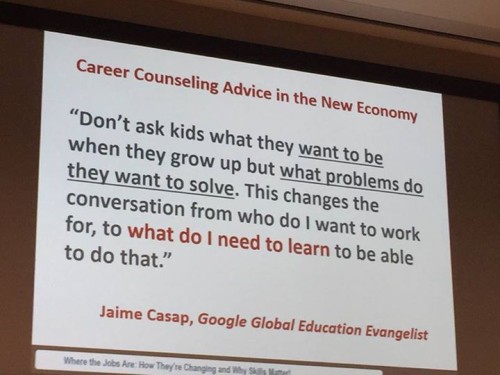
Jaime Casap Google’s Global Education Evangelist crushed it with this observation, and he’s right. It’s time we stop asking kids what they want to be when they grow up. Shit, it’s time we stop asking adults that question too.

Why?

It’s a leading question that drives people to think about who they want to work for or what environment they wish to work in, and although that seems innocuous, it’s rather damning in the 21st century.

The 21st-century economy desires, demands, and prizes problem solvers and asking people what they want to be doesn’t point us in the direction of solving problems, it steers us in the direction of titles, positions, and roles. It does nothing to help us drive value and the 21st-century demands value.

Instead of asking what we want to be, we need to start challenging ourselves and our children with how to identify and solve problems. We need to increase our analytical skills. When we challenge our kids and ourselves to look for problems to solve, we create ownership. By simply acknowledging a problem we are forced accept its existence and ask, do I want to solve this or not? This personal confrontation puts us in the drivers seat. It gives us control. It creates ownership and desired outcomes. What it doesn’t do is allow us to pretend problems don’t exist or walk about blind to the problems around us. When we acknowledge, problems exist it’s harder not to address them.

In my new book, I talk about the importance of solving problems. I talk about it in Chapter 6 (Think) and Chapter 7 (Learn How to Sell). Identifying and solving problems will be the key currency in the new economy. It’s the new currency because solving problems creates value and people pay for value. Jaime is correct. We need to focus on problem identification and what it takes to solve the problems. That’s what companies and customers demand in the new economy.

What also made Jaime’s quote slammin’ was the last part . . . . “What do I need to learn to be able to do that?”

This question is huge. It can not be overestimated.  In Chapter 13 I talk about deliberate learning and how essential a well crafted, deliberate learning plan is. We have to own our own our learning paths in the new economy. We cannot learn haphazardly or reactively anymore. We have to take control of our self-directed learning. We need to be clear and strategic in what we learn, why we learn it and how it is applied.

When we are forced to look for and solve problems, it forces us to ask; “What don’t I know? What do I need to know to solve this problem well and where can I get the information?”

We’ve transitioned from the industrial age to the information age. This transition has been marked by the availability and access to massive amounts of data and information. Therefore, those who leverage this access to solve big, fun, necessary, challenging, unique, and unknown problems will be the winners in the 21st-century.

I love what Jaime has said here. He’s right. There is a new economy, and we have an obligation to our children and to ourselves to shift, to adopt the new approaches, methodologies, rules, and skills required to be successful in it.

The new economy is here. What are you asking your kids? Are you preparing them for the industrial age or the information age?

I highly suggest you follow Jaime Casap on LinkedIn.

And,

If you want to understand more about how the 21st-Century and the new economy is affecting your success, order Not Taught today.

Click Here to Get YOUR Copy

Not Taught Book w. Brogan Review

06 Jan 18:47

8 Ideas for Generating More Qualified B2B Leads on LinkedIn

by Rick Whittington

8 Ideas for Generating More Qualified B2B Leads on LinkedInAccording to a study conducted by HubSpot, LinkedIn produces a visitor-to-lead conversion rate of 2.74 percent — that’s 277 percent better than Twitter or Facebook. On top of that, more than 80 percent of B2B leads gathered via all social media efforts combined come from LinkedIn.

LinkedIn currently has more than 396 million users, but how can your business take advantage of the platform to earn more leads?

Here are 8 ideas you can try to get more traction and generate more leads using LinkedIn.

1. Share Updates Regularly

A good way to appear on your connections’ news feed on a regular basis and stay top-of mind is to update regularly. Not only are you putting out good information, sharing industry news and tips, but people are able to see that you frequently post. This allows those who view your feed to see your engagement on a regular basis.

Start today by sharing an industry tip, a work-related thought or a link to a recent article you read.

2. Publish a Post

It might seem obvious but just the act of posting to social media helps you to establish credibility and gain new connections, especially when you publish to LinkedIn Pulse. Rather than just sharing news or an interesting article, adding your own thoughts or publishing an original article on LinkedIn will get you noticed.

Think of a post on LinkedIn like a blog post, only written on LinkedIn rather than your company website. If you’ve thought of writing a blog to share tips, you might consider posting to LinkedIn. You can also re-publish what you write for your website on LinkedIn Pulse.

3. Create a Slideshare

Like publishing a post, you’re creating content that potential customers can consume. In fact, more than 70 million people are actively looking for content every month on SlideShare, a way to both share your slideshows and also to share information contained within them. It’s a resource ready-made for generating leads and connecting potential customers with content they can use every day.

Here’s a great deck that shows you how to use SlideShare to generate more leads:

4. Participate in LinkedIn Groups

Roughly 2.1 million groups currently exist on LinkedIn and if you’re looking for quality leads, joining relevant groups is a great place to get start. When selecting LinkedIn groups, opt for those with the highest activity level.

Once you’ve chosen a group, do your best to be helpful by commenting on others’ posts where you have expertise. Answering questions and engaging in discussions establishes authority, builds trust, and brings leads right to you.

5. Reach Out With InMail

One of LinkedIn’s most popular marketing features is InMail, which is useful for lead generation because it allows you to send messages to people outside of your direct connections.

InMail is also an effective tool for getting past gatekeepers and making personal contact with prospects. Plus, according to LinkedIn, marketers who use InMail are 30 times more likely to obtain a response than those who choose cold calling.

Tip: Before you write an InMail message to a contact, research them and find commonalities you can mention in your message.

6. Utilize Advanced Search

For B2Bs using LinkedIn to generate leads, advanced search is an effective tool. Advanced search lets you enter details such as companies, names, or alma maters to connect with leads through more-focused results.

You can quickly create a contact list of people that meet a set of criteria that you can later reach out to via email or LinkedIn InMail.

7. Make Use of Sponsored Updates

In 2013, LinkedIn conducted a case study on Adobe Systems Inc. As part of a company growth plan, Adobe used LinkedIn’s Sponsored Updates and quickly found that decision makers who had viewed the updates were “79 percent more likely to agree that ‘Adobe can help me optimize my media spend.’”

The downside of sponsored updates is that they cost you every time someone clicks. The upside is reaching a new audience. Because LinkedIn users who aren’t direct connections see Sponsored Updates, they’re an effective way to maximize your reach and produce new leads.

8. Optimize Your Company Description

One of the most underrated tools on LinkedIn is the description on your company page. You should use this space to address your target audience directly and help to make sure the focus is on the first two sentences, which is what LinkedIn displays before the “see more” button. Try highlighting your value proposition or even feature a call to action that encourages following or to visit a section of your profile.

When it comes to B2B lead generation, LinkedIn is an important resource. Hopefully you’ll find these eight ideas helpful and try one or more. Have you tried any of these?

Free guide: Want to Make Your Website A Lead Generation Machine?

06 Jan 18:46

Canada in the middle of an identity crisis as loonie’s worst rout ever raises petro-state fears

by Ari Altstedter, Bloomberg News

A decade ago, Canada set out to become an energy superpower. Now, it enters 2016 riding down one of the world’s most battered petro-currencies.

When the clock struck midnight on Dec. 31, the loonie officially recorded its longest and deepest downturn since it became a floating currency in 1970. And there’s no relief in sight.

The loonie’s 16 per cent decline against the U.S. dollar over the past year marks its third straight annual decline. The currency has lost more than a quarter of its value since 2012, falling to 72.27 U.S. cents from US$1.01. That’s almost a penny a month.

Wednesday it sank further to 71.10 US cents.

In the 45 years since Canada ended its currency peg to its largest trading partner — a period spanning two votes on Quebec separation, a full-blown fiscal crisis, a previous Saudi-engineered oil price rout and several recessions far worse than the shallow contraction early last year — no dollar depreciation has been this bad for this long.

Canada, the envy of the world for weathering the 2008-09 global financial crisis better than almost any other developed country, has suddenly lost its footing in the global economy. The high oil prices and increased oilsands production that fuelled growth for a decade look unlikely to return soon, prompting an unusual level of soul-searching about just what kind of economy the country has built.

‘Identity Crisis’

“Canada is in the midst of an identity crisis,” said Emanuella Enenajor, senior economist covering the country for Bank of America Merrill Lynch in New York. “In the 2000s Canada was the commodity producer to the U.S. In the 90s, Canada was the manufacturer to the U.S. Today, Canada’s identity is unclear.”

Shortly after becoming prime minister in 2006, Stephen Harper, who represented a Calgary constituency in Parliament, went around the world talking up his country as an “emerging energy superpower” and comparing development of the oilsands to the building of the Great Wall of China or Egypt’s pyramids.

He was pushing on an open door. China’s rapid industrialization was driving up demand and prices of commodities worldwide, including crude. As prices began their ascent to US$100 per barrel and beyond, investment flooded into Canada’s oilsands, the third largest crude reserves in the world.

The loonie climbed from an all-time low of 61.76 U.S. cents in the first quarter of 2002 to an all-time high of US$1.10 at the end of 2007. It tracked the price of oil down through the financial crisis and then headed back to par with the greenback from the middle of 2010 until late 2013 as crude rebounded.

Parity Pride

“We were becoming that one-trick pony,” said Darcy Browne, head of institutional foreign exchange sales at Canadian Imperial Bank of Commerce, who’s been trading currencies in Toronto for 26 years. “What else has Canada done? We’re not diversified enough.”

Although a dollar at parity with the U.S. currency is a point of pride for many Canadians, it also created tensions between the commodity-trading regions in western Canada and the manufacturing heartland in Ontario and Quebec, which preferred a lower dollar to stimulate exports.

By the middle of 2014, oil’s share of Canada’s total exports reached 19 per cent from about 6 per cent a decade earlier. Meanwhile, the Ontario-based auto industry was seeing its share of the export pie fall to to 14 per cent from 22 per cent. The heavier reliance on crude became an issue in last October’s national election, as Harper and his Western-based Conservatives were accused by all their opponents of having favoured oil to the detriment of other regions.

In the process, the Canadian dollar had effectively joined the ranks of petro-currencies. The correlation between movements in the price of oil and the loonie has increased five-fold since 2000, according to data compiled by Bloomberg. In 2015, while all commodity-exporting countries faced currency pressure, the Canadian dollar was more sensitive to oil price movements than such petro-states as Mexico, Norway and Russia.

Diversifying away from resources now becomes a major challenge for the country’s new Liberal government, led by Justin Trudeau, according to David Dodge, governor of the Bank of Canada from 2001 to 2008 and a former deputy minister of finance under both Conservative and Liberal governments.

Canada’s relatively strong performance in the Great Recession “looks more like a blip” in retrospect, he said in a telephone interview. The steepness of the dollar’s drop indicates the markets have little confidence that investment will return anytime soon to the high-cost and carbon-intensive oilsands, Dodge said.

The road he sees ahead is to restore the emphasis the Mulroney government in the 1980s and the Chretien government in the 1990s placed on building up the manufacturing and service sectors. 

In its effort to become an energy superpower, Canada neglected technological development, Dodge said. “So we’re going to have to go back, having lost a decade on the technological side,” he said.

Though most forecasters see 2016 marking the end of the decline, predicting the loonie will finish the year higher than the 11-year low of 71.44 U.S. cents it hit in December, a growing number, including Bank of America’s Enenajor, expect it to fall further to 69 U.S. cents first. Almost all agree the Canadian dollar won’t be seeing parity again any time soon as the country struggles to fire up new growth engines.

“The price of oil is not high enough to justify Canada to be a commodity superpower, and the Canadian dollar is not weak enough, and certainly the manufacturing sector has not healed enough, to have Canada be a manufacturing superpower either,” Enenajor said. “So Canada is absolutely stuck in this very awkward place.”

— With assistance from Erik Hertzberg.

Bloomberg News

06 Jan 18:45

How To Better Measure B2B Lead Generation

by Abhi Jadhav

When most people hear “web analytics,” they tend to think about counting visitors, transactions, and conversion rate on a transactional site, such as an eCommerce store.

Yes, there’s a lot of insight to be gained from web analytics for eCommerce sites, you can also learn a lot about B2B lead generation if you’re using analytics correctly.

Measuring the Performance of Informational Sites

Online performance measurement for informational sites can actually get pretty complicated.

The typical end goal for businesses with informational sites is to use the site to generate more leads. But that lead generation process usually isn’t streamlined into a sequential funnel like one would see on a traditional eCommerce site where visitors enter the site and go through a series of funnel pages to make a purchase.

B2B clients need multiple touches, more one-on-one conversations, and outreach through various channels in that process of converting them from onlookers to prospects to leads and eventually to customers.

From an online perspective, the lead acquisition funnel has three major steps – brand awareness, prospects acquisition, and lead generation. Let’s expand on the definitions of each:

  • Drive brand awareness. The rule of seven says that seven touches are needed before a visitor will convert into a customer. Right or not, the concept that more than a single touch is needed to convince visitors to become customers is pretty compelling. And that journey starts with familiarizing visitors with your brand. This could happen on your site or on social media. More on this as we get deeper into measurable web analytics for B2B marketing sites.
  • Acquire prospects. The amount of interest a visitor has in your site’s content is a reflection of the visitor’s interest in your services. And this interest is a crucial step before the person becomes a true lead. Monitor these prospects’ activity so that the site experience can be optimized for higher engagement and conversion.
  • Generate leads. This one needs no exposition. A prospect turns into a lead when he or she expresses interest in your services through a variety of ways.

Measuring Brand Awareness

Brand awareness can be expressed in multiple ways.

It could be engagement with your brand on a social media channel such as LinkedIn or Twitter or it could be visits to your website itself. So a full picture of brand awareness can only be obtained by combining data from these sources.

To be clear, though, measuring brand awareness with the intent of tying it back to a tangible goal on the site is very difficult.

Sure, site interactions can be tied to a conversion goal. But impressions, clicks, and interactions on a social media site such as LinkedIn can only be anecdotally linked to conversion metrics on the site. Two major obstacles to measuring actions outside the site are isolated systems in which visitor data resides (e.g. LinkedIn analytics vs Google Analytics) and the number of touches that are needed before a measurable action results on the site.

So we can think of brand awareness as a funnel with the top of the funnel residing in external platforms with little or no ability to measure effectiveness and the bottom of the funnel being your website where you have a deep understanding of visitor interaction.

Here is one way of looking at this brand awareness funnel:

Screen Shot 2016-01-02 at 3.33.41 PM

The first three interactions all happen on third party platforms and can be difficult to tie back to tangible results. These three interactions are vital and have a very strong influence on the fourth interaction, which is a site visit. However, it is only from the fourth interaction that the brand awareness funnel becomes easy to tie back to the overall goal of lead generation on a site.

Here are some commonly used brand awareness metrics and their (direct) influence on a tangible business goal such as lead conversion:

Screen Shot 2016-01-02 at 3.34.49 PM

So should you measure and action the brand awareness funnel? Absolutely.

But keep in mind that the measurable end goal should be a site visit and not a lead conversion. Each of these interactions can be considered a micro-conversion. These micro-conversions are important but may not directly influence a macro-conversion goal on the site. Optimizing for these micro conversions is important as long as you know how to measure the success of these conversions (i.e. they correlate with the larger goal of quality lead generation).

So while the top of the brand awareness funnel can be a bit nebulous to analyze, the bottom of the brand awareness funnel is site visits, and it is rich in actionable data.

Relevant Site Traffic

Relevant site traffic is very different from plain old site traffic. The difference is in knowing whether the site is being visited by the right audience. Of course, since web analytics traffic is largely anonymous, this key insight needs to be derived from a variety of factors.

Here are some key factors to consider:

  1. New vs repeat visitors – Was this traffic already aware of your brand or are they truly first time visitors?
  2. Geolocation of traffic – If you serve a specific geo location, for example the United States, then is the traffic to your site indeed from within your geo location target?
  3. Key pages visited – Are your visitors visiting pages that provide information about your brand’s services or products? Or are they just visiting an irrelevant page and leaving?
  4. Bounce rate – Are your visitors leaving without looking at more than one page on your site?
  5. Source of traffic – What channels are your new visitors entering from? Are your marketing efforts successful in driving new channel traffic?

One way of finding such user attributes is by using cohort analysis. Using it, you could create finer segments with varying levels of relevance.

Creating brand awareness is the beginning of your lead generation funnel, so it is vital to ensure that you are measuring the top of this funnel accurately. The above concepts can be easily applied in any web analytics software. Below is a screenshot of how you could construct a segment in Google Analytics:

Screen Shot 2016-01-02 at 3.44.50 PM

We use the above segment internally to measure brand awareness. This is a top level segment that combines all brand awareness efforts into a single view. This could easily be further segmented into brand campaigns that you may be running in specific channels or for specific services.

In the segment above, brand awareness is defined as traffic:

  1. Located in United States (the target market)
  2. That visited services pages (so they showed interest)
  3. That did not bounce (meaning they saw more than 1 page on the site)

This is a highly restrictive definition of brand awareness, but it really drives the point home that we are not interested in just driving any traffic, but specifically visitors displaying behavior tied to brand awareness. Using this approach, your web analytics measurement of brand awareness will transform from an unqualified high level metric to a highly actionable segmented metric.

Screen Shot 2016-01-02 at 3.43.27 PM

Now you can have a very informed conversation with your marketing team about the quality of their brand awareness efforts. Instead of talking about the number of visitors to the site, you can now talk specifically about your target market in the US, getting familiar with the services you offer, and becoming truly interested in what you have to offer.

But of course, measuring tangible brand awareness is just one third of the story. The rest is about how to convert these brand aware visitors into prospects and leads. Let’s take a look at how we can go about measuring this part of the conversion funnel.

Measuring Prospect Acquisition

The way you convert visitors into prospects is usually by providing them something of value. Often, that item of value is new and exclusive information. This information could be in the form of a white paper, a personalized calculation, or a personalized infographic based on information they share. The expectation is that these visitors will part with their contact information for this item of value.

So measuring prospect engagement revolves around understanding how well that popup, white paper, calculator, or infographic is doing to get the attention of your visitors. For prospect engagement, the macro goal is to get the visitor to part with their email address or phone number. Let’s say the tools you have at your disposal are guides that can be downloaded, popups that can be surfaced, and forms to submit information. So the funnel can be thought of as follows:

Screen Shot 2016-01-02 at 3.43.17 PM

Prospect conversion can be measured by combining these micro conversion steps into a single equation. So the formula for prospect conversion would be:

Screen Shot 2016-01-02 at 3.43.09 PMClick to enlarge

As you can see, there are four ratios that can be measured and optimized to improve the end goal of improving prospect conversion.

Let’s look at each of these ratios briefly:

  • R1 measures the effectiveness of driving traffic to pages where popups will be displayed. Of course, this definition needs to be adjusted to meet your specific definition of important pages. Improving R1 involves making the key pages interesting and easily accessible, so your site’s visitors will visit them. Whether improving R1 directly improves overall prospect conversion is beyond the scope of this article, but this micro conversion debate is well addressed here.
  • P2 is a ratio that measures the technical capability of displaying the popup on key pages. It is an important metric that monitors the process of displaying popups. A drop in this ratio could mean that the popup is not getting displayed as fast as it should on page render, exit intent, etc.
  • C3 measures the effectiveness of the message and the design of the popup to compel your site’s visitors to click on it. This is a key ratio that can be improved with systematic testing for a variety of attributes of the popup such as messaging, call to action, etc.
  • S4 is the rate at which the form to download the whitepaper is completed. Designing and optimizing forms is a science by itself. Form titles, calls to action, the number of fields, form validation are just a few attributes to take into account when building and optimizing forms. In fact, the web form design primer by Luke Wroblewski is a great resource to get ideas on how to optimize forms for conversion.

As you can see, the above four ratios can all be optimized to improve the overall prospect conversion process. In addition, one can apply a variety of segments to the prospect conversion measurement to identify segments that work or don’t work particularly well.

Indeed optimizing for better prospect conversion is key to successful B2B lead generation initiatives.

Measuring Lead Generation

The final step in this puzzle is to figure out how to measure the rate at which leads are acquired. Before we get into the details, let’s define leads one more time. Leads are those prospects that explicitly express an interest in your services.
Measuring lead generation actually goes well beyond the realm of web analytics and belongs in the customer analytics realm. Nonetheless, it is worth examining because leads are the ultimate macro goal that marketing teams strive for.

Let’s review the progression of prospects into leads. Once prospects are identified, they are then subsequently interacted with through a couple of different ways. For instance, the sales team could interact with them periodically via phone calls, the marketing team could keep them warm through email drip campaigns, or the prospects themselves could visit the site periodically to seek information. So prospects can be touched multiple times over extended periods of time.

Screen Shot 2016-01-02 at 3.42.48 PM

Then the prospects could turn into leads over the phone, via email, or even through form submissions on the site. The trick with measuring lead generation accurately is to summate lead counts across the acquisition sources. A CRM that is tightly integrated with these sources can definitely go a long way in making this task easier.

So although lead conversion can easily be expressed in a simple equation of leads/prospects, the number of touches, the channels through which the touches occurred, and the quality of these touches can all be used to segment and optimize the lead conversion rate.

For instance, we could establish the average number and quality of touches needed to convert a prospect into a lead. Then we would state a hypothesis about the number and quality of touches and design an A/B test that spans offline and online means to test that hypothesis.

The challenge here is that there are several moving parts in the lead generation process that can’t be strictly controlled as required in a traditional A/B test scenario. In testing lead generation, it is sometimes easier to focus on the micro actions to make incremental improvements.

Conclusion

Measuring the conversion funnel on an informational site can be just as complicated as measuring that for an eCommerce site. That said, web analytics can be leveraged very effectively to measure and to identify ways to maximize the lead generating potential of informational sites.

06 Jan 18:45

Can Your Sales People Lead A Business Conversation?

by Dave Brock

The role of sales has clearly changed. We no longer have to spend our time educating customers about our products and solutions. Beside, too often, they really don’t care about our products and their capabilities.

If we can’t talk to them about our solutions, then what’s left? What do we talk to them about?

I guess, we have to focus on what interests them. Their jobs, roles, goals, aspirations. We need to talk about their challenges, opportunities, problems they may be having. We need to talk about their customers, their competition, their industry — and their potential impact on the customer.

We have to connect what our customers do with the goals and priorities of their management. What they do every day has to contribute to the execution of the customer business strategies.

Our conversations can’t be idle conversations–our customers don’t have the time for these conversations, and they don’t help us achieve our objectives.

We have to focus on customers who have problems or opportunities we can address.

Our conversations have to be purposeful, we have to anchor our conversations in facts and data. This means talking about the numbers. Current performance, future potential.

To talk about the numbers, we need to understand what they mean—not just intellectually, for example, we all know what ROI means and how to calculate a ROI, but what are the underlying things that drive it?

As a result, we need to really understand how business works. We need to be conversant about our customer and their operations. We need to see areas where they can change and improve. We need to know how those changes and improvements ripple up to the overall corporate objectives, connecting the dots between the operations we impact and the strategies of the organization.

We have to have business relevant conversations with our customers.

As managers and leaders, what are you doing to help your sales people have conversations about your customers’ businesses?

Have you gone beyond teaching them about your products?

Are you teaching them about their customers, their businesses, their customers markets?

Do they understand key issues, trends, challenges, directions, metrics? Do they understand what the metrics mean, the things that underly the metrics?

Can they assess your customers’ operations, identifying opportunities they may be missing, can they identify potential performance problems?

Can they carry on a conversation, probing and challenging the customer about their business?

We need to be relevant and impactful. Being able to conduct a business conversation with our customers it critical to engaging and creating value.

This year, make sure you prepare your people to have business conversations with your customers.

06 Jan 18:45

A 71-year-old tech startup CEO explains why he's still working 24 years after 'retiring' for the first time

by Jacquelyn Smith

Shaun McConnonShaun McConnon is a 71-year-old five-time tech startup CEO. 

Today he's the chief executive of BitSight, a company that assesses the security posture of a corporation from the outside and assigns it a numeric score, known as a Security Rating, which is similar to a credit rating. This is a role he took on after retiring, or almost retiring, a few times. 

"I cannot stand to be watching the greatest information revolution in history from the sidelines," McConnon tells Business Insider. "I have to be in it, a part of it." 

McConnon retired in 1992, "but I was bored and much too young to retire," he says. So in 1994, he got back in the game and entered the tech startup world.

In 2012, when he was invited to meet with Nagarjuna Venna and Stephen Boyer, the cofounders of BitSight Technologies, it was with the intent that he would become an advisor "because everyone was expecting me to sit out in retirement," McConnon explains.

"After several meetings and intense conversations, I told them no, I would not be their advisor," he recalls. "I wanted to be their CEO." 

"I am just drawn to these game-changing opportunities, and when I see the chance to help shape an industry and change the way organizations are doing business, I can't walk away or just offer advice." 

Plus, he says, "my wife doesn't want me around the house all the time … so, here I am doing it one more time at BitSight."

McConnon explains that he has a commitment to his investors to stay a minimum of two more years as CEO — "or until the wheels fall off of my walker," he jokes. "I'm a bad golfer and my hobby is starting high tech companies, so I'll just keep doing it until don't feel I'm continuing to contribute added value.   

"I've been in high tech for 47 years," he continues. "I hope to make it to 50 years or more. I love the industry, the people, and my investors — and I'm having a lot of fun. So, there will never be a good or right time to retire. I'll just fade away."

SEE ALSO: A tech CEO with 5 startups on his résumé explains why he doesn’t have a LinkedIn profile

Join the conversation about this story »

NOW WATCH: 10 habits you should break to be more productive in 2016

06 Jan 18:41

4 Stats, Trends, and Metrics Your B2B Agency Must Master

by Dave Orecchio

mastery of b2b statistics trends and metricsIf you’re wondering whether you’ve selected the right B2B agency for your business’s marketing needs and goals, start by taking a close look at the varieties of critical data they collect, interpret and use on your behalf. Without a strong understanding of certain key stats, trends and metrics, your marketing agency cannot hope to help you achieve breakthrough levels of success in the coming year. Here are some of the key numbers you want to see influencing your marketing efforts.


1. B2B Content Marketing Usage and Demand Metrics

Which content marketing tactics or platforms should your B2B agency be emphasizing in your inbound marketing campaigns? It helps to understand what marketers as a whole are doing — and it appears that social media (not including blogging) is the most popular tactic of all, with 87 percent of marketers employing an average of 6 marketing channels (Twitter, LinkedIn, Facebook et cetera) simultaneously.

Blogs rank pretty highly in their own right, with 76 percent of marketers emphasizing regular blog posts. But on-site articles, in whatever form they may take, outrank blog articles at 81 percent and off-site articles at 61 percent. White papers (64 percent), online presentations (63 percent), webinars (62 percent) and infographics (51 percent) represent the next-highest tier of popularity, with every other content marketing tactic ranking under the 50-percent mark.

B2B agency

76 percent of marketers use blogging as one of their marketing tactics.

2. B2B Asset Consumption Statistics

Of course your B2B agency can’t just look at which forms of content marketing are most commonly utilized by sellers — they must also pay close attention to how B2B buyers choose to consume that content. For instance 48 percent of buyers must consume 2 to 5 different content assets before they’re ready to obey that final call to action and become a customer. A further 25 percent need to consume 6 to 8 content assets before you can reel them in. That’s usually because they need to be guided through your sales funnel (called the Buyer’s Journey), asset by asset, until they reach the critical decision point.

The types of content assets your B2B agency is putting out there can also make a difference — but here you need to look at the final results as well as mere consumption habits. For example, although 52 percent of B2B buyers consume both emails and white papers, only about 15 percent credited emails as directly influencing their purchase, while white papers had that effect on more than 30 percent of them.

3. B2B Buyer Preferences

In addition to knowing which content platforms and assets tend to work better with B2B buyers, it’s also important to understand what kinds of content buyers prefer to absorb. For example, 46 percent of B2B buyers respond most readily to hard data and statistics, clearly preferring factual data over entertaining or sensationalistic fluff. This isn’t an overwhelming majority by any means, but it’s worth noting as you portion out your different types of articles and other marketing pieces.

B2B buyers’ preferences differ from those of B2C buyers in some significant ways. For one thing, only 18 percent of B2B buyers are likely to click on blog posts, compared with 30 percent of B2C buyers. But they’re actually more enthused about clicking on video posts (at 18 percent) than their B2C brethren (at just 11 percent). Additionally, while B2B and B2C buyers generally match up closely in the channels they use to interact with a brand, the two categories go their separate ways when it comes to customer reviews and case studies. Only 54 percent of B2B buyers rely on reviews and case studies before making a purchase, as opposed to a whopping 79 percent of B2C buyers. Make sure your B2B agency really is a B2B agency, in the sense that it caters to your specific field and target audience.

4. B2B Conversion Rates and Sales Benchmarks

Which marketing strategies offer the highest odds of a successful close? The more data you’re given in this regard, the more wisely you can allocate your marketing budget for maximum ROI. Your B2B agency should be keeping on top of all the most current numbers concerning B2B conversion rates. The “closed-won vs. closed-lost” ratios for different types of marketing can vary quite widely. Perhaps unsurprisingly, the king of this particular hill is employee and customer referrals, with a 68.7 percent conversion rate. But social media comes surprisingly close, enjoying a conversion rate of 68.6 percent, making it literally the “next best thing to being there.” Website marketing strategies achieve a 61.4 percent conversion rate, email comes in at 43 percent, and paid search offers a relatively modest 29.7 percent.

What should you expect from your sales funnel’s performance, both conversion-wise and time-wise? This is the area addressed by B2B sales benchmarks, another critical set of metrics that your B2B agency must master. There are two distinct phases to “getting to Yes,” the lead-to-opportunity phase and the opportunity-to-deal phase. On average, a B2B organization will convert 13 percent of leads into opportunities over a period of 84 days. The opportunity-to-deal phase is much quicker, at an average of 18 days, but only 6 percent of the opportunities culled from the first phase will be converted into deals. Your B2B agency must not only have a firm grasp of these benchmarks but also have some means of comparing your own results against them.

From content marketing usage and demand statistics to B2B conversion and sales rates, you’ll find that the right B2B agency has the skill, experience, and knowledge to turn these numbers into meaningful standards and expectations — while ensuring that your own B2B marketing efforts meet or exceed them. Once you know the score, you can tell at a glance whether your business in winning or losing the game, and exactly where some sensible adjustments can turn your fortunes around. You may even decide that you need a whole new plan instead of just a few minor tweaks. If that’s the case, then get the Content Strategy Data Sheet and start creating a structure for long-term marketing succes.

Inbound Marketing Content strategy to generate opportunities for your business

06 Jan 18:40

5 Things Marketers Can Learn From Stories

by Jim Signorelli

Stories are one of the most powerful tools in our communication arsenal. Since the beginning of language, they continue to teach, inspire, motivate and engage us like no other form of communication can. There are good reasons for this. And some of those reasons provide lessons for marketers. Here are 5 lessons worth noting.

1. Stories clothe facts with meaning

All stories have meaning or some reason for being told. Consider this story:

The young athlete who trained by doing 100 leg squats every day ended up winning the marathon.

In effect, this is a story about the functional benefit of leg squats for runners.

Now, consider this revision:

The young athlete who trained by doing 100 leg squats every day ended up winning the marathon. He has a prosthetic leg.

The first story conveys meaning in the form of useful information — that leg squats build running endurance. However, the second story is more than just useful. It’s inspirational. By contrast, it has Meaning — “big-M” meaning. The additional sentence makes the second story about the same runner far more significant.

One of the most important questions that marketers need to ask about their brand is whether it conveys meaning or Meaning. Facts about unique features and benefits may be useful, but that are not Meaningful. To go for Meaning, brands must associate with personal values like exploration, determination, hard work, or ingenuity, just to mention a few. And if the communication of those values provokes an emotional response, all the better.

2. We are more drawn to stories that leave the meaning to us

Andrew Stanton, the creator of “Toy Story” and “Wall-e,” refers to his “unifying theory of 2+2” as our desire to come to our own conclusions. We do not want to be told the answer is 4. We’d rather figure out the problem for ourselves. This is one of the principles of stories that attracts us to them as a communication device. Movies, novels, poems or songs do not explain the meaning behind their messages. Meaning is left to the audience’s interpretation.

This is very different from what we see in advertising. Advertising often gets in its own way when it sets out to convey Meaning. By telling us what values to associate with brands, or by telling us how to think about a given brand, we often resist or put up our protective BS shields. Consumers don’t need or want to be told that your brand believes in caring about its customers or that your brand works hard for its money.

Taking a lesson from stories, it is far more engaging and believable to pull Meaning from the mind of the consumer than to push from the voice of the brand. Notice in the second story above, there was no mention of what to think or feel. If you thought or felt anything about the winning marathon runner with the prosthetic leg, it was because of your interpretation. Storytellers cause you to see what you see, but do little to cause the way you think or feel about what you see. Doing so would be like the comedian explaining the punch line of his joke.

3. Audiences are drawn to meaning that arouses identification

Another reason we are so drawn to stories is because of their ability to help us see ourselves. Identification is a the ability of a story to help us feel recognized for who we are and what we value. In addition to helping us realize that we are not alone, identification also helps us examine what are sometimes unconscious beliefs that motivate our behavior.

Too often, brands set out to create their identities and ignore the benefits of creating identification. Creating a brand identity involves telling or purposefully positioning a brand to help consumers see what makes it different or better vis a vis alternatives. By contrast, creating a brand identity is about helping prospects relate to what the brand stands for, or its cause. It’s about helping prospects see that your brand is for people like them. Creating a differentiated brand identity may influence buying. But creating strong brand identification will influence joining. It’s always better to have joiners than buyers. Joiners are the people who wear your logo.

4. Storytellers don’t use focus groups to decide what their Meaning should be

Storytellers or authors don’t manufacture meaning on the basis of what will sell to the greatest number of people. Rather, they start with an authentically held core belief that they want to share and express in their own way.

Lack of authenticity is one of the many reasons that consumers have become cynical about advertising. Today’s consumer is just too smart to fall for forced intimacy. They know when you are trying too hard to fit into their lives. Rather, consumers want and need brands to be true to their own causes. And if you think what you say or even imply about yourself is enough, think again. As far as consumers are concerned, your brand’s truth will always be revealed more through actions than anything advertised. Trustworthy people don’t tell you they are trustworthy. And friendly people don’t put you on hold for 30 minutes.

If consumer research is required, better that it be used to compare expressions of Meaning than to derive Meaning. Meaning is an inside job.

5. Great storytellers always give us something to look forward to

If you go to any bestseller’s list of books, you’ll often find it consists of many narratives written by authors with whom we are familiar. Having enjoyed their previous works, we clamor for their newest work. And we do this out of an affinity for both their interesting perspectives and their individualized expressions. We are not only drawn to messages they want us to read, but also to the way they consistently write them.

The reason some people will camp out in front of the Apple store the night before a new product launch is simple: The new product is from Apple. As their thinking goes, if it’s from Apple, it’s got to be something worth having.

Each new product that Apple produces is recognizably linked to the one it updates. The new offering may provide improvements — but more importantly, it remains a continuance of Apple’s Big-M Meaning. Just as writers remain true to their voice, Apple takes great pains to make sure its products deserve a rightful place within its family.

06 Jan 18:40

8 "Sorry to Bother You" Alternatives Every Salesperson Needs

by mrenahan@hubspot.com (Mike Renahan)

When you've been in sales a while, it's easy to develop bad habits. You pick them up from other reps or take a shortcut during an especially busy week and, all of the sudden, you've added some skills to your repertoire that aren't helping you meet your quota.If you're not regularly examining your behavior and results, these habits can cause mistakes that end in deals falling apart, annoyed prospects, or missed numbers.

And I'm not just talking about waiting too long to update a contact's information in your CRM. Seemingly innocuous phrases like, "Sorry to bother you," sneak into our regular sales emails and phone calls and poison our relationships without us even realizing it. Here's how to stop it.

Why You Should Never Say, "I Am Sorry for Bothering You"

Ideally, sales reps would never have to write a follow up email because they would avoid the number-one follow-up mistake: Failing to set a next step before ending the call.

All it takes is one cringeworthy phrase to kill a sales follow-up email. One of my least favorite moves is asking for a prospect to respond "ASAP." But apologizing for contacting your prospect is nothing short of poisonous to deals, and should be cut from the vocabulary of every sales rep. It usually looks like this:

It's me again

Hey Mike,

Sorry to bother you again, but I wanted to make sure you received my last few emails with a great offer for our firewood package this winter.

I don’t want you to miss out on this opportunity. I know you’re busy, but I just wanted to touch base one last time.

All the best,

Annoying Allen

send-now-hubspot-sales-bar

So, why should you avoid saying "Sorry to bother you again?

  1. It implies you've become annoying to your prospect. It also reminds the prospect they’ve reached out several times before (“again”) to no success. Even if the sales rep hasn’t annoyed the prospect yet, this is the phrase that might do it.
  2. It implies you've done something wrong. In addition, people use the word “sorry" after doing something they deem wrong. When we make a mistake that negatively impacts someone, the first phrase that often comes out of our mouths is "I’m sorry." This phrase means we’ve acknowledged wrongdoing and know we need to fix it.
  3. It signals desperation. Reps send “sorry to bother you again” emails in hopes of starting a conversation after not hearing back. The message is a last-ditch effort to pique the potential buyer’s interest -- on the rep’s timeline.
  4. It communicates your time and energy is not as valuable as the prospect's -- which simply isn't true. Maintain authority and equal footing with your prospect by never apologizing for being in their inbox or voice mailbox.

If you find yourself using this phrase in an email -- stop writing. Instead, regroup and focus on providing value to the prospect and grabbing their attention instead of “bothering” them again.

There are a multitude of ways to provide value in a sales follow-up email. Here are a few I suggest.

Alternatives to Saying, "Sorry for Bugging You"

1. Send a customer review

A customer review provides value because modern-day buyers trust their fellow buyers to give honest feedback about a product they’ve used. Think they might not trust a written review coming directly from you?

Connect them with current and past buyers who can provide honest feedback on why working with you is great as well as some of the drawbacks. For example, you might open an email with, "Instead of sending you a pitch, I'll let a previous customer do the heavy lifting with their unvarnished (really) testimonial."

2. Include a case study

Case studies allow prospects to discover how a business in a similar position to theirs solved its problems. Send your latest and most relevant study with a note saying, "This case study made me think of your business. I know your time is valuable, and I think this is worth the few minutes it will take to read."

You've acknowledged their time is a priority for you, without discounting your own schedule and what you're offering.

3. Link to a blog post

A blog post is a way to build credibility with prospects and provide them new information about the product and company as they start to make a decision.

If you're trying to grab a prospect's attention, try sending one with an especially snappy title. You might even work with a marketer to craft a post just for them. After all, who isn't going to click the link to a post titled, "9 Reasons Julie Needs ABC Staffing Solutions Today."

4. Reference a mutual connection

Surfacing a mutual connection allows the prospect to ask their acquaintance about the sales rep and gather more information. It also signifies that if a friend works with this sales rep, the prospect might also enjoy working with the same sales rep.

And it gives you something in common to bond over. For example, "I see we have a mutual connection: Sansa Stark. Her family bought several dire wolves from me a few years ago." You've given your conversation and relationship something to build upon -- and that can be a huge help when conducting outreach.

5. Provide a suggestion

A small strategy tip can help sales reps build credibility and showcase the value of their insight to buyers.

When a salesperson’s name appears in a prospect’s inbox, the reaction shouldn’t be, “No, not this rep again!” or “Who?” but “I wonder what they’re sending me -- I better check it out.

Send them a new industry benchmark report or a mention a recent move their company made, and offer unique insight into how your product/service could help.

For example, "I thought you might be interested in the latest benchmark report from [insert trusted industry source]. Their findings on the 25% increase in mobile app usage might be especially interesting to you and relevant to your work."

6. Drop shop-talk altogether

Want to really get their attention? Don't talk business at all. Instead, send them a casual email saying, "I watched a documentary on Colorado ski country this weekend and thought of you immediately. Have you hit the slopes yet this year?"

While your prospect might not be ready to discuss business -- most people like talking about their hobbies and out-of-office interests. Once you have them engaged again, use your best judgement to steer them back to the topic at hand: your offer.

7. Offer to walk away

If you've reached out multiple times over the course of several weeks or months and your prospect still hasn't responded, do yourself a favor and walk away.

You should be spending time on deals that actually have a chance of closing, and pleading with an unmotivated prospect to respond to your emails isn't doing either of you any good.

Simply say, "Tony, I've tried to reach you unsuccessfully a few times now. Usually when this happens, it means my offer isn't a priority for you right now. Is that safe for me to assume here? If so, you won't hear from me again."

If your prospect is still interested, this should grab their attention. If not, it gives them an easy way out. You can always leave the door open for a call or email six months down the line to see if things have changed.

8. Compliment them

If your prospect recently published a new blog post or the company unveiled a shiny, new product, let them know you're paying attention. 

Chances are, they put a lot of time and effort into their recent project, and would love for someone to notice. Send a simple note saying, "I saw your recent feature in Forbes and wanted to tell you what a great write-up it was. I especially liked your observation that AI will begin to take a stronger hold in sales." It's short, specific, and complimentary. 

Great emails build rapport and credibility. By looking for this deadly phrase before sending your emails, you can improve your odds of a response, and eventually, a relationship.

Want other ways to improve your sales emails? Check out these killer opening email lines or explore alternatives to saying, "Hope you're doing well" -- guaranteed to put your prospect to sleep before they've even read sentence two.

06 Jan 18:40

The Keys to a Five Star Review Program

by Katie Pope

five gold starsThere’s really nothing like the smell of the ocean breeze—except maybe the ocean breeze and the perfect meal. Recently, on a trip to Monterey, CA, I started craving some fresh seafood. Naturally, I opened up my Yelp! app and searched for “seafood” near Monterey within the “$$” range. Why? First, I wanted to discover restaurants in the area. Second, I wanted to see what other people had experienced to determine which restaurant would be the best fit for me.

Quickly scrolling through the top results, I glanced at the overall rating and selected those surpassing a four star rating, as well as those below a three star rating to learn what to look out for. And of course, I scrolled through some of the pictures (who doesn’t want a preview of what to expect?). Once I found a restaurant with a good rating and some great written reviews, I made my selection and headed there to enjoy some delicious seafood!

I’m sure all of you have had similar experiences using ratings and reviews to help guide your decisions and make purchases—sometimes in only a few minutes. This blog will explore the value that reviews provide to marketers and a few ways to get started.

Reviews help us make informed decisions

How do you decide where to get your dry cleaning done? Or where to stay and eat when you go on vacation? What about when you’re evaluating which marketing automation software to choose? Word-of-mouth influences a large part of our decision-making, and nowadays word-of-mouth has extended beyond our immediate circle of friends. Today, we have peer review sites like Yelp, Angie’s List, and TripAdvisor that help us make more informed decisions based off the available information of other people’s experiences.

According to SiriusDecisions, 67% of the buyer’s journey is done digitally, and reviews account for a large piece of that pie. Reviews drive new business to both B2B and consumer businesses and help marketers build a strong online brand to attract prospective buyers and improve customer experience for existing customers. While the importance of reviews is pretty clear, the question remains: how do you start and maintain a review program for your business?

Cash in with a loyalty program

Loyalty programs are a great way to build your online brand, driving customers and partners to submit their experiences with your product or service by rewarding them with incentives. Your brand benefits from these reviews because it provides social proof to prospective customers evaluating you during their buying process.

Birchbox is a great example of a company with a successful loyalty program. Birchbox drives reviews using a point system, which has monetary value. For each shipment, you received a box with samples of five different products; then, Birchbox prompts you to write a review for each product. Once you write a review, you earn points that you can redeem in their store for full-sized products.

birchbox-tutorial-points

At Marketo, we also find loyalty programs to be extremely valuable. We reward our customers and partners with various incentives through our program Purple Select and other campaigns when they submit feedback about our product on sites such as G2Crowd, TrustRadius, and Software Advice (to name a few). In the past, some of our successful campaigns have included offering a Marketo hoodie to anyone that completed a review and motivating employees to encourage the customers they have relationships with to submit a review.

Listen to customer feedback

Reviews not only help build brand presence, but they also give you valuable feedback on your product, support, services, and overall customer experience. No matter the size of your company or who you sell to, it’s important to understand and respond, both externally and internally, to online comments surrounding your company. Positive reviews are a great way to reinforce your initiatives and understand what your customers and partners like about you, but there is value in negative reviews as well. Negative reviews show customers that these opinions are authentic, and you can cushion the negativity and protect your reputation by being pro-active and responding to not-so-positive posts. We have found that directly addressing the situation and offering a solution goes a long way.

You’ll also want to relay customer feedback to the appropriate people within the company. If you receive negative feedback regarding products or services, send it to the appropriate teams so they can evaluate whether they need to make a change. And if it is from a known reviewer, make sure to keep the customer’s account owner in the loop. This opens up the door to begin conversations with unhappy customers and understand where you may have gaps and areas for improvement.

How to get started

Leverage existing review sites: Implementing a review program starts with being proactive with what is already being said online. There could already be review sites available that are collecting reviews about your company. So, the first step is to find them and start directing your happy customers to provide their feedback and experiences on those sites.

Create your company profile: For consumer marketers, you can start small by managing a Yelp page or Facebook page and driving your top customers to post a review for your company. Or, if you’re company sells to other businesses, you can manage your company’s profile review sites such as G2Crowd, TrustRadius, and Software Advice. There are many ways to drive people to complete an action on your profile. You can add a header or footer in your email communications already going out to your customer base with a ‘write a review’ call-to-action—you’ll be surprised at the level of participation. Or set up a booth at a physical event your company is attending and asking for a quick rating. In some cases, you may want to offer reviewers something in return for their time, possibly by giving them a free appetizer next time they come into your restaurant or increased functionality within your product. These are just a few takeaways you can implement today but the possibilities are endless.

Review programs are a win-win for all. They give your prospective customers advice and education about you and your products, customers have an outlet to voice their opinions, your company has the social proof it needs to win more customers and constructive feedback so it can keep improving. Set up a review program today and watch the feedback (and new customers) start flowing in.

Here’s to your five star review program! Good luck! Do you have any other tips on creating and maintaining a review program? Please share them in the comments below!

jan-31

06 Jan 18:40

It’s Not Really a Consensus Sale (So Don’t Treat it Like One)

by Scott Edinger

As spending authority rises higher within organizations, the number of senior managers or executives able to sign off on significant purchases declines. But because leaders are more likely to seek the opinions of others, there’s been a proliferation in the number of people involved in the buying process. As a result, sales professionals are overinvesting, or worse, wasting time and resources trying to sell to people who don’t have the authority to say “yes,” and can only say “no.”

If CEO’s and CFO’s calculated the cost of this inefficiency in sales hours invested, travel costs, organizational resources applied, they’d faint.

It’s a fixable issue, though because they can use these trends to take a leadership approach to the selling process. This is notably different from the consensus approach advocated by the authors of a March 2015 Harvard Business Review article, “Making the Consensus Sale.”

That article relied on surveys by CEB, a member-based advisory company, of more than 5,000 stakeholders involved in B2B purchases. The surveys found that, on average, 5.4 people must sign off on every purchase. This is revealing data, but the interpretation made was that, to succeed, sales reps must drive consensus within the purchasing organization—in essence, that they must sell to a committee.

My conclusion is different. In my work I consistently see and hear that there are actually fewer decision makers than ever to sell to. Not more. This has been consistently the case in evaluating over a hundred sales opportunities sales opportunities with clients. See what conclusion you draw when you examine the opportunities being pursued by your company and considering the following.

Budget line items don’t indicate five or more people accountable, it’s usually one. Sure multiple divisions may financially support a purchase, but I’ve never seen an allocation of budget responsibility go to more than one leader. Few purchase agreements or checks have five signature lines and I’ve never heard of a contract signed by “the committee.”

For example, let’s say a six-person board is asked to choose from among three vendors. The odds that all six will agree on one choice are slim.  Like anyone else, when providing the feedback needed to make a decision, the members of boards and committees are governed, to a certain extent, by self-interest. Perhaps one person brought the vendor into the organization, or another owes the vendor a favor. Accountability or fiduciary responsibility is key here.

There is no doubt that more leaders today favor a collaborative approach versus a command and control style. But it’s still the buyers job as a leader to create alignment among a team, and if a salesperson has to work on creating consensus, it’s a sure sign authority has been at least partially abdicated (among other problems). It’s unlikely that the seller is going to be able to provide the leadership needed and that’s why nearly 60% of sales cycles end up with no decision being made. Ultimately, while more people do have their hands in the decision-making pot, the inescapable truth remains, one person truly decides.

What’s a seller to do? I’ve worked closely with sales organizations in a variety of industries from consulting and technology to consumer-packaged goods observing sales calls, developing opportunities, and formulating strategies. I’ve realized that while all have their nuances, there are some useful commonalities in leading sales cycles where multiple influences are involved in some fashion.

A sales professional does need to have an understanding of the circumstances, objectives, and concerns of the various stakeholders, in order to better help the buyer to make a decision. This needn’t be an overly complex effort and the real caution is to make sure that too much time and resources are spent doing so. It happens so easily because it’s a path of less resistance as stakeholders are often eager and willing to spend time with sales discussing their specific requirements, and sharing their opinions on what the sales recommendation or proposal should consist of. This can become a significant distraction.

The priority has to be creating an appropriate level of engagement with the person making the decision, who is often more difficult to access. Only with an understanding of that buyer’s specific goals for the business can the views of others be put in perspective for what is in the best interest of the customer.

None of this is to suggest a seller should adopt the scorched earth policy by brashly insisting they talk only to the decision maker and treat others impacted as second-class citizens (A mistake I’ve seen plenty of sellers make in the name of getting in to the C-Suite). Most of the time, that just alienates people and rarely had the desired effect.

The key to doing this effectively is identifying their role in the decision and regarding them professionally with respect. Sales teams have a variety of code names for these people, including Influencer, Champion, Promoter, or Supporter, all of them conveying the idea of sponsorship in one form or another. Working with these influencers to gain access to the decision maker is the best bet. That could mean a meeting together, providing an introduction, or even arranging the meeting for the seller. The reasons for doing so range from increased success rates of an implementation with early involvement from the buyer, hearing clear and unfiltered expectations from them, and of course a recognition that if there is someone with the fiduciary responsibility for a purchase, that its irresponsible not to meet with them prior to submitting a proposal. There are many approaches, each of them taking in to consideration the best interest of the potential client.

A financial services firm I’m working with has successfully utilized the strategy of involving their executives to help in creating interaction with priority prospects. A technology consulting firm is working with influencers to highlight the importance of identifying the business outcomes and ROI of a systems implementation—all of which require input from the real buyer.

I’ve seen all of these situations occur and I’ve also seen circumstances where those influencing a decision would not help to create access. In the instance of the latter, this is a major red flag, and without that interaction it’s clear that there is a low probability for success. It’s one of the hardest things for sales professionals to do, but at this point its better to reduce the effort or let go entirely.

Its reasonable to stay minimally engaged as long as the focus is to ensure proper interaction with the buyer. These professionals are no doubt important to the process and can be critical allies once the sale is made and must be implemented. But the most common mistake sellers make is squandering time, effort and energy selling to these people by demonstrating capability, over-investing in diagnosis or needs analysis, and sometimes even negotiating fees. Remember attempting to sell to them is wasted time—after all, they can’t really buy from you and can only say “no”.

“Get to the decision-maker,” has long been conventional wisdom. But selling in today’s environment requires more. It requires a sophisticated approach balancing common interests with your point of view. One that recognizes that, even in an age of committees, one person still has the power to say “yes.”

Want to see how you can thrive with team selling? Check out this interactive infographic to learn more.

06 Jan 18:39

7 Tips to Create Compelling Email Subject Lines

by Janna Hartley

7 tips to create compelling email subject lines | Savoir Faire Marketing/Communications

There are a number of factors that can impact your email open rate. Some of these; who the email is sent from, the cleanliness of your list, and the day/time the email was sent, can be manipulated and controlled to a degree. There are however, external factors and limitations sometimes imposed by the email send provider that limit your control..

On the other hand, you have complete control over your subject line and it can make the biggest impact on the success or failure of your campaign. You can choose the general format, the words, length and the inclusion of personalization as appropriate.

Consider the volume of emails you receive per day. Now think about how you clean out your inbox on a daily basis. Do you delete based on a quick perusal of senders and subject lines, deleting anything that sounds spammy without even a glance at the content?

Based on the report by Adestra, which analyzed information from over 3 billion attempted email sends, “thank you” (or variation of this) had the highest above average rates whereas “early bird,” “white paper” and other words that might be found in offer-based emails had the lowest rates. This occurs because transactional emails often include “thank you” in the subject. Whereas offer emails are unsolicited and are likely to receive less engagement.

Keep in mind however, that no single keyword guarantees results. Context plays a key role and can elicit a response that is different than what you intended. It can be tricky to navigate through this successfully.

As Adestra illustrates, while many sales can be effected by discount rates, the discounts can have the opposite effect on the email effectiveness. While buyers might purchase something that is on sale for 50% off, including “50% off” in an email subject line can turn people off, either because they think the offer is bogus or because the email is viewed as spam. However these emails, if they pass the open test, have lower unsubscribe rates and higher click rates.

Here are some tips:

  • Keep your subject clear and focused. Be specific and communicate the value of your offer or opportunity. Mailchimp found that shorter subject lines which can be scanned more quickly and allow users to easily figure out if they are interested perform better. A good rule of thumb is to keep your subject line under 50 characters.
  • Put the most important words first. Even if you keep to the 50-character limit, you don’t know how much of the subject line will appear on your reader’s device, especially if that device is a phone.
  • Use targeted keywords. Sometimes, readers don’t have time to read your email when it is received. A memorable keyword will allow him/her to easily find your email later.
  • Create urgency. Setting time limits or perceived time limits can improve open rates and increase the odds a reader will respond or reply.
  • Personalize. Include personalization, (no, we don’t mean the recipient’s first name) such as geographic information or other previously gathered data that shows you understand your audience.
  • Tone down promotional emails. Avoid overly promotional words that could seem spammy as well as ALL CAPS or excessive exclamation points.
  • Try something new. Try humor, mystery or even emoji. Many email marketing solutions/systems allow you to A/B test your subject lines. Try some alternatives to gauge what resonates with your audience.

Need inspiration? Check out 18 of the Best Email Subject Lines You’ve Ever Read from the Hubspot blog.

06 Jan 18:37

3 Pillars for Building Your Sales Training Program

by Jordan Gutman

Building a training program during the early stages of a startup can be daunting. When you’re starting out with only a few sales reps, it’s easy to have them figure it out on their own as opposed to buckling down and building a program. However, at this stage, everyone is going to have a huge impact on the company – not only in terms of ACV, but their attitude, overall demeanor and how they interact with the next class of hires. These people will grow to be leaders in your company, so training here is extremely important.

The longer a company goes without creating a training program, the harder it will be to develop it because they’ll be reluctant to devote time and resources to it. We’ve come up with three main training pillars at Yotpo that have worked out well when starting a new training class – and can also be a good starting point for your startup.

1. Product

During the first week of training, we help our new hires become experts on product – we’ll teach them things they’ll never even have to talk about regarding product, just to make sure that they truly know it inside and out. This type of training will differ from company to company, depending on what type of product you have.

Schedule

On the first day, we pitch the product to our trainees like we would to a client. We tell them to not to take notes or ask questions for this first session – we just want them to gather context for everything they’re going to learn over the course of the week.

Throughout the week, we have training sessions on product which are run like a college course. Each lecture is accompanied by reading material, which our trainees have read before they come in for the lecture. They come into the lecture with intelligent questions and we give them quizzes throughout the week so we can make sure they’re retaining information and can find out where they’re struggling.

Evaluation

At the end of the week the trainees are given a Product Certification Test, which they are required to pass in order to continue with training.

The Product Certification Test started out as an oral test which took about an hour and was run by our VP of Product and one of our Product Managers. However, we have recently moved our format to a 100 question multiple choice test. No question is off-limits – we want to make sure that they truly know the product inside and out when they take the test.

2. Sales Process

This might be something that goes without saying, but how often are you really training your AEs in your sales process besides having them shadow other AEs?

Learning and going through rigorous sales training is valuable, since you want your AEs to be prepared for everything. People don’t retain every single thing they learn, so that’s why we often teach them more than they’ll need to know. We set high expectations for both ourselves in training them and the trainees themselves – it’s important for their success with Yotpo and their future careers.

Schedule

We break down the sales process step-by-step for our AEs, from prospecting leads to closing deals – we show our trainees what an ideal customer looks like, how to identify those customers and then have them prospect 200 leads themselves. Even though most of them will end up having SDRs, it’s important for AEs to know what it’s like to prospect leads, and it also provides them with the added benefit of understanding how we use Salesforce.

We then teach them about the different types of calls that they will experience – exploratory, demos and closings. Again we have lectures and readings, which are broken up by call type. Each one of these sessions is accompanied by a script and live examples.

We also like to have trainees intelligently shadow some calls from our top current AEs. They shadow two calls with every AE, and for each call they bring back thoughts, notes and feedback to the training sessions. The trainees also complete roleplays both amongst themselves and with AEs and bring back feedback from each roleplay.

Evaluation

At the end of this week, we put all the trainees through a Sales Certification process. We let them choose a lead that they prospected and have them imagine that they are talking to either the VP of Marketing, Head of Ecommerce, whomever the decision maker would be in the situation and have them do a demo and closing call roleplay with us. We plant specific obstacles during the process, where we expect certain answers in order for them to pass.

3. Culture

People always talk about culture and making sure someone is well acclimated, but the trainees ultimately need to be integrated really, really well for that to actually happen. Usually, the people that have been at the company the longest haven’t even been there for a relatively long time, so you want to make sure this part of training is done very well. Ultimately, these will be the future leaders of your company – they will be training other people and become managers and leaders, so they need to be on board with the mission and vision of how you’re going to achieve the goals of your company.

Schedule

Being transparent from the start is an important value here: just because someone is new doesn’t mean that you should be holding out on anything. Have the founders or CEO communicate the values of the company to them extremely early on and share the company goals with them. This gives new hires an immediate sense of belonging and an understanding that everybody is working towards the same goal.

Sometimes doing really corny things, even though they’re, well, corny – actually ends up working pretty well. Doing some icebreakers like two truths and a lie, sharing an embarrassing story about yourself, group lunches – these kinds of activities help a training class bond and then, in turn, help the training class connect with the rest of the company.

We’ll have some surprise events too – things like going to Central Park and throwing a frisbee around or even paintballing. It works well because we can all laugh about the experience the next day, and it creates a fun environment for everyone.

While these are the pillars we use for our training program, you can tailor them to fit the training program you want your new hires to go through. However, it’s incredibly important that companies offer ongoing training for their employees and don’t just cut off after the first couple weeks of onboarding. Most great people want to keep improving in their job – part of it is up to the individual employee, but the rest is up to the company.

We offer continued learning sessions for sales processes and tactics around specific situations; we also make sure that each employee is getting coached on an individual level by her or his manager. Something that’s equally as important to us as making sure AEs are up to date in their sales skills is to make sure they’re up to date with other relevant knowledge, so we conduct ongoing sessions around industry knowledge and best practices. We’re selling to online marketers, so if our salespeople are able to have intelligent conversations with prospects about their jobs, then we’ll have a huge advantage. The overall philosophy here is that training never ends. If you want your company to grow, then you should probably invest in growing your people first.

sales hiring platform

04 Jan 18:23

Sales Conversations: Unlock Your Marketing Potential

by Joey Kulczewski

sales conversationsA recent report, published by top advisory firm Forrester Research, highlighted the importance of the relationship between marketers, the marketing content they produce and sales departments. B2B marketing content fuels both effective demand creation and successful sales conversations; that’s why marketers must work closely with salespeople and arm them with the right material to transform them into the ultimate resource for knowledge about their product and service offerings.

Forrester Analyst Peter O’Neill calls these modern sales reps “Content Concierges,” who are more consultants than order-takers. Marketers are key to helping salespeople with this transformation.

When meeting with sales reps, customers are looking for answers to their questions and solutions to their problems; sales and marketing must work together to collectively understand each other’s roles, and produce and distribute content effectively.

B2B Marketing Content Fails to Win Over Buyers

According to a Forrester survey, decision-makers are unimpressed with the majority of content that B2B marketers produce and that sales delivers, categorizing them as “trash” or “useless.” Content that fails to engage buyers can be costly, and is a core symptom of the lack of communication these two functions.

“Marketing content and campaigns tend to focus on the earlier portion of the buyer’s decision-making,” explains Mediafly Vice President of Marketing, Melissa Andrews, “leaving sales to close the gap between interest and purchase on their own.” If teams aren’t working cohesively to ensure content gets carried throughout the entire sales cycle, salespeople are essentially left to fend for themselves.

Furthermore, B2B buyers are overwhelmed by content volume and underwhelmed by quality. Of that content, 90% goes unused or unseen and gets stored in a variety of places, resulting in frustrated salespeople. So how can marketers produce content that’s both engaging and effective? How can we empower sales easily access the content they need so that every client interaction is elevated?

Engagement is Key to Successful Content Marketing

B2B marketers must strategically develop content with both the salesperson and the customer-audience in mind. How do marketers know what content sales needs and what they utilize without any input from sales? Simply put… they don’t.

Sales and marketing play a vital role in generating business, and knowing and playing off of each other’s strengths can be very profitable. B2B marketers who treat sales as an essential distribution channel for marketing content succeed. With so many sales and marketing departments siloed, the prospect of working together can seem daunting, but it’s easier than it might sound.

Here are 3 ways to start:

    1. Invest in a content delivery system and training to turn sales reps into consultative experts.
    2. Make it intuitive and easy for sales to get the content they need, when they need it.
    3. Track what sales uses (and what sales doesn’t use) by incorporating quantitative and qualitative feedback into your content planning.

Recognize that sales and marketing share the same goal of increasing company revenue. Tracking and reporting content usage helps both teams achieve this, increasing accountability and collaborations. To illustrate how B2B marketers are delivering content that both sales and customers respond to, marketers can (and should) do several key things.

As we mentioned, tracking how sales uses marketing content when engaging buyers is a critical metric. It’s also critical to know if there is content that never gets used. Next, marketing can look at the performance of specific reps: what content are your top-performing sales reps using? You can find out how they’re using it, and use that knowledge to elevate your other performers or inform your content strategy. Finally, communicate about how the feedback loop is improving both collateral and sales performance, both demonstrating the success of your program to executives and improving the relationships between teams.

A Focus on Customers Drives Long-Term Marketing Content Success

Successful B2B companies must be customer-focused to thrive in the digital age. Companies that carry forward a customer-centric philosophy will find themselves in less conflict with sales because the customer’s needs will trump any territorial arguments about what marketing should develop and how sales should deliver it. When top B2B marketers work backwards, starting with the customer, they can understand the specific roles each team plays in solving customer problems, and can subsequently plan, develop, distribute and maintain content to meet those needs. This also builds trust between sales and marketing; allowing you to achieve the ideal balance between managing your message and allowing your sales teams the freedom to leverage their own selling style.

Forrester clients can check out the full report and all of its findings on Forrester’s website (non-clients can purchase it). To learn more about how you can apply the concept of content concierges, be sure to check out Peter O’Neill’s recent Forrester-Mediafly webinar, “An Empowered Sales Rep Becomes a Content Concierge.”

04 Jan 18:06

Alberta’s clean-tech sector could be one of the province’s few growth businesses in 2016

by Geoffrey Morgan

CALGARY – While many companies that service the oil and gas industry are struggling with record-low demand for their expertise, Scott Nelson and his team have become steadily busier in recent weeks.

Nelson, president and CEO of clean-technology firm Titanium Corp., says interest in his company’s services has spiked since the Paris agreement on climate change and Alberta’s new carbon tax legislation.

“If you’ve been making a long list of things you may or may not do (to reduce emissions), you’d better look at them really hard right now because it’s going to cost you money if you don’t,” Nelson said.

Nelson, and a number of his clean-tech peers have been fielding an increasing number of calls from oil and gas executives since Alberta Premier Rachel Notley announced in late November new economy-wide taxes on carbon emissions, total emissions caps for oilsands operations and a requirement that energy companies reduce their methane emissions by 45 per cent.

Shortly after the announcement, the Canadian Association of Petroleum Producers president and CEO Tim McMillan said the requirement to cut methane emissions on its own would add “hundreds of millions of dollars” in additional costs for the industry.

To meet the new requirements, energy companies are turning to the clean technology sector, poised to be one of the few growth businesses in Alberta in 2016.

“I’ve seen a significant paradigm shift over the last couple of months working in the oil and gas sector and speaking to leaders who, five years ago, saw this as a compliance exercise,” Ernst and Young energy market leader for climate change Meghan Harris-Ngae said.

Now, she said, oil and gas companies in Alberta see clean-tech investments as a way to save rather than spend money, which “creates an opportunity for the clean-tech sector” and should also lead to an overall reduction in greenhouse gas emissions in the province.

On a national level, clean tech revenues have been growing at a rate four times faster than the Canadian economy, according to a report from Analytica Advisors, and the small but growing industry’s revenues totalled $12 billion at the end of 2014.

Much of the sector’s growth has been focused in Ontario, Quebec and British Columbia, each of which the Pembina Institute scored well on a July policy report card. The study by the environmental policy research institute called for additional support for the sector, including a national approach to carbon pricing and later-stage funding.

Harris-Ngae said the new policies in Alberta, which include a $20-per-tonne carbon tax in 2017 that increases to $30 per tonne in 2018, create an “impetus now for some of the smaller players in the clean tech sector to get a lot more traction” in the province by assisting oil and gas companies in reducing their emissions.

To be successful in Alberta, which has been hit hard by the prolonged oil price rout, Harris-Ngae said clean tech companies will need to demonstrate they can help oil and gas companies reduce their emissions as much as possible, and do so at the lowest possible cost.

“Our read on the industry is that they’ve been severely pressured by oil prices, but they’ve also been waiting to see what this climate plan would have in it,” Nelson said.

His company proposes to build facilities — either operated by Titanium or as a joint-venture — at oilsands mining operations that process a mine’s wastewater and remove the solvents and chemicals from that water. In doing so, Titanium prevents methanogenesis, a process which causes methane emissions in tailings ponds.

Chris Bolin for National Post
Chris Bolin for National PostPresident and CEO of Titanium Scott Nelson.

At the same time, Titanium and a potential partner would sell those solvents, chemicals and minerals on the market and actually make money, rather than simply adding costs.

Nelson estimates that Titanium’s process can prevent three to five megatonnes of methane emissions from tailings ponds and also eliminate volatile organic compound emissions. “We can make reductions in their emissions that are worth $30 per tonne and eat into that extra cost,” he said.

The oil and gas industry in Alberta produced 30.4 megatonnes of methane in 2013, the last year for which provincial government information was available. Those megatonnes account for 70 per cent of total methane emissions in the province and also account for 25 per cent of all emissions from the upstream oil and gas industry, according to the province.

Methane is also about roughly 30 times more intense as a greenhouse gas than carbon dioxide and, as such, forms one of the central parts of the government’s emissions-reduction plan.

It’s also the aspect of the plan clean-tech companies are targeting most aggressively.

“There are lots of quick, easy hits that Alberta and Canada can achieve,” said Questor Technology Inc. president and CEO Audrey Mascarenhas of reducing emissions from oil and gas operations. “If I can do it for under $2 a tonne, or it would cost me $20 a tonne in a tax, then that will generate a change in behaviour, I believe.”

Mascarenhas, who has been with Calgary-based Questor since 1999, says that selling her company’s products — which capture flared gasses and turn wasted heat into electricity — has become easier over time as energy companies have increased their focus on reducing emissions.

In recent years, oil and gas companies have tried to reduce emissions as a way to build social license in and around the cities and towns where they operate.

While Mascarenhas expects those community-relations efforts to continue, she said the new legislation in Alberta will provide a new and purely financial incentive to cut emissions.

Speaking specifically about methane emissions and her company’s technology, she said, “We have an opportunity to reduce GHG emissions by 8.5 megatonnes per year at a cost of less that $1.12 per tonne.”

“In this low (oil and gas) price environment, you’re not looking for sexy, expensive solutions. You need practical solutions that have a track record that show you can have an impact,” Mascarenhas said.

Financial Post

gmorgan@postmedia.com

Twitter.com/geoffreymorgan

04 Jan 18:06

3 Tools to Finding The Perfect Keywords for SEO

by Richie Contartesi

Finding keywords for search engine optimization (SEO) that have the right balance of search volume, popularity, monetization potential, and competition might seem like magic to some people. You might think that an SEO professional just taps his magic wand on a hat and out pops the best keywords, just like a rabbit out of a real magician’s hat. The reality, though, is that there’s no magic involved, just pure science and statistics. Let’s take a look at how you can leverage a few free tools to find the perfect keywords for SEO for your site or blog post. It all happens in three easy steps, with three free tools.

Tool 1: Check Google’s Key Word Planner Tool

The first thing you want to do is log into Google AdWords and see what the Key Word Planner Tool comes up with for your site or blog post. When you log into Google AdWords, just navigate to Tools and Analysis > Key Word Planner > Search for Keyword and Ad Group Ideas and put in a few keywords relevant to your site. You might enter in a few keywords related to your site as a whole and then, if you already have an idea in mind for your blog post, a word or phrase related to that concept. Once done, click on Get Ideas and check the tab labeled Key Words Ideas. Here, you’ll see keywords related to your idea, and you can begin to mine those for gems that you might use to center your new page or blog post around. That’s not the end of the story, though, so keep reading.

Tool 2: Making sure your keywords are relevant with Blog Social Analyzer

You might get quite a few keywords from the Key Word Planner Tool, and you want to make sure that the keywords you’re targeting are relevant to your particular site. After all, the more relevant your keywords are, the more people are going to share them on social media. Relevance will also determine how often people will link to the post or page, and the more likely it is that people who research for these keywords and end up on your site will be the perfect customers.

One way to check the relevance of the keywords is to see which content has shown the best performance on your site, and try to find similar keywords for the new page or post you’re working on. Using theBlog Social Analyzer tool, you can easily find out which of your current pages or posts are the most popular. Once you know what relevant content has performed the best, you can work to ensure your new content is focused around keywords with a track record of great performance.

Within the Blog Social Analyzer tool, you can determine what kind of topics performed best on your particular site. Is your blog or website more attuned to basic users looking for introductory information, or do your users seek knowledge about advanced topics? By looking at which pages or posts were shared the most on social media, you can get a hint of that. Once you’ve gotten a few ideas for relevant keywords, it’s time to look at search volume.

Tool 1.5, the Sequel: Back to Google’s Key Word Planner Tool

The-Perfect-Keywords-For-SEO-2

To check out search volume, we’re going to go back to the Key Word Planner Tool that Google provides us with, and find out what we’ve got to work with. With your keywords entered, you’ll see the average monthly searches in a bit of a hodge podge of results, because Google automatically sorts by relevance. This means, unfortunately, that you’ll often see results that have very, very competitive keywords that have a ton of search volume, like “social media site” with 18,000 monthly searches. That’s way too competitive to try centering your blog post around, though, so you want to look at the long tail search phrases that are relevant to your proposed content.

So, target those long tail search phrases and click one time on Average Monthly Searches, then click again to see the keywords with the lowest search volume. Avoid those keywords like the plague most of the time, because there just isn’t enough search volume to make them worth your while. Scroll towards the bottom of the page, looking for keywords that have more search volume but not so much as to be far too competitive. Fine tuning this really depends on how often you plan on posting, or how much content, but remember that if you find 10 keywords with 70 searches per month and incorporate those keywords, you’ll be looking at 700 monthly searches.

Within this same search of keywords, you can also check the commercial value of the keywords. Obviously, you want people to come to your site and buy what you’re selling, so you want to check the traffic you might get that will convert. One way to see that ahead of time is to look at the commercial intent, and see what the Average Cost Per Click is. This shows you the average cost per click of someone bidding on that key word in AdWord, which tells you which of your keywords will have the most commercial value.

Just by way of example, let’s say from your Blog Social Analyzer digging you found that people really liked basic content about “SEO” as well as deeper content about “Business SEO.” You might find that “Business SEO” has an average cost per click of $9, while “SEO” is closer to $0. You’d want to center your post around “Business SEO” in this case, because it has stronger commercial intent.

Tool 3: Checking competitiveness of your keywords with MozBar

Finally, you should find out how competitive your keywords are. Sometimes, even a long tail keyword with low search volumes is still too competitive to try ranking for. The MozBar, available for either Firefox or Chrome, will help you out here. Once it’s installed, search Google for your proposed key word and you’ll see Page Authority (PA) and Domain Authority (DA) listed for each of your search results. If you see a lot of page authority of 50 or above in the top 10 results, then you might be looking at a keyword that’s too competitive to rank for. On the other hand, a mixed bag of Page Authorities in the 20s, 30s, and even higher (as long as there are some lower numbers in there) can be good to try ranking for.

The next thing to look at, though, before you get too excited is the Domain Authority. If the Domain Authority is really high across the entire top 10 list, this might also be something difficult to rank for. Again, a mixed bag of high and low results is what you’re looking for to find just the right balance of competitiveness.

Pulling rabbits out of hats

There you have it, three tools that can help you find the perfect keywords for SEO. If you do your homework and find a keyword (or 10) that has relevance, traffic, commercial intent, and low competition, you’ll have performed the trick that you thought was only for SEO magicians. Heck, maybe people will look at you as an SEO magician!

04 Jan 18:01

Why the Rebirth of Email Is Coming in 2016

by Chad White
Why the Rebirth of Email Is Coming in 2016

Image via BigStockPhoto.com

Email marketing was ignored, under-resourced, and declared uncool and dead during the rise of social media.

Now that leased media is morphing into paid media, and paid media is morphing into blocked media, brands are returning to permission-based email marketing to find that it has new synergies, powerful new capabilities, broader integration, and fresh blood.

Prediction #1: We’ll see many more positive media stories about email marketing than negative in 2016. (highlight to tweet)

It has always been the workhorse behind eCommerce, but now email marketing has become a driving force behind content during the meteoric rise of content marketing. Thanks to advancements in personalization, dynamic content, and predictive analytics, email newsletters have become “the new homepage,” in the words of Contently’s Jordan Teicher.

The Rise of Mobile

Email marketing has also become central to mobile strategies. Reading email has been a top activity on smartphones for a long time, and the growing adoption of responsive email design is boosting smartphone conversion rates to make the most of this opportunity. This holiday season has been a breakout one for mobile shopping and the momentum will carry into the New Year. Beacons, geofences, mobile bar codes, and app behavior triggers will further intertwine email and mobile in 2016 and beyond.

Prediction #2: The majority of email opens will occur on mobile devices in 2016.

Prediction #3: The majority of brands will use responsive design for their marketing emails in 2016.

The Integration of ESPs

Email marketing is also benefiting from broader integration across business functions, thanks to more than $6 billion in acquisitions of major email service providers (ESPs) over the past few years by Salesforce, Oracle, IBM, Adobe, and others. Rather than experiencing a wave of consolidation, where ESPs buy other ESPs, the email industry is experiencing a wave of integration, where ESPs are being melded into customer relationship management, digital marketing, and enterprise resource planning suites.

Prediction #4: Another major ESP will be acquired in 2016 by a software titan.

Together, these advancements have elevated email marketing’s stature and put it on a clear path to achieving the 1-to-1 marketing paradigm, as brands are increasingly empowered to facilitate customer journeys and maximize lifetime value. But it’s not just that it’s getting well-deserved attention again—email marketing is actually kind of cool again.

Whereas the email industry suffered an exodus of talent to social media and mobile during the mid-2000s, now there’s an influx of new talent, most notably from the world of web development. This fresh blood is driving the industry in a new direction, one where emails don’t always act like simple gateways to landing pages.

Sometimes the email will facilitate more of a customer interaction before the clickthrough to the destination, whether it’s through hamburger menus, email carousels, embedded video, or live Twitter streams—and sometimes the email will be the destination itself, where subscribers can take action or convert without leaving the inbox.

Pioneered by innovative companies like Rebelmail, interactive email experiences will bring new energy to the industry over the next 12 to 18 months as familiar web experiences make their way into the inbox.

Prediction #5: The first brands will offer checkout experiences that are fully contained within emails in 2016.

The cumulative effect of all of these developments is that email marketing will experience a second coming of age during 2016. It will be a time of accelerating competitive advantage for brands that are committed to investing in high-ROI subscriber-centric strategies. And it will be a dangerous time for brands whose resource-starved email strategies have never matured beyond batch and blast.

Get more content like this, plus the very BEST marketing education, totally free. Get our Definitive email newsletter.

04 Jan 17:56

The smart-tech future beckons to us from the CES gadget show

by Ryan Nakashima

FILE - In this January 2015 file photo, attendees sit in the self-driving Mercedes-Benz F 015 concept car at the Mercedes-Benz booth at the International CES, in Las Vegas. Everything we buy or use these days has the potential to be smarter. Self-driving cars can transform our commuting hours into productive time. Sensor-laden socks can let us know how to jog with fewer injuries. The 2016 International CES will have a panoply of vendors showing off such connected devices, from smart umbrellas that will notify you if you’ve left them behind, to navigation devices that project directions on car windshields so you don’t have to take your eyes off the road. (AP Photo/Jae C. Hong, File)

LAS VEGAS (AP) — Look around. How many computing devices do you see? Your phone, probably; maybe a tablet or a laptop. Your car, the TV set, the microwave, bedside alarm clock, possibly the thermostat, and others you've never noticed.

Much of that computing isn't doing much while segregated into individual devices. But many of these gadgets have the potential to get smarter by connecting to their fellows, which in turn could open the door to a brave new "Internet of Things."

To see where that might be taking us, there's no better place than the annual gadget extravaganza formerly known as the Consumer Electronics Show — and now simply as CES.

The show, which starts Wednesday in Las Vegas, is the place for companies large and small to show off new connected devices. These range from the seemingly trivial — for instance, smart umbrellas that message you if you leave them behind — to the undeniably helpful, such as navigation devices that display driving directions onto your windshield so you don't have to take your eyes off the road.

And while traditional consumer electronics such as phones and TVs account for about half of revenue in U.S. consumer tech, they aren't growing as quickly as newer connected devices, according to the Consumer Technology Association, the organizer of CES. For instance, smart home devices, such as cameras, thermostats and locks, are expected to grow 21 percent to 8.9 million units in 2016, or $1.2 billion in revenue.

According to the McKinsey Global Institute, a division of the consulting giant McKinsey & Co., the value created by connecting the world's devices could hit $11 trillion annually by 2025, a mind-boggling sum that represents over half of U.S. economic output in a year.

Most of the value comes from industrial uses — like cleaner air from smarter energy use and fewer factory shut-downs due to smarter maintenance. But trillions in benefits are expected to come from consumer-bought products: safer streets because of better-driving cars, robots that take care of household chores and health and fitness trackers that let us know when our bodies need medical attention.

"There's a big value in avoiding pain and suffering," says report co-author Michael Chui.

Of course, people have been making big projections for the Internet of Things for years, yet progress remains halting and fragmentary. Major technology companies can purposefully make it tougher to interact with other companies' gadgets for business reasons. More data can mean less privacy.

In recent years, CES has begun catering more heavily to startups hoping to break through the noise. The sprawling show has sections for wearable fitness gadgets, drones, autonomous vehicles, education, virtual reality, video games, robots, 3-D printers and smart homes.

That's largely a reaction to the fact that many of technology's biggest names have been no-shows for some time. Apple Inc. has skipped the show since the 1990s, and Microsoft Corp.'s then-CEO Steve Ballmer gave the company's last CES keynote in 2012. Google parent Alphabet Inc. and Amazon.com Inc. hold their own events to release products.

And the Consumer Technology Association that runs CES is aiming for attendance this year at or below last year's record 176,000.

Shawn DuBravac, the CTA's chief economist, argues the show's maturity is a good thing, its focus transforming over the last two decades from what was "technologically possible" to what's "technologically meaningful." It's no longer about a robot that can walk up steps. It's about robots that actually mow your lawn.

It's worth bearing in mind that CES is first and foremost a venue for promoting the tech industry — at least the non-Google/Apple/Amazon/Microsoft part of it. Sometimes the promotion falls flat; 3-D screen technology unveiled at CES in 2010 went from the next big thing to a mostly unused feature. Netbooks introduced in 2009 took a back seat to the iPad released a year later. And concepts such as the smart home have taken a really long time to materialize.

For all we know, the Internet of Things could be next on that list. Last summer, two researchers described how they hacked into and took control of a Jeep Cherokee via its cellular connection to the Internet. Cybersecurity firm Rapid7 gave a failing grade to eight of nine popular baby monitors for simple and obvious weaknesses like failing to encrypt Internet-streamed video to prevent eavesdropping or using unchangeable passwords that malicious types could easily find online.

Such issues point to a deeper problem: Many would-be connected devices max out their capabilities doing one thing well, leaving little headroom for security protection that wasn't ever necessary in an unconnected world. Such gadgets could offer hackers an easy route into home or work computers. The fact that many such devices are produced by startups, often crowd-funded and on shoestring budgets, means security is often an afterthought. And the more devices there are, the bigger the potential problem.

"With the Internet of Things, we really have to think in terms of scale," says Rapid7 senior security consultant Mark Stanislav.

Another cautionary note: Regulators are tapping the brakes on entire industries that are getting lavish attention at CES.

In December, California's Department of Motor Vehicles released restrictive draft rules for self-driving cars. They would require licensed human drivers to be ready to take the wheel. Google, which has already a prototype autonomous car that lacks a steering wheel, decried the decision, saying such handoffs could create more problems than they solve. Such regulations could also crimp the utility of self-parking cars that can act like robotic valets.

Similarly, new drone rules from the Federal Aviation Administration require approval for commercial use and a $5 registration fee for hobbyists. A report released in December by Bard College's Center for the Study of the Drone said there were 241 reports to the FAA of near-collisions between drones and manned aircraft from December 2013 to September 2015.

Tougher rules to corral these connected devices could mean that people will be less carefree about buying and using them. That could limit a future where you might casually throw a self-flying drone up into the air for a high-tech selfie.

Join the conversation about this story »

04 Jan 17:54

Numbers Make The Conversation More Interesting

by Dave Brock

Numbers are the bane of many sales people’s existence. Everyone wants to talk about numbers, but it’s far more fun and easy to talk about our cool products, the flashy features, and all the bells and whistles.

Or in conversations with our managers, it’s easier to talk about all the stuff we are doing, or the stuff the customer isn’t doing, than to talk about the numbers.

But let’s face it, numbers make the conversation more interesting—the right numbers!

Numbers catch the attention of executives and decision makers, so if we aren’t comfortable talking about the numbers, we’re going to struggle with producing results. We may have lots of nice conversations, but we won’t drive the customer to commitment.

Our customers are interested in solving problems, producing results. We measure results in numbers achieved in a specified time period. It may be revenue uplift, expense reduction, improved capital utilization, increased productivity, better cashflow, improved customer retention/acquisition, improved market share, better time to profitability in a product launch, improved throughput, better quality, greater customer satisfaction, better gross margins, greater shareholder value, improved profitability.

We use numbers to assess risk, to forecast outcomes, to project what we might achieve, or to set targets/goals.

Numbers are what make the conversation real, personalized, and specific to the organization and people we are speaking with.

Decisions are made based on numbers—unfortunately, too often the only number we equip our customers with is the price. So they have to figure out all the most important numbers.

Numbers are the great “fix” for the dreaded 57-70% of the buying process the customers are claimed undertake without sales. They can learn a lot about products, solutions, issues. They can even learn about someone else’s numbers. But they can’t learn about their numbers. We make the conversation interesting by helping the customer understand their numbers–both where they are currently, and what they might achieve. They can’t get this from the web, they can’t get this from content, they can only get this when we engage them in conversations about their business.

We tend to focus on our product capabilities, the features and functions, how our offering compares to others. But those primarily address the What and How issues. We need numbers to address the Why issues — fundamentally, why change? (Because our current numbers are unsatisfactory and the future numbers get us to where we need/want to be.).

We tend to push the numbers discussion until late in the sales cycle. Part of this is because we confuse the numbers discussion with the price discussion. Part is that we won’t know the specific numbers–the results and outcomes the customer expects to achieve until the end of the process.

But what would happen if we started having discussions about the numbers in our first or initial discussions with the customer? What if we did enough homework to suggest, “We think you may be missing these opportunities which have this impact on your results?” “We think you can improve the utilization of your manufacturing plants, or the productivity of your sales people, which may produce these results?”

What we’ve done is we’ve moved the “interesting conversations” to the start of the buying/selling process. We may even provoke a customer that hadn’t intended to change, to realize they must change.

Yeah, I know many of you are saying, “But we don’t know enough about them, or what if we are wrong?”

I don’t buy those excuses. There’s too much data available about our customers and their industries. A few of the right questions can elicit enough data to start interesting conversations. There are great tools that help you conduct the conversation.

But the most interesting thing, is you don’t have to be right! You do have to be in the ballpark. If you don’t know the problems you solve or your customers well enough to be in the ball park, then you don’t deserve to be in the meeting.

But if you have that estimate, if you can start the conversation with, “We think there is an opportunity….” it provokes the customer to respond, “How did you arrive at those numbers?” Now you are in an interesting conversation.

It’s a conversation about your assumptions. The assumptions may be off and the customer can help correct those assumptions. Or the customer might says, what about this. Soon the interesting discussion has become a discussion about potential outcomes they might achieve in working with you.

Isn’t that the interesting conversation you want to have with your customers?

Numbers make the conversations more interesting with our managers–but I’ll save that for another post.

My thanks to Jim Berryhill, CEO of Decisionlink, and Martin Schmalenbach for provoking this post.

04 Jan 17:51

State Of Buyer Personas 2016: Strong Correlation Between Effectiveness And Goals

by Tony Zambito
noun_9277_cc

by Scott Lewis

In 2016, we will mark the fifteenth year since buyer personas were first introduced. The journey, however, continues towards professionals and organizations gaining a true understanding of what buyer persona development entails.

What is clear is buyer personas are now entering the mainstream of dialogue when it comes to overall customer understanding.

Incorporating Survey Data

I wish to thank the (124) respondents of the State of Buyer Personas 2016 Survey for taking the time to complete the survey. While there may have been redundancy in previous surveys, this particular survey is devoted to understanding the best practices associated with buyer persona development.

Before commenting upon the State of Buyer Personas 2016 in general, highlights from the survey results are presented:

  • 72% said they were either familiar or very familiar with buyer persona development – this is a significant jump from the previous year
  • Nearly 60% did their first-ever buyer persona development initiative within the last two years – a similar result to the previous year
  • 27% of the respondents relied on in-depth qualitative buyer interviews – a jump from 15% previously
  • 72% of the respondent stated they were using buyer personas for content marketing and messaging while 45% stated they were using for assessing market challenges and problems, as well as, address overall marketing strategy – an increase from 28% the previous year
  • Nearly 30% of the respondents stated their buyer personas were very to significantly effective – this is double from the previous year
  • 45% stated they were able to achieve deeper understanding of buyers in unexpected ways while the remaining 55% believed they engaged in buyer profiling and confirmed previous foundational understanding already possessed
  • 80% of the respondents indicated the primary purpose for buyer personas were to support marketing campaigns and content marketing
  • Nearly 70% of the respondents indicated they were confused about what buyer personas were, what were the differences between buyer profiling and buyer personas, what were the essential elements of buyer persona development, and the role of qualitative research methods – this is a decrease from 80% the previous year
  • Nearly 60% indicated they were frustrated their buyer personas were based on typical product management and sales intelligence factors and did not result in the expected deeper understanding – this is the same result from the previous year
  • Only 30% of the respondents acknowledged goals and goal-directed behaviors as the understood foundations of buyer persona development- this is an increase from 14% from the previous year

sobp quote 3.001

Some of the results and changes from the previous year are encouraging. We are seeing more recognition for the essential use of qualitative buyer research and the importance of goals, as well as, goal-directed behaviors to understanding buyers via buyer persona development.

Important Correlations Uncovered

While buyer personas are becoming more familiar, this familiarity is predominantly within the function of marketing and in certain specialized areas of marketing. As mentioned previously, buyer personas are being slotted in the silos of campaigns, content marketing, and messaging. As indicated by over 70% of the respondents. 80% of the respondents were from B2B organizations. And, 80% of the respondents were from marketing. The remaining is split between sales enablement and corporate strategy.

The struggle with buyer persona development being viewed as effective continues. The encouraging sign, however, is to see more respondents indicate that they were effective. One significant corollary can be found as related to improved effectiveness. While effectiveness jumped from 15% to 30%, so did the acknowledgment that goals and goal-directed behaviors were at the heart of buyer persona development. This jumped from 14% to 30% as well.

SOBP Quote 2.001

These indicators also correlate to this jump: the percentage indicating they used in-depth qualitative buyer research increased to nearly 30% (27%) from 15% of the previous year. The strong correlation here is effectiveness with buyer personas are tied to the use of in-depth qualitative buyer research to understand buyer goals and their goal-directed behaviors. This is certainly a validating result business leaders in marketing, sales, and service operations should take away from this survey.

SOBP 4.001

Reflective Commentary

So, where are we with buyer personas as we head into 2016? Here are a few commentary observations:

  1. My concern echoed last year regarding the inaccuracies and poor guidance showing up in articles, books, webinars, and guides continues to be troublesome. Their focus on common buyer profiling found in sales and product management are steering people and organizations in the wrong direction.
  2. It is very encouraging to see the growing recognition given to the need for in-depth qualitative research and the focus on goals. While there is still a long way to go on this point, it is nevertheless encouraging to see.
  3. Frustration remains high. In part due to an interesting correlation. As the degree of bad advice increases, so does frustration. One-way business leaders can minimize frustration with buyer persona effectiveness is to perform a litmus test of sorts. Which is – verify if their buyer persona development efforts are adhering to the best practices of researching the goals and goal-directed behaviors of their buyers and customers.
  4. In order to achieve the insights business leaders may seek from such efforts as buyer persona development, it will need to expand and break through the silo of content marketing and messaging. The irony here is when buyer persona development first originated, it had a home in marketing and sales strategy development before being enclosed in the silo of messaging and campaigns. Again, a correlation to effectiveness as well.
  5. Organizations continue to struggle with how to incorporate the use of big-data analytics into the qualitative nature of buyer persona development. Leaders should take care in over-emphasizing big-data analytics at the expense of qualitative research.

Future Advancements

In the years 2014 to 2015, we are seeing growing interests on the part of the C-Suite to gain in-depth overall customer understanding. With CEOs making customer understanding an important part of their agendas, as indicated by studies/surveys conducted by IBM and others. Here are a few advancements to look out for in 2016:

  • Buyer persona development begins to make the return to strategy development and released from the confines of strictly campaigns and content marketing. As customer understanding makes it way to the agenda of the C-Suite, concepts, such as buyer personas, will undergo greater consideration.
  • The use of immersive in-depth qualitative research will continue to grow as organizations become more adept at distinguishing between buyer profiling and buyer personas.
  • We will see a rise in leaders focusing on understanding the goals, behaviors, concerns, and perceptual attitudes of buyers as they relate to decisions and brand. I am happy to see this growing recognition. (It is also interesting to see consultants, claiming expertise and previously advising that these were not the elements of buyer personas, now singing a different tune.) Meaning business leaders should seek expertise in qualitative buyer research and use of goal-directed processes. As mentioned above, this correlation to effectiveness is a primary reason to do so.
  • The over emphasis on the buyer’s journey will begin to diminish as leaders in marketing and sales recognize the need for goal-directed understanding on how and why decisions are truly derived. This inability to get at the heart of decision-making is a fundamental weakness of generic-based buyer’s journey perspectives.

New Directions

As we look ahead to 2016 and beyond, there are are several areas offering new directions related to buyer personas:

  • As leaders begin to see the strategic value of buyer insights, more guidance will be needed on how to make use of the insights to inform and shape overall customer strategy
  • We will see a rush to develop cloud-based platforms to manage the number of personas within organizations and make them visible enterprise-wide. (Disclaimer: I serve as an advisor to Cintell, such a start-up in this area.) Organizations should take care as to how these can be deployed and made useful. Additionally, we are seeing several of these start-ups created by individuals with little to no experience in actual buyer persona development. Thus lacking in understanding of how to execute on understanding buyer goals and goal-directed behaviors. Business leaders will need to assess the value as well as the integrity of proposed platforms.
  • The “one and done” approach to buyer persona development will give way to consistency in monitoring overall customer understanding. This should not be confused with the inadequate perspective given to the idea of how often buyer personas should be “refreshed”. A “refresh” approach and mentality are still inadequate for building overall customer understanding into the DNA of organizations. External factors, on a global scale, are happening daily, which impact customer understanding as a whole.

As I close, the question to answer is: what is the state of buyer personas as we head into 2016? I believe it is an encouraging healthy state. More executive leaders are recognizing that buyer personas must be supported by an in-depth qualitative understanding of customers. Not just by quantitative means alone.

I am also encouraged to see the growth in adopting the important perspective of understanding the goals and goal-directed behaviors of buyers. And, how such understanding leads to effective buyer personas resulting in higher performing overall customer strategies. This is a welcome development for this correlation, mentioned several times through this commentary, is at the heart of buyer personas. Without it, the heartbeat of buyer personas as an integral part of informing and shaping customer strategy will fade. I am more hopeful today that it will not.

04 Jan 17:51

Social Media Works for B2B Sales, Too

by Mark Kovac
jan16-04-569188619

The chief marketing officer at a major technology provider recently voiced concerns that I’ve heard from several other CMOs: “Our customers have gotten way ahead of our sales efforts. Too often, we’re not even getting invited to the dance.” This tech company’s website, like many others, overflows with information about product features but offers few perspectives about how the products truly solve customers’ problems.

It’s a common issue in B2B markets. The wealth of information available online for prospective customers has effectively uncoupled buying cycles from selling cycles. This is a terrifying development for B2B firms, and especially for their sales and marketing teams. Bain & Company recently surveyed 370 sales and marketing executives of large technology or industrial companies. Of this group, half acknowledged that digital marketing and sales channels are significantly changing customer behaviors, yet only 12% feel well prepared for the digital disruption.

One effective way to make a strong impression with buyers early in their search is to develop authentic, insightful content and syndicate it through relevant channels where buyers can easily consume it. Content that speaks to customers’ pressing needs — such as speed to market, cost reduction, reliability, and reputation building — proves more influential than traditional advertising or a sales brochure that outlines features and functions. When a utility company publishes a point of view on the implications of deregulation for business customers, or a software firm writes about how the evolution of the cloud will affect health care delivery, they stake out a position as a thoughtful, empathetic supplier.

Adobe Systems, for example, was widely known as a desktop publishing company when it acquired Omniture, a marketing analytics company with different buyers and a different sales process. It’s no easy task to shift a buyer’s perception of your brand and to reach all potential buyers — and digital marketing needs to be as effective as face-to-face marketing. Adobe came up with a solution by using Omniture’s website CMO.com to help reposition its brand as a precursor to generating demand. It gradually turned CMO.com into a powerhouse of original and curated content that’s highly relevant to heads of marketing.

Even for large companies in complex B2B markets, social media offers useful platforms for distributing these new types of content to keep customers engaged with their activities. IBM’s security business, for instance, has roughly 23,000 followers on LinkedIn, where it raises awareness and gets useful feedback through the volume of “likes” and comments. The IBM Security Access Manager/Tivoli Access Manager group currently has 825 separate conversations among its 2,231 members about issues relevant to people involved in security product development and security management.

Maersk Line, the world’s largest container shipping company, started experimenting with social media several years ago and now has 1.1 million followers on Facebook and large audiences on other channels including Twitter and Pinterest. Maersk has learned to publish captains’ blogs and stories about people, environmental issues, and other topics at a fraction of the cost of advertising.

Maersk took this novel publishing approach after the Baltic Sea froze over, making it difficult for ships to arrive on time in the port of St. Petersburg. A campaign called #wintermaersk showed how the company navigated icy waters to keep the cargo flowing and included dramatic photos that captivated social media users. Although Maersk uses social media primarily for marketing and improving customer perceptions of the firm, this campaign also resulted in 150 unique sales leads, which is quite a large number in the shipping industry.

The experiences of Adobe, IBM, Maersk, and other marketing leaders shows that useful content distributed through digital channels can be as effective in provoking a dialogue as face-to-face selling. The quality of the content is key to sparking that dialogue. These companies also have embraced social media marketing and experimentation, even in industries not usually considered cool or social.

Does your marketing strategy allow you to influence potential buyers who have a penchant for learning? Are your sales teams aligned with investments in content creation and delivery? Companies that expand the depth and breadth of their digital footprint to make strong first impressions will be able to capitalize on the opportunities inherent in customers’ new digital behavior. Those that wait won’t recognize which opportunities they have missed.

04 Jan 17:50

Top 7 Psychological Triggers That Convert Leads to Customers

by Susan Tucker

How much time do you spend trying to acquire new leads? Probably a lot. Yet, we all know one important thing to be true – all the leads in the world are worthless, unless you can get them to buy your products or services. With limited time, resources and staff, small businesses these days are challenged to run their marketing programs more efficiently; to effortlessly turn a prospect into a lead, and a lead into a customer. And, guess what? It can be done! The key is to discover psychological triggers that convert. Here are seven to consider for your marketing programs in the coming year.

convert leads to customers

Trigger #1. Pain Avoidance

Psychologists and great salesmen will tell you this is the largest motivator of all human behavior. Explain how your product or service helps your leads avoid pain in their life in some way. Then your chances of turning those leads into customers is excellent.

Trigger #2. Pleasure Attainment

What is the second most efficient motivation for getting someone to do something? Help them gain pleasure. It can be argued that either pain avoidance or pleasure attainment is at the core of every human decision. Make it clear how your product or service addresses the pleasure side of the equation.

Trigger #3. The Power of “New”

When you hear about a new restaurant in town, doesn’t it create some interest in your mind? On a physiological level, novelty boosts the release of dopamine in your brain. Dopamine is a neurotransmitter, and one of its functions is to stimulate your belief that a reward is just around the corner. Make your offering new and novel and your conversion rates will rise.

Trigger #4. The Need to Know Why

Psychologist Ellen Langer conducted a psychology experiment. To people using a photocopier, she asked, “Excuse me, I have 5 pages. May I use the Xerox machine?” A full 60% of the people she asked allowed her to cut in line in front of them. Then she began asking, “Excuse me, I have 5 pages. May I use the Xerox machine BECAUSE I’m in a rush?” Compliance shot up to an incredible 94%. Explain to your leads exactly why they should become a customer, make sure you use the incredible power of the word ëbecauseí, and you will fulfill the psychological need in your prospects’ minds to know why they should do something.

Trigger #5. Social proof

Wikipedia states, “Social proof is is a psychological phenomenon where people assume the actions of others in an attempt to reflect correct behavior for a given situation. This effect is prominent in ambiguous social situations where people are unable to determine the appropriate mode of behavior, and is driven by the assumption that surrounding people possess more knowledge about the situation.” You can leverage social proof with testimonials (via social media, your website and through review sites), referrals and case studies from satisfied customers prove to your leads that they will benefit from your offer.

Trigger #6. The Desire to Belong

Most human beings have an innate desire to be part of something that is bigger than themselves. Online project management provider Basecamp harnesses this desire effectively. In different marketing campaigns, online and off, they inform prospects how many companies have “… signed up for Basecamp to manage their projects. Today it’s your turn.” This appeals to the human herd mentality.

Trigger #7. The Fear of Missing Out

Give your leads a time limitation to become a customer. No one likes to think they missed out on a good thing. You can compound the effectiveness of this psychological sales trigger by limiting the quantity of products or offers you have available.

Have you used any of these tactics to successfully convert leads to customers?

freeconsult cta