Shared posts

04 Jan 18:07

Google helps analyze if rooftop solar panels are good deal

by Emery P. Dalesio

RALEIGH, N.C. (AP) — The company that lets you compare air fares and translate foreign languages online wants to make it easier to weigh the costs and benefits of installing solar panels on household rooftops.

Google is rolling out a new online service that quickly tallies up considerations of going solar and whether homeowners should consider buying or leasing photovoltaic panels costing thousands of dollars. Google's Project Sunroof combines the eye-in-the-sky images behind Google Earth with calculations on how much shade trees cast over a rooftop, data on local weather patterns, industry pricing and available subsidies to arrive at its bottom line.

The service expanded in December to analyze properties in the Raleigh area, as well as 15 other metro areas in Arizona, Nevada, Connecticut, New York, New Jersey, and Colorado.

Interested potential customers are referred to solar-panel installers for further follow-up, cutting their marketing costs, said Carl Elkin, the senior software engineer behind the service.

"We at Google believe in solar energy. The solar industry needs our help," he said.

Google has invested more than $1 billion in recent years into solar energy, including $300 million earlier this year into a fund that finances residential rooftop projects installed by SolarCity Corp. Google invested $280 million in the publicly traded company in 2011.

Project Sunroof launched this summer in San Francisco and Fresno, California, and Boston, where Elkin works. The metro areas were picked based on several criteria, including Google's available satellite imagery and local market conditions including government incentives, Elkin said.

Google's proposition is a faster, simpler way of sizing up possible pros and cons of solar than calling out someone for a site evaluation or using the more complex calculator offered by the U.S. Energy Department.

An Associated Press reporter who plugged in his Raleigh home address was informed that installing solar panels would likely be a money-loser based on the amount of usable annual rooftop sunlight, shading from surrounding pine trees, and current household power use. But if the reporter chose to pursue the idea further, buying rather than leasing or a loan would be the better deal.

Google's increased involvement in solar comes as some states begin to re-evaluate policies that have helped stimulate the rapid growth in turning the sun into electricity.

All but a handful of states have laws allowing what's called "net metering" for homes or businesses — basically selling power from rooftop cells they don't use themselves, usually to the local electric utility, according to the National Conference of State Legislatures. In December, Mississippi became the 46th state to adopt broad rules promoting solar power.

In Texas and some of the remaining states, individual utilities may offer similar solar-purchase options, according to the Solar Energy Industries Association, a national trade group.

Solar accounts for about 1 percent of the country's total reported electricity generation, according to the U.S. Energy Information Administration. About two-thirds of that is from utility-scale solar arrays that are often spread across rural tracts.

But as many as two dozen states are considering changes that would reduce the incentives for solar customers under the theory they too should pay for the broader power grid.

Nevada utilities regulators last week adopted a policy to reduce by 75 percent over five years the amount Las Vegas-area electric company NV Energy pays customers for extra power their solar panels produce. The change means rooftop solar customers will pay more of the costs now shifted to non-solar customers to maintain the utility's transmission lines and power generation.

___

Follow Emery P. Dalesio at http://twitter.com/emerydalesio. His work can be found at http://bigstory.ap.org/content/emery-p-dalesio

Join the conversation about this story »

04 Jan 18:06

Drip, drip, drip: Why Canadians pay fees for everything

by macleans.ca

MAC01_DRIP_PRICINGMERGE_POST

When Xianjun Geng checked into his San Francisco hotel one evening a few years ago, he thought he’d gotten a great deal. He’d booked the room on a discount-hotel website and had driven down the Pacific Coast from Seattle, then his home, to the city by the bay. “It was a fantastic price. I was very happy,” Geng says. Upon arrival, however, he met with additional fees at the check-in counter; $40 for parking and another $18 for Internet access for a single night. That $80-a-night room ended up costing him $140.

So Geng, a business professor at the University of Texas at Dallas, did what any academic would do: He researched. Over the course of several years of work on the subject, he has published two journal articles on the phenomenon he came to know as add-on pricing or, as it’s better known, drip pricing. He found it everywhere. No-frills carriers such as Spirit Airlines in the United States and Ryanair in Europe appear to be the biggest perpetrators of the drip-pricing scheme, followed by hotels, banks, cellphone providers, car-rental agencies and more.

Since Geng published his study, things have only gotten worse. As anyone who has bought a concert ticket in recent memory knows, add-on charges don’t end there. This writer purchased $59 worth of tickets to a St. Patrick’s Day concert in Boston through Live Nation, and ended up paying $26 extra in service charges—almost 50 per cent—for a ticket purchased online and printed at home on a personal printer.

Canadians now expect to pay fees for almost everything: paper-bill fees, convenience ticketing fees, delivery fees, cancellation fees. There are fees to pay fines—paying a parking ticket by phone or online will cost you between $1.50 and $3 in most cities—and fees to pay fees, like the $75 fee the University of Winnipeg charges students to pay their tuition with a credit card online. Some unbranded ATMs now charge as much as $5 for a transaction in addition to the fee leveraged by banks for using an out-of-network machine, and many goods and service providers charge a credit-card processing fee. Stand around a water cooler long enough and the conversation will turn to fee gouging. One customer says she racked up close to $300 in banking fees over three months, after her bank, Toronto-Dominion, doubled the minimum-balance requirement on an account she’d held for 20-odd years. In short, we get worse service than we’ve arguably ever had, and we pay more for it than ever.

Loonie 20141031

At a time when most services cost pennies to administer online, how is it “convenience” fees have risen dramatically? There’s no particular origin story to drip pricing, says Shelley Santana, a marketing professor at Harvard Business School and a drip-pricing expert. Like a leaky faucet, it’s been dripping away in the background for years. The big jump may have happened in 2008, when American Airlines became the first to charge a baggage fee. In truth, though, add-on fees had started earlier in the decade when legacy carriers began charging for previously complimentary meals and snacks.

“Airlines are looked at as the poster child for drip pricing. They started baggage fees and, seeing that that was a very lucrative revenue stream for them, you saw an increase in other fees being added,” says Santana, who has co-authored a number of journal articles on the subject. From there it was an easy transition to fuel surcharges, extra legroom fees, early boarding fees, even boarding-pass printing fees. Spirit Airlines now charges carry-on fees for anything larger than a purse or a small backpack, and WestJet will start charging for checked bags on international economy fares.

Consumers may feel cheated when confronted with additional costs, but Santana argues there’s a case to be made that this form of pricing—in at least some of its applications —is actually the most democratic way to price a product or service. “You are getting what you pay for. You’re not subsidizing anyone else,” she says.

In other cases, though, add-on charges are like a tip—only mandatory. Drip pricing offers a way to charge more without the bad optics of raising prices, an attractive option for businesses. Ticketmaster, owned by Live Nation and the dominant ticketing service in sports and entertainment, is perhaps one of the most egregious of offenders. It charges service fees ranging from eight to upwards of 20 per cent of the face value of a ticket, and sometimes more. Consumers aren’t given a cheaper option to buy tickets—a take-it-or-leave-it approach that has led critics to label Ticketmaster monopolistic; in the last 20 years, the company has successfully fought several antitrust lawsuits and federal investigations. (Ticketmaster declined to comment.)

As more services move online, more instances of drip pricing appear, making that drip seem more like a gush. But why? Online transactions presumably cost businesses less—they mean fewer staff, and fewer bricks-and-mortar locations to service customers.

(Ryan Remiorz/The Canadian Press)

(Ryan Remiorz/The Canadian Press)

Service charges may reflect the cost of, well, providing service. The Wall Street Journal says debit-card withdrawals at the ATM are down by 41 per cent this decade in the U.S., in part due to the growth of online and in-store card use. If fewer people are using ATM terminals, but it costs the company just as much to maintain them, logic would dictate the companies are making up the difference by charging higher fees. In a 2014 report, the Financial Consumer Agency of Canada concluded that low-cost and no-fee accounts are growing in favour among Canadians. However, the trade-off for no-fee, unlimited-transaction chequing accounts like those offered by Tangerine or President’s Choice Financial is that those banks have no bricks-and-mortar branches of their own. While some other banks’ low-cost accounts may only cost $4 a month, customers have to keep their monthly account transactions to a skeletal minimum to fully enjoy the benefits of such an account.

Or take the service fees charged on concert or sports tickets. Bob Bowman, president and CEO of MLB Advanced Media, says those fees reflect the cost of the technology it takes to be compatible with every popular operating system on the market. “The notion that technology is a one-and-done is laughable. Technology, for good or for ill, is expensive and it is a never-ending investment,” he says. From where he sits, fees represent to customers the true cost of the technology needed for mobile and print-at-home ticketing: The scanners and ballpark turnstiles it rents from Ticketmaster, as well as apps and native mobile purchasing mechanisms, and human labour—in other words, the cost of convenience. “This is what fans of everything—concerts, live events, sporting events—have come to accept, and it just doesn’t make sense to change what fans are accepting,” Bowman adds.

Now that consumers have accepted it, partitioned pricing will probably never go away. Canadians with Bell telephone landlines still pay a $2.80 monthly fee to have Touch-Tone service even now, 55 years after phones with push-button numbers were introduced to the market. (The Touch-Tone fee recently disappeared from Bell’s bills, but it’s still there; it’s just not itemized anymore.) Just as airlines still charge fuel surcharges though oil prices have bottomed out, the precedent for businesses to pass on to consumers the costs of doing business has been set.

“I hope that firms will realize that consumers prefer simple and straightforward pricing to pricing that they do not understand,” says Vicki Morwitz, a professor of marketing at the Stern School of Business at New York University. “While consumers may be fooled once by paying for an unexpected surcharge because they do not want to have to begin their shopping all over or admit that they made a mistake, they will be less likely to want to do business again with a firm they feel tricked them into paying more than they thought they should.”

Consumers are fighting back by lobbying for more legislation, filing class-action lawsuits and punishing firms with negative online reviews, she continues. Consumers won one battle last spring when the Royal Bank of Canada backed off its plan to introduce pay-to-pay transaction fees for investment contributions and some mortgage, loan and credit-card payments. Still, Canadian banks have managed to pull in billions by nickel-and-diming customers on service fees—in 2014, TD took in $2.15 billion in service fees, or about 11 per cent of its total revenue. In 2015, the six biggest Canadian banks made a collective $35 billion in total earnings—up a full $1.5 billion from 2014, thanks in large part to banking fees.

As for drip pricing, it’s technically legal, but in 2013 the Competition Bureau of Canada filed legal action against furniture stores Leon’s and the Brick, claiming their buy-now-pay-later schemes are “deceptive marketing practices.”

Santana says she can see a future where certain add-ons are bundled—say, extra legroom, an alcoholic beverage and early boarding for $100—to give airline travellers better value for their extra dollars. In the meantime, what is clear, at least from anecdotal stories, is that consumers are fed up with a pricing strategy based on whether they are smart enough to notice they’re being taken advantage of.

The post Drip, drip, drip: Why Canadians pay fees for everything appeared first on Macleans.ca.

04 Jan 18:05

Small But Mighty: Recruiting Top Talent Against Big Competitors

by Aya Tsuruta

If you think about an industry disruptor like Uber or AirBnb, what their success really boils down to is innovation; and what’s always behind innovation? A human brain. With creativity now taking the lead ahead of productivity in level of importance for recruiters, companies are fighting for the brightest talent. The big guys like Google and Facebook are well aware that recruitment is one of the most important tasks at hand; they know that it pays to invest in talent-seeking. In fact, Google has 1 recruiter for every 58 employees while the industry average is about 1 for every 577. While pumping money into your recruitment process like big companies do may not be feasible for your small startup, this by no means should hold you back from snatching the cream of the crop. As a small team, you have several advantages over the head honchos, believe it or not. Here are some tips on bringing the sharpest minds on board:

recruiting top talent

1) Company Differentiation

When starting your company, differentiation was the key to success. How would your product stand out on the shelf? What makes your service better than your competitor’s? Having a one-of-a-kind factor would give retailers a reason to sell your product and customers a reason to buy it. Well today, the strategy behind recruiting top talent is not much different than that of acquiring new sales. You need to give prospective employees a reason to buy into the company that goes beyond a good starting salary. How is your company different than the thousands of other ones out there? What does your team value most? Washington Post writer, Josh Howarth, says to “identify the unique ‘personality’ that will make people want to work for you.” This means company culture. Does your team grab lunch together every Wednesday? Are you a humorous bunch? Are you all nerds at heart? Having well-defined company values will not only attract the top talent, but also talent that aligns with your company’s values and will therefore assist in brand development as well.

2) Small but Mighty

Being small in numbers is no disadvantage. When advertising jobs, highlight the slew of benefits that come with working on a small team. One of the most salient advantages is the opportunity to majorly contribute — to become a huge asset. Young creators are driven by ambition. They want to make a difference. You can provide the opportunity for them to become a bluefin in a pond of guppies whereas in large corporations it’s often difficult to be recognized or sometimes even heard. Working in a small team also means accessibility to top executives. While young innovators have fresh ideas to contribute, your team has experience and wisdom to offer. Working side by side with executives will help new employees feel very connected to the foundation of the company. Finally, smaller companies offer better cohesion and collaboration. Experiencing communication issues or being left out of the loop on company news can be very frustrating. The chances of such things occurring at a small company are much slimmer than those of a larger company. Reducing this sort of frustration also leads to higher employee loyalty and retention. Remember, once you acquire top talent, you want to keep it!

3) Expedience

The recruitment process should be fast. Once you recognize top talent, immediately provide an offer. After applying to a handful of top companies that take weeks, sometimes months, to respond, prospective employees will appreciate a quick response. Let them know that you want them; that you mean business. You know top talent when you see it and you’re not waiting around for anyone better to come. That being said, you must be confident in your ability to identify top prospects. A bad hire can be very costly. Jorgen Sundberg, former recruiter for Social Media London, says “the total cost of recruiting the wrong employee includes hiring, total compensation, eventual severance pay, and other factors like legal fees.” It quickly adds up to a significant number as you can imagine. Until you find the perfect team member that can not only get the job done, but also live and breathe your brand, it’s better to keep the position unfilled to save you from extra costs.

While it’s easy to get discouraged when big names like Apple and Twitter are swooping up talent to grow their mega-brain, remember that in some ways, you have more to offer than those large companies. The key is to stand out, be proactive, and highlight your strengths! Give them something worth talking about.
Start Your Free Trial of Repsly

04 Jan 18:05

NFL Black Monday: How Much Do Coaches Really Matter?

by Boris Groysberg & Abhijit Naik
Teams planning management changes on "Black Monday" can learn much from academic research on NFL coaches, say Boris Groysberg and Abhijit Naik. The findings hold value not only for football teams, but for any organization that depends on leadership for success.
04 Jan 18:02

The Science Behind Cognitive Marketing

by Dave Smitherson

Conventional marketing strategies used today involve ‘in your face’ tactics, which you’d probably call advertising. Those creating campaigns will design eye-catching banners, write catchy slogan or perhaps present unyielding questions which their products are designed to answer. Whereas professional marketers will identify with people, marketing is designed specifically to identify with one’s mind.

Professionals in the marketing realm understand how to link mankind’s material desires with specific response patterns. The process of discovering the correlation between our desires and the need to nurture to them involves some level of cognitive science, the hidden variable behind every (and any) great marketing campaign.

History of Cognition

René Descartes, commonly referred to as ‘the father of modern philosophy’, deduced that human minds had the ability to form ideas yet remained in duality with our bodies. As both time and technology evolved, scientists were armed with data capturing tools to help form relationships between decisions and the processes involved to arrive at them.

The very essence of how humans smell, taste, feel and react to stimuli stems from our neural circuitry, which continually grows as we experience new stimuli and establish methods of reaction. Responses to communication, such as anger or sadness, help determine yet another pattern – one of avoidance – so future reactions can be positive. This is often played out during confrontations or feelings of entrapment since humans are inclined to begin ‘fight or flight’ procedures during times of heightened emotion.

Scientists have made dramatic strides in figuring out cognitive health and have increased awareness of neuroscience as an educational tool. Using numerous case studies, putting together an entire marketing plan based solely off cognition would render a much deeper, lasting effect than social suggestion.

Cognitive science as it relates to marketing

Folgers is arguably the one company who uses cognitive marketing better than most. As we’re lying in bed, the aroma of freshly brewed coffee immediately travels to our perceptive sensors. We awaken, perform our morning rituals, and head down to grab our cups.

Why?

Our minds identify the smell of morning coffee with feelings of warmth, refreshment, revival and rejuvenation, which we learned from our first experience with Folgers. We tested the theory that the best part of waking up is Folgers in our cups, and now the feelings are autonomous. Game over.

Digital marketing should, by design, entice our eyes. We cannot smell, feel or taste digitally presented advertisements, meaning visual stimulation is mandatory. By tapping into our perception of pleasant sight, we afford those whom our marketing will affect the opportunity to feel welcomed. I found an interesting account of this fact when Name Perfection illustrated the usage of Christmas in marketing, and how the evolution of a mega-brand derived from society’s enamor for Christ.

For example, using difficult language leaves millions of viewers feeling inadequate, meaning our audience is feeling we’re too ‘grandiose’ of a company. Similarly, presenting childlike caricatures in our advertisements when grown adults will read them is more than likely to offend than appease. By design, our minds digress from words, colors and pictures which make us feel visually displeased or put us into a world we’re trying to seek relief from.

Cognition is the missing additive

Societally speaking, we identify our need to be emotionally satisfied with products or services that can fulfill those needs. We are relentless in our pursuit to feel loved, knowledgeable, strong, healthy and socially accepted. Marketing should reflect the path people must take to fill these cognitive needs, but unfortunately, many campaigns in existence present solutions for problems people never knew existed. That level of confusion, which leads to impulse buys, will likely create brand hatred since feelings of deception are natural when people are tricked into buying products or services under forcible pretenses.

Metacognition is one ingenious method of marketing. Otherwise known as “thinking about thinking”, one major component of metacognition involves planning. By executing an elevated level of management and process control, we can assure marketing strategies have maximum entry and exit value. When those values increase, user engagement will increase.

To illustrate, imagine you’ve created an ironclad marketing plan that entailed 20 steps to follow until completion. With each step, there will be three phases called cognition regulation which effectively monitor each step’s progress:

  • Planning phase: Implementing an effective roadmap to successfully launch the step along with subsequent procedures should said step fail to launch as planned.
  • Monitoring phase: During each step’s execution, monitoring the progress analytically or through documented notes is vital. Analytics through Google isn’t entirely necessary here.
  • Evaluating phase: Upon the conclusion of each step, evaluating the success and notating the failures will help improve future planning of similar campaigns.

Essentially, your 20 step marketing campaign will have 60 steps. By having subsets of each major step, we’re able to closely monitor the cognitive responses to each campaign and form more pervasive future marketing campaigns that render results.

Why ‘mind marketing’ is significant

Our continually evolving culture relies on publicizing human needs. Marketing, by design, is an opportunity to present solutions to unaddressed problems, or reinventing current solutions so problems are more desirably solved. Google has incorporated a robotic version of this fact that was covered in Surviving the Algorithm.

Mankind has evolved into forward-thinking creatures of change not solely because we’re displeased with our surroundings, but we’re curious as to what extent we’re able to enhance our standard of living. In order to enhance our imminent domain, cognitive conditioning is mandatory.

Marketing can solve our desire to acquire tangible items, but is better received when it has a purpose. When you’re pushing a solution without thinking how society will receive its attached message, you’ll emulate the exact dark image your company wishes to avoid.

Cognitive marketing is the mind behind the message you’re trying to convey. It’s pretty scientific, but once you’ve managed to see the emotions running through your buyer’s mind, you’ll start crafting effective and more meaningful campaigns.

04 Jan 18:01

Don’t Let Sales “Transformation” Scare You

by Tal Vinnik

fish rocket

Transformation is a bit of a loaded term. When people think of transformation, what comes to mind is a cumbersome, lengthy and painful process. The road to transformation is presumed to be filled with obstacles, with a low probability of success. The idea of your company going through something so jarring is understandably scary. But that’s not what transformation has to be.

There are countless ways that something can “transform” (which means “to change (something) completely and usually in a good way”). The shy public speaker finding her passion and using it to create a platform for motivation and education. Re-engineering the layout of an office to foster more collaboration and encourage the formation of cross-functional work groups. The small buds of grass peeking through the barren field after a long winter. Transformation can happen through small or gradual changes that yield potentially huge results. Less scary, right?

A few months go, at our annual Transformer Advisory Forum, we had leaders from Fortune-ranked companies share their own transformational experiences. For those who missed it, I wanted to take a moment to explain what we mean when we talk about sales transformation, what it is, what is isn’t and why top companies around the world are shedding their fear of change to embrace transformation.

What Is Sales Transformation?

The gap between sales and marketing creates a chasm between your company’s value and what your customers think your company’s value is. Failure to align these two critical teams has a measurable impact on your long-term success: a loss of 10% or more of your annual revenue. Through sales transformation efforts, you can bridge the gap, align both teams towards mutual success and deliver the full picture of your company’s vision to value.

To understand how to deliver that value, it’s key to understand where that value can get lost, including:

    • Watered down impact as a result of anchoring onto a single media format such as PowerPoint slides
    • Destructive client interactions resulting from field sales reps not being able to find up-to-date and relevant content
    • Lost opportunity in providing consultative direction due to generic and linear sales content

Sales transformation should be anchored on empowering both sales reps and marketers with strategies and solutions that ensure your full value proposition is delivered throughout the entire buying process and beyond. Empowerment means giving your reps the ability to:

    • Use whatever format (e.g., video, image, brochure) works best for a particular customer and/or a particular situation
    • Deliver the most relevant and recent content while providing marketing with visibility into what is being utilized, what resonates with customers, what’s not working, etc.
    • Connect with customers through modular “story-selling”

Carson Conant, Mediafly’s CEO, recently talked about some of the keys to successful sales transformation. It’s a multi-pronged process driving incremental changes that are amplified with best-fit technology solutions, a focus on sales empowerment and always keeping the customer at the center of all efforts.

One of the first factors to success is finding a tool that all the stakeholders will love:

    • IT, who manages the technology and integrates it with other software
    • Marketing, who understands the power of moving beyond content management to content distribution and how they can drive sales/customer connections through the use of innovative content formats
    • Sales, who are the face of your company and the storytellers of your vision.

When these groups embrace transformation, and don’t just tolerate it, it assures that change won’t be a flash in the pan, but will positively impact the bottom line.

What Sales Transformation Isn’t

Sales transformation won’t turn your company upside down.

It won’t make you change your whole sales process.

You won’t have to throw out the solutions that you have right now.

Let’s continue to focus on technology, the foundation for successful transformation. Take your Content Management System (CMS), for example. Marketers manage the content creation and maintenance process, using folder structures and hierarchies. A CMS is perfect for these use cases, but it’s still a back-end solution, and not ideal for field sales reps. Sales reps think about and leverage content in an unstructured and nonlinear way. So how to do you empower both sides?

Leverage a technology solution that allows for both sales and marketing to do their jobs, the way they want to them. Marketing can continue using the CMS in a structured way and sales can have content delivered so that it’s accessible through a flexible interface. This allows them to pivot and accommodate each unique sales meeting. The solution is essentially built for the way they sell. On the flip side, marketers then know what content works in a sales context: who’s using what, what’s being ignored and what they create more of.

Will it change the way your sales reps sell? Yes! The good news is that this positive change happens organically. By removing the limitations of linear and single format content, sales reps can focus on:

    • delivering the full impact of your company’s vision and value
    • enhancing each and every customer interaction
    • adding value with their own knowledge

Sales transformation will eliminate unnecessary elements of your current process and reduce the administrative burdens hindering reps, all while enhancing what is working well so every sales rep can deliver the perfect selling experience to every customer.

Learn how one major Consumer Product Goods (CPG) company saved over 100,000 hours in admin time with sales transformation. Download the Clutch report today.

medaifly cpg clutch report download
Download the Customer Review

04 Jan 17:54

7 Commitments I’m Asking of Sales Executives and Salespeople to Increase Sales in 2016

by Mike
commit to edit

Figuring you’ve read enough predictable New Year’s predictions to make you gag and that you’re tired of being pandered to about how to make your resolutions stick, I wanted to offer a different approach to help us maximize sales performance in 2016.

Skipping the pleasantries and softening statements and fully expecting to labeled as politically insensitive/incorrect, here are the commitments I’m asking executives, sales leaders, and salespeople to make heading into the new year:

Executives and Sales Leaders:

  1. Commit to providing crystal clear direction to your sales team. Don’t abdicate your responsibility to point the team toward strategic target markets/accounts. Provide help and input to ensure your sales fighters are attacking the right target prospects/customers.
  2. Free the sales managers so they can actually lead the sales team instead of burying them with non-sales leadership, non-revenue-driving tasks, and dragging them into corporate meetings and nonsense. If you don’t think this is an issue, I challenge you to calculate the amount to time the sales manager spends on high-value, high-payoff sales leadership activities (meeting w/ individual salespeople, leading team meetings, working w/ salespeople in the field, seeing customers)  versus the amount to time playing desk jockey, administrator, exec. committee member and good corporate citizen.
  3. Stop pretending that “salespeople” who’ve spent their entire careers in account maintenance/management/service roles are somehow magically going to turn into sales killers who become proficient at hunting for new business. Do the hard work to further define the sales roles in your organization. Commit to setting your few true hunters free to hunt. Unburden them from day to day management of the business so they can find you more new customers, and let the people on your team wired like zookeepers do what they do best – serve, nurture, feed, clean and protect customers entrusted to their care!
  4. Commit to a formal, scheduled, results and pipeline-focused 1:1 meeting with each salesperson every month. This can be done in-person or via phone or web-meeting. It’s invaluable and this one practice is a transformational game-changer. Don’t tell me you don’t have time; that’s a lie. Make the time. I’d argue that this is your job, and these meetings can take as little as 15 minutes per rep. Chapter 20 in Sales Management. Simplified. offers a simple, powerful blueprint how to maximize the effectiveness of these meetings and ramp up accountability and visibility without coming across as a micromanager.
  5. How’s this for a novel and contrarian commitment: Stop attempting to lead the sales team via email. Just. Stop. It. Your ability to send a high volume of sharply worded emails does not equate to leading anybody anywhere. In fact, the sad truth is that the way most managers use email diminishes their leadership effectiveness and how they’re perceived.
  6. Commit to coaching up or coaching out your under-performers quickly. Just to be clear, that’s actually two commitments. Part one is coaching (translation: helping, investing in, guiding, spending time with…) your people. I’m seeing so little coaching that it’s mind-boggling. And part two is making the decision and acting on it once it’s clear the salesperson cannot or will not perform at the level you require. Nothing good happens from keeping around a long-term under-performer. In fact, a lot of bad things happen, the most dangerous of which is the damage to your high-performance sales culture.
  7. Speaking of sales culture, commit to creating the type of  healthy, pro-sales culture that not only engages the hearts of salespeople and drives sales increases, but also ensures your company attracts and retains top talent.  If you’re not sure what that type of culture looks and feels like, Chapter 19 in Sales Management. Simplified. is dedicated to describing the healthiest sales cultures I’ve seen. This old blog post provides a good brief description, and here are a few challenge questions for you: Is your sales culture helping or hurting your sales team’s effectiveness? Is the sales team respected and appreciated or belittled by the rest of the company? Are sales victories celebrated, or are your salespeople more likely to face criticism, complaints, and arbitrary commission deductions that sap their energy and disengage their hearts?

Salespeople:

  1. Commit to taking full responsibility for the results you produce. Instead of looking for excuses, playing the victim, and pointing the finger at everyone (your company, your parents, Congress, Obama, the customer, your competitor, your manager) except yourself, own it!
  2. Commit to improving and taking ownership of your personal and professional development. Find a handful of sales authors/bloggers you like and commit to reading their content. Sign up for webinars (like the Virtual Sales Kickoff described below) and programs that will help sharpen your sword. Befriend a top producer and discover what they’re doing to win. If you are already a top producer, start a peer or mastermind group with other top producers – especially if they’re outside your company. Share best practices. Set goals with each other. Get input on tough deals. Hold each other accountable.
  3. Commit to a finite, strategic, workable list of target accounts you are going to pursue. This is step one in my New Sales Driver framework for a reason. Do the grunt work on the front end. Finish the research and refine the list so you can focus on selling. And if you manage existing customer relationships, segment your accounts and decide going into the year which ones deserve more of your attention because they represent the biggest opportunity to drive new revenue.
  4. Commit to using all means necessary to secure discovery meetings with target prospects. Yes, use social selling. Yes to emails. Yes to asking for referrals. Yes to associations, trade shows, networking events. Yes to content marketing and inbound. Yes to “pop-in” cold calls if appropriate in your industry. And most importantly, yes to picking up the telephone, interrupting a prospect’s day, sharing a tidbit of value about how you help others who are similar, and asking them to visit with you (three times if necessary).
  5. Seven Deadly Sales Sin eBook Cover_border_300pxCommit to changing your attitude and approach so customers upgrade how they perceive you. Too many salespeople are coming across as nothing more than “vendors” or suppliers, instead of value-creators, problem-solvers and trusted advisors. If you’re tired of being treated as nothing more than a vendor and you’ve had it with buyers trying to commoditize your offering, please take seven minutes to grab and read my free new eBook.
  6. Commit to sharpening your “sales story.” Your story is your most important sales weapon. I spend as much time helping salespeople sharpen their messaging as I do on any topic. It’s that critical. Have you done the hard work to make your story as compelling, relevant, and succinct as it should be? Are you leading with the issues that you/your solution address for clients, or are you spewing meaningless statements about your company and what you do? See reasons #2 and #3 in the Seven Deadly Sales Sins ebook, and the sales story exercise in Chapter 8 in New Sales. Simplified. for help with your story.
  7. Commit to maximizing your selfish selling time. So simple, yet so challenging. Along with nailing down your target lists and sharpening your story, nothing will impact your sales results more than taking back control of your days and your calendar. Commit to saying “no” to others. Push back when people in your company try to put non-sales work on your desk. Stop starting your day by cleaning out your email inbox and allowing others to dictate how you spend those precious first few hours! If you are serious about selling more then get serious about spending more time selling.

Imagine what would happen to sales results if sales executives, managers and salespeople made and kept these commitments in 2016! You’d have more sales and I’d have less demand for my services :-)

Virtual Sales Kickoff 2016: Join five of my favorite sales gurus and me for the Virtual Sales Kickoff. All you need to know is that it’s free; no one is selling anything, and there’s one goal: to provide you with ideas to supercharge your sales year. Click on the image below for more details on the speakers and how to register. Even if you can’t join us on January 20th, sign up anyway so you can view the recording that will be available after the event.

VSK 2016

04 Jan 17:53

Startup Companies That Say They Do No Marketing Are Full of It

by Tim Matthews

analog volume meter

I was recently at a tech marketing conference in San Francisco, and I once again heard a line from a founder that made me sigh. The trope used to make me groan, but I’ve heard it so often that now I merely sigh and shake my head.

Here’s the line: At our startup we don’t do marketing. We just build a great product, and the rest takes care of itself. Sigh. It’s just complete BS. Here’s why.

Most people don’t understand that product is an essential component of marketing – the first of the 4 Ps of marketing, defined by Jerome McCarthy decades ago. They are as relevant now as they ever were. The other three Ps are price, place and promotion. We’ll get to how these are applied in just a minute, but the reason many founders claim not to be doing marketing – in addition to bravado – is that they don’t really understand what marketing is. There is more involved in marketing than writing press releases and paying for advertisements. Marketing starts by understanding what customers need or want, and building a product to suit that need or want.

What’s really going on at these startups in marketing denial? Let’s take a closer look through the lens of McCarthy. First at product. You’ve got to build the right one. So, a founder making the claim that all they do is build a great product is saying that her company…does great marketing (or at least the first step in great marketing).

The second, place, is where you sell your product. Do you sell it online? Do you sell it in retail stores? Or 4 Ps Frameare they your stores, as with Apple’s go-to-market strategy? Deciding where you’re going to sell a product is as important as anything else you do and how you approach the market, a.k.a. marketing.

The third aspect – price. I hear a lot about freemium as if it’s a brand new thing. Giving stuff away for free is a tried and true marketing tactic. It’s been used for a long, long time. Freemium is a marketing strategy. Getting people to try your product for free, avoiding buyer remorse, and therefore exposing it to more people who might not otherwise even give it a whirl? That is a marketing strategy revolving around price. Subscription pricing, commonly used by SaaS vendors, reduces sticker shock and allows faster transactions by shifting the buying center from IT to the line of business. Or, how about the App market and in-game purchases – is this not the old razors and razor blades strategy?

Finally, promotion. This is the very limited, narrow view of marketing that most startups and their boards think of. Of course you’ve got to do promotion, but it’s clear that some people don’t think that promotion includes thing like blogs or practicing SEO. These are newer online tactics, but they’re promotional tactics. These are how people find your product and how you promote your company. It doesn’t matter that you’re not doing press releases, or you’re not going to large trade shows. If you go to meetups in San Francisco or in New York or in London, you are going to events filled with potential buyers. It’s the same technique, merely a different venue.

If you run a startup, think more about marketing writ large, not just promotion The 4 Ps are here to help you. You may no longer practice what you might call “traditional marketing.” It’s okay if you shun the press release, don’t believe in big events and don’t sell through a distributor. But, think about how you can use the 4 Ps to further the reach and exposure of your product.

Take the example of a fledgling hardware company that years ago started with a great product but needed a way to break away from the pack. There was this new medium called radio. The founder decided that his company would be the first company ever to advertise over the airwaves. That was in 1923, and now Bulova (since acquired by Citizen) is one of the top ten watchmakers in the world.

What do you think? Believe you can grow a startup without marketing?

04 Jan 17:53

Half of Americans will have smart-home tech by end of 2016

by Dean Takahashi
Coldwell Banker says smart homes sell faster for more money.

About 45 percent of all Americans will either own smart-home technology or invest in it by the end of 2016, according to a survey by real estate brokerage firm Coldwell Banker.

Coldwell Banker polled more than 4,000 Americans in advance of the 2016 International CES, the big tech trade show taking place in Las Vegas this week. The survey found that it’s not just the tech savvy who are adopting smart-home technology, with devices such as app-driven heaters. In fact, 36 percent of those who plan to adopt such devices in 2016 say that they don’t consider themselves to be early adopters of technology.

The survey also found that 54 percent of homeowners in the market to sell their house would purchase or install smart-home products to help it sell faster. Of that group, 65 percent said they would pay $1,500 or more.

“Close to five million existing homes were sold in the United States in 2014, which represents a huge white space for smart home manufacturers,” said Sean Blankenship, chief marketing officer for Coldwell Banker, in a statement. “We are aiming to be the conduit between these manufacturers and home buyers and sellers, and conducting this research was one of the first of many steps toward achieving this goal.”

The most popular smart-home tech currently installed is in the area of smart entertainment, with devices such as smart TVs and speaker systems (which 44 percent of smart-home tech owners already have). About 31 percent have smart security, and 30 percent have smart-temperature controls.

Looking to the immediate future, the report found that 63 percent of respondents want their security (locks and alarms) to be smart, 63 percent also want smart thermostats and fans, 58 percent want smart lighting, and 56 percent want smart safety (such as carbon monoxide detectors and night lights).

Coldwell Banker will talk about the survey as part of a session on “smarter selling” on Wednesday at CES.


CES2016 - 6    


04 Jan 17:52

What High Quality Outbound Sales Reps Look Like

by Kim Campbell

Having an amazing outbound sales rep working can be a game changer. As he or she turns warm leads into opportunities, your sales team finalizes deals faster. That rare person not only greases the wheels of your sales mechanism, but gels with your culture too. The impact on your business is undeniable.

Unfortunately, anyone who has screened applicants for outbound sales positions knows that not just any old warm body will do the trick. Instead of resorting to trial and error staffing, partnering with an outsourced contact center can give you a readymade team to augment or act as your outbound sales team.

However, how do you vet your outsourced partner to ensure that outbound sales reps operating under your name are lean, mean lead converting machines? Find out the criteria that a prospective contact center partner is using to find their people. Here are the personality traits, qualities, and experiences we’ve seen deliver the best results.

What Personality Traits Make Outbound Sales Reps Great

A candidate is more than the sum of his or her experience. In fact, a good portion of human personality is intrinsic or adopted at an early age. Just like you can’t train an alligator to go vegan, you can’t train certain personalities to thrive as outbound sales reps. Your outsourced contact center partner reflects that mentality in the way they hire.

For example, we try to find the perfect outbound sales reps by testing and evaluating a candidate’s neurolinguistic profile. That means we try to identify and predict the way a candidate best comprehends information and shares that information with others. Once we’ve measured their neurolinguistic strengths and weaknesses, we can gauge whether or not they have the right natural tendencies and preferences for outbound sales.

Which blend of neurolinguistic traits should your outbound contact center search for? We score all of our candidates on four core attributes:

  • Auditory (How Well They Listen): High scores in auditory perception are essential for outbound sales reps. Over the phone, they need to be able to pick up the nuance of a customer’s tone and listen to key phrases to respond accordingly. Their ability to qualify leads depends on what they hear and internalize.
  • Kinesthetic (How They Connect With Others Emotionally): Though a strong kinesthetic score matters for many contact center roles, outbound sales teams are different. Primarily, they need just enough kinesthetic awareness to build rapport with customers. Scores on the upper end of the spectrum can be detrimental, leaving them dissatisfied with their lack of perceived impact or dejected from the volume of rejection.
  • Visual (How They Problem-Solve): Strong visual scores are not necessary for outbound sales reps. Most outbound sales agents will not need to visualize problems (unlike a tech support team). Their work tends to be heavily weighted to the auditory and kinesthetic strengths and doesn’t require specific visual preferences. We’ve seen trends that indicated outbound sales reps with high visual scores tend to have lower retention results than those with lower V scores. In a job that doesn’t require that part of the brain to be engaged, a person with a high V score can end up feeling less stimulated by the nature of the work than their peers.
  • Digital (How They Follow Procedure and Adapt to Repetitive Work): We look for a mid to mid-high D score for our outbound sales agents. Repetition is a fundamental element of this work. Being willing, able, and enthusiastic about handling the same kind of call every day is vital to success. And any sales leader will tell you, sales is a process and successful sales people work the process diligently. For a candidate with a mid to mid-high D score following the necessary steps, procedures, and sequences falls naturally in their wheelhouse.

On top of those traits, outbound sales teams need to be adaptable, changing quickly with shifting metrics and objectives. New changes can come monthly, weekly, or daily. An outsourced partner needs to provide outbound sales reps who can go with the flow, and rise to new challenges on a regular basis.

Where Future Outbound Sales Reps Are

The trick to outbound sales is that it’s very process driven work. Effective outsourced contact centers will have a solid plan for attracting and recruiting qualified candidates with the right natural attributes to drive your sales results up.

What experience is the best fit? There is no single answer to that question. Previous outbound call center experience might seem like a no-brainer and sometimes it is. An aptitude and penchant for sales is key and can be highly beneficial.

We’ve also seen great results from people who don’t have any call center experience or even “sales” experience.

  • Retail Work – Retail experience obviously equals sales experience. But not all retailers are created equal. Some positions, especially at tech retailers like Best Buy and the now defunct Future Shop, have an edge as outbound sales reps. These candidates have been trained to qualify customers, upsell, and track store metrics. Most have even been coached by supervisors and know how to improve on sales objectives.
  • Food Service – Great food service experience is a blend of both sales and consumer experience. Candidates who have been on the frontlines in food service often bring diplomacy and problem-solving – adapting as they workwith customers to make choices that fit their mood and budget is part of the job, after all. And food service experience tends to breed employees who can handle the pressure of high call volumes and fearlessly make sales recommendations – great for identifying and working upsell opportunities.
  • Athletes – Candidates who were competitive athletes during their school years often excel as outbound sales reps because of their training and competitive instincts. Throughout practices, they have had to repeat forms and techniques until they become ingrained habits. Moreover, their competitive nature helps as they push themselves and their teammates to achieve sales objectives.

Industry Experience Not Required

Outbound sales requires the right aptitude, the right attitude, the right attributes, but not necessarily preexisting skills. The reason being? That age old cliché: you can teach skills, you can’t teach attitude happens to be true. There is also the issue of cultural fit. Previous outbound sales experience on a hard-sell, high pressure, make the conversion at all costs team may not be the best fit for a warm lead, relationship selling model.

There is a balance, where a good outbound rep needs to be persuasive and convincing in order to advance the lead as far as possible prior to handing it off to the field. There’s no room for fumbling. You want to make sure that any previous experience created sales habits mesh with your program’s core values and brand voice.

On the outbound sales accounts that we handle, barely anyone enters their first day with deep knowledge of home energy assessments, auto loans, or the other core industries they’re working. Yet our agents consistently hit the goals set in our service level agreements.

Why? The answer is we scrutinize each candidate for the right qualities and values that align with our client and the nature of the work, and then we meticulously train them. During the interview process, we also test their abilities to come up with rebuttals and evaluate their response to the sales-based role play situations in the interview.

Applying the 80/20 rule, our training equips outbound sales reps for 80 percent of the hurdles they will encounter. Agents are exposed to proven classroom tutorials, roleplaying sessions, and best-practices by Y-Cording into outbound sales calls in the progress.

For the other 20 percent of less common challenges, our network of experienced agents and leaders act as resources to help facilitate answers. While still in training, they are selling to customers and applying their craft first-hand. Quick acclimation is a key differentiator for high energy, competitive candidates. We want to train them well, challenge them hard to demonstrate their competency, and then get them on the floor. Death by PowerPoint in a classroom for weeks on end is not the way to go with these teams.

What Your Outbound Sales Reps Need in Return

Building an outbound sales team capable of success requires more than finding people who fit the traits necessary. An outsourced contact center needs to provide agents with the right atmosphere to launch them into success.

With the ideal personalities of outbound sales reps, it’s important to cultivate an atmosphere of healthy competition. Clear, measurable metrics should be presented to the team so they can internalize it and use it to propel their action. Plus, commission and incentives further boost results.

Additionally, we are of the belief that empowering your agents to take action gets better results. When they know you’ll trust them to make the right decision, you get creative and effective responses to the 20 percent of challenges, often in ways that you may not have thought about.

04 Jan 17:51

How to Generate More B2B Leads for Your Sales Team — Plus Expert Tips and New Data

by mrenahan@hubspot.com (Mike Renahan)

Missing quota because your pipeline is thin? And you can’t find a quick remedy to source new leads. You aren’t alone. Of salespeople, 40% view B2B sales lead generation as the most difficult part of their jobs.

In turn, the remaining 60% are able to populate their pipelines with quality leads and crack the end of the month.

How do they do it?

Read on a roundup of tips and tactics from sales pros and real-world examples to bring in new leads.

Download Now: Sales Conversion Rate Calculator [Free Template]

Table of Contents

Sourcing B2B leads requires you to understand a company’s goals as well as the individual’s. Not only are you conducting outreach to individuals, but you must also find organizations that are a good fit for your solution.

In many ways, this makes prospecting easier — but the budgets, stakeholders, and gatekeepers you encounter throughout the sales cycle can make finding the right B2B leads that much more important.

Before we move further, benchmark yourself against these three B2B sales landscape stats. Maybe you’re doing quite right, and there’s no need to stress over it.

B2B Sales Lead Statistics

According to recent HubSpot data, sales companies are facing both budget crunches and becoming more risk averse — 70% of sales professionals say that their budgets are being scrutinized more, and 62% say their company is taking fewer risks.

Interestingly, while just 15% of marketers say they’re facing challenges with traffic and lead generation, one of the top challenges cited by marketing teams is making the best use of these leads. In other words, getting great leads is just the start of reciprocal B2B relationships.

It’s also worth noting that B2B leads are expanding their research repositories. While they value data provided by potential partners, research firm Gartner reports that B2B buyers find third-party interactions — sources of data not owned by B2B companies — 1.4x more valuable than information from companies themselves.

As a result, lead generation has become an omnichannel effort that combines both first- and third-party data for best results.

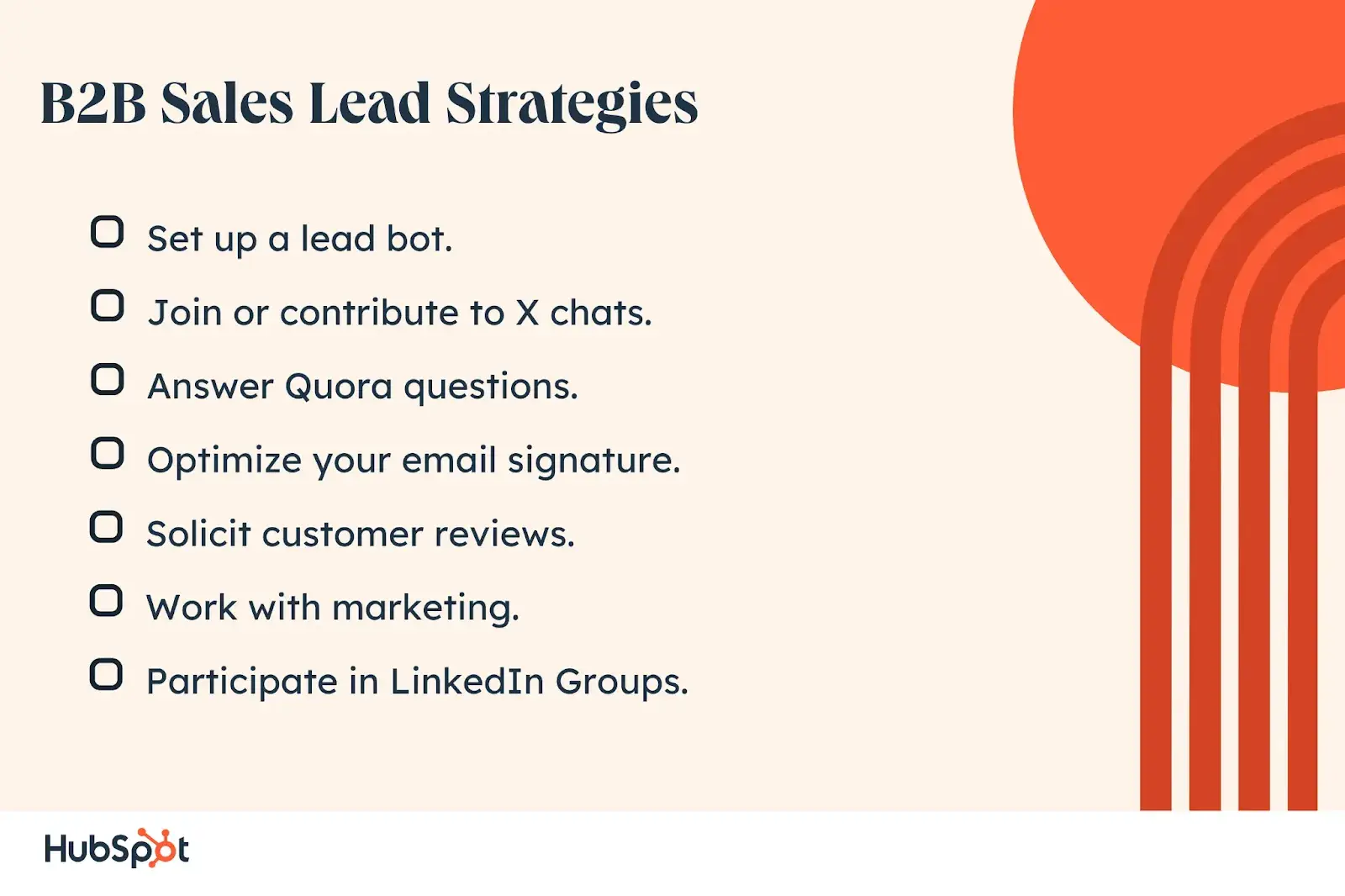
7 B2B Sales Lead Strategies to Start From

If you’re not sure where to begin with B2B sales lead generation, these seven strategies are a great way to get started.

If you’re interested in reading more about how to grow your pipeline, check out our ultimate guide.

how to generate b2b leads — seven strategies

1. Set up a lead bot.

Strategic Account Director Jack Matsen saw a 38% increase in demos booked within six months of implementing a lead bot.

Matsen says, “Our bots collect information that gives us time to come prepared with potential solutions before we walk into meetings with new prospects. Having this information ultimately leads to better, more beneficial conversations.”

It’s important to identify which pages you’ll install lead bots on, what you’ll say, and how you’ll route those leads. If you have a lot of organic traffic coming to your pricing page, or you notice this page is a high converter for you, drop a lead bot there to engage with a higher number of leads.

Make sure the language you’re using with your lead bot is friendly and conversational. In other words, don’t start a conversation with, “Hello, how can I help you today?” Instead, try, “Hello, thanks for stopping by our pricing page! Can I answer any questions about our three pricing tiers?”

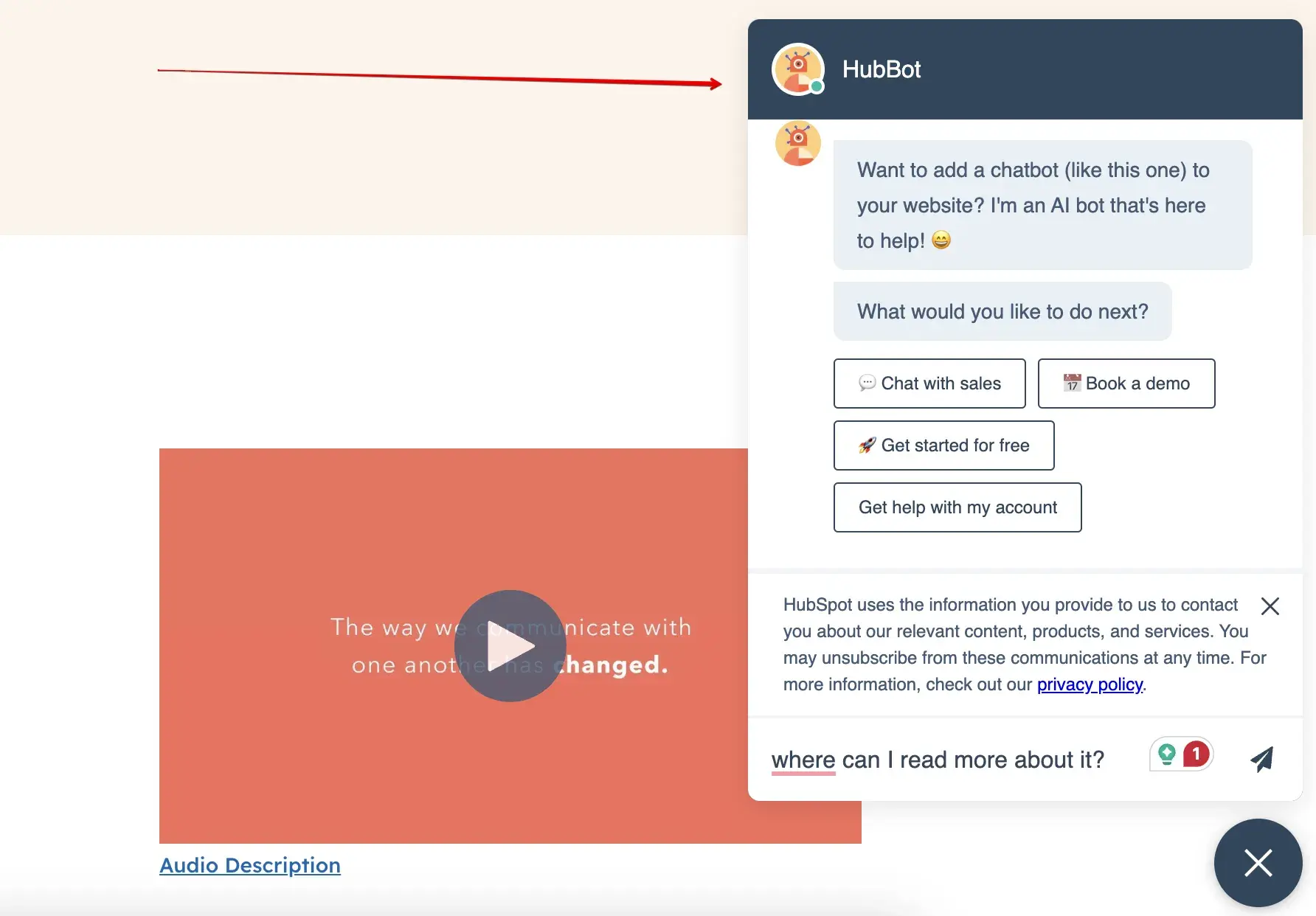
Think of HubSpot's example. The lead bot greets you with a straightforward message designed to convert and bring in new leads with less friction. HubSpot’s team also uses smart CTA buttons to guide the lead down the pipeline.

a great example of a lead bot on hubspot’s site.

And, once a prospect answers a “qualifying question,” such as “Chat with sales,” have your bot route the lead to the correct rep so a live conversation can take place.

2. Join or contribute to X chats.

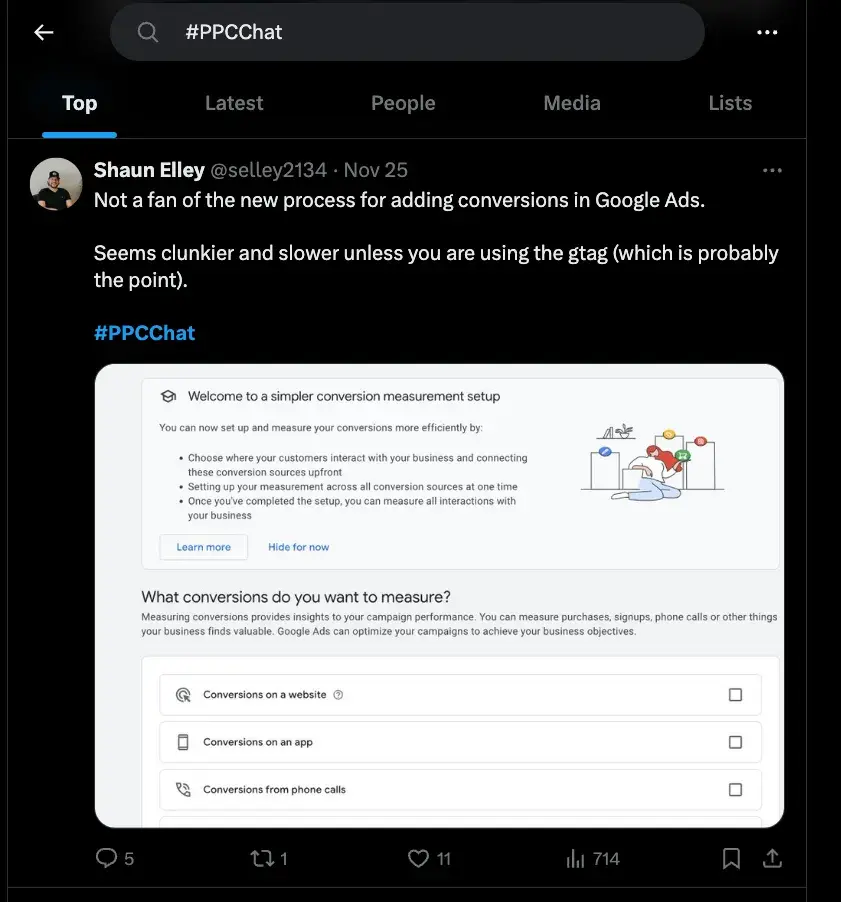
X chats are when a group of people meet on X (formerly Twitter) to discuss a certain topic, trend, or interest area using an agreed-upon hashtag. For example, if you sell a PPC tool, you might join the weekly #PPCChat, in which chat runners or guest hosts share a discussion topic ahead of time, and industry folks share their thoughts and questions.

#ppcchat on x

Source

The format of X chats is for the host to share a series of ordered questions (e.g., “Q1: What’s your biggest pain point with your current PPC tool?”), and participants reply in kind (e.g., “A1: My biggest pain point is competitive spend.”).

If you want to reply to someone’s answer or question — like the one above — start by replying directly to the question asker’s question. From there, here’s what NOT to do in an X chat:

  • X chat lead: “A1: My biggest pain point is competitive spend.”
  • Sales rep: “A1: I sell a PPC tool that can help combat competitive spend. Want to hear more?”

Don’t be that rep. It’s a good way to get a group of people to turn on you and possibly block you from future chats.

Instead, offer value only when you have non-salesy value to contribute, share knowledge, link to helpful articles, and share hacks other clients have used successfully. Here’s what your response should look like:

  • X chat lead: “A1: My biggest pain point is competitive spend.”
  • Sales rep: “A1: I’ve worked with a lot of people who’ve expressed similar frustrations. Check out this great blog post on auction insights a client of mine recently wrote.”

Show up to these chats regularly and know when to contribute and when to listen. You’ll make connections with people each week, and you can ask if it’s alright to follow up with a few of them offline after you’ve built foundational rapport.

3. Answer Quora and Reddit questions.

You can take a similar approach to Quora or Reddit as you’d take on X chats: Always Be Providing Value (ABVP).

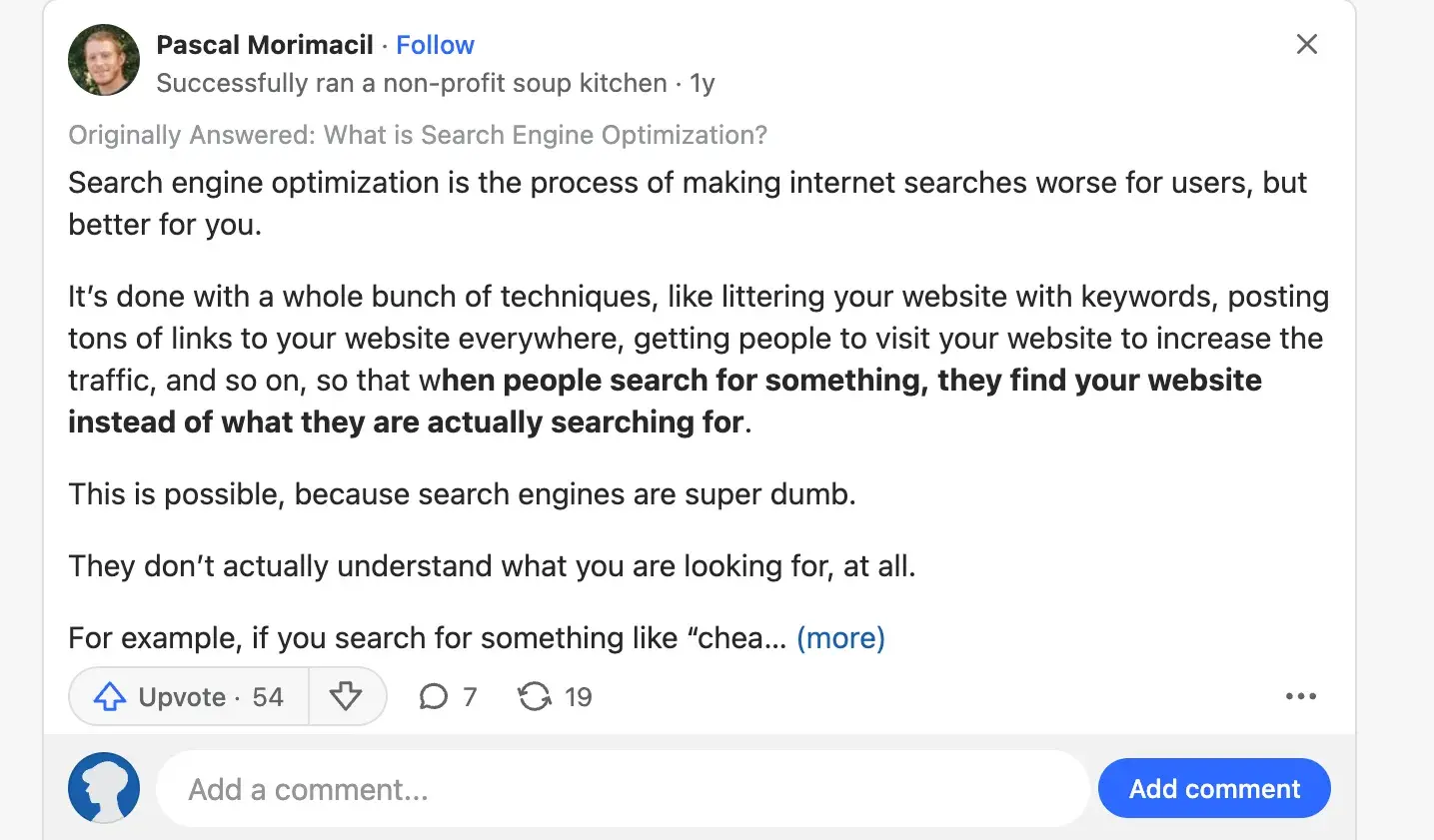
Quora is a knowledge-sharing platform on which users can ask questions and receive answers from industry experts around the world. Good answers are upvoted and appear at the top of the page.

Create a free account, make sure to fill out your profile, and choose your interests. Get a feel for the platform by answering questions. Again, never be overtly salesy. Answer questions you have a background in, and consider rewording blog posts from your company’s website to provide organized and well-researched responses.

what is seo and how does it work – quora discussion

Source

When appropriate, link to a few different articles that might answer your prospect’s next few questions on the matter.

View Quora as a rapport-building tool, and only offer your solution or ask for more of their time if there’s an opening or you’ve connected on another platform like LinkedIn.

4. Optimize your email signature.

The most valuable real estate in any email you send is arguably the email signature. You can sell without selling.

Start by adding a professional headshot, your appropriate contact information, and, if possible, your company logo (hyperlinked back to your website). As a bonus, add recent awards or industry accolades your company has received, links to popular blog posts, a snappy customer review, product announcements, or a calendar link to book time with you.

Expert tip: “Use email signature optimization combined with setting a lead bot. Over 200 leads per quarter were generated just by adding a CTA in email signatures. Adding an AI chatbot to the website also increased the number of qualified leads received after business hours by 40%.” — Jose Gallegos, Growth Marketer & Founder of Jose Angelo Studios.

Pack your email signature with as much value as the body of the email itself and optimize regularly. Need some help getting started? Try this email signature generator.

5. Solicit customer reviews.

Before making a purchase, 95% of consumers read online reviews. So, isn’t it time you make sure your reviews are everywhere? Ask your Customer Support team for a list of happy customers, or pull your top NPS scores and reach out to those customers.

You can even run campaigns asking these happy clients to leave reviews on customer review sites like G2 and Capterra. Having a strong presence on these sites can be a huge lead driver for your business.

Paying for a vendor account on a peer review site comes with added benefits, including customized landing pages, access to industry-specific reports and data, and premium placement in their software directories.

6. Work with marketing.

Whether the stereotype of mortal enemies, sales and marketing, is true for your organization or not, it’s important for reps to understand the importance — and the lucrative nature — of having a strong working relationship with their marketing team.

Here are a few areas to partner with them on:

  • SEO. Share trends you’re seeing and hearing from your prospects. For example, let’s say you’re a recruiting service. If you notice a trend in “outsourced recruiting,” you could recommend that your marketing team target that keyword in their content, paid ads, and other SEO strategies to bring in more qualified leads.
  • Paid Ads. Share keywords or pain points you hear come up a lot in your calls with prospects. If a common pain point you hear prospects cite is their difficulty giving recruiting the time necessary to do it well, you might share that with Marketing and recommend they run paid ads that speak to this pain point.
  • Content. Similarly, routinely meet with Marketing and share common objections or concerns your prospects are bringing to you. Ask them to create blog posts, white papers, and case studies that speak to those objections and educate your prospects before those objections arise.

HubSpot CRM connects your marketing, sales, and customer service on one platform. Sales teams can track activity, manage pipelines, and close more deals with tools like meeting schedulers, email templates, and AI writers.

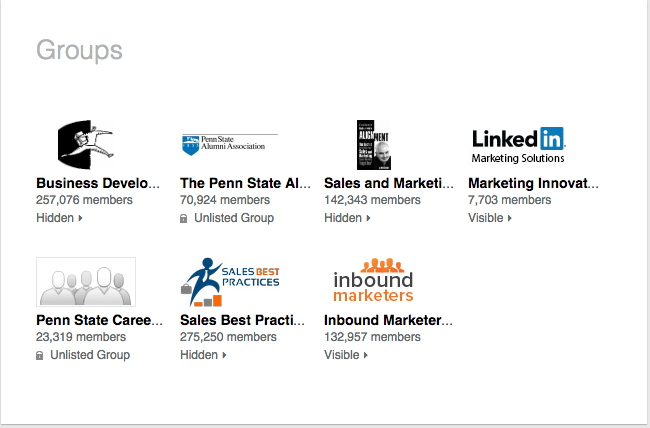
7. Participate in LinkedIn Groups.

Like X and Quora, the goal of joining LinkedIn Groups is not to spam everyone in the group with your offer. Search for industry groups where you know some target accounts and ideal customers hang out. Become a contributor to the group and build relationships with members by offering value and listening.

Leslie Omaña Begert, Co-founder and Creator of FabuLingua, a learning app for Spanish, shared what has worked best for her business:

"Drawing from our experience cultivating language learning communities, LinkedIn groups emerged as our most powerful B2B connection point. The traditional sales playbook falls short when you're trying to reach educators and learning institutions genuinely interested in innovative teaching methods.”

Our breakthrough came when we shifted from promotional posts to sharing real stories of language learning transformation in educational LinkedIn groups. During one discussion about engaging young learners, I shared how a Texas elementary school implemented our storytelling approach. Their Spanish program saw unprecedented engagement, with students spontaneously using the language outside class. This authentic success story sparked dozens of meaningful conversations with other educators.”

Their main tactic? Shifting from selling to solving real problems. When a group member asked about keeping students motivated, they shared insights from their story-driven method.

Begert wraps it up: “These contributions positioned us as trusted education partners rather than vendors. School administrators started reaching out proactively, already convinced of our expertise through our consistent value-adding presence.”

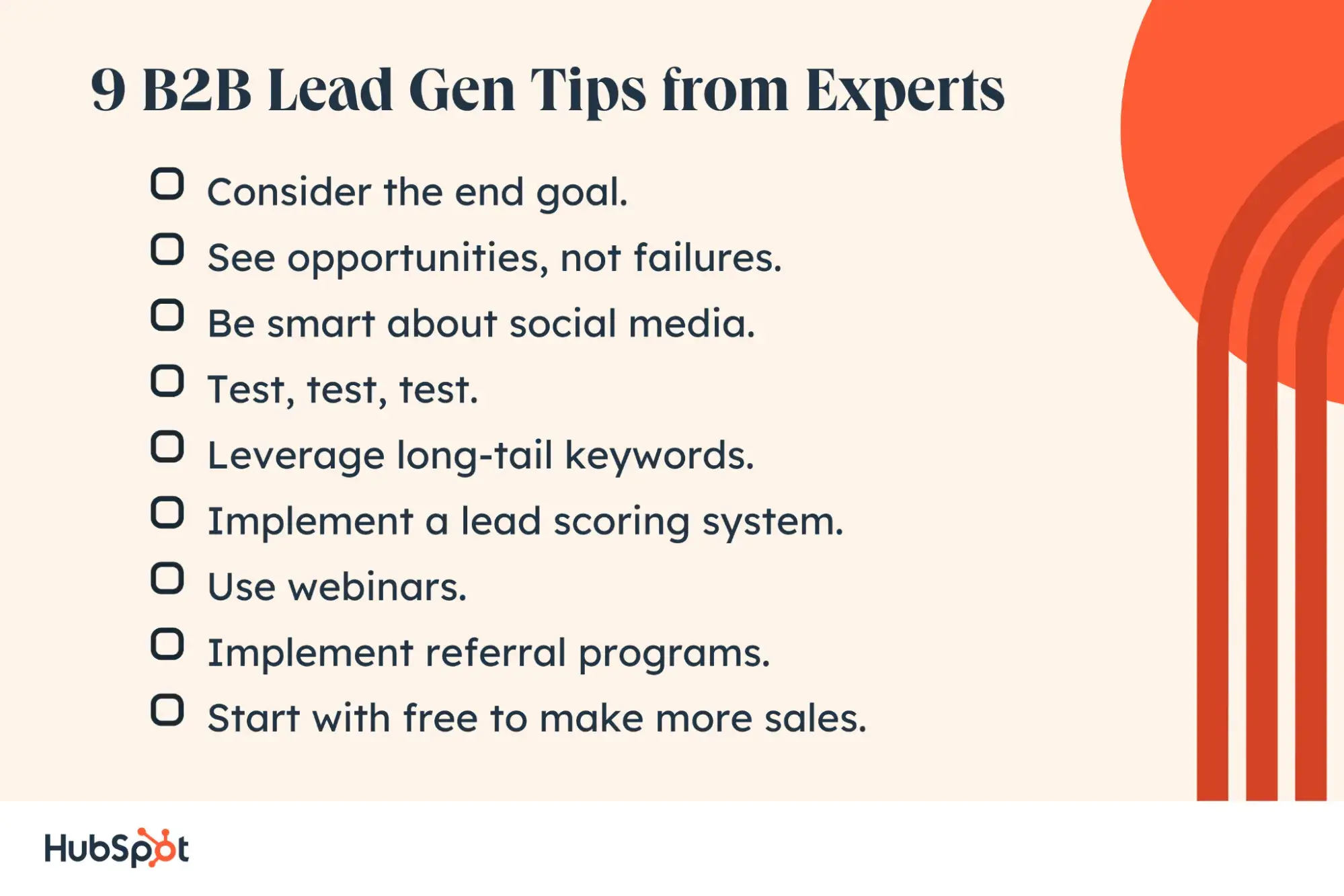
9 B2B Lead Generation Tips from Experts

Strategies are one thing, but there’s no substitute for real-world experience. Here are nine expert tips to help supercharge your lead generation.

9 b2b lead generation tips from experts

1. Consider the end goal.

It might seem counterintuitive, but your end goal isn’t making sales — it’s making customers. Sales in isolation drive temporary revenue increases, but if every lead buys one product or service and never comes back, your potential pool of purchasers quickly dries up.

Customers, meanwhile, represent a steady revenue stream, as they regularly return to make additional purchases or upgrades.

This is especially critical for B2B lead generation. B2B sales processes typically take longer than their B2C counterparts, have higher purchase prices, and may include multi-year contracts.

2. See opportunities, not failures.

What happens when you don’t make the sale? It’s an inevitable part of the B2B experience: Negotiations that are going well may suddenly stall, or business needs may change in response to market demand, leading to sales that almost cross the finish line but come up just short.

While it’s tempting to see these unclosed deals as failures, they’re actually opportunities. Here’s why: If sales teams can forge relationships with B2B prospects, they can set the stage for opportunities down the line.

Consider a B2B lead that abruptly pivots due to changes in business strategy. Rather than simply walking away, sales teams can recommend tech- or service-agnostic products that could help leads solve their current challenges. The result? When it comes time to make new B2B purchases, your company is top-of-mind.

3. Be smart about social media.

Great content helps capture lead interest and kickstart conversations. Social media can help amplify the impact of content — for good and for ill.

For example, if you’ve got in-depth content that’s performing well in SEO and generating leads, posting it on social media can help drive more interest and create more opportunities. If, however, your content isn’t getting the response you anticipate, social media will make the problem worse. The only difference? More people will see it happen in real time.

Put simply, social media is like a loudspeaker. Don’t announce anything you don’t want heard.

4. Test, test, test.

It’s not new. It’s not flashy. But it is absolutely necessary for your B2B campaigns to succeed: Test, test, test. And when you’re done, test some more.

Here’s why: What you don’t know can hurt your bottom line. Consider a new marketing campaign with a new logo and tagline for your value proposition. On paper, it looks like a great idea. C-suites love it, marketing teams are excited, and sales teams are ready to start fielding calls. And then … nothing happens.

As it turns out, your new campaign didn’t resonate with your target audience. Now, you’re left with two choices: Sink more money into a failing effort or scrap the project and start over, costing even more time and money.

Thankfully, there’s an alternative: Test. Use A/B testing to try out campaign ideas and see which one sticks. Use surveys, emails, and even phone calls to discover what prospects like about your website, your content, and your campaigns. Make changes in line with their responses, and then — you guessed it — test.

5. Leverage long-tail keywords.

Wondering how to generate b2b leads through SEO efforts? You need to look in the right place. Sure, you could spend time and money creating general campaigns that might capture some target audience interest but will mostly go unnoticed. Or, you can make sure that you find your audience — and your audience can find you.

To accomplish this goal, start by defining your target B2B customer. What industry(s) are they in? What does their budget look like? What are their pain points? Once you’ve found your audience, find where they are online. Look at their websites, their social media pages, and their recent press releases.

This gives you a sense of what these leads have, what they want, and what they’re looking for. Equipped with this information, conduct a keyword volume search. What you’re looking for are long-tail keywords — keywords that are three or more words long.

These keywords have lower search volume than their shorter counterparts but target a specific audience. Prospects searching these keywords know what they want and are far more likely to convert. By finding your audience and identifying their ideal keywords, you can capture more of your target market.

6. Implement a lead scoring system.

Not all leads are created equal. Lead scoring helps prioritize the most qualified leads based on factors such as industry, budget, engagement with your content, and interactions with your sales team.

Assign a score to each lead, so you can focus your efforts on those who are most likely to convert.

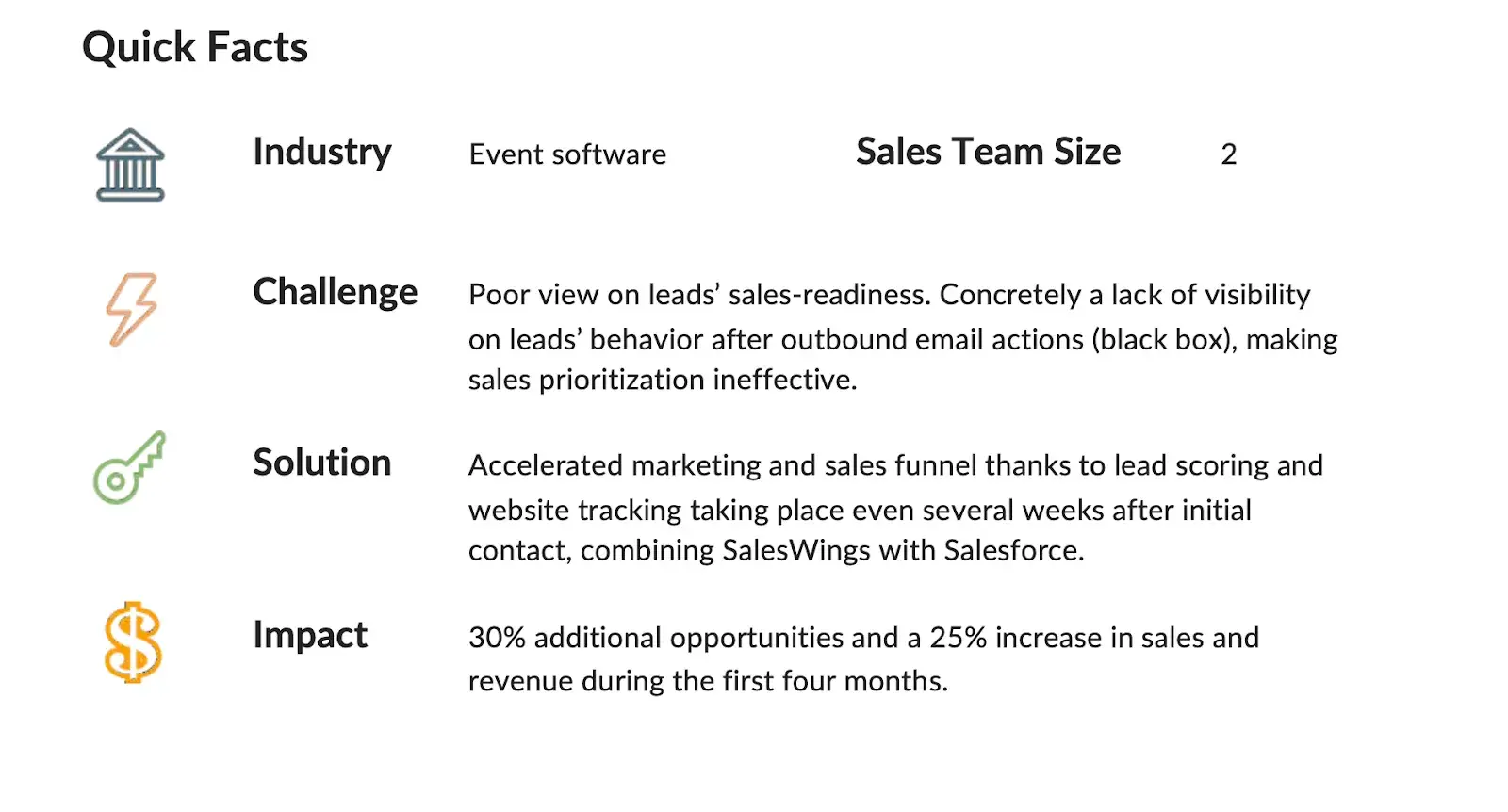
Having the right lead scoring system in place made all the difference for Expo-Genie’s sales team. Before using SalesWings, they had no way to track lead interest beyond email opens.

The team was flying blind when it came to understanding who was truly engaged. With predictive lead scoring in Salesforce, the sales team could track website visits and identify when leads became warm or hot, even weeks after the initial contact.

This helped them target leads at the perfect moment, leading to a 30% increase in opportunities, a 25% boost in closed deals, and an extra $20K in revenue over the past few months.

expo-genie x saleswings & salesforce case study

Source

7. Use webinars.

Webinars are an effective way to generate B2B leads by sharing valuable content and engaging with your audience live. Promoting relevant topics attracts leads, while a Q&A session builds trust and showcases your expertise.

One of my favorite books is Diary of A First-Time CMO Vol 1 by Cognism's CMO, Alice de Courcy, in which she talks about how, in the early days at Cognism, she turned webinars into a winning tactic.

Courcy changed her “make that sale” mindset and instead of chasing sign-ups, she focused on creating content that fueled more engaging, high-impact webinars. Plus, she rewarded attendees to boost participation.

Alice hosts live cold-calling sessions where participants can try out their scripts and make calls, while a subject matter expert provides real-time coaching to help them improve.

If attendees miss the live session, they lose out on the chance for personalized, one-on-one feedback.

8. Implement referral programs.

Get your current clients to spread the word. Offer irresistible incentives like discounts, exclusive content, or special rewards for every referral. Since people trust recommendations from colleagues or partners, tapping into your existing network can bring in highly qualified leads who already know and love your business.

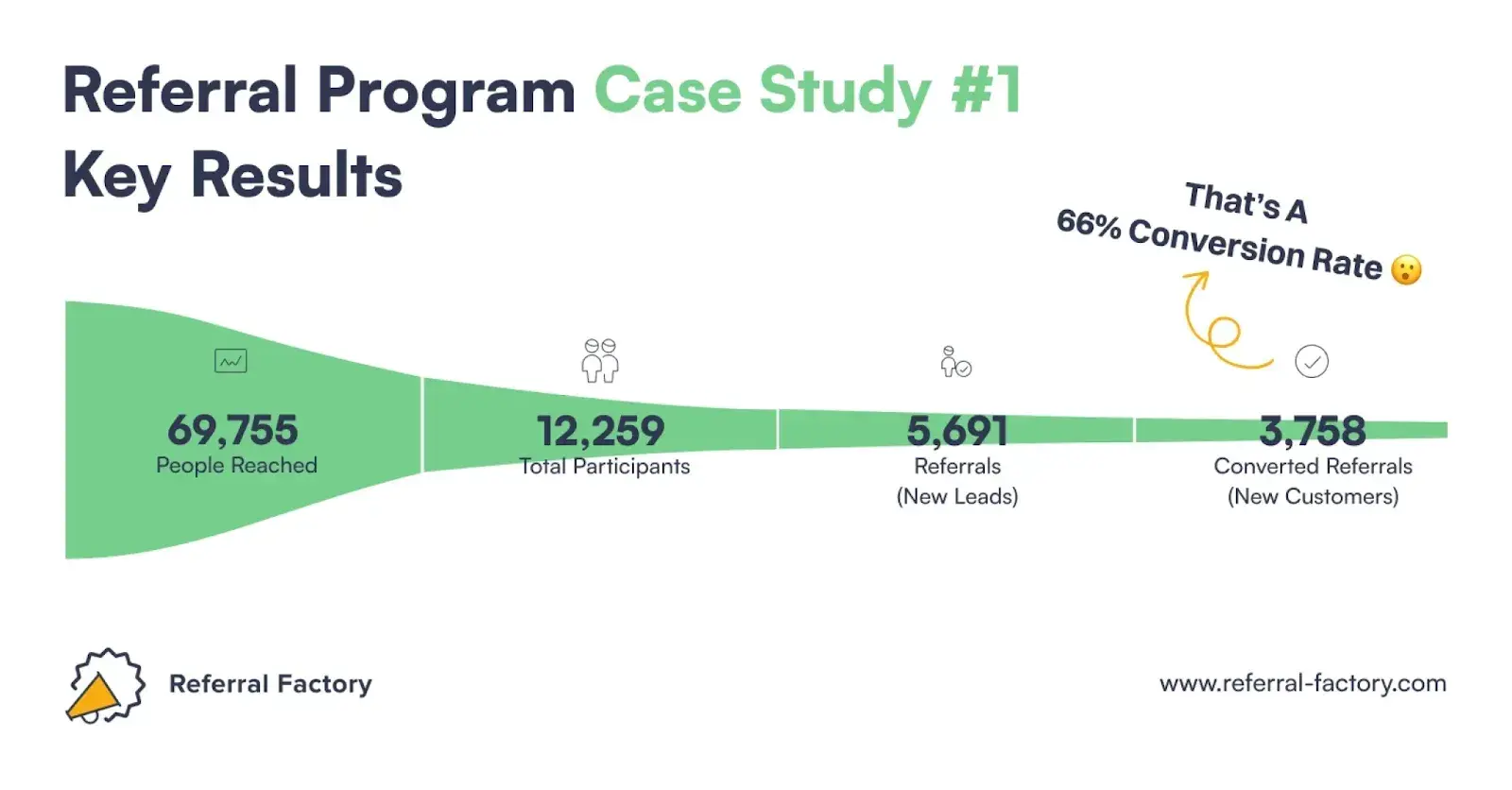
I’ve recently read a great case study by Referral Factory that highlights how a B2B financial services business grew significantly through a referral program. This company faced challenges — low conversion rates from PPC ads and difficulty reaching the right audience.

To overcome these struggles, they launched a double-sided referral program where both the referrer and the new customer received rewards. For every successful referral, the referrer earned an Amazon voucher, and the new customer received a £25 discount. They promoted the program through email marketing and added referral links across their website and transactional emails.

The results were nice:

  • 5,691 leads generated
  • 3,758 new customers acquired
  • 66% conversion rate.

referral program – case study by referral factory

Source

What stood out was the viral effect: 21% of referred customers went on to refer others, creating a strong loop of growth.

9. Start with free to make more sales.

“The way you position yourself at the beginning of a relationship has a profound impact on where you end up,” notes Ron Karr, author of Lead, Sell, or Get Out of the Way.

The old saying holds true: You never get a second chance to make a first impression. And what better way to make a great first impression than by offering leads for free? Maybe it’s a demo of your product, a free eBook, or in-depth market research.

As long as it’s something that your target audience wants, it’s a great way to get the relationship off to a great start and demonstrate that you understand the market.

The Winning Formula: Mix and Match

If I had to choose just one strategy from these seven or one tip from these 9, I couldn‘t. I can’t even say that one works better than the others.

The combination of several is what actually brings the desired results. Recognizing what will work and what your audience will love is “the key to the success” you're looking for.

Try out multiple tips and strategies to see what combination works best for your product, market, and B2B sales lead generation goals.

04 Jan 17:51

4 Steps To Magically Turn a Cold Sales Email Warm

by mrenahan@hubspot.com (Mike Renahan)

fourstockphoto.jpg

Someone I work with frequently receives messages from a sales rep she doesn’t know. They’re the classic value-less “just checking in” emails that drive prospects crazy.

She never answers.

Instead, she forwards me the note and we discuss what sucks about it. We always come to the same conclusion: Today’s buyers aren’t interested in hearing from a sales rep they aren't familiar with about a product they don’t need.

Reps have their work cut out for them. Salespeople have to create relationships with strangers and convert those strangers into paying customers. And while that’s already hard enough, reps are making it harder on themselves when they embrace cold techniques that are losing their effectiveness -- quickly.

A recent study found that the average response rate of cold emails is 1.7%. A study from TOPO found that it takes 18 cold calls to connect with a single buyer. Those two numbers are staggering, but they make sense if you think about it. After all, when was the last time you answered a phone call from someone you don’t know? Have you ever responded to an email from an unfamiliar email address?

While cold tactics once defined the field, it’s time for a change in the world of sales. To stay relevant, salespeople must focus on finding the right leads, building rapport, and guiding prospects through their individual buying journey.

Below are four steps reps can use to take the “cold” out of their sales strategy and begin the dramatically more effective “warm” outreach.

1) Identify LinkedIn groups that your prospects participate in.

By identifying the groups your prospects are members of, sales reps can begin to understand what interests their prospects and why. For example, if you notice a qualified prospect is a member of a “Social Media Marketing” group, you can infer that they’re interested in social media and learning how to use it for effective marketing.

After finding relevant groups, consume content, and comment on what you’re reading and what prospects are posting. If a rep can spark a debate or join a conversation among prospects, they’ll start to build rapport and become familiar to the people they’re trying to sell to.

To identify which groups a particular buyer is a member of, simply head to their LinkedIn profile page, and scroll down until you find the section labeled Groups.

Screen_Shot_2015-12-29_at_12.46.11_PM.png

2) Connect and engage with prospects on Twitter.

Reps who invest in social media are seeing a major return: According to Forbes, 78% of sales reps who use social media perform better than their peers. By connecting with prospects on Twitter in particular, reps can engage in discussions based on shared interests and blog posts, as well as retweet content the buyer has written or shared.

To get the most out of Twitter, sales reps can add their buyers to a Twitter list. This way you can stay up to date on what prospects are sharing, and get on their radar by regularly interacting with them.

To add someone to a Twitter list, click on the settings button, and then "Add or remove from lists." 

Screen_Shot_2015-12-29_at_10.44.29_AM.png

3) Personalize your email based on what you’ve learned.

When a sales rep sends a personalized email to the prospect based on what they have learned through online interactions, they’re able to focus on points they know the prospect is interested in. If a rep knows that the prospect is struggling with their social media strategy, or is experiencing problems with their CRM, they can craft a message around that pain point and begin a discussion.

Loved your blog post, [Prospect]

Hey [Prospect],

I wanted to follow up on the blog post I saw you tweeted this afternoon. Looks like you’re testing several different social media tools for your website and I thought I could help. I know we’ve gotten into a debate about which products are the best and why, so I’m passing along an analyst report ranking some of the offerings in the space.

I’d love to get your thoughts on the top three. Talk to you soon!

Mike

send-now-sidekick-hubspot-content  

Reps who follow the first two steps on this list before sending their initial email have an advantage because they’ve spoken to the prospect online numerous times before. This won’t be an introductory email from someone the prospect doesn’t know. Instead, they will know this sales rep’s name from the interactions they’ve already had, which makes a response much more likely.

4) Keep the conversation going even after they buy.

Not only does keeping the conversation going after the prospect becomes a customer keep the relationship strong, it lays the foundation for more warm outreach down the line through referrals.

How can reps keep tabs on their customers? Schedule a phone call to seek feedback once a month, send a quick email every two weeks, or comment on new blog posts your client publishes. The conversation doesn’t have to be specific to the product -- just keep the lines of communication open. This will prime the customer to react positively when you eventually ask for a referral (use this email template for the best result).

Cold emails and cold calls have become less effective as the modern buyer screens their phone calls and protects their email. Sales reps need to focus on building rapport with prospects through warm outreach instead of cold calling and persuading.

Don’t be the rep whose emails get forwarded around a prospect’s office as an example what not to do. Commit to warm outreach and step into the bright future of inbound sales.

  HubSpot CRM no risk

04 Jan 17:51

5 Ways Salespeople Can Impact Marketing Content

by Tal Vinnik

Image of two young businessmen using touchpad at meeting

The big focus in 2016 will continue to be aligning sales and marketing around the customer. A lot of companies are on board with the sales and marketing lovefest, but have trouble putting that alignment into action. Other companies aren’t on board yet because they think that there’s a reason for separating the departments.

There are key differences between salespeople and marketers, each with their own strengths and weaknesses, but sales and marketing alignment isn’t about throwing tasks at people they’re not suited for (or aren’t interested in doing). It’s about allowing sales and marketing departments to work in parallel, so that as they’re doing their jobs, they can help their counterparts do theirs without stepping on each others toes.

For this post, we’ll be going through tried-and-true ways that salespeople (including our own) have positively impacted marketing content without cutting into their time devoted to selling.

Let Marketers Know What Works

It’s no secret that salespeople ignore much of the content that marketing produces—only about 40% of it gets used. In an ideal world, 100% of it would get used (we’ll get to that in a second), but without knowing what content gets used, we can’t make more of that content.

To gain insight into what happens behind the closed doors of a sales meeting, we don’t have to set long interdepartmental meetings to brainstorm about what content sales reps want to see. We use metrics to see what content is accessed most often from within SalesKit. We can do a few things with that information.

First, we can cross-reference what marketing content our top-performing salespeople use and see what content “assists” in a deal-closing, just like you can with a web page. Next, we can look across the common elements of the most-used content: Are there stylistic similarities? Is the tone of this content any different than the rest of your content? Is video content being used more than case studies or PowerPoints?

From there, we can create new content and raise the percentage that gets used by creating more of what we know that salespeople (and customers) want. When your sales reps aren’t swamped with meetings in the field or calls, you can set up a meeting to run your ideas by them and confirm that what you think is right. All salespeople need to do is use a sales presentation solution that tracks access, and marketers will do the rest.

Let Them Know What Doesn’t

So, what about that 60% of content that’s not getting used? One possibility is that the salespeople can’t find it. With a content management solution with search functionality and segmented user groups (so marketers can give access to content only to those who need it), this shouldn’t be a problem.

If finding the content isn’t the issue, then the marketing content may not be appropriate for prospects who are meeting with sales. For example, if salespeople meet consistently with prospects who are nearing a purchasing decision, they won’t use top-funnel content meant to explain what your product area is.

Marketers can look at the metrics of content that salespeople are accessing and look at low-performing content, and put it in the group of a) Not appropriate for sales meetings or b) content that’s lacking…something. If it’s in the latter group, marketers can do the same thing that they do with the top-performing content. Find the common elements, look for what might be wrong and then confirm with salespeople.

Tell Them When Something’s Missing

For salespeople, there’s three categories of marketing content: content that’s useful, content that isn’t useful, and content that would be useful if it only existed. When they can’t find it, they’ll end up creating their own. Do they have insight into their customers to create their own content? Can they create great content? Yes, but that doesn’t mean that they should be doing it.

When salespeople create their own content, it takes them away from direct selling tasks. They also may not have access to style guides that marketers reference whenever they start the process of creating new content. Finally, when salespeople create their own content, marketers lose visibility into the content that is and isn’t working with sales-ready prospects.

What content is missing isn’t necessarily something that marketers can glean from the passive input that sales can give through metrics on good and bad content. Salespeople can instead flag marketers and let them know that they’re looking for a type of content. Some marketers have “funnel vision”: they tend to focus on top of the funnel or middle of the funnel content (e.g., content that easily generates leads), and so they lose sight of the bottom of the funnel content that salespeople need. The best way for salespeople to get the marketing content that their prospects demand: just ask!

Show Them How You Access Content

It’s not just enough to know what content is being used. As John Burns recently discussed [link], how marketers structure content may not be how salespeople want to access it. Because SalesKit allows content to be re-organized for a sales audience, how salespeople present content is invaluable for administrators to organize content for them.

Again, salespeople can impact content by continuing to do what they do best. Marketers can see the order in which content was presented, and then create collections of content designed to make it as easy as possible for salespeople to access the content that’s relevant to them, in the flow that’s right for their customers.

With that data, marketers can go beyond re-organizing content. They can take related content and wrap it in an interactive framework, empowering salespeople to access relevant content without going through irrelevant slides or brochures (see an example here). Marketers can also create new content based on those metrics; for example, if they see a feature and benefit overview consistently presented before a customer testimonial video, they can create a piece of content to create a better transition between the two. In that case, it could be a summary of data points of how that customer specifically benefited from the product.

Share Content Outside the Meeting

Another place where marketers can lose visibility is when salespeople send marketing content to prospects either in anticipation of a meeting or in following up. We bridge that gap by using trackable Airship links, which allow salespeople to see when the prospect opens the content and gives marketers additional insight into the content salespeople are sharing. From the SalesKit app, they can also share annotations on content that they discussed into the meetings. Marketers can use those metrics to improve content just as they do with website analytics, email opens and now, sales meetings.

By simply opening the doors to the interactions that they have with their customers, salespeople help marketers improve marketing content at every stage of the buying cycle.

See how you can empower your own salespeople. Download the demo version of our solution, My SalesKit, or request a demo tailored for you today!

New Call-to-action

02 Jan 17:58

Canada: A nation of winter wusses

by Aaron Hutchins
Winter wussie. (Photograph by May Truong)

Winter wussie. (Photograph by May Truong)

Despite an unseasonably warm winter and a forecast calling for a low of 7° C, Rhéal Leroux is ready for his annual trip to Florida. “Today is cold for me,” he says from his suburban Ottawa home. “It’s 28 in West Palm Beach.”

So on a late-November weekend—the same weekend on which he’s fled for the past 10 years—the 65-year-old was on a plane south, where he can play golf and walk outside without fear of slipping. Aside from a short visit home for a couple of days, Leroux won’t be back until April. There’s little that would make him stick it out in the cold Canadian winter. “You need two jackets to walk outside and you’ll still freeze,” he says. “Not being a skater or a skier, what can you do?”

In Canada, complaining about the cold is a national pastime. But what makes Leroux’s attitude noteworthy is that he’s the man who, back in 1978, came up with the idea for Winterlude, Ottawa’s annual outdoor festival that celebrates all things snowy and icy. As it turns out, even the self-described “father of Winterlude” hates the winter.

Canada’s mighty winters once invoked a sense of pride and superiority, a way to distinguish Canadians from Americans. “For we are a northern people, as the true out-crop of human nature, more manly, more real than the weak marrow-bones superstition of the effeminate south,” wrote the lawyer and essayist William Alexander Foster in his 1871 address, “Canada first or, our new nationality.”

For centuries, Canadians wouldn’t let a little cold stop them. Days after Christmas in 1794, the Hudson Bay Co.’s Peter Fidler—a British surveyor, though perhaps Canada’s first weatherman—ventured out to record at what temperature liquor froze. (For the record: Holland gin freezes solid at -27° C, English brandy at -32° C and rum at -35° C.)

Canadians continued to brave the elements for generations. Not even a power outage during the 1956 ice storm in P.E.I. could stop Tryon Consolidated School from educating its charges; it could still be kept warm with a wood stove. Cape Traverse local Joe MacDonald was so adamant about getting his two kids to class that he carried them, one child under each arm, as he skated to school.

Times have changed. Environment Canada issues twice as many types of winter warnings as it did 25 years ago. School cancellations are on the rise. Dressing warm—from temperature-rated parkas to lab-tested winter boots—has never been more in fashion, and yet major cities and university campuses continue to expand underground walkways so locals can avoid the cold, no matter the cost. P.E.I. native Meaghan Blanchard rose to local stardom last month with almost 200,000 YouTube hits for her song I’m Not Ready to Scrape Ice, a parody of the Dixie Chicks hit, Not Ready to Make Nice.

(Mika Goodfriend)

(Mika Goodfriend)

Winter aversion is practically endemic, despite the fact that virtually every Canadian city has not only warmed appreciably but also experienced less snow over the past few decades. Leroux is not exactly the only Canadian with a tee-off time. Snowbirds are flocking to Florida; 41 per cent of U.S. homes bought by Canadians last year were in the Sunshine State, according to the National Association of Realtors.

The rapid decline of the Canadian dollar has done little to dissuade Canucks from making the trip south, according to Jennifer Hendry, senior research associate with the Canadian Tourism Research Institute. When she analyzed StatsCan data regarding trip intentions for the winter, numbers were indeed down, “but not to the extent that we expected,” she says. Instead, people are modifying their vacations rather than cancelling them outright. Forget the fancy hotel; an accommodation with fewer stars won’t hurt. Who needs fine dining when there’s Applebee’s? Instead of a 10-day stay, a shortened six-day trip will do. “It’s almost a feeling of ‘as long as I can put food on the table, I’m going to travel this winter,’ ” Hendry says.

As for pride, Toronto lost much of that in 1999 when then-mayor Mel Lastman—founder of the Bad Boy furniture chain, no less—called in the Army to help shovel snow during a blizzard. The bar to get Canadians outdoors is now set so low that even the David Suzuki Foundation’s “Winter Family Challenge,” launched in January 2015, asked people to get outside as a family just once a week.

“We have hot summers and resplendent autumns,” wrote the late Governor General Literary Award-winning novelist Robertson Davies, “but it is winter that establishes the character of our country and our psychology.” If what Davies wrote is true, then Canada is—frankly—turning into a nation of winter wusses.

Members of the Royal Canadian Regiment (from left to right) Pte. Paul Roventa, Master Cpl. Gary Walters, Cpl. Cameron Kerryann, and Pte. Phil  Cheung shovel snow in downtown Toronto Friday, Jan.15, 1999. Ten years after a series of winter storms buried Toronto under more than a metre of snow, former mayor Mel Lastman still takes pride in calling on the military to tackle clogged city streets while large swaths of wintry Canada looked on in wonder. (Kevin Frayer/CP)

Members of the Royal Canadian Regiment (from left to right) Pte. Paul Roventa, Master Cpl. Gary Walters, Cpl. Cameron Kerryann, and Pte. Phil Cheung shovel snow in downtown Toronto Friday, Jan.15, 1999. (Kevin Frayer/CP)

Simaga Lyta, an Iqaluit mother, is pushing back. She was upset last March when the school board decided to cancel school. After all, it was only supposed to get down to -50 with the wind chill. “If I’m going to teach my son, for example, to hunt, I don’t want him to think it’s too cold out, he can’t hunt,” she told local media. “And if he does go out hunting on a beautiful day and it does get cold, I want him to know how to survive.” Cancelling classes because of the cold, she argued, was harming Inuit culture, and it marked eight days of cancellations to that point in the school year due to weather.

While the mere thought of -50 would put a chill in most Canadians’ bones, some school boards and parents are struggling with snow days piling up. In Pictou County, N.S., for example, there was an annual average of 4.4 winter-storm-day cancellations between 1978 and 1988, according to a 2009 report. The following decade, that average jumped to 5.2 days. From 1998 to 2008, the annual average increased again to 6.9 days of classes missed due to winter weather.

“Over those years, the expectations of families have changed,” says James Gunn, the author of the report, who has previous experience as a principal and superintendent in the province. “Their tolerance of what makes a bad day is not what it used to be.”

Back in the day, road conditions had to be significantly worse before anyone even thought of cancelling school, Gunn adds. He remembers being a rural high school student in the early 1960s, helping put chains on the school bus and affixing it to a farmer’s tractor to help pull the bus up a snowy hill. “That would never happen now,” he says.

While bus cancellations don’t automatically mean school doors will be shuttered, many teachers aren’t keen to drive in on snowy days either. The Elementary Teachers’ Federation of Ontario, for example, voted in 2014 to recommend that school boards cancel classes whenever bus service is cancelled.

In New Brunswick, some schools lost 13 days of classes last year because of the harsh winter. “Thirteen days cancelled, plus seven more professional development days, plus statutory holidays, plus one or two weeks in March,” tallies Paul Bennett, director of the Halifax-based education policy analysis firm Schoolhouse Consulting. “Who can work when your kids are out of school [this much]?”

Cancelling school not only puts extra pressure on families with two working parents, but it also writes off certain lesson plans for students or forces teachers to cram more into a limited time frame.

But if the medium is the message, school boards are woefully underprepared to get work to students on snow days. “The school boards here have become very effective at communicating electronically that school is cancelled,” says Bennett. “But they can’t seem to organize e-learning during those days kids are not in school.”

Bennett suggests schools prepare “blizzard bags”—filled with various homework for students with or without access to a computer at home—for days when poor weather forces school closures. It’s a practice already in place at many schools across Ohio, New Hampshire and Massachusetts and could prove a vacation-saver up north. When Nova Scotia’s education minister floated the idea of students coming in during March break to make up class time, parents complained it would ruin family trips. The premier stepped in to assure parents the government wouldn’t enforce such an option, and asked school boards to sort it out.


A snowboarder makes his way down a run at Cypress Mountain in West Vancouver, B.C. Monday, Feb. 9, 2015. (Jonathan Hayward/CP)

A snowboarder makes his way down a run at Cypress Mountain in West Vancouver, B.C. Monday, Feb. 9, 2015. (Jonathan Hayward/CP)

David Phillips figured he had a “good news” story on his hands about 10 years ago when he crunched the numbers and found out Canada was no longer the coldest country in the world. The fall in the rankings had nothing to do with global warning, but rather the breakup of the Soviet Union, which changed some boundaries and pushed the Russian Federation to top spot. The senior climatologist with Environment Canada issued a press release, but he was surprised by how Canadians reacted. “It was looked upon as sad news,” Phillips says. “We think we’re the land of ice and snow.”

But data shows that’s becoming less the case. Since 1948, winter has warmed by three degrees nationally, an increase greater than any other season. In the 40 years between 1960-99, Montreal averaged more than 15 days a year with temperatures dipping to -20° C or colder. Since the turn of the century, the city has barely registered 10 of those days on average each year.

Comparing two overlapping sets of 30-year temperature normals (1961-90 and 1981-2010) from Canada’s National Climate Data and Information Archive for the winter months of every provincial and territorial capital, only Iqaluit has gotten colder. Whitehorse and Yellowknife winters are nearly 2.5° C warmer than they once were, while winter days in Regina, Edmonton and Winnipeg are on average about 1.5° C warmer. “These changes appear to be very small, but they’re not,” says Adam Fenech, director of the Climate Lab at the University of Prince Edward Island, who examined the data. “It’s a slow-moving window.”

Snowfall has also decreased across the majority of Canadian cities, most notably in Vancouver, where snowfall normals fell by 31 per cent from the 1961-90 average to the 1981-2010 average. There may be the occasional bad year of snowstorms, but the 30-year window of study limits the effect of those anomalies. Locals in Fredericton, Halifax, Charlottetown and Toronto might not believe it, but snowfall has dropped in each of those cities, too, by about 15 per cent.

Winnipeg, meanwhile, may be so cold that when NASA named a small part of Mars after the city, it was considered an emblem of pride. But if a tough winter day in the Prairies constitutes, say, at least five centimetres of snowfall and a minimum temperature at or below -20° C, “Winterpeg” averaged 2.7 tough winter days annually in the 1950s, but saw only 1.3 per year since the turn of the century. Regina, too, fell from having an annual average of 1.6 tough winter days during the 1950s to 0.6 since 2000. So when parents, or grandparents, say Canadian winters aren’t half as bad they used to be, they’re correct.

If anything is getting worse, it’s the made-up terms to describe the impending doom of the season: “snowmaggedon” or “snowpocalypse” are two that come to mind. (Kansas City wins the award for most creative with “the Blizzard of Oz.”) “We rush to the thesaurus or invent Hollywood-like names and apply them to weather terminology,” says Phillips. “But they have traction. People remember them and use them—and it sometimes scares the bejesus out of people.”

Environment Canada too has more types of winter warnings than ever before—a byproduct of improved weather reporting accuracy and Canada’s insatiable desire for weather news. In 1949, for example, winter warnings issued by Environment Canada included blizzard, frost, heavy snowfall, freezing rain and wind. Not even extreme cold warranted a notice. Today, there are more than twice as many types of winter warnings: Arctic outflow, blowing snow, extreme cold (including wind chill), flash freeze, freezing drizzle, snowfall, snow squall, and winter storm. “We’ve invented more weather, when there is no new weather,” Phillips says. “We just have more terminology and descriptors.”

There are few winter terms more influential, however, than “wind chill”—which as it happens was invented by an American—as 82 per cent of Canadians make decisions based on wind chill, according to a recent study. “Most meteorologists hate wind chill because it’s not a perfect measure of coldness, but Canadians love it because it really exaggerates the worst,” Phillips says. Which means if it’s -25° C outside, but minus -35 with wind chill, “by the end of the day, people are saying it’s -35 outside.” Anything to make it sound more spectacularly cold than it really is.

Brag as we might about the cold, the local economy suffers when people cancel restaurant reservations or forgo a day of shopping because the wind chill drops too low. Retailers, tourist operators and restaurants suffered in 2014 when consumers “preferred to hibernate instead of venturing out,” wrote Scotiabank’s deputy chief economist Aron Gampel. TD, meanwhile, blamed oil prices and the cold weather for the GDP dropping 0.7 per cent in the first quarter of 2015.

If Canadians ventured outside more, they’d find out it often doesn’t feel as cold as the weatherman claims. “One of the unknowns about meteorology is we measure temperature in the shade, not the sun,” Phillips says. So if the wind isn’t blowing and you want outdoors to feel seven or eight degrees warmer than what you heard on the radio, Phillips has one piece of advice: “Walk on the sunny side of the street.”

MAXIM ZMEYEV/Reuters

MAXIM ZMEYEV/Reuters

Prior to the 2014 Sochi Olympics, the Canadian Olympic Committee launched a massive marketing campaign with the tag line: “We are winter.” While Canada can trumpet our double gold medals in hockey, off the ice Russians don’t fear winter like Canadians do. Withstanding the cold is part of their history; Russians fought off invasions from Napoleon Bonaparte and Adolf Hitler, whose troops both succumbed to Russian winters. Every Jan. 19, thousands of Russians dive into icy waters as part of an Orthodox Church tradition to symbolically wash off their sins. Some go swimming in the winter waters every day as part of “walrus clubs.”

Norwegians, too, look forward to winter. “It’s easy to love the winter in northern Norway,” says Kari Leibowitz, a Ph.D. student at Stanford University who spent a year at the University of Tromsø, the world’s northernmost university, to study winter attitudes. It’s quite a statement coming from Leibowitz, a New Jersey native who hated winter so much growing up that she moved to the southern U.S. after high school.

When Leibowitz opted to go to Tromsø—a city as far north as Tuktoyaktuk, N.W.T.—“I originally went there to study why people weren’t more depressed,” she says. When she arrived in August 2014, she began asking locals about the cold months ahead, when the sun barely rises for two months. Norwegians responded by saying it was either a) not a big deal, or b) they looked forward to the winter. The town of 70,000 has a cross-country ski track around the island, fully lit, so everyone can ski with ease. People eat outside at restaurants, with blankets and under heat lamps. New mothers are out with their strollers pushing newborns who are wrapped as if they’re in a cocoon.

Getting a daily dose of outdoor sun in the wintertime—even if it’s just a half-hour’s worth—could be helpful with regulating hormones that affect our mood, such as melatonin, says Kate Harkness, a professor of psychology at Queen’s University. “People who get into their underground parking lot, drive to another underground parking lot, and spend the whole day inside are not getting the critical sunlight they need.”

According to a 2015 survey commissioned by the Weather Network, 43 per cent of Canadians experience “winter blues”—a mild form of seasonal affective disorder—while the Canadian Mental Health Association says that percentage is closer to 15 per cent. “The more you talk about it being miserable in the winter, the less likely you are to go outside,” Harkness says. This, in turn, will negatively affect mood. “It becomes a self-fulfilling prophecy.” One way to help change that is to go outside for a little walk—even if it’s cloudy.

Jackets hang at the factory of Canada Goose Inc. in Toronto on Thursday, November 28, 2013. Canada Goose plans to double staff at a new factory in Winnipeg by early next year as it lays the groundwork for a bigger international expansion. THE CANADIAN PRESS/Aaron Vincent Elkaim

Jackets hang at the factory of Canada Goose Inc. in Toronto on Thursday, November 28, 2013. Canada Goose plans to double staff at a new factory in Winnipeg by early next year as it lays the groundwork for a bigger international expansion. THE CANADIAN PRESS/Aaron Vincent Elkaim

Complain as we might, Canadians have never been better equipped to deal with the cold, from Sorel boots that can handle temperatures of -40° C to winter footwear from Pajar with cleats built into the sole for a better grip. Footwear is now a science: WinterLab in Toronto recreates harsh winter conditions—from icy surfaces to 30 km/h winds—to test different treads.

Even winter apparel is having its fashion moment. Total outerwear sales across Canada jumped by 11 per cent to $3.2 billion in the 12 months leading up to September 2015, according to market research firm NPD Group. The previous 12-month cycle had growth of five per cent. “It’s cool to have technical hardware on your fashion outerwear for everyday use,” says NPD’s fashion industry analyst Sandy Silva. “You’ll never use the true utility the purchase was intended for an everyday occasion.” Ravean, a Utah-based startup, just launched a line of fashionable battery-heated jackets with gloves that can be heated, too, by plugging them into the coat.

But the company that comes top of mind each winter is Canada Goose, whose parkas are advertised as being “field tested in the coldest places on Earth.” Its domestic sales increased in 2015 by more than 25 per cent over 2014, according to figures shared by the private company, with British Columbia, Ontario and Quebec its biggest growth markets. The jackets are so in style that Sports Illustrated featured supermodel Kate Upton on the cover of its swimsuit issue wearing only a Canada Goose parka and bikini bottoms. The coyote-fur-trimmed hoods have, on their own, almost made wearing fur acceptable again. From an annual revenue of $5 million in 2001, the company forecasts global revenues will top $300 million this year—which might explain the opening of a second factory in Winnipeg.

Back in Tromsø, there’s always something to look forward to in winter. When the local Christmas markets shut down, the town prepares to host an international film festival in January. “It’s the coldest, darkest part of the year and yet they’re inviting people from all over the world to come to their film festival,” Leibowitz says.

As for her research, Leibowitz helped develop a wintertime mindset scale that surveyed people’s agreement or disagreement with statements like: “There are many things to enjoy about the winter,” or, “In the winter, I feel like doing nothing.” “We found that having a positive wintertime mindset was correlated with life satisfaction, personal growth and positive emotions,” she says. “All seasons have positive and negative aspects, but we tend to focus on the positive things about summer and the negative things about winter.”

She isn’t suggesting that those with clinically diagnosed seasonal depression can simply snap out of it by changing their mindsets. But for many cold-weather haters, reframing the idea of winter can be beneficial. She’s seen it first-hand, like when she hunkered inside at 10 p.m. during Tromsø’s worst snowstorm of the year. “I looked outside and saw someone on my street,” she laughs, “just going for a jog.”


A woman makes her way through a spring snowstorm in Edmonton on Wednesday, May 6, 2015. (Nathan Denette/CP)

A woman makes her way through a spring snowstorm in Edmonton on Wednesday, May 6, 2015. (Nathan Denette/CP)

The myth about Edmonton winters is that it’s six months of -40° C. Untrue as it is, that’s the way the city is built. “We’ve written off the outdoors of Edmonton in the wintertime,” says city councillor Ben Henderson. “There was a movement in the ’70s and ’80s that if we moved everything indoors, we could somehow make the winter go away.” Emblematic of the movement was the 5.3-million-sq.-foot West Edmonton Mall, which first opened in 1981. It now has more than 800 stores and 200-plus restaurants in addition to its waterpark, skating rink and a IMAX 3D movie theatre—everything a family needs for a day of entertainment, without the cold.

What happened to the City of Champions, where more than 57,000 fans once braved -20° C weather (colder with the wind chill) for the 2003 NHL Heritage Classic? Many of them are underground in the city’s 13-km indoor pedway system, which is primed for a major expansion. (Toronto boasts it has the Guinness World Record for the largest underground shopping complex, spanning 30 km, which connects subways and downtown offices.) “There are these gorgeous winter days people are convinced didn’t happen,” Henderson says. “We had no capacity to take advantage of them.” Which is why Henderson is on a mission to help people appreciate the joys of winter.

Edmonton is entering its third year of a “Winter City Strategy” to get locals outside in the colder months, including supporting a four-season patio culture. The area surrounding the Edmonton Oilers hockey arena is now known as the “Ice District,” a rebranding to make the city proud of its cold. The 40 Below Project, an Alberta-based initiative that releases anthologies of poems, short stories and artwork that promote the joys of winter, recently released a second volume.

Related: How Edmonton is wrapping its civic identity in the Oilers

“Look back 30 or 40 years. There was a lot of stuff happening, and some of people’s fondest memories were in the wintertime,” Henderson says. “Mukluk Mardi Gras is one that every child who grew up in Edmonton remembers vividly.” The beloved winter carnival, which took place throughout the ’60s, included a snow parade down Jasper Avenue, dogsled races and cross-country toboggan races. “Ironically,” Henderson adds, “it fell prey to the fact that the weather was too warm.”

So while a 2007 survey from Statistics Canada found 27 per cent of new Canadians named Canada’s climate as what they disliked most about their new country, perhaps that’s partly attributed to a perceived lack of things to do. “Some of the people who jumped on the bandwagon early were our newest immigrants,” Henderson says of Edmonton’s Winter City initiatives. “They were fascinated by winter and wanted to be more engaged to find ways to enjoy it.”

With an original budget of $200,000, Rhéal Leroux had enough to entice tens of thousands of locals and tourists to the inaugural Ottawa Winterlude in 1979. There were professional ice sculptures, an outdoor winter playground for kids, not to mention thousands skating on the Rideau Canal. A group of young skaters were on hand to race a horse ridden by hockey legend Bobby Hull. Prime minister Pierre Elliott Trudeau attended with his kids; his seven-year-old son, Justin, got to pet the horses.

Leroux says he’s proud of all that the festival has accomplished for the city, including watching the success of BeaverTails, which went from selling pastries at a kiosk in Ottawa in 1978 to becoming a national emblem, as Leroux puts it. But if he has one regret, it’s that Winterlude started to put some of its attractions indoors, such as musical programs and beer festivals. “That was not the basic philosophy at the beginning,” he says. “If we create an event to promote winter, let’s promote winter.”

The post Canada: A nation of winter wusses appeared first on Macleans.ca.

02 Jan 17:53

When to charge by the hour

by Seth Godin

Most professionals ought to charge by the project, because it's a project the customer wants, not an hour.

Surgery, for example. I don't want it to last a long time, I just want it to work. Same with a logo or website design.

Or house painting. The client is buying a painted house, not your time.

One exception: If the time is precisely what I'm buying, then charging by the time is the project. Freudian therapy, say, or a back massage.

Another exception: If the client has the ability to change the spec, again and again, and the hassle of requoting a project cost is just too high for both parties. A logo design, for example, probably starts with project pricing, but if the client keeps sending you back for revisions, at some point, they're buying your time, aren't they?

       
02 Jan 17:53

There's actually a great reason for Uber's surge pricing

by Steve Kovach

Uber app

It's tradition.

You spend New Year's eve chugging champagne. You dress up. You kiss your sweetheart at midnight.

And then, as you wake up blurry-eyed and hungover the next morning, you check your email to see a receipt from Uber and learn you spent an obscene amount of money to get home.

Then come the complaints and blog posts, flooding social media in chorus of indignation at Uber. How dare they! It's price gouging! Why does a company valued as much as $70 billion need to charge so much for a simple car ride? What does Uber want me to do? Drive home drunk?

And so on.

To a degree, those complaints are justified. It stinks paying $100 (or $300 or $400 in some cases) for a relatively quick trip in a car, especially on a night where all you want to do is go out, get a little tipsy, and arrive home safely.

But even though Uber has been around for over five years, it's still a very new concept that people have a hard time wrapping their hungover noggins around. Uber is not your traditional car service. And there's a reason why its rates aren't always consistent.

Yes, Uber is designed to get you from Point A to Point B, but more importantly, it's designed to get you a car just a few minutes after you hail one. In order to make sure your driver gets there on time, it has to manage the supply of its vehicles on the road by temporarily increasing the price of rides until it can ensure a timely ride for everyone willing to pay. 

It's the same way a lot of industries work. It's why airplane tickets vary in price. It's why hotel rooms vary in price. It's why apartment rents can vary month to month or year to year. These industries are designed to guarantee you get the thing you want when you want it without selling out of inventory.

That's what Uber is doing for car services, and it's something that this particular industry hasn't really seen before. It also explains why Uber just seems so cool the first time you use it. A few taps on your smartphone and — voila! — a personal driver is at your door a few minutes later.

On New Year's eve you basically have two options: Call a traditional car service that has a standard fare structure and wait an hour or two or three for your ride to show up. Or you call an Uber that's guaranteed to show up in just a few minutes and pay out the nose.

Which option sounds better when your tired, drunk, and just want to get home?

Travis Kalanick

I realize this explanation may seem basic to those who have been following the company for years, but (surprise!) there is a world that exists outside the bubble tech and media people live in. The annual uprising of Uber customers every New Year's day just highlights the fact that there are plenty of people who still don't get how this company works.

Uber does a pretty good job at warning its customers about New Year's eve surge pricing. It puts out a blog post every year that gives you a good idea when you have the best chance of avoiding surge pricing. It sends you a notification in the app, warning that prices are likely going to be high. It makes you confirm that you understand your ride is going to cost a certain multiple of the standard fare before it even lets you call the car. But people are still confused. And it'll probably stay that way for years to come.

Could Uber do better?

Of course. It could make it easier to estimate your fare before you call a car. (That option is kind of buried in the app.) It could give you a live view of your fare on your phone as you ride, just like a normal taxi does. It could use its massive war chest to expand offerings like Uber Pool, which lets you split rides with other people going in the same direction.

If you want to be cynical, you could argue that Uber's surge pricing is a hint at a future where the company dominates the logistics of transportation to the point where you basically have no choice but to pony up and pay whatever Uber demands.

That cynicism is fine, and probably healthy as Uber basically runs away with its unchecked domination of this new market it created. Things could get messy down the road.

But you shouldn't be surprised.

Join the conversation about this story »

NOW WATCH: Here’s how to find out your Uber rating

02 Jan 17:52

Write to Sell in 2016

by Matt Brennan

Small businesses are no longer limited by the size of their marketing budget – they can develop and use a platform to learn how to write to sell. The development of content marketing allows businesses of all sizes to compete.

A strong website with engaging and powerful content can level the playing field. Make sure you are doing everything you can to be a resource for your customers. It’s easy to pay attention to advice from marketing experts, and start spinning your wheels, thinking you are doing things right. When you write to sell, it’s important to keep your larger marketing message and strategy in mind as you develop, create and promote your content.

Building Value

Good copywriting has always been about building value. This is as true for the more classic direct mail advertising as it is for your blog post today. The difference is, today’s blog reader has sought out your writing. They are interested in solving their particular problem, and if your business can help, its value increases. It’s that simple. Quality content will outperform promotional content as you write to sell.

Your blog is a great tool to provide value to your readers. You can position yourself in a visible way online by simply answering their most common questions, and providing key information for people looking to make a purchase. Here are some questions to think about next time you are in need of a topic for your next blog post:

  • What are the most common questions that your customers want answers to? Chances are people want to know online, as well. This can give you a built-in audience.
  • Can you weigh in on a news topic that impacts your industry? Communicating your professional, and well-informed opinion naturally positions you as an expert in your industry.
  • Are there quality third party resources that can be beneficial to your readership? Obviously don’t point them into the arms of your competitor, but if there are good neutral resources, it can be a great way to be naturally helpful to your audience.

These are just a few ways to build value with your blog, as you write to sell. When you position yourself as a quality resource, it becomes more difficult and unlikely for your readers to seek someone else out.

Utilizing Benefits over Features

Maybe there is a sliver of loyalists in your customer base who understand the technical specifications of your product or service. Those specifications are the product features.

The rest of us care about how your product or service will fix our problem or heal our pain. Picture a computer salesman asking you how many gigs of RAM you want your next machine to have. Many of us would probably look at that salesman like he had three heads.

Now, picture if he asked if you needed a machine that supported video games, photo editing, or watching video. We all know whether we need a machine that supports those activities or not. The ability to perform those functions on a computer would constitute the computer’s benefits. When you write to sell, you’ll want to stress those benefits.

Grabbing and Holding Your Readers’ Attention

A reader is going to spend seconds at the most determining whether they want to read your post. It is up to you to grab their attention, and persuade them to act based on the information that you provide.

Here are some quick ways to grab and hold your readers’ attention:

  • Writing headlines that clearly state the benefit of take away within the post.
  • A strong lead paragraph that spells out what readers can expect from the post.
  • A clear hook, or message that quickly moves readers from beginning to end of the post.
  • An easily conveyed idea that the whole blog post works to support.

Distinguishing Your Business from the Competition

What makes your business different than everyone else that sells what you sell? Good copy answers that question.

For example, I am a former journalist, and have used my blog as a way to convey techniques for writing stories that sell. I understand the power of a strong narrative, in motivating people to take action. This might be different than a writer with a more traditional marketing background.

Using a Call to Action

As a business owner, you are trying to be the most beneficial resource possible to your customers and clients. Do you have a product or service that can help them out of a particular problem? Do you have a book that offers a more in-depth level of detail that can help your customers out?

Blogging is not a time to be shy. By all means, include a link, and point your readers in the right direction. Here’s the caveat, and where many businesses might become confused. Your post should be more than just a sales pitch. Include the helpful information to help your readers solve their problem. But don’t be afraid to offer additional resources.

A call to action doesn’t have to be for a sale, either. You can ask people to talk about their experiences with a given issue in the comment section. You can ask people to email you for more information. You can have people email you for coupons, or special offers. Really the possibilities are endless, and calls to action are a great way to interact with your audience, build up a trust, and ultimately use your blog to sell.

Write to Sell – Conclusion

Your blog needs to convey a certain informative, persuasive, but not overtly-pushy tone. Remember that no one is reading 8 hours worth of commercials before they make a purchasing decision. They are conducting valuable research.

Your blog can still drive profits for your business. Make sure you understand how to write to sell.

02 Jan 17:52

Your Competition Isn’t Who You Think It Is

by Gee Ranasinha

tour de france competition

I’ve got a bit of news for you: You have considerably more competitors than you think you do.

Don’t believe me? OK, let me begin by asking a question: Do you know who your competitors are?

Seems like an easy enough question, right? I’m guessing that your answer would be something along the lines of “other businesses in my industry offering what my customer sees as being similar products or services to my own.”

Most business owners would probably agree with the above, wouldn’t you say? If you sell real estate, then your competition is other real estate agents. If you’re a bakery, your competition is other bakers.

However, today that’s no longer true. Not only are your industry peers no longer your main competition, they’re not even your most dangerous competition.

The bigger, more dangerous, more covert competitor to your business is…pretty much any product or service that offers your customer an alternative option to your value proposition.

Let me explain.

The Rise and Fall Of An Industry Leader

Thirty years ago Sony owned the personal music player industry. By the early 1980s everyone who was anyone owned a Sony Walkman, or a Walkman-type device. For more than 10 years the Walkman had more than a 50% market share over rival players, even though Walkmans were more expensive to buy.

Then MP3 files came along – and everything changed.

Sony was invested in the assumption that their customers, you and I, were always going to use cassette tapes as the carrier medium for our music. Cassettes had been around forever. Everyone you knew had a cassette deck somewhere – in their car, in their home hi-fi system, or as a portable “boombox” that they took with them on camping trips. Buying pre-recorded cassettes, or making mixtapes to listen to and share, was part of our music lives.

MP3 files, in contrast, were fiddly. They were not easily accessible and if you wanted to do anything with them you had to have a computer in your home – which most of us didn’t have (it was the end of the 1990s, after all). Sony bet the farm on staying with audio cassettes, even as young upstarts like Rio and Creative Labs started producing MP3 players, and began to gather a following. As digital music started to grow in popularity Sony finally woke up, dabbling with formats such as CD and MiniDisc.

Then in October 2001 Apple introduced the iPod. Apple combined an easy-to-use MP3 player with an easy way to get hold of MP3 files (i.e. via what was called the iTunes Music Store). At the same time people were buying personal computers, and internet availability (and bandwidth) started gaining ground. It proved to be a perfect storm.

Between the third quarter of 2004 and the third quarter of 2005, iPod sales increased by 616%. By 2008 Apple owned 48% of the MP3 player market. Sony was nowhere to be seen.

The Competition Is Often In The Last Place You Look

My point isn’t that Apple did what, in hindsight, Sony was perhaps better placed to do. My point is that Sony thought their competition was Panasonic, Philips, Akai and so forth – companies that made personal audio players like Sony did. They didn’t see Apple as a competitor until the rug was pulled from under them.

The basic lesson applies to pretty much any industry you care to name. If you’re a hotel chain, your competition isn’t just the likes of Marriott, or Holiday Inn, or Best Western. It’s Airbnb (and all its wannabees) too. If you’re VISA, your competition used to be MasterCard with maybe a touch of American Express and Diners Club thrown in. Now it’s PayPal, Apple / Google Pay, Square, Bitcoin, Transferwise…the list goes on.

Change The Way You See Yourself

Stop looking at your product or service as being just another solution among all the rest out there that address a certain need, or want. Instead, think of it as one option out of many, designed to get something done.

If you’re a printing company, don’t think of yourself as one supplier out of hundreds that can print a great brochure, catalog, or food package. Think of yourself as an option among many that helps your customers build relationships with their audience. If you sell hot water systems, don’t look at yourself as yet another heating manufacturer. Instead, think of yourself as one way for your audience to wake up to a warm house, or the indulgence of a warm bath at the end of a hectic day.

When you think about who your competition is, think further than just the businesses who are out to steal your customers, or beat you on price. Think about your competition in terms of capturing the ‘choice behaviors’ of your market.

It’s imperative that you see the field from your audience’s side of the fence – to understand the assumptions and choices they are making, and why they’re making them. The wider the view you take, the more likely you will discover the so-called “stealth competition” – and the more successful your marketing is likely to be.

02 Jan 17:52

Advantages Millennials Have Over Baby Boomers

by Joel Goldstein

Screen Shot 2015-12-28 at 11.37.29 AMThe stereotypes of the Millennial generation have been made clear over the last few years. Laziness, entitlement, and no respect for authority, right? Wrong! Although many believe Baby Boomers have this generation beat when it comes to value in the workplace, Millennials actually have many advantages over them. Here are just a few:

Breaking down the hierarchy.

Millennials don’t look at a corporate office and see the clear hierarchy of upper to lower management like Baby Boomers do. Although some may see this as Millennials lacking respect for authority, it’s actually quite the opposite. Millennials look up to their superiors, but at the same time, are not afraid to approach and engage them. Do they have a new idea on how to increase sales by hiring distributors? They won’t be shy to bring it right to the top of management. They desire an open and honest communication with their management so they can get a stream of valuable feedback and create lasting relationships.

Tech-savvy.

The obvious advantage that Millennials have over Baby Boomers is their technology skill. Millennials grew up using these tools and adapting as new technology was introduced, whereas Baby Boomers were forced to learn new skills to survive in the midst of their careers. Not only do Millennials have a better grasp of technology, but they use it to solve problems, increase efficiency and better the experience for the end user.

Better balance.

Millennials have long been criticized for their “lazy” behavior, or their understanding of the need for work life balance, a concept lost on previous generations. Although this may seem like a disadvantage to employers, after all, don’t you want employees to work longer hours? It actually isn’t! Think about it. The longer you expect employees to work insane hours with little time to themselves, the more you should expect these employees to burn out and turn bitter about their work. Millennials have found a way to create a healthy balance between work and life, allowing them to stay optimistic, engaged and motivated in the workplace.

Not about the money.

It’s unlikely for a Millennial to immediately expect a raise, demand a bonus at the end of the year, or compare salaries with co-workers. Whereas Baby Boomers allow their salary to define their success, Millennials are more concerned with how their work is impacting the company and the community. This generation is more interested in doing good than pulling in good money.

Outside interests.

Baby Boomers tend to allow themselves to be defined by their career, whereas Millennials define themselves not only by their job, but also by their passions outside of work, as well as their friends and family. By creating a more fulfilled life away from the office, Millennials are able to better develop a well-rounded skillset that can strengthen their performance at work.

Managing different generations in the workplace can be tricky. Are you fit for the challenge?

02 Jan 17:49

Peer-to-Peer Coaching: Your New Secret Weapon

by Keith Rosen

During any coaching workshop I facilitate, the managers who care the most and who are truly coachable—the ones who take responsibility for creating coaching cultures in their organizations so they can most effectively develop future leaders—are the managers who inevitably ask this critical question.

“Okay, Keith, now that you have taught us how to coach like a world-class leader, how do we ensure we all follow through with the coaching and do so consistently after the workshop is over? You know how busy we all are. And here in this room, with no laptops or phones, you said it yourself—it’s a lot easier to coach in this safe environment; away from the office and from our team. But what happens when we leave and are hit with reality; the barrage of responsibilities, fires, and timely demands when we get back to the office and start checking our email? I’m worried I’ll revert back to being the Chief Problem Solver and start fixing all of my people’s problems for them again.

How do we sustain these critical changes and stay in this coaching zone, especially when the pressure is on?”

An essential question. One that practically every company who attempts to develop some coaching culture continually struggles with. “How do you successfully embed and sustain the desired behavioral changes to positively and measurably impact those around you, after any training event is over?”

There’s Not an App for That

As companies continue to search for the holy grail of reinforcement, sustainment, and adoption of leadership best practices, they continually step over the one thing that will actually achieve what matters most. And they’re missing it because of this seduction of technology. Meaning that, with the right technology and systems in place, you can fix anything. Except this. You see, this will not be resolved with another app, reporting structure, or piece of technology. This solution resides in our humanity.

Of course there are ways to leverage technology to support the manager’s coaching and development efforts. But that’s the point. Technology is there to streamline, support, even track and recognize changes, trends, activity, and results. However, it’s not the ultimate panacea that answers this overarching question about coaching adoption and sustainment because most of the time, leaders are looking for the answer to this question in all the wrong places.

Just for a moment, let’s avoid the checkbox mentality that permeates companies today. Park the idea of tracking and making coaching another line item in your commitments, goals, or KPI’s.

Instead, here’s my response to that manager’s burning question. “The solution to building and sustaining a coaching culture is literally right in front of you.”

Peer-to-Peer Coaching

After giving these managers a minute or so to struggle with the answer, I continue.

“Look at the person to your left who is sitting next to you. Now, look at the person to your right. These are your peers. These are the people who, during our time together, shared the same challenges and goals they have for their team that you do. The same people who also want to build a successful career and figure out the best way to navigate within the organization to get things done. These are also the people who are going to support you and ultimately, determine whether or not world-class coaching takes root, flourishes and grows organically within your culture. In other words, if you really want to create a thriving culture, then this change starts with you, the leaders of the organization. And that will require each of you to make an unconditional commitment to consistently and effectively coach each other.

This is your coaching moment. The solution to your question is peer-to-peer coaching.

Leaders conceptually understand that it’s up to them to ensure the coaching is well received and sustained amongst their team. But they rarely stop and think to put themselves in the shoes of the coachee, let alone be coached by their peers.

Every manager needs to create alignment and set expectations around coaching, then coach their team to the best of their ability. But to do so effectively, how are you going to continually build your coaching acumen as a manager, the one dominant and influential skill that will determine your success and impact as a leader? Sure, you can continually go to more training. You can get coaching from your boss or even hire an external coach. But the most powerful resource you can leverage is one that’s right in front of you—your peers.

Imagine the impact this could make. Not only would you be reinforcing best practices and building a deeper level of trust with your peers, but think about what would be possible if each manager finished training with an unconditional commitment to proactively coach each other? Now, think of the message you’re sending to your team and throughout your organization?”

Be the Change

When managers develop the type of trusting relationship amongst their peers that allows for authentic coaching to happen, think about what you’re modeling now? Those you interact with and can influence will take notice, especially your direct reports. I’ve observed this time and time again. “Wow! My boss is reaching out to another manager for help and for coaching? That’s pretty cool! If they see value in doing this on their own time and terms, then maybe it’s time for me to take advantage and embrace coaching as well.”

What else may happen? Your direct reports start coaching and supporting each other at a deeper, more authentic level. Consider how this might affect your daily workload, let alone the results you’re trying to achieve? I’ve always said, avalanches roll downhill. This is how you change a culture—with human-to-human interaction.

Without peer-to-peer coaching, companies incur a great cost. As the leader, if you don’t make an authentic, trusting connection with your peers, what behavior are you exemplifying for your team? What kind of relationships do you think they will now foster with their peers and customers?

I know many managers who have experienced pushback from their direct reports when attempting to coach them. Well, if you’re struggling to trust your peers to coach you, then just imagine the reaction your direct reports may have when you attempt to coach them!

Your team is a reflection of you. As Gandhi said, be the change you want to see in others. Model what you want to create. Look in the mirror and ask yourself. “Are you authentically modeling the behaviors you want to see in your team?”

The future of intelligent selling is powered by data. Learn more by downloading the free Salesforce e-book.

02 Jan 17:43

5 Often-Overlooked Reasons Senior Executives Should Use Social Media

by Paul Gillin

connections

“I don’t have time to build my LinkedIn profile. I already get more useless messages than I can handle anyway.”

“Why would I want to be on Twitter? It’s a lot of noise, and no one cares about what I’m reading.”

“I want to be a thought leader, but I don’t have time for blogging.”

Sound familiar? I hear these objections all the time when speaking to top executives about social media. Their concerns are motivated by a basic misunderstanding of how people use tools like LinkedIn and Twitter. There is special value to these platforms for executives that don’t necessarily apply to the rest of us.

To follow my reasoning, you have to understand the concept of “connection points.” These are details of our lives that create opportunities to establish connections with others. We constantly seek connection points in all our interactions because they create a foundation for trust. That’s why the first few minutes of any meeting, even one with people we know very well, invariably consists of small talk about stuff that has nothing to do with business. Finding common ground puts everyone more at ease.

The same applies to online interactions, and that’s why social networks can be so powerful for executives. Here are five little-known benefits to consider.

Finding connection points with customers and prospects – Executives typically spend a lot of time meeting with customers and business partners. It’s a fair bet that most of the people they’re meeting with do some research in advance. Because of LinkedIn’s exceptional search performance, a search on nearly any executive’s name is likely to turn up a LinkedIn profile within the top three results. That profile should be rich with connection points.

A good LinkedIn profile is a lot more than just a resume. The summary statement should talk about accomplishments, motivations, passions, and turnoffs. It should also include some personal details, such as favorite sports teams or hobbies. Schools, professional memberships and volunteer activities should also be filled out. These connection points are built-in conversation starters. You never know where a connection point is going to surface.

Customers, partners, and employees also follow executives who matter to them. By updating your profile with new responsibilities, achievements, and publications you keep these important constituents up to date on your progress.

Alerting the media – Why do CEOs like Bill Gates, Richard Branson, Oprah Winfrey, Rupert Murdoch and Elon Musk waste time on Twitter? They certainly don’t need the publicity. One reason is because they know that the journalists, analysts and others who influence audiences they care about are following them. That means they can reach large numbers of people who matter to them quickly and without the overhead and expense of press releases.

The same applies to corporate executives. As the people who are called upon to represent their businesses in public, they can use media like Twitter to communicate important business news and reinforce the image and culture of the companies they represent to the people who matter most to them. Without the red tape.

Cementing business relationships – When Cisco CEO Chuck Robbins tweets an attagirl to his company’s head of executive talent or thanks a customer for a great meeting, he’s doing more than just casting off casual praise. He’s reinforcing a relationship that matters to his business. Compliments are one of the most powerful ways we had to support others and thereby earn their trust. Executives have special leverage in this respect. By recognizing an associates qualities or achievements in public, we not only do them a favor but issue a warning to competitors and interlopers to back off. That’s one of the values of having a large Twitter following. When Bill Gates compliments Code.org on Twitter, he’s giving that organization a publicity boost.

Building thought leadership – Most organizations want their executives to exhibit thought leadership, but placing articles in management magazines is both time-consuming and unpredictable. Many executives create thought-leading content all the time in emails and posts on the company intranet. With a little wordsmithing, these can be turned into essays on platforms like LinkedIn Publishing, Medium, and Svbtle. LinkedIn is particularly valuable in this respect, because it has a built-in promotion medium through notifications. And because executives tend to be followed by other influencers, their LinkedIn posts can spread particularly fast.

Recruiting – In the same way that customers and prospects research the people they do business with, so do prospective employees. People want to work for people they like and admire, so creating a LinkedIn profile that showcases both your accomplishments and personality presence enhances your ability to reach people who are a good fit for your culture. Conversely, it can dissuade people who are the wrong candidates from wasting your time.

In short, a social media profile that reflects who you are rather than simply what you do creates a trust foundation that pays off in many ways. You just have to look below the surface.

Photo by nzchrissy2 via Pixabay

02 Jan 17:28

Netflix vs. Amazon in 2015: A tale of two video-streaming giants

by Paul Sawers
Amazon vs. Netflix

FEATURE:

As we near the end of another year, VentureBeat takes a look back at some of the highlights from two companies at the forefront of the cord-cutting movement: Netflix and Amazon.

From awards and big-name content acquisitions to new international markets and strategic partnerships, this is a tale of two global video-streaming giants in 2015.

Original content comes of age

Jeffrey Tambor & the rest of the Transparent cast: Emmy's, 2015

Above: Jeffrey Tambor & the cast Transparent at the 2015 Emmys

Image Credit: Shutterstock

If we learned anything in 2015, it’s that original content has well and truly come of age.

Both Amazon and Netflix started the year with a bang by securing gongs at the Golden Globes. Amazon walked away with the top TV comedy award for Transparent — the first online series ever to win a Golden Globe. Jeffrey Tambor also scooped up the award for best comedy actor for the show. Not to be outdone, Kevin Spacey emerged triumphant after seven previous nominations, winning the award for top actor in a drama for Netflix’s House of Cards.

Later in the year, Amazon notched five Emmy awards compared to Netflix’s four, which is notable when you consider that Netflix had a third more nominations than Amazon. To celebrate, Amazon cut the price of its annual Prime membership by a third. But only for 24 hours.

In addition, Netflix could have a serious Oscar contender with Beasts of No Nation, though we’ll need to wait until the new year to find out. This wouldn’t be the company’s first Oscar win, however, as it also won an Academy Award for a documentary short subject last year.

Awards aside, the online video titans invested big in their slate of content. Perhaps most notably, Amazon emerged victorious in the race to sign up former Top Gear presenters Jeremy Clarkson, James May, and Richard Hammond, who will present a new, as-yet-unnamed show for the car-loving fraternity. The move shows how committed online-video giants are to grabbing the rights to big names. Amazon reportedly paid an eye-popping $250 million for the show. Elsewhere, Netflix confirmed it had raised $1 billion in debt to fund its original-programming ambitions.

Both companies racked up a number of other big-name signings. Amazon signed up Woody Allen to create his first-ever TV series and later committed to producing 12 feature films a year to be shown in movie theaters. Part of this plan, the company said, was to narrow the theatrical release window to as little as four weeks, which it can do when it has full control over the content.

Over at Netflix, the company brought Leonardo DiCaprio on board in a multiyear deal to make a new documentary series, while rumors emerged that it was planning to create a new live-action adaptation of the classic Nintendo game, the Legend of Zelda.

Away from the hullaballoo of big-money content acquisitions, the surest sign yet that unique programming is emerging as the key differentiator came when Netflix revealed it would not renew its agreement with the cable network Epix, meaning subscribers would lose access to high-profile movies such as Hunger Games, World War Z, and Transformers. Why? Netflix explained:

While many of these movies are popular, they are also widely available on cable and other subscription platforms at the same time as they are on Netflix and subject to the same drawn-out licensing periods.

While Netflix is still reliant on third-party content for the most part, it’s distancing itself from many of the titles that can easily be watched elsewhere. It primarily wants content it can dangle in front of people and say, “Hey, lookie what we got here.”

Availability

Tokyo, Japan, where both Amazon & Netflix are now available

Above: Tokyo, Japan, where both Amazon & Netflix are now available

Image Credit: Shutterstock

At the start of 2015, Netflix was available in more than 50 markets around the world, while Amazon’s Prime Video was only open in four: the U.S., the U.K., Germany, and Austria.

With trading restrictions easing between the U.S. and Cuba, Netflix seized this opportunity by launching in the tiny Caribbean nation, though it was largely a symbolic gesture given that high-speed Internet is something of a rarity in the country. However, Netflix did announce a number of other big market launches this year. It arrived in New Zealand and Australia in March; Japan in September; Italy, Spain, and Portugal in October; and revealed that Hong Kong, Singapore, Taiwan, and South Korea would be added in early 2016.

Amazon Video, meanwhile, barely boosted its market availability. It did follow Netflix’s lead, however, and launched Amazon Prime Video in Japan.

One question Netflix has faced over the years is: Will it ever offer offline access to its content? Netflix has never skirted the question and has always maintained that downloads aren’t on its roadmap. The issue reared its head again this year, when Amazon announced it was to let Prime subscribers download some TV shows and movies on its mobile apps. Once again, Netflix said it has zero intentions to introduce offline mode.

Some notable partnerships came to light in 2015 to help expand the availability of both video-streaming services. Netflix signed up Marriott hotels to include its app on their in-room televisions, while Amazon inked a deal with JetBlue to let travelers watch videos without paying for Wi-Fi. Not to be outdone, Netflix partnered with Virgin America to include its service on U.S. flights.

Elsewhere, Amazon ironed out a curious little quirk with Android this year. Until fairly recently, Amazon didn’t offer a streaming app to Android users. When it finally did launch one in late 2014, the process of accessing it was a mess. You had to find and download the Amazon Appstore to your Android device, install the Amazon Video Player, and search for videos directly within the main Amazon shopping app, which was linked to the video player.

Things improved this year when Amazon finally launched a standalone video-streaming app for Android. It’s pretty slick, but you can’t download the app easily. You still have to go through the same convoluted process as before. It’s nuts — and certainly too much friction for many non-techie people.

Netflix has stated its intent to be a truly global service — that is, in 200-ish markets — by the end of 2016. To achieve such scale, its own stack of original content will help, but it also needs to remove the friction from global licensing deals. Netflix’s chief content officer Ted Sandros has previously discussed the company’s efforts to buy the rights for shows in multiple regions at once, but it’s not an easy process because of the way the networks and studios have set themselves up internationally.

“I don’t know if it is more difficult than expected but it has not been as easy road,” explained Sarandos during a recent investors’ call. “All of the studios and networks have situated themselves to be regional sellers. They have never been global sellers and it makes complete sense that Sony and Disney and Warner Brothers would have regional sales teams. Now we are global buyers and buying global rights to shows and movies, and there is some resistance to it, mostly from the regional sellers, people who are in charge of regional selling, who don’t want their jobs marginalized.”

In short, Netflix wants to expedite the rights-buying process to serve its growing global user base, but regional rights-holders are impeding this.

Feature focus

“If you stand still, you stagnate” is a common philosophy in technology as companies iterate and improve their products to meet the latest standards and preferences. With that in mind, both Netflix and Amazon rolled out a slew of notable updates in 2015.

Back in April, Netflix introduced a new narration feature that describes what’s happening on screen for the visually impaired. This was followed in June by the platform’s first major website update in four years, which saw an all-new design rolled out to make searching easier.

Over at Amazon, the Internet giant revealed back in April that HDR-quality streams would arrive on Prime videos this year. True to its word, two months later it launched HDR for a series (Mozart in the Jungle) in the U.S. For the uninitiated, HDR improves the contrast of a video, making shadows and highlights more distinctive — blacks appear blacker, and whites appear whiter. But if you don’t have a HDR TV, well, it will be lost on you.

Perhaps the most exciting Amazon Video launch of the year, from a feature-update perspective, was when it brought its “X-Ray for Movies and TV” service to the big screen for the first time.

In a nutshell, X-Ray for Movies and TV taps IMDb (the Internet Movie Database) data to deliver contextual information about what’s currently happening on-screen. Want to know who that familiar face was who made a brief cameo and what other movies you’ve seen them in? This is what X-Ray is all about.

X-Ray first arrived for Kindle Fire in 2012, but it’s now available on Amazon Fire TV and Fire TV Stick too, meaning you now have this very cool little tool in your living room.

X-Ray Actors
Who are these actors? Ask X-Ray, an Amazon Video feature. 

Netflix also put a focus on the big-screen experience this year. In January, the company launched the Netflix Recommended TV program, which serves up an independent evaluation of the best smart TVs for streaming Netflix. Three months later, Netflix revealed a triumvirate of televisions it reckons are great for Netflix.

Though Amazon and Netflix are competitors, the two companies — alongside Cisco, Google, Intel, Microsoft, and Mozilla — joined forces to create the Alliance for Open Media. The open source project aims to deliver a next-generation video codec by 2017.

And the rest

In October, Netflix revealed it was upping its lower-tier subscription from $9 a month to $10 a month in the Americas, but only for new users. Existing users will continue on their current price plan until October 2016.

While Amazon’s reputation as an employer took a severe bashing in 2015, Netflix won major plaudits for its new maternity and paternity leave policies, which essentially promised new parents unlimited paid leave for the full first year after a child’s birth.

Elsewhere, in an interesting move, Amazon banned sales of Apple TV and Google’s Chromecast streaming devices. While they directly compete with Amazon’s own Fire TV stick and box, Amazon claims its main gripe is that Apple and Google devices don’t play friendly with Amazon Video. An eye for an eye, and all that.

Though there are pros and cons to both Netflix and Amazon Video, an exciting rumor started circling in late November that Amazon was lining up a major upgrade to its video offering. In short, Amazon was planning to offer third-party on-demand video services as part of Prime. Details were recently confirmed, and dozens of video-on-demand (VoD) partners have been brought on board, including Showtime and Starz. It’s a smart move by Amazon: By centralizing a number of VoD subscriptions through a single Amazon account, this makes it easier for consumers to monitor and manage their various subscriptions. Amazon is also integrating the various services, meaning users can search for content or create a single watchlist across all their subscriptions.

“Winners and losers”?

People often talk in terms of “winners” and “losers” when comparing products and companies. But it has become increasingly clear, in the video-streaming realm at least, that it’s not a case of one or the other. There’s every reason to suggest that consumers will be willing to pay for both Netflix and Amazon Prime — not to mention other services such as HBO Now, which launched in the U.S. this year.

What viewers want is real differentiators. And with a growing slate of original programming, both Amazon and Netflix are setting themselves up well to service the cord-cutting generation.


02 Jan 17:28

21 facts show how different the world is today than it was just 100 years ago

by Lauren F Friedman

vintage ad car life old-fashioned

Perhaps you've seen that viral list about what life was like in 1915, which was printed in the latest issue of The Tower, the monthly publication of a gated community in Florida. Or maybe you saw the very same list, except it said it was about 1906, or 1902, or 1900.

The origins and sources of the original list are unknown, but we thought it would be fun to look at what life was actually like (approximately) 100 years ago — not all of this data is from 1915 precisely, but we got as close as we could with accurate and trustworthy sources, all of which are linked below:

saratoga springs new york 1915 vintage

Join the conversation about this story »

02 Jan 17:27

Social Selling for the Modern Sales Professional

by Shelley Cernel

The social selling revolution is upon us. And as the B2B landscape evolves, strategies need to adapt accordingly. The social selling approach has been bouncing around the sales space for a while now, but what does it really mean?

In short, social selling refers to placing focus on building relationships and adding value to prospects selflessly. Sales increase because of genuine trust and personal capital. While not always, it often involves a sales rep’s use of social media throughout the sales process to engage and collaborate directly with prospects for the purpose of driving revenue.

Social selling doesn’t mean abandoning your traditional sales strategies; rather, it is an evolution that accommodates changing buyer behaviors and the technological advances in the sales space. Social selling – and along with it, the use of social media – is also not replacing the need for traditional tools and strategies – it can work in tandem with and enhance your more traditional sales processes. Let’s look into the use of social media as part of your social selling approach.

Who is the Social Buyer?

In today’s increasingly connected world, the power of social media can help sales teams relate to and engage more intelligently with buyers and enable them to build stronger relationships. B2B buyers have become more connected, socially empowered, and highly informed decision makers. Research from IDC reports that social buying is directly correlated with buying influence – the social B2B buyer is more senior, has a larger budget, makes more frequent purchases, and has greater control over the final decision. In fact, an IBM study shows that 75% of B2B decision makers and 84% of C-level and VP executives use social media to inform their decisions. Not to mention that second opinions are practically on-demand.

For the B2B seller, this means shorter selling cycles, larger deals, more productive sales teams, and increases in revenue. Indeed, the numbers don’t lie:

  • Sales reps who leverage social selling in their sales process are 79% more likely to attain their quota (Aberdeen Research Group)
  • 79% of salespeople who use social media outsell their peers (Forbes)
  • Social selling leaders have 45% more sales opportunities (LinkedIn)
  • 54% of those using social selling have closed a deal as a direct result of social media (A Sales Guy Consulting)
  • A lead developed via social media is 7x more likely to close (IBM)
  • Organizations using social selling have seen a 10-20% increase in win rate, 20-30% acceleration in cycle time, and 10-15% increase in revenue (KISSMetrics)

A Social Selling with Social Media: Tips for the Modern Sales Rep

Despite these successes, only 1 in 4 sales reps knows how to integrate social media into their sales process. Imagine the impact (and effect on the bottom line) if reps knew how to use these tools effectively.

These tips will help sales reps start the new year with a solid social strategy that is ready to implement:

1) Researching: Explore the wealth of information

Social media gives reps access to unique behavioral data about their target customers that would otherwise be difficult to obtain, such as what they like, what they do, what’s happening at their company, what’s going on in their industry, and where they encounter pain points. These insights offer guidance for targeting prospects with relevant and meaningful content and help reps stay up-to-date on industry trends.

2) Prospecting: Network more effectively

The use of social media in sales allows reps to engage with prospects without interrupting their daily lives with cold calls and hard sells. Buying behavior has changed drastically over the past few years. Traditional means of selling are no longer as effective as they once were, with as many as 90% of C-level executives blocking phone calls and ignoring emails.

A key prospecting rule is to go where your customers are, and today that means social media. If done well, social media offers a non-intrusive way to generate and contact leads, particularly with the advanced search criteria offered by engines such as in LinkedIn. Sales people are able to get involved with prospects while they are still in the early stages of information-gathering and from that point guide the selling process.

But remember that social media is not the same as social selling. Social media is one tool for social selling, which is why #3 is so important.

3) Engaging: Have meaningful conversations

By getting involved in the conversation, sales reps have an idea of what their prospects are talking and asking about, and they are in the right place to help solve the problems at hand. Add value by contributing relevant, non-sales-oriented insights, answering questions, re-tweeting posts, and commenting on blog articles.

An added bonus is that reps are positioning themselves as subject matter experts and establishing themselves as a trustworthy resource, adding credibility to both their personal brand and their company. In fact, 92% of buyers are willing to engage with a sales rep who is known as an industry thought leader. Keep in mind that social selling is about building trust and credibility, nurturing relationships, and staying top-of-mind – it is not the time for a hard-sell.

4) Advancing: Share relevant, value-add content

Despite other changes in the B2B selling space, content still plays an important role in the buying process. In a 2015 Demand Gen report, almost 2/3 of buyers (and an overwhelming 82% of senior executives) indicated that the winning vendor’s content had a significant impact on their purchase decision, and over 80% of buyers reviewed a minimum of 5 pieces of content.

5) Following-Up: Obtain valuable feedback

Prospects offer valuable insights on a daily basis – it’s more than likely that they are sharing their opinions and needs and expressing their frustrations. Sales reps just have to know where to look and then pay attention. What questions are prospects asking? Who are they asking (is it another vendor)? What pain points are they venting about? The more reps listen to what’s going on and being said, the more informed they are to offer a relevant value proposition.

Use social selling to target the right prospects. Learn more about how you can sell more successfully by downloading the free e-book.

02 Jan 17:26

7 Ways to Ensure Success at a Trade Show

by Charles Beshears

Attending a trade show is a big decision that requires a large investment of both time and money. However, trade shows continue to be popular for both large and small businesses because they yield results. To ensure that you have a successful trade show experience, keep these seven tips in mind.

  • Know your goals.

Make sure you set clear goals on what it is you plan to accomplish. By doing so, you can create a strategy for your team and yourself. This will help you stay focused throughout the day.

Are you trying to showcase and promote new products? Are you there to collect leads? Are you there to check out what’s new in the industry and what competitors are doing?

Go further than that, if you’re there to collect leads, set a tangible goal. For example, you will collect 25 high quality leads. If you’re checking out what’s new in the industry, tell yourself that you are going to speak with 10 new suppliers about what they offer. 

  • Choose your booth location carefully.

Register early so that you are able to choose the booth space of your choice. You don’t want to risk registering late and being stuck in a spot with very little traffic.  Try to choose a booth that is at the end of the aisles, close to the stage where there might be speakers, or the place where they have the bar or snack area. Usually, the very large companies will set up a large display in the front; you can try to set up close to them because attendees usually flow towards the booths around it. If possible, you should also check where your competitors are setting up to avoid setting up next to them. 

  • Design a great display.

Part of what might help you get more traffic is having a display (or booth space) that stands out and that is inviting. Attendees should be able to tell who you are and what to do by your display. Not only does it have to be informative but it should also be appealing to the eye and should attract more people to your booth.  We have seen many business that have displays that are faded or that look worn down, which is the impression they’ll get about your company. Purchase a high quality display that you can use over and over again and once you purchase it, you should focus on taking care of it.

  • Choose your staff carefully.

Even if you have a great display, if you have staff members that look like they don’t want to be there or that aren’t socializing, it might stop people from coming to  your booth. Choose staff members that are friendly, inviting, and that have a positive attitude. All of these attributes will shine through to the customer. For example, when I attended the last trade show, I noticed that by smiling at everyone and saying a polite “Hi” people would give my booth a second glance and in many instances, they would stop to chat. People like to feel acknowledged. Once someone has stopped at your booth, make sure your staff is properly trained so that they are able to quickly go over the benefits of your company or products. They should also try to ask the right questions to see if they are a qualified lead.

  • Use social media for extra engagement.

You can use social media in a number of different ways, but either way, social media is an integral part of your trade show experience. You can use social media while at the trade show to encourage people to stop by your trade show booth or to interact with other attendees. Not all attendees will stop by your booth, but by using social media, you’ll be able to cast a wider net.

Join in on conversations by using the designated hashtag and add/like those using the hashtag so that you’ll be able to connect with them even after the trade show.

  • Bring Promotional Products.

If there’s one thing we’re sure of, it’s that people love free stuff and many of the companies attending trade shows know this. However, throughout the years we have gotten used to receiving free stuff that handing out pens and coozies isn’t enough. Instead, get creative with the type of promotional items you will give away.

For example, when we attended a trade show a few weeks ago, the booth next to us was giving away colored pencils with their logo and makeup bags. We constantly saw people stopping by their booth and getting excited about these creative giveaways. Those are also the items that people won’t throw away. People want to see new things that are unique. Choose high quality products that attendees will keep, enjoy, and actually use.

  • Follow Up with your leads.

Many leads receive no follow up after a trade show, which is one of the biggest mistakes exhibitors can make. Try to call or email them a couple of days after, remind them of who you are, and try to set up a time to meet. Try not to be pushy or sound too much like a sales person. Although you met at a trade show, this interaction will help attendees form an impression about you and your company and whether they should work with you. Even if they don’t have an immediate need for your service, be polite and let them know that if anything comes up, you hope they keep your information and that you would be happy to help them in anything that comes up in the future.  

02 Jan 17:26

Become a More Effective Marketer in 2016: 5 Questions to Answer

by Michele Linn

effective-marketer-2016-cover

Our annual content marketing research literally has thousands of data points our research team digs through each year. While the quantitative data is interesting, we get most excited about pondering ways to turn the findings into actionable ideas to help you improve your content marketing.

One of the key areas we focus on is effectiveness: What percentage of survey respondents say their organizations are effective at content marketing, and how has this changed since last year? And, more importantly, what can you do to become more effective at content marketing?

The chart below shows the percentage of responding marketers who rated their organizations a 4 or 5 in terms of effectiveness (on a scale of 1 to 5, with 5 being “very effective” and 1 being “not at all effective”) on our last two annual content marketing surveys.

On the survey, we define effectiveness as “accomplishing your overall objectives.” We refer to those who rate their companies a 4 or 5 as “most effective” or “best-in-class” marketers. As you can see on the chart, the proportion of marketers who report that their organizations are effective at content marketing has decreased.

Chart_Effective

Why is this? Many marketers are likely headed towards the “trough of disillusionment,” which Joe Pulizzi recently explained as the “moment all those who tried the shiny new thing realize it’s not so easy.”

The bigger question at hand: What can you do to be more effective?

If you want to feel more effective, review these questions to see what you should focus on in 2016.

Do you know what the goal of your content is?

Do you know what content marketing success looks like – and how it will move the business forward? In our survey, we asked, “In your organization, is it clear what an effective or successful content marketing program looks like?”

If you are like the majority of our survey respondents, you said “no.”

Not surprisingly, marketers who are more effective are more likely to have answered “yes” to that question.

Chart_Clarity

Our B2B research roundtable recently discussed the importance of having this clarity – and how you can get it:

  • Get buy-in from management on what they need to see to quantify your content marketing program as a success.
  • Understand what metrics support success as viewed by management.
  • Make it abundantly clear to anyone who is involved in content marketing what success looks like. This includes documenting this criteria – and communicating it on a regular basis. Not only does this keep everyone on the same page, but it also helps people stay on track when roles invariably change.

Are you focusing on the right metrics?

Even when marketers say they have clarity around content marketing effectiveness/success, this definition is often fuzzy.  Here are some examples of what marketers (who said they have clarity) said when we asked the open-ended question, “What does an effective or successful content marketing program look like in your organization?”

“A targeted webpage/white paper/video/webinar that speaks to a very targeted portion of our audience and can be optimized for search and used in other marketing campaigns.”

“Alignment with strategic objectives, simplified customer experience and strong call to action.”

“It balances the content needs of our different audiences with our own business needs with nothing that is overly sales like.”

While these are not bad goals, they are not quantifiable. And because they’re not quantifiable…how do you know if you have truly been successful? Furthermore, does effectiveness and success mean the same thing to everyone on your team?

Here are some examples of what clarity looks like at a few effective organizations:

“Generating a designated amount of leads.”

“Beyond increasing engagement by increasing follows, “likes,” and connections on social sites, content downloads, and contact inquiries are the ultimate measure of effectiveness.”

And even when goals are quantifiable, our research shows that in terms of the metrics they use, many marketers are relying on low-level indicators such as social shares and web traffic. As Joe discussed in his analysis of the Australian research, these are not bad metrics, but they aren’t necessarily moving the needle.

While many metrics are important, you should focus on: building subscribers (which is different than generating leads). Your audience is more valuable when it’s filled with people who actively want your content (just as it is for traditional publishers).

Are you creating content that stands out from what your competition is publishing?

If you want to build an audience, your content needs to be different than what others are providing. While the research doesn’t specifically address this, one anecdotal reason we see content fail is that it lacks a point of view or sounds like what everyone else publishes.

To differentiate your content, you need what Joe refers to as the content tilt. In short, it’s looking at your current positioning and tilting it so it’s different than what anyone else is offering. Asked another way: What content would your audience miss if it were gone?

As I’ve said previously, this is, hands-down, my favorite concept is his new book, Content Inc. – and it’s an approach I have used many times to figure out how CMI can fill a gap with our content.

RECOMMENDED FOR YOU:
You can read about all of the steps of the Content Inc. model in this free e-book, 6 Steps to Building a Content Inc. Empire.

How does this tie to the research? In essence, your content tilt should be the basis of your editorial mission statement (also called a content marketing mission statement.) As you see below, those marketers who have a documented editorial mission statement feel far more effective. (Learn more about editorial mission statements in this year’s B2B research roundtable.)

Chart_DocumentedStrategy

Are you giving your content enough time?

Even once you have a clear vision and a differentiated editorial mission statement, you need another ingredient – experience.

As you see from the data below, companies that are more mature in their content marketing efforts are definitely feeling more effective.

Chart_Maturity

Our anecdotal research backs this up as well. As the basis for Content Inc., Joe conducted dozens of interviews with people who have created successful businesses based on content. One of the threads that ran through each story is that it takes time, often between 15 and 17 months (and in many cases 18 months or more).


Creating successful businesses based on #content takes time, often between 15 and 17 months, sometimes longer.
Click To Tweet


Our advice: Be consistent and patient – and focus all of your energy into building an audience.

Are you communicating with your team?

Not only do marketing leaders need to have the vision and the strategy for what they want to accomplish with content marketing, but they need to communicate with their teams. As we see in our research, effective marketers are more likely to do the following:

  1. Document their content marketing strategy. Having a verbal strategy is not enough.
RECOMMENDED FOR YOU:
Download our 16-page guide that walks you through what questions your documented content marketing strategy should answer.

Chart_DocumentedStrategy

  1. Document their editorial mission statement. (See the details above.)
  1. Have frequent meetings – and get more value from those meetings.
RECOMMENDED FOR YOU:
Here are tips on how to have meetings that are more productive and less soul-sucking.

Chart_Meet

Want to dig into more of the research? Check our archives or see more insights.

Want to keep updated on the latest research, trends, and more? Subscribe to our daily or weekly email.

Cover image by Joseph Kalinowski/Content Marketing Institute

The post Become a More Effective Marketer in 2016: 5 Questions to Answer appeared first on Content Marketing Institute.

02 Jan 17:25

Crummy Leads? 5 Lead Generation Fixes For Your Technology Company

by Carrie Dagenhard

Lead Generation

There is one thing all technology companies need to survive in this ever-evolving, highly competitive marketplace: leads—and lots of them. Unfortunately, successful lead generation is also one of the industry’s greatest challenges. According to a survey of more than 800 marketing professionals in software and technology, generating high-quality leads is the No. 1 challenge facing B2B tech businesses—followed by converting leads into customers.

In other words: If your leads suck, then you’re not alone.

But what about the technology businesses experiencing wild success and rapid growth? What are they doing to fill their pipeline with well-educated, deep-pocketed, ready-to-buy prospects? Is it all a game of luck? Sorcery? Voodoo?

Not exactly. If you’re not getting the kinds of leads you need to increase revenue and exceed your goals for 2016, there’s a logical reason. Today, we’re going to help you determine what’s holding you back.

Here are a few things you need to consider to improve lead generation.

Don’t Ignore Your Email Strategy

Over the past few years, there has been a debate in the marketing world about whether email is still effective, and whether it has a place in the future at all. Our personal and professional inboxes are often stuffed to the brim with messages we’ll never read from brands we may eventually forget. Email is so saturated, spending time on your email strategy is probably just wasted effort, right?

WRONG! If anything, 2015 was the year of disproving email naysayers. Seventy-two percent of consumers prefer brands communicate via email than any other communication method, a recent MarketingSherpa survey found. Radicati projects that there will be more than 246 billion business and consumer email addresses by the end of 2019.

In short, your email strategy is essential to generating and nurturing leads, so give it some love. Not sure how to get started increasing email engagement and stand out from the noise? Try these simple email tests.

Optimize Your Resources and Budget

When asked what is the No. 1 barrier to B2B lead generation success, respondents to a B2B Technology Marketing Linkedin community survey cited lack of resources in staffing, budget and time as the most common answer.

This isn’t surprising—lead generation takes a lot of time and effort. So, how do you increase your budget to fuel your lead generation? By increasing your revenue. And, how do you grow your revenue? By obtaining better leads and closing more deals. It’s the classic chicken-egg scenario.

Unfortunately, there’s no easy solution—but finding balance is critical. If you don’t have the time and staff to dedicate to lead generation, supplement your internal marketing endeavors with services from an inbound marketing agency skilled in the technology industry.

Make Your Value Proposition and Offers Crystal Clear

When assessing a product or business, three practices turn off audiences immediately:

  • Vague language

    • Bad: Our app will improve your company’s efficiency.

    • Good: Our app will improve operational efficiency by detecting the slowest points in your product development process.

  • Lack of obvious value

    • Bad: Our product outperforms our competitors’.

    • Good: Unlike similar products, our solution is fully customizable and includes complimentary 24-hour tech support.

  • Over-promising 

    • Bad: This software will help you double your revenue this quarter.
 
    • Good: On average, our customers enjoy a 100 percent ROI within three months.


When a potential customer arrives on a landing page for an offer, they should know exactly what they’re going to receive in exchange for providing you with their information, what problem or problems you’ll solve and why your solution trumps your competitors.

And while it’s important to use enticing language, it’s never OK to lead prospects astray. In addition to setting them up for disappointment, you’re also risking permanently losing their trust in your brand.

Take this landing page by email data service provider TowerData, for example. The copy clearly states what the service offers, the value customers will enjoy and realistic results customers can expect.

Screen_Shot_2015-12-29_at_8.28.23_AM.png

Ensure Sales and Marketing Work In Tandem

Lead generation is one of the many scenarios in which silos are ineffective and dangerous to your company’s future. While technology companies are often more collaborative than other industries, it’s not uncommon for sales and marketing teams to segregate themselves. Unfortunately, this results in poor communication and a misunderstanding over what constitutes a “good lead.”

To improve the process and ensure teams function in unison, your sales and marketing departments should both be well-versed in (and agree on):

  • Buyer personas
  • Buyer’s journey
  • Lead scoring
  • Audience segmentation
  • Lead nurturing
  • Lead transfer and assignment
  • Post-sale marketing

Additionally, be wary of the language you use to describe the process to prevent siding and blame games. “It’s not a marketing funnel and a sales funnel—it’s just the funnel,” says VP of Sales and Marketing at ShopKeep, Brian Zang. “Stop ‘tossing leads over the fence’ or ‘handing them off’ to sales. It’s just the funnel and conversion can require marketing and sales touches at every step. Conversion is best measured by revenue generated and marketing and sales are both responsible.”

Revisit Your Demand Generation Strategy

It’s entirely possible the sole reason you’re not getting the types of leads you want is because you’re not getting your message in front of the right people, in the right place at the right time. More often than not, this is because your demand generation tactics are outdated and ineffective.

So how can you brush off and revive your demand generation strategy? Consider the following:

  • Where does your audience spend their time? Just because Facebook is the largest social network doesn’t mean it’s the best place to market your product. Instead, LinkedIn advertising may yield greater returns.
  • Who are the biggest influencers? Is there a particular thought leader your target audience follows? Leveraging this influence can lend instant credibility to your brand. A simple guest post or podcast mention can drive instant traffic.
  • What events can you leverage? In the tech community, there is no shortage of conferences and events all year-round—such as Techweek, SXSW Interactive or local small business expos. Participate in speaking engagement opportunities, then record and release as webinars for additional exposure.
  • Are your buyer personas still correct? While you may have been thorough in researching your buyer personas, it’s always a good idea to revisit your findings and collect additional information. A short conversation with a current client about who was involved in the decision process may help you unearth another key persona worth targeting.
  • When is the best time to reach your prospects? Check out historical data to determine when customers are most likely to engage with your messages. Discover the best time to send emails, display PPC ads and post blogs.

Lead generation is the No. 1 B2B tech challenge for a reason: It requires constant evaluation and optimization and, often, it can feel like you’re attempting to solve an impossible riddle. The good news is, as data acquisition and analysis become more sophisticated, identifying patterns in lead generation will become easier. The more effort you put into revisiting your strategies, the more likely you are to find the perfect formula for record-breaking growth.

02 Jan 17:25

Andy Paul on How You Can Convert More Leads Into Sales

by PFPS

Cut out continuances, put an ending to pending and stop stalling out! In every broadcast ofCONNECT! Online Radio for Selling Professionals,  we tackle your toughest selling challenges and offer sales coaching to help you reach your goals. In this broadcast, sales coach Deb Calvert will interview Andy Paul, speaker, facilitator and author. He’ll offer you […]

The post Andy Paul on How You Can Convert More Leads Into Sales appeared first on People First.

02 Jan 17:25

Drip Marketing vs. Lead Nurturing – Putting An End To The Confusion

by Rahul Singh

Drip marketing and lead nurturing are both long-term techniques, applied for engaging customers and prospects at various touch points of the sales funnel, and thus, most marketers think that they are interchangeable terms. However, that is not the case. So, let us go ahead and have a look at what makes them different from each other.

The Primary Differences

#1. Take the instance of how a sprinkler works in a garden. It showers the grass with water irrespective of the care needed to tend it. Every strand of grass receives water whether required or not. This is also called drip irrigation. Technically it saves your resources (water) but is still a non-personalized approach. Similarly in drip marketing, the emails are sent to a segment of your customers irrespective of whether those messages would really benefit the segment or if they would overwhelm the users. The sequence of drip marketing messages is pre-defined for every segment.

In lead nurturing, however, emails or messages sent are more personalized as they are based on the individual activity and behavior of the user. This is more like stalking your customer and noting down everything he does and how he does and what he thinks and then customizing your message based on your learning. This technique, in turn, goes on to save even more resources (emails) and delivers higher ROI in terms of revenue as well as customer’s trust. However, the effort required in personalizing those messages and identifying peculiar tastes of your customer can first look like a difficult task to pull off.

#2. Drip marketing is designed with the aim of educating and guiding the customers steadily down the sales funnel towards conversion.

Lead nurturing, on the other hand, identifies interested customers and shows the sales offer only to them when they are ready to make the purchase.

#3. Drip marketing does not consider the buyer’s journey, but is more concerned about immediate ROI.

Nurturing leads, even those with low engagement, builds trust and relationship with the prospect rather than giving them a premature sales offer.

#4. A boost in sales is one of the most obvious benefit of drip marketing.

In case of lead nurturing, growth of revenue comes by re-activation of cold leads and creation of new sales situations by continually drawing them towards you.

Drip Marketing

According to a study by Vero, course emails or webinars have an open rate which is 80% higher than regular emails along with a 300% higher clickthrough rate.

Drip emails are continually sent over a specific timeline. Every such email comes from a chain of pre-written emails. Some companies have over 365 follow up drip emails. A study by IBM shows that sending drip mails to prospective and prevailing customers will average a 48% increase in repeat sales.

Drip_FlowChart

Example

Let’s imagine that you require to develop an email drip campaign for your clothing retail chain to promote your new summer line which has recently hit the stores. How would you do it? Here are a few steps to start with.

The first email that goes out is a welcome. These emails act as an immediate introduction to some of your company’s top content, and as a primer on using your product. At the very least, welcome emails are a nice way to say, “Hey there, it’s a pleasure to meet you!”

BR_email2

Retail example: Day 1 – Send out an email welcoming the prospects to your website and thanking them for registering with you. This email can contain discounts and offers for the newbies.

The second drip is the onboarding email. When you need your users to sign up or purchase something from your website, these emails come handy. This email introduces the customer to the brand and its values, offering targeted “sells” to that customer.

BR_email1

Retail example: Day 3 – Send a second email offering discounts and offers as a gift for being a part of the brand. Tell your prospects about everything that you have to offer them as shown in the image above for Banana Republic.

On the third day another email is sent out to the client showcasing the products that the brand has to offer. This email assists a brand in educating its customers about everything that they have to offer.

Tech-Offers-Multipurpose-Template

Retail example: Day 6 – In the third email you can exhibit some of your products like sportswear, gadgets, or accessories which are available for the audience that is targeted. For instance the image above shows a good example of an email by TechOffers to its prospects about all the new year offers it has in its kitty.

After a week, drip emails can come with a play along videos to provide a steady flow of traffic from a super-engaged audience. This helps in closing the deal on a premium level subscription, especially once the client knows the product like the back of their hand.

video-marketing-example

Retail example: Day 9 – You can get creative with the fourth email drip and showcase your collection of summer evening wear for both men and women. You can also add a video like in the email from french connection above to add some spice to the interaction.

Ensure that each email is strategically thought -out and sequenced. After all, the aim is to encourage conversion.

The case of Smiley Cookie

A case study was carried out by Marketing Sherpa on Smiley Cookie to analyze their retention strategy. Smiley cookie was facing cart abandonment issues and so it used a drip campaign as a solution to the problem.

Smiley Cookie first sent an immediate email to those who signed up. It was followed up within 23 hours with another email that offered the customer a discount on its product. After four days another email was sent and it held an even bigger discount. The website witnessed a drop of 29% in cart abandonment after this campaign.

Smiley Cookie drip marketing

Lead Nurturing

The primary business goal of most lead nurturing programs is to obtain more prospects through the sales funnel and get them qualified as sales ready. There are two main marketing objectives to this goal which are-

  • Increasing prospect engagement after getting their attention; and
  • Re-engaging old prospects with useful and appropriate content.

Lead-nurturing-process

Lead Nurturing is great for brands that deal with expensive products, like Salesforce and GE. This way the sales department can focus better on retrieving the best leads, while the rest of leads get educated automatically.

According to a study done by Marketing Sherpa, a reported 45% higher ROI was seen where lead nurturing was used as compared to those that did not.

Example

Well-timed email promotions are one of the strategies used for lead nurturing. Art Van Furniture, in the example below, used a two-pronged approach to a successfully timed email promotion. The email seen below also keeps the open ended opportunity of a follow up even after the promotion is over.

ArtVan lead nurturing email

As seen in the email, the company sent the email with adequate time prior to the one-day sales event, yet close enough that recipient wouldn’t forget about the sale. The second point to note here is that the company offers free purchases on February 1st if it snows three inches or more on Super Bowl Sunday.

This way Art Van keeps the gateway open to sending more emails up to February 1, to remind the recipients of the promotion. This campaign is well executed because recipients will likely be engaged, knowing they could get reimbursed for their entire purchase.

Conclusion

The main benefit of nurturing leads over a drip approach is that you are providing the potential buyers with the right information in their moment of need and are being there with them at all steps in their journey of buying.. This, in turn adds value to the brand and builds trust with the customers.

Modern marketers use behavior triggered marketing and lead scoring to identify changes in the buyer’s journey and initiate marketing messages in different media.

02 Jan 17:24

How to Sell More Using 5 Primal Human Emotions

by Brandon Redlinger

If you’ve been to downtown Seattle or Manhattan, you may notice something: nearly a Starbucks is on every corner. The joke is they’re opening Starbucks’ in the restrooms of Starbucks. With 21,000 stores worldwide, Starbucks has become ubiquitous in our culture.

But this isn’t a piece about coffee per se. This is a piece about selling using emotions rather than selling using product features. It’s how Starbucks sells coffee without selling coffee, and how you can take these lessons to sell more for your company.

Creating an Overwhelming Demand for Your Product

Having worked in downtown Manhattan, I’d pass literally two dozen (probably more) places to get coffee for $1 or less on the way to work. Something I noticed was that certain coffee shops always seemed to have a line out the door.

You guessed it — Starbucks.

Why?

Quick service, good coffee and friendly baristas are important, but I think it’s something else.

It’s because they’re not selling coffee! Here’s what I mean: They’re selling more than coffee. They’re selling familiarity. People won’t risk getting sub-par coffee at a place they don’t know; they know exactly what they will get from Starbucks.

They’re selling social acceptance. Everyone goes there; it must be the cool thing to do.

They’re selling a “third place” atmosphere. People are tired of working, but don’t want to go home yet, so they go to a “third place” where they can lounge with their friends or cuddle up with a book. This is the vision Starbuck’s CEO had when he took the throne, and has stood on his head to bring that vision to fruition.

But more than anything, they are selling an experience. When you go to a Starbucks, you are getting the experience of being in a European coffee bistro, not just an ordinary café. That’s how it was conceptualized by the founders from its inception.

The friendly baristas, the European atmosphere, the smell of fresh grinds all culminate into an experience like nothing else. That’s how you create a real demand for your product. That’s how you sell coffee without selling coffee.

How to Sell Emotions

I’ll say it again: Starbucks isn’t selling coffee. Instead, they’re selling emotions. Part of being human is seeking, experiencing and communicating emotions. According to American psychologist David McClelland’s Human Motivation Theory, the most fundamental emotions that all humans all motivated by are: power, affiliation and achievement.

Take any product and you can boil down the reason someone made a purchase to moving toward (or preventing from losing) one of those three cornerstone motivational emotions.

People largely buy based on emotions, then justify with logic. That’s why feature selling is ineffective. As a sales rep, if you don’t know how to evoke powerful emotions in the selling process, you’ll struggle to get even mediocre results.

A Few Real-Life Examples

A good example is Domino’s Pizza. They initially built their empire by going from selling pizza to selling speed with their unique selling proposition: “fresh, hot pizza delivered in 30-minutes or less guaranteed.” They sold a cure for hunger.

For a more modern example, we can look at Uber. Uber disrupted the taxi industry by taking an erratic, highly variable experience and skyrocketed to a $40B company by selling predictability and convenience. They’re taking away the negative emotion of anxiety and replacing it with assurance.

At PersistIQ (where I work), we’re selling you time and effectiveness. We are automating the tedious tasks and streamlining your workflow, while giving you the ability to get more replies and meetings by retaining the human element in communication. You feel (and are) more effective as a sales rep.

The motivations and aspirations of your customers should ultimately determine what you’re really selling.

What Are You Really Selling?

Here are some strong motivators that drive people to sell along with some traditional B2B examples.

1. Affluence/Status

People want other people to know that they have money and are high status, thereby making them feel good about themselves through validation. This plays directly with motivation. Look how many people buy Apple computers or Tesla cars. These are your classy brand names known to be more expensive.

A good application of this in B2B sales is selling a premium version of your product, like LinkedIn Premium. Now you get a premium member badge next to your profile. Or you could pay hundreds of thousands of dollars to be a Diamond level sponsor of Dreamforce, with maximum exposure on marketing material and prime real estate at the conference.

Here is how you can use affluence/status to sell:

  • Focus on the personal benefits. How can the results a prospect will get make a good impression on his/her boss? How can it help him/her move up in their career faster?
  • Highlight the specific ROI. What is the monetary return your prospect will see, and how can you make sure all decision makers and stakeholders are aware?
  • Use anecdotes to make it real for your prospects. Do you have any case studies that demonstrate the exact benefit your prospect is looking for? Even better, do you have any customers who got promotions after using your product and are willing to talk to prospects?
  • Using words like reward, valuable, exclusive, distinguishing, profitable, and gaincan help you paint the picture.

2. Reassurance

Peace of mind is priceless in playing to the power motivation. People want to have control over their lives. You can’t put a price on feeling safe and protected. This is the business that all insurance salespeople and financial planners are in.

When it comes to B2B sales, reassurance could mean buying a well known and highly integrated customer management platform, like Salesforce. Smaller and less known solutions may be cheaper, but Salesforce is a known and trusted brand. You know what you are getting, and there are no hidden costs or surprises. This is highly effective when trust in a category of products in general is low.

Here’s how you can use reassurance to sell:

  • Describe what your product will allow them to do. Can your prospect stop worrying about this one thing and focus on more important things in their business?
  • Use any sign(s) of trust to your advantage. Have you received any awards or recognition in your industry? Do you have any additional training or certifications that will make your prospect more at ease?
  • Share knowledge and statistics with your prospects. Do you have any industry reports or white papers that show tangible results? Do you have any case studies of users just like them that are getting the results they desire?
  • Prove others have already put their trust you. Do you have any recognizable companies already using your product? Do you have any testimonials from high-level individuals?
  • Capitalizing on emotional words like guarantee, results, improve, satisfaction, leader in, secure, safe, trusted and reliable can help you win trust.

3. Time/Convenience

This plays to an individual’s needs for achievement. If your customer is a working professional, busy parent, or anyone else with extremely limited time or energy, then selling convenience is a piece of cake. Thus, the On-Demand economy is born. Traditional examples range from housekeeping services to drive-throughs to dog walkers.

This is a particularly hot space right now for tech. You can find nearly everything on-demand. SaaS companies, sometimes referred to as “on-demand software,” are taking advantage of our increasing need to have things right away. Great examples are Datanyze and Lead411 to get sales leads immediately. Companies like Hired or CloserIQ are great for finding sales talent for your company.

Here’s how can you use time/convenience to sell:

  • Translate the value for them in terms of time lost. How much time are they losing continuing to do things the way they are? What are the long-term consequences if they don’t do take action now?
  • Remind your prospect how much energy their current solution is costing them. What are the other areas that are being affected? How is your solution vastly superior?
  • Help them realize what else they could/should be doing. What would they rather be doing? What are the more important things they could be doing with their time? How much more effective would they be at their job if they could get this one area under control?
  • Using words like productivity, effectiveness, simple, quick, “plug and play”, and “done for you” will help them realize how much time they could be saving.

4. Pleasure

We all have this particular weak spot: We will pay almost any amount to enjoy a little more pleasure in our lives. For me, my guilty pleasure is — you probably guessed it already — coffee! You with me? I’d gladly pay $8+ for the perfectly brewed cup. But everyone has something, whether it’s sports cars, luxury vacations, massages, gourmet food, etc.

Though B2B selling isn’t usually about selling pleasure, many companies buy products for the office that give them pleasure. For example, how many companies have expensive coffee makers and machines in their offices to keep employees happy and energized?

Here’s how can you use pleasure to sell:

  • Translate the value of pleasure for your prospect. How does your product ultimately help your prospect become happier, whether it’s a direct impact or indirect? How does your product provide ancillary value?
  • Make using your product enjoyable. How can you make the experience of using your product as enjoyable as possible? How can you surprise and delight your prospects?
  • Help them imagine a brighter future. How can you paint the picture of a more desirable future? What would the ideal scenario be for your prospect?
  • Choosing words such as fun, please, imagine, enjoy, satisfy, you, delight and opportunity play to the pleasure emotions.

5. Personal Empowerment

The whole self-improvement industry is one of the most lucrative industries of all time. Power is the main driver of motivation in this category. Americans are spending over $11 billion per year, and it continues to rise. Every human has dreams and aspirations. If you can help them become a better person and reach their dreams, you’ve hit the jackpot. This includes everything from fitness to finance to emotional health, and so much more.

Some of my favorite tech examples of this are subscription services like Harvard Business Review and AA-ISP. Events are a big source of revenue for companies that are selling knowledge and networking, such as Sales Stack, SaaStr and Dreamforce.

Here is how you can use personal empowerment to sell:

  • Proudly present and publicize awards and recognition your customers have received. Have any of your customers made headlines after utilizing your product? Do you have pictures of your customer receiving their accolades?
  • Offer to highlight your prospect if they go with you. Does your prospect need publicity that you can offer? Would they make a good case study?
  • Choosing words like image, respect, powerful, reputation, prominence, influence and prestige are sure to evoke emotions.

Conclusion

They may not all apply to your business. In fact, most likely you’ll find that just one or two apply. If you can find out which one(s) do apply, then you can leverage them and become a leading provider of something more meaningful and significant to your customers.

Look at your current sales stack and see what needs and motivations you’re satisfying with each product.

How can you change what you’re selling to set your business and service apart from your competition?