Shared posts

16 Jan 00:38

10+7: Skills Needed for Digital Marketing Success

by Angela Hausman, PhD

digital marketing success

Don’t trust your digital marketing to your niece or some intern thinking that young folks know all they need to know to generate digital marketing success. Sure, they may have 10K following their YouTube channel where they tape themselves doing crazy stunts, or a bunch of folks following their Instagram of drunken parties at State U, but does that make them a digital marketing genius?

NO.

It also doesn’t make much sense hiring someone with a degree in journalism, finance (the newest trend I’m learning), or other degree.

It takes skills to be a digital marketing success and create ROI for your business. And, marketing majors have those skills.

10 Marketing skills

At its heart, digital marketing IS marketing.

Sure, you can learn what and target market is or develop personas by reading a few blog posts, but understanding more complex marketing concepts and tools takes more than an hour or 2. Does your digital marketing employee know about:

  1. Cialdini’s 6 tools of influencebalance costs with value from customers
  2. Perceptual maps
  3. Pricing including yield management and demand pricing
  4. Market research (we don’t mean some feeble attempt, but true market research)
  5. Group influence
  6. Service audits
  7. Marketing planning, strategy, and analytics
  8. Calculate customer lifetime value and craft strategies for optimization
  9. Understand the customer journey and craft strategies for unique stages in the customer journey
  10. and much, much more

And, that’s just the traditional marketing stuff. Now, add digital marketing.

Digital marketing skills

I’ve include the infographic from Premium IT Solutions below. But, this barely scratches the surface when it comes to the skills necessary to drive success in digital marketing. Here’s my take:

digital marketing analyticsImage courtesy of Occam’s Razor

Analytics

Marketing in the future will be all about metrics, analysis, and proving performance (ROI).

That’s the excuse given for hiring finance folks — they understand attribution. The marketers of the future need to surpass their financial brethren when it comes to analyzing market performance.

And, they have a leg up.

Marketers know better WHAT to measure to understand how to improve market performance, not just attribution.

While Google Analytics is a great tool, especially with funnel metrics, cohort analysis, and interest metrics, it’s not enough.

Also, marketers know that conversion requires a process bringing in potential customers, driving them down the funnel, and nurturing them to retain customers (which is 5 times less expensive than bringing in new customers). Simply focusing on conversion actually reduces market performance compared to focusing on the entire customer journey.

Design

Gone are the days of spending months using specially trained folks to design your ad or brochure. Now, content is crafted at the moment. Instead of going through layers of careful scrutiny, content creation requires great writing and editing skills, a little design sense, and the ability to manipulate images and text using some basic HTML/CSS.

Strategy

Maybe because marketing material is crafted using nearly JIT (just in time) methods, everyone on your digital marketing team needs to understand strategic direction, determine fit between content and firm goals, and build in performance metrics when creating content for web pages, newsletters, and social media posts.

Google has some great tools to help with understanding how different strategies and tactics contribute to market performance, including event tracking and campaign performance tools.

SEO

It used to be that IT professionals managed SEO — which relied heavily on meta tags and other technical elements of website design.

Today, that’s much different and marketers drive the SEO bus.

Crafting valuable content on a consistent basis and sharing it effectively with influencers, social, and spider bots now determines most of your SERPs (search engine results page — basically where you show up in a search engine search).

SEO also means putting yourself in the minds of prospective buyers to understand how they search for products and services like yours — called keyword planning. Today, searchers use long-tail keywords — keyword phrases — which help them find what they’re looking for with more specificity. So, marketers should think in terms of what keywords (keyword phrases) customers might use to find them.

Listening

Listening to customers and prospects may be the biggest factor contributing to the long-term success of your firm and provide the highest ROI. But, listening isn’t easy.

OK, so listening might be easy and there are lots of tools out there that’ll turn social comments into sentiment. But interpreting what you hear is very difficult when you go beyond sentiment analysis.

Beyond comments about how good or bad you are, social media posts identify unmet needs, new features and functionality they want from your products, evaluations of your support or sales process, and lots of other invaluable information. If you’re not listening carefully to customers and prospects, you can be sure competitors are and they’ll be the ones reaping the benefits from providing products and services that better meet the needs of customers.

Learning

Digital marketing success relies on continual learning — new techniques, new strategies, new social media platforms, benchmarking against competitors, and identifying new opportunities provided by changing technology and culture.

As a digital marketer, you should plan on spending almost as much time reading as writing. Feedly is a great resource for this as it brings in fresh content from top new sources daily.

Community building

engagementUnlike traditional marketing, digital marketing success requires you build a community around your brand. Community building requires an understanding of the value of members, an ability to engage them, and accurate timing so your posts are seen by influencers and others in your community.

Community outreach through email marketing and other tactics helps your message spread, which increases awareness, build a positive image, and promotes market performance. Buffer and the Buffer blog are great tools for helping build a community of engaged customers and prospects.

Top 10 Skills Required to be a Digital Project Manager

16 Jan 00:35

SaaS Pricing: Our Big Free Plan Mistake

by Dave Nevogt

This post originally appeared on Hubstaff.

There is a strong temptation when beginning a startup to offer a generous free plan, even if you aren’t planning a SaaS pricing model. The idea is appealing, especially to young companies, because we think once people try what we’ve built for free, they’ll eventually upgrade to a paid version. These people will tell their friends and the cycle will continue until we’re making money hand over fist. This was the logic we followed at Hubstaff’s inception and it was what led to our big free plan mistake.

Free-plan-mistake-cartoon

It’s easy to see the appeal of offering something for free, since some of the biggest tech companies in the world don’t charge users a cent. Facebook and Google offer basically everything you’d want for free. Has YouTube ever asked for money before it let you watch a video?

An important thing to note is that these companies are the exception.

Unless you continue to grow like crazy you’ll eventually need to turn a profit. For SaaS companies, free plans don’t make sense (or cents). My co-founder, Jared Brown, knew this. He championed a pricing model called “cheapium” in a blog post, which basically said companies should charge minuscule amounts for what would normally be considered a free plan. Despite all of my co-founder’s blogging we eventually settled on a free plan in our SaaS pricing model that offered up to three users limited access to Hubstaff.

The Hubstaff Free Plan Mistake

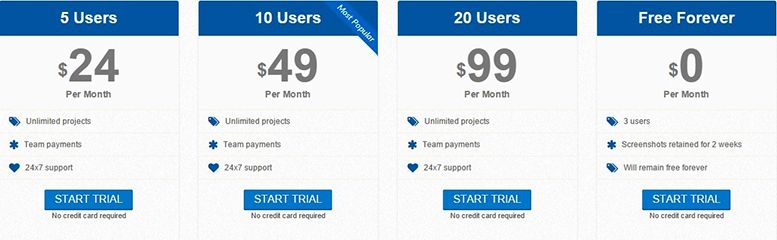
Here’s what one of our earliest pricing plans looked like:

Hubstaff-free

Notice the “Free Forever” plan on the far right?

The thinking was that we could become a market leader by offering a free plan and acquiring a ton of users. Naturally, some of these users would drop off and some would continue to just use the free plan. However, some would decide to upgrade to a paid plan, either to add more accounts or access more features.

Word-of-mouth helped Hubstaff grow early on and continues to do so to this day. We thought that by having more users we would get more people talking, whether it be on blogs and social media or just friends telling their friends about us.

Why It Didn’t Work

We had great expectations for our free plan and the users who signed up for it, but those expectations were never realized. Our free plan ended up losing us money and stunting our growth! Here are just a few of the things we learned:

  • Paid products carry more value
  • Free users bring more free users
  • Free users eat up support
  • People take advantage of free accounts

Paid Products Carry More Value

Think about how many free apps or services you would stop using if a paywall appeared overnight. The reason you would drop them isn’t because you’re cheap, but because there’s likely another free option out there. Free stuff just doesn’t carry as much value as something you paid for.

A great example is Pandora, which follows the freemium model.

Pandora offers a free plan with unlimited streaming music, albeit interrupted by ads. Pandora One goes for $4.99/month and offers higher-quality audio without ads. However, I’m happy with my free version of Pandora, as it offers all I need and I don’t mind the ads too much. If Pandora were to force a paid plan upon me I could switch to Spotify or any other music streaming service that follows the freemium model. Those who’ve been with Pandora for a while remember when listening was capped via a monthly hours limit.

When you hit your limit, did you upgrade or just go to YouTube or somewhere else and wait until the month ended? When we modified our free plan, many users left because they didn’t value Hubstaff enough to pay for it or because they found another free alternative.

Free Users Bring More Free Users

It’s great when people talk about your startup because you built something with great features, a user-friendly interface, multiple integrations, and other positive aspects. It isn’t great when people talk about your product just because it’s free.

When a user on a free plan tells someone about that product, their biggest selling point is most likely the cost. If you gain new users this way, you gain them because of the promise of something “free,” not something useful and awesome.

Another thing worth mentioning is that in our case, those using the free account didn’t really register as influencers. Granted, the remote teams industry that we’re in is fairly small and we cater to a niche. Regardless, it’s unlikely that someone who only wants/needs three (free) accounts is going to have a high-profile blog or be big on social media.

Free Users Eat Up Support

If a large amount of your users have free accounts, that means you’re probably spending a lot of time helping them instead of your paying customers. Someone who is willing to pay for your product shouldn’t have to wait for help behind an army of people who use it for free.

If you take too long to answer a ticket that should be priority, then you risk losing a paying customer. On top of that, free users generally require more help; remember that they likely value your product for its price (or lack thereof) and may need more hand-holding.

As a SaaS company, we spend a lot of time and money on support, and we want to be sure our paying customers are being helped as quickly as possible. You just can’t be sure that’s happening when free accounts make up so much of your user base.

People Take Advantage of Free Accounts

This was the biggest “I told you so” moment from our big free plan mistake.

Our first free account was limited to three users, but you could add more users by signing up for a second (or third) free plan with different email addresses. We were hoping that people would upgrade when they needed more users, but why would they pay when there were fairly easy ways around it?

This happened enough that it caught our eye, and it was just another reason for us to back away from the freemium model.

What We Learned

Our plan to offer free accounts for three users didn’t work out, but we did learn a lot from our failed experiment. Here’s what our free plan taught us:

  • If someone values a product they’ll pay for it
  • Plans for three users are our highest draw
  • You need to value your work

If Someone Values a Product They’ll Pay for It

The sky didn’t suddenly fall when we axed the three users free plan.

We still offer a three user plan, but now it goes for $15/month. We’re continually working to improve Hubstaff, and from where we stand this plan adds much more than $15 bucks in value.

If you’re in the SaaS industry, you shouldn’t feel the need to offer your product for free simply because you’re worried that no one will try it otherwise. You also shouldn’t see user acquisition as a money making arms race.

Liam Gooding, founder of Trakio, said it best when he wrote that “free is not a competitive advantage.”

Plans for 3 Users Are Our Highest Draw

At Hubstaff we like to be transparent with our growth and numbers, which is why you can find our stats on Baremetrics. While you’re browsing, you may notice this:

As you can see, our top plan is our three users for $15/month option. Another plan that attracts a lot of sign-ups is our one user for $5/month and three for $149/year. All of this is revenue we would have been missing out on if we continued to offer a free plan for three users or less. Remember that people were also signing up for multiple free accounts, so we would have missed out on getting people to choose our monthly and yearly five user plans.

You Need to Value Your Work

This was the most important lesson we learned from our big free plan mistake.

Running a startup costs money, just like any other business. You put cash into developing your product, marketing it, supporting your users, and so much more. You need to value what you’ve created, and if you want to keep building it, then you’re going to need to start charging users.

A $15/month paid plan didn’t put us in the red, but it did bring more paying customers to Hubstaff, which helped us cut our monthly expenses. It wasn’t much, but any money we saved could be reinvested into the business.

You need to value your work, and a big part of that is putting a price on it.

Where We Are Now

This may sound hypocritical, but (plot twist) we still offer a free plan!

Today’s free plan is good for only one user and is labeled “lite” for a reason. You get limited screenshot storage and user settings. This plan allows someone to try a limited version of Hubstaff for free, and if they like it the jump to a full solo plan is only $5/month. In fact, this plan clocks in as our fourth-most popular in terms of total sign-ups. This shows us that there are people who value Hubstaff enough that they are willing to pay $5 more to have access to the full version.

Oh, and our 14-day free trial doesn’t hurt either!

General Advice

Our big free plan mistake is not unique.

For SaaS startups, and for many other tech companies, free just doesn’t work. Yes, getting people to sign up is great, but all the free users in the world won’t help pay the bills.

The majority of your free users exist because they don’t have to spend money to use your product/service or access your site. This means you’ll spend a ton of money building something for people who don’t value your work enough to pay for it. This is fine if your company is well-funded or if you plan on being bought. But how many companies actually get enough funding, or make enough through ads or paid user subscriptions, to support a glut of free users? If your business plan is to be bought or acquired then you might want to rethink things.

For us, a lite free plan and free trials have worked best. We’ve also played around with our pricing plans to see what works best. You shouldn’t worry about driving away users by asking them to pay for what you’ve built. If you’ve built something useful and unique, put a fair price on it and people will pay.

The post SaaS Pricing: Our Big Free Plan Mistake appeared first on OpenView Labs.

16 Jan 00:35

How To Present Your Sales Proposal Like A Boss

by Doug Dvorak

Learn how to present your sales proposal like a boss. Here are 9 tactics that the best sales professionals in the world commonly use while presenting their sales proposals.

Know Your Audience

Your presentation should speak specifically to the industry, company and personal needs and interests of your client. Research your prospect before you present. Remember what makes them unique, learn their mission statement and values. Learn their products and services and how your solution helps them specifically.

Personalize Your Presentation

Recognize your audience by their first name. It personalizes the meeting which with all else equal, will improve your chances of winning the business. Learn about their positions in the company and who you are talking to. Always make eye contact throughout your presentation.

Set the Pace

People have a limited attention span. You must set the pace and keep your audience intrigued by presenting the critical information they are seeking. If you must present other information that is not critical, try creating a video or a PowerPoint to make it more interesting. This can help to hold your audience’s attention until you transition to your next critical key point.

State the Objective

Clearly state what the objective of your proposal is at the beginning of your presentation. Review the objective in the middle of your presentation after key points to reinforce the purpose of your key points. Finally, review your objective while concluding your presentation. Tell them, tell them what you told them and then remind them again.

Elicit Participation

It is a good idea to get people involved when they are deciding whether or not they are going to invest with you. This can help them learn more about your product, service, and company, which will build trust and confidence behind the decision to move forward with your proposal.

  • Ask questions
  • Invite them to ask their own questions
  • Ask them to relate to a scenario
  • Ask them to recall something
  • Ask their opinion
  • Ask their approval

Present Value

When people see value in a product, they are likely to purchase. Do not assume your audience sees the value, they don’t! Your proposal and presentation should show the client why this is important for them, what they will gain, what advantage this gives them and/or how revenue will increase or costs will decrease. A statement of value should be placed carefully throughout your presentation, at the beginning, before or after every key point and at the end.

Be Real

A genuinely caring attitude is the most important thing you can bring to a presentation. You must care about and pay attention to the people you are presenting to. Always be honest. A prospect will respect your honesty and feel more comfortable doing business with you even if the a piece of information you give them is not in their best interest. If you have prepared properly, you will have plenty of information that is in their best interest and disclosing information that is not will build the trust that is key to cultivating a relationship and making a sale.

Thank You!

Do not forget to thank your audience for their time, participation and consideration. You should thank them at the beginning of your presentation and at the end of your presentation.

Follow Up

Ask them when an appropriate time is for you to follow up. By doing this, you can take the guess work out of it. When you know they answer, you will know you are following up at the right time. You will not have to worry if you are following up too soon and being seen as pushy or anxious or too late and perhaps losing the business to someone else.

16 Jan 00:11

Retain Your Customers With Win-Back E-mails

by Adii Pienaar

I’m 100% sure that you’ve heard this line before:

“Acquiring a new customer costs you X times more than what it costs you to retain an existing customer.”

Depending on which source is quoted, that “X times” ranges anywhere from 3x – 7x, which immediately puts me in cautious mode. I mean – who should I trust?

As an entrepreneur myself, my main consideration with customer retention has always been the fact that the lifetime value of my customers are the most important metric that I should be looking at. In the context of eCommerce there’s two drivers to increase Customer Lifetime Value (learn more about this in our free e-book):

  1. Increasing the Average Order Value when customers make a purchase; and
  2. Increase the frequency at which customers make repeat purchases.

The latter goal though becomes especially hard to achieve when you consider that only a percentage of your first-time customers will convert into repeat customers. And on top of that, many of your customers will just become inactive over time, which means that they don’t make any repeat purchases and eventually they just start ignoring your e-mails or any other form of communication.

The question thus becomes one of keeping these customers engaged and specifically re-engaging customers that have already become inactive.

Let’s first look at Customer Segmentation…

If you did any research of customer segmentation, you’ll likely find a whole bunch of different definitions that are a partial variant of the same thing. At Receiptful, we use these Customer Segments:

  • Potential Buyers. Someone that hasn’t made a purchase yet.
  • First-time Buyers. Someone that is making their first purchase or has made one purchase.
  • Repeat Customers. A customer with multiple purchases.
  • Active Repeat Customers. Customers with multiple orders and their time since last order less than average time between orders (for all customers)
  • “At Risk” Repeat Customers. Customers with multiple orders and their time since last order more than average time between orders (for all customers), but less than 3X average time between orders.
  • Inactive Repeat Customers. Customers with multiple orders and their time since last order more than 3x average time between orders (for all customers)

When we’re thus talking about “Win-Back E-mails”, we’ll be targeting two customer segments: primarily Inactive Repeat Customers, but also “At Risk” Repeat Customers. In both cases, these are customers that made multiple purchases with you, but subsequently became inactive and stopped purchasing from you (for whatever reason).

Crafting Win-Back E-mails

We’ve just introduced a default win-back e-mail campaign (that is part of our Follow-up E-mails functionality) that looks like this:

First E-mail

This e-mail is sent on the day that the customer becomes inactive / idle and includes a 5% discount coupon (which is valid for 2 weeks) to entice the customer to come back to the store.

Subject line: We miss you!Subject line: We miss you!

Second E-mail

This e-mail is sent 7 days after the customer becomes inactive / idle. Here we include some personalised product recommendations as an alternative approach to the discount in the first e-mail, whilst still referring back to the original e-mail we sent a week prior (which still includes the discount coupon that can still be used).

Subject line: Where are you?Subject line: Where are you?

Final E-mail

This e-mail is sent 15 days after the customer becomes inactive / idle and it is designed to be a “Hail Mary!”. Since the initial 5% discount coupon has now expired, we now include a new 20% discount coupon that is only available for the next 48 hours. The aim here is to use some urgency to get inactive customers to take action.

Subject line: WeSubject line: We’re growing apart… :(

A few general notes about these e-mails:

  • You’ll see that we’re using colloquial, emotive language throughout. This alongside the emotive image of our (sad) pug is designed to tug at the heart strings of your inactive customers.
  • If the customer reacts to the first e-mail in the sequence and makes a purchase, they will not receive any subsequent e-mails in the sequence.
  • If you’d like to learn more about win-back e-mail campaigns, you can definitely take a look at these two resources.
16 Jan 00:10

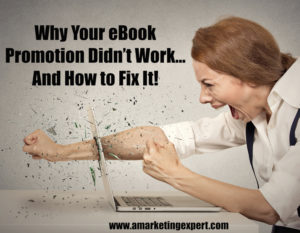
Why Your eBook Promotion Didn’t Work (and how to fix it)

by Penny Sansevieri

So you did an eBook promotion and didn’t get a great number of downloads. Does it mean that the eBook promotion is passé? Well, not necessarily. An eBook promotion, when done properly, can really help boost exposure and sales for your book. So if yours was not great, let’s take a look at what might have gone wrong:

Price point: There is no shortage of eBook deals out there, in any given day you can find thousands of discounted (and free) books on Amazon. The problem is that many book promotions aren’t priced correctly. When I talk to authors about their promotions sometimes they feel strongly that discounting the book by $1 or $2 is sufficient to drive sales. That’s fine if you’ve got some mega blockbuster book everyone has been waiting on, but we know from buying history that eBook buyers are pretty price sensitive so discounting a book by just a few dollars probably won’t work. Part of the reason for a smaller reduction is that authors are eager (sometimes desperate) to make some sales.

Another price point that authors often stick with is under $5 for their promo, so pricing it at $2.99 and running that for three days or so. Now $2.99 can work, but keep in mind that the closer you get to that $5 mark, the lower your sales will be. We often don’t see huge sales numbers that align with this price point. However, if you’re going to do this, make sure that it’s not your first book, that you have a lot of reviews, and that you have a solid (read: large) fan base.

Not Enough Reviews: With all of the books out there being discounted, most serious readers aren’t interested in downloading a book that has only a few reviews. Generally, I recommend if you have less than ten or twenty reviews, maybe rethink whether you’re ready for an eBook promotion. Why? Because people like what other people like, especially when it comes to discounted eBooks (since there are literally thousands) and especially if you’re using this promotion to drive new readers to your book(s) – which for most of us is the primary reason for doing these.

This is especially true if you’re in a cluttered genre (and these days, which genre isn’t cluttered?), if you want to compete effectively with other books out there, make sure you have enough reviews to help push this book higher on your readers’ radar screens.

You Discounted the Wrong Book or Your Timing Was Off: Sometimes when doing price promotions, authors will discount books that are older – in some cases too old to grab the attention of a new reader. A lot of non-fiction falls into this category because most of it has a shelf life and requires updating. Or perhaps you wrote a self-help book that may seem like an evergreen title, but the truth is that since you released your self-help book, nine million other self-help books have been released since that time. So consider, as objectively as you can, whether your book is really going to garner interest or be the crucial piece you need to bring in new readers.

Or maybe the problem is that you did an eBook promo to push a new release that isn’t on Amazon yet. So, for example, I’m releasing Red Hot Internet Publicity and to boost the sale of the book, I did a freebie promotion of How to Sell Books by the Truckload on Amazon. In the back of the Amazon book, I included a link to the new title, again to help boost it. So, a lot of authors I speak with use a big eBook promo to announce the release of their new book. That’s fine if the (new) book is on Amazon or, at least, up for pre-order. But if you’re just announcing that it’ll be live soon – that’s not necessarily going to hurt your promo, but it will hurt whatever goal you’ve set for yourself to use this book as a tool to push a new title.

Lack of Promotion: So you did your giveaway and ran it in BookGorilla, the price point was right, you had enough reviews for it but you still found your results lackluster? Well did you promote it? Beyond just running an ad in one or two publications, you need to make sure and promote your giveaway, too. Not sure where to begin, here’s our handy guide for eBook promo promotion: http://www.amarketingexpert.com/ebook-deal-guide/. Also, consider doing a Facebook offer (https://www.facebook.com/business/offers), which is a great way to drive some eyes to your deal, too!

Post-Promotion Price: While this may not affect the success of your eBook deal per se, it can affect how well your book sells post-promotion. I always recommend that authors keep the pricing low for the first 3-4 days post deal. Why? Because you’re going to find people spotting this deal on various sites, or not seeing the BookBub or BookGorilla newsletter until the dates have passed. They may click the link anyway and this kind of residual book visibility can net you some great sales. And while it may seem counterintuitive to do this, keep in mind that the person clicking probably has no experience with your work so even if the deal has passed, if they can grab it at a discounted price they may be still willing to take a chance on you. And isn’t that what building a fan base is all about?

Your Book Description Wasn’t Enticing Enough: Once you get someone to click the link in their social media feed or in a newsletter, the book description needs to do a good job of selling. If yours doesn’t, then consider rewriting it. How will you know? Well you won’t really because potential eBook buyers likely won’t write you to say they decided not to get your book based on it’s description. You could though run a survey via SurveyMonkey and offer some incentive for a fan’s willingness to participate – like a Starbucks or Amazon gift card. Book descriptions are product descriptions and they are as important to your book as anything else you’ll do.

Your Book Cover is Not Great: As eyes are the window to the soul, book covers are a window to your book. You may love your book cover but does your reader? Much like the book description mentioned earlier, if you aren’t sure or the feedback is mixed, maybe it’s time to ask your fans what they think? While redesigning your book cover may not be the most ideal thing you could be doing, it’s better than promoting a book with an off-putting cover. I also recommend checking out the covers of the top books in your market, see what your competitors are doing – because they’re doing a lot of things right and I assure you the book cover is at the top of the list.

Your goals are wrong: Why are you doing an eBook promotion? Your answer will determine what you do with this book, including how you price it, how long you run the promotion, and which book you promote. If, let’s say, you’re trying to push a series of books – so a fiction series (or even non-fiction) if it’s crucial that the reader read all the books in the series for it to make sense, why would you promote book four of a series? All that will do is disappoint (and likely confuse) the reader. So be thoughtful in how you execute a book deal, especially if you’re only working with five freebie days that KDP allots you through Amazon. Your goal also shouldn’t be to make a ton of money. There, I said it. The goal should be exposure. Think of it as an opportunity to get in front of hundreds and even thousands of potential readers that you’d have no way of reaching otherwise. Get them reading this book by offering a great deal, and save focusing on selling them something at a higher price point the next time around, once they’re already familiar with (and in theory liking!) your work.

What Else Are You Doing? While eBook promotions are great, they shouldn’t be your only effort. eBook price promotions are a great way to boost exposure, but if that’s all you’re doing, that may be why it didn’t work. I have talked to people who say “Well, I got into BookBub so that’s all I’m doing.” And while a promotion there is great, it should never be a single effort. Figure out how to leverage your eBook promotion or use it in conjunction with something else you’re doing (like to announce a new release). Or maybe you have a set schedule for your eBook promotion – as part of a larger effort. So let’s say you run an eBook promo every six weeks or so (this works especially well if you’ve got multiple books).

When it comes to book promotion, doing anything in a vacuum is generally a bad idea but doing it as part of a larger strategy is a much better way to push your book onto the radar screen of new readers.

16 Jan 00:10

6 Things First-Year Sales Reps Get Horribly Wrong

by mrenahan@hubspot.com (Mike Renahan)

mistakes.jpg

My first month of work at HubSpot was unforgettable. Working alongside and learning from marketing’s best of the best had me bursting with excitement and adrenaline, but it also rattled my nerves.

My goal to hit the ground running full speed didn’t go as planned. I was a rookie trying to match the work of veterans and found myself making simple mistakes when my focus should have been on learning.

In sales this exact scenario plays out all the time: A rookie is so determined to make a name for himself that he makes avoidable mistakes and falls into bad habits.

Did you or someone you know just start their first sales job? If so, you might want to check out the following list. Below are six things first-year sales reps often get wrong.

1) They rely on cold, high-volume outreach.

Using cold, high-volume outreach can set a rookie sales rep back because it doesn’t allow them the opportunity to build rapport with buyers before connecting with them. When a rookie rep reaches out to hundreds of prospects, they run the risk of turning the majority off because buyers aren’t familiar with their name and haven’t demonstrated any interest in what they’re selling.

Instead, rookies should dedicate themselves to building a bond with potential prospects prior to reaching out. The first step can be engaging with prospects on social media or commenting on a blog post a buyer has written. That way, the rep can become familiar to the prospect before the first email.

2) They let quality prospects fall through the cracks.

Losing track of quality prospects is a trap rookie reps are susceptible to because they might not be accustomed to using a complex CRM or another lead tracking system. New reps often forget to input data, resulting in lost prospects and opportunities.

In this situation, the right CRM is essential. Reps who don’t have to worry about inputting lead data and who automatically receive reminders about when to follow up with prospects are in a position to be successful -- look for a CRM that offers these features.

HubSpot CRM prospecting

3) They use the same pitch for everyone.

It's easy for a newbie to use a sales script as a crutch. But trotting out the same tired pitch regardless of the circumstance can turn buyers away because each prospect has a unique pain point that requires a unique solution. By keeping the pitch the same, reps are unable to showcase the specific benefits the product presents to a prospect.

Rookie reps should instead devote time to researching each prospect, engaging with them online, learning about their business, and putting together a tailored message based on the information they’ve learned. Following these steps allows the rookie to present the product to the prospect in the best possible light.

4) They qualify prospects too quickly.

Reps who breeze through qualification don’t provide themselves enough time to dive deep into a prospect’s situation and determine whether or not they are the right fit. New reps often make this mistake in an effort to fill their pipelines in a flash.

Reps should instead commit to discovering as much as they can about a prospect prior to qualifying them, and asking them careful questions on the discovery call. By executing thorough research, reps avoid churn down the road.

5) They use high-pressure tactics.

Relying on high-pressure tactics can lead to trouble for rookies because every buyer moves at their own pace. Sometimes new reps' enthusiasm for their new role translates into pushing prospects to close ASAP.

But practicing high-pressure tactics often scares buyers away. Rookie reps should learn to educate and guide each buyer instead of trying to persuade them to buy now. When a rep is there to educate instead of force, they can build trust and credibility with the prospect, which results in a better relationship.

6) They abandon the prospect once they’re a customer.

You’ve spent so much time developing a relationship with the prospect before they buy. Why would you throw that away once they become a customer?

Forgetting about the buyer once they’re a customer is a pitfall reps should be wary of because they might lose the relationship they’ve developed with that customer. And this can lead to a lack of valuable referrals and renewals. New reps who are eager to get their first deals under their belt are particularly susceptible to this mistake.

According to Dale Carnegie, 90% of customers are comfortable giving referrals. The first step to earning a referral, however, is to maintain a great relationship with the customer. Forging a lasting relationship starts with following up regularly and soliciting feedback.

Rookie reps can get caught up trying to do too much and fall prey to dangerous mistakes -- even though they have the best of intentions. First-year reps are eager and willing to learn, but it’s critical to recognize the difference between effective and ineffective tactics.

I still find myself making mistakes but this rookie is on his way to becoming a veteran. How about you?


  HubSpot CRM
15 Jan 23:58

Bad Assumption #6: Buyers Will Be Honest With You About The Reasons Why You Lost

by John Holland

This is the sixth post of a seven-part series on “Bad Assumptions” that salespeople make during the sales process.

A college friend of mine used a technique when he wanted to end relationships with people he’d been dating for awhile. His objective was to end things and avoid discussing why it was over and whose fault it was. The phrase he used was: “I’m just not good enough for you.” In doing so he took responsibility for ending relationships without saying there was someone new (there usually was). The underlying issue was that he wasn’t worthy.

blog post discussing how salespeople can obtain valuable feedback after losing a deal

As a sales manager, I found loss reports to be virtually worthless. Similar to my college friend, buyers want to deliver bad news quickly and limit or eliminate explanations. How often do you think all losing vendors are told they came in second? With few exceptions, the reasons cited in loss reports were price or product. In trying to learn from our losses, I instituted two (2) new rules:

  1. Unless a buyer gave the seller an opportunity to meet a price point that management couldn’t support, price could not be used as a reason for a loss.
  1. 30 days into buying cycles sellers lost the ability to blame product. If our offering wasn’t a fit, then the opportunity hadn’t been adequately qualified.

My belief is that when pricing and offerings are fairly equal, the better salesperson wins the lion’s share. The elephant in the room is that the most common reason for losses is that sellers get outsold.

In trying to get more usable information about losses, my suggestion is that losing vendors wait a few months and have someone other than the salesperson contact the person believed to be the decision maker. Explain that the company delayed making contact because it isn’t an attempt to change his/her mind. Rather, you’re trying to improve the company’s selling efforts and would appreciate it if the buyer could briefly explain:

o The major reasons for choosing the winning vendor.

o Perceived deficiencies in the losing vendor’s offering or support.

o Aspects of the selling effort that could have been done more effectively.

Going the distance and losing is the worst possible scenario for vendors and sellers. Having invested time and effort, actionable loss reports can salvage some benefit. I’d also suggest that after a significant win you may want to interview the Key Players to gain insights into the reasons for the win.

15 Jan 23:54

How to Make the Switch From Outbound to Inbound Sales

by Jessy Smulski

inbound-sales

Inbound marketing was introduced in 2005 as little more than a tantalizing theory. Today, it’s a staple strategy that’s become so effective that over 80 percent of all businesses practice it to some degree. It was only a matter of time before sales started feeling the winds of change … and that time is now. The latest prediction is that inbound sales will fully replace outbound sales in B2B exchanges within the next five years.

The inbound sales strategy uses information collected by inbound marketing campaigns to determine precisely when a buyer is ready for a sales conversation, and exactly what that conversation should be. Unlike outbound selling, inbound sales’ primary focus isn’t on personal gain; its goal is to educate and guide buyers in a respectful, non-intrusive way, and it accomplishes this by using lead intelligence to develop a deeper understanding of the buyer’s wants or needs.

When done correctly, sales forces will experience significantly shorter sales cycles, higher closing rates, increased revenue and the potential to make a lot more in commissions and bonuses. But getting there is easier said than done. Here’s how to make the switch from outbound to inbound sales.

1. Get Senior-Level Management Buy-In

It’s nearly impossible to transition your sales department from outbound to inbound without buy-in from senior level management. Depending on the state of your organization, making the switch could require a sizable investment, as your organization will need to properly equip both sales and marketing with the right technology to drive this data-reliant selling strategy. You’ll need someone at the top who understands how vital the investment is to the future of the organization. You may also experience push back from employees who are reluctant to change, and you’ll need the authority to persuade these individuals.

2. Get Support From Marketing and Sales

For inbound sales to work, marketing and sales departments need to fully align and function as one coherent unit. Considering the decades-old feud between the two, making amends might not be as simple as it sounds.

Set up a workshop with sales and marketing teams (including department heads) in one room to discuss why it makes sense to align, how it can be done and (of course)—what’s in it for them. Skip the lecturing and allow it to be an open forum. Everyone should feel comfortable enough to voice their concerns and get answers. This may take more than one session, and the goal is to get everyone in agreement about working together.

3. Build the Team

Successful inbound sales professionals have more than skill and experience: They have character, they fit into a culture that values team mentality, and they’ve got a dash of that undefinable sales swagger.

If hiring new employees for your inbound sales force, look to candidates who are inherently tech-savvy. They should be aggressive in their desire to succeed, curious and ready to listen. You want individuals who will train easily, so they can quickly understand what your organization offers and how to help others realize the value of your products or services.

Confidence and high self-esteem are also classic qualities of a successful salesperson, but most importantly, they must be likable. Inbound sales is about genuinely connecting with buyers, asking tough questions and helping them find a true fit for their wants or needs.

Teaching Old Dogs New Tricks

Convincing sales reps who have been in the game a while will be one of your most difficult challenges. Every organization has at least one sales prodigy—that person who pulls in a quarter of a million dollars in revenue for the company each year and is known for landing the big accounts. And this person will wage war to protect their process. Why fix what’s not broken, right?

Wrong. The reality is, outbound sales doesn’t garner the success it used to. Consider this:

  • Cold calling only receives a 1 percent call-back rate
  • Less than 24 percent of sales emails are opened
  • More than 25 percent of all B2B sales cycles take seven months or more to close
  • If a lead interacts with your website, waiting just 10 minutes to take action drops the likelihood of qualifying the lead by four times
  • Currently, only 27 percent of Web-generated leads get contacted at all
  • Half of buyers choose the vendor that responds first

There’s no arguing the value of a data-driven sales process, or the statistical dysfunction of outbound sales strategy. In the end, you may not be able to get some of your more experienced sales reps to follow suit. Providing mandatory rules and training will help, but managers may face some tough decisions.

4. Creating a Closed-Loop Reporting System

Once you’ve got your inbound sales force in place, and marketing and sales agreeing to a cease-fire, your organization must create a closed-loop reporting system through which information will seamlessly flow between sales and marketing. Sales needs a sophisticated Customer Relationship Management (CRM) system, and marketing needs a Marketing Platform (MP) that supports marketing automation. These two systems should be compatible with each other and fully integrated. But more importantly, both departments must commit to using the assimilated system religiously.

Sharing Information

To refine marketing campaigns and recognize what a high-quality lead looks like, marketing needs to know when leads become sales-qualified, how long it takes to close and how much revenue the lead generated. Likewise, sales needs lead intelligence (including a lead’s website activity, campaign engagement, download history, etc.) and lead alerts when hot leads are partaking in sales-ready engagements. This helps sales better understand who the buyer is, when they are ready for a sales conversation and what that conversation should be about.

5. Developing the Process

Finally, your technologically equipped inbound sales force will need to adjust its process. The outbound sales process went something like this:

  1. Prospect: Go out and find leads
  2. Hunt: Cold call and create opportunities
  3. Close: Convert leads into customers
  4. Upsell: Increase revenue

Your inbound sales process should look something like this:

  1. Monitor and anticipate: Know the buyer’s wants or needs
  2. Qualify: Use data to determine who’s sales-ready (in real-time)
  3. Educate and guide: Create content and engage in thoughtful communication empowered by data
  4. Close: Teach buyers how to be your customer

The major difference? With inbound sales, leads come to you. You aren’t prospecting out of the office or cold-calling people who aren’t even aware your company exists. You’re watching buyers who independently choose to interact with information about your organization. You’re learning as much as you can about them through your marketing department’s lead tracking software, and you’re reaching out to them the moment they indicate they’re ready with precisely the information they need next to reach a purchasing decision.

Inbound sales isn’t about trying to convince buyers or box out the competition. It’s about being available and using every possible bit of information to understand how best to help buyers find a solution to their wants and needs. In the end, it’s your expertise on their unique situation that will seal the deal.

15 Jan 23:54

5 Easy Ways to Get More B2B Sales Leads with B2B PR

by Wendy Marx

GET_MORE_SALES_LEADS.jpg

If you’re like most people, you’ve spent the last few weeks strategizing for 2016. And likely on your list of wants for the new year, you’ve jotted down “get more B2B sales leads,” or some version of that wish.

In a perfect world, all of your clients would stay with you forever, as well as promote the heck out of your company to others. However, we all know that doesn’t always happen, and that if you want to stay in business, you can’t remain static. You must go in search of more leads. The question is: How?

The New Way to Get B2B Sales Leads with B2B PR

If you’re accustomed to traditional PR and marketing techniques… pounding the pavement with business cards, attending launch parties and meet and greets, or landing media coverage, you might question the validity of anything that claims to take the place of these tactics. And, in fact, there are many occasions where traditional B2B PR methods such as these are essential.

They are just not enough if you want to get leads.

Indeed, inbound marketing has quickly become the key component to any B2B PR success story.

“67% of surveyed B2B companies rated Inbound Marketing as a top three or a very high priority component of their overall marketing strategy for 2015.” ~ Kapost

A Brief Overview of Inbound Marketing – The Story of Sarah and Nosy Design

Inbound marketing is about creating content that people love. A colleague of mine (we’ll call her Sarah) recently received a very direct email from a stranger (we’ll call her Nosy Design) asking if she could revamp their entire website. Now, Nosy Design may be very good at what she does, but Sarah has no proof of this. This is cold call marketing.

The inbound approach is much different. What if Nosy Design had first released multiple how-to videos on YouTube, created a blog series on a concept that was of interest to Sarah, and hosted instructional webinars that provided real value? What if Nosy Design was always sharing super helpful content on Twitter or LinkedIn?

In this case, if Sarah were in search of someone to redesign her website, she’d likely come across Nosy Design in her online search. In fact:

“B2B customers conduct 12 searches on average before checking a specific brand’s website.” ~ Kapost

Clearly, being easily found by search engines is a strategic PR move.

Now, after Sarah watches a few videos, she decides to visit Nosy Design’s website. The firm seems to know its stuff. So she browses around until a pop-up window appears asking if she’d like to download a free ebook.

Sarah learns a lot from Nosy Design’s ebook, and begins to understand that she needs help redesigning her website. Lucky for her, Nosy Designs sends a follow-up email just a couple of days later. The email highlights a few of the company’s services, and offers a free consultation. Sarah can even book the call by clicking a link right within the email.

Sarah has her call with Nosy Designs and decides the company is a great fit! She signs on the dotted line, and in the meantime brags to her friends and colleagues about her “great find.”

What you’ve just mentally witnessed are the fundamentals of inbound marketing. Hubspot lays it out quite nicely in the following graphic:

Screen_Shot_2016-01-13_at_3.07.10_PM.png

Can you clearly identify the difference between cold call marketing and inbound marketing, and how it impacts your lead gen?

5 Steps to Get More B2B Sales Leads with Inbound

1. Start with Great Content

Typically, this means blog posts. Think of your blog posts like kindling. They nurture the tiny sparks along, providing value along the way, and are necessary for creating a hot burning fire.

Blog posts show that you have knowledge about your industry. They can also be used as the basis for SlideShares, videos, and infographics.

“Content Marketing is a commitment, not a campaign.” ~ Jon Buscall, CEO, Moondog Marketing

2. Understand SEO

Make sure you understand the basic principles of SEO (search engine optimization). Merely jotting down a few of your thoughts in a blog post will not drive traffic to your site.

Rather, your content, in fact, every web page on your site, should be optimized for search engines.

3. Promote Your Content

Again, just owning the content and hoping people will stumble upon it will not give you the return that you’re looking for.

Content needs to promoted on social media channels, not just once, but several times throughout the month. This is essentially doing your own PR. And the best part is that this is essentially free. It only costs you in time.

Don’t forget to learn about why hashtags are important and how to use them.

4. Create Gated Content

Gated content is free information that your prospects receive after filling out a brief form. Types of gated content include ebooks, videos, SlideShares, and white papers. The information gathered on the form should help you to determine how to segment that contact and where they are in the sales funnel.

This is how a visitor becomes a lead.

5. Nurture Your Leads

Once the visitor has become a lead, you need to nurture that relationship. There are several CRM programs that will even help you automate this process. You want the person to keep you in mind, but not be annoyed by your presence.

Design a workflow that is essentially a breadcrumb trail to your goal. Do you want the lead to sign up for a monthly subscription? Do you want someone to buy your software? Leave a trail of valuable information that leads your prospect to your final goal.

Learn All You Can About B2B PR

As PR and marketing changes, you need to roll with the punches. To that end, I’ve created a SlideShare, The Bottom Line About PR, that ensures your PR will be working for you. Plus, you’ll learn more about what fuels the most successful PR campaigns, and how to avoid common PR pitfalls.

New Call-to-action

14 Jan 19:13

Skype launches Slack integration in preview, allows teams to easily start calls from Slack (Skype Blogs)

Skype Blogs:
Skype launches Slack integration in preview, allows teams to easily start calls from Slack  —  Skype integration for Slack now available for preview  —  At Skype, we are committed to breaking down communication barriers and getting the world talking.  This is why we make Skype available …

14 Jan 19:13

62 Percent of American Billionaires Are Self-Made

by Catherine Clifford
A new report from Wealth-X and WSJ Custom Studios also reveals what many billionaires spend their money on.
14 Jan 19:12

4 Signs a CEO is 'Holding the Stick Too Tightly'

by Ken Dunn
The best shots in hockey come from a firm but relaxed grip on the stick. Business leaders need that same sort of hold on their organizations.
14 Jan 19:08

Artificially Sweetened: How Politics Massaged the Science in the New Dietary Guidelines

by Beth Skwarecki on Vitals, shared by Andy Orin to Lifehacker

The federal government just released a new set of dietary guidelines, and as always, they’re a work of both science and politics. They include controversial changes: for instance, sugar now has a limit, and cholesterol does not. Here’s your guide to what’s new, what isn’t, and where the experts disagree.

Read more...

14 Jan 19:08

After 61 years, Victoria's Bengal Lounge closing in Empress Hotel overhaul

The Bengal Lounge at the Empress Hotel, which has been serving martinis for 61 years, will likely shake its last one into a glass in April as it closes its doors for good.
14 Jan 19:07

No great places to shelter from this market turmoil

by CB Staff

NEW YORK, N.Y. – Stock prices are crumbling around the world, but the usual place for investors to go for safety, bonds, can’t provide as much cover as usual.

Bonds are still doing their job this year as investors’ best friends during a downturn: They’re holding up better than stocks, cushioning the blow for balanced investors. High-quality, investment-grade U.S. bonds have returned 0.9 per cent through Wednesday, while the Standard & Poor’s 500 index has lost 7.4 per cent on worries about the strength of the global economy.

The problem is that bonds are not doing as good a job as in past downturns, and the outlook for them is dim. Super-low interest rates mean bonds don’t pay investors much for the bonds they hold or are buying now. And those bonds may fall in price in the coming months and years if interest rates increase as the Federal Reserve, as expected, continues to move short-term rates higher.

“It’s just basic math,” says Chris Philips, head of institutional advisory services at Vanguard. “We’re at different levels today, and bonds don’t have as much room to grow on the price side.”

That means it will take longer for most investors — even those with a balanced mix of both stocks and bonds — to recoup all their losses from this downturn for stocks.

The diminished expectations for bonds have investors looking for alternatives to protect their portfolios in case stocks keep falling. But financial advisers and mutual-fund providers say investment-grade bonds, known also as fixed-income investments, are still among the best options available because the alternatives carry risks of their own.

Stock funds that track the S&P 500 have lost 10.1 per cent since setting a record high on May 21. Bond funds have largely held steady over that time, good enough to trim overall losses for balanced investor’s portfolios.

But unlike in past downturns — when bond funds were offering healthy returns — the protection provided this time has been only modest. The largest bond mutual fund, Vanguard’s Total Bond Market Index fund, has returned 0.8 per cent in the nearly eight months since stocks began their tumble.

That same fund returned many times more than that — in a shorter time period — the last time stocks had a slide big enough for market watchers to call it a “correction.” The Total Bond Market Index fund returned 5.3 per cent in just over five months when the S&P 500 was in the midst of losing 18.6 per cent from April 29, 2011 through Oct. 3, 2011.

Perhaps the best example of how bonds have protected investors is the financial crisis of 2008. Bonds helped balanced investors recoup all their losses long before stock-only investors got back to whole, nearly two years in some cases.

The big difference between now and then is that interest payments on bonds are half what they were. A 10-year Treasury note had a yield of 4.65 per cent in 2007, when stocks hit their peak before the Great Recession. It was at just 2.09 per cent Wednesday.

Now the Fed is in the process of raising rates. That may help future bond investors by offering a better rate of return, but the bonds they hold or buy now looking for safety could become less valuable. Prices drop for existing bonds when rates rise because the new, higher-yielding bonds are more attractive.

Cash in a savings account or money-market fund will hold steady when stocks are tumbling, but the interest rates available are even lower than for bond funds.

Mutual funds that use hedge-fund like strategies to try to offer steadier returns, called “liquid alternative” funds, have proliferated in recent years, but they can charge high fees and many have limited track records.

High-yield bonds, also called junk bonds, offer higher payouts than traditional investment-grade bond funds. But they’re issued by companies that have a greater chance of not making good on their debt. Investors felt the increased risk, painfully, last month when the largest junk-bond mutual fund had its worst day in four years.

The professional investors who manage the popular mutual funds that target specific retirement dates are sticking with investment-grade bonds, despite the muted forecasts. Fidelity’s fund built for workers planning to retire in about five years keeps 26 per cent of its portfolio in investment-grade bonds, for example. It has only a sliver, 3 per cent, in high-yield bonds.

Many strategists say investors just need to get used to lower returns, not only from bonds but also from stocks, following their big gains in recent years.

Research Affiliates, which manages about $160 billion in assets, expects investment-grade U.S. bonds to return 1.2 per cent more than inflation over the next decade, on an annualized basis. It’s expecting nearly the same returns for the S&P 500, 1.1 per cent — but with much more volatility and sharper swings in prices.

The post No great places to shelter from this market turmoil appeared first on Canadian Business - Your Source For Business News.

14 Jan 19:04

Cloud pricing “starting to stabilise” after continued cuts, research argues - CloudTech


CloudTech

Cloud pricing “starting to stabilise” after continued cuts, research argues
CloudTech
According to TCL, the average entry level cloud computing instance is now at $0.12 USD per hour (£0.08), and argues the range of pricing has narrowed in the past two years. The consultancy firm also anticipates that revenues for public cloud services ...
Cloud competition results in a 66pc drop in pricesITProPortal

all 3 news articles »
14 Jan 19:03

20 Metaphors That Explain Social Media Perfectly

by Sandrine Sahakians

We talk about Social Media a lot!

Everyone wants to be part of it, everyone tries to keep up with it and understand it, and everyone tries to find the latest tips and tricks to be better at it.

But what is social media really like? How does it feel to be part of it? What if an alien came to earth and you had to explain social media and what it feels like to them, how would you do it?

We have gathered 20 metaphors that we feel explain social media perfectly (okay, technically they are similes, but metaphors sounds better so please indulge me here 😉). Because sometimes it really helps to take a step back and put thing in perspective.

And if you ever do find yourself in that (very unlikely) circumstance of explaining social media to aliens, hopefully this list will help.

Shall we dive in?

social media metaphors 1

Social Media Is…

…like a water cooler — People come to talk about the latest news, Game of Thrones’ latest jawdropping episode and to make a connection.

…like the 21st-century version of a town square — There are lots of people there ready to take part in the next exciting event.

…like a dinner party — Everyone who follows you or your brand is there to engage and exchange thoughts about a specific topic. (AdWeek)

like standing in the middle of the room and yelling ‘I LIKE BAGELS!’ and one person yelling back ‘I LIKE THAT.’ — I think this one is self-explanatory 😉 (Public Health and Social Media)

…like planting a tree — It takes patience, persistence, caring for a continued period of time and then suddenly one day you start seeing the first sprout of what you planted so long ago. (FindAndConvert)

social media like water

…like water — “On its own, water does some cool things, but when combined with another compound it enabled the evolution of all forms of life.” (Mike Volpe via Verve Search)

…like the act of fly fishing — You might look like you don’t know what you’re doing and that your efforts are scattered, but they are all part of a thought out coordinated effort. (SearchEnginePeople)

…like a box of chocolates — “You never know what you’re gonna get.” :) Each platform offers their own advantages. (Business 2 Community)

…like wind energy — Wind is free but the wind generator is not. (Kevin Mullett via Dragon Search)

…like the spokes of a wagon wheel — They all connect and serve your brand (aka the hub of the wagon wheel) and are limited by your online influence (aka the rim of the wheel). (The Blog Herald)

…like cooking — Keep the ingredients (your content) fresh, offer a variety of dishes, keep it simple, experiment and always provide tender loving care. (Daniel Hebert)

…like a puppy — It’s cute and cuddly and looks easy to take care of at first, and then you realize that it needs constant attention and care. (NextGov)

…like the TARDIS — (Any Doctor Who fans out there?) It can provide you with some amazing experiences and connections from around the world (and I would even argue through time!)

…like Ironman — It’s about being efficient, not the effort put into it, taking it slow and steady, having a purpose, having a plan and pushing yourself further than you think you can. (SocialMediaToday)

…like The Force in Star Wars — In Star Wars, Obi-Wan Kenobi explains the Force to Luke Skywalker as “an energy field created by all living things. It surrounds us, penetrates us, and binds the galaxy together.” In social media, the Force is the “relationships and engagement” you create which binds it all together. (Eric Tung)

…like Parenting — “Just when you think you’ve got figured it out, they change the rules of engagement.” (Katherine Keller)

…like dating — You have to build a connection/relationship first before starting to push your product onto someone. (Peg Fitzpatrick)

…like eating like a hummingbird, and pooping like an elephant. – Eat information like a hummingbird (according to Guy Kawasaki they eat 50% of their body weight in food a day) and poop it out like an elephant aka share it with the world. (Guy Kawasaki via Dysart & Jones Associates)

social media like ancient egypt

…like ancient Egypt — “writing things on walls and worshiping cats.”(George Takei)

…like Aesop’s classic fable “The Wind and the Sun” — As Dr. Miller explains to Don Draper in Mad Men, “kindness, gentleness, and persuasion win where force fails,” so you will most likely see better results if you share your warmth (like the sun) instead of your strength (like the wind). (I have included the full fable below for those not familiar with it. (Business 2 Community)

Aesop’s classic fable “The Wind and the Sun”:

The Wind and the Sun were disputing which was the stronger. Suddenly they saw a traveler coming down the road, and the Sun said: “I see a way to decide our dispute. Whichever of us can cause that traveler to take off his cloak shall be regarded as the stronger. You begin.” So the Sun retired behind a cloud, and the Wind began to blow as hard as it could upon the traveler. But the harder he blew the more closely did the traveler wrap his cloak round him, till at last the Wind had to give up in despair. Then the Sun came out and shone in all his glory upon the traveler, who soon found it too hot to walk with his cloak on.

Over to You!

All of these are of course very fun and I’m sure you nodded your head “yes” at quite a few of them, and I think what this shows is that while social media might seem easy it is complex, hard, takes patience and offers many approaches to success!

14 Jan 19:03

If Your Content Is “Fill,” Sales It Will Kill

by Laura Donovan

yoda-667955_1280

A few years ago, I was asked to help write a book. The author, who wanted to be paid as a motivational speaker, told me he was not interested in the content or writing style, per se, but only getting enough words on enough pages to fill a book. He believed the fact that he had written a book, not what was in it, would be enough to ensure his success.

In the early days of the Internet, this type of argument seemed to work for websites and blogs. Stuff enough key words into a blog and add enough pages to the website, and the company would rank high on search engine results pages (SERP) no matter how helpful the content was.

Whether or not these on-line and offline tactics resulted in increased sales is debatable.

What is not debatable is the fact that – at least in the digital world – these tactics now hurt rather than help.

Here are a few truths about Content Marketing in 2016

  1. Content is Replacing Human Sales People. Research suggests that by 2020 80% of the buying process will be completed without ever talking to a human being. For B2B companies today, 57% of the buying process is already completed before human contact is made. Most customers research products and services via several channels and from several competing companies. Businesses that are not providing the right information to their potential customers or not using the right outlets will lose to their competitors who are.
  2. Poor Content is a Waste of Time. Search engines and social media sites have gotten more sophisticated. Google will downgrade a website or blog post that is not well written. Facebook’s algorithm favors businesses that have likes and shares on the content it produces. A study by Moz and BuzzSumo showed that 75% of all content produced gets no links and no shares. In other words, content that is not considered well written and useful will be ignored – by humans and search engines.
  3. Poor Content Can Cost You Business. Even worse than producing content that no one sees or shares is producing content that gets negative comments. Consumers today are not shy about expressing their opinions. Content that has not been well researched, is felt to be exaggerated or in any way untrue or misleading will spark a negative reaction. This will damage the company’s reputation.
  4. Good Content Engages the Viewer. Content marketing used to be about blanketing the internet, publishing to as many channels as possible as often as possible. Quality was an afterthought. The fact is that today just having a lot of content out there is not enough. The key is to connect with the right audience in the right way at the right time. That means publishing articles that lead viewers through the buying process – from generating awareness, to helping them understand what you are selling and, finally, convincing them that they should be buying from you. It also means understanding and correctly posting to channels your target audience uses. A good website with good information and valuable posts to your blog is the first step. However, depending on your audience, it might be even more important to understand and post correctly on social sites like Facebook, Twitter, Pinterest, Instagram and LinkedIn. Finally, sending valuable information via email to your present database can keep your company name in the minds of people who already know you.

The principle “Buyer Beware” has flipped. Internet research has changed the way people make their buying decisions. Customers rely on digital channels, not human sales people, to educate themselves. Simply put, good content is the key to increased sales.

14 Jan 19:03

5 Ways to Generate Leads With Your Blog

by Greg Cawood

Generate Leads With Your BlogYour company’s blog can do a lot of different things. You can use it to showcase the range of products or services you provide or share company news.

But does your blog generate leads? Here are five ways to make sure the content you create for your blog is fueling your lead-generation machine.

1. Make It Useful

Not everyone who lands on your blog is there because they’re interested in your business specifically. They might just be interested in the type of service you provide or the product you make.

That’s why the content you create on your blog needs to be useful to your readers. It should help them solve a problem, or teach them how to do something new.

Before you create a new entry on your blog, ask yourself:

  • Would I want to read this?
  • What am I teaching my audience?
  • Will this help them make more money? Does it solve a problem?
  • Does this help them put a certain fear to rest?

If you don’t have good answers for those questions, you may need to rethink what you’re writing about.

2. Write Often

It’s nice to imagine picking up a trumpet and playing like you were Miles Davis. But very few people master their art right out of the gate, whether we’re talking about jazz or blogging.

You’re not going to write one really good blog post and start raking in leads. If you want to bring people to your blog, and then turn those readers into leads, you’ll need to post on a regular basis. Once a month won’t cut it. Your blog should feature fresh content at least a couple of times a week.

3. Be Engaging

In addition to being useful, and published on a regular schedule, your posts should be engaging. Let’s look at a few of the elements an engaging blog post should have:

  • A headline that gets readers’ attention and tells them “This is something you need to know.” You can go with a numbered list (the way we did here) or share knowledge (“What I Learned When I Hired a Landscaper”).
  • Organize the story you’re telling. It’s important to remember that people tend to scan more than they read when they’re online, which means you may want to break up your content into shorter, easier-to-digest sections, using bullet points, numbered lists, or sections with subheads.
  • Include at least one image with every blog post you create. Pictures help you tell your story and make your content more engaging. If you have an infographic that works in tandem with your written content, that’s even better. Posts that include images account for 87 percent of total interactions on Facebook, while Tweets with images receive 150 percent more retweets than those without.

4. Always Include A Call-To-Action

You’ve written the final sentence of a blog post, but you’re not quite at the end. Each entry on your blog should invite your readers to do something. For example, you could offer a white paper or an e-book that goes into more detail about the topic you’ve just covered in the blog post.

These are known as “calls to action,” and each of your posts should include them as a way to turn readers into leads (and then leads into customers.) Some numbers to back up this point: the marketing website Search Engine Journal says it had a 212 percent increase in leads per blog after it started adding CTAs to its blog posts.

5. Be Patient

Like we said earlier, it’s rare in life that your work yields results right away. Your blog needs someone who can write quickly and write well, but it also needs patience. It might take a few weeks or a few months, but eventually leads will start to come in.

Blogging can be a challenge, and one your business may not be ready to tackle on its own. IQnection and its digital marketing team can help you craft blog posts that are engaging and informative so that you can start attracting leads to your site.

An Introduction To Inbound Marketing

14 Jan 19:03

Job Seeker Insights on LinkedIn

by Erin Dore Miller

Back in December, I started reading about all of these new features that LinkedIn has made available to its members that are actively seeking new job opportunities. I decided to check it out for myself, so I signed up for a free 30-day trial of the Job Seeker subscription.

Boy, oh boy, was I in for a treat!

Job Seeker Insights

Let’s first take a look at the information that LinkedIn compiles and sends you, without you even having to lift a finger:

new jobs

About 2-3 times per week, I’ve been receiving an email from LinkedIn, matching the information on my profile with LinkedIn job postings and opportunities in my area. I started receiving these messages before I even had a chance to go in and customize things. How great is that?

And speaking of customization, the Preferences feature on the Jobs tab is a great way to tell LinkedIn specifically what you’re looking for:

Preferences final

You can set your preferences for Industry, Location and even Company Size and then LinkedIn can even more accurately monitor which opportunities are right for you.

Applying for a Job on LinkedIn

And when you do find a job that is the right fit, there is so much information to help you in your application process! The first feature that I’d like to highlight is one where LinkedIn tells you who works there. No research needed. They do this in two ways; first, they highlight for you who, of your Connections, works at that company.

job in final

This allows you to reach out directly; maybe you’d like to ask questions or find out if your Connection has suggestions for your for applying. What a great resource!

LinkedIn also tells you who else works at the company that you may not know yet. You can visit Profiles, get a feel for their backgrounds or send an InMail to say “hi” or ask questions if you are so inclined. It’s also just a great feature for understanding the company’s culture and how you would fit in!

meet the team

Hiring Trends

And speaking of understanding a company’s culture, LinkedIn also provides you with insight on a company’s hiring trends:

company hiring trends

You can view information about whether their hiring activity is up or down, how many employees they have, the average tenure of their employees, as well as the companies and schools that they’ve hired from in the past. All great things to know about a company before you dive in!

Competitive Intelligence

And perhaps the most amazing new feature of all – Competitive Intelligence:

competitive intelligence

This feature shows you information like how many people have applied for the job, what the most common top skills are among the applicants, as well as the seniority level and education level of the applicants. That’s such great information in understanding how you stack up against your competition; and furthermore, what skills and experience you’ll want to consider highlighting in your resume, cover letter and conversations with this company.

For job seekers, these new insights are a window into the world of recruiting and hiring; it’s like when Toto pulls back the curtain to reveal the Wizard of Oz. So pause, take a deep breath, and get to it! You are armed with more information than ever. And 2016 is your year!

14 Jan 19:03

7 Reasons Why Your Competitors Wish You Wouldn’t Track Hashtags in 2016

by Ciaran Blumenfeld

7 REASONS

Your competitors wishes you wouldn’t take their hashtags, or yours too seriously. Why would they want you to catch on?

Hashtags contains a goldmine of information. But you have to track tags to unlock the Hashtag Secrets.

So go ahead, nod, and be sure to smile politely when they spend thousands of dollars on broad listening systems that bury them in so much irrelevant data they need an IT guy and a snow plow to dig their way out. Meanwhile, put up your feet and pour yourself a refreshing beverage to enjoy as you set up your reports to automatically track and follow the tags that matter to you. Impress your colleagues and clients with streaming hashtag walls and simple, colorful infographics that yield actionable insights in real time. 2016 is going to be a great year. A more plugged in , connected and successful year than ever before, and you don’t even have to work harder or spend a fortune to uncover trends.

Hashtags are already working hard to deliver just the sort of info you need to meet your social media marketing and business goals for 2016. You just have to sit back, collect the data and know what to do with it. Here are 7 powerful ways to start using hashtag data today:

Build Powerful Twitter Lists:

Whether you’re looking for contacts in a specific industry, trying to jumpstart an online discussion or seeking advice from a knowledgeable group of experts, you will find yourself in good company quickly, when you track niche tags. Pull the contributor lists to see who’s used the hashtag and start following and making your own lists of the people that matter.

Target Your Influencer Outreach:

Contributor lists not only show you who is talking about a specific topic – but who is popular, who is quoted, who shares the best media, and who’s sharing the superstar’s stuff. While other’s are complaining that Influencer outreach can be like looking for a needle in a haystack, you are enjoying your laserlike focus and ability to find the rockstars in three or four clicks.

Turbo Boost Community Growth:

Got a Hashtag for your own group? With the ability to share chat transcripts, and analyze group participation, your community efforts will be rewarded. You’ll also have the ability to run contests and monitor peak use hours so that you can schedule your messages to reach the most people.

Toot Your Own Hashtag Horn:

Not to brag but… You might want to capture the impact you’ve had on a campaign or topic. Run a report to see how you stack up against other top tweeters and instagrammers and use that info to perfect your own platform and forge profitable partnerships. There’s plenty of data and pretty infographics to use in your pitch deck and put on your page.

Play The Trend Guru Card:

In social media, half the game is getting their first. There’s a lot of noise but when you track hashtags you can quickly hone on buzzwords and check out “other hashtags” on the rise – telling clues about the next big thing, before it’s a big thing. Want to see which trend is really taking off? Start a hashtag leaderboard and embed it on your page. Now you’re the info hub.

Monitor the Competition:

Want to know what people are saying about the competition and who is saying it? Track their tags and learn from their mistakes. You might know more about them, than they do.

Show Off An Impressive Portfolio:

Personal/client hashtags make it easy for you to create a portfolio of all your hashtagged social activity (with stats!). And you don’t have to lug it around. Set your dates and pull your posts and stats out of thin air, anywhere, anytime, and in real time.

We’re just getting started here. There are hundreds of ways that clever marketers and listeners are leveraging hashtag data. Shouldn’t you be one of them?

Make sure to subscribe to the Hashtracking Blog for new posts, webinars, and helpful social media marketing tips and tricks as the year continues.

14 Jan 19:03

The State of Content Creation

by Erika Dickstein

The state of content creation couldn’t be stronger. Just checkout these statistics:

  • 60% of customers say they feel more positive about a brand after reading custom content on its website. See more at: imagination.
  • 70% of content marketers are creating more content than they did a year ago.
  • 90% of organizations now market with content, according to Demand Metric.
  • Content marketing is 62% less expensive than traditional marketing, according to Demand Metric.
  • 62% of organizations surveyed outsource their content marketing.

Clearly, there are a lot of reasons to love content marketing.

So, what do you need to know?

Content comes in many forms. Digital media is a favorite. Whether it’s an ambient video setting the tone for customers or an audio or video podcast where you speak directly to customers about what you can do for them, video can literally bring your brand to life. Articles on your website (or on another website that links back to your website) can be very impactful and so can captivating blog posts and emails. Experiment!

Creating the content is just the beginning. I often tell clients that writing brilliant content is a lot like getting all dressed up in a lovely gown and make up. At the end, you might look stunning, but if you sit down on your sofa and read a book, no one will know. The art of success for a company through content marketing is to build a network by which to share the content.

Content Creation There are more ways then ever to “pay to play” in the content marketing world. Buzzfeed is just one popular resource that big companies use to create content. On a recent visit the Peace Corps was promoting a quiz about what country I should move to and Aetna had an “Ask an Expert” article about what mindfulness exercises I should try. While Buzzfeed is inaccessible to most smaller businesses, the kind of content they create is a great example for us about how to make attention-grabbing, readable, and sharable content.

The name of the game is evergreen. Great content can be used and reused again because it continues to be relevant. Think about blog posts that answer your organizations most frequently asked questions. You can use it over and over.

Except when it isn’t. But, when you can catch a trend that everyone is talking about (say, the State of the Union Address) and add something thoughtful and relevant, go for it.

And if you just don’t have time to create your own content, consider outsourcing. Outsourcing activities that are not core to the business can be a great strategy for small companies. Finding a marketing team that can work with you to create custom content lets you focus on growing your business, while they focus on getting the word out. :-)

What is the state of your content creation? You are just one click away from chatting with one of our Spring Insight marketing experts.

14 Jan 19:02

What is E-A-T? And Why Do You Need It?

by Eric Seal

You need to eat to live. And so does your website content. A different kind of “eat,” but the idea is the same.

That’s right, we’re talking about E-A-T. We first saw this acronym when Google’s Search Quality Guidelines got leaked in 2014. But with Google’s official release, we now know just how important E-A-T really is. This year, E-A-T is set to be a huge deal.

Google states that E-A-T is among the top 3 considerations for Page Quality. So if you haven’t been paying attention to E-A-T content before, you should start doing so. Immediately.

What Does “E-A-T” Stand For?

E-A-T stands for “Expertise, Authoritativeness, Trustworthiness.”

You should always keep E-A-T in mind when building content on a webpage or website. But it’s kind of a mouthful, isn’t it? Let’s simplify it and make it easier to remember.

“Expert” – You need to be an expert in your field. This means you need to show you have the appropriate credentials (college degree, job experience, etc.) and mention it in your content. Expertise is less important for humor or gossip websites, but it’s vital for medical, financial, or legal websites. The good news is any site can show expertise if the content is truthful and useful for users.

“Authority” – You need to show that you are an authority. And you can get this from the expertise of your writers. If your page is a community or forum discussion, the quality of the conversation drives authority. Credentials are important, but so are personal experiences like reviews.

“Trust” – You need to show users they can trust the page they are on. This is especially important for eCommerce websites that ask users for their credit card information. Everything about your site should make users feel safe while they’re visiting.

A line graph on the left spikes upwards, indicating a high level of E-A-T, or

Why is E-A-T So Important for Your Web Pages?

So why is having expertise, authority, and trust so important? After all, the Google quality rater guidelines don’t actually determine a page’s rankings.

Essentially, E-A-T determines a website’s value. Quality raters keep E-A-T in mind when judging how good a site or page provides what they need. They look to see if they’re getting a good online experience and if the content meets their standards. If the raters feel like a user would feel comfortable reading, sharing, and recommending the content, that earns the site a high level of E-A-T.

Think of E-A-T as the reason why users would choose your site over your competition’s. Because it could have a direct impact on how Google receives — and ultimately ranks — your website.

The Relationship Between E-A-T and “Your Money or Your Life”

So how does E-A-T actually affect visitors to your site?

E-A-T is closely related to what Google calls “Your Money or Your Life” (YMYL) pages. YMYL pages are those that have topics on medical advice, legal advice, financial advice, that sort of thing. Basically anything that could positively or negatively affect a user’s happiness, health, and wealth. Examples include:

  • An online store asking for your credit card info
  • A mommy blog giving parenting advice
  • A financial institution blog offering legal advice
  • A medical health page listing symptoms for a rare disease

High-ranking YMYL pages will show a high level of E-A-T. That’s because the safer a user feels while visiting a page, and the more the content meets their search query, the more it will meet the needs of E-A-T. Sites that are genuinely offering helpful advice or a solution to a problem will meet these needs more readily than sites that try to game Google’s system.

You Are What You E-A-T

So your site will only be as effective as what you put into it. Since E-A-T is considered on both the page-level and site-level, you really need to make sure each and every part of your website is trying to meet Google’s requirements. And if your pages qualify as YMYL pages, this is even more important.

But don’t just take our word for it. Google says that a page or site found lacking in E-A-T is a “sufficient reason to give a page a Low quality rating.” So if you aren’t an expert, an authority, or trustworthy, your site page could be considered low quality.

You have to craft engaging, useful, and truthful content. And you have to use E-A-T to meet the needs of both quality raters and actual users. Do that, and you’re doing exactly what Google wants.

Be sure to keep this page bookmarked – you never know when you may need a reminder to E-A-T right.

14 Jan 19:02

How This Sales Leader Seizes Opportunity Using Market Research

by greg.alexander@salesbenchmarkindex.com (Greg Alexander)


This month on SBI.TV, Greg Alexander sits down with Brandon Tolany, formerly the SVP and Chief Sales & Marketing Officer at Freescale Semiconductor.  During this episode they tackle tough questions like what is our market? Who are we competing with? And what do our buyers want?

14 Jan 19:01

Habit #4 Article: “Promote the Value, Promote the Value of Your Content

by Amanda Wilson

The one upper. The conversation monopolizer. The spotlight seeker. No, these are not characters from long-forgotten Seinfeld episodes. Unfortunately, they are those friends and acquaintances we all have that look for more attention or attempt to steer any discussion back to them. It’s kind of like that old joke: “Enough about me. Let’s talk about you. What do you think of me?”

I’m only guessing, but it seems like this kind of behavior is based on insecurity or simply a lack of confidence. Instead of trusting that the discussion will offer the normal give and take – like a tennis match – these people feel the need to force the conversation to focus on them. Unsolicited, they will tell you how great their career is, how wonderful their children are, or their latest “significant” achievement. Let the eye-rolling begin.

Now for a hard question: Could your content be creating the same reaction? In other words, does your content focus too much on you – your organization, your product line, or any other reason why you think you’re the best?

If so, you could be inadvertently sending the wrong message to your buyers and missing a significant opportunity to engage them more effectively.

Communicate the Value

Worse, this disconnect is happening more than you think. For proof, consider the fact that today, more than 60% of buyers are disengaging from sales teams because the sales rep didn’t present the value or really understand the buyer’s business challenge.

At first glance, it may be tempting to assume this is an example of salespeople not doing their job effectively. Instead, take the message to heart and take a good, hard look at your content to see if it could be doing the same thing.

For example, does your content focus too much on your latest product feature, capability, or release? Worse, does it present this information in a way that does not communicate the benefit and value to the prospect? Remember, if we don’t like this kind of behavior in a social setting, we (as potential buyers) definitely won’t enjoy it as we attempt to learn about your company and offering.

It is true that this information is important, and potential buyers need it to make informed decisions. It’s about context, or making sure you clearly communicate what your prospect stands to gain. It could be describing a solution to a problem they haven’t addressed yet, or creating the perception that your solution will help them achieve a benefit they can’t get anywhere else.

The specific language will always be different, but the important takeaway is that you have to develop content that puts yourself in your prospect’s shoes and communicates why they should care. Only then will they want to hear what you have to offer.

Interested in other ways to improve your content? Please download our whitepaper Seven Habits for Highly Effective Sales Content, to get a closer look at seven proven strategies for developing highly effective content.

14 Jan 19:01

How to Prioritize Sales Leads in the Era of Inbound Sales

by mrenahan@hubspot.com (Mike Renahan)

proritize.jpg

When a sales rep gets a lead -- whether it’s an inbound lead, a referral, or sourced through the rep’s own efforts -- they have to prioritize it against the other opportunities they’re working. And this can be a challenge, because while one lead might look great on paper, another could ultimately prove to be the better-quality lead.

So how should a rep prioritize which leads they pursue first, second, third, and so on? 

(Empty pipeline? Get access to a database of 19 million leads in HubSpot's free CRM right now.)

Today, most reps prioritize leads based on the time they come in or are sourced by the rep. Instead of embracing data to inform their prioritization, reps often work one lead before another simply because it arrived in their pipeline an hour before the second one.

However, there’s a better way to go about this. In the era of inbound sales, reps should be pursuing prospects based on the level of interest they have expressed, and not when a given lead appears in the pipeline.

The four-step strategy below can help reps prioritize their leads based on prospect interest, ensuring that the hottest leads are always worked on first.

1) Work inbound leads first.

The first leads to touch base with are the people who have already come to your website and expressed interest by downloading a resource or taking some other action. These leads come first because the prospects have already shown that the product might be a viable solution for their business. It’s critical to follow up quickly, too: Research has shown that reps are 100 times more likely to connect with an inbound lead if they follow-up in the first five minutes.

Other types of inbound leads include referrals and folks who have contacted you via social media. If the prospect has actively demonstrated their interest in some way (or a trusted referral source has on their behalf), salespeople should reach out ASAP.

2) Work prospects who have opened your emails second.

Salespeople send countless emails to potential clients each and every day. Which of these prospects actually opens your messages?

Reps can easily decipher who opens their emails when by using Sidekick. Sidekick by HubSpot shows sales reps which prospects are opening their emails, how often, and if they’re clicking on the links the reps has sent them.

An email open is a sign that the buyer is checking out what you sent, and considering what you have to say. Capitalize on the attention by reaching out as soon as a buyer opens your email.

product-image-1-1.png

3) Work prospects who have visited your company’s website third.

Of your leads, who continues to come back to your website to download material and consume content? Folks who are clearly looking to learn as much as they can about your product are likely in need of a guiding hand and some information from a sales rep. With a prospect expressing a significant amount of interest by returning to your website time and again, reps should prioritize these leads over those that haven’t expressed interest.

How do you know which prospects are visiting your website? When a lead views a page on your website, HubSpot’s free CRM records this action in the prospect’s timeline. The system also shows how often they’ve come back to the website, and if the rep and prospect have mutual connections.

visitors-pageviews-1.png

4) Work outbound-sourced prospects that are perfect fits last.

After spending a few hours researching prospects, salespeople should be able to put together a list of good fit prospects based on educated guesses about pain points, or commonalities with current successful customers.

Not sure how to identify perfect fit prospects? HubSpot CRM can help here as well. Reps can narrow down the system’s database of 19 million prospects to good fit leads based on company size, industry, or location, among other filters.

Reaching out to leads in the right order is critical for a sales rep’s success. Instead of responding to leads as they come in, prioritizing the hottest ones based on behavior and demonstrated interest is the easiest way to convert prospects to customers.

Don’t miss out on a great opportunity because your prioritization system is out of whack. Use this four-step system to prioritize your leads, and watch your close rate climb.

HubSpot CRM 19 Million  

14 Jan 19:00

Five ways to boost your start-up business idea

by Mark Schaefer

start-up business idea

I have fun helping start-ups and after years of seeing plans and pitches, I am starting to see some common mistakes emerge.

If you want to build a hedge of protection around your baby and make it soar, spend some time thinking about how well your new business is prepared to handle these issues. Here are five ways to boost your start-up business idea:

1) Are you easy to copy?

If your idea depends on massive scale (especially if it’s digital), what’s keeping somebody from stealing it and scaling it faster than you? Do you own a patent? Do you have the resources and financing to fend off the attack? If not, this is a BIG red flag.

Being bought — a good end game. Being copied by a tech giant and crushed? Not a good thing. How are you going to sustain your idea?

Can you patent your idea?  Can you attract funding to scale quickly? Are you focused on a niche that is under the radar? Do you have access to unique people and resources that will give you time to succeed? Are you able to dominate a market by a geographic location?

Make your business future-ready by having an honest assessment of your situation.

2) The marketing priority

By far, the most common error among start-ups is that founder is so in love with the product that they overlook their marketing plan.

“This idea is so cool it will sell itself.” NO. It won’t.

“Marketing? I’ll do that later.” This is a critical function that should be built into the product from the start.

“Marketing isn’t that big of a deal. I can do it myself.”

I have been in the marketing field for more than 30 years and let me tell you unequivocally that this is the hardest time to be successful in marketing. You are going to need help, at least to get you pointed in the right direction.

I’ll let you in on a little secret. When I was creating the business plan for my first business many years ago, the section that remained blank until the end was “marketing.” And I’m a marketer! This is hard work.

If you have no customers, you have no business. Build marketing into the fabric of your business from the start to give yourself the best chance for success.

3) Define your market fit

Can you succinctly describe how you differ from your competitors? What unmet or under-served customer need or want does your new product uniquely fulfill?

I understand that sometimes you don’t know the true value of a product until you get it out there and research can be difficult when you’re boot-strapping. You might even have a product after 24 hours of coding, so why not just get it out there?

But if you’re at the point where you are ready to go to market, you should be able to articulate at least a direction and a theory of how the idea will eventually make money.

How do you fit in the market eco-system? How do you avoid competition that can crush you before you have a chance to become established?

4) Focus on the customer, not yourself

Are you starting a business, or fulfilling a personal dream? There’s a difference.

Yes, a business can be the result of a dream, but don’t let the dream get in the way of logic.

I once mentored (for about one minute) an entrepreneur who had a company name nobody could pronounce, spell, or remember. I think it was something like Mqexiro (but of course I can’t remember it for sure). I told him the name had to go. He went on to explain that it was an ancient Greek term for hope and that this word “nourished” him.

Well, he would be better served buying a quart of Greek yogurt and some granola because his idea isn’t going to be nourishing him for long if nobody knows how to find or even pronounce that stupid name.

My point is that this person was in love with an idea more than he was in love with his customers. I’ll pass. Put the customer at the center of everything you do.

5) Be ready for a marathon, not a sprint

Are you prepared to be broke for two years?

That’s the question I usually ask in the first 10 minutes of meeting with somebody who is ready to risk it all and make a leap into the world of start-ups.

One of the mistakes I made last year was following my heart instead of my head on this piece of advice. I was helping a young entrepreneur and I fell in love with his idea and his passion. He was going to leave a secure job and devote everything to his dream.

This was an excellent business proposition except for one thing. He did not have savings to rely on, he had a young family to feed, and the sales cycle for his product was a long one. He only had the financial resources to run sprint when the race he was facing was a marathon.

I KNEW this was a problem but invested any way. Sure enough, after nine months he had to take a job again, more or less abandoning everything he built because he had no financial buffer. Lesson learned: Listen to your head, not your heart!

There are LOTS of reasons start-ups fail when they get to the execution phase but these four concepts represent sure-fire failure points I seem to see all the time in the early stages.

What would you add? Why have you failed in the past?

Additional Resources for future-proofing your start-up:

This post was originally written as part of the Dell Insight Partners program, which provides news and analysis about the evolving world of tech. For more on these topics, visit Dell’s thought leadership site PowerMoreDell sponsored this article, but the opinions are my own and don’t necessarily represent Dell’s positions or strategies.

Illustration courtesy Flickr CC and Dagny Mol

The post Five ways to boost your start-up business idea appeared first on Schaefer Marketing Solutions: We Help Businesses {grow}.


Comments

Related Stories

 
14 Jan 19:00

Your Email Newsletter is Worthless for Generating Leads

by Katharina Cavano

Was that a little harsh? Okay, we’ll back it up a little bit. There is a time and a place for your email newsletter or big marketing email to be successful, but when you’re trying to generate qualified leads, this is not the place. Newsletters certainly serve a purpose and when they’re done well, it can create some of the best emails we’ve ever seen. But, their purpose is not best served for lead generation.

sad-mac_100519964_h1

Here at Contactually, we’re a firm believer in the art of personal engagement, especially when it comes to generating your leads. And sending out an email newsletter in bulk is no way to get up close and personal with your contacts. While you may get your contacts to open up the email and possibly engage with the content you share, how many of them reach out to you and become a lead?

Here’s how to do it better:

Think about it this way, how many email newsletters do you get a day? By noon on a Monday, I’ve already gotten at least 15 commercial newsletters in my inbox…and the day’s not even half over yet! Most days, I don’t even get a chance to take a look at what I received, let alone open them all. But here’s the thing, even if I did open a couple of those newsletters, I wouldn’t think to respond to them, would you?

So why are you sending a newsletter to contacts you’re hoping will become leads?

More often than not, those marketing and commercial email newsletters get sent straight to the spam folder, or thrown in the trash in an Inbox Zero purge. We’re left scratching our head, wondering why businesses and marketers continue to send these newsletters when they’re proven to have very little impact on generating leads. Well to start, it’s become a simple fix.

email newsletter generating leads

Correlation between company size and email open rates. via MailChimp

We all know that following up and staying in touch with your network is a crucial step in maintaining business, and creating more business and leads. Sending an email newsletter is an easy way ‘follow-up’ with those contacts in one fell-swoop. But it’s not effective in the least, it’s simply checking off an item on your to-do list in the easiest way possible! But guess what? 58% of people say that they will not open an email at all if they thought it looked irrelevant or didn’t match their needs. That’s more than half of people out there that you will quickly lose if you keep sending them the same blanket newsletter.

If you look at the chart above, it’s clear that no matter how big the company is, the open rates don’t vary much beyond 23%. This means that those big brands that send out marketing newsletters to thousands of people each day, aren’t much more successful in getting people to open their emails than you or other smaller businesses are. Consumers are inundated with hundreds of emails a day, and no matter who you are or what brand you represent, we’re all competing for that precious space in the inbox and the crucial opening of the email. So ask yourself, what’s better for your business? Sending a big ol’ newsletter to 1,000 people that won’t even open it, or taking the time to personally reach out to a few people each day with engaging and effective content?

What to do instead

Looking for leads? Nix your email newsletter and change your mindset. You can be just as effective, if not even more effective in generating leads by choosing to personally engage with your contacts on a more human level.

Invest in a CRM or an email system that allows you to send out smaller batches of more personalized emails. In return, you’ll see a higher rate of the genuine type of engagement that can lead to the warming up of your cold leads, the resurgence of replies to your emails, and of course more sales leads!

Get your contacts into an email nurture campaign that fits their wants and needs. Keep in mind what their looking for, not necessarily just sharing what you want to tell them. Go for relevant content. Whether that means scouring the internet for articles that you think they’ll love or sharing content from your blog or social media platforms, it’s been proven that consumers will engage more with the brands that give them content that’s relevant, even if it’s branded.

Screen Shot 2016-01-11 at 4.08.58 PM

Go ahead, and get personal. Don’t underestimate the power of a phone call or a personal follow-up in the form of a handwritten note or small gift during crucial points throughout the year. Not only do these nudges help to keep you top of mind in a positive way with your contacts, but it also means that when you do send out an email, your name will stand out in their inbox and give you a much better shot at better quality engagement.

Send better email

If you really want to continue sending an email newsletter, then switch up its purpose. Rather than a weekly newsletter that’s 100% all about you, take the time to instead send a monthly newsletter filled with useful content your contacts will actually want to read. Content marketing can be a key tool in generating leads and maintaining your business, so why not switch gears and dedicate your newsletter to excellent content and give it a shot?

Before you do, make sure to take steps to avoid getting sent straight to spam boxes, and always keep in mind that relevance is key in sending effective email marketing. Remember the ever important ratio of 90% educational to 10% self promotion. Once your email tips the scale to heavy in the self promotion area, you start to lose your readers, and their interest.

14 Jan 19:00

How to Be Less Terrible at Predicting the Future

by Stephen J. Dubner
How did typical Americans with no foreign-policy expertise come to make remarkably accurate predictions for U.S. intelligence officials? Not with Magic 8 balls. (photo: frankieleon)

How did typical Americans with no foreign-policy expertise come to make remarkably accurate predictions for U.S. intelligence officials? Not with Magic 8 balls. (photo: frankieleon)

Our latest Freakonomics Radio episode is called “How to Be Less Terrible at Predicting the Future.” (You can subscribe to the podcast at iTunes or elsewhere, get the RSS feed, or listen via the media player above.)

Experts and pundits are notoriously bad at forecasting, in part because they aren’t punished for bad predictions. Also, they tend to be deeply unscientific. The psychologist Philip Tetlock is finally turning prediction into a science — and now even you could become a superforecaster.

Below is a transcript of the episode, modified for your reading pleasure. For more information on the people and ideas in the episode, see the links at the bottom of this post. And you’ll find credits for the music in the episode noted within the transcript.

*     *     *

[MUSIC: Pat Andrews, “Whoa”]

There’s a website called Fantasy Football Nerd. It aggregates predictions from roughly 40 NFL pundits to produce what it calls “the industry’s most accurate consensus rankings.” Now, how accurate is the consensus? Let me give you an example: Earlier this season, the Carolina Panthers were playing the Seattle Seahawks. Only two of the pundits picked Carolina to win; 36 picked Seattle. And you could see why. Seattle has been one of the best teams in the league for the past several seasons; they won the Super Bowl two years ago, nearly repeated last year. They’d be playing Carolina in Seattle, where the home crowd is famously — almost punishingly — supportive. So even though Seattle had won only two games this season against three losses, and even though Carolina was an undefeated 4-0 at this point, the experts liked Seattle. They liked their pedigree. But Carolina won the game, 27-23.

MICK MIXON (courtesy of Carolina Panthers Radio Network): It’s the hook and ladder. Lockette has it. Lockette is being tackled. Flips it. Ball’s loose. Recovered by Seattle at the 40. Carolina has won the football game! What an unbelievable, validating, respect-taking road win for the Carolina Panthers!

Soon afterward, Carolina quarterback Cam Newton faced the media.

REPORTER: Cam, before the Seattle game, a lot of the national media was down on this team. After you guys won that game, now a lot of the national media says, “This is one of the best teams we’ve seen this year.” Do you ever find it comical, the way that a lot of these people think that “hey, this team is on, this team is not good.”

CAM NEWTON: I find all media comical at times. Because I think in your guys’ profession, you can easily take back what you say, and you don’t get — there’s no danger, you know, when somebody says it. You know, if there was a pay cut or if there was an incentive, if picking teams each and every week, you may get a raise, I guarantee people would be watching what they say then.

So, first of all, let’s give Cam Newton a medal. Because he just articulated, in about 10 seconds, a big problem that experts in many fields — along with TV producers and opinion-page editors and government officials — either fail to understand or acknowledge, which is this: when you don’t have skin in the game, and you aren’t held accountable for your predictions, you can say pretty much whatever you want.

JONATHAN BALES: I completely agree with Cam on that.

[MUSIC: 40 Watt Hype, “Three and Out” (from Grand Unification Theory)]

That’s Jonathan Bales.

BALES: A lot of the beat writers in the NFL or across sports, they just can say what they want and there is no incentive for them to be correct. And I do think that for the most part they are very bad at making predictions.

Bales can’t afford to be bad, because he plays fantasy sports for a living.

BALES: People who have something to lose from their opinions or the predictions that they make, are incentivized to make sure that they’re right.

Bales is 30 year old. He lives in Philadelphia. He’s written a series of books called Fantasy Football for Smart People. In college, he was a philosophy major but he also loved to analyze sports.

BALES: Yeah, I was really interested in in-game strategy.  So, why are coaches doing all these things that, even anecdotally, they just seem very wrong.

Many of the best fantasy-sports players, he says, have a similar mindset.

BALES: We question things, and we want to improve, and we ask “why?” a lot.  Like, “Why am I making lineups this way? Is this truly the best way?”  Just always questioning everything that we do, taking a very, very data-driven approach to fantasy and adapting and evolving.

Adapting and evolving. Using data to make better decisions. Challenging the conventional wisdom. That all doesn’t sound so hard, does it? Wouldn’t you think that all experts everywhere would do the same? Or, at the very least, wouldn’t you think that we would pay better attention to all the bad predictions out there — the political and economic and even sports predictions — and then do something about it? Why isn’t that happening?

PHILIP TETLOCK: That is indeed the $64,000 question: Why very smart people have been content to have so little accountability for accuracy in forecasting.

Today on Freakonomics Radio: let’s fix that! And while we’re at it, why don’t we all learn to become not just good forecasters but … superforecasters!

[MUSIC: Tim Besamusca, “Wars Between The Stars Theme”]

*     *     *

[MUSIC: Sarah Schachner, “AM Stinger” ]

If you’re a longtime listener of this program, you’ve met Philip Tetlock before.

TETLOCK: I’m a professor at the University of Pennsylvania, cross-appointed in Wharton and in the School of Arts and Sciences.

We spoke with Tetlock years ago, for an episode called “The Folly of Prediction.”

TETLOCK: I think the most important takeaway would be that the experts think they know more than they do; they were systematically overconfident.

Which is to say that a lot of the experts that we encounter, in the media and elsewhere, aren’t very good at making forecasts. Not much better, in fact, than a monkey with a dart board.

TETLOCK: Oh, the monkey with a dartboard comparison — that comes back to haunt me all the time.

[MUSIC: Danny Massure, “Mama Didn’t Lie” (from What It Is)]

Back then, I asked Tetlock to name the distinguishing characteristic of a bad, and overconfident, forecaster.

TETLOCK: Dogmatism.

DUBNER: It can be summed up that easily?

TETLOCK: I think so. I think an unwillingness to change one’s mind in a reasonably timely way in response to new evidence. A tendency, when asked to explain one’s predictions, to generate only reasons that favor your preferred prediction and not to generate reasons opposed to it.

Tetlock knows this because he conducted a remarkable, long-term empirical study, focused on geopolitical predictions, with nearly 300 participants.

TETLOCK: They were very sophisticated political observers. Virtually all of them had some postgraduate education. Roughly two-thirds of them had Ph.D.s. They were largely political scientists, but there were some economists and a  variety of other professionals as well.

This study became the basis of a book that Tetlock titled Expert Political Judgment. It was a sly title because the experts’ predictions often weren’t very expert. Which, to Philip Tetlock, is a big problem. Because forecasting is everywhere.

TETLOCK: People often don’t recognize how pervasive forecasting is in their lives — that they’re doing forecasting every time they make a decision about whether to take a job or whom to marry or whether to take a mortgage or move to another city. We make those decisions based on implicit or explicit expectations about how the future will unfold.  We spend a lot of money on these forecasts. We base important decisions on these forecasts. And we very rarely think about measuring the accuracy of the forecasts.

Some of us may have been satisfied to merely identify and describe this problem, as Tetlock did. Some of us might have gone a bit further and raised our voices against the problem. But Tetlock went even further than that. He put together a team to participate in one of the biggest forecasting tournaments ever conducted. It was run by a government agency called IARPA.

TETLOCK: IARPA is Intelligence Advanced Research Projects Activity. And it is modeled somewhat on DARPA. It aspires to fund cutting-edge research that will produce surprising results that have the potential to revolutionize intelligence analysis.

And Tetlock was at the center of this cutting-edge research. He tells the story in a new book, called Superforecasting, co-authored by the journalist Dan Gardner. The book is both a how-to, if at a rather high level, and a cautionary tale, about all the flaws that lead so many people to make so many bad forecasts: dogmatism, as we mentioned earlier; a lack of understanding of probability; and a reliance on what Tetlock calls “vague verbiage.”

DUBNER: In the book you mention a couple cases from history where the intelligence community did not do so well. The Bay of Pigs situation with JFK and then later the belief that Saddam Hussein had weapons of mass destruction. In both instances you write that it wasn’t about bad intelligence, it was about how the intelligence was communicated to government officials and to the public. So, what happened in those cases?

TETLOCK: Well, in the context of the Bay of Pigs, the Kennedy administration had just come into power and they were considering whether to support an effort, by Cuban exiles and CIA operatives and others, to launch an invasion to depose Castro in April ’61. And the Kennedy administration asked the Joint Chiefs of Staff to do an independent review of the plan and offer an assessment of how likely this plan was to succeed. And I believe the vague-verbiage phrase that the Joint Chiefs analysts used was they thought there was a “fair chance of success.” And it was later discovered that by “fair chance of success” they meant about one in three. But the Kennedy administration did not interpret “fair chance” as being one in three. They thought it was considerably higher. So, it’s an interesting question of whether they would have been willing to support that invasion if they thought the probability were as low as one in three.

DUBNER: As a psychologist, though, you know a lot about how we are predisposed toward interpreting data in a way that confirms our bias or our priors or the decision we want to make, right? So, if I am inclined toward action and I see the words “fair chance of success,” even if attached to that is the probability of 33 percent, I might still interpret it as a move to go forward, yes?

TETLOCK: Absolutely. That’s one of the ways in which vague-verbiage forecasts can be so mischievous. It’s very easy to hear in them what we want to hear. Whereas I think there’s less room for distortion if you say “one-in-three” or “two-in-three” chance. It’s a big difference between a one in three chance of success and a two in three chance of success.

DUBNER: A difference of one, if I’m doing my math properly.

TETLOCK: Right.

DUBNER: Now, the Bay of Pigs didn’t really change much in the intelligence community, you write. Surprisingly perhaps. But the WMD issue with Saddam Hussein in Iraq was an embarrassment to the point that the government wanted to do something about it. Is that about right, that IARPA was founded in part out of response to that?

TETLOCK: I’m not sure I understand all of the internal decisions inside the intelligence community but I think that the false-positive judgment on weapons of mass destruction in Iraq did cause a lot of soul-searching inside the U.S. intelligence community and made people more receptive to the creation of something like IARPA, yes.

IARPA was formed in 2006. One of its major goals is – and I quote — “anticipating surprise.”

[MUSIC: Dot Dot Dot, “Standing On Top of the World”]

TETLOCK: I think that’s why they decided to fund these forecasting tournaments.

These forecasting tournaments would deal with real issues.

TETLOCK: They all had to be relevant to national security, according to the intelligence community.  

DUBNER: For instance?

TETLOCK: So, whether Greece would leave the Eurozone was considered to be an event of national-security relevance.

Some other questions:

MARY SIMPSON: Whether the Muslim Brotherhood was going to win the elections in Egypt.

BILL FLACK: Would the president of Austria remain in office?

These are a couple of the forecasters on Tetlock’s team.

SIMPSON: Will Russia’s credit rating decline in the next eight weeks?

FLACK: There was the notorious China Sea question about whether there would be a violent confrontation around the South China Sea.

TETLOCK: We were one of five university-based research programs that were competing. And the goal was to generate the most accurate possible probability estimates.

DUBNER: What was IARPA trying to accomplish? Were they trying to really crowdsource intelligence? Were they trying to figure out how government intelligence could improve itself? Or what?

TETLOCK: Well, I think crowdsourcing and improvement of probabilistic accuracy they saw as deeply complementary goals.

DUBNER: OK.

TETLOCK: They set up the performance objectives in 2011, very much based on in-the-wisdom-of-the-crowd tradition. The idea being that the average forecast derived from a group of forecasters is typically more accurate than the majority, often the vast majority of forecasters from whom the average was derived. So they wanted to see whether or not we could do 20 percent better than the average, 30 percent, 40 percent, 50 percent as the tournament went on.

DUBNER: OK, so what did you name your team?

TETLOCK: The Good Judgment Project.

It was an optimistic name, if nothing else. The team was put together by Tetlock; his research and life partner Barbara Mellers, who also teaches at Wharton; and Don Moore, from the Haas business school at Berkeley. But here’s the thing: you didn’t have to be an academic, or an expert of any kind, to join the Good Judgment Project or any of the other teams in the IARPA tournament. Anyone could sign up online – and tens of thousands of people did, eager to make forecasts about global events.

TETLOCK: Each of the research programs had its own distinctive philosophy and approach to generating accurate probability judgments. I think we were probably the most eclectic and opportunistic of the research programs and I think that helped. And…

DUBNER: Eclectic and opportunistic how? What do you mean by that?

TETLOCK: Well, I think we were ready to roam across disciplines fairly freely. We just didn’t care that much about whether we offended particular academic constituencies by exploring particular hypotheses. So we got a lot of pushback on a lot of the things we considered. There was a big debate, for example, about whether it would be a good idea to have forecasters work in teams. And we didn’t really know what the right answer was. There were some good arguments for using teams. There were some good arguments against using teams. But what we did is we ran an experiment. And it turned out that using teams, in this sort of context, helped quite a bit. There was also a debate about whether it would be feasible to give people training to help reduce some common psychological biases in human cognition and again we didn’t know for sure what the answer would be but we ran experiments and we found out that it was possible to get a surprising degree of improvement by training people, giving people tutorials that warned them against particular biases and offered them some reasoning strategies for improving their accuracy. So, we did a lot of things that some psychologists or other people in the social sciences might have disagreed with, and we went with the experimental results.

[MUSIC: Nicole Reynolds, “When We Meet Again” (from This Arduous Alchemy)]

DUBNER: Give me now some summary stats on the Good Judgment Project’s performance overall. First of all, how long did the tournament end up lasting, Phil?

TETLOCK: The tournament lasted for four years.

DUBNER: OK. How many questions did IARPA pose?  

TETLOCK: Roughly 500 questions were posed between 2011 and 2015, inclusive.

DUBNER: And your team, the Good Judgment Project, gathered approximately how many individual judgments about the future?

TETLOCK: Let’s see: thousands of forecasters, hundreds of questions, forecasters often making more than one judgment per question because they have opportunities to update their beliefs. I believe it was in excess of one million.

DUBNER: OK. And how’d you do?

TETLOCK: Well, we managed to beat IARPA’s performance objectives in the first year. IARPA’s fourth-year objective was doing 50 percent better than the unweighted average of the crowd, and our best forecasters and best algorithms were out-performing that even after year one. And they continued to out-perform in years two, three and four. And the Good Judgment Project was the only project that consistently outperformed IARPA’s year- one and two objectives, so IARPA decided to merge teams, essentially. So the Good Judgment Project was able to absorb some really great talent from the other forecasting teams. And each year, at the end of the year, we creamed off the top two percent of forecasters and we called them superforecasters. So the top two percent of roughly 3,000 forecasters would be about what 60 people or so. And the next year and the next year and on it would go.

DUBNER: So, the way you’re describing the success of the Good Judgment Project now in your kind of measured academic tone of voice sounds pretty measured and academic. But let’s be real, you kicked butt, yes?

TETLOCK: Yep. Fair enough.  

DUBNER: And what did IARPA do, or how did they respond to the success of your team —in addition to, I assume, “Congratulations,” did they want to, I don’t know, hire a bunch of your superforecasters, or you?

TETLOCK: I have heard people in the intelligence community express an interest in potentially hiring some superforecasters. I don’t know whether they have or not. Our superforecasters tend to be gainfully employed. But some of them might have been interested in that.

*     *     *

[MUSIC: Justin Dodge, “Dextrous” ]

After several years of overseeing the Good Judgment Project — and, now, its commercial spinoff, Good Judgment Inc. — Philip Tetlock has come to two main conclusions. The first one: “foresight is real.” That’s how he puts it in his book, Superforecasting. The other conclusion has to do with what sets any one forecaster above the crowd. “It’s not really who they are,” Tetlock writes. “It is what they do. Foresight isn’t a mysterious gift bestowed at birth. It is the product of particular ways of thinking, of gathering information, of updating beliefs. These habits of thought can be learned and cultivated by any intelligent, thoughtful, determined person.”

DUBNER: OK, so you ran this amazing competition, a long series of experiments, in which you identified these people who were better than the rest at predicting, in this case, mostly geo-political events. And what we really want to know is – again, as nice as that is, congratulations Dr. Tetlock, etc. etc. — we want to know what are the characteristics of the superforecasters. Because we all want to become a little bit more of one. So, would you mind walking us through some of these characteristics, Phil? Let’s start with — what about their philosophical outlook? A superforecaster tends to be what, philosophically would you say?

[MUSIC: Tim Besamusca, “Wars Between The Stars Theme”]

TETLOCK: They’re less likely than ordinary people, regular mortals, to believe in fate, or destiny. And they’re more likely to believe in chance.  You roll enough dice enough times and improbable coincidences will occur. Our lives are nothing but a quite improbable series of coincidences. Many people find that a somewhat demoralizing philosophy of life. They prefer to think that their lives have deeper meaning. They don’t like to think that the person to whom they’re married, they could have just as easily have wound up happy with 237,000 other people.

DUBNER: What about their level of, let’s say, confidence or even arrogance. Is a superforecaster arrogant?

TETLOCK: I think they’re often proud of what they’ve accomplished, but I think they’re really very humble about their judgments. They know that they’re just often very close to forecasting disaster. They need to be very careful. I think it’s very difficult to remain a superforecaster for very long in an arrogant state of mind.

DUBNER: So would you say that humility is a characteristic that contributes to superforecasting then or do you think it just kind of travels along with it?

TETLOCK: I think humility is an integral part of being a superforecaster, but that doesn’t mean superforecasters are chickens who hang around the maybe zone and never say anything more than minor shades of maybe. You don’t win a forecasting tournament by saying maybe all the time. You win a forecasting tournament by taking well-considered bets.  

DUBNER: OK, so let’s talk about now their abilities and thinking styles. A superforecaster will tend to think in what styles?

TETLOCK: They tend to be more actively open-minded. They tend to treat their beliefs not as sacred possessions to be guarded but rather as testable hypotheses to be discarded when the evidence mounts against them. That’s another way in which they differ from many people. They try not to have too many ideological sacred cows. They’re willing to move fairly quickly in response to changing circumstances.

DUBNER: What about numeracy? Background in math and/or science and/or engineering? Is that helpful, important?

TETLOCK: They’re not — there are a few mathematicians and statisticians among the superforecasters, but I wouldn’t say that most superforecasters know a lot of deep math. I think they are pretty good with numbers. They’re pretty comfortable with numbers. And they’re pretty comfortable with the idea that they can quantify states of uncertainty along a scale from 0 to 1.0, or 0 to 100 percent. So they’re comfortable with that.  Superforecasters tend to be more granular in their appraisals of uncertainty.

DUBNER: And what about  the method of forecasting? Can you talk a little bit about methods that seem to contribute to superforecasters’ success?

TETLOCK: One of the more distinctive differences between how superforecasters approach a problem and how regular forecasters approach it is that superforecasters are much more likely to use what Danny Kahneman calls the outside view, rather than the inside view. So, if I asked you a question about whether a particular sub-Saharan dictator is likely to survive in power for another year, a regular forecaster might get to the job by looking up facts about that particular dictator in that particular country, whereas the superforecasters might be more likely to sit back and say, “Hmm, well, how likely are sub-Saharan dictators who’ve been in power x years likely to survive another year?” And the answer for that particular question tends to be very high. It’s in the area of 85, 95 percent, depending on the exact numbers at stake. And that means their initial judgment will be based on the base rate of similar occurrences in the world. They’ll start off with that and then they will gradually adjust in response to idiosyncratic inside-view circumstances. So, knowing nothing about the African dictator or the country even, let’s say I’ve never heard of this dictator, I’ve never heard of this country, and I just look at the base rate and I say, “hmm, looks like about 87 percent.” That would be my initial hunch estimate. Then the question is, “What do I do?” Well, then I start to learn something about the country and the dictator. And if I learn that the dictator in question is 91 years old and has advanced prostate cancer, I should adjust my probability. And if I learn that there are riots in the capital city and there are hints of military coups in the offing, I should again adjust my probability. But starting with the base-rate probability is a good way to at least ensure that you’re going to be in the plausibility ballpark initially.

DUBNER: What about the work ethic of a superforecaster? How would you characterize that?

TETLOCK: You don’t win forecasting tournaments by being lazy or apathetic. You have to be willing to do some legwork and learn something about that particular sub-Saharan country. It’s a good opportunity to learn something about a strange place and a strange political system. It helps to be curious. It helps to have a little bit of spare time to be able to do that. So that I guess implies a certain level of socioeconomic status and flexibility.

DUBNER: And what about I.Q.?

TETLOCK:  I think it’s fair to say that it helps a lot to be of somewhat above-average intelligence if you want to become a superforecaster. It also helps a lot to know more about politics than most people do. I would say they’re almost necessary conditions for doing well. But they’re not sufficient, because there are plenty of people who are very smart and close-minded. There are plenty of people who are very smart and think that it’s impossible to attach probabilities to unique events. There are plenty of reasons why very smart people don’t ever become superforecasters and plenty of reasons why people who know a ton about politics never become superforecasters.

It is very hard to become a superforecaster, Tetlock makes clear, unless you have a very good grip on probability.

TETLOCK: We talk in the book with a great poker player, Aaron Brown, who’s the chief risk officer of AQR.

AQR is an investment and asset-management firm in Greenwich, Ct.

TETLOCK: He defines the difference between a great poker player, a world-class poker player and a talented amateur as: the world-class player knows the difference between a 60/40 proposition or a 40/60 proposition. Then he pauses and says, “no more like 55/45, 45/55.” And of course you can get even more granular than that in principle. Now, when you make that claim in the context of poker, most people nod and say, “Sure, that sounds right,” because in poker you’re sampling from a well-defined universe. You have repeated play. You have clear feedback. It’s a textbook case where the probability theory we learned in basic statistics seems to apply. But if you ask people, “What’s the likelihood of a violent Sino-Japanese clash in the East China Sea in the next 12 months?” Or another outbreak of bird flu somewhere? Or Putin was up to more mischief in the Ukraine, or Greece might begin flirting with the idea of exiting the Eurozone? If you ask those types of questions, most people say, “How could you possibly assign probabilities to what seem to be unique historical events?” There just doesn’t seem to be any way to do that. The best we can really do is, use vague verbiage, make vague-verbiage forecasts. We can say things like, “Well, this might happen. This could happen. This may happen.” And to say something could happen isn’t to say a lot. We could be struck by an asteroid in the next 24 hours and vaporized. 0.0000.1 percent. Or the sun could rise tomorrow. 0.99999 percent. So “could” doesn’t tell us a lot. And it’s impossible to learn to make better probability judgments if you conceal those probability judgments under the cloak of vague verbiage.

*     *     *

[MUSIC: Junebug, “Wish It Away” (from Junebug)]

DUBNER: Let me ask you this: if you were asked to introduce one question into an upcoming presidential debate, let’s say, that you feel would give some insight  via the candidate’s answers, the insight into their views overall on forecasting — our limits and the need for it — what kind of question would you try to ask?

TETLOCK: What a wonderful question that is. You’ve taken me aback, it’s such a good question. I’m going to have to think hard about that. I don’t have an answer right off the top of my head, but I would love to have the opportunity to draft such a question. It would be something along the lines of: Would it be a good thing for the advisors to the President to make an effort to express uncertainty in numerical terms and to keep record of how accurate or inaccurate they are over time? Would you like to have presidential daily briefings in which instead of the documents saying this “could” or “might” or “may” happen, it says, “Our best analysts, when we crowdsource, the probability seems to range somewhere between .35 and .6.” That’s certainly, that’s still a pretty big zone of uncertainty but it sure is  lot better than “could,” which could mean anything from 0.01 to 0.99.

DUBNER: Now, can you imagine anyone saying they wouldn’t want that, though? Do you think there are those who would want to show they’re so, whatever, macho that, “No, no, no, no we don’t want to traffic in that.”

TETLOCK: I think there’s vast variation among politicians and how numerate they are and how open they are to thinking of their beliefs as gradations along an uncertainty continuum rather than expressions of tribal loyalties. We have the story in the book about President Obama making the decision about going after Osama Bin Laden and the probability estimates he got about Osama’s location, and how he dealt with those probabilities. The probabilities ranged from about, I don’t know, maybe from about .4 to about .95 with a center gravity around .75. And the President’s reaction was to shrug and say, “Well I don’t know what to do with this. It feels like a 50/50 thing, like a coin toss.” Now, that’s an understandable reaction from a president who is about to make an important decision and feels he’s getting somewhat conflicting advice and feels like he doesn’t have closure on a problem. It’s a common way to use the language. But it’s not how the President would have used the language if he’d been sitting in a TV room in the White House with buddies watching March Madness and Duke University is playing and someone says, “What’s the likelihood of Duke winning this game?” and his friends offer probabilities ranging from 0.5 to about 0.95 with a center of gravity 0.75 once again. He wouldn’t say, “Sounds like 50/50.” He’d say, “That sounds like three to one.” Now, how much better decisions would politicians make if they achieved that improvement in granularity, accuracy, calibration? We don’t know. I think that if the intelligence community had been more diffident about its ability to assign probability estimates, the term “slam dunk” probably wouldn’t have materialized in the discourse about weapons of mass destruction in Iraq. I think the actual documents themselves would have been written in a more circumspect fashion. I think there were good reasons for thinking Saddam Hussein was doing something suspicious. I’m not saying that the probability would have been less than 50 percent. The probability might have been as high as 85 percent or 80 percent but it wouldn’t have been 100 percent.

DUBNER: But I wonder how much of this is our fault — “our” meaning the public. Because you know when someone makes a decision that turns out poorly, not wrong necessarily but poorly, even if the odds were very much in his or her favor, we punish them for the way that turned out. I mean, forget about politics, go to something as silly as football. If a head football coach goes for it on fourth down when all the probability is encouraging him to do so, and his team doesn’t make it, we know what happens. All the sports fans come out and say, “This guy was an idiot. What the hell was he doing? He didn’t properly calculate the risk.” Whereas in fact he calculated the risk exactly right and maybe there was an 80 percent probability of success and he happened to hit the 20 percent. So, we don’t respond well to probabilistic choices. And maybe that’s why our leaders don’t abide by them.

TETLOCK: That’s right. I mean, part of the obstacle is in us. We’ve met the enemy and the enemy is us. We don’t understand how probability works very well. We have a very hard time taking the outside view toward the forecast we make and the forecast other people make. And if we did get in the habit of keeping score more we might gradually become a little more literate.

*     *     *

So who are these people – these probability-understanding, humble, open-minded, inside-view people – that have the power of superforecasting?

BILL FLACK: Until I got into grad school I was used to being the smartest person in the room. And grad school very quickly disabused me of that notion.

[MUSIC: Mizimo, “The Path of Least Resistance” (from The Path of Least Resistance)]

That’s one of them. His name is Bill Flack. He’s a 56-year-old retiree in rural Nebraska. And he is a superforecaster with the Good Judgment Project — one of the top two percent. Flack studied physics in college, got a masters in math. And even though he wanted to get his Ph.D. …

FLACK: I just came to realize that I didn’t have the either the mental power or the commitment to the subject to pursue a Ph.D.

As smart as he is, Flack admits he is not very worldly.

FLACK: I often don’t read the newspaper at all, and when I do it’s generally the Omaha World-Herald, which isn’t remarkable for its foreign-policy coverage.

Flack wound up working for the U.S. Department of Agriculture. He was semi-retired when he first read about the Good Judgment Project.

FLACK: Basically, I thought it sounded kind of interesting, like “might be fun to try.”

MARY SIMPSON: It’s an area that’s always been interesting to me — how people make decisions.

And that is Mary Simpson, another of Tetlock’s superforecasters.

SIMPSON: I grew up in San Antonio, Texas.  And spent my first 18 years there, had a typical suburban family — older brother, younger sister, stay-at-home mom.  Dad was an engineer.  You know, the typical breadwinner.  And I went to college in Dallas at Southern Methodist University and that was the time when a lot of women were discovering that they could do things besides get married and have children. So I sort of broadened my horizons, found economics, and was really interested in it and decided I wanted to do something besides get married and have kids.  I finished a Ph.D. from Claremont Graduate School and I went to work for the big local public utility Southern California Edison as an assistant economist.

That’s where Simpson was still working when she got involved with the Good Judgment Project. It was just a few years after the financial crash, which Simpson had failed to foresee.

SIMPSON: I had totally missed the 2007-2008 financial crash.  I had seen bits and pieces. I knew that there was certainly a housing bubble. But I did not connect any of the dots to the underlying financing issues that had really created the major disruption in the financial industry, and you know, the subsequent Great Recession.   

Simpson didn’t think her forecasts for the Good Judgment Project would be much better.

SIMPSON: You know, it’s one of those things where I’m a very analytical person, always decent in math, and learned over the years how to kind of assess situations and make predictions.  On the other hand, I’m fairly skeptical of forecasting.  My company spent thousands of dollars every year for the best in the class of economic forecasts — uh, that’s what they were.  We had to forecast. We had to understand where sales would go and be able to make predictions in order to be sure that there was enough power and to assess revenue levels and cost of electricity, and so forth.  So we relied on forecasts, but they were often wrong. So, again, I was hopeful to do a decent job but also very skeptical of the ability of anyone to forecast in certain arenas, especially.

Simpson, like Bill Flack, got involved in the forecasting tournament mostly for fun.

SIMPSON: I was only working part-time and felt like I needed to keep my brain engaged.

It was a volunteer position; they weren’t being paid by the Good Judgment Project. Though they did get …

FLACK: an Amazon gift certificate.

What was it worth?

SIMPSON: A couple hundred dollars. It was not a lot.

FLACK: If you took the value of the Amazon gift certificate and divide it by the hours we put into it we were getting something like twenty cents an hour.

[MUSIC: C-Leb the Kettle Black, “The Celebration” (from The Kettle Black)]

So here were a couple of non-experts in the realm of geopolitics being asked to make a series of geopolitical predictions.

FLACK: I didn’t have any background and had to learn it all from the start.

SIMPSON: I really had very little expertise in terms of international events.

FLACK: Pretty much every single question, I had to dig for background information.

SIMPSON: You need to the understand facts on the ground, you need to understand the players, what their motives are.

FLACK: Spent a lot of time with Google News, some time with Wikipedia, which I mostly used as a source of sources basically.

SIMPSON: You know, I have an analytical bent.  I’m interested in doing research.  

FLACK:  And, you know, pretty much had to educate myself up on the subject.

SIMPSON: A lot of it is the work.  You have to do the work, you have to update, you have to really stay engaged.  And if you simply answer the questions once and let them go and don’t look at them again, you’re not going to be a very good forecaster.

TETLOCK: One of the unusual things about how questions are asked in forecasting tournaments is that they’re asked extremely explicitly. It’s not just, “Will Greece leave the Eurozone?” There are very specific meanings to what leaving the Eurozone means and there’s a very specific timeframe within which this would need to happen.

SIMPSON: It’s not simply answering “yes” or “no” on a question. The answer had to be, “What is your expectation of this event happening?”  In other words, is it 50 percent or is it 90 percent? So, you know, there was a certain amount of effort to figure out, “Well, what’s a good probability?”

FLACK: Each of us learned from previous questions how, you know, whether they were being overconfident and underconfident on specific types of questions. We were getting pretty much constant feedback; every time a question resolved we knew whether we were right or wrong, whether we’d been overconfident or underconfident.  And we tried to look back and see what we had — on questions where we’d gone wrong, how we’d gone wrong; on questions where we’d done well, what we’d done right.  Were we lucky?  Had we followed a very good approach that we should apply to other questions?

And so these typical Americans with no foreign-policy experience whatsoever wound up making remarkably accurate forecasts about things like the Grexit, or whether there would be conflict in the South China Sea.

FLACK: One of the things I liked about Good Judgment was it gave me a pretext to learn about these various foreign-policy issues.

SIMPSON:  I think there’s certain satisfaction in knowing that you’re actually helping research that will hopefully lead to better assessments and better forecasts on the part of government.

FLACK: Certainly I’ve gotten a good deal less patient with the pundits who issue forecasts where, “Well, this could happen,” but don’t attempt to assign a probability to it, don’t suggest how it could go the other way.  You probably won’t like this answer but I’ve grown much less fond of radio news because in trying to make forecasts I’ve been really looking for details. And it annoys me greatly when the radio starts a story about something that could be interesting and then they go into anecdotes instead.  Public radio is as bad as the rest, I’m afraid.

[MUSIC: Danny Massure, “Mama Didn’t Lie” (from What It Is)]

Not today, friend-o! We are all about the details. For instance, here are what Philip Tetlock calls the Ten Commandments for Aspiring Superforecasters:

1: “Triage. Focus on questions where your hard work is likely to pay off.” Pretty sensible.

2: “Break seemingly intractable problems into tractable sub-problems.” OK, no problem.

3: “Strike the right balance between inside views and outside views.”

4: “Strike the right balance between under- and overreacting to the evidence.”

5: “Look for the clashing causal forces at work in each problem.” That’s where the homework comes in, apparently.

6: “Strive to distinguish as many degrees of doubt as the problem permits but no more.” OK, that one just sounds hard.

7: “Strike the right balance between under- and overconfidence, between prudence and decisiveness.”

8: “Look for the errors behind your mistakes but beware of rearview-mirror hindsight biases.” Did you get that one? Here, let me read it again: “Look for the errors behind your mistakes but beware of rearview-mirror hindsight biases.”

9: “Bring out the best in others and let others bring out the best in you.” Not a very Washington, D.C. concept, but what the heck.

10: “Master the error-balancing bicycle.” Wha? This one needs a bit more explanation:

“Just as you can’t learn to ride a bicycle by reading a physics textbook,” Tetlock writes, “you can’t become a superforecaster by reading training manuals. Learning requires doing, with good feedback that leaves no ambiguity about whether you are succeeding … or … failing.” Now, if following these commandments sounds like a lot of work – well, that’s the point.

DUBNER: What your book proves, among a lot of things that are interesting, I think the most fascinating, the most uplifting really is that this is a skill or maybe set of skills that can be acquired or improved upon, right? The people who are better than others at forecasting are not necessarily born that way. Not born that way at all, correct?

TETLOCK: I think that’s a deep truth, a deep lesson of the research that we conducted. Sometimes I’m asked, “how is it that a group of people, regular citizens who didn’t have access to classified information working part time, were able to generate probability estimates that were more accurate than those generated by intelligence analysts working full-time jobs and with access to classified information. How is that possible?” And I don’t think it’s because the people we recruited are more intelligent than intelligence analysts. I’m pretty sure that’s not true. I don’t think it’s even because they’re more open-minded. And it’s certainly not because they know more about politics. It’s because our forecasters, unlike many people in Washington, D.C., believe that probability estimation of messy real-world events is a skill that can be cultivated and is worth cultivating. And hence they dedicate real effort to it. But if you shrug your shoulders and say, “Look, there’s no way we can make predictions about unique historical events,” you’re never going to try.

[MUSIC: Human Factor, “You Know The Feeling” ]

Philip Tetlock has been running forecasting tournaments for roughly 30 years now. And the success of the Good Judgment Project has dictated his next move.

TETLOCK: It has led me to decide that I want to dedicate the last part of my career to improving the quality of public debate. And I see forecasting tournaments as a tool that can be used for that purpose. I believe that if partisans in debates felt that they were participating in forecasting tournaments in which their accuracy could be compared against that of their competitors, we would quite quickly observe the depolarization of many polarized political debates. People would become more circumspect, more thoughtful and I think that would on balance be a better thing for our society and for the world. So, I think there are some tangible things in which the forecasting technology can be used to improve the technology of public debate if only we were open to the possibility.

*     *     *

Coming up next week on Freakonomics Radio, it happens all the time: Some company or institution, maybe even a country, does something you don’t like. So you and maybe a few million friends of yours decide to start a boycott. This leads to a natural question: do boycotts work?

*     *     *

Freakonomics Radio is produced by WNYC Studios and Dubner Productions. This episode was produced by Arwa Gunja. Our staff also includes Jay CowitMerritt JacobChristopher WerthGreg RosalskyKasia MychajlowyczAlison Hockenberry and Caroline English. Thanks to the Carolina Panthers Radio Network for providing audio for this episode. You can now hear Freakonomics Radio on public-radio stations across the U.S. If you’re one of our many international podcast listeners — well, you should probably just move here. Or at least listen to our recent episode on open borders, called “Is Migration a Basic Human Right?

If you want more Freakonomics Radio, you can also find us on Twitter and Facebook and don’t forget to subscribe to this podcast on iTunes or wherever else you get your free, weekly podcasts.


Here’s where you can learn more about the people and ideas behind this episode:

PEOPLE

RESEARCH

ETC.

The post How to Be Less Terrible at Predicting the Future appeared first on Freakonomics.

14 Jan 19:00

Attention B2B Marketers: 4 Things Your Sales Team Wants

by Daniil Karp

The best B2B marketing teams all have­ one thing in common: they treat the sales team as one of their clients. This view makes marketing qualified leads not a metric for measuring campaigns, but a product delivered to sales development reps and executives. The benefit of this approach is twofold:

  1. Marketing doesn’t assume that their sales team will immediately value, understand and act on the leads they provide. Instead, marketing must convey the value proposition of their work and provide a success playbook to ensure sales can capitalize on the demand being captured by the marketing team.
  2. Like with any client, marketing will spend time working to understand the pain points, skill sets and business needs of their sales team. This will in turn create better qualified leads that are ready to connect with the sales team you have, not the sales team you’ve read about in white papers.

To truly understand what your sales team needs to be successful and drive revenue and growth for your organization, you’ll need to go to them. But in the meantime, here are four of the most likely bottlenecks B2B marketing teams should be addressing to enable their sales team to drive revenue growth.

1. Find in-market buyers and connect them with sales

There are many ways marketing can help generate demand for their organization’s products and services, but before you spend time and money winning over accounts who are either unaware or uncertain of your value proposition, you should first make sure you are able to capture and help sales win all the existing demand in the market.

To find in-market buyers you’ll need to gain visibility not only into the profile and demographic data of your target prospects, but also into time-based behavioral signals that identify the buying stage of an account. Predictive intelligence can serve to help marketing identity not only the budget and authority of a prospect, but also the need and timing.

2. Align marketing activities with sales goals

To this day marketing often sees its work as separate from the efforts of their sales team. By setting email open rates, website traffic and marketing qualified leads as top-line goals, marketers have painted themselves into a corner where fully 80% of CEOs say they don’t trust their CMO. The reason is that marketing stats around reach and engagement, while certainly important, don’t always have a 1-to-1 impact on top-line sales metrics like pipeline and revenue.

The good news is that marketing teams are finally hearing the feedback. Our 2015 survey of B2B marketers showed that a full 70 percent of marketing teams are measured on the amount of revenue they generate from their campaigns and lead-generation activities. The end result is a better return on investment from marketing activities and a more alert marketing team that focuses on the riskiest part of the revenue generation process: the handoff between marketing and sales.

3. Create content that maps to your buyers’ needs

While nothing beats talking to a well informed and consultative sales professional, marketing collateral is often one of the first interactions a prospect has with your brand. All too frequently companies create their messaging and content in a vacuum. They bring their smartest employees into a room and task them with deciding how to frame the business challenge, position their product and generate interest.

The problem with this approach is that it does nothing to understand the market or the decision makers and influencers your sales team is trying to close. The protagonist in your content should be your prospective customers and how they achieve their goals, not your product and how you achieve yours. The best B2B marketing collateral will clearly identify your prospects’ business challenges and goals and outline how your expertise and knowledge will help them.

4. Market to every stage of the buying cycle

Most marketing teams are good at creating collateral for prospects at the top and bottom of the funnel. The issue this creates is that while marketing teams are good at growing their databases and helping convert prospects in open opportunities with their sales team, they’re lousy at helping to expedite the sales cycle.

In today’s B2B market, deals over $50,000 are sold to buying committees and take an average of over 6 months. Having a better understanding of the buying stage of different accounts and building content and campaigns that focus on moving buying committees through the marketing and sales funnel is a vital key to successful marketing that helps drive revenue.

If you’re interested in learning more about delivering value to your sales organization, save your seat at our Predictive-Powered Account Based Marketing webinar.