Shared posts

14 Jan 19:11

The Akrasia Effect: Why We Make Plans but Don't Follow Through

by James Clear

Humans are prolific procrastinators. It’s easy to make plans and throw dates on your calendar, and yet it’s practically inevitable that you’ll let some deadlines fly by with reckless abandon. Our brains simply prefer instant rewards to long-term payoffs. Given this tendency, we often have to resort to crazy strategies to get things done.

Read more...

14 Jan 19:05

GoPro’s misstep with Hero4 Session pricing leads to job losses

by Trevor Mogg

GoPro has forecast lower-than-expected revenue for the final quarter of last year and said pressure on its action-camera business means it has to lay off around 100 workers. Pricing missteps with its Hero4 Session camera were partly to blame, its CEO said.

The post GoPro’s misstep with Hero4 Session pricing leads to job losses appeared first on Digital Trends.

14 Jan 19:02

6 Content Ideas Every Marketer Should Steal From IBM

by Marcia Riefer Johnston

steal-IBM-marketing-ideas-cover

Last year, I interviewed IBM’s Andrea Ames, whose job title alone makes me tired: enterprise content experience strategist, architect, and designer. In this article, I share some steal-worthy ideas from that interview – ideas that can help you, as a marketer, scale your content processes and provide your customers with more remarkable experiences.

Create content that builds customer relationships (Content is the new salesperson)

Today more than ever, we build customer relationships not face to face but through content. Andrea points out that in 2011 technology buyers’ engaging with content encompassed 56% of the sales cycle and 21% talking with salespeople. “When you realize that content has a bigger relationship-building potential than talking to a person, that’s huge. Your content is your sales opportunity,” she says.


Your #content is your sales opportunity. Your readers are influencers by @aames via @cmicontent
Click To Tweet


The people who read your content aren’t researching just for themselves. As Andrea explains, “They curate it. They share it with executives, who send it out to their evaluation teams. Your readers are influencers.”

Every customer journey includes pre- and post-sale phases. Typically, the final phase is called advocacy, IBM’s term for it, or a similar synonym. Here’s what Andrea says about this coveted phase:

You don’t get to advocacy unless customers feel like they have a relationship with you, your company, your software, your hardware, your woodworking patterns, your cookbook, whatever it is. You’re not going to have someone write a blog post saying, ‘That was the best cookbook I ever read’ or ‘IBM software is the bomb’—you’re not going to get that level of advocacy unless you have a relationship.

And you don’t get a relationship by saying, “Hello, IBM customer. How do you like your product? Please go to this online survey.” IBM knows who its customers are. IBM knows what they bought. To build customer relationships, Andrea says, marketers “need to target our content so that people feel like we know who they are.”


Create #content that builds customer relationships by @aames via @cmicontent #contentstrategy
Click To Tweet


Set up your content to get to the right people (This takes serious planning, and it’s worth it)

Marketing’s holy grail is getting the right content to the right people at the right time. It’s simple in theory, but not necessarily easy to achieve. Making it happen requires planning and coordination.


Marketing’s holy grail is getting the right #content to the right people at the right time via @MarciaRJohnson
Click To Tweet


For starters, Andrea says, you must structure content in consistent ways. You must identify elements – titles, paragraphs, numbered lists, and so on – in such a way that not only people but also machines – computers – can recognize what those elements are.

In other words, you must tag content with metadata – information about the content, like what kind of content it is, who the intended audience is, when people need that content, what department it belongs to, who created it, who needs access to it. When you set up your metadata appropriately, you enable machines to deliver the right content to the right person at the right time.

Andrea gives this example. We might say, “Give me all the content that’s intended for cooks, and pull it together into a cookbook.” A machine can do this instantly if the content has been set up for this request.

Magnify that example by all the personas for which your company develops content experiences – IBM has 60 or 70 – and you can see why you must plan metadata thoughtfully if you want to deliver content that’s relevant and, to an extent, personalized (adaptable).

“We don’t want to deliver administrator information to a developer,” Andrea says. “We don’t want people to have to sift through 50 million things to find the five things they care about.”

Prepare to scale your personalization (Manual methods don’t scale)

To deliver highly relevant content on a massive scale – and, Andrea says, even a small company with a single content person is looking at a massive scale if he or she has 10,000 chunks of content to worry about – it’s not practical to use manual personalization methods. Manual methods don’t scale.

The kind of setup required to automate your content personalization may seem like too much to ask, Andrea says, “but marketers have to face up to customers’ expectations.”

To underscore this point, she tells this story:

My nephew is 23. He takes for granted the Amazon plus-plus-plus kind of experience, where the company knows what he’s interested in. Like many his age – the 35 and unders – he expects that kind of personalized experience. In exchange, he’s willing to share a whole bunch of information about himself.

All companies face the reality of high expectations for personalized content. If you’re among those who are moving toward an intelligent content approach, you have the best chance of meeting those expectations – and of reaping the reward: customers who trust you enough to share information that money can’t buy.

From a marketing perspective, Andrea says, “that’s pure gold.”

Coordinate with other content teams (This effort is complex – and necessary)

I can’t tell you how to coordinate with other content teams at your organization, but a peek into what IBM is doing may spark some ideas.

Like other companies, IBM has multiple customer-facing systems: A knowledge center for documentation, a support portal, DeveloperWorks (a web-based resource center for software developers, IT pros, students worldwide), and more. “The same impetus that creates those channels also creates the various back-end systems that manage that content,” Andrea says.

Internally, since IBM acquires a number of companies every year, it also ends up with many content management systems and authoring tools. Andrea is part of the team that owns the strategy and enablement for all these systems.

You thought you had silo challenges?

As IBM’s content groups encounter issues and needs, they go to Andrea’s group to talk through the content-experience issues. Another team handles the technology strategy, the vision for how to deal with all those systems.

We look at the systems in a hybrid way. We don’t have a mindset of ‘we’ve got to have everything in one place.’ We have to be flexible and agile with managing content on the back end.

IBM has the same problems that most companies have. For example, marketing information may live in one system while technical documentation lives in another. The systems might sync or give a virtual view of multiple repositories that make it look like there’s a single repository – or they might not.

Coordinating across content teams is a complex effort. “It takes a lot to get your brain around this stuff at any company,” Andrea says. “In a large enterprise like IBM, the problem is bigger by orders of magnitude. It can seem overwhelming. It’s also fascinating.

Find out what keeps your management up at night (Then you’ll know how to pitch your content ideas)

Marketers must understand their managers’ dreams – and their nightmares. Learn what’s driving your marketing executives, Andrea says. What’s keeping them up at night? What are their biggest issues and biggest goals? Typically, those goals involve developing customer relationships, getting customers to advocacy, and – surprise – boosting sales.

Does a certain executive want to build more one-on-one customer relationships? Good. Look into what that takes. Present your ideas and results in terms that that executive can relate to.

To win the support you need for your content ideas, tie those ideas to your boss’ boss’ goals and worries.

Go to conferences (People’s stories give you ideas for what to try and what to avoid)

All these things that Andrea talks about require that content professionals keep learning. She suggests “scooping up some of the industry-success data that’s available,” especially at conferences, where you can learn from people who are sharing their stories.

Go to the case-study sessions, where people say, ‘We did x, y, z. This is how it turned out.’ You’ll get ideas for what might work for you – and ideas for what not to do.

You can find webinars and other information sources for free, of course, but, for Andrea, there’s nothing like an in-person conference to bring together a lot of these stories from all kinds of companies.

Summary

Of all the insights I took away from my conversation with Andrea, six stand out as especially relevant for marketers. Steal these:

  • Create content that builds customer relationships.
  • Set up your content to get to the right people.
  • Prepare to scale your personalization.
  • Coordinate with other content teams.
  • Find out what keeps your management up at night.
  • Go to conferences.

You’re already doing some of these things. Which of them call to you as next steps for your team? What will you do today to move in those directions?

Andrea Ames will give a keynote talk at the Intelligent Content Conference March 7-9 in Las Vegas. I’ve seen her on stage many times; she always inspires me. I’ve also looked forward to ICC since I first attended in 2012 (even before I worked for CMI) and can’t wait to see you there this year.

Cover image by Siyan Ren, Unsplash, via pixabay.com

The post 6 Content Ideas Every Marketer Should Steal From IBM appeared first on Content Marketing Institute.

14 Jan 19:01

Case Study:: Lead Nurturing: How SCI Solutions is consistently driving more qualified leads in a noisy marketplace

What do you do when your messaging can't be heard above the marketing noise of larger competitors? You whisper in the ears of your prospects. SCI Solutions, one of the healthcare industry's first software-as-a-service (SaaS) providers, did this when it developed an ongoing marketing campaign that incorporates marketing automation, lead nurturing and lead scoring. Read on to learn how this enabled SCI to identify where each prospect was in the sales funnel, provide messages that were relevant to them and ultimately, move them through more efficiently and effectively.
14 Jan 19:01

Do Lead Conversion Rates Go Down On Fridays?

by Jordan Con

For marketers in companies that have sales teams, it makes sense that weekends aren’t a great time to be driving a ton of leads. They’re just not well suited for the marketing/sales process.

Here’s why: Marketers create great content that people access by filling out a form. A sales development rep follows up with them soon after because they’ve shown interest in the topic that the marketing team wrote about. It’s a smooth educational process that hopefully develops into a business relationship if the product solves the potential customer’s need. However, this process breaks down when neither the sales rep nor the lead is in the office for a follow up because it’s the weekend. Sure, the follow up can happen on the following Monday, but after a couple days your company and the content that the lead downloaded is no longer top of mind.

Weekdays vs. Weekends

For a while now, we’ve assumed that leads created on weekdays are more valuable than leads created on weekends because they convert down the funnel more efficiently. The resulting action is that we are willing to pay less for leads on weekends, which takes the form of a weekend bid modification or sometimes even just completely turning off our paid media altogether.

Is There A Particular Day Of The Week That Performs Better?

paid-media-friday.jpg

Taking it a step further, we became curious as to whether there was a particular weekday that was more or less valuable than other weekdays. To figure this out, we had to use our attribution data.

Here’s what we found:

Based on our opportunity report data from 8/1/15 to 10/31/15, we looked at the percentage of opportunities driven based on the day of the week of the lead creation. Looking at this chart, we can see that we grow throughout the week, but then fall off on Friday and then completely fall off on the weekend.

Measuring Efficiency

This is great information, but alone, it isn’t enough to change our media plan for Fridays. That’s because what we really care about is efficiency. What if Fridays account for only 5% of leads, but those go on to become 15% of opportunities? That would be tremendously efficient. If that were the case, we might actually want to spend more on Fridays to create more Friday leads.

To really understand our marketing performance based on the day of the week, we have to look at both leads and their downstream opportunities.

Essentially, we need to look at all the leads that were created (again, using August to October as our time frame) and group them by day of the week of their creation. Then, we can match them to downstream opportunities, by also grouping our opportunities by their lead-create date.

Basically, if an opportunity touchpoint was created on a Thursday and its corresponding lead touchpoint was created on a Monday, it would be grouped with Monday so that we could accurately make this leads-to-opp by day of the week conversion ratio. Now we have all of our leads and all of our opportunities, both grouped by the date of their lead creation.

This sounds pretty complicated… But fortunately, attribution makes all of this analysis possible.

Here’s the chart that you really want:

When looking at the lead-to-opportunity conversion rate by day of the week, the first thing that we can see is that weekends are a really inefficient time to generate leads. On Saturdays, we need to generate over three times as many leads to generate the same amount of opportunities.

(A 10% conversion rate means that in order to create one opportunity, we need to generate 10 leads; a 33% conversion rate would require just three leads to create one opportunity.)

On Sundays, we need to generate about 50% more leads to produce the same results as a weekday. Better than Saturdays, but still bad.

So we were right about dramatically slowing or even turning off our paid media on the weekends.

But What About Fridays?

On weekdays, we average a conversion rate of 34%. On Fridays, we average a 31% conversion rate. That’s not a lot less efficient, in fact, it’s pretty similar to our conversion rate on Mondays. For us, because it is such a minor difference, it’s probably not worth the additional time it would take to manage it separately from the other weekdays.

So why are leads that are created on Friday converting nearly as efficiently as the rest of the week? Perhaps the majority of our Friday leads come in the morning, giving us enough time to reach out on the same day. Or maybe our sales process is long enough so that it doesn’t matter if we follow up a few days later. Or maybe people who download ebooks on Fridays don’t read them until Monday anyways. We could probably make dozens of hypotheses why Friday performs comparably to the other weekdays. Uncovering why will require a separate investigation for another day.

What About Your Data?

But that’s our data. Your data might tell you something different. Every sales process is slightly different and no two audiences behave the same way. The only way to find out for your business is to investigate and analyze your data.

Furthermore, there’s a number different ways you can analyze your marketing and sales data with attribution. Conversion rate by time of day, for example. Maybe leads that are created after 3pm convert much less efficiently than leads that are created before 3pm.

With powerful attribution data, it’s possible to identify a number of ways you can save money, reallocate your marketing budget, and optimize your media strategy to gain an advantage over your competition.

 Components Of A Smart B2B Attribution Solution Determine whether a particular attribution solution meets all of your marketing needs Download Now

14 Jan 19:00

How to Professionally Use An Email Marketing Funnel To Gain More Subscribers & Sales

by Matt Zavadil

email-marketing-funnel

Have you started building a list of subscribers from your website but have yet to realize a steady income from your work?

I’ll help you become more focused with your email marketing campaign, and turn your efforts into higher business profits.

First, remember why you’re engaging in email marketing…

Yes, the point is to gain more trust with your subscribers. However, don’t be afraid to think through your funnel in a way that not only builds trust, but also converts more subscribers into paying customers.

What is an Email Marketing Funnel?

In simple terms, your funnel is a process you bring your subscribers through that builds trust and encourages a purchase.

Your funnel should include:

  • Opt-in form (on your site pages and on a dedicated newsletter signup page)
  • Lead magnet
  • Thank You page
  • Retargeting campaign
  • Intro priced product offering
  • Auto-responder series leading to medium and larger priced product offerings

The goal of your funnel is to transform your site visitors into subscribers. Going deeper, you want to move your subscribers from the “I don’t know you” phase into the “I want to buy from you” phase.

Most people know how to place an opt-in form on their site.

It’s imperative that you think through your auto-responder series. Specifically, think through in detail…

  • why a person would feel motivated to enter their information into your opt-in form,
  • what happens after your subscriber enters their information into your form, and
  • how you’re going to position your product offerings to your subscriber.

Like all things in life, first impressions are important. This is why you must plan out the first impression your new subscriber experiences with you.

Two tools help provide a great first impression…

  • Your lead magnet
  • Your Thank You page

How to Create an Efficient Lead Magnet

Many marketers today talk about using a lead magnet. Other terms you’ll hear are “free offer” or “ethical bribe.”

A lead magnet is the reason your potential prospect is going to fill in your auto-responder form and give you their name/email address.

Lead magnets can be:

  • Cheat sheets
  • Video series
  • Webinar registrations
  • Audios
  • Local and educational events
  • Checklists
  • Short eBooks
  • Free software demos or trials
  • Coupon or discount (this might be a local business buy-one-get-one-free offer)

You’ve most likely heard about using some or all of the above as the basis for getting subscribers into your email marketing sales funnel. However, there’s a missing link many people don’t know about:

Relevancy is key.

It’s not enough to create one general checklist or video training that you offer across your entire site. You’ll see higher site-visitor-to-subscriber conversions if you get more specific on a “per page” basis.

For example, if your site is about aloe vera and one of your pages is: 9 Little-Known Uses for Aloe Vera, which of these two cheat sheet lead magnet offers will most likely get more response?

  • 27 additional uses for aloe vera
  • 27 interesting aloe vera facts

Imagine that your site visitor just finished reading an article about the 9 uses for aloe vera. It’s more likely they’ll be willing to give you their email address if you’re going to “upgrade your content” by giving away 27 more uses as opposed to moving them in a different direction with general facts.

Yes, there’s a chance your visitor will be interested in facts about aloe vera.

But, online marketing is always about seeking higher conversion rates. One way to help increase conversions is to get more specific. If each page offers a specific, logical and helpful continuation of the story, you’re more likely to convert visitors to subscribers.

Monetizing a page works best if your offer matches the page your reader is digesting. Building your email list works the same way.

Page specific lead magnets result in higher visitor-to-subscriber conversions.

Focus on matching your lead magnet to each specific page. Turn this idea into a part of your page writing formula. For example:

  • Writing a list-focused page? Give away a more lengthy list at the end
  • Writing a step-by-step page? Give away a one-page pdf that condenses your steps

You can also incorporate infographics, how-to videos, templates, cheat sheets or additional resources/links into this idea.

Focus on whether your free giveaway (lead magnet) adds additional and meaningful value to the page your visitor just read on your site.

How to Create an Efficient Thank You Page

A Thank You page is the page your subscriber lands on immediately after giving you their name and email address. It’s a critical page in your email marketing funnel.

This page allows you to begin delivering value immediately. It’s what we call “prime” Internet real estate.

Why?

Because your subscriber just made the first step in the sales process: he or she trusted you with their email address.

Your Thank You page is “prime” Internet real estate. Use it wisely & your income will grow.

The first thing you want to do is thank your subscriber for subscribing. Let them know you value their decision.

The next thing to say on your Thank You page is that your subscriber should check their email to find the free gift (lead magnet) you promised them. This starts training them to open your emails.

Next, this is an excellent time to provide them a 5, 10, 15 minute video that teaches them something powerful and relevant to your niche.

Your subscriber was excited enough to move beyond acting only as a website visitor. They want to get more information from you. They want to know more about you.

Why not start by teaching them something that will get them to see how helpful you are? Why not start fostering trust in your business relationship immediately?

Ultimately, you want to decide on the precise action you want your subscriber to take after digesting your Thank You page.

This could include:

  • Good: Click through to additional website content
  • Better: Following you on social media (pick one only: Facebook, Twitter, etc)
  • Best: Buy an intro product (priced at $7, $10, etc…something small to start)

Additional Thank You Page Tips:

Keep most of this page “above the fold” (before a reader must start scrolling down the page).

Especially if you’re using a video, be sure your visitor can watch without needing to scroll down the page. If you are using a video, include an enticing headline above the video that ensures your subscriber will want to stick around to watch your video content.

A quality strategy is to have a small sub-headline at the top of the page that provides your language about going to their email inbox for your free gift. Include the main video headline and video next.

Include a call-to-action after the video that helps your subscriber know where to go next.

While it’s not always possible to include all this information above the fold, do your best to do so. At the very least, work to get the sub-headline, main video headline and part (optimally, all) of the video above the fold.

For example, let’s say that you’re providing a free training video but have a goal to move your subscriber to an intro priced product after the video. Make sure that:

  • Your training video ends with call to action language encouraging your subscriber to click the button below the video
  • You include a button with a call to action (such as “Click Here to Take Your Next Step”)

How to Use Facebook Retargeting to Increase Your Profits

This is a more advanced strategy but learning and implementing it will allow you to optimize your email marketing funnel to its fullest potential.

Facebook allows you to place what’s called a “pixel” on your site pages. When a person visits your site or certain pages on your site, Facebook will track them so you can advertise to your visitors at a later date.

This is especially important if you’re selling a product on your Thank You page. Since we know that you’ll never see 100% of your subscribers buy the first time they see your Thank You page, you can use a Facebook retargeting campaign to deliver an ad that will encourage them to take action at a later date.

Placing your Facebook retargeting pixel is simple.

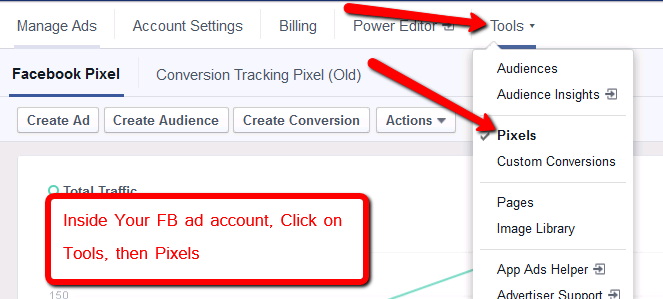
Inside your Facebook ad account, Click on Tools, then Pixels:

1-Facebook_Pixel

Then, click on Actions/View Pixel to see your pixel and copy to your clipboard:

2-View_Pixel_Code

Next, paste the pixel in the Head area of any page on your website. As an SBIer who uses Block Builder you would simply click the head button when editing any page, add the code to the sitewide box and then click “Build It” to save your changes.

3-Head_Button

You can now place an ad that only your subscribers see by telling Facebook to show your ad only to people who landed on your Thank You page.

Your Facebook ad will encourage your current subscribers to buy your product(s).

A word about retargeting…have you ever been to a site such as Amazon and then viewed an ad later on another site for the same Amazon product? That’s retargeting in action. You can do the same thing on Facebook inside your business.

Here’s another excellent way to use retargeting: Ask Facebook to deliver an ad to all your site visitors who did NOT visit your Thank You page.

This means that only your site visitors who are NOT subscribers to your email list will see the ad. Your ad provides you another opportunity to encourage people who know you (they were once on your site) to become an email subscriber at a later date.

To recap these two basic ways to use retargeting:

  • Use it to re-target subscribers (goal is to move them into becoming buyers of your product)
  • Use it to target site visitors who are not subscribers (goal is to move them into becoming subscribers)

How to Write a Great First Follow-up Email

The first follow-up email in your auto-responder series should be simple and direct.

Thank them again for subscribing.

Deliver the free gift you promised. If it was a checklist or cheat sheet, for example, make sure you provide quick and easy access to it.

Next, consider providing your subscriber a link to your original thank you page.

This allows them the opportunity to view your training video if they didn’t have a chance to finish it the first time. It also allows you to place your product offering in front of them again.

Wrapping Up: The Bigger Picture

We started out discussing the overall goal of your email marketing funnel: to earn income from your site traffic.

It’s important to have a logical plan in place regarding your product offerings. Start with a small buying decision. Consider a product in the $7-$50 range for your first offering.

From there, consider a medium priced product ($100 to $500) and also a large product offering ($500, $1000+).

Think through this process before starting your email campaign so that your “funnel” follows a logical series of follow-ups.

Your site’s content (and lead magnet offer) develops the small trust necessary to gain a subscriber. Your immediate follow-up information works to gain a bit more trust that leads to a small sale.

Your intro product should deliver plenty of value so that as you offer higher priced products throughout your follow-up, your subscribers are more inclined to continue buying from you over time.

Email marketing is far more than creating an opt-in box, placing it on your site and sending a few follow-up emails in an auto-responder series.

It’s critical that you think through how you’ll entice your site visitors to willingly use your opt-in box.

Each page on your site was developed around a specific keyword and answers a specific question related to that keyword search. Think in the same specific manner when it comes to optimizing each page for the purpose of converting visitors to subscribers.

Through the proper use of page specific lead magnets and a Thank You page that offers high value content leading to a product offering, you’ll present a quality first impression for your business.

Presenting this fine first impression will lead to better email open rates and ultimately, more sales. Adding in retargeting will bring your business into a state of professionalism and results that will help you touch/help more people and realize higher long-term profits.

13 Jan 19:45

Report: Users Routinely Purge Apps and Look for Better Replacements

by Kimberlee Morrison

The app market is incredibly competitive. Between users switching to the latest hot service, avoiding app notifications, and routinely deleting apps that don’t meet expectations, it can be hard to maintain a dedicated audience.

A study from Yahoo Advertising examines how users feel about apps, and their motivations behind removing apps from their devices.

Among surveyed users, Yahoo found that approximately half of smartphone dominant users — those who have largely replaced their desktop with a mobile device — are delete apps on a monthly basis, and 34 percent are do so on a weekly basis. By far the largest reason behind deletions is periodic cleanout, with 60 percent of respondents purging apps regularly.

Screenshot 2016-01-13 at 07.44.54

Yahoo found that 36 percent replace old apps with new ones, so if your app isn’t evolving users are unlikely to stick with it. However, 73 percent of users delete apps due to storage concerns, so reducing bloat should be a major priority for developers.

It’s already established that users tend to uninstall apps quickly, but across different verticals times can vary. On average, content apps lay dormant for 11 weeks before users uninstall them, while connection apps — social networks and messaging apps — last around 13 weeks. Millennials tend to keep apps for shorter periods than baby boomers.

Screenshot 2016-01-13 at 07.47.04

After deletion, many users look for good replacements, and they’re looking for a wide variety of markers when searching. Two defining factors are app price and positive reviews in app stores, across all verticals. The primary barriers to download are negative reviews, a lack of phone storage, and higher prices than expected.

However developers should be aware that 32 percent avoid apps because they are similar to other apps, and 31 percent don’t want to grant the app access to their data.

While these data points apply across all apps, social app makers should take particular note of the advice offered by Yahoo Advertising:

  • Avoid getting caught up in the weekly or monthly clear out cycles by innovating your experience. Users are less likely to delete your app if they don’t consider it boring.
  • Use online advertising, especially video advertising, to promote your app, as half of dormant user would return to your app if they saw an ad for it.
  • Optimize your presence in the app store and set the right price, as users are looking for replacement apps all the time and giving them a good experience will likely make your app stickier.

Check out the full report to find out which categories attract the most users, and to see how larger phablets affect app growth.

Photo via VisualHunt.

13 Jan 19:45

7 Copywriting Tricks Based on Psychology

by Kaleigh Moore
Here are a few hacks to help increase conversions.
13 Jan 19:44

You Can Ask A Robot To Review Your Investment Portfolio

by Julia Greenberg
You Can Ask A Robot To Review Your Investment Portfolio

Robo-financial advisor Wealthfront says its new portfolio review algorithms will help you save on fees, taxes, and other inefficiencies in you investments.

The post You Can Ask A Robot To Review Your Investment Portfolio appeared first on WIRED.


13 Jan 19:41

5 of the most successful 'Shark Tank' stories of all time

by Lamar Salter and Richard Feloni
13 Jan 19:32

‘No one could stop Kim if he gave an absurd instruction’: Purges and paranoia leave North Korea unstable

by Sam Kim, Bloomberg News

SEOUL, South Korea – Days after North Korea conducted its fourth nuclear test, its official television network showed the regime’s No. 2, sixty-something general Hwang Pyong So, kneeling and covering his mouth to address leader Kim Jong Un, who nodded in his seat as he turned his face away.

The scene illustrated the absolute obedience Kim demands from his aides. That insistence on reverence also shows why one of the world’s most unpredictable regimes has become even more erratic. Just days before conducting the nuclear test on Jan. 6 that raised tensions on the Korean peninsula, Kim had spoken publicly of his desire for warmer ties with South Korea, and there had been reports a visit to China was in the works.

Whipsaw actions – veering from provocation to conciliation and back again – aren’t unusual for North Korea, but they have become more pronounced in the four years since Kim came to power. That may be due in part to a lack of considered counsel: He has ordered killed or sent away elders who served as advisers under his grandfather Kim Il Sung and his father Kim Jong Il.

The South Korean Unification Ministry / Associated Press
The South Korean Unification Ministry / Associated PressHwang Pyong So (second right), top political officer for the Korean People's Army, at a rare reunification meeting in South Korea, August 2015.


“There is essentially no one now who could stop Kim if he gave an absurd instruction and turned stubborn,” said Oh Gyeong-seob, who researches North Korea’s leadership at the Sejong Institute near Seoul. “The regime’s unpredictability has grown since Kim came to power and most surviving officials are just pandering to his views.”

Kim was hastily groomed for leadership before the death of his father in 2011, and has sought to justify his power with adherence to his predecessor’s “songun,” or military-first policy. He’s focused on eliminating threats to his legitimacy and has questioned even the closest aides to his family, leaving him with only a handful of seasoned advisers.

AFP PHOTO / YONHAP
AFP PHOTO / YONHAP This photo taken on January 27, 2015 shows North Korean Defence Minister Hyon Yong-Chol riding an armoured personnel carrier at an unspecified location in North Korea. Hyon has been executed by anti-aircraft fire for disloyalty and showing disrespect to leader Kim Jong-Un, South Korea's intelligence agency said on May 13, 2015.

In 2013, Kim had his uncle Jang Song Thaek executed after charging him with graft and factionalism. Jang handled relations with China, visiting Beijing in 2012 as Kim’s special envoy. Jang’s wife and Kim’s aunt, Kim Kyong Hui, the most influential woman under Kim Jong Il, hasn’t been seen in public since Jang died.

Choe Ryong Hae, a Workers’ Party secretary who took over Jang’s role, has not been seen near Kim for months, and South Korea’s intelligence service said in November he had been banished after falling out with his leader. In May, the spy agency said Kim may have ordered the killing of his defense minister Hyon Yong Chol with an anti-aircraft gun for disagreeing with him, though that claim was never been verified.

“Kim has publicly deprived himself of family members and close aides who can speak candidly to him,” said Michael Madden, editor of the North Korea Leadership Watch blog. “Kim Kyong Hui, Jang Song Thaek, etc., all come from the same elite cohort and none seem to be around.”

Jon Chol Jin / Associated Press
Jon Chol Jin / Associated PressVice Marshal Hyon Yong Chol applauds during a 2012 meeting announcing North Korean leader Kim Jong Un's new title of marshal.

Kim Yang Gon, a longtime family confidant who helped negotiate a deal to cool tensions with South Korea in August, was killed in a traffic accident two weeks after Kim ordered the nuclear test. Kang Sok Ju, a vice premier credited with designing North Korea’s nuclear brinkmanship, has been hospitalized with a terminal illness, according to Madden, and Kim Yo Jong, Kim Jong Un’s younger sister with a senior Workers’ Party post, hasn’t been mentioned in state news agency reports since October.

A lack of experienced advisers raises the question of who might confront Kim if he was rushing toward a full-blown crisis. While North Korea and South Korea have never formally ended their war of the 1950s, they have largely held to an uneasy truce.

Tensions are high in the demilitarized zone after Seoul restarted propaganda broadcasts in retaliation for the nuclear test. South Korea’s military fired warning shots Wednesday after spotting an unidentified aerial vehicle approaching its heavily fortified border, and the U.S. has flown a long-range bomber over South Korea in a show of force. North Korea’s official Rodong Sinmun paper said Monday the bomber mission “pushes the situation to the brink of war.”

AFP PHOTO / KCNA VIA KNS
AFP PHOTO / KCNA VIA KNS This undated picture released by North Korea's official Korean Central News Agency on March 12, 2015 shows North Korean leader Kim Jong-Un (C) inspecting the Sin Islet defence company in Kangwon province, while Kim Yo-Jong (3rd L), his younger sister, follows.

Kim has little experience with managing crises compared with his father, who sharpened his political radar and cultivated confidants from the Workers’ Party during his own decades-long grooming process. The former leader visited China to attend to ties with Beijing’s leadership even as he conducted nuclear and missile tests at home. The son is displaying a hot temperament less evident in his father, the Sejong Institute’s Oh said.

South Korea says Kim has created a “reign of terror” with his purges. Kim executed dozens of officials on charges ranging from graft to watching South Korean soap operas, the intelligence agency said in May.

No country feels North Korea’s latest uncertainty more acutely than its southern neighbor. President Park Geun-hye said on Wednesday that South Korea failed to predict the timing of the nuclear test and pledged to beef up intelligence capabilities. A South Korean Unification Ministry official recently said North Korea’s behavior toward Seoul has become more erratic. A May meeting of the Workers’ Party may see the promotion of more officials who toe Kim’s line.

“The potential for a miscalculation is bigger when you don’t have enough people working under you to provide the full, honest picture of what’s going on,” Oh said.

“It’s becoming harder and harder to forecast where North Korea is going with its policy.”

13 Jan 19:24

Barack Obama (transcript): ‘Our brand of democracy is hard.’

by macleans.ca
President Barack Obama delivers his State of the Union address before a joint session of Congress on Capitol Hill in Washington, Tuesday, Jan. 12, 2016. (AP Photo/Evan Vucci, Pool)

President Barack Obama delivers his State of the Union address before a joint session of Congress on Capitol Hill in Washington, Tuesday, Jan. 12, 2016. (AP Photo/Evan Vucci, Pool)

One last time. #SOTU https://t.co/Fu9YeOQG9D

— Barack Obama (@BarackObama) January 12, 2016

U.S. President Barack Obama’s State of the Union Address, as prepared for delivery.

Mr. Speaker, Mr. Vice President, Members of Congress, my fellow Americans:

Tonight marks the eighth year I’ve come here to report on the State of the Union. And for this final one, I’m going to try to make it shorter. I know some of you are antsy to get back to Iowa.

"I hope we can work together this year on some bipartisan priorities like criminal justice reform." —President Obama #SOTU

— Barack Obama (@BarackObama) January 13, 2016

I also understand that because it’s an election season, expectations for what we’ll achieve this year are low. Still, Mr. Speaker, I appreciate the constructive approach you and the other leaders took at the end of last year to pass a budget and make tax cuts permanent for working families. So I hope we can work together this year on bipartisan priorities like criminal justice reform, and helping people who are battling prescription drug abuse. We just might surprise the cynics again.

"Who knows, we might surprise the cynics again." —President Obama #SOTU

— Barack Obama (@BarackObama) January 13, 2016

But tonight, I want to go easy on the traditional list of proposals for the year ahead. Don’t worry, I’ve got plenty, from helping students learn to write computer code to personalizing medical treatments for patients. And I’ll keep pushing for progress on the work that still needs doing. Fixing a broken immigration system. Protecting our kids from gun violence. Equal pay for equal work, paid leave, raising the minimum wage. All these things still matter to hardworking families; they are still the right thing to do; and I will not let up until they get done.

President Obama: I’ll keep pushing for progress on immigration, gun violence, equal pay, paid leave, raising the minimum wage. #SOTU

— Barack Obama (@BarackObama) January 13, 2016

But for my final address to this chamber, I don’t want to talk just about the next year. I want to focus on the next five years, ten years, and beyond.

I want to focus on our future.

We live in a time of extraordinary change – change that’s reshaping the way we live, the way we work, our planet and our place in the world. It’s change that promises amazing medical breakthroughs, but also economic disruptions that strain working families. It promises education for girls in the most remote villages, but also connects terrorists plotting an ocean away. It’s change that can broaden opportunity, or widen inequality. And whether we like it or not, the pace of this change will only accelerate.

America has been through big changes before – wars and depression, the influx of immigrants, workers fighting for a fair deal, and movements to expand civil rights. Each time, there have been those who told us to fear the future; who claimed we could slam the brakes on change, promising to restore past glory if we just got some group or idea that was threatening America under control. And each time, we overcame those fears. We did not, in the words of Lincoln, adhere to the “dogmas of the quiet past.” Instead we thought anew, and acted anew. We made change work for us, always extending America’s promise outward, to the next frontier, to more and more people. And because we did – because we saw opportunity where others saw only peril – we emerged stronger and better than before.

What was true then can be true now. Our unique strengths as a nation – our optimism and work ethic, our spirit of discovery and innovation, our diversity and commitment to the rule of law – these things give us everything we need to ensure prosperity and security for generations to come.

In fact, it’s that spirit that made the progress of these past seven years possible. It’s how we recovered from the worst economic crisis in generations. It’s how we reformed our health care system, and reinvented our energy sector; how we delivered more care and benefits to our troops and veterans, and how we secured the freedom in every state to marry the person we love.

But such progress is not inevitable. It is the result of choices we make together. And we face such choices right now. Will we respond to the changes of our time with fear, turning inward as a nation, and turning against each other as a people? Or will we face the future with confidence in who we are, what we stand for, and the incredible things we can do together?

So let’s talk about the future, and four big questions that we as a country have to answer – regardless of who the next President is, or who controls the next Congress.

First, how do we give everyone a fair shot at opportunity and security in this new economy?

Second, how do we make technology work for us, and not against us – especially when it comes to solving urgent challenges like climate change?

Third, how do we keep America safe and lead the world without becoming its policeman?

And finally, how can we make our politics reflect what’s best in us, and not what’s worst?

"A basic: the United States of America, right now, has the strongest, most durable economy in the world." —President Obama #SOTU

— Barack Obama (@BarackObama) January 13, 2016

Let me start with the economy, and a basic fact: the United States of America, right now, has the strongest, most durable economy in the world. We’re in the middle of the longest streak of private-sector job creation in history. More than 14 million new jobs; the strongest two years of job growth since the ’90s; an unemployment rate cut in half. Our auto industry just had its best year ever. Manufacturing has created nearly 900,000 new jobs in the past six years. And we’ve done all this while cutting our deficits by almost three-quarters.

Anyone claiming that America’s economy is in decline is peddling fiction. What is true – and the reason that a lot of Americans feel anxious – is that the economy has been changing in profound ways, changes that started long before the Great Recession hit and haven’t let up. Today, technology doesn’t just replace jobs on the assembly line, but any job where work can be automated. Companies in a global economy can locate anywhere, and face tougher competition. As a result, workers have less leverage for a raise. Companies have less loyalty to their communities. And more and more wealth and income is concentrated at the very top.

"Everybody that works hard deserves a fair shot." —President Obama #SOTU #RaiseTheWage

— Barack Obama (@BarackObama) January 13, 2016

All these trends have squeezed workers, even when they have jobs; even when the economy is growing. It’s made it harder for a hardworking family to pull itself out of poverty, harder for young people to start on their careers, and tougher for workers to retire when they want to. And although none of these trends are unique to America, they do offend our uniquely American belief that everybody who works hard should get a fair shot.

For the past seven years, our goal has been a growing economy that works better for everybody. We’ve made progress. But we need to make more. And despite all the political arguments we’ve had these past few years, there are some areas where Americans broadly agree.

We agree that real opportunity requires every American to get the education and training they need to land a good-paying job. The bipartisan reform of No Child Left Behind was an important start, and together, we’ve increased early childhood education, lifted high school graduation rates to new highs, and boosted graduates in fields like engineering. In the coming years, we should build on that progress, by providing Pre-K for all, offering every student the hands-on computer science and math classes that make them job-ready on day one, and we should recruit and support more great teachers for our kids.

And we have to make college affordable for every American. Because no hardworking student should be stuck in the red. We’ve already reduced student loan payments to ten percent of a borrower’s income. Now, we’ve actually got to cut the cost of college. Providing two years of community college at no cost for every responsible student is one of the best ways to do that, and I’m going to keep fighting to get that started this year.

Of course, a great education isn’t all we need in this new economy. We also need benefits and protections that provide a basic measure of security. After all, it’s not much of a stretch to say that some of the only people in America who are going to work the same job, in the same place, with a health and retirement package, for 30 years, are sitting in this chamber. For everyone else, especially folks in their forties and fifties, saving for retirement or bouncing back from job loss has gotten a lot tougher. Americans understand that at some point in their careers, they may have to retool and retrain. But they shouldn’t lose what they’ve already worked so hard to build.

That’s why Social Security and Medicare are more important than ever; we shouldn’t weaken them, we should strengthen them. And for Americans short of retirement, basic benefits should be just as mobile as everything else is today. That’s what the Affordable Care Act is all about. It’s about filling the gaps in employer-based care so that when we lose a job, or go back to school, or start that new business, we’ll still have coverage. Nearly eighteen million have gained coverage so far. Health care inflation has slowed. And our businesses have created jobs every single month since it became law.

Now, I’m guessing we won’t agree on health care anytime soon. But there should be other ways both parties can improve economic security. Say a hardworking American loses his job – we shouldn’t just make sure he can get unemployment insurance; we should make sure that program encourages him to retrain for a business that’s ready to hire him. If that new job doesn’t pay as much, there should be a system of wage insurance in place so that he can still pay his bills. And even if he’s going from job to job, he should still be able to save for retirement and take his savings with him. That’s the way we make the new economy work better for everyone.

I also know Speaker Ryan has talked about his interest in tackling poverty. America is about giving everybody willing to work a hand up, and I’d welcome a serious discussion about strategies we can all support, like expanding tax cuts for low-income workers without kids.

But there are other areas where it’s been more difficult to find agreement over the last seven years – namely what role the government should play in making sure the system’s not rigged in favor of the wealthiest and biggest corporations. And here, the American people have a choice to make.

I believe a thriving private sector is the lifeblood of our economy. I think there are outdated regulations that need to be changed, and there’s red tape that needs to be cut. But after years of record corporate profits, working families won’t get more opportunity or bigger paychecks by letting big banks or big oil or hedge funds make their own rules at the expense of everyone else; or by allowing attacks on collective bargaining to go unanswered. Food Stamp recipients didn’t cause the financial crisis; recklessness on Wall Street did. Immigrants aren’t the reason wages haven’t gone up enough; those decisions are made in the boardrooms that too often put quarterly earnings over long-term returns. It’s sure not the average family watching tonight that avoids paying taxes through offshore accounts. In this new economy, workers and start-ups and small businesses need more of a voice, not less. The rules should work for them. And this year I plan to lift up the many businesses who’ve figured out that doing right by their workers ends up being good for their shareholders, their customers, and their communities, so that we can spread those best practices across America.

"Food Stamp recipients didn’t cause the financial crisis; recklessness on Wall Street did." —President Obama #SOTU

— Barack Obama (@BarackObama) January 13, 2016

In fact, many of our best corporate citizens are also our most creative. This brings me to the second big question we have to answer as a country: how do we reignite that spirit of innovation to meet our biggest challenges?

Sixty years ago, when the Russians beat us into space, we didn’t deny Sputnik was up there. We didn’t argue about the science, or shrink our research and development budget. We built a space program almost overnight, and twelve years later, we were walking on the moon.

That spirit of discovery is in our DNA. We’re Thomas Edison and the Wright Brothers and George Washington Carver. We’re Grace Hopper and Katherine Johnson and Sally Ride. We’re every immigrant and entrepreneur from Boston to Austin to Silicon Valley racing to shape a better world. And over the past seven years, we’ve nurtured that spirit.

"That spirit of discovery is in our DNA. America is Thomas Edison and the Wright Brothers and George Washington Carver." —President Obama

— Barack Obama (@BarackObama) January 13, 2016

We’ve protected an open internet, and taken bold new steps to get more students and low-income Americans online. We’ve launched next-generation manufacturing hubs, and online tools that give an entrepreneur everything he or she needs to start a business in a single day.

But we can do so much more. Last year, Vice President Biden said that with a new moonshot, America can cure cancer. Last month, he worked with this Congress to give scientists at the National Institutes of Health the strongest resources they’ve had in over a decade. Tonight, I’m announcing a new national effort to get it done. And because he’s gone to the mat for all of us, on so many issues over the past forty years, I’m putting Joe in charge of Mission Control. For the loved ones we’ve all lost, for the family we can still save, let’s make America the country that cures cancer once and for all.

Medical research is critical. We need the same level of commitment when it comes to developing clean energy sources.

Look, if anybody still wants to dispute the science around climate change, have at it. You’ll be pretty lonely, because you’ll be debating our military, most of America’s business leaders, the majority of the American people, almost the entire scientific community, and 200 nations around the world who agree it’s a problem and intend to solve it.

"If anybody still wants to dispute the science around climate change, have at it. You’ll be pretty lonely." —President Obama #SOTU

— Barack Obama (@BarackObama) January 13, 2016

But even if the planet wasn’t at stake; even if 2014 wasn’t the warmest year on record – until 2015 turned out even hotter – why would we want to pass up the chance for American businesses to produce and sell the energy of the future?

Seven years ago, we made the single biggest investment in clean energy in our history. Here are the results. In fields from Iowa to Texas, wind power is now cheaper than dirtier, conventional power. On rooftops from Arizona to New York, solar is saving Americans tens of millions of dollars a year on their energy bills, and employs more Americans than coal – in jobs that pay better than average. We’re taking steps to give homeowners the freedom to generate and store their own energy – something environmentalists and Tea Partiers have teamed up to support. Meanwhile, we’ve cut our imports of foreign oil by nearly sixty percent, and cut carbon pollution more than any other country on Earth.

Gas under two bucks a gallon ain’t bad, either.

Now we’ve got to accelerate the transition away from dirty energy. Rather than subsidize the past, we should invest in the future – especially in communities that rely on fossil fuels. That’s why I’m going to push to change the way we manage our oil and coal resources, so that they better reflect the costs they impose on taxpayers and our planet. That way, we put money back into those communities and put tens of thousands of Americans to work building a 21st century transportation system.

None of this will happen overnight, and yes, there are plenty of entrenched interests who want to protect the status quo. But the jobs we’ll create, the money we’ll save, and the planet we’ll preserve – that’s the kind of future our kids and grandkids deserve.

Climate change is just one of many issues where our security is linked to the rest of the world. And that’s why the third big question we have to answer is how to keep America safe and strong without either isolating ourselves or trying to nation-build everywhere there’s a problem.

I told you earlier all the talk of America’s economic decline is political hot air. Well, so is all the rhetoric you hear about our enemies getting stronger and America getting weaker. The United States of America is the most powerful nation on Earth. Period. It’s not even close. We spend more on our military than the next eight nations combined. Our troops are the finest fighting force in the history of the world. No nation dares to attack us or our allies because they know that’s the path to ruin. Surveys show our standing around the world is higher than when I was elected to this office, and when it comes to every important international issue, people of the world do not look to Beijing or Moscow to lead – they call us.

"The United States of America is the most powerful nation on Earth. Period." —President Obama #SOTU

— Barack Obama (@BarackObama) January 13, 2016

As someone who begins every day with an intelligence briefing, I know this is a dangerous time. But that’s not because of diminished American strength or some looming superpower. In today’s world, we’re threatened less by evil empires and more by failing states. The Middle East is going through a transformation that will play out for a generation, rooted in conflicts that date back millennia. Economic headwinds blow from a Chinese economy in transition. Even as their economy contracts, Russia is pouring resources to prop up Ukraine and Syria – states they see slipping away from their orbit. And the international system we built after World War II is now struggling to keep pace with this new reality.

It’s up to us to help remake that system. And that means we have to set priorities.

Priority number one is protecting the American people and going after terrorist networks. Both al Qaeda and now ISIL pose a direct threat to our people, because in today’s world, even a handful of terrorists who place no value on human life, including their own, can do a lot of damage. They use the Internet to poison the minds of individuals inside our country; they undermine our allies.

But as we focus on destroying ISIL, over-the-top claims that this is World War III just play into their hands. Masses of fighters on the back of pickup trucks and twisted souls plotting in apartments or garages pose an enormous danger to civilians and must be stopped. But they do not threaten our national existence. That’s the story ISIL wants to tell; that’s the kind of propaganda they use to recruit. We don’t need to build them up to show that we’re serious, nor do we need to push away vital allies in this fight by echoing the lie that ISIL is representative of one of the world’s largest religions. We just need to call them what they are – killers and fanatics who have to be rooted out, hunted down, and destroyed.

That’s exactly what we are doing. For more than a year, America has led a coalition of more than 60 countries to cut off ISIL’s financing, disrupt their plots, stop the flow of terrorist fighters, and stamp out their vicious ideology. With nearly 10,000 air strikes, we are taking out their leadership, their oil, their training camps, and their weapons. We are training, arming, and supporting forces who are steadily reclaiming territory in Iraq and Syria.

If this Congress is serious about winning this war, and wants to send a message to our troops and the world, you should finally authorize the use of military force against ISIL. Take a vote. But the American people should know that with or without Congressional action, ISIL will learn the same lessons as terrorists before them. If you doubt America’s commitment – or mine – to see that justice is done, ask Osama bin Laden. Ask the leader of al Qaeda in Yemen, who was taken out last year, or the perpetrator of the Benghazi attacks, who sits in a prison cell. When you come after Americans, we go after you. It may take time, but we have long memories, and our reach has no limit.

Our foreign policy must be focused on the threat from ISIL and al Qaeda, but it can’t stop there. For even without ISIL, instability will continue for decades in many parts of the world – in the Middle East, in Afghanistan and Pakistan, in parts of Central America, Africa and Asia. Some of these places may become safe havens for new terrorist networks; others will fall victim to ethnic conflict, or famine, feeding the next wave of refugees. The world will look to us to help solve these problems, and our answer needs to be more than tough talk or calls to carpet bomb civilians. That may work as a TV sound bite, but it doesn’t pass muster on the world stage.

We also can’t try to take over and rebuild every country that falls into crisis. That’s not leadership; that’s a recipe for quagmire, spilling American blood and treasure that ultimately weakens us. It’s the lesson of Vietnam, of Iraq – and we should have learned it by now.

Fortunately, there’s a smarter approach, a patient and disciplined strategy that uses every element of our national power. It says America will always act, alone if necessary, to protect our people and our allies; but on issues of global concern, we will mobilize the world to work with us, and make sure other countries pull their own weight.

That’s our approach to conflicts like Syria, where we’re partnering with local forces and leading international efforts to help that broken society pursue a lasting peace.

That’s why we built a global coalition, with sanctions and principled diplomacy, to prevent a nuclear-armed Iran. As we speak, Iran has rolled back its nuclear program, shipped out its uranium stockpile, and the world has avoided another war.

That’s how we stopped the spread of Ebola in West Africa. Our military, our doctors, and our development workers set up the platform that allowed other countries to join us in stamping out that epidemic.

That’s how we forged a Trans-Pacific Partnership to open markets, protect workers and the environment, and advance American leadership in Asia. It cuts 18,000 taxes on products Made in America, and supports more good jobs. With TPP, China doesn’t set the rules in that region, we do. You want to show our strength in this century? Approve this agreement. Give us the tools to enforce it.

Fifty years of isolating Cuba had failed to promote democracy, setting us back in Latin America. That’s why we restored diplomatic relations, opened the door to travel and commerce, and positioned ourselves to improve the lives of the Cuban people. You want to consolidate our leadership and credibility in the hemisphere? Recognize that the Cold War is over. Lift the embargo.

American leadership in the 21st century is not a choice between ignoring the rest of the world – except when we kill terrorists; or occupying and rebuilding whatever society is unraveling. Leadership means a wise application of military power, and rallying the world behind causes that are right. It means seeing our foreign assistance as part of our national security, not charity. When we lead nearly 200 nations to the most ambitious agreement in history to fight climate change – that helps vulnerable countries, but it also protects our children. When we help Ukraine defend its democracy, or Colombia resolve a decades-long war, that strengthens the international order we depend upon. When we help African countries feed their people and care for the sick, that prevents the next pandemic from reaching our shores. Right now, we are on track to end the scourge of HIV/AIDS, and we have the capacity to accomplish the same thing with malaria – something I’ll be pushing this Congress to fund this year.

That’s strength. That’s leadership. And that kind of leadership depends on the power of our example. That is why I will keep working to shut down the prison at Guantanamo: it’s expensive, it’s unnecessary, and it only serves as a recruitment brochure for our enemies.

That’s why we need to reject any politics that targets people because of race or religion. This isn’t a matter of political correctness. It’s a matter of understanding what makes us strong. The world respects us not just for our arsenal; it respects us for our diversity and our openness and the way we respect every faith. His Holiness, Pope Francis, told this body from the very spot I stand tonight that “to imitate the hatred and violence of tyrants and murderers is the best way to take their place.” When politicians insult Muslims, when a mosque is vandalized, or a kid bullied, that doesn’t make us safer. That’s not telling it like it is. It’s just wrong. It diminishes us in the eyes of the world. It makes it harder to achieve our goals. And it betrays who we are as a country.

"We need to reject any politics that targets people because of race or religion." —President Obama #SOTU

— Barack Obama (@BarackObama) January 13, 2016

“We the People.” Our Constitution begins with those three simple words, words we’ve come to recognize mean all the people, not just some; words that insist we rise and fall together. That brings me to the fourth, and maybe the most important thing I want to say tonight.

The future we want – opportunity and security for our families; a rising standard of living and a sustainable, peaceful planet for our kids – all that is within our reach. But it will only happen if we work together. It will only happen if we can have rational, constructive debates.

It will only happen if we fix our politics.

A better politics doesn’t mean we have to agree on everything. This is a big country, with different regions and attitudes and interests. That’s one of our strengths, too. Our Founders distributed power between states and branches of government, and expected us to argue, just as they did, over the size and shape of government, over commerce and foreign relations, over the meaning of liberty and the imperatives of security.

But democracy does require basic bonds of trust between its citizens. It doesn’t work if we think the people who disagree with us are all motivated by malice, or that our political opponents are unpatriotic. Democracy grinds to a halt without a willingness to compromise; or when even basic facts are contested, and we listen only to those who agree with us. Our public life withers when only the most extreme voices get attention. Most of all, democracy breaks down when the average person feels their voice doesn’t matter; that the system is rigged in favor of the rich or the powerful or some narrow interest.

"Democracy breaks down when the average person feels their voice doesn’t matter." —President Obama #SOTU

— Barack Obama (@BarackObama) January 13, 2016

Too many Americans feel that way right now. It’s one of the few regrets of my presidency – that the rancor and suspicion between the parties has gotten worse instead of better. There’s no doubt a president with the gifts of Lincoln or Roosevelt might have better bridged the divide, and I guarantee I’ll keep trying to be better so long as I hold this office.

But, my fellow Americans, this cannot be my task – or any President’s – alone. There are a whole lot of folks in this chamber who would like to see more cooperation, a more elevated debate in Washington, but feel trapped by the demands of getting elected. I know; you’ve told me. And if we want a better politics, it’s not enough to just change a Congressman or a Senator or even a President; we have to change the system to reflect our better selves.

We have to end the practice of drawing our congressional districts so that politicians can pick their voters, and not the other way around. We have to reduce the influence of money in our politics, so that a handful of families and hidden interests can’t bankroll our elections – and if our existing approach to campaign finance can’t pass muster in the courts, we need to work together to find a real solution. We’ve got to make voting easier, not harder, and modernize it for the way we live now. And over the course of this year, I intend to travel the country to push for reforms that do.

But I can’t do these things on my own. Changes in our political process – in not just who gets elected but how they get elected – that will only happen when the American people demand it. It will depend on you. That’s what’s meant by a government of, by, and for the people.

What I’m asking for is hard. It’s easier to be cynical; to accept that change isn’t possible, and politics is hopeless, and to believe that our voices and actions don’t matter. But if we give up now, then we forsake a better future. Those with money and power will gain greater control over the decisions that could send a young soldier to war, or allow another economic disaster, or roll back the equal rights and voting rights that generations of Americans have fought, even died, to secure. As frustration grows, there will be voices urging us to fall back into tribes, to scapegoat fellow citizens who don’t look like us, or pray like us, or vote like we do, or share the same background.

We can’t afford to go down that path. It won’t deliver the economy we want, or the security we want, but most of all, it contradicts everything that makes us the envy of the world.

So, my fellow Americans, whatever you may believe, whether you prefer one party or no party, our collective future depends on your willingness to uphold your obligations as a citizen. To vote. To speak out. To stand up for others, especially the weak, especially the vulnerable, knowing that each of us is only here because somebody, somewhere, stood up for us. To stay active in our public life so it reflects the goodness and decency and optimism that I see in the American people every single day.

It won’t be easy. Our brand of democracy is hard. But I can promise that a year from now, when I no longer hold this office, I’ll be right there with you as a citizen – inspired by those voices of fairness and vision, of grit and good humor and kindness that have helped America travel so far. Voices that help us see ourselves not first and foremost as black or white or Asian or Latino, not as gay or straight, immigrant or native born; not as Democrats or Republicans, but as Americans first, bound by a common creed. Voices Dr. King believed would have the final word – voices of unarmed truth and unconditional love.

They’re out there, those voices. They don’t get a lot of attention, nor do they seek it, but they are busy doing the work this country needs doing.

I see them everywhere I travel in this incredible country of ours. I see you. I know you’re there. You’re the reason why I have such incredible confidence in our future. Because I see your quiet, sturdy citizenship all the time.

I see it in the worker on the assembly line who clocked extra shifts to keep his company open, and the boss who pays him higher wages to keep him on board.

I see it in the Dreamer who stays up late to finish her science project, and the teacher who comes in early because he knows she might someday cure a disease.

I see it in the American who served his time, and dreams of starting over – and the business owner who gives him that second chance. The protester determined to prove that justice matters, and the young cop walking the beat, treating everybody with respect, doing the brave, quiet work of keeping us safe.

I see it in the soldier who gives almost everything to save his brothers, the nurse who tends to him ’til he can run a marathon, and the community that lines up to cheer him on.

It’s the son who finds the courage to come out as who he is, and the father whose love for that son overrides everything he’s been taught.

I see it in the elderly woman who will wait in line to cast her vote as long as she has to; the new citizen who casts his for the first time; the volunteers at the polls who believe every vote should count, because each of them in different ways know how much that precious right is worth.

"I believe in change because I believe in you." —President Obama #SOTU

— Barack Obama (@BarackObama) January 13, 2016

That’s the America I know. That’s the country we love. Clear-eyed. Big-hearted. Optimistic that unarmed truth and unconditional love will have the final word. That’s what makes me so hopeful about our future. Because of you. I believe in you. That’s why I stand here confident that the State of our Union is strong.

Thank you, God bless you, and God bless the United States of America.

The post Barack Obama (transcript): ‘Our brand of democracy is hard.’ appeared first on Macleans.ca.

13 Jan 19:24

Ten New Ways to Handle, “We’re all set”

Ten New Ways to Handle, “We’re all set”

By Mike Brooks, www.MrInsideSales.com


I receive emails from my readers all the time asking me how to handle various objections and resistance statements.  A common request I get is how to handle the initial resistance statement “We are all set.”  A variation of this is anything along the lines of:


“We are O.K. with our present system” 

OR 

“We’ve already got a company that handles that”

OR

“We’re fine for right now”


As you can see, these are all basically the same, and, more importantly, they aren’t objections – rather they are initial resistance statements or blow offs.  Essentially they are saying something along the lines of: “I’m not interested in being pitched right now, please go away.”


Now here’s the thing: Because this is simply resistance and not an objection (it’s not an objection because you haven’t pitched your product or service yet.  It’s like when you walk into a department store and the sales rep asks if they can help you and you blow them off with, “I’m just looking.”)  Again, “We’re all set” is not an objection, just sales resistance.

And the key to handling resistance is NOT to try to overcome it (remember it’s not an objection) but rather you simply want to bypass it and get into your pitch. 


So, with that in mind, here’s how you handle the “We’re all set” blow off or/and any of its variations:


“We’re all set”


Response One:

“That’s great, and I’d just like to see if we could get on your vendor list for the next time you’re in the market.  Let me ask you…” 

Now get into your qualifying questions…


Response Two:

“Most companies I speak with are ‘all set’ and that’s why I’m reaching out to you now – I want to give you an option for the next time you’re in need of this.  Let me ask you…”

Back to qualifying…


Response Three:

“No problem.  Let me ask you: the next time you’re in need of this, what’s number one on your wish list?”


Response Four:

“I understand – I didn’t expect to catch you in the market right now.  Instead, let me get an idea of your perfect profile, and then I’ll send you some information you can keep on file next time you need this…”

Now re-engage by asking a qualifying question.


Response Five:

“Got it.  Let me ask you: the next time you are in need of this, are you the right person to speak to about it?”

If yes, then qualify them for that next time – especially asking about timeframe, budget, etc.


Response Six:

“Understand, and let me ask you: When is your next buying season for this?”

Then keep the conversation going by asking additional qualifying questions…


Response Seven:

“That’s fine; I totally understand.  And let me ask you – the next time you’re in the market for this, how many companies are you going to reach out to?” 

And then ask how you can become one of them, what their budget is, who the decision makers are, etc.


Response Eight:

“No problem.  What you might find helpful is to know about our special pricing and the additional services we provide.  Did you know that….”

Then pitch one or two things you do that others don’t – and use a tie down!


Response Nine:

“I’m glad you said that.  What I’ve found is that those companies who are already using a vendor for this are surprised to learn that….”

Give them a shocking statement about how you’ve just been rated number one, or that you give free delivery, etc.  Something that will peak their interest…


Response Ten:

“No problem.  Could I be the next in line company you call the next time you’re in the market for this?”

If yes,

“Great, let me get your email and send you my info…”

Then:

“And just out of curiosity, what would have to change for you to even begin looking at someone else?”

Look for an in here…


So there you have it – ten new ways of handling this age old blow off.  Just remember, your goal isn’t to try to overcome this – rather, it’s to sidestep this resistance statement and get information you can use to create value and continue the conversation.


If you found this article helpful, then you'll love Mike's Completely Updated and Revised eBook, “The Complete Book of Phone Scripts.” Now over 130 pages of powerful and effective scripts to help you easily get past the gatekeeper, set appointments, overcome objections and close more money!

Visit: http://mrinsidesales.com/completescripts.htm and find out why Jeffrey Gitomer, Brian Tracy, Tom Hopkins and many others recommend Mike’s ebook of Phone Scripts!

Do you have an underperforming inside sales team?  Talk to Mike to see how he can help you and your team reach your revenue goals.  To learn more about Mike, visit his website: http://www.MrInsideSales.com


13 Jan 19:20

5 Ways You're Approaching Prospects Completely Wrong

by mrenahan@hubspot.com (Mike Renahan)

stressedstockphoto.jpg

“Wow, I really love prospecting.” Said no sales rep. Ever.

Unfortunately, prospecting isn’t a task most salespeople look forward to. It’s time-consuming, frustrating, and challenging. Reps might have difficulty finding the right people, getting hold of them, qualifying them, and setting up appointments, among other things.

Yet despite these recurring obstacles, prospecting techniques and strategies haven’t changed. Many salespeople are still clinging to the “spray and pray” method of decades past, even though it’s getting less and less effective. And if something is no longer effective, why aren’t adjustments being made?

Here are five way where reps go awry when approaching new prospects. Are you making any of these mistakes?

1) Targeting prospects based on title, not behavior.

Reps who base their search on who a prospect is versus what they do fall into a trap because the prospect might not see the immediate value of the rep’s product or service. Simply because this prospect is the CEO doesn’t mean that she can make a decision about HR services -- or even frankly cares about HR services.

Instead of hunting for specific LinkedIn titles, hunt for interest. Who from this company is coming to your company’s website? Reps who focus on providing information to the prospects seeking it will enjoy better connection and close rates.

The HubSpot CRM shows you which buyers are visiting your website and opening your emails. Download it for free by clicking below:

HubSpot CRM prospecting

2) Skipping research.

Without researching a business fully, reps are left to guess about pain points and goals.  As a result, salespeople can’t present their product in the right light to show how valuable it can be to this specific prospect. After all, a rep can’t solve a pain point if they’re not sure what it is in the first place.

Here’s a simple rule of thumb: spend more time researching prospects than emailing them. With significant knowledge of the company at their fingertips, a rep can build credibility and rapport with buyers while connecting the product’s benefits with the prospect’s specific pain points.

3) Coming in totally cold.

Today’s buyers screen their calls and protect their inboxes. Reps who try to start a relationship using cold tactics often hit a roadblock because the modern buyer isn’t interested in talking to a sales rep they don’t know about a product they haven’t expressed interest in. Cold call and cold email techniques are losing their effectiveness because the modern buyer has changed.

Instead, try finding prospects online first, connecting with them over shared interests, and warming up the relationship. Then and only then is it time to reach out.

4) Sticking to the script.

Every buyer has a unique pain point and is in need of a specific solution. By sticking to the generic script, salespeople fail to present their product as a solution to the prospect’s specific needs. While it’s great for a potential buyer to hear about a product’s benefits, they need to know how these features are specifically going to help them.

Toss the script out the window and personalize a message based on the information you’ve gathered from interactions with this prospect. By personalizing the message, a sales rep can highlight key benefits that directly solve this prospect’s pain point in a way other products might not be able to.

5) Following up just to follow up.

By following up without providing any new value, reps are not helping prospects but instead probably annoying them. The modern buyer is hungry for information but is moving at her own pace. Reps who send worthless emails regularly aren’t providing value, but likely hurting their credibility.

Instead, by keeping in contact with and providing value to prospects through a multitude of channels, reps won’t need to follow up just for the sake of following up because the conversation is ongoing.

Prospecting and connecting with buyers can be challenging. But just like anything else in life, when it starts to become too challenging and you’re not seeing the results you want, adjustments need to be made. Instead of defaulting to old-school tactics like the ones above, use the new year to try new strategies and techniques. 

  HubSpot CRM
13 Jan 19:19

The Easiest Job in the World Is Calling Yourself a Consultant

by John Jantsch

The Easiest Job in the World Is Calling Yourself a Consultant written by John Jantsch read more at Duct Tape Marketing

Marketing Podcast with Michael Zipursky

MichaelZipurskyConsultant, author, speaker – that’s the hottest business card title going these days and hey, who am I to knock it, I’ve called myself all three at times.

But here’s the deal – while it’s become much easier to claim the title, there’s only one way to own it – you get up every day and you figure out how to get better at your craft.

If you do that, you’ll be able to provide value for someone and that’s all you need to do to succeed in the world of consulting.

Short of that – just telling people you’re a social media consultant, marketing coach, growth hacker – without putting in the work to develop your own point of view, your own methodology, and your own story that attracts ideal clients – you’re a fraud.

Harsh words perhaps, but I believe in you, I believe in small business and I believe in this industry so why not let it show!

My guest for this week’s episode of the Duct Tape Marketing Podcast is Michael Zipursky, founder of Consulting Success and an expert at working with consultants to install marketing systems that consistently attract their ideal clients and significantly increase their fees. We discuss being a consultant and how to make a consultancy business relevant and profitable.

Questions I ask Michael:

  • How do you find your ideal consultancy clients?
  • How should consultants be approaching pricing their services?
  • What are your favorite lead generation tactics?

What you’ll learn if you give a listen:

  • Why you shouldn’t be afraid to limit your market and become a specialist.
  • How to make sure your marketing approach fits your ideal client.
  • How to better evaluate your value as a consultant.
13 Jan 19:18

How 3 Companies Devised a Winning Content Distribution Strategy

by Karen Taylor

content-distribution-strategy.jpg

One of the greatest challenges content marketers face today is publishing enough content to fuel their campaigns. A Forrester study offers a solution: “Step down content production and step up content distribution.” It seems that many companies are doing too much of the former and not enough of the later. As a result, their content isn’t reaching enough people.

“Too many brand marketers fail to plan for the distribution and discovery of their content. The result? Significant content investments don’t reach the intended audience and have no chance to deliver value for the brand,” stated Senior Analyst Ryan Skinner and author of the report, Put Distribution at the Heart of Content Marketing.

Forrester is not the only thought leader reporting on the lack of effective content distribution and promotion. Several experts agree with this diagnosis.

“Marketers always ask me how to make more or better content, and it’s almost always the wrong question. The right question is: ‘How do I get my content in front of the right people?’ ” said Joe Chernov, vice president of marketing at InsightSquared.

“The notion that you can simply create interesting content people will magically find is a lie. If you build it, they won’t necessarily come. You have to treat your content executions like a product, and launch them the same way you would launch a product,” said blogger Jay Baer, a speaker and author of Youtility.

“Great content goes unread every day on the Internet. Rather than trying to produce more or better content, marketers should focus on their distribution plans. It should be part of their overall strategy,” said Chad Pollitt, vice president of Audience at Relevance. “However, it’s likely just an afterthought for most of the 64 percent of marketers who feel they’re not using their content effectively.”

Refresher on 3 Content Distribution Avenues

You’re likely familiar with the three ways companies distribute and promote their content. Let’s briefly review them, including their pros and cons.

1. Paid content distribution. This avenue allows companies to pay to reach more people using:

  • Social media advertising
  • Content discovery tools
  • Native advertising (for example, paid-for articles)
  • Sponsored content or promoted blog posts
  • Display ads and AdWords

Pros: Paid content can help expand reach. Offers a high level of control.

Cons: Paying for content distribution is expensive. Paid content often delivers less credibility.

2. Earned content distribution. In its truest sense, earned media involves natural relationships in which customers, peers and the media recognize a company by sharing its content in these ways:

  • Social media
  • User reviews
  • Traditional media
  • Non-sponsored blog posts

Pros: Content from external sources is more credible and more trusted by consumers. It humanizes brands. It boosts SEO.

Cons: Content from external sources is the hardest to get. Companies have no control. Earned can be negative as well as positive.

3. Owned content distribution. This is content distributed over companies’ own channels, including:

  • Website and blog
  • Email marketing list
  • Followers on social media (reach varies depending on the platform)

Pros: Gives companies maximum control over content they own.

Cons: Owned delivers the least reach, because companies can only reach people who are following their owned channels.

Let’s look at three successful content distribution strategy examples.

Case Study 1: How Intel Does Paid Content Distribution

Intel has cracked the code on paid content distribution. Unlike most companies who have a “Field of Dreams” attitude (“If you build it, they will come”), Intel has adopted a “Moneyball” approach to content distribution (what the analytics tell them).

The company’s basic strategy is to publish blog posts without any initial media spend and then promote only those that gain some organic traction within hours of going live. “We’re really going to optimize and act like a day trader rather than hedge fund manager who buys and holds,” stated Intel’s Global Content and Media Strategist Luke Kintigh.

About 62 percent of Intel’s blog referral traffic comes from social, and 63 percent of social traffic comes from Facebook. As a result, about 70 percent of the company’s promotion spend is dedicated to Facebook. Intel also pays to distribute blog posts through social-recommendation widgets and experiments with promotion through, for example, Flipboard and native ad network Nativo.

Kintigh believes in the 90/10 rule: 10 percent of the content drives 90 percent of the traffic. Which posts will succeed must be discovered early. “The sooner you take action, the greater the velocity and efficiency you’ll see from your media.”

Before his current position, Kintigh was managing editor of the company’s blog, iQ, which has more than 2 million unique monthly visitors. “In the early days of iQ, we were like a chef who spent all day cooking an incredible meal—only to find an empty table come dinnertime.” Like other content marketers, Intel had “this mindset that content is king, but really distribution is more important.”

Kintigh eventually learned how to fill the dinner table with owned content distribution. He shared his insight in an eBook, How Intel iQ Does Content Promotion. Its central premise is that the distribution of content is at least as important as the quality of the product itself. Now, paid distribution is woven into Intel’s brand journalism initiative.

Case Study 2: How Coca-Cola Does Earned Media

Even though some companies believe that earned media—social media in particular—doesn’t generate tangible sales lift, Wendy Clark, senior VP of integrated marketing communications and capabilities at Coca-Cola, stands firmly behind her investments in earned media, saying that “today’s progressive marketers know better.”

Coca-Cola has generated multiple earned media success stories including these three:

London Olympic Games. Leading up to the games, Coca-Cola’s earned media campaign was activated in 110 countries with a variety of content including:

  • A 60-minute documentary on the making of the global anthem (“Moving to the Beat of the London Games”). It was broken up into multiple webisodes and mobisodes to share on social media.
  • A Beat Maker app that lets consumers create their own beats as ringtones and upload them to the Global Beat on Facebook.

2012 Super Bowl. Coca-Cola leveraged second-screen engagement during the game by live streaming the Coca-Cola polar bears. More than 9 million people tuned in to engage.

2013 Super Bowl. The company aired a 60-second ad that ended with a cliffhanging call-to-action directing viewers to CokeChase.com, “where they could help decide the outcome by voting for their favorite team and even sabotaging their rivals in fun, ridiculous ways.”

Coca-Cola further engaged viewers by delivering real-time updates on the teams’ progress through Facebook, YouTube and Twitter, and photos of the Coke Chase on Tumblr and Instagram. Across these channels, fans found themselves in the middle of the action and enjoyed a behind-the-scenes look at the characters in their pursuit of “the ultimate refresher.”

Case Study 3: How Oracle Vitrue Does Owned Media

When social media firm Vitrue (before merging with Oracle) was getting ready to launch a new brand campaign, it led with an owned media distribution plan. The campaign, called “Like Can Never Replace Love,” stressed the importance of building meaningful relationships versus merely getting clicks. Fittingly, the company’s campaign promotion focused on its own relationships with employees, partners, influencers and customers.

Erika Jolly Brookes, Vitrue’s former vice president of marketing, was clear on the channels the agency needed to reach to make an impact. The firm launched its new campaign by promoting content directly to its four key owned distribution channels—all on the same day:

  • Employees. Vitrue considers its staff to be major ambassadors for the firm, so it went big and pumped up the employees by hiring a marching band to come to the office and perform.
  • Partners. The firm built a solid base of partners on social channels, like LinkedIn. It promoted its message to them in several ways, including sending fortune cookies and Popsicles in a customized flavor, which got people sharing the news about the campaign across their social channels.
  • Influencers. Vitrue also amassed a cadre of influencers, including analysts and thought leaders who were willing to share content and promote the news.
  • Customers. Vitrue engaged customers by presenting content from the consumers’ perspective, such as success stories. The firm sent information to get customers excited and sharing the new campaign.

While paid, earned and owned content distribution channels each offer their own advantages, most agree that a mix of avenues works best. Companies should base their unique content distribution and promotion strategies on critical questions such as: What are our content goals? Who is our target audience? What format works best for each audience?

To round out this discussion, let’s compare the content distribution challenge to a long-standing philosophical dilemma: If a tree falls in a forest, and no one is around to hear, does it make a noise? Similarly, if you publish your content into the world, and no one sees it, will it have an impact?

13 Jan 19:18

6 Words That Might Expire In 2016

by Ellen Gomes

iStock_000005628265_Small

Words have an enormous impact on how we communicate with each other. Words communicate more than their textbook definition, they communicate subtleties and connotations that help you (as the reader) understand context—emotion, time and place. For marketers, words are our most powerful tool (followed closely by visuals). There are terms that stick around, whether they offer real value to a sentence (or to the reader) or not. Then there are words can have a shelf life with an uncertain expiration date. This blog is going to explore those words.

We set out to see what words marketers are planning to retire in 2016, and we got some surprising results. From buzzwords to industry terms that marketers believe are fading, the list of answers we received runs the gamut. Let’s take a look at some of the jargon, marketing-focused and otherwise, that marketers would like to retire in 2016 and why.

Screen Shot 2016-01-11 at 9.08.00 AM

So what words do marketers want to say sayonara to in 2016?

Marketing-Specific

Some of the responses we received focused on shifting trends in marketing and industries. We got more than a few responses that illustrated that marketers are ready to say goodbye to “email blast” and “Big Data”.

Email Blast

Email blasts are a “go-to” mass email marketing tactic of the past—essentially, it’s a massive email send to a large database, offering the same message and experience to everyone at the same time. Marketers look to 2016 as the year to kick impersonal, mass email marketing to the curb, instead opting to implement email marketing that addresses people based on who they are and what they are doing. This is heartening news because the more personalized an email is, the better it performs.

Screen Shot 2016-01-11 at 8.56.46 AM

Screen Shot 2016-01-11 at 8.57.07 AM

Screen Shot 2016-01-11 at 8.57.20 AM

Big Data

Like “cloud”, Big Data seems to be an omnipresent term in the marketing and descriptions of many companies, solutions, and services. The collection, parsing, and usage of huge amounts of data has become a fact of life for businesses today, and I think marketers who are ready to be rid of this term may be thinking: At what point does our access to vast amounts of data become unremarkable and, in fact, assumed?

Screen Shot 2016-01-11 at 8.57.48 AM

B-School Jargon

Whether you went to business school or not, there is definitely a vernacular, with specific terms, that gets thrown around in that environment. A focus on entrepreneurial success and the ability to “hit the ground running” brings out some of the terms that marketers are ready to retire.

Low hanging fruit

It makes sense to accomplish the easiest tasks that make the most impact, first. Using terms like low hanging fruit might make you sound good in a meeting, but because it’s a pretty logical next step—isn’t it often assumed? I think the marketers looking to retire this term might be challenging us to look at how much real value it offers to your audience, whether in-person or digital.

Screen Shot 2016-01-11 at 8.54.21 AM

Hacks

Similar to “low hanging fruit”, hacks could easily be translated to simplify or shortcut. A shortcut offers users the ability to get to their result faster and hack has become the defacto term in the internet age—and I don’t know about you, but when I hear hacks, I think it should be not only a shortcut, but an innovative one. Are the hacks that we offer living up to that meaning?

Screen Shot 2016-01-11 at 8.55.11 AM

Say What You Mean

Sometimes the words that irritate us are those that mask the true meaning. We had a couple responses that chose terms based on this, such as:

Gamification

Gamification is a relatively modern word, popularized as the adoption of mobile devices skyrocketed. The concept is that by incorporating the principles of games, you can get users to engage more rapidly and deeply with your app/product/solution/offer. Like some of the terms before, gamification is probably something that will eventually become a seamless part of the development and promotion process, but until then, I think it’s here to stay.

Screen Shot 2016-01-11 at 8.54.45 AM

Thought leader

Have you ever worked for a company that didn’t want to establish itself as a thought leader? Most likely, no. Thought leadership and the development of it is an almost universal goal of every organization. Whether that is industry thought leadership by developing cutting edge products (think back to when Apple introduced the first iPhone) or individual thought leadership that changes and challenges how people think about a topic or theme (think Ariana Huffington and the Third Metric)—all of these are inherently promotional. I think what the marketers who sent this term in are thinking is: just say what you mean. Instead of “build a thought leadership platform”, maybe you really mean “get more coverage for our brand”.
Screen Shot 2016-01-11 at 9.52.05 AM

So what do you think? Did you see a word you’re going to actively remove from your vocabulary? Do you have some more to add to the list? Whether or not you’ll be retiring these words, I think we can all agree how important words and their context are in how we succeed (or don’t) in communicating and engaging with our target audience.

jan-31


13 Jan 19:16

3 psychological reasons why we buy lottery tickets when there's virtually no chance of winning

by Shana Lebowitz

A person holds a Powerball ticket in New York January 10, 2016. REUTERS/Stephanie Keith

The Powerball jackpot prize has hit a record high of $1.5 billion — and the prospect of taking most of it home is tantalizing even for the least money-minded among us.

Unfortunately, your chances of winning are only about 1 in 292,000,000. In fact, it says just that on the Powerball website.

So why are millions of people rushing to buy tickets before Wednesday night's drawing?

We spoke to Robert Williams, a professor of health sciences and gambling studies at the University of Lethbridge in Alberta, who outlined three fascinating psychological phenomena that explain this irrational behavior.

We're not trying to dissuade you from entering the lottery, by the way. But the ideas below will help you understand why you — and most everyone else — are inclined to participate.

1. We fall prey to the "near miss" effect.

The "near miss" effect describes what happens when you feel like you almost won and want to try again — even though you weren't even close.

Williams explained how the near-miss effect plays out in the Powerball. As mentioned above, your odds of getting all six numbers right are about 1 in 292 million.

So what are your odds of getting three out of six numbers right? You might be tempted to divide the original number in half and say 1 in 146 million.

But you'd be wrong. They're actually about 1 in 600. (Although even if you got three out of six numbers right, you'd only win $7.)

The problem is that when people get half the numbers right, they think they were "so close!!!" and promptly reenter the lottery. So while they might believe that they just missed the target, the difference in probability is actually in the hundreds of millions.

2. Our brains haven't evolved to understand such low probabilities.

"We evolved to have some appreciation of numbers," Williams said. For example, we can easily comprehend the difference between an army of 10 soldiers versus an army of 100 or 1,000.

Numbers beyond that, however, were never relevant throughout most of human history, Williams said. Who needed to count the millions of stars in the sky or blades of grass in a field?

That's why odds of 1 in 292 million don't sound terribly different from odds of, say, 1 in 100,000 — at least not until you stop to think carefully about it.

Certainly, the fact that your odds of winning the Powerball jackpot prize recently went from 1 in 175 million (when you had to select six numbers between 1 and 59) to 1 in 292 million has little impact on people's willingness to participate in the lottery.

lottery winners

3. The lottery plays into our "availability bias."

The "availability bias" is the term for when we overestimate an event's likelihood based on how strong our memories of that event are.

So when we try to figure out our odds of winning the Powerball jackpot prize, Williams said we think about the few people we've heard about who won the lottery — instead of the millions of people who didn't win.

That's because jackpot winners always make the news, and jackpot losers never do, so the stories of the winners stand out much more in our memories.

"It makes [winning] seem possible," Williams said.

So should you buy a ticket?

That's up to you.

Williams, for one, said he doesn't necessarily want people to stop playing lotteries. There are much more serious forms of gambling, and the harm that comes from playing the lottery (losing $2) is relatively minor.

Yet Williams said it's useful to know that playing the lottery is merely a cheap form of entertainment — you spend $2 for the chance to fantasize about becoming a millionaire. As long as you know there's "no realistic chance of winning," he said, it's generally fine to play.

Perhaps the biggest problem with modern lotteries, Williams said, is how they portray the effects of winning.

"They deceptively convey the notion that life will improve," he said, when in fact, "we adapt to our material gains."

In other words, while you might be happy for the first few months after you hit the jackpot, eventually that elation will wear off and you'll have new concerns, like the stock market.

As billionaire Mark Cuban told Business Insider: "If you weren't happy yesterday, you won't be happy tomorrow. It's money. It's not happiness."

SEE ALSO: Here's Mark Cuban's advice for whoever wins the $1.5 billion Powerball lottery

Join the conversation about this story »

NOW WATCH: Here’s Mark Cuban’s advice for whoever wins the $1.5 billion Powerball

13 Jan 19:16

There’s one big way Netflix is actually spending less money on content (NFLX)

by Nathan McAlone

Reed hastings flags

Netflix has said it will spend $5 billion on content in 2016, but there is one important way it will actually spend less, according to analysts at Merrill Lynch.

In a note on Tuesday, the analysts wrote that the price Netflix spends on content per subscriber will likely decline in 2016. Netflix recently completed the bulk of its international expansion plan, which put it in every major country in the world except for China.

Netflix’s international expansion has worked to push content costs per subscriber down, even as the total spending on content has ballooned, driven by factors like the company’s increased focus on original shows.

Here is a chart from Merrill Lynch that shows Netflix’s spending on content, in both absolute and per subscriber terms:
Screen Shot 2016 01 13 at 10.24.10 AM

One reason Netflix might be able to spend less per subscriber on content is because its shows and movies have international appeal.

Netflix’s CPO, Neil Hunt, tells Business Insider that the company believes the variations in show preferences within countries are greater than those between countries. This means that a show considered “niche” can still find audiences all over the world. If this is true, it suggests that Netflix’s international expansion can greatly improve the value for its users relative to cost.

Basically, Netflix will be able to wring more and more value from its shows. Hunt pointed to Narcos, which he said was a monster hit all over the world.

With Netflix’s international expansion complete, Merrill Lynch thinks Netflix will be able to cut costs per subscriber, while, if Hunt is correct, providing them the same (or better) value.

SEE ALSO: 23 of the most interesting secret categories on Netflix and how to find them

Join the conversation about this story »

NOW WATCH: Reruns on cable are not the same as the originals — check out these differences

13 Jan 19:16

4 Simple Phrases That Are Killing Your Business  

by Austin Iuliano

4 phrases that are killing your business

The words we use every day affect our lives and the lives of those around us. Think about the difference simple phases can have on your daily life. “You are hired, you are fired, it’s a boy, you have cancer, I love you, I am sorry, we won!”

Here are 4 simple phrases that are killing your business.

Phrase #1: I can’t…

The phrase “I can’t” is a massively disempowering statement. It removes all of your ability to think outside of the box and find a creative solution to a problem. It also limits your ability to self-reflect and find the real reason to your shortcomings.

The words “I can’t” usually precedes an excuse. “I can’t make those sales,” “I can’t because I don’t have time,” “I can’t because I have no money.” “I can’t because…” make up your excuse, here.
What we need to do is change the words we use. Words have power. You’re constantly telling yourself stories. These stories either empower you or not. And anything that begins with an “I can’t” is not going to serve you in a positive way.

Transform “I can’t” to “I won’t.” This phrase change is an active decision to not do something. It’s not about having resources or excuses, it’s just about making the decision.

“I won’t,” is you actively choosing not to do something, and this is an empowered choice.

“I won’t make those sales because I don’t believe in the program.” “I won’t invest the time because I don’t have value for it greater than the alternative,” “I won’t invest my money because I choose not too.”

All these phrases are choices, and choice is empowering.

Solution: Replace “I can’t” with: “I won’t.”

Phrase #2: I Shouldn’t have to…

This phrase is just as bad as “I can’t.” Usually “I shouldn’t have to” is a sign that your ego has decided to run amuck. Yes, you “shouldn’t have to” always set boundaries with your roommates, or you “shouldn’t have to worry about being fired when you call into work sick.”

Regardless, life happens and how we show up is what really matters.

This is a disempowering statement. see a pattern yet?

There are tons of things that you “shouldn’t have to do.”

We all shouldn’t have to do a lot of things in life, but that is just life. The simple fact of life the difference between winners and losers is that winners do things losers refuse to do.

Take a moment and think about what you desire in life.

What are you WILLING to do to achieve it?

If you answered anything less then… “ANYTHING,” you will not achieve it. Anthony Robbins once said, “People are rewarded in public, what they practice for years in private.”

Things you “shouldn’t” have to do, are opportunities to learn how to master something new.

The more things you master, the more ways you get rewarded.

Solution: Replace “I shouldn’t have to” with: “I enjoy”

“I enjoy mastering a new skill even though I don’t necessarily want too.” “I enjoy having a new opportunity to learn.” “I enjoy all the success that comes to my life through this new endeavor.” “I enjoy stepping into new challenges to make myself a better person.” “I enjoy mastering communication.”

Phrase #3: You should / I should…

“The Shoulds” are indecisive. They lack conviction and focus—two extremely important things to achieving goals.

Change “Should” to “MUST!”

Normally when we use the phrase “you should” it is in the form of a cautionary tale to others.

“You should get that corporate job because it is safe,” “you should take the cheaper apartment because it is a smarter investment.” On and on the cautionary tale goes…

If used in this context, a “should” is not only a disempowering thought or phrase but also completely lacking in conviction.

In this way, we are trying to use FEAR as the force behind an argument. Talk about an ego statement… If you’re using this phrase, you’re probably in a place where you’re thinking that your ideas are best for someone else’s life.

This is a sticky place to be.

If you stop to think about your own thought process, you will see that you use the phrase “I should” in your own self-talk. You’re using those same scary little gremlins of fear to make big life decisions.

Decisions born out of fear are destined to fail.

What’s “self-talk?” It’s the thoughts you have in every moment in between your ears. It’s every insecurity that pops up for you and that you think about, and every positive story in your mind.

Successful people, for the most part, have positive “self-talk.” These are positive, confident, uplifting thoughts and phrases that go through their minds.

Going back to our phrase…

The “I should” becomes a hex we cast on ourselves. It limits our ability to IDENTIFY and pursue our desires. We, therefore, start playing small, and our self-worth diminishes.

Instead of asking yourself “What should I do?” ask yourself “what do I desire?” Then ask yourself: “How can I achieve my desires?”

Now that being said, this is not a blank universal check to “pursue your dreams and everything magically works out.” That is horseshit.

Dreams take a ton of hard work and sacrifice.

Before you achieve your desires, you must know what they are. Afterward, you can come up with a plan to achieve them, and what you’re willing to sacrifice.

It’s not always about sacrifice, this is also just a way of prioritizing. Is the big apartment and security your number one priority, or travel? Or is it having passive income streams? Whatever it is, being honest with yourself and KNOWING what your priorities are gives you a leg up to achieving everything you desire.

Solution: Change “I should” to “I desire.”

Phrase #4: I don’t know…

The cautionary tale of “I don’t know”

You don’t need to have all the answers, nor do I think you should pretend to know everything. Lack of knowledge is not a weakness or a fault, but can be the catalyst to a new and exciting future.

The cautionary tale of the “I don’t knows” is when we use the phrase to stop all progress and give up. When the “I don’t know” becomes an “I GIVE UP,” We must remove it from our vocabulary too.

Before you utter the words… “I don’t know” ask yourself: is this an excuse to stop?

If it doesn’t then go forth and conquer.

No one can make you become a winner, you must want it more than anyone else. You must be bigger than your excuses.

What are your thoughts? Is there any other phrase we need to remove from our vocabulary? Let us know in the comments!

13 Jan 19:12

What to do when your company’s growth stalls

by CB Staff
Man at desk making a paper airplane and looking listless

(Bernd Opitz/Getty)

Every company experiences ups and downs, but what should you do when you hit a plateau and can’t see the next source of growth? We asked some seasoned entrepreneurs and experts what you should think about:


Dive into metrics

“Some plateaus are normal and may not actually be a bad thing. When you’re growing, you’re often focused on top line. A plateau is a great opportunity to step back and examine other key aspects of your business. Don’t rush into a solution—it could make things worse. Hopefully you’ve been collecting data along the way to help guide your next steps. Decide on a few metrics you want to follow on a daily and weekly basis. A lot of people follow the number of sales that are closed, the number of sales in the pipeline, net income, the size of inventory or repeat business. You can use enterprise software, or it can be as simple as setting up an Excel document. When we visit well-managed companies, they understand the value of this monitoring and can show us their metrics right off the bat.”

Susan Rohac, vice-president, growth & transition capital, Business Development Bank of Canada, Ottawa

Bundle up

“You might look at complementary products and services to bundle with your other products in order to move them off the shelf. You could look at adding new products and services, or partnering with other people that you can combine products and services with in order to generate new revenue. Think of how telecoms bundle a phone with their monthly plan to add complementary products.”

Karen Fischer, RK Fischer and Associates, Uxbridge, Ont.

Recognize that you need to invest in expansion

“The biggest challenge about growth is actually knowing how to handle growth. A lot of small businesses with only one to five people can’t handle their business when they reach $250,000. They can’t see what they need to change to make the larger business work. When a one-person business gets to a bigger size, the owner doesn’t have enough time to do the additional work that needs to get done. What happens is they often sabotage themselves. I’ve heard small business owners say, ‘Don’t send me anyone right now. I’m completely full—I can’t take any more.’ Then they say it would be really nice to grow. You can’t grow if you’re sending your business somewhere else. They have to learn to overcome those challenges. And for most people it means figuring out how to get more time and more money, and leveraging yourself.”

Barb Stuhlemmer, business strategist, Blitz Business Success, Barrie, Ont.

Find new distribution channels

“We started out pretty small—doing trade shows, getting some of our product into small local stores and selling through our website. But there were two years in which our growth just plateaued. We discovered it was because clients wanted to purchase from us in a different way than we were selling. A lot of smaller stores carry our products, and clients prefer to go through a distributor. Before we worked with a distributor, we were in about 20 stores. Now we’re in about 80.”

Rose Creamer, co-owner, Sweet Leaf Bath Co., St. Mary’s, Ont.

Love the one you’re with

“The easiest way to increase sales is to sell more of your existing products to your existing customers. You don’t need to go out and spend marketing and sales money—all you need to do is have a better understanding of who your customers are and what their needs are. Simply look at your customer base and your existing products, and ask ‘Who have I not maximized in terms of what I’ve sold to them?’ Have a discussion with your customers to find out their needs. If you don’t have what they need, then bring in additional products and services to supply to them.”

Neville Pokroy, marketing partner, Mastermind Solutions, Thornhill, Ont.

MORE ENTREPRENEURSHIP ADVICE:

The post What to do when your company’s growth stalls appeared first on Canadian Business - Your Source For Business News.

13 Jan 19:12

5 Irresistible Incentives for Your Sign Up Form That Aren’t eBooks

by Monica Montesa

When it comes to incentives for email sign up forms, ebooks are the go-to bait. They provide a great way to educate customers, and people love valuable freebies.

But if you’re not an experienced writer or don’t have an archive of blog posts to repurpose, the thought of writing 15 pages single-spaced as a means to grow your email list might leave you feeling a little queasy.

Fortunately, there are other content incentives you can give away to your email subscribers that won’t give you palpitations.

Just take a look at Henneke Duistermaat, a professional writer and freelancer who offers an educational email course to new subscribers who sign up to her email list:

Screen Shot 2016-01-13 at 9.14.13 AM

The course includes quick-read emails that are sent once a day that focus on ways for subscribers to improve their writing skills. Most emails also link back to one of her blog articles that explores the topic in greater depth. This course ultimately allows Henneke to 1) Establish her credibility as a writer, 2) Educate subscribers about grammar and writing, and 3) Give them a taste of her content so they’re inclined to come back for more.

And she didn’t have to write a 30-page ebook to make that happen.

Identifying a Topic for Your Incentive

Aside from your own goal of growing your subscriber list, it’s important to consider what you hope your audience will get out of the incentive, too.

Identifying their needs and attempting to solve their problems through content helps to ensure that anything you create will capture their attention – which is a key step to creating something that’ll help grow your email list. Then, you can decide on the best way to present the information to them.

To help you brainstorm a topic for your incentive, take some time to think about your audience and your business by asking yourself the following questions:

  • What problems/needs does your audience have that your business solves?
  • What are some questions that are frequently asked by new customers?
  • What are three topics you could focus on to introduce your customers to a resolution?

Once you’ve narrowed down a topic, choose the one that you think will resonate best with customers.

Pro Tip: Run a split test on two versions of your sign up form: one with the incentive and one without it. This will help you evaluate the impact of your incentive, and whether or not you should tweak it or change it to something more relevant to your subscribers.

Creating Your Incentive

Now that you’ve taken some time to think about a topic, it’s time to think about the way in which you present the information. Here are some of our favorites:

Checklists

Checklists are great planning tools for anyone taking on a long-term or large project that involves many different elements. For example, a marketing consultant might create a checklist for creating an inbound marketing campaign. Or, a wedding planner might offer a wedding to-do checklist for those who sign up for updates from her email list. Realtors on the other hand might create a checklist for first-time homebuyers that covers all of the steps involved in purchasing a home.

The more thorough the checklist is, the greater the perceived value of your incentive.

Pro Tip: After you create your content, do a “self check” test to see if it’s something you would enjoy receiving in exchange for your email address. If your incentive isn’t something you’d find interesting or valuable, take another stab at creating one that is.

Plans

Plans are similar to checklists in that they help people get organized as they take on a new endeavor, except they tend to be more thorough and time-based.

A yoga instructor, for example, might offer a 30-day plan that helps beginners get started with yoga. She might even include a bonus checklist of items (e.g., recommended yoga mats, towels, blocks) that will be helpful as subscribers go through the plan.

Plans can even help inspire new ideas or fill creative gaps, like the educational lesson plan created by blogger Jocelyn Sams of Elementary Library:

Screen Shot 2016-01-13 at 9.32.24 AM

Pro Tip: Avoid time-sensitive content that will have to be updated frequently. Instead, create content that stands the test of time so you can let it build your list without worry.

Educational Courses

An educational course allows you to teach your new subscribers over a period of time. As a result, this can also help stretch out subscriber engagement as people look for their next lesson in future emails.

Henneke’s snackable writing course, which you read about earlier, is one example of an educational email course. Another comes from professional singer and tutor, Felicia Ricci. On her sign up form, she encourages sign ups by offering a free belting video course:

Screen Shot 2016-01-13 at 9.11.51 AM
The course, which consists of three emails that link to each video, allows Felicia to showcase her own talent and knowledge. It also gives her new audience a chance to experience singing lessons before committing to a paid course, which is then offered at the end of the free incentive.

Printables

If you’re in a business or have a hobby that involves graphic design or prints, offering free printables can be an effective way to encourage people to subscribe to your email list. Printables can be anything from patterned stationery to business cards to crochet patterns. While this incentive medium is a popular choice for crafters and designers, feel free to get creative!

You can even choose to create a print-friendly lesson plan or checklist if you think that’d be helpful for your audience.

Templates

Instead of simply telling someone what to do in an ebook or guide, you can take things one step further by doing things for them with a template. Templates allow you to help subscribers overcome the hurdle of getting started, which can be extremely valuable if you find many of your website visitors struggle with this.

Take a look at John Corcoran, an AWeber customer and entrepreneur who educates others about how to build business relationships and grow their networks. The incentive he offers new subscribers? Five email templates for contacting busy people.

Screen Shot 2016-01-13 at 10.23.17 AM
This helps his readers who struggle with creating content on their own, and displays his expertise.

Experience New Email Growth

Incentives can be extremely effective at encouraging people to sign up to your email list, but creating them shouldn’t be stressful! Just think about the best ways you can help your audience, and you’ll be golden.

Are you inspired to try one of these incentives to encourage new email sign ups? Tell us about it in the comments!

The post 5 Irresistible Incentives for Your Sign Up Form That Aren’t eBooks appeared first on Email Marketing Tips.

13 Jan 19:12

Sales Metrics You Aren’t Tracking, but Should

by AJ Alonzo

Passing qualified leads to the sales team is the primary objective for any Sales Development Rep (SDR) and even some inside sales teams. A high volume of qualified leads means more closed business and an increase in revenue. This seems like a straightforward equation without many supporting variables. However, passing leads comprises only a small portion of a rep’s day. Much of their time is spent on auxiliary work that results in production that can often be overlooked or undervalued. Getting the most out of this work is vital when moving forward on an account with the goal of passing it as a qualified opportunity. In order to do so, these five metrics should be tracked and incentivized:

  • Rep Added Contacts
  • MQL’s
  • Competitive and Market Intelligence
  • Sales Planning
  • Lead Quality

Added Contacts by SDR

Account mapping is one of the most beneficial ways an SDR can add value to an account, and one of the primary components to account mapping is the addition of new contacts. List services and databases aren’t perfect, and it’s unrealistic to expect them to be. After being provided a list, reps should be adding contacts as they research each account. Cross checking resources like LinkedIn, Zoominfo, Hoovers, and other databases allows a rep to paint a more complete picture of the account. As the rep begins connecting with these added contacts, admins and colleague referrals should provide even more clarity and direction.

This process allows the rep to identify budget owners, qualified suspects, and influencers, which provides invaluable context for the sales team. In addition, “rep added contacts” indicate that the SDR attempted to connect with multiple people within the organization, mitigating biases or misleading conversations. These additional conversations also help the rep gain a better understanding of pains, needs, and time-frames.

Do your reps source enough relevant contacts within each account?

MQL’s

A Marketing Qualified Lead (MQL) is defined as a lead who fits the defined criteria of your targeted account profile and is either an influencer or decision maker. These leads have not yet been sales qualified, and may not be for a period of time. At dD, we separate MQLs into two groups: leads who are simply identified as an influencer or decision maker, and leads who fall into nurture campaigns based upon conversation details.

When a contact is identified, account mapping resurfaces as a critical strategy. Top performing reps will then be able to identify other prospects who will be involved in the decision making process. This is crucial, particularly in larger targeted companies, when aiming to find a champion for your solution.

Nurture candidates have been fully qualified, fitting each defined criteria other than having an “active” project. Rather than simply placing them in automated email marketing campaign, dD reps execute our Two-Way Nurturing process. Our reps periodically connect with the nurtured lead, even if the prospect doesn’t foresee a project gaining momentum until a later date. This allows the rep to gain feedback on any changes in the organization or needs of the prospect, while building a relationship that goes beyond that of merely a buyer and seller.

By tracking MQL metrics, managers can begin quantifying top of the funnel metrics more accurately and better project qualified opportunity forecasts. As this process develops with your sales team, revenue becomes predictable and growth becomes sustainable.

Are you able to forecast reliable revenue goals based on your team’s activity?

Intelligence

There are times that an SDR will to do everything right while prospecting an account, but there is no real opportunity within the next 12 months. This can be due to a number of reasons such as budget constraints, competitive solutions, or management biases. Most SDR’s give up after hearing that there is no opportunity and leave the account for dead. However, plenty of value can be extracted and quantified in the form of sales & marketing intelligence.

When a rep is clear that they are no longer in “selling” mode, a lot of information can be gained from an uninterested prospect. Identifying competitive solutions, and the prospect’s experience using them, is important for the executive sales teams. It will help reps overcome objections and improve talking points with future prospects who use that solution and are open to discussing your product. Discussing pains and needs with the uninterested prospect will also help you identify shifts in the market, changes in standard requirements, and the development of any trigger events.

Collectively, this information is valuable to sales and marketing teams, helping them create collateral, optimize messaging and solution persona, and create new target account criteria based on your sales and market intelligence.

Do your reps proactively seek intelligence that helps your sales and marketing teams?

Sales Planning

When an SDR is working on a project but failing to get the results expected out of them, demandDrive looks at multiple different factors to explain the lack of success. These factors are both internal and external, meaning it’s either the rep themselves that control their own success or it’s something beyond their control. When it’s beyond the control of the rep itself we find that most managers aren’t taking it into account. Whether it be the market for your product or the overall size of the selling universe, managers need to understand everything there is to know about the environment and use that to set realistic expectations.

When it comes to a lot of products in the software space (demandDrive’s specialty) a lot of managers tend to see a saturation of technology in their specific space within the industry. The more saturated a market is the harder it will be to penetrate and deliver consistent levels of leads. Managers need to plan for that and lower their expectations when it comes to how many leads they believe their reps can get. Conversely, if the product is being introduced into a brand new market you could see a slight rise in the amount of leads your reps will be able to deliver. By evaluating your product and the market that your reps are selling into, you can plan accordingly and set realistic expectations.

The same goes for the overall universe of prospects to call into. If you’re trying to penetrate the Fortune 500 market but expect 20 leads per month, you’re going to be disappointed. The size of your universe is too small to expect your reps to deliver a high volume of leads, you’d need to plan for a smaller number of leads based on the total number of accounts to call into. Here at demandDrive we’ve found that an ideal number of accounts for a rep to have in the first 3 months of calling is 500-750. That will give them ample accounts to drive up activities and connects, which will eventually lead to a qualified opportunity.

Are you aware of the external factors that could alter your reps’ lead rate?

Lead Quality

When an SDR books an appointment or gets a lead there’s always reason to celebrate. However, some managers look at the raw lead rate numbers in order to judge the effectiveness of a project or a rep. For example, a manager could be overseeing a project that gets 20 scheduled appointments every month. On the surface that sounds like a very successful project, but if you look a little deeper you’d be able to see some glaring problems.

A no show rate is a metric that all managers should be tracking. While a project may be yielding 20 appointments each month, it could be that 5 of those leads don’t show up for their discovery call or product demo. This could be because of a scheduling conflict or because the lead wasn’t qualified enough in the first place for them to warrant actually taking that second step. Inevitably reps will have a few no-shows based on a lot of external factors, demandDrive has found that on average 80-90% attendance for that second step is average. Now instead of the supposed 20 qualified leads you’re passing to your client, which number drops to a still robust 15.

Take those 15 leads and then look at their overall quality. Let’s say that out of those 15 only 8 were deemed qualified by your client, and the other 7 didn’t fit the profile they were looking for. Lead quality is a big factor into determining how effective your SDR team is, and if 60% of the leads they passed made it past the client qualification it’s time to take a look into the overall lead-passing process. This lets managers set realistic expectations for their SDR team and gets a more accurate measure of the team’s performance. Taking this modified SAL to SQL rate will give you a more overall picture of your team: 1 – (No Show Rate + Unqualified Contact).

The great thing about demandDrive is we won’t bill a client until a lead is fully qualified on their end. So if an SDR at demandDrive passed those 20 leads, they would only be paid on 8 of them in the end. This assures that the leads we pass are qualified to the extent our clients want them to be.

Are your reps passing leads that are qualified enough for your clients?

The post Sales Metrics You Aren’t Tracking, but Should appeared first on OpenView Labs.

13 Jan 19:11

How Mobile Apps Are Improving India’s Rickshaws

by Ani Dasgupta
jan16-13-rickshaw

Noisy and ungainly, India’s three-wheeled auto rickshaws are an iconic form of urban transport that can be hard to love. Without knowing their place in Indian life, an outsider might take one look at their loud engines and open sides and suggest that rickshaws should be replaced with modern vehicles that are faster, bigger, and more comfortable. But despite their flaws, rickshaws have become an essential ingredient in the transportation stew of India’s cities: they account for 20% of motorized trips in some cities, provide jobs to tens of thousands of drivers, are inexpensive to buy and operate, and are an elegant (if rickety) solution to the problem of affordable, short-distance urban transportation for the middle class.

So the question is not whether “tuk-tuks” (as they are called because of their distinctive engine noise) should be replaced, but how they can be made to work more reliably. Until recently, the trade-off for lower price was uncertainty. Hailing a rickshaw was a matter of chance for would-be customers, while drivers might wait hours for a decent fare.

Fortunately, there really is an app — and other technology — for that. New tools are already making rickshaws more reliable and demonstrating how modern technology can be mashed up with traditional technology to solve problems in developing cities around the world.

The rickshaw revolution

In the past, auto rickshaws’ flaws stemmed from low rates of usage, an inability to identify demand and supply in real time, and inefficient pricing that often left both sides dissatisfied. The opportunity to address these issues by leveraging the one billion mobile phones (and counting!) in India was clear.

Rickshaw hail businesses started out tracking the real-time availability and location of drivers through a makeshift system of drivers self-reporting their availability via text messages. With the growing penetration of smartphones, tracking was elevated to GPS in the last few years, but the improvements were similar: a new ability to connect riders and drivers in a timely, reliable way. Rather than relying on happenstance, hailing an auto rickshaw became systematic, especially since the city of Rajkot launched a pioneering model in the form of G-Auto, a city-backed fleet of auto rickshaws, in 2012.

Insight Center

Individually operated rickshaws that previously meandered along disjointed routes with no connection to their customers’ needs now run on optimized routes, leading to improved service and and greater road safety. Security has also improved for female passengers, as smartphone hailing apps provide users with the identity of their drivers, allowing for easier reporting of harassment. The system also means that because many drivers have doubled or tripled their number of rides completed in a day, they have been willing to accept the fare displayed on the meter rather than constantly haggling over price. Their increased productivity has put many rickshaw operators on a path to ownership and, in many cases, the means to upgrade to cleaner vehicles.

One company that has made this revolution possible is Autowale, which relies on GPS, smartphones, and basic technology that can run on more basic mobile phones. According to Fast Company, Autowale’s technology is in use by more than 1,000 drivers, who have provided more than half a million rides to customers, providing a crucial “last mile” connection from public transportation and citizens’ final destinations. The transfer of technology to drivers has been a game-changer, doubling their income and taking much of the stress out of a competitive job. It started at ground level, training drivers (some of whom are illiterate) to use their non-smartphones to send and receive texts. Customers accustomed to broken rickshaw meters and overcharging were pleasantly surprised to find systems in place that let them effectively challenge fares that were out of line.

Today, new players can tap into this previously inaccessible sector. Logistics and hyperlocal delivery startups are exploring whether these trackable auto rickshaws can be utilized in non-peak hours. The higher-tech auto rickshaw model is expanding in Indian cities through businesses such as Autowale, mGaadi, Jugnoo (which bought Autowale this year), Autoncab, G-Auto, and Ola. In Mumbai, for example, the Autorickshaw and Taximen’s Union launched OnGo, an app allowing cashless payments for rides, which can bring financial inclusion to thousands of drivers. Uber recently shifted its focus away from its Indian auto rickshaw operations, shutting down in the midst of homegrown competitors that are fostering closer relationships with their drivers.

Tinkering with technology designed for the rich

The rickshaw revolution shows how existing solutions can be improved without major disruption. In the global South, where most of the world’s poor live, solutions tend to be hyperlocal, with an extremely low profit margin. The key question is whether we can use modern technology to enhance these solutions without adding cost or cutting access.

Most technological innovation is geared toward the planet’s richer populations. The challenge is to apply these innovations to situations that have developed organically among the poor — and to do so without messing up imperfect, but useful, systems by chasing aspirations of what has only the potential to work.

Improving systems such as India’s urban auto rickshaw service requires a deep understanding of how they grew and how they work. Even slightly improved (but still low) profit margins can be enough to lift rickshaw drivers out of poverty, making them better citizens and customers and enriching the areas where they live and work.

This is technological disruption, but of a targeted, sensitive sort. In the rickshaw revolution, two groups with different kinds of knowledge came together: people with deep understanding of the genesis and development of local solutions, especially for those living at the margins of society, and people who are on the top of the best technology, whatever its source. The essential point of this modern mash-up is to use technology to make marginal improvements in existing technology. There is enormous value to be captured by innovation that is more tinkering and crafting than game-changing.

13 Jan 18:23

The Buyer’s Journey: Why Change? > What To? > Why You?

by bob@inflexion-point.com (Bob Apollo)

Evolve.jpgIt’s awfully hard for many sales people to resist the “itch to pitch” when they come across a prospect that seems a perfect fit for their solution. After all, why would they want to hold back? It turns out that there are many compelling reasons why rushing to present your solution is a really bad idea.

Closing a sale in one call might be possible in some transactional sales environments - in fact it may be the only economic way of dealing with low-value opportunities. But in complex, high-value buying decisions, the last thing most prospects are interested in at the start of their buying journey are the fine details or unique capabilities of your solution. Here’s why

When the vast majority of B2B customers make significant investments, they do so thoughtfully (even if it may not always appear that way to sales people). They typically follow a buying journey that - although it may differ in its details - tends to evolve through three critical phases:

  • First, they need to acknowledge why they need to change
  • Then, they need to decide what they want to change to
  • Finally, they decide how to accomplish the change

I’m not suggesting that these are always neatly defined discrete stages that are followed in a completely linear fashion. The boundaries are often blurred and the decision-making team (it is almost never one individual) will often revisit a previous phase - but these phases reflect the general evolutionary path that most successful buying decision processes seem to follow.

One of the key factors that appear to separate top sales performers from the rest is their ability to accurately assess where their prospect is in their buying decision journey and to adapt their sales strategy accordingly. As a result, they often spend longer at an earlier stage than their less patient sales colleagues making absolutely sure that the opportunity is real.

They tend to qualify more deals out earlier in the sales cycle - but from that point on, the rest of their sales cycle is usually significantly shorter and their win rates appreciably higher. So what are the tell-tale signs that can enable sales people to assess where their prospect really is in their decision process?

Why Change?

Any organisation will always have dozens - maybe hundreds - of interesting issues that appear to be worth investigating. But a much smaller subset of those issues will be regarded as important enough to merit a serious evaluation. And fewer still will be seen as compelling enough to ensure that your prospect takes action.

Let’s face it; change is hard. It carries risks. It consumes time, money and resources. It may distract attention from other even more important issues. That’s why the default decision is usually to stick with the status quo. Organisations can only be guaranteed to do something when the costs and consequences of inaction are so high that they outweigh the perceived cost and risk of change.

This is the critical question that buyers need to answer (and sales people need to know) before they decide to move to the next stage of their buying journey: is sticking with the status quo likely to be so painful and costly that we are going to be forced to take action?

Top sales people have a critical role to play at this stage of the process - by helping the prospect acknowledge the full implications of their current situation, by highlighting who else might be affected, and by enabling the prospect to recognise the full cost of inaction.

What To?

The prospect may have recognised the need for change - they may even have assembled a coalition of willing stakeholders who agree the need for change and are going to form the nucleus of the decision-making team - but their next challenge is in working out what they need to change to.

They now know what bad looks like: it is their current situation. But now they need to define what good looks like, and what sort of solution they are going to have to implement in order to achieve it. This is the phase during which their vision of a solution and a potential vendor shortlist emerges.

But as well as trying to align around a coherent vision of their future solution, membership of the decision making team needs to be finalised, as well as a clear and (hopefully) rational process and timeframe by which the solution selection decision will be made.

Forrester recently conducted some research showing that vendors who played a significant role in shaping the prospect’s vision of a solution were three times more successful than vendors that only managed to engage after that vision had already been established. The time invested by sales people in ensuring that the prospect has a clear vision of a solution that aligns with the capabilities of their solution usually proves to be time very well spent.

Why You?

In the third and final phase of their buying journey your prospect is trying to select the best available option of all the solutions available to them. That may still result in a decision to “do nothing” although that possibility is made much less likely if a truly compelling and urgent reason to change has already been established.

Imagine the difficulties faced by a vendor who only arrives at the party when this stage has already been reached. Yet this is exactly the situation faced by vendors who decide to bid in response to an RFP whose content they have had no previous influence over. You can understand how the odds are heavily stacked in favour of vendors that manage to engage early.

Even if you have been involved from an early stage, simply complying with the prospect’s defined requirements may not be enough to win. You still need to amplify the costs of inaction and establish your solution as the highest-gain, least-risk option available to your potential customer.

And one last thought: if you want to stand out from all the other options, make sure you focus not on demonstrating features and functions but on proving how and why your approach is different from all the solutions they might be considering - and why it is likely to result in superior outcomes. Do that, and you will put yourself in pole position to have your prospect answer for themselves “Why You?”

10-Point Online Healthcheck

13 Jan 18:22

One Surefire Way to Become an Expert in your Buyer’s field

by PFPS

The 12 Dimensions of Trust represent the 12 ways a seller can build or erode trust with buyers. Each associated action creates a connection or causes a disconnection. Knowing about all 12 Dimensions of Trust empowers a seller who wants strong connections founded in trust. Not knowing leads to buyer mistrust and seller confusion. Competence […]

The post One Surefire Way to Become an Expert in your Buyer’s field appeared first on People First.

13 Jan 18:22

The US auto industry is coming off a great year, but 3 things could mess up 2016

by Matthew DeBord
13 Jan 18:22

Buyer Self Sufficiency

by Dave Brock

I read a fascinating HBR Article, “How More Accessible Information Is Forcing B2B Sales To Adapt.” It’s a great article by authors I deeply respect.

It’s a relatively sophisticated discussion of the digitally savvy buyer, and the increasing trend of “buyer self sufficiency.” It both reinforces, “Buyers are 57-50% through their buying process before they want to see sales people,” but also acknowledges various levels of buyer self sufficiency and their willingness to engage sales people earlier, based on lower self sufficiency or different needs.

As I read and re-read the article, I became increasingly uncomfortable with the concept of “buyer self sufficiency.” I think my discomfort is because it’s based on a premise about selling that is increasingly not what selling is about.

In the “good old days,” sophisticated solutions sales people found people with a need to buy, engaged them in understanding their needs, presented them solutions, and those who were successful collected a PO. We can’t be naïve, this is still the dominant way we find, qualify, and pursue opportunities. Buyer self sufficiency changes how we engage them and the roles of content, marketing, and sales.

Fundamentally, though, it is based on a premise of an organized customer already committed to solving a problem or addressing the opportunity. It’s the picture of a customer that says, “I have a reasonable understanding of my problem, I’m informed or becoming informed, and I’m narrowing my choice of alternatives.

But is this the reality of our customers today–or perhaps, better stated, is that the real market opportunity open for us to address.

Perhaps, there’s a larger more important market opportunity–one that we can serve with great value and differentiation, and one that opens up entire new opportunities for revenue growth.

It’s the customer or prospect that doesn’t even recognize they should be a customer or prospect. It’s the customer or prospect that doesn’t realize they have problems, there are better ways of doing things, there are opportunities they are missing. They don’t know they should be educating themselves, they aren’t looking for solutions, they aren’t becoming self sufficient, because they haven’t recognized or committed to the need for change. They aren’t looking for solutions, because they don’t know they have problems.

I think there is a far larger market opportunity in finding, engaging, teaching, and provoking these buyers to change, to look for something new. I think there’s a huge opportunity, to help steer them to solutions by first steering them to recognize opportunities.

It’s not hard finding these–find an organization or a function in an organization that’s struggling to achieve it’s goals, or is performing worse than it’s competitors. Find a customer missing commitments to their customers, struggling with product development, struggling to build/ship quality products. Find a customer losing share, seeing costs sky rocket, of facing major disruptions in their markets. Find a customer open to a new perspective or a point of view, or some one that responds to a “what if,” or “have you ever considered.”

It’s possible the self sufficient buyers represent the tip of the iceberg, and the potential buyers—those that don’t know they should be buying is the massive part of the iceberg that sits below the surface of the water. How to we find, engage, excite and get these to move forward.

I think there’s another missed opportunity with the concept of “buyer self sufficiency,” or the organized buyer. It’s because, the majority of buyers aren’t organized. In this day of consensus buying, the “5.4” the majority of deals blow up–not because they can’t find acceptable solutions, but they can’t organize themselves to buy.

As individuals, they may be self sufficient, capable of researching, learning, and finding solutions to meet their needs—but of course their needs and priorities are different from the others in the buying group. Trying to align these needs, differing agendas, priorities, and self interests is the most difficult part of buying. It has nothing to do with which solution they choose, they can’t even get to that point because they can’t agree or come to consensus about what they want to achieve, how they will go about doing it, and what steps they must take to reach a decision.

For every 100 that start a buying process, roughly 44 reach a decision and implement a solution. The remainder fail and never buy. That’s too much opportunity for us to leave unaddressed!

I’ve no disagreement with the article, clearly the self sufficient buyer is forcing all sales organizations to adapt.

But there are greater opportunities and needs for sales organizations to adapt in a different ways.

Are you looking at those? Are you understanding how you find and engage those customers that aren’t yet aware they should be customers? Are you helping those that want to buy, but can’t organize themselves to buy or get out of their own ways? Those are the bigger opportunities. Addressing those is far different.

13 Jan 18:14

Why B2Bs Have It All Wrong About Social Media

by Jonathan Wichmann

Why B2Bs Have It All Wrong About Social Media

2016 is here, and it’s safe to say that the hype around social media has well and truly settled.

We have watched social charge through its wild, carefree teenage years and make billions of friends in the process. Undeniably the popular kid at school, the period of freedom has now come to an end. It’s time to settle down, get a real job, and pay back mum and dad some of the money it owes.

With social media platforms as a whole reaching a stage of maturity, it begs the question: Why are so many B2B companies still not making the most of social? (highlight to tweet)

Though there are a number of stellar examples of B2B brands who have implemented a comprehensive social strategy, the vast majority of them remain conspicuously absent. Perhaps they’re unconvinced of the value, or they’re unsure of how exactly to implement it, or potentially even a little scared?

No matter the reason, it’s time for B2Bs to address some limiting beliefs. And that begins with the terminology.

From Social Media to Social Technologies

The term “social media” comes with a whole suite of preconceived ideas. It is hard to separate the term from key platforms such as Facebook, Instagram, LinkedIn, or Twitter, and though these platforms are undeniably big players, social should not be defined solely by the platforms that comprise it.

At its core, social is a mindset, a concept, and an approach. It is an idea on which platforms were founded and on which new ones will be developed. But it is more than the platforms.

It is the expression of its fundamental idea: to open up communication, collaboration, and the sharing of information across networks of people.

From this broader perspective, we move beyond simply thinking how a B2B should manage their Facebook page toward considering how social tech could benefit a business as a whole. Enterprise Social Networks (ESNs), for example, can dramatically improve communication flows within an organization and lead to all kinds of benefits that go well beyond the traditional view of what social media does.

These kinds of technologies have real benefits with a tangible impact on the bottom line. In fact, after the Polaris Group company Intellect Design Arena introduced their ESN, they reported saving a staggering 1.3 million man hours per year simply through reducing unnecessary emails. That is a serious increase in efficiency with an equally serious impact on the bottom line. By implementing an ESN, they managed to break down silos, open up communication, and reap some real rewards. This is a great example of how taking a broader perspective of social can open doors for B2B companies.

For this reason, we encourage B2Bs to adopt the broader term of social technologies. This small shift in terminology can lead to a big change in perspective.

Don’t Forget the Platforms

With all that said, the reality is that the aforementioned social media platforms are the dominant ones, and there are many ways in which they can help B2B companies achieve their goals. But first we must overcome a common hurdle: Most B2B companies don’t understand specifically how social media could help their business.

With most information and discussions on social media strategy focused on using social to engage directly with your target market—a key advantage for B2Cs—the use case for B2Bs isn’t immediately so clear cut.

LinkedIn, however, has proven to be enormously effective for B2B selling and played a key role in what is referred to as social selling. As the stages of the sales process and how sales reps work begin to evolve, LinkedIn provides an excellent way for sales reps to prospect, research, and engage with leads.

But with the exception of LinkedIn, for the most part, the direct to consumer nature of the other major platforms poses a tricky question for B2Bs. How could an industrial machinery parts company possibly benefit from a Facebook page? Why would a business bathroom supplies company create YouTube videos? These are legitimate questions with surprisingly compelling answers.

In Orca Social’s latest eBook, “10 Reasons B2B Companies Need Social Media,” we share a number of case studies that answer the above questions and more. Our aim is to reframe the context of social for B2Bs by outlining 10 compelling reasons to make social technologies a key part of their digital strategy.

10 reasons B2Bs need social media-1

Adapt or Die

As Steven Denning wrote in Forbes magazine, the average life expectancy in 1955 of a firm in the Fortune 500 was around 75 years. Today, it’s only 15 and getting smaller each year.

One thing is clear: The world is moving faster and faster, and those who fail to adapt to the changes won’t survive. With social technologies becoming more and more commonplace, continuing to turn a blind eye to what is becoming such an integral part of the way the world communicates will end badly.

As 2015 comes to a close, it’s time for B2B companies to finally take the plunge and make social a key part of their digital strategy.

If you are still not convinced, or would like to know more, you can download the “10 Reasons B2B Companies Need Social Media” ebook at bit.ly/orca-ebook.

Get more content like this, plus the very BEST marketing education, totally free. Get our Definitive email newsletter.

       
13 Jan 18:14

3 Ways to Increase Bottom-of-Funnel Leads Using Data-Driven Marketing

by McKenzie Ingram

BOFU

While data-driven marketing might be a new(ish) term, the principles behind the adoption of the strategy are not. Data-driven marketing takes functions of marketing that have previously not been quantifiable and provides a factual base for which marketing decisions can be made. Sound confusing? Well, fortunately for us … it’s not. Data-driven marketing is simply a broad strategy that places emphasis on audience analytics, consumer insights, and predictive intelligence.


A more complex form of predictive analytics might involve using tools such as Everstring, who leverages your ideal customer profile against a directory of 11 million B2B companies to help you identify and target your next customer. By identifying organizations that are likely to be a good fit, you can implement strategies such as account-based marketing (ABM), which focuses on strategically targeting organizations as a whole, rather than marketing to individuals.

Data-driven marketing uses insight from customers and prospects to deliver targeted messages, offers, and content that increases response rates and ultimately accelerates marketing lead generation.

Why do we care? Well, with CEB reporting that B2B buyers are now almost two-thirds of the way through the purchasing decision before even contacting a vendor, marketing professionals must find new ways to get in front of prospects before they’ve made their purchasing decisions. Leveraging data in marketing helps us decide where to focus our marketing spend. Moreover, it allows us to understand our prospects better and speak to them in a direct, personalized way.

As sales and marketing professionals (among many others) are experiencing a recent influx in data or “information overload,” it’s becoming increasingly more difficult to decipher which data we should be focusing on. After all, data is utterly useless to us if we don’t know how to properly analyze it. So, for the purpose of helping marketers sift through the data madness, let’s focus on three high-level ways that marketers can leverage data to drive more leads, increase engagement with prospects, and better nurture existing leads.

One: Offer a Personalized Experience to Attract New Leads

This aspect of data-driven marketing may seem a little overwhelming, so let’s start with a simple example to demonstrate why this might be a great option for your organization. Let’s say that a web-based collaboration software company knows that their target market is split evenly between marketing and sales professionals. The company understands that the two different buyers want to receive different content when they enter the company’s website or receive a marketing email. The sales professional and the marketing professional will inevitably be using the product for two different reasons and should be served content that is relevant to their individual wants and needs.

website visitor tracking

Act-On’s Website Prospector

So – using data-driven marketing – the web-based collaboration software company will want to understand who is coming to their site using website visitor tracking, and then deliver individuals personalized content to help them understand the value of the product within the lens of their professional role. Tools such as dynamic content can help with landing page and form personalization, and tools such as Get Smart Content can deliver targeted website content using basic anonymous visitor behaviors.

Two: Create Custom Messaging to Nurture Existing Leads

Email marketing campaigns are a great way to reach your target audience. If you’re lucky, your CRM and marketing automation platforms are filled to the brim with leads waiting to hear from you. However, for both deliverability and results, it’s important that you tailor your messaging to the appropriate audience. Tailored messaging dramatically helps you avoid the dreaded delete button and increase your email response rates. Data-driven marketing can help you segment your database by role, job function, seniority level, or engagement to deliver one-to-many messaging that feels like it’s one-to-one. Again, analyzing data about your target market and ideal customer profile can help you to speak in a more direct, personalized way with little or no additional effort. Here again dynamic content can help, make it easy to craft and send targeted email campaigns based on information you know about your prospects.

Three: Use Predictive Analytics to Target Your Next Most Likely Buyer

This is where you’ll want to use data to focus on the future and growth of your lead generation programs. Using predictive analytics is a great way to help your marketing team focus on prospects that are most likely to be receptive to your messaging. Predictive analytics can be as simple as using your marketing automation platform to determine lead scoring, providing insight into which leads have shown interest and are ready to be passed to sales.

predictive analytics

A recent study done by GlobalDMA and the Winterberry Group found that data-driven marketing spend increased for 63% of respondents from 2013 to 2014, and that 74% of respondents say that they will continue to grow data-driven marketing spend in 2016. Surprised? Don’t be. After all, McKinsey is reporting that organizations that place data at the center of their marketing decisions see a 15-20% increase on marketing ROI on average.

Once you’ve implemented these three data-driven marketing strategies to increase highly qualified, bottom-of-funnel leads, you should move on to more complex strategies such as data analysis on online social interactions, online search behavior, and consumer surveys.

And before you know it, you’ll be a data-driven marketing machine.

act-on demo

Ready to become a data-driven marketing machine? Take a video tour of Act-On to learn how marketing automation can help you increase your bottom-of-funnel leads and more importantly – increase revenue too!