If you email a client about a project and never hear back from them, it might be because your email leaves things too open-ended. To make it easier for the recipient to reply, suggest the next step.
If you email a client about a project and never hear back from them, it might be because your email leaves things too open-ended. To make it easier for the recipient to reply, suggest the next step.
Creating a successful marketing campaign to a limited budget is challenging and often restricts what a marketer can achieve. But despite financial restrictions, your company should not have to compromise on marketing success.
There are many different marketing tactics you can take advantage of. Some are more suited for larger advertising budgets, but there are also cheaper alternatives that can be just as effective.
Advertising using video marketing is often the biggest expense for a marketing campaign but the expense is entirely justified. It is a powerful medium, capable of reaching target audiences with high impact.
Statistics from Thinkbox show on average every £1 invested in TV produces £1.79 profit. Costs vary depending on time slot, length of the advert and the channel it is placed on, with detailed pricing and analysis available at TV agency.
If you’ve paid for a TV advert during the break of a show, get the most out of it by targeting people on social media who are talking about it. Recent figures suggest 58% of audiences browse the internet while watching television programming, with 53% watching the show to keep up with social media conversation.
For smaller budgets, utilising youtube adverts can be an equally effective marketing technique. With over one billion users spending around 40 minutes on Youtube per session, advertising only costs around $10 per play. An advantage of Youtube advertising is being able to specify target audiences in the same way that Facebook and Google Advertising allow. Furthermore, the platform’s analytics can help you refine your future targeting as you learn about your advert performance.
Engaging with customers is another way to attract new and future customers to your business. Business exhibitions like The Business Show provide unique opportunities to network directly with customers and fellow businesses.
Having a bold and well-designed exhibition stand is essential to grab attention at business shows. Integrating interactive technology and augmented reality, such as Rewind’s bespoke motivational mirror for IKEA, can bring a unique visual media element that engages potential customers.
A cheaper option for networking and making a connection can be mailing lists. Offering visitors to your website a newsletter subscription is a great way of collecting emails contacts for potential and existing customers.
If you can’t attend events or create your own opportunity to network directly with your target businesses, mailing lists can be a way to get your brand name out there. Many companies offer business specific mailing lists such as Electric Marketing and InfoUSA, which include new and up-to-date contact details. Even if you’re not marketing to them directly, it can help to refine Google and Facebook Ads to target those people in similar companies.
Taking advantage of both online and offline marketing strategies forms a multifaceted and well-rounded approach. Directly connecting with a customer through direct face to face advertising can be a final push to gain new customers.
For larger budgets, posters and banners for billboards and bus stops are ideal for grabbing attention of commuters and can be printed on large scales by specialist companies to draw the eye. Print specialist Ro-Am Posters note that well-designed prints create high-impact on the viewer, which means watching out for screen to print differences in your posters, such as image resolution and color schemes.
Companies with smaller budgets would be better suited bulk prints, flyers can be printed cheaply in large quantities, yet are still direct in advertising a message. Unlike a poster, flyers allow customers to engage with your advert in their own time.
Print publications are another good way to directly address your audience offline.
Magazine advertising has the advantage of targeting niche audiences but it can be quite costly. However, for established companies and local businesses, platforms such as community magazines, local newsletters can be effective too. Specialist magazines will cost slightly more but are guaranteed to target those who might consider your business.
Being selective over publications is wise. Relevant placements will help increase brand visibility to your target audience. Having a good brand strategy which outlines the goals of your campaign will help guide your marketing campaign to reach your audience.
Gaining traffic to your company website using online marketing tools is a great way to increase your company’s online visibility in relevant places.
Depending on the industry, advertising on Google can be an expensive option. However, the cost may well be worth it: advertising on Google increases traffic to your website by placing your ads at the top of a relevant search, and thus reaches the best customers directly.
A cheaper alternative is using social media. Platforms such as Facebook are useful tools as they optimise your advert to reach the audience who are more likely to click on the link. The minimum cost is $1 and Facebook allows you to control your marketing budget to avoid overspending.
Pricing strategy is something no business (that wants to make money) can avoid. Some use various consumer research methods. Some do seat of the pants kind of stuff.
But whatever strategy you use, there’s one thing that will always affect your pricing strategy.
And it’s something almost no one accounts for…
Any information you get from your customers is better than none, of course. In fact, so much formal research occurs in this arena that marketers have traditionally used four distinct techniques.
My premise here, though, is that given the multidimensional world in which we leave, the existing research is simply not enough.
Fact is, even though various pricing models and methodologies exist, and can be helpful, there is one boondoggle that can indirectly or directly impact all of the methods: volition.
Volition is the act of making a choice or decision. Be it buying an item at a certain price point or pulling the lever in the voting booth, volition always lies there lurking, like some deadly toxin in the weeds to complicate research that tries to predict behavior.
If you agree with psychologists who have long described attitudes as “implicit behaviors”, then every form of pricing research, as sophisticated as they may be, can be susceptible to to failing to isolate and acknowledge volition.
So consumers have told us they favor a certain price for a particular product. But the question is, what absolutely true indicators do we have that they’ll actually buy it? And therein lies the rub.
Before we delve into pricing research, let’s consider the related field of polling and voting research.
The best political pollsters attempt to cope with the issue of volition by first always utilizing samples of people who have stated that they are likely voters. A further qualifier specifies that they actually plan to vote in that upcoming election. The samples themselves are almost always drawn from lists of registered voters.
While these techniques reduce the possibility of error, there is no way to predict with absolute certainty that those being sampled will actually cast a ballot and that their actual vote will mimic the response they gave while being polled. (Hence the familiar +/- 5% error factor that most polls acknowledge).
Ironically, exit polling of people who have just cast a ballot can be the most accurate because volition has been certified. Alas, national exit polls are usually relegated to media post-election analysis. Exit polls taken after primaries however can be much more useful in crafting strategies for the election to come.
There is, however, a critical difference between polling research and pricing research.
A vote is a value-driven, ego-involved decision for the voter. It is something that they are likely to be much more serious about.
For the consumer, paying $.45 more for a loaf of bread or an extra $.99 for breakfast cereal is not. That makes pricing research all the more difficult. And the lower the price point, the more difficult to predict which one truly reflects what consumers will accept.
The number of research techniques that price the total product are succinctly described in a white paper by Curt Stenger of Ipsos Marketing – some of these date back into the 1960’s.
One of the earliest and most widely used is the Gabor Granger Technique.
This basically asks the consumer, “would you buy Item A at price B.”
The questions continue depending on the initial response until the highest or lowest acceptable price thresholds are reached. While the “would you buy” phrase attempts to approximate actual behavior or volition, the extent to which it does or does not is arguable.
Thus, if the highest acceptable price is $4.95 for a new deodorant, the only ultimate proof of that acceptability can be measured by actual sales data. In many cases, by then it’s too late to make a correction if the product is not moving at that price.
The Gabor Granger method, ironically, is considered the most primitive of the pricing research strategies. Frankly, despite the accelerating level of statistical sophistication in all of techniques below, their failure to provide a measure for actually identifying specific pricing reactions and subsequent buying behavior makes them all relatively primitive.
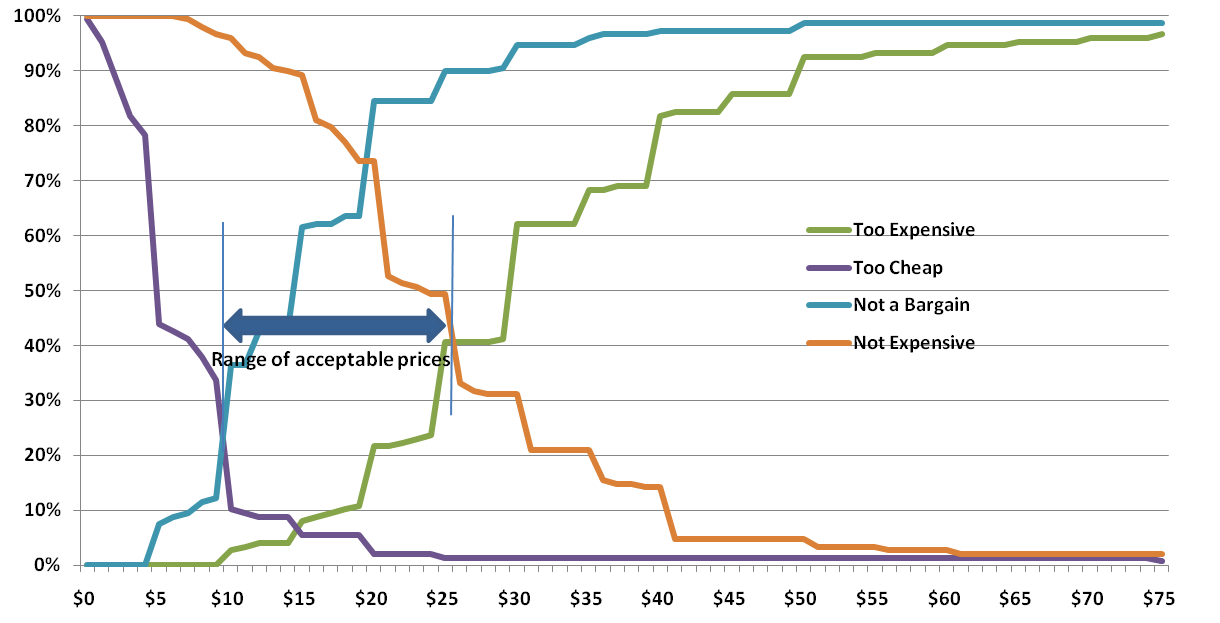
Another technique is the Price Sensitivity Measurement approach. Respondents are asked four questions:
With this system, the optimal price point for a product is the intersection between those consumers who thought it to be too expensive and those who thought it to be too cheap.
While the PSM is still widely used, it is again, almost purely theoretical and demands that the respondent has a good deal of product knowledge.
The system fails to ground the questions in actual buying reality. As noted in the above paragraph, volition is not taken into consideration. Do we know that they actually have any propensity for buying the product at all, at any price? The answer, unfortunately is not really.
A third system is known as Monadic Concept Testing.
This involves an exercise where, according to Ken Roberts of Roberts/Cooper research, “several cells of the same concept are tested among unique groups of respondents, but for each cell the price is different.”
Again, this approach requires product familiarity and still does not approximate an actual buying situation. But how many companies have made critical mistakes over the years because they accepted the results at face value?
The same can be said for ostensibly the most sophisticated of the pricing studies, generally known as the Discrete Choice Exercise.
Conjoint analysis is the statistical tool here and it attempts to approximate the process that consumers go through to make a purchase decision. This approach tackles more than the ideal product price point. Features of the product. the brand, and the price are presented.
While Discrete Choice attempts a multivariate look at the factors in the decision process, and supposedly allows for the construction of a pricing and sales mode that allows for elasticity (I love that word).
Again I find the actual behavioral component to be missing. This does not mean that these tests are without validity. Indeed they have been around for years and have doubtless contributed much information.
But think how much more effective they could have been had they allowed for an environment in which attitudes could truly be traced to purchase behaviors.
The irony here is that, in the apex of the digital age, A/B testing has not been championed by more market researchers who are interested in price testing.
The element that’s missing in all of the above techniques: measuring propensity to actually buy at a certain price, can be fairly simply analyzed with an effective A/B design. The key word here is ‘behavior’ and A/B test designs provide accurate depictions of web traffic and buying behaviors.
Suppose you’ve used one or more of the above methodologies to arrive at a desired price point.
A/B testing allows you to start with the same price and two different sales descriptions or propositions. Then see which one triggers more sales. These sales results, when conducted under the proper testing environments cannot be equivocated. You’ll know which copy descriptions drove sales and which prices were most attractive. The research scenarios here for every other level of the sales and marketing/branding processed are virtually limitless.
You can use A/B testing to approximate the Price Sensitivity Measurement mentioned above by offering similar products at different price points and then tracking the actual sales. For web retailers, the key is actual revenue gained from the optimal price point, and not necessarily conversions.
You have demonstrable behaviors that can be easily measured. There’s nothing theoretical here. Volition is readily identifiable by tracking the results of your A and B sites. The beauty of A/B tests is that they also lend themselves to post hoc statistical analysis based not on the presumption of behavior, but on ACTUAL behavior.
In addition to A/B testing, pricing strategies can be configured to actual buying behavior by companies like Reality Mine.
This British research firm focuses on cell phone use and all the web visits and buying behaviors that occur on each phone. A sample of 100 randomly selected users can speak volumes about pricing, brand awareness, and buying behaviors. A/B testing can be utilized with this real world methodology as well.
A.C. Nielsen has also continued to evolve from the company that used to put a “storage instantaneous audimeter” on top of people’s TV’s to measure viewing to a company using sophisticated devices about the size of a small cell phone to measure a multitude of buying behaviors.
All of these techniques had their roots in the early days of single source research which began with the introductions of electronic scanners at grocery stores.
It seems a trifle self-serving that, possessing the digital testing modalities that exist today, we would continue to champion techniques that cannot define that Darwinian moment [if you will] where the missing link between pricing perceptions and actual buying behaviors can be substantively, and finally defined. Well, the future is here and marketers and researchers must embrace it.
All business have to think about pricing strategy – if they want to make money. To make more money, having some form of customer data to optimize pricing is crucial.
While a variety of consumer research methodologies exist, and can be helpful, volition interferes with their accuracy. Unless you can measure actual buying behavior, there will always be a discrepancy between the theory and reality.
Therefore, embrace A/B testing to optimize pricing. This is the realest way to define the optimal price point.

Ever wondered what people mean when they say you should eat more superfoods?
You're not alone. As it turns out, there's no legal or medical definition for what counts as a "superfood." Nutritionists and public-health experts rarely use the term.
But that doesn't mean it's completely bogus. In fact, there is some scientific basis for calling a food "super."
According to the CDC, which published a ranking of what it called "powerhouse" foods in 2014, these types of fruits and veggies pack a lot of key nutrients into each calorie and are linked with a reduced risk of chronic disease. Studies also suggest that people who eat more of them tend to be thinner and live longer than those who rarely or never eat them.
Here are the CDC's top 25, along with how they came up with their definition of "powerhouse" food:
READ MORE: 17 'healthy habits' you're better off giving up
SEE ALSO: An exercise scientist reveals the fastest, most significant way to lose weight with minimal effort

The author of the CDC's "powerhouse" ranking, sociologist and public-health expert Jennifer Di Noia, ranked the selections based on nutrient density, or how much good stuff (vitamins, fiber, protein, etc.) gets packed into each bite of a particular food.
Cabbage and its cousin Chinese cabbage (which ranked even higher at No. 2) made the cut because they're good sources of calcium, iron, fiber, folate, and vitamins, and they're both very low in calories — 22 for a cup of the regular variety served raw and 9 for a cup of the Chinese variety served raw.

When looking at nutrient density, Di Noia focused on 17 nutrients, including:
Cauliflower made the cut because it's rich in fiber and folate, vitamins B6, C, K, and potassium. A cup of chopped, raw cauliflower has just 27 calories, 3 grams of fiber, and 2 grams of protein. Toss some in your next curry.

To make the cut, each food on Di Noia's list had to provide 10% or more of the daily value of those key nutrients. Lower-calorie foods got higher scores, as did foods with more "bioavailable" nutrients, or those that could be readily absorbed by the body.
Kohlrabi — aka that cream-colored veggie you've never heard of — is high in fiber, folate, vitamins C and B6, and potassium. A cup of it raw packs just 37 calories but a whopping 5 grams of fiber. Try it baked.
They call me the call blitz queen. More accurately, some of my clients call me the call blitz queen. My husband calls me Honey, and my friends call me Samantha, or occasionally Mantha. But I digress! Call Blitz Queen is a crown I wear proudly.
A call blitz is a focused full day of calling on prospects and/or customers as part of a sales program. It has a specific offer, targeted list and short-term goal(s). It differs from any other day in a call center/sales office by its intensity and focus.
Why do a call blitz? There is a lot of science to selling. But there is just as much emotion. Call blitz campaigns are about stirring up emotion, taking an ordinary week and making it extraordinary. It should be viewed as a momentum trigger.
Sales people are human beings which means they are motivated by games. In order to create intensity you need to create incentives that are tangible and achievable on the same day. For complex products perhaps you measure new names added to the database, client referrals you secured, demonstrations booked, or quotes distributed. Make sure your prizes are visually in front of the team, and there are multiple ways to win throughout the day. If you only have one or two “master” prizes energy will ebb and flow throughout the day. Set first, most, best and team goals with prizes that scale in value accordingly. And don’t forget – money is always appreciated, but not a good call blitz incentive. Instead give out tickets to a big game, look for unusual experiences like a luxury car rental or gift certificate to a hot restaurant. Good sales people can buy what they want but they love the thrill of the hunt.
It’s not enough for your sales team to have a good reason (aka prizes) for achieving above normal goals. You must give them an offer that clients will find compelling. Special pricing, new product introductions and bundles work well.
You can build the most effective offer and put great prizes in front of sales and still fail. Call blitz campaigns only work when you have a targeted, warm list of prospects to call.
A call blitz day should not feel like any other day. Shake up teams, set out lunch and breakfast spreads, bring in an afternoon ice cream treat! Skip the bagels and pizza and focus on high protein/energy foods that are going to boost energy. Visually track performance and make some noise. One client even had everyone dress up – Halloween in May, why not?
Individual incentives drive activity, but you also want to evoke teamwork. Give both team and individual prizes to keep the energy high and the spirit of cooperation in full swing. Eat breakfast and lunch together. Kick off with a bang in the morning. And re-energize post-lunch with a surprise contest or two.
Just like any good performance you need a facilitator to keep energy up, congratulate the success and coax non-performers to play the game. It’s most effective if the facilitator is not the sales manager. While they play a role, call blitz efforts work best when the reps feel pressure to perform above normal.
 Alert: Pitfalls Ahead
Call blitz campaigns can be incredibly effective, but there are common mistakes you must avoid to optimize their value:
1. There is too much of a good thing – Call blitz campaigns work because of their intensity and focus. They are great ways to kick off momentum around a new theme or offer. The biggest mistake organizations make is hosting call blitz’s too frequently. While there is no magic number of days required between call blitzes I generally find 8-10 week breaks are optimal.
2. Go big or go home – If you don’t have all six ingredients for your call blitz don’t do one. The worst thing you can do is get everybody jazzed for a momentum trigger than it feel like any other day. Call blitz are emotional stimulants you must hit all the hot spots to be effective.
3. Avoid setting the wrong goals – Call blitz campaigns work when you set aggressive but achievable goals. If no one believes they can meet the goals no one will try. Another common mistake is setting long-term goals as a way to measure and reward participants. Without instant gratification, call blitz efforts fall flat.
Happy calling to you and your sales development team!
 The economy seems under intense pressure at the beginning of 2016. In the first two weeks alone, Canadian stock markets were down over seven per cent, the dollar fell from over US72 cents to under 69 cents, oil prices fell from about $37/barrel to less than $30. In response, the government is “actively considering” speeding up planned infrastructure and other spending to “stimulate” Canada’s economy today. Some are even calling on the government to do more than speed up such spending, but to increase it—dramatically.
Does this make any sense? In a recent Maclean’s piece, Keven Milligan outlined several important considerations we should take into account before embarking on such a plan. If you haven’t read it yet, you should.
Building on his piece, let’s take a step back and ask some deeper questions. Does government spending boost the economy? If so, by how much? Will it create jobs? If so, how many and at what cost? How can we even know? Recent researchers have made important progress in answering these questions.
Estimating the effect of spending is very difficult. Here’s why.
Government spending and GDP are closely and positively related. When government spending grows, so too does GDP. Let’s look at the last 20 years.

Both GDP and infrastructure spending grew together prior to the financial crisis. Then, when GDP suddenly fell, infrastructure spending (after a short lag) jumped up—because the previous federal government introduced a big “stimulus” package in response. Soon after, the economy turned around and began to grow.
Does such a strong positive correlation mean infrastructure spending boosts the economy? Not at all. Perhaps government spending responds to the economy and not the other way around. Perhaps both respond to something else out there but aren’t related to each other. Perhaps it’s a fluke.
To see this more clearly, consider that years in which U.S. cheese consumption rise are also years in which more people die by becoming entangled in their bedsheets. Tyler Vigen in his hilarious blog, Spurious Correlations, discovered this relationship and provides an illustration:

Does this mean cheese consumption increases your risk of death by bedsheet tangling? Of course not.
Correlation does not imply causation.
The same is true of government spending and GDP. Government spending may not cause economic growth any more than cheese consumption causes bedsheet deaths. (This doesn’t mean government spending doesn’t affect the economy; but it does mean we need better evidence.)
This presents a serious challenge to researchers. How can we find out what causes what?
What do we know?
Ideally, we would set up a randomized controlled trial. As when we test the efficacy of drugs, we could randomly assign countries to treatment and control groups. In the treatment group, we would increase government spending. In the control group, we would do nothing. Later differences in economic growth between the two groups would tell us something about how government spending affects the economy.
Of course, we can do no such experiment, so we have to rely on situations where government spending changed in a way that’s as good as random. These “natural experiments” are frequently used by clever researchers to tease out the effect of one thing on another.
So what’s a “random” change in government spending?
One idea by University of California at San Diego economist Valerie Ramey is to use news of a military conflict (see her recent paper here; ungated here). Military events are plausibly unrelated to current economic conditions, so we can use it as a source of “random” variation in government spending. She finds that each additional dollar of government spending increases GDP by between 0.6 and 1.1 dollars. This is called the “multiplier.” (She confirms this in more recent work, and also finds the multiplier fairly similar in good times and bad.)
Outside the U.S., World Bank economist Aart Kraay uses variation in World Bank lending across countries and time to identify changes in government spending (the paper; ungated version here). It turns out, fluctuations in World Bank lending can be large, affect government budgets and spending, and is pre-determined and fairly unrelated to current economic conditions. He finds the multiplier is about 0.5, though often it may not be significantly different than zero. So, this suggests one dollar of increased government spending may increase GDP by $0.50.
There are many other papers out there, and this is only a taste to give us a sense of the magnitudes and the empirical approaches. (For a nice review of this literature, see this 2011 review.)
What about Canada?
There are good reasons to suspect Canada has a smaller multiplier than the United States. In particular, we’re a small and open economy with a flexible exchange rate. These characteristics are critical to the effectiveness of government spending. If government spending rises, then the Canadian dollar may appreciate. A more valuable dollar will then tend to lower exports and therefore GDP. The lower net exports, under some conditions, completely offsets the increased government spending.
Indeed, this is confirmed in recent empirical work (ungated version here). The authors find that in countries with a flexible exchange rate (like Canada), the effect of government spending on GDP is roughly zero. On the other hand, this paper by Valerie Ramey and Sarah Zubairy suggests a multiplier in Canada of just under 0.5 in normal times. (Quick aside: some of the data in this paper is pre-Second World War, when Canada had a fixed exchange rate. This may explain the different results.)
Of course, these are just some estimates. The government of Canada has its own preferred numbers. (None of their multipliers are zero, though they aren’t based on well identified empirical estimates. See Table A.1 here. Thanks to Stephen Tapp for showing me the table.)
Let’s turn now to Trudeau’s campaign plan.
Trudeau’s Infrastructure Spending Plan
From the Liberal campaign platform, the plan is to increase “infrastructure” spending by $5.1 billion per year from 2016 to 2018, and by $3.6 billion in the years from 2018 to 2020. I put “infrastructure” in quotations since one-third of this is planned for public transit, one-third for “green” infrastructure, and one-third for “social” infrastructure. It really isn’t clear what those categories mean, but some (most?) of the spending is likely just spending, rather than infrastructure in the sense of increasing the productive capacity of the economy.
In any case, let’s see what effect this spending has on Canada’s economic growth rate.

Even if we generously assume a multiplier of one, the 2016 economic growth rate would increase only marginally to 2.25 per cent from the previous PBO forecast of two per cent. Hardly a meaningful boost to Canada’s economy. Even with this generous multiplier, what would the government need to spend to increase GDP growth by a full one per cent? About $20 billion per year. With a multiplier of 0.5, a full $40 billion per year would be needed. If the multiplier is zero, then no amount of government spending would change GDP.
(Of course, infrastructure affects the economy by increasing the productive capacity of workers and firms. A road improves productivity. Schools increase education levels, which improves productivity. And so on. These all have important medium- and long-run implications for an economy. So think about the results above as the short-run “simulative” effect on GDP, rather than any increase due to higher productivity, which is a separate question.)
What about job creation?
Infrastructure stimulus spending is often sold as “creating jobs.” Does it? If so, how many jobs are we talking about? And how much infrastructure dollars are required per job created?
These are trickier questions. Luckily, there is a fairly tight relationship between economic growth and reductions in the unemployment rate. It’s called “Okun’s Law”. Of course, such a relationship may not be causal, but just for the sake of argument let’s put aside those concerns and assume that economic growth lowers unemployment.
How strong is the relationship? Some recent Bank of Canada research suggests that if output grows by between two per cent and 2.6 per cent the unemployment rate tends to fall by about one percentage point. This is a simplification, but gives us a good back-of-the-envelope way to think about how many jobs we’ll get from infrastructure spending.
So, let’s imagine spending $5.1 billion on additional infrastructure. If the multiplier is one (which, again, is being very generous), GDP will grow by $5.1 billion. As Canada’s economy is about $2 trillion, this represents a 0.25 per cent increase. Taking the “Okun’s Law” results above at face value, the unemployment rate will fall by roughly 0.1 percentage points—which represents about 20,000 workers. So, it would cost $5.1 billion to create 20,000 jobs—or roughly $250,000 per job. That’s huge.
Of course, it all depends on what your assumptions are. If there’s more unemployed workers, then the cost-per-job is lower. If economic growth creates lots of jobs (a low Okun’s Law value), then the cost-per-job is lower. If government spending spurs lots of economic activity (a high multiplier), then the cost-per-job is lower.
Here’s how it all shakes out:

These are massive numbers that suggest infrastructure spending as a job creation strategy just doesn’t make economic sense. If all we care about are the jobs, we’d be better off hiring workers to sit around and do nothing all day. It would cost less. It’s also entirely possible that no jobs are created at all—all new infrastructure jobs might be exactly offset by job losses in other sectors. In this case, jobs shift instead of new ones being created.
The takeaway
There may be important benefits of infrastructure over longer time horizons, through their effect on productivity and the economy’s “potential” GDP. But we shouldn’t overestimate infrastructure’s short-run effects on economic activity. There just isn’t the evidence. We also shouldn’t think that the primary purpose of infrastructure spending is in the jobs that it may or may not create. It’s just far (far) too costly per job created.
Of course, infrastructure projects may be valuable for their own sake. A bridge may be sorely needed in some areas. More buses for a growing city may make sense. More roads may ease congestion (although, not likely). Nothing in the above evidence denies this. If a project can pass a reasonable cost-benefit test, then go for it; if not, then don’t. A bridge is not an economic stimulant—it’s a bridge.
The post The problem with using infrastructure to stimulate the economy appeared first on Macleans.ca.
2016 will be a robust M&A market and there are several already public companies that might be ripe for picking, a new Merrill Lynch analyst note predicts.
The large cash balances of large cap internet companies combined with the suddenly attractive small-cap valuations of others may contribute to an uptick in public companies cannibalizing each other.
Here are the seven companies that Merrill Lynch singled out in its analyst note as M&A targets for 2016.
SEE ALSO: These 20 VC-backed companies had the biggest exits of the last year

Potential acquirers: Google
Reasoning: "Groupon was a target of Google before it went public in 2012, has had recent management changes, and according to press reports some companies may still be interested." Merrill Lynch writes. "However, newly appointed CEO, Rich Williams, was quoted as saying the company has not received any takeover offers."
Stock performance: In January 2014, Groupon traded for more than $11 a share. Two years later, the company is priced at $2.60, a 76 percent decline.

Potential acquirers: Google, Yahoo, or Priceline
Reasoning: "Yelp could be a good fit for Google, Yahoo and even Priceline per press articles. Its large user audience and advertiser base has taken years to build, and could be an interesting asset for companies trying to build a bigger mobile or local presence," Merrill Lynch wrote.
Stock performance: At its high in March 2014, Yelp was trading for $98 a share. Since then, the company has lost nearly three quarters of its value and is listed for $22.15.

Potential acquirers: Yelp or Amazon
Reasoning: "GrubHub could be a fit with local services providers such as Yelp to support their own restaurant delivery businesses. In 2014, Nasdaq reported that Amazon could interested in acquiring GrubHub as a way to accelerate its expansion into new markets. Amazon operates its own local restaurant delivery service in select markets and could look at GrubHub as a way to accelerate its expansion into new markets," Merrill Lynch wrote.
Stock performance: The drop-off for GrubHub didn't come until April 2015. Throughout 2014, GrubHub's stock rose from $34 to around $46 a share at its peak. Since April though, GrubHub has lost half its value and now trades around $21.
While mobile order writing applications are now making it easier for sales reps to have better sales conversations with customers, sales managers are also finding value in using these apps to better manage their teams.
It may not be a sales management app, per se, but sales leaders are leveraging these order writing and order management solutions to give reps access to key information and better monitor sales activity. Let’s take a look at three ways these apps are helping not only reps, but managers:
One of the most important thing for a sales manager to understand is how a rep is spending his or her time with a customer. Is the majority of the sales meeting spent paging through a paper catalog, looking up pricing, and calculating discounts? Or are reps having more strategic conversations with their customers about new products, assortment planning, and merchandising?
By arming reps with order writing applications, sales managers are able to help reps spend less time on transactional activity. They can swipe quickly through an easily navigable, highly visual digital catalog, add products to an order with a few quick taps, and customer-specific pricing is automatically applied. The business of “writing the order” is no longer an arduous task, and managers are able to coach their reps on other conversations that they should be having with customers.
Sales managers can also ensure that their reps have access to key intelligence, like real-time inventory levels and customer order history. With this data, managers can encourage reps to avoid selling out-of-stock items (to prevent backorders) and upsell new items based on a customer’s past orders. In essence, sales managers are ensuring that reps have the information they need to succeed.
A mobile order writing solution can allow managers to assign certain accounts to certain reps according to their sales territory. Sales managers can see how sales are performing by rep and territory, allowing them to develop segmentation strategies and determine the right cadence for customer meetings.
As mentioned in the previous point, sales managers can use order management software to easily access performance reporting for each rep, as well as customer-level reporting (which reps also have access to).
On the customer reporting side, managers can encourage reps to prioritize conversations with customers that have gaps in order volume, identify key performance drivers by account, and determine strategic product recommendations.
On the performance reporting side, managers can see how their teams are tracking against goals, compare rep performance, or see total sales according to date range (a very helpful feature at trade shows).
Questions about sales management or order management applications? Let us know in the comments!
 New research finds two-thirds of millennials plan to leave their current organization by 2020. A quarter see themselves elsewhere within the next year.
While you could argue that young workers have always been inclined to job hop (and millennials are less inclined to do so), their reasons for restlessness may have changed.
Young workers' latest gripe? Insufficient opportunities to develop their leadership skills.
That's according to the fifth annual Global Millennials survey, cited on Bloomberg, for which Deloitte reached out to nearly 7,700 working college-educated professionals in 29 countries.
As many as 63% of respondents said their leadership skills are not being fully developed.
And it seems to be a key reason behind their willingness to leave: While 71% of those likely to leave in the next two years are dissatisfied with how their leadership skills are being developed, that number drops to 54% among those who are planning to stay beyond 2020.
As Punit Renjen, chief executive officer of Deloitte Global, told Bloomberg, young workers' pursuit of leadership skills even at the expense of switching jobs is a new phenomenon.
Perhaps it has something to do with the recent trend of flattening organizations, which was highlighted recently in The Washington Post. In an effort to cut costs, organizations have removed levels of bureaucracy, which means there's not much of a corporate ladder to climb anymore.
"The biggest driver of disengagement is people feeling like they're stuck in a job, and there's nothing for them there," one expert told The Post. "It's easier to quit your company and find a new job than find a new job within your own company."
Restoring some semblance of a corporate ladder may require a good deal of structural reorganization. In the meantime, managers can take small steps to help their employees develop into leadership positions.
The Wall Street Journal recommends creating mentoring programs in which workers are paired with more senior employees at their company. You can also rotate your employees through different jobs, so they gain new knowledge and expertise.
As for individual employees, US News & World Report suggests being proactive instead of waiting for a leadership position to open up.
If you work for a large company, you can speak to someone in human resources and ask what you should be learning to reach the next level. You can also volunteer to take charge of a particular project, so that management recognizes your capabilities.

Ranging from finance to pharmaceuticals and aerospace to automotive our clients often present a similar opening challenge to us with each enquiry:
“Our work is very technical and complex to explain so it is important to ensure that we are able to simplify our message and communicate it clearly to someone who has no previous knowledge on….”
We get it, every business is unique.
President Obama is one of my personal favourite speakers. I would go as far as to suggest he is one of the most gifted orators in the world today and puts everything into perspective for us. The leader of one of the most powerful nations on earth arguably has the most onerous job on the planet when it comes to complexity yet he knows exactly how to simplify his message.
Addressing millions of people in his State of the Union Speech last week speaking about the economy, criminal justice, education, energy and climate change amongst a whole host of other complex topics has to be one of the most difficult speeches anyone has to make.
However technical you believe your next presentation may be here are eight potent lessons we can take from President Obama’s 2016 State of The Union Address:
1. Authenticity
Whether you agree with his political views or not it’s quite easy to see that each time Obama speaks you hear a passionate leader show how much he cares about his country. Whilst he may have given a politician’s speech he spoke in a manner that anyone could understand regardless of their interest in politics or depth of knowledge on any of the topics he covered.
Authenticity isn’t something you rehearse, it’s an intention.
It’s where you commit to being open as though you are having a conversation with people you like and trust so that you connect with them. It isn’t something you can teach, it’s a promise to be who we really are rather than who we think our audience wants us to be.
2. Humility
It’s quite rare to hear any speaker mention their own failures let alone a president of one of the most powerful nations on earth. It takes a high degree of emotional intelligence, courage and humility:
“That’s one of the few regrets of my presidency, that our politics have become even more filled with rancor, that we are further divided than when I came to office.”
When it comes to public speaking and presenting one of the greatest gifts you can give your audience is to show them you are just like them, fallible. It’s easy to sense humility in a speaker because they put their focus entirely on their audience and not themselves.
They don’t talk themselves up because they know that no one in the audience is expecting perfection from them. They know that they have the platform to add value and make a difference not to impress.
3. Storytelling
Presenting is never simply about sharing the facts after all you can do that just as easily in a document or an email. It’s about sharing the story behind the facts and the relevance to your message. The key distinction between the spoken and written word is the emotional connection.
This was a story of optimism told through moments of drama, conflict, hope and vision.
Every great presentation is a story which takes us on a journey of exploration and fulfilment.
Storytelling is one of a speaker’s greatest tools because it stimulates a sense of curiosity, anticipation and change and can make your audience care.
4. Rule Breaking
All good presenters are familiar with ‘the rule of three’ which simply stated suggests that people are more likely to remember three things. President Obama often uses the technique himself but this time his story revolved around four important points.
Whilst three is good, as you will see from the video it’s not really the number that’s important but the objective and intention:
“So let’s talk about the future, and four big questions that I believe we as a country have to answer — regardless of who the next President is, or who controls the next Congress.”
Many people fear speaking in public because it conjures up an image of conformity; sticking to the rules of what a great speaker does. There simply are no rules when it comes to presenting and speaking in public as it is about authenticity, passion and the courage to do whatever it takes to connect with your audience.
It’s not about being polished and perfect.
5. Structure
It’s naïve to believe that you can craft and deliver a powerful presentation without a mindfully robust and relevant structure. Passion alone isn’t enough when it comes to presenting with impact.
The richness of your content and the way it is structured is of critical importance.
In this speech President Obama’s roadmap looks like this:
Change
Jobs
The economy
The world
Change
The Future
Having a clear and simple structure to your presentation allows:
– Your audience to easily follow you to absorb and remember your message.
– You to be better prepared and less stressed.
– You to establish a clear purpose for your talk and your audience to focus on that purpose.
6. Quotes
One of the many exciting things about being alive today is that we are surrounded by a history of thousands of years of wisdom, accomplishment and brilliance. When we are trying to connect with and influence others its arrogant to think we have all of the answers.
As a speaker you can enhance your own credibility considerably by quoting the experience and achievements of others. President Obama does this several times in a very thought provoking way:
“We did not, in the words of Lincoln, adhere to the ‘dogmas of the quiet past.’ Instead we thought anew, and acted anew.”
A relevant quote which adds credibility to your point can be extremely powerful. It can reinforce your point, demonstrate your level of knowledge and preparation and most importantly help to make your presentation more memorable.
7. Pace
A great number of presentations feel rushed, almost as though the speaker has something to say and can’t wait to get it over with.
In my view Obama is the master of pace and pause.
His mindful delivery of his message is seamless in that you don’t feel as though he is presenting or lecturing but simply having a conversation.
As you will see his entire speech is delivered at a pace which says he cares about what he is saying and he is thinking about his every word, not reading a script. Pace is one of the most important elements of an effective presentation as if you speak to fast you may lose your audience and speaking to slow may send them to sleep.
The key is variety.
8. Examples
Most presentations are based on sharing facts, data and information designed to influence and inspire change which is never enough on its own. A great way to bring your presentation to life and clarify your message is by giving your audience real examples that they can understand and relate to.
This is another of Obama’s rhetorical skills as you can see in his State of the Union speech:
“‘We’re in the middle of the longest streak of private sector job creation in history. More than 14 million new jobs, the strongest two years of job growth since the ‘90s, an unemployment rate cut in half. Our auto industry just had its best year ever. That’s just part of a manufacturing surge that’s created nearly 900,000 new jobs in the past six years.”
Every business is unique with its own story to tell and regardless of our product or service I’m sure we can agree that leading a nation must rank amongst the most technical and complex.
Whether you are speaking about quantum physics, anatomy or thermodynamics your presentation really is only as complex as you choose to make it.
Watch the video here:
Image: Courtesy of flickr.com

Report after report and study after study suggests that email is the most effective digital marketing tool.
So if you’re not seeing much of a benefit from your email marketing program, you’ve gotta wonder why.
Maybe the reason people aren’t responding to your emails is because they aren’t even opening them in the first place. Obviously, that’s a problem. A low open rate means your email marketing strategy is dead in the water.
Your open rate is even more significant than your total subscriber number. Think about it this way: Having 1,000 subscribers who all open your emails means much more exposure for your brand than having 6,000 subscribers but only a 2 percent open rate.
No question: You’ve got to get your emails opened. And the best way to do that is to tweak your subject lines—but how?
Tip #1: Make your subject lines longer.
Both the conventional wisdom and the natural instinct is to make your subject lines short and snappy. We’ve offered that very advice in the past. But one new study suggests that maybe longer—like, 60-70 characters, if not more—is the way to go.
Perhaps the rationale is simply this: When you’re working with just a couple of words, it’s hard to offer more than salesy platitudes and generalities. But if you give yourself more space, you can actually convey value and specificity to your readers.
So maybe it’s worth trying long subject lines for a while, just to see how they work.
Tip #2: Write in all lower case letters.
All caps screams of desperation, and can be pretty annoying. Mixing upper and lower case—you know, like you would in normal, everyday writing—is fine. But consider: a lot of the emails you get from your friends and family members probably come with all lower case subject lines.
Writing an all lower case subject line can convey intimacy and familiarity, then—and that’s not such a bad thing for your brand!
Tip #3: Provide value—but don’t give everything away.
As for the actual content of your subject lines, something we recommend is focusing on the value you offer—the benefits your email will provide—without getting into the specifics.
Show your readers what’s in it for them to open your email, but not necessarily how they’ll get it.
Example: Try a subject line that promises something like this: “Drive traffic to your website… and turn it into paying customers!”
You’re showing your readers exactly what they stand to gain from reading the email—but to learn how they’re going to gain it…through SEO, email marketing, or whatever else…they’ve got to open the email and read it.
Try some of these tips in your own email marketing—and see how your open rates improve.
 Recent years have seen a tremendous disruption in how customers buy. And if buyers change how they buy – salespeople need to change how they sell.
Customers want fresh ideas and creative insights for addressing a set of needs and opportunities that are both new and challenging. They expect sales reps to be knowledgeable about their industry, company, and issues at a higher level of proficiency than ever before. They expect insights not product pitches. They want trusted advisors not product facilitators.
This buyer expectation requires that the sale rep have the information and skill sets to have compelling strategic business conversations.
Performance development challenge. Developing the capacity to have strategic business conservations is a significant skill development challenge. Most sales reps will not, on their own, make the shift from conducting product-centric sales interactions to conducting strategic business discussions. There is no simple set of tips and tricks for helping reps make this transition. A behavior change integrating a set of best practices is required. With that thought in mind, the sales training initiative should be viewed as a process not a single event.
Sales training design. Although the specifics will vary depending on the unique needs of each company attempting to meet this challenge, it is possible to describe an initial training design.
Last, if results are to be optimized the sales leadership needs to come to the party. Everyone from the sales leadership team needs to be committed to the idea that “behavior change requires a process not a single event.” Plus coming to the party also requires coming to the key events in the training. Attending the training provides the leadership an excellent opportunity to diagnose the additional actions required to achieve excellence.
Buyers today are informed, digitally savvy and squarely in the driver’s seat in terms of how and when they want to talk to sales. As we illustrated in The Death of the Sales Funnel Infographic, the game has changed. If sellers want to remain in the running, they need to adjust their approach to the new customer-driven rules of engagement.
The reality is that sales people will have less time with customers, and in turn, will need to maximize quality sales engagements. According to Forrester Research, one million sales jobs will be obsolete by 2020. Forrester indicates that the only expanding sales role is the “Sales Consultant”— those that are most capable of relationship and solution selling—integrating themselves most effectively into the buyer’s business and helping with problem solving. But it’s not just the old tried and true solution seller we are talking about—this is a new breed of digitally savvy sellers who can tap into the pulse of how and where their customers want to engage. Organizations need to begin evaluating their sales teams now to identify who has the skills today and ultimately who is capable of this change.
Here are a few sales characteristics that will be necessary for this new sales role:
In a recent Forrester Research report, “A Guide to Hiring More Effective Sales People,” Mary Shea outlines actions organizations must take to select their ideal sellers. Once organizations identify the sales reps that possess these capabilities, they will then need to revise their sales enablement strategy and implement changes to make this transition.
As organizations look toward the future, they will need to consider:
The shift isn’t about to happen—it’s already happened. Successful sales organizations have already started to take stock and ensure they have digitally savvy frontline sellers who can keep up with today’s digitally savvy and informed buyers. Organizations that fail to see this will find themselves stuck selling like its 2012.
Working on sales planning? Download Building a World-Class Sales Team to learn how to increase your sales team effectiveness.
Originally published on Lenati.com
Want to improve on your overall conversion rates, then boosting your mobile rates could go a long way to doing so. Mobile is huge and if you increase conversions there, you do so for a large part of your business. So, here are some tips on how to do so.

Site Development
Build your site properly. Optimize it to align with your user intent and objective. If you intend to sell via your website and your viewers intend to buy, simplify the process for them.
Users should be able to reach any part of your site with two clicks or less. Make sure the search box is noticeable. Make check out simple by offering multiple options for payment, particularly because over 1/3 of U.S. based shoppers use PayPal.
Specific Mobile Features
Create your site with specific features in mind. Take advantage of all mobile phone features. Videos featuring products inform buyers and make them feel confident about buying decisions. Using a click-to-call button can boost comfort levels and increase revenue. Implement smartphone GPS to estimate the cost of shipping and time of delivery. Consistency online and instore is also important. Ensuring you have a POS system that works as well with your barcode scanners and receipt printers as it does with your online store for order fulfilment is just one of the factors that’s pivotal if you wish to grow your retail business through mobile and also offline.
QR Codes
Consider using barcode QR-code readers to help increase sales numbers. The mobile site for eBay allows users to view classified ads depending on their location. Use some creativity.
Beacons
 There are a number of ways that you can link mobile to your POS systems for greater conversions. The iBeacon for example allows businesses to connect mobile devices in the shop with things like social media and even the point of sale system, for greater conversions. This blog post on conversion with iBeacon is interesting.
Email for Attention
E-mail is effective. It allows you to capture attention and convert sales numerous times. Make sure your e-mail capture form is simple, quick and user-friendly. Use large fields throughout the form to make inputting information simple. Make sure the buttons on touch screens are sufficient in size to make them easy to use.
Button Size
Use a button size of 40 pixels or more for best results. Get rid of typing fields if possible by offering answers through a drop-down menu.
Local SEO
Keep local business in mind. Google and Nielsen offer research that shows nearly 70 percent of mobile shoppers want to visit businesses that are within five miles of where they are currently located. According to Search Engine Watch up to 80% of local searches convert.
Mobile Apps
Use this to your advantage and boost conversations through the use of store and product locators on mobile sites. Also, use text messages and other notifications via your mobile app. You can also offer coupons for in-store and online shopping. Mobile searches typically equate to local searches.
Get Personal
Make your messages personal. Use mobile devices to send unique messages to the consumers in your database. You can use these message to promote new products, extend special offers, up-sell, and cross-sell, and provide rewards for loyal shoppers, and so on.
Content Creation – Know When is Enough
Do just enough. This piece from CMI suggests that too much content takes away from your main message. Review your content on a computer to focus it more. Get rid of any excessive links and other things that make your page look “busy” or overbearing. Make it user-friendly.
Clicks
Keep in mind that less is more. Reduce your content and number of clicks for users to reach destinations on your site. When your bounce rates decrease, your conversions increase.
Promote sharing
Social media is great for sharing images and videos and drawing in more customers. Offer buttons for social sharing on your site so that viewers can easily share content, but make sure the buttons are appropriately placed and user-friendly.
All of these tips help improve mobile conversion rates and will aid your business in being more successful.
 Every small business journey begins with an idea, some hard work and the dream of what might be achieved. As entrepreneurs and small business owners, you’ve worked diligently to realize the success you’ve attained since your journey began. From the very first step, you’ve refined your products and honed your services to make them perfect for prospective customers.
But there’s more to lead generation than simply developing a great product. You’ll need a strong offering, of course, but more often than not the deciding factor when making a sale comes down to one factor: timing. Knowing when to reach out to a customer matters. And, just as you once learned how to time traversing a traffic light, you must also learn the more nuanced rules of how to approach timing with your lead generation. Let’s take a look at how to move from the red light to the green light of increasing traffic for your business.
Red Light: Stop and think
Before you jump into marketing strategies and sales pitches, stop and ask yourself, “Has this customer bought from me recently?” A solid tool or strategy for effective contact management is going to be your secret weapon to reviewing crucial customer information, and nearly 30 percent of marketers use a software like this to generate their leads. It will allow you to record and keep track of information on new customers or those loyalists who have returned to your business or maintained their relationship with you. The management system will also save valuable time by organizing all of your important customer data and sending you reminders about when to review the relationship and make a move. Pausing to categorize and arrange your contact information is the first step to knowing the right moment to approach a customer and secure a lead.
Yellow Light: Pick up the pace
After you’ve taken the time to stop and review the level of interaction the prospective customer has had with your company in the past, you can take things a step further by determining which specific products they have purchased or what services might benefit them the most—and when they might need them. Take the time to analyze key factors like seasonal needs or upsells. Perhaps they purchased equipment that can be paired with another item in your inventory, or it’s nearing time for a service update. You can make insightful decisions based on this kind of anticipatory service. You’ll want to compare past and present behavior in order to predict the future of your relationships. This is when you’ll be able to start picking up the pace by developing actionable strategies based on the information you’ve evaluated.
Green Light: Take action
Once you know if you are dealing with a new customer or an existing customer and you have identified what they are looking for, you will be ready to take action. You have the necessary information about what the customer has purchased from you, now build on that relationship by reaching out in a way that will give you the best chance to connect with that customer. When asked what their most effective lead generation channel is, 42 percent of businesses named email. However, some customers prefer to be reached by phone. Others prefer to be contacted through social media and still there are those who appreciate good old-fashioned face-to-face interaction. Take the time to monitor and understand which method of communication leads to the best conversion results for your company, both in general and specifically as it pertains to current and prospective customers. Pay special attention to what frequency of outreach yields the best results as well. Doing so will pay dividends over time.
You are now on your way to increasing your number of actionable leads. Getting a product or a service in front of the customer at just the right time will significantly increase the interest you receive and improve your opportunity for success. Following this process is going to help you reach your customers on a personal level because you will know who they are, what they are looking for and the best way to connect with them. It can be challenging for entrepreneurs and small businesses to compete with larger players for customers, but making the effort to understand your customer and the timing of how to move through the process of lead generation can make a world of difference.

All organizations are looking for an edge up on the competition, often through creative and value-added marketing efforts that increase sales leads. You may have heard of a term coined “Sales Enablement” which continues to be brought up amongst most organizations and groups to help further sales and marketing efforts. But do you know what can sales enablement do for you business? If not, keep reading!
Let’s look at some of the key basics of sales enablement and see how they can benefit a business in the long run:
The term sales enablement can trace its roots back to the late 90s and still carries a bit of buzz to it when you talk with most businesses. From a joint study by HubSpot and Demand Metric, 380 qualified study participants were asked to define sales enablement by picking from a list of nine potential answers.
Top Choices from Participants % of Top Choices from Participants Develops Strategy 61% Creates Materials and Assets 50% Systems and Support 43% Sales Training 42% Performs Analysis 41% Integrates New Channels 36% Find Cross-Selling Opportunities 36% Coaching Members 35% On-Boarding New Sales Staff 26% Demand Metric and HubSpot Joint Study 2013
Well – most people didn’t know how to define it! You can clearly see that in the variety of answers above. So what is the correct definition?
sales enablement (noun) / ‘sal en`a´ble`ment – The act of developing approaches and processes behind your sales and marketing teams and initiatives that help drive more sales.
Sales enablement happens when an organization finds additional ways to allocate its operations to better increase revenue – especially with respect to the coordination of marketing and sales teams. Most of these processes involve content generation, new integration training and systems implementation – along with a new strategic focus for the business.
From our earlier HubSpot/Demand Metric study, businesses with an effective sales enablement function that were very strategic tended to see more moderate to high results with their efforts. With primarily organizational businesses, the efforts tended to be low to none at all.
So how effective can sales enablement functions be once you’ve begun to move forward? In organizations with a sales enablement function, 75% report that it makes a moderate or significant contribution – as long as it’s clearly defined and actionable within an organization.
Now that we know the what and why to sales enablement functions and strategy, we need to understand the where do I begin and how to get started.
Your teams are already working on key objectives for your organization, so how are you able to effectively allocate time and resources to your sales enablement strategy? For the best results, having a dedicated headcount (and budget) is critical to helping bring the strategy full-circle to everyone involved.
When looking to move forward with a sales enablement strategy, take a pause and look at your current marketing and sales teams. Are they in alignment with one another and are they both aiming towards the same business goals?
Here are a couple of inventory tips to getting you started:
Now that we have a basic understanding to sales enablement principles and functions, let’s walk through some of the basic steps you will need to take to begin putting together an effective sales enablement strategy and solution for your organization.
When looking at Sales Enablement (and with most launches of new initiatives), there needs to be a gradual approach to success. Trying to implement a sales enablement solution with a one-time initiative will never work and will most certainly fall to the wayside after a couple of weeks. Condense your efforts into multiple steps for an increased success rate and to keep it constantly on the minds of your sales and marketing teams.
HighSpot has put together a 5 stages maturity model that is a great place to start and see where you currently measure up and where you need to improve in order to succeed.
Stage Company Focus Sales Team Focus Ad Hoc
Whole focus on customer acquisition. Minimal planning and structure, frequent fire-fighting Rep efficiency and effectiveness is low
Reactive
Content scattered across many systems and poorly managed. Customer engagement is uneven Reps waste time they should be using to sell. Onboarding is slow, turnover is high and attainment is low
Managed
Content is organized and up to date. Reps have defined onboarding and training process Attainment improved, onboarding is faster, more time is spent selling
Data-Driven
Closed-loop used to measure content and training effectiveness Attainment, onboarding time, deal conversion and deal velocity exceed industry norms
Optimized
Closed-loop used to measure content and training effectiveness Industry-leading results for attainment, onboarding time, deal conversion and deal velocity
In order for your business to have continued success, there needs to be a constant reminder of the landscape around you and the need to adapt to please current and future customers. By doing so, this will help move your organization forward, better align your teams and increase revenue for many years to come.
What other methods have you seen work in your sales enablement strategy?
Sales is all about hitting the number, but sometimes, those numbers can be a little misleading.
As a sales leader, you have to be able to understand your business at multiple levels by analyzing the data and assessing sales metrics. You need to forecast for next quarter, analyze the pipeline, and keep track of deals closed. It’s a lot of metrics to balance, and it’s easy to miss out on.
Any data analyst will tell you that it’s possible to frame graphs and charts to tell you anything. Many sales charts are often misinterpreted or misunderstood, to the serious detriment of your business. You can’t always take data at face value.
Unfortunately, there is a serious cost to misinterpreting the data. Say you extract the sales data, create a report in Excel, and then analyze the report. If you misunderstand it, or find out it’s completely wrong, you’ve wasted hours of time. Even worse, you could guide your company in the wrong direction. Quickly and correctly interpreting information could be the difference between success and failure for your business.
Here are the most common mistakes sales leaders make when analyzing performance metrics, and how you can avoid these missteps yourself.

Many smart business people think that if bookings steadily increased over the past year, your business is on the right track. It looks great to see a chart go up and to the right, indicating revenue growth. However, if you only look at bookings, you could be masking larger, systemic problems in your business.
The three core metrics that drive bookings are:
Those three metrics multiplied equal the total bookings number. However, you can’t just assume all three metrics are rising along with bookings. For example, you might see bookings are going up, pipeline is going up, but your win rate is actually decreasing. How is that possible? In this case, your ASP is probably going up and compensating for the drop in win rate. Although your team is closing more business, it’s actually because you’re booking larger deals, but winning fewer deals in total.
This change in win rate and ASP isn’t necessarily a problem in the short run. But in the long run, is your business able to handle significantly larger deals? If your business is only used to closing $100K deals and suddenly closes a huge, $1 million deal, can your team effectively support a customer of that size? For a SaaS company specifically, it might look great that bookings are through the roof, but that huge account could churn the next day. Then you’ll have to explain a sudden dropoff in bookings in the next month to your board of directors.
If you’re only reviewing the total bookings over time, you’re probably missing out on the bigger picture behind what’s driving that number. Though it may seem harmless, misinterpreting this specific metric could lead to huge problems for your business down the line.

Another commonly misunderstood metric is average bookings per sales rep. You might run the numbers and find sales reps on your team are booking an average of $50K by their third month on the job. This is a solid number, and you are thrilled to see your reps are performing at a high level, that you have a great sales team, and you’ve got it all figured out. However, in data, averages can be incredibly misleading.
For example, if you separate the reps by those selling to SMBs vs. midmarket, the midmarket team generally pulls up the overall ASP. In contrast, the SMB team may be struggling. Without analyzing that data separately, you don’t really understand what’s going on within your sales team. The average doesn’t tell you much about the deals your team is really closing.
Looking at the unreliable total bookings number again, you may not be seeing the full picture by just analyzing pipeline, win rate and ASP. What happens if you separate upsell and new business? For example, you could have solid revenue growth, but notice that 60% of your revenue is from upsells. This means you’re not actually growing your business and gaining new customers. If you’re a company in growth mode, this isn’t a good sign at all. In fact, it might be time for a serious sales intervention.

Though technically a marketing chart, not a sales chart, the measurement of new leads is incredibly important to sales, and very often isn’t telling you the whole picture. For example, your marketing team could appear to be doing a fantastic job — overachieving goals and generating tons of new leads. But what is the sales team saying about those leads? If you’re constantly hearing sales reps complaining about the leads being terrible quality, you could have a problem.
You might realize that marketing is generating a lot of leads at the top of the funnel, but those leads may be very low converting. Instead of measuring by quantity alone, you should also measure by quality. One way to measure this is by using lead scoring to separate the best leads from the worst. Then, set new goals for marketing that incentivizes quality over quantity, and better aligns both sales and marketing.

For a SaaS company, Monthly Recurring Revenue is one of the most important metrics. It shows the growth of your sales, upsells, and the recurring payments from happy customers. However, MRR is nothing if you don’t also take churn into account. If your churn rate is too high, it doesn’t matter if bookings are growing, upsells are growing, and MRR is skyrocketing. Churn can slowly but surely eat away at your entire business, and is a leading indicator of trouble.
Instead of focusing just on MRR, look at MRR Inflow and Outflow instead. For even more detail, you can calculate the Quick Ratio, which includes all of that data in one number.
Don’t be complacent, thinking that you’re analyzing the right sales metrics each month. If you’re allowing your team to be misled by sales charts, your business could be in trouble. Because of this risk, InsightSquared invested in our new, clear, and easy-to-understand user interface: BlueSky.
InsightSquared BlueSky is a streamlined product interface with faster navigation, bigger charts and reports, and consolidated date and filtering options, making finding answers and understanding reports easier than ever.
On top of a more seamless navigation, there are detailed report explanations to make sure you never fall victim to misinterpretation again. The right sidebar contains an overview of each chart, as well as some commonly asked questions. This information will help you correctly understand your data, reduce confusion when diving down into the details of each report, and make these charts even more shareable with added context.
Now you can understand every sales chart, and renew your focus on your business.

During our ‘Growing your digital marketing agency: solving the measurement puzzle’ webinar we conducted a poll, asking which digital marketing activity our viewers (agencies and consultants) found the hardest to measure. The results were as follows:

According to the results of this poll, content marketing and social media are the top activities agencies and consultants find most difficult to evaluate. We asked our webinar speakers for their opinion on these results. Sean Clark offered guidance for those who endeavour to measure the impact of content on their website:
“You should have it categorised so you can easily identify it — and then you can easily, segment it within your analytics. You can look at page value, time on site and, depending what your objective is, leads, click-through or bounce rate.”
For off-site content promoted via social media, however, Sean acknowledged there are still challenges: “I think a lot of agencies are scared to measure stuff like that, because it takes a long time for it to take hold and to get any returns. I think part of that is being unsure if you really want to show the client they’re not getting any sales off their content.”
Tamara Baranova was more positive about measuring the effectiveness of social media content, she suggested:
“Hootsuite is one of those tools that provides reporting across several social media platforms, so it’s easy to see how your social media content is improving your results”.
While there is an abundance of digital marketing tools available online, during the course of our webinar we asked our panellists to tells us their preferred tools. Here’s what they recommended:
Research: Facebook Audience Insights and MOZ
SEO: MOZ (also good for competitive analysis)
Website: Google Analytics, AdWords and Search Console (formerly Webmaster Tools)
Social media analytics: Social network’s own analytics/ insights packages, Hootsuite, or Socialbakers
Social media monitoring: Brandwatch, Engagor, or Sysomos
Influencer marketing: Traackr, PeerIndex
Email: Constant Contact
Reporting: Raven Tools
What was abundantly clear from our webinar discussion and audience feedback is that measurement remains a tricky subject for marketing agencies and consultants.
Whether this is down to the sheer scale of the challenge, with scores of shifting, overlapping metrics available to us, the difficulty of meeting inflated client expectations, or a simple lack of analytical skills within the marketing profession, the importance of rising to this challenge is hard to overstate. If you can’t evaluate your client’s investment in digital marketing, at best you are doing them a grave disservice, at worst you may be negligent.
When you first take on a client you will need to make the business case for digital marketing. This is likely to involve demonstrating what good looks like, setting realistic expectations, explaining when ROI is (and isn’t) measurable and identifying a set of relevant metrics, based on the desired outcomes.
One of the most powerful take-aways from our webinar was the need for client education. Agencies and marketing consultant should always be seeking opportunities to coach their clients about measurement.
By involving the client in the process of measurement, rather than simply sending them a monthly report, you will be helping them to develop a more sophisticated, better informed marketing strategy. This will enable you to deliver stronger results and, with luck, help us all collectively dispel the myth that measuring digital marketing is difficult.
This whitepaper is free to download and features expert guidance about how a digital marketing business should approach measurement.

Our sales strategy used to be cold calling, cold emailing, pay-per-click advertising, and basically every other form of annoying people on the planet. Turns out that doesn't work.
Who knew?
After realizing our outdated sales tactics were only turning away potential customers, we experimented with an Inbound Sales process. The result?
After trying the Inbound Sales model, our team closed a $50,000 deal.
We realized if people want more information on your company, they can look it up online. If they want case studies, they can look them up online. If they want reviews of your products or services, they can find them online.
The sales rep is no longer in control. The customer is. And that's where it all begins.
Instead of providing basic information about our company on sales calls (which prospects can find online) or jumping right into a demo, we started diving deep into the challenges, goals, and obstacles of our buyers. Because we've realized something:
If everyone is receiving the same elevator pitch, no one is receiving a customized solution. [Click to Tweet]
As a result, we found the key to Inbound Sales -- customize a solution, based on where the buyer is in their journey.
For example, we are a web design and development agency. So here is the buyer’s journey for a typical customer of ours:
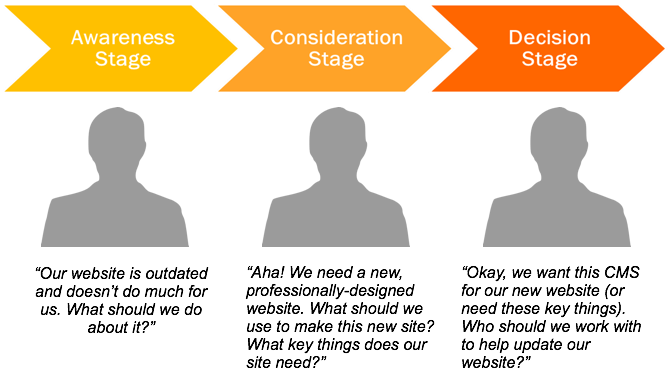
Remember our client who closed for $50,000? Here is a sneak preview of their website activity (data is automatically captured inside the HubSpot CRM), indicating what stage of the buyer's journey they were in at the time:
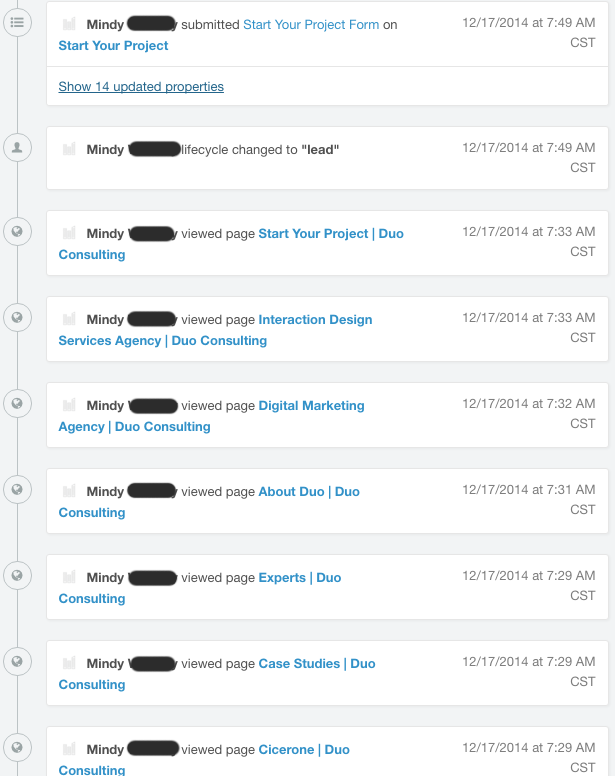
This knowledge helped our sales rep identify where they were in the buyer's journey, then send helpful content relevant to their current state:
“First I’ll use Sidekick for Business and the HubSpot CRM to look at the pages they’ve visited, then I'll tailor each message based on what they’ve looked at recently. But at the same time, keep it conversational and not sales-y.” - Tim Mahoney, Duo Sales Representative
When we cold called and cold emailed people, giving the same elevator pitch, we targeted a specific type of person (based on our personas). We would prioritize leads by fit ... and that was it.
But that's only half the battle. If we combined that knowledge with what leads were doing on our website, we could better qualify leads for our sales team. To clarify:
We use the Inbound Prospecting Matrix to prioritize leads based on if they’re (1) interested in our business, and (2) a good fit:
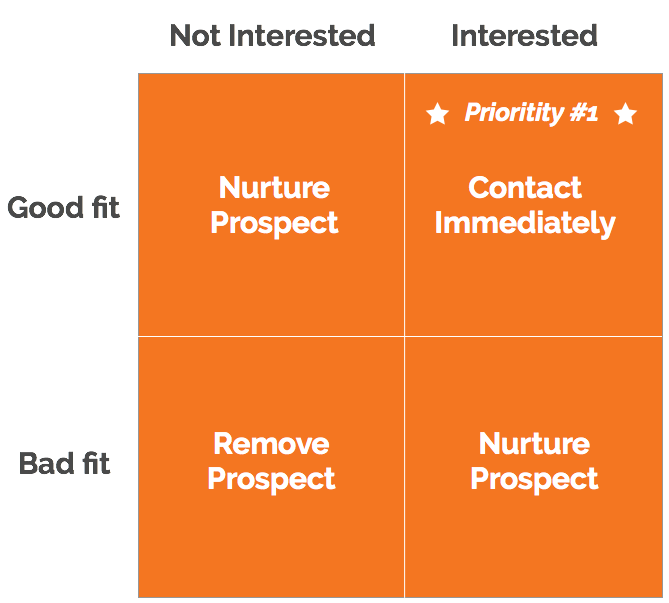
If a prospect is a good fit and they’re interested in our company, they are our #1 priority.
By qualifying our leads based on website activity (we use the Prospecting feature inside Sidekick for Business to measure this), we can get a stronger indication on their likelihood of becoming a customer.
However, it's important to consider the end user and the decision maker during this process:
“I research the company and identify the best contacts at each company (using Sidekick for Business) and give a more targeted sales pitch. Sure, I end up talking to management-level when it comes time to sell, but a lot of the time the people with the hands-on aspects of the project -- the people who will be working with us directly -- are the ones who are passionate about it. The ultimate decision maker cares primarily about the ROI.” -Tim Mahoney, Duo Sales Representative
We used to blast out proposals like Uncle Sam would blast out 4th of July fireworks. Our logic was the more proposals we sent, the more proposals we’d close.
Again …. we were wrong.
Now we don’t give a proposal until we’re 90% sure the deal will close. Previously, we’d start with a generic pitch of our services and we’d end up sending four or five modified versions of a proposal before getting to the root of what our prospect was looking for.
Instead of wasting time creating a generic proposal, we now use that time to ask deep questions. We use that time to understand the core of our prospects’ challenges, goals, and obstacles.
“My goal is to set aside an official time to go deeper with questions to determine which specific area of our services is best suited for their needs.” -Tim Mahoney, Duo Sales Representative
Remember, if people want information on your company, they can look it up online. If they want case studies, they can look them up online. If they want reviews of your products or services, they can find them online.
Instead of providing the same elevator pitch to all prospects, spend time diving deep into their challenges, goals, and obstacles. Find answers to their questions. Be the consultant that solves their toughest challenges.
If we can close a $50,000 deal from this new Inbound Sales process, so can you.



Any salesperson who’s experienced the switch from anxiety to jubilation when a target account finally signs on the dotted line knows how much can change in a moment. After all, progress rarely moves in a straight, steady line.
That’s why we didn’t expect to double our call contact and qualification rates for inbound web leads by changing just one aspect of our follow-up process: speed.
But that’s exactly what happened.
We pulled data on over 60,000 individual lead follow-up calls to answer the following question: How important is follow-up speed?
The numbers we ended up with told the story. Our findings resulted in our largest measurable improvement in call follow-up success in over 15 years.
We started by examining historical data -- combing through those 60,000 calls. Here’s what we found.
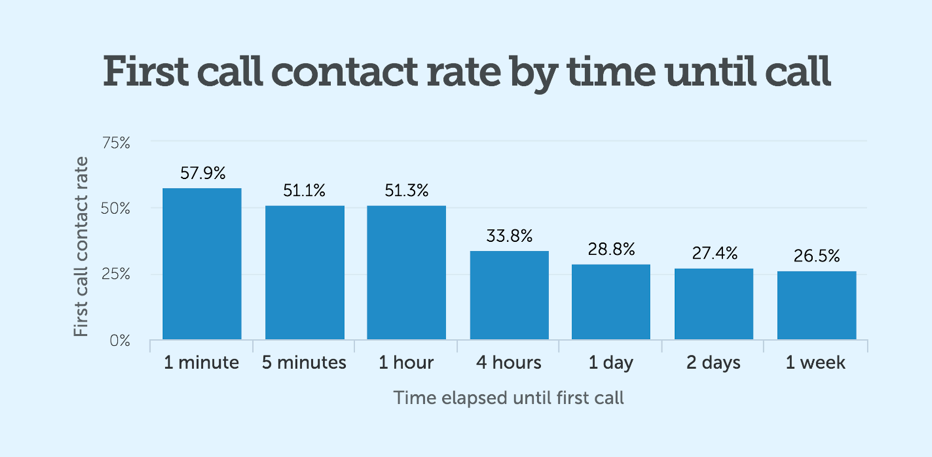
The first unmistakable thing the data revealed was that calling contacts quickly gets more of them to pick up the phone -- a lot more, in fact.
On calls made within one minute, our contact rate was more than double what it was when we waited the industry average of 46 hours to follow up.
So far, things looked good for the “faster is better” school of thought. But we didn’t stop there. After all numbers have context. We wanted to make sure we weren’t looking at ours from too limited a perspective.
What if calling faster lead to more conversations, but fewer qualifications? What if something about rapid calls turned off would-be prospects? It seemed possible. So we took a look at the impact of follow-up timing on qualification.
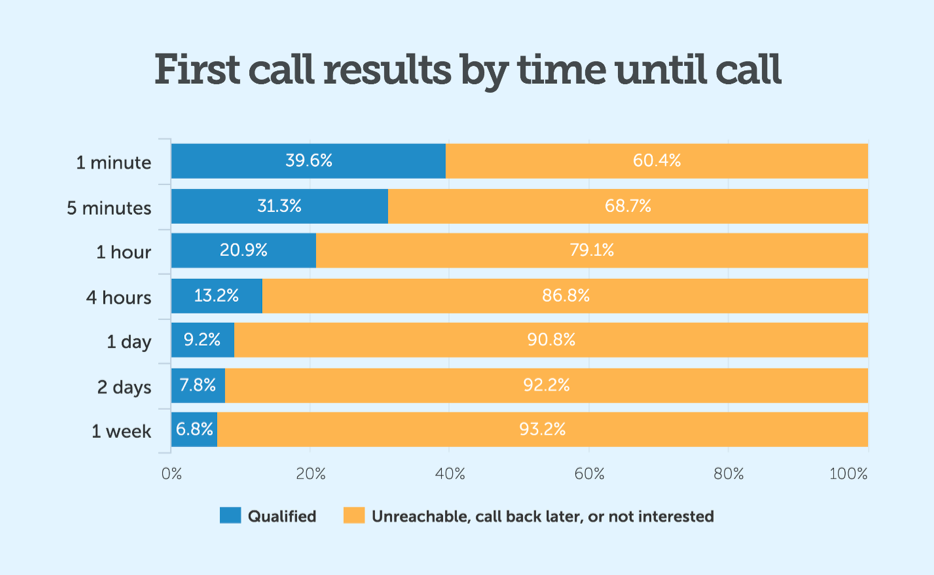
As profound an effect as follow-up speed had on contact rates, it had an even greater influence on qualification rates.
But putting off follow-up calls until the next day had the most dramatic effect. On calls made the day after the initial web conversion, we only qualified 25% as many contacts as we would have if we’d called immediately (9.2% vs 39.6%).
Calling prospects takes time. And as the chart below shows, delaying the initial call has a ripple effect -- the longer you wait to call, the more total effort it’ll take to qualify a lead.
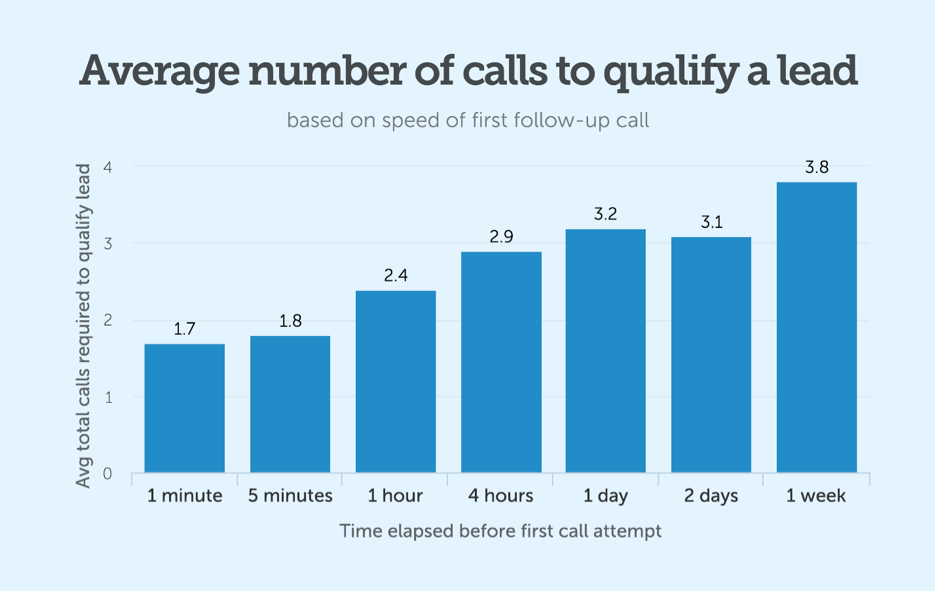
Still, we wanted to know if it was possible to close the gap in qualification rates over time by placing additional calls. (At our company, we call all prospects at least 10 times before we consider them unreachable). Here's what we found.
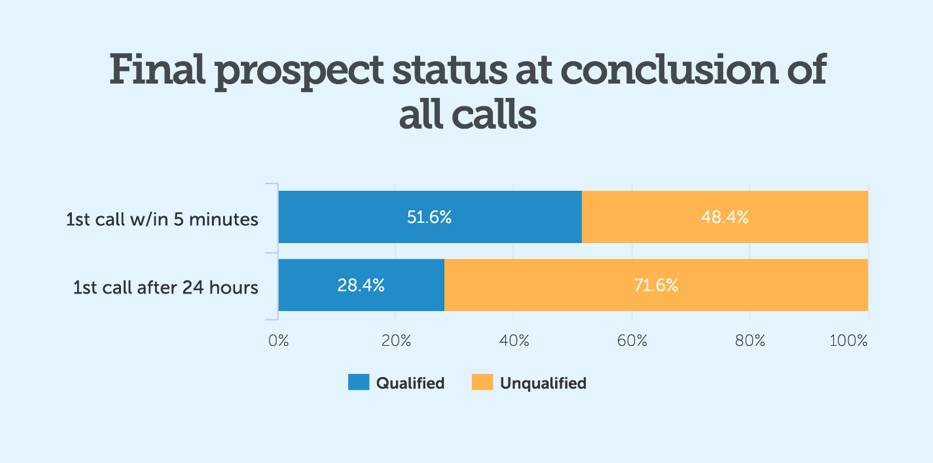
The numbers were clear: If you wait a day to call inbound leads, you will qualify 45% fewer prospects than if you’d reached out in the first five minutes.
When it comes to inbound lead follow-up, if you snooze, you lose. If you drop the ball, there are some leads you’ll just never get back. So what’s the takeaway for your sales team?
Not only are quick follow-ups effective, they're incredibly simple to put into practice.
Faster follow-up means more qualifications with fewer calls. That’s really all there is to it. Putting this information to work doesn’t require adopting a new sales playbook, retraining, or even making any financial investments.
We’d always jokingly called following up immediately “eat your vegetables” advice. We’d known all along that being quick was good for us, we just didn’t realize how good it was.
Now we’ve committed ourselves to fast follow-up. You should too.
We use a custom web app to notify the appropriate rep the moment a new lead comes in. But you could just as easily use an email alert, or use a free service like IFTTT to get lead notifications in pretty much any format you like.
To analyze our 60,000+ calls, we pulled the data from our phone server logs. But you won’t need 60,000 calls or server access to see the impact yourself. If you’re using a CRM system, you might already even have all the data you need. If not, tracking a few columns of data on a spreadsheet for a little while should give you what you require to spot the improvement in your contact and qualification rates.
But most importantly, remember, calling your contacts immediately is the rare sales optimization “gimme.” All you really need to do is give it a try. Just don’t wait too long!
For more analysis of web lead follow-up best practices, including data identifying the optimum number of follow-up attempts and the best days and times for calls, check out our full study at Find Accounting Software.

TIMMINS, Ont. – Underground work at Goldcorp’s Dome mine will come to a permanent halt around mid-year, more than a century after it originally began producing ore from one of Ontario’s most prolific gold regions.
The closure will directly affect 115 employees and 76 contractors, the company confirmed Friday, a day after the mine’s management told the local community.
The Dome mine — which had previously suspended operations for about two years ending in early 2006 — is part of Goldcorp’s Porcupine complex in Timmins, Ont.
Goldcorp (TSX:G) says other operations, including Porcupine’s Hollinger open pit mine and Hoyle Pond underground mine and a processing plant, will continue for the foreseeable future.
Brendan Zuidema, general manager of the Porcupine operation, said the company will work with the United Steelworkers union to close the site safely and in accordance with the labour contract.
“The Dome underground has been an important contributor to Porcupine’s overall production and a significant part of the history of this gold mining district,” Zuidema said in Friday’s announcement.
The Vancouver-based company (TSX:G) is one of the world’s biggest gold producers.
Note to readers: This is a corrected story: A previous version had an incorrect spelling for Timmins in the placeline
The post Goldcorp’s underground Dome mine to close, 106 years after first production appeared first on Canadian Business - Your Source For Business News.
With earnings season about to begin, fund managers do not expect to see a recovery in profits for Canadian companies as they continue to struggle with a deteriorating loonie, depressed oil prices and anemic growth.
Companies will begin reporting fourth quarter earnings next week amidst a bear market for stocks. The S&P/TSX Composite Index is down 22 per cent since last April, more than surpassing the 20 per cent threshold to be considered bearish. The index added to its losses Friday, as the TSX dropped down 2.13 per cent, or 262.57 points, to 12,073.46.
Much of the downward trajectory of the TSX has been driven by the drop in oil prices and the general weakness of the economy. But while gross domestic product has recovered from a technical recession seen in the first half of last year, depressed earnings are unlikely to bounce back this year, say fund managers.
“Earnings are going to be awful on an accumulative basis,” said Barry Schwartz is chief investment officer, Baskin Wealth Management. “The earnings recovery in the Canadian economy is going to be delayed another year.”
The biggest drag on earnings, not surprisingly, is in the resource sector, particularly energy companies. Those companies are expected to continue to struggle this year as they desperately cut costs to try and maintain profits in an unprofitable oil environment.
Companies that make a significant chunk of profit in U.S. dollars, however, are expected to be the one bright spot for earnings this year. Last year, firms with large American sales and presence such as Toronto-Dominion Bank, OpenText Corp. and CAE Inc. saw a lift to their earnings as the value of U.S. sales increased.
“Currency is going to be the big thing, once again,” said Craig Basinger, chief investment officer, Richardson GMP. “Canadian companies with big U.S. operations reporting Canadian dollars are probably going to look better in this environment.”
The loonie has lost 17 per cent of its value against the U.S. dollar in the past year alone, with some analysts forecasting there could be further downside before it recovers. The currency was last trading Friday at 68.82 cents against the greenback, down 0.81 of a cent from Thursday’s close.

National Bank Financial economists noted in December that the earnings of non-resource companies during the third quarter clearly benefited from the lower loonie. On average, the non-resource segment of the TSX saw earnings grow by three per cent in Q3, while resource companies recorded a contraction.
But even those companies may not be immune from oil’s fallout. The Bank of Canada’s Business Outlook Survey showed this week that investment and hiring intentions have plunged to their lowest level since the 2009 recession.
“Overall, responses to the winter Business Outlook Survey indicate that business sentiment has deteriorated as the negative effects of the commodity price shock continue to unfold and spread beyond the resource sector,” the bank said.

The risk of earnings contagion from the energy sector will leave a dark cloud hovering over the first part of 2016. Schwartz of Baskin said it is likely earnings could contract further this year, though any further decline could set up a stronger bounce in 2017 if oil prices do recover.
“In one more year we could be coming off a much lower base, giving more room for some meaningful growth,” said Schwartz. “But in the meantime, we predict any earnings recovery in Canada is delayed.”
 Strategic B2B marketing plans are an absolute must today, like never before.
Companies have amazing marketing tools at their disposal these days. Just ten years ago no one had heard of social media and blogs were popular only among the internet elite.
The great thing about all the tools we have these days is they make it easy to communicate. Whereas it used to take six months to create, print and distribute your general brochure, you can now open Twitter or Facebook and start interacting with your customers immediately.
The same goes for your corporate blog, email blasts, banner ads and search engine optimization: they are all quick and easy to do. But, beware. When it’s easy to talk to your target market it’s just as easy to forego a strategic B2B marketing plan.
The following are seven reasons you should have a marketing plan.
It’s easy to be busy. Companies have fewer people doing more work and the digital world has made it so that there’s no shortage of things to do. With so many activities your organization can engage in the trick is to know which ones make sense. A sound marketing plan will help you determine what should be done and what should be ignored. This will keep your team focused on work that matters—work that accomplishes your company’s goals and objectives.
These days change is the only constant. With change comes the temptation to react every time there’s a new technology, new marketing platform or a new opportunity. When you’re constantly reacting to outside forces you’re not in control, but rather being pushed and pulled in a multitude of directions. A plan will protect your organization against that trap. A plan will define your strategies, it will create the path to executing those strategies and will define the things you need to do to win. This keeps you on the offensive and protects you from becoming reactive.
Since we know the world around us is always changing (see #2) we can assume that new opportunities will present themselves from time to time. It might be as simple as a new advertising vehicle or as big as a new market sector that’s opening. How do you know if these opportunities are good for you? A plan will prove priceless in these circumstances as it will give you the criteria to evaluate them and determine if they make sense for your company.
Many organizations suffer from a lack of unity. Everyone has different goals and objectives and everyone has an opinion on what the company should do and how it should do it. A sound plan will help get your people in agreement on your problems, challenges, goals, objectives, strategies and tactics, ultimately getting everyone aligned and contributing.
A lot of the tactics we engage in these days tend to be very specialized and focus on the small picture. Twitter, for example, is a micro-exchange between you and your audience, 140 characters at a time. It’s a powerful tool, but one that’s very much about the moment. A good plan will help you and your company keep sight of the big picture so you don’t get lost in the weeds and you don’t miss out on opportunities.
Every company goes through cycles and that includes descending into the trough of despair. When you’re doing all you can and it seems like nothing is working, a good plan will guide you through. It will confirm your direction, provide insight into your situation and remind you of where you’re heading. Tactical things like social media alone can’t do that for you because they are granular and in the moment. Only a sound plan can give you confidence to stay the course when times get tough.
A plan gives you a framework to measure your efforts. One of the great things about all the newer tactics we have at our disposal is they are easily measurable. We can see web site traffic, banner ad clicks, number of followers and email click-throughs. But, all that data on its own does not mean a whole lot. A plan gives you the ability to evaluate all the data and determine if your efforts are moving you towards your corporate goals.
There are many more reasons to develop a B2B marketing plan in addition to the ones I’ve listed above. The value of a sound plan far outweighs any investment you make to create one and the benefits will last for years. If you don’t have a strategic B2B marketing plan, I highly suggest you develop one.
If you want to develop a B2B Marketing Plan for 2016, Please GO HERE to see a plan I am offering for a special fee until January 31 2016.
Presented by the Cradle to Cradle Products Innovation Institute and Autodesk, the Product Design Challenge asks emerging designers to develop new solutions for improving our environment through sustainable design. Each iteration of the challenge brings us closer to realizing the imperative to create a circular market standard. After receiving applications from 18 countries, the design challenge recognized winners in four categories: Best Student Project, Best Professional Project, Best Use of Aluminum, and Best Use of Autodesk Fusion 360. Find out more about their work below:
 Jacobsen developed an aluminum stamp to press a wavelike pattern onto the finished bags—a storytelling element meant to instill a connection between user and nature.
 "It is not enough anymore to just design a computer bag. One must ask, 'Why should this computer bag exist? and 'Where in our product system does the life of this computer bag fit?'"
The Virginia Tech student responded to the growing issue of plastic bag waste, which is a major pollutant of oceans and waterways despite the fact that the High Density Polyethylene used to make plastic bags is 100% recyclable. Her laptop bag is made from 60-70 recycled plastic bags, organic cotton canvas, canvas thread and biodegradable dyes. At the end of the product's life, users need only cut a few stitches to fully separate the two types of fabrics, allowing the entire bag to be recycled and composted respectively.

"I envision a time when sustainable design thinking is so completely integrated into the process that it does not even require to be defined as such, it just is. With 80% of a product's environmental impacts being determined in the design phase, it is imperative that ecological solutions be woven into the design process of every object."
Designer and educator Barent Roth designed a simple unisex style bike helmet intended to integrate with the growing bike share community as an optional purchase accompanying bike share memberships. The BikeShare Helmet uses a recycled aluminum foam shell and a sustainably grown cork liner to provide maximum protection with minimal bulk and weight. He incorporated mechanical flanges into the sides of the cork liner so the two layers could "snap" into place, so no glue is necessary to secure the cork to the aluminum shell.

"To me, Cradle to Cradle is a design-philosophy that turns the way we look at things upside-down."
Along with his team, Meurs designed a seat for public transportation made from recycled aluminum, recycled PET and formaldehyde free bamboo plywood. In the research phase, they found out that current commuter seats require a whopping 60-120 parts for construction. Their design is focused on creating a far simpler approach, requiring just a basic aluminum frame, a continuous, ergonomic seat panel and customizable upholstery options. The category Best Use of Aluminum was a new addition in this round of the challenge, meant to highlight the "infinite recyclability" of the material.
 The design incorporates a mechanism at the base of the broom handle that allows the handle to be adjusted between 0°, 45° and 90°. "This feature allows a customer to afford the functionality of three separate brooms for the material and monetary costs of one," note the designers.
 "The design-led revolution is ingrained in our generation and, as engineers, we see ourselves playing a large role in transforming today's industries."
A group of RIT engineers developed a recyclable broom with a bristle head made of highly biodegradable material that can be replaced independently of the broom's other components. "We looked at everyday household items and wanted to transform one of the biggest wastes into something sustainable," they explained. "Broom bristles don't last very long and so the entire broom is then thrown out to go to a landfill." The product uses recycled aluminum, steel springs and wheat straw—an abundant crop with low commercial value to keep the final product cost-effective.

A great content strategy hinges on regular content updates—fresh new videos, blog posts, and social media entries that engage users while capitalizing on current trends. But if that’s all you’ve got fuelling your content strategy, you’re missing out on one of the key components of any digital marketing strategy—and that’s evergreen content.
We’ve written about the need for evergreen content before. Basically, this refers to the written, value-adding content that never goes out of style—timeless posts that can bolster your content strategy by offering endless revisitability. We’re talking about the in-depth tutorials, FAQs, and essays that you can refer your clients and readers to time and time again.
But how can you tell if you’ve got an instance of really great evergreen content on your hands? What does great evergreen content really look like?
Well, not all content is created equal, of course, but some of the essential traits of great evergreen content include:
Great evergreen content is timeless. This is really the defining trait of evergreen content, right? You can write it today and know that all of it will still more or less hold true in a year’s time; that even five years down the road you can direct readers to this resource and know that it will all hold up.
Great evergreen content adds value. The ultimate point of evergreen content is that you can use it to draw traffic and educate consumers for a long time to come. So, it needs to be interesting. It needs to add value. It needs to inform. It needs to provide a direct benefit to the people who read it. This is why so much of the best evergreen content comes in the form of how-tos, tutorials, and FAQ pages.
Great evergreen content is well-formatted. Again, what you’re going for is utility. You want your content to be useful to readers, which means structuring it in a way that’s easy to read, skim, and consult. Lists and step-by-step guides work well, as does long-form content that’s well-organized with subheadings and section titles.
Great evergreen content is usually long. Remember, you’re aiming for something resembling a treasure trove of information—and chances are, that’s going to be lengthier, not shorter.
Great evergreen content is understandable. If your content is full of technical terms and jargon, it’s probably not going to appeal to a broad reader base—and with evergreen content, breadth is usually key.
Determining the right price for your products and services in support of your value proposition is one of the most important decisions your business will make, and one of the most critical business acumen skills each of your team members must have. It is a complex and complicated process that often times results in the wrong decision which then negatively impacts your business performance and ability to compete. One of the most important concepts of pricing is understanding the concept of price elasticity.
Defining Price Elasticity
As much as a client or prospect may not say price is important, price is typically one of the top decision drivers of every customer decision-making process. Most customers, in most markets, are sensitive to price and the general assumption is that customers will buy more of the product or service if it is cheaper and less of the product if it is more expensive. This concept is called price elasticity and it is one of the most quantifiable economic equations that illustrates exactly how responsive customer demand is for a product or service.
A Quick Example
Right after the financial crisis of 2008, US gasoline prices were over $4 a gallon. At this price level,  consumption started to go down dramatically and people found alternative means of transportation opting to take trains, buses, bikes, or walking to their destinations. As the price dropped to around $2 in 2015, consumption started to go back up, but not to the same levels as before.
Calculating Price Elasticity
So how do you calculate the price elasticity of demand? Here is a simple equation:

Continuing with the example of gasoline, let’s forecast that the price of gasoline goes up from $2 a gallon to $3 a gallon by July. That is a price increase of $3-$2 divided by $2 which equals 50%. Because of this 50% increase, Fred’s Gas Center has experienced a decrease in volume from 20,000 gallons a month to 16, 000 gallons a month. The change in demand is 20,000 – 16,000 divided by 16,000 or 25%.
When you enter these changes into the formula, you get:

It is important to note that the “negative” is typically ignored and the absolute value (.5) is used to interpret the elasticity.
Categories of Price Elasticities
To this point, we have defined price elasticities and given you an equation to calculate it. Now I am going to provide you with a “cheat sheet” on how to categorize price demand sensitivity after you have determined your number. The categories of price elasticity include:
Matching Your Price to Your Strategy
Your company wants to provide customers with a value proposition that meets their needs. Whether or not your customers are looking for low cost, great service, or innovative products, you must match the right pricing strategy with the right customer expectation and elasticity relative to your competition. The price elasticity calculation gives you a deeper understanding of how elastic or inelastic your pricing is to your selected customer segments and allows you to link your pricing strategy to your overall go-to-market strategy.
Helpful Tip – Be Patient
One of the most common mistakes made when trying to apply concepts of price elasticity is not being patient. Usually price elasticity “what-if’s” are calculated on a small price change and aren’t given enough time to play out in the market versus competitors. Pricing strategies must be consistent and it takes time for customers to react and align your pricing elasticities to your value proposition.
Wall Street is crooked. This is not really a surprise to anyone. I lived on the street. And I worked on the street.
Wall Street starts at broadway and continues down to Water Street. Along the way, it gets crooked.
Right around Broad Street it starts to curve. If you are standing at one end of Wall Street and try to look at the other end, you won’t see it.
It’s crooked. It jags. It turns a little. People walk back and forth daydreaming about getting rich. Others are crying because they couldn’t make it. And if you can’t make it there, as the song sort of goes, you can’t make it anywhere.
Which is really true. Because “there” is where the money is. And people get desperate around money. So desperate they will do anything to get it.
At one point I invested in a dozen hedge funds. Eleven of them ended up being caught doing illegal activity. I think a few people are in jail.
Every night I was scared because I started to see what was going on until eventually I shut the whole thing down.
My investors were very upset I shut things down when things were going well. This was in mid-2006. By 2009 I finally got my money back from all of them. That’s how desperately Wall Street tries to hold onto your money. I thought Wall Street was a quick way out. But it was a quick way to stress and misery. I got out. I stayed out.
“BILLIONS” the new show on Showtime is the first show that I think accurately describes what is going on on this tiny street.
But there’s a lot of terminology in the show and I thought I would explain some areas. This is to say, I’m about to have spoilers. So don’t read further if you are a purist. Watch the show. I may do this after future shows as well if you like this post.
At a basic level, the show is about a “hedge fund manager”, Bobby Axelrod, played by Damian Lewis, and a US Attorney, Chuck Rhodes, played by Paul Giamatti. I put “hedge fund manager” in quotes because it’s a term I’m about to explain.
The US Attorney wants to go after the huge hedge fund manager for “insider trading”.
And that sets the stage for a good vs evil epic where you don’t know what is good, what is evil, what the law should be, what capitalism is about, what is the psychology of money and success, and, of course, let’s get some sex in there (else what good is life).
Here’s what you need to understand to fully understand the show.
– “Hedge fund manager” – I was a hedge fund manager for awhile. Not like “Axe” in the show. Much smaller. But the same principles. People invest money with you (like in a mutual fund) and you can do WHATEVER you want with that money to return greater money.
Unlike mutual funds, hedge funds are fairly unregulated. Which means…bad stuff can happen. Like a Bernie Madoff who steals billions.
One time I tried to get Bernie Madoff to invest money in my fund. His response, “We have no idea where you put your money and the last thing we need is to see ‘Bernard Madoff Securities’ on the front page of the Wall St. Journal.”
Hedge funds are called “hedge” funds because the original ones (and Warren Buffett had one of the original hedge funds in the 1950s) can both buy stocks and bet against stocks.
In other words, they can “hedge” their risk by being half in favor of the market going up and half in favor of the market going down. And if they pick the right spots, then they win no matter what and avoid losing money when the market goes down.
That said, there is a famous saying on Wall Street, “when you ‘hedge’ you take twice the risk and make half the money”.
– “Insider trading” – there is no one definition of this. And the definition changes all the time. This is what makes the show interesting. It’s a gray area.
But basically, if you know information that is private (“Company A is buying Company B”) then you are not allowed to make money on that information.
The essence of stock market law in the US is this: every transaction has to have risk in it. If you eliminate risk by, for instance, paying for information that nobody else knows, then you have committed a crime.
Whether it should be or not…it is illegal.
But let’s play for a second.
I don’t think it should be illegal. When someone makes a trade in the market, the knowledge they had in their heads is now encoded directly into the stock market.
The more “knowledge” that is baked into the market, the more efficient the market is. The more insider knowledge that is in stock, the more smoothly they will move and the more they will reflect the actual things that are effecting a company.
I’d rather have insider trading be legal and let the government go after the funds that actually steal money, like the Madoffs.
But many people disagree and this is not a fight worth arguing about.
– “Dominatrix” – in the first scene we see a man (later revealed to be the US Attorney) being tied up and peed on by a dominatrix. The question is, why does this powerful man need to be dominated to achieve satisfaction?
When I lived in the Chelsea Hotel one of my neighbors was a professional submissive. When we would meet for drinks at the end of a work day she often couldn’t sit on the chair. “Ow!” she’d say.
She had been hit all day by men paying her money. One time she told me a story, “This guy came over with a bag of fruit. He put the fruit all over me. Then he took pictures. Then he got off by masturbating to the photos.”
She then told me she was in a huge rush because she had to meet her girlfriend. It was Valentine’s Day. She made the client clean up her room because there was fruit and whip cream everywhere.
Later, I met the girlfriend, Veronica. She told me a story. About how she went to the mansion on Park Avenue of a famous movie director, “You would be shocked if I told you the name,” is all she told me.
She had to knife him until there was blood all over his lobby and she almost had to call the hospital. But that was what he wanted.
“Why would he want that?” I asked her.
“Powerful men spend the entire day giving orders and being in charge,” she said. “At the end of the day they want someone to be in charge of them.”
Much later she married a computer programmer. I ran into her at a party. She said, “He’s just like you!” And she was happy.
– The SEC (Securities and Exchange Commission) versus the US Attorney
Not everyone on Wall Street (or prosecuting Wall Street) is on the same side. Early in the show we see that the SEC has some “evidence” against Bobby Axelrod, the mega hedge fund manager who is managing billions of dollars.
He shows the evidence to Paul Giamatti, the US Attorney who, correctly, throws him out of the office.
Why would the US Attorney ignore evidence.
The evidence was that before a major stock market situation happened, three different hedge funds that spun out of “Axe Capital” (meaning: the guys used to work there but then started their own funds) all made the same trade at the same times and the timing was such that they made the maximum amount of money.
You can only do that if you know something.
The problem is “knowing something” and proving that someone knew something is not the same thing.
If the SEC knocked on their door, they could get scared and pay a huge fine. That’s roughly how the SEC stays in business.
But with the US Attorney, the government has to prove a crime has been committed.
That the funds illegally obtained information, that the information may have come from Axe Capital, and that they traded because they had that information. That’s a much higher bar.
Why would the SEC do that? Because they don’t have enough people to figure out where all the crimes on Wall Street are.
Let me tell you something: I would estimate 90% of hedge funds commit crimes along the way. There are 1000s of hedge funds. You can’t go after all of them. And the huge ones are huge for a specific reason – they know how to avoid being caught.
So the SEC would love it if the US Attorney used their resources to pursue a big hedge fund and the SEC could come in later and sweep up the mess and collect massive fines.
Paul Giamatti knows this. Doesn’t want to be used. Throws the SEC out. But it plants the seed. This could be his biggest case. And like with some many US Attorneys or District Attorneys (Elliot Spitzer, Rudolph Giuliani) before him – going after big financial targets could be stepping stones for larger careers. But he doesn’t want to mess up by going after someone too early.
Let’s go to Axe Capital and see a trade happen.
Two analysts approach Axe. They have a simple trade idea.
Here’s the thing you have to know about Wall Street. If money looks like it’s easy, then it’s not. Nobody ever got free money on Wall Street.
I won’t go into the details of the conversation. But I will describe roughly what happened.
Here’s the trade idea the analysts simplistically had.
Company A was trying to buy Company B for $41 a share.
Company B was trading for $35.
In other words, you could buy “B” at $35 and once the deal was closed at $41, you just made 18% on your money. If the deal closed fast, that’s an incredible return.
That is what is called “an easy trade”. How many times do easy trades occur on Wall Street? I have seen them zero times.
Bobby hears one more piece of news. Not important what it is. But he realized that the man behind all the deals is known for one thing – making easy trades seem like they are going to happen, sucking in all the day traders trading at home who don’t know any better, and selling his own position for a profit before everyone realizes the deal is not going to happen after all.
So Bobby explains this, and says to not buy the deal but to bet against it. Specifically he says, “Short”
– “Short”
You can buy a stock., Or you can short a stock. When you buy a stock at $10 and goes to $12 you just made $2 on your money. If you bought 1000 shares, then you made $2 x 1000 = $2000. That’s how most people make money on Wall Street.
But hedge funds often “short” a stock instead of “going long” (i.e. buying) a stock. Shorting, without explaining the technical details of how it’s done, means you bet that the stock will go down.
So if you short 1000 shares of a stock at $10 and it goes to $8 then you just made $2000. If someone buys 1000 shares at $10 and it goes to $8 then they just lost $2000.
Here is the big problem.
I had a friend once who shorted 4,000 shares of Qualcomm when it was at $80. He said to me, “Qualcomm is so high its crazy”.
When people use the term “crazy” on Wall Street (just like when they yell, “You’re crazy” to their spouse or friend) it usually means they are projecting. They are the crazy one – not the spouse or the friend or the company.
Qualcomm went up to $1000.
What does this mean for my friend? It means he lost more than 100% on his money. He lost $1000 – 80 = 920. TIMES 4000. So almost $3.7 million.
He only put $4000 * 80 at risk = $320,000.
My friend attempted suicide. 16 years later he’s still a stockbroker. Maybe he is your stockbroker.
Shorting is very dangerous. Having inside information is often a great technique (but illegal) for managing risk in a trade.
The trade in Billions described above wasn’t illegal. It was actually very smart, but starts to lead you into the fact that you can’t be smart all the time. Sometimes you need an extra edge.
This needs to be explained to fully understand what is happening. Why do hedge fund managers make billions of dollars for themselves but mutual fund managers and stock brokers do not?
Why do even the employees of hedge funds make millions when the employees of mutual funds make a strict salary of $100-200,000 a year (or less).
Here’s how a mutual fund makes money: you put money in and they take a small fee (1-2%) on your money. Some of that money is returned to the broker who recommended the fund. And that money is used to pay for office, all employees, all accounting, often marketing, etc. So there might be very little left to pay the managers of the fund.
A hedge fund is different.
If you put in $1,000,000 to a hedge fund (and often that is the minimum that can be put in), hedge funds charge what is called “2 and 20”.
The 2 stands for a 2% fee that comes out every year (so about $20,000 a year if you put in $1,000,000).
The 20% is the percentage of profits that the hedge fund manager takes. So if a one billion dollar hedge funds returns 10% (about the same as most mutual funds on a good year), then the profits are $100 million and the hedge fund manager makes an extra $20 million for himself (20% of $100 million).
When John Paulson’s fund made $6 billion by betting against mortgages in the middle of the financial crisis (“betting against mortgages” being something that mutual funds can’t do but hedge funds can do). he took home an extra $1.2 billion in salary.
When, in a later year he lost $15 billion (I might not have the number correct and it might be totally wrong but I am using this as an example of what could happen) – he made no money that year other than the “2”. But he still gets to keep his $1.2 BILLION from the earlier year.
This is why the main skill of a hedge fund manager is not picking good stocks (although this is important) – it’s staying in the game until you have that one good year where you can raise an enormous amount of money and take the enormous fees from it.
Trading is very stressful. I hate it. I would make a bad trade and I would feel my blood pumping all over my body all day long. And then if the trade was a loss I would cry at night. I was so scared all the time. I hated it.
I even would wake up early in the morning, go across the street to a church, and pray to Jesus and ask Him to make the markets go up so I could get out of my losing trades. I was Jewish so those prayers never worked out.
So I went to a therapist for awhile who specialized in helping traders. She never really helped me (I was hopeless) but I appreciated the effort.
Many big hedge funds employ psychologists. I was privileged to meet two of the best. Ari Kiev, who worked for SAC Capital before he died. And Brett Steenbarger who has worked for many hedge funds, including one that I worked for. I highly recommend their books to learn more on the psychology of trading.
Axe Capital employs a psychologist. The psychologist, by coincidence (or not) is the wife of the US Attorney.
There’s a scene where she does her magic with one of the analysts who works at Axe. He was very depressed because he was down 4% on the year, which meant he wouldn’t make any money.
First she asks him how much money he made the year before. He said “7.2 million”. [See about hedge fund compensation above. ]
The joke here is that no matter how much money he made, he was still depressed right now. Is he foolish? Maybe. Tests have shown that the testosterone levels of traders go down after a losing trade, no matter how much money is in the bank.,
The best traders can handle it. Which is why therapists are needed to help them keep their cool (and their testosterone) even when times are bad. You can’t make a good trade if you are trading from a place inside of desperation or fear.
One time I visited one of the largest hedge fund managers in history, Stevie Cohen. It was the end of the day after the markets closed. I wanted to work for him. He wasn’t sure (I ended up never working for him but it was a longer story).
We had a great conversation. He was making jokes, smiling, asking questions, very engaged.
When the meeting was winding down I asked him how his day went. He said, “we just had our worst day of the year”. During the entire meeting I had no idea he was probably sweating it out after such a horrible day.
That’s a pro.
– 9/11
There’s a scene where Bobby mentions how he lost all his friends in 9/11.
Here’s why that scene is important. It’s impossible to say who each of these characters are in real life. They are an aggregation. Bobby seems like some big well-known hedge fund managers in many of the scenes.
But in the 9/11 scene he seems like Howard Lutnick, the CEO of Cantor Fitzgerald, who lost most of his partners and friends (and his brother) in 9/11.
So there is no one person that Bobby is based on. Kudos to the extensive research of the creators of the show.
The analyst who visits the psychologist at Axe Capital is wearing a fleece jacket indoors. Why would anyone do that?
Some big hedge funds think that traders are more alert at cooler temperatures so they keep the thermostat in the low 60s.
– “Cut Bait on Your Losers”
The therapist who advises the analyst suggests he sells all of his losing positions.
Often we want to keep the losing positions. We pray that they come back. We feel we already lost so much money in them we need to make that money back. This is a cognitive bias called “investment bias”.
An example from real life – you put $200,000 into a college education. Your brain refuses to believe that investment was a mistake so you will justify until your dying day the benefits of a college education despite increasing evidence that a college education is A) not worth it financially and B) not the best education you can get during those years of your life.
Same thing happens with actual investments. You put the money in. Your brain won’t accept that the investment was a mistake.
But specifically in this scene I think she is referring to Jim Cramer’s book, “Confessions of a Street Addict” where Jim was losing a lot of money in his fund and his wife, a former trader, comes in out of retirement and forces him to sell all of his losing positions.
I don’t know if the writers were referring to this scene but that’s what it seemed life to me. By the way, “Confessions of a Street Addict” is one of the best books on running a hedge fund in the 90s.
– “I am not uncertain.”
There’s a scene where Bobby is at his son’s basketball game. A place where it would be impossible for him to be overheard by any investigators.
Two traders come to visit him. One wants to buy a stock, the other wants to short the same stock.
Bobby asked one of them how certain he is. Then we see a flashback of the guy paying for information. He, of course, does not say that to Bobby.
He simply says, “I am not uncertain.” Bobby then says “this meeting is over,” implying that the trade is to go with the guy who says he is not uncertain.
Why did he use the double negative: Why didn’t he just say he was “certain.”
Well, remember that the essence of the law is that there is some risk. “Certain” means “no risk.” While “not uncertain” technically means “certain,” does it really? It’s a bit confusing. It’s somehow not as sure as “certain.” It implies there is still a tiny amount of risk.
Bobby ends the conversation right there because he still knows none of the details. He still can say he was taking a risk.
This is not spelled out in the show but is the reason for all this language and the reason that Bobby did not press further on the details when the sentence was worded that way. But he knew. The trade was done.
Again, kudos to the writers for catching that subtlety in how language can be used to subvert the technicalities of the law.
There’s a scene where one of the “good guy” lawyers is visiting with an old professor of his who now works for the hedge funds.
This is an important scene in that it underlines why hedge funds are not prosecuted more often and often investigations are done with so little scrutiny as to be dumbfounding but there is more to it than it seems.
Why, for instance, did all the investigations of Madoff never uncover anything even though it was obvious to almost all institutional investors (Madoff had few to none serious institutional investors)?
It’s because after the investigation, Madoff would get resumes from all of the lawyers involved in the investigation.
Many lawyers (not all) work their government jobs and then eventually get co-opted into the industry that they were hired to investigate. They can make ten times the money once they establish a name for themselves on the government side.
This is detailed in Andrew Ross Sorkin’s book, “Too Big To Fail.” Andrew is one of the co-creators of the show, along with Brian Koppelman and David Levien.
How to stop this? Perhaps you can put a ban on where they can work after they work for the government but that might also prevent the best and the brightest from making a decision (to work for the regulatory agencies) that will prevent their future options.
Smart people don’t like to limit themselves.
– Century Capital and Nick Margolis.
At one point Bobby Axelrod is visited by an ex employee of his who has been caught up in his own insider trading scandal but Bobby doesn’t know that yet.
It turns out the ex-employee, Nick Margolis is all wired up and while he is trying to share inside information with “Axe,” the FBI are listening.
This is again a sign that the character of Bobby Axelrold is an amalgamation of many characters. Wiring up hedge fund managers and traders was a common part of the Raj Rajarataman insider trading scandal (the scandal that launched the next several years of investigations against hedge fund managers) but I haven’t heard it being used as significantly in other cases.
– “Winning the Meal”
In one scene, Bobby opens up a restaurant for lunch (it only opened for dinner) just to wine and dine a Wall Street Journal reporter.
After he’s done doing the wining and dining, Bobby leaves without eating any food. The Wall Street Journal reporter is caught off guard about this because now he is going to eat alone after such a good start to the conversation with Bobby.
This is Bobby’s way of “winning the meal.”
When the writers, Brian Koppelman and David Levien came onto my podcast they described the research they did while preparing to write the first episode.
They described a scene where a billionaire had to “win the meal” and that was an example of how brutally competitive these guys are. They have to win at everything. I think this scene is an example that comes out of that research.
– “No email”
Before Bobby leaves that meal with the reporter he writes down his number on a napkin and hands it to the reporter but also says “no email”.
Reminds me of a conference from about ten years ago where Elliot Spitzer addresses a room filled with hedge fund lawyers and specifically said, “the greatest thing you guys do for me is send emails” because he was able to win a lot of his investigations by digging through all of the emails. Now hedge fund managers will rarely send anything via email.
– Activists
Bobby is speaking at a conference called “Delivering Alpha.” The word “alpha” refers to the extra edge a hedge fund manager can deliver above and beyond the basic returns of the market.
If a hedge fund can’t deliver alpha, then there is no point in investing in them and pay their high fees.
That said, something called “activist hedge funds” often deliver value and the show is portraying Bobby as somewhat of an activist investor.
An activist investor not only invests in a stock but buys so much of the stock they become a significant owner of the company.
Once they become an “owner” they take steps to force the company that will make changes that unlock value in the company so the stock can go higher.
For instance, an activist investor like Carl Icahn might buy enough of Yahoo that he can force them to sell their stake in Ali Baba.
Or another activist investor might want to kick out the CEO and install his own people as the management of the company so they can sell off pieces of the company that are dragging down the stock price.
The SEC requires activist investors to file special forms with the SEC (13D forms as opposed to “passive” 13G forms). These forms specifically broadcast to shareholders that the fund might talk with management.
Of course on Showtime the word is spelled out. Bobby says this line to Chuck Rhodes (Paul Giamatti) in the one heated confrontation they have during the pilot.
The line is excellent and Damien Lewis delivers it with ruthlessness.
But I always think the reverse.
When you have a job, people often daydream about saying that to their boss or colleagues or whoever. But I always felt, “When I get F you money, the last thing I want to do is come back here and talk to my boss, even if it is just to curse at him.” What’s the point?
This begs the question, why do billionaires even keep going after they get their F you money?
I guess it’s because they are so driven that that is how they got the F you money in the first place. So that same force that drove them initially is still driving them.
And then there’s the question – how much is F You money?
In the show, at the end, Bobby buys a house for $63 million. But clearly you don’t need a house that big to be happy. Many people have much smaller houses and are happy with their lives.
I tried thinking of an answer.
For instance, one answer is: you have F you money if from morning to night you only have to do the things you love doing and you don’t have to do anything else.
But what if what you love doing is building and flying rocketships to the Moon. That’s pretty expensive. Your number is going to be a very big number.
I don’t know the answer. I like to sit at home and read and write all day. And not ever feel so angry I feel the need to say “F You!” to anyone since that is a stress and stress will make you sick.
For me, “F You money” simply means I get to keep physically healthy, spend time with friends (emotional health), be creative (mental health), and be grateful (spiritual health) every single day, without anyone or anything getting in the way of that.
Life throws us difficulties and stresses every day, no matter what. And you can see that the characters in the show are setting themselves up for potentially many, many episodes of stress, no matter how rich they are, no matter how powerful.
At the end of all shows and stories, everyone eventually dies and their stories are eventually forgotten, like a lingering pain that eventually subsides and disappears.
What’s the point of having F You money if eventually everyone dies?
Please tell me the answer when you get there.
To listen to my interview with Brian Koppelman and David Levien click here.
The post The Secrets of Billions appeared first on Altucher Confidential.

Account-based Sales Development is not a new concept. Working within target accounts as a strategy is as old as cold calling. It’s actually quite a simple process: Rep A is assigned Accounts 1, 2, & 3. The rep must work leads until they convert or are disqualified. Once an account converts or is disqualified, the rep is assigned another account, thus always actively working the same number of accounts. Sounds easy, right? There are, however, major gaps in this process:
The modern sales development organization has adapted and improved on this strategy. With insights from the buzzworthy Account-Based Marketing initiative, sales leaders are turning their SDR organization into data-driven, appointment-setting snipers. Sales development teams using an ABSD strategy are seeing:
If you are considering an account-based model, here are 7 signs to look for that may help you make your decision:
You were a new solution in a growing market at a competitive price point. You took advantage of time, using marketing and cold outreach to convert as many people in your target market as possible. Your buyers did not bite the first time. Then what? Is one more email campaign really going to grab their interest? No. If there wasn’t a conversion the first time you are going to need hyper focus on intentional outreach to bring on your ideal customers.
When you gain traction, scaling predictably is the only way to continue the momentum. This means adding more of your ideal customers and increasing their overall lifetime value.
Using data to uncover who your best customers are is the only way to make sure you are focusing on what is most valuable to your business.
Each of your customers is a data point. Some customers have left, hopefully most have stayed. Some pay you more, some less. This is critical data to support your ICP. Learn from your customers.
Which customers have stayed the longest, paid the most, and have needs that align most with your company’s vision? Once you define your ICP based on real data, find companies fitting the same profile. There are many great tools for this: Datanyze, Mattermark, Everstring, Insideview etc.
Here is why this works. You have already “pre-qualified” these target companies. Once assigned, there are only two reasons an SDR should stop working them:
Or
Throughout the history of inside sales, the “breakup email” has been a controversial topic. It is a last-ditch effort, a Hail Mary to illicit a response from your prospect before moving on. When you assign “pre-qualified” accounts to an SDR, breaking up with a prospect is obsolete. Why give up when you know you can provide value? ABSD empowers SDRs to keep working the account until they have a conversation.
ABSD empowers SDRs to keep working the account until they have a conversation. @TheSeanKester
Click To Tweet
Defining your ICP allows you to create a list of target accounts. Use data to estimate the opportunity value of each account. Segment these accounts based on the opportunity size, allowing for predictable pipeline forecasting.
The #1 SDR metric driving business value in a lead-based model is the ratio of leads to opportunities. Put more simply, how many people do you need to prospect before one of them converts? With ABSD, this metric still applies. However, there is an opportunity to take it one step further and use data to create a predictable pipeline.
Once you identify your ICP, use data to segment them into categories based on revenue opportunity value. There are many ways to do this depending on your specific business model. In a seat-based model, use Linkedin to identify how many employees serve the function your solution serves. If there are 25 employees within a target account who would be using your solution and it costs $200 per seat, the opportunity value for the account is $5,000 MRR. It is actually quite simple. Create a process of removing as much manual work as possible and turn it into a sustainable model.
Applying data changes the SDR metric from net new opportunities created to revenue pipeline contribution. If your goal is to add 2MM ARR in net new sales revenue, you have 10 SDRs, and your AEs close 20% of all opportunities, a simple formula will set the new SDR quota. In this case (assuming 100% of sales pipeline is set by SDRs) each SDR is responsible for $83,333 MRR per month or 17 accounts with the opportunity value of 5,000 MRR.
This model is dependent on one key metric: Predictable AE closed/won opp percentage.
Great VPs of Sales know their closed/won opp percentage. It is the only way to forecast revenue growth. If you have a great VP, this number is likely segmented based on size of opportunity. However, too often the account opportunity value is not set until the first conversation with an AE.
In the ABSD model, opportunity value is estimated before the SDR is assigned the account. Therefore, AE closed/won percentage is critical data to set SDR pipeline contribution metrics. The closed/won percentage typically varies based on the size of an opp. For example, a 1k MRR opp closes at 30% vs. a 5k MRR opp closing at 15%.
Many elements play into this number beyond the size of the opp. Factors to consider include number of stakeholders involved, involvement of procurement, and IT contraints around security or implementation.
Understand the dynamic elements involved in differing deal sizes along with AE closed/won percentage. Apply the insights to set the right process and expectations for the SDRs; the result will align company revenue goals with SDR quota. Better alignment produces more buy-in. More buy-in nets better results.
Better alignment produces more buy-in. More buy-in nets better results. @TheSeanKester
Click To Tweet
There is a secondary benefit to ABSD often overlooked: Brand reputation.
By targeting the right accounts based on your ICP, reps are encouraged to be strategic and hyper personalized in the way they penetrate accounts. Intentional and targeted messaging mitigates the risk of email “blasting” potential buyers with un-personalized messaging.
Understanding your TAM is critical, there is a finite number of potential buyers. Organizations cannot afford to burn down the forest with bad messaging. This is an all-too-common side effect of the greenfield strategy when the net new demo number is the metric driving performance. SDRs’ activities are directly correlated to what is measured. Measure net new and it becomes a numbers game. Reaching out to more people = more opportunities. It’s simple logic.
How do you mitigate this? Flip the script and assign “pre-qualified” accounts with the new metric: pipeline contribution. By assigning a set number of accounts, the SDR process changes. It becomes strategic. The only way to advance and be assigned a new account is through a conversation. Conversation rate is exponentially higher when the messaging is personalized. I don’t think anyone would argue with that.
Which leads to identifying the right type of messaging to use…
ABSD helps align process with goals such as segmenting out a new vertical or doubling down on your data-driven ICP. The outcome is targeted and intentional messaging. But what is the right messaging?
There are many answers to this and most depend specifically on your business. However, there are a few key elements to consider:
Uncover what emotions influence the decisions of your buyers. What do they think about everyday? What keeps them up at night? What business goals do they strive to achieve? Understand the context of how your solution provides value to their specific pain points in the world they live in. Tell a story. Understanding emotional goals helps you understand what is really important.
Answer these questions for every vertical. Empower your SDRs to cater their messaging to the right persona at the right time. The value prop for a VP is going to be different than a manager or a rep.
Creating buyer personas does not have to be the sole responsibility of the sales development manager, work in tandem with marketing. Define personas and identify messaging touchpoint strategies (emails, call scripts, and social drips).
Sales and marketing alignment has historically been a hot button topic. Just do a Google search and it brings back 33 million results. With the newly trending strategy of Account-Based Marketing (ABM), high performing organizations are teaming up to engage targeted accounts. The results are a unified front of content and intentional sales campaigning.
All great sales organizations leverage buyer personas to be effective. ABM’s strategy is a complement to buyer personas. Success with ABM is measured on identifying key business goals and challenges of their buyers to customize programs focused on these issues.
When it comes to Sales and Marketing relationships in an ABSD + ABM strategy, alignment is critical to success. Sales Development and Marketing should coordinate efforts around both marketing and outbound prospecting to drive for a unified front and cohesive messaging, ultimately leading to increased conversions and overall revenue growth.
The Account-based sales development model is based off an old strategy but has been modified to fit the needs of the modern sales development organization. More importantly, it is here to stay. If you care about growth, want to create predictable revenue, or strive to maintain alignment with sales and marketing efforts, get started with ABSD today.
The post 7 Signs You Should Pivot to an Account-Based Sales Development Process appeared first on Sales Hacker.

One of the trending terms in the tech world today is “growth hacking,” which refers to the aptitude to scale a product in fast and out-of-the-box ways. In simple words, growth hacking means scaling a product in a viral way. However, not every marketer and company does growth hacking the right way.
It is a proven tool that helps find success, but not everyone is able to reap the benefits mainly due to their failure to understand the concept properly. Here are the 5 mistakes you should avoid when using growth hacking to scale your product.
1. Thinking of Growth Hacking as The Job of a Single Person
Growth hacking is not the task of a single person. If you seriously want to reap the benefits of growth hacking, put your entire organization to the task. When you make it the job of a single employee, you are committing a terrible mistake because no matter how creative the hacks, they would fail to yield tangible results.
Instead of wasting your time and money by sticking to a single hacker approach, you should clearly define your company’s goals in order to decrease lost leads. To be successful in growth hacking your entire organization, especially your marketing, support, product and sales departments, needs to be on the same page.
2. Poor Risk Management
When it comes to growth hacking, risk management gains immense importance. Most companies make a mistake by not giving enough priority to risk management. Product scaling is always surrounded by uncertainties, and things can turn for the worst at any time. Therefore, having a risk management plan in place should be your priority.
AirBnB, which is well known for its growth hacks, used the disaster Hurricane Sandy as an opportunity to boost its reputation by cutting prices and providing accommodation to the displaced people at its properties.
3. Thinking That Growth Hacking is Appropriate for Every Company
Some companies can succeed by imitating the growth hack strategies of others, but growth hacking is not an appropriate strategy for all companies and products. When you copy the viral-product mechanisms of other companies and products, you cannot tell for sure if that would work for you because the strategies depend largely on the environmental dynamics, not completely on the product.
4. Being Over-Confident About Your Product, Market, and Hack
Is your product a great and unique solution to a pressing problem? The answer is simple: not every product can solve the pressing problems in creative ways. If you lack even a bit of trust in your product, think again before using growth hacking. Remember, not every product, and not every market is the same.
Because one growth hack worked for one product, or worked in a particular segment, there is no guarantee that it would work for your product in the same segment and in the same way. The market environment is extremely volatile and subject to changes, so it is best to research your market and product before settling down for a particular hack.
If you seriously want to succeed with growth hacking, steer clear of these mistakes at any cost. Doing growth hacking carelessly will come at a heavy cost for you.