 Amazon vice president Paul Misener doesn't know if the company already has a pricing scheme for its Prime Air service, but he knows everything else there is to know about the delivery drones. He talked about the project at length in an interview with...
Shared posts
20 Jan 18:22
Amazon vice president Paul Misener doesn't know if the company already has a pricing scheme for its Prime Air service, but he knows everything else there is to know about the delivery drones. He talked about the project at length in an interview with...
Amazon exec explains how Prime Air delivery drones will work
by Mariella Moon
Amazon vice president Paul Misener doesn't know if the company already has a pricing scheme for its Prime Air service, but he knows everything else there is to know about the delivery drones. He talked about the project at length in an interview with...
19 Jan 17:43

WhatsApp Is Now Free For Everyone, No Subscription Required
by Eric Ravenscraft
WhatsApp is one of the most popular alternative messaging apps in the world, despite charging most users $0.99 per year. Now, that fee is going away for everyone.
19 Jan 17:43
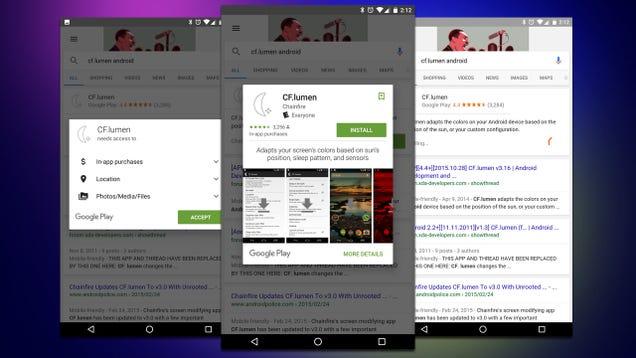
Google Begins Rolling Out the Ability to Install Apps From Search Results
by Eric Ravenscraft
Android: When you search for the name of an app, Google already shows you direct links to the Play Store where you can download it. Now, some users are seeing the ability to install apps without ever leaving the Google app itself.
19 Jan 17:43

The Science of Internet Trolls, Explained In a Simple Video
by Eric Ravenscraft
Everyone on planet Earth, and likely a few aliens by this point, have encountered some rage-inducing internet user that gets off on making you mad. This video explains what makes them tick.
19 Jan 17:42
 Thanks to Sophie Smith for sharing their advice and opinions in this post. Sophie Smith is a copywriter at TranslateMedia and digital expert with a particular interest in the start-up scene and doing business in China. Her writing credits include the Independent and the Sydney Morning Herald. An experienced digital strategist, she's worked in the private equity industry and for a variety of companies including Barratt Homes and Thames Water. In addition to her Oxford degree, she has a masters in digital communications from Manchester Metropolitan University..

International marketing case study: Kellogg’s India
by Expert commentator
Kellogg’s initial foray into the Indian market is generally agreed to have been a failure, although it’s now doing well in terms of both market share and sales growth in the subcontinent.
As part of our series of in-depth case studies with TranslateMedia looking at major brands tackling major new markets we look at Kellogg's attempts to crack the tricky Indian market.
But are Indian consumers ready to accept breakfast cereals?
Kellogg’s initial foray into the Indian market is generally agreed to have been a failure, although it’s now doing well in terms of both market share and sales growth in the subcontinent.
In this article, we’ll examine what went wrong, and discover how Kelloggs recovered from its initial problems in this challenging market.
An unsuccessful first foray into India
The world’s leading producer of cereals and a major snack foods manufacturer, Kellogg’s entered the Indian market way back in 1994.
Kellogg’s is no stranger to international marketing: the products are manufactured in 18 countries and sold in over 180. Despite a high-profile launch and a frenzy of marketing activity, the first breakfast cereals it marketed were an initial failure in India.

There was little appetite for breakfast cereals in India in the early nineties, although milk was a regular part of the Indian diet, so Kellogg’s needed to establish a market for the products if it wanted to win over the Indian consumer.
Following a big media launch effort, initial sales seemed promising but it emerged that consumers were buying the product as a novelty but not repeat purchasing.
Most analysts conclude that the brand was overconfident and overlooked many critical cultural insights that would explain why the market wasn’t ready for the breakfast cereals offered. It also seems that the pricing was far too high to be a regular grocery purchase, explaining the lack of repeat sales.
The Indian palette is considered by many to be a challenging one to crack. Indians were accustomed to boiling their milk and consuming it hot and sweetened.

One key hurdle for Kellogg’s to overcome was persuading the Indian consumer to consume milk cold rather than hot when eating breakfast cereals.
When Kellogg’s initially launched into the Indian market it was with crispy flakes that would go soggy when consumed with hot milk. When Indians tried the unsweetened breakfast flakes with cold milk, they couldn’t get the sugar they added to dissolve properly.
This may explain why Kellogg’s later enjoyed better success with Frosties, which come ready-sweetened with dissolvable sugars which sweeten the milk when it is added to the bowl.
Indian consumers accustomed to gut-busting breakfast staples such as buttery fried parathas or deep fried vadas found breakfast cereals somewhat insubstantial when eaten as a substitute for India’s more familiar breakfast items.
A bland bowl of cereal flakes also failed to match the variety of foods often eaten at breakfast time, or the habit of eating more flavoursome foods such as chutneys and pickles with various morning staples.
Indian breakfasts tend towards spicy and hot; by offering a dish that was bland, sweet and cold Kellogg’s was proposing the exact opposite of expectations at this time in the day. Essentially Kellogg’s offered a product that failed to match local breakfast habits and expectations – and at twice the price of local competitors.
Other critics of the initial launch also thought that Kellogg’s trod on a few toes with marketing campaigns implying the traditional Indian breakfast was not nutritionally sound.
A revised strategy
Kellogg’s initially launched in India with corn flakes, wheat flakes and basmati rice flakes, none of which were especially successful. When Kellogg’s launched Frosties (sweet, sugar-coated flakes) in 1997, even the company was surprised by their success.
Kellogg’s reduced the price of their products and began to offer a wider range of product sizes to appeal to different customers. Individual packs were especially popular. Messaging was also changed, to reposition the cereals as a fun choice rather than just a nutritious one.
This approach may have been successful than the brand’s previous attempt to imply that the traditional Indian breakfast was not nutritious – marketing messaging which may have made the Indian housewife rather indignant. The products were no longer positioned as premium products, in order to make them a regular rather than a one-off buy.
The brand also localised its branding and advertising approach to make it more acceptable. Gone was the familiar cockerel, and advertising campaigns using local faces such as a yoga instructor and Kathakali dancer attributing their vigour to a Kellogg’s diet. Accompaniments such as curd and pistachio, which suited the local palate, were suggested.
Kellogg’s took the decision to localise its flavourings, and chose brand names to appeal to the Indian public such as ‘shakti’ (‘power’) when selling products fortified with iron. These days, cornflakes are offered with mango and banana puree to suit local tastes.
Although the brand presently enjoys a colossal 70% market share, it now has to defend from rivals the market it has created. Logistically Kellogg’s is well invested in this territory. All raw materials, including packaging, is sourced in India, and the main plant is located close to the largest market; all of which minimises costs.
Using a network of agents, the brand has established a distribution network including storage facilities. Overheads are minimised by giving distributors large responsibility for sales. In 2010 the market growth was at 20% but following a change in leadership it is thought to be closer to 30%.
Kellogg’s remains significantly pricier than local rivals such as Bagrry’s, whose website and logo are breathtakingly similar to Kellogg’s. Larger multinationals including Dr Oetker and PepsiCo are also muscling in on the market. Kellogg’s India is defending its market share by expanding its distribution network by 50%.
It’s arguable that only a massive brand like Kellogg’s was capable of cracking the Indian market, given the amount of market creation and habit changing that was required.
What’s generally agreed is that Kellogg’s was too confident when it entered the market and didn’t do enough research on local tastes and habits before plunging in. Whilst the company has now turned its performance around, it has done so by trying new things but above all by localising its offering and message to suit the market.
Thanks to Sophie Smith for sharing their advice and opinions in this post. Sophie Smith is a copywriter at TranslateMedia and digital expert with a particular interest in the start-up scene and doing business in China. Her writing credits include the Independent and the Sydney Morning Herald. An experienced digital strategist, she's worked in the private equity industry and for a variety of companies including Barratt Homes and Thames Water. In addition to her Oxford degree, she has a masters in digital communications from Manchester Metropolitan University..
19 Jan 17:42
Why the price of oil will recover faster than you think
by Martin Pelletier
It no doubt feels like a new paradigm for oil investors with the price of oil falling 72 per cent since 2014, the second-largest peak-to-trough decline in more than 30 years.
Many are pointing fingers at the Organization of the Petroleum Exporting Countries for the monster wave of oil now hitting the markets, but it really all started with U.S. shale producers.
Many forget that deep oil-price declines are soon followed by some sizable recoveries
Following the 2008 financial crisis, ultra-low interest rates, three rounds of quantitative easing in the U.S. and a risk-on atmosphere provided vast amounts of capital (both debt and equity) to U.S. producers, who quickly put it to work drilling and fracking.
As a result, more than four million barrels per day of production was added at a time when there just wasn’t enough demand globally. Not surprisingly, the Saudis and their fellow OPEC members lost patience along with market share, and responded in kind by bringing on an additional 1.5 million barrels per day from mid-2014 through to mid-2015.
The price of oil quickly responded to the supply-demand imbalance of approximately two million barrels per day.
Unfortunately, just when you thought it couldn’t get any worse, Iran is about to hit the market with an immediate 500,000 barrels of oil now that its sanctions were lifted on Saturday.
In the midst of such a mighty storm, it’s very hard to imagine that it will eventually come to an end, especially when the primary focus at the moment is just on surviving the onslaught.
But we believe the clouds will eventually break since the sheer magnitude and duration of oil’s ongoing pricing collapse will eventually self-correct, as will the current supply-demand imbalance, perhaps even sooner than many expect.
The solution will likely come from where the problem began — U.S. shale producers.
Having covered the industry as a sell-side analyst, I’ve seen my fair share of reservoir models and production profiles. Shale wells have what is termed a hyperbolic decline curve, meaning they have upwards of a 75-per-cent decline rate in production in the first one to two years before they stabilize at substantially lower levels. They require continual drilling and a lot of capital reinvestment just to keep production flat, let alone grow it.
![FP0118_Pelletier-GS[1]](http://wpmedia.business.financialpost.com/2016/01/fp0118_pelletier-gs1.jpg?w=620&h=689)
Capital markets closed for business early last year and debt markets quickly followed suit, so these producers have had to rely on rapidly falling cash flows to continue drilling wells.
The average U.S. producer was using more 80 per cent of its cash flow just to service interest payments when oil was at US$50 a barrel. Imagine the situation at US$29 a barrel, or even negative oil prices for North Dakota Sour crude.
As well, the rig count has fallen nearly 70 per cent, with most of the drop occurring in early 2015, so we really have yet to see the lag impact on oil production.
When that impact comes, both the speed and magnitude of the fall in production may surprise many and there will be little that can be done to stop it given the massive staffing cuts at North American service and production companies and a quickly aging and under-maintained fleet of service and production equipment.
Related
Globally, large producing nations have also been massively under-capitalizing their fields while putting tremendous stress on their reservoirs due to over-production. Many are also over levered with budgets predicated on significantly higher oil prices.
Finally, and most importantly, many forget that deep oil-price declines are soon followed by some sizable recoveries.
The 79-per-cent decline from 2008 to 2009 was followed by a 274-per-cent recovery; the 59-per-cent decline from 1996 to 1998 was followed by a 244-per-cent recovery; the 66-per-cent decline from 1990 to 1993 was followed by a 90-per-cent recovery; and the 62-per-cent decline from 1985 to 1986 was followed by a 273-per-cent recovery.
Martin Pelletier, CFA, is a portfolio manager at Calgary-based TriVest Wealth Counsel Ltd.
19 Jan 17:41
Here are the 2 key features Amazon revealed about its delivery drones
by Cadie Thompson

Amazon's delivery drones will be different than any drones that are currently available to consumers.
In a recent interview with Yahoo, Paul Misener, Amazon's vice president for global public policy, pointed out two key features the company's delivery drones will have, saying they "are more like horses than cars."
Misener explained that the company's drones are equipped with "sense-and-avoid technology," which means they are capable of seeing an obstacle and avoiding it.
"If you have a small tree in your front yard, and you want to bang your car into it for some reason, you can do that," Misener said. "But try riding a horse into a tree. It won't do it. The horse will see the tree and go around it."
Amazon's drones behave in the same way, he said.
Sense-and-avoid technology plays a big role in helping ensure the safety of drones used for delivery.
A big problem with consumer drones on the market today is that they are prone to crashing. But by including this technology Amazon is helping make sure that its drone program can actually get off the ground.
The other main feature is that Amazon Prime Air drones will be able to deliver goods within 30 minutes of ordering a product. However, there are a few stipulations. For starters, the range has to over 10 miles and it will only deliver parcels up to five pounds.
Amazon hasn't shared any information regarding pricing for the service and a date for the service hasn't yet been announced. However, the company says that it will deploy first where it has the regulatory support needed to implement the system.
Join the conversation about this story »
NOW WATCH: This impossible-to-crash drone follows you around in real-time
19 Jan 17:41


No Funds? No Problem! How to Market Your Startup with Zero Budget
by Abdullahi Muhammed
It doesn’t matter how great your startup’s product or service is — marketing is the key to success. Still, no matter how much you’d like to invest in marketing, you could very well have little or no budget to do it.
Photo Credit: Brainy Budget
Luckily, there are still great ways to market your startup with zero budget. Here are the six strategies you can use to do it.
1. Be Discoverable
First things first — you need to be findable on the Internet. That means:
- Optimizing for SEO
- Getting on free listing websites and local directories
- Creating a website that users can easily navigate
Having a great website and getting people to it is crucial — it’s where the bulk of your marketing efforts will lie, and the perfect place for leads to get more information about your company, products and services.
Here’s a comprehensive crash-course for startup SEO.
2. Create Content
Your content is also a huge part of SEO and drawing potential consumers to your website. The content you create should be specific to your industry and offer value to your audience by answering their questions and solving their problems. Content can be:
- Blog posts
- Case studies
- White papers
- Infographics
- Viral images/videos
- Podcast/Webinars
Content can become a huge driving force behind finding organic leads. Just follow the lead of Buffer app, whose content strategy gets their blog a whopping 866,909 page views per month.
The key to their success appears to be all about relevance:
Photo Credit: Social Marketing Writing.
Try to create content that not only appeals to your customers and leads, but to anyone who might interact with and influence potential customers.
3. Leverage Social Media
Figure out which social media platforms your target audience is using and get active there. You have a lot of options. Facebook is the most widely used social network, while Twitter and LinkedIn are great for B2B connections. If your product is visual, consider Instagram, Pinterest, or Flickr.
To get the biggest bangs for your invested time, you should also think about your target audience demographics (age, income, etc.) when picking platforms. These data from the Pew Research Center provides all you need to know.
Of course, you should use social media to promote your product or service, but that should only be a small part of your strategy. Use social media to:
- Amplify your content
- Engage with your audience
- Draw leads to your website
If you need some inspiration, just take a look at what SnapKnot, a small startup, managed to accomplish with social media. They developed a social contest over 90 days, and got:
- 900% Facebook fan growth
- 5% Twitter follower growth
- 60% increase in unique website traffic
Here are a few other successful startup social media case studies to inspire your strategy.
4. Build Your Mailing List
Building a list of email subscribers can help you target high quality leads with email marketing. The best way to build your mailing list is by including calls-to-action in your content prompting readers to subscribe. You can also offer “carrot content” — these are free content that you give away in exchange for signing up, such as an ebook or white paper.
You’ll continue with your content campaign within your email marketing, but you can also offer direct discounts and advantages to turn these leads into real customers.
5. Network
Leveraging the prestige and audience reach of other industry leaders can only be accomplished through networking.
So make efforts to get friendly with socially influential people, and use them as influencers for your own marketing. You can:
- Solicit endorsements
- Get them to share your content on social media
- Guest post on their platform
- Collaborate on content
All these strategies will help build your startup’s credibility and expand its reach. A great way to find influencers is with Buzzsumo. Search for your target market keywords:
Screenshot via Buzzsumo.
And sort by “total shares” to reveal influential networks and bloggers. Start reading their content, leave thoughtful comments and share it on social media. Subscribe to their newsletters and follow them on social media.
Find a way to help them first and it becomes easy to build lasting relationship with them. Soon, that relationship will become a currency you can spend to market your startup.
6. Solicit Traditional Media
Getting noticed by traditional media outlets may seem like a long shot, but it’s never going to happen if you don’t put forth the effort.
Be sure to consistently circulate press releases for your latest product launches, events, and discounts.
You can also get closer to the media by signing up for Help A Reporter Out (HARO). This free service connects journalists with industry leaders that they might want to interview and quote in their news piece. Respond to their queries to increase your chances of appearing as an industry expert in the news.
There has never been a better time to be a startup with no marketing budget. In the age of social media and online content available by search, there’s less of a need to rely on expensive advertisements to broaden your brand’s reach.
Focusing on these 6 strategies will quickly get your startup on the path to a healthy no-budget marketing strategy.
19 Jan 17:41

How To Do an Expert Interview to Get High Quality Content Quickly and Easily
by Ian
Hey there :)
In last week's 5 Minute Marketing Tip I showed you how to come up with 100 ideas for content for blog posts, articles, videos and podcasts.
In my follow-up emails to my email subscribers I also shared a few of the best methods for creating content quickly and easily. One of those was the “Expert Interview”.
I got an email back from Kevin who asked for more details on how to do Expert Interviews. And since they're one of the very best ways to create high value content without needing to do a lot of the work yourself, I thought I'd share the tips on this week's video.
So watch the video to find out what Expert Interviews are, how to find the right experts to interview and what questions to ask to get the most from them.
A couple of good audio players/podcast services are Libsyn and Blubrry.
I edit my podcasts/audios with Audacity, and then use Auphonic to tidy up the final audio file and add my jingles etc.
Find this video helpful? Subscribe to the More Clients TV channel on youtube to get more of them:

Video Transcript
Hi it's Ian here, welcome to another five minute marketing tip. In last week's video, I showed you how to come up with a hundred ideas for content for blog posts, articles, videos and podcasts. Hopefully many of you are underway creating those. I know a lot of people found that a really helpful start from the comments below the video. Now in my follow-up emails that I did to email subscribers only, I shared a couple of really great ways of producing that content very quickly and easily without a lot of effort yourself. One of those ways was the expert interview and I got an email back from Kevin, one of my subscribers, asking for more details about how to do expert interviews. That's what I'm going to cover on this week's five minute marketing tip video. How to do expert interview videos because it really is an excellent way of getting really high quality content for your website without a lot of time and effort spent by you. I'll see you after the break.
Hi, welcome back. So firstly what is an expert interview? An expert interview is pretty much exactly what it says on the tin. It's where you interview an expert and use the content on your website. Now typically you do an audio interview so you'll do the interview on Skype or on a teleconference service. You'll record the call and then with minimal editing, because usually it happens all in one take because it doesn't need to be word perfect, you kind of top and tail it. Cut off the hello, how you doing type stuff before you start the interview and cut off the oh was that any good at the end. You've got an interview. Now you can use that interview, some people use it as a podcast obviously but you don't even need to go that far. You can just use it as an audio file with a player on your website. I'll put down some of the technologies underneath the video.
Now expert interviews are great because you get expert input, really great ideas that will be valuable to your audience, your clients and potential clients to share on your website but because it's someone else giving the content, you don't have to do a lot of work yourself. It's really a win-win because it's not a lot of work for the person who you interview as well. It's much easier for them to come on Skype with you for twenty, thirty minutes and answer a bunch of questions than it is for them to sit down and type an article out from scratch. It's really good for them as well because it builds their credibility. They get exposed to a wider audience, gives them a link back to their website and, as I said, it's pretty easy to do. All in all it's a win for both sides.
Who are the sort of people you can interview for your podcast or for just an audio on your website? Anyone who is an expert, whose opinion and ideas would be valuable to your target audience, your clients, potential clients. Think through what might people want to hear, who has useful information about that. That could be another expert in the field a bit like you especially valuable there are people who have just written a book or are launching a new program. Obviously they'll want to get out and promote that book or promote that program so they will be very willing to come on your podcast or record an audio interview with you. I've found that pretty much anyone who is an expert is quite willing to hop on a call for twenty minutes and record an interview. It's not that onerous so people are very happy to do it given that it gives them more publicity, more visitors, more exposure.
Now the other people who it's great to interview are role models for your audience. For example if you teach, I don't know, if you teach bookkeepers how to run a successful business then you might want to interview either your clients or well known bookkeepers, if there are such people who are doing well, for their tips on how they became successful. If you offer services to authors or bookkeepers or retail businesses or whoever it might be, you can run a podcast where you interview successful people in that particular field about how they became successful and their back story etc. They become role models for your audience, the people listening to that podcast. Two different types of people and all you do is, even if you know them already, you can phone them up or shoot off a quick email. Tell them about the podcast or the audio interviews you're going to be doing and asking if they'd like to participate. Most of them will say yes.
What kind of questions can you ask? There are two different sorts of interview. One which you often do if you do that role model interview where you're interviewing lots of the same type of person, so if you're interviewing lots of start-up businesses as to how they succeeded in starting up, you'll probably ask the same questions to each of them. Just think through what would my audience be interested in hearing from these people? You might ask them, usually start off with some kind of question about their back story, how did they get started? How did they particularly get into this field? What made them interested in this field etc? An easy question to get them going and then you ask about what were some of the significant events? What are their biggest learnings from when they started up? If they could go back in time, what would be the biggest thing they would change? What would be their number one piece of advice for the listeners?
Many of the questions that we came up with and the topics we came up with in last week's video for topics you can write articles about, those all work really well. Be sure to at the start, obviously ask them beforehand how they'd like to be introduced, and at the end hand it over to them to give them a little bit of publicity. Say, “If people wanted to find out more about you and what you do, where should they go?” Then it gives them a chance to promote their website. Now the other type of interview is a unique interview where the questions are very specific to the person you're interviewing. That's normally the type you do if you were interviewing someone who has just written a book or has a new program coming out. What you do in that case is you get a copy of the book, you either buy it or often they'll send you a copy free and you skim read it or ideally read it fully.
Go through it and mark out the points that you think would be really interesting to your audience. Then just ask questions that allow the person you're interviewing to elaborate on those particular points and bring those points out. I've done that with a number of my interviews. In fact a really good way of knowing how to do them and what questions to ask is to subscribe to podcasts or to go to websites with these interviews. I've done a number but if you look in your own particular field or the business field generally, you can usually find a bunch of podcasts on ITunes where people do interviews. See what sort of questions they ask, don't use the same questions, but get an idea of the flavor and what questions help bring out the most insight for your audience. Of course the final thing you can do is you can ask the person you're interviewing if there are any particular questions they would like to be asked that will help bring out the best insights and the best information that they've got.
I often do that. If people are interviewing me about email marketing, I've got a set of questions usually about how do I get more subscribers? How do I engage them and get people to open my emails or get people to take action on my emails? Some kind of standard ones that I know will be interesting to any audience. If anyone wants to interview me those are the ones I always suggest as questions. That's basically how to do expert interviews. You find the right people, fairly easy, you ask them and then you send the questions in advance. Ask those sort of questions that you think will bring out the best from them, that will be insightful to your audience. After that all you do, as I said, top and tail the interview. Get rid of the blather at the beginning and the end util you properly start the interview. I use a little service called Auphonic that I upload to and it levels out the volumes, adds my jingle on the front and the back. You're done.
You've got an audio file, you can then upload that to an audio player on your website. As I say I'll mention a couple below. Or you can upload it into ITunes as well as a podcast so all great ways of getting content for your website pretty easily. Really all the content is coming from other people but the more of these experts you interview, the more you become seen as an expert yourself. It really helps to put you as part of that expert community. That's it for now, see you next week.
The post How To Do an Expert Interview to Get High Quality Content Quickly and Easily appeared first on Ian Brodie.
19 Jan 17:40


A simple hack that doubles your headline power
by Mark Schaefer
By Maël Roth, {grow} Community Member
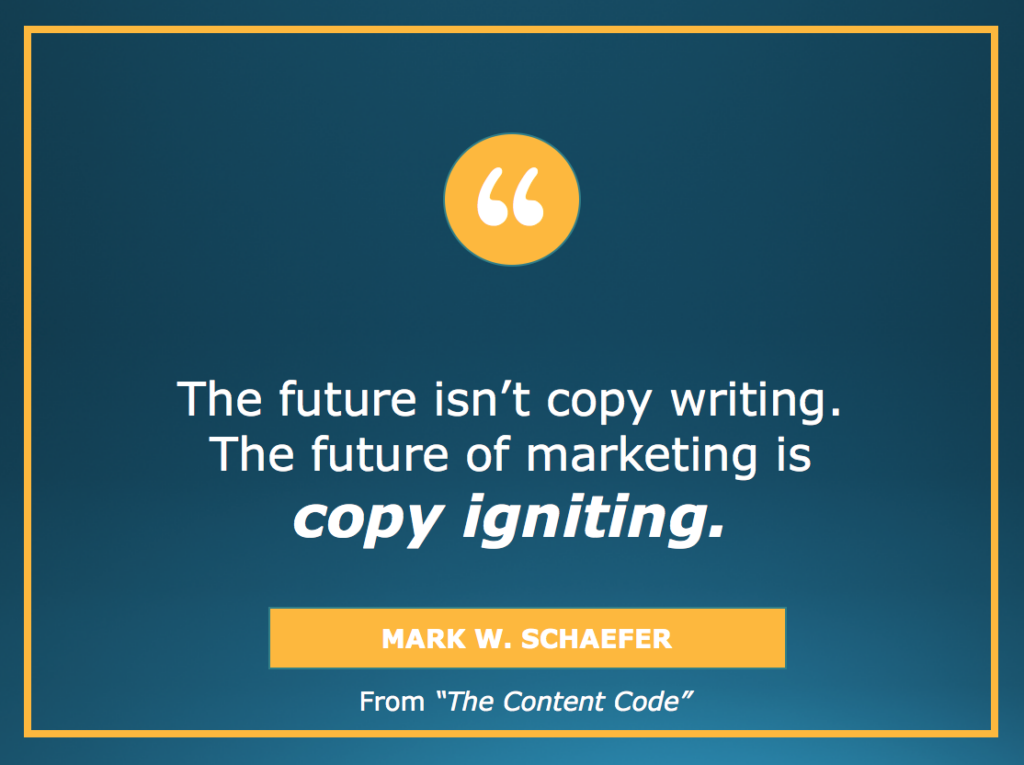
As we all know by now from Mark Schaefer’s book The Content Code
So how do we do that?
In his book, Mark has hundreds of great ideas and I have been focusing on some of his advice on the importance of headlines.
One dilemma I’ve been struggling with — and I think I am not the only one — is crafting a headline that accomplishes what a good headline should:
- A high Click Through Rate on social channels AND in the Google search results
- Sums up the topic of the post
- Delivers a promise which you can deliver when someone reads your post
Crafting a headline which accomplishes all of those things is difficult. Some experts recommend spending at least as much time on headlines as you spend crafting the post. I do think that’s a bit exaggerated but if you have the time to spend that amount of time on your headline, it sure is a good thing.
The problem is, when it comes to headlines, social and SEO are not best friends. SEO-driven headlines often come across as boring on social media because they are not emotional enough and too descriptive or too sober. On the other hand, something like “This boy kissed his cat. You won’t believe what happens next…” is not really a search friendly title.
Understanding the new realities of headline power
There is a fundamental disconnect between the way people discover content on the social web and the way they do when they do search engines.
- On the social web, people are not looking for anything in particular. They want to be entertained by those (people, brands, magazines, publishers, etc.) they follow.
- When people search for information via search engines, they are looking for answers to a question. They are proactive and they often want that answer to be quick and easy.
When I write posts, I try to optimize most of my posts for these two types of content discovery paths. It is not an easy thing to do.
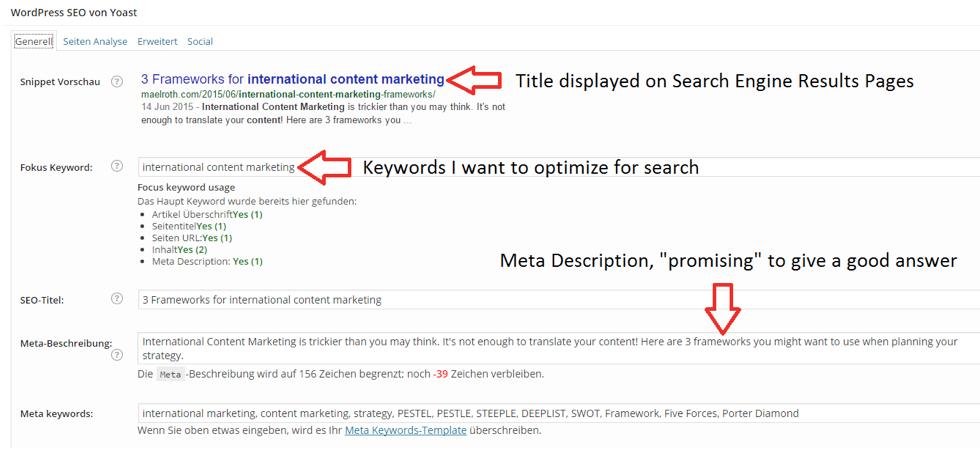
Let’s take an example: back in June I wrote a post on business strategy frameworks applied to international content marketing. The keyword phrase I wanted to focus on to optimize for search was “international content marketing.”
While it’s an SEO best practice to place these keywords early in the headline, it’s difficult to do that and make it sexy for social as well.
Now let me show you a simple trick I use to ignite this particular piece of content for both search and social.
Headlines that work on search and social
My Content Management System is WordPress and I use the Yoast SEO Plugin for my posts. If you don’t pay attention to SEO, this is an easy application to help you start. Yoast guides you through simple suggestions for SEO improvement on each post.
You can use Metadata in your posts to indicate which elements you want a particular channel to display. The simple but effective hack in this case is to craft two separate headlines and descriptions which use different triggers: one headline and description for search engines and one for social networks.
Here’s how I decided to do it for the aformentioned post:
SEO headline and description:
Social headline and description:
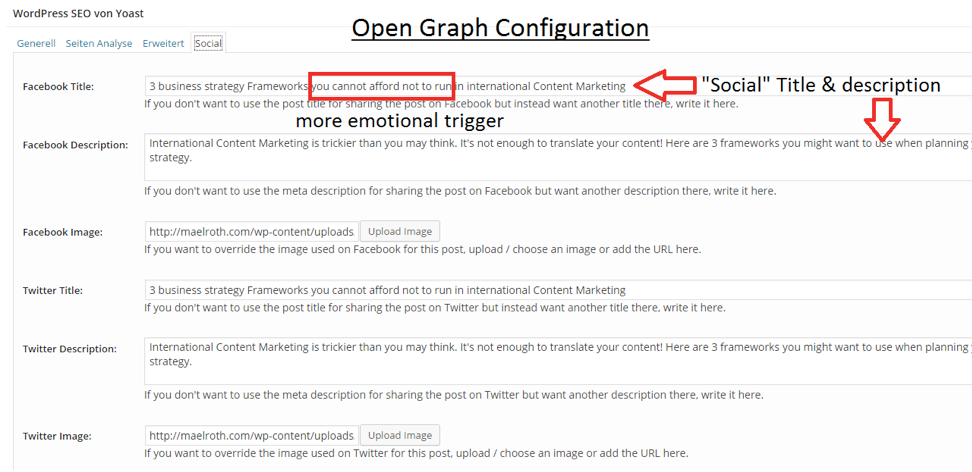
If you customize Metadata for search engines and the social graph separately, you can use different triggers so that you won’t have to choose between search and sexy. You can do both!
I hope this small hack has been helpful to you and I look forward to your comments!
 Maël Roth: I’m half-French, half-German content marketing consultant with a German agency, as well as start-upper with Scompler. My self-inflicted mission: master strategic content marketing. My goal: changing the way marketing is done. Progression: working on it. My biggest problem? I’m interested in everything and I want to master it. More about me here.
The post A simple hack that doubles your headline power appeared first on Schaefer Marketing Solutions: We Help Businesses {grow}.

Comments
- Mind Blown.! I never thought of using different headlines for ... by Tarun Jagwani
- […] Maël Roth is a content marketing consultant. A version ... by I AM PR Tips: A headline tactic for optimal reach on social media and Google search - I AM PR Agency LLC
- By: A headline tactic for optimal reach on social media and Google search | Body Language by A headline tactic for optimal reach on social media and Google search | Body Language
- Headline is very important indeed and it is like the face of ... by Pankaj Dhawan
- […] ?Mael Roth bietet einen Ausweg, der uns das beste aus ... by Perfekte Überschriften für SEO und Social Media › Communicate and sell
- Plus 3 more...
Related Stories
19 Jan 17:39

The Sales Closing Technique That Gets Prospects to Overcome Their Own Objections
by pcaputa@hubspot.com (Pete Caputa)

I'm not a big fan of closing early and often. I prefer to close once I know a prospect is already sold.
As I mentioned in a previous post on phrases that make prospects hang up on salespeople, I try to avoid signaling that I'm there to sell something. Instead, I strive to portray myself as an expert who is graciously and generously making myself available to help them. And closing prematurely hinders the ability to maintain this objective expert, I-don't-need-your-business, you-probably-need-my-help stance.
But that doesn’t mean I don’t get commitment at every step of my sales process. And it certainly doesn’t mean I’m afraid to close at closing time. My go-to closing technique is Dave Kurlan's Inoffensive Close, but I use the 1 to 10 closing technique (taught to me by Rick Roberge) as well. Occasionally, when I'm halfway through the Inoffensive Close and I realize the prospect still has a few objections, I'll stop and transition into the 1 to 10 close.
Why do I transition? When the questions in the 1-10 closing technique are asked in the right order, you'll get the prospect to share why they want to buy and then weigh whether those benefits are worth the risk or downside of their concerns. As they weigh the pros and cons, many prospects will overcome their own objections.
I've read a few articles on the technique online, but none are complete. In this post, I’m going to try to cover all the different scenarios and how you should handle them when they inevitably happen. Let’s dig in.
The 1-10 Sales Closing Technique
The First Question
The first question to ask is:
"From 1 to 10, where 1 is 'I'm not interested in hiring you,' and 10 is 'Sign me up now,' what number are you?"
Sometimes, I like to make this a bit more fun. I might say:
"From 1 to 10, where 1 is, 'Pete, you suck. I can't believe you wasted all of my time. I would never hire you. I don't know why anyone would,' and 10 is, 'Pete, I can't believe I've gone through life not knowing about your service. I wish I could rewind the clock and hire you 10 years ago. I am confident this will be the best investment our business ever makes,' what number are you?"
(Put your own name in there, of course.)
The Second Question
The second question aims to uncover why they will buy.
No matter what number they say in response to the first question (unless it's a very low number -- I address this scenario below), you should act surprised or confused and say:
"Really. I'm surprised you picked a number so high. Based on our conversations, I figured you'd be much closer to a 7. Why did you pick 9?"
You can say 8 or 6, instead of 7. It doesn't matter what particular number you use as long as it’s a number lower than the one they threw out.
If the prospect is confused by this question, you might need to step out of the number scheme (this has happened to me a few times). The simpler version:
"If nothing else mattered, why would you even consider hiring us?"
The key to this question is to get the prospect to tell you why they want to buy. Spend some time here. Acknowledge what they say by repeating it back to them. Ask them to elaborate on things they say.
Also, it's key that you get more than one good answer. After they give you their initial reason(s), ask them why else they would move forward. If you know some other reasons they want to buy that they haven't verbalized at this moment, don't be afraid to prompt them.
In addition, this is a good place to remind them of how you're different compared to competitive solutions -- just make sure you do it in question format. You might ask:
"What about reason X (where X is a differentiated part of your solution that you think they already value)? Is that a reason why you chose a higher number than I expected? How important is X benefit?"
After they’ve shared an exhaustive list of reasons, I find it's best to repeat what they’ve said back to them using some Active Listening skills. (Listening is the key to sales, by the way. It makes closing 100 times easier.)
"So, it seems like you chose 9 because of the following reasons: A, B, C, D, E, and most of all, F."
The Third Question
At some point, you need to transition from why they would move forward to why they might not. The third question uncovers their concerns. Ask:
"Okay. Wow. It seems like there are some really good reasons why you'd like to move forward. But, now I'm confused again. Based on all of those reasons, I'm wondering why it's not a 10?"
Now they should share their concerns. Ideally, it'll sound something like this:
"My only concern is X. If I didn't care about X, we'd be a 10."
Even if your buyer can only come up with one or two concerns, don’t get overconfident. Make sure you explore their objections. Say something like:
"I see. Does it make sense to talk about this a bit more? We may be able to work through this issue together."
or:
"Hmm. I bet we can avoid this concern altogether. Do you want to talk through how we avoid this issue with other clients?"
And to make absolutely sure they don’t have any other hidden concerns, ask:
"If you were convinced that this concern can be avoided altogether, would you be a 10?"
It's difficult to tell you how to handle their concerns exactly, because the specific concerns or objections could vary. But, in general, I'm a big fan of using the L.A.E.R approach: Listen, Acknowledge, Explore, Respond.
Even if you can't allay their concerns completely -- and assuming they gave you a number pretty close to 10 -- you may still be able to close the deal. In this case, skip to the fourth question.
However, in the case they give you a lower number (i.e. anything lower than 6) in response to your initial question, do not proceed. Instead, back up and re-qualify. Just like you were thorough when you were getting them to tell you why they want to buy, be thorough here too. If they aren't being forthcoming, don't be afraid to bring up small concerns they've shared with you previously to get the ball rolling. For example:
"On a previous call, you expressed a concern that your team might not be able to handle Z task on an ongoing basis. Given that completing that task on a regular basis is key to helping you achieve your goals, are you still concerned about that?"
Many times, prospects won't be comfortable sharing all of their concerns or objections. Here's a handful of open-ended questions I might use to help them share. (These questions adhere to our qualification framework.)
- Goals: Are you confident we will be able to help you achieve the goals we discussed: X, Y, and Z?
- Plan: Do you have any concerns with implementing the plan we discussed?
- Challenges: Do you have concerns that our solution won't help you overcome challenges A, B, and C?
- Timeline: Are you concerned that you won't have the time or resources to dedicate right now?
- Budget: Is there some other investment you're considering that you think is a better solution?
- Authority: Is there someone else you've discussed this with who has concerns?
- Consequences: Are you thinking it might just be easier or safer to continue doing what you're doing?
If you have competitors that are also pursuing your prospect and you don't know where you stand against them, you should explore that:
"Do you have other solutions that you’re considering? Do they offer all of the benefits that our solution offers?"
Also ask whether the competitor has a leg up on some of their concerns:
"Do you have the same concerns about competitor X’s solution? Or different ones?"
You can also ask the first question again in regard to your competitor:
"On a scale of 1 to 10, where 1 is competitor X's solution is not a fit at all for you and 10 is you're confident that competitor X's solution is the one you're going to go with, where do you stand?"
These questions might prompt your prospect to share some new concerns. But at this point, you're better off knowing these concerns if they exist. If they don't exist, then you've checked them off of your list, and you're closer to closing confidently.
I don't recommend bringing up new objections, of course. Your qualification process should have determined whether or not they can be successful with your service and you shouldn't be closing if they can't.
The Fourth and Final Question
Now that you know all the reasons your prospect wants to move forward and all the reasons why they might not, you can ask the final closing question in this technique. It sounds something like this:
"It sounds like there are a lot of reasons to move forward: X, Y, Z, etc. It also sounds like you have two specific concerns: A and B. Now that we've discussed them, has your number changed at all? Are you still a 9?"
If they are now a 10, bring up the contract and have them sign. Volia! You just got them to overcome their own objections.
If they aren't a 10 yet, prompt them to weigh the pros and cons that they've just shared with you:
"So, you're still at a 9. I see. In that case, are you prepared to forfeit all of the benefits we discussed and walk away ... [pause] ... or do you think that the benefits outweigh the risks and you should move forward?"
At this point, you have a list of pros and cons. Even if they don't sign your contract right now, you have plenty of information. Ask them how and when they're going to make the decision, and suggest next steps accordingly.
Don’t Lose to No Decision
In sales, you must embrace both closed-won or closed-lost results -- after all, the only thing you control completely is who you spend your time with, not what decision they will ultimately make. By using the 1 to 10 closing technique, you’ll be able to make a very informed guess about whether and when a prospect will buy -- if at all.
Unfortunately, in my years coaching salespeople inside and outside of HubSpot, I’ve seen way too many deals lost to “no decision.” Just yesterday, I was teaching this technique to one of our salespeople. He said, “I don’t really ask closing questions -- I just send the paperwork. But I will definitely do this next time. I’m sick of chasing prospects down to get contracts signed.”
He’s not that different from most salespeople. Way too many salespeople fail to partner with their prospects to really determine whether there is a mutual fit. Then, they end up chasing.
With the 1 to 10 closing technique, you are fully uncovering all the reasons why a prospect wants to buy and why they might not. Before you ask for their business, you’re helping them weigh the benefits, risks, upside, and downside of making a decision to move forward -- or not. You’re uncovering the mental process that most prospects go through, and getting them to share it with you. This sets you up to either close the business or close the file with confidence.
As an expert at what you do, I believe it is your responsibility to avoid sales processes that end in no decision. It is better for you, of course. But it’s also better for the buyer too, since no one benefits from indecision.
If you need a bit of a reminder of why it’s okay to close -- one way or the other -- here’s a quote from my sales mentor, Rick Roberge:
“I believe in those professional salespeople who understand they are responsible for their prospect's comfort, needs, honesty, or lack thereof. It is the salesperson's job to discern if it's a fit. Not the other way around. It's the salesperson's duty to be the person that a buyer needs them to be, but not necessarily the person that the buyer wants them to be.”
Now, go get yes’s or no’s.

19 Jan 17:39
Investors dumped record-setting amounts of cash into startups in 2015, but it's all starting to slow down
by Maya Kosoff

2015 was a banner year for venture capital: investors poured $128.5 billion into ventures, and 71 startups became billion-dollar companies.
But investors are starting to become more cautious with the money they're pouring into startups.
A new report from CB Insights and KPMG, released Tuesday, examined venture capital activity in 2015 and concluded that although 2015 was a record-breaking year for venture capital, VC funding dropped from $38.6 billion in Q3 2015 to $27.2 billion in Q4.
"The number of deals hit a low not seen since Q1'13," CB Insights noted in its report.
Here are some of CB Insights' main takeaways:
- Deal value dropped from $38.6 billion in Q3 2015 to $27.2 billion in Q4.
- Deal volume decreased just as deal value did, too. In Q3 there were 2,008 VC deals; in Q4, there were 1,742.
- The number of mega-rounds is also shrinking. The number of mega-rounds, defined as a $100 million+ investment in a company, dropped from 72 in Q3 to 38 in Q4.
Is this as good as it gets?
Recently, there's been an increase in chatter among insiders about an impending tech bubble burst. Investors are worried that fast-growing startups have been too reliant on easy venture capital for too long. Their customer acquisition costs are too high, their customer and user growth numbers are increasing because they're depending on VC funding to help them expand into new markets, and all the while they're bleeding cash.
In addition, late-stage rounds of funding are getting more difficult to raise without revenue growth and a path to profitability.
Successful VC-backed tech sector IPOs in 2015 were few and far between. Though some companies like Fitbit and Atlassian had above-average IPO performance and were met with enthusiasm in the public market, billion-dollar companies like Square, Box, and Apigee went public with market caps below their last private valuations.
The public markets are much harsher than private markets. This means private investors need to reset their expectations, which could be contributing to a slowdown in funding and downward valuation pressure.
This year, CB Insights predicts investors will be more attuned than ever to companies' key fundamentals, investing only in companies that have reasonable burn rates and positive cash flows. The VC database also predicts an increase in M&A activity, even as VC activity may be declining.
SEE ALSO: I let anyone send me pictures on Snapchat for 6 weeks — here's what happened
Join the conversation about this story »
NOW WATCH: You can finally play original 'Rock Band' on PlayStation 4
19 Jan 17:39


How Much Is Marketing Really Worth To Your Company?
by valueacceleration
 Well, there’s an often asked question. How do you answer it? We’ve seen and heard CMOs, VPs of Marketing, etc. scramble to create an answer to this question. Articles are written regularly on the importance of quantifying Marketing ROI and similar metrics. Since 2005, it’s been less “fun” to be a marketer because that’s about when all this accountability stuff started.
We have been kicking this idea around for a while. (Well since at least 2007 anyway.) And, of course, the first and most obvious question (at least to us) is what do you mean by Marketing? In too many companies what is really meant when the term “marketing” is used is the Marketing Communications/Branding/Social Media/Whatever functions that spend the most of the so-called “Marketing Budget.” Often time the question “what is all this doing for us?” is a proxy for the question “what is Marketing worth?”
While we accept that this budget and spend (though it should be an investment, but that’s another post) is potentially a large percentage of the total Marketing budget, it’s not where the leverage can be found. Apple spends a lot of money on the promotional side of their business, but as a percent of revenue, it’s trivial compared to others. Is that because their advertising/social media/whatever is so much better than everyone else? Not really, and certainly not anymore. Then what is it?
Simple, they get the true job of Marketing done right, so the backend (Marketing Communications) has less weight to carry. As we discuss in our book, Value Acceleration, Marketing’s responsibility is to “align the capabilities of your company with the desires of the marketplace.” So how much is doing that correctly worth to your company? We postulate the following answer:
Firms have a Market Value or Market Cap (MC). With publicly traded companies the Market Cap is easy to calculate since the stock price and number of shares outstanding is readily available. With privately held companies that are actively seeking investors (typically high tech companies, but not always) the Market Cap is simply the valuation at which they successfully raise money. With most privately held companies the Market Cap or Market Value is not readily known until it is time to sell the company. All that being said, the Market Value or Market Cap is composed of the current Net Asset Value (NAV) of the company and its potential future profits in net present terms, or the Present Value of Future Earnings (PVFE).
So MC=NAV+PVFE. If you accept that Marketing’s function is to “align the capabilities of your company with the desires of the marketplace,” then the PVFE is a direct result of doing that well. The costs associated with execution of that effort are ultimately subtracted from NAV. We then argue that the value of Marketing to your company is effectively the PVFE as defined by realizing that PVFE=MC-NAV.
You might argue that this is overly simple and ignores core capabilities a company may have developed over time in either R&D or Manufacturing for example. Fine, but if that R&D does not line up with the “future needs of the marketplace,” how valuable is it really? How is it being directed? On what basis are you making R&D investment decisions?
Or you might argue that your Manufacturing or Service delivery capability is world-class. Ok, that might be true. And again, how did you decide what aspects of Manufacturing or Service delivery at which to become great? How did you decide how to “align that capability with the desires of the market?”
One might suggest that we are describing strategy and its execution. Ok, but in strategy execution after you identify the goal, then the strategy must:
- Leverage what your company is great at
- Take advantage of what is going to happen outside your company that will help you (It might be argued that for some companies these external factors might over-ride anything else the company can do to help itself. The might be access to resources factors that favor the company, or access to exclusive markets, etc. We except these anomalies that prove the rule.)
- While mitigating your weaknesses and those external factors that work against you
- To create an approach that aligns with the desires of the marketplace.
As we note in our book, Marketing, as we define it, is the source of competitive advantage.
How’s your Marketing function stacking up? Is you company worth a lot more than its NAV? It’s unlikely you can make a huge impact on the perception of future earnings from promotional activities alone. As Yoga Berra once said, “If people don’t want to come out to the ballpark, nobody’s going to stop them.” What is your Marketing function doing to make sure “people want to come out to YOUR ballpark” today and tomorrow?
Mitch & Ralph
19 Jan 17:38
5 Simple Steps To Turn Readers Into Buyers – Content Marketing That Sells
by Tom Pick
Okay…
So you have set up a blog and social media profiles…
You are pumping out multiple articles per week and sharing them furiously…
 And yes you see some small traffic spikes (though they quickly drop off when you stop posting right?).
Trust me, I know, I have been there… multiple times.
And you are now getting tired of producing content yourself so are considering outsourcing…
STOP
Now there is nothing wrong with outsourcing but there is something wrong with an incoherent, unfocused content strategy.
By the end of this article you will be on the road to developing a deep clarity and focus in your content strategy that will eventually skyrocket your ROI.
1. Understand Your Customer’s Desired Outcome
What does your customer truly want?
Depending on your business this could be the ability to play the piano, clean their carpet or to make more money.
It is only when you truly understand this can you create an ethical and profitable business, as let’s face it…
You will only be profitable in the long term if you are able to deliver the customer their desired result.
Back to content…
2. Understand Where Your Customer Is In That Journey
When your customer reaches your blog/YouTube Channel/website, where are they on their journey to their desired end result?
If we take blogging for example…
An aspiring bloggers end goal (I suspect), would be income and impact.
And to be able to reach those desired outcomes a number of steps would have to be made, such as:
- Choosing a niche
- Buying a domain
- Building a website
- Setting up social media profiles
- Building a content schedule
- Learning to write headlines
- Learning about lead generation
- Building an autoresponder
The list goes on…
My blog could potentially target people that are starting out or I may focus on those with an already established audience.
3. Create Content That Starts At That Point
As a blogger, blogging about building a blog, you would need to understand at which stage on this journey my readers are…
And then need to create content that would help them move down the path.
For example…
Let’s say your blog will target readers that are just starting out on their blogging journey, you would produce the following content:
- Niche Research – The Ultimate Guide
- The BIG List Of 50 Domain Name Providers (And Which Give The Best Deals)
- 150 Free & Still Awesome WordPress Templates
- Step By Step Guide To Customising Your WordPress Template
Now, these headlines would REALLY stand out to people at the start of their blogging journey and would be bound to receive more traffic, links and shares from relevant readers.
4. Ensure That Content Progresses Them Down The Road
Now here is the tricky part…
You need to make sure that EVERY piece of content walks your reader down the path closer to their desired outcome.
For example in “Niche Research – The Ultimate Guide.”
You would need to cover EXACTLY what you need to consider when researching the niche of your new blog, including images and diagrams, links and inforgraphics showing what you have done in the path.
You need to make it as EASY as possible for them to take action…
Because your business depends on it.
5. Enable Them To Take The Next Step (With You)
Now we get to the exciting part…
Because when you become one of the few…
And you start actually ensuring that your readers move down the journey to their desired outcome with you, something strange will happen:
- Your readers will start to believe that they can actually reach their desired outcome
- Your readers will start to look at you as an authority in the niche
Pretty sweet, right?
And do you know what these two things are awesome for?
Yes, you guessed it:
SELLING
So, it is at that point when your readers reach end of your awesome, action-inspiring post that you have to enable them to take the next step on their journey with YOU.
Now this could be in the form of another piece of content or software that they can access in exchange for a newsletter or it could be in the form of a product.
This is up to you…
But if you are not offering them a chance to continue down their path with you, then you are doing them a disservice.
Okay…
Now you have the knowledge.
The knowledge that will force you to stop pumping out useless, unfocused articles that will bring you little traffic and even less loyal readers.
It is time to head out there are to create content that matters, that helps and most importantly… sells.
Finally, if you are aware of anyone in your network who is struggling to convert readers to buyers with their content marketing, feel free to share this article with them using the buttons below.
19 Jan 17:38
Article: Digital Buyers in Singapore Research Purchases Frequently
Young adults who make digital purchases in Singapore are fair frequent buyers looking for products they can’t get easily elsewhere, according to 2015 research. Most research new purchases at least weekly.
19 Jan 17:38
IEA sees world ‘drowning in oil,’ sending crude prices even lower
by Grant Smith, Bloomberg News
Global oil markets could “drown in oversupply,” sending prices even lower as demand growth slows and Iran revives exports with the end of sanctions, according to the International Energy Agency.
The IEA trimmed 2016 estimates for global oil demand as China’s economic expansion weakens and raised forecasts for supplies outside the Organization of Petroleum Exporting Countries. While non-OPEC supply is set to drop 600,000 barrels a day in 2016, Iran’s comeback could fill that gap by the middle of the year. As a result, world markets may be left with a surplus of 1.5 million barrels a day in the first half.
“While the pace of stock-building eases in the second half of the year as supply from non-OPEC producers falls, unless something changes, the oil market could drown in oversupply,” said the Paris-based adviser to industrialized economies. Prices “could go lower.”

Oil sank to a 12-year low of less than US$28 a barrel in London on Monday as the removal of international sanctions over the weekend freed Iran to revive crude exports, threatening to swell a glut created by fellow OPEC members and U.S. shale drillers. Saudi Arabia, the biggest oil exporter, signaled again on Sunday it won’t relent in its strategy to preserve market share even as prices crash.
Iran Growth
Iran could be the only source of supply growth in OPEC this year as a surge in Iraq fizzles out, the IEA said. International sanctions, including those on its oil sector, were lifted on Jan. 16 as Iran met the terms of an agreement to curb its nuclear development program.
The Persian Gulf exporter could add 300,000 barrels a day by the end of the first quarter and 600,000 barrels a day by the middle of the year, the IEA said. While that’s below official ministry plans to add 1 million a day by mid-year, it could still be enough to pressure prices further, the agency predicted. The country pumped at a 3 1/2-year high of 2.91 million barrels a day in December, according to the report.
Related
Global oil demand growth slipped to a one-year low in the fourth quarter, from close to a five-year high in the third, amid mild winter temperatures and economic weakness in commodity producers. Consumption growth will slow this year to 1.2 million barrels a day, or 1.3 percent, from 1.7 million a day in 2015, according to the report, averaging 95.7 million barrels a day.
OPEC Supply
While supplies outside OPEC proved “resilient” for most of last year, they shrank on an annual basis in December for the first time in three years, according to the IEA. The projected drop of 600,000 barrels a day in non-OPEC production this year will be the steepest since 1992.
Production from OPEC, whose membership expanded last month with the return of Indonesia, slipped 90,000 barrels a day to 32.28 million a day in December amid slightly lower output from Saudi Arabia and Iraq, according to the report. That’s still about 600,000 a day more than the average of 31.7 million required in 2016.
With OPEC supply potentially expanding and demand growth slowing, global inventories could accumulate by a further 285 million in 2016 after swelling by 1 billion barrels last year, the IEA said. As the availability of storage on-land becomes tighter, that could make it profitable to stockpile excess crude on tankers at sea, the agency said.
Bloomberg.com
19 Jan 17:37

How Local Motors hopes to disrupt the auto industry with a $53,000 3D-printed car
by Kristine Owram
DETROIT — Forget Tesla’s electric vehicles and Google’s self-driving cars — a little-known company called Local Motors Inc. wants to be the disruptor that turns the auto industry on its head.
Local Motors’ business model is so radical that it’s hard to comprehend at first: crowd-sourced, 3D-printed electric vehicles built in local microfactories the size of grocery stores, then sold directly to consumers.
According to Justin Fishkin, Local Motors’ chief strategy officer, the auto industry is fundamentally unchanged from the days of Henry Ford — cars are still built on assembly lines in giant factories, then shipped around the world and sold in dealerships — and it’s time to throw that model out the window.
“We think that to make local big again, you’ve got to make big things locally,” Fishkin said in an interview on the sidelines of the North American International Auto Show in Detroit this month. “That’s the future.”
Founded in 2007 in Phoenix, Local Motors developed the unusual idea of crowd-sourced vehicles. This means anyone — suppliers, engineers, even your average gearhead — can contribute to the vehicle’s design in exchange for a royalty.
The initial result of this was the Rally Fighter, an off-road vehicle that starts at US$99,900 and would look right at home in Mad Max: Fury Road. Buyers are invited to participate in its production, a process that Local Motors calls the “Build Experience.”
The company plans to go much further into uncharted territory with its next vehicle, which has begun crash-testing and is expected to hit the market by early 2017. Dubbed LM3D, it will be the world’s first 3D-printed car series, an approach that will keep capital costs low and allow cars to be “recycled.”
DAN JANISSE/The Windsor StarJustin Fishkin (L) Local Motors chief strategy officer and David Woessner, Local Motors general manager, in downtown Detroit, MI.
An LM3D concept car, called the Swim, was revealed in Las Vegas in November, although Local Motors says this is not what the finished product will look like. The final price tag hasn’t been set, but the suggested retail price in a November press release was US$53,000.
Customers won’t be able to customize their vehicles, at least not at first, since any major changes could affect the LM3D’s crash-test certification, said David Woessner, Local Motors’ general manager for Detroit.
However, Fishkin promises that there will be substantially more flexibility for consumers than you would find at your average dealership.
“We expect you’ll be able to walk in, choose one of several car bodies, choose your powertrain, choose your options and then we’ll make it while you wait or we’ll make it so that you can come back the next day and pick it up,” Fishkin said.
“Then in two months if there’s a better battery out or if you have a child and need a back seat, we can strip the components off and recycle them into your next car.”
This will be possible because of Local Motors’ microfactory model, which envisions a series of 50,000-square-foot plants — about the size of a typical grocery store — that will build, service and recycle vehicles locally, all over the world, in small volumes. These microfactories will also act as points of sale, or what Fishkin calls “experiential dealerships.”
The first LM3D cars will be built at Local Motors’ existing microfactory in Knoxville, Tenn., but it plans to open 50 to 100 more over the next decade, including one in Berlin this year and another in either Singapore or South Korea by early 2017.
The company is also “very eagerly” looking at possible locations in Canada, Fishkin said, adding that Calgary would be near the top of his list. “We will be in Canada for sure at some point in the future, it’s just unclear where and when yet,” he said.
The idea of a 3D-printed car may raise some drivers’ eyebrows, but Fishkin says safety will not be an issue.
“People say to us, how are you going to convince anyone to get in a 3D-printed, plastic car?” he said.
“It’s fair that people have questions, but those questions will be answered before we try to sell this.”
We’re going to show people that the Jetsons really is possible, as opposed to staying with the Flintstones
The car isn’t really made from plastic — it’s thermoplastic reinforced with carbon fibre, a material that’s widely used in the aerospace industry — and Woessner said Local Motors is working with the U.S. government and other partners to develop even stronger materials that can be used in the 3D-printing process.
“We’re doing some of the leading research in the world on materials and material strength and material structures, and down the line we believe that once the technology has been proven and the materials are developed, they will prove to be even safer than what currently exists,” Woessner said.
The LM3D’s components — the parts that are sourced from outside suppliers, and not 3D-printed in-house — will come from several companies in both the tech and auto industries.
“There’s this Detroit versus Silicon Valley thing that everybody’s talking about in automotive, and we naturally bridge both,” Fishkin said.
Related
He wouldn’t give details about the LM3D’s suppliers, except to say that there are “American companies, German companies and South Korean companies” that are fighting to supply its electric powertrain.
Local Motors’ model is also significantly cheaper than the existing automotive production model. The Rally Fighter was profitable around its 60th unit, according to Fishkin, and he estimates that a microfactory costs an average of $20 million to build, a fraction of the billions that go into opening traditional auto plants.
The company recently completed a “decent-sized capital raise” that should get it through the next 12 to 24 months, and is seeing a lot of interest from potential investors, Fishkin said.
Local Motors’ capital efficiency also allows it to turn on a dime in a way that’s impossible in the traditional auto industry.
“We’re a tool-less manufacturer, so instead of having to reinvest another $5 billion to make a different vehicle, we can make a different vehicle the next day or the next month using the same tools,” Fishkin said.
To Woessner, this means one thing: “You fail faster.” For example, Fishkin said Local Motors will never have a recall because, if there’s an issue with one vehicle, the 3D-printing template can be changed for the next one that comes off the line.
“We’re going to show people that the Jetsons really is possible, as opposed to staying with the Flintstones,” said Fishkin.
19 Jan 17:37
How to Use Video as Your Ultimate Sales Weapon
by Sarah Quinn
Getting through to your customers is a tough gig.
They ignore your calls, they’ve installed ad blocker across all of their devices, and they use Gmail to filter out your emails that took hours of brain power trying to come up with the perfect subject line.
Bleak, isn’t it?
But don’t take it personally, unless your name is David Brent, then chances are it’s not you.
It’s that traditional sales channels don’t work anymore. Your customers are smart. They’ve grown tired of cheesy liners and in-your-face tactics. They want stuff that they care about, stuff that piques their interest — which is why we believe video marketing could be your secret weapon.
Video…Really?
Yes, really.
People love content that’s engaging, visual, and interactive – and video is the only thing that can offer all of that rolled into one.
But don’t just listen to me….
Listen to the 93% of businesses that say a video has helped increase customer understanding of their product of service.
Or the 64% of businesses that believe video has directly led to increased sales.
If you introduce video into your marketing then we guarantee you’ll never have to use a cheesy sales line ever again.
So how does it all work? It’s easy, just follow these simple steps….
Step #1. Attracting the masses
As much as we’d like to see instant results, we all know that to make a solid sale it takes time, energy and a whole lot of nurturing. Typically a customer will go through four key buying stages before they come to appreciate you, so in order to make this work, you need to start at the beginning…
The attraction stage is all about creating a video that lures people in.
This isn’t the time for selling your product, it’s the time to be selfless and create something that’s interesting to your audience.
So when you’re planning your video you need to ask yourself:
- Who is my key audience?
- What do they think is interesting?
- What would they want to share with their friends?
Typically during this stage of your sales efforts you will be focused on creating a video that is perfect sharing material on social.
And it’s not as hard as you think to get people to share branded videos on social. 70% of people say that they would share a brand’s video, and one of the biggest reasons as to why they would share it, is if the video was entertaining.
So let’s take a look at one of the most shared video of 2015. It’s from Android, and it’s got an impressive 6,587,498 shares.
The reason it works…
This is the perfect example of a selfless branded video. Does it keep me engaged throughout the whole video? Yes. Does it make me want to hit the share button? Definitely.
Does it make me want to buy an Android phone? Er, No.
But that’s not the point.
The reason it works is because it’s short, entertaining, emotionally-driven, and it doesn’t try any overbearing sales techniques. Although it does have an ever-so slight sales message right at the very end, it’s subtle enough not to put people off, and it raises brand awareness without consumers even realising it.
The key for a successful video on social is to be subtle, be intriguing, and above all, be entertaining.
But don’t forget, what’s entertaining to a 20-something millennial could be completely different to someone who’s of the gen-x demographic. When planning your video, always keep in mind who it is that you are targeting.
Step #2: Preaching to the unconverted
So now you’re using video to get people interested in your brand, it’s time to put some energy into turning those people into leads.
At this stage it’s OK to start introducing your product or service into the mix. Your audience is getting ready to find out more about you, and one of the best ways to do this is through the power of a webinar.
A webinar is a great tool to use because you can use it to educate your audience on why they need to buy your product or service.
But don’t forget the main reason why you are holding the webinar — it’s to build more leads. So each person that watches needs to give you their details. That way, you can offer them plenty of insight into your industry, and use their details for future marketing efforts.
When you’re planning a webinar you need to ask yourself:
- Is it an interesting topic that people would want to watch?
- Will it educate the viewers about my product or service?
- Will it inform my audience on how they can benefit from my business?
- Will it encourage viewers to join in with the discussion?
A great way to give your webinar the boost that it needs is to partner up with a webinar expert. That way, you’ll have a larger platform to reach your intended audience and you don’t need to worry about the heavy lifting when it comes to promoting it.
So for example, we are holding a webinar about how to use explainer videos to attract and convert customers…

The reason it works….
It’s a topic that many businesses will find interesting — particularly you, if you are reading this post! We aim to use it as an educational tool to help people put the topics discussed within the webinar into action. And because it’s hosted by Wyzowl’s very own MD, the viewers can feel confident that they are gaining actionable expert tips and tactics.
Feel free to join us if you’d like to find out more about explainer videos.
Step #3: Closing the sale
After a person has watched your webinar and got to know a bit more about who you are, it’s time to up the ante.
Yes, now you can start asking for the sale. And we believe there is no better way to do that than by creating an explainer video.
Did you know that 77% of consumers have been convinced to buy a product or service from watching a video about it?
An explainer video is an awesome selling tool because it let’s your audience know exactly why they need your business in their lives.
The formula to a successful explainer video is by connecting to the customers problems, introducing you as the solution, and showing the benefits.
So when you’re planning your explainer video you need to ask yourself:
- Does it convey my audiences biggest problems?
- Does it offer the benefits of what I’m offering?
- Is it engaging, short and concise?
- Does it close by telling the viewer how they can go on to make a purchase?
The greatest explainer videos are those that cover all of the above points. So for example, one of our favourite videos is this one below from Clipping Path Specialist.
The reason it works….
It opens by getting on the viewers’ level right away, it talks about the problems they may face whilst using photoshop to cut out an image, and it then goes on to introduce their service — relaying the benefits and features. It focuses on the core message that it’s hassle free, easy and cheap, and it uses fun animations to help keep the viewer engaged. And the best part? It achieves all this under 90 seconds.
Once you’ve created an awesome explainer video, make sure you place it on your homepage. Not only will this mean your visitors can watch it, but 72% of businesses believe a that an explainer video has improved the conversion rate of their website!
Isn’t it about time you closed the sale in the most engaging way possible?
Step #4: Keep them coming back for more
Right so you’ve got the sale in the bag, what’s next?
Well, you need to continue to show your love for your customers, even after the sale.
The reason being?
Aside from the fact that it costs 5x more to acquire a new customer, than to keep the ones you’ve already got, if you turn your customers into raving fans of your brand, then you’re far more likely to convince other people to come and buy your product or service. That’s because people trust peer recommendations way more than brands.
So now is the time to create more videos that continue to teach your customers about what they can do with the product they just bought. You could even create a video that aims to up-sell or cross-sell them to a different service that may be beneficial to them.
When planning your ‘after-the-sale’ video, ask yourself:
- Does it help them use the product they just bought?
- Does it show my appreciation for them as a customer?
- Is there a way I can up-sell to a different offering?
- Does it encourage them to share with their friends?
Not all of these goals will fit into one video, but that’s the beauty of the after sale — you need to continue to create different videos so that your audience stays connected with you.
For example, fitness guru Kayla Itsiness promotes an app that promises to get you fit, strong and healthy. And in addition to this, she regularly produces videos like this one below for all of her customers to watch and learn from…
The reason it works….
- It offers expert tips on how to recover from a work-out at home
- It’s short, concise and easy to follow
- It helps to build a community of followers with all of her customers
So long as you continue to provide valuable video content to your customers, you’ll quickly build a strong and steady relationship with them.
Until next time…
So those are my four steps on how to use video as your ultimate sales weapon. What do you think? Have you used any of these tactics before? Let me know how you get on with video marketing in the comments below!
Oh and one more thing…
Now I know what you’re thinking, these steps are great, but how do you promote your videos so that people can actually see them?
Well that’s a story for another day, but if you’ve got 4.07 minutes to spare then go take a look at this video that gives you 6 steps on how to promote your video.
19 Jan 17:37

3 Tips to improve your sales coaching techniques
by Barbara Downes
Move away from the computer and coach
Time is a limited and much sought-after resource in the sales environment, especially for sales managers who are being tasked to do more with less. Taking the time for coaching sales professionals can seem like an unrealistic luxury, but the time invested can create greater gains and even more time for the manager. We all struggle with making time to coach so that you have to create a cadence.
There are a few secrets that I have found that can improve your sales coaching techniques and make coaching easier and more effective. The first is discipline. As a sales manager, I disciplined myself to make time for “in-the-moment” coaching every single day.
Each morning, I would walk over to the office or workspace of each of my employees. I said, “Good Morning,” and then asked them three questions:
- What was their plan for the day?
- How were they doing?
- Was there anything that required my immediate attention or that they needed my help with today?
The whole process took about 20 to 35 minutes. It helped me manage my time, coach my people, and deliver on expectations.
I could tell what I needed to do to coach them in the moment by how they answered the questions. This process surfaced urgent items that needed processing, challenges with a client, any lack of focus, attitudes that were forming, and any performance issues.
This morning routine also provided me with the opportunity to connect employees who might be dealing with similar scenarios so that we could share best practices or address an emerging problem. I also had the opportunity to praise them in the moment or to guide them, if needed. If something arose that needed more time, we could schedule a meeting.
This practice became helpful, especially when it came time for performance reviews or more formal one-on-one coaching.
The second secret is to be present. Whether I was standing in someone’s office or they were in mine, I gave them my full attention. I focused on the individual and, if I was at my desk, I moved away from the computer, to avoid distraction. This was not always easy, and I struggled with it. I had to force myself to turn my back on my computer and turn off the sound so that I could not hear the ping of incoming e-mails.
Every person is unique, and you have to get to know the sales professionals on your team as people first. Some will need more help than others. Some require more structure. A sensitive situation for one person might not be for others.
Coaching is about collaboration. In order to be an effective coach, you need to create an environment of trust. Coaching is not only about improving performance but also recognizing when a person has done something well, as success breeds success.
In its purest sense, coaching is about sharing feedback with someone about their performance — what is working, what isn’t, and what opportunities exist to do things better. Together, you create a plan of action for taking performance to the next level. The Richardson coaching framework helps provide managers with the structure to optimize performance, connect with the person, and coach authentically. The framework helps managers focus on the person and the objective.
Some managers feel that their top performers don’t need coaching, that “if it ain’t broke, don’t fix it.” But, all sales professionals need recognition and direction. Giving top performers the recognition that they deserve can challenge them to higher levels. Direction, when well placed, leads to mastery. Mastery is about the small tweaks that we make to a job well done. These tweaks say that I, as your sales manager, am here to help you be the best that you can be; I am listening and watching. Giving recognition and direction to middle performers can make sure that their progress continues. It helps them adjust their sails, giving them the confidence to push through rough patches and focus on the results to strive for.
Coaching requires a genuine concern for helping people succeed and for recognizing progress, no matter how small. Most people are starved for good, honest feedback. It’s the sales manager’s job to refine their sales coaching techniques and find the most effective way to deliver such feedback to their team. Catch people doing the right thing and tell them about it. Help them adjust their technique to optimize their performance, and assist them in seeing where they fit into the big picture.

The post 3 Tips to improve your sales coaching techniques appeared first on Richardson Sales Enablement Blog.
19 Jan 17:37
5 Tips for Building Your Sales Team
by Rebecca Johnston-Gilbert
 According to Harvard Business Review, sales organizations go through typical phases of growth. These include building a sales force, scaling it up, maximizing its productivity, and then, if necessary, culling the salespeople to include only the best of the best.
Any successful sales strategy includes a plan to make it through the initial “build” phase, which is critical to long-term success. During this stage, you need to ramp up enough sales coverage to bring your product or service to market. At the same time, you have to make decisions about your sales models. Will you use field salespeople, inside sales people or channel partners? Would you be better off with a mix of sales methodologies? If so, what is the right combination?
Once you’ve resolved these questions, it’s time to take five steps to building a sales team.
STEP #1 Hiring a Sales Team: Find the Right Candidates
There are many places to find candidates. Entrepreneur suggests looking within your own company’s walls. After all, there are people in your organization who already know the ropes and may have the sales gene. Also, it’s a good motivator to offer opportunities to internal candidates. And even if your associates are not interested in sales, they may be able to refer you to former colleagues or friends who could do a stellar job.
You can look for new sales associates in other ways, ranging from mining your network to contacting headhunters. If you decide to recruit without external help, don’t forget to access LinkedIn, a treasure trove of talent at your fingertips. Remember, the salespeople who are happiest in their current jobs are likely those who are exceeding their quotas and raking in the commissions. They are probably the ones you would like to be selling for you, so it may be worthwhile to reach out to them.
STEP #2 Train Them Without Delay
Once you have new salespeople on board, get them up and running as soon as possible. That doesn’t mean taking shortcuts in training to see if they sink or swim. It will likely not suffice, for example, to simply give them your product literature and have them shadow an experienced rep for a day or two.
So, create a thorough training program covering your product and your sales process. Include introductions to help new sales reps build their support network within your company. After you train reps, monitor performance and ask for their feedback to see if they have the know-how they need. If all is going well, stick with your training program. If not, tweak it as necessary until you and your trainees are satisfied with the results.
 STEP #3 Create a Sales Process and Repeat It
A proven, repeatable sales process helps to define how to manage a sales team. Also, it enables them to fire on all cylinders.
Start by defining the stages of your sales cycle. It begins with leads—people who provide contact information to your company. Since some of these individuals may not be interested in buying ever and others are not ready yet, the next step is to qualify them.
Generally, leads go through a couple of phases of qualification. First, some become “marketing qualified,” meaning it’s worthwhile to have your marketing team nurture these leads. After some time in marketing’s hands, a number of these leads will become sales qualified. In other words, they’re ready for your sales team to follow up. After that, prospects may move into demo or quote phase, or become a customer.
You should customize your sales stage definitions and your sales process to your customer’s journey and organization’s needs. Consider how your customers go about research to solve the problem your product or service addresses, how they consider various solutions and make a final buying decision. Understanding this will help you to build a sales process that creates a consistent brand experience, builds customer trust and satisfaction, and boosts retention rates.
Don’t build your sales process in a vacuum. Instead, consult with your most experienced, successful salespeople. Find out what is working for them and document it so others can duplicate it. Then, train all new reps on how it works. You don’t want them to through a trial and error sales process.
STEP #4 Provide the Tools to Succeed
When it comes to sales, there are many moving parts. You cannot afford to have prospect and customer follow-up falling through the cracks. That’s why a CRM system is essential. It enables salespeople to juggle all their to-dos without dropping a single ball. And it minimizes paperwork…the part with which most salespeople struggle.
Also, CRM pipeline reports can be a powerful motivator. Reps can see the big picture and what they need to do to realize their goals. What’s more, other reports, such as those that identify cross-selling opportunities, provide detailed guidance to increase sales.
 STEP #5 Make Learning Continuous
Training should not be a one-time occurrence. Salespeople need feedback, sales tips and coaching on an ongoing basis. Also, learning should be a two-way street. Just as experienced reps can help you define your sales process, new hires can provide fresh perspectives that may revolutionize results.
Are you ready to start building a sales team and scaling your business? If so, you’ll need to hire the right people, create a repeatable sales process and provide the tools to support your salespeople.
This article originally appeared on Claritysoft and has been republished with permission.
18 Jan 19:43

Seven Useful Microsoft Excel Features You May Not Be Using
by Alan Henry
Microsoft Excel is packed with useful data management features that don’t see a lot of use, like pivot tables, index and match, and conditional formatting. If you’re just using excel to sum and chart columns, this graphic can show you some other tools to help you become the spreadsheet ninja you always wanted to be.
18 Jan 19:41


The big order of tacos that took down El Chapo: Inside the raid that captured a drug lord
by Azam Ahmed, The New York Times
MEXICO CITY — Stripped to his undershirt and covered in filth, the world’s most notorious drug lord dragged himself out of the sewers and into the middle of traffic.
Disoriented from his long trudge underground, with gun-toting marines on his heels, he found himself standing across the street from a Wal-Mart. Joaquín Guzmán Loera, the kingpin known across the globe as El Chapo, would have to improvise. His cavalry was not coming.
He and his top lieutenant commandeered a white Volkswagen from a passing motorist, but only a few blocks later, the car became engulfed in smoke, witnesses said. Desperate for another vehicle, the two men spotted a red Ford Focus at a traffic light, driven by a woman with her daughter and 5-year-old grandson.
“Get out of the car now,” said the lieutenant, his weapon trained on the woman as he lifted the door handle, witnesses said. She complied, prying the child from the back seat and leaving her belongings in the car. Politely, the lieutenant handed her her purse before speeding off.
The Mexican marines had been on Guzmán’s trail for more than six months, ever since he humiliated the nation by escaping its most secure prison through a tunnel that led into the shower floor of his cell.
The chase had led them into the remote wilds of the Golden Triangle, on the border of Durango and Sinaloa states, an area where Guzmán is revered. He evaded multiple raids by the Mexican authorities, including a close brush after he sat for an interview with the U.S. actor Sean Penn.
But it had come at a cost. The authorities had swept through 18 of his homes and properties in his native lands. Days on end in the inhospitable mountains, where even a billionaire like Guzmán was forced to rough it, left him yearning for a bit of comfort.
In early January, he arrived in the coastal city of Los Mochis, in Sinaloa, at a home where the authorities had trailed one of the chief tunnel diggers from his escape. Construction crews had been hard at work on the house for weeks. Telephone intercepts indicated that someone big was about to arrive.
The final bit of evidence was a food order, Mexican officials said.
Government of Mexico / Associated PressMexico's most wanted drug lord, Joaquin "El Chapo" Guzman, stands for his prison mug shot at the Altiplano maximum security federal prison in Almoloya, Mexico.
Just two blocks away, a big order of tacos was picked up after midnight Jan. 8 by a man driving a white van, like the one believed to be driven by Guzmán’s associates, witnesses said.
Hours later, at 4:30 a.m., the marines stormed the compound, meeting a knot of doors and fierce resistance from gunmen. Like many of Guzmán’s homes, this one was equipped with elaborate escape hatches: a decoy beneath the refrigerator, and another behind a closet mirror, which he used to flee as the battle raged.
Hours later, on a highway heading out of town, the authorities finally got Guzmán, arguably the most powerful drug dealer in the history of the trade, for the third time since 1993.
As the head of the Sinaloa cartel, Guzmán is the embodiment of an identity the country has fought to shed for decades. To some, the uneducated farm boy turned cartel magnate is a Robin Hood figure for modern times, revered for his fight against the government and generosity to the poor. For others, he is a heartless criminal who floods America’s streets with narcotics and leaves Mexico’s streets strewn with bodies.
Either way, Guzmán represents a deep crisis for Mexico’s leaders as they struggle to define the country’s image.
His daring escape from prison last July, in view of the video camera in his cell, cast a lurid spotlight on the incompetence and corruption that has long dogged the Mexican state, driving many to view the government on a par with criminals.
Now, the recapture of Guzmán, who has escaped prison twice, is about Mexico repairing its security relationship with America; its image globally; and perhaps most important, its leaders’ relationship with their own people.

El Chapo’s image, by contrast, seemed only to grow after his escapes. Perhaps more than the infamy he gained as a cartel chief — responsible for shipping tons of drugs to more than 50 countries around the world, with a wider reach than even Pablo Escobar in his heyday — Guzmán has earned a reputation as the world’s pre-eminent escape artist.
After breaking out of prison in 2001 (by some accounts, he sneaked out in a laundry cart), Guzmán dodged Mexican and U.S. authorities for more than a decade. At a network of homes he owned, his team of engineers and diggers had expertly constructed tunnels enabling him to slip away, time and again, often just minutes before raids.
In February 2014, the authorities arrived at a house in Culiacán only to find a signature Chapo trick — a tunnel entrance beneath a bathtub — through which the kingpin had just fled.
He was, after all, a creator of the border tunnel, underground passages equipped with lighting, ventilation and mechanical carts to smuggle drugs into the United States without having to bother with the headache of evading customs agents. In total, Guzmán’s organization is estimated to have burrowed more than 90 such passages between Mexico and the United States.
But those tunnels could hardly compare to the one crafted for his escape last summer from the most secure wing of the country’s most secure prison. During the 17 months Guzmán was locked up, he met often with associates, not only to plan his legal defense, but also to plot his escape, Mexican officials said. His men purchased land within sight of the prison, constructing an outer wall and an unfinished building on the site. From there, a mile away, the digging began.
They eventually reached the exact spot beneath Guzmán’s cell, tunneling up beneath the shower floor, into a narrow space behind a waist-high wall that gave prisoners some modicum of privacy from the 24-hour surveillance camera. At 8:52 p.m. on July 11, 2015, Guzmán walked into his shower, bent over and disappeared into legend for the second time.
Two Cessna jets later whisked him back to the mountains of his childhood, where the pursuit would begin, again.
Even before Guzmán vanished from custody, though, he was making plans for a vanity project that ultimately helped the authorities pinpoint his whereabouts. By most accounts, Guzmán was not short on ego. His lawyers had filed papers to copyright his name for a big venture he was working on: a movie about his life. He reached out to several famous Mexican actresses, including Yolanda Andrade, hoping to lure them into his web of influence.
To that end, Kate del Castillo, another Mexican actress known for her portrayal of a drug boss in the series “La Reina Del Sur,” or “The Queen of the South,” had caught his attention. She had been sympathetic to him on social media and Guzmán instructed a close associate to contact her.
Before Guzmán’s escape, del Castillo met with a lawyer in Mexico City to discuss communications with Guzmán about a potential film. The meetings and communication continued while he was ensconced in the ragged mountains of the Sierra Madre.
Mexican authorities were monitoring the phones of Guzmán and his accomplices, reading the odd and unexpectedly tender exchanges between him and the actress. Guzmán promised to protect del Castillo as he would his own eyes, an affectionate phrase Mexican parents often say of their children.
Even when del Castillo suggested bringing along Penn for an interview, the drug lord did not flinch. That was, perhaps in part, because he seemed to have no idea who Penn is.
Piggybacking on the communications, the authorities tracked down Guzmán and planned an operation to grab him in early October. But the mission was delayed; they could not risk taking action while Penn and del Castillo were in the vicinity.
Reed Saxon / Associated Press Mexican actress Kate Del Castillo attends a NASCAR event in the U.S. in 2013.
On Oct. 2, the parties met for the first time, in the remote reaches of the Golden Triangle, near the city of Cosalá in Sinaloa. Guzmán left afterward for Durango, where he had a ranch.
The circle had already been drawing tighter around Guzmán, with the authorities pressing into the villages and homes of his associates and upending life for many in the areas where he was believed to be hiding. But his meeting with the actors gave them the break they needed: actionable intelligence of his specific location.
Six days later, a detachment of marines swept in to capture Guzmán on his ranch, acting with information from U.S. authorities. During the raid, Guzmán, who always took his two cooks with him wherever he went, darted into a gully as he fled, injuring his face and leg.
A Black Hawk helicopter circling the scene spotted him, accompanied by his two female cooks and holding one of their children in his arms. A Mexican marine special forces sniper trained his rifle on the fugitive drug lord, but was told to stand down. Guzmán, upon seeing the Black Hawk, leaned back with the child in his arms, Mexican officials said, obscuring himself as a target. The likelihood of hitting one of the women or the child while firing on Guzmán was too high, they said.
In the following weeks, operations continued in and around areas under Guzmán’s control. The brutal weather of an approaching winter also concerned the cartel leader — Culiacán, the capital of Sinaloa, where life could be more comfortable, was under constant surveillance. He needed to go somewhere outside his traditional zone of influence.
Los Mochis fit the bill. In 2013, power in the city had begun to shift. The splintering Beltran-Levya cartel, long the dominant force, was pushed out, leaving control to Guzmán’s Sinaloa cartel.
The government, aware that Guzmán was planning a trip to an urban centre, followed one of his associates to a house in Los Mochis, on a busy road with a movie theatre, restaurants and shopping nearby.
Construction soon started. Neighbours periodically dropped by to take a look. A worker even promised one of them any extra concrete left after the renovation was completed.
“You’re welcome to whatever we don’t use,” he told the neighbour. “We’re just doing some repairs.”
HECTOR GUERRERO / AFP / Getty ImagesA journalist walks along a tunnel through which El Chapo tried to escape during the military operation that resulted in his recapture, in Los Mochis.
Toward the beginning of January, there was unusual activity at the house, with the residents inside breaking from their routines of the previous month, the authorities said. They intercepted phone conversations discussing the imminent arrival of someone known by the aliases of “Grandma” and “Aunt.”
Then, at dawn on Jan. 7, a car pulled up to the house. The authorities’ certainty that Guzmán had arrived increased. That night, after the taco order, they were nearly sure of it.
AFP / Plaza de Armas / HO El Chapo in a vehicle after he was recaptured in the city of Los Mochis.
Before sunrise the next morning, 17 special forces marines from the Mexican navy stormed the house, supported by 50 soldiers charged with surveillance and keeping an eye on the drain system in and around the home.
Upon breaking through the metal door, they entered what appeared to be a tiny foyer, surrounded by a maze of doors. Shortly after, gunfire erupted.
“We’ve got one injured,” a marine yelled, referring to one of his own soldiers, according to video of the raid taken by a soldier’s helmet camera.
Gunfire continued in the narrow corridors. A commander ordered one of the marines to toss a grenade in front of one of the many doors blocking their advance. As the mission continued, two marines advanced down another hallway, pressing cautiously toward a staircase used by the surviving gunmen to escape to the roof, drawing fire away from the interior of the house.
By 6:30 a.m., the house was secure. Five of Guzmán’s men were killed in the raid, while four others were arrested. Two women discovered inside, cooks for Guzmán and his men, were also placed under arrest. Just the one marine was wounded.
A sweep of the house revealed two tunnels: one beneath the refrigerator, a false tunnel meant to confuse the advancing troops. The other was in a bedroom closet. A switch by the light bulb activated a trap door behind the mirror, leading to the route Guzmán used to flee.
On the road, Guzmán and his associate headed out of town along Highway 15. But the federal police were on alert, and they spotted the two men in the Ford Focus and arrested them.
Related
Holding two of the deadliest men in all of Mexico made the police nervous. While they waited for the marines, they took the pair out of sight, afraid that cartel forces might try to stage a rescue. And with good reason: The police had been tipped that 40 assassins were on their way to free their leader, Mexican police officials said.
They selected the Hotel Doux, an hourly-rate place off the highway. They booked rooms and took pictures of Guzmán in a filthy vest. The drug lord urged the men to free him. He promised them jobs as business leaders. When they refused, he tried threats.
“You are all going to die,” he warned them, police officials said.
After the marines arrived, Guzmán was taken to Mexico City in a helicopter, the capture finally over. Soon everyone was gone, leaving behind just one thing: an unpaid bill, according to an employee of the hotel.
After being paraded before a field of news cameras at the Mexico City airport that night, Guzmán was ushered onto another helicopter, headed for the same prison he had escaped from six months earlier.
To keep him locked up this time, authorities said, they would rotate his cells, never allowing him to stay anywhere long enough to burrow his way out again. Vigilance would be enhanced, with more officers and round-the-clock surveillance from extra cameras.
18 Jan 19:39
‘Currency instability’ now a serious concern for Canada
by John Shmuel
TORONTO • Canada’s economy is being threatened by “currency instability” as the loonie’s rapid decline against the U.S. dollar is hurting business and consumer confidence, economists warn.
The loonie fell last week below 70 cents against the U.S. dollar for the first time since 2003, with the currency trading at just under 69 cents on Monday. It has fallen 33 per cent against the greenback in the past 24 months, a pace that National Bank of Canada’s chief economist, Stéfane Marion, notes is “without precedent.”
The Bank of Canada is likely to address the loonie’s collapse when it holds its interest rate announcement Wednesday.
“Currency instability has become a concern, and we think the Bank of Canada must take note,” said Marion. “For Canadian businesses, currency depreciation has already sent the price of machinery and equipment (73 per cent of which is imported) to a new record high.”
The loonie was last at parity with the U.S. dollar in early 2013. While parity was a boon for consumers, particularly those who bought goods or travelled south of the border, it hurt manufacturers who saw sales decline as their goods became more expensive to sell to international buyers.

While those same manufacturers welcomed a lower loonie, the speed of the recent plunge has unsettled some businesses. Marion said that by his team’s calculations, the loonie should have shed about 10 cents against the U.S. dollar in the past few months. But it has instead fallen by 25 cents.
“A volatile currency is every bit as harmful to planning as volatile inflation,” said Douglas Porter, chief economist of BMO Capital Markets. “I’ve always found it interesting that the Bank of Canada is so concerned about keeping inflation stable to help businesses and consumers plan and yet it’s almost as if the currency is a complete afterthought.”
The loonie’s rapid drop has been exacerbated by crumbling oil prices and monetary divergence, as a strong American labour market and solid economic growth led the U.S. Federal Reserve to increase interest rates in December. The Bank of Canada, meanwhile, lowered its rate from one per cent at the beginning of 2015 to 0.5 per cent by the end of the year.
Related
The market is currently pricing in a roughly even chance that the Bank of Canada will cut interest rates further to 0.25 per cent next week. While Porter recently made a call that the bank would cut rates at the meeting, he noted Monday that the loonie’s collapse could be the one reason that would keep the bank on the sidelines this week.
Marion said that in order to help create some stability for the loonie, the Bank of Canada should not cut interest rates this week. Doing so would risk sending the currency as low as 66 cents in the near-term, he said.
That would bring the loonie within a stone’s throw of its lowest rate to date against the U.S. dollar of 62.70 cents, a mark achieved in 2002 when Jean Chrétien was Prime Minister and David Dodge was Bank of Canada governor.
“In our view, the Bank of Canada would be better to keep its powder dry this month and act, if need be, after the next federal budget when it will be better able to assess fiscal support to the economy,” Marion said.
While the loonie’s rapid decline is unsettling, Peter Hall, chief economist of Export Development Canada, sees no reason for the Bank of Canada to act because of it. He notes that any negative effects on business confidence are likely temporary.
He also said the export advantages of a low loonie take years to fully filter into the economy, and those advantages will start showing themselves in the upcoming year, helping ease any currency worries.
“The impact of a lower Canadian currency aren’t felt right away,” he said in an interview. “But when companies become convinced that this is more or less a permanent thing — that they can count on the Canadian dollar much lower than parity —then they’ll start to invest based on that.”
“From the moment the currency started tumbling in 2014, we’ve seen some investing coming on stream, but it takes time,” he added. “We think that’s going to be a 2016 story — companies taking advantage of the currency advantage that we have.”
18 Jan 19:36
Why CIOs should pay attention to the difference in U.S. and Canadian cyber threats
by Lynn Greiner
When it comes to cyber threats, the U.S. and Canada are very different, according to Trend Micro threat researcher Natasha Hellberg, and that should affect how CIOs manage security.
“Our culture, motivations, behaviours and political climate are all unique to Canada. These influence how threat actors here behave,” she said in her post on the TrendLabs Security Intelligence blog, What About Canada, Eh? – The Canadian Threat Landscape. The post was a supplement to Trend Micro’s report, North American Underground: The Glass Tank, which examined cybercrime on both sides of the border.
“In the report we find that Canadian threat trends are related but different from those in the United States,” noted Christopher Budd, global threat communications at Trend. “For instance, just like in the United States there is a cybercrime underground in Canada. But, the Canadian cybercrime underground is smaller and focuses primarily on trafficking in counterfeit and stolen documents and credentials.”
Related
Hellberg said that the most prominent threat Trend has seen is the OpenCandy toolbar, which is adware sneakily installed on machines, often by being included in other software or from visits to malicious websites, that in turn downloads malware. Adware, infostealers and banking Trojans made up the balance of the commonly-seen threats in Canada for the month of November 2015, according to the report.
The top malware Trend has seen is the DRIDEX online banking malware family, with the top target being the TD Bank.
Also unlike the U.S., Canada does not host a significant number of malicious sites. Trend says that only 0.2 percent of global traffic to malicious sites ends up at Canadian destinations, and those sites tend to originate at a single IP address, not moving around. Trend says that indicates that the sites are compromised legitimate sites. “This highlights how the infrastructure for malicious hosting in Canada is not as sophisticated as it is in other countries that are more well-known cybercrime hotspots,” said Hellberg.
Attackers hit Canadians from many other countries, though. And our number one trading partner, the U.S., is also our number one attacker. Trend tracked 1.5 million hits to malicious sites in the U.S., over ten times the hits to the next highest country seen to host malicious sites, the Netherlands.
“Finally,” Hellberg noted, “it was comforting to note that in addition to the lack of underground service/infrastructure offerings, there also appears to be a no market for violent crime-related services. We could not find weapons for sale or murder-for-hire offers, nor “all services” trafficking-type underground services hosted in Canada, or serving a primarily Canadian market. We can only assume that Canadian’s reputation for being nice and law abiding appears also extends to its underground.”
18 Jan 19:35
Oil’s fortunes have sunk so low buyers are now charging 50 cents a barrel to take some brands of crude
by Bloomberg News
Oil is so plentiful and cheap in the U.S. that at least one buyer says it would need to be paid to take a certain type of low-quality crude.
Flint Hills Resources LLC, the refining arm of billionaire brothers Charles and David Koch’s industrial empire, said it would pay -$0.50 a barrel Friday for North Dakota Sour, a high-sulfur grade of crude, according to a list price posted on its website. That’s down from $13.50 a barrel a year ago and $47.60 in January 2014.
While the negative price is due to the lack of pipeline capacity for a particular variety of ultra low quality crude, it underscores how dire things are in the U.S. oil patch. U.S. benchmark oil prices have collapsed more than 70 percent in the past 18 months and fell below $30 a barrel for the first time in 12 years last week. West Texas Intermediate traded at $29.03 as of 11:13 a.m. in New York.

“Telling producers that they have to pay you to take away their oil certainly gives the producers a whole bunch of incentive to shut in their wells,” said Andy Lipow, president of Lipow Oil Associates LLC in Houston.
Flint Hills spokesman Jake Reint didn’t respond to a phone call and e-mail outside of work hours on Sunday to comment on the bulletin. The prices posted by Flint Hills Resources and rivals such as Plains All American Pipeline LP are used as benchmarks, setting reference prices for dozens of different crudes produced in the U.S.
Plains All American quoted two other varieties of American low quality crude at very low prices: South Texas Sour at $13.25 a barrel and Oklahoma Sour at $13.50 a barrel.
Related
Canadian Bitumen
High-sulfur crude in North Dakota is a small portion of the state’s production, with less than 15,000 barrels a day coming out of the ground, said John Auers, executive vice president at Turner Mason & Co. in Dallas. The output has been dwarfed by low-sulfur crude from the Bakken shale formation in the western part of the state, which has grown to 1.1 million barrels a day in the past 10 years.
Different grades of oil are priced based on their quality and transport costs to refineries. High-sulfur crudes are generally priced lower because they can only be processed at plants that have specific equipment to remove sulfur. Producers and refiners often mix grades to achieve specific blends, and prices for each component can rise or fall to reflect current economics.
Enbridge Inc. stopped allowing high-sulfur crudes on its pipeline out of North Dakota in 2011, forcing North Dakota Sour producers to rely on more expensive transport such as trucks and trains, according to Auers.
Producers outside the U.S. are also feeling pain. The price for Canadian bitumen — the thick, sticky substance at the center of the heated debate over TransCanada Corp.’s Keystone XL pipeline — fell to $8.35 last week, down from as much as $80 less than two years ago.
Negative energy prices are rare but not unprecedented. Propane traded at a negative value in Edmonton, a key pipeline hub in oil-rich Alberta, for about three months last year. Oil refineries sometimes pay people to take away low-demand products such as sulfur or petroleum coke to free up space. However, those are both processing byproducts, while oil is a raw material, according to Auers.
“You don’t produce stuff that’s a negative number,” Auers said. “You shut in the well.”
18 Jan 19:23
Ten Business Trends for 2016
by David Kiger

Although some business trends come and go, there are some are some that have proven timeless. For example, doing what’s right for the client will never go out of style, and the same goes for treating employees well and putting the company in a position to succeed. As companies experiment with different processes and report on their successes or failures, others may adapt them as a part of their own policies in order to improve internal or external business operations.
Here are 10 trends for CEOs and business leaders that various experts and writers have explored for 2016.
1. Customer Experience
The explosion of online commerce and marketing via social media has increased the already high-demand for excellent customer service. Laura McLellan discusses this in her article about marketing trends for 2016 on Gartner.com, saying that businesses must “look to new sources of differentiation.”
“Most companies expect to compete primarily on customer experience in the next two years,” she explains. “In 2016, customer experience will garner the highest level of marketing investment; it is one of three areas in which CEOs’ expectations of CMOs will increase the most; and bleeding-edge technologies to improve it will be the top innovation project marketers undertake. Marketers will lead the customer experience cross-functionally across all touch points in the majority of companies by 2016.”
2. Benefit Changes
When major companies make a big change to their benefits policies, like Netflix did in 2015 with its extended parental leave, it tends to make headlines. This trend should continue in 2016, as this story on ExecutiveForum.com explains, and serve as a recruiting tool.
“In order to compete for top talent, organizations will start looking at the overall competitiveness of their comp plans and identify the flexibility of paid leave time as an easy concession,” the story states. “The number of companies offering paid maternity leave now is disturbingly low, and paternity leave has been virtually nonexistent. But tech companies are quickly adjusting their leave policies in an attempt to retain their already limited female workforce, and that is creating a larger conversation in organizations across the U.S.”
3. Focus on Connecting Customers
Writing for Forbes, contributor Ian Altman describes “a connection economy,” which focuses on “building relationships and creating connections, rather than building assets by industrialism.” His examples:
- “Uber is the largest ‘taxi’ company — yet they own no vehicles and excel at connecting riders with drivers.”
- “AirBnB is the largest provider of accommodations — yet they own no real estate.”
- “Facebook is the largest media company — yet they create no content.”
- “Crowdfunding businesses like Kickstarter and IndieGoGo are expected to surpass venture capital for funding in 2016 — yet they have no funds to invest.”
“Whereas it used to be sufficient to sell a product and receive revenues, customers now seek to connect with other like-minded individuals to get the most value in the long run,” he writes. “… If you want to build something that stands the test of time, you’ll connect your customers to each other and to valuable resources that extend beyond the sale.”
4. Big Data
This trendy phrase may still be vague to some, but the use of analytics in determining a business’ direction and outlook will continue to grow and become an important step in 2016. Tim Crawford, CIO of AVOA, explores its evolving role in information technology in a story for Hewlett Packard Enterprise.
“We’ve been talking about Big Data for a while, but what most people call ‘Big Data’ today is actually tiny data compared to what’s coming down the road,” he says. “More importantly, the term ‘Big Data’ alone doesn’t capture the full scope of its real impact on IT. CIOs and their teams can’t simply focus on managing the technical complexity of exponentially growing data in their data centers. We must become more data-driven and analytical in all of our decision-making and strategies, because that’s what’s happening throughout the organization. Don’t mistake data analytics for a marketing trend. Almost all company decisions — whether about mergers and acquisitions, growth markets, or new opportunities, products, and services — are increasingly made based on data.”
5. Innovations in Marketing
Innovation is one of those concepts that should be entrenched in any list of business trends. As McLellan writes in her Gartner piece, CEOs and CMOs should have a sharp focus on new efforts and directions with marketing in 2016.
“For the second year in a row we found that marketers are setting aside more than 9 percent of their budget for innovation,” she writes. “Leading a culture of change and company-wide innovation was the third-highest ranked increased CEO expectation of CMOs. More marketing executives have innovation in their title. An increasing number of CMOs manage product development as well as product management. Digital business transformation is causing many industries to shift their business model and offerings to digital vs. physical, putting marketing squarely in the middle of such innovation.”
6. Be Results-Based
Here’s a phrase that may seem obvious on the surface as an important part of a business’ approach. Clients and customers naturally expect results from a business. Investing in ways to make sure the company can deliver will be crucial to growth and repeat business, Altman writes for Forbes.
“By focusing on results, the seller and buyer will both share appreciation for the value delivered,” he says. “Once your clients see that your approach is likely to deliver better, measurable results than the competition, they’ll be able to see beyond price. As more companies focus on measuring results, this also spells trouble for those vendors who today compete as the low-cost service provider. As Seth Godin says, ‘Competing on price is a race to the bottom that you just might win.’”
7. Selling Through Social
It’s hard to imagine any businesses of significance that has yet to incorporate social media into their business plans, yet it still happens. The importance of having a presence on the various social networks increases a business’ need for content creation to “deepen and expand their messages,” Faisal Hoque writes for FastCompany.com.
“These trends will continue to grow,” Hoque explains. “Thought leadership content — from blog posts to videos — that create a sense of authenticity and excitement among consumers will only become more crucial. Businesses with the most compelling, original voices will rise above the noise. It can take a while to get that right. And as users’ activities continue to shift and evolve on social platforms, it also takes patient experimentation. That’s all the more reason for businesses to double down sooner rather than later on cultivating those personal, social media-driven relationships with their customers.”
8. Emphasize Fairness
Anyone can say that fairness is an essential need in running a business, but it can go a step beyond just the fundamental points. Mallika Goel describes fairness as “a new leadership model” in a story for DuctTapeMarketing.com. This involves “less hierarchy and looser boundaries,” she writes, which can lead to faster decision making and increased employee initiative. Other benefits include:
- Clarity: The emphasis on fairness can provide “clear explanations for decisions and keeping everyone in the team abreast of what is going on.”
- Communication: The employees have a voice, and can share feedback with the business leaders (including anonymous feedback).
- Support: Allowing the human resources department to assist in coaching and promoting company values.
9. Sales + Content Marketing
Here’s another example of how online shopping and social media have changed the way businesses and customers interact. As Altman writes for Forbes, customers can easily research the value of a product or service, which amplifies the need to integrate content marketing as a part of the sales process.
“Consumers value impartial input,” he writes. “When the customer goes silent in the middle of the sale process, it used to signal that something was wrong. Today, it often means they are doing their own research. You have two options: 1) Provide valuable, impartial content to support their research, or 2) Allow your customer to get their information from other sources. Smart companies will integrate impartial content to support customer decisions. This means not only sharing where you are the best fit, but also acknowledging where you are not.”
10. Workplace Flexibility
This will likely continue to be a big trend in 2016. The idea of workplace flexibility applies to the amount of hours we work, how it intersects with our time off and how long we stay at our jobs, as author and entrepreneur Dan Schwabel writes for Forbes.
“First, we work 47 hours per week now, and there is no longer such a thing as a 40 hour workweek,” he says. “Second, another study we did found that 64 percent of managers expect their employees to be reachable outside of the office on their personal time. As a result, another study we did found that more than half of workers feel burned out. Third, more employees are willing to either switch employers or stay at their current employer, based on their flexibility programs. With the rise of telecommuting, co-working spaces, globalization and new technology tools, workers are demanding flexibility.”
18 Jan 19:19
Digital Marketing Trends: Get Ready for 2016!
by Anurag Gupta
The wild world of digital marketing industry plays in trillion-digits, yet not everyone you see has had the taste of the glory. Give a look at the stats, you will find thousands of startups toiling to reach the milestone of mere $1000, but one thing that I have commonly observed is that the best class continue to get better, year-over-year.
What draws the line between the top-notch, and the mediocre? Is it the effective marketing strategies, nonpareil products, or the effective SEO tactics? I bet all these aid the online marketers in establishing their position online, but what helps the best to cement its leadership, is the ability to adapt the changes faster than their rivals.
What are the top digital marketing trends to expect in 2016?
As the year 2016 has just started, let’s just have a look at digital marketing trends that will shook up the game throughout 2016, and where the industry stands as the marketers are about to welcome the new year with open arms.
Get access to hand picked and proven techniques on SEO, Content Marketing, and Social Media! Download this free Beginner’s Guide.
1.“Social” Getting The Hype

Instead of sticking to the single page in this volatile web business, marketers are becoming multiple-channel savvy & are going out of their way to make their presence felt at the sites that are potent to fetch the maximum customers. Once used to connect and chat with the near & dear ones, the social media has witnessed to be the current hotspot to channel communication with the overwhelming majority of the active audience and create the clientele out of the thin air.
Social Media Marketing Trends: What’s in the Store?
Social Media is getting stronger with each passing year in every aspect, from the effective advertisement to the content distribution. More than 92% of the marketers believe that social media has increased the exposure for their business, and have incorporated the social media marketing in their marketing strategies effectively.
Who’s Leading?
“Facebook For the Consumers”
When asked which of the social media channel you would choose to drive revenue, 56% of the B2C respondents picked Facebook as their favorite, while 72% agreed that they have acquired traffic through Facebook.
“LinkedIn For the Customers”
According to a study (B2B content marketing 2014- benchmark, budget, and trends), more than 87% of the B2B marketers believe that social media has increased the exposure of their business, and find LinkedIn as the most effective platform to drive revenue.
Sales Through Social Are Soaring
The boom in the social selling could be traced by another reputable study conducted by Statista. According to the Statista’s survey, the total sales from the social selling will cross the milestone of $30 billion worldwide by the end of the year 2015, from the $20 billion of the year 2014.
Escalating Ad Spending
If we take a glance on the prediction made for the social advertising, the overall expenditure on the social media advertisement from the companies will reach $8.3 million by the end of the year 2015.
Bigger Tool For The Small Business
According to social media marketing stats by small-bizsense.com, 8 out of every ten small and medium business take the aid of social media to invite leads for their business. Social networking is proving to be the excellent resort for the SMUs seeking to create brand awareness, and encourage traffic without spending loads of money.
Disparities In the Trend
The social media marketing may have taken leaps and bounds, yet one may see the differences clearly. Though the 85% of the B2B marketers apparently believe that companies should distribute information through the social channel, still just 20% CMOs have leverage social media to build the relationship with the customers.
2. Content Marketing Still Reigning

Surely, ‘Content’ is the connecting link between the brand & the audience, and it is the reason why audience converts into the customers. But, it’s high time for online marketers to distinguish amid the ‘content’ and the ‘valuable content’ else they’ll be mercilessly dragged out of this online ring.
What Makes The Content Successful?
No doubt, content is still the one of most important digital marketing trends in 2016. Give a look at the stats and you will barely find someone who does not agree. The concept remains to target the potential leads using meaningful content and nurture the customer-base over a protracted period using the same tactic. Content marketing drives three times more leads to a page while costing around 62% less than the traditional outbound marketing practices.
How To Know Your Content Is Effective In 2016
If you think, your content is of relevance to the audience, and capable of engaging & luring the customers to make an action, and then there is a great probability that you already have half of the things in place. Audience relevance makes content about 58% more efficient in generating leads, followed by user engagement (57℅), and response generation (54℅).
Goals of Content Marketing
According to a vast majority of the online marketing respondents, the primary objective of the content marketing remains to be “lead generation”. However, along with the lead generation, marketers also seek to create a market presence and brand awareness, by taking the aid of compelling and meaningful content.
What Are The Challenges?
For most of the marketers the main challenge is to evaluate the effectiveness of their content marketing practices, followed by the inability to manage, and deliver compelling, and engaging content time-to-time.
Where Does The Market Stand?
The CMS Market is taking leaps and bounds at the speed of 12.4% CAGR every year. Soon the market will be listed as the fastest growing business, and will cross the barrier of $32.3 billion by the year 2018.
3. Search Engine Optimization: Dare To Ignore!
Optimize, socialize and integrate’ is the key that the web marketers are holding on tight to make their marketing campaign do wonders. And the dominant trait of the successful SEO is constant adaptation with the changing ranking algorithms. Few significant changes noticed in the year 2015 are:
High Value On Content Developed For People
One thing that marketers have clearly understood is, if your content does not have the ability to cling the customers to the screens, then it can’t survive for long on the SERPs of the client. About 82% of the marketers believe in developing content for the customers, and not entirely for the search engines. The focus has no longer remained to generate traffic through vague keywords; instead, professionals are incorporating keywords that are rich in information to lure the attention of the readers.
Organic First
Organic rules the SEO, as more and more customers turn to the “Internet of Things” to complete every missing puzzle. If we take a glance at last year’s stats, more than 68.6% of the customers used the search engines to carry out the organic search. Also, the organic listing bagged 60.4% of the total SERPs clicks, juxtaposed to the 39.6% by the paid ads.
Higher Average Closing Rate
Far embraced by the marketers situated worldwide, the outbound marketing practices like cold calls, advertisements, etc. are on the verge of leaving the favorite spot, and for the “obvious reasons”. Where the SEO offers an average closing rate of 14.6%, the outbound activities provide the closing rate of mere 1.7% to the marketers.
Shift To Long-Tail Keywords
One practice that came into the limelight in the year 2015 was the shift to the long-tail keywords, from the traditionally used broad keywords terms. When asked a group of digital marketing respondents, most of them replied, the need to lower the competition and drive qualified traffic to the page compelled the marketers to incorporate the long-tail keywords in their SEO strategy.
4. Big Data is Getting Bigger
The prodigious web world is brimming with the data clutter; for those in the online marketing business, the Business Analytics have become ‘the air companies breathes and the oceans in which they swim,’ according to Deloitte Analytics. 2015 watched the enterprises of all sizes relying upon analytics data ever more for managing & justifying their escalating digital marketing budget. Plus, the new and intelligent search filters removed the clutter of content on the web and changed the way people look for information.
Data: A Necessity To Stay Competitive
As we mentioned, “the online word is brimming with the data clutter,” with the projected data growth of 350% higher in the year 2019, compared to that of 2015. 65% of the global marketers have understood that to stay organized, proper measures to manage the clutter are must, and admit to embracing the analytics to stay competitive in the market.
Data vs. The Unstructured Information
Out of all the “data clutter,” one may find online, just 0.5% is analyzed by the CMOs, the reason being the lack of available stats to the companies. If we talk in figures, what is available to the companies is just 10% of the data, while the 90% the digital insights are unstructured, and still of no use to the firms.
Still Long Way To Go
While just the 27% of the professional found the study to be of any use to the companies, over 61% of the CMOs still believe, there is a long way to go for the organizations, to make the most out of the data study in the coming years.
Digital Marketing Trends: At A Glance
The year 2015 clearly showcases that the intersection of creativity, data, media and technology is the only line of attack of the online marketers to fit in the big picture. And, once again the content proves to be a hero.
Return on investment is paramount, with the digital marketing plan right in place. However, here is a single piece of advice to the marketers: Don’t just blatantly follow the digital marketing trends in this erratic web world, keep your eye on the marketing goal and with cautious experimentation, go ahead every day.
Want to discover more about SEO & understand how you can benefit from an SEO-friendly website?

18 Jan 19:17


How the Power of Persuasion Helps You Sell More
by Jen Phillips April
Power of Persuasion
Yesterday, I read a great sales letter via the legendary Gary Halbert.
If you ‘re not familiar with him, it’s because you’re not a student of copywriting like I am. That’s ok. Suffice it to say that the guy was responsible for selling MILLIONS in goods and services through persuasive writing in his day.
He understood, no, he embodied, the power of persuasion.
He knew EXACTLY how to find a hot list of prospects, what to say to them to grab their attention, how to keep it and how to make the sale.
Of course, most business owners haven’t got the time, interest or inclination to learn the skill of persuasive writing. I don’t blame you. After all, most copywriters who are any good have been at it for years.
Let me share an example with you. Chances are pretty good you have a computer right? You probably have Word or Pages, am I right? You can type.
Those are all prerequisites for writing copy that sells but they’re not sales tools. You can’t just type, “Buy my stuff” and have that turn into sales. (Though plenty try…~sigh~)
Of course, you’re smart enough to realize this. You might even know that sales writing follows proven psychological principals. Principles as old as humanity.
People Want What They Can’t Have
This is often known as the “scarcity” tactic or, the principle of encouraging people to buy now rather than waiting (and forgetting about it.)
If you have a service business, it’s probably pretty hard to create true “scarcity” of your service, right? I mean, it’s not like selling blenders on QVC where you can actually run out of an item.
No, you can’t run out of law services or SEO services or whatever you’re selling.
So how do you create scarcity without sounding like a cheesy infomercial-ready to throw in a set of Ginsu knives?
I’ll get to that in a minute.
First, let’s talk psychology.
It’s human nature to want something that’s rare or expensive or that you think you can’t have. Think diamonds, Maseratis or a love interest who just isn’t that into you.
It turns out that you’re tapping into a complex human emotion where someone wants what she or he can’t have. And it’s not limited to the dating world.
Here’s an illustration:
A concert violinist plays in a subway station?
You may have heard the story of the world famous violinist who played for 43 minutes in a Washington, D.C. subway station at rush hour.
Some passersby threw money into the violin case at his feet but few felt compelled to stop and listen. No one was eagerly pushing their smartphones into his face and taking selfies.
He’d recently played to sold-out crowds in Boston and New York where tickets started at $100 a pop. Some of those same people who passed him by, may have held tickets to see him that night. Or enjoyed his soundtrack from 1998’s The Red Violin, an epic about a violin that travels the world bringing mayhem to it’s owners along with it’s glorious sound.
But in the subway station, he was out of context so no one stopped.
The Power of Context
Can something be scarce if you have no context for it? Think of Jackson Pollack or other painters of the modern movement. Curators swoon while you may think your 5 year old niece’s work looks just as good.
Or the value of land in say, parts of the American South where your nearest neighbor could be a mile away vs. Manhattan. It’s all in your perspective.
That perspective creates context and context can create scarcity.
- Box seats at the Super Bowl
- Tiffany jewels
- A vintage Chanel suit
Each of these have limited availability and are considered valuable — to the right people.
Well, that’s great Jen but I sell services not products. How do I build scarcity around that?
One way you do it is to create customized processes or service offerings. Put your own spin on it.
For example, if you’re a dog walker you can offer the “playful Fido” package which according to your website is geared for energetic puppies. You stop by mid-day, and take the puppy on an extra – long walk or to the dog park. You also include basic “puppy manners” like sit and leash walking.
Because you’ve created a special offering, you can charge more for it. After all, you’re doing way more than taking pup for a quick spin. You’re helping puppy burn off energy in a positive way — energy that otherwise might be spent chewing a hole through your couch.
Other dog walkers can offer a similar service but they’ll have to come up with a different name.
What if you’re an accountant? You can do the same thing. Create customized offerings around end of the year filings vs. quarterly filings.
Increase Demand for Your Services
No matter what business you’re in, you can create greater demand for your services by becoming more visible. Write for prominent blogs, speak at events your customers attend, these will raise your “value” in their eyes and it will shorten the sales cycle because people will know of you and trust you quicker.
You’ll also be booked further in advance. Which means people will have to wait to work with you and you have greater leverage because you won’t feel like you have to work with everyone who asks. You can pick and choose your clients.
You’ve created context for your services — you’re excellent at what you do. You’ve created scarcity because you have limited time and so many people want to work with you.
Congratulations.
You’ve tapped into the power of persuasion.
18 Jan 19:15
Monday Tips – 4 Content Tools You Can’t Live Without
by Susan Gilbert
Leverage Your Content Marketing with These 4 Tools
 Monday Tips is a short list of the best finds across the internet to start your week off right.
Today I have some content resources to help you improve your blogging strategy. Here’s four links with tips and tricks to kick start your Monday.
Blogging takes planning, research, and original ideas. The right tools can help you stay organized and focused on the right topics. Would you like to improve your content marketing strategy? Take advantage of these online resources, and let me know how these work for you!
1) Plan and execute your ideas – dapulse
Creating stand-out content needs to first be organized into a focused plan. dapulse is a great tool that allows you to easily collaborate, share ideas, and manage your projects without complicated software. This tool is a great low-budget resource for creative teams in which goals and visions can be easily mapped out and worked on as a group. A free 30-day trial is available, and integration with apps like Google Docs and Dropbox is available.

2) Editorial management for WordPress – Edit Flow
If you need better content management, but don’t want separate software then you will enjoy this great resource for your WordPress website. Edit Flow is a free plugin that helps you create a custom calendar, manage editorial comments, define key stages to your workflow, draft a story budget, and more. It’s quick and easy to install, and includes options to add customization without coding.

3) Realtime cross media analytics – Zignal Labs
If your business has not been able to successfully find the right topics for your niche then this simple tool can help. Zignal Labs is a resource that helps you easily find the latest trends and stories as they unfold. Use the precise keyword search tool, and gain comprehensive insights in your industry with a dashboard that is always up to date.

4) Find profitable keywords – Long Tail Pro
Would you like to be able to find the best keywords for your target market? Long Tail Pro helps you discover what the competition is using, and how buyers respond to specific phrases. The intuitive platform provides hundreds of ideas from a main keyword, and is a must-have tool for SEO research. This resource will save you hours while providing important data such as SERP, Meta tags, Pagerank, and more. A low-cost monthly or yearly plan is available with a money-back guarantee.

Hopefully you will find these content tools useful to your business blogging strategy. Are there any that you would like to add as well?
Have fun with these Monday Tips and Tools.
18 Jan 19:12

31 Phrases That Kill an Introductory Sales Email
by mrenahan@hubspot.com (Mike Renahan)

Making a great first impression on a prospect can be tantamount to the success of the relationship. First impressions, after all, are everything.
But how can a sales rep get off on the right foot with every prospect? Or maybe more importantly, how can they avoid souring the relationship before it even really begins?
It all starts with the first email a salesperson sends. This email sets the tone for the relationship going forward, so it’s important to get right.
But many salespeople unintentionally turn their buyers off without even realizing it due to poor word choice. Below are 31 commonly-used phrases that kill a relationship from the very first email.
1) "Hi, my name is and I work at … "
Using this phrase indicates that you haven’t taken the time to become familiar to the prospect before sending this email. According to studies, cold emails are not effective. Instead, reps should build a rapport online before emailing a prospect.
2) "Whenever you have a second, let me know."
Including a clear next step for the prospect at the end of the email is the best way to keep the conversation moving forward. Using this phrase, however, could leave the prospect in limbo because they aren’t sure what it is the salesperson would like them to do.
3) "This is the perfect product for your company."
While it’s great to believe in your product, unless you know the business’ specific pain points, goals, and ins and outs, this phrase isn’t accurate. Feel free to indicate that you believe your offering might be a good solution, but don’t overstate your case.
4) "This offer won’t last forever."
Today’s buyer is working on their own timeline, regardless of how close to the end of the month it is. This pushy phrase scares buyers away because they aren’t ready to make a commitment yet and don’t want to feel rushed.
5) "Our product will make you hit your goals."
Until you’ve spent time talking in-depth with a prospect about their business, you don’t know if your product will help them reach their specific goals. Sellers who make guarantees without information can sour a relationship because they have no credibility.
6) "Who at your company would be the best person for me to talk to?"
Using this phrase indicates that you haven’t taken the time to research the company, go beyond titles, and learn about individual responsibilities. Instead of reaching out blindly, reps should focus on the people downloading materials from their website and capitalize on this demonstrated interest in their product.
7) "Our product does A, B, C, D, E, F, G, H, .... "
Too much information can be overwhelming. Instead of listing off each and every feature your product offers, make an educated guess about one pain point based on your research and offer a tactical suggestion for that specific pain point. This approach provides value and doesn’t overwhelm the prospect.
8) "What do you think we should do next?"
By putting the ball in the prospect's court, they might not respond at all because they’re not sure what to do. Offer clear options about next steps which will allow the prospect to choose their own path.
9) "Do you have problems with X, Y, and Z?"
An introductory email shouldn’t be about figuring out if they have a problem. It’s best to save the lengthy pain discussion for your first call. Instead, salespeople should spend time researching this prospect, make an educated guess as to what their most pressing pain point might be, and speak to that pain in the email. Clues from website downloads, financial statements, and job boards can tip a sales rep off to where a particular company might want or need to improve.
10) "Would it make sense for us to chat?"
If a rep provides value, it always makes sense to the prospect to explore their options. Focus on helping from the get go, and it will inherently make sense to get on the phone.
11) "To whom it may concern:"
Studies have shown that personalized emails have higher open and response rates. By opening with “to whom it may concern,” the prospect might feel slighted because it appears this email is going out to 100 random people. When in doubt, personalize.
12) "I know your time is valuable, but … "
... But what? This phrase implies that what the prospect is about to read is a waste of their time. Prospects are looking for a return on their time invested, and using a phrase like this primes them against seeing one.
13) "Sorry if I've wasted your time."
Salespeople need to provide value with every touch. By writing that they might have wasted the prospect’s, the rep indicates that this and any future emails are wastes of time. Don’t set the wrong tone.
14) "Sorry to bother you, but … "
Saying "sorry" means you’ve done something wrong. When a prospect sees that you’re apologizing for sending an email, they might assume the message is completely valueless.
15) "The product only costs … "
Mentioning the price of the product in the introductory email can scare the buyer away because they don’t fully understand the value of the offering. Listing any price is going to be a deterrent to the relationship. Provide value first.
16) "Are you free for a demo tomorrow?"
Requesting time for a demonstration in the very first email might make the prospect feel like the rep is forcing them through the funnel faster than they want to go. Instead, allow the prospect to decide when the time is right for a demonstration, which will naturally happen after they’ve built rapport with the rep and understand the value of the product.
17) "Just a quick email to ... "
As Nancy Friedman points out, "just" is a weak word. Using “just” implies that what the salesperson is about to say won't be important. Erase “just” from every sentence and take note of how the sentence improves and becomes stronger.
18) "I’m not trying to sell you anything."
Really? A prospect is likely to read that statement and say, “but you’re a salesperson ... right?” While the goal might not be to sell the prospect anything right away, ultimately the rep does want to convert them into a paying customer. Honesty is the best policy.
19) "Our product increases revenue/decreases cost/reduces risk."
Every company on the planet claims to increase revenue, reduce risk, or decrease cost. Generic claims make buyers’ eyes glaze over. With the introductory email, salespeople should try to paint a clear picture of what specific benefit their product offers for this individual prospect.
20) "I guarantee that this product will … "
Guarantees are great, but unless the salesperson knows every detail about the prospect and their business, they shouldn’t offer one. Don’t make a guarantee in the introductory email until you understand the prospect and their business.
21) "Can you do me a favor and ... ?"
Asking for a favor before providing value puts the prospect in the awkward position of asking themselves, “Why should I do this?” Provide value to the buyer before asking them to do something for you.
22) "If I could just have two seconds of your time."
What good can happen for this prospect in just two seconds? If a rep is looking for only two seconds of a prospect’s time, it suggests that what they have to say isn’t valuable. Don’t be afraid to ask for a half hour and give yourself the chance to provide value.
23) "What makes us different from our competitors is … "
Why bring up your competitors in an introductory email? This email is meant to gauge interest in your product, not a competitor's.
24) "We’ve helped plenty of companies just like yours."
While this company might have similarities to other companies, it’s important to remember that every prospect is different. Instead of trying to generalize that you’ve had success with others, inform the prospect why you believe you will have success with their business.
25) "Don’t miss this opportunity!"
Using a sales-y phrase like this can deter a buyer because they are working on their own timetable, not the salesperson's. The threat of “missing out on an opportunity” might signal to the buyer that they need to look at other companies willing to work on their timeline.
26) "I can tell we’re going to make a great team."
But what if they’re not a great fit for your company? This email is about learning about the prospect and setting up a meeting to determine if the prospect really is a good fit. Don’t jump the gun and predict a perfect relationship; learn as much as you can about the buyer before making a statement like this.
27) "I was wondering if you’d be interested."
This phrase signals that you have not done a proper amount of research to determine whether or not this prospect would benefit from your product. Salespeople can rely on inbound leads and a commitment to research to stop using this phrase.
28) "We accept all forms of payment."
This phrase can turn a buyer away because the prospect might have recently learned about this product and aren’t anywhere close to ready to buy. Instead, gauge the prospect’s interest and when they’re (much) further along in the funnel, bring up payment.
29) "I know what you’re attempting to do."
While sales reps have worked with many companies, implying that you know the ins and outs of a prospect’s business can hurt your credibility. It might also come across as presumptive to the prospect, damaging the fledgling relationship. Salespeople should learn as much as they can from a prospect before making assumptions about the prospect’s goals.
30) "Trust me ... "
Trust is earned, not given. By using the phrase "trust me," salespeople imply that they might not be trustworthy and have to ask for trust rather than earn it.
31) "Could you put me in touch with ... "
Like #6, this phrase not only reveals that you haven't done research but also asks a prospect to do work on your behalf. You haven't even established a relationship, so why would your prospect take time to help you?
A perfect sales email can be tricky to write, but a really bad one is easy to avoid. By taking the time to write a clear, concise message, sales reps can provide value to the prospect from the jump and ensure a great first impression.
Editor's note: This post was originally published in January 2016 and has been updated for comprehensiveness and accuracy.
