Shared posts
How Investors Value New Category Creation
Your Customers Only Want to Pay for What They Use

What came first, the recurring revenue business model or empowered customers that only want to pay for what they actually use?
Much like the chicken-and-egg scenario, you could argue it both ways. But the fact of the matter remains; customer-buying behavior has changed dramatically. Not only are consumers empowered with more information than ever before, now they only want to pay for what they actually use. And if they don’t see value from what they use, then they will cancel their service.
This shift makes it critical to learn how to drive adoption and deliver impactful business outcomes. As we outline in our eBook “The Adoption Game Plan,” it takes a concerted effort, but with customers being more empowered than ever, it is most definitely worth it.
Why?
Because businesses that understand how to drive adoption and monetize usage are the ones that will thrive. An example of this is the popular per-user-per-month subscription model used by the software industry. If a customer purchased 50 users and you effectively drive adoption for all 50 users and demonstrate the business outcome, then they will want to upgrade as their business grows. On the other hand, if a customer is sold 50 users and only 20 are being used, then they will want to downgrade.
In B2B subscriptions, Gartner continues to warn of “shelfware-as-a-service.” A startup called Applango claims 30% of subscriptions are unused in the enterprise. And it is not limited to just B2B. In B2C, BlinkBox, a Tesco company, reported that more than three quarters of UK consumers have unused subscriptions. These statistics and trends show that we still has a long way to go in terms driving customer adoption to ensure full utilization of the provided service.
So how will customer purchase behavior continue to evolve? Or better yet, how will innovative businesses evolve to better serve their customers? Whether your product is software, information, media, hardware, medical devices, or something else, your customers will increasingly have more information to make better purchase decisions. The increasing flow of information about their actual usage will change how they want to do business with you.
The following five-step transformation of B2B SaaS is just one example of how buying behavior and recurring revenue models have evolved over time. Take a look to see if this holds true for your recurring revenue evolution…does your current model accommodate your customers’ usage metrics?
Step One
Salesforce.com famously pioneered the era of SaaS CRM where companies did not have to pay for high up-front capital expense of on-premise CRM software. The value proposition was extensive, as it not only addressed software costs, but also hardware and administration costs. In the end the beauty of the model was that the buyer could increase or decrease seat counts to Salesforce.com based on actual needs. This was in stark contrast to purchasing on-premise software to match peak requirements, without the ability to recoup the cost when business situations changed. This was the first step in teaching software buyers to only pay for what they actually plan to use within a certain timeframe.
Step Two
Just as CIOs looked for solutions to shift spending from high and varying capital expense of on-premise software to more predictable operating expense with Cloud solutions, they are now looking for solutions to optimize spending on subscriptions. In response, solutions to help identify spending optimizations (e.g., Applango) were created. Their goal is to target unused SaaS subscriptions in the enterprise and drive adoption. This type of tool is designed to help CIOs to better manage their purchases with providers.
Step Three

And rather than rely on a third-party to deliver usage information or in response to audit requirements, SaaS providers have started to provide more information on usage in an effort to track adoption. This new transparency has created new requests for changes in subscription charge models. Leading SaaS providers to offer more flexibility in their rate plans. For example, providers have started to allow subscriptions to be put on hold when employees are on leave or vacation — just like putting your newspaper subscription on hold. The provider also may offer different per user rates for employees based number of workdays for their domicile country. Or maybe, the provider will only charge for activated accounts rather than purchased accounts.
Step Four
CIOs now request usage-based charge models for part-time and temporary users. In response, SaaS providers may offer rate plans that do not cannibalize existing seat rate plans, such as charging per active month of a user. The benefit to the SaaS provider in the short term is an increase in revenues from previously unserved users. However, there is a longer term effect.
Step Five
CIOs start to request charge models based on usage for all users.
The Implication
Recurring revenue business models have ushered in new levels of transparency as demonstrated by the scenario above. Many business models have simply moved from perpetual to per contracted user per month, but that will change. The increasing transparency will align the customer and the provider on the need to deliver value. Customers of course will align to any model that links payment to usage and value. For their part, providers will be highly incented to accelerate on-boarding, foster adoption and encourage utilization because each activity directly drives revenue.
Whether it is B2B SaaS or B2C music streaming, subscription providers cannot escape the need to track and understand customer usage as it relates to purchase and renewal behavior. The ones who do will figure out how to create value and control the charge models of the future. The ones who focus on their Revenue Lifecycle Management maturity will turn adoption into retention and growth.
The ones who do not will be left behind.
Dissipation of Economic Rents: when money is wasted chasing money

Much of economics is both esoteric and vital, meaning you need to understand it, but it's hard sledding. Today, economist Tim Harford does us the service of explaining "dissipation of economic rents" -- inefficient systems in which the effort expended by everyone chasing value wipes out the value they're chasing.
Harford draws on an example from Who Gets What and Why, Alvin Roth's 2015 book on game theory, which has a section on Stanford economist Mike Ostrovsky. Ostrovsky asks us to imagine an airfield next to a Treasury Department money-press, where planes take off filled with money, some of which flutters to the ground -- $1 million/day.
The airfield quickly fills up with treasure-hunters armed with nets, drones, and other bill-catchers. Before long, economics predicts that the money-chasers would be spending about $1m/day on bill-catching strategies, wiping out all the value that was fluttering down from the sky.
This analogy is a useful way to think of high-speed traders, who spend tens of millions trying to make their stock-market-bots a little bit faster than the competition's.
Harford proposes that the best answer to this is a series of periodic auctions, which would be cheaper overall for the participants, leaving more value on the table for those who succeed.
Can anything be done about such rent-dissipating behaviour? One approach is to tax it. We could levy a fee on standing in queues, or on microwave transmitters, or on stock market transactions themselves. If people who queue for scarce concert tickets are all taxed $5 an hour while they queue, then the lines will be shorter. The cost of the tax should roughly be offset by the reduced waiting time, so the queueing crowd is no worse off; the government, on the other hand, has acquired revenue from nowhere. This is a rare free lunch.
Taxing transactions is also a possibility, although a more problematic one. Much of the difficulty comes not from transactions themselves but from “quote stuffing”, where high-frequency traders make and withdraw thousands of bids, probing for information without actually making transactions. And charging for quote-stuffing might not help either. Three Canadian researchers (Katya Malinova, Andreas Park and Ryan Riordan) studied the impact of a regulatory change where traders were charged for quotes, not just trades; they found that quote volume fell sharply. But the bid-ask spread, a measure of market inefficiency, rose nearly 10 per cent. And while a transaction tax or quote tax would discourage some forms of high-frequency trading, it seems to me that the incentive to build microwave links between Chicago and New York would still exist.
How fighting for a prize knocks down its value [Tim Harford]
(Image: Slow Motion Falling Money [Travel Links Directory/Youtube]
Artificial intelligence luminary Marvin Minsky has died at 88

Marvin Minsky, a founder of the Massachusetts Institute of Technology’s Artificial Intelligence Project, which later became known as the Computer Science and Artificial Intelligence Laboratory (CSAIL), has died. Minsky was 88.
An MIT spokesperson confirmed the news. Minsky died yesterday of a cerebral hemorrhage, the New York Times reported.
Minsky was one of the first researchers to work on artificial neural networks, a key technology in the modern field of deep learning, in which companies like Facebook, Google, and Microsoft are all very active. Companies train these neural networks on lots of data — such as photos — and then get them to make inferences about new data.
Minsky was born in New York on August 9, 1927.
In 1959, he and John McCarthy — the person who created the LISP programming language and coined the term “artificial intelligence” — founded the MIT Artificial Intelligence Project. Minsky served as co-director of the MIT Artificial Intelligence Laboratory from 1959 to 1974. In 2003, the AI Lab and MIT’s Laboratory for Computer Science came together to form today’s CSAIL. CSAIL has had many spinoffs, including Boston Dynamics, Meka Robotics (both acquired by Google in 2013), Akamai, and Dropbox. In addition to his work in the AI Lab, Minsky was also part of the MIT Media Lab.
In 1963, Minsky invented the first head-mounted graphical display. Sure enough, the Oculus Rift headset, which follows in this tradition, is very relevant 53 years later.
In 1970, Minsky received the Turing Award from the Association for Computing Machinery. In 1973, he was elected to the U.S. National Academy of Sciences.
Minsky’s academic biography lists him as a founder of Thinking Machines, a supercomputer maker that received a multimillion-dollar contact from the U.S. Defense Advanced Research Projects Agency, according to an Inc. article published in 1995. Thinking Machines’ hardware and software assets were acquired by Sun Microsystems in the 1990s after the company filed for bankruptcy.
Minsky has published several books, including “Semantic Information Processing,” “The Society of Mind,” and “The Emotion Machine.”
In an interview with the MIT Technology Review last year, Minsky derided the commercialization of AI in recent years.
“Big companies and bad ideas don’t mix very well,” he said. “A gloomy suggestion is to go back to 1970 or 1965 and look at the systems that were around then and the ideas that followed that and say, ‘Oh, there’s something very wrong here. Let’s get another Model Railroad Club and get another bunch of beginners to see what they can do and fire the experts.'”
Update at 6:41 p.m. Pacific: The MIT Media Lab has just published its own Minsky obituary.


Build vs. buy when it comes to the IoT - Embedded Computing Design (blog)
Embedded Computing Design (blog) |
Build vs. buy when it comes to the IoT
Embedded Computing Design (blog) Network protocol: This is how devices will connect to the cloud. Organizations need to make a decision around which standard to adopt and support. The IoT's value is about collaboration among devices, so this decision can't be made in a silo for just ... and more » |
Embed Learning in the Workflow for Greater Results

There have been so many studies done and results published insisting that one-off training isn’t very effective. We use that phrase—one-off training—quite a bit on this blog. For new readers (hello, thanks for joining!) we use that phrase to describe training that’s done with zero follow-up or accountability. The audience participates in the class whether in-person or online, and then they’re done. These courses are created and delivered with the expectation that the participants will not only retain the entire heap of information that’s been dumped on them, but be able to execute that new knowledge on-the-job.
Let’s look at one very telling statistic discovered by three different sources:
- Up to 80% of new skills are lost within 1 week of training if not used (ASTD)
- 87% of new skills are lost within a month of the training (Xerox)
- Without reinforcement, learners will likely forget 80% of training material within 90-120 days. (Sales Readiness Group)
Edgar Dale’s Cone of Experience tells us that people remember 90% of what they do, which means on-the-job learning is much more effective than, say, classroom-only training.
 Furthermore, what these numbers tell us is that we absolutely must do more to help people apply new knowledge. The whole point of training is to help people be better at something, and only teaching them once is doing them a huge disservice.
We can make training much more effective by extending the learning beyond just one session. It’s even more impactful when it’s broken into bite-sized chunks and embedded into the workflow, so that’s readily available and consumed at the highest point of need, i.e. while on-the-job.
Is Embedded Learning Different From Performance Support?
With so much terminology flying around in the industry, it can be hard to know whether terms represent different concepts, or if they’re actually addressing the same thing.
Embedded learning and performance support, while related, are not quite the same thing. Performance Support can include job aids, procedural checklists, diagrams, instructional photos or videos, and is a subcategory of embedded learning focused specifically on the successful completion of a task or process. Embedded Learning is a broader term that includes performance support materials, but also social/collaborative learning between peers or with supervisors, coaching tools, microlearning, or even training reminders and memory jogs delivered by email or SMS. The key is that embedded learning breaks down the silo between work and training.
Why Learning Should Be Embedded in the Workflow
- As the training and work silos are broken down, you’ll be able to take advantage of the vast amount of knowledge that already exists within your organization. Getting buy-in and support from subject matter experts for a training course can be tough, but empowering them to share knowledge as part of their typical day is easier.
- Once audience members experience the added value of on-the-job learning that helps their performance, they should embrace it and help spread additional knowledge themselves.
- Impact can be immediate. If someone finds a resource that helps them complete a task better or faster, their performance has been improved and will continue to improve each time they perform that task.
- Embedded learning improves the effectiveness of formal training by providing reinforcement and coaching. It reduces the retention problem we addressed at the beginning of this post.
- It may reduce the need for formal training, or at least give an organization flexibility in determining the best modality for delivering training based on subject matter. Resources can be allocated in a smarter way.
- The contextual nature of embedded learning makes it effective and impactful right away. It’s better absorbed and retained when put in context of day-to-day work.
- It lends itself to a broad spectrum of multimedia, allowing users to access learning on mobile devices on the go or at their workstation. Everything from printed materials to wearable device applications can work.
- With the right measures in place, we should be able to determine the impact on desired outcomes.
You’ve decided you want to give this a shot. Now the question is, where can you embed learning items?
The best solution will vary depending on role. For example, something accessible from a mobile device might be necessary for some teams, while others are fine to have desktop access or even printed materials they see every day. Give consideration to the following:
- An employee intranet
- An organizational social collaboration tool
- A corporate training or employee management portal
- Work systems
- A custom mobile app
- Email or text message
- Procedural Checklists – we’re big fans of electronic, interactive ones
- And more…what ideas do you have?
Before You Begin, Know the Potential Challenges
Implementing any new learning program will come with a set of challenges. Plan to address hurdles before they appear. Some you might encounter are:
- Embedded learning could, at least initially, increase “time-on-task”. That’s not necessarily a bad thing, because you’re trading speed for effectiveness. Track this over time and watch for improvement.
- Be sure you’ve thought through how to organize the learning tools in a way that makes it easy to find, easy to use, and readily available.
- Embedded learning is very different from formal learning, and can’t be managed the same way. L&D teams should expect an adjustment period.
- You will need to get managerial support so that employees are encouraged to use it. Adoption can be slow at first, as with any new system. The less the employee has to adapt (the better you can truly embed the learning into their day) the better results you’ll see.
Do you have experience with embedded learning you can share with us in the comments section below? What has worked for you? How difficult was it to adopt? We’d love to hear from you.

photo credit: Brian Taylor, Auto Wrapping Process at AMPORTS
These 10 cities have the fastest-growing startup scenes — and neither New York nor Silicon Valley made the cut

The conventional wisdom is that Silicon Valley is the only great place to found a tech startup. It's got great engineers, a huge network of financiers and advisers, and pleasant weather all year.
But it's also ridiculously expensive. To buy a house and live comfortably in San Francisco, a person needs a salary of more than $180,000 per year — more than double the salary needed to do the same in LA, according to a recent survey.
Where else should you settle?
To get an idea, Mattermark took a look through its funding data, focusing on the number of investment rounds closed and the total deal value. Then it looked to see which cities showed the biggest increase in deal action between 2014 and 2015. It also measured the average annual-growth rate in deal rounds and value between 2012 and 2015.
Here are the fastest-growing startup scenes in the US right now:
SEE ALSO: Here's how much you'd have to earn to buy a house and live comfortably in 23 US cities
10. Kansas City, MO: 31.56% deal growth in 2015, 9.61% average growth since 2012.

9. Dallas, TX: 37.09% deal growth in 2015, 18.83% average growth since 2012.

8. Washington, DC: 38.16% deal growth in 2015, 21.31% average growth since 2012.

See the rest of the story at Business Insider
7 Insights from Tony Robbins on How to Grow Your Business

Tony Robbins is an American motivational speaker, business growth advisor and self-help author. He has positively affected millions of people around the world through his in-depth performance coaching. His past clients include former President Bill Clinton and tennis superstar Serena Williams.
He created the “7 Forces of Business Mastery” concept which is designed to help businesses avoid failure by constantly evolving, improving and adding value. Robbins aims to change your psychology about your business in order to increase your profits and grow exponentially.
Here are seven insights that can catapult your business to the next level:
Create an effective business map

A key planning concept for growing your business is to create a ‘road map’ of where you are now, and where you want to be. In order to get where you want to be, you need to fully understand your business at its current state. This allows you to identify the areas that need to change. Don’t lie to yourself about where you are now to make it sound better than it is; this will hold you back and change your trajectory, meaning that you never reach the ‘end point’ on your map.
Watch the video:
Practice optimization and maximization

In order for your business to explode its profits, Robbins recommends that you consistently follow practices of optimisation and maximisation. This involves making small, incremental changes to your business that will start to make you more efficient and profitable.
These changes don’t require you to spend money (or at least, not much) – and the returns will be immediate. Robbins explains the concept by asking following question: “How do we make micro-changes in enough key areas to get a compounding result?” (Source)
Watch the video:
More details here:
Focus on outcomes not activities

The Rapid Planning Method is really a Result Planning System. Robbins admits that it will take you longer to plan your days in the beginning, but once you get used to this way of planning, you can save around 2/3 of the time you currently spend on planning your days. It teaches you to think about your business in terms of outcomes rather than activities.
For example, rather than writing a to-do list of ‘write a blog post, promote it on social media, make five cold calls, tweet every day, etc.’, you would instead write ‘make three sales this week’. You are focussing on the OUTCOME not the ACTIVITY in order to reach your goals. As Robbins says: “The target is not the activity; the activity can change – it’s what is the result I’m after?” (Source)
The purpose of outcome planning is to stop you mistaking activity for achievement. Tweeting three times a day is not an achievement if it doesn’t lead to new customers, or more sales.
Watch the video:
Turn Obstacles into Opportunities

The question you want to ask when you come across a limit to your business growth is: Is that really true? For example, if you have a problem with cash flow, ask yourself: Is it REALLY true that I can’t grow due to cash flow problems?
Obstacles can make you stressed out, frustrated and overwhelmed. This kills the energy you feel towards your business, making you at risk of losing your driving force and desire to grow.
Focus on the obstacle to determine whether it’s actually an emotional obstacle rather than a physical one. Think about the things you would do if you knew you could not fail. Chances are, you know exactly what you need to do to grow; you just need to think around the obstacle. For an example of what this might look like, watch the following video:
Help those around you

If you want to become a wealthy entrepreneur with a sustainable business then you need to add value to other people. Robbins states that “you can get rich by screwing someone, but if you’re going to stay rich, you have to be constantly helping people” (Source).
By getting involved with other people, adding your skillset to theirs and helping them to improve their businesses, you inspire them to add their own value to your business. Growing business relationships can lead to profitable opportunities in the future. Building trust with other business leaders can also make them more likely to recommend you to others, which may in turn lead to more clients or sales.
Measure and track every little detail

“The secret is, little things aren’t little — they’re everything. Those little details — every lead you generate, every margin you increase, every promotion you run, every transaction you make, every sales person you hire — if you don’t measure it, you’re not managing it. So you’re not managing the driving force of what comes into your business to get those profit levels you deserve.” – Tony Robbins (Source)
If you are working hard but not seeing the results you’re expecting, take a step back and start tracking every details of your business to identify areas of success, and those that might need some extra work. You might find the when you have all your data in front of you that you are actually doing much better than you originally thought.
And if not… well… now you know seven different methods to try out to help you improve that! What are you waiting for? Go on; dive in – who knows where it might lead you!
SOURCES:
- https://en.wikipedia.org/wiki/Tony_Robbins
- http://uk.businessinsider.com/tony-robbins-morning-routine-2015-10?r=US&IR=T
- https://www.tonyrobbins.com/events/business-mastery/
- http://www.entrepreneur.com/article/230502
- http://www.inc.com/will-yakowicz/you-can-still-win-the-game-3-lessons-tony-robbins.html
- https://www.salesforce.com/blog/2013/05/6-sales-secrets-from-the-legend-tony-robbins.html
- https://www.youtube.com/watch?v=xNFzTvrrmJQ
- https://www.youtube.com/watch?v=n_yV3KBzxx4
- https://www.youtube.com/watch?v=aKlh8mObbrI
- https://www.youtube.com/watch?v=ipOY3flfsfE
- https://www.youtube.com/watch?v=2ZnlZpoIzSo
3 Incredibly Simple Ways to Use a Single Instagram Image

When you’re part of a social media team, the content you share isn’t just nice to look at. It’s part of the lifestyle—the ethos—that your brand projects. This is truer than ever on Instagram. With 400 million users, Instagram has become an outlet for self-expression, allowing people to discover a shared passion for products and places, quite literally through the lens of others – from their friends to their favorite brands.
What you might not realize is that Instagram imagery is beginning to permeate many other marketing environments as well, from product pages and blogs to emails, other social channels, and ads. Take these examples from Nickelodeon, Dunkin’ Donuts, and luxury retailer Saks Fifth Avenue. Recognizing that Instagram images are generating extraordinary levels of engagement, all three of these seemingly disparate brands are populating emails with lifestyle images from Instagram.

We’ve seen time and again that when brands complement traditional stock photos with inspiring lifestyle imagery, whether from Instagram or another experience-driven channel, they see higher clicks and conversions. To get the wheels turning, here are some examples:
- Email: A fitness retailer that works with Curalate delivered a 7x lift in on-site engagement with product photos within 24 hours of sending an Instagram-infused email.
- Product pages: Sigma Beauty generated a 4x lift in on-site engagement after adding a gallery of Instagram-sources images onto their product pages.
- Brick-and-mortar: Lilly Pulitzer hangs printouts of their top performing Instagram images throughout their stores to inspire customers as they shop. It’s a little more difficult to measure, but a fascinating application nonetheless!
As you can see, Instagram images have legs. So, how can you reach more consumers in more places with one powerful picture?
A brand that’s got this down pat is Urban Outfitters. Let’s take a look at how Urban turns a short-lived Instagram image into a long-term engagement, traffic and revenue driver.
STEP ONE: PUT YOUR BEST PHOTO FORWARD
Before anything else, you need to select an image to use – one that feels authentic, captures a moment, and features your products or services prominently.
Social imagery in particular comes in many forms. While community managers are busy creating editorial-style photos out in the field, marketers can also source inspiring content from bloggers, influencers, advocates, and of course, their customers.
Many marketers consider crowdsourced content to be highly valuable, as these assets provide authentic visual endorsements from influential members of the community – many who are paying customers. Urban Outfitters is one of these brands. Today, the lifestyle retailer receives hundreds of user images daily containing the hashtag #UOonYOU. And so, they are able to use fan-sourced images often and in many places.
HOW TO FIND YOUR BRAND IN THE WILD
There are many ways to find images that pertain to your products and content. For instance, you can:
- Search by hashtag
- Search by geographic location
- Create an upload widget so consumers can submit images directly
Urban Outfitters found the image shown here by pulling in content containing their branded hashtag, #UOonYOU.

BUT, WHAT MAKES AN IMAGE GREAT?
Once you’ve found images about your products, how can you choose the ones that best represent your brand? Consider the following:
The Person: Start with the basics. Who’s the photographer; how many followers do they have; and do they appear to fit your brand profile? In this instance, the user—let’s call her @clairebear1234—has around 3,000 followers. Not a celebrity or influencer, exactly, but definitely a solid audience size. The image has 500 likes too, suggesting that the image was well-received.
The Picture: This is even more important than the person behind the lens. Does the image convey your brand aesthetic? Does it adhere to your visual voice? In this instance, it doesn’t get much better. The fan’s image is not only on-brand—cool vibe, dreamy aesthetic—but two of Urban’s products are featured, adorned by young women who look like the typical Urban shopper.
So, now that you’ve identified the image you want to use, how can you begin to share it across multiple consumer touch points to drive measurable business value?
STEP TWO: START WITH A SIMPLE RE-GRAM

While the intention of this blog post is to help you think beyond Instagram, it’s important to remember just how powerful this channel is. Leveraging fan-sourced content really can be as easy as a re-gram. Sharing UGC on your brand’s Instagram page can pique excitement among a broad set of consumers (your followers) who relate to the lifestyle depicted in the image. And of course, it’s an excellent way to give context to a product and celebrate an active social fan. Notice how Urban’s social team reposts the image to promote New Year’s Eve attire, while giving @clairebear1234 a shout-out along the way.
The result? As you can see from the examples below, the comments from Urban’s community were overwhelmingly positive. Consider this an indication that the image might fare well outside of the Instagram environment.

STEP THREE: FEATURE THE IMAGE ON YOUR WEBSITE
One of the most effective ways to start thinking about Instagram content within the context of commerce is by bringing it onto your website. Urban Outfitters places their customers’ lifestyle shots front and center in their UOCommunity gallery, providing a platform through which they can spotlight the hundreds of Instagram images they receive daily.

Not only does every image include the user’s Instagram handle and the number of “likes” the photo received, but the look is completely shoppable. Instagram images are featured alongside Urban’s stock photo of the product, and the call-to-action is clear. If you like it, simply click to “Shop It.”
As a result, Urban has reported a 15% click-through rate from Instagram-sourced images to products.
STEP FOUR: JUST PIN IT!

Finally, to extend the life of their Instagram images even further, Urban Outfitters created a Pinterest board dedicated to #UOonYOU content. By sharing @clairebear1234’s photo on a channel that’s built for discovery, Urban is creating future opportunities to drive engagement, traffic and potential revenue. There are a few ways to think about the value of Pinterest, which I’ve outlined below:
REACH
On Pinterest, images are shared publicly, leading people to discover products they didn’t know they were looking for to begin with. Each time a person repins Urban’s image to their own board, an entirely new set of people will be exposed to their content and products. This can continue over an indefinite period of time, meaning the image can be rediscovered again and again.
SEARCH
Pinterest is known to have important search implications. When users search certain combinations of keywords, different results populate. As you can see below, the phrase “Urban + Outfitters + Romper” yields our aforementioned image:

One thing to note is the difference between @clairebear1234’s image and the rest of the resulting pins. While other pins are highly stylized—bleek backgrounds, professional models—Urban’s user image projects a lifestyle. This air of authenticity, combined with visual context, makes it pop. You can imagine it being pinned to all sorts of pinboards, from “Friends” and “Photography” to “San Francisco Trip Ideas.”
The more often an image is pinned, the more accessible it will be.
REVENUE
Since Urban’s pin links back to the product detail page, consumers can easily click on the image to learn more about and potentially buy the romper. The more often people discover the pin, the more engagement, traffic and revenue Urban will be able to drive.
Of course, the caveat here is that Urban’s black dress and romper may not be around forever. One way to solve for this is to change out dead links consistently, and drive users to similar product pages so they can continue to browse and shop.
THE MANY LIVES OF A SINGLE IMAGE
So, what’s the moral of the story here? Instagram is loaded with amazing imagery – shared by both brands and consumers. By embracing your top Instagram images outside of the Instagram environment, this inspiring lifestyle content can add value at various points of the purchase funnel. As we saw with Urban Outfitters’ example, a single user-generated image wound up not only on the brand’s owned Instagram channel but also on Pinterest and their website. Keep this in mind as you think of all the different ways you can breathe new life into existing images.
Here are Accenture’s 5 big tech trends for 2016

Global consulting firm Accenture has released its top five tech trends for 2016. And the good thing is that they aren’t just more of the same.
The trends from the Accenture Technology Vision 2016 report focus on changes that will impact enterprises in the next three to five years. The report is aimed at putting the digital revolution into context for companies that need to shift their strategies for the coming years. The digital economy now accounts for 22 percent of the world’s total economy, up from 15 percent in 2005. That percentage will grow to 25 percent by 2020. And the disruption caused by digital isn’t over yet, said Paul Daugherty, chief technology officer at Accenture, at an event in San Jose, Calif. on Monday.
In a survey of executives, Accenture found that 28 percent believe technology will change at an “unprecedented rate” over the next three years. Fifty-eight percent said it would increase rapidly. Thirty-seven percent of executives said that the need to retrain the workforce is significantly more important today compared to three years ago. Daugherty pointed to massive shifts, like General Motors investing $500 million into ride-sharing service Lyft in an effort to transform itself from a car maker to a transportation services company. Before the recent turbulence in the stock market, unicorns (startups that have a $1 billion valuation) were being created at a rate of one per week.
The report highlights the “people first” technologies that will transform digital culture.
“We try to take a different approach from others,” Daugherty said. “We look at the implications of what we are seeing. We really do live in amazing times. We have a supercomputer in our pockets. We have software-defined cars where we can download updates to them. These are part of changes that are leading to a tremendous disruption in business.”
Without further ado, here are the trends. For comparison, here’s a link to last year’s trends.
Trend 1: Intelligent Automation
Intelligent automation is the launching pad for new growth and innovation, but it won’t simply be about replacing people with technology, the report says. Powered by artificial intelligence, the next wave of solutions will gather unprecedented amounts of data from disparate systems and — by weaving systems, data, and people together — create solutions that fundamentally change the organization, as well as what it does and how it does it, Accenture said.
One sign of the future: The Timbre restaurant in Singapore has drones that clear dishes from tables to the kitchen, leaving the waiters and cleaners free to focus on other tasks in the restaurant. That’s not necessarily the smartest use of drones. But we’ll get there.
Siemens also has a lights-out factory with a lot of automation. But that factory has more than 1,150 employees supporting it, with people in different roles than they occupied before. Key technologies for this trend include natural-language processing, computer vision, knowledge representation, and reasoning and planning intelligence.
In a survey of Accenture’s clients, 70 percent of executives say they are making significantly more investments in A.I. than two years ago, said Marc Carrel-Billiard, global technology R&D lead at Accenture.
Carrel-Billiard added, “People will become more efficient. They will move on to other jobs and better jobs. The technology does not replace them. It can make their jobs more interesting.”
Trend 2: Liquid Workforce

Above: Accenture highlights the importance of a digital-savvy workforce.
The changes from the digital revolution will create a state of culture shock for workers and corporations. Companies have to invest in the tools and technologies they need to keep pace with constant change in the digital era. But there is typically a critical factor that is falling behind: the workforce. Companies need more than the right technology; they need to harness that technology to enable the right people to do the right things in an adaptable, change-ready, and responsive liquid workforce, Accenture said. That flexibility is required to get past “digital culture shock,” and technology has to empower that flexibility, Daugherty said. The job of the employee isn’t static; the job is to make the company more successful.
“The question is how do you change the organization in the middle, with resources such as crowdsourcing,” he said. “We need to rethink the workplace, and address the problems with new skills, new organization for projects, and a new organization for the whole company.”
Trend 3: Platform Economy

Above: Michael Blitz, managing director of the Accenture Technology Vision.
Accenture also declared that the next wave of disruptive innovation will arise from the technology-enabled, platform-driven ecosystems now taking shape across industries. Having strategically harnessed technology to produce digital businesses, leaders are now creating the adaptable, scalable, and interconnected platform economy that underpins success in an ecosystem-based digital economy.
Winners will create corporate cultures where technology empowers people to evolve, adapt, and drive change. Michael Blitz, Accenture Technology Vision managing director, said that 15 platform companies have a collective market capitalization of $2.5 trillion. That tells you how much value you can create not just as product, but as a whole product ecosystem. Apple, for instance, began by creating the iPhone and then built a complete ecosystem of apps, payments, devices, and an operating system around it. Market researcher IDC estimates that 500 new platforms will be built by non-tech companies around specific industries in the next few years.
Google saw the closed system and responded with a more open system based on Android. All sorts of companies are seeking ways to build their own platforms within their own industries or across industries.
“The opportunity for business to grow using a platform strategy is enormous,” Blitz said. “I can’t underscore how important this will be to our changing tech economy. And it’s no longer just the tech companies that are doing this sort of thing. Google realized they were building an ecosystem. Not selling a product. They realized they were a platform company, not just a tech company.”
Trend 4: Predictable Disruption
Every business now understands the transformational power of digital. What few, though, have grasped is quite how dramatic and ongoing the changes arising from new platform-based ecosystems will be. It’s not just business models that will be turned on their heads. As these ecosystems produce powerful, predictable disruption, whole industries and economic segments will be utterly redefined and reinvented.
For instance, Daugherty said that when self-driving cars are adopted, we can expect to see big changes in a supply chain of parts providers for those cars.
“We think you’re going to see a wave of predictable disruption,” Blitz said.
Trend 5: Digital Trust

Above: Marc Carrel-Billiard, global R&D lead of Accenture.
Pervasive new technologies raise potent new digital risk issues, however. Without trust, businesses cannot share and use the data that underpins their operations. That’s why the most advanced security systems today go well beyond establishing perimeter security and incorporate a powerful commitment to the highest ethical standards for data.
“How do we build trust in an era where information is more pervasive and invasive?” Daugherty said. “It’s dealing with the way you interact with your customers.”
Carrel-Billiard added, “Trust is the cornerstone of digital business. Without trust, you can’t have it. You have to look around and manage your risks.”


How to Use Content That Isn’t Yours

The Oatmeal’s creator Matthew Inman posted a comic comparing having a baby to having a cat. For those who eschewed procreation in favor of raising felines, the comic is a (hilarious) validation. It also rings true for parents who have gone the baby route. The web-based comic went viral, racking up over 300,000 shares on Facebook alone.
That massive traffic proved all too alluring, and a blogger at the Huffington Post reposted the entire comic in the body of an article. Understandably peeved that another corporate entity was profiting from his hard work, Inman switched the image connected to the link, with this message:

While there was a predictable amount of schadenfreude expressed by competing media outlets, the incident highlighted a complicated challenge that publishers – traditional media companies or brands engaged in content marketing – face when developing policies on how to use other people’s content.
While there’s no straightforward rule book to consult for those who want to engage in ethical content creation or to incorporate other people’s content into their own content marketing, here are a few approaches you might try.
Keep it 100% legal
In a nutshell, any original image, writing, or recording in a fixed medium (written down or saved as a file) is protected by copyright law. So if you take a photo with your digital camera, you have the rights to that photo immediately. Similarly, when you hit save on a Word doc, you have a copyright to that content. The only notable exceptions are when you create something for work (your employer would own it), or when you use something that already has copyright protection as the basis for your work. That means that your Harry Potter fan fiction, a company blog post, or a Beyonce mash-up you mix probably wouldn’t belong to you.
The same principle applies to brands: Any original content their employees create belongs to the brand.
If you want to use someone else’s content, you should ensure that you:
- Obtain written permission: Enter a formal agreement with the creator or through the terms of service on a user-generated content site. For example, you can embed YouTube videos wherever you like because all YouTube posters have agreed to its terms of service (including embedding videos by others).
- Engage in fair use: You’re allowed to copy work to criticize, comment, or parody. When you pull a block quote from Joe Pulizzi’s latest blog post to talk about how brilliant he is, there’s nothing he can do to stop you. But if you copy his entire post, you’re in trouble. Similarly, taking a screen-grab from a movie to create a meme is likely OK.
A good question to determine whether fair use applies: Would your use of the content in any way subtract from the value that would otherwise go to the content creator? If the answer is no, then you should be in the clear to use it.
If you want more detail, here’s a good copyright law overview.
Avoid Legal Action: Take Proper Steps to Own the Content
Get an informal OK
Getting written permission is ideal, but you’ll still be on ethical high ground if you ask the creator if you can use the content and you get a less formal “yes” – send a quick email, tweet, or LinkedIn ping.
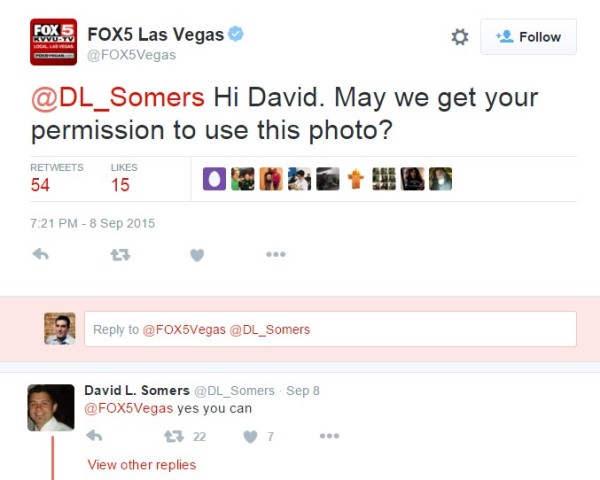
See? In this tweet exchange, a local TV station asks a person who uploaded his photo of a plane fire. When you reach out, promise to include attribution and a link back to the person’s website to sweeten the deal (and give the much-deserved credit.)
Don’t ask, but do provide credit and links
Always try your best to track down the original host of the content and credit it by linking to it. Many consider links to be a form of currency that provide real value to the content creator in the form of SEO and exposure.
In fact, a lot of content creators are in it just for the exposure; they’ll probably be thrilled you used their image, video, or writing – as long as it’s clear that they’re the brilliant mind behind it. By giving good attribution alone you’re not necessarily in the right legally, but you’re probably still in the right.
Follow these two best practices:
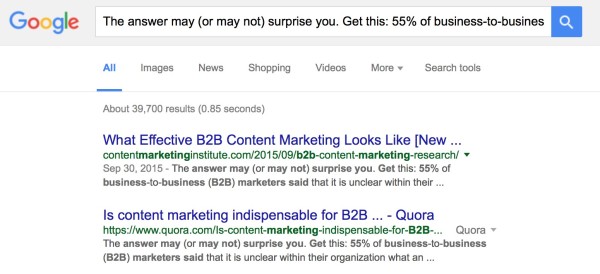
- Find the original source: In this age of syndicated content, aggregation, and sharing, it can be pretty easy to give credit to the wrong person or build a link to the wrong site. To give credit where it’s due, follow the trail of attribution back to the hosting source. And if you want to be an ethical superstar, copy two sentences from a written piece into your Google search bar (or use a reverse image search for photos, infographics, etc.) to locate the true source. As an example, this phrase pops up several places, but credit should go to the CMI site:
- Use embed features. Many major social platforms offer codes that allow you to easily embed their content onto your own website. YouTube, Twitter, and Facebook all provide this function. Be sure to read each social platform’s embed policies and terms of service but, generally speaking, content embedded on social sites such as Twitter is often legal to publish as long as you use the platform’s embed code. If you download and republish the asset, you lose the legal authority to have it on your site and make it harder for people to find their way back to the original.
Subscribe to stock-image platforms
If you need an accompanying image for a blog post, in many cases a royalty-free image or illustration will suffice. It’s important to note though that royalty free does not mean that the image is free to use. Royalty-free images have a license fee but you are not required to pay a royalty each time you use the image.
Be sure to read the restrictions outlined in the image provider’s license, which may limit the frequency of an image’s use or preclude its use for commercial purposes. On Shutterstock, for example, you need to identify the expected reach of the image, which determines the fee or image package available.
27+ Handy Tools for Better Visual Content Marketing
Use Creative Commons content
Millions of artists and content creators are uploading their work onto the web under a Creative Commons license, which is a more permissive form of copyright. (Creative Commons is a nonprofit organization that enables the sharing and use of creative content and knowledge through free legal tools. It was popularized by artists who thought their work should be shared.)
You can search for Creative Commons photos on Flickr, for example. Remember – just because a work is listed as Creative Commons doesn’t mean credit isn’t required or restrictions don’t exist. (Most Creative Commons licenses require you to seek permission if you want to use the content for commercial reasons.)
Honor takedown requests
There may be a time when a content creator doesn’t want you to use his content. Take the example I shared at the beginning. Huffington Post credited The Oatmeal for the use of its comic and it used the image file from The Oatmeal site, but it resulted in so many server calls that The Oatmeal wanted it taken down. The Huffington Post eventually apologized for the error, removed the image from the post, and replaced it with a link to The Oatmeal’s website.
Bottom line: If you don’t have legal permission, don’t argue with the creator when he or she comes a-callin’. It creates bad blood and gives the creator ammunition that can be used in court. Apologize and offer to take down the content immediately. If you respond promptly, the owner of that content usually will be understanding and take no further action.
Protect your original content
Since you’re a content creator, too, you may be on the other side of these issues. Want to check on the use of your original content by others? Google and Google image search are the best place to start (though not really scalable if you want to keep tabs on a lot of content). There are a bunch of other tools, including Copyscape, which is a great plagiarism and stolen copy checker.
If you want to get someone to cease, desist, or just give you credit for your original content, here’s a good guide to responding to plagiarism.
Conclusion
Would it be much easier if you could view any content that floats across your screen as fair game for re-posting? Sure, but that approach hurts both content creator and replicator. If we accept the premise that quality content contains value, then we must recognize that value by being respectful to those who produced it.
Please note: All tools included in our blog posts are suggested by authors, not the CMI editorial team. No one post can provide all relevant tools in the space. Feel free to include additional tools in the comments (from your company or ones that you have used).
Want to stay updated on the latest in content creation, repurposing and more? Sign up for the daily or weekly CMI blog.
Cover image by Joseph Kalinowski/Content Marketing Institute
The post How to Use Content That Isn’t Yours appeared first on Content Marketing Institute.
Why the low loonie could be great news for Canada’s tech scene

(Roberto Machado Noa/LightRocket/Getty)
Canada’s tech sector will likely see a flurry of foreign investment in 2016, as the tumbling dollar turns homegrown startups into absolute bargains for American venture capitalists. The loonie’s plunge below 70¢ against the U.S. dollar in mid-January was bad news for energy companies but will boost the competitiveness of our high-tech firms.

American venture capital firms have shown mounting interest in Canada, according to Stephen Partridge, who sits on Startup Canada’s board of directors. “It’s been a trend starting as early as 2012, but over the past 12 months, you’re hearing it left, right and centre,” he says. In an opinion piece for the Globe and Mail, David Teten, a partner with New York–based FF Venture Capital, wrote, “The dropping Canadian dollar makes investing in Canada significantly more attractive.” He cited other reasons Americans are enthusiastic about Canada’s startup scene, including strong tax incentives and immigration policies that “allow talented people globally to come to Canada.” Last year, Teten’s firm invested in the Better Software Company, an enterprise resource platform based in Ottawa. Meanwhile, Kayne Partners from Los Angeles invested $15 million to You.i TV, an Ottawa-based software company.
One advantage for Canadian tech firms is they can generate revenue in the United States while incurring expenses here at home. “It makes our dollar go further and makes these companies healthier than their American counterparts,” says Jim Orlando, managing director of OMERS Ventures. Indeed, produce apps or wireless solutions, or do other quick-turnaround projects for other firms are now at a significant advantage when bidding on contracts. “They’ll be the first one to see a pretty big upswing in their business,” says Steven McCartney, vice-president of startup services at Waterloo-based Communitech.
Investors will likely be drawn to Canadian companies with proven track records and products, according to McCartney. Those firms could include Plasticity, which makes a tool to monitor workplace happiness; drone maker Aeryon Labs; and Clark Robotic Systems. (McCartney has no position in any of these companies.) Fluctuations in currency can happen in a matter of moments, but going through rounds of venture capital investment can take months. The low dollar might simply prove an added incentive to close a deal that’s already underway, says McCartney.
While established tech companies are better primed to take advantage of the opportunities, Partridge says more money will flow from seed funds to young startups. “Not everything is venture capital investing,” he says. Angel investors and family funds tend to be nimbler than VC firms and more eager to take advantage of the current economic climate. “Those are the ones looking to make faster investments.”
Even in the event of an acquisition, the startups will likely remain in Canada. Tech firms no longer need to move to Silicon Valley to become successful. “The marquee example of that is Shopify,” says Orlando, citing the popular e-commerce platform, which is based in Ottawa. Other Canadian firms with global reach include Vancouver-based tech companies like Hootsuite, Vision Critical and BuildDirect.
Meanwhile, Canadian investors will likely take a close look at local opportunities as the value of the dollar dwindles. “There’s some money that might just be repatriated,” says McCartney. “There’s a weird, inverted opportunity for Canadian companies to take advantage of that.”

Sherry Cooper, chief economist for Dominion Lending Centres, believes Canadian investors have to do their part to inject money into a segment of the economy that she says could one day form the spine of the Canadian economy. “It helps—there’s no question,” she says. “But it takes quite a while for it to have a big impact because, obviously, startups are small. And what we need is another RIM or Nortel back in the day.”
MORE ABOUT STARTUPS AND VENTURE CAPITAL:
- Is Canada finally developing a sustainable startup ecosystem?
- Vancouver’s booming Gastown tech startup scene, mapped
- Make Toronto the startup capital of the world
- How to build Canada’s next RIM
- Kik aims to win at mobile messaging by not playing Facebook’s game
- Why Canada’s getting a “C” for innovation
The post Why the low loonie could be great news for Canada’s tech scene appeared first on Canadian Business - Your Source For Business News.
How to Write for People: 5 Ways to Create Connections & Personality in Your Content Marketing Efforts

Greetings, humans. It is I, a fellow human and certainly not a trench coat full of cats posing as human. I would like to tell you how to show personality in your writing so other cats—I mean, humans, like me—will enjoy reading it.
All cats aside, it’s surprisingly easy for marketers to forget that we are writing for people. We write for a persona, a target audience, an industry. When was the last time an industry sat down and read a blog post over their corn flakes? By trying to write for everyone, we can end up writing for no one.
As bestselling author, marketer, and my spirit animal Ann Handley says, “Even when you are marketing to your entire audience or customer base, you are still simply speaking to a single human at any given time. Worry less about sounding professional, worry more about creating remarkable content that other humans can relate to.”
As content marketers we get paid to write. How cool is that? Moreover, we get paid specifically to write engaging content that has value. We’re not writing stereo instructions here. We’re building tiny cathedrals of knowledge inside people’s heads. Let’s inspire them. Let’s create extraordinary work.
That said, how far you push the following five tips depends on your audience and your brand. My advice is to go a little bit further than you think you can get away with. It’s always easier to tone it down than tone it up.
Here are five ways to make your content marketing sound more human:
#1 – Avoid Awkward Constructions
If you came of age in the 1990s or earlier, odds are you were scarred by your composition classes. From grade school through high school, we learned some of the most stilted writing known to man. But good news! In the words of another shrewd marketer (Alice Cooper), “School’s out forever.” Now you can get rid of the weird rules that make writing sound robotic. You have my permission to do the following:
- End sentences with prepositions. It’s not a real rule. It never was a real rule. It’s an ill-advised attempt to impose Latin grammar on English. It leads to stilted sentences up with which I shall not put.
- Use the singular ‘they.’ English doesn’t have a good gender-neutral singular pronoun. ‘They’ is a sufficient substitute, loads better than “Everyone will use his or her brains to come to his or her best conclusion.” If it’s good enough for the Washington Post, it’s good enough for all of us.
- Start sentences with conjunctions. My high school teachers hated it when I used ‘and,’ ‘but,’ or ‘because’ to start sentences. But it’s frequently the best way to string two sentences together. And if you do it properly, you can avoid run-on sentences. Because without sentence breaks, your reader will check out.
- Use sentence fragments. You’re in charge now, and it’s your job to guide the reader how you see fit. Don’t worry about making every sentence have a subject and a verb. I think one-word sentences can be so. Very. Compelling.
#2 – Ditch Clichés
As the saying goes, “Avoid clichés like the plague. They’re old hat.” The problem with clichés is they’re not your words. They are third-hand phrases that have been passed around so long they’re drained of meaning. A computer (or a trench coat full of cats) could assemble them into sentences.
At best, a reader sees clichés as empty words that are safe to skip: “From time immemorial,” “For all intents and purposes,” “Home is where the heart is.” If you find yourself using clichés in your writing, take the opportunity to say something new.
By the way, buzzwords are a special kind of cliché: They’re both new and worn out at the same time. Don’t tempt your reader to play buzzword bingo.
#3 – Change up the Structure
Sometimes you can write completely naturally, but end up sounding awkward. Even though everything is technically correct, something seems off. You can reread and reread, but you just can’t put your finger on it. You wonder why this paragraph is setting your teeth on edge, and the tension just keeps building.
The previous paragraph makes people tense because every sentence has the same structure. Clause, comma, clause: It gets maddening really quickly. Make sure your writing doesn’t fall into a sing-song rhythm. Break it up. (See, isn’t that better?)
#4 – Take a Point of View
The previous tips are text-level edits, but this one is more holistic. Too often we confuse professionalism with detachment.
Maybe we don’t want to sound pushy or aggressive. Maybe we’re trying to be “balanced.” Whatever the reason, we hide behind, “Some people say,” or “For many people,” or “It’s possible that you might…”
To really connect with your reader, be bold. You are writing to them for a reason. You know what you’re talking about. If you truly believe your advice is worth their time, embrace your writerly authority.
#5 – Learn the Rules (So You Can Break Them)
The overarching reason great writing has personality is it breaks the rules. Think J.D. Salinger, Kurt Vonnegut, Toni Morrison. You could never mistake one’s writing for the other, and it’s all because they break the rules in their own specific ways.
But before you start breaking the rules, you have to know them first. Read The Elements of Style and the Little, Brown Handbook. Understand the what and why of each rule, so you know exactly what you’re doing when you break them. Get a firm foundation in the fundamentals. Then you can go a little bit crazy on them. That’s how to develop a personal (or a brand) style.
Content Marketing: By Humans, for Humans
Unless you actually are a trench coat full of cats (in which case, congratulations on keeping up the deception, and you should know it’s impossible to catch the laser pointer dot), you can add personality to your content. Part of the process is unlearning bad habits from high school. Part is believing you have something important to say, and trusting that you know the best way to say it. And part is getting out of your own way, writing garbage, and refining it.
So go forth and create awesome stuff. I’ll be over here with my catnip mouse.
Need help creating compelling content for your brand? We’re here to help.
Header images via Shutterstock: 175292705, 154981799
 Gain a competitive advantage by subscribing to the
TopRank® Online Marketing Newsletter.
© Online Marketing Blog - TopRank®, 2016. | How to Write for People: 5 Ways to Create Connections & Personality in Your Content Marketing Efforts | http://www.toprankblog.com
The post How to Write for People: 5 Ways to Create Connections & Personality in Your Content Marketing Efforts appeared first on Online Marketing Blog - TopRank®.
The 2 critical factors behind B2B sales forecast confidence
 Regular readers will recall that I am no great fan of the default approach taken by so many CRM vendors, in which individual opportunity forecast probabilities are based on applying the same percentage to every opportunity that has reached a given stage in the sales process.
Many CRM users simply accept the default “out of the box” percentages without questioning them, or validating them against actual outcomes, or are confused about whether the % is measuring progress through the process or the probability of winning.
It’s no wonder that sales forecasts are often so wildly inaccurate. But there is a better way of thinking about this…
The problem is particularly acute in high-value, relatively low-volume complex b2b sales environments with a high dependency on new business, where the outcome of one or a few individual opportunities can make a very significant difference to whether you hit your overall revenue target or not.
I wrote at some length about the various factors that influence the probability that any individual opportunity will close here, and I firmly believe that investing in a sales analytics solution can help to identify the underlying patterns and make sense of the complexities.
But let’s assume that you’re not yet ready to commit to sales analytics, but that you still want to do a (much) better job of forecasting the outcome of individual opportunities than you are today. Here are the two critical factors that you need to assess when deciding whether an opportunity is likely to close at the predicted time.
But there’s an essential point here - and I cannot stress this strongly enough - you have to make separate judgements about these two factors before coming up with an overall confidence level:
1: Will the prospect actually do anything?
One of the biggest reasons why forecasted opportunities fail to close is that the prospect failed to make a decision. In most cases, this is due to the fact that they had an insufficiently compelling reason to act, and were happy to delay their decision. Or - in a variation on this theme - their attention was diverted towards other more pressing priorities.
Sometimes, they will make an explicit decision to abandon their current buying decision process - but more often, the decision will simply be deferred until later. And in either case, there is no guarantee that they will communicate their decision to you - they may simply become (much) less accessible.
There’s a fundamental principle here - decisions to take action tend to have a momentum to them. The prospect tends to be highly engaged. There is an obvious reason why they should act, and - just as important - there are significant costs and painful consequences associated with sticking with the status quo. They have concluded that the longer they delay, the worse it will get.
Taking all factors into account, you need to make a realistic (and that normally means conservative) assessment of the chances that each prospect will make a commitment and place an order on anyone in the targeted timeframe. That’s the first half of the equation.
2: What are the chances they will choose you?
There’s another simple principle at play here: if you have failed to compellingly differentiate your solution, and if the prospect struggles to distinguish between your solution and their other shortlisted options, they will choose the option that costs the least or appears to offer the lowest risk.
If - in the eyes of your prospect - you are either a clear market leader or a clear cost leader, you are probably in a reasonably good position. But if you are neither, you need to go out of your way to get your prospect to acknowledge the compelling advantages of your solution and your organisation.
If your differentiation is weak - if your sales person truly has no idea which option their prospect actually prefers - then calling it a “50/50” deal almost inevitably overstates your chances. More on this in just a moment…
Doing the maths
Assuming that you have accurately assessed both of the above factors, in very simple terms, your probability of winning the deal on the targeted date is a function of multiplying the two percentages. Let’s assume that there is a strong (75%) chance the prospect will actually do something, but that you are 1-in-3 with other similar options (33%). The projected confidence is 25%.
When clients go through this exercise, the results are usually a lower but much more realistic percentage than they used to get when they simply asked sales people to assess their chances of closing. But there are a few other wrinkles that can help to further improve the process.
Banning “50/50” judgements
There’s one probability number you should bar your sales people from using in either their “do anything” or “choose you” ratings: 50%. Not because it’s impossible that 50% could (very rarely) be an accurate assessment - but because accepting “50/50” ratings encourages lazy thinking on the part of your sales people.
My strong recommendation is that you should push back, and force your sales people to choose a number that is either marginally more or less positive - 55% or 45% - rather than describing their chances as simply a coin toss. If it genuinely is, they clearly haven’t been doing their job right.
Collective decision-making
The final strategy that I recommend is to get your sales people to come up with their initial assessment of the “do anything”, “choose you” and “overall” probabilities and then review the evidence with you that led them to their conclusions. You’ll quickly get a sense of whether they are relying on gut feel or on a deep understanding of the prospect’s actual situation.
It would not be unusual for you to disagree with their assessment of certain deals. It is often helpful to review how the sales person's previous similar opportunities actually panned out. If you cannot come to a consensus, I recommend that you record your confidence as a separate field to the sales person’s confidence, together with a short comment explaining the differences - and use this as a learning opportunity.
In conclusion
These strategies - separating the two critical factors, banning 50/50 judgements and implementing collective decision-making - have been proven to dramatically improve forecast accuracy, most particularly in high-value, low-volume new business environments. Why not try implementing them in your next forecast reviews?
I'd be very interested to get your feedback...


How to Capture the Right Value Metrics to Accurately Price Your Product
Your data model is the net that you use to catch information. So what kind of information do you want to catch?
Advanced pricing strategies are all based on good information, information that increasingly is gathered by the system itself. So the design of your data model, instrumentation of your system and the design of your pricing model all go hand in hand.

The best pricing metrics track how you provide value. The more value you provide, the higher the price should be. So as you instrument your system and build your data model make sure you are capturing data about the value you provide.
How to do this? It starts with a deep understanding of your customer and your customer’s business model. If you don’t understand this, your pricing is just a shot in the dark.
One way to get started is to build an ROI (return on investment) calculator and put it up on your website. Here is a nice clean example from TSO Logic, a company that helps manage server farms, increase energy efficiency and reduce unnecessary redundancy.

TSO Logic has done a good job of building metrics deep into its system. It even has a dashboard that shows customers how much money they have saved and could save by reconfiguring their servers.
Here is a simple way to build your value-based data model.
- Build ROI calculators (you will probably need to build one for each market segment, at least you will if you have done a good job segmenting your market)
- Look at the variables in the calculator, divide them into the following categories
- Those that your system can collect
- Those that you can get from external data feeds
- Those that you can get from integrations with other systems at your customer
- Those that you have to estimate
- Build a. (those your system can collect) and b. (external data feeds) into your platform.
- See if you can design in a reason to integrate with the other internal systems that provide the data to drive your value calculator. Of course you have to have a good reason (from the customer’s point of view) to do this, one that provides additional value itself!
- Make estimates where you need to, but let the customer change these estimates (and then record the changes the customer makes).
Use this data (and the ROI model) to calculate the ROI for the customer. Show this as part of one of your product dashboards. Make it easy for the customer to understand value.
Then take this data and build it into your own pricing models. Evolve them so that your price is tracking the value you provide to your customer.
ROI is a crude way to do this. To go the next step you need to move to Economic Value Estimation or EVE® (trademarked by Monitor Deloitte). This approach was pioneered by pricing guru Tom Nagle and is described in detail in his book The Strategy and Tactics of Pricing. Here the focus is on what differentiates your offer from the alternatives. It is not easy to build EVE’s into software as you have to understand three systems, your customer, your competitor and your own, but the work done to build EVEs will lead to much more accurate and compelling ROI calculators.
In designing your data model think about three different types of data and how they will interact.
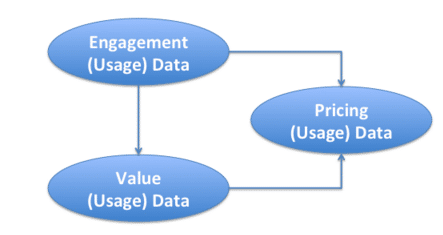
Start with your engagement model. This is fundamental to how people use your software and should be unique. If it is not unique then you have probably designed an ‘also ran’ application.
Some years ago, when I was raising money for LeveragePoint, a VC at Charles River Ventures said that “the best leading indicator of success for a B2B SaaS company is user engagement, and not any of the financial metrics.” Optimizing user engagement is a critical early priority for B2B SaaS companies, and one that many companies struggle with.
You want to get people engaged in the routines that create value for them and the company they work for. ‘Engaged in routines,’ that is important. The way to do this is to map out your cue-routine-reward-investment model and make sure you are capturing data on each part of the cycle.
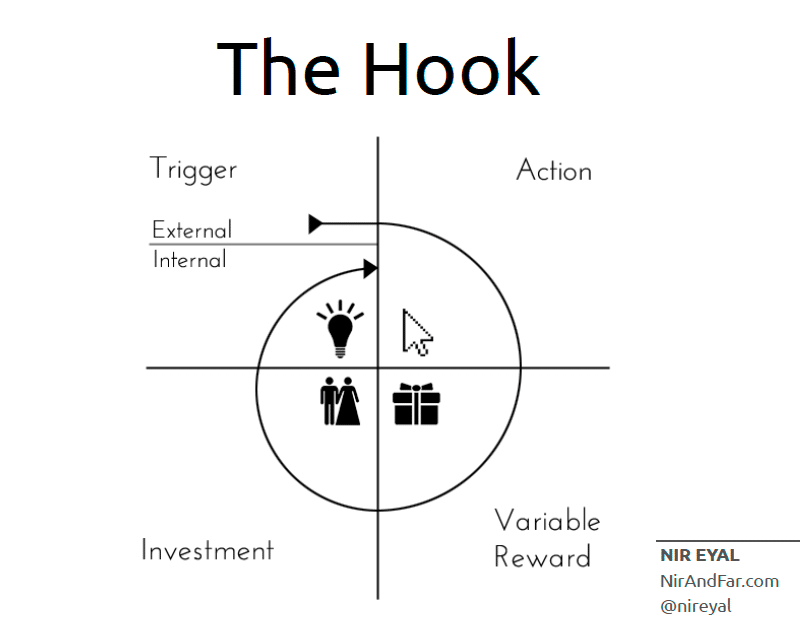
Nir Eyal has written about this in his book Hooked an on the Nir and Far blog. Study this closely, and make sure you have not only built habit-forming software but instrumented it to understand how people are using the software and how this creates value.
I will be going deeper into these ideas in Toronto on February 25. If you are in the area, please join us and Future-Proof Your Business Model at the Pricing Innovation & Monetization Summit.
The post How to Capture the Right Value Metrics to Accurately Price Your Product appeared first on OpenView Labs.
The 50 richest people on earth

The wealthiest 50 people in the world control a staggering portion of the world economy: $1.46 trillion — more than the annual GDP of Australia, Spain, or Mexico.
That's according to new data provided to Business Insider by Wealth-X, which conducts research on the super-wealthy. Wealth-X maintains a database of dossiers on more than 110,000 ultra-high-net-worth people, using a proprietary valuation model that takes into account each person's assets, then adjusts estimated net worth to account for currency-exchange rates, local taxes, savings rates, investment performance, and other factors.
Its latest ranking of the world's billionaires found that 29 of the top 50 hail from the US and nearly a quarter made their fortunes in tech. To crack this list, you'd need to have a net worth of at least $14.3 billion. And for the most part these people weren't born with a silver spoon. More than two-thirds are completely self-made, having built some of the world's most powerful companies, including Amazon, Berkshire Hathaway, Google, Nike, and Oracle.
From tech moguls and retail giants to heirs and heiresses, here are the billionaires with the deepest pockets around the globe.
SEE ALSO: The 20 most generous people in the world
DON'T MISS: The wealthiest people in the world under 35
49. TIE: Aliko Dangote

Net worth: $14.3 billion
Age: 58
Country: Nigeria
Industry: Diversified investments
Source of wealth: Self-made; Dangote Group
At 20, Nigerian businessman Aliko Dangote borrowed money from his uncle to start a business that dealt in commodities trading, cement, and building materials. He quickly expanded to import cars during the country's economic boom. Four years later, in 1981, he formed Dangote Group, an international conglomerate that now holds diversified interests that include food and beverages, plastics manufacturing, real estate, logistics, telecommunications, steel, oil, and gas. At $14.3 billion, Dangote's fortune is the largest in Africa and equal to 2.5% of Nigeria's GDP.
The majority of Dangote's wealth stems from his stake in Dangote Cement, which is publicly traded on the Nigerian Stock Exchange. He owns cement plants in Zambia, Senegal, Tanzania, and South Africa, and in 2011 invested $4 billion to build a facility on the Ivory Coast. Dangote bought back a majority stake in Dangote Flour Mills — which had grown unprofitable after he sold a large stake to South African food company Tiger Brands three years ago for $190 million — in December for just $1. He is also chairman of The Dangote Foundation, which focuses on education and health initiatives, including a $12,000-per-day feeding program.
49. TIE: James Simons

Net worth: $14.3 billion
Age: 77
Country: US
Industry: Hedge funds
Source of wealth: Self-made; Renaissance Technologies
Before revolutionizing the hedge fund industry with his mathematics-based approach, "Quant King" James Simons worked as a code breaker for the US Department of Defense during the Vietnam War, but was fired after criticizing the war in the press. He chaired the math department at Stony Brook University for a decade until leaving in 1978 to start a quantitative-trading firm. That firm, now called Renaissance Technologies, has more than $65 billion in assets under management among its many funds.
Simons has always dreamed big. About 10 years ago, he announced that he was starting a fund that he claimed would be able to handle $100 billion, about 10% of all assets managed by hedge funds at the time. That fund, Renaissance Institutional Equities Fund, never quite reached his aspirations — it currently handles about $10.5 billion — but his flagship Medallion fund is among the best-performing ever: It has generated a nearly 80% annualized return before fees since its inception in 1988.
In October, Renaissance shut down a $1 billion fund — one of its smaller ones — "due to a lack of investor interest." The firm's other funds, however, have been up and climbing. Simons retired in 2009, but remains chairman of the company.
47. TIE: Laurene Powell Jobs

Net worth: $14.4 billion
Age: 52
Country: US
Industry: Media
Source of wealth: Inheritance; Disney
The widow of Apple cofounder Steve Jobs, Laurene Powell Jobs inherited his wealth and assets, which included 5.5 million shares of Apple stock and a 7.3% stake in The Walt Disney Co., upon his death. Jobs' stake in Disney — which has nearly tripled in value since her husband's death in 2011 and comprises more than $12 billion of her net worth — makes her the company's largest individual shareholder.
Though she's best recognized through her iconic husband, Jobs has had a career of her own. She worked on Wall Street for Merrill Lynch and Goldman Sachs before earning her MBA at Stanford in 1991, after which she married her late husband and started organic-foods company Terravera. But she's been primarily preoccupied with philanthropic ventures, with a particular focus on education. In 1997, she founded College Track, an after-school program that helps low-income students prepare for and enroll in college, and in September she committed $50 million to a new project called XQ: The Super School Project, which aims to revamp the high-school curriculum and experience.
Last October, Jobs spoke out against "Steve Jobs," Aaron Sorkin's movie about her late husband that portrays him in a harsh light, calling it "fiction." Jobs had been against the project from the get-go, reportedly calling Leonardo DiCaprio and Christian Bale to ask them to decline roles in the film.
See the rest of the story at Business Insider
5 Things You Should Know About Marketing to Millennials

I have a confession. Up until a few months ago, I didn’t realize I was a millennial.
I know. That seems horrifically unaware. It’s just that millennials get a bad rap, and my parents instilled so much self-worth in me that I thought the negative millennial descriptors couldn’t possibly apply, right?
Oh, my parents building me up to think I’m great is a tell-tale millennial attribute? As is an uncanny sense of optimism? And my tendency to justify clothing purchases by cost-per-wear?
So you’re saying that I’m essentially the millennialist millennial in a sea of millennials?!?!
This diagnosis was really brought to light at Marketo’s company-wide Revenue Kickoff meeting earlier this month. Jamie Gutfreud, Global Chief Marketing Officer of Wunderman, gave an incredible presentation titled “It’s Already Tomorrow,” i.e. the future of marketing is already here. The insights into the differences between Baby Boomers, Generation X, Generation Y (i.e. millennials), and—scariest of all—Generation Z were eye-opening.
What struck me most—because apparently I am a self-absorbed millennial—was how the environment in which my peers and I grew up has shaped who we are. As Jamie said, it creates “your orientation in the world.” And millennials have had a lot of things to orient us, from the DotCom boom (and bust), 9/11, and the 2008 economic downturn.
With that, here are five things you need to know about marketing to millennials:
We Are Confident
As the children of Baby Boomers and Gen X-ers, we millennials spent our formative years being patted on the back and praised for just about everything we did. You colored inside the lines? That’s great. You want to play all the sports? Awesome. You burped? Bravo!
This is because our parents were the products of darker times, and hyper aware of all the ways in which our childhoods could go wrong. In our school and home environments, the adults in our lives made sure we were set up for success.
In this way, millennials respond well to getting our ego stroked. Remember that our self-worth is high, so we don’t necessarily need brands or brand messages to feed us that extra boost. We also like to hear messages that add value to our lives. Help us, and we will help you by supporting your business.
It’s like Demi Lovato, international pop star and fellow millennial says, “What’s wrong with being confident?”
We Are Optimistic
Doom and gloom is not the M.O. of the average millennial. And September 11th, one of the darkest events of the last half century, is ironically what cemented our sense of optimism.
Losing our sense of security not just as a nation but as a generation created a juxtaposition between the new world order and how it had been before. Or, as optimistic millennials decided, how it could be again. Millennials have largely been fighting to regain that sense of security ever since and believe that in fact we can get there.
As marketers, there’s an opportunity to feed this optimism. In keeping with the “help me help you” sense of confidence I mentioned earlier, help millennials make the world better, and your messages will not only resonate, but become action.
We Are Creative
Jamie’s creativity point—which also stems from a strong confidence base—really stuck with me. Our parents told us that if we did well in school and went to college, we would get jobs, and everything would be champagne wishes and caviar dreams (ok, small exaggeration, but you get the idea).
But then the economy tanked, and millennials collectively had a quarter life crisis: Why don’t I have a job? Why am I not happy? Why hasn’t anyone given me my own reality show? The transition to adulthood was rough—and no one gave us a heads up!
Luckily, we’re a resilient bunch. When I was 23, I looked around at my group of close friends from college and realized that all but one of us had changed career paths within two years of graduating. We were nimble, we were creative, and while none of my friends were the founders of Uber, Lyft, Airbnb, or any other new-age service company, it was our millennial peers who created the sharing economy. How’s that for creativity? “Oh, the classic economy isn’t giving us what we need? Let’s shake it up.”
It’s the millennial generation that has helped to reshape the American Dream into something that involves a creative idea, some seed funding, and an IPO. While this paradigm is likely to shift again soon (i.e. if and when the startup bubble bursts—and history tells us it will burst), marketing messages that speak to this creativity, this one-size-does-not-fit-all approach, is crucial in reaching this audience.
The key is about keeping the message personal, and with today’s technology, you have the capability to tailor messages in a way that speaks to this generation.
We Are More Than Our Devices
And speaking of technology, something I love about my generation is that while we are technology experts, we are not technology dependents. We can still remember a time when there was no wifi, not everyone owned a cellphone, when computers were slow, and when the whole world didn’t speak in hashtags. I like to refer to this time as B.E.–Before Emoji.
Perhaps the best way to illustrate what sets us apart is to delve a little deeper into our Gen Z successors. These kids were essentially born with an iPad in their hand. They have PayPal accounts instead of credit cards. They make purchases via their phones. They know their credit score at age 17.
This is the stuff my nightmares are made of.
Taking this point of reference into account, there’s a nuance in the way we should be spoken to. We see value in “unplugging” and in the balance between online and offline interaction. There needs to be a full, omni-channel approach to how we’re marketed to, because we move between our online and offline worlds seamlessly.
![MarissaBabyHacker[5]](http://cdn2.business2community.com/wp-content/uploads/2016/01/MarissaBabyHacker5.jpg.jpg)
This incriminating photo (of me) shows that while millennials may not have been born with iPads in their hands, some were given access to 80s-era desktop computers at a very early age.
We Are Going to Have Babies
To close, I’m going to share my own personal theory with you, marketer to marketer. As more and more millennials start families, I predict that there will be a shift in the way in which our Gen Z (or whatever generation comes after Gen Z…do we start at A again?) kids approach technology. This is because millennials remember what it’s like to play outside—without technology. We remember what it’s like to read a book—without technology. And we remember what it’s like to be bored—without technology.
The adage of our grandparents may have been that they had to walk to school eight miles in three-feet of snow and it was uphill both ways. We will tell our kids—and our kids’ kids—how our parents sent us out in the yard with nothing to play with but a flat tennis ball and our imagination.
The ability to take something—anything—and transform it into something incredible—isn’t that what marketing is all about?

China is going to war over its currency
 Finance Insider is Business Insider's midday summary of the top stories of the past 24 hours.
To sign up, scroll to the bottom of this page and click 'Get updates in your inbox.'
China has officially issued a warning to George Soros: Beware of going to "war on the renminbi."
That followed an earlier, less-specific warning to those hoping to short the yuan. Here are some of the funds hoping to benefit if the Chinese currency does fall further in value.
In related news, a top Chinese official was arrested just hours after talking about capital outflows.
On Wall Street, high-speed trading firms have taken over the floor of the New York Stock Exchange, Tesla is getting clobbered, and Weight Watchers is spiking after a tweet from Oprah Winfrey.
Lastly, it turns out hedge fund billionaire Ray Dalio, the founder Bridgewater Associates, helped McDonalds launch Chicken McNuggets.
Who knew?
Here are the top Wall Street headlines at midday -
Here are the top 20 hedge fund managers of all time - Ray Dalio, the founder of hedge fund behemoth $160 billion Bridgewater Associates, has dethroned George Soros as the most successful hedge fund manager, according to a new ranking.
Now SunEdison has 2 agitated billionaire hedge fund managers to deal with - Greenlight Capital, the hedge fund founded by investor David Einhorn, is seeking a seat on the board of SunEdison — a solar manufacturing company.
The CFA Level 1 results are in - In December, 52,315 aspiring finance buffs took the first level of the notoriously tough Chartered Financial Analyst exam. Only 43% of them passed.
GARTMAN: Crude oil will never trade back above $44 'in my lifetime' - Dennis Gartman ― the publisher of the widely read "Gartman Letter"― has a call on oil.
The crash in oil prices might be about one simple thing - The crash in oil prices might be all about the dollar.
Investor Paulson's personal assets to back loan to hedge fund - Billionaire investor John Paulson has put up part of his personal fortune as collateral to back a credit line for his $18 billion hedge fund Paulson & Co., a government filing shows.
The bond market is going to get ugly if there isn't a rebound soon - The high-yield market needs to see a broad-based, solid rebound soon, or things are going to get a lot worse.
The author of 'The Big Short' took a shot at The Wall Street Journal - "The Big Short" author Michael Lewis slammed The Wall Street Journal in an interview with UK magazine The Spectator.
The new must-have feature on private jets? - We spoke with Tray Crow, Gulfstream's director of interior design about the issue.
Wall Street slashes $560 million from Twitter's value after executive exodus


Note to companies planning a revamp of all their executive ranks: the stock market may put a different value than you do on those people heading out the door. Especially when those executives are half your top leadership
Twitter is suffering its darkest hour after a badly managed exodus of four executives
Jack Dorsey, Twitter's CEO and cofounder, stressed that the four executives chose to leave the company. Other sources have hinted that at least some were pushed out
Wall Street wasn't buying it. In fact, Wall Street was selling — dropping the value of Twitter stock by well over a cool half a billion dollars in less than 24 hours Read more...
More about Twitter, Business, Stocks, and Company NewsFind B2B Sales Prospects That Are More Likely To Do Business with You
It’s excruciatingly difficult to separate good prospects from the tire-kickers. Yet this is a process that must be done to ensure that we can serve those that best deserve our most precious resource – our time.
Experienced sales professionals will rightly point out that it takes time to do this well. Reading buyer emotion with the hopes of sifting through time-wasters and those with solid buying needs is definitely an art.
If you don’t do this, you will be spread too thin and not be able to serve any of your prospects effectively.
Enter LinkedIn!
I’m not saying that technology is the answer, but using tools like LinkedIn can certainly begin to help in accelerate this sifting and separation process. One such way is through smart, advanced searches. The tip I’m about to describe below is for all LinkedIn users – even for those of you who have the free version.
But first, here’s the backstory.
If you have 100 prospects to target in your territory or vertical, how do you determine which are most deserving of your time?
If you could separate 20 of them as being those that used to work at your current clients, wouldn’t they find your story more compelling? Think about it; you’ve already helped their previous employer and this story will resonate with them because there’s something inherently genuine about it.
This doesn’t mean you don’t spend time on the other 80 prospects, but your chances of finding a more receptive audience may be in these 20 advocates and supporters.
Now, let’s show you how to find them.
The Step-By-Step Guide to Find Advocates & Supporters via LinkedIn
1. Go to LinkedIn Advanced Search.
2. Enter all of the titles you’d like to target and from the dropdown that appears, select “Current” as the time parameter.
3. You’ll also want to enter all of your current accounts, i.e. those that you’re already doing business with.
See this screenshot as an example. Note how you can enter the multiple companies and titles using Boolean searching.

4. Once this is done, select all of your relationship degrees like the screenshot below.

5. And lastly, you can use the Keywords feature in Advanced Search to find profiles that contain the terms you find most appealing.

If you’re looking for the final product in this example search, click here to see what I’ve created.
The Bottom Line
Using these strategies and then diving in further will help you create lists of prospects that you can then target and nurture.
I leave you with some parting thoughts, though. Finding prospects today is an important part of the sales process but not the only part. Once you find a prospect, you now owe it to them to discover who they are. Use the power of social media to find information about them that you can use to have targeted, relevant and contextual conversations. If you believe in serving your buyers, isn’t this the least you can do?
A Guide to Choosing Unique Trade Show Giveaways
If you’re planning to exhibit at a trade show this year, you may be wondering what you can do to drive traffic and generate leads while you’re there. Enter the trade show giveaway, which has been for many years the standard staple for generating goodwill and motivating potential buyers and prospects to provide you with their contact information for future follow up.
And yet, one big challenge with giveaways is that because they are such a staple at shows, many of the ideas that were once fun and motivating to booth visitors have become old hat, and no longer generate leads or give your trades how presence the boost that they once did.
So what can you do? Should your company dispense with giveaways altogether? Or would a reboot to your giveaway strategy provide the boost your trade show presence needs to get results?
Why Use Trade Show Giveaways?
When determining your strategy around giveaways, it’s important to keep in mind why you are giving items away in the first place. A few of the most important reasons to give away promotional items at your booth include:
Lead generation:
This is usually going to be your number one reason for attending shows and offering giveaways. Your strategy revolves around getting contact information from leads, with whom you plan to follow up after the show. This will require a very motivating or possibly high value giveaway, and can be done as part of a raffle, either in your booth, or through the show management (some shows require you to raffle items through them rather than in your own booth.)
Brand awareness:
You might be simply trying to get your name out there. This can be especially important for new companies or those whose product is either not well defined, or involves a concept that is difficult to convey. If all you’re looking for is brand awareness, less expensive giveaways might make the most sense. In addition, it’s a good idea to find a way to measure awareness. Tying the giveaway to a social media or other online promotion can be a good way to do this.
Education:
Companies or products that are a little more high-concept might need to go beyond making sure people know their name, and actually educate them about what they do. This is one of the most difficult things to do with tradeshow giveaways, but it is possible. If you use a high-value giveaway, you can tie it to viewing or attending a presentation about your company or product – either in your booth or online. Giving away your company’s actual product or a free service is another option, or perhaps the educational material can go directly on the promotional item.
How to Select a Giveaway
Once we’ve identified our reasons for using giveaways, we need to think about which giveaways are going to be right for our business. Here are a few criteria to consider:
Relevance / Brand Alignment: Think through the message that your giveaways are going to send, and make sure it’s saying what you want it to say about your company. For instance, not every company is the right fit for a stress ball, but if your company or product somehow relieves stress for your potential customers, then it could be a good choice.
Value: We’re not talking dollar value, we’re talking about value to the customer. Is this something they want or need? The item should either be practical – something useful that anyone would want – or it should be something so unique or unusual that it will be attractive in spite of its lack of utility. Think about the needs of the audience to determine the value of the item.
Durability: Is the item well made? Poorly made products that fall apart as soon as the show is over do not reflect well on your brand. Another issue is that items that fall apart may provide immediate brand recognition at the show, but when your potential customer is trying to remember the name of that company they visited, the giveaway itself may be the only reminder they will have. Ideally, it should be made to last.
Theme: Many companies try to enhance the impact of their trade show presence by having a themed booth. The kinds of themes you might have are pretty limitless, but whatever the theme is, your giveaways will be most impactful if they tie in with it. The theme should, of course, make sense for your brand.
Price: Of course, we have to balance all of the above against the price of the items. The cost of your giveaways needs to be figured per lead or prospect you expect to generate, as well as against the value of the customer.
5 Trade Show Giveaway ideas
There are many items that are “tried and true” for trade show giveaways: pens, mints, water bottles, and the list goes on. But if you really want to get unique, it’s good to remember that the list of giveaways you could choose from isn’t just limited to what you’ll find in a promotional catalog. Here are five unique ideas to bring attendees out of the woodwork at your next show:
1) Product Samples: In terms of brand relevance, it’s hard to think of a better giveaway than a sample of your company’s products. The downside is that not every product lends itself to being sampled out. But if yours does, this is something to consider. If your product is high value and in demand, but can’t be given to every visitor, consider an in-booth or online raffle contest.
2) Care packages: Attending trade shows can be a grind. Why not show your attendees a little love and promote your company at the same time? Your care package can include those little necessities like a packet of aspirin, a bottle of water, a granola bar, some mints or gum, a pen with your company name, a branded notepad, and maybe a flash drive with a presentation or a link to your website.
3) Food: When tummies are growling, having a food giveaway at your booth can immediately track attendees. The problem? Typically these items will not be durable, as they will be eaten before the prospect leaves the pavilion. So following up (you DID get their email address, right?) will be essential for this giveaway to have lasting value for your company.
4) Drinks: Many tradeshows have afterhours networking events, and many of these sell drink tickets. Your company can host one of these events, or buy a block of tickets from a company that is hosting one and use them as a giveaway in return for contact information, but again you need to collect names and contact information to make this giveaway have any value to your company.
5) Branded Tote bags, T-Shirts and Water Bottles – If brand awareness is part of your strategy, a branded tote bag, T-shirt or water bottle can be a great way to spread the word. And they are durable, so they will still be around after the show. The negatives are the cost and that they aren’t always the items most in demand at tradeshows (typically, booth visitors are more excited about things they can use right away). So the key is to make sure the design and colors are eye catching and cool – something people will want to wear or use right away.
It’s important to think long term about how you will develop relationships with the people that visit your booth. Will you email or call them all individually? Add them to your email newsletter list? Offer a promotion to get them to like or follow one of your social media accounts? Whatever your method of follow up, incorporating these plans into your giveaway strategy is important. What tradeshow giveaway ideas have you tried? Tell us in the comments.
We’re on the brink of a fundamental change in health

The healthcare industry isn't known for its consumer friendliness.
That's starting to change. It's possible to unlock the secrets of your DNA by spitting into a tube and mailing it to a lab, and keeping track of every step we take is as seamless as carrying around our phones.
Still, we've got a long way to go before we'll be able to diagnose and treat ourselves without the help of a doctor. For example, most of us know very little about the cost of our medications, and the vast majority of us have no idea what separates one health insurance plan from another.
What can't be denied, however, is that a health revolution is beginning to take shape. Pharmaceutical villains like Martin Shkreli are increasing public awareness of issues with drug pricing. Companies like Fitbit and Apple are vying for the attention of increasingly data-savvy millennial buyers.
With that in mind, Business Insider sat down with industry leaders at JPMorgan's annual healthcare conference this month to get a sharper picture of what the real consumer revolution might look like. Here's what they had to say:
The first step: Changing how we see our health
 There were a fair amount of skeptics, who said that the only way a consumer revolution would happen is if consumer behaviors around healthcare change. People haven't seemed interested in learning more about their genetic information or other health metrics when they're healthy.
“I thought that everyone would jump at having their DNA sequenced and stored in a cloud," said Andre Choulika, the CEO of Cellectis, a company that is using gene editing to treat cancer. "But it’s going to be either a government initiative to force people to have their DNA sequenced, or by personal initiative it's not going to happen. Even if it costs $100, people will not do it.”
Early in the week, Takeda's chief digital officer, Bruno Villetelle brought up the concept of becoming the "CEO" of your health, or more simply, the one in charge of what goes on in your body, both when feeling fine and feeling sick.
“It's a double edged sword,” Christian Schetter, the CEO of Rigontec, a German company that is developing a new way to approach cancer treatment using RNA said of a consumer revolution. “Be aware that if you're really the CEO of your health you have enough safety networks to not fail with that.”
Will we ever be able to diagnose ourselves?
As consumers get more involved with their health, the question of whether it might be feasible to remove doctors from the equation has been tested out in everything from genetic sequencing to "revolutionary" finger-prick blood tests. But those who try to go directly to the consumer, face some serious resistance from regulators.
“The worst thing you can do in facing with the FDA is offer a test directly to the consumer,” Genalyte CEO Cary Gunn said. His company is developing a way to rapidly test for diseases such as rheumatoid arthritis using a single drop of blood, a test Gunn expects to use only with a physician involved.
 When it comes to genetic testing, there's some information that's just plain fun, while other information has the potential to be acted upon in a way that could change your health. Piraye Beim, the founder and CEO of Celmatix, a company that is working to bring personalized medicine to women's health using genetics, made the analogy of a drug store, with both prescription and over-the-counter drugs as a way to differentiate what kinds of genetic information should be allowed to be shared and when.
“Just like there are drugs you have to order behind the counter and there are drugs that you can just pick up and walk to the front of the drugstore and check out with, I think genetic information's like that too,” Beim said. Because as fascinating as it may be to learn you have a gene that predisposes you to a certain kind of disease on your commute home, it might be more comforting to learn that information at a doctor's appointment, with the support of a physician who can talk you through it.
Patients who advocate for themselves
Gone are the days of doctors telling patients what to do and patients following that decision without question. And that might be a good thing.
“I think it's always good for patients to know what's going on and to advocate for themselves,”Braeburn Pharmaceuticals CEO Behshad Sheldon said.
That's going to happen in everything from diabetes to cancer. Steve Kafka, the president of Foundation Medicine, which uses gene sequencing and data analysis to help treat cancer, said that for the latter, it will have everything to do with having access to information.
“Ultimately it will be about the patient having the direct access to really what is going on with my own cancer, and what are my options for what I can do about that.”
But with this increased information — and the hope of new drugs that want to shake up how we treat disease — there will also be a need for more education about new products. And that includes communicating how much new medications might cost.
“We just need to do a better job of highlighting those [innovative] things," said Bob Radie the CEO of Egalet, a company that makes abuse-deterrent opioid painkillers. "I don't think the industry has a good rap right now.”
NEXT: We asked industry experts what the 'Uber of healthcare' would be — here's how they responded
NEXT: Biotech investor: 'None of us were as smart as we thought we were'
Join the conversation about this story »
NOW WATCH: Why you should stop using most antibacterial soaps
Sales Checklist: 10 Ways to Keep Yourself in Check Each Quarter

Have you ever photocopied a piece of paper so many times that the copies faded and became hard to read? This is called a transcription error, and it happens when little mistakes add up over time to make a big difference. This also happens in sales when you repeat your pitch over and over again until small details get lost, the delivery gets muddied, and your pitch loses its edge and effectiveness.
Once a quarter, it’s important to reset your habits to make sure that you’re not falling victim to this process. Essentially, you need to get back to the basics and start fresh.
A big part of this refresh involves motivating yourself. Do you remember the bright and shiny optimism that you felt when you first started your job? How absolutely certain you were about your product? How you looked up to the more tenured salespeople and picked their brains to find out what they were doing differently? To dial in on this energy, you need to do assess yourself to determine what you’re doing well and poorly.
So use this checklist to see how you stack up. If you start to feel a little inadequate, that’s great! You’ve identified the key areas that you need to work on, and there’s reassurance in knowing exactly what you need to do. And if you’re not selling more than you want to be (who is, really?), then this gives you a clear path forward to start the quarter with a crisp, clean page.
Goals
1. Are my goals written down and up-to-date?
Goals change over time, so it’s a good idea to revisit them. Keeping them consistent is good so you can track your progress, but it’s okay to tweak them occasionally. People learn as they go, and you shouldn’t stick to anything that doesn’t still make sense. Write your goals down, keep them visible, and share them with peers to hold yourself accountable.
Don’t have any goals written down from last quarter? There’s never a better time to start than now.
Sample goals:
- Achieve a 35% closed-won opportunity conversion by April 1
- Hit 110% of year-to-date plan by April 1
- Generate 3 new outbound sales opportunities each month, 9 per quarter this year
2. Am I on-track with my goals? Did I reach them? If not, where can I improve?
Keep yourself honest. Many people set goals, but very few people keep them (just look at gym attendance in January versus February). Make sure your goals are SMART (simple, measurable, attainable, realistic, and time-bound). This is a great article if you’re interested in the specifics on goal setting.
Process
3. Am I following a template for discovery calls, or have I gotten lazy and just started winging it? What about my emails?
This is where those nasty transcription errors start slipping in. I’ve found that over time, I may forget to do basic things like set agendas for my discovery calls, and then run into issues where we don’t cover the right topics in order (or at all). If your company doesn’t have a defined template, try your hand at making one. Consolidating your tried-and-true best practices into a template can be a great team exercise.
4. Did I refresh my prospecting emails and content links?
The content that you share with your prospects can become stale, and links can get broken or outdated. Make sure that you’re not sending around any whitepapers from 2011 or videos that don’t work. This is a great time to check-in with the marketing team to see what new and exciting content you can share.
5. Am I still looking for leads in the same places?
It might just be part of the nature of being a salesperson, but there’s a certain sense of fear that comes over you when you feel like you’ve run out of leads. Either you’re account-based and telling your boss “I need the Glengarry leads!” or you’re territory-based and you’re convinced that you’ve already sold to every single company in the state of New Jersey. Whether you’re a small start-up or large enterprise, you’re probably wrong. The total addressable market of territories—even mid-sized companies—is tens of thousands of leads. What’s really happened is that you’ve “photocopied” the same prospecting idea so many times that it’s become a blank piece of paper. So get a new piece of paper!
Refresh your approach by having someone else take a look at what you’ve done and poke holes in it. Have you tried looking at the competitors of companies you’ve sold to? Have you tried looking at companies that your current customers have previously worked for? I promise you, the issue is not in the number of leads available, but your mindset. If you are able to shift it, you’ll magically start seeing new lists and thinking up new sources.
Here’s a good exercise to help you find your focus:
List off all of the deals that you won in the last quarter. Did the majority of your deals come from one vertical, region, or account? If there’s a noticeable trend, prioritize your efforts in the new quarter on that. And don’t forget to ask your now happy customers for referrals!
6. Am I utilizing all of my tools?
Are you utilizing all of your sales channels or have you defaulted to just sending emails when you could be calling? If it’s the latter, create a goal for yourself to rectify that. A successful rep uses every available channel, so optimize your outbound prospecting strategy.
Don’t forget about the tools that your company provides that you may not be taking advantage of. Some examples include data sources, partner co-selling, and email marketing tools. If none of these exist, be an innovator and start doing your own. Find a list of partners and start building a relationship with them to see if you can pass each other leads or help each other close deals.
And there are personal skills and tools—what about your company’s learning-reimbursement program? Most companies will pay you to take classes in related areas that can either deepen your current skills or prepare you for your next role.
Sales Skills
7. Am I selling to the best of my ability?
Your selling skill is another place where transcription errors come into play, so have your colleagues listen to one of your cold calls and provide honest feedback. As salespeople, we may stop doing things by the book over time, including important parts of a call like up-front contracts, agendas, and staying on client’s calendars. Identify which fundamentals you need to touch up on, and nothing helps you do this faster than an impartial outside perspective.
If you’re truly interested in improving, show your colleagues your worst calls. Don’t be shy, your colleagues feedback can only help you and will encourage a supportive relationship. Only sharing the best ones is like inviting guests in through the back door because the front of the house is on fire.
8. What are the top skills that I need to work on?
As a salesperson, you’re probably well aware of your strengths and use these to your advantage whenever you can. But it’s just as important to identify your weaknesses and improve on them so that you can truly become invincible.
To identify the skills you need to work on, draw a table with two columns like I’ve done for myself below. In the left column, list off all of your lost opportunities, and then in the right column, list all of the reasons why they didn’t close. Which ones occurred the most?

Other examples:
- Not qualified properly
- Didn’t build a relationship
- Competitor told a better story
- Pricing
Next to each reason, list the frequency, and then come up with ways to improve.

Team Building
9. Did I make time for my team outside of work?
Team building is crucial to building and developing relationships with your peers, but when things get busy, group activities are typically the first thing on the chopping block. Change this by getting lunch with your team and making time outside of work to catch up with them. Strong team ties can help you close deals.
10. Did I get to know people outside of my department?
It’s extremely important for your success in sales to be aligned with departments beyond your own; you never know when you’re going to have to approach engineering or support with a question. By building these relationships early, you can avoid bothering them at the eleventh hour of your deal cycle when you’re completely frantic and begging for help.
Tackle all of these one-by-one to set yourself up for a fantastic quarter. Remember, no matter how good of a salesperson you are, all skills are perishable and fade over time. If you’ve just been photocopying the same pitch over and over for too many months now, it’s guaranteed to missing some key details. Do yourself a favor and turn over a new page.
What other things should be on this checklist? Let me know in the comments below!

Versatile Vocations: What It Takes to Be a Top Sales Executive
Versatile Vocations: What It Takes to Be a Top Sales Executive
By Chandana Das
Being a sales exec can lead to jobs in many different industries. Here’s how to become one so that you can have a versatile career selling anything, anywhere.
Make Yourself Invaluable
High-income sellers are usually in the B2B market. Business-to-consumer markets are typically high-volume, but low ticket-item sales. In a consumer market, you almost have to be willing to sell to a large number of people and offer something relatively inexpensive.
In a business-to-business market, however, you can sell products and services at prices that are anywhere from 5 to 10 times found in the consumer market, and the quality of those goods and services tend to be higher, too. And, unlike consumer sales, many business sales are made by offering extended value through personal relationships, not slick marketing and discounted prices.
So, even if you offer a similar solution that another company sells, your solution can compete if you have a better value and have better rapport with the key decision maker at the company.
Contribute More
Focus on contributing more, not less. The highest achievers in business realize that they have to contribute more to the company, the brand, and to customers. Unfortunately, it’s common for salespeople to make up excuses as to why they can’t work late, why they didn’t make the sale, or why they never followed up with a prospect.
But, if you want to make more money, you have to commit yourself to solving bigger problems. And, that usually means putting in more hours.
Low-earning producers tend to think about how much they can get out of the marketplace. That’s because they’re desperate for sales and focused on the immediate - the near-term. Whatever will earn them the next dollar is what they want.
But, high-income producers play the long game. They’re willing to contribute more to the market, put in more time, offer more value, and extract less.
For example, if you’re looking to get into IT sales, you would start by loading up on courses that teach you the basics of computing. You would head to simplilearn.com and learn about admin training, sales, and even technical applications.
Then, you might shadow a high-performer.
You would learn about your company’s products and services. You would spend time getting to know your target market, build an audience (if your company doesn’t supply you with leads already), and then sell that audience your company’s products and services based on their needs.
You would send drip emails, send out care packages as thank-you’s after the sale, thanking them for business with cards, letters, and client appreciation dinners, and spend time with customers on the phone or at events (or even sending out emails) that are not sales-motivated.
Does that sound like a lot of work? It is. But it’s also what separates the high performers from the low ones.
Speak To People’s Pain
There is no shortage of pain in this world - kind of morbid, right? But, it’s true. Your market exists because they have a pain they’re trying to get rid of. High achievers always focus on the problems that he or she can solve, and don’t focus on the budgets that aren’t there.
If you spend the bulk of your time hitting those pain points, what you’ll find is that people will be drawn to you - they will identify with you because you’re speaking to what matters to them.
People do want solutions to their problems, but they want to know that you understand them, first. If you don’t understand them, you just come off as money-grubbing. If you “get” them, and they trust you, then you can sell them almost anything.
Drop The Baggage
We all have baggage. Leave it at home. The little tinge of fear that you get when picking up the phone for a cold call. Maybe you had a fight with your significant other this morning. Maybe your car mechanic ripped you off - again.
Maybe your kid is having more issues at school, and this is the third time this week you’ve gotten a phone call from the principal.
Whatever it is, forget it on a sales call. Your baggage will get in the way of your customer getting his problem solved. You don’t want that on your mind when you’re trying to build rapport.
Be Hyper-Focused On How You Spend Your Time
How you spend your time is as important as what you sell. Be discerning. Set “rules” for how you interact with clients and prospects. If a prospect doesn’t want to disclose any financial information when you’re talking about a deal, move on. If the client won’t tell you how much his problem is costing his company, move on.
Sometimes, it’s just not worth your time.
Chandana is a Senior Content Writer for Simplilearn.com. She has a M.A. in English Literature from Gauhati University and is PRINCE2 Foundation certified. Her unique and refreshing writing style continues to educate and inspire readers from around the world.
5 Ways Qualified Prospects Fall Through The Cracks

Ask any writer and they’ll likely agree: Occasionally you miss a mistake when editing.
No matter how much time and effort you put into reviewing a post, odds are something is going to fall through the cracks. Maybe a word was spelled incorrectly, or a comma was used improperly. Either way, the most experienced editors and writers can still make mistakes.
Just like writers, great salespeople can make mistakes too. The most common one? Missing out on an ideal prospect. Despite a rep’s best efforts, great fit buyers sometimes fall through the cracks of their pipeline.
This can happen in a number of ways. The good news, though: all of these pitfalls are correctable. Below are five common ways a qualified prospect can fall through the cracks.
1) The prospect’s activity was ignored.
Reps who don’t respond to inbound leads, referrals, or prospects opening emails or visiting your website miss out on potential buyers who are actively expressing interest. Unfortunately, salespeople tend prioritize leads based on when they come into their pipeline. However, a great prospect isn’t based on their title or how they look on paper; a great prospect should be pursued based on the amount of interest they are expressing.
When a prospect downloads an ebook, opens a sales email, or views your pricing page, they’re raising their hand. Failing to note this critical activity means an interested prospect just fell through the cracks.
Receive notifications when prospects demonstrate interest by downloading the free HubSpot CRM.
2) An introductory email wasn’t sent fast enough.
Alternatively, a prospect can fall through the cracks because they weren’t contacted at the height of their interest. Studies have shown that when an inbound lead is contacted within five minutes of visiting a website, reps are 100 times more likely to connect with them. Another study shows that connection rates drop by 400% if a rep responds in 10 minutes instead of five.
Time is of the essence. Reach out to inbound leads ASAP … or risk losing them forever.
3) The rep lost track of where the prospect was in the funnel.
Losing track of where a prospect is in the funnel can result in the rep not providing what the buyer needs when they need it. A prospect in the early stages of the process might be looking for more information and not receiving it because the rep thinks the prospect is at a later stage in the buying journey.
To avoid this problem, salespeople can use their CRM to remind them of when a prospect needs to be sent an initial email or a bottom-of-the-funnel piece of content. In addition, look for a CRM that makes it easy to customize and visualize deal stages.
4) The prospect didn’t receive a follow-up email.
Whether it’s after a discovery call or a product demonstration, not following up with a prospect results in an uncomfortable limbo situation -- neither party is sure what to do next. By forgetting to send a follow up email, a prospect can feel as if the rep has forgotten about them and simply move on.
Don’t let a forgotten email kill a deal. Send a follow-up email after every touch with reminders about what was discussed and a clear set of options for the prospect going forward.
5) The salesperson didn’t provide value.
When a rep doesn’t provide value, they turn buyers away because their touches are more annoying than useful. Any touch could be the moment when the buyer decides whether or not this product is for them; consistent valueless touches can make the buyer dread hearing from the rep and result in a lost prospect.
To provide value in every touch, include pieces of blog content, testimonials, and customer reviews. The goal of every touch should be to educate the prospect and provide new information about the rep’s product.
Unfortunately, things fall through the cracks more often than we’d like -- but that’s a part of life. When it comes to sales, however, there are steps a rep can take to ensure that their most highly qualified prospects aren’t left behind.
Closing a deal is hard enough. Trying to close with less-than-stellar prospects only makes it more difficult.

3 Handy Sales Phrases to Use When Your Buyer Asks About the Competition

You’re in the middle of a great meeting with your prospect and things are on the right track ... and then they ask the question you’ve been dreading: “What’s your take on your competitor?”
Yikes! Thar be monsters, booby traps, and loaded questions – but, it’s really not something to fear. This is an open invitation to paint yourself as the right solution.
Here are my go-to phrases when talking about the competition to make sure you’re coming out on top and closing the deal.
“We don’t often compete with company X.”
You’re serious about becoming a legendary sales guy, continually closing deals and crushing your quota quarter to quarter, so you know your competition like the back of your hand. You also know that there are wide range of competitors: those you come up against in every deal, the ones that don’t hold a candle to your product, and even those that could be considered complimentary solutions.
Let’s discuss what to do when you’re asked about a company that you simply don’t see as a competitor. Years ago, my team and I were going head-to-head against another software vendor for a contract. We knew our competition wasn’t the right fit.
“Frankly, we’re puzzled about what they’re offering,” we told the prospect. “They’re providing an answer to a question that no one is asking.”
Ever hear of “if it ain’t broke, don’t fix it,” or the principle of elegance in systems? The simplest solution is often the best.
We offered the simplest solution. Our competitor offered software that would have required a complete reconfiguration of our prospect’s CRM system -- a substantial cost of time and money that just didn’t seem necessary. We explained our thinking in an analytical way and guided the prospect to a favorable conclusion. We were able to do this because we thoroughly understood our prospect’s needs and our competition’s limits.
Phrasing like, “we don’t often compete with company X” or “they’re not a company we often come up against in deals,” politely confirms that a competitor doesn’t have the same capabilities as you, and therefore, won’t likely be a fit for the prospect.
“Company X definitely works for some people.”
Here’s an experience that shows how to give your opinion on a top-notch competitor while simultaneously framing yourself in a flattering light.
My team and I were competing for a contract against one of the largest and most distinguished companies in the world. This was going to be a tall order.
We knew we couldn’t badmouth them without reflecting poorly on ourselves -- and there was really nothing to critique. What could we do? We had to damn them with great praise. We were quick to use phrases like “absolutely, company X works well for some people,” and “company X is a great solution for the right company.”
In certain scenarios, there are virtues of being an underdog, like we were in this situation. Great salespeople are able to recognize and take advantage of those opportunities. A smaller company like ours was more nimble, efficient, and able to think outside the box. Being such a large organization, our competitor could not move as quickly.
In this case, we knew that our prospect was on a tight timeline, so we used time as our strength while managing to avoid bashing the other company. In the end we won the contract, maintained our dignity as a company, and secured our value against an organization we were bound to come up against in future deals.
“Have you considered this about company X?”
Every salesperson knows that not all sales pitches work out as planned. Some fade away quietly and some just crash and burn. Regardless of the situation, it’s important not to fall into a downward spiral when the sale isn’t going well, which often leads to unintentionally bashing competitors.
While it may seem like a good idea at the time, you never want to be the salesperson that closes a call or meeting by saying, “you’ll be making a big mistake if go with company X.” First, it’s rare that a sales rep will know the full reasoning behind a company’s decision to go with one vendor over another. Second, you sound like a schmuck and it reflects poorly on you.
The goal should be to extend and redirect the conversation to talk about your strengths while pointing to concerns the prospect should have about picking a different vendor. Consider these options:
- “Well, have you considered this about their company X … ?”
- “You might not get the same attention from them ... ”
When All Else Fails ...
Be genuine about your belief in your company and product. Saying something like, “I understand that you’re looking at company X, but I unequivocally believe that we’re the right company for you based on our 1000 happy customers” can go a long way (and set up a great opportunity to plug a customer reference).
Ultimately, to be a successful salesperson, you need to be seen as a resource and a trusted partner. Don’t degrade your value by saying something off-color about your competitors. The way to sell the biggest, best deals is by understanding each individual prospect and fitting your product into their strategic business goals. (Personal sales assistant apps that keep you focused, like Spiro, don’t hurt either.)
The bottom line is that you shouldn’t shy away from the competition conversation -- you should expect it. The key is knowing how to address your prospect’s needs in a way that aligns your solution with their business goals and ensures your competitors fall outside of it.


The Top 5 Best Practices to Boost B2B Lead Generation
B2B lead generation is no walk in the park. It takes time, effort, and money. But with the proper tools and knowledge, you can speed up the process and make life a lot easier for yourself. A key part of the process is having the right Call-to-Action.
According to MarketingSherpa’s research, 68% of B2B businesses use landing pages to garner a new sales lead for future conversion. Quick Question: How do you get to a landing page? Answer: An effective Call-to-Action (CTA). CTAs are the secret ingredients that drive people to your offers, so it’s critical to know how to best design and implement them.
First, a little background:
- What does a CTA actually do? — In the B2B lead generation process, a Call-to-Action plays the role of grabbing a visitor’s attention and directing him or her to a landing page, where the visitor is then prompted to complete a form in exchange for an offer. By submitting contact information, the visitor is then converted into a new lead.
- What do CTAs look like? — In terms of design, your Call-to-Action can take various forms and shapes including text, image, or a combination of both. But it should always include a hyperlink to a corresponding landing page. CTAs are most effective when they look like buttons.
- Where do you include CTAs? — Literally almost anywhere! CTAs can be used on product pages, press releases, blog posts, email, social media – you name it – it only requires a space in which you can market your offer.
Now, ready to check out our top 5 Call-to-Action best practices to help you optimize your lead generation? Let’s go.
- Be clear and to the point – Marketers will often focus too much on being witty or gimmicky instead of the actual message in their offer. Be crystal clear and specific about what you are offering. Additionally, your CTA should also convey a compelling benefit of receiving your offer. The ambiguous “Download Now” or “Get a Free Trial” simply doesn’t cut it.
- Design your CTA to stand out – Think of your Call-to-Action as a peacock. A CTA is supposed to stand out and attract attention. If your CTA blends in too much with your site design or background, nobody is going to see it, rendering your offer useless. Your goal should be to have as many sets of eyes hone in on that CTA as possible, so use contrasting colors to make the CTA light up! Avoid positioning your Call-to-Action directly next to other images or among navigation links that would suggest clicking on something else.
- Make your CTA appear “clickable” – Along the same lines as #2, Calls-to-Action should “look like” links. Design and style the icon to resemble a button that can be clicked. After all, that is your goal. Whether you jazz up your CTA with a 3-D appearance, activate a motion graphic or color change when you scroll over it, or simply shape it in a way that distinguishes it from the rest of your content, ensure it tempts someone to click.
-
Link your CTA to a specific landing page – Calls-to-Action are meant to connect visitors to a landing page where they receive a specific offer. Do not use CTAs to drive traffic to your homepage. Even if your CTA directly pertains to your brand or product (and not an offer like an eBook or checklist), link the user to a landing page that’s relevant to what they’re searching for. A Call-to-Action creates the opportunity to send an interested audience member to a page that will convert them into a lead.
Extra Tip: Every time you insert a CTA into your various marketing material, clone it and create a separate landing page with a different URL for it so you can track which mediums are working best for you!
- Take advantage of Thank You Pages and Emails – Once a person completes a form on your website (giving them new lead status), they are typically redirected to a Thank You Page or sent an automated Thank You message via email. Don’t stop there! Your B2B customers just gave you their contact information, indicating they are truly interested in your offer. Use your Thank You channels to promote related content and offers . By freely giving more valuable information, you demonstrate thought leadership and earn trust.
So the next time you’re creating a lead generation campaign, remember our Top 5 CTA Best Practices. By implementing these effective CTA tips into your strategy, you’ll see your click rate rapidly improve. Partner up your Calls-to-Action with an optimized landing page and you’ll be converting a much higher percentage of those leads into customers.
Want to make sure all your PR affairs are in order? Download your FREE B2B PR Checklist below!

Only Half of Companies Actually Use the Competitive Intelligence They Collect

For more than 30 years, most large corporations worldwide have adopted competitive intelligence (CI) as a way to expedite good decisions. And yet for almost every company that uses CI in their decision-making, there’s another that disregards CI’s mix of industry analysis, rival positions, and market insight to their detriment.
We recently conducted a survey of CI managers and analysts who’ve been through our training program to see how much their findings influenced major company decisions, and why. We received 236 responses from 21 industries in U.S. and European corporations, from CI-trained analysts in marketing, business development, strategy, R&D, finance, and other fields. They had an average of 6.3 years of experiencing in using CI frameworks and tools, and 62% were from companies with over $1 billion in annual sales revenues.
We found that 55% of our respondents said that their input on major management decisions made enough difference to improve the decision. But 45% said their CI analysis did not.
Why did some analysts have their input incorporated, while others didn’t? Our survey suggested several key reasons.
First, many executives decide on a course of action and then use CI to ratify their choice. When asked, “What percent of your reports do you feel are just ‘confirmatory’ for an executive who already made a decision?” a full one-third of our respondents claimed “high” or “very high.” In these cases, the analysis may just be an obligation to be checked off a list.
We also ran several simple OLS regression models and tested more than two dozen variables to see if they affected which companies actually allowed their CI analyses to influence their decisions. At the end, we found four variables turned out to be highly significant in explaining the difference in impact.
1. The analyst was assigned a “sign-off” authority over major decisions. The single most effective way to ensure intelligence is used in any given decision is to give the analyst a say in moving it forward. In practical terms this means the analyst – not just the PowerPoint deck – becomes part of discussions leading to the decision. That is the one area where “intelligent organizations” differ most from others.
2. Management was open to perspectives that were different from the internal consensus. Management that was more open to different perspective was also more likely to ask the analyst for the “big picture” rather than just the data.
3. The analyst’s report called for proactive action more than reaction. Most companies are reactive by nature, and a lot of intelligence is about reacting to competitors’ moves. However, the decisions that matter more may well be those that are proactive. When the analyst provided proactive recommendations, the analysis had more of an impact.
4. The analyst was involved in product launches. We don’t know why analysts in this area felt particularly impactful, but we do know that competitive intelligence is highly popular in tactical areas, and that product launches are an area where companies are most worried about competitors’ responses; successful product launches depend on correctly gauging the response of other players in the market. These include, naturally, customers and competitors, but also the less obvious responses by distribution channels, regulatory authorities, and influencing agents. Lack of insightful anticipation of these reactions — which is where competition analysts have the greatest expertise — leads to many more failures than there should be. Perhaps the analysts involved with product launches are thus given more of a mandate than analysts involved in other kinds of activities.
None of these steps involves spending millions on the intelligence or hiring legions of analysts. And overall, these four variables explained a respectable 40% of the variability in having an impact on decisions. In terms of magnitude of the effect, the simple “sign off” requirement from management was clearly the leading contributor to explaining variability of impact.
For these decisions – the ones that were improved by competitive intelligence — CI analysts reported many applications of their insights. While product launches were over-represented, our respondents told us about a wide array of applications for their analyses. They were evenly distributed between pursuing opportunities (46%) and reducing risks (44%), and ran the gamut from product pricing and features, capex investments, manufacturing processes, market expansion, joint ventures, M&A, and more.
For example, in the pharmaceutical industry, respondents said that use of competitive intelligence had either saved or generated millions through discontinuing ineffective drug development efforts, walking away from bad deals and/or licensing opportunities, or accelerating new drug development based on what competitors were doing. For example, as one told us, “We accelerated our orphan disease program, based on accurate prediction of rival expected entry.”
A common theme across industries was the smart reallocation of resources. One analyst told us that their company had stopped development on a project that was consuming lots of local resources after the analysis indicated it wouldn’t be effective. They then re-applied those resources to an area with true growth potential — that area is now starting to take off. In a different company, an analysis led to the cancellation of an extremely high-risk R&D program.
This is not to discount the importance of ratifying a current course of action. In one of our favorite answers to our open-response question, an analyst described how CI had “identified only a single competitor, while determining others did not have the business case to continue a pursuit.” But it’s clear to us from this and other surveys we’ve done that the companies that get the most out of CI use it for a wide array of purposes – and actually let it shape their decisions.
You Probably Need More Call To Actions, But Do You Know What They Are?

Have you ever joined a social media site, watched an online video or downloaded a free document from a website, just because you read that it’s free and beneficial to you?
Those are examples of a call to action (also known as a CTA). And they’re ALL over the Internet.
Why? Because they work. They are a necessary tactic to gain leads.
A CTA uses text and a link to persuade an audience to do an immediate action that is in the best interest of the company, while also benefitting the audience.
Creating and utilizing compelling CTAs is an integral part of online marketing, whether it’s through web design, social media marketing or content creation.
Don’t forget that the primary point of having a website is to entice people to purchase your products or services. In the world of digital marketing, CTAs can make the difference between meeting your sales/marketing goals and not.
You can find CTAs everywhere online. And for good reason. If your website or marketing emails do not have CTAs, you’re being left behind and not collecting as many leads as you should be.
The companies that “win” at online marketing are the ones who tell people what they want them to do and effectively get them to do it.
Do you want your target audience to visit a certain landing page?
Do you want website visitors to fill out a contact form?
Do you want customers to write a review?
Do you want website visitors to download a white paper?
Do you want your targeted audience to sign up for an event?
These are all actions that can be accomplished and enhanced by using CTAs.
Crafting and perfecting CTAs takes trial and error, which means that it takes time, analysis and creativity. First you must figure out what you want a specific audience to do. Then you tailor the CTA to that specific audience. Creating a CTA button that is attention-grabbing is a must (you may need a graphic designer for that). The key is to find out what your audience wants and give them it – but you will also get something in return, which is usually a purchase, contact information or a connection of some sort.
Factors of a powerful call to action:
- Direct and very easy
- Catches attention
- Unique
- Uses actionable language
- Encourages people to do the action immediately
- Removes or reduces risk of an obligation
You should have multiple and different CTAs on your website, social media presence, blog and marketing e-mails. Here are some specific ideas of where to place CTAs.
Business Website:
- Probably every page or almost every page on your website.
- The most important web pages to have CTAs: home page, Service/Product pages, Contact Us page and landing pages.
- Every blog post should have a CTA at the bottom and integrated throughout the text through embedded links.
Social Media:
- It would be a good idea to include a CTA toward the bottom of any type of business bio area that is available.
- Often, your social media posts should have CTAs.
- Facebook has made it easy to have a CTA on your Facebook business page. On the cover photo, to the left of the “Share” and “Like” buttons, is a Call to Action button that you can choose.
Emails:
- Make sure there is at least one CTA in every email blast sent to prospective customers. Some examples are: “contact us,” “connect with us on social media” and “watch this video.”
- Previous customers can receive emails with CTAs such as referral or review requests.
Through effective content development strategized by digital marketing experts, you can increase website visits, increase social media following and increase leads. Don’t leave out an imperative part of the equation: What do you want your audience to do? Chances are, they will turn into missed opportunities.
How to Build Trust and Retain Customers with Interactive Content

Attaining and onboarding a new client is 5 to 25 times pricier than holding onto an existing one. Despite the high expense, marketers tend to focus almost exclusively on customer acquisition, missing the real money maker.
Research conducted by Bain & Company suggests that increasing customer retention rates by just 5% increases your net profit by 25% to 95%.
Goals and indicators like a low cost-per-lead, high conversion rate, and viral content all point to a successful marketing campaign but overlook efforts to nurture high customer retention rates.
By focusing on new methods to retain clients, you can make an even bigger splash in your revenue stream.
Interactive content offers an engaging and conversational channel to build relationships with current clients, educate them on your services, and ask for valuable feedback.
What’s the first step for starting a post-sale relationship? Build on the trust that you created during the sales cycle.
Maintain Trust
Trust serves as the backbone for every relationship, in marketing and real life. A recent report created by Forbes Insights and EY identified trust as both a priority and a pain point for CMOs in developing relationships with customers.
Even though 91% of CMOs are focusing on building “trusted customer relationships,” less than 30% “say with full confidence that their department or company has a full grasp of where in the customer life cycle the trust is breaking down.”
In an industry focused on trust, marketing teams can lack the know-how to recognize an eroding relationship between a customer and their brand.
Exclusive emphasis on sales-funnel marketing, for example, can leave clients without meaningful content once they have signed a deal.
Marketers need to continue to build relationships with content once they onboard clients, maintaining an elevated level of trust.
Here’s how interactive content can create mechanisms that measure and increase trust and engagement levels:
Lead by Example
Just because your customers purchased a product or service doesn’t mean they know just how great it is or what the possibilities are.
By including appealing client and customer examples in interactive content, you kickstart their creative juices, showing them instead of telling them the potential that can come from collaborating with your brand.
Burberry, for example, built an interactive gallery of crowdsourced photos of their customers in their iconic Burberry trenches.
The images debunk the idea that their trench only seems fashionable in bad weather and gives customers ideas for styling based on age, gender, and the color and style of their trench.
Showing your community how they can use your products unearths the value of their investment and encourages repeat customers and clients.

Embrace Transparency
According to Gallup, the best B2B relationships start with transparency. Try giving your clients and customers the inside scoop with awesome content.
Did you just receive a big round of funding or open up a new branch of your company? Inform your audience in a big, celebratory way.
Using animated and conversational content pieces that turn more passive announcements into active experiences, keeps your audience participating and engaged.
When Asana developers played around with their software to some fun capabilities, they let their most loyal customers know. Their most popular hacks, the flying unicorn and the majestic narwhal, gave current clients more reasons to stick with their product.
Plus, Asana got a lot of traction on social media all over the world with increased value:

Ask for Feedback
Retaining clients requires more than awesome customer service — you need to use systems that give you a heads up before clients decide to take their business to a competitor. That’s the last thing you want.
With interactive content, you can measure engagement rates and identify your most loyal customers.
Instead of solely creating assessments to move leads down the sales funnel, incorporate them into your onboarding process. Extra reinforcement helps your clients to understand your product and gives you important details on when they need support.
Interactive content differs from traditional marketing because it provides the continual opportunity to ask for feedback.
Have you made any recent changes to your product or services? Offer an interactive experience that empowers customers to really let you know what they think. Even if it isn’t pretty, the information can save an off-target product.
Rob Markey told the Harvard Business Review, to maintain positive customer relationships, “make feedback a part of your daily operations. Deliver the feedback directly to the employees who need to hear it.” Interactive content creates real feedback loops that does the job for you.
Say “Thank You”
The best conversations with clients always end with “thank you.” Use interactive content to appreciate your clients with a bit of entertainment and insight.
Even if you’re still building a strong user base, a “thank you” is one of the biggest pillars of a successful business.
Award
Hold end of the year or special event contests and awards with some of your own customers, highlighting their accomplishments and creating a social atmosphere among clients.
Entertain
Sometimes it’s just about providing a fun distraction. Sending current customers light-hearted quizzes that apply to a recent pop culture event or reference something within their particular niche is a great way to keep your brand on their minds.
Share
Found an interesting case study or relevant news announcement? Share it with your customers! Even if your organization is not directly involved, being an industry source creates an additional value to your product.
Conclusion
With marketers continually tasked with getting more leads, higher conversions, and engaging new prospects, the value of customer retention campaigns can be lost.
Creating interactive content specifically geared to current customers and clients is a great way to encourage an open, trusting relationship where both the organization and the customers are being heard.
The more your customer hears from you with valuable and engaging content, the more they will want to participate. And when your customers are actively participating, you can learn what exactly they want and need, making your product stronger.
So before you add content to your company’s editorial calendar with the sole purpose of retaining clients, reach out to some of your best customers. Ask them what they would love to see on your website — meeting your audience’s needs always leads to amplified results!
Learn more about interactive content with our 10 Ways to Use Interactive Content in 2016 ebook!
