Shared posts

04 Feb 18:14

The Best Tips for Finding Cheap Airfare With Google Flights

by Kristin Wong

Google Flights is a solid tool for booking travel . You’re probably already familiar with its basic functions, like finding the best price for flights and browsing flexible dates that can save you money and time. However, there are some other, lesser-known features that can help you squeeze even more out of your travel budget.

Read more...

04 Feb 18:09

How to Build Relationships Through Email

by Beth Romelus

Man picking the right mail from the numerous

A targeted and engaging email list is essential for any business that wants to grow. Email marketing gives businesses a better ROI on their investments compared to other types of marketing, like social media. Even though social media is innovative, it’s also limited.

Emails reach their recipients almost 90% of the time. However, the latest Facebook algorithm causes a page to reach 2% of their fans. If Facebook and other social media channel decide to change their algorithm again, then you will lose your audience reach and their personal information.

With emails, you don’t have to worry about changing rules that will limit your subscriber range because you have control over that contact list. You don’t have to rely on another channel to build that list. That’s why relationship building with your subscribers is so important. Most of them will receive your content, be more likely to respond to your sales messages, and give you feedback than any other marketing channels.

Create Content That Serves Them
You want your subscribers to stay on your list as long as possible. You can satisfy them by creating an email newsletter that appeals to their needs and provides them value. The more value you give, the more trust you will gain. You can include links to your blog articles, curate industry news, or write a specific message for your newsletter.

For example, theSkimm is a daily email newsletter that consists of interesting editorial content: a funny quote, a summary of politics, headline news, a book recommendation, and a birthday list. The creators credit their content and active community for their growing 1.5 million subscribers!

Ask For Feedback
Emails are an excellent way to get insight from potential customers and clients. It’s through these insights that your business can create better customer experiences, online content and better emails. You can get subscriber feedback through surveys or questionnaires, polls, or a headline with a question.

Post Q&As
Do you often get questions from customers or prospects on how to solve a problem? Include them in your emails. This tactic shows that your business knows a lot about your industry and are happy to share information. The great part about Q&A’s is that most people have similar questions that they want to be answered. For example, if your brand sells skincare products, you can make a question the subject headline: “How can you get rid of acne forever?” Then you answer the question in the newsletter.

Give Away Rewards
It’s a common practice with stores to give away coupons, discounts, or other deals to email subscribers. You can do the same thing with your digital products or courses. Do you have an eBook to sell? Give away a limited time discount code. Or you keep the eBook at the same price and include bonuses to make it seem like a good deal.

Another option is to give away exclusive content instead of discounts on previous products. Give them free downloadable eBooks, checklists, or images. Just make sure that you have an intriguing subject line.

04 Feb 18:08

These 2 charts show how terrified investors are about Saudi Arabia (USO, OIL)

by Armin Rosen

Saudi Arabia riyal

Saudi Arabia's leaders are nervous about the future.

Low oil prices are forcing Riyadh to introduce unprecedented taxation and austerity measures.

Iran, the country's regional arch-rival, just received as much as $100 billion in sanctions relief

The Saudi-led coalition in Yemen has stalled in its fight against Iran-allied Houthi rebels who have taken over much of the country.

And for the first time, Riyadh is selling off parts of Saudi Aramco, the country's multi-trillion-dollar state oil concern.

Riyadh's concerns are well-grounded.

Two charts from Saudi-based Jadwa Investment published on February 2nd suggest a brewing crisis of confidence in what the near term could hold for Saudi Arabia. Investors are dumping their riyals and taking their money out of Saudi banks — even in a time when the consequences of cheap oil haven't been all that crippling for the country, as they have been in neighboring Iraq.

Account holders converted some 80 billion Saudi riyals, or $21 billion, into foreign currency in December of 2015 alone. As Jadwa notes, this indicates that investors are taking their money out of Saudi banks — and probably out of the country entirely.

Screen Shot 2016 02 03 at 3.18.27 PM

It's natural that investors would start questioning whether the currency of a largely oil-dependent state can retain its value in a time when oil is expected to remain at under $40 a barrel into the foreseeable future. And there's already international pressure on Saudi Arabia to devalue the riyal in the face of the oil crunch.

But Saudi Arabia has one of the world's lowest break-even prices for oil production and enough state assets and oil reserves to be able to cushion any immediate crisis. Since Saudi Arabia is so well positioned to weather the price trough, the apparent cash-out could reflect a general uncertainty towards whether Saudi Arabia can successfully navigate its fraught political and economic situation.

Now, it's one thing for investors to want to dump their riyals in a period of low oil prices.

But a second chart from Jadwa shows that total bank deposits in the country are actually contracting 1.1% month-on-month, indicating even deeper anxieties about the durability of the Saudi economy:

Screen Shot 2016 02 03 at 3.19.07 PM

Saudi Arabia has some huge challenges ahead. Cheap oil, a rising Iran, instability in Syria and Yemen, and the ever-present threat of sectarian strife or a major ISIS attack mean that Saudi Arabia's leaders — which include a 30-year old defense minister — are facing potential crises on just about every possible front.

These charts suggest widespread doubt that the kingdom will be able to effectively deal with them all.

SEE ALSO: Iraq's about to plunge off a fiscal cliff — and the consequences could be dire

Join the conversation about this story »

NOW WATCH: Find out if you live near one of the 153 US Walmart stores that are closing this month

04 Feb 18:08

Which Classic Car Design Would You Revive?

Let's have a bit of fun here: Given that it's now easier to start up a replica car company in the U.S., let's say that you had the funding to do it and unlimited licensing options. Which car design would you choose to revive? Remember that:

- Under the Low Volume Motor Vehicle Manufacturers Act, the design's got to be more than 25 years old--and you'll probably have to go further back than that to find a true design classic. (Can anyone think of a single U.S. marque that produced a lustworthy car in the '80s and '90s?)
- We're assuming American designs; we'll save the European designs for another entry
- You can assume modern underpinnings, technology and safety features, so don't worry about the poor mileage, horrendous plate-glass windshields and drum brakes of the past

I'll pick five to get you started:

1940 Cadillac Series 62 - Bohman & Schwartz

Designed by the legendary Harley Earl (and here with a custom body by the Bohman & Schwartz coachworks of the era), you can almost hear the swing music when you look at this thing. A fine example of streamlined design, the nose recalls a locomotive or the prow of a ship, while B & S have added a fanciful plunging beltline. This bad boy had enough room inside to seat six freaking adults.

1949 Buick Roadmaster

One of the transition vehicles, in my humble opinion, between the streamlined '40s and the jet fighter '50s design aesthetics. The absurdly chunky grill looked like it was made to chew the road up in its chrome teeth. The nonsensical but handsome "VentiPorts" on the side recalled a ship's portholes, but were supposedly there to help ventilate the engine. This vehicle represents a time when American excess actually had aesthetic value.

1959 Chevy Impala

I had the good fortune to see one of these driving down the road once. I know the design doesn't make any functional sense. I know it's too much. I know the one in the photo has been lowered beyond what you got straight out of the factory. But when you see one of these things glide past you, you get a funny feeling in your stomach.

1963 Corvette Split-Window Coupe

I'll always have a soft spot for the '63 split window, because it was a function of manufacturing limitations. Designer Bob McLean wanted that crazy compound curve shape for the rear window and no one knew how to make it. So they split it in two, inconveniently placing a strip of metal obscuring the driver's visibility. Today we could retrofit it with backup cameras and finally provide a perfectly unobstructed view while leaving in that vestigial strip as a reminder of our former limitations.

1967 Pontiac GTO

To be honest, I don't even find this car that attractive (though I think the single hood scoop on the '65 and later models looks better than the dual ones on the original '64). The reason I'd bring this car back is because it was symbolic of American auto design clearly moving in a new direction—the '50s were never coming back. Sure, the muscle car design aesthetic eventually led the U.S. auto industry into ruin, but for the next few, all-too-brief years, we still had it.

Okay, your turn. Show us some good ones!

04 Feb 18:06

Is Content Marketing a Viable Lead Generation Tactic?

by Joshua Nite

Does-content-marketing-lead-to-sales

Hi, I’m Josh. I’m a content marketer and proud to be one.

Content marketing is unique among marketing tactics. It aims to accomplish business goals by offering people something of real value that can make their lives better.

It’s not, “you are lacking something in your life, so buy our product.” It’s not, “Read these exaggerated claims about our product and buy it.” Content marketing (as part of an integrated digital marketing strategy, of course) only works if you provide value to your audience. How cool is that? You provide value, they buy stuff, and everyone goes home happy.

As nice as it sounds, though, the previous sentence is missing a sizable chunk in the middle. Without lead generation, this is your content marketing plan:

  • Phase One: Create Content
  • Phase Two: ??
  • Phase Three: Profit!

Phase Two is where content marketing gets real. We talk a lot about how content has to have value to be effective, but hardly ever talk about why. The reason content must be valuable is because we are asking for something valuable in return. We want to know who our reader is and we want permission to contact them again. We want to enroll them in a sweet lead nurture program—or put another way, we want continued chances to explain why they should buy what we’re selling.

So let’s talk about how you can offer your audience not just value, but a compelling value exchange:

It Starts with Creating and Amplifying Quality Content

Before you can use content to capture leads, you need two things: 1) great content, and 2) an audience.

Hundreds of thousands of words have been written about creating great content. We’ll assume that you already know how to create something of value to an audience. But just in case, this SlideShare will give you a quick 101 (and a few chuckles):

Once you have killer content, help it find an audience with SEO optimization and amplification. Influencer marketing is another solid way to make sure your content earns readers you can convert into leads.

So you have your content. You attracted an audience. Now it’s time to pull in the leads.

How to Capture Leads with Four Types of Content

#1 – The Humble Blog

Many content marketers think of blogs as a tool for raising awareness and establishing thought leadership, more than as a lead generation powerhouse. But it’s possible to build an entire business with nothing but a blog – just ask Joe Pulizzi. You can capture leads from your blog in two ways:

  • Get e-mail subscribers. Regularly deliver such great content that your audience will opt in to hear more from you. Include a CTA to subscribe at the end of every post, and off you go.
  • Offer content upgrades. Your blog posts provide enough value to convince someone to invest their time reading it. Add an extra incentive to inspire them to share an email address, something customized for each post. It could be a PDF download of the post for offline reading, a checklist, a template—anything that adds just a shade more value to compel a conversion.

#2 – eBooks

Unlike blog posts, eBooks tend to be gated assets from the get-go. So your theoretical reader has to pony up before they see if the value exchange is worth it. Some marketers believe gating assets limits their potential reach. There’s no denying you will get fewer downloads of a gated asset than an ungated one—but the people who do opt in are more likely to be higher-interest leads.

To make sure you make the case for your reader to fill out the lead gen form, consider using the “Big Rock” model. Create a comprehensive, high-value piece of content for your gated asset. That’s your Big Rock. Then use ungated content—blog posts, SlideShare presentations, infographics—to make the case for the Big Rock. Each ungated asset can focus on a small part of the Big Rock, with a CTA at the end leading to the Big Rock landing page.

On your landing page, address specific benefits of the eBook in quick ‘n’ dirty prose. Well, maybe just quick. Dirty optional. Keep it to a short paragraph of introduction and 3-5 bullets that highlight specific things the reader will learn in the eBook. LinkedIn Marketing kept it short and sweet with this landing page:

LinkedIn Landing Page

#3 – Webinars

A webinar is a live streaming event your readers can sign up to attend. The act of registering for the webinar is the lead capture.

In many ways, the Big Rock promotional strategy works for webinars just as it does for eBooks. Use the theme of the webinar to produce ungated assets that encourage registration: blog posts that tease the content, infographics related to the key talking points, even a simple announcement on the blog can help drive people to the landing page.

A webinar is a good opportunity to partner with influencers, as well. Influencers can help publicize the event and provide more value for the attendees.

The only drawback of the webinar is it’s a one-time event—there are hundreds of landing pages out there, soliciting registration for an event that has already come and gone. It’s worth recording the webinar and making that the new gated asset to make it evergreen. You can continue to promote the recording with ungated interviews with participants, roundups of takeaways, etc.

#4 – SlideShare

LinkedIn SlideShare is a handy way to organize and share visual content. A high-quality, visually compelling SlideShare can be a great lead-in to a gated asset—you can include a CTA and a link directly on a slide.

You can also embed a lead capture form in the presentation as well. While including a link in your slides is free, embedding a lead capture form is a paid solution. But it does offer some advantages. LinkedIn can target a specific audience with its massive collection of demographic data, and users can autofill the form using their LinkedIn credentials for an easier conversion. This SlideShare breaks it down for you:

Take the Lead(s)

Lead capture puts the “marketing” in content marketing. Without it, we may be making people’s lives a little better, but we’re not making a stellar case for our continued employment. When it’s done properly, though, asking for something in return doesn’t diminish the value of what we provide. If anything, it enhances the content—it gives the reader a logical next step towards solving their problem. So put your blogs, eBooks, webinars, and SlideShare decks to work, collect the leads, and continue the journey with your lead nurturing program.

What’s your go-to tactic for turning content into leads? Let me know in the comments.

Need help turning your content into content marketing? We’ve got you covered.

Disclosure: LinkedIn Marketing is a TopRank Marketing Client

Header image via Shutterstock


Email Newsletter Gain a competitive advantage by subscribing to the
TopRank® Online Marketing Newsletter.

© Online Marketing Blog - TopRank®, 2016. | Is Content Marketing a Viable Lead Generation Tactic? | http://www.toprankblog.com

The post Is Content Marketing a Viable Lead Generation Tactic? appeared first on Online Marketing Blog - TopRank®.

04 Feb 18:06

Dorie Clark’s Five Essential Books for Becoming a Recognized Expert

by acr

I’m so thrilled that Dorie Clark has agreed to be my guest blogger today. She is a marketing strategy consultant, professional speaker, and frequent contributor to the Harvard Business Review, TIME, Entrepreneur, and the World Economic Forum blog. She’s also a recognized branding expert by the Associated Press, Fortune, and Inc. magazine, and the author of Reinventing You. Dorie consults and speaks for a diverse range of clients, including Google, the World Bank, Microsoft, Morgan Stanley and the Ford Foundation, among many others.

Here are her five essential books for becoming a recognized leader.

Book 1: Where Good Ideas Come From

by Steven Johnson
If you want to know what Bill Gates reads on vacation – and why – and how Charles Darwin actually cooked up his theory of evolution, this book is for you. Johnson provides a jolt of inspiration as he shows how notable thinkers come up with their breakthrough ideas.

Book 2: Power: Why Some People Have It and Others Don’t

by Jeffrey Pfeffer
In order to become recognized as an expert, you need to make sure your true talents are being recognized. Pfeffer’s smart take on office politics ensures your abilities won’t go unnoticed.

Book 3: The Little Black Book of Innovation: How It Works, How to Do It

by Scott D. Anthony
Scott Anthony writes smart but accessible guides that help professionals question their thinking and move organizations forward. As a fellow Harvard Business Review contributor, I always look forward to what he’s going to say.

Book 4: 11 Rules for Creating Value in the Social Era

by Nilofer Merchant
If you want to develop a breakthrough idea, you need to understand how the terrain is changing. I teach this short book by Merchant every year in my Marketing Strategy class for Duke’s Fuqua School of Business because it’s a prescient look at the future of business.

Book 5; Never Eat Alone

by Keith Ferrazzi and Tahl Raz
If you want to build a following around your ideas, start by developing a close-knit network of people who can help you nurture and develop them. Ferrazzi’s book is a breezy, enjoyable read but also a wise look at how to build lasting relationships.

Dorie-Clark

About Dorie

Dorie Clark is the author of Reinventing You and Stand Out, which was named the #1 Leadership Book of 2015 by Inc. magazine. A former presidential campaign spokeswoman, she teaches at Duke University’s Fuqua School of Business, and is a consultant and speaker for clients such as Google, Morgan Stanley, and the World Bank. You can download her free 42-page Stand Out Workbook and learn more at dorieclark.com.

Connect

Web: www.dorieclark.com

Free Workbook: Free 42-Page Stand Out Self-Assessment Workbook 

Twitter: @DorieClark

Facebook: DorieClark

LinkedIn: DorieClark

04 Feb 18:02

4 Types of Content You Should Be Producing

by Asaf Rothem

In today’s business world, the success of your website lives on the brace of one word: relevance. Delivering the right content, to the right visitor, at the right time has become the obsession of many forward-thinking marketers looking to improve lead generation and increase sales:

4 Types of Content You Should Be Producing

Content personalization is one marketing solution that best addresses that opportunity, giving your website visitors exactly what they need, exactly when they need it. An engaging user experience is a personalized user experience where relevant content is the only option.

While the tools and technology to execute a hands-free personalized user experience exist, the content needed to fuel such an experience must be consciously created by you and your marketing team.

As marketers, you know your content is most successful when it is specifically tailored to your audience. But just how tailored can you make it without writing separate content for each of your website visitors? Let’s discuss how to segment in a way that still scales, so you can have the greatest impact on your audience and your content can have the most success.

Before you know the personality of your content, you must first explore the personality of your buyers. Aside from tailoring content to each industry you cater to, let’s break your audience into segments loosely based on your favorite funnel-shaped marketing term – the buyer’s journey.

1. Fun, Entertaining Content for Target Market

While they may not be in your lead funnel yet, they still hold the possibility of becoming a future prospect. Despite the fact that they have little-to-no knowledge of your brand or your product, they’re still hungry for entertaining content. Generating fun content that is related to your industry provides the opportunity for your website to attract the casual user and subconsciously tickle their fancy with the appeal of your brand.

For example, a content marketer might write a blog post titled “The Real Winners and Losers of The Superbowl: The Commercials”, highlighting the best and worst content that some of the highest paid marketers came up with for the biggest day in TV advertising. This type of post would include videos of each commercial and appeal to marketers on a more general scale – whether they have a specific problem they are trying to solve or not. Only at the end should you include a link to one of your landing pages, giving the satisfied reader the opportunity to learn about the brand behind the entertaining voice.

2. Informative Content for the New Website Visitor

This is your highest level of prospect. Likely entering your site for the first time, this website visitor has stumbled across your brand with a batch of symptoms in hand. Like a hypochondriac visiting WebMD, it’s likely that this segment of your audience is struggling with a particular aspect of their marketing strategy, but they’re not sure how to diagnose it. To build relevant content for this audience, layout the many problems your industry faces and generate introductory-focused content assets. These blog posts, whitepapers, and other pieces of content should identify the problem and explain the solution, without mentioning your brand as the only answer.

These types of blog posts may provide insight on trending news in the industry, such as key takeaways from HubSpot’s State of Inbound marketing report. This content quenches the thirst of the visitor by providing insightful information, while also placing your brand as a thought leader in the subconscious mind of someone who is moving closer and closer to the next stage of the buyer’s journey.

3. Subtly Self-Promoting Content for the Focused Shopper

This is content for the prospects who are beginning to consider which brand to invest in. Thanks to your informative and intriguing high-level content assets, you’re now catering to an audience segment that has diagnosed their problem or area of opportunity (you can pretty much put a Dr. in front of your name now).

This type of content wears many hats, but its overall message remains the same: your product is the solution to their problem. Webinars, expert guides, and example videos provide this segment of the audience with answers that are directly related to the product/service your company offers. For example, your team can hold a webinar highlighting the importance your service in solving a major problem in your industry, without blatantly telling the viewer to give you their money (i.e. How Your Service Can Increase Lead Generation and Conversion).

4. Content to Close the Deal

This segment of the audience is ripe for conversion. They know the ins and outs of the industry, and they’re likely on your site to explore information about your product or service specifically. This content influences the decision stage of the buyer’s journey, pushing the website visitor from prospect to customer. They know what they’re looking for, and it’s time for you to reward them for the time they’ve invested in your brand. Tell them exactly what you will do for them, and how you’re going to do it.

This segment can also include past customers who are looking to expand on their partnership with your company. This is where product updates and free demos can prove further value to what you’re already offering a customer, providing yet another opportunity to increase your client revenue.

By writing these 4 types of content, your content can do much more for you. See how adding technology on top of that can triple content consumption:

Demo Popup

04 Feb 17:50

Complex Sales Challenges: Balancing Capability and Reputation

by Bob Apollo

Mousetrap_Box_Trimmed_2.pngWhat happens if you’re competing against a much less advanced solution from a company with a much better established reputation? It’s a situation that many expansion-stage SaaS businesses find themselves in. And unlike their longer-established competitors, every sale involves winning a new customer rather than upselling into the installed base.

Having the “best solution” is no guarantee of sales success, and every potential customer is weighing up the potential for transforming their business against the risk of the unknown. It’s a tough brief, and I’ve got enormous respect for the sales people who manage to master it. Here’s what I’ve learned from observing them in action…

Ralph Waldo Emerson was Wrong

Reply Waldo Emerson is (probably incorrectly, as it happens) frequently quoted as encouraging inventors to “build a better mousetrap, and the world will beat a path to your door”. Well, whether he said it or not, the sentiment is patently wrong. A few brave early adopters might be seduced by the new functionality, but the pragmatic majority of the market is going to hang around until the idea is much more widely proven.

Engaging Early Stage Buyers is Easier

Technology enthusiasts and early adopters are usually amongst the first to embrace new products and technologies, and they are where the first sales are typically made. It’s not unusual for expansion-stage companies to win most of their initial new business from this group, but this success can generate a false positive signal.

Early stage buyers are inherently less risk-averse. They are prepared to embrace new ideas because they believe it will give them a competitive advantage. They require fewer user references or similar proof points. They tend to be less strategically committed to established “big brand” vendors. They are a perfect target audience – but they only represent a finite proportion of the total market opportunity.

Dealing with Pragmatists

Sooner or later, the pool of early adopters dries up and vendors are forced to turn their sights towards the pragmatic buyers that represent the majority of every market. And that’s where the trouble starts. Because these buyers are less concerned with innovation than they are with avoiding risk. And they are often deeply embedded with established suite vendors.

Although they might express apparent interest your innovative solution and want to evaluate it at length, at the end of the day there is a real risk that no matter how much better your functionality, they are likely to be drawn back to the perceived safety and security of a proven solution from an established brand – often one they are already doing business with.

Bridging the Gap

Readers of Geoffrey Moore’s “Crossing the Chasm” will recognise a familiar theme here. If you’re to break away from what may be an already-saturated early adopter market, you’re going to have to establish a bridgehead in early majority territory. Let’s assume that your solution is capable of delivering tangible business benefit to these somewhat more conservative buyers. How do the most effective sales people in these situations qualify which accounts are worth their energy?

Here are a few clues to look for:

  • Does the prospect have a track record of adopting point solutions to solve specific business problems, or are they the sort of organisation that prefers to implement a suite of integrated solutions, even if the functionality is less advanced? If the latter, you’ll probably lose.
  • Does the prospect have a strategic corporate relationship with one of the major players – such as SAP or Oracle – who are promoting a solution (no matter how much less capable) in the same category as yours? If so, politics are likely to prevail.
  • Is the problem you are solving genuinely critical to the prospect right now? Is it associated with a well-funded high priority corporate initiative that has the backing of the CEO? If so, your chances are improved. If not, they may just decide to wait.
  • Is the business case for implementing your solution blindingly obvious to everyone concerned? Or is it just one of a number of competing projects, most of which are not going to get funded if budgets are tight. If so, the decision will probably slip.
  • Have you managed to establish clear positive differentiation for your solution amongst the business sponsors who ultimately own the budget, or are you being primarily promoted by technology enthusiasts who lack any real power within the organisation? If the latter, power will prevail.
  • Is your primary sponsor a proven mobiliser who has previously shown themselves capable of establishing a “coalition of the willing” amongst the stakeholders who will have to approve any decision? If not, it won’t matter how much they like you.

Sometimes it’s better to walk away rather than lead the charge

If you uncover too many red flags, no matter how superior your solution, you are almost certain to lose – either to the incumbent vendor, or another major player, or to a decision to “do nothing” – and waste a great deal of effort in the process.

It doesn’t matter how superior your functionality is – if the environment is against you, you would be better off politely qualifying out early, and seeking out alternative opportunities where the conditions are more favourable.

It’s your choice: a hopeless and quixotic charge against the massed artillery of a much more powerful foe, or a nimble flanking movement into less well-defended territory. I think you know which General I’d rather follow…

04 Feb 17:50

Heads Up, Sales…Change Is Coming

by Carlos Hidalgo

One of the things I hear most often as we work with clients or when I speak to marketing professionals is, “We cannot change the sales process.” The thinking behind this is that sales has an established process in place and to disrupt that process would be detrimental to the organization and its ability to make its number. The idea that marketing should make changes but stop at a demarcation line and let sales run per the established process is not a going to work.

Hey you imageWhile I can understand the hesitancy to upset the “sales apple cart,” the reality is that for all the changes marketing needs to make to develop a strategic approach to demand generation, sales also needs to change. Demand generation is a marketing AND sales activity, sales doesn’t work in a silo.

Here are a few changes that B2B sales professionals need to make to be more successful:

  1. There is No Longer a “Sales Process”

Don’t get me wrong, I do believe that sales needs to define a process whereby they receive, manage and close opportunities. So in that respect, there is a defined sales process. However, many sales people I speak to are still in the dark (or unwilling) when it comes to acknowledging the new world of the B2B buyer.

The whole of purchasing has shifted to a buying process and buyers do not care about the sales process. The new normal is that they care about their own process and will run it as they choose and sales has little choice in the matter. The sooner sales understands this and becomes part of the demand generation equation, the better success they will have.

  1. Truly Understand the Buyers from Their Perspective

Not long ago my team and I were presenting insights into their buyers to a client. My team had conducted numerous customer interviews, interviewed a good number of the sales team, combed through piles of data, conducted primary and secondary research into their market to understand buying triggers and had even spoken to our client’s prospects. When the insight brief was completed, the head of sales responded with, “that is not who are buyers are.” He continued to give a much different picture of their buyers and when asked where he received his information he replied, “I’ve been selling for a long time, I think I know what our buyers need.”

While there is no doubt this gentleman knew some about his customers, he had an inside-out view, rather than an outside-in view of his buyers. He had been so insulated by his own company that he was failing to see that his view of his buyer was just a small part of their profile. It wasn’t incorrect, however, had he expanded his view to be more holisitic he would have been much more successful.

  1. Become an Expert in Your Field

I do not know of any sales rep who cannot speak about their company, their products and why you should trust them with you business. However, I find few that can speak to the market, challenges and issues as a subject matter expert.

As buyers consume more content, become more sophisticated and continue to wait longer to interact with vendors, sales reps need to be able to participate in the conversation early on without “selling” to their buyers. This requires reps to be subject matter experts and engage in meaningful dialogue through relevant content, social media, face-to-face conversations, and other channels. This is a new core competency of the new B2B sales rep and those that adapt will win much more than they will lose.

  1. Accept the Reality

I once worked for a company where the CEO would continually remind marketing that “sales was our customer.” This was not an all to uncommon refrain in many companies and unfortunately, there are still some who believe this. One could argue that at no time should this have ever been the case, however, it most certainly is not the case today. The buyer is both a marketing and a sales customer and this is a reality that needs to take hold for sales (and also for many in marketing). Who owns the buyer isn’t the point.

This issue underscores why sales needs to work with marketing in the development of strategic demand generation programs. When the buyers become the focal point for marketing and sales teams, the alignment issues go away and increased success abounds.

There is clearly more work ahead for B2B organizations who are trying to keep pace with the ever-changing B2B buying environment. However, this change cannot be the sole responsibility of marketing if programs are going to be successful. Sales must change and adapt to the needs of the modern buyer or change may happen the hard way, without them.

04 Feb 17:50

Complex Sales: How Solution Category affects Organisational Structure

by bob@inflexion-point.com (Bob Apollo)

Solution_Category.pngOne of the critical questions that every expansion-phase B2B focused company needs to consider is “what’s the most appropriate Sales and Business Development organisation structure for our product or service offering”?

There is no single perfect answer to this - but the choices you make have a huge impact on your ability to create and close the maximum number of qualified opportunities, as quickly as possible.

As well as taking into account the packaging and price points of your product or service, it is important to pay close attention to the expectations and needs of your buyers.

You obviously need to identify the problems that your solution solves, focus on the types of organisations are most likely to suffer from these issues and distinguish which roles are most likely to lead the search for a solution. But there's more...

If you have a relatively simple, easy-to-explain, transactional product or service operating in a mature market where buyers know exactly what they want, your organisational options are straightforward. These purchases are increasingly web-based and automated with only occasional human intervention to handle enquiries or exceptions - and cost-of-sale, customer ease-of-use and business efficiency considerations mean that this model is becoming the norm for such transactions.

Designing for the most effective interactions

However things are not as obvious or as simple if your product or service offering is a high-value considered purchase, with a lengthy and complex sales process involving multiple customer stakeholders, each with their own agenda.

For these types of sales, a significant level of human interaction is always going to be required and this has a profound impact on your options regarding sales structure and process and on your resulting cost of sale.

Here are some of the most important organisational structure considerations:

  • Are you selling into an existing and well-understood solution category, trying to reshape an existing solution category with a radical new approach, or trying to create a brand new solution category?
  • How coherent is your target market? Is it well or loosely defined? What are the common characteristics of your ideal target organisations and key potential sponsors?
  • How much education does your target audience require? Is the need for your solution obvious, or do prospects first have to be alerted and educated as to the scope and nature of the problem you solve?
  • How important is it that you assess your initial contact’s ability to mobilise the rest of their organisation around the need for change and the specific advantages of your approach?
  • What alternative options do your target customers have for solving the identified problems? Can your approach be generically differentiated from these options, or does your positioning need to be hand crafted on a case-by-case basis?
  • How easy is it to make a business case for implementing your solution? How aware are your prospects likely to be of the costs and consequences of sticking with the status quo?

In almost every scenario, educated, articulate and well-informed sales and business development resources have a critical role to play in the early stages of customer engagement.

Solution Category affects Strategy

When you are selling in to or trying to reshape an already well-defined category with which your prospects are familiar, you have a reasonable chance that your most promising prospects may have already started to recognise the problem and the need for change. In this instance, for them to move forward with you, they need to believe that of the available options, your offering is the one that best solves their specific problem. The challenge here is to persuade them to engage with you early on in the process, before their thinking has been unduly influenced by other potential suppliers.

If you are attempting to establish an entirely new category or concept that your prospects are less familiar with, before they can move forward with you, they will need to believe that there is a clear need to challenge the status quo and that the perceived risk and disruption involved in implementing a new, different way of working will be more than compensated by the upside of the outcomes the change will generate. Here the initial conversations will need to focus more on uncovering the underlying issues and implications - neither of which may be initially obvious to the prospect. Creating curiosity, interest and intrigue is particularly important in the initial interactions.

Appealing to senior executives

The solution category question is particularly important because of its impact on your prospect’s preconceptions and expectations - and the level at which you need to sell. If you’re seeking to create a new solution category or re-invent an existing one, your initial conversations will typically need to be at a more senior level within the prospect organisations - the people who are concerned with shaping strategy rather than implementing it and who have the ability to mobilise their organisation to take action.

These senior executives expect to have constructive business conversations, and do not take kindly to being subjected to a crude sales pitch. So it’s absolutely critical that even your initial conversations need to include valuable business insights that will stimulate them to want to learn more.

Adding real value from the very first conversation

Driven by the pressure from investors to deliver growth (and sometimes a belief that the product will just ‘sell itself’), it can be easy for an emerging technology organisation to build or outsource a demand generation team without having fully assessed what their buyers really expect from those initial conversations. Deploying the wrong capabilities in the wrong situation can have a major impact on growth.

The key organisational challenge is to accurately define what a well-qualified opportunity looks like and then to create a business development capability that can replicate these conditions time-and-time again so that the field sales organisation can operate at an optimised level. Here are some key questions:

  • How much do you need to know about the prospect’s situation before you can confidently identify them as a qualified opportunity?
  • How important is it that you are able to accurately assess your initial contact’s ability to mobilise their organisation around the need for change?
  • How soon do you need to start engaging with the decision team as a group?
  • Which level of prospect executive is likely to recognise the challenges you are seeking to solve?
  • How much education and/or persuasion will be required to persuade your prospects to want to move forward?
  • What level of interaction do your competitors offer?

Your business development/demand generation team must be of a much higher quality than a transactional business needs to employ. Every conversation matters; your teams must be fluent in understanding the problems your solution solves and not just the capabilities of your product or service.

Taking these factors into account can help to design an effective organisational structure and sale process that has the right level and balance of sales and business development resources to optimise sales outcomes - and it can help to ensure that your organisation implements the optimum structure from the beginning.

10-Point Online Healthcheck

04 Feb 17:26

How to get the first 10 customers for your B2B SaaS startup

by steli@close.io (Steli Efti)

If you don’t have buyers, you don’t have a business.

I see startups all the time that are so afraid of selling, they never get their first customer.

They spend all their time building their website or designing their logo, and no time actually seeking prospects.

Don’t get me wrong: Logos and websites are great, and it is important to represent yourself professionally. But in the beginning, it is more important to just get customers!

Stop stalling, stop planning, and start selling. Here are four proven strategies to land your first ten customers.

Step one: Create a landing page

Start by buying a domain name and building a basic web page. And I mean basic.

At this stage, your website should just be a landing page with a form for users to provide their contact information. Include a couple social media links, drop your logo, and publish it online. You can add to your site later; right now all you need is a web presence.

Step two: Reach out to your immediate network

Is there anyone in your direct network who would find your product valuable?

Friends or family? Coworkers?

What about pre-existing customers? If you run another business, would any of your current buyers benefit from your new venture?

If you don’t personally know anyone who would use your product, I guarantee that someone in your network does. Ask around for referrals and introductions.

Step three: Start a blog

You’re going to need presence and credibility if you want to sell to prospects outside your network. The easiest way to do that is through a blog. With a well-run blog, you can:

  • Discover and develop relationships within your market
  • Pitch your solution and receive immediate feedback
  • Establish yourself as a thought leader
  • Increase your online searchability

You don’t need to be a great writer to provide valuable content. Just start generating content and see what kind of response you get.

Not sure how to start? Check out Quicksprout’s Complete Guide to Building Your Blog Audience.

Step four: Hustle

Sales is the only way you can test the market validity of your product, so pick up the phone and boot up the computer.

Reach out to as many qualified prospects as you can and pitch your service. If they’re interested, close the deal right then and there. If they aren’t, find out why.

First time selling? Don’t go in blind. Check out our cold calling and cold emailing sales scripts.

Early sales FAQs

I’ve worked with a lot of new startups, and these are some of the most common questions I get about acquiring customers.

What if I don’t have a product yet?

You don’t need to wait until you have a finished product to get customers.

Wouldn’t you rather know if there was a market for your product before you built it?

Follow the same five steps listed above, but pitch your product as a preorder.

Offer it for a steep discount to those willing to pre-purchase, and include free setup and support. Remind them that, as one of your first customers, they are going to get a lot of one-on-one attention.

Keep in mind that you can always refund them if you need to.

How much should I charge?

Most new entrepreneurs have a tendency to undervalue their product.

Here’s to avoid making this mistake:

  1. Ask yourself: “What’s my service worth?”
  2. Write down the first number that comes to mind.
  3. Multiply this number by three. That’s your price.

If you think your product is worth $15/month, charge $45/month. You can always change your pricing if you need to.

Besides, if you never lose a deal over price, your product is too cheap.

How do I actually sell my product?

The key to selling effectively is to play to your strengths. Identify your authentic competitive advantage and leverage that.

To identify your advantage, ask yourself: What am I really good at?

Writing? Speaking? Design?

Write down your strengths, whatever they are; even if they seem to have nothing to do with sales. Those are your advantages. How can you use them to pitch your product?

Stop planning, start selling

You’ve spent enough time preparing. You need to start selling. Today.

In the next 24 hours, ask at least 10 people to be your customer. It doesn’t matter who they are and it doesn’t matter what they say. The important thing is that you train yourself to take action.

Then come back tomorrow and tell me how it went (go ahead and send me an email: steli@close.io!) What did you learn? What went wrong? How could you do this better next time?

And if you closed a deal? Congratulations!

Check out the second part of this article: Early B2B SaaS growth: How to go from 10 to 100 customers

Recommended resources:

How to get your first ten customers
This post was inspired by a conversation Hiten Shah and I had on our podcast, The Startup Chat. Listen to it here!

How to charge money for things that don’t exist
Remember, you don’t need a finished product to start selling. In fact, it’s better if you market test before you build.

How to validate your SaaS idea with the power of hustle
Don’t waste time developing a product no one wants. Validate or invalidate your business ideas through sales.

04 Feb 17:26

Planning Your Content: The 3 Stages of the Buyer’s Journey

by Dan Trefethen

Two years ago, I was shopping for a new car. And like any modern shopper, I didn’t just show up to a dealership, walk around, and say, “I’ll take that one.” There were many stages to my shopping experience, and almost all of it took place online.

First, I just started to browse different makes and models to see what was out there – what was appealing and suited me best. Second, I saw a few that I liked and dove a little deeper into each of their specs, comparing and contrasting. Third, I researched my top choice more in depth, and finally did a test drive with an actual salesperson (my mind was close to made up at this point).

The 2016 B2B buyer’s journey mirrors my blockbuster car-buying tale quite closely. In a report by Google and Millward Brown Digital, 71% of B2B buyers start their research with a simple generic search – just like I did!

On top of that, modern buyers are upwards of two-thirds through their research and decision making process before speaking directly to a representative.

So what does this mean for content marketers? A lot.

In the 2016 B2B Content Benchmarks report, 72% of marketers rated their top goals for the upcoming year as “creating more content.”

With this being the case, it’s important to understand that content can’t be a one-size-fits-all thing that is just pumped out, but rather more planned and geared toward the different areas of the buyer’s journey.

Just like car shopping, B2B buyers are looking for different information depending on where they are in the sales funnel. It is not always a simple 1 + 2 + 3 = sale, some stages are occasionally skipped, or some last much longer than others, but understanding what content types fit where throughout the funnel is a must.

In this post we’ll cover the 3 main stages of the sales funnel and what types of content generally fit in each one.

Source: newscred.com

1. Awareness

This is the very top of the funnel where your prospects are just getting to know your brand, product, and services. Coming from search engines, prospects will see a relatively universal line of content.

Types of content formats at the awareness level:

  • Blog
  • Social (Facebook, Twitter, Pinterest, Google+)
  • Landing page of website
  • Youtube introduction videos

Because this is the first touch point and impression your content is making, it needs to be very appealing and engaging. Blog posts that hit on the subject and tone the buyer is looking for will get them to stay on your site longer and keep them coming back.

Your social content should be equally as engaging, but much more snackable. Since social channels have a continuous flow of content updating throughout the day, the more easily digestible, the better. A promotion and link to a quick, but entertaining piece of content is good way to cut through the clutter.

Interactive content tip:

Create a quick survey. Surveys can be used to poll users on the topics of your choice, and optionally display a breakdown of results. This will engage your awareness-level prospects by helping them identify their needs and see where they stack up against others in the same space.

As a marketer, you gain useful buyer data, and are able to steer the prospect to more relevant content based on their answers at the end of their survey.

2. Consideration

The middle of the funnel where buyers are already familiar with you, and are looking for a little more detailed information of what you can offer against your competitors. A lot of your awareness-level content can still be helpful here, but more specific and meaty types should be available.

Types of content formats at the consideration level:

  • Blogs
  • Ebooks
  • Infographics
  • Whitepapers
  • Webinars

Interactive tip:

Offer an assessment. Assessments are used to collect information about a user, and then assign the user a category based on their result. If you have a lead in your marketing automation system, providing an assessment gives value to the user by identifying specific traits they are after.

For marketers, an assessment is a great way to keep engagement level with a lead high, and to also segment better for nurture streams. By learning that a lead is interested more in one aspect over another helps shape the future content that gets sent.

3. Decision

That final push that closes the deal. The buyer likes your product and just needs a little bit more to push the go button, or to persuade others involved in the decision-making process. This content is very “up close” to the process and results a client would get by signing up.

Types of content formats at the decision level:

  • Webinars
  • Data sheets
  • Whitepapers
  • Case Studies
  • How-to guides
  • Sales demos

Interactive content tip:

ROI calculator. With calculators, answer options are plugged into a back-end set of calculations that spit out a unique, numeric result for the user. This is a perfect way to apply hyper-specific numbers to show a real result. Calculators can be used by the prospect, shown to internal team members, and by a salesperson during a demo.

Conclusion

Ok, wow, that’s a lot of different types of content real fast, right? Yes, it is. With the increase of more research being done before any actual person-to-person interaction, your 2016 content has to be both high in quantity and in quality.

Since most of us do not have endless resources for content production is there a way streamline creation and still have great quality across many different campaigns? There is!

By planning and incorporating different forms of interactive content across all your marketing campaigns, you create the ability to have more effective content that lasts longer.

Repurposing large pillar assets by breaking them down with interactive content lets you diversify your content types to fit the preferences of different people at different stages in the funnel.

There’s definitely a lot more to learn, so be sure to catch our webinar, Interactive Content Types for Everyone to Love!

04 Feb 17:26

5 Selling Trends in 2016 That Can Be Improved with Sales Enablement

by Shawnna Sumaoang

Recently, our friends over at CEB posted a great blog highlighting five trends that will help sales execs this year.

This post is spot on, and as I read it, I couldn’t help but think about the ways that Sales Enablement is critical to all of the trends. So, I thought I’d take a moment to highlight some areas where your organization can use Sales Enablement to help your sales organization succeed.

CEB’s “5 Trends That Will Affect All Sales Execs in 2016”

  1. Firms will make it easier for their sellers to “just sell”. CEB mentioned that more and more firms are likely to rethink the entire scope of the seller job to allow sellers to “just sell,” rather than spend time finding the right customer or working on customized collateral. The right Sales Enablement platform does exactly this. It lets sellers “just sell” because it takes away endless hours searching for the right content, enables real-time tracking of what works and what doesn’t—eliminating the guesswork out of the next pitch—and works with the organization’s CRM system to recommend content, provide best practice playbooks and make available real-time training.
  2. Early-stage qualification will become even more important. CEB data shows that the best sellers— “Challengers”—shape demand by whittling down their leads to only the best ones. And we know that a key component of effective Challenger selling is process discipline. The Sales Enablement platform enables a big portion of the required discipline. It plays a strong role in finding the right stakeholder in the customer’s organization, helps engage them with disruptive insights, and equips them to effectively challenge their own organization.
  3. Suppliers must provide a better purchase path, or overwhelmed customers will punish them. CEB explained really well why more and more sales teams will have to learn a way to help customers progress through the buying process—it’s a confusing time to be a buyer, so the onus is on the seller to prove the worth of what they’re selling. A good Sales Enablement platform helps map content to the buyers journey, provides guided selling and measures best practices. Through guided selling, organizations can ensure all buyers are presented a consistent and most efficient path through the buying process.
  4. Talent strategy will change to attract, engage, and retain millennial sales talent. Millennials are changing the way everything works in the workforce. They don’t know any other way. To me, this is one perhaps surprising area that Sales Enablement platforms will continue to shine because Millennials demand technology to help them do their jobs. They don’t have patience for “the way it’s always been done,” because they’ve grown up understanding how to leverage the newest technology to their advantage.
  5. Content strategies will change to improve lead generation. We talk about this one a lot at Highspot. Content has been king since Bill Gates predicted it would be 20 years ago. Today, content creation for marketing comprises 28% of the B2B marketing budget, but it’s a bit of a one-way process in a lot of organizations. Publishing a sales presentation, white paper, or data sheet to the sales team’s SharePoint site should not be the end of the road.. In order to continually improve content quality and effectiveness, marketing must be able to measure the performance of the content it produces. Only through a closed-loop process whereby marketing can measure the impact of content on customer engagement and conversion rates will organizations break the one-way process of publishing content into a black hole. To create this closed-loop process, a Sales Enablement platform must include content management, customer engagement (online presentation and email) and content performance analytics. And, it’s a game changer. Comprehensive and accurate performance analytics is the key to driving more effective sales engagements, leading to greater revenue growth.

Now that you’ve read how a Sales Enablement platform can help with all of CEB’s sales trends for 2016, now what?

Well, if you’re ready to learn more about how the right platform can help your organization, check out our Definitive Guide to Sales Enablement. It’ll set you on the path to better Sales Enablement in 2016 with a clear action plan for success.

04 Feb 17:26

Why Your Sales Team Needs to Sit Next to Marketing

by Mark Scrivner

Effective sales and marketing teams are independently necessary to the economic engine of an organization.

Your sales team represents the company’s front-facing force, presenting to large groups, attending conferences, and getting face time with the person who employs everyone at the company: the client. The marketing team, however, is the behind-the-scenes Swiss army knife that crafts compelling messaging with print and digital media, optimizing all marketing efforts to drive customers to your company and ultimately convert them.

These two roles serve a shared purpose: to identify, attract, and close business for the company. But far too often, these teams find themselves acting out a typical “Dilbert” comic script of blame, backbiting, and mutual frustration during slow sales cycles.

Fortunately, there’s another way. It’s possible to bring these two groups to the same table to work off of the same script and dramatically improve your team’s — as well as the entire company’s — performance across almost every worthwhile metric.

Why Integrate Sales and Marketing?

Yes, sales can maintain a sufficient level of success, despite hardly speaking with marketing. But why not dig deeper and achieve your potential as part of a whole? That may seem like an overstatement, but it’s true. Over the years, we’ve found that the more integrated our sales and marketing teams became, the better our overall results were.

When marketing and sales are on the same page, each team helps the other achieve its goals. Marketing can track online behaviors of leads to warm the sales team up, and your group can help marketing get a more detailed idea of which types of leads convert best.

Plus, high-quality, actionable items are delivered frequently with high levels of consistent messaging, leading to more recognizable brand positioning.

Lastly, accurate sales material (the livelihood of your team) is created in a fraction of the time, eliminating multiple rounds of revisions being pinged back and forth between sales and marketing.

When sales and marketing don’t act as a cohesive unit, projects can take three to four times as long as they should. This results in an immediate loss of sales activity and decreased revenue.

But the benefits of such a partnership paint a beautiful picture — one of a well-oiled machine functioning at peak performance.

Integrating Sales and Marketing Quickly and Efficiently

When you’re ready to tap into the companywide benefits of an integrated sales and marketing team, here are five actionable steps you can implement to merge effectively:

1. Schedule regular meetings. No matter how technologically advanced we become, when you’re trying to foster connectivity, nothing beats face-to-face communication. Whenever possible, coordinate weekly, biweekly, or monthly touchpoints to help your team and marketing get to know each other. Prioritizing in-person meetings will also help you send the message that the integration is a permanent adjustment, not a short-term fad.

2. Encourage truthful feedback. Ask your sales team for frequent feedback on what’s working and what’s not — and make sure the marketing manager does the same. Have each employee provide comments so everyone has an opportunity to improve the process. (You may need to ask a few creative questions to get to the truth.)

3. Craft a mutual big picture. Discuss an annual strategy that describes the company’s path over the next few years with companywide decision makers. This will help both teams let go of the turf wars and focus on working together to achieve mutual goals. Of course, planning must adjust for reality. Be ready to shift this plan — as a team — as needed.

4. Consider swapping seats. If you’re trying to heal a great divide, you might see a lot of benefit from having your team swap seats with marketing. This could be as short-term as having marketers sit in on one of your team member’s calls or as long-term as reassigning your sales members to marketing teams to get a feel for the role. You could also reorganize your team around customers rather than products, automatically putting marketing and sales together in groups that serve certain customer segments.

5. Embrace technology. Use technology to your advantage, and use programs and tools that exist to help the teams work together. For example, one of your current problems might be that your team and marketing have different information about a customer. Deploy a tool that will comprehensively integrate customer information, enabling both teams with a new source of information as the glue that holds them together.

We all know that information silos kill businesses, yet it’s all too common across industries for sales and marketing departments to function independently. Marketing thinks that sales will happen if the branding is done correctly, and your team might think that marketing exists solely to provide leads.

However natural this approach might feel, it’s causing a lot of damage within the business as a whole. Teams that struggle against each other to achieve a shared purpose will not reach their full potential for profit — or long-term growth — until they set aside their differences and become fully integrated.

What new best practices and technology will you use to transform your business this year? Download How to Close More Deals in 2016 and get started.

04 Feb 17:25

More Leads? Yes Please! Use These 5 Blog Optimization Tips to Drive Website Traffic

by Scott Lambert

blog-optimization-tips.jpgMaximizing your blog’s ROI isn’t quite as simple as writing a blog post about the first topic that comes to your mind each day. It’s not even as simple as hiring a professional writer to craft compelling, well-argued content that elevates your brand’s appeal and puts your company head and shoulders above the competition.

To create a truly great blog, you need to follow blog optimization tips that have been proven to work in the past. If you’re wondering how to optimize blog posts for better lead generation, start with these five simple blog writing tips.

1. Select a Buyer Persona to Target Each Post

Instead of casting a wide net with your blog, do your best to tighten up and focus each post on a specific buyer persona. Your company likely has several buyer personas or “ideal buyers.” Each persona has specific demographic, professional and motivational attributes.

The best way to hold each persona’s attention is to speak directly to its members. Hit their main pain points. Communicate how your company solves their problems. Demonstrate that you’re a better value than the competition. It’s okay to mix up these narrow posts with more general content from time to time, but it’s definitely important to keep the focus on your core personas.

2. Optimize Each Post around One Long-Tail Keyword

Call it the “one and one” rule: Each successful blog post should speak to one specific buyer persona and be optimized around one specific long-tail keyword.

What’s a long-tail keyword, you ask? Long-tail keywords are longer versions of the short, snappy keywords that most people imagine when they think of SEO. If your business specializes in water sports equipment, one of its target short-tail keywords might be “water sports equipment.”

To maximize your inbound marketing ROI, you’d likely pair that short-tail keyword with one or more related long-tail keywords: “where to find discounted water sports equipment,” “water sports equipment in Orlando Florida” and so forth. You need to use keyword research and analytic tools to find the most popular and effective long-tail keywords.

Once you’ve compiled a list of your most effective long-tail keywords, limit yourself to one keyword per post. This basically ensures that your post is optimized to the fullest and reduces the likelihood that you’ll fail to rise above your competitors in organic search results for those terms.

3. Include Hyperlinks to Internal Website Pages

In the absence of any external forces, your position in the organic search results is likely to rise in direct proportion to the number of quality links – and the quality of each individual link – pointing to your domain.

To ensure that your website has a steady stream of inbound links and retains its SEO momentum, pepper each blog post with at least two hyperlinks to internal website pages. These links’ anchor text should dovetail with the short- and long-tail keywords you’ve targeted for those pages. For instance, links to a page about jet skis should use “jet skis,” “discount jet skis” or some variation thereof as their anchor text.

4. Include Social Sharing Buttons

Make sure all of your blog posts have sharing buttons for the social media platforms on which your prospects live, work and play. This simple step can dramatically increase the rates at which your articles are shared and boost your visibility without any investment on your part.

5. Insert a Compelling Call to Action

Basically, your call to action makes the case for why readers should voluntarily enter your sales pipeline. You should offer them something of value that can really help their business and makes it hard to say “no.”

It’s a simple, straightforward step that can dramatically increase reader engagement, lead generation, conversions and sales. Get in the habit of ending each post with an offer such as a white paper, eBook, case study, etc. that can help boost their business.

Learn How to Optimize Blog Posts from the Pros

Even if you’ve got a knack for crafting compelling blog posts you might not be a blog optimization natural. That’s fine. Whether you’re looking to fine tune your existing blog content or get started on a new lead generation campaign, we’re happy to bring years of experience and plenty of hard-won content marketing victories to help you. Before you post another article to your blog, give us a call or contact us online!

To learn more about the impact blog optimization has on generating more traffic and leads to your website, download the free case study “Digital Marketing That Converts: See How A New Digital Marketing Plan Drove A 210% Conversion Lift.”

Gran Pacifica Case Study

04 Feb 17:25

Warm Calling: 15 Actionable Tips to Power Up Your Sales Outreach

by dtyre@hubspot.com (Dan Tyre)

You allow your marketing team to gain the interest of potential customers before they begin the buyer's journey with you. This is generally a good process, but sometimes the numbers fall, and you have to keep your pipeline full.

So, how do you create net new opportunities if your inbound leads are running dry? You warm call.

When inbound leads are insufficient, you may need to engage in warm calling to generate net new opportunities. In this post, we'll define what it is, what makes it different, and give you actionable tips to power up your sales prospecting. And in you're in a pinch, jump to the information you're looking for.

Free Resource: 10 Sales Call Script Templates  [Download Now]

what is warm calling

It’s okay to reach out to good-fit prospects who haven’t converted on your website yet. You just have to do it correctly. The key to warm calling is to be efficient, effective, and add value in the first 15 seconds. That’s right — only 15 seconds.

Now this isn't the only type of call you can make to prospects, but it may be the type of call you choose over alternatives.

What makes warm calls different?

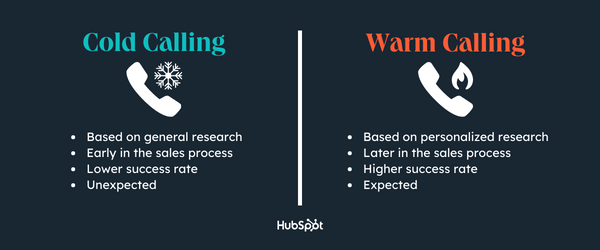
Cold Calling vs. Warm Calling

cold calling vs warm calling

The main difference between cold calling and warm calling is the level of familiarity and engagement with the prospect. Cold calling involves reaching out to completely unknown individuals who have had no prior interaction with the company, while warm calling involves contacting leads who have shown some level of interest or engagement, such as filling out a form or attending an event.

Warm calling typically has a higher conversion rate as there is an existing foundation for the conversation, making establishing rapport and building a relationship easier.

Hot Calling vs. Warm Calling

In contrast to warm calling — whether your prospect has converted on the website or your call is the first touch point — hot calling is when you know the prospect is ready to buy. They've submitted a form or emailed you and said, "I've been doing some research, and I know your solution is right for me." 

Because they're eager and on the cusp of a decision, there's little need to "warm them up," it changes the focus of the conversation from relationship-building (though that's still important too!) into evaluating budget, need, and timing so you can close the sale. 

In essence, give the people what they want, and don't beat around the bush. 

Effective Warm Calling Tips

You won't always have the luxury of hot leads ready to talk to you and purchase. However, the following tips will help you enter into a conversation as you gauge level of interest:

1. Identify good fit companies.

The best prospects are the ones that look like your best customers. They’ll have similar pain, which means they’ll be easier to sell to and have higher retention rates. Study your buyer personas and learn to recognize your ideal buyer quickly. Review your customer base and identify key similarities between your most successful clients so you have a finely honed sense of what to look for.

One caveat: Don’t just focus on the whales. While it’s important to identify your largest target accounts as early in the year as possible, whales don’t come around often. Concentrate on understanding your business’ bread and butter — the type of customer that buys again and again.

2. Research the company.

Preparation is essential in warm calling — after all, you can’t deliver value if you don’t know what your prospect cares about. I use LinkedIn to read a bit about the company and collect specific information.

At a minimum, you should know how many years the company’s been in business, the number of employees, their location, and their value proposition. This may sound obvious, but knowing these basics is important. It helps you determine the type of problems this business is likely to face and tailor your introduction. A 10-person company’s business pain is very different from a 500-person company’s pain.

3. Research the company’s executives.

I always do research to find out if I know any of my prospective companies’ senior executives or am connected to people who do. I want to find any information I can that’ll make it easier to connect — for example, whether he’s a Midwestern football fanatic or she’s a San Diegan surfer.

I dig for educational background, I examine their LinkedIn photos for clues to their personality, and I try to determine the most critical problems an executive in this role would have.

4. Perfect your opening.

Calling an executive is theater. You have 15 seconds to capture their attention and demonstrate value.

My call opening is: “Hi Chuck, this is Dan from HubSpot.” Then I’ll pause and wait for them to respond.

It’s important to sound powerful and in control. The prospect may not have any idea who you are or what your company provides. It’s crucial to sound assertive — prospects are more likely to respond to someone who’s confident and authoritative than a clearly nervous rep.

5. Be human.

A sales rep’s secret weapons are voice tone and a sense of humor. Your voice tone can put people at ease or on edge, and an ability to make people laugh will go farther in making them trust you than any sales pitch.

Prospects are extremely busy, so be as pleasant as possible and show that you understand the demands of their positions. Smile when you’re warm calling (they’ll be able to hear it!), especially if it’s early in the morning.

6. Prepare your talking points ahead of time.

Referencing a piece of specific, non-generic information and asking a great question establishes a level of trust and opens the door for a professional conversation.

The key is to get as detailed as possible on a topic with which the executive is familiar. For example, here’s a talking point I could use:

“I saw that you posted a blog article last week on cybersecurity at your company with a really intriguing title. I read it twice, and the paragraph about X strategy was really interesting. I thought I’d pick up the phone to talk with you to see if it was successful.”

Do you think she’s ever had a call like this? This hyper-tailored opening changes the game. It compliments the prospect, engages her right away, and leads to follow-up questions about why the company chose this strategy, whether it succeeded or failed, what they plan to do next, and how you can help.

7. Ask open-ended questions.

Even though you know the prospect is a good fit, you still need to assess their interest and need. By asking open-ended questions instead of yes/no questions, you're prompting the prospect to better engage with the conversation. This gives you an insight into understanding what matters to them so you can better help.

8. Listen for triggering events or pain. 

As you guide the conversation with open-ended questions, you should be digging for their pain points, the things that keep them awake at night. These are the things that your product/service may be able to solve for, and if you can prove this in their words, you're more likely to win them over.

9. Keep the call under five minutes.

Even though you may find that your product is a great fit, a warm call is still an interruption. Use your best judgment if the conversation is flowing well, but be respectful of your prospect’s time. After five minutes, ask, “Do you have a few more minutes, or should I email you information?”

Your first call is just an opening, so don’t worry about cramming in as much information as possible. Find out which other stakeholders should be included on the email, then let your prospect know that you’ll be their point of contact for solving their business pain.

10. Leave a voicemail.

There's a good chance your prospect won't pick up. When that happens, you might be tempted to immediately end the call and move on to the next one. Don't do that. Voicemails can be a valuable touch point even if they don't prompt a call-back.

Why? Because you're getting an opportunity to add value and build your credibility.

Here are a few ways to leave a voicemail that'll accomplish those goals:

  • Offer one quick tip and say you're happy to share more if your prospect is interested.
  • Foreshadow a helpful strategy, resource, or expert you're going to share with them via email (see the next tip).

11. Follow up with an email.

Following up with an email enhances your visibility. If you actually spoke to the buyer, they're probably going to open your message now that your name is familiar to them. If they didn't answer but listened to your voicemail, they'll recognize your name as well. And if they didn't do either, at least you'll increase the odds of connecting with them by trying another channel.

In your email, thank them for their time and provide additional ideas for solving their biggest business pain. I recommend personalizing your message with a short video — it's easy to record one on your webcam using Soapbox, a free tool from Wistia.

12. Call again.

I recommend calling four times in 12 days. This cadence doesn't cross the line into "harassment" territory, but it does give you a pretty good shot of connecting with your prospect if they have any interest in talking to you.

Don't forget to vary the times at which you call. Maybe the buyer is always slammed in the morning or goes into focus mode every day starting at 3 p.m. Trying them at different points in the day helps you catch them when they're most receptive.

Personally, I like to make calls in the morning before the craziness of a workday hits an executive’s desk — from 7:30 a.m. to 8:20 a.m. local time. If you call earlier, you’re more likely to catch them at their desks. About 25% of the time, the executive picks up.

13. Define a tangible next step.

Every communication you have with a prospect should be designed to drive the sales process forward or determine if you should disqualify them. Include one clear ask in your follow up email so your prospect knows what’s coming next. Even if the response is negative, you’ve laid the foundation for a future relationship.

14. Have a colleague call you.

There's no better way to know what works and what falls flat than having those strategies used on you. With that in mind, ask another salesperson on your team to call you. Pretend you're a typical prospect.

Take notes on the words and questions they use, your reactions, and how effective their CTA is. Incorporate those takeaways into your own approach. And do the opposite, as well: Call them and then ask for their feedback. Practice makes perfect.

Master the Warm Call

Cold calling doesn’t work like it used to, but that doesn’t mean any unsolicited phone call is ineffective. Instead, take the time to carefully research good fit prospects before offering them specific, targeted value, and reap the benefits of warm calling.

Editor's note: This article was originally published in May 2020 and has been updated for comprehensiveness.

sales call templates

03 Feb 17:22

Jackie Forrest: The unsustainable price of oil

by Jackie Forrest

The definition of “unsustainable,” according to the Oxford Dictionary, is a situation which cannot be maintained at its current rate or level. Unsustainable is also the best way to characterize the oil price when it is near US$30 per barrel —a situation that is not tenable on many dimensions.

Many companies are losing money at US$30 per barrel. Here in Canada, where our local prices are even less once transportation costs and quality differences are factored in, oilsands producers are pumping out red ink with each barrel of bitumen they extract.

Compared with oilsands, Canadian conventional and tight oil producers have lower operating costs and a higher valued product. However, despite these advantages, many companies cannot keep the lights on at these prices. Even for the group that can generate some cash flow, the amount is a trickle compared to the past few years.

The pain is not isolated to Canada. In the United States, tight oil producers are also showing signs of distress. Reacting to low prices and compressed corporate cash flows, recently Continental Resources, Anadarko, Hess Corporation, and Noble Energy all slashed their 2016 spending plans in the range of 50 per cent compared with last year.

Further, Hess and Continental are also now predicting production declines for this year, demonstrating that even stubborn tight oil is not immune to US$30 per barrel oil.

Supermajors are also under pressure. Chevron just released their first financial loss since 2002. In Brazil, Petrobras announced another round of cuts last week with the CEO describing the situation as “…a scenario of total distress.”

And, while most Russian production is still generating positive cash flow, the country has marginal wells that are losing money at this point.

Oil and gas companies cannot lose money forever. We know trouble is brewing when the rate of money leaving corporate bank accounts is higher than the dollars coming in. Making matters worse, very few oil companies have savings to draw from. Assuming that price remains low for the next few months, the first quarter results will provide hard evidence of the level of financial pain inflicted by US$30 per barrel oil.

Today’s low price situation is also completely unsustainable for many governments in oil producing regions. As a domestic example, Canadian producing provinces – mainly B.C., Alberta, Saskatchewan, and Newfoundland received $16.5 billion of royalty income in 2014, but last year, we estimate that the number was slashed to $7 billion. If prices hover around US$30 per barrel for most of 2016, this income will be squeezed to only $2 billion or about 10% of the 2014 level.

Oil and gas companies cannot lose money forever

This painful situation is not unique to Canada, it is challenging for all governments that depend on oil revenues to balance their budgets. It is no wonder why Nigeria and Azerbaijan are now looking for emergency financial help, or why Russia has recently become more interested in opening up a discussion on the possibility of an oil production cut.

Finally, today’s price is equally questionable when you consider the oil market fundamentals. When you adjust for inflation a US$30 per barrel oil price is near the price levels during the 1986 oil crash. Yet today’s oil market fundamentals are much stronger than 30 years ago, a fact that is not reflected in the current oil price. In 1986, spare capacity was equal to 12 million barrels per day, or 20 per cent of global demand. With such a large glut of crude oil, lower for longer made a lot of sense back then—but not today.

Today, spare capacity plus the amount of crude oil that the world is overproducing equates to under four million bpd or 4 per cent of global demand. Even if Iran increases its production as anticipated, it is quite possible that declining production elsewhere paired with still-strong demand growth could balance the market within a year.

As the old saying goes, the best cure for low price is low price. All things the same, cheap oil will accelerate demand, cause more megaproject cancellations than there would have been otherwise, speed up the decline rates for neglected legacy oil fields, and inflict even deeper wounds in the oil field service sector. While it may not happen immediately, the pain of today’s unsustainably low prices will only strengthen the forces that will lead to tighter markets and a price recovery.

 Jackie Forrest is Vice President of Energy Research at ARC Financial Corp., Canada’s leading energy-focused private equity manager.

03 Feb 17:21

Here are some key signals that the U.S. recovery isn’t faltering

by Kevin Carmichael
Wall Street trader at the New York Stock Exchange

(Spencer Platt/Getty)

I keep reading the United States is on the verge of a recession. The Federal Reserve “may have made a huge mistake” by raising its benchmark interest rate from zero to 0.25% in December, according to Wonkblog, the Washington Post’s niche offering for wannabe Nobel laureates and other policy geeks. Jason Kirby at Maclean’s wrote about a fellow who foresaw the collapse of oil prices and now predicts future assessments of current data will show the U.S. was in a recession at the start of 2016. And then there’s the markets: all that volatility must be a sign of something other than good.

U.S. gross domestic product expanded at an annual rate of 0.7% in the fourth quarter, a rather feeble expression of strength by the economy that is supposed to lead the world out of this latest phase of post-crisis malaise. Canadian investors, beaten up by the collapse of commodity prices, are piling sandbags around their portfolios. Benjamin Tal and Royce Mendes, economists at CIBC World Markets, estimate that Canadians currently hold about $75-billion in excess cash that they typically would have used to purchase assets that promise a return. That’s a lot of fear. Given Canada’s tight economic links to the U.S., one has to assume a degree of that trepidation comes from doubts about the strength of the world’s largest economy.

Official sources say the U.S. will do fine this year. The International Monetary Fund predicts growth of 2.6% and the Bank of Canada sees America’s GDP expanding 2.4%. Not great, but not terrible. So why all the negativity? Some of it surely comes from skepticism about the ability of economists to see the future. The IMF especially has a recent track record of overoptimism that has hurt the reputation of its economics department. Yet there is something pathological about the current spate of doomsaying. If you start the clock in 2007, we are nearing a decade of talking about the U.S. economy as either being on the verge of disaster, in the throes of the worst recession since the Great Depression, or stuck in an endless and disappointing recovery. (The U.S. actually recovered from the 2008-09 calamity in 2011, when GDP surpassed its pre-recession peak.) Turbulent stock markets and $30 oil are the latest reasons why the U.S. is headed off the rails, assuming, as Kirby’s source does, that it isn’t already in the ditch.

The early part of February will help clear the air on the state of the U.S. economy. There are a number of important indicators set for release, including the latest jobless data on February 5, and Fed Chair Janet Yellen will update Congress on the central bank’s outlook next week. One of those indicators, ADP Research Institute’s monthly payrolls survey, showed private employers added more than 200,000 jobs in January, more than the consensus estimate on Wall Street. The report is just the latest reason to doubt that the U.S. economy is seriously in trouble. To be sure, the stock market could be due for a correction; Robert Shiller, the Yale economics professor and Nobel laureate, has been warning for a while now that the ratio of price to earnings suggest a bubble. But that bubble has been inflated by an era of extraordinary monetary policy. The real economy only now is catching up to the equity markets. There is every reason to think that an economy that has created a significant number of jobs for 60 consecutive months can power through some stock-market volatility.

All those newly employed and no-longer-so-newly employed workers also should help the U.S. absorb whatever hurt comes from the stronger dollar. The currency’s surge in 2015 slowed exports, dealing a blow to manufacturing. But a smack is different than a knock-out punch. According to Tom Porcelli, chief U.S. economist at RBC Capital Markets in New York, less than a third of the 18 major U.S. manufacturing segments posted reduced output last year from 2014, and they accounted for only 20% of total factory production. Porcelli ran the numbers for every U.S. recession since 1973 and found that all occurred when at least 80% of manufacturing subgroups were in decline.

Chart showing the percentage of U.S. industrial sectors showing year-over-year declines, 1973 to present

(Sources: RBC Capital Markets U.S. Economics, Haver)

If manufacturing plays a role in the U.S. business cycle, it would seem the U.S. is safe from a recession. That’s because America still generate most of its demand at home. In a separate research note, Porcelli generated this chart:

Chart comparing personal consumption as a percentage of GDP (trending upward) to durables capital expenditures as a percentage of GDP (trending downward)

(Sources: RBC Capital Markets U.S. Economics, Haver)

That’s U.S. personal consumption graphed against spending on capital goods; one represents some 70% of GDP and the other represents about 4.5% of GDP. So while it’s true that weaker global demand and the stronger dollar is a headwind for big American manufacturing companies, hiring data suggest domestic consumption will continue to expand. “We care more about the lack of stresses for the near-70% slice of GDP known as “personal consumption” than we do about the 4.5% slice known as durable goods shipments,” Porcelli said. “But perhaps this is too practical.”


MORE ABOUT INTERNATIONAL TRADE & THE ECONOMY:

The post Here are some key signals that the U.S. recovery isn’t faltering appeared first on Canadian Business - Your Source For Business News.

03 Feb 17:16

10 Types of Marketing Emails to Rock Your Business

by Alexandra Giarratano

zag interactive email marketing typesEmail marketing is here to stay and is a cost-effective and powerful component of many businesses inbound marketing strategy. However, considering the average click-through rate is 3.5% across all industries, developing an effective email message strategy is imperative for success.

There are many types of marketing emails you can send to your audience so understanding which types make the most sense for your business is an essential first step. Let’s explore the most common types of marketing emails so that you can plan your email design and strategy accordingly.

Welcome Emails

Think of it as your digital introductory handshake to your audience. Every company should send a welcome email to new subscribers, and about 80% of them already do. A welcome email not only confirms subscription but lets people know what they can expect from your business, your brand personality, and everything to which they’ll connect. It’s easy to automate this message, and it’s beneficial to include a discount, promo code or welcome gift when people click through to your site.

Promotional Emails

Once an email recipient opens your email, you only have a finite amount of time to grab and hold their attention. The key is a quick click to your site based on a clear, appealing message. Keep your message short and make sure people know they must act quickly before an expiration date.

Newsletter Emails

When interested customers sign up for your newsletters, it’s an opportunity for you to build or strengthen your relationship. Don’t overburden them with information, though. Keep your writing concise and digestible, make it easy to click for more information, and always include your contact information so readers can find you easily.

New Product Emails

People love to know the latest gossip and news. When you launch a new product, tell your subscribers immediately! And don’t hide your excitement. Use the subject line of your email to entice your subscribers since 33% of email recipients open email based on subject line alone. Then satisfy your email recipient’s interest by providing at least one high-quality image of your new product or service within the email message.

How-To Advice Email

Yes, people love a great offer, but they really appreciate advice on how to get the most from your great offer/product/service. Telling people how they can improve their lives by using your products moves you from sales mode to trusted advisor/friend status, which helps strengthen your relationship. Keep your message focused on providing platinum-level customer service.

“Come Back Soon” Emails

Once people convert with you, gently encourage them to return and enjoy another wonderful experience with your company. Remind them of the value you offer and their previous orders or downloads. Then, make sure you’re clear about where you want them to go next. If you are using a marketing automation platform, these types of emails can be auto-generated to keep the momentum.

Industry Info Emails

Broaden your subscribers’ horizons with emails about industry news that is relevant to them. You’ll need to objectively analyze what that content is, by placing yourself in your subscribers’ position as a consumer. It’s easy for you to think that certain industry news is important because you’re in the industry. Look at this information from a neutral position, and once you decide what to convey, follow your newsletter format of concise content and short paragraphs.

Happy Customer Emails

Let your subscribers get to experience a community of like-minded people by sharing testimonials from others. Sometimes the most powerful marketing tool is reading how someone similar to you benefited from a product or service you’re thinking about using. Link them to your Facebook and Twitter pages to see how others respond to your products, services and company in general. Emails that include social sharing buttons have a 158% higher click-through rate.

“Psst…You Left Something” Emails

How many times have you filled an online shopping cart and then left it unattended because you were distracted or weren’t sure if you wanted to actually make the purchase? Industry research estimates that more than three-quarters of shopping carts are abandoned. Through marketing automation platforms, emails can be sent automatically to remind people what was left in their carts, and inform them that quantities are limited so they need to act quickly if they want to complete the transaction.

Feedback Emails

What do people like as much or more than knowing the latest gossip? Sharing their opinions. Send subscribers a short, easy-to-complete survey to collect their opinions about their experiences with your products and customer service. Consider presenting a reward as a persuasion tool at the end of the survey to help with participation. Your customers’ valuable feedback can ultimately be used to help your company improve.

03 Feb 17:14

How to Navigate the Sale with Ease

by Personal Branding Blog

shutterstock_324390098Your best sales guide is your very own set of values, priorities and unique way of conducting business. These transform into your business development plan. Remaining true to your plan will allow for your personal brand to shine brightly.

Treat negotiation as a friendly conversation with the purpose of seeking to find a happy ending for all parties.

Once you are comfortable with what you represent, you are then ready for the topic that scares most people; that of negotiation. Seeking a win for everyone from the start, makes negotiation friendly and easy. Successful salespeople actually begin the negotiation phase at the first stage of contact.

Initial Contact

It is a rarity upon asking someone for an appointment, whether it be a cold call or a referral, that the person will be up for a discussion the moment you ask. Most often, people are busy. The two popular replies are either “I don’t have the time” or “I’m not interested”.

Your best option is to agree that time is short or that interest is limited. Agreement, in this instance, usually becomes an interesting experience. People are so surprised that you agree, they let their guard down to take another 30 seconds to listen to what you have to say next.

Suggest in your own vocabulary that “down the road” will be a better time to meet. You will almost hear a nod of agreement. Ask when to check back in. Follow-up as directed. Most often an appointment will be granted.

Higher View

Relax and enjoy the conversation. Get the long term view of what the person is trying to accomplish and how they expect to achieve it. It may be so complex, you realize you can’t help as initially thought. But that’s okay. Determine if there is a secondary route you might take as a backup vendor. If there is, suggest it. Again most people are surprised by the “backup” offer and will ask for more insight on the matter.

Teamwork Approach

Take your time to get a thorough understanding of everything required. Ask to meet the team or those reporting to the person with whom you are holding the meeting. Get everyone’s input as to what they believe will be a winning outcome.

The team approach, seen as working to the benefit of everyone involved, will result in getting the team to cheer you on. Relationships are accordingly built on a strong foundation. This adds tremendous value in the overall service you provide. The value built eliminates the need to discount the pricing.

Smile and Ask for the Sale

Most sales are not given as an award. It’s up to the salesperson to ask for it. But the “ask” is the final key to the negotiation. Elements to include are:

  • When would you like to get started?
  • Timeline for delivery
  • Expiration of your offer

When you move the sales process forward from your prospective client’s negotiated viewpoint, your sales success rate will increase dramatically. And you will enjoy the Smooth Sale!

03 Feb 17:14

Mastering Relationships in the Digital Industry

by Bryan Wish

Throughout my life, I have always had the ability to create visions and end goals, and work backwards to achieve different dreams. Realizing my pursuits wouldn’t be possible without developing relationships in different areas where I lack expertise.

Sometimes, it’s difficult to create and foster the relationships that you need in order to achieve and pull off what you set out to do. Whether this is forming an advisory board for your new business, figuring out how to get in touch with the VP of Marketing, or speaking to an influencer, it can be difficult when people are so busy. The idea of being memorable to reach the person you need is never easy.

At 22 years old, I’ve had to reach out to thousands of different people for various projects. Just for a website I created called www.thewishdish.com, I had to reach out to 1,500+ completely cold just to give my vision momentum. In this article, I’m going to lay steps I have taken to develop relationships with thought leaders, CEO’s and people of Influence, who can help extend your dreams, visions and aspirations.

Learn the Triple “Whammy”

When I attended the 2015 Inbound Conference in Boston, one of the most captivating sessions I heard was by Chad Pollitt, the Co-Founder and VP of Audience for Relevance. He was so real and shared so many great tips on content marketing. After the event, I went up to him and introduced myself. Then I took to the digital game and applied the Triple Whammy. I followed and tweeted him on Twitter. I emailed him letting him know how much I appreciated his time. I also sent him a LinkedIn message. In the digital world today, imagine being pinged three times in a row by the same person, who applied the right wording to grab your attention. Simply, I wanted to pick Chad’s brain about content marketing one on one and we later were able to setup a Skype session.

The Triple Whammy in Action

1. Utilize LinkedIn/Email Introductions Intros: Some of the best connections I have made online have been through other people I have known in my network. I ask them to introduce me through a warm introduction. For example, I was trying to bootstrap free shirts the first two months of my business. I looked up Comfort Colors (t-shirt brand) and found the marketing director on LinkedIn. I had a mutual connection introduce us and he sent me 200 free shirts from the Comfort Colors Factory.

2. Twitter Questions: If you are trying to reach out to someone digitally, Twitter is a great, easy way to engage quickly. For example, when I was looking to fill my advisor board for Wish Dish, I wanted to find a technical advisor who could assist. I reached out to a few people on Twitter and found someone named Akhil Anumolu, who had incredible experience.I started engaging with him online through a series of questions around his interests. From there, I asked him for his email, we met in Atlanta, and now he plays an instrumental part on my advisor board.

3. Memorable Email: Catchy Subject Line and Body Paragraphs: My first year in the working world, I have noticed a change in how busy I am where certain tasks take precedent over others. Your time becomes your most valuable asset. Emails pile in, and you have to prioritize who you respond to. Therefore, you have to stand out when emailing someone for the first time. It never hurts to have a catchy subject line, such as “Can I Learn from You” or “Why You Should Read This E-mail”.

In the body of the message, make sure you connect the interests of the person you are emailing to show that you did your research. Make the email about them and how you can help and add value to them.

For example, in March of 2015 I read a book on Google, found the author’s email online and sent him a message telling him how much I learned. I picked a specific section of the book that really resonated with me and explained what I learned. I was able to foster that relationship and we still communicate today.

Conclusion:
When someone makes time for you, it is always a good idea to send them a hand-written thank you note. It is an easy way to separate yourself and nobody does it today. Lastly, never expect anything in return. When people do give you their time, always think about how you can return the favor.

03 Feb 17:14

How To Find Clients Willing To Pay Premium Prices

by Ian

Being able to charge premium prices for your products and services is a huge advantage. Especially for smaller businesses and individuals where you don't have the scale to make money from a low cost position.

But premium pricing is often easier said than done. One big reason is that many businesses go about it the wrong way. They try to take an existing market or client base and persuade it that their products and services are worth paying a premium for.

That’s possible, but it’s hard work. A better strategy can be to find a segment or sub-segment of the market that’s inherently more willing to pay premium prices and to focus your products and services and your marketing on what that segment wants and needs, rather than what the general market wants and needs.

How do you find those premium segments?

Watch this week's video to find out…


What are your thoughts and experiences with premium pricing? Please do share them in the comments section below the transcript.

Find this video helpful? Subscribe to the More Clients TV channel on youtube to get more of them:

subscribetomctv

Video Transcript

Hi it's Ian here, welcome to another five minute marketing tip. This weeks tip is about how to find people willing, in fact happy to pay for premium pricing. I'll show you a method for analysing your market, and figuring that out after this break.

Hi welcome back, got an email from Anna this week replying to an email I sent out talking about premium pricing, and how when you're looking for premium pricing usually the best thing to do is not to try to appeal to the whole market and persuade them that they should be paying premium prices for your products and services, it's to identify a sub segment of the market that is willing to pay premium prices and gear up your products and your services and your marketing for them rather than gearing it up for the whole wider market who inevitably isn't, most of them aren't willing to pay premium prices. Anna wrote back and said, “That sounds great in theory, but how would you go about doing that?”

Really it's a two step method for doing that, the first is to brainstorm various different segments and sub segments, so what are the segments there. The second step is to analyze those segments and sub segments and to figure out which ones are the premium priced ones.

In terms of brainstorming there are sub segments within every market, you just have to go through an exercise of kind of thinking they are.

If you do presentation skills training for example, that's a reasonable market, lots of people operate in that market. Most people in that market tend to do presentation skills training for pretty much anyone. You could segment that market down, you can do presentation skills for training for me, or for women. You can do presentation skills training for all the people who maybe want to get their experience across, or younger people who maybe have a credibility issue when presenting. You can do presentation skills training for business people who want to do training seminars and things, you can do it for senior executives who have to present to their investors, you could present, do presentation skills training for students who have to present as part of, you know, presenting a project or a case they've worked on.

You can do presentation skills training for people who have to present very technical material, or people who want to present emotionally to really motivate and move people with their presentations. You can do presentation skills training for people who want to speak on big stages, or people who want to speak at kind of small events and seminars. Or you can do presentation skills training for people who want to present on video, or on webinars, kind of a merging trends these days. There are all sorts of different sub segments that you could focus on.

The question is, which one of those is going to be … which ones of those are going to be premium segments? That's where the second step of the analysis comes in.

Now I'm assuming here that two things are true. One is that whatever sub segments you identify you have a particular skill, or expertise, or experience that makes your services valuable to that sub segment. If you're thinking of presentation skills for executives presenting to investors, if you've got no experience of delivering that service at all then clearly that's not a sub segment you can go into without a lot of preparation, maybe doing some Pro Bono work to get the experience, et cetera.

Assuming you've got the experience and the skills to do it, and I'm also assuming that you're interested in it, that you have a passion and energy about that particular segment otherwise you'll get bored and move on. Assuming that's the case a couple of questions to ask yourself about that sort of segment.

First of all, is it big enough and can I reach it with my marketing? That's a kind of viability question. Most of those types of segments I've talked about so far easily big enough in any market, but if you look at something like the one about presentation skills for senior executives presenting to investors, it's typically only very large companies that do that. That is a limited market, it's big enough in most countries and if you're doing face to face presentation skills training in most big cities it would probably be big enough. You know if you do live somewhere obscure and it's difficult to travel to a big city, that might not be viable for you because it's just not, you know you just can't reach enough of those potential clients.

That aside, and that usually shouldn't be an issue for most sub segments. The big questions about whether the segment is going to be a premium segment, or as follows.

Firstly you have to think does this segment, this sub segment, get tremendous value? Which ones get the most value from my services, from what it is I deliver. I'm not talking in a relative sense, I'm talking in an absolute sense here. You have to be a bit ruthless. For example, students presenting the results of a project they've been working on, that's value to them to get those presentation skills, but students are not a very lucrative segment, they're not kind of flushed with money, as it were. Where as senior executives who have to present to investors, they get a tremendous amount of value from that because you know, it's worth a fortune to them and their businesses for investors in their company to have a good impression of the business. That's a very lucrative segment because it's worth a lot of money to the people who get that training under the assumption it works, and therefore they would be prepared to pay a decent amount of money for it.

The second question to ask yourself is, is it a growing market segment? I like growing segments because although you can make money in pretty much any segment, even if it's kind of flat or in relatively you know, slight decline. In a growing segment there's usually a lot of money sloshing around, usually people are short of times so they want to hire outside help, and usually suppliers who can work with that segment are kind of in short supply because the segment is growing, you need more and more people able to supply it, and that means you can charge premium prices because there simply are less of you able to meet that demand. Is it a growing segment. For example, presentation skills for people needing to present on video or webinar, that's a growing segment because that's an increasing trend. That might be something you would look at if that was your area.

Next question is, is this area close to the jugular? What I mean by that is, is an area of strategic importance to the business or individual. It might be high value financially you think, but most businesses, most people have a few areas of their lives or their business that they really prioritise, and they really invest in the areas I call being close to the jugular. If you're a pharmaceutical company for example, you tend to care most about R&D and sales and marketing. All of the stuff about HR and distribution et cetera, yeah you need to do something there, but your real investments tend to be made in R&D and marketing. If you're doing presentation skills training, presenting RND results, that might be a good one. Or presentation skills for sales people presenting complex technical material to doctors, that would be high value because those are the two areas that are close to the jugular for pharmaceutical companies. Similarly with any business or any individual there are a couple of areas that are really important to them strategically, those will be the ones they'd be willing to invest in.

Finally, do the clients in that particular sub segment recognise that they have a need. Sometimes it's easy for us to think that it's obvious that they need this particular service from us, but do they recognise it themselves? Are they calling out for help in this area. If they're not it's going to be difficult to charge premium pricing because they just don't realise how important the issue is to them. Thought the methodology, brainstorm the difference sub segments, that's relatively easy, just let your brain run a bit free on that, use some of the examples that I gave earlier for inspiration. Then secondly, analyse those segments, make sure it's big enough, make sure probably the most important question, does that sub segment get a tremendous amount of value? Is there a kind of no brainer return of investment from them, for them, in terms of investing your services. Is it a growing sub segment, that's ideal. Is it close to the jugular, is it strategically important to them, and do they recognise that they have a need.

If you get a positive answer to most of those questions then it should be a premium priced segment, and it's well worth going for. See you next week.

—-

What are your thoughts and experiences with premium pricing? Please do share them in the comments section below.

The post How To Find Clients Willing To Pay Premium Prices appeared first on Ian Brodie.

03 Feb 17:11

The 2 Critical Factors Behind B2B Sales Forecast Confidence

by Bob Apollo

Crystal_Ball.jpgRegular readers will recall that I am no great fan of the default approach taken by so many CRM vendors, in which individual opportunity forecast probabilities are based on applying the same percentage to every opportunity that has reached a given stage in the sales process.

Many CRM users simply accept the default “out of the box” percentages without questioning them, or validating them against actual outcomes, or are confused about whether the % is measuring progress through the process or the probability of winning.

It’s no wonder that sales forecasts are often so wildly inaccurate. But there is a better way of thinking about this…

The problem is particularly acute in high-value, relatively low-volume complex b2b sales environments with a high dependency on new business, where the outcome of one or a few individual opportunities can make a very significant difference to whether you hit your overall revenue target or not.

I wrote at some length about the various factors that influence the probability that any individual opportunity will close here, and I firmly believe that investing in a sales analytics solution can help to identify the underlying patterns and make sense of the complexities.

But let’s assume that you’re not yet ready to commit to sales analytics, but that you still want to do a (much) better job of forecasting the outcome of individual opportunities than you are today. Here are the two critical factors that you need to assess when deciding whether an opportunity is likely to close at the predicted time.

But there’s an essential point here – and I cannot stress this strongly enough – you have to make separate judgements about these two factors before coming up with an overall confidence level:

1: Will the prospect actually do anything?

One of the biggest reasons why forecasted opportunities fail to close is that the prospect failed to make a decision. In most cases, this is due to the fact that they had an insufficiently compelling reason to act, and were happy to delay their decision. Or – in a variation on this theme – their attention was diverted towards other more pressing priorities.

Sometimes, they will make an explicit decision to abandon their current buying decision process – but more often, the decision will simply be deferred until later. And in either case, there is no guarantee that they will communicate their decision to you – they may simply become (much) less accessible.

There’s a fundamental principle here – decisions to take action tend to have a momentum to them. The prospect tends to be highly engaged. There is an obvious reason why they should act, and – just as important – there are significant costs and painful consequences associated with sticking with the status quo. They have concluded that the longer they delay, the worse it will get.

Taking all factors into account, you need to make a realistic (and that normally means conservative) assessment of the chances that each prospect will make a commitment and place an order on anyone in the targeted timeframe. That’s the first half of the equation.

2: What are the chances they will choose you?

There’s another simple principle at play here: if you have failed to compellingly differentiate your solution, and if the prospect struggles to distinguish between your solution and their other shortlisted options, they will choose the option that costs the least or appears to offer the lowest risk.

If – in the eyes of your prospect – you are either a clear market leader or a clear cost leader, you are probably in a reasonably good position. But if you are neither, you need to go out of your way to get your prospect to acknowledge the compelling advantages of your solution and your organisation.

If your differentiation is weak – if your sales person truly has no idea which option their prospect actually prefers – then calling it a “50/50” deal almost inevitably overstates your chances. More on this in just a moment…

Doing the maths

Assuming that you have accurately assessed both of the above factors, in very simple terms, your probability of winning the deal on the targeted date is a function of multiplying the two percentages. Let’s assume that there is a strong (75%) chance the prospect will actually do something, but that you are 1-in-3 with other similar options (33%). The projected confidence is 25%.

When clients go through this exercise, the results are usually a lower but much more realistic percentage than they used to get when they simply asked sales people to assess their chances of closing. But there are a few other wrinkles that can help to further improve the process.

Banning “50/50” judgements

There’s one probability number you should bar your sales people from using in either their “do anything” or “choose you” ratings: 50%. Not because it’s impossible that 50% could (very rarely) be an accurate assessment – but because accepting “50/50” ratings encourages lazy thinking on the part of your sales people.

My strong recommendation is that you should push back, and force your sales people to choose a number that is either marginally more or less positive – 55% or 45% – rather than describing their chances as simply a coin toss. If it genuinely is, they clearly haven’t been doing their job right.

Collective decision-making

The final strategy that I recommend is to get your sales people to come up with their initial assessment of the “do anything”, “choose you” and “overall” probabilities and then review the evidence with you that led them to their conclusions. You’ll quickly get a sense of whether they are relying on gut feel or on a deep understanding of the prospect’s actual situation.

It would not be unusual for you to disagree with their assessment of certain deals. It is often helpful to review how the sales person’s previous similar opportunities actually panned out. If you cannot come to a consensus, I recommend that you record your confidence as a separate field to the sales person’s confidence, together with a short comment explaining the differences – and use this as a learning opportunity.

In conclusion

These strategies – separating the two critical factors, banning 50/50 judgements and implementing collective decision-making – have been proven to dramatically improve forecast accuracy, most particularly in high-value, low-volume new business environments. Why not try implementing them in your next forecast reviews?

I’d be very interested to get your feedback…

10-Point Online Healthcheck

03 Feb 17:10

Why a Comprehensive Content Strategy Includes Podcasting

by Jon Nastor

how a podcast amplifies your message

What if there was a way to cut through the noise, get noticed, and make a real connection with your audience?

For many businesses, on-demand audio content is the way to do just that.

Podcasting is gaining in popularity, as you may have noticed, but the medium is not oversaturated.

There’s still plenty of room in the market for you, so don’t worry that you’re too late to get started.

It could be argued that podcasting is not right for every business. It could also be argued that blogging is not right for all businesses.

Yet, if your business takes content marketing seriously, then podcasting can be a strong component of your content strategy.

Here are four reasons to embrace podcasting as an integral part of your strategy.

1. Expand your reach

2015 was the year podcasting made its way toward the mainstream.

Edison Research has reported that one-third of all Americans 12 years of age and older have listened to at least one podcast. If there are still two-thirds of the population remaining who haven’t explored podcasts yet, then there are lots of new ears to reach.

The best time to start a podcast was four years ago. The second best time is now.

The sheer number of people listening to podcasts — and the even greater number of people still to discover the medium — makes podcasting an essential part of any content strategy.

With new cars starting to roll off the assembly line with podcast players installed in them, and both Google Play and Spotify getting into the podcast distribution game, podcasting is just getting started.

As of today, the potential reach of a podcast makes it enticing, but the part that should really excite you is the wave of new listeners still to catch the podcasting bug. That’s when podcasting will officially live in the mainstream.

2. Ease of creation

Podcasting is a great way to test new ideas. Simply hit record and talk.

When you find a topic or angle that resonates with your listeners, you can easily turn it into an article, report, or ebook.

Podcasting can even make you a better writer.

The technology that we have at our disposal enables anyone with a laptop and a $100 microphone to start their own radio show.

Don’t overthink it, and don’t worry about hating the sound of your own voice when it’s recorded — we all have that problem.

3. Build your content library

Even if you understand the importance and value of creating a content library, you may be wondering how you will produce all the content to fill your library.

It’s quite simple when you have a podcast strategy that attracts attention and builds your content arsenal.

Here are a few ideas to get you rolling:

  1. Call an expert in your field and interview him or her via Skype.
  2. Get your audio transcribed and turn the transcriptions into an ebook or ebook series.
  3. Record audio versions of your most popular blog posts.

Podcasts help you create unique and valuable content. Each of these three ideas above could easily be created and added to your content library. Your audience would love it.

4. Cast your net far and wide

Podcasting can be used to cast a wider net for your business and bring more people to the top of your marketing funnel. This is essential for all content marketing strategies.

Audio content, unlike written content, can be consumed during commutes, showers, walks, and while at the gym.

You have multiple opportunities to reach out to new customers where and when they want to be reached.

Even your biggest fans won’t be able to read or listen to everything you create. This is why it’s essential to create content that can be distributed across multiple mediums.

Those who listen to your podcast may not read your blog, and those who read your blog may not listen to your podcast. So, create within both mediums and go where your audience already is.

Podcasting is an excellent opportunity for you to repurpose your work and find your audience where they are.

Getting started with podcasting

You may fear it’s too difficult or too much work to add a podcast to your content strategy.

Although creating a podcast is not easy, it can be simple. A lot of work, yes. But the potential rewards far outweigh any drawbacks that might concern you.

There are many compelling reasons why companies like Rainmaker Digital have decided to go all-in on podcasting, and you should too.

Including a podcast in your content strategy could even make your life easier, not cause the burden of more content to create.

If you want to expand your reach, the ease of creation, ability to test ideas quickly, and added value of audio content in your content library make podcasting a no-brainer addition to a robust content strategy.


Get Your Free, No-Frills, 9-Step Showrunner’s Guide … Today!

If you want to take the next step to develop, launch, or run your remarkable podcast, start with The Beginner’s Guide to Launching a Remarkable Podcast.

The free ebook is a guide to getting your podcast off the ground.

It follows the framework mapped out inside The Showrunner Podcasting Course. Yet, at the same time, it is a standalone guide to getting started today.

Get your free copy:
The Beginner’s Guide to Launching a Remarkable Podcast

The post Why a Comprehensive Content Strategy Includes Podcasting appeared first on Copyblogger.

03 Feb 17:08

The Missing Ingredient for Sales Coaching

by Jim Burns

  There is a generally high desire for sales coaching in B2B selling. Most managers and reps know it’s important. Done well, coaching can make a significant difference to rep and manager performance and success. Financially, everyone has a lot at stake. But sales coaching is seldom done. Consistently. Or well. Why is that? What’s missing? To be successful sales people need: Knowledge and information (including sales strategy and process), Skills and techniques, Conversations and messages These inputs enable sale people to know What to do, What to say, How to say it. We are among many who believe how you sell is a primary way to create value for prospective buyers, and to differentiate from competitors. Training programs provide the initial vehicles to “prepare sales for the fray” as one of my colleagues says. Training methods include information transfer, modeling best practices, and sales practice with feedback. Training prepares sales reps to execute. Sales coaching, as discussed here, is focused on coaching sales execution. It addresses how well reps are actually doing in the arena, under pressure, when it counts. All three success factor areas should be addressed. Why Coach? This question evokes obvious answers. But it also uncovers important coaching requirements. Effective coaching has a significant impact on: Performance —  to meet corporate new customer acquisition and organic revenue growth objectives Efficiency — to lower selling costs Strategy — sales strategy, sales process and customer experience Sales Engagement — account strategy, conversations, sales actions This is necessary because, under pressure, […]

The post The Missing Ingredient for Sales Coaching appeared first on Avitage.

03 Feb 17:08

5 Ways Great Content Is Like a Good Cup of Coffee

by Shelby Clarke

Great_Content_is_Like_Good_Coffee

Coffee is wonderful. It fuels, it inspires and it helps us to keep doing the work that we do best: marketing! On the other hand, bad coffee – or a lack of coffee completely – can devastate productivity and create general workplace angst. I would know. I am one of those employees when deprived of coffee.

Content marketing isn’t very different from coffee, surprisingly. Every day consumers are looking up answers to address challenges and improve their lives. And when they can’t find the answers we need? Frustration. Google is a wonderful tool, but if consumers don’t find a solution to their problem within the first page of results, cue the rage.

Consumers want help, and they want it from a trusted source. That means someone needs to create the content to fill these knowledge gaps and needs. Why shouldn’t that someone be you, right?

But before you get started, let’s examine what it is about good coffee that makes it so similar to great content.

Made-To-Order

Whether we think about it or not, we coffee lovers put a certain degree of faith in our baristas – and yes, even our Keurigs – to give us coffee the way we like and expect it to be. No matter how straightforward or complex your normal coffee order is, you would be upset if you didn’t get what you want. And without good coffee, you’re whole day could get thrown off.

The same holds true for content.

All of your content – from the humble blog post to the mighty eBook – should be created around the specific audience persona you are trying to reach out to and educate. With personas and a content marketing strategy in place, you know who your audience is, the needs they have and the questions they’re asking. You’re role is the barista, crafting the perfect cup of content to address your persona’s specific pain points and to provide answers.

If we’re talking about a premium content offer, consider the landing page the menu that outlines exactly what your audience can expect from your piece of content. It lets them know what ingredients you used and whether it’s really what they are looking for. Your job is to make sure that the content delivers on those promises.

If your audience doesn’t get out of the content what they were promised, they’ll be dissatisfied and will have to keep searching for the answers to their questions elsewhere. Now leaving your site for someone else’s, it’s quite possible they won’t come back for more content.

This is the buyer’s journey hitting a dead end. Don’t miss out on conversion opportunities by not delivering.

Personalized

Rockstar baristas remember the favorite drinks of their regular customers, adding to the customer’s experience. They feel valued and special, and as such will want to frequent the same shop. This creates brand loyalty.

What does this personalization look like in content marketing? Often it is seen in the use of smart content and personalization tokens.

If you’re a HubSpot user, smart content is any information, text, offer, or call-to-action that changes based on who is viewing it. This is great for content where, for example, you want to show new visitors one content offer, but would like that returning guest to check out a more middle-of-the-funnel offer.

Personalization tokens, similarly, use known information of your visitor to make them feel less like one out of 1000 other people on a list of contacts, and more like the content was written just for them. For example, using their first name or the name of their company in an email to better relate your content to them.

Both take the information that has been gathered from previous visits and use it to improve the individual’s experience by tailoring the site and content to fit their needs.

Shareable

This is a simple concept that I don’t need to say much about. If you know of some mindblowing coffee, I want to know all about it. Seriously, tweet at me and tell me where I can get it for myself!

People like to share good things with other people who would like it, too. If your content really resonates with someone, they are likely to share it with others in their network whom they believe could benefit from the content as well.

Because of this, make sure your content is easy to share. Provide plenty of ways for your audience to show it off online.

Energizing

Coffee – that wonderful caffeine part in particular – helps me to focus and gets me thinking. This is great when trying to plow through a problem or brainstorm new ideas.

In the same way, great content should be able to inspire your audience and get the cogs in their minds moving faster and smoother. It should break down barriers to productivity by answering questions and providing new and smarter ways to resolve problems.

And while thinking is awesome, getting your audience to act on those new ideas is even better.

Caffeine gets you moving, and likewise, a good call-to-action drives your audience to do something. And whatever that something is, it should always be pushing them further and further through the buyer’s journey.

I don’t believe in decaf coffee, and I don’t believe content can ever truly be great without a solid CTA.

“I don’t believe in decaf coffee, and I don’t believe content can ever truly be great without a solid CTA.”

Addicting

I’m a coffee addict, okay? To me, coffee is wonderful all the time, any time – for work and for fun. It helps me do my best work, and keeps me on top of my game.

Great content should be addicting, too. It should leave your audience wanting more and should be something that will hook them and get them excited to learn. This is the buyer’s journey at it’s finest.

Create content that addresses the questions and pain points of your target audience. Personalize it and use smart content where it makes sense. Make content that is worth sharing and that pushes your audience to think and act. When you create great content, you’ll be helping your audience find solutions to their pain points, they’ll be addicted to your content and they’ll come back looking for more.

Your Turn

What content or brands have you experienced that have had you coming back for more? Share in the comments!

Register for our webinar on how to create content that doesn

03 Feb 17:07

How to Roll Out Live Chat For Your Sales Team

by Robert Nelson

Leaders focus on potential. Great leaders know that it is their job to insure the organization they lead reaches its full potential.” – S. Anthony Iannarino, The Sales Blog

Your sales team just decided to implement this awesome new live chat tool to connect with even more leads on your website! But now what? It’s understandable to have some concerns when you’re rolling out a new technology to your entire team. After all, it can seem like a big, risky undertaking getting everyone onboard.

Miles Austin from Fill the Funnel shares his advice about rolling out new sales tools: “One of the surprises that I have encountered is that at times the tool that scores best in the technical scores just doesn’t fit well with the culture and the pace of the organization. Comfort with the overall feel and use of your new tool can play a key role in the successful rollout.”

As the leader of the sales team, your job is to maximize the potential of your team. That’s why we’ve created this quick guide to help integrate live chat seamlessly into your sales process and grow your sales.

The Transition

I’m sure your sales team has mastered dealing with leads via phone call and email. Live chat with your potential leads works the same, just in much easier and efficient way. It’s important to establish the similarities and differences between live chat and your other channels early on, so you can prepare your team how to handle this new sales tool.

What’s similar?

  • Leads are what’s important. These contact methods are all ways of capturing leads for your sales teams!
  • Contact your customers from anywhere. Each channel is flexible and can be used to reach leads from a mobile device or at your desktop computer.
  • Professionalism is key. It’s easy to fall into the trap of thinking that because it’s chat, you can treat it like a text message to your best friend. You still want to remain professional, just understand it’s okay to show your personality. It’s much easier to do so through live chat than an email conversation.

What’s different?

  • You can multitask with live chat. You can be in many chats at once or even be doing a variety of other tasks while chatting with your visitors. Phone calls specifically require your direct attention to that one person in order to capture the lead. You’ll probably need to get used to being able to use your time more efficiently!
  • It’s okay to take your time and fully think out an answer before responding to a prospect’s question. On a sales call, you either have to put a prospect on hold to hunt down an answer, or endure awkward pauses as you fumble around. With email, you can think out your answer, but the back and forth time is brutal and makes it hard to offer immediate answers.

Live chat makes it okay to tell your visitor, “One moment!” and you aren’t forced to immediately respond just to respond. This is great for the visitor too because they aren’t tied down to the conversation so it isn’t as big of a burden on them if they have to wait.

  • Direct integration with your CRM. When looking for a chat tool, an added bonus would be that it integrates with your current CRM. This will help your workflow and make your sales team even more efficient in capturing those leads. No longer will you need to do manual entry of leads into the CRM after gathering customer data from a phone call or email.

Product Knowledge is Key!

Now, before your sales team even hops into a chat, make sure they have sufficient knowledge of the product and company. Visitors are coming to live chat for quick answers to their burning questions. If you have to redirect them back to email as you research the answer, they are losing out on the “wow factor” of instant answers from live chat. I know that some issues or questions do require you to get back to them, but the less this happens, the better experience the customer has.

Pro Tip: Setting up and using canned response for quick answers to FAQs and greetings are a great way to respond in a friendly, efficient manner.

Another reason you want to make sure your sales team is prepared for all questions is to help them better handle multiple chats at one time. Talking to multiple visitors at one time is one of the biggest advantages of chat. Unlike phone or email conversations where you are trying to close one sale at a time, a well prepared chat salesperson can gain multiple leads and close more sales in far less time. The more prepared you are with your product and sales process, the better you can manage multiple visitors at one time.

As the manager of your sales team, I’m sure you’re wondering, “How should I better prepare my sales team for this not-so-familiar lead capture platform?” The important thing to start with is having each member familiarize themselves with the chat dashboard and/or mobile app. Set them up with their notification options and show them the benefit of stored transcripts of their recently acquired leads. The chat experience should come natural because it’s similar to most text messaging experiences they’ve had. There isn’t much to learn and just having your team spend five minutes in the dashboard will allow them to set up everything they need to be successful with live chat.

Almost There…

The last thing you will want to do is make sure each team member downloads the mobile chat app. If you are an outbound sales team, your teammates are likely on the go constantly and not always at their desks. A mobile app allows each person to chat throughout the day and respond requests more often. Doing these few things will give each team member the confidence they need to start integrating live chat sales into their everyday routine.

Once you have everyone aware of the new live chat tool, make sure they start using it a day-to-day basis. It’s easy to understand why your sales team would want to stay in their comfort zone, but if they don’t jump into it right away, there is a good chance it will be forgotten. Change is hard, but if you help them learn how to use live chat and integrate it into their normal routines, it will be much easier for them to adopt the technology moving forward. As a last resort, feel free to offer them pizza and beer as a thank you for trying new things!

We’re not asking that your sales team changes their methods. Stick to what you know best about closing a sale and helping a customer through your sales funnel. Use your previous sales experience you’ve gathered and now apply it to this new channel. Combining what has worked for you in the past and incorporating it into live chat, you’re more prepared than ever to take over the world and capture more leads!

03 Feb 17:05

The Importance of Supporting Your Buyers

by PFPS

There are 12 ways a seller can build or erode trust with buyers. Each associated action creates a connection or causes a disconnection, and knowing about all 12 Dimensions of Trust empowers a seller who wants strong connections founded in trust. However, not knowing leads to buyer mistrust and seller confusion. On CONNECT2Sell, we’ve been digging into each dimension individually to help you better connect with buyers.

dimensions of trustLoyalty

“Seller supports others at all times” includes providing what others want and need. As a seller, one powerful way to support buyers is by asking them questions to challenge their assumptions and help them discover alternate ways of addressing their problems.

A transactional order-taker who does not form relationships with buyers is done once the order is placed. But a seller who connects with buyers long term must show genuine interest and support to demonstrate and engender loyalty.

I recently switched hair salons for this very reason. My former stylist supported me by getting me in on short notice, and I enjoyed our conversations about our children and our travels. But I didn’t feel she could “get me to the next level.”

By contrast, my new stylist supported me right from the start. In our initial conversations, she challenged me when I said “I need to spend five minutes or less on styling my hair each morning.” Her challenge was direct, and it made me think. She asked “How’s that been working for you so far?” and “What’s more important – the amount of time or the image you present?”

cover for site 2015By taking time to help me work out my own competing priorities, she supported me in a way my former stylist did not.

Supporting your buyers means you help them through their difficulties and challenges. To support means “to supply with things necessary” and “to provide for.” Your buyers don’t exist to support you. They do business with sellers who can, in some way, support them. DISCOVER Questions give you a tool to support your buyers.

This blog post features an excerpt from the best-seller “DISCOVER Questions® Get You Connected.”  To learn more about how to connect with buyers and gain their trust, buy the full copy of this award-winning book from Amazon.com as a paperback or e-book.

The post The Importance of Supporting Your Buyers appeared first on People First.

03 Feb 16:59

A Two-Step Plan to Punch Up Your Sales

by Daniel Faggella

In boxing, a fighter sets up his opponent for a knockout punch using a combination of other punches. And if you want to punch up your sales, you need to set up your customers for a knockout sales pitch by integrating a marketing automation “consumption campaign.”

If you’re unfamiliar with the term, a consumption campaign is an automated email campaign that is set in place to garner your ideal conversion. The goal of a consumption campaign is to encourage your prospect or lead to gradually consume your educational or informative content in a sequential fashion so that, when you start selling a big-ticket product or service, that prospect will already have an understanding of the value proposition you offer.

Consumption campaigns take time to create, but they can be summed up in two basic steps.

Step 1: Set up your tiers

With the goal of priming your prospect for your sales pitch, a marketing automation consumption campaign lets you set up email steps, or “email tiers”, to gradually make that introduction.

Your first email tier should present an overview of your company and demonstrate the value of what you offer, and I’m a firm believer that a video is the most engaging media form to use for this purpose. Once a prospect watches that video, then they’re “stepped up” to the next tier of emails, which could encourage them to watch another video of a case study or client testimonial. The number of emails in each tier is up to you, but remember that the goal of each level is to gradually give your prospect an understanding of what you offer and what it can do for them.

As an example, let’s say we’re a business offering marketing automation products and services. Our first email tier might consist of a five-email sequence designed to encourage our prospects to watch an educational video that powerfully conveys the core value proposition of our business. Each email we send out obviously needs to encourage the prospect to check out our video, but each one should also utilize a different call to action.

Email number two might feature specific benefits of our product, and the fourth email in the sequence can tout a different but related benefit; the goal is to take a slightly different approach to gently nudge our email leads or coax the click on the video, without beating them over the head with a pitch.

If you’re interested in seeing the prospects who have watched the video, you can get into advanced software and see how long someone actually watched a video, or you can take a more simplistic approach and just track number of clicks. Obviously, the former option will give a better idea of a customer’s interest level, but how detailed you want to hone in on customer behavior is up to you.

Customers who watched the video on benefits should automatically get stepped up to the next level of email, which might encourage them to watch a case study video. In this step, you’re framing your second sequence much like the first and using varying approaches to once again coax a click.

Since you’re ideally looking to leads to spend lots of money with your particular business, it pays to remember that a case study is an ideal way to show off the massive benefits that your company has provided to other customers. It can also provide a powerful tool for social proof, which can be reused in many different ways, especially for a service business.

With our initial email tiers established, we’re ready to move on to the second and last step.

Step 2: Make the sale

Now that prospects have ascended the first two tiers of our consumption campaign, it’s time to make the consumption pay off. Continuing with the example of the marketing automation company, the third tier is where we make the overt call to action to get a prospect to set an appointment or sign up for one of our marketing automation packages.

Having been through the first two tiers, the prospects at this level now have a better understanding of the benefits that our marketing automation company offers and what we can do for them. In other words, our first two tiers have softened them up, and now it’s time to go for the knockout punch.

At this point in the consumption campaign, prospects have been groomed to be receptive to the offer(s) we make in this tier. This is a necessary set-up, because where a $2,000 per month price might have elicited sticker shock via cold call or initial email, the educated customer knows the value of that price and will be more open to the sales pitch that we make in the third tier. While it’s still important to reinforce our value proposition and to vary the calls to action in this email tier, our focus in the third tier is on selling.

Wrap Up

A consumption campaign is best suited for big-ticket service companies or e-commerce marketers offering expensive, high-end merchandise, and the amount of tiers you incorporate leading into your sales pitch can vary. Companies that sell products and services with a wider range of prices, this article on “pull-up” campaigns may also be helpful.

Campaigns can be as simple as one tier or as involved as three or four tiers. The key is to find a happy medium that will educate and inform your prospects before the sales pitch comes, so that your pitch will be warmly welcomed rather than rebuffed without context.

Think about your business structure, what you offer, and how you currently market. Do you offer a higher price service or item that is so expensive and so involved that presenting the sales price might cause immediate sticker shock? If so, a consumption campaign that primes and preps your prospects could be the right next move for your business.

03 Feb 16:59

Everyone Grows an Email List. Here’s Why We Stopped Growing Ours.

by Kevan Lee

Awhile back, we were fortunate to try some neat email tactics that helped double our email list growth in just one month’s time.

Then we stopped growing our list altogether.

We shifted our learnings from growing an email list into growing Buffer signups. And we’ve yet to go back.

Odd? Strange? Counterintuitive? Yep, probably all those things. Most online marketing advice today will advise you to build an email list, first and foremost. We aren’t. We’ve had the same amount of email subscribers to the Buffer blog since June 2015. There are only three places on the whole of the Internet anymore to signup for our list (buried deep within the Buffer app, at the footer of this blog, and at this URL, which we link to from nowhere that I can remember).

How come?

And will we ever go back?

I’d love to share some thoughts.

(I thought I’d try a quick audio version of this blog post, in case that might be easier at all for some folks. Would love to hear how it feels!)

Almost literally everyone builds an email list

I have a list of favorite blogs in my Feedly, and quite nearly every single one of them has an email capture form of some sort on their home page.

(The only one I couldn’t find one for was Lifehacker, which I think has its own proprietary method of gaining signups/users.)

Everyone Grows an Email List. Here’s Why We Stopped Growing Ours. Everyone Grows an Email List. Here’s Why We Stopped Growing Ours. Everyone Grows an Email List. Here’s Why We Stopped Growing Ours.

Here’s one for Zen Habits:

zen habits email

For Brain Pickings:

brain pickings email

For Tim Ferriss’s Four Hour Workweek:

four hour work week email

Etc. Etc.

All these amazing blogs and amazing bloggers are building an email list and growing their audience, and I find it really incredible and inspiring to see all the many unique ways they go about it.

So why aren’t we? Here’re some thoughts.

What do you even do with an email list?

We reached the point where we were growing an email list bigger and bigger and bigger with no real end game in sight.

What did we plan to do with all these email addresses once we had them?

Good question.

We didn’t have an answer, so we stopped trying to add more.

We had lots of different ideas, and people have been so gracious to share their thoughts on what we could be doing (I’d love to hear from you in the comments, too, if anything comes to mind).

Here’re a few suggestions we thought over:

1. Lead nurturing

We’ve not quite made much progress into lead nurturing just yet—and to be honest, it could partly be because I don’t fully understand the term!

Here’s what I imagine the definition to be:

Lead nurturing is the process of taking a lead (another term that gives me pause – is a lead just an email?) and slowly but surely turning them into a customer by keeping in close touch and building a strong case, over time, for why they might like to use your product.

You’ve maybe heard that email is 40x more effective at acquiring new customers than Facebook or Twitter? Lead nurturing is a big reason why.

(More on this below.)

2. Webinar signups

One thing many marketers do with a newsletter list is occasionally send out invitations to webinars. The webinars, then, became the gateway into the product where people get to know more about what you do, ask questions, get support, and eventually become customers.

Wait a minute. This is lead nurturing!

3. Merge into a CRM tool

I’ve heard others who take their newsletter list and slip them into the pipeline with the rest of the CRM (customer relationship management) folks that come to the company from any which direction.

4. Leave them be

This has been our chosen path for the past several years. We built an email list (currently at 44,000 subscribers), we share articles with the list, and we don’t do anything else.

What this essentially amounts to is a long-term, customer-driven sales cycle: essentially a soft sell or, in some ways, a zero sell.

The three different kinds of marketing sells

  1. Hard sell
  2. Soft sell
  3. Zero sell

The hard sell is when you make a direct pitch for your product. This can take many forms, but you’ll often see it in an email or a mailer or an ad: anything where the overall goal and action for the user is to sign up, join, or start with a product.

The soft sell is a bit more of a slow play: The connection with the product or service is there, but it’s subtle, understated, and in some ways a bit behind-the-scenes. Social media can sometimes be a soft-sell channel, where you’re delivering value for the audience without necessarily seeking a direct signup.

And then there’s the zero sell, where there’s no mention of a product or service, just good vibes and positive interactions. The goal here is that people will come to trust and like your brand in such a way that future connections and sales will happen organically, with the customer reaching out. You’re building a bias for your brand, whenever (if ever) your audience is in need of your type of product.

3 different types of selling

Which one of these three resonates most strongly with email marketing?

In our experience it’s been the case that a soft sell or hard sell makes the most sense for getting the most of an email list. Yet our approach, to date, has been zero sell.

Which is why we chose to switch things up a bit.

What we’ve done instead: Turning email lessons into Buffer signups

Our cofounders Joel and Leo had an awesome observation while we were in the midst of thinking through this email conundrum:

What if we could take what we learned from doubling an email list and apply it to getting more Buffer signups?

And so we did!

We replaced all of the email CTAs on the blog with signup CTAs — from top to bottom, from HelloBar to slideup, everything all of a sudden started being about Buffer and Buffer’s benefits for social media marketers.

And things have gone well — well enough that we’ve yet to change things back.

We gain 348 Buffer signups per week from the blog.

In the last month, the blog sent 1,479 signups, which represented the lion’s share of marketing’s contribution to Buffer’s bottom line.

Things have been good.

… and still …

I wonder how things might look if we were to really double down on nurturing our email subscribers. Here’s a bit more context.

The blog currently has a 2.27% conversion rate for Buffer signups.

Our email courses convert at 2.81% — with certain courses as high as 7% or 9%!

The email dataset is quite a bit less substantial than the Social blog’s, yet the slight uptick in conversions — with a zero-sell mindset in place to boot — is definitely intriguing!

Our perfect world for email communication

Here’s what our email list contains:

  • Buffer users and non-Buffer users
  • Buffer users on free plans and those on paid plans
  • Buffer users on paid plans and Buffer users on the highest of paid plans
  • Active subscribers and inactive subscribers

That’s a lot of different folks!

What would feel great is if we could customize our messages for each different group. The Buffer users would receive a message of thanks for being cool customers, the non-Buffer users would get a message about trying Buffer for free or something showing the benefits of joining up with us.

And the customization goes on and on.

How cool would it be if an Awesome user received the occasional upgrade message, specifically about the Business plan’s features?

How neat would it be if an active subscriber saw a message saying thanks for all the opens and clicks?

Further customization and segmentation of the list feels like the next frontier for us. If we can solve all this in an easy and intuitive way, then maybe we’d go back to the way things were: growing a list with a goal in mind.

Why we haven’t built a lead nurture campaign (and why others might not have either)

A lead nurture campaign makes a ton of sense for helping us take the best care of our wonderful new subscribers.

And yet, in my two years at Buffer, I’ve not even started building one.

A lead nurture campaign, as I’ve built it up in my mind, seems like it would take a ton of time to create!

I’d love to hear in the comments from those of you who’ve built one already. Was it a big undertaking? How much time did you spend? What did you push down the priority list to make it happen?

Those are the big questions on my mind. To be quite transparent, I’ve yet to build a lead nurture campaign because I’ve simply chosen other tasks that felt equally as important.

I wrote blog posts and made email courses and tested CTAs.

In other words, I prioritized other things.

I found it hard to place uber-importance on a lead nurture campaign when everything else on the blog was going okay. Which I guess leads to a slightly bigger question (that I definitely do not have the answer to):

How does a small marketing team know how best to use its time?

I’d love for someone to tap me on the shoulder or shoot me a text or hire a skywriter to say: “Lead nurture is the most important thing you can do for your site!” That sure would make prioritization easy. I have a hunch it’s important; I have hunches that lots of things are important.

How do you decide?

Summary (& a kind of ironic conclusion)

So we got good at growing email signups, then we stopped growing email signups. We put all our learnings into gaining new Buffer users, and the plan has worked quite well so far.

What’s next?

Well, we might start growing email signups again!

Ironically enough, I’ve added a personal goal to get a lead nurture campaign in place so that we can see exactly how well subscribers convert to Buffer users. I’m not quite sure the question of prioritization with lead nurture, but I’ll be happy to report back with what we find to be true for us!

I’d love to learn how this idea of email signups, lead nurture, and signups feels to you. Have you experienced anything similar? Any advice for how we’re doing things?

Excited to get your thoughts in the comments!

Image sources: Pablo, Unsplash