Shared posts

17 Feb 19:27

Canadian retirees living on only 62 per cent of working income, Sun Life study finds

by Cameron Axford

A new survey released by Sun Life Financial says retirees are living on 62 per cent
of what they previously earned.

Despite this prolonged period of slow economic growth in Canada, the Sun Life Financial Retirement Now Report found that most seniors (88 per cent) described retirement positively and 32 per cent were surprised at how they were able to manage on a reduced budget.

It has long been thought that retirees needed 70 per cent of their previous income to maintain their standard of living.

“Life in retirement is more sustainable than you might think,” said Kevin Dougherty, President of Sun Life Financial Canada. “Despite current economic conditions, Canadian retirees are doing quite well living on just over 60 per cent of the income they had when they were working. And this average doesn’t change much when comparing men with women or taking marital status into account.”

Sun Life Financial
Sun Life Financial How much workers retain of their former salaries after retirement, by province.

Overall, employed Canadians spend around 25 per cent more. A worker’s monthly expenses come to $3,431, compared to the $2,611 budget of a retiree.

In a provincial breakdown, Ontario and Alberta had the most significant cuts in spending after retirement, budgets dropped over $1,000. The greying communities of Atlantic Canada retain most of their income.

The study claims that paying for financial advice is an investment. Sixty-two per cent of those who had advisers claimed they were ready to retire versus 38 per cent of those who didn’t.

The retirees were also asked what the best advice they could give working Canadians. Early saving, financial sustainability and preventative health care were the most popular answers.

17 Feb 19:20

All About Lead Scoring: How Can It Help Your Business?

by Jessica Bowers

What is lead scoring and how do you implement it? Let us explain.
inbound_marketing_4.jpg

If you’re engrained in the world of marketing, then you probably know what a lead is. In fact, it’s probably what you consider a crucial aspect of connecting marketing and sales—the thing that ultimately drives your business and creates relationships between your company and your customers.

How do you prioritize those leads though? How do you know which leads to direct attention to and what messages to point their way? Enter lead scoring. Lead scoring is an integral way to categorize and prioritize qualified leads.

So how does it work? Read on for our crash course in lead scoring 101.

The Value of Lead Scoring

In the most basic sense, you can think of lead scoring as a great organizational tool.

In marketing and tech these days, it seems we’re always trying to find those great ‘hacks’ and productivity tools to help us do our jobs better and more efficiently. Lead scoring is like that. The bonus is that lead scoring actually also benefits those prospective customers.

By using lead scoring, not only are you allocating resources and attention to the leads most likely to become customers, but you are making sure the right leads are receiving the right messages that will benefit them in their path to purchase. If you bombard all leads with similar messages, because you have not implemented ways to tell who is qualified or not, you’re wasting your time, and theirs too.

Getting Started

To begin a lead scoring process for your company, you need to evaluate a few things first. If you aren’t generating enough leads, then first focus on creating leads rather than jumping right into categorizing and prioritizing them.

Is there a good system of communication between your sales and marketing departments? If you find a breakdown in these relationships, that’s a big issue you’ll need to solve first.

You need to identify what your ideal buyer personas are, and what a qualified lead for your business looks like. You can also read our other blogs about targeting qualified leads. The idea is that without first understanding who your main prospects are, you’ll run into some trouble with scoring them.

Things you should consider when determining what a qualified lead looks like is industry, role in a company or job title, whether it’s a product or service-based business, location or reach. Determine who best suits your business and who you need to talk to for your ideal partnership.

Lastly, you need to be sure you’re gathering the right data. Lead scoring is based on the information customers and prospective customers are giving you about their quality as a lead, and their interactions with your business. If you’re not sure what kind of data you need, or where to get it, we’ll talk about that later in this post.

Setting Up Lead Scoring

Determining what your qualified lead looks like is so important, because it will help you place real values on who to reach out to and when. These values come in the form of points.

You can create a point scale that suits your needs, but typically using a 1-100 scale is easiest. Consider point assignments for every aspect of a prospective customer. This is where your ideal buyer persona will come in handy.

Use past information to help you make informed decisions about assigning point values. For example, if you find that the leads that are most likely to become a customer come from the sales department of a large company in Nashville, you can place higher point values on sales titles, size of company, and specific locations.

Let’s then say that a title of Sales Manager gets 10 points, while a Customer Service Representative may only get 3 points, because they are less likely to be interested in your business. And a company of 500+ employees also is allotted 10 points, whereas a company of 1-10 employees receives none, because they are not likely to need or want your services.

Additional considerations should be made for the level of interaction a lead has had with your business. If a lead has filled out forms, downloaded content, or visited your website habitually, they should be scored accordingly. A prospect who has only visited your website once, or who has navigated to a landing page through an ad, can receive a different set of points.

Consider from past experience how many pages of your website have been visited before a purchase is made. You can score each page visited as a different amount of points as well, such as giving a higher point value to someone who looks at a services and pricing page, over someone who comes to your website but only looks at your blog.

It’s up to you and your sales team to hash out a comprehensive point system. It’s imperative to leave no stone unturned and make sure you have all variables accounted for. Having an organized system will save time and energy when deciding which leads should be followed up on. By having the scoring in place, all the guesswork will be taken out.

What to Do with Lead Scores

Now that you have a scoring system in place, you need to establish the actions taken dependent on overall scores.

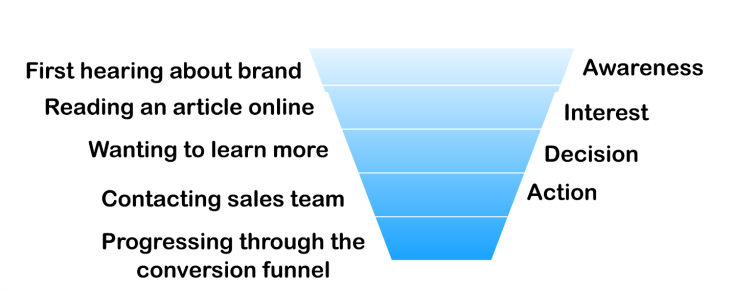
It goes without saying that a lead that scores highest is probably most qualified, and may be well suited to be ready for purchase. Because you know this through scoring, you can be prepared to follow up with a sales call or additional content that has been created for those who have traveled to the bottom of your sales funnel.

Leads who have scored lower, may still be qualified, but need more information, or a little push, to get them to travel farther towards making a purchase. You can then target these leads with appropriate levels of communication, support, and content.

Determine which score is too low to spend any resources on. If a prospect does not reach a certain threshold, whether it’s by not being the right person to contact about a proposal or by not being located in the right region, you should use best judgment on how to proceed. But most likely, if this type of lead hasn’t been fruitful in the past, it may not make economic sense to devote attention to them now.

That being said, one of the best ways to get new and returning customers is by having great customer service. Also consider that if an interested buyer doesn’t fit your profile of a qualified lead, that doesn’t mean they should be completely ignored. If they reach out to you, find out what it is they are looking for. If there’s nothing you can help them with, they still will walk away having a good impression of your business, and they may recommend you to someone who really does fit your ideal buyer profile.

Keeping this in mind, it could be a good idea to use A/B testing. Trying different methodologies for the varying levels of scores for your leads can result in finding the best solutions which have the best results.

Keeping Track of Your Lead Scoring Information

Now I said before we’d talk about the kinds of information you’ll need. Hopefully you are already using methods to keep track of website visitor data, download numbers, email click-throughs and the like. These are the data points that will be crucial in determining lead scores.

Fortunately, you don’t have to do it all on your own. There are a number of marketing automation programs out there to help your business with lead scoring. One of our favorites is, of course, HubSpot. HubSpot keeps track of valuable data for use in marketing, and so the built in lead scoring tracker is a natural integration for the tool.

Tools such as HubSpot’s lead scoring also help the communication between marketing and sales departments. Once it’s determined that a lead has a high enough score, and you have enough information to reach out to them, funnel that lead to sales and let them do the rest. In a harmonious relationship, marketing sets the lead up, and sales closes the deal.

HubSpot has easy to fill out forms for point allocations, and specifies criteria for actions to be taken. By using a lead scoring tool like HubSpot, you can be set up and ready to score in no time.

In the end, lead scoring will keep your sales team from complaining that they aren’t getting enough qualified leads, and marketing won’t complain that sales isn’t following up on the right leads.

Never again will your leads get lost in the channels between marketing and sales. Lead scoring creates more efficient ways of doing sales and marketing, and allows you to better serve your leads through more targeted content. This benefits you, your business, and the potential customers.

How’s that for a productivity hack?

New Call-to-action

17 Feb 19:20

Labour in vain: Why investors should be careful about the return of LSIFs

by Erik Heinrich, Special to Financial Post

The Liberals promised a lot in advance of this year’s federal election, perhaps more than all the other federal parties combined. It was textbook pork barrel politicking and it obviously worked. But among the plethora of Liberal promises, it was pretty easy to miss the one about bringing back the tax credit for Labour Sponsored Investment Funds (LSIFs).

This dubious promise slipped under the radar, but it was made. Dubious because LSIFs, also know as Labour Sponsored Venture Capital Corporations (LSVCCs or VCCs for short), have what could most kindly be described as a spotty track record in Canada. According to some investment advisers, these risk-capital vehicles, tailored for retail investors who want something a little spicier than an equity growth fund in their portfolio, have been an unmitigated disaster.

“Get out while you still can, if you can,” Dan Hallett, vice-president and principal at private-wealth management company HighView Financial Group, says of LSIFs. “A good performer was one that didn’t lose money.” Hallett adds that if Justin Trudeau’s Liberals reinstate the federal tax credit without making any other changes, such as improving the governance and investment criteria of LSIFs, then they’re making a “big mistake.”

Nevertheless, the Liberals are not backing away from their promise to resurrect them, though there wasn’t any mention of them in the new government’s opening salvos. Perhaps that’s fitting as many investors never understood them in the first place.

Categorized as mutual funds under securities legislation, the mandate of LSIFs is to invest in small to medium-sized private Canadian enterprises (SMEs) — typically with no more than 500 employees and $50 million in assets. Each LSIF must be sponsored by a specific labour organization, presumably to give the funds a social mandate and for the investor to qualify for federal and provincial tax credits. On a combined basis, these credits normally amount up to about 30 per cent of the invested value in the year of purchase, giving a nice immediate payback.

But LSIFs are long-term investments that require a holding period of five to eight years to avoid any tax credit claw back. The trouble is that most funds were unable to get companies to a liquidity event, like a takeover by a larger company or an IPO, during this window. Once the lockup period ended, many LSIFs did not have enough cash on hand to cover redemptions, forcing them to either limit redemptions, or sell off their best companies to other venture-capital investors at deep discounts. On top of that, LSIFs were charging steep management fees of 3 per cent to 6 per cfent, roughly double to triple that of mutual fund fees. But investors aren’t the only ones getting a rough ride.

“People look at Canada and laugh at how stupid we are to offer these tax credits,” says Douglas Cumming, an associate professor of finance and entrepreneurship at York University’s Schulich School of Business in Toronto. “They make our venture-capital industry a laughing stock around the world.”

In addition to liquidity problems and exorbitantly high management fees, LSIFs tend to crowd out private venture capital and lower returns in the industry as a whole by bidding up the value of the companies they invest in.

People look at Canada and laugh at how stupid we are to offer these tax credits

Nearly 20 years ago, however, LSIFs were highly attractive investment vehicles operating in the middle of a hot IPO market and rolling in money as retail investors lined up to get in. In their heyday in the late 1990s, when every province except Alberta and Newfoundland matched the federal program, $5,000 invested in an LSIF could generate a return in excess of 300% in the year of investment, says Cumming, who has published a number of academic papers on the subject. This was achieved by stacking LSIF and RSP tax credits on top of each other, which resulted in being out of pocket just $1,180 on a $5,000 investment.

With such a huge return guaranteed up front, no one much cared whether the actual funds made or lost money over the life of the investment. However, the fact that LSIFs were performing poorly and making it difficult for private VC funds to raise money made it difficult to justify the tax breaks.

Eventually, the party ended. In Ontario, where LSIFs for a time became the principal form of VC financing, the government in 2005 announced plans to phase out tax credits by 2012. Ottawa was slower off the mark, but pledged to do the same by the end of 2016, but reducing it to 10 per cent in 2015 and 5 per cent in 2016. “When tax credit support was pulled, people stopped putting money into LSIFs; that killed a lot of products,” says Hallett at Windsor-based HighView Financial Group, a company that manages family portfolios of $1 million and up.

So why would Trudeau No. 2 revive a discredited federal program that originally offered a 15 per cent tax credit and at its height was costing Ottawa $1 billion in tax revenue per year? The answer lies in Quebec with the Fonds de solidarité FTQ — the country’s biggest LSIF and one controlled by the province’s biggest and most influential labour group, the FTQ or Quebec Federation of Labour.

The FTQ has some 500,000 members, who account for 44 per cent of the unionized workers in Quebec. Its $11.1-billion Fonds de solidarité FTQ is not only the country’s biggest LSIF, but also Canada’s single biggest pool of venture capital. When it speaks, people listen. (Fonds chairman Robert Parizeau is brother of former Quebec premier and separatist Jacques Parizeau.)

Trudeau needed to win Quebec in order to secure a majority. Quite possibly the promise he made to the Fonds and the province’s influential federation of labour provided the underpinning for his national victory. “We talked to the NDP and Liberal parties, both came out quickly with promises to reinstate tax credits,” says Patrick McQuilken, a senior adviser at the Fonds.

In explaining their reason for reviving the federal tax credit, the Liberals noted that labour-sponsored funds in Quebec help 650,000 workers save for retirement, more than any other province. That’s not surprising because the whole movement started in Quebec in the early 1980s as a way to invest in SMEs and create jobs following a bad recession.

Today, the Fonds are invested in 2,250 companies that employ 176,000 people, according to McQuilken. And, unlike in the rest of Canada, they make money. The Fonds reported a record $992 million in net income, or a 9.8 per cent return, for the fiscal year ended May 31, 2015. The compound annual return, excluding tax credits, was 7.7 per cent, 6.9 per cent and 4 per cent over the last three, five and 10 years, respectively.

One reason the Fonds have outperformed LSIFs in the rest of Canada is because they have greater diversification and they invest a portion of their holdings in third-party VC funds with exposure outside Quebec, including the U.S. and Europe. Another reason is that an investment in the Fonds, with few exceptions, must be held to retirement, giving the Fonds more time to realize capital gains.

In Ontario, the fact that the Liberals have restored the tax credit for labour funds will not stop them from being wound down. “Had the funds been successful on their own, they would have survived without tax credits, but they were not successful on their own,” says Geoff Horton, managing partner at Toronto’s Venturelink Funds. His LSIF is valued at $70 million, down from $250 million in 2010, and will likely be fully redeemed by 2018. Its three-year return was -0.9 per cent for the period ended Nov. 30, 2015. The MER is 5.9 per cent.

In provinces where the tax credits for LSIFs are still being offered, such as B.C. and Saskatchewan, the Liberals’ promise to restore the federal portion is probably good news, at least for fund managers. But it’s probably not sound economic policy.

17 Feb 19:18

How to Edit Your Own Work: A Self-Editing Checklist

by Dan Shewan

One of the first things you learn when you start blogging professionally is the value of a good editor. Far from someone to catch mere typos, a good editor is a teacher, a mentor, a partner in crime; the Obi-Wan to your Luke Skywalker, the Pat Morita to your Ralph Macchio, the Batman to your Robin.

But what if you don’t have an editor?

How to edit your own writing a self-editing checklist

When I first started writing for a living more than 10 years ago, I didn’t have an editor. I didn’t have anyone to tell me the things I wish I could tell my younger, slimmer, less-experienced self. I never even spoke to my first client on the phone, and had only the most nebulous editorial guidance. As such, I had to learn how to effectively edit my own work.

In this post, I’ll show you how you can do the same.

This checklist will help you learn not only how to actually edit your blog posts, whitepapers, and other content, but also how to think like an editor and develop new habits that will make you a more effective, independent, autonomous content producer.

1: Identify – and Avoid – Your ‘Crutches’

One of the most common problems I see in less experienced writers’ work is a reliance on certain words, turns of phrase, or structural elements. Most of the time, these writers aren’t even aware that they’re relying heavily on these things, and so they keep repeating the same mistakes. I call these crutches, and every writer has them, whether they realize it or not.

Self editing checklist subconscious mind

Woah.

To make your writing stronger (and your editor’s life easier), it’s vital that you identify your crutches so you can avoid them. I find that one of the most effective ways to do this is to reread older published work. For example, do you unconsciously start most of your blog posts with questions? Do most of your paragraphs contain compound sentences? These are both examples of crutches that you might not even be aware you’re relying upon.

Although it can be difficult (and sometimes embarrassing) to read through your earliest work, it’s an excellent way to identify the things you unconsciously do over and over again, and these problems will likely be much more evident in your earlier work. Once you’re aware of your crutches, it’s easier to be vigilant for and avoid them in your work as you write it.

Quick Tip: Try to “catch” the habits you make as a writer by rereading older work and making note of techniques or conventions you use frequently. Do you rely on the same turns of phrase over and over again? Do you overuse certain words? Make a concerted effort to avoid relying on these crutches.

2: Use Serial Commas

Some style guides and editors favor The Associated Press style guide, and for good reason. Its rules on formatting numerals, dates, and other important information are solid, and offer the weary writer or blogger trusty, reliable rules that should be followed.

One element that the AP and I disagree on is the use of serial commas.

Self editing checklist use serial commas

Unless there’s a damned good reason to avoid doing so, use serial commas (also known as Oxford commas and, occasionally, Harvard commas, but who do they think they’re kidding?). The potential for ambiguity in whatever you’re trying to say is greatly diminished if you use serial commas, and I can’t think of any good reason not to use them in your content.

Possible exceptions to this would, however, include situations in which space is limited – which is why the AP, a wire service that still provides copy to newspapers in which every precious column inch counts, still advocate for not using serial commas. Examples of these situations would include tweets and certain other social media updates, and PPC ad headlines.

Quick Tip: Use serial commas unless there’s a really good reason not to.

3: Always Refer to Companies As Singular Entities

As online writing has become the predominant way in which many people get their information, writing has generally become more conversational. This is a good thing (for the most part), as it makes content more accessible to a wider audience. One drawback to this, however, is that the flaws in people’s speech have become more deeply ingrained into a lot of writing, particularly when it comes to talking about companies.

Self editing checklist corporations are not people

Despite what Congress would have us believe, corporations are not people. Companies and organizations of all kinds – without exception – are singular entities, and should be referred to as such. This means that companies should always be referred to as “it,” never “they.” It’s tempting to refer to companies and organizations as “they” in conversational writing, but a conversational tone is no excuse for simple mistakes.

This also means no possessive apostrophes when discussing a company’s assets (“Alphabet, and its subsidiary companies Google, YouTube, and Calico Labs…”).

If you must talk about a company in this fashion, refer to the people who work for the company in question rather than the company itself (“The engineering folks at Google have introduced the latest update to the algorithm that they’ve been working on…”).

Quick Tip: Companies are ALWAYS “it,” never “they” – no exceptions.

4: Pay Attention to Hyphenation

Another frequent mistake I see in many writers’ work is the misuse (or ignorance) of hyphenation. Admittedly, hyphenation can be complicated and is often situational, but the basics are easy and should be something you nail down before sending your first draft to your editor.

Self editing checklist hyphenation

Hyphenation matters.

The most common (mis)use of hyphenation is when dealing with adjectives. Essentially, the rule is that if there are two words that describe something, the two words should be hyphenated. Examples include:

  • Man-eating shark
  • Long-distance relationship
  • Award-winning software

Without the hyphens, the above examples could refer to a man actually eating a shark, a relationship conducted over a certain distance for a prolonged period of time, and software that helps users win awards. The hyphens eliminate this potential ambiguity.

One exception to this rule is when using adjectives that end in “-ly” and words ending with “y” in general. For instance, describing a restaurant as “family friendly” does not require a hyphen, as there is no possible way in which to misconstrue the meaning. Similarly, the phrase “nationally syndicated radio show” would not need a hyphen.

If in doubt, or to learn more about grammatical complexities such as hyphens, I strongly recommend reading and following Mignon Fogarty – AKA Grammar Girl – who is undoubtedly one of the best authorities on the Web for this kind of thing.

Quick Tip: Hyphenate compound adjectives. Two descriptive words that could have a comma or the word “and” between them (as in “big, black car”) don’t need a hyphen.

5: Make Sure Not to Use ‘That’ and ‘Which’ Interchangeably

This mistake is even easier to miss or forget about than some of our earlier points, but it’s no less important.

Self editing checklist that vs. which

Although many people mistakenly believe otherwise, “that” and “which” cannot (or should not) be used interchangeably. This is because “that” is almost always used as part of a restrictive clause – a part of a sentence that restricts another part of the sentence and cannot be removed. An example would be:

  • Foods that are high in saturated fat can contribute to the development of heart disease.

In this case, we’re talking exclusively (or restrictively) about foods that are high in saturated fat and their potential impact on cases of heart disease. Not all foods cause heart disease, and so “that” becomes a vital part of the restrictive clause of that sentence.

The word “which,” on the other hand, is commonly used in nonrestrictive clauses, or parts of a sentence that could be removed without altering the meaning of the original sentence, like so:

  • Facebook ads, which can be highly cost effective, are a great way to grow your business.

You could remove the italicized part of the sentence above and the “original” sentence would still make sense. The nonrestrictive clause adds potentially valuable information, but its removal wouldn’t harm the rest of the sentence or alter its meaning.

Quick Tip: Generally, only use “which” after or between commas.

6: Use Repetition Sparingly

Repetition is one of the easiest mistakes to overlook in your own work, but it can ruin an otherwise perfectly good piece of writing.

Self editing checklist avoid repetition

Don’t get me wrong. Repetition can be a powerful technique to reiterate or emphasize crucial points, or bring rhythm to a piece. When using certain turns of phrase, repetition may even be required. However, many inexperienced writers only concern themselves with avoiding overuse of the same words multiple times in their work, but repetition can also find its way into other elements of your writing, such as sentence or paragraph structure.

When you’re done with a first draft (or, rather, when you think you’re done), cast an eye over the first few words of each paragraph. Are you opening your paragraphs in the same or similar way every time? You may have missed it during the drafting phase, but your reader will pick up on it.

Quick Tip: Be vigilant for repetition of specific words, as well as “crutches” like sentence and paragraph structure.

7: Read Your Work Out Loud

I’ve advocated for this technique in several posts in the past, but it really is an excellent way to catch mistakes or areas of improvement in your work.

Self editing checklist read your work aloud

Be like this guy.

When you’re done with a first draft, take some time away from it (I find a few hours or afternoon to be the absolute bare minimum), then come back and read the piece aloud. Actually sit down and say each and every word you wrote out loud. It sounds crazy and potentially embarrassing (and it can be), but doing so will highlight every awkward turn of phrase that will sound just as awkward in your reader’s mind as it does out loud.

This technique will also emphasize parts of your post that don’t really need to be there. If you find yourself glossing over certain sentences, getting tongue-tied on others, or generally losing your train of thought, it’s time to get out the proverbial red pen and start cutting.

Over time, you’ll find yourself needing to read your work aloud far less often. I count myself lucky that I don’t need to do this anymore, but I would heartily recommend this technique to those new to content and those who want to become stronger, more independent content producers.

Quick Tip: Record yourself reading your work aloud. Once you get past the awkwardness of hearing your own voice, you’ll quickly identify problems with the rhythm and cadence of your work.

8: Avoid Clichés Like Anything BUT the Plague

Using clichés is among the fastest and most effective ways to dilute the potential power of the point you’re trying to make and lose your reader’s attention into the bargain. We’ve all heard these turns of phrase countless times, and including them in your work isn’t just lazy writing (bad), it’s giving your reader permission to turn her brain off and let her mind wander (worse).

Self editing checklist avoid cliches

Also, people rarely have to consciously avoid actual plagues these days thanks to the wonders of modern medicine, so if you’re going to use a cliché, at least use one that’s relevant.

This doesn’t just apply to boring, weary turns of phrase, either. It also most definitely applies to lazy filler phrases like “At the end of the day…” Unless something relevant to your post is happening at the end of the day, we don’t care.

Avoiding clichés in your work isn’t just a matter of doing right by your readers – it’s about forcing your mind to think harder and more creatively about how to say something.

Quick Tip: Using clichés isn’t just lazy – you’re insulting your readers by offering half-hearted work. You can do better, and your readers deserve better.

9: Read Like a Reader, Think Like an Editor

Writing can be a thankless, punishing task. All the time, effort, and expertise that goes into crafting an engaging, actionable blog post (or essay, or story) does not guarantee anyone will actually read it. This can lead to what is known in writing workshops as “being married to the work.” Sometimes, the very notion of deleting huge swaths of your writing is just unthinkable. You spent hours lovingly honing each and every sentence, so your readers will devote as much attention to reading it, right?

Wrong.

Self editing checklist thinking like an editor

When you’re looking over a completed draft, think back to your (strong, memorable) headline and ask yourself whether you’re delivering on the promises you made. As you read each line and scan each paragraph, put yourself in your reader’s shoes. You’re busy, and have dozens of other blog posts competing for your attention. What makes yours so special? Why should the reader spend precious minutes of their life (that they’ll never get back) reading your post?

Your readers are constantly asking themselves – subconsciously or otherwise – if your post is meeting or exceeding their initial expectations. If it isn’t, they’ll stop reading and move on to something else. If they’re getting what they want, however, they’ll hang on your every word. This is the essence of reading like a reader and thinking like an editor. Your editor will be constantly asking themselves if your post is delivering on your promise and providing value to her readers – and you should be, too.

Quick Tip: Does every single sentence and paragraph in your work make a valid point or contribution to what you’re trying to say?

11: Eliminate Every Single Unnecessary Word

Whether you love his work or hate it, few can argue that Pulitzer and Nobel Prize-winning author Ernest Hemingway was a true master of the minimalist sentence. Hemingway could accomplish more in six words than some writers can in six pages. Delusions of grandeur aside, I’m going to challenge you in my tenth and final tip to be more like Hemingway and be ruthless with your proverbial red pen.

Self editing checklist eliminate unnecessary words

When editing your own work, go through the piece methodically and eliminate every single word that isn’t absolutely crucial. This is much harder than it sounds. Writers (myself included) love the sound of our own voices, and it’s very difficult to be as demanding with our own work as it is with someone else’s.

Rather than think of this as cruelly depriving the world of your wit or wisdom, instead view this as a valuable service to your reader. Time is precious, and every moment that a reader spends with your writing is a compliment. Return the favor by making your work an easy read.

This is among my personal crutches, and I’m acutely aware of my tendency to ramble if left unchecked – but I’m lucky to work with such a patient editor.

Quick Tip: Think you can’t pare down a sentence any further? Try again – you might be surprised.

17 Feb 19:18

What Makes a Good Re-activation Program

by Rupert Adam

A huge portion of your database are likely not to have purchased anything from you in several months. Nearly every online business has this issue, with customers only buying once and never return. Yet get them to come back again and they are far more likely to be a customer for life as habit forms.

Here are our ideas for what makes a good re-activation program.

Make it Personal

Personalisation creates impact in the inbox, and including products the customer is most likely to be interested in based upon their last purchase will maximise its chances of success. For travel organisations, this could even be a picture of the last holiday they went on, something likely to grab attention more than somrthing that is not recognisable to them.

Do it early enough for it to work

The longer someone is inactive for the harder it becomes to reactivate them. Traditional reactivation emails might wait a year until they will be sent but if you have a product with a high frequency of purchase it’s far better to do it after several weeks of no activity.

Cut-through creative

These campaigns have to work harder than your standard weekly sends so invest time in stand-out creative. Start with a copywriter coming up with a message that fun, engaging creative can be built off.

Incentivise

Value creates impact and a reason to do something now. Offer a time sensitive discount to customers and it’s far more likely to gain attention and encourage a sneaky peek to see if there is anything they like, and the added urgency won’t leave them to put it off for another day. No one likes missing out on a bargain.

Repeat!

This segment of your customer base are unlikely to be the most engaged so a one hit approach will have limited success. Repeat the emails, removing those which have responded to give yourself the best chance of reactivating them.

17 Feb 19:17

One Tip to Make Your Sales Team Articulate Value Like the Top 10%

by Michael Harris

Imagine if each member of your sales team was equally as effective at sharing the stories told by the top 10% of your salespeople to help customers get past the five most common value gaps.

You would achieve higher win rates, shorter sales cycles, and higher margins.

But if you don’t teach your salespeople how to tell stories that shines the light of insight on unrecognized value, then won’t you continue to be forced to pay for airplane tickets that send your salespeople on sales cycles that lead down the road of commoditization and discounting?

How hard could it be to teach your salespeople to share five insight based stories? You’re not asking your sales team to do anything different except share at a minimum one 90-120 second story in a meeting. That’s less than 3% of a 60-minute meeting.

If you can’t teach the most basic way to communicate value, then how are you going to scale your sales team?

But once you collect the top five stories, you wonder how are you going to ensure that each member of the sales team adapts the story to their local market and internalizes it?

If you send the stories out to the sales team, won’t most just look at the story once, and then not be able to use it in the heat of a sales call?

You could require the salespeople to deliver their story to their sales manager, but will your sales managers provide the coaching? If a sales manager is managing 10-salespeople, then these coaching calls could take 5-hours with telephone tag, interruptions and chit chat. With the pressure to achieve quota, will your sales managers invest 25-hours to coach their team to deliver all five stories?

It’s my experience that most salespeople will not learn the stories and most sales managers will not do the coaching. In the end, like all well-intentioned training initiatives, only the top 20% of your sales team will take the trouble to learn the top 5-stories.

But it doesn’t have to be this way. There is now video role-play software that will track which salespeople do practice delivering their story, and which sales managers do coach their salespeople on delivering their story.

Every two weeks, for instance, a salesperson will receive a video of the best person in your company delivering one of the top five stories. The salesperson will then be asked to adapt the story to their local market. Once completed, the software will ask the salesperson to press record in their iPhone, and record their story. Because salespeople on average record themselves delivering their story six times before they hit send, your salespeople will gain the practice they need to internalize the stories so that they can use it in the heat of a sales call. When was the last time your salespeople practiced a skill six times outside of a sales call?

Once the salesperson hits send, the sales manager will receive the recorded story in their dashboard. The sales manager can then either provide written coaching comments below the video as they come in, or they can provide comments all at once. So a sales manager could watch, for instance, 10 of her salespeople’s stories in under 20-minutes, and in a further 10 to 20-minutes, she could provide coaching comments all from her iPhone while she waits for a flight at the airport.

To make it happen, a VP of Sales only has to do the following:

  1. Let his management team know this is important so that it gets done.
  2. Have his management team choose the top five customer value gaps, and pick the top people to tell the stories.
  3. To capture the stories, hire a company like mine, Insight Demand, who will guarantee to double the quality of the top five stories. We will also coach the sales managers on how to coach their salespeople on how to most effectively delivering their stories.
  4. Lastly, the VP of Sales will direct his sales enablement team to work with one of the video role-play software companies such as HireVue, CommercialTribe, Rehearsal, LearnCore etc., and for the price of a LinkedIn Premium account/salesperson, it can happen in less than three months.

To find out if this exercise is worth your time, go ask one of your top salesperson to share a story that bridges a common customer value gap, and then ask one of your average salespeople to share their story. Now imagine you’re the customer.

What new best practices and technology will you use to transform your business this year? Download How to Close More Deals in 2016 and get started.

17 Feb 19:17

What Can Marketing Learn From Sales About Content Creation?

by Fergal Glynn

Selling in today’s B2B world is more complex than ever before. The number of stakeholders involved in any one deal now averages at 5.4, while reps must also consider factors like deal size, sales stage, competitor positioning, geography, financial terms, and use case. With so many variables, reps are entering into the unknown as they encounter new and unique selling situations each day.

To help reps succeed in this challenging environment, companies are investing heavily in high quality, marketing-produced content. This content comes in many forms including whitepapers, case studies, solution sheets, ebooks, product roadmaps, and even presentation slides. Armed with this content, reps can convey their company’s value message and close more deals…..or so the theory goes.

There is one small issue however—the idea that Marketing can cater for Sales’ content needs is not based in reality. Even the most productive Marketing team can not possibly keep up with all the unique selling situations sales reps find themselves in. The end result is that Sales reps “go rogue” and create content they feel matches their sales situation overlooking marketing-created content in the process.

So, while investments in content are well-intentioned, they are not necessarily that effective. In fact, new research from Docurated shows that Marketing’s reputation as the primary content creator within the enterprise is undeserved. Our survey respondents stated their belief that Marketing was responsible for an average of 80% of the content created within their organization. Through our analytics however, we learned that, in reality, content creation is spread much more evenly around the organization.

Taking our research one step further, we analyzed 20,271 closed deals to uncover the type of content most likely to close a deal. To our surprise, content created within the Sales organization is far more likely to close a deal than anything Marketing creates.

These findings lead us to believe it is time for a full-scale reassessment of the role of content within the sales cycle. There are some interesting conclusions we can draw from our findings:

  • Companies are investing heavily in marketing content which is simply not getting results.
  • Sales reps are either unaware or uninterested in the content Marketing is creating.

What is perhaps most interesting in these findings is the fact that the majority of companies seem oblivious to the obvious benefits of content created within the Sales organization. This content is field-tested and proven to close deals, bringing with it a massive opportunity for companies to hone their marketing strategy. Think about the value this could bring for Marketing teams planning their content strategy.

Instead, it seems we are still living in the dark ages when it comes to B2B content. Content direction and strategy based on the instincts of would-be experts is still the order of the day. Marketing leaders develop their content strategy in isolation from Sales while potentially invaluable insights from the field are overlooked. As a result, up to 90% of marketing-produced content is going unused by Sales. To remedy this wild inefficiency, companies must first close the marketing-sales feedback loop by leveraging analytics tools that show exactly which content is being presented before prospects as well as its success rate.

Companies must also recognize that producing customer-facing content is no longer the preserve of the Marketing department. When it comes to content, Sales is an overlooked contributor with a track record of success that is being foolishly ignored. The time has come for enterprise companies to reassess their content strategy.

Find out if your content strategy is paying off. Check out the free e-book with tips from the Salesforce Content Team

17 Feb 19:16

10 Things You Must Do to Ensure the Internet Doesn’t Replace You

by TheSalesHunter
  Every few months, there is a new article released that claims salespeople are doomed, due to the idea that the internet can more effectively do what any salesperson can do. I don’t buy that. I think the salesperson is not destined to become a relic, as long as they bring real value to the […]
17 Feb 19:16

Mastering the Close Date Conundrum

by bob@inflexion-point.com (Bob Apollo)

Calendar.pngPredicting close dates is one of the most challenging aspects of accurate forecasting in complex sales environments. It’s particularly difficult in new business situations where the vendor has no past history of successfully selling to the prospect. Under these circumstances, it can be hard for the sales person to make a well-informed initial judgement as to when the opportunity is likely to close.

It’s easy to see why these initial estimates often prove to be inaccurate. The challenge is compounded by the fact that most CRM systems will not allow you to create a new opportunity without entering a close date. So it’s no surprise that this initial prediction is no more than a guesstimate, and often requires at least one adjustment.

But that first adjustment is often just the start of a series of slippages, to the point where it’s hard to have any confidence that even the very latest projected close date will actually be achieved…

If you’ll forgive me for stating the obvious, complex sales are - inevitably - complicated. There are many moving parts, and some are often unknown and may be unknowable. But we can and should at least seek to systematically eliminate the unjustified speculation. Here’s how I suggest you might want to go about this:

BENCHMARK WINNING DEALS

Start by benchmarking your winning deals. Calculate how long it typically takes a well-qualified opportunity to close from each stage in your sales pipeline. In some situations, it may be helpful to take deal value into account. If this is a valid predictor in your situation, you may want to refine these time-to-close benchmarks to reflect low, average and high value opportunities.

If a sales person is predicting a close date that is significantly shorter than other similar opportunities have actually taken in the past, it is your responsibility to challenge their assumptions, and require them to credibly justify why any opportunity should be regarded as a “special case”. If they cannot, you should instruct them to move the close date back (and then encourage them to prove you wrong!).

MEASURE INDIVIDUAL SALES PEOPLE’S ACCURACY

You also need to reflect on the individual behavioural differences between your sales people. Some will undoubtedly have a pattern of optimism when it comes to close dates. Others (probably fewer in number) will have a track record of conservatism when it comes to close dates. It’s important that you take these factors into account when reviewing their projected close dates.

DON’T AUTOMATICALLY BELIEVE THE PROSPECT

The prospect may tell your sales person that they expect to make a decision by a given date. But quite often your prospect will significantly underestimate the amount of time it is going to take for their organisation to achieve consensus and get to the point where they are ready to place an order.

The worst thing your sales person could do is to take their estimate at face value without attempting to understand the detail of the prospect’s decision-making and approval process. Working backwards from the prospect’s desired decision date can often highlight a number of untested or unrealistic assumptions.

You then need to compare the prospect’s desired decision date with the actual time taken for similar deals to reach closure from the current stage in the sales process and, if necessary, reflect a more realistic close date in your CRM system.

ASSESS CONFIDENCE IN CLOSE DATE

Sales organisations are used to being asked to apply probabilities to individual opportunities based on their assessment of the likelihood of the deal being won. I’ve written here about the two key considerations that need to underpin these probability calculations. But that isn’t the only probability we ought to assess.

We also need to assess our confidence in the current projected close date. If the close date stands up to robust evaluation, and is supported by clear evidence that a truly compelling event exists or that the prospect is likely to complete the necessary steps to get the decision made by the predicted date, then our confidence is likely to be high (but will rarely be 100%).

On the other hand, if a number of uncertainties or unresolved dependencies remain, even if the close date represents our best estimate, then our confidence in that date actually being achieved is likely to be significantly lower, and the chances of the decision being deferred significantly higher. In this case, our decision date confidence should legitimately be much lower than 100%.

GET YOUR SALES PEOPLE TO JUSTIFY THEIR JUDGEMENT

You would be unwise to always accept your sales person’s assessment as to the likely close date for every opportunity. Depending on how opportunities conform to the patterns you have identified, you may want to require sales people to justify their judgements when the projected outcomes differ significantly from the norm.

IN CONCLUSION

If you have a low value, high volume sales environment, paying attention to close date realism on individual deals could well be an unnecessary complication. But if you have a high value, relatively low volume sales environment - and in particular if the timing of a handful of individual deals could make or break your quarter, you need to pay particularly careful attention to the assumptions that underpin projected close dates.

What techniques have helped you improve your organisation’s close date accuracy? Please share the lessons learned below.

17 Feb 19:08

5 essential steps to designing an email that converts

by Expert commentator

With the majority of email now read on smartphones, to be effective, your emails have to stand out from the crowd

There are a lot of boxes to tick to design a successful email. It needs to be on brand, it needs to stand out, it needs to work on multiple devices and it needs to deliver enough value that customers don’t just hit unsubscribe when it arrives. The design also needs to be effective on a mobile inbox. As the latest stats from Litmus on Email reading platforms show, over 50% of email opens are on mobile.

A lot of things can go wrong.

But with the channel still delivering higher ROI than any other – an average of £38 for every £1 according to the DMA - getting it right can have incredible results for your business.

So, where do you start?

Here are 5 key steps to designing an email that converts which we look to follow in my team at AlchemyWorx.

1. Be enticing

Your email lands in your customer’s inbox while they’re on the train, or making dinner, or watching TV. Now the first thing you need to do is convince them to open it.

There are three main components that go into creating a great first impression and getting your email opened:

Your sender name – This may be a brand name or individual, but either way it should tell subscribers exactly who you are.

Your subject line – As the first and possibly only change to engage, it needs to be irresistible. A lot has been written about the optimal length - recently Mailer Mailer reported that subject lines between 28-39 characters see the highest open rates - but meaning and originality are just as important. Keep a list of different subject line tactics to spark new ideas and stop them becoming repetitive. Once you have some options, use Touchstone to virtually test them and find the one that will generate the highest open rate.

Your pre-header text – Appearing after the subject line in clients like Gmail, pre-header text is essentially a second chance to convince subscribers to open. It should work in conjunction with your subject line to add another component to your message – although not all customers will see it so your subject line should work independently too.

Here is a great example:

boomingdale email header

2. Be readable

Great news – your great first impression has worked and a subscriber has opened your email.

Now you need to make sure they can read it.

With over 51% of opens in Q3 2015 occurring on smartphones and another 14% on tablets, mobile friendly or mobile first design is essential.

Take this Caffe Nero email, for example. It has been designed so the key content is within a 320px frame (generally the lowest screen size) so it will look great and be easy to read on mobile. The tablet and desktop versions then simply show more or less of the surrounding detail. 

Time for tea email If resource is a concern for making every email mobile-friendly or mobile-first, a master template might be beneficial.

This is a pre-built selection of content areas that are mobile-optimised and ready to use. All you need to do is select the sections you want each time. Here’s an example, and how it looks on desktop and mobile.

Desktop:

email template desktop

Mobile:

mobile email template

Notice that the fonts are a minimum of 14pts so they are readable on mobile, and CTAs are a thumb-friendly minimum of 44px x 44px.

3. Be clear

Your customer has opened your email and it looks great on their device. Now you need to get them to interact.

As your reader will most likely be skimming your email rather than reading, you need to draw them into the key areas.

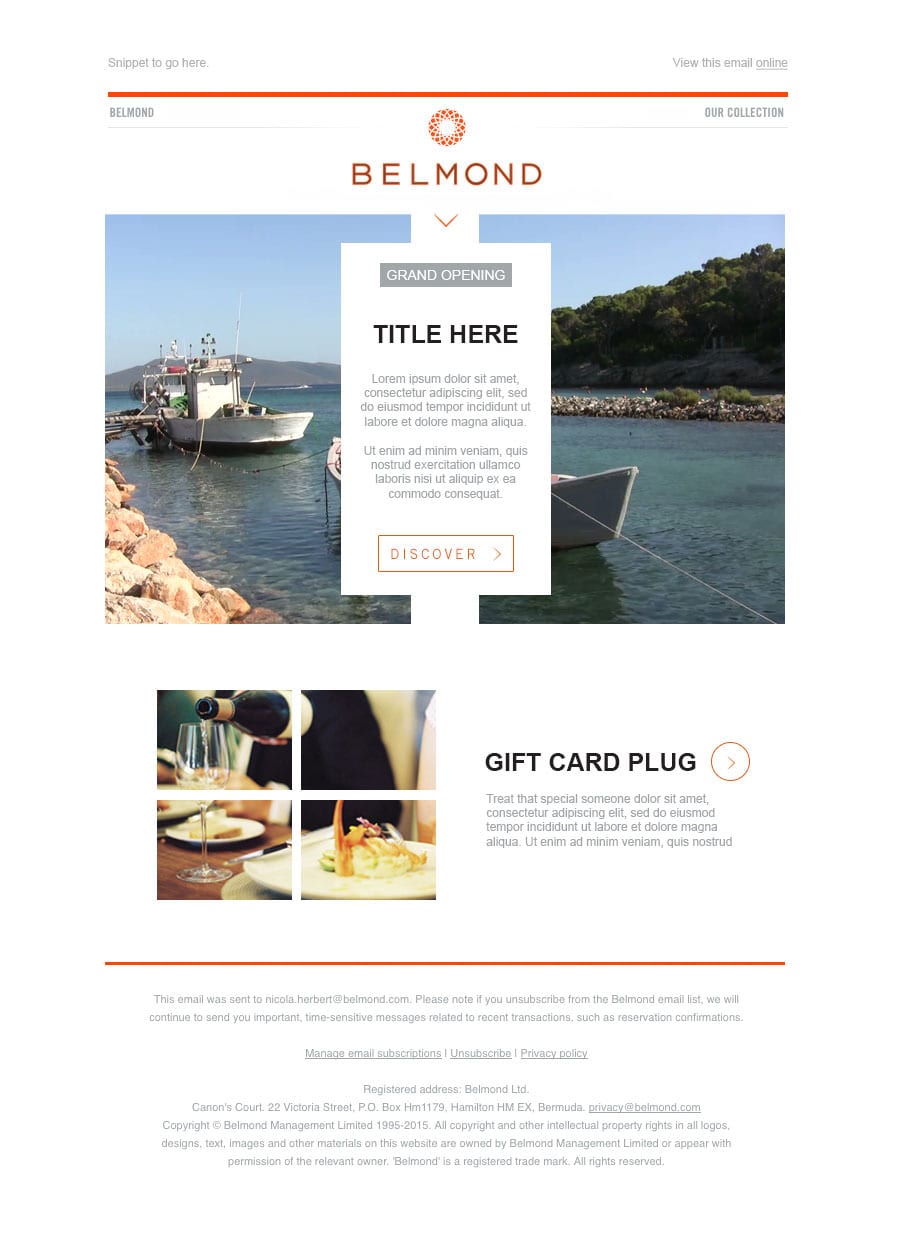
This can be done through creating a content hierarchy, and using visual cues such as colours and lines to draw the reader’s eye in. For example, in the below email the arrow draws the reader from the header into the main message and, if they still haven’t clicked at that point, onto the secondary content.

belmond template

Once you have drawn your reader in, you need to tell them what the email is about with short, clear copy.

Your reader should be able to understand the key message from the headline and CTA alone, and remember you only need to say enough to encourage your subscribers to click - everything else can be done on your website. Keep your copy live text so your message will come across even if images are blocked.

email template

Cafe nero

4. Be relevant

Now your customer is clear on what the email is about. The question is, is your message relevant to them?

Customers expect personalised communications, and data from Experian shows that when they get them they are much more likely to engage. So your email needs to be – or at least appear – tailored.

There are many ways to achieve this.

You can use dynamic content to show the most relevant articles, display membership numbers or feature previous purchase details.

Or you can deliver contextual personalisation such as geo-targeted maps or live weather feeds through tools such as Movable Ink, Liveclicker or KickDynamic.

Of course the most basic way to personalise is in the subject line. Experian found that just including a name in the subject line boosted open rates by 29.3%, but you don’t have to stop there. See what other data you can use too - for example a purchase reminder might include the brand or product name, and an events listing might reference the customer’s city.

All of these small touches turn your well-designed, well-thought-out email into a relevant, personal communication.

5. Be memorable

Now you’ve got the basics sorted, the final step is to make your campaign into something that makes a statement.

Beyond opens, clicks and conversions, every email is also a branding opportunity, so be creative and deliver something valuable!

Exactly what this is depends on your brand and industry. It might be creating a sense of community with a live social feed, it might be showing off your fun side with humorous copy, or it might promoting products through an effective gif or cinemagraph like below:

cinemagraph

Either way, putting in that extra effort and creativity is likely to help you stand out against your competitors.

That’s it!

You now have an effective, engaging email that will give you the best chance of maximising your ROI and delivering a great customer experience.

The most important thing when following these five steps is to remember who your customers are.

If you already know that your subscribers mostly open on desktop, make sure you focus time and effort on that design. If you know that your database is mostly Outlook users, prioritise effective copy over GIFs and images that won’t be supported.

They key is to your customer in mind at every stage, and if in doubt test, test, test.

As Content Lead within the creative team of Alchemy Worx's Creative Team, Natalie Littlewood has worked with brands such as Aviva, Tesco, Tommy Hilfiger, Caffe Nero, Allianz, Feel Unique and Carphone Warehouse. She is passionate about discovering what makes our client’s audiences tick in order to craft copy that resonates with them.
17 Feb 19:08

3 Things Sales Leaders Need to Think About Right Now, According to an Influential Venture Capitalist

by bfreedman@hubspot.com (Brooke Freedman)

three_matches.jpg

In 2016, there will be a movement from fast growth at all costs to the slower, more deliberate construction of healthy businesses. If you are a sales leader -- particularly at a young company -- now is a good time to take a fresh look at your teams, your processes, and your plans.

Redpoint Ventures invests in seed-, early-, and growth-stage startups. Tomasz Tunguz, a partner at Redpoint, has invested in companies like Expensify, Looker, and ThredUP. He is also an active thought leader within the sales and startup spaces, and his blog is incredibly valuable for sales leaders and executive teams.

Tomasz spent some time talking with me about sales leadership from the VC perspective while we were at the SaaStr Annual conference this month. The event was packed full of top-notch content for sales leaders of early-stage growth companies. One hundred and fifty speakers over a three-day period provided both strategy and tactics for sales, growth, and success. There were too many great sessions to count, but particularly helpful were some of the growth-focused presentations given by top investors.

Here are three key takeaways from my candid conversation with Tomasz after his presentation that all sales leaders would be wise to keep in mind. 

1) Calculate your (real) Cost of Customer Acquisition.

Because Cost of Customer Acquisition (CAC) has such a large impact on the unit economics of a business, investors always want to look at the “fully loaded number” -- that is, everything that goes into the cost of bringing on a new customer.

Some leadership teams will look at CAC and only consider the cost of the salesperson. However, this is lowballing it. Instead, look at the cost of the salesperson + the cost of lead generation + any support for that salesperson. Your real cost is the total number divided by the number of customers your team can bring in during the same period.

Over time you will start to understand your true unit economics based on your CAC, and the Lifetime Value (LTV) of those customers. A healthy business' CAC will be much lower than its LTV. 

2) Pay attention to the data.

Once you have your product/market fit, measuring and tracking the performance of your sales team becomes critical for growth. Tomasz shared with me what his best portfolio companies track from a sales perspective, in addition to showing me an illuminating sales team health report.

Here are the most important metrics sales leaders should track:

  • Team composition by sales rep function (ex: inside, outside, specialized, etc.)
  • Rep tenure
  • Current and historical quota achievement 
  • Pipeline for next month/quarter

With this data in view, sales leaders can start to make adjustments. Ask questions such as:

  • “Why did certain reps hit quota while others did not?”
  • "Did we run any sales promotions during a given period?”
  • “Did we release new products?”
  • “What was the average tenure of the reps that hit quota?”
  • “Are there common threads?”

Once you isolate your sticking points with a level of granularity, you can correct them. 

3) Identify the root causes of problems.

Finally, Tomasz suggested that all sales leaders ponder the root causes of stunted productivity. Carefully consider what's crippling your sales team:  

  • Are you hiring the right people?
  • Has lead quality changed?
  • Have you changed the way you onboard your team?
  • Is the market not as deep as you thought?
  • Does your sales compensation plan need work?

Since you may need to be conservative on adding headcount to your sales team, you will want to look for ways to make your existing sales funnel more efficient. To do this, pinpoint the least effective part of your sales funnel. If you can make an improvement within that one part of the funnel, you will significantly impact growth across the team.

Focusing on the three areas above will enable you to lead your sales team to growth this year. Have any other growth strategies worth sharing? Write them in the comments.

HubSpot CRM

17 Feb 19:07

The Next Generation of Women Sales Leaders

by tbertuzzi@bridgegroupinc.com (Trish Bertuzzi)

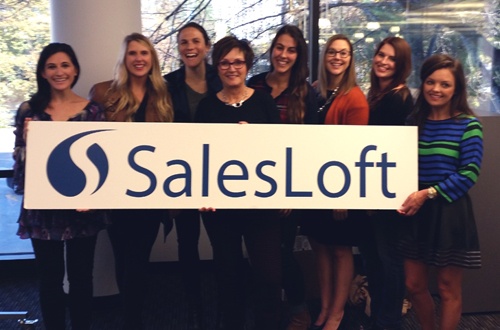
ladylofters.jpgLast month, I spent an afternoon at SalesLoft in Atlanta. SalesLoft has done an outstanding job hiring a gender diverse team and, having met a few “#LadyLofters” at various events, I asked CEO Kyle Porter if I could spend some time with the women in his organization.

First, the numbers:

  • 81 employees
  • 23 women (28%)
  • 13 managers/department heads
  • 5 women managers/department heads (38%)
  • 30% of all employees report to women managers

I know that many companies struggle to hire women in sales/tech and I wanted to know SalesLoft’s secret.

I’ve previously shared my thoughts on the impact of job descriptions in attracting women candidates, but I wanted to know what else our next generation of female sales leaders look for?

How do you evaluate prospective employers?

"Do the pictures on the website show a good blend of male/female employees?"
 
"During on-site interviews, do they see other women in the office?"
 
"Is the physical layout of the office designed to encourage collaboration?"
 
"How many, if any, women are part of the interview process?"
 
"What’s the tone of the company’s social feeds?"

What advice would you give to women either early in their careers or who are considering a sales role?

"Recognize when you are getting comfortable and get comfortable being uncomfortable."
 
"You don’t always have to be a team player. Sometimes it is okay to step up and shine the light on yourself."
 
"It is okay to say no. Wearing too many hats means you aren’t focused."
 
"Trust your gut. Don’t stay too long in a role that is wrong for you. It’s okay to move on."
 
"Raise your hand more. Speak up when you know you can add value."
 
"Get a mentor." (By the way, I love what Debra Walton at Thomson Reuters, said about having multiple mentors: Mentors for a reason. Mentors for a season. And mentors for life.)

We spent a lot of time talking about how the decisions women make in their personal lives impact their careers. Women tend to segue in and out of the workforce and that can be challenging particularly on a sales trajectory—where the mantra “you’re only as good as your last quarter” often reigns.

At the end of my visit, something interesting came up.

All of the women in that room, myself included, had moms who worked outside of the home. (Now, trust me I know how hard stay at home mothers work – and deserve a mountain of thanks.) What piqued my interest is that we all viewed our mothers as a role model and encouraging us to step outside of the box and into a non-stereo-typically female role. Not a scientific data point, just an interesting observation that came up in our conversation.

Thanks again to SalesLoft for their invitation and inspiration. Below, I’ve included other resources you might find interesting.

PS – Here’s my hit parade of the next generation of women sales leaders from SalesLoft!

Angela Kirkland, Christine LaddJordan Arogeti, Katie Rogers
Lydia Henderson, Margaret Weniger, and Tami McQueen.


About Trish Bertuzzi
Trish is the President & Chief Strategist of The Bridge Group, Inc. and author of the #1 Amazon best-seller The Sales Development Playbook.
Full bio | Twitter

17 Feb 19:06

How the Internet of Things Is Transforming Marketing

by Andrew Gazdecki

internetofthings

We’re surrounded by the smarts—smartphones, smart homes, smart cars. Where we thought innovation had reached its limits, we’re now seeing new possibilities. The Internet of Things transforms mundane objects into multi-dimensional, technical parts of a larger communication system. Everything is interconnected; our everyday tools are remotely accessible and highly adaptable, lending exciting opportunities to business and e-commerce.

Consider Amazon’s “Dash Buttons,” which alert customers when they need to refill household staples like detergent, pet food, and toiletries, then allow them to order more with the touch of a button. This eliminates the need to visit a physical store or even run an inventory at home. Now, that probably seems excessive for the average person, but it’s indicative of a larger trend. This concept of integrated living is already expanding—big time. Forbes speculated that smart cities are up next, with environmental pressure and technological advances paving the way for cities that self-regulate, operating more efficiently and sustainably.

As this concept trickles through industries far and wide, the Internet of Things is becoming an integral part of marketing strategy. Here are just a few of the ways it’s transforming the game:

1. Habit-forming potential

Purchasing becomes less of a conscious decision and more of an effortless ritual when it’s as simple as pressing a button. This may seem dangerous for the consumer (and it certainly can be), but this technology also benefits them in countless ways, freeing up time spent on grocery lists and weekly shopping excursions.

The same goes for the many service-based companies popping up left and right—they’ll do your laundry, deliver your food, walk your dog. It’s a revelation for marketing teams, who often fight tooth and nail to get you to integrate their product into your life enough to establish some brand loyalty. Now consumers crave and expect that kind of reliance.

2. Increased adaptability and targeting

Personalization is the name of the game. Brand value skyrockets when your product is recognized as working for the customer. Wearables are a great example of this. My FitBit is like an extension of my wrist at this point—I feel naked without it and lost without my daily stats, which inspire me to stick to my workout regimen and simultaneously make heavy use of the product. This dramatically changes the marketing game, introducing a whole new layer of product potential and taking it from “nice-to-have” to “need-to-have.”

Hot companies like Nest sell technology that learns your behavior and preferences, reducing energy costs by monitoring heating and cooling much better than the average person could. Health technology monitors our bodies outside the doctor’s office. The Internet of Things maximizes technology’s potential to work with us and for us, catering to our individual needs more than ever before.

3. Multi-company strategy

All this interconnection often teams up independent companies that need to work seamlessly to thrive. It’s a unique shift in the business climate that demands strengthened partnerships and collaboration. Consumers expect solid integration across all products they buy and use, and the further they dive into these integrations, the more all parties benefit.

17 Feb 19:04

Research: Digital Marketing Strategies for B2B Buyers in 2016

by Dave Orecchio

Digital marketing strategies for B2B Buyers

While the benefits your company offers don’t necessarily change, the journey for a digital buyer is often much different than that of a traditional buyer. Therefore, you need to recognize the experience of a customer at each stage and focus on delivering value throughout the journey. When possible, seize opportunities to automate for consistency and efficiency, while maintaining a personalized approach.

Econsultancy just published its Quarterly Digital Intelligence Briefing, which offers tremendous insights on 2016 digital trends through the lens of 7,000 marketers and e-commerce professionals. The following are several strategies derived from the report that helps you meet the needs of B2B buyers.

Leverage Digital Tools for Personalization

It is a common misconception that digital buyers aren’t as concerned with a personalized experience as face-to-face customers. In fact, when people begin their buying journey online, they often want greater depth of information than someone who doesn’t do this pre-contact research. In general, the more complex the problem, the greater the need to gather reliable evidence before investing in a solution.

The challenge for your team is to deliver a personalized experience while making use of electronic communication channels. Social media is a common platform for such engagement. On Twitter, for instance, sales reps can share content and messages that provide information prospects seek. Even more importantly, interacting with people engaged in needs-based conversations on Twitter can lead to problem-solving communication. LinkedIn is another popular B2B networking tool. You can connect with prospects, share individual bios or company descriptions on your profile, and make initial contact with a potential decision maker.

In content marketing strategies and e-mail marketing, you can customize the message to match the particular interests of a target market. Creating personas for your critical segments allows you to develop an in-depth perspective on the real needs and motives of the people you serve. Then, it is easier to craft outbound and inbound messages that speak specifically to individual buyers.

Gain Insights from Data

The majority of organizations surveyed, 53 percent, reported that data-driven marketing was a key priority for them in 2016. Given the availability of top-quality databases and CRM solutions at this point, it is a mistake not to gather and analyze data on your buyers.

By building detailed profiles of prospects and customers (Buyer Personas), tracking pre-contact phases of the buying cycle, and then monitoring transactions, you can get a strong sense of the types of people who buy your solutions. The more you know about people currently buying, the easier it is to target the right prospects with the right promotional strategies. Such keen insights are invaluable in executing on your goal of personalizing the buyer’s journey as well.

Build a Strong Team Culture

Data is virtually meaningless without a strong, customer-centric culture. In an organization that intends to optimize the customer experience, this culture means employees in front-end sales, marketing and service activities collaborate. All make understanding and optimizing the customer experience throughout the buying cycle the goal.

To prove the importance of collaboration, over 90 percent of those surveyed in the QDIB reported that optimizing create workflows and building collaboration between marketing and creatives were necessary to optimize the customer experience. Typically, marketing and sales teams share responsibilities for gathering data from prospects. This data is then used to prepare optimized promotional materials, as well as to enhance communication processes aimed at effective selling.

Get on the Mobile Train

Mobile is far and away the fastest-growing leg of the digital marketing arena. Fifty-one percent of organizations and 61 percent of agencies indicated “mobile” as a top three priority for 2016. Since 2014, Internet access through mobile devices has outpaced online activity on desktop computers. As more people now conduct research online, more e-commerce transactions are also being performed on tablets and Smartphones.

One critical content strategy for companies is to have responsive websites that adapt to the mobile experience. First of all, a poor user experience outweighs the value of quality content. Mobile users expect a clean navigation on your site. Additionally, to have content that places well in search engines and gets in front of potential buyers, Google wants your site to be mobile-friendly as well.

mobile experience is critical to B2B buyers

In many cases, potential buyers use their phones to interact with your website, email, social media accounts, and text messages.

Monitor User Experience and Customer Relationships

After you convert buyers through effective digital strategies, you need to utilize technology to manage and strengthen relationships. Follow-up campaigns through e-mail are common, for instance. When you rely on data and create distinct buyer personas, you are equipped to send out customized e-mail campaigns with informative and interesting messages that may offer add-on or cross-selling opportunities. Sales teams use CRM programs to schedule regular reminder calls with clients to ensure ongoing satisfaction. By capturing mobile phone numbers, you can also facilitate SMS (texting) campaigns.

One of the most critical ongoing processes to optimize the value of relationships, though, is user experience monitoring. Don’t assume that because a customer journey flows in one way now, that it will stay that way going forward. Continually research, including soliciting feedback on surveys and through social media, to stay on top of opportunity and pain points in the buyer’s journey. Consider opportunities to put more valuable content in front of prospects as they begin the buying process. Ask detailed questions during follow-up to address concerns during a sales process and after purchase.

Conclusions

The tools are available that allow you to communicate your valuable proposition effectively in a digital marketplace. Consider all elements of digital marketing, including content, social media, e-mail and mobile, when formulating marketing and sales strategies. These tools help you gather and analyze data to identify ways to enhance the customer experience throughout the buying cycle.

Get our white paper: 15 Tips To Delight Customers and Increase ROI, for additional insights on maximizing opportunities for digital buyers!

15 tips to delight customers and increase ROI

17 Feb 19:04

The New Rules & Realities of Sales & Marketing

by Knute Sands

“The biggest mistake I see with marketing is companies talk too much about their own products and services.”

As the author of 7 books, David Meerman Scott brings tremendous knowledge, real-world insights and infectious energy to the stage. As yesterday’s opening keynote at Content2Conversion in Scottsdale, David challenged the audience to set the bar higher with their content marketing efforts. In his own words, “B2B doesn’t have to stand for Be-Too-Boring.” I couldn’t agree more!

Below I share a few of Scott’s New Rules, including how the B2B buying process has changed, the importance of real-time engagement, and how content marketing just might land you on an Antarctic journey.

The Problem: Wrong Content, Wrong Message, Wrong Buyer

Customers don’t care about brands and services. At least, not as much as those same brands and services think they do. And they sure don’t like what content marketers are producing, on the whole. According to Forrester, 87% of B2B marketers struggle to produce content that engages their buyers. Let’s all pause there (and face palm). On the other side of the equation, 65% of B2B buyers report vendors should curb sales messages, and focus on improving the quality of their content. It certainly sounds like we’re all in agreement.

As David pointed out yesterday, “Many marketers steeped in the tradition of product advertising naturally feel drawn to prattle on and on about their products and services. But I have news for you. Nobody cares.”

If Nobody Cares, Why Do We Keep Producing the Same Content?

If content marketers know their content is ineffective, and the buyers want higher quality content, why do B2B marketers keep producing the same old stuff? David believes it all boils down to fear.  Here are some key things that get in the way of change:

  • Culture is tough to change
  • Convincing superiors to take risks is tough
  • It’s hard to operationalize new techniques

But if you want to succeed, you’ll have to start producing content that speaks to your audience’s needs. Here’s how:

Rule #1: Understand That the Way People are Buying Has Changed

Sociaal Media Post

In the past decade, the way purchasing decisions happen has been completely changed by the web. According to Sirius Decisions, nearly 70% of the buyer’s journey is done digitally. Which means, the impression of your organization is likely made long before a sales professional makes contact with a customer. Consider how the following have become the norm:

  • We research someone online – before agreeing to go on a date
  • We check out someone’s LinkedIn profile before initial business meetings
  • We read a review of a film before watching it, and watch several trailers
  • We read restaurant reviews and browse menus before making a reservation

All of the above holds true in B2B marketing as well. So, where are your customers going to find information about your product or brand?

Rule #2: Educate and Inform

Instead of interrupt and sell, we must seek to educate and inform our buyers. If they are finding information about your organization before you have direct contact, you must ensure that the content they find is relevant and useful. Consider the following facts before developing your content plan (via Acquity Group):

  • 77% of B2B buyers use Google search
  • 84% check business websites
  • 34% visit third-party websites

The Solution? Content is The Bridge between Sales & Marketing

As B2B marketers, we must understand that marketing and sales perform different functions.

  • Marketing = Delivering content to many buyers at once
  • Sales = Delivering content to one buyer at a time

The best way to bridge the gap between sales and marketing is content. Your prospects don’t want to be sold to, they want to be educated! Consider some of the following examples of B2B content marketing.

Rule #3: Embrace Real-time Engagement

As of today, there are 7.2 billion people living on earth. According to a U.N. study, more of these people have mobile phones than functioning toilets.  We’re living in an era of unprecedented change. And it’s literally happening overnight. So, what does this mean for B2B marketers? You have to give your buyers the information they seek the moment they ask for it. Otherwise, you face becoming obsolete.

David’s talk featured a recent and highly entertaining example of real-time content marketing, which came unexpectedly from the Central Intelligence Agency. If the CIA has embraced real-time content marketing, don’t you think it’s time for the rest of the B2B community to get on board?

CIA Tweet

A CIA Tweet in response to Shark Week.

CIA Tweet 2

CIA Tweet in response to Argo winning an academy award.

Rule #4: Give It Away

According to a 2014 study, a full 80% of B2B content is gated. As a marketer, how do you feel when you find the amazing whitepaper, eBook, or infographic you seek only to be faced with filling out 20 form fields in order to access the download? Yeah, it sucks. According to David, it’s time to put an end to forms, and it’s time to stop gating our content.

A Tip From the Grateful Dead 

IMG_2634

In his keynote David featured insights from his 2010 book, “Marketing Lessons from The Grateful Dead”.  In it, Scott outlines how the Grateful Dead became the biggest touring band in America. By adopting some of the following principles, you can apply the same rockstar mentality to your B2B content marketing. Here’s how they did it:

  1. Co-creation: They encouraged their fans to record shows and trade tapes
  2. Built relationships: Built a mailing list and sold concert tickets directly to fans
  3. Event marketing: They created buzz by focusing on their live act, and not caring about album sales

As Scott and co-author Brian Halligan explain, “By cultivating a dedicated, active community, collaborating with their audience to co-create the Deadhead lifestyle, and giving away “freemium” content, the Dead pioneered many social media and inbound marketing concepts successfully used by businesses across all industries today.”

But the key to unlocking their continued success was the fact that they allowed fans to tape, and share their music for free.

Manage Your Fear

Scott concluded his talk with a friendly reminder that we all have fears. Whether our fears are seasickness while crossing the Drake passage in Antarctica, or failing at B2B ontent marketing, facing these fears head-on is the only way we’ll overcome them.

Which rule above resonated most with you?


Email Newsletter Gain a competitive advantage by subscribing to the
TopRank® Online Marketing Newsletter.

© Online Marketing Blog - TopRank®, 2016. | The New Rules & Realities of Sales & Marketing | http://www.toprankblog.com

The post The New Rules & Realities of Sales & Marketing appeared first on Online Marketing Blog - TopRank®.

17 Feb 18:57

How to Turn Sales Leads into Revenue, Not Just Work

by dan.mcdade@pointclear.com (Dan McDade)

leads_into_revenue_not_just_work.png

Even the most ambitious and efficient companies with highly competitive offerings, like GE or Boeing, don’t close 100% of their deals. These companies have a very high demand for their products and services, but they still need strong lead generation and qualification processes. It is unrealistic, even for the aforementioned companies, to think that sales can close every opportunity they receive. These companies are successful because of their established roles, processes, and responsibilities for their marketing and sales departments.

Effectively turning sales leads into revenue means each department responsible for revenue (Marketing and Sales) has clear responsibilities. Marketing’s responsibility is to work with sales to identify the challenges or pain points of their target audience and create tailored content to speak to those challenges. By doing this effectively, marketing can greatly increase their revenue contribution and enhance sales’ ability to close. Post lead follow-up,  sales should give marketing feedback on what content or offers worked, and what didn’t. This collaboration is essential for companies that want to perfect their lead generation strategies.

Find the Pain

The lead development process typically starts one of two ways:

In the first instance, a suitable prospect may indicate a pain point that designates a need in your company, products, or expertise. Asking them what challenges they experience in their role is a great way to discover more about their pain points.

Eventually, the pain point will be an opportunity to transition into a discussion around how you can help alleviate those challenges. For example, companies always want to make more money. If you can present a reasonable, achievable, and helpful solution to assist that prospect to increase their revenue or decrease their spending, you’ll bet they will be listening.

In the second instance, pain points aren’t clearly discussed, but they can be deduced with accuracy from a conversation with a prospect. For example, if a prospect tells you that they are concerned about confidential business information falling into the wrong hands, you can quickly calculate that person’s need for counter cyber defense technology. Once you raise awareness in that prospect, your solution will be the first that comes to mind.

The importance of pain points in prospecting is uncovering the area where you need to focus in order to create an interest in your business on the behalf of the prospect. Find the pain point, and you’ll be able to understand what solution your prospect is looking for.


Qualify Your Lead

A good sales-ready lead is not just an email address with a pain point. Rather, it is one that meets agreed-upon qualifying criteria, and has been nurtured or developed to the point where it’s ready to be handed over to the sales team. A qualified lead is one that has been:

  • Contacted several times already over various channels such as email, telephone, and direct mail
  • Screened for a need in your product or service
  • Found to have a pain point that your product or service can resolve
  • Filtered for being a long-term or short-term prospect

Moreover, by using your CRM to your benefit and recording their company profile, contact history, project budgets and timelines, and any additional noteworthy details, you will see a boost in revenue. This process is important for many reasons, including that it:

  • Filters raw leads to disqualify dead ends
  • Gives potential clients time to warm up to you
  • Provides you with valuable insight about the prospect’s pain points and pressing issues
  • Allows salespeople to have awareness into how they can most effectively pitch solutions


Turn Your Lead into a Sale

Timing: Once a raw lead has been developed into a sales lead, turning it over to the sales team is the next step. Sales should then further the relationship and work strategically to close the deal. Studies suggest that about 50% of leads that have been qualified will result in a sale within one year. Is your prospect looking for a solution now, in a few months, or will they close the deal in a year? Uncovering this detail will help you prioritize a lead and refrain from “rushing” your prospect based upon their position in the sales cycle.

Preparation and personalization: Using the information collected by the prospector and inputted into the CRM, sales reps should be adequately prepared when speaking to sales-ready leads. When the sales reps make initial contact, they should be ready with a prepared consultation with detailed talking points.

Actionable solutions: Regardless of the product or service you provide, what matters to your possible customers is how your business can help them get results. Your sales reps may have well-prepared pitches and attractive product incentives, but if you don’t showcase how you can help your prospects generate positive outcomes; you will not make the sale. Make sure your solutions will provide actionable results for your client-to-be.  

Not all sales leads are created equal. Regardless, make sure you have a lead generation strategy in place, and that you strictly adhere to it. Failure to do so will keep your business from growing, keep you from retaining your employees, and keep your company from being sustainable.

how much are you paying for leads?   

17 Feb 18:57

Top B2B PR Trends in 2016 That Will Rock Your World

by Wendy Marx

Top b2b pr trends in 2016

Admittedly, the title of this post promises a lot. However, if you’re someone who would benefit from a PR overhaul, a PR launch, or even a good education on PR, this post truly could rock your world.

After all, good the best PR should put your B2B company front and center, creating a buzz in your industry. In the end, the best PR leads to increased visibility, credibility and, best of all, additional revenue. Wouldn’t that just rock your world?

In this post, we will:

  • Talk about some PR trends that have gone by the wayside (or that should have)
  • Learn about the latest PR trends
  • Show you how to leverage the best PR trends for your B2B

PR Stud to Dud: B2B PR Trends to Leave Behind

1. Over SEO-ing

While keyword ranking remains a powerful way to get noticed online, focusing solely on search engine optimization will do little for the meat and bones of your PR.

Your company should not be perceived as a soulless entity that robotically spits out words to entice other digital beings. Rather, you want to be viewed as a problem solver in your industry, as a company that listens to its audiences’ needs.

Check out more about this in our recent post on emotional content marketing.

2. Paid Advertising as a Stand-Alone Product

Paid advertising has its place. However, old school marketing will tell you that a full-page ad in the Times is worth its weight in gold. Well, you will likely pay the price of a gold item to get it, and there’s no guarantee the ad will reach the right person.

We’ll show the right way to use paid advertising in a moment.

3. Out “FREEing” the Other Guy

There is no shortage of free content out there. And it keeps coming fast and furious. It’s as if marketers are in a race to put out the most free content. I don’t know about you, but I like to get paid for working.

This isn’t to say that free content should become extinct. Let’s be clear on that. You need these attraction offers to get a foot in the door. More on that in a bit.

4. Traditional Press Releases

Press releases have been a mainstay of B2B PR for years. And they still are. Surprised? The truth is that press releases are critical to any B2B PR plan. However, gone are the days when you sent off your release and left it at that. You might as well throw it in the trash.

Top B2B PR Trends in 2016 and How You Can Use Them

1. Emotional Content

“The buying process in B2B is more complex and more rational than in B2C, and the emotions concerning this relationship should be related to trust, reliability and honesty. Other emotions, such as amusement, might be implemented for brand awareness or building, or to convey brand values to stakeholders.” ~Bianca Ribeiro, Marketing Coordinator, Epson do Brazil

It doesn’t matter that you machine screws for industrial washing machines, or that you create cloud-based big data software. Your customers are people and people respond to emotion.

Now, I’m not saying that you should create content filled with puppies and babies. However, the sentiment should be there. Does your content make the viewer feel safe, inspired, and understood?

For example:

Which blog post title is more appealing?

5 Ways to Speed up Machine Shop Production

OR…

5 Easy Ways to Solve Your Biggest Production Headaches

The first one may rank better for the keyword “machine shop production.” However, it has a very low emotional quotient.

How to use this trend: Create content that focuses on the needs and concerns of the customer, instead of on getting you noticed by search engines. Use keywords that appeal to a small group of strong leads, rather than keywords that are searched for by a wide, often irrelevant, audience.

2. Paid Content

Paid content is unique in that it allows you to reach a large audience that is specific to your industry.

Recently, we brought you a post on Native Advertising. In this post, we mentioned how native advertising is an effective tool since it follows the user’s organic experience. The viewer never has to leave his favorite platform (Buzzfeed, Huffington Post, LinkedIn, Forbes) in order to view your content.

“A form of paid media where the ad experience follows the natural form and function of the user experience in which it is placed.” ~ Dan Greenberg of Sharethrough, on defining native advertising

This type of advertising can be much more effective than direct advertising, such as a banner ad, where all those clicks are by people who many not have any interest in your industry.

3. Tiered Content

Yes, you absolutely want to provide prospects with free content. However, don’t think that you should give away all your expertise for free.

How to use this trend: Have you amassed a wealth of knowledge about a particular corner of your industry? Why not write an eBook about it? If it’s a topic that’s highly sought after, don’t be shy about charging a modest fee for your content.

4. Thought Leadership and Influencer Marketing

The concept of thought leadership is that you are an industry expert. People look to you for guidance on industry trends and information. You don’t need to be the CEO of a large corporation to become a thought leader. In fact, in this post, I outline how one owner of a sinking pool company became a star in his industry, simply by starting to blog about his knowledge of fiberglass!

Influencer marketing follows a similar vein. You use the influence of other thought leaders as a stepping stool for your brand’s visibilty.

How to use this trend: Get busy creating content that has your name attached. You can do this on your own platform as well as on external platforms such as LinkedIn. Regularly quote from industry leaders and give them a mention when you promote your content on social media.

5. Digital Press Releases

I mentioned that press releases are far from dead. However, the old manner of using them has conked out long ago.

Today’s press release needs to be optimized for search engines and promoted heavily on social channels.

How to use this trend: Make sure your press releases are written for prospects, not just the media. Include industry quotes, as well as internal quotes, branding yourself as a thought leader. Optimize your releases for search engines and then promote them heavily on social platforms. Include a copy in your online newsroom.

6. Analytics

Every PR effort should be measured. You can’t congratulate yourself on 2,000 placements if none of them actually yield results.

These days, so many of us are busy creating content, but are you monitoring the results of these PR efforts? If not, they are, in the words of the late Justice Antonin Scalia, applesauce!

How to use this trend: There are many tools to monitor your PR efforts. Google analytics, Clicky, Buzzsumo, AirPR, and most CRMs all are geared toward letting you know the results of your efforts.

7. Getting on the Right Social Channels

The social world is no longer a big mystery. You likely know about Twitter, and how to leverage Facebook and LinkedIn. That being said, there’s no need to jump on every platform. Rather, it’s more important to become proficient in the platforms that really work for you.

This is where your analytics come in.

How to use this trend: Monitor your analytics to see which platforms are working the best for you. If you think there’s room for improvement on a platform, give it a second chance, with a big push. But, don’t hold on for sentimental reasons. Give it the heave ho if it’s not working for you and move on to what does.

Bearing that in mind, it’s a good bet that LinkedIn is a tool that you don’t want to toss.

Did you know:

63 percent of marketers report positive results in sales due to LinkedIn?

This makes sense, since LinkedIn is truly B2B-centric. One of the best ways to leverage LinkedIn is to get started creating the perfect company page.

Could you use a little help figuring out how to do that? I’ve got you covered! Grab your FREE copy of my latest ebook, How to Create the Perfect LinkedIn Company Page.

Inside, you’ll learn all about how to craft a killer description, how to make the most of images on your page, and you’ll even get some tips from the pros!

New Call-to-action

17 Feb 18:57

4 Tips for Forming a Productive Partnership Between Marketing and Sales

by Kelly Smith Dotson

In the past, marketing and sales teams were on visiting terms. They would interact at planning sessions, annual meetings, and quarterly reviews — or perhaps in the event that a marketing campaign was driven by a sales perspective. But other than these encounters, they operated independently of each other.

This made sense when the customer journey began and ended within the sales department. Today, however, this is no longer the case. Corporate structures are shifting, technology is evolving, and customer habits have changed drastically.

The path a B2B customer takes to conversion now passes directly through the marketing department, and as a result, marketers have become much more involved in the entire customer life cycle. Marketers used to put most of their time and money into awareness generation, but modern companies now have them also focusing on customer development and engagement throughout the buying cycle.

With these expanded responsibilities comes the pressure of increasing online engagement, delivering insights through content marketing, and providing qualified leads. And to create a seamless customer experience, it has become highly beneficial for marketers to collaborate with their counterparts in the sales department.

Forming an alliance with sales ensures the modern customer’s path remains as efficient and effective as possible.

Making Collaboration Easier

Bringing sales and marketing teams together isn’t always a simple task. However, continuing to adhere to a traditional, siloed relationship will only stunt a company’s ability to grow its revenue.

Here are four tips to help marketers make collaboration with sales as easy (and beneficial) as possible:

1. Measure it. Sales teams are held responsible for specific goals and are accountable for the numbers. Marketing needs to speak the language of the sales team to be credible. Even if your path to revenue is through your sales force, challenge yourself to show results tied to sales.

2. Get to the point. Modern employees receive and send more than 100 emails per day, and for salespeople, that number is probably much higher. This means marketers must cut the fluff from their communications, show that they’ve done their homework, and succinctly display the company-wide value of their insights.

The focus of the collaboration needs to be on the business itself, not just on marketing. Salespeople want to see how strategies and programs will result in tangible business results.

3. Avoid jargon. Terms such as “conversion rate,” “click throughs,” and “engagement metrics” are useful to marketers, but your sales partners are looking for business impact. Using marketing buzzwords like these will more likely result in annoyance than understanding.

Marketers are experts at crafting messages for a specific target. Consider this group as another target audience, and translate the insights into clear terms that illustrate exactly why they matter.

4. Add some personality. Be the department everyone wants to hear from. These collaborative meetings shouldn’t be a time for boring lectures. Rather, they’re an opportunity to clarify information, show how it’s relevant to the sales team, and connect with the department on a human level. Humor goes a long way toward reaching this goal.

Marketing teams and sales teams no longer live on separate islands. It’s time for them to break out of the silos, learn how to speak the same language, align their goals, and take a two-pronged approach to converting sales and maintaining a growing, happy clientele.

When these two teams are on the same page, the sky is the limit.

Download our free e-book to learn 5 quick ways to declutter your sales and marketing pipeline.

17 Feb 18:56

3 Sales Email Templates to Use When Prospects Aren’t Ready to Buy

by pcaputa@hubspot.com (Pete Caputa)

Regular readers of the HubSpot Sales Blog know they should "Always Be Helping." When a prospect has a challenge or goal you can help with, you know what to do -- you take them through your sales process. That’s the best way to help them. 


But what if they are busy with another priority, yours is not the most obvious service to help them, or they just won’t admit they are a good fit yet? How do you help them in a way that makes them likely to come back to you if and when they do need or want your help?

What should you do in these scenarios? How do you nurture these prospects so that they’ll come back to you?

It might sound counterintuitive, but the best way to get them to come back to you is to send them away.

Here are three ways you can help your not-quite-ready-to-buy prospects by sending them away. I've even included a few email templates that you can easily modify and apply to your own situations -- which should make it even quicker.

While it makes sense to prioritize your hottest, best-fit prospects, it's also important to develop your pipeline for the future. These three approaches will help you nurture your relationships and make it easy to stay in touch, while ensuring prospects who aren’t ready to buy today will eventually come back to you for help.

1) Send Helpful Content

One of the easiest ways to help prospects who aren’t ready to buy is to send content.

While any prospect can search and browse online, the volume of content can be overwhelming. Figuring out what's accurate and trustworthy is hard too.

You, on the other hand, talk to people in their situation all day, every day. You're uniquely equipped to point them to the right content for their situation. When you connect with a prospect who is looking for help, but not a good fit customer for you right now, offer to send articles that address their unique needs and circumstances.

Try this template:


Hey [Prospect],

Per our conversation, here is the link to the article I suggested you read. Based on the current challenge you're dealing with around X, I believe this will be helpful.

[Link]

While I think it may make sense for you to look at our service eventually, this article should allow you to fix this current challenge quickly and on your own.

Regards,
[Your name]


At HubSpot, we maintain a simple list of content and corresponding links so that our team can quickly send out content. Here's an example of what it looks like:

Challenge

Resource

Lack of marketing and sales focus   

Buyer Persona Template 

No results from blogging

Blogging Strategy Guide

Not generating qualified leads

Marketing Automation Guide

Ineffective prospecting emails

Sales Follow-Up Email Templates

The best part about being immediately helpful is that you leave the door open for future calls. Assuming you listened effectively to their current challenge and your content is helpful given their specific situation, they'll remember that you were the one who pointed them in the right direction. They’ll be much less likely to ignore your future attempts at connecting.

Another benefit of sending content by email is that you can track when they open the message and when they click the link(s). If you really think they will be a good prospect for you eventually -- just not right now -- make sure you're using a tool like HubSpot Sales to track their actions.

2) Refer Someone Else

Another way to help a prospect is to refer them to someone else who can help them with their immediate issue. Not only do you help your prospect by doing this, but the person you recommend will most likely be grateful for the referral too.

This tactic works particularly well if you have trusting relationships with people who sell to the same buyer, type of company, or industry as you. For example, at HubSpot, I've sold to marketers, agencies, and sales leaders. Over the years, I've referred a bunch of business to complementary providers. The companies I have referred help our mutual prospects and make us both look good -- and they refer me in turn.

Here's a template for this scenario:


[Prospect], meet [Referral]
[Referral], meet [Prospect]

I was speaking with [Prospect] this morning and they mentioned they were struggling with X.

I immediately thought of you because of how you helped Y Company with the same challenge.

Will let you two take it from here.

Regards,
[Your name]

Like the content list above, I keep a running list of people I trust with a description of what they do. Here's an excerpt so you can see:

Challenge

Referral

Individual salespeople who need coaching

Carole Mahoney    

Sales leaders struggling to hire effectively

Dave Kurlan

Sales leaders struggling to find inside sales talent in Boston/New York

Gina Oliveri

3) Suggest an Alternative Service

Sometimes, your product or service just isn't a fit for a customer. For instance, they might need something that's more or less sophisticated than your service.

Here's a template you can use to suggest an alternative to your product or service.


Hey [Prospect],

Per our conversation, I do not think you are a fit for our services at this time. We are more focused on customers who are looking to achieve X goals and ready to invest more aggressively.

However, I would strongly recommend you invest in implementing a Y plan. Here is a link to the service I recommend: [link].

Let me know if you invest in that service and whether it helps you, or if you do something else. The feedback helps me make the best recommendations in the future.

Also, let me know if I can ever help in the future. If you do know any Z organizations that might be a better fit for our service, please don't hesitate to refer them. I'll do my best to help them too.

Regards,
[Your name]

You might worry that you're sending a prospect to a competitor, but I'd challenge you to make a list of companies that offer similar services to yours but don't really compete with you for the same type of customer.

For example, at HubSpot, our marketing attracts a ton of small nonprofit organizations that aren't staffed to do inbound marketing effectively. For these organizations, I usually recommend they get a newsletter started with Constant Contact.

On the other end of the spectrum, I talk to agencies who have built sophisticated websites with thousands of pages of content, plus custom applications they need to update and maintain. In these cases, I often recommend Pantheon, a Drupal and WordPress development and hosting platform. (Disclaimer: I'm on Pantheon's advisory board.)

Even though there is a small amount of overlap in our product functionality, neither Constant Contact nor Pantheon are actual competitors, since our ideal customers are significantly different.

Just like the other scenarios above, I also maintain a table of alternative services:

Challenge

Service

Small nonprofits with little to no resources for marketing

Constant Contact

Agencies struggling to manage devops for large websites with custom applications

Pantheon

Companies that sell complex, long sale cycle deals, but struggle to stay top of mind

SnapApp Interactive Content

By referring other services besides your own, your prospect will remember you as a helpful person who had their best interest in mind. This improves the chances of them coming back to you if and when they might become a better fit for your services.

Bonus Email Template for Following Up

Now that you’ve sent your prospects to get help somewhere else, how can you stay in touch with them (if they don’t immediately come back to you)? Simply check in to see if your recommendation helped them solve their immediate challenge.


Hey [Prospect], 

A few weeks ago, we spoke about a challenge you were having with X.

I recommended you connect with [Referral] to talk to them about their Y service.

My past experiences working with [Referral] made me think that would help you.

How did it turn out? Did you connect? Did you end up moving forward?

I appreciate any feedback so that I can know whether to continue referring people to this service.

Regards,
[Your name]

Buying Processes Are Rarely Straight Lines

In the very beginning of a sales pursuit, you should be generous with your time. It takes time to build rapport and credibility and get prospects to share what’s going on in their world. Once you figure out that someone is qualified, you'll spend more time with them. But once you figure out they are disqualified for your service (or just not ready), use one of these three approaches to quickly help them with their immediate needs.

In other words, even when a buyer isn’t a fit for me to help directly, I try to help them. I refer them to content or other service providers -- both complementary and somewhat competitive. I've probably helped as many people this way as I have by directly by selling my services. But, nothing has helped me nurture prospects and get referrals more than these three networking approaches.

It took me a few years to realize how beneficial it is to develop trusting relationships. It’s a fairly regular occurrence for me to have old prospects come back, and I get referrals whenever I ask for them. Once I zeroed in on these benefits, I made it a goal to never leave a dead end for someone who needs help, to never lose a chance to build or strengthen a relationship.

To leverage these three approaches effectively, you must do a few things, however. First, you must be great at active listening -- not just listening for clues that you can help them directly. Second, you need to get organized around this process. Make a list of content that addresses different challenges and a list of providers that address challenges outside of your scope. Lastly, practice offering helpful advice even when prospects aren't ready to buy.

These things might not be the next step you want to take in your sales pursuit, but they will help you establish a more open line of communication with your prospect. You may get them to drop their guard so you can eventually figure out how you can help directly, or simply keep yourself top of mind when their priorities shift in your direction. When you get good at this, you’ll also earn referrals when your prospects and referral partners run into someone who is a great fit for your service.

And even if a prospect doesn’t proactively come back to you or refer you business, you'll have increased your chances of keeping the lines of communication open. They'll be much more likely to be receptive to a conversation or a request if you call on them again.

In short, do your best to help everyone you connect with, regardless of whether the prospect is ready to buy now, later, or never. Make every interaction count by being immediately helpful.

Sales isn't always a straight line. Be prepared and willing to help buyers navigate their complicated, busy, and overwhelming worlds -- even if you’re not the right or immediate solution to their struggles. If you do, I bet business will boomerang right back to you.

HubSpot CRM

17 Feb 18:56

Sales Enablement Luminary Series: 8 Keys to Sales Enablement Success

by Shawnna Sumaoang

When it comes to marketing in today’s go-go-go, always-on, like-worthy, re-tweetable, deeply digital world, there are people who get it, and those who don’t.

Matt Heinz gets it. And he’s really good at helping other people get it too.

Today, we have a treat for you. I was able to interview Matt recently about what it takes go get more out of sales enablement—especially for those just starting down the path of rolling out a solution—and I think you’ll find a lot of value in what he had to say.

Without further ado, here’s Matt!

What do most organizations miss when it comes to setting up sales enablement?
Well, a key theme that emerges when you start talking to people about this topic is that they don’t realize sales enablement is more than just creating content. Achieving sales enablement success is about having the right conversations, developing the right stories, and creating the right message for the right prospects. It’s more than just writing up more sales content like case studies or datasheets and tossing them over the fence to sales. It requires the successful rollout, implementation, and measurement which tactics and content devices work and don’t work, so that the next prospect gets a slightly better version of the material than the previous one and so that sales always has the best materials for the situation.

So if an organization wants to start rolling out a structured sales enablement platform or solution, what do they need to do first?

When it comes to successfully deploying sales enablement, it really comes down to four simple steps:

  1. Do the math: Know the volume of leads—how full your pipeline has to be—to be successful. It continues to surprise me how many companies don’t do the basic math to know what is required to successfully fill the pipeline to meet their quotas.
  2. Create a clear customer profile: The term B2B is misleading. Businesses don’t sell to businesses. People sell to people. And to sell to people, you need more than good content. You need to know and understand the nomenclature or slang of your customers to address, resonate, and recognize buying signals and trigger events that are related to that customer’s problems—which may or may not have to do with what you’re selling, but could be the key to getting their attention.
  3. Map the sales and buying process: One of the biggest benefits of sales enablement is the ability to map the sales and buying process to ensure you understand how your customers buy. What stages do they go through? What hurdles do they face? What are the steps that they need to execute internally to buy? Your sales process has to be mapped to that, and sales enablement is a huge component of operationalizing that within an organization.
  4. Plan to fire lots of bullets: The most successful companies fire lots of bullets—they try at lot of things at once, assuming that all the tactics will work, but they know that some may work better than others. If you don’t have a reporting structure in place to know what content is being deployed and how effective that content is in generating momentum and engagement with your prospects, you have no idea how your marketing efforts work in the sales process.

We recently partnered to conduct a study of nearly 450 B2B sales and marketing professionals, aimed at understanding the state of sales enablement in today’s selling environment. What was the biggest take away from that study, in your opinion?
It has to be the enormous gap between the perceived importance of sales enablement and the actual effectiveness of it.

What we saw was that if you ask people the importance of sales training and onboarding, you’ll get a big answer (on a scale of 1-10, we saw it was close to 8.3); but when we asked how effective sales training and onboarding was, the answers were more modest.

There is a band of mediocrity where we find most companies land when it comes to sales enablement. And, this is where there is huge opportunity that doesn’t require buying more leads, doesn’t require a big, expensive ad campaign, and doesn’t even require hiring more sales people. It requires simply putting systems and processes in place to improve the consistency, predictability, and success at what you are already doing. That’s what sales enablement platforms can do for any company that sells a product.

Matt, I know you have eight key items you talk about when helping people understand how to be successful with sales enablement. Can you give us the rundown here?

Sure. In fact, I gave a webinar on this recently where I go into much more depth, and people can watch it here to have me explain these concepts. But in a nutshell, they are:

  1. Active CRM Ownership and Optimization: A good sales enablement solution doesn’t eliminate CRM—that’s never going to happen—but it makes the most of the time sales reps spend in their CRM systems while they are actively selling. Integration is absolutely key.
  2. Tools Integration: We learned in the study I mentioned above that there aren’t a lot of people using a dedicated sales enablement tool. The vast majority of people are still using email and/or other one-off methods to send out information and content to sales teams. When we send updates through email or multiple tools—even though it might seem faster and easier—it’s counterproductive. We’re only creating confusion and increasing non-active selling time among our reps. Having an integrated tools plan is where sales enablement can help sales teams be more efficient, and ultimately more successful.
  3. Better Reporting and Dashboards: Reporting is only as valuable as your ability to take action on it. Often times, sales and marketing report out on many things, but don’t know what to do about any of the data they possess. If the data isn’t extrapolated to mean something—if you can’t act on it—you should start questioning the value of the report.
  4. Process Improvement: Building process around the things that you want to be consistently successful at is important, and our recent study found that one of the most important items that needs a consistent process is ensuring sales teams can find content. When you introduce something like sales enablement, you need to be very explicit about how you develop the program, how you launch it, and how you train and enable your team to use it. And, of course, one of the most important factors is how you manage and optimize its usage for future iterations.
  5. Best Practice Collection, Inventory, and Sharing: How does your organization access best practices? If someone misses a meeting, loses an email, or doesn’t see a newsletter, will they miss a key learning? I highly encourage sales enablement professionals to think about a proactive best practices strategy so no one misses the valuable best practices that emerge through doing business.
  6. Vendor Filter, Triage, and Selection: When it comes to sales enablement solutions, there are a ton of vendors out there, and sometimes it can be really difficult to create a set of priorities that will help you lock in on the right vendor for you. It’s important to start by creating or finding a Sales Enablement solution evaluation checklist that you can use to evaluate multiple vendors to find the right fit for your organization based on your priorities.
  7. Comfortability with Customers: Companies don’t often spend a lot of focus on this topic, but it’s important. To be a good seller, you have to both understand who your customers are, and also be comfortable talking to them. In a lot of the Sales Kick Offs (SKOs) companies are having right now, there’s a lot of talk about the company and its products, but we don’t hear a lot of talk about the customer. As a sales enablement professional, it’s important to provide your sales reps with a way to be comfortable, and that often means giving them tools that give them access to the right insights and talking points at precisely the right time.
  8. Ownership of Templates and Collateral Inventory, Consistency, Access: Sales enablement is a proactive and strategic version of what sales operations or sales administration use to be, which means they own the collateral and how it reaches the sales team. As a result, sales enablement has become one of the most important roles in the sales organization, and having a proactive focus on the elements that have been covered here can make it even more successful, streamlined, consistent, and predictable in terms of output. The bigger your sales team, the more important this becomes. In fact, the bigger the sales team, the bigger the opportunity cost of not addressing many of these issues across your sales team and the greater friction, frustration and chance of not hitting your numbers.

I hope you found this interview with Matt helpful. He knows a lot about this topic, and we’re appreciative he took the time to share some of his pointers with us. Want to learn more about Matt? You can catch up with him at his blog over here.

16 Feb 17:53

How to Transition from Sales into Sales Leadership

by Maureen Hunzicker

The talent pool for sales leadership comes from successful sales professionals. Organizations often reward excellence in selling by promotion into leadership roles. But, what’s missing is the realization that different skill sets are required for selling vs. managing those who sell.

Sale leaders need to build on their understanding of the sales process by adding skills in developmental sales coaching. At Richardson, we define this as an effective and time-efficient incremental coaching process that achieves results and helps make sales professionals responsible for their own development. At its foundation, this involves a shift from being a boss who evaluates performance to becoming a coach who develops team members by empowering their own growth.

What I see most often in new sales leaders is a tendency to be driven solely by metrics. They focus on deliverables from their team: the number of sales calls made, reports filed on time, and sales forecasts. These new leaders have been successful in the field, and they want to continue that success. What they don’t realize is their ability to achieve greater success rests with their capability to effectively manage their team. They need to develop their observation skills to assess how their people are doing and where they might need help. They need to recognize what’s going well, coach to verifiable outcomes, and give constructive feedback to drive success for the individual, the team, and the organization.

Moving from individual contributor to sales leadership is all about collaboration and teamwork. And, the success of the team depends on the proficiency of each sales professional, and not everyone will be the same. There will be differences in styles, personality, tenure, product and industry knowledge, and communication skills. Sales leaders need to understand the members of their team and provide coaching suited to the needs of the individual.

In talking with new sales leaders, I find that they are concerned about how to have the right kind of conversations with their team members. I tell them to focus on observable behaviors and metrics of success. These elements should be a part of the sales process, as verifiable outcomes for each step along the way. I also emphasize the value of tone and body language, which can either support or undermine what they’re saying.

Sales leaders need to guide their team by communicating in a spirit of collaboration. They need to tap into human nature because people appreciate recognition for their efforts, and others are inspired when they see the right behaviors being rewarded.

Leadership engagement is also key to motivating sales professionals. I see a definite difference in training workshops when senior leaders take the time to kick things off. They will stand before participants, recognizing the talented group before them, talking about their value to the organization and the investment that the company has in them. Those in the audience respond better over the next few days because they are engaged. They are motivated. They know that leadership supports their development and wants them to succeed. And, they take the lessons learned to heart and make them a part of their routine.

When leaders take the initiative in communicating with their teams, it flows through the organization, opening channels and engaging more people.

The transition from sales to sales leadership can be a successful and rewarding endeavor. And, it works best when new leaders recognize the importance of their role in influencing human behavior and understanding human nature in the process of achieving results through their people.

sales-leadership-2

The post How to Transition from Sales into Sales Leadership appeared first on Richardson Sales Enablement Blog.

16 Feb 17:53

3 Reasons Why Your Content Isn’t Converting

by Victoria Hoffman

red eyes 600 px wide 150 dpi flabby

You understand the value of content. You’re consistently creating valuable content assets. You’re even measuring your efforts and running a data-driven content strategy.

And yet, you can’t seem to master the art of creating content that converts. What gives?!

It’s incredibly frustrating to feel like you’re doing everything you should be, but seemingly to no avail. When it comes to B2B content marketing, this usually points to a very specific issue with your content strategy — a problem with your content experience, or the environment in which your content is consumed.

Here are three problems with your content experience that might be affecting your content conversion rates.

1. You’re not accommodating the entire buyer’s journey.

60-70% of B2B content sits unused. This means that 60-70% of your content is not relevant to your audience’s needs and does not connect with your buyer’s journey.

Remember: your visitors are all on different, unique journeys looking for different content. Providing useful, relevant content might start with content ideation, but it also has to do with the fact that your content is not readily available every step of the way. This issue is easily solved by having a well-optimized content experience.

So, how can you start to better accommodate the buyer’s entire journey?

  • Determine your content gaps.

    Conduct a content audit to ensure that your content is speaking to all of your buyer personas, as well as all stages of the buyer journey from discovery, to consideration, to purchase.

  • Diversify your content mix.

    Everyone in your target audience prefers a different format to consume content. Some prefer blog posts, and some would rather check out an infographic or listen to a podcast. The idea of content atomization — taking one idea, chopping it up into tiny pieces, and spreading it everywhere — is one way to effectively diversify your content mix.

  • Ensure your content is easily discoverable.

    Regardless of the stage of the buyer journey that someone is on, you must ensure your content is easy to find. This not only involves including a search bar within your blog or resource center, but also means that your content should be strategically organized to meet your goals.

Content discoverability is especially important to improving your content’s conversion rate — after all, how can you expect your content to convert if no one can find your content?

Which brings us to problem number two…

2. Your content is siloed.

“White papers! Exactly what I was looking for!” – said no one, ever.

said-no-one-ever

Too many marketers are siloing their content as individual, one-off pieces, buried within the noise of the rest of the world’s content, as opposed to leveraging them as valuable assets that are part of a cohesive engagement path.

How can you avoid the silo-ification of your content?

  • Organize your content strategically.

    Organize your content according to how people are going to search for it. People don’t typically search for “white papers” — they search for answers. Similarly, don’t let your content pile-up by date. Organizing it according to topic will prolong your content’s lifespan and minimize your content “dead ends”.

  • Keep your traffic inbound.

    Think about what happens when your individual content assets live outside of your resource center. For example, if you’re driving traffic to a video on YouTube, you’re sending a valuable visitor away from your relevant content and risk losing them to a clickhole of cute cat videos (hey, it’s happened to the best of us). By centralizing your content, you encourage readership of more similar content assets.

  • Provide a logical next step.

    One of the worst conversion mistakes marketers make is not providing people with an option to continue their journey. This doesn’t necessarily mean asking them to convert at every possible option; rather, it means making the right ask so they can continue their journey in a logical fashion.

Providing a logical next step can also be accomplished by effectively using calls to action (CTAs) — more on that next.

3. You’re not using CTAs effectively.

When it comes to creating content that converts, CTAs are where the magic happens. However, your CTAs will be useless if their placement isn’t relevant and contextual.

In all seriousness, leveraging context can lead to a major boost (up to 25%!) in your CTA conversion rates.

A few tips for creating more relevant and contextual CTAs:

  • Make the right ask at the right time.

    You probably wouldn’t propose on a first date. Same rule applies with your content — don’t make a high-commitment ask, and ask for minimal amounts of information (e.g., by leveraging progressive profiling).

  • Don’t ask the same thing over and over again.

    Don’t use one blanket CTA across all of your content — again, tailor it so you’re considering the buyer journey and providing a logical next step.

  • Be clear and concise.

    Tell people exactly what they’re clicking to or signing up for. Also, avoid using the passive voice (e.g. “Let us know”, “If you want”) in your CTAs. Use verbs that compel people to take action — “Click here”, “Read now”, etc.

The secret to high converting CTAs? Context! The more contextual your CTAs are (considering both the content, the ask, and the buyer journey), the higher your conversion rates will be.

No conversions? It might not be your content’s fault…

Having great content is important, but it’s only one aspect of content marketing. Equally as important is having a well-optimized content experience that easily allows you to accommodate the buyer journey, avoid the silo-ification of content, and effectively leverage context.

Don’t blame your content for your lack of conversions. Think more about optimizing your content experience, and the conversions will come!

Learn how to better leverage Act-On to meet your content marketing goals. Sign up for Uberflip’s Marketing Automation Hacks: Act-On Edition webinar!

16 Feb 17:52

The Complete Guide to (Almost) Overnight Success on LinkedIn Pulse

by Ian Chandler

If you’re struggling to get your voice heard in your industry, I empathize with you. In a world where everyone’s being bombarded with content, ads, videos, and notifications of all kinds, it’s difficult to broadcast your voice, even if you’re yelling.

That’s what makes LinkedIn Pulse one of the easiest ways to get yourself heard by the masses!  

The Complete Guide to Overnight Success on Linkedin Pulse

The Pulse of Pulse

In the past several months, I’ve had a lot of success on Pulse. Pulse is LinkedIn’s publishing platform, curated by a team of editors. As you’re about to see, this has tremendous benefits for you and your brand.

Pulse can come in handy if you don’t have a large social following or other means to advertise yourself. You no longer need to guest post on Forbes to get worldwide visibility.

By publishing on Pulse, you can:

  • Make fresh connections in your industry
  • Find new clients
  • Build your mailing list
  • Get more eyes on your personal blog
  • Drive traffic to your site

Basically, you can get more attention and drive that attention wherever you want. No matter where you are in your career, Pulse is a great tool to expand your horizons and get noticed.

And, perhaps best of all, it’s completely free. There are loads of legitimate marketing techniques out there that work, but some require a hefty upfront investment. With LinkedIn pulse, you can literally have a marketing budget of $0 and get a great ROI.

How Much Success Can Pulse Bring? 

I mentioned earlier that I’ve had success on Pulse. Let me share some of my numbers with you to show you exactly how much success. As of this writing, here are my top 3 LinkedIn posts:

Stop Asking Me What I Want To Do With My Degree 5,572 views

I Can See Into The Future – And I Wish I Couldn’t 3,496 views

Are You Ready To Do Content Marketing Differently? 1,337 views

Not too shabby, considering I didn’t spend a penny. LinkedIn did it all for me.

And with these posts, I’ve been able to drive traffic to my blog, build my mailing list, and make new connections.

Even better, some posts can reach the 10k view mark and go far beyond. Think about that: You have the ability to reach thousands of people without spending any money. It’s one of those “too good to be true” moments, but I assure you it’s the real deal.

In this guide, you’ll learn:

  • How Pulse works
  • How to write for LinkedIn
  • How to write a Pulse-worthy post
  • How to keep the momentum going
  • How to use other social media networks to maximize your reach

How Pulse Works

First, I recommend checking out Pulse if you haven’t already. Go to the Interests menu on your LinkedIn homepage, then select Pulse from the drop-down.

You’ll see a stream of posts, written by LinkedIn users in every industry. These are general posts that the editors felt would appeal to the most people. Generally, these are big-ticket items, like presidential or corporation news.

If you click the hamburger menu on the left, you’ll see different categories pop up. These are Pulse’s channels, which include Productivity, Student Voices, and Technology. When you browse different channels, you’ll see different posts.

Getting published in these channels will expose your writing to thousands (possibly tens of thousands) of readers all over the world. And since each channel is a niche of its own, most of the views will be professionals from your industry. And that’s fantastic.

A little behind the scenes explanation: Pulse is curated by a team of editors who pick out posts that stand out to them. (More on this in a minute.) But it’s also a platform that’s visible to people who follow you.

When you publish a post on Pulse, your followers will see in their news feed that you’ve posted. They might also get a notification. Of course, if you don’t have any followers, no one will be reading your posts!

That’s where getting featured comes in. If the LinkedIn editors decide to feature your post in a channel, it will be visible to all LinkedIn users. These users can like your post and follow your profile.

This also means that you don’t need to be a superstar in your industry to be heard. I had my first LinkedIn post featured, and I had no previous experience. I hadn’t even been on LinkedIn for too long. And this is totally possible for you. There are no barriers to getting featured––all you have to do is write a great post.

LinkedIn editor Daniel Roth wrote up a good explanation of what happens after you hit “publish.” He brings up a few excellent points that I’ll touch on later.

So now that you know how Pulse works, you’re ready to move on. It’s your goal to get featured, and you’re going to make that happen.

How To Write For LinkedIn

Even if you have prior experience with writing amazing blog posts, you’ll need to get used to LinkedIn’s atmosphere and community. Just like Reddit’s user base is typified by snarky humor, LinkedIn’s user base is typified by work-related posts with zero fluff. (I’ve seen people call out authors who write fluff.)

The typical LinkedIn user is typically 25-40 with a white collar job. There are a fair bit of entrepreneurs on LinkedIn as well. Overall, the content is aimed at the business professional.

When you’re writing for LinkedIn, keep these stylistic points in mind:

  • Give helpful advice. LinkedIn users like actionable advice that they can use that same day. Tips that are off the beaten path perform well.
  • Omit needless words. Heed Strunk’s advice, and deliver a lot of content in as few words as possible. Many readers may be viewing your post on their phone during their lunch break, so keep it concise.
  • Make use of subheadings. Subheadings make it easy for readers to scan, and they increase the overall readability of your piece.

There are also a few popular formats I’ve seen pop up:

  • Advice posts. Some posts help readers improve their productivity or make changes in their business.
  • Opinion posts. Some authors take a current event or trend and write about it. There’s little soapbox-standing; it’s opinions as they relate to the bigger picture.
  • Lifestyle posts. Some posts delve into personal perspectives. For example, I wrote a post on tools I use to increase my productivity. The post was written from my unique point of view, and others can use it to help themselves.

Naturally, there will be a lot of format-blending. The best way to decide on a format is to browse Pulse and find popular posts. Find ones you enjoy, and then use those as inspiration to create your own.

How To Write A Pulse-Worthy Post

It should be no surprise that the editors choose to feature posts that meet the above criteria. While there’s no guarantee you’ll get featured, there are techniques you can use to dramatically increase the likelihood of that happening.

To find out what makes a Pulse-worthy post, we’re going to take a look at my top 3 posts and see what makes them tick. There are some common traits in these posts, and since they’ve all done well, I’m reluctant to shrug it off as a coincidence.

I’ll also be picking out other popular posts that have the same features so you can see it’s not just a fluke. And if you include these elements in your post, there’s a much greater chance you’ll be featured as well.

A catchy headline

From copywriting legend David Ogilvy: On the average, five times as many people read the headline as read the body copy. When you have written your headline, you have spent eighty cents out of your dollar.”

So the headline is 80% of your post. That’s a big deal.

For my articles, I always try to include a snappy headline that’s not clickbait or cliche. I like questions or commands (“Are You Ready…?” and “Stop Asking Me…”). I also like using headlines that make you do a double take (“I Can See Into The Future…”).

All of these are solid options for your post headline. I’ve found that questions and commands perform best, but you might have success with a wackier headline.

Headlines that start with “why” are also useful. And of course, there’s the old “title–colon–subtitle” formula. Pithy, blunt statements also work well.

This is another area where browsing Pulse is beneficial. See what others are doing for their headlines, and if you see any you like, bookmark them for reference.

Short paragraphs

Each of my top 3 Pulse posts featured quite short paragraphs. I average 3 to 5 sentences per paragraph. The main benefit here is that shorter paragraphs look less intimidating. And since the actual post only takes up half of your screen, you have to be extra careful not to create behemoths.

I should also mention that I’m not a fan of the blogging style where the author writes lots of one-sentence paragraphs. I only use one-sentence paragraphs for effect. When I want to emphasize something, I’ll write it in a line by itself. Do this too much, and you run the risk of sounding gimmicky and fake.

But one-sentence paragraphs have their place. (Check out the next technique!)

One-liner introduction

This was something I didn’t notice until I went over the posts for this guide. Each of my top 3 posts began with a one-liner introduction:

  • To the person who’s asking me what I want to do with my degree: Stop.
  • Every day, nearly every hour, I look into the future. In fact, I am right now.
  • Content marketing is going to look much different in the near future.

Granted, the second one is technically two sentences, and the first one is formatted differently, but they read like one-liners. And that’s what matters.

A short, one-line introduction pulls your reader in and assures them that this won’t be a dense post. It’s the hook of your post that engages the reader and convinces them to keep reading.

Firm closers

My top 3 posts all have closing statements/paragraphs that are definitive. They restate my main point with powerful wording. There’s no wishy-washy implications here.

While some are long and others short, I make declarations:

  • But the fact is, you’ve asked me what I want to do with my degree. I wish you hadn’t. But I’ll give you the standard “I’m not sure yet” and move on with my day.
  • University may cost a ridiculous amount of money, but it should not cost anyone their sanity and happiness.
  • That’s the future of content marketing.

See how firm these are? They’re decisive and direct. End with this kind of closer, and you’ll leave your readers wanting more, which is good.

Link to my site

Two of my top 3 posts have links to my website, and I got a good amount of traffic from those links. One post had a link to my signup form, and my signups spiked that day. I was able to get the emails of people that, if not for Pulse, I would have never reached.

I place these links at the end of my posts underneath a line (–––––) for visual appeal and maximum attention-grabbing ability. I suggest you do the same, because if someone reads your entire post, they’ll likely want to hear more from you.

Are images necessary?

Recently, I’ve been having problems uploading images to LinkedIn. Two of my top 3 posts have images, but the third one doesn’t.

With content marketing in general, I don’t think images are crucial, but LinkedIn may be a different story. I couldn’t help but notice that the post without an image got the least number of views. The two posts with images have 5,572 and 3,496, while the post without an image only has 1,337 views.

This might be because on Pulse, posts with images have greater visibility. If you’re scrolling through a channel, a post without an image and just a headline may not be obvious. For that reason only, I suggest including a great image. (If you need images, check out this post.)

How To Keep The Momentum Going

You’ve written a blog post that ticks all the boxes and engages readers. Now what?

Since your goal is to get featured, that will be first on your priority list. Remember that post from LinkedIn editor Daniel Roth I mentioned? That’s going to come in handy now.

Notify the LinkedIn team

Usually, when you publish a post, it’s a waiting game. You have to wait until the editorial team reviews your work. Sometimes, that’s the next day. This has happened to me quite a few times, and it might happen for you. (That’s why this guide promises almost overnight success.)

But if you want to get ahead (and why wouldn’t you?), you can follow one of Roth’s wonderful tips and notify the LinkedIn team on Twitter. When you share your post on Twitter and include “tip@linkedinpulse” in your Tweet, your post will automatically be flagged for review. I haven’t personally used this, but a lot of featured posts happen this way.

Participate in the conversation

Responding to comments is one of the best actions you can take after your post has gone live. By keeping the conversation going, you’re continually giving people more chances to participate, and LinkedIn readers like to participate.

And if readers get more involved, they’re more likely to share the post as well. If that wasn’t enough, you can even remind readers of your site or email list in comments––but only if it’s relevant. If they ask where they can see more of your work or posts, tell them. Don’t over-promote yourself.

Utilizing Other Social Networks to Expand Reach

You know that LinkedIn can be a potent tool on its own, but when you combine its power with the might of other social media networks, you can have outstanding results.

The most important concept here is knowing which social networks your post will perform best on. Since Pulse posts are business-oriented, you’ll want to share it among like-minded people.

If you have a good-sized following on Facebook or Twitter, and if your followers enjoy businessy posts, then by all means, share it. If not, send it to friends, colleagues, family members, or followers that you know will enjoy your post and find value in it.

A few other great places to share your content:

  • Appropriate subreddits: Depending on what you write about, you can share your post on /r/entrepreneurship, /r/marketing, /r/smallbusiness, and so many more. There are loads of subreddits, so find one or two that are most relevant to your post’s topic.
  • Quora: Using Quora to share your post is more difficult because you need to find a relevant question. If you wrote a post on productivity techniques, and someone on Quora is asking how to enhance their productivity, then answer and link your post.
  • LinkedIn groups: Another great LinkedIn resource. If you’re a part of any groups that allow (or even encourage) self-promotion, then share your posts.

Just by being featured, you should automatically get hundreds of views on your post. If it performs really well, you could see even higher numbers.

Another benefit of being featured is the number of followers you’ll gain. I’ve gotten over 150 followers from my most popular posts, and while that might not seem like a lot, that’s over 150 people who will be seeing my posts in their feed and who might subscribe to my list or even hire me.

Remember, quality trumps quantity. Put your best work out there, and you’ll do well!

The post The Complete Guide to (Almost) Overnight Success on LinkedIn Pulse appeared first on Social Media Explorer.

      
16 Feb 17:51

Here's a key reason millennials are leaving their companies in droves

by Shana Lebowitz

bored at work

Millennials are proving a somewhat slippery group for employers to hold onto.

A recent Deloitte survey found that two-thirds of millennials across the globe plan to leave their current organization by 2020 and one-quarter plan to change companies within the next year.

One reason millennials, who now make up the largest segment of the US workforce, are driven to job-hopping is that they don't see enough opportunities for leadership development. But there's a second reason behind millennials' restlessness — and it's considerably harder to fix.

The problem is what Deloitte calls the purpose gap, and it refers to the difference between what millennials want out of business and what business offers them.

According to the survey, 87% of millennials believe that the success of a business should be measured in terms of more than just its financial performance.

So what kind of metrics do they value?

The important business outcomes that millennials feel their organizations are neglecting include: improving the skills, income, and satisfaction levels of employees; creating jobs; and providing services and goods that make a positive difference in people's lives.

The survey found that among millennials planning to stay with their current company for more than five years, 88% said they were satisfied with the company's sense of purpose. Meanwhile, only 63% of those planning to leave within two years were satisfied with that aspect of the organization.

To be sure, the survey notes that millennials aren't opposed to focusing on profit: "Millennials are not anti-profit and recognize money making as a vital component of business success. They would simply advise against placing too much emphasis on short-term profit maximization."

In fact, the survey found that pay and financial benefits are the most important factors when millennials are choosing where to work. It's when they're choosing between similar companies that other factors, like purpose, come into play.

This focus on purpose beyond profit is unique to millennials, compared with older generations of workers, said David Cruickshank, Deloitte's global chairman.

Two decades ago, people joining the workforce were probably looking for "great training experience" but weren't necessarily focused on an organization's wider purpose, Cruickshank told Business Insider. Within the past five to 10 years, young workers have become much more concerned about the organization's purpose, especially when deciding whether to stay with that organization.

bossCruickshank said he was surprised to see that so many millennials were planning to leave their companies within a few years, given that organizations have recently started emphasizing people development.

"That's obviously not having the right impact," he said. "The number of people who want to leave nevertheless seems very high, so there's a disconnect there."

Cruickshank emphasized that the way to cultivate and communicate a greater purpose depends heavily on the individual organization and industry. In general, he said, it involves "using the organization's strengths to do things in the wider society" and giving millennials the chance to participate.

As an example, he pointed to firms in London that often invest in outreach programs with disadvantaged local schools so they can help give students skills that will make them more employable.

Regardless of the specific organization or industry, Cruickshank said closing the purpose gap was "not an easy fix" and was a long-term process.

In fact, he said that any attempt to close the gap quickly "could do more damage than good" because people would see the efforts as superficial.

Cruickshank said that in the past five years or so companies had been placing greater emphasis on making sure their wider purpose is well understood within and outside their organizations. Those efforts could be a response to millennials' needs or to the demands of clients who increasingly want to know what's going on in the supply chain.

Whether they're employees or customers, Cruickshank said, "people want to be associated with companies that are doing good things."

SEE ALSO: Here's a key reason all of your millennial employees are quitting

Join the conversation about this story »

NOW WATCH: Here's what a hiring manager scans for when reviewing résumés

16 Feb 17:50

8 Reasons Your Sales Qualification Process Sucks (& How to Fix It)

by pcaputa@hubspot.com (Pete Caputa)

8_reasons_sales_qualification_sucks.jpg

Many sales experts will tell you that the bookends of the sales process -- prospecting and closing -- are the most important. However, while they are certainly key, my experience tells me that most deals are won or lost during the sales qualification process.

In 2005, I hired sales experts Rick Roberge and Dave Kurlan to help me learn how to sell. I had started a company because I saw a need and an opportunity. We built a product during nights and weekends. Eventually, we went full time with it and began selling. But, I didn't close much until I hired Rick and Dave and learned how to properly qualify.

A few days into my training, I realized where I was going wrong in my sales approach. I was willing -- eager, actually -- to explain what our service did and how it worked to anyone who would listen. I wasted a lot of time talking to unqualified people who I would never be able to help -- and who would be unlikely to ever help me. Worse, I turned them off by talking all about me.

After hiring Rick and Dave, I wasn't an overnight success in sales. But, by the end of three months, I got better at qualifying and started closing more deals than we could handle. Soon after I joined HubSpot, I remember Brian Halligan saying, "I've never seen anyone qualify as effectively as you." Over the years as a HubSpot sales leader, I’ve taught and coached many salespeople how to do it, and they, in turn, have trained thousands of our marketing agency partners to do it better, too.

As you can see, I've been on a mission to teach the importance of a thorough sales qualification process ever since I learned this hard-won lesson from Rick and Dave. At this point, I've seen many of the traps that reps, managers, and entire teams fall into.

Here are eight reasons why your sales qualification process might suck -- and how to fix it. These issues fall into three distinct categories.

1) Salespeople Can't Qualify Effectively

The salesperson is often the problem. Do your salespeople suffer from any of the following issues?

  1. Salespeople think they can be successful without qualifying. Sometimes, a salesperson has experience selling successfully without adhering to a sales qualification process. Salespeople who have sold based on relationships, in an account management type role, or in a transactional sales environment -- where thorough qualification is usually unnecessary -- often have trouble qualifying thoroughly. They try to get away without it even when they need to sell a complex product or embrace a more consultative approach.
  2. Salespeople are unwilling or unable to qualify properly. Some salespeople are afraid to ask difficult questions. They may have a need for approval, fear of rejection, or a money weakness that prevents them from asking questions they think are rude or inappropriate; questions they fear would make the prospect dislike them. Here's a more complete explanation of these sales weaknesses
  3. Selfish salespeople. Some salespeople think it is about them. They think sales is about them "winning" instead of about helping people solve problems. These salespeople generally don't care about their prospects, and they give us all a bad name. But, a few are still successful even though they rarely qualify effectively, preferring to prospect at a high rate and close early and often. I don't think these salespeople will win in the future as more and more prospects demand a partner, not a player. But some still get away with it today. 

To avoid qualification problems that stem from the sales team, my recommendation is to not hire people who demonstrate any of the above three traits. Screen them out by using a sales assessment and asking them to role play a qualification call. (Here’s how we do that at HubSpot in case you’re curious.) 

However, if you find yourself with a team of people who can’t or don’t qualify for whatever reason, or you are a rep who wants to get better on this front, start by reading and implementing what you'll find in these three sales books. (Start with Kurlan’s Baseline Selling.) 

2) Ineffective or Nonexistent Sales Processes

The issue could also be a failure to equip the sales team with the right sales process and training, as in the below scenarios. 

  1. No qualification framework. If a salesperson doesn't have a defined sales process and qualification framework, they won't know the right questions to ask prospects and they won't know what areas to explore. A good sales process contains scripts that give sample questions and statements, as well as playbooks that describe possible scenarios that might occur on sales calls. I find that most smaller and early stage companies hire salespeople before establishing sales process, which is usually a recipe for disaster. Salespeople rarely have a documented framework for establishing a prospect's likelihood to buy, leading to inconsistent performance. We've published the qualification process we developed and use at HubSpot, which has been adopted by thousands of other organizations as well. Leslie Ye has also published a review of a few other sales qualification methodologies. Pick one and use it. You'll be amazed at how it helps you scale your organization. 
  2. No sales process training. If a salesperson doesn't receive at least some level of classroom training before being thrown onto the phone, they're not being set up for success. Typically, this training should last at least the first few months, even after they're actively selling. At HubSpot, we put people on the phone after one month of training, which includes a more intense version of our customer onboarding process -- implementing our inbound methodology and software for their own website. They walk a few miles in our customer's shoes. People joining teams that sell to more specialized buyers don't carry a quota until they've completed two months worth of solid training. Finally, all teams receive several hours of training tailored for their role for several months after they get on the phones. 
  3. Inability to diagnose due to lack of data. Well-run sales organizations should have data on the salesperson's activity levels at every step of the process, as well as the ratios between steps. For example, every salesperson's number of attempts per lead should be measured on a daily basis, while the number of qualification calls should be reported weekly. It's relatively easy to detect when a salesperson is not qualifying thoroughly by looking at data. For example, if a salesperson gets a lot of no-shows on their first scheduled call or a low close rate after presentations, they are most likely not qualifying effectively. Companies that aren't tracking the volume of activities and conversion rate between each step of the sales process are often unable to diagnose a qualification problem. 

If this stuff is foreign to you, I recommend picking up a copy of Mark Roberge's Sales Acceleration Formula. Here's a free preview you can get instantly.

In the book, Mark shares how we implemented these three things at HubSpot -- a sales process with a qualification framework, training for our team, and a measurement system that enabled us to detect sales issues at the rep level -- on our path to $100M in revenue.

3) Sales Managers Do Not Know How to Coach Effectively

Finally, the issue could be the salesperson's immediate manager.

  1. Poor coaching. A salesperson struggling to qualify effectively might not be receiving the right skill coaching from their sales manager. Scripts, playbooks, and process are important. But coaching at the deal level through pre-call preparation and post-call debriefs is the best way to teach sales qualification skills, as it allows sales reps to immediately apply what they’re learning. Coaching sessions should involve a mixture of call reviews, next-step brainstorming, and manager-rep role plays. To be efficient, effective coaching sessions should use a consistent qualification framework to dissect a deal and help a sales rep determine next steps. Frameworks help reps detect patterns that they can then apply in future similar situations. Coaching should happen one-on-one where the approach and instruction can be tailored to the individual, but group coaching helps significantly with brainstorming, as well as sharing and reinforcement of best practices. Further, it helps achieve buy-in for one-on-one coaching as reps hear other reps' success stories. 
  2. Lack of accountability. When salespeople are performing well, it’s especially hard to hold them accountable for doing things they don't naturally enjoy. You might have trouble breaking high performers’ bad habits. But, when salespeople aren't achieving performance targets consistently, it is critical they are held accountable to changing. This requires some tough love at times and gentle reminders other times. Most importantly, don’t forget to celebrate wins for positive reinforcement. In general, try to avoid hiring uncoachable salespeople. Since that's difficult to avoid completely, spend coaching time with salespeople who seek out improvement. Let the rest come to you or manage them out of the role. 

As Dave Kurlan explains, different salespeople respond to different coaching approaches. Some want to figure it out themselves while others want to be told exactly what to do. Some need their ego stroked, while others want to be be told what they did wrong. 

If your sales managers need development in this area, I recommend reading Keith Rosen's Turning Salespeople into Sales ChampionsConsider assessing your sales managers, too.  

Effective Sales Qualification Starts With the Right Mindset

Chances are that your company, your manager, and you aren't perfect. None of us are. Hopefully, the checklist above helps us all get better at sales qualification.

But I find that all of the tactical pointers in the world won't help if you don't have the right mindset. The right mindset means to absolutely, always prioritize helping over selling. Don't think of qualification as a trick to get someone to buy from you. Don't ask questions for your benefit.

Instead, focus on collaborating with prospects. In a survey of 700 buyers, RAIN Group found the two most important things winners do is "educate their buyers with new ideas or perspectives" and "collaborate with them." So focus on exploring opportunities together, not qualifying or disqualifying fit. In fact, I’d recommend you refer to these calls as “exploratory conversations.” Compared to “qualification call,” it's a prospect-friendly term -- because it's what they want.

To master exploratory conversations, you need to ask the questions that help your prospect understand how they can be better. As a service to them, you need to help them imagine a world that's better for their company and for them. You need to open their minds to possibilities by making them think about their world from a different viewpoint. It's not easy to do this, and you certainly won't achieve it every time you run a sales process. But you'll know you've accomplished it when your prospect thanks you at the end of your sales process -- then promptly hires you.

HubSpot CRM

16 Feb 17:50

7 Ways to Make Your Business Storytelling Awesome

by Kathy Klotz-Guest

7 Ways to Make Your Business Storytelling Awesome

I am super passionate about what I do in the world of telling business and marketing stories. If you read my stuff and know me, you know I am a storytelling nerd from both the business and improv stages—and proudly!

I love that storytelling is experiencing a “corporate Renaissance” across business, social media, social entrepreneurism, and executive communications. Storytelling is so much bigger than marketing. It’s the foundation of how companies communicate who they are in the world and what they stand for. A resurgence is a great thing, and storytelling itself—the original social medium for humans—is evolving in the business world. That is a great thing.

In doing my work, in chatting with fellow story practitioners and branding execs, and in doing research for a book to be published later this year, I’ve stumbled upon what I believe (and am already experiencing) the next wave of storytelling will look like. Much of it involves getting out of the way, empowering others, and thinking bigger.

Here are seven ways to jump on that next wave and reinvigorate your organization’s storytelling for more successful marketing this year.

1. Go Deeper

Many of today’s business stories are “storytelling lite.” Your storytelling must go deeper to be more effective. Most brand storytelling today is superficial and still too corporate-oriented, rather than aimed at human needs.

The business storytelling of the future—storytelling that is successful and sustainable—must go deeper. It needs to get vulnerable, real, and drop the perfect endings. Tidy resolutions make for crummy stories.

Sometimes stories are imperfect, like people, and that’s okay. In fact, it’s great because it’s real. We’ll see more brands and companies getting real and vulnerable, and that’s a great thing! A deeper emotional connection gives a story legs. (highlight to tweet)

2. Think Bigger

The storytelling of the future will have more of a “social change” component. In fact, it’s already happening—consider TOMS, Patagonia, or even IBM’s Smarter Planet for B2B. Storytelling must be bigger than the company.

In part, though not exclusively, this is a generational change. Millennials especially want to do business with companies that care (thankfully) about causes bigger than themselves. Most humans do—not just Millennials. People make choices based on social issues. Companies must not only give a crap about customers, but they must also tell transparent stories about their mission and how it affects society, not just customers’ economic situations.

Companies kicking butt here include Warby Parker, Lyft, and The Humane Society. For these companies and others like them, storytelling isn’t about creating something fake just to check a box; it’s about making sure your mission is aligned with a core purpose that is bigger than your company. Great businesses, thankfully, are always about far more than profits. It’s time to communicate that authentically through “prove it” stories.

3. Get Personal

The “corporate veil” is coming down in favor of a human frame. Part of the reason many brand stories fail to capture the imagination today is because they are still oriented around companies as protagonists. Companies can’t be protagonists.

People don’t care about companies. They care about people. You can’t hug or thank a company—though we’ve all wanted to slap companies! People can’t seem themselves reflected in a story about a faceless organization.

Great, emotional brand storytelling must be told through the lens of a person: a specific customer, a passionate employee, or a dedicated partner. Every great company story must be anchored in a human story and told through a personal human lens. Anchor your stories through real people, and you’ll see a big difference in your storytelling.

4. Know Your Best Storytellers

Great storytelling is becoming decentralized both inside and outside the organization. Story stewardship is becoming every employee’s responsibility, and it’s the C-suite’s job to keep the fire lit.

The best storytellers are often not in the C-suite. We know from studies like the Edelman Trust Barometer that customers trust people like us, and that means employees, not executives or the marketing and PR department. Yes, marketing needs to have a hand in storytelling, but controlling the message and who tells it so closely can destroy value for the company rather than help increase it.

The best storytellers are closest to the front lines, whether in service, product, or sales. Unleashing these (trained) storytellers will increase the credibility and scale of your storytelling efforts, which (as in the case of IBM, who measured this over seven years) is likely to result in increased lifetime customer values. That’s a powerful return on investment.

5. Start Co-Creating

In the future, customers will have an increasingly important role in credible storytelling. Smart brands already do this; it’s time for others to step up. Some of the best content today is created or co-created by customers—another important way to engage and scale.

Look no further than GoPro for examples of fantastic consumer-generated content. Microsoft, too, has also done a great job of successful storytelling through the lens of customers. For both companies, co-creating has proven an engaging way to scale story and content in a way that is human and authentic.

6. Solve a Need

Great B2B storytelling sells emotional and personal value, not just rational value. Emotions matter. This is not a new concept, but it’s taken the B2B world a while to get on board. Some of the best storytelling today is still being done by B2C companies, but there is no reason B2B can’t adopt that narrative mentality.

Emotional narrative is critical to great storytelling, and B2B companies can learn from Hollywood screenwriting here. Google and CEB did a joint study a few years back that produced an interesting finding: personal value had twice the weight in a B2B purchase decision as rational economic value did. This means that all buyers are human and ask, “How does this make my life better?” Real storytelling must solve a human need for the buyer, a person.

7. Upgrade Your Endings

Storytelling must get rid of the lackluster endings. Economic benefit is a terrible ending for a story. Simply telling your audience that your product will help them save or make money or time—concentrating on a rational, economic benefit—is a shallow ending because, as mentioned earlier, it has no anchoring in a personal, emotional outcome. “So what?” I say. And so do a lot of your users.

Shallow is emotionally unsatisfying. What users really want to know is how their personal lives will change. They want hope that they will be better. What will money allow them to do to achieve community, fulfillment, credibility, recognition, and all the things that human beings want? Money is only a means to an end. Find those passions and go there.

It’s even okay to have a story ending that is open-ended, still evolving, and that leans towards hope. You can also have a business story that invites your audience to co-create an ending for themselves by sharing their stories. TOMS, for example, invites partners and customers to be a big part of fulfilling its larger mission because the company knows that its role is evolving, and that movements never happen without co-creators.

Your audience has human needs that have nothing to do with your product or service, and those needs go beyond rational, economic value. It’s your job to find what they are and tell stories that speak emotionally to those needs. Did your product help them reach personal goals? How? Go there! It’s never about your product, ever.

A great ending isn’t perfect. It just has to stay simple and honest.

Get more content like this, plus the very BEST marketing education, totally free. Get our Definitive email newsletter.

       
16 Feb 17:50

Getting More Sales with the Buyer’s Journey

by Guest Post

Getting More Sales with the Buyer’s Journey written by Guest Post read more at Duct Tape Marketing

How does someone decide to buy a product or service?

This is answered by the customer life cycle or sometimes called the Buyer’s Journey. The sale is made when a buyer goes through three key phases: Awareness, Consideration and then Decision.

In the Awareness phase, a buyer starts from being problem aware to researching about their needs and then setting up priorities for their purchase.

In fact, you’ll be surprised that “57% of the purchase decision is complete before a customer even calls a supplier”(CEB). This means that they would be doing their research online, with reference to influencers, and authorities on the topic before they even make an inquiry.

Therefore, the most important way to reach out to potential buyers in the awareness stage is to be there when they are researching by having an online presence either by SEO, paid online ads or content marketing (and importantly Re-Targeting). The goal is to get potential buyers into your mailing list by offering them access to information (e.g. ebooks or whitepapers) or tools (e.g. assessment tools).

Once they “Know” you and are in your mailing list, you can send them educational material and progressively profile them with Marketing Automation, to discover their fears, problems and priorities. When they start to engage with your content regularly, they are starting to “LIKE” you.

In the Consideration phase, the buyer has shortlisted a few possible solution providers, and may be doing additional research. How would you stand out at this stage? The answer is authority and social proof. Authority can be inferred when you are quoted in industrial journals, influential blogs, and media interviews. And social proof can come from solid Case Studies and good client testimonials. This is the time when the potential buyers start to “TRUST” you.

When the potential buyer eventually makes an enquiry, can you offer a way for them to “TRY” your product or service? This gives them an easier way to assess the value of your product or service and lowers the risk of them making a wrong decision. This could come the form of samples, free demos, free consultations, one-dollar-trials, money-back guarantees etc. You could also provide assessment tools or gap analysis reports to help them to see how your solution can best help them achieve their goals.

A finally in the Decision phase, how can you help the buyer ease into the buying process? Just making it convenient to “BUY”, can actually help you close more sales. For example: providing installment plans, discounts, free perks from partners etc.

The stages KNOW, LIKE, TRUST, TRY, BUY are the first 5 phases of the Duct Tape Marketing Hourglass.

To examine this in a more detail, let’s take for example the Marketing Hourglass strategy for a consultancy business illustrated below:

gp1

1. KNOW stage.

To get potential buyers to know you, you post blog articles and run ads on facebook targeting at a specific demographic that you want. The viewer lands on your conversion optimized landing page with rock-star copy-writing, and downloads your eBook, becoming a lead. In addition, the lead explores your website, downloads more content, gets progressively profiled, and subscribes to your newsletter. IF the viewer does not opt-in, you can re-target them with different ad copies on Facebook or websites they are likely to visit (using Google Re-targeting on Display Network) until they become a lead by opting into your list.

2. LIKE stage.

To get your lead to like you, you give away valuable content via emails that helps them in meeting their goals. The content you send are not salesy but educational, in multi-media formats: article, infographics, videos, images. You also invite them to your facebook page, where they can see more  edutaining content you post. You know they are ready to move to the next stage because they have been opening your emails, clicking links, watching videos, visiting specific web pages. (you can achieve this with lead-scoring via Marketing Automation). IF the lead is not engaged yet, try sending them material relating to a different pain point.

3. TRUST stage.

Sharing successful case studies from actual customers, and social proof in the form of high ratings, positive reviews, and even video testimonies go a long way in establishing trust. The prospect now sees your services through the lens of happy clients. The call-to-action at this point is to invite the prospect to “TRY” your service or product. In this instance, the prospect is invited to join a webinar, where they are expected to request for a FREE gap analysis report. IF the lead attended the webinar but did not take up the free gap analysis report, you could send them a self-help assessment tool, with more case studies, or endorsements from influencers.

4. TRY stage.

After the report is generated, the prospect is invited to a complimentary 30-min consultation to go through the report, highlighting the gaps and potential for improvements. This allows the prospect to experience your expertise as a consultant and evaluate cost-benefit of engaging your services. The ideal outcome of this stage is for the prospect to request for a proposal. IF the prospect attended the webinar but did not take up the free gap analysis report, you could send them a self-help assessment tool, with more case studies, or endorsements from influencers.

5. BUY stage.

Three days after receiving your proposal, you schedule a follow-up call to explain the process of engagement. The prospect is happy with the proposal and signs the consultation agreement contract, and makes the first payment. You enter into the project fulfillment stage. IF the prospect did not accept the proposal immediately, there could be 2 reasons: “Price” or “Unsure of the ROI”. You could offer more favorable payment terms, throw in some freebies, make a limited offer discount, reduce the scope or send them more justifications from customer success stories and testimonials. 

Automating the Buyer’s Journey

All these follow-up actions require a coordinated marketing effort, diligent follow-up. Marketing Automation ties up all these activities by adding rich information about prospects as they interact with your content, setting up tasks and reminders, sending them personalized messages according to their pain points and priorities.

gp2

In the “Know-to-Like” stage, an email campaign sequence comprising of articles, videos, infographics are sent to the lead. Each activity: video watch, email open, visit to pages, answering of surveys, completing quizzes, joining the facebook group etc are tracked and scored. Once a predetermined engagement score is reached, the “Like-to-Trust” sequence can be launched.

gp3

In the “Like-to-Trust” sequence, the prospect is invited to a webinar, where they will be offered a free gap analysis report, and a free 30-min consultation to run through the report. Reminders are sent to the prospect 3 days before. If they missed the webinar, we would send an email with the links to the replay and the gap analysis form. We could also get a sales rep to give them a call to get some feedback, further qualifying the prospect.

gp4

In the “Trust-to-Buy” sequence, the prospect attends the consultation call, which ends up with 2 possible outcomes: (1) they ask for a proposal (2) they say they are not ready at the moment. Automation can be set according to the outcome, setting up a task for the proposal to be sent for (1) and sending them follow up or down-sell a self-serve product for (2).

gp5

Outcome 1 – Send proposal:

gp6

Outcome 2 – Not ready yet:

gp7

To know which part of the buyers’ journey the prospect is at is crucial the lifecycle marketing strategy. Marketing Automation is almost always essential for lead nurturing, lead scoring, profiling, personalization, and other analytics to measure the level of engagement, and triggering the offer at the right time.


Brendan-Yong.jpgBrendan Yong is a Duct Tape Marketing Consultant specialized in marketing automation based in Singapore. His company Empathi Solutions helps Asia-based clients build Marketing Systems to Grow Predictable Revenue using Infusionsoft CRM as the primary marketing automation tool.

16 Feb 17:49

Your Sales Funnel Is Broken: Here’s How to Fix It

by Aaron Agius

Are you making as many sales as you could be?

If not, it could be because you’re neglecting your sales funnel.

According to research into sales funnels:

  • Only 50% of marketing leads are ready to buy.
  • The rest need to be nurtured and supported to help them make the decision to purchase.

Getting the most out of every potential contact is difficult, though.

  • 79% of marketing leads fail to progress to making a purchase.
  • This means that a lot of opportunities are lost because potential customers are in need of more support.

In supporting your customers through the sales process, it’s important to keep a close eye on your sales funnel.

In my work with clients, I’ve found that, no matter how much care and attention you’ve put into improving your funnel, there can still be cracks and leaks that’ll cause good quality leads to slip away without ever making a purchase.

Research into marketer priorities has found that, while lead generation is important, it’s equally important to help convert these leads into paying customers:

  • 60% of marketers prioritize lead generation.
  • 57% of marketers also feel that converting leads into sales is an important priority.

aaron1

Basically, it’s unlikely that the first time your customers come across your brand, they’ll be completely ready to make a purchase.

  • It’s far more likely that over time, through associating with your company and learning about its products, they’ll slowly generate more interest in your services before making a purchase.

By identifying and fixing weak areas in your sales funnel, you can ensure that a higher percentage of your leads go on to make a purchase and become lifelong repeat customers.

What Is Your Sales Funnel?

First off, let’s look at the process customers go through before they make a purchase.

One of the biggest challenges that online business face is making the best possible use of their sales funnel.

In many cases, companies aren’t making use of their funnel at all.

  • Only 68% of businesses have clearly identified their sales funnel.
  • Without careful monitoring, it’s difficult to make the most of every lead and potential customers interaction.

aaron2

When customers first come across your brand, it’ll often take a fair amount of time and effort to convince them why they should make a purchase.

As leads travel through your sales funnel, they’ll go through various stages:

  • Awareness (learning about your brand)
  • Interest (Beginning to see why your products and services are worthwhile for them)
  • Decision (Making the choice to engage with your brand)
  • Action (Buying something)

aaron3

The sales funnel doesn’t stop there, either – the final step means pushing one-time customers to make a habit of repeat purchases.

  • This means generating a solid, long-term relationship with satisfied customers.
  • It involves providing helpful, relevant aftercare.
  • Doing so helps to hold on to customers who’ve successfully travelled through the sales funnel, making the most of every marketing effort.

Of course, this pattern of behavior (awareness, interest, decision, and action), can apply to every aspect of the conversion funnel.

aaron4

Someone hearing about your brand for the first time, for example, will travel through a mini conversion funnel for every step leading them to making a sale.

  • First, they hear about your brand.
  • Then, they’ll find out more information from various sources (such as online articles and customer reviews), further developing their interest in your products.
  • They’ll next make the decision to learn more.
  • Finally, they’ll take action by contacting your sales team or engaging with your product pages.

Ultimately, they’ve moved through a miniature sales funnel that’s a lot quicker, but that reflects how a customer will progress through your sales funnel at large.

The Shape of Your Funnel

There’s a reason your sales funnel is called a ‘funnel’ rather than a ‘tube’.

  • This is because, while a lot of leads start along the trail to making a purchase, a relatively small percentage of potential customers will actually translate into sales.
  • Along the way, many potential customers will get stuck, fail to progress, or otherwise disappear through the cracks in your funnel.

aaron5

So while five potential customers may initially come across your brand, it’s possible that only one or two (if you’re lucky) will actually go on to make a sale.

Depending on the effectiveness of your lead conversion, your sales funnel might be wider or narrower.

What’s more, there may be weak spots and cracks in your funnel which mean more potential customers leak out at different stages.

aaron6

So, with this in mind, the trick to increasing your sales is to clearly identify your sales funnel, and ensure that throughout all the stages your customers travel through, you give them the support and assistance they need to continue travelling towards making a purchase.

Basically, you need to fix the holes in your sales process.

Identifying the Holes

So what can you do to help potential customers progress towards making a purchase?

It’s very simple: you need to predict what’s going to cause problems, and then fix it.

  • You need to find out where along your sales funnel customers are getting stuck.
  • You can then provide additional resources and help to make sure you don’t lose your customers before you’ve even made a sale.
  • This also means providing solid aftercare to encourage customers to return for additional purchases in future.

A big part of figuring out what your customers need is learning where along the funnel your potential customers are getting lost. The problem is: a lot of your interactions with customers will be automated.

  • Often, if a customer hasn’t directly contacted your company, it can be difficult to determine at what point in the sales funnel they got lost and dropped off the radar.
  • For this reason, often the holes in your automated system are difficult to spot.

The good news is, there are ways of monitoring how users are interacting with your site while they’re in the early stages of your funnel.

There are analytics tools that can be used to track the journey that your site users take through your website to the eventual point where they choose to contact your company or hand over their own data.

The most popular tool is Google Analytics, which can be used to see exactly where different users are dropping out of the funnel.

aaron7

By setting up a Google Analytics goal analysis, you can see exactly how many users progress through different sections of your site.

aaron8

This tool allows you to produce a ‘Funnel Visualization Report’ which shows clearly how many users are reaching each page of your website.

aaron9

The more red shows up on each page, the more site visitors are bottling out – helping you to identify the pages that need work, which may include:

Tools such as this are a perfect place to start in trying to dissect your website’s problems, as well as how poor design issues are stopping customers from progressing.

Streamlining Your Funnel

For the most part, customers are going to make as much of their journey to purchasing as possible without making any attempt to contact your business directly.

  • 90% of customers are confident enough with their online research skills that they feel that when they’re ready to make a purchase ‘They’ll find you’.
  • This has led to a general increase in dissatisfaction with aggressive marketing campaigns and websites pushing the hard sell.
  • Typically, customers will travel 50-60% of the way through the conversion funnel before making any attempt to contact the business they’re looking to buy from.

This is hardly surprising – in the age of modern automated businesses, speaking to a human directly is a last resort.

  • Customers don’t like the idea of being contacted multiple times and hassled over a sale.
  • They also find it harder to turn down a human being who they’ve already spoken to than bailing out of a purchase when only a person is involved.
  • It’s estimated that by 2020, customers will manage 85% of their online activities without talking to a human being.

This means that a lot of the problems with your company’s sales funnel will be solved by tightening the automated process.

Once you’ve made use of Google Analytics to spot where the holes in your automated system lie, it’s time to get to work on fixing its experience.

Streamlined Website

aaron10

Once you’ve established which parts of your site are letting you down, it’s time to fix the cracks and improve conversions.

Thanks to Google Analytics, you’ll have a vague idea of which web pages are causing a problem, but you won’t know exactly what is causing the problem – and it’ll probably take some experimentation to completely streamline your website to make it appealing for visitors.

The most useful tools to rely on here are:

  • Heat maps
  • A/B testing

Heat maps offer insight into where customers are looking, and what content they’re engaging with the most.

aaron11

Using them, you’re able to get an idea of what text and images users are looking at, reading and engaging with the most.

  • If what they’re looking at isn’t the content that’ll drive them forwards through the sales funnel, it’s time to rework the page.

Similarly, A/B testing what content appears where on a page, as well as how it’s presented, is a crucial step to fixing sales funnel leaks.

As an example:

aaron12

Fab, an online retailer, tried A/B testing their online store to see whether a clearer text-based call to action would be more effective than the ‘+’ symbol with a shopping cart image.

aaron13

Can you guess which of the variations won the A/B test?

  • The ‘Add To Cart’ button proved to be 49% more effective at leading to sales than ‘+Cart’
  • This shows that, for this site, a strong text-based call to action was more effective than images
  • Customers read the button and visualized placing it in their cart, then took action, whereas they ignored the symbols.

It’s not always easy to predict what tiny changes can influence the success of website content and the sales funnel, so it’s definitely worth testing every aspect of a site to find what works best at encouraging customers to push forwards.

Using a Solid CRM System

Okay, so Google Analytics or similar website monitoring programs are fine for learning about the holes in the automated side of your sales funnel; and regular, thorough A/B testing and the use of heat maps can help you to streamline the automated elements of your sales funnel.

But what about the problems you face once a customer has made contact?

There are a lot of things to go wrong even once a customer is heading towards making a sale and has handed over their contact information.

  • 55% of customers have reported intending to make a purchase, but backing out due to poor customer service.
  • 39% of customers who feel let down by a company contact that they’ll avoid purchasing from the company for at least two years.

aaron14

Clearly, it’s important to make sure that your customers are getting appropriate care and attention throughout the sales process. Thankfully, it’s a little easier to spot the problems that customers are having when you’re in regular contact with them.

Developing a solid customer relationship can be complicated, especially as every customer will have their own set of unique needs.

  • To address this, there are a variety of dedicated customer retail management (CRM) tools which provide breakdowns of customer progressions and allow salespeople to keep a close eye on the needs of all their customers.

One such tool is Pipedrive, which is designed around breaking down the sales process to manageable, easily personalized chunks.

aaron15

The sales pipeline can be easily tracked, and customers with different needs can be placed onto the timeline which shows them progressing from initial contact all the way through to making purchases.

aaron16

Using this tool, it’s easy to track revenue made, as well as tracking each customer’s journey along the sales funnel.

aaron17

The tool isn’t perfect – it’s very much designed around sellers working on big projects who need to be in constant contact with their clients, so it’s not very practical for businesses with an automated shop front.

  • That said, there are plenty of other similar tools out there that will work better for different types of businesses.
  • Ultimately, the purpose of CRM software is to identify where customers aren’t getting enough support, and providing it.
  • That being the case, whatever system works best for an individual business is the one you should use.

Your focus should be on looking at the way customers interact with your company representatives, and how well they do at progressing from initial leads to repeat customers.

Wherever they fall down along that path is where extra attention or a new strategy is needed.

Making Contact Easy

There are two key kinds of contact that you should be providing to your potential customers throughout the sales process.

  • They should be able to contact you through whatever methods best suit them.
  • You should contact them periodically to help inspire them to action.

To help push your customers forwards through the sales funnel, it’s important both to be available for them, and to reach out to them when they’ve gone quiet.

This should always be done with the most sensitive, friendly attitude possible.

Being Available

aaron18

Once you’re aware of what parts of the customer experience you need to improve, it’s time to start making sure that your contact with customers is fixed to overcome current traps and pitfalls.

  • You need to make it as easy as possible for customers to contact you: if it’s difficult, they’ll get frustrated, and your reputation will suffer.
  • This means providing a wide variety of contact methods to suit each possible customer’s needs.
  • It’s important to provide coherent, comprehensive explanations that provides your customers with all the guidance they’ll need.

It’s pretty easy to put a customer off, as – with the range of options available to them – they’re often quick to take their money elsewhere if a company isn’t providing ideal support throughout the sales funnel.

One study from NewVoice found that:

  • 53% of customers have switched providers because they didn’t feel appreciated.
  • 42% have switched because they felt staff were rude.
  • 32% got frustrated at being switched between various company employees.
  • 29% switched because staff couldn’t provide the answers they wanted.
  • 25% felt they were put on hold too often while making calls to the company.

aaron19

From this, it’s pretty clear that customers care twice as much about being treated politely than they do about the information they’re provided with – although that’s obviously very important too.

Giving a Friendly Push

Beyond this, you also need to make sure that you’re doing everything you can to reach out to your potential customers.

  • Typically, 80% of sales require at least five phone calls before customers are convinced.
  • While it may feel pushy to be so consistently forward with your clients, it may be what the clients need in order to get the most out of your products (depending, of course, on the size and scope of the purchase).
  • Developing a strong bond between you and your customer can mean creating a lifelong purchasing relationship that’s helpful for everyone involved.

It’s important to make every effort to push people along the sales funnel, giving them a helpful reminder of your products.

  • Nurturing every lead is important, as very few new leads will be instantly ready to purchase from you.
  • That said, it’s important not to overdo it – an overly pushy attitude will drive customers further away and may poison their relationship with your company permanently.

The trick is to be friendly, approachable, and respectful, while still giving customers a little nudge when necessary.

This is often a hard balance to get right, so when in doubt, assume that a little extra encouragement won’t ruin a relationship forever.

Trust me, if you’re aware of the signs, you’ll know when you’re pushing a prospect too far.

Don’t Forget the Aftercare

Just in closing, let’s spend a little time talking about the end goal of the sales funnel. Funnily enough, it’s not the sale.

Remember this diagram?

aaron20

That level below the sale is key – a lot of companies focus on marketing to customers and taking them through to the sale stage, but then drop the ball.

  • It’s important, even after your customers make a purchase, to continue strengthening your relationship with them, rewarding them for loyalty and providing all the tools they need to get the most out of your product.
  • This kind of behavior leads to repeat customers, who are far more useful as they’ll consistently come back for more of your products.
  • Nurture your customer relationship enough, and they’ll become evangelists for your brand, spreading the good word to their friends and colleagues, and helping more leads to travel smoothly down the sales funnel.

Remember: no sales funnel is perfect; there are always rough parts or cracks that can be smoothed over.

The trick to fixing little potholes is to keep experimenting, provide customers with constant useful, helpful resources, and keep an open dialogue with your leads to help them on their journey towards becoming regular paying customers.

Do these things, and you’ll see a significant increase to your sales figures.

Do you make it a priority to find and fix holes in your sales funnel? If so, share your best tips for doing so by leaving a comment below:

Images:

Flickr, Wikipedia, Marketing Sherpa, Flickr, Google Analytics, Flickr, RMS Bunker, Optimizely, Flickr, Pipedrive, Flickr, Flickr, NewVoice

16 Feb 17:48

How to Motivate the Middle: Learning from Top Sales Performers to Boost Overall Output

by Bob Marsh

Every sales organization is made up of a wide mix of salespeople at varying levels of performance, and can quickly tell you who their top performers are. The problem is that other than saying “they close a lot of business,” it’s difficult to clearly articulate what makes them so successful.

Even more maddening is that if you directly ask those top performers what makes them successful, they generally have no clear answer. If you do ask, you’ll get a response similar to something like this: “I really don’t think I’m doing anything all that unique or special. I just want to hit my number, and figure out how to get it done.” Here’s the thing though — top performers just intuitively know where to spend their time and how to focus on what matters. They don’t even know they’re doing it because it just comes naturally to them and they don’t understand why everyone else doesn’t do the same.

Top performers can just sense if they have enough late stage opportunities to hit their quota, how many early stage opportunities they need to line up for next month, how often they need to be meeting with clients face-to-face, that they need to be on the phone regularly, establishing relationships with senior level buyers, and not wasting too much time with customer support issues.

While we all want to hire a full team of those top performers, it’s just not realistic because no matter what you have there will always be a small group of your sales team that are your best. It turns out that an organization’s average performing sales reps, what you could call your “B players,” are actually a company’s most valuable asset.

Don’t believe me? Then you better get familiar with the 20-60-20 theory. This concept is that if you take the total number of your salespeople, you’ll see that 20% of them are the top performers and 20% are struggling, but that other 60% are somewhere in the middle. So if you can just make that middle 60% a little bit more productive, you’ll get a much bigger lift in your sales output than trying to make your top or bottom performers a little bit better.

So what can you do to learn from those top performers to make your middle performers better? Here’s three steps you can take to start motivating the middle:

1. Help them focus on the activities that matter

When I recently asked a top performer how her sales activities differed from others, she responded that many sales reps (especially those in the middle of the pack) get caught up in being busy. They spend their time responding to emails, on endless amounts of admin work, and in writing proposals. While these are all necessities for sales reps, top performers know that the more time they spend doing these tasks, the less time they are selling and prospecting.

Modern sales leaders help team members identify what the right activities are, and it’s amazing how few actually know this intuitively. And it can be especially frustrating and confusing to first-time sales managers because they were top performers themselves who just moved into management. Middle performers want guidance and need to understand that the ways they’re spending their time aren’t yielding the results that they could. During one-on-one’s and in weekly team meetings, dive into details and consult your sales metrics to discuss activity, such as how many prospecting calls were made, how many opportunities progressed, how many deals closed. But in addition, compare those metrics with admin tasks, such as proposals created or admin emails sent. Manage the differences and help your middle performers adjust how they spend their time.

2. Incentivize the right behavior

What are your top performers doing that your middle performers aren’t? Or vise versa? If you want real change to occur, you need to incentivize the behavior that you want to see more often. Managers can’t just throw a few sales contests together, slap on badges here and there, and expect to drive overall sales performance.

To run an effective program, identify problem areas for each tier of the sales team. If a manager can measure it, they can motivate it. This is one of the grand visions of using CRM software; managers can measure their sales team’s actions throughout the entire sales process.

Take advantage of that insight, and focus on the activities that lead to sales. For example, manage team performance on things like converting leads, or making calls, having face-to-face meetings, or advancing to key sales stages. Managers should be particular about which areas they choose to motivate and careful not to reward too many things at once – the simpler the better.

3. Invest in technology

Modern sales leaders invest in their sales stack and ensure they have tools in place to assist team members. The investment in technology to make your salespeople more efficient and more effective can pay big dividends. While you may be apprehensive about pulling the trigger on another sales tool, keep in mind that the investment in technology is a drop in the bucket compared to the amount you are spending on sales team salaries. A 100 person sales team could be costing you over $10M a year. If you can just get that middle 60% to be a little more productive about how they spend their time, you’ll unlock massive amounts of revenue that will more than make up for the technology costs. And most importantly, you’ll be getting a much bigger return out of that $10M investment in all those salespeople.

Sales technology can help modern sales leaders bring together all of the components mentioned above by helping sales teams sell more by keeping salespeople focused on the activities that matter. Sales managers simply identify key sales behaviors and set daily, weekly and monthly goals to motivate reps, based on their own KPIs (discovery calls, opportunities created, lead conversions, closed deals, and so on). When performance falls out of line, managers are alerted so they can quickly course correct with real-time coaching, or further leverage the platform’s real-time, high-impact leaderboards to rapidly spike behavior and rally any team.

Motivating your middle-of-the-pack performers may seem daunting, but getting an immediate lift in productivity and focus by following the above tips will pay huge dividends. And just think how many of those small lifts over time will dramatically improve your sales culture – and your bottom line. How can you model your top sales performers to motivate the middle?

The post How to Motivate the Middle: Learning from Top Sales Performers to Boost Overall Output appeared first on OpenView Labs.

16 Feb 17:48

The 1 Sentence Your LinkedIn Profile MUST Have!

by John Nemo

Clarity

Once upon a time, someone wiser than me told me a marketing truth I never forgot:

A confused prospect never buys.

In sales and marketing, Clarity is King.

Especially here in the 21st Century, when our ultra-connected, always on, stream-of-consciousness scrolling through one social media profile and update after another gives marketers precious few seconds to grab our attention.

LinkedIn is no different.

If you’ve been walking through my Free Video Training Series, “How To Create a Killer LinkedIn Profile,” you know that I’ve been preaching clarity from the very first moment someone comes across your profile on LinkedIn.

Screen Shot 2016-02-12 at 7.06.26 PM

Is Your LinkedIn Summary Scaring Prospects Away?

Today, I want to focus on the first sentence of your LinkedIn Summary.

The way LinkedIn lays out a profile page, your Summary area is the first text area visitors come across after seeing yourheadshot and professional title.

Needless to say, the first sentence of your LinkedIn Summary is critical.

Let me ask: What do you have there right now? At this very moment?

(Don’t lie!)

Are you talking about yourself in the third person, like a professional athlete?

Are you telling us where you work and what your job title or duties are?

(Be honest!)

If you are, it’s okay.

Blame it on LinkedIn!

You’re far from alone. In fact, LinkedIn has trained us to think that way – to treat our profile page like a virtual résumé, listing our employers, job titles, duties, etc.

If you’re trying to use LinkedIn to generate business for yourself, that approach is a huge mistake.

Here’s why:

Your clients don’t care about you.

I hate to burst your bubble, but your clients do not care what your job title is, where you attended college, what awards you’ve won or anything else.

What they do care about is quite simple:

Your clients care about themselves.

Dale C

Dale Carnegie penned those words all the way back in 1936, but they ring just as true in 2016, don’t they?

The Secret to a Successful LinkedIn Summary

Which leads us to the all-important first sentence of your LinkedIn Summary.

Take the template I’m going to share below and copy it, filling in the blanks to personalize it for you and your business.

Here it is:

WHAT I DO: I help [TARGET AUDIENCE] achieve [THEIR GOAL] by providing [PRODUCT/SERVICE].

LI Formula

See how simple and clear that is?

Using that approach, the first sentence of your LinkedIn Summary instantly identifies your target audience, tells that audience how you help them achieve their goals or solve their problems, and it explains how you do it (the service or product you provide).

It’s that simple!

Video: LinkedIn Summary Examples

Watch this video to see how some of my LinkedIn Riches students have applied the formula above to their profiles:

Want More Tips? Get the Free Video Training!

I have a new, Free 4-Part Video Training Series that teaches you how to create a killer LinkedIn profile.