Shared posts

05 Mar 21:52

New York Post: Skylines are Money Laundering Machines

by Diane Francis

New York’s swankiest skyscrapers have become the new Swiss banks for the world’s richest undesirables.

It’s ironic, considering that for decades Washington led the charge against the Swiss and others for facilitating money laundering through numbered bank accounts. Today, Switzerland has cleaned up its act and the “filthy” rich have turned to New York City, turning them into secrecy havens to stash their cash through the use of shell companies.

The flood of dirty money of unknown origin into New York is staggering. In the past five years, about $8 billion worth of apartments worth $5 million or more have been bought, or three times’ higher than years previous. Most troubling is that 50% of these have been bought for cash, forked out by shell companies controlled by persons unknown.

The United States as a whole has become a magnet for unsavory people because its real-estate developers and lawyers are not legally required to know who their clients are, as Swiss banks now must.

Finally, despite years of lobbying by law-enforcement officials, the federal government is starting to crack down on this loophole.

Bipartisan legislation has been introduced in Congress to require transparency, and the US Treasury Department announced the creation of a ublic ownership registry in New York City and Miami — that may eventually be rolled out nationally.

But secrecy should have been made illegal years ago. Not only does it hide the identity of the crooked, violent and corrupt, it makes investigations or seizures impossible. The bad guys invest their cash in a condo or other assets through a US trust or shell company managed by another shell company in Grand Cayman or Hong Kong, owned by another trust in Guernsey or Singapore with an account in Luxembourg managed by a Swiss banker who doesn’t know who the owner is.Growing demand to “out” ownership by law-enforcement officials has been ignored due to intense lobbying by the real estate, legal and accounting industries.

“We like the money,” said Raymond Baker, the president of Global Financial Integrity, a Washington nonprofit that tracks and condemns the illicit flow of money. “It’s that simple. We like the money that comes into our accounts, and we are not nearly as judgmental about it as we should be.”

It appears, however, that the tide is turning. Cases have shown that shell companies not only conceal sleazy foreigners but also have enabled American criminals who have defrauded Medicare, embezzled from public schools, scammed the elderly and made illegal contributions to American political candidates.

An end to secrecy is supported by the G7, United Nations and the Organization for Economic Cooperation and Development. The concern is that countries with hot money outflows are being destabilized, while countries inundated with illicit cash are developing real-estate bubbles and high housing costs for ordinary residents.

The biggest losers are China, where $1.39 trillion left between 2004 and 2013; Russia, with $1 trillion hidden, and Mexico, with an outflow of $528 billion.

In some African nations, the outflow of funds is so sizeable that it is shrinking the size of their economies and sabotaging their societies.

Meanwhile in New York, the flood of buying by persons unknown is damaging the housing market. Between 2010 and 2015, the average square-foot price of a residence in New York City jumped from $1,000 to $1,450, an increase of 45%.

Identifying the buyers of luxury apartments may not lower your rent overnight. But it would certainly make foreign criminals think twice before they bought another $50 million condo.

The post New York Post: Skylines are Money Laundering Machines appeared first on Diane Francis.

16 Feb 17:53

Sales Teams Must Understand the “Why” Behind Your New Product

by Michael Passanante

As a business owner, product manager, or marketer, it’s very natural to be enthusiastic about your new product or service launch and, even a bit impatient to see revenue coming in from it.

Usually, by the time we are ready to turn our sales teams loose with our new offering, there is an urgency to get them selling and closing in very short order.

But, one of the first things you’ll need to do is very simple, but often overlooked—explaining the “why.”

Senior leadership and product leadership have usually lived the “why” for some time leading up to launch. From building business cases to market research, development, and testing, leadership teams will usually have a good grasp on why the market needs the offering and can articulate its value and benefits.

Leadership also generally understands the reasons why the new offering is important to the company and, hopefully, the vision for how it fits into their current portfolio.

It’s easy to fall into the trap of not explaining this foundational information for your offering to the sales team and instead jumping directly into the how-to-sell-it part.

This is a mistake.

For Sales to truly get behind your offering and hang with you during the rough patches of your launch, they must understand what the new offering is intended to achieve and why it was created in the first place.

Take the time to explain why it’s beneficial to your customers (at a high level), how it works with the strategic vision for the organization, and how it is intended to fit within the current product or service portfolio.

For multi-product portfolios, this explanation should depict a framework that enables Sales to prioritize your product launch in relation to their current priorities. Senior leadership needs to echo this message for it to be effective and stay with it over the long term. Otherwise, left to their own devices, Sales will decide on their own how to prioritize selling efforts across products.

Since it will always be harder to learn and sell something new versus a proven performer, your launch will more than likely sputter if the entire organization is not in unity around priorities.

Prioritization is still important even if you plan to have a sales team dedicated to your product. If senior leadership does not place the proper focus on your offering in the context of the entire portfolio, then your launch can starve for lack of resources and attention.

This means that from the time a new offering is conceived, the business must position it in such a way that it can viably compete within its own portfolio. It must have comparable price points, potential sales volume, and other similar characteristics that will make it attractive to sell.

You’ll also need to set expectations for Sales and help them to understand the support that is available from across the organization to make their efforts successful.

If you take the time to explain the “why” and communicate clear priorities, you stand the best chance of creating a dynamic and effective product launch.

PLP 3D cover imageThis post is adapted from an excerpt of The Product Launch Primer, available on Amazon now.

16 Feb 17:53

Nancy Duarte’s Five Essential Books for Growing Your Business

by acr

Nancy Duarte is the CEO of Duarte, Inc., author of the new book released today,  Illuminate: Ignite Change Through Speeches, Stories, Ceremonies, and Symbols, and also Resonate, and  Slide:ology.  She and her firm have been upping the ante on presentation design in Silicon Valley and beyond for over 20 years.The largest design agency in the Silicon Valley, and 5th largest woman-owned employer, Duarte, Inc. is estimated to have created more than a quarter of a million presentations. If you work in an organization, if you want to do more Great Work, you need to be able to engage people with your ideas, not smother them with bad PowerPoint. That’s what Nancy stands for. Here are her five essential books for growing your business.

Book 1: Good to Great by Jim Collins

This book changed me so deeply, I probably owe Jim Collins more than a mention in a listicle. I believe this book is why my company is still around today. In an era of do-it-all, this book taught me to focus my company’s efforts only on one thing, presentations. In 2001 when the economy was crashing, instead of pushing into new territory, Jim’s book taught me to do one thing well (like a hedgehog).

Book 2: Creativity, Inc. by Ed Catmull

I was inspired by how Catmull led his team of creatives at Pixar, I bought this book for everyone in my company. And then we created our own version of Notes Day, which we called Shop Day. Watching my employees work on this company so passionately and effectively was so fruitful, that each January, it has become an annual tradition — and changed my leadership style forever.

Book 3: Crucial Conversations by Kerry Patterson

If Good to Great is responsible for my company’s present, Crucial Conversations is shaping our future. Especially as we grow, it is essential that we learn the tools to communicate with one another from a place of empathy, mutual trust and respect, even during long nights and looming deadlines. This book is teaching us to embrace conflict, using it as a catalyst to strengthen our relationships and the quality of our creative.

Book 4: How the Mighty Fall by Jim Collins

I cracked open another Jim Collins book at just the right time. Now that Duarte, Inc. has been around over 25 years, you can run the risk of failing. Companies that pressure themselves to scale as the primary goal run the risk of hubris creeping in instead of maintaining quality. It’s from this book that we are committed to only scale at the speed in which we can scale our quality.

Book 5: eMyth Manager by Michael Gerber

Most entrepreneurs have a myriad of skills. The reason we’re fearless about jumping into business is because if we don’t know how to do something, we’ll figure it out and get it done. This worked for me until we hit about 36 people and I was miserable, working long hours and couldn’t rescue myself from myself. eMyth Manager helped me see the value in me transitioning from an Entrepreneur to a Manager.

Meet Nancy Duarte

Nancy-DuarteNancy Duarte is an expert in presentation design and principal of Duarte, Inc., where she has served as CEO for 21 years. Her firm is the global leader behind some of the most influential visual messages in business and culture, the largest design agency in the Silicon Valley, and 5th largest woman-owned employer.  Nancy speaks around the world, seeking to improve the power of public presentations. She’s been featured in Fortune, Forbes, Fast Company, Wired, Wall Street Journal, New York Times, The Economist, LA Times and on CNN.

Contact

Web: Duarte.com

Twitter: @NancyDuarte

YouTube: Duarte Inc.

LinkedIn: Nancy Duarte

16 Feb 17:51

Why Your Sales Team Should Be Full of Millennials

by Joel Goldstein

Screen Shot 2016-02-15 at 11.26.37 AMNeed a team of smart, efficient and results-oriented sales people? Look no further than the Millennial generation. Here are five reasons why every sales team should be full of Millennials:

Smarter tactics.

Why do sales people have such a bad rap? Mainly because a lot of customers feel sales people are aggressive, overbearing and too persistent. Millennial sales people on the other hand, take a different approach. Instead of pressuring customers to make a decision or misleading them with shady sales tactics, Millennials tend to overload their customers with knowledge and information about the product. This generation will understand your product or service inside and out, and will be able to pass this knowledge and passion onto the customer, creating a more authentic connection and higher chance of a sale.

Entrepreneurs by nature.

A set paycheck is great, but you know what’s even better for Millennials? Commission-based paychecks. Millennials have a natural entrepreneurial spirit, so allowing them to choose their destiny by tying performance with pay is a natural fit for this generation. They’ll thrive in a role where they get to in a way, manage their own business and control their own success. Give them the tools they need to thrive, and they’ll take your sales team by storm.

They understand the buyers.

The best way to sell to a buyer is to understand what the buyer needs. Why do Millennials have a grasp on buyers’ needs? Because the Millennial generation is a growing group of buyers themselves. Chances are, your Millennial sales team will be pitching to people who are similar to themselves, meaning they’ll be able to relate to and understand their needs better. Over the next few years, this generation will only continue to grow, meaning the Millennial team you hire today will become more and more effective as the years go by.

Tech-savvy.

Obviously, this social media obsessed generation knows their way around a smartphone app. In a sales role, Millennials will use their knowledge of social media platforms to find and connect with new customers. They won’t rely on old-school techniques or the way things were always done, instead branching out to find contacts on their own. Not only will their tech-savvy ways help with lead generation, but they’ll also adapt quickly to new selling software, and be able to use the tools it provides to their advantage.

Data-driven.

Believe it or not, this generation is heavily driven by data. Because this generation has relied so much on technology their entire lives, they believe tools and programs that spit out numbers about what’s effective and what’s not. This generation is less likely to go on something based on a hunch or feeling, and more likely to look to techniques that have been backed by prior experience or hard numbers.

16 Feb 17:51

Confessions From a (Former) Content Marketing Curmudgeon

by Tim Matthews

confessions-content-marketing-cover

I was a content marketing curmudgeon. There, I admitted it. The first step to recovery. I’m here to tell you my story and help all content marketing holdouts.

No one wants to be a curmudgeon. It’s worse than being called a Luddite. A curmudgeon is an angry Luddite. You want to shout back at a curmudgeon, while you would simply shake your head in pity at a Luddite.

I have never been an early adopter, but at least I always felt that I was in the early majority. Never a Luddite. A curmudgeon? Never. What was it with content marketing? Why did I have this blind spot that caused me to dismiss the content marketing trend for so many years? Upon reflection, I came up with a few answers.

First off, content marketing – the term – just sounded too generic, with an empty noun modifier in “content.” Kind of like food eating or upright walking. Content marketing. After all, isn’t all marketing done with content? Isn’t every jingle or ad or contributed article or white paper or website simply a form of content? I just couldn’t get over that generic modifier, and that was the first trigger of my disdain. Mistake No. 1.

The second reason had to do with expectations. I have always expected marketers to write, and write well. I never gave them credit for this added skill of creating content. Maybe it’s like being dismissive of a singer who doesn’t write his own songs, having nostalgia for the football player who played offense and defense, or favoring National League pitchers who have to get up there and hit like the rest of them. I felt the term content marketing was redundant, giving marketers bonus points for something I considered inherent.

The third aspect of my bias stemmed from my not appreciating how the types of content had evolved. Grasping this changed my tune. I realized that it was a content-type shift; not the fact that the term content marketing was suddenly resulting in producing content after several hundred years of marketing. It was the fact that it was content – not format – first. Interesting articles first, not data sheets first. Instructional blogs, not glossy brochures. I’m not sure when I had this exact realization. Best I can recall, mine happened sometime around 2010. Give or take. (It’s just never as neat as a story by James Joyce.)

What really cemented my change of heart was thinking about how I buy – my buyer journey. Just about every one of my purchases these days starts with a search on Google. The content at the end of each search is the start of a new buyer journey. I was experiencing personally what marketing analysts talk about as the shift in marketing; they’ll tell you that anywhere from 50% to 70% of the sales cycle begins with Google, and is completed without ever talking to a salesperson.

When I realized that as a marketer I had to take the buyer more than halfway through their buying cycle, I realized I needed to create my own content for the online buyer, and not marketing collateral for a salesperson to leave behind.

I’ve since taken my content marketing thinking a step further. Nowadays, you not only have to write more content for the buyer, you have to essentially become your own publisher. You have to create the content path from the beginning of the sales cycle (or buyer journey if you prefer) to end. You can’t rely on the press because there’s a lot less of it and still no guarantee they will write what you need. You have to make the articles educational in the absence of a sales rep or trained technician or system engineer or sales clerk. That’s when I realized that content was king, and content marketing was the way to win your buyers.

That was my personal journey. How I molted my crusty shell. If you’re still not feeling it with content marketing, as I do now, I have a few exercises to help you see the light.

Dismiss your curmudgeon style

Go ahead and purchase something online. Gaze at that empty Google search box and think of something to buy. Anything. Hair-grooming supplies. Super-precision ball bearings. Fractional jet ownership. Look at the content that comes up. See all the how-to videos, configuration, and pricing tools? Who do you think wrote that?

Here’s another test. Think of the blogs you read. Why do you read them and who writes them? Spend some time analyzing the author’s (or brand’s) content marketing strategy.

Still not convinced? Here’s a short Cosmo-style quiz to see what kind of marketer you are. The scoring is explained below. If your score is five or less, then you, my friend, are for sure a content marketing curmudgeon.

  • On which do you spend the most money for writing and design?
    1. Blog posts
    2. Data sheets
    3. White papers
  • What is your organization’s primary use of Twitter?
    1. Brand awareness
    2. Promoting blogs and e-books
    3. Engaging with your user community
  • How often does your team work on SEO activities?
    1. Monthly
    2. Annually
    3. Weekly
  • Do you allow guest posts on your blog?
    1. Yes
    2. No
  • Which of the following does your team produce? (select all that apply)
    1. Blog posts
    2. Podcasts
    3. Infographics
    4. Videos

Scoring: 1. a-2, b-0, c-1; 2. a-0, b-2, c-1; 3. a-1, b-0, c-2; 4. a-2, b-0; 5. one point for each, max. 4

Your Results:

10-12 – Content Marketing Pro: You are in the lead and firing on all cylinders. Don’t stop. Conversions should be racking up.

6-9 – Asset Slacker: You are doing a few things right, but you are making it easy for your competition. Put down that donut and write something. Remember, every journey starts with the first tweet.

0-5 – Content Curmudgeon: Time for a catharsis. Wake up and smell the Google. Your methods are old and your competition is laughing their way to the bank. Make sure to jot down today’s date to mark your epiphany.

When my personal lightning bolt struck in 2010, I was probably somewhere between a 5 and 6 on this scale – a high-functioning curmudgeon. I strongly urge you not to be one. You’re a dying breed.

Now that you’ve given up your curmudgeon ways, let CMI and hundreds of experts help lead you on your new path. Make plans today to attend Content Marketing World this year. Use code BLOG100 to save $100 off of the main event and all-access passes.

Cover image by Jeff Sheldon via Unsplash

The post Confessions From a (Former) Content Marketing Curmudgeon appeared first on Content Marketing Institute.

16 Feb 17:49

Are You Sending Your Best Leads to SDRs? Here’s Why You Should Stop ASAP

by smansuri@salespredict.com (Mark Roberge and Sahil Mansuri)

two_way_sign-1.jpg

One of the most common complaints about inbound marketing is the surplus of unqualified prospects that get entered into the sales queue. If you are a quota-bearing account executive who is getting inundated with leads like the below, you are unlikely to continue following up with each one. And this helps explain why a comprehensive HBR study concluded that over 71% of qualified inbound leads never get contacted, and the average lead only gets called 1.3 times.

inboundlead1.png

So what’s the solution? The trendy fix in recent years has been to hire an inexperienced employee or newcomer to your industry as a sales development rep (SDR) to screen inbound leads. Someone who doesn’t carry a revenue-driven quota, but rather focuses strictly on qualifying inbound leads and then scheduling appointments for the ones that fit pre-determined criteria with a sales rep. 

This approach works well if you are unable to reject unqualified prospects from entering your sales and marketing funnel automatically, and therefore require a human screening. Sales reps are seemingly freed up from the chore of screening leads, all inbound leads get responded to quickly with the right cadence, and everything seems fixed! Until ...

inboundlead2.png

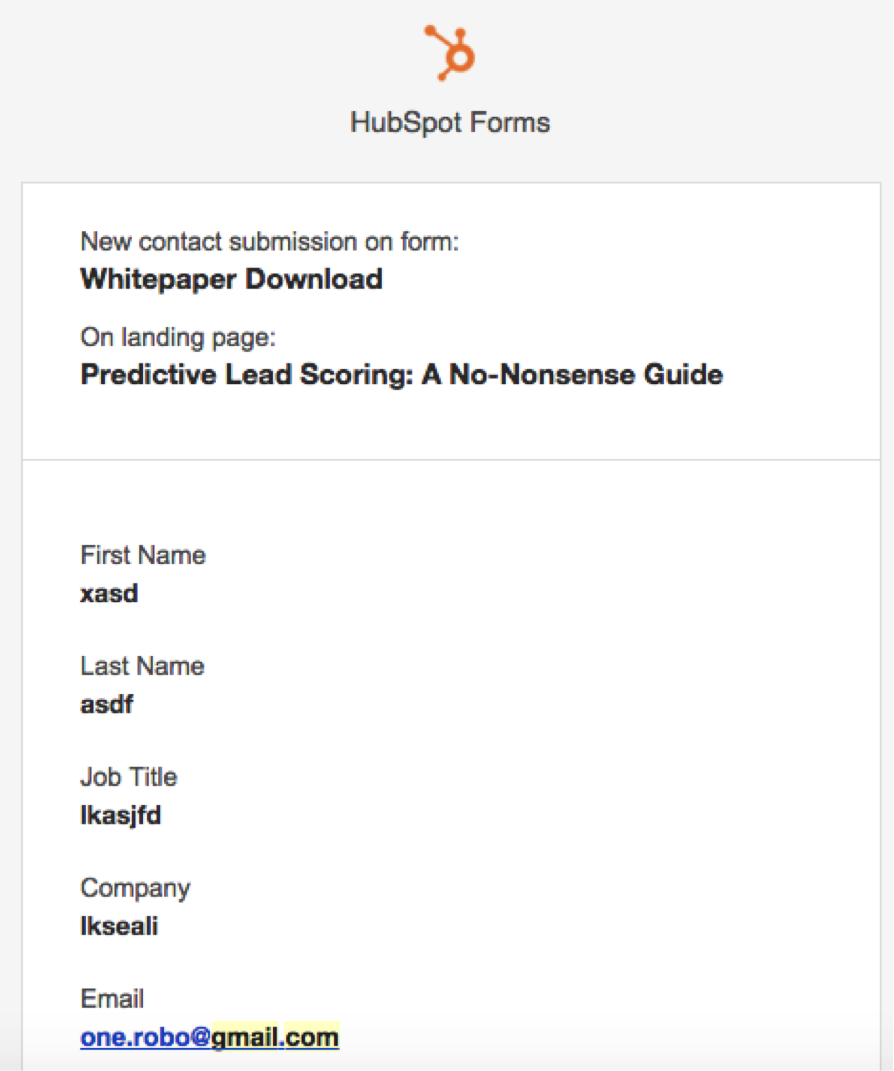
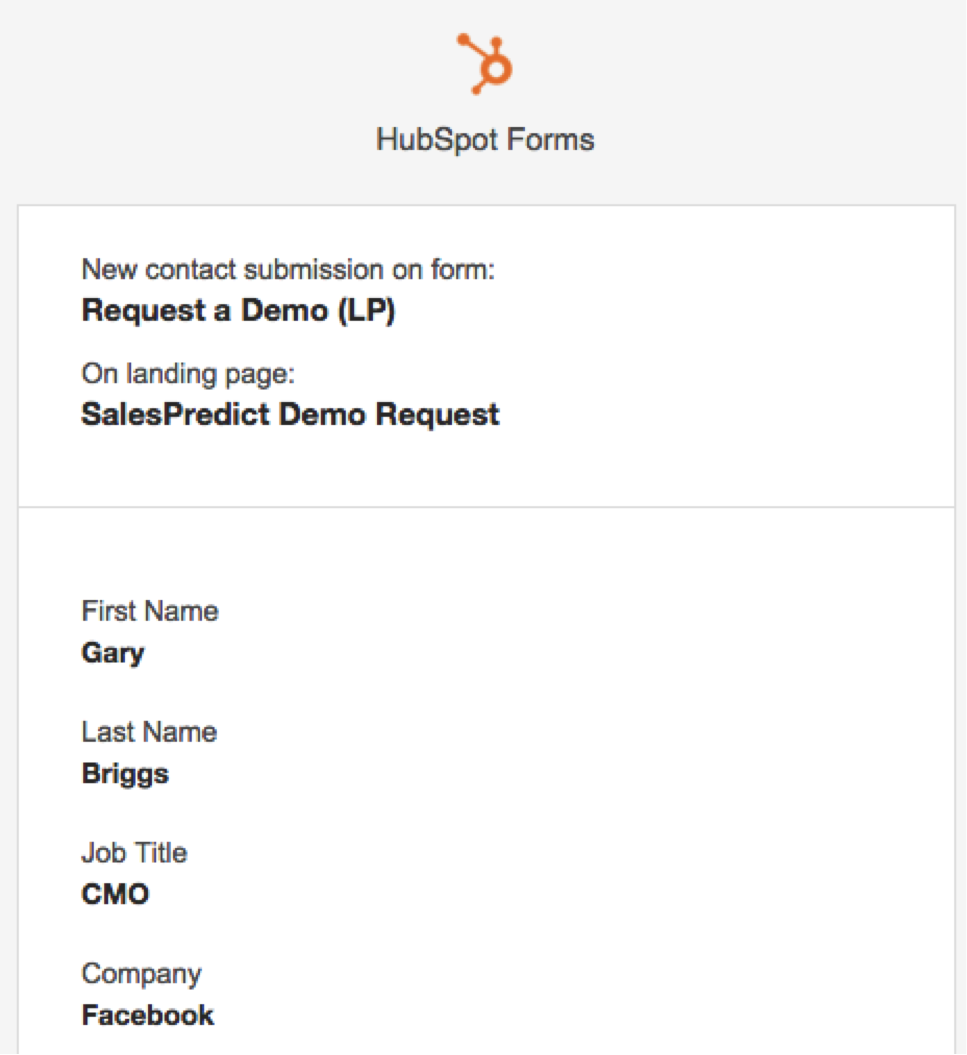
It finally happens. After weeks of combing through low to moderate quality prospects, the above notification appears in your inbox. What now?

If your sales organization is like most, all inbound leads -- regardless of quality -- are automatically routed to an SDR for qualification and appointment setting. That means the CMO of Facebook will get the same treatment as all of the other lackluster, potentially spam leads and receive six calls and six emails from an SDR with relatively minimal sales experience.

Why? Why do we continue to allow our best inbound prospects to have their first human interaction with our company with the most junior member of our sales team?

It’s time to stop this practice ASAP. Instead, sales teams should employ a lead prioritization and routing model that allows inbound leads to be segmented by quality, and then receive different levels of treatment accordingly. If you are selling to marketing executives in technology, the CMO of Facebook is an extremely high-value lead for your organization. Having your VP of Sales reach out to Gary as the first point of contact not only makes a lot more business sense, but also allows them to start building a strong relationship from the get go. In addition, it creates a human selling moment -- getting a call from the VP of Sales within a few minutes of downloading a piece of content, requesting a demo, or taking some other inbound action inherently creates a one-on-one experience that can increase the likelihood of closing a deal.

You may be thinking “that’s easy to say when you are talking about the CMO of Facebook.” But at scale, which prospects should I allow to go through the standard SDR process, and which ones are worth sending directly to my sales team? Should it only be those prospects who request a demo, or should I go up the funnel to a whitepaper download for the right fit?

Stay tuned for our next post to learn more on how to draw the line using predictive analytics and data. 

HubSpot CRM

15 Feb 23:52

Turn an Old T-Shirt into a DIY Cat Tent

by Heather Yamada-Hosley

If you have an old t-shirt and a few wire hangers around the house, you have everything you need to make this tent for your cat in about ten minutes. Sure, you want your cat to have toys, but cat accessories aren’t cheap and they’ll just end up in an empty box anyways. Make your own.

Read more...

15 Feb 23:48

What Most People Don’t Understand About How Startup Companies are Valued

by Mark Suster

There is much discussion online and also in small, private groups, about why the price of technology companies – public and private – are falling. Valuing any company can be difficult because it requires a degree of forecasting future growth & competition and ultimately the profits of the organization.

And two big changes have happened that are widely known – in the past quarter the value of some very high profile companies such as LinkedIn and Twitter have fallen substantially plus Fidelity (usually a public market investor) has written down the value of many of it’s later-stage private-company investments and made the downward valuations known.

Most venture capitalists who have been in this business for a long time foresaw this correction and have been talking about it privately for the better part of the last year or two. I’d like to explain as best I can my opinion on what is going on because most of what I hear from entrepreneurs is not only wrong but is reminiscent of what I heard in 1997-2000.

What is the True Sentiment of VCs?
I recently survey more than 150 VC friends from all stages and geographies what they thought about the market by asking “Which of the following statements best describes your mood heading into 2016?” and you can see that the balance of caution vs. optimism is 82% to 18%.

VC Sentiment

I want to emphasize that this is “blind” data (I do not know which person or firm said what making this confidential and less biased) and nobody responding had any motive other than just telling us how they were feeling.

There is reason for despondency. Most are sitting on large portfolios of private companies that are raising money now or will need to do so in the future and they know that they’re up against some headwinds. 61% of the VCs survey said that prices in Q4 last year had started to drop and 91% said they expected them to continue to drop in the first 6 months of this year (with 30% expecting serious drops).

VC Expectations


The Motive for Speaking Up
I have been talking about my concerns about valuations for the past couple of years because, well, they’ve been rising very rapidly the past two years!

It pains me to see the typical (and predictable) responses on Twitter, “VCs want prices to drop!” “This will be great for VCs and bad for entrepreneurs.” “Mark has a vested interest in talking down valuations of startups.” “Sure, prices are dropping. That’s just because the VCs are constantly saying so and making this a fulfilling prophecy.

All of these are false.

When I started blogging it was because I was inspired by Brad Feld. When I was an entrepreneur there was no public information about how term sheets worked or how investors thought. Brad was openly writing about this and it felt like he was giving the VC playbook away for free! I always wanted to work with Brad for this reason so I started blogging because I figured if transparency worked for Brad I would try the same approach.

Nearly EVERY smart VC I know has been talking privately for the past two years about how ridiculous valuations in private markets have gotten and how a reckoning was coming. Most prefer not to say this publicly for two reasons: 1) they have an entire portfolio of startups, many of whom are raising capital and 2) they prefer not to be attacked publicly or seem “anti entrepreneur.”

But I promise you they’ve been saying it privately. So my talking up over the years is more trying to shine transparency on what we’re already saying in private rooms.

But let me be even more clear. I do 2-3 deals per year and our firm does maybe 10-15 maximum. We write about $40 million of first-checks into new deals / year and about $40 million of follow-on investments. In 2015 in the US there were $77 billion written into startup tech companies. I’ll spare you the math and point out that this means we funded 0.104% of the market.

I am highly unlikely to fund your company strictly based on math and my only motive for publicly telling you what is going on privately is to help prepare you if in fact I’m right about the funding environment. If I’m wrong – at least you’ll have more data to decide how you raise & spend your company’s money. If I’m right my only hope is that more companies actually get funded and more companies reduce burn and survive.

That’s the entirety of my motivation.

Do Investors WANT Valuations to Drop?
Mostly, no. For good reasons – not the ones you think – yes.

Let me give you a non tech & thus non politically charged example. Let’s say you own a bunch of real estate property and you’ll likely buy more. You own 10 properties and you’ll probably buy 1-2 more per year for the next 10 years. When some properties have appreciated you like to sell them to get some liquidity and sometimes you sell the bad properties to get your money back and move on.

So prices start dropping. Are you thinking to yourself, “Awesome! Now I can buy more properties cheaply!” Of course life is more complicated. You’re really thinking that you had wanted to sell 2 of the properties that you thought has been over-valued and you were hoping to unload some poor performers. No you’re kind of fucked because nobody wants to buy any at all and your bank is calling you concerned that you may need to slow down your pace of new purchases for a bit.

This is how VCs feel. Many experienced partners are funds have 7-10 boards and most of these will need more capital. So when prices go down their first reaction is, “Shit. I better roll up my sleeves and help my companies get funded.” And while it was much nicer to call their LPs and tell them how great every company was going now they’ve got some explaining to do.

Yes, long-term they know that paying more grounded prices for future companies will likely produce better returns. But I promise you nobody I know is actively enjoying the correction in the way that some entrepreneurs seem to think VCs are. Right now it’s more pain than gain.

Can Investors Spook the Market into Falling?
In short – no. This is the biggest red herring of them all.

“10 angel investors walk into a bar …” Do you remember AngelGate at Bin38? Back then Michael Arrington accused some of Silicon Valley’s top seed funds of “colluding” by meeting secretly to talk down the valuation of startups. What hogwash. Of course a group of 10 seed funds can’t fix the prices of a market.  For the past 7 years prices have risen steadily.

Individuals simply can’t spook a market into behaving how it wants because it is, well, a market! I’m sure the head of the Federal Reserve Bank could spook the market or the heads of state of the US, China or Iran could. But not a VC or Bill Gurley or myself would have spooked it 2 years ago. For every bear there’s somebody else thinking they have an opportunity. That’s the beauty of markets and of capitalism.

Remember the RIP Good Times by Sequoia? That was written in September 2008. How’d that do at spooking the markets? And to this day I know people who think Sequoia did this knowing that the markets were going to go back up and they simply wanted to “head fake” other VCs and entrepreneurs. Puh-lease. They had no such motive and no such power. Even Sequoia.

Why Valuations in Recent Years Were Irrational
If you want the real story, here it is.

1. Social networking finally came of age connected the planet and leading to enormous wealth creation for Facebook employees and investors

2. Smart phones finally took off leading to enormous wealth creation for Apple employees and investors but also helped propel Google, Facebook, Twitter, Instagram, Snapchat, WhatsApp and others.

3. The US Fed has in essence held interest rates at zero for years and has undertaken quantitative easing to stimulate the economy.  The billions of dollars managed by mutual funds, hedge funds, insurance companies, university endowments, pensions, foundations, sovereign wealth funds and the like need to find returns for their money. “Safe” investments have no yield so they have allocated more money to private markets including the tech markets chasing returns.

As you can see below, investments have skyrocketed – up 300% since 2009.

VC investments per year

The vast majority of this recent boom in prices is not being driven by VCs but rather by hedge funds, mutual funds, corporate investors and other sources of non-traditional venture funding. In the chart below you can see that a decade ago for every dollar a VC raised from LPs a dollar went into a startup. Now for every dollar a VC raises $2.50 goes into a startup.

Spread between LP to VC to Startups


The Laws of Supply & Demand
I know that there are some corners where people believe that understanding how markets work isn’t really a requirement for being a great investor but the truth is the market dynamics play a huge role in determining which companies are valuable and which are not.

Let me start with the simplest explanation for anybody who didn’t take economics in university (for my sins I took it for 7 years at UCSD and then University of Chicago). The most basic chart of microeconomics is a supply & demand curve. Demand represents a buyer and supply a seller. In the case of startups the “buyer” is the VC looking to part cash for “purchasing” equity in your startup.

supply demand

The principle of microeconomics is that at a market-clearing price for any product the right amount of sellers and buyers will emerge and a price will be set. Some products are “inelastic” meaning when prices go up demand doesn’t fall much (think cigarettes, alcohol or even illicit drugs). Other products “elastic” meaning demand falls off quickly when prices go up.

But for the most part you have an “equilibrium” of supply & demand and this quantities supplied and price.

What changes this equilibrium? Usually only an “exogenous event” that causes a shift in the amount of supply or demand. In the case of venture funding that shift was massive amounts of non-VC capital in search of higher returns and emulating the successes of Facebook, LinkedIn, Twitter plus the expectation of huge returns at Uber, Airbnb, Dropbox, etc.

In economics we call this a “demand curve shift” as outlined below

demand shift

In short hand, the $50 billion of extra capital that came suddenly into the market shot prices up dramatically: A classic demand shift curve.

The result? Median valuations went up 3x in just 2 years, followed by a precipitous drop in Q4 of 2015.

median valuations in venture


The Case for Reduced Funding Levels
When you look at the demand shock above you’ll notice that there are both higher prices and higher “quantities” of companies and I know many entrepreneurs think this is good. Most smart VCs (again, privately) think it is not.

  • The increase in entrepreneurs often brings in many people not in the system to “innovate” but rather to make a quick buck
  • The increase in companies spreads out great engineering and product talent into many more companies (many not likely to succeed) versus consolidating resources fewer, more transformational companies
  • Huge funding increases lead to massive wage inflation, rent inflation and thus higher burn rates

But mostly if you raise $15-20 million and so do 4-5 of your competitors there is that much more incentive for “bad behavior,” which is where the “winner-take-all” mentality forces growth over margins.

Put simply, it’s really hard to build a strong company when all of your competitors are giving away free shit fueled by venture capital chasing winner-take-all returns

When funding levels lower, many would-be entrepreneurs prefer the nice salary and stability of McKinsey or Google and thus the market has more hard-core entrepreneurs. Smart investors and smart entrepreneurs prefer this phase of the market.

Reversion to the Mean
Another way of looking at this from an economics point-of-view is what we call a “reversion to the mean,” which simply means that when you have outlying data points where performance is better than usual for a period the data comes back down to a historical average.

ev forward revenues

As I’ve pointed out previously, this is perfectly captured by Joe Floyd here tracking SaaS multiples over time. You’ll see here that in 2007 people were willing to pay 7.7x forward revenue for SaaS businesses when in the years before it had been less than 5x. This corrected only to go back up to 13.4x in 2013 and then reverted back to 4x – a little bit below the historical mean.

Why do markets adjust so quickly? If you really want to understand investment psychology & economics you really need to read the seminal book The Black Swan by Nassim Taleb. It is one of the two most influential books on my thinking about investments. In short, a Black Swan is an unexpected event (positive or negative) that was deemed unlikely and once it occurs investor sentiment can shift dramatically and immediately.

In September 2008 this was the bankruptcy of Lehman Brothers and the rippling effect was massive.

I wonder whether LinkedIn’s stock market plunge in February 2016 might have a similar effect (to a lesser magnitude because the underlying company is still great). But it was a shock to the system to see such a beloved tech stock get so ravaged on valuation in a single day. Time will tell but I suspect history will show that this shifted sentiment.

How Public Market Valuations Can Affect the Price of Seed Rounds
I’ve written before about how public valuations affect private market valuations and here amongst others.

In short – late-stage investors (growth funds, PE funds, hedge funds, mutual funds) set price in their private rounds on the expectation of making a return when a company goes public. They are more sophisticated in their pricing models than, say, seed funds who are investing in products & teams more than financials. So the multiples paid by publics matter and when they drop, the late-stage markets drop, too. Much more slowly because there is less frequent pricing.

If you’re a B-round investor used to paying $50-100 million pre-money and you had a few years of later-stage investors paying $200 million+ 18 months after you invested you suddenly become less price sensitive. But when you see some of your deals not getting done (as happened in Q4 2015 and is continuing) then when you look at new deals you suddenly get more price sensitive.

As I’ve said, the balance has shifted from FOMO (fear of missing out, or “greed” as market analysts call it) to a pragmatic “I can take it or leave it” mentality otherwise known as “fear.”

And if you’re an A-round investor who usually paid $15-20 million pre but through competition started paying $40 million pre, the problems trickle down to you.

Even seed. In 2009 many deals got done at $4-5 million pre and in the past few years some of these deals have gotten done at $10-12 million pre (or higher). But if you’re a seed investor and you’re worried that the A-round won’t get done if your post-money is too high you suddenly start paying less.

And so it goes.

Why Financing in Falling Markets is So Damn Difficult
Back to my non-VC example. If you’re thinking about buying a house – you’ve always wanted to own! – but prices are dropping, you’re much more likely to wait a month or two (or five) before buying. Why buy today if you think it will be less valuable in 6 months and there are always more houses available in the future!

In investor terms it’s called “catching a falling knife” and psychologically investors hate it. So deals get delayed as investors feel out prices and also spend time worrying about their own portfolios. Here’s a graphic I’ve published before that shows that investors expect funding to take longer going forward.

funding time scales getting longer


If you want to understand why investors struggle so much to reset valuations of their existing companies – the must read economics book of the past 5 years is Thinking, Fast and Slow by the pioneer of Behavioral Economics – Daniel Kahneman.

Why Inside Rounds are Difficult?
Many founders don’t understand why inside rounds are so difficult. “If you liked my company last year so much why don’t you just give me more money to get through “Winter?”

For starters there is inter-investor politics. One investor might be willing to do his or her $3 million prorata but with 3 other investors around the table she doesn’t want to fund unless everybody his doing her share. “Why should I bail out you if you’re not willing to do your part?”

Plus, there’s “triage” meaning that if a VC firm has 10 investments all needing money at the same time and all struggling to raise money then the VC needs to figure out which companies deserve the cash and which don’t.

And imagine this … if you’re doing triage on your own portfolio and spending hours negotiating with other VCs and with entrepreneurs who don’t want to cut costs … then how likely are you to want to look at other people’s deals?

So inside rounds get delayed and when there are non-participants you often find “recaps” or “structure” or “pay-to-play” provisions. Call it high-stakes chicken.

Those with money don’t want to bail out those who don’t have it.

And I haven’t even mentioned internal partner dynamics where a firm feels 1-2 partners have more shitty deals than others and therefore each partner might be jockeying to get his or her deals saved and with scarce resources some will get what they want and some won’t. Some firms are more collegiate, some less so. But to pretend these dynamics don’t exist is to stick one’s head in the ground.

Why Down Rounds are Harder Than You May Think
Down rounds are hard. A slight down round is achievable but massive “hair cuts” are very hard to do. For starters most new investors don’t want to piss off existing investors by forcing a lower price because they know they’ll have to work together again in the future. It’s easier to pass and just look at your next deal.

Also, new investors will be worried that the down round will cause founders or senior management to depart and no VC wants to replace management.

Plus, down rounds trigger anti-dilution provisions. And down rounds might favor later-stage investors over earlier-stage investors who get wiped out. Or down rounds might favor earlier-stage investors because the liquidation preferences of later stage investors get reduced.

In short, there are complicated negotiations that go on that make it difficult to get alignment. This is why VCs mostly only like to invest with people they know and trust. Because we know in tough times we have to count on our co-investors to be good actors. Either fund your share or accept the consequences to your previous investment. But many inexperienced investors would rather hold the company hostage than accept the new realities.

In Summary

  • Markets set valuations for startups and no single investor or groups of investors “talking down the market” can force the market prices lower. There’s enough historical data to refute this claim
  • People like me who speak up aren’t wishing for a massive reckoning. For any future potential gain in more rational prices we have a lot more short-term pain helping our portfolio companies through the tough market
  • Private markets have been over-valued for years. Just as with the late 90s there is no new “business model” that defies the laws of gravity. Companies are valued based on the expectation of future profits. A reversion to the mean should be expected
  • If you believe the outlook will make funding more difficult (in time and price) you owe it to yourself to keep your burn rate in check so you can last longer until you need money and either “grow into your valuation” or at least get through a period of time where raising capital is more difficult

Appendix
Note that this is a first draft, written in one sitting and entirely unedited. I wanted to hit publish to get it out there. Feel free to provide me any errors, questions or typos in the comments section. I’ll do my best to revise this post in the next 48 hours.

15 Feb 23:44

Trade Show Graphics: Best Practices for Your Next Show
by Taylor Link

The quality of your trade show graphics design is a pivotal factor in attracting attendees to your booth. Trade show graphics set the stage for an exhibit, letting attendees know what your brand is all about as they walk by. Ideally, the graphics reflect the products on display in the booth, while creating an enticing first impression that generates interest and welcomes attendees to check out your offering.

Studies conducted by the Center for Exhibition Industry Research show that trade show attendees typically devote only 3 to 5 seconds of attention to your booth. Trade show graphics, therefore, need to be eye-catching, while either communicating the value of your positioning (if you’re a new or less recognizable brand) or encouraging brand recognition (if you’re a large, established brand).

Once a qualified graphic designer has been commissioned for the job of creating your trade show graphics, a commitment to high-impact messaging becomes the name of the game. The following sections outline a few of the considerations that exhibitors should think about before a show:
Trade Show Graphics: Best Practices

Integrating text with graphics

Most exhibitors have marketing collateral that deliver a branded message to attendees (brochures, pamphlets, swag, etc.). But you must attract people to your booth first! Prominently displaying your brand’s logo and tagline will, at the very least, establish your brand’s presence at the trade show.

It is imperative that your trade show graphics are consistent with your logo’s font and color(s), or your brand’s look and feel more widely. Because trade show venues can be overcrowded with attendees, any key text should ideally be at eye-level, or your messaging can get lost in the hustle and bustle of the trade show floor.

If you’re a smaller company, or you’re a newcomer trying to build your brand, remember that it’s going to be difficult for attendees to understand what you can offer them unless you tell them! A tagline or slogan communicating your brand’s positioning or your offering should also be included on your graphics.

Repurposing existing media into trade show graphics

Most brands that exhibit at trade shows already have graphics used in marketing materials. Repurposing this content for your trade show booth is always an option, especially if you’re looking to invest in simple custom banners or other portable display options.

Using existing media for a trade show booth does present some hurdles, however. Enlarging an image can distort and pixelate it. If the graphics do not look right after being enlarged, you’ll be left having to spend more money to have everything redone correctly. Always make sure that you’re using vector files, which do not lose quality when resized.

Becoming familiar with your trade show booth construction

The construction of a booth will also dictate the design of your trade show graphics. Panel breaks, monitor placement, and other design elements affect the positioning of your graphics. Embracing a booth’s structure as inspiration integral to your graphic design will demonstrate a high level of creativity to attendees. Also, learning how your booth comes together before arriving on the show floor is an absolute necessity.

Integrating audiovisual elements

New technologies are allowing exhibitors to get even more creative with their trade show graphics. Brands are experimenting not only with printed graphics, but also digital graphics. They’re utilizing interactive kiosk experiences, LED screens, video walls, and even virtual reality technology to create branded experiences and environments.

In essence, quality trade show graphics can make or break a trade show. Creating a look and feel for your booth that informs attendees of your offering, encourages interest, and qualifies both visitors is a necessity for trade show success.

15 Feb 23:44

5 Ways to Re-Purpose Your Technology Content

by Lara Nour Eddine

repurpose-technology-content

They say nothing lasts forever—except if it’s posted online. A great piece of content is everlasting, but can become outdated and may not get the views and shares it did when it was first posted. Content with a strong foundation just needs a little TLC to turn it into a top performer again.

Although it may seem like a strange practice to reuse content rather than rewrite it entirely, 63 percent of current content marketing initiatives involve repurposing content on some level, while 23 percent of future marketing initiatives involve finding better ways to repurpose content, according to the 2015 Benchmarks, Budgets and Trends Report.

To extend the life of your technology content, you must first determine whether your piece is worth the effort to repurpose. Top candidates include evergreen content, well-performing blog posts or content that is outdated.

In the tech industry, in particular, there are endless possibilities for getting creative with your old content. Here are five ways to repurpose your technology content that will yield success and get you more interaction than ever before.

1. Turn a Blog Post into a SlideShare

Everyone loves SlideShares. They are easy to read and packed with information—what could be better? These days, people don’t always have time to read long-form content and end up missing out on great information.

One of SlideShare’s featured categories is technology. The tech tab is found on the home page, directing users to thousands of technology SlideShares. The platform is a great way to share the latest technology information while obtaining company recognition, especially if your SlideShare is featured on the tech page.

Take a blog post you are proud of and pull out the most important elements to turn it into a SlideShare. Add some eye-catching photos to support your main points and you have a condensed version of your original content that will attract new audiences without taking the time to create something entirely new.

2. Take a SlideShare and Make It an Infographic

But what if you want to repurpose a SlideShare? No worries—take that information and turn it into an infographic. According to the Marketing Tech Blog, an infographic is 30 times more likely to attract views than a blog, anyway. Some tools to help you craft the perfect infographic without the help of a designer include Piktochart, Canva and infogr.am.

Need some inspiration? Check out this infographic Samsung posted about using wearables at work:

Samsung_Infographic_Screenshot.jpg

3. Turn a Blog Post Into a Podcast

Time is always against us—there just aren’t enough hours in the day to do everything. So make it easy for your audience to glean the best parts of your blog post by turning it into something they can listen to during their commute. (Multitasking at its finest!)

Podcasts are valuable to technology because they allow listeners to tune in at their convenience, so they can get your content any time, anywhere. Listeners who might not have the time to sit down and read content can still learn about the latest innovations, sparking new ideas, which is what makes technology so powerful.

To create a podcast, record yourself or a colleague reading your post and upload it to a host site. Make sure to update the post with any new information that has changed since it was first published. Promote it on your website, blog and social media and watch the number of listeners skyrocket.

4. GIF + Infographic = GIFographic

With infographics, the information is already bite-sized, so why not incorporate another form of microcontent that audiences love—the GIF? GIFs take your original infographic to the next level by animating the images, giving it a fresh, new vibe.

Making a GIFographic is a great way to revamp an infographic to make it more interactive, attractive and interesting. Check out this one by Neil Patel about How Google Works.
How_Google_Works-1.jpg

5. Make a Video From a Blog Post

One of the easiest ways to engage people is through video. Even The New York Times has a technology video channel featuring the latest innovations. Choose a piece of content you can bring to life and create a script out of the text you already have written. Grab your camera and film yourself speaking about the topic at hand. This will promote thought leadership and demonstrate your knowledge on the subject. If you can shoot some footage of you in action—depending on the topic—even better.

There are many reasons why video should be a part of your technology content marketing strategy. Viewers can consume it easily and its ROI can be measured to track engagements with the video. In fact, 52 percent of marketing professionals believe video is the type of content with the best ROI. Rather than reading paragraph upon paragraph of text, audiences can watch a 2-minute or shorter video and get the same information. Pair it with strong imagery and concise audio and you will be much more likely to reach new viewers who are looking for this information but in video form.

Repurposing content is a great way to optimize your content strategy. It takes time to produce good content, so why not leverage your hard work and present it another way? It is relatively simple, inexpensive and can increase traffic.

With the world of technology constantly changing, there are many opportunities to re-purpose old pieces of content to update them or bring the topic back to the forefront. Get the most value out of your efforts and share these pieces of content throughout your networks to restart conversations and make an impact on the tech industry.

15 Feb 23:43

Leadership Lessons: Why Micromanagers are FANTASTIC Teachers!

by Kathi Miller-Miller

I’ve had the privilege of working for and with many fantastic people in my career. Some were great because of their intellect and others for their leadership. But the best leaders I’ve worked for possessed the ability to encourage folks to do their “best” work.

Conversely the worst leaders I’ve encountered excelled at a task far different. You see they were experts at micromanaging. Much like many things in life, I didn’t truly comprehend the difference and the damage until I experienced it first-hand.

My boss, Tom (not his real name of course!) wasn’t a bad guy. In fact, he adored the company and treasured his position. The problem was that he simply didn’t feel any of his employees were capable of producing good work without his constant involvement.

To make matters worse, Tom didn’t possess the much-needed confidence in his position. Instead, he felt that any mistake made by a team member could cost him his career and the respect of his peers. And just like that you’ve got a recipe for disaster.

Over time, I personally witnessed the team change from one of positivity and engagement to one of dread, hate and discontent…all because of poor leadership. But the damage doesn’t end there. As a mid-level manager under Tom, I’m ashamed to say that I participated in the holocaust and unknowingly joined the ranks of the micromanaging. While it was a time in my career I have absolutely no desire to repeat, here’s what I learned from the “experience.”

No Trust

Looking back, trust issues were the first ripple of discontent. Quite simply, team members felt that I didn’t trust them to produce good work without my constant involvement. Nothing could have been further from the truth. In hindsight, perhaps I should have shared with them that we were all working for an irrational person and that I too was the victim of micromanaging. Instead, I chose to put on my corporate hat and protect Tom. I never shared with them the hateful comments and ultimatums that I was subjected to on a daily basis. Regardless, whether in a personal or work relationship, trust is an absolute requirement for success. And it’s one that micromanagers simply don’t possess.

No Ownership

Great employees want to believe they are making a difference and providing value towards the goal. But it’s a little difficult to feel ownership over something that doesn’t even closely resemble what you created. By the time Tom finally approved a deliverable, it no longer looked anything like what a team member had originally produced. Admittedly on occasions, it was better. But much more often, it was just different and more closely matched what Tom visualized. The result? Team members felt absolutely no ownership in the work they produced. Morale took a nose dive and I became known as the manager with the red pen that destroyed their efforts. If you want to be a great leader, always find a way to give your team ownership over their efforts.

No respect

While I was doing “my time” under Tom (and yes it often felt like I was in jail!), I learned a great deal about micromanagers. Perhaps the biggest revelation came the day I realized that it was all about respect. You see, leaders like Tom quite simply don’t respect people, their abilities or their intellect. And while it’s only a seven letter word, respect is absolutely critical to employee engagement. Respect the individuality, expertise, effort and professionalism of your team and you’ll be amazed at the uniqueness of results and success you’ll achieve.

No fun

While I had the privilege of meeting many great (and talented!) people, working for a micromanaging leader was quite simply no fun. I found myself caught in a continual abyss between protecting my team from the wrath of Tom while still allowing them the freedom to produce great work. You could say it was the proverbial rock and a hard place.

Looking back, I would make lots of changes but I wouldn’t change the experience. Surviving Tom’s style taught me a great deal about myself, people and of course the need for red wine!

15 Feb 23:42

Transform the Way You Sell in Consumers’ Attention Deficit Time

by Olatunde Adedeji

The amount of consumers’ attention your business can get goes a long way to determine its sales success or failure. Everyday consumer life is filled with endless sales messages from marketers and salespeople. Traditional salespeople have done the rest of us great harm by embracing self-centered and interruptive approach to selling products and services. An average buyer dislikes being sold directly with alter disregards to their interests, time and convenience. The obsolete techniques most often used are cold-calling, print advertising, TV commercials and even junk mails. However, the advancement in technology is making these techniques less effective and expensive. The consumers (B2C and B2C) are terribly short in time for usual sales pitches.

Interestingly, buyer’s priceless attention is gradually becoming scarce commodity. Consequently, too many businesses are jostling to grab ‘buying attention’ needed for business survival. If you must be heard in marketplace you need to innovate and evolve your approach to selling.

There are six best practices that you need to keep in mind. These practices will help you to transform your sales process to support new buying habits of people.

#1. Be Truthful to Changing Time

The times are changing so fast. The buying habits of people are witnessing a paradigm shift from the way we know it. As business executives, if you don’t believe you need to tweak your sales process and improve sales performance to align with present day reality, you will be left with only option of shutting down. In the early 90s, you could sit in your brick and mortar store, ask your marketers to share a few handbills to potential customers in the neighborhood. And before you know it your store will become so busy. Nowadays, not having an online presence means your business will not be found on the Internet where your prospects and customers are spending more time. Customers prefer to shop and make payment online. In fact, they research on the Internet to find out if your competition offers are better. The physical office in this an age is becoming irrelevant for B2C business model. The truth is selling technique needs to evolve with emerging buying habits and lifestyles.

#2. Re-Analyze Your Target Accounts

Targeting the right people for sales is more important than ever before. You will limit the challenges and hurdles on your way to converting leads if people you are targeting are your ideal customers. The innermost wish of every sales rep is to have all the leads become customers. In reality, this is difficult. So bringing in the right targets into your sales funnel is vital. If you make sales pitch about a product to an unqualified prospect, no matter the amount of time in this world he is willing to spend with you, the deal will not be closed.

#3. Understand that Buying Powers Belong to Buyers

Every consumer wants to be in control of their buying journey, and not being sold forcefully. There are different reasons why prospects buy from us other than our brilliant sales pitches. According to Hubspot, 60% of a buyer’s purchase decision has already been made before even talking to a sales rep. It then means that buyers now have better knowledge of products and services through research either on the Web or Offline. So, if your organization can provide educational contents that can help a prospect make buying decision while you have built trust and earned authority in the process, you certainly stand a better chance of converting them to customers.

#4. Sell Values Not Features

This seems too obvious, but it is the fact with present day consumers. No time to listen to long list of features your products have. What consumers want to know is how your solution can take away their pains. While some salespeople are desperately eager to exchange their products for dollars, the ones that sincerely exchange product values for dollars make repeat sales.

#5. Sell on relationship

It is easier to sell to customers than prospects. Imagine making sales presentation to a satisfied customer. The possibility of closing the deals is high. Identify the stage your prospect is in your sales cycle and deliver the right sales message or contents through an effective channel. When you build relationship that is based on trust and integrity, you won’t have to make same market noise like your competitions before you can sell.

#6. Understand the role of Smarketing Automation

The fusion of sales and marketing led to the coin of the term Smarketing. It explains the synergy between sales and marketing to achieve common revenue goal of an organization. Selling to smart consumers also requires sophisticated technology. Sales and marketing process have evolved, and technological advancement is helping us to build business relationship and close sales more than what we experienced ten years ago. When you want your salespeople to be consistent in the way they interact with customers at every stage of the sales process, you need sales automation solution. Sales management is easier when you leverage on easy to use automated softwares such as OpenCRX , Pipelinersales, Salesforce etc. In a recent survey by SmartInsights, 20% of participants believe marketing automation will be the single digital marketing activity with the greatest commercial impact in 2016.

Final Thoughts

The current fast changing consumers buying habits will not slow down. Obviously, the traditional sales methodologies cannot cope with present day time constrained consumers. The competition to gain potential customers attention will be tighter in the future. The sales success will not be how well you can make sales presentations or come up with best sales scripts. The future consumers are going to build more defense mechanism to shield them from marketplace “buy me” noise. The business executives and sales managers, who are consumers-centric, sells on relationship, sell values and not features, know the ideal buyers and understand the changing time will continue to close deals.

15 Feb 23:42

How Can Guided Selling Create a WOW Customer Experience?

by Markus Linder

In today’s world, the modern consumer has the luxury (and often the problem) of choosing from a large range of vendors for almost any product imaginable. Because the accessibility of the Internet provides an abundance of retailers to choose from, it has become increasingly important that the customers’ shopping experience is an excellent one.

Guided Selling is an up and coming technology that is used by brands and retailers to help potential buyers choose the most suitable products based on their individual needs. It is used to actively guide shoppers to a confident purchase decision.

You are probably wondering how exactly Guided Selling solutions will thrill your customers and multiply conversions. Let’s jump straight into details. What do you need to do in order to impress your customers and sell more effectively in 2016?

1. Identify customer’s needs and address them quickly

Impatience is, without a doubt, something online and mobile shoppers feel. In searching for a product to fulfill their own personal needs, the potential customer can feel frustrated over the precious time they’ve lost in their hunt.

Good Guided Selling solutions ask need-oriented questions to understand shopper intent and present the perfect products in no time. Sites such as West Marine, an online outfitter of boating-related products, take the customer through a series of visually appealing choices that get right to the core of which kayaks are ideal for the buyers’ needs and preferences.

West Marine - Kayak Finder

West Marine’s Kayak Finder.

2. Provide a personalized path to purchase

Personalization is a popular way to catch customer’s attention. In a world where online shoppers feel like a number being constantly advertised to, Guided Selling solutions offer customers a more personalized journey to discover products.

Rather than pushing random products to shoppers, only the products that match the shopper needs are suggested. By having this personalized component, that engages shoppers in an interactive dialogue, users are more empowered in their decision process and feel that the retailer actually cares about who they are instead of viewing them as another faceless shopper.

Canon - Lens Selector

Canon – Lens selector.

3. Keep the shopping experience enjoyable

Once the customers have arrived at your site, they will be looking for aspects of the website to engage and entertain them, like high quality photos, interactive graphics, animations, or quizes.

An excellent example of an interactive quiz is “Skin Diagnostic Tool” executed by Clinique. It asks the shopper to identify their skin concerns and then suggests products to solve them. This approach doesn’t only encourage a sale, but also makes your potential buyer feel engaged and important.

Clinique - Skin Care Diagnostic Tool

4. Offer an easy way to cut through the clutter

Analysis paralysis is a state of overthinking purchasing options, to the point where a potential buyer is discouraged from making a decision and does not complete an intended purchase. This most commonly occurs whenever too many options are provided for the shopper, overwhelming and confusing the individual.

To avoid analysis paralysis, interactive product advisors only present products that closely fit the customer’s needs. By reducing the number of suggested options, it has been proven that conversion rates can increase by up to 30%.

dogIDs - Collar Advisor

DogIDs – Collar Advisor.

5. Guarantee confident and satisfactory purchase decisions

One of the biggest fears associated with analysis paralysis is the customer’s concern that they are going to choose the wrong product. The best way to avoid losing sales to this confliction is to assure your potential customer that they are getting the exact product they want and need.

Good Guided Selling solutions do not only list the product features at the results page. They mark the features that fall into customer’s expectations based on their answers to need-oriented questions. They also enable quick product comparisons, which is another method commonly used to reassure shoppers about their choice.

LUNA Sandals Picker

Luna Sandals Picker, comparison table.

The days of walking into a store, choosing a product maybe from two or three varieties, and confidently purchasing that product are long gone.

Today’s customer has been conditioned to many new aspects of the shopping experience, such as the variety of online retailers to choose from, the overwhelming amount of product choices, and the expectation of being constantly engaged.

Beyond the personalized touch and cutting through the clutter, Guided Selling solutions elevate the online shopping experience for every potential customer and ultimately leave them with satisfactory purchase choices.

15 Feb 23:42

Which Types of Salespeople Will Become Obsolete in 2020? [Webinar]

by dkhim@hubspot.com (David Ly Khim)

salespeople-obsolete-2020.jpg

Sales has changed over the last few years. Salespeople can't afford to be pushy or slimy or any of those other nasty words. Buyers hold the power now. So what does that mean?

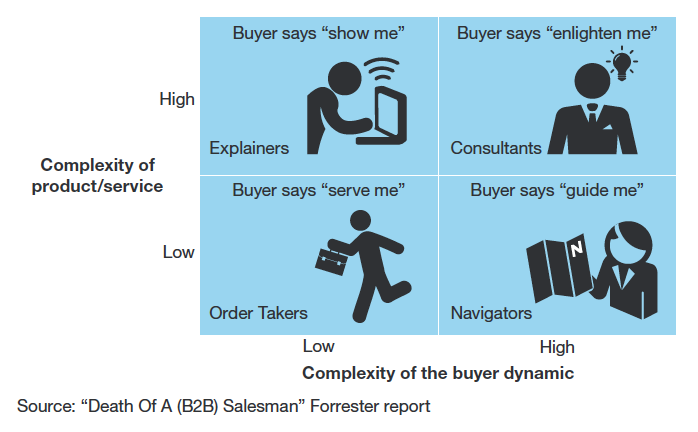
According to Forrester, one of the most influential research and advisory firms in the world, over 1 million B2B salespeople in the US will be obsolete by 2020. In fact, only one of the four salesperson archetypes will survive the digital shift that we're experiencing.

sales_archetypes.png

So how do we talk to buyers? How do we adapt to the modern buyer's journey? How do we get buyers to want our help?

We're hosting a free 30-minute webinar with HubSpot CRO, Mark Roberge, Sales For Life CEO, Jamie Shanks, and Forrester Analyst, Mary Shea, to discuss the realities of the modern buyer and the skills B2B salespeople need to adapt.

In this 30-minute session, we're going to discuss:

  • A deep understanding of the modern buyer's journey
  • The skills and characteristics of the best performing salespeople
  • The 5 critiera that correlate most with sales success

Don't become obselete.

Register for the webinar now >>

sales_for_life_twitter.png
15 Feb 23:42

Help Your Salespeople Spend Time on the Right Things

by Andris A. Zoltners, PK Sinha, and Sally E. Lorimer
feb16-15-HK1557-001

Sales executives typically have two levers to try to increase sales: they can increase the quantity of sales effort by adding salespeople, or they can improve the quality of sales effort by investing in coaching and training.

There is a third approach that is often overlooked: Improving the allocation of sales effort. Salespeople can work smarter, not harder, by dividing their time more appropriately among customers, products, and sales activities. Sales effort allocation has a large impact on sales and profits, sometimes more than increasing the quantity and/or quality of effort.

Sales executives frequently talk about how sales forces misallocate effort. Salespeople spend too much time with “friends and family” (existing customers with whom they have rapport) instead of focusing on high-potential prospects. Strategically important products don’t get sufficient sales support. Service or other non-sales activities creep into the sales job, and role pollution prevents salespeople from developing new business. Costly allocation errors such as these are difficult to diagnose and fix.

By asking six questions (in order from the simplest to the most complex), you can trace the probable cause of any sales effort misallocation back to the sales force decisions and programs that can bring about improvement.

  1. Do salespeople know what’s important? If salespeople aren’t clear about which markets and products are priorities, they’ll create their own rules about how to spend time. The remedy is clear, consistent communication: “Here’s how we want you to spend your time, and here are the results we expect.” Coaching, performance management, and sales goals reinforce communication, while metrics track performance: “What gets measured gets done.” When a business logistics company wanted salespeople to spend more time selling three strategic product lines, it focused sales force attention on those lines by giving salespeople a sales goal for each line, separate from their goal for the overall portfolio. Salespeople could track up-to-the-minute achievement of all goals.
  2. Do salespeople have the information they need? Salespeople are more likely to spend time effectively when they have access to good information and tools. A telecom company used predictive models (think Netflix and Amazon) to give salespeople direction about how to improve sales with underperforming, high-potential customers. By finding “data doubles” for these customers — i.e., similar customers who were buying much more — the company provided salespeople with insights about which underperforming customers had significant unrealized opportunity and which sales strategies had worked in comparable situations in the past. The information helped salespeople focus on product offerings that matched customer needs, thus increasing sales.
  3. Do salespeople have the competencies required? When salespeople neglect priorities due to insufficient skills and knowledge, the remedy is coaching and training. A computer manufacturer selling through resellers discovered many of the resellers’ salespeople weren’t sufficiently supporting the manufacturer’s new product, resulting in low sales and lost opportunity. The manufacturer’s product training for the resellers’ salespeople emphasized technology specifications. This worked for the best and most experienced salespeople but left others overwhelmed and unprepared to approach customers. When the manufacturer refocused the training around how to sell the product (e.g., how to find and qualify buyers, describe the product’s competitive advantages, and show customers why they should buy), the resellers’ salespeople became more confident and sales increased.
  4. Are salespeople motivated to succeed? Salespeople are motivated when they perceive value from their efforts: career success, recognition, personal satisfaction, money, or all of the above. Remedies for sales force motivation issues include changing the incentive plan and/or modifying the criteria for recognition programs while acknowledging those who are successful. When a medical instruments manufacturer wanted to build market share by displacing a specific competitor, it offered salespeople a bonus for every competitive instrument displaced, and it set up a mobile app with a leaderboard of salespeople with the most displacements. First-line sales managers also helped boost motivation by encouraging salespeople and recognizing their successes.
  5. Do salespeople have enough bandwidth? When salespeople spend time inappropriately because they have too many diverse responsibilities, a new sales force structure can ensure focus on company priorities. When new customer development lagged at a technology company, it reorganized the sales force into a hunter/farmer structure. Hunters specialized in developing new accounts. Once a sale was made, a farmer took over to cultivate and grow the relationship and generate repeat business. Farmers provided existing customers with the ongoing support they needed, while new business development flourished because hunters were not distracted by time-consuming service activities.
  6. Do salespeople have the right innate characteristics? Training can develop salespeople’s competencies, but success can also require certain innate qualities. When sales effort misallocation occurs because salespeople lack characteristics such as intellectual flexibility or tenacity, the remedy is better hiring and retaining the right people. A construction supply distributor historically hired former construction workers for its sales force. Many of these salespeople had technical expertise but lacked the personality, capability, and drive to sell in challenging situations. When the economy slowed, selling became more difficult, and salespeople started focusing almost exclusively on friendly, loyal customers. The distributor changed its hiring strategy: instead of hiring industry experts, it began hiring “natural sellers” who were willing to learn the industry. The change, when reinforced by other changes to the sales culture, drove considerable revenue improvement.

These questions are sequenced so that those asked first can be addressed with easier-to-implement sales force changes. Changes to performance metrics and information (questions 1–2) typically require moderate effort and minimal disruption. Changes to sales force structure and hiring (questions 5–6) are disruptive and more difficult to implement and take longer to have an impact. Changes to sales training and incentives (questions 3–4) are in the middle. Some effort allocation issues are remedied with only easy changes, but many will require a portfolio of changes to create lasting improvement.

15 Feb 23:39

Using Exit Offers on your Site: How and Why Exit Intent Grows your Business

by Grant Thomas

A common yet misleading way to judge a company or website is by checking their monthly traffic. I admit, I do this on a daily basis while perusing the web. Yes, the amount of traffic your website receives is important but it is by no means an indication of success.

Despite all of the time, money and effort you spend driving traffic to your site, the majority of traffic leaves without converting into a lead or a sale. The average conversion rate for websites is 2.35%. This means that 98% of the traffic driven to your website does not convert.

Why does conversion rate matter? Websites with higher conversion rates tend to have more engaged visitors, regular visitors, and make more money. In ecommerce, this means your making more sales. In blogging, this means you have more readers and more interaction on your blog. In short, while traffic is important, set your sights on driving more conversions!

So what is one tactic that you can implement today that will drive more of your visitors to convert? The answer is exit pop ups and exit offers!

What is Exit Intent and How does it work?

Exit intent technology tracks a visitor’s behavior on your site and based on that behavior, determines the exact moment that a visitor is about to leave your website. The process is done with pixel tracking technology that tracks mouse movements and visitor behavior.

This allows you to present an offer, message, or call-to-action to leaving visitors in order to keep them on your site and drive a specific action. An email sign up, a purchase, a social follow, or a visit to a specific landing page are all actions that you want visitors to take – Exit offers provide a simple and effective way to drive these actions.

Digital marketers can set up simple campaigns that serve up discount offers to leaving shoppers in order to drive sales. They can also provide a piece of valuable content for leaving readers to snag new email subscribers.. These are both great ways to drive email sign ups while also creating value for visitors.

Marketers can also implement complex exit intent strategies which involve visitor behavior, previous actions taken, geo-location, and even traffic source to serve up personalized content. The capabilities are there but for the sake of this article, let’s stick to the basics.

Why Do Exit Offers Work?

Providing Value

Presenting an offer or call-to-action that provides value in the eyes of the visitor will drive them to take the desired action. For example, if a shopper is presented with an offer for 20% off of their purchase, this provides immediate value and they are much more likely to go ahead and complete the purchase.

This also doesn’t have to be a discount or piece of content. If you can effectively display value for your mailing list through copy, this will drive email sign ups. When crafting your value proposition, always keep your target consumer in mind. What do they want? How do you provide it? Who has benefited from it? Here’s a great example from Van Winkle’s, a blog dedicated to helping you get the best night’s sleep.

van_winkles_blog_facebook_pop_up.png

Reciprocity

In social psychology, reciprocity means that when someone provides value or does something positive for you, you are much more likely to do something positive in return. In most cases, exit pop ups offer something of value that can be received by performing a desired action (email sign up).

For digital marketers, reciprocity produces results. Using this principle can help you generate new leads or subscribers, gain new customers, and increase customer loyalty. As shown in the example below, the item of value doesn’t have to be grandiose. It just has to be something that your ideal subscriber or customer would be interested in!
momentum_mag_gated_content_pop_up.png

Ask and you Shall Receive

The great Wayne Gretzky (or was is Michael Scott) once said “You miss 100% of the shots you don’t take.” This quotation is widely used in sports and business which has made it reach cliche status. Well here it is again and this time we’re applying it to driving conversions.

Engaging website visitors and asking them to make a decision will spur positive action and drive them to convert. Online consumers are passive and easily distracted so unless you place a call-to-action right in front of them, they most likely won’t engage. You will drive more engagement and conversions by presenting visitors with a question that they have to answer than not asking them at all.

triad_landscaping_exit_pop_up.png

Wrap Up

Conversions don’t come easy these days which means you always have to find ways to improve your processes. Increasing your conversion rate is a constant effort and involves many different factors.

However, you can make a positive impact and convert more traffic today! Exit offers and pop ups present simple decisions to visitors, making it easy for people to take actions that you want them to take. You are also providing value to your consumers and your website experience.

15 Feb 23:39

The Purchasing Path: A Step By Step Guide to B2B Lead Nurturing

by Leo Patel

The B2B sales cycle is an extended process that’s much longer and more detailed than B2C buying. Your leads may spend months considering whether they’ll make a purchase with you. Competition is fierce in the B2B space, so it’s crucial that you actively nurture your leads during this time, keeping your company at the forefront of their considerations as they progress down the purchasing path.

Subsequently, understanding the purchasing path means the difference between success and failure for B2B marketers. Follow these steps to help boost your success with B2B lead nurturing and sales.

Build Credibility as an Industry Expert

Research is the critical first stage in the B2B buyer’s journey. Seventy percent of B2B buyers say they perform two or three rounds of Internet research before they settle on a purchase recommendation that they’ll pass up to a manager. Another 12 percent go above and beyond, conducting more than three rounds of research. As these buyers are scouring the Internet for reliable data on your industry, it’s essential that you emerge as an expert in your area.

buyer research, B2B lead nurturing

Establish yourself as more than just an expert in your particular product line. Create valuable content that answers key questions and shares meaningful insight into your industry as a whole. Avoid shallow, keyword-packed pieces and focus instead on a more holistic approach with the goal of becoming a thought-leader to help establish your company as a leading voice within your industry.

Engage Customers Across Multiple Channels

Today’s B2B buyers connect with companies through multiple channels and a majority of B2B buyers prefer to consume different types of content for each stage of the buying process.

As these potential customers progress in the research process their search terms become progressively more specific. With this in mind, tailor your content carefully to each stage of the buying process so you can offer customized content for the most relevant search concerns at each stage.

online research habits, B2B lead nurturing

As you’re preparing your content marketing strategy, carefully consider your buyer’s purchasing journey, offering content that fits their research patterns. During the past two years, there has been a 91 percent increase in B2B researcher smartphone usage throughout the entire path to purchase, emphasizing the importance of mobile-optimized content. Seventy percent watch videos, exhibiting remarkable staying power as nearly half watch more than 30 minutes, and one in five is willing to consume over an hour of content.

Explain Why They Should Buy It

Customers don’t want you to talk nearly as much as they want you to listen. Anyone can provide a series of emails at pre-scheduled intervals, but this type of marketing doesn’t take into account each customer’s individual needs. Lead nurturing is about creating a personal relationship with customers and providing targeted solutions for their unique situations.

You must use targeted communications that are relevant to the recipient’s industry, stage in the buying process, and previous communications. Your most effective communications are those that are relevant to a question or problem that the customer has presented. Listen to your customer’s needs, and explain how your products or services will resolve their problem in a concise and relevant manner.

Compare Your Company to Competitors

B2B buyers look at an average of 12 different suppliers before making their purchasing decision, so you have a good chance at scoring at least a cursory examination if you’re near the top of your market. However, a majority of buyers will visit your site just once before making a decision about whether to further their research or drop you from consideration. For most B2B buyers, only one or two brands ultimately make it to the consideration stage of their buying path.

Give potential buyers the competitor comparison they’re looking for upfront, so they don’t have to return to your site again and again to figure out how you stand up to others in your industry. Determine which data fields are most relevant to the customer’s purchasing path and gather all the information you can in these areas. Make these crucial facts easy to find and understand, and keep your website clean, concise, and easy to navigate.

Coordinate Your Communication Efforts

Today’s buyers are engaged via a slew of channels, including email, social media, PPC, webinars, blogs, and more. You obviously can’t personalize every facet of customer communications, but you can coordinate your efforts for a cohesive multi-channel message.

If you’re touting the benefits of a new product line on Twitter, coordinate this with personalized emails that expound upon the specific benefits of that product as they pertain to each customer’s market. Rather than sending a generic email blast to all your customers, you can nurture your leads with a more personalized approach that addresses how your new product is more relevant to the problem areas you’ve already identified with them.

Coordinate your marketing calendar so you’re not overwhelming buyers with multiple messages in a short period of time. Don’t send your lead nurturing emails on the same day as your weekly newsletter. Schedule your communications carefully so you’re in regular contact without drowning the buyer in a deluge of messages.

Cover Cost Benefits Appropriately

B2B salespeople who are seen as a trusted industry advisors, with an understanding of economic buyers’ needs, are 69 percent more likely to make a sale. Understanding the customer’s financial situation goes far beyond the faulty assumption that cheaper is better. B2B International estimates that as many as half of all companies in many B2B sectors are prioritizing price more than necessary. Meanwhile, 15 years of accumulated data indicates that just 20 percent of buyers prioritize price over other factors. The remaining 80 percent are more concerned about relationships, outcomes, and other issues.

Evaluate your target market and make sure you understand what B2B buyers in your sector really value. With this in mind, you can communicate the cost benefits, ROI, and affordability of your products or services in a way that will really resonate with your audience.

Companies with lead nurturing campaigns enjoy an average ROI of 125 percent, compared to just 86 percent for those operating without one. It’s clear that a well-organized approach to communicating with your leads throughout their purchasing path will help you form deeper and more profitable connections.

Make a conscientious effort to formulate a well-defined lead nurturing strategy, and you’re practically guaranteed to see a significant return for your efforts.

 Definitive Guide To Pipeline Marketing Everything you need to know to be a revenue-focused B2B marketer. Download Now

15 Feb 23:39

How to Write a Killer Email Subject Line

by Michael Peggs

Did you know that 35% of emails are opened based on the subject line alone? Even worse, a whopping 69% of email users flag an email as spam after just seeing the subject line. If email marketing is a key component of your internet marketing strategy, then open rates are the start of building a relationship with your subscribers.

If you want to get your message seen in your readers’ inboxes, it is crucial that you get the subject line right. Failure to do so won’t just get your email sent straight to the trash can, it might even earn you a spam report.

On that note, here are some tips to write killer email subject lines that will get your newsletters and emails the attention they deserve.

  1. Make a List of Words to Avoid

Sales-oriented words like “Free” or “Discounts” may get your higher initial click-throughs (10% higher, by one estimate), but they can also easily trigger spam filters. With email services like Gmail increasingly becoming wary of promotional emails, salesy subject lines can associate your emails with spam.

Other common words you might want to avoid are ‘Help’ or ‘Reminder’ which have been overused so much by marketers that they turn people off at first sight.

Check out this HubSpot post for a list of words you should avoid.

  1. Add a Personal Touch…and Local One too

Mailchimp research on email subject lines shows that including the recipient’s first or last name in the subject line improves open rates. Adding a city name to the subject line helps too – especially when you want to target potential customers based on their location.

The mega retail store Target used this tactic in an promotional email blast on May 31, 2013. It shortlisted retail stores closest to the mail recipients’ listed addresses and sent them localized mailers that read like this:

“New this week: Check out the deals at your [Location_Name] Target Store.”

The email campaign proved to be quite successful as readers found the mail much more relevant to them. Remember, personalization leads to engagement and there are SEO benefits from the additional traffic, comments and social shares that result from your email efforts.

  1. Don’t be Repetitive

Repeating a subject line from a successful email template over and over again is a bit like telling the same joke at every party. People might find it funny at first, but they’ll get sick of it soon enough.

Try to come up with fresh, insightful subject lines for all your emails. Your readers will appreciate the creativity and your emails will stand out in their inboxes.

Just remember that the subject line should match the content of the email. You can’t mislead a reader with a clever promise but underdeliver in the email body. And when they arrive on your site, the content marketing must match as well. That’s a sure-shot recipe to being ignored. In fact, a 2011 study by AWeber Communications proved that clear subject lines generated 541% more response than creative ones.

  1. Keep it Short

Adobe reported that 79% smartphone owners use it to access their emails. Due to the smaller smartphone screens, any email longer than 50 character gets truncated.

In fact, according to one study, emails with 49 characters or fewer get 12.5% higher open rates.

This is why businesses like Buzzfeed keep their email subject lines so short.

Conclusion

The email subject line is one of, if not the most important part of your marketing emails. By keeping them short, avoiding spammy words, and using fresh, creative content you can easily stand out in the inbox and get your open rates up.

15 Feb 23:39

How Pricing Affects Marketing Strategy for B2B SaaS Companies

by Jordan Con

While SaaS companies often get grouped into a single vertical, the reality is that they are not one-size-fits-all. It’s especially true when thinking about the optimal marketing strategy.

One of the best ways to break the SaaS vertical into subgroups is by looking at their pricing models. Are they in the $10/month range? $100/month, $1,000/month, or $10,000/month? Do they offer a free tier? What about several tiers? Do they serve everyone from mom and pop small businesses to high growth startups to Fortune 500 companies?

A company that charges $10/month for their software will need to have a different marketing strategy than a company that has deals worth $10,000/month or more.


price-marketing-strategy-3.jpg

How pricing affects your marketing strategy plays out across several dimensions. In this post, we’ll cover four:

  • Demand Gen vs. ABM
  • Calculating the Right Cost Per Lead
  • Brand Marketing Priorities: Awareness vs. Trust
  • The Importance of Marketing & Sales Cycle Velocity

abm-spear.jpg

Demand Gen vs. ABM

As ABM continues to be a hot topic in B2B marketing, many marketers are unsure if they’re using the right strategy and tactics for their business. To use the fishing analogy, should you be fishing with nets or fishing with spears? And when do you know it’s the right time to switch from nets to spears or vice versa?

SaaS pricing plays a huge role in this decision.

Here’s the rule of thumb: smaller deal sizes = more demand gen. Volume is more important when you have small deal sizes and need a lot of deals to be successful.

ABM, on the other hand, is a more expensive strategy on a per lead basis. But that’s okay because you expect a much higher lead-to-customer conversion rate and those leads tend to have bigger rewards.

However, if your pricing strategy involves tiers that range from hundreds a month to enterprise deals that go for several thousand a month, you’re probably in a situation where it may be optimal to employ both demand gen and ABM strategies simultaneously.

Demand gen versus ABM is not an either/or situation — chances are you’ll need a mixture of both. But whether you’re doing 80% demand gen and 20% ABM or 20% demand gen and 80% ABM, is largely a factor of your pricing strategy.

calculator-cpl.jpg

Calculating The Right CPL

Depending on your marketing strategy, your CPL will vary. For example, when running an inbound strategy or demand gen campaign, you expect your CPL to be much lower compared to when you’re targeting a whale.

Businesses selling enterprise-sized deals are willing to spend huge sums of money to win deals. That’s because the payoff is big. On the other hand, if your average deal is $10 or $100 per month, your CPL has to be pretty low in order to be profitable.

This has a big effect on your marketing strategy. In paid media alone, it has a profound impact on your strategy. It impacts how much you’re willing to bid on a keyword in Search, how much you’re willing to pay per click on Social, what targeting technologies you’re willing to use, etc. Lowering your cost per lead is also an important goal to keep in mind and marketing attribution can be used to do that.

At our company, as we have developed our product and moved slightly up-market in pricing and in identifying our target customer, our marketing strategy has changed. We are now able to spend more per lead on outbound efforts, both online and offline. Our event strategy has changed, too. We now have the option to make bigger, but still highly calculated, moves to gain the attention of the companies that we want to engage with. All of this change to our strategy is because we’re able to accurately calculate the ideal CPL based on our pricing strategy and conversion rates.

brand-awareness.jpg

Brand Marketing: Awareness vs. Trust

Finally, the price point of your SaaS product will impact how you prioritize your brand marketing strategy. Are you looking for broad awareness or deep trust? Of course, both of these are good things and every brand would love to achieve both. But when it comes down to creating a budget, marketers have to make tough prioritization decisions.

With a lower price point, a brand marketing strategy should prioritize broad awareness. When your product costs $10, you need A LOT of people to buy it. Fortunately, at that price point, the risk barrier is much lower, and therefore, it requires a lot less buyer trust.

With a higher price point, marketers would do well to focus on creating brand trust. When you’re asking potential customers to spend thousands of dollars a month or more on your product, they’re putting a lot on the line. That’s often a significant amount of their budget and they have to trust that you won’t let them down.

Additionally, broad brand awareness often means little in these scenarios. For B2B marketers with large deal sizes to be successful, they only need to create awareness for relevant stakeholders in target accounts, as well as the few trusted contacts that your buyer may reach out to for positive reviews.

With higher prices, a more targeted approach that emphasizes expertise and reliable results is usually the way to go.

velocity.jpg

The Importance of Marketing & Sales Cycle Velocity

Furthermore, the higher your price point, the more important it is to think about how your marketing improves velocity — both the velocity from first touch to lead and from lead to opportunity. Bigger deals can take a long time and require a number of people on the buyer side to get involved. The faster your marketing can get everyone on the buyer side aligned and bought in, the better.

Generally, bottom-of-the-funnel (BOFU) tactics are more important for higher priced products with a longer marketing and sales cycle. BOFU marketing includes activities like nurturing and sales enablement marketing. These marketing activities are often tremendously under-valued because many B2B marketers use a first touch attribution model or a lead creation touch model. Because these attribution models give 100% of the revenue credit to the top of the funnel (first touch) or the middle of the funnel (lead creation touch), the bottom of the funnel typically receives little to no revenue credit. To see the true revenue impact on BOFU marketing channels, B2B marketers need advanced multi-touch attribution.

The ability to accurately track the entire funnel (including BOFU) is just one of many things B2B marketers get with smart attribution. Download the ebook below to find out what else smart attribution can do.  Components Of A Smart B2B Attribution Solution Determine whether a particular attribution solution meets all of your marketing needs Download Now

15 Feb 23:39

Why Marketing Can’t Automate Sales

by Jeff Coveney

Last year I brought my son fishing and he got frustrated when we weren’t catching anything. I explained to him that’s why we call it “fishing,” not “catching.”

When it comes to business, we are getting spoiled. After all, today’s marketing technologies automate everything from lead scoring to email communications to email signature management (yes, a company does that). Scott Brinker’s marketing technology landscape lists 1,876 vendors represented across 43 categories–it will probably double in 2016.

With all this technology, why can’t the whole process get automated? Sales reps have caught onto this automation trend and have kicked off their own mini email nurtures trying to replace real touches with automated touches. Heck, we don’t even need Sales, let’s just take a credit card for the $5K deal.

The B2B Sales process is called “selling” not “buying.” Jeff Coveney, RevEngine Marketing

I have a little secret for you: If you have a B2B Sales team, your team needs to sell. Marketing can lay down tons of air cover campaigns to set the tone, build brand and educate the prospect, but it’s the Sales person who makes the deal happen. If you don’t follow Anthony Iannarino, go do that today. Anthony covers Sales best practices daily on his blog and regularly covers how to actually sell AND provided value.

If it is necessary for you to have a product that sells itself, then you’re not a salesperson. You are an order taker. If marketing generated leads are a necessity, you have a serious challenge as a sales organization. It’s not that marketing shouldn’t generate leads. It’s that you should rely on your marketing department to open opportunities within your dream client accounts for you. Anthony Iannarino, The Sales Blog

5 Tips to Change Mindset

Hand writing New Mindset New Results with black marker on transparent wipe board.

If you are a believer that you can’t automate everything, here are a few concepts to consider if you find your organization stuck in this “automate it” mindset.

1) Stop the Reliance on Automation (Yes, I said that).

I love efficiency building and automation as much as anyone but you can’t automate a personal touch. Your organization has to find the right balance. If you think everything can be automated, just send your significant other an “I Love You” text message for Valentines Day with an automated email. Heck, even schedule it. No need to call.

2) Build Alignment Between Sales and Marketing.

International business team showing unity with their hands together

Sometimes Sales jumps in to start doing their own marketing because it doesn’t trust its own marketing department to do the job. Ouch, that hurts, but it happens. What’s worse is that Sales is wasting time automating touches when it should be focused on one-on-one relationship building.

To help build alignment, make sure to celebrate wins and build alignment with Sales. And use this simple analogy–Marketing is the air cover and Sales is the special forces. The two can work independently but they work a lot better when the two teams work in tandem.

3) Pick Up the Phone and Call.

Yes, phones still exist, so use them. According to The Marketing Donut, 80% of sales require 5 follow-up phone calls after the meeting. Is your organization making these calls or relying on email? Many people don’t pick up the phone, but you can’t get a hit unless you swing the bat.

4) Expect Most Leads to Stink.

A marketing qualified lead will convert to a Sale around 6% of the time based on Sirius Decisions estimates. We’ve seen similar results with our clients. By definition, 94 out of 100 leads will not turn into revenue and that’s hard for some Sales people to understand. Sorry, ready-to-buy leads don’t fall off the tree, which is why you might want to consider point number 5.

5) Develop a Lead Development Team.

Businesswoman in a black jacket and a white shirt shows a card with the inscription get more leads. Girl on a white background. Selective focus.

According to The B2B Lead, 50% of sales time is wasted on unproductive prospecting. A lead development team can focus on one thing–taking leads and converting them to meetings. This role helps bridge the gap between Marketing and Sales. If your experienced Sales reps start with five meetings a week, that makes closing a lot easier.

Summary

No matter how much Marketing can automate, there is no substitute for a human touch during the Sales process. If your organization has found the right balance, I’d love to hear about it. Shoot me a note or comment below.

15 Feb 23:39

The Art of Storytelling in Sales (as Told by Star Wars)

by Austin Duck

Luke Skywalker didn’t start out as a white-knight jedi capable of bending the force to his will and vanquishing evil without breaking a sweat.

He started as a little boy in the sand.

And just like the sales industry, Luke did what he had to do to get by. He pleased his aunt and uncle, tinkered with robots, and then one day everything changed. He was no longer a boy, no longer bound by the conventions and restraints he’d experienced on Tatooine. The universe opened up and showed him secrets he couldn’t unsee.

And because of the pushes towards personalization, account-based marketing, and the like, sales is experiencing that same seismic shift, right now.

In short, it’s no longer acceptable to sell without a story. Instead, we’ve got to embrace the expectations of our potential customers and start really personalizing and narrativizing our outreach.

Otherwise, we might as well drop the keys to our office at the nearest Death Star and go home, because we’re D-O-N-E.

Getting Started with Storytelling

While, to outsiders, it looks like dial-farms are the most effective ways to meet someone, convince them to buy something, repeat, sales insiders understand that, because sales today involves a radically complex process (given the different sales cycles, buying styles, acquisition models, and the necessarily differentiated steps involved in selling SaaS vs. software vs. hardware vs. services, etc.), a bit more sophistication is needed to meet prospect needs.

And while everyone and their mother agrees that the clear answer is storytelling, no one’s really developed a great framework for incorporating it into sales in a structured, reproducible way that boosts productivity, allows for individual rep flexibility/creativity, and which reliably nurtures, qualifies, and converts leads to closes.

So that’s what this is: an outline of the story development process as it applies to sales. I cannot give you the Force, but I can show how to find it yourself.

The Art of Storytelling in Sales

Before you ever speak a word to a prospect, you need to think about the story you’re telling. For sales, that story comes in a trilogy: 1) the new customer, 2) the industry strikes back, and 3) return of your product/service sales.

But really, it’s more like a math problem:

the best product story = customer story + industry story

When the three of these all work in unison, it’s sales bliss. When they don’t, you create multiple opportunities for potential customers to drop out of your funnel.

Understanding Your Customer’s Story

Your customer is the single most important piece of this story. They’re your hero, your very own Luke (or Han), and (most importantly) your paycheck, so don’t waste all of your time getting to know everything you can about them. Start by taking a quick walk to marketing and ask to see their customer personas. These personas are typically painstakingly developed and can show you the in’s and out’s of your customer: what they’re likely to do on the weekends, how they like to be communicated with, topics that currently affect them, and whether or not they’ll be put off by writing exclusively in Star Wars puns.

Once you have a broader understanding of the “persona” of who you’ll be speaking to, it’s important to do a little personal reconnaissance. Go check them out on LinkedIn, on Facebook, and add them to whatever tool you use to track employment/role changes in real time to get a better sense of where they come from and where they’re going. What’s important is that this should be fast, should fill in a few gaps that personas can’t account for, and should give you a great sense for the best way to approach a conversation with this prospect.

Understanding Your Customer’s Industry

Though, no doubt, you’ve already got your head in the ideal industries for your product/service, it’s always a good idea to brush up a bit on the key challenges your potential customers are facing right now. And for that, there’s only one solution: blogs.

Breaking into and discovering the most relevant blogs for a given industry can feel a bit like trying to breach the Death Star with a little X-Wing fighter, but fortunately, you only have to do it once (and it’s totally possible). Often, googling terms like “best marketing blogs 2016” yield great, relevant lists, but you can also check out blog aggregators like Bloggeries and begin to piece your understanding together. For whatever you find, create persona-specific RSS feeds (for example, one for product marketers in the tech industry), adding the blogs that you think are the most relevant for that type of person.

That way, before you begin your talk with anyone specifically, you can quickly skim the various headlines to get a good sense of where their industry’s at and how to best position your product/service as an ally.

Understanding Your Product/Brand

Though this is obvious (and you’re likely thinking to yourself I already know the product just fine), doing it correctly – and, in return, gaining the ability to let your customer and their industry totally inform your product story – is a pretty complex process.

Let’s take it in short steps:

1. Think about your customer takeaways in terms of the “how” and the “who” of the story. Intel on the customer themselves provides you with the words to use, the comparisons to make, and an idea of how personal/impersonal you should be, etc.. You’ll also get a good sense of how best to approach their personal part in the story. Because any good sale makes the buyer a “hero” of sorts, you’ll want to understand what that might mean to them.

2. Think about your industry takeaways in terms of the story’s plot. Every great story has a conflict, and in the world of business, that conflict is always a problem with the job that could be done better. Using your “customer language,” develop a story about an industry problem worth solving (both economically and ideologically), one that makes their personal lives better but which also positions them as a hero of the business.

3. Let your product be the light saber that slays Darth Vader. By adapting your story to both the person and the industry you’re selling to, you’ve created a pretty great plot. There’s a problem (revenue, productivity, transparency of process, etc.), and you’re approaching that problem in the way they would, in their language. Now don’t go kicking them out of their own story!

What I mean is this: you’ve built this story for them, not for your product. Your product is just a tool – a tool that transforms businesses, sure, but still a tool. You’re selling them the reality of being a better marketer or accountant or leader. The tool itself is just a vehicle for their success that happens to check all the right boxes.

Once you have all of this, you’ve got a clear understanding of your story: you’ve got the plot, the hero, the light saber, and the language: everything you need to persuade someone that your product is the new hope.

Then, map that story onto your funnel. What do you say (and when) to create the most drama? To show the most value? As with any sale, you’ll have multiple touches across the buying cycle, so you’ll want to develop strategies for sharing and reinforcing your story for each of the decision-makers involved.

So kid, go ahead: get cocky. And, of course, happy selling!

15 Feb 23:38

3 unusual ways to make your sales emails stand out

by steli@close.io (Steli Efti)

Email is the dominant form of communication for salespeople, and with good reason—according to a recent survey, over 70% of people report they would prefer businesses to contact them via email.

But here’s another important statistic: the average B2B buyer gets over 100 emails a day, opens 23% of them, and clicks through only 2%. With so few emails attaining even a low level of engagement, think how few result in so much as a phone call, let alone a deal. It stands to reason that if you want to crush it in sales, you’d better be a top-notch emailer.

b2b-sales-emails

Most salespeople’s emails go right in the trash bin because they look just like every other sales email—there’s nothing unique to catch the prospect’s interest. Sales pros, on the other hand, know how to write an email that stands out, generates excitement, and makes the value of the message immediately clear.

As John Chapin, sales author and motivational speaker, notes, "In sales you simply must stand out from other salespeople, not just the ones in your industry, but ALL the salespeople that are calling on your prospects and customers, as they are also competing for their time, attention, and money."

As someone who sends hundreds of emails a week, I’ve identified three simple yet powerful methods of differentiating yours from the rest. The competitive advantage comes from the fact that they’re not obvious steps to take—very few other salespeople are doing these things.

Nevertheless, they’ll help you get the absolute most out of every email you send and increase your response rate, whether you’re cold emailing a brand new prospect or reconnecting with your oldest customer.

1. Set yourself apart with your signature

The signature is some of the most valuable but under-utilized real estate in an email. To most people, it’s an afterthought. Look at this example of an average email signature:

boring-email-signature

It has the sender’s name, title, contact info, and company logo. That’s boring. This signature isn’t doing anything for John Doe or the people he’s emailing. It’s not building credibility. It’s not offering something interesting. It certainly isn’t selling anything.

I sell in my signature. I pitch my book, my podcast, my online sales course—whatever it is, I want the reader to look at my signature and think, “Hey, that looks interesting!” You can accomplish that by including a link to a relevant press article, a webinar your company recently gave, a case study—anything that adds credibility.

Here’s what my signature looks like:

effective-email-signature

One of my favorite things to put in my signature is a YouTube link. In Gmail, when you add a video link, it displays a thumbnail of the video—in my case, usually a thumbnail of me in a dramatic mid-speech pose.

According to MIT researchers, the most memorable photos are those that contain people. Psychologists have also found that color images are more memorable than black and white.

As a result, the video really catches the reader’s eye—I can’t tell you how many times someone has replied to one of my emails and said, “You know, I ended up watching that entire speech from your email signature,” before addressing my original message. If your company has any kind of video marketing, your email signature is a great way to get customers’ eyes on it.

As someone who takes pride in this, I was very flattered when Jeff Deutsch, a potential customer I corresponded with, wrote a whole LinkedIn Pulse article on my signature. He was even inspired to optimize his own signature. You can see the result below, along with Jeff’s own notes on why it worked.

improve-email-signature

That’s a signature that sells both the sender and his company. It vastly increases the amount of engagement he’s likely to get from his email recipients.

Having a great signature takes very little effort—all you need to do is periodically update it with content you already have available, and in return, you differentiate your emails and get to engage with customers in a unique way.

2. Tap into the power of P.S.

The P.S. is another email hack that most people either don’t take advantage of or at the very least underestimate. Not many realize this, but the P.S. message is often the first (and sometimes only) part of the email your audience will read.

That makes it a great place to add something you want the recipient to read, but is only tangentially related to the rest of the email. And, once you’ve got their attention, you’d better give them something compelling. A couple of ideas would be:

  • Some good news about the company. “P.S. We just got our 10,000th customer, here’s an article about it ...”
  • A personal connection. “P.S. You and I actually have a common connection, we've both worked with so-and-so ...”
  • Something you remember about them. “P.S. I remember you saying you watch a lot of golf, did you hear the news that so-and-so fired his swing coach?”

If you need more suggestions, Charlie Hutton has a great list of different ways you can use postscripts in "Email Marketing Strategy #47 – The Power Of the P.S".

The great thing about the P.S. is its versatility. It can be personal, it can be helpful, it can plug your company—whatever you need it to do. With all those options, it’s not that hard to think of a small piece of information that will get the reader’s attention.

For example, here’s a P.S. I wrote in an email pitching my Startup Sales Success Course:

effective-sales-email-p.s.

I used the P.S. message to direct the reader to Aaron Ross’ famous book on scalable sales models, a topic I also addressed in the email. If the recipient hasn’t read the book, then I just added value by directing her to a valuable resource. If she has read the book, then I’ve shown her that I’ve done my research and that my sales theories are supported by a well-known expert. Either way, my P.S. message is building my credibility.

But that’s just one direction I could’ve gone. You can change the P.S. to fit any context. Think of it as one of the only parts of the email your recipient is sure to read. You want to make sure it’s targeted to the individual and works toward the goal of the email, be it getting that first meeting, relationship building, or defining your value proposition.

3. Make your emails short. And when you can’t, at least make them easy to read.

Oscar Wilde once wrote to a friend, “Excuse the long letter, I didn’t have time to write a short one.” What he was getting at is that it actually takes more time and effort to write concisely than to just write everything you can think of on a given subject.

And being concise is exactly what you have to do as a salesperson if you want anyone to read your emails. Your prospects are busy—they don’t have time to read a novel-length email about your product, so keep it short and sweet.

As Toutapp puts it in "How to Write Kickass Sales Emails", "Realize that you can’t close the deal and make the sale on that one email."

Of course, there are going to be times when you have to send a longer email. When that happens, you need to format it heavily. I’m talking about:

  • Distinct, headlined sections
  • Important information in bold
  • Bulleted lists (much like this one!)

Good formatting makes it easier for the reader to scan through the message and get to the stuff they need to know. It also tells the reader that you put in the effort to help them digest the information quickly and easily.

For example, try reading these two versions of the same promotional email from a pizzeria:

sales-emails


Did you even finish the paragraph on the left? The formatted version on the right is much easier to read.

Think about it this way: a newspaper would never just hit its audience with a giant wall of text. It’s unreadable. Presumably, as a salesperson, you depend on prospects to actually read the emails you send out. Formatting and concise writing make that easy for them to do—your readers will appreciate it and you’ll see a better response rate.

Now make your emails great

Most sales emails suck. That gives you, as a more thoughtful salesperson, a huge opportunity. Each of these three practices will go a long way toward differentiating your emails from the homogenous barrage of emails customers are used to.

And the best part? Each of these is so easy to do! Adding a signature, P.S., and some formatting to your next email would take five minutes at most. Five minutes is all it takes to greatly increase your chances of a response from that next customer, so why wait to email like a pro?

Recommended reading:

5 cold email templates that will generate warm leads for your sales team!
Here are five cold email templates that will generate warm leads and get you started on the right foot! Also included are four cold email subject lines that get open rates of +35%.

Six simple steps to getting started with cold sales emails
One of the biggest challenges in B2B sales is reaching the right person, the person who can understand the value your software can provide for their company and make a buying decision. Learn the basics of lead generation via cold outbound emails.

How to write subject lines that get your sales emails opened
The subject line is the most important part of any email. If your subject line fails to get the recipient to open the email, everything else you do doesn’t matter. Here are 11 tips to show you how to craft subject lines that compel recipients to open emails.

Download Cold Email Hacks... Free!

15 Feb 23:38

17 Awesome Business Tools You Need To Be Using.

by Dan Waldschmidt

Smart technology is everywhere. If you’re like most business people, you can’t help but feel that there are too many tools out there.

They all sound the same. Which leaves you confused, frustrated, and uninterested in changing.

Let’s cut through the clutter. Here are a few awesome business tools you need to be using:

BUSINESS RESEARCH TOOLS

These tools help you learn all you can about prospective companies, existing clients, or industry partners

  • Owler (link) — The team that built the revolutionary Jigsaw email finder platform that Salesforce purchased for hundreds of millions of dollars is at it again with another blockbuster sales research tool. Instead of researching people, Owler researches companies. It’s easy to find and select which companies you want to follow. Each morning, you get a customized email with everything that happened at that company yesterday that you should know about. This service, which costs many thousands of dollars per year from other companies, is completely free from the Owler team. Drop what you are doing and sign up now.

CRM & ADDRESS BOOKS

These tools help you organize the people you know, the deals you need to close, and the marketing that gets you there

  • Cloze (link) — We have used them all — every CRM on the planet (or so it feels) — and Cloze is by far the best to use if you need to build and maintain relationships with people. It collects, organizes and manages all the people you need to know — right beside your email (and social) inbox. It’s epic.
  • AgileCRM (link) — It has ‘CRM’ in its name but with features like landing pages and social and web tracking and smart email campaigns it’s really the best all-in-one marketing platform on the planet. And it’s 1/10 the cost of Hubspot or Infusionsoft.

SECURITY & PASSWORD SHARING

These tools help you keep your team safe and secure without emailing usernames and passwords around

  • LastPass (link) — Forget your passwords? Share your passwords over email? LastPass saves all your passwords for you and even allows you to set up sharing groups where you can allow family or friends to use your passwords — without them ever seeing what the actual password it.
  • Blur (link) — It’s the most technical personal security platform  out there. It allows you to create disposable credit cards, phone number, or email addresses. It saves your passwords for you and notifies you when you might have gotten hacked.

PROSPECT RESEARCH

These tools help you learn all you can about prospects you want to do business sometime soon

  • AeroLeads (link) — In a cluttered category of lead and prospect research, AeroLeads has the best combination of capture and results. They claim to verify email address and phone numbers multiple times before they pass it along to you. It works.
  • Capture (link) — Ever want to zip through a website and vacuum up all the people and email addresses (and other contact information) you find there. Meet Capture by Ringlead. Not only will it capture leads on a website it verifies the email addresses and exports everything to Salesforce.

SCHEDULING EFFICIENCY

These tools make it easy to schedule and prepare for awesome meetings

  • Charlie App (link) — Connect Charlie to your Google calendar (or Outlook) and it will automatically research everyone you are planning to meet with. An hour before your meeting you’ll get an email with everything you need to know about those people.
  • Assistant (link) — At the push of a button, Assitant checks your calendar and suggests up to  3 days worth of availability for meetings. It runs in Gmail, right where you are sending emails, so it is fast and a tremendous time saver.

GETTING-THINGS-DONE

These tools help you plan out what needs to be done and assign responsibilities to the people who need to help you get there

  • Todoist (link) — This is the best tool ever created to handle recurring tasks, reminders, and team planning. They have native apps for more than a dozen different environments so you can take it anywhere and use it anytime.
  • Wrike (link) — Imaging if Microsoft Sharepoint and Project decided to build an epic productivity platform for today’s generation of Gantt Chart-needing professionals. It’s mobile friendly. And runs in your browser. And it’s free to start using.

DESIGN PLATFORMS

These tools help you ditch Photoshop and make it super easy to create impressive images for social media

  • DesignFeed (link) — The hands-down, best ever online tool for creating epic quotes for social media. It is incredibly easy to use, but to make it even easier you can pick one of their curated designs, swap out the content, and post it live in seconds.
  • Canva (link) — Ditch Photoshop and invest a few of those dollars in Canva. Edit images. Design new ones. Create social media content or designs for business cards or brochures. Share your designs with your team.

CONFERENCING

These tools make it easy to collaborate with your team, partners, or prospective customers

  • Appear (link) — Go to your Appear link (ours is appear.in/edgy) and do some video conferencing, or share your screen, without needing to download all those bloated desktop apps. It’s fast. And easy. And free.
  • SpeakEasy (link) — Instead of waiting on hold for people to join your conference call, SpeakEasy will call you on your cell when the people who need to be on the call actually show up. Saves you time. Saves you from being a chump who uses FreeConferenceCall.com.

SECURITY & MISCELLANEOUS

These tools keep you safe while sharing files or cruising the internet each day

  • WhoHasAccess (link) — Connect it to you Google Drive account with a push of a button and wait for it to tell you who has access to any one of your files. Using the tools you can take back sharing permissions too. It’s a free and awesome way to stay safe.
  • Disconnect (link) — Download one of their free apps or pay a little more to get unlimited secure and anonymous access to the internet. Makes web browsing safe while your traveling or using WiFi from your local coffee shop.

Try one. Try them or all. Or bookmark this article for when you are looking for great tools down the road.

Great businesses use smart tools to do more with less.

These are just the sort of tools to do that for you.

The post 17 Awesome Business Tools You Need To Be Using. appeared first on Dan Waldschmidt: Author of EDGY Conversations.

Copyright by Waldschmidt Partners Intl... Not sure that all that legal stuff really matters. If you want to share this material, do so. Just don't charge for it and don't tell people you wrote it. Both of those are uncool.

Other than that, all rights are reserved to you to change your life. If you are ready to be amazing, now is the time to get started. Onward...

13 Feb 20:22

Burnaby suggests Vancouver reject future office towers

Rnordman

Like that will happen

Some of Metro Vancouver’s mayors are lamenting the lack of new office towers outside downtown Vancouver, saying it’s hampering their ability to build complete communities in their growing town centres. The concern prompted Burnaby Mayor Derek Corrigan to call for some tough decisions, even asking Vancouver to reject new office developments so as to encourage their construction elsewhere in the region. About 45 per cent of the large office towers with 10,000 sq.ft. or more of space in Metro Vancouver are either in Vancouver’s Broadway corridor or its downtown core, according to a staff report.
13 Feb 20:19

B.C. lab's metallic glass creates potential for smart windows

A B.C. engineering lab has created metal-coated glass that transmits up to 10 per cent more light than conventional glass and opens the door to windows that function as electronics.
13 Feb 20:17

The Biggest Hurdles for Presenters – And How to Jump Them. Hurdle 1: The Mind

by Maurice DeCastro

hurdle-2

A major contributor to personal success in business today is the ability to influence, persuade and even inspire others. The days when the need to present well were useful or important have are long gone. Today it’s essential.

If you haven’t experienced it yet, I’m certain you will soon.

Unfortunately despite its significance, presenting remains the source of one of the greatest anxieties professionals still face today.

Over the course of the next few weeks we will be presenting you with a step by step guide to overcoming some of the biggest obstacles professionals face which hold them back from becoming high impact and persuasive presenters; Mindful Presenters.

It’s not something most of us were taught to do

In the same way we weren’t taught how to raise a child or deal with bereavement by our parents, school or university, public speaking wasn’t high on anyone’s agenda either.

I still remember that sense of panic and foreboding the first day I cradled my newly born son in my arms as I brought him home from the hospital.

Whilst in a completely different league, I didn’t know how to handle my first presentation either.

When it comes to presenting and speaking in public it doesn’t help that there are a large number of hurdles to overcome before many can be comfortable with the idea and make the impact they need to.

Here is the first of many hurdles we teach people at Mindful Presenter to overcome every day.

Most people call it confidence.

70 percent of the people we train and coach tell us that one of the most important areas they would like to address is feeling more confident on their feet.

That’s not at all surprising given my opening remarks.

Imagine, wandering around the planet for your first 20 or 30 years of life never having to stand in front of a group of adults to speak . Then suddenly the spotlight is firmly on you with an audience of wide-eyed people listening to your every word with the hope and expectations for you to impress them.

There is a great deal you can do to help you feel more confident on your feet; here are just a few key suggestions.

Purpose

One of the greatest mistakes professionals make in business presentations is crafting their message without mindful consideration to:

– Why they are presenting in the first place

– What’s so important that you can’t just send them an email

– Who their audience really are and what help they need

– What their key message is and what value it will offer their audience

– What they want them to think

– What they want them to do

– What they want them to feel

In answering those questions explicitly the presenter is able to focus their attention exclusively on their audience rather than on themselves which is often the greatest cause of anxiety.

Preparation

There are no shortcuts when it comes to preparation:

– Knowing what you want to say is of course one thing but then you have to decide what content will help you to say it effectively. Thinking like a ‘tweet’ will go a long way to help you prepare your content in a way that is concise, complete and compelling.

– It’s extremely unwise to begin any part of the preparation process until you have done all that you possibly can to know who your audience are. Go out of your way to learn and understand as much as you can about them.

– On separate notes write down in under 140 characters your message, what you want them to think, feel and do.

– Now write down everything you could possibly include to help you achieve the goals noted on your post it notes.

– Walk away completely from your wall of post it notes for at least 24 hours.

– Go back to you notes and discard every note which doesn’t add considerable value to your objective.

– You can’t tell them everything so cluster your ideas into groups.

– From each of the ideas you now have in each group, decide which one or two things will add the most value to your goals.

– List these in order of importance and value as sub-messages

– Alongside each sub-message add your supporting points. Facts, evidence, insights, research, etc.

– Write down everything you could do to bring your key message and sub-messages to life while delivering your supporting points. It may be using, stories, anecdotes or metaphors. Perhaps using videos, compelling images or props. You may even want to build in some surprises, drama, suspense or humor.

– Write down what you can do that’s different to enable you to totally capture your audience’s attention. Your job is to make them interested and curious the moment you begin speaking.

– Write down what you can say and do to close your presentation to ensure that your message has been received and understood and that you leave your audience feeling the way you intend them to.

– Now you can open your laptop to begin putting it all together.

Practice

Once you have absolute clarity on why you are presenting and have crafted and constructed your content in that knowledge it’s time to practice.

Perception

When it comes to presenting it’s our perception that creates our reality.

After all, the greatest asset we have as human beings is our minds through which we all know we can create heaven or hell for ourselves in an instant. For many the very idea of presenting to an audience can be perceived as hell.

How you perceive yourself and your audience is of critical importance.

It’s very easy to see yourself as prey and your audience as predators when the spotlight is on you. Unhelpful thoughts such as:

‘What if I forget what to say and look stupid?’

‘They’ve probably heard it all before or know even more than I do’

‘They’ll see how nervous I am by the way my neck turns red, legs shake….’

‘What if they lose interest?’

‘My voice will tremble and I always say err and umm…’

‘What if they ask me a question I can’t answer?’

The fact is that all of the above are possibilities but then when you leave your house to drive to work in the morning so is the question:

‘What if an oncoming driver crosses over the white lines and hits my car?’

All you can do is remain on your side of the road and believe that the other drivers will stay on theirs which is mostly always the case.

The presenter however has far greater control and the vehicle to that control resides within the mind and how we use it when preparing and delivering our presentation. The challenge is to change the unhelpful thoughts to helpful ones:

– I have something important to share that will really help my audience

– My audience are on my side, they are here to simply learn

– They just want to hear how I can help

– I’m so passionate about this message

– I’ve prepared and practiced thoroughly and my audience will see that

Peace

As incredible as our minds may be the one thing that often hinders our performance is the ‘noise’ it makes.
Research suggests that we each have tens of thousands of thoughts each day, that many of them are recycled repetitive thoughts and many are also negative.

For the anxious presenter that’s not very reassuring but it is helpful to know. The fact that we know this enables us to face up to the challenge of denouncing the noise and taking time out to find a little peace from the chaos.

A great way to slow down and filter the noise to allow space for clarity and harmony is to practice meditation.

It’s one of the presenters’ greatest gifts as it not only quietens the mind but consistent practice enables the presenter to have and convey far greater presence when they begin to speak. It’s a very simple and powerful process:

– Sit down in a comfortable position where you won’t be disturbed.

– Close your eyes and notice your breath as you breathe in and out.

– Each time your mind wanders bring your attention and focus back to your breath.

Physiology

Imagine you were at a networking event or some other social gathering where you didn’t know anyone at all and felt very anxious about approaching others to introduce yourself.

Now imagine what confidence looks like to you on a scale of 1 to 10 with 1 representing the lowest level of confidence and 10 the highest.

What if I asked you to play along with me for just a few minutes and wander around the room as though you were an 8, 9 or even 10 on that scale of confidence?

What would you do to demonstrate that confidence?

My guess is that you would stand tall, shoulders relaxed, head up taking meaningful strides around the room. You would make eye contact with people smile, use your arms to gesture and breathe deeply.

If I asked you to wander around the room as a 2, 3 or 4 on that confidence scale you would also know just what that looks like and know exactly what to do.

Once you have absolute clarity of your purpose for presenting, you’ve prepared, practiced, looked at things differently and the given your mind a little peace it’s time to choose a number.

You don’t have to go to RADA for years to learn how to act as your conscious and subconscious mind already knows exactly what it takes for you to make yourself look confident.

Not only is it something you can tune into in an instant, you will find that once you practice making yourself look confident the feelings will soon come flooding along with it.

Watch out for the next hurdle to high impact presenting which we will be sharing soon.

Image: Courtesy of flickr.com

13 Feb 20:16

Bits are beating atoms: The Google, Facebook, Apple and Amazon shuffle

by Peter Yared, Sapho
4 horsemen

GUEST:

Google, Apple, Facebook, and Amazon have been dubbed the four horsemen of the tech industry. They are the biggest consumer companies and dominate the discussion through new initiatives such as drones and acquisitions such as Oculus.

As our current tech era has evolved, Apple has led the pile with a huge market capitalization, and Facebook was the newcomer with the smallest market cap.

In the past few weeks, however, Apple’s phenomenal iPhone sales have finally slowed and Amazon’s endless losses have finally caught up with it. In the meantime, Facebook has blown past Wall Street expectations and Google is continually growing despite its per click revenue dropping. Google and Facebook are weathering the recent tech doldrums better than their peers.

market caps

It all makes sense from a macro perspective: It’s far easier for Google to get you to do another search and Facebook to get you to look at another photo than it is for Apple to sell you another iPhone or Amazon to get you to purchase more merchandise. As the adage goes, with Google and Facebook, you’re the product, and advertisers are paying your way.

The marginal cost of revenue of a software company is far lower than a hardware or commerce company. Amazon is attempting to extract more efficiency by owning its own shipping and aircraft. Apple is continually optimizing its supply chain. However, increasing efficiencies in atoms can never catch up with bits; software is in fact eating the world.

Bill Gurley of Benchmark thinks that perhaps Amazon may have disintermediated Google since many people buy everything they need from Amazon. However, no one is looking for movie show times, restaurant recommendations, plane tickets, and many other services on Amazon. Google still has plenty of dry powder to grow, especially in a macro economic environment where consumers are choosing services over goods.

During the dot com era, the “four horsemen” were business-oriented Sun, Oracle, Netscape, and Cisco that sold the picks and shovels that fueled the dot com gold rush. A dark horse to consider in the current race to the top is business-focused Microsoft, which now has a market capitalization approaching Google and Apple. Microsoft’s shift away from Windows and into device-independent subscription services such as email, Microsoft Office, and Dynamics has been very successful.

It is incredibly difficult to keep moving more atoms at a massive scale. Google and Facebook’s bits are virtually free of earthly bounds, while Apple and Amazon’s atoms are increasingly shackled by reality.

Peter Yared is founder and CTO of Sapho and formerly CTO/CIO of CBS Interactive.


13 Feb 20:11

5 Things Customers Consider When Buying Online

by Michael Wight

online shopping

Online purchases are increasingly becoming the preferred way to shop with the US having around 200 million online buyers alone and the economy expected to reach $491.5 billion by 2018. However, only a quarter of small businesses in the US are selling online.

Customers can shop on the go or from the comfort of their homes. If reports are to be believed, online stores are as successful as brick and mortar stores – at least in some niches. However, still a large portion of customers prefer to shop from physical stores. So how does one win these customers as well? Read on to find out what customers see when buying online.

1. Availability of Free Shipping

This is an almost essential option as customers have come to expect it from every online vendor. Plus, buyers are expected to spend up to 30% more if a business offers free shipping. If you cannot afford this then at least try to offer shipping on specific promotional items to attract customers. A huge number of people prefer buying online to save time and money spent on going to a store, if they have to spend on shipping then they might just prefer a trip to the store. Plus, reports say that buyers are even willing to wait a few extra days if they get free delivery, giving sellers a chance to offer even more.

2. Ease of Use

This covers a myriad of factors including the ability to search for products and filter according to the need (by color, brand, gender, etc.). Having all these usability features in place enhances the online shopping experience making it easier for buyers to get what they want. Also make sure that the navigation is efficient and that the overall website works at a fast speed. Slow merchant websites often cause users to get frustrated and abandon the purchase. Plus, a lot of people even get distracted at the time of checkout due to various reasons including a complex registration method, sudden increase in purchases, etc. According to reports, business’s failure to show shipping cost in the beginning is a major reason why many buyers decide not to buy at the time of checkout.

3. Available Payment Methods

Be sure to offer your customers the most common payment methods. The regular credit card, debit card, and Paypal are a must. Additional options will also be useful in driving up conversion rates. Plus, if you are a local store then ‘pay at door step’ may also be a convenient option since a number of users still are not sure of giving credit card information online.

4. Returns and Cancellation Policies

The rules for returns and order cancellations play a role in the customer’s decision. Customers today want increasing flexibility from merchants. Online shopping is seen as a risk because the customer does not physically verify the purchase. Being able to return the product and getting refunds is an added bonus for the customer. Businesses should clearly state their rules and procedures for cancelled and refunded orders.

5. Online Reviews of your Business

Encourage your customers to leave reviews and feedback, this will help you build a credible online reputation. Customers will make purchases quickly from a business that has positive reviews. People don’t just check the Facebook page, they tend to look at objective third-party websites for reviews of the business as well. So pay attention to comments and complaints on major websites and respond appropriately. About 88% of customers say that they read reviews in order to determine the quality of products and businesses. Also, having your own blog helps as well. According to reports, about 13% buyers are influenced to buy a product after reading a blog.

These are the five most important things that a customer will pay attention to. However, this is not it – since businesses and buyers are different you need to study your target audience and then work accordingly. However, these five tips will definitely help.

13 Feb 20:07

Planning to Build a B2B Referral Program? Here Are the Answers!

by Isha Vohra

71% Higher Conversion Rate! 69% Faster Deal Closure! 59% Higher Customer Lifetime Value!
These are some of the facts revealed by a research focused on Sales Leaders, done by Heinz Marketing. They all look so tempting! These are the results achieved by companies with a robust referral marketing program. REFERRAL MARKETING creates a direct impact on your Sales pipeline and drives new revenue.

Referral Marketing

So, if you are defining a strategy to build a referral program, here are questions you should be answering steps to get started:

1. Who do you want to target?
Segment your audience & identify the advocates. To do this, look at the customer profile and identify product/service adoption level, CSAT score if available and account health. If a customer doesn’t qualify these criteria, get your customer success team to fix the issues. It is recommended to run an NPS survey before asking for referrals. This may reduce the size of your target segment but can deliver higher conversion rates for the program.

2. How will your build and promote your program?
To launch a referral program, you would need:

  • Invite Email
  • Registration & Thanks Page
  • Thanks Email
  • Welcome Email
  • Reward Email
  • Alert to Marketing Email

The flow should be simple – promote your program so that referrers can fill a form to submit a new lead. Once this lead is submitted, you can send out a Thanks email to the referrer and a Welcome email to the referred lead. Post verification, you can send the reward/gift card to the referrer. After you have tested the whole workflow, you need to focus on the promotion. It is recommended to approach your target audience through different channels. Ideal channels include targeted email campaigns, blogs, newsletters, and social media, and link in the email signatures of your employees.

3. How would you reward the referrers?
This is where referral programs get tricky. Should you reward the referrer when he submits a lead or wait till that lead gets converted into a customer? The answer to this depends on your budget as well as the value of a new lead generated. It is recommended to use a small reward to attract more referrers and give a bigger reward when a referrer lead becomes a customer.

4. How would you engage referred leads?
Referral marketing has been around for a decade. However, in B2B marketing, there have been gaps on how you can engage a referred lead. Once the new lead comes in your marketing system, you should send a Welcome email, telling them about who referred them. This can be followed by a series of nurture emails to understand if they are interested in your product/service. The nurture program can include links to content assets or sign-up for a trial/demo. Once engaged, you can mark them as an MQL and handover to the sales team.

5. How will you scale the program?
Automation. Yes, you would need to automate the complete workflow when you build this program. This should not be very complicated if you are using any automation platforms like Marketo, Eloqua or Pardot. Typically, you can automate sending the invite email, qualifying the referred leads, adding them to the nurture program, and finally sending the rewards.

6. What will you report to measure the ROI?
Reporting is critical for every program that you build. Initial reporting can include engagement from the program promotion. If you run an email campaign, you can look at the open rate, click rates, and conversion rates. Similar stats can be pulled from other channels like social media. After you start receiving some referred leads, you can start reporting on their funnel stage, sales velocity and opportunity conversion.

Once you have answered these questions, you can get your team started to build the program. Need some help for a referral program? Talk to our certified marketing automation team and one of our Marketo automation experts will get in touch with you soon.

13 Feb 20:07

Rethinking Cost Per Lead, Why So Many B2B Marketers Chase False Leads

by Andrew Nguyen

Statistical models in sports and marketing attribution have a lot in common. Both are technologies that improve forecast accuracy.

Marketers make huge strides in improving their lead and demand generation program when they can better predict how many leads they’ll generate and which ones will close.

The benefits include reducing the cost per lead, marketers make better bets with their time and money, generating quality leads.

In this post, we’ll report industry patterns around lead generation and discuss how marketing attribution improves the effectiveness of money spent in generating and qualifying leads.

What Cost Per Lead Measures

Cost per lead is a performance indicator for marketing’s ability to target the right audience, increase conversion rates and reduce the cost of qualifying leads. And when you reduce the cost of qualifying leads you help the sales team close more deals. Sales effort is expensive, which is why it’s so important to minimize cost per lead..

Cost per lead is not how much you paid for e-book downloads or clicks, it’s how much you paid for your inbound efforts PLUS the amount paid for qualifying and setting appointments.

Marketers need to view cost per lead as the cost per appointment set. To ignore this would be to optimize for hits and not wins.

In order to improve win rates, marketers need access to the kind of statistics (data) that help them understand their lead generation program.

This data is not easy to come by, nor was it accessible without the help of technology, until recently.

It’s exactly like the kind of work being done right now in the NBA to track every move of every player on the court. With access to new kinds of data, teams are racing to understand each individual’s tendencies, strengths and weaknesses. With it, teamwork and playcalling improves for maximum probability for successful shots taken, which translates into more Ws.

Marketing attribution is the same. By accessing new information about leads, such as the customer journey that includes offline and online touchpoints, marketers gain a deeper understanding of what leads are doing. Once marketers know what leads are doing, they can shift offers, messaging or time of outreach to maximize the chances of engagement.

Like the NBA coaches that build and improve team performance using the latest data gathering technology, marketers build and improve the appointment rates for lead lists.

Marketing Attribution And Cost Per Lead

Data signals are the ingredients for lowering cost per lead and understanding which leads are simply not worth chasing.

At the minimum, marketers need to be able to track the number of leads they are generating and understand sales cycle length.

Across many industries, this may be more difficult than it seems. In a survey of 370 B2B marketers, we asked how many leads a month they generate and which attribution model they use. The chart below shows monthly average leads by attribution model.

average_number_of_marketing_leads_generated_by_attribution_model_chart

What we see is that as leads volumes increase the complexity of attribution models increase. Simple single touch, or no attribution model at all, is associated with smaller volume leads while more advanced multi-touch and custom models are associated with high volume leads.

As marketers deal with more and more data from their demand gen activities, they implement advanced attribution models in order to gain a more granular view of conversion data to separate good campaigns from bad campaigns.

Next, we organize lead volumes by industry.

average_number_of_leads_by_industry_chart

High volume leads for the technology industry is not surprising as these companies likely invest heavily in growth and demand. As with new companies, the mantra is growth at all costs.

Does this mean that certain industries should adopt certain attribution models due to high volume leads? Perhaps, but our sampling method resulted in higher response rates from marketers in the technology and software industry, thus average lead volumes from other industries may be strongly influenced by outliers or small sample sizes that don’t representative a true average.

Marketers use attribution solutions to manage their spending and decrease cost per lead. Executives want to know how many leads and opportunities they’ll generate for X dollars.

A multi-touch attribution model provides an accurate measure of cost per lead when measuring on a per-campaign or per-channel basis. As we’ve seen in a previous post, marketers are investing in numerous channels and marketing activities, and understanding CPL per campaign is essential to fine tuning the marketing machine.

By understanding different CPLs by campaign or channel, AND tracking first touch all the way to sales closed, it means marketers have a clear understanding of where their best leads come from — the ones which cost less to attract, qualify and close.

By using attribution data, marketers now understand the origin and movements of their leads. And like the coaches in the NBA who have access to a new set of player data, and are using it to design better teams, marketers are designing better demand programs with the help of attribution data.

cost_per_lead_b2b_marketing_meme.jpg

Conclusion

Without access to the kind of data that illustrates the customer journey, through omni-channel attribution, marketers chase false leads in the long term. Having only a limited view of leads, demand programs are imprecise in generating qualified leads and forecasting growth.

Marketers want to know what they will get from each channel when they invest, this isn’t easy to predict, but attribution data gets marketers one step closer.

 The Definitive Guide to B2B Marketing Operations Learn how to navigate the complex MarTech landscape Download Now