Shared posts

19 Feb 17:50

Why Sales Coaching Isn’t the Same as Micromanaging

by Michelle Vazzana

The primary outcome of research for our book, Cracking the Sales Management Code, was the discovery that sales managers can only manage the activities of their salespeople. They can’t manage their sellers’ revenue. They can’t manage whether or not customers buy from their salespeople. In short, they can only influence the things that their salespeople actually do every day.

This should be a valuable insight for sales managers and enable them to focus their efforts on identifying the things that they can control when managing their reps. However, any discussion about managing other people’s activities always leads to a discussion of “micromanagement”. Many managers say that they are uncomfortable measuring and managing their salespeople’s activities, because they don’t want to be perceived as nitpicking. They did not like being micromanaged when they were salespeople, and they do not want their sellers to feel that way either.

While it’s true that not many people like to be told what to do, and it might feel demeaning and cheat reps of the pleasure of making their own good decisions, interest shown by a sales manager in a salesperson’s activities does not necessarily equate to micromanagement. It’s entirely possible to have an objective and productive conversation about a sales rep’s activities that does not demean or offend.

We call it “sales coaching.” A well trained sales manager can lead the seller to their own conclusions in a thoughtful and deliberate way by asking the right questions and guiding the salesperson to identify the right assumptions and reach the right conclusions.

Here’s a hypothetical conversation.

Sales Manager: What do you think you could do to increase your revenues by 10% next year?

Rep: Win more new customers.

Sales Manager: Alright, so how many new customers would it take?

Rep: Two or three new customers each month?

Sales Manager: What do you think you could do to accomplish that objective?

Rep: Make more prospecting calls?

Sales Manager: That sounds about right. How many additional prospecting calls do you think it would take?

Rep: Five more each week.

Sales Manager: Sounds like a reasonable number and an excellent plan. Can you try that for a month, and then we’ll get together to see how it’s going?

Not too directive. Not micromanagement. Just sales coaching.

As I’ve said, no-one likes to be told what to do. However, most people really do like to know what to do. If salespeople are confident that the actions they take will lead to more sales, they’re highly motivated to do those activities. And sales managers can play a pivotal role in helping sellers identify those activities. It’s not micromanagement if it’s done properly, and it’s unlikely that true coaching will be interpreted as over-management. Best of all, our research proves that a focus on activities will lead to greater salesperson productivity…Which will make everyone happy.

If you’re still not convinced that measuring and managing sales reps’ activity is a good idea, consider the alternative – to let salespeople figure it out for themselves through painful trial and error. Nothing is more discouraging than doing something that you think is the right thing to do, only to see it fail. Sales managers earned their positions because they know how to sell, and they know how to sell because they know the right things to do. Letting people do the wrong things seems like a bad management strategy.

You have a great opportunity here: taking the lead in influencing the activities of your sellers. You can’t manage their revenue… You can’t manage their customers. So consider taking a more active role in managing the things they do. An enlightened rep won’t see this as micromanagement, but rather as good sales coaching. And good sales coaching is a wonderful thing!


Want more sales tips? Download the free e-book with 100 of them!

18 Feb 21:43

The Post guide to unparliamentary language: The most masterful insults banned in our houses of government

by Tristin Hopper

Amid fistfights in Egypt, fire extinguisher battles in South Korea and ever-present grumbles in Westminster, we Canadians tend to forget just how well-mannered our Parliament actually is. It’s so well-mannered, in fact, that Canada maintains a list of 106 terms and expressions that explicitly cannot be uttered in our houses of government. 

The deal is this: A Parliamentarian says something naughty, the speaker forces them to apologize and then they are given immortal fame when the naughty thing they uttered is added to Beauchesne’s Parliamentary Rules and Forms, the wildly expensive guidebook for Canadian parliamenting. 

Canada, it turns out, has a long, proud history of masterful insults — and their heroic creators are noted above. 

18 Feb 21:42

New competition challenges status quo

by Kathryn Boothby, Special to Financial Post

Almost a year after it launched the NEO Exchange, Aequitas Innovations Inc., (parent company of the NEO Exchange) continues to challenge the status quo in Canada’s capital markets.

To extend its pledge to promote fairness and reduce costs for institutional and retail investors alike, the NEO Exchange aims to break the monopolistic hold that rival TSX has over data, and establish a competitive public securities market where there is fair access to consolidated market data at fair price.

In the early days, exchanges were owned by investment dealers. Their purpose was to satisfy their community.

Once they became for-profit institutions, the way they interacted with markets changed, as they then had to also satisfy their shareholders, says Andreas Park, associate professor of finance with the University of Toronto.

Despite the best efforts of Canadian regulators to prevent anti-competitive practices by allowing multiple trading venues, there is no single source of market data.

Data must be purchased from each trading venue, with each setting its own prices. This stands in stark contrast to the United States, where market data is widely accessible at a reasonable cost to users, via a regulated consolidated solution.

Regulations imposed on the investment dealers who are making decisions on behalf of their clients state they must deliver best execution, says Park. “To meet that obligation, they need information from all the marketplaces that exist. Dealers are therefore a captive audience for each venue and its market data,” he says. “Even though venues are competing for trading services, they are monopolists with regards to their own data.”

Because of its dominant position in the markets, the TSX controls a significant percentage of market data, and holds investors hostage to what many consider excessive pricing by a single entity.

“Generally speaking, competition reduces the ‘deadweight’ loss (losses due to monopolistic pricing). However, the competition among exchanges for trading services does not resolve the issue with regard to the data because venues are still monopolists for their data,” Park notes.

Market data is the backbone of the financial industry, says John Ing, CEO of Maison Placements Canada Inc. (MPI) and a director of Aequitas.

However, because the TSX holds the lion’s share of that data, access fees now represent a large part of the costs incurred by institutions such as MPI.

“As a dealer, we provide data to exchanges, and that market data has now become a profitable form of revenue for the TSX. With data agreements in hand, they have staked out their turf on the backs of data sources such as MPI and others like us, yet that data should be available to all,” Ing says.

It has reached the point where there is a blurring of the distinction between proprietary and non-proprietary data, and that is hurting everyone all the way down the line and stifling the capital market, he adds.

High data prices have meant that advisers and retail clients may only be getting a partial view of what is happening in public markets, which may result in less informed investment decisions.

“There must be a desire by participants and regulators to level the playing field,” says Ing. “There needs to be a system not unlike the cable companies, where basic data is available for all, with a tiered system from there on up. This will help stimulate a more vibrant market.”

The current system favours those trading for themselves (brokers) over those investors who can’t access the market directly (buy side), says Alan Hutton, past president of Star Data Systems and FundSERV, and and an independent director of Aequitas. “The game has become about who can get the most information the fastest, put it through the most sophisticated algorithms, and make the decision to buy, sell, or stand pat.”

There is a lot of room to level the field between the true investor and the issuer of the stock (the corporation), Hutton notes. “The corporation would like their stock to be reasonably representative of value. But with all the intermediaries that are buying and selling, there is every likelihood the price will move from fundamental value to opportunistic value.

“That’s not in the best interests of the corporation that may be looking at acquisitions, to incentivize employees with stock options, or to strengthen their balance sheet,” he says. “If market data is not widely available in an affordable and timely fashion the market will not represent fair value for the issuer and investor.”

“If there is no fairness and accurate market data, (representative value) won’t happen.”

Aequitas is now looking to address the issues inherent in the current approach to market data access.

“Right now access to data is fragmented and dealers must go to each source individually. Whichever venue holds the greatest percentage is able to control pricing,” explains Hutton.

Aequitas Innovations has developed a solution that it believes offers a far more equitable approach.

Aequitas CMV Connect (CMV) would use investment dealer orders and trade information to present a consolidated market view based on the contributor’s activity on different Canadian marketplaces.

“It will be a representation of all the transactions — volume and price — plus all offers to sell and purchase, for all marketplaces on which a particular instrument trades,” Hutton says.

By way of example, Hutton cites Bombardier. The TSX only represents about 60 per cent of stock volume.

However, because they are the largest holder of data they control the price of access, he says.

In contrast, the CMV would gather all Bombardier quote and activity information from brokers and feed it into a centralized, consolidated location.

This would allow everyone a complete picture of transactions on the stock at the same time. “It is a solution that will resolve two problems — time arbitrage and market partitioning,” says Hutton.

We support a competitive solution that levels the playing field.

However, challenges to implementation are significant.

“The TSX believes it has intellectual property rights around information on trades placed on their exchange, including order submission and fill-to-order execution, he says.

“They are saying that the author of the data has no rights, which is annoying, to say the least.”

Aequitas wants regulators to require the TSX to change its agreements in which they are granted inappropriate intellectual property rights and allow their customers to use their own market data, says Hutton. “It will allow each trading element to be competitive and ultimately improve price and performance.”

Stock exchanges must address the needs and concerns of investors, regulators and the companies that list with them, says Deb Abbey, CEO of the Responsible Investment Association (RIA).

“Limiting access to data leaves investors in the shadows, giving an unfair advantage to self-interested intermediaries. We support a competitive solution that levels the playing field and focuses on increasing transparency and accessibility for all investors.”

This story was produced by Postmedia Content Works on behalf of Aequitas NEO Exchange Inc. for commercial purposes.  Postmedia’s editorial departments had no involvement in the creation of this content.

18 Feb 21:41

The Key To Hiring and Retaining Millennial Sales Reps

by Kayla Kozan

Millennials, who are we? It depends who you ask, but the general consensus seems to be those of us born between 1980-1995. Following the footsteps of Boomers (1946-1964) and Gen X (1965-1980), hordes of Millennials (also called Gen Y) are now joining the workforce.

It’s estimated that by 2020, roughly half of the US workforce will be Millennials. Lee Caraher, the San Francisco-based author of the book Millennials & Management comments, “A business without Millennials is a business without a future.”

Interestingly, when it comes to sales specifically, the qualities of a Millennial make us a great fit for the career. Sales gives us the opportunity to interact with a variety of people, the flexibility to create our own work/life balance, and of course, merit-based rewards.

As sales as a profession continues to shed its negative, greasy car-salesman perception, it is starting to catch the attention of more and more Millennials. So what are we looking for? Ping pong tables, open-concept offices and beer fridges may seem like the easiest way to lure us in; however, a look at the data suggests there is a little more to it. These are the 4 things you need to consider and manage to attract and retain top Millennial team members.

We Like Transparency

If you’re transparent, we’re transparent. A study commissioned by IBM in 2015 found, when asked what makes a “perfect boss,” Millennials said they want a manager “who’s ethical and fair” and “values transparency.” Interestingly, this response beat out other positive qualities such as “recognizes their accomplishments” and “values their input.”

Buffer, a social network service, turned a lot of heads by announcing their “Transparency Dashboard,” a web page that showcases their salaries, equity formula and even financial statements. Similarly, more and more companies are beginning to display their base salary and commission structures upfront. With this transparency, Millennials feel informed and valued by their employers, traits that foster both top performance and loyalty.

We Want To Keep Learning

We’re on course to become the most educated generation in North American history. According to the most recent census, among 18 to 24 year olds, a record number, 41%, were enrolled in college as of 2012. Our Boomer parents have encouraged Millennials to value and appreciate continued education. We want to know that we will have the opportunity for personal development. By offering comprehensive training to new hires, you’ll draw top, young, talent to your company.

We also want to have the opportunity to continue learning in the workplace. IBM found 39% of us would opt to attend a third-party sponsored conference, 37% would attend classroom training and 36% would like to work with a mentor to learn on the job. The traditional “boss” or “manager” role is changing as well. A recent study by Intelligence Group found 79% of Millennials want their boss to serve more as a coach or mentor.

We’re Online, We’re Mobile, And We’re Using Marketplaces

So we’re looking for jobs, but where are we hiding? It’s unlikely you’ll find us browsing the Classifieds for an open role, in fact, some of us might not even know what what means.

We’re Online.

As Millennials, we were raised in a tech-savvy world. We’re the first digital natives to join the workforce, a major differentiator between us and older colleagues. We adopt and evaluate new technologies and methodologies twice as quickly as the general population. We’re also more than willing to teach these new tips to our co-workers (just ask!) and peers.

A recent report from Pew Research shocked old-school employers and recruiters, finding that 94% of smartphone job seekers (representing 26% of all American adults) have used their smartphone to browse or research job listings.

Finally, we are beginning to see the uprise of job matching marketplaces such as AngelList for startups, Wirkn for hourly workers and Ideal Candidate for salespeople. Ideal Candidate, specifically for salespeople, challenges the “gut feel hiring” that has traditionally plagued the sales recruitment industry and match candidates based on data. Millennials are attracted to the concept of matching not just to a role, but to a company’s overall corporate culture.

We Want To Make A Difference (And Commission)

Millennial research from the Intelligence Group found a record-breaking 64% of Millennials say it’s a priority for them to make the world a better place. Accordingly, we are also the first generation to believe that business can affect greater change than government.

The four issues most often cited as important to Millennials are reducing unemployment, reversing resource scarcity, protecting the environment, and addressing inequality of incomes and wealth.

When choosing an employer, 95% of Millennials say that a company’s reputation matters to them. By emphasizing the opportunity to disrupt, improve and build industries that we care about, you will capture the attention of passionate salespeople.

The Takeaway

Millennials. You may have heard of us in the same breath as “attention-hungry”, “self-centered” and “lazy.” Are we really 15 years worth of entitled brats? The data says otherwise.

Millennials will be an invaluable addition to the future of top performing sales teams. We’re eager to join your team and close your deals. After all, we’re all working towards the same goal: workplace happiness.

Good news: sales is rated as the 5th happiest job in America. Cherry on top: salespeople who are happier at work sell more.

18 Feb 21:39

4 Marketing Benefits of Google AdWords Reports

by Kim Speier

Before we jump into AdWords reports, we wanted to remind you of our short blog series about the ins and outs of Google AdWords.

Hopefully these resources can help shed some light on how to best utilize all that AdWords has to offer!

Now on to AdWords Reports

Maybe by now you’ve not only set up your account, but you’ve created a few campaigns and begun bidding for ad placements. Perhaps you’ve taken it a step further and created more narrowly defined audiences or analyzed the results of your efforts. How do you know that the time and money that you’ve invested into pay-per-click advertising is actually worth it?

Google being Google, it’s obvious that they love data. If you use Analytics or AdWords, you’ve probably figured out pretty quickly that there is no such thing as too much information in the search engine’s eyes.

Marketers tend to be interested in looking at campaign metrics to see what worked and making changes as they see fit, so Google accommodates this quite nicely.

However, for business owners and non-marketers, they may not necessarily understand the value of this data because they aren’t hands-on with advertising and content creation. So how do you explain to them the benefits of your due diligence? Try shedding some light on these less technical, but critical benefits to using AdWords.

1. Test New Campaign Ideas

Arguably one of the most valuable benefits to using AdWords is that you can test new ideas before rolling them out to all of your potential viewers. The Campaign Experiments tool allows you to change one element of a campaign at a time (like an A/B test) and try it on a small portion of your total target audience to see how it performs. This way, you don’t waste your entire budget on a variation that may or may not prove to be successful.

Google allows you to experiment with keywords you want to bid on, budget, audience targeting, and much more. Once you’ve selected the specific attribute that you want to alter from your original campaign, Google will take over from there. When the relevant search query is entered, random users will be selected to view the modified ad. You can stop the experiment at any time once you’ve collected enough data, and then either continue with the original campaign or make the change effective for your entire audience.

Campaign Experiments are a great way to not only show how effective your current strategy is, but also identify new avenues for you to consider. And you don’t have to invest your entire budget into something that you’re not even sure will work in the first place. Testing a sample of your audience allows you to best determine whether or not your campaign should stay as-is or be modified, which helps you get the most bang for your advertising buck.

2. Measurable Results

Like other digital advertising platforms out there, practically everything is trackable with AdWords reports. From clickthrough rates to total impressions, conversion rates, cost-per-click, and cost-per-acquisition, you can evaluate whatever metric(s) are most important to you. You can compare how different campaigns perform overall to determine where your money will be best spent, as well as which target audiences provide the majority of your customers.

Being able to dig deep into the analytics behind each nuance of a campaign will help you uncover the most viable marketing opportunities for your brand. Maybe you’ll discover several relevant keywords or phrases that you aren’t currently targeting, but should. Or maybe increasing your maximum cost-per-click for one ad translated to a higher conversion rate, so you should consider doing the same for other ads.

The plethora of data available to AdWords users might seem a bit overwhelming, so it’s important that you clearly define what your marketing goals are and focus on those metrics. It’s also important that you regularly monitor your campaigns for maximum success. Being able to align hard numbers to creative and strategic advertising will help keep you on track and provide management with the information they need to continue investing in AdWords.

Measurable results

3. Precise Audience Targeting

A significant benefit to digital advertising, especially AdWords, is that you can specifically target the most relevant audience to your product or service offering. This helps ensure that you’re not wasting a consumer’s time or your hard-earned dollars on those who don’t care about what you are promoting. When selecting the keywords or phrases to bid on, make sure that you’re only choosing the most applicable terms for your ad. Misleading consumers by bidding on irrelevant placements is not only harmful to your budget, but also to your reputation.

Another area that helps you focus on the right audience is location targeting. In AdWords you can specify countries, cities, or regions that you want your ad to display in to ensure that you aren’t reaching an audience you can’t serve. Whether you have a few locations in a metropolitan city or your products are only useful in certain regions (e.g. surfboards for coastal cities), this is another situation where you don’t want to waste anyone’s time marketing products they can’t use. Google determines the appropriate audience to display your ad to by looking at a user’s IP address, Google domain used (e.g. www.google.com, www.google.co.uk, www.google.it), and language settings.

AdWords also allows you to target users by device type, time of day, and language preferences. For example, if you’re trying to promote a mobile-only offer, you can choose to show your ad to only those visiting Google from a mobile device. You can also accommodate your ad scheduling to the times of day that people are most likely to search for your particular product or service, or even to your location’s hours of operation.

Finally, utilizing Remarketing Lists will help you target only those users who have previously visited your site. These are visitors who are not just familiar with your company, but may have even purchased from you before. This takes your advertising from a place of brand awareness to a place of conversion, so it’s important to take advantage of this feature to reconnect with previous customers or those who were close to converting.

4. Accommodates Any Budget

Despite the perceived complexities of Google AdWords, it truly caters to companies of all sizes and budgets. There is no minimum spending requirement and you can start and stop any campaign as needed, so the likelihood of wasting ad dollars is quite low. There are several bidding strategies that you can choose from depending on your company’s goals.

Cost-per-click (CPC) bidding charges your account only when a user clicks on the ad, meaning that you’re only paying for qualified visitors to your website. If you’re simply trying to get your brand name out there, then cost-per-thousand impressions (CPM) bidding is right for you. This payment method focuses on the total number of people who are exposed to your ad, regardless of whether or not they click through. Finally, cost-per-acquisition (CPA) bidding focuses on conversions. If you’re promoting a specific offer or have a narrow target market, this is likely the best strategy for you.

What’s great about AdWords is that, based on your previous campaigns, they’ll suggest a budget to help you get the best ROI. And if you don’t have enough time to manually adjust bids on certain keywords, you can allow Google to do it for you through automatic bidding. All you have to do is set the budget and audience parameters and they’ll manage it from there. But this doesn’t mean that you should just “set it and forget it,” if you will. It’s still important to check back on your bidding strategies from time to time to ensure that you’re allocating funds appropriately and taking advantage of new advertising opportunities as they arise.

AdWords budget

So What Are You Waiting For?

Business owners and marketers alike want to see how their marketing dollars are being put to work, and AdWords reports provide plenty of ways to do so. Whether you want to focus on testing new keywords or audiences, change your bidding strategy, or see which ads had the highest conversion rate, you can assess all of these things within your AdWords account, helping you better cater your efforts to an engaged audience that is looking for what your business has to offer.

PPC services

18 Feb 21:35

8 Steps to Build a Value Stream Map

by Chris Rees

Value Stream Mapping (VSM for short) is a term heard more and more frequently these days, particularly in business improvement. Those who have been involved in business improvement for a while however will be able to tell stories about seeing magnificent maps with multiple steps, a rainbow of coloured notes and a huge amount of data, created enthusiastically and displayed with pride by their creators. When asked what has been done as a result of all the work to improve the organisation, the answer sadly is little or nothing.

So what is VSM, why the interest in it, and why the apparent problems with little work being done as a result of the activity?

b2ap3_thumbnail_VSM1.png

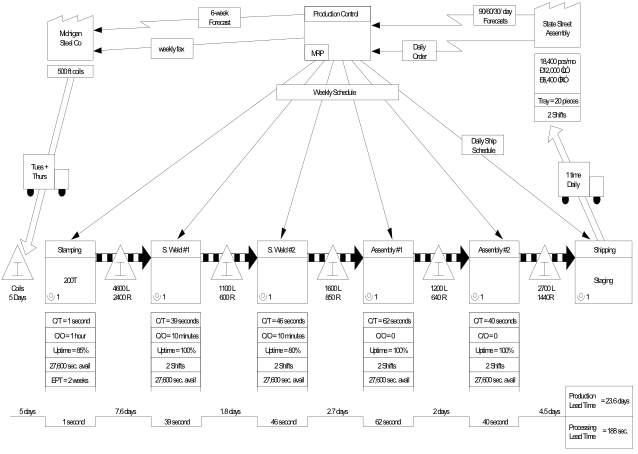
We can define value as anything the customer is prepared to pay for. If there is no paying customer, then this can be redefined as anything that increases the form or function of a product or service. A Value Stream is the series of events that take a product or service from its beginning through to the customer, and the value stream map is a diagrammatic representation of that series of events showing the main physical features.

The reason for the current interest is that most organisations recognise the importance of customers, and delivering value, and recognise that they need to understand how they do this.

The reason why little is done is because practitioners don’t realize that the value stream map is primarily a method for communicating current and potentially improved process performance, and don’t understand the steps involved in creating a clear and simple representation of the value stream.

A value stream map is defined in Wikipedia as “a lean-management method for analysing the current state and designing a future state for the series of events that take a product or service from its beginning through to the customer”. This definition gives us a clue about the purpose of VSM, the definition of the future state is the crucial aspect. The Value Stream Map is a means to an end, its purpose is to help create a more efficient and effective organisation.

Stephen Covey, in The 7 habits of highly effective people, quotes habit 2 as “begin with the end in mind”. We should adopt the same approach with Value Stream Mapping, before starting, decide why we are doing it, who the map will be shown to and how to present it in a way that can be easily understood. VSM is different to process mapping, process mapping is about understanding a process at a detailed level. Value Stream Mapping is about understanding a Value Stream at a high level to uncover opportunities for improvement.

Value Stream Mapping also links material and information flow and includes critical process data to make waste visible and summarizes actual lead times and process times. It is also a great way to establish a common language amongst those with an interest in understanding the value stream. The most important reason for using it is it exposes opportunities for waste elimination and variation reduction events and projects.

Having established why we should carry out Value Stream Mapping, who it is for and its true purpose, what are the steps involved to make sure it is a useful activity and leads to improvement?

In our view there are eight key steps to build an effective Value Stream Map:

  1. Select and scope the value stream
  2. Identify the major process steps
  3. Collect customer data
  4. Collect process performance data
  5. Update the VSM with the process data
  6. Record stock information
  7. Show information and material flow
  8. Calculate lead and process times and PCE and finalise the map

Original Post

18 Feb 21:20

5 Clever Uses of LinkedIn for Unique Customer Experiences

by Jessica Gioglio

5 Clever Uses of LinkedIn for Unique Customer Experiences

In a time where consumer attention is the ultimate commodity, maximizing each social media channel to create memorable experiences has become a powerful strategy. While many companies are turning to Facebook, Twitter, Instagram, and Snapchat, don’t discount what’s possible on LinkedIn. Take inspiration from these five companies that have gone beyond content and company pages to craft unique experiences for their customers.

1. Connect with KFC’s Founder

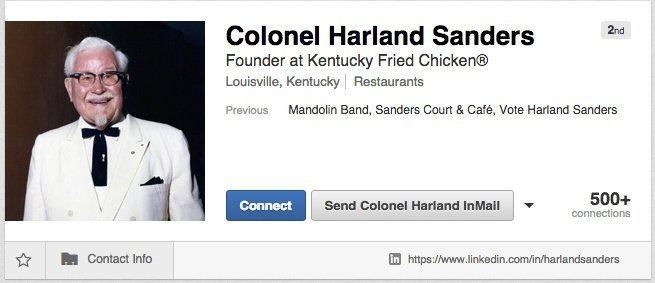
KFC’s founder Colonel Harland Sanders may have been born in 1890, but that hasn’t stopped him from embracing modern technology to create a robust LinkedIn profile. Developed as the company introduced his new redesign, the Colonel’s LinkedIn summary tells his story in a humorous way—he admits to doing “a whole mess of jobs poorly” up until age 65, when he “finally found the thing I could do better than anyone in the world: cook fried chicken.” The profile includes descriptions of all the jobs the Colonel has held in his impressive 115+ year career, including “Goat-milker,” “Student of the Law,” and “Band Leader.”

KFC on LinkedIn

What’s unique about this effort is that it’s hard to find any notable brand personalities or mascots on the platform. KFC’s founder is a core part of the company’s brand persona and marketing efforts, and LinkedIn offers a unique opportunity to connect with fans of the brand and tell the story of his background and accomplishments, even if it’s in a humorous way. And who knows—if the Colonel accepts your invitation to connect, maybe he will send back a message with career advice or an endorsement.

2. Apply for a Travel Enthusiast’s “Dream Job” With Virgin Atlantic

To promote its Premium Economy amenities, Virgin Atlantic took to LinkedIn to post what could quite possibly be a dream job as a Freelance Flyer. To apply, applicants were asked to submit 1,500 words or less via LinkedIn on why they deserved to be the company’s Freelance Flyer. The prize? On a weekly basis, one traveler would win round-trip transportation from their city of origin to London, England to pursue their personal or professional goals.

Virgin Atlantic Freelance Flyer

Other companies who might be able to offer a similar “dream job” could adopt this strategy as a way to shine a spotlight on their unique jobs or corporate culture. Whether it’s a Willy Wonka “golden ticket” experience at a food brand or a chance to shadow a company executive for the day to gain stronger management experience, both B2B and B2C companies have unique roles and cultures worth highlighting.

3. Score the Ultimate Endorsement Courtesy of 20th Century Fox

Endorsements are an important part of the LinkedIn profile, but how many professionals can boast one from celebrity Liam Neeson? To promote Taken 3, 20th Century Fox took to LinkedIn to offer professionals a chance to get a personalized video endorsement from the man himself. For those not familiar with the movie, the inspiration for this comes from the first Taken movie, when Liam’s character Brian Mills boasts about his “particular set of skills” to his daughter’s kidnappers.

As the video shares, fans had to visit the dedicated Taken 3 LinkedIn page (no longer active) to submit their special skills and enter for a chance to win. How did the end result turn out? Three words: Best. Endorsement. Ever.

4. Enable Professionals to Showcase What Makes Them Special

In celebration of reaching 300,000 followers on LinkedIn, L’Oréal took a unique approach to activating its community with a new “Are You IN?” campaign. With the goal of positioning L’Oréal as a top place to work, the company created a visual way for its community to share an “IN word” and “IN moment” that best describes themselves across Facebook, Twitter, and LinkedIn. The ten best IN moments were shared on the L’Oréal company page at the end of the campaign.

L'Oreal LinkedIn campaign

L'Oreal LinkedIn campaign

To participate, professionals were invited to visit a dedicated microsite, where they could sync their LinkedIn profile and select from 12 pre-populated IN word examples are listed, from “inspiring” to “international” to “intense.” Participants could then add a reason why they selected that word, and a visual would be created with the word and their LinkedIn profile photo.

In addition to providing L’Oréal with more information on would-be jobseekers and professionals that admire the company, the snackable visuals offered a nice personal branding opportunity for participants. It’s a great example of how co-creating content with your community on LinkedIn can help spread company values further. (highlight to tweet)

5. Celebrate New Jobs in an Unexpected Way

Starting a new job is an exciting time for most. To celebrate the “fresh starts” of professionals on LinkedIn, Fruit of the Loom launched the Fresh Gigs campaign, where the company reached out to 25,000 people who changed jobs or gained new employment within a 30-day time window to offer them—you guessed it—a complementary pair of underwear.

According to Fruit of the Loom, the inspiration from the campaign comes from the sentiment that “a great-fitting underwear can help you start your workday in a great mood.” Outreach for the campaign happened via LinkedIn messages (5,000 per week for five weeks), where the company asked recipients for their address. Winners received the free underwear plus a $5 coupon off a subsequent multipack purchase in the mail.

Fruit of the Loom LinkedIn campaign

The campaign offers a great reminder that personalized surprise and delight campaigns have a place on LinkedIn, provided that they are relevant and add value. While a free pair of underwear via a LinkedIn direct message errs on the side of quirky, aligning with a new job is clever, offering the company a chance to leave a lasting impression with current or new customers. Plus, the personalized touch of direct messages supports a clever re-branding attempt by the company and a chance to get feedback from professionals in real time.

With so many clever opportunities to engage, your brand can’t afford to overlook LinkedIn as a potential channel for memorable customer experiences.

Get more content like this, plus the very BEST marketing education, totally free. Get our Definitive email newsletter.

       
18 Feb 21:15

These are the stocks that do well when the loonie is low

by Bryan Borzykowski
Snowboarders surveying the view at Whistler Blackcomb.

Whistler Blackcomb Holdings Inc. is one travel and recreation-based stock poised to do well from a lower loonie. (Mike Powell/Getty)

Ruined vacation plans, higher cauliflower costs, egregious gas prices—the collapse of the Canadian dollar is taking a toll on consumers. But while we may have to shell out more for imported goods, there is a way to profit off our nosediving currency: Own stock in companies that get paid in American dollars.

The Canuck buck’s 14% plunge over the past 12 months has made every U.S. dollar of revenue that much more valuable. And most experts think the loonie will stay low for the foreseeable future, due to depressed oil prices and the country’s deteriorating terms of trade. In January, Macquarie Group analyst David Doyle predicted it would fall to 59¢ (U.S.) by the end of the year.

With the dollar now at the lowest level it’s been in a decade, receipts in foreign currency are starting to translate into higher earnings, faster sales growth or both. For instance, CCL Industries Inc. (TSX: CCL-B), a Toronto-based packaging company that makes most of its sales outside Canada, saw its earnings per share rise 21¢ in the third quarter due to currency alone. Sales rose 18% year-over-year, nearly 11 points of which was attributable to the currency exchange. It made money off rises in the British pound, euro and Thai baht in addition to the greenback.

Three types of companies benefit most from a lower dollar, says Ryan Modesto, a managing partner with 5i Research in Toronto. The biggest beneficiary is the firm that generates revenues in American dollars but pays most of its expenses in Canadian ones, like CCL. Then there’s the company that sells something in Canadian dollars to U.S. consumers. That $1,000 skiing getaway in Whistler now costs just US$710, which is pretty attractive to travelling Americans. Finally, you have the company whose operations are primarily stateside, but its earnings are reported in loonies. This is the most precarious of the three, because the gain is due to accounting more than anything else. “It only benefits the company if the dollar continues to weaken,” Modesto says.

While the bottom line will grow in all three scenarios, the opportunity really lies in what a company does with the excess cash generated. These companies can increase dividends, buy back stock, reinvest by expanding their product offering or making an acquisition. “We are starting to see some nice dividend growth and acquisitions,” says Justin Flowerday, a portfolio manager with TD Asset Management. “Many still haven’t yet pulled the trigger.”

The obvious risk of playing the currency differential is that the exchange rate reverses and those big year-over-year earnings gains vanish. As with any investment, people should buy appropriately valued high-quality operations that have a history of earnings growth, says Flowerday. You may lose that currency benefit at some point, so you want the company’s fundamentals to be sound.

Examine the share of revenue that comes from foreign markets, how much of the expenses are in Canadian dollars and the growth in non-Canadian locations—now’s a good time to be building a stronger American customer base. And look beyond manufacturers to airlines, railways, retailers and hospitality firms.

The longer the loonie stays low, the better it is for these Canadian stocks. “Companies will really start to benefit in a year or two,” says Modesto. “They’ll have an enhanced ability to compete.”


Five Canadian Stocks with Low-Loonie Potential

RDM Corp. (TSX: RC)

This Waterloo, Ont., firm developed the technology that lets people cash a cheque using a smartphone. It partners with 31% of Fortune 100 companies and is growing in the small-to mid-size company space too.

Chart showing 12-month trailing stock performance for RDM Corp.

Stella Jones Inc. (TSX: SJ)

Based in St. Laurent, Que., Stella-Jones makes railway ties and utility poles, 82% of them southward-bound, says 5i Research’s Ryan Modesto.

Chart showing 12-month trailing stock performance for Stella-Jones Inc.

AirBoss of America Corp. (TSX: BOS)

This Newmarket, Ont., company makes rubber products for the auto, defence and resource sectors. About 70% of its sales are in U.S. dollars, but that will increase. It just bought a defence company in the States.

Chart showing 12-month trailing stock performance for AirBoss of America Corp.

CCL Industries Inc. (TSX: CCL.B)

The Toronto-based packaging firm generates most of its sales from countries with stronger-than-loonie currencies. In Q3, 56% of its revenue growth was forex related. It has a history of value creation, says Modesto.

Chart showing 12-month trailing stock performance for CCL Industries Inc.

Whistler Blackcomb Holdings Inc. (TSX: WB)

American visits to the largest ski resort in the Western Hemisphere peaked in 2003 but are coming back. Overall attendance was up 15% during the most recent fiscal year, despite subpar snow conditions.

Chart showing 12-month trailing stock performance for Whistler Blackcomb Holdings Inc.


MORE ABOUT INVESTING & THE LOONIE:

The post These are the stocks that do well when the loonie is low appeared first on Canadian Business - Your Source For Business News.

18 Feb 21:13

Step by Step Guide to Building Your Customer Success Strategy

by Brandon Hickie

Editor’s note: The following is an excerpt from OpenView’s eBook Building Your Customer Success Strategy.

In fewer than four years, David Sacks and Adam Pisoni were able to transform their business, Yammer, from a startup in the crowded collaboration space into a hyper-growth juggernaut that was acquired by Microsoft for $1.2 billion. Mike Grafham, former Head of Customer Success, attributes much of Yammer’s success and ability to differentiate itself in the market place to its customer-first business model and the customer success philosophy that guided the way the company was designed, organized, and driven from top to bottom.

Behind the scenes of Yammer’s dizzying ascent there were three core pillars that defined and enabled the operating philosophy, the business, and its success:

1. Customer-centric Vision and Mission

From day one, Yammer rallied its team behind a customer-centric vision and mission. Yammer’s mission was to help organizations become more responsive in their work by functioning like a network and making better use of the knowledge that people in their organization possessed. The team felt the modern workplace evolution had not kept pace with the needs of today’s professional teams. They believed that a social collaboration platform would fill gaps in workplace communication.

Hiring to this vision and the corresponding core values, they made sure that each person who came to work at the company was dedicated to bringing this vision to life by helping each customer communicate and collaborate more efficiently and effectively through the Yammer platform. The team they hired had a very specific and shared purpose against which to benchmark their actions and decisions.

2. Customer Outcome Focused KPI

To realize this vision, the organization knew it needed an engaging product that was capable of transforming how people work. Yammer’s management team went all in on this intention and focused on a single key guiding metric: product engagement. “Each member of our team cared deeply about whether customers were actually using Yammer and deriving value from it,” explains Grafham. “Engagement was a useful proxy for whether our customers were succeeding with the product.”

While many of their competitors focused on the traditional SaaS goal of acquiring customers, the Yammer team also applied efforts into helping customers achieve their goals. Product decisions were made through the lens of whether they would increase end user engagement with the product. This singular focus helped them drive utilization, which in turn could be translated into customers’ productivity and efficacy with the product. Ultimately, Yammer knew happy, successful customers would tell authentic and passionate stories about their experience with Yammer – stories that would influence future customers and accelerate acquisition.

Even more important to the sustainability and valuation of the business, Yammer’s successful, highly engaged customers were less likely to abandon the product and more likely to respond positively to up-sells and cross-sells. Because Yammer consistently delivered on the promise they’d made they saw high engagement, low churn, and strong customer expansion – the key indicators that made the company attractive on the M&A market. With a strategic vision and focused performance metrics in place, the last piece of the puzzle was to address how the team would infuse the strategy into day-to-day tasks.

3. Flexible and Easily Adapted Environment

Yammer created a collaborative, flexible environment and a dynamic organizational structure that enabled teams to evolve rapidly in whatever way was necessary to fulfill their mission and drive the vision forward. “The way we were organized meant that people were free to pursue the best course of action for our customers and for the business,” says Grafham. “We combined a clear, shared mission with a huge amount of individual and team autonomy to deliver on that mission.”

This autonomy allowed the organization to evolve rapidly – learning from customer successes and failures – so it could consistently meet the needs of its customers even as it scaled.

This flexibility empowered the organization to proactively innovate on its organizational model and how it delivered on its customer success promises.

Ready to build your own customer success strategy? Download the eBook to learn more about Yammer’s processes and discover tips and tricks you can implement in your own business.

The post Step by Step Guide to Building Your Customer Success Strategy appeared first on OpenView Labs.

18 Feb 21:12

3 Crucial Steps For Activating New Clients

by Jenni Boyd

Acquiring new clients is an exciting and promising step for all businesses; how can you smoothly transition them into their new relationship with your company?

client_activation.jpg

To create a long lasting and successful relationship with new clients, a comprehensive client activation process must be in place.

What should be included in this client activation plan? Check out our three biggest recommendations below.

Complete Client Onboarding

The first step to activating a new client is to complete the client onboarding process. Onboarding is the process of getting clients and your team up to speed so you can work together efficiently and effectively.

If you don’t have a client onboarding process, now is the time to implement one. If you do have a process already in place, this is a great time to review it.

There are several steps to include in a successful onboarding process.

  • Assess the client’s needs: it is imperative to understand your client’s needs to know how your business can best help them. Sending the client a questionnaire is a simple way to learn more about their specific needs.
  • Determine your best employees for the account: matching the right employees to the account helps create a better experience for your client. Assign an employee with experience in the client’s industry or a similar personal interest to the account. This is an instant way to create a connection between your business and the client.
  • Brief your team on the new client: it is crucial for your team to be familiar with a client to give them the best customer experience possible. Plan a briefing session with employees who will be working on the new account. Use this time to cover essential information about the client and the services your business will be providing to them.
  • Plan a kickoff call: a kickoff call is a great way to make sure you and the client are on the same page about client needs and the services you are providing them. It is also a good time to introduce the client to your team, and for your team to show their expertise.

Continue to Provide Value

Another way to continue activating new clients is by providing added value. Added value is giving the customer products or services in addition to what they have purchased. These products and services do not have to be a major expense to your company to make a big impact on your clients.

There are several easy ways to add value to your service for your customers.

  • Training and educational tools: providing your clients with materials to learn more about how your services or products can best benefit them is a great way to add value. Your clients feel that you are a trusted source for information, and they may realize that they are not taking advantage of all the services you offer that could assist them.
  • Client feedback: gathering client feedback is valuable to both your business and your clients. Using forms or questionnaires to collect suggestions and praise provides your business with useful information and gives your clients a way to voice concerns. Using this information, your business can make adjustments to better serve existing and future clients.
  • Frequent buyer programs: implementing a frequent buyer program rewards clients for their purchases with your company. You can offer discounts or free services after clients have spent a certain amount, or used your services a certain number of times. Not only does the client get added value, it encourages clients to spend more with your business.
  • Bundling/packaging: creating bundles of your services or products that offer a slight discount can give add value to your clients’ experience with your business. It is also a great way to motivate clients to purchase a higher tier of service or products.

The Sale Doesn’t End There

Once you have finished onboarding and have provided added value for your new clients, you have finished the activation process. However, the sale doesn’t end there.

Retaining clients is important to any business, and there are several things you can do to keep clients coming back for more.

  • Set expectations: let the client know upfront what they can and cannot expect from you, within reason. This can include timeframes to expect deliverables, how much of a lead time you need from the client, the best way to communicate with each other. Setting expectations at the beginning of the relationship puts both client and you on the same page and sets the relationship up for success.
  • Create a real relationship: clients want to feel important to your company, and one way to create this feeling is by having a real relationship with the client. Try not to make them feel rushed during phone, email, or in-person conversations, listen carefully, and deliver on your end. If you have shared personal interests, you can use them to connect with the client.
  • Go above and beyond: delivering beyond what the client is expecting is a great way to increase loyalty. This could be anything from getting deliverables to them early to offering a surprise discount. The key to this is to over deliver – not over promise. Do not make promises to your clients that you know you can’t keep.
  • Anticipatory service: a new take on customer service is anticipatory service. This just means anticipating and solving problems before they become an issue. One simple way to do this is to call the client just to check in and make sure they are having a good customer experience. You can also send an email reminding them of their upcoming needs of your services or products.

With proper onboarding, added value, and retention techniques in place, your business will be positioned to have long lasting and successful relationships with all of your clients.


18 Feb 21:09

4 Ways Social Media Has Given Women an Edge in Sales

4 Ways Social Media Has Given Women an Edge in Sales 

By Jill Rowley


If you asked just about anyone what image they conjure up when they think about a sales person it would likely be the cheesy, sleazy, and slimy used car sales guy. And while that may have been a fitting image in years past, women are softening that image and turning sales into something different.


The great thing about the sales profession and one of the reasons why I’ve been able to be so successful as a woman in the industry is that success is measured on the number, not the gender. Every person is measured on performance. That doesn’t mean that gender never plays a role, but in the end it always comes down to the numbers.


In the past, I’ve talked about the four pillars of social selling and I’ve built my career in tech sales by focusing on how I can use social media to be more successful. What is interesting about those pillars is that they also happen to be things that either provide an edge to women in the industry or that women are particularly skilled at.


Establishing a Digital Presence 


Now that social media has ushered in the age of a digital presence, a successful salesperson has to build a presence the right way. Women have an edge in this area, showing they can successfully leverage social media as a channel to demonstrate how they help customers solve their business problems and achieve their goals as opposed to pure self-promotion. Why is this important? Because everyone is looking each other up online all the time. Let’s say the CIO at a Fortune 500 has received a meeting invite from the vice president of IT to join a meeting with a sales person at a vendor. That CIO goes to LinkedIn, searches for the sales person and decides if it’s worth the time. That sales person’s digital presence shouldn’t be a resume. It needs to be optimized for the buyer, and focused on how he or she can improve the business outcomes of the customer.


Social selling is about framing everything through the lens of the buyer and how you can help them. Your digital presence is an extension of yourself and social media is a useful tool to increase success. For example, Speakeasy, a conference calling solution that I am an advisor for, allows you to see social profiles of those on the call so you can tailor conversations and bring up relevant details to build rapport with them. At the risk of sounding stereotypical, most women are more comfortable putting the spotlight away from them and focusing on what is relevant and helpful to the buyer. This is simply an area where women shine.


Always Be Connecting


If the slimy sales guy is the typical image of the salesperson, his tagline is “ABC: always be closing.” In my world, ABC doesn’t stand for always be closing, it stands for always be connecting. These days, your social network IS your professional network. Thanks to the social web, my network now includes some extremely successful and influential people from all over the world. I am always actively building my network and having a strong digital presence that is focused on demonstrating my business acumen, my subject matter expertise and my ability and desire to help others allows me to do that successfully. This takes time, just like networking in person, however it’s time spent on my terms – I don’t even have to get dressed to do it. I can do it at home while my kids are sleeping.


While this may seem like a stereotype or generalization, data shows that women still spend a disproportionate amount of hours on tasks at home (childcare and housework) compared to their male partners. Because of this, they may have less time to go to networking or social events or take on additional projects in the office that might get them exposure to other opportunities. Social media provides a way for women to bridge that gap, allowing them to “attend” an event via the hashtag while they’re at home or on the run. No matter where you are or what you’re doing, you can be building your personal brand, building your network and sharing valuable content.


Content is Currency


Some may say “content is king” but more than that, content is the currency of the modern sales professional. Just like numbers are numbers, there is no gender bias blocking a woman from finding great content that would be interesting to her buyers and sharing it on her digital platforms. And good content isn’t about how great her product is or awards won. Rather sharing content that is relevant to the buyer and their world can help you be more visible and relevant to that buyer and attracts customers to you. Buyers are inherently allergic to the slimy sales guy. No one wants to be pushed or oversold, but everyone wants help. Women are especially good at using social media to help others, usually by sharing useful content. My best mentors don’t even know they’re mentoring me because I’m learning from them on a daily basis simply because of what they put out in the social web.


Listening First


Whether or not a specific woman is this way, the perception has always been that women are generally better listeners – at work, in relationships, at home. They’re seen as more helpful and more genuine in their desire to put others’ needs ahead of their own. Social media has provided an incredible platform for women to be present with their customers and really make them feel like they are being heard. When someone tweets about a problem they’re having, a woman is more likely to start out by empathizing, learning more about the problem and providing information that may help the person find a solution. The best salespeople don’t sell, they help someone buy. Instead of jamming the sales process down someone’s throat and closing the deal just to close it, it’s more important to listen and figure out if who you’re talking to is a viable customer and a ready buyer. Listening on social media and using that information to better serve the customers is something women excel at. They can show they care, be believed, and thanks to social media they do it all without the typical barriers of time, home obligations and travel.


Buying has changed more in the past decade than in the past 100 years before and social media is a huge part of that. Tech advances, the influx of millennials in the workforce and the gradual rise of women in leadership are allowing sales organizations to adapt and evolve to suit the modern buyer. It’s no longer buyer beware, but seller beware and women have the ability to lead the charge.


Jill RowleyIf you have any social selling tips, suggestions or questions about how to better leverage women on sales teams, please message me on Twitter (@jill_rowley).


18 Feb 20:58

A Super Question You Should Use

by Tibor Shanto

By Tibor Shanto – tibor.shanto@sellbetter.ca 

In the past I had written about the fact that your sales process and the way you or your team execute that process is most likely the last real way of differentiating yourself from your competition. I think by now we can all agree that product is rarely the deciding factor; and when it is, it is usually driven by price, regardless of what marketing is smoking. With all due respect and deference to product designers, engineers, marketing and branding folks, when you look at it in the cold light of day, there is not that much difference in the top two products in most categories. What many will tout as being different, is more subjective than data or fact based. With 85% – 90% feature overlap, one may be able to spin the benefits a bit, but if products could sell themselves, I’d be writing a different blog. As with beauty or value (or some tell me), difference is often in the eye of the beholder.

So what can you do to sound or be different when selling. There is a whole bunch of things, but I think the easiest lies in the questions you ask. And among the many questions you can and should ask, there is one I like because it is easy to answer, sets you apart from many, you will learn a whole bunch of useful things, and despite its high octane, it has no risk, all upside.

What’s the question you ask? (Sorry I just had to) Here it is:

“What is the one thing you have always wanted from a supplier like me (us), but have never had anyone do, or deliver?

Many I present this question to are first taken aback. They say, “what if they come up with something we can’t do or deliver?” There is only one answer to that: who cares?

By definition they have not gotten this from anyone, just look at the question. The fact that you can’t do it, does not put you in a bad light. Let’s go to extremes, say they want to go to Mars, first class with kosher meals, no one can do that, so there is no downside.

In a more conventional setting, say they come up with something you can’t do, you don’t look any worse than the others, but there is upside. You can explore why they are looking for that specific thing. That will give you great insight about the buyer, and more importantly their objectives. In most cases you get bonus points for trying.

By understanding what they are trying to achieve, you may be able to offer an alternative means of achieving the very thing, but in a different way. Most buyers are focused on achieving their objectives, few will get hung up on the means, if you get them there, you get the glory.

What you’ll also find is that at times you can in fact deliver what they respond with, or something so close, it will satisfy the requirement. In this case asking the question has nothing but upside, you win the deal, the client, and referrals to follow. Those referrals are likely to focus more on how you sold them and met their expectations than product.

There is no safer question in sales. All upside, no downside. Try it, it’s a gas.

Become one of the thousands of sales professionals receiving my latest updates on sales execution, tools, tips and more.   

Join Now!

18 Feb 20:57

Enough! You’re Not A Fucking Entrepreneur

by Keenan

I’ve gotta get this shit of my chest.

I fuckin’ love all the opportunity that is out there today. It has NEVER been a better time to start a business, to go out on your own, to pave your own path.  Never!

But to the majority of you running around calling yourself an entrepreneur, while you have a full-time job, collecting a paycheck from someone else, stop! You’re not.

Anyone can start a business in seconds. They can throw up a website. They can create a Twitter account. They can open up an eBay store. The can sell shit on Etsy. Anyone can call themselves an expert, a thought leader, a kingpin or a badass and start selling something.

But just because you have business cards, or slick website, or 1,00,000 Twitter followers, a million Periscope fans, or a savage Instagram account, it doesn’t make you an entrepreneur.

You’re an entrepreneur when your company is your job. When the only way you feed your family is when your company says you can. You’re an entrepreneur when the only time you go on vacation, is when your company says you can. You’re an entrepreneur when the only time you buy a new car, a new couch, a new house, go to a badass, kickass, dry aged steak dinner with a ’75 Chateau Lafite Rothschild is when YOUR COMPANY says you can.

Then and only then are you an entrepreneur.

In today’s world, everyone has a side gig. It’s easy to sell something to someone today. It’s easy to make money. The Internet has virtually removed all barriers to starting a business and it’s fucking awesome.

But the truth is just ’cause you can make a few hundred or even a few thousand bucks a month selling something, it doesn’t make you an entrepreneur — it’s a hobby.

An entrepreneur is in full tilt. An entrepreneur has bet everything on their company. They are all in. There is no safety net of a full-time job. If you have a full-time job, you’re not all in.  You’re not 100% committed to the business.  It’s a hobby or your dabbling.

Until you’ve felt the fear of missing your mortgage, you’re not an entrepreneur.  Until you’ve walked to the mailbox 4 times a day desperate for a check to come or you miss payroll, you’re not an entrepreneur. Until you’ve not been able to go grocery shopping, buy a new shirt, or had to skip a haircut, cause you couldn’t afford to spend the money, you’re not an entrepreneur.  Until you’ve woken up in the middle of the night in a cold sweat terrified your biggest client is about to switch, you’re not an entrepreneur. If you go to work every day for someone else and collect a paycheck. You’re not an entrepreneur.

With this said, there are two types of entrepreneurs, successful ones, and failures. Being an entrepreneur is hard enough, but being a successful one, that’s an entirely different discussion.

Guess who gets to decide if you’re a successful entrepreneur or not?  The market – not you! And this is why 99% of most people are not entrepreneurs or are failed entrepreneurs and don’t quit their real job. It’s fuckin’ hard.

When you’re at home working on your business, in between and after your full-time job, that’s the market telling you that your business doesn’t offer enough value to enough people. It’s the market saying to you,  hey not enough people (buyers) give a shit about your product, your service, your whatever so don’t quit your full-time job. That’s a real voice you need to listen to. If your offering provided enough value, and enough people knew about it, you wouldn’t have to work for the man. But, you do, because it doesn’t and you’ve yet to change that.

The market crowns successful entrepreneurs. Successful entrepreneurs don’t crown themselves.

Now before you go get your panties in a wad, I’m not saying those that are successful didn’t do it themselves. You bet your ass they did, but what they did was get the market to see the value in what they had to offer in a manner that got us to spend tons of money. And they didn’t do that working on it “part-time.”

You can’t win over a market workin’ for someone else and doing your thing on the “side.” You just can’t, eventually you have to jump in, all in,  or it’s just a hobby.

Now that I’ve got most of you all worked up because I called your part-time hustle a hobby, take a deep fuckin’ breath.

You’re a good person. You hustle. You’ve got grit. You grind it out. You are worthy . . . you’re just not an entrepreneur.

You’re an entrebetweener (entre-between-er): Someone who has started a business but still works for someone else full-time collecting a paycheck.

If you’re an entrebetweener be proud, but have a goal, have a launching point, know when you are going to jump and commit your entire being to your business. In many ways, that should be more important than actually running the business. ‘Cause if you don’t pick a date, a moment, a milestone to go all in, you never will.

Reasons NOT to take risks are a lot easier to come buy than to take them

Not Taught, Chapter 5 Have the Balls to Make it Happen

To all those huslin’, grinding, passionate, entrebetweeners I salute you. But please, stop calling yourself an entrepreneur — ’cause you’re not!

18 Feb 20:49

43 Questions to Create a Sense of Urgency

by dtyre@hubspot.com (Dan Tyre)

Create a Sense of Urgency in Sales

If you don’t want your deals to stall -- or end up in nothing -- make sure to establish urgency. Urgency gives your prospects a reason to move forward and overcome inertia. Help them understand why every day, week, or month without your product hurts their business so they’re compelled to act as soon as possible.

Your product could be a great fit for your prospect. It's within their budget, you've offered them the perfect discount -- it should be a slam dunk. But unless they feel a sense of urgency, your prospect won't buy.

So, you should create some. Right?

Wrong. Sales strategist David Weinhaus, who works with HubSpot partner agencies, has a strong view on “creating” urgency.

Instead of manufacturing a cause to act -- which isn’t helpful to your prospect and will ultimately backfire -- either uncover an existing reason they’re not aware of or back off.

Ask the right questions -- like the ones below -- and get your prospect to realize they’re unhappy or dissatisfied. And if your questions don’t lead them to those conclusions, accept they’re still in education mode and let your marketing department nurture them until the time is right.

How to Create Urgency in Sales

Ask about their business

1) "How big is the company today in terms of annual revenue, approximate customer number, and employee headcount?"

This question helps you qualify them and start a discussion about how big they’d like to be in the future (and what’s currently standing in the way).

2) "Is the business struggling, in a steady state, or in growth mode? Is [company] growing faster than the industry average?"

Remind the buyer of their overarching business goals. This is a good tie-in to how your product would play into their strategy.

3) "Many of the people in your role I talk to don’t know [surprising fact]. Did you?"

I like the Challenger Sale method of teaching your prospect something new -- not only will your credibility and authority go up, but you’ll naturally uncover urgency. The buyer will want to act on this information ASAP.

Ask about their pain points

4) "What is the problem you’re looking to solve?"

The buyer might be focused on a different pain point than you. Use this question to figure out if they’re on the right track. Sometimes, prospects try to address the symptoms rather than the cause by mistake.

5) "Why is now the right time to solve it?"

Asking why now is the right to solve this issue gives you an early glimpse into how much urgency your prospect already has. If it's not yet an urgent problem, you might lead them to realizing it is.

6) "Who or what is this problem affecting most?"

It might be their boss, themselves, or the company, but asking this question allows them to consider the human or business costs of not addressing this issue quickly. 

7) "Is the problem clearly defined?"

Learn how much time they’ve spent investigating the issue. Hint: The more clearly they’ve isolated it, the more invested they probably are in fixing it.

8) "Have you had this problem before?"

Figure out just how persistent your prospect’s pain point is.

9) "Is the problem easy or hard to address?"

Chances are, the prospect will say it’s the latter. If it was easy to solve, they would have tackled it by now.

10) "How does this problem affect the revenue, profitability, culture, or product cycle of the business?"

This question highlights the larger implications of what’s going wrong.

11) "Does this problem affect a lot of people?"

Get your prospect thinking about how widespread the effects are.

12) "Are you tasked with solving this problem as part of your regular job, or is this a special assignment?"

If your prospect says, “It’s part of my job,” then make sure you tie their overall performance to fixing this issue. If they say, “It’s a special assignment,” then there’s already genuine urgency: They need to identify an answer before a certain date.

Ask about the consequences of not buying

13) "What happens if you address the problem? What happens if you don’t?"

This naturally leads the buyer to compare life with your product and life without. The second is usually much less appealing.

14) "When do you need to start seeing the results of implementing the solution?"

The prospect would probably love to see results right away. Their answer will help them realize why time is of the essence.

15) "What is the one thing that, if we could help solve it quickly, would have the most meaningful impact on the company?"

Once you’ve pinpointed a major opportunity to help, urgency will spring up naturally.

16) "How would solving this problem affect you personally?"

Knowing the buyer’s individual motivators can make or break the deal.

17) "How does this affect your boss?"

When the prospect’s boss is happy, they’re happy. Connect the dots between your solution and their supervisor.

18) "What happens if you keep doing what you are doing?"

It’s far easier to stick with the status quo than make a change, even if the long-term ramifications could sink the prospect’s business. With this question, you’ll get them to come to terms with the dangers of ignoring the issue.

Ask about how the problem affects them 

19) "How can we make you look like a star?"

This question turns you into the prospect’s partner, instead of just their rep. It also helps you pinpoint how your product can help them look great at the office.

20) "What do you need to do/what objectives must you reach to get a promotion?"

Along similar lines as #17, this question reveals why the buyer is personally invested in finding a solution.

21) "How does this problem affect you on a day-to-day basis?"

Most professionals put up with annoying or deleterious pain points. As soon as you show the prospect there’s a better, easier way, they’ll be more eager to buy.

22) "How does this problem affect [department]?"

Get them to zoom out and visualize the impact on the wider team.

23) "If you weren’t experiencing this pain anymore, which projects/priorities could you focus on?"

This question makes the buyer envision a world where they have time, energy, and resources for the tasks or initiatives they’re interested in.

24) "What’s the most frustrating aspect of this problem?"

Once you learn what’s driving your prospect up the wall, you can position your product accordingly.

25) "What [projects, campaigns, initiatives] are you currently working on? How does [challenge] impact your plans?"

This is another way of learning how the pain point is interfering with or obstructing their day-to-day work.

26) "What problems come up most frequently at executive meetings?"

If the CEO cares about an issue, your prospect will too.

27) "Which problems keep you at the office late?"

Figure out which issues the buyer doesn’t have an easy answer to.

28) "Which themes are coming up again and again on [Slack, Hipchat, your knowledge base/wiki]?"

While not every company uses internal knowledge base or a wiki, asking those who do about the most common themes can help you pinpoint the most exciting, visible, or challenging things they’re facing.

Ask about the competition

29) "Is your industry getting more competitive?"

Most industries are. Capitalize on your prospect’s awareness that they need to act to maintain their edge -- or gain one in the first place.

30) "Are you worried about [specific competitor]?"

Figure out who’s nipping at your prospect’s heels, then show them how your solution will widen the gap in their favor.

31) "Do you ever get the sense that [people in prospect’s department] are wasting [time, effort, leads, budget]?"

Mitigating (or even eliminating) the inefficiencies in the buyer’s department would be a huge win. Open their eyes to the possibility of a fix.

32) "Have you ever lost a major customer unexpectedly?"

Whether the answer is yes or no, this question works. If your prospect has, they’ll be eager to take precautions so it doesn’t happen again. If your prospect hasn’t, the wheels will start turning: Wow, it would be really bad if 20% of our business vanished in one stroke.

33) "How [did, would] losing that customer affect the business?"

Get the buyer to vocalize the negative effects, which will drive their desire to avoid the catastrophe even higher.

34) "How do you avoid getting caught in a pricing war?"

Chances are, your prospect would love to find a differentiator that would save them from race-to-the-bottom pricing. You just need to explain why your product is that differentiator.

35) "Are your customers asking for [feature/service] you don't have?"

If their customers are asking for something your prospect's business can't currently offer, that's asking for a competitor to fill a gap. If you can get your prospect thinking about what they don't have and how you can help them get it -- that's a good way to inspire urgency.

Ask about next steps

36) "Would you be interested in talking to [Customer], who saw a [X%] return on our [solution, service]?"

Hearing from someone who got fantastic results will spur your prospect to the finish line.

37) "Maybe it would be helpful for you to talk to someone who’s [made this journey recently, faced X similar challenge, resolved the same issue]. What do you think?"

If it’s too early in the sales process for references, suggest a knowledge-sharing conversation instead. You’re still connecting the buyer with a satisfied customer -- but their shared experiences are the focus, not your product.

The nice thing about this technique? Not only is it helpful for the prospect and your customer, but at some point during the conversation they’re bound to bring up your solution.

38) "If we supply all the information you need in the next 24 hours, will you have time to review it and get started by [date in the near future]?"

Test your prospect’s commitment to act with this question. If they say they’re not ready, don’t be pushy -- instead, ask what else they’d need to make a decision.

39) "If I send over the contract when we hang up, can you return it to me in [six days from the current date]?"

Sales consultant Jeff Hoffman encourages reps to close this way. Normally, the buyer says they’ll need more time -- at which point you say, “Okay, can you do [preliminary step] by that date?” They’ll say yes, and now you’ve gotten a concrete agreement to make progress on the deal within the week. Boom.

(Adjust the date based on your sales cycle. If it usually lasts two weeks, ask if they can sign the proposal that day. If it lasts 10 to 12 months, ask if they can sign the proposal in three weeks.)

40) "Define your timeline for solving the problem and getting the right results."

Make sure your prospect’s expectations align with reality. You may need to accelerate the sales process to meet their timeline.

41) "When must this problem be solved to avoid negative impact on the business?"

Get a firm deadline for the purchase. Explain to the prospect you should shoot for a few weeks or months before this deadline to protect against delays.

42) "Is there seasonality in your business? Do you have a busy or slow season? Do you need to address this problem before the busy or slow season hits?"

For prospects affected by seasonality (like education, tourism, and entertainment), it can be critical to get a solution in place while business is relatively quieter.

43) "If we can work out a solution sooner, how does that help you?"

Fixing a problem earlier rather than later is almost always a good thing. The best part about this question is that the buyer puts those benefits in their own words.

HubSpot Free Sales Training

18 Feb 20:49

7 Ways to Become the CEO of Your Territory

by Chris Gillespie
iStock_000068515289

Author: Chris Gillespie

When your sales management team gathers to talk about their salespeople, they’re going to discuss two types: problems and stars. The problems get that way from being unreliable or unteachable. They’re viewed as a liability and management talks about mitigating their risks. The stars, on the other hand, are lauded with praise because they’re just the opposite: effective and reliable. They’re the people who don’t have to be micromanaged and take the weight off of their managers’ minds. These are the people who are given added responsibility, and entrusted with the larger deals and better territories. As a salesperson, you certainly want to fall into the star category, but how do you do it?

You can achieve this by thinking of yourself as CEO of your own territory. At its simplest, this is about taking responsibility, being consistent, and getting the job done.

What’s it like to be the CEO?

Being the CEO of a company means that the buck stops with you. With the exception of the board, you’re at the top of the food chain and that means that you’re expected to provide answers for everything. Just as employees are responsible to you, you are doubly responsible to them. Everyone’s problems are your problems. A good CEO acknowledges and takes responsibility for this, and thinks about developing everyone around him or her so that everything runs smoothly. And you know not to cut corners because, ultimately, you’re only cutting corners on your future success.

Being CEO of your territory means finding a way to achieve your sales number no matter what. It means closing good deals and setting proper post-sale expectations. Do all of this correctly and you’re going to get deals done faster, enjoy work more, and get assigned better territories.

Interested in getting started? Here are seven ways to become the CEO of your territory: 

1. Manage your perception

In the workplace, perception is everything. Every sales leader is wary of the maverick, lone-wolf salesperson who is brilliant but intolerable. They’d much rather to reward a consistent rep whose heart is in the right place. Good perception also means showing up on time, and this is easy to foster by just being early for a few consecutive months. I did this in my first role on accident, for commute reasons, and found that two years later I was still the exemplar of punctuality on the team despite no longer showing up early.

Perception among peers is equally important, so don’t sit in your ivory tower. If you’re committed to your team’s success, you need to let them know that. Early on, this will mean going out of your way to be friendly and receptive, even when you’re stressed. I’ve always found that this is best achieved by practicing a little radical honesty in which you are, like the term implies, just totally upfront about what you’re thinking and how your deals are progressing. Have zero reservations about being blunt with people, while of course keeping a positive spin on things. Share what you’re working on, what’s not going well, and invite help and advice. When you’re open, others will be open, and you’ll maintain a positive perception.

2. Be consistent

Take your time to do good work. Work smart, but be thorough where it counts and don’t forget to leave notes on accounts, pass leads that aren’t yours to the right reps, and develop good relationships and alignment with marketing, sales operations, finance, and legal. Forecast realistically and do work that you’re proud of. Do this consistently, and people everywhere throughout the organization will realize that they can rely on you. There’s no ‘ah-ha’ moment for management, but rather a gradual realization that they never have to fix your mistakes, which puts you in a good position to take on added responsibility.

3. Have a “get the job done” mentality

As entrepreneur and motivational speaker Jim Rohn famously said, “If you truly want something, you’ll find a way. If not, you’ll find an excuse.” As the CEO, you can either find a way or you can fail. This means showing up at people’s doorsteps with a contract on the last day of the month and not leaving until they talk to you. This means staying at work until 9pm on a Friday because a client is willing to sign a deal before the weekend. It means sending breakfast sandwiches and coffee to a prospect that has assembled their team to discuss your product and paying out of pocket. CEOs get the job done, no matter what, and they never find themselves scratching for an excuse.

4. Take responsibility

This is by far the most important one. And it isn’t a one-time act, but an ongoing mindset. Everything that happens in your territory is your responsibility. It might seem counterintuitive at first to apologize on your colleague’s behalf for his/her mistake, after all, won’t it tarnish your stellar record? But just the opposite, this will actually enhance your perception. Mature individuals take responsibility while immature ones make excuses. When you do this, you’re broadcasting to management, “I’m in control here, and you can trust me to keep this from happening again.” You’re handling their job for them and they’ll love you for it. The same is true for admitting to mistakes that you’ve made: skip the blame game. Admit to it, fix it, and move on.

This also means not bringing your boss in on every deal cycle. Many reps get in a bad habit of deferring to authority and instinctively telling clients “You’ll need to speak to my boss about that.” And what is the client to think? What they hear is, “I’m not the right person to be dealing with, and I have no authority here.” They’ll start to walk all over you. Know your worth, and make it clear that you’re the person that they need to deal with. Being assertive here will help you avoid bringing more people into the conversation, and you’ll close more deals and faster.

5. Delegate things

This is much ballyhooed and rarely done correctly. While assigning tasks is easy, trusting people to accomplish them is devilishly difficult. It’s only through delegation that you can actually let go of things. Many of us in sales can be hard-charging, and we find this difficult as we expect perfection. Ever had a peer fumble for words on the phone and felt compelled to chime in and save them? Think twice about doing this because you’d actually be doing them a disservice by depriving them of the feedback that they need to learn how to operate on their own. Lessons, especially painful ones, are the only way people can get better. If you protect them from ever making a mistake, they will have no idea how to take care of themselves and recover from one when it happens. Be a CEO here and when you delegate, trust people enough to let them make mistakes. Master this technique and you’re well on your way to reducing your workload and not secretly increasing it by having to micromanage everyone.

6. Trust yourself

Let’s say that you’re faced with a client situation that’s new to you. Do you run to your boss or a colleague and ask what to do? First, pause and ask yourself, if it were up to you, what would you say? What would a CEO say in your position? Oh right, you are the CEO. Nine times out of ten, the answer you come up with is the right one and you’ll train yourself have good answers. Over the course of several months you’re going to shift from being the person that asks questions to the person that answers them, and you’re going to increase your confidence working with clients. Not having to hunt down the right people within your organization to ask them questions will steeply decrease the length of your deal cycles.

7. Care for your team

Part of being a CEO is being a social leader and being a resource for others to come to. A rising tide floats all boats and by sharing openly, both the good and the bad, you’ll set a precedent for everyone to share their tribal knowledge. Do this by providing encouragement and actively seek their input and advice on your deals. Take people out to coffee and lunch frequently and check-in just to see how they’re doing. And when everyone is called into an early meeting, be the one to bring donuts.

Being a CEO of your territory means that when management gathers at the end of the year to plan for the next one, your name is going to come up. With your track record of being the go-to person for questions, for consistently hitting your number, and for being in the office early and dressed the part, you’ll be in great standing. No one will be able to recall the last time they had to correct you on something, and you’re the star who’s going to be place in a position of greater responsibility and reward. And of course, most importantly, you’re setting yourself up for a great paycheck.

Are you owning your territory like a CEO? Share your tips below in the comments section!

mar-30


7 Ways to Become the CEO of Your Territory was posted at Marketo Marketing Blog - Best Practices and Thought Leadership. | http://blog.marketo.com

The post 7 Ways to Become the CEO of Your Territory appeared first on Marketo Marketing Blog - Best Practices and Thought Leadership.

18 Feb 20:48

To Measure Marketing Impact, You Must First Retire the MQL

by Alexis Getscher

In the traditional mindset, visitors come to your site, eventually take an action that turns them into MQLs, are then nurtured until they become SQLs and are passed to the sales team. But times have changed.

Sometimes “that’s how we’ve always done it” isn’t the best way moving forward. That thinking hinders growth and improvement. As new technologies are added and more companies are catching on to the benefits of sales and marketing alignment, it’s easier to track buyers and communicate with prospects through the entire journey.

That’s why we should do away with the MQL.

marketing impact, retire mql

Funnels are Divisive

Having a separate indicator for marketing (MQLs) and sales (SQLs) almost guarantees misalignment between the two departments.

When leads flow into the funnel they should not be qualified and then handed off to sales never to be thought of again by marketing. This creates an atmosphere where marketing is optimizing for a lead number and sales is receiving a bunch of leads who may not yet be ready to buy.

Which marketing pieces has the lead touched? What landing pages? What forms have they filled out? Are there prospect questions that can be answered through content? How can we better educate our audience?

When sales and marketing are involved throughout the entire buyer journey, they can work together to answer these questions. Ultimately, discovering what qualifies a lead as ‘ready to buy’ and what can be done to get them there.

There should be one funnel with sales and marketing involved in every stage of the process from first touch to closed deal. Cross communication ensures everything is being done to nurture the lead until it becomes a customer.

Marketing Should be Accountable to a Revenue Goal

MQLs are just a number. A vanity metric like social likes and page views. They devalue marketing’s role in the sales process.

A high number of MQLs sounds nice, but really, as a singular number they don’t do much for the business.

Hundreds of MQLs don’t mean anything unless those same hundreds go on to become closed customers. Cut the middle-man goals and make marketing responsible for a revenue number.

The focus should be on quality over quantity. Closed deals over lead numbers.

A marketer’s ultimate goal is to connect with prospects and turn them into customers. It only makes sense, then, to track their efforts back to revenue.

This is done through multi-touch attribution.

With attribution, you can easily see which channels and campaigns have a hand in creating the most customers. Varying in percentage by which attribution model you use (u-shaped, w-shaped, or custom) a portion of that closed deal will be attributed to the marketing touchpoints along the way.

This means that marketing can set revenue goals just like the sales team. And instead of focusing on MQLs, they can focus on closing deals.

With an entire company focused on customer acquisition, you’re sure to see business improvement.

telescope, marketing impact

Multiple Stakeholders Requires Better Targeting

Today’s buyer journey is complex, especially in the B2B space. Multiple stakeholders may research your product before the business is ready to buy, which means the individual doing the product research for a company may not be the same person who has the power to make the buying decisions.

For example, say prospects visit your site a few times, take a good look around and then never return. It may seem like you’re attracting a lot of MQLs who are never turning into opportunities and closed deals.

However, those visitors may only be a touchpoint in the greater company decision to purchase your product. Because of this, a more targeted approach is needed. That approach is account-based marketing (ABM).

If you’re spending all of your efforts targeting individuals, you’re leaving valuable information on the table.

What if that individual is only the researcher? After a certain point, spending time retargeting them with ads and phone calls is wasted effort. They may have already passed your company info onto their boss, who will review and then may pass on to another stakeholder at the company.

With ABM, you’d recognize this and begin targeting that next persona in the process.

Using historical attribution data, it’s possible to see the average number of people, at a given company, who research your product before a buying decision is made. You can also use the data to discover any correlation in personas who do the research.

Say you discover that most deals contain touchpoints from the CMO, CTO, Marketing Operations Manager and the CEO. Then, during your targeting process, you notice that the CMO and Ops Manager have researched your product, but you don’t have any touchpoints from the CTO or CEO.

This is where you would now focus your marketing and sales efforts.

As your business grows and deal sizes get larger, you know the type of company that’s your ideal customer. Don’t wait for them to come to you, flip the funnel and go after them. Be proactive instead of reactive.

Through use of marketing attribution and ABM, you’re able to target the right people, at the right time, in the right companies.

 Definitive Guide To Pipeline Marketing Everything you need to know to be a revenue-focused B2B marketer. Download Now

18 Feb 20:48

How to Boost Your Lead Generation With Cross Platform Marketing

by Eli Martin

How to Boost Your Lead Generation With Cross Platform Marketing

Today’s customers aren’t only smartphone or only desktop people; they’re multi-device people.

It’s not unusual for a customer to switch from desktop to smartphone to tablet, and back again, throughout the course of the day. Consequently, keeping them engaged long enough to turn into leads can be challenging, which is why traditional marketing isn’t the solution. Instead, marketers are taking a different approach moving forward to generate leads: cross platform marketing.

Since 2013, the industry’s focus has shifted sharply from desktop advertising to mobile. In fact, mobile ad spend is set to top over $100 billion worldwide in 2016, equating to over 51% of the digital market. However, we shouldn’t dump all of our eggs into one basket. While mobile search continues to gain popularity, we’d be remiss not to still include desktop searches, too. Cross platform marketing enables marketers to target customers with consistent content and branding across all platforms.

Why Cross Platform Marketing

Advertisement for Rinso

Advertising is no longer static. What was successful during the Mad Men era (billboards, print ads) no longer flies when today’s customers are connected to the internet 24/7, using multiple devices.

Marketers are looking at the big picture and using a cross platform marketing strategy, ensuring that their branding stays consistent as the customer moves from device to device.

Let’s say a customer searches for shoes on their smartphone and sees a PPC ad for BOGO 50% off. Later they log onto their desktop and see BOGO 25%. What happened to the 50% off? That disconnect could potentially cost the company a lead.

Cross platform marketing helps us avoid these types of disconnects.

Be Sure to Optimize for Each Platform

Marketers have learned that ads maintain consistent branding and messaging, but they also need to be optimized for each device. A banner ad that appears on a desktop might not translate well to a smartphone’s smaller screen.

Think about it. Mobile smartphone devices need mobile-friendly ads. Although you wouldn’t dial directly from an ad on your computer, you would dial from your smartphone. It only makes sense to include a mobile call extension in the smartphone ad.

Likewise, video ads that take forever to load on a tablet will surely lose that customer’s finite attention span.

Don’t Forget to Retarget

While cross-platform marketing is an efficient method, it’s not foolproof. Customers’ have short attention spans, often clicking from site to site, falling ever farther down “the rabbit hole.” While we can’t stop them from getting distracted, we can redirect them back into our sales funnel by retargeting them.

Let’s say a customer – during their lunch break – looks up auto insurance on their desktop. While they had every intention of signing up with State Farm, they get distracted by the latest political debate recap.

But State Farm doesn’t want to lose this potential lead. The company begins actively retargeting the customer, perhaps sending Facebook ads in an attempt to draw them back to the site. When the customer logs into Facebook, they’ll remember their need for new auto insurance, and (hopefully) return to State Farm to make that purchase.

What is Retargeting ImageSource: Retargeter.com

Retargeting is integral to cross platform marketing. It gives customers breadcrumb reminders on all their devices until they finally bite.

As the industry (and technology) continues to evolve, we must continue to adjust our approach to lead generation. Focusing on cross-platform marketing is an effective method of capturing and turning a multi-device demographic into leads.

download your PPC optimization checklist

18 Feb 20:48

Save Your Spears! 5 Ways to Cast Nets Using Cold E-Mails

by Shaun Ricci
Save Your Spears Cold Emails Shaun Ricci

My sales team and I did a lot of experimenting with the way we did outbound prospecting in 2015. By the end of the year, we moved from a “phone first” based outbound sales strategy to an “email first” strategy. The early numbers look like this “net” vs. “spear” prospecting strategy is paying off.

Here are 5 lessons we learned about casting nets using cold emails.

1. Your goal is still to get on the phone

Let’s get one thing out of the way, I am not advocating that sales reps don’t get on the phone. As a matter of fact, the goal is to spend more time on the phone. The question is how do we get to more conversations not dials?

During a busy day, have you ever had your phone ring, looked at the call display and then didn’t answer? Be honest, of course you have. In our experience, certain people just don’t answer their phone if the call isn’t scheduled, and even if you do get them to answer, you’re often catching them when they don’t have enough time to talk. This is happening more and more. In our specific situation, we prospect a lot of sales leaders and our connection rates were very poor.

2. Email is just one tactic to “warm” people up

Again, your ultimate goal is to get the prospect on the phone. Warming the lead up first is the best strategy and cold emails is just one way to accomplish this. Whether it’s persistence, timing, or the mere exposure effect, Yesware’s data shows that sending a cold email then continually following up pays off, with 21% replying to your second email and even 10% replying to your eighth email. That’s a lot of follow up.


Your ultimate goal is to get the prospect on the phone. @shaunricci @ideal
Click To Tweet


Marketing Email Reply RatesSource: Yesware

I suggest you also follow people on LinkedIn and Twitter, which are also great sources of information on the prospect that you can use to personalize your emails. Outbound prospecting is not a one-trick pony, it should involved email, social, and calling.

3. Personalization is key

For most products and services, quality over quantity of leads should be preferred. In B2B sales, this is especially true. If you approach prospects that are actually a fit for your product/service instead of sending a high volume of non-personalized emails, you’re likely to resonate with more people. You only need to spend 10 minutes researching a prospect to have a good gauge if they are the right fit for what you’re selling.

Take the time to do the research and mention in the first email why you think the prospect is a good fit. More often than not, the prospect will appreciate you taking the time to research them and at least respond with a “no” (which is the next best thing after a “yes”).


Take time to do the research and mention in the first email why you think the prospect is a good fit
Click To Tweet


4. Use technology to help with outbound emails

The shift from cold calling to warming people up via email is swinging into full force, and there are new tools sprouting up seemingly weekly that can help with this. Think of these tools as the auto-dialer of email-based prospecting. These tools can greatly increase your email efficiency and effectiveness by enabling you to create email templates across your team, track which links are clicked, which subject lines are working, and automate some of the follow-up emails to prospects.

Here is a list of the ones that I’ve personally looked into. It’s hard to say which one is better, but this list can help you find what is right for your workflow and budget:

  • outreach.io – I haven’t used outreach.io personally but they keep coming up in online reviews so I thought I would include them.
  • ToutApp – great for sending and tracking emails and online interactions with your website and content you send to them. Has some support for phone-based prospect but it’s limited.
  • SalesLoft – if you use their entire platform for emails and calling, this is a great tool as it includes a phone dialer as well as email prospecting.

5. Customize your approach based on your target

Not all prospects require the same approach. In the past few years, I’ve developed targeted customer personas, and they all require a different prospecting approach. Make sure that you change your activity based on the customer persona or job title.

  • Compliance Officers: phone heavy, they don’t get cold called and pitched a lot and if your approach is helpful and targeted, they seem willing to take a call.
  • Recruiting & HR Leaders: warm up over email but also make sure that you follow up with multiple calls.
  • VP of Sales/Sales Leaders: we recently shifted to an almost all email and social form of prospecting for sales leaders. Why? They get pitched all the time and in our experience simply don’t answer their phones all that often.

How did we decide on a strategy per job title? You need to keep track of some simple metrics and then test, monitor, and tweak:

  1. No need to get extremely fancy with the metrics, just measure one outcome for this exercise – number of connections made.
  2. Next, start out by putting each customer persona on the same outbound campaign (7 phone calls and 3 emails spread out over 2 weeks, for example) and be diligent about tracking connections. Run this for 3 weeks and then make changes for the next 3 weeks.
  3. Track the connection rates across personas and you will likely see different connection rates for each.
  4. Start to tweak each outbound strategy based on results of the above experimenting.

So far, by switching from a “phone first” based outbound sales strategy to an “email first” one, my sales team’s connect rate has increased by 30%. It’s important to experiment to make sure this is the right for you, but if you’re thinking about trying more cold emails, follow some of the lessons we learned above.

Are there important details to “email first” prospecting I’ve missed? Let me know in the comments.

**Are you looking for a sales job? My company, Ideal Candidate, matches talented salespeople with top employers every single day. Click here to find your match and make more money.**

Editor’s note: Whether it’s fixing leaks in your sales and marketing funnel or just about any other sales topic under the sun, you’ll want to be in the room–virtually, of course–for the upcoming Sales Kickoff Summit 2016, a virtual event with over 30 featured speakers covering Sales, Marketing, and Social.

Sales Kickoff Summit 2016

The post Save Your Spears! 5 Ways to Cast Nets Using Cold E-Mails appeared first on Sales Hacker.

18 Feb 20:47

An 8-Step Account-Based Marketing Plan to Share with Your Boss

by Triniti Burton

account-based-marketing-stepsIf you’re a B2B marketer, you’re likely hearing the term Account-Based Marketing everywhere you turn. A quick search of your inbox might reveal a couple hundred emails in the last 90 days touting the latest and greatest in ABM content. And for good reason… In an era where marketing is on the hook to create customers and drive revenue, it makes sense to aim marketing efforts at companies that match your ideal customer profiles.

But knowing that it’s the right thing to do and getting the executive buy-in to do it are two completely different things. Marketers need more than just theoretical explanations as to how account-based marketing can help you reach the right customers. They need strategic and tactical plans that they can follow. They need to be able to go to their upper management and say “we need to implement an ABM program and this is how we’re going to do it.”

To that vein, we created an easy-to-follow 8-step SlideShare to help you build your account-based marketing program and get your boss’s support to execute it.

Account Based Marketing (ABM) for the Efficient B2B Marketer from IntegrateInc

Step 1: Plan and Set Goals

One thing we’ve learned is that every program needs to start with clearly defined goals. Marketing goals today go way beyond an arbitrary number of new business leads. How many customers is your marketing team expected to contribute this year? What’s your close rate from opportunity to customer? How many marketing qualified leads (MQL’s) must you pass to your sales team for them to open a new opportunity? And what percentage of new business do you expect marketing to drive?

The-SiriusDecisions-Demand-Waterfall-600.pngIf you’re in the process (or need to be) of defining your marketing-driven pipeline goals, SiriusDecision’s Demand Waterfall can be a helpful guide. If you don’t yet have enough data to make an educated projection, consider using industry standards to determine your lead goals the first time around. Just remember to go back and use your own data to adjust over time.

Step 2: Assign & Align Roles

Both marketing and sales (and even your executive team) play a part in successfully executing an ABM program. It’s important at the onset that you define everyone’s roles in relation to the program. Sales and marketing must work hand-in-hand to reach those goals you defined in Step 1. Just like in a relay race, when your partners are ready for the handoff, they’re able to keep the momentum going and get to the finish line. In fact, companies are 67% better at closing business when marketing and sales work together.

abm-sales-marketing-alignment

Step 3: Define Target Accounts

Many people might be inclined to think this is the first (and only step) in developing an ABM campaign. Just know though that identifying the named accounts you’re going to target with your marketing efforts is only one small piece in your overall ABM strategy.

There are a plethora of ways you can go about creating a named account list. Here are just a few to consider:

  • What are the characteristics of your best companies? And what companies are similar to them?
  • What are the biggest potential opportunities currently in your sales pipeline?
  • Which companies are currently visiting your website or consuming your content that appear to be ready for your solution?
  • What companies do you have access to through partners and advocates?

Step 4: Develop Personas

From our view, the most important thing to remember when it comes to ABM is this:

account-based-targeting

It’s essential to know the companies that you’re targeting. But the people who will be using your solution are the ones who sign the checks. If you haven’t done so already, invest time into developing your customer personas. Here’s a detailed buyer persona template created by HubSpot that can guide you through this process.

Step 5: Map Your Universe

abm_prospect_universe.pngOnce you have your target account list and know the personas you’re targeting at those accounts, you can identify the specific people you want to connect with at each company. Get this data into your CRM and keep it up to date. And as new leads from these accounts enter your database, match them to the accounts in your CRM. We know that some of this can be manual, but it’s absolutely worth the effort.

Step 6: Create Content That Isn’t Ignored

personalized_content_marketing.png

A well-developed content marketing strategy is the backbone of any effective B2B marketing organization today. Unfortunately, in this age of marketing automation, a lot of communications are created on a one-to-many level. Audiences tend to filter out anything that seems sent by a machine. The more personalized you can make your content communications, the more chance you have of breaking through the noise.

Step 7: Identify Tactics to Engage Audiences

inbound-outbound-marketing-tacticsWith your account list, personas and content strategy in hand, it’s time to hone in on the marketing tactics that will engage your audiences. Inbound marketing is an important piece of attracting the right audiences, but not all of your target prospects will come knocking at your door. In order to reach those MQL and sales pipeline goals you established, you’ll need to include an outbound marketing strategy (third-party content marketing, IP-based ad targeting, etc.). Just make sure to target outbound demand generation campaigns toward named accounts only.

Step 8: Analyze The Data That Matters

ABM drive results. It’s that simple. According to Marketing Profs, companies using ABM generate 208% more revenue for their marketing efforts. But in order to get to that point, you must constantly evaluate the data and make improvements where necessary. This is not a set-it-and-forget-it program.

abm-revenue-results

However, it can take a while to have actual revenue data to verify your success. For the first 6 months, evaluate engagement among your ideal personas. Are the right people within your target companies interacting with your content? A few months into your ABM journey, you should be able to start measuring revenue attributed to your ABM efforts. That’s when you can raise a toast to celebrate your success.

Account-based-marketing-workbook

18 Feb 20:43

Let’s Get Off Our High Horse and Admit that Outbound Marketing Has Its Place

by Jeff Zabin

A snobby bunch of marketing services firms (mine included) have made it a habit to admonish marketers that rely on outbound marketing tactics like email blasts. Even worse than email blasts, they (we) say, are marketers that hire telemarketers to cold call prospects, based on their titles, industries or other firmographic data. These callers cajole people into agreeing to receive an email with whatever whitepaper they’re hawking included as an attachment so as to be able to then count them as a lead to pass onto the client. No doubt, some percentage say “yes” just to get the caller off the phone.

At the same time, this snobby bunch of marketing services firms sing high praises of marketers that rely solely on content marketing fueled by inbound marketing tactics. These marketers blog and post and create micro-websites and landing pages designed to attract target prospects. They invest heavily in SEO and SEM. And they place their bets on the expectation that decision makers who are conducting related research and are currently in the market to make a purchase decision will find their content assets through relevant keyword searches.

In reality, outbound marketing tactics and inbound marketing tactics are two sides of the same coin. They should not be treated as an either/or proposition. There are, in fact, merits to both approaches. So, just maybe, we snobby bunch of marketing services firms should get off our high horse.

high horse

The truth of the matter is that outbound marketing or “interruption marketing,” which, after all, was the basis for most lead generation campaigns before inbound marketing tactics came along, continues to work. Let’s face it: Some percentage of prospects will always respond favorably to unsolicited phone calls and email messages. Some of those prospects will even end up becoming new customers. If that weren’t the case, marketers would be hard pressed to justify the investment.

So let’s acknowledge the fact that it continues to be possible – if less preferable – to generate a respectable volume of good-quality leads to fill the sales pipeline using traditional outbound tactics. That said, it’s no wonder that, according to the latest research findings, more marketers are allocating an ever-growing percentage of their marketing spend to inbound tactics as opposed to outbound tactics.

Think of it as just-in-case marketing versus just-in-time marketing, to borrow some jargon from the manufacturing sector. Success with just-in-case marketing happens when a decision maker unexpectedly receives a solicitation for a product or service that just happens to be of interest to them. They may not have been in the market, or even aware of it, but they are nonetheless receptive to the offer. Success with just-in-time marketing happens when a decision maker is actively researching the product or service and looking for relevant information, including whitepapers and eBooks.

In short, outbound marketing and inbound marketing are not mutually exclusive. One does not replace the other any more than the microwave oven replaced stove-top cooking or the DVD player replaced theatrical viewings of movies. A strong argument can be made for simultaneously pursuing both approaches – and enjoying the benefits of both worlds – even if that’s something that we snobby bunch of marketing services firms, the untiring proponents of inbound tactics, don’t necessarily care to admit.

17 Feb 20:47

A family that's been traveling the world for over 3 years shares their 7 best tips to find great, cheap places to stay

by Kathleen Elkins

bender_family_niagarafalls

In May 2012, Erin and Josh Bender — and their two children, Mia, now 6, and Caius, 5 — packed up their lives in Perth, Australia and hit the road.

Today, nearly four years later, they are still traveling nonstop around the world. They document their journey (and how they can afford it) on their blog, "Travel With Bender."

After traveling to over 60 countries as a family, booking about 40 flights along the way, and staying in hundreds of hotels, resorts, apartments, and homes, they've learned the ins and outs of traveling on the cheap. In fact, "The first year of travel, we ended up saving $40,000," they tell Business Insider. They reduced their bills through a combination of staying in more affordable countries, not having to cover expenses such as utilities, gas, internet, and car insurance like they would at home, and mindful spending.

Here, we've rounded up some of their timeless tips for finding the perfect — and affordable — accommodation wherever you go, along with pictures of some of the places they've stayed around the world:

SEE ALSO: 7 secrets of booking a cheap flight, from a family that has been traveling the world for over 3 years

Instagram Embed:
http://instagram.com/p/4ctv6RCSKC/embed/
Width: 658px


1. Do your research.

Putting in the time to look up various accommodation options and cost compare can pay off in the long run. The Benders have a few favorite resources, depending on what type of housing you're looking for:

For hotels, start with Expedia. "They offer cheap rooms and provide loyalty points which can be later redeemed for discounts," Erin writes. "This is one of my favorite mobile apps for hotel bookings, as the checkout process is very snappy, fuss-free, and well-suited for repeat use."

They also recommend HotelTravel, AsiaRooms (Asia only), Agoda (Asia only), Hotels.com, and Booking.com.

For apartments, try Flipkey. It's similar to Airbnb, offering a variety of houses or apartments to rent from homeowners all over the world. Unlike Airbnb, Flipkey does not take a percentage of the rent from the owner and renter. "The rates for each property are very transparent in being able to see particular seasons and how much the nightly, weekly, and monthly prices vary," writes Erin. "It's little things like this which can help you save some decent dollars if you're able to time your travel to take advantage of low season savings."

They also recommend Sykes Cottages (UK and Ireland only), GoWithOh (Europe only), Airbnb, and Holiday Lettings.

For anything last minute, try Wotif and Lastminute.com, Erin recommends. They both specialize in last minute accommodations, taking advantage of the fact that hotels would rather have a room filled and paid at a lower price, than empty.

Pictured above: The Berjaya Resort Langkawi in Malaysia.


Instagram Embed:
http://instagram.com/p/38Aq_LiSKB/embed/
Width: 658px


2. Search different country-specific versions of the same website.

Did you know Expedia has multiple global sites? It's worth your time to do a quick cost comparison between expedia.com and expedia.co.uk, for instance.

"Many times we have found expedia.com to be much cheaper than expedia.com.au, even when you take the currency exchange rate difference into consideration," Erin writes.

Pictured above: The Benders' hut on the rice paddy at Gemalai during their stay in Langkawi, Malaysia.


Instagram Embed:
http://instagram.com/p/2ifCFkCSL0/embed/
Width: 658px


3. Pay attention to the little fees.

You don't want to any surprise costs eating away at your travel budget. Erin shares a few common ones to look out for:

Utilities (electricity, gas, water). "In some countries it is normal for certain utilities to be added on top of a vacation rental rate," Erin explains. "For example, in Playa Del Carmen, Mexico the electricity usage was added at the end of the stay due to the high cost of running the air conditioner."

Hotel parking. "If you've got a car, check if the hotel includes free parking," advises Erin. "In Europe, we found hotels could charge upwards of $20 per night just for parking fees, whereas others provided the service completely free." If there isn't parking at all, check out options near your hotel and how much they would cost.

Minimum night stay. "For holiday apartments and Airbnb-style websites, look out for the minimum night stay required for a booking," writes Erin. "Many will also hold a security deposit (in case of damage), so ensure you have those funds available in advance. A separate cleaning fee can be added by the owner, so look out for that."

Pictured above: The Sheraton in Bali.


See the rest of the story at Business Insider
17 Feb 20:46

'The Ultra Rich Asian Girls of Vancouver' help explain why China has a unique 1% problem

by Linette Lopez

rich asian girls of Vancouver

Ever since China started growing rich, it has had rich-people problems.

True, every nation has issues with income inequality. But rich-people problems in a communist country are different.

In this week's issue of The New Yorker, writer Jaiyang Fan gives us an in-depth look at one source of the trouble.

Fan profiles a number of the children of China's superrich who've been sent to study and live abroad.

They're called fuerdai.

In this case, the kids are living in Vancouver (though the scene is also repeated in cities like Singapore and London).

They come with all the accessories of the global jet set — incredible cars, massive houses, and their own reality YouTube show. (It's called "The Ultra Rich Asian Girls of Vancouver.")

The problem, though, is that they don't necessarily feel Chinese, and their parents don't want them to come home. The parents want social and political stability for their children (and the assets their children take with them).

As one protagonist in the story, a 26-year-old named Pam, put it:

“The thing is, I’m not sure I’d fully fit in there now,” she said slowly. “I lack my parents’ Chinese business know-how. Westerners are all about being straightforward and direct. But, when you negotiate a deal in China, it’s all about what’s unsaid, simultaneously hiding and hinting at what you really want. In China, I’m treated like a naïve child, and sometimes I feel like an alien.”

Another woman said that her father said it would be better that she stay in Canada, rather than come home and ruin the family business.

Conform or die

It's a problem because the fuerdai's high-profile disconnection from the Chinese Communist Party comes at a time when the country can't afford large-scale brain drain and capital flight. It can't afford unrest. It needs everyone to pull in the same direction.

That is because China is trying to manage a major economic transition in the midst of a major economic slowdown. It's going to require painful change.

Brookings Institute senior fellow Jeffery Bader said President Xi Jinping's growing encroachment into all facets of Chinese life is a way for him to prepare for "the massive disruptions that the economic reform program will bring."

President Xi Jinping knows this, and has been trying to shore up power and strengthen the Chinese identity any way he can — even to those abroad. Since taking office, he's made a big push for shutting out Western thinking and replacing it with a modern version of what Communist Party founder Mao Zedong presented as "dialectical materialism."

To recap, dialectical materialism was the official philosophy of the Soviet communists. Mao Zedong, the founding father of the People's Republic of China, later outlined his own version of the philosophy in a 1937 essay. Basically it encourages people to fall into the party line.

This idea is all over state media. Xi said in one meeting that "studying dialectical materialism and historical materialism will help CPC members get better understanding of Marxist philosophy."

This is his way of re-anchoring China philosophical thought in Maoist principles. He is telling everyone, "Get with the program."

Don't even think about escaping

This all may sound very intangible, but Beijing has put it in practice by targeting high schools, universities, and think tanks, and pressuring Western-sounding academics to change their tune.

"Think tanks should stick to Marxist ideology, follow the CPC's leadership and provide intellectual support to help rejuvenate the nation," said a report by Chinese state-media agency Xinhua.

wang sicongIt is in this context that the son of China's richest man, Wang Sicong, told the BBC that "escaping" and living outside China's strict political system would be suicide.

The fuerdai don't think this way, however. They have resources from within China, but are not part of the system.

That is why, the word from the CCP is that even Chinese students studying abroad need to fall in line. As The New York Times reported, a recent party document explained how this would be done.

“Assemble the broad numbers of students abroad as a positive patriotic energy,” the document says. “Build a multidimensional contact network linking home and abroad — the motherland, embassies and consulates, overseas student groups, and the broad number of students abroad — so that they fully feel that the motherland cares.”

What China really wants, however, is to have these wealthy Chinese students care about the motherland. That will be tough. If the "Rich Asians" are any indication, they're having a pretty good go of the West.

SEE ALSO: China has taken up Russia's deepest fear

Join the conversation about this story »

NOW WATCH: 9,000 Chinese villagers are being displaced to build this massive radio telescope in search of alien life

17 Feb 20:42

The big fight between Apple and the FBI is all Apple’s fault

by Paul Szoldra

Tim Cook looking worried or sad

Apple is in a big fight with the FBI over privacy and security that could mean the company has to provide a so-called "backdoor" around its encryption, and the problem is, it's all Apple's fault.

Here's how true end-to-end encryption works: I unlock my phone and send a text message, which gets jumbled up into unrecognizable characters, sent through Apple's servers, then onto the recipient, who unscrambles it and reads it. Only the two ends of the conversation should see anything.

Which is basically how Apple's iMessage works these days.

"We’re not reading your iMessage. If the government laid a subpoena to get iMessages, we can’t provide it.  It’s encrypted and we don’t have a key," Apple CEO Tim Cook told Charlie Rose. "And so it’s sort of, the door is closed."

True, the FBI can't raid Apple's data centers and read your text messages. If they did, they'd be reading a whole lot of gibberish.

But here's the problem: Apple built a backdoor into the iPhone just for itself — a way for the company to load up new software that could make it easier to gain access — and now the FBI wants to take that backdoor for a spin too.

So it makes no difference whether data stored on a device or a server is encrypted. If Apple has a way to load up new software that helps the FBI crack open a phone, once it's unlocked the government can just scroll through fully-legible iMessages, emails, and everything else.

"If you can circumvent your product security, the government will force you to do so," Christopher Soghoian, a security and privacy researcher with the ACLU, said on Twitter. "Going forward, smart tech companies will tie their own hands."

However, that may not be the case with the iPhone 5s and better. All iPhones built since the iPhone 5s have a special chip called a "secure enclave" that theoretically can't be cracked into even if Apple wanted to. (Although there's still some debate on that, and Apple has not responded to requests for clarification.) The San Bernardino shooter had an iPhone 5c, which doesn't have the secure enclave, so it's technically possible for Apple to give the FBI access.

As Ben Thompson of Stratechery wrote Wednesday, Apple would have been better off complying with the FBI's wishes now and saving its moral high ground for when the FBI wants access to an iPhone with the secure enclave.

Plenty of tech companies make it impossible for anyone — including them — to access encrypted user data. They have tied their own hands, as Soghoian says.

But that's not the case here with Apple.

The company is learning the hard way that the only way to keep its phones secure is to make sure a master key doesn't even exist.

Join the conversation about this story »

NOW WATCH: These 2 hidden iPhone features will change the way you get your texts

17 Feb 20:12

Garneau has ‘mixed feelings’ about Bombardier news

by The Canadian Press
Rnordman

Require a change in ownership/governance before any money

OTTAWA – Transport Minister Marc Garneau says he has mixed feelings about Bombardier Inc.’s announcement of 7,000 job cuts, along with a deal to sell planes to Air Canada.

The minister sang the praises of the Bombardier’s new aircraft, but he did not immediately commit to helping the troubled company out of its financial difficulties.

Rather, he said the federal government wants Canada to maintain its competitive position in the global aerospace market.

Bombardier announced Wednesday it will cut 7,000 people from its global workforce, including 2,830 in Canada.

But at the same time, the aerospace manufacturer said it had a big new order from Air Canada to buy 45 CSeries 300 planes, with an option to buy up to 30 more.

Garneau said the federal government did not pressure Air Canada to buy the planes.

Related from macleans.ca: The inside story behind the bungled Bombardier C Series

The federal government has been reviewing a request from Bombardier for financial aid to deal with the CSeries, the company’s new generation of commercial aircraft.

Bombardier repeated its request for federal aid on Wednesday.

Garneau said the government continues to ponder the request from Bombardier and that any federal investment would need to be made for solid reasons.

The Quebec government has already announced a $1-billion injection, but has made it clear that it expects Ottawa to match its investment.

The federal government is widely expected to show its intentions in its first budget in late March.

The post Garneau has ‘mixed feelings’ about Bombardier news appeared first on Macleans.ca.

17 Feb 19:26

These are the stocks that are most loved and most hated by large investors

by Julie Verhage, Bloomberg News

While markets take investors for a rollercoaster ride that’s not for the faint of heart, diving into which stocks and sectors are the most loved and hated by larger market participants can prove fruitful.

According to a note sent out by Bank of America Merrill Lynch Strategist Nigel Tupper and team, there have been some interesting changes in the stocks large investors have been flocking to and ditching over the past three months. “The largest changes to positioning in U.S. stocks in the last three months have been an increase in exposure to Amazon and Chubb,” the note said. “Investors remain most overweight Blackstone and NXP Semiconductor but continue to reduce these overweights.”

There are a number of other well-known names on the list. In terms of overweights, Blackstone Group LP., NXP Semiconductors, Visa Inc., Amazon.com Inc., and Alphabet Inc. top the list. When looking at the stocks that investors are the most underweight, Exxon Mobile Corporation, Microsoft Corporation, Apple Inc., Johnson & Johnson, and AT&T Inc. fared the worst. 

chart

It’s noteworthy that two of the “FANG” stocks appeared on the most loved list and have actually seen their share of the overweights increase despite an even tougher start to the year than the broader S&P 500. Amazon is down roughly 23 per cent year-to-date. 

On the flip side, Apple is actually outperforming the Nasdaq Composite and is down roughly the same as the S&P 500 while it sits on the “not-so-loved” list. The shares have still had a tough few months, however, and some big name investors such as Carl Icahn and David Einhorn have trimmed their stakes.

When broadening out to the sector level, consumer discretionary is the only sector with a net overweight. In contrast, consumer staples are the biggest underweight. Energy saw a slight decrease in its underweight position while both healthcare and financials, two of the biggest losers so far in 2016, saw their underweights increase. 

The BAML team garnered their data by analyzing US$11 trillion of funds under management around the globe and determined the over- and underweight positions based on the stock’s weight relative-to-benchmark. 

Bloomberg News

17 Feb 19:05

This new Google cloud feature is saving its customers a ton of cash (GOOG)

by Matt Weinberger

Sundar Pichai

Google Compute Engine, the search giant's cloud computing platform, is getting a new feature today called Custom Machine Types, and it's already saving some customers a ton of cash.

In a blog post, Google claims that it can save customers up to 50% on their compute costs.

In fact, Google claims that customers like the custom website building startup Wix saved 18% in compute costs in its early preview tests of Custom Machine Types. With 75 million customers served, that probably adds up to a hefty chunk of change.

The idea behind Custom Machine Types is deceptively simple. The way that big cloud computing services like Amazon Web Services, Microsoft Azure, and Google Compute Engine work hinges on letting customers — from small developers up to big enterprises — rent virtual server capacity on these tech titans' massive, hyper-efficient data centers. 

The usual catch is that you buy these virtual servers in the form of one-size-fits-all blocks of capacity. So if your cloud application needs, say, four processors of computing power but only 512 megabytes of memory, but the cloud provider's smallest virtual server is only two processors and 512 megabytes of memory, your options are limited. Either you get two of those, in which case you're paying for twice as much memory as you need, or you get one, and you miss out on half of your required computing power.

Enter Google's Custom Machine Types. By letting you select exactly the virtual server configurations that customers need, it cuts down on waste, and therefore, needless expenditure. If you need one processor and four gigabytes of memory, Google lets you do that.

It's just another salvo in the ongoing cloud war between Google, Amazon, and Microsoft. With the core technology features that developers expect from the cloud more-or-less settled, these tech titans have to find new ways to set themselves apart from the pack. 

The easiest way to do that is by offering a lot of price flexibility. But these services are extremely low-margin, and which means that it's also the most dangerous method of setting yourself apart. Still, developers will likely value the additional flexibility, and it could be an extra edge in this extremely competitive market.


SEE ALSO: The cloud wars explained: Why nobody can catch up with Amazon

Join the conversation about this story »

NOW WATCH: Columbia law professor argues that 'privacy has been privatized'

17 Feb 19:05

4 Ways to Improve Customer Retention in 2016

by Micheline Nijmeh

Although figures vary, it’s widely agreed that it costs businesses more to get new customers than to keep their existing ones. But, organizations often neglect to nurture their account base in lieu of pursuing new opportunities.

Improving customer retention needs to be a top priority, and it doesn’t have to be difficult – but it does take focus and commitment. Below are four simple steps that you and your team can easily implement to make your customers happier, keep them around longer – and maybe even generate new business.

#1. Make every customer interaction count

Deliver a great customer experience for prospects and existing customers. Sales expert and Zero-Time Selling author Andy Paul says that salespeople must bring value to prospects in every interaction. This also extends to your existing customer base! When your team keeps customer value in the forefront, you cultivate stronger customer relationships. If you’re engaging with customers, stop and think about what’s in it for them before you reach out – no matter what it’s about! This can take more time but what you can gain from it is invaluable.

#2. Keep in touch

Be sure that you have processes to facilitate ongoing engagement with customers. What can you do to stay top of mind with existing customers? Do you have ways to inform them about product upgrades, successful and interesting customer implementations? Or to share relevant news about their industry?

Invite customers to subscribe to your blog, or send a monthly or quarterly newsletter. Retailers often use loyalty programs. Your sales team might consider sending small customer appreciation gifts – you don’t need to wait until the holidays.

Additionally, leverage new tools like automated sales email scheduling for customers as well as prospects. With automation, you can build a series of email templates to streamline communications with customers. Your first email might give them a sneak peek about an upcoming capability, the second the actual news, and a third email might offer a demo of the new functionality.

#3. Pay attention to the voice of the customer

We always talk about the importance of listening in sales. This is especially important for your existing customers. Give them the opportunity to share their experiences – positive and negative – and discuss what else they’d like from your team, customer support, or your solution. If you don’t already have one, put in a timely and effective process for customer feedback. Listen to customer pain points to see if you can help address any of them in a different way than what they’re currently doing.

#4. Monitor their engagement

Engagement analytics can give you visibility into customer interests and renewed interest levels. In the same way that these tools are being used to show prospect engagement, they can also be used to show customer engagement. Maybe you had a customer who put a particular proposal on the back burner several months back. Using real-time engagement analytics, you see that your customer has re-opened that proposal – and forwarded the document internally to his manager. This gives you valuable insight regarding renewed interest, so you can follow-up on the opportunity.

Research across the board has shown that higher customer retention can contribute significantly to higher company revenue. Make sure your team understands and adheres to the above best practices – and give them the processes and tools to effectively monitor, stay in touch with, and quickly respond to your existing customer base.

Retain your customers by connecting your business around them. Learn more in our free e-book.

17 Feb 18:59

Lost in translation: Wal-Mart Stores Inc stumbles hard in Brazil, can’t beat local wholesalers

by Brad Haynes and Nathan Layne, Reuters

CAMPO GRANDE, Brazil — When Wal-Mart Stores Inc. first expanded into Brazil’s midwestern farm-belt city of Campo Grande seven years ago, the economy was booming and executives were eager to open stores even in sub-prime locations on one-way streets heading out of town.

It didn’t last. At the end of December, the U.S. retailer closed both of its Maxxi brand cash-and-carry stores in Campo Grande as part of a restructuring that shuttered 60 locations across Brazil, including some Supercenters. Shoppers said the stores could not compete on assortment, price or location.

“It was never clear who Maxxi was for. It wasn’t cheap enough for the poor. But there was no appeal for the middle class,” said Ordecy Gossler, 40, a public accountant filling his cart with cleaning supplies and toilet paper at Atacadão, a rival chain run by France’s Carrefour.

“When they announced in December that both Maxxis were closing, no one in my office knew where they were.”

Today, Wal-Mart has just one Supercenter left in this city of 850,000 people, whose demographic of thrifty shoppers had once seemed suited to the world’s largest retailer. It shuttered the city’s other one at the end of the year, as traffic dwindled in the shopping mall it was meant to anchor.

The retreat from Campo Grande is emblematic of Wal-Mart’s broader issues in Brazil, a once-red-hot destination for foreign retailers and other companies that has turned stone cold. And the lackluster performance in Latin America’s largest economy shows how tactics that helped Wal-Mart build success in the U.S. sometimes get badly lost in translation overseas.

International results have been anemic, despite US$22 billion in capital investment over the past five years. Wal-Mart last year generated a 4.5 per cent operating profit margin from international markets, well below the 7.4 per cent return posted from the U.S.

Seeking higher returns, Wal-Mart CEO Doug McMillon in October announced a strategic review of the company’s global assets. Some securities analysts have speculated Wal-Mart could exit Brazil, as well as other markets in Latin America where it is already closing an additional 55 stores.

Danny Johnston / Associated Press
Danny Johnston / Associated PressA woman reaches for a bag of apples in the produce section of a Wal-Mart Supercenter store.

The pullback in Brazil also has some worrying echoes of previous Wal-Mart debacles overseas, including South Korea and Germany, two markets it abandoned in 2006.

In Brazil, it has been dogged by poor locations, inefficient operations, labour troubles and uncompetitive prices — with some of the problems baked in during an aggressive, decade-long growth surge — according to interviews with a dozen former and current Wal-Mart executives, as well as analysts, shoppers and store employees.

Wal-Mart would not comment on financial results from Brazil ahead of the company’s quarterly earnings on Feb. 18. People familiar with the numbers told Reuters that Wal-Mart has posted operating losses in Brazil for each of the past seven years.

Jo Newbould, a spokeswoman for the retailer, said the store closures were part of its efforts to “actively manage” its global assets and that it has been working to lower costs in Brazil.

David Cheesewright, head of Wal-Mart’s international operations, said in an interview that it has no plans to quit Brazil.

He pointed to the company’s decision to invest in completing an integration of legacy computer systems into the wider Wal-Mart platform as evidence of a commitment to the market. “That’s not the act of someone who is packing up the firm for other purposes,” he said.

Cheesewright expressed optimism about a turnaround. “It’s a market that has always been high on potential, but has been a roller-coaster ride in terms of its performance,” he said. “It happens to be on a downturn at the moment, and I’m sure it will do what it always has done, which is improve.”

Wal-Mart first entered Brazil in 1995 and grew in measured steps for nearly a decade. That changed in 2004-2005, when it spent about US$1 billion to buy two retailers, Bompreço S.A. Supermercados do Nordeste and Sonae Distribuição Brasil S.A.

Peter J. Thompson / National Post
Peter J. Thompson / National PostDavid Cheesewright, head of Brazilian operations and former Wal-Mart Canada President and CEO.

The deals expanded Wal-Mart’s operations into the northeast and south of Brazil, and marked the beginning of a spending spree aimed at building a national footprint. With the takeovers came an array of brands: Wal-Mart currently operates under nine different store banners in Brazil.

At the height of the expansion, former Wal-Mart executives said, a land rush mentality took hold.

Brazil’s thriving economy in those years convinced executives the biggest risk lay in moving too slowly. In response, they approved new store sites based on increasingly rosy forecasts of future sales.

“Most executives didn’t have the voice to say, ‘Don’t open this store; let’s not approve more stores,’” a former finance executive recalled. “Why not? Because Brazil was the new country. We needed to put investment in before others do.”

In a six-year stretch through the fiscal year ending January 2013, Wal-Mart doubled its locations, reaching nearly 560 at its peak.

The rapid expansion strained Wal-Mart’s logistics — traditionally one of its strong points in the U.S. but a drag on performance in Brazil.

In some cases, delivery trucks drove days to reach distant stores from centrally located warehouses. Executives from headquarters bickered with those running some kinds of stores about who should bear the distribution costs, the former finance executive said.

Amid the focus on growth, executives never fully integrated the legacy information systems from Bompreço and Sonae. Disruptions in communication between headquarters and the many different store types allowed inefficiencies to take root. Buyers, for instance, found themselves using three laptops, one each for the two legacy systems and another for the Wal-Mart platform, people familiar with the matter said.

 Photo by Sean Silcoff. March 2005
Photo by Sean Silcoff. March 2005Sergio Ricard Ribeiro Oliveira stacking packs of beer in a Brazil Wal-Mart.

Cheesewright said he had put a priority on systems and would complete the integration by the middle of 2016. He said that would allow Brazil to benefit fully from system and process advancements made in the U.S., helping it to lower costs.

He also said Wal-Mart was getting a grip on Brazil’s complex tax system and litigious labour market, problems that have dogged it for years. In January 2014 Wal-Mart disclosed that unforeseen Brazil tax assessments and employment claims tied to a cost-cutting drive would slice 2 per cent off its annual earnings globally. Labour claims in Brazil also hurt its results in the third quarter of the financial year that has just ended.

Cheesewright said it was implementing a plan, including putting advanced time-keeping equipment in stores and getting workers to formally clock in, which should lower the risk of worker lawsuits.

“A lot of the stuff in Brazil is just the basic stuff: do people properly clock out for their lunch breaks, do you manage overtime correctly, do they have the right breaks between shifts?” he said. “It’s a lot of basic blocking and tackling.”

Wal-Mart, whose sales at existing stores in the country edged down 0.6 per cent in the August-October quarter, isn’t the only retailer hurting in Brazil.

With the economy in a deepening recession, market leader GPA , controlled by France’s Casino, suffered a 2.3 per cent sales drop at existing stores in the October-December quarter and has said it would slash investments in 2016.

Carrefour bucked the trend, posting 8.5 per cent growth in sales at existing stores, thanks to investments in hypermarkets and growth at Atacadão, the country’s biggest cash-and-carry chain.

It’s a market that has always been high on potential, but has been a roller-coaster ride in terms of its performance

The cash-and-carry format, which features bulk sales of food and other items paid for in cash and carried out by the customers themselves, has emerged as a rare bright spot in Brazilian retail.

Cheesewright said Maxxi was now one of Wal-Mart’s best performing formats after it had narrowed its focus to small business owners, giving up on competing head-to-head with the larger warehouses of Atacadão, which caters to both business shoppers and an increasing number of thrifty families.

But after paring back to 44 locations, Maxxi gives Wal-Mart far less exposure to the cash-and-carry business than Atacadão and GPA’s Assai, which have 123 and 95 stores, respectively. Some analysts and former executives say one of Wal-Mart’s biggest missteps was losing a bidding match for Atacadão to Carrefour, which paid US$1.1 billion for it in 2007.

Cheesewright said Wal-Mart was piloting a larger version of its Todo Dia discount format in part as a way to attract some of the family shoppers now using rival cash-and-carry stores. Other plans include renovating supermarkets with a slightly smaller assortment and a focus on fresh food.

The task of making all that happen falls to Flavio Cotini, who was promoted this month from chief financial officer to head the Brazilian operations. The reshuffle marked the fourth leadership change in Brazil since 2008 — a lack of continuity at the top that has exacerbated problems, including hindering efforts to integrate operations, former executives said.

“When you build a castle you build the foundation first. Wal-Mart did it in reverse in Brazil,” a former senior executive in the international business said. “It is so hard to build a national chain when your system backbone is not in place.” 

© Thomson Reuters 2016

17 Feb 18:56

How to Prep Your Lead Data for Account Based Sales Development, A Sales Tips Video

by Leah Bell

SalesLoft has been serving up some of the juiciest secrets behind Account Based Sales Development. From VP of Demand Gen, Kevin O’Malley’s common myths busted by ABSD (and how it can boost your team’s morale) to in-house SDR Brad Ansley’s perspective on ABSD as a rep, and a brand-spankin’ new infographic on how to increase your revenue through ABSD — we’re knocking out ABSD questions one by one.

We’ve even put together a fully-loaded eBook around all things Account Based Sales Development to give you a step-by-step guide to making the shift to ABSD.

By now, your team should be ready to take the plunge. But what about your lead data? That’s right — even if your mind is right, you need to get your data right before you go all in with ABSD.

Kevin is back in the sales tip video below to share the 5 S’s you need to know to prep your lead data for Account Based Sales Development.

Video Transcription:

Hi, Kevin O’Malley here from SalesLoft. Today I’m going to take you on the journey of the five steps of getting your data ready for account-based sales development. So let’s get ready!

Here are the five S’s that we’re going to take you through:

First, let’s take a few minutes to look at your data and sort out the lead data that you have in SalesForce (or other CRMs you have). Separate out the accounts that you know you’re not going to go after, and archive.

Yes, I said the word archive. Get rid of the data. You don’t need it anymore. (Don’t worry… They weren’t going to be buyers anyway!)

Next, we’re going to straighten the data that you have left over after your sort. What I mean by straighten is that you’re going to get the data correct in the order in which you want to see it. You’re really just taking some time to understand the background of that account, and the people associated to that account.

Next is shine. So now that you’ve narrowed down what you have left in your CRM, you’re going to shine that data. And now what I mean by shine…

You probably have a lot of [data entries] that don’t have phone numbers. Take some time to look at the phone numbers, find the latest and greatest phone numbers, and validate their emails. Devote and invest time to make sure you’ve got the best data going into your account-based sales development effort.

Once you’ve shined the data, it’s now time to standardize your data. What do I mean by that?

Let’s think about all those fields that you’re capturing. You’re getting a prospect on the phone — make sure you’re standardizing that approach of how you’re capturing your data, so therefore you can measure how well you’re doing in targeting these accounts.

Where are you getting the best referrals? Where do you need to follow up on? How do you get better?

And then last, I really want to encourage you to sustain that effort on an ongoing basis, to ensure that you’re always sorting out bad leads, you’re standardizing your fields, you’re shining them, making sure you’ve got the best data possible, and then you’re sustaining an ongoing basis.

So hopefully that helped you today to get your data ready. Look forward to seeing some great stories about account-based sales development!

Want more advice about ABSD? Download our eBook on the The What And Why Of Account-Based Sales Development.

Kevin’s 5 Tips to Prep Your Lead Data for Account Based Sales Development:

Get all of the sales tips you can imagine at Rainmaker 2016: the one and only conference dedicated 100% to the sales development cloud. Register today!

Rainmaker 2016

The post How to Prep Your Lead Data for Account Based Sales Development, A Sales Tips Video appeared first on SalesLoft.

17 Feb 18:56

How 3 Salespeople Closed $83,000 of Business at Industry Events

by echristianson@trekk.com (Emilee Christianson)

Major industry events are all about entertainment, motivation, and connection, right? Well, sure. But they’re also great opportunities for salespeople to build relationships and generate revenue.

Each year, the INBOUND event draws thousands of sales and marketing professionals to Boston (Hint: It’s happening in about two weeks, so click here to sign up). It’s an unmissable few days of networking, honing your sales craft, and drumming up business.

Why are events, and INBOUND in particular, such an incredible opportunity for introducing people to your product or service? Allow me to explain:

  1. 21,000+ attendees: Think your industry or vertical won’t be represented at INBOUND or that you won’t be able to make it “worth your time?” Think again. Attending any industry event is all about what you make it. INBOUND offers a large pool of motivated professionals primed to make themselves and their companies better.
  2. Winter is coming: At the end of Q3 (September), professionals have a strong incentive to lean into a new way of doing business and push for big results before the end-of-year slump many industries experience. Use that desire to encourage prospects to take action and improve their workflow or results with the help of your product/service.
  3. Events tailored for every level in the organization: Find content perfect for individual contributors, managers, directors, executives, partners, owners, agencies, influencers, and more. Whatever your role or goal, INBOUND carefully curates speakers and topics that will resonate with your unique needs.

Need more proof?

“I closed $9,000 of business at INBOUND.”

My colleague Caroline Ostrander, a HubSpot Freemium Service Manager, is a big fan of closing business at INBOUND.

She says, “INBOUND has such a great vibe. I do everything I can to get people to come. Attendees are motivated to talk about business, and the community is so supportive.” Ostrander goes on to share her tips for a successful INBOUND:

  1. Think outside your pipeline: “Use your connections to invite people you wouldn’t normally connect with. Inbound is a multi-faceted event, so there are lots of attendees who are interested in the sales, marketing, or partner tracks. But picking up the phone to personally invite people goes a long way to actually getting them to attend at least one day of the event.”
  2. Use your connections: “I like to book meetings in advance but also pull people in ad hoc -- especially if they’ve traveled a long way for a visit. Even if it’s a five-minute meeting, you can get a lot done with a handshake.”
  3. Share what you’re wearing (Yes, really): “There are mobs of people -- many wearing orange -- so, share a description of what you’re wearing to easily spot prospects/leads you’ve never met before. It’s also a good idea to set an out-of-the-way or distinctive meeting place where you’ll easily identify each other.”

Using these strategies, Ostrander closed over $9,000 MRR at an INBOUND event. But I get it, you still need more proof. I don’t blame you.

“I closed $24,000 of business at INBOUND.”

Todd Hockenberry, my co-author of “Inbound Organization” was one of the first partners to attend INBOUND in 2012. I saw him sitting on a bench during the last session of the last day and asked how he’d done.

He told me, “Dan, I came with three prospects and am going home with three customers -- and I am exhausted.” Todd works primarily in the manufacturing and industrial segments. When I asked him to share his top tips for closing business at events like INBOUND, he said:

  1. Attend sessions with prospects: “If you have clients who prefer a hands-on approach, events like INBOUND are perfect for that. Many of my prospects need to see and hear the message from more than one person, so I like to attend the sessions with them to talk things through.”
  2. Remember to be a good host: “Make sure your prospects understand this is a big conference. It’s important to spend time in the morning and evening reviewing what they learned to get the most from each day of the event.”
  3. Attend sessions with current clients: “Attending sessions with clients is just as important as attending with prospects. I like to see they’re really understanding the implications of what they’re hearing, and I answer questions they have about the service I’m providing them.”

Using these strategies, Todd closed about $24,000 at INBOUND. Alright, so maybe you’re starting to believe me, but what about other events. What are some best practices you can take to non-INBOUND industry happenings?

“I closed $50,000 of business at an industry event.”

Trekk Senior Account Manager Emilee Christianson recalls her success closing business at a large industry event. “Historically, we’d secure some great speaking opportunities, meet some great contacts, and have really productive conversations. But the sales cycle, from event introduction to phone call and, eventually, proposal, was simply too long. The conversion rates weren’t what they needed to be.”

By tweaking her company’s approach, Christianson was able to close a $50,000 client at her very next event, reducing her company’s sales cycle by half. Here’s how she did it:

  1. Cross reference companies visiting your website against a list of conference attendees: Christianson reviewed the list of attendees provided on the conference website and used HubSpot Sales Hub to run that list against contacts who had visited her company’s website. This allowed her to focus conference outreach efforts on prospects who were truly interested in what she had to offer.
  2. Prioritize leads based on website activity: Once you’ve used step one to create a list of companies that are a good fit for your product/service, Christianson recommends sorting that lead list by the number of times a company has visited your website or the number of pages they viewed (pageviews). To maximize her efforts once at the conference, Christianson focused outreach efforts on prospects who had visited her company website more than once.
  3. Research the goals and challenges of these highly qualified companies: Christianson ended up with a list of about 15 highly qualified companies. Then, she used online data from their websites, blogs, social media pages, and employee profiles to understand everything she could about the current state of their business, recent activities, and challenges. Based on this information, she personalized her introduction and approach to each prospect she met at the event. This allowed her to demonstrate understanding and build rapport quickly.
  4. Introduce yourself: When Christianson finally introduced herself to these prospects, she wasn’t just another faceless stranger trying to sell something. Her prospects recognized her company, already understood the basics of what she could offer, and were interested in hearing more. She recalls, “Doing some careful prospecting before the show made the introduction and subsequent conversation so much easier than at past events.”
  5. Follow up: Timely and relevant follow up was key for Christianson’s team after the event. “I didn’t waste any time. I wasn’t going to let the positive experience we had at the event fade from memory.” She sent a follow up email that evening. It looked a little something like this:
 

Hi [Prospect name],

I hope you had a great rest of the week at the ACME Expo and your travels back were uneventful.

I really enjoyed meeting you and learning more about what [Company name] has to offer in the [Industry] space.

I wanted to follow up on your offer to introduce us to the folks on your marketing team. I know you mentioned there are a lot of things you're working to update, and I'm thinking that with the launch of your new app, strategies for integrating print and mobile to increase the value of both is a timely conversation for us to explore.

Please let me know what we can do or provide as a next step to help you make the appropriate introductions. Perhaps we can line up an introductory call within the next week to get the discussion started.

Thank you again for your time at the Expo. I’m looking forward to speaking with you and your team again soon.

Regards,

Emilee

send-now-hubspot-sales-bar

The result? Christianson’s team closed $50,000-worth of business in a matter of days. When asked why she thinks the deal closed so fluidly, she replied, “By doing the right kind of research up front, I could present a customized solution from the start. My focus wasn’t pitching -- it was listening and helping.”

Want to try your luck at INBOUND 2018? Click here to register for the September 4-7, 2018 event. And find a list of other sales conferences here.

New call-to-action