Shared posts

27 Feb 00:58

Developing an Action Plan for High Performance With ADD

by Mark Suster

I’ve written about Attention Deficit Disorder a couple of times.

  1. How to Know Whether You Have ADD & What to do About It
  2. Why ADD Might Actually Benefit Startup Entrepreneurs

In the articles I made it clear that I’m not a doctor and if you have severe ADD you should consult a professional. But I talked about my personal experiences of finding out I had ADD when I was 39 years old and how this discovery led to a freedom mentally and emotionally because it explained some of my self-perceived weaknesses. It helped me to better understand how my brain works and I began working on coping mechanisms. Since then I’ve been able to Jujitsu my slow-processing frontal cortex into an advantage.

Since I’m not a doctor I can’t promise these will work for you but I thought I’d at least share what I’ve learned about myself:

1. Food
Before having kids I literally never paid attention to the impact that food had on my brain. I never realized that if I didn’t eat in the morning I would get grumpy or if I ate the wrong kinds of foods I’d lost concentration. Anyone who has kids will be much more hyper-aware of food impacts. All you need to do is give you kids a little bit of sugar and you’ll see them bouncing off the walls / becoming hyperactive.

I also became more aware of the impact of food on my body overall after being diagnosed with acid reflux in 2000.  I wrote about that experience in my post, “The Yo-yo Life of a Tech Entrepreneur,” in which I described an experience that some entrepreneurs has told me mirrored their own so much they found it scary. From the stresses of being a startup founder I began to have pain in my chest that I became worried was heart trouble. After seeing a doctor I found out what acid reflux even was and it turns out it’s very common in entrepreneurs. The doctor told me

“You don’t mentally process how much you’re under stress because of your personality but your body still perceives the stress. So while you’re mind feels calm, your body is becoming a mess. That stress – plus your unhealthy eating and lifestyle – have given you acid reflux.”

In short I was eating too much, drinking alcohol at night to unwind and making poor food choices exacerbated by travel and work: Late-night pizza, Indian food, french fries and such all washed down with beer or stronger. And some key trigger foods were: orange juice, caffeine, spicy foods & these kicked in whenever I ate meals in too large of proportions.

So I became more aware of the impact of food on myself. My brain and my body. I’m not perfect but I’m aware.

Here is my exact situation. If I eat sugar I’m screwed. My brain ends up on the roof, bouncing around and my concentration goes from 100 to 0. And sugar also comes in the form of many processed carb-heavy foods. Protein is my friend. As is smaller meal sizes. If I eat eggs & cheese for breakfast I’m golden. If I include a bagel it’s a struggle – no matter how much I LOVE bagels. If I have a bagel and hash browns – fuggetaboutit.

So I try really, really hard to control carbs. It’s a struggle, for sure. If I have a long meeting and eat a chocolate chip cookie I might as well leave the meeting because no good will happen after 20 minutes when it fully hits my system.

2. Caffeine
I mentioned above that caffeine was a trigger for acid reflux. That said, I’ve found that if I cut out most carbs and eat smaller sized meals my acid reflux is completely dormant as long as I avoid orange juice and red wine. Oy. Red wine kills me.

But what I learned about ADD is that coffee is a super-charger input into my system. In a book I read about ADD it said that your brain has a slow processing frontal cortex. Anything that stimulates this increases your concentration, which is part of the efficacy of drugs like Adderall.  And coffee in the morning gives me the stimulation I need to up my concentration levels. Coffee + protein – carbs = magic.

I should also tell you that I had HUGE success mentally (and weight control) with Bullet Proof Coffee in the morning. Basically you blend coffee with butter and coconut (or similar) oil in stead of eating breakfast in the morning. For concentration this was actually my biggest gain. I’m not going to try and defend IF (intermittent fasting) here but if you want to learn more about Bullet Proof Coffee or IF just Google it. It worked magic for me.

Right now I’ve been eating Freshology and  some Power Supply and this is working so well for me that I’m sticking to it for a while. Both have great lifestyle options for low carbs, paleo, vege or whatever lifestyle choice is right for you.

But basically coffee has become my friend again.

3. Sleep
Another huge correlating factor with ADD is sleep. Simply, if I get more sleep my concentration levels go up and if I get less my ADD is more of a struggle. Half of the battle is just being aware of my daily brain chemistry and knowing when I need a little bit more concentration to get the job done. If you’re struggling with concentration definitely track your sleep and see if you can get more. This isn’t an area I score highly in but I’m aware of the need and on days where I’ll have very long meetings, depositions or if I’m going to be in charge of a big event I definitely dial up the sleep right before.

4. Partnering with Completer Finishers
One of the known weaknesses of ADD is that you start many tasks but aren’t the best at finishing them all. People with ADD get too distracted to “close” and if I’m honest too bored. Once the problem set is mostly figured out your brain is on to the next problem.

I’ve defined myself as a “shaper” in that I am filled with tons of ideas and energy and I kick off a lot of detailed work myself. But I’m mister 80%. The “shaping.” But I know it’s very important to complete tasks so long before I even knew that I had ADD I would surround myself people were closers. At my first startup this was Stuart Lander, who became the COO at BuildOnline. And years later at Upfront when I needed somebody who was the best closer I had ever worked with I turned to Stuart Lander to join is as Chief Operating Partner.  I’m a big believer in getting the band back together.

In my home life I’d be a mess without my completer-fisher-extraordinaire wife. When I work on tasks or presentations or analyses I often get into the weeds but I often rely on a partner to make sure we cross every T and dot every I. I choose lawyers who are great completer finishers (believe it or not, not all are) and so forth.

5. Turning the Urgency Addiction into a Competitive Asset
One of weaknesses of ADD is the inability to prioritize tasks and a poor ability to estimate the time it takes to complete a task. These are known symptoms of people with ADD. But as I’ve pointed out on many occasions, people who have ADD can also be peak performers and it’s not as big of a limitation as conventional wisdom would suggest. One of the “superpowers” is the ability to have hyper focus when you need to.

The way this works out for me is that because I hate failure I often get crazy focused (and drop everything else) when I have something big I need to achieve. Steven Covey wrote best about it when he talked about “The Urgency Addiction” where people like me prioritize things that are urgent & important. (Of course you’re supposed to prioritize things that are important but not yet urgent!).

And when the Urgency Addiction kicks in I’m able to turn that energy into huge creativity for presentations that I need to give, analysis I need to work on or a big undertaking like leading our Upfront Summit.

The trick is combing a trusted completer-finisher with the urgency addiction. Because I trust Stuart so much I sometimes literally turn over my work efforts to him. I simply say, “Ok, we know we have to get X done by Y date and if I’m in charge it will get done last minute. Set early deadlines for me and then hold me accountable. If you hassle me on these early deadlines I promise to deliver against your plan.”

And that’s how our Summit has gotten better every year. Things that I used to start in January for a February date now get starting in October. And the week we finished our 2016 Summit, Stuart had already survey attendees for feedback, completed an analysis of what worked and what didn’t and identified the dates for our 2017 Summit. I would have started in June :)

6. Active Participation in Meetings
What I’ve learned about ADD is that while concentration can be a struggle, you actually develop hyper focus for things that interest you. If you attend a meeting and aren’t actively talking, asking questions and participating you’ll likely be bored. It’s how our brains work. So I try much harder to participate in meetings because I know that if I do I’ll pay attention and retain more of the content.

I also found that not having your computer or mobile phone available drastically increasing your engagement and lowers your distractions. Knowing you have something you can turn to in a moment of boredom is actually a weakness, not a strength. Embrace it.

You can’t participate in all meetings. Some just aren’t your show and it would be inappropriate to speak up. And if you don’t have a device to turn to (which I recommend you don’t) the single best hack I have is that I bring a pad of paper and a pen. If for some reason the meeting isn’t productive for me and I can’t see a way to make it more productive I simply begin taking notes for other tasks I need to complete. It’s much less rude than being on a device where the participants KNOW you aren’t paying attention. If you’re writing and looking up occasionally you’re assumed to taking notes.

I know it’s less ideal that paying attention but sometimes you just can’t. So given the choice between devices that are rude and paper productivity I’d choose the later. Plus, if you don’t you’re prone to …

7. Arguing
One of the things I never knew (and I’ll bet you didn’t either) is that people with ADD tend to argue much more than people who don’t have it. I’m told this is an evolutionary response to a slow-processing frontal cortex. When you argue it stimulates your brain and helps you pay attention. I have been an arguer all my life and when I learned about this I realized that it really does help me stay more engaged in the present.

Obviously arguing all the time isn’t the best way to Win Friends and Influence People so you have to keep it in check. The way I’ve described it is that historically if I’ve been in really boring meetings where people are slow and wasting my time and not fascinating is that the pressure builds in my brain and my body to say something. And then eventually it pops out almost like Tourette syndrome and I sometimes can’t believe, “Wow. So I just said that out loud.”

In group meetings it would often start with my making a small hand motion to the presenter to move to the next page. Or saying something slightly polite like, “Ok. Assume we already understand this topic. How about if we go a little bit faster and then have more time for a fuller debate at the end.” By the third or fourth “hint” that this is boring the fuck out of me eventually it would become an outburst.

Pen and paper. Pen and paper. Zen and paper. I don’t have to fight. I don’t have to be in control of this meeting. It’s ok for this presenter to suck and waste time and not get the outcome he or she wanted. I tried. But I can’t help everybody. So I need to give in, give up and just accept that my time is better spent truly lost in my next task or my to-do list. And sometimes it’s better to be polite than helpful. I know this isn’t my normal modus operandi but there are times when a meeting or person is unsavable.

8. Forced Self Control
So you know I prefer not to be distracted by a computer in a meeting and if I can help it also not by a mobile phone. But I actually have to have this self-imposed discipline in my personal life as well. This is especially true if you have ADD. Sometimes if I go to dinner with my wife and kids I’ll leave my phone in the car or at home. It’s honestly liberating to know that I CAN’T check my email, Twitter, Facebook, Snapchat, NYTimes, etc.

And my biggest win came last Summer when I made a rule that I wouldn’t bring my mobile phone into the bedroom.

9. Medication
One thing that angers many people who don’t have ADD is that doctors prescribe medicine. I’m sure this is abused by some but I’m equally sure it’s life-saving for many. If you’ve never had to live with and ADD brain you simply don’t have the right to judge others who do. You don’t know what you’re speaking about.

I was prescribed with a very low dose of Adderall – 5mg. Because my food, drink and lifestyle choices mostly keep my ADD in a box I tend not to take drugs very often. I probably take Adderall twice per month maximum. But there simply are days where I need it. When I have to sit through an 8-hour deposition or planning session for a deposition, I’m going to need it. If I haven’t slept well for days and need to perform well (or avoid arguing) in a meeting Adderall is a lifesaver.

I don’t recommend medicine lightly. I also don’t discourage it. It’s a very personal decision between a patient and his or her doctor.

But I know with not reservation that it makes a huge difference in my life when I need it. And all of those know-it-alls who claim they know what they’re talking about when they say that “ADD isn’t real” or “we shouldn’t medicate this condition” should keep their opinions to themselves. And that’s just me being polite.

10. Self Respect
The biggest gain from finding out you have ADD is just being more at peace with yourself. Once you know that you’re not a loser, that it isn’t just that you’re a bad person for not completing tasks, when you understand why you argue or read 70% of your book … you can get more comfortable in your own skin. You can look at life altering changes to food, drink, sleep, exercise (which helps greatly!) and even medicine.

Just know that ADD isn’t a sign of weakness. It can be a great strength. Embrace it. And respect yourself despite your flaws and idiosyracies. Everybody has them. Ours are simply unique to how our unique brain chemistry.

23 Feb 17:09

Entrepreneurs Take On Manufacturing

by Mark Muro
feb16-22-482135629

When it comes to consumer-facing service industries like e-commerce, media, and ride- or apartment-sharing, it’s not new to suggest that “software is eating the world,” to use the phrase of venture capitalist Marc Andreessen.

However, in recent years a parallel explosion of digital tools and services has taken place in the manufacturing realm as well, drawing in computer-assisted design and 3D printing equipment to open-source operating systems, the cloud, and the Internet of Things (IoT).

Much has been made of this software-powered “hardware renaissance,” particularly as it has spawned a vibrant local “maker movement” and hardware hobbyist community. But the locus and scale of this activity is now changing. Just as with software 15 years ago, start-up manufacturing is beginning to graduate to the bigger time. New tools, resources, and intermediaries are allowing a new generation of serious entrepreneurs to begin to bridge the worlds of hacker space and industry. As a result, software-enabled manufacturing start-ups are poised to have a large economic impact.

Examples of this trend include the Pebble, a Kickstarter-funded project that has now sold over one million smart watches (and which predated Google’s Android Wear smart watch and the Apple Watch). Likewise, Nebia — a start-up water-efficient showerhead maker in San Francisco — recently scored investment money from Apple CEO Tim Cook and Google Chairman Eric Schmidt’s family foundation. And then there is Drop, a startup that makes a $100 iPad-connected kitchen scale and software app now widely available in Apple Stores and the Apple website, and the well-known Fitbit.

Hardware startups like these haven’t historically been so easy to get off the ground.

Insight Center

“A lot of lifestyle businesses used to not be able to get started in larger-run manufacturing which was a pitfall for any small-scale renaissance,” observes Mark Hatch, founder of TechShop, a chain of urban maker spaces in U.S. metros like Austin, Pittsburgh, and the Bay Area. “Now, access to tools, capital, and other supports [make] manufacturable products like the [Oru] collapsible kayak possible.”

The rise of hardware startups still has the feel of an insurgency. But in my research, and in conversations with hardware entrepreneurs throughout the country, I have noticed several developments that have put manufacturing start-up activity on a faster, more commercial track.

First, Kickstarter and other crowd-funding sources have opened up new options for initial finance. Second, a number of important inputs have gotten cheaper. Open-source operating systems, accessible design tools, and 3D printing are making development and prototyping easier, and the crashing prices of microchips, sensors, and other components now make it possible for a small company to design sophisticated, commercially relevant devices at reasonable cost.

Third, hardware entrepreneurs in some cities can now access a sophisticated supporting infrastructure, including a sizable ecosystem of hardware “studios,” incubators, accelerators, and service-providers that has grown up to abet start-ups in dozens of cities from Austin to Providence to Miami.

Last year, for instance, Andy Rubin, the creator of the Android mobile operating system, announced that his new company Playground Global LLC will serve as a sort of incubator “studio” where entrepreneurs and small firms can focus on building new gadgets while Playground takes care of the physical-world challenges: engineering, manufacturing, scale-up financing, supply-chain management, and distribution.

Likewise, companies like PCH International and Dragon Innovation are now available to manage contract manufacturing and otherwise “make manufacturing feel easy” to entrepreneurs or small companies, as noted by The Wall Street Journal’s Chris Mims last year.

And hardware startups that enter Y Combinator or other accelerators can now take advantage of labs full of equipment for prototyping, provided by Bolt, a venture-capital firm associated with Dragon.

Lastly, big- and medium-sized contract manufacturers are taking an interest in this movement, and looking to work with start-ups in a way they weren’t five years ago. In 2013, the multinational contract manufacturer Flextonics — which makes products for Apple and Microsoft — began offering Lab IX, a service that connects startups with manufacturing partners. Other contractors have also begun to engage, seeing real market value. Says CEO Nat Mani of the Silicon Valley contract manufacturer Bestronics: “We are increasingly seeking to work with start-ups as a form of business development, but also to stay on top of new technologies. The new guys are frequently trying new things that we need to know about.”

The upshot: The same sorts of tools and support systems that have fostered the software boom are now becoming available in the hardware world and opening new avenues.

This opens up possibilities. For his part, Mims imagines an age in which “new products — actual, physical products — will go from idea to store shelves in a matter of months.” Surely a surge of startup ferment would be energizing for America’s manufacturing sector. Such an age could be beneficial for the U.S. given the nation’s advantages in creativity, software, and cloud-based business organization, even if much of the resulting new production winds up offshore.

Beyond that, this surge could help cities. Currently, urban startup communities remain heavily oriented to software ideas and consumer internet ventures. That leaves urban economies narrower than they might be. By contrast, the emergence of new cloud-enabled, incubator-supported manufacturing startups could widen the aperture. New opportunities will be possible if physical-world inventors and entrepreneurs gain traction alongside virtual ones. Likewise, manufacturing enterprises could flourish without needing large exurban spaces. Ultimately, cities and their innovation districts will benefit if they can channel more of the hardware-oriented tinkering and entrepreneurship that launched Silicon Valley and other tech corridors in the first place.

In the end, it seems likely that both the national economy and U.S. metropolitan areas can benefit if their advanced industry sectors become potent meet-ups of software and hardware competency. Given U.S. digital dominance and hacker dexterity, digital entrepreneurship looks set to further energize the manufacturing industries and give them a new shot at competitiveness.

23 Feb 17:09

When Hiring Top Talent, Values Matter

by Suzanna Colberg

When Hiring Top Talent, Values MatterIt’s no secret good talent benefits the bottom line. Choosing the wrong candidate can cost 30% of the first year’s potential earnings (U.S. Department of Labor), while hiring the right person can increase sales and customer satisfaction.

The right selection methods and assessment tools can give your organization a powerful approach to hiring top talent and helping build a quality workforce. Additionally, to attract the types of candidates you want in your contact center, it is to your organization’s benefit to develop both a data-driven hiring process and an employee value proposition that’s compelling, unique, and stands out from your competitors.

How to Use Your EVP to Attract the Right Hire

Since there are more jobs now than there were in the past, it’s important to know what qualities of your company you can leverage to attract the kind of talent you want. Here are three ways your company can go the extra mile to attract the right hire and retain top talent.

Take a Good Look at Your Top Performers

By looking at and understanding your top performers, you can use an empirical approach to create a guide for getting the attention of candidates who will be most likely to thrive within your organization. However, in order to successfully employ this approach, you have to understand why your top performers were attracted to your company, and then use that information to create messages that speak to (and entice) other top talent.

Make Sure Your Employee Value Proposition (EVP) Accurately Reflects Your Company’s Values

A candidate can have a stellar resume, good references, and even similar work experience and still not be a good fit for your company if his or her values don’t align with your organization’s values. It is imperative for organizations to ensure the message they are using to attract applicants reflects the environment and the culture in which candidates will be working. Utilizing communication methods that allow candidates to discover what they should expect from the position for which they are applying helps companies appeal to applicants who aren’t simply high performers, but are more likely to connect with the organization’s values and remain engaged in the job.

Know How to Stand Out from Your Competition

Your employee value proposition should be distinct from your competitors, and give candidates a compelling reason to choose your company over another. When your company’s EVP showcases the unique qualities of your organization, you stand to gain by attracting employees who are attracted to those specific aspects of your organization.

In one study conducted by Gallup, a company discovered that candidates who were more likely to perform well were those who were interested in learning about the future-oriented aspects of the job, like continuing education. In contrast, candidates who were less likely to be high performers showed more interested in superficial aspects of the job such as benefits, bonuses, and perks.

Levaraging Your Values to Find Top Talent

Candidates who prefer autonomy might be attracted to work-from-home and remote positions, while more extraverted applicants may be attracted to a culture where direct contact with co-workers and managers factor heavily into the day-to-day routine. Regardless of the position for which your organization is hiring, it is imperative to put as much focus on quality of the candidates (and whether or not their personalities and skillsets are the right fit for your specific organization) as it is to put on filling the seats.

Find out how to hire and retain the types of candidates you want by downloading our free eBook, 5 Talent Aquisition Commandments for Every Productive Mass Hiring Team.

New Call-to-action

23 Feb 17:09

Costco is beating Walmart and Amazon with the 'best business model' in retail

by Kate Taylor

Costco wholesaleCostco’s business model is making it unstoppable, even in an uncertain retail industry.

Costco "operates one of the best business models in our space," Morgan Stanley analysts wrote in a recent research note.

According to analysts, the retail giant succeeds by only minimally marking up offerings, passing along lower costs to customers, and providing "differentiated and high quality" products.

Costco has become the go-to destination for a wide variety of products that consumers prefer to buy in-person, as opposed to online, including cars, gasoline, and groceries. By becoming one of the best-value option for items that shoppers want to purchase at brick-and-mortar locations, the company has been able to continue to compete against swiftly-growing ecommerce companies, such as Amazon.

In December, Deutsche Bank’s Paul Trussell upgraded the company’s rating from hold to buy, calling the company "Amazon-proof."

The warehouse style of shopping is shown inside a Costco store in Carlsbad, California February 28, 2012.  REUTERS/ Mike Blake

The other aspect of Costco’s business that has helped it compete against retail rivals is its membership model.

The "underlying health and loyalty of Costco's consumer and the profitability of the model remain intact," states the Morgan Stanley note. "Membership trends are healthy and Costco is not seeing signs of higher end spending slowing."

The membership model is currently one of the hottest trends in retail. Costco’s members make up 44.6 million households, accounting for $785 million in sales in the fourth quarter.

While Morgan Stanley says that Costco has faced some problems in the short term, due to issues such as weather, low gas and food prices, and the company’s preparations to transition to Visa credit cards, in the long term, Costco’s business model makes the company prepared to dominate retail rivals.

SEE ALSO: Costco is staying ‘Amazon-proof’ as other retailers crumble

Join the conversation about this story »

NOW WATCH: Costco Versus Amazon: We Figured Out Who Has Cheaper Prices Online

23 Feb 17:08

How Value Trumps Relationships (When it comes to Winning New Clients)

by Ian

We all know that relationships are vital when clients come to choose a supplier to work with. That's why it makes sense to make building relationships a core part of your marketing.

But if you're trying to win a new client who already has an existing supplier they may have been working with for years, then unless that supplier messes up, you'll find it incredibly difficult to “out-relationship” them.

Instead, you're better off focusing on trying to “out-value” them. I explain why and how in this 5 minute marketing tip video…


Find this video helpful? Subscribe to the More Clients TV channel on youtube to get more of them:

subscribetomctv

Video Transcript

Hi there. Welcome to another 5 minute marketing tip. This one is about how value trumps relationships, particularly when you're trying to win a new client.

We all know how important relationships are when clients are looking to hire someone, but if you are trying to win a new client and they have an existing supplier … and I get asked an awful lot of questions about how do I break into a client when they've already got a good existing supplier… the problem is you can never out-relationship the existing supplier who has worked with that client for a year, two years, five years, maybe even more. But what you can do is out-value them. I'll show you how, after the break.

Hi, welcome back. When clients are looking to hire people to work for them, they're looking for two factors, by and large. One is value; can this person do the job I need them to do and how great a job will they do? The second is relationship; can I work with this person? Will we get on well? Will the relationship gel enough so that the value will come through. Obviously you need a minimum on both levels, but then after that it's kind of client preference as to how much relationship they care about, how much value they care about, but most clients care about both factors.

If you are trying to break into a client where they have an existing relationship with someone that's usually quite strong, unless they mess it up, obviously. If they mess it up it's going to be down here, but usually the relationship is pretty strong. So it's going to be very, very difficult for you to build up your relationship with a client in a short space of time so that you've got a better relationship than the existing supplier. What you usually can do though, if you are smart and you work hard, is build value up so you're perceived as being higher value than the existing supplier.

For example, if I wanted to win a really high value client close to me and I was competing against a typical marketing consultancy that's been working with our client for a couple of years, I'm not going to invest my time in out-schmoozing them and trying to build a much stronger relationship. I'm going to build enough of a relationship so that client will be prepared to work with me, but I'm going to focus my efforts on out-valuing the existing supplier. I want to give that potential client so much useful information, so much value, so much insight before they ever get to work with me that they turn to their existing supplier and say, “How come we're getting so much value from this person? We're not getting it from you and we're not even working with that person yet.” That puts them in a very difficult position, it puts me in a really strong position.

How can you add value? Often it comes down to giving value in advance in your content marketing, but I don't mean just writing the typical blog post that just regurgitates the same old points about “work smarter, not harder” or “leadership is all about having a vision”, all the usual stuff you've heard in a hundred other places. It has to be information that that potential client wouldn't have heard from anyone else and especially wouldn't have heard from his current supplier. How do you do that?

Well, for example, you could share ideas that are new, that are unique to you, that they wouldn't have heard from anyone else. You can go more in-depth into a topic: write really long, in-depth articles. You can use more case studies, more examples, give more practical information than they've ever seen before. You can go more specific to their particular industry or sector or problem. If it's a really, really high potential client, you can even do a tailored report just for them: they'll not have seen that from anyone else. You could even just write and do your content in a way that's more entertaining, interesting, funny, or just better presented than anyone else by using video, for example.

All of that stuff they won't be getting from their existing supplier, so when you're competing against that existing supplier you won't be able to out-relationship them, but if you're smart and you work hard, you will be able to out-value them and that can give you the crucial advantage that'll get you in that door with that potential client … get even a small piece of work for them, for example. Then you'll be able to build your relationship further and easier once you're in there working with them. Then you can take over the account.

When it comes to winning new clients, you've got to build your relationship to a certain level, otherwise they won't work with you, but focus on building value. Adding more value, giving them more useful information, more insight than they'll get from anyone else and that's what will oust an incumbent. See you soon.

The post How Value Trumps Relationships (When it comes to Winning New Clients) appeared first on Ian Brodie.

23 Feb 17:05

Are buyers liars?

by steli@close.io (Steli Efti)

You know the drill. Prospects are inconsistent—they say one thing and do another. “Your product is too expensive,” they say, right before closing a deal with a competitor that costs even more. “We need more time,” you hear, then suddenly they're back with an answer the next day. It’s enough to make you bang your head against the wall and conclude that all buyers are liars.

A lot of salespeople fall into this trap and never come back out. They grow cynical and lazy, and make excuses for their failures. When a deal falls through, they shrug their shoulders and say, “Well, the buyer wasn’t straight with me.” These salespeople never really tried to communicate and engage with the buyer in the first place—all they cared about was their own commission.

In the words of Butch Bellah, author of Sales Management for Dummies, "It’s just another opportunity for unprofessional salespeople to blame their failure on someone else."

This is your opportunity to differentiate yourself and set your sights on what most other salespeople miss: the real problem hiding behind the lie. Let’s run through the three of the most common “lies” you’ll encounter as a salesperson, and how you can navigate them like a pro.

B2B-sales-buyers

1. “We need feature x”

Buyer: “We need in-app messaging—your product would just slow us down.”

When you hear this, your first thought is, “Bullshit!” Your product is an event-tracking and analytics platform—no one needs in-app messaging for that, and it feels like your prospect is trying to pull a fast one on you. But don’t just snap back and ruin the potential deal.

As a salesperson, it’s your job to uncover the real need behind why your prospect is asking for that feature. Ask them, “Can you tell me more? Why do you need built-in messaging, and how would it help your business objectives?”

They might say, “One of our top priorities is ramping up productivity and team communication.” Instead of trying to relentlessly push your product down their throat, learn as much as you can. If you can find the key pain your buyer's experiencing behind the missing feature objection, you create a window of opportunity. Swoop in with a highly-targeted value proposition.

Sales rep: “We've worked with hundreds of companies in your industry and found that in-app messaging actually detracts from overall efficiency because team members already juggle too many messaging services—that’s why we never built it. Instead, our product allows all team members to access a centralized KPI dashboard, boosting productivity by 25%.”

Show your prospect the difference between a must-have feature, and a nice-to-have feature.

When you educate your prospect about the broader industry they operate in and your product, you totally shift the sales dynamic. Chet Holmes, author of The Ultimate Sales Machine, writes that “You will attract way more buyers if you are offering to teach them something of value to them than you will ever attract by simply trying to sell them your product or service.” Make yourself an invaluable resource of knowledge for the prospect, and you’ll get the deal back on track.

Most of the time people want to slam the door in your face before you can even say “hello.” They think all you see are dollar signs, and that you'll sell anything as long as you get a cut. Move past this mentality by taking an objective, informative approach. Position yourself as an expert by delivering value beyond the parameters of the immediate sale—that’s how you win the long game.

2. “No chance in hell”

Buyer: “This is outrageous—we will never, ever buy your product ...”

A couple of days later, they call you again, asking about your product. It’s hard to deal with buyers who get dramatic and emotional, but what you need to understand is that your buyer is a real person, just like you. There could be any number of reasons why they “lied” to you—they were having a bad day, their manager told them your product is flawed, or maybe they just treat everyone like shit all the time.

You need to understand your buyer on a personal level. Figure out what makes them tick, and how you and your product can enable their success on an individual level.

Sales rep: “I get where you're coming from—if you buy something, you want to make sure it's good. What are your own objectives and goals? How can our product help you succeed?”

You’re not catering to the buyer’s every need, you’re developing larger insight into their behavior that will allow you to build an emotional bond, and a real relationship moving forward. Treated the right way, your most emotional, high-strung prospects can become your strongest advocates.

Keep in mind that your buyer probably has a lot riding on the deal—even more than you do. They have their own career trajectory to think about, and by choosing your product, they take a risk and put their reputation on the line. The deal they make with you now has bigger consequences for them later.

No one wants to be the guy who screwed the company over by buying the wrong product. Don’t just treat your buyer like a cog in the larger sales machine, but connect with them on a deeper, emotional level. That’s how you build the foundation of trust you need to make the sale.

3. “Your price is too high”

Buyer: “I like the product, but we can only afford half of what you're asking.”

This comes up all the time. You know your prospect can afford your $100/month product—otherwise they'd be out of business. But getting frustrated won't help.

What you need to understand is that a lot of buyers believe back and forth negotiations are just part of the sales process. They assume that if you say $100, they'll say $50, and eventually you’ll meet in the middle at $75. For these buyers, anyone who pays the full asking price is a sucker.

Cut through this mentality by selling value, not price. If you can show your prospect that for every $1 they spend on your product, they get $10 back, you’ll have them begging to buy.

Sales rep: “Our app increases productivity, reduces new-hire onboarding, and is beautiful and easy to use. I can refer you to any number of customers we’ve helped make successful. But don’t just take our word for it—sign up for our free trial now and see for yourself.”

Don’t just talk a big game—go the extra mile, and demonstrate the value that your product brings with it. Ask them additional questions to uncover their true needs like the ones suggested by Geoffrey James, "When you say it costs too much, what do you mean?" or "What has been your past experience with solutions like ours?"

Give them customer references. Walk them through your free trial while they’re still on the phone with you, and set them on the fast lane to your product’s Wow! moment.

Some buyers, however, will never stop asking for a discount no matter what you do. You have to know when to draw a line in the sand and say, “I want you to buy. I think we can deliver amazing value. But I can’t give you the price you want, and if that’s a deal-breaker for you, we won’t be able to work together moving forward.”

And a lot of times, saying “no” is enough to get your buyer running back to you—you end up closing the deal by taking it away. We all want what we can’t have, and by refusing to budge on price, you communicate your confidence in your product, making it even more irresistible.

Lies are only skin deep

“Buyers are liars” is a counterproductive philosophy. It's not your job to believe whatever prospects tell you, or to mistrust whatever they say. Don't be too naive or too cynical—neither helps your business. The best salespeople aren’t just in it for the deal. They want it all—they want to make money and solve problems.

There’s lots of reasons why a buyer might be “lying,” and it’s not their job to tell you why—it’s your job to find out. Always look to the bigger picture during the sales process, and how you can constantly show your buyer the value in what you do. Ultimately, that’s how you take the deal home.

Recommended reading:

Cold calling jiu-jitsu: How to respond to "send me more information"?
"Can you send me more information?" That's how prospects often get rid of sales reps on the phone. Here's how to move the sale forward when faced with this request. 

Manage any sales objection successfully!
How to manage any sales objection successfully. A simple process to help you move the sale forward and close more deals.

Sales objection: "It's not a priority right now"
You've had a great sales conversation, asked for the close—and your prospective buyer tells you: "Sounds good, but it's not a priority right now." How to respond?

23 Feb 17:04

'A CITY LOST IN THE DESERT:' A visit to the Sahara's uranium capital

by Armin Rosen

Arlit Niger

In May of 2013, a car bomb detonated near the Somair uranium mine in Arlit, in northern Niger, killing one person. Moments earlier, in Agadez, some 150 miles south, Al Qaeda-affiliated militants waged an assault on Nigerien army positions that killed over 20 people. 

That same year, Niger’s two uranium mines produced 4,238 tons of uranium, down from 4,572 the year before — but up from 4,159 tons in 2011. The mines didn’t miss their production targets. Extraction continued as if the bombing had barely even happened.

niger graphicThe Somair mine is one of two uranium sites in Arlit that are largely owned and operated by Areva, a majority state-owned French nuclear services company.

As an integral part of the nuclear energy infrastructure of a foreign power, the mine was an irresistible target for jihadists exploiting the security vacuum in nearby Mali.

Even a failed attack in Arlit, and on a facility that does not produce or handle enriched uranium, seemed guaranteed to evoke western fears of nuclear terrorism, vulnerable energy supply chains, and collapsing order in a country less than 1,000 miles from the Mediterranean coast.

But perhaps the most significant aspect of the attack wasn’t Al Qaeda’s success in detonating a bomb at the gates of one of the world’s largest uranium mines. Nor was it the fact that the global jihadist network had credibly threatened a facility that handles radioactive materials while its operatives killed dozens of people several hours away.

The deadliness, sophistication, and ambition of the attacks belied their inevitably negligible upshot. The uranium mines kept right on operating. 

This continuity could be evidence of the overwhelming imperatives of resource extraction in an impoverished country with virtually no other industrial base. It could show the commitment of the mines’ French operators to remaining in business in the country, which was a French colony until 1960.

It could also reflect the economic and strategic commitment of the French government — which has 3,000 of its troops stationed across five Sahelian countries, including Niger — amid fears over jihadist advances in Algeria, Libya, and Mali.

But above all, the fact that the mines were so unaffected by the attacks shows just how separated Niger’s uranium mining industry is from its broader context.

Niger's uranium industry is 'an island' 

For decades, the uranium industry has been an island within one of the world’s poorest and most vulnerable countries: A place which ranks nearly last on the Human Development Index, and which will see its population of 17 million explode to over 50 million by mid-century

The benefits of one of Niger’s few existing heavy industries are largely sequestered away from a population that is badly in need of them.

“Today, 80% of Nigeriens don’t even know Niger has uranium, and 99% never get any benefits from it,” Almoustapha Alhacen, the founder of the Arlit-based uranium industry watchdog group Aghir In'Man, speculated to Business Insider during an interview in Agadez.

The uranium industry constitutes over one-third of Niger’s exports. In France "one out of every three light bulbs is lit thanks to Nigerien uranium," according to a 2013 Oxfam publication. Niger has the world's fifth-largest recoverable uranium reserves, some 7% of the global total. Niger's two major uranium mines are the country's second-largest employer, aside from the government. 

But the uranium industry inhabits a seemingly different world from the vast majority of Niger's citizens — even in Arlit, the city at the center of the industry itself.

IMG_1785

Niger's 'little Paris'

The city of Arlit interrupts a blasted desert landscape, with the city's outskirts marked with piles of dirt and brick and only the most obstinate signs of life — spiny shrubs, and wavy and colorless grasses that seem transposed from the ocean bottom.

In the city itself, buildings are constructed out of the same material as the ground. The low-slung town is almost invisible even from a couple miles down the highway, and during an average sandstorm the city and the loose earth have the illusion of disappearing into one another.

Inside Arlit, the houses are built with a castle-like thickness, steeled against an endless onslaught of Saharan dust and wind. 

Thanks to the uranium, there was a time when Arlit was the most developed place in Niger.

“Arlit used to be Niger’s 'little Paris,” says a northerner of the city’s glory days, during the uranium boom of the early 1980s. “People came for the hospitals, planes came in from Europe every day.”

IMG_1789Arlit’s former status can be glimpsed in places like the Cominak worker’s village, home to Nigerien nationals employed at one of Arlit’s two mines. It's a tranquil assortment of identical single-level abode brick subdivisions organized around a town center with a hospital, school, community center, outdoor cinema, and workers’ club. The village has a spacious yet dust-caked grocery store offering frozen fish and chicken — a rarity at any Nigerien supermarket — bottles of imported Scotch, soda from Algeria, tissue boxes from Dubai, and Duy Anh Foods-brand rice paper from Vietnam.

But the worker's village has a rusting look to it. Despite its atypical selection, most of the shelves in the supermarket are empty.

Since the bursting of the 1980s bubble, Arlit has grown — even as the mines have aged, uranium has plunged in price, and oil seems poised to eclipse uranium in importance.

“In the late 1990s, there was lots of money here,” a one-time Arlit resident who now occasionally visits the city, recalled. “Now, the town’s bigger, and the population is poor … Back then, the only people here were working for mines and contractors. Today, there are a lot of soldiers, bandits, smugglers, and immigrants passing by here. There are more people. A lot of changes.”

Ghamar Il’ontoufigh, Aghir In’Man’s secretary general, estimates the city's population has grown from around 10,000 at the start of uranium exploitation in the early 1970s to approximately 115,000 today.

Niger slideshowAs one resident of northern Niger described it to Business Insider, the country's mining capital is now a “a city lost in the desert."

Its character is shaped primarily through its remoteness, more than through its connection to any one industry. It’s the last stop before Algeria, and the last settlement of any real size before the belt of recently discovered gold sources a day’s drive to the north.

IMG_1788The uranium is close by, and there’s evidence of it throughout the city, even if the mines themselves are hazy outlines sprawling across the far horizon.

A faded Areva logo is etched onto Arlit’s entry arch, marking the last police checkpoint before a city of right-angle intersections, unnervingly broad and unpaved avenues, mud-block neighborhoods, and military police on languid, endless patrols. 

IMG_1824Industrial miscellany litters the town, and forms the backdrop to the city’s daily life. On a typical street, children play in a busted truck chassis and men repair an earth-mover’s scoop with a soldering iron. There are frequent piles of tires, some of them very thick and wide, as if they were once attached to heavy machinery.


In one gaping, walled-off lot, dozens of truck hoppers painted in identical green — once used to haul uranium from the mines, now irradiated scrap metal, with the name of a defunct mining subcontractor emblazoned on their sides — rust in the desert sun. 

Niger

Arlit's hidden economy

Uranium explains the city’s orderly and modular layout. It explains the discarded vehicles rotting alongside major intersections, and the rectangles of sturdy workers’ barracks nested between broad, dust-swept avenues — as well as the ubiquity of security forces. 

To a degree, it explains the existence of the city itself, which has been a locus of the country’s economic life for more than 40 years because of the nearby mines. 

NigerStill, much of the uranium industry at the heart of Arlit remains hidden.

Business Insider drove within a mile of the gates of the Cominak mine before gendarmes politely asked us to turn around. And ongoing security concerns ensure the workers’ village for the mining companies’ French employees are kept totally out of sight. Areva’s international staff housing is apparently so isolated, so self-contained, and so heavily guarded that Arlit locals refer to the area as “Guantanamo.”

“The French live like prisoners,” Il’ontoufigh told Business Insider. 

IMG_1826

While the mining companies import a few hundred foreign workers, thousands of Nigeriens are also fully integrated into Arlit's uranium economy. Some 3,000 Nigerien direct hires and 1,700 contractors work for Areva in the city, according to Alhacen, the founder of the uranium mining watchdog group.

Alhacen, who has emerged as one of the company’s most high-profile Nigerien critics, worked in the uranium industry for two decades and acknowledges its payoff for the people closest to it: Nigerien laborers make around 400,000 Central African Francs ($688) a month, and engineers or logistics officers earn 1.2 million francs ($2065) a month in a country with a per capita gross national income of just over $400 a year. They get to live in workers' villages that are among the most desirable communities in the country. 

But Alhacen doesn't think the industry has had much of a general benefit for people who aren't directly tied to it. 

“We cannot understand why there’s no power or electricity in parts of Arlit,” says Alhacen. “The money from the uranium is not in Niger.”  

DSCN1895.NIgerAreva is alleged to outsource nearly every mining-related service to companies based outside of Niger, to the point that relatively little uranium-related cash flow actually stays within the country’s borders. 

In Niamey, Business Insider met a former Prime Ministerial advisor who said the government commissioned an internal study in the early 1990s — after the bursting of a uranium price bubble — to determine the actual economic benefit of mining. The aim of the survey was to establish the “net retained cash flows” of the industry: the economic activity related to uranium that actually stayed inside of Niger.

The report found the industry's net retained cashflow was only 10%. I asked the advisor if the situation had improved at all over the past 20 years.

“It may have actually gotten worse,” he replied.

Areva’s expertise in uranium mining, and its alleged subcontracting of companies with little local buy-in, also gives the company an outsized ability to determine its true operating costs. This in turn informs the actual price and production level of the uranium, which is set through annual negotiations between officials from Niger and France.

“If someone is operating the mine they can name their operating price. If a machine breaks, they can say it costs $10 million to fix. Well they made the machine, so how do we know?” one uranium industry insider in Niamey told Business Insider.

“All the food is coming from Europe, you have costs going crazy. And we’ve never run a uranium plant. As long as we don’t have skills to defend our interests, this is going to happen.”


Niger

A gaping power imbalance

Even if Niger did manage to build the local expertise and capacity needed to meet Areva on a more even plane, Niger and France might still be stuck with one another, connected through an economic and political relationship whose contours are unlikely to dramatically change.

In the 1980s, the Nigerien government attempted to free itself from its dependence on Franch uranium purchases by selling to internationally isolated countries, including Libya, Iraq, and Pakistan. According to University of Michigan professor Gabrielle Hecht's book "Being Nuclear: Africans and the Global Uranium Trade," one of the nuclear weapons Pakistan tested in 1998 contained Nigerien uranium.

But France had a level of demand and investment in Niger that no other potential buyer could match. “State officials had trouble finding and sustaining a customer base that did not involve French expertise and infrastructures,” Hecht writes.

The relationship has become somewhat more equitable over time. Niger’s share of the uranium revenue increased slightly as the result of the last contract negotiations between Areva and the Nigerien government, in 2014.

And transparency on Niger's end is improving, at least on paper: In 2010, the Nigerien constitution was amended so that the government was required to publish its contracts with mining companies.

“Formerly they did not negotiate at all,” Doudou Sidibe, a professor at Novancia Business School and author of a paper on the negotiation of the 2014 Niger uranium mining contract, told Business Insider. “Between two heads of state they would say ok, the uranium will be sold this way.” 

During the period spanning the beginning of uranium exports in 1971 and the 2007 mining contract, French extractors paid no export taxes and left the Nigerien state with only around 5.5% of uranium industry revenue, according to Sidibe. He says that Niger's share of the revenue is now at around 12%.

During a visit to Areva's Niamey headquarters — an airy high-rise across the street from the Ministry of Mines, with offices busier and sleeker than the building's sunbaked and aging facade suggested — Serge Martinez, the director of the Cominak mine, emphasized to Business Insider that the company is committed to using the uranium industry to improve Niger. He said that Areva maintained a workforce in the country that was 98% Nigerien, and whose members earned "10 times" more than the average national wage for similar work.

Martinez explained that Areva had built the only paved highway to Arlit in the late 1970s and had committed over $120 million to funding its restoration. Martinez said Areva contributed $19 million to agricultural programs in northern Niger, operated two hospitals in Arlit whose patients were largely from outside the mining industry and were treated free of charge, and funded scholarships.

Moreover, he claimed Areva was operating at lower margins than it might appear: Martinez said that between 80% and 90% of Areva's uranium revenues were spent inside Niger, in the form of taxes — which Martinez said comprised 6% of the Nigerien government's budget — wages, service contracts, and other overhead.

But Niger and Areva's relationship — historically wracked by questions of equitable revenue splits, and the heavy environmental and social impact of uranium mining regardless of how the revenue is distributed — is now further complicated by the company's downturn in fortunes, a partial result of low uranium prices.

In July of 2015, Areva announced its plans to sell a controlling stake in its nuclear reactor business, just months after announcing it intended to lay off 5,000-6,000 of its employees, out of a global total of 42,000. In Niger, a third Areva uranium mining project in Imouraren, near Arlit, was suspended before the mine went into operation. Imouraren will likely only begin production once the uranium price rebounds, something that industry experts don't expect to occur until late this decade.

The challenges of profiting off of uranium were steep even in times when the price wasn't in a long-tern trough. The complex economics of the uranium industry might not allow Niger or Areva to prosper at the moment. 

Revealingly, uranium is not even the most important local extractive industry for many of the people who currently live in Arlit, a city bifurcated between a sector dependent on the uranium trade — and one where the uranium economy might as well not even exist. 

Arlit penney2

Arlit's gold rush

Gold was discovered in the desert north of Arlit in early 2014. The gold deposits are in undeveloped artisanal mining tracts far from any paved roads or major population centers.

Gold is everything the uranium isn’t: It’s a totally unregulated endeavor whose benefits ramify throughout the local marketplaces. Even if gold mining is a contraband industry, the government has neither the incentive nor the capability to stop it.

The gold has attracted would-be miners from the south of Niger, from other countries in West Africa, and even from countries as far afield as Sudan. Economic migrants have fueled a boom in petty commerce, and locals can act as middle-men for gold transactions, matching bulk buyers to miners newly returned from the desert.

“The population benefits more from the gold than from the uranium,” Ibrahim, an Arlit-based journalist, told Business Insider. “One-thousand times more.”

Niger slideshowMultiple sources in Arlit told Business Insider that Nigerien security forces escort convoys to the gold-producing areas. The local authorities realize the region is badly in need of an economic engine, even if it’s rooted in an unregulated, contraband industry and even if the government is incapable of capturing the gold trade's direct profits.

The uprisings among the region's ethnic Tuaregs — low-level insurgencies which lasted for much of the early 1990s and late 2000s — are still fresh memories. The rebellions stemmed partially from resentment of the uranium industry's alleged exclusion of northerners.

“If the gold mines closed, there would be nothing to do. If there are no mines, there might be another rebellion,” Ibrahim says, explaining that a plunge in the region’s economy could begin to muddy its security picture.

Today, many of the former rebels have been incorporated into the government and the mining industry. Uranium, and then gold, provided the north with the promise of economic transformation, along with a degree of leverage over the country's political elites hundreds of miles to the south. In a sense, the rebellions even made uranium an unexpected source of cohesion in a country with an unsettled national identity. 

As Abu Tarka, a Nigerien army colonel and the head of Niger’s High Authority for the Consolidation of Peace explained, the uranium gave the government in Niamey a reason to take a national-level view of a multi-ethnic and geographically vast country.

“Niamey was very vigilant about not losing the north,” Tarka told Business Insider. “The uranium made the state interested in developing the region.”

The industry is one reason the country’s most distant populated areas have a sense of buy-in for Niger’s larger destiny. But there’s still an awareness of how inevitably remote and lawless northern Niger really is. 

“You came down the road to Arlit," Ibrahim told Business Insider, referring to the badly degraded "uranium highway" linking the city to southern Niger. "You see how bad it is. Even that can cause a rebellion,” he said.

IMG_1836

'We're very rich, but only in pollution'

If many in northern Niger have given up on seeing their region transformed through uranium mining, they also believe the region is owed something more than it’s received — especially since the industry has allegedly degraded the environment and endangered the health of the area's residents.

Il’ontoufigh, of the uranium industry watchdog group Aghir In’man, told Business Insider his organization had identified 103 locations in the city with unhealthy levels of radiation, including areas in front of the Somair mine's hospital.

It’s common for residents to construct their houses using radioactive mine tailings. And because uranium milling is so water-intensive, the water table is dropping and the groundwater is showing higher concentrations of uranium, according to Il’ontoufigh. 

Although there are patches of green ringing Arlit — places where the ground feeds pockets of oasis-like bloom — there’s very little agriculture. Residents assume the ground water and everything it sustains are contaminated. 

“For 40 years uranium was exploited, but there had been nothing for Niger. We’re very rich, but only in pollution,” Almoustapha Alhacen, the founder of Aghir In’man, told Business Insider.

IMG_1826Uranium mining has imposed realities that many in Arlit refuse to passively accept.

In 2006, Azahar Jelawi, a lifelong Arlit resident, development professional, and then-advisor to the city’s mayor, launched a movement aimed at encouraging the government to extract greater concessions from the mining industry. Jelawi, now president of the Alliance Femme l'Air (named after the nearby Air mountain range), organized the city’s women to help raise awareness of the imbalances between the resources the mines received and the state of daily life in the surrounding communities. 

“We were not happy with what Areva was doing. Where we are, there’s not much water,” says Jelawi. “But at the mines, there are tanks in front of the [workers’] houses. In the local schools, kids are learning by flashlight. In the mines, they have electricity.”

Jelawi distributed statements to the city’s radio stations and organized Arlit’s women to demonstrate outside of city hall. They soon began to formulate concrete demands, pushing for the Agadez Region to receive its own percentage cut of the uranium wealth — something that became a reality in 2007, when Niger's share of uranium profits increased and the Agadez Region started to get 15% of the central government’s total. Like every other activist or leader Business Insider met in northern Niger, Jelawi wants to change the terms of the relationship between the mining industry and local communities, but does not advocate closing the uranium mines.

At a meeting of the alliance this past September, Business Insider met women who were attempting to launch small trading businesses — in jewelry, dried lamb’s meat, and basic commercial goods. None had any connection to the mines.

“They come from poor places,” Jelawi says. “If they go to the hospital, they have to wait for people who work for the mines. Some come from places without water or electricity.”

Most people in Arlit are in a similar situation: They are outside the uranium industry, but inextricably connected to it.

The health and environmental consequences of the industry have lingered in Arlit, while the opportunity for a resources-driven, wholesale transformation has largely vanished.

The question is whether the same can be said for the rest of Niger as well.

Niger Boko Haram

The dangers of a wasted opportunity

Niger's future depends on effective natural resource management, especially since the country also sits on an estimated 1 billion barrels of oil. It's facing numerous looming crises that an oil or uranium windfall could help contain.

The Nigerian jihadst group Boko Haram began carrying out attacks in the Diffa region, near the country’s border with Nigeria and Chad, in early 2015. The Nigerien army swiftly moved into the area in an attempt to contain the terrorists. But there’s still a persistent extremist presence inside of Nigerien territory.

The country’s borders are long and unpoliceable; even with a far larger and more capable security apparatus, illicit traffic in weapons, drugs, and human beings over the country’s territory would be difficult to curtail. Niger has already seen its resources stretched by neighboring crises: Niger hosts 37,000 refugees from the ongoing instability in Mali, along with 138,000 refugees or internally displaced fleeing Boko Haram attacks.

Niger diffa grapicSecurity is the baseline of any functional country. But places as poor as Niger face almost impossible opportunity costs even in peacetime, as well as long-term questions of governance that could overwhelm richer and more capable states. Mali, which disintegrated — and turned into a jihadist magnet —in 2012 as the partial result of longstanding tensions between the Tuareg north and the country’s centers of political power, is stark evidence of how fragile and vulnerable the Sahelien states might really be.

The most alarming long-term threat to Niger comes from the possibility that pockets of insecurity could siphon the state’s limited resources and aggravate other problems that don’t have an explicit security dimension to them.

Niger’s population is set to increase from 17 million today to 50 million by 2050. According to data from the UN's World Population Prospects, in 2060 Niger will be the only country in Africa with a median age in the teens.

The World Food Program classifies an estimated 2.5 million Nigeriens as being "severely food insecure" — in Niger, it’s possible to witness UN food distributions in areas untouched by armed conflict.

To be sure, Niger is still inching towards a more democratic political system; this month, it's holding its first, somewhat chaotic presidential election since a 2011 military coup. Yet as Arlit and the uranium industry demonstrate, it’s far from obvious that Niger will eventually capitalize on the country’s few built-in advantages in order to stave off the region’s encroaching chaos, or the country’s own impending crises.

Niger sits on some 7% of the world's uranium. The real danger to Niger is how little this has actually helped it so far. 

Armin Rosen reported from Niger on a fellowship from the International Reporting Project.

SEE ALSO: The uranium market is insanely complicated

Join the conversation about this story »

NOW WATCH: These US war conspiracies turned out to be true

23 Feb 17:03

Want to Improve Your Discovery Process? Start Here

by Rachel Clapp Miller

Discovery processThe discovery phase is one of the most critical components of the sales process. The greater your depth of awareness of the prospect’s problem, the better equipped you are to sell a high-value solution to match. Following are a few tips to improve your discovery process.

Focus On The Customer, Not Your Solutions

A shift in attitude or focus during discovery can produce major benefits to your sales process. Emphasize rapport and trust-building during this initial phase. Doing so helps you guard against a natural inclination to transition into selling too quickly.

Multiple decision-makers and long sales processes are the norm in many B2B industries. You need to have a compelling reason to move to action, which means you don’t want to rush discovery. In fact, many buyers will expect you to push your solution right away. When you make conversation, ask questions to understand high-level needs and demonstrate empathy, you motivate a prospect to want to meet again to learn how your company and solutions align.

Dig Deeper with Probing Questions

Good salespeople ask investigative questions to uncover pain points and needs with true business impact. They also understand the basic value of listening to a prospect’s responses. However, a truly effective discovery process means digging deeper with insightful open-ended questions. (Here’s a great blog post on asking effective questions)

Many reps accept simple answers to questions and launch right into features and functions without digging deeper. You don’t want to offer up a remedy or solution without getting a full scan of the prospect’s pain. Keep asking questions until you get there. Otherwise you’ll find yourself in the later stages of the deal without a compelling reason for them to buy your services or, you’ll be forced to negotiate on price.

Use Discovery to Build Competitive Advantage

One of the best ways to differentiate the value of your solution from competitor offerings is to build that differentiation into the customer’s requirements. Trap-setting questions can be used in your discovery process as a way to bolster your own differentiators, and show the weaknesses of your competitors.

For example, “When you’ve tried to implement solutions like this in the past, what limitations have you found in other programs that have impeded results?” This type of question could get the prospect to share key requirements for the next purchase. Those requirements may be the things you offer and the things your competitors don’t.

Discovery processConveying a clear value proposition is easier when your company and

product strengths perfectly offset the past frustrations of a buyer.

Effective discovery sets the stage for a productive sales cycle that ends with a closed-won opportunity. Don’t leave it to chance.

Download our Ebook: The ROI of Sales Messaging

23 Feb 17:03

Key Things to Ask Yourself When Expanding Business Abroad

by Dave Smitherson

Unless you’ve been operating your business from under a rock, you’ve likely noticed that there’s a global economy out there, one rife to explore and potentially flourish in. And while a lot of the world’s economic growth is predicted to slow in 2016 a bit, there are still myriad opportunities for businesses to take advantage of the global marketplace with the right strategy in place.

Once limited to large enterprises and manufacturing-centric companies, expanding business abroad is now feasible for the SMB market as well. So if you’re seriously considering moving your operation overseas, take a look at the some of the major pros and cons involved, including five key questions to gauge if it’s the right move for your company.

The Attractive

Moving business abroad carries many benefits. From achieving faster growth and obtaining a larger market segment to gaining access to cheaper materials, developing more local business relationships, heightening your global brand awareness and diversifying your business operation in general. What company wouldn’t want faster growth, or a larger share of the pie, or access to cheaper materials and labor? Naturally, it’s hard for any business to argue against any of these benefits, but they don’t come without challenges.

The Unattractive

Moving abroad isn’t light on the company pocketbook (at least not initially). It also presents operational challenges like stretching your leadership team thin, having to hire with a possible lack of talent available in the region, dealing with foreign tax and business regulations, and of course, a diminished cash flow.

Here are five questions to understand if international expansion is right for you.

Can My Company Support This Move?

Just because times are good at home doesn’t mean you’re ready to expand internationally. What’s your current cash flow like? Do you have enough money and momentum for an expansion to make sense? If you’re nodding yes, is it because you plan on funneling all your resources into the foreign expansion without continuing to nurture the operation that made the expansion possible in the first place? Judging the economic feasibility of moving abroad can be difficult. You need to do so with fresh, objective eyes, and with loads of historical financial data and predicted trends.

Also, what’s your operational foundation like? Have you automated a lot the day-to-day tasks yet? Or, are you constantly solving one-off problems and putting fires out on a daily basis? If the latter sounds like your operation, it’s essential to implement cloud ERP solutions in one form or another. These providers can help automate a lot of the monotonous but critical processes your company needs to accomplish regularly by connecting various facets of your business like inventory, ordering, distribution, accounting and even trade promotion. Running an expanded operation without any logistical foundation will make keeping costs low and maintaining efficiency a difficult task. Additionally, you should be sure that your business not only can support the move, but that it actually needs the move. What will moving allow your business to accomplish in the next few years to a decade? Critically consider what you want to achieve by conducting business abroad, and whether physical expansion is even necessary.

How Will I Price and Position My Product or Service?

Will you stick to the same pricing model? How will the economic standing of the region or country you’re looking to expand into affect your offering? If people can’t afford what you’re selling, then the move is moot. If people don’t have a clear use-case for what you’re selling, then they won’t buy it. How big is the market you’re moving to? How competitive is your space? How long do you project it to take to successfully infiltrate buyers or consumers? Do you have a rigid international business strategy or are you willing to adapt to meet unforeseen setbacks? Are you prepared for your profits or margins to take a hit while you gain more of the market segment? Having a plan is great, but you won’t succeed for long if you can’t encounter unexpected difficulties and resistance in the new market you’re entering.

Should My Branding Stay the Same or Change?

While you may think a uniform and consistent branding approach are your best options, take the time to research and consider alternative branding routes in your expansion region. Cultures have different sensitivities and understandings. The last thing you want is to offend or turn off an entire geographic location or culture because you used the wrong color, incorporated the wrong logo, failed to research how your slogan would translate into the native language, or didn’t do enough market research on whether a particular concept would be understood in the expansion locale.

Is Adequate Talent Available in the Region I’m Considering?

This is a big thing to consider, and something that can easily get overlooked. You think because you’ve had no problem building out a team on your native turf, that accomplishing the same abroad will be as simple. But it’s important to be aware that each country is at different economic stages, and thus have varying levels of employee talent available. This question is heavily dependent on your industry and the type of employee you seek, but you’re not likely to get far in your international expansion if you can’t hire a quality team locally.

What Kind of Unique Regulations and Customs Will I Be Dealing With?

This is probably the trickiest of all logistics involved in expanding business abroad. Suddenly all the tax practices, business regulations and legal guidelines you’ve come to know well in your native operation is turned on its side. Everything is new and the details to sort out endless. You’ll probably want to have specialized legal and tax teams ready to make this area of the move as smooth as possible. The last thing you need as you work on solving the business problems of a new region are hang-ups in the legality of your operation.

When you’re tackling international expansion, you have to expect problems to occur. But by keeping the above questions in mind you’ll be on your way to creating a comprehensive business expansion plan. Just be sure to save some room in the plan for an audible or two– they’re certainly bound to happen.

23 Feb 17:02

No Longer a Luxury: Why Best-in-Class Sales Enablement Is a Must-Have

by peter.ostrow@aberdeen.com (Peter Ostrow)

sales-enablement-aberdeen.jpg

By the time the latest business trend evolves into a job title you can find on thousands of LinkedIn profiles, you’ve already fallen behind. The trend-turned-must-have of the moment? Sales enablement.

A new research report from Aberdeen Group explores why sales enablement has evolved from a nice-to-have position into an essential tool for successful B2B selling.

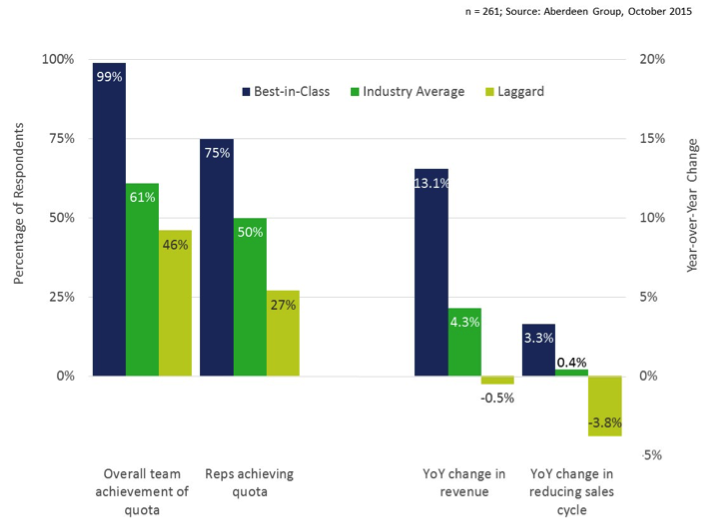
Our research methodology is based on comparing the performance and behavior of different cohorts of B2B sales professionals. In our March 2015 report Sales and Marketing Kumbaya: Putting Content in Context to Seal the Deal, we asked 261 end users in sales leadership and sales operations roles to report current and year-over-year performance metrics. We segmented their responses into our traditional top 20%, middle 50%, and bottom 30% performer groups. The four KPIs we used to define Best-in-Class, Industry Average, and Laggard organizations are overall team quota attainment, percentage of reps achieving quota, year-over-year revenue changes, and year-over-year changes in reducing sales cycle. (Fig. 1)

Figure 1

sales-enablement-figure-1.png

It’s hard to overemphasize the measurable business value of Best-in-Class sales results. There doesn't exist a single Sales SVP who wouldn't like to show their CEO dramatically better same-year quota results, either on a team-wide basis or proportion of reps who achieve quota. And in terms of annualized performance change, no one wants to be "that guy" who delivers Laggard-like reductions in revenue attainment, or growth-killing expansions of the average sales cycle.

Nevertheless, 80% of survey respondents failed to meet Best-in-Class performance standards, and it is this audience who can benefit the most from Aberdeen’s ongoing research findings.

It’s All About Line-of-Sight

Our research surfaced clear trends that provide insight into how Best-in-Class companies achieve their numbers. One striking result is the differential between Best-in-Class sales teams, who indicated “Marketing has extensive visibility into the sales team’s utilization of content / assets” at a higher rate than Industry-Average and Laggard organizations. Sixty percent of Best-in-Class companies reported formal sales and marketing alignment processes, while only half that number — 31% of Industry Average and 28% of Laggard firms — had the same sales enablement practices in place.

These data points reflect a gap that still exists between marketers and sellers. While the vast majority of the former utilize marketing automation software to track the effectiveness of their content, only 35% of the sales audience does the same. If marketers have the technology and processes in place to understand what happens with their messaging, why shouldn't sales teams enjoy the same visibility?

This is where well-deployed sales enablement platforms enter the picture. In addition to efficiently creating, collecting, and providing sellers with situation-specific marketing content, they also help both teams track whether assets, messaging, and collateral are being used and are helpful. It’s no surprise that when we examined the sellers using sales enablement solutions, they outperformed their peers in a significant number of KPIs. (Fig. 2)

Figure 2

sales-enablement-figure-2.png

The lesson here: Take the time to acquire and deploy a specific methodology to formally track how your sales reps and channel partners use marketing content. Not only will you be able to correlate this intelligence with your Marketing efforts, you'll refine the connection between Marketing collateral and the checks your customers write to your company.

Getting Started: 3 Actionable Takeaways

When asked what tactics they’ve used to improve their sales performance over the long-term, Best-in-Class companies’ top three responses are: “Improve differentiation in messaging to tell a better, unique story personalized for each prospect/customer” (61%), “Better align content to buyers and journey stages” (46%), and “Tightly align marketing activity to specific sales objectives” (44%).

In Figure 3, we explore three practices Best-in-Class companies follow -- on average -- 30% more frequently than under-performing firms.

Figure 3: Processes that Contribute to Success: Always Focus on the Buyer

sales-enablement-figure-3.png

These results yield three lessons for sales leaders.

1) Align Marketing content with stages of the buyer’s journey.

The traditional "sales cycle" has taken a backseat to a data-driven "buyer's journey." B2B enterprises must adapt to the dramatic shift that in the balance of power between buyers and sellers.

As we outlined in our report Customer Engagement Has Evolved. Can Your Sales Team Keep Up?, businesses must acknowledge that their prospects and customers can discover and understand all of the behind-the-scenes details – pricing, features, benefits, etc. – at work in purchase decisions without a salesperson’s help. Unevolved enterprises fail to close more deals.

But when Marketing and Sales align content with key stages of the buyer’s journey, they are more likely to win business. By personalizing their messaging for savvy buyers who ignore generic, one-size-fits-all mass communications, they are able to get in front of the right buyer, stay in front of them throughout their journey, and win.

2) Develop and implement a formal sales methodology.

We also know from Aberdeen's extensive sales training research that utilizing formal sales methodologies has a huge impact on successful, large-scale enterprise selling. At first glance, this process might seem to contradict the theme of personalization. Is it truly wise to deploy a broad and consistent messaging strategy? Don't each of our markets, verticals, and personas deserve their own unique sales pitch?

Of course they do, but it is only with Marketing’s help that sales can continually develop and measure different messaging strategies. In turn, these tactics are best deployed in a measurable way. This is only possible through an agreed-upon methodology that both departments support and collectively deploy via content performance analytics.

3) Collect feedback on Marketing content from all stakeholders.

Best-in-Class companies are 30% more likely than under-performers (43% vs. 33%) to capture feedback on marketing content from all possible stakeholders.

Modern corporate marketers cannot survive without measuring in great detail the links between their output and their results. They should also understand which messages influence which purchases and the extent to which salespeople are comfortable sharing Marketing content with prospects.

This feedback can be collected through anecdotal communication, and with formal "tribal knowledge" capabilities embedded in the best sales enablement platforms. These applications often include an element of enterprise social collaboration that gathers user ratings and comments, which indicate how the marketing team’s many stakeholders react to their content. It’s not about what we create that matters -- it’s about what our internal and external customers consume.

See the full report here.

HubSpot CRM

23 Feb 17:02

6 Data-Driven Reasons Why Cold Calling Flat Out Sucks

by esnider@hubspot.com (Emma Snider)

cold_calling_sucks.jpeg

It's no secret that it's become harder for salespeople to connect with buyers over the past few decades. The advent of caller ID technology means that professionals can screen their calls and ensure they never pick up the phone for an unknown number. The internet enables prospects to do preliminary product research on their own -- no salesperson required. And the rise of customized and personalized services and technologies has made consumers all the more resistant to generic, one size fits all messaging. 

Add up these trends and the plight of a salesperson trying to hit their quota amidst titanic changes in buyer behavior and preferences comes into focus. So what's the solution? 

For many salespeople, the answer is simply to hit the phones even harder. If they get half the meetings they used to from 10 cold calls, then they just have to buckle down and make 20 instead -- skipping the pre-call research, of course, since time is of the essence.

But while this fix might work for a few months, it's a band aid at best. Radically changing buyer behavior calls for radically different sales techniques. Instead of doubling down on legacy tactics that are swiftly losing efficacy, it's time for salespeople to quit cold calling entirely and completely transform the way they approach buyers.

Not convinced that cold calling is in its death throes? The following infographic from Unifyo contains six eyebrow-raising statistics that underscore how distasteful cold calls are to buyers, and how ineffective they are for salespeople. Stop cold calling today and start selling to buyers the way they'd like to be sold

no-more-cold-calls-1.jpg

HubSpot CRM

23 Feb 17:01

6 Unorthodox Ways to Inspire Low-Performing Salespeople

by Austin Duck

We all know that, traditionally, the “inspiration” offered to low-performing salespeople has been fear of getting the boot at end-of-quarter. After all, they’re low-performers, and your sales org doesn’t have time for that, right?

Maybe though, you see something in them – a potential, a great culture fit, someone who just needs a push in the right direction – and you want to help. Or you’re concerned with for your org’s ability to find a suitable replacement – after all, the perception of you having “revolving door” is never good for recruitment – or they’re involved in other key business you can’t risk losing.

Regardless of the reason, there’s always an argument to be made for not firing low-performing salespeople or, at the very least, making your best efforts to help them turn their performance around.

Unfortunately, because everyone has their own motivations, that’s often easier said than done. While many are moved by the commissions and peer-pressures built into any motivated sales org, others are motivated by family, travel, or by something else entirely. Rather than punishing them for being different than your other reps (or writing them off as a bad fit), try leveraging different approaches that appeal to different kinds of values.

6 Non-Traditional Ways to Inspire Low Performing Salespeople


To inspire salespeople, try leveraging different approaches that appeal to different values.
Click To Tweet


1. Reward Rejections

At first glance, it seems crazy to reward failure, but it isn’t. By creating sales contests that revolve around “no’s” (for example, which rep can earn the most “no’s in a month”), what you’re actually doing is incentivizing the process of selling. By focusing on process and rewarding those players who put in maximum effort, you motivate your reps to embrace the sales process you’ve developed, consistently pushing them closer to those “yes’s” and closes that you’re after.

2. Building Out a Fantasy Team Program Among Your Reps

Carrot and Stick InspirationIf I know one true thing in this world, it’s that salespeople tend to be incredibly enthusiastic about fantasy sports. So why not create an environment where that kind of excitement serves your sales org?

By creating a fantasy sales league out of your reps, you offer a “fun” competition that delivers a sense of team-wide accountability, cohesion, and productive peer pressure.

Whether or not your low performers are motivated by their own successes, your “league” makes them aware that others depend on them and generates a lot of positive intra-org performance “policing.”

3. Personalize Your Reward Structure

As Gretchen Gordon, president of Braveheart Sales, likes to say, “You don’t motivate sales teams; you motivate sales people.” And while many salespeople are motivated by competition and the bottom line, some aren’t. Gordon recommends “taking the time to find out what gets each of your reps out of bed in the morning” and discovering what they’re working for.

She adds “Whether they’re saving for their kids’ college, trying to build a cabin in the woods, or looking to travel the world, you can use that add meaningful motivation / incentivization to their workdays.”


You don’t motivate sales teams; you motivate sales people. @BraveheartSales
Click To Tweet


4. Make Networking Mandatory

Though often construed as an extracurricular activity, encouraging (or demanding) constant networking is a great way to get a direct jump on sales productivity among low performers in a couple of different ways. In addition to the obvious – that it creates leads and allows reps to perfect their pitches in lower-impact scenarios – consistent networking also offers reps the ability to interact with and be inspired by other successful salespeople and, with the right tools, to capture and import valuable lead info directly into your CRM.


Mandatory networking allows reps to perfect their pitches in lower-impact scenarios @Duckoncontent
Click To Tweet


5. Create Team-Based Commission Payouts

As you probably already know, peer pressure is a big motivator. In addition to the policing that goes on in any situation where everyone relies on each other for success, there’s a certain internal motivation – one that arises out of a sense of social obligation – that makes it work as well.

By creating scenarios where other reps’ rewards / commissions are dependent on the team (as opposed to the individual), you’re able to generate a different level of cohesion that “raises up” your low performers by literalizing the “success of one is the success of all” creed of business.

6. Use Fun, Metric-Based Rewards

Money is very appealing to most (obviously), but sometimes, the ability to get cool stuff is exactly what’s necessary for boosting motivation among low performers. Using ping-pong tables, popcorn machines, fun furniture, or anything your reps want (within a budget) as incentives for achieving certain benchmarks gives reps more than just a reward for their efforts. It allows them to contribute to / have some control of the company culture, the enjoyment of their peers, and the space / lifestyle they occupy at work.


Use rewards that allow reps to contribute to company culture and the space they occupy at work.
Click To Tweet


While it’s clear that individual commissions are good motivators for the majority of sales reps working today, others require a little something extra, and that’s not a bad thing. By using any non-traditional approach that focuses on personal goals and team cohesion, you both elevate your low-performers and create a more collaborative, more team-focused culture for your sales org.

Image via Nevit Dilmen, Wikimedia Commons

Editor’s note: *Beginning tomorrow!* – Whether it’s fixing leaks in your sales and marketing funnel or just about any other sales topic under the sun, you’ll want to be in the room–virtually, of course–for the upcoming Sales Kickoff Summit 2016, a virtual event with over 30 featured speakers covering Sales, Marketing, and Social.

Sales Kickoff Summit 2016


The post 6 Unorthodox Ways to Inspire Low-Performing Salespeople appeared first on Sales Hacker.

23 Feb 17:01

An Open Letter to Sales Reps

by Maxim Baeten

hey-i-just-met-you-meme.png

For all of you who don’t know: Sales is hard. Really f*!@^%g hard. I’m not talking about order fulfillment – that’s not selling. I’m talking about actually convincing someone they should buy your solution, not just picking your product that they need anyway. I have little to no respect for “top performing sales reps” in a highly transactional environment or selling commoditized products.

Ok, I’ll turn my snark meter down a bit. Not entirely though, because I’m tired of hearing excuses from reps who don’t sell. This year more than 42% of reps won’t make quota. That’s up 5% from two years ago and that trend won’t change anytime soon unless salespeople buckle down, harden up and make deals happen for them (instead of waiting for them to happen to them). You’ve got to work for it.

Here’s a wake-up call. To succeed these days, you actually have to SELL! We all know that the sales process has changed and closing deals is harder than ever before. To push a deal through, you need to develop the business case and get all stakeholders involved early on in the deal. You can’t rely on getting them to the pre-scheduled conference call you think is the only part of the sales cycle. You need to do your legwork and find those hidden influencers so that everyone involved agrees your solution is the best decision for their company.

Is it hard work? Yes. Is it worth it? YES! That’s why you’re getting paid a percentage of the sale and making good money. Because this is hard work! If you’ve started your sales career in the last 5-7 years, you’ve been riding the waves of a strong economy. But it wasn’t always like this and someday it won’t be again. I always say, “when times are good, everyone wants to be in sales, but when times are bad, nobody wants to be in sales.”

The best sales reps know how to persevere and succeed in good times and in a down economy. They’re creative, self-motivated, unflappable, and committed. They don’t turn tail and run when they face rejection after rejection. No one is forcing you to be in this industry. So if those words don’t describe you, maybe it’s time for a new day job.

For those of you committed to the profession, even if you’re doing “everything right” this job can sometimes kick your ass. To tip the odds in your favor, try the following.

Do your research

There’s no excuse not to know who you’ll be talking to, because I can guarantee your prospects will. Today’s B2B buyers are already more than half way through the sales process before they engage with you. Stop pitching and start with a conversation. Learn about their business and the challenges they face. Find out if their needs fit your use case and who the other decision makers are. And there’s nothing that executives hate morethan an unprepared or uneducated salesperson who doesn’t add any value.

Stop wasting time

Your prospects’ available time and attention spans are limited. Be organized and get to your point quickly. An overly complicated and convoluted presentation is no excuse for a missed opportunity.

Bring something of value to the conversation

If your initial interaction with your prospect is all about you and your product, don’t expect them to want to talk to you again. Bring something insightful to the conversation so they come away from it knowing more than they did before. Make it more about them and their business at first. They’ll trust that you know what you’re talking about. Again, this is against how many reps are told to “sell.” (I put sell in quotes there because if you think selling is talking about your product, its features and showing a demo, you are part of the problem with sales). This is hard work, but worth it. Your customers and prospects will start to treat you like a trusted business advisor and that is what you want to be.

Don’t assume the deal

You can’t expect your relationship with a prospect to get you the deal anymore. It might open the door, but it doesn’t provide value. Use a consultative sales process that leads them to your solution as the best choice for meeting their current and future challenges. This requires a new way of selling, one that’s less focused on features and more about forming an ongoing partnership.

As the leader of a sales team and a career salesperson, I’m not a fan of the reputation my career of choice has earned. But I believe that our industry can rise to the challenge. We’ll adopt a more consultative approach that leads to both higher productivity and happier clients.

This article originally appeared on the Showpad Blog.

23 Feb 17:01

Heidi Bullock of Marketo Helps Uncover Ways to Engage Self-Directed Buyers

by Ashley Zeckman

heidi-bullock-marketo

Last week at the Content2Conversion conference, Heidi Bullock, VP of Demand Generation at Marketo took the stage and covered a topic that is top of mind for all marketers. That is, how to create the right message at the right time to meet the needs of customers.

Today’s self-directed buyers typically go through up to 90% of their purchasing journey on their own. Which means that marketers need to find a way to build credibility, without even speaking with customers directly. Below we’ll discover some best practices for creating engaging to better meet the needs of self-directed buyers.

Content Marketing for Self-Directed Buyers

According to a 2016 report from MarketingProfs and Content Marketing Institute, B2B marketers list “producing engaging content” as their top challenge, followed closely by “measuring content effectiveness” and “producing content consistently”. To help with this top need, Heidi provided a formula for creating engaging content:

E = Relevant Content + Right Time +Personal

Let’s break down the different elements of that formula to see what changes can be made to your program to begin creating more engaging content.

Create Relevant Content

In the example Heidi provided, you’ll see how the team at Marketo creates different content for their different customer groups. That means, when someone in higher education is searching for a solution, they won’t find a generic message that is meant to apply to a bunch of different prospects across the board.

Create-Relevant-Content-Marketo

Additionally, you can follow these tips for creating more relevant and engaging content:

  • Address a Need: Create content that shows you understand what readers care about.
  • Be Relatable: Know your audience and speak in a language that they can connect with.
  • Make a Point: Use content to make a point, and get to it quickly.
  • Standout: Create content that differentiates you from your competition.
  • Listen to Input: Information can be gathered from sales teams, social media websites and customers to create more engaging content.

You can also create a better experience for your customers by providing them different content types to consume and share such as:

  • Webinars
  • SlideShare Presentations
  • Videos
  • Blog Posts
  • Podcasts
  • Infographics
  • Activity Books/Worksheets
  • Articles

Present Content at the Right Time

Different content types and whether they are gated or un-gated should be mapped to the customer journey. Below are examples of early, middle and late stage content types and whether they should be gated or not:

gated-and-un-gated-content-marketo

Marketers can implement lead scoring systems to rank leads in a way that helps determine sales-readiness. So, the type of content that your prospects are accessing can help shine a light on which stage of the buying cycle they are currently in.

Personalize the Content Experience

True execution and measurement of personalized content is still something that is very new to most marketers. However, a recent study from HubSpot found that personalized calls-to-action have a 42% higher conversion rate than those that are the same for all visitors.

Opportunities to personalize content exist in many places such as your website, video, social media, email and mobile. Other tactics such as retargeting have become increasingly popular, but results can be improved with the use of personalized retargeting as shown below.

personalized-retargeting-marketo

With the amount of information available, marketers can now begin to leverage the behaviors and profiles of both professionals and consumers by uncovering and incorporating the following information:

Professionals:

  • Industry
  • Organization
  • Target Account
  • Revenue/Size
  • Region
  • Persona
  • Buying Stage
  • Products Owned

Consumers:

  • Geo-location
  • Price Sensitivity
  • Purchase History
  • Buying Intent
  • Engagement
  • Customer Profile
  • Offers Accepted

The Importance of Measuring Marketing ROI

While anyone will tell you measuring conversions from your marketing efforts is key, many marketers still overlook the importance of measuring the multiple touch points that customers Go through before finally converting. It’s very rare that a prospect will see one piece of content and then immediately hire a company. There is credibility and trust that is built up over time, from multiple sources that typically encourages that type of action.

Below is an example of a conversion that could happen over 3 months, and many touch points:

multiple-content-touch-points-marketo

Each of these different steps should have a value attached to them so that marketers can track the potential in revenue for each piece of marketing material.

You can view Heidi’s full presentation below:

What Did We Learn?

In order for content marketing to be successful, you have to develop messages that are relevant to your audience, at the right time and in a way that is personalized to their needs. Using the tools available to listen across departments and directly with customers MUST inform your content strategy.

What have you found to be your biggest challenges in creating relevant engaging content for your audience?


Email Newsletter Gain a competitive advantage by subscribing to the
TopRank® Online Marketing Newsletter.

© Online Marketing Blog - TopRank®, 2016. | Heidi Bullock of Marketo Helps Uncover Ways to Engage Self-Directed Buyers | http://www.toprankblog.com

The post Heidi Bullock of Marketo Helps Uncover Ways to Engage Self-Directed Buyers appeared first on Online Marketing Blog - TopRank®.

23 Feb 17:01

Promoting Your Content: You’ve Written Great Content, Now Make Sure People See It!

by Elizabeth Kiken

You have a well-crafted blog post that is ready to go. You know it is good because you spent the time up front, considering the right topic, crafting the headline, bringing in compelling imagery, linking to other relevant content, and writing and rewriting the post until it sings.

Guess what? That is only half of the task. You also need a thoughtful content promotion strategy to get your blog post in front of people.

There are five elements to consider in an effective content promotion strategy:

1. Your Website

Posting your blog post on your website is the first and simplest thing you must do. You need to have a single location you can use to drive traffic back to as you promote your content. Make sure to include a catchy headline, compelling imagery and any relevant links to other content that you want on the page.

2. Email, email, email

Sending your blog post through email should be the bread and butter of any content promotion you do.

Hopefully, you already have a list of emails for people who will find your content interesting, relevant and useful. Perhaps they subscribed to your blog and other company announcements. That list is a good place to start, but don’t stop there.

If you’ve reached out to an expert or obtained a quote from someone, make sure you email them (either the URL or the entire post) and encourage them to share it, too.

Also, you can even add a link to your blog in your email signature block.

If you’ve partnered with other organizations be sure to have those organizations include your blog in their email to their subscriber list.

3. Social Sharing

It is fairly easy to disseminate your blog post is through social media. The most often used channels for B2B are your company’s LinkedIn, Twitter, Facebook pages. But don’t be shy about sharing it among your personal accounts, as well.

Encourage your employees to share your company’s post, too. Tag the people who wrote the post and any quotes provided, as well as your company. Remember to use hashtags around the subject matter and keywords. The more people who see your post, like and favorite it, and then share or retweet it, the wider you cast your net.

Cross-promotion is key in social media. So be ready to share others’ posts, link to external content and offer to write guest posts. The more you share, others will likely share too of your content.

4. Keyword and SEO

Making sure your blog is optimized for search engines was probably an aspect that you considered before writing it. You should have examined your current SEO keyword rankings and identified keywords for which you want to improve your ranking. Then you’d use those in your blog post. When it comes to the promotion of your blog post, remember the keywords you identified in the beginning to write about so that you can use those same keywords when promoting the content. Keywords can have hashtags added to them and they should be included in the text of social posts.

5. Paid Promotion

It is also possible to pay to get your content in front of the right audience. Several websites can help with content promotion. Outbrain, for example, promotes your content as recommended articles across leading publishers like CNN.com, Slate, and ESPN. Your content is pushed out across these prominent websites to encourage engagement and exposure. Google Display offers a similar method of content promotion that is keyword-based.

Of course all of these methods serve a purpose. You disseminate your content, not for the sake of just sharing it. It should always lead to a bigger picture of increasing your SEO, your authority in the marketplace, and generating new sales leads.

Content Marketing for Professional Services

22 Feb 17:37

Zimbabwean government to control country's diamond mining

by Farai Mutsaka

HARARE, Zimbabwe (AP) — The Zimbabwean government will now control all mining in the diamond-rich Marange area, after mining companies were ordered to halt all operations because their licenses have expired, the mining minister said Monday.

All diamond mining will now be managed by the Zimbabwe Consolidated Mining Company, wholly owned by the government, Minister of Mines and Mining Development Walter Chidhakwa said. Private firms may negotiate joint ventures with the government mining company, he added.

The nine mine operators, including Chinese and Russian companies that were already involved in a joint operation with the Zimbabwean government "neglected or failed to renew their special grants," Chidhakwa said.

Chidhakwa said operators were also "cherry-picking" alluvial deposits rather than exploring underground deposits. The Zimbabwean government already owns 50 percent of all mining companies operating in the eastern Marange, although the private owners of the companies were responsible for marketing and sales of the stones and general operations of the mines, said Chidhakwa.

"Since they no longer hold titles these companies were notified this morning to cease all mining activities with immediate effect and to vacate the mining areas," Chidhakwa told reporters and representatives of the companies in the capital Harare. "They have been given 90 days within which to remove their equipment and other valuables."

The Marange diamond fields caught global attention in 2006 when thousands of unlicensed artisanal miners illegally mined the area, selling stones on the black market. They were later driven out by the army in an operation criticized by human rights groups for its brutality.

Diamonds from the region were barred from being sold sale until 2011 when Zimbabwe was approved by the Kimberley Process, an international effort that certifies legally mined "conflict-free" diamonds to be sold on the international market.

---

Follow Farai Mutsaka on Twitter at www.twitter.com/MutsakaFarai

Join the conversation about this story »

22 Feb 17:32

How a crash in metals prices has made 2016 a great year to build a mine

by Peter Koven

Earlier this month, Stornoway Diamond Corp. said something that would have been unimaginable a few years ago — its mine is being built ahead of schedule and under budget.

“You can imagine we’re sticking our necks out by saying that, so we have to be pretty confident it’s the case,” Stornoway chief executive Matt Manson said in an interview. “And we are.”

The Montreal-based firm, which is building Quebec’s first diamond mine, moved the completion date up by five months to the end of 2016. It also slashed the construction cost estimate by more than $35 million to $775.4 million.

During the commodity boom, capital cost blowouts became so routine in the mining industry that they became a running joke. Analysts and investors just assumed costs would be much higher than the companies’ projections, and they were usually right. One extreme example was Barrick Gold Corp.’s Pascua-Lama mine, which was budgeted at just US$1.5 billion in 2004. Barrick spent more than US$5 billion before halting the unfinished project in 2013. If Pascua-Lama ever gets completed, the ultimate cost could exceed US$10 billion.

We’ve been able to buy things when we needed them and they’ve been available when we’ve needed them

However, the construction environment has changed dramatically because of the crash in metal prices. Skilled labour is far more available, equipment is cheaper and gets delivered faster, and the prices for other inputs like steel and pumps have plummeted.

Put simply, 2016 is a great year to be building a mine. Along with Stornoway, other companies have announced capital cost reductions this month. Pretium Resources Inc. slashed the estimated cost of its Brucejack project by 14 per cent, to US$640.8 million. First Quantum Minerals Ltd. cut the cost of its Cobre Panama project to US$5.5 billion, down 15 per cent from its original projection.

Of course, not many companies are actually taking advantage of this opportunity. Stornoway’s Renard project is one of a small handful of major mining projects under construction across Canada. Miners often say that they want to build mines in down cycles and mine them in up cycles, but more often than not, the opposite is true. They tend to build mines when they can finance them, which is during boom times. With so many mines being built at once, the prices for labour and other inputs skyrocket and projects run way over budget.

Manson said that whenever Stornoway buys something today, whether it be trucks or pumps or valves, the company is able to get what it needs very quickly from the best possible supplier at its budgeted price. That has helped the company stay ahead of its construction schedule.

“When there’s a more competitive construction environment, you might find the best guy in the business is working for Goldcorp for the next six months,” he said.

“So you go to the next guy, who will cost you a little bit more and might not be quite the same quality. So you end up being behind schedule and over budget.”

The most overt example of how the environment has changed might come from heavy equipment provider Caterpillar Inc.

Only a few years ago, mining was Caterpillar’s most profitable and busiest business segment. When miners ordered equipment, they could expect to wait 18 months or more for it to arrive, pay money upfront, and have zero ability to negotiate the terms of the sale. There are even rumours of trucks being delivered without any tires on them.

Today, mining is Caterpillar’s worst performing segment — its resources business actually lost money in the fourth quarter of 2015. Miners ordering equipment from the company can expect to receive it within a few weeks, and might get bonuses such as maintenance contracts thrown in.

Stornoway was fortunate in that it received financing for the Renard mine in the spring of 2014. By that point, the commodity boom was over and it was easy to procure materials from Caterpillar and other suppliers.

“We’ve been able to buy things when we needed them and they’ve been available when we’ve needed them,” Manson said.

While mining services and equipment are far more affordable than they used to be, that doesn’t mean that everything is cheaper for mining companies today.

Randall Oliphant, executive chairman of New Gold Inc., noted that miners are also affected by the amount of non-mining industrial activity going on. So, for example, if a lot of government-backed infrastructure is being developed near a mine, that can tighten the market for local labour and other inputs. New Gold is building a mine in Northern Ontario and has seen some of this first-hand.

“In Ontario, certain elements of mine construction are still competitive,” Oliphant said. “The same guy can pour a concrete foundation for a mine, or for an office building here in Toronto.”

Financial Post

pkoven@nationalpost.com

Twitter.com/peterkoven

22 Feb 17:27

Engagement Is a Means, Not an End

by Michael Schrage
feb16-22-123395780

An executive friend in an organization and industry riven by digital disruption and declining margins confided over lunch how dramatically her new CEO had impressed everyone at a recent executive offsite. “She listened carefully to people’s complaints about all the processes and obstructions they felt got in the way of their doing their jobs,” said my friend, “and instead of pushing back or challenging them, she agreed and said she’d do everything she could to get those obstacles removed….People were amazed and energized.”

Responsive CEOs are wonderful. But, knowing the industry well, her declared commitment suggested more than an understandable desire to eradicate unhappy bureaucratic burdens. She likely wanted to see how well her top people understood their own effectiveness. The unspoken deal: eliminating organizational impediments would radically improve their business results.

This wasn’t primarily about empowerment; the CEO was effectively removing executive excuses for underperformance and inefficiency. Essentially, I observed, this was an investment in making people more accountable. My friend, who is responsible for a large part of the business, didn’t disagree. She knew she was on the hook.

While this approach is hardly manipulative or Machiavellian, it seems fair to say organizations frequently misunderstand and misapply employee engagement and empowerment. Engagement and empowerment represent admirable and desirable values but they are fundamentally means, not ends. The business purpose of greater employee engagement and empowerment is not happier employees but people who are more productive, innovative, and accountable for the choices they make. Empowerment is an investment in accountability. Successful organizations expect healthy returns on their investments.

At one global B2B sales organization, for example, sales people perennially complained about the burden of filing detailed reports on sales calls to accounts and prospects alike. Even though the information and intelligence these reports provided were useful to both sales teams and the enterprise alike, the clear sales majority argued that the time and effort the reports took cut into the time and effort they spent on selling. We could sell more if you made us report less, said the sales force. Free us up to sell. Make reporting less burdensome. Empower us.

Insight Center

So, both as test and demonstration that it took its sales team seriously, the company changed reporting requirements for a few geographies and product lines. The result? Sales increased for a handful of high performers; held steady for the overwhelming majority; and measurably dropped for about 20% of the participants.

Empowerment, in other words, boosted sales for only a sliver of the force; it had no positive productivity benefit for the rest. Indeed, reviews of the initiative suggested that marketing and customer service were hurt by the lack of detailed sales reports for those accounts. Ironically and in fact, average salespeople proved more dependent on past reports for their effectiveness than they had acknowledged.

The exercise ultimately had a massive impact on the sales organization. While the firm eventually streamlined sales reporting requirements, the experience revealed the sales force had hired too many underperformers; too many salespeople couldn’t accurately assess prospect potential and couldn’t figure out where they were in the sales cycle without more detailed support. The bottom line? Freeing up top salespeople was a terrific investment; empowering average and/or typical salespeople delivered poor ROI.

Whether in sales, customer service, or software, empowered employees who consistently underperform are probably in the wrong job. Indeed, empowerment may be the surest way of determining whether rigorous compliance or greater initiative delivers the greatest value-added component of a job. Empowerment is the antithesis of compliance; its purpose is increasing choices rather than limiting them.

But where compliance holds employees accountable for following the rules, empowerment makes them accountable for their choices. The more empowered employees are, the more accountable they become. In other words, be careful of what you wish for because you are sure to get it.

22 Feb 17:26

What is the ideal length of a sales email? Insights based on 40 million emails

by mrenahan@hubspot.com (Mike Renahan)

Like most people, I don’t read all of the sales emails I get. When I do open an email, I skim its contents and immediately close out long, rambling messages, which is exactly why the search for the ideal email length is like Indiana Jones and the Holy Grail.

Download Now: 50 Sales Email Templates  [Free Access]

It’s not about nitpicking word count; it comes down to holding the reader’s attention long enough to stick out in the never-ending sea of emails.

One analysis of over 20 million cold emails found that the more people you email, the lower the open rates go. That statistic might as well say, “the harder you work, the worse the results get.” But in reality, being successful in sales isn’t about doing more — it’s about being more effective. This makes learning how to write a sales email that people want to respond to more important than ever.

Let’s look at how email length can help you get the results you want from your email marketing strategy.

Table of Contents

Ideal Email Length

For almost a decade, it’s been said that the ideal email length is 50 to 125 words. The origin of this famous numeral is a 2016 Boomerang study, which analyzed 40 million emails. Despite its age, that Boomerang study is still used as a benchmark thanks to the depth of research. They found the following correlations between email word count and response rates:

  • 200 words = 48% response
  • 175 = 49% response
  • 150 = 49% response
  • 125 = 50% response
  • 100 = 51% response
  • 75 = 51% response
  • 50 = 50% response
  • 25 = 44% response
  • 10 = 36% response

Boomerang also reviewed email sentiment and found that messages that expressed either moderate positivity or negativity evoked 10 to 15% more responses than completely neutral emails.

But, sales reps should know, the research discovered too much emotion in messages resulted in similar response rates as neutral emails. “Flattery works, but excessive flattery doesn’t,” Alex Moore wrote in the report.

What’s changed since this study’s birth? Well, email still has incredible ROI. New tools, like our AI Email Writer, help you write emails faster and more efficiently. But everyone is getting more emails than ever before, like a boat taking on more and more water.

Research by Constant Contact reinforces points of Boomerang’s data, which you’ll see below. Some more insightful 2024 data from Constant Contact: 40% of business owners surveyed in the Current State of SMB Marketing report said that they put off managing email campaigns because of a lack of time.

More than half of the surveyed marketers said that they spent less than one hour per day on marketing emails, despite it being (on average) their second most-frequented marketing channel.

The truth is, word count is not the end-all when it comes to writing successful sales emails. These best practices, however, make a huge difference.

Email Length Best Practices

A conversation about word count alone is only skin character-deep. Instead of sweating over an extra sentence or two, let these best practices steer the length of your sales emails.

Don’t go over the maximum email length.

Boomerang’s data is supported by other research, like this study from Constant Contact. In a study of over 2.1 million customers, they found emails with approximately 20 lines of text had the highest click-through rates:

ideal email length best practices: email click-through rates based on lines of text

Source

This translates to about 200 words, which is higher than Boomerang’s data, but still provides a helpful range. When in doubt, shorter is generally better, so always err on the side of “less is more,” and keep your emails below 200 words.

Here’s an example of an ultra-brief two-line email template from Sam Wright, head of operations and partnerships at Huntr:

The subject line: [Company] <> Huntr

Email body: We helped [x, y, z, competitor] do Y, which led to Z results. I believe we can be helpful to you as well.

Sam shared this screenshot of the email open and reply rates:

email open rate and response rate screenshot

Source

Avoid making your emails too short.

Yes, short and direct emails resonated best with prospects and earned a response. (That’s why former HubSpot account executive Dan Muscatello writes short prospecting emails — two sentences long at most.)

However, Boomerang’s numbers revealed a fine line: Emails that were 10 words or shorter got a response just 36% of the time. You don’t want your emails to feel like you’re just sending a text, or that you forgot the other half of the email before hitting send (been there).

Use visuals to break it up.

Amanda DeLuke is an email expert who has overseen the sending of tens of millions of bulk marketing emails. She echoed the importance of keeping emails brief, and also added this advice:

“Provide a small visual representation (image, icon, etc.) to support each topic/text and provide links out to external content for more details — this will save you a lot of space.”

Don’t be heavy-handed with images.

There’s a lot to say about how images can increase user engagement, but there’s a fine line between attention-grabbing and attention-hogging. HubSpot research suggests that as the number of images in an email increases, your click-through rate will decrease.

Constant Contact also found that imagery impacted click-through rate, with clicks dropping as images are added to an email.

ideal email length best practices: email click-through rates in relation to images

Source

Plan for mobile devices.

Does using the term “mobile devices” make me sound old? Folks are checking their electronic mail everywhere these days: desktops, laptops, phones, tablets, and even smart watches (though getting an email on my wrist is an actual waking nightmare for me, personally).

Statistic: 64% of people primarily check their inbox on mobile devices.

Smaller screens make the case for shorter messages, but there’s also a hidden catch. When people use their mobile to check their inbox, it means that they’re checking their email while multitasking. All the more reason to be brief, using bolded text and bullet points to help with scannability.

Make your message viewable at a glance on mobile. Your point should be clear with one look, without making readers scroll. Test this before sending. Large headers take up valuable space on mobile, so use them with care.

ideal email length best practices: email display on mobile

Source

Head back to the third grade.

Why delay the transmission of one’s message with a tedious turn of phrase?

Translation: Why make people’s brains work harder by using fancy language? Writing at a third-grade reading level is a golden rule in all marketing, and email is no exception.

Boomerang’s study found that third-grade level emails performed 36% better in terms of open rate than those written at a college reading level and boasted a 17% higher response rate than emails composed at a high school reading level. Free-flowing, informal emails are best for eliciting a response from recipients.

I’ll show you a tool that can help you measure this below.

Include clear CTAs and ask 1-3 questions.

What is someone supposed to do after they read your email? The call-to-action (CTA) should be clear in every single message you send.

It’s best practice to also include an “ask” in every sales email you send, and reps often ask prospects for information in their messages. But how many questions are too many in an email?

We recommend asking one to three questions in your email. There’s even a built-in safeguard against over-probing prospects (invasive) in the HubSpot email tool:

ideal email length best practices: email content tip inside hubspot email template builder

Source

Shorten email subject lines.

If no one opens your emails, it doesn’t matter how long they are, does it? That’s a rather depressing realization, but it can inspire all of us to spend a little more time on this easily overlooked step.

Statistics: Subject lines with seven words have been found to have the highest open rate at 46.2% (Regie.ai).

The golden rule? Keep it short, to the point, and personalize it. Personalization is so important that it deserves its own call-out.

Do your research and personalize.

If you don’t put in the time to research your prospect and craft a valuable email, it doesn’t matter if you achieve the perfect email length. Your prospect won’t be interested in what you have to say because you haven’t taken the time to say something that matters to them.

One easy trick: Use your recipient’s first name in subject lines. One study found that subject lines mentioning someone’s first name were discovered to have a 29% higher open rate.

Our email tool has dozens of personalization options for the subject line, plus easy A/B testing to drive conversions:

ideal email length best practices: email personalization in hubspot marketing hub

Source

Tips for Ensuring Ideal Email Length

If shorter emails with simple language and clear asks are better, how do you ensure your emails are measuring up? Here are a few tips.

1. Use the free Hemingway App.

Copy and paste your email message into this app and see what grade the readability tracks to, which phrases have simpler alternatives, and how many “hard to read” and “very hard to read” sentences your message contains.

2. Always add a close.

Sales expert Jeff Hoffman advocates that every conversation or email you exchange with a prospect should include a close. Whether you’re asking for more time, contact information, or their business, always make sure you’re asking for something. This makes it as easy as possible for recipients to respond.

Before writing your email, consider what your goal is for this communication and tailor your close accordingly. For example, if I want an email to yield a discovery call, I’ll include that ask at the end, and build the rest of the email around it to support and encourage that close.

3. Don’t waste important real estate.

Your email opening line and greeting are incredibly important, so don’t waste them on “Hi, my name is.” Instead, try, “How can I make your life easier?” or “I noticed your company recently …”.

Similarly, make your email closing lines powerful and intriguing with statements like, “I love ramen as well. Have you tried [restaurant name]?” or “Did the ebook you downloaded change the way you think about [topic]?

4. Remove excess language.

We tend to add extra words to our writing to soften our message (especially when we’re asking for something or providing constructive feedback). Before sending your email, review for unnecessary language.

For example, here’s a sentence before and after removing filler words:

  • Before:I think it might be a good idea for us to come up with a few ideas that will help us present several scenarios to your executive team when we meet.
  • After:Let’s brainstorm several scenarios to present to your executive team next week.

Let’s look at some great examples that embody these best practices (and, bonus: are editable for you to use yourself).

5. Create team email templates.

If you’re working on a sales team, I think it’s important to be consistent with language, CTAs, and offers. Using a template builder tool can ensure consistent messaging and provide a jumping-off point for individual reps in their outreach.

Great Sales Email Examples

The email examples below are all templates included in HubSpot’s email template library. This is a free part of our Marketing Hub! Set up only takes a few minutes, and you can use our software to send out professional sales emails through your work email address.

When you input a contact’s details (like first name and company name), your emails will automatically be customized. This means that you’ll never input the wrong company or misspell a name (even my first name gets butchered).

ideal email length: sales email templates in hubspot marketing hub

Source

1. The Simple Next Steps Email

I’m ordering these email examples by length: shortest to longest. First up is the “What would need to change?” email. At only 36 words long, this email gets right to the point by asking a prospect what would need to change in order for them to want to discuss working together. It’s a short, cold email that doesn’t waste anyone’s time beating around the bush.

ideal email length: 36-word-long sales email template from hubspot

Source

Why this follow-up email works:

  • Emphasis on the relationship (“make sense for us to talk”) instead of the sale.
  • Ellipsis in the subject line creates intrigue.
  • Extremely brief, with a focus on the CTA.

2. Breakup Email

Here’s an example of an email following up with an inbound lead. You can see the template screenshot directly below, and my personalized version underneath (length: 91 words). I’m an SEO writer who works with businesses to build their blogs, so my email is written from that perspective.

Fun fact: This breakup email has a 33% reply rate. If only all breakups went that well!

ideal email length: 91-word-long sales email template from hubspot

Source

Hi [name],

I’ve tried to reach you a few times to go over suggestions on improving your website traffic, but haven’t heard back, which tells me one of three things:

  1. You’re all set with website traffic and your blog, and I should stop bothering you.
  2. You’re still interested but haven’t had the time to get back to me yet.
  3. You’ve fallen and can’t get up, and in that case, let me know and I’ll call someone to help you.

Please let me know which one. I’m starting to worry!

[Your Name]

Why this email works:

  • You show that you’re thoughtful by acknowledging that you might be bothering them.
  • Personality sells (you can use AI all you want, but people buy from people).
  • It’s easy for the recipient to reply by choosing from your numbered list.

3. Inbound Lead From Content Follow-up Email

Let’s address the elephant on the screen: This email is longer than most. When the template is populated, this email runs at more than 100 words (mine is 106, to be exact). This is longer than most sales emails, but it brings a lot of value to the recipient.

ideal email length: 100-word-long sales email template from hubspot

Source

Hi [first name],

You recently visited my website and downloaded my blog SEO checklist. Did you find it useful?

Did you download the piece just to learn more about SEO in 2025? Or, are you looking for a cost-effective solution to the always-changing Google landscape?

I actually did some research on [COMPANY] and have the following tips:

  • Your blog displays great expertise, but a quick audit of your most recent post shows that it has an optimization score of only 43 (out of 100).
  • I think re-optimizing for the keyword [example] could help this stick the landing on Google.

Have you thought of doing this?

Best,

[Your Name]

Why this email works:

  • The simple “Did it help?” subject line gets your prospect’s attention.
  • Value-based content showing your expertise and helpfulness.
  • Natural mention of pain points helps sell without feeling salesy.
  • The emphasis on a “cost-effective solution” is a nice touch.
  • Bullet points keep it organized and easy to skim.

Making Every Word Count

Remember: your prospects are drowning in emails just like you are. Stand out by being concise, relevant, and human. Test these templates, measure your results, and keep refining your approach. When every word serves a purpose, you‘ll find that shorter emails don’t just save time. They start conversations.

Don’t feel stuck with your emails. Use our templates to help you pick up momentum with your email marketing strategy.

Editor's note: This post was originally published in February 2016 and has been updated for comprehensiveness.

22 Feb 17:26

How to Save Your Job (and Hit Your Quota) by Solving For the Customer

by mroberge@hubspot.com (Mark Roberge)

inbound_sales-1.jpg

A classic example from Economics and Finance 101 has driven sales rep behavior for years. And more recently, it’s brought about the advent of inbound selling.

The so-called “Lemons Problem” described how clever salespeople could sell dud cars (lemons) to uninformed customers at a premium, and the customer wouldn’t know until it was too late. However, this problem has become a thing of the past. What changed? Enter the internet age, all but erasing the problem from memory. Customers can now hop on their phones, compare prices on the TrueCar app, and get a detailed Carfax incident report almost instantly.

The bottom line: the old way of selling is outdated and unsustainable. By solving issues for buyers like the Lemons Problem, the internet ended up creating a crisis of identity for sellers. What is their role in a world with an increasingly touchless sales process? Well, if reps want to hit their quotas (and keep their jobs), they’ll need to start helping the customer.

Just as inbound marketing turned the marketing process into a helpful, human, and educational experience, so too will inbound selling for the sales process. Like inbound marketing, the future of sales will be about adapting the sales process to match the way modern customers shop and buy. Here are a few practices to keep in mind:

  • Help first, sell second. Give customers insightful, unbiased advice, and make sure the traditional product plug doesn’t muddy the waters. Why’s that? Inbound selling helps the customer first. Through honest advice, sales reps help the customer make the most informed decision and gain the most important thing a buyer can offer. No, not their money -- their trust.
  • Make it worth their while. A buyer’s time is a precious thing. Make the most of your conversations by checking out what they’re already reading, via blogs and social media, so you build credibility and make any chance to talk time well spent. Remember to tailor every point of communication to the buyer’s context -- or risk a swift bout of disengagement.
  • Don’t lose touch. Even after the sale is complete, remain in contact. Whether it’s to earn future referrals or to learn how to improve the sales process going forward, sales reps who keep in touch with buyers will see their relationships continue to pay off time and time again.

So how do we make inbound selling an institution? It all starts with identifying the biggest challenges reps today are facing so we can adapt our solutions to fit the modern seller. That’s why HubSpot teamed up with the American Association of Inside Sales Professionals to create this easy and ultimately informative survey.

Which brings me to you. Take five minutes and fill out the form. You’ll stave off some future pain points, and when the time comes to turn lemons into lemonade, you’ll be whipping yourself up a fresh Tom Collins.

Click here to take HubSpot and AA-ISP’s survey about the top challenges of salespeople now. 

HubSpot CRM

22 Feb 17:25

7 Best Practices for Your Trade Show Marketing Strategy

by Samantha Selsky

Companies in the wholesale distribution business attend tradeshows to generate leads, learn what is happening in their industries, gain brand recognition, and sell products. Without a strong trade show marketing strategy, however, the success of these efforts is not guaranteed.

So how can companies improve their trade show marketing strategies to ensure success? Here are some of the best practices you should consider when developing your winning strategy.

7 Best Practices for Your Trade Show Marketing Strategy

1) Decide on your why.

Marketing guru Simon Sinek says that the biggest question that every company needs to answer in order to be successful is: Why are we doing what we’re doing? According to Sinek, your “Why?” is all about your purpose, and purpose determines everything else. The answer to your company’s “why?” should drive every other decision you make.

Sinek’s model for decision-making recommends that companies start with asking why they do what they do, answer questions about how they will do it, and then determine what it is that they will do. Working outwards, start with the general purpose of your actions or decisions, and then work towards the specifics that will help you achieve those goals.

Adopting this model for tradeshow planning, you might come up with the following:

  • WHY do we attend tradeshows? To gather leads that will eventually help us sell more widgets to customers in the gadget industry.
  • HOW will we gather those leads and convert them into paying customers? By gathering email addresses for potential buyers in the gadget industry that we can then follow up with and market to via email or other means.
  • WHAT is our plan? What specifically are we doing? We are attending tradeshows directed at the gadget industry. We will offer a giveaway to entice prospects to leave their business card or give us their email address. We will follow up with those leads with an email campaign, and then follow up by phone if they reach a certain level of engagement.

This is just one simple example. Your “Why?” may be something totally different, but using this process will help to ensure that your tradeshow strategy and associated tactics and goals make sense in the context of why you are attending in the first place. Just be sure to involve all of your stakeholders, to ensure that everyone agrees on the goals for your tradeshow presence.

2) Set up appointments in advance.

Tradeshows aren’t just about gathering new leads. They can be a great opportunity to keep in touch with customers or meet with people who can be influential for your business. To ensure your trade show investment will be as effective as possible, establish meetings ahead of time. Doing this during low traffic times can be a great way to make sure that your time is spent wisely.

3) Establish a clear call to action.

In order to track your success, you need a clear call to action and a metric that will help you determine whether your efforts are successful. These tactics are often focused on lead generation, and they can be easily tracked. Here are a few examples:

  1. Set up a landing page on your website that you will promote in your booth. Encourage people to visit and download information.
  2. Run a contest in the booth, and encourage attendees to enter to win.
  3. Create a hashtag for use on social media and encourage people to use it.

4) Put the right people in the booth.

If lead generation is your “WHY,” consider putting a marketing person in the booth, in addition to customer service or salespeople. Keep in mind that the priorities and skillsets of salespeople (cultivating prospects and converting them to customers), and those of marketing people (generating leads) are often quite different. Having multiple skillsets available allows you to better manage your booth traffic. Marketing people can focus on gathering leads, customer service or salespeople can focus on qualifying prospects, and salespeople can work with customers who are ready to buy.

5) Follow up promptly.

Strike while the iron is hot. The sooner you are able to follow up with leads after a show, the better. This ensures that they still remember you, and are likely to respond more favorably to your follow-up offer. Many companies do this by uploading customer lists to the home office at the end of each day and sending a follow up email to thank visitors for stopping by. If same-day follow up isn’t possible, then be sure to follow up within 5 days.

6) Limit giveaways.

Limit giveaways to those who give you their contact information. In other words, try to avoid giving marketing collateral to unqualified leads. More generally, it’s important to quickly qualify any attendees coming into your booth, so you can spend your time wisely.

7) Do a Post-Mortem.

At the end of the show, go over the show results with the entire team. What worked well, what didn’t, and what should be done differently next time? Will you attend again in the future? Document this information, and use it when creating your tradeshow strategies for next year.

What trade show marketing strategies have brought you success? We want to hear about them in the comments below.

22 Feb 17:25

Are You Still Making These 7 Lead Generation Mistakes?

by Rick Whittington

Are You Still Making These 7 Lead Generation Mistakes?With so many things on your to do list, improving your lead generation might not be on the top of that list. Mistakes in lead generation can cost your business significantly, and inefficiencies in this aspect of marketing can cause you to lose income that you didn’t even know you could have earned.

But what are the most common mistakes that businesses make and how can they be avoided?

1. Not Understanding Your Ideal Customer

It’s necessary to research your audience; you know that. But consider also your ideal customers – the ones that are a great fit for your company (and your company is a great fit for theirs). It’s helpful to put a name and a face with the ideal customers you have, along with some characteristics. We call these customer personas. To whom would your product and service appeal precisely and directly?

Of all the potential customers who are intrigued by your product, some will conform to your ideal customer more closely than others. This is something to consider in your advertising, content marketing, website, etc. You can’t appeal to everyone, so appeal to the type of company your business is made for.

2. Ignoring Mobile Platforms

A fact of modern life is that more and more people access the Internet through mobile devices than ever before, and the proportion is trending upward. Equip your website to handle this demographic and increase the pool of potential leads your business can attract.

For starters, having a mobile friendly website is something that you have to accomplish. Mobile friendliness of your website factors into Google rankings when people search from their phone. To learn more about why a mobile friendly website is critical today, click here.

If a visitor comes to your website on a smartphone and needs to “pinch and zoom” just to read what you’re about, they’ll have a poor experience and may just take their business elsewhere.

3. Sales and Marketing Inconsistency

Different people within your organization will inevitably have different priorities; too much independence for sales and marketing teams can lead to an inconsistent message that sabotages your efforts at the ground floor.

It might be like this at your company: Sales reps and business development reps want to spend their time on “good leads.” Marketing wants to increase lead volume. Then sales and business developers go into a hard sales approach. Marketing wants to provide more educational content to aid in the sale, but don’t get to.

The solution is for sales and marketing to gain agreement on what criteria determine a perfect lead, and also what collateral will be needed during the sale. It’s okay to lock your teams in the same room together for a few hours until everyone is on the same page. It’s good to get your marketing and sales/business development teams together to map out the lead generation and sales process to see where each team can provide input and feedback.

4. Not Stating Customer-Focused Benefits

Do your ideal customers want to read about your product’s features? The latest company press release? Maybe, but only so far as those things benefit them. It’s fine to advertise product features, but that those must support the overall message: “You have a goal, and this is how this product can help you achieve that goal.”

Think of it this way — people aren’t as interested in the features until they find out that your product or service can actually solve their problem. Are you communicating that to them clearly on your website?

5. An Inadequate Content Strategy

The saying goes that “content is king,” and while this is true, the content must be planned and coordinated to appeal to your target audience. It’s not enough to have great ideas, flashy design or even impeccable marketing sense. Your content must be delivered in an organized fashion that conforms to your underlying philosophy or it won’t be as effective as it could be.

A content marketing plan can help you plan what you need to create, where it should be promoted, and map out a deliberate path to lead conversion. That includes how you’ll treat email, social, PR, outreach, blogging, paid advertising and more.

6. Insufficient Credibility

At its core, you’re in the business of persuasion. It’s an ancient art form, and you can go a long way by adapting your work to the strategy of rhetorical appeal. Your audience wants to know who you are and why they should trust what you say. They want to limit their risk of failure when they buy your product or service. Honest marketing can build credibility. Address cost and common questions you get in the sales process.

Take a look at this video from River Pools and Spas. The video is educational, not salesy, and addresses several questions that their customers have when thinking about a retaining wall for a pool.

You might also think about simpler approaches – things like adding testimonials or simple case studies to your website. Also including industry association affiliations on your website is a simple way to add credibility.

7. Your Website Lacks Calls to Action

Prospects aren’t going to contact you unless you ask them to.

Each page on your website should act as a funnel for your leads, and calls to action are an integral component of that funnel. Companies often write web pages from their viewpoint. What do you customers want to read? What is a logical next step? Be sure to include those subtle tidbits that guide a customer toward the next step in your relationship with them.

Consider how many business websites you visited once and never again; somewhere there was a failure of communication between you and that company. Clarity of message is the basic element of communication, and all of these mistakes represent failures of clarity. With a clear message, you can dodge these pitfalls and establish the very connections with your audience needed to grow your business.

Free guide: Want to Make Your Website A Lead Generation Machine?

photo credit

22 Feb 17:24

Turn Your Defective Sales Team into Rockstar Sellers

by Colleen Francis

Dysfunctional: the word comes up in conversation every day, usually in relation to crazy families, nutty reality show contestants, and all-around gossip. But what if this adjective also describes your sales team? Your group of dysfunctional sellers is preventing you from getting the results your company needs to move forward. How do you identify the root cause of the problem, eliminate it, and turn your team into high-impact sellers?

Like they always say, the first step to a solution is admitting you have a problem and believing it can be fixed. Keep an eye out for these five telltale signs within your sales team, and your company at large, to determine if dysfunction is causing your team to be defective:

1. A Weak Emphasis on Sales

Product management, development, and engineering are the main focus of your company. However, the CEO or head of sales has a background in finance, product management, or development — not sales and marketing as needed. The company as a whole may therefore not be sales-focused and that can definitely trickle down to your team.

2. Lack of Visual Data to Drive Results

Take a minute to look around. Are sales targets written on the walls and whiteboards? Tacked to cubicles? If not, there’s a lack of focus on those numbers for your team. And that’s a problem.

3. No Use of the Sales Pipeline

Ask your sales team and managers to define their funnel — what they’re working on and what’s closing soon. Question them on their revenue forecasts and margins. If they can’t give you simple, concise answers, they’re not functioning smoothly. In fact, the topic of hitting targets, bonuses, and commissions should be frequently discussed within the team. If it’s not, they’re not focused on selling.

4. A Lack of Drive

Get a feel for your sales team at the end of a month or quarter. Activity should be almost frenetic at this point with your team glued to the phones and selling. If reps, however, are taking 90-minute lunches and chatting away at the water cooler — when hitting their targets is on the line — you’ve got a problem within the team.

5. Gossip, Rumors, and Blame

Dysfunction comes in the most obvious of forms as well. Much like high school, gossip and rumors on the sales team can lead to nothing but trouble and indicate that the team is off focus. Playing the blame game is a problem as well. When your team points a finger at shipping, support, or finance for their losses, you need to root out why they believe they’re not accountable.

When it comes to high-performing teams, they don’t have time for gossip. If they hear something they’re not sure is true, they go directly to the source and get the answer. They don’t make decisions based on rumor or gossip, which is a sign of a defective team.

There are times when dysfunction isn’t that harmful for your team. This depends on how many of the tell-tale signs above you’ve found and to what degree they’re affecting sellers. If your team is hitting its targets and acting legally, morally, and ethically, does it necessarily matter if someone’s a bit quirky or has some strange work habits? Perhaps not. But in all other cases, it’s important to identify the source of the problem so your team can focus on its purpose: selling and results.

Time to Clean Up

Once you’ve identified the signs of dysfunction on your sales team — and determined it’s a problem that’s inhibiting your ability to generate revenue — it’s time to take immediate action to turn the situation around. This could range from simple steps like clearer communication or the tweaking of goals, to more drastic measures like eliminating problem staff members or making changes to your compensation plan. The following three steps can mitigate dysfunction on your sales team:

1. Concentrate on Positive Results

Highly-functional sales teams focus on the pipeline, build camaraderie, and surge forward at month and quarter end. They’re extremely results-oriented and they focus their office work and activities on obtaining those results.

If your sellers aren’t hitting their goals, the first step is to manage your team by walking around the floor. Make sure the room isn’t quiet, and listen to the conversations going on to help you determine why your reps aren’t hitting their targets. Is it because the pipeline isn’t filled, or because they have poor closing skills? Dig deep. If the pipeline’s not full, decide what the core issue is. Consider whether the problem is willingness or ability. Are your reps being lazy or ineffective? Or are they working with a bad product or problematic sales process? Whatever is preventing your reps from having a full pipeline and closing deals, identify and eliminate it.

2. Assess Each Team Member

It’s a cliche, but it’s true: one bad apple can spoil the whole bunch. In many cases, this issue can be one you inherit from a previous sales leader. However, a problem employee still needs to be dealt with. Use these tools to manage the issue.

Take a look at the individual members of your team and how they’re behaving in professional situations. Are the reps taking their jobs seriously, or are they playing games and enjoying themselves possibly at the expense of the company’s reputation or relationship with clients?

Signs that you’re going to have issues with a particular team member include a resistance to forecasts or measurements; often, they’ll claim they don’t have time to measure because they’re “too busy selling.” If a rep has a heavy reliance on a small number of accounts or they complain about changes to marketing, product, or process, they may be part of the issue on your team. In some cases, these issues may be inherent to someone’s personality (as opposed to something you can solve by training and mentoring), and that may mean they’re not going to be a good fit for your team.

3. Examine the Work Atmosphere

In large part, you can create your own dysfunction by putting the wrong compensation plan in place, fostering extreme competition, or leading by the stick — punishing or penalizing without ever rewarding. When it’s time to assess the health of your team, don’t forget to look inward to see what you could do better.

In sales, compensation is king. As much as it can motivate employees, it can also create an extremely hostile environment when done poorly. Changing your compensation plan part way through the year or changing rules or territories unexpectedly can create this type of negative environment. It encourages your reps to fight, hoard deals, hide deals, or game the system. In the end, your sales team will most likely behave the way you pay them to behave. So give some attention to your compensation plan and ensure you’re paying your employees for the habits and achievements you want to see.

Hiring can make a difference to your team’s environment as well. Bring in the right people for the type of sales your company makes. A rep who’s excellent at closing multimillion dollar deals with long sales cycles may fail on a team that needs monthly results with smaller revenues. Fit and skills are important, so keep your sales process in mind when hiring, and don’t get dazzled by impressive numbers that aren’t relevant to your specific business.

How to Create a Top-Performing Team

Even if you’re able to get the dysfunction out of your sales team, it doesn’t mean you’ve necessarily created a high-impact team. Here are strategies that will help move your team in the right direction once you’ve cleared out the dysfunction:

1. Generate Enthusiasm

Develop leads at every stage and ensure your team is confident about the pipeline.

2. Promote One Focus at a Time

Be focused and consistent in reinforcing a single concept for a selling period (typically a quarter) so your team knows exactly what they should be aiming for.

3. Shields Up During Crunch Time

Make sure the entire company knows not to bother your team or create non-revenue-generating meetings or activities during the last week of the month or the last week of the quarter — respecting that killer sales time for your team. Rally the entire company around the fact that the sales team is generating revenue.

4. Celebrate Big and Small Victories

Reward your team verbally or with an email when deals are won or saved, or when reps hit their quota. It’s as important to let the team know when they’re doing well as when things are wrong or need to be corrected. Make progress public within the team and the entire company, and celebrate both big successes and small victories.

5. Double Up Your Coaching

Sales VPs should meet with reps one-on-one for about 30 minutes each week to run through deal analysis and talk in confidence around their pipeline. To foster camaraderie, teams should also meet once a week to share ideas.

6. Don’t Compete with Your Team

If you have your own territory as a sales leader, you’re essentially competing against your reps. Pass off your accounts to your team and coach them on how to improve their performance.

Ridding your sales team of dysfunction can be a difficult process — but making it successful should be energizing and fun. By examining your practices, your people, and yourself, you can develop a rockstar team that performs and generates revenue for your company.

How a PRM Keeps Sales Development Reps Accountable

Utilize our Prospect Relationship Management platform to manage and track the performance of your sales development team. Combine the creation of daily schedules and workflows with automated dialing and data management best practices to produce qualified leads for closing reps and create a stronger and more reliable sales forecast and pipeline for your business.

22 Feb 17:24

5 Smart Ways to Use Email Signature Marketing

by Dan Hanrahan

5 Smart Ways to Use Email Signature Marketing

Every marketer, and especially those in software marketing, understands the power of “filling the funnel” with prospects that are interested in what your companies has to offer, whether products or services. Marketers across many industries have relied upon the trusty “paid, owned, earned, and shared” channels that have proven to be successful for years on end (with a few new channels introduced along the way): boost website traffic with SEO, attend trade shows and host field marketing events, use digital advertising and remarketing, implement a PR strategy, use social media, and on and on.

Marketers are open about sharing their experiences with these tried and true channels, and it’s true they’ve proven successful and have gotten many companies to where they are today—along with, of course, a lot of hard work, trial and error, and sales velocity. But what kinds of new technology are you trying? How is your marketing team innovating and experimenting with new channels that your prospects aren’t being inundated with? If you’re just doing what all of your competitors are doing and aren’t trying anything new, then you’re already behind.

In order to accomplish your lofty goals each month, quarter, and year, you’re likely investing heavily in the traditional channels above as a way to capture interest and educate your audience about your technology. We’d like to introduce you to a new channel that every marketer should add to their toolbox: email signature marketing.

The Power of Marketing-Plus-Sales

Often, marketers work alongside their sales counterparts to help craft messages and campaigns for the sales team to use in prospecting key accounts to open the door to conversations. Communicating via email (such as Gmail or Outlook) is perhaps one of the most commonly used methods of prospecting, and corresponding in general, for sales reps. In fact, the average employee of a company will send 10,000 emails annually! For a company with just 100 employees, that can quickly escalate to over 1M emails sent annually.

For marketers, these email communications can be a prime opportunity for helping sales open the door by using the email signature to generate great, warm leads from those already exposed to your company. How? Here are five ways to get started.

1. Prompt Prospects to View a Product Demo Video

When prospecting an individual or a company that is likely unaware of what your company does, give them some easy-to-digest information in the form of a quick video. Include the call-to-action in the email signature for them to watch this 1–2 minute demo video to gain more of an understanding of what your product or service offers, what the benefits are, as well as quick customer success quotes or logos.

By giving your prospects this information right away, they can determine almost immediately if the product or service could be of use, opening the door to further conversations, rather than seeking to schedule a 30-minute demo out of the gate.

email signature marketing - demo video

2. Showcase Your Brand and Company Culture

You have a great company culture, full of empowerment, advancement, and employees who are excited to come into work every day. Often, your prospects care just as much about your company’s culture as they do your products or services (shocker, I know!). It’s important to expose some of that culture by showcasing it to your prospects. Use the email signature as a way to highlight non-profit involvement, exciting new employee initiatives or job openings, or even a short video from your CEO talking about your company’s core values.

email signature marketing - company culture

3. Promote a Conference, Event, or Webinar

Inviting your prospect to sign up for an upcoming conference, trade show, webinar, or field marketing event is a painless way of engaging. By offering something of value to the prospect by way of your email signature, you are showing how your company values education and resources. If your prospect signs up, you’ll have the opportunity to meet him or her face to face at the event or conference and dive deeper into discovering their needs and goals, as well as have the opportunity to showcase your product or service by providing a personalized demo.

email signature marketing - events

4. Share a Great Customer Success Story

Your customers love your product or service, so why not share some of the successes loud and proud? The email signature is a great place to showcase brands across industry, use case, problem they were solving, and more. Use the email signature call-to-action to highlight the customer name and results, then direct the prospect to download the full case study to read more information about how the company achieved the results with your product or service.

Customer success stories are some of the greatest ways to accelerate a conversation, especially if your prospect is aware of the company that’s being discussed. (highlight to tweet) Be proud of your customers, and share their stories!

email signature marketing - success story

5. Share Your Newest Research

Prospects that are researching products or services are always on the lookout for great new thought leadership, especially if it’s unbiased and conducted by a third party. Research reports, whitepapers, and interviews of experts in your field can be important assets for your prospects as they continue their search. Why not share the information with them via the email signature and prompt them to download it and share with the team? It will give your company an extra boost in credibility while also adding value to the relationship.

Sales teams are busy. They have a quota to hit and don’t need another distraction from the marketing team asking them to drop what they’re doing to promote the next event or amazing piece of content. It’s not that the sales rep doesn’t want to—they see the value, but these requests are a distraction and often get lost.

The email signature is a terrific opportunity for marketers to automatically insert promotions, content, or important calls-to-action directly within the email signatures sales reps (or any other department, for that matter).

Gain control of employee’s email signatures to ensure proper formatting and branding on every single employee email signature. No longer will you have to worry about outdated signatures, formatting issues, or wrong uses of colors and fonts (no more purple and red Comic Sans!). By using the email signature marketing opportunity to a marketer’s advantage, it’s easy to switch campaigns in and out with a few clicks of the mouse to ensure the content is always fresh and up-to-date.

For more information on how your company can accelerate in the digital marketing age, download Sigstr’s ebook 4 Emerging Channels for Your SaaS Marketing Toolbox, or check out our blog post on Elevating Your SaaS Brand with Email Signature Marketing. Sign up for Sigstr and start your free 30-day trial today to begin using the power of email signature marketing.

Get more content like this, plus the very BEST marketing education, totally free. Get our Definitive email newsletter.

22 Feb 17:24

5 Growth Hacks That Can Come Handy In 2016 To Increase Conversions

by Saurabh Nangia

Growth hacking is a term that has only come to light recently. As a business owner, you are always looking at growth to rise above your competitors. Growth hacking techniques make use of creative ways with just one objective in mind- a visible impact on growth. They make use of innovative ways and the power of technology, content, or product engineering to go beyond traditional marketing techniques.

In eCommerce, growth means customer acquisition, conversion, and retention. As an eCommerce marketer, staying ahead requires you to ensure that these three factors are being taken care of.

Let us find out what growth hacking techniques are going to come in handy for you to stay ahead of the curve.

1. Get A Faster Website

ECommerce customers are quite sensitive to the website load time. Kissmetrics says that 40% abandon a website that takes more than 3 seconds to load and 79% shoppers who are dissatisfied with the website performance are less likely to make a purchase from the same site again. The image below shows the relationship of page load time with page abandonment.

Page-abandonment-and-load-time

Image Source: Kissmetrics.com

The same source suggests that a one-second delay in page response can result in a 7% reduction in conversion. This means a one-second page delay can cost $2.5 million in lost sales every year for an eCommerce company making $100,000 per day. That gives you a reason to sit up and take notice. If your website is not performing well, you might be losing money.

Decreasing your load time by just 2 to 3 seconds can increase your conversion rate by 14% to 21%. By using this one tactic, you can make a significant difference in your conversion rate and as a result, in your sales.

A slow website can also lower your search ranking. Google takes into account the load time while ranking a website on its search results. That means not rectifying a slow website will put your competitor ahead of you on the search engine results page.

There are certain resources you can use to keep a track of your website load time. For instance, Google has its own web-based tool called Page Speed Online, that gives a score for your website speed and also suggests ways to improve it. You can check out other tools like Google Analytics plugin by Yoast if you are using WordPress or Google Webmaster tools.

2. Deliver More Than Expected

Larry Page, co- founder of Google once said, “Always deliver more than expected.”

In customer service, small changes can make a big impact on your conversion rate. One of the most critical parts of the process is the follow-up after purchase or sign-up. The idea is to make the user experience worth remembering, right after they have chosen you.

There can be a number of ways this can be done like free product training/support or a free product related widget or guide. Anything that gives something extra to the customer than promised makes them come back to you.

Consider PayPal and Dropbox that gave out attractive incentives to their customers.

PayPal gave away $10 to each new customer who signed up with them. Not only that, if the customers got his/her friend to sign up, the customer got an additional $10. Not to mention, that the friend got his share of the money too for signing up and the chain continued. Eventually, PayPal grabbed millions of users before pulling the offer out.

Take a look at what Dropbox did for users who referred their friends for the service:

dropbox-referral-growth-hack

The reason why these strategies work is because they add value to the customer’s user journey and they prefer you over your competitors.

3. A/B Testing

When it comes to maximising your conversions, you cannot rely on guesswork. Your decisions have to be data-driven and A/B testing is a great way to optimize your marketing through data and statistics.

A/B testing enables you to compare two variations of a website or an app to know which one performs better. The decision of which version to keep is taken on the basis of a detailed data driven analysis of the response of the audience to each version.

Apply A/B tests on different instances of the customer journey, right from the home page to checkout, depending upon the nature of your business. Take a look at some experiments you can conduct:

Test your Call-To-Action

Beamax is a Belgian company that manufactures and distributes projection screens for home cinemas and meeting rooms globally. Here’s what Beamax did. They tested a link that asked the customer to check out other deals. The company A/B tested the original version (with a blue link), a variation with a red link and a red banner that they thought would have a greater impact.

Original version:

version-1-for-AB-test

Version 2:

version2-for-AB-test

Version 3:

version3-for-AB-test

The red banner and link winning over the original blue link was expected. But what came as a surprise was that the red link got more clicks than the red banner. The improvement of red link compared to the original blue link was a phenomenal 53.13%.

Test your navigation/menu

Formstack, an online form builder, tested two variations by changing the content of a navigation item. Renaming “Why Use Us” to “How It Works” increased page views by 50% and site conversions (sign ups) by 8%.

This is how the two variations looked like:

AB-test-of-navigation-bar-content

Test images

Different images on the website can be tested along with their size, placement, number and so on. Take the example of Highrise, a CRM solution for small businesses, that tested these two variations with different images :

AB-test-on-images

The second image saw a higher percentage of sign ups. You can run similar tests on your product images.

These are just a few ways that A/B testing can be used to increase conversion. You can use this effective growth hack by trying out a large number of other variations.

4. Increase Email Signups

Having a solid email list is one of the best growth engines for an eCommerce business. Email marketing is still the king of all marketing efforts. Campaign Monitor says email marketing generates a 3800% ROI or $38 for each $1 spent. That means, acquiring more signups is one of the most effective growth hacks you can use.

Email has the highest conversion rate of 66% compared to social, direct mail and more, when it comes to purchases made as a result of receiving a marketing message. That means, you need to start sending your discounts, sales and offers through email.

Place your sign up or opt-in forms at strategic locations on the website where users are most likely to subscribe. A/B testing can help you to test different ways of putting up your sign up forms.

Take a look this example where the sign up form appears as a sidebar:

email-signup-form

5. Use an exit pop-up

Exit popups are appear at the exact instant when a user is about to abandon the website to convert them into leads. To see how they are used to increase conversion, consider the example of a shoe retailer, ShoeMe. The company made use of a ‘15% off’ coupon as an exit popup to reduce the shopping cart abandonment rate.

exit-popup

This was the coupon presented to the users. With this move, ShoeMe was able to convert 6.87% abandoning visitors into making a purchase.

Conclusion

These growth hacks just form the tip of the iceberg. You can get innovative in so many ways to grab eyeballs. It all depends on what your business is about and what your customer is looking for. Don’t forget to measure the effectiveness of your strategies by monitoring the analytics.

20 Feb 18:57

How to Send Your Email Marketing Campaigns at the Right Time

by Delphine Moulu

5l4xagmsno0-benjamin-combs

What is the right time

The right time to send your newsletter is when each recipient is most likely to engage with your email. One’s is said to be engaged when opening your email and doing the action you were expecting — buy an item, book a ticket, download an app, etc.

We do know that people spend more and more time on their smartphones. A recent study from Adobe actually revealed that outside of work, Americans most commonly check their email while watching TV (70%), from bed (52%), on vacation (50%), while on the phone (43%), from the bathroom (42%) and even — most dangerously — while driving (18%).

Now being able to reach people via email more easily doesn’t mean you will engage them at all times though. If one’s receives and opens an email when driving, this person is less likely to click through and purchase whatever offer you pushed, whereas if this person is at home, chances of engagement are immediately higher.

Why sending at the right time

Email marketing is tricky. In order for a campaign to perform, a lot of parameters need to be aligned. Let’s say you create the best email ever, it’s beautiful, the content is great and will definitely be relevant to your subscribers. You have no doubts this email’s ROI will go through the roof. But it doesn’t.

Why though? Sending the right message is important, people are asking for good and valuable content, yes, we all agree on this, but it’s not enough. You can have the best message but if you send it at a random time — and at the same time to all your recipients —, you will not maximize your campaign’s performance.

Also remember your inactive subscribers? The ones who didn’t open or click on a singe email you sent for the past 6 months? You believe they are not interested in your newsletter anymore and you are probably thinking of unsubscribe them to have better campaign statistics, but what if you were just sending them emails at the wrong time?

How to find the right time

Unfortunately, there isn’t any magical time of the day to send your emails, it doesn’t work like that. Also do not rely on industry averages telling you when open and click rates are better to find the right time, this would be taking the problem the wrong way.

What you need to do is look at your subscribers individually. Hopefully you’re not alone on this one, technologies have been built and are now here to do that for you. It will analyze each recipient behavior in order to identify individual engagement periods. It can be between 7–8AM for someone and around 3PM for someone else.

Using those data-driven technologies allow marketers to message individuals when they are most likely to engage. Each email is delivered at a different time, based on each recipient past actions on your emails. No more mass mailing, emails are sent one by one in order to arrive at the best time in each recipient’s inbox. All you need to find the right time is behavioral data.

Source: Medium

20 Feb 18:49

Effective Strategies to Measure Employee Engagement

by Margaret Jacoby

employee engagementDid you know that half of your employees hate their job? It’s true, according to a Gallup poll that surveyed 5.4 million employees. Maybe you’re even one of the employees that falls into that category. It gets worse though, in addition to the 52 percent who hate their job, another 18 percent claim to be disengaged. That’s 70 percent of your employees. Now consider what that is doing to your business. For business owners and human resources professionals, this is quite a challenge.

These employees are disgruntled and bringing down morale. You can’t possibly go somewhere that you hate every single day and not bring down the people around you. Imagine the damage when over half your staff is doing this. They are feeding off each others’ bitterness.

Look at it from an example. Imagine a tug-of-war with ten people. Three people are pulling as hard as they can, five people are pretending to pull, and two are pushing in the wrong direction. What do you think is going to happen to the three people who are giving it all they got? They are going to end up at the bottom of the pile.

Now, Time to Make Changes

There is a worldwide employee engagement crisis, and as a business owner, you have to make a change or you’ll watch your business spiral out of control and into its final days. There are many things you can do to engage employees, but here are three actions to take right away.

  1. Convene a team of power users and talk about this problem. Build a team of employees that represents each segment of the business. Let them know what is going on and gain their feedback. Let them know you need their help and their ideas.
  2. Make your business a place people want to hang out. On average, employees spend over 40 hours per week at your business. It’s during their most productive hours. For many, they are spending more time with you than with their own family. Get everyone together and identify ways you can make work a better place to be. If you want people to spend over half their time at a place, make it a great place to be.
  3. Treat them like the assets they are. Your business success depends on your employees doing their job. Give them the tools they need to do their job, empower them to go above and beyond, seek and value their input, listen to them. Treat them like investors, because they are.

Satisfaction Plays a Role in Business Success

We all know employee satisfaction plays a significant role in our business success. Recent research has linked employee engagement to specific business outcomes that directly affect the bottom line, such as higher productivity, profitability, and customer ratings. To reap profitable outcomes, businesses will spend a great deal of money and staff time developing engagement strategies. With this level of investment, it’s important to measure the outcomes.

But how do we effectively measure employee engagement?

measure employee engagementDespite the gloomy statistics on workplace engagement, there are many progressive leaders who do one simple thing: They ask their employees how they feel. When they do so, they receive priceless information that helps them retain their best employees and optimize their productivity.

Gallup has designed an instrument consisting of 12 statements we can share with employees to measure their level of engagement. The instrument is generalizable across organizations, which means most businesses can use the instrument with confidence that the measure captures important performance-related information.

With the tool, employees are given a series of statements and are asked to rank the truthfulness of each statement from one to five with five being strongly agree. Example statements are

“I know what is expected of me at work”
and
“I have the materials and equipment I need to do my work right.”

The statements above were found to be actionable at the supervisor or managerial level, meaning the supervisor has great influence over the situations, and businesses will see higher rankings and satisfaction when a qualified engaging supervisor is in place.

By communicating regularly with employees, supervisors and managers know what motivates them and the challenges they need to overcome in order to do their best work.

Measuring employee engagement is an integral part of the employee appraisal process. At MJ Management Solutions, we’ve developed several worksheets that incorporate the Gallup Q12® statements and other measurements. The worksheets are available as a download with the e-book Practical Tools to Manage Costly Employee Turnover.

20 Feb 18:39

The Rajab family is home, at last

by Michael Friscolanti

Even after he boarded the plane in Lebanon, his seatbelt buckled, Mostafa Rajab didn’t quite believe what was happening. He was certain someone was going to barge down the aisle and order him to get off, insisting there’d been a big mistake. Only when the jet made a stopover in Portugal did reality start to sink in: his family—six Syrian refugees among so many millions—were on their way to Canada. “I realized then,” Mostafa grins, “that nobody could send us back.”

Today, a few weeks after that life-changing flight, the 46-year-old father of four is sitting on a maroon couch in his new apartment: a spacious, three-bedroom unit in Toronto’s east end. His wife, Souheila, is on the cushion beside him, directly underneath a poster of a Canadian flag. “Welcome Rajab family!” it reads (in Arabic and English.) “When we reached here, we found the best people ever,” Souheila says, speaking through an interpreter. “I’ve never seen more kind people in my life.”

“Even the pizza delivery man!” her husband interjects. “He knew we were Syrians so he gave us a bottle of Coke for free.”

Their eldest son, Mohammed, smiles at the anecdote, one of countless acts of kindness heaped on the Rajabs since they arrived in early January. “Even if we become 200 or 300 years old, we will never forget this story of what people have done for us,” says the 19-year-old, wearing jeans and a grey T-shirt.

“This story is going to live on,” his father adds. “It’s going to be told from one generation to another.”

The bigger story—Canada’s monumental effort to resettle thousands of Syrian refugees in record time—is still being written, planeload by planeload. As predicted, the Trudeau government’s ultra-tight timeline (25,000 by the end of February) has put enormous pressure on the front-line agencies rolling out the plan. In some parts of Toronto, Syrians are arriving so quickly that hundreds remain holed up in hotels, unable to send their kids to school because they don’t yet have fixed addresses. In the meantime, security concerns (real and imagined) continue to linger. Earlier this month, a U.S. Senate committee convened its own hearing on “Canada’s fast-track refugee plan” to examine the potential, however slim, that Islamic State operatives are among the newcomers, determined to sneak across the southern border.

But as more Syrians touch down every day (at last count, the tally tops 19,000), it is the individual stories of escape and survival that best explain the urgency driving the Liberals’ refugee strategy. The Rajab family in particular—who literally sprinted for their lives when civil war reached their doorstep—exemplify the kind of people Canada is welcoming: the most desperate, the most willing, and the most grateful. “I want to give Canada back what they gave to us, through hard work and goodwill,” Mostafa says. “Living here is a huge difference, absolutely.”

Huge doesn’t even begin to describe it.

Mostafa Rajab walks his children, Yahya Rajab, 11, and Hala Rajabl, 13, home from school, on January 27, 2016.

Mostafa Rajab walks his children, Yahya Rajab, 11, and Hala Rajabl, 13, home from school, on January 27, 2016.

When Maclean’s first met the Rajabs in late November, they were living in a tiny, metal shack in the hills of Faraya, a Lebanese village 100 km from the Syrian border. By then, the family had been there for nearly two years, all six of them squeezed into a room no bigger than a typical backyard shed. They slept on the floor, side by side, night after night. “What can I tell you?” said Mohammed, sitting on the floor, the rest of his family beside him. “We’ve had little hope. We look to tomorrow, and we always knew that tomorrow was going to be worse than yesterday.”

Before Lebanon, home for the Rajabs was the Syrian village of Ikko, in the northwestern province of Latakia. A construction worker in his younger days, Mostafa built his two-storey home with his own hands. He later became a teacher, but was forced to quit after undergoing open-heart surgery. “Before the war, it was OK,” he said. “We weren’t rich, but we were living.”

The exact date—the moment everything changed—is seared in their memories: March 21, 2012. Without warning, a horde of armed “Shabiha” (the state-sponsored militia dispatched by Bashar al-Assad’s regime to crack down on anti-government protesters) swarmed the small village. Mostafa counted at least 156 carloads. “I was 16 years old,” Mohammed recalled. “I still remember everything but I’m trying really hard to forget.” As hundreds of residents ran toward the surrounding hills, helicopter gunships swirled overhead, firing at will. “A lot of people were dying; two of my friends were killed,” Mohammed continued. “We have lost so many people that I have no tears anymore.”

Abdel Hamid, Mohammed’s younger brother, was 15 when they fled the house. Hala, his little sister, was 9, while the youngest boy, Yahya, was only 7. “We left with just the clothes on our backs,” their father said.

Related: How a group of strangers banded together to save Family No. 417

The Rajabs spent the next two months on the run, hiding in forests or being sheltered by strangers in neighbouring communities. What little savings the family had were soon spent; when they decided their only choice was to cross the border into Lebanon, Mostafa had to borrow US$300 from a brother to pay the requisite bribe. “When we first ran away from Syria, we were saying, ‘We will come back after one week, or one month,’ ” Mohammed said. “But after that, Syria became a theatre for the whole world to war.”

They received word, about one year later, that the house Mostafa built had been reduced to rubble. “The military airplanes bombed it flat,” he said. “There is nothing left.”

A wealthy district 40 km from downtown Beirut, Faraya is the Whistler of Lebanon, famous for its posh ski chalets and ritzy homes. One mountaintop famously features a Hollywood-style sign: FARAYA. But in a country that has absorbed nearly 1.5 million Syrian refugees since the violence first erupted next door, even upscale Faraya has seen its share. At first, the Rajabs rented a house in the region, all on credit. But by the end of 2013, Mostafa had another offer: one local homeowner said the family could live in his “concierge quarters” free of charge, as long as Mostafa took care of the exterior of the house (maintain the garden, shovel the snow, etc.) The shack was designed to sleep one, not six. “What was I going to do?” Mostafa said when Maclean’s interviewed him there late last year. “It’s better to live here than to live in debt.”

In the winter, an old diesel stove was the only defence against the cold. Come summer, the metal interior would get so hot and stuffy that they’d dump water on the roof to try to cool it down. The kitchen, not much larger than a closet, featured a hot plate and two wooden shelves.

Related: A woman finds refuge in Ottawa, after fleeing Damascus

Like many Syrians in Lebanon, the Rajabs received a small subsidy from the World Food Programme, approximately US$100 a month. “Can you imagine that being enough for a whole family?” Mostafa said. Asked if his kids had enough to eat every day, he did not answer right away. “Yes, we have stayed many days without food,” his wife finally said. “When it comes to mind how we used to live and how we’re living now, it’s tough. The most important thing for me is just to leave this room.”

Souheila’s prayers were eventually answered. The United Nations refugee agency, which identifies the most vulnerable cases for potential resettlement, flagged the Rajabs’ file for Ottawa. After Canadian officials conducted all the necessary interviews and security checks—“They asked me everything,” Mostafa said, “they didn’t leave anything out, from when I was a child until right now”—the family was matched with a private sponsor in Toronto: Eglinton St. George’s United Church. Mostafa spoke by phone to some of the church volunteers, for the first time, just a few days before Maclean’s visited Faraya.

“It is an unbelievable opportunity, the stuff of dreams,” he said. “In the name of all Syrian people, we thank the Canadian people, and anyone in the world who holds out a helping hand for Syrians. Even if we didn’t get chosen to go, we would thank them for what they are doing.”

Mohammed Rajab, 19, holds up his phone showing a photo of his family home in Syria after it had been destroyed.

Mohammed Rajab, 19, holds up his phone showing a photo of his family home in Syria after it had been destroyed.

Though equally thankful, Mohammed was also nervous. ISIS had just attacked Paris, murdering 130 people, and he worried that some Canadians may look at him—a young Sunni Muslim—and assume the worst. “I want Canadians to understand,” he said. “If I want to carry a weapon, or if I am a terrorist, I would have gone back to Syria.” His ultimate dream, he said, is to be a journalist.

When his sister, now 13, spoke about her dream—to become a doctor, so she can earn a “good income” and take care of her parents—Mohammed’s eyes began to well up. “A person our age is not supposed to live this kind of life,” he continued. “It’s not only me. It’s my whole generation who had the same bad experience.”

While the Rajabs waited for news about their flight details, the Eglinton church group—9,000 km away—prepared for their arrival. They secured the apartment, a second-floor unit in a Scarborough high rise, and went to work arranging donated furniture. Hala would get her own room, with her name printed on the door in pink letters. The three boys would share another, a bedroom larger than the entire shack in Faraya. The dining room fits a table for six and a wooden hutch. On the wall near the kitchen is an oil painting of children building snowmen.

“It is so heartwarming to be part of this process with so many like-minded people, who are motivated by nothing more than helping the most vulnerable of the vulnerable,” says Kristen Ede, the COO of a private equity real estate fund, who volunteered to co-chair the church’s refugee committee. “It makes you realize the willingness there is for people to help. It is totally remarkable.”

When Souheila first met the sponsorship group, at a hotel near Pearson International Airport, she burst into tears. “Once I saw them, and they welcomed us in this way, immediately they entered my heart,” she says, once again trying not to cry. “I felt that I knew them a long, long time ago.”

Related: Aaron Hutchins meets a family at the end of their long road from Syria to Peterborough

Mostafa plays the role of tour guide, showing off the apartment room by room. Knowing where they used to live, it’s easy to understand why he can’t stop smiling. When Mostafa reaches his new bedroom at the end of a hallway, he puts his arm around Souheila and kisses her forehead. Their eldest sons, who begin English classes next week, pull out their new cellphones to photograph the moment. Everyone is laughing.

As the clock approaches 3 p.m., Mostafa heads downstairs for his regular afternoon walk: to pick up the younger two children at school. The one-time teacher could not be more thrilled that they’re finally back in a classroom. “We are in Canada to do something,” he says, strolling down the sidewalk, the sun shining. “I really thank the Canadian people for hosting us. What more can I say?”

When the school bell rings, Yahya, now 11, walks outside first, dressed in a blue winter jacket and lugging a backpack. Hala, an eighth grader, emerges shortly after, still dreaming of medical school. “I have never been asked where I’m from,” she says, when asked how she is adjusting to her new school. “They just treat me the same as any Canadian girl.”

“It is unbelievable,” her brother adds. “I cannot describe it. Everyone here just considers me as one of them.”

With their father in between them, the kids cross the road and head toward home.

The post The Rajab family is home, at last appeared first on Macleans.ca.

20 Feb 18:21

4 reasons you should believe the fintech hype

by Vladislav Solodkiy, Life.Sreda
fintech

GUEST:

Over the past year, the fintech industry has transformed from a hypothetical hotspot to an actual one.

Fintech’s obituary has been written many times, but it’s thriving. In 2012, the sector was simply called “financial innovation” or “financial online services” and only in 2013 did we first hear the word “fintech,” along with the hope that the sector could be a hotbed for unicorns.

There are now 48 fintech companies in the “billion-dollar club,” and fintech conferences and hackathons have become incredibly commonplace.

And even if you’re skeptical of the staying power of unicorns, here are four other trends that show fintech is alive and well.

1. Asia is moving fast

The fintech wave may have started in the US and further refined in Europe, but it is in Asia that the true potential of the sector is becoming evident.

The large populations, sub-par banking infrastructure, and proliferation of cheap smart devices has given countries like China, India, and Indonesia prominence on the fintech scene that is hard to deny. Add to this the pro-entrepreneur stances of government in financial hubs like Singapore, Hong Kong, and Korea, and you get a perfect storm of circumstance that is contributing to a massive fintech boom across the continent.

Leading the way in Asia is the remittance business, with India, China, and the Philippines all transacting billions of dollars a year in remittances alone. In the year ahead, I foresee more nuanced fintech services targeting needs beyond basic billing and banking services. I also see legacy banks getting in on the fintech game and investing heavily into new technologies and new initiatives.

2. Social has failed to hijack fintech

We’ve heard a lot of talk over the past year about how social networks and messaging would begin to integrate fintech solutions into their platforms, allowing for a more seamless implementation of finance services into technologies that people are familiar with.

Quite simply, the revolution didn’t happen, and, in the absence of new players, former leaders (such as TransferWise, Azimo, CurrencyCloud, Remitly, Dwolla, etc.) continued to expand into new countries and currencies.

There was one exception to the rule, however: Chinese messaging service WeChat. The Tencent-owned service is the Swiss Army knife of messaging platforms, integrating things like an e-commerce platform, micro-payment ability, and a full suite of finance services all within the app itself.

Time will tell if companies like Facebook-owned Messenger and WhatsApp or smaller apps like Naver-owned Line will begin widespread implementation of financial services.

I have a hunch, though, that the journey to a full-fledged global fintech-powered messaging service is still many, many years away.

3. Crowdinvesting and crowdfunding continue strong

We have only hit the tip of the iceberg with crowdfunding.

According to various sources, including a study done by Massolution, VC money is starting to stagnate while investments via crowdfunding platforms have skyrocketed.

Another major growth area will be equity crowdfunding that will see more individuals investing directly into companies at the growth stages instead of waiting for an IPO.

As a passionate fintech evangelist, I believe crowdfunding is one of the great things the fintech revolution has created. Platforms like KickStarter and Indiegogo are just the beginning. The beauty of the crowdfunding model is just how simple and adaptable it is. You ask for an investment, offer an incentive, and let supply and demand do the rest. It’s gloriously capitalistic.

Digging deeper still, once crowdfunding by everyday people into startups becomes more commonplace, the effect it will have on the established VC model will be truly profound.

As a fintech VC, I guess it is a bit melancholic, but we too are slaves to market forces.

4. Blockchain is picking up momentum

Blockchain is dead … long live blockchain.

So, the Bitcoin party seems to be over, with analysts and industry insiders circling its carcass like buzzards in the hot desert sun to see if it comes back to life.

My money is on the buzzards.

However, while Bitcoin itself may have crashed and burned, the underlying blockchain technology powering it has huge amounts of potential.

Recently, the US Securities and Exchange Commission approved a plan to issue company stock via blockchain. This opens it up to whole new world of possibilities, including disrupting the way stocks are issued and traded.

While we cannot assume to know the end goal for blockchain tech, some immediate applications I see lie in tasks like remittances and currency conversion, cloud bank processing and ABS, solutions for art-banking (provenance and value of paintings, joint ownership, rental, etc.), and insurance.

The financial market has used the same tools and commerce methods for generations, and money as we know it is about 3,000 years old and has always taken the form of a physical manifestation of value (legal tender). Now, though, with the Internet, the way commerce works is changing, and what Netflix did to physical video sales and AWS did to bespoke server infrastructure, some key fintech company will soon do to money-based commerce.

Vladislav Solodkiy is head of Singapore-based fintech VC firm Life.Sreda. With a $100 million fund size, he and his team are dedicated to building a new fintech hub in Asia.


20 Feb 18:20

Sell it To Yourself! Bernadette McClelland on Sales Success

by PFPS

What’s the path to success in sales? Even for those who have mastered product-based selling, even for those who excel at consutlative selling, there’s always a way to go deeper. But how do you get to the point where buyers seek YOU out? The secret is in boosting seller confidence, and to get there, you have to sell it to yourself!

Join us as host Deb Calvert interviews coaching, training and mentoring expert Bernadette McClelland. Bernadette will share with listeners insights from her new book, including the revolutionary new framework for commercial thinking that will enable sales success mindsets. She’ll help sellers understand the difference between selling and “clicking” with buyers, and deliver her formula to increase business revenues on sales results.

Current Business Podcasts at Blog Talk Radio with CONNECT1 on BlogTalkRadio

The post Sell it To Yourself! Bernadette McClelland on Sales Success appeared first on People First.