Shared posts

24 Feb 17:15

Customer Care as a Litmus Test for Innovation and Agile Change in Organizations

by Stefan Wolpers

TL;DR

Customer care as entity, its function and status within a company, can act as a good litmus test for a company’s culture, its product management, and thus its potential for innovation and agile change.

If customer care is regarded solely as a cost center that needs to be outsourced, agile change is unlikely to happen in that organization.

Customer Care as an Integral Part of Agile Change and the Innovation Process

Yesterday, I was listening in the morning to a16z’s podcast “‘In the Eye of a Tornado’: Views on Innovation from China” with Connie Chan and Clay Shirky on, for example, the amazing process innovations from Xiaomi.

Age of Product: Customer Care as a Litmus Test for Innovation and Agile Change in Organizations

In the evening, I was reading Talia Jane’s “An Open Letter To My CEO”, describing her dire work situation as an entry level customer care agent at Yelp/Eat24 in the San Francisco area.

To me, both sources reflect a different understanding of what customer care is about:

  • On Xiaomi’s side, it is an integral part of the innovation process, collecting feedback from customers. Customer care is thus contributing to product discovery as well as the improvement process, becoming a natural ally of the product management.
  • On the Yelp/Eat24 side, customer care seems to be regarded primarily as a cost center. It seems to be a backup solution to appease disgruntled customers, but not as an essential part of the company culture.

Customer Care

To my experience, customer care can be the vanguard of change and innovation, if the right people are involved. It is true, that most often, customer care agents are not leading pay-role. Nevertheless, they are highly engaged to provide customers with the best user experience possible, often working in shifts 24/7. And they do know everything that’s going on on the customer side:

  • What are pain points
  • What could be improved in what way and
  • For what job the product or service in question was originally hired.

Just think Zappos: A whole company build around a self-organizing “customer care” culture. Participation in innovation is a huge motivation as it provides a purpose beyond just making a living—the one thing all knowledge workers are longing for.

The CxO Level

Change and innovation are often also appreciated at the CxO level. Change is either understood as a necessity to stay in business, thus preserving rank & privileges. Or it is seen as a worthwhile experiment, that needs to be undertaken anyway to preserve an innovative image. In both ways, change is supporting a personal agenda.

Download “Agile Failure Patterns in Organizations” as a PDF

You can download my post on typical agile failure patterns in organizations as a PDF and simultaneously subscribe you to our weekly hand-curated newsletter, if you haven’t yet signed up for it already. (You can unsubscribe at any time.)

The Middle Management

Now, if the top and the bottom of an organization are often innovation-minded, how come that so many organizations simple fail to focus on constantly delivering more value to their customers?

The problem is usually the middle management. And there are a lot reasons for that:

  • The middle management lives to please their superiors. Mostly in the hope to be promoted themselves, once the superiors are promoted.
  • Thus, change is generally not serving their personal agendas.
  • And this is particularly true for agile change, given the risk of failure. “Agile” is a perceived as a loss of control, threatening their career goals.
  • Zappos and holacracy is actually the horror scenario for any middle manager: Being made obsolete by a self-organizing team. (Read tip: Here’s what happened to Zappos’ HR boss when the company got rid of managers and her job became obsolete.
  • Therefore, being strong supporters of command & control structures, middle managers tend to treat today’s knowledge workers still like farmers’ sons from Iowa back in 1905, working at an assembly line for the first time.
  • Which is the reason that we still have to cope with silo structures within companies and “us vs. them” thinking, resulting in local optimization efforts instead of corporate-wide collaboration.
  • Moving from people management to service leadership–“it’s my job to make you successful”–is hence frightening them, as it requires a totally different mindset by comparison to usual command & control structures: EQ (and empathy)
  • It also requires the ability to embrace failure as a natural component of the innovation progress (Thomas Edison: “I have not failed. I’ve just found 10,000 ways that won’t work.”)
  • …as well as being able to let go and stopping micro-managing (George S. Patton: “Don’t tell people how to do things, tell them what to do and let them surprise you with their results.”)
  • Agile change also collides with the western ideal of innovation based on the Steve Jobs model—Apple being regarded the most innovative company—: a single creative individual is pushing through disruptive technology. Process innovation, which is at the core of any agile and iterative innovation, is usually underestimated in that respect.
  • Agile innovation also interferes with the typical “we know what we need to build for our customers” attitude of the middle management, as the good manager knows what to do and how to solve a problem. She is not “weak” by admitting she doesn’t know and has to observe/ask/include the customer in product discovery, improvement and delivery processes.

Summary

Introducing “agile” at process level in isolated areas, e.g. Scrum for software development, is not the real challenge. Creating a learning, self-organizing organization, that embraces failure, is.

As the middle management is the typical supporter of command & control structures, asking them to accept and support self-organizing teams is the single most failure-prone step in the transition process.

And “agile” will fail, if those command & control structures are preserved. It will also fail if product management is not empowered to do its job: creating products in an iterative, cross-functional and cross-departmental way to solve real customer problems. And that process includes the whole organization, regardless of previously established organizational silos.

And a good starting point for that transition is to consider customer care an integral part of this innovation process.

Hence my hypothesis: If customer care is regarded solely as a cost center that needs to be outsourced, agile change is unlikely to happen in that organization.

24 Feb 17:14

This Coalition of 20 Companies Thinks It Can Change U.S. Health Care

by Lindsay A. Martin
feb16-24-573910169

For too long, employers have outsourced management of their employees’ health care benefits to those with little incentive to improve value. In a departure from this norm, 20 major corporations earlier this month announced that they were joining forces to create the Health Transformation  Alliance (HTA) to help them take a much more active role in the health and health care of their employees and beneficiaries — some 4 million people. The HTA’s self-described goal is “to improve the way corporations provide health care benefits in an effort to create better health care outcomes for their employees” by aggregating its members’ purchasing power and using it to gain additional leverage with care providers.

Given what we have learned from studying, advising, and participating in ongoing and past efforts by employers to improve health care, using collective power as leverage often is not sufficient to drive meaningful change. The HTA would significantly improve the likelihood of achieving the “Triple Aim” — better care for individuals, better health for populations, and lower per capita cost — by employing these five strategies:

1. Don’t just enhance your position; change the game. The purchasing of health care in the United States is set up so that each player (employer, payer, care provider) has imperfect information and therefore looks to secure knowledge and power to gain leverage over the other players. These zero-sum annual negotiations do not lead to the best care at the lowest cost. This arrangement does not address the fundamental cost drivers of unnecessary care and avoidable complications. Purchasers, plans, or providers cannot change the status quo independently. Acting alone may secure short-term, isolated changes, but there is too much dysfunction in the provider space (variable, non-standard care), payment space (paying for care without quality), and employer space (lack of consideration beyond total cost) for any one entity to make substantial gain alone.

The organizations in the HTA can move away from the leverage-based status quo and instead use their collective energy to bring the other players together to create a shared aim in which everyone benefits. This HBR article details how Intel successfully took this approach. And the Bree Collaborative in Washington State demonstrates how this system approach to change can be scaled across a state.

2. Engage health systems in change. The HTA “anticipates delivering better health care while reducing costs” through its members’ collective work. However, they do not deliver care; providers, with patients and family members, determine and deliver care. The current HTA strategy enhances the employer role by wielding its members’ collective power but does not engage care providers or patients. This perpetuates an adversarial relationship rather than a relationship of mutual support and accountability.

Only by working together will employers and providers achieve the highest quality outcomes at the lowest cost with the most benefit to individuals. To achieve better care, employers need to work with providers to determine the conditions that are generating the greatest direct and indirect costs and to develop measurable quality goals. The latter is not an unfamiliar process for most large organizations, which routinely deploy procurement officers to identify the strongest suppliers and then measure quality to ensure delivery of a defect-free product in an agreed-upon time frame.

It’s highly likely that providers will cooperate. Clinicians typically are well-intentioned individuals who seek to enhance the lives of those they serve. They want to be engaged in delivering the best care possible.

3. Define a simple, relevant measurement strategy that focuses on outcomes. A simple set of measures that addresses the components of the Triple Aim will help strike a balance when considering the cost of care, the overall health of the population, and each person’s experience. The selection of what to work on and the accompanying measures must be market relevant, standardized, and measured rapidly. Additionally, they must be meaningful to the employer, beneficiaries, and the care providers.

Both the marketplace collaborative in Portland and the Bree Collaborative in Washington State utilized the following basic structure for measuring progress in improving care:

  • Did patients receive evidence-based care for their condition?
  • Were the patients satisfied with the care they received?
  • Was same-day access available for the patient’s condition?
  • Was there rapid return to function by the patient?
  • Was the care affordable and were savings achieved?

The Intel-led effort in Portland, Oregon, chose uncomplicated, lower-back pain as an initial priority because the condition was a significant direct cost to Intel, inflicted significant suffering on its employees and their families, caused a great deal of absenteeism and presenteeism, and the care being provided did not appear to be efficient, standardized, or always grounded in the best evidence-based recommendations. In addition, a participant in the effort (Virginia Mason) had a proven lean process for improving care of back pain and solid experience standardizing the clinical process at multiple sites, and the two participating health care systems (Providence Health & Services and Tuality Healthcare) had been treating a large number of patients with the condition.

Similarly, organizations in the HTA should share data to identify their greatest local opportunities. After choosing priorities, the care providers, employers, and payers (if the payer is not the employer) should work together to define, collect, and analyze the data needed to track progress in a rapid ongoing fashion and learn through small tests which process changes are effective. They should set measures and goals together at the beginning of the work, and each entity should be held responsible for the outcomes achieved.

By selecting a balanced and relevant set of measures, the organizations in the HTA can ensure that changes that reduce costs or improve efficiency do not have an unintended negative impact on the health of their population or the patient experience of care.

4. Acknowledge that all change is local. It is well known, although often forgotten, that all change is local. Very few improvements can be lifted wholesale and dropped in a new location with immediate acceptance and flawless execution. In addition, from countless health services researchers we know that there are real differences in the delivery of care in the United States. We know that different racial, ethnic, and social groups receive different care and hold different perceptions and preferences when it comes to health and care. And we know that on the ground, organizations have different leadership models, levels of technical expertise, and culture — all of which impact their readiness to engage in change.

To be clear, all of these differences do not mean that change and improvement is not possible everywhere; rather, it means that local relationships need to be built. (Remember that the actors in this system — payers, purchasers, and providers — do not have a history of trust and working together.) And while employers operate across state lines, very few providers do. Caterpillar, for instance, won’t be able to partner in Illinois the same way it does in California.

Therefore, each of the 20 companies in the HTA will need to consider on which of its regional markets it will focus and then, together with local care providers, select goals that provide the strongest opportunity for local improvement. Yes, learning should be shared across locations within an organization and across organizations, but everyone should keep in mind that improvement requires time, space, and adaption at the local level.

5. Make it easy for others to join. The HTA says on its website and in a Wall Street Journal article that it hopes other employers will join it. That’s good. Its 20 founding members should encourage others in their local markets to participate in their initiatives. These local efforts should be an opportunity to raise the bar for all — not just to secure better contracts for the few.

In the Portland endeavor, Intel immediately recognized that it should behave like a community leader and not just pursue its own interests. With that in mind, the “marketplace collaborative” that it led did not seek to get care providers to make changes for just Intel beneficiaries; it worked with the providers to improve care for everyone in the Portland community.

Similarly, HTA’s 20 members should see the alliance as an opportunity to broaden their role in each local community. It should make it easy for employers of all sizes, care providers, and health plans to join them in a quest to create a higher standard for quality in the local market.

***

The corporations in the HTA are seeking to improve the supply chain for the 4 million people covered by their plans. But what about the other 316 million people in the United States? By using their collective voice and incorporating our five strategies, the HTA’s members can be the catalyst for fundamental change in how the U.S. health care system works. If they do so, both they and the entire country will benefit.

24 Feb 17:11

Royal Bank of Canada, Sun Life Financial Inc grow cautious on commercial loans as slumping economy raises risk of default

by Katia Dmitrieva, Bloomberg News

Canada’s largest commercial-mortgage lenders, including Sun Life Financial Inc. and Royal Bank of Canada, are turning more cautious as the commodities slump stunts economic growth and raises the risk of default.

“We’re concerned about the stage in the real-estate cycle Canada’s in right now — there’s more risk in the market,” Michael Andrews, managing director of Toronto-based Sun Life’s Canadian commercial-mortgage team, said in an interview at a real estate conference in the city Tuesday. “We wanted to ensure our portfolio could withstand, for example, a 25 per cent drop in prices. Do we think that will happen this year? No. But what about in five years? It’s just prudent to test.”

There’s more risk in the market

The lenders, which finance office towers, warehouses and malls, are taking steps to protect their mortgage books as low oil prices pressure owners in Alberta, and foreign investors scoop up assets in Vancouver and Toronto at record values.

Sun Life is wrapping up a months-long stress test of about half of its $8 billion-mortgage portfolio, Andrews said. They tested deal by deal what would happen if property values fell by 25 per cent, with emphasis on higher-risk loans such as those in Alberta and those with higher loan-to-value ratios. So far, the results have been “fairly good,” he said.

Lenders are also concerned about prices in British Columbia, where foreign investors are purchasing offices at record values, and about lower-quality offices sitting empty across the country as a boom in supply is set to hit the market.

Mezzanine Loans

“We’re keeping an eye on B.C., the numbers on some of these acquisitions are hard to fathom,” John Miron, head of Canadian real estate corporate banking at Royal Bank of Canada, said at a panel discussion. “These foreign investors have a 30-year horizon and that’s hard to lend against.” He said Canada’s second-largest bank is making fewer exceptions when it comes to underwriting.

Meanwhile, First National Financial Corp. is tightening standards on mezzanine loans and second mortgages and avoiding bridge loans, short-term financing that lets an owner improve a property and is generally paid back once that owner finds permanent financing, according to Jeremy Wedgbury, senior vice president of commercial mortgages.

Bloomberg News

24 Feb 17:09

LinkedIn Problems Run Deeper Than Valuation

by Damian Kimmelman
linkedin chocs The issues facing LinkedIn, however, go beyond the company itself. The problem stems from each of the company’s revenue streams, which ultimately diminish the business value of using the service. Read More
24 Feb 17:00

Corporate Visions Launches Advanced Negotiation Skills Program for the Complex, Multi-Party Buying Cycle

by Leif Kothe

New negotiation skills training helps salespeople protect premium pricing, communicate value and build buying consensus

PLEASANTON, Calif., Feb. 23, 2016 /PRNewswire/ — Corporate Visions, Inc., the leading marketing and sales messaging, content and skills training company, today announced the launch of Capture Value™, an advanced negotiations skills training program designed for the complex, multi-party buying environment. Based on counterintuitive skills and research-backed techniques, this sales training program helps sellers turn their “low-power position” into a negotiating advantage, allowing them to capture more value for their deals.

http://corporatevisions.com/wp-content/uploads/2016/02/Capture-Value-Video-for-Downloading.mp4


“Many of today’s skills courses teach reps to try and retake control and match the buyer’s power, but research shows that will actually have a negative outcome, including more no-deals,” said Tim Riesterer, chief strategy officer at Corporate Visions. “However, the same research showed that when sellers are able to use their low-power position creatively, leveraging counterintuitive skills and techniques, they create more value for both themselves and the buyer.”

Capture Value™ was developed in collaboration with Margaret A. Neale, renowned negotiations researcher, co-author of Getting (More of) What You Want, and distinguished professor of management at Stanford Graduate School of Business. The training is designed to specifically help address two major negotiation challenges all B2B salespeople face:  1) Buyers believe they have many alternatives, so how do you become the better alternative? And 2) the multi-party buyer environment creates difficulty, so how do you drive consensus while protecting value and pricing?

Capture Value™ is available in a blended learning model that includes pre-event eLearning for knowledge transfer, classroom application and virtual skills reinforcement designed to accelerate adoption and help salespeople apply the skills in real opportunities. The training program will soon be available as a modular, online course. In addition, companies can track business impact, behavior change and adoption with an after-training behavioral assessment and hard-dollar impact survey conducted by a third-party performance measurement company.

24 Feb 16:59

It’s Really Not About The Buying Process

by Dave Brock

As sales professionals (marketing too), for years we’ve always been pretty self centered. We’ve focused on what we want–selling something.

We, me included, talk a lot about the selling process.

In recent years, we’ve discovered that’s really unfashionable. We have to mask our true goal and be customer focused. So we’ve shifted our terminology to focus on the customer buying process.

In politically correct circles, we talk about the buying process and engaging the customer in their buying process, perhaps even being prescriptive in their buying process.

The intensity of focus and discussion has even made it THE CUSTOMER BUYING PROCESS. The customer is at the center of it, but it is all about helping them buy OUR PRODUCTS AND SOLUTIONS.

But is that what the customer is really doing, is that what they care about, or are we just displaying our arrogance and self centeredness by focusing on THE BUYING PROCESS.

What words would we use if we really decided to look at things from the customer point of view?

The center of focus of the customer is probably not about Buying. It’s probably about solving a problem, addressing a challenge, seizing an opportunity.

They would likely describe what they are doing in terms very far from Buying.

They might say:

“We’re designing the next generation of smartphone” or whatever cool product they are designing.

“We’re trying to reduce our manufacturing cycle time and improve manufacturing process.”

“We’re trying to grow into a new market, enabling us to establish a platform to expand our company and grow our sales.”

None of this has anything to do with “Buying.” It’s all about solving a problem, addressing a challenge, seizing an opportunity.

Customers tend to address these as projects and put together project teams to figure it out and drive the initiative. The project teams have differing charters, goals and initiatives. Thinking about the examples above, we might have:

New product development team.

Manufacturing process simplification team.

New market growth team.

When we look at the work done by those teams, it involves a whole lot of stuff. Design, development, testing, business process analysis, business process reengineering, business process optimization, market analysis, skills development, change management, implementation planning, design for manufacturability, …………

Oh, and yes, there’s sourcing and stuff to buy, but I’ll come back to that later.

Project groups struggle, they have differing agendas, priorities, views of the problem, ideas about the project plan, ideas about the goals they want to achieve. (Checkout Morten Hansen’s Collaboration) Hmmm, this is sounding familiar, “buyers” have the same issues.

As we think further, the buyers and the project team members are the same people, or at least some of them are the same. Perhaps the struggle with buying is more about the project and less about buying. Perhaps there are elements of both. But it presents an interesting opportunity. If the same problem solving, critical thinking, project management and facilitation skills we use in helping them in their buying process, could we have a greater impact and create greater value by helping them with their project or even with their problem/opportunity solving processes. After all, that’s what they are really trying to do, buying is just a small part of their overall project.

Perhaps, this also gets them to the buying part in a more effective manner?

But there’s more.

We may hang out for a while, waiting for them to get to the buying part of their project plan. Again, our self centeredness makes us think that when they look at our products and solutions, they are in THE BUYING PROCESS. In reality, they are probably in a buying process, one of many they will be engaged in.

Let’s go back to our examples from before.

The team designing the new smart phone, has hundreds of products and services to buy. They have RF chips, Cameras, Displays, Glass, Covers, Memory Chips, Boards, Batteries, Microprocessors, Microcode, Active/Passive Components, Packaging, and other stuff. They also have to buy manufacturing services, perhaps testing services, logistics/shipping and all sorts of other things. So there are all sorts of buying processes they are engaged in, but we always think of ours as THE BUYING PROCESS. Even if what we sell is the most expensive component, relatively speaking it’s small in terms of their parts budget, small in terms of all the stuff they have to buy, and much smaller in terms of the overall project.

But that’s what we are obsessed with and that’s where we tend to focus and that’s what we want to be top of mind and most critical to the customer.

But it may not be.

I could go through the same discussion for the other two projects, but you probably get where I’m going with this discussion. Even if I look at the manufacturing process control system the customer in the second scenario might be looking at, that may be an investment of millions. There’s still lots of other stuff they are buying and even more work for them to be successful with their project (change management teams, implementation, business process, to name a few).

You’re probably getting a little frustrated and pissed, thinking “OK Dave, what do we do about this? How do we help them so that we create the greatest value and win the business?”

Glad you asked, it’s simple: Help them solve their problem! Help them with their project struggles! Help them get to the buying that’s relevant to you, then help them with their buying–remembering it’s done in a context of a far larger challenge. You have to keep connecting the dots back to that challenge, because their engagement with you is about solving the problem, whereas everyone else is disadvantaged by being part of the buying process.

Their problem is not about making a buying decision (it may be one of their problems) but rather it is about what they are trying to achieve. We have to constantly connect back to that.

But how do we do this? First help them understand the problem, help them understand their project. Help them align themselves and figure out what they can do. It’s all the same stuff we do in helping them figure out what to buy, but it’s focused at a higher level.

My buddies at Microchip are simply brilliant about this. Their customers fit into the category of the first example I provided. Not necessarily Smartphones but cool electronic devices. The stuff Microchip sells is just that micro-chips. It’s not sexy stuff, (except to some of us who geek out over semiconductor technologies—it is actually really cool stuff).

The semiconductors Microchip sells are critical to the functioning of the device or new product, even though they may cost only a few dollars. As a consequence, product designers pay a lot of attention to these devices. The challenge is, however, why choose Microchip?

Here’s where the brilliance comes in. While their sales people do address the technology and competitive issues, they seek engage the project team in a different way. They say, “What are your goals with your product? How will you capture the hearts and minds of your customers? How will you differentiate your cool electronic product from your competitor’s cool electronic product that does the same thing? How will you be able to maximize your market share?” There are a whole lot of other things they can talk to the customer about, but all of them are helping the customer achieve their product launch goals, about designing and developing a cool product that will have great success in the market. That’s what the project team is trying to achieve, that’s what “their problem” is.

By the time they get to the part about the micro-chips, they can position how their product helps them with their problem and their project. Of course, they’ve also created all that value in helping the customer solve their problem and manage their project.

THE BUYING PROCESS is our big thing, not the customer’s.

What if we helped the customer with their big thing their problem/challenge/opportunity? What if we helped them with their project? By doing these things, doesn’t it help when the customer gets to our part of their buying process?

24 Feb 16:59

7 Sales Content Metrics That Matter Most

by Tal Vinnik

7 Sales Content Metrics That Matter Most

Good marketers know their top marketing KPIs and metrics. With the ease of marketing automation and web analytics, there’s no good excuse for not having those metrics on hand to develop your programs and prove their worth to executives. Not to mention, there are many resources for the best KPIs to track. Now, the time for excuses when it comes to measuring the effectiveness of sales content is coming to a swift end too.

Before sales enablement solutions, it was difficult—if not impossible—to track what salespeople shared with prospects. With sales content in one place, instead of spread across many sources (including rogue content created on an ad-hoc basis), the marketers creating and/or managing that content now have insight into what happens behind closed meeting doors. Though since this is a relatively new development (some sales enablement tools aren’t even sales meeting-ready yet), it can be difficult to hone in on what metrics to track for sales content.

Once you have tracking in place, here are some metrics to keep an eye on—and what marketers can do with those metrics.

Most Used Content

Let’s start with the most straightforward metric: give the people what they want! You’ll find things you expect, like a product brochure or a company one pager. But you might find that a majority of your sales reps are using something less expected, like one particular testimonial video or a PDF that hasn’t been updated in awhile. From there, marketers can use those metrics in a few different ways, including:

  • Meeting with sales reps to truly understand why these pieces of content are most used, and get their take on which pieces content work best (but don’t have inefficient meetings, or you’ll pay…literally)
  • Changing the formatting of other content to fit the mold of the most popular content
  • Putting a polish on the popular content so that it looks its best
  • Getting rid of incorrect content that salespeople shouldn’t be using, either because of incorrect branding or product info (hopefully less likely)

Least Used Content

Your sales content strategy wouldn’t be complete without knowing the collateral that’s sitting dust-covered in the cloud. The answer to why might be as simple as sales reps not knowing it exists, either because it has unintuitive naming and tags. Marketers need to remember that salespeople don’t think of content in the same way as they do, so if your sales presentation software pulls from your enterprise storage solution, organize it in a sales-friendly way. Other reasons content gathers cobwebs:

  • It’s too generic. Consider splitting up a multi-page deck into individual slides reps can mix and match, or put those slides into an interactive framework where prospects can choose their own adventure. If you don’t, your sales reps could be creating their own unapproved content.
  • It’s outdated. Clipart and generic 3d stock photos can easily turn a prospect off, and salespeople know that. If a piece of collateral seems like it should be used, consider having a redesign.
  • It’s duplicative. Sometimes there’s just no place for your collateral anymore. Either you created something new to replace it and forgot about the old collateral, or it’s communicated through other content already.

Make sure to do an audit of your sales content as often as you audit your website; your goal is to have every piece of content used, whether that means cutting superfluous content or nursing underdeveloped content.

Least Active Users

Most active users are important, but least active users can be even more telling. Why do most tech initiatives fail? Lack of adoption. Sales enablement initiatives aren’t immune to that trend. The problem is that, in a survey of CIOs, 50% said they listen to employee concerns only when they arise. If someone’s not using a solution, their concerns probably wouldn’t come up unless use was mandatory.

But knowing what users aren’t active isn’t for public shaming. Yes, administrators can flag “bad apples,” but those users (or non-users, rather) can be a great resource, for IT as well as marketing, to learn about solvable issues that might be holding sales reps back including having access to an overabundance of content, organization that’s not suited to the way that they sell, and it could also be a sign that there’s something missing from your sales tech stack that your sales reps also need.

Content Usage by Groups

It’s rare that every sales rep at a company will sell the exact same products to the same types of customers. Product offerings differ by region, different salespeople focus on particular industries, some salespeople target mid-market clients while others sell to Fortune 100 companies—whatever the unique circumstances, you probably can’t lump your salespeople into a single group.

With these variations, it makes sense to distribute content differently (that is, give different groups access to content that’s relevant to them and don’t just dump irrelevant content together), but to also go a step further and look at different sets of sales reps consume content. For example, you could find that Midwestern division reps present a video over and over, while northwestern reps ignore it.

Marketers can think of these groups in the way that they think of buyer personas; you can make a snap judgment about why something’s not working well overall, but you could be ignoring that it’s working well within a subset of your audience. Segmenting in this way can also help you uncover how you can tailor customer interactions based on different groups of salespeople.

Searches

In an ideal world, your sales collateral is organized in a way that’s intuitive for every salesperson or packaged up with a “choose your own adventure” story-selling approach. In the real world, your sales reps might need to have so much content on hand that they can’t remember where it is or even if it exists. That’s why search functions are so valuable within sales enablement solutions. Searches can tell us several things:

  • Number of searches. If marketers find that a large number of sales reps are making a large number of queries in a short period of time, that could be a red flag that how collateral has been laid out is not intuitive or how content has been named isn’t intuitive.
  • Number of search results. If search terms that frequently come up aren’t netting results, that could again point to content lacking an intuitive title or tags, or mean that sales reps need a piece of collateral that doesn’t yet exist.
  • Search terms. Beyond frequency of terms, what those terms are can help guide sales content creators—especially given that sales reps may very well be searching using specific phrases or keywords that customers are using. Once again, think of this in marketing terms—with SEO, you need to think of what keywords your buyers are searching online, and with sales content, you need to think of what keywords your sales reps are using to search for content.

Engagement Rate

Looking at who has “viewed” a piece of content can be a deceiving metric. One can “view” a 5-minute video by watching half a second of it. You can “view” a detailed 30-page case study by looking at the cover page.

For videos and multi-page documents or presentations, it’s important to see how long and to what extent users engage with them, and this is something that can be directly useful for sales reps too. If reps send prospects a video to watch later, either while they’re meeting with a prospect or afterward, they can see not only if the prospect opened their link, but how much of the video they watched or document they read.

Content managers can see if there’s a common drop-off point, and then shorten, split up, rearrange or delete in response.

Deal-Assisting Content

Sales interactions are not about content in the way that marketing is. In sales, it’s about the connection between salesperson and prospect, with the content there to support the salesperson’s narrative of why their product offers value.

That said, some content supports the salesperson more than others. Beyond how popular content is, CRM integration allows insight into what collateral correlates with closing a deal. What’s more valuable: a document that was shared 100 times when none of those deals closed or a document that was shared 10 times when half of those prospects ended in a sale?

Remember, correlation is not causation. Just because something was shared in a meeting before landing a deal doesn’t mean the deal landed because of that something. But trends do emerge over time, and marketers and salespeople can now make smarter decisions with visibility into every part of the buying cycle.

New Call-to-action

Image credit: Make A Solid Business Plan In 5 Easy Steps by Joe The Goat Farmer | Creative Commons

24 Feb 16:59

World-famous chef Anthony Bourdain won't eat restaurant fish on Mondays, and there's a good reason why

by Jessica Orwig

cedar plank salmon

After more than 30 years of experience in the cooking industry, world-famous chef and best-selling author Anthony Bourdain has learned the ins and outs of how food gets from the kitchen to your plate.

And on certain days, some restaurant foods are better than others. For example, if Bourdain is eating out:

"I never order fish on Monday," he wrote in his book, "Kitchen Confidential: Adventures in the Culinary Underbelly."

He's talking about restaurants in New York City that don't necessarily specialize in fish, where the "main thrust of their business" isn't seafood, Bourdain wrote in his more recent book, "Medium Raw."

The reason has nothing to do with religion, superstition, or the like. Instead, he says, it has everything to do with quality. Unless you're dining at a restaurant on the coast or an upscale place known for seafood, there's a chance that your Monday fish special at the dive bar down the road could include fillets that are four days old.

Disturbingly, fresh fish lasts only about three days, and that's only if you refrigerate it properly, according to New York city expert fishmongers interviewed by The Huffington Post.

It all starts at the fish market

FultonfishmarketBourdain spent most of his cooking career at different restaurants in New York City, where most restaurant seafood is bought at the Fulton Street fish market in the Bronx — the second-largest seafood market in the world.

During each weekday, buyers and sellers handle millions of pounds of seafood, which equates to over $1 billion in daily sales.

But the market is closed on the weekend, and it's open only from 1:00 a.m. to 7:00 a.m. on Friday mornings. Chefs usually order the bulk of their fish on Thursdays in preparation for the busy weekend.

By the time Monday comes around, if the fish doesn't smell too fishy, then it might end up on your plate — depending on whether your chef actually cares about what he's doing — an attitude that is increasingly common in the cooking business nowadays, Bourdain wrote in "Medium Raw."

Come Tuesday, the fish is likely too spoiled to sell, and as the old fish is thrown out, a new order comes in.

Your best days for ordering fish in New York City at a restaurant, then? Tuesdays and Thursdays, wrote Bourdain.

SEE ALSO: 15 healthy eating habits that work, according to scientists

DON'T MISS: Here's what staying up all night does to the brain

Join the conversation about this story »

NOW WATCH: Why you should stop using most antibacterial soaps

24 Feb 16:56

Is Your Lead Generation Strategy Broken?

by dan.mcdade@pointclear.com (Dan McDade)

is_your_lead_gen_strategy_broken-.png

A broken lead generation strategy could mean trouble for your sales and marketing team, but not just because of the fundamental misalignment between the two departments. More so because an improper strategy can make you miss your goals. If your organization isn’t doing these three things, then you will miss your number.

1. Have marketing and sales decided on a shared definition for a qualified sales lead?

Every company has a different criterion for what counts as a qualified sales lead, but if sales and marketing don’t see eye to eye on this, then you’re in trouble. When the two departments don’t agree on what they’re working toward, marketing will continue to accuse sales of disregarding leads, and sales will continue to accuse marketing of providing bad leads. Your teams will start to compete, instead of operating in tandem with each other.

If you answered no: Get your marketing and sales teams to work together to come up with agreed upon definitions of a marketing qualified lead, sales accepted lead, and sales qualified lead so that everyone is on the same page. Make sure your teams have clearly defined:

  • MQL, a marketing qualified lead, which is a lead that marketing determines to meet the lead definition and worthy of passing to sales
  • SAL, a sales accepted lead, which is a lead that sales has agreed meets the definition of a lead and sales assumes responsibility for it
  • SQL, a sales qualified lead, which is a lead that results in an closeable opportunity

Additionally, avoid outdated techniques for lead qualification. One such method, BANT, can result in more lost opportunities that than CEO’s and CFO’s care to believe. A BANT qualified lead requires that the lead has a budget in place, the authority, need and a specific timeframe. If you’re using BANT, you might as well answer “No” to question 1 because most BANT qualified leads have already selected a vendor – putting you in the position of providing a competitive quote with no chance of winning.

(Note: while MQL, SQL, and SAL are common terms to describe your leads and their stage in the sales pipeline, different terms might be more appropriate for your business.)

2. Do your marketing and sales teams trust each other?

If your marketing and sales teams don’t trust each other, and you’re hearing things like, “Sales won’t follow up” and “Marketing sends us awful leads,” you might need to reevaluate your overall marketing and sales strategy. Get your teams on the same page with shared goals, and set them up in an environment that inspires collaboration instead of competition. It’s important for both sides to realize that only about 50 percent of leads will result in any feedback. That being said, marketing must be clear about what constitutes an acceptable qualified lead, and sales must follow up on the “sales ready” leads they’re given.

This question follows question 1 because an inability for sales to trust marketing (or vice versa) often times results from an uncommon definition of what makes up a sales qualified lead. Simply put, if you’ve answered “no” to the above question, then you’ve answered “no” to question number 1 for too long.

If you answered no: Senior management should be the one to blame here because the goals for each department aren’t properly set up and executed by both sales and marketing. Only by shifting marketing’s focus to lead quality (instead of lead quantity) and giving sales teams a voice in marketing efforts (instead of being scapegoats), can you get your sales and marketing teams to trust each other. And when that trust comes, you’ll see a positive correlation in your revenue.

3. Do you have a service level agreement?

An SLA is an integral part of an outsourced sales and marketing strategy because it guarantees that the goals of all parties are aligned. Just like defining what a marketing qualified lead and other lead definitions are can help unite sales and marketing, the SLA can provide formal guidance and direction that will lead to sustained growth.

If you answered no: Get all the key players together, including marketing, sales, and the judicial branch (the CEO), to come up with an SLA that suits the needs and goals of your company. This may take time, but it will help you determine important things such as:

  • Targets and processes
  • Accountability
  • Who you’re trying to attract
  • Roles and responsibilities
  • How to track and measure performance and success

Make sure your SLA doesn’t just look nice on paper. Ensure all parties know what it takes to give your SLA some bite.

Without an effective lead generation strategy and the properly aligned sales and marketing teams to implement it, your company will just be running in circles playing the blame game without really accomplishing your revenue goals. If your lead generation strategy is broken, it’s not unreasonable to guess that your revenue goals might be difficult to attain. Get it fixed by entrusting the process to lead development experts and see your revenue grow
24 Feb 16:56

Nova Powers Your Sales Leads With Artificially Intelligent Personalization

by Lucas Matney
Nova-email Sometimes generating leads is about finding connections wherever you can. “I went to school at X too!” “X is a great cause, my brother has done some work with them also.” And so on and so forth. The problem for salespeople is braving the firehose of information available online to find these connection points easily and quickly. YC-backed Nova is an email analytics… Read More
24 Feb 16:56

Social Media Tools: What Are Facebook Lead Ads?

by Steve Hamm

It has been over a decade since Facebook burst on the scene. Over the years, it has gone through countless changes. One of the most exciting changes were the additional tools now available to help businesses better use the site.

For example, Facebook created tools to give businesses the ability to promote their business through ads on the site. These ads have been helpful in generating sales for businesses. Facebook has now added a new tool to help businesses even more with this process; Facebook lead ads.

What Are Facebook Lead Ads?

Here’s how it works: a user sees a marketer’s ad, along with a call to action such as “submit.” Click on that, and you’ll redirect to a sign-up form that looks suspiciously like the one you would find on a typical inbound landing page, except that Facebook automatically populates information from your profile into relevant fields. Users only have to fill in the missing information, hit “submit,” and they are captured as leads without ever leaving Facebook.

The concept behind lead ads was to help businesses generate more leads through Facebook. So far, it appears to be a fantastic addition. However, there are ways you can make it even more effective for your business.

Get the Sign-up Form Right

Marketers know that the sign up form can make or break your lead generation efforts. That’s no different on Facebook, despite the convenient auto fill feature outlined above.

To optimize your conversions and still capture meaningful information, make auto fill work for you: ask for a few fields (no more than three) that fall outside the automatically filled-in information like your audience’s names and contact information.

This information should be one that helps you categorize leads in your database, allowing you to segment your nurturing efforts based on individual preferences. For example, a fashion store may ask for age and/or color preferences to send only relevant offers, while a smartphone accessory merchant may want to ask for the specific model for which its audience is researching accessories.

Integrate With Your CRM

Facebook leads ads can only be truly effective if you capture your conversions in a meaningful and time-efficient way, and the best way to do so will remain your customer relationship management (CRM) software such as TieiT.

In order for this to be effective for your company, you must first determine the best way to analyze big data.

Big data is the large set of information that tells a business more about the patterns, trends and behavior associated with their industry. With this information, businesses can then discover certain groups of people who would be most likely to choose their product or service.

When marketers are looking to target these specific groups of individuals through social media, Facebook allows them to use lead ads. Lead ads are shown in the person’s news feed. When they sign up for the offer, Facebook then populates the form with information that is stored on Facebook servers.

This is something that can help save the reader time and will be a huge benefit to businesses because they will be more likely to sign up for the offer. When this happens, it will be easier for businesses to close sales and improve their standing in their industry.

24 Feb 16:56

Traditional vs Digital Communication Channels

by Miles Hobson

digital channelI recently read a great article that discussed balancing efficiency and the human touch. The article, by Alex Blyth, drew attention to an important decision that businesses face in marketing and customer service – whether to use traditional or digital channels (or the right mix of both) for communication with existing and prospective customers.

Traditional channels (e.g. phone and face-to-face) are often seen as labour intensive. Companies believe that they must free up lots of resources and devote an entire internal team to manage them. And commonly, this is indeed the case.

Digital channels (e.g. social media and live chat) on the other hand are seen as being much cheaper. It takes far less ‘man-power’ to run these channels but it frequently concludes in lower quality communications with the customer. Companies take digital too far and rely on robotic communications that don’t create outstanding customer experiences.

What Alex, quite rightly, points out in his article is that we can balance the human element of traditional channels and the efficiency of digital. If you are to do this in your business, you’re able to make your prospects and customers happier, you’re able to increase conversion and retention, and you can do it all with a fantastic level of ROI.

We’re not ready for Skynet just yet

terminatorNew technology and better automation software means that marketers (and customer service agents) are able to reach more consumers in a shorter space of time. Huzzah!

Consumers aren’t as enthusiastic however. Consumers don’t want generic communications from the brands that they interact with. They want personal interactions that allow them to build a relationship. That’s right…we actually want to become friends with brands we buy from!

And what defines a quality sales and marketing team is the same as it’s always been you see: the ability to build relationships. So you should be building relationships to make your customers and your bottom line happier. But if you’ve gone too robotic with digital or traditional, you don’t have any hope of making real connections with consumers.

We’ve grown up watching the Terminator franchise and we’re desperate to create tech that pretends to be people. It’s all fake though. Robots don’t do real empathy even if they are programmed to say “I’m sorry to hear that”.

Technology really isn’t anywhere near replicating human behaviour and conversations just yet. We’re still getting robotic responses, lack of conversational tone and irrelevant information – that’s all automated DMs and virtual agents seem to provide half the time. This means you lose the opportunity to build an emotional bond and find out what customers want.

Automate to free up humans?

As Alex says, technology should not replace human interactions. Purely automated interactions don’t provide the same quality or level of experience for the customer.

Automated social media SaaS providers such as Edgar even say for themselves that real live humans will always win on digital channels like social media.

But how do you find enough resources to write each and every personal, human message? It’s expensive to train up a full team in-house and restructure your organisation to handle this new operation. There is the outsourcing option. If you choose the right provider for you, this can produce a much better ROI than operating in-house.

The problem is, outsourcing has become a bit of a taboo in the business world.

Banks offshoring their call centres (only to bring them back when they realised we wanted a real conversation with the people handling our money – without a language gap), left a bit of a bad taste in our mouths.

Find an organisation with agents that have the same native tongue as your customers and can provide quality human interactions via digital channels though and problem solved. A better experience for your customers that creates a much greater ROI for your marketing and customer service activities. More leads and more loyal customers.

Whether you choose digital or traditional channels, you need to remember that building relationships and human emotion is key. Even if you’re not using an automated system, your real people could still have as much personality as a Tamagotchi.

Scripted conversations that lack a little passion miss the mark. “Do this then do that” just screams poor customer experience. You need to make sure that people use their personalities too.

Why have just 1 conversation at a time?

“Crucially, technology should not replace human interaction; it should free up time for greater human interaction”- another gem from Alex.

Some traditional channels, such as telephone support, really are inefficient. You can only talk to one person at a time, despite the fact that every communication has idle time.

Digital channels give you the ability to have more than one conversation at one time – without being rude! Whilst your customer or lead searches for their product number or types out their reply, you could answer the questions of a couple of other people in need. Hey presto! You’ve helped 3 people rather than just 1.

You need to make sure that your representatives can manage multiple conversations effectively however. You don’t want a marriage between digital channels and people to result in lower quality interactions – the digital channel should free up time for greater human interaction, not just more of them.

Response times should be quicker and satisfaction levels should be higher.

That’s not the only way that digital channels should free up time for greater interactions. Proactive support means that you interact with those that need your help the most – valuable customers that can’t find their answers in FAQs. Proactive live chat can free up time for better customer service and marketing interactions, by encouraging agents to only interact with relevant website visitors.

Chat with people that need your help or are genuinely interested in your business. Focus on using your resources to provide the most valuable people an outstanding experience.

Super personalised hello

robot customer serviceIt’s worth bearing in mind that not all automated communication has to be robotic and impersonal however.

With all of the data that is now being collected as we browse the web, it’s increasingly possible to tailor the messaging, creative, timing and precise channel of digital contact by demographics, purchasing history, recent behaviour and more. There are parts of your marketing and customer service processes that you definitely should automate, because even if a human was to type out each and every one of them (each time) they wouldn’t be able to make it any more personal than a bit of clever programming would.

Even from systems that we know are automated, we want personalisation. We want newsletters with our name on, rather than being greeted with “hello you”, and we want eCommerce websites to make apt product recommendations.

82% of online shoppers want automatic discounts at checkout for loyalty points or coupons. 54% want complementary item suggestions.

Study your analytics data to create timely, targeted interactions with live chat. Greet customers and prospects based on where they are in the website journey.

Hook up your CRM to systems such as your automated live chat and ticketing greetings. Greet customers and prospects not only by name, but also personalise the greeting based on the content they have read, the pages they have previously viewed and even their geo-location.

You can’t rely on this technology throughout the conversation of course. This is just for a super personalised hello. The rest of the conversation must be delivered by a real human to build those real relationships remember, you don’t want a robotic chat.

I think that the main thing to remember isn’t “digital or traditional”. The main thing to take away from the article is that you can use one or the other, or a combination of both. Whichever channel you use (and however you deploy it) keeping quality interactions is key.

You need to use the right tone, language and human emotion in order to make a connection with your prospects and customers.

Digital channels should be delivered with passion and personality so that agents can build relationships. Make sure you keep your real human relationships at the heart of your communications, so that they have a useful and emotional impact.

Think about how your business can find the right mix of traditional and digital channels.

This blog post was originally posted on The Chat Shop blog.

24 Feb 16:55

To Reach Today’s Industrial Buyers You Need Online Strategy

by Greg Cawood

Inbound MarketingRemember when industrial marketing was done in person? Sales reps would cold call firms or attend trade shows to seek new prospects. If they were lucky, they got a referral from an existing customer.

That was the golden age of manufacturing marketing. These old school tactics took time, but often resulted in vendor relationships that lasted decades. But things are changing.

Today’s industrial buyers are in stealth mode. Lean manufacturing principals have impacted every department, and companies operate with fewer people doing more work.

This shift impacts how companies and their tech teams operate. Buyers don’t have time to wait for sales reps to call. They need to find resources quickly and efficiently, and turn to the internet to get the information they need.

Many industrial sellers haven’t adjusted their marketing strategies to take advantage of this trend. Unfortunately, businesses that don’t will lose to the competition.

Compelling Data on Industrial Buyer Behavior

A new study by IHS Global “2015 DIGITAL MEDIA USE IN THE INDUSTRIAL SECTOR” indicates engineers use the internet to make buying decisions. It doesn’t surprise us that most Internet use by technical professionals is to find components, equipment, services and suppliers.” The information you provide on-line is key to generating brand awareness and leads.

Another notable change in the BTB purchasing landscape has happened in the past two years. There has been a dramatic shift in the demographics of the industrial buyer. A study by Google and Millward Brown Digital shows that since 2012, 18-34-year olds conducted nearly 50 percent of the BTB searches. As more baby-boomers retire, we anticipate more millennials will rise into the ranks of BTB decision makers.

The same study found that 90 percent of online BTB researchers use the internet to research business purchases. Most start with a generic search, so they have not committed to a particular brand. And they are searching on other devices like cell phones and laptops. Websites need to be responsive to meet the requirements of these new buyers.

A Strategic Approach to Inbound Marketing

Companies who want to attract BTB buyers need to have a strong online marketing strategy because that’s where the buyers are. They are searching and sourcing on the internet. Many of them have passed the half-way mark in making a vendor selection solely based on their online research alone.

According to businessdictionary.com, a strategy is “the art and science of planning and marshaling resources for their most efficient and effective use.” So, how do you get started?

Here are five key steps to keep in mind when developing your inbound strategic plan.

  1. Identify your target audiences or ideal customers
  2. Outline clear and obtainable goals in reaching those customers
  3. Determine what resources you will need to meet these goals
  4. Develop a plan for how you’re going to measure success
  5. Map out the activities needed and who will be responsible

Remember that a successful inbound marketing program is built on a strategic approach to implementation. You can’t rely on a few blog articles and social media posts to get the attention of your audience. Like any relationship, you need to build trust and authority with your target customer base. Building relationships take time, nurturing and patience.

A successfully implemented inbound marketing program is a cost-effective way to reach today’s new industrial buyers. Are you prepared to help these buyers find your business?

An Introduction To Inbound Marketing

24 Feb 16:55

12 Reasons Crappy Sales Qualification Is Crippling Your Ability to Hit Quota

by pcaputa@hubspot.com (Pete Caputa)

sales-qualification-quota.jpg

The other day I published an article that listed eight reasons your sales qualification process probably sucks and how to fix it. 

But, why should you worry about being better at qualification calls? It turns out there are serious consequences when you're doing it wrong -- like missing quota by a mile. So, in case you're not convinced that it's critical to improve your ability to identify and explore sales opportunities with prospects, here are 12 crucial reasons.

1) A solid qualification process enables you to spend time with the best prospects.

As a salesperson, there's truly only one thing that you completely control -- who you spend your time with. Quickly figuring out who has an immediate need for a product or service like yours is critical to spending your limited resource of time wisely. How? When you learn to qualify or disqualify at every stage of your process, you’ll avoid spending time giving unqualified demonstrations, writing proposals that go unread, and chasing contracts that will never get signed. You'll also save your prospect's time as well as avoid pissing them off with your unwanted, unwarranted persistence.

Improving your qualification skills enables you to spend your selling time with the companies that have a compelling reason to buy now. This’ll help you help more prospects and exceed quota -- at the same time. Win-win!

Don’t give up or disqualify too quickly, though.  Be generous with your time in the beginning of your sales process; nurture relationships regardless of immediate need or fit. Relationships can be valuable down the line. (Here are three ways to help prospects who aren’t ready to buy now, complete with email templates to make it easy.) Just don’t walk unqualified prospects through your sales process until you’ve qualified them.

2) Better qualification means being able to more quickly establish credibility.

Once salespeople get a prospect’s attention, they are usually quick to spit out features and benefits and hope they resonate. Heck, really lazy salespeople start their feature and benefit pitch in their very first prospecting email or call. But now that we all have instant access to marketing materials online, that approach rarely works these days. In reality, given the amount of unwanted email prospects receive from salespeople, many prospects often tune out salespeople who talk about themselves or their products too soon.

Instead, great qualifiers ask questions that get a prospect talking about themselves, their goals, and their challenges -- and then actively listen to the answers. Not only do questions help salespeople understand a prospect's world, they also imply expertise. By asking questions, you make your prospect realize "It seems this salesperson has helped people like me." The simple act of asking a question implies you might know the answer.

3) Qualifying effectively helps you gain prospects’ trust.

In sales, we throw the word “trust” around too often in my opinion. My litmus test for whether I’ve achieved “trusted advisor” status is whether people call me for advice on things outside of my expertise. This means they trust my judgment, not just my expertise. Salespeople rarely achieve this level of trust.

But, in the beginning of a relationship, trust is usually ours to lose and can be lost early in a sales process if you’re too focused on you and the benefits of working with your company. The first few calls especially are critical to keeping and building trust. During the qualification stage, identify challenges the prospect either wants to or should want to fix.

Keep in mind that if you're selling a complex or differentiated product or service, the prospect might not know they need what you have. Start by asking about goals you can help them achieve or challenges they might have that you can help them overcome. (Use this framework as a guide.)  

If you’re selling into a defined need where competition is everywhere, your prospect probably expects you to talk about why you’re better. Don’t go there. Instead, as Tibor Shanto recommends, preempt that with a question like, “What is the one thing you have always wanted from a supplier like us, but have never had anyone do, or deliver?” This question helps you avoid slinging mud and spitting out benefits they may not need or may already have. Most importantly, it helps you differentiate in ways that your prospect will value.

Regardless of your selling situation, don’t fall into the trap of talking too early about what you do and especially don’t talk about how you do what you do. Don’t go down that road yet until your prospect acknowledges there’s a problem to solve and they’re ready to solve it with you.

Asking questions shows you’re truly interested in your prospect -- not just interested in selling something to them. When prospects know you care about them, they’ll be much more likely to ultimately buy from you when they do realize they need what you have.

4) Qualification helps prospects discover unknown problems and devise their own solutions. 

Exploratory questions get prospects to think. And getting them to reflect often helps them realize they have challenges, and, potentially, that you have solutions -- all on their own.

Most people are more inspired by their own ideas than by others’ ideas. If you’re the person that’s there when they have an “a-ha” moment, you have a much better chance of being hired when they choose how to implement their newly-formed plan.

To get immediate buy-in, use questions that make your prospects think. When your conversation helps them arrive at the right conclusions, they’ll feel ownership over next steps. And when they have ownership over the plan of attack, they’ll be much more excited to move forward.

Use questions to turn your solution into your prospect’s conclusion.

5) With better qualification, you can avoid objections altogether.

A thorough qualification call eliminates the need to "handle" objections. In a well-run sales process, potential objections are covered early and proactively.

For example, if your solution requires a prospect to spend time with you after they buy, you might say something like, "When we work with a client, we usually need about four hours per week of their time to review and approve final work. Is that something you can do?"  If they aren't willing or able to spend time with you, and you uncover this potential objection early, you can stop spending time with the prospect or brainstorm alternative ways of getting approval. However, if you don’t bring the issue up proactively during the qualification stage, and the prospect realizes much later that they have to dedicate time they don’t think they have, the objection will likely surface when you try to close. This could be a showstopper, in which case, you wasted a lot of time. Not to mention that you ruined your opportunity to turn a potential objection into a positive, or at least, a neutral.

A thorough qualification process increases your chances of heading off objections before they become deal-killers. Don’t lose deals and customers by not addressing potential issues early and often.

6) Better qualification means you can handle objections more easily.

Even if a salesperson doesn't anticipate every objection a prospect may have, a thorough qualification process still helps a salesperson handle objections more easily at closing time. How?

A thorough qualification call uncovers the prospect’s goals and priorities. So, when a prospect says "I'm worried that this plan might not work" in the late stages of their buying process, you can quickly follow up with, "But if you don't do something different, how will you achieve X goal?" or "Is fixing this problem still a high priority for you?”

Knowing goals and priorities and surfacing them at critical junctures allows you to address objections in a way where you're still solving for your prospect’s best interest.

7) Effective qualification = shorter sales cycles.

Conventional sales wisdom tells you to not spend too much time with any single prospect. Many sales managers -- selfishly focused on their own numbers -- will advise against spending more than 30 minutes or an hour on qualifying an opportunity.

But I’ve found this advice to be dead wrong. In fact, I’ve found over and over again that a thorough qualification process often eliminates the need for a closing presentation -- thus, saving considerable time.

When Rick Roberge closed me on buying sales training from him, he whipped out a napkin (we were at lunch), wrote down the goals I shared with him, and jotted down the program he recommended for me. Then, he asked me how and when I'd decide. Two hours later, when I told him that my business partner and I decided to move forward, I gave him a credit card for the first payment over the phone. (Rest is history.) 

Back in the early days of HubSpot, before anyone was ever looking for “marketing automation software" or a "sales and marketing platform," I closed many deals without doing a demo of our software. Because I had established credibility and trust during my exploratory process, prospects simply trusted that the software would help them achieve the goals we discussed. Just like Rick, I’d collect their payment information at the end of my qualification calls. Instead of spending several hours preparing and delivering a presentation, I redirected my effort towards getting them started and other sales pursuits.

I'm not suggesting that eliminating a closing presentation should be a goal of any salesperson. Often, closing presentations help make the deliverables clear and properly set expectations. But, a thorough qualification process can transform the presentation into a recap of how the prospect can be successful with a given service, instead of a pitch with fingers crossed.

With no need for further presentations and no mystery as to whether your prospect will buy, your sales cycle becomes shorter and more efficient.

8) The better the qualification, the more customized the presentation.

I’m dumbfounded by salespeople who start qualification calls with a presentation about them, their company’s history, and a description of their service. Somewhere along the way, they were told that they have to earn the right to ask questions by educating prospects first, or they have to impress prospects with how awesome they are. But, really, all they are doing is wasting everyone’s time giving a generic presentation that is irrelevant to the prospect’s unique situation.

Before you show off your product or service to buyers, qualify. Then you’ll be able to craft customized presentations that connect their goals and challenges to your offering, and show exactly how they’ll benefit with your service. It can sound something like the following:

Salesperson: “In order to achieve your goals of A, B, and C, and overcome challenges X, Y, and Z, we’ve discussed implementing D, E, and F. Does that accurately recap our discussions so far?"

Prospect: “Yes. Perfectly.”

Salesperson: “Today, I’ll show you how we can help you implement D, E, and F better than anyone else.”

Pitches that close are personalized to the buyer’s context. Be the advisor your prospects need you to be, not the pitch man you think they expect you to be.

9) Great qualification eliminates the need to chase prospects for contract signatures.

Salespeople waste a lot of time checking in on contracts, reaching out over and over again to try and close, and justifying to their sales manager why deals haven’t closed yet.

I'm not knocking persistent salespeople. It’s often that asking one more time gets the order. But wouldn't it be great if salespeople didn't have to chase? Wouldn’t it be great if every late stage deal in your pipeline was indeed ready to buy? Wouldn't it be great if your deals closed at the right time all of the time? I’ll answer for you with an emphatic “Yes!”... Yes, it'd be great for salespeople and for prospects, too.

The worst thing about chasing is that it makes it obvious to prospects that the salesperson cares more about "closing" than they do "helping." But since closing a deal is just the start of the relationship between you and a new customer, it's not a good time to make it about "you" or even give the impression that hitting your quota is more important than solving their problem. It plants a seed of doubt in their head as to whether you have their best interest at heart.

A thorough qualification process eliminates the need for all of this chasing by helping you determine if, why, and when a prospect needs to make a change.

But, even if you know all that and a prospect still goes dark, collecting the “why” and “when” lets you close with the prospect’s goals in mind. Try, “I thought you needed to achieve goal X by time Y. Did something change since we last spoke?” That’s much better (and friendlier) than, “I thought you were going to sign the contract -- why haven’t you?”

10) Better qualification = more accurate forecasts.  

Want to improve forecasting accuracy? Improve your qualification process. Knowing more about your prospect’s why, when, and “why you” gives you the ability to forecast accurately.

Below is a video featuring a manager and a sales rep that pokes fun of the way many sales teams incorrectly handle forecasting -- treating sales purely as a volume game. Even though the sales rep has already achieved his quarterly quota, the manager insists the rep must increase his forecast to 300% of his quota, as that is the company standard.

The 3x standard featured in this video is a substitute for real sales management. It’s lazy forecasting, lazy qualification, and lazy sales management. Unfortunately, this is all too common.

Instead, sales managers should work together to analyze, strategize, and move deals to completion -- won or lost. Know which deals will close (and which ones won’t) by maintaining high qualification standards. Then, roll up a forecast based on the deals that are going to close. It’s that simple.

11) Qualifying correctly improves close rates.

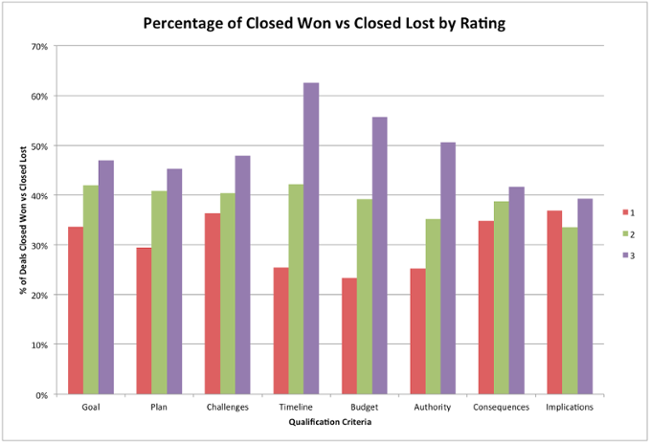
A few years back, using our Goals, Challenges, Plans, Timeline, Budget, Authority, Consequences, and Implications qualification framework (GCPT, BA, CI) we asked our salespeople to rate every opportunity they were currently working based on the depth of qualification for each of these eight criteria on a scale from one (not very thorough) to three (extremely thorough). For example, a level one qualification for the “Goal” criterion would sound something like, “The prospect needs leads.” A level three qualification for the “Goal” criterion would sound something like, “Prospect needs to generate 100 leads per month starting in August to support the addition of two new salespeople to the team.”

We analyzed each criterion in regard to the thoroughness of qualification across 1800 opportunities. The graph below shows that our average close rate was always higher when we achieved level three qualification. This was true for every criterion.

percentage_of_closed.png

Here’s more detail on our analysis.

Qualifying opportunities thoroughly helps you figure out who will buy and who won’t. Not convinced? Consider using a qualification framework, rating how qualified each opportunity is according to it, and doing a similar analysis comparing qualification level to close rate for your pipeline. I bet you’ll have similar results. (Don’t have a qualification framework? Here are a bunch to choose from.) 

12) Qualifying effectively enables you to set better expectations.

Every time I see a sales pursuit or customer implementation go in an unanticipated direction, I usually find out that a thorough qualification process did not happen.

A thorough qualification process helps you understand all the speed bumps that could derail successful implementation or adoption of your product or service. A strong qualification process allows you to plan for and avoid issues during implementation -- and even if issues can’t be avoided altogether, at the very least you can warn your prospect of the potential sticking point, so they’re not surprised and upset at you down the line.

It could be even worse than an upset customer if you don’t warn them of potential issues. You could lose your customer if you don’t effectively set expectations during your qualification process. For example, here’s a story about how I fired my snow plow company for failing to set expectations about arrival times.

Qualifying effectively sets expectations clearly. It’ll help you avoid surprised, pissed off customers who might even fire you.

An Effective Qualification Process Is the Foundation For Sales Success

Do you struggle with establishing credibility and trust with prospects, spending time with unqualified prospects, getting prospects to commit to your solution, avoiding and handling objections, long sales cycles, pitches that don’t resonate with prospects, chasing prospects, low conversion rates, low forecast accuracy, or poor expectation setting? If so, are you convinced that you should improve your qualification skills yet?

If not, there’s one final reason to improve your opportunity exploration process that might sway you. Good qualification allows you to control your destiny. Almost like a Magic 8 ball, qualification gives you insight into your prospects' decision making processes, helping you predict who will buy when. Knowing who is going to buy when is the key to exceeding quota every month, quarter, and year.

As I shared in my last article on qualification, qualifying effectively helped me build my career, which enabled me to achieve many of my personal goals. Hopefully, this article proves to you that great qualification skills can help you achieve your goals as well.

Are you a strong sales qualifier? What benefits have you seen from your thorough qualification process? Share your stories and tips in the comments.

HubSpot CRM

  HubSpot CRM
23 Feb 17:20

Four Tips for Better Sales Prospecting

by Jonathan Craig

Sales Prospecting Requires the Will and Skill

Sales Prospecting is at the heart of what every sales professional should be doing continually. It doesn’t matter who you are, your level of experience, or your position within an organization. While it’s great to have leads provided to you by the Marketing organization and to work with existing clients, if you don’t engage in sales prospecting on a regular basis, you will struggle when the need to find new clients arises — as it always does.

Simply put, sales prospecting is a fundamental part of being in sales. Most sales professionals will admit that, yes, it has to be done, but they would probably also admit that prospecting is not their favorite activity. In recognizing its importance to selling success and the tendency to put it off or avoid it altogether, I’ve developed a list of sales prospecting tips and techniques to help make prospecting a more regular and successful part of the job.

sales-prospecting

  • Schedule time on your calendar. Put your commitment in writing by blocking out time on your Outlook calendar or whatever other scheduling system that you use. Set aside time each week just for prospecting, and tell yourself you’re not going to do anything else for that period. This will give you a target to aim for, with time set aside to focus on this activity. When you write something down in your calendar, you tend to take it more seriously.
  • Don’t rely on data tools to drive the process. The prospect must come before the prospecting. LinkedIn and other online tools are rich with helpful data about people and companies, but before you try to connect online, consider the human element. Don’t let the ease of online access drive your prospecting process. Certainly, you should use these tools to help you define who the prospect should be, what type of organization they work for, their job title, and the industry challenges that they’re likely to be facing. Then, figure out why they would want to talk to you, and think about the people you know. Look to your real-world connections: people you know well, your business network, your personal network, etc. Do you have a friend in the target industry who, while maybe not directly connected with the prospect, might have connections that you could tap? Personal connections can be a real differentiator in today’s world of increased digital communications and social media.
  • Get out of the office. Sales professionals who grew up with the online world at their fingertips — whom I refer to as digital natives — tend to focus on these tools and use them as much as possible. I consider myself a digital immigrant, coming to the online world later, so it’s not second nature to me. I use the tools when needed, but I also make sure to go to real-world events, such as expositions and industry-specific seminars, in order to meet people face-to-face. I think that personal touch is so important, and it’s something digital natives need to incorporate more into their prospecting. I am not diminishing the importance or power of mining the available data, but it can’t be all there is when you’re trying to make a connection with someone and build a relationship.
  • Cultivate continuously. Sales Prospecting should never be a one-off event. It has to become an ongoing process that fits within your wider sales activities. Just keep at it, working to nurture long-term relationships with prospects instead of going for a quick win.

consultative-selling-sales-training-programs

The post Four Tips for Better Sales Prospecting appeared first on Richardson Sales Enablement Blog.

23 Feb 17:20

The Very First Mistake Most Startup Founders Make

by Noam Wasserman
feb16-23-000010025349

This article was updated on February 25.

Founders face a wide range of decisions when building their startups: market decisions, product decisions, financing decisions, and many more. The temptation is to prioritize these choices over decisions about how to structure their own founding teams. That’s understandable, but perilous. Our research, forthcoming in Management Science, identifies one of those important pitfalls: founder equity splits, i.e., the way founders allocate the ownership amongst themselves when starting their company.

Since 2008, we have studied the equity splits adopted by over 3,700 founders from over 1,300 startups in the U.S. and Canada. This builds on Noam’s work over the last fifteen years, which has shown that even the best of ideas can falter when the founding team neglects to carefully consider early decisions about the team: the relationships, roles, and rewards that will make the founders a winning team.

It is said that a team has succeeded at splitting the equity if all of the cofounders are equally unhappy. Unfortunately, founder unhappiness tends to get even worse with hindsight; the percentage of founders who say they are unhappy with their equity split increases by 2.5x as their startups mature. Increasing discontent within the founding team is a prime indicator that destructive turnover may be on the horizon. Exhibit A: Facebook. As memorialized in the movie The Social Network, Mark Zuckerberg’s initial equity split with Eduardo Saverin went sour as the company evolved. Mark’s attempt to reclaim Eduardo’s equity landed him in court—maybe good for winning Academy Awards, but not good for business, let alone personal relationships.

When and How to Split Founder Equity

Different teams have different ways of splitting the equity: some do it up-front, others wait to get to know each other; some go through a careful negotiation process, others are quick to shake hands and get on with it. Most important, some divide the equity equally amongst all founders, others come to the conclusion that the fair outcome is actually an uneven split that reflects differences among founders.

Robin Chase, cofounder of Zipcar, a car-sharing company, had heard a horror story from a friend about how the negotiation over founder equity had derailed the friend’s startup. Eager to avoid that outcome, Robin proposed to her cofounder a 50/50 split at their very first meeting, just as they were getting to know each other professionally. The cofounders quickly shook hands and accepted the equal split. Robin breathed a sigh of relief, they had avoided the high tensions that often accompany an equity-split negotiation.

Insight Center

At Smartix, Inc., which created a smart-ticketing system for sports venues, the founders adopted a very different model for splitting the equity. The founding team believed that “it’s best to delay [the equity split] because things are still unknown and changing.” When they finally split the equity, they took a very deliberate approach, fearing the effects that might emerge if any founder felt that the equity-split process was unfair. In their dialogue, the team delved into each founder’s past contributions, outside opportunities, preferences, and anticipated future contributions. They decided to split the equity unequally, with the founder-CEO receiving more than twice the stake of the cofounder with the lowest stake.

When founders are splitting the equity early in their company’s life, they face the heights of uncertainty — about their business strategy and business model, about their eventual roles within the team, about whether each founder will be fully committed to the startup, and about many more unknowns that will become clearer as they get to know each other. Things are even more uncertain for cofounders who have never worked together. Bypassing a serious dialogue about what each of the founders wants or deserves might be easier in the short-term, but is unlikely to be the right thing for the long-term health of the company.

Dive In or Take Time to Discover?

Robin Chase of Zipcar soon became very disillusioned with her “quick handshake” decision. She had never worked with her cofounder before, and had made some bold assumptions about how well they would work together, whose skills would be most valuable, and what the level of commitment would be. She threw herself into building the startup, crafting its business plan, and going parking lot to parking lot, looking for those precious parking spots that her company so desperately needed. Her cofounder? She didn’t even quit her day job, and contributed from the sidelines, at best. Robin soon came to realize the perils of that quick handshake. Her rushed negotiation had compromised her team’s longer-term effectiveness by causing her “a huge amount of angst over the next year and a half.”

Our research sheds light on what Robin learned the hard way. We look at the amount of time founding teams spend discussing their equity splits, and find statistically significant differences between teams who split quickly – neglecting to have a serious dialogue about personal uncertainties and expected contributions – and those who have a lengthier and more robust dialogue. Robin rushed through that discussion, forfeiting the chance to discover what made her cofounder tick, whether her cofounder was enjoying her existing job, whether she was even willing to join Zipcar full time, and so on. In our data we find that those teams that negotiate longer are more likely to decide on an unequal split: the harder you look, the more likely you are to discover important differences. More generally, we argue that if cofounders haven’t learned something surprising about each other from their dialogue, they probably haven’t engaged in a serious enough discussion yet.

The Perils of Family

Our data also indicate that splitting founder equity well between family members is particularly challenging. Cofounders who are relatives usually believe that they already know each other intimately and therefore don’t have much to discover about each other. However, we often act very differently at home than we do at the office, and also very differently under the extreme stresses that accompany startup life. If you’ve never cofounded together, it’s likely that you will be surprised by how your relative acts as a cofounder, often in negative ways. In short, relatives bypass detailed founder discussions at their peril, yet they are statistically more likely to do so.

Equity splits are a microcosm that beautifully reflect this. In our analyses, we find that founding teams that include relatives spent significantly less time negotiating equity splits. They were also much more likely to split the equity equally. Indeed, our research suggests that many founding teams care about displaying outwardly visible equality: not only does everyone gets the same equity share, everyone also gets exactly the same salary. This way no one can say afterwards that it wasn’t “fair.” This logic frequently trumps the alternative logic that a “fair” split should take into account that different founders contribute different skills, spend different amounts of time on the venture, or give up different job opportunities.

Equity Splits Have Longer-Term Impacts

Founders tend to think “our equity split is just between us; it doesn’t affect anyone else.” However, that “first deal” between founders could be a first sign of what troubles lie ahead. What do investors make of teams that split the equity equally? Our data suggest that they are less than thrilled. Even after statistically controlling for a lot of factors, our data still suggest the same basic message: companies that have equal splits have more difficulty raising outside finance, especially venture capital. Venture capitalists could obviously tell the founders to come up with a different equity split, but that causes a lot of strife and heightens cofounder turmoil and turnover. Given that venture capitalists invest in less than one out of every hundred companies that come across their desk, they are looking for reasons to say no. An equal split can send worrisome signals about the team’s ability to negotiate with others and to deal with difficult issues themselves. Interestingly, our research suggests that equal splits are more a symptom than the cause of trouble. It is not the equal split per se that turns off the investors, it is that equal splits are a symptom of bigger issues with the company.

Go Organic

Robin Chase’s painfully-learned advice: Adopt a “more organic” agreement than the static one typically adopted by founders. Vesting, in which each founder has to earn his or her equity stake by remaining involved in the startup or by achieving pre-defined milestones, is one way to achieve the dynamic approach advocated by Robin. Yet, for founders’ initial equity splits, such agreements are still the exception rather than the rule because there are many barriers to having the difficult conversation about adopting such mechanisms.

Essentially, such agreements are the equivalent of a newly engaged couple grappling with adopting a pre-nuptial agreement. Despite knowing about the high rate of divorce among married couples, we can’t bring ourselves to discuss the adoption of pre-nups with our fiancés. The same goes for the discussion of a “pre-nup” within a founding team. Setting up an agreement up front that outlines negative scenarios that might occur in the future, with corresponding actions to help avoid them, could help founders avoid headaches and increase startups’ chances of success.

This article has been corrected to clarify the early roles of the Zipcar founders.

23 Feb 17:16

The right’s plan to stop Donald Trump

by macleans.ca
Republican presidential candidate Donald Trump speaks at a campaign event in Atlanta. (AP Photo/David Goldman, File)

Republican presidential candidate Donald Trump speaks at a campaign event in Atlanta. (AP Photo/David Goldman, File)

Donald Trump rolled into South Carolina last week as the man to beat.

The celebrity billionaire Republican front-runner was fresh off a decisive victory in the New Hampshire primary, taking 35 per cent of the vote and demonstrating he is far more than a passing fancy to an angry electorate who might never turn out to cast a ballot.

He not only won big—yuge!—he won across multiple groups of Granite State voters—men, women, young and old, conservatives, moderates and independents. Suburban, city and rural voters all favoured Trump. Many supporters had no college education, but a third of them did.

Related: In New Hampshire, America’s tinderbox election catches fire

His rise over the course of the presidential campaign—marked by foul-mouthed outbursts, a greatest-hits reel that includes calling Mexican immigrants rapists and mocking a disabled reporter—has turned a presidential race that was supposed to showcase the deep bench of talent within the Republican party into a chaotic battle for its very soul.

In the words of one pundit: “The bladder-voiding panic has come to official Washington.”

Related: Inside the (unprecedented, illogical, incredible) rise of Donald Trump

While some in the Republican establishment appear to accept Trump as an unstoppable juggernaut, as the race lurches past the first caucus and primaries a growing number of American conservatives are swinging into action to halt him in his tracks.

“There’s a kind of fatalism to what a lot of Republicans are saying and doing these days that is unwarranted,” Ramesh Ponnuru, a senior editor with the National Review, told Maclean’s. In late January, the Review, America’s pre-eminent conservative publication, released a special edition with 22 prominent conservatives, from popular broadcaster Glenn Beck to David Boaz, executive vice-president of the right-wing Cato Institute think tank, making their case for why Trump should be stopped.

The goal, Ponnuru says, was to “persuade those people who might be persuadable that supporting Donald Trump is a serious mistake.”

Trump’s run is offensive to Ponnuru and like-minded Republicans on a number of levels, not least because they don’t think his policy positions are in any way conservative. While he calls for massive trade tariffs on China, they embrace free market ideals. He has a record of supporting the government’s power to acquire other people’s property, they oppose the use of eminent domain. He has spoken in favour of Canadian-style government-run health care, they argue for limited government and entitlement reform.

Even on the conservative issues the real estate baron does embrace—concerns with illegal immigration, the threat of terrorism, a frustration with political correctness—Ponnuru says: “He discredits those causes through his buffoonery, ignorance, and malice.”

Related: David Frum on why Donald Trump cannot win

Republican strategist Liz Mair says understanding the frustration and alienation fuelling Trump’s domination of the race is key to helping tarnish his appeal. “We do hear from some people, ‘Well, there’s no way to stop him, so what’s the point?’ I think that’s wrong-headed. Everybody has some sort of vulnerability.”

Mair is heading up the anti-Trump super PAC Make America Awesome—a play on Trump’s campaign slogan, “Make America great again.” The PAC’s mandate is to take down the business mogul. That means focusing attack ads on the darker side of Trump’s business record: his failed endeavours, his four business bankruptcies, and on his debate and media comments that undermine his populist image, like remarks that wages are “too high.”

The tagline of the super PAC’s ads? “He’s for Trump, not for us.”

Make America Awesome ran targeted ads against Trump in New Hampshire in advance of the Feb. 9 primary. In Iowa, a caucus state that leans toward socially conservative presidential candidates, they reached out to evangelical leaders to highlight potentially damaging comments Trump has made about faith. It aired attack ads in South Carolina.

Another anti-Trump super PAC, Our Principles Pac, was formed in January by Katie Packer, an ex-senior adviser to 2012 Republican presidential candidate Mitt Romney. It also ran anti-Trump ads and sent out negative mailers to Iowa and New Hampshire residents before voting day in those states.

It also owns TrumpQuestions.com, which offers a highlight reel of Trump’s past comments in support of single-payer health care, past praise for current Democrat rival Hillary Clinton, and flip-flops on his signature issue of immigration.

Our Principles Pac has spent $2.75 million opposing Trump so far, according to the Center for Responsive Politics, and plans on continuing its efforts in the coming weeks.

A third conservative group,  Club for Growth Action, is also running anti-Trump ads.

Still, Mair says many of the party’s big donors, while deeply concerned about Trump, haven’t so far been willing to crack open their pocketbooks to halt his rise. “I have a few conversations slated for this week,” she told Maclean’s following the celebrity billionaire’s New Hampshire landslide. “I’m hoping they will cut cheques but I also have feared for a long time that some of them would see a Trump win in New Hampshire, which our group always expected, and treat it as an opportunity to throw their hands up and say ‘it’s pointless.’ Obviously, we don’t believe it’s pointless.”

In fact, when Trump was locked in a pitched battle with Texas Senator Ted Cruz in Iowa in January, a number of prominent voices in the party establishment lined up behind Trump as a sort of worst-case scenario alternative to the firebrand hard-line conservative, who spent his time in Washington making enemies in the establishment.

Related: Unearthing Ted Cruz’s Canadian roots

In the New York Times, Republican elder statesman Bob Dole warned the party would suffer “cataclysmic” losses if Cruz was the nominee. Former New York mayor Rudy Giuliani said if it came down to Trump or Cruz, he was with the real estate tycoon. “As a party, we’d have a better chance of winning with him,” he told the Washington Post.

Not so, argues the National Review’s Ponnuru. “The case gets made he’ll pick up white, working-class voters. Well, maybe he will,” Ponnuru says. “But he’s going to lose a lot of Republicans. Republican support among upper-middle-class voters, among college-educated voters, would very likely decline. There is no reason to think that Republicans have found a floor among Asian or Hispanic voters. There’s no reason [that support] can’t go south. I don’t think this is being thought through at all.”

The private Boeing Co. 757 jet owned by Donald Trump, president and chief executive of Trump Organization Inc. and 2016 Republican presidential candidate, taxis next to a crowd during a campaign rally at Dubuque Regional Airport in Dubuque, Iowa, U.S., on Saturday, Jan. 30, 2016. After Trump skipped the final Republican debate before the Iowa caucuses, he said the decision played out well for a candidacy that has made bypassing political norms its stock in trade. (Andrew Harrer/Bloomberg/Getty Images)

The private Boeing Co. 757 jet owned by Donald Trump, president and chief executive of Trump Organization Inc. and 2016 Republican presidential candidate, taxis next to a crowd during a campaign rally at Dubuque Regional Airport in Dubuque, Iowa, U.S., on Saturday, Jan. 30, 2016. (Andrew Harrer/Bloomberg/Getty Images)

Ben Howe, a contributing editor to right-wing media blog Red State, worries that Trump’s run—successful or not—could so damage the party it will be shut out from presidential cycles for years to come. “In terms of the party, it destroys the branding, which wasn’t great to begin with,” he says. “When you’re spending most of your time fighting against the idea that you hate the poor and minorities, your branding already stinks. So if you bring in a guy who lives up to the very expectations of people who hate you, you’re destroying whatever brand you have left.”

Howe has vowed publicly to volunteer for Hillary Clinton’s campaign if Trump wins the nomination. (He makes a point to note she still doesn’t have his vote.) “The fact I have a headline at Red State, of all places, saying that I will phone bank for Hillary Clinton, and that that made it past my editor, speaks volumes on its own,” he says laughing.

Many Republicans say it’s time for the party establishment to forget favourites, for more candidates barely making an impact in the polls to drop out (like former Florida governor Jeb Bush did this past weekend), and for donors to throw their collective weight behind a viable alternative.

There are reports the Koch brothers’ network, run by the two billionaire conservative businessmen who wield tremendous political influence south of the border, are considering spending some of their nearly $900 million 2016 election cycle budget against Trump.

While it’s still a long slog through the primary season to the eventual Republican National Convention in Cleveland in July, the wait is making Howe anxious. “I may scare easier than they do. Maybe that’s why they’re millionaires and I’m not,” he says. “I think they want to see what happens, but that’s a dangerous game to play.”

The post The right’s plan to stop Donald Trump appeared first on Macleans.ca.

23 Feb 17:14

How hockey can change its energy-hogging, carbon-spewing ways

by Jonathon Gatehouse
London Knights goalie Michael Houser stands in front of his net while fog cover the ice during the third period of their round-robin Memorial Cup ice hockey game in Shawinigan, Quebec. (Vincent Ethier/Reuters)

London Knights goalie Michael Houser stands in front of his net while fog cover the ice during the third period of their round-robin Memorial Cup ice hockey game in Shawinigan, Quebec. (Vincent Ethier/Reuters)

Canada’s passion for ice hockey has some decidedly un-wintery consequences in terms of energy use at arenas across the country and their resulting carbon footprints. One Vancouver-based company, Swich Services Inc., is trying to change all that via REALice, a European-developed water treatment system that radically alters the way indoor ice is made and maintained. Maclean’s recently spoke to Florian Gabriel, the firm’s managing director, about how ice can go green and the difficulty in altering frozen perceptions.

Q: How big a contributor are hockey rinks to our greenhouse gas problem?

A: Let’s just try to get a handle on the amount of flood water being used. There were some stats, produced by the Ontario Recreation Association back in 2008, that said an ice-resurfacer runs 2,595 times a season, per ice sheet, holding 665 litres of hot water each run. That puts us in the range of 1.7 million litres of hot water per ice sheet, per season. Ontario has about 1,000 ice sheets, so 1.5 billion litres of water, just for it alone. For all of Canada, where there are around 3,000 ice sheets, we’re in the range of four to five billion litres of hot water, usually heated with natural gas. Then there’s back end, and all the electricity used to power the compressors to cool that water down to the freezing point keep the sheets cold.

Q: Where does the REALice technology that you’re marketing come from?

A: It originated in Malmo in southern Sweden. There’s a company called Watreco that innovated this vortex generator. Essentially, it’s a 3D-printed valve that swirls the water in such a way that it degasses it, taking out the micro air bubbles, so that you can make fantastic ice. The first unit was deployed in 1998 at the Malmo arena, and that’s still in use. That one was actually hand-carved.

Q: How does it work?

A: Think about a tornado, how the spinning creates a low-pressure zone and draws everything in toward the centre. That’s what allows us to separate out the micro-bubbles from the water. The ingenuity is the intake holes that are drilled in such a way as to create a multi-faceted vortex inside the valve. There’s no need for any additional energy input or maintenance.

Q: Why are bubbles such a big problem in ice-making?

A: People have been making artificial ice for more than a century now. I’m sure there were early experiments with cold versus hot water. But cold water holds three times as many trapped air bubbles, so you just don’t get a good sheet of ice. There’s too much insulation, and it’s brittle. Ice made with hot water—anything above 70° C—is just a lot smoother. So our technology simulates hot water by removing those air bubbles.

Q: So is it the same as the ice made with hot water, or better?

A: That’s a tricky question—ice quality is so subjective. But from a scientific point of view, the ice crystals created by using de-gassed water are larger. Which means the ice sheet is denser, which makes it faster and holds up for longer.

Q: Does it change the process of making ice?

A: No, not at all. That’s the beauty, you can be up and running in a few hours. We just attach our system to the main water pipe, de-gas everything and then you run your ice-resurfacer normally.

Q: But I understand that there’s been some resistance to this technology from ice-makers. Why?

A: I think it’s just because it’s such a radical concept. Everyone knows you can’t make good ice with cold water. You just can’t. So they’ve been using hot water for decades. And suddenly we’re telling them that yes, you can use cold water. You just need to shoot it through this valve.

Q: So how do you overcome those ingrained beliefs?

A: Here in British Columbia, we’ve had a pilot program with a utility company, FortisBC, that has really helped. They rolled it out to 10 sites and measured its effectiveness. We’ve been letting rinks rent the system for eight to 12 months so they can try it. Seeing is believing. We’re at a point now where municipalities are going to their rinks and asking how they can reduce their carbon footprints. Arenas are one of the biggest users of natural gas and electricity.

Q:  Your systems sell for $33,000, but you make the argument that it quickly pays for itself?

A: For a single sheet of ice, the energy savings repay it in two to three years. If it’s two sheets, and you’re using a single filling station, it’s under two years.

Q: The NHL has been using your technology since 2010, but only for outdoor games like the Winter Classic. Is it better suited to the outdoors?

A: It creates more resilient ice—that density I mentioned before. It helps the ice hold up to temperatures that are higher than indoors. We’d love to move it inside to NHL rinks, but nothing yet. Although we’ve been endorsed by the International Ice Hockey Federation and the Swedish and Finnish federations.

Q: How much energy do you think the REALice system saves?

A: It’s not just heating up the water. It’s what you don’t need to shave off is terms of cooling down the slab, too. If you put a cup of hot water in your fridge, it takes a lot of energy to cool it down. But if you start with cold water, not so much. Our treated water has less air trapped in it, which means less insulation, which means it freezes faster. Operators can therefore reset their brine levels, allowing their whole plants to run between three to six degrees Farenheit, warmer. The FortisBC pilot program verified a 79 per cent reduction in natural gas usage, and a 10 to 12 per cent reduction in electricity usage. We calculate the combined savings at 50 tonnes of C02 per ice sheet, per hockey season.

The post How hockey can change its energy-hogging, carbon-spewing ways appeared first on Macleans.ca.

23 Feb 17:07

26 Disruptive Tech Trends for 2016 – 2018

by Brian Solis

GROW_8-15

Each year at this time, I read all of the predictions for the new year plus the “top X” lists wrapping out the previous year. Add to that the first week of chaos that is CES and all of the new tech debuting in Las Vegas. And each year, I’m left wanting more substance as I plan my research. So, in 2015, I officially threw my hat into the mix with my inaugural look at “25 Disruptive Technology Trends in 2015 – 2016.”

Rather than look at just one year ahead, I organized my research against a two-year horizon and then added an analytical layer of what each trend meant and why each was important. But that still wasn’t enough. Nothing moves in calendar cycles except for taxes, birthdays, anniversaries, earning reports, etc. So, this year, I added one year to the event horizon…

Introducing the “26 Disruptive Technology Trends for 2016 – 2018.”

In this report, we’ll explore some of the disruptive trends that are affecting pretty much everything over the next few years-at least those that I’m following. It’s not just tech, though. The report is organized by socioeconomic and technological impact.

Obviously, this is not an exhaustive list of every technology and societal trend bringing about disruption on planet Earth. What follows thought definitely affects the evolution of digital Darwinism, the evolution of society and technology and its impact on behavior, expectations and customs.

Disruptive Trends: Socioeconomic trends that are notably impacting civilization in the near-term.

1) The New Brand: Experiences are More Important Than Products

Customer experiences become more important than products; companies now have to consider how products and services enhance specific lifestyles and workflows.

The legacy value of brands is overtaken by brands that earn relevance by investing in engagement and collaboration in moments of truth…beyond creative. Marketing becomes CX. This includes the sum of all disparate parts, marketing, product, sales, service, support, CRM, R&D, etc. Brands must also zero-in on the needs, values and aspirations of a generation that defines everything radically differently than previous generations.

2) Goodbye Sharing Economy, I Want My On-Demand Economy…Now!

Was there ever really a sharing economy if no one was actually sharing? The sharing economy officially dissolves: everything becomes on-demand and this forces economists and ultimately businesses to understand new markets and workforces that create alternative supply based on rising demand. On-demand companies and their ecosystems of workers and customers trade on the value of reputation + trust + value.

Beyond seeing the “Uber or Airbnb of everything,” new classes of services will rise and fall based on new behavior and expectations. I also refer to this movement as the “selfish” economy in that consumers will expect every business, even those that are traditional, to do business where transparency, immediacy and context reign supreme. Everything will be on-demand, including B2B services.

3) Digital Detox Improves Digital Productivity

Digital is its own drug. People will learn how to hack their workflow because they have to. There’s too much email, too many meetings and not enough leadership to change routines. This leads to the need for individual productivity hacks. These acts go beyond employee efficiency; they will improve experiences and relationships professionally and personally. Everyone will need some sort of digital detox and/or focus.

While some will simply unplug from the Internet, others will discover and share “life hacks” such as…

  • Writing down distractions from tasks at hand
  • Checking email once a week
  • Scheduling meetings in 20-25 minute increments
  • Listening to music without lyrics
  • Spending 10 minutes a day on Headspace
  • Fasting from media
  • Not responding to every txt
  • Turning off all desktop, social and mobile notifications

4) Every Company Undergoes Digital Transformation and Gains Empathy in the Process

Digital transformation – the re-alignment of, or new investment in, technology and business models to more effectively compete in a digital economy – becomes standard. Companies will invest in digital customer experiences to improve experiences for all customers and employees.

There is no one type of customer or employee. Thus, digital transformation efforts will not be informed by digital trends; instead, social science will help decision-makers better understand how digital trends affect how people work, shop, communicate, what they value etc. Technology will then be an enabler to human-centered transformation in the enterprise to create more adaptive models, processes and systems to evolve.

5) The Dynamic Customer Journey Changes Brand Dynamics

The customer journey decentralizes, becoming a series of non-linear mobile-centric micro-moments, mimicking everyday consumer activity and communication. This sets the stage for relevant brand and product serendipity.

For example, Google learned that 90% of smartphone users are not absolutely certain of the specific brand they want to buy when they begin looking for information online. And, 65% look for the most relevant information regardless of the company providing it. How companies become discoverable and how they lead customers through their journey requires a new marketing infrastructure to support a customer journey comprised of micro-moments. This means that legacy strategies are good only for yesterday’s customers. To reach mobile customers in each moment of truth requires new methodologies for search, advertising, content engagement, sales and support.

6) The Consumerization of Work Turn Employees into Collaborators 

The consumerization of work goes beyond IT and devices; workflow, behavior and expectations mimic real-world apps like Snapchat, Uber, Tinder, etc.

Digital employees and customers think, act and expect differently. They want every business to feel, serve and work just like their favorite apps.

Enterprise software will start to mimic consumer apps and ultimately reshape the role of IT and the processes it manages to support employees. Slack is just the beginning of an enterprise renaissance that doesn’t just change tech – it changes how companies (and people) work.

7) Humans Need Not Apply for Old Jobs

The gap between expertise for the jobs of yesterday and tomorrow is widening. Everyone becomes students again. Yes – robots already are and will continue to automate workflow. Factories aside, intelligent devices are replacing people in front-line roles such as those at eateries, including Eatsa and McDonalds.

Traditional education no longer suffices as people are learning basic skillsets without understanding or knowing how they correlate to tomorrow’s careers. People will specialize in tasks that computers need humans to complete. Scholastic and workplace education will formalize computer-proof and computer-partnered careers and programs, and thus education becomes a constant.

8) The Age of Corporate Renaissance

Old ways give to new business models, processes and philosophies; disparate departments merge, uniting tech and complementary disciplines.

Marketing and IT work together rather than compete. CX, CRM and marketing form new experience teams.

CIOs realize the “I” stands for “innovation” and as such understand external/internal behavior to rethink how people and tech work together now and in the future.

Training and education become proactive to help modernize the workforce.

HR undergoes a renaissance to provide a workplace that is native to Millennials and up-and-coming Centennials.

9) Corporate Innovation Centers Displace or Complement R&D; The Maker Movement Becomes Threat or BFF to Incumbent Companies

Traditional R&D is no longer sufficient. Big companies invest in innovation centers: some aim to act like startups, others set out to partner with or acquire them, and some seek to lure people away from #startuplife.

Either way, innovation centers allow slow-moving, risk-averse companies to spark new ideas, experiment faster, fail faster and gain momentum to affect HQ and force change from the outside-in.

Some great innovation that cannot see the light of day within larger organizations will develop new markets, upset incumbents and either succeed solo or rollup into those companies that could not innovate.

The maker movement is “Shark Tank” for geeks and it doesn’t need judges to fund them; there’s Indiegogo, Gofundme, Kickstarter, et al. for that.

10) Culture Finally Gets Its Time in the Spotlight – Welcome to Culture 2.0

Culture is largely misunderstood and undervalued by the C-Suite today. It’s one of the reasons morale is at an all-time low. This will change because it has to. Employee engagement or the lack thereof creates a morale-busting “engagement gap”, giving way to an executive-level charter to invest in “culture 2.0”

11) Businesses Must Live by Radical Transparency to Gain Trust and Business of Customers

Businesses must also practice radical transparency or risk irrelevance. Customers want to do business with companies that match their beliefs and values. Customers are more aware and informed now. This means businesses must run counter to its normal practices, change and communicate this vision and changes in everything. With a more plugged-in understanding of human nature, businesses will not only create a happier and more productive culture: they will benefit from empowered employees, leading to an internal renaissance that yields new and innovative products, services, processes, and more.

12) Schools Pay Students to Learn and Become Agencies that Connect Companies with Expertise

The race for technical talent extends to Africa and other non-traditional establishments (such as prisons, etc.) to train qualified students computer and engineering sciences. Specialized schools will identify and teach students – even pay them to learn – and become an IP lab for companies to employ, similar to how outsourcing of other business functions works today.

Technology Trends: Technology trends that are changing how people live (and for how long), communicate, network and work.

13) Jarvis is Your New Chat Buddy and He Ushers in a Dawn of Conversational Commerce

Chatbots (and a dash of human interaction) turn messaging into concierge services (aka virtual assistants) and eventually predictive services that simplify everything from search to shopping to travel to customer service.

This sets the foundation for “conversational commerce.” The ability to buy products and order services without leaving the chat window becomes the new norm for everyday shopping, much like Amazon has become the standard for e-commerce.

Intelligent attendants such as Microsoft Cortana, Google Now, Amazon Alexa and Apple Siri will become staples in how people navigate life and work. Very soon, the complicated and often silly questions you ask of Alexa and Siri, will be answered.

You’ll be taken aback for a split second and then you’ll go on as if you couldn’t have lived without it.

14) Mobile-first Behavior Transforms the Web

The entire Web will be re-imagined for a mobile-first and mobile-only world that is screen, location, context and intention-aware. This radically transforms the purpose of the web to become more dynamic, personal and useful at a time when people are forcing the end of a traditional information-broadcast, page/form-based, keyword world. Everything from websites to apps to commerce will require overhaul or complete innovation to cater to the EGOsystem, or the demand for real-time personalized engagement.

15) The New @Machine Age Discovers the Fountain of Sleuth

Quantum computing dramatically accelerates the artificial intelligence race, applying machine calculations that are 100 million times as fast as today’s machines. IBM’s Watson is being applied to healthcare, finance and even cooking, to explore new solutions in cognitive computing. AI can sort through and assess information that humans may have missed or never considered. This type of work is already leading to new treatments, products, services, and yes, recipes. You can bet it will also be applied to call center technology and may or may not make you want to use counter services such as @service in response.

Artificial intelligence is just one area that will benefit from experimentation. Machine learning will also yield innovation in pattern recognition, predictive analysis, mimicked common sense, and even new ways to compute and solve problems.

More immediately though, breakthroughs in programming will eventually iterate and innovate existing engineering issues, air traffic control, curing diseases, etc.

16) Reactive Medicine Gets Proactive

Regenerative medicine cuts through the ethics debate by helping everyone gain access to cloneable organs.

Nanobots will be able to assess and fix us from within. Those made from our own DNA will eventually help cure us from deadly diseases ranging from blocked arteries to cancer.

Healthcare and athletic brands will also learn from Disney’s massive Magicband investment to bring big data insights to improve health and life experiences as part of a Human Operating System (Human OS). A human operating system becomes a platform for innovation that mimics the Apple product and iCloud universe. A Magicband-like device and other products designed to work in its ecosystem are constantly plugged into personal clouds accessible by healthcare providers. Blood, oxygen, vitals and more will shift the practice of medicine from reactive to proactive care.

17) The Sh#tshow that is The Internet of Things Finally Plugs into the Human OS

The Internet of Things becomes the Internet of Sh#t because it’s a mess with too many products and apps competing for consumer attention. This creates confusion and chaos as devices are proprietary, capabilities are too narrow and not reflective of everyday life and only a few companies such as Google’s Nest and Apple’s Homekit are designing plug-and-play smart ecosystems. Even still, technology must be invisible and interoperable.

Developers must plug into the Human Algorithm and the Human OS, envisioning the body and critical activities as an ecosystem/platform rather than technology and device-first products.

On the immediate horizon, smart connected products (The Internet of Things) will help consumers in transparent means, such as in-product communication, where products communicate to manufacturers, users and suppliers about state, maintenance needs and updates. This will be done in-home and also onsite where locations become smart about visitors to better guide experiences.

18) Live! Streaming! Mobile! Video! Now!

Live streaming (video) continues to bring niche moments to life, interrupting streams everywhere, making conversations on demand a form of engagement and entertainment. This makes everyday activities such as gaming, sports, concerts, events, TV, discussions, etc., become content and its hosts and participants the new weblebrities. This puts pressure on Youtube, Vine, Facebook, Snapchat to rethink video algorithms and subsequently monetization/advertising platforms. With streaming services forcing the unbundling of traditional subscription channels and the democratization of content production and distribution, consumers re-define programmatic content and reshape the definition of “TV.”

19) Say Hello To My Little Mends; Drones Join the Workforce

Drones will continue to revolutionize photography and videography but real innovation will derive from utility in vertical applications such as delivery, care, exploration, etc.

20) Ctrl-P: Print Solutions at Will

The proliferation of 3D printing solves problems and creates solutions in vertical industries (healthcare, aerospace, automotive, manufacturing, etc.), disrupting supply chains as it matures.

Personal applications will initially be served by brick and mortar establishments such as home improvement, auto repair, and other services where parts take time, are too expensive or unobtainable.

21) Siri, Take The Wheel

You may already own your last car. Autonomous vehicles will start to make their way onto public roads as laws rapidly iterate to make way for the inevitable. v1.0 will be very beta, with initial cars shipping with steering wheels and requiring drivers to “take a back seat” but be ready to take over at a moment’s notice. Fully autonomous, self-driving cars will be on the road by 2025. Cars will learn not only how to drive, but also how to limit or strategically consider accidents, injuries and even death of passengers, drivers and pedestrians.

Intelligent transportation not only changes how people, goods, etc., get from point A to point B, but also how vehicles and technology talk to one another to create safer passage ways. Each will also transform regulation to expedite a connected grid where transportation engineering and infrastructures as well as vehicles, gear, components, etc. work together.

22) Experiences Get Real Virtual

Oculus, Hololens, MagicLeap are bringing the virtual world to life. Immersive computing will find its niche beyond industrial design and start to permeate high-end gaming and other experiential sectors. It will open up an entirely new world that truly brings VR/AR alive…or closer to lifelike.

VR/AR are already a given. As gear becomes increasingly portable (think something like Google Glass), though, experience architects and next-gen imaging equipment will design immersive 360-degree experiences that don’t just replicate everyday life, but instead enhance and even challenge it. Think about shopping with products and attendants that appear out of nowhere, or information about products that come to life as you pick them up. When you visit Hawaii and the land where Jurassic Park was filmed, you will have the opportunity to actually visit Jurassic Park. Playing games where the field of play is your physical environment with challenges greeting you in your own space. Total Recall and Minority Report are just around the corner.

23) Power On…ward

In-home battery systems provide an entry-level solar solution to those with electric cars. Systems such as Tesla’s Powerwall and Powerpack lead to a battery innovation race that benefits households, devices/appliances and other goods powered by less eco-friendly means and the greater power sector.

24) Fashion Sense Gets Smart, Darlings

Intelligent or smart fabrics (E-textiles) make clothes more than fashionable or useful: they become part of a new genre in the wearable movement. Working together, many types of sensors integrated into one larger garment can tell different stories and unlock new possibilities.

Clothes will have beacon-like technology to control/inform surroundings. Clothing articles will transform based on environment and activities, and also sustain desired body temperatures.

Through Bluetooth technology, clothing will communicate body status to core devices that track performance, state, etc. for you and your healthcare provider.

25) Finance Gets a Makeover Inside and Out

The blockchain allows you to create a public ledger system that’s accessible for all, and secure. Blockchain technology will influence global financial organizations to rethink banking infrastructures. Rather than transacting based on the individual, currency and ultimately goods become individual assets. Each transaction becomes a micro-purchase around your account, but it doesn’t actually involve your personal authentication. Authentication is performed by your assets. All of this is recorded on your bank’s open blockchain ledger in real-time, easily and inexpensively.

Speaking of banks…based on the rise of the “selfish economy” and the consumerization of all tech, the idea of what a bank is and how people interact with it creates new micro-banks that look, act and perform banking functions for a digital/mobile generation.

26) The Cloud Takes Over Business

Critical ERP systems beyond CRM, marketing, etc. move to the cloud. Businesses cannot compete at the speed of digital Darwinism if they don’t change how they “do” business.

Nearly a third of all enterprise resource planning (ERP) systems in the world will attempt the migration to the cloud in the next two years.

The post 26 Disruptive Tech Trends for 2016 – 2018 appeared first on Brian Solis.

23 Feb 17:07

5 Tips for Measuring Your Social Selling Success

by Rachel Clapp Miller

Social sellingSocial selling is a term that’s received a lot of “buzz” in the sales industry. It’s a likely result of sales organizations trying to provide reps with the tools to communicate value and differentiation digitally.

We don’t love the term because it indicates that social selling is something different than great selling. We see social selling as another tool to use to articulate value and differentiation, particularly in the digital space. However, as with any sales activity, if you want it to drive success you need a way to measure it. Here are five tips for measuring your use of social media tools in sales.

1. Track Prospect Referrals

Social selling activities don’t always lead directly to sales conversions. They often set the foundation for future lead nurturing. However, the most direct way to measure whether social selling contributes to sales is to track prospect referrals.

When reps are able to input the lead source for each prospect in the CRM system, they can note a particular social medium as the first engagement point with the prospect. Then, you can monitor total conversions and efficiency rates of various social media.

2. Know Your Content Engagement Rates

Social media engagement refers to some form of direct interaction with your content by a follower. With social you can equate engagement to some sort of interest in you or your solution.

Engagement metrics vary across platforms. Some tools have built-in analytics you can use to measure engagement. Third-party software tools aid on social selling analytics as well. High engagement rates signify relatively strong interest in the content your sales reps share. There are some software solutions that embed these metrics in the CRM or you can work with your marketing department to determine an easy way for you to measure engagement rates at the rep level.

3. Count CRM Social Selling Contacts

Another critical metric is the number of social selling contacts reps have per each account in your CRM database, according to Inc.

If you have five average social contacts per account, for instance, this means your rep has at least five people receiving content through social. Additionally, it means several people are connected to him, which creates more open doors for information requests. CRM databases often track social contacts for you.

4. Track Profile Views

Profile views are an indicator of the appeal of your company or individual rep profiles on a social platform. This particular term often refers to a metric on LinkedIn, which is among the most beneficial platforms for B2B sellers.

LinkedIn tells you the number of profile views on your account within the most recent 30 days. You can gain access to additional view data and other metrics through a paid subscription.

5. Know Contacts vs. Followers

One of the most direct metrics of social selling success is reach. In social media, reach is the number of distinct eyeballs exposed to your content. Ideally, you reach people through social media that you might not have the ability to connect with through traditional communication channels.

Beyond impressions, you need to track the number of contacts you receive that result directly from social connections. Track links to your website or blog from social shares. Have sales reps note when prospects make contact based on social connections. Knowing which tools efficiently produce contacts and sales conversions enables reps to focus their time on the most impactful platforms.

Your marketing department is likely tracking these metrics now. Develop a way for you to have insight into those metrics for your sales team. This knowledge will allow you to better understand how your reps are using digital currently and where you can drive improvements.

Social selling isn’t a magic bullet. Encouraging your people to share content on LinkedIn or Twitter doesn’t mean that the leads will start pouring in and the sales will close automatically. Using social in the sales process provides a way for salespeople to engage with prospects and customers digitally.

Your salespeople can gain hundreds of followers, thousands of likes and even make valuable connections, but if you don’t have a system that capitalizes on these interactions, you’ll never see the kind of return that drives bottom-line impact.

While it is hard to directly connect social selling to conversions in many cases, don’t assume that a large following on a social media platform means sales success. Social selling is more driven by how reps leverage their networks for engagement, contacts and conversions. Use these primary metrics to track efficiency and leverage these tools for growth.
Download our Ebook: The ROI of Sales Messaging

23 Feb 17:07

What Google’s Latest Change To The Search Results Means For Marketers

by Yaron Marcus

As you may have already heard, Google confirmed it will no longer be showing ads on the right side of the desktop search results page on most searches worldwide. From speaking to other online marketers, it seems many of us had a similar response; we all know this is bad news, we’re just not sure exactly how bad. While Google always tries to balance providing value to both its users and advertisers, it’s important to remember that above all, Google optimizes for Google. Though I don’t personally think this change will have any major catastrophic impact overnight, I do believe search marketers will feel the effects over the next months. Below are a few thoughts on what this means for marketers and what we should do to prepare.

PPC Traffic Costs Will Increase
This one is pretty obvious. Google is removing quite a lot of ad inventory from their results page, forcing advertisers to increase their bids on the ad auction if they want to receive traffic from the ad slots that remain.

It Will Be Harder for New Advertisers to Enter Competitive Verticals
Companies launching campaigns that target highly competitive keywords will have a very difficult time getting much traffic, and when they do, it will be unreasonably expensive. That’s because there will be few active advertisers in each vertical, and they will be the ones with large budgets, highly optimized campaigns and excellent quality scores with lots of history. Breaking in with a new campaign means out-performing one of these more established advertisers, which will be difficult. If you plan to do this, prepare to overpay significantly for your traffic while building up quality score and proving yourself to Google.

left out

Writing Original Ads Will Be Less Important than it Once Was
When you want your ads to stand out on a results page filled with competing ads, you need to constantly test and optimize them to make sure you get as many of the clicks as possible. With less ads competing for people’s attention, campaign managers only need to differentiate themselves from a small group of competitors, so the process of testing new, original ads will become less of a burden for the handful of successful advertisers in each vertical that are able to maintain their standing in the top ad slots.

Organic Search Results for Non-Competitive Keywords Will Get More Traffic, For Now
Google will be showing 4 ads at the top of the results page for keywords with lots of competing advertisers, pushing organic results even further down the page. But for low demand keywords, such as “capital of Idaho” or “list of nursery songs,” they will continue showing just 3 ads at the top. For these keywords, the sites appearing in the organic results will have less competition. This will translate into more traffic for the short term. However, my guess is that over time, Google will fully populate the newly vacant right sidebar of their search results page with information from 3rd party sources. They already do this quite a lot this with the knowledge graph panel that shows up for certain types of searches, but I think this is just the beginning. Ultimately, Google’s results pages will give users little reason to ever click on anything other than an ad.

knowledge graph

Knowledge Graph Panel

So now that I’ve sprinkled all this sunshine, let’s discuss a few things you can do in response.

Target Long Tail Keywords
The tail keywords (with 3+ words that are not being targeted by numerous other advertisers) must become a bigger part of your strategy. You should be targeting them with AdWords ads, content via SEO, and BingAds, which brings me to the next tip.

If You Don’t Already Have One, Open a BingAds Account
Importing your AdWords campaign into a BingAds account is incredibly easy and a great way to lower your dependence on Google. Ads on Bing cost less per click, and are often more profitable.

Improve Your AdWords Quality Scores Across Your Entire Account
You may have gotten away with having 10% of your traffic coming from keywords with low quality scores on Google AdWords, but it’s time to up your game. In a world with only 4 paid listings sharing most of the traffic for each keyword, only the most deserving advertisers will survive. So that means deleting keywords where needed, increasing bids and creating more relevant ads on low quality score traffic.

Build Out Your Ad Extensions
These are optional ad features that help you take up more real estate on Google for ads that appear on the top spots of the results page. They improve your click-through-rates and quality scores, and may help you secure your spot at the top.

Test New Ad Channels
If you haven’t gotten around to it yet, then now is time to branch out to additional ad networks. Facebook, AdRoll, LinkedIn and many other platforms offer great alternatives to reach your audience. Of course the users have different intent than on search engines, so you’ll need to tweak your marketing messages and funnels accordingly.

In summary, if news about the removal of these ads has you worried, you’re justified, but there’s no need to panic. The impact of this change may not be that dramatic for all advertisers, and even if they are, there are steps you can take to maintain and even grow your online sales.

23 Feb 17:06

How and Why To Set Your Site Up for Google’s Rich Answers

by Pam Neely

Google Search

There’s a huge new thing evolving in the search results. I’m sure you’ve already seen them. Maybe you’ve noticed more of them recently, too. I’m talking about rich answers.

Rich answers are not like other search results. They play by different rules, affect other rankings, and offer a major new opportunity for SEOs who know how to use them.

What’s a “rich answer”?

A “rich answer” is any attempt by Google to answer the searcher’s query in search results in a way not requiring a click through to a website.

– Eric Enge, CEO of Stone Temple Consulting

What do rich answers look like?

Rich answers come in many forms. They can be recipes, sports scores, stock graphs, calculators, sliders, text-based answers, numbered step-by-step directions, maps, and much more. Most of them fall into one of three broad categories:

  1. Answers provided by Google: These are shown at the top of web search results, and are often public domain information.

calories in banana

2. Basic Snippets: These are often shown within the regular web search results. Note that this one is 226 characters and spaces, well beyond the 155 recommended for a meta description.

basic snippets

3. Featured Snippets: These are results extracted by Google from third-party websites and shown at the top of the web search results.

Featured Snippets

Rich answers are taking over the search engine results pages (SERPs)

Google is adding more rich answers to the search results every month. Here’s how the percentage of rich answers has risen between two studies Stone Temple did last year:

overall-growth-in-rich-answersADJ

Should site owners worry about rich answers?

No. Rich answers are a threat only if you’ve built your website with public domain information. That’s because Google seems to prefer indexing and formatting public domain content into rich answers, and they don’t have to include a link to any site if they use public domain data.

This form-style rich answer is an example of public domain data:

Public Domain Example

If you’re a company that Google has chosen for rich answers, it might seem like Google is trying to “steal” content from your site and show it to their searchers without sending any traffic to your site, but that’s not true. You do sometimes get a link; searchers just don’t need to click your link to get the answer they want.

increase credit score

But the real pay-off is that being picked out this way says your information has been chosen as the best. And the positioning on the page helps your brand look authoritative and trustworthy. It’s publicity you can’t buy, which is why it’s so valuable.

Part of Stone Temple’s research on rich answers included two case studies about how rich answers affected different sites. The two sites they studied saw an increase in traffic after their content was included in a rich answer.

Does your site need high authority to get its content used for a rich answer?

No. As Enge says, “54% of the domains we found Google using had a [Moz] domain authority of 60 or less. And we even found some domains with a domain authority of less than 20 that Google used for rich answers. We don’t believe that there’s any connection between authority and getting the rich answer. We believe it’s all about an information quality analysis that Google does. And that’s the key to this.”

StoneTempleSlideDomainAuthorityStone Temple Consulting looked at over 800,000 sites that had had their content made into rich answers. Many of them had surprisingly low domain authority.

This is possibility the biggest story around rich answers. It means sites that would probably never make the top of the search results can now rank … if they can get their content used as a rich answer.

Rich answers make SEO even more of a winner-take-all game (on a single page).

You’ve probably seen this chart or one like it before:

dvanced Web Ranking’s Google Organic CTR Study 2014Chart from Advanced Web Ranking’s Google Organic CTR Study 2014.

It shows how pages in the first position of search results get twice as many clicks as the second position. And the second position gets a higher click-through rate than the page ranked third, and so on.

This pattern applies to rich answers, too – only more so. Because rich answers are set apart, and because they push other search results lower on the page, rich answers typically get an even larger percentage of overall clicks than the page in first position gets in regular results. So instead of the page in first position getting 30% of clicks, a rich answer might get 40-50% or more of clicks.

User engagement matters – a lot

Google often tests rich answers from different sites. It appears they rotate different content to see how well searchers like it. This is, of course, exactly what they do with regular search results all the time.

What does this mean for marketers? That the content/landing pages on your site (the page the rich answer links to) need to have high engagement metrics. So format your content well, add images and videos and other content formats. Consider a quiz. Once you get your content into a prized rich answer slot, do everything you can to keep those visitors happy.

How to get your content indexed as a rich answer

There’s no guaranteed way – right now – to get your content featured in a rich answer. That said, there are things you can do to improve your odds:

1. Create a list of the most common questions people ask in your industry or niche.

This might be a good time to check the Google AdWords Keyword Planner to see how many search phrases are also questions in your niche. If you’ve got Google Site Search set up on your site, that’s another source of information about what people are asking about. Q&A sites like Quora and Yahoo Answers also might be helpful for finding common questions.

Be sure to use the words searchers use, not industry jargon… unless industry jargon is included in the typical question being searched.

2. Pay particular attention to questions that show up in autofill.

Here’s an example of autofill in action:

Autofill Phrases

When I checked those search options, six out of eight of them had a rich answer. So if there are any questions that apply to your business, industry or niche that appear in autofill, you might want to try making a rich answer page for them. Especially if there isn’t a rich answer for them yet.

3. Create content that specifically – and succinctly – answers those questions.

One question per page. Where you can, use step-by step-answer formats, like these step-by-step instructions for boiling an egg.

HowToBoilAnEggDesktop

Above all: keep it short and sweet. I checked ten different “how to” style rich answers for word counts and character counts. The average word count was 54. The average character count was 288.

How Queries

Of course that’s just for one type of rich answer – if you want to get listed for a rich answer that’s a figure or number, those word and character averages won’t apply.

4. Use keywords in those short answers.

This is not too surprising… but I noticed many of the rich answers had a hearty dose of keywords sprinkled in. In typical Google search results style, the keywords were in bold. That makes them even more likely to attract people’s attention.

I copied a bunch of text-based rich answers into a Word doc. A few of them are below. You can see how often the keywords appear. I think most of us would have automatically sprinkled relevant keywords into the answers, but here’s confirmation it is indeed a good idea.

Rich Answer Keywords

5. Mark up the question you want to answer with tags.

Here’s another example of a simple rich answer:

simple rich answer

Here’s the HTML code that creates the page that rich answer drew its content from. Notice the tag.

WhyIsSkyBlueCode

I did a “view source” on over 20 pages that had generated rich answers. In almost every case, the question was within tags. And the answer was within paragraph tags (except for rich answers with step by step instructions).

The interesting thing here is that no schema markup appears to be required. That’s according to the research done by Stone Temple. It also mirrors what I found when I looked at the code of pages used for rich answers.

For step by step instructions, use

  • tags. I didn’t come across one step-by-step instruction that wasn’t coded with tags.

6. Add supplemental information to each page with the rich answer content.

Here’s your opportunity to go into more detail. People almost always have follow-up questions or related questions. Answer those lower down on the page. For my (extremely small) sample group of content pages that generated rich answers, the average word count was 1,658.

There’s an app for that

If all these changes and new opportunities weren’t enough, Google has another new angle on this for you. An app. An entire app of rich answers.

This may reveal Google’s vision for rich answers. They’re not just mobile friendly – they’re mobile native. Mobile is in their DNA.

Rich answers are just the kind of short definitive answers mobile users want. And, as you know (because I am a broken record about this) mobile usage now exceeds desktop usage.

Rich answers may just be Google’s way of moving desktop-based information to a mobile platform. That’s where the users are.

Rich Answers App

Conclusion

Rich answers appear to be something Google is committed to. At the rate they are adding them to search query results, we could see half of our question-based queries returning a rich answer by summer of this year.

If you can get your rich answer to show up, you’re likely to see a significant spike in traffic. But because these rich answer boxes do so well, if you’ve been ranking well in the organic listings – in position 1, 2 or 3 – but you don’t get your page into a rich answer, you’ll probably see a drop off in traffic. Even if your page holds its place in the SERPS. We’ve seen this with other search widgets Google adds, like local carousels, ads, and news.

According to Eric Enge, it looks like Google is testing out a new algorithm with rich answers. An algorithm that is independent of links and other site or page-based ranking signals. Rich answers appear to show only according to content value. So we’ve got a potential new algorithm here. It’s solely focused on content quality, to the exclusion of other ranking signals. If that’s true, it’s a big deal.

Finally, rich answers present a terrific opportunity for smaller, newer, less authoritative sites. Google will show a rich answer from a page with relatively low authority – a page that often would not appear in the regular SERPs. That’s another very big change. But it’s just one of many.

Back to you

Is any of your content appearing in rich answers? Are you reformatting your content or creating new content in hopes of getting it into a rich answer? Tell us about it in the comments.

SEO Toolkit

23 Feb 17:06

Count Money You’ve Lost from Ineffective Sales Meetings

by Tal Vinnik

Calculate how much ineffective sales meetings can cost you.

There are two types of meetings sales reps will typically find themselves in:

Customer-Facing Meetings: These are the meetings that sales reps thrive for, where weeks, months or even years of marketing, cold prospecting emails and voicemails lead. Sometimes they happen over the phone, sometimes over video conferencing and for field sales reps, many of them happen in person.

Internal Sales Meetings: These are meetings where sales managers and directors gather their reps together, and share customer insights, sales content updates, major deals that week, product pushes, etc. For most organizations, these meetings are necessary and can equip reps to become better salespeople with the help of their colleagues.

When you think of ineffective meetings, you’re probably thinking of internal sales meetings. Many salespeople find internal meetings redundant, overlong and unnecessary. Not that this is unique to sales; sales reps can join the ranks of millions of workers worldwide who hate internal meetings. Who hasn’t been in a meeting and thought, “Couldn’t you have emailed this to me?” Or in a standing weekly meeting where people showed up only because it was on their calendars, and not because there was a clear agenda that week?

That said, it’s not a good idea to just stop meetings altogether. Forbes offers a few tips for successful sales meetings, including:

  • Building culture and motivating the team through positivity
  • Keeping updates on supply-chain and volume to a minimum; that can be restricted to email
  • Getting input from various team members (You wouldn’t ignore the customer in a customer-facing sales meeting!)

Forbes suggests a “magic length” of a “maximum” of 75 minutes for a weekly or bi-weekly sales meeting. Some meetings add value to team members and the company, but only if they’re efficient and well thought out.

Are Your Meetings Worth It?

Sales managers need to be very conscious of filling their reps’ time with non-sales tasks. Sales reps already find themselves spending hours on administrative tasks like adding to their CRM. The first step to seeing whether your sales meetings are worth it? Find out how much they’re worth.

Harvard Business Review put together a sales meeting calculator that helps you do just that. You put in how long the meeting lasts, how many people are attending and how much each of them is making. As an example, I put in a 15 minute meeting with 20 attendees, most of whom were average earners ($70k annually), a few of whom were higher ($150k). That nets a cost of about $300 over just 15 minutes. If you’re at the “magic length,” your weekly sales meetings are costing you $78,000 a year. For just over an hour a week. And that’s not even counting the potential money sales reps could’ve earned in that time that would be lost.

Once you have a hard number, start weighing the benefits of meetings and how much of the meeting is necessary for your reps. You can use the HBR calculator to then edit and compare your new meeting. You might find much of your meetings are expendable updates, whether new sales content or supply-chain, that don’t require so much of your reps’ time.

Want to learn how you can save your sales reps thousands of hours? Get the 5 steps to sales transformation, modeled on successful Fortune-ranked companies, below!

5 steps to a successful sales transformation

23 Feb 17:06

6 Things Every Startup CEO Should Know About the Sales Process

by Richard Harris

I’ve been working with startups and CEOs for the better part of 5 years now. Some of the CEOs I work with have strong backgrounds in sales, but recently I’m seeing more and more startup CEOs and founders coming from the technical side of the house.

Through no fault of their own, these technical founders and CEOs often don’t have a good understanding of the sales world and how certain sales processes work. So, with this in mind I’ve put together a few tips for startup CEOs and founders to help get their arms around the sales process and pipeline.

1. Customers are buying the CEO as much as the product or service.

A big point of frustration for non-sales CEOs is around the length of the sales cycle. Often times, when CEOs get involved with a prospect call, they’re able to quickly answer that prospect’s questions and move them through the pipeline. But, that’s not always the case for sales reps. CEOs fail to understand why it takes a rep longer to move a prospect through the process.

CEOs think “I can do this, why can’t the sales team?” So it’s important to remember the following:

  • The product is your baby. Nobody knows your baby better than you. And no one can speak more passionately or convincingly about your product.
  • The prospects trust you more than any other person at the company. Where a customer might think a sales rep only has incentive to win a commission, you’ve put years of work into your product and really believe in its ability to solve a customer’s pain points.
  • You control the ultimate roadmap. You probably have versions 3 through 10 already lined up in your head. When you say something about the future of the product people trust your word over that of a sales rep because at the end of the day, you control the product vision.
  • Your title provides you immediate clout and credibility. Let me ask you this. When you see an email signature with any type of reference to sales, what is your immediate reaction? Not your rational reaction, your immediate one…

Being present on sales calls is so vital, especially in the earliest days of your company. As the founder or CEO you are the bookend on the bookshelf, the final chapter in the novel. The buck stops with you.

2. Commit to learning about salespeople and the buyer journey.

Salespeople are wired differently. We’re competitive, urgent, self-reliant, love risk and we’re impatient for success. We know you don’t understand us, but you need to make an effort.

Read about the psychology of sales. Learn about the buyer journey. When I work with CEOs with a tech background who have read just one or two sales books the difference is amazing, not just for me, but for them too. They tell me they feel like they’ve just been given a key to unlock these superhero powers they thought they could never have.

I cannot stress this enough. And yes, I know your plate is already full. But you must keep learning. Read a book, listen to a podcast, call up that uncle in sales and ask him to explain the buyer journey. Just do something!

3. Never declare yourself the Uber of anything!

Understand the difference between what you do and the pains you solve. Describing your company as the “Uber of X” tells prospects what your product does, but it doesn’t tell them about the pains you can solve for them.

4. Understand the importance of networking logos.

Logos matter a lot. They prove initial viability, they prove you “may be onto something.” Early stage startups need logos, and quick. Do a deal, make a trade, and get people using your service.

These are your networking logos. You will use these logos to get more. They will go on you website, collateral and serve as the ones you talk about socially. These logos are going to help you craft your story and actually get you into the next tier of customers you want. Oh, and be prepared to offer  crazy pricing deals just to get these logos.

To sum it up more simply, you will not going to be going public on the backs of your first 10 logos, even if one of them is a Unicorn, but they are important nonetheless.

5. Define the sales hypothesis, not the sales process.

Do not over engineer your sales process early on, it will be a colossal waste of time that frankly won’t matter much. Understand the difference between a sales hypothesis and the sales process.

A Sales Hypothesis: Any sales process you design is really a hypothesis. Your first 5 to 10 customers will be friends and family anyway. Define your sales hypothesis quickly, prove or disprove it and iterate often.

Sales Hypothesis MVP (Minimum Viable Process): Treat your first sales process like the MVP of your product or service. What are the must-have data points you need to capture (Pains, Titles & Roles, Vertical/Industry, Objections, Requests)?

Remember the opportunity cost of building out a detailed sales process early on. Doing so can take you away from important time spent with prospects, early important customers or on developing the product and roadmap. Use your time in those early days wisely. Don’t build out anything too detailed before you’ve had months to gather enough information.

6. Prioritize your sales conversations.

Your goal early on shouldn’t be to do business with everyone. Your goal is to define the pain you solve and understand what it means to a prospect to have that pain solved. Participate in as many sales calls as you can. Doing so will help you learn how to sell the product and will ultimately enable you to define your value proposition.

Running a company, building a product and worrying about developing your sales process is incredibly hard. Any CEO or founder, with a sales background or not, will find themselves stretched thin. But, those who can understand early on the pains they’re solving will win big. Take one of the above topics and focus on that topic for even just one hour each week and watch the benefits unfold.

The post 6 Things Every Startup CEO Should Know About the Sales Process appeared first on OpenView Labs.

23 Feb 17:06

Neura Brings Machine Learning and Security Ethics To IoT.

by Cate Lawrence

Last month Neura announced that it raised  a $11 million Series A funding round. The company calls itself 'the ethical personalization service for the Internet of Things' which stands for "Smarter Technology. Powered by Trust." They're leading in innovation in the creation of personalized data.

Neura’s technology utilizes smarter integrations through machine learning to enable users to get to an unprecedented level of technology personalization. Apps and devices are enriched with insights not only about users’ past and present actions but also calculated predictions about the next thing they’re going to do. I met with Denis Vitchevsky, VP Strategy yesterday and I was keen to hear how such predictive technology might work in practice. He explains:

"If you are listening to Spotify, we can tell Spotify your location and who you are with and Spotify will adapt what music is played accordingly, for example, play songs that suit driving or that will suit the tastes of both you and your partner."

This kind of intuitive learning can provide a plethora of conveniences to everyday life from a smart door lock that can request to know when you fall asleep at home, in order to check that the door is locked when it happens; to a smart car  requesting to know when you're sleep deprived and when your blood sugar is low if you're a diabetic, in order to turn on extra safety features.

The data gleaned by Neura has an extensive range of potential commercial audiences and applications from car manufacturers gleaning information about how people drive their cars to urban planners learning a consumer's geolocation over a period of time. Not to mention the extensive data that can be mined from health devices and apps. 

Neura believes that the digital identity of the consumer (generated by a consumer's technology use) can enable connected products to become more intuitive. However, it's worth stressing that in contrast to other companies, Neura works at creating a more ethical data sharing ecosystem. The digital identity can only be utilized with the express permission of users, giving individuals complete and irrevocable control over their data – allowing them to share only what they’re comfortable with, in exchange for tangible value.

This is an interesting point of difference. Neura’s business model is to give their users a smart solution for interacting with their IoT space and selling data gleaned from their actions and preferences to their partners. For example, sharing your Fitbit data with an insurance company may result in cheaper insurance premiums. Or sharing your Google map geography could result in a discount by a car hire company. With their CTO Triinu Magi having been previously employed at RSA, the Security Division of EMC, it's clear they take privacy seriously.  

Vitchevsky comments,

"Tech companies often see data as a monetization opportunity instead of helping the people they gathered it from. In turn, users are too willing to cede control of their personal information so they can use services like Google Maps or Facebook." 

Neura's API and SDK are available on Github for keen IoT developers to utilize and the company is hoping to launch on IoS soon (currently only in beta mode). Vitchevsky shared that they are currently teaming up with a range of companies engaged in IoT and health and it will be interesting to see what comes next.

23 Feb 17:03

The 10 Rules of Good Slide Deck Design

by Julie Hansen

A good slide deck is often the price of entry for serious consideration by today’s buyers. Shabby slide decks reflect poorly on you, your company and your solution. However many salespeople don’t have the time or expertise to create a work of art. Fortunately, you don’t need to be an art major to create a good deck if you follow some simple best practices with these design rules:

1. Adapt to your environment

Where and how your presentation will be viewed is important to the design. If you’re using your prospect’s projector, weak lighting combined with a bright room can make your images and text fuzzy and hard to read. Use more contrast between colors and shapes as well as a larger type size to combat this. Check the slide aspect. While most new projectors are 16:9, there are still plenty older ones out there using 4:3. Find out earlier and adjust your slides accordingly. Better yet, bring your own portable projector and you won’t have to worry.
If you’re using your laptop or tablet or doing a web presentation, a smaller screen will multiply the impact of any movement and it can be distracting. Limit your animations to simple builds or wipes.

Tip: Check out the 10 Best Portable Projectors according to PC Magazine

2. Have a hierarchy

Think of your slide as an advertisement. Most advertisements are broken into three parts: Headline, subhead, and details. Give more weight through size, color, movement, or space to the more important elements on your slide to ensure that your audience quickly gets the main point. Let the size or color guide the eye toward the most important elements, not compete with each other.

3. Incorporate white space in your slide deck

Keep your slides simple so they are a quick read, this means include enough white space to help your audience focus. Your prospect should be able to follow what you’re saying and take in your visuals at the same time. If the slide has too much information, your prospect will tune you out until he has finished processing the point of the slide, so leave off the big logos, added boxes, or cutesy graphics. The more white space you create — the stronger the visual impact.

4. Use contrast

You want your prospect to be able to quickly grasp the intent of each slide. If everything blurs together, your prospect won’t know what to focus on. To make certain elements stand out, make the contrast between them more distinct through the use of placement, space, color, or size.

5. Be consistent

Too many different sizes, fonts, colors, alignments, or transitions can make your presentation look like Frankenstein’s monster. Keep design elements consistent within your presentation from slide to slide. A good template can help you accomplish that.

6. Create alignment

A well-aligned slide is easy to read and won’t distract any OCD members in your audience. An easy way to achieve alignment is to use the grid feature in PowerPoint to help you lay out different elements and keep them looking neat and organized. Align text from left or right as opposed to centering it, which is more difficult to read.

7. Group like items

Art displays often group like items in threes to form a whole. Think about grouping similar elements in your presentation together to create a unified message as opposed to multiple messages. For example, grouping together several images of your product being used can create a message about overall usefulness as opposed to focusing on individual features.

8. Foster readability

You’re frugal with your words to make the strongest statement, but if people can’t read your text in the back of the room or it’s too fancy to decipher, you’ve missed the point. Here are some tips to ensure readability:
* Always use at least an 18-point font on your slides so that your prospect doesn’t have to struggle read it.
* Use a sans serif font like Arial, Helvetica, or Calibri for body text.
* Save decorator fonts for slide headers.
* Use dark text on a light background. Black slides are cool, but they’re difficult to read.
* Limit your use of ALL CAPS. Let your delivery provide the emphasis.

9. Balance text

If at first glance, your slide looks like a page from the dictionary, your prospect will be quick to bail out when trying to read it. In most cases, don’t exceed eight lines of text per slide and keep it balanced on the slide to make it easy to read. Keep your sentences from looking too choppy or too verbose by sticking to six words or less per line with 30 to 40 characters (including spaces) per line.

10. Give bullets a rest

You can easily fall into the bullet point trap – slide after slide of bullet points and sub-bullet points. Overusing bullets is boring for your audience and discourages interaction. Consider whether you need to use bullet points at all — or if a graphic may be a better choice. If you do use bullet points, make sure each one supports your key message. This forces you to weed through your bullet points to find the one thing that you absolutely have to share with your clients. If you have ten one things, then you need ten slides.

Summary:

While a well-designed slide deck can be the price of entry today, don’t forget to put some thought and effort into how you’re going to DELIVER your presentation if you want to gain a true advantage!

23 Feb 17:02

Why You Should Never Ask A Buyer What They Want

by Keenan

I’m looking to do the audio version of my new book Not Taught.  As I was calling around, the owner of one of the studios began to ask me a lot of questions.

She asked, “How many hours do you need?”

I said, “I don’t know.”

She asked if I wanted to read and record the forward.

I said, “I don’t know.”

She asked me how fast I read.

I said, “I don’t know.”

She asked me if how long I wanted to record in a sitting.

I said, “I don’t know.”

The sales women, who happened to be the owner as well, kept asking me what I wanted, and I didn’t know.

I hated it.

Here’s the problem, when we ask our buyers what they want, it assumes they know what they want and that what they want, is accurate. These are dangerous assumptions.

Don’t ask your buyers what they want. Instead, ask them what they are looking to do.

When we ask buyers what they want, we’re giving control of the sale away. We’re making the customer do our job. Sales is not about order taking. You’re not a waiter or waitress. It’s our job to help them solve a problem and deliver on their goals.  Selling can’t be done by asking customers what they want.

Instead, ask your buyer what they are trying to accomplish.

Let’s flip this script.

Imagine if the owner of this recording studio started with questions like this.

  • Tell me what you’re trying to do.
  • Has your book been published yet?
  • Where are you currently selling it?
    • Is it on Amazon?
  • Why do want to do an audio book?
  • How long is the book, how many words/pages?
  • What type of book is it?
  • What is it about?
  • How’s it selling right now?
  • What are your thoughts on doing the voice over, you or a professional? Why?
  • Have you ever read in a studio before?
  • Would you do me a favor and read for me?
    • Could you read a paragraph from the book, any paragraph will work?

By asking these types of questions, the owner would have a much better understanding of how she could HELP me achieve my goals and objectives. She would have positioned herself as an order maker, not an order taker. It would have allowed her to make recommendations to the questions she had asked earlier, based on my answers. She could have recommended the number of hours I needed, based on hearing me read and the style of the book. She could have let me know if using a professional voice over person would be a better option and why. She could have suggested if it would have been helpful to read the foreword. She could have consulted me rather than trying to take my order.

Don’t ask people what they want. Ask them what they are trying to do and why.

Once you understand what your buyer is trying to accomplish, you’ll know what they want and more importantly, what they need.


23 Feb 17:01

Complex Selling Essentials: Focus, Systems and Talent

by bob@inflexion-point.com (Bob Apollo)

Simplify_Trimmed.pngComplex B2B sales are usually characterised by lengthy, high-value buying decisions that involve multiple stakeholders and frequently end in a decision to do nothing and stick with the status quo. But that doesn’t mean they have to be complicated - far from it.

Over-complicated responses to managing the complex sales process have a woeful success rate. Sales people simply don’t see the value in having to enter reams of information into CRM systems that they doubt management will ever pay proper attention to - or conform to processes that they see as doing nothing to increase their chances of winning. And they are right to rebel.

I believe that the evidence is clear: mastering three deceptively simple principles turns out to be critical to winning the complex sale…

1: FOCUS

First, and at the risk of stating the obvious, your sales and marketing activities must be laser-focused on identifying, engaging and qualifying the opportunities that are most likely to want to buy from you. It sounds like a simple principle, but many sales people and the organisations they work for nevertheless manage to squander enormous amount of time and energy pursuing “opportunities” they have little chance of closing.

Focusing on the right issues requires that you identify and target critical pain points that - once they recognise them - your prospects will be forced to address, and for which you have a demonstrably superior solution.

Focusing on the right organisations involves much more than the classic demographics of size, sector and location: it requires a profound understanding of the common characteristics of your most promising prospects and the trigger events that will cause them to act.

And focusing on the right stakeholders involves identifying and targeting the people who are most likely to act as catalysts for change (also known as “mobilisers”) within these target organisations.

Any failure in any aspect of focus simply sets the foundations for failure.

2: SYSTEMS

Even if you're focused, you can’t afford to leave sales success to chance. That’s why today’s most effective sales organisations have defined dynamic sales processes that mirror the way their prospects make buying decisions. These systems reflect the winning habits of top sales performers, and offer a simple but effective guide to all sales people as to what they need to know, do, use, share and avoid at each stage of the buyer’s journey.

This emphasis on the buying decision process is critical: it forces the sales person to think about what the prospect needs to achieve in order to achieve consensus around the need for change.

The best of these sales systems are based around simple, flexible frameworks rather than rigid guidelines - and they dynamically evolve to reflect the latest learning about how sales success is best achieved.

It’s hard to overstate the importance of having an effective sales process - they can help to dramatically bridge the performance gap between the best and the rest, and ensure that new hires become productive quickly.

Over-complicated or inadequate systems inevitably mean that your sales people will spend much of their time on things that fail to advance the sale.

3: TALENT

This leads neatly to the third key principle: no matter how clear your focus, and no matter how effective your systems, you can never achieve your full potential without the right people on board.

It’s disturbing to observe how often new hires with apparently highly relevant experience fail to make their mark in their new organisation. It’s particularly apparent when people get hired out of large corporates into start-ups or expansion-phase companies - the cultural differences often prove to be unbridgeably wide.

Hiring for experience alone clearly isn’t enough. In fact there’s a wealth of evidence to suggest that, faced with a choice between hiring for aptitude, attitude or experience, experience is the least reliable predictor of future success.

In fact, aptitude and attitude turn out to be so important that they simply cannot be left to chance - and this explains the dramatic rise in assessment solutions for both hiring and employee development.

Without the right talent, any complex sales environment will surely fail.

ELIMINATING AVOIDABLE ERROR

When you think about it, these three principles are less to do with striving for perfection than they are about eliminating avoidable error: they are about not pursuing opportunities that are a bad fit, they are about not doing things that fail to facilitate the prospect’s decision process, and they are about eliminating poor hiring or staff development decisions.

Striving for perfection may be an inspirational goal: but eliminating avoidable error (and simplifying your focus, systems and talent management) is usually a far more practical - and effective - strategy.

An earlier version of this article appeared in the February 2016 Edition of the International Journal of Sales Transformation.

23 Feb 17:00

Stop Paying Executives for Performance

by Dan Cable
feb1623-71849833-a

For chief executives and other senior leaders, it is not unusual for 60-80% of their pay to be tied to performance – whether performance is measured by quarterly earnings, stock prices, or something else. And yet from a review of the research on incentives and motivation, it is wholly unclear why such a large proportion of these executives’ compensation packages would need to be variable. First, the nature of their work is unsuited to performance-based pay. As the incoming Chief Executive of Deutsche Bank, John Cryan, recently said in an interview: “I have no idea why I was offered a contract with a bonus in it because I promise you I will not work any harder or any less hard in any year, in any day because someone is going to pay me more or less.”

But moreover, as we will show, performance-based pay can actually have dangerous outcomes for companies that implement it.

Following the global economic crisis of 2008, large bonuses and stock options have been held responsible for overly risky behavior and short-term strategies. This has led to arguments that executive compensation needs to be organized differently so that the variable component motivates the right behaviors. Particularly in business schools, various Finance and Accounting professors have argued for including more long-term incentives, and for replacing variable pay packages that largely consist of stock options with a mix of bonds and stocks.

As professors of Organizational Behavior and Strategic Management, we take a different – and perhaps more radical – stance. We argue in favor of abolishing pay-for-performance for top managers altogether. We propose that, instead, most firms should pay their top executives a fixed salary.

Note: We are not arguing that top managers such as CEOs should be paid less. That may very well be the case too, but that’s not the focus of our analysis. Here, we are merely arguing that, regardless of the size of a top manager’s pay package, it should be a fixed salary, rather than a variable amount of money dependent on performance criteria. In fact, we believe this to be true not only for CEOs and other people in the C-suite, but for senior executives in general. Although there may be reasons executives would prefer to be paid as they are today – for example, variable stock-based pay in the United States is taxed at a lower rate than are salaries – from our review of the literature, we see no compelling evidence that such arrangements actually benefit the companies making the payouts.

This argument is based on five related, data-backed insights from research: contingent pay only works for routine tasks; for creative tasks, a results focus is ineffective at best, and can in some circumstances actually impede performance; extrinsic motivation crowds out intrinsic motivation; contingent pay too often results in fraud; and measuring performance is notoriously fraught.

1. Contingent pay only works for routine tasks. Companies should abolish contingent pay for their top executives because theirs is the least appropriate job for it. Decades of strong evidence make it clear that large performance-related incentives work for routine tasks, but are detrimental when the tasks is not standard and requires creativity.

Research by Duke professor Dan Ariely and his colleagues, for example, has shown that variable pay can substantially enhance people’s performance on routine tasks; the higher the reward, the more productive people who were working on routine jobs became. However, for people working on creative tasks — where innovative, non-standard solutions are needed – results showed that a large percentage of variable pay hurt performance. For the latter group, even when individuals could earn an additional month’s salary for performing well, variable pay reduced their ability to fulfill their task.

Similarly, research by Ruth Kanfer and Philip Ackerman of the Georgia Institute of Technology showed that challenging Air Force enlisted personnel to land a certain number of airplanes did not increase their effectiveness when learning was necessary – in fact, they performed worse at the task. On routine tasks where learning is not necessary, highlighting performance goals works great.

Of course, the task of a top manager is not a routine one. Most top managers need to be innovative and creative, open to learning about change, and developing new solutions for non-routine problems. They need to carefully balance various needs and uncertain outcomes in a volatile environment. This is the type of job that is particularly unsuited to substantial variable pay.

2. Fixating on performance can weaken it. The goal of most executive incentive plans is to focus leaders on hitting goals and achieving outcomes. After all, that’s why it’s often called “performance-based pay.” But as researchers have found, if you want great performance, performance is the wrong goal to fixate on.

Several studies have shown that when employees frame their goals around learning (i.e., developing a particular competence; acquiring a new set of skills; mastering a new situation) it improves their performance compared with employees who frame their work around performance outcomes (i.e., hitting results targets; proving competence; seeking favorable judgments from others). For example, in a study of salespeople conducted during a product promotion, researchers found that salespeople with a learning mindset significantly outperformed salespeople with a performance-oriented mindset. Recent research by one of us (Cable) and his colleagues showed that consultants’ creativity innovation improved when they focused on learning rather than results, and also were more likely to help their colleagues perform.

In fact, various studies over the last 20 years – for instance by Kanfer and Ackerman again, as well as Kanfer and Edwin Locke – have shown that, in work situations where learning is important, performance or outcome goals can have a deleterious effect on performance.

Learning goals are more effective at improving performance precisely because they do the opposite of most executive incentives: they draw attention away from the end result and focus instead on the discovery of novel strategies and processes to attain the desired results. Therefore, focusing top managers’ attention on the end result – by tying rewards to performance goals – is counterproductive: it prevents people from learning and developing something new.

3. Intrinsic motivation crowds out extrinsic motivation. When people feel intrinsically motivated, they do things because they inherently want to, for their own satisfaction and sense of achievement. When people are extrinsically motivated, they do things because they will receive bigger rewards. The goal of contingent pay is to increase extrinsic motivation – but intrinsic motivation is fundamental to creativity and innovation.

And when financial incentives are applied to increase senior leaders’ extrinsic motivation, intrinsic motivation diminishes. A meta-analysis of 128 independent studies conclusively confirmed this effect. Although all studies have methodological shortcomings, the consistency of the results across so many studies, samples, and methodologies is noteworthy. As noted by the authors, “expected tangible rewards made contingent upon doing, completing, or excelling at an interesting activity undermine intrinsic motivation for that activity.” Because intrinsic task motivation is fundamental to creativity and innovation, highly variable incentives deplete top managers of the intrinsic motivation they so much need to perform optimally.

4. Contingent pay leads to cooking the books. When a large proportion of a person’s pay is based on variable financial incentives, those people are more likely to cheat. In academic terms, we would put it this way: extrinsic motivation causes people to distort the truth regarding goal attainment.

When people are largely motivated by the financial rewards for hitting results, it becomes attractive to game the metrics and make it seem as though a payout is due. For example, different studies have shown that paying CEOs based on stock options significantly increases the likelihood of earnings manipulations, shareholder lawsuits, and product safety problems. When people’s remuneration depends strongly on a financial measure, they are going to maximize their performance on that measure; no matter how.

And not surprisingly, research by Maurice Schweitzer and colleagues has revealed the relationship between goal setting and unethical behavior is particularly strong when people fell just short of reaching their goals – a common outcome of the oh-so-popular “stretch goals.”

Thus, cooked books, false sales reports, and illegal means to performance emerge when financial incentives cause leaders to care more about looking good in terms of results than actually doing well in terms of creating value.

5. All measurement systems are flawed. Incentive plans demand that some metric be used as the trigger for a payout. The problem is that whatever package you construct – bonds, stocks, or bonuses – whatever performance criteria you decide on will be imperfect. For a complex job such as senior management, it is simply not possible to precisely measure someone’s “actual” performance, given that it consists of many different stakeholders’ interests, tangible and tacit resources, and short- and long-term effects. Even with HR executives clamoring for enhanced “people analytics” (and technology companies bending over backwards to deliver them) any measure you choose is going to be an inadequate representation of how you would like your CEO to behave.

The problem is that once you link someone’s financial rewards to a particular measure or set of measures, it is going to affect that person’s behavior – in terms of what they do, and don’t do. As Steven Kerr wrote in his classic article “On the folly of rewarding A, while hoping for B,” “most organisms seek information concerning what activities are rewarded, and then seek to do (or at least pretend to do) those things, often to the virtual exclusion of activities not rewarded.” If you reward quarterly profits, for example, you should not be surprised if CEOs cut back inappropriately on long-term investments such as research and development and advertising when they need it to boost their numbers and hit their bonus target.

This last point you probably already knew. Most boards (or whoever determines senior executives’ compensation schemes) realize they have a limited view of the people who work for them. Even when performance seems easy to measure, because it is unambiguous and objective, there is usually a catch, and the measure will still turn out to be flawed. For example, in IVF (fertility) clinics, the measure of success seems unambiguous and objective: the percentage of pregnancies that result from treatment is a clear and objective performance goal. Yet, research by Mihaela Stan and one of us (Vermeulen) showed that even in this situation, focusing on that metric distorted health-care providers’ behavior to the detriment of clinics’ long-term performance. Clinic managers ended up excluding difficult patients from the treatment (such as women with complex medical conditions) to boost their clinics’ success rates. And over the long-term, these decisions deprived their providers of valuable opportunities for learning – which made them worse off in the long run.

Hence, whatever measure you use, you are going to end up with an imperfect quantification of what ideally you would like your top executives to do. And, inevitably, it will end up distorting their behavior.

What about competing for talent?

Perhaps you think you have to offer a large percentage of variable pay to help your firm attract top executives. Even if that is true, think about who will be attracted to such a package: the very people most in need of a financial incentive to work hard and perform well. Are you sure those are the people you should want to attract in the first place?

We suspect not. Intrinsically motivated people do the best they can, and making a very large percentage of your pay dependent on some result can only ruin that. As Theresa Amabile has noted, “There is abundant evidence that people will be most creative when they are primarily intrinsically motivated, rather than extrinsically motivated by expected evaluation, surveillance, competition with peers, dictates from superiors, or the promise of rewards.”

To return to new Deutsche Bank CEO John Cryan, he also said: “I don’t empathize with anyone who says they turn up to work and work harder because they can be paid more. I’ve never been able to understand the way additional excess riches drive people to behave differently.”

We only half agree: Abundant evidence shows that people – including top managers – will in fact start to behave differently if you make a large proportion of their remuneration dependent on some measure of performance. But it will not be in a way you want them to behave.

23 Feb 17:00

Understanding the Marketing Funnel: 5 Strategies to Improve Your Email Marketing

by Liz Willits

Imagine spending hours writing the best email subject line in history but leaving no time to write the content of your email. That’d be bad planning, right? Although you have an amazing subject line, it doesn’t really matter. You’re missing a huge part of your email: the content.

Without planning, this same thing can happen with your overall email marketing strategy. You could spend hours designing and writing a compelling email series that explains the amazing benefits of your product. But if you send your email series to subscribers that aren’t ready to buy your product yet, you’re wasting your time.

You need a start-to-finish plan for connecting with your subscribers.

Thankfully, there’s a tool that can help you do exactly that. It’s called the marketing funnel.

What is the Marketing Funnel?

The marketing funnel is a tool that helps you visualize the buyer journey, or the path a prospect takes as they become familiar with your company, from introduction to conversion (and hopefully beyond).

A funnel is used to represent the buyer journey, because a prospect either descends into the next stage of the funnel when their interest increases or they exit the funnel when they lose interest. A certain number of prospects enter the funnel, fewer end up purchasing and even fewer absolutely love your product (that’s why the funnel is wider at the top).

For example, if 1,000 prospects visit your website, 20 of them might purchase your product and perhaps two of them will love your company enough to tell their friends about you.

Because there will always be prospects that exit your funnel, you should try to increase the number of prospects that enter the top of your marketing funnel and decrease the percentage of prospects that exit each stage of your funnel.

To accomplish this, have a conversion strategy for each stage of your marketing funnel. What are the stages of the marketing funnel? There are five: awareness, consideration, conversion, loyalty and advocacy.

marketing-funnel

And the best part of the marketing funnel? You can utilize email marketing during every stage. That’s one of the beauties of email. Unlike advertisements or other less personal marketing channels, with email you are in control of when and how you interact with your subscribers throughout their buyer journey.

5 Email Marketing Strategies to Take Your Subscribers from Awareness to Advocacy

Now that you understand what the marketing funnel is, I’ll describe the stages of the marketing funnel and give you email marketing strategies for each stage.

1. Awareness

Goal: To show the value of your product or service, provide educational content and build a relationship with your subscriber.
Do: Educate, be helpful.
Don’t: Sell, give specific details of your products/services too much, try to get your subscribers to purchase.

At the top of your marketing funnel is awareness. During this stage, prospects that are strangers to your brand and company learn who you are. Focus on establishing yourself as a thought leader within your industry. This is your opportunity to start building a trust relationship with your prospects.

Since prospects in this stage of the funnel don’t know the value of your product yet, they won’t be engaged by product specific content or sales materials. Instead, you should demonstrate the value of your product through free educational content.

Not sure what free content to send in your emails? Let’s say you’re a personal trainer who’s trying to acquire more customers with email. Here are some ideas for content you could include in an automated email series to your subscribers:

  • Blog posts about nutrition or fitness
  • A food tracking calendar worksheet
  • An ebook that explains the health benefits of being fit
  • A live 30-minute workout webinar

Fitness guru Betty Rocker builds a relationship with her subscribers, shows her expertise and demonstrates the value of her services by giving her subscribers a free 30-day exercise program.

For 30 days straight, subscribers receive a motivational email with a video workout and a written description of the workout. Talk about providing free, valuable content.

Screen Shot 2016-02-21 at 11.35.46 PM

2. Consideration

Goal: To build a deeper relationship with your subscriber, introduce them to your product/service and nurture them with contextual or targeted content.
Do: Provide educational content tailored to your subscriber, deliver content that is product specific, be helpful.
Don’t: Be too salesy, send content that isn’t applicable to your subscriber.

Once a subscriber graduates from the awareness stage of the marketing funnel, they enter the consideration stage. In the consideration stage, a subscriber is willing to consider your company and products. They are interested in learning more about you.

Since you know more about your subscriber in this stage than you did during the awareness stage, you can send them more targeted content that addresses their specific pain points. By doing this, you’re demonstrating that you provide the solution to your subscriber’s problems.

Want to know what kind of content to send your subscribers during the consideration stage? Let’s imagine that you are an online fitness instructor trying to get more leads to consider purchasing your 90-day workout program. Here are a few examples of content you could include in your emails:

  • A case study showing how fit a customer is after using your program
  • A live yoga webinar
  • A blog post called “How to Get Muscular Arms in 60 Days or Less”
  • A 15-day core workout email course

In this email, Nerd Fitness includes a case study from a customer who saw amazing fitness results by completing the Nerd Fitness Academy. The case study is appropriate during the consideration stage, because it relates to subscribers’ interests (fitness) and introduces subscribers to the product (Nerd Fitness Academy) while showing the value of that product.

Screen Shot 2016-02-21 at 11.58.35 PM

3. Conversion

Goal: To convince your subscriber to purchase.
Do: Talk about the benefits of your product/service, show off your product/service, offer discounts and promotions to convince subscribers to purchase, create a sense of urgency to compel subscribers to purchase right away.
Don’t: Overwhelm subscribers with sales assets and sales calls.

It has finally arrived: decision time. Once your subscriber knows the value of your product and you have educated them on the product itself through the use of case studies, webinars, blog posts and other educational content, they are ready to decide whether or not to purchase.

At this point in your marketing funnel, you can start talking about why your product and service is better than your competitors’ and why it’s perfect for your prospect. Focus on the benefits of your product/service rather than just explaining features.

Here are a few tactics you can use to convince your subscribers to purchase:

  • Invite subscribers to a sales webinar where you show them your product/service and tell them the benefits.
  • Create an autoresponder email series with five emails that each describe a different benefit of your product/service.
  • Offer a free trial or give away samples so that prospects can see the benefits for themselves.
  • Send subscribers a broadcast email that offers a sale or discount for purchasing within a certain timeframe.

By offering discounts and deals via email, Out of Print creates a sense of urgency for their subscribers. If subscribers are interested in purchasing but hadn’t made the final step yet, this email convinces them that now is the perfect time to take action.

Screen Shot 2016-02-22 at 12.15.52 AM

4. Loyalty

Goal: To retain your customers and instill loyalty by delighting subscribers with helpful content and awesome service.
Do: Give helpful information, send educational content relevant to your customers.
Don’t: Stop interacting with your customers or adding value.

Once a prospect becomes a customer, you may be tempted to pat yourself on the back and move on to the next prospect. However, forgetting about your customers is a bad idea.

Unless you have a plan for developing customer loyalty, you’ll probably lose many of your customers, wasting a lot of your prior marketing efforts during the earlier stages of your funnel.

Repeat customers and longtime customers are too valuable to ignore. So what kind of email content increases loyalty and retention?

Let’s say you have an online coffee store. You sell subscriptions to your coffee-of-the-month club, and you don’t want your coffee-of-the-month members to lose interest and cancel their subscription. Here are a few ideas for valuable content you could include in your emails to increase retention:

  • A monthly 15-minute webinar that describes the coffee-of-the-month and gives coffee brewing best practices.
  • A survey that asks customers how happy they are with the coffees they are receiving and what other kinds of coffee they’d like to get.
  • An ebook about the history of coffee.
  • A 20 percent discount to customers that purchase a yearly subscription of your coffee-of-the-month club.

To retain their customers and encourage loyalty, Canva sends educational emails to teach their customers how to use Canva.

Screen Shot 2016-02-22 at 12.28.01 AM

5. Advocacy

Goal: To turn your customers into fans who talk about your company and refer you to their friends.
Do: Connect with your loyal customers, keep delighting your customers with awesome content and service.
Don’t: Forget about your customers.

Advocacy happens when your customers become something more than customers: they become fans. Not only have they purchased from you before, but they’ve probably purchased again or continue to pay for your services. And now they love you. They tell their friends about you and brag about you on social media.

Bringing subscribers to this stage of the marketing funnel is extremely valuable. Why? Because the most effective marketing is referral marketing. When your friend tells you a certain product is awesome, you are much more likely to purchase that product because you trust your friend.

What are some ways to use email to turn your customers into raving fans?

  • Identify customers that love you and send them an email asking them to refer you to their friends.
  • Include a survey in an email to learn how you could improve your product/service.
  • Start an affiliate or loyalty program where customers get incentives for referring you.

To make their subscribers feel special, Godiva offers discounts to their exclusive rewards members.

The value of Godiva’s email below is twofold. First, Godiva delights their valued customers with special deals. Second, by offering a one-day deal, they create a sense of urgency that compels their subscribers to purchase right away.

Screen Shot 2016-02-22 at 7.14.52 AM

What Now?

Now that you understand each stage of the marketing funnel and how you can use email marketing to move your subscribers deeper into your funnel, go ahead and plan your own email strategy to guide your subscribers through each stage of the funnel.

By developing your email strategy with the marketing funnel in mind, you’ll convert more prospects into customers and more customers into fans, which means more money for your business. Yay!

Not an AWeber customer yet? Start your 30-day free trial today!