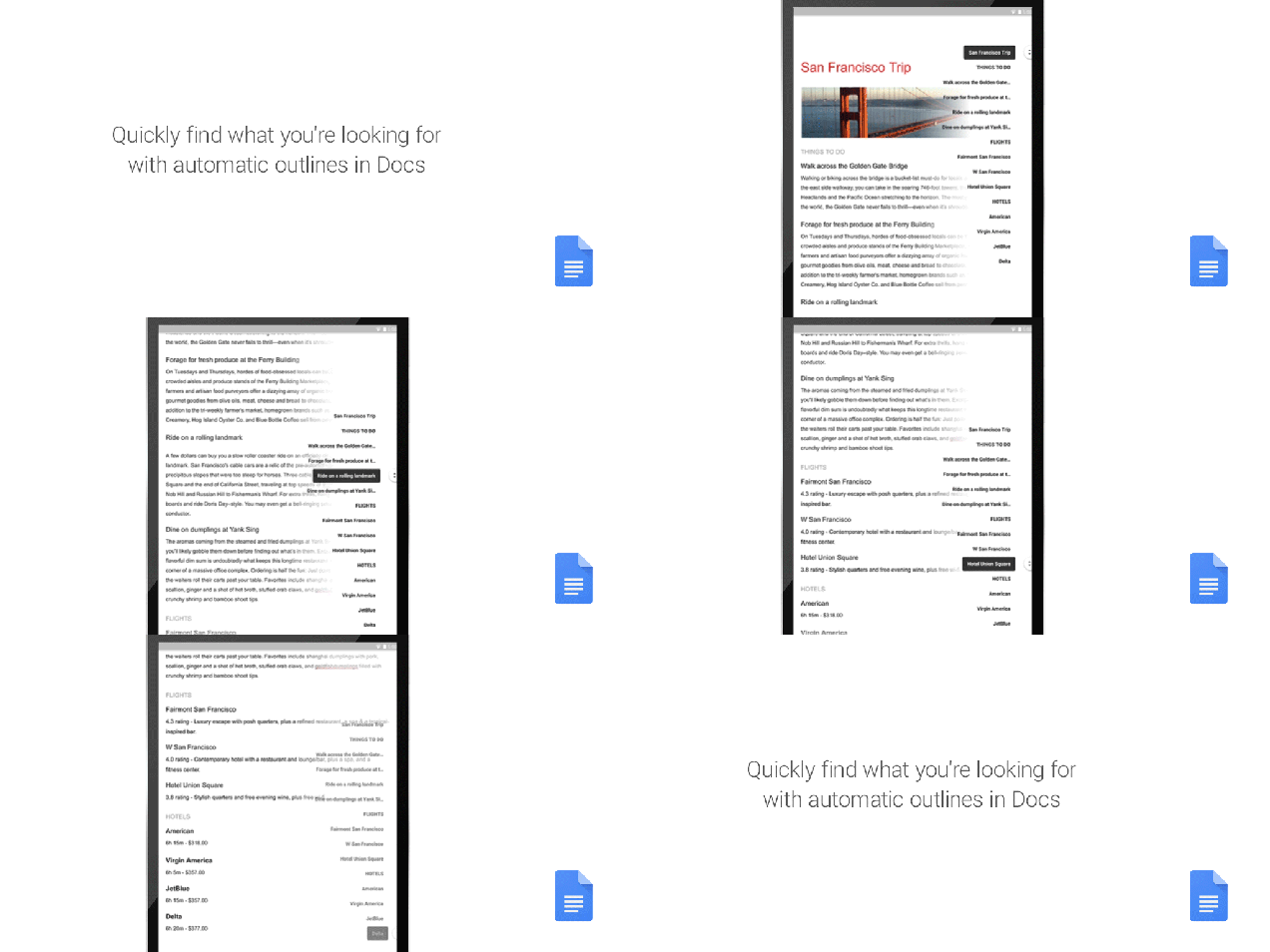
Google launched a new outline tool for Google Docs today that makes navigating your documents much easier on the web or Android device.
Google launched a new outline tool for Google Docs today that makes navigating your documents much easier on the web or Android device.
As a marketer, I know that trade shows and conferences are often central to getting in front of prospects in the area (and beyond!), as well as being a great way to connect with consumers on a deeper, more personal level. Having great content to share with attendees is the obvious first step to developing your game plan, right? But that’s not all you’re going to need.
The physical promotional products you’ll need to bring in order to make an impression often end up being an afterthought.
Both content and promotional products are equally important, of course, but many times the physical representation of your brand is set on the back burner. So, what can you do to make an impression and spark more conversation with the hundreds of people you will encounter?
One of the most impactful portions of your trade show strategy will be your booth. Booth displays have come a long way and are no longer just tables lined up in a convention center space with a company logo on them, with a pile of sad pens off to the side. These structures can be as complex or simple as you want, but the options are truly endless. They can create the feeling of exclusivity for anyone who visits your booth with private conference areas, great for any industry where privacy or information security is important and you may prefer to speak in an isolated area.
It is also a great place to connect with any customer in an intimate setting, regardless of the context of the conversation. They also provide a company with endless opportunity to display their brand, with hanging sign options, branding locations on the walls of the structure and monitors that can be added to the exterior of the booths to capture the attention of your audience. These booths have evolved to adapt to consumer needs and allow a company to put their best food forward and catch the eyes of the crowds.
Another way to set your company apart from the other vendors in attendance is to develop a very structured and thought-out plan for the giveaways at the event. There are the typical trinkets that you are exhaustingly overused, but in order to stand out you need to make sure your product is three things: useful, of good quality and long-lasting. Personally, I know I’m not usually one to pick up anything from vendors at trade shows at all. So even if I connect with a brand, if you want me to keep you top-of-mind once I’m out the door, you’ll have to create something pretty special to motivate me to snag one for myself. (And I doubt I’m the only one who thinks this way.)
In addition, the item you give should represent your company and should be tied to the theme of the event. It can be an industry-specific item or be catered to the audience you know will attend. For example, maybe you’ve identified your audience personas as being golf enthisuasts, so a tiny put-for-prizes set up and a “hole-in-one!” theme might be a great way to tie your booth theme and giveaway together.
But no matter what you choose, it must be something that catches a consumers eye and encourages them to spread the word about your booth, which brings me to my next trade show trinket tip…
The goal of any trade show strategy is to gain visibility, make connections and, most importantly, drive leads that translate into measurable ROI. The best way to do this is to encourage the attendees to do this for you. But how? Simply by appealing to our most basic human instincts.
One way is to dangle a high-value shiny object before their eyes. Or you could put a twist on the traditional raffle, giving booth visitors a wristband with multiple removable tabs on it. You tear off one tab for raffle entry and put the bracelet on their wrist. You then tell them that for each additional person that they bring to the booth increases their odds of winning. Maybe a visitor gets one entry and has three tabs left on their bracelet. They can then bring three new visitors to the booth for extra entries. The three visitors then get a bracelet and bring three more each. This exponentially increases the chances that you will have visitors.
This is just one idea, of course. You can put your own spin on the campaign experience, based on what you want to create. The point here is to think like your prospects. What would really interest them? What attracts attention? How can you leverage gamefication strategies so you and your connections-to-be win?
As integral as they may be to marketing strategies, trade shows are still unfairly maligned as a necessary evil, where proper attention isn’t given, and marketers are perfectly content to just “check the box.”
“As integral as they may be to marketing strategies, trade shows are still unfairly maligned as a necessary evil.”
The approach for your physical appearance at a trade show is not a difficult concept, but it does require some deal of thought to ensure that the image you are exibiting fully represents your company’s values, standards and ideals. Stay tuned for other avenues that will help you streamline your online presence with your physical promotional offerings! But until then, what are some of the best trade show strategies you’ve seen? What’s the best giveaway or booth that sticks out in your memory and why? Share in the comments!

Emotional intelligence involves self-awareness, self-regulation, motivation, empathy and social skills. When someone has these qualities, they have the ability to work well with others and are effective in leading change. As organizations become more aware of the importance of emotional intelligence, they begin to look for people who have these skills. While ability and technical skills still matter, the importance of emotional intelligence is being recognized. The question is, how do we determine if someone has these skills? In a traditional interview, many smart people have figured out how to answer to make it appear as they have them, whether they actually do or not. First, get the interview out of the traditional office setting. Go to a quiet coffee shop, park or some other place where you won’t be interrupted. Instead of the typical question and answer method, try and turn the interview into a conversation. The more you can get the interviewee off guard and into a real conversation, the more open and honest they will be.
What Bothers You the Most About People?
Instead of asking directly, tell a story about dealing with a family member or colleague that annoys you. Then ask if there is anyone at your last job, or in your personal life that bothers them. This will give you valuable insight how they perceive people, try to understand them and get along with them.
Tell Me About A Day When Everything Went Wrong
You can start out by giving them an example from one of your days from hell. Look for how they dealt with the situation. Did they dwell upon the problem, blame or look for solutions. Look for coping mechanisms and flexibility in dealing with change and unpredictability. Do they take responsibility or look to blame others?
Tell Me About Someone At Work You Really Got Along With, Or A Friend That You Have. What Compels The Two Of You To Get Along?
The relationships people build with others tells us a lot about how they see themselves and what they value in others. This also provides us with feedback on how self-aware they are and how aware they are on how they impact others. Humour, unless it is sarcastic and demeaning, is always a good sign.
What Is Something That You Can Teach Me?
When they try to teach you something, ask questions that indicate a lack of understanding. Do they seem to get frustrated, impatient or ask questions to gather more information on what it is you don’t get? Are they able to explain the idea simply and are they flexible in how they describe it if at first you don’t understand? Do they take responsibility for not describing it well enough, or do they seem to blame you for not getting it? Look for signs of frustration and impatience in their facial expression, body language and tone of voice.
Who Is The Person Or Persons You Admire the Most And What Is It About Them That You Admire?
People tend to model themselves after those that they admire. Is the object of their admiration a people person, someone who inspires and uplifts others or someone who appears to only be concerned about themselves? You can dig further by asking if there is anything they do that they have picked up from those they admire. You can even go further and ask if there is anything about that person that they don’t like, or would not like to emulate.
What Is The One Thing You Are Most Proud Of And What Makes It So Special?
You can give an example of something that you have achieved that you are proud of to get them thinking and started. When they talk of their achievements do they include and credit others, or are they a one person show? Do they talk about how it made others feel, how proud family, friends or co-workers were? Is the achievement based on the work of a team or do you get the feeling that they think they are solely responsible for their own success?
Think Of Having Your Own Company. What Kind Of People Would You Hire And Why?
This will give you valuable insight on how they view people, how well they see them working with them and how they value people. Do they focus on people or on outcomes? What is their style of relating to others and what kind of people are they most comfortable/least comfortable working with? Do they like to work closely with others or do they prefer to work independently?
Let’s wrap it all up.
The more you can get away from the traditional interview model and get the candidate relaxed and forget that this is an interview, the more valuable information you will obtain. This means being creative and sharing your own stories and experiences to get the applicant to open up and share more of themselves and their story.

It's no secret that China's growth is slowing. Just a week ago the country's Premier, Li Keqiand, told the National People's Congress China's growth target for 2016 would be revised down to 6.5%-7%. In 2014 it was 7.4%.
A difference of less than 1% may not sound like a lot, but for "capesize" shipping companies – companies which lease ships of over 150 tonnes to transport raw materials – it's proving to be a big deal.
Bloomberg has written a report which explains what a sorry state the shipping industry is in, and two charts in particular really hit home how bad things are.
The first shows how much earnings have dropped for leasing a capesize ship:

At this point, you might think shipping companies just have too many ships and should sell off their surplus. But again we have the same problem: vessels are now worth less than ever. In fact their value is almost 50% less than their peak in 2014.

Unsurprisingly, share prices in the big shipping companies have crashed over the past year. Star Bulk Carriers Corp shares were $0.85 (£0.60) on March 10, while Golden Ocean Ltd were even lower at $0.69 (£0.49).
Short of a miraculous uptick in worldwide demand for goods, analysts say the only course of action is for shipping companies to junk their vessels. A record 85 ships were scrapped last year, but shipping analyst Herman Hildan says 340 would have to go in 2016 to get earnings back to normal, according to Bloomberg.
Join the conversation about this story »
NOW WATCH: These mathematically-sound correlations make absolutely no sense

In the digital marketing world a lot of effort has been invested in the making and promoting of content with a singular emphasis on marketing ROI. But customers don’t care about your “great content”, your “clever marketing” or how much money you make from trying to sell them something.
What do customers care about?
Experiences.
Much has been said recently about consumers and experiences vs. things. According to a Harris Poll/Eventbrite study, 78% of Millenials would choose to spend money on a desirable experience or event over buying something desirable, and 55% of millennials say they’re spending more on events and live experiences than ever before.
The value for experiences over things isn’t necessarily new and certainly applies to all generations. It reminds me of one of my favorite quotes that has an important lesson for brands:
“People will forget what you said, people will forget what you did, but people will never forget how you made them feel.” Maya Angelou
So how can businesses adjust and adapt to creating more meaningful experiences for their customers? How can companies be more relevant and meaningful about how they make customers feel? The new book by my friend, Brian Solis, X: The Experience When Business Meets Design may be your answer.
For context, I’ve know Brian Solis a long time from back when he had a Public Relations agency during the early days of social media. It has been impressive to follow his thought leadership journey, writing multiple books, rubbing elbows with celebrities like Shaquille O’Neal and Fortune 500 CEOs, keynoting events all around the world, and arriving at his role as principal analyst, working with Charlene Li at Altimeter Group, a Prophet company.
As a digital analyst and anthropologist, Brian is prolific to say the least with consulting, blogging, writing books and events. That’s why when his publicist reached out to ask me to review X, I replied that I had already ordered a copy.

X is a tactile, visual and an intellectual experience all on it’s own. The book has weight, the extensive graphics pop and the organization is very app-like and digital, even though it’s printed on paper. The content of X is equal parts inspirational, cerebral and entertaining, which is fitting, because that’s how I would describe Brian too.

My entree to the social media world was greatly influenced by my interactions with Brian and through our interactions, interviews and his content, I have been inspired and my imagination has been triggered in many ways.
Imagination is what Brian taps into as soon as you open up X. He starts with:
Close your eyes for a moment and think about the last time you truly had a great experience with a company as a consumer, an experience that captured your heart, mind and spirit.
What about it was special?
Let’s call it “X”.
This book is about X, creating such memorable moments for your customers through every encounter they have with your brand – all day, every day.
What is X about? It’s about why the future of business is experiential and how brands can create and cultivate meaningful experiences for their customers. We live in an always-on world where everyone is connected to information and also, to one another. In this environment, customer experience is your brand and X is literally a blueprint for brands to start delivering better experiences.
What can you expect to learn from reading X?
Once you buy and read through this book, resist the temptation to exhibit it’s beauty on your coffee table, and use it more like a blueprint or manual for innovating your business to be experience focused.
There’s a lot more to say about X, so to whet your appetite for the experience X will provide, here are many of the quotes that are included throughout:
“The most beautiful thing we can experience is the mysterious. It is the source of all true art and science.” Albert Einstein
“If there is any one secret of success, it lies in the ability to get the other person’s point of view and see things from that person’s angle as well as from your own.” Henry Ford
“Great design is all the work you don’t ask people who use your product to do.” Rebekah Cox
“Everyone things of changing the world, but no one things of changing himself.” Leo Tolstoy
“You’ve got to start with customer experience and work back toward the technology.” Steve Jobs
“What people seek is not the meaning of life but the experience of being alive.” Joseph Campbell
“Stories are the creative conversion of life itself into a more powerful, clearer, more meaningful experience. They are the currency of human contact.” Robert McKee
“Everything is in motion. Everything flows. Everything is vibrating.” William Hazlitt Read
“Trust will set you free. But not until it is finished with you.” David Foster Wallace
“A mind that is stretched by a new experience can never go back to its old dimensions.” Oliver Wendell Holmes, Jr.
Of course, the experience of reading this blog post is no match for the real-world experience of the book itself. I highly recommend you grab a copy of X from one of the links below.
X: The Experience When Business Meets Design
By Brian Solis, a digital analyst, anthropologist, and also a futurist working as Principal Analyst at Altimeter Group, a Prophet company. You can purchase X on Amazon and visit the book site for more information and to see other reviews.

San Francisco Serendipity: While recently meeting with my Cousin at a cafe in SF for the first time in 40 years, my friend Chris Heuer walked by on his way to see our mutual friend Brian Solis, where we ended up taking this photo (at the Four Seasons of course).
 Gain a competitive advantage by subscribing to the
TopRank® Online Marketing Newsletter.
© Online Marketing Blog - TopRank®, 2016. | Book Review X: The Experience When Business Meets Design by @briansolis | http://www.toprankblog.com
The post Book Review X: The Experience When Business Meets Design by @briansolis appeared first on Online Marketing Blog - TopRank®.

Startups, you don’t have time, money, or credibility to waste at events. But industry events can provide a big boost for international development and business growth when mastered properly. And if your plans include a trip to SXSW in the coming days, then now is the moment to learn how to get the most out of them.
During my five years organizing international conferences, I took part in more than 50 professional events, not to mention meetups and hackathons. I attended everything: mega conferences like SXSW, Web Summit, and Slush; trade shows in Cannes, Barcelona, and other cities in Europe; and premium summits like DLD and LeWeb.
I’ve seen firsthand why startups struggle with events and what they need to successfully navigate this crowded and complex game. In most cases, founders don’t know what to expect from a specific event, where to go to find interesting people in the venue, or how the unofficial information is being traded between influencers like investors or journalists.
If you’re working at a startup, you’re supposed to be good at coding and (hopefully) at pitching. But do you know how to introduce yourself in conversational settings without using an elevator pitch? How do you follow up when you’re not selling? What’s the easiest way to get value out of serendipitous networking?
Here are some tips to hack events like SXSW, especially if you’re a first-time entrepreneur. These are five tricks that I’ve tested and validated with event organizers. Actually, those organizers even taught me some of them.
Just like music festivals, tech event organizers distribute wristbands of different colors to control the flow of participants: yellow for speakers, green for the press, purple for sponsors, black for the staff, orange for the opening ceremony, rainbow for the VIP zone of the closing party, and so on. Each event has its own color code, and the code changes every year.
Getting the right wristband is like playing capture the flag. You have to be prepared for the battle and lay down a proper strategy. You must approach with determination and clear objectives in mind. Are you ready to challenge your moral compass?
Here are three possible techniques: First, if you’re an experienced festival-goer and prone to thievery, you can simply steal a wristband during badge collection. Second, sponsors nearly always receive extra wristbands with their booths. You might seduce them into giving you one. Third, if a wristband is needed to get into a VIP event, then there’s always a PR person controlling the access who is completely overwhelmed with wristband distribution. It’s quite easy to convince that poor soul by claiming that you should be on the guest list. You can also swipe wristbands while this gatekeeper attends another participant.
– Check if there’s a printed list of wristband colors next to the backstage area. It will be easier to spot the most useful ones afterwards.
– Wait near the VIP exit and kindly ask a speaker to give you their wristband. Cut it by the fastener and gently stick the whole thing back together around your wrist.
– Wristbands come and go; don’t wear them too tight. You may want to share yours with a cofounder or friend. They’ll owe you a huge favor.
Tech events usually have restricted access areas: Speaker Lounge, VIP Club, Media Village, Green Room, Backstage, and the like. Those exclusive locations are full of influential personalities who could take your business to the next level. Your goal? Get in and squat those spaces.
Follow an accredited person and claim you have an appointment with them; that’s the best way to get in. If you don’t find anyone to follow, check to see that there’s actually someone guarding the entrance – sometimes there’s no one. If there is indeed someone checking wristbands, then try to buddy up to them and ask a favor. Or, ask a friend to distract the guard. It works especially well with volunteers. If the guard doesn’t fall for it, then wait for the next shift and try again.
– Once you’re in the VIP area, don’t move until you’re part of the landscape. Talk to lonely people who pretend they’re busy, working on their laptops. Enjoy good Wi-Fi and the free buffet. Act like you belong.
– When the influential person arrives, you’ll be ready to pounce.
Even if you’re not a speaker, it’s still possible to get the microphone. If you succeed, make sure your CMO is around to capture this moment on Instagram.
Most conferences let their audience take the mic, usually during Q&A at the end of panels. Organizers might also offer last-minute pitching opportunities on social media. Some free slots are made available when a speaker cancels their participation, especially with matchmaking formats that require mentors and experts. Be ready to take the opportunity?
– To get everything to go right during a Q&A session, sit near the stage or the aisle so you can grab the mic easily. Of course, you must be ready with a question that will let you introduce yourself while still highlighting the speaker on stage.
– Don’t forget to give the audience a simple way to find you afterwards. Giving your name and job title is not enough, mention your contact details clearly and wait near the stage at the end of the panel.
When you’re specialized in hunting speakers, you’re constantly interrupting important people with the ultimate goal of collecting their contact details. Normally they don’t want to hear about you, much less get bothered with your emails. Their usual answer is: “Sorry, I don’t have business cards anymore.”
If you think that offering your card will be enough and that they will actually write you afterwards, you still have a lot to learn about B2B networking. Instead, you should start with: “Let’s connect on LinkedIn,” then “What’s your email?” and finish with the phone number. Write this information down immediately.
– The event speakers are probably geeks like you and love to discover new apps. Use your smartphone to automatically send contact details and spark their interest. Sadly, NoBizCard is not available anymore, but you can use Contact Info or Swapcard. It’s a gimmick that should continue to work for a year or two.
Creating business opportunities with people you meet during an event is a science. Follow-ups are an area where many beginners stumble.
Time your follow-up well if you want to increase your chances of getting a reply. There are three levels of follow-up that every startup should master:
First, LinkedIn and Twitter, within 24 hours
Second, standard email, between 3 and 5 days after the event. Explain when you met, what you do, enclose your Pitch Deck and kindly ask for feedback. If you don’t get any answer, follow up a week later.
Third, ultra-personalized email, at the latest within two weeks. Detail what you expect from your contact, why he or she is so important in your industry and what you see as the next steps.
– Organize your follow-ups in email folders and tag them so it is easy to find them and continue a correspondence, even months after.
– You’re more likely to get a reply than if you start a new thread.
The more familiar you are with tech events, the easier it becomes to break their rules. Meanwhile, be patient, B2B networking is a marathon, not a sprint.
Don’t forget that collaboration is everything in the startup world. Get ready to help the people you meet.(Hack yourself first if you’re too selfish.) Listen carefully and give a hand when you can, without expecting anything back in return. A good place to start is by seeking out and helping event organizers. They won’t forget the help and they just might reward you with a VIP wristband.


This is just one of the 12 ways that sellers can improve buyer connections. Trust determines whether you will connect or disconnect with your buyers. These 12 Dimensions of Trust represent all those ways to form buyer connections. On CONNECT2SELL we’ve been reviewing each of these 12 Dimensions to empower sellers that want a strong connection built on trust.

“Seller shares opinion even when it’s not popular” has become a must-do practice of selling. Buyers expect sellers to support them by bringing new ways of looking at old problems. They also expect sellers to be candid and to fully disclose their own opinions. Because time is precious, buyers don’t want to do business with sellers who have nothing new to say.
One way to offer new information effectively is to ask strategic questions prompting buyers to do their own thinking and discovering. This is particularly important for sellers who don’t have entirely new ideas and for those who aren’t sure how a buyer will react to a new idea. Questions can plant seeds, test the waters and open up the dialogue, making it easier for a seller to share opinions – even those which may not be well-received.
Asking “what alternatives have you considered?” and “what are your thoughts about ___?” create opportunities for opening up conversations. Before you share your opinion, you’ll have insights into the buyer’s likely reaction. This proactive step ensures empathy and effectiveness as you share your opinion.
 This blog post features an excerpt from the best-seller “DISCOVER Questions® Get You Connected.” To learn more about how to connect with buyers and gain their trust, buy the full copy of this award-winning book from Amazon.com as a paperback or e-book. Author Deb Calvert is also available to speak at your next sales conference or to provide training for your sales team on how you can become the ONE seller that buyers actually WANT to talk to.
The post Buyer Connections Are Built on Trust and Openness appeared first on People First.
Day 2 of Rainmaker 2016 is well underway, and in case you missed it, we’ve been live blogging the keynotes, panels, and breakout sessions throughout the event. Yesterday, we had Kyle Porter and friends giving an overview of our history, what’s new, and what’s coming with SalesLoft. The rise of the Sales Development Cloud is officially here.
Sales development is on fire. And Trish Bertuzzi of the Bridge Group just wrote a book called The Sales Development Playbook. She’s dropping some bombshells on why she wrote it, what inspired her, and how you can walk away today and build your own SDR team.
Everybody has a different way that they’re implementing sales development. But you need to focus on what your buyers think when you’re setting your strategy.”
1. Why listen?
2. Why care?
3. Why change?
4. Why you?
5. Why now?
How many months should a top SDR remain in their role before seeking a promotion? There’s a variety of answers, but Trish and her team have discovered some data around the time period expectations for SDRs. The issue here is that there’s a communication gap. We always think we need to take a big leap forward, but what they really need is just smaller steps to build more skills. These are called micro-promotions:

64% of SDRs that move from SDR-to-AE, don’t meet their quota. We need to set them up for success.”

You need to think about what’s popular versus what’s effective. You need to dump the mutiny makers (i.e. the ones your reps absolutely hate). You need to alleviate the burdens around the necessary ones (i.e. CRM). You need to think about toys… and how you can really use them.
How many meetings am I willing to raise my quota by with this technology? If the answer is none, then don’t buy it. But if you’re willing to raise your quota for it, then you need it.
How you lead your sales development strategy is up to you:
If you want to hear more from Trish, check out her book on Amazon (or right here at Rainmaker) and get to know more about the secrets behind The Sales Development Playbook.
—
Stay tuned — we’re live blogging the entire Rainmaker experience — right here from your one stop shop for all things sales development. Comment below with your thoughts on the keynotes, sessions, and events throughout the event!
The post Highlights from The Sales Development Playbook with Trish Bertuzzi appeared first on SalesLoft.

I laughed. I cried. I took 5 pages of notes. I was ready to change.
After the keynote presentation, I waited. I had to meet the speaker. I waited until he was completely finished with his book signing and introduced myself to Tim Sanders.
The truth is, I didn’t want to just meet Tim. I wanted to do the kind of work he was doing. Tim shared his time and some valuable perspective on his business. He recommended books, asked me questions and even followed up with an email the next day. I was floored by his generosity.
Fast forward six years and I was invited to give a presentation at the Best of Breed Conference. The conference also featured Tim as the opening keynote speaker. I was grateful for the opportunity to reconnect and to let him know personally the profound impact our conversation had on my journey. He was equally generous the second time around with insight and advice for the next phase.
I always follow Tim’s advice. It’s that good. I’ve read everything he’s written, including his brand new book, Dealstorming: The Secret Weapon That Can Solve Your Toughest Sales Challenges.
I was thrilled that Tim published a sales book! If you’re a business leader looking to drive revenue growth in a competitive, complex sales environment, this is absolutely the next book you should read! It’s that good.
I was fortunate to connect with Tim recently to discuss the concept of dealstorming and how it can provide a sales organization with a huge advantage. Here are the highlights from our conversation.
In traditional sales, before the customer was empowered with access to information, the salesperson controlled the flow of information. Tim says, “I sold belly-to-belly. I controlled the expression of information. I could reveal a solution my customer had never heard of.” But now, we’re living in a sales climate powered by information and self-service. Instead of presenting new information, modern salespeople are put in a position of assisting and clarifying research the customer has already done.
We’ve reached a turning point: Innovation (not just perspiration) has become the secret to succeed in the world of complex sales.
“In today’s sales world, a done deal is 100 problems solved,” Tim says. That’s because buyers have their own “buyingstorm” team. One person isn’t making the decision — they’re working with multiple stakeholders and departments. Buying has become complicated.
Tim shared an analogy I liked: When the salesperson is working alone, they’re looking through a telescope and can clearly see the North Star (their primary buyer). But without bringing other people in, the seller can’t see the other stars that make up a bigger constellation of influence around the North Star. Salespeople need other people’s perspectives to see that big picture and understand the full buying team.
The sales professional often has to coach the buyer through that complicated buying process. That takes creativity and new ideas. Tim stresses that the “lone wolf” creative genius is a myth. To generate the new ideas and creative solutions needed to succeed in today’s sales environment, salespeople need the benefit of teamwork and collaboration — enter dealstorming.
Tim describes a dealstorm this way: “Dealstorming creates multidisciplinary teams around sales challenges — winning a piece of business or saving a key account. A dealstorm is when an account executive creates a team appropriate to the opportunity size that involves people who have a stake in the outcome and a few experts about the problem — what we we would call in sales a ‘sticking point.’”
Once the team comes together, “the point of dealstorming is to collaborate in a series of meetings to find the real problem and explore what I call the Next Best Play.”
The account executive is the leader of a dealstorm, and she invites people to join the team, pulling in people from different departments who could help. To decide who to recruit, ask:
The traditional sales team worked much like a golf team. Individuals competed on their own, and sometimes they’d share notes or techniques. A deal team works more like a football team. Different people with different skills, backgrounds and experiences all work together to solve challenges. The team needs everyone working together to succeed
The leader unites everyone around a common cause: to accomplish something bigger than just getting the deal or making money.
Here’s his advice: “If you want to break down silos, go win a deal as a team and you’ll see the walls go down. Nothing reverberates more than winning a big deal, especially if you’re snatching it from the jaws of your biggest competitor.”
Tim has seen collaborative success when a group focuses on a goal like taking business away from the competition. Everyone can get around that competitive goal, and it’s more compelling than “hitting quota.”
People are stretched thin and will look for ways to guard their time, so it’s important to highlight a cause they care about, instead of just adding another meeting to their calendar or project to their to-do list.
Tim recommends sending everyone on the team a “deal brief” — a detailed document that maps out exactly what the team will try to accomplish, along with a specific timeline. If everyone on the team understands the “why” and the “how,” meetings are more likely to be productive.
The “Next Best Play” is a term Tim borrowed from Duke’s Coach K. He coaches his team to focus their attention on the next best play. So, the dealstorm team focuses on the next thing they can do with the account, starting right away. Taking incremental steps forward makes it easier to see the finish line and helps the team feel a sense of forward progress and motivation.
In sales, we’re taught “contracting” — focusing on mini-agreements, or getting the next “yes” from the customer. For non-salespeople, that’s the Next Best Play — getting a bunch of little wins that add up to a big victory. Every touchpoint should advance the relationship forward.
Tim acknowledges that sales organizations can’t assemble a cross-functional team to tackle every deal. But there’s a point when a salesperson is stuck, and they know the normal sales process isn’t going to move them forward. Depending on the size of the deal and its strategic nature, it could be time for a dealstorm.
A done deal is 100 problems solved. Dealstorming is a must read for any sales leader seeking to unleash more creative problem solving and innovative solutions to address their most complex and critical sales opportunities!
In this video, Tim shares the additional sales resources available to everyone who buys “Dealstorming.”

Making B2B sales is often a complex and time-consuming process, in large part because there are so many factors involved in closing a deal. It’s not good enough just to sell a decision maker on the idea of buying your solution — you also need to make sure your solution fits into the larger picture of what the buyer’s organization really needs, and you need to be prepared to answer questions and address concerns from all of the other people and departments within the buyer’s organization that are affected by the purchase decision. This means that if you’re selling to companies that will need to switch vendors or replace an incumbent vendor in order to buy from you, you’re going to need to prepare for an added degree of difficulty.
Here are a few key tips and insights on how to know what to expect when competing against an incumbent vendor, and how to put a good strategy in place to overcome the buyer’s possible objections.
When companies switch vendors, there are certain switching costs involved — as mentioned in item #2 below, sometimes a new solution requires other operational changes, and it’s not always easy or inexpensive to navigate the new reality of switching vendors. For this reason, many companies are hesitant to switch vendors — even if they’re unsatisfied with some aspect of their current vendor’s service or solution — because they’re afraid of incurring these painful operational changes or paying these switching costs. This is why it’s important to have a wide-ranging, detailed discussion during the sales process about your solution’s projected Return On Investment. Demonstrate all of the reasons why your solution is much better than the current vendor’s, including all the additional problems that your solution can solve that their current solution cannot.
Take a big picture view of ROI that captures the total positive impact of your solution on the buyer’s organization. For example, will your solution save money, automate additional work processes, boost efficiency, save time, or integrate seamlessly with other software that they already are using? Be ready to demonstrate a big enough ROI that accounts for all of these factors and really hits home how much better your solution is – for all aspects of the buyer’s bottom line.
Does your solution operate differently or require different expertise and work processes than the incumbent vendor’s solution? Chances are, it does — or else they wouldn’t need to switch, right? This means that employee training is going to be a top concern for your buyer — and you will need to have a plan in place upfront for how to train the buyer’s staff on how to use and implement the new solution. Ideally, you should be able to demonstrate how your solution works better, why it’s more efficient, and which aspects of daily life at work are going to be cheaper or easier or more painless than the old system or solution that you’re replacing. Show employees and front line managers how your solution will make their jobs easier, and you’ll be able to achieve buy-in from everyone in the organization — not just the decision makers.
How will switching vendors (from the incumbent to your company) affect your buyer’s overall business operations? Will they have to re-route work or change processes internally? Will they need to make additional investments in compatible software, hire additional staff, or perhaps eliminate some departments? Keep in mind that they’re not just buying “your solution,” they’re buying the new reality of what your solution will enable and create within their organization — and sometimes these changes are painful for organizations to accept. So be ready to answer questions and offer ideas – show that you’re thinking ahead and that you’re aware of the overall impact that this deal is going to have on the buyer’s organization.
Buyers want to feel secure that you and your team will be in it for the long haul — not just to make the sale, but to stick around and for the implementation and ongoing support of the new solution. This is a top concern for many B2B buyers — in fact, many of them decide to switch vendors because their solution is no longer supported. Make sure you can demonstrate why you’re the best choice for ongoing support, as well as the initial sale.
Getting B2B buyers to switch vendors is rarely a simple or straightforward process, but that’s why the rewards are so big! If you can navigate the sales process while talking with multiple stakeholders, assuaging doubts and fears among various departments, demonstrating a big ROI and developing a solid plan for training and implementation, you’ll be well on your way to making more sales — no matter which incumbent vendors you’re up against.
Today’s most successful sales models are rooted in team selling. Download our free e-book to learn more.

Vancouver’s real estate market has been very good to Amanda. She’s not a licensed realtor, but buying and selling property is her full-time job.
She started about eight years ago as an unlicensed “wholesaler” in Vancouver.
She would approach homeowners and make unsolicited offers for private cash deals. Amanda made a 10-per-cent fee on each purchase by immediately assigning the contract to a background investor. It is seen as the lowest job in property investment, but it is low risk and very profitable. Amanda has done so well that she now owns two homes in Vancouver and develops property in the U.S.
Unlicensed wholesaling is an illicit and predatory business that is quickly growing in Metro Vancouver because enforcement is virtually non-existent.

It’s similar to a tactic currently being examined by B.C. real estate authorities known as “assignment flipping,” which involves legally but secretly trading homes on paper to enrich realtors and circles of investors.
However, unlicensed wholesaling is completely unregulated. Amanda estimates hundreds of wholesalers are scouring Metro Vancouver’s never-hotter speculative market — not including the realtors who are secretly wholesaling for themselves.
Amanda decided to step away from the easy money for moral reasons.
She’s most concerned that wholesalers are targeting B.C.’s vulnerable seniors who don’t understand the value of their old homes. She is also worried about offshore money being laundered, and the resulting vacant homes.
Because wholesalers are unlicensed, they have no obligation to identify their background investors or reveal the source of funds to Canadian authorities who fight money laundering.
Vancouver seems to be evolving from a residential city into almost like a lockbox for money
“Vancouver seems to be evolving from a residential city into almost like a lockbox for money,” Amanda said. “But I have to live among the empty houses. I’m a resident, not just an investor.”
Amanda said she believes that unethical and ignorant investors are driving B.C.’s housing market at full speed towards a crash. For these reasons, and with the condition that we not use her real name, she came forward to reveal how wholesalers operate.
The calling cards of wholesalers — hand-written flyers offering homeowners “confidential” and “discreet” cash sales — started flooding westside Vancouver homes over the past 18 months. With the dramatic surge in home prices, wholesalers now are spreading into neighbourhoods across Metro Vancouver and Vancouver Island.
In eight years Amanda has never seen the market hotter than it is right now, and her colleagues are urging her to start wholesaling again.

“A lot of money is leaving China, so now every second day people are asking if I can go out and find places for them. They have tons of money,” Amanda said. “They are basically brokering business deals specifically for Chinese investors.”
She said the mechanics of wholesaling schemes work like this:
The investor behind the unlicensed broker targets a block, often with older homes, and gives the wholesaler cash in a legal trust.
The wholesaler persuades a homeowner to sell, offering immediate cash, no subjects, no home inspections, and savings on realtor fees.
While the wholesaler claims to represent one buyer, or in some cases to be the buyer, Amanda said three or four contract flippers are often already lined up, with an end-buyer from China who will eventually take title in most cases. These unlicensed broker deals appear to be illegal.
A veteran Vancouver realtor confirmed these types of deals. The realtors we spoke to have been asked by their brokerages not to comment to reporters, so we agreed to withhold their names.
“I work with some non-licensed flippers,” one said. “They walk on to the lawn of an older house, see the owner and yell, ‘We’re not realtors!’ The owner invites them in, thinks they’re saving a commission — which they are — and loses big-time on the actual sale. I’ve seen it first-hand.”

According to flyers obtained from across Metro Vancouver and interviews with homeowners who were solicited, wholesalers often say they have Chinese buyers willing to pay a premium for quick sales.
Homeowners in Richmond, Vancouver’s east and west sides, Surrey, Langley, Coquitlam, Burnaby, White Rock, Delta and North Vancouver confirmed such offers in interviews.
One resident of Vancouver’s west side Dunbar area said she was annoyed by wholesalers constantly soliciting her, and a man in Surrey said his elderly mother was bothered by wholesalers.
“A guy walked up and he offered $700,000 cash within a day, and he said I would save on the realtor fees,” said Zack Flegel, who lives near 119th Street and Scott Road in Delta.
“He also says he will give me $100,000 cash and move me into a $600,000 house. He said he has a bunch of properties. He was talking about my house like it was a trading card. We don’t have abandoned homes yet like Vancouver, but this is how it happens, right?”
After the offer is accepted, the wholesaler assigns the purchase contract to the investor for a 10-per-cent markup, Amanda said. But some wholesalers aren’t content with making $100,000 or more per sale.
“People were going in and offering, for example, an 80-year-old widow, she bought the house for $70,000 and it is now worth $800,000 and they were offering her $200,000,” Amanda said. “So they are making $300,000 or $400,000 (after assigning the contract).
They have no clue what their house is worth
“And you are socializing with other wholesalers, and it is hard to hear them say, ‘Oh this whole street is filled with seniors whose partners are dropping off like flies.’ Or, ‘They just want to get rid of it, they have no clue what their house is worth, and it’s the whole street.’”
Amanda said her father died recently. She pictured her mother being targeted by wholesalers and resolved never to play that role again.
“There are elements of this that are elder abuse, absolutely.”
In a recent story that deals with implications of rising property taxes rather than predatory real estate practices, the Financial Post reported that, especially in Vancouver and Toronto’s scorching markets, “it’s not uncommon for some Canadian seniors to be unaware of the value of their location.”
B.C.’s Superintendent of Real Estate, Carolyn Rogers, conceded the potential for elder abuse as reported by Amanda.
I would attach a 10-per-cent fee. And then they would assign it to their boss and attach 10 per cent, and then that person’s boss would attach 10 per cent. I’ve been watching over the last month, and it has got astounding
“We would welcome an opportunity to speak to (Amanda) and assuming she gives us the same information, we would open a file,” Rogers said. “The conditions in the Vancouver market right now present risks … and seniors could be an example of that.”
It is illegal for wholesalers to privately buy and sell property for investors without a licence, Rogers said. She said her officers have approached some wholesalers recently and asked them to become licensed or cease their activities.
A review of the superintendent’s website shows no enforcement orders, fines or consumer alerts filed in connection to unlicensed wholesalers making cash deals and flipping contracts.
Amanda said that over the past year she learned of new levels of “layering and complexity that I didn’t see five years ago” in wholesaling and assignment-clause flipping.
“Five years ago I didn’t see realtors wholesaling, and I didn’t see people calling me so that I would get them a property and not assign the property to them, but work as a ‘partner’ and I would attach a 10-per-cent fee.
“And then they would assign it to their boss and attach 10 per cent, and then that person’s boss would attach 10 per cent. I’ve been watching over the last month, and it has got astounding.”
Amanda said some wholesale deals involve only unlicensed brokers and pools of offshore cash organized informally, and some appear to involve realtors and brokerages hiding behind unlicensed wholesalers.
“I’ve seen it from the back end. We have friends in the British Properties and the realtor said he will buy their property for $2 million. And then six months later it was sold for $3.5 million. When I’m looking at that, it is a pretty clear wholesale deal.”
Darren Gibb, spokesman for Canada’s anti-money-laundering agency, FINTRAC, confirmed that unlicensed property buyers have no obligation to report the identity or sources of funds of the buyers they represent.
However, Gibb said, if realtors are involved in “assignment flipping” it is mandatory that they and unlicensed assistants make efforts to identify every assignment-clause buyer and their sources of funds.
Vancouver realtors confirmed that money laundering is a big concern in assignment-flipping deals, whether organized by an unlicensed wholesaler or a realtor.
“When you are a non-realtor broker you no longer have to play by any rules,” one Vancouver realtor said.
“There is a role for assignments, but nobody is asking where the money came from. We are creating vehicles for money laundering.
“No person in their right mind wants to buy your house once, and sell it three more times in a small window of opportunity, unless they have a whole pool of people lined up trying to get their money out of the country. The higher the prices go, these vehicles to get money out of the country get bigger and bigger.”
NDP MLA David Eby and Green MLA Andrew Weaver commented that allegations of unlicensed brokers targeting seniors and participating in potential money-laundering schemes call for direct action from Victoria and independent investigation, because these concerns fall outside the jurisdiction of the B.C. Real Estate Council and its current ongoing review of real estate practices.
“It is very troubling to me,” Eby said, “that not only do we have a layer of real estate agents that are acting improperly and violating the rules, but there might be this additional layer who are not bound by any rule and have explicitly avoided becoming agents for that reason.
“This unscrupulous behaviour is targeting seniors who need money for retirement. What kind of society is that?” Weaver said.
It may be that time of year. or maybe I’m just more aware of it, but it seems that too many sales managers are focused on killing the sales organization.
Researchers constantly remind us that buying is changing, that buyers prefer to minimize contact with sales, reducing it to the last 20-43% of their buying process. They give us feedback from customers: “They don’t understand my problem, they talk about their products, they don’t care about what we are trying to do….” The lists go on.
The inevitable conclusion of these reports is that buying is changing, customers have better and more alternatives to learn about our products, and the need for sales people is declining. All the research points to the need for a more customer, consultative, problem-solving approach to selling. Many reports talk about the death of selling.
Of course, the need for a more customer-focused, consultative approach to selling is not new. We first learned about this in the 50’s/60’s/70’s with Drucker, Rackham, Hanan, Miller/Heiman and others, constantly reinforced by others since then.
But, it turns out, it’s not the changes in how customers buy that are killing the need for sales people, it’s poor sales management that is killing the need for sales people.
OK, OK, before all of you get up in arms, declaring me a traitor to my profession, it’s not all sales managers. Some are inspired, some get it, they are amazing. Some leaders are developing organizations that do amazing things in engaging customers. There are great stories and great success we read about. Probably most of the readers of this post fall into this category.
Unfortunately, there are too few good sales leaders.
Despite reading every day about how customers buy, how they want to be engaged, and how sales people can and need to create value for the customer; sales managers seem to be pushing in exactly the opposite direction. Despite knowing, for decades, we need to create more value, be more business focused, be more customer focused, be more consultative, we’ve made little progress.
James Muir cites a conversation with a sales manager, “I recently had a conversation with a manager that wanted to shrink wrap every part of the BDR role so he could hire anybody off the street to fill the role. He didn’t want them to need to think.”
Tibor Shanto and Hank Barnes discuss a situation where Tibor was trying to advise a sales manager about a well executed but inappropriately scripted call. The manager couldn’t appreciate the input their process was off, but just sought to beat up the sales person for poor execution of call scripts.
I could come up with dozens of examples—all from the past week.
We complain about bad, clueless sales people. But are they really at fault? Could so many be failing so consistently because of their own ineptness? After all, they are doing exactly what they have been told to do. They’ve been trained, scripted, measured on selling poorly by their management.
Rather than respond to the changes in customer buying, too many sales managers seem to be in a race for dumbing down the sales person. Sales automation vendors, recognizing an opportunity are jumping on the bandwagon, providing tools that enable sales managers to “shrink wrap,” formularize, and templatize the approach to selling. Managers try to script every bit of the conversation even though that conversation is irrelevant to the customer. Managers manage by the numbers, increasing volume in an attempt to make the numbers rather than increasing quality and engagement. More and more I hear the term “coin-operated,” referring to the drive sales management has to standardize every word, action, minute spent by sales people.
Managers sit behind desks, analyzing reports (thanks, vendors), taking actions based on the numbers, but without understanding the context. They don’t go on calls, they don’t see how the scripts are not working, they just double down on being completely prescriptive. And if that doesn’t work, they fire people, bringing in fresh fodder to throw at the challenge of making the numbers.
The ultimate impact of this dumbing down of the sales force is that we don’t need sales people. Sales becomes web fulfilled transactions, and the predictions of the death of sales seem predestined. Now the logical extension becomes, We don’t need sales managers! Wake up sales managers, on current course and speed, you will be unemployed, and your actions are making that sooner, not later!
Our customers are crying for help. They are telling us explicitly what they need. All we need to be successful is to give them what they want!
They want sales people who understand their businesses, understand what they are trying to achieve, can provide insight into solving their problems. They want sales people who can help them, not just push products. They want ideas, they want insight, they want help in managing change. They need help in learning how to buy and in the buying process itself. They need help in understanding our solutions–not just from the web, but specifically how it will impact them. They need help in understanding the challenges and risks in implementing solutions, so they can avoid them. They need help in building business justified proposals and selling those to their management.
What if we give them what they want?
Rather than dumbing down and mechanizing the sales force, why don’t we focus on hiring the right people, developing the right skills, coaching them in improving their effectiveness and impact. We would be working on how do develop business and financial acumen. We’d help them with critical thinking and problem-solving skills–so they can both help the customer figure things out, but they can figure things out for themselves. We’d be developing project and change management skills, helping move customers through their problem-solving process so that they can buy, rather than abandoning the project in No Decision Made.
Yes, we’ll use more tools, but we will leverage those tools in different ways. We won’t try to dumb down the sales people, but we will implement them in a manner that enables the sales person to engage in meaningful ways, to have conversation in terms that are relevant to the customers, that focus on them and what they want to achieve.
We’d recognize sales people as assets, invest in them, coach them, develop them, support them, retain them.
What’s killing sales is not the changing buyer. What’s killing sales is inept and inattentive sales management.
The greatest outcome that could be created from this post is sales managers getting pissed off enough to want to prove me wrong. In proving me wrong, they will be forced to focus on building the capability and capacity of the organization, they will discover the things they should be doing (Perhaps some of the things I suggest), and will change their organizations and the way they lead.
Of course, some will try to prove me wrong by doubling down on what they are doing–but we already know that doesn’t work, so don’t waste your time.
Please, be pissed off enough to prove me wrong!
By Tibor Shanto – tibor.shanto@sellbetter.ca
Question have for the most part have become the instrument of choice for most B2B sellers. While that’s good news, it is a mixed story. Many have switched from pitching to using questions, but they have not made the attitudinal shift to fully benefit from questions. Rather than using questions to facilitate a full and – mutual – discovery process, they serve to narrow and limit the discussion to the seller’s agenda. A pitch by any other name is still a pitch, and no matter that wrapping, the intent still come through, and buyers still step back or away.
I recently was prospected buy a provider, going in I told them I was aware of the type of service they sold, but it was not a priority, nor was it on my wish list. At this point sellers choose one of three paths:
1. Tuck and run, saying something like “well maybe I can send you some material for when you decide to consider a service like ours”.
2. Almost as popular, recriminate the buyer by pointing out how things have changed, and they are missing the point, “and let me tell you why…”, dragging out a horde of self-serving stats.
3. The lesser chosen path, educate the buyer by making them aware of things impacting their business that they may not be aware of, and showing them how their offering can help the buyer move towards their objectives.
This is a common scenario for many sellers. It is a fork in the road that separates the good from the also-rans. She chose door number 2, and being the business I am in, I went along to see where we would end up, and told her as much. Needless to say, first thing she asked is “what do you guys do?” When I told her, she still didn’t clue in, and continued by saying “that’s why you need ACME widget”.
The good will use the opportunity to help educate the buyer; the also-rans use it as an opportunity to pitch. Let’s be clear, I am all about the sale, but at this crucial stage, the vendor and product are secondary, and the focus needs to be on engagement, which means using questions as a means of educating. This education needs to be mutual, as stated above, the seller needs to be as open to learning, as they expect the buyer to be. While this may take more effort than the alternatives, it is an evolving cycle, what I learn in my current sale, I will be able to use in the next, the more I learn, the more I sell.
Our friend took the predictable path, recriminate me for not knowing what she does, and not having her world view. After a few perfunctory questions, mostly for the purpose of seeing where I fit on the product grid provided by her marketing team. like “what do you do?” Questions like “did you know..?” Followed by a scary outcome plaguing those who don’t use their product to address the “did you know”. While it may be true that I didn’t know what she wanted me to know, I knew more than she did. In the end, I learned a bit about how she sells, and I will be able to leverage it moving forward. She learned nothing, did not get a sale, and will never be able to recover the 30 minutes she spent on the call.
The post Questions Should Educate Not Recriminate appeared first on Renbor Sales Solutions Inc..

The number one mistake I see across LinkedIn profiles -- which between prospecting, reviewing client’s profiles, and networking is a lot -- is writing your profile for the wrong audience. It’s a problem unanimous across the board, from entry-level SDRs to seasoned executives at bleeding-edge companies.
Oftentimes, viewing your LinkedIn profile is your buyer’s first interaction with you, so make it a first impression that adds value. By the time a buyer actually speaks with you’re they’re over halfway through the buying cycle.
Far too many sales reps write their profiles as if they’re searching for a job, not to deliver value to prospects and customers.
Take a look at your profile and a few of your coworkers, past or present. It won’t be long before you see someone highlighting all of their accolades. Here’s what a typical sales rep’s profile includes:
This is great if you’re searching for a job or speaking with recruiters, as they’ll be your primary audience. But once you get a job, copy all of your accomplishments elsewhere and update your profile to what matters to your audience which in sales is your prospects and customers.
Having a profile that highlights your sales achievements shows your buyer two things:
Neither of these qualities make you particularly desirable to work with.
Another major mistake is your LinkedIn profile’s length. It’s hard to admit, but your buyers don’t want to read your full autobiography. Limit your summary to your biggest and most relevant achievements, and what you’ve worked on in the past 12 months or so.
Depending on your role, your audience may vary. If you’re an SDR or account executive, you’re audience will be prospective customers. If you work in account management or client success, your target audience will be your existing customers. You want your profile to showcase what’s most important to them. This could be awards your company has won, client success stories, and product updates.
Are you networking at an event like INBOUND and adding many new connections each day? Make sure your profile is an efficient reminder of who you are and what you chatted about. Include a quick description of your company and flagship solution, and if you’re wearing a company logo tee shirt at the event, add a company logo tee shirt profile picture.
If you’re an executive, tailor your LinkedIn profile for investors, board members, or top talent you’re trying to recruit. If you have a hiring message in your profile tagline, sell your company as a great workplace, and yourself as a great leader.
If you’re raising a round of capital and are meeting with executives, prominently display your KPIs over the past 12 months, and direct investors to recent announcements in your media room, such as landing a new flagship client.
A quick and often overlooked way to tailor your LinkedIn profile is having relevant recommendations. It’s the fastest way to add social proof and something that can be carried with you for the rest of your career.
One of the quickest ways to add recommendations to your profile is to write some of your own and ask that they return the favour. I always take a few minutes to write reviews of my champions, decision makers, and anyone else I’ve had a meaningful interaction with during the buying process.
Since The Challenger Sale was published, the number of consultative commerce teaching style reps has skyrocketed. While anyone can claim to be a credible expert in their field, some people are more credible than others.
If you’re waiting until after you’ve met your prospect to start building credibility, it could be too late -- modern buyers are 57% of the way through the decision making process before they contact a sales rep. Using your LinkedIn profile to establish credibility will help build rapport with your buyers even before your first meeting.
In the same way, tailoring your profile to your audience builds trust with buyers. Creating an effective personal brand isn’t something that happens overnight, but it doesn’t have to be a huge time commitment either. All of the following things go a long way toward bolstering your reputation:
The most important thing a sales rep can do on LinkedIn is maintain a complete, updated profile. A great profile includes the following elements:
A good LinkedIn profile is a must have for any seller in 2016. It may take some time to get right and updated, but it is well worth it.


With most small organizations to large enterprise businesses, there’s a notion of having your sales and marketing teams aligned better to achieve more results. While that’s all fun and dandy from the executive side, down in the trenches there are usually major gaps that occur between marketing and sales.
What are some ways that marketers can improve their relationship with sales? Here’s 11 ways to help get you started within your organization:
One of the most important ways to getting your sales and marketing on the same page is better aligning your departmental goals together. While this seems easy in theory, this can take some time to develop. Sales usually has individual quotas they have to meet, so marketing efforts can be put to the wayside.
Have your executive team establish goals that are better aligned with both marketing and sales. This can be revenue from specific channels, demo submissions turning into opportunities or potentially increasing click-through rates in follow-up emails.
With marketing and sales contributing to each of these goals, there’s an increased awareness to better align efforts and work together to achieve your organizational goals.
An SLA, while used in most organizations more of a customer>client situation, having an SLA in place between your marketing and sales teams can be very beneficial to getting both departments on the same page. Make sure your SLA has joint goals that require efforts from both marketing and sales for an increased awareness from both departments to work together and succeed.
Here are some quick examples of some things to add to your SLA:
Keep in mind that sales cycles can be different potentially for each sales rep depending on who they are focused on, so try to establish rules that can encompass all of your reps.
Have you ever been in a conversation with sales and the definition of the leads you are bringing to them is being skewed or not relevant? This is a common occurrence around organizations just getting started with Inbound Marketing. Forty percent of organizations have yet to define these rules and criteria.
Take some time to put definitions and criteria to your leads, MQLs and SQLs. By having these clearly defined across the board, you can have more engaging conversations towards improving marketing’s numbers and bringing better leads to sales.
Sales is constantly communicating to prospects on a daily basis and can be great resources for feedback on your current personas and possibly identify gaps in creating new ones.
Set some time aside for sales to communicate this feedback and give them insight into what your current target personas are. By having this on the same page between both departments, you can align offers and conversations more appropriately to your personas and where they are at in the buying cycle, helping both sales and marketing in the process.

While marketing and sales are both busy with their own day-to-day processes, it’s always great to set aside some time for the teams to meet and discuss how we can improve each other’s processes and efforts.
Here’s a couple of tips to making sure these collaboration sessions are useful to both marketing and sales:
Create an opportunity to share information with both parties. This is can be as easy as utilizing a current internal system, chat client with marketing and sales only, or a feedback-specific email address (feedback@yourdomain.com). It’s helpful to have all of this information in one place for both sales and marketing to review periodically to bring to the forefront in future meetings.

As marketers, our content marketing strategy can take a league of its own and can silo you off at certain times while putting together collateral, promotional materials and everything in between. Does sales know of all of the great things your marketing team is putting together?
Take these couple of tips for getting sales up to speed with your content marketing strategy:
If time allows on your schedule (and it should), try to sit in on a couple of sales calls per month (or listen to the recordings in your CRM) and get a feel as to how the process goes post-marketing’s handoff to sales. If agreed upon before the call, chime in on areas that will be beneficial to both the client and prospect.
This is very helpful from the marketing side as you can identify potential gaps within the conversation that marketing can provide as a piece of collateral or landing page that sales can direct the prospect to during future conversations. Sales also gets the benefit of better quality conversations and being better equipped to take on the next one.
Bonus Tip: Try this with multiple sales reps to get a greater feel of the conversation. Some reps can be location or industry-based, creating additional opportunities for growth in your marketing efforts.
There are many sales enablement tools out there that guarantee to save your reps time and money, but adding a new tool to their already long list of to-dos can be more of a detriment than a helpful initiative. However, it doesn’t have to be like that every time.
Have marketing apart of those conversations (most likely the sales enablement tool is coming from them anyway) and develop a training plan that is consistent and well thought out. Better yet, have sales apart of the conversation with the new tool to get them just as excited as you are for a chance at better collaboration between the two parties.
An easy, yet overlooked way to aligning your marketing and sales staff is to get them better acquainted with one another. This can be on a one-off happy hour after work, or a lunch out of the office. Creating that personal relationship between sales and marketing develops trust and a comfortable feeling between each other, providing a more open dialogue between everyone involved.
For all of these reasons above, something that needs to be clear from both of you is it needs to be “Win-Win” on each side. If your new marketing initiatives in turn help to increase sales for your reps, that’s a positive for both marketing and sales to better collaborate and find new ways to benefit each other in the long run.
—
What other ways have you seen marketers improve their relationship with sales?

Social media is a good thing and has become one of today’s most effective media platforms. It makes it possible for businesses to immediately reach their target audience, 24/7. Social media has helped small business brands grow larger and faster than any of us thought possible before. That said, social media has also resulted in the downfall of a number of businesses that misused it, destroying their reputations and wasting, not only their time, but a ton of money, largely due to a lack of a social media strategy.
Following are the top 10 dangers of using social media without a plan in place.
1. Misjudging Your Social Persona
Creating a social persona that isn’t likeable. On social media, your brand needs to be welcoming, entertaining and informative, showing that you’re not just in it for potential sales. To build a likeable social persona you need to keep your target market in mind. If you are offering a serious, business related tool, sharing cute videos of baby’s on your social channels isn’t going to make you likeable, at least not to them. Also, you don’t want to tout your personal beliefs either, unless you don’t care about offending a potential client.
2. Underestimating Reach & Longevity
One of the most important things to remember is that there’s no containing social media. With social media, nothing you say will ever die. Once a conversation or thread starts, in most cases it’ll be out there and can resurface any time. One slip up, even decades old, can suddenly reappear for the whole world to see.
3. Jumping The “Sales” Gun
Without a social media strategy in place you might make the mistake of not following the “social karma” rules, meaning providing value before you push sales. In order to get value from your fans and potential customers, you need to provide value first. Most people that use social media are looking for a few uncomplicated and satisfying things like information, entertainment, and content that’s worth sharing and makes them look intriguing to their own followers. If you provide them with these things, you’ll earn the good vibes that will later lead to clicks, potential leads, and eventual conversions. If you don’t, you’ll risk working within an empty void and possibly cause harm to your brand as well.

4. Taking On Too Many Platforms
If you don’t have a well thought out social media strategy, you won’t be able to manage multiple social media accounts, at least not well. Without the right kind of help and the larger your social presence, the more complications you’ll run into trying to keep all of your accounts up to date and human friendly.
5. Lack of Editing or “Creative” Copywriting
Everyone makes grammatical mistakes, but there appears to be an excessive number of critics on social media that are more than happy to pick these mistakes out. Over use of abbreviations is also a big mistake and making it difficult for your followers to grasp what you’re trying to say will affect your credibility.
6. Failure To Implement a Measurement Plan
A lot of businesses have learned the hard way that social media is crucial for marketing success. What typically happens however is that they designate a significant percentage of their budget to social media without having a social media strategy in place, one that includes Google analytics (the social site statistics aren’t enough), to measure and create a return on their investment If you use Google Analytics, you’ll be able to get a clear picture of what your visitors are doing and quickly see how social media plays in the sales cycle.
 7. Using The Wrong Metrics To Define Success
If you don’t have a social media strategy, you more than likely don’t know how to measure what matters. There are several metrics that are tied to social media and while they can be useful to the individuals that you have managing your marketing efforts, they don’t usually directly relate to the bottom line. Social analytics aren’t a way to track the success of your social media efforts in regards to your business. They’re only a way to track the success of your social media efforts. Does this make sense? In other words, you need to learn how to identify key performance indicators, specific to your business and measure that on a regular basis.
8. Treating Social Media The Same As Traditional Media
Marketer’s that don’t quite “get” social media are in for an unpleasant surprise once they get started, especially if they rush in without a plan. Most seasoned business owners are accustomed to conventional advertising methods, and many jump into social media, blindly using social sites to blast out their carnival barking messages at their target audience. The concept of inbound marketing for many of these business owners is still new to them and they’ll learn the hard way that what they’re doing is considered spam which makes them look bad. Ultimately, successfully using social media as an advertising tool and channel hinges on building rapport and trust via interactions with your target audience. If you do this, the sales will eventually follow.

9. Not Addressing The Customer Service Angle
One of the most devastating risks of not having a social strategy in place is not having the constant reminder to be ready to answer the questions, or address the concerns posted by customers and potential customers. Also, always, always make sure that you’re helping – not attacking someone making comments, and that you respond in a timely manner. Consumers are likely to overlook a mess up once in a while, but with so much competition online, it’s easier than ever for followers to turn to other brands that offer better customer service.
10. Sacrificing Experience For Cost Savings
If you think you can hire a novice (cousin, teenage son, etc.) to manage your social media efforts successfully, think again. Oddly enough, even when faced with recurring disasters, business owners continue to trust unqualified people with their social media. Bottom line, inexperience can result in disaster as well as not having a social media strategy.
In the end, social media can be a major component of your overall marketing plan. Just be careful to avoid the urge to be casual, simply because that’s mainly how social media is used. As with any business decision that involves hard-earned resources, you need to think strategically. Hopefully, this post helps someone avoid the missteps others have made.
Original Posting: How To Avoid 10 Social Media Strategy Missteps
Are you tired of getting this same old sales pitch?
“Our marketing strategy is based around attracting website visitors and nurturing them into qualified leads down the sales funnel to a point of sale.” – Dinosaur

In a world that follows a perfect order and sequence, this all sounds dandy, but the truth is that in the 21st century our modern buyer does not necessarily behave this way anymore. I used to buy into this mode of thinking, but the more and more I thought about my own buying behavior, the more I realized how flawed this way of thinking is.
Regardless of whether you are in the B2B or B2C realm, the linear sales funnel is somewhat of an obsolete model. I say “somewhat” because of course it is possible for someone to visit a website, sign up for their emails, and become more qualified through nurturing emails to a point of sale; it happens all the time. But you can miss a lot of opportunities if you presume this linear type of buying behavior is true for every lead. (Remarketing can help you capitalize on these missed opportunities, but more on that later.)
Let’s take a look at two core misconceptions when it comes to the traditional sales funnel before diving into the power of remarketing.
This is something that is fairly obvious when it comes to B2B purchases. According to the International Data Corporation (IDC), a market research firm, the average B2B deal has over 8 decision makers.When it comes to B2C consumerism, there is usually one buyer involved, but that doesn’t mean that the purchasing decision is solely attributed to that one buyer.
For example, friends of a buyer, online reviews or exposure on social media can greatly influence one’s decision making process.

Imagine two people going on to try clothes at the store, and one friend asks another if they like the shoes they are trying on. Whatever the answer is, it will most likely affect (not necessarily determine) how the buyer thinks about the clothes they are considering to purchase.
Many shoppers also use online reviews as a guide to decide whether or not to make a purchase. It really depends on what the buyer is purchasing.

According to Forbes, 81% of US respondents indicated that friends’ social media posts directly influenced their purchase decision.This is pretty interesting because the graph below emphasizes that there are a lot of factors that can influence a buyer and that humans don’t necessarily always make decisions based on logic and thorough research.

This actually happened to me a few weeks ago when my friend tagged me on Facebook on a guitar pedal video.
My initial reaction was that it cost too much for what it did, so I just decided that I wasn’t going to buy it (even though I really wanted it).
After viewing the video, I noticed ads appearing for that product on various websites that I visited. I ended up clicking on it only to land on a landing page with a video (I guess a part of me still really wanted this pedal).
Once I watched the video, I realized there was a functionality to the pedal that I did not initially realize even existed, which shifted my thinking to “Okay…this pedal is worth the money, but I still don’t want to buy it.”
For weeks I said I wasn’t going to buy it due to the cost alone, but my friend and I began talking about the pedal in comparison to other pedals, which ultimately led to me purchasing the guitar pedal since I felt the price was now justified, especially relative to other pedals’ quality and price.
This is one of the biggest fallacies marketers can fall into. The traditional way of thinking about the funnel in simple terms represents the need for education on a product or service and additional content that speaks to that product or service more in depth to a point where they will reach out wanting to buy.

The concept of “waiting for the customer to come to you” doesn’t always work when you’re trying to land a deal. That’s not to say you should blast them with emails or call them incessantly, but rather, find ways of getting your message across in a non-obtrusive way.
The traditional funnel-like sequence of decision making does happen, but I believe it’s more beneficial to have an additional dynamic approach that doesn’t rely on a static funnel. Why limit yourself to one strategy?
So, if we can’t truly predict buyer behavior, what’s the best method of influencing an action from a person? What is this dynamic approach you speak of?
Ah yes, the power of retargeting! For those of you who don’t understand the concept of ad retargeting, also known as remarketing, let me cover it real quick for you.
Ad Retargeting: A form of online advertising that enables advertisers to show ads to users who have already visited their site while browsing the web.

Essentially, remarketing allows you to stalk website visitors who have been to your website by retargeting them with relevant ads. They are tracked through their browser cookies, which is what allows you to display ads to them, even when they aren’t actively searching for your product or service. This means that an ad can show up on the sidebar of their email, through the Google display network while they’re browsing the web, and even Facebook.
What does this mean? Instead of waiting around for the potential customer to come back to you, you’re staying top of mind by reminding them what they showed interest in the first place. It’s a subtle method of conversion rate optimization.
Further, remarketing can subconsciously help address the multiple buyer dilemma in the sense that it serves as a reminder to the web visitor of the existence of the product. In the example of the guitar pedal above, if it wasn’t for the combination of the remarketing campaign and the conversation with my friend (whose opinion I trust very much), I wouldn’t have even considered making the purchase.
Below are a couple more situations where remarketing can really come in handy:
The real benefit of retargeting is how granular you can get with you retargeting criteria regarding demographics (e.g. age, gender, income, location, etc.) and web behavior (e.g. keyword search terms, devices being used, specific pages touched, etc.) This can mean you can get hyper-focused with who you want to target.
A specific example of how you can use remarketing would be to increase traffic from audiences similar to those who have visited your site in the past. This targeting is done based on demographic information and web browser behavior to look for common trends based on who has visited your site in the past.
Below is a screenshot of a client’s remarketing list size growing substantially in the past month. In this particular example, what the client did was retarget audiences that were similar to web visitors that converted on their website.

Below is another specific example of a remarketing campaign that had an ad that generated 154 conversions from July 21, 2014 – November 20, 2015, with a total of approximately 300 thousand impressions. The primary goal of this campaign was to raise awareness of the product, but in doing so, they were also able to acquire new customers based on the success of their remarketing list!

It’s coming up on 10 years since the Harvard Business Review (HBR) laid out a strategy to end “the war between sales and marketing.” Decrying the negative impact on corporate performance due to misaligned sales and marketing departments, the prestigious publication offered several recommendations on how these teams could work together more effectively.
If the current level of cooperation between most sales and marketing teams is a reliable gauge, the article fell short on its peace-making mission. Despite making a solid case for the value that sales and marketing alignment can drive, few people seemed to care.
That doesn’t appear to be the case anymore. As an increasing number of companies strive to improve both their top and bottom lines, management is beginning to lean more heavily on sales and marketing organizations to bury the hatchet.
That was especially evident at the 2016 Content2Conversion Conference in Scottsdale last month, where striking an accord between sales and marketing was top-of-mind for several speakers.
Christine Nurnberger, CMO of Bottomline Technologies, addressed how she is aligning her marketing team with the sales organization. A #C2C16 panel of marketing executives moderated by Matt Heinz also focused on how their teams provide more support for sales enablement activities. And more than a few other speakers hinted that it’s time for a significant warming of relations between sales and marketing.
Simultaneously, my colleagues at Demand Gen Report, in partnership with InsideView, conducted an analysis of nearly 1,000 responses to a survey that asked sales and marketing leaders how peace could be achieved. In addition to identifying the primary cause for the tension between these two important departments, the survey surfaced a number of alignment best practices.
As noted in the comprehensive report on the survey results — Cracking the Code of Sales and Marketing Alignment — the three biggest barriers to enhanced relations between sales and marketing are a lack of communication, broken or flawed business processes, and misaligned success metrics.
The communication shortfall leads to misunderstandings about what sales and marketing teams need from each other. The process breakdown impacts lead flow, pipeline review and lead handoff. And the different success metrics for both departments keeps teams at odds — even if they believe they are striving to achieve a shared business outcome.
For 22% of the survey’s respondents, the barriers to better collaboration between sales and marketing led to missed revenue goals. Of the respondents who hit their revenue targets, sales and marketing may have been “more or less aligned.” But for the companies exceeding their revenue goals, the DGR team noticed distinct clues pointing to stronger sales and marketing alignment.
Based on those observations, the report’s authors listed several recommendations to optimize alignment between these important teams:
For companies that paid attention to the HBR article in 2006 — which, by the way, included many of the recommendations made in the DGR/Inside View report — the benefits were probably remarkable.
As the DGR/InsideView report noted:
With these kinds of benefits, who wouldn’t want to give peace a chance?
Has your organization tried to improve collaboration and communication between sales and marketing? Do you have any tips or advice? Share your thoughts and feedback in the comments section below.

Something important is about to happen, and the impact on content marketers will be profound.
Facebook announced it would open up Instant Articles -– formatted and optimized to load almost immediately -– to any publisher without a special approval process.
To make it effortless for even small bloggers, Facebook announced in a post this week that it is teaming up with WordPress for a plugin that allows us to publish from our blog directly to Facebook.
WordPress powers more than 25 percent of all websites, according to Facebook, so making it easier for WordPress users to sign up for Instant Articles will certainly open the floodgates to an incredible new wave of content.
Let’s look at the implications for digital marketers.
Obviously, we are on the brink of a dramatic shift in how content is seen and discovered. Facebook wants to be a primary source of news and information and if their wish comes true, and it probably will, this company will be in charge of distributing our content to a large part of our audience. Their algorithm will decide who sees what we create. There is no transparency to this algorithm. We can guess whether our video content will do well this month or next, but we will never know for sure.
One of the beautiful things about the web is that it is scattered and fragmented — everyone can find their own path. And of course this will still be true to a large extent. But increasingly there is a far greater concentration of power in this area of content distribution than at any other time in our digital history. Facebook wants to build a content monopoly and there is probably no existing regulation or market force that can stop them.
Closely linked to distribution and content discovery is monetization. Facebook will promote the content that can make them the most money. This is probably bad news for most of us.
While we would like to think that the “best content rises to the top,” anybody producing content for a living knows this is a mythical point of view and it will certainly not be true once Facebook becomes the gatekeeper. Like any good business, Facebook isn’t obligated to promote the best content, it is rewarded for promoting the most popular content … and that would be quizzes, lists, and celebrity gossip (nine out of the top 10 articles shared on the web last year were quizzes).
An important power shift is in process. The “editors” now in charge are not accountable to journalistic standards, ethical standards, expectations for diversity of thought, quality, fairness, or the public good.
In fact, the people now in charge are probably not people at all but little bits of code that have a job to respond to dwell time and content profitability and reward their fellow bits and bytes accordingly.
If you’re in the celebrity gossip business this is good news. Perhaps Facebook will become the ultimate Trump network.
The good news is that Facebook might be able to accomplish what many of us have failed to do, create a direct monetization stream from content through ad revenue sharing. This is the promise they are holding out to the mainstream news publishers like The New York Times. Will it trickle down to the little guys? Time will tell.
The third implication is something I predicted last year — a dramatic shift in the inbound marketing model.
Inbound marketing refers to marketing activities that bring high-potential visitors in, rather than relying on sales people having to make cold calls to garner “outbound” leads. Inbound marketing content theoretically earns the attention of potential customers, makes the company easy to be found, and draws viewers to your website like a magnet.
Links to our content on Facebook and other platforms have played a critical part in helping people become aware of our content and drawing them to our website or blog.
But with Instant Articles, Facebook becomes a dead-end. Our content goes in, but those inbound links don’t come back out to our websites where our lovely products, services, and calls-to-action reside.
Why? Because Facebook doesn’t want you to leave Facebook … and links make you leave Facebook.
Google and Twitter’s response to this is its new partnership around the Accelerated Mobile Pages (AMP) project which recently launched. It’s also rumored that LinkedIn is working on a version of this, as well. Everyone wants to keep readers on their site instead of yours.
4. The Content Shock wave
I recently attended a conference at Columbia University where a spokesperson from Facebook tried to defend Instant Articles by saying Facebook’s global reach would help publishers find a new audience, even new subscribers. But early experiments showed that this is not the case. Why would somebody subscribe to the The New York Times (or your blog) when they can simply see it conveniently for free on Facebook?
The term “Content Shock” has become a popular way to describe the changing economics of content marketing. When content floods a niche, it becomes more difficult, and more expensive, to compete. It occurs to me that while this is undeniably a mega-trend, it is also a repeating cycle.
Here is what will occur once Instant Articles becomes available to everyone.
The early adopters will see a huge boost in page views. Wow! This is amazing! Every content marketing blog will report that this is the new best practice. Get on board NOW!
And predictably, every company, agency, and mommy blogger will flood Facebook with their content to become part of the new gold rush.
As the supply of content goes up, and the “demand” of attention remains constant, the economics of Instant Articles will shift. Facebook will be forced to aggressively edit the Instant Articles stream because there will be too much content. Page views will drop, and the only way we’ll be able to get seen will be to pay Facebook to boost our Instant Articles. Sound familiar? Content Shock in action all over again.
And so the cycle continues.
Should you publish on Facebook? Of course. It’s time to build on “rented land” because we have no choice. It’s time to submit to Facebook because we would be foolish not to.
I was a guest on a podcast the other day and the interviewer asked me if there was any hope for small businesses in this intense content environment.
Of course there is. This competitive challenge is no different than what businesses have faced for centuries. Competition (in many forms) comes in and floods a market. To survive, you adapt, you adopt, you find a new way to maneuver. That’s what marketing is about, not sitting in front of a computer and posting the same links month after month.
Content marketing has been easy (maybe too easy) for a few years and the gravy days are over. Content marketing will still work, but it will work in new ways and it’s time to get to adjust. Great content is no longer the finish line, it’s the starting line.
Content Shock seems scary only because competing in a free market is scary. Succeeding in this new Facebook environment will require new strategies. Surviving in a competitive business world requires constant re-invention. So let’s get to it.
Illustration courtesy Flickr CC and lestudio1
The post Four ways Facebook Instant Articles will dramatically impact marketing appeared first on Schaefer Marketing Solutions: We Help Businesses {grow}.


UX mistakes often go undetected because they are quiet. They aren’t a broken image or a misspelled word or a form that isn’t sending. No, UX mistakes are foundational.
To visitors, UX mistakes are loud, whether they consciously detect them or not. In fact, IBM is credited for the saying, “Ease of use may be invisible, but its absence sure isn’t.”
Visitors are leaving pages completely unaware of content blocks, they’re assuming they’ve reached the end of the page long before they truly have, they’re missing cues to scroll horizontally, etc. The false bottom is still alive and well… and it’s expanding quickly.
The false bottom is also often referred to as a logical end and the illusion of completeness. Essentially, a false bottom is the point on a page where a visitor believes the page will not scroll further, despite the fact that there is more content below that point.
This has been an issue for well over a decade. Yet, sites continue to make the same mistakes over and over again.
Typically, when people think of false bottoms, they think of vertical scrolling. The term does have the word “bottom” in it, after all. Due to the rise of mobile, horizontal scrolling has become somewhat familiar as well. Now, it is possible to have content to the right or left of the visible screen.
For that reason, we’ll use the term “logical end” going forward.
Despite popular belief, visitors do like to scroll. It’s second nature to them, an expected part of the online experience.
In a study based on 25 million sessions around the world, ChartBeat found that over 70% of visitors scroll before a page is even fully loaded…
Huge found that almost everyone scrolls, regardless of the directional cues given (or not given)…
Rebecca Gordon, part of the research team at Huge, concluded that visitors do scroll, but contextual cues are still important…
 Rebecca Gordon, Huge:
“We learned that participants almost always scrolled, regardless of how they are cued to do so – and that’s liberating. While it’s hard to make universal recommendations, we’d suggest that designers use the cue that works best in its context.
Designers should choose cues for scrolling based on the content, the business category and the overall design. Does the content feature block text, images or video? Is the site for ecommerce, editorial or news? How do visual cues integrate with existing design elements? All of these variables will affect the optimum placement and effectiveness of scrolling cues.” (via Huge)
When considering the need for directional cues, you have to consider two factors:
The more motivated, the further along in the buying cycle, the less likely they are to scroll. Why? Because they don’t need more information, they’re highly motivated and want what they want. They’re likely to immediately click “Pricing” or “Demo” or “Products” or enter their email without scrolling.
Similarly, the more familiar the visitor is with your product / service / company, the less research is required. Someone who is hearing about you for the first time is more likely to scroll through your home page than someone who already knows what you do, who you are, etc.
While Huge’s results are impressive, without knowing the motivation and familiarity of the visitors included in the study, it’s impossible to generalize the results.
I’m willing to bet the “reached bottom” numbers for an average visitor are much lower. Why? Because logical end does not only come into play above the fold. You could be halfway down a page and experience a logical end.
In the words of Zoltan Gocza of UX Myths, “To make sure that people will scroll, you need to follow certain design principles and provide content that keeps your visitors interested.”
According to Luke Wroblewski, there are two core reasons visitors don’t scroll or stop scrolling…
Why people don't scroll… pic.twitter.com/sd01TL3Rbk
— Luke Wroblewski (@lukew) December 10, 2014
Seems straightforward, right? To avoid creating a logical end, you have to set expectations with the visitor. Jared Spool of UIE agrees that when visitors don’t scroll, it’s because the site is not designed to encourage scrolling…
 Jared Spool, UIE:
“Not much has changed in our observations since we released our original research on the subject. Basically, users have no trouble scrolling, as long as the page is designed to accommodate it. If our clients are finding their users aren’t scrolling, we suggest they look for a reason beyond ‘Users don’t expect to scroll’ and see if maybe the design of the page is preventing it.” (via UIE)
But why is it so important that visitors scroll? Isn’t it more valuable if they skip right to the pricing or product categories? Not necessarily.
Research is an important part of any conversion. Your visitors want to ensure they’ve made it to the right place, that you offer what they’re looking for, that you’re trustworthy, etc. By not designing to accommodate scrolling, you’re taking away that part of the conversion. The result is less qualified leads and fewer sales.
Josh Schwartz of Chartbeat demonstrates this by showing how visitors who do scroll are more engaged below the fold…
 Josh Schwartz, Chartbeat:
“[…] because much of an article’s actual content is downpage, those readers who do scroll down spend much more time down the page than they do at the top. We see this represented in the next figure, where we show the amount of time each area of the page was actively viewed by those who actually scrolled to view it at all.” (via Chartbeat)
Since vertical scrolling is more familiar to most people, let’s start there. There are five common cases of the vertical logical end: huge hero shots, too much white space, familiar “conclusions”, horizontal lines and return to top arrows.
This case is perhaps the most common of all, especially among tech startups. Huge hero shots take up the entire above the fold area. Typically, they include a short headline and a call to action button or email capture form.
Here’s the Mapbox home page…

Just from looking at it, would you assume that there’s content below the fold? Probably not. Of course, there is. Nine content blocks, to be exact.

Is all of that content irrelevant to someone interested in getting started? If not, why is it hidden below a logical end?
If there’s too much white space surrounding a content block, it’s easy to assume that there is nothing below or to the right / left of it. The minimalist design movement has put a focus on incorporating white space into designs. I won’t argue that that’s a mistake, but the need to use white space strategically to avoid creating a logical end is key.
Here’s part of Tribe’s home page (just below the fold)…

Take note of all that white space. After each content block, you assume that you’re at the end of the page. Every feature could simply be the last one.
The pattern continues further down the page…

The simplicity of the design works against usability here. White space can be helpful, but you can also go too far in the wrong direction.
Note that I was zoomed out to about 50% when I captured the screenshots above.
If you read ConversionXL regularly, you recognize the author bio box as a “conclusion”. It’s a signal that the article is over. On other sites, that “conclusion” might be when you see a set of ads or a text-based call to action or article recommendations. Now imagine the author bio box was placed in the middle of the article.
Here’s a randomly selected article from the Forbes site…

Halfway through the article, the “Recommended by Forbes” slider appeared. Typically, that would appear at the end of an article. After I’ve finished reading, the site might show me some other articles I’d like based on the article I just read.
Here, that familiar conclusion is not a conclusion at all. There was still another half of the article to read.
Cosmo does something similar…

This is at the end of the article, but there is other content based on what you just read below this point. This ad, unfortunately, will stop many people from discovering that content because it is a familiar conclusion.
Yes, Cosmo goes a step further than Forbes by adding “ADVERTISEMENT – CONTINUE READING BELOW” above the ad. Still, it is barely visible and likely to be ignored.
A horizontal line that extends across the entire screen signals a logical end. While they are often used to signal the end of a section, it’s not difficult to see how a visitor could interpret it as the end of the page itself. Different colored content blocks are a better solution.
Here’s the content just below Undullify’s fold…

Note the horizontal line that extends across the length of the page. Paired with the fact that testimonials are above the line, it’s reasonable to conclude that this is the bottom of the page, right?
Actually, there are six other lengthy content blocks below that horizontal line…

What’s interesting is that the horizontal line technique is not used again. Instead, content blocks are given different background colors, white space is used, etc.
When do you want to return to the top? Typically when you’ve hit the bottom of the page. Having a return to top arrow that scrolls with the visitor can be helpful, but it can easily signal the end of the page if you’re not careful. Transitional cues become even more important.
If you’re a regular ConversionXL reader, you’re familiar with our return to top arrow, which follows you as you read…

Since most of our articles are between 1,500-3,500 words long, a return to the top button makes sense.
Also, given the nature of our site, it’s relatively difficult to assume you’ve reached the end of the page when you haven’t. If you’re scanning, you can see how much content is left using the scroll bar. If you’re reading, you won’t assume the article ends on “Does the site look good in all browsers? On all devices?” Since it’s a blog, you’ll expect that the page is coming to an end when you reach the author bio and comments.
Now look at how Semplice uses a return to top arrow on their home page…

Can you find it? It’s there, but due to the dark background, you can’t see it.
As you continue to scroll down, you can see it appear…

You notice it now, of course. Unfortunately, since it is not visible continuously, it’s easy to assume that you’ve reached the end of the page when you see it.
Return to top arrows can be helpful on home pages, too. Especially long sales pages, but make sure the arrow is always visible. If it appears suddenly, visitors will assume they’ve hit the bottom of the page.
Before moving on to horizontal scrolling, it’s important to note that it is not quite second nature yet. Mobile is definitely encouraging the behavior, but UX experts still consider horizontal scrolling to be a faux pas (especially on desktop).
Katie Sherwin of Nielsen Norman Group explains…
 Katie Sherwin, Nielsen Norman Group:
“While horizontal scrolling is acceptable in some situations, it should be applied with caution. Be aware: horizontal scrolling on the desktop is one of the few interactions that consistently generate negative responses from users. (Anecdotally, the disdain for it is so widespread, that I like to use it to illustrate what user experience is to people unfamiliar with the field. I ask if they can think of a website scrolling horizontally. They usually groan and say they hate it, and then I explain how we look at things like that and find ways to make them better. Usually they respond along the lines of ‘Thank you, I wish there were more of you.’).” (via NN/g)
Now, if you’re going to proceed with horizontal scrolling, there are four common cases of the horizontal logical end: carousels, pricing pages, personal portfolios, and failure to conduct quality assurance (QA).
Peep wrote an article called Don’t Use Automatic Image Sliders or Carousels, Ignore the Fad a couple of years ago. Unfortunately, the fad has stuck around. Another reason sliders and carousels, automatic or not, are a less-than-stellar idea is that they require conscious effort. First, visitors must recognize the option, then visitors have to scroll through the carousel item by item.
It’s not as intuitive as it should be. It requires a great deal of attention and physical effort.
Here’s a manual carousel from Super…

The arrows are faint and difficult to notice. They’re also used to display testimonials, which is a common choice. While this type of social proof can be impactful, when’s the last time you sought out testimonials? Case studies, maybe. Polled social media, maybe. But when’s the last time you put effort into finding testimonials on a site?
That’s what’s required here… effort. I’m willing to bet not many people are willing to put it in. Why not display all of the testimonials? Alternatively, at least make the arrows more prominent.
This is a common issue for SaaS sites in particular. With so many pricing plans available, horizontal scrolling seems like a viable option. Again, you run into the issue of horizontal scrolling feeling unnatural and being unexpected. Most people aren’t looking for horizontal scrolling, so it’s easy to miss.
If you send 9-120K emails per month, SendinBlue has four different pricing plans for you to choose from…

They do quite clearly mark the horizontal scroll arrow here. So, you know that if you need to send more emails per month, you can click it to see additional pricing plans…

By placing the arrow in a pricing plan box, SendinBlue makes the horizontal scrolling option pop. Due to the fact that there are only two options, it doesn’t feel like a lot of effort.
Personal portfolios are a place for designers and photographers to show off their creativity. Often, this involves “breaking the mold” and horizontal scrolling. Creativity at the expense of usability is, well, expensive. [Tweet It!]
Here’s Dean Oakley’s designer / developer portfolio page…

You can’t scroll up or down. I tried to scroll horizontally by clicking the cut-off image to the right. Instead, I was taken to a new page. Then, I noticed “My Work” and “Contact” buttons. So, I clicked “My Work” and was automatically scrolled to that section.
I then clicked over once and was taken to more examples of his work…

The option to get to “Contact” is gone. To get back to the main screen, I need to scroll, click by click, back to it. And Dean has about a dozen items in his portfolio, so it’s quite a bit of effort.
It’s a clever idea, but UX takes a hard hit.
According to Conversion Rate Experts, horizontal logical ends often occur because marketers fail to conduct quality assurance…
Horizontal scrolling doesn’t come naturally to most web users. It normally becomes an issue when the users’ browser windows are narrower than the width for which the website was designed. One way to get around this is to design for small screen resolutions. Another is to separate your content from your layout, so you can use different style sheets for different devices, or use a liquid layout that automatically adjusts to the browser width.
Be sure to view your site using multiple devices, browsers and resolutions. Here’s a simple process to get you started…
Perhaps that right arrow looks visible to you, but not to 5% of your visitors using a smaller screen. Conducting quality assurance ensures you don’t run into these types of issues.
For heuristic analysis, you can use the Chrome Inspect Element process described in Is Above the Fold Really That Important?.
Start by assessing your current scroll landscape with a scroll heatmap (you can use a dedicated tool or even Google Tag Manager). Ask yourself…
Now that you know what you’re working with, you can begin to optimize.
Directional cues are fairly common. You might see an arrow or a “Read More” on a home page every so often. Unfortunately, not all directional cues are created equal. Using directional cues is not enough… you have to use strong directional cues.
Take a look at this example from Nielsen Norman Group…
The two horizontal scrolling buttons are almost completely ignored, despite the fact that they are clearly marked.
A strong directional cue is contextual and answers the following questions for your visitors…
Here’s the Exploding Kittens home page…

You see the start of an arrow there, right? Here’s the rest of the page…

This is the strongest example of directional cues that I’ve ever ever come across. Your attention is focused, your expectations are set and you’re ushered from one statement to the next.
Well done, Exploding Kittens.
UX prototypes are everywhere. When’s the last time you visited an eCommerce site and the cart wasn’t in the top right-hand corner? Would you not assume that to like something in a mobile app, you double tap?
It’s your responsibility to identify the prototypes at work in your industry (e.g. SaaS, agency, eCommerce, etc.) and on your medium (e.g. mobile site, desktop site, mobile app). From there, do your best to fit those prototypes.
If you don’t, you’re going to create UX issues. Your site should function the way your visitors expect it to function. If you stray too far from those prototypes you identified, you’ll end up creating logical end after logical end.
Here’s the home page…

You can’t scroll up, down, left or right. Since one location appears to be cut off, I try to click it. Nothing happens. Eventually, I realize that I have to put my cursor over the green area and then scroll.

After originally finding this example, I returned to the site 12 hours later. I was just as confused about how to scroll as I was 12 hours earlier. That’s what happens when you assume your visitors will quickly pick up on something that is not prototypical.
In contrast, here’s a Snapchat story from a media outlet…

Since it’s Snapchat, I know that I can tap to see the next item. The context and prototype make the UX simple, even without directional cues. What I don’t know as a Snapchat user is how to read the article itself, which is why the word “READ” appears under an up arrow.
When I swipe up, I get this…

The more aware you are of prototypes, the more intuitive you can make your UX and the fewer logical ends you’ll accidentally create.
If you use Netflix or iTunes, you’re familiar with the “cut-off look”. Essentially, an item appears half cut-off to indicate that the need for scrolling.
According to Conversion Rate Experts, this plays on innate intuition…
If a page element is clearly straddling the fold, users will intuitively understand that the page continues below the fold. A simple way to remove all horizontals is to have page elements in each column end at different heights on the page. That way, at least one page element will straddle the fold, regardless of the user’s computer settings.
Ideally, the page elements that straddle the fold should be ones that have a well-known form, so it’s obvious when they are incomplete.
Take a look at how iTunes does it…

You’ll see that the album covers below “New and Noteworthy” are cut-off. So are the banners to the left and right of the banner advertising The Struts.
Because they’re all clearly incomplete, it’s obvious that horizontal scrolling is required.
According to GoodUI, the key is to develop and maintain a pattern / rhythm…
A false bottom is a conversion killer. Yes, scrolling long pages are great, but be careful of giving your visitors a sense that the page has come to an end somewhere in between sections where it really hasn’t. If your pages will scroll, try to establish a visual pattern or rhythm that the user can learn and rely on to read further down.
You can create a rhythm by repeating heading and content formats, including icons or arrows, alternating the background colors of content blocks, using numbers, alternating the alignment of images, etc.
This is all about setting expectations. The better your rhythm, the better your visitors can predict whether there is more content below or beside.
Look at the consistency Funnel uses here…

Icon, heading highlighted in yellow, 3-4 line description. Repeat.
That same pattern extends down the page until the footer, which is wider.
False bottoms are as prevalent as they were 10 years ago. Despite popular belief, false bottoms are not only relevant above the fold. In fact, they’re no longer only relevant vertical, either.
Here’s how you can avoid creating logical ends…
In my previous post, Simple Hacks for Sales Development Improvement, I mentioned the value SDRs can obtain from call shadowing each other. Call shadowing not only provides the opportunity for SDRs to improve their own messaging and scripting, but also allows them to share techniques, learn new strategies, and critique their peers.
As part of our internal training at QuotaFactory, we believe that call shadowing is an essential part of the sales development training process. Here are some of the benefits I’ve uncovered from going through this process personally:
Although SDRs may feel as though their messaging is working just fine, it is always good to continuously change it up and try new things. New messaging could be the key to getting those calls on the calendar that need a little more oomf. When conducting call shadows among colleagues, ask them to take notes on certain phrases that they hear others using or identify new angles to use when talking to prospects. I oftentimes find myself incorporating phrases I hear my colleagues using into my new messaging to test reactions and change the course of my normal conversations!
Changing one’s messaging can also make prospecting more exciting for everyone involved. I don’t know about you, but I know that leaving the same voicemail every time can get extremely boring. Sometimes you may not realize it, but when you have your messaging down pat (and don’t even need to use a script as a guide), it is easy to start sounding like a robot. This leads me to the next benefit of internal call shadows…
Are your SDRs talking too fast, stumbling over words, or waiting too long to go in for the close? These questions can easily be answered through call shadows. Otherwise, how else will they become aware that these issues exist? Without recording calls, one truly does not know how they sound to the prospect on the other line. By having someone listen in, they can provide feedback on these areas and make suggestions on where improvements can be made. It is easy for an SDR to get too comfortable with their messaging and sound monotonous. Make sure that no one is boring their prospects!
Call shadowing not only provides SDRs an opportunity to grow professionally, but also helps them to build relationships with their peers. When onboarding a new SDR, call shadowing not only helps them learn the sales development process and various strategies, but also allows them to interact with their peers and get comfortable asking questions and seeking guidance from their team. I find myself bouncing ideas off of my fellow SDRs and looking for advice from them on a regular basis. The general openness of the team and the sharing of ideas is one of the things I love about our company culture here at QuotaFactory the most. Getting to know and interact with my peers has been nothing but conducive to my efforts as an SDR and I’ve found that it’s easy to enhance my sales training through call shadowing others.
If call shadowing is not already an existing practice within your organization, I highly suggest you give it a try. New and improved messaging, feedback, and strengthening company culture are only a few of the many benefits. Sales managers: take a step back and acknowledge the beauty of your SDRs learning from one another!
I don’t have a lot of fears. I wouldn’t say that I’m brave, maybe I’m more ignorant to the consequences. I got back a few weeks ago where I was asked if I wanted to zip line and I said yes without even doubting myself. (If you want proof, I do have pictures). There are probably more extreme things that I could do and I know that I wouldn’t hesitate to do them.
However, there are a few things that cause sinking pits to form in my stomach and make my palms slightly sweaty. One of those fears is sending a cold email. A fear rushes over me just before and after I hit send. “What if I missed a typo?” What if I spelled their name wrong?” “What if they share this email with all of their colleagues and I’m the new laughing stock at their company?” These what ifs sometimes spiral out of control, but I’ve learned to control them a bit. And after getting over my anxiety, I’ve even been fortunate to find ways to get majority of my cold emails opened and read.
I might be the only one who would list one of my fears as cold emailing, but developing tactics that get this scary cold emails opened, read, and responded to is beneficial for everyone. So, what are the factors that get you what you want from your cold emails?
Time and time again, the best performing emails and email campaigns are the ones that…segment. We’ve talk extensively about segmentation, but the most successful “cold emails” are sent to specific segments that you organize.
For a cold group of contacts, you should separate them out from the contacts in your database that you know and interact with. These contacts should receive the white-glove service at first and depending on the size the segments should be broken out into order of importance. This will help you tailor your message and your “ask” at the end.
Need some ideas on how to segment your contacts? Check out our best segments here.
After you’ve segmented your lists, you may have an idea who these individuals are and where they are located.
The timing in sending any email is extremely important and people are constantly searching for the best advice on what time to send an email. People are on and interacting with emails at certain times of the day. There are some outliers to this, but look at where your individual and/or group is located and send it at an optimal time.

via Adweek
Sometimes emails are best sent after 8pm as many are wrapping up their days and browse through their email after dinner at home. Or often times sending an email first thing in the morning at 6am will ensure that your email hits the top of their inbox. Test out different times you are sending emails to figure out the best time that works for you.
Personalization doesn’t just mean putting their name in the subject line, it can go beyond that and will be one of the biggest trends in email in 2016.
Personalization means looking at who your audience and identifying the factors that make them unique. You can personalize by location, job title, responsibilities, or behaviors they take. If they are a millennial buyer looking for their first house, how can you tailor the message to them to make sure your cold email resonates with them?
Look on LinkedIn to see if you can find out their job title and responsibilities, take a look on Twitter to see if they’ve tweeted out any problems they are currently having, and/or see if you can identify some demographic data about them. You want to avoid sounding creepy, so do not call out specifically what you found. Instead, draw connections with these observations and data points to personalize your cold outreach.
After individuals search for the best time to email, they search for the best subject line. We have some ideas on the best subject lines to add to your emails, but when you are sending a cold email you should pay close attention to your subject line. It’s the introduction that will make or break the success of your cold email.
Our three suggestions are:
1. Simple “Hello”
Disclaimer: This subject line could backfire and it may get opens, but no responses.

President Obama famously used “Hey” as one of his subject lines in an email campaign. It was personable and seemed like an email coming from a friend. You can evoke the same emotions with the subject line of your email that you are sending. This subject line greeting immediately starts the conversation out. Because the conversation has start, the recipient could want to open up the email and see how the rest unfolded.
As we mentioned above, this could backfire and you could have high opens rates with low response rates. Make sure the body of the email keeps things going.
2. Objective of the email
What is the purpose of your email? Answering that in your subject line will help increase the odds that your email will be opened and keep you aligned with the entire messaging of the email. An objective subject line will tell the person what they are about to get into and help prep them for the continued conversation.
If you’re struggling to think of something creative for your subject line, we’d recommend sticking with this tried and true subject line.
3. Ask a question
I received an invite to a webinar the other day and the subject line of the email asked me a pointed question. I’m not sure if they meant to or not, but you better believed I opened the email to see if they had the answer to my question.
Questions are very compelling, especially if you ask the right ones. Use the personalization research that you found and formulate a question to ask in your subject line. You’ll probably be surprised how well this works.
I wish I kept a tally on emails that I receive starting out with “To whom it may concern,” so that I could give you my own accurate data point on this and compare it to how many of those emails I’ve responded to. Don’t worry, we’ve all been there and we’ve probably all used that as our opening line in some form of communication. Although you don’t know this person at the other end of your cold outreach yet, save the formalities for an official note, not this cold email.
Keep your tone light, personable, and friendly that way the recipient of your email knows that there is another person at the other end of your email not a robot. Besides the tone, keep your fancy designed emails for something else. There’s nothing more personal that a straight text email.
When I receive emails that are paragraphs long, I know I need to set aside time to look through that email. However, these are mostly from people I know and if I received an email from someone I didn’t know that was paragraphs long, it may fall to the wayside in my inbox.

Your cold email should be short and to the point. Think about it if you were the recipient. If you get a shorter email, you’ll probably answer it and if there needs to be a longer response you may schedule a time to talk later.
In this cold email aim for no more than 6-9 sentences and an email that can be easily read on a mobile device. Keeping it short will give the person time to answer rather than having their time taken up reading through your entire email.
Sending a cold introduction may open up the pathway to more things, but if you don’t follow through with anything after the introduction you’ve just shaken someone’s hand and walked away.
Why are you sending this cold email? Why do you want to reach out to this individual? Answer those questions at the end of your email. Tell the recipient why you are emailing them and ask them the question you’re hoping they’ll answer back. Your cold email has a higher chance of success when you open it for the opportunity when you ask for the next steps.
Sending a cold email may be at the very bottom of the start of this new business relationship, but every relationship has to start from somewhere. Push past the angst and use these elements to get your cold email opened, read, and responded. It’s not as hard as it may seem.

By delivering content through a video role play platform, marketing content will no longer sit idle in a file never to be used by sales. Instead, the content will be used, because after receiving the message, salespeople will now be required to video record themselves delivering this message. Because salespeople on average record themselves six times before they hit send, salespeople will gain the practice they need to internalize the message so that they can use it in the heat of a sales call. Although this delivery platform will ensure salespeople can deliver the message, it will not ensure that the message will increase sales.
To increase sales, research clearly shows marketing’s message must help salespeople to articulate value. According to a survey of sales leaders, for example, the number one inhibitor to sales people achieving quota is the inability of salespeople to articulate value. That’s ahead of a broken sales process, more leads, or poor sales skills. And customers agree. Only 34% of executive buyers surveyed by Gartner felt salespeople did a good job of communicating business value. And 70% of executive buyers said the number one way to articulate value is for salespeople to share customer stories.
To increase revenue, content must help salespeople to articulate value by sharing insight-based customer stories. To execute this strategy, marketing will collect and record on video the top five stories used by the sales team’s star performers to close the most common customer value gaps. Because these stories have been proven to work in the field, these best practice videos will be highly credible with sales.
The benefits of this approach are clear; higher win rates, shorter sales cycles, and higher margins.
But how difficult will this content strategy be to implement? How hard could it be to show salespeople how to share these five stories? It should be easy. You’re not asking them to do anything differently except share at a minimum one 90-120 second story in a meeting. That’s less than 3% of a 60-minute meeting. If you can’t teach the most basic way to communicate value, then how are you going to scale the sales team?
How often has marketing created content only to have it never used by sales? After you collect the top five stories, you wonder how you are going to ensure that each member of the sales team adapts the story to their local market and internalizes it. If you send the stories out to the sales team, won’t most salespeople just look at the story once, and not be able to use it in the heat of a sales call?
You could require the salespeople to deliver the story to their sales manager, but will they do the coaching? If a sales manager is managing 10-salespeople, these coaching calls could take 5-hours with telephone tag, interruptions and chit chat. With the pressure to achieve quota, will the sales managers invest 25-hours to coach their team to deliver these five stories?
So even if marketing creates content that can increase sales, there is no guarantee that the salespeople will use it, because we don’t always do what’s best for us. We all know, for instance, diet and exercise are the keys to a healthy weight, and yet two-thirds of people are fat.
Our inability to do what we should no longer means that great marketing content will be ignored by sales. Marketing can now send their content through a Video Role Play platform, and this platform will track which salespeople practice and which managers coach to these best practices videos. With practice and coaching, marketing can ensure that the whole sales team is able to articulate value like the top 10% (Video Role Play companies include: HireVue, CommercialTribe, LearnCore, TrainingCloud, Allego.com, and RehearsalVRP).
Here’s how to implement this content strategy in less than three months:
1. Marketing and the sales leaders will meet to determine the top five customer value gaps, and who the best people are to deliver these stories on video.
2. To capture the stories, marketing will hire a company like Insight Demand because we will guarantee to double the quality of the top five stories. We also train the salespeople on how to adapt the insight-based stories to their market, and we train managers on how to coach their salespeople to best deliver their stories.
3. One of the five best practice videos will be sent to sales on a bi-monthly basis through one of the Video Role Play platforms.
4. Sales will then be asked to adapt the story to their local market. Once completed, the software will ask the salesperson to press record in their iPhone/Tablet/Computer and video capture their story so that their manager can provide coaching.
5. Once the salesperson hits send, the sales manager will receive the recorded story in their dashboard. The sales manager can then either provide written coaching comments below the video as they come in, or they can provide comments all at once. So a sales manager could watch, for instance, 10 of her salespeople’s stories in under 20-minutes, and in a further 10 to 20-minutes, she could provide coaching comments all from her iPhone while she waits for a flight at the airport.
Because salespeople on average record themselves delivering their story five times before they hit send, your salespeople will gain the practice they need to internalize the stories so that they can use it in the heat of a sales call to win more business.
If you want to learn more about how Video Role Play software can help your entire sales team effectively share the best stories like your top performers, click here to view our Slideshare.
Looking for a reason to partner with Marketing Cloud? We’ve got five. Download our free e-book to discover why Marketing Cloud is the world’s most powerful digital marketing solution.
Since the dawn of mankind we have been inventing tools to help us survive and overcome challenges. Even monkeys use tools to make their lives easier!

Now, in 2016, tools are essential for professional marketers. The right PPC tools will save you time, provide crucial insights, inspire you, and ultimately make more money for your company or your clients.
If you’re ready to take an evolutionary leap of your own, check out my list of 29 amazing PPC tools you need to try this year.
Note: These are all tools that I use and recommend. Some I use daily, others less often or I have used in the past, but each tool on this list is valuable and time-saving. None of the creators of any of these tools asked to be included on this list or paid for the privilege.
If you regularly work on large campaigns or campaigns across multiple accounts in Google AdWords, then you need AdWords Editor. It has almost everything you need for bulk edits and optimizations. Although it looks similar to the AdWords interface you’re used to online, the desktop version is probably about three to five times faster. Essential!
If you’re using Bing Ads (and you should be), then Bing Ads Editor is a must-have. It’s a solid all-in-one tool for managing your Bing Ads campaigns.

I’m a little biased here. Obviously, since I’m the CTO of WordStream, you shouldn’t just take my word on it. Here’s an actual review from Sharon H. on G2Crowd: “WordStream makes sense out of AdWords and goes a long way to eliminate the frustration and cost. WordStream gives me important feedback on critical performance factors, and makes it easy to adjust and improve campaigns.”
This one’s free! And really awesome: You get a thorough audit of your AdWords account in 60 seconds or less with the AdWords Performance Grader.

AdEspresso is a great tool for Facebook advertisers to create, optimize, and analyze campaigns. You can check it out for free with a 14-day trial; monthly pricing starts at $49.
Need to gain insight into your competition? SEMrush is one of the best tools to find detailed keyword and domain data. It costs $58 per month if you sign up for their annual plan.
SpyFu has some really cool features other tools lack, such as the ability to download all of your competitors’ keywords. It also has a slick interface with plenty of important at-a-glance information easily available. Annual plans start at $49.

ISpionage is easy-to-use competitive intelligence tool. It provides accurate, up-to-date competitive intelligence information and is a great way to size up competing websites and their online marketing efforts. Plans start at $59 per month.
I’d be shocked if you aren’t already using Google’s Keyword Planner. It’s an essential PPC tool for keyword research. We use it for SEO keyword research too.
Search trend data can be incredibly valuable when adjusting campaigns to match seasonal demand. Google Trends is an essential free data source smart PPC marketers should be consulting.

Phone calls are incredibly valuable to businesses. You need to understand who is calling and why. Invoca provides a solution to capture, manage, and track those all-important calls. It integrates with 30 platforms. Pricing starts at $1,000 per month.
Twilio is a great option for call tracking and analytics. You can cheaply and easily buy phone numbers (local or toll free) and record phone calls to those numbers. Pricing is on a pay-as-you-go basis.

CallRail is another option for phone call tracking, recording, and analytics. CallRail features Google Analytics and AdWords integration. Pricing starts at $30 per month, with a 14-day free trial.
Google Analytics provides (almost!) everything you need to track the effectiveness of your PPC campaigns and website performance. It’s free, but there is a Premium option for large enterprises.
Twitter Analytics provides a TON of data. I won’t lie, I’m a bit obsessed with Twitter Analytics data. You can discover how many people are really seeing and engaging with your tweets, whether your Twitter campaigns are effective, and all sorts of valuable demographic data about your followers.

Brad Geddes has a nice suite of tools at Certified Knowledge that will help you analyze data, create tons of ads, and optimize your Quality Score. Prices start at $79 per month.
Need to build a landing page? Meet Unbounce, which offers more than 80 templates for just about every type of landing page you need (products, sales, lead generation, ebooks, etc.). Pricing starts at $49 per month, but you can sign up for a free trial.

LeadPages offers a simple landing page builder, as well as dozens of landing page and minisite templates to choose from. Yearly packages start at $25.
BuzzSumo is all kinds of awesome. It shows you the most shared content across the web and you dig down by keyword, niche, site, author, etc. Catchy article headlines (the type that get tons of shares and links) will also make catchy PPC ad headlines! BuzzSumo plans start at $99 per month.

Answer the Public is a free keyword research tool that specifically returns keywords in the form of questions that are related to your topic. This is a great way to surface problems your prospects are having that you can then try to answer with your ad copy.

Share as Image is mainly touted as a tool for content marketers, but you can also use it to quickly create awesome display ads. Just be sure to check image copyrights before taking your ad live! Share as Image offers a free account, as well as a monthly plan starting at $8.

Canva is another tool you can use to easily create striking display ads. Upload your own assets to work with (for free), use the drag-and-drop interface to modify/add text, or pay a small fee to use images from their library.
Need more inspiration for display ad images? Spend some time browsing on Pinterest. It’s a fantastic tool for saving, organizing, and discovering amazing visuals to get your creative juices flowing.
Facebook has a frustrating rule that your ad (images and video thumbnails) can’t contain more than 20 percent text. To make sure you’re compliant so your ads can run on Facebook (and Instagram), use the Facebook Text Overlay Tool. If your text spills into 6 or more boxes of their grid, you’ll have to edit your ad and check it again until you get it right.
Gifntext is so baller – and non-obvious. You can use it to create amazing GIFs for use in social and display ads! I almost hate to give this one away because I love that nobody is using it. So seriously, don’t use it. :)

Who doesn’t love AdWords Scripts?! Scripts let you automate nightmarishly time-consuming tasks and save a ton of effort in the long run. Daniel Gilbert and Brainlabs have an insanely awesome collection of AdWords scripts – everything from advanced A/B testing, to close variant matching, to competitor tracking. Amazing stuff here, definitely check it out.
If you ever need to do some AdWords campaign management in a taxi/Uber/whatever, you’re in luck. This beautiful and fast app for Android and iOS lets you adjust keyword bids, enable/disable AdWords objects (e.g., campaigns, ads, ad groups), and act on various recommendations from AdWords. You can’t create new text ads or campaigns or add keywords manually, however.

The Facebook Ads Manager App (for iOS and Android) lets you manage your Facebook campaigns on the go. You can track the performance of your ads, edit ads, adjust your budgets, and even create new ads – all from your mobile device. Thumbs up.
The Google Analytics app is a bit limited – and by a “bit” I mean a “lot.” But if you’re on the go and need to quickly check on your stats or reports, this app will let you do just that.

What PPC tools from this list do you use and love? Any tools I missed?
One was relatively short lived and faded in the 1980s. But corporate culture has never gone away, and, in part and thanks to Millennials, is back in vogue in the C-suite. While corporate culture has always been an important part of a candidate’s selection criteria, it is taking on even more significance as the compensation playing field has become more level.
As I talk with potential candidates in any given search assignment, questions about corporate culture are frequently ahead of compensation questions. In a world where everything tends to become commoditized, culture continues to stand out as something that can create real competitive advantage (or not). We’ve long known the importance of corporate culture, but the fact it is taking on even more importance in a candidate’s selection equation is significant. In fact, this article may be more aptly named “Can’t Buy Me Love.”
Interestingly, Millennials have helped move the culture discussion forward. HR executives have seen this happening over the last several years, and it’s broadly known the corporate culture and work environment may now trump compensation with “20 & 30 somethings.”
In fact, culture is getting renewed play at both ends of the spectrum; at the entry level and in the C-suite. Increasingly, the Chief Culture Officer is taking a seat at the executive table as companies (all companies, not just technology) realize the increased value and importance of a positive and progressive corporate culture.
SHRM (the Society of Human Resource Managers) has well documented the culture moment and the correlation between an organization’s culture and business outcomes. There are numerous examples, but one example many of us can relate to is the difference between Southwest Airlines and, for example, United Airlines. They are both very large (top-5) airlines, fly many of the same routes with similar aircraft and fares, and operate with the same macro-dynamics. But one is consistently rated among the best in customer service and the other ranks as one of the worst (and I don’t need to tell you which one is which).
In addition to Southwest Airlines, other companies highly rated for their corporate culture by Glassdoor.com include outdoor retailer REI, Progressive Insurance, Chick-Fil-A, Nike, and Apple. Interestingly, very few of the top 25 companies on the “best corporate culture list” were also listed on the “best compensation & benefits list.” Most frequently mentioned attributes of positive culture include items like work/life balance, positive environment for working mothers, work environment in general, mentorship, communication, and corporate (social) responsibility. Not surprisingly, employee ratings of their CEO correlated very positively to positive corporate culture.
So, while the band Culture Club may have been one of the most recognizable (albeit short-lived) bands of the 1980’s, the importance of corporate culture lives on and is gaining speed and importance.
Getting a handle on the size of the industrial IoT market is a challenge, mainly because more and more participants arrive on the scene daily - and defining what's connected and what's to be connected is a challenge.
Issac Brown, IoT analyst at Boston-based Lux Research, says while “estimating the potential market size of the IIoT is an effort that many have undertaken,” the issue is in defining that market first.
According to research firm MarketsandMarkets - in a January 2016 report on IIoT - they pegged the market’s value as reaching $151 billion by 2020
Lux’s Brown says while they just released a new report on the market - and it doesn't guess at the ultimate size - he points out that figure is not thinking big enough. Add some zeros.
The challenge in wrapping your head around this market
“One thing is for certain – it’s huge,” he says, adding that the reason that coming up with a final number can be a “silly thing” to try to do is because it is so loosely defined and difficult to model without a lot of guesswork.
“Let’s start with the sensors,” he says as an example. “In a recent report, we tallied all the predictions of global sensors to be deployed, and the predictions vary wildly - as do definitions of what a sensor.”

It gets cloudier from there, he says, pointing out the impact on data plans alone.
“We’ve got the industrial edge devices and the gateways. Then we’ve got the data plans, which will be huge since they will be streaming manufacturing sensor data, utilities distribution data, vehicle telematics data, farm data, and all sorts of other industrial information,” he says. “The combo of cellular, satellite, LPWAN, and regular old Internet data plans will likely be in the hundreds of billions of dollars per year globally.”
Then there’s the cloud and the maze of IoT platforms.
“Next, we’ve got cloud storage for the industrial data, which will be a huge market in its own right,” Brown says. “Then we have the mess known as the ‘IoT Platforms’ – hundreds of startups, dozens of major tech incumbents, and every company in between has released an IoT platform of one shape or form.”
On top of that are all the analytics, integrators and aftermarket participants.
“Then we’ve got hundreds of pure-play analytics and operational intelligence platforms,” he says, adding in the “value-added resellers and systems integrators each grabbing their slice of the pie.”
Finally, he says, there are those bringing all this together.
“There will be thousands of industrial providers - both OEMs and services organizations - bundling all of the products and services mentioned above into their own offerings, and reselling them as part of a bundled product or service, adding an additional incremental value and fees.”
Add it all up and it dwarfs MarketsandMarkets number above.
“You get something that will certainly be in the trillions of dollars,” he says. “Needless to say, it’s big enough.”
Lux tries to get its arms around this massive market by breaking it down into “distinct environments” – equipment, environments, goods and people.
And when pressed to peg a size on those pockets, Brown says even that’s tough. “Since you asked for percentages, I will give you my gut feel for the next 5 years – we haven’t modelled this specifically” but he says equipment will be 35% of the market; environments, 30%; goods, 20%; and people, 15%.
Part of the issue is these categories are not entirely discrete. He pointed to a typical a Fedex truck - it includes all four. “You can connect and monitor the engine (as equipment), the cargo environment (as environment), the cargo itself (as goods), and the driver (as people).”
“I would say connecting equipment and environments are the top two,” he says. “There is a huge push to connect legacy equipment and new equipment to the Internet for a slew of operational performance improvements – a lot of the action right now is focused on these applications.
He points out that monitoring industrial and commercial environments for improvements in resource consumption isn’t new. “In fact, it’s one of the most developed pieces of the industrial IoT.”
He adds that connecting goods - either in transport or in storage - is becoming a bigger area of focus with a lot of action on fleet management and warehouse management solutions.
As well, in the consumer and healthcare realms, connecting people to the internet is “certainly a big deal” he says. But he adds that while this is indeed a focus in IIoT, “I would say that it’s probably one of the smaller fractions in the near-term.”
“Early pilots are underway for augmented reality wearables, and worker health and safety wearables are increasing,” he adds.
Investors are stepping up.
As for investor cash flows, Brown says he sees IIoT investor flows today favoring “pure-play horizontal ‘IoT platforms’ - like Electric Imp - and ‘IoT analytics’ – like mnubo,” he says. “These companies are winning institutional VC money with broadly-applicable - and in my opinion, less valuable - solutions.
He adds that companies that solve more specific problems associated with industrial “pain points” are winning money from corporate VCs. He points out Sigfox as an example, a firm that “has developed a low-power wide-area network technology which is much better suited for sensors and M2M than traditional cellular networks, hence multiple mobile network operator venture groups have invested.”
But he adds it’s still a potential land rush out there. “There is a ton of action both from institutional VCs and corporate VCs across the space and no hard rules,” he says.
Ask yourself this question and answer it honestly, does my team actually enjoy our sales meetings? Is it one of the most valuable ways they spend their time each week? Do they leave feeling supported and filled with ideas to improve?
In fact, ask yourself this question:
Are you running a sales meeting that serves the YOU, the sales manager rather than serving your team?
Here are 5 steps you should follow to avoid destroying your team’s morale at the next sales meeting.

If you find your sales meetings start with a ’round the table’ announcement of sales activity from each person, you’re not getting the most value for the time spent by everyone in the meeting.
Your CRM, set up with the sales reporting that are important for you to measure, already tells everyone on your team exactly what’s going on in the pipeline.
Do not waste time in your sales meetings discussing the numbers, otherwise it becomes a slug fest.
Each member of the team can make themselves familiar with the numbers by running a report before the meeting.
It’s called being prepared.
The meeting should never be a reporting exercise to the manager.
Meetings should never be a reporting exercise to the sales manager. @TomLavery7
Click To Tweet
First of all, give each member of the team an opportunity to present the lessons learned over the previous week.
Have the owner share their feedback and give everyone an opportunity to ask questions about it. The goal here is to find ways to embed learning that makes everyone better.

For example, if a team member has earned results with a new way of making contact with prospects, discuss the idea as a team. Does it need further testing? Can it be improved upon? Is it something that should be rolled out across the sales team? What’s the best way of implementing the change?
To avoid blank faces at the meeting where people can’t remember the key lessons learned from the previous week, have a central place where each member of the team can headline their learning and document it immediately so it’s ready on the agenda for discussion.

Next, give each member of the team an opportunity to chat about any challenges they’re facing in their role and allow the rest of the team to share advice. You’ll find members of the team may have already experienced similar challenges, and brainstorming together generates some great ideas.
Hitting sales targets are never easy. It’s helpful to create a world where sales reps give each other advice on what they can do to reach their numbers, rather than sitting around presenting numbers.
It can feel like the loneliest place when you’re not on top. Whilst you can’t get away from individual targets and pressure, you can create a really supportive environment where reps feel like they’ve got a team of people to lean on when they need advice.
Create a really supportive environment where reps feel like they’ve got a team of people to lean on
Click To Tweet

As the manager, be part of the conversation, but don’t make yourself the central focus where everyone is directing questions and answers at you. That’s how you create a teacher/student environment. I think it’s best when the team shares the meeting agenda and to rotate who is sharing it each week. It gives a real sense of ownership to the team.
As manager, be part of the conversation, but don’t make yourself the central focus @TomLavery7
Click To Tweet
Make it their meeting, not yours.

If your goal isn’t to get a report on the sales pipeline, then what is it?
The goal of the sales meeting is to:
Ask yourself, are you delivering in those three areas? Ask the team. Send out a quick survey each month asking them to rate the effectiveness of the meeting based on those 3 things, or chat with them one-on-one to get feedback. And always remember to ask for ideas on how it can be made better.
The post 5 Highly Underrated Ways To Improve Your Sales Meetings appeared first on Sales Hacker.

Harvard calls it the fastest-growing social app amongst millennials. comScore ranked it the third most popular social app amongst millennials beating Vine, Tumblr, Twitter, and Pinterest. TV[R]EV predicts it will become the most popular vehicle for branded content partnerships. Any guesses as to what social app I’m talking about?
Snapchat.
If you’re not familiar with Snapchat, the app that’s taking young consumers by storm, don’t panic! Here’s a quick recap:
With Snapchat’s growing popularity with young people, brands are still trying to uncover its best practices and ultimately its value. Snapchat users can add brands the same way as they would add friends on the app. This allows brands to send content directly to users via “Snapchat Stories” – a feature that allows users to share a collection of photos and videos accessible to followers for 24 hours. Today, brands such as Hollister Co, Victoria’s Secret, Jolly Rancher, and Starbucks are on the platform sharing content such as new product releases, deals, behind-the-scenes shots, company culture, news etc.
We’re on #Snapchat! Add us with user name VICTORIASSECRET for exclusive content you don’t want to miss. pic.twitter.com/eg0iZ5yqbV
— Victoria's Secret (@VictoriasSecret) April 14, 2014
But are all brands a good fit for Snapchat?
Not necessarily. To understand what brands fit, I wanted to analyze the millennials using Snapchat regularly. More importantly, I wanted to analyze the Snapchat super fans. Who are they, what content do they care about, and what are their interests and passions? These answers are critical for marketers and brands when developing any strategy, let alone venturing into new territory.
To uncover these insights, I first needed to pinpoint what determines a Snapchat Super Fan. Using Affinio, the audience intelligence platform, I narrowed my search down to a group of individuals that include the hashtag #snapchat in their Twitter bio. I found 647,029 users on Twitter meeting this criteria – these users care about the app so much that it has become a part of their social identity (I think that’s worthy of the Super Fan title).
What the analysis showed us:
Based on the Super Fan’s content interests and influences, we can infer that the majority of the users with #snapchat listed in their bio are teenagers. Within the Super Fan Twitter audience, I was able to identify 14 distinct groups, or tribes. Some of the tribes included personas we labelled as “Parody Teen Girl Accounts”, “UK Teen Girls”, “Directioners”, “Rap Fans”, and “Sports Fans.” These personas were labelled based on insights shared amongst the group including their location, top interests, influencers, and how they self-describe. For example, the “UK Teen Girls” tribe is a group of young females, based in the United Kingdom; their interests and influencers include UK reality TV stars and shows like The X Factor UK; and they self-describe using keywords such as “student” and “senior.”
But who are they really? As can be seen in the below infographic, I’ve uncovered the self-describing keywords, top social conversation topics, and relevant interests/influences for selected Super Fan personas – all pulled from the Affinio platform.

What does this mean for brands?
Understanding the personas using Snapchat is critical for brands and marketers to decide whether the app is the right fit for their business. Since Snapchat’s launch, brands have been intimidated by the platform because of the uncertainty of its value, how to use it, and ultimately its ROI.
“In order for marketers to succeed on Snapchat, they first need to get their hands dirty and start using the app, following popular users and seeing how they communicate. Without spending that time you’ll never know if it’s the right fit for your brand.” said Nick Cicero, CEO and Founder of Delmondo, a company specializing in Snapchat influencers and analytics.
“There’s no repurposing content on Snapchat, it has to be 100% original and consistent. This is why so many brands are partnering up with influencers or Snapchat producers who can create consistent content exclusively on a brand’s channel and tap into a large influential audience for targeted distribution.”
Now that Snapchat shows no signs of slowing down, brands need to hone in on the platform and understand how their audience is using it and what content they want to see. By intimately understanding these users on Snapchat, brands will be armed with the right insights to develop meaningful content and gain value from the world’s fastest growing social app.
To learn more about understanding an audience using Affinio, request a demo!
Originally posted on the Affinio blog, “[Infographic]: Understanding the Personas Behind the Fastest Growing Social App“