Shared posts

09 Mar 17:58

How schools are working with their communities to change behaviours

by Cathy Gulli
Students learn about the CEBRIC program from Meaghan Shaver, coordinator and professor of the Autism and Behavioural Science Program at St. Lawrence College, in Kingston November 3, 2015. (Photograph by Blair Gable)

Students in applied behavioural analysis programs learn in-demand skills  (Photograph by Blair Gable)

As a recent graduate of St. Lawrence College in Kingston, Ont., Kyla Venturini is in the fortunate position of already having a job in her field. In fact, she had a job before she even finished school last spring. As part of the college’s behavioural science technology program, Venturini did a placement at Nipissing Mental Health Housing and Support Services in North Bay, Ont., helping run a new residence for people with acquired brain injuries who are moving out of hospital care and into community living.

Venturini proved to be an invaluable employee—applying the skills she learned in her program in impressive real-world ways—and was hired full time as the complex-care coordinator. Now Venturini can see how both the college and the Nipissing mental-health services organization benefit from working together. “Placement students helped out a lot with the building of that new [acquired brain injury] program. It provided extra support,” she says, adding, “It’s an amazing learning opportunity as a student as well.”

That model of reciprocity between the school and surrounding community is at the core of CEBRIC: the Centre for Education, Behavioural Research and Intervention in the Community. The centre officially launched in 2013, after five professors spent six years developing it as a way of maximizing the expertise of St. Lawrence College in applied behavioural analysis (ABA). The school defines ABA as a systematic approach to “changing behaviour or improving the lives of people with addictions, autism, communication disorders, brain injuries, development disabilities, mental health issues, age-related dementia” or other challenges.

St. Lawrence College is unique among post-secondary schools because it has multiple ABA-focused programs: behavioural science technology, which was established more than 40 years ago; autism and behaviour science and behavioural psychology, which each started 10 years ago; and the communicative disorders assistant program, which began in Kingston two years ago. CEBRIC ties the ABA programs together with one strategic objective: to encourage research among professors that will, in turn, create placement opportunities for students and fill a need in the community.

Every year, more than 400 students enrol in one of the four ABA programs, and every one of them will complete a placement. CEBRIC has enhanced those opportunities, says Kimberly Bain, the centre’s project manager. “It’s expanding the reach of what we’re doing in our programs.” The Nipissing Acquired Brain Injury initiative was a CEBRIC project. So, too, was a 12-week anger management workshop called “SNAP: Stop Now and Plan,” which the college offered through a local children’s aid agency to benefit boys and their parents.

“Under the mentorship and supervision of faculty, the students were actually able to plan and deliver the sessions, and practice applying the techniques they were taught in the classroom about observing behaviour and evaluating whether the intervention was effective,” says Robin Hicks, dean of the faculty of applied science and one of the centre’s founders.

One important focus has been addressing the gap in services for children with autism and their families, either because of long waiting lists or because some children are deemed “high functioning enough that they don’t fit the funding model for particular supports,” explains Hicks. St. Lawrence College students are placed in local schools to assess the social functioning, communication and self-help skills of children with autism. The students then put together recommendations and strategies for the child that can be implemented in the classroom.

For Hicks, the launch of CEBRIC celebrates the work of students and professors, and creates a bridge into Kingston and nearby areas. “That is entirely the motivation for us,” she says. “It’s the combination of opportunities for our faculty to stay engaged with their clinical practice, the opportunities for our students to apply what they’re learning, and then to benefit our local community.”

The post How schools are working with their communities to change behaviours appeared first on Macleans.ca.

09 Mar 17:50

In one paragraph, Salesforce explains why it's so hard to sell to big companies (CRM)

by Eugene Kim

Salesforce CEO Marc Benioff

Some of the biggest software makers like Dropbox often say they don't need a huge enterprise sales team to sell their products to other companies. 

Instead, they claim to be selling by word of mouth, referring to their products' virality. Once there are enough employees using the software on their own, the companies will be forced to buy up, the thinking goes.

But according to Salesforce, the fastest-growing cloud business software maker ever, enterprise sales is still very relevant and not something to be taken lightly.

In fact, it's so important that Salesforce mentions the challenge of enterprise sales as one of its "Risk factors" in its annual 10-K filing yesterday:

As more of our sales efforts are targeted at larger enterprise customers, our sales cycle may become more time-consuming and expensive, we may encounter pricing pressure and implementation and customization challenges, and we may have to delay revenue recognition for some complex transactions, all of which could harm our business and operating results.

In plain English, that means:

1) Longer, costlier sales cycles: Selling to big companies could take months, or even years, depending on the customer. The upside is once you get them, they usually stay as a customer for a long time.

2) Pricing pressure as customers ask for discounts: Big companies tend to sign big contracts, and since they're buying so much, they ask for a discount.

3) Implementation/customization as customers ask for special tweaks: Because they're spending so much, some enterprises ask for a bespoke version that fits into their systems and workflow. A lot of this work can be done by consultants and other partners, but sometimes it requires the software maker to make changes as well.

4) Delaying revenue recognition as transactions take longer to close and finish: Cloud software in general recognizes revenue over time, but more bigger deals could have technical requirements that further complicate the revenue recognition process.

Given that Salesforce has historically spent nearly half of its revenue on sales and marketing every year, this isn't anything new. It just reaffirms the heavy cost of enterprise sales, which only gets more expensive as you go towards larger customers.

"In this market segment, the customer's decision to use our services may be an enterprise-wide decision and, if so, these types of sales would require us to provide greater levels of education regarding the use and benefits of our services, as well as education regarding privacy and data protection laws and regulations to prospective customers with international operations," Salesforce added.

Which brings us back to Dropbox, who recently launched Dropbox Enterprise, a service targeting big companies. Its CEO Drew Houston said that reaching scale in the enterprise won't require much spending in sales, because its massive free user base allows it to take a "bottoms-up" approach — where it simply has to convert the employees in companies to paying business users, without the need to spend much time convincing the upper-level decision-makers.

"The challenge is because they don't have that kind of bottoms-up adoption, it's a lot harder to get customers ... they got to hire all these sales people and spend a ton of money," Houston said, referring to his main competitor Box, who spends the majority of its revenue on sales and marketing. "I think our approach is a lot better."

That's a debatable idea and something that will be a hot topic as Dropbox marches towards its much anticipated IPO. For what it's worth, Dropbox celebrated passing 500 million registered users on Monday. If Dropbox can prove its sales model works, it would be another huge milestone in its 9-year history.

SEE ALSO: Salesforce put a meditation room on every floor of its new tower because of Buddhist monks

Join the conversation about this story »

NOW WATCH: We did a blind taste test of popular french fries — the winner was clear

09 Mar 17:49

How different networking standards are competing to connect the Internet of Things

by Jonathan Camhi

screen shot 2015 10 21 at 10.59.24 amThe Internet of Things (IoT) —  a vast network of connected devices — is set to become the world’s largest device market over the next decade, potentially creating trillions of dollars in economic value. However, without a reliable and secure network connection, these devices will fail to deliver that value. Device owners can choose between a number of established and emerging networking technologies to connect their IoT devices and collect data from them for analysis.

BI Intelligence’s new IoT Networks Report examines these different networking technologies, their pros and cons, and how well they are positioned for future growth in the IoT market. We also outline how different networks are best suited for connecting specific types of IoT devices, including connected cars, drones, smart home devices, and wearables.
Zigbeedeviceshipments

Here are some of the key takeaways:

  • The need for interoperability — the ability for different devices to share data with each other — is driving the development of new networking technologies specifically designed for IoT devices.
  • How Nest’s Thread network standard is positioned against other standards for connecting the smart home like ZigBee and Z-Wave.
  • New developments in Wi-Fi and 4G LTE technologies could make them more suitable for connecting low-power devices like sensors and smart lights.
  • New standards for low power wide area networks (LPWANs) could make it more cost-effective to connect large numbers of small devices over large geographic areas. 

In full, the report:

  • Examines how different networking standards will best fit the needs of different industries and environments.
  • Shows how the lack of interoperability between different IoT devices could damage the adoption of IoT technologies,
  • Forecasts the growth of new and established mesh networking technologies designed specifically for the IoT market.
  • Explains how existing networks that connect PCs, laptops, and mobile devices can be modified to better suit sensors and other small IoT devices. 

Interested in getting the full report? Here are two ways to access it:

  1. Subscribe to an All-Access pass to BI Intelligence and gain immediate access to this report and over 100 other expertly researched reports. As an added bonus, you'll also gain access to all future reports and daily newsletters to ensure you stay ahead of the curve and benefit personally and professionally. >> Learn More Now
  2. Purchase & download the full report from our research store. >> Purchase & Download Now

Join the conversation about this story »

09 Mar 17:49

How Effective are Your Sales Training Programs?

by Eileen Krantz

Why Do You Need to Measure Sales Training? 

We measure almost everything in our lives. Starting at birth, a baby’s height, weight, and length are measured. Parents count fingers and toes. They count age by weeks and months and, finally, years. In school, learning is measured by written tests and fitness levels by activity tests.

In sports, we keep score and statistics. Moneyball analysis has become a widely used strategy in evaluating baseball players. When we travel, we measure distance traveled and time to destination using maps and GPS. We wear Fitbits, keep food diaries, and use apps to track calorie intake.

The point is that we track just about everything. Measurement is an integral part of our lives. How can it not be an element of especially when so much is at stake, considering both dollars spent and the potential for performance improvement?

According to recent data, more than 55% of companies spend in excess of $2,000 per employee on training each year (CSO Insights). TrainingIndustry.com reported that, for 2013, the most recent numbers published, companies in North America spent approximately $142 billion dollars on training; globally, the investment in training was approximately $307 billion.

These are significant numbers. So, when someone asks me why they should have a measurement strategy, my short answer is, “Why wouldn’t you?” How could any organization not grab the opportunity to measure progress made, or the lack of results, when committing big dollars to implement sales training programs for their people?

To start, and before implementing sales training programs, you need a baseline. This helps to establish where you’re at now and to make sure that you get to your ultimate destination, with all employees improving their skills and adopting the desired behaviors.

Consider this truism: what gets measured gets done. Measurement shines a light on what is important. Just knowing that management is observing, monitoring, or assessing behavior will change it. Measurement provides an additional value to the learning for individuals; they know that proficiency matters.

Again, let’s look at recent data. TrainingIndustry.com studied strategies for sustaining the impact of sales training programs:

  • Organizations that were “ineffective” or “somewhat effective” at sustainment put nearly half of their budget into delivery of the training, at 46%. The other half was split between planning, at 27%; evaluation, 14%; and sustainment, 13%.
  • Organizations that were “effective” or “very effective” at sustainment allocated their funds differently. Delivery of a sales training program consumed just 31% of budget. Planning was another 31%. That left more than a third of the budget for evaluation, at 17%, and sustainment, at 21%.

What these numbers reveal is a serious misperception among the first group of companies — that the delivery of sales training programs is the most important part of the learning process. Maybe these companies decide not to focus as much on measurement because they know (or fear) that a month after sales training programs begin, the majority of what was taught may be forgotten.

What we at Richardson know about learning and adoption of knowledge and behavior change is that training will not stick unless it’s put into practice immediately, reinforced regularly, and made part of the daily routine. True change and transformation take a thoughtful approach, discipline, buy-in, and a regular cadence of communication and training reinforcement to achieve results.

How will you know you’ve achieved this desired state unless you measure?

sales-leadership-2

The post How Effective are Your Sales Training Programs? appeared first on Richardson Sales Enablement Blog.

09 Mar 17:48

Even Experienced Executives Avoid Conflict

by Ron Ashkenas
mar16-08-309734-001

Few managers will admit to actively avoiding difficult conversations with colleagues. But I’ve noticed that while many speak about the importance of candor for getting things done, managers often sidestep or steer clear of emotionally charged situations by pretending they don’t exist, delaying the day of reckoning, or bringing in sympathetic third parties.

I recently had to deal with this issue while working with a company (disguised here) that was grappling with an unusual conflict among senior leadership. In this case, the board of a small food industry startup hired a new CEO to accelerate the commercialization of its technology. His first six months were successful: He raised a new round of funding, streamlined the manufacturing process, and focused the company on a few critical goals, particularly a key safety approval from federal regulators. He also recruited several senior managers with years of experience in the food industry and strong relationships with the regulatory authorities.

One of them, however, became unsatisfied with her second-fiddle position and secretly went to the board chair, demanding to be put in charge of the company and threatening to leave (and take another senior manager with her) if the board refused. Although the chair was pleased with what the CEO had accomplished, he felt that losing these executives would significantly undermine and delay the approvals needed for full product launch. It was too big of a risk. So in consultation with the rest of the board (but without talking to the CEO), he acquiesced to her demands and asked the CEO to step down.

This coup-like situation clearly appears deplorable, demonstrating a lack of honest communication on the part of the senior manager, who acted underhandedly, and the board chair, who threw the CEO under the bus. Neither seemed to have the courage to talk directly with the CEO.

You and Your Team Series

Difficult Conversations

  • Don’t Let Frustration Make You Say the Wrong Thing
    • Tara Healey and Jonathan Roberts
    How to Handle Difficult Conversations at Work
    • Rebecca Knight
    Create a Culture Where Difficult Conversations Aren’t So Hard
    • Jim Whitehurst

    What’s interesting, though, is that both the senior manager and the board chair felt that they acted appropriately and with the best interests of the company and its investors in mind. The senior manager felt that she had the right skills and contacts to get the company to the next level but the CEO (who had come from outside the industry) did not. Because she didn’t think he would agree, she decided that it would be a waste of time to approach him and that it would be better to go directly to the board. The board chair also thought that the best way to protect and grow the company was to side with the senior manager — and once his mind was made up, he didn’t think a conversation with the CEO could be constructive.

    This kind of rationalization is common. We often avoid difficult situations or conversations because we think that they won’t be productive, that we won’t be able to convince the other party to come around to our point of view. Because we start with this kind of win-lose perspective (and don’t want to lose), we seek ways around the confrontation and often end up causing more damage. In our case, the board chair and senior manager knew that the right thing to do was talk to the CEO about their concerns, but since they believed he would disagree and trigger a conflict, it seemed best to avoid bringing him in altogether.

    Unfortunately, this avoidance was shortsighted. Switching out the CEO caused disruption and lowered morale within the company — this was the fourth CEO change in less than two years. While the senior manager did indeed have relevant food industry and regulatory experience, she didn’t have some of the key skills that made the CEO successful, such as the ability to raise money, deal with investors, excite potential customers, and motivate employees. It also made for an awkward transition period for the leadership team and the board chair, which will likely compromise their ability to collaborate in the future.

    Obviously, there are no guarantees that a candid discussion would have led to a different outcome. But other arrangements might have prevented the anger, distrust, and disruption that ensued. Creating co-CEO roles or promoting the CEO to serve as vice-chair of the board, for example, would have leveraged the skills of both the senior manager and the CEO. As the (now former) CEO said later, “I don’t know if we could have worked it out or not, but talking through the issues would at least have given us a chance.”

    This was certainly an extreme and unusual case of avoiding difficult conversations. But the same dynamic undoubtedly happens on a much smaller scale (and without the threats to quit) in workplaces on a regular basis — say, in negative performance reviews or in team conflicts, or simply as a result of incompatible personalities and work styles. The truth is that managers and employees avoid all kinds of tough situations, rationalizing their actions along the way, and end up making tensions worse.

    Avoidance is so common that there’s no panacea for overcoming it. Perhaps the best we can do is become more aware of our tendency to rationalize it and practice dealing with tough situations so we feel more prepared when they arise. For example, you might ask a trusted colleague or friend for feedback about moments when he or she caught you “kidding yourself” about something. (Just be prepared for some answers you might not like.) You could also ask a colleague who makes you uncomfortable — someone you don’t like, who intimidates you, or who you feel competitive with — to go out for coffee in an attempt to resolve your issues. This kind of low-risk “practice” can help you learn the skills and develop the emotional intelligence necessary for handling difficult conversations and knowing when to dive in or back off.

    The bottom line is that none of us like being in emotionally difficult situations. Learning how to deal with them more openly and easily, however, might be one of the best things you can do to improve your own leadership and create more value for your company.

09 Mar 17:47

Henry James and H.G. Well’s Famous Feud About Writing, the Purpose of Art, and the Usefulness of Literature

by Maria Popova

“It is art that makes life, makes interest, makes importance…”


Henry James and H.G. Well’s Famous Feud About Writing, the Purpose of Art, and the Usefulness of Literature

“What art does is to coax us away from the mechanical and towards the miraculous,” Jeanette Winterson wrote in 2006. A century earlier, two of literature’s most revered titans clashed on this question of what art does, and the debris became the soil in which nearly every contemporary debate about the purpose of creative work grows.

Henry James (April 13, 1843–February 28, 1916) and H.G. Wells (September 21, 1866–August 13, 1946) were a generation apart, but had much in common — both championed freedom of speech, had strong political views, and wrote incisive social commentary; both were nominated for the Nobel Prize several times but never won. And yet, despite their commonalities, the two writers collided on the subject at the center of their work — the nature of purpose of art, including literature. Their contrasting views capture a divide that continues to bedevil creative culture today.

wells_james2

The feud began in friendship: When Wells first emerged onto the literary scene, James was intrigued by the young writer’s talent and eventually declared his admiration directly: “You are, for me … the most interesting ‘literary man’ of your generation — in fact, the only interesting one.” But James soon came to lament a paradox in Wells’s writing, which he articulated to a friend as “so much talent with so little art, so much life with (so to speak) so little living.” For James, who had once described the “divine preoccupation” of art as an “intimate restlessness of projection and perception,” aliveness was always the true measure of art — something Joseph Conrad would later capture in his beautiful tribute to him. Wells, trained as a biologist and best-known for his science fiction masterworks, considered himself above all a journalist — he measured writing by its usefulness in the service of truth.

This irreconcilable contrast of sensibilities came to a head the year before James’s death, when he was 72 and Wells 49.

In 1915, exactly twenty years after Wells made a name for himself and popularized the concept of time travel with The Time Machine, he published a satirical novel titled Boon, parodying James’s writing and depicting a paragraph of his as a hippopotamus trying to pick up a pea in a corner — a caricature crowned with the accusation that James “never discovered that a novel isn’t a picture … that life isn’t a studio.”

Illustrations from the original edition of Wells's Boon
Illustrations from the original edition of Wells’s Boon

James was bemused and perhaps somewhat betrayed, given his early support of Wells’s work, but he responded with surprising graciousness given the blindsiding ferocity of the attack. (One of the consolations of old age surely must be a certain capacity for pause between stimulus and response, a willingness to reflect before reacting and to rise above the irascible immediacy of the situation in order to take a bird’s-eye view.)

In a considered and dignified defense, found in Henry James: A Life in Letters (public library), James argues that the artist is ultimately beholden only to his own measure of fullness — “fullness of life and the projection of it, which seems to you [Wells] an emptiness of both.”

But Wells, rather than honoring James’s sympathetic search for, if not common ground then, at least, mutual understanding, dug his heels in stubbornly:

To you literature like painting is an end, to me literature like architecture is a means, it has a use. Your view was, I felt, altogether too prominent in the world of criticism and I assailed it in lines of harsh antagonism. And writing that stuff about you was the first escape I had from the obsession of this war. Boon is just a waste-paper basket. Some of it was written before I left my home at Sandgate (1911), and it was while I was turning over some old papers that I came upon it, found it expressive, and went on with it last December. I had rather be called a journalist than an artist, that is the essence of it, and there was no other antagonist possible than yourself. But since it was printed I have regretted a hundred times that I did not express our profound and incurable contrast with a better grace.

This time, James was moved to outrage. He responded by, first, pointing at the seeming ingratitude of the ordeal by reminding Wells of his steadfast support:

My dear Wells,

I am bound to tell you that I don’t think your letter makes out any sort of case for the bad manners of Boon, as far as your indulgence in them at the expense of your poor old H. J. is concerned — I say “your” simply because he has been yours, in the most liberal, continual, sacrificial, the most admiring and abounding critical way, ever since he began to know your writings: as to which you have had copious testimony.

He then takes on Wells’s condemnation of his “view of life and literature,” still in a compliment sandwich of dissent:

Your comparison of the book to a waste-basket strikes me as the reverse of felicitous, for what one throws into that receptacle is exactly what one doesn’t commit to publicity and make the affirmation of one’s estimate of one’s contemporaries by. I should liken it much rather to the preservative portfolio or drawer in which what is withheld from the basket is savingly laid away.

[…]

I have no view of life and literature, I maintain, other than that our form of the latter in especial is admirable exactly by its range and variety, its plasticity and liberality, its fairly living on the sincere and shifting experience of the individual practitioner. That is why I have always so admired your so free and strong application of it, the particular rich receptacle of intelligences and impressions emptied out with an energy of its own, that your genius constitutes… For myself I live, live intensely and am fed by life, and my value, whatever it be, is in my own kind of expression of that.

After a few asides about his general beliefs and their particular differences, James delivers his greatest contestation:

I absolutely dissent from the claim that there are any differences whatever in the amenability to art of forms of literature aesthetically determined, and hold your distinction between a form that is (like) painting and a form that is (like) architecture for wholly null and void. There is no sense in which architecture is aesthetically “for use” that doesn’t leave any other art whatever exactly as much so; and so far from that of literature being irrelevant to the literary report upon life, and to its being made as interesting as possible, I regard it as relevant in a degree that leaves everything else behind. It is art that makes life, makes interest, makes importance, for our consideration and application of these things, and I know of no substitute whatever for the force and beauty of its process. If I were Boon I should say that any pretence of such a substitute is helpless and hopeless humbug; but I wouldn’t be Boon for the world, and am only yours faithfully,

Henry James

Henry James: A Life in Letters remains one of the most psychologically insightful collections of correspondence ever made public. (That his brother was the pioneering psychologist William James seems both beside the point and a point.) Complement this particular excerpt with William Faulkner on the purpose of art and Jeanette Winterson on how art creates a sanctified space for the human spirit.


donating = loving

Bringing you (ad-free) Brain Pickings takes me hundreds of hours each month. If you find any joy and stimulation here, please consider becoming a Supporting Member with a recurring monthly donation of your choosing, between a cup of tea and a good dinner.


newsletter

Brain Pickings has a free weekly newsletter. It comes out on Sundays and offers the week’s most unmissable reads. Here’s what to expect. Like? Sign up.

09 Mar 17:47

3 Questions to Ask Each Lead to Verify if They are Worth Your Time

by TheSalesHunter
  Your goal is to not to spend time with leads, but to spend time with great prospects. To do this, you have to qualify your leads faster to give you the time you need to spend with the high-value prospects. Too many salespeople take a “go slow” approach when it comes to leads. The feeling […]
09 Mar 17:47

Sales Enablement 101: Aggregate, Engage, Analyze

by peter.ostrow@aberdeen.com (Peter Ostrow)

sales-enablement-aggregate.jpeg

Few B2B sales leaders are likely to boast that every single promise ever made from every sales effectiveness technology solution they purchased has magically come true.  But, as any savvy sales operations practitioner who has consumed Aberdeen Group’s research knows, investing in even one efficiency tool can yield measurable business results that create multiples of value on the product spend.  The trick, of course, is to both deploy and measure effectively.

Aberdeen research has long explored content’s role in high-performing sales organizations, most recently in No Longer a Luxury: Why the Best-in-Class View Sales Enablement as a Must-Have.

This research tells us that when marketing and sales leaders collaborate more often around giving sales better access to better marketing content, everybody wins. Marketers measured by pipeline and revenue contribution enjoy more champions and improved results among the sales team; quota-carrying reps are better enabled by putting the right message in front of the right buyer at the right time in the sales cycle.

By creating content-driven selling, moreover, Best-in-Class companies within this research lead under-performing sales organizations by an average margin of 25% in sponsoring the following two crucial tenets of effective sales enablement deployments: 

  • Centralized repository of best sales tactics/activities/messages, supported or determined by analytics on historical wins and losses.
  • Sales team has access to tools that help them understand how customers are engaging with content , to determine the best individuals or accounts to pursue. 

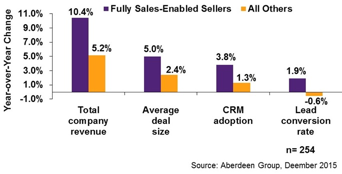
So, let’s combine adopters of these two competencies, and look at the year-over-year performance of this cohort in comparison to non-deployers. 

Figure 1:

ostrow-enablement-fig1.png

While growing revenue 100% faster is plenty of validation for the cost of entry, the equivalent doubling of growth in average deal size may actually stand out as the most exciting datum from Figure 1.  This is because while many non-sales factors can influence revenue, improving everyone’s lot via larger contracts is a KPI almost wholly unique to the work of sales teams. From an administrative standpoint, too, faster growth in CRM adoption is a win, and the marketing/sales relationship benefits from an improvement in how often sales converts marketing-provided opportunities.

In addition, Figure 1 teaches us that sales enablement initiatives require a commitment to leveraging three crucial aspects of the solutions available on the market:

  • Aggregating marketing-provided content that is designed for a wide variety of selling situations: by industry, by buyer persona, by product, and even by stage in the sales cycle. The more often sellers find just what they need for a particular pipelined deal in the sales enablement library, the more successful all parties will be.
  • Engaging with how buyers actually interact with said content. Seriously, folks, there really is no longer any need to wonder if prospects and customers open your email, check out your content, or pass it along to fellow decision-makers and champions.
  • Analyzing this data to continuously adjust the sails (pun intended) around messaging to buyers. The Best-in-Class are 33% more competent than All Others at utilizing predictive analytics to “better understand what content to use, when to use it, who to use it with (e.g. aligning content to buyers and stages of the marketing / sales funnel), and how to present it.”

What Great Sales Enablement Looks Like

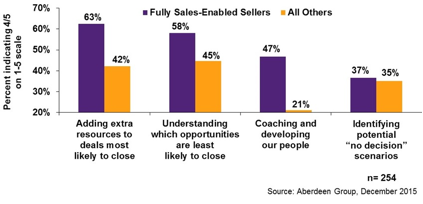
In addition to the performance advantages of content-driven sales enablement, another series of competencies — summarized in Figure 2 — accrues more often to fully sales-enabled firms, in comparison to the under-supported:

Figure 2: What Great Sales Enablement Looks Like 

ostrow-enablement-fig2.png

Indeed, on average, Best-in-Class organizations are 28% more competent at these high-level management abilities than under-performers, and for good reason.

In any competitive market, especially when it’s safest to assume your competitors are highly skilled at pipeline management (and using predictive analytics to support these skills), the value of maximizing the people and opportunities most likely to beat team quota cannot be understated.

Certainly any sales manager trying to decide which deals to sponsor at month end, using discounts or bundling or executive involvement, for example, can benefit from clarity around which prospects did or didn’t consume the content presented to them by reps. And coaching their team members based on this vital, objective intelligence falls into the “give a man a fish, teach a man to fish” mindset, turning content-driven selling into content-inspired winning.

Read the full Knowledge Brief here

09 Mar 17:46

7 Steps to Writing Killer Blog Posts That Actually Get Noticed – and Read!

by Guest Blogger

7 Steps to Writing Killer Blog Posts That Actually Get Noticed

This is a guest contribution from Larry Alton.

With billions of pages circulating around in cyberspace, chances are most of the content you produce is invisible and irrelevant. This isn’t a knock on your writing ability or creativity, it’s simply the truth.

The majority of bloggers write about the same topics and use the same styles, which means everything tends to blend together.

7 Tips to Writing Killer Blog Topics That Actually Get Noticed – and Read!

If you want to get noticed, you need to go against the grain, write better headlines, use compelling visuals, and master the art of promotion. If you want to know how, you’ve come to the right place! Let’s unpack these tips – and others – to show you how you can develop blog posts that actually get read.

Go Against the Grain

Want to get noticed? Then you must do something different. The concept seems pretty simple, but it’s astounding how many bloggers simply go with the flow and eventually blend in with the pack. The solution is to go against the grain.

“When you’re the same as everyone else, you’re a commodity,”

writes successful entrepreneur Ramit Sethi. This means you’re left fighting for the same readers and customers as everyone else.

“Whether you’re trying to get a date or start an online business, if you’re the same as everyone, you’re doomed. This is where the concept of zigging and zagging comes in. Where others zig, you zag.”

The Zig-Zag Technique Sethi talks about is pretty simple. You find an idea that everyone is writing about and discussing and then revise or reverse it. Take a unique or controversial approach, or even go for the “shock factor.”

What can you bring that is unique? What angle can you take that nobody else has? How can you make it stand out from the mainstream? You stand a much better chance of gaining traction this way.

Write Outstanding Titles

Think of a blog post’s title as the window display for a retailer. It doesn’t really provide much actionable advice or lasting value, but it serves the purpose of inviting people in.

However, it can also have the opposite effect. If a store window display is bland and unappealing, how many people are going to venture inside? Not many. Well, the same is true with a blog title. If the title is boring or doesn’t promise something useful in the content, few users are going to click it.

One of the keys to writing killer blog topics that actually get read is to write outstanding titles and headlines. If you need some inspiration, check out what popular websites like Buzzfeed, Mashable, and Entrepreneur are doing. Strong language, numbers, and controversial terminology are all effective.

photo-1449158672805-f0deda6782ec

Hook People with Opening Paragraph

A great introduction is paramount to the success of any blog post. After getting someone to click on a blog post, you only have a few seconds to capture their attention. And while much of the blog post will be scanned, the opening paragraph is something that almost always gets read entirely. As such, make sure you’re focusing on this important component of the post.

The opening paragraph should contain things that will catch the reader’s attention. These things can be anything from questions and facts to controversial claims, accusations, or definitive declarations. The goal is to pique the interest of the reader and encourage them to continue reading the remainder of the article.

Use Video and Compelling Images

While it may hurt you to hear it, a blog post cannot stand alone on its own merit any longer. Regardless of how polished and engaged your writing is, it’s no longer enough in today’s marketplace. If you want to create blog posts that get noticed and shared, then you must be willing to use compelling visual elements that complement the text.

The good news is that it’s easier than ever to find and embed images, videos, and infographics. Just check out this list of 17 different websites that offer high quality stock imagery. While some images have certain licenses that restrict public use, others are free for the taking. With just a few quick searches, you can find visuals that help your content stand out. You could also try your luck at these no-attribution, free image sites.

Use Personal Anecdotes

Everyone loves a personal story. Whether you’re listening to a lecture, sermon, or speech, personal stories always command more attention than pointless rambles or dry facts delivered dryly. Try to find opportunities to use personal anecdotes throughout your writing.

Also, it’s important that you write in an authentic voice that’s reflective of your personal values and expertise. If you pretend to be something you’re not, people will see right through the façade. It might get you through for a while, but it won’t last.

There are generally considered three different types of blogging voices – in terms of credibility – and it’s suggested that you identify and stick to the one that most closely relates to your current position.

  • Thought leader. Everyone wants to be a thought leader, but very few people actually are. By the way, referring to yourself as a thought leader doesn’t make you one. Never try to speak with more authority than you have. If you are a thought leader in your industry, as confirmed by your peers, then leverage this voice – but don’t try to squeeze your way into the mold.
  • Sherpa. Are you currently on your way to becoming a thought leader in your industry? If you’re on the journey to the proverbial mountaintop, but aren’t quite there yet, then you’re likely a Sherpa. When writing, your goal is to reflect personal experiences while guiding people up the mountain with you.
  • Beginner. Then you have the beginner. If you’re just starting out and want to pick up readers who will go along with you, then you need to clearly convey this position. This can be a powerful voice, since people like unbiased leaders who are willing to share both successes and misadventures.

Personal anecdotes are important, as is the voice you use when writing. Never try to be someone you aren’t. Even behind the guise of a computer screen, your readers will be able to tell when you’re being inauthentic.

Promote, Promote, Promote

Most bloggers don’t have the luxury of publishing a post and then waiting for organic pageviews and shares to accumulate. If you want your blog posts to be read and shared, you need an aggressive promotion strategy that accounts for multiple mediums.

“While awesome content is the only thing that will make you go viral, awesome content will never actually go viral if no one sees it,” writes successful blogger Kristi Hines. “So unless the world comes to your blog on a daily basis without any incentive, you’re probably going to have to go tell the world about your post through blog post promotion.”

Hines groups her posts into two categories when it comes to promotion. The first category is for “killer awesome” posts, while the second is for “averagely awesome” posts.

For averagely awesome posts, Hines tweets the post from her account between 7am and 11am and then shares on Facebook, LinkedIn, or Google+ (but not all three). For killer awesome posts, she does these same things, plus a number of additional processes. These processes include sharing on StumbleUpon, sending out an additional tweet, putting the piece in her writing profile, and including the post in her custom RSS feed.

This is just one example of how successful bloggers promote, but should give you a pretty clear idea of how important promotion is for blogging. If you want your posts to gain traction, you can’t leave them to their own devices.

Get Structure and Word Count Right

It’s easy to intimidate readers or inadvertently undermine their intelligence. You don’t want to do either. However, if you aren’t thinking about post structure and word count, you’re likely making debilitating mistakes.

Let’s start with post structure. It’s not advisable to write a blog post with large paragraphs and massive chunks of text that aren’t broken up by visual elements. We talked about visual elements in the fourth point, but images and videos aren’t the only tactics. Something as simple as including bolded and italicized words, bullet points, or numbers can help you break up monotonous stretches of content.

Secondly, think about the word count. A brief 250-word post tells the reader that you really don’t have much to talk about, whereas a 5000-word post will probably overwhelm the average reader. Over time, you should be able to identify a target length that your readers connect with. It’ll likely fall somewhere between 800 and 2000 words.

Write Killer Blog Posts

Writing killer blog posts that get noticed and read isn’t as hard as it may seem. While the blogosphere is certainly overcrowded, you can’t let this deter you. Instead of going with the flow and using the same regurgitated styles and formats, try breaking out of the mold. Using these seven tips, you can easily get started today. 

Larry Alton is an independent business consultant specializing in social media trends, business, and entrepreneurship. Follow him on Twitter and LinkedIn.

The post 7 Steps to Writing Killer Blog Posts That Actually Get Noticed – and Read! appeared first on ProBlogger.

09 Mar 17:46

How to Overcome Barriers to Coaching In Your Organization

by acr

One of the questions that comes up quite regularly when we’re talking to our clients at Box of Crayons is this: So, what are the barriers to coaching in the workplace?

Coaching is a foundational skill for managers and leaders. And there’s also no doubt that there are some really clear barriers that stop people changing their behaviour from advice-giver, “Let me tell you what to do,” to a more focused on the person approach, rather than focus on just the task at hand.  Check out my latest podcast that explores the various barriers and offers up some tactics for improving the quality and frequency of coaching in your organization.

Listen to Stitcher

(Or bookmark the podcast here.)

Don’t forget to rate this podcast on iTunes.

Full Transcript

So one of the things that comes up quite regularly when we’re talking to our clients at Box of Crayons is this question: So, what are the barriers to coaching in the workplace? Sometimes it’s my clients asking that. Sometimes it’s me asking the clients, what are the barriers to coaching actually sticking and thriving in your organization? And there’s no doubt that there are barriers.

It was back in the year 2000 that Daniel Goleman, who you may know is the guy who popularized the whole sense of emotional intelligence. He wrote an article for the Harvard Business Review called Leadership That Gets Results. It’s a great article. And he basically posits that there are six different styles of leadership. There’s things like visionary leadership, there’s telling people what to do. One of those six leadership styles was coaching. And what they did is they did some research about which leadership style had positive impact on the culture, which drove bottom-line results. And they all had their place.

In fact, that was one of the key findings, was, a great leader knows how to use all six of those leadership styles at the appropriate time. What they found is that most leaders used one or two or perhaps three, and that was all. And with coaching, one of the six leadership styles, they found it was the least utilized of the leadership approaches, even though it had a positive impact, it drove employee engagement. I think it was number two or maybe number three in terms of impact on the bottom line.

Now that was the year 2000. Even though coaching has become much more popular since then, and much more kind of bigger buzzword, I still don’t think that it’s working particularly well in organizations. So there are definitely barriers.

It reminds me a bit about the Marcus Buckingham work. Now some of you all know Marcus Buckingham’s work. It’s all about that focus on strengths. And it’s all about, “Look. Help managers build on—our employees build on and work to their strengths, and you’ll have a more engaged, more successful workplace.” And he’s a great champion for this work. And recently I saw him say, “You know, I started this work 15 years ago and only 30% of people were using their strengths. Now after 15 years, we did the study again and it’s now 31% of people using their strengths.”

I mean, those numbers are slightly wrong. But you get the point, which is, even though a good work’s being done, it hasn’t really taken traction in terms of really shifting our corporate cultures. So, what are these barriers to having coaching thriving in organizations in general, and perhaps in your organization?

Well, let me start with the first one, which is, I think, executive coaching is a terrible role model for managers coaching. And even though they sound the same and you kind of think, “Well, we’ll just take one and apply it to the other,” it doesn’t work like that at all. When you’re an executive coach, in other words, you’re an external to the organization, and you’re hired and you’re brought in, actually you have a very different power relationship to what’s going on. You have set times, you’re getting paid money, you have a degree of confidentiality, you have a disconnect to actually the specifics and the subtleties of the culture.

Executive coaching is important and powerful. But it’s a terrible way of thinking about managerial coaching, which is when, as a manager and a leader, you need to think to yourself, “I need to be more coach-like with more of my people. I need to build that into my leadership style.”

And actually the skills for one are quite different from the other. At Box of Crayons, our big piece is this: If you can’t coach in ten minutes or less as a manager, you don’t have time for coaching. So I think that’s the first barrier, which is just, there’s this collapsing of executive coaching, managers who coach are the same sort of things. They’re not. And I think when you’re looking at bringing coaching into your organization, you need to understand that you need to equip your managers and your leaders with quite different skills and a different mindset than you might if you were training an executive coach.

The second barrier, I think, is that most organizations, although they may say differently, put an emphasis on doing rather than thinking. You know, there’s this—just a sense in most of our organizations that it’s all about go, go, go. It’s all about busy, busy, busy.

And it’s amazing that when we do the work we do with organizations, with our coach skills training, how wired people are to leap into action. It’s like, “I don’t really know what the problem is, I don’t really know if we’ve got any good ideas, but let’s start doing something as fast as we can.”

I think coaching is actually all about slowing down the rush to action and creating a little curiosity and a little ability to think more deeply about the experience. And you can imagine in your own organization, I’m sure, that if you walk by somebody’s cubicle or their office and you saw them just sitting there staring out the window, staring at the ceiling, part of you goes, “What are they doing? What’s that about?” Even though part of you may going, “Oh, that’s what thinking looks like.”

So I think that’s another one of the kind of cultural barriers to coaching, which is, we love doing so much that creating a practice that encourages thinking actually feels a little counter-intuitive, even though that ability to think is what our organizations are actually paying for us. I mean, there’s plenty of people who can do stuff; there are fewer people who can think great thoughts.

My guess, if you’re listening to this podcast, is you’re one of those people who can think great thoughts. Are you giving yourself enough space and time to do the thinking?

And I guess that leads us into the third barrier, which is just understanding the difference between expertise and curiosity. As we become more senior, as we become more learned, experienced in the work that we do, our—we become invested in our own sense of expertise. And what happens when we have a sense of expertise is we move into, “Let me give you the answers as fast as I can. Let me add value by telling you what to do. Let me add value by telling you my story and sharing my experiences.”

And shifting from expertise to using that expertise to fuel your curiosity is actually another one of those simple-sounding behaviour changes that are actually quite tricky in terms of driving a more coach-like experience in your organization. So seeing the subtleties and the seduction of expertise, and actually as a manager or leader being able to put aside that sense of, “This is how I add value, by my expertise,” and leading with curiosity is a very powerful act.

And I think the fourth and final distinction I would make here in terms of thinking about barriers to coaching in organizations is the sense—and again, it’s connected to some of the ones we’ve already covered—that sense of the difference between performance and development.

You know, the language I come across regularly is coaching for performance. But as far as I can tell, in most organizations, coaching for performance is still basically just telling people what to do. It’s like the old controlling command approach to leadership, but kind of slightly nicer. Still basically saying, “Let me tell you the answer. Let me tell you what to do.”

And the other distinction about coaching for performance is it’s still focused on getting the stuff done. It’s still focused on that doing side of it. Coaching for performance is actually when you turn the focus to the person who’s doing the thing. And part of the barriers here is that we often think coaching for performance conversations have to kind of be slotted into the ghetto of our annual performance appraisals. And actually, we all know how broken performance appraisals are at the moment.

So I’d say the other barrier to tackle here is understanding that everyday conversations can actually have elements to them that are about performance, fixing the thing that needs to be fixed and development, building on expanding the capacity of the person who’s dealing with the task. And then when you start to understand those distinctions, you actually understand that coaching can actually play a powerful role in everyday management.

There’s no doubt about it. Coaching is a foundational skill for managers and leaders. And there’s also no doubt that there are some really clear barriers that stop people changing their behaviour from expert, advice-giver, “Let me tell you what to do,” to more curiosity, more focused on the person rather than just the task at hand, more willingness to actually give power over to the person you’re managing and leading so that they expand their capacity, have more impact and become more self-sufficient.

There are barriers there, but they’re definitely palpable. And the benefit—and this takes us back to the Daniel Goleman article I talked about right at the start—the benefit is that you build that strand of leadership in you that is actually one of the key drivers for engagement, for bottom-line profit and for helping people and organizations do less good work and more great work.

09 Mar 17:45

When Firing Your Client Is Justified

by Michael Cohn

At the very beginning, you may not choose your clients very carefully for a variety of reasons. One of the reasons may be because you are hungry for clients and you don’t have enough yet to make a profit in your business. However, as time goes on and you acquire more and more clients, you may feel different. At that point, you may be able to afford to do what you should have done previously. Fire a client.

Many clients are great; some are not

You will probably find that many of your clients are delightful to be around. They are cooperative, polite, interesting, etc. However, there are also those clients who are difficult to deal with and who fight you every step of the way when you are trying to do everything possible to make their business a raging success! Those are the clients who open your valve and drain all of your life fluids. Well, it probably isn’t that bad; however, they can be extremely difficult to work with and those differences between you make it extremely difficult for you to do your job properly and successfully.

If you have an especially difficult client, sometimes it is best to let him or her go and cut your losses.

It may be perfectly obvious to you that a particular client is not good for you or for your business; however, even though it may be relatively simple for you to identify those clients who are not good for your business, it may be much more difficult for you to figure out a way to separate from that particular client. So, how do you figure out if you should not be doing business with that particular person?

  • The client makes unreasonable requests: This particular client may have no respect for the hours that you keep and when it is and is not appropriate to expect you to work on their account. That type of client will not have the proper boundaries in place. Another possibility here is the client who is always late doing everything and thus has the expectation that you will be ready, willing, and able to do whatever that person needs whenever that person needs it (including in the middle of the night, on weekends, etc).

    It is important for you to remember here that the client who has outrageous expectations has learned to expect that because someone in the past was willing to meet those expectations. Unfortunately for you and your business, you have two possible options. You can either push back and train that client to have more reasonable expectations or you can sever the relationship.

  • The client makes tremendous demands but expects that you won’t charge him or her: When it comes to your relationship with the client, you can expect a certain amount of price negotiations a lot of the time. However, you are in business to make money and nobody should ever expect that you are willing to work for free. That is unreasonable on the part of the client.

    On the other hand, it is understandable that the client wants to feel that he or she is getting a good deal so if you can offer some sort of incentive to that person, he or she will walk away feeling satisfied and you will have kept your relationship in order. It really all depends on the demands and how reasonable they are (on the part of the client). If they aren’t reasonable and you see a pattern emerging, it may be time to consider ending the relationship.

  • You are constantly running after your money: Having this situation is wrong on so many levels. If you have a client who is constantly late with payments, it can be destructive to your business. Of course, it is also really irritating! It will affect the amount of money that comes into your business and, of course, it will affect your ability to pay your bills for the business. To be fair, if your client is late paying you for your products and/or services, it may not be a case of that person being late intentionally. That person may simply be disorganized. The way to avoid that issue for your business is by ensuring that you have extra money in your business account in the event that you run into that situation. The last thing that you need or want is not to have enough money to stay in business. If that particular client pays late every time, you may wish to consider ending the relationship.
  • You aren’t being heard by the client: There are few things in life that are more frustrating than not being heard. That applies to personal as well as professional situations. If you have a client who is either unwilling or unable to listen to what you are saying and to follow the advice that the client pays you for, you have a big issue to resolve. That will certainly cause a great deal of stress for you. In addition to your encountering difficulties in completing the work that you set out to finish, you will also start to resent the work and the client. If you are having a similar experience, you should express how you feel, finish the work that you are doing for that client, and then end the relationship.

Conclusion

When you first start out in business, you may think that only the client can fire you. However, just as it is with all relationships, that relationship is not one-sided. You both have the same rights. Those rights include a relationship that includes respect and value. There is often a delicate balance between the two people in the relationship. One thing that is for sure is that you both need to try to understand each other and if you can both manage that, your relationship should endure. It goes without saying that you are in business to succeed. However, if your client is impossible to deal with and you determine that you are better off not working with that person, you need to be strong enough to end the relationship. If it is not mutually beneficial, there is no point in continuing.

09 Mar 17:45

In the Internet of Things, Context Is King

by Jonathan Bright

The Internet of Things is on the horizon of content creators and data scientists alike, though many have a guarded stance on the subject right now. So what sort of effect can digital marketing expect from the Internet of Things?

Whenever the ‘Internet of Things’ is mentioned the first place my brain goes to is my fridge. I mean, that tends to happen anyway, only in this case my fridge talks to me. It tells me what it’s missing rather than having me guess and I end up buying way too much cheese. Mind you, can you buy too much cheese?

It does sound sort of fantastical in a slightly boring way, and I’m still unconvinced as to how much such a thing would enhance my life. But I don’t think I’m ‘there’ yet.

While a fridge that tells me about my dairy-based shortcomings might not be my idea of a utopian future, the Internet of Things (IoT) of course promises to be much, much more. It’s set to be the connective tissue that holds together this body of parts we’ve been growing these past few years. And the content marketing world needs to get there, pronto.

Their clients’ most exciting future opportunity

Not just future importance

The marketing community foresees the IoT as a massively important future shift, as it should. But in terms of fitting it into their marketing strategies right now, a significant proportion is waiting for a technological advancement beyond a talking fridge, which is rather short-sighted. For a start, BI Intelligence reckons that connected-home device sales will drive over $61 billion in revenue this year, rising dramatically to $490 billion by 2019. So we’re well on the way there.

More to the point, however, imagine for a second that you’re back in the mid-‘90s: the mobile revolution is in full swing, the internet as we know it today is in its infancy and your hairstyle is incomprehensible. Now imagine you are one of a handful of people that can confidently predict the arrival of the smartphone. You wouldn’t dream of not incorporating that knowledge into your future plans, would you?

But that’s sort of where we find ourselves today. According to Technology for Marketing/Pure360’s recent research Future Marketing Technology 2016, 82% of marketers see the IoT as having ‘future importance’. Just 28% of them are investing in it. Meanwhile, and perhaps more tellingly, Econsultancy’s Digital Trends 2016 reports that just 6% of marketers see the IoT as something of importance right now, but 20% of agency marketers see it as their clients’ most exciting future opportunity.

A third of respondents say they’re waiting to see how things develop

Just under a third of respondents say they’re waiting to see how things develop, and moreover there’s a general lack of resources compounded by a lack of senior buy-in. Understandable, of course, but this is often the nature of getting ahead of the game.

The problem is also a simple fact of not being able to see the opportunity in a technology you can’t necessarily test. Sure, wearable tech is now a thing, but for instance it recently emerged from the Digital Content Summit 2016 that the IoT wouldn’t be truly integrated until connected cars enter our daily lives en masse. But there are opportunities to explore, and there are marketers taking advantage of them.

Real time data

The purpose of technology is as a facilitator; it makes our lives easier. Or more fun. Or both. From a marketing standpoint the obvious advantage of the IoT is the wealth of data you can glean from seeing your products being used and your customers using them, in real time. This in turn can help to personalise your message and adapt to customer needs, in real time. In other words, context will usurp content as king.

It also means that marketers need to view the customer journey in a whole new way. Crucially, you can see what the customer is experiencing at every stage in their buying cycle and lifecycle thereafter. In a recent report from IBM, Key Marketing Trends 2016, Josh Rochlin, Global Business Leader for IBM Mobile Customer Engagement says:

“As more things become connected, marketers will be challenged to act and react based on their customers’ interactions… Whereas before you could engage your customers when they were ‘in store’ or ‘on screen’, you’ll now be challenged to engage them with the right message at the right time as they interact with the newly hyper-connected IoT.”

It’s seeing your products being used and your customers using them, in real time

Behaviour steering

One industry where this seems due to happen in a big way is in insurance. FC Business Intelligence recently published its research Insurance IoT Digital Report: Insurers Enter the New Connected World, which reckons that IoT in insurance is moving out of the early adopter phase and into the mainstream. It cites a figure that nearly a quarter of insurance company executives see potential for the IoT in ‘behaviour steering’. This could be in the context of risk prevention for health insurance, whereby the content associated with certain connected devices could motivate and educate on lifestyle choices that promote, for example, disease prevention.

Respondents from the report also pointed out that such a feature would need to genuinely enhance people’s lives and experiences for them to engage with the insurance company. There’s a very delicate balance to be struck in what sort of content is presented and how, as any ‘big brother’-esque application would turn customers away sharpish.

Incidentally, around a third of insurance executives reckon the next 12 months will be critical in the onset of the IoT. Given that insurance underwrites so many areas of business, it’s not crazy to think that numerous other industries can’t be far behind.

A truly valuable experience

This idea of a valuable user experience – in other words, of life enhancement – is something that dominates the content marketing world in 2016 and that ideal looks set to be a hallmark of the IoT.

A fridge that tells me I need cheese is, at least, useful. A fridge that advertises cheese at me is, at best, annoying. And therein lies the difference between using data and insight to provide real value, as opposed to using data to inform intrusions into one’s life. That’s more akin to someone finding out you’re away on holiday from your hotdog-legs Facebook update and burgling your house. It’s just bad etiquette.

At the core of the IoT are valuable experiences on connected devices. Ofcom said that in January 2015, over 40 million devices were connected via the IoT, and set to increase eight-fold by 2022. You thought Big Data was big now? You ain’t seen nothing yet.

Google for example bought Nest Labs, maker of smart thermostats and smart smoke detectors, a couple of years ago for $3.2 billion. These appliances gather intelligent data based on how consumers use them, to the point that they can programme themselves according to typical user behaviour. The thermostats can detect when a user is not home, for example, and choose to conserve energy.

This is the kind of level we’re currently at. Gartner, the tech researcher, considers there are two major classes of connected ‘things’: cross-industry things like smart light bulbs and building management systems which are used to save money across entire networks or sites; and more industry-specific things like connected hospital devices or shipping container sensors and trackers. By 2020, cross-industry devices look set to dominate, feeding a wealth of data from numerous sources.

It’s set to be the connective tissue that holds together this body of parts we’ve been growing

Early adoption is critical

As it stands now, how we manage all that data will be instrumental in how we prepare for the IoT. There’s going to be a lot of it. For some it will be overwhelming, but for those that can segment it and analyse it properly, there will be opportunities arising from the very deepest insights about how your products or services are being used, as they’re being used.

Which is why early adoption on the part of marketers right now is so important. Those that have, or are making the effort to develop the analytical nous to read all that data, coupled with the creative vision to use it to add deeper, more personalised meaning to a user experience – i.e. providing context to high quality content – will be the future rulers. Just as content marketing evolved from the wearied world of the Mad Men, so too will the IoT be a further deepening of an increasingly emotion-led drive for better marketing, based on nurturing relationships that improve people’s lives rather than intrude upon them.

Context is everything. What you have is a wealth of data about very specific points in customers’ lifecycles and how they’re using your products or services. This is value-added, real-time information on an unprecedented scale and companies’ abilities to contextualise this data will form a part of their own value proposition – their USP. This ability means you can adapt to even more specific customer needs and create content that speaks to your audience on whole new and personal level.

This content can be highly segmented, and very specific. Practically speaking you need savvy data analysts and adaptive content creators to create all this relevant content. But the data you gather informs the sort of content that can speak to just a tiny proportion of your audience. It’s almost as if it’s face-to-face – one-on-one communication – and with the right resources and planning there’s really no limit to how many segments of your audience and potential audience you can reach on a very personal level.

The IoT provides opportunities to address the most specific customer needs. Even a fridge can be incredibly telling about someone. Whether or not you need more cheese is really just the thin end of the wedge.


09 Mar 17:42

4 Myths Preventing True B2B Customer Understanding

by Tony Zambito
by Alex Auda Samora

by Alex Auda Samora

There is a big problem when it comes to B2B customer research. And, most B2B executives may be unable to see or recognize the problem. The scarier notion is some may not even know it exists.

What is this big problem?

According to various studies over the years (by credible institutions such as Harvard) regarding market and customer research, approximately 80% or better of B2B customer research is conducted to reinforce current assumptions about customers. Rather than, to explore new concepts, hypotheses, uncover new opportunities, gain revealing insights into issues, and seek new innovative ideas.

In my years since launching Buyer Persona Research, the most successful companies utilizing buyer personas have made it about the latter – not the former. That is, making their buyer personas about customer research and not confirming existing buyer profiling assumptions. However, a big problem exists in buyer persona research and development today. Which is, a majority of buyer persona development efforts are focused on reinforcing incorrect assumptions about B2B buyers.

Myths Hurting B2B Marketing And Sales

Through inertia and organizational assimilation, B2B executives can form a base of assumptions about customers. These assumptions can then get in the way of truly understanding their customers. Unknowingly, B2B executives can make important decisions relative to marketing and sales strategies based upon mythical assumptions. Which, have been ingrained into B2B thinking over a period of decades.

These mythical assumptions B2B executives should check at the door are:

Myth 1: Buyers think and act in neat stage-gated linear processes when evaluating solutions.

The bottom line here is that buyers do not act or think in this way. What has transpired in the last few years is B2B Marketing have taken the notion of customers having processes and policies they need to follow for purchasing and transformed this notion into a mythical buyer’s journey. As opposed to a buyer’s focus on their situational scenario. I recently wrote an article on the waste of content that is resulting from this assumption. Primarily from attempts to create multiple pieces of content for each perceived stage. Thus, inundating customers with non-relevant content.

This assumption also comes with another corollary myth. That is, as buyers progress through an assumed stage-gated buyer’s journey, they are evaluating buying criteria and requirements solely. As we are learning, the power of emotions and intangibles (and important to add – often unquantifiable) other than logic are proving to be bigger influences on how buyers decide.

Myth 2: Buyers can explain how they think, their recent activities, and behaviors to describe their buying decisions.

When it comes to high-stakes buying decisions in B2B markets, we can all agree there is plenty of thinking going on. An assumption often made and acted upon is buyers can recount and explain how they arrived at their thought processes and decisions. Based on decades of studies in the social sciences, it is estimated that 95% of human thinking takes place in the unconscious minds of people. Meaning people only have a 5% capability to recall and rationalize their thinking and behavior.

The implication here is that buyers usually can not explain their thinking and decisions with accuracy. It is a big difference. What they can do is rationalize their choices. When buyers rationalize, there is a tendency to justify and apply logical reasoning to their choices and decisions. Thus, what B2B executives may hear from buyers may be completely different than what actually occurred.

Another implication is buyers will have difficulty recalling their experiences. Recall and memory can be influenced by hindsight and revisions based on situations they have encountered. (A central issue as to why win-loss interviews are inappropriate for buyer persona research.)

Myth 3: Buyers make buying decisions independently and mutually exclusive from other situations and decisions.

Often, there is a tendency to have tunnel vision that the buyer’s decision respective to an organization’s products or services is the only one they are focusing in on. This can apply to buying teams as well. Where B2B executives can assume that buying teams are dedicated to just one decision.

Critical choices and decisions are influenced by interactions with others – both people and organizations. Other factors such as corporate and country cultures play a role. The main point is that choices and decisions are usually part of an integrated web of other situations, scenarios, systems, choices, and decisions. Thus, tunnel vision on this myth can cause B2B organizations to miss the larger story.

Myth 4: Buyers receive and clearly understand existing marketing and sales messaging.

Investments are made annually to message to prospects and customers. Once these investments are made, B2B executives can operate from assumptive perspectives that messages received from their organizations are received clearly. Assuming customers read them, absorb them, and interpret them as intended.

If this were truly the case, then for most B2B companies’ information and content marketing would be a slam dunk. And, the boom in content marketing consultancy, conferences, and technology would dry up overnight. In my years of qualitative research in this area directly with buyers, it is evident buyers do not adsorb clearly as intended. They often reinterpret messaging they receive to fit the mental frame of what they are currently or have experienced. Yet many marketing and sales strategies operate on this assumption.

(I cannot tell you how many times I have heard a B2B executive exclaim to me, “that’s not what that message is supposed to say” when learning how customers actually interpreted or received information.)

Leads To Mistaken Customer Understanding

These four myths can cause challenges for B2B executives and lead to errors in understanding customers. Such as:

  • To confuse a preponderance of data analytics, for example, that is focused on confirming current assumptions as “new” customer insight
  • Poorly constructed buyer research, buyer persona development, and buyer journey mappings can lead B2B executives to focus on the wrong areas of the overall buying experience
  • Treating as “gospel insight” the descriptive, rationalizing, reasoning, and explanatory information gathered from customers
  • To miss crucial, often unarticulated, insights on what truly matters to customers

In these ways mentioned, these four myths can prevent B2B executives from having true customer understanding. In essence, only enabling understanding customers at the surface level. Leaving the vast deeper understanding of goal-directed behaviors and thinking that influence buying decisions left uncovered.

The myths described come from a different era in B2B marketing and sales. Yet, many B2B executives may not realize they are in play, unconsciously, when they attempt to understand the very different customers of today. Shedding light on these myths can lead to truly deeper customer understanding.

(What we reviewed above are basically four fallacies. Here is an interesting video that introduces a fifth fallacy that B2B marketing and sales executives can unintentionally subscribe to. The Sunk Cost Fallacy, which basically states we tend to stick with something because of the investments we have already made in them. Even if they are no longer adding true value. What number of marketing and sales campaigns or strategies are of this nature? Where they continue because of the investments already made? Enjoy.)

09 Mar 17:42

Hear What 3 Top Sales Development Leaders are Saying at Rainmaker 2016

by Leah Bell

We’ve heard from the SalesLoft family this morning, with Kyle Porter and friends on the main stage sharing their gratitude for the people and processes that have gotten us to where we are today in the sales development community.

Next up on keynote, we have three of the industry’s top thought-leaders: TOPO’s Craig Rosenberg, Winning by Design’s Jacco van der Kooij, and j.barrows LLC’s John Barrows. These three sales development experts are here to contribute their opinions on the modern sales model, and how to navigate the waters with agility and proactivity.

First up: Craig Rosenberg. the top analyst in the sales development game.

Hello, Account Based Everything

This new-thing-yet-old-thing, called the account-based method, is now the most strategic and forward thinking way to run your business. That’s why we’re saying “Hello” to Account Based Everything. From marketing to sales development to sales, it’s all about account personalization and an agile, strategic process.

Marketing has made incredible advances. They got really good at getting lots of leads, and they drove a lot of traffic. But they forgot to figure out what was happening in the sales meeting. And sales didn’t know what was going on. They didn’t have a true target prospect list, or ideal customer profiles — and no, “everyone” is not your ideal customer.

That’s when the Account Based Everything (ABE) came into play. ABE is the coordination of personalized marketing, sales development, and sales efforts to drive engagement and conversion at a targeted set of accounts.

ABE has 5 defining characteristics:

  1. Targeted accounts
  2. Highly personalized
  3. Coordinated touches, channels, and experiences
  4. Always on (until accounts are removed from target list)
  5. Marketing, sales development, and sales alignment is crucial

But what are the things that we can do from a pipeline perspective with ABE? ABE impacts three critical revenue objectives: new customer acquisition, pipeline velocity, and account expansion. New customer acquisition helps acquire new, high value target customers, pipeline velocity accelerates velocity of existing opportunities at target accounts, and (the most important objective) account expansion drives expansion (through upsells and cross-sells) on existing accounts.

Account Based Everything is about personalization at scale. And that’s sales development.” -Craig Rosenberg

As we move deeper into the Account Based Sales Development model, we’re finding that the shift moves further down that line to a fully-customized outreach process. That’s because of the simple fact that the less accounts you’re working with, the more personalized they should be.

“We’re trying to understand the buyer relevance. When you have less accounts, hope is not a strategy. That’s how people have been selling for the last three years. But if we’re going to pull back on who we’re going after, then true old-school methods are back in style,” Craig tells us.

Deep Selling, the “new” sales development approach, is actually an old one. In an Account Based Sales Development model, sales must be able to start selling early in the buying cycle or even before a buying cycle even begins (No BANT). SDRs need to create personalized, buyer-centric sales processes. In fact, buyer-centric sales teams achieve 150% of quota. And discovery is required for delivering a buyer-centric sales process.

Here are some steps that we can take today to implement Account Based Everything into your sales process:

Screen Shot 2016-03-08 at 11.08.56 AM

Check out more from Craig at TOPO, or check out his blog, The Funnelholic, and get all of the latest and greatest in Account Based Everything.

The New Way of Selling for a New Generation

Jacco van der Kooij, the number one trainer in sales development, and a SALES MANIAC, is here to talk to us about the new generation of sales. As the Head of Sales for an organization years ago, he saw the evolution of the sales landscape change.

Screen Shot 2016-03-08 at 10.52.21 AM

As the field of sales has changed, so did it’s customers. Customers today want to be educated, not sold. They want to be asked questions, not pitched. They want a story, not a presentation. They want a way to do it themselves, not a demo. This means that the way we sell needs to change. We need 15 minute meetings instead of an hour; now instead of next week, and quick follow up instead of a long-span nurture process.

All of these changes are giving rise to a new generation of sales. Conventional B2B Sales is shifting to High Velocity B2B Sales. This generation is Inside Sales 2.0, a profitable way of running a business through process, tools, content, and skills.

We need to change the goal of an SDR to have a conversation with a customer. That is the real art of selling.” -Jacco van der Kooij

Modern SDRs need the skills to have these sincere conversations, and those skills are tiered to match the quality of their selling insights. From inbound and outbound processes, to the tools and content needed to achieve each level, an SDR needs a program of training to attain these skills.

The keys to training new generation ignition are as follows:

  • Cloud Specific
  • Once a week
  • Real-life scenarios
  • Internal trainers
  • Peer-assisted & contributed
  • Must pass a bar-level exam
  • A reward system for level-up

Sales hacking is an extraordinary tactic, but it’s not a training strategy.” -Jacco van der Kooij

Screen Shot 2016-03-08 at 11.06.44 AM

To hear more from Jacco, find his book Blueprints on Amazon.com, and follow his high energy on Twitter @IndoJacco.

Building Your Prospecting Engine

John Barrows, an inside sales legend, knows what it takes to build a prospecting engine.

To begin, we’re talking gambling. More specifically priming in the gambling game. In the movie Focus, Will Smith is a con-artist at a Super Bowl game in New Orleans, and he cons a man at the game into betting that his girlfriend could pick the same player number on the field as him. She picks the #55 player (who is actually a mark), and the man is in shock. They walk away with 1 million dollars… and Smith explains that he’s been priming the man with the number 55 all day long.

This is new-age selling. From social selling, to content sharing, to the sincere, deep, account-based model, we’re constantly priming our buyers to uncover their pain points and see our products as the solution. And you can be the best sales rep out there, with the conventional sales skills of an old-school rep, but if you can’t leverage today’s technology — you’re screwed.

Fear not, there’s a step-by-step process to take these new selling skills and turn them into action:

Step 1: Prioritize Your Accounts. The more nuanced you can get with your target accounts, the more prioritized they will be. Break your accounts down by category, quality/practice tier, and put these priorities into motion.

Screen Shot 2016-03-08 at 11.34.28 AM

Step 2: Know Your Target. Most reps aren’t selling to the C-Suite. When’s the last time a CEO sat through the entire process? You need to know your target, and understand who you’re selling to in your process.

Screw the average sales rep. I want the sales rep thats eager to evolve and learn the steps to a targeted process.” -John Barrows

Step 3: Identify Your Triggers. There are two sides to social selling: building your own personal brand and listening to your triggers. Find your reason to move in, and take the plunge.

Step 4: Develop Your Message. Come up with messages around social selling triggers and figure out what value you bring to that equation. And the easiest way to come up with messaging is through case studies. Differentiate yourself from your competition through your customers.

Step 5: Set Up Your Systems. The timing of SalesLoft’s rise of the Sales Development Cloud couldn’t be more perfect. Through data integrated, hyper-personalized apps, you can incorporate technology into your system.

Step 6: Plan Your Approach. Mapping out your process is the performance step. 83% of high performers have a defined strategy and make 4-8 attempts for 6 unique touches in 30 days.

Step 7: Drink Your Coffee. You have the tools and resources to get the job done, so you need to trust the process. Sit back, drink your coffee, scan through the information, and watch your process work.

If I want your business, I sell the right way. If I need your business, then I need a better pipeline strategy.” -John Barrows

Want to hear more from John? Check him out on jbarrows.com and learn more about sales training through his informative content and resources.


Stay tuned — we’re live blogging the entire Rainmaker experience — right here from your one stop shop for all things sales development. Comment below with your thoughts on the keynotes, sessions, and events throughout the event!

The post Hear What 3 Top Sales Development Leaders are Saying at Rainmaker 2016 appeared first on SalesLoft.

09 Mar 17:41

9 Tweetables on How Not to F*** Up Account Based Sales Development

by Leah Bell

In case you’re new to the game, we’re here at Rainmaker 2016 and we’re live blogging the keynotes, panels, and breakout sessions throughout the event.

We’ve heard from the SalesLoft family during the keynote, and then 3 of the industry’s top thought-leaders: TOPO’s Craig Rosenberg, Winning by Design’s Jacco van der Kooij, and j.barrows LLC’s John Barrows shared their opinions on the modern sales model.

Now we’re here with TOPO’s Kristina McMillan, one of the top sales development analysts in the game, and MuleSoft’s Steven Broudy, formerly an Army Ranger Sniper Team Leader, and currently Head of Account Development for the Americas. Account Based Sales Development (ABSD) can help your team develop target accounts and set more appointments using less leads.

Screen Shot 2016-03-08 at 2.56.18 PM

Check out some of these tweetable takeaways from Steven and Kristina as they share their expert opinions on implementing a solid ABSD approach from the ground up.

You can't just take what previously worked for outbound. You have to change the behaviors into a persona-based strategy.Click To Tweet
A rep who is capable of cranking out cold calls at high numbers is not necessarily going to be the rep that knows how to dive deep into each account with the level of personalization needed in ABSD.Click To Tweet
How can you really get into the mindset of your buyers?Click To Tweet
Stop being selfish and start being prospect-centric.Click To Tweet
ABSD is a much longer touch pattern, but there's an opportunity to rest accounts between touchpoints. You can't email them once a week for a year. You need something relevant and multi-channel to help them answer, 'Why should we care?'Click To Tweet
Prospecting and touchpoints are an on-going practice. Stop reading infographics on how many touchpoints it takes to get through to a prospect -- go out and find your own data.Click To Tweet
Where are you in terms of your sales maturation?Click To Tweet
You have to make sure that reps know how to talk to accounts in their own language.Click To Tweet
If you hire a learner-mindset, they're going to be way more adaptable to an ABSD transition.Click To Tweet


Stay tuned — we’re live blogging the entire Rainmaker experience — right here from your one stop shop for all things sales development. Comment below with your thoughts on the keynotes, sessions, and events throughout the event!

The post 9 Tweetables on How Not to F*** Up Account Based Sales Development appeared first on SalesLoft.

09 Mar 17:38

4 Hidden Trends of Innovation Growing Up

by Dan McClure

Early in 2015, a pair of earnest colleagues pulled me aside to offer some career advice. They warned that innovation had jumped the shark. It was a done-with management trend, an overworked idea sliding down the wrong side of the hype curve, and I would do well to direct my passions elsewhere.

Looking back, it is clear to me they were more than a little bit wrong.

There is a good case to be made that in 2015, innovation claimed a level of business relevance that is more urgent and important than ever before. Innovation may have finally earned its long pants, moving beyond a seemingly perpetual state of adolescence, to become an enterprise necessity that legitimately deserves front and center executive concern.

The shifts in thinking and approach may not have been obvious in the noise of the daily news feed. So, in an attempt to defend my undiminished passion for enterprise invention, here are my four hidden innovation trends.

1. The End of Innocence

First hidden trend: Catastrophic disruption is finally taken seriously

Early in the year, in our meetings with business leadership teams, one of the most common questions was still, “What is innovation?”. It was a roundabout way of asking how quickly they could check the innovation box on their executive to-do list. “Would a big backlog of new product features qualify?” “How about an innovation lab”?

Unless you were in one of the ‘unlucky’ industries to be dismantled by some new technological invention, it was still acceptable to treat innovation as ‘nice to have’.

It was still possible to see the radical disruptions in other markets, as a product of technical revolutions that were unique to that unlucky business area. Newspapers were undone by the web. The music business was turned upside down by digital recording and distribution. These were cautionary tales, but isolated cases.

Then came Uber.

2015 saw Uber usurp Amazon’s role as innovation’s great boogie man. Here was a competitor that emerged out of nowhere, in an improbable business sector to devastate the incumbents. Uber built and deployed an entirely new business ecosystem, city after city. In less than a year, the value of New York City taxi medallions, a convenient measure of the capital value of a taxicab, plunged by 50%, from $1.4 million to $700,000.

Taxi New York City

What’s different? There is nothing magical. Uber doesn’t ride a wave of emergent technology. They created their disruptive, double-sided, market-leveraging, widely available mobile technology, but combined this with new ownership, labor models and vigorous regulatory advocacy.

Entrenched advantages of scale, capital, and business network are supposed to defend against this sort of thing. Yet, disruption was increasingly a threat to everyone. In 2015, AirBnB reached the same market valuation as Marriott, and Apple and Google were joining Elon Musk in plans to build cars, traditionally one of the world’s most capital-intensive industries.

Midway through the year, we sat with a major financial firm’s head of technology. He wasn’t debating the definition of innovation. Instead, he shook his head in amazement at his newly emerging competitors, saying, “We have a huge market position. We made this business. We had no idea how quickly someone could move to challenge that.”

Revolutionary business ecosystems are disruptive in a way that straight product-on-product competition can’t be. They don’t simply provide competitive advantage. They change the game, leaving incumbents irrelevant or deeply disadvantaged.

2015 seems to be the year where the reality of this threat was finally felt in the gut.

2. IoT: The Market Disruptor’s Toolkit

Second hidden trend: IoT becomes a tool of disruption

Using technology to fight harder over the same scraps of opportunity is not disruptive. It’s just hard-nosed business, a cage fight where customers are offered the same kind of value, just in different forms. In contrast, disruptive strategies change the rules. Disruptors escape from the box that has traditionally constrained business opportunity in their sector.

In 2015, the Internet of Things (IoT) demonstrated a unique power to enable this kind of disruption. Amazon released the Dash, a button that makes stores disappear. It’s an IoT device placed in the home, next to the place where products are kept and consumed. Customers simply smack the button when they run low.

Long Value Chain
IoT Makes the store vanish
This seems simple, but by following the customer home and delivering value at the moment of need, IoT severed the value chain, making the traditional store all but irrelevant. Competitors lose the opportunity for price or brand comparison, and those well-honed buying experiences and cutting-edge point of sale systems never enter the picture.

Like many new technologies, early in its adoption, IoT was often just a feature. It appeared as a bright and shiny enhancement to otherwise mundane products, like home thermostats. In 2015, IoT began to demonstrate how its impact could be more dramatic. Whether or not the Dash button is a long term success, it illustrates the power of the IoT to disrupt the fabric of existing business ecosystems.

When Tesla downloaded the programming necessary to create a self-driving vehicle into cars that were already in buyers hands, they demonstrated a shift in thinking. For years, cars have included substantial computational capacity, as much as a 100 million lines of code by some counts, but this technology was largely used to optimize the performance of cars against car owner’s traditional expectations. Now as a connected computing platform, new features, including radical extensions of value, can flow into the vehicle throughout its life. The car as an IoT device is one of the shifts in equilibrium that enables disruptive automotive ambitions from both Apple and Google.

At the end of 2015, IoT is poised to become part of a growing network of tools with mutual synergies. Even more disruptive strategies built around personal engagement will be possible, when the reach and immediacy of IOT is supported by sophisticated Big Data insights and with the ability to draw on a portfolio of distributed services from the Cloud.

3. Baby Bunnies Need to Grow Up

Third hidden trend: Scaling innovation is hard (and we’re bad at it).

The Humanitarian Sector is a field with a big mission and far too little funding for the level of need. To their credit, they have actively embraced Lean Startup models for innovation, creating challenge grant programs and supporting innovation labs that are intentionally user centric.

Mountain of Complexity

On paper this seems like an innovation win, but 2015 saw a growing recognition that while the sector had become very good at developing pilot programs, breeding them almost like baby bunnies, the number of good ideas going to scale was disappointingly small. Good ideas got stuck. It seemed that developing sustainable solutions at scale was not simply about making pilots bigger or replicating them in multiple contexts.

Commercial innovation teams increasingly found themselves answering similar questions. Innovation labs and other islands of creativity were being scrutinized. “Which ideas had actually gone to scale? What was the business impact?”

Lean Startup methodologies have proven themselves invaluable for early stage evaluation of design and product market fit, but when the idea must be adapted to a messy real world environment, innovators face a persistent gap. —We’ve called the part of the innovation lifecycle between early stage innovation and the mature ability to replicate a sustainable solution, the ‘messy middle’.

It’s increasingly clear that scaling can’t be done with the same tools and methodologies used for initial product discovery. Pilots are about speed, learning and creativity. Investments are (relatively) small. In contrast, building complex sustainable solutions is messy work complicated by dependencies, conflicting priorities, uncertainties, and change.

The hard lesson of 2015: getting a baby bunny to grow up is hard and almost everyone is bad at it. There is a job ahead, learning to deal with scaling challenges like evolving large legacy systems, working across business silos, and engaging with the soft messy challenges of cultural, business and regulatory change.

4. The Entire Enterprise Must Dance

Fourth hidden trend: A rush to create a responsive the enterprise

Many mature businesses are masters at making incremental improvements to existing offerings. A growing number have even invested in innovation labs that allow them to do experiments inside safely segregated pockets of creativity. However, it is an understatement to say that most organizations are ill prepared for a world where disruptive competitors emerge out of nowhere. With few exceptions, these enterprise cannot dance.

Given the competitive turmoil on the horizon, it is not surprising that 2015 saw a sudden growth in interest for new Lean Enterprise models. Executive leaders dramatically increased their appetite for radical change, acting on a realization that businesses need a strategic capacity to pursue new opportunities with speed and agility.

Lean Enterprise Transformation Outcome Based Measurement Criteria

(Image from Aneesh Lele / Anupam Kundu – Winning Companies Master Strategic Tech)

Lean Enterprise models are a big shift. At the root of this transformation, is a move from a command and control management model, where plans are made annually by senior leaders and executed within budget by assigned teams. In its place is a responsive model based on learning loops, where actors at all levels of the organization quickly respond to new insights and feedback.

Learning loops are designed for business environments where the biggest risk is failing to move quickly and responding creatively to new insights. Choices are made in close proximity to the moment of learning, promoting both nimble action and the chance to gain new insights.

This is a deeply transformative change for most traditionally managed organizations. It places new demands on every level of the enterprise, offering more freedom and demanding more responsibility. It’s hard, yet 2015 found an unprecedented leadership appetite for this type of transformative change.

2016–A Year for Bigger Innovation

The need for Big Innovation is driven by opportunities (and threats) rooted in the market’s capacity to create disruptive new business ecosystems. My friends were wrong. Innovation did not become irrelevant in 2015. Instead, creativity at the enterprise level became a more urgent need than ever before.

Now Innovators are being asked to do far more difficult things, for far higher stakes. That should make 2016 a pretty interesting year.

An earlier version of this article was first published on ThoughtWorks Insights.

09 Mar 17:36

3 Telltale Warning Signs That a Sales Deal Will End in No Decision

by jeff@mjhoffman.com (Jeff Hoffman)

sales-no-decision-deal.jpeg

Contrary to popular belief, a loss isn’t the worst possible outcome for a sales deal. If a prospect decides to go with a competitor’s product over yours, your forecast might take a hit, but you can reap valuable insights that can inform your strategy going forward -- laying the groundwork for future wins.

The worst possible outcome? A deal that ends in no decision. When prospects decide not to decide, salespeople miss out on both revenue and a learning opportunity. Not to mention the time spent on the deal can never be recouped. 

No one benefits from a no decision deal, and so it’s in salespeople’s best interest to learn how to spot a deal headed for this ending. Here are three red flags that signal a deal will end in the dreaded “no decision.”

1) The contact refers to herself in the plural.

Do any of the phrases below sound familiar? 
  • “We’re looking at a few options.”
  • “We’re getting ready to start the trial.”
  • “We’re deciding in about a month from now.”

If you’re only dealing with one contact from the organization, this subtle verbal shift should sound an alarm in your head. When a contact starts referring to himself in the plural, it could indicate that the person is trying to shift the responsibility of making a decision off themselves, and onto an amorphous “we.” And that means the forthcoming no decision isn’t really their fault -- it’s the larger company’s fault. 

When a prospect makes the verbal leap from “I” to “we,” take notice, and follow up like so:

Prospect: “We’re looking at a few different options.”

Salesperson: “Who’s ‘we’?”

Prospect: “Well … myself and two other folks on my team.”

Salesperson: “Do those other people on your team know that you and I are talking right now?”

Notice that the salesperson doesn’t ask for the names of the other people on the decision team -- the question that the prospect is no doubt preparing herself for. By asking, “Do those people know that you and I are talking right now?” instead, the salesperson catches the prospect off guard, and consequently, receives a genuine answer.

If the prospect responds to the disarming query with a “no,” the salesperson can conclude that the deal is not being taken seriously, and end the relationship before a “no decision” decision is passed down.

2) The prospect shares a “secret.”

Be wary of prospects who let you in on “secrets” about people on their team. This often sounds something like the following: 

“You definitely want to get in front of Joe. He sets the priorities for this budget … but you didn’t hear that from me.”

Most salespeople would regard a statement like this one as a sign of a strong relationship based on trust. But the other implication is less positive -- the prospect might be preparing you for the reality that this decision is out of their control. And if your number one contact doesn’t have ownership in the deal, you’re likely careening toward a “no decision” without even knowing it.

If a prospect shares a critical piece of information with you but wants to keep it hush-hush, don’t pat yourself on the back for your exemplary rapport building skills. Investigate the situation, and assess how real the deal truly is at all levels of the organization. 

3) The prospect readily accepts answers to questions.

Questions arise in every sales process -- especially around price, implementation, and market differentiation. Prospects who ask questions are generally engaged, and their queries and objections signify real interest in a product or service. 

On the other hand, a prospect who accepts answers a bit too readily and doesn’t ask follow-up questions could be simply going through the motions. Buyers who are truly considering a purchase go deep, and are eager to dissect benefits, shortcomings, and potential stumbling blocks. Buyers who nod and move on likely don’t have any intention of buying.

It seems counterintuitive, but if things are going a bit too smoothly, kick the tires. You might just prevent yourself from wasting any more time on a deal doomed to end in no decision.

When a deal stalls or dies, salespeople can usually look back and identify the moment where things took a negative turn. By keeping these three warning signs in mind, sellers can similarly recognize and prevent no decisions.

Remember: Your prospect will tell you everything if you just sit back and listen. The verbal cues signaling a no decision are there. Are you listening?

Want more sales advice? Come meet Jeff in Chicago on 4/20 for his award-winning Why You? Why You Now?™ prospecting workshop and his new The Social Salesperson: Unlock the Mystery of Social Selling workshop.

HubSpot CRM

09 Mar 17:36

9 Ways Salespeople Can Provide Value to Prospects at Every Stage of the Buyer’s Journey

by lye@hubspot.com (Leslie Ye)

provide-value-sales-process.jpg

You’ve heard it a million times -- sell value, not features. Emphasize value, not price. Build value to build a relationship. Provide value with every touch.

But what does it even mean to “provide value”? What exactly do prospects care about, and how can you deliver it to them while also furthering your own goals?

The nine strategies below are easy ways to provide value to prospects while moving them down the funnel. But first things first ... 

What’s the Buyer’s Journey?

A buyer’s journey is the steps any buyer must take to complete a purchase. The modern buyer’s journey consists of three stages: Awareness, Consideration, and Decision.

In the Awareness stage, buyers seek resources to define and understand a problem they’re having. In the Consideration stage, buyers have understood their problem and are formulating potential strategies to solve it. Finally, in the Decision stage, buyers have chosen a specific solution and are evaluating different products.

Salespeople are typically more involved in the Consideration and Decision stages, but you can begin providing value before you ever connect with a prospect.

9 Ways Salespeople Can Provide Value to Prospects

Awareness

Buyers at this stage don’t even know what they’re looking for yet. Salespeople should play the role of trusted advisor during this stage -- not only does doing so build trust, it also establishes an advisor-client relationship, not a traditional buyer-seller dynamic.

When you post content, err on the side of ungated blog posts or offers -- it’s better to engage prospects and wait to capture their contact information later than to ask for too much too soon.

1) Publish content.

The most direct way you can establish your expertise is to publish content on platforms like Medium, LinkedIn Pulse, a personal website, or your company blog. Think about the questions your prospects most commonly ask and the problems they most frequently face, then answer those questions through blog posts.

2) Answer questions on social media.

You should be following industry conversations on Twitter, Facebook, LinkedIn, or any other platforms that are commonly used in your industry. Devote 20 minutes a day to finding questions to answer on these channels and posting helpful, non-promotional advice.

3) Post in industry groups or relevant forums.

Identify forums or groups that are prominent in your industry (such as Quora or LinkedIn Groups) and share content regularly. This should not be promotional or product-specific information -- instead, choose content that demonstrates thought leadership and your expert knowledge. These groups are also a great place to find and answer prospect questions.

Consideration

At this stage, buyers are likely more familiar with their problem and may even have come across your product in their research. Feel free to send more targeted information, or provide more specific content that requires a conversion to access. Marketing is generally still running the show at this stage, so don’t be too salesy.

1) Provide prospects with how-to blog posts.

If you already have a prospect’s email and a formal sales process has begun, send over blog posts that are super-specific to their problem. If not, share blog posts through social media on your profiles, as well as responding to prospect questions by pointing them toward your company blog.

2) Send prospects to gated offers or webinars.

If you don’t already have a prospect’s email or contact information but have been interacting with them on social media, the Consideration stage is a good time to begin directing them toward gated pieces of content, as long as it’s hyper-relevant to their problem.

Of course, if you already have their contact information, just send along the content as an attachment -- there’s no need to create another hurdle for your prospect.

3) Offer to run a consultative call.

Don’t say a word on this call about your product or offer your services in a sales capacity until you’ve identified real business pain that you can solve. If your prospect isn’t quite a good fit or they’re not ready to implement something like your product, make a recommendation for a better alternate solution.

Decision

The decision stage is where salespeople have the most work to do. Buyers have officially declared a problem, a potential solution, and now they need you to turn the disparate information they’ve gathered into a coherent strategy.

1) Demo your product.

This is the most straightforward way to show your prospect what they’d be signing up for. You should have established through discovery your prospect’s most pressing needs and gaps. Tailor a demonstration that ties together your product features into a story of exactly how your prospect will use the product and how it will make their life better.

2) Set up customer reference calls and case studies.

Even if you’re being as helpful as you can, your prospect still might not be 100% sold. After all, at the end of the day, they know you’re quota-carrying and have a personal stake in closing the deal. So set them up with your satisfied customers -- preferably ones who had similar business pain, or also chose you over the same competitors your prospect is evaluating.

3) Direct your prospect to third-party reviews.

Sometimes the most powerful sale isn’t done by a sales rep at all. Remove yourself from the equation (and all your perceived partiality) by pointing to third-party reviews that stack your product against a competitor’s so your prospect can see objective assessments of their options.

How do you provide value to your prospects? Let us know in the comments below.

HubSpot CRM

09 Mar 17:35

How to Hire Sales Hunters Versus Sales Farmers [Research]

by jia.min@idealcandidate.com (Ji-A Min)

sales-hunter-vs-sales-farmer.jpg

Categorizing salespeople as sales hunters and sales farmers is considered a bit old school these days, but it's still a useful distinction when it comes to hiring salespeople. In general, sales hunters are reps who excel at prospecting, generating leads, and closing deals. Sales farmers are better at managing and growing current accounts.

But how do you hire a sales hunter vs. a sales farmer? Let's look at what the data tells us.

Sales hunters are promotion-focused.

Research examining the personality differences among salespeople found that promotion-focused salespeople, who are motivated to achieve goals, are more likely to be sales hunters.

Based on recommendations from the Harvard Business Review, when hiring a sales hunter, look for promotion-focused salespeople who are:

  • Creative 
  • Optimistic
  • Willing to take risks

But keep in mind that these promotion-focused salespeople are also more likely to: 

  • Lose steam without positive feedback
  • Make more mistakes
  • Are unprepared when things go wrong

Data shows the best ways to motivate your promotion-focused sales hunters are compensation and incentivizing and rewarding wins.

Sales farmers are prevention-focused.

The same research found that prevention-focused salespeople, who are motivated to avoid losses, are more likely to be sales farmers.

Again, based on recommendations from the Harvard Business Review, when hiring a sales farmer, look for prevention-focused salespeople who are:

  • Deliberate and careful
  • Prepared for the worst
  • Excellent problem-solvers

But keep in mind that these prevention-focused salespeople are also more likely to: 

  • Be risk-averse
  • Work slowly
  • Be stressed by tight deadlines
  • Maintain the status quo

Data shows the best ways to motivate your prevention-focused sales farmers are providing work-life balance, career progression opportunities, and incentivizing and rewarding avoiding losses.

The takeaways

In general, people are motivated by promotion (getting a win) or prevention (avoiding a loss). Research shows that when hiring sales hunters, you should look for promotion-focused salespeople and when hiring sales farmers, you should look for prevention-focused salespeople. Keeping in mind that someone can only have one motivational focus at a time, assessing and hiring salespeople who can learn and adapt to a constantly changing sales environment is a big competitive advantage.

More of a visual person? Here's a handy infographic outlining Ideal Candidate's research on the subject.

how_to_hire_a_sales_hunter_vs_a_sales_farmer.png

Are you looking for salespeople that are a perfect fit for your sales role, team, and company culture? Use Ideal Candidate to automate candidate sourcing and duplicate your top sales performers. Sign up for a free trial now

HubSpot CRM

09 Mar 17:35

3 Management Tools to Improve Lead Quality

by Elisa Ciarametaro

universal lead definition

We’ve been looking at how to improve lead quality by aligning Sales and Marketing teams. As a manager, you may feel like you have to referee the blame game: Marketing says Sales doesn’t follow up on good leads; Sales says too many leads are not qualified.

The challenge is to create a system of collaboration. We’ve outlined 7 management tools to help everyone understand your company’s kind of customer, and work together to optimize lead quality.

These are the last 3 of 7 tools to help you align the efforts of Sales and Marketing and see a real measurable difference in your results.

5) Why is a Universal Lead Definition so hard to develop and follow?

One of the most important ways to unify sales and marketing is for both sides to collaborate, create and agree upon a universal lead definition and ideal customer profile. Lead quality largely depends on creating a good universal lead definition and ideal customer profiles. However, these definitions are often hard for companies to create and implement.

A lead definition is a scale and rating system to identify the least qualified to most qualified leads. An ideal client profile is a set of attributes that describes the characteristics, needs and wants that best describe your ideal buyer.

In addition to developing the lead definition and ideal customer profile, it is important to understand and define your target market. Who is the ideal contact? How do they buy?

Once you have your definitions in hand, the next stage is to implement them in your sales and marketing operations.

It is important that your focus on your target market., focus on key qualification criteria to ensure higher lead quality from an increase in quantity. Create an ideal customer profile and lead definitions and ensure all content and lists focus on penetrating your target market.

6) Verify that compensation is designed to reward performance that meets desired goals.

The first step in providing a compensation plan is to fairly compensate sales development representative in a way that motivates them to produce the results desired. Just as sales or business development receive a salary and commission to motivate them to close deals, so can compensation plans motivate employees in other parts of the company for their role in producing the desired results.

It is important that sales development representatives are compensated to motivate them to achieve desired goals.

7) Define operations and reporting processes and ask: Are they helping or hurting?

Sales and marketing processes should support closed loop reporting. You need to be able to see the results of leads that entered the sales process. This indicates which activities are most worthwhile, and what you need to adjust.

The purpose of this three-post series is to give management new tools to solving the lead quality conflict, so everyone benefits.

All together, these seven solutions help quiet the debate, and ignite collaboration:

  1. Assign Who Is Responsible for Resolution.
  2. Make Realistic Expectations.
  3. Have a Clear Reporting Structure
  4. Plan to Succeed.
  5. Use Universal Lead Definitions.
  6. Compensate to Motivate.
  7. Balance Your Processes.

Even if sales and marketing are traditionally at odds with each other, management can improve the productive synergy between them for better bottom line results.

This is a brief excerpt from our downloadable eBook Solve the Sales and Marketing Debate Get Better Leads 7 Tools to optimize lead quality. Download the guide to all 7 steps to optimize lead quality and improve sales and marketing ROI.

Get better leads: ebook

09 Mar 17:35

7 Companies Boldly Leading with Customer Stories

by Casey Hibbard

I’m sorry to tell you this, but your marketing has a credibility problem.

You’re not the only business facing this challenge. Potential customers distrust nearly all marketing. Why? When promoting ourselves, we usually make a lot of promises, and prospects don’t know whether we’re living up to those promises. For that, they need objective, outside opinions.

Think about it this way: when you’re planning a special-occasion meal out, do you trust the restaurant’s claim that they serve the best steak in town? Or do you ask around among your family and friends, and do your homework on Yelp to learn about the experiences others have had at the restaurant? The more expensive the meal (and the more important the occasion) the more likely you are to dig for objective viewpoints.

That’s why prospects considering your products and services need to hear the stories of your happiest customers. And I’m suggesting that you shouldn’t just use customer case studies, you should lead with those customer stories. A few organizations do just that.

Here are several companies dedicating the most valuable space on their websites – the home page – to showcasing customer stories.

Microsoft

It doesn’t get better than this. Microsoft featured two bug scientists on Microsoft.com: “Kristie and Jessica of The Bug Chicks - two entomologists dedicated to teaching kids all about insects, spiders, and other arthropods.”

microsoft customer stories

Microsoft is continuously changing its home page content, so this story - which ran a few days ago - has been replaced by others.


Avaya

This billion-dollar, global communications company last week featured a series of healthcare customer stories as the marquee content right on the home page.

Avaya customer story
Three customer case studies rotated “above the fold,” an old-time expression for what you see on the front when a newspaper is folded. Site visitors could click to read more.


Adobe

Adobe customer stories

Dramatic image, no? And way more engaging than some boilerplate product description. This is not an interior page on Adobe’s site; this is what you see when you go right to Adobe.com (as of go-live with this post). Here we see Deadpool from a new Marvel Comics feature film, cut using Adobe Creative Cloud.

Honorable Mention – Stories below the Fold

While very few sites run a customer story as the top feature, a number of companies still include customers on the home page. The following are admirable examples of showcasing customers “below the fold” but still on valuable first-page real estate.

Atlassian
American Writers & Artists Inc.
Zuora
Oracle

What’s the Payoff?

It’s no small decision choosing what to run on the company’s home page, with many types of messages and content vying for that spot. I have heard from at least one organization that making case studies more visible does increase traffic to case studies, naturally. But does it increase leads and sales? Only these organizations know their backend stats. If these bottom-line focused companies continue this practice, then it’s likely beneficial for them.

Feature a Range of Customers

How do you feature customer stories on the home page? Today’s websites run screenwide lead images, and many organizations struggle with how to fill that space. Instead of a stock image, choose an image from your customer’s actual environment.

Be sure to showcase diverse customers; rotate stories across vertical industries, geographies, solutions featured and sizes of customers.

Your Customer’s Story = Your Story

As I rummaged around online for examples such as these (and had fun doing it), I found that nearly every site kicks off with marketing language and information about its products or vision. Many start with Our Story, which usually recounts the history and mission.

Customers are your stars, your heroes on the ground. Why not lead with your customer ambassadors? They are what prospects believe most.

09 Mar 17:35

Nailing the SaaS Sale with Steli Efti [Podcast]

by Cara Hogan

Is SaaS sales really all that different from traditional B2B sales?

Steli Efti says the answer is complex. He is the Co-founder and CEO of Close.io, an inside sales communication platform that helps salespeople close more deals. Prior to founding Close.io in 2013, Steli started Elastic Sales, which helped more than 200 venture-backed startups scale their sales processes. He has personally seen many SaaS companies struggle because sales reps aren’t prioritizing the right prospects.

“When you’re selling a subscription product, you can’t afford to sell to someone that won’t be successful using your product,” he explained. “In SaaS, the customer has to buy again every single month. If you sell to the wrong person, they’re going to require a ton of support, then they’re going to churn, and that leads to a bad reputation for your business.”

In the latest episode of Ramp, Steli explains how to motivate SaaS sales reps to disqualify prospects early on and target the right customers.

Listen now:

Though SaaS presents specific sales challenges, it’s still sales. Steli explained that some aspects of sales will always be true — no matter the industry, vertical, or environment.

“Truly understanding how to ask the right questions, understanding your prospect’s challenges, and then helping them through those challenges, and going for the close — these things will always be valuable, especially when the buying process is complex,” he noted. “The fundamentals of how to sell well will always stay true, they are no different in SaaS than in any other field.”

In this exclusive 26 minute episode, Steli shared:

  • The sales performance metrics he always tracks
  • Why Close.io calls inbound leads within 5 minutes
  • How to become a trusted advisor to SaaS prospects
  • …and much more

Learn both the foundational and specialized sales skills you need to succeed in SaaS in the latest episode of Ramp.

09 Mar 17:35

7 Tips to Writing Perfect Content for Your Target Audience

by Warren Knight

7-Tips-to-Writing-Perfect-Content-for-Your-Target-Audience

Writing perfect content for your target audience can be difficult, especially if you’re a small business. I’m here to tell you that you DON’T need to spend hundreds of pounds on writing content for your blog, nor do you need to outsource if you take the time to understand your target audience and do your research. Here are my 7 tips to writing perfect content for your target audience AND details on my next FREE webinar about this specific topic!

CLEARLY DEFINE YOUR TARGET AUDIENCE

For you to write content that you know your target audience will love, you need to define who your target audience is. Finding content online can be difficult BUT as soon as you know who you are targeting, you can fine tune what you share so that it is specific, and relevant to those you want to connect with online.

OBSERVE YOUR COMPETITION

If you are a start-up business, and yet to make an impact with your content, take a look at your competitors. Observe how they are communication with their audience, the articles they are posting and the unique content they are writing. This will give you a good indication of the type of content you should be sharing as your target audience is the same.

ASK YOUR AUDIENCE

One of the most powerful ways to understand the type of content your audience wants, is to ask them. It is as simple as asking for feedback, running a poll on Twitter and engaging with your audience through email marketing.

KNOW YOUR KEYWORDS

As important as it is to know your target audience, it is equally as important to know your keywords. This is based on how you define your business online. How you define your business online leads to the type of content you share. Your keywords help you build your content marketing strategy which is what will ultimately drive more traffic to your business.

STAY UP TO DATE WITH TRENDS

Check out Google’s own tool; Google Trends to find out the interest level people have shown towards a particular topic. Knowing what trends in your industry, allows you to fine tune your content so that it is exactly what your audience wants.

CREATE UNIQUE INSIGHTS

Part of sharing content online, is not just about sharing what other people are writing. YOU also need to create unique content, with your own opinions and insights into a certain topic. This positions you as a thought leader, which will build trust and authority.

ACTIVELY USE SOCIAL MEDIA

Writing content is not only a way to express your opinions and insights, it is also a stepping stone to having something unique, and target market specific to share online. Actively use social media to share your content.

IF YOU WANT A MORE IN-DEPTH LOOK INTO HOW TO FIND AND CREATE CONTENT FOR YOUR TARGET AUDIENCE, I HAVE JUST THE WEBINAR FOR YOU.

In just one hour, I will work with you to find, and prepare the perfect content for your target audience. If sharing targeted industry information and understanding the types of content you can share online is important to your business, this webinar is for you.

If you want to better understand content marketing and how the content you share online can drive vital sales to your business then make yourself available for 7pm on the 16th March.

08 Mar 15:50

This Is Why Tor Users Are Being Blocked by Major Websites

by Philip Bates
tor-access-blocked

In theory, not only are Tor users, who explore the Internet through Onion networks, able to visit all the pages a typical user can, but they also enjoy added benefits including searching the Deep Web. The important thing about Tor is anonymity. But new research suggests users are either being blocked outright or have to jump through additional hoops on many sites. What’s Happening? Users of Onion networks are being penalised for wanting an extra level of encryption, of security, and of anonymity, according to a recent research paper. The Universities of Cambridge and California-Berkeley, University College London, and International...

Read the full article: This Is Why Tor Users Are Being Blocked by Major Websites

08 Mar 15:44

Stop touring immediately, or risk total hearing loss, AC/DC lead singer Brian Johnson told

by The Associated Press

LOS ANGELES — AC/DC are postponing the remaining dates of their U.S. tour because of lead singer Brian Johnson’s possible hearing loss.

The band says in a statement that doctors have advised the Back in Black singer to stop touring immediately or risk total hearing loss.

The group’s shows beginning Thursday in Atlanta through April 4 in New York are being rescheduled for later in the year — likely with a guest vocalist.

AC/DC opened the most recent U.S. leg of its Rock or Bust tour Feb. 2 in Tacoma, Washington.

The band is scheduled to begin a European leg May 7 in Lisbon, Portugal.

08 Mar 15:34

My New Sales Strategy Book Is On Sale Now!

by Tim Sanders
TimSigning2_edit
I'm so excited to announce the 5th book was just published! It's titled Dealstorming: The Secret Weapon That Can Solve Your Toughest Sales Challenges. It's based on my experience at Yahoo and then as a consultant, where I helped sales teams close hundreds of millions of dollars of deals and account renewals through teamwork.  The main idea behind the book is that it's getting complicated to make a sale, keep a client or raise money for your business. To solve all the problems and stand out from the crowd, innovation is required at every step of the journey. And here's the key: Genius is a team sport. 
   
Dealstorming is chocked full of stories and case studies from my days at broadcast.com and Yahoo as well as from 200+ interviews I've conducted with sales leaders and business owners. In Dealstorming, I reveal the 7 steps to creating and leading a multi-disciplinary team to victory. Even if you work at a small firm, you can still recruit collaborators and in the book, I'll show you how to punch above your weight.
 
If you are in sales, own a business, want to be a business owner or aspire to become a more effective leader, this book is for you. I've spent the last three years writing this book, and today is very important as we need to sell enough copies to move the needle on the best seller lists and help the rest of the world discover my work. Your support means a great deal to the success of this book launch! 
 
BUY A COPY AND RECEIVE THESE BONUSES!
  • Immediate delivery of my Relationship Power eBook, an update to Love Is the Killer App with new tips on mentoring & networking.
  • One pass to my 120 minute Dealstorming video boot camp for each copy purchased. $299 value for each attendee!
  • FREE 45-minute live webinar experience for your team where I'll cover the book's content and offer advice on your specific sales challenges. Requires 50 book purchase minimum.
Purchase individual copies via Amazon
 
Purchase bulk copies for your team via 800CEOREAD (best price!) 
 
To receive your bonuses, fill out the form here.  
 
Check out this video, where I outline the bonus program.
Tweet
08 Mar 15:31

How to Recruit Millennials to Your Sales Team: The Ultimate Guide

by Jennifer McFarlane

How to Recruit Millennials For Your Sales Team

When millennials think about B2B sales roles, they imagine sleazy deals and rounds of golf. These deep-seated misperceptions fail to capture the needs of a 21st-century sales landscape and overshadow the reality of a fulfilling career in sales. Based on a false understanding, millennials forgo these lucrative, meaningful jobs to pursue other options.

Research from Harvard Business School’s U.S. Competitiveness Project revealed that in 2014, employers spent 41 days trying to fill technical sales jobs compared with an average of 33 days for non-sales roles over a 12-month period. This lag time reflects waning interest in sales jobs, a devastating prospect for companies. Without a clear channel for talent acquisition, companies will fail to meet aggressive growth targets moving forward. The long-term results — loss of revenue and reduced market share — could cripple even the most successful companies.

In this article, we break down millennial recruitment into its key elements, naming three reasons why it’s imperative for hiring managers to change their approach, and three complementary solutions they can use to transform their recruitment strategy in 2016:

An Image Crisis: Why Millennials Matter to Sales

Whether millennials realize it or not, characters such as Dwight Schrute in the Office and Jordan Belforte in Wolf of Wall Street falsely shaped their understanding of sales. These illusions stick with young people and amplify other hesitations about a career in sales:

  • Millennials assume that the rise of digital marketplaces threatens sales as a viable career path. Young people perceive sales as a dying profession, although there’s significant evidence to the contrary.
  • Also known as “the trophy generation,” millennials value constant praise. They struggle with the idea of a competitive environment that necessitates rejection.
  • High commission rates signal risk to millennials, who naturally veer toward stable careers.

The prevalence of these doubts necessitates that executives rebrand sales as a cutting-edge career with strong financial incentives. When millennials understand the reality of these roles, they are much more likely to commit to sales jobs.

William Steigner, instructor and coordinator of Professional Selling Program at the University of Central Florida, wrote in The Huffington Post that when students first sign up for his classes, only 25 percent express interest in sales as a career. However, once they understand the dynamics of the industry, that number doubles to around 50 percent.

Dynamic B2B salespeople rely on heavy analytical skills, technical immersion and long-term relationship building. Sales executives and recruiters need to take the initiative to reframe sales according to these characteristics and reposition sales careers to appeal to the millennials.

Here are three reasons making this extra effort is imperative is the future of sales:

1. Baby Boomers are Retiring

An increasing number of baby boomers retire from sales every year, bringing urgency to millennial recruitment. Despite assumptions otherwise, Gallup polls show the age of retirement has stayed constant in the short term. Most notably, in To Sell is Human, Daniel Pink points to labor statistics that show some companies may lose up to 40 percent of their sales talent by the end of 2016.

Baby Boomers are Retiring

The lack of millennial salespeople means sales teams company can’t relate to a new generation of buyers. According to Google, 50 percent of B2B buyers are individuals between the ages of 18 and 34. The same research indicates that millennial employees exert influence over B2B purchasing decisions, even if the final approval comes from the C-suite executives. Without sales professionals in the millennial demographic, companies are unable to tap into their target buyers.
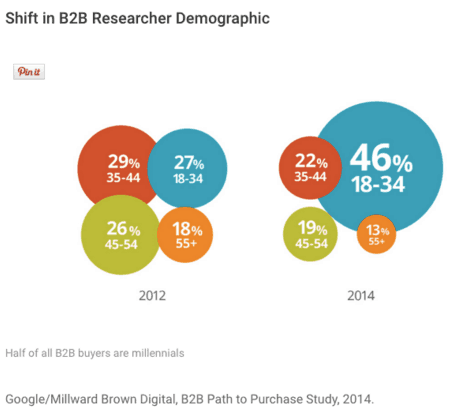
B2B Sales Researcher Demographic

2. You Need Millennials To Scale Your Services

After executives build a company, they enter the “compete” stage, during which businesses are likely to fail if they can’t scale sales teams to match demand. Steve W. Martin, a sales and strategy professor at University of Southern California Marshall School of Business, listed this challenge in the Harvard Business Review as one of the four reasons companies fail. To grow, business leaders need a robust recruitment effort that aligns with corporate expansion objectives.

The Wall Street Journal highlighted a powerful case study illustrating the effects of Martin’s hypothesis. Paycor Inc., a SaaS (software-as-a-service) company based in Cincinnati, missed their hiring goals for sales reps in 2014. This personnel shortage, which one of their executives attributed to low millennial interest in sales, meant that Paycor lost out on $2 million of revenue in 2015.

3. Emerging Sales Models Require Digital Natives

Millennials, more than any other generation, are equipt to use technology to evolve with a changing sales funnel. They innately understand concepts such as inbound marketing, prospect data and social selling, all of which are transforming the B2B sales model.

As PricewaterhouseCooper (PwC) summarized in their global generation study, “Millennials’ use of technology clearly sets them apart….This is the first generation to enter the workplace with a better grasp of a key business tool than more senior workers.” With 59 percent of millennials on Twitter compared to 31 percent of baby boomers, millennials are more apt to engage leads through social media.

A 2012 study in the American Business Journal revealed that social media use positively correlated with performance among B2B salespeople. Eliot Burdett, CEO of Peak Sales Recruiting emphasizes the importance of these skills, “The top salespeople are technologically adept and inclined to use every tool and piece of data available to them to win business.” Companies need millennial salespeople to support increasingly digital strategies for business development and client acquisition.

Rebrand Sales Roles

A sales executive’s clearest path to a new generation of employees is to replace old stereotypes with a much more enticing package: consultant-style roles based on purpose-driven work and entrepreneurial thinking. By rebranding sales roles, sales and human resource leaders play to job attributes that appeal to millennials and heighten the chance of a positive match.

Sales as External Consulting

The average millennial doesn’t know that modern sales positions require consultant-style reports, deep analytical thinking and the fine-tuned ability to negotiate. To attract high-performing young professionals, debunk the age-old adage about natural salespeople and emphasize problem-solving and data-driven skills.

In a presentation at Forrester’s 2015 Sales Enablement Forum, principal analyst Andy Hoar supported this approach. Hoar suggested that salespeople fall into four categories: order takers, navigators, explainers, and consultants. Of these four sales archetypes, Hoar explains that the need for “consultants” continues to dominate the selling ecosystem.

These consultants guide prospects through a complex problem-solving process, matching their needs with the right services. “Consultants are a qualitatively different bunch of people,” Hoar said. “They can explain abstract concepts; they can solution sell; they can build relationships. They’re true consultants.” During the recruiting process, sell the sales-as-consultant concept, rebranding available positions to appeal to high-achieving college graduates.

“Sales has evolved from selling features/benefits to solution selling and now insight or thought leadership. A career as a thought leader delivering significant business value will be a very attractive option for the next generation of sales leaders.” – Gary Symth, Founder, Sales Elite

Purpose-Driven Work

The Deloitte Millennial Survey found that 77 percent of millennials chose their place of work based on the “sense of purpose” at the organization. Deloitte also linked these purpose-filled companies with significantly higher recruitment, job satisfaction and financial success.
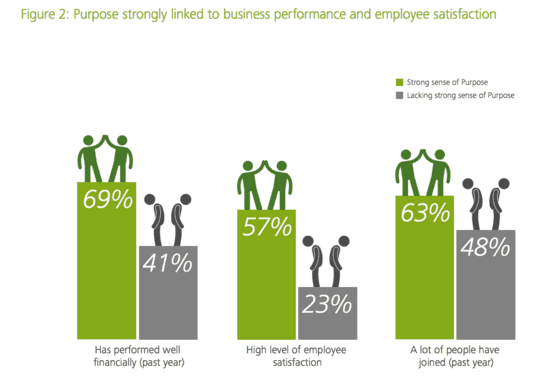
Deloitte Millennial Survey Sales

Unbeknownst to most millennials, the ability to provide value is the foundation of a positive sales experience. Lisa McLeod, the author of Selling with a Noble Purpose, encourages companies to connect their strategy to a larger motivation that entails helping clients. This message of ‘sales as an act of goodwill’ is integral to recruiting millennials.

Hiring managers should share the purpose of their corporate brand and emphasize the role of buyer empathy in a job well-done to entice passive millennials. As Brian Halligan, the CEO of Hubspot summarizes, “The job is no longer to sell as much software as possible. It’s to help the customer get as much out of the software as possible.” This emerging approach to sales not only drives revenue, it appeals to the moral compass of a new generation.

Increased Responsibility

Salespeople have the power to author their own career: there are no limits to earning potential or the speed with which a salesperson can move up the ranks — unlike in other departments, it’s rare employees face red tape if they’re able to learn and perform.

The entrepreneurial aspect of sales means that these roles appeal to self-starting millennials who value extra responsibility and independence. Salespeople, for example, embrace the unique opportunity to take risks and experiment with their approach to clients without many constrictions.

Framing salespeople as entrepreneurs within larger organizations taps into the self-starting and creative mentality that millennials seek from prospective employers. The best sales reps flex their creative muscles and follow their own judgement when it comes to making a sale, rather than following rigid protocol. Furthermore, it is a requirement that sales reps rely on ingenuity to lead independent projects, which millennials frequently cite as a significant aspect of their work lives.

Reach a Different Set of Recruits

Millennials are increasingly college educated, from diverse backgrounds, and turning toward program-based sales training to solidify their careers. To appeal to the most promising professionals, employers need to expand beyond standard recruitment efforts and target a specific set of prospects.

College-Educated Millennials

Sales has reemerged as a dynamic field within higher education during the last ten years. Over 100 universities and colleges prepare their students with formal sales training, and the majority of marketing graduates start their careers in sales roles. These emerging programs align with an increasingly complex marketplace for B2B sales, which require new professionals to adapt and grow quickly. Qualified millennials exhibit analytical thinking and strong market insights grounded in higher education.

Recent graduates with formal sales training offer additional skills beyond the degrees in economics, marketing or business. According to the Sales Education Foundation, these sales program graduates onboard 50 percent faster and are 30 percent less likely to turnover than non-program employees. By focusing on a college-educated cohort, employers make a strategic investment in their sales team’s future and help offset the risk of bad hires.

Diverse Sales Personnel

As of 2014, women were 33 percent more likely than men to earn a college degree by the time they reached 27 years of age. At the same time, forty-two percent of millennials self-identify as minorities. Emphasizing diversity in recruitment efforts helps to ensure that hiring managers choose the best candidates for sales roles, not the ones that fit a perceived demographic. Not only is this practice tied to increased business performance, but it also overturns persistent myths that sales operates like a good ol’ boys club rather than a progressive team that values performance.

It’s important that human resources leaders recognize the inherent bias in frequently used sales language. When recruiters develop job descriptions and promotional materials, they benefit from using gender-neutral phrasing. During interviews, leave terms like “play with the big boys” and “get in bed with clients” behind in favor of case studies and examples that include people of both genders. Female millennial workers, in particular, need to know that collaborative, innovative and intelligent women are exactly what the industry needs.

Exhibiting “performance bias,” which experts define as giving inferior sales support and assignments to women, is a major detractor from recruiting efforts. To hire the most promising salespeople, pioneer diversity as a value among every team. Highlighting how each candidate will experience equal opportunities to acquire lucrative clients and achieve internal promotions is the key to ensuring diverse candidates want to work for a company.

Program-Based Recruitment

Through program-based recruitment, hiring managers can reach a diverse range of high-performing college graduates who see the potential in a new career trajectory. By gaining referrals, working in conjunction with universities and building on sales competitions and internships, employers build a sustainable talent pipeline:

  • Employee-referral programs – When successful young salespeople recruit peers, it breaks down barriers and builds interest. These programs also reduce talent acquisition costs and shorten the hiring process. Plus, referred hires are more likely to stay at a company after one year, increasing retention rates.
  • College recruiting – Companies can partner with universities that offer undergraduate and graduate sales courses to create clear channels for recruitment. These pre-trained employees understand best practices in sales and require less hands-on training.
  • Sales competitions – Sales contests identify top-performing individuals through role-play scenarios. The software company Acquia, for example, started a sales competition at Bryant University to recruit young talent. One hundred and forty participants presented mock sales pitches to five recruiters, giving Acquia the opportunity to handpick top performers for interviews.
  • Internship programs – Hiring rising seniors in college for paid, on-site internships gives teams extra insight into promising candidates. Interns are already familiar with a company and its industry, accelerating the onboarding process.

Transform Your Culture and Compensation

Corporate culture and compensation packages are two of the most impactful aspects any job decision, especially for millennials. Companies that adjust their approaches to these topics gain a competitive edge as employers.

Softened Compensation Packages

Millennials are the most financially risk-averse generation since the depression. They took on enormous debt to graduate from college and witnessed their parents move through the financial crisis. Plus, without the buffer of savings, they are most likely living from paycheck to paycheck.

Companies that ‘soften’ their compensation plan appeal to a new generation that values consistency over commissions. Leading employers are already leaning in this direction by increasing base salaries, which help taper the sense of risk around sales-rep jobs. The Wall Street Journal, for example, reports that base portion pay increased 11.7 percent from 2010 to 2014.

Some technology companies are taking this approach to compensation a step further. At Slack, a team communication software company, salespeople receive bonuses based on customer satisfaction rather than straight commissions. A radical departure from the status-quo, policies like Slack’s speak to millennials who value the long-term benefits of a positive relationship more than its immediate effect on a revenue stream.

Clear Advancement Opportunities

World-class employers don’t pitch a position; they pitch a career. Despite the association with risk, sales teams are essential to every business — they don’t go out of style. Millennial workers list their growth and development as one of their highest priorities at work (second only to personal wellbeing). Hiring managers and sales leaders need to respect this hierarchy of needs by creating avenues for vertical growth.

The most successful recruiters give millennials multiple advancement tracks. Promotional paths are clear and accessible, keeping senior sales roles and management opportunities within sight. In every conversation with a potential employee, they articulate the promotion process and list clear examples of sales reps who have furthered their career in the company.

Employers that prioritize career advancement opportunities benefit from increased interest among millennials and higher retention rates regardless of the position they’re recruiting for. In an industry with a notoriously high turnover, an emphasis on professional growth is one way to build a strong, loyal team.

Job Flexibility and Autonomy

Millennials value location-independence and personal freedom, both all of which align well with sales roles. It’s rare to find companies that insist sales professionals even sit at a desk in a traditional office setting — as long as they meet their quotas, they have the freedom to manage their own time.

“For their part, millennials do not believe that productivity should be measured by the number of hours worked at the office, but by the output of the work performed,” says PwC. The best employers recognize this approach to work and emphasize the flexibility that sales roles offer. In particular, millennials’ fluency with technology turns remote work into a realistic option, and the influx of innovative communication tools makes it easy for sales managers to oversee remote reps.

Road warriors also receive the benefit of paid travel, which is a major incentive for millennials according to Expedia’s Future of Travel Report. The most effective sales recruiters portray sales roles as a means to building relationships across the world within a flexible team that values their time.

Millennials will make up 50 percent of the workforce in 2020. Companies that fail to tailor their sales recruitment efforts to this demographic will not be able to retain or increase the size of their sales teams. By rebranding sales roles, appealing to college-educated millennials and evolving their culture to match the needs of young workers, executives strengthen their positioning as an employer of choice for the next generation of B2B sales talent.

The post How to Recruit Millennials to Your Sales Team: The Ultimate Guide appeared first on Peak Sales Recruiting.

08 Mar 15:30

10 List Building Techniques for Businesses with Limited Email Marketing Budget

by Tahir Akbar

Email is a very powerful and affordable lead generation tool that businesses can employ. Given the innovative products and solutions offered by marketing automation companies, email’s ability to deliver famous 44% return on the investment has enhanced further. However, the success of email campaigns depends upon a range of factors, like; content, ESP functionality, sender’s repute, and quality of your mailing list. If the database is of substandard quality, even a perfect set of email and content will serve no purpose.

Yes, it’s true. If you do not have a quality e-mail marketing list, you are reducing the potential you have to drive traffic, generate sales/leads, and build your brand name. This is the single biggest factor that can make or break things for your marketing and lead capturing campaigns. Therefore, companies with decent marketing budgets go for premium data subscriptions, special data acquisition programs, and run active lead generation campaigns to build contacts list.

However not every business enterprise enjoys this much financial freedom to invest hundreds of thousands in database development but this does not mean they can’t do anything. There are some very simple and affordable (some free) ways to build a quality email list for your drip campaigns. Some of those are being explained in the following.

1. Export Your Social Contacts:

The starting point of your database development should be your own social networks. LinkedIn and Facebook provide you the option to export your contacts information as csv file that you can store on your machine that you can import in your email system later on. Given the requirements of your email marketing system, just format the database as first name, second name, job title, email, contact number, and company name. Import the sheet into your email marketing software and use in the campaign.

Given the fact that these people know you or your products, they can be very good prospects and the success rate of your campaigns goes higher further. “Since most of the people in my social network have the basic information about my business, sending them a monthly update or newsletter has been very valuable experience for my business”- says James Alexander, the CEO of The Flooring Artists a wood floor refinishing company in Colorado. He runs a small business with limited marketing budget, so had to use LinkedIn contacts as starting point in email list building. So why can’t you?

2. Bribe Prospects With Engaging Content:

One of the best ways to acquire quality data is to start your own database building campaign. This requires to bribe something in return of data and nothing could be more valuable than quality content. You can design e-guides, how to tips, prepare a study, or share something informational with the prospects. Promote your offer page on the social networking sites and seek opt in. Even if you invest just $1 a day on your list building through content and its promotion, you’ll get very good list within a quarter. This might be a lengthy process but it’s equally rewarding too.

3. Utilize “Pop Up Opt-In” Forms:

From Forbes to Social Media Examiner and Marketo, there are many portals that use this technique effectively. When you land on their post, they’ll show you a push notification with something similar to “Don’t Miss Any Important Update- Subscribe for Weekly Alerts”. If you’ve a blog, make sure you use such pop up opt-in form. Just make sure your words don’t imply daily or frequent emails because people don’t want to be bombarded with frequent updates. Instead, use the words like “Join Our Weekly Alert and Stay Informed about The Hottest Blog Post”. You can ask your copywriter to give you some captivating lines that could attract people’s attention and motivate them to opt-in.

4. Use Short Forms:

This is very important tactic. Being a user myself, I would definitely hesitate to provide every information about me in first place. Make sure that your lead generation campaigns have shorter forms that encourage prospects to avoid bounce. You may follow up for more information if needed but don’t ask contact number something that isn’t of significant importance in the first attempt. Name, job/company and official email should give you a fair idea about the prospect.

5. Host Your Content at 3rd Party Sites:

If your blog or landing pages do not enjoy greater traffic and you want to use a third party channel with good traffic, contact content hosting websites. Business2Community’s whitepapers portal is one example, where you can get your premium content hosted. Since Business2Community enjoys very good traffic, your content will have greater exposure to a wide audience. This is not only a good content marketing channel but also generates good contacts database. Digital Marketing Depot and ClickZIntel are two other portals that offer similar service.

6. Host Online Webinar:

One of the easiest ways to build your list is by hosting online webinars and seek registrations. People participating in would happily provide details provided you are promising something exciting in the webinar. Just make sure the topic is interesting and your guests and speakers offer valuable insight to the audience. Moreover, market your webinar with all available resources because unless people learn about it, they won’t be able to attend and you’ll miss the important data.

7. Use Your YouTube Channel:

I’ve seen a lot of people running their YouTube channel successfully not only for marketing but also for list building. Since they’ve integrated their YouTube marketing with other channels, the results have gone more positive. See, there are some graphic designers who do a brilliant Photoshop tutorial and at the end provide link to the (training) PSD files in the description. When a person clicks on the link, it guides him to an opt-in page he has to submit some details to access the file. Since people are in need of the particular PSD to apply the tutorial tactics, they happily share their information. Why can’t you do the same?

8. Promote Contests:

People love contests and happily participate it. All you need is to make it interesting and challenging. Some questionnaire, interesting quiz, opinion poll, or some interesting call to action (like: make our logo) to invite actions from your audience where they could win something against a particular activity. Your contest not only helps in branding and sales but also in list building. You can promote your Free Giveaway, Free Book or Free Gift Hamper, Promote and have entrants sign up using their email address. You can promote your contests on your website, blog, some guest blogging site, your social media profiles, or all of the above.

9. Engage in Guest Blogging:

Write articles and quality blogs for decent portals with good PR and rich domain authority ranking. Add call to action in your blog posts and invite opt in on your landing page. John Hurry; the founder of Natural Remedy Ideas credits his business’s success to guest blogging. “It not only generates good traffic but also provides decent opportunity to attract opt-ins for our healthcare products”. See if this helps in your niche. At least there’s nothing wrong in trying out new things.

10. Grab Offline Opportunities:

Use every offline opportunity to acquire data. You can use your customers’ database to begin with. Moreover, invite participants for meetups, conferences, and educational seminars to register via online form. You can also use trade-shows and other promotional events to acquire data and import it into your email list.

Bonus Tip: Search for Affordable Data Selling Source:

I do not recommend data buying since there is no guarantee of quality in someone else’s generated list. There are certainly some good companies that offer high quality data but their pricing may not be affordable for a small business. Therefore, make it the last point in your check list for database development and do proper research before making the final decision about paid database.

I hope the given suggestions would help you build your email list through some affordable and free platforms. If you think I’ve missed something, don’t forget to mention in the comment box below.

08 Mar 15:30

How to Reap the Revenue Rewards of Smarketing

by Jay Baer

How to Reap the Revenue Rewards of Smarketing

In most companies – especially B2B firms – sales and marketing don’t get along. Ultimately, both groups are tasked with the same revenue production goal, but their core skills and perceptions are different enough that much is lost in translation.

They sing the same song, but in very different ways. Yet, they are required to work together to accomplish company-wide objectives. This creates something of an awkward, arranged marriage, but with expense reports. It’s not always pleasant, according to the Corporate Executive Board:

87% of the terms sales and marketing use to describe each other are negative. (highlight to tweet)

And really, the whole construct doesn’t make a lot of sense. It’s a historical relic of a bygone age. If you were a space alien and were sent to Earth to observe the human race via how we buy and sell goods and services, you would be startled to learn that companies have two, separate groups (with different management, tasks, and compensation schemes) that each are charged with generating revenue.

WTF? would be your response (or whatever “WTF?” might be in your alien tongue).

The Power of Smarketing

But it doesn’t have to be this way. Sales and marketing can work together harmoniously, and doing so make enormous financial sense. Research from The Aberdeen Group found:

Aligned sales and marketing teams produce 400% higher annual growth than teams that are unaligned. (highlight to tweet)

This is the power of Smarketing: the harmonious alignment of sales and marketing teams.

Recently, I delivered a presentation at Cisco’s Marketing Velocity Partner Summit in San Diego about Smarketing, and the 5 critical components of making it work. I’ve embedded a modified version of the slides below, for your perusal and download.

(Huge credit to my friends at Hubspot here, as they initially popularized the concept of Smarketing, and have done a lot of great work on this topic that inspired my presentation)

The 5 Components of Smarketing

The slides have more detail, but here are the five key points in crafting and implementing a Smarketing program in your company.

Smarketing Component #1: Develop Mutual Understanding
Much of what prevents sales and marketing from working well together is that they don’t really know each other all that well, particularly in larger companies.

You need to create mutual understanding by implementing familiarity programs on two levels.

First, individual familiarity in one or all of these ways:

  • One-on-one lunches every month that pair a salesperson and a marketer;
  • Marketing Shadow Days where sales spends half a day paired up with a marketer, and observing what they REALLY do all day;
  • Sales Ride Alongs where marketing spends half a day paired up with a sales person, observing actual sales calls.


Second, group familiarity in one or all of these ways:

  • Smarketing committee meetings each week where a small group of program leaders gather to talk process and flag problems;
  • Embedded partners, whereby there is a sales person in every marketing team meeting and a marketer in every sales team meeting;
  • Executive Smarketing sessions monthly, where exec-level leaders meet to plot strategic course.


Smarketing Component #2: Shared Strategy, Metrics, & Reporting

Both groups need to agree on target audiences, personas, customer journey and funnel, and where and how leads get handed off from marketing to sales.

Shared language is also critical. If you have a zebra in your office and a group of people insists on calling it a “striped horse” confusion will occur.

Sales and marketing have to agree EXACTLY on what constitutes a lead, a marketing qualified lead, a sales qualified lead, an opportunity, and so on. That may send obvious, but it’s not. In fact, according to MarketingSherpa:

Just 45% of businesses have a company-wide definition of a sales-ready lead. (highlight to tweet)

You also need to have the same reporting system, and marketing needs visiblity throughout the entire process, not just through the initial lead generation.

You’ve heard the saying “I know half my marketing dollars are wasted, I just don’t know which half?” If marketing cannot determine – at the specific, program level – what marketing pieces resulted in closed sales and revenue, you can guarantee that they won’t know which half of the budget is wasted.

Smarketing Component #3: Commit to Mutual Accountability

This is couples counseling, but for sales and marketing. Both groups must make promises to one another that cannot be violated.

Together, it can be determined the steps and stages necessary for the company to meet its company-wide goals (rather than department-level goals). For example, you must agree on how many total leads are necessary each month by calculating the percentage of leads that are sales-qualified, the percentage of those that close, and the average revenue for new customers.

Then, once you have that total lead count determined, marketing becomes accountable to sales to hit that number.

Sales is then accountable to marketing to follow up on those leads quickly and comprehensively. An example of an accountable promise from sales might be:

“We will follow up on every lead – not just the ones we like best – within four hours of receipt. And we will make five closing attempts on every lead, within 21 days.”

Smarketing Component #4: Embrace New Roles

For a long, long, long time sales controlled nearly all the information customers needed. Marketing’s job was to create awareness, and sales did everything else. Today, it’s different.

Customers have access to almost all the information they need, for free, online. (This is a huge part of what my book Youtility is about). This self-serve information has disrupted sales’ traditional role so that marketing now handles brand and awareness-building, but marketing ALSO now handles early and mid-funnel consideration via content marketing and similar.

Smarketing and sales' changing role

And with 70% of B2B marketers planning to create more content than ever this year, that trend won’t be reversing any time soon.

So, sales’ role is now the “last mile” of the customer journey. Which means that when a prospect becomes a lead, they are choosing to do so, and sales needs to follow up FAST, and recognize that the customer is likely to be well-educated on the basics.

Today, business relationships are created with information first, and people second (highlight to tweet)

If your information is good enough, you will be allowed to graduate to a conversation with the prospect, but not before then.

At the same time, sales people can also play a very important (and relatively new) role in customer conversion by interacting with prospects in social media. In many cases, unofficial “touches” between a sales person and a prospect can have a far greater impact than official nurturing campaigns delivered via marketing (in email, most often). In fact, according to IBM:

When a lead is developed as a trusted relationship of a salesperson in social, that lead is 7 times more likely to close.

So, marketing must encourage and enable sales to use social media, instead of trying to prevent sales from using these tactics. Marketing must commit to ongoing training and a social media “help desk” that sales people can use to optimize their social media behaviors.

Smarketing Component #5: Rely on Data, not Anecdotes

One of the problems in business is that it’s too easy and too common to use stories to justify action (or lack of action). Our minds naturally remember and gravitate toward stories (we have a whole podcast series devoted to this concept), so it’s easy to see why this occurs, but it’s a terrible way to make decisions and run a business.

Anecdotes describe one occurrence, not necessarily a pattern of behavior. So, when someone in sales or marketing tries to use an anecdote as a proof point, say these magic words:

That’s an interesting story. How often does it occur?

When you respond that way, it instantly reframes the conversation around patterns – a much more accurate way to make Smarketing decisions.


You can put Smarketing into practice in your organization. It’s not easy, but it’s worth it. Remember aligned organizations see a 400% more revenue growth than do non-aligned organizations. Are you ready to get started?


08 Mar 15:30

Speed Up Your Closing Process by Eliminating Junk in Your Pipeline

by TheSalesHunter
  How fast is your sales pipeline? Is it plugged up with leads and prospects that shouldn’t be in there? We all know the value of having a full pipeline, but if what is in the pipeline isn’t moving, then we have to ask ourselves if it’s worth it. We will close more sales when […]