Nik Collection, seven powerful photo editing desktop plug-ins from Google, has dropped its price from $150 to being completely free for everyone.
Nik Collection, seven powerful photo editing desktop plug-ins from Google, has dropped its price from $150 to being completely free for everyone.
 Google is planning to compete with Nuance and other voice recognition companies head on by opening up its speech recognition API to third-party developers. To attract developers, the app will be free at launch with pricing to be introduced at a later date. We’d been hearing murmurs about this service developing for weeks now. The company formally announced the service today… Read More
Take Advantage of the TWO Highest Converting Marketing Tactics, All Done Within the Power of Email
With the release of this new tool, you can add embedded videos & animated GIFs to any email campaign. No longer stuck with including a link to a video that takes the reader to some other website, or to show a date of your event or announcement, you are now able to include either video and/or a countdown timer to your emails. Video is a proven winner when compared to other methods of conveying your message so this is good news for anyone in sales or marketing.
Add Embedded Videos & Animated GIFs to Any Email Campaign
Add Embedded Countdown Timers to Any Email Campaign
This is currently in the Launch Pricing window, so check it out now and save yourself some serious cash.
Get Charter Pricing During Launch Window
Original article: Email Spike Drives Conversions
©2016 Fill the Funnel. All Rights Reserved.
The post Email Spike Drives Conversions appeared first on Fill the Funnel.


Before the Internet of Things (IoT) came along—billions of networked sensors and devices capable of generating enormous amounts of new, unstructured real-time data—big data was already really, really big. To tackle this, businesses small and large have taken to the cloud and reworked their IT architectures to create more flexible, scalable ways to manage their data.
However, for those businesses and data scientists looking to capitalize on the high-value, target-rich data the IoT will be churning out over the next decade, there will be even more to consider when it comes to data architecture. And the data scientists equipped to turn this data into meaningful insights with advanced analytics will be in even greater demand.
So how much bigger is data going to get with the IoT, and how will this change the way businesses gather, store, compute, and consume data?
IoT data presents a number of challenges for companies. Here are a few ways companies can meet these challenges head-on.
For all of its potential, effective IoT data analytics will hinge on better IT infrastructures—data centers, server clusters, cloud-based computing, and more. Businesses that want to leverage IoT data will need to invest in long-term IT architecture planning. Why? Because this new influx of data from sensors and devices will put more pressure on existing networks and data centers and require more power to process it. Before data experts can even begin applying analytics, data needs to be aggregated and organized—and this will be no small feat.
Whether it’s a consumer company gathering data from wearables and mobile devices, or enterprise organizations processing data from industrial sensors and manufacturing equipment, upgrades will be inevitable. Services like Hadoop, with its distributed server clusters and parallel processing, will be important, as will the people who know how to set it up and work with its more tricky aspects.
Data centers themselves will most likely lean toward a more distributed approach, with tiered mini centers that pull data, then send it on to be processed further in second- and third-tier clusters. Obviously, this approach will have an impact on data storage, bandwidth, and backup.
The key to all this new data? Finding the information that’s actionable and capable of creating real, meaningful change. More isn’t always more, and many companies collecting automated data from sensors will likely have more data than they know what to do with.
Complex estimations aside, the 20+ billion devices predicted to be around by 2020 are going to have an inevitable effect on the three V’s of big data: volume, velocity, and variety. More, faster, and less structured data will be pouring in from sensored devices. But is all of this data going to be valuable?
IoT data is unique in that it’s only really valuable to us if it’s actionable, and that percentage of the massive–and totally new streams of data coming in–will be a bit easier to manage. Sifting through this data will be the job of business analysts who know what questions they want their data to answer, and of data scientists who know how to get those answers.
A car equipped with various sensors constantly transmitting data points about its performance, for example, can create a lot of noise. Being able to hone in on the data and patterns that can yield valuable information that’s helpful to consumers and manufacturers will be the key.
Much of this IoT data will be unstructured, meaning it can’t be easily sorted into tables like a relational database management system (RDBMS). NoSQL databases like Couchbase, Cassandra, and MongoDB will be able to offer IoT data scientists the flexibility they need to organize data in a way that makes the data usable.
More data means we’ll need more places to aggregate the data, and more power to process it—often in real-time scenarios. Microsoft Azure, Cloudera, Amazon, and Apache’s cloud-based computing platform Hadoop, with its Hive and Pig components and Spark processing engines, are all poised to take on this surge of new IoT data.
Once this massive amount of data is collected and organized, businesses need to have the right plan and software stack in place to analyze it. Carefully choosing a stack of software and databases will ensure the system can handle the types and the scale of the data anticipated.
First, because much of this data will be raw and unstandardized, it needs to be transformed and preprocessed with tools like Hadoop’s Pig component, then stored in a database. Analytics tools like Apache Storm, which is especially suited for the continuous streams of real-time data the IoT will generate, should be put in place for analytics. The overall analytics solution should be strategic specifically for IoT data, its speed, and its volume.
Companies will need to have the right people in place to analyze and make all of this structured, unstructured, or semi-structured data into valuable business insights.
To make the most of your data, you’ll need skilled business analysts who know what they’re looking for from the data, what questions to ask of it, and how that data will translate into value for the company. Then, it’s up to the data scientist to do the looking, answer those questions, and deliver that value, through a combination of:
Browse freelance data scientists, analysts, and Hadoop experts on Upwork today.
The Secret to Building a Team of Top-Notch Distributed Engineers: Download Now
Make Your Most Difficult Sale with Dealstorming written by John Jantsch read more at Duct Tape Marketing

Marketing Podcast with Tim Sanders
Making the sale today is just a bit more complicated isn’t it?
Buyers are armed with more data than ever, more advice than ever and often a buying process that makes it easier to kill a deal than buy anything.
My guest for this week’s episode of the Duct Tape Marketing Podcast is Tim Sanders, author of the new book Dealstorming: The Secret Weapon that can Solve Your Toughest Sales Challenges. We discuss his newest book and a new way to approach a difficult sale.
Sanders is a wealth of knowledge when it comes to overcoming tough sales challenges and the Dealstorming approach is an approach tailored to today’s buying environment no matter how bit of small the deal may be.
Questions I ask Tim:
What you’ll learn if you get a listen:
You can find out more about Tim Sanders and his new book Dealstorming: The Secret Weapon that can Solve Your Toughest Sales Challenges at dealstorming.net. There, you can download a free chapter of the book and even signup for training when you buy a book.
This episode of the Duct Tape Marketing Podcast is brought to you by FreshBooks, small business accounting software for non-accountants. Freshbooks is offering a free month of unrestricted access just for Duct Tape Marketing podcast listeners. You don’t even need a credit card to register. To get your free month, go to freshbooks.com/ducttape and enter DuctTape in the “How Did You Hear About Us?” section.
With March Madness in full swing, it’s apparent that having an unstoppable and effective process in place rings true not only in sales, but in basketball, too.
This year’s March Madness tournament has already produced some big upsets (..*Cough* Michigan State..) and there’s sure to be more. But what you’ll usually find is the teams that are well-prepared, well-coached, and persistently pursuing the win have a better shot on the court or in the office.
Just like notching W’s in the March Madness tournament, achieving true sales acceleration requires an effective sales strategy with a balance of enhanced speed and control for an unstoppable process.

I’ve outlined the most quintessential parts of a winning strategy for both sales and pretty much any competitive sport into the six most valuable “P’s” (MVPs).
Make sure to stay ahead of the competition by doing research before the game. Prospecting is a critical part of sales acceleration, giving you an advantage over other teams who are simply relying on inbound leads.
The important difference between sales prospecting and depending on marketing leads is that leads sourced from the sales reps themselves automatically come with more background. The sales rep knows exactly why the prospects are a good fit and the rep is more motivated to engage with them successfully.
Getting the jump ball at the start of the game and hitting a quick two point layup might not win you the game, but could help give your team and fans a boost of confidence early on.
In sales, being the first to respond to a buyer may give you an even bigger advantage. In fact, a recent Zogby Analytics study showed that 57 percent of buyers are influenced in their decision by the seller’s speed to respond. By answering incoming leads within a minute, sales reps can more than double their conversion rate.
By answering incoming leads within a minute, sales reps can more than double their conversion rate.
Click To Tweet
In basketball, the play call is situational to what is happening in the game. How many points you have on the board, how much time is left on the clock, the strengths of the other team, and much more.
Just like the scoreboard isn’t the only factor for determining a play call, a lead score isn’t the only indicator for determining the highest priority sales activity a rep should be working on. The highest priority sales activity for an individual rep is relative to what else is happening at that time.
The highest priority sales activity for a rep is relative to what else is happening at that time.
Click To Tweet
For example, if a sales rep has a scheduled appointment with a prospect, that particular sales activity is most likely the highest priority for that rep at that time. For another rep, a brand new high-value lead that was just assigned might be the highest priority sales activity.
When sales reps are juggling hundreds of daily tasks and activities, one can quickly see the value of a system or process to automate the high volume of activities for the sales organization as a whole and for each individual rep.
One bad quarter of play in basketball doesn’t mean your team should give up. Similarly, you cannot always connect with a prospect on the first try. While following up can be exhausting, building relationships takes time and consistency.
Most salespeople give up after making two calls, which might seem reasonable. But if they persisted and made six call attempts, they would have increased their revenue by a whopping 25 percent, according to industry research. Making more calls doesn’t take a lot of time–it’s just a matter of remembering when to follow up.
A championship comes from a series of consecutive wins, not just a single-game performance. To truly accelerate, it’s critical that your engine is running at peak performance, all the time. That means each individual rep is giving 110 percent; not just your top reps but all your reps.
Many sales organizations have turned to gamification to keep their reps engaged and motivated, but unfortunately, many reps lose interest if their name isn’t near the top of the leader board that month. Rewardification is a different approach to driving peak performance. It incentivizes top performers in real time by giving them what they really want, more and better leads.
Let’s face it, gold stars are nice, but most salespeople are more incentivized by tangible rewards.
I am finishing this list with one of the most important P’s because everything on this list comes back to this one thing–process. Whether you are on the court or in the office, a well-defined game plan or process is critical.
A well-defined process is the foundation on which sales acceleration is built. It’s defined by identifying what your best reps do and examining the journey of those prospects that eventually became customers, and then simply replicating those behaviors and patterns again and again in your sales organization.
In fact, industry research has found that top performing sales organizations are 79 percent more likely to have automated or strictly enforced sales processes in place than underperforming ones.
These best practices can be used both for achieving a winning sales strategy and a championship status on the court. The key to success with any endeavor is to have a well-thought-out plan and execute against it.
Wikimedia Creative Commons image by Dennis Adair.
The post The 6 MVPs of Sales Acceleration for Achieving Championship Status appeared first on Sales Hacker.
VANCOUVER — Mike Harcourt would be the first to admit he’s been fortunate: Successful lawyer, former Vancouver mayor, B.C. NDP leader and premier, survivor of a near-fatal fall from the deck of his Gulf Islands cottage.
And soon, Harcourt will join the ranks of Vancouver’s biggest real estate prize winners. According to the Province, Harcourt and his son have put up for sale a west side house they co-own. Asking price: $9.988 million.
The Harcourts purchased their lot five years ago, for $2.8 million, reports the Province. They demolished the site’s original house and replaced it with an attractive duplex. It’s estimated the Harcourts will reap a $6 million profit, should they get their hefty asking price. They probably will, because this is Vancouver, where the housing market is bat crap bonkers.
The average price of a detached house in the Vancouver area reached $1.3 million last month, according to the Real Estate Board of Greater Vancouver. That’s a 27% increase from the previous year, and 53% higher than the average price in 2011. In Vancouver’s west side, where Harcourt lives, the average detached house price is now $3 million.
Prices for townhouses and condominiums in the Vancouver area have also increased: 17% and 18% respectively, in the last year alone. No surprise, then, that housing affordability–or lack of it–has become B.C.’s hottest political issue.
With another provincial election scheduled 14 months from now, government and opposition members in B.C.’s legislative assembly are scrambling to act on the file. Unfortunately, few of their proposed measures will amount to anything.
Last week, Premier Christy Clark stood across from Vancouver’s condo-crowded downtown peninsula and made what her office claimed was “a major announcement on housing affordability.” Except it wasn’t. The premier promised her government will crack down on “shadow flipping,” a practice occasionally seen in hot housing markets, whereby a real estate agent profits more than once from the sale of a single property. The agent assigns the contract of sale to other buyers, successively and at escalating prices, pocketing commissions along the way while the original vendor is compensated for the original sale price only.
“I’m announcing that our government is going to end the practice of shadow flipping,” the premier said last week. New legislation will force agents to obtain from their client informed consent before any contract can be assigned to others, and the client will profit from any assignment.
Given the practice involves a tiny fraction–something less than three percent–of real estate activity in Vancouver, Clark’s “important announcement” missed the mark on affordability. Ending the dark craft of “shadow flipping” will have no impact on real estate prices.
So why bother? Two reasons. To deflect from a nascent political scandal; Clark’s B.C. Liberal party had just announced that its executive director, charged with crimes in Ontario, has returned to work in B.C., after a temporary absence. Second, to catch up with the opposition.
B.C. NDP leader John Horgan and his housing critic, David Eby, have been more aggressive on affordability, introducing earlier private members bills aimed at shadow flippers and, more significantly, at real estate speculators. They propose a “housing affordability levy” that would force non-resident property buyers to pay an extra 2% tax on their transactions; any money collected would go into a provincial fund, used to encourage alternatives to traditional market-based housing, such as co-ops.
Foreign speculators are often blamed for the dramatic leaps in Vancouver house prices, yet most of the evidence is anecdotal
That’s no panacea, Eby acknowledges. A special 2% tax won’t deter many speculators from playing in a market that sees double-digit price increases annually. The proposed legislation is “intended more as a tracking measure” designed to collect data on vendors and buyers, says Eby.
Foreign speculators are often blamed for the dramatic leaps in Vancouver house prices, yet most of the evidence is anecdotal, collected randomly. While Eby and others have long suspected that “offshore investment,” especially from Mainland China, is a major factor, they haven’t been able to prove it.
Left-wing Eby has been labelled a “racist” for even suggesting that foreign investors are having a negative impact on the Vancouver housing market. “It’s the elephant in the room,” he insists, noting the Clark government seems especially loathe to recognize it.
The great fear, of course, is that any serious and robust response to the affordability problem — such as following the example in Australia, where foreign real estate ownership is actively discouraged — might collapse current house prices. Home buyers would benefit, but hundreds of thousands more British Columbians would lose large portions of their net worth. And the governing party responsible would be eviscerated.
Hence the milquetoast measures, the feints and distractions and dithering, the places kept empty by distant owners, the tear-downs, the golden transactions among the most fortunate, and for too many others, simple dreams of homeownership, all broken to pieces.

This is a guest contribution from Tom Buckland.
Getting your first 100 sales is a huge milestone for any online business, and one we’re all quite keen to reach.
This article outlines the strategy I used to generate more than 100 sales for my fitness business. The method itself can be extracted and used to promote your product or blog directly, and even if you don’t have a product this strategy can lead to a huge amount of traffic – all for free.
The strategy itself involves contacting influencers in your industry and offering something of value, then making use of their following to get visitors to your website.
In my example I contacted fitness experts with a social following of between 500-500,000 followers or subscribers, not top-level fitness personalities with millions of followers, but people with large enough audiences to make it work.
I explain why in a moment.
Firstly, we cover where to start:
Finding these influencers is very simple, with the tools now available. you can use sites such as Izea, Buzzsumo or you can manually find the individuals by searching through twitter or YouTube – often you’ll know who the big players are in your niche.
This also works for blogs, although it is more difficult to gauge the popularity of a blog. I recommend SEMrush to discover the worth of a blog if you are to be finding them manually.
Once you’ve gathered a list of influencers (I recommend around 100-200) you need to find their relevant contact information, websites, social accounts, everything they are associated with on the web.
Our end goal is going to be getting our product, service or website shared through these channels, so knowing how powerful or important someone can be for your business is essential. Getting their correct contact information is even more essential.
Once you have this information you can move onto stage 2.
Never contact an influencer and just start pitching.
It’s likely they receive hundreds of emails a day, and anything considered self-promotion will just be deleted. Instead, you want to build a connection. You want to make your communication personal and personable.
I did this by asking a question, stating I was a fan of the blog/channel and explaining what we needed. For example opinions on product X or Y, or a quote for an article you’re putting together.
People like to talk about themselves, so ask for their opinion whilst also building a relationship with the individual. Talk about mutually interesting and beneficial things, and always let them know what’s in it for them.
Always keep these emails short and simple.
Once you’ve built a relationship with someone, the next step is give them something of value or a free product.
However.
This is where 95% of businesses get it wrong.
They will ask to send an influencer a free product in return for a shout-out or review, and this is not the correct way to go. It can even drastically reduce the number of people that will say “yes” to you.
Instead, you should write a positive email talking about how you’d like them to “test” the product you are creating and that you welcome their feedback. Let them know how taking the time to trial your product will benefit them. What are you offering that will be worth it?
Instead of the influencer feeling used or leveraged solely for their audience, they may feel now that they are helping to shape the product and its marketing, particularly if you take their feedback on board.
If they like your product they will probably naturally share it with their audience.
This is why we also didn’t bother with anyone that has over 500k followers or subscribers and tended to reach out to people around the 10-50,000 mark as they may be more amenable to this way of working. Someone with more followers might perhaps be represented by an agent or have sponsorship deals in place that would not allow them to work with you.
Bear in mind, though, that bloggers may indeed want compensation other than a free product for their time, effort, and access to their audience.

Following up is key, especially if you’ve physically mailed a product to someone.
The easiest way to do this is this is to simply ask if they have received the product. You can also take this 1 step further by asking what they thought, without any pressure (especially if they’ve not had time to look at your product yet). A gentle reminder that you’ll be emailing again soon for their opinion would work really well.
Again you can take this another step further by asking if they would recommend it. If they say yes, then you can politely ask them to share through social. If they say no, then ask why and how you could improve the product – market research on your doorstep!
If you’ve been reading this article thinking you don’t have a product to offer, yet you have an established blog, I’m going to explain why this strategy can work to generate you thousands of visitors, which in turn can lead to ad revenue or growing your email list and a whole host of other benefits.
Stage 1 (influencer prospecting) should be exactly the same, you are looking for influencers with a large but not overly large following. You should also aim to keep these people niche relevant to your blog if possible.
Stage 2 (outreach) is similar but slightly different: as well as introducing yourself and mentioning benefits, you should also ask for their opinion on a key issue, or ask if you can get a quote for an article you’re writing while you have them. Chances are they will say yes and give you a quick sentence or couple of paragraphs on the issue.
This means you can now create an amazing piece of content around this topic or issue, which can be used as your gateway into more of your blog content.
Stage 3 (value / free) can be added, although this tends to be difficult, usually it’s easier to simply respond with a thank you email explaining you’re here to help if they need anything, and also remember to state you will email them once the article is live. You can offer to share on your own social and email list as much as possible.
Stage 4 (Re-connecting) once the piece of content is live, you should individually reach out to these people stating the content is live, thanking them again for their contribution. Also remember to add the following sentence – “If you share this on social, remember to tag us on [twitter username] [Facebook URL] so we can re-tweet/share.” This works perfectly as you’re not asking them to share directly but you’re reminding them that it would be helpful to your cause!
These pieces of content generally get shared by the influencers you’ve contacted and hence you get a flood of targeted visitors to your site. This leads to more followers across social channels and usually new email subscribers too.
The below traffic screenshot shows how we utilised the expert round-up (on a relatively unloved blog) and the spike it received in traffic in November 2015.

Tom Buckland is the CEO of HQ SEO and marketing director of My Local Services. A UK-based digital marketing consultant Tom works with businesses to create online marketing strategies to generate more clients.
The post How We Generated Our First 100 Sales for Free (and How You Can Too) appeared first on ProBlogger.

These 12 Dimensions of Trust represent the 12 ways a seller can build or erode trust with buyers. Each associated action creates a connection or causes a disconnection. Knowing about all 12 Dimensions of Trust empowers a seller who wants strong connections founded in trust. Not knowing leads to buyer mistrust and seller confusion. Missing out on this dimension of trust — constructive intent — can inadvertently lead to putting buyers on the defensive.
 “Seller shares sensitive messages without putting buyers on the defensive”
In an age of Challenger Selling and empowered buyers who are in a hurry, this dimension of trust gets sidelined as sellers scramble and take short-cuts in attempt to get through to buyers. Without meaning to, sellers can come across as insensitive because they haven’t learned what triggers defensiveness or emotional responses in their buyers. This can happen when questions are poorly sequenced, ill-conceived or badly crafted. It’s important to understand how to craft questions so a seller’s constructive intent is conveyed.
Questions asked to uncover past issues between the buyer and seller companies, pet peeves the buyer may have and preferred service protocols help a seller to be proactive and avoid causing unproductive buyer reactions.
This blog po st features an excerpt from the best-seller “DISCOVER Questions® Get You Connected.” To learn more about how to connect with buyers and gain their trust, buy the full copy of this award-winning book from Amazon.com as a paperback or e-book. Author Deb Calvert is also available to speak at your next sales conference or to provide training for your sales team on how you can become the ONE seller that buyers actually WANT to talk to.
The post Are You Putting Buyers on the Defensive? appeared first on People First.

Like many things in life, you get out of your inbound marketing what you put into it. If you want B2B leads to flock to your virtual doorstep, you’ll have to make it worth their while.
The B2B relationship is particularly tricky. Prospects tend to take their time making a commitment. In fact, the entire sales process takes 22% longer than it did just a few years ago. How can you help expedite the sales process without being overly pushy?
This is where attraction offers are critical. So in this post, we’ll take a look at:
What Is An Attraction Offer?
According to Hubpsot:
50% of leads are qualified, but they’re aren’t immediately ready to buy something from you.
So, what’s a B2B firm to do? Sit around until the lead feels it’s ready to call? Of course not!
You’ve no doubt come across various types of free content in your online travels. These might have included eBooks, demos, coupons, assessments. These are all valid offers.
However, they’re unlikely to be the type of offer to appeal to a first-time visitor of your webpage or content. A first time browser doesn’t want to feel pressured to commit. They need to know a bit about your expertise and what you have to offer.
Attraction offers on the other hand show your expertise, but don’t come with commitment terms or pressure. That is what an initial visitor typically wants.
According to thinkwithgoogle.com:
71% of B2B researchers start their research with a generic search
Let’s say your business provides a linen service to inns and resolrts. Someone just beginning to research a linen service wouldn’t likely query a search with “How much does it cost to get linens cleaned for an inn.” Instead, they’re researching things like “linen service in Hartford” or “how to get commercial linens cleaned.”
Your attraction offer will provide more generic information, without forcing the prospect into a commitment.
What Sort of Attraction Offers to Create
Attraction offers come in many flavors and many of them are even fun to create! Here at Marx Communications, we’ve created infographics, eBooks, guides, SlideShares, and videos, all with the purpose of educating and entertaining our audience.
Let’s go back to our linen service example. Think about some of the common challenges an inn might face regarding their linens, such as laundy turnaround time, stain removal, dealing with customers taking towels and robes home, or linen quality.
Wouldn’t it be helpful to watch an educational video on how to remove stubborn stains and how to deal with customers’ taking home towels and robes?
Or how about a guide to arranging the perfect guest room, with step-by-step instructions on making hospital corners or where to place flowers in the room?
If you’re stumped about what kinds of offers to create, check out content creation video — we had fun making it, and hopefully you’ll have fun watching it!
How to Market Your Offer to Boost B2B Leads
So now you’ve created your attraction offer. How do you ensure people see it?
Let’s say you’ve created your eBook on how to arrange the perfect guest room. First, you’ll want to offer your guide to your contacts who have agreed to receive marketing materials. You can do this by sending a brief email that includes a call to action, or CTA, inviting the viewer to download your eBook.
You can also place this CTA on your home page, so that any viewer who stops by will be able to see what you’re offering. Make sure your CTA includes an image that is optimized for search engines in the alt text, so that when someone searches for your topic, Google will crawl your pages and find a match.
You’ll also want to create a landing page — the page a viewer is swept to after clicking on the CTA. Once there, viewers complete a brief form in return for your offer. Your landing page should also be optimized for search.
Next, you’ll want to ensure that everyone downloading your eBook is entered into a workflow where you can send customized offers based on someone’s response to your form, For instance, a bed and breakfast that only has three rooms is not likely to need information on how to change 30 beds in one morning.
Another way to promote your attraction offer: Create a teaser blog post that includes some, but not all information about your topic. Invite the reader to click on the CTA at the end of the post in order to learn more.
Lastly, don’t forget about social media. Outlets such as Facebook and Twitter are prime places to broadcast your attraction offer.
Okay, are you ready to see these principles in action? Go ahead and download our attraction offer. Today, I present to you The Visual Guide to Creating the Perfect LinkedIn Company Page.
What you’ll get:


Email marketing is already known within B2B circles as an effective means of getting high quality leads. But for some reason, companies struggle to realize the full potential of this platform in terms of getting prospects to engage or in other words, compel them to open an email and cultivate interest. We know for a fact though that content has a lot to do with these areas.
Below, Really B2B’s Libby Morgan lists some very effective tips for creating highly effective and engaging emails for a better B2B lead generation campaign.
Make use of buyer persona research to really get to know your target audience. Think about not only their pain points and challenges, but how they talk and the language they use. This knowledge will naturally shape the style of your own writing. If you keep your tone genuine and understanding, you’ll start to build trust.
33% of email recipients open email based on subject line alone – Adestra
Subject lines are serious business. If the subject line doesn’t immediately engage, the email will never get opened and the body copy is irrelevant. The best ones are short, personalised and targeted, and incentivise readers to open the email.
Personalised emails improve clickthrough rates by 14% and conversion rates by 10% – Aberdeen
Tailor the email to each individual and discuss the issues that specifically affect them. Today’s technology makes personalisation more achievable; use variable fields to include the recipient’s first name, company name, location, job function and so on, and continue to use these throughout (sparingly!). Ensure the ‘From’ address is that of an individual, not the brand, and finish the email with your own name.
Emails should be no more than 300 words, and ideally 250 or less – Funnel Envy
Leads and prospects receive huge amounts of email every day. Keep your content short and focused on the prospect and their pain points. Address their issues in the first few sentences, so they’re immediately engaged and more inclined to continue reading. By showing the prospect you have a good understanding of their pain points and what motivates them, you’re in a better position to offer advice and solutions that could help them.
To move leads further into the sales funnel, your actions need to guide them. Make sure the CTA is prominent on the page and give your prospect a step to take next i.e. calling your direct number within the next week in order to set up a short meeting. It’s a good idea to manage their expectations by reiterating what they can expect to receive in return for this contact, and also the next steps you’ll be taking.

Looking for a way to promote your business to a professional audience? Have you considered LinkedIn Publisher? Using a few simple tactics, LinkedIn Publisher can support business owners in their efforts to get more referrals, leads, and sales. In this article you’ll discover five ways LinkedIn Publisher can help you grow your business. #1: Create [...]
This post 5 Ways to Use LinkedIn Publisher for Business first appeared on .
- Your Guide to the Social Media Jungle
On my last post, I talked about the huge difference between companies and individuals who are considered experts, versus those who are perceived as being competent or proficient. The difference between these categories may not seem great but the rewards in terms of compensation, respect and self-determination can be substantial. This principle is true in sports, entertainment, medicine, law, business, and equally true in B2B marketing and sales. Expert status has a large economic payoff.
Today, we are going to discuss the factors that can cause you to be perceived as an expert, and thus, worthy of greater recognition and compensation. I acknowledge that many experts are not considered as such, and many non-experts are thought of as experts. This is unfortunate but the reality is that no matter how good you are, the marketplace validates your expert status. You know what I mean if you have ever had the thought: “I know more than that person about my craft. Why is he/she rewarded more richly? Probably it is because they have created the perception – whether or not backed up by reality – that they know more and achieve better results.
In Malcom Gladwell’s book, Outliers, he explains the 10,000-hour rule. This rule states that people don’t become “masters” at complex things (programming, music, painting, free throws) until they have accrued 10,000-hours of practice. This would mean practicing your craft every working hour for five years. But the truth is that in an average work week, we spend only a fraction of our time practicing our actual craft (e.g. B2B marketing) and many hours doing repetitive tasks, going to meetings, research, administration, etc. Have you ever told someone, “Sorry but I can’t go to the weekly staff meeting because I need to get in more expert practice?” I think not.
The good news is that you probably don’t need to spend 10,000 hours to gain expert status. You just have to practice the right strategies. Here are six that can help you get to acknowledged expert status.
1. Narrow focus. It is hard to gain expert status as a generalist. Figure out what you can be good at within a fairly narrow band. Doing this, you can often catapult to the top of the expert category much faster than presenting yourself as an expert generalist.
2. Continual learning. B2B marketing and sales is a fast moving environment. You need to keep up with what is happening in your industry and devote at least part of your working hours to following thought leaders about new strategies, technologies and media.
3. Expert practice. Note that I said “expert practice”, not just practice with the goal of always optimizing, streamlining and applying the latest techniques to stay at the top of your game.
4. Credentials. These are the proof points that back up your claims of expertise. Such credentials can include university education, industry certifications, publications (books, papers, video, audio, blogs) and presentations at industry conferences. Testimonials and five star reviews are also good credibility boosters.
5. Results. Nothing will catapult you into the expert category faster than a reputation for producing strong results. This is true for a Steve Jobs, Warren Buffet and Bill Gates, and it is equally true in the B2B marketing and sales world. A reputation for generating awareness, leads and revenue will keep you employed and attract plenty of clients, especially if you have an important and needed niche.
6. Self-Promotion. Assuming you execute on the five previous steps, you need to let the world know about what you are doing and why it is special. You can showcase your expertise through publications, social media and your website, and whenever possible by speaking at industry conferences and online events.

GUEST:
To paraphrase William Gibson, “The future is already here and, thanks to intelligent assistants (IA), it is more evenly distributed than ever before.”
Based on our spoken input, mobile personal assistants (like Siri and Google Now) answer questions, navigate routes, and organize meetings. Close cousin Alexa, running on the Echo, understands our utterances when we order pizza, hail an Uber, or complete an order from Amazon. Meanwhile, a large set of distant cousins – call them text ‘bots – understand “plain English” requests and can recommend restaurants, movies, or even bridal fashions.
We humans are learning to take over our digital lives using our own words and our choice of digital device. We’re also finding that we’re more comfortable than ever before communicating with technological devices through spoken words.
According to the “User Adoption Survey” commissioned by predictive speech analytics specialist MindMeld, use of voice-based intelligent assistants has reached a tipping point and is heading toward mass acceptance. More people are talking to their smartphones and making spoken queries in their automobiles and at home — through TV remotes, wireless speakers (Amazon Echo), and a variety of wearables — all of which is accelerating the adoption of IA.

More than 50 percent of respondents have tried voice assistants and more than 30 percent are “regular users” (daily or weekly). Fifty percent of those who use the assistants are “satisfied” or “extremely satisfied” with their experience, compared with less than 20 percent who consider themselves dissatisfied with the technology. Thus, the technology has entered the mainstream and acceptance is accelerating. That means that 60 percent of the respondents said they adopted IA in the past year (40 percent within the past six months). For context, home computers took nearly 30 years to reach 60 percent of U.S. households, and the Internet achieved that level in 15 years.
Amazon Echo, with its Super Bowl TV commercials, has made a conspicuous splash in the IA world. Using relatively inexpensive wireless speakers as a platform, the company made its investment in speech recognition and life-like speech rendering into the basis of Alexa, a tour de force in speech-enabled device control, information retrieval, voice search, and ecommerce. After claiming the lion’s share of wireless speaker sales in 2015, Amazon doubled down on the home to introduce two form factors for the voice-activated Alexa. The $130 Tap is a Bluetooth Speaker that can handshake with Wi-Fi and offer Alexa’s intelligent voice activation (IVA) services throughout the home. The $90 Dot is a skinnied-down Echo designed to serve primarily as a “remote outpost” for Alexa — meaning that you can place several of them around the house as “voice command” centers.
Amazon is further conditioning the market by adding several commerce partners to its Alexa Voice Service. For instance, there’s Uber and Dominos Pizza, as well as music-streaming service Spotify. The Amazon team is also entering financial services, a promising sign that IA can offer robust security and privacy controls. Capital One credit card holders can ask Alexa to check their balance, pay a bill, or track spending. Capital One has close to 65 million cards in circulation, a rather healthy potential customer base. Ford Motor Company is another partner. The automaker has enabled its Sync service to access and control devices in the so-called Smart Home. Sync customers can arm or disarm their security systems or turn lights on or off, all under Alexa’s control.
Smaller firms benefit from the Echo effect, too. For instance, smart assistant EasilyDo powers a number of functions surrounding calendar appointments and mail reading. Integration with Amazon’s IA platform is made possible through Alexa Skills Kit (ASK), which amounts to a Software Development Kit (SDK) that enables digital commerce companies to make their services Alexa-compatible.

A high-resolution version of the landscape is available here.
In addition to Echo’s expanding ecosystem, the pool of companies entering the IA field is growing, thanks to messaging platforms like Slack, WeChat, and Facebook Messenger. These new entrants are accelerating the rise of bots for text-based communication. Scheduling bots, like x.ai and Meekan are natural companions to collaboration platforms. Other tools, like Conversica (sales appointment scheduling and followup), offer additional, specific benefits for their users. As automated bots add particular, vertical expertise, these are the most likely to evolve into “Personal Advisors” that can intervene when people need feedback or assistance on both phone and text-based messaging networks. This is where consumers can expect to see a plethora of special purpose resources ready to book travel plans, compare and purchase hard-to-find items, calculate mortgage payments, and the like.
Other additions to the IA landscape include two companies aiming to improve and expand the presence of natural language interfaces across the Internet of Things (IoT). One is VoiceBox Technologies, which has been in the Voice User Interface (VUI) business for over a decade and has made significant inroads into the automotive and mobile entertainment domains, with partners or customers that include Toyota, Pioneer, Chrysler, Dodge, Renault, Fiat, and TomTom. The company is poised to rival Alexa and Amazon in the world of “zero UI.”
Semantic Machines is another new addition to the IA pantheon. It raised more than $20 million in venture funding last year from investors like Catalyst and Bain Capital. Since then, it has assembled a cadre of top experts in natural language processing, semantic understanding, and conversational computing. The company has embarked on a multi-year path toward cultivating the sort of verbal user interface that truly understands each person’s intent, even as the user jumps around from topic to topic or provides the sorts of incomplete or incoherent statements that all of us are prone to deliver in the course of a discussion with an intelligent companion.
Dan Roth, the company’s founder and CEO, leads a team that is tackling some of the longest-standing challenges of human-to-machine conversations. When ready, the technology will be incorporated into offerings from a limited number of partners. The results, in his words, will be “breathtaking,” especially for those of us with a deep grasp of the challenges of conversational understanding. For the rest of mankind, talking to an intelligent assistant may feel routine and as comfortable as putting on a well-worn pair of running shoes.
Such routine and comfort will be here soon, as IA acceptance and use continue to accelerate. What started as a novelty and source of marketing differentiation from a smartphone manufacturer has become the most convenient user interface for the Internet of Things, as well as a plain-spoken yet empathetic controller of our digital existence.
Dan Miller is founder and lead analyst at Opus Research, a market research firm focused on Intelligent Assistance. You can track his Intelligent Assistance Landscape on VBProfiles.com.


 Storytelling and human nature are intertwined. As a tool that’s been driving human progress for more than 40,000 years, storytelling elicits laughter, stirs compassion, and ultimately creates meaningful experiences you can’t derive from facts and figures.
At FullThrottle, we’re always looking for new, innovative ways to tell stories. It’s a timeless, powerful skill that transcends time and culture. And if leveraged correctly, storytelling can create a more engaging user experience for your dealership’s webpage.
Ready to get started? Here’s how you can craft a compelling, captivating story to engage your website visitors.
Storytelling isn’t limited to your web copy. In fact, utilizing several forms of content—blogs, podcasts, videos, ebooks, animation, responsive design—makes your dealership’s website more compelling and user friendly.
On your automotive website, for example, you could write a blog post describing a car’s available technology features, how they work, and why they benefit drivers. And with that post, you could include a step-by-step video tutorial explaining how to set up its navigation, Bluetooth®, or multimedia system.
Not only is the video relevant to your website visitors, it’s also sharable, easy to consume on several platforms, and more engaging than a blog post alone.
So when crafting your story, don’t shy away from multimedia. By blending the right combination of content, you can reach a wider audience, create a more engaging user experience, increase conversion rates, generate more leads, and drive sales for your automotive website.
Many automotive websites use idioms like “come see what sets us apart,” “we have your best interest at heart,” and “we’re fully committed to your satisfaction” when describing their dealership. While there’s nothing technically wrong with these phrases, they’re so overused that they’ve been rendered meaningless in your copy.
Buzzwords are easy to resort to on deadline. But if you want to build an engaging website, you should use colorful, original language that gives your dealership a clear, authoritative voice that car shoppers want to listen to. Your website visitors—and not to mention your high school English teacher—will thank you.
If you need help editing buzzwords out of your copy, here’s a list of 100 clichéd phrases to cut in your automotive marketing campaign.
The modern consumer owns several devices, which means the most effective stories work across multiple platforms, especially mobile. Since more than half of all e-commerce traffic in 2015 came from mobile devices, your story needs to reach this audience to be successful.
To keep these users engaged, make sure that your mobile page is responsive and easy to read. Feel free to add helpful pictures or videos where relevant, and try not to present too much copy at once. Creating a story that works on mobile involves some trial and error, but doing so improves your user engagement and conversion rates dramatically.
Your car dealership has a story to tell. With the tips we’ve listed above, you can create compelling, engaging stories on your website that convert your audience into leads.
Need help brainstorming? Download our free guide Questions You NEED to Ask Before Choosing Your Next Website Platform.


Ask anyone to identify the technologies that best embody the concept of “the future” and most people would probably tell you: teleporters, flying cars, and jetpacks. We don’t have the first two yet, and jetpacks have been possible but problematic for a while — though maybe not anymore. The first recorded instance of a proper jetpack in science fiction appeared in 1928 with a jetpack-wearing hero on the cover of Amazing Stories magazine. Since then, jetpacks have been idolized for many years, though they’re not as popular today as they once were. But that’s all changed because we now have the JB-9 by...
Read the full article: The World’s First True Jetpack: What You Need to Know About It
 Have you been mystified by the number of employees who resigned from your company – just when you thought little to nothing could go wrong?
While it’s true that not every employee will remain in your company for the duration of their career, it’s important to retain the best employees.
Let’s look at five ways you’re making great employees quit.
Collaborative efforts are wide-ranging and largely beneficial in our global economy. Although interdepartmental efforts can contribute to company success, could collaborative overload be causing your best employees to leave the company?
Company meetings, group brainstorming sessions, email correspondence, and daily consultations with colleagues can monopolize time. Not only can collaborations wedge in on productivity, they can stifle innovation as well.
The old adage, “If you want something done, ask a busy person,” has been ingrained in Western psyche. There is truth to this statement, but some work environments rely too heavily on a few busy people – more precisely, three to five percent in some cases.
One way to prevent collaborative overload is to begin reevaluating the effectiveness of meetings, email communications, and other activities that hinder productivity.
If certain efforts fail to propel the company forward and also place undue strain on a small percentage of your workforce, alter or remove them altogether. This way you can retain your great employees and help remaining employees discover their own greatness.
Yes, they are your employees. But employees are individuals with personal and professional goals of their own. You’ve hired them to complete a certain set of tasks, yes.
But you’ve also hired them for what they bring to the table.
Integrating their professional goals into your company tapestry is more helpful than harmful. It’s more likely that you’ll retain exceptional employees whose job responsibilities align with their skills and career trajectory.
Instead of narrowly focusing on what you hope to gain from an employee, loosen the reigns and allow great employees to flourish within your organization.
Sometimes the best solutions are unorthodox. But in fear-based work environments some of the best unorthodox solutions are kept under wraps.
Previously engaged employees begin to do what they can to survive the workweek. And survival often calls for mindless conformity. Eventually, stellar employees search for more liberating work cultures, and then resign from your company.
Establishing a work environment in which employees feel heard and respected makes them less likely to withhold innovative insights that could potentially solve company problems. When they’re respected, not dominated, they more frequently stick around.
Autonomy frees creative individuals to do their best work.
Your best employees desire the freedom to experiment, take risks, make mistakes, and then re-approach the problem with positive support from senior staff.
Late night emails and weekend conference calls communicate to your employees that you don’t value their time.
Many employees will meet or exceed these expectations in order to retain their job positions, but that doesn’t mean it won’t take a toll on them over time. Employees should feel free to spend time with family and friends, or to cultivate other interests outside of work without feeling guilty.
When you have great employees, you don’t have to worry whether or not they’re committed to project completion. Therefore, encroaching their time is unnecessary and largely ineffective.
Your company structure may vary; weekend work might be required. But the workday must end at some point. And this point should be clearly communicated without intimidation.
Your best employees are often the ones who desire to progress within the company. Progression might involve a higher job position. But it can also include skills development and lateral moves within the company.
In either case, lack of advancement opportunities was one of the top three reasons nearly 10,000 employees chose to quit their jobs, internationally.
Researchers found that promotions are one of the best ways to retain exceptional employees. But how do you retain employees when there’s little room for growth within your organization?
You either create opportunities for long-term growth so that these opportunities are available when the time comes. Or, you offer other incentives relative to your budget and company structure.
Over to you, in what ways have you made great employees quit? What did you learn and then do differently to help make your newest great employees stay?

Image courtesy of mdennes
Discover the importance of employee engagement and happiness in driving customer delight.
Achieving customer delight is paramount to the success of a business. Customer satisfaction is no longer enough – at least for businesses that want to thrive instead of just survive. But creating a delightful customer experience can be difficult, especially if you’re focusing solely on the customer.
We’ve had it hammered into us that only companies that put the customer first succeed, which is true. Up to a point. The key to creating a delightful customer experience lies not in the quality of the product, or your pricing strategy, or your marketing campaigns. It lies in the little things your company does, in going the extra mile (or ten) for your customers. And the people who do that are your employees.
Thus, technically, to build a customer-oriented business that is fully engaged in creating a delightful experience for your customers, you need to put your employees first. Happy employees lead to happy customers, and delighted employees lead to ecstatic customers.
The Connection between Employee Engagement and Customer Satisfaction
On a logical level, you can probably already see the connection between employee engagement and customer satisfaction. However, just in case you are still skeptical, or would rather have some clear facts proving what you might consider pure speculation, here are some studies that prove without a shadow of a doubt that there is a powerful link between how happy your employees are and how satisfied your customers are.
And it’s not just studies that prove this connection. Many companies have posted improved results after improving employee engagement, such as:
Clearly, the higher the level of employee engagement, the happier customers will be and the more money your business will make.
A Few Strategies to Help You Increase Employee Engagement
We’ve established that there is a direct connection between employee engagement and customer satisfaction, and that businesses should focus on improving employee engagement to eventually improve revenues and profitability. But how do you go about improving employee engagement? Here are a few strategies to help you get started.
Lead by Example
The first thing a business should be doing is leading by example. The company’s leadership needs to walk the walk and talk the talk, which means that you need to act and behave precisely how you want your employees to act and behave. You expect them to go the extra mile for your customers? Then you need to do the same. And not just for your customers, but for your employees too. It’s been shown that employees are 55% more engaged and 53% more focused in a company where the management leads by example.
Give Your Employees More Control
The more control someone has over their life, the happier they will be and you can use this to great effect to improve the happiness of your employees. Give your people a greater level of control over their environment and their work habits. People have demanding lives both in and out of work and nothing boosts employee engagement and loyalty quite as effectively as a boss who tries to help their employees achieve a good balance between their personal and work lives.
Encourage Socialization
Humans are highly social and interaction with other people significantly improves our mood, even for people who are more introverted. So, if you want to improve the mood of all your employees, create a work environment that boosts social interaction. Things such as arranging workstations so employees can easily communicate with each other, encouraging holiday and birthday celebrations and providing an eating area where employees can have lunch together will go a long way towards increasing employee happiness.
Make Work Enjoyable
If you really want your employees to be happy, then make sure their work life is enjoyable. Forget about the rules that drove the 20th century when an employee’s value was directly tied to the number of hours worked. Instead, focus on their results and allow people to work when and where they want, if possible.
Get them the equipment and software they need to make their life easier. Listen to their concerns and address them. Make your employees feel valued and they will repay you by making your business the best it can be.
Acknowledge Their Hard Work
People love to have their hard work acknowledged, even if it’s just with a simple thank you. Surprisingly, many of those in management positions, especially in large organizations, forget the value of thanking their employees. It’s simple, but so important.
Acknowledging the hard work of your employees is the fastest way to build trust and motivate people to want to do even better. But don’t just limit your praise to closed doors. Publicly praise great employees and you’ll encourage everyone else to want to achieve the same standards.
And if a customer praises your employees, let them know that their work is paying off. You’d be surprised at how much more engaged and happy your employees will be to know that their efforts are being noticed and acknowledged by your customers.
Using Employee Engagement Surveys to Measure Results
Once you’ve devised a plan and implemented it to improve employee engagement, you need to measure your results. You need to find out what whether what you’re doing is effective or not and the best approach is to survey them.
Imagine your employees are your customers and survey them to find out what you can do better. If you are worried about skewed results because employees are worried about telling the truth, you can allow them to fill in the surveys anonymously. But if this is the case, then you might have a more serious problem because if your employees are afraid to talk to you and tell you the truth, you might need to review your organization’s culture.
Employee feedback is as critical as customer feedback. Not only will you be able to discover other approaches you can take to improve happiness and engagement, you’ll also be able to find out where you’re going wrong. And, in many cases, you’d be surprised how much the small things matter. Just like you internalize and act on your customers’ feedback to improve their experience, you should do the exact same thing with your employees. Take what their saying on board and act on it. Otherwise, you risk alienating your employees or, at the very least, creating a laissez-faire attitude because if they come to believe you will never act on their concerns or to fulfill their needs, they’ll take the same attitude with your customers.
The happier your employees are, the happier your customers will be. And, usually, it doesn’t take a lot to make your employees happy. Just like with customers, it’s all about the details. But even if those details seem small to you, when you put them all together, they will help create an experience that will have your employees eager to come to work and ecstatic about doing as much as they can to create a delightful experience for your customers.

The New York Times recently detailed the prevalence of misleading retail reference prices — a term I use to include list price, original price, manufacturers’ suggested retail price, etc. As reporter David Streitfeld noted, a check at various sellers for a Le Creuset skillet found reference prices ranging between $250 and $285 — but most retailers (including Le Creuset’s own site) actually sell the skillet for $200. It’s an example of why reference prices have little true informational value to consumers.
In theory, sellers should be able to set whatever reference price they please. A list, original, or suggested retail price makes no pledge to represent the fair market value. Viewed in the most positive light on the selling side, these are aspirational prices around which the seller hopes to make sales.
The reality is trickier. It’s common in the retail industry to show a reference price and a much lower “our price.” The only reason to show this comparison — the intent — is to convince consumers that they are getting a good deal. This comparison is only meaningful when a reference price reflects the true market value. It’s misleading to purposefully inflate a reference price to trick consumers into believing they are getting a bargain.
The ubiquitous use of the “reference compared to our low price” strategy highlights a key consumer challenge: it’s difficult to value a product or service. Determining whether a price is a good deal is time consuming. It involves researching prices at other retailers as well as comparing the attributes/prices of rival products. Consumers use reference prices as a shortcut — an anchor to evaluate a current selling price.
It’s fair to question what responsibility consumers hold in their purchase decisions. After all, if we believe reference prices can’t be trusted, as many of us do, what’s the big deal?
The fact that sellers regularly use the reference/our price strategy suggests that even if consumers claim they know reference prices are suspect, the strategy is effective in swaying consumer purchases. Why else would retailers show comparisons? J.C. Penney’s failed attempt to wean customers off of puffed-up discounts provides further evidence. Ditching its longstanding practice of holding frequent sales that provided big markdowns from inflated reference prices, the department store chain moved to an everyday low pricing strategy in 2012. After revenue dropped by 25% in the first year of using everyday low prices, Penney fired its CEO and reverted back to boosting reference prices and the non-stop cycle of discounts. Even though J.C. Penney’s strategy shift unabashedly told us that reference prices are exaggerated, its reversion suggested consumers remain more willing to buy from retailers who engage in the charade.
Consumers always have the option to search various websites and stores to determine whether a given price is a good deal. This is burdensome to do for every purchase. Some price comparisons are honest — genuine sales or closeouts, for example. The full value of these true discounts, however, is lost amid the noise of our cynicism on the veracity of reference prices. Trustworthy price comparisons will make shopping much easier. They are akin to listing calorie counts of items at fast food restaurants — helpful to consider when making a purchase.
So what should be done? When reference prices are used as a comparison to a current price, efforts need to be taken to ensure the contrast is valid for consumers. The Federal Trade Commission has regulations on the books, but they haven’t been enforced rigorously. A straightforward fix is to require retailers to provide additional information on the price tag. The most recent date, for instance, that the higher reference price was the actual selling price for a reasonable time period — two or more weeks — should be noted. Alternatively, simply specify the lowest price the product has ever sold for at the retailer. This information helps customers understand and make their own decisions on how to interpret reference prices.
Caveat emptor and “everyone knows reference prices are embellished” are dubious reasons to continue justifying questionable price comparisons. The fact that it’s a common practice shouldn’t provide carte blanche for sellers to abandon integrity. Requiring additional information on price tags can make price comparisons meaningful to consumers and, as a result, make the buying process more efficient.

The power of competitive social media analysis is not the awareness of every tweet or post. Rather, the true power comes from the trends you find by aggregating data to extract patterns.
Many, if not most, companies broadcast every initiative they’re executing. From whitepapers to webinars, from eBooks to events, if it is happening, it will show up on social media. By gathering competitive social data, you’re gaining insight into all your competitors’ digital marketing.
Further, combine what companies say about themselves with what others are saying about them. Now, you’ll get a full view of their marketing activities that are actually making an impact.
In concrete terms, mentions you earn are often a strong signal of marketing success. (highlight to tweet) The same applies to your competitors. Of course, no single tweet can expose a pattern of success. Rather, a broad collection of tweets mentioning a particular initiative is a strong sign of effectiveness.
Here’s how to mine Twitter mentions for marketing opportunities. We’ll learn what works for your target audience and who is realizing results. It’s an easy way to find strategies that have been battle tested by your competitors.
Since performing this analysis requires a large amount of data, we’ll need a tool to help us get the job done. In this post, I’ll use Rival IQ, a digital analytics tool that tracks the social media and SEO activities of you and your competitors. You could also automate the collection of this data using a tools such as Zapier and Google Sheets. Learn more about how from RazorSocial here.
We’ll use email marketing software companies as our example market in this post. Using data from the last 90 days, we’ll examine over 12,000 mentions to find successful initiatives. If you want to play along at home, get your own copy of this landscape in Rival IQ.
Here’s a look at the specific companies we’re analyzing.

The first step in this analysis is to find which companies are worth examining. The first criteria is that they receive many mentions. The second is that they receive outsized mentions when compared with their Twitter audience.
Begin by looking over the last 90 days. This is enough time to yield enough data to show patterns while still being recent. In our example landscape, MailChimp is the far and away leader. They have more than three times the number of mentioners compared to the next two companies, Constant Contact and GetResponse.

We should also pay attention to companies that receive more mentions than their audience size might indicate. Emma stands out in this category, while also being in the top half of the list by total potential reach.
When I dig in to a company, I first scan the list of mentions sorted by potential reach. I’m looking to identify the key activities behind the tweet, since a mention is usually a response to some other activity. As I start to see a collection of tweets that mention the same event/post/activity, I’ll jot down a note. By the time I reach the end of the list, I usually have three or four key activities that are driving the mentions—things like: whitepaper, blog, webinar, event, study, survey, PR, partnership, announcement, fundraising, launch, etc.
Once I have my list for each company, I can step back and look at the list to find patterns of success. I compare these lists to my own list of activities, revealing clear opportunities to expand my marketing efforts.
Let’s get started analyzing these email marketing companies!
MailChimp, based in Atlanta, is the most established player in the email marketing space, but their marketing is anything but dated. The MailChimp marketing team keeps things fresh with a diverse set of activities that nurtures and grows their existing base.
A quick scan of MailChimp’s Top Mentions reveals that their top seven mentions come from another marketing tool vendor, Hootsuite.

Examining the first tweet, we see that the Hootsuite mention is marketing a case study focusing on how MailChimp delivers good customer service. The other six tweets share the same study, and each of the seven tweets earn another 20 retweets on average.
.@MailChimp helps customers send 600+ million emails daily. Here’s how: https://t.co/LEj1dowIC5 #winwithsocial pic.twitter.com/MEnZYkZmm4
— Hootsuite (@hootsuite) January 19, 2016
Do you have a service you love whose help has grown your business or made you more profitable? Consider reaching out to them, offering a testimonial, interview, or quote. Case studies are a great way to showcase customer success, and the visibility is good for both parties involved.
After that, three of the next five top mentions were about MailChimp’s Annual report, a data-fueled look at MailChimp’s year. Releasing a year-end report gives a behind-the-scenes look into what and who drove your business last year. It’s always a crowd favorite!
Sweet! @MailChimp annual report. https://t.co/AyY8QBIFj2
— Jeffrey Zeldman (@zeldman) December 18, 2015
Expanding your reach means finding an opportunity to get attention from a new audience resembling your own. It’s a good thing for you that other companies are also looking to get broader attention.
In this next set of mentions, MailChimp found a webinar partner in Shopify. MailChimp provided content while Shopify hosted, and each company got positive outcome from the interaction.

So much of the work we do today focuses on digital marketing with fully measurable campaigns, but most would admit that real-world encounters are still the most fulfilling type of interaction out there. It might be challenging to meet your customers in person, but there are other ways to connect in the physical world.
To create that physical connection with customers, MailChimp sent holiday socks (branded, of course). I’m sure MailChimp’s physical gesture generated a positive response through loyalty and word-of-mouth promotion.
Received this lovely gift in the mail today… This is awesome, Thanks @MailChimp ! pic.twitter.com/pShjnCDIyn
— Patrice Truong (@PatriceTruong) January 13, 2016
To summarize, MailChimp’s top mention-earning activities were:
Like MailChimp, Emma is an email marketing platform whose target audience is marketers from all sizes of business. Examining their mentions for the last 90 days, you walk away with the impression that Emma has a focused, talented marketing team. Their influencer marketing game is strong as well. In this section, take note of the companies and brands that are sharing the Emma story.
Emma was on hand at the Digital Summit, Phoenix event in February, and they were hanging with all the cool kids. Note the use of the #marketingunited hashtag by Ann Handley. She’s giving Emma extra love as they prepare to host their Marketing United conference in April.
Received this lovely gift in the mail today… This is awesome, Thanks @MailChimp ! pic.twitter.com/pShjnCDIyn
— Patrice Truong (@PatriceTruong) January 13, 2016
While hosting an event is an expensive, time-consuming feat, attending an event is an easy way to build relationships in real life.
If you’re investing in an event, of course you’ll do lots of marketing to attract attendees. In this example, an Emma partner, Unmarketing, shared the results of a pre-event contest. That partnership and sharing helped to broaden Emma’s reach.
Congrats to @rachel_fell of Yelp in Milwaukee for winning our Marketing United Contest! Can’t wait to hang out with you! @emmaemail
— Scott Stratten (@unmarketing) February 18, 2016
When it comes to your blog, it helps to remember that not every post needs to come from your own team. To give your audience diverse, helpful content, bring in an expert. A guest post from a partner brand or influencer can be a powerful way to access their audience.
In this next set of Tweets, we see that Emma and Sprout Social teamed up in early February on a pair of initiatives. Through a webinar and guest post, each company got some attention from the other’s audience.
Sprout Social hosted a webinar while Emma focused on email marketing. This helped expose Sprout Social’s social media audience to email best practices. At the same time, Sprout Social wrote a guest post for Emma about increasing lead flow using social media. With this exchange and partnership, each company provided helpful content to a broader audience, and each benefited from the promotion of the other.

Of course, Emma did their own promotion as well.

Other influencers got in on the action as well, including Convince & Convert!
2 favorites, @SproutSocial & @emmaemail are hosting a webinar on #email marketing. https://t.co/IfjbodFjZH pic.twitter.com/UAS6vEVkld
— Jay Baer (@jaybaer) February 1, 2016
#Webinar by @SproutSocial + @emmaemail on 2/4: Crafting Valuable Experiences w/ #Email Mktg https://t.co/t6PkpoykNU pic.twitter.com/RSkBRWoVCs
— Convince & Convert (@convince) January 29, 2016
Emma is very active on the partnered webinar front. Even more of their top mentions come from other partnered webinars they’re doing soon, like this one with WordStream.
Join us at 2PM EST to chat about marketing moments that matter with @emmaemail! –> https://t.co/3fjQLyi0LL ⌚️✨⌛️ pic.twitter.com/CkKJ2NHsih
— WordStream (@WordStream) March 10, 2016
To summarize, Emma’s top mention-earning activities were:
GetResponse, based in Poland, is unlike the first two companies in this analysis. They focus on delivering simple email services to small business owners. As we examine their top mentions, we see less breadth of attention-grabbing marketing activity. Still, they’re gaining attention for more than just their basic content and blogging program.
The top mention for GetResponse in the last 90 days comes from a blog post that mentions useful tools. In return, AddThis jumped on Twitter to say thank you.

Sharing relevant resources and tools from others is a great way to give your audience an outside perspective. If you’d like to reach the audiences of whomever you mention in your article, reach out. Let them know you’ve mentioned them on Twitter.
In addition, there’s no reason not to also write an email letting them know you’ve mentioned them and pointing them to the article. I don’t ask for a share of the article unless I have a relationship with the company or person, but your personal style might be different, so do what works for you. Being genuine tends to produce good results.
The next set of mentions for GetResponse are all from their blogging efforts. People share their how-to posts covering marketing, social media, and email. Like Constant Contact, GetResponse knows that their small-business customers need more hand-holding than pro marketers. For them, that means covering areas beyond email marketing.

As we continue, we see mentions of a GetResponse industry report, featuring responses to a survey along with data from 700 million emails. Note that the mentions of the survey are all actually mentions of a Marketing Land report of the survey.
A new study from @GetResponse shows many #email marketers are not using personalization and other key capabilities: https://t.co/raXI8VXXEQ
— Marketing Land (@Marketingland) February 5, 2016
Searching more, I found only two social posts from GetResponse mentioning this study, and both posts received hundreds of interactions. I’m surprised to see such little social promotion. Perhaps that is part of the reason there aren’t more shares of this study. Data from Buzzsumo confirms that for this study, the MarketingLand piece got all the action, and not the study itself.


To summarize, GetResponse’s top mention-earning activities were:
The last company in our analysis is Constant Contact, and like GetResponse, they target small business owners. Their headline (currently) is “Be a Marketer.” This is different positioning than either Emma or Mailchimp take, and we see the results of that in their Twitter mentions.
Almost the entirety of their top mentions are from sharing their blog content. Most of their content is of the “ways to,” “tips for,” and how to” variety.
Constant Contact knows that consistent content that helps your audience improve their skills is a sure way to build a loyalty. Of course, sharing from customers and influencers in other spaces is a nice way to extend your reach as well.
#Images deliver 180% more social engagement. Save this nifty cheat sheet: https://t.co/cJb4nqxSDb @ConstantContact pic.twitter.com/JJE7zHgAIB
— Klout (@klout) January 17, 2016
To summarize, Constant Contact’s top mention-earning activity was:
Now that we have analyzed each company, let’s combine our results and analyze the similarities among these activities. Three key patterns emerge:
Both MailChimp and Emma earned additional reach by working with partners on a variety of content. In each of these examples, both partners benefitted from the exchange.
The key activities included:
As a product designer and marketer, I can tell you there is nothing better than exchanging smiles and handshakes with customers. Making a connection with people is why many of us work in this space, and those connections build relationships that are mutually beneficial. You’ll get increased loyalty, better feedback, and word-of-mouth recommendations. They’ll get even better products because you’re able to hear their points of view, in real life.
Examples of this are:
Every single company in this landscape blogs regularly which generates sharing activity. But there are other ways to invest your content marketing resources to get more from your investment. Write about things only you can write about. Share your behind-the-scenes perspective. People want to read unique content that teaches and inspires. Give them what they want.
Examples from this article:
Of the ten companies we analyzed, only two are running a breadth of attention-grabbing campaigns. There’s plenty to learn from MailChimp and Emma, but as other brands’ mentions reveal, there are passionate advocates of every company on this list.
Your next step is determining the opportunity you’d like to seize. Make sure you’re aligned with your organization’s goals and brand, then push to make it happen.
Get more content like this, plus the very BEST marketing education, totally free. Get our Definitive email newsletter.

Everyone on the 9-5 grind fantasizes about working fewer hours. It’s one reason why Tim Ferriss’ The 4-hour Workweek shot to the top of the bestseller list when it came out in 2007. It offered people a chance to live the dream.
So why isn’t everyone doing it today?
The 4-hour Workweek is irresistible. But despite the catchy title, Ferriss’ point isn’t even really about working four hours versus 40. It’s about adopting a radically different approach to work that’s alien to the majority of people.

Here’s the thing: most people don’t use their 40-hour workweek to accomplish as much as they possibly could. They go to a couple meetings, check their email over and over, procrastinate—and somewhere in between, they find time to get a little work done. They figure, “Hey, I put in my eight hours today,” but don’t think about whether they’re using that eight hours to meet goals efficiently.
Ferriss’ system demands you prioritize output instead of hours. It requires you to eliminate wasted time, squeeze every possible ounce of productivity from each hour you put in, and constantly ask yourself, “is what I’m doing right now helping me reach my goals?” While most people go through the workweek on cruise control, Ferriss’ strategies turn you into a highly-focused laser beam of productivity.
Most people will never work just four hours a week. But we’ve come up with the strategies and tools for anyone to tap into Ferriss’ DEAL system—Define, Eliminate, Automate, Liberate— to become more productive and drastically cut down their workweek.
You might think that high-powered entrepreneurs get up in the morning and hit the ground running, and dreaming up the next Hyperloop. After all, there’s no time to rest when you’re growing a company from scratch, right?
But we actually found that SaaS startup CEOs like Jimmy Jacobson of Wediges and Chris Savage of Wistia start each day by methodically outlining and prioritizing the goals they want to get done.
Too many people get tripped up by immediately diving into tasks without thinking about their goals. They mindlessly move through their workload without any sense of how they’re progressing to their desired results. Instead, you need to lay out the goals you need to attain and then figure out the tasks that will lead you there.

Here are three simple but powerful strategies to define the goals for your soon-to-be-shortened workweek.
It’s basic math. By reducing your workload to the goals that actually matter and giving yourself tough deadlines, you’re guaranteed to do more with fewer hours.
Most people hear “4-hour Workweek” and think, “How is that possible? I can barely get all my work done in 40 hours.” But between unnecessary meetings, banal emails, and idle water cooler talk, they aren’t actually using those hours effectively.

They don’t realize it, but most people fall prey to the 80/20 principle, meaning 80% of their results come from just 20% of the time they put in. So in a typical 40-hour week, they’re highly productive for about eight hours and spend the other 32 on on distractions.
It’s tough because those distractions can feel like important work. But these tricks can help you separate the wheat from the chaff and eliminate menial time-wasters.

Beating the 80/20 rule looks a lot like natural selection. Eliminate the 80% of tasks that don’t get you anywhere, and multiply your efforts on the 20% that do.

(Image source: Asian Efficiency)
Workflow automation tools let you outsource tedious but necessary tasks to someone—or something—else. They’re widely available and can save a ton of time, but only if you use them correctly.
For an overview of two major players, check out our review of Zapier vs IFTTT.
Too many so-called productivity tools end up making people less efficient. The Wall Street Journal points the finger at apps that, for example, force users to tag every phone call, email, or to-do list item with a project category. That just creates extra tasks that cripple productivity.
As cognitive psychologist Paul Atchley points out, you lose 15 minutes of productivity every time you have to switch back and forth from your primary activity. That means if a tool interrupts your work, and you use it four times a day, that’s a whole hour down the drain.

Below are three ways to integrate tools into your normal workflow and take stuff off your plate rather than add to it.
The best part about automation is that new tools are coming out every day. Keep on top of all the latest trends and always look for new technologies to help you work smarter.
At the end of the day, The 4-hour Workweek strategy is about improving yourself and becoming actively engaged in your work. In many ways, shortening your workweek isn’t so much the goal of the process as it is a side-effect of becoming more productive—there’s no need to work all those hours if you’re getting 4x as much done as the next person over.
So if you successfully cut your workweek in half, congratulations! But don’t sell yourself short and stop improving now. Put your newfound free time to grow your productivity further. Consider these three ideas to advance further.
The possibilities are endless. That’s the beauty of cutting your workweek in half. You can devote that extra time to anything you want.
Reading The 4-hour Workweek changed my life. It inspired me to start my first e-commerce business and move to Thailand, where I lived comfortably off the profits for a year.
But reaping the benefits of Ferriss’ book doesn’t require you to transplant yourself to a foreign country.
When you prioritize output over time, you feel a sense of ownership because you’re actively working toward a specific set of goals—goals you identify as important—instead of passively finding ways to fill a pre-determined number of hours. Psychologists have identified that sense of ownership as one of the most powerful drivers not just of productivity, but also high levels of engagement and satisfaction in the workplace.
So Ferriss’ framework doesn’t just allow you ditch the inefficiency of the 40-hour workweek. Yes, it makes you more productive, but it also makes you more engaged. And when you’re more engaged, you’re even more productive. It creates a positive feedback loop where your increased output and engagement feed off each other to continuously grow.
How does a world-traveling bicyclist/activist/corporate lawyer/nonprofit founder go from being a junior BDR to a VP of Business within a few years? Not how you’d think.
Raphael Parker is the VP of Business at Segment, an up-and-coming customer data startup backed by Y Combinator. In this interview, Steli and Raphael talk about selling to executives, the power of now, the traits of super-successful salespeople, recruiting internal champions, shortening your sales cycle, and why you should stop chasing that promotion.
David Greenberger, the former National Director of Sales for Foursquare, said no one grows up wanting to be a salesperson—an observation Raphael knows all too well, as his chatty nature had him pegged as a potential lawyer at an early age.
However, his first itch for sales began on a New York subway.
While pitching the importance of elections to hundreds of subway commuters and registering them as voters began as a spontaneous decision, the thrill of pitching prompted him to begin registering voters on the subway each day until he eventually quit his office job to bicycle down to Florida and register more voters.
Since then, Raphael has founded a nonprofit, graduated from law school, worked as a corporate lawyer, quit his job, traveled the world on a bicycle, and left everything behind to become an entry-level BDR.
After a year developing his skills at his first sales job, he became Segment’s first full-time hire: their VP of Business.
Here are the keys to Raphael’s rapid success.
Successful salespeople aren’t just competitive. To them, sales is more about providing insane amounts of value than topping last month’s metrics.
The most successful salespeople are product evangelists who believe in the value of their solution so deeply that it actually hurts when they see businesses struggling unnecessarily.
If you want to join the ranks of the super-successful, shift your primary focus from improving your numbers to providing more value.
If you want to dominate startup sales, focus on improvement, not promotion. Instead of asking, “How can I move up?”, ask, “What am I doing today, and how can I master it?”
A lot of salespeople try to rush out of being an SDR and into a more senior role—only to find themselves totally unprepared when they get there.
Additionally, many VPs find themselves missing the responsibilities of their old roles. A VP of Sales does very little actual selling. So if you love the act of selling, that new promotion might be a mixed blessing.
Take full advantage of the moment you’re in and the position you have. Make mistakes while the stakes are low and learn everything you can before moving on. That’s true whether you’re an SDR, a sales manager, or a founder.
The longer your sales cycle, the higher your customer acquisition costs. Shorten your sales cycle (and lower your CAC) by answering these three questions as early as possible.
Make sure that your prospects have a legitimate problem, and that your product is a valuable solution to that problem. Selling to the wrong customers will kill your business, so always qualify early.
Your solution should be something that can be (and has been) calculated. For example, does your product:
You need a performance metric that proves the effectiveness of your product and gives your customers something to benchmark against.
Urgency is a powerful sales tool. Is there something that might come up in the near future that would make your prospect need your product? If so, remind them that it’s better to be proactive than reactive.
Don’t be pushy, just say, “I noticed X, Y, and Z. I’ve seen this happen before, and I don’t want you to go through it. Here’s how we can avoid that.”
You need an internal champion in enterprise sales. Ideally, this person will:
Once you’ve identified this person, be upfront. Say, “I noticed you have this problem, and I know we can help you solve that. Help us help you.”
If you have a genuine solution to their problem and the company’s problem, they will become your internal champion. As soon as you’ve got that, the whole process becomes a lot easier (but don’t let your guard down; you sell to decision-makers, not internal champions).
Think of your sales process as a product. It is going to go through a lot of updates over time. What you have today isn’t (and shouldn’t be) the final version. As your business grows, be prepared to update your sales process.
Here’s a rough guide to the first three “versions” of sales.
In version 1.0, you’re still finding a product people want to spend money on, and a market willing to spend money. At this point, you should be:
In version 2.0, you need to focus on building a predictable and scalable sales process. That means you should be able to:
In version 3.0, you should be scaling your model. Use everything you created earlier to:
There will be many patches in between those three versions (v1.3, v2.7, etc…), as well as many versions after them. Your sales cycle is a constantly growing, evolving process. Treat it that way and you won’t have much trouble.
If a promising enterprise account suddenly stops responding to your emails, it can be tempting to kick your follow-up into overdrive. But when you become desperate, you’re saying, “My time isn’t valuable,” and you’ll be treated that way.
Instead of letting enterprise accounts string you along, be the one to walk away. Send a breakup email saying something like, “Hey, we had a call scheduled yesterday but I wasn’t able to reach you. I really want to help you out but you don’t seem interested in our solution. I don’t want to waste your time or my own, so this will be the last email I send you. If you’d like to pursue this further, I’d love to chat with you.”
If that doesn’t get their attention, nothing will. Move on to more promising prospects, at least for a while.
Your drip email campaign should have one primary focus: Providing as much value as possible.
That means knowing the personal and professional values, interests, and needs of each of your customers.
For example, if you notice that their LinkedIn profile has a photo of them fishing, send them an email saying, “Hey, I stumbled across this article on the 12 best fishing locations in the US. Been to any of them?”
Do anything you can to prove to your customer that you know them, care about them, and can provide value to them. In the end, the business that knows the customer best will own them.
Figuring out a way to divide up sales territories is tough, especially in the beginning.
Raphael’s market was the entire country, and he had to split it between six sales reps.
His first attempt involved dividing the country into East and West territories, and then splitting businesses among his sales team by the first letter of the company.
That meant one rep had West A through H, another had West I through P, and so on.
This changed when Raphael started tracking the sales data of his salespeople and learned their strengths and weaknesses.
His second (and current) attempt at division is based more heavily on the skills and preferences of his salespeople. Those that sell most effectively to startups handle startup sales. The enterprise specialists handle enterprise accounts.
Just like you should know your customers, you also need to know your salespeople.
According to Raphael, success comes down to one thing: Mastering the moment. Here at Close.io, we call that the power of right the fuck now.
It means knowing where you want to go, but treating this moment as a valuable step in the journey.
Whether you’re a junior SDR or a VP of Sales, there’s always mistakes to be made and lessons to be learned. Take a look at where you are today. What can you do today to master the moment?
Now get out there and crush it.
The power of right the fuck now
Like Raphael, we believe that success is all about making the most of the moment. Learn exactly what that means in a startup sales environment.
The one thing you need to win every negotiation
Before you enter any negotiation, you need to know one thing. At what point are you going to walk away from the deal? If you aren’t willing to walk away, you’ll be walked all over.
The ultimate sales hiring guide for B2B startup founders
There’s power in now, but that doesn’t mean you should go into the future blind. As your sales cycle becomes more successful, you’ll need to hire more salespeople. Make sure you’re ready.

 Create Confidence
Vince Lombardi is the famous football coach, known for a number of amazing accomplishments as well as always being on time, if not early. It’s the being on time part of what he’s known for that we’ll be covering in today’s customer service lesson.
Lombardi used to tell his players that they needed to show up to practice 15 minutes early. Otherwise, they were considered late. His fifteen minutes early concept came to be known as Lombardi Time. This was so well known that on July 20, 2012 a new clock was erected at Lambeau Field in Green Bay, WI that was permanently set 15 minutes ahead of the actual time. Lombardi’s belief was that being on time wasn’t enough.
I was twelve years old when I started my first business, a magic show birthday party business. My first show was for 20 six-year-old kids. I did a good enough show that the parents were willing to recommend me to their friends. Before I knew it, I was doing magic shows every week.
My parents taught me some valuable business lessons back then. Without even knowing it, they were teaching me about customer service. One of the most important lessons I learned was about time, specifically being on time.
When I performed my magic shows, there was minimal set-up time. I could walk into the home, the parents would point to the place I was going to perform, and five minutes later I was ready to go. So, for a twelve-year-old kid, being on time was arriving five minutes early and ready to go by the time the parents expected me to perform.
My dad had a different take on this. He asked me, “Let’s say your show is supposed to start at 1:00. At what point do you think the parents are going to start looking at their watches and wondering what time the magician is going to show up?”
Even at twelve years old, I knew where he was going with the question. All of a sudden I realized that five minutes early wasn’t early enough. I embarrassingly told him probably about 15 minutes before the show. And, by the way, this was long before Lombardi Time was in vogue!
He agreed and told me that from that point forward, whatever the time the show was supposed to start, if I didn’t arrive at least 15 minutes early, I would be late. So, I made it my practice to be at least 20 minutes early.
Maybe you’re meeting a friend or work colleague for lunch and you show up five minutes late. Big deal. It’s just five minutes, and you’re just meeting a friend. What’s five minutes? My belief is that five minutes late, or even just one minute late is a sign of disrespect. The message you’re sending is that your time is more important than theirs.
Show up one minute late to a job interview and you may not get hired. Show up one minute late to a flight and the plane may already be taxiing out to the runway. Keep your customer waiting and you may not make the sale. Late is late. And as mentioned, it’s disrespectful. But being a minute or two early, and in some cases fifteen minutes early, is really more than just being on time. It shows dependability. It creates confidence. And be it for a personal meeting or something work related, it’s simply the right thing to do.

Claudia Telles nearly doubled her salary at a Chicago-based hospital.
The 28-year-old went from making $41,000 on the business-operations team to $72,000 as a quality specialist — and she plans to double her new compensation in the next two years, she tells Business Insider.
She made the $30,000 leap through savvy negotiation.
Telles didn't necessarily have an innate knack for salary negotiation. "Negotiation is nerve-racking, especially because you don't do it every day, or even weekly or monthly," she says.
So she tapped into the wealth of resources out there and learned the skill herself.
In addition to finding a mentor, attending negotiating workshops, and using online tools, Telles dove into books.
We asked for her top picks:
Cohen's book touches on the power of legitimacy, Telles explains: "It's about how we perceive what is written as the final word. For example, if you read in a job description, 'two years experience,' and you only have one year, you should not disqualify yourself. What is written is just a suggestion — what they're really asking is, 'Can you do the job without us having to train you on the basics?'"
It also dives into the power of risk-taking. As Telles learned, "We have to be able to take risks in order to gain from them."
"It's more for business, but you can apply it to anything," she explains. "His idea is that instead of coming in saying, 'I want this,' you come in and showcase your value first. That way, the question is never, 'Should we hire her?' The question is, 'Up to how much will we pay to keep her?' These are two very different conversations."
After studying the ins and outs of negotiating, she practiced relentlessly. She would record herself and study her body language, posture, and tone of voice.
"At first, I hated watching myself," she remembers. "I would look up to the sky or to the side when I got nervous and I had 'flying hands.' But eventually, it really polished up nicely. By the time of the interview, I'd done 50 or so practice rounds and it just came out effortlessly," she says.
When it comes to salary negotiation, most of the work happens before you enter the interview or meeting. It's all in the preparation — and as Telles proved, you don't have to be a natural negotiator to get the raise you deserve.
SEE ALSO: 7 steps to negotiate a higher salary, from a 28-year-old who made a $30,000 leap
Join the conversation about this story »
NOW WATCH: Here's what fruits and vegetables looked like before we domesticated them

Anywhere you look, it’s likely that you’ll see an ad—whether it’s on your computer, on a mobile app, or on TV. In fact, digital ad spending alone is expected to pass $68 billion in the U.S. this year, according to eMarketer. But you can break through the clutter by providing valuable content that effectively attracts, reaches, and engages your audience—educating them rather than advertising to them.
Technology leaders, including the likes of Google, Facebook, and Apple, are empowering publishers to reach even more of their audience, faster, with new product capabilities for content delivery. And who is better positioned to take advantage of these innovations than content marketers—the marketers who publish content in all forms?
It seems like a not-too-distant past that content marketing started gaining traction among marketers as they began to recognize that batch-and-blast, pitchy messages weren’t the way to go. Instead, we started understanding the need to communicate without selling, to build relationships with our prospects and customers, and to personalize these messages based on each unique buyer. And we learned that all this could be done through content, by publishing pieces that provide practical tips, advice, and insight, rather than by promoting our brand or product.
But what changed in recent years that has made content both a marketing and company initiative, with tech giants jumping on board? Here are a few reasons why content is continuing to gain momentum among publishers and the masses, and you should continue to invest in it as a marketer:
Buyers today are more informed, as they can easily access and compare product information and pricing, form opinions, and draw conclusions well before they choose to interact with your company. The majority of a buyer’s journey is self-directed before they interact with you and they’re doing this research everywhere, even on the go. In fact, according to Google, smartphones account for more than half of searches in 10 countries.
And with all the technological innovations that have emerged, people can now consume and engage with your content wherever they are without sacrificing speed or the user experience. And tech-giants have gotten savvy to this, adding publishing capabilities aimed at capitalizing and capturing the traffic and attention that today’s content achieves on their platforms. For news outlets or content marketers, this shift doesn’t indicate a huge change and so the goal remains the same: keep your audience coming back for more by publishing relevant and personal information, messages, and offers—now, you just have more places to do it.
Content comes in all shapes and sizes: datasheets, whitepapers, videos, ebooks, infographics, and blogs, to name a few. And each asset serves as a different touchpoint for collecting data on who your buyers are and what they’re interested in. In fact, with the proliferation of distribution and publication channels, you may have more robust information than ever before. For example, Apple News provides its publishers with both channel-based data and article-based data for metrics like unique viewers, total views, average active time, shares, and likes (Disclaimer: Currently, this data is for usage in the United States, United Kingdom, and Australia and is limited to 30 days). Ultimately, successful publishers want to not only get people to engage with the content on their platform, but understand how to replicate their success and iterate for continued improvement. And as a content marketer, this process is essential for optimizing your inbound marketing efforts to drive more traffic and conversions.
As the saying goes, data without insight is just a set of numbers. Publishers can make data meaningful by using it to measure how effective each piece of content is at bringing in new customers, engaging with your audience, building relationships over time, and driving ROI. As new publishing platforms emerge, it will be interesting to see how effectively these platforms deliver metrics that offer a clear understanding of content performance to content marketers.
Content marketers in particular are now, more than ever, able to demonstrate the ROI and overall business impact of their efforts and will be looking for it in each new place that they publish their content. For example, if your goal for a piece of content is to convert prospects into customers, you would create that content with the intention and ability to track mid and late-stage metrics that tie into pipeline, opportunity, and revenue contribution.
As a content marketer at Marketo, I admit that I am a little biased when it comes to preaching the value of content, but don’t just take my word for it. Take the word of technology giants Google, Facebook, and Apple, each of whom have rolled out new capabilities that enable publishers to provide content to their audiences faster than ever before.
Google’s Accelerated Mobile Pages (AMP) allows publishers to create instant-loading, mobile optimized content on the web by using their open source framework AMP HTML. Facebook’s Instant Articles allows publishers to deliver content on their platform—at a speed they report to be as much as 10 times faster. And recently, Apple announced that it’s opening up Apple News Format to all publishers—major news organizations, magazines, blogs, and more–to deliver their content through the iOS News app (pending approval, of course). These recent changes empower content marketers to do what they do best, but more quickly and at scale.
With major technology leaders optimizing their content delivery, I think it’s safe to say that leading companies recognize the value of not just content, but more importantly, the consumption of it. Consumers want content, and these innovations allow them to digest it faster than ever with fast-loading, mobile optimized articles. Sounds like a win-win situation for us all.
Today, the question isn’t whether you’ve started content marketing in your organization; it’s how you’re improving your content marketing. With everything going your way and tech giants backing up your efforts, it’s time for you to step up your content and offer your buyers real value in more places. These recent innovations have given you an even louder voice, so use it for good—to engage and deliver value to your audience wherever they are.
How have you shaped your content to deliver value to your buyers rather than pitching to them? I’d love to hear in the comments section below!


For the majority of reps, phone and email are the most important tools they have at their disposal. These two communication channels represent the difference between missing quota and exceeding it.
But determining the right outreach strategy with these tools can be challenging. For instance, many reps struggle with two fundamental questions:
The infographic below from Velocify provides insights on both of these quandaries. Armed with the data below, reps can get the maximum value from their phone and email time by knowing when to hustle, and when to back off.
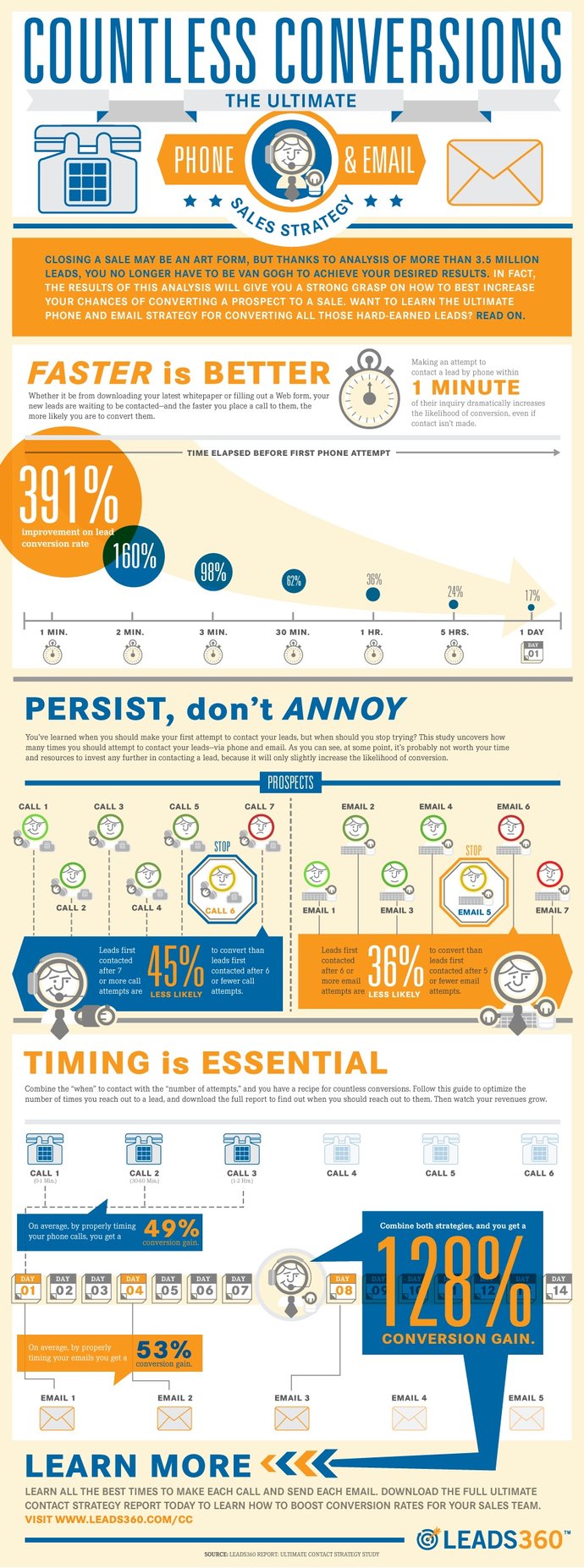


Top-performing salespeople are a breed of their own. Passionate, competitive, self-motivated and tireless. But when your company experiences rapid growth or has a lengthy sales cycle for high value products and services, the burden on your top performers can be heavy. That’s when you’ve got to ask: is there a cost-effective way to augment my sales coverage and drive results without driving core sales team into the ground? We believe the answer is yes. And, in our opinion, the best team-based selling solutions include a kickass outsourced sales support team from a contact center partner you can trust. Here’s why.
From everyday consumers searching for a new car to small business owners searching for a new accountant, it has become the norm for consumers in both the B2B and B2C worlds to educate themselves fully before they commit to buying any product or service. But because of this easy access to extensive information, the process of qualifying leads and nurturing the pre-sale relationship can lengthen the sales cycle and potentially put a drag on your bottom line.
Partnering with an outsourcer whose agents can faithfully represent your brand while successfully advancing a lead as far as possible before handing it off to your core sales team can create both efficiency and effectiveness.
Essentially, your contact center partner becomes an extension of your sales team and shoulders the risk and burden of building and managing the early sales stages. The right team can lay the groundwork providing incremental territory coverage, pre-qualifying leads, setting appointments etc., so you can focus on the money makers, and the money makers can focus on closing. Win-win-win.
Regardless of your industry and product or service offering, it’s common knowledge that retention in sales can be challenging. Ideally, then, you need to focus your hiring, training, and retention efforts on your core sales team in order to maximize performance, boost your bottom line, and minimize turnover.
So when you add the burden of managing a sales support team in addition to your core salespeople, you’re shouldering significant expense and effort. And that’s before we even get to the fact that a new agent is likely only performing at a 50% efficiency rate until they learn the ropes in the field. That can mean a higher risk of potentially damaging your brand, losing productivity, and missing sales opportunities.
The solution? Outsourcing your pre-sales team to someone who knows what they’re doing. The best outsourcer has a time-tested recruitment and training process, plus a deep commitment to learning your brand inside out. At Blue Ocean, for instance, we understand what a true sales culture is and how to build it, we immerse our sales support agents in a supportive and productive environment, providing side-by-side coaching, continuous communication, and sales-driven incentives. (Want an example of our success? Check out our sales support case study!)
There can be more cost benefit than meets the eye with an outsourced sales support team. Consider the built-in costs of hiring in-house outbound sales support. The numbers are significant even when you just take into consideration the basics of getting them started: the technical infrastructure they’ll need to do their job, like CRM licenses, telephony and workstations, and tech support to maintain and upgrade this infrastructure as necessary.
Speaking of technology and infrastructure, your outsourced partner should be bringing solutions and systems, from dialers to lead scoring and lead delivery mechanisms, that deliver huge returns to the equation. And robust customized reporting that delivers insights and not just information can be a huge benefit to making decisions that benefit your business.
Another cost to consider with an in-house team is the management, supervision, and training of those individuals – this adds management head count to your bottom line costs. Those head count costs go hand in hand with the cost of HR administration of these employees, including recruitment, payroll, benefits, and taxes. Overwhelmed by the hidden costs yet? And that’s without even getting into the fact that for in-house reps, you’ll be compensating them even for time they’re not actually productive, like administrative time or personal breaks.
We believe it’s absolutely worth looking into call center outsourcing costs to determine how an outsourced sales support team would affect your bottom line while simultaneously helping your core salespeople produce greater revenue.
We’re confident that we can help boost the productivity and efficiency of your core sales team, in addition to revving up your bottom line. Outsourcing your sales support will be the best move you make this year.
Lead generation, also commonly referred to as lead gen, continues to be one of B2B marketers’ top goals. It’s so important that if you distilled an average B2B marketer’s job description down to two words, they might well be “get leads”.

That’s harder than it sounds. Most marketers struggle to land enough leads, and enough quality leads. But we do have one advantage. Because lead generation is so important, there’s quite a bit of research that’s been done about it. Many of our peers have participated in surveys and case studies and other analyses. As a result, there’s quite a lot of information available about what works and what doesn’t.
This post will walk you through the highlights of that research. It will also offer suggestions on how to apply what the research shows to your day-to-day marketing efforts. By the time you finish reading, I hope you’ll have several actionable ideas to apply to your current lead gen efforts. Who knows – maybe we might even be able to nudge some of you into the lucky 16% of marketers who say their lead generation efforts are sufficient.
Instead of going report by report, I’ve identified three noteworthy trends across several reports. So we’ll walk through this according to those trends.
We’ll also focus on results that are consistent across multiple studies and surveys. Why? Because it’s interesting to see something in just one study, but when you start seeing it independently verified across several studies, the data is more trustworthy. Hopefully, it’s valid enough to help you make impactful business decisions.
Sound good? Then let’s go:
Struggling with your lead generation efforts? You’re definitely not alone. Witness how marketers answered the question, “Are your current lead generation strategies sufficient to reach your goals?” for LinkedInSelling’s The State of Small Business Growth in 2016:

That’s not an unusual answer, either. Marketers gave similar feedback in the CMO Council’s “Lead Flow That Helps You Grow” report.

And in LinkedIn Group B2B Technology Marketing Community’s B2B Lead Generation Trends Report.

So lead generation efforts, as a whole, are a bit disappointing. Or “somewhat effective,” as some would say. Here’s a few ideas for what to do about that:
DemandGen’s 2016 Demand Generation Benchmark Report documents this trend.

So does Formstack’s The State of Lead Capture in 2016.

And so does Technology Marketing’s B2B Lead Generation Trends Report. That same report also named finding quality leads as the #1 challenge.

This trend toward quality over quantity is actually good news. It shows an evolution of B2B marketing. We may still not be thrilled with our lead generation efforts, but when you come to the point that you don’t just want more leads, but better leads, it suggests things are getting better.
Here are a few ways to cultivate those higher quality leads:
Here’s how it works: When someone downloads whitepaper #1, they give you their name, email, and company name. Then when they download whitepaper #2, your marketing automation system asks them for their phone number, company size, and title. It doesn’t ask them for the same information all over again. This is a great way to keep forms short and still get the information you need to tell who’s the better prospect.
MarketingSherpa published an interesting case study recently about how one SAAS company boosted its leads by 101% with lead scoring.

From MarketingSherpa’s recent case study about the benefits of lead scoring.
One caveat before I dive in here: I’m not sure these are really tactics. They’re actually content formats, not tactics. Tactics are made up of a series of actions. Formats are the different containers we put content into. And yet, all these reports are calling these formats “tactics”. So I’ll just play along.
Whitepaper and webinars win in DemandWave’s 2016 State of B2B Digital Marketing Report.

White papers also do well in the CMO Council’s “Lead Flow That Helps You Grow” report.

White papers and webinars again do well in Demand Gen’s 2016 Demand Generation Benchmark Report. Also note how events come in first place. In most of the studies that include events as a B2B lead generation “tactic”, events come in at first place or near it.

We also see this in the Lead Generation Trend Report:

Unfortunately, many of these tactics comparisons leave out email marketing. This is disappointing. Email tends to get extremely high marks when it is included. This chart from Ascend2’s Lead Generation Trends Survey is just one example:

So it’s time to invest more in events, white papers, webinars and email marketing. Here are some ideas for how to go about that, particularly with an eye to improving your lead generation:

Here are the key takeaways:
Research is great, but what really matters is how your particular B2B lead generation is working. Your buyers might be more conservative – or bolder, depending on your industry. Do these trends line up with what you’re seeing? Please share your thoughts in the comments.
Now that you have more information on how to get more leads, you need to know how to efficiently manage them. Download, The Ultimate Lead Management Playbook, to learn the building blocks of a winning lead management strategy that will turn leads into revenue.
In the world of professional services, the terms “business development” and “marketing” are often used interchangeably. In fact, these terms are as different as peanut butter and jelly, or ketchup and mustard, or beans and rice.
You get the idea. They are different, but they are inextricably linked.
That is because business development and marketing need each other. In a successful firm, your BD team works with your marketing team. Together BD and marketing are responsible for the firm’s growth. But they approach that goal in different ways.
The marketing department’s main function is to understand the wants and needs of your company’s target market through research and analytics. Marketing identifies key differentiators, develops positioning and messaging, and comes up with a strategic plan for communicating that messaging.
The marketing team has additional functions: refining and communicating the company’s offerings, managing online and offline visibility, and monitoring marketing goals, such as website traffic, email campaigns, and more!
Business development relies on research and marketing to understand the firm’s audience. They develop and pursue opportunities for growth using data about potential prospects and current clients. The BD team also uses information to search for tangential opportunities, such as which associations should they join, what offers should they provide. They then develop a strategy for following up with each opportunities, all the while looking for ways to improve current client relationships.
Business development is really about establishing connections based on the brand and message developed by the marketing team. They are always on the lookout for new ways to generate qualified leads or develop partnerships that will extend the reach of their firm—and bring in more qualified leads.
When business development and marketing work hand in hand, creating compatible outbound and inbound marketing strategies, they achieve the greatest effect. Below are five different business development and marketing tactics that should be developed in tandem:
The success of your firm depends on business development and marketing working together. For your business to increase in revenue and work efficiently and with momentum, the two different teams need to focus on the same goal. By working in concert, your firm will be able to attract the clients who will truly benefit from your services.