Shared posts

23 Mar 16:27

Unlocking The Competitive Advantage In Your Brand

by Derrick Daye

Brand Strategy Conference

It’s an exciting time to be in the brand development business. Ideas are now more powerful than process. The conversation with customers can no longer be based on product attributes, but rather on experiences. There is a metaphysical aspect to creating experiences consumers love to engage in. There is a explosive drive to create value on a higher level.

Just go to an Apple Store. What’s happening there is not based in a spreadsheet. The Apple Store is church for the brand faithful. There are other examples: Southwest Airlines, Herman Miller, IKEA, Target, Patagonia, Harley Davidson, BMW and yes, Wal-Mart too. These brands offer an experience that transcends what they make and market. The white hot center of competitive advantage is based in a compelling customer experience. In effect these brands have been loyal to their customers, not the other way around.

To do this right, brands have to stand for something authentic and real. And whatever that “something” is, it cannot be decorative or superficial. More importantly, creating experiences people love is not a “best practices” kind of process. That’s just another way of defining the status quo and doing what everyone is doing.

So if you buy into the premise of attraction marketing, your brand building initiatives will be based in a core purpose of adding great value to people. Simple, unique and compelling ideas will be the gravity that attract the like-minded to the white hot center of your value proposition and your competitive advantage.

At The Un-Conference: 360 Degrees of Brand Strategy for a Changing World, senior B2C and B2B marketers work together with brand strategy experts through the lens of brand leadership and attraction marketing. The Blake Project’s fourth, fun, ‘Competitive-Learning’ event is about taking a deep dive into the how and why that results in strong brands. It’s an experience designed to help you develop strategies that will propel your brand to a leadership position or to assist you in maintaining the leadership position you have worked so hard to achieve. It’s the marketing world’s most unique event.

May 2016 Brand Conference

No Attendees. Only Participants.
The best pathway for learning is through participation, not observation. The Un-Conference: 360 Degrees of Brand Strategy for a Changing World will challenge your thinking about brands and brand management. To do that, we’ll put you on a team of 10 and offer you opportunities to compete, lead and learn alongside other marketers from around the world in a unique environment. The challenges you’ll tackle are based on and influenced by actual issues that you and other participants are facing.

This year we are focused on brand strategy to include brand architecture, brand storytelling, brand purpose, emotional connection strategy, customer engagement and digital. Participating marketers are joining us from a wide range of brands including Humana, TD Ameritrade, Bloomberg, R.J. Reynolds, Liberty Mutual and the Wounded Warrior Project.

It all takes place at the new and trendy Renaissance Hotel in San Diego, California May 2 – 4, 2016. Once again we have partnered with professional baseball’s San Diego Padres for a private team-building dinner as well as a game. It’s all included in your registration.

Who Should Participate?
We have reserved these two days (and a kickoff mixer on the evening of the 2nd) for 50 senior B2C and B2B marketers who see growth as a way of life and who seek a learning experience superior to last century’s format of marketing conferences:

-Marketing oriented leaders;
-Marketing professionals (brand managers, product managers, directors, vice presidents, CMO’s, brand strategists etc.);
-Advertising agency professionals (account executives, planners, agency heads)
-Marketers facing brand strategy issues;
-Marketers seeking a competitive advantage;
-Professionals in charge of brand building, brand management, human resources;
-Marketers who prefer participation over observation and action over reaction; and
-Marketers who don’t believe that last century’s format of marketing conferences advances them as leaders.

Every revolution in marketing is remembered for the brands that pioneered it, not the me-too brands that came flooding in next. ~ Walker Smith

To secure a spot for you or your group at The Un-Conference: 360 Degrees of Brand Strategy for a Changing World call me directly in Los Angeles at 813-842-2260. Or simply email me.

Special pricing for MENG / Marketing Executives Group and American Marketing Association Members.

I do hope you can join us.

Sincerely,

Derrick Daye
Managing Partner
The Blake Project

23 Mar 16:25

How to Apply the Scientific Method to B2B Marketing

by Jordan Con

Great marketers of the past needed and relied on sharp instincts. They were gut-driven savants who could hit marketing home runs based on talent and sweat (yes, the Don Drapers of the world wrote A LOT of lines before they got to the right one).

In contrast, it seems like these days, a lot of marketers who believe in the importance of data skip straight to the reporting. They put something out into the world and then use data solely to report on their successes and failures. They laugh at traditional marketers for being dinosaurs, but they gloss over most of the truly important steps that data enables themselves, like the hypothesizing, the testing, and the iteration.

It’s a step in the right direction, but it’s actually not that different from the marketer who just uses their well-tuned gut. In this post, we’ll discuss how to apply the scientific method to use data to become better marketers and have a greater business impact.

scientific-method-icons.png

The Scientific Method

If you can think back to your high school days, the scientific method is a process for investigating why things happen, acquiring new knowledge, and correcting or improving previous assertions.

It starts with an observation. Then, you think of questions related to that observation. Next comes the hypothesis or hypotheses — potential answers to that previous question. Then you test the hypothesis and record results. Based on those results, you can alter your hypothesis, expand it, or reject it. Then you iterate — more testing and gathering of results — until you can come to a conclusion.

The biggest difference between marketers of the past and marketers today is that we have a lot more tools to test and collect relevant data to prove or disprove the hypotheses that we come up with. Marketing (the skill) is now as much a science as it is an art. Some would argue it’s even more of a science.

So if marketing is at least part-science, how does one apply the scientific method in a way that improves his or her results?

scientific-method-obs-question.png

Observing and Questioning

Like all good marketers, we’re avid readers and listeners — consumers of information. We want to know what our competition is doing, what our industry is doing, and most importantly, we want to know everything about our audience. With that, comes a lot of observations.

We also must be curious. When we make observations, we want to know why they occur. Was that blog post really effective because the voice resonated or was it because the attached infographic made the content easy to consume? If we bid based on CPM rather than CPC, would we have gotten more leads? If the email had a better metaphor, would it have been more successful? These are all potential questions stemming from observations about our marketing efforts.

At Bizible, we’ve observed that a couple of our pieces of content have been home runs — they’ve driven hundreds or thousands of leads, and more importantly, they have driven a significant amount of revenue. Clearly, we want to create more pieces of content like these, so we’ve come up with questions about them to help reveal insight into why they, in particular, were so successful.

scientific-method-hypothesis.png

Hypothesizing

This, in my opinion, is the fun part. Coming up with hypotheses takes creativity and intuition. Hypotheses attempt to answer the questions posed in the step before, but it is integral that they are phrased in a way that is provable or disprovable with data. Essentially, they can’t be statements so general that a test could not make an argument for one way or the other. To do so, hypotheses must include one independent variable and one dependent variable. Here’s an example:

Hypothesis: If we write article headlines with statistics in the title, the CTR of our paid social ads will increase.

Not A Hypothesis: Headlines with statistics are better than headlines without statistics in the title.

In this case, the article headline is the independent variable (either includes statistics or doesn’t) and the CTR is the dependent variable. In the second statement, there isn’t a testable dependent variable because there isn’t a defined way to measure what “better” is.

It’s also important to note that you should research the topic prior to hypothesizing because your hypothesis shouldn’t go against existing research. However, the B2B marketing landscape is always changing, so something that was true a year ago may not still be true today.

Here are a few other hypotheses we’ve looked at and tested:

I’m sure the best traditional marketers of the past went through this very same process of observing, questioning, and hypothesizing; they just did it in a less formal way. However, it’s the next steps in the scientific process that set data-driven marketers apart as consistent and effective producers of business value.

scientific-method-testing.png

Testing

The next step in the scientific method is testing, which means executing the marketing initiatives in a way that will prove or disprove your hypothesis.

Using one of the hypotheses from earlier as an example, we could test it by looking back at the last year’s worth of blog posts, separating the headlines that include statistics and the headlines that don’t. We could then run an analysis using our paid social data and compare the CTRs of the blog posts. Another way to test this would be to create A/B tests on your future blog posts. Using the same blog content, create two headlines — one with a statistic in it and one without — A/B test it, and measure its performance.

For some of our other tests, like the lead-to-opp conversion rate by day of the week test, we used our attribution data to see how leads moved through the funnel based on the date of lead creation. We’ll discuss the reports in the next section.

scientific-method-recording.png

Recording Results a.k.a Reporting

Recording results is pretty straightforward, but it does require the right tools. After all, if you can’t measure it, you can’t test it.

For the most part, we want to know how our marketing impacts business results, so our tests’ dependent variables tend to be the number of qualified leads, sales opportunities, and revenue. We measure and report all of this using marketing attribution, which connects our marketing efforts to sales. This way, we can see how specific landing pages (such as blog posts), marketing channels, search keywords, etc. all impact leads, sales opportunities, and revenue.

If you want to test and record results based on how your marketing affects revenue, attribution data is essential.

For our lead-to-opp conversion rate test, by creating a lead report and an opportunity report (both organized by lead create date), we were able to create and analyze conversion rates — e.g. 100 leads created on Monday and 10 opportunities from leads created on Monday, results in a Monday conversion rate of 10%. Based on our attribution data, we were able to see that while volume is lower on leads created on Fridays, the conversion rate wasn’t significantly different from the conversion rate of leads created Monday-Thursday.

scientific-method-iterating.png

Iterating

This step is often forgotten, but it may be the most important. Using the information you learn during the Recording Results phase, the scientific method requires data-driven marketers to go back to their hypothesis and modify it based on the results. That could mean expanding the hypothesis to make it more impactful, it could mean tweaking it because the results disproved the initial hypothesis, or it could mean changing the original hypothesis altogether.

Of course, when you change your hypothesis, that means you have to test it again, and the cycle starts over.

Without this step in the scientific method, data-driven marketers aren’t using their data to its full potential. This is where marketing insights become actionable. It doesn’t make a whole lot of sense to use data to report on something if you’re not going to take the time to analyze what the results mean and try to optimize based on them.

If you don’t want to be a marketing dinosaur, it’s necessary to apply the entire scientific method. Use your smarts and creativity to come up with interesting and potentially powerful hypotheses, THEN use data to prove/disprove and improve.

 Definitive Guide To Pipeline Marketing Everything you need to know to be a revenue-focused B2B marketer. Download Now

23 Mar 16:24

Want a Stronger Sales Team? 3 Ways to Do It

by Melissa Andrews

Want a stronger sales team?

From “a house divided cannot stand” to “no man is an island” to the slightly less literary, “teamwork makes the dream work,” the value of playing as a team versus every man for himself can’t be understated. A sales team is always going to be stronger than a collection of individuals looking out for themselves.

As many salespeople know, however, sales can be an inherently solitary job. Field reps are always going to be surrounded by people, but with all the travel they have to do, it won’t necessarily be your coworkers that you can form a solid relationship with. And while employees are generally more productive, the rapid increase in remote workers (include 11.1 percent of sales reps) can lead to a loss of the “team” mentality. Sales managers can keep the following tips in mind to hold onto the team mentality––no matter where their reps are physically.

1. The “Team” Goes Beyond Sales

You’re presumably already having team meetings, so I won’t linger on those. If you’re looking for some guidance on those, Salesforce and Forbes offered 10 tips to having a successful one. Although, one thing you should keep in mind is how productive your meetings are, and whether you’re using your meeting time effectively.

People want to know that their reach extends beyond just their department. Marketing, the product team, operations, sales—no department exists in a vacuum, and having that broader “company-as-a-team” mentality will strengthen your sales team. Sales and marketing alignment is the topic du jour, but consider some methods of broader alignment:

  • Connect the rest of the company to the sales process: Whether through eBlasts announcing winners of a quarterly contest or displaying sales figures on an office display, make sure that the salespeople know that they’re appreciated by the company at large.
  • Have one of your reps walk people through the sales cycle. It’s hard for people who aren’t in sales to grasp just how much work goes into landing a single deal. Whether it’s through a short video or a company-wide seminar, this is another way to connect sales to the company.
  • Go beyond alignment with marketing. Alignment is what you should have with other departments, but being tightly knit with marketing is key if you want the buyer to have a consistent experience from the moment they hear about you to the moment they sign. Your salespeople won’t necessarily spend anywhere as much time with marketing as they do with each other, but the team mentality will help them impact each other in positive ways without stepping on each others’ toes.

2. Give Them Good (Common) Resources

Nothing can ensure that your team isn’t on the same page than…not empowering them to be on the same page. Make sure that every sales rep has access to the training resources as everyone else. Again, you can use the video-based approach or do in-person training—new employees shadowing others also presents an opportunity for your salespeople to establish relationships, which they otherwise might not have. Beyond getting to know each other better, there are innumerable benefits for having mentor(s) at different levels.

And while salespeople might grumble about CRM, it has its place for your team—as long as it’s not stretched beyond its capabilities. In addition to helping them keep track of interactions with their own contacts, it helps your sales reps be aware of what’s going on with your team, makes sure customer information isn’t siloed, and keeps your team members’ from accidentally stepping out on each others’ toes/accounts.

Having the right resources can also be on the content front so salespeople not only have access to all the sales content they need, but also:

  • Have easy access to what they need (so they’re not creating their own customer-facing content)
  • Know when content is added or updated (so they’re not presenting the wrong thing or aren’t seeking to create something that they didn’t know existed)
  • Be able to access and present that content no matter what device they happen to have (this gets more important when team members use their own devices)

3. Help Them Learn from Each Other

I talked about the benefits of mentorship above, but there’s another way members of your sales team can learn from each other: Cold. Hard. Data.

When it comes to B2B sales, there are many aspects that vary immensely from one account to another. Every business has its own particular needs––businesses vary in the number of stakeholders that have a say in a purchasing decision, not to mention how much stake each of them holds. Even in a single industry the length of a sales cycle can be wildly inconsistent.

Salespeople and marketers alike know, however, that some things resonate, and some things fall flat. While the sales conversations behind closed doors have been hidden for a long time, giving everyone access to the same sales enablement solutions allows a picture to form from the aggregated data behind those meetings. We know that content plays a major role for consultative sales reps and we now know more particulars, including what content is used:

  • by top-performing sales reps,
  • at different stages of the sales cycle (including “deal-assisting” content),
  • and post-meeting engagement with content by the buyer.

Your reps no longer have to rely on educated guesses or on only their own past experiences. They can see at a glance what’s working and what isn’t, and then follow up with team members for even more context and then pair the right content.

The truth is that your salespeople are the most important people at your company. Period. They’re on the front line, giving your customers their first impressions of you, but they’re also responsible for your company’s revenue. You can’t afford to let them feel like they’re not a part of something bigger, and you need to give them the resources to learn from each other to keep improving. The rest of your company might learn a little something along the way.

Click below to get a closer look at how Interactive Content can help transform your next sale!

mediafly interactice content

Image credit: Facebook Advertising – Maximizing The Power of Facebook by Joe the Goat Farmer | Creative Commons

23 Mar 16:24

3 Ways to Integrate Influencer Marketing Into Today’s Campaigns

by Daniel Sayer

For years, word-of-mouth marketing has been the most trusted form of advertising. In a Nielsen study across 58 countries, 84 percent of recipients said they put the greatest trust in recommendations from friends and family.

Social media hasn’t changed that. But what the proliferation of blogs and social platforms has done is create a megaphone of sorts for word-of-mouth advertising. Now, when we’re looking for our next vacation, we don’t visit a travel agent or ask the neighbors — we check out our favorite blogs. If we want to get dinner out, we no longer turn to the phone book to scroll through lists of restaurants — we visit Yelp and read users’ reviews.

Word-of-mouth marketing isn’t disappearing as we become more attached to our screens. If anything, it’s escalating. Influencer marketing is the art of harnessing that online narrative to spread positive words about your brand, boosting influence and cultivating trust among your target customers.

The Rise of Influencer Marketing

The term “influencer marketing” gained search recognition in 2012 because brands were starting to see that digital content creators could impact their sales cycles. As consumers began following more blogs and using social media in ever-greater numbers during the early 2010s, brands began testing the waters, allocating small sums toward influencer marketing.

Today, the online discussion is one that no brand can afford to ignore. Facebook now has 1.59 billion monthly users, while Twitter has 320 million and Instagram has 400 million. By 2020, social media spending is expected to reach $27.4 billion, more than double its high water mark of $12.3 billion in 2015.

Social media presents not just an effective tool with which to influence consumers, but also a cost-effective one. Largely thanks to the volume and interconnectedness of social media accounts, influencer campaigns can also earn almost 10 times the earned media value that paid media does. And this isn’t just a short-term achievement. These influencers’ brand endorsements stay online, continuing to influence consumers long after they’re penned.

3 Ways Brands Can Incorporate Influencer Marketing in 2016

Plainly put, 2015 was social media’s best year ever. But 2016 promises to be even bigger, leading 60 percent of marketers to increase influencer marketing budgets through the first quarter of 2016.

If your company sees benefits in crafting an authentic, brand-boosting narrative online, there are three ways you can incorporate influence tactics in 2016:

1. Video Marketing

Recently, brands have seen their Facebook reach diminish with one clear exception: video. But videos that go viral online aren’t created by brands themselves. The majority of viral videos are created by vloggers using platforms ranging from Vine to blogs to Snapchat.

Travel brand Marriott has established itself as a progressive authority in the publishing space by partnering with social media personalities and travel influencers. These content creators use videos to share their global travel experiences across social platforms and even through a virtual travel system, available by request to Marriott patrons at select New York and London hotels.

2. SEO

Because of the social media boom, search engine providers have tailored their algorithms to increasingly account for a site’s social reputation. By facilitating and distributing shareable content via social influencers, brands can use social engagement as another weapon in their SEO tool kits. This type of link building is safer and more organic than traditional, more aggressive strategies such as paying for sponsored links or engaging in link schemes.

A huge SEO strategy component of clothing retailer, Gap, is its styld.by hub. This isn’t Gap’s official blog; it’s a platform designed uniquely for social influencers. The styld.by site enables lifestyle bloggers to upload and describe their Gap-made styles, resulting in brand-positive content shared across the world via Instagram, Twitter, and Tumblr with the #styldby hashtag. The social sharing isn’t just getting Gap’s products in front of more eyes; it’s also helping Gap generate organic search traffic to its home site.

3. Content Marketing

Content and influencer marketing are natural allies. Content marketing is already a big part of many brands’ marketing strategies, but it’s more concerned with engaging readers via traditional content platforms and brands’ own voices.

Blue Apron, the gourmet meal kit service, has received plenty of buzz on traditional media platforms like Inc. and Forbes, but it’s also branched out with a stellar influencer program. Endorsements from well-known foodie blogs like Fannetastic Food and Love Taza complement the brand’s content marketing strategy, making Blue Apron seem simultaneously professional, authentic, homegrown, and trustworthy.

As Intuit co-founder Scott Cook knew, “A brand is no longer what we tell the consumer it is — it is what consumers tell each other it is.” This new paradigm of marketing is about two-way conversation, not one-way brand advertisement.

And considering there seems to be no stopping consumers’ thirst for brand authenticity, influencer marketing is stripping away all the paid scripted celebrity endorsements and advertisements that consumers are tired of. In its place, the industry has created something much more compelling and organic — a way to help consumers share the good news, person-to-person, about their favorite brands.

Image credit: Flickr

23 Mar 16:21

The Secret to Unlocking Customer Marketing Data from Product Registrations

by Claudia Amand

If you haven’t already heard, 2015 was the year big data became a ubiquitous business necessity. Whether used for operational efficiencies or customer information, the benefits of big data are limitless.

For manufacturers, data from warranty product registrations has the potential to be a gold mine for their marketing efforts. Historically, manufacturers offer warranty registrations in order to obtain customer data and use it to improve their marketing and sales processes.

“Manufacturer’s warranties play an important role in the business cycle,” explain Chris Walker and Scott Cederburg of PricewaterhouseCooper in a recent article for Warranty Week adding that warranties are critical to the success of a company’s sales and marketing efforts (source). Unfortunately for manufacturers, the opportunity to collect big data from warranty product registrations is currently not being leveraged efficiently due to an outdated, laborious process for the consumer.

The Current Process is Tedious

Most warranty registrations still require customers to fill out a paper card and return it via mail to the manufacturer. In the digital age, these long and tedious forms are a turn-off for many consumers, especially since a separate warranty card must be completed for each product the individual wants to register. Consumers hate the redundancy of having to fill out the same information for multiple products, whether it’s a Fender guitar or a Black and Decker drill. These cards place the burden on the consumer, whose apathy results in a lost opportunity for retailers to obtain the valuable consumer data.

In addition, product warranty registrations, whether they are online or traditional card-in-a-box, suffer from a “perceived lack of trust” from customers regarding what will be done with their data (source). While some registration cards ask for simple information like name and address, others dig deep into the consumer’s personal information by including questions about ethnicity, income, education and family structure. It’s no wonder that less than 10 percent of customers fill out warranty registration cards (source).

Reduce the Burden on the Customer

It’s clear that the warranty registration process is broken, but companies are more eager than ever before to obtain data from their customers, as it presents a very lucrative avenue for gaining repeat customers. So how does a manufacturer increase the percentage of customers that fill out those registration cards and increase their stores of customer data?

Put simply, reducing the burden on the consumer by streamlining and simplifying the warranty registration process makes it much more likely consumers will submit their information. By making the process automatic and digital, companies reap significantly more data from their customer base, data that has traditionally only been held by retailers and receipt processing companies.

Several solutions to this problem are popping up, including apps that automatically start the warranty registration process based on consumers’ purchase data. Not only is this a benefit for the consumer, allowing them to digitally and automatically submit a warranty for every product they wish to register, but it also delivers value for manufacturers in the form of all-important customer data.

The manufacturers’ product warranty registration process is broken, and all too often there is little thought given to how technology can be leveraged to increase customer response rates. But with the digital resources like one-time entry databases and automatic submissions, the process can be revolutionized. Marketers in the manufacturing industry will finally be able to unlock the wealth and depth of customer data from product registrations.

23 Mar 16:17

A Power Breakfast – B2B Marketing Style

by Erika Goldwater

Last week’s Saint Patrick’s Day in Boston kicked off with a power breakfast event hosted by Aberdeen Group with marketers sharing thoughts and best practices on everything from persona development to change management. My favorite take away of the morning focused on buyer engagement and content consumption – act and score on intent, not just action, according to the panel.

Aberdeen panelThe event was the first in a series called Content Essentials #ABGbreakfast featuring high profile Boston marketers including Samatha Stone, Katie Martell, David Cunningham and out-of-towners Carlos Hidalgo and Mathew Sweezey. The session was facilitated by Chief Content Officer/ Managing Director of Aberdeen Group, Maribeth Ross.

If you missed the event, take a look at a few key pieces of advice from the panel. The combination of tactical and strategic advice shared by the panel is very actionable. Much of the discussion was focused on knowing your buyer and how to best engage them. Implementing even a few of these tips will improve your content effectiveness and enhance your marketing efforts.

Favorite tips from the power panel:

Use a set of data points, not just a single piece of data to gain a full understanding with context.” Carlos Hidalgo

 “If you are not using progressive profiling today, start. It’s the best way to gain information from your buyers.” Samantha Stone

“Best practice for content is the ‘you check.’ Look at your content and count how many times it says ‘you’. If it doesn’t include ‘you’ – fix that.”  Katie Martell / Maribeth Ross

“When running a webinar, pepper in questions to engage the audience and gain valuable insights.” David Cunningham

“The download metric is only half of the customer equation.” Mathew Sweezey

“Use buyer profile and buyer persona information to develop content.” Samantha Stone

“Talk to your buyers. Ask what their biggest challenge is and then answer that with your content.” Katie Martell

 “Technology enables a strategy –  that is all.” Maribeth Ross

If you don’t follow these marketers on a regular basis, start now. The practical advice and strategic insights shared at the event gave attendees a lot of think about and even more to act on. Understanding your buyers is the first rule in B2B marketing today and you do this by talking to your buyers, building out personas and then developing content that maps to your buyers and the buying committee throughout the journey. It takes more than luck to build great marketing, even on St. Patrick’s Day in Boston. Thanks to Aberdeen Group for hosting the event.


The post A Power Breakfast – B2B Marketing Style appeared first on ANNUITAS.

23 Mar 16:17

How to Do Keyword Research in 2016

by Charles Bodner

Stream-Blog_Graphics_PageRank_3-16Why Keywords Are Important

Before we start, let’s quickly go over why keywords are important. Since the dawn of search engine optimization, there has been keyword research. Keywords are part of the user’s search process. Having your website optimized for certain keywords will allow Google to index your site for which keywords you think are important to your particular business/vertical.

When a user wants to find information or products, they use a combination of keywords to make up their search query. Then the user inputs a search query into the search bar (or these days speak into their phone) and then the search engine, such as Google, serves results from their index.

The goal is to be the most relevant result for keywords and queries so the user looking for your products/information finds what they want on your site.

Types of Search Queries

Before you start your keyword research, you want to get an idea of which type of search queries users would use to find you. Let’s break down the three major types of search queries.

  • Navigational Queries

Navigational queries are ones where the user has a set destination in mind and is trying to find their way to a particular site or page within a site. If you have strong brand recognition, this is where most of your organic branded traffic will come from.

blog1

  • Informational Queries

Informational queries are ones where the user is trying to find an answer to a question. These questions can range from “How to…?” to “Which is the best…?”

This is the heart of the Inbound Marketing Strategy: Having your website provide the best answer to the questions your visitors are asking.

blog2

  • Transactional Queries

Transactional queries are ones people use when they’re close to or ready to make a purchase. They could be a specific brand or a generic product search. Usually words like “buy,” “purchase,” and “order” are part of the query.

blog3

How to Do Keyword Research

Now that you have an idea of what type of queries people are using to get to your site, you want to find keywords that are the best fit. But how do you do that?

There are many tools and strategies available these days (I use quite a few depending on the client), so I’ll give you a quick and easy 3-step guide to start with.

Step 1: Think Logically

Using a little common sense and thinking logically goes a long way in keyword research. Put yourself in the buyers’ shoes and ask yourself how you would find your website if you were a user.

Think about the three main types of queries while you do this and note anything that makes sense. (Don’t censor yourself. You would be surprised how many different ways to search work!)

Step 2: Competitor Analysis

Here we look at which keywords competitors in your space are using. This is usually a good starting point. A great tool for this is SEMrush. It gives you keyword data for specific sites and their competitors.

Step 3: Selection

Once you have a solid list of keywords (including long-tail keywords), throw them into the Google Keyword Research tool. This will give you the average monthly search data as well as its competitiveness.

The competition index is primarily used to judge the competitiveness of the keyword within Google AdWords, but it’s also usually reflective of the overall competitiveness of the word organically. The closer the number is to 1, the more competitive it is.

Select a combination of easy wins (high search traffic and low competitiveness) and harder wins (high search traffic and high competitiveness). Once you have your final list, you’re ready to start optimizing your site for your keywords!

Stream’s Kick-Start Step

Take 30 minutes of your day and work on step 1. Think about the search terms your buyers use and make a list of these terms to use as guidelines for your educational content creation. Make sure that you check back to see how those keywords are performing to ensure that you’re optimizing your content for search.

Destroy-Your-Competition-SEO_Webinar-Replay

23 Mar 16:15

The 5 Most Common and Costly Mistakes Sales Teams Make with Inbound Leads

by Brandon Redlinger

In the Spring of 2006, two students in the New Enterprise class of MIT started company that would spark a movement, a movement that would change the way we do business today. This company is now a household name, and this movement is now part of everyday business vernacular.

These two students were Brian Halligan and Darmesh Shah. The movement is called ‘inbound marketing.” And the company is Hubspot.

Inbound marketing is promoting your company through social media, content marketing, products and any other means to attract customers to come to you. Rather than going out hunting, you’re standing still fishing. This is how Hubspot built their company to what it is today.

Inbound is virtually the exact opposite of what this blog is about: outbound sales. However, you need both for your sales team to hit their numbers and for your business to survive. In fact, they may be more closely related than you think.

This post is NOT about how to do inbound marketing. There’s a lot of great information out there on how to create an inbound marketing machine. This post is about how inbound affects your sales team. This post is about how to effectively and efficiently manage your inbound leads. This post is about how inbound can help you crush quota and skyrocket your sales.

What happens after a lead comes inbound?

Rules of sales development are rapidly transforming, and this question needs to be explored more in depth.

Just because a lead converts on a piece of website content doesn’t mean he or she is necessarily a hot prospect, ready to buy now. The chances are greater that an inbound lead will close, but pursuing each and every single inbound lead is not always worth the time. How a sales rep spends his or her time prospecting is crucial to their success. That’s why it’s important to establish a clear and well thought-out protocol for handling inbound leads.

However, I see many salespeople making mistakes with inbound leads that cost them time and money. As a lead comes in and goes through your sales funnel, mistakes along the way jeopardize your chances of closing. Let’s walk through the five most common and costly mistakes with inbound leads.

1) Not delegating the responsibility of inbound leads

In order to build an effective sales development machine, you must implement a process for dealing with inbound leads. If you’re like most companies, you have a dashboard for all untouched inbound leads, and they’re all up for grabs. But if everyone is responsible, then no one is responsible.

So who should own the inbound leads? Should Marketing be responsible for following up since they are largely responsible for their conversion? Or should Sales be responsible because they’re ultimately tasked with closing them?

Personally, in my opinion, since Marketing is the first team to get notified of an inbound lead after a form has been filled out on your website, I think it’s Marketing’s responsibility to field those leads. However, every organization is structured a little differently, so the first line of response could actually be Sales, Marketing Operations, or even Sales Operations. The bottom line is that there needs to be a clear cut process in place.

In order for a process to work effectively and efficiently, there needs to be a Service Level Agreement (SLA) between all the teams that touch your inbound leads, namely sales, marketing and customer success.

This SLA should include:

  • Agreed upon definitions and criteria for
    • A lead
    • A marketing qualified lead (MQL)
    • Sales qualified lead (SQL)
    • Sales accepted lead (SAL)
    • Opportunity
    • Customer
    • Customers at risk
    • Etc.
  • Lead management process
  • An agreed upon definition of what success looks like, which includes
    • KPIs
    • Benchmarks
    • Monthly, quarterly and annual goals for Sales, Marketing and Customer Service
  • Reporting—dashboards and in-depth reports for each team and how stakeholders can access the information

Once an SLA is in place and responsibility is delegated, a proper follow up process can be effectively implemented so no opportunities are missed.

2) Not properly qualifying inbound leads

After you have an SLA in place and know who is responsible for your inbound leads, the first step is to qualify those leads. Simply put, is this prospect a good match for your product/service or not? You must establish and clearly articulate criteria for what is considered a qualified lead.

Some important things to consider:

  • Is this lead a part of an account already in your system?
  • Does this lead match the profile for your ideal account?
    • Company size
    • Industry
    • Funding
    • Company age
    • Revenue
    • Technology they’re using
    • Etc.
  • Does this lead match one of your targeted buyer personas?
    • Title
    • Department
    • Tenure
    • Pain points/challenges
    • Goals/aspirations
    • Etc.

If the answer to these three questions is “no, this lead is not a fit,” then put the lead into a marketing drip campaign; there’s no use following up at this point. However, if the answer is “yes,” then it’s time to pass the lead on to Sales.

If the answer is “maybe” because you don’t have all of the information to confidently make a decision, you have a few options. You can choose to put that lead into a marketing drip campaign and offer additional valuable information to progressively profile the lead until you can qualify him or her. It’s probably worth segmenting these leads with the information that you do have and putting them in specific dip campaigns based on your target personas for the best chance of nurturing them into SQLs.

Alternatively, you can do a little background research yourself and manually qualify him or her.

To begin uncovering the necessary qualification information, visit profiles of your prospect and his/her company on sites like:

  • CrunchBase
  • Angel.co
  • LinkedIn
  • Twitter
  • VentureSource
  • Alexa.com

Beyond some of this general demographic information, we can start to assess psychographic and behavioral factors. That’s the beauty of inbound- you have a little more information to add color to the prospect. (More on this in mistake #3).

3) Not conducting proper research before reaching out

Now that you’ve qualified the lead and passed him or her along to the sales team, it’s important for the sales rep responsible for following up to do more research. Another big mistake I see sales reps make is reaching out blind. Sure, you may know what company the person works for, but do you know what that company does?

This is where digging into some of the psychographic and behavioral factors really comes in handy. You can look at the type of content the inbound prospect converted on, giving you a better idea of intent. For example, if a prospect converted on a mid-funnel piece of content, it shows higher intent and you can get a better idea of the pain or problem they’re having. Here are some other questions to ask for uncovering psychographics and behavioral factors:

  • What type of content did this lead conver on?
  • How long has this lead been in your system and what other content have they viewed? (If you’re using a platform like Hubspot, once a lead filled out a form and comes inbound, you’re able to get visibility into all the other content and pages they’re viewed, which emails they’ve opened and to what degree they have engaged with your company on social channels before filling out the form).
  • What is their referral source?
  • How are they currently solving their problem? (If you’re using a service like BuiltWith or Datanyze, you can see if they’re using a competitor, thus giving insight to whom you’re selling against)

Just as with traditional prospecting, it’s very important for a rep to perform proper research on an inbound lead before reaching out. First impressions matter. Small errors get amplified.

The caveat here is to avoid spending too much time or waiting too long to follow up. According to a study by LeadResponseManagement.org and InsideSales.com, a lead contacted within five minutes of converting is 100x more likely to convert than if follow up happens 90 minutes later.

If you don’t have access to or can’t find the proper information quickly enough, it’s perfectly reasonable to call your prospect and simply ask. You might say something like this:

I noticed you were checking out our [type and name of content]. Were you able to access it? What challenges are you having around [topic]? How is that affecting you? Let’s schedule another time to chat and see how we can help you achieve [specific results].”

4) Not personalizing follow up communication to inbound leads

If you weren’t able to get in touch with that inbound lead immediately, no problem. Though your chances of connecting may drop, if there’s one thing that we know it’s this: persistence wins.

There’s a lot of focus on creating and sending effective emails to sourced prospects, but salespeople don’t often take those same principles and apply them to inbound leads. The reason you’re reaching out is a given: they requested some information and you’re following up with them. However, they still want to connect with a human, so you must personalize your messaging. Automation kills rapport — no matter what.

You can even take some of your best-performing outbound email templates, do a little re-tooling, and use them with inbound leads. For example:

Hi [first name],

I noticed that you [action] on [piece of content].

I wanted to reach out because we help companies [one-sentence value proposition]. We’ve already helped [customers] achieve [specific results].

Do you have 15-20 minutes on [date] to explore how we can help [company] do the same?

Thanks,
[your name]

5) Not following up correctly

Though there’s no golden rule for the number of follow up attempts or a follow up tempo/timing you should make with sourced prospects, any smart sales rep knows persistence is important. But most reps don’t think of applying this same mentality to inbound leads as well. Effective follow up strategies can and should be used for managing inbound leads too.

There are 4 critical factors for successful follow up:

  1. Number of touchpoints: We advocate for 7 or more touches for each prospect, even with qualified inbound leads.
  2. Channel Diversity: Go beyond phone and email by adding social to the mix. But don’t overlook some other less conventional ways to get in front of your prospects, like direct mail, fax, conferences and industry tradeshows, door-to-door, etc.
  3. Time between touchpoints: We recommend being a little more persistent early on, then tapering off if the buyer hasn’t responded. We’ve seen great results sending the second touch a day or even 12 hours after the first.
  4. Content of touchpoints: Sending “just checking in” and “just following up” get really old really fast. Instead, offer value by offering new insights, educating your prospects, sharing relevant news or reemphasizing business value.

Here is an example of a workflow that has been effective for us:

  • Day 1: Call and email
  • Day 2: Email and Twitter (favorite a tweet)
  • Day 3: Twitter (Follow and retweet)
  • Day 5: Email and LinkedIn (connection request)
  • Day 7: Email
  • Day 10: Call and email
  • Day 17: Email and Twitter (tweet at or retweet)
  • Day 21: Blog and/or LinkedIn (comment of content)
  • Day 28: Call and email

The bottom line is when you’re following up, you must continue to offer value at each touch.

Final Thoughts

Having a process doesn’t matter if you’re not closely monitoring the performance of every aspect of your lead generation and lead management to make sure the process is working. After all, you could be using the wrong process- a process that doesn’t fit your needs or is out of date. It’s important to track and measure every step of the process to optimize and make intelligent decisions so you can get your desired results. All team involved (sales, marketing, customer success, etc.) need to be on the same page and know how to generate the appropriate and relevant reports for their respective teams.

Inbound leads are an essential part of any company’s sales development effort and overall growth. However, if you don’t follow up with them properly, you’re missing great opportunities. Investing the time to create a process and getting on the same page with your marketing team will pay off tenfold. Establishing the right practices for following up with qualified inbound leads can launch your growth into hyper speed.

23 Mar 16:15

The 7 Bad Actors on Every Sales Team & How to Manage Them

by pcaputa@hubspot.com (Pete Caputa)

bad-sales-team.jpg

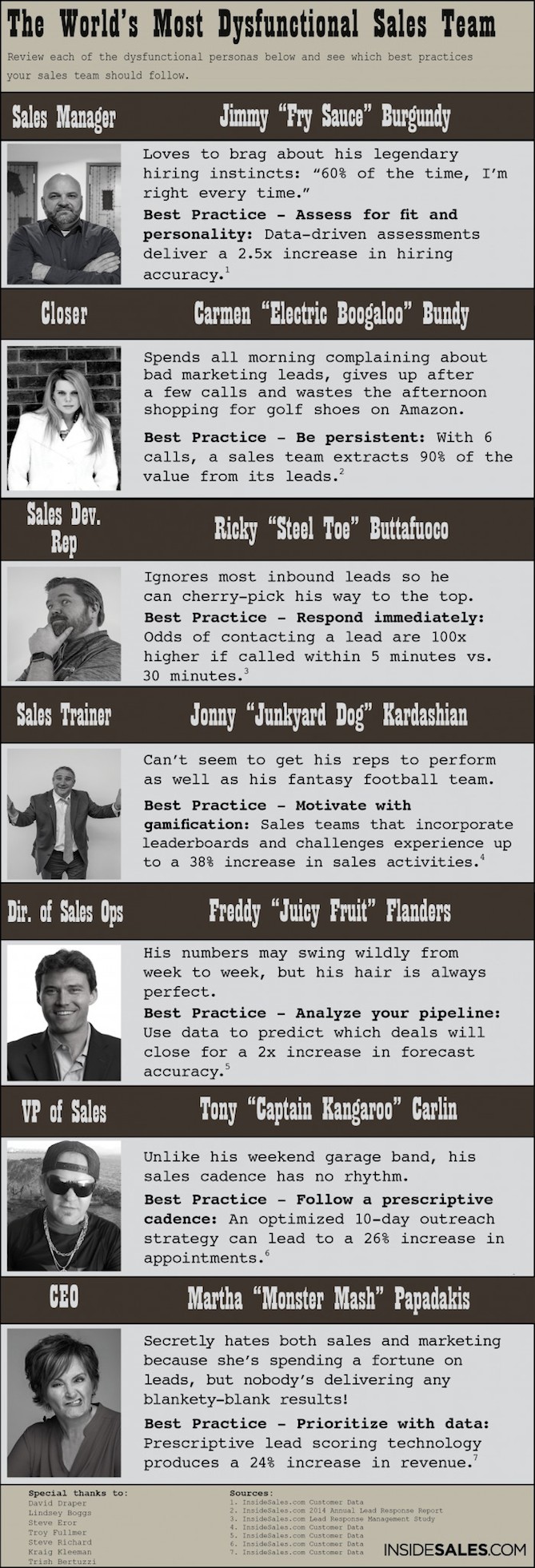
Our friends at InsideSales.com recently published an infographic titled “The World’s Most Dysfunctional Sales Team." (To see it, click the link or scroll to the bottom of this post.)

In it, they describe seven bad actors that often exist in many mid-market or enterprise-level sales teams. But no matter how big your sales team, you'll probably recognize many of these bad actors, and especially their bad behavior. Stop playing CRM cop. Get the CRM that sales reps actually want to use for free.

Use the tips below to avoid or manage these behaviors off your sales floor.

1) Sales Managers Who Hire Based on Gut Instinct Alone

The problem: Too many sales managers hire people who look and sound exactly like them. Most managers learn the hard way that this approach is a recipe for disaster (not to mention illegal if taken too far). Ever run into a team full of jocks or valley girls? I have. It's not pretty. Hiring the wrong team can have a devastating effect on a small or mid-sized business, not just in missed sales targets, but in significant dollar loss from the cost of hiring, training, and managing poor fits. It can also spell the end of a sales manager's management career.

Avoid it: Don't use your gut to predict a candidate’s likelihood of success. Instead, use a candidate pre-screen to assess skills, strengths, and weaknesses before you interview. In addition, build a structured and consistent interview process and ensure multiple managers are involved in saying "yes" or "no" to every candidate.

The evaluation process should allow you to customize the requirements and thresholds based on the role’s unique demands. But, most importantly, make sure you’re assessing sales skills, not personalities. Most sales experts I know have aligned themselves with Dave Kurlan's assessments as Objective Management Group (OMG) resellers. From what I understand, OMG has applied more science than any other group to the challenge of sorting sales winners from sales fakers.

Regardless of which assessment you use, don't just license an assessment and expect it to work. In our current market, where there are more sales manager jobs than qualified candidates, many managers are hiring for the first time in their careers. Teach them how to use the assessments for screening and interviewing as well as coaching after the hire. For interviews, create a list of criteria and have them evaluate each candidate against the same list. To ensure every manager knows how to evaluate a candidate using the defined criteria, build a scorecard they must complete after every interview, as well as a list of suggested questions and acceptable answers. Then, hold managers accountable to using it.

During your interview process, consider assigning an exercise to the candidate, too. That could be as simple as a reading and writing assignment, or as challenging as a live mock role play of a selling situation or a presentation on how they'd approach their first 90 days on the job.

Regardless of your evaluation process, make sure you can move a candidate through the process quickly. Hire a dedicated resource to manage interviews, scheduling, and the relationship with each candidate.

Finally, use a CRM-like system like Jobvite, Greenhouse, or HubSpot's free CRM to manage your interview process.

Suggested reading on this topic:

2) Salespeople Who Refuse to Prospect

The problem: We’ve all worked with a salesperson (or several) who doesn’t prioritize prospecting. Some will even complain about the quality of leads that Marketing delivers, instead of doing what's necessary to fill their own funnel. In my experience, salespeople get complacent when A) there are lots of leads to go around, B) they predominantly sell new things to existing customers, or, C) they come from a well-known company that has strong brand awareness. In these situations, salespeople don't have to prioritize prospecting, but their funnels stay full of opportunities nonetheless. Whereas most reps spend a good portion of their day attempting to connect with prospects, these sellers have customers coming to them -- in droves.

Once reps are "spoiled" with an abundance of inbound demand, they don't know what to do when leads dry up or get distributed amongst more people as the team grows. Some become indignant of repeated prospecting demands from their managers. I was talking with a sales manager the other day, and she told me that a sales rep asked her "Did you ever think that I'm offended by your prospecting requirement?" This was a rep that had literally not prospected for six months because they thrived on repeat business and business teed up from their sales development rep.

Some reps truly think prospecting is beneath them. Others fear the rejection that comes with it. But the majority of reps who don’t prospect simply forgot how to do it (or never really mastered it in the first place).

Avoid it: First, don't hire a salesperson who fears rejection or doesn't have recent prospecting experience. Once they join your team, train them how to identify, research, connect, and converse with your company's ideal buyer. From a scheduling perspective, ensure prospecting gets prioritized over all other activities -- even closing and customer calls. Then, arm salespeople with the tools necessary to do prospecting efficiently including a phone dialer, sales email templates, and auto-logging of emails and calls to your CRM. To consistently improve performance, use analytics to compare your salespeople's prospecting results to the team’s as a whole. Report the results to the whole team or the whole company so that everyone knows who is doing the job and who isn't. The public shame should be enough to inspire the ones who aren’t picking up the phone, and the public recognition will motivate the ones who are. Consider gamifying as the InsideSales.com infographic recommends if you want to add an element of fun to it.

In addition, measure the volume and quality of activity. Use conversion funnel data to identify the reps that are doing the best and encourage these top performers to share their approaches with their peers. Provide coaching -- especially role-playing for that initial call. And finally, get rid of or reassign the salespeople who won't prospect consistently or can't prospect effectively.

Suggested reading on this topic:

3) Sales Development Reps Who Cherry Pick the Best Leads and Ignore the Rest

The problem: Similar to the rep who thinks they shouldn't have to prospect, there are SDRs who will do anything they can to find demand they can "satisfy" instead of doing the difficult work of "creating demand." Rather than identify good fit buyers, do research, craft personalized outreach, and perform the necessary number of attempts to connect, they spend an inordinate amount of time hunting for the hottest leads in the CRM. Instead of picking up the phone, they're refreshing the browser to see which lead was delivered to them from Marketing or which marketing qualified lead hasn't been rotated yet. Worst of all, they send hundreds or even thousands of uncustomized messages to prospects, waiting for one to raise their hand, instead of tailoring their approach based on the unique situation of each prospect. HubSpot's CEO calls this quantity over quality method of prospecting "bird-sh*tting" on the contact database.

Avoid it: In addition to taking all the steps I suggested above when dealing with salespeople who refuse to prospect, implement a Marketing and Sales service-level agreement (SLA) that obligates reps to contact leads within a specific timeframe and a defined number of times and sales territories. These guardrails make it impossible for salespeople to cherry pick the hottest leads through “birdsh*tting.”

If reps don’t meet the SLA, take them out of the lead rotators. Territories, whether they are geographic, named accounts, verticals, or some other structure will force reps to increase quality prospecting attempts. In a territory model, a rep is stuck with the prospects they're assigned. So, for fear of squandering a chance to connect with a prospect, salespeople will put thought into every attempt. Also, don't be afraid to outlaw the wrong prospecting behavior while rewarding desirable behavior.

A final warning: Be sure to implement lead scoring. It’s not always a bad thing for reps to be selective about who they call. Salespeople generally have a good nose for sniffing out which companies and contacts are worth the effort. Use lead scoring to help them prioritize and to keep them honest.

Suggested reading on this topic:

4) Sales Trainers Who Can't Get Sales Reps to Apply What They're Teaching

The problem: You hired a sales trainer. They spent months putting together a training program. You run your new hires through it … and a bunch fail to ramp, leave, or get let go. Wow! That was a big waste of time and money.

Avoid it: Stop prioritizing sales training over sales coaching. While some training is critical, true progress happens from coaching. Why? Salespeople -- like anyone -- learn best by doing. While you can and should make your sales training interactive, salespeople will learn at the precise moment they need to learn -- when they are on the phones doing the job. For instance, when you put a rep on the phone, they'll learn how to start a relevant conversation. When they screw up their first presentation, they'll prepare for the next one. Coaches are there when these “learning moments” happen, and can help a salesperson reflect, figure out next steps, and understand how to avoid the same mistakes in the future. And in addition to course correcting, they can also celebrate successes, which reinforces good habits.

At HubSpot, we got this right when we hired Andrew Quinn. Not only did he build a training program (and later a training team) that has trained hundreds of our salespeople globally, he helped implement a coaching culture at HubSpot. In the early days especially, he met with many managers and salespeople on a one-on-one basis to help them move deals along, troubleshoot mistakes, and role play sales scenarios to ensure reps were equipped to handle their next call.

Later as we scaled our team, Andrew leveraged his front-line exposure to build rock-solid interactive training programs. Via on-demand video training and testing powered by SmarterU as well as hands-on-the-product training and in-person graded presentations, our sales reps are well-equipped to be product experts and to empathize with and understand the challenges of our ideal buyers.

To really get this right, sales managers must prioritize coaching over everything. Keep this rule of thumb in mind, and the results will follow.

Suggested reading on this topic:

5) Sales Analysts Who Can't Accurately Forecast

The problem: Forecasts vary significantly from week to week. In the first week of the month, you're forecasting way under. By the second week, you're forecasting to exceed target handsomely. A bunch of big deals drop out of the pipeline in week three (or so you're told), which means you're forecasting a miss again. By the final week, you're pulling out all the last minute stops to try and meet expectations. Sound familiar?

Avoid it: In my experience, there's no silver bullet solution to forecast accuracy. Instead, try the following three-pronged approach: deal-level control through coaching, weekly bottom-up reporting roll-up of individual and team forecasts, and predictive analytics using historical and current CRM data.

The first question to ask is "Are my sales reps qualifying effectively?" A few years ago, we ran an experiment where we asked our salespeople to rate each deal's qualification level, instead of just whether it was going to close or not. Turns out, knowing things about budget, the challenges the prospect was having, the buyer’s goals, and other information typically collected during the qualification stage correlated with actual close rate. So, collect as much granular information about your prospect's likelihood to buy as you can. If your salespeople do this well, you should be able to simply set up deal stages in your CRM, assign a "percentage close" likelihood for each deal stage, and rely on your CRM dashboard's forecast.
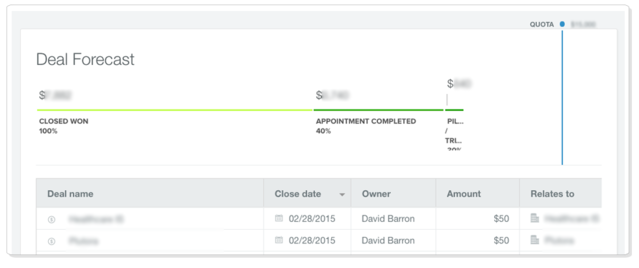
The old-fashioned way of managing forecasting also works. This method is all about accountability and was created before technology made it easier to roll up a forecast instantly. In the old school way of forecasting, the leader holds their team accountable to forecasting accurately through an extra exercise. By pushing accountability down the chain, you're not relying on your sales team's CRM data-entry discipline (or lack thereof) to forecast accurately. It is the team's responsibility -- each and every rep and manager -- to provide three month-end (or quarter-end) predictions on a weekly basis: committed, most likely, and best case. At the end of your quota cycle, their weekly forecasts should match their actual results. Additionally, they should never come in lower than their committed forecast and should land within a few percentage points of their most likely forecast from each week. Ask them to report best case too, so that you have a range and know who you might be able to rely on for over-performance. Run a contest around forecast accuracy if you need to improve this drastically.

Keep in mind that some reps will be conservative, and others liberal. So, manager inspection and discretion is important. Sales managers must inspect deals in order to judge their rep's accuracy and submit their own forecast based on the information received. Directors and VPs should track each rep's and manager's historical accuracy and make adjustments as they pass their own forecast up to the C-level.

If you manage a large team, it might also make sense to employ a predictive analytics solution to triple check your forecast accuracy or just to streamline the manual process. Selecting software and managing this weekly process is usually assigned to a sales operations analyst. At HubSpot, we use Aviso to not only "roll up" individual rep forecasts, but to also use our historical and current CRM data to predict the outcome. Both "rolled up" forecasts and the model are analyzed before a forecast gets submitted to the CFO each week.

Suggested reading on this topic:

6) Sales VPs Who Don't Follow a Predictable Cadence

The problem: A wild west sales leader who does not follow a predictable cadence. While sales leaders at smaller companies can get away with this, larger organizations require lots of planning and consistent execution to stay on track. Activities like recruiting and interviewing, training and coaching, and of of course, prospecting and closing must be completed regularly. In order to ensure that a sales management team is executing across all necessary activities, it helps when the most senior leader follows a predictable cadence when reviewing progress on all initiatives. While CRM, recruiting, and forecasting systems can help things stay on track, regular meetings with set agendas force execution and continuous improvement.

Avoid it: In large and small organizations alike, the sales leader should consistently ask the same questions so both managers and reps know what is expected of them. Much of the repetition can be reduced with proper reporting. In larger sales teams, recurring meetings and reviews are necessary to ensure the ship runs smoothly, avoiding future turbulence. Reviewing monthly performance with the entire sales management team across all metrics helps ensure everyone is in line.

Smaller sales teams don't need to be as formal about this. Be careful not to distract your sales team with unnecessary reporting, and make sure that each interaction helps them more than it helps you.

Suggested reading on this topic:

7) The CEO Who is Never Happy with Results

The problem: The CEO is the problem. Hard-charging CEOs with a mission to change the world are never happy with results.

Avoid it: Good luck. Your best bet is to share the articles below with your CEO (when they're in a good mood).

Suggested reading on this topic:

And here's the infographic that inspired this post:
Worlds-Most-Dysfunctional-Sales-Team-static.jpg

HubSpot CRM

22 Mar 17:12

Does Your Business Model Look to the Future or Just Defend the Present?

by Robert C. Wolcott
mar16-22-135500969

Established industries aren’t ripped apart overnight. That takes time, though when momentum builds, change happens fast. How can incumbents manage through the monumental changes currently under way? One answer is to take a cue from pivotal technology companies leading the change.

Many of the companies leading today’s technology-driven transformations across industries are leveraging transitional strategies, or more specifically transitional business platforms. Few old-guard players have recognized the power of transitional models, but companies such as Netflix, Uber, Apple, and Tesla know that waiting for the time to be right means waiting until it’s too late. Netflix founder Reed Hastings, for instance, always wanted to do on-demand video, but the technology infrastructure wasn’t there in 1997, the year he founded the company. Rather than giving up, he founded a DVDs-by-mail business until the time was right. Similarly, Google’s interest in Nest isn’t primarily a play to control the thermostat: it’s a Trojan Horse into the connected home.

Getting in the game helps define the game, but it’s essential to have some idea — even a vague one — of what the game might eventually be. For the next generation, that game will often be about pushing the production and provision of products and services ever closer to the moment of demand. From distributed energy generation to 3D printing to crowdfunding to the Internet of Things and data analytics, all of these technologies enable us to provide what customers want, where, how, and when they want it. Businesses able to most cost-effectively provide it will win. This dynamic will persist for many years as technology improves and businesses learn to apply it in new ways. We’re only in the early stages. Companies that focus on defending established business models will lose in the long run. Companies with foresight will pursue transitional models to be part of driving the change.

Insight Center

  • The Platform Economy
    Sponsored by Accenture
    How online marketplaces are changing the face of business.

A transitional business platform such as Netflix’s DVD rental business provides a potentially profitable business opportunity that gets to market and enables, rather than hinders, transition to future business models as technologies, customer behaviors, regulations, or other factors evolve.

While Uber, the global leader in on-demand transportation, relies on thousands of independent drivers, Uber’s business platform enables the transition to self-driving cars, one of the company’s stated strategic priorities. While the eventual transition could be traumatic for Uber’s drivers (and to society in general), Uber’s business platform enables rapid evolution as technologies, consumer behaviors, and regulations change. At present, traditional auto makers’ and limo companies’ business models don’t account for this inevitable shift. By contrast, electric vehicle company Tesla’s software-based upgrades provide a superb transitional business platform, allowing the company to be a leader in the autonomous vehicle revolution.

To be clear, succeeding at transitional business platforms does not require predicting the future. Instead, a great transitional model is based on an accurate directional read of the future, providing flexibility and optionality as the future unfolds. In 2005, Netflix’s Hastings told INC Magazine, “I don’t want to get into production. There are passionate, talented filmmakers out there, and I would pollute the craft.” Yet today, as it evolves to a global media empire, Netflix is a force in content production. Whether Hastings envisioned this from the start is irrelevant. The point is that the Netflix platform has enabled the company to expand its competitive space as technology and consumer behaviors have changed.

Four characteristics distinguish transitional business platforms:

  • They substantially outperform the status quo from the customer’s perspective. Transitional models are designed around what is best for customers, even at the expense of established value-chain participants. For new entrants, like Uber, that’s just fine. For traditional players, like limo companies, it’s the fundamental challenge. But in a world increasingly giving customers what they want, when, where, and how they want it, it’s also a necessity.
  • They tend to violate traditional constraints. This is often required to achieve radical improvements in performance. Infamously, Uber has challenged local regulators around the world. Whether they’ve gone too far in this respect is arguable. It’s uncontestable that Uber has transformed personal transportation. Tesla’s direct-to-consumer approach will continue to be contested in court by auto dealers and others, but direct consumer engagement is fundamental to the company’s flexibility in the future. Where possible, we believe it’s best to avoid violating established constraints — it’s easier — but not at the expense of serving customers.
  • They build brand presence before markets have been clearly defined. Consider drone delivery services. Amazon is experimenting with drone delivery not just to lead but also to advance drones on the regulatory agenda and to catalyze other companies to develop viable models. While drones are still experimental, expect Amazon or other players to find niche applications in the future that build presence and anticipate the day when delivery drones proliferate.
  • They enable adaptation as conditions change. Most important, transitional models must be designed to adapt as offerings move closer to the time and location of customer demands. This means anticipating the direction (not the details) of customer demands. UPS’s Strategic Enterprise Fund has invested in CloudDDM, a 3D-printing company with 100 printers located in the middle of UPS’s worldwide hub. CloudDDM can print parts on demand and send them literally across the alley to UPS for shipping, allowing a response within 24 hours for many parts. If the setup works, CloudDDM will be positioned to expand into a range of other digitally manufactured products. The investment also positions UPS to participate in and learn about a trend that will both expand and contract demand for their core shipping business. More 3D-printed parts today likely means more packages shipping. However, in the future, to the extent that 3D printers proliferate closer to the locations of demand, fewer products might be shipped. CloudDDM and UPS are building a transitional business platform for their diverse yet complementary objectives.

Great business leaders use transitional business platforms to learn and react fast, even when new directions threaten the company’s traditional core. In January 1996, individual investing pioneer Charles Schwab launched web trading not long after the introduction of the first web browser. Although new entrants such as eTrade were active, Schwab recognized the power of online trading before any of the large incumbents. Schwab offered online trades at $29.95; in-person or phone orders remained far more expensive. While online accounts soared, customers expressed increasing frustration at not being able to order through any channel at the same price. Greg Gable, Schwab’s senior vice president for public affairs, recalls, “The problem quickly became apparent. We had clients revolting….We had employees saying, ‘Hey, we need to do what is right for our customers.’ So we did.” In late 1997, Schwab offered the $29.95 price for all trades, online or otherwise. “We expected a considerable hit to revenue….We prepared for the worst but thought we’d make up for the change within two years due to increased volume. We made it up in six months.”

Ultimately, all businesses are transitional — we just can’t predict precisely when or how. Businesses focused on optimizing what has worked for years at the expense of the future will create ever-greater risk for their owners, employees, and customers. Experiment with potential transitional models so that your company is ready when the time is right. You can’t lead the way if you’re waiting for someone else to take the lead.

22 Mar 17:12

Google Photos gets smarter, automatically creates albums with your best photos

by Sarah Perez
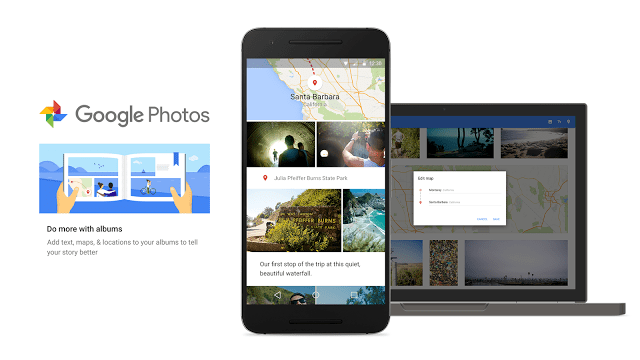
smarter-albums-graphic Google rolled out a small but useful update to its Google Photos service today, which will allow the creation of what Google calls “smarter albums.” These are photo albums automatically created on users’ behalf, following an event or a trip, and will include a curated selection of your best shots, along with details like how far you traveled, or location pins to help you… Read More
22 Mar 17:08

Recovery of loonie and oil prices set stage for ‘worst of both worlds’ scenario

by Jonathan Ratner

The recovery in both oil prices and the Canadian dollar is setting the stage for a “worst of both worlds” scenario, according to one Bay Street strategist.

Unlike some of his Bay Street cohorts, David Doyle at Macquarie Capital Markets admits he got it wrong on the Canadian dollar.

With the loonie up 10 per cent in the past two months and the S&P/TSX composite index outperforming, bearish calls for Canada have proven unwise.

Some of the drivers include rising global risk appetite, a roughly 50 per cent gain in oil prices, and the general reduction in pessimism.

Doyle also noted that short covering on the loonie has helped the currency rebound, as short contracts on the Canadian dollar have fallen from 65,000 to 16,000 – the lowest level since June 2015.

However, the strategist still sees downside for the loonie versus the U.S. dollar, albeit at a more gradual pace.

He predicts the Canadian dollar will hit an all-time low of 59 cents U.S. in the coming years, but that will only come during a global period of risk aversion. For the end of 2016, Doyle sees the loonie at 69 cent U.S.

FP0322_Loonie_oil-GS
“Unprecedented divergence in leverage and housing investment cycles in the U.S. and Canada should lead to unprecedented monetary policy divergence,” the strategist told clients, noting that this means the gap between U.S. and Canadian government bond yields should continue to widen.

Despite the general rise in market optimism for Canada, Doyle cautioned that a combination of oil prices in the US$40 to US$45 per barrel range, and the loonie above 75 cents U.S., could spell further trouble for the domestic economy.

That’s because crude prices at that level are unlikely to produce a meaningful capital spending recovery in the energy sector, higher oil prices put additional pressure on already stretched household budgets, and the stronger loonie has made Canadian exports less attractive.

22 Mar 17:02

The 3-Minute Trick to Close More Deals on LinkedIn

by John Nemo

Having personally reviewed and rewritten hundreds LinkedIn profiles over the past few years, and having built my entire business around training others how to utilize the platform to generate business for themselves, I’ve learned something very important.

Technology, the Internet and Social Media have become the great equalizers of our time. Today, anyone with enough creativity, passion and hustle can carve out a niche online and build a massive platform, generating scores of sales and revenue as a result.

At the same time, more than ever, sales and business deals – especially on LinkedIn – are reverting back to a time long since forgotten.

It’s a strange dichotomy, but one that you must understand (and apply) if you want to generate more business for yourself using LinkedIn.

Best of all, the strategy I’m going to show you only takes 90 seconds or so to execute once you have the pieces in place.

LI Groups

The Secret to Generating More Business with LinkedIn

Before I explain what this method is, I need to share a common thread I’ve seen in reviewing hundreds of LinkedIn profiles over the past five years.

The Small Business Owners, Coaches, Consultants, Trainers, Sales and Business Development Executives generating the most business for themselves on LinkedIn are doing it the same way – by building out and showcasing their “personal brand” on the network.

These professionals have figured out the fastest way to stand out from the competition and close a deal on LinkedIn is to replicate the face-to-face experience that is the cornerstone of sales transactions and business deals.

Think about it. In real life, when you meet a prospect and make a sale, what happens? You talk to each other. You smile. You build a relationship. You feed off one another’s emotion and enthusiasm. You, as the person doing the selling, work as hard as you can to make sure the prospect feels like he or she knows, likes and trusts you before a sales pitch ever enters the conversation.

The 3 Minute Trick to Selling More on LinkedIn

While you can’t set up personal, face-to-face encounters with all 400 million LinkedIn members, you can make yourself more unique and showcase your personable, human side by adding a video to your profile page.

In fact, just a quick, 90 second long, “Welcome to My Profile!” video will do the trick.

Here’s how it looks on your profile page:

Screen Shot 2016-03-01 at 9.42.28 PM

Below are a few examples of “Welcome To My Profile” videos you can draw some ideas from:

Why Video Matters So Much on LinkedIn

Adding video to your LinkedIn profile page is as simple as copying and pasting a YouTube or Vimeo URL over to LinkedIn. (You can see how it works here.)

Of course, creating a video to share can be a bit more complex. The good news is that technology has made it easier than ever to accomplish. For instance, almost all iPhones and iPads shoot 1080p HD video, and there are scores of affordable microphones and tripods you can use with your Apple device.

Long story short, you don’t need a Hollywood-quality production team to create a good-looking, quality-sounding video of you sitting in your office or standing in a scenic outdoor location talking on camera.

What to Put in Your LinkedIn Profile Video

The content of your on-camera video is easy: Just replicate what you say to prospects in real life.

Answer these types of questions on camera:

What’s your name? What type of work do you do? What products or services do you offer? What audiences do you serve? What’s the biggest value or benefit customers get from using your products and services? What makes you unique or different when compared to your competitors? What do you enjoy doing outside of work? What’s the next step if we want to talk more with you?

Just talk to the camera like you’d talk to a new prospect. Be conversational and relaxed. Do not try to memorize lines or use a script. It feels forced and comes across poorly in almost every instance. Instead, a conversational, friendly tone that showcases your personality works best.

VideoMarketing

Don’t Want to Be On Camera? Do This Instead.

If you are not comfortable on camera, you can still make video a key part of your LinkedIn profile page. There are all sorts of videos you can make, from ultra simple, click-and-drag animated videos that look professional to screen recordings where you demonstrate your expertise to fun, movie-style trailers that you can make in just a few minutes using a program like Apple iMovie.

With all that said, the best possible video type remains one where you are on camera, talking directly to a prospect and looking him or her in the eye. Text cannot replicate the emotion, passion and nonverbal signals you send to a prospect when they see you on camera.

This is Your Opportunity to Stand Out on LinkedIn!

I’ll close with this: The professionals who are using video in the ways I’ve described are also some of the most successful people I know of on LinkedIn in terms of generating more sales and revenue.

So start using video on LinkedIn ASAP – and watch your sales increase as a result!

22 Mar 17:02

Why The Status Quo is Your Most Challenging Competitor in B2B Sales

by Ian Dainty

First of all, let’s look at what the status quo is, and why companies stay with it.status quo1

From Wikipedia – “meaning the existing state of affairs. It is a commonly used form of the original Latin “status quo” – literally “the state in which”. To maintain the status quo is to keep the things the way they presently are.”

The status quo is always your biggest competitor in any B2B selling situation. In fact, CSO Insights, the venerable sales research firm, has consistently found that over 50% of forecasted sales opportunities are not closing at the time, and for the value expected, if at all.

Going further into their research, they have stated that almost all of these losses were because the prospect decided to do nothing. The prospect did not go to a competitor.

These NO DECISIONS are utilizing an enormous amount of sales and marketing time, which is ending up being wasted.

Why Companies Remain with the Status Quo

For three years in a row, the benchmark and advisory firm Sirius Decisions has reported that the number one revenue inhibitor, in complex B2B sales environments, continues to be the vendor’s inability to communicate value.

One of the reasons, that these vendors haven’t succeeded in conveying their value, is that most of the effort has been spent focusing on the value of their solutions, and not on the cost to the prospect dealing with the problem.

There are a number of reasons companies will stay with the status quo, instead of going with your solution. Let’s have a look at some of them.

1. They don’t see the value of changing

I. You haven’t made a strong enough value proposition for them to change.

I find this to be the number one contributor to companies losing sales, and most often to the status quo. There are a number of reasons for this happening.

Many companies don’t really know what their value proposition really is. I see companies stating motherhood and apple reasons like,
i. You will get better productivity with our solution
ii. We have helped many others get a greater benefit
iii. We listen to what our clients tell us
iv. And all the other ridiculous statements that mean absolutely nothing to your prospect.

I see so many companies with statements like these that no wonder companies don’t buy. Your value proposition has to have two key elements to it.

1. It must show some number, usually a percentage, of the amount of savings, profit, revenue and/or productivity gained. You need to work these numbers out for each client. But there should be some correlation with other clients, to make your job easier.
2. You need to work with your prospect, through investigative questioning, what his/her personal reasons and objections are for changing or not changing. As I always say – get to NO, before your get to yes. This saves your sales force and marketers an inordinate amount of time.

This doesn’t mean you give up on a prospect, if you truly believe you can help them. But this is where the nurturing process takes over, until they realize they do need it, or you realize that they will never be a customer.

II. You haven’t explained the Cost of Inaction (COI).

This is really a corollary of your value proposition. Your value proposition should have, as part of its statement, this part of the proposition. This should be part of your questioning; understanding what happens if they don’t take action. And what are the consequences both to him/her personally, and to his/her company, from inaction?

2. They feel your solution is too risky.

This follows on from not having the right value proposition. You need to explain the risks of both implementing and not implementing your solution.

There is one risk of not implementing which is easy to overcome. This risk in when a government legislates something that must be carried out by each company, or they risk getting a huge fine, or possibly even going to jail. Sarbanes Oxley was such a piece of legislation.

The other risk has two different aspects to it.

i. Your solution may carry some implementation risk. It may be a major implementation that takes quite a bit of time and resources to implement, like an ERP system. You need to step them through each stage and let them know the responsibilities from both your team and their team. This will help mitigate this risk factor.
ii. Again, you need to reinforce the cost of inaction (IE: the risks of inaction) to both them personally and to their company.

3. They just implemented another similar solution.

When I worked for IBM, waaay back in the 70’s, if you found that a prospect had just implemented a competitive solution, you were not allowed to talk to that company for a full year after implementation. If you did talk to them, you were fired on the spot.

There are a number of reasons for this, but mostly because you should never disparage a competitor. And, you are wasting an awful lot of time, both yours and your company’s time by chasing them. The prospect is going to see how their decision and implementation works out, before they look at another solution.

So, keep them in the pipeline by showing them what you are doing through communication pieces, just in case something goes wrong. But do not ask to see them for at least a year.

4. Other projects are taking up the resources needed.

This is a very real problem that happens more often than not. And it is a big factor that contributes to many status quo losses. However, with the right questioning techniques, you should be able to ascertain if this is happening or not, within your first interview with the prospect.

5. They really don’t have the money right now.

This may also be the case. There a number of reasons for this.
i. You are talking to the wrong person. You need to have your first meeting with the person that has enough influence, to reach into a corporate budget, if he/she thinks the value is there for them to move.
ii. They may have tied up all of their money and other resources on another project.
iii. They may be looking at acquisitions, or being acquired, and therefore are not prepared to do anything until these situations are completed.

As you can see, there are many factors you have to think about, when you are prospecting and talking to a company about your products and services.

However, with the right questioning techniques, you will discover this early on in the process. Then you know whether you should proceed with them as a prospect; put them on the back burner for a while, but with constant communication pieces; or realize they will never be a legitimate prospect.

Get to NO before you get to Yes and you will save yourself and your company a lot of time, money and energy.

22 Mar 17:01

Why Trudeau is wrong on Old Age Security

by macleans.ca
(Justin Tang/CP)

(Justin Tang, CP)

Michael Bloomberg welcomed Justin Trudeau to his corporate home in New York this week with a love letter of such intensity that even Stephen Harper would blush. Bloomberg wrote a column for his global financial media behemoth that called Canada’s Prime Minister “energetic and pragmatic” and compared Trudeau to John F. Kennedy. “The value of the Canadian dollar and the price of oil, one of the nation’s top exports, have both tumbled to near record lows,” the billionaire and former three-term mayor of New York wrote ahead of Trudeau’s arrival for town-hall event on live television. “But those details—and the apparent demise of the Keystone XL pipeline—don’t begin to tell the story of what lies ahead for the economy of Canada, America’s second-largest trading partner.”

Canada’s main stock market increased about one per cent between the time of Trudeau’s visit to the Bloomberg LP headquarters and the early trading hours of March 18. That’s probably because the U.S. Federal Reserve indicated it was less keen about raising interest rates. But for fun, let’s give Bloomberg’s endorsement of Trudeau’s economic strategy a little of the credit. There is no one on Wall Street with a louder bullhorn than the former mayor.

There certainly is a lot to like about Trudeau’s economic policy agenda. Next week, he will plunge the federal government into deficit, recognizing the unique opportunity presented by ultra-low interest rates to renovate the infrastructure that supports Canada’s economy. There is every reason to think the program will pay for itself through faster economic growth over the medium term. But even if it doesn’t, the potential for improving Canadians’ quality of life through better transit, safer water, and so forth is justification enough. Health and happiness isn’t always free. Canada’s new government is also right on climate change. The previous government was indifferent to the future costs of a lackadaisical approach to constraining carbon. Trudeau has put his country back on the right side of history. But Trudeau isn’t perfect. He used the Bloomberg stage to state that he intends to follow through on an unfortunate election promise: reversing the previous government’s decision to raise the age at which Canadians start receiving payments from the Old Age Security program to 67 from 65. “Tweaking the age like that is a very simplistic solution, that won’t work, to a very complex problem,” Trudeau said of an initiative that was meant to save more than $10 billion a year once fully implemented in 2030.

The Prime Minister likes to say that his policies are based on clear, pragmatic thinking. His promise to once again lower the retirement age felt like a political calculation by a third-place party that needed to embarrass a right-wing government and outflank a left-wing official Opposition. Trudeau seems to have forgotten that voters will forgive politicians a few unkept promises if they actually win. Raising the retirement age isn’t simplistic, it is necessary. The International Monetary Fund for years has documented that asking ever healthier taxpayers to wait a little longer for their pension benefits is among the handful of measures that will allow developed economies to save their public retirement systems for bankruptcy. There is nothing unfair about doing so. Life expectancy for Canadian men when Trudeau and I were born in the 1970s was no more than 70. Now it’s closer to 75 and rising all the time. We’re living longer than the architects of the pension system ever imagined. It’s entirely reasonable to adjust benefits accordingly.

Despite the weight of evidence, the previous government was among the few in the world that worked up the courage to make the change. Trudeau struggled to justify his decision at the Bloomberg event. He called himself fiscally responsible, and he said the issue of demographic pressure on public pensions demands study. Those are reasons to leave the age increase is place, at least until the study is complete. Trudeau mentioned the need to improve the health of Canadians, a well-meaning goal that would keep people alive longer and further strain pensions. He also justified himself by observing that it was cruel to expect manual labourers to work past the age of 65—surely a concern that could have been answered more elegantly.

Stephen Tapp, a former Bank of Canada economist who now is research director at the Institute for Research on Public Policy, reckons the reversal will cost 0.2 percentage points of gross domestic product annually over the longer term. Trudeau said he will seek a more “nuanced” response to funding public pensions. If those responses existed, they likely would have been discovered by now. But that probably will be the next prime minister’s problem. Trudeau has chosen short-term political gain over making life easier for those who follow him.

The post Why Trudeau is wrong on Old Age Security appeared first on Macleans.ca.

22 Mar 17:01

I Finally Had the Guts to Ask This Sales Question — The Answer Surprised Me – by Jill Konrath

by Robert Terson
To me, Rule #1 of Selling is to be crystal clear on your value proposition. Unless you can clearly articulate the outcomes a client gets from using your product or service, it’s nearly impossible to get them to change from the status quo. Let me flashback to a situation that took me years to understand. At the […]
22 Mar 17:01

Facebook Articles Integrates with WordPress

by Warren Knight

TechTuesday-Facebook-Articles-Integrates-with-Wordpress

If you read my content on a weekly basis, you may remember an article I wrote in September of last year, talking about Facebook’s latest feature; Articles.

Facebook’s notes were upgraded and turned into Facebook Articles. This new update made Facebook’s notes more attractive, and customizable.

This new update allows you to add a cover photo that is relevant to what you are posting online. You can also caption, resize photos and format your text into headers, quotes or bullet points.

Take this new update, and be intelligent with what you post. As you can see here, I have used Facebook’s notes to take a blog post, and share it with my community in full on Facebook. Actually, not JUST Facebook… but everyone else too.

All of the above is great, but I’m here to talk about Facebook’s more recent update, where their new WordPress plugin makes life a whole lot easier for bloggers using a WordPress site to publish instant articles.

Facebook collaborated with Automattic (parent company of WordPress) to bring this Plugin to users so that anyone using WordPress, can auto-publish their articles onto Facebook.

If you are using a standard WordPress template, this is something that is readily available for you to use however, if you’re site is completely customized and built by a developer using WordPress you will need to look at ways to extend the platform to support this feature… it shouldn’t be too difficult.

25% of all websites are WordPress, so this is a great step to revolutionising the way content is shared online. If WordPress see the value in working with Facebook and vice versa, it won’t be long until the other big social players follow suit.

This move from Facebook shows their hope in becoming an all-in-one news source, and I wouldn’t expect anything less from Zuckerberg!

This plugin will be available from the 12th April to use, but is now available to download and install.

If you are thinking about creating a website for the purpose of sharing written content, I would highly suggest looking into WordPress, as it is the easiest platform to use, completely free of charge (unless you want a special template) and has so many amazing plugins (just like the one mentioned above) that makes your publishing life a whole lot easier. Trust me, I have been using WordPress for close to 10 years and love how much control I have over my website and how it works.

Will you be using the new Facebook/Wordpress plugin?

22 Mar 17:00

What it Takes to Really Attract Top Sales Talent

by Susan Halliwell

Top-performing salespeople have one thing in common – they consistently achieve their sales goals. To recruit these talented and rare salespeople, employers need to take a hard look at what they are offering prospective candidates, and if they are doing what it really takes to attract ‘A’ players.

Hiring managers fail to acquire top performers when they don’t evaluate how their company is positioned to attract salespeople who are not actively looking for a new employer. “Organizations rarely examine what they can specifically offer to entice salespeople who are happily employed and progressing well in their career, and so they are continually disappointed by their recruiting,” says Brent Thomson, CSO at Peak Sales Recruiting. Companies need to evaluate the financial and intangible attributes they offer salespeople and outpace competitors who vie for the same stellar candidates.

Elite salespeople look for a specific set of characteristics from employers: they want to work for market leaders with strong value propositions that offer high earning potential and career growth opportunities. Shifting a company to embody these characteristics sets a clear path toward attracting and hiring the best talent.

Here are 3 ways employers can attract the best sales talent:

1. Define and Build an Employer Brand

An attractive employer brand is the primary reason great salespeople want to work for a particular company. As defined by Richard Mosley, author of The Employer Brand, this term denotes “an organization’s reputation as an employer, as opposed to its more general corporate brand reputation.” LinkedIn reports that 59% of executives are investing more in their employer brand in 2016 than last year, bringing new emphasis to marketing for job candidates. Appealing to top salespeople requires that executives develop their employer brands with these aspects in mind:

Position the Company as a Market Leader

Top salespeople are always interested in working for industry leaders or high-growth companies that are poised to dominate their sector.  If there’s no track record of success at a company and reps aren’t making quota, great salespeople are savvy enough to realize it’s not their best option to make a move. Respected employers, therefore, demonstrate their legitimacy by leveraging key client logos in the recruiting process and highlight the number of reps making and exceeding quota. By emphasizing their reputation and resources, they gain the attention of top talent.

Offer a Pro-Sales Culture

High-performing sales reps seek respect, not just within their immediate teams, but throughout an organization; they want to work for companies that value what they do. Therefore, in order to recruit top talent, sales executives need to highlight their pro-sales culture and underscore how they recognize that their sales reps are the primary drivers for company growth.

This kind of pro-sales culture stands out to prospective candidates because it emphasizes both team-wide collaboration and individual competition; both of which are job qualities that great salespeople want to experience on a day-to-day basis. A strong community of support that pushes salespeople to meet consistently high standards appeals to leading sales reps. Ideally, hiring managers emphasize this balance, as well as the willingness of a company to support the autonomy and ingenuity of their sales teams.

Create a Strong Career Track

To encourage top talent to join their company rather than a competitor’s, executives need to offer prospective candidates more than a better job. Top talent appreciates educational opportunities to build on their skillset and learn different selling methodologies, and want to know that a potential employer will provide the support necessary for them to build extensive sales portfolios. Outstanding companies combine these opportunities with fast career tracks, giving salespeople more agency to take on bigger accounts and move into management opportunities.

2. Offer Market Leading Compensation

If business leaders want to attract sales professionals with strong records of success, they need to provide competitive compensation. Mark W. Johnston and Greg W. Marshall, authors of Contemporary Selling: Building Relationships and Creating Value, explain why:

“Holding down sales compensation may appear to be a convenient way to hold down selling costs and enhance profits, but this is usually not true in the long run. When buying talent in the labor market, a company tends to get what it pays for. If poor salespeople are hired at low pay, poor performance will almost surely result. If good salespeople are hired at low pay, the firm is likely to have high turnover, with the resulting higher costs for recruiting and training replacements and lost sales.”

Top-tier talent only works for above-average compensation that matches their skill set, experience level and selling potential. When targeting these salespeople, executives need to offer premium compensation with simple-to-calculate commissions that have an immediate impact on their income.

3. Emphasize Job Meaning and Impact

The sense of meaning salespeople expect to experience on the job also motivates high performers to change companies. Patty McCord, who worked as the chief talent officer at Netflix for 14 years, believes that advertising meaningful work is an integral aspect of any recruitment plan.

At start-ups, in particular, sales reps can be part of a growth story, helping to form a company from the ground up. Instead of investing in outrageous perks — in-office bars, razor scooters, and pre-paid Uber accounts — emphasize the opportunity for employees to take ownership of their role within a company and have a material impact.

According to Fast Company, employees who derive this sense of meaning from their work are three times as likely to stay at their company, while reporting 1.7 times higher job satisfaction and 1.4 times more engagement on the job. Executives also need to recognize the role of these less tangible factors in motivating high-performing candidates to accept to a new position and stay with the company for the long-term.

Offer The Best to Get The Best

Talented salespeople are highly sought-after — they are used to receiving numerous job offers from a range of employers. Directly competing with other companies for a limited pool of top-tier candidates requires that leaders emphasize their employee brand, offer above-average compensation and stress the potential for each job candidate to impact their company in a meaningful way.

The post What it Takes to Really Attract Top Sales Talent appeared first on Peak Sales Recruiting.

22 Mar 17:00

Leaders Aren’t Telling the Stories Their People Care About

by Jim Haudan

Are you a good storyteller? If not, it could be holding you back at work. Anyone with aspirations of being a great leader, someone who inspires others to work together and give their all to a joint mission, needs to be able to tell a good story. It’s one of the most proven and effective ways to explain something complex (and today’s business world is certainly that). Just consider the Epic of Gilgamesh (the oldest story ever written), the Bible, the Egyptian Book of the Dead, the Iliad … these are powerful stories dating back to the earliest days of humanity. Stories teach new ideas, entertain, challenge our thinking, and paint pictures in our minds. Movies, books, music, news, religion, art – you name it, the influences of storytelling can be seen across all aspects of life. A great story can bring you to tears. It can be passed down through generations or today, go viral in a matter of minutes.

Yet, despite the well-documented power of storytelling, far too many leaders and organizations are nothing short of awful at telling stories that make authentic connections to what people care about the most. Leaders commonly prep for change by creating catchy tag lines, slogans and rallying cries to communicate their ideas. These sound bites might be rich with data, numbers, statistics, and analytic driven acronyms, but they’re devoid of authentic meaning. The end result? Seventy percent of the workforce is left phoning it in because their leaders haven’t told a compelling story that makes them feel connected to their jobs or the company as a whole. Consider this: if engagement scores haven’t changed in 30 years and we still have the vast majority of people sleep-walking through their work-a-day-life, something is not working.

It’s time to change things up …

Great stories in today’s digital world spread like wildfire, quickly inspiring people to take action. Take the August 2014 ALS Ice Bucket Challenge for example. Everyone from Bill Gates to Ethel Kennedy to former President George Bush poured a bucket of ice water on his or her head, challenged others to do the same in 24 hours and made a donation to fight ALS.

The impact was huge. ALS raised $94.1 million from over 2.1 million new donors in just the first four weeks – compared with only $2.5 million for the same period in the previous year.

Why did we care so much about the Challenge? In a very compelling way – no flashy taglines required – it told us the story of ALS. It explained how there is currently only one drug approved by the U.S. Food and Drug Administration (FDA) to treat ALS, which only modestly extends survival by two to three months, and how the disease is 100 percent fatal.

Another obvious example of captivating storytelling is the movies. How often have you watched your favorite movie without tiring of it? How well do you remember the plot details? How quickly could you recite the exact words that best captured the spirit of the story?

The academic world supports the power of storytelling as well. Jennifer Aaker, a professor of Marketing at Stanford’s Graduate School of Business, notes that stories are 22 times more memorable than facts alone. Twenty-two more times! So leaders, listen up. When preparing to speak to your people, you must remember that stories are what make the difference, not facts, figures, lists or acronyms.

If storytelling is so unique to human history, and important to the way we live our lives, then why is it so poorly done in business?

If storytelling is so unique to human history, and important to the way we live our lives, then why is it so poorly done in business?

Based upon personal experience (and the annual reports of pretty much every Fortune 2000 company out there), I’ve found that the following initiatives have been almost universally and unequivocally on repeat for decades:

  • Cut costs
  • Penetrate growth markets
  • Expand organic growth where innovation will be the differentiator
  • And the new favorite: create exceptional customer experiences

It’s not that these initiatives are wrong, as they are often the basics of good business, but they do not tell a compelling story that inspires people, causes them to think, or excites them to change the world.

While a business can’t be successful without sustainable, profitable growth that attracts investors – it is not the reason people make sacrifices to create and build something of value. To tell a powerful story, you must first ask yourself: What is it that we want to create, that does not exist, for which we would be willing to endure personal sacrifice to bring it to life?

After witnessing leaders and their storytelling tactics (the good and the bad) throughout my professional lifetime, I know effective storytelling at work isn’t about informing people about the bottom line. It’s about drawing them in through the possibility of being a part of something big. It’s inviting them to be on the team that is creating, building and going on an adventure. When you have this talent, you’re uniquely poised to be a powerful and engaging leader. If you’re lacking it, there’s no time like the present to work on perfecting this skill.

22 Mar 17:00

The Importance of Team Building For Corporate Success

by April Lipson

Again and again the same excuses for team building and engagement exercises are used in how they fail to achieve their purpose. None-the-less there seems to be a lack in individual employees understanding their roles inside a workplace. This lack of understanding leads to a lack of engagement so make sure you conduct a team health check.

Be one with the group

It makes sense that if an individual feels as though they belong to a group they will make an active effort to improve the group. If an employee feels as though they belong and have purpose in a working environment they will contribute positively. A group of working individuals will not account to much unless they aren’t working together. As the popular Japanese proverb goes –

“A single arrow is easily broken, but not ten in a bundle.”

What people seem to struggle with the most is learning their own specific role in a group setting. They then must learn how their specific role in a group helps and contributes in order to feel they have a purpose, they have value.

One then may be content in their role and produce work that is tailored to best suit their specific role. Or one may seek to gain a greater role in their group and as such will produce work to the best ability of their ability to showcase their best talent. Either way, when individuals know and understand their responsibilities in a group environment the whole group will benefit. Science has now proved that communicating is key to team success. More so, when one feels like they belong to a group they will actively work to improve the group and in the corporate world there is nothing more valuable than the support of your co-workers.

Nurture individuality

It is essential that the individual’s positive quirks and traits be recognized in order to direct them towards contributing to the overall goal of a business. Obviously is it easier to do this in a small business environment but it is not impossible to do so on a larger scale. Team building exercises are a great way to engage employees and recognize thinking patterns and problem solving techniques of individuals outside of the office. If you do wish to partake in team building activities with your group you should ensure you choose an appropriate exercise by following a team building process. A 6am boot camp may not be suitable for a group of 75-year-old bankers for example.

Team building is often overlooked as an outdated way of engaging employees. Or perhaps the benefits of team building exercises are overlooked. Either way, there is a lot to be said for the individual recognition and purpose that is gained in such activities. Even if the team fails at the activity, when the story is told afterwards it will be told using the word ‘we’ rather than ‘I’, and that is the most important thing.

22 Mar 16:59

Is Your Messaging Truly Compelling?

by bob@inflexion-point.com (Bob Apollo)

Must_Have.jpgWe all know the problem, because we all suffer from it as consumers: today’s buyers are so bombarded by apparently similar messages that they often find it hard to distinguish between competing solutions and vendors.

After all, the vendors can’t all be better, faster or cheaper, so all claims to that effect will at best be diluted or most likely completely disregarded by their intended audience as yet another example of marketing puffery.

And we’ve all probably found ourselves utterly unmoved by a piece of so-called “thought leadership” that turns out to be no more than a crudely disguised and poorly executed product pitch, or is no more than the uncritical rehashing of statistics that have already been shared dozens of times...

TIME TO JUMP OFF THE BANDWAGON

The way in which so many lazy and unthinking authors have jumped on the “57% bandwagon” is just one example amongst many. The truth of the matter is that if you want to stand out from the crowd, you’ve got to stand for something different from all the other competing voices.

Quote other people’s statistics, by all means. But make sure that you use them to help you convey a distinctive perspective that makes your audience see the implications of the information in a brand new light.

However, no amount of re-quoting of statistics can make your communications compelling unless you have a strong spine to your messaging framework. Those of you who have read “Crossing the Chasm” may recognise many of the elements of the formula I’m about to share with you.

 A TIMELESS FORMULA

These elements are timeless because they are effective - because they manage to encapsulate who we want to talk to, what we want to talk to them about, why it matters to them, how we can help them, and what sets us apart.

These elements are all interrelated: if one component is missed out or weakened the whole message is diminished. If you jump (as so many technology marketers do) from the prospect’s problem straight to your solution, you’ve missed the most important part of the conversation.

Here, in summary, is the framework:

For [TARGET AUDIENCE]

Who need to [CRITICAL PAIN OR OPPORTUNITY]

But are struggling to [WHAT’S HOLDING THEM BACK?]

Your solution is a [CATEGORY]

That [COMPELLING REASON TO CHANGE]

Unlike [ALTERNATIVE OPTIONS]

[YOUR KEY DIFFERENTIATOR(s)]

PUTTING IT INTO PRACTICE

Here’s an example of the framework in practice. It just so happens to be the one we use ourselves to guide our own marketing communications and sales conversations:

For the CEOs and sales leaders of B2B-focused tech-based businesses

Who need to satisfy their investors’ revenue growth expectations

But are struggling to bridge the gap between their top sales performers and the rest

Inflexion-Point offers a fresh perspective on sales performance improvement

That drives lasting revenue growth and improves sales forecast accuracy

Unlike traditional sales training programmes that have at best a limited short-term impact

Our integrated approach addresses every element that contributes to long-term sales performance

And that, by the way, is at the heart of what we do, and who we do it for. It’s not all that we do, but it’s the essence of what we do.

APPLYING THE LESSONS TO YOUR OWN ORGANISATION

You’ll never see our guidelines quoted verbatim in any external media other than this article, but they are reflected in all our communications - and thus far, it’s proved pretty effective.

We came across so many organisations that were struggling to craft truly compelling messaging that stood out from the crowd that we decided to capture all we’ve learned in a short guide.

You can download it here. If you choose to do so, I hope you find it useful. And I'd welcome hearing about your own experiences of crafting compelling messages for your own organisation...

A Simple Guide to Compelling Messaging for the Complex Sale

22 Mar 16:58

Train Your Sales Team to Use Marketing Content Effectively

by Karo Kilfeather

Content marketing caused a sea of change in how businesses find and engage prospects. The big waves of content inevitably reached the shores of sales—sometimes receiving a mixed reception.

Content as a form of sales enablement isn’t entirely new, but with many sales managers still invested in old school methods of sourcing, nurturing, and closing opportunities, throwing an unfamiliar element in the mix can threaten their flow. Many also see content as only a factor for the top of the funnel, which is fine, but not related to the number and size of deals they close—or their commission.

To help sales see content as a secret weapon rather than fad or distraction, marketers need to provide training in effective content use. Train your sales team to approach content like a journalist treats a story—by answering the five W questions and one H.

WHAT content is available for use and WHERE can sales find it?

Your website is probably a content hub, and you might have a single content repository or management tool where sales can find everything you produce. But you’ll still need to remind them when new items are published, and that older, forgotten assets are still relevant and suited for their needs. Getting sales to use content more often is all about removing friction and reducing effort. Make it easy for sales to find new and existing content before they have to come looking for it.

WHO should receive content for sales?

Educate your sales team on buyer personas and help them distinguish between the proposal intended for a project manager and the executive summary crafted for the C-suite. Sending the right content to the right person will signal to the buyer that the sales representative understands their needs.

WHEN should salespeople use content?

There’s no wrong time to bring content into the conversation, but you can offer guidance on which content is most applicable at various buying stages. If someone is doing preliminary industry research, sales can offer a trends and analysis blog post or infographic. Are they ready to make a selection? An informative white paper or relevant case study can turn the tide in your company’s favor. Selecting the right content will depend on the desired customer action.

HOW can sales leverage existing content?

Depending on their comfort level with the subject matter, salespeople can utilize your content in multiple ways. They can use it as a conversation starter, warming up a cold call. They can also use it as an excuse for follow up, to demonstrate their understanding of the prospect’s needs, and nurture the new relationship. They can also spend enough time with your content to develop their own expertise and bring their new knowledge and insight into interactions with future customers.

WHY should sales lead with content first?

The old school approach to sales left a psychological mark on buyers. They are leery of the cold caller or booth attendant who clearly wants something from them and will get it by any means necessary. Content is a great icebreaker, and gives your sales team something of value to offer their prospects, long before making any ask or trying to close. This changes the dynamic to something more conversational and cooperative—helping salespeople develop the trust they will need to win the sale.

Sales teams live and die by their numbers and can’t afford to be distracted by activities that won’t help them close. Let them know that marketing is equally accountable to the sales team for providing content that actually moves the needle. Collaborate to agree on sales-friendly KPIs for your content and encourage them to forward prospect feedback about what’s working to help with future content development. There’s a lot you can do to help sales use more of your marketing content. Spending extra time on training and defining success metrics will help them master the practice.

How does your marketing team help sales use content to sell?

22 Mar 16:58

Increase Conversions With Link Tracking and Live Chat

by Miles Hobson

Increase-Conversions-With-Link-Tracking-and-Live-Chat

Do you know a thing or 2 about the benefits of link tracking? The first benefit of link tracking that always pops into my head is increased conversion rates.

Why increased conversion rates? Well sure, link tracking can help you optimise campaigns to get more traffic, but it can also help you convert more of that traffic. And that’s important, because what good is all of that traffic if you can’t convert it?

For your website to hit its targets (e.g. revenue, sales, leads…) you need to have traffic and an optimised website experience. People that visit need to have a reason to buy. And to make sure that you’re offering the right reasons, to as many people as you can, you need to enlighten the website experience.

If you’re still following, this is where link tracking comes back in. Use link tracking to help you get more traffic AND use link tracking to help you offer personalised experiences and advice that provides visitors with the information they need to convert.

What’s the best way of offering personalised experiences and advice? Well at The Chat Shop we’ve had some pretty impressive results tracking link clicks and targeting visitors using live chat. We offer a personalised invite to chat based on the tracked link and have a warming conversation with the website visitor. We find out how we can help them, and give them what they need to convert.

Looking for ways to get more traffic? This isn’t the post you’re looking for. You could try some of these catchy blog title tips though, or how about a little guidance on increasing traffic from social media?

Looking for ways to engage visitors, offer personalised experiences and increase conversion? Well, I can help you out there. Here are some tips on increasing conversion with link tracking and live chat.

You need to increase engagement

How do you get more people to convert? Make sure that they have everything they need in order to convert. It really isn’t rocket science.

Your visitors need the right reasons to buy based on their personal wants and needs, and your web pages alone might not be supplying all of this information (and visitors only read half of the page anyway).

In theory your content and copy contains all of this information and you’re tracking visitor progress with a tool like Google Analytics. But…people don’t always follow this path. If your Goal Flow has big red dropouts at any stage, you need to be engaging these visitors before they exit.

checkout process

Take a look at the example conversion path above, use your imagination and let my words paint a picture.

A customer searches for a product on Google (for arguments sake, Product X is fudge), they see your advert and click through to your site (woohoo!). After spending some time reading the fudge page, they add the product to basket.

Looks like this is the fudge for them and they’ve found everything they were looking for. They’ve now headed to your initial checkout page (action 4 in this conversion path – awesome!).

But wait, they’ve now been on that page for a whole minute. Does it really take that long to decide if they’ve visited your website before? I hope not (might need a more memorable brand experience otherwise). Because they haven’t progressed to the next step (order completion – where they add payment and delivery details), this is probably a good time to interact with them.

The visitor should be invited to live chat, so that an agent can facilitate the conversion.
By creating an invitation based on the referral URL (that fudge advert) you’ll encourage the visitor to engage with you. “Has our fudge got you stuck?” seems personal…something beige like “Can I help?” doesn’t.

Once you create an interaction (through a personalised invite) you can provide a personal conversation, where you meet the specific website visitor’s needs. This not only increases your conversion rate but makes for a great brand experience.

How to engage with personalization

It’s all very well and good me saying that you need to start engaging to increase conversions, but how do you engage with the right message to the right visitors, at the right time? You need to combine your link tracking with proactive live chat.

Proactive live chat allows you to program your live chat software to invite a visitor to chat, once they have shown preset characteristics (a sort of qualification criteria, if you will). For example, once they have clicked a specific link, viewed particular pages and/or spent a certain amount of time on your website.

Proactive live chat, done properly, allows you to get personal with your invites. That means chatting to more people that click your links. Follow up the highly targeted invite with a relationship building chat and you’ll increase conversion too.

Right message

To be able to point website visitors in the right direction (i.e. give them the information they need to convert) you need to get them to chat when you ask them to. If your initial message isn’t personalised, then even a visitor that wants to convert and needs your help to do so, won’t chat. You’ll just be left shouting into the abyss!

If you’re using link tracking, you can set up your proactive live chat invites to be personalised to the visitors referral path. Be really relevant to visitors and it’s like you are chatting to them face to face, almost as if this initial message isn’t pre-programmed in any way.

“Can I help?” to every single visitor really doesn’t say personal touch.

Some better examples:

Scenario 1:

Visitor clicks a PPC advert for a jewellery sale.
Invite: “Hey there, is there a certain brand you’re looking to get a deal on?

Scenario 2:

Visitor clicks an email campaign for your latest software.Example invite: “So are you ready to take the new software for a spin? Let me know if you have any questions.”

Hardly anyone will chat if your invites are super-generic. You just appear robotic. And robotic responses don’t work anymore. Add a little human tone to your invites and chat about the visitor’s wants and needs.

Right visitors

You don’t want to chat with everyone that clicks that PPC or email link. Interacting with those that are already having a great website experience can actually distract them and disrupt their conversion path.

To interact with the right visitors (visitors that show interest but are having trouble converting) you need to use more than link tracking data. You also need to use data that shows what actions are being taken on the website.

Has a visitor added a product to basket but is spending over 2 minutes on the initial checkout page? They probably need some help. They are likely to abandon if their problem is not resolved soon.

Has a visitor added a product to basket and is progressing through each checkout page? They don’t need your help…looks like they’ll convert just fine on their own. Keep reactive chat available though (just in case).

the-chat-shop

But that’s just one basic greeting. You need to map out your whole conversion path for your various referral paths, landing pages and buyers. Then look at average time on pages and actions you expect interested visitors to complete.

If visitors start to move down the funnel but go backwards, take too long to progress or miss out certain actions…you should invite them to chat. Remember to personalise invites based on the specific problem though; you need an invite for each and every potential problem (and personalised based on the links they’ve been clicking).

This website analysis and planning step is where it gets a lot more like rocket science! But these are still just the basics to getting more conversions with link tracking and live chat.

Right time

You’re trying to stop the best fish from slipping through your net. Error codes, breaking the conversion path or intent to leave your website are all reasons to interact. Stop exit intent and help your visitor.

Getting the timing right on your live chat invite can be hard. Yes, if an error code appears or the basket is abandoned this is a time to interact, but you can’t read minds. There could probably be a doctorate for the right message to the right visitors, at the right time…so I’ll only go into the basics of timing here.

Besides error codes and breaking the funnel, a key time to interact is when visitors take too long on later stages of the funnel (i.e. take ages to enter card details on an eCommerce website). How do you know when someone is taking too long? Well your website analytics should be able to tell you that. Look at the average time on page of conversion pages – people going over that are starting to look like people you need to interact with (hint, hint).

If your invite is too early, you’ll start irritating people that are having a good experience. Reign your invite back by adding in more qualification criteria and by waiting longer to interact.

You need a deep understanding of your website, plus some thorough testing and optimisation, to get the best results. Setting up a proactive is the easy bit. Optimising it is the hard bit.

So if you somehow didn’t realise that link tracking could help you do more than increase traffic, wake up and smell the conversions! Targeting visitors with live chat, based on the link that they have clicked, isn’t the only way to do it of course but it fuels some powerful interactions. In our experience, this method has allowed our team to increase website engagement by up to 50% for some clients. And personalised conversations can result in conversion rates 5 times higher than those that don’t chat.

Personalisation allows you to resonate with your audience and with live chat you have the unique opportunity to speak with potential customers who are in trouble. You’re able to open up a conversation and facilitate conversion.

With some thorough website visitor analysis, the right strategy and testing, you’re able to engage and convert far more visitors. It isn’t easy but it is worth it.

This blog post originally appeared on the ClickMeter blog.

22 Mar 16:58

6 Underhanded Sales "Tricks" That Infuriate Me

by Jill Rowley
shady-sales-tricks.jpeg

Bad selling is nothing new -- it’s as old as sales itself. But just as the internet heralded in new ways for sellers to research, connect with, and engage their buyers, it also gave shifty salespeople brand new ways to deceive, spam, and annoy. 

To me, the fundamental disconnect that leads to bad sales has to do with focus. Slimy sellers’ focus is 100% on themselves. It’s all about their agenda, their product, their company, and their quota. On the other hand, good sellers keep the spotlight on their customers.

Below are six sneaky sales tricks that really get under my skin. I assure you that the salespeople using these tactics aren’t thinking about what’s best for their buyers -- otherwise they would stop immediately.

1) The fake “RE:” email subject line.

ContactMonkey found that emails with the simple subject line “RE:” were opened an astounding 92% of the time. So what do slimy salespeople do with this finding? They abuse it, of course.

Nothing annoys me more than when I get a sales email from someone I’ve never spoken to in my life with “RE:” as the subject line. This might earn you a few extra email opens, but it brands you as a liar and kills your credibility. And a salesperson with no credibility can’t sell much of anything at all -- no matter how many people open your emails. 

2) Misrepresenting relationships.

It’s a best practice in social selling to surface any common connections you share with a buyer. But there’s an important caveat here -- you need to represent those relationships accurately. 

Don’t tell a buyer “Mark Roberge told me to reach out to you” when you just connected with him on LinkedIn an hour ago, and you know full well he said no such thing. Stretching the truth about a common connection doesn’t earn trust. It merely pisses people off. It’s definitely pissed me off on more than one occasion. 

3) Lightning-fast endorsements. 

It’s nice to endorse people on LinkedIn. If you’ve worked with a buyer on their marketing strategy and their blogging skills knocked your socks off, by all means, write a LinkedIn recommendation praising them or add a +1 on their endorsements section.

But endorsing someone you just met? That’s shady. Instead of improving your relationship with buyers by endorsing them immediately after connecting, you actually show your true colors -- as someone who is inauthentic. You can kiss your credibility goodbye. 

4) Trash talking the competition.

Let’s say someone tweeted out something negative about your main competitor. You might be tempted to pile on. What’s the harm, right? After all, you didn’t start it. 

But just like the argument “I didn’t start it!” didn’t fly when you were a kid, it definitely doesn’t fly when you’re an adult. Slinging mud makes you look just as bad (worse, actually) as the person or company you’re condemning. Buyers don’t change their mind about a product or service based on a finger-pointing match between salespeople -- they consult unbiased review sites, or opinions from their peers. So do yourself a favor and save your breath.

5) Spying.

This is one of the worst on the list. You might want to sit down. 

When buyers book remote demos or meetings with salespeople, they sometimes provide the conference line. Just one problem: they often provide the exact same conference line and dial-in information for each meeting. Believe it or not, I’ve heard of salespeople who dial in to their competitors’ meetings, mute themselves, and spy to their heart’s content.

This is just flat out despicable. If you’ve ever done this, you need to take a long, hard look in the mirror and ask yourself why you got into sales to begin with. Was it to help buyers or to take your competitors down? Get your heart in the right place or get out.

6) Phony LinkedIn profiles.

If a LinkedIn user doesn’t restrict who can view their connections, their rolodex is open for the world to see. Salespeople sometimes keep tabs on who their competitors are connecting with (the same leads they’re working? Influencers? Executives?), and that’s fine if you’re legitimately connected. In fact, it’s smart. 

But what if a salesperson who works for your competitor won’t accept your request to connect, thus limiting your view into their network? Slimy salespeople won’t take “no” for an answer; hence the rise of the fake LinkedIn profile

That’s right -- some sellers will actually go so far as to create fake LinkedIn profiles that look like people their competitors want to connect with. And once they trick them into accepting the phony account’s request, they go to town digging through their network. Awful. 

As a huge proponent of LinkedIn, I have a big problem with this tactic. Imagine if the time these salespeople spent sabotaging their competition was reallocated to helping buyers. Do I dare to dream?

If you’ve used any of the tactics on this list, I have only one word for you: Stop. If you screw too many people, they’re going to revolt. You’re going to garner nasty reviews, and guess what -- in this day and age, you can’t hide from Google.

Adopt the mindset of your buyer and look at the world from their point of view. Suddenly, it becomes a lot easier to differentiate between what constitutes “good” and “bad” sales. The meaning of sales becomes much more in line with helping people and bettering lives than to tricking people and taking their money, and that’s what it’s actually about at the end of the day.

Bottom line: If you don't have a burning need or desire to help others, you shouldn't be in sales. Practice excessive generosity, not modern manipulation.

sign the petition to stop slimy sales tactics

22 Mar 16:58

Get Back on Track: 3 Ways to Identify Your Sales Pipeline Point of Failure

by Chris Gillespie
driving car on the empty road, travel background

Author: Chris Gillespie

It’s an easy mistake to make, and most of us are guilty of it: we make decisions based off our emotions, which sometimes steer us in the wrong way. And as a sales rep, who could blame you? You’re juggling conflicting priorities that pull you in all sorts of different directions.

Some days you’re focused on sharpening your product knowledge and other days you’re learning to listen better and uncover compelling events. Support teams want you to set better expectations, marketing wants you drive people to a conference, and your boss needs you to forecast more accurately. With all of these moving parts, your productivity is constantly rising and falling, and if you don’t pay attention to the health of your funnel, your income and job security will always be in flux. But with some driver-awareness, you can learn to steer things towards success. 

Sales Is Like Driving a Car

The analogy I always like to draw is that sales is like driving a car. As you’re driving, you pay attention to the road, speedometer, and mirrors for helpful feedback that keeps you on track. In sales, you also have constant feedback from the people who ignore your emails, the pitches that backfire, and the deals you don’t win. The problem here is that we sometimes start ignoring this feedback because it can be uncomfortable. So instead, we stick to talking about our wins. But the consequences for ignoring this feedback in both selling and driving are the same: after a while, you’ll drive yourself off the road.

The first step towards staying on course is learning to accept feedback and resisting the urge to defend yourself. It’s important not to see it as criticism because feedback is the only way you can get better. Once you’ve done this, the best place to start looking for feedback is within your sales pipeline, which in many ways is the quantitative accumulation of all of your sales feedback. Based on what’s not going well, you can steer yourself out of a ditch and onto the performance highway.

So, check your mirrors for these three common pipeline problems and learn how to address them to get back on track:

1. Not Enough Leads Coming In

While this is a top-of-the-funnel problem, the issue may not be with your marketing or sales process, but with your perspective. If you’re starting from scratch in a new territory, you’re in a good spot. The best thing to do here is identify what makes a “good target” from other successful reps and start going through the list of companies you have. Spend your time narrowing them down into a few manageable lists, then determine your outreach strategy and get cracking.

But if you have a module of set accounts that you’ve been at for a while, you may be suffering from a bias against familiar companies that you refer to as “dead territory”. Your deep knowledge on prospects in the territory might actually be holding you back. Approach these accounts with a fresh mindset, and make a point of going after the ones that are hard to get and challenging yourself to call everyone in that account or ask to be referred in. Flip things on their head and you’ll start seeing results. As motivational speaker, Jim Rohn said “If you truly want something, you’ll find a way. If not, you’ll find an excuse.” So find a way.

If you feel that you have already reached out to every possible company, consider that whatever list you’re working with is like looking at your territory through a straw. You start to think that you’re seeing the whole world when it’s really just a fraction. I know this from vast experience and I’ve often found myself crying “I’ve called everyone in the state of New York!” before suddenly getting a fantastic inbound lead. Take a break and get some outside perspective. Tell your peers what you’re running into and get their feedback on new ideas. There are always more approaches, lists, data providers, and strategies.

2. Leads Aren’t Moving Forward

Are your prospects getting excited or setting up next steps, but then nothing follows through? Perhaps you need to work on your delivery. Work on your pain discovery process and how you apply your product to solve a prospect’s specific problem. Without getting to the pain point plus a commitment, you’re going to just keep having conversations that go nowhere. So, don’t let your discovery calls end until you have discovered their pain. If there’s no pain, then there’s no commitment to move forward in the process and buy.

What does pain sound like? It involves emotionally charged words like fear, worried, serious, terrible, embarrassing, awful, etc. You can discover it through repeated questioning and genuine curiosity, and when you hear those words, dive into them with more questions. Once you have identified a specific pain, demonstrate how your product solves it and secure a commitment to buy. Use a line like, “Great, so if we can help you improve [insert pain point here], is there any reason you wouldn’t be able to sign today?” and repeat back to them what you just heard. This invokes what Psychologist Robert Cialdini calls the “consistency principle” and drastically increases compliance.

3. Full Pipeline, but Nobody Is Ready to Buy

Most people have a hard time telling anyone “no”. The natural reaction is to say “maybe” and then try to avoid you. You can fix this by directly telling people that you want them to feel comfortable telling you they’re not interested, and politely explain that you’ll end up wasting a lot of their time chasing them if they can’t.

Once you have identified that your prospects are indeed interested and you understand their pain points, you need to figure out why they are not acting immediately. Ask questions to see if they’re seriously committed to solving things. When you do finally get to the bottom of things, their reason for not acting may be something like lack of authority, lack of budget, internal politics, need to make a hire, etc. In this case, you’ve finally reached a concrete core-objection that you can work with them to build a mutual close plan.

Feedback is tough, and no one ever said it would be easy to hear. But it’s only through admitting that we’re fallible and listening to our critics that we can identify our blind spots and course correct. Like a driver on the road, if you aren’t constantly checking your mirrors and listening for the honks of other drivers, you’re putting yourself in peril. And the same goes in sales—you need to be able to look at your funnel, see what’s blocking you from merging onto the performance highway, and realize that it might be something that you’re doing. So, it’s time to course correct!

mar-30


Get Back on Track: 3 Ways to Identify Your Sales Pipeline Point of Failure was posted at Marketo Marketing Blog - Best Practices and Thought Leadership. | http://blog.marketo.com

The post Get Back on Track: 3 Ways to Identify Your Sales Pipeline Point of Failure appeared first on Marketo Marketing Blog - Best Practices and Thought Leadership.

22 Mar 16:58

Your Pricing Strategy is Failing – Three Signals That Tell You Why

by Steven Forth

Do you have a pricing strategy? If not, you’re already in trouble. Many companies struggle to say what their pricing strategy is, how it helps create and communicate value for its users and how it’s tested over time.

You can’t ignore pricing. At the end of the day you and your customer will agree on a price. If you can’t agree on a price you won’t have a sale.

If you don’t have a pricing strategy you will drift, whipsawed between customer pressure, the need to close deals (sometimes at any price) and investor expectations. It’s not pretty, but it happens all the time.

A solid pricing strategy:

  1. Frames and communicates your value
  2. Positions you in the market (defines the alternatives)
  3. Reinforces your revenue strategy (by supporting your customer’s buying process)
  4. Captures enough of the value that you create for you to invest in continuing innovation (that is the baseline)

Pricing strategy components

So, what signals point to a failing strategy? Let’s explore.

Signal 1: What people do on your pricing page

The first signals come early on. What happens when people get to your pricing page? Have you designed your pricing page to capture data about how people are responding to your pricing? If not, get to work and put in the right tracking. And make sure you A/B test not your prices but your pricing page to make sure it is positioning you where you want to be and communicating value.

Sometimes the best way to get to good is to look at bad. Patrick Campbell helps us here in his post The Saddest SaaS Pricing Pages of the Year.

Signal 2: Your prospects don’t know what the alternative is

You can’t price effectively if you don’t know what your customers see as the alternative to using your product and service. Can your customers answer the question “What is my next best competitive alternative to your solution?” Is their answer the one you expect them to have?

You need to test this regularly to see what people actually think. You may think the alternative is another software package, one you compare yourself to, but potential buyers may think the real alternative is consulting. And that could even help you if you understand it. Consulting is generally much more expensive than software. So if your potential customers think the alternative is consulting you probably have an opportunity to increase prices, but only if you can show them how they will get the same or greater value.

On the other hand, you often find that prospective customers believe their current ERP vendor provides all the functionality they need. That vendor spends a lot of time and money making sure they believe this. You can’t defeat this strategy with lower prices. You can only win customers over by showing you provide value in ways the incumbent cannot.

Signal 3: Your conversion metrics are not supporting your business model

Most companies have a three-tier pricing architecture with each tier playing a specific role. See The Art and Science of Tiered Pricing. When you design your pricing architecture you should spell out:

  1. How many customers you expect to enter at each tier
  2. How many customers you expect to upsell over what period of time
  3. How much churn you expect at each level

What combination of these factors will optimize growth and can you deliver the numbers? You will likely get this wrong at first. But by having a model and tracking against reality you will be able to make corrections.

What kind of corrections? In most cases it is just as important to redesign the fences that guide people into one category over the other, as it is to change actual prices. Look at your fences first, and once you are happy with them you can see if you still need to change pricing.

Fences are all those limitations you apply to each pricing category. Generally they are limits to transactions, number of users or specific function points that are closely correlated to value. Most fences are alternative pricing metrics. For example, a lead generation application company I have coached currently charges by number of users. They are planning to change this to sales qualified leads (SQL), but they will limit the number of users at each tier. They hope this will drive larger companies, with more complex sales processes, to move up to higher tiers faster than they would with just the SQL metric.

And for bonus points … manage your discounting

The other place to look for pricing problems is with discounting. Most B2B SaaS companies discount, especially with larger customers that will provide a reference.

There is nothing wrong with discounting, as long as it is disciplined. There are two reasons to discount.

  1. When for whatever reason, the customer, through no fault of its own, is not going to be able to get the value you promise.
  2. When you are making an investment in a customer or a segment.

Salespeople will frequently make the investment argument when arguing for a discount. Customers will do the same.

“Invest in this account and it will pay off over the years.”

OK, but just how will it pay off? Are there volume guarantees? Is the customer going to actively introduce you to new customers? Will the customer provide you with data you need to improve your offer or better understand your value proposition? All of these are possible, and are valuable, but they are often empty promises.

When someone asks you to give a discount because it is an ‘investment’ make sure you have calculated the ROI on that investment and done everything you can to ensure that promises are documented.

Most discounts are just discounts, money you are giving away with no expectation of a return. Even worse, discounts have a way of permeating a market and dragging your prices down.

Undisciplined discounting is one of the most common pricing problems. Best to stamp it out of your culture as soon as it shows up.

The post Your Pricing Strategy is Failing – Three Signals That Tell You Why appeared first on OpenView Labs.

22 Mar 16:55

Get Back on Track: 3 Ways to Identify Your Sales Pipeline Point of Failure

by Chris Gillespie

driving car on the empty road, travel background

It’s an easy mistake to make, and most of us are guilty of it: we make decisions based off our emotions, which sometimes steer us in the wrong way. And as a sales rep, who could blame you? You’re juggling conflicting priorities that pull you in all sorts of different directions.

Some days you’re focused on sharpening your product knowledge and other days you’re learning to listen better and uncover compelling events. Support teams want you to set better expectations, marketing wants you drive people to a conference, and your boss needs you to forecast more accurately. With all of these moving parts, your productivity is constantly rising and falling, and if you don’t pay attention to the health of your funnel, your income and job security will always be in flux. But with some driver-awareness, you can learn to steer things towards success.

Sales Is Like Driving a Car

The analogy I always like to draw is that sales is like driving a car. As you’re driving, you pay attention to the road, speedometer, and mirrors for helpful feedback that keeps you on track. In sales, you also have constant feedback from the people who ignore your emails, the pitches that backfire, and the deals you don’t win. The problem here is that we sometimes start ignoring this feedback because it can be uncomfortable. So instead, we stick to talking about our wins. But the consequences for ignoring this feedback in both selling and driving are the same: after a while, you’ll drive yourself off the road.

The first step towards staying on course is learning to accept feedback and resisting the urge to defend yourself. It’s important not to see it as criticism because feedback is the only way you can get better. Once you’ve done this, the best place to start looking for feedback is within your sales pipeline, which in many ways is the quantitative accumulation of all of your sales feedback. Based on what’s not going well, you can steer yourself out of a ditch and onto the performance highway.

So, check your mirrors for these three common pipeline problems and learn how to address them to get back on track:

1. Not Enough Leads Coming In

While this is a top-of-the-funnel problem, the issue may not be with your marketing or sales process, but with your perspective. If you’re starting from scratch in a new territory, you’re in a good spot. The best thing to do here is identify what makes a “good target” from other successful reps and start going through the list of companies you have. Spend your time narrowing them down into a few manageable lists, then determine your outreach strategy and get cracking.

But if you have a module of set accounts that you’ve been at for a while, you may be suffering from a bias against familiar companies that you refer to as “dead territory”. Your deep knowledge on prospects in the territory might actually be holding you back. Approach these accounts with a fresh mindset, and make a point of going after the ones that are hard to get and challenging yourself to call everyone in that account or ask to be referred in. Flip things on their head and you’ll start seeing results. As motivational speaker, Jim Rohn said “If you truly want something, you’ll find a way. If not, you’ll find an excuse.” So find a way.

If you feel that you have already reached out to every possible company, consider that whatever list you’re working with is like looking at your territory through a straw. You start to think that you’re seeing the whole world when it’s really just a fraction. I know this from vast experience and I’ve often found myself crying “I’ve called everyone in the state of New York!” before suddenly getting a fantastic inbound lead. Take a break and get some outside perspective. Tell your peers what you’re running into and get their feedback on new ideas. There are always more approaches, lists, data providers, and strategies.

2. Leads Aren’t Moving Forward

Are your prospects getting excited or setting up next steps, but then nothing follows through? Perhaps you need to work on your delivery. Work on your pain discovery process and how you apply your product to solve a prospect’s specific problem. Without getting to the pain point plus a commitment, you’re going to just keep having conversations that go nowhere. So, don’t let your discovery calls end until you have discovered their pain. If there’s no pain, then there’s no commitment to move forward in the process and buy.

What does pain sound like? It involves emotionally charged words like fear, worried, serious, terrible, embarrassing, awful, etc. You can discover it through repeated questioning and genuine curiosity, and when you hear those words, dive into them with more questions. Once you have identified a specific pain, demonstrate how your product solves it and secure a commitment to buy. Use a line like, “Great, so if we can help you improve [insert pain point here], is there any reason you wouldn’t be able to sign today?” and repeat back to them what you just heard. This invokes what Psychologist Robert Cialdini calls the “consistency principle” and drastically increases compliance.

3. Full Pipeline, but Nobody Is Ready to Buy

Most people have a hard time telling anyone “no”. The natural reaction is to say “maybe” and then try to avoid you. You can fix this by directly telling people that you want them to feel comfortable telling you they’re not interested, and politely explain that you’ll end up wasting a lot of their time chasing them if they can’t.

Once you have identified that your prospects are indeed interested and you understand their pain points, you need to figure out why they are not acting immediately. Ask questions to see if they’re seriously committed to solving things. When you do finally get to the bottom of things, their reason for not acting may be something like lack of authority, lack of budget, internal politics, need to make a hire, etc. In this case, you’ve finally reached a concrete core-objection that you can work with them to build a mutual close plan.

Feedback is tough, and no one ever said it would be easy to hear. But it’s only through admitting that we’re fallible and listening to our critics that we can identify our blind spots and course correct. Like a driver on the road, if you aren’t constantly checking your mirrors and listening for the honks of other drivers, you’re putting yourself in peril. And the same goes in sales—you need to be able to look at your funnel, see what’s blocking you from merging onto the performance highway, and realize that it might be something that you’re doing. So, it’s time to course correct!

mar-30


22 Mar 16:54

CMOs Fail to Go Beyond Brand Awareness on LinkedIn & Prove a Clear Social Media ROI

by Kristina Jaramillo

Recent studies show 87% of B2B sales and marketing leaders are using LinkedIn and other social media platforms but less than 1 in 5 can clearly prove and demonstrate social media ROI. I believe it’s because the attention and efforts are on the top of the funnel instead of thinking about the complete buyer’s journey.

A recent MarketingLand.com article, “5 CMOs Who Are Turning To LinkedIn”, shows how CMOs at Xerox, Lithium, Wiley, XOJet and G2 Crowd are focused on brand awareness and brand engagement instead of buyer engagement. Below I analyze their ideas, thoughts and actions – and show you how they are focused on the top of the funnel.

Xerox is Focused on Reaching Prospects with Their ContentNot Engaging Prospects Using Content

Xerox CMO John Kennedy mentioned that they are using LinkedIn to share content with their followers. Through company page updates and sponsored updates, Xerox is supplying their audience with e-books, SlideShare presentations, and blog articles that offer advice on how to work better. He stated that “hopefully, we’ll provide useful resources that can help those who follow us perform better; and as a result, engender interest in the Xerox brand along the way.”

That’s a lot of hopefuls. Hopefully, prospects will find and read Xerox’s content, hopefully, they will find it useful and hopefully, the content they read will generate interest in the Xerox brand in the process. You see, John is using the word “hopefully” because he cannot directly tie these LinkedIn actions to sales opportunities or even revenue.

Because they are just focused on reach and getting brand awareness, there is no predictive marketing. However, when you focus on the complete funnel and pay strict attention to the next step actions prospects are taking as you build the relationship, you can put a process in place that you know will lead to revenue.

Wiley is Focused on Click-Through Rates and Leads (Even if the Leads Do Not Move Further)

Wiley’s CMO, Clay Stobaugh, mentioned that they’re focused on sponsored updates and sponsored Inmails, since they are getting amazing click-through rates. He’s just focused on leads and getting people into the funnel. Focusing just on leads causes misaligned goals with sales (leads vs. revenue) and marketing teams optimizing for cost per lead rather than true business growth.

It seems like there is misalignment here as Clay does not mention how many of the prospects who clicked through became paying customers and how this paid media opportunity is driving real business growth.

Forrester reports that 99% of leads don’t convert and LinkedIn says 87% of leads don’t convert. So it doesn’t matter how many click throughs are becoming leads if they are not moving forward. By focusing on the top of the funnel, you may get a low cost per lead but your cost of business growth will be high (and that’s the metric that should count!).

Lithium is Using LinkedIn to Fill the Funnel and Then Letting Marketing Automation Programs Take Over

Their CMO, Kathy Keim, understands that the volume of leads from these updates are less than other social media platforms. And, she says that marketers should spend less time on volume at the top of the funnel and more on what is driving through to a qualified sales opportunity. I totally agree with that but I don’t agree with how Lithium is driving prospects to a qualified sales opportunity. They’re letting marketing automation programs take over once they get a prospect into the funnel using updates.

But what about those leads that are resistant to sales and marketing messages and do not want to move forward without a real relationship? What about those B2B buyers who are looking for vendors that can turn their vision into a clear path to value? You can only do that if you take the time to build a real relationship instead of treating prospects like a lead – which is exactly what you’re doing when you let your marketing automation take over.

By just using LinkedIn for a top of the funnel tool instead of using LinkedIn to directly engage and interact with their prospects on a 1-on-1 more personal level to help grow relationships, Lithium is missing out on opportunities. Prospects are using LinkedIn throughout the complete buying process to make their buying decision, which means you should be thinking beyond the top of the funnel.

XOJET and G2Crowd are Using LinkedIn For Brand Building and an Extension to Their Website

XOJET CMO Shari Jones is currently utilizing LinkedIn for two core functions – brand building and recruitment. Their marketing efforts are concentrated on their company page – which is top of the funnel. She’s failing to understand that LinkedIn is not about engaging with brands! B2B buyers on LinkedIn are looking for access to broader networks that can help them (not brands – but with actual visible experts) and they want relevant context to connect with those vendors.

G2 Crowd’s CMO, Adrienne Weissman, stated that they are using their LinkedIn company page as an extension to their website. On their company page, they are sharing relevant content with their followers and specific audiences.

These companies are taking the first step to building long-term value using LinkedIn. They are building a following and establishing their brand as an expert resource with the content they are sharing on their LinkedIn company page. But, building long-term value that leads to ROI and revenue requires further educating your prospects via a nurturing flow and real relationship building that has prospects comfortably moving forward.

These Marketing Leaders Are Not Realizing the Real Power of LinkedIn:

“The Ability to Target Key Decision Makers, Build a Relationship and Leverage Those Relationships to Transition These Prospects Through Each Stage of the Buying Cycle”

LinkedIn marketing is simply becoming a numbers game. My recent LinkedIn marketing study shows this. I asked sales and marketing leaders as well as some well-recognized, trusted social media marketing experts and firm owners: What metrics are most important to you? What are you paying attention to?

Most of the sales and marketing leaders and social media experts chose clicks, profile, and platform post views, website traffic and superficial metrics like shares, comments and likes. They chose these metrics over:

  • Next step actions beyond the click, like and comment
  • Marketing qualified and sales qualified leads
  • Revenue

That’s why most of the sales and marketing leaders were mainly getting visibility and reach and that’s about it. The sales and marketing leaders who were regularly driving demand and creating sales opportunities (not leads but actual opportunities that went past the initial interest stage) were focused on revenue objectives. They were focused on having the right tools, content, and processes to helped them meet revenue objectives using LinkedIn.

Remember, you can’t create a path to LinkedIn revenue and ROI if all of your focus is on how much you expanded your network, how many people you’re reaching with your content and sales messages and what your click-through rate is on sponsored updates.

Watch this webinar to see how you can turn your LinkedIn leads into actual revenue.

22 Mar 16:53

How to Compose a Brilliant Webinar That Generates B2B Leads

by Wendy Marx

How to compose a brilliant webinar that drives b2b leads.

Education typically comes with a high price tag. Harvard’s current tuition cost is more than $45,000 per year. Yet, like most of us, you likely recognize that not everything of value comes with a price tag that makes your wallet scream.

As a B2B owner or marketer, you have several tools at your disposal to create a valuable, educational experience for your customers and prospects. Today, let’s talk about one such tool — webinars.

Webinars are a great offer for those that are a little bit further down the sales funnel than strangers. They require some commitment of time on the part of the viewer, so it’s unlikely that you’ll get too many genuine leads from those who have never heard of your company.

Rather, webinars are ideal for those who have downloaded some content, and even for existing customers wanting to take advantage of the knowledge and value you already provide them.

In this post you’ll learn:

  • How to use webinars to drive B2B leads
  • How to set up your webinar

How to Use Webinars to Drive B2B Leads

Let’s face it — there are a lot of truly awful webinars out there. Some have all the excitement of a Friday night at your great Uncle Hal’s house. The delivery is dry, monotone, and the presenter doesn’t seem all that prepared.

“Webinars can be incredibly effective, on average converting around 20% of viewers into customers’ buying products.” ~Neil Patel CLICK_TO_TWEET.png

However, a webinar that’s engaging, lively, and on a relevant topic provides value that your audience may not find elsewhere.

Here are few webinar how-tos:

1. Offer it for Free (most of the time)

As mentioned before, a free education is hard to come by. So when your audience sees a webinar topic that hits home and it’s free, they’re OK with handing over some information.

It’s more like signing up for a class than completing the typical hostage exchange-style form in return for a white paper or eBook.

Don’t feel like you have to give away all your goods on a webinar, though. If your topic merits a an in-depth workshop, don’t be afraid to create one, and actually charge for it.

2. Buddy Up with an Affiliate

Webinars are often hosted by two people. The second person doesn’t have to come from within your organization, either. In fact, in some ways it’s best if they don’t. Why do I say this?

Partnering with a co-host has several advantages:

  • You don’t have to bear the workload by yourself
  • You’ll have access to a greater pool of leads by combining contacts
  • You’ll be able to address a broader range of issues

3. Choose Your Time Wisely

You may be located on the east coast, but remember that you may want your audience to come from around the globe. Of course, you can’t possibly pick a time that will fit everyone’s schedule, but you can do your best to accommodate the majority.

If you’re located in New York, an early afternoon webinar will still work for those on the west coast.

Generating leads means being open to helping customers no matter where they are located.

4. Make it Urgent

If I receive an email that invites me to a webinar a month from now, I’m not likely to actually attend, even if it’s on a topic that really interests me.

However, if I receive an invitation for a webinar at the end of this week and I have to sign up immediately, I’m much more likely to attend. This is typical since most of us get busy with life and these “extras” fall to the side.

So make your webinar urgent and watch your attendance (and leads) grow.

5. Limit Attendance

A webinar invitation with only 30 virtual seats available is much more exclusive than the I hope someone… anyone shows up for this thing invitation.

The average webinar has about 28 attendees. Now, this may vary for you, so play around with the numbers. You may end up limiting it to just 10 spots, or even 100. You can always extend other invitations to webinars of the same topic in the future, so you’re not excluding anyone. You just want to make your audience feel exclusive.

Check out some more stats on webinars in this infographic from ClickMeeting.

CLICK_HERE_TO_GO_CHECK_OUT_THE_REST_OF_THE_INFOGRAPHIC_ON_CLICKMEETING.COM.jpg

6. Follow Up

After your webinar has been delivered, craft a follow up email with a link to the presentation. Not only will it be helpful for attendees, but will also help anyone who couldn’t make it. After all, you don’t want to lose them as leads.

This is also the point where you can follow up with helpful sub material, such as eBooks, white papers, or videos. Lead nurturing is what it’s all about!

How to Set Up Your Webinar

Now that you have your objectives for driving leads, let’s talk about some of the more technical aspects of webinar presentation.

1. Choose a Topic

Choose a topic that you feel completely comfortable discussing and that is of interest to your audience. If you’re still Googling your subject, it’s not the one for you.

2. Choose Your Presenter

If you feel comfortable presenting your topic, then go for it! However, if you don’t feel comfortable with your voice, or if you panic under intense Q&A, why not let someone else on your team take a stab at it, with your playing a strong supporting role.

If you bring in an affiliate, make sure both of you are on the same page and work well off each other. If the relationship is forced, you’re audience will be able to tell, and it will really spoil the mood.

3. Choose Your Webinar System

There are several excellent options for webinar hosting. Some of my favorites include gotowebinar.com, join.me, and zoom.us.

GoToWebinar has a free 30-day trial, so you can even host your first webinar for free!

4. Create Your Presentation

Haiku Deck or SlideShare are great tools to help you create lively visuals for your webinar. Remember, you don’t just want a picture with your script written on top of it. Your audience will end up reading it along with you.

“To me, webinars are a high art form of content marketing because they can breathe life into static content such as research reports, case studies, and white papers.” ~ Jay Baer

Rather, you want to include engaging visuals that help tell the story that you’re trying to convey. Rehearse, rehearse, and rehearse so that you can really be polished.

5. Create Your Registration Landing Page

Now that you have your content, presenters, software, and scheduled time, you need to create a compelling landing page. This is where you collect the info of your registrants. You can keep this form fairly simple, asking for a name, email address, and perhaps one other question, such as the size of the registrant’s company, or even what future webinar topics they would be interested in.

Some webinar software automates reminders and follow ups for registrants. However, even if yours doesn’t, a reminder email the day before, is typically a best practice.

6. Get the Right Equipment

Nothing is worse than an hour-long session of echoes and feedback, mixed in with background noises of doors shutting, papers shuffling, or dogs barking.

Ensure that you have a quiet place to work as you host your webinar and that you have the proper equipment, such as a good microphone that will isolate your voice, and a reliable internet connection.

Generate More B2B Leads

Webinars are but one piece in our month-long series on B2B lead generation. Really, no business can stay stagnant in their customer base and expect to succeed. Rather, building a consistently-growing fan base is crucial for the survival of any B2B firm.

Ready to learn how to generate leads with the number one tool for B2B lead generation? Awesome!

Grab your copy of The Visual Guide to Creating the Perfect LinkedIn Company Page. With more than 80% of all B2B leads coming from LinkedIn, you can’t afford to ignore this monster lead-generating platform.

Download your guide and get started!

New Call-to-action

22 Mar 16:53

Lead Qualification: Rethinking BANT in the Modern B2B Sales Cycle

by McKenzie Ingram

In today’s complex B2B sales cycle, it’s important that an organization’s sales and marketing teams create a clearly defined and agreed upon, definition of a qualified lead. Distinctly identifying where the lead handoff happens is the first step in creating a seamless transition between sales and marketing.

Qualified Leads

In the past, most organizations have followed the BANT model of qualifying leads. BANT – which stands for Budget, Authority, Need, Timeline – was developed by IBM as a way to identify new opportunities. But with the buyer’s journey changing so dramatically in the past decade, and with marketing, sales, and now the customer success departments (the Team Trifecta) working closely to cover every stage of the lead lifecycle, it’s time that we reevaluate how we qualify leads in order to keep up with those changes.

Why is BANT Failing Marketers?

While we do think that prospect data about budget, authority, need, and timeline is great information to help determine sales-readiness, these are not the four most important things to consider.

Budget: By exclusively focusing on organizations you know to have a clearly defined budget, you may be ignoring a large portion of your target market who are willing and able to purchase your product. The catch here is that many organizations DO have the budget, even when they believe they don’t. The budget to purchase a new product or service should come from the money your product will save (or earn) the organization. If you’re overlooking organizations who don’t have the budget – you’re not doing your job. Your job is to show your prospects how your product can save time, money, or job- related pains, thus decreasing costs, or how your product can increase revenue. This is ultimately how budget is carved out.

Authority: Average B2B purchasing decisions involve anywhere from seven to 20 people. That’s seven to 20 people that you need on your side as a seller. If you’re focusing on a top-down approach, and ignoring those with no defined purchasing authority, you’re missing an opportunity to build internal champions, influencers who advocate for purchasing your product to those with authority. Qualifying leads based solely on purchasing authority is a huge missed opportunity.

Need: We will keep Need in the list of most important qualifying factors, but we’re going to discuss it in the context of the next section, “Factors to Consider Instead.”

Timing: We get it, you have your quota to hit. And if a lead wants to write a check to someone tomorrow, you should pay attention today. But overall, qualifying leads based on immediate needs is a short-term solution for a long-term problem. With SiriusDecisions reporting that 67% of the buyer’s journey is done before a buyer reaches out to a vendor, we think that “timing” is a less important qualifying factor than ever (unless you have a really short sales cycle, but for most of us the cycle is getting loooonger). Along with qualifying leads who have a known timeline for purchasing, put more emphasis on nurturing leads who do not. These leads will be the ones who continue to consume your content and will keep you top-of-mind when they are ready to purchase. Educating and nurturing those prospects and helping them move towards a purchasing decision will result in a steady flow of highly qualified leads that your sales team can follow up on and close the deal.

4 Factors to Consider, Instead, When Creating Lead Qualification Processes:

1. Buyer personas: Building out buyer personas and using them as a reference point for your leads is a great way to qualify a lead, and give your sales (and customer success) team the highest probability of creating a happy, long-lasting customer. It also help you pinpoint the customers who are the best match for your product or service. Happy customers stick with you and provide recurring revenue. Unhappy customers cost more support time and can damage your reputation.

2. Demographics & firmographics: Demographics is the data most marketers already have, such as a lead’s location, name, job title, etc. Firmographics are the same thing, only for companies. These might be data points like company size, current technology stack, and annual revenue. The psychographic layer you should be interested in looking at is interests, pain points, and departmental/organizational goals. In order to choose the most important factors, take a look at your best customers – what company size or revenue do they generally fall into? Do your biggest sales happen on the East Coast? What problems are you solving for them? What opportunities are you creating for them? (This is where the “Need” aspect from BANT comes in.)

3. Behavioral data: Prospects are constantly leaving us hints about their readiness to buy. It’s important to look at what sort of “online body language” a prospect shows. Examples include website visits, responses to email offers, marketing content downloads, and a willingness to complete online registration forms. What pages are they visiting? How deep do they drill down into product information? Did they watch a demo? Did they read the datasheet you sent them? Did they give up an hour to watch a webinar on a problem your product addresses? These kinds of actions indicate serious interest.

Lead scoring uses a points system to assign values based on a person’s online and offline behavior, such as actions that suggest growing sales-readiness. When prospects score enough points – based on how your organization defines a quality lead – they can be flagged as ready to be passed to sales. According to MarketingSherpa, organizations that use lead scoring see a 77% lift in their lead generation ROI.

4. Your sales and customer success teams: Although marketing is typically the first department to communicate with a lead, it’s (most often) a one-way conversation. Your sales reps are the ones having the one-to-one, real-time conversations with prospects – and therefore have the best understanding of what makes a lead qualified. Have conversations with your sales team about what they are experiencing. Ask them: “What is a qualified lead for you?” or “What leads are the easiest for you to call into and qualify?” or “Which actions are a sure sign that someone will buy?”

In the same way, your customer success reps are the ones having the one-to-one, real-time conversations with customers. They know who’s happy, and who’s unhappy, and why. Have conversations with them; ask “What qualities make up your best customers?” and “Which customers bring in the most revenue, or are most likely to renew their contracts?” This information should absolutely be factored into qualifying your leads. It’s a great indicator of not only a lead’s readiness to buy, but also their likeliness to convert into a successful customer. You can also measure your buyer personas against this information as a reality check, so the next campaigns you build have a better chance to reach the likeliest buyers.

In Conclusion

We’re not saying that BANT is outdated or irrelevant. What we do believe is that digital marketing has made it possible to know much, much more about your customers and prospects than ever before. This new knowledge, in the framework of personas, demographics/firmographics, and data has made it easier (and much more important) for marketing, sales, and customer success to work together.

What do you think? Do you have criteria for qualification that works really well that we haven’t covered? Please share!