
Microsoft is on a slow march towards a unified mobile, tablet, and desktop platform, and soon they’ll release their new version of Skype that works everywhere. And remember the Foursquare spinoff Swarm? It has some new features. No flipping!
Microsoft is on a slow march towards a unified mobile, tablet, and desktop platform, and soon they’ll release their new version of Skype that works everywhere. And remember the Foursquare spinoff Swarm? It has some new features. No flipping!

I am easily a foot taller than Andy Grove. But whenever I was with him, I felt that he was the giant.
There are four elements of this giant that I will miss. First, he never believed that he and his colleagues had the answer. They always were arguing about everything. He knew that they needed to make decisions, of course. But he viewed each decision simply as a road marker that noted progress along the path of argument about how to improve.
He was passionate about finding new ways to think about the business. When Intel’s microprocessor business was being threatened by low-cost competitors, he asked me what to do about it. But instead of telling him how to respond, I gave him what he really wanted: I laid out the theory of disruption for him and his team so that they could predict the next threat — or opportunity — in their path. Andy understood that he couldn’t stand still. It seemed that the day after they made a decision, Andy and his colleagues would start to argue again. That is why Intel under Andy Grove was continuously improving. They were always trying to improve everything — and I will miss this.
Second, I will miss Andy Grove’s humility. He had a high level of self-esteem, of course. He was confident in his abilities. But this confidence served as a platform that allowed Andy to learn important things from every person — even Clayton Christensen. Andy strengthened the people he worked with by building their confidence; he gave me credit for things that I don’t deserve and helped me believe that I could contribute in important ways.
Third, I will miss Andy Grove’s sense for how the world works. Just as he could map the ways electrons zipped around the pathways on a microprocessor, Andy could describe how incentives, decisions, pricing, debates, second-guessing, prioritizing, delays, and overhead allocations actually work in a complex organization like Intel. He was a powerful executive because he understood how organizations really operate and could harness this knowledge.
Finally, I will miss Andy Grove as a teacher. In his long career at Intel and at Stanford Business School, he passed along his deep wisdom with uncommon generosity, touching generations of managers and leaders.
Amazon has become synonymous with great deals.
Retailers using the marketplace have spoken out about drastic undercutting from Amazon as a retailer, especially because they reprice with such high frequency (changing the price of the bible 100 times in five years).
But what's Amazon’s actual strategy when it comes to pricing?
Do your people have enough time available to sell?
Some of you are thinking, “Dave, this is crazy, that’s how my people are supposed to be spending their time!”
But a variety of research reports indicate typical time available for selling is 30-40%. We’ve conducted studies of Global 100 companies and found time available for selling as low as 17%!
This data is alarming. What are sales people doing? How are they spending their time?
Let’s lay some groundwork first.
As we look at time available for selling, we need to look at several things. The most obvious, is the time actually spent with customers–in meetings, on the phone, on video conferences. We also have to include the time they spend preparing for those meetings and in follow up. These are all critical to their success in selling.
There are non selling activities that are important to doing the job. Training and coaching meetings with managers are critical (if you are doing well). I’ve written about my friend who insists on daily training meetings of 45 minutes. He knows how much it drives the effectiveness of his sales people, so it is a highly leveraged investment in their time.
There are a number of other activities that are just part of the job, there’s always a certain amount of reporting and administrivia every sales person has to do. Ideally, we’ve developed systems, processes, and tools to minimize this. After all, we don’t want our sales people spending all their time at data entry or generating reports (Nor do we want sales managers spending their time that way.)
Yes, there are vacations and holidays–all work and no play makes sales people even duller.
But then there are the subversive or hidden time drains. Each, in itself may be small, but cumulatively, they suck away the time available for selling.
There seem to be two different sets of issues: Those for people in small or start up companies, those for people in large companies.
For the small/start-up companies, the reality is that everyone wears several hats. Sales people may spend time developing marketing programs, or in customer service or support. They get drafted into helping get the new product launched or jumping onto a new strategic initiative, or addressing a big problem customers or the rest of the sales organization faces.
Someone has to do these things and there aren’t enough people to get the work done. Inevitably, time gets sucked away from sales people in doing important, but nonsales related activities. There aren’t simple answers to this issue. Often it’s an issue of affordability, the companies simply can’t afford to fully staff out all the functions, so everyone must wear multiple hats.
It’s critical that we constantly pay attention to this. That we make conscious decisions about how our people spend time. No CEO of a SaaS or other technology start-up wants to see programmers and developers diverted from product development. Likewise, we can’t divert sales from revenue generation.
While it may be necessary in the short term, management has to proactively look to changing this as quickly as possible–freeing up the time for sales people to do their jobs–generate revenue.
Sometimes in fast-growing companies, the organizational capability and capacity is there, people just fall into bad habits–doing what they’ve always done. Sales people may have gotten great joy in developing new marketing programs, in doing customer service and support. As those capabilities shift to other people, sales has to stop–focusing their time on selling.
With larger companies, the issue is completely different. There are people who are responsible for all those non-sales function. But as we get more people in any organization, the number of people we have to deal with gets larger. We now have legal, contracts, pricing, marketing, order management, customer service, product management…There is an inevitable formalization of how things get done and various levels of bureaucracy get in place. All of these are time drains to sales people.
Let me be clear, usually these people aren’t maliciously trying to steal sales time, they are just doing their jobs. The case I mentioned at the beginning of the post, a Global 100 company, where sales people only had 17% of their time available for selling was a great example. Marketing, product management, customer service were all very customer focused. Since sales people knew more about customers than anyone else, they were asked to participate in lots of meetings. All good, meaningful stuff, but it sucked the sales time away from people.
When we look at time drains, too often we are looking for where people “waste” time. None of the time drains I’ve mentioned are “wastes of time,” so we would tend to overlook them. It’s always critical to look at these “organizationally imposed,” or even “culturally imposed” time drains.
Now where’s the payoff to this discussion.
Here it is, the fastest way to improve sales productivity it to make more time available for selling!
Well, duuuggghhh…….
But think about it. Let’s take a pretty good case, let’s say your team has 40% of their time available for selling. If you increase the time available for selling from 40 to 44%, you have the ability to drive a 10% increase in sales! It doesn’t involve changing anything about how they sell. They don’t have to become challengers, they don’t have to become better prospectors, negotiators, or closers. Just freeing up time and letting them sell can drive huge increases in revenue!
Flash back to the company where the sales people had only 17% of their time available to sell; within 18 months, we got them to 30%, just by eliminating organizational time drains. With that change, we almost doubled sales productivity!
Managers, it’s your responsibility to protect your sales people’s time. Watch for these time drains. Some can’t be avoided, but do everything you can to maximize their time available to sell.
Sales people, it’s easier to make your numbers if you spend more time selling—simple. Don’t waste your time! Don’t let others steal your time!
In January 2016, LinkedIn had published a study offering insight into the most in-demand skills for the year head. Titled as “The 25 Skills That Can Get You Hired in 2016”, it offered a great insight into the hiring trends of the New Year. It provided a comprehensive list of the hottest skills by country, by market, by industry and also shared the global trends.
If we look at the top 10 in the chart, the list is as follows:
However if we look at the entire list, most of the skills are technical and majority relates to information technology. From a marketer’s perspective, we find the following as hottest skills in the study.
This indicates that companies are willing to and will invest more in digital assets, digital economy and digital marketing resources. But is the market willing to reciprocate similarly? Are digital marketers willing to prove out themselves as truly valuable investments for the companies and businesses?
Unfortunately, the situation isn’t that good. A survey by technology training company Grovo indicates that that 90% of marketers are (reportedly) suffering from shortage of digital skills and only 8% of the surveyed organizations feel confident about their digital marketing campaigns. This is one of the reasons why 80% of the CEOs do not trust their Chief Marketing Officer with regards to actual capability of the department to drive revenue and prove its worth. They consider CMO’s too away from financial realities and goals of the organization.
So there is a problem and I’ve tried to briefly explain it. But what’s the solution?
In this article, I’ll try to look at those 7 key skills that can help you (as a marketer) to win your boss’s trust by performing up to the mark. Even if you enjoy good repute at work, polishing these skills will increase your worth as digital marketing professional. Let’s get into it.
Since the biggest issue (identified) with the marketer’s is their inability to follow financial realities and goals of the organization; we need to start from here. A marketer needs to understand the basics of financial indicators. Obviously I don’t ask you to prepare financial statements of the company but you should be able to interpret them briefly. Understanding the balance sheet, income statement, cost of actions, financial goals, stock pricing trends, assets and liabilities ratio etc. will enable you to quantify your actions and think in the terms of ‘numbers’.
With discovery of new ways and techniques of teaching mathematics, finance, and managerial accounts; you can easily improve your fundamentals of marketing finance. A good understanding of numbers, will enable you to prepare financially viable marketing plans, allocate budget rationally, determine measurable KPIs, and calculate marketing return on investment.
As I’ve explained in the previous post on Business2Community, the modern age is all about data collection, its interpretation, and making sound business decisions. IDC predicts a shortfall of 1.5 million data-savvy managers by 2018, which is going to great huge demand for data-driven marketers and data analyzers.
We can see data & analytics in the top sought after skills in LinkedIn survey; therefore, working on data analysis and interpretation is going to be way in demand.

As LinkedIn survey denotes; marketing campaign management is the 4th hottest skill worldwide. In today’s marketing campaign management, there are two fundamental challenges that a marketer needs to work on. First, how to integrate cross-channel marketing to optimize resources allocation and return. Secondly, how to avoid spam and losing prospects’ trust.
Since there are multiple branches of marketing, and each of them has its own worth. However, the best results are achieved only, when a CMO is able to integrate different channels to optimize their content’s performance. So you need to work on your integrated marketing skills by taking courses or applying self-help tactics. To avoid SPAM, read about the industry’s best practices and mechanics to avoid SPAM. Here’s an infographic which thoroughly explains spammers’ economy and spam practices to avoid. Moreover, keep following authority blogs, Google’s releases, and digital marketing surveys. They are your constant learning sources.
Marketers are only as successful as their ability to communicate their vision, goals and strategy. In organizational structure, communicating with other people is likely to be the most important skill of any professional. Knowing what to say—when to say –and when not say determines the difference between a successful and unsuccessful professional. I’ve seen many SEO guys who couldn’t write a ‘formal email’ to some online publication for some collaboration. Some PPC resources cannot get desired budget simply because they cannot explain their campaign’s vision effectively.
Communication also involves client management and understanding international market’s differences. Respecting cultural, linguistic, religious, and political sensitives is very important is also part of the same. Since you’ll have to communicate with the clients on behalf of the company, it’s important that you understand the sensitive nature of the job. This is one of those 9 key professional lessons that you learn from Silicon Valley. But you don’t have to be too much scared. One cannot be a perfect communicator at any professional level; you always need to learn and improve your skills.
Just don’t hesitate to take advice. Consult with friends and mentors and watch some lectures by motivational speakers and communication specialists. YouTube and Lynda.com can be extremely useful.
Though there is a separate list of soft skills that modern business professionals should possess; however, ability to work in the team will top for sure. As marketing has different channels and each channel might have different team lead; therefore, a person’s ability to work with the team will count a lot. If a resource is able to work as team player and also help out other fellows in the department, it’s going to impact the organizational performance. Numerous studies endorse that 9 out of 10 job-fires are result of poor behaviour or inability to work with the team.
SEO is not dead but it certainly has changed very much and you have to learn ‘how’. In modern search engine optimization, you cannot rely on old practices of link building and posting a 400 word article in a particular directory. Modern SEO largely depends on authoritative and engaging pieces of content alongside a fair share of paid advertisement. If you want to rely only on organic reach, it’s not going to work in the long-run. Be it social media or search, organic reach has to be fueled with advertisements and sponsorship.
A resource who’s good in both; SEO and PPC will have greater chances of employment than those with only organic skills-set. Moreover, a modern SEO has to be a good content strategist (if not writer) because whatever may happen; content is the king of search marketing.
Whether it’s a content marketing campaign or an email; the ultimate purpose is to drive business. One of the leading deficiencies in the modern marketers is said to be lack of grip on direct response. Their ability to generate some immediate and favourable response from consumers is highly questionable. The rule is simple; companies need resources who could bring the business and money. American companies send an average of 1.47 million emails per month (CMO Council, Jan 2015) but how many of those are successful?
Here’s a tip; if you really want to increase your income and earn more rewards, work on direct response. People with good selling skills are the most valuable assets for any company because they drive revenue.
I hope the given list will give you an idea to assess yourself as marketing professional and also help in improving your skills-set. If you think I’ve missed out any particular skill or area, don’t forget to get in touch on twitter or comment box below.
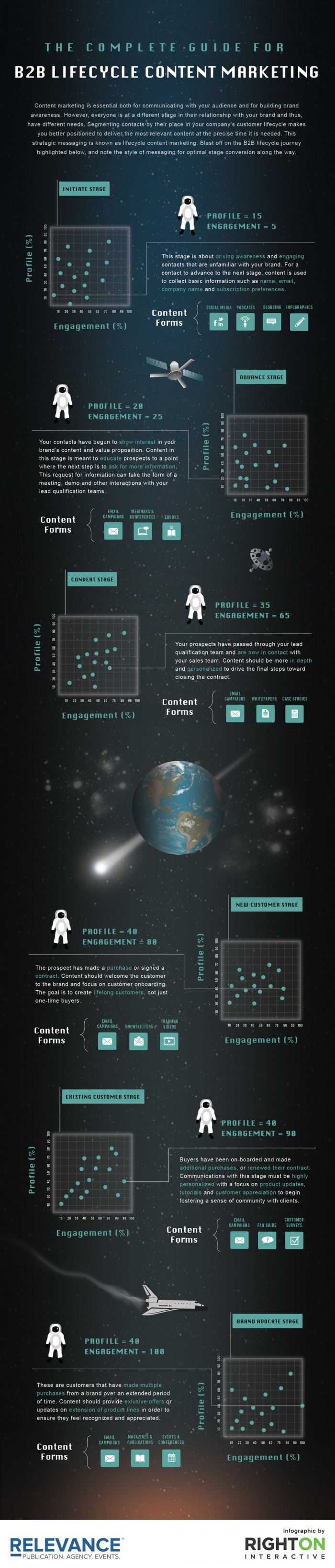
Discussing B2B digital marketing with business owners is frustrating. They think digital marketing is something that works for B2C brands and, even then they only think it works for tech brands and those will an exciting product consumers can get stoked about. Take a look at the infographic from Relevance at the end of this post for some more ideas on how to drive leads using B2B digital marketing.
The truth is that digital marketing works for every brand — regardless of whether their customers are other businesses or consumers and whether their brand is an exciting product or not. I mean, think about Dove. How unexciting can you get — soap and lotion. So, the brand creates digital marketing about something consumers ARE passionate about — body image.
And, B2B brands can do the same thing — develop a B2B digital marketing strategy around something their target audience is passionate about. Maybe your target audience isn’t passionate about your brand and maybe your products compete in a really boring market.
That doesn’t mean you have to talk about your brand in terms of its market. Hit on the social responsibility of your brand and craft a digital marketing strategy around some aspect of that responsibility. Find a social program you’re passionate about and build a digital marketing strategy around that. The options for B2B digital marketing are endless.
First, just like B2C marketing, you need to think about digital marketing (or even traditional marketing) in terms of a funnel and develop cont ent appropriate for each stage in the funnel.
As this infographic shows, visitors come to your website from various sources (organic and paid search, backlinks, social, and direct). Visitors view content and either leave or move to the next stage in the funnel. A small change in conversion rate (1%) can increase inquiries by 50%. So, optimizing the funnel is critical for improving performance.
 Image courtesy of StratoServe
B2B digital marketing is different than when you’re working with consumers. First, your target market is really busy, with people who work interference to keep you from reaching decision-makers. Second, B2B marketing often involves a team (buying center) rather than a single individual — as you see in this image.
Reaching any (or all) of the members of the buying center helps create awareness of your brand. Too often, B2B companies only try to reach the busy decision maker, ignoring much easier to reach members. Appealing to the gatekeeper is also important because they attempt to block the decision maker.
Because business customers are less likely to talk about your brand, you need a greater effort to create awareness. Using owned, earned, and paid media (plus traditional advertising and PR) is critical for creating awareness of your brand.
Despite first impressions, B2B brands can use social media effectively to create awareness especially by using powerful tools to reach only those people who represent potential buyers. It’s here that supporting a cause or being socially responsible can work to your benefit. Remember, even enterprise companies are composed of PEOPLE who use social networks. Reach those people and you’ve created awareness of your brand.
Outreach to other blogs and profiles is very valuable for creating awareness in the B2B space. Consider creating infographics or putting together videos and podcasts that other sites might want to use with their visitors.
And, don’t forget SEO. Search should be a strong piece of your awareness campaign. Understanding how your prospects search for products like yours is the key to crafting a good SEO strategy.
Your brand becomes interesting when it you show you produce a valuable product and when you earn the trust of buyers.
Create interest in your brand by effectively communicating:
Notice, I didn’t say you need to do these things. I said you need to communicate them effectively. The two aren’t the same.
That means knowing your target market and testing your content to ensure your message is heard loud and clear. We’ll talk more about measurement later.
I’ve heard Hubspot and others make the argument that business customers are about 80%-90% of the way to making a purchase before they contact you. They only want pricing from the sales person.
That means you need to provide a depth of information on your brands through vehicles like white papers, case studies, and recommendation from clients.
Let prospects reach out to you for more information without adding pressure to make a decision today. For instance, offer a subscription to a high-quality newsletter to provide useful information. Or let visitors sign up for a webinar or podcast where they can ask questions in addition to getting more information. Be sure to follow-up with recording for folks who couldn’t make the original broadcast time or who want a refresher on what you covered.
The conversion funnel doesn’t end with a customer purchase. That’s just the beginning of your relationship with this customer. And, it is a relationship.
Just like anything else in digital marketing, analytics are critical.
Set objectives for your campaigns in terms of awareness, interest, intention, and conversion. Then, establish KPI metrics that measure these objectives. Then, look at the actions contributing at each stage in the conversion funnel and assess performance of these content marketing efforts to answer questions such as:
A/B testing is a great tool for understanding what types of content get the most response from prospects.
Deciding to create and implement an influencer campaign for your client is a great thing — right up until you make one or more of these all-too-common mistakes.
I have a unique vantage point when it comes to these campaigns because I’ve been on both sides — the influencer who is pitched and the PR guy doing the pitching. Ask PR people about bloggers and you’ll get stories of divas who vastly overestimate their worth and make unreasonable demands. Conversely, mentioning PR folks to bloggers will often end with horror stories of micromanagers, a reliance on unreliable metrics and forms of payment that include everything but actual pay.
But it doesn’t have to be this way.
It is entirely possible for influencers and PR folks to live in blissful harmony, creating branded content that resonates with the writer’s audience while also creating buzz for the client and driving sales/lead generation/brand awareness. The trick is avoiding these five main pitfalls:
5. Mailing in Your Pitch
Look, I get it. You need influencers for your campaign, the client wants them yesterday, and mass emails are by far the fastest way to reach people and gauge interest. But mailing in a pitch and creating a horrible first impression is the quickest way to alienate potential brand ambassadors. First of all, make sure you get their names and affiliations correct. I can’t tell you how many PR people have pitched me using the wrong name and site, or started emails off with “Hello mom” while trying to talk me into a campaign about the latest bra I just HAVE to try. And while I have put on a few pounds and could, quite frankly, use the support, I refuse to work with people who couldn’t even be bothered to figure out my sex. So do yourself a favor and do a little research. Read the latest piece of content and talk about it in your pitch so they know you’re paying attention. Personalization takes a few minutes longer, but that extra bit of personal attention goes a long way when building these relationships.
4. Failing to Work WITH Them
I knew of a national campaign with a bunch of other dads for a big time brand and while the company’s idea was good, the hashtag and messaging they wanted to use was a flop. It felt forced and if the dad influencers had to use it, they all agreed it would be something that gets mentioned once and never again because it didn’t fit their brands. They brought up these concerns and the company listened, and ultimately changed it after a quick brainstorm. The campaign turned out to be a huge success, thanks largely to the influencers feeling involved and part of the process. That equaled more shares, organic engagement, and genuine enthusiasm from the people taking part.
3. Focusing on the Wrong Metrics
Pageviews, UMV, and number of followers are all important — but they’re not the end all be all. I’ve seen influencers with hundreds of thousands of Facebook likes and Twitter followers, but barely any engagement on the things they post. Beware influencers who have purchased followers and have little to no organic interaction on their posts. Instead, I’ll take the people with fewer Facebook fans who have off the charts engagement and tons of comments and likes when they issue calls to action. It’s tough to get clients to see past the follower count, but I’ve found engagement and quality content are the biggest drivers of a successful influencer campaign.
2. Lack of Trust
The influencers you’re hiring have the talent and the built-in audience, so let them create. Sure it’s good to talk about things like specific messaging, links that need to be included, and overall tone, but once you start forcing them to copy and paste large swaths of text and policing their copy, pictures, and videos, you’re hurting your own cause. They know their audience and you hired them for a reason, so trust them with a wide berth. They’re much more likely to come up with something great if you’re not riding them, questioning their every move, and forcing things on them they know their audience will reject.
1. Not Paying Them
I can’t stress this enough — pay your influencers. Too many companies think a “content for exposure” deal is perfectly acceptable, but it’s not. Branded content is a form of advertising, and if you want to leverage a valuable audience and take up space on someone else’s website and social media accounts, you need to show them you’re serious by taking them seriously — with actual payment for services. It is possible for some companies to pay influencers with experiences (tickets to athletic events, vacations, free hotel stays, celebrity meet and greets, etc), but make sure the people you’re approaching value those experiences before you offer. But if you’re not in a position to offer those things, offering monetary payment affords you good will and generally attracts a higher caliber influencer. You get what you pay for.
At Schneider Associates, we take pride in our influencer campaigns and we’ve had great success because of it. If you’d like to learn more, check out our case studies.
The post 5 Mistakes You’re Making With Influencer Campaigns appeared first on Schneider Associates.
I left a few pieces out of my last post, “How to Pitch.” What follows is a round-up of items that should have made a showing in that first round.
Check the individual’s status. A few years ago I managed a history web site. Three years after the gig ended, publicists were still sending me books — and I’m still receiving e-mail pitches.
When you research that individual, make sure they’re still doing what you think they’re doing. Don’t rely on the Internet. Pick up the phone. The receptionists at news outlets won’t always put you through to the person, but often they will confirm if the person is on staff, as well as the bureau and address of the building in which they work.
This past week I spoke with a publicist who asked if Steve would write a review of her client’s book and run it on Steve’s site. Her messaging made it clear that she hadn’t broken through the surface of Steve’s site. Had she gone deep, she would have known that reviews aren’t a part of the site.
My friend Denise McKee, always advises to KISS (Keep It Simple Stupid). Along these lines, Michael Thompson shared the following within the comments section of my last post:
My dad was in intelligence for the military for 30 years and a war strategy instructor for another 20. The best advice he ever received was when he just starting out and had to present in front of the big wigs and the biggest wig stopped him and said “you have one minute to tell me why I am here and one minute to tell me why I should stay.”
This is the version of the elevator pitches authors are advised to create — an explanation of their project that is short enough to be given within one elevator ride (between two floors, not between floor one and the top of a skyscraper). The minute Michael’s father mentioned is generous. Olympic athletes break records in a matter of seconds. What can you do in the same amount of time?
Telling me you know God isn’t going to get me to watch your new movie, but if you tell me you know my mom . . . That’s a game-changer.
This is another one Michael Thompson reminded me I’d forgotten to include in the first post:
Another great piece of advice that I have used successfully when trying to meet new people is “My name is Michael. I think we have some friends/contacts in common.” Try walking around from that question. Of course you need to have a few contacts in common, but if it is for an elevator pitch you should already know about the people you are seeking out.
He’s right. If you have a personal connection, you’ll automatically have bonus time. But, you better make sure the connection is strong and appropriate. Telling a former-playboy-turned-born again-straight-edge politician that you’re friends with Lucifer, too, won’t likely help your cause.
No one is waiting around for you to fill their day. If you make an ask, be ready to go. If what you’re requesting is half-baked, do not pass go.
Following is a good example of half-baked. The producer starts off making his case and then in the second paragraph notes that the host isn’t even on board. If you want someone to give you their time, make sure you’re ready to go before you ask.
I am the Producer for the podcast XXX and handle booking all of the guests. I wanted to reach out and see if you were interested and available to be on the podcast. XXX focuses on art, design, and the business surrounding it and also incorporates guests from various career paths. The show is hosted by ZZZ ZZZ whose sense of business and humor keeps each episode focused, but entertaining, with a conversational tone to each interview as opposed to a rigid question and answer format. We put up five episodes a week and each episode averages over 3,000 downloads from our listeners and paid subscribers. Our social media reach continues to expand every day with multiple posts for each episode promoting the guest and the show itself.
If you would like to be on the show please let me know. I think you would make a great guest and have a unique story to tell with your work. Once I know you are on board I will run everything by ZZZ, tell him your story and why I picked you to be on the show, and once I get his approval will email you back with a few dates we have available.
What’s the goal behind your pitch? What do you want to have happen and what do you need to have happen?
Do you want a Nobel Laureate to write an endorsement for your book? Sure, it would feel good to receive her stamp of approval, but what you really need is to sell books.
Do you want a journalist to write about your plan for world peace? Yes. Would be great to have your work in front of the journalist’s audience, but what you really need is for people to put your plan in action, rather than just changing their Facebook thumbnail to reflect the colors of different flags.
If you are going to ask something of someone else, make it about a need. Make it worthwhile.
Two things that are NOT worthwhile:
1) Asking well-known individuals to tweet or like or post about your project.
A few years ago, the marketing director for an organization run by one of my clients told me it was “unconscionable” not to pitch Huffington Post. His mentality was that the site has a huge audience, which in his book meant it was worth more than sites with smaller audiences. He was looking at the number without understanding what the number meant — that high numbers don’t equal high value.
What that marketing director — and YOU — need to consider is what investors consider when they look at market caps for various companies. Not familiar with market caps? The following is from Investopedia, which does a nice job of explaining market caps (and which you NEED to understand):
Market capitalization is just a fancy name for a straightforward concept: it is the market value of a company’s outstanding shares. This figure is found by taking the stock price and multiplying it by the total number of shares outstanding. For example, if Cory’s Tequila Corporation (CTC) was trading at $20 per share and had a million shares outstanding, then the market capitalization would be $20 million ($20 x 1 million shares). It’s that simple.
A common misconception is that the higher the stock price, the larger the company. Stock price, however, may misrepresent a company’s actual worth. If we look at two fairly large companies, IBM and Microsoft, on February 15, 2013 stock prices were $199.98 and $28.05 respectively. Although IBM’s stock price was higher, we can see that MSFT’s market cap of $234.6 billion was actually larger than IBM’s $225.1 billion. If we compared the two companies by solely looking at their stock prices, we would not be comparing their true values, which are affected by the number of outstanding shares each company has.
A large circulation or Twitter following or whatever other number you’re looking at is just a number. It isn’t a golden ticket. What you need are numbers that have value — that might not be as large as other numbers, but which have greater value and do create movement. The example I always give of this is from a few years ago, when a project Steve shared on his site was mentioned by Crossfit, and how that mention moved the needle more than mentions in the New York Times or Washington Post.
2) Do not ask a stranger to make a decision for you.
Steve routinely receives e-mails like this one:
I really enjoy your work! You’re the reason I got into living my life as a warrior. ‘The Warrior Ethos’ has changed how I look at life everyday.I’m also diving into “The War of Art” at the time I’m writing this email. I realize your time is very valuable, so I was wondering if you could answer a quick question I’m struggling with.
I’m writing my first book. It’s a book I’ve always wanted to read. It’s been pouring out of my head and it’s even been helping myself out with some of my own problems! I want to share this book with people, but I don’t know where to start.
“In your professional opinion, should I self-publish my first book and market it myself through my blog, or try to go with a publishing company?”
And this one:
“So my question to you, Steve, is how long should I stay at bay before I get going on the next project? The next day? The next week? Or the next month? I know the sooner I get on it, the better. However the last project took a ton out of me, and I’m simply out of ideas. So in other words, what can I do when the creative well runs dry?”
And this one:
This email is choppy im sorry mostly because it’s difficult to say what I want to say. I hate school and I’m wondering if sticking it out is what should be done or should I take a left turn off the highway into no mans land and try to reach my goals another way.
I have only a few months left, I graduate in August. Most people say to stick it out.. Because it is the logical thing to do- it’s true, it is. However… That’s months of my life that I am going to feel very pissed off and stressed over whether or not I used APA format properly… Months that I could be using to enjoy learning valuable things rather than meeting deadlines.
I’m sorry if this email is all over the map! You seem to have a good grasp on things and I would just like to hear your perspective… If you have the time.”
Two ships can sail the exact same course, but depending on the make of the vessel, the time of year, the crew on board, the number of storms, and other variables, the decisions in need of making and the experiences will be different. For this reason, only you can answer questions that relate to your life.
Along these lines, in his article “Cheat Sheet,” Shawn wrote about sharing a business idea with a respected business leader. What he realized after their exchange was that his ask was really an ask for a cheat sheet, for the leader to tell him exactly which decisions to make.
In Shawn’s words:
So after my thirty-minute spiel about my concept of a “Book Black List” and becoming the publisher dedicated to building one, the powerful acquaintance was quiet for about thirty seconds.
That doesn’t sound all that long a time, but just sit quietly for thirty seconds right now and you’ll see that it’s an eternity between two people.
When he finally spoke, here’s what he said:
“It’s a good idea. With dedication and enough time and money to buy a few breaks, it will work.”
That’s all? That’s it? That’s all this genius had to tell me?
I pushed him a bit… “Well, if you were to start up something like that, how would you do it?”
“How I would do it isn’t going to help you. I would not build that company because there are other projects in my life that I find more interesting. If this idea consumes you, I say plunge right in…but there is one question I’d ask of yourself before you jump… Why do you want to do it?”
(Read the entire post. It’s one of my favorites from Shawn.)
Another example lives within a scene from the film Field of Dreams, via the character Terence Mann. Terence is an award-winning author and former activist who left the spotlight decades before we were introduced to him. He and the main character Ray Kinsella are at Fenway Park, where Ray promised something great would happen:
Ray Kinsella: So what do you want?
Terence Mann: I want them to stop looking to me for answers, begging me to speak again, write again, be a leader. I want them to start thinking for themselves. I want my privacy.
Ray Kinsella: No, I mean, what do you WANT?
[Gestures to the concession stand they’re in front of]
Terence Mann: Oh. Dog and a beer.
Let the artists you admire do their work. Don’t ask them to think for you. You have a brain. Use it. And if you make a request, make it something that is really worthwhile — something you really need.
Think about how you’d respond to your own pitch.
The someone you are pitching is receiving other pitches just like yours. Like you, he has a family and deals with the same highs and lows of all families. When he’s not with family, he’s working (which is most of the time), trying to carve out some time at the gym, helping friends and colleagues, and dealing with water-pipe breaks, broken refrigerators, flat tires, and all the day-to-day crap the rest of us deal with. People magazine might make it look like the famous have someone handling everything for them, but that’s not always the case. They aren’t all Randolph and Mortimer Duke, with servants available to address every need. They change diapers and take out the trash, too. There’s actually a great story of Larry Bird mowing his own lawn in the documentary A Courtship of Rivals, about Bird and Magic Johnson. Point is, he’s taking care of his own stuff and fans are wasting time, watching him, finding it hard to believe that someone at the top of his game mows his own lawn. Imagine that!
Bottom line: Bird and others are busy. Why should they pay attention to your pitch? Why should they want to work with you?
When you answer that question, be clear to answer what you both get out of it — and PLEASE DO NOT self-talk your way into suggesting that you offer more to the person than he or she offers to you. There will be some exceptions, but in general, the person doing the requesting will always receive a greater benefit than the one being pitched. I hit this one in the previous post, but it’s worth repeating:
Do not infer that someone will benefit if they work with you unless you can prove it — and guarantee it — in advance. And DON’T tell them what a great opportunity it will be for them. That’s an old — and often brimming-with-bullshit — line. (more on “opportunities” via Jon Acuff).
Here’s an example from the music industry:
A friend of mine is the tour manager for a music legend — while shepherding an up-and-coming band on the side. The latter has led my friend back to her start, of setting up small-venue events. She likes the intimate feeling of some of these venues and suggested that the legend do a few — that they’d be a great way to connect with fans.
The legend said no.
This was a story shared a few years ago, so don’t quote me, but it came down to the fact that the legend spent years at the beginning of her own career doing the grueling small-venue route. A lot of time goes into planning and traveling and performing. It’s tiring and will knock the life out of you — and it takes away time from family and art.
Larger venues offer more bang for the investment of time and money, leaving the legend available to be with friends and family, and new projects.
It has nothing to do with not wanting to meet fans (which the legend does all the time) — or with not wanting to support small, up-and-coming indie venues. It has to do with her time. She’s older, which means saying a permanent goodbye to older family members and spending time with the younger ones. Then there are all of her projects.
Saying no isn’t about those venues, it is about her life. It makes more sense to say yes to opportunities that will offer larger returns when it comes to her work, so she can have personal time available.
So when you pitch her, or someone like her, you HAVE TO understand what you are asking within the context of her life.
When you ask her to read your book and send you her thoughts on it, you’re asking her for a two-day-minimum commitment. Why should she do that for a stranger when she barely gets time to see her own kids?
Why should she do an interview with you just because you feel like she should support up-and-comers? Do you understand that she’s receiving hundreds of requests from other up-and-comers every week, and has supported up-and-comers her entire career?
Bottom line: Think of what you’d be willing to do for a stranger and then say no to yourself — and then figure out what would have to happen for you to say yes. And: don’t play the pity card. I’d bet big in Vegas that there’s someone in this world who is worse of than you. Stick to the facts and reality.
I hit what “no” means and your reaction to “no” in the previous post, but … A few loose strings to tie:
I don’t have any scientific proof to back this, but my experience is that “no” hurts whether you like what you’re doing or not — but is easier to handle when you’re passionate, because you know a yes exists somewhere.
Robin Fletcher left a comment on my last post, which led me to ask about her experience with rejection. The first part of her answer:
I’m selling a software technology that is good and could genuinely help this business that I’m contacting, but I’m not super passionate about the product personally. This particular individual, after hearing my pitch, was cutting and criticizing to the point of being mean. It was as if he gave me the time of day just so he could cut me down for his enjoyment. Quite painful. After the conversation, I shrunk in my seat, feeling not only belittled by his comments, but ashamed that my coworkers witnessed my response to it. After some reflection, I realized that while he was a pill of a person and I shouldn’t take it personally, what really bothered me most was that I didn’t really care about the thing I was selling. Soon after, I quit the job, preferring to put my ego on the line for something that I cared about.
I’ve been there.
In 2000, when I was on staff in a publishing marketing department, I was pitching books on aromatherapy and Wiccans. I knew there was an audience, but it wasn’t my “thing.” It was what my boss had assigned. Painful work.
I still cringe when I think of pitching the one naked image of the Wiccan Witch author to Howard Stern. It wasn’t porn, but a tastefully done picture of the author, doing her thing in nature. Howard Stern was one of the author’s targets, which in hindsight wasn’t realistic. Wiccan Witches weren’t his thing, but he’d had a few naked women on, so… I should have pushed back on my boss — and should NEVER have pitched Stern. His team didn’t bite and eventually the project ended and I could move onto the next book on aromatherapy for horses… It was a lesson on how hard it is to pitch something you aren’t passionate about — something you’re just doing for a paycheck.
Think of all the telemarketers. When they catch you on the phone, some have it together, but most don’t know how to counter your questions. Instead, they quit. They don’t have it in them to fight for something in which they don’t believe.
In the second part of her answer to my question, Robin shared that after she quit her job:
I started a project called “Peace Puppets” a couple of years ago in response to the war between Israel and Gaza. After collecting hundreds of puppets and creating a fair amount of buzz in the media, the biggest challenge was getting someone to help get those puppets across the border between Israel and Gaza. I contacted at least 30-40 NGO’s (here and abroad), gov’t agencies and non-profits, all of whom told me that it was impossible to do. But I just couldn’t accept that its impossible to get loving and gentle puppets into the arms of children at a time like this. In other words – the thinking of the adults in power is unacceptable at the cost of a child’s joy. Whether I was wrong or right, this mission became my `why’, that made it impossible for me to give up, regardless of feeling rejected over and over.
I finally did find an organization (called Rebuilding Alliance) who agreed to help ship those puppets along with items for survival. But the key to this was the connection I had with the org’s founder. She got my pitch immediately. There was no “selling” going on because we were so quickly aligned…I just had to find her.
This is a good example of why it’s important to research the individuals and organizations you’re pitching. If you approach someone whose beliefs and actions are aligned with yours, you’re more likely to get to yes.
I used to joke that I’d pitch someone until I received a “yes” or a restraining order. I learned that in some cases it works, and in others it backfires.
In my last post, I mentioned T.X. Hammes’ book The Sling and the Stone and how it was in almost every edition of The Atlantic for a year. Much of this was because of James Fallows, who at that time was writing about topics about which T.X. was an expert. I bugged the hell out of Jim until one day he wrote, “uncle” in an e-mail and said he was interested in connecting with T.X. Within about two years, though… Jim headed to China, and wasn’t writing about the same topics. I know because I tried to pitch him similar authors and subjects in the years that followed. At that point, I could have channeled Andy Dufresne in Shawshank Redemption and written a letter a week, but it wouldn’t have worked. His work changed.
You’ve got to know when to push and when to back-off. And, as in Robin’s example above, you’ve got to realize that sometimes it is a matter of time, not a matter of worth.
There’s a nice quote from Will Smith that sums up our experience with the chase and how it relates to Steve’s The War of Art in particular:
Don’t chase people. Be yourself, do your own thing, and work hard. The right people… the ones who really belong in your life, will come to you. And stay.
~Will Smith
The War of Art sells more now than it did when it was released almost 15 years ago. Oprah had her own show when it was released, but she and Steve didn’t connect until over a decade after the book hit shelves. For me, the interview they did together is an example of what working hard and doing your own thing can lead to — for both of them. Oprah’s success wasn’t achieved overnight any more than Steve’s was.
We send free books all the time. What bothers me is when I receive a “Yes, please send free books — and by the way, can you sign them all?” No.
A few years ago that tour manager friend of mine was working with a musician that a friend of a friend was obsessed with. The friend asked if I could obtain a signed picture of the artist. My tour manager friend said yes, but her boss wouldn’t do anything personalized. It takes time to sign your signature. Imagine the time to personalize every picture. Becomes a full-time job.
Another example from Field of Dreams:
Ray Kinsella: I did it all. I listened to the voices, I did what they told me, and not once did I ask what’s in it for me.
Shoeless Joe Jackson: What are you saying, Ray?
Ray Kinsella: I’m saying, what’s in it for me?
I’m not saying the people you want to pitch are sitting around asking “what’s in it for me?” every time they are pitched, but… That question exists. It’s probably a good one to ask yourself before you write that pitch letter.
What’s in it for me? What do I really want and what do I really need?
Next up: What you should include with your pitch letter or e-mail.

Email unsubscribes are like death and taxes. You can’t avoid any of them, but some smart moves now can help you improve your situation with each one.
You can’t stop people from unsubscribing. It’s against the law, for one thing, and it annoys your subscribers to the extent that they either report your messages as spam or disengage from your brands and company.
You can, however, make unsubscribing easy and trustworthy for those who really want to go; then, tune up your email program to reduce the causes that prompt most subscribers to bail out.
We covered the basics of a good email unsubscribe experience in an earlier post. Next, we’ll look at some easy tune-ups aimed at stemming your tide of unsubscribes below.
Look for your email unsubscribe rate (the percentage of subscribers who opted out in that delivery) in the delivery report generated after each send. Don’t just glance at this statistic, though, when you scan your delivery reports. Instead, track it over time.
Compare acquisition sources and email unsubscribe rates. See how opt-ins from your website form compare with co-registration sites, your social channels, print media, and transactional messages.
In reality, relatively few subscribers will opt out per campaign. A 2015 study by Silverpop/IBM Marketing Cloud found the average email unsubscribe rate was well under 1 percent across all industries and global regions.
Aside from the insight you get into your email program’s health, reducing unsubscribes helps you retain more subscribers and waste less money on acquisition.
Reducing your email unsubscribe rate by just 0.1 percent would save 1,000 subscribers every time you send to a database of 1 million people. That’s more than 100,000 contacts retained over a year if you send four emails per week.

As Captain Obvious might say, list growth happens when you attract a steady supply of new addresses while reducing unsubscribes. What is less obvious, however, is that your opt-in program is the place to start working on reducing unsubscribes.
These start the subscriber experience on the right foot. Restate your email’s value proposition and reaffirm what you’ll send and how often. Offer reasons to send new subscribers back to your website to browse, download, get information, and use new accounts.
If yours is lightly traveled, promote it more actively with emails asking customers to set or manage their preferences. Also, add alternatives to opting out such as changing lists, updating preferences or changing frequency. Then, use that data to set up segmentation.
Everybody talks about relevance, but how do you deliver on it?
Use whatever data you have to segment your database and create messages that reflect your customers’ interests and behavior. Be sure your content matches what you promised at opt-in!
Beyond this basic guidance, however, consider what kinds of offers you send out regularly. Is it the same “Buy Now/20% off” message? Or do you mix in informational content with sales offers? Be sure you aren’t boring your subscribers into unsubscribing.
Break down your one-size-fits-all email program into a cafeteria plan that lets subscribers choose among several options: daily deals, weekly summaries, specific product lines, company news, and other special-interest content.
There’s no such thing as a single “right” frequency. What works for some subscribers will be overkill to others if they aren’t engaged in your emails the same way. What you sell dictates frequency to some extent. For retailers, flash sales on frequent-purchase items lend themselves to higher frequency messages than luxury goods.
Use testing and segmentation to create customer segments that respond to different frequencies: higher for the most engaged customers and lower for those who open, purchase, or otherwise interact less often.
Many unsubscribers really just want to change their addresses. Make this easier by adding an email change-of-address link to all of your email templates, and call it to subscribers’ attention in the link text or a button.
As a last step, add a short survey to the email unsubscribe process. Offer several possible reasons like address changes, no longer needing the information, frequency, and quality of content.
Again, don’t assume that no comments mean all is well. As with email unsubscribe rates, watch for trends and what reasons people cite most often.
Minimizing unsubscribes takes work, but it delivers a double benefit! You reduce the load on your acquisition efforts by not having to replace as many lost subscribers, and you also tune up your email program to make it more engaging and compelling. In the end, everyone wins.

Content has become increasingly data-driven. Articles written for every industry are peppered with statistics to attest to the writer’s credibility and the amount of research they put in. More than ever, too, will points be accompanied by an illustrative chart or graph.
When done well, a chart does two big things: one, it presents data in a way that is quick and easy for readers to understand, and two, it offers some visual variety to the article, breaking up the text and maintaining readers’ attention.
When done poorly, however, a chart skews or misrepresents data, confuses readers, and tarnishes the credibility of the writer. Nobody wants that. Remember, the purpose of a graph is to make data easier to understand, not more difficult. That’s why it’s important to understand the basics of good chart design.
This article is going to walk you through the no-fuss, quick and dirty design principles of the four most commonly used types of charts and graphs. They are:
Pie charts are the most fun (and most tasty) type of chart. That being said, they should be used with consideration, as they are easy to mess up. Pie charts should be used to visualize portions of a whole. They should not, however, be used to illustrate complicated relationships between many segments. In those cases, it’s better to use a bar graph.


The ideal use for a line chart is to show continuous data over a period of time. Line charts highlight trends, acceleration or deceleration, and volatility like peaks or troughs. They’re also very dramatic. They can show great success stories and plummeting failures. But because line charts are so dramatic, they have the potential to misrepresent data.

Also known as column graphs, vertical bar graphs, simply put, demonstrate discrete quantities. These are aerguably your most reliable and diverse graphs.
Vertical bar graph best practices:

Cousins to vertical bar graphs, have the unique quality of ranking items by the same attributes (for example, ranking states by their population).

Ok, so sometimes you don’t have the time to spend painstakingly designing charts for your article. You shouldn’t miss out on the opportunity to augment your content with data visualizations. Luckily, there are tools out there that you can use to make charts quickly and easily. Here are a couple of places where you can make charts for free:
Beam is completely free to use and allows you to download your image directly to your device. It offers four types of charts (Pie, Line, Bar, Horizontal Vertical Bar) and four pre-set themes. All you have to do is paste your data in the slide-out table. Beam’s new and fresh design also sets it apart from older tools.
ChartGo also free to use, offers four types of charts (Vertical Bar, Line, Pie, Area) with customizable styles and also allows you to download directly to your device. You input your data into a text box.
You will need to make an account to save your chart and the process for exporting your chart as a PDF is less direct than the two previous tools. That being said, amCharts allows you to personalize every element of your design and they offer over ten chart types.
If you’ve been keeping a pulse on the sales and sales development space, then there’s no doubt you’ve heard of “account-based sales development” (ABSD). You may have even begun implementing your own version of ABSD with your team.
The account-based sales development model has caused a fundamental shift in the way prospecting and outbound sales is performed for companies selling in the mid-market and enterprise space. Comparing lead-based sales to ABSD is like trying to move a pile of sand with a spoon – why not use a bulldozer?
If you’re new to ABSD, there are the Cliff’s Notes. In this model, sales reps are focused on creating new qualified pipeline by prospecting at the account level rather than at the lead level. Both are ultimately focused on generating pipeline, but the difference lies in the way this is accomplished. Previously under the lead-based model, reps had to meet their goals with high volume efforts: engaging in more sales activities, sending more emails, making more dials, and moving on to the next prospect as quickly as possible. Since the average contract size of a targeted account in the ABSD model is much larger and more valuable, the focus is on high quality efforts; targeting high value accounts by following up multiple times, using numerous channels, and moving across decision makers within the account. This approach not only allows for more time researching and creating highly personalized messaging, but demands it.
However, with all the hype around ABSD, I’ve seen sales leaders jump into trying to implement this strategy without all the proper information and preparation required to set themselves up for success. The single most detrimental factor that I see sales teams overlook or completely miss before implementing ABSD is organizational alignment. Do you have the right people involved, is the organization prepared, and does everyone know how to work together?
Account-based marketing has been around for a while and has gained more popularity in the last few years. It’s thought of as the process of targeting specific individuals within accounts and using marketing techniques (such as targeted ad buying, content marketing, retargeting, etc.) to bring them through the marketing funnel. It was a process that marketing and only marketing owned.
Now, separately, sales teams have decided to take on prospecting and selling at the account level, thus the rise of ABSD.
The misconception is that one function is responsible for the activity of targeting and breaking into accounts. It shouldn’t be thought of as a marketing campaign or sales campaign, but rather a strategic business initiative that involves your entire organization.
Once your entire team is aligned with your growth initiatives, having marketing, sales, customer success and everyone else on the same page will be the best thing for your growth.
Traditionally (and unfortunately), marketing and sales teams have not always seen eye to eye. Mark Roberge puts it well in his book, The Sales Acceleration Formula, “Marketing sits in one corner of the office, harboring the perception that the sales team is a group of overpaid, self-centered brats who fail to see the big picture strategy. Sales is in the other corner of the office thinking the marketing team sits around doing arts and crafts all day, and has no idea what qualified leads look like.” Obviously, this is not good for the bottom line.
Roberge advises for a Service Level Agreement (SLA), which is meant to establish similarly quantified agreements between the two teams and aims to put them on similar revenue quota. Establish an SLA that defines what a qualified lead is, when that lead should be passed to the sales team, and how the sales team should then go about contacting and converting the lead. This way sales is accountable to marketing just like marketing is accountable to sales. Roberge further recommends sending out daily reports to keep each team motivated and on track.
This SLA should include:
Only once sales and marketing are fully aligned, can you begin to implement an effective ABSD strategy.
In lead-based selling, every rep was for him or herself. However, that doesn’t work within ABSD. Selling at the account level takes a team consisting of Sales Development Representatives, Account Executives and Account Managers /Customer Success Managers. For enterprise sales on the inside sales team, the SDR to AE or to AM/CSM ratio should be around 1:1:1.
As a general rule of thumb for enterprise level prospecting, a team should only be prospecting about 50 accounts at any given time. Only after an account is closed won or dead lost does a sales development rep add another account. The sales development team become true experts about their assigned accounts and the unique problems facing each account.
Once you have cooperation at an organizational level, you still need to make sure you have cooperation at an operational level. Here’s what we mean. Up until now, we’ve talked at a high level of getting your teams on the same page. In theory, that’s all good. However, when you begin to execute at the tactical level, your teams may not know how to coordinate day-to-day activities and communicate progress. Our solution is the Daily Team Stand-up.
It sounds simple because…well, it is. At PersistIQ, we’ve implemented a daily team stand-up between our marketing, sales and customer success teams. We start every meeting at the top of the funnel and work our way down. Each member reports on their one metric that matters most and the activity related to that metric. This way, each member of the sales team knows what I’m doing on the marketing side, and I know the objections everyone is encountering in the field when they’re out talking to prospects and customers. Don’t confuse this with a time to give an update, but rather a time to report on major changes, challenges and progress on target accounts (if any). This should take only between 5-7 minutes.
As you can see, account-based sales development requires a more strategic, thoughtful and collaborative approach. Only when you get buy-in from your sales, marketing and customer success team can you begin to develop a winning strategy. Once everyone is on the same page, you can start to coordinate the efforts of the individual team members.
Of course, this is only the beginning of account-based sales development. We’ve only scratched the surface. Each topic discussed here can even be broken down further, not to mention we haven’t yet touched on other important structural changes your team has to make, such as:
To cover that, we’ve teamed up with QuotaFactory to give you The Account-Based Sales Development for Revenue-Driven Team. This free eBook covers all this and more. Download it here.
The post How to Structure Your Team for Account-Based Sales Development Success appeared first on OpenView Labs.

Time is a precious commodity, especially when you're a small-business owner and it feels like there are always a million things to do.
"Most small-business owners don't build time into their workdays for things that are not just run, run, run for the business," Laura Vanderkam, time-management expert and author of "I Know How She Does It: How Successful Women Make the Most of Their Time," tells Business Insider.
While the core production of doing things for your business will obviously take up the majority of your day, Vanderkam says it's also vital to make time for other high-value items, like networking, building skills, interacting with employees, and leisure.
While this routine may not be right for everyone, Vanderkam's sample schedule is a good jumping-off point for fitting it all in when you own a small business:
SEE ALSO: 12 chores small-business owners should pay someone else to do
DON'T MISS: Here are some of the best breakfasts to keep you going all day

Recent research out of Belgium suggests that working out early in the morning — before you've eaten breakfast — doesn't just help you meet your fitness goals, but could even give you more energy than those few extra minutes of shut-eye.
Time to hit the showers, eat a healthy breakfast, take care of family responsibilities, and get people where they need to go.
The first thing in the workday is your core production time, when you should focus on the day-to-day priorities that need to get done for your business to stay afloat.

By the year 2020, 40 percent of the United States workforce will be freelancers. And the number is only expected to grow from there.
Whether you’re an entrepreneur, solopreneur, or whatever-preneur, it’s going to become more and more critical for you to learn how to grow your business the right way. This means you will need to become better at influencing others.
Great solopreneurs need to be great salespeople. Regardless of the type of business you run, most of what you do on a daily basis will involve influencing others. The better you are at this, the easier it will be to get more customers.
As you already know, the issue isn’t whether or not you need to be able to sell more effectively. The issue is what you need to do in order to become even better at earning more business. How much easier will it be to grow your business when you know how to get others to do the things you want them to do?
Below are proven tips that will make you better at selling. If you practice these solopreneur sales tips consistently, you will find it much easier to earn and retain more customers.
Being great at sales means realizing how important it is to be as helpful as possible to your prospects and customers. By providing more value, you will be able to stand out from your competition.
When it comes to building profitable relationships with your prospects and customers, it’s all about giving value. The amount of influence you will ever have over a person is directly tied to the amount of value you provide. When you become valuable to your prospect, you establish a more favorable position in their minds.
This is what you want. The more they value you, the more you will be able to sell them.
Of course, when I talk about being helpful, I’m not talking about washing your prospects’ cars or picking up their dry cleaning. Unless of course, you’re into that kind of thing.
I’m talking about finding ways to make their lives easier that don’t necessarily involve selling them your product or service. There’s a few ways to do this, but the easiest way to provide value is to use your expertise. Since you’re already knowledgeable in your industry, you can use your knowledge to help your prospects.
One of the most effective ways to do this is by using content marketing. The reason content marketing works so well is because of the fact that it involves providing tons of value in a way that is easy for your prospect to consume.
If you have a website for your business (and you should), you would be well-served by consistently publishing content that can help your audience. Not only will this help your prospects, it will help you establish greater credibility. Content marketing is also a great way to show that you have authority in your field.
One important thing to remember about content marketing as a strategy is that it is not a sprint, it’s a marathon. It’s a more long-term approach. But when you do this right, you will stand out from your competition.
Patricia Fripp said, “You don’t close a sale, you open a relationship if you want to build a long-term, successful enterprise.”
Let’s face it. Consumers don’t want to deal with a company that is only interested in getting into their wallets. As an entrepreneur, you have to focus on something more than just winning the sale.
When you focus only on the sale, you are taking a short-sighted approach that will damage your sales efforts in the long run. It’s very likely that you’re robbing yourself of a great opportunity to earn more business and impact more people.
Here’s the thing. Your overall objective shouldn’t just be to make one sale. It should be to transform your prospect into a die-hard long-term customer who is eager to tell others about what you offer. While you may not be able to turn every single customer into a brand evangelist, focusing on the relationship will enable you to maximize the amount of people who are willing to tell others about your company.
What this means is that you have to learn how to sell without being pushy and impatient. This can be more difficult at first; many people become eager to start explaining the benefits of their offering.
But you have to be patient.
Build some rapport. Get to know your prospect. Let them get to know you. Anyone who is in sales know that people buy from those they know, like, and trust. Building this type of relationship takes time, but in the end, it’s well worth it.
The fact that you will need to establish and develop a strong online presence goes without saying. Most businesses can’t survive if they don’t have a way for their prospects to interact with them online.
As I stated earlier content marketing is a great way to provide helpful information to your audience. But when it comes to actually engaging with them, you should consider using social media.
When developing a social media strategy, you need to create a viable strategy first. Here’s some questions you should answer before executing a social media strategy:
When you have an understanding of where your ideal clients spend their online time, you will know which social media platforms are the best for you.
Another key benefit of social media marketing is the ability to listen. Social listening involves watching various social media channels to see what your potential audience is saying. It’s a great way to find out what people are saying about you online.
Also, social listening gives you yet another opportunity to position yourself as an authority. Find out what questions your potential customers are asking. Find out what they are complaining about.
Then, use your expertise to answer their questions. Develop content that addresses their pain points. Remember, it’s all about being helpful.
If you want to stand out from your competition, you have to offer something they don’t. You have to be able to do something better than the others.
When you don’t stand out from the other brands in your industry, you’re forced to try to beat your competition on price, which means you devalue your offering. It will be harder for you to grow your business.
If you want to succeed at sales, you need an attractive brand that your prospects can believe in. You need to find a way to make your business stand out from the competition.
One essential factor in this is your value proposition. You need to identify a value proposition that shows why your prospect should choose your company over your competition. There has to be something that you offer that sets you apart?
Does your offering do it better? Faster? Easier? Figure out how you want to distinguish yourself from your competition, and it will be easier to close more deals.
A strong and distinct brand is absolutely crucial to your sales efforts. Without effective branding, you’re just another “me too” company that is indistinguishable from your competition. This isn’t what you want.
The most important part of building a strong brand is determining your purpose.
This is something all successful brands do well. You need to stand for something bigger than your product or service.
It’s all about your “why.”
In his book “Start With Why,” Simon Sinek continually makes the statement that people don’t buy what you do, they buy why you do it. When you’re trying to grow your business, the point isn’t to focus on doing business with those who need your product. The point is to do business with those who believe what you believe.
Purpose and belief transcend your offering. When you can effectively communicate why you do what you do, you give your prospects something to connect to.
People can’t connect to a product or service. But they can connect to the reason you do it. Why? Because everyone desires to feel a deep sense of purpose in what they do.
It’s part of being a self-actualized person. If you want your brand to become successful, you need to have a self-actualized brand.
Want an example?
What do you think of when you think of Nike?
Yes, you probably thought about shoes. But chances are, you also thought about their brand purpose without really even thinking about it.
Nike stands for excellent performance. It stands for pushing yourself beyond your limits and achieving things you never believed you could achieve. What phrase sums this idea up? “Just Do It.”
See what I mean?
Nike is about more than just making sneakers. It’s about inspiring people to overcome their challenges.
Determining your brand purpose can help you become a better salesperson. This is because when you have a deep purpose that motivates you, it enables you to sell with conviction.
This is important. When you sell with conviction, your prospects will pick up on your passion. It will become contagious and they’ll become excited to buy what you’re selling.
Lastly, you need to understand who you’re trying to sell to. This seems like it should be obvious, but many people make the mistake of rushing directly into the sale without really understanding what their prospects want and need.
That’s a huge mistake.
But it’s a huge mistake that you won’t make because you’re reading this post! Here’s the bottom line: if you don’t know who your prospects are, you won’t succeed in your efforts at sales. You’re going to fail.
Why?
Because you can’t address your prospects’ needs if you’re not sure what they are. When it comes time to present your solution, you’ll be shooting in the dark. You may be able to get some sales this way, but not nearly as much as you could if you took the time to get into the minds of your prospects.
The issue isn’t just to ask a lot of questions. The issue is asking the right questions. The right questions will increase your chances of making a successful sale. The key is to encourage them to talk as much as possible.
The great thing about his is that it doesn’t just give you the information you need; asking good questions also helps you build more trust with your prospect. When they see that you’re genuinely interested in them as people, and not just a paycheck, they will trust you more.
When your prospects trust you more, they will be far more likely to buy from you. Do yourself a massive favor and start working on asking better questions. You’ll be glad you did.
With more and more people becoming solopreneurs, it’s going to become even more important to learn how to sell more effectively. The important thing to remember is that selling isn’t a skill that you have to be born with. It’s a skill that can be learned and honed over time.
If you follow the tips in this article, you will become a much better salesperson. This will make it much easier to grow your business the right way.

For the first time in seven seasons of "Shark Tank," one of the Sharks has returned to invest in a company whose founders missed a deal during their appearance on the show.
In the latest episode of "Beyond the Tank," the "behind-the-scenes" companion show to "Shark Tank," it was revealed that Kevin O'Leary partnered with sisters Donna and Rosy Khalife, founders of the Washington, DC startup Surprise Ride.
"Now I own a piece of this company, I like what they've done so far — I'm going to pour gasoline on this fire, get this thing to $10 million in sales," O'Leary said.
The Khalifes founded Surprise Ride, a craft kit subscription service for kids ages 6-11, in 2012, shortly after Donna received her MBA from Harvard Business School. Donna serves as CEO and Rosy as COO.
When they appeared on Season 5 of "Shark Tank" in 2013, they had acquired 220 subscribers over four months and were on track for $500,000 in annual sales for the next year. They were seeking an investment of $110,000 in exchange for 10% of the company, but the investors thought the $1.1 million valuation was unwarranted. Robert Herjavec offered the $110,000, but for 25%, and he became frustrated when the Khalifes negotiated harder. They left without a deal.
A couple years later, they agreed to appear on "Beyond the Tank" under the pretense that they were to be another example of founders who missed a deal on "Shark Tank" but flourished after the experience; they had no idea that O'Leary, who was very interested in the product back in Season 5 but found the valuation much too high, had kept an eye on the company's progress.
Since the "Shark Tank" appearance, Surprise Ride not only exceeded its goal of $500,000 in annual revenue in 2014, but surpassed $1 million in annual sales last year. The company also became profitable, and the Khalifes are using profits to grow their team.
 In classic reality show fashion, the "Beyond the Tank" producers had O'Leary make an unexpected appearance at the Surprise Ride headquarters.
His offer was far from a done deal, and he told them it was completely non-negotiable: He would invest $50,000 for 2.5% of the company, and would profit from a 6% royalty on every product sold until he made $150,000, at which the royalty would disappear. The sisters hesitated a moment, but then happily agreed to it.
Rosy told DCInno's Eric Hal Schwartz that the $50,000 was intended solely as a way for O'Leary to kick off a partnership. "Fifty grand isn't much compared to what a startup needs to grow, but it's not about investment in terms of monetary value," she said. "It's about Kevin's marketing value. That's worth millions in itself. We're excited to be working with him on customer acquisition and growth."
O'Leary, who goes by the nickname "Mr. Wonderful," told the Khalifes that Surprise Ride would become the newest member of his Something Wonderful Family, a collection of his favorite "Shark Tank" investments that he markets together for family-friendly event planning.
O'Leary said another reason he wanted to bring Surprise Ride into his portfolio was because he realized over the past year that his most profitable "Shark Tank" investments have female CEOs. He told the Khalifes that he's not exactly sure why that is, but he's at least found from his own experience that his female CEOs are less volatile and better planners than his male leaders.
"Surprise Ride is at an interesting juncture," O'Leary said on "Beyond the Tank." "I think these girls have learned a lot since they appeared on 'Shark Tank' and I think they've learned from time that you don't want to take an opportunity and squander it."
Join the conversation about this story »
NOW WATCH: This is the greatest business lesson 'Shark Tank’s' Kevin O’Leary ever learned
Being an American manufacturing company is no easy feat. Manufacturers today are tasked with staying innovative, creating high-quality products, and keeping costs low to keep work from going overseas. The good news is: the US manufacturing industry is once again on the rise. In fact, many economists are predicting that there is a second Industrial Revolution on the horizon in America. Boston Consulting Group recently published a report that predicts that 30% of America’s imports from China could be produced domestically by 2020.

In today’s complex selling environment, few industries find themselves spared from the challenges of marketing to an increasingly powerful buyer. The manufacturing industry is no exception. While manufacturers face keeping up with an evolving technological landscape for production of their goods, many of these companies who’ve been in business for decades are finding themselves behind the curve of new-age sales and marketing.
While manufacturing marketers may face unique problems, their goals remain universal among marketers – build brand awareness and grow revenue. Here are three challenges that marketers in manufacturing face today, and three opportunities that marketing automation can offer to help alleviate that stress.
The new-age buyer isn’t waiting for you to qualify them as a lead and take them through the sales cycle at your pace. They are skipping this step altogether, and have taken much of the sales cycle into their own hands. Buyers today are focused on consuming online research, reading peer reviews, and weighing their purchasing options long before they’re willing to speak to any sales people. Marketers in manufacturing (like many other industries) struggle to shift their sales and marketing efforts to accommodate this new buyer. The result? Too often their content misses the mark – they aren’t offering the right content to guide the buyer towards preferring their company as that buyer does the qualifying research.
As buyers rely less and less on salespeople to deliver information about manufacturing organizations and more and more on the content marketers provide, oftentimes a disconnect between the two parties starts to grow. Sales and marketing teams within the organization may disagree on what constitutes a qualified lead. Sales may or may not see value in behavior that marketing believes indicates sales-worthiness. Both can lose touch with their target audience and messaging can go off target, not speaking directly to that empowered buyer outlined above. Ultimately, organizations who struggle with this disconnect often fail to deliver the information buyers need to make manufacturing purchasing decisions.
Many manufacturing companies have been around for decades, flourishing with minimal marketing. What’s carried the success of many manufacturing companies in recent history has been a strong product supported by a knowledgeable sales team. While these two aspects are key to the success of any manufacturing organization, there also needs to be a savvy middle man (marketing) to help connect the great product with the right buyer. Many manufacturing organizations, such as R.M. Hoffman, are beginning to feel the pressure to adapt to these changes, and to shift their marketing resources towards a digital marketing landscape. More companies are discovering that their prospects are online, and they see the advantages of meeting those buyers there.
Watch this video case study to learn how R.M. Hoffman revitalized their marketing with Act-On:
If your buyers aren’t banging down your door to purchase your product, it doesn’t mean they aren’t interested. They may not know about you. If they do know who you are, they may not have yet discovered a compelling reason to give you consideration. It’s your job to give them a good reason to take another look.
As we touched on above, new-age buyers are doing the research on their own. In fact, SiriusDecisions reports that 67% of the buyer’s journey is now done digitally. Set your sales team up for success by reaching out to your prospects via email to provide them with the information they need about your organization to make a purchasing decision. Let them know what you offer, and how and why you are different – and better.
Manufacturing knows automation. In fact, most manufacturers are already automation pros! From the shop floor to distribution, manufacturing has led the way for centuries in adopting automation techniques and technologies. Marketing is no different; much of it (especially email) is a process that can be automated, saving time and ensuring consistency. Automating your email marketing is the natural next step for continuing your business momentum and optimizing efficiency.
In order to bridge the gap between the buyer and the seller, marketers need to make a point to show the prospective buyer that they are understood. Don’t sent emails that don’t apply to them – DO send emails that are highly personalized and directly speak to that unique prospect’s needs and wants.

This is another big win for marketing automation. Using it to segment your emails is one of the most powerful tools of modern marketing. Segmenting your email list by products, buyer types, sales cycle stages, or previous online activity (web page visits, email clicks, etc.) allows you to deliver the most relevant messages to your audiences. When prospects come to expect solid, consistently meaningful messaging from a manufacturer, they begin to trust the sender, and that can lead to a sale. Personalized emails also translate into higher open rates and click-through rates, which are directly related to higher attributable revenue for your marketing programs.
Customized landing pages help marketers in the manufacturing industry reach and engage more customers with a lot less effort. Using marketing automation to create landing pages to streamline your inbound and outbound marketing efforts is a huge win that requires less work on your part. In order to reach the highest percentages of your target audience, make sure that your landing pages are fully mobile responsive in order to ensure a positive experience across all devices – desktop, tablet, and mobile. Lots of people start and action on one device and finish it on another, so you need consistency across these channels.
When you send an email with a single focus or offer, make sure you have a landing page tailored to give your prospect a way to take the next step. Once your prospects land on your customized landing page and see more juicy details, give them the option to convert by filling out a form using ready-made form templates within your marketing automation system. Capturing these leads will help you to generate interest in your products, give you more data you can use to tailor more relevant offers or information, and will give you the capability to nurture these leads until they’re ready to purchase.
All in all, we know that marketers in the manufacturing industry are sweating for a lot of reasons – reaching your prospects reliably shouldn’t be one of them. Marketing automation provides an all-in-one way for marketers to easily attract, capture, and engage their prospects and customers. Leave the heavy lifting to those building your product – use marketing automation to generate your decision-making data, build brand awareness, convert more leads, and ultimately increase company revenue – and get the credit for it.
Interested in learning how marketing automation can help revitalize your marketing? Take a video tour of Act-On to learn how marketing automation can help you engage your audience across the entire buyer’s journey with automated email drips, custom landing pages and emails, and so much more!
What's this thing worth?
Pricing has always been a fascinating area of interest. While many are quick to dismiss the merits of The Four Ps, and their current value in the marketing equation, I'm less quick to toss them aside. At their core I still believe that Product, Price, Promotion and Place retain their importance when trying to market a product and/or service. With that, pricing is now variable and quite elastic. Pricing is now much more dynamic than ever before. Because of platforms like Amazon, it's increasingly more difficult to know if/when a consumer is even getting some kind of deal. Think about it this way: I could be seeing an entirely different Amazon pricing format than you are... And how would any of us be any the wiser to it?
Now, elevate these pricing and value models to the digital economy.
If we have seen anything in this digital economy, we've seen valuations of companies that can best be defined as stroke-inducing. Need I remind you that Snapchat turned down three billion dollars from Facebook back in 2013 (long before anybody had any real clue of what Snapchat could be)? How about Amazon acquiring Twitch for one billion dollars back in 2014? Twitch. The place where people go to watch other people play video games online. I'm in no way belittling these valuations or acquisitions. I am - without question - trying to understand how this pricing is both estimated and then agreed upon?
Question: how much is Bitmoji worth?
Bitmoji allows you to create a simple cartoon version of yourself (an avatar), and then enables it as an alternative keyboard on your smartphone, so users can up their emoticon game in text messages and emails. It's a ton of fun (and you can bet that my Bitmoji rocks because I'm bald, sport glasses and wear all black... very easy to make into a caricature). Bitmoji just got acquired for $100 million by Snapchat (the dollar amount has not been verified, but it is the persistent rumour in the trades). Staggering? Bargain? Thoughts?
What does Snapchat know about pricing that the rest of us don't?
I'm often asked how something like this can take place? Something like Bitmoji. A freemium model, where money is exchanged for a more customized caricature. On the other hand, there is a large and installed user-base (and once installed as a keyboard, I'm fairly certain users don't bother to remove it). Perhaps Bitmoji on top of Snapchat will get users to tinker even more if they can integrate them. Maybe Snapchat needs to acquire other companies to build a portfolio of users across mobile-centric channels? Clearly, Snapchat has some logic there. What most people don't understand about these businesses, is that it's often less about how many people are paying to use a service, and more often about creating something that one company really wants to buy. Ultimately, Bitmoji's only customer may need to be a company - like Snapchat - that wants it.
A more elegant question of pricing: who is your brand worth the most to?
Tags: amazon avatar bitmoji brand business blog digital economy digital marketing digital marketing agency digital marketing blog email emoticon facebook freemium j walter thompson jwt keyboard marketing marketing blog marketing mix mirum mirum agency mirum agency blog mirum blog mitch joel mitchjoel online gaming place price pricing product promotion smartphone snapchat text message the four ps twitch user base userbase variable pricing video games wpp

A young man with cancer at our Silicon Valley firm requested additional sick time for post-cancer treatments and checkups.
Another employee, one who had been born in Vietnam and came to this country with his parents, requested one day per month when he would work remotely. He would return to south central Los Angeles to work a double shift at his parents’ liquor store. Setting up his laptop there meant that his parents could take a brief break from their sixteen-hour days.
Perhaps these seem like reasonable requests that any humane manager would approve. And in both cases, as their supervisors, we did grant these requests.
And yet more often than not, the unspoken rules of “killing it” here in Silicon Valley might prevent people like these from even mentioning their needs to their managers. If you’re not sleeping under your desk, you’re not committed — an attitude we sometimes refer to as “martyr capitalism.”
It’s not just that we want our employees and collaborators to get their jobs done — that’s a given — we want to see them thrive both in and out of the workplace. It’s a magnanimous attitude with no self-evident ROI, and brings to mind Gary Vaynerchuk’s quip with a venture capital professional who was quizzing him on the worthiness of his new business. She kept repeating, “But what is the ROI on this spend?” and he finally snapped and retorted, “What’s the ROI on your mother?!” In other words, not all the value of a company can be quantified.
Instead of being penalized for needing time to process a difficult life change or illness — or even to attend a child’s soccer game — we believe managers should encourage taking the time to have a rich life outside of the cube.
We have both found that encouraging employees to be creative and independent — not obedient soldiers taking orders down the chain of command — makes everyone feel like they have a stake in a positive outcome. Recent research backs this up.
An HBR.org piece from earlier this year references a University of Michigan research study, which found that employees thrive when working in an atmosphere that is “positive and virtuous,” including being treated with respect and compassion, as well as being appreciated for the value for their contributions. Kindness can reinforce competence and lead to greater success. People who are treated kindly and with respect literally operate more from their pre-frontal cortex, associated with nuanced decision making, creativity and abstract thinking, rather than their amygdala, associated with the fight or flight response.
A mean boss may get short-term results, but sows the seeds for long-term systemic failure, as has been shown by Stanford’s Emma Seppala and Georgetown School of Business’s Christine Porath in her research.
We are convinced that a team characterized by trust, respect and admiration, working 40-hour work weeks, will outperform a similarly competent team characterized by fear, mistrust and scarcity thinking, frantically “being productive” 80 hours per week. The statistical evidence overwhelmingly supports that more than 50 hours per week leads to diminished returns.
Fear is not the same as respect, and kindness is not the inverse of competence People who believe their work truly benefits others and who are treated with respect in the workplace simply produce better results.
For managers who would like to move away from a pressure- and fear-based system to a more human way of leading, we suggest the following:

Recently we decided that we wouldn’t take on any prospect projects. Sounds a little crazy, right? Many MSPs generate the majority of their income from IT projects. In addition, some of the best types of prospects still operate on an RFP basis. What the organizations requesting RFP don’t realize is that the process surrounding the RFP is broken.
Here’s how it starts:
Here’s why technology RFPs are pointless, and why we’ve stopped taking exclusive project work from new prospects:
We understand that everyone needs a process for assessing new technology vendors, but RFPs are typically run through a process that doesn’t allow the organization to look to the long term. The real value in having a Managed Services Partner isn’t just in the projects and replacement, it’s in the scalability and strategy that they’re able to assist with, since they’re so intimately familiar with your business. Start out in seeking a technology partner rather than a proposal and you’ll end up in a much better situation with your technology innovation in the long term.

Everyone loves a good story. People can relate to a story, feel as though they have an understanding of you if you share your story.
I believe that a business should have a story. Your story is your history that is shared with everyone and that becomes a part of your brand.
One of the most popular and widely shared business stories is Apple. We have all heard the story about how Steve Jobs and Steve Wozniak created a computer in their garage and started Apple. It is a bit fantastical, but every entrepreneur can relate to it.
There is a story about a local Nashville business – LetterLogic that I hear often. Owner Sherri Deutschmann, wanting to improve the printing & mail industry, started her business in her basement. She now has a brick & mortar location with 53 employees, generating $36 million a year in revenue and is courted constantly by interested buyers.
If you are not sure if you have a story, or can tell it on your own, ask your customers to do it for you. Your customers can be a part of your story if you let them. They are your customers because you are solving a need/offering a product or service to them. Ask them to define what that is and use it as part of your story.
Customer testimonials are another way you can share your story. Testimonials let others know why customers do business with you and how they use your product or service. Customers are your word of mouth advertising to spread your story to others.
My story is simple – I have a passion for customer experience and believe that every business should be gathering and using customer feedback. It doesn’t matter what the size of your business is, what industry you are in, or how many employees you have, none of those things should keep you from listening to your customers. As such, I have created Listen Learn Live LLC, making myself available to any business owner who wants to learn about delivering a great customer experience.
I didn’t create anything in my garage, but I had a passion, an idea, and the desire to go for it, so I did.
What’s your story?
 We all know the problem because we all suffer from it as consumers: today’s buyers are so bombarded by apparently similar messages that they often find it hard to distinguish between competing solutions and vendors.
After all, the vendors can’t all be better, faster or cheaper, so all claims to that effect will at best be diluted or most likely completely disregarded by their intended audience as yet another example of marketing puffery.
And we’ve all probably found ourselves utterly unmoved by a piece of so-called “thought leadership” that turns out to be no more than a crudely disguised and poorly executed product pitch, or is no more than the uncritical rehashing of statistics that have already been shared dozens of times.
The way in which so many lazy and unthinking authors have jumped on the “57% bandwagon” is just one example amongst many. The truth of the matter is that if you want to stand out from the crowd, you’ve got to stand for something different from all the other competing voices.
Quote other people’s statistics, by all means. But make sure that you use them to help you convey a distinctive perspective that makes your audience see the implications of the information in a brand new light.
However, no amount of re-quoting of statistics can make your communications compelling unless you have a strong spine to your messaging framework. Those of you who have read “Crossing the Chasm” may recognise many of the elements of the formula I’m about to share with you.
These elements are timeless because they are effective – because they manage to encapsulate who we want to talk to, what we want to talk to them about, why it matters to them, how we can help them, and what sets us apart.
These elements are all interrelated: if one component is missed out or weakened the whole message is diminished. If you jump (as so many technology marketers do) from the prospect’s problem straight to your solution, you’ve missed the most important part of the conversation.
Here, in summary, is the framework:
For [TARGET AUDIENCE]
Who need to [CRITICAL PAIN OR OPPORTUNITY]
But are struggling to [WHAT’S HOLDING THEM BACK?]
Your solution is a [CATEGORY]
That [COMPELLING REASON TO CHANGE]
Unlike [ALTERNATIVE OPTIONS]
[YOUR KEY DIFFERENTIATOR(s)]
Here’s an example of the framework in practice. It just so happens to be the one we use ourselves to guide our own marketing communications and sales conversations:
For the CEOs and sales leaders of B2B-focused tech-based businesses
Who need to satisfy their investors’ revenue growth expectations
But are struggling to bridge the gap between their top sales performers and the rest
Inflexion-Point offers a fresh perspective on sales performance improvement
That drives lasting revenue growth and improves sales forecast accuracy
Unlike traditional sales training programmes that have at best a limited short-term impact
Our integrated approach addresses every element that contributes to long-term sales performance
And that, by the way, is at the heart of what we do, and who we do it for. It’s not all that we do, but it’s the essence of what we do.
You’ll never see our guidelines quoted verbatim in any external media other than this article, but they guides all our communications – and thus far, it’s proved pretty effective.
We came across so many organisations that were struggling to craft truly compelling messaging that stood out from the crowd that we decided to capture all we’ve learned in a short guide.
You can download it here. If you choose to do so, I hope you find it useful. And I’d welcome hearing about your own experiences of crafting compelling messages for your own organisation…

B2B eCommerce is slowly and surely becoming a standard in the wholesale industry. Between the convenience of making personal retail purchases and the speed with which transactions happen these days, B2B buyers everywhere are throwing away their fax machines and demanding for their sales processes to keep up with the times!
With some of the biggest eCommerce veterans coming out with their own B2B eCommerce platforms (like Amazon with Amazon Business) the rise of online wholesale becomes inevitable.
The current B2B eCommerce market is big and growing. In estimates by Forrester, eCommerce will account for 12.1% of all B2B sales in the US by 2020. Of this 12%, it seems only natural that some of those sales will include mobile as well.
The Rise of Mobile
Aside from just getting online, buyers also want to be able to make purchases on their mobile devices and sellers are benefitting from this ability to sell from anywhere. That’s where Mobile commerce or mCommerce comes in. B2B buyers are already researching on mobile, making retail purchases on mobile and working on mobile. It’s a natural progression to want to buy from their supplier on mobile as well.
Manufacturers and wholesalers can benefit from this mobility too. Gone are the days where they will be tied to booths at trade shows, or unable to fulfill an order while traveling away from the office. The overall selling process is becoming more streamlined and efficient.
The bottom line is, the entire B2B eCommerce industry is moving towards the ultimate convenience that mobility brings. And that’s changing the way wholesale buyers and sellers interact.
Where is the push for B2B mCommerce coming from?
The push towards mobile is coming from the ease-of-use and buying experiences in the B2C market. It’s 2016, and the convenience and efficiency of placing orders not only online, but through a mobile device can’t be denied.
In a recent study, Shopify found that in the over 100,000 eCommerce stores that use their platform, half of the traffic was coming from mobile. In general, Forrester has made the prediction that mCommerce (both retail and wholesale) will grow to US$31 Billion by 2016.

How the rise of mCommerce is affecting buyers
In a word, this move to mCommerce means one thing to buyers: convenience. With more transparence, easier communication and faster transactions, what used to be a long-winded process going back and forth will be whittled down to a few clicks.
Even more on mobile, buyers gain so much more flexibility that was previously unheard of when thinking of making a B2B purchase.
B2B buyers are becoming more empowered. With mCommerce, they can research for product information, read reviews from other customers, do price comparisons on their own time and in the convenience of mobile.
As more and more wholesalers improve their mCommerce offerings, buyers can start to demand higher standards.
How does this shift towards mCommerce affect the seller?
Wholesalers and manufacturers selling their goods will also have to adapt to these new ways of doing business, but it will also be a good thing. Sellers will have to adapt in several ways.
The first will be whether or not B2B suppliers will have to invest in new technology. One survey by Internet Retailer found that by 2019, it’s predicted that B2B wholesalers will spend more on eCommerce systems than online retailers. This increase in investment in technology signals a shift in the way things are done – people will undoubtedly get more into it.
This investment in technology can mean buying new technology for inventory management, CRM or shopping carts to adapt processes to online sales. It also means an investment in mobile – mobile app development, site optimization for smart phones and tablets and improving the overall mobile experience.
Similar to improving technology, buyers may have to invest some time increasing product information that’s currently available online. With mCommerce, a seller’s website may be the only interaction that a buyer has with the product, and they’re counting on seeing all the information they need.
This is why mobile catalogs and sales apps will become crucial for B2B selling on-the-go and in sales events such as trade shows.
Conversion to mobile shopping will lead to an increase in volumes of sales and transaction, and may also affect how quickly customers expect orders to be fulfilled. This means sellers may need to make adjustments and improvements within the supply chain to deal with the increase in volume and need for faster fulfillment.
mCommerce in B2B will become a standard
Mobile commerce is undoubtedly changing the way that people do business, whether it’s B2C or B2B. It used to seem unfathomable that a person could do their grocery shopping on the train ride home from work – and now that it seems like we can’t imagine that not being an option.
While B2C is currently ahead of B2B when it comes to mCommerce, wholesale will catch up soon, if only out of pure necessity. After all, the same people who buy B2B make convenient B2C purchases every day – it’s normal that they will start to want the same convenience when making wholesale purchases. mCommerce is becoming just another, super convenient way to do business and make those B2B sales.

Perhaps you loved creating imaginary friends as a kid. You probably gave them names, personalities, and maybe even a little backstory. Little did you know that your ability to create fictitious people would come in handy years down the road as part of your lead-building process.
In my month-long series on B2B lead generation, I’ve talked about how to generate more leads with press releases, landing pages, CTAs, and webinars. Next, we’ll talk about buyer personas and:
What Are Buyer Personas?
Simply put, buyer personas are fictional people that represent your ideal customer. They’re imaginary customers — the grown-up version of imaginary friends.
Buyer personas include business-related and personal details about your fictitious customer that help you to understand and meet the challenges your typical buyer faces.
You may think that creating buyer personas is a waste of time. After all, you know your customers, right? Perhaps. But, you may not know them as well as you think you do. And you may not connect the dots between how similar (or different) your customers are.
“The same principles that make a good fisherman also apply to marketing. You’ll need the right bait, the right rig, even the right time of day. You have to do your research.” ~ Charles E Gaudet II
For instance, if you are selling cloud-based accounting software, you might create a buyer persona named Shawn, who runs a small business out of his house. Shawn’s company isn’t large enough to have an accounting department, so he does most of his accounting himself. He has little time so he needs a product that’s intuitive and doesn’t have a steep learning curve.
Do you see how creating Shawn’s fictitious character helps to shift your thinking from what your product features to how you can help Shawn face his daily challenges? Sure, you may know that your accounting software might be just what he needs. However, Shawn isn’t convinced. He just knows that he has very little time and that he needs a program that will help keep his small business rolling.
Using this information, you may decide to offer a 24-hour support line so that after Shawn puts the kids to bed and sits down to do his books, you’ll be there to help him. Or, you might offer a free one-hour one-on-one webinar to help him understand the basics of accounting.
Now you’re not only offering him a product that he needs, but you’re giving him tools to help his business succeed.
Joe Pulizzi, in his recent post, Demystifying Content Strategy: Key Takeaways from Intelligent Content Conference 2016, wrote that “targeting content to personas is a more feasible way to increase our ability to get the right content to the right people at the right time.”
So now you can see the benefit of creating buyer personas. But, where do you start? How do you create buyer personas that increase B2B lead generation?
Creating buyer personas is easier that you might think. You’ll want to start with gathering information from your current pool of clients. Here are a few ways you can gather info:
Now that you have a bit of info about your buyers, let’s organize it into 7 categories that will round out your buyer personas.
Think of these as the way a person introduces himself to a stranger. “I’m head of human resources for X Company.” Or, “I’m a father of three children.”
These bits of information are usually the first to come out in a conversation with a stranger.
These are the types of details that you might include on a loan application. They include household income, whether or not you own or rent your home, your age, and other personal details that the average person may not readily share with a stranger.
“Put the “person” back in persona.” ~ Mark Evertz
Is your average client a high-strung executive, or a quiet and calm manager? Does a client like to give due diligence and exhaust every piece of research before making a decision, or does the person trust his gut and make lightning-quick decisions?
Although your customers no doubt have varied personalities, there are likely some dominant types that you’ll be able to identify.
These are the kinds of details that you’ll want to know regarding your buyer’s personality.
Are clients responsible for 100 employees, or sole proprietors? What types of responsibilities do they have within the company?
What are some common challenges that your customers face? This is where your sales team really comes into play. People may not readily share which challenges they are facing, but it often comes up in the course of conversation.
You may find that a common problem for your clients is not having enough time to train to new people, or that corporate doesn’t understand that they need more resources.
What are some common objections that slow down the sales process? Are customers worried about the cost of transitioning to your software and the added time it will take to train employees on it? Are they concerned about investing in a long-term relationship with your company and what that might entail?
Round off your buyer persona with how you can best meet the needs and face the objections of your buyers. Remember, that you don’t want to come off sounding like a telemarketer reading from a script, but you want to be fully prepared to understand the challenges your buyers face and how you can help them.
Seven easy steps… that’s all it takes to create your buyer personas! Now you’re able to get a clear picture of your ideal customer, understand what their needs and challenges are and how to meet them, and thus drive leads.
Ready to get even more empowered to drive leads and increase visibility? Check out my 90-Day Proof of Concept Program. It’s a great way to boost your PR without a long-term commitment or a high price tag.
In just 90 days, I’ll help you put your company in the spotlight with increased media attention, more social media engagement, and custom content that delivers leads to your doorstep.


One of the hardest things about being a sales rep is just getting someone to talk to you. In order to do what you love as a sales rep -- that is, sell -- you first need to get buyers to want to talk to you in the first place.
Getting someone to engage with you takes effort. It takes setting yourself apart from all the other sales reps reaching out to the prospect. You need to be unique, show that you did research, and demonstrate that you care.
When sending sales emails, you of course need to carefully customize and tailor the body copy to the buyer's unique situation. But there's just one problem -- if you have a terrible subject line, they'll never get to your beautiful body copy.
For this reason, the success or failure of a sales email often comes down to the subject line.
First and foremost, always be real. Be human. Be yourself and reach out that way. If you approach sales with this hat on, you really can't go wrong.
In regard to emails, think: How would you reach out to a friend or personal acquaintance? Would you write a subject line all about yourself, or would you try to make it about the person you were writing to? I'm sure you can see where I'm going with this ...
My number one rule for writing sales email subject lines: Make sure it's about them, not you.
This sounds simple, but not many reps do it. Why? Time. If you're personalizing each and every subject line to the recipient, you can't mass blast out emails to hundreds of prospects with a personalization token inserted here and there. But I can assure you -- the time you invest personalizing your emails to this level will pay off.
To write subject lines that speak to my buyers, I research my prospects. Some ideas of where to look for subject line-worthy insights:
Here are some examples of personalized email subject lines I've used in the past:
Each of these subject lines started a conversation. Real response from a prospect: "You nailed me with that headline."
The easy part of sales is finding those diamonds in the rough that you really want to help. The hard part is getting them to realize this.
By writing personalized subject lines, you show that you are different than all the other sales reps out there. Just by doing research you set yourself apart from the vast majority of sales reps who spam anyone and everyone. Make this level of care painfully clear to your buyer by incorporating a personal insight in the very first thing they see: the subject line.
What are your best sales email subject lines? Join HubSpot's Slack channel to share your thoughts and engage with fellow reps in real time.

Editor's note: Ali Powell is an inbound marketing specialist at HubSpot. Join the Women in Sales Slack channel to connect with like-minded ladies in sales here.

Are you seeing fewer inbound leads than you should be? Are your marketing emails consistently achieving open rates in the single digits? Are the e-books and whitepapers you’ve painstakingly developed gathering “dust” on the digital shelf?
The reason for all of these problems may be that you’re not sufficiently addressing your prospects’ pain points with your content, giving them little incentive to invest their time or money in your brand. If you feel this could be the case, it may be time to rethink both the form and function of your content.
The good news? Improving your content to properly address your prospects’ pain points is not as difficult as it may sound. We’d like to share Moveo’s proven approach of planning, drafting and placing content and to ensure it is uniquely tailored to the things your target customers care about most. Next time you need to develop a new piece of marketing content, try this step-by-step process and see how it impacts your results.
Your initial problem may be that you don’t fully understand your prospects’ challenges and pain points. Reflect back on where you got the information that informs your buyer personas: was it based in real-world research you and your marketing team conducted or received, or did you fall back on semi-educated guesses?
You’ve already got a wealth of information at your fingertips, so there is no reason not to ground your buyer personas on actionable data. The content your website visitors search for, download and consume can tell you about their pain points—as well as what they’re looking for in a solution. Use Google Analytics and website visitor tracking to determine what pages of your website, existing gated content and emails are most popular, and work from there to glean information about where your prospects might be seeking solutions to their problems. Then, schedule a meeting with the sales team to see if your insights align with their in-the-field experiences. In conversations with prospects, they may find there are certain needs that just aren’t being met.
After you have this information, you can start planning content pieces that directly address your prospects’ most common pain points. However, there’s more initial work that needs to be done.
What is the most important thing you hope your new piece of content will achieve? Are you looking to move a lead from awareness to consideration? Do you want to compel them to contact a sales representative, or are you simply looking for a prospect to give you their contact information?
Your content will look radically different depending on what you hope to achieve. A piece for prospects at the top of the funnel should be accessible and easy to consume. It should let your audience know about your solution and compel them to continue exploring your site and other content to learn more. On the flip side, a piece for those who are almost ready to make a purchase needs to address specific pain points and go into depth on why your business is uniquely positioned to address them. It should also end with a call-to-action to contact your sales team to move forward.
Driving prospects to buy requires setting yourself apart from the competition. Keep your key differentiators at the top of your prospects’ minds and make sure they come through in every content piece. How will your solution help them save more money, more time or both?
If you’re not clear on your key differentiators, go back to the data. Look at your existing customers, and assess what it was that made them choose you over your competitors. Was it a particular feature, your reputation, your pricing or something else entirely? Find out by revisiting the content that led prospects to become leads and, again, by staying in active communication with the sales department. Since they’re the ones who close the leads you bring through, they have a wealth of information on what’s moving the needle.
Step four: determine how your content will be delivered.
How will prospects find your content? Do you intend for it to be discovered via an internet search, site search, drip nurture marketing workflows, advertising, lead generation campaigns or some combination of those channels and others?
The best content finds customers where they are already spending their time. Where do they go to seek out solutions to their challenges and pain points? Again, rely on data from past efforts to build your strategy. Are many of your current customers active on social media? If so, a strategy that revolves around sharing whitepapers on LinkedIn and posting testimonials on Twitter may make sense. Have your marketing emails historically led to sales? Consider building more email campaigns into your content marketing strategy. Are users who arrive at your site via organic search converting into leads and sales? Invest more in SEO. The best campaigns rely on a strategic mix of channels like these, and allocate budgets and efforts based on data about what has driven results in the past.
Look at every prospective customer as a person who is looking for a solution to a business challenge, and develop your content accordingly. Use data to gain a deeper understanding of their pain points, differentiate your offering from others, and meet your prospective customers when and where they’re seeking information. They’ll be happy to further investigate your solution to their problems, and you’ll be happy to watch your pipeline fill with new leads.
Redefining what an “advertising agency” can be, Movéo uses data-driven insight to help business-to-business and healthcare brands quantifiably improve marketing performance. For more information, visit moveo.com
Everything You Need To Know About Marketing Channels In 5 Minutes Or Less written by Guest Post read more at Duct Tape Marketing
In this article, you’ll discover everything you need to know about marketing channels. You’ll learn 19 different marketing channels, the goals for each, and how “conversation funnels” will help you convert prospects into customers.
First, let’s take a look at the most popular marketing channels. In the book Traction, authors Gabriel Weinberg and Justin Mares identify 19 channels you can use to grow your business.
Those 19 channels are:
To measure success, I’ll channel (pun intended) Jay Abraham, who often said there are only three ways to grow a business:
For each channel, you need to determine which of those three goals you’re trying to achieve. For example, emailing your list of current customers will hopefully convince them to buy more frequently, and spend more each time—but it’s not going to get you any new customers.
Conversely, trade shows are great at landing new customers, but you’re unlikely to increase the frequency of orders when dealing with new customers. (An exception would be if you upsell new customers to a subscription plan; this instantly increases buying frequency because your new customer will buy from you again and again.)
The three goals we’ve discussed can be measured by two simple metrics:
Your Customer Lifetime Value is how much money your average customer will spend with you over your entire relationship.
Once you know your CLV, you can set your maximum Customer Acquisition Cost (i.e. how much you are willing to spend to acquire a new customer). Your max CAC is up to you though it’s common to have a CLV of 2-3 times your CAC. For example, if your CLV is $600, your max CAC should be no higher than $200-300.
Here’s a simple equation to remind you:
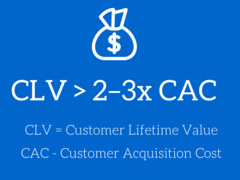
photo credit: Adam Costa
Armed with these two numbers, you can easily test channels to determine if they are profitable or not.
For example, let’s say you’re interested in testing a new channel: Facebook ads. You know your max CAC is $250; therefore, when testing this channel you can spend up to $250 to acquire a new customer.
Rather than focus on just one channel, however, you’re likely to use 3–4 channels together to help keep the conversation going.
Speaking of conversations, let’s discuss…
Danny Iny recently discussed the differences between a lead funnel and conversation funnel.
With conversation funnels, we reach out to prospects by developing content that will bring them closer to our product or services.
With that in mind, let’s take a look at each of these marketing channels and how they tie into the overall conversation funnel.
At the top of the funnel, you will find paid advertising and other forms of search engine marketing. These are effective channels for driving traffic to your site, where you can develop a relationship with them over time. This process—called lead nurturing—is a proven method for increasing conversion rates from leads to sales. Lead nurturing lets you build a relationship with your list first—and boost sales later.
On KeepInspiring.me we create loads of content that feature inspirational quotes.
Sharing quotes is inherently social and people are likely to share these quotes via social channels.
In addition to social sharing, we include an opt-in form asking for people’s email address so we can follow up with them later.
As you can see, the three main channels we use are:
These three channels are what we’ll use to continue the conversation with our audience and provide value over time. The main long-term goal is to increase our number of leads and, ultimately, new customers. By increasing our leads through content marketing and social media, we reduce our customer acquisition cost; and by creating additional products and services to sell to customers via email, we increase our Customer Lifetime Value.
Here’s another example:
Instagram got big for three reasons: they leveraged an existing platform, built virality into their product, and built a community.
With Instagram, people can share their photos on Facebook (the existing platform). By sharing on Facebook, users automatically encouraged other Facebook users to visit Instagram and join the community. Once they joined Instagram, they would post their pictures on Facebook, and start the cycle all over again (virality).
Instagram’s goal for these channels was—and is—to grow their user base as quickly as possible. This approach creates a very low customer acquisition cost, which allows them to scale.
Review the 19 channels we’ve outlined in this post. If you haven’t already, choose three that you’d like to test.
Determine your goal for each channel. Your goal should be to either decrease your Customer Acquisition Cost or to increase your Customer Lifetime Value.
Test each new channel based on your main goal. If they don’t work, fine; simply move on to the next channel that makes sense for your business.

Adam Costa is a conversion optimization consultant, and the co-founder of 10xToday.com, a personal development program that helps people define and achieve their goals. He and his wife, Darcie, love to travel and have lived in over 20 countries on 5 continents. They also run KeepInspiring.me, one of the web’s largest collection of inspirational quotes.

As a digital marketer, you’re the Obi Wan Kenobi of online lead generation. You’ve been doing it for years. You know the secrets of compelling landing pages with the most inviting lead forms, and you’re the master of tracking conversions to their source.
But there is a great disturbance in the force, and your lead gen strategies/Jedi mind tricks are not as effective as you may think. Search your feelings, these aren’t the quality leads you’re looking for. In fact, 79% of marketing leads never convert into sales.
It’s time to turn this around and figure out why so many of your leads are going straight into the garbage compactor. Take a look at the 10 reasons why your lead gen strategy isn’t delivering the heroic results you’d hoped for:
Fraudulent information, poor quality leads, and plain bad timing all lead to low contact rates with web leads. In fact, only 27% of leads ever get contacted by a sales rep! That’s a lower contact rate than a stormtrooper at target practice.
Lead forms can be a great way to convert your digital traffic, but remember that getting someone’s information doesn’t guarantee your company will ever get in touch with them. If your lead gen strategy is completely dependent on form submissions, you’re not only throwing away most of those leads, you could be turning away a huge segment of your audience. Think about letting prospects call you — phone calls come with 100% contact rates.
On average, sales teams take nearly 47 hours to pick up the phone and respond to a web lead. With the internet shortening our attention spans, waiting too long to contact leads is hurting contact rates and conversion rates. A sales rep is 100 times less likely to make contact if the first call is made a mere 30 minutes after submission of the online lead form. In fact, the shelf-life of these online lead forms is 5 minutes. That’s not even enough time for the millennium falcon to reach light speed.
What happens when a customer finally gets in contact with your sales rep? Is it worse than talking to a Tatooine cantina bartender? You might be turning away valuable customers with a poor call experience. The truth is 74% of people say they are very likely to choose another business after a poor caller experience.
Use call intelligence to test sales scripts, measure the performance of your sales reps, and to better understand the needs and concerns of your callers. With call intelligence you have access to rich caller profiles that include their engagement history. All this information can be used to guide the conversation so it is highly relevant and effective.
Nearly three times more people choose to call a business rather than fill out a form. If you’re pushing an online-only experience, you’re losing a lot of conversions from people who want to talk to someone immediately. In today’s customer-centric world, you have to give people the chance to connect how and when they want. Why not put a phone number at the top of your lead forms to give people the option?
Copying and pasting your desktop strategy for mobile devices is not a winning strategy. Web forms aren’t optimal for mobile users — we’ve all endured the painful struggle of filling out tiny forms on touch screens. It just doesn’t work, and the mobile device is so much more than a miniature computer, it’s a communications device. It’s time to rethink “Submit Now” CTAs.
If your retargeting strategy is based solely on the digital experience, you might as well be pod racing with your eyes closed! For example, a customer who clicked through a search ad to your landing page may have actually converted over the phone. But if you aren’t using call intelligence, it would look like an abandoned click and your retargeting platform would begin showing them ads with completely irrelevant messages designed for an unconverted prospect. Talk about a poor customer experience.
No one likes going through the painful task of attempting to qualify an online lead only to find out the information provided is fraudulent or missing. Since only about 25% of leads are legitimate, your sales reps are wasting time trying to contact leads with false information. It’s like finding out the evil guy in a black costume with a breathing problem is your dad, nobody wins.
When you encourage prospects to call you, sales reps don’t have to worry about sorting through leads with fake names and phone numbers. Your sales reps get to talk to real people in real time.
Today’s customers demand personalization. In fact, 74% of people say they are frustrated with non-personalized websites. While many marketers are upping their personalization game and investing in RTP (real-time personalization) platforms, many still aren’t using call intelligence to personalize the online and offline customer experience. How can you personalize the online experience if you have no idea when and why a prospect picked up the phone? You’ve got to know what’s happening over the phone. If you don’t, it’s like bringing a blaster to a lightsaber battle.
Technology has made it possible for humans to connect with one another in an endless number of ways, from sending quick a Snapchat to writing a full novel in installments of 140 characters or less, but there is one form of contact that will never go out of style — the phone call. It is immediate, direct, and highly personal.
In fact, according to Invoca’s State of the Mobile Experience, the top three reasons people choose to call a business are to:
Looks like technology hasn’t completely erased the need for humans.
Your mind is clouded by the dark side if you are ignoring the offline performance of your marketing efforts. Without call data, you can’t optimize your campaigns or strategies to their full potential. The customer journey is omnichannel, weaving online and offline like never before, and to create a more cohesive and effective customer experience, you need to understand what efforts are driving phone calls and include call data in your website optimizations.
In order to become a true Jedi Master, you need to include clicks and calls in your lead generation strategy. Landing pages, CTA buttons, and forms have their place, but in a mobile world, where everyone always carries a phone that doubles as a computer, calls make sense. When you drive calls you benefit from 100% contact rates, quality prospects, and the best part is you can have total visibility and control over your calls with call intelligence.
Either you do or do not add phone calls to your marketing, there is no try.
Ever wanted a celebrity to pitch your product?
Exomatch makes that happen by connecting advertisers with influencers. Their platform allows companies to pitch their marketing campaigns to influential Youtube, Instagram, and Facebook personalities, who then bid on the campaigns.

We spoke with Exomatch’s head of sales, Philippe Takama, and head of customer relations, Lukas Urbaum, about how to manage a successful cold email campaign. Here are the results.
You have two options when you begin a cold emailing campaign: Direct or indirect email.
Which approach you use depends on your target market. Let’s take a closer look at each method.
This is the standard approach of directly emailing the most relevant decision-maker.
For example, if you were selling a social media tool, you would send an email to the social media manager.
This approach is most effective when your primary customer base is made up of small businesses. In these environments, it’s easy to identify and reach key decision-makers.
Here’s a template for inspiration:
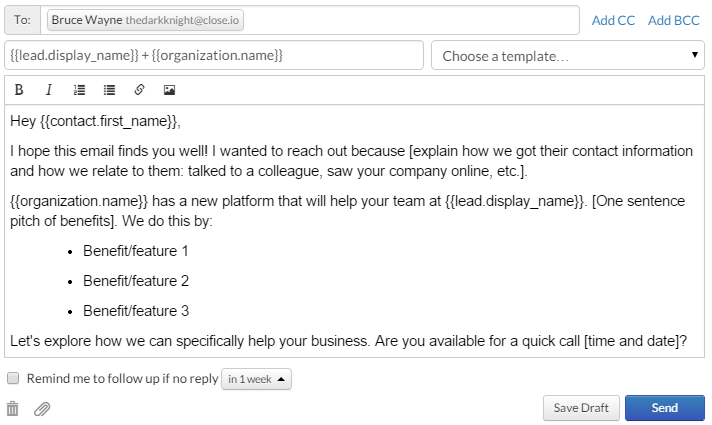
This approach gained popularity after Aaron Ross’ best-selling book, Predictable Revenue. You email someone one or two levels above the relevant decision-maker and ask for introductions down.
For example, if you were selling a social media tool, you would contact the VP of Marketing and ask to be introduced to the appropriate person.
This approach is most effective when your primary customer base is made up of large businesses. In these environments, you often don’t know who to speak to. An introduction speeds up the sales process and gets your name in front of the high-level managers.
Here’s a template for inspiration:
Experiment with both approaches and see what’s most effective in your market.
Measure your results with a CRM like Close.io that’s capable of tracking open and response rates, then use that data to run A/B tests to improve your campaign.
Want more templates like the two above? Check out three more cold email templates here.
This is one of the most important things you need to get right about cold emailing: the follow-up! How often depends on what type of lead you’re pursuing.
A cold lead is one you’ve never had any sort of interaction with. Follow up with these leads a total of three times over a two-week span. Here’s the schedule we use at Close.io.
Day one: Initial contact. Send your first cold email.
Day three: First follow-up. Restate your original message in a more concise manner. Send this email at a different time of day. If your prospect didn’t respond to the email you sent at 9:00 A.M., it may just mean they have busy mornings. Send your follow-up later in the afternoon to circumvent this.
Day seven: Second follow-up. Again, follow up at a different time of day. This email should restate your call-to-action. For example, “Hey, this is Ramin with Close.io. I’m just checking in again to see if you have time for a 5-minute phone call on Tuesday at 10:00 A.M.”
Day fourteen: Third follow-up. Still no response? Break up with your prospect. You’ll be amazed how many deals you close when you take them away. Your break-up email should communicate the following points:
If you don’t receive a response to your break-up email, move on to more promising prospects.
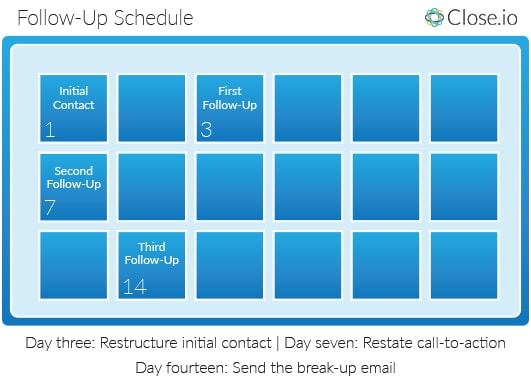
A warm lead is one you’ve had a positive interaction with. If your prospect has ever expressed interest in your product, follow up indefinitely.
Use the plan above, but don’t send the break-up email. Just check back in with your prospect like usual. After day fourteen, you should check in once a month until you get a clear response.
That response may be a “no”, but “no” is always better than “maybe”.
When your prospect says, “We’ll get back to you”, 90% of the time they won’t.
They may intend to, but if you leave the decision to them, it’ll never happen. Here’s how to turn that non-commitment into a commitment.
If they included a signature with a phone number, consider that an open invitation. Call them and say something like this:
Hey, this is ______ from ______. I’m just following up on your email. You’d mentioned that you wanted to look into our product more and I wanted to reach out and see if I could be valuable to you. Do you have five minutes for a quick question so I can send you relevant information?
[Insert powerful sales questions]
Most prospects will be willing to give you five minutes, which you can turn into a full conversation with the right questions.
If you get this response often, counter it pre-emptively by including this in your email:
At this point, you’re probably going to hit “reply” and say something like, “This looks interesting, I’ll get back to you.”
I get it, you’re busy. But I also know how much value we can provide you and I don’t want you to miss out. To help us move forward, these are the four scenarios as I see them:
Go ahead and hit “reply” and just tell me which it is, and we’ll move forward from there.
When a prospect says they’ll “get back to you”, you’ve lost full control of the conversation. Use these two strategies to take back control and move the conversation toward a commitment.
A successful cold email campaign is powered by the same principle as a successful cold calling campaign: The follow-up. If you aren’t willing to send at least three emails, you shouldn’t even send one.
But if you negotiate with friendly strength and fight for the value your product provides, you can turn your cold emailing campaign into a powerful conversion funnel.
Follow up like a champ: How to win every deal with the amazing power of the follow-up!
Learn how to close more deals and make more sales by following up more and better. Boost up your follow-up strategy and hustle.
A/B testing cold emails (without a statistically-significant sample size)
Trial and error is the best way to improve your cold email campaign. Pair that experimentation with A/B tests to identify what’s working and fix what isn’t.
How to write subject lines that get your sales emails opened
The subject line is the most important part of any cold email, but most salespeople don’t have a clue how to write them. Check out these keys to writing compelling subject lines.

Marketing and sales alignment will eventually become a thing of the past. This isn’t because it’s not important, but rather, it’s because our teams will have outgrown it, like last year’s snow pants. By the end of 2020, the B2B marketing and sales departments will become one and the same team — collectively responsible for the entire pipeline and the revenue that flows from it. Watch for these 5 stages of their dissolution.

A demand gen environment changes in progressively small steps. Up to today, the transitions have involved marketing’s increasing responsibility for revenue generation. Sales has learned to connect with marketing’s initiatives and provide helpful feedback on lead qualifications and lower-funnel conversion rates.
We’ve seen the rise of the martech stack, founded on the groundwork of marketing automation, and it’s been built ever taller with the additions of B2B attribution solutions, data insight tools, and much, much more.
But what’s next? What’s the next challenge that tenacious B2B demand generators will face? What’s our next stage of adaptation?
It’s not particularly startling, is it? The departmental ideologies of “marketing” and “sales” have stuck with us through the rapid emergence of ecommerce in the early 2000’s and the expansion of digital marketing in the years that followed. I would posit that our demand gen capabilities, our martech development, and our personal skills are pushing the limits of this traditional model. We could soon be well overdue for a change.
Imagine a manufacturing plant with half of its assembly line in Texas and the other half in Australia. It doesn’t make sense. Eventually, sales and marketing will become so inextricably linked together that one can’t function without the other. Marketers will pull sales into almost every meeting, and sales will stay up-to-date on marketing’s daily grind so they can be prepared to meet tomorrow’s leads.
We’re already heading in this direction. Advanced marketing attribution solutions provide full-funnel tracking. This data stretches across departments and bolsters the optimization capabilities of both the sales and marketing teams.
Account-based marketing for B2B companies depends extensively on cohesive alignment between the sales and marketing teams. Marketing taps the accounts via top-of-funnel (TOFU) and middle-of-funnel (MOFU) activities while sales prepares their outreach to align with marketing’s air cover.
It’s already happening.
Without further ado, let’s take a look at the five stages of sales and marketing dissolution.

Jason Lemkin at SaaStr recently emphasized the importance of the marketing team truly owning their own segment of the revenue stream.
“So in some cases, an Opportunity Commit for marketing, which is further down the funnel, can be an improvement over a lead commit. But I’m going to propose going further. For whatever segment of revenue marketing “owns” — I think it’s time for a true Revenue Commit.” – Jason Lemkin
This is the first step to becoming a joined team. Marketing will own a segment of the revenue goals that they are exclusively responsible to contribute.
Everyone’s working within the same funnel, and the events that occur at each funnel stage directly affect the ensuing levels of the funnel.
If ad spend is wasted and lead volume drops, the sales team has fewer leads to contact and less opportunities to close.
If marketing’s investments and activities are generating poor quality leads, sales has difficulty converting those leads to opportunities.
If marketing is using one form of value prop messaging and sales is using completely different terminology, leads will feel a disconnect. Without consistency across the marketing and sales handoff, the lead is less likely to close.
Everyone depends on everyone else, and the two halves of the funnel are intrinsically linked. Heinz Marketing has published a detailed checklist of how this interdependence is practically applied.
Historically, the Customer Relationship Management system primarily held insights on BOFU activities. Because the sales and marketing teams are becoming more and more interdependent, the marketing team takes a vested interest in CRM data. Without knowing how their leads are progressing through the funnel, there’s no way to optimize their TOFU and MOFU strategy.
However, martech solutions like B2B marketing attribution, are able to push more and more data into the CRM. Not only does it contain BOFU information, but it connects the lower-level funnel data with higher-level activities for each CRM contact.
By using attribution tools, the marketing and sales teams can see the full picture of a lead’s journey through their array of marketing touchpoints. As they study the statistics, dashboards, reports, and other data presented inside the CRM, the both teams have the insights necessary to align their efforts to a T.
Stages 1-3 are in the works, and we’re already seeing a fair number of Stage 3 organizations cropping up. As this becomes a more common orientation for sales and marketing, I predict we’ll begin to see an increase in the number of cross-department tech solutions. Rather than the traditional “martech” and “sales development” software programs we see within the SaaS market today, the two functions will merge into the same software solution that can be used by both teams.
Marketing automation software has already begun with email nurturing, analytics, and even CRM solutions that cater to the needs of the sales team. However, they’re still “marketing” automation programs that primarily seek to solve “marketing” problems.
As the two teams become more interconnected and collectively rely on the CRM, tech solutions will follow suit. It won’t be long until software such as “pipeline automation” or “customer development” software begins to solidify the connection between marketing and sales.
Finally, the two teams will be speaking the same language, attending the same meetings, analyzing the same reports, and using the same software programs. And by that time, they’ll likely have moved to the same floor and intermingled their desks or cubes among each other.
This will mark the rise of the Pipeline Team (or whatever we end up calling it.) Marketing and sales will bear no distinction, and we will look fondly upon the days when marketing and sales were separate entities. But there will be no doubt. We’ll be relieved to see them as two sides of the same coin.

I was leading a discussion about value propositions with a group of product developers and marketers. We were getting ready to launch a new product, I was helping develop the launch plan.
I posed the question, “What customer problems do you solve?”
The answers followed the same pattern as virtually every other group in which I’ve posed that question.
Most often, the response to the question begins with one of the following:
“Our product has these features………”
“We provide these capabilities…..”
“We do this….”
The discussions go through long lists of features, functions, feeds, speeds, capabilities and so forth, but they seldom answer the question, “What customer problems do you solve?” Instead people describe product capabilities and what their product does.
It may seem like I’m wordsmithing, but answering the question “What customer problems do you solve,” forces you to frame your response in terms that are meaningful to the customer, because it forces you to look at things from the customer point of view.
The answers to, What customer problems do you solve tend to start with:
“Here’s the situation our customers are finding themselves confronting every day…..”
“Our customers’ customers are changing in this way…… This is the impact of those changes on our customers…..”
“Our customers cannot achieve these things…… unless they change the way they run their business….”
“Our customers won’t be able to grow an compete unless they……..”
“These problems inhibit the ability of our customer to meet their strategic goals……”
Our customers don’t care about what we do, they don’t care about our capabilities, they are worried about their businesses, problems and opportunities.
What we do is only important in the context of the customer problems we solve. But too often, in the enthusiasm we have about our products is that we skip that vital first step, telling customers what we do, not how what we do helps fix their problems.
Answering the question, What customer problems do you solve leads us into some other critical questions:
Who has those problems? Not every customer has the problems that we solve. Even for those that have problems that we solve, there may be things unique to them or their business–or unique to the way we solve the problems that make them bad candidates for our solutions. But now we characterize the market and can develop a methodology for finding those customers.
Other things you are forced to consider is, Why is it important for customer to solve these problems? Here we start looking at the impact the problem has on the overall goals and priorities of the organization. In answering this question, we can now tie everything to top management priorities.
I started this article by saying I was working with a product management group and marketing in launching new products. Some of the people in the group said, “Sales can figure it out, that’s their job.”
It’s not sales job to figure out the problems our products and solutions solve!
Product management and marketing have the primary responsibility for this — sales can and should play a strong role, but they can’t take the lead.
Product management/marketing has to answer these questions in developing the product. They have to understand all these things to understand what they have to deliver to meet customer needs and requirements. If they don’t have the answers to these questions, why did they develop the product in the first place? What caused them to choose the features, functions, feeds, speeds, and capabilities to build into the product? What caused them to build capabilities that support what customers need to do, and to have the products be differentiated from the alternatives.
Product management/marketing have the answers to the questions the customers are most concerned about, “How do you help me solve my problems?”
If all we only equip sales people with knowledge about our products, features, functions, feeds, and speeds. If we only train them on what our product is, on the things we do, they can never answer the fundamental questions the customer always cares about, “How do you help me solve my problems?”
Sales people do what we teach, train, measure, and incent them to do. If they are only talking about product features functions, feeds and speeds; if they cannot answer the customers’ questions, “How do you help me solve my problems,” it’s not sales fault.
The responsibility lies with management (sales and corporate), product management/marketing and others.
After all, sales people are just doing what we told them to do–we need to make sure we tell them to do the right things.