Shared posts

28 Mar 19:54

Your Changing Customers: 7 Strategies to Find Out Why, How

by Scott Hornstein

It is inevitable, and absolutely certain, that we’re all dealing with changing customers. We are all in a maelstrom of information, of stimulus, of crap. We change every second of every day. It’s a fair guess our customers and prospects do, too.

What we need to know is why and how we faced with changing customers.

You may say, oh, I’m close to my customers. If they were changing, I’d know.

But you won’t. The technical divide is very deep and very wide. There is an ocean of noise between us. The more effectively we understand those changing currents, the more we hone our compelling competitive differentiation.

Our changing customers and prospects are atomized, each in their digital cocoons with the Internet pulled tightly over their heads. If we wait for them to tell us that something is different, I guarantee it will be too late. The change will have occurred and the change may be that we stink.

Seven Strategies for Your Changing Customers

Here are seven high-touch strategies that medium-sized businesses can use to find out their changing customers’ wants, needs, and perceptions on a day-to-day basis. It’s essential to creating happier customers who stay longer and buy more.

1. Be a Customer

  • Become your own customer. Opt-in on your website. See what the system sends you. Call and ask a question. Send an email, a tweet. What are the messages you receive from your changing customers? Experience what it feels like to be your company’s customer.
  • Become your competitor’s customer. What are they doing and why? How does it make you feel? How is it different than being your customer?
  • Clean your database of all your competitors. I’ll bet, if you look hard, they’re there. They might be using a different address, but they are there.

2. Bring Your Best Customers Close

When there’s an important decision to be made, consult your best changing customers. Bring their direct input to the process.

Let me tell you a quick story about a family-run business in Silicon Valley. They are a prototype house for printed circuit boards (PCBs) that are in absolutely everything.

One morning, the trade news carried ads by a new company that took pricing for PCBs into the basement, below cost. Shaken, the patriarch did a smart thing. He kept his appointment with his best customer, who said, who cares.

“That is a commodity approach and we do not have a commodity relationship. I rely on you as a design partner, on your judgment, and on the quality of your prototype. They can’t possibly deliver what you deliver.”

P.S., the patriarch also opened up a side business meeting the new low prices.

3. Baseline and Measure

Once a year, conduct a Net Promoter Score (NPS) survey. This is a measure of both loyalty and satisfaction, and is seen as an indicator of potential growth.

The survey asks each customer if they would recommend us to a friend or colleague. They answer on a scale of 0 to 10.

Responses with a 9 or 10 are “promoters.” Those with 7 or 8 are “passives.” And 0 – 6 are detractors. The first year is your baseline.

Obviously, we want 9’s and 10’s. How do you get there? By understanding the criteria of your changing customers .

Follow up with professionally researched conversations (we recommend using a neutral third-party so there is no shadow of a sales pitch), will yield:

  • Insights from promoters that will further hone your competitive differentiation.
  • The criteria for moving passives and detractors up the scale.

This expanded view of the NPS process can provide you with the quantitative score, and critical qualitative insight. The process can be extended further by adding categories, such as Service and Support.

4. Network

To your customer, your product or service is part of a solution that involves other suppliers. Your customer is also a customer of these other businesses, many of them complementary to yours. From your customer’s point of view, it’s an ecosystem of support.

Meet these other folks and network with them. Share intelligence. Conspire on how to serve your changing customer better.

5. Interaction to Engagement

Each customer interaction is an opportunity to go beyond expectations and reach out to the changing customer or prospect. This is true no matter who is representing your company―from your CEO to the trainee in the call center.

Commonly, these interactions can be seen as transactions. There is no doubt that whether it’s the CEO or the call center, that transaction must produce satisfaction. I need information, I have a complaint, I need service. Oh, and I have no attention span and I have a short fuse.

Manage the customer experience and then move the conversation from interaction to engagement. As appropriate, don’t just say thanks, ask a question. Have I completely answered your question? How is our product or service working for you? Are there things we should be doing for you that we’re not?

Empower everyone who speaks to a customer or prospect to:

  • Own the answer. Especially if you uncover discontent.
  • Tell everyone about it (establish a formal reporting system).
  • Make sure the right thing gets done.

6. Lead by Example

Nothing really happens in an organization unless it comes from the top. I’m talking to you, CEO.

If you want your employees to believe that it’s important to listen to customers and customers to believe that you really want to hear what they have to say, it starts with you.

The first strategy we proposed was to experience how it feels to be your customer. How would you feel as a customer if, the first week in January, you received the following on personal letterhead:

Scott,

I’d like to ask you for a new year’s gift, please.

There is nothing more important to me, or to my company, than our business relationship. I’d like to hear what you have to say about that relationship.

Has there been a situation or occasion in the past year when we went the distance, or let you down? Are we living up to our potential?

That’s the gift I’d appreciate.

Thanks,

Me (hand signed)
The CEO

7. Make Changes in Real-Time

To adapt a phrase, if you learn something, do something. Address the change and your changing customer head-on. Take action now. Agility, as a core tenet of a corporate culture, is an almost insurmountable competitive advantage.

Early in my career, a wise client told me, “Scott, business is easy. Make stuff, sell stuff, collect money.” He was right. This linear sales process is a powerful force. It sometimes feels that the only way to be more successful is to run faster. But it keeps us in broadcast mode, and we have to fight back to listen. Because without our customers and prospects, we’re running nowhere. All we’re doing is running faster.

Please let me know how these strategies work for you.

28 Mar 19:54

Is It Time to Create a Hassle Map?

by Annette Gleneicki


Image courtesy of Phillie Casablanca

How do you identify, measure, and resolve painpoints and difficulties that your customers experience when they are trying to do some job with your products?

I’m a huge advocate of journey maps as a tool to help you walk in your customers’ shoes in order to better understand the steps they go through to do some job or to achieve some task with your organization. So I was interested to learn more when I stumbled upon an article about hassle maps. Maybe I’m late to the game on this topic, but I thought what I read was an interesting take and perspective on how to understand customer needs and improve jobs to be done.

What are hassle maps? How do they differ from journey maps? And how can you use them to improve the experience?

“Hassle map” is a term/concept coined by Adrian Slywotzky. In an Inc. interview, he defined hassle maps as follows.

Whether you’re talking about a consumer or a corporation, a hassle map defines all of the actual steps that characterize the negative experiences of the customer. Think about these questions: Where are the emotional hot spots, the irritations, the frustrations, the time wasted, the delay? Where are the economic hot spots? And then think about this: What are the ways that businesses can radically improve the hassle map for both the customer and themselves?

Upon initial research, it seemed like hassle maps weren’t as rooted in redesigning customer interactions, per se, as customer journey maps are. They seemed centered more around product innovation and demand creation. In other words, they take jobs to be done and make them simpler through product design and innovation.

What do I mean?

Consider the example of renting videos from Blockbuster and the subsequent evolution to Netflix and OnDemand (or any other video streaming service). Hassle maps visualize the pain of driving to the video store, finding the right video, waiting in line to check out, and then remembering to return the video without incurring late fees! They bring the pain of the experience to life and help paint the picture to support finding a better product solution, one that goes from the more complex to the simpler. These maps are all about solving problems and making life easier for customers through product evolution.

And yet, Netflix isn’t just a product; it’s an experience redesign. So perhaps hassle maps and journey maps are members of the same family – more similar than different.

Not that journey maps don’t solve problems and help simplify the customer experience, but they tend to encompass various aspects of the experience (product, service, and other interactions), not just products, product innovation, and demand creation. (This reminds me of a debate on CustomerThink last year, where several people weighed in on Bob Thompson’s question about whether customer experience is only about interactions or also includes product and price. I do believe product and pricing are simply two other types of interactions customers have with an organization and clearly fall under the customer experience umbrella.) And journey maps focus on more than just the negative experiences.

After reading more about hassle maps, perhaps there’s a broader application of “hassle map thinking,” as Adrian puts it, for other aspects of the customer experience. That’s definitely something to consider. Adrian writes in “The Art of Hassle Map Thinking:”

Each extra step, wasted moment, avoidable risk, needless complication, less-than-optimal solution, awkward compromise, and disappointing outcome is a friction point on the hassle map. And each represents an opportunity for a creative organization to create new demand by eliminating the friction or even reversing it, turning hassle into delight.

Hassle maps reveal the gap between what customers buy and what they really want and need – based on what jobs they are trying to do or tasks they are trying to complete. Adrian notes that that gap is where the opportunity for demand creation lies. But I believe that gap is also where the opportunity for experience (re)design lies.

Adrian writes that there are other types of hassle maps: (1) those that take you through the steps of the process a customer goes through to do something; (2) those that also chart backstage and front-stage people, tools, and systems; and a third one (3) that graphs desirable yet mutually-exclusive customer needs, e.g., price vs. quality, convenience vs. variety, etc. (1) and (2) sound to me like a couple of different approaches to journey mapping. And yet, I feel like hassle maps are a slightly different flavor. I’m conflicted on this, though like I mentioned, they focus on negative experiences and demand creation, whereas journey maps are used for all experiences and process/experience redesign. Both are valuable customer experience tools.

To develop a hassle map, you start by thinking about needs, pain points, and desired outcomes. We absolutely want to think about these things as we design a great customer experience. But, as Adrian outlines in a Fast Company article, Hassle Maps: The Genesis of Demand, hassle maps can be mental constructs (journey maps are not) or literal maps. He states that these maps determine your engineering, design, marketing, partners, and competitors.

There’s no right way to create hassle maps, but he suggests…

  • Look at different personas, as different customer types have different problems, painpoints, and desired outcomes. Understand your customers and what drives them crazy about your products.
  • Start by asking what customers hate and what makes them furious. Watching customers is an even better approach. What jobs are they trying to do? What painpoints are they experiencing? What problems are they trying to solve?
  • Identify what it’s like to use your products. Consider strengths and weaknesses.
  • Look to other industries and other game changers for inspiring solutions.
  • Then quantify the economics (dollars spent, time wasted, steps required, etc.) for the customer and for the business; what saves money for both?
  • And like journey maps, hassle maps are also not static. Update the maps as technologies and needs evolve.

What’s critical to success here? Understanding customers. Talking to customers. Listening to customers. Observing customers. Characterizing customers. Empathizing with customers.

Much of what’s written about hassle maps is about how these maps are critical to demand creation and new product development. Like journey maps, the objective and desired outcome of hassle maps is to simplify and to improve the customer experience. In addition, hassle maps have a grander objective: to develop products that make customers’ lives easier.

Is it time for you to walk in your customers’ shoes as they use your products, identify the pain points and the frustrations, and develop the next iPod (figuratively speaking)?

I’ll borrow today’s closing quote from “The Art of Hassle Map Thinking”…

When you discover a problem, you discover a business. – Henk Kwakman, CEO, Nestle (Nespresso)

28 Mar 19:54

10 Free Invoice Services for SmallBiz Owners & Entrepreneurs

by Paul Estcott

Whether you’re a copywriter, web developer, online marketing expert or graphic designer, starting an online business will require you to learn a little bit about the business aspects of working with customers. One very important business aspect is invoicing. Invoices are used to seal the deal between the payment agreed upon with the client and accomplished work.

10 Free Invoice Services for SmallBiz Owners & Entrepreneurs

The concept is simple: if you don’t invoice your clients, how are you going to get paid? Creating and keeping invoices is important for annual tax check-ups. They will make it easier for you to declare your earnings, earn some money back from taxes, and show clients that you are being professional about your business ventures.

Depending on how many clients you work with, how much work you have to get done, and how you manage your small business, you might not require a full-blown accounting software. There are plenty of free invoice generators that will enable you to create elegant invoices within your browser. These tools are extremely useful for freelancers and small businesses that are struggling with tight budgets.

Despite the fact that there are hundreds of invoicing services available online, not all of them are created equal. Choosing the right one may prove a little tricky, because some features and invoice details are vital for the client, as well as the service provider.

Below is a collection of free invoice services that have robust features. Check them out and let me know what you think!

1. BILLIVING10 Free Invoice Services for SmallBiz Owners & Entrepreneurs

Official page: Billiving

My go-to invoice service, and the number one on the list is BILLIVING, an extremely useful tool that supports multiple currencies & languages. With it you can quickly create and send payment reminders, automate recurring invoices, view financial reports and streamline business processes. The basic plans for BILLIVING, which are free, allow you to send an unlimited number of invoices & estimates (with your company’s logo) to maximum 5 clients, convert estimates to invoices, create purchase orders, set pricing tiers, personalize with templates, and save documents as HTML or PDF, among others.

For small business owners and entrepreneurs, the business plans should be more than enough to cover basic needs. Nevertheless, if you need to send invoices to hundreds of clients, BILLIVING offers professional, enterprise, and ultimate plans, with an unlimited number of purchase orders & estimates to invoices. Paid plans will also enable you to schedule recurring invoices and remove the company’s branding.

BILLIVING - 10 Free Invoice Services for SmallBiz Owners & Entrepreneurs

How to Use BILLIVING:

Handling the financial aspects of your business needn’t be difficult. With the help of BILLIVING you can access all your information in one place. You can also share your account with other vendors or your accountant to streamline payments. All your reports, documents, and contacts are displayed in the dashboard.

Generating and sending an invoice will take less than a few minutes. I’m a huge fan of the tool’s crisp invoice design. To access the dashboard you must first set-up and confirm your account. Login and click on “New” to begin the invoice generation process. You can populate your contact list as you work on your invoice. BILLIVING allows you to include information such as item ID, description, quantity, price, discount, and taxes. Final costs will automatically be calculated by the software.

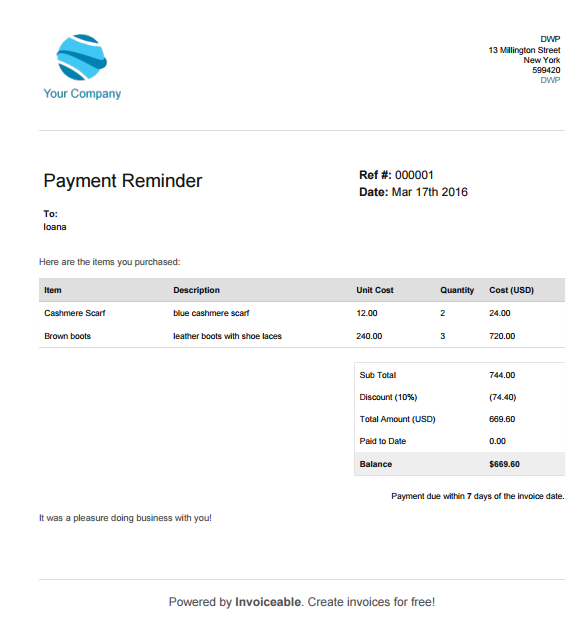
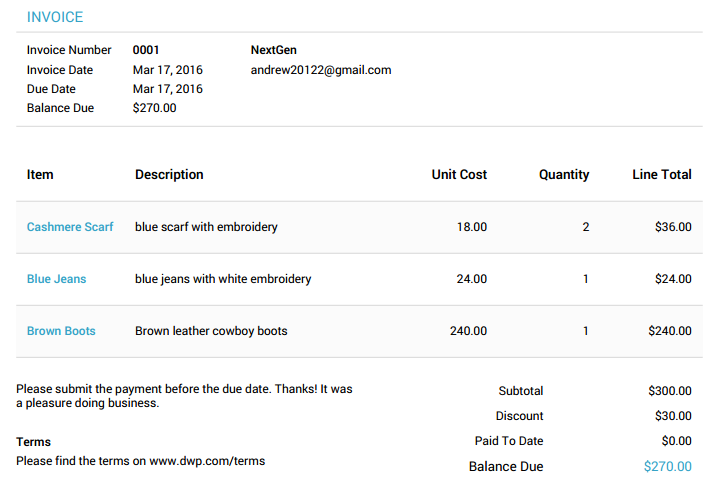
Here’s how a BILLIVING invoice looks like:

BILLIVING - 10 Free Invoice Services for SmallBiz Owners & Entrepreneurs

2. Online Invoices10 Free Invoice Services for SmallBiz Owners & Entrepreneurs

Official Page: Create Online Invoices

Unlike BILLIVING, this free tool allows you to quickly create and send invoices, without having to set-up an account. Depending on your needs this might be a good thing, or a bad thing. If you’re simply trying to create a quick invoice, then Online Invoices might be a more convenient solution for you. However, the fact that you can’t set-up an account means that you cannot track your invoices and payments, or share financial information with your accountant.

“Online Invoices” has a lot of useful features for invoice generation. You can add as many lines to your document as you need, set the quantity and unit price, and let the software calculate your final amount. You can also include discount and tax information, upload your company’s logo, and edit every field. The software provides several free invoice templates to suite various business needs.

Here’s how an “Online Invoice” looks like:

Create Free Invoices Services

3. WaveWave - 10 Free Invoice Services for SmallBiz Owners & Entrepreneurs

Official Site: Wave Apps

Wave is the perfect choice if you’re looking for something more than a simple invoice generator. You can use this tool to get paid for your work, organize your finances, and pay your employees. To access the Wave dashboard you must first create an account. Navigate to specific tabs such as transaction history, payments, invoices, bills, receipts, accounting information, reports, and payroll, to quickly complete financial tasks.

What I like most about Wave is its clean interface and beautifully designed invoices. Speaking of invoices. The Wave editor is extremely intuitive. It allows you to quickly add and edit columns with information such as item name, description, quantity, price, and tax. You can also add notes in the header and footer. After you finish editing your invoice you can save your draft, send it, and wait for your payment. Wave also allows you to schedule payment reminders.

Here’s ‘how a Wave invoice looks like:

10 Free Invoice Services for SmallBiz Owners & Entrepreneurs

4. Hiveagehiveage logo

Official page: Hiveage

Free invoice services aren’t very different from one-another. The dashboard and features are generally the same, and the invoice design varies slightly from service to service. Your final choice will probably be based on personal preference. One online invoice service that I enjoy using is Hiveage. All you have to do to gain access to the service is to sign-up for an account.

All your invoices, bills, estimates, financial history, and files can be viewed from the dashboard, making it easier for you to handle payments. To create a new invoice, simply navigate to “Invoices” and click on “Create New” -> “Invoice” or “Recurring Invoice”. The editing options are nothing new. However, there is a feature that allows you to change the settings of your Invoice. For example, you can allow clients to make partial payments or set-up automatic payment receipts. This is a welcome addition that Hiveage provides.

Here’s ‘how a Hiveage invoice looks like:

Hiveage - 10 Free Invoice Services for SmallBiz Owners & Entrepreneurs

5. FreshBooksFreshbooks 10 Free Invoice Services for SmallBiz Owners & Entrepreneurs

Official Site: FreshBooks Free Invoice Creator

Number 5 on the list of free invoice services is FreshBooks, a hassle free browser software used by millions of freelancers and entrepreneurs. If your goal is to create great-looking invoice in a matter of minutes, then you should definitely test FreshBooks.

To be honest, I’m not a huge fan of this invoice design. BILLIVING and Wave offer more, much-needed, customization features for professional invoice creation. I appreciate, however, that FreshBooks walks you through the process of creating the invoice and points out what details are missing, or should be added, prior to sending it.

Here’s how a FreshBooks invoice looks like:

FreshBooks - 10 Free Invoice Services for SmallBiz Owners & Entrepreneurs

6. ZipBooksZipBooks Logo

Official Page: ZipBooks

The motto of ZipBooks is “Better bookkeeping. Instant payment.” The tool delivers on this promise. To start using the software you must first set-up an account by submitting your address or using one of your social media profiles. You will be provided instant access to the super-clean ZipBooks dashboard. From this dashboard you can access the Invoices, Estimates, Customer, Expenses, Payments, Time Tracking, Team, and Reports tabs. As you can see, ZipBooks brings a new feature to the table, a time tracker that allows you to monitor team members.

To create your new payment reminder navigate to the “Invoices” tab and click on “New Invoice”. The design of ZipBooks invoices is very clean. You can two types of expenses: for tasks and for items. Other information that can be included: notes, due date, terms, P.O., and discount percentage.

Here’s how a ZipBook invoice looks like:

ZipBooks - 10 Free Invoice Services for SmallBiz Owners & Entrepreneurs

7. InvoiceableInvoiceable Logo

Official Site: Invoiceable

Do you want to create invoices in seconds, automate your payment reminders, and manage your clients efficiently? You can do all of this, and more, with Invoiceable. This free, easy-to-use invoice service offers a dashboard similar to that of BILLIVING, where you can view your yearly overview, client overview, invoices, and reports.

Invoiceable may not have the best-looking invoice template, but it does its job and, most importantly, it’s fast. I recommend that you edit your company and client information prior to creating a new payment reminder to save time.

Here’s how an “Invoiceable” invoice looks like:

Invoiceable - 10 Free Invoice Services for SmallBiz Owners & Entrepreneurs

8. Invoice-O-MaticInvoice-o-matic logo

Official page: Invoice-O-Matic

Number 8 on our list is yet another straightforward invoice service that you can use directly from your browser. No registration is required. I recommend this free invoice generator for those who need to quickly craft and send a payment reminder.

Invoice-O-Matic offers only one standard template that looks nice, but does not offer a lot of customization options (e.g. you cannot add your company’s logo). You can edit your invoice’s fields simply by clicking on them. Company and client information is displayed at the top, followed by service & product information (quantity, description, unit price, sub-total), total, notes, and payment details. You can include VAT data by editing your settings at the top of the page.

Here’s how an Invoice-O-Matic invoice looks like:

Invoice-O-Matic - 10 Free Invoice Services for SmallBiz Owners & Entrepreneurs

9. ZohoZoho Invoice - 10 Free Invoice Services for SmallBiz Owners & Entrepreneurs

Official Page: Zoho

Another useful invoice service suitable for business owners and entrepreneurs who don’t have a lot of time or money on their hands is Zoho. This tool is available on the Apple App store, Google Play, and Windows 10. It can also be used directly from your browser.

Upon saving your newly created invoice you will be prompted to register an account, where you can check financial reports, sales information (estimates, invoices, received or recurring payments, and credit notes), time-sheets and contacts.

Design-wise, Zoho’s invoices look clean and professional. The tool allows you to edit company & customer information, product details & costs, and to add notes. Please keep in mind that Zoho’s signature will appear at the bottom of your newly created invoice.

Here’s how a Zoho invoice looks like:

Zoho Invoice - 10 Free Invoice Services for SmallBiz Owners & Entrepreneurs

10. InvoiceNinjaInvoice Ninja - 10 Free Invoice Services for SmallBiz Owners & Entrepreneurs

Official Page: InvoiceNinja

The last invoice service on our list is InvoiceNinja. To use the software you will first have to create an account – either by using your email, or by registering with your Google, Facebook, GitHub or LinkedIn account. From your online dashboard you can check client information, tasks, expenses, invoices, and payments.

The payment reminder generation process is extremely simple. A great feature of InvoiceNinja is the fact that it updates the invoice’s preview as you fill in your details. You can include information such as invoice number & date, item, description, unit cost, quantity, sub-total, notes, terms, and discounts in your payment reminder. Complete invoices can be sent via email, or attached as PDF files.

Here’s how an InvoiceNinja invoice looks like:

Invoice Ninja - 10 Free Invoice Services for SmallBiz Owners & Entrepreneurs

Design-wise, I am torn between BILLIVING, Wave, and InvoiceNinja. Feature-wise, the most robust tools are Wave, Hiveage, BILLIVING, and ZipBooks, because they also offer tracking & reporting features. I suggest reading a couple of reviews before making a decision.

Image Source: Featured image – deposit photos

28 Mar 19:52

What Donald Trump, Mark Cuban, and 23 other highly successful people were doing at age 25

by Jacquelyn Smith and Rachel Gillett

young steve jobs

Everyone's path to success is different.

For some, it's mostly linear. Others encounter more twists, turns, and bumps along the way.

While some like Steve Jobs and Richard Branson were already dominating the business world at 25, others like Larry Ellison and Mark Cuban took a little longer to hit their stride and saw their mid-20s as transformative years.

To illustrate how no two paths to success are alike, we've highlighted what 25 highly successful people were doing at age 25.

Vivian Giang and Max Nisen contributed to earlier versions of this post.

SEE ALSO: Mark Cuban, Richard Branson, and 24 other successful people share their best career advice for people in their 20s

DON'T MISS: 15 things successful 20-somethings do in their spare time

Donald Trump took over his father's real-estate-development company.

Trump, a Republican presidential nominee hopeful, billionaire real-estate mogul, and animated TV personality, grew up wealthy. But as he told Forbes, his father wanted him to learn the value of money.

As a kid, his dad would take him to construction sites and have him and his brother pick up empty soda bottles to redeem for cash. He says that he didn't make much, but it taught him to work for his money.

At 25, the young real-estate developer was given control of his father's company, Elizabeth Trump & Son, which he later renamed the Trump Organization, according to Bio. He soon became involved in large, profitable building projects in Manhattan.


Steve Jobs took his company public and became a millionaire.

By the end of its first day of trading in December 1980, Apple Computer had a market value of $1.2 billion, making its cofounders very rich men. Jobs, one of the three cofounders, was 25.

He later told biographer Walter Isaacson that he made a pledge at that time to never let money ruin his life.


Hillary Clinton had just graduated from Yale Law School.

At 23, Clinton, now a Democratic presidential nominee hopeful, began dating fellow Yale Law student Bill Clinton. She ended up staying at school an extra year to be with her boyfriend, and received her law degree in 1973, just before turning 25. Her boyfriend proposed marriage after graduation, but she declined.

That same year, Clinton began working at the Yale Child Study Center. Her first scholarly article, "Children Under the Law," was published in the Harvard Educational Review in late 1973, when she was 25.

After moving to Arkansas in 1975, Clinton agreed to marry Bill. She'd go on to become the first lady of Arkansas, the first lady of the US, a US Senator, and Secretary of State.


See the rest of the story at Business Insider
28 Mar 19:52

Building Long Term Companies

by Brad Feld

I was catching up on a bunch of reading on the web from last week and came across a post by Lars Dalgaard titled Thoughts on Building Weatherproof CompaniesI don’t know Lars, but know of him as the founder/CEO of SuccessFactors and now a partner at A16Z, and was curious after recently reading a Forbes article about Zenefits a few weeks ago titled ‘A Lot Of Things Went Wrong’: Lars Dalgaard On Zenefits Scandal.

Any CEO I’ve ever worked with has heard me say “build the company and make decisions as though you’ll be running it forever” many times. While forever is a very long time and so far the idea of running a company forever hasn’t happened, it’s a great frame of reference for a CEO to operate from. So, I found myself nodding at a bunch of things Lars wrote in his post and I encourage you to read it.

Following are a few of the headlines of the points that resonated with me along with my quick thoughts.

Successful companies are bought, not sold: This cliche is said 100x per day by VCs. And it happens to be true. Build something great and important and opportunities to be bought, whether you want to pursue them or not, will come to you.

Develop a perpetual, aggressively help-seeking mindset: A simpler way to say this is “learn quickly, do it continuously, and surround yourself with people you can learn from.” There’s a subtext about sublimating your ego and fears, which appears in several other parts of the post and is a characteristic of everyone I know who is a learning machine.

Invest in a coachMany of the CEOs (and founders, and execs) we work with have coaches. We strongly recommend them. My partners and I have used Nancy Raulston since we started Foundry Group and my extremely close friend Jerry Colonna is someone I describe as “the best startup CEO coach on the planet.” I have a running coach, even though all I do is run marathons, and not competitively. I’ve never understood why people who are trying to be excellent at something don’t recognize the value of a coach.

Build a real board of directors … and use itI’ve long been an advocate of building a real board early in the life of your company. Lars talks about adding non-VC directors early and I strongly agree. I’ve seen too many boards that are just gradual expansions of the number of VCs around the board table with each successive round of financing. While the CEO works for the board, a great board effectively works for the CEO also, doing whatever it can (as individuals and collectively) to help the CEO be successful with one fundamental governance role – that of insuring that if the CEO is not being effective, the board can take action to change this, which often, but not always, means replacing the CEO. If you want to go deeper on this, I’ve written a book on it called Startup Boards: Getting the Most Out of Your Board of Directors.

Kill the monsters of the mind, while preserving your spiritWhile a provocative title, I’m not sure your goal should be to kill the monsters of the mind. In my post titled Something New Is Fucked Up In My World Every DayI tell a short version of the Buddhist saint Milarepa’s story Eat Me If You WishComing to terms with the monsters (or demons) is much more powerful (and efficient) than killing them, since it often makes them simply disappear.

Don’t lie to yourselfI remind you of the great John Galt quote “Nobody stays here by faking reality in any manner whatever.” If you ever stay in my guest condo in Boulder, you’ll see a painting by my mother with this quote incorporated into it hanging on the wall.

It’s Sunday – if you are reading this, take some time to read Thoughts on Building Weatherproof Companies and ponder it in the background, instead of burning brain cells on whatever political crap is discussed on the internets today. Lars, thanks for taking the time to write it.

The post Building Long Term Companies appeared first on Feld Thoughts.

28 Mar 19:52

Where LinkedIn went wrong — and how it can save itself

by Hank Nothhaft Jr., Trapit
LinkedIn sign Ben Scholzen Flickr

GUEST:

LinkedIn’s valuation has been hotly debated by everyone from technology publications to Wall Street insiders in recent months. According to Morgan Stanley’s analysts, “continued faster than expected deceleration and/or misexecution will likely cause the stock to be range-bound (best case) or trend toward our bear case valuation (US$60/share).”

Some have argued that the mechanics of the network make it nothing more than a spam engine. Others, like Morgan Stanley, have argued that we overestimated growth based on LinkedIn’s newer product offerings, such as Lynda and Sales Navigator.

Of course, it’s no surprise that the tech world blames product design and network effects and the large financial institutions chalk it up to “mis-execution.”

But is it really that simple? I find it hard to believe that a juggernaut like LinkedIn suddenly lost the ability to execute. You can argue that LinkedIn’s ads and recruiting tools need refinement, but that hardly explains the company losing half its value. LinkedIn has actually been quite successful with its advertising network; it saw a 20% increase in revenue generated by LinkedIn ads last year. So what’s really going on?

For those familiar with social networks and enterprise software, it’s no mystery: LinkedIn has a business model conflict.

LinkedIn is a social network masquerading as an enterprise software company. The tension between those two models is literally ripping the company apart and alienating users and enterprise customers alike. Such is the natural effect of the walled garden approach in social networks, where your relevance diminishes as you lock-down access.

I spy enterprise maneuvers

It’s impossible to be both a massive Internet-scale social network and an enterprise software company at the same time. The former depends on open platforms and third-party developers, the latter on proprietary software sold to businesses that expect measurable ROI.

Last year, LinkedIn closed off its API and shut out enterprise software developers it saw as competitors, limiting customer choice, while putting the onus entirely on itself to serve the enterprise customer. Even worse, it used a broad definition of “competitive services.” As a result, solutions and specialized capabilities that LinkedIn has no intention or capacity to develop itself are also locked out of the walled garden.

This was the defining moment when the company began the shift towards enterprise software, and the strategy is already starting to backfire. The move left a lot of people hanging — not only third-party developers like Salesforce but also individual users of tools like Sales Navigator.

We’ve seen this before with Twitter, and we know how that story ends.

LinkedIn has become a jack of all trades and a master of none. It’s a mass-scale social network, an advertising platform, a recruiting technology solution provider, a sales-prospecting tool, an online training platform, and more — a veritable stack vendor in the age of no-stack software

Most importantly, it didn’t build that stack, it acquired it one piece at a time. The Bizo write-down is just one example. Analysts are already concerned that while LinkedIn’s largest acquisition, Lynda, is a market leader, CEO Jeff Weiner has stated it will “require greater investments than previously anticipated” to scale and integrate it.

It’s high time LinkedIn got back to what it’s truly good at – the stuff that got it to its peak not too long ago.

Righting the ship

LinkedIn needs to focus on what it does well and revive its social network business model to stimulate growth. That starts with selling ads and recruiting solutions — the core of LinkedIn’s business.

Ads are high-growth, particularly on mobile where Mary Meeker cites 34% year-over-year growth.

Recruiting solutions play to LinkedIn’s strength: the size and orientation of its network. Even more importantly, it’s the one area where business customers and individual users are aligned. Companies need help filling jobs, and consumers need help getting jobs.

LinkedIn’s own research points out that “finding candidates in high-demand talent pools” is the top obstacle for recruiters this year. Who better than LinkedIn to help solve that problem? After all, talent solutions are LinkedIn’s biggest revenue driver.

But none of that matters to the company’s long-term sustainability if it doesn’t open up its APIs again — and more broadly than before. Through monetizing access to its APIs, LinkedIn will be tapping a dormant, but lucrative, revenue stream. Enterprise developers are willing to pay for access because they understand the value of data and access to the world’s largest professional network. LinkedIn can leave it to enterprise-focused companies to build a high-value layer on top of the network, provide customers with choice, specialization, and quality, and get a healthy piece of the action.

Any number of monetization models could work, and virtually all of them would give LinkedIn a risk-free path to sustainable, high-growth enterprise revenue — which, incidentally, is exactly what the analysts have been asking for.

LinkedIn should not be so bold as to assume it will forever have the monopoly in professional social networks; we’ve already seen a demand for alternative solutions emerge — together with several competitors. But what sets LinkedIn apart and what could be its ticket to renewed growth is its enormous social graph. To realize that value, all the company has to do is open up its API and let developers do what they do best.

None of this is rocket science. It’s just good old capitalism at work. If vendors, customers, and partners are all aligned, they all reap the rewards of a healthy ecosystem.

Hank Nothhaft Jr. is founder and CEO of TrapIt. You can follow him on Twitter.

Get more stories like this:  twitter  facebook


28 Mar 19:51

Ask The Wrong Question and Get a Bad Outcome

by Michael Lang

You’re on a road trip and as night falls you start to look for a place to sleep. You see a hotel and decide to check it out. Speaking to the receptionist you ask, “Any rooms available and how much a night?” You get confirmation; there is a room available and for a reasonable price. You feel satisfied that you have received the most informed outcome and book in for the night.

Sure you may have found a place to rest your head but is it the best outcome you could have achieved? Perhaps at the hotel down the road breakfast is complimentary and it’s not so close to the nightclub that keeps you up till the wee hours of the morning.

A simple refocus of you questions could have opened up a multitude of possibilities.

Consider if instead you asked; “May I inspect the room first before I decide and are there any extras included in the room’s price?” Imagine the difference it could have made. The instantaneous relief felt after you spied the nightclub directly outside the room’s window. At which point you decide you can find somewhere better and quieter.

This better outcome was achieved just by asking better questions.

Now think of the value you could bring to your prospects and clients by asking the right questions. A higher quality question is one that creates a learning experience for both the questioner (you) and the person being questioned (prospect, client) or both. Better questions are powerful and knowing how to use them effectively has a huge impact on your success.

In order to ask quality questions, it’s essential to be conscious of current behaviours and thinking. Ask yourself, are you asking great or bad questions?

Great questions-
• Open up possibilities
• Put the questioner in control
• Help devise a better outcome for all parties
• Ignite hope
• Identifies gaps prospects can’t see
• Moves the sale along
• Lead to new insights

Bad questions-
• Stalls the sales
• Result in one-word answers
• Leave parties stuck
• Create assumptions

Write down the answers you think you will receive based on your current questioning habits. Remember the quality of your questions determine the quality of your responses and the information you’ll receive. Finally act on these insights, are they resulting in the answers you require; can you progress with your current repertoire?

At the end of the day you are both there for a common goal, to create a mutually beneficial future for both parties- so what are you going to ask to reach this?

Here are three stages for qualifying prospects.

1) Create piece of mind

You are there to be a problem solver, but you won’t find out how to fix their issues if you don’t let them first talk. First find out about your prospect’s current situation, create real conversations and let them know you care- build rapport.

2) Diagnose, don’t prescribe

Don’t be pushy or needy. By allowing them to talk, the more they will divulge. You are there to ask the right questions at the right time to hear the critical information they have never shared before.

3) Ask, listen and repeat

Asking question is as much about the quality of the questions as it is listening to the answer. Drilling down to the real needs of your prospects helps you expand your view of the problem, rather than keeping it narrowly focused.
Re-position your questions based on their responses using open-ended questioning.

At the end of the meeting, you may ask, “Did you find this meeting informative?” this is an example of a closed-ended question, one that can be answered with “yes” or “no”. Asking yes and no questions isn’t engaging and doesn’t get either you or the prospect thinking. Refine your questions to yield more information and become more informed of your prospects thinking. As an alternative ask, “Did you find value in attending this meeting; if so please can you tell me why?”

There’s a stereotype out there of a salesperson being very chatty, an image of someone that won’t let their client get a word in edge-ways. In truth, any great salesperson will spend only 20% of the time talking (mainly asking questions) and 80% of the time listening to their client. One of the top qualities of a closer is the ability to dictate the conversation. Nonstop talking is just ineffective.

Great salespeople know how to make that 20% count because exciting things happen when you ask the right questions.

If your questioning techniques are not yielding the results you desire, perhaps it’s time to ask yourself why this is so and what you can do about fixing it?

Thank you for reading, please comment below. Let’s start a conversation about B2B sales techniques.

Originally posted on LinkedIn

28 Mar 19:51

FINTECH BRIEFING: Alt lenders could offer dynamic pricing — Online payments firm gets £13M — A new fintech VC

by John Heggestuen and Jaime Toplin

Welcome to The Fintech Briefing, a morning email providing the latest news, data, and insight into disruptive fintech in Europe and around the world, produced by BI Intelligence.

Want to receive The Fintech Briefing to your inbox? Enter your email in the box below.

Email: Subscribe


THE PROSPECT OF DYNAMIC PRICING IN ALT LENDING: In a two-part blog post, Pascal Bouvier, a partner at Santander InnoVentures, and Ghela Boskovich, the director of strategic development at Zafin, argue that dynamic pricing would be beneficial to financial institutions, and alternative lenders may offer it in the future.

Dynamic pricing is the flexible pricing of products based on context. It can take into account things like the day of the week, time of the day, and location as well as detailed information about a particular customer. Airline ticket prices and Uber surge pricing are examples.

It would be beneficial to banks and alt lenders. Competition is heating up in financial services simply because digital channels give consumers more information and options about the products they are considering. Regulators are also keen to make it easier for consumers to access these products in order to stimulate competition. To win new customers and keep existing customers, legacy players and new entrants could price products more competitively with dynamic pricing, taking into account variables like the lifetime value of the customer.

But it's not that simple. Boskovich and Bovier argue that legacy banks probably won't offer dynamic pricing and alt lenders might, but they'll have to offer more products first.

  • Risk-based products have a price-elasticity problem: Consumers of loans are very price sensitive, and that doesn't leave much variability in pricing for financial institutions to play with, at least for a single product.
  • It might work for firms that offer multiple products: For a financial institution that offers multiple products such as mortgages, personal loans, and credit cards, customer loyalty becomes more important because the lifetime value of the customer is higher; they'll likely use more than one product throughout the course of the relationship. That means there is more flexibility in the pricing of one product within the context of the others.
  • Traditional banks probably won't offer dynamic pricing: These firms do offer multiple products, but their core systems, organizational structures, and management incentives are typically siloed. Those silos would need to be overcome to launch a dynamic pricing strategy since information would need to be shared between teams.
  • Alt lenders might be able to do it if they offered more products: Alt lenders don't have the silo problem that legacy banks have, and they could offer other products like cards. That said, if they offer more products and then dynamic pricing, they'll likely attract the attention of regulators, which could become another hurdle.

We simplified the authors' arguments to make this a quick, digestible read. If you want to dig in, you can find part I here and part II here.

GOCARDLESS GETS £13 MILLION ($18 MILLION): UK-based online payments company GoCardless enables businesses to accept recurring payments pulled directly from a customer's account (direct debit). GoCardless will use the funding to further expand globally — it's currently active in Europe and Scandinavia. The company also announced that it is processing £1 billion in volume and 10 million in payments per year for over 16,000 merchants. That means average transaction size is about £100. Norton Capital led the funding round, which included Balderton Capital, Accel Partners, and Passion Capital.

Global fintech funding has slowed. Global fintechs have seen about £35 billion ($50 billion) in investment in the last five years, but from the data we've seen and most everyone we've talked to, funding is drying up. The number of fintech deals hit a peak of 169 in Q2 2015, and in Q4 2015, fintech funding hit its lowest point since Q3 2014 at only £1.2 billion ($1.7 billion). There are a number of factors driving this trend, including increasing risk due to political and economic trends. Fintech has also received a lot of funding and investors are now looking to see what floats. But regardless of funding trends, disruption in financial services is a certainty. That's because the innovative products that fintechs are building provide a better user experiences than what is currently available, and regulators are opening up the market so that the firms that offer these products can challenge legacy players.

Global Fintech Deals

MEET US AT MONEY20/20 EUROPE: BI Intelligence analysts will be at Money20/20 Europe. Sign-up to meet the analysts here and don't forget to attend Managing Analyst John Heggestuen's fireside chat with MoneyGram CEO Alex Holmes.

€200 MILLION ($223 million) FINTECH VENTURE FUND LAUNCHES: UniCredit evo is a joint initiative between Italian lender UniCredit and UK-based Anthemis Group, a fintech venture and advisory firm. Unicredit evo will target mid-stage fintech startups, as well as early-stage startups. In terms of geography it is focusing on targets in Europe and North America.

The move makes sense for UniCredit. It's a large bank with operations in 17 countries throughout Western, Central, and Eastern Europe. That means that it's at risk of disruption from fintechs, and it's addressing this risk by identifying disruptive companies as potential assets rather than competitors. Its strategy is to "accelerate the digitalisation" of its banking group through these investments. It's a trend we're seeing throughout the banking industry and around the world.

Enjoying The Fintech Briefing? Enter your email to receive it directly to your inbox.

Email: Subscribe

Around the world ...

PATCH OF LAND EXPANDS OFFERINGS: US-based Patch of Land, an alternative lender that provides an online marketplace connecting borrowers with investors for residential and commercial real estate projects, released figures that detail the success it’s seen with its initial product. The firm, which offers a 12-month short-term loan, has originated over £70.8 million ($100 million) in loans and returned over £17.7 million ($25 million) in principal and interest to investors. As a result of this success, Patch of Land announced the launch of a medium-term, 24-36-month product to further meet the needs of its borrowers and fill a perceived gap in the industry. The product, which has already seen £28.3 million ($40 million) in loan interest since it launched in beta two weeks ago, could help Patch of Land, which is currently the only alternative lender to focus exclusively on real-estate lending, further increasing its competitive advantage in the space.

ROBO-ADVISOR TACKLES RESPONSIBLE INVESTING: Canada-based robo-advisory firm Wealthsimple announced plans to make socially responsible investment (SRI) portfolios available to its clients, according to Finextra. The demand for responsible portfolios, which allow clients to “align their values with investments” and invest morally, is rising — SRI funds now count £15.6 trillion ($22 trillion) in assets worldwide, and the portfolios comprise 20% of all of Canadian financial assets. By providing responsible portfolios as an option to clients, Wealthsimple could attract a new segment of Canadians to its robo-advisory service, particularly because its one of few online-only platforms offering SRIs as a substitute to conventional portfolios.

PRIVACY.COM LAUNCHES DISPOSABLE DEBIT CARD FOR ONLINE PURCHASES: A big problem in e-commerce is that merchants get hacked and criminals get their hands on payment data that can be used for fraudulent purchases online. US-based fintech startup Privacy.com is launching an app for iOS and Android that creates one-time use virtual cards to combat this problem. The idea is that if the card number can only be used one time then the customer that uses it is protected in the event of a merchant breach. To use the app, customers link their bank account, but spending doesn't require preloading the account. The virtual cards can be used anywhere that accepts Visa. It may be difficult for Privacy.com to compete with Apply Pay, Android Pay, and Samsung Pay because these services all use a security scheme that authenticates both the user and the device being used to make a transaction, making it extremely difficult to use payment data harvested from a breach for fraud.

Join the conversation about this story »

28 Mar 19:51

3 Reasons to Embrace Cross-Functional Teams for Better Software Development

by David Kullmann

Dividing teams into silos is probably the most logical way to structure an organization. Your product managers report to your VP of product management, your developers report to your director of development, and your engineers report to your chief technology officer.

Seems straightforward, right?

There’s not necessarily anything wrong with this reporting structure, but these silos have a way of changing the mentality of an organization. One team doesn’t always share information with another team, and this can impact efficiency and accountability, which affects productivity — not to mention employee morale and organizational culture.

Silos Make for Supply Chains

With this siloed, stuck-in-the-past mindset, management starts to view the organization as more of a supply chain for software. You have your procurement group (otherwise known as product) responsible for defining requirements, your factory for creating goods (or design), and your delivery team for bringing those goods to the end customer (which would be engineering). Just like a traditional manufacturing supply chain, this model extends the total execution time of your product.

What’s more, siloed teams can be fairly task-oriented. The motivation is to get your own tasks completed, not to make a world-class final product. As a result, you may find “damaged” goods halfway through production that need to be sent back to the beginning — adding even more time to the process.

This pattern is all too common in the software industry. Products are either late to market or completely underwhelming to stakeholders.

That’s why it’s so important to establish cross-functional teams. Cross-functional teams improve software development by:

1. Lowering development hurdles. When a team lacks access to critical information, domain expertise, and decision makers, you force it to wait and rely on others to complete tasks. This inevitably leads to project delays.

But by reducing external dependencies, that team can now tackle challenges, react to issues, and solve problems on its own. It becomes an autonomous unit, able to better lower the hurdles in its path. In other words, a full-stack team is much faster than a siloed one.

2. Improving product quality. A siloed team often lacks the authority and accountability to make changes as necessary. Its members also tend to share similar backgrounds and many of the same skills, so they may not always see the forest for the trees.

Going cross-functional with departments brings the responsibilities from each silo into one team, and its members can work and innovate from the bottom up. You move the whole team closer to the end result, which can improve the quality of your product.

3. Shifting from output to outcome. If software development fails to meet the expectations of key stakeholders, they’ll start asking for more updates, reports, and meetings about the progress of your products. This can actually set the tone for your organization; value is placed on output as opposed to outcome.

With a cross-functional team, its members deliver value directly and take ownership over specific business goals. They’re outcome-oriented from the start.

One of the longstanding concerns of software projects is the ability to move fast. The same can be said for quality. Cross-functional teams address the concerns of both timeliness and quality by shifting the focus from output to outcome. Teams no longer fixate on the task but on the product itself, which is critical for reaching your company’s goals.

28 Mar 19:50

What Low Oil Prices Really Mean

by Bernhard Hartmann
mar16-28-oil

Since the start of 2016, oil prices have swung between $27 and $42 per barrel, about a quarter of the 2008 peak crude oil price of $145. On February 16, oil ministers from Saudi Arabia, Russia, Qatar, and Venezuela agreed to a tentative deal to freeze their production in an attempt to boost prices. This was a characteristic move. For decades, this is how the oil business has worked. Producers carefully control production to try to match supply to demand. But there’s a lag between these decisions and their effects, creating the boom and bust cycles so typical in the business.

In reaction to this freeze, oil prices not surprisingly jumped 5%. But the next day, they promptly fell back below $30. One week later, the oil minister of Iran, a country that had no intentions to join the freeze, and in fact still plans to double its oil production, called the freeze “a joke.”

Nobody really knows what oil prices will be in the future, but we think countries and companies should prepare for oil to hover around $50 per barrel for the foreseeable future. Historically this wouldn’t be shocking at all. In fact, today’s oil prices that we think of as low are actually near the real average price of a barrel of oil for the last 150 years: $35 (2014 US dollar reference year).

What is surprising though, is the fundamental shift we think is happening. The current low oil price environment is not an “oil bust” that will be followed by an “oil boom” in the near future. Instead, it looks as if we have entered a new normal of lower oil prices that will impact not just oil and gas producers but also every nation, company, and person depending on it.

This new normal is the result of the oil business being disrupted.

In the past, it was assumed that conventional oil reserves would be developed by national oil companies and major oil and gas companies to supply virtually all of the world’s oil demand. And it would take them as long as 5 to 10 years to explore, develop, and then bring production to market after investing billions of dollars into new fields. These are some of the basic assumptions behind the model that has guided the oil and gas industry for decades.

But during the past decade, American shale oil and gas producers pioneered a new business model that shattered the incumbents’ approach. U.S.-based shale oil producers have improved their drilling and fracturing technology, and they can ramp up production in an appraised field in as few as six months at a small fraction of the capital investment required by their conventional rivals. As a result, shale oil has soared from about 10% of total U.S. crude oil production to about 50%. That has enabled the U.S. oil industry as a whole to produce roughly 4 million more barrels of crude oil every day than it did in 2008, closing the gap between U.S. oil production and the world’s other two top producing countries, Russia and Saudi Arabia. In January this year, the U.S. lifted the 40-year-old ban on exporting American oil, and the maiden shipments are finding their way to global markets allowing U.S. oil producers to take advantage of markets that provide higher netbacks.

These “unconventional oil and gas producers” in the U.S. are acting as a quasi swing producer, the counterweight to traditional spare capacity held mostly by OPEC heavyweight Saudi Arabia. At the same time several other countries such as China and Argentina are beginning to develop their shale oil and gas resources by adopting the technology and business model as well as building an investment and supply chain ecosystem that supports this development. Saudi Arabia, with its excess capacity, used to be a swing producer that could bring production on- or offline to control market prices.

But now, that leverage is significantly reduced. If the price goes up, the disruptors can counteract the big producers’ decisions to cut production in a matter of months, rather than years. That’s why the big producers’ decision to freeze production in February — completely predictable according to the old industry business model — was problematic. If traditional producers freeze production and allow prices to go up, shale disruptors will become competitive and simply rush in to fill the void and eat up their market share.

So what could a decade of lower oil prices mean?

New challenges for producers

Depending on how nations react, a lower per-barrel oil price could result in a new balance of power in the oil industry. We recently conducted a study to test the impact of sustained $50 oil on oil-producing countries. The results showed that $50 oil puts some producing countries under considerable stress as they grapple with less oil revenue in their national budgets. Venezuela, Nigeria, Iraq, Iran, and Russia could be forced to address substantial budget deficits within the next five years.

Gulf Cooperation Council (GCC) producers such as Saudi Arabia, the United Arab Emirates, Kuwait, and Qatar have amassed considerable wealth during the past decade through cash reserves and sovereign wealth funds. But even these countries could come under stress in the next decade if they continue to follow their status quo.


W160308_HARTMANN_LOWOIL


As a result, some of those better-off-but-still-threatened nations are gearing up to make a break from their past practices. The U.S. shale revolution will be difficult to replicate, but traditional oil producers like Saudi Arabia are diversifying into shale-gas production and other forms of renewable energy so that they can diversify their energy mix and continue to export oil in spite of their soaring domestic demand for power.

Newcomers such as South Africa, China, and Argentina are also getting ready to attempt to develop their reserves in a bid for energy independence. Argentina, which is furthest along, holds about 801 trillion cubic feet of shale gas and 27 billion barrels of technically recoverable “tight” oil reserves. China holds an estimated 1,115 trillion cubic feet of shale gas and 32 billion barrels of oil equivalent. By comparison, the U.S. has 622 trillion cubic feet of shale gas and 78 billion barrels of “tight” oil, according to the U.S. Energy Information Administration.

National oil companies and major oil and gas firms are also starting to change their ways. To compete with shale drillers, conventional oil players are improving their field productivity by focusing their resources on more easily recoverable reserves while integrating their technology, operations and organizations more closely.

Incumbent companies and the nations behind them should expect a rebalance. Countries deeply dependent on traditional oil must diversify their economies, and many have started. Same with the large oil companies. For example, Shell’s acquisition of British Gas makes it hard to even consider Shell a classic incumbent oil company anymore. Their strategy has clearly shifted.

New gains for consumers

At the other end of the spectrum, net oil importing nations are benefiting from a significant boost to their fiscal strength and current account balance. India’s fiscal deficit has improved since the country saved nearly $70 billion on importing crude and other petroleum products in 2015. The government was able to reduce petroleum subsidies and increase its excise duty on petrol and diesel, and can now redeploy that $70 billion into productive efforts.

Energy-intensive industries ranging from farming to airlines are also profiting. Thanks largely to the decline in energy prices, the US airline industry is enjoying operating margins above 15%, according to a recent economic analysis that our firm conducted. That’s a strong margin for any industry, but a particularly big deal for airlines that have struggled in years past to turn a profit at all.

One other interesting issue is what consistently affordable oil means for renewable energy. Many national policies and growth projections on increasing the use of renewables were made under the assumption of very expensive, depleting oil reserves. While this changes the value proposition of renewables and countries may be tempted to reassess their strategies, two trends continue to favor renewables: first, the continuous technological advancement and cost reduction in renewable sources such as solar and onshore wind keeps those sources of energy competitive; second, the commitments of both developed and developing countries to cut CO2 emissions during the recent COP21 summit in Paris would require a balanced energy mix that includes renewables.

We have entered an era of more affordable oil that is likely to last for the foreseeable future. In fact, the disruptive force of unconventional oil and gas has caused the world to shed its concern about “peak oil.” The focus is no longer on running out of fossil fuel in the foreseeable future, but rather who will control its future and how and when will the world transition away from it. The impact of this disruptive force on the earnings of companies that produce oil, and those that consume it, is likely to be substantial and sustained. Leaders of not just businesses, but also countries, must act now to make the best of what will soon be considered the new ways of doing things.

28 Mar 19:50

How to Persuade in 7 Simple Steps

by Ryan Jenkins

In general people don’t like to sell, yet we find ourselves having to “sell” our ideas and reasons on a daily basis. Every day you are persuading. This morning you persuaded yourself to go to the gym, then you persuaded a colleague to help you, then you tried to persuade a friend into going to lunch, and then you persuaded your boss to consider your idea.

How to Persuade in 7 Simple Steps

We all persuade, the question is…are you effective at it?

To persuade someone means to induce them to believe by appealing to reason or understanding; to convince them of something.

It’s important to note that persuasion is not manipulation. The difference is the intent. Manipulation is forcing someone to do something that is not in their own interest. Persuasion is the art of getting people to do things that are in their own best interest that also benefits you.

It’s an art because people are hesitant to “being sold” or told what to do. Persuading without tact or thoughtfulness won’t win people over. Persuasion must be studied, practiced and carefully executed.

Here’s how to persuade in seven simple steps.

1. Be credible

Why would anyone listen to you? Are you trustworthy? Are you competent? Are you hard working? Persuasion starts with trust. Your appearance and reputation are factored in before you ever open your mouth. Put yourself in the shoes of those you want to persuade, what is their impression of you. Would you buy-in to you? Imagine the persuasion process as a bank. You must deposit into your brand and those around you before you have enough invested to ask for a withdrawal.

(Note: In a world of social media, your online brand matters as much as your offline brand. Manage your social accounts carefully. Ensure you are adding value to others through thoughtful posts, blogs, comments, etc.)

2. Know the why

Why do you want to or need to persuade someone? Spend time on the front end getting clarity on the purpose of your persuasion and what exactly your ask will be.

3. Find common ground

It’s easy for others to dismiss your persuasion if you have no personal or emotional connection with them. Get to know those who you want to persuade so that you can establish emotional bonds and identify shared objectives that you can build upon. Demonstrate empathy and make it known that you are on their side. Once common ground is established, you are positioned to capitalize on consensus.

4. Ask questions (focus on others)

Demanding puts people on the defense. Asking questions opens them up to possibilities. Asking questions will help you identify common ground and clarify any hesitation or objections.

5. Listen

Be an active listener. If you get rejection, follow it up with more questions. Listen carefully to identify points of agreement and alignment as well as the individual’s primary objection.

6. Provide value and ask

Now that you’ve uncovered the alignment and/or objection. Communicate what’s in it for them. Speak to the value that your idea/initiative offers to reinforce the alignment or how it can alleviate their objection. Then ask for their decision or participation.

7. Be patient and give space

Often immediacy and urgency are enemies of persuasion. Significant decisions require time and thought. Be sure to give others the space and time to carefully consider your proposal. The most powerful persuaders bring others along in their own time.

In conclusion, start small and persuade a colleague on a lunch location. Then persuade a peer to help you with a project. Then go bigger and persuade your boss or team to consider a new idea or initiative.

Question: What are your best practices for persuasion?

28 Mar 19:25

7 Steps To Build the B2B Marketing Strategy You’ve Always Wanted

by Brandon Gains

b2b-marketing-strategy

It’s often said that a thousand mile journey begins with a single step, but what often goes unsaid is how many steps it takes to get there. This is especially true when we think about refining our B2B marketing strategy. We need to stay on top of our current campaigns and evaluate new initiatives so our companies can continue to grow.

Our guide today will explore how to integrate content, search, and social techniques into your overall B2B marketing strategy.

Preparation: Establish Your Business Goals for the Best Marketing Strategy

I promise – once you’ve answered these questions it’s all answers from here. Spending serious time assessing these core values of your company is an absolute necessity. Ask yourself:

  • Who you are: What is your brand? What is your message?
  • Who do you reach: What is your buyer persona? What are their demographics?
  • What do you want to accomplish: What is your target ROI for your marketing strategy? And what takeaways should prospects have after they see it?

Remember, a marketing strategy is designed to create action from your target customers. Through a variety of your action, you will engage prospects in various stages of the buying process.

Here are the 7 steps to consider when building an effective B2B marketing strategy:

#1) Think First, Then Strategize

Organizing and mapping your thoughts is the first step in creating an effective, long-lasting marketing strategy you can be proud of:

  • Prioritize methods such as SWOT Analysis, especially in combination with buying personas and pain point discussions, to help your business achieve a clearer image of its target market.
  • Try out an CLV model. This will tell you the value a customer contributes over the life of your business. As Edward Gotham relates, this is “the only equation you need to remember.”

This is the least glamorous phase of your strategy, but if you’re trying to hit your targets in the dark, you’re 99% sure of failing.

#2) Take a Strong Look at Your Web Presence

According to Smart Insights, a quality website and online catalog were rated the #1 decision marketing touchpoint by B2B customers.

What does this mean for you?

Make sure you have a customer-centric website that you will use to test, learn, refine your approaches to customers while also distributing quality content. Making sure that your site properly balances the tone of ‘sell-inform-and entertain’ so you can create an experience visitors will enjoy.

Be aware: potential customers always ask themselves 8 questions when they visit your site:

  • Is this site credible?
  • Is this site trustworthy?
  • Is this site welcoming?
  • Am I in the right place?
  • Is this a professional company?
  • Is this company stable?
  • Is this a company I should do business with?
  • Does this site answer my questions?

Once you understand the ongoing mindset of your visitors, take these steps to accommodate and capitalize upon their page views:

1) Review intent-satisfaction with a B2B persona tools.

2) Optimize customer journeys to facilitate more buying.

3) Setup Google Analytics Goals, funnels, and event tracking.

#3) Focus on Content and Inbound Marketing

Given it’s substantially higher ROI (vs outbound channels) and variable methods of engagement, 49% of businesses say they plan to increase their content marketing in the coming year.

As a business, an efficient content marketing machine will enable your audience to learn and work smarter. CMI’s yearly B2B Content Marketing Report details how content tactics are used:

1-b2b marketing strategy content tactics stats

4 steps to implementing quality content marketing:

1) Make the business case

2) Define both your Primary and Nuclear fuels for content marketing

3) Establish your blog as a clean and easy-to-use content hub

4) Target the right influencers in your industry with email outreach.

Don’t forget to engage prospects with stage based marketing awareness. Essentially, this means you need to be releasing three distinct levels of content to appeal to the three areas of your marketing funnel:

  • Light and educational content: This is the top-of-funnel content. Buyers at this stage show interest in your industry, but may currently be without a “fixable” problem or pain point. This content will help the reader identify these pain points through educational materials – such as blog posts, e-books and videos.
  • Specific and ROI content: In this middle stage of the funnel, helping your buyers think in terms of ROI and product service specifics will be very relevant to prospects. Case studies that provide examples of solution scenarios will be effective, as will ROI calculators or white papers.
  • Selling content: Once at the bottom of the funnel, your buyer is only deciding between vendors. To convert these buyers, make content highly targeted and convey a sense of urgency. Use buyers guides, implementation guides, and persona-driven content.

2-b2b marketing strategy customer need evaluation matrix

#4) Optimize Search Engine Placements

Because search volumes are lower in B2B, many marketing professional skip over this element of their strategy. According to the Content Marketing Institute, of all B2B marketers:

  • 30% spend no time on SEO each week
  • 55% spend no time on pay-per click advertising

4 steps for using B2B search marketing potential:

1) Assemble target keywords by decision maker

2) Define your key brand messages within SERPs

3) Build quality backlinks through PR and content marketing outreach

4) Use localized metadata for international marketing by geographic area

#5) Link Social Media with B2B Marketing Goals

Social media can be an excellent arena to display thought leadership, share resources, and sustain buying relationships. 44% of inbound marketers report obtaining leads from LinkedIn. 39% report leads from Facebook – and 30% from Twitter.

What to do?

1) Consistently create useful, shareable content

2) Engage with the social media platforms that work best in your field

3) Set up monitoring and traffic analysis tools to see what works

#6) Prioritize CRO and Lead Nurturing Tracks

Quality lead generation and lead nurturing will be necessary to move qualified leads through your sales funnel. 27% of B2B leads are ready-for-sale when first generated – yet only 35% of B2B marketers use lead nurturing processes – and less than half of these are “effective.”

Start with these 3

1) Place prominent CTAs across your site pages and blog content

2) Use landing pages to exchange lead information for inbound content

3) Set up welcome emails and lead nurturing tracks to build a relationship

According to Smart Insights, marketing automation has had the greatest commercial impact this year (20%), followed by content marketing (18%).

 3-b2b marketing strategy lead nurturing content stats

#7) Build Measurement Feedback Loops

Don’t be part of the marketing crowd with their heads in the sand, “feeling” that their efforts are working. Google Analytics gives you the hard facts so you can gain the edge on competitors:

1) Set up goals and funnels with assigned values

2) Use forward and reverse path analysis to highlight effective content

3) Set up event tracking to see which CTAs and content works best

4) Use content experiments to increase conversions on key pages

Key Takeaways

When crafting your B2B marketing strategy, you need to prioritize the initiatives that will deliver the best results. This means providing your prospects with an engaging and functional website as well as creating quality content and inbound marketing resources to create better quality leads. You’ll also need to round out your B2B marketing strategy by optimizing customer marketing, search engine, and lead generation campaigns.

Before you go, grab this easy PDF checklist for building your B2B marketing strategy.

content-upgrade-footer-b2b-marketing-strategy-checklist

28 Mar 19:24

3 Tips on How to Make Your Marketing Emails Stand Out Among the Noise

by Liz Papagni

Email Marketing

Expert marketers still say email marketing is one of the best ways to follow up with your prospects. After all, the people on your email list have raised their hands to say they would like to receive information from you – A perfect, open invitation to nurture and build trust in your brand.

Email marketing has been around for nearly two decades now, with marketers continuing to use the same technique: Addresses are captured by providing a lead magnet; These addresses are loaded into an auto-responder; and then several messages are sent out in an effort to build relationships and be in the consideration set when their prospects are ready to buy.

Yes, the method continues to work well for businesses, but, email recipients are becoming more calloused to cookie-cutter procedures. Just like with traditional marketing methods, once your approach becomes predictable, then the level of engagement from your prospective client starts to drop off.

Put yourself in your prospect’s shoes. How many emails do you they get asking for their attention? A lot, right? Are there any ways for your messages to stand out from all of the noise out there? The good news is that there is. Here is how you can spice up your email marketing to keep you top of mind for your clients and your prospects.

Close Your Emails with a Question

Most marketing emails end with a call to action. And while there is nothing wrong with that, the recipient is going to either answer that call or disregard it. Most experts agree that the conversion rate on a call to action email will be anywhere from 1%-5%. This will depend on where the prospective client is in their buying cycle and how well that email and CTA fits their position in their journey towards the decision stage.

By asking a question, we give them a third option – the option to engage with you even if they are not quite ready to move forward with a sale. Some great questions are “could this work for your business?” or “what similar challenges have you faced?”. If that reader reaches out to answer your question, then they are giving you valuable information on how you can help them. At this point you can respond with a personalized message. This is a great opportunity for you to share with them how your product or service will solve their problems or meet their needs. Even if your reply does not garner a sale, you will stand out from all of the canned messages in their inbox. This also creates a personal conversation they will likely come back to for future information.

Use the Power of Timing

There have been countless studies on the best times to send emails. Auto-responder provider GetResponse seems to think that Tuesday is the best day of the week for email marketing. According to their research, 18% of emails sent on Tuesday are opened. That’s a higher rate than any other day of the week.

Emma, another email automation service provider, has concluded that 58% of people check their email first thing in the morning. By that logic, they assume that 6 a.m. is the best time of day to send emails. That may be an interesting metric, but it’s worthless if your clients are in multiple time zones.

While these analytics might make for good research, the answer to the question of when to send your emails differs depending on your audience. With that in mind, why don’t we let them choose when to receive your emails?

Most auto-responder providers allow the option to let your subscriber choose how often they receive your emails. While these settings may not let the user choose an exact day of the week or time of day, they can choose how often they would like to hear from you. That could be once a week, or once a month. This allows you to customize your level of contact frequency based on your recipient’s preferences. A bonus benefit is it will also cut back on your unsubscribers. It’s unlikely that your readers will opt out of your list since they were the ones who specified when they would like to hear from you. This is a subtle way of positioning yourself as a permission-based marketer.

Leverage Your Preheader

Your “preheader” (also referred to as a “Johnson Box”) is the line of text that contains a portion of your email message that shows up in a user’s inbox besides your subject line. This can be considered as an extension of your subject line and it can make or break your open-rate.

Sure, your subject line is important. It’s in bold right next to your name. And yet no matter how good your subject line is, most people would like just a little more information to make sure it’s worth their time to click on what you have sent them. Your preheader can be a great way to grab your reader’s attention before they have even opened your message.

By default, your preheader is going to be the first sentence or two in your email message. As an example, Gmail shows 100 characters and iPhones show 140 characters. With that in mind, think about what ends up in that preheader box as you compose your messages.

If you have written a great subject line and you decide that you don’t want your reader to see a preheader, you can also hide it so that only the subject shows up in the recipient’s inbox.

These simple techniques can give you an upper edge on your competition. Of course, the best practice in email marketing is still to provide great content and an engaging conversation that will keep your clients opening your messages.

28 Mar 19:24

Everyone is worried that a third China bubble is about to pop

by Business Insider

china bubble

First, China's property bubble popped.

Then, China's stock market bubble burst over the summer, and investors lost a ton of money before the government took control of the system.

Now the concern floating around the world of markets is that the third in China's "triple bubble" is about to burst.

That bubble is credit, especially corporate bonds, which have absolutely exploded over the past year as refugees from the other bubble bursts searched for yield.

This one is going to be for a very straightforward reason, too — supply.

Simply put, there are about to be too many bonds in China, and that could ultimately harm the weakest part of the Chinese economy, the debt-loaded zombie companies that helped form the property bubble and are now unable to turn a healthy profit. 

Formation

Here's how all of this happened. When the Chinese stock market went careening downward last summer, a ton of the money that was invested in the market ran into the credit market, specifically corporate bonds.

"In our view, China is in the midst of a triple bubble, with the third-biggest credit bubble of all time, the largest investment bubble (proxied by the investment share of GDP) and the second-biggest real-estate bubble," Credit Suisse analyst Andrew Garthwaite wrote in a note back in July.

This was great for China's debt-laden corporates. They could keep running on easy credit because demand was so high. Corporate-bond issuance increased 21% from 2014 to 2015, and by the end of last year their total stock made up 21.6% of GDP, as opposed 18.4% the year before, according to Societe Generale.

Chinese Treasury-bond supply is set to increase too, from 936 billion yuan in 2015 to 1.4 trillion yuan in 2016.

At the same time, the government has been getting a move on an important project it has been working on for some time — turning local-government debt from the country's infrastructure boom into a real municipal-bond market

We're talking a lot of money here. In March alone the government allowed 1 trillion yuan ($160 billion) of local-government debt to be converted into local-government bonds (LGB). In 2016 analysts expect the government to issue another 6 trillion yuan in LGBs.

That's a lot of bonds.

China local government bond growth chart

Simple supply and demand

What is worrying analysts is that all this supply is coming online while demand for Chinese bonds is waning — especially among foreign investors. The Chinese government eased restrictions on their entrance into the market in July, and will continue to do so, but still, they're not biting.

"Easier access to bond markets would have normally translated into more foreign investor demand for bonds but recent flow data indicates waning interest," wrote Credit Suisse analysts in a recent note.

What's more, Credit Suisse doesn't think restrictions on foreign buyers will be fully eased until the end of 2016 at the earliest, which leaves the bond market hanging for the rest of the year.

It also doesn't help that Moody's put China's government bonds on negative watch earlier this month too. Moody's is concerned because of China's long-term economic issues — debt, a lack of structural reform, and a slowing economy. 

demand china bonds chart

And there's more. The Chinese government is letting investors use margin loans to enter the stock market again. That means the equity-trading party is back on in Shenzen and Shanghai, so traders — including mom-and-pop investors — are going to take their cash out of the bond market and put it back into stocks.  

"Investment flows from Chinese households may start to wane. The equity market crash around mid-2015 triggered a massive relocation of household savings into the bond market through investment products. The equity market seems to be stabilizing now and housing prices are rising briskly in big cities, which might start to divert retail investors’ attention," wrote Societe Generale analysts Wei Yao.

"In our view, the corporate bond market is becoming increasingly vulnerable."

Join the conversation about this story »

NOW WATCH: British entrepreneurs are bottling fresh air and selling it to China for $115 a pop

28 Mar 19:23

B2B Online Buying: 68% of Buyers Make Purchases Online

by Larisa Bedgood

b2b online buying

The number of B2B buyers who purchase goods online is growing – up from 57% in 2013 to 68% in 2014 according to new research from Accenture Interactive. To accommodate online shoppers, 86% of B2B organizations now offer online purchasing options.

The research was based on data collected from a survey of 500 procurement officers with budgets exceeding $100,000. Additional findings include:

  • B2B buyers who spent 90% or more of their budgets online in the last year doubled from 2013 levels, from 9% to 18%
  • Only 48% of B2B buyers surveyed purchase goods online directly from suppliers, with the rest using third-party websites or other purchasing channels.
  • 94% of B2B buyers say they conduct some form of online research before purchasing a business product.
  • 40% of buyers research more than half of the goods they purchase under $10,000 online. For larger corporate purchases of more than $5,000, 34% spend over three hours researching products.

The B2B ecommerce market is growing quickly. In the U.S. it’s more than twice the size of online retail and is projected to reach $1.1 trillion in the next five years, according to forecasts by Forrester Research Inc.

While B2B companies of all sizes are recognizing the growing importance of ecommerce, some of the largest companies have already made huge inroads into online selling. The recently released 2016 B2B E-Commerce 300 report ranks the 300 largest manufacturers, wholesalers, distributors and retailers by their annual B2B e-commerce sales. The companies on the list include industry leaders such as Boeing Corp., Nike Inc., ExxonMobil Corp. and Grainger Inc., and make up around 70% of the total B2B e-commerce market in the United States.

Understanding the B2B Online Buyer

The B2B online buyer values the online experience and is primarily looking for speed and convenience above all else. The traditional procurement process may be too slow or cumbersome, and this buyer wants efficiency and transparency to pricing and products. When a positive experience is delivered, over half of end user buyers are loyal to online suppliers. According to a commissioned study conducted by Forrester Consulting on behalf of Intershop, 54% of end user buyers would purchase again based on a good experience.

b2b online buying

The study also revealed that 73% of B2B buyers value pricing information the most when making an online purchase. They seek a vendor who is transparent about delivery costs (53%) and expected delivery (44%). They also want visibility into stock availability (49%).

When researching vendors, rich content is the key to making the decision to purchase online and from which vendor. According to the report, “Twenty-eight percent of end user buyers consider a supplier when the supplier provides the right technical information. They expect suppliers to share specification sheets (61%) and instruction manuals (46%). They also expect to see rich media content, as 38% of end user buyers find video content helpful when making purchases online.”

Leverage Data to Understand Your Audience

While there is plenty of research as referenced above on what the typical B2B online buyer looks like, marketers must dig in deeper to understand what their company’s unique buyers look like. By leveraging both internal and external data, businesses can understand the demographic and firmographic make-up of their prospects, including channel preferences and buying behaviors.

This data can be used to create buyer personas, which have been used for some time by marketers to understand buying behaviors. This typically includes looking at a range of data such as:

  • Firmographics – What industry do they work in? What is the size of their company?
  • Favorite Websites – Why type of websites do people in this persona frequently visit?
  • Buying Motivation – What is this persona’s reason for buying your product?
  • Buying Concerns – What is this persona’s concerns when buying your product?
  • Communication – What are their channel preferences?

Another method is to use buyer predictive modeling to better understand buyer choices and scenarios. Based on historical behaviors and a variety of internal and external data, businesses can create targeted strategies for prospects based on who they are, what they are likely to buy, and how they will buy it.

Provide a Great Experience

The online B2B buyer is looking for a great experience, similar to the B2C shopping experience. Speed and convenience are two huge factors that B2B buyers are looking for as part of the purchase experience. This means that your catalogs must do digital so buyers can read about product specifications, zoom in on pictures, and watch videos. Be sure to also include customer reviews on items. An easy check-out process and access to customer service will also help buyers more easily transition from traditional buying methods to online purchasing.

B2B online purchasing is going to become more commonplace in the future. Catering to these buyers now by creating an integrated ecommerce platform will set you up for great success and bigger revenue.

To learn how to target prospects and customers online through data-driven strategies, download this free eBook on B2B data-driven marketing best practices.

b2b data driven marketing ebook

28 Mar 19:22

Updating your C-suite: Here’s why you need a chief customer officer

by Sid Banerjee, Clarabridge
customer care

GUEST:

The customer always comes first. It’s a saying companies throw around a lot, but they rarely live and breathe it the way they should. It can be easy to forget what’s most important when you’re juggling finances, logistics, investors, and beyond. But there’s a way to keep your customer top of mind no matter what: Make an addition to your C-Suite by empowering a chief customer officer.

It’s a move many of America’s largest companies have made over the last couple of years, driven by the need to differentiate. To boil it down, the chief customer officer (CCO) serves as a top executive with the responsibility of designing, orchestrating, and improving customer experience in a way that impacts all levels of your brand. Progressive companies across a range of industries — from Dunkin Donuts to PNC Bank — have empowered CCOs to build an organization that puts the customer first. At its core, this means dedicating your business to ensuring the voice of the customer is heard and acted upon across the organization.

In an era of heightened customer expectations — in which every customer is also a broadcaster — having a CCO is essential. As with any new role within your company, it’s important to establish responsibilities for your CCO and empower them to hit the ground running.

Here are the top five responsibilities your chief customer officer should take on:

1. Establish a clear vision for customer experience

First and foremost, your CCO will be responsible for establishing a clear vision for customer experience. Striving for great customer experiences isn’t enough anymore. It’s too vague, says little about your company and, counter-intuitively, often leads to muddled, less than great experiences. Your CCO will be able to unpack what great customer experiences actually look like for your business, establishing an authentic company voice and setting clear standards for engaging with customers.

With an understanding of what customer experience looks like for your particular brand, your CCO should set aspirational goals and a roadmap to execute against.

2. Pick an organizational model that can be successful in your business

There are three types of organizational models that businesses typically put in place to support the CCO. In the first model, the CCO directly manages the people, programs, and budget for all customer-focused initiatives. In the second model, the CCO is an evangelist/change agent within the company and makes changes through influence and alliance with teams, particularly when it comes to budget and program authority. The third model is a hybrid of the first two, with the CCO being part of a function (typically marketing or operations) but working across a wider range of teams.

Any of the above models can be successful, depending on how they are implemented. The key is for the CCO to show enterprise results in the areas of loyalty, satisfaction, and profitability.

3. Give customers a voice in all company initiatives

For employees that don’t engage with customers on a regular basis, it can be difficult to grasp how customer feedback plays a role in everything from daily tasks to large projects. But the truth is, customer experience should be top of mind for all departments — from finance and billing to marketing and sales. That’s where your chief customer officer comes in.

CCOs can come from different walks of life — there is no specific career path that CCOs need to have followed to be successful. Many come from an operational background, often earlier in their careers, working in customer-facing roles in sales, support, or regional operational management roles. Others come from marketing and/or insights roles, helping companies qualify and quantify the voice of the customer.

Whoever takes on the role of chief customer officer should be prepared to bring customer feedback to the table, prioritizing initiatives to improve the customer experience, and clearly explaining how customer insights relate to each individual department. Your CCO should aggregate insights from multiple sources — social platforms, call centers, forums — to create a comprehensive overview of customer feedback and how each department impacts those statistics.

Once each department has a clear understanding of its role in customer experience, your CCO should work with each department on initiatives and act as a customer representative in all matters. Ultimately, the CCO is responsible for driving a new way of thinking from the C-suite to the frontline and back-office employees, always giving the customer a seat at the table for every new initiative.

4. Be proactive

It is the responsibility of the chief customer officer to bring a proactive approach to customer experience management. CCOs need to help their teams get in front of issues by instating simple guidelines for engaging with customers. With a CCO in your arsenal and a broader customer experience management team to back them up, your team will be able to proactively communicate with customers about new products, policies, and processes.

Service recovery should be less of a priority as customer insights are used to create and innovate better solutions before they cause issues. In other words, your CCO will be able to mitigate potential issues before they arise by incorporating customer feedback at all levels of business.

5. Share results with the entire company

Most importantly, the chief customer officer is responsible for educating their peers and the rest of the organization on the value of being a customer-centric company. As your CCO and customer engagement management team bring their customer experience roadmap to life, they’ll share successes, failures, and everything in between. It’s important that the entire company have a clear understanding of what the CCO hopes to accomplish and that updates on progress are given on a regular basis. Seeing is believing, which is why the CCO will need to share insights and achievements as often as possible.

With such an increased focus on customer experience, the CCO role will likely become more and more common. In the meantime, early adopters — those who truly understand the importance and power of the customer — will lead the charge in shaping this new C-suite role and will, no doubt, have a leg up on the competition.

Sid Banerjee is executive chairman of Clarabridge.

Get more stories like this:  twitter  facebook


28 Mar 19:22

Sales Reps Are Thinking About Leads Completely Wrong

by apowell@hubspot.com (Ali Powell)

broken_egg-1.jpg

The start of a potential sales process is a lead, and there are many ways to obtain leads (as reps know well). But in my experience, I find that most sales reps are thinking about the concept of a lead wrong.

In B2B sales, your lead is not a person -- it is a company. We need to transform our thinking about the sales prospecting process to focus our efforts on companies instead of individual people.

Why? Well, there are likely many people in a given company that could benefit from your product or service. So it doesn't make sense to just go after one person.

Find several contacts within each target account who see value in your product or service, and engage each of them. This will not only strengthen your foothold in the account, it also mimics the way people buy today. According to CEB, an average of 5.4 stakeholders are now involved in each B2B sales deal. 

Just make sure to tailor your approach to each contact. No two people are the same. Would you approach a conversation the same way with every one of your friends? Probably not, because each has different perspectives, tastes, and feelings. So you interact with them differently. Think about this when you engage your contacts.

Now that we're on the same page about the definition of a lead, let's talk about how to start working it (another stumbling point for most salespeople).

First, research the company to make sure they're a good fit for your product or service. Compare the organization to your ideal customer profile, or, if you don't have a persona in place, your most successful clients. Check out this list of places to research a prospect if you're unsure where to start. 

It's not good enough to just say "sure, I bet they could use what I sell" -- challenge yourself to answer the question "why?" Why could they use what you sell? What pain points do they have that your product or service could mitigate? What opportunity do they have that you could help them capitalize on?

Here's a good litmus test to determine whether or not you should pursue a lead. I ask myself the following two questions before reaching out to a prospect:

  1. Why am I working this lead?
  2. How can I help them?

If you have solid answers to both questions based on the buyer's characteristics and/or circumstances (not your emotions or preferences), proceed. If not? Don't.

Next, find a relevant reason to reach out. Use your research to start a conversation that will matter to the buyer at this particular moment in time. 

To discover a trigger event that could form the basis of your outreach, I take the following steps with each lead:

  • Follow each company contact as well as the organization on LinkedIn.
  • Create a Google Alert for the company.
  • Follow the company on AngelList and Crunchbase.
  • Create a dedicated private Twitter list for all contacts and the company. 
  • Subscribe to the company's blog (if applicable).

Once you have your reason, all that's left to do is make that initial call or email. 

Leads are precious, and so it's important to not waste them by giving up too soon. Personally, I don't give up on a lead until I get a definitive "yes" or "no." When prospecting, your job is to get your contacts to say one of two things: "Yes, I'd like to talk more," or "No, I do not want to meet, and this is why." Until you get a clear response one way or the other, your job is not done.

To be better than the other sales reps out there, you need to think differently about how you will get to your number. It is not always about quantity but the quality of leads in your name. Strive to identify quality companies to contact, and then broaden your reach by engaging multiple contacts within those organizations.

HubSpot CRM

26 Mar 17:33

10 Ways Automated Email Can Wow Your Customers [Infographic]

Emails have the power to wow your customers, but you need to know what kind of emails to send. These 10 tips can help your automated-email strategy. Read the full article at MarketingProfs
26 Mar 17:32

The 32 ads which tell the story of how Apple became the most valuable brand in the world (AAPL)

by Will Heilpern

apple runner

Apple released a quickfire ad at its Keynote on Monday celebrating the past 40 years in 40 seconds, with lots of references to the advertising that has helped position the company and its innovations at the top of the tech sector.

With help from EveryAppleAd's comprehensive library, we chose the most important Apple commercial from each year since the company's watershed advertising moment at the Super Bowl in 1984.

From the celebrity-packed "Here's to the Crazy Ones," to the beginning of Apple's memorable demonstration-style ads, here are its best commercial hits.

SEE ALSO: 25 Nike Ads That Shaped The Brand's History

1984 — 1984

In 1984, Apple introduced the Macintosh personal computer with a vision of an Orwellian dystopia during the Super Bowl. It was directed by Ridley Scott. Apple's board of directors at the time hated the video, calling it "the worst commercial they had ever seen,"according to Walter Isaacson.

However, despite these initial doubts, "1984" became what some people consider ;the greatest TV ad of all time and it is in the Clio Awards Hall of Fame. After the ad came out, Apple went onto to sell 72,000 computers in 100 days, twice as many as had been anticipated, according to Forbes.


1985 - "Lemmings"

Still on a high from its incredibly successful 1984 ad campaign, Apple hoped it could repeat its success with "Lemmings." Made by the same creative team as the year before and directed by Ridley Scott's brother Tony, Apple looked to replicate a similar formula.

However, "Lemmings," which featured mass suicide, turned into a complete disaster for Apple. Viewers called the ad "insulting" and, due to relatively poor results following the commercial, Apple was forced to get rid of 20% of its staff. Founder Steve Jobs also left the company in 1985.


1986 — The Power To Be Your Best

Apple's "The Power To Be Your Best" slogan began in the 1980s. A mark of its success is that it was used well into the next decade.

The campaign faced some criticism by ad experts for failing to pick out Apple computers specifically, rather than computers in general. However, the campaign was largely successful. It was even parodied by Saturday Night Live, becoming "The Power To Crush Other Kids."


See the rest of the story at Business Insider
26 Mar 17:31

This Infographic Reveals the Sole Survivor in B2B Sales

by Tal Vinnik

The resurrection of the b2b salesperson infographic - Forrester and SalesForLife

The US B2B sales force is declining. Well, some of the sales force. Sales for Life leveraged Forrester’s extensive research on the new role of salespeople in the age of the digitally-driven customer to create an infographic that illustrates how companies can adapt.

The resurrection of the b2b salesperson infographic - Forrester and SalesForLife

Excerpt from Sales for Life infographic

The graphic flips the narrative that B2B sales is dead. Yes, one million jobs will be gone in just four years, but not all of them:

The resurrection of the b2b salesperson infographic - Forrester and SalesForLife

Excerpt from Sales for Life infographic

That’s right—the need for consultants isn’t just not shrinking. It’s actually growing.

Let’s briefly define what all the different types of salespeople are, with a little help from Forrester:

b2b sales archetypes - Forrester

Source: Inflexion-Point

  • Order Takers: They sell a simple solution type in a simple buying environment. Their customers might not even need a salesperson, and could potentially purchase online without one. If their buyers need to talk to a salesperson, there conversations likely aren’t very complex.
  • Explainers: This type of salesperson sells a more complex solution or product, but they still have a simple buying environment. The buyer can navigate stakeholders and budgets internally, but they don’t know enough about the product to make a decision on their own.
  • Navigators: This time, the solution is fairly simple, but the buying environment isn’t. The salesperson helps the buyer navigate various stakeholders and budgets to get to actually purchasing the product.
  • Consultants: These are the survivors who are going to grow. They sell a complex product in a complex buying environment, often to committees or groups rather than a single buyer. Those buyers need the seller’s assistance on multiple fronts—what they need, who to buy it from and how to navigate a labyrinth of decisions and approvals.

So, the big question that B2B salespeople are probably asking: am I a consultant? Sales for Life and Forrester outline six key traits of consultants:

  1. Embraces technology
  2. Shares new ideas
  3. Exhibits business acumen
  4. Communicates effectively
  5. Seeks collaboration
  6. Leverages data

Sales consultants aren’t going to be right for every industry. As Sales for Life points out, 62 percent of all salespeople in 2020 will still be order takers or explainers. The trick is that industries that need consultants and need navigators are equipping their people with the right tools for sales transformation and aren’t pigeonholing them into the wrong group of salespeople.

Check out the full infographic below. To learn more about how companies can empower sales reps to be consultants, watch Mediafly and Forrester’s free hour-long webinar.

New Call-to-action

The resurrection of the b2b salesperson infographic - Forrester and SalesForLife

26 Mar 17:31

Getting the Thumbs Up: The Importance of Audience Buy-In for Your Brand

by Matthew Harris

For as long as I can remember, my wife and I have a tradition when watching movie previews at the theater. It’s something that is almost an automatic response following each one – we turn into Siskel and Ebert, giving thumbs-up or thumbs-down judgments on whether we’d go see that particular movie based solely on the just-ended preview.

These previews don’t have the time or the ability to tell the whole story for the movie – they are there to tell you how they want you to feel about the movie in a way they think will convince you that it is worthy of your time and (exceedingly increasing amounts of) money. They condense all of the time, money and hard work spent to create the cinematic adventure into a summarized story, which must get you to believe in their brand (the movie) enough to give it the thumbs up.

This is in line with how many consumers interact with a brand – the immense amount of background behind a perfect brand strategy and brand implementation must be pared down into bite-sized pieces for consumption, with the hope that these “brand nuggets” will tell the brand story in a way that the audience buys into your brand as a whole.Brand-Strategy1

But this is where it can get tricky. Just as those working on movie trailers don’t set out to create one that earns an immediate thumbs-down, your branding efforts won’t be created to cause potential branding missteps. The issue lies therein – what you say doesn’t have any impact unless it aligns with how it makes your audience feel.

We’ve all seen the advertisements making big promises and brand statements about a brand. But these can become empty messages if the intended audience doesn’t connect with in a way that allows for them to believe in the brand.

When creating a brand strategy, there must be significant time and effort spent on identifying the correct messaging tactics to carry the brand flag out to the marketplace, gaining that all-important emotional agreement by the audience.

But how is this done? Well, the entire process doesn’t lend itself too well for a blog post, but here are three main guidelines to keep in mind when creating a brand that correctly speaks and connects with your audience:

  1. Find out who your friends are. In the aforementioned movie trailer example, often a thumbs-up reaction is given to movies that may actually be very good, but that just don’t speak to us – most of the time, this is because we aren’t the intended audience. Every brand has a core market who will understand what the brand is saying, and be more inclined to buy-in.
  2. Stay true to yourself. What you say about your brand must be in line with who your brand really is. When branding efforts start to go the way of being who they aren’t, they are putting a roadblock in the middle of their path to success. Buy-in comes from the brand-nugget consumption, which must be a scaled down version of the true brand, not a false representation.
  3. Don’t forget the rest of your brand elements. A good brand isn’t just a strong strategy and on-target messaging. Both the visual branding and verbal branding aspects are important pieces of the brand puzzle, and have their own set of emotional connections that can be made. The all-around consistently great brand will far exceed the success of a brand who can only point to one area of its branding as above average.

Image Source

26 Mar 17:29

Google Doc Publisher Keeps Your Formatting When You Publish a Document

by Kristin Wong

Google Docs works really well for writing and creating documents, however, when you try to publish, the formatting can get kind of garbled. Google Doc Publisher fixes this problem.

Read more...

26 Mar 17:27

Amazon Has an Official Guide for Building Your Own Alexa Device with a Raspberry Pi

by Thorin Klosowski

We’ve shown off one way to build your own Amazon Echo before (or more accurately, Amazon Tap because the DIY version can’t access the always-listening feature), but if you’re looking for a different approach, the Amazon GitHub page has an incredibly detailed guide to getting the Alexa voice service up and running on a Raspberry Pi.

Read more...

26 Mar 17:20

How the Liberals could balance the budget, if they have the will

by Stephen Gordon
Canada's Prime Minister Justin Trudeau and Finance Minister Bill Morneau (R) walk from Trudeau's office to the House of Commons to deliver the budget, on Parliament Hill in Ottawa, Canada March 22, 2016. (Chris Wattie/Reuters)

Canada’s Prime Minister Justin Trudeau and Finance Minister Bill Morneau (R) walk from Trudeau’s office to the House of Commons to deliver the budget, on Parliament Hill in Ottawa, Canada March 22, 2016. (Chris Wattie/Reuters)

The Government will set a timeline for balancing the budget when growth is forecast to remain on a sustainably higher track.

That sentence on page 53 of the 2016 budget plan has been seen by many—including myself—as an admission that the new Liberal government didn’t really know how it was going to balance the budget, and that they’d be getting back to us when they figured something out. I’m now not so sure that this is the correct interpretation.

To be sure, it wasn’t an unreasonable inference to draw. A fair bit of detail was provided for new spending measures over the next two years, but not for the last three years of the planning horizon. Moreover, the use of the word ‘when’ suggests that the Liberals aren’t prepared for the eventuality that growth forecasts may not improve. I didn’t pay much attention at first to the numbers for 2018-2021, even though they showed the deficit closing over time. I didn’t think they were a plan, more like an artist’s impression of what a plan might look like.

Gordon_deficit_reduction

The confusion, I think, revolves around the use of the word ‘timeline.’ What if the Liberals do have a plan to balance the budget, but they’re just not sure when the plan will actually come to fruition? This would explain the use of the word ‘timeline,’ as well as the occasional mention of the possibility that the budget will be balanced in five years.

When you look at the projections for the the last three years of the budget’s planning horizon, a familiar pattern emerges. Program expenditure growth—and in particular, growth in direct program expenditures—is set to decelerate sharply after the surge in spending in the two preceding years. If the economy—and hence government revenues—grow more quickly than expenditures, then the deficit will eventually close as the economy grows. Exactly when it will close depends on economic growth rates over the next few years.

If this strategy sounds familiar, it should: it’s the same one the Conservatives set out in the 2010 budget and applied faithfully throughout its last mandate. The parallels are quite striking:

plan1

The Liberals’ plan in 2016 is to hold an even tighter grip on direct program expenditures—that is, spending on salaries, goods and services—than the original Conservative plan in 2010.

If spending grows more slowly than GDP, then the expenditure-GDP ratio must fall over time. Again, the parallels between the last three years of Budget 2010 and the last three years of Budget 2016 are remarkable:plan2There’s no real problem with the arithmetic involved in this sort of deficit-reduction strategy. The issue is political will. When I first wrote about the Conservatives’ plan to return to balance back in 2012, I was skeptical:

The strategy is to hold direct program spending constant—which means a reduction in terms of share of GDP—and letting transfer programs grow with GDP. Revenue growth—personal income tax revenue growth in particular—is supposed to close the gap between spending and revenues (Table 5.8 of the budget).

I have my doubts about whether that plan will last four years: that’s a long time to sustain a regime of continual program erosion (“cuts” doesn’t seem to be the right word). Stuff happens.

As we all know, Stephen Harper’s government did turn out to be equal to the task of holding the lid on spending, and it presided over a steady decline in federal government spending as a share of GDP.

I’ve already been proved wrong on this point once before, but I’m even more skeptical about the Trudeau Liberals’ political will to carry out their deficit plan. Even though their political base was broadly supportive of austerity, the Conservatives were coy about telling Canadians what exactly was being cut. But after releasing the results of the Conservatives’ program review and after making repeated commitments about transparency in government, the Liberals will be hard-pressed to make use of the Conservatives’ tactic of making cuts, telling no-one and hoping that nobody notices.

More importantly, the Liberals just fought and won an election based on a campaign that promised to end years of grinding Conservative austerity. It seems unlikely that they’ll be able to smoothly throw that messaging into full reverse in the third year of their mandate.

The post How the Liberals could balance the budget, if they have the will appeared first on Macleans.ca.

26 Mar 17:20

Rolling Stones play Cuba: ‘After today I can die.’

by The Associated Press
Mick Jagger of The Rolling Stones performs in Havana, Cuba, Friday March 25, 2016. The Stones are performing in a free concert in Havana Friday, becoming the most famous act to play Cuba since its 1959 revolution. (AP Photo/Enric Marti)

Mick Jagger of The Rolling Stones performs in Havana, Cuba, Friday March 25, 2016. (Enric Marti, AP)

HAVANA — Tens of thousands of jubilant Cubans swarmed the site of the Rolling Stones’ free concert in Havana Friday, calling it a historic moment for a country that once forced rock fans to listen to their favourite music behind closed doors.

Coming two days after Barack Obama finished the first trip to Cuba by a U.S. president in nearly 90 years, the evening concert cemented the communist-run nation’s opening to the world. Organizers expect at least a half million spectators to see the biggest act to play in Cuba since its 1959 revolution.

“After today I can die,” said night watchman Joaquin Ortiz. The 62-year-old said he’s been a huge rock fan since he was a teenager in the 1960s, when Cuba’s communist government frowned on U.S. and British bands and he had to hide his Beatles and Stones albums in covers borrowed from albums of appropriately revolutionary Cuban groups. “This is like my last wish, seeing the Rolling Stones.”

Small groups of people slept overnight outside the Ciudad Deportiva, or Sports City, where a massive stage had been set up for the British rock legends. Tens of thousands more people streamed toward the outdoor sports complex throughout the day.

Many of those waiting outside the concert gates to be among the first to get in were foreigners, for whom seeing Cuba was as novel as seeing the Rolling Stones is for Cubans.

Ken Smith, a 59-year-old retired sailor, and Paul Herold, a 65-year-old retired plumber, sailed to Havana from Key West, Florida on Herold’s yacht.

“This has been one of my life-long dreams, to come to Cuba on my sailboat,” Herold said.

Tara Mascarenhas, a 43-year-old business consultant from Chelsea, Quebec, said David Bowie’s recent death inspired her to catch the Rolling Stones while they were still playing, and the historic nature of the Cuba concert provided an extra push.

“It’ll be quite nice to be able to see Keith (Richards) in the flesh,” she said, adding that she decided to come with only two weeks’ notice. “It’s a slight crazy opportunity.”

On arrival in Havana, lead singer Mick Jagger indirectly referenced the recent changes in Cuba. Obama re-established diplomatic relations with Cuba last year and called for the two countries to move toward full normalization in order to end the legacy of the Cold War and prompt Cuba to engage in more reforms of its single-party system and centrally controlled economy.

“Obviously something has happened in the last few years,” Jagger told reporters at Jose Marti International Airport. “So, time changes everything… we are very pleased to be here and I’m sure it’s going to be a great show.”

Cuban musicologist Joaquin Borges characterized the event as “very important,” saying it would be the biggest rock concert of its kind ever on the island. He predicted that it would encourage “other groups of that stature to come and perform.”

“It’s a dream that has arrived for the Cuban people,” radio host and rock music specialist Juanito Camacho. “A lot of young Cubans will like the music but it will also satisfy the longings of older generations.”

Some Cuban concert-goers said it made them more optimistic about the future of their country.

“This is history,” said Raul Podio, a 22-year-old employee of a state security firm, who was joined by a group of young friends. “I would like to see more groups, for there to be more variety, for more artists to come, because that would mean we are less isolated.”

The band’s private plane carried the four British rockers, family members and about 60 technical workers to manage the huge amount of gear brought to the island for the concert, including seven huge screens and 1,300 kilograms (2,866 pounds) of sound equipment.

“We have performed in many special places during our long career, but this show in Havana will be a milestone for us, and, we hope, for all our friends in Cuba, too,” the band said in a statement released before the arrival Thursday night.

While they waited hours for the show to begin, fans listened to a loop of songs by popular artists including Amy Winehouse while a lone vendor tried to sell popcorn to members of the crowd. Security was heavy, provided by private guards in yellow jackets and hundreds of Cuban police and black-clad Interior Ministry officers in black jumpsuits.

In the heat of Cuba’s revolution from the 1960s to the 1980s, foreign bands such as The Rolling Stones were considered subversive and blocked from the radio. Rock music such as the Stones’ wasn’t officially prohibited in public, but it was disapproved of. Cubans listened to their music in secret, passing records from hand to hand.

The band’s Cuba stop ends its “Ole” Latin America tour, which also included concerts in Brazil, Uruguay, Chile, Argentina and Mexico.

At the Havana concert, Smith, who sailed to Havana from Key West with Herold, said the concert provided inspiration to come to Cuba after years of thinking about it and he didn’t regret it.

“We’ve just been taken for a ride in a ’57 Pontiac. It doesn’t get any better than that,” he said.

The post Rolling Stones play Cuba: ‘After today I can die.’ appeared first on Macleans.ca.

26 Mar 17:07

95% Say Emails Are Irrelevant

by Dale Keipert

In a recent report by BizReport, customer’s feelings about emails that they are receiving from brands was explored. According to this article, customers are feeling frustrated by the email messages that they are receiving from brands that they shop with and even have a relationship with, because the feel that the brand doesn’t “understand” them.

The problem isn’t that companies are sending out emails, the problem is that they are sending out irrelevant emails. First Insight (a brand consultant) surveyed customers about how they felt about the email lists that they have signed up for and found 67% felt that 6 email messages a week are too many. This indicates that volume isn’t the problem (6 messages a week is actually a lot of touches) but that, again the problem is on the lack of relevancy.

In fact, this report goes on to state that 43% of the people said that they will open emails from brands that have personalized (highly relevant) information as opposed to “sale items?

So, how can you send more relevant messages? Segment your lists is the best first step. There are a lot of ways to segment your list and no one way will work for everyone. How you choose to setup your segmentation will depend on your business, your market, and most importantly your customers.

Here are some ideas to get you started:

  • Budget: Segment based on past purchases of people that opted for your “good” level of product as opposed to your “better” or “best” level of products.
  • Demographics: Geography, age, gender are still the most basic of segments and can still provide a great foundation for making your messages more relevant.
  • Buying Frequency: If your product is only purchased one time a year, start ramping up your sales pitch a couple months before a past customers anniversary.
  • Job Function: More frequently used in B2B settings, this gives you the ability to tailor your marketing message to be more relevant to the interest of the recipient (pricing and terms go to the CFO).
  • Buy Cycle: Setup segments based on the four primary buy cycle stages (awareness, research, comparison, & decision) and help lead prospects through your sales funnel.
  • Shopping Cart Abandonment: Create a specific segment of customers that have left a full shopping cart with the goal of reviving the interest that they had in your products before they left the cart.

These are just a few ideas for increasing the relevancy of your messaging. In the end it’s important to know that the biggest reason that your email marketing or marketing automation messages may not be generating the business for you that you thought that they would is because the people getting these messages don’t feel that you know them because you’re not relevant to what they are interested in.

26 Mar 16:50

Best Practices for Successful Online Sales Demos

by Micheline Nijmeh

A crucial moment in the sales process is when a product comes to life for the buyer in a personalized demonstration. Today, sales demos increasingly are done online – using cloud-based presentation tools, such as Webex, GoToMeeting and Join.me.

Among the factors driving the growth of online demos are savvier online buyers and the migration of many organizations from traditional field sales to a predominately inside sales model. A Harvard Business Review article states that about 46% of sales organizations are moving to an inside sales model – a model that relies on online resources to extend its reach.

Additionally, the nature of business is changing with more informed customers who expect and often prefer to interact with vendors digitally.

Download our free e-book to to learn the secrets of the world’s most productive salespeople.

Preparation is Key

A demo is not just a display of product features – it should tell a story. Successful demos require careful preparation and lots of practice. The best demos are usually scripted – but you’d never know it.

Before you get to the demo, you must have a strong discovery process. Make sure you understand why your prospect wants to see your solution. What challenges do they want you to solve? Understand their organization well, so you can customize the demo to address their needs.

When giving an online demo, it’s essential to capture the audience’s attention right from the start. Present a compelling vision; illustrate the value prop, or ROI. You’re building a story, and all good stories need a strong intro to hook an audience.

In the demo itself, be sure to state the problem in terms a buyer would use, including the consequences of not addressing it. Then introduce the solution. Make sure your demo has an “a-ha” moment. You want your demo to be memorable and have a sense of urgency. When your demo is finished, you want your prospects walking away with an action to move forward in the next step in the discovery.

Test your story. Try it on neutral audiences, as well as your own colleagues. Use their feedback to improve and refine your demo – and practice. The more prepared you are, the higher your chances of a successful demo. Have support resources available every time you demo, just in case you need them.

Personalize the Demo

Do your homework in advance. Research prospects to determine their interests and needs. Use LinkedIn to learn about their background and their role within the organization.

According to Aberdeen Group, best of breed sales teams also rely on engagement analytics to get insights into buyer behaviors. Use these insights to your advantage before the demo by seeing how prospects are interacting with your sales emails and content. See if your content has been shared – and with whom – to identify other stakeholders who could join the demo. Engagement analytics give you valuable insights into prospect roles and relationships within the organization.

Respect the Buyer’s Time

Calendar invites need dial-in information and a link to the meeting site. If customers aren’t using your online meeting platform, they may need to set it up in advance – alert them to this.

Start with introductions and a summary of previous conversations. Introduce other participants from your side and make their roles are clear.

Use this time to establish a human connection and set expectations. If you have planned to spend time on functionality that seems not to be relevant to the problem, make a note to skip that section.

Pause frequently – make sure the points of differentiation are fully understood. Try to avoid forcing attendees to watch you type. Avoid awkward mouse maneuvers – practice using keyboard shortcuts.

Focus on what you want your audience to learn – not what features you want them to see. Your goal should be to tell the story the prospect needs to hear today, given where they are in their customer journey. Be sure to share how other similar companies use your solution. Be industry or role relevant.

Because there’s no body language to watch for in online demos, you need to listen even more carefully. Engagement analytics help provide ‘digital listening’ so you can prepare before the demo. During the demo, you should ask checking questions to double check on a prospect’s feelings. Pay close attention to what’s being said and – if you’re doing the demo with a colleague – compare notes at the end to see if you heard the same thing.

Finally, don’t forget to articulate a plan with next steps at the end of your demo. Be clear about an agreed-upon course of action, including who will follow-up with what items, and thank all attendees for their time – still the best practice for any demo – online or in-person.

26 Mar 16:46

Don’t Lose the Good Ones: 6 Things You Must Do to Retain Your Best Salespeople

by Alice Heiman

Don’t Lose your best salespeople

It used to be that when good salespeople moved on leadership would not worry too much. They expected to lose some salespeople each year. They knew they could replace them. When a great salesperson would give notice they would sometimes try to convince them to stay by matching the offer.

Is there a Shortage of Salespeople?

There is currently a shortage of workers in general, and it is affecting your ability to hire and retain salespeople. According to bizjournals.com December 2015 article 3 Ways to Survive the B2B Sales Talent Shortage, there are two main factors influencing the sales talent shortage. First, pre-IPO enterprise companies are recruiting on a massive scale and second, is the pervasive negative stereotype that sales is slimy and manipulative. This is a very old stereotype but it prevails. An overall shortage of workers and of people willing to do sales equals time to get a retention strategy in place.


An overall shortage of workers & people willing to do sales = Time to get a #RetentionStrategy…
Click To Tweet


Do You Have a Retention Strategy?

If you have good salespeople, I recommend you make a plan and actively work to retain them. If you have great salespeople, I recommend you have a talk with them and learn about their satisfaction level and discuss what it will take to keep them happy and onboard.

Will They Leave Because of their Boss?

Keep in mind, surveys tell us conclusively that most employees leave because of their boss. Your retention strategy needs to look heavily at your sales leadership and what they need to do to develop themselves into great leaders.

Build a Retention Plan


1. Compensate:
Confirm that your compensation plan is in line with industry standards for your area. Although it’s not the main reason someone will stay, all the benefits, empowering workplace, and great environment won’t keep someone if your compensation is not in line. Don’t believe it? It happened to my client recently. Many companies have not adjusted their wages since the recession. Now that the economy has changed everyone is hiring. Do a wage survey. Larger global companies will usually pay more than local or regional. Those larger global companies are luring people with significantly larger salaries.Don’t Lose your best salespeople

2. Train and Coach: Training and coaching are not just for new hires. It’s an ongoing process. You are constantly assessing skills to find areas for improvement. You need to provide training, practice and coaching consistently. There should be training quarterly that everyone attends and then each salesperson should have a development plan and get the individual training they need. Does it cost money to provide training, you bet it does, but it will come back in increased revenue if you are focused on the right things. When it comes to training product and sales are the most obvious kind, but you need to go beyond that. Do they need to improve their writing skills? What about their presentation skills? How about dealing with difficult situations? Find out their challenges and provide training. It doesn’t always have to be expensive. Book clubs are a great way to learn new things. Peers can share in the areas of their strengths. There are tons of free and low-cost webinars. There is simply no excuse for not continually developing your sales team.

3. Provide Tools: Great salespeople want to go out and sell. Are you making it easy or hard for them to do that? What tools do you provide to help them sell efficiently? Do they have sufficient training to use those tools efficiently?  Do they have a working laptop or tablet that allows them to quickly and easily access information? Are you providing software that works and makes their jobs easier? Talk to your best salespeople and ask them what tools they need.

4. Generate Leads: Are you generating leads for them? Or are they spending time doing your marketing function? Do you expect them to find lists of your target audience and build their own messaging and materials.  It’s frustrating for a salesperson to be told, “Just go out and sell.” They have no collateral, the website is lacking, and there is no brand awareness. This is not a position anyone wants to be in, and yet I see it all the time. Salespeople are not trained to do marketing. Yes, there are many ways salespeople can participate in lead generation but don’t get marketing and sales confused, get them aligned!

5. Support:  Support them, their work goals and their life dreams. Make sure they support each other. Although sales is competitive, encourage a supportive environment where they help each other win. Encourage them to get to know each other. Consider a peer mentoring program. Make sure there is organizational support. Look around, do you have a “Sales Prevention Department” lurking in your company. What does your company as a whole do to support the salespeople? What is your sales culture? Is there a negative attitude about sales that pervades?  Determine how you can impact the sales culture so that it is a positive supportive culture. Do they have the marketing and administrative support they need? Make sure they have what they need so they can spend 90% of their time selling.

6. Appreciate: This is probably one of the most important points. Do your salespeople feel appreciated? If you don’t know, ask them. Figure out what drives each one of them and show appreciation to each in the way they prefer. Overall, one of the best ways to show you appreciate them is to focus on the positive. Most of the sales leaders I know are very quick to criticize and point out the problems. On any given day, your salespeople do more good things than bad. Yet, it is so easy to only point out the problems. It’s very discouraging. Why not point out the positive things throughout the day? Focus on and encourage the positive behaviors, and you will see more of that. Focus on the negative behaviors and you limit everyone’s ability to be successful. Yes, you will still have to handle the problems, but it will be much easier if everyone has a positive attitude and is feeling good.


Hard Reality

The reality is, you do need to retain your best salespeople. I don’t mean at all costs, and I don’t mean you should retain anyone who is not doing their job or who has a negative attitude.

Assess your sales team and be critical. Who has a great attitude and is meeting or exceeding your expectations? Those are the people you want to invest in. Those are the people you want to keep. In fact, another reason salespeople leave is when they don’t want to work with others they feel are not doing a good job. They want to work with others like themselves that will push them and help them excel.

Do More

My suggestion is, don’t just retain them; help them become great. Figure out how to get them to their next level. In doing that act alone, you will build loyalty which increases your retention rate. Celebrate their successes. Encourage them. Motivate them with positive words and appreciation. Help them improve by making a plan, training them, coaching them and giving them thoughtful feedback.


Don’t just retain your salespeople; help them become great. #Retention #SalesLeadership
Click To Tweet


Call Us

For more information on retaining, hiring, training or managing salespeople, please call 775-852-5020. We are always happy to spend 30 minutes on the phone with you solving your biggest sales challenge.

The post Don’t Lose the Good Ones: 6 Things You Must Do to Retain Your Best Salespeople appeared first on Alice Heiman, LLC.

26 Mar 16:46

5 Enablement Challenges for Sales

by Cynthia Johnson

According to Brainshark, sales enablement is “A systematic approach to increasing sales productivity, by supporting reps with the content, training and analytics they need to have more successful sales conversations.” Brainshark, along with Forbes Insights, has also discovered that “Sales enablement solutions (55%) are the top technology investments for boosting sales productivity.”

While sales enablement may sound straightforward, and should apparently be considered for businesses if they want to stay competitive, there are several road bumps that may prevent you from accomplishing your sales enablement goals. These include content creation, contests, training, coaching, and mentoring.

  1. Content Creation

Content creation for sales involves the writing, curating, and sharing of materials that a sales rep should use when meeting with a prospective client. This type of content would include everything from reports, case studies, white papers, and presentations. This also includes internal content, such as demos or identifying customer needs, that the rep will need to better understand what exactly it is that they do.

Unfortunately, 60-70% of marketing content goes unused.

Why?

The easiest answer is that marketing content passes through the hands of multiple departments, such as sales or marketing. For example, when discussing a new tool, a sales rep could learn how that tool is used in IT, as well as how the PR team uses it. Because there could be differing perspectives on the same tool, the content loses its intended message.

One of the easiest ways to handle this challenge is to organize your content by different groups, such as product presentations or case studies. This will vary from company to company, so find an organizational method that works best for you team.

You’ll also want to make sure that each department is on the same page so that the content will be consistent across the board – which will also help with organization. This can be especially difficult with freelance teams, but whether managing remote teams or in-house, keeping everybody on the same page is key. You also want to make sure that it’s easy and convenient for sales reps to locate relevant content when they need it.

One final bit of advice regarding content curation. It’s not effective to overload your reps or freelance teams with too much information. It’s best that you provide them with shorter pieces of content when they need it along with a support system, like automatically recommending relevant content. And, make sure that this content can be obtained on the rep’s preferred device.

  1. Contests

You may be shocked to learn that salespeople are a competitive bunch of people. OK. You probably already were aware of that. So why not tap into that competitive nature by hosting a contest to help boost sales, or whatever goal you desire?

The first step that you need to take when developing a content is to identify your goals. Why are you are putting on this contest? What outcome are you hoping to achieve? How will you measure the success or failure of the contest?

Once you’ve answered those questions you’ll want to make sure that the contest fits into your long term strategy. That’s not saying that a contest will resolve a short term problem, but often a contest can assist you in changing the game. As Biznology points out, you can create a contest “for getting in-person meetings with customers and prospects.” This helps your long term strategy since it will help reps learn how to “build relationships with customers and start them on the buying process.”

Here are a couple of pointers to keep in mind when developing a contest:

  • Tier your contests by differentiation’s like performance or experience so that all reps will be able to be engaged.
  • With a win – hand out your prize as soon as possible and in public.
  • Prizes don’t always have to be monetary. A reward could be anything from flex hours, a reserved parking space, a spot on a ‘wall of fame,’ or an award ceremony.
  • Measure the contest results. If the contest was created to improve sales and this goal has been met, then your contest was a success. If not, then you need to change the contest’s objectives the next time around.
  1. Training

Typically, organizations will provide reps with two types of training;

  • Product. This training describes all of the practical and technical knowledge that your reps are required to know to best sell your product or service to customers.
  • Process. This involves techniques, processes, and philosophies your reps will need for the sales process, such as using CRM tools.

If you do in-person training, Pardot recommends that you keep sessions at around 20 minutes. Sessions should also be engaging and interactive exercises. Finally, don’t forget to include actionable takeaways from the training session.

Thanks to technology, however, you can also provide e-learning opportunities to your sales reps. The main benefit of training courses on-demand is that your reps can access them whenever or wherever they want. Keep in mind though that because our attention spans are getting shorter, try to use videos that are only about 5 minutes long.

It doesn’t matter if you want to do in-person trainings or e-learning, make sure that you provide your reps with the latest industry trends or techniques through training sessions. And, don’t forget to follow-up with your reps to make sure they understand the training and how to use it properly in the field.

The biggest challenge with training is that reps have a tendency to forget the information that you’ve provided them, so make sure that you have content related to the training sessions readily available so that they can revisit it when need be.

  1. Coaching

Training sessions can be priceless, but you may not always have the time or money to host a new training session. That’s when you need managers or sales leaders to step in and become a coach for your sales rep team. Coaches will give your reps a chance to boost leads, close more deals, and grow either individually or as a team.

The problem with asking managers or sales leaders coaching your sales reps is that they may have never had any proper training in sales leadership. You can search for a sales coaching training program to help develop these skills. Even after attending a program, you should employ the following techniques to be effective:

  • Align the right actions with the right goals.
  • Ask your reps questions and provide them with feedback.
  • Scott Edinger notes on Forbes that you should spend half of the numbers review discussions as an early-stage pipeline review discussion.

Other ways to become a stronger and more effective sales coach, according to Matt Sunshine on HubSpot, would be to:

  • Spend time with your sales reps in the field.
  • Get to know your reps and develop a personalized growth plan for each one.
  • Know your reps strengths and weaknesses.

Remember, you should foster a culture of coaching where managers send the following message: “I want you on my team, and I want to see you do well.”

  1. Mentoring

According to John Treace on Inc.com, the “first 90 days of a sales rep’s tenure is the highest-risk period.” This is because reps will have questions regarding the sales process and may struggle having success with customers. This can result in sales reps getting frustrated and possibly leaving the team.

To help sales reps, you should have a mentor program in place. Having a mentor program simply means enlisting a veteran salesperson to show new sales reps the ropes. It gives your new rep the much needed emotional support in their first few weeks. The new reps will know that someone is watching out for them, is there for them if they need a question answered, and provides them with someone who has their back. Not only is this cost effective, assigning a mentor to one or two sales reps can help them with any concerns going forward, as well as build a new reps confidence. Mentors should check-in with new hires frequently – on a daily basis if possible.

26 Mar 16:46

How to Use Email Marketing to Shorten the B2B Customer Journey

by Andrew Sheridan

Email is the backbone of B2B marketing and remains one of the most effective channels for engaging customers. Cutting-edge automation software has given marketers the ability to implement different types of emails at different points in the customer journey. These are the different types of email campaigns marketers use at each stage of the funnel and how they drive the customer journey.

Respond at the Top of the Funnel

Engaging those at the very beginning of the customer journey often relies on the customer to signal their interest. This typically occurs via a website visit that results in a conversion. When a new lead signals their interest, it is up to the marketer to quickly respond while they are still thinking about your product. This is accomplished with triggered emails that respond to specific web conversions and are designed to keep the customer engaged. If somebody downloads a piece of content, your automation should be set up to respond with an email providing related content and a call-to-action designed to keep them moving forward through the funnel.

Nurture Leads Who Are Stuck at the Top

Fresh leads at the top of the funnel aren’t always ready to advance to the next stage right away. Driving those stuck leads to the next stages of the funnel often requires a patient, low-pressure type of email campaign. In this situation marketers should use a nurture campaign designed to maintain engagement and eventually drive another conversion from the lead. When a lead is enrolled in a nurture campaign, they should receive an email on a weekly or bi-weekly basis for a set number of weeks. The calls to action in these emails should progress from a low-commitment action, such as reading a blog post, to a higher-commitment action, such as a phone call or demo request. Nurture campaigns allow marketers to maintain one-to-one communication while slowly pushing leads towards the next stage of the journey.

Reach Out to the Middle of the Funnel

Once a prospect moves past the preliminary stages at the top of the funnel, segmented email marketing is ideal for maintaining engagement. Segmented emails allow marketers to reach out to larger distribution lists while still maintaining a level of personalization. This means sending a message about new features to prospects interested in that specific product, or sending an email to prospects in Chicago about an upcoming event you are hosting there. Segmenting your emails allows you to reach out to prospects with highly relevant content and is more likely to drive engagement.

Let Sales Talk to the Bottom of the Funnel

As we reach the more advanced stages in the customer journey, marketing automation should take a step back and communications should become more personal. At this point the prospect is likely talking to somebody on your sales team who will be responsible for the rest of the customer journey. Marketing still has a support role to play and should be providing the sales team with the content necessary to close a deal.

Email can be a powerful tool for marketers to nurture customers and drive them through the various stages of the journey. With the right types of email campaigns in place, you can increase customer engagement and increase the velocity of the journey. Successful campaigns rely on marketers eliciting a conversion from their emails and, as email continues to transform into a mobile channel, these conversions often occur offline via phone call. To optimize for these offline conversions, marketers need call tracking software to attribute calls back to the email campaigns that drove them. To learn more about tracking phone call conversions from your email campaigns, be sure to download The Definitive Guide to Call Tracking for Email Marketing.