Shared posts

29 Mar 17:17

How to choose the right software tool, in five steps

by CB Staff
Two women discussing over a laptop

(#WOCinTech Chat)

Many businesses can benefit from integrating the right software tools, says Stephanie Hayes of Tacit Management Consulting in Vancouver, whose offerings include helping companies select and merge IT solutions. But how do you make the right choice for your organization? Here are her top tips:

1. Know your needs

“The first thing is to get really clear on your requirements,” Hayes says. Create a prioritized list of must-haves and nice-to-haves, and use these requirements to evaluate potential vendors in an organized manner.

2. Know your deal breakers

“For one customer, it was the fact they needed their data to reside in Canada,” Hayes says—not an easy requirement to meet, but one that made it simple to narrow down the vendor list.

3. Have a process

Once you’ve got a short list of tools, it’s time for demos. But provide salespeople with guidelines, she says. “We’ll give vendors a script so they demo the same features in the same order and aren’t wasting time on features we don’t care about.”

4. Negotiate

“Vendors are typically pretty flexible on their pricing,” Hayes says. “You don’t have to feel like the sticker price is the sticker price.” Cost structures and licensing models can be convoluted, so be aware of what’s included and what is priced as an add-on or per transaction fee, and know what the implementation costs will be.

5. Get everyone on board

“People need to be involved early on and well aware of what’s happening,” Hayes notes, adding that the number one reason employees don’t use a new system is that they weren’t involved in choosing it. “It’s not necessarily design by committee,” she adds, “but if they have a voice in the process, they are far more likely to be champions for adoption within their team.”


MORE ABOUT MOBILE APPS, SOFTWARE & CUSTOMER SERVICE:

The post How to choose the right software tool, in five steps appeared first on Canadian Business - Your Source For Business News.

29 Mar 17:17

One dramatic chart shows why electric cars are about to become mainstream

by Rebecca Harrington

Tesla Model S

One of the most expensive parts — if not the most expensive part — of an electric car is its battery.

So when car companies are able to make batteries cheap enough to put electric vehicles (EV) on par cost-wise with gas ones, they'll finally have a chance to mainstream.

Well, we're just about there.

Researchers estimate that once EV batteries cost $150 per kilowatt hour (kWh), they'll be cost-competitive with gas vehicles. For context, a fully-charged Tesla Model S 90D can go about 270 miles on its 85 kWh battery, according to the company.

EV batteries have dramatically dropped in price over the last five years, according to the United Nations-backed report, Global Trends in Renewable Energy Investment 2016, released March 24.

In 2010, the global average was $1,000 per kWh. By last year, it had fallen to $350 per kWh.

You can see the incredible change in this chart from the report, with a dramatic drop in cost between 2014 and 2015:

ev battery costs

"[The cost declines] reflect improvements in battery chemistry and in manufacturing processes, economies of scale as factories get larger, and aggressive pricing by large battery makers looking to defend market share," the authors write.

You can see the effects these declines are having on electric cars coming to market today, too.

Bolt EVTesla's highly anticipated Model 3 will be priced at about $35,000. And the Chevy Bolt, expected for late 2016, will cost $30,000.

Consumers are already responding to these price drops.

In 2015, 462,000 people around the world bought electric cars, according to the report — up 59% from the year before.

If batteries keep decreasing in price at this rate, a report from Argonne National Laboratory predicts that electric cars will make up 58% of the light vehicle market by 2030. And by then, non-hybrid gas cars will comprise less than one-fourth of the market.

Hopefully in the next decade or so we'll adopt even more renewable energy to charge these cars with, so they can displace even more carbon emissions than they already do.

Right now, electric cars are on the verge of going mainstream. Charging stations are proliferating (though not yet quickly enough). As EV batteries keep dropping in price and electric cars get cheaper, more and more people will decide an electric car is the choice for them — so we'd better build out the infrastructure needed to keep them charged.

Join the conversation about this story »

NOW WATCH: Chevy's 'Tesla-killer' has some sweet features

29 Mar 17:16

The Gratitude Tool That Works…Every Time! – by Bob Burg

by Robert Terson
Long before the rise of email and social media I was extolling the virtues and value of saying “thank you” with handwritten notes. While certainly not an original idea (whose Mom didn’t make them write thank you notes for gifts?)  they remain — in my opinion — one of the best ways to express gratitude and make […]
29 Mar 17:16

The Unintended Consequences of Diversity Statements

by Sonia Kang
mar16-29-200384373-001

Pro-diversity messages are everywhere, whether you’re searching for a job, playing soccer, or watching the Oscars. Their point is simple: Diversity is good and we need more of it. In the business world, for example, we know that more-diverse groups tend to be more innovative, creative, hard-working, and better at solving problems. Yet despite the proliferation of interest in diversity and costly initiatives aimed at increasing it, discrimination continues to be a major problem in the labor market.

In trying to address discrimination, many organizations now explicitly advertise their dedication to diversity, identifying themselves as “equal opportunity” or “diversity-friendly” employers. The thinking, presumably, is that such statements will increase the diversity of their applicant pool and ultimately of their workforce. We know a lot about how effective these diversity statements are, and, unfortunately, the answer is “not very.” They can even backfire by making organizations less likely to notice discrimination.

On the other hand, we know relatively little about the steps minority job seekers are taking to avoid anticipated discrimination. One way racial minorities may be trying to avoid discrimination is via a practice called “resume whitening” — concealing or downplaying racial cues on a job application to increase the chance of getting a callback for an interview. Resume whitening goes hand-in-hand with the desire to “tone down” or “downplay” race and to maintain a relatively “raceless” workplace identity.

To address this gap, we recently conducted three studies, which will appear in Administrative Science Quarterly, to learn more about whitening and how it is influenced by organizational diversity statements — and about how organizations respond to whitening.

In our first study, we interviewed black and Asian university students who were actively searching for jobs or internships. We found that roughly one-third of our sample had engaged in whitening, and two-thirds knew someone else who had. The main areas where this whitening occurred were with names (e.g., using a “white” first name such as Jenn instead of an Asian first name such as Jing) and descriptions of experience (e.g., dropping “Black” when listing membership in the “Black Engineering Students’ Association”). Among the motivations that interviewees mentioned for whitening, the main reason was to tone down their race in order to avoid discrimination. Importantly, interviewees indicated that they whitened less or not at all when applying to jobs for employers who explicitly state that they value diversity.

In our second study, we tested whether minorities do indeed whiten less when applying for jobs that include pro-diversity statements. We tested this by creating job ads that did or did not mention diversity, asking half of the participants to craft resumes for the pro-diversity jobs and half to craft resumes for the jobs that did not mention diversity. We then compared the resumes that participants created during the experiment with their full resumes that they submitted to us beforehand. Sure enough, participants were half as likely to whiten their resumes when job ads included pro-diversity statements.

Finally, we wanted to examine the consequences of this resume whitening for employment decisions. We created realistic resumes for black and Asian applicants that varied in how much racial information was apparent. We sent these resumes out to 1,600 entry-level jobs posted on job search websites across 16 metropolitan areas in the U.S. Critically, half of these job ads mentioned valuing diversity and the other half did not, which allowed us to see whether diversity statements actually make a difference when it comes to hiring decisions. We created email accounts and phone numbers for our applicants and observed how many callbacks they received.

We found that the whitened versions of both the black and Asian resumes were more than twice as likely to result in a callback as unwhitened resumes, even though the listed qualifications were identical — in line with other studies showing lower callback rates for minority applicants. Most importantly, the discrimination against unwhitened resumes was no smaller for purportedly pro-diversity employers than for employers that didn’t mention diversity in their job ad.

A critical implication of our studies is that to the extent that pro-diversity statements encourage job applicants to let their guard down and disclose more racial information, these statements may be doing more harm than good. If appeals to diversity encourage applicants to reveal racial cues to an organization that has not adequately addressed discriminatory hiring practices, then pro-diversity statements may effectively expose minorities to greater discrimination. Unless the biased evaluation of racial minorities in this critical step for entry into the labor market is addressed, pro-diversity statements may have the exact opposite of their intended effect.

So where do we go from here? Employers need to acknowledge that discrimination still exists and that bias is hardwired into the system. When we are asked to process large amounts of information quickly, cognitive biases such as prejudice and stereotyping tend to prevail. We need innovations in recruitment to disrupt the bias that exists in human brains. Technology may be able to help with this, as can policies such as blind recruitment, where information that could be a clue to any biasing characteristic including race, age, gender, or social class are removed from resumes before they reach the hands of hiring managers. Humans have limited cognitive capacity and naturally rely on shortcuts, so why not only provide the information relevant to the hiring decision?

Minority job seekers reading this might wonder whether they, too, should whiten their resumes, given that it seems to result in more callbacks. Although our results do indicate that whitening can lead to higher callback rates, it is important to remember that it can also mask an applicant’s potential value to a firm. Some of our participants reported deleting prestigious scholarships or involvement in nationally recognized professional societies because these achievements highlighted their racial identities. Masking such accomplishments hides the full value that applicants bring to a job. The only way to get the most from our workforce is for employers and policy makers to implement real initiatives that thoroughly combat biased hiring practices. Moreover, resume whitening won’t prevent employers from discriminating against job seekers during the interview process, or against new hires once they get in the door.

Organizations that put diversity initiatives into place do so with good intentions. They recognize that discrimination is a problem and that embracing diversity has substantial social and economic value. Simply advertising oneself as an equal-opportunity or diversity-friendly employer, however, does not solve the underlying problem of discrimination. Pro-diversity statements may give you a more diverse applicant pool, but it takes more to make workplaces truly fair and inclusive.

29 Mar 17:11

Should You Hire Attractive Salespeople?

by admin

Should You Hire an Attractive SalespersonPerception plays a major role in sales. And, a customer’s perception of a salesperson definitely influences the sale. But while it’s easy to assume that looks and appearances impact that perception, does the research back it up?

In this article, we break down the correlation between sales success and physical attractiveness and discuss how much weight a hiring manager should assigned to a salesperson’s looks and appearances when sales recruiting.

What the research says:

A number of studies have found that appearance does increase the odds that an account executive will be successful. A 2010 study from the University of British Columbia found, for example, that “more physically attractive individuals were viewed with greater normative accuracy” and “were viewed more in line with their unique self-reported personality traits.” In other words, attractive people have an easier time showing other likable traits, such as trustworthiness, making it easier to bypass gatekeepers. The study’s co-author, and professor, Jeremy Biesanz explained the results to Psychology Today: “If people think Jane is beautiful, and she is very organized and somewhat generous, people will see her as more organized and generous than she actually is.” The study concluded that “people do judge a book by its cover, but a beautiful cover prompts a closer reading.”

Another study, from Arizona State University, found that attractive pharmaceutical reps were more successful. A summary on the W.P. Carey School of Business research blog summarized the results: “For each 1-unit increase in perceived attractiveness on [a 7-point scale] — a move from a score of 5 to 6, for example — the salesperson’s share of product sold increased an average of 1.9 percent.”

While perceived attractiveness serves as a catalyst for further conversations between a prospect and the salesperson, it does not guarantee a sale or a strong relationship. In the first study, good looks made it easier for attractive people to also be seen as trustworthy. In the second, professor and co-author Cheryl Burke Jarvis concluded that “attractiveness itself isn’t what makes the doctors buy,” but is “correlated with perceptions of trustworthiness, likeability and communication skills.”

The effect of appearance on sales is nuanced and somewhat controversial. Clearly, there is a correlation between attractive people and better sales outcomes, but should companies account for looks when hiring salespeople?

What to Focus on Instead of Attractiveness:

Simply put, hiring attractive salespeople for their looks is short-sighted. There are, however, a number of personality traits and qualities, known as “Sales DNA,” that the best sellers possess and that hiring managers should use to screen candidates. Identifying salespeople with the right DNA is a better indicator than looks as to whether the salesperson will be successful in a given selling environment, particularly in competitive B2B markets with long sales cycles, multiple stakeholders and complex product offerings. Here are three traits common among top performing salespeople that hiring managers should take into consideration when sales recruiting.

Attitude

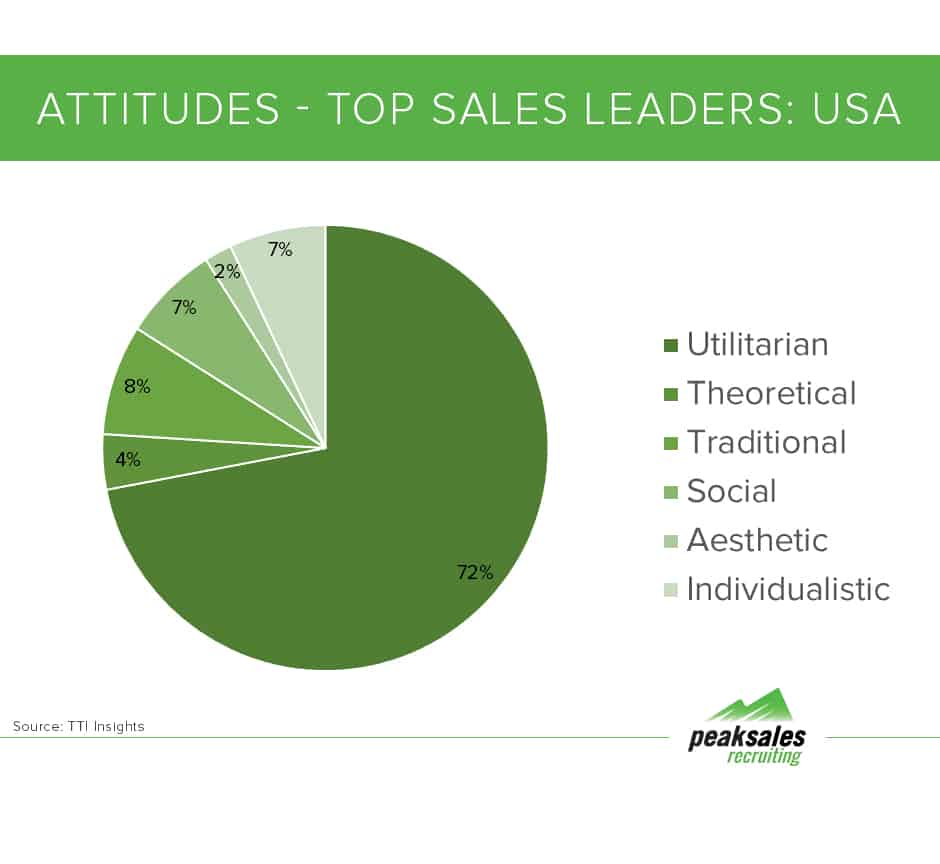
A study from TTI Success Insights found that top sellers in the US most often display a utilitarian attitude.

Recruit Attractive Sales people

A person with a high utilitarian attitude is driven to make money and will leverage whatever resources he or she has to make that happen. TTI Success Insights, which aligns with our own experiences, concludes that when hiring, the right attitude is a key indicator as to whether or not a salesperson will be successful with a new company.

The most successful sales organizations develop an eye for traits that are difficult to identify, such as a propensity for problem solving and a thirst to make money. And while sector experience is sometimes a requirement, there are a few attributes that almost all top performers have in common:

  • They are inquisitive by nature. They seek to understand as much as possible about their customers;
  • They are positive in the face of adversity and don’t let rejection deter them from their goals;
  • They are focused on how their selling activities drive profitable revenue.

Read more about the DNA of peak performers.

Influence

The saying that “beauty is only skin deep” actually proves true over time. The Arizona State study mentioned above found that appearance was helpful in the sales process in the short term but less so over time.

“Where the length of the relationship was “relatively short” the market share changes by 2.94 percent for each 1-unit change in attractiveness rating; but when the length of relationship is “relatively long” market share changes only 1.28 percent for each 1-unit change in attractiveness rating.”

In other words, the longer the relationship or sales cycle, the less appearance matters. For businesses with lengthy sales cycles — enterprise software and service-based offerings to name a few — the takeaway is obvious: hiring attractive people instead of convincing individuals is a mistake.

Mike Schultz and John Doerr of the RAIN Group (PDF) write, “Winners convince buyers that they can achieve maximum return, that the risks are acceptable, and that the seller is the best choice among all options.”

Confidence

Confidence is one of the key traits of successful salespeople. The primary component of confidence is self-efficacy, or “the belief that you are able to accomplish a particular goal.”

“Self-efficacy beliefs determine how people feel, think, motivate themselves and behave,” writes Stanford professor Albert Bandura. “People with high assurance in their capabilities approach difficult tasks as challenges to be mastered rather than as threats to be avoided. They attribute failure to insufficient effort or deficient knowledge and skills which are acquirable.”

Top performers approach everything they do with confidence. For example, people have limited control of physical appearance, but total control over the way they dress. Lorynn R. Divita, Ph.D., a professor at Baylor University, says that “When dress is appropriate for a situation, individuals tend to feel more confident and competent. The reverse is also true.”

The best salespeople dress the part because it makes them better at their job. It’s just one gene in a top performer’s Sales DNA.

Another important factor that influences confidence is training and coaching. Well-trained salespeople feel more comfortable answering questions and objections that are posed by prospects.

A study from the University of Florida’s Warrington College of Business (PDF) highlights that the best salespeople are the most adaptive. They are able to adjust their tone, approach and attitude to meet the demands of any customer or situation.

“A key ingredient for effective adaptive selling is knowledge. Salespeople need to “know” their customers. Just as successful advertising strategies require detailed knowledge about target segments, successful selling requires detailed knowledge about different types of sales situations and customers.”

A structured and rigorous onboarding program that compliments top performers existing skills with new ones reduces ramp-up time and increases employee retention.

Go beyond looks when sales recruiting:

Better sales outcomes, great employees and happy customers don’t have to be a pipe dream. The key to building a great sales team is understanding that Sales DNA should trump looks or other surface-level traits candidates may possess.

The post Should You Hire Attractive Salespeople? appeared first on Peak Sales Recruiting.

29 Mar 17:10

The 7 Traits of Perfect Salespeople [Infographic]

by mrenahan@hubspot.com (Mike Renahan)

perfect_salesperson.jpg

It’s a scary thought, but only about one-third of sales reps actually hit or exceed quota. So if you’re struggling this month, you’re not alone. But while you’re struggling, the person next to you might be en route to their best month yet.

This raises an important question: What separates the top third from everybody else? Is it persuasiveness? Friendliness? Something else altogether? A recent study found that certain character traits correlate with success in sales.

One of them is empathy, the ability to understand and share someone else’s feelings. Empathetic salespeople can place themselves in their prospects’ shoes, which helps them anticipate objections as well as make buyers feel heard.

Check out the infographic below from NextGen Leads to learn about six more traits that make up the perfect salesperson. If you’re looking to get ahead this year and crush quota, developing these traits could make all the difference.

personality-perfect-salesperson-1.jpg

HubSpot CRM

29 Mar 17:09

How to Use Social Data for Better Lead Generation

by Tukan Das

LS-SocialDataLeadGen

Many sales pros and B2B marketers have written off social media as a somewhat effective, if difficult to measure, means of increasing brand awareness. Sure, it can get people talking, but it doesn’t do much to directly contribute to the bottom line.

If you’ve caught yourself thinking like this, think again. Social media can be a fantastic source for lead generation, if you know how to uncover and interpret the data it provides.

There are a number of ways that social media can be measured and used to generate leads: gated content, email opt-ins, paid advertising campaigns and more. But tied into all of these activities is data – what you know about your customers, your competitors, and your industry.

Improve targeting and segmentation

If you already have a large audience in your mailing list, you can improve open rates, engagement and actions taken by leveraging social data. By combining what you know about your audience on social media (their likes, dislikes, recent purchases, who they are connected to, etc.) with their email address, you can segment a large audience into several smaller ones. These smaller audiences should share traits that are relevant to your brand’s marketing and sales goals – like their job title, brands they have interacted with recently, or the size of their influence on social media, for instance. Each segment can then receive its own tailored messaging, which will increase lead gen over time.

Personalize your messages

Whether you are sending a cold email or replying to a long-time customer on Twitter, the more you can personalize your message the better. After all, consumers want to feel like the brands they engage with know and care about them. Social data enables more personalized messages in the context of both sales and marketing. Emails no longer have to be generic “check out our latest feature” pieces – instead, they can be personalized to directly address recent pain points your prospect has expressed via Twitter or LinkedIn. Customer service tweets no longer have to uselessly repeat, “for assistance, call our toll free number” – now they can directly address the current (and past) issues the customer is facing.

Automate based on the buyer’s journey

Social data can also be used to develop marketing and sales automation in order to capture and move more leads down the funnel.

For instance when you know that your customer is in the decision stage of the buyer’s journey, based on their interactions with your brand on and off social media, you can create an automated email drip campaign to showcase key product features that will address their pain point and increase the urgency along the way.

Using social data to inform lead generation campaigns will strengthen them and increase the number and quality of leads that come through. Whether through automation, personalization or segmentation, you can develop more precise, targeted lead gen campaigns thanks to the proper application of social data.

29 Mar 04:56

Name-your-price hotel rooms

by Springwise
Photo: Flickr/Bri

Hotels are often left with unfilled rooms, which is why we have seen websites offering to cancel and rebook rooms for customers, and make the most of fluctuating room prices. Polish startup Findbed reverses the booking process by enabling customers to name their ideal price, leaving the hoteliers to decide whether or not to accept their offers.

findbed-hotel-name-your-price-tourism

We have already seen taxi and private jet services use the ‘name-your-price’ business model. Now, FindBed enables customers to book a room at a rate of their choice. To begin, customers declare their desired price and the platform sends out the offer to all appropriate venues. Then, the manager of the hotel has three hours to decide whether or not to accept the offer. Finally, the customer is sent a list of all the places that will offer a room at that price and they can choose their favorite.

What other industries could integrate this model?

Website: www.findbed.pl
Contact: rafal@findbed.pl

The post Name-your-price hotel rooms appeared first on Springwise.


29 Mar 04:55

5 Alternative Virtual Assistant Apps You’ve Never Heard Of

by Justin Pot
cwa-alternative-assistants

Tried out Siri, Google Now, and Cortana only to find yourself disappointed? Here are a few alternatives to check out, brought to you by Cool Apps and Websites. We’ve covered free alternatives to Siri in the past, and rounded up the three major virtual assistants to find out which is best. We’ve even explored using Cortana on the desktop. But a lot of great alternatives to these apps have popped up since we wrote about any of that, and we wanted to round up a few. Let’s dive right in, shall we? Hound (Android, iOS): Fast Responses to a Bunch of Questions Siri, Google Now, and...

Read the full article: 5 Alternative Virtual Assistant Apps You’ve Never Heard Of

28 Mar 20:01

Improve 1% Each Day In Small Areas, Rather Than Aiming For Huge Changes

by Eric Ravenscraft

When you decide that life needs to change, the biggest problem areas of your life will stand out. The gap between where you are and where you want to be is overwhelming. Don’t focus on the end point. Focus on the minor steps you can take to get there instead.

Read more...

28 Mar 19:59

BlackBerry Ltd’s hardware business may soon be gone

by Jonathan Ratner

The absence of a lower-cost Android device from BlackBerry Ltd. at the Mobile World Congress in Barcelona a few weeks ago, could be a sign that the company is moving closer to exiting the hardware business.

While there are a number of possible reasons for the delayed launch, TD Securities analyst Daniel Chan thinks the lack of this widely-expected product may mean a strategy change is coming.

He noted that by exiting the hardware business, BlackBerry would become a US$1.4 billion per year enterprise software company, with a forecasted operating margin of 33 per cent and US$1.4 billion in net cash.

That is a “much better overall picture than today,” Chan told clients.

After WhatsApp announced in late-February that it will stop supporting all BlackBerry devices by the end of 2016, and BlackBerry itself telling users the Facebook app will no longer function on BB10 after March 31 (they will have to use the web version), the operating system’s days could be numbered.

“Not only are there no BB10 devices in the pipeline, but also the loss of two of the most popular mobile apps across all platforms could lead to the end of life of BB10,” the analyst said.

That could produce a lot of savings for BlackBerry, since the research and development associated with its handset business is estimated to be between 30 and 50 per cent of total R&D spending.

Investors may learn more about its plans when fourth quarter results are reported on Friday, April 1.

So what can we expect from BlackBerry going forward?

One thing to look out for is the company’s first internet-of-things product, BlackBerry Radar, an integrated trailer management service, which includes a self-powered device, connectivity, and cloud-based apps. It is seen as a turnkey solution for managing containers, trailers, and inventory with improved efficiency, will be unveiled at the Mid-Atlantic Trucking Show that begins on March 31 in Kentucky.

28 Mar 19:57

Blood test for concussions? Researchers report some progress

New research bolsters evidence that a simple blood test may someday be used to detect concussions
28 Mar 19:51

The trouble with the 2016 federal budget

by Canadian Business
Federal budget lock-up in Ottawa March 22, 2016. Photograph by Blair Gable

(Blair Gable)

There are many good things in Finance Minister Bill Morneau’s first budget. It is positive, for example, that the fiscal authority now is working with the central bank instead of against it.

Unfortunately, the budget also prominently features one “David,” and his sense of entitlement; Morneau is overly protective of him.

David is Budget 2016’s everyman, the Liberal government’s caricature of a typical Canadian. David grew up in the True North, strong and free, but he was priced out of his childhood neighbourhood, one assumes by bankers, lawyers and architects. He married Neera, who immigrated as a student. They both are “highly educated,” and both have jobs. They also have daughters (we aren’t told how many), whom Neera likes to take to the market on weekends. It will surprise no one who followed the narrative of Prime Minister Justin Trudeau’s successful election campaign that David and Neera are despondent, especially David, who appears to be lamenting his career choices. According to the budget, “David, who just turned 40, is finding it difficult to increase his salary without changing jobs or relocating to a different city—something that is less attractive now that his children are in school.”

I think we are supposed to feel as sorry for David as he feels for himself. That would be easier if he were a laid off oil worker who had been told by smart people for more than a decade that crude prices were headed to $200 a barrel, and that Canada was on the verge of becoming an energy superpower. That David would have had his life upended over the past year by forces beyond his control. But the lack of a satisfactory raise notwithstanding, Morneau’s David appears to have a decent job. A higher salary is available to him—all he needs to do is change jobs or move to a place with a hotter economy. Except he doesn’t want to do either. He likes his life as it is.

Morneau and Trudeau want the Davids of Canada to have that comfortable life. There is little in the financial plan they released on March 22 that would suggest to David that prosperity in the post-crisis economy may involve moving to where the good jobs are, not waiting for them to come to him. Nor is there anything that would nudge David or Neera to start a company if they are unhappy with the lives their stagnant salaries afford them. This should trouble anyone who worries that Canada’s economy may lack what it takes to compete globally. Budgets are expressions of a government’s priorities, and the Trudeau government had little to say about business.

Related: Bill Morneau says review of tax breaks is coming 

The Big Item in the budget is the Canada Child Benefit, which will redistribute $5 billion annually to lower- and middle-income families. The Finance Department estimates the payments will add about 0.2 per cent to gross domestic product in 2016 and 0.4 per cent in 2017—a marginal return for a such a big investment. David, Neera and most everyone else who qualifies for the benefit are slammed with record levels of debt, an there is evidence that Canadians are using any windfalls from the government to level the playing field with their banks, not stoke new demand. “The household-oriented measures taken by Finance Minister Bill Morneau will contribute to mitigate the risks associated to household indebtedness; by far the largest concern for financial stability in Canada,” economists at Laurentian Bank said in their analysis of the budget. The Child Benefit isn’t economic stimulus; it’s debt relief for Canadian households.

Spending billions to bail out families beats rescuing bankers, or Bombardier. And perhaps it’s only fair, given that households have been asked to carry the Canadian economy in recent years with little help from government spending or business investment. But Morneau’s initial foray into economic planning puts too much emphasis on the teachings of Thomas Piketty, the French economics professor who documented the spread of income inequality in rich countries, and too little on Canada’s bigger economic problem: competitiveness.

David and Neera represent a speechwriter’s attempt to cement the unfairness of an economy in which the incomes of the middle class are growing only a little, while those of the richest one per cent are growing a lot. This is a problem, to be sure. Wide gaps between the wealthy and everyone else create political unrest of the sort taking place now in the United States. But it is not an extreme issue for Canada; the gap between the richest and the rest matches the average of the Organization for Economic Cooperation and Development, a group of 34 rich countries.

Related: 25 ways the federal budget affects you

Where Canada does poorly is on almost every international measure of productivity, innovation and investment in research and development. “What should we do?” Kevin Lynch, vice-chairman at Bank of Montreal and a former senior public servant, asked in the Globe and Mail last year. “The simple answer is change—the evidence rather clearly suggests that more of the same is not going to solve the problem.”

Change may come. Morneau said the government will spend the year studying innovation, and the budget does contain money for research and technology clusters. The government plans to spend tens of millions of dollars on infrastructure over the next decade, but winning projects will have to prove they will boost Canada’s economic potential. And Morneau balked at raising taxes on capital gains and stock options after some of the country’s most successful entrepreneurs told him the move would hurt startups.

But it was reasonable to expect a greater emphasis on competitiveness and entrepreneurship in the budget. Barron’s magazine last week released its list of the world’s Top 30 chief executives. No Canadians made it. There is a reason for that: We lack a serious entrepreneurial culture. That must change, and it will take the government to lead it.

Trudeau and Morneau have missed their first chance to do so. Instead, they reinforced through “David” that most undesirable of Canadian characteristics: complacency.

The post The trouble with the 2016 federal budget appeared first on Macleans.ca.

28 Mar 19:50

Why ‘sucking up’ to foreign tech companies is a good idea

by macleans.ca

Prime Minister Justin Trudeau takes part in a virtual reality tour along with 3D printing technology at the new Google Canada Development headquarters in Kitchener, Ont., on Thursday, January 14, 2016. (Nathan Denette/CP)

This column is in response to an earlier Maclean’s story.

It’s been gratifying to see so many thoughtful Canadians weighing in on how our country can be more competitive in the global innovation economy.

I say “our country” even though I have lived and worked in California for almost 20 years. The reason for my wording is simple: I am among the many proud and patriotic Canadians in Silicon Valley working hard, through a group called the C100, to help our entrepreneurs build world-class technology companies back home.

We do that by connecting them with customers, capital and expertise, all of which are vital to achieving global scale quickly. And when it comes to tech, there is no greater concentration of those things than in Silicon Valley.

Canada’s best tech entrepreneurs—like those in Israel, the U.K. and elsewhere—already understand the value of building early relationships abroad, even as they increasingly choose to base their companies in Canada. It is no wonder that more Silicon Valley companies and investors are, in turn, taking greater notice of tech hubs outside the U.S. as great places to recruit talent and set up satellite operations.

Tech, more than any other, is a global industry.

It’s been surprising, then, to see protectionist sentiments arising from some quarters of the Canadian tech sector, as summed up in a Feb. 25 Maclean’s article titled, ‘Why does Trudeau keep sucking up to foreign tech companies?’

Let me take a stab at answering the headline’s provocative question: Because it’s the right thing to do, if Canada is serious about building a world-class technology sector.

Just as we gain whenever Canadians go out to work at large firms around the world and return to apply their knowledge, we gain when those companies set up in Canada. Not only do they employ talented workers, but they provide invaluable experience in how world-changing tech companies are built and managed.

Of course, we should keep doing all we can to support and favour our entrepreneurs as they build their businesses—but to do so to the exclusion of welcoming foreign tech companies onto our soil is to miss out on huge opportunities to seed our own ecosystem with the expertise, capital and winning culture we need to compete globally.

Mike Serbinis, my Queen’s University classmate, is a case in point. You might know him as founder and CEO of Kobo, and more recently, of League, a pair of Toronto tech companies. But long before either of those companies came along, Serbinis amassed considerable U.S. experience at Microsoft, Zip2 (co-founded by Canadian-educated Elon Musk of Tesla fame) and Critical Path, the last of which acquired DocSpace, the Toronto startup where Serbinis worked back in 1999.

Through a 1999 lens, it would have been easy to view the DocSpace acquisition by San Francisco-based Critical Path as just another Canadian startup selling out to the Americans, exacerbating the so-called “brain drain” of our talent to the U.S.

Instead, it equipped Serbinis to eventually return to Canada and build tech companies that have employed scores of highly skilled people and put hundreds of millions of dollars into our economy.

As Mike likes to say, winning begets winning.

Ireland offers another example of how foreign tech investment can feed a domestic ecosystem. Its tax incentives, high-quality talent, friendly regulations and low cost of living have helped attract Google, Apple, Facebook, Twitter, LinkedIn and other tech giants to its shores. Their presence has, in turn, helped fuel a startup boom as tech workers gain experience and then strike out on their own.

This same phenomenon is playing out today in Vancouver, Montreal and the Toronto-Waterloo Region corridor, where Canadian successes like Shopify, D2L, Hootsuite, Influitive and Vidyard are thriving alongside outposts of international tech giants.

To deride Trudeau for “sucking up” to Google at the recent launch of its new Kitchener-Waterloo engineering office—after he’d visited BlackBerry and the University of Waterloo that same day—would be to overlook how Google’s presence has enhanced the local tech community.

Beyond creating world-class jobs for Canadians, the company has worked with Communitech, Waterloo’s non-profit innovation centre, to set up Canada’s first Google for Entrepreneurs hub. It provides local startups with mentorship, resources and connections into Silicon Valley, and its beneficiaries include Bridgit, a construction software company that out-pitched 10 international rivals in a Silicon Valley event for female tech founders last fall, then returned to Waterloo to keep building.

Google’s acquisitions of a few local startups over the past decade financially enabled those companies’ founders to plow some of the proceeds back into other local startups in the form of angel investments, and to lead promising new ventures such as Axonify, a Waterloo software company led by CEO Carol Leaman, with whom I’ve worked on a board.

Google’s growing Waterloo presence has also served as a beacon to other Silicon Valley companies such as Square, NetSuite and most recently, Everalbum, which have established development offices that help to keep homegrown talent at home, while further building on Waterloo’s international reputation.

Far from threatening to suck up all the oxygen, as the Maclean’s piece suggests, these international companies bring new sources of oxygen, nutrients and diversity to a Canadian ecosystem that has finally regained momentum in the wake of the collapses of Nortel and BlackBerry.

Painful as those two losses were, we’ve emerged stronger for them, with several homegrown companies growing significantly; risk-capital investment trending upward; continued excellence in research in such fields as quantum computing; and a coast-to-coast explosion in startup activity supported by incubators and accelerators. This rise and fall of tech companies is part of the renewal cycle that we want to embrace and foster, as it is an essential part of the cycle in Silicon Valley. It’s more about opportunity than bad news.

Our strength can only increase as more Canadians gain exposure to the kind of success that the Googles, Apples and Facebooks of the world represent.

By all means, let’s have a vigorous discussion on the role federal policy can play in building the best innovation strategy we can for Canada. But let’s not allow protectionism and insecurity blind us to the fact that we live in a global world, and the opportunities inherent in that.

I also propose the following metric as our barometer of success: Let’s rally around the total number of technology jobs in Canada, and drive growth in that number by any and all means. This will set us up for tech success for generations to come.

To quote Mike Serbinis once more, you can think small and be angry, or you can think big and be optimistic.
When it comes to building a world-class innovation economy, Canadians have every reason to choose the latter.

Lars Leckie is Managing Director at Hummer Winblad Venture Partners in San Francisco and a founding charter member of the C100, a non-profit organization in Silicon Valley that supports Canadian technology entrepreneurship through mentorship, partnership and investment. 

The post Why ‘sucking up’ to foreign tech companies is a good idea appeared first on Macleans.ca.

28 Mar 19:49

The Easiest Way to Understand The Difference Between SEO and SEM

by Howard Lo

No Wikipedia definition or technical non-sense.

I’m going to explain the difference between SEO and SEM by relating it to eating food.

Because everyone eats food.

The Setup

You are a website. You’re hungry, and you need to eat.

Traffic is your food.

Without traffic, you’ll die…

tombstone for a dead website due to lack of traffic

There are two ways you can get food:

SEO and SEM

Search Engine Optimization and Search Engine Marketing

SEO and SEM are both ways to get traffic. They work off of you showing up in search results for search terms, but differ in how you show up.

For SEO, you show up in the organic search results:

screenshot of google search results highlighting SEO organic search results

For SEM, you show up as an ad around organic search results:

screenshot of google search results highlighting adwords

SEM is like ordering out for food.
It’s pay-per-click (PPC) advertising where “the more you eat, the more you pay.”

SEO is more like growing your own food.
It’s carefully optimizing and creating content on your site. You plant a tree, and as you water it, it grows and makes food.

Remember, food is important.

Food is traffic.

The Strengths of SEO and SEM

SEM has got SEO beat in two areas:

  1. It’s quick. No waiting, if you need traffic, you can get it right now and satisfy your hunger.
  2. Everything is equally accessible. You get to choose what search term you want your traffic to come from. The search terms that are short and hard, are equally accessible to search terms that are long and easy — assuming money isn’t an issue. In other words, ordering expensive French cuisine is as easy as ordering fast food.

Benefits of SEO over SEM:

  1. Lifetime value. You build search reputation with SEO, which stays with you for your lifetime. Once you’ve got a tree, it’ll keep on producing food. This is the primary advantage.
  2. Transfer reputation. Your search reputation can also be used to promote other websites via links. People will hear about your tree, and come in search for food. You become a provider, and as a provider, you have leverage.
  3. Cheap. SEO depends on content, and making new content can be as cheap as a few minutes of your day. Planting the SEO tree doesn’t take much work, nor does watering them.
  4. Always on. SEO works day and night, no contract, no subscriptions. Even if your favorite Chinese take-out closes down, you’ll still have a steady stream of food coming from that tree.

Which One Is Right for You?

Here is where the analogy really pays off.

Deciding what’s right for you is as easy as asking yourself, should I plant a tree or just order take out?

  • If you’re building a business online that requires a sustainable model of obtaining traffic in the long run, plant a tree (SEO).

watering a small plant over a mound of dirt

  • If you’re building a one-off website for a special event you need to fill in the coming weeks, order take out (SEM).

chinese takeout box over red background

SEM brings instant traffic for a pretty penny, therefore SEM is better for testing a page, a product, or boosting short term traffic.

SEO is more substantial in the long run, therefore SEO is better as a foundation to build a business strategy on.

A Balanced Lifestyle

In most cases it’s optimal for you to have a mix of SEO and SEM.

  • Lets say you’re an online business that deals in selling socks. Following my advice, you choose to focus on SEO. One day, you decide to try a new product, socks for cats. You need to test rapidly if socks for cats is something people want. Pick up SEM to boost awareness to socks for cats, and with that extra traffic, you can quickly determine if it’s a viable product. It’ll take too long waiting for SEO to kick in.
  • Your website is for a small-time socks expo that happens once a year. You normally just do SEM to fill attendance for the month. Next year, you’ll be having the same expo, so you decide to do SEO to gain reputation during the 11 months in-between. This way, all of the following socks expos will grow in attendance due to higher search reputation over time, and year-round ticket sales without the cost of ads.

A good place to start is 80/20, where 80 would be whichever fits your business model best, followed by 20 of the other to supplement as needed. Adjust the ratio based on what the data is telling you. If you haven’t set up data analytics, you should read up on the importance of collecting analytical data.

Take Away

  • SEO and SEM are both great ways to get traffic, but are better used for different things.
  • Use the analogy to help you figure out what you need — grow a tree (SEO) or order take out (SEM).
  • Find a balance! If you order takeout for the rest of your life, it’ll work but it’s going to cost you. If you grow food for the rest of your life, it’s sustainable but everything will be slow. Start at 80/20 then adjust as needed.

If you’re still confused and you need help figuring out what’s best for you, drop a line in the comments below or contact Zlass. Don’t send us food (unless it’s traffic).

28 Mar 19:49

Report: High-Value Users Generate 85% of App Revenue

by Brandy Shaul

Marketing technology company RadiumOne has released its State of Mobile Acquisition report, which analyzed the activities of ‘high-value’ users in iOS and Android apps during January 2016. The report defined high-value users as those who have generated revenue from an in-app purchase or ad monetization in the last 30 days, or who have had at least 30 sessions with an app in the last 30 days.

The report showed high-value users engage with apps four times more than the average user, and, on average, account for 85 percent of app revenue across the retail, books and music, sports and communication app categories.

RadiumOne High Value User Revenue

Breaking high-value users down by app category, the report found 28 percent of sports app users are considered high-value, while 18 percent of retail app users and 18 percent of music and book app users are considered high-value. Finally, 16 percent of communication app users are considered high-value.

According to the report, the average retail app user has three shopping apps on their device, while high-value retail app users have only one. RadiumOne said this indicates high-value retail app users have a higher level of loyalty to specific retailers.

RadiumOne also found high-value retail app users display ‘unique signals’ outside of retail apps, which retail companies can use to identify users who have the potential to be high-value.

Specifically, high-value retail app users were found to have 45 percent more lifestyle apps on their device than the average retail app user (apps like dating, weather and fitness tracking apps, as examples), and 62 percent fewer social gaming apps on their device than the average user.

In a statement, Bill Lonergan, CEO at RadiumOne, commented:

This report further underscores the need for marketers to look outside their own app for signals to truly get to know their high-value users. Taking in data from the entire ecosystem, including third party apps and web sites, determines how customers act outside of apps and will only help marketers reach them in a more effective way, ultimately leading to increased revenue.

RadiumOne’s complete report is available here.

28 Mar 19:49

Email Is STILL The Most Effective

by Dale Keipert

61% of marketers surveyed agree that email messages are still the most effective digital marketing channel. This was followed by websites, SEO, social marketing, paid search, mobile, and finally, display channels.

But, as we mentioned in an earlier post, your email messages have to be relevant for people to open them and then take action on what you put inside the email. If your message is not relevant to what the recipient is interested in, they feel that you are just wasting their time.

The next most effective channel for digital marketing, as rated by these marketers, is the website. Websites have to be the center of your marketing universe. This is where your company is going to get the ultimate goal, a sale, a lead, a new member, etc. The challenge that we see with the website is still too much emphasis on the look of the site.

Now, I agree that sites have to be designed properly, a brand’s image can be damaged by a poor design, and website designs have to keep up with the times, but…if you are going into a new website project it is critically important that you include conversions, in your conversation. If your site isn’t developed in a way that will encourage a prospective customer to become a customer, your site will have minimal value to your company.

The last channel that was mentioned on this chart, that I’d like to comment on is SEO. 50% of the marketers feel that this is their most effective channel while 45% felt that it is their most difficult. This isn’t surprising and if you don’t find these statistics to be the same for your efforts I’d be really surprised.

SEO is still one of the most misunderstood and frustrating channels within the digital marketing effort. Constant algorithm changes, misinformation by unscrupulous or just bad search agencies, and a whole host of other difficulties leaves marketers still scratching their heads over SEO.

Not to over simplify SEO, but one of the tactics that you can use to have a dramatic impact on your SEO rankings is to make sure that your website has fresh, relevant content for your users.

Get Your Free Copy Of Our SEO eBook

28 Mar 19:49

How to Create a Medium Publication That Gets You More Readers

by Tiffany Sun

NOT every publication hits it off with 100+ followers on day 1. And that’s because they…

  • just started.
  • lack good stories.
  • only have one writer (normally the creator of the publication himself/herself).
  • have a vague or no bio, which doesn’t provide much value for readers.

But more than that, they…

  • don’t have a strong purpose as to why people should join.

I know this, because I’ve browsed through dozens of publications and seen these guys plateau to 100–200 followers since a year ago — around the time I started Medium-ing.

What I’ll show you today is how to create a publication that will instantly drive people to join and read the stories you’ll publish there. This is all based on how I got 250+ followers in 4 days for Great Writers Under the Medium Sea.

First things first,

Theme | The bread and butter of your publication

People don’t just join ANY school club or social event. They think about what they can get out from it, and if it ties in with their passion or interest. Publications are no different.

What makes one publication shine out from others is its theme. So before you push out your publication, ask yourself these 3 questions:

  • What do I want from this publication?
  • What do readers expect to get from of this publication?
  • What’s one value that separates my publication from others?

What I wanted from Great Writers Under the Medium Sea?
To gather talented writers who could offer more than what people get from the top stories on Medium.

What my readers would expect?
To see that there’s more amazing writers and great stories.

What’s one value that separates my publication from others?
I didn’t make this publication just to get the best writers in the group. It’s to help them get their stories noticed, improve their writing, and teach them what writing works. Every writer has strengths and weaknesses, and it helps to see what part of their writing works.

Once I had my answers for my publication theme, I came up with this:

Great_writers_under_Medium_sea_bio

Great Writers Under The Sea publication profile

Here are a few good examples from publications who’s been growing at an exponential speed.

popular_Medium_publications

Name | The first & last impression

Sounds like a no-brainer, but you’d be surprised how many people come up with unmemorable names for their publication. Ideally, you want one that’s:

  • Unique, but fits snugly like a puzzle piece.The_Rough_Draft_publication
  • Short and conciseLove_Story_publication
  • Gives people great valueLife_Hacks_for_Business_publication

I decided to go for ‘unique,’ because it ties very well with my original post: Great Writers Buried Under the Medium Sea.

Great_writers_under_the_sea_name

Writers, more writers

Which place do you find more attractive — one that’s bustling with more people, or one where you see a lonely couple strolling down the street? The former, right? Publications are the same way. They’re nothing without writers, and it’s extremely unattractive when readers come expecting great stories when all they see is a (close-to) blank feed.

Bring on a crew of writers who are passionate about your main theme. After all, they’re the ones with the ability to magically attract more readers to your publication through their words.

You might flock to the “search” bar of Medium and start typing in keywords to find your potential candidate. Stop. There’s a better method to finding your key writers.

Write a compelling story that unmasks your main intent for even creating a new publication. Then leave an email contact if they’d like to join your publication. This is what I’ve done in my Hidden Writers on Medium, It’s Time to Unite post:

Great_Writers_under_medium_sea__Writer_request

How I get writers to email me to join my publication

Pro-tip: Don’t give your real email address. Use an email alias, so your inbox doesn’t get flooded with spam.

TAGS

A MUST-DO in my book. I mean, how else are people going to find your publication if you don’t choose the right tags?

The closer your tags and publication theme is, the easier people can spot your stories when they type in your topic/theme.

For Great Writers Medium Sea, we chose:

Great_writers_under_Medium_sea_tags

Our chosen GWMS tags

Note: You can only choose 3. Make wise decisions.


Now that we got the main game plan set up, let’s figure out how to create a publication on Medium.

Create your publication

1. Log into your Medium.

2. Click your profile image => Publications => New Publication

3. Fill in the details.

Note: Make sure you choose a unique image for ‘publication avatar.’ This will be the logo of your publication, which is displayed at the top of your feed and in your bio.

4. Scroll up to the top, and click the right tab =>homepage layout.

5. This will let you organize how you want your stories to be displayed.

Pro-tip: The grid is the popular layout choice, where most publications feature 1 to 2 ‘latest’ or ‘trending’ stories.

6. Hit create, and voila! Your publication is live. Watch those followers start enlisting to your publication.

28 Mar 19:49

The #1 avoidable mistake 99% of sales managers make

by steli@close.io (Steli Efti)

It happens all the time. You catch yourself listening to the tail end of a sales call between one of your sales reps and a potential customer. Everything sounds right—the right words, tone, and energy.

You love what you're hearing, and you make up your mind right then and there—your sales guy must be crushing it.

But a week after the call, you have a rude awakening. The customer is nowhere to be found. And at the end of your sales cycle when you’re staring at dipping closing rates and missed quotas, the same rep you thought was flying high is actually nose-diving at 500 mph.

When this happens—and it will—you’ll want to blame your sales rep. Don’t. It’s not his fault that you made a faulty leap of logic, and prematurely decided that he was succeeding without any real factual basis.

Our brains are hardwired to repeat this mistake over and over—but it’s a mistake that is completely avoidable.

Listen to both sides of the conversation

Too many managers get stuck on their numbers and focus obsessively on their sales metrics and quotas. When it comes to evaluating sales calls, they treat the actual conversation part like a black box. That means that they only ever hear what their own sales reps are saying.

When we only hear part of the story, our brains fill out the rest. We make interpretations based on half of the data and incomplete pictures. What’s worse, these brief impressions guide how we think moving forward. It’s a common phenomenon that psychologists call confirmation bias.

Turning this around is easy, but it’s something that not nearly enough managers do: record the calls that your sales team makes.

That’s how you can actually decode what’s happening between prospects and your sales team, evaluate their performance, and coach them to improve.

It’s like flossing your teeth—everyone knows it’s good for you, but no one actually likes doing it. With your sales team, you need to dig into the gums and work out the plaque.

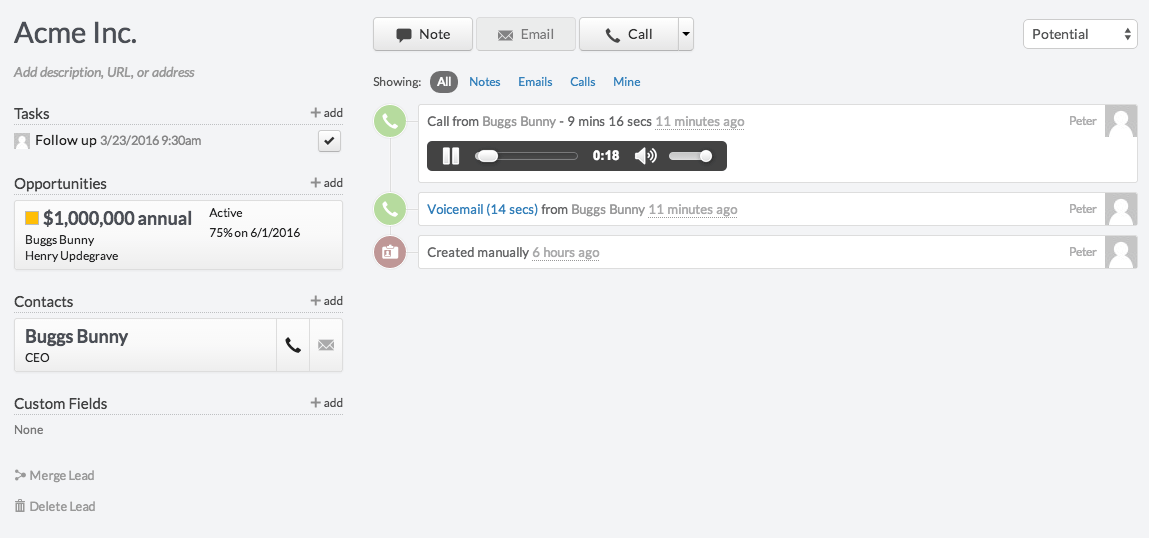
Use a sales CRM like Close.io to automatically log and record calls for each lead.

sales-CRM-record-calls

Do it obsessively. The answers, tone, and energy of the customer on the other line will often take you straight to the problem. Having the full context allows you to narrow the gap between how you think your reps are performing, and what the data actually shows.

Here are 3 examples of sales calls gone wrong, and how you can coach your reps through them as a manager.

1. Failure to ask the right questions

Sales rep: "Our product is a productivity platform that allows you to streamline your whole team’s workflow. I’m just curious—what tools does your team use internally to collaborate?"

The “curious” prospect: "Hmm. Well, we currently use Basecamp for this, but we’ve been having a lot of issues with it lately."

Sales rep: "It’s a match made in heaven! Teams that have transitioned from Basecamp to our product have increased efficiency by 20%."

The “curious” prospect: …

It’s easy to think your reps are out there raking it in when you can only hear one side of the conversation. In the situation above, your rep checks off all the right marks—he’s asking questions before diving in with a value proposition. Listening to the whole conversation, however, almost physically hurts you.

Your rep is shooting value propositions in the dark, hoping that one sticks. He's jumping prematurely to the close, when he should still be trying to find out more about the customer and trying to identify their fundamental pain.

You need to coach your rep to ask deeper questions:

Sales rep: "Tell me more! We have a lot of customers who previously used Basecamp. What specific issues does your team encounter with the app?"

Maybe the customer doesn’t like Basecamp because they find its design difficult to navigate. Maybe they don’t like Basecamp because it’s too expensive for the size of their team. Whatever it is, when your sales rep digs deeper, only then will they find the central pain and actually be able to offer a specific solution.

2. Failure to create urgency

The “window-shopper” prospect: "I’m really interested in your product, but to be honest, we’re swamped right now, and it’s just not a priority. I’m going to take this back to the team, and get back to you later."

Sales rep: "Amazing. It was great speaking to you, and I really look forward to working together in the future."

If you only heard the sales rep’s side of the conversation, it’d be easy to think that everything was sailing smoothly. Listening to the recorded conversation, however, allows you to discover the real problem. Your sales rep has failed to even try making your product a priority for the customer.

Hammer into the rep the fundamental importance of creating urgency in sales. Some prospects are always “interested”, but have some excuse about why it isn’t the right time to buy. “This isn’t a priority for us right now” and “I’ll get back to you later” are never acceptable responses.

Hold mock calls with your rep where you practice relentlessly. Run him through several versions of the scenario, with different twists on why the prospect might not want to move forward.

You need to get the rep to add value for the customer at each stage of the sales process, saying something like:

Sales rep: "I understand that you’re busy. But we talked before about how your sales team wastes X hours a week on data entry, and our product could reduce it to zero. Efficiency will never be a priority unless you make it one. Talk to your team, and let’s chat again next week."

Train your rep to always push prospects that extra step further, and actually motivate them to change their businesses in the now. Building that urgency—and following up on it— is what ends up closing the deal.

3. Failure to say “no”

The “discount hunter” prospect: "I know we said we could sign up and get started next month, but to make the deal happen, we need a 40% discount and 24/7 customer support by phone."

Sales rep: "I’ll make it happen. I’m sending you the paperwork as we speak."

Listening to just the sales rep talk, you think they just crushed that deal—when really, you couldn’t be further from the truth. A 40% discount given without any pushback is insane.

The recorded conversation shows that your rep has a major difficulty responding to aggressive prospects who like to play hardball. Teach them how to instinctively sell value over price.

Run through a scenario in which you play a high-maintenance prospect demanding special treatment, so they can practice saying “no” and pushing back.

Sales rep: "I’m sorry, but the price I quoted you isn’t subject to negotiation. We don’t have resources for phone support, but none of our customers have had any issues our team couldn’t fix through our in-app chat support."

Learning to give prospects firm answers, and risk losing the deal is one of the most difficult things  sales reps need to learn—but it’s also one of the most important. It teaches them how to maximize the power of friendly strength and stand by the value of the product they represent.

Momentum comes from the whole team

As a sales manager, you’re defined by your drive. You always want to push forward—get your sales reps qualifying more prospects, making more calls, and closing more deals. Momentum is everything, and when your startup is in that race to hit $10M in annual recurring revenue, taking a step back to listen to calls that your reps have already made may be the last thing you feel like doing.

It seems counterintuitive, but taking a step back and listening to past calls is one of the most important things you can do—especially when you’re scaling your sales team. Sometimes, you have to take a couple steps back in order to take a big leap forward.

28 Mar 19:48

9 Actionable B2B Webinar Marketing Techniques

by Brandon Gains

B2B webinar marketing techniques have been widely adopted and boast one of the highest conversion rates of any marketing technique – between 20% and 40% in one recent study – and are characterized by their versatility. You can use them to drive sales, build trust and even generate new leads in conjunction with joint-ventures, referrals and paid advertising.

If you work for any kind of company with an online presence, you’re no stranger to the GoToWebinar home screen.

Yet many marketers are failing to properly optimize their b2b webinar marketing plan. The result is that both revenue and potential long-term relationships are being left on the table.

But it needn’t be the case. The truth is that effective B2B webinar marketing is within anybody’s grasp as long as they have the right tools and advice, which is exactly what we’re going to give you in this blog post.

A Quick Note for Beginners

The advice in this post is structured in such a way as to allow anybody new to webinar marketing to gain a full understanding of the topic. Those with more experience will find a wealth of actionable advice to improve their results.

1. Outline Your Goals

There’s a reason that big online companies like KissMetrics, UnBounce and HubSpot (to name just a few) are piling time and resources into creating incredible webinars. They’ve realized that it’s possible to use them to effectively meet a wide range of marketing goals in ways that other methods simply can’t.

The Content Marketing Institute has found that 60% of companies are using webinars, for instance.

The first step is to define your ideal outcomes. Generally speaking, they will correspond to one of the following:

  • Generate new leads – Do you want to promote to a new audience? Webinars can act as powerful sign-up incentives, bringing subscribers into the first stage of your sales funnel. Ian Brodie, pictured below, effectively uses this strategy as part of his joint venture strategy.

1-b2b webinar marketing techniques ian brodie example

(Source)

  • Convert leads into customers – Is the intention to drive sales by specifically addressing the needs of the those segments of your current audience (across whatever channels) that haven’t yet converted?
  • Build relationships with existing customers – Webinars are one of the most effective ways of building trust with your audience. As Robbie Kellman Baxter outlines in her book The Membership Economy, we are moving towards a subscription-based marketplace. This makes maintaining relationships with existing customers all the more important.
  • Sell new or third-party services to existing customers – You can use webinars to resell to your current client base. Premium solutions, second-tier memberships, third party affiliate offers (if appropriate) – all can be effectively promoted.
  • Provide Technical Assistance – The purpose here is to provide specific product instructions. The real value is in allowing the instruction to be guided by Q&A rather than a script. Buzzsomo, for instance, regularly holds these kinds of coaching calls.

Once you’ve decided what it is you want to achieve, it’s onto step two…

2. Define Your Audience

In order to put together tightly-focused and relevant information for your attendees, you need to properly understand, as marketing wizard William Bill puts it, “who and where they are”.

Your strategy for defining your audience will vary depending on your predetermined goals. For instance, discovering what your existing user-base want from an instructional webinar will likely be a simple case of conducting a short survey. Putting together a profile of a completely new segment of your market, on the other hand, will require a more involved approach.

2-webinar marketing example groove

(Source)

Both private and publicly-available data should factor into your analysis. As mentioned, client surveys can also be a useful tool for uncovering interests. In either case you’re looking for pressing, timely and focused audience needs. Take the example from Got Groove above. The chosen topic is time-sensitive (it’s about Google Panda), it’s pressing because many sites will likely have suffered a loss of rankings in light of the then-recent update, and finally, it’s focused – improving eCommerce search rankings which have tanked because of the Panda update is a very specific topic.

3. Create A Strong Value Proposition

Your webinar’s value proposition is made up of all the benefits that it will deliver to a potential attendee. Alongside the core problem that you’re seeking to solve, you can offer a range of additional features. Doing so will work to maximise opt-in rates.

Consider including some of the following:

  • Trending topics – B2B clients in particular have a need to keep up with industry trends and changes. Webinars are one of the best formats for providing this kind of analysis because of their depth and the opportunities for audience-speaker participation.
  • Guest speakers – Marketers and business executives have a unique problem in regards to online content. They have to keep their finger on the pulse of their industry but tend to be very time-poor. Having the option to listen to guest speakers through the services they already subscribed to helps overcome this problem. Kissmetrics (pictured below) regularly offer webinars with selected partners.

3-b2b webinar marketing partnership kissmetrics example

(Source)

  • Giveaways – More and more companies are offering free giveaways to encourage both new leads and current subscribers to attend their webinars. They’re liked by marketers because they allow them to promote a product directly without coming across as running a sales pitch.

4. Craft Engaging Content

This is linked to point number three but is concerned primarily with the elements that need to come together once you’ve got your attendees on board. It’s important that you provide an engaging, fluid experience if you want to maximise conversions.

Consider including:

  • Stories and company anecdotes (people love to see what’s going on behind the scenes).
  • Unusual or unique industry trends (as mentioned above).
  • Case studies (data-based or anecdotal).
  • Engaging images (not stock).

Also keep the following points in mind to build interest:

  • Keep the length between 30 and 60 minutes.
  • Brand your slides to keep your company in the back of attendees’ minds.
  • Leave time for a question and answer session.

Cohen Veterans organized an interesting series of Webinars in which they incorporated many of these elements. They included data-driven case studies, appealing visuals, and novel industry ideas. It was also delivered by a highly-qualified partner, not the company itself.

4-webinar marketing example michael j fox foundation example

(Source)

5. Create a Killer Landing Page

Whilst typical conversion-boosting principles apply, there are several data-backed insights we can bring to bear on the way we craft webinar opt-in pages.

The following is actionable advice that you can use to craft your next promotional page:

  • Split test different webinar pages Unbounce, Leadpages and Wishpond all offer this functionality. Slight changes can often lead to significant increases in sign-ups.
  • Include a picture of the speaker’s (or somebody’s) face – Including a picture of a face on a landing page has been shown to increase conversions by up to 102%. The example from Wishpond below is a great one.

5-webinar technique example wishpond landing page-2

(Source)

  • Don’t skimp on the detail – Including lots of information about the upcoming webinar, as opposed to a short paragraph of text, resulted in a 12.8% increase in sign-ups for KissMetrics.
  • Keep design simple – Fancy designs have been shown to have little, if any, impact.
  • Emphasise the fact that it is not a product pitch – Marketers are especially used to sitting through webinars only to find that it’s been a preamble to a product pitch. They’re understandably frustrated when this happens! Make sure that you’re clear about the actual value that’s on offer.

6. Choose the Right Software

This is a short one! Stick with GoToWebinar. People seem to like it. Neil Patel reported an increase of 21% in attendance whenever he used it. Digital Marketer has also seen similar results.

7. Include Webinars at Every Stage of the Buyer Journey

I’ve referred to the versatility of webinars numerous times in this post, but it’s a point worth mentioning again. You can use them to build trust, engagement and willingness to buy at every stage of your customer journey.

Take a look at the picture below. It represents a typical customer cycle for SaaS companies.

6- customer journey model infographic

(Source)

You can incorporate different types of webinars at each of these points as a way of tightening your sales funnel. Some examples might be as follows:

  • Discovery – As mentioned above, webinars act as a great sign-up incentive and are one of the best ways of capturing new leads at the “value discovery” stage. These will typically be promotional webinars that are designed to address new audiences, offering useful information alongside promoting a free trial or product.
  • Trial/Subscription – Technical webinars that allow users to really understand your service and interact directly with customer support staff can facilitate the transition from “value definition” to “value delivery”.
  • Purchase stage and continued trust building – Webinars that add value outside of your core offering by exploring indirectly related topics will position you as an industry thought-leader in the minds of your customers. The fact that you’re willing to give value over and above what’s expected will help build trust and reduce churn in the long-term. These will account for the “value realization” and “value validation” stages.

All of these various elements are, of course, interconnected. So, for instance, a webinar about recent CRM trends aimed at your current subscribers may lead to new leads or a technical webinar may help to build trust with paying customers. The key is in variety and proper positioning.

8. Pick a Diverse Promotion Mix

Once you’ve defined your audience, picked a great topic, designed an engaging and informative slideshow and script, built a conversion-focused landing page and integrated it into the right phase of the customer journey (quite a list I know!), then it’s time to promote.

Here are some potential options:

  • Promote to your email list – This may seem an obvious one but it needs saying. Around three emails – one to promote the post, one an hour before the event and one when it starts – is a good, research-backed, number.
  • Joint ventures – These are single-handedly one of the most powerful b2b webinar marketing techniques available to companies that operate online, especially SaaS providers. They have huge benefits from both the perspective of the webinar marketer and the influencer that’s willing to promote it to their audience. They work best when you can incorporate some kind of affiliate commission into your referral model – SaaS companies make for hugely attractive partners because they can often offer recurring affiliate revenue. Noah Kagan, of Sumo Me, provides a good example (shown below).

7-b2b webinar marketing partnership example sumome hubspot

(Source)

  • Social media advertising – This doesn’t mean just posting on your various accounts. If you can demonstrate a good ROI with paid social media advertising in regards to the number of sales you generate through each webinar, then there’s no excuse for not building such a process right into your core sales strategy.
  • Create a separate email list for past attendees – As has been repeatedly mentioned throughout the article, webinars are as much about building trust as they are about generating new leads. By having a separate list you’re able to leverage regular watchers by communicating with them directly.
  • Create a recording – Account for people in separate time-zones and new visitors to your site by creating a page from which they can download the recording. Remember to get their email details! Old KissMetrics webinars account for 20% of overall leads.

9. Measure Your Results

Finally, you want to measure how well your webinar marketing strategy is wrking in the context of your outcomes. There’s a handful of key metrics that you should be monitoring. Doing so will allow you to gauge the effectiveness of new approaches when you try them.

  • Registration – This is a good comparative figure. It can help you determine which topics are “sticking” and which aren’t when you compare individual counts to the average.
  • Attendance – The purpose of your attendance rate (which UnBounce put at about 25% for the industry) is to monitor how well your promotion to registrants is.
  • Attendee satisfaction – This is a simple case of including an exit poll (preferably for some kind of reward) at the end of the webinar. Most software has this functionality.
  • Goals – With proper analytics you should be able to effectively tie each campaign with a specific goal.

Wrapping Up – B2B Webinar Marketing Techniques

Though there are lots of things to get right, the basic process behind developing an effective webinar marketing campaign is relatively simple. When you couple a willingness to test and experiment with a strong analytics framework, you’ll be well on your way to boosting revenue and building trust.

Don’t forget that webinars boast one of the highest conversion rates of any marketing technique. Big companies are including them in every stage of their sales funnel. It’s probably a fair guess to say that you should be too.

content upgrade footer b2b webinar guide

28 Mar 19:48

The dirty reason China can't always tell North Korea what to do

by Christopher Woody

China coal mine

Global consumption of coal has declined significantly over the past year, driven by China, which makes up about half of the world's demand for coal.

But the Asian giant's break from one of the world's dirtiest fuels is unlikely to be a clean one: While China seems to be reducing coal production and consumption domestically, political concerns suggest that Beijing will maintain support for coal production in North Korea.

This relationship has led China to push for sanctions exemptions for its coal trade with the hermit kingdom, even as Beijing winds down its own coal production — the livelihood of an increasingly restive portion of the Chinese population.

'There isn't going to be change'

China's economy grew 6.9% in 2015, the lowest rate in 25 years, and Reuters has reported that the government intends to lay off 5 million to 6 million state workers over the next two to three years, "as part of efforts to curb industrial overcapacity and pollution."

In northeast China, a hub of industrial and coal production, those layoffs have already started.

Local economies in parts of Heilongjiang, in far northeast China, fell 10% in 2014. Coal prices in those areas have fallen by half since 2011, and the Chinese pullback from coal and heavy industry has left many workers without work and with few prospects.

China coal production 2020

Chinese leadership has promised that the 1.8 million workers who will be fired from government-run coal and steel firms (others will be laid off from private companies) will be retrained and rehired.

"The opportunities for middle-aged or even elderly former coal miners and steel plant workers are more limited in a province where the economy really has slowed to virtually zero," Geoffrey Crothall of the nonprofit China Labor Bulletin, which has tracked a significant spike in labor strikes in China over the past six months, told the Associated Press.

Unrest has grown in the northeast, and large protests have taken place. Many workers, mostly young ones, have left the area for manufacturing centers in southern China, according to the AP.

Those who remain, and still have work, say they haven't been paid in months.

China coal miners

"I don't even have anywhere left to borrow money from," Li Jiuxian, a 51-year-old miner in Jundeshan, in northeast China's Heilongjiang province, told the AP outside a dingy mahjong parlor. "There isn't going to be change."

'The government hasn't issued any notice'

Despite the domestic measures that have diminished coal production, China seems more reluctant to put checks on the coal it brings in from North Korea.

“Over two weeks after the United Nations slapped harsh new sanctions on North Korea, several Chinese shipping and trade sources say they have not been told of any curbs on the import of coal from the isolated nation," Reuters reported in mid-March.

Coal is North Korea's largest export and one of its only sources of hard currency.

North Korea China coal imports

"At this point, nobody has come to us and said you shouldn't do it," an official at a company in the port city of Dalian that imports North Korean coal and other goods told Reuters. "I'm not even clear on what the specific sanctions are."

While China has taken action against some North Korean traders in line with sanctions on the North's weapons programs, Chinese officials and other experts have cautioned that taking too hard a line against the pariah country could lead to economic disaster.

Kim Jong Un China diplomats meeting

"China regards stability on the Korean peninsula as its primary interest," a report from the Council on Foreign Relations said earlier this year, citing China's desire to maintain a strategic buffer between it and South Korea as well as Beijing's fear of a wave of North Korean migrants heading north should their country collapse.

Moreover, keeping the North Korean regime in power accentuates Chinese authority in the region, prevents a pro-West government from coming to power, and forestalls the possibility of North Korea's nuclear material falling into the wrong hands, according to Douglas Schoen and Melik Kaylan in "The Russia-China Axis."

Coal deliveries to China from North Korea spiked by 26.9% in 2015, according to Reuters, to 21.7 tons with a value of $1 billion.

While Beijing, which is North Korea's biggest trading partner, has become more willing to criticize and punish Pyongyang, it has also worked to carve out exceptions to sanctions imposed by the international community.

China North Korea Trade CFR

"I think it's an indication that the Chinese managed to negotiate a wide exemption for the coal trade," Andrea Berger, deputy director of the proliferation and nuclear policy program at the Royal United Services Institute, told Reuters.

"Coal is a big lever for them," Adam Cathcart, a North Korea-China specialist at the University of Leeds, said to Reuters. "They're wise from the Chinese standpoint to keep some leeway (so) they're not branded as sanctions violators if a train goes from China to North Korea (carrying resources)."

Rough neighborhood

Despite all its economic and military power, China's continued willingness to take North Korean coal is likely a sign that it still can't totally dictate its relations with Pyongyang — which has few other friends.

"It’s clear that the Chinese have enormous leverage over North Korea in many respects," said Daniel Sneider of Stanford’s Asia-Pacific Research Center, according to the Council on Foreign Relations.

"But can China actually try to exercise that influence without destabilizing the regime? Probably not."

North Korea

At a time when China is navigating its own domestic economic distortions (and the fraught political conditions they have wrought) as well as a contentious geopolitical scene in the South China Sea, a quiet North Korea is likely in its interest, even if that means shelling out for more dirty coal.

"There is no reason to think that political risks emanating from North Korea will lead China to withdraw its economic safety net for North Korea any time soon," Council on Foreign Relations senior fellow Scott Snyder wrote in mid-2014.

SEE ALSO: 16 stunning photos of the dark, dirty way the world gets one of its biggest — and dirtiest — fuel sources

Join the conversation about this story »

NOW WATCH: This incredible 580-ton monster machine is building bridges across China

28 Mar 19:48

Some of the Most Successful Platforms Are Ones You’ve Never Heard Of

by David S. Evans
mar16-28-165085143

When most of us think of multisided platforms, the ones that come to mind are those, like Apple and Facebook, that make heaps of money. Or unicorns like Uber that, if cap tables mean anything, someday will. Of course, anyone who really knows the history of platforms may recall the many that aspired to make gobs of money but never did and quickly died (think of the many B2B exchanges that never made it to the other side of dot-com bust). And don’t forget your brother-in-law’s great platform idea, which will make you both rich if only you would invest your life savings in his startup.

What’s amazing, though, is that there are many platforms that have created massive value, but have never made a profit, and don’t even strive to make money — on purpose.

Most likely, you have of one of the worldwide champs in this category in your wallet. MasterCard and Visa didn’t make, or even look, for profits for decades. MasterCard started as a not-for-profit membership association, in 1966, and Visa did the same, in 1971. Both associations managed their brands and ran the clearing and settlement systems for banks that issued cards or helped merchants accept cards. These card networks were allowed to charge their members just enough to cover cost and provide working capital. (For more on this, read Dee Hock’s book about starting up the Visa network.)

By the mid 2000s MasterCard and Visa were handling trillions of dollars of transactions between consumers and merchants around the world. Then the banks decided to turn the associations into for-profit companies, IPO them, and cash out. MasterCard IPO’d in 2006, and Visa followed two years later. Now they are very focused on making money. Around the world, though, many countries still have domestic payment networks that operate as not-for-profit platforms.

Many other multisided platforms haven’t made the leap to making money. In fact, some not-for-profit multisided platforms — hardly household names — have helped drive the major technological revolutions of the last several decades, including the internet and mobile. Standard Setting Organizations (SSOs) are multisided platforms that help members reach agreements over a standard (For example, mobile carriers, handset makers, chip providers and many others have to agree on a common standard — like 4G — for what they do to work together.) The SSO usually publishes a standard and disseminates it at low cost or even for free. That standard may then become a platform for many firms that produce complementary products and their customers. The SSO is therefore a platform for creating platforms.

Insight Center

  • The Platform Economy
    Sponsored by Accenture
    How online marketplaces are changing the face of business.

SSOs comprise a massive, yet almost invisible, industry. There are hundreds of them (almost 1,000 by one count) around the world, competing with each other for membership and influence. Thousands of companies belong to them and many belong to several. A recent study found that SSOs published more than 200,000 standards between 1975 and 2011. It also found that these platforms were responsible for a significant amount of economic growth in the last several decades.

In fact, SSOs played a major role in the technological revolution, reverberating throughout the world, from smart mobile phones. Every generation of mobile phones, starting in the early 1990s, followed years of efforts by an SSO to create standards. That has involved creating standards that can coordinate mobile carriers, chipmakers, device markers, software providers, and many other technology providers.

Commentators tend to give a lot of credit to Apple and Google for developing great mobile software platforms. But Android and the iOS wouldn’t have been possible, and in fact probably wouldn’t have been created, if SSOs hadn’t created the technology platforms for providing fast and capacious broadband. A not-for-profit SSO, 3GPP, whose members include mobile carriers, chipmakers, device makers, and other technology providers developed 3G, which made the initial iPhone possible, and 4G, which made smart mobile phones really useful.

As phone users we think of 3G and 4G as synonymous with the speeds of the networks for our phones. In fact, though, all the players in the ecosystem design their products and software around detailed standards for these technologies published by 3GPP. You couldn’t get an Uber, talk to your friends with WhatsApp, or send selfies to your Mom without the work done by these not-for-profit multisided platforms.

If we dig more deeply into economic life we find even more multisided platforms that help businesses and consumers. In Boston, where we live, many of the high-end boutiques and cafes are located on Newbury Street, off the Public Garden. The Newbury Street League is a not-for-profit membership association that works towards making Newbury Street a nice experience for shoppers and in doing so makes having a store on Newbury Street more valuable. Those are the same sorts of things that a for-profit mall owner tries to do.

The Newbury Street League exemplifies what multisided platforms do: by their nature, and however they are organized, they create value by harnessing externalities—good and bad ones—between participants.  (An “externality” is what economists call things we do to one another, for better or worse, that don’t get compensated for in the price system—like polluting the air (bad) or posting uplifting messages on Facebook (good).) The Newbury Street League stimulates good externalities, prevents congestion, and works hard at preventing bad behavior by their members.

SSOs have done this, for example, by developing elaborate mechanisms for companies to meet, develop, and vote on standards. Many have supermajority voting that essentially requires their diverse members to reach consensus. Other SSO rules are important too. In high-tech areas, where patents are important, SSOs generally require members to disclose patents that could enable them to hold up other members if the standard relied on the protected intellectual property and to charge fair and reasonable royalties for essential patents that do get included in the standard. The tremendous success of SSOs, such as 3GPP, demonstrates the importance of design in encouraging exchange of value among the members and of a governance system to prevent members doing bad things to each other.

Not-for-profit platforms aren’t just important in their own right. They also provide insights for everyone who prefers, in fact, to make heaps of money from starting and running a for-profit platform. By stripping away their profit motive, and many other artifacts of traditional markets, not-for-profit platforms reveal important features that create social value and that could create private profits.

28 Mar 19:27

25 years of covering games: My views of then and now

by Dean Takahashi
Jeremy Coker of Digital River interviews Dean Takahashi at the GDC.

This is one of those posts where you get to hear a lot of what I think about gaming, from my own perspective. As a journalist, I often interview people about their perspectives on the game industry, and I keep my own views in the background.

As a blogger, I’ve been able to blend my journalism background and my own expertise on games. In this role, I spout my views in my Friday column on gaming, The DeanBeat. But I had a chance to do a fireside chat at the Game Developers Conference, where an industry expert turned the tables on me completely.

Jeremy Coker, the group vice president for games at Digital River, interviewed me about my own views on covering the game industry for the past 25 years. We covered everything from the hype around virtual reality to monetization in video games. I was able to look back 25 years at my start in video game journalism and forward to what’s happening today.

Here’s an edited transcript of our interview.

GDC 2016

Above: GDC 2016, where someone turned the tables on me.

Image Credit: Dean Takahashi

Dean Takahashi: It’s nice to be asked to do this for a change. I’m usually interviewing someone else, but I have a lot of opinions that have built up over 25 years of writing about games, 20 of them full time. I just recently wrote a story on the 25th anniversary of Blizzard and was able to look up the story I wrote when they got bought for $6.75 million in 1991 or so. I wrote the very first story about Blizzard in the L.A. Times back then. It’s fun to go back and revisit and interview the same people, who all have gray hair now.

It’s been a fun 25 years of covering games. There’s not really anything else I’d rather do. I do cover tech news as well. I work at VentureBeat. I’ve been there for eight years. We started GamesBeat as a sub-section a while ago. We do about a half-dozen conferences every year and two of them are GamesBeat conferences that I run. We have our GamesBeat Summit coming up in Sausalito on May 3 and May 4 this year, and then our first GamesBeat in Los Angeles August 1 through August 3. That keeps me busy, but very focused and happy in my work writing about games.

Jeremy Coker: How is the show so far? What are you seeing? What’s the big thing so far?

Takahashi: For me, GDC has been taken over by press events. I’m not getting out to go listen to sessions that much. I’m pretty sure I’m missing a lot of what’s happening that way. But the press events are interesting, because they’re mostly about VR. They’re mostly something to do with the platform wars between the different companies that are trying to win over the hearts and minds of developers. GDC is, as usual, a real battleground for people who want to grab attention or mindshare and get developers on their side.

Coker: Speaking of that, we’re seeing a lot of new developments in terms of software and hardware for VR. Where are we at and where is that going this year and in the future? As developers and publishers concerned with making content and making hardware, what should we be thinking about?

Takahashi: The ecosystem is vast already. It was surprisingly big even before sales really started with Samsung Gear VR last fall. Billions of dollars have gone into creating hundreds of VR startups. We had a survey that we published in [October] that counted 234 startups in VR that had gotten funding. It’s much more than that now. Nvidia said they’ve been in touch with 600 different projects. Epic and everyone else involved in the ecosystem can count these projects by the hundreds.

That tells you that whatever flywheel is going here is going to keep going for a while. You can believe that it’s real. When you get that many companies together someone is going to produce a hit. We saw that last with the iPhone. Eventually you had things like Clash of Clans emerging and driving the platform forward.

That’ll happen with VR. It’s a bit different because we all see the flaws in VR today. A lot of us get seasick. About half the population gets seasick. Half the population probably also doesn’t know what VR is. There’s a lot of education that needs to happen in the market. There are ways this market could stumble as it’s getting out of the gate. Some of the headset makers may have manufacturing problems. They may not have enough supply.

It’ll start this year in a big way and the momentum will begin. Then we’ll get very picky. “Using my hands like this in VR is nice. I can move my hands in different directions instead of using a controller. But I’d like to use all my fingers in VR.” Once you use your fingers, you’ll want to control things with your eyes or your arms or your torso or your legs. You’ll never be satisfied with the state of VR. That’s why it will keep changing. I’m not sure which form of VR is going to be the mass market form, but I expect that there will be one.

Coker: As you’ve made the rounds during this conference and previous conferences like GamesBeat, is there one device out there that you think is the game-changer, or one piece of software?

Takahashi: Not yet. Although just an hour ago, Epic had a very nice demo of a character from Hellblade, a game by Ninja Theory, using the Unreal engine. They showed a very realistic heroine, this Viking character, in a scene from the game. She’s talking. Her eyes are watery. She’s very emotional. She’s going a little crazy. And then they pull aside this curtain and it’s an actress who’s mo-capping the performance in real time. You could see all the expressions on her face — the eyes, the blinking — translated to the screen in real time. I thought that was pretty awesome technology.

Tim Sweeney of Epic said that you can imagine this is going to get translated into social media at some point. You could go online and play your World of Warcraft character or simply go on Facebook and have a conversation this way. It might take a while for that to happen, but it’s amazing technology.

PlayStation VR demo at the GDC.

Above: PlayStation VR demo at the GDC.

Image Credit: Dean Takhashi

Coker: You mentioned that you surveyed 200-plus startups getting into the space last year, and then Nvidia talking to 600 projects. These are scary numbers when we think about where the market’s going. SuperData released some information last week saying they think the market will grow slower than most people think. They cut their estimates and their time frame for how the market will grow. Are we headed into bad times with VR given the amount of investment and how quickly some people want a return?

Takahashi: I don’t think they can count on the return coming early. I saw some estimates this morning from an analyst who said he expects Sony to sell 1.6 million units of PlayStation VR this year, when it launches in October at $400. By then, Sony could have a 50-million-unit base of PS4 users. 1.6 million is not that impressive. It’s not going to support hundreds of companies. They have to have more dry powder to last them for years. Revenues may not come right away.

If you think back to the dawn of the Xbox in 2000, it was a tremendous success when the Xbox sold 1.4 million units in its first season. Sony selling 1.6 millions of PSVR in its first season could turn into something bigger 10 years from now. The Xbox launch adds a little perspective to it.

Coker: It’s an interesting point. It’s going to evolve into a big boys’ game. The companies with staying power, that can last as the market matures and grows, it may finally pay off for them.

Takahashi: The big boys always want to count on that return. Maybe the smaller folks who can survive on coffee and ramen, as Tim Sweeney says, are the ones who can wait this out and experiment and find what works. They can try over and over again and eventually find the right VR content before the big guys.

Coker: As we look at the market, testing some of the new headsets out there, it dawns on me that gaming maybe isn’t the preferred application for VR. We’re at the Game Developers Conference. A lot of people here are focused on games. But is there a different application or medium that’s better and will push VR?

Takahashi: 360 video is pretty compelling. Even 360 photos at the moment. Hollywood is starting to do a lot of these story-based VR experiences, like the Martian from Fox. A lot of filmmaking talent is focusing in on VR right now. I saw a demo of this Gary the Gull animated film that had some interactive parts to it. It was clearly a film where this seagull was trying to steal some food from you on the beach and having a conversation with you and trying to distract you. When it distracted you and looked in one direction, the seagull knows that and tries to steal something over here. It’s reacting to your movement in virtual reality.

There are very interesting experiences that you can only create in VR, and Hollywood is going to discover that. That’ll be a big industry. And yes, I think a lot of other industries, like education and medicine and product design are all going to benefit from both VR and AR.

Coker: We’ve seen, as VR has been making a lot of noise in new cycles of the business—at previous GDCs the big noisemaker was mobile. That was the big push, the big concern. We work with a lot of very large triple-A publishers that have core PC titles, and we’re seeing some consolidation in the market. Where is mobile in the mix today? Where is it going? Why is it important?

Takahashi: This morning a couple of mobile game veterans started a $50 million fund to invest in VR game companies. There was another one that formed in the late fall with $10 million. One of these rules you always have is “follow the money.” Where is the money going? The money’s going into VR for sure.

Funplus also had this interesting counter-cyclical strategy where they announced a $50 million fund to invest mostly in mobile games. The theory that’s caused a lot of the investors to flee out of mobile game investment is that all that money just goes into user acquisition, and you can’t knock Clash of Clans out with just paid user acquisition. It’s just too hard to win in mobile game investments now. But Funplus is counting on all that money leaving, and then other companies will still succeed in a market that reaches a billion devices.

VR right now reaches however many units Samsung has sold since December. It’s basically a zero-unit market. You have a billion mobile devices out here. Why would you invest money in zero devices versus a billion? That’s not a bad strategy on Funplus’s part, to build against the cycle and find some companies that have a pattern of doing well with their first mobile game or two and funding those. They funded the guy who made Freeze already and counting on his next game, if he makes it with 10 people or so, being a good investment.

Oculus Rift demo of Eve: Valkyrie at GDC 2016.

Above: Oculus Rift demo of Eve: Valkyrie at GDC 2016.

Image Credit: Dean Takahashi

Coker: Following the money, as you said, if the money comes out of mobile that’s being spent on user acquisition and those user acquisition costs go down, is there an expanding space for smaller developers to win there? Or is it quickly going to become a space that’s dominated by big publishers?

Takahashi: There’s still an “all of the above” possibility in that scenario. The one that caught my attention a lot in the last year was Fallout Shelter. Bethesda is a triple-A game company that makes the Fallout series. They worked for five or six years on Fallout 4. They had an interesting press conference at E3 in June where they announced Fallout 4 and said it would ship in November, but then they also announced that Fallout Shelter would be ready for download in the app store that night, as millions of people were watching.

Eventually Fallout 4 sold more than 12 million units over the holiday at $60 a pop. But Fallout Shelter benefited from having so many eyeballs on that press conference that in its first 24 hours, it generated 12 million downloads. There were more users for the mobile game on day one versus the whole season of sales for the triple-A game.

Bethesda was surprised by this. Then you start thinking, “Why were they surprised?” They said this was like a lightning strike and you just can’t plan for something like it. You’re just lucky when the surprise happens. But all the veterans of the mobile game industry were watching this. They saw Fallout Shelter rise through the ranks and pass Candy Crush Saga, which was making millions of dollars a day, in the top-grossing list.

Fallout Shelter stayed there a few weeks, but it had no new content, so it dropped off the top-grossing ranks pretty quickly. People ran out of things to do with it. If you hit 200 people in your shelter, that was it. You couldn’t do anything more. You look at that and think–They’re a triple-A game company. Their main task at hand was Fallout 4. They had a team of 30-some people making this on a subcontractor basis in Montreal. They could have benefited from a decade of mobile game experience.

There’s all this hindsight on what they could have done. One of the principal game designers was Todd Howard. He told me in an interview, “Last year it felt like I had three or four jobs.” Clearly, Fallout Shelter was a distraction. But the opportunity with Fallout Shelter, had they followed the rules of mobile game design that we’ve learned over a decade – do live operations, keep the content coming on a regular basis, expand to as many platforms as possible, get these things done fast – they could have kept their game in the top-grossing ranks.

If it stayed in the top-grossing ranks they could have seen something like Supercell’s results. Supercell had $2.3 billion in revenue last year from three mobile games. Clash of Clans alone was probably $1.5 billion, and it grew in its third or fourth year. Atriple-A game company cares a whole lot about getting triple-A games done, but if they had looked to mobile and planned for it they could have hit that game out of the park and generated enough money to make three or four more triple-A games. The success of this mobile game could have been great enough to finance every dream they ever had as far as hardcore games.

My Vault in Fallout Shelter has some dead bodies in it.

Above: My Vault in Fallout Shelter has some dead bodies in it.

Image Credit: Dean Takahashi/Bethesda

Coker: It’s an amazing example, seeing a traditional studio used to long production cycles with “core” content—it experimented and found its feet in mobile. It didn’t follow the right pattern, but it did realize that there’s a new area it can expand its IP into and create more value that it’s not touching right now. It’s an extraordinary shift.

Takahashi: The final outcome is that they did acquire that mobile studio. They’re working on several unannounced projects. I’m pretty sure mobile is part of their plans going forward.

Coker: What do you think that does to the rest of the mobile market, as large publishers with core brands and core IP or big licenses come to the market?

Takahashi: Sometimes it works and sometimes it doesn’t. Blizzard, with Hearthstone and the Warcraft brand and all the Warcraft characters they brought into that game—it’s very familiar content for gamers. Hearthstone on mobile and PC has generated half a billion dollars in sales. It’s a home run hit in the collectible card space. That’s a great example of a known core gamer brand coming into mobile and doing very well. The Call of Duty games have almost zero market share in mobile, however, even though they dominate on console and PC.

Coker: Is that because of a missed opportunity? Is the IP not extending to mobile?

Takahashi: That’s almost like a platform problem. Shooters don’t necessarily do that well on mobile compared to, say, strategy games, turn-based games, or asynchronous games. Everybody should look at things like—Machine Zone was very interesting just because of the speech Gabe Leydon recently gave at ReCode, talking about performance-based advertising. Brands have yet to learn this, but he thinks that they do it much better because they’ve grown up in mobile and understand it. Mobile-first monetization and ad strategies are things they’ve mastered.

Also, the success of Clash Royale on mobile recently—It tells you that game design still matters. Creating a game that appeals to hardcore gamers and mainstream gamers alike, simplifying the hardcore nature of gameplay to a point where anybody can play it, making a game really accessible, all that can result in a tremendous hit.

Everyone before was saying that you can’t make a game that will crack into the top five anymore. It was made by Supercell and they can benefit from cross-promotion with their other games, but that hasn’t even started yet. Clash Royale succeeded on the basis of its own game design. It’s a lesson for everyone else. If you come up with the right game you can reach the top-grossing charts in mobile.

Coker: There’s obviously a space for big brands or big licenses to succeed, but game design is still important. If you build good mobile-first games you have a chance. As far as your predictions for the year in mobile, are we still ripe for consolidation? Are big moves going to be made here?

Takahashi: Consolidation is something you can see companies getting ready for. Kabam is certainly signaling that it can’t afford to assign talented game design teams on small projects anymore, projects that might not have blockbuster potential. They’re so large that they have to swing for the fences on every single game. They can’t have 100 games. They can’t have 50 games. They need to succeed with half a dozen games that are all big, top-grossing hits.

They’re taking action on that by shedding some studios and selling off old games, trying to concentrate all their capital and resources on smaller numbers of big projects. That’s what Machine Zone did as well. It worked out great for them, having just two games in the market, one of which was a reskin that wound up in the top ranks.

Everybody’s starting to look at those companies that are sitting on the top of the charts and thinking, “What can we do to be like them?” They’re not the kind of companies that have well-balanced portfolios of 30 games across a bunch of genres. That strategy always has this danger of spreading you too thin. It sounds very similar to the way companies behave in the triple-A space.

Coker: Any predictions coming out of this conference? Anything you’d like to lay on us as far as what you think is happening in the market?

Takahashi: VR will command a lot of attention this year. It’s hard for other companies to fight against that and grab some mindshare. Maybe it will settle down at some point.

I think there are some interesting things that could still happen in the world, though, like Google Play emerging in China. That may help simplify that market for people who want to go into it, like western companies. They may have more opportunity if Google Play becomes one of the biggest stores in China, as opposed to having 300 stores. A lot of western companies can’t go into China, either by law or just because they can’t navigate those 300 app stores. If that starts to change there’s some opportunity for western game companies to go that direction.

All the capital that’s been amassed in the industry is in the east. You don’t see western venture capitalists pouring a ton of money into games right now. You see companies like Nexon or Alibaba acquiring things out here. There’s been a pause in that as we want for the Chinese stock market to go back to normal, but still, I think that trend—Western companies want to go in that direction, but eastern companies are going to acquire a lot of western talent.

There’s a lot of fear about that. If you look at some other technology markets, even though the capital structure has been similar – the east has the money and the west has the innovation – that balance is still there across a lot of industries. In the semiconductor industry, Intel is still the largest chipmaker in the world, even though the Chinese government has actively plotted to create a lot of semiconductor development in China.

Google Play is bringing a ton of changes for game developers.

Above: Google Play is bringing a ton of changes for game developers.

Image Credit: Supercell

Question: You mentioned Fallout Shelter as an example of a game that climbed the charts and disrupted a bit. You’ve talked about Clash Royale reaching the top of the charts as well in mobile free-to-play. The strategy for launching Fallout Shelter was obviously well-conceived, and they had a good idea of how to do free-to-play right. What do you predict that free-to-play done right will look like in this coming year? What does that execution, as well as perception among audience—Is that changing? Will the west welcome free-to-play as much as the east traditionally has?

Takahashi: There is that division, still, in the acceptance of free-to-play monetization. In China, Kabam is adding a VIP system to Marvel Contest of Champions, where if you pay for a lot of stuff you have all these advantages in the game. That’s natural and accepted and even respected in China. But in the west, “pay to win” is a hated phrase. Traditional core gamers especially don’t like free-to-play tactics. You wind up with things more like Fallout Shelter, where you buy things that you can also earn in the game if you choose not to pay. The monetization you see in games like Clash of Clans has wound up being acceptable to western audiences.

I don’t know if there’s a way to hurry along those purchases. People don’t like time limits or being stalled out and making progress only if they’re buying something to accelerate their game. I do think that you have to be much more conscious of “evil” monetization tactics in the west. You have to come up with something that’s more balanced and more acceptable to players.

Coker: Fallout Shelter is an interesting one because frankly they didn’t pay much attention to monetization. Ultimately, it became a success because of their core audience and because they found a mass-market appeal to it. Did that mass-market appeal pay off more than thinking about monetization? Or did Bethesda leave money on the table by not focusing on monetization?

Takahashi: They did well with their core group of fans who hate free-to-play monetization. Todd Howard did say that they were advised by a lot of people to be aggressive on monetization, and they chose not to be because it just didn’t seem right to them. They went with what seemed right, which was kind of a “gacha” monetization where you buy a pack of random things and you get some surprises in there. Those surprises could help you in the game. You could either earn those in the game over time or just buy them outright, and if you bought them outright maybe it was more fun. It was just an option to monetize that was not aggressive. But people wanted it.

Question: Looking back on the rise and fall of Rovio, what do you think it did wrong? Do you think it’s just as simple as going too wide, as opposed to developing three or four games that are very deep?

Takahashi: It’s a tough question, why they didn’t stay at the top. They had the most successful game in the market, but it came out as a paid game. They didn’t know free-to-play. They didn’t have everything in place that they needed to do in-app purchases from the get-go. They had to learn a lot of that, and in the process of learning that they fell behind other companies.

The brand is something that’s hard to assess. It spread very quickly across the world. It became better known than a lot of other brands out there, as well-known as Mickey Mouse or something like that. But somehow that wasn’t a deep enough brand to last beyond the one interesting physics game mechanic they had. If they didn’t come up with more interesting things for people to do, more game mechanics and more ways to play, then you wind up seeing that the brand could only go so far. It wasn’t a Mickey Mouse that could last 100 years. It was a brand that would last only so long as it had a good game behind it.

They started doing all these brand-related things – movies, theme parks, T-shirts, merchandise – and that was all find. But you can’t forget about making games that can go to the top of the charts. They tried. They made a lot of games, including a lot of non-Angry Birds games. They just didn’t have lightning striking a second time.

Minecraft in VR

Above: Minecraft in VR

Image Credit: Microsoft

Question: We all know that user acquisition is getting to be more and more expensive over time. The market is predicting some insane numbers. I’m curious what you can say about how developer-created communities and player-created communities are improving retention and reducing the need for paid user acquisition, or if those communities are coming into play at all.

Takahashi: If you had something like, say, Minecraft on mobile, something that was that successful on mobile first, then that would be your answer, that it is possible to do that. But I don’t know that Minecraft has had that impact on mobile. It started on the PC.

The jury is out, I’d guess. Companies like Epic are arguing that user-generated content can create spectacular results the way it has for Ark Survival. But it also seems like these things follow great content that’s created by the game designers themselves. Developers have to do their job to create the initial interest that fans have in a world. Then, later on, the fans will start wanting to build their own things in that world. Then you can update for it and that allows them to mod whatever they want. That can bring an additional life to a game that’s already popular.

Ark followed that pattern. As a game designer you have to do your job and show you can create a fascinating world and story, something compelling for gamers. Then they’ll want to mod it on their own and that will generate a lot of your user virality after that.

Question: Traditional games, the Call of Duties and Assassin’s Creeds, how do they fit in a space where VR is proliferating? Do you see VR as an expansion alongside the game market, similar to mobile, where rather than replacing traditional games it simply turned new people into gamers? Or do you see VR gaming as an evolution of triple-A gaming? And in that case, what do familiar triple-A games look like in 10 years’ time?

Takahashi: VR is a new platform and a new medium. You can do different things with it compared to consoles or PC. You have to design experiences that fit with it. The thing that VR has going for it is that there are many kinds of experiences you can only get in VR. You can feel that sense of presence, being somewhere else, in a way that you can’t just looking at your TV.

I’ve tried Gear VR on my family. The first time they tried it, you see what a joyful experience it can be for them. There mind really gets blown. “Wow, I’m really in another place.” I tried it on my then-11-year-old. She got down on her knees and started crawling around this 360 photo. I said, “What are you doing?” She says, “I’m trying to get to the water over there.” She had no idea what to expect from this experience. I tried it on three grandmothers and they each stayed in it about 20 minutes their first time.

Still, there’s this problem where, after that first joyful experience, how often will you go back to it? VR still has to provide an answer to that. Are you generating a $10 game experience, where you go to the mall and try some experience for a short time and pay $10 for that and then never try it again? Or are you creating something more like a $60 experience that you’ll come back to over and over again, or that has lots of content to enjoy?

I don’t know what the answer is yet. I hope the industry can provide bigger experiences over time. If they get there, that’s where the Call of Duties are going to fit in and provide some compelling content. There are opportunities all across the spectrum, though. As a developer you can focus on that first joyful experience and try to create a $10 experience that just amazes people. But they may lose interest after a while.

Tim Sweeney, CEO of Epic Games, believes that perfect augmented reality will make screens obsolete.

Above: Tim Sweeney, CEO of Epic Games, believes that perfect augmented reality will make screens obsolete.

Image Credit: Michael O'Donnell/VentureBeat

Question: If you had to make a bet on whether TVs were going to be replaced entirely by VR displays in the next 10 or 20 years, which way would you go?

Takahashi: Tim Sweeney made that prediction. He said that it’s going to happen in about 10 years, where the quality of your AR and VR goggles and glasses will be so great that it’ll be like having a 40-foot screen in front of your eyes. It’ll be a wireless experience with video coming straight to your glasses. Then you don’t need a TV or a smartphone screen or a movie theater.

Technologically, about 10 years from now is when that kind of thing becomes possible. But changing behavior is still a more challenging issue. The advent of television didn’t kill off radio. Radio found a way to survive. Screens are going to find a way to survive for social reasons, maybe. VR and AR don’t automatically do that great a job in social situations. But it’s an insightful prediction that Tim made. I’m betting that at least part of it will come true.

Get more stories like this:  twitter  facebook


28 Mar 19:26

6 Things Great Leaders Do Everyday

by Nate Matherson

No matter what line of business you’re in, it’s likely your company is facing increased competition these days. That’s why good leadership matters so much – it can potentially be the difference between a company’s success or failure.

But what truly makes a good leader? While many people have wildly different opinions on the subject, here are six things that I believe a leader can do to make a huge difference on their company’s bottom line.

1. Make Timely Decisions

Many companies suffer under indecisive leadership. This decision vacuum often leads to employees waiting around which wastes valuable time and money. Similarly, making a decision too quickly without properly weighing its potential outcomes can also potentially waste time, effort, and resources.

The most effective leaders are those who understand that small decisions should be made quickly but can properly weigh a larger decision without getting stuck in deliberation. While you might not make the perfect decisions, these days, the most effective companies are often those that are quick to market and iterative. Your strategy can easily be adjusted or pivoted if you end up going down the wrong road.

2. Recognize Your Weaknesses

Some leaders don’t like to admit their own weaknesses. But everyone has weaknesses and the best way to ensure that they don’t affect your business’ bottom line is to be conscious of them. Knowing what your weaknesses are allows you to adjust accordingly, whether by developing in weak areas through education or practice or delegating in those areas. Just because other leaders might be good at one particular skill doesn’t mean you have to be. Your team will function optimally if the right person is doing each task.

3. Give Feedback Often

Many leaders who are unhappy with the performance of their employees don’t say anything until they become so frustrated that they either get angry or have to have a very difficult conversation with someone. But giving appropriate and compassionate feedback at a much earlier juncture could have potentially stopped the behavior or attitude and gotten the results that you wanted. It’s important that you schedule opportunities to give feedback to your direct reports throughout the year and also that you give it immediately when you notice a problem. This allows your employees to adjust quickly and better serve your company.

4. Focus on the 20%, Then Delegate

The Pareto Principle says that 80% of outcomes often come from just 20% of the things that we do. When it comes to being a good leader, it’s important that you focus the majority of your time on the 20% of your tasks that have the most return on investment. Too many people focus on the 80% of tasks while neglecting the most critical jobs. A good leader has sat down and figured out what 20% of their activities are the most effective and ensures that those are taken care of first every day. They also look for opportunities to delegate whatever they don’t specifically need to be doing. While your employees might not do the delegated jobs exactly as you would, in most cases, this isn’t critical to the success of your business. Leaders should work to build a team, and not a workforce.

5. Be Willing to Be Wrong

Many leaders are afraid of admitting that they’re wrong. This leads them to potentially miss great ideas because they are not theirs or because they might not initially agree with them. Leaders who have confidence in their own opinions but can also see the value in the opinions and ideas of others are much better able to find and promote the right products, ideas, and company practices. The most intelligent people are those who are willing to admit that they might be wrong or that someone else’s idea might be better.

6. Be Compassionate

Many leaders rule with an iron fist, yell often, and are notoriously hard on their employees. These same leaders often refused to provide flexibility for employees who are going through personal struggles. The problem with this strategy is that it often leads to low morale, a significant amount of turnover, and difficulty recruiting new employees. Your best current employees and the best job candidates will not want to work with you and they won’t have to because they have many more options. In leading with compassion and kindness, you create employees who are incredibly loyal and grateful for their jobs. That means that they will work harder for you and stay at your company longer – which will lead to much better results.

28 Mar 19:26

Canada’s recovery at risk in ‘twilight zone’ of low oil and rising loonie

by John Shmuel

Following the recent crude oil price rally, economists say Canada’s economy risks getting caught in a bind where oil prices are not quite high enough but the loonie is not quite low enough.

Canada’s dollar has had a strong rebound in the past month, rising from about 68 cents against the U.S. dollar to 76 cents as of Monday. Oil prices have also rebounded nearly 50 per cent in that time.

The Canadian economy has been feeling the pressure of low oil prices for two years now, causing recession in provinces such as Alberta and mass layoffs in the energy sector. But recent data suggests that oil’s pain has been the manufacturing sector’s gain, as cheaper gasoline prices and a weak loonie have helped the country’s non-energy industry’s become more profitable.

Unfortunately, the recent moves in oil and the loonie could halt that shift.

“Only recently have we started to see some positive signs coming from non-energy investment and production as corporate Canada started to response to the dollar depreciation,” said Benjamin Tal, deputy chief economist at CIBC World Markets. “This fragile recovery might be at risk as higher oil prices lead to a stronger loonie. Simply put, we suffer the pain of a higher dollar without the gain of rising oil prices.”

Oil prices have rallied from slightly below US$30 at their low this year to more than $40 as of Monday, but Tal notes that the price gain is not enough to make a meaningful impact on Canada’s energy sector. Most companies will not even consider increasing capital spending or hiring unless prices move significantly higher.

At the same time, the gains in the loonie could have very real impacts on investment and job creation for manufacturing firms. Canada’s manufacturers have been burned by the loonie before, especially in the years following the financial crisis, where the loonie crashed from parity with the U.S. dollar down to below 80 cents — only to rebound to parity two years later.

“The 6-cent appreciation in the value of the dollar can make a difference in the decision making process for some (or many) manufacturing firms,” said Tal.

The developments leave Canada’s economy at risk of getting stuck in an “oil twilight zone” until oil prices either rebound to a level where energy firms start spending again or manufacturers and exporters see a clearer sign that the loonie won’t be moving much higher.

That will make for an interesting Bank of Canada rate announcement next month. It is likely Governor Stephen Poloz will include comments about the loonie if it stays at this level or moves even higher before the April 13 meeting. 

28 Mar 19:26

Why is Value Such a Difficult Conversation?

by Dave Wakeman

giphy

As a business leader, value creation is at the heart of everything you do.

And, if you are like most business leaders that I talk to on a regular basis, you don’t have a lot of conversations that delve too deeply into what the meaning of value is or what that value really means to an organization.

Why is that?

Because the conversation about value is hard.

Why is it so hard?

There are two reasons really…

1. Counting is easy:

We all love a checklist! I know I do.

And, we all love instructions that lay out how many of something we should do or how much of something we should do…or anything along those lines.

Why?

Because counting is easy.

If you have a job that you get paid by the hour, counting to 8 is easy. It doesn’t matter whether or not you have made an impact, at the end of 8 hours, you are done.

Or, if you need to push out 10 tweets, a blog, and an article. You can count and know exactly when you are done.

These are all task-based goals and you know where they begin and end.

2. Measuring is hard:

In business, the opposite of counting is measuring…and measuring is hard.

Why is measuring so difficult?

Partly because there isn’t always a guide to show you the way.

One of the big challenges in creating value is that you are often building a road where there wasn’t one before. Or, you are making leaps of judgment that aren’t necessarily easy to reach.

So, measuring is difficult.

Why?

Well, measuring means you have to commit to an outcome, not just a set of activities. It isn’t enough to just do the 10 tweets, the blog, and the article. They need to have an impact.

It won’t be enough to just show up and push paper for 8 hours, you need to leave a mark on your business.

And, when you put it into that context…it isn’t just the mark you need to make, it is what does that even mean? And, how do you even judge the success or failure of that?

So measuring is hard because most of the time there isn’t a guide book or a marker that tells you, you have hit the value jackpot.

Which makes it all the more important to push ahead and try to create value.

And, when you are having that difficult value conversation…remember that measuring is hard.

28 Mar 19:24

6 Social Technologies to Help Sales Move the Conversation Needle

by Jack Kosakowski

Most sales leaders and practitioners are starting to take social media serious as a way to get visible and valuable to their buyers in the sales process. Even so, there still seems to be a degree of uncertainty about “how” sales can use social media efficiently to ensure they aren’t wasting time.

Infusing Social Into the Sales Process

A true social selling process infuses social media into the traditional process, giving more visibility and access to buyers on more channels. Building a mini social selling stack will allow sales to identify opportunities for targeted conversations and ensure they are continuously happening with your buyers.

In the B2B SaaS environment, LinkedIn and Twitter seem to be the two social channels where sales is finding the most success from an ROI perspective. It’s imperative that sales is only spending time on social channels that are going to give them maximum access to their buyers.  

Hirevue found that it takes anywhere from sixteen to twenty two touches on average to get a demo set at the mid-market and enterprise level. Email and phone played a crucial role in this process, but social media also played a big part. A true social selling process still includes email and phone as touches but incorporates social media as the “value” touches in the process. A multi-channel approach is key in today’s buyer/seller communication.

After infusing social media into their sales process, Hirevue had astounding results. They generated almost ten million in pipeline in just seven short months. As an added bonus, they were tracking the whole process inside their CRM in order to get multi-channel revenue attribution data.

The Social Value Touch

What is a “social value” touch? Just like traditional methods of connecting with your buyer, adding social media into the process allows sales to have a “value” tool that is buyer-focused. This makes a lot more sense if you break down the touches in your sales process as “value” vs “ask” from the buyer’s point of view.

An example: If you call into an account, you are most likely giving an elevator pitch and asking for the appointment. If you send an email, you are creating messaging around your value prop, asking for their time. Social media is the tool sales should be using as the “value” tool in tandem with phone and email.


Social media is the tool sales should be using as the “value” in tandem w/ phone and email.
Click To Tweet


The infusion of social media into this process would allow for sales to give some type of business value instead of the standard ask to the buyer on the front end. If sales is working on getting into an account, they can use social media as a touch to advocate for the buyer in some way.

For example, you see the decision-maker in the account has a webinar coming up. Taking action and sharing that webinar to their social network is considered a value touch. We are all fighting for visibility and data. What’s more valuable than helping the prospective buyer get more sign-ups?  

Conversation Drives Sales

Everything we do in sales on a daily basis starts and ends with a conversation. Using social data appropriately allows sales to have more personalized conversations, targeted conversations, and ones that start higher on the decision-maker totem pole.

Now, as we all know, social selling is not a substitute for selling. Conversations have to be happening online and then moved offline into the sales process. If there is no offline conversation happening, then you are doing social marketing.

The conversion for social selling happens when offline conversations are created, opportunities are created, and revenue is created that’s attributed to online conversation transitioning to offline close.


If there is no offline conversation happening, you are doing social marketing. Not selling.
Click To Tweet


Stuffing Conversation Pipeline

Now, with all the noise going on in social media, it can be very confusing and time consuming to find the right conversations and get results on the bottom line.

It’s imperative that sales is using the right social technologies in order to efficiently find, engage, and nurture the right conversations.

Gabe Villamizar and I will dive into six technologies that you can add to your social selling stack. These technologies are either free or minimal cost. These are tools that will make your social selling process efficient for the long run. Sales will have more ways to stuff their conversation pipeline with the right buyers, right message, and right time.  

Download eBook, “6 Best Social Techniques to Help You Move the Conversation Needle“.

The post 6 Social Technologies to Help Sales Move the Conversation Needle appeared first on Sales Hacker.

28 Mar 19:23

The 4 A's of Building Trust [Infographic]

by mrenahan@hubspot.com (Mike Renahan)

four_aces-4.jpg

The best sales relationships are built on trust. The prospect must believe the rep has their best interests in mind when they sell them something and the rep needs to know the prospect believes in the product or service. In this way, trust is a two-way street.

However, establishing trust with buyers can be challenging. It’s a tall order to get a buyer you’ve only spoken with over the phone a few times to believe in you. So how should reps speed up the process and build credibility with prospects faster?

The following graphic from The Disruptor's Handbook breaks the process of building trust into four A's: 

  1. Ability
  2. Advise
  3. Accountable
  4. Authority

If you’re struggling to establish trust with your buyers, strive to hit upon these four points in your behavior and actions.

4AsofTRUST_thumb-1.png

HubSpot CRM

28 Mar 19:21

Build a Relationship, and the Sales Will Follow

by Drew Himel

Too many brands are obsessed with the bottom line. Just as consumers demand products and services when and where they want them, businesses want to see instant sales from their marketing efforts. But is this the right mindset?

No.

Sixty-eight percent of companies spend less than 20 percent of their marketing budgets on building loyal relationships with consumers, yet the majority of those businesses admit that their spending accounts for a disproportionate number of sales. The sales process starts as soon as a lead interacts with your brand. From that point on, it’s imperative to appeal to their interests and build trust.

What we’re talking about is lead nurturing — a digital means of forming a relationship over time with a prospect. It will help you understand the individual pain points of each potential customer, providing you the opportunity to give each consumer the materials she needs to make a purchasing decision.

Connecting With Consumers

More and more often, people are taking advantage of the digital world by taking their business transactions online. Without face-to-face time with clients and consumers, it can be difficult to form a strong bond with them. Such bonds are essential, especially if you’re targeting Millennials who are far more brand loyal than their older counterparts. If you can foster relationships that lead to brand loyalty with potential customers, you’ll likely see lifelong benefits in the form of repeat business and raving fans.

Suppose you run an auto dealership. If somebody comes in and tells you he’s interested in learning more about your cars’ safety features, you don’t instantly start on your sales pitch about mileage and comfort — you talk about safety.

The same should apply online. If a potential customer expresses the same interest in a form on your website, try sending him customized, relevant information — in a whitepaper, an e-book, or even a video — outlining the ways specific models would keep his family safe. By providing this information, you start building a tangible relationship, and that relationship will become even stronger if it’s fostered by a real person rather than an automated response.

Building these relationships not only means a better deal for your consumers who get the information they need, but it also gives you a lot more data to work with.

You can’t treat all leads the same, but if you don’t nurture them, there’s no way to know the best way to handle each one. By engaging openly, you learn about their backgrounds, interests, and stages within the sales process. You offer value to consumers, and consumers get to passively interact with your brand before they feel comfortable talking to a salesperson.

The Value of Lead Nurturing

The benefits all seem so obvious, yet 65 percent of B2B marketers don’t nurture their leads, and 79 percent of marketing leads never convert into sales because potential customers haven’t been cultivated effectively. It can be time-consuming, but the value can’t be beat. According to a survey by ANNUITAS, 47 percent of nurtured leads make larger purchases non-nurtured leads.

So how can you avoid these pitfalls and build better relationships with your customers? Here are six simple tips to set you on your way:

1. Get in Early

You have to get in quick to establish credibility. The majority of users browsing online aren’t ready to talk with your sales reps, but by developing a lead-nurturing processes, you can build customer value much earlier on. Between 35 and 50 percent of sales go to businesses that respond to consumer queries first, so being communicative and focused on consumers’ interests gives you a major advantage over your rivals.

2. Keep Your Messenger Consistent

Everyone knows the importance of consistency when it comes to your message, but what about your messenger? If a consumer sends a series of inquiries and receives emails from a different person each time, he’ll assume he’s being passed around the office. If the same sales representative maintains contact throughout the entire process, however, he’ll feel like a more valued consumer.

Don’t just send emails from generic email accounts, either. While that initial inquiry might go to a generic account, all subsequent communication should go through a named and personal business account.

3. Extract Relevant Knowledge

Set up marketing automation workflows that are based on interests. When contacts fill out a form on your website, make sure you have a field asking about their specific interests and challenges. This knowledge will allow you to direct valuable collateral information their way, which could sway their decisions.

Solicit feedback, too. Follow up to ask whether the information you provided was helpful or whether the lead still has unanswered questions. Not only will this help improve your relationship with the potential customer, but it will also help with your future lead nurturing efforts, too.

4. Personalize Your Communication

Consumers can smell standardized emails from a mile away, and they’re not impressed by them. Send emails that are as personalized as possible. That could mean something as small as changing the subject line, or it could mean writing a fresh and specifically tailored message.

Personalized emails have click-through rates that are 14 percent higher than standardized ones, and they convert at a rate that’s 10 percent higher. Cut the auto-responses, forget about copy-and-paste jobs, and treat consumers like people.

5. Create Value

More and more brands are becoming publishers to create valuable content for consumers. This approach allows lead nurturing to start much earlier in the sales process. According to HubSpot, 54 percent more leads come from inbound rather than outbound communication — and those consumers are cheaper, too.

The more valuable your content is, the longer people will spend on your website and the more informed they’ll be about your product or service. When you create value for them, they’ll create value for you.

6. Segment

Comb through your customer relationship manager. You’ll likely have a lot of data on prospects already, and by further segmenting your lists based on last contact, original import, marketing channel, and so on, you can push for better communication.

The more segmented and contextualized your data is, the higher your engagement will be. Businesses that have adopted this automated approach have experienced a 451 percent increase in qualified leads.

While lead nurturing can seem like a lot of work, your business will thank you for it. According to Forrester Research, when you successfully nurture your leads, you can generate 50 percent more sales-ready prospects at 33 percent lower cost.

So don’t just focus on sales. Instead, concentrate on getting to know potential customers and developing relationships with your leads. Through personalized and consistent engagement, you’ll get to know your customers better and position yourself to profit.

28 Mar 19:18

Level Up: Take on the Future of Marketing, Challenges and All

by Lizzy Funk

Level Up - How to Overcome the Top Challenges Marketers Are Facing

Marketing as we know it today is incredibly different than it was only a few years ago. And it will continue to change as new technologies, channels, competition, and approaches enter the arena. To find out exactly what’s in store for marketers we simply asked them!

During our annual (and massive–like 25,000 marketers massive) virtual event, we asked our attendees “What are marketers struggling with?” to uncover new trends and insights about their priorities and challenges. To be honest, our hope was that their answers would match up with the same struggles we have (maybe just to selfishly make us feel better). And hey, we were right!

Below, I’ll walk you through the top three challenges marketers are facing and how to tackle them:

1. Revenue Team Alignment

Survey results: Almost half of all marketers claim that their sales and marketing alignment needs improvement.

While sales and marketing alignment is a challenge that consumer marketers may not relate to, the takeaway here is that revenue teams, across different departments, need to partner up and get on the same page. This is a process, however, and you can’t just magically align overnight; it takes constant work–and you’re never done (sorry to be a downer). But if you do it right, aligning your revenue teams is well worth the effort. In fact, according to SiriusDecisions, B2B organizations with tightly aligned marketing and sales organizations achieved 24% faster revenue growth and 27% faster profit growth.

To get started on sales and marketing alignment, follow these five fundamentals:

  1. Get on the same page for definitions (such as leads, MQLs, SQLs).
  2. Set common goals and establish who is responsible for what.
  3. Agree on a lead scoring model. In other words, make sure marketing is sending the best leads to sales and nurturing the leads who aren’t ready yet.
  4. Create accountability.
  5. Test, test, test! Your model won’t be perfect after one meeting, so keep an open mind about continually optimizing to increase effectiveness.

2. New Channels (In Particular, Mobile)

Survey results: More than half of all attendees think that mobile messaging would improve engagement

Almost everyone these days has a cell phone. Cue Drake’s song…”You used to call me on my cell phone” (if Drake’s singing about it, then we’re all in). But in all seriousness, Pew Research Center reports that 92% of American adults own a cell phone and 90% say they “frequently” carry their phone with them. I even sleep with my phone within reach, and I’m sure I’m not alone.

As a digital audience, we are easily reached on our phones–so why aren’t more marketers using it? Answer: It’s a relatively new channel and it’s hard to imagine adding to an already full plate. And let’s face it–if you’re not a mobile-first organization, it can seem daunting. But, adding mobile to your strategy can help you restart a stagnant conversation with a prospect or give your customers another channel to engage with you on. Remember–it’s a marathon, not a sprint–so start with making your communications and website responsive. Your world will soon include effective, new ways to engage your audience, including mobile apps, push notifications, SMS messages and more. You’ll soon see that once you start, you can’t stop (just like watching the tiny, adorable kitten below)!

pringles

3. Marketing Past Acquisition

Survey results: Nearly half of marketers agree they need to boost their efforts to keep customers engaged throughout their entire lifecycle.

Typically, marketers hone in on new customer acquisition, but it’s time for marketers to think beyond customer acquisition. Why? Research shows that acquiring new customers costs more than keeping the ones you already have. So let’s save some money this year and focus on making our current customers so successful that they can’t live without you. Keep your customers happy, and you won’t regret it as you continue to generate revenue, without spending the money on acquiring new customers.

Interested in learning more? Check out our slide deck, Level Up on the Future of Marketing: Marketing Insights from Marketing Nation Online, as we take you through a virtual journey that reveals current challenges and exciting developments in store for marketers.

Level Up On The Future Of Marketing - Marketo