Shared posts

19 Apr 16:33

This chart from Deutsche Bank shows how the world's most important assets have performed in 2016

by Will Martin

2016 has been something of a mixed year when its comes to the performance of major assets. Gold and oil have witnessed huge rallies since the chaos of the year's first few weeks, while equities in Asia have taken a beating as growth in China starts to slow down.

To illustrate the huge discrepancies in the performances of assets so far in 2016, Deutsche Bank has put together a handy chart showing how asset classes are doing right now, and explaining why that is.

Right at the top of the pile are iron ore, and equities in Brazil, while propping things up is Italy's stock market. Check out the chart below:

Deutsche Bank global asset performance 2016 April 19

It shows that Brazil's benchmark stock index, the Bovespa, has rallied since impeachment proceedings against president Dilma Rousseff began, while Italian stocks have been dragged by fears of weakness in the country's banks. Gold enjoyed its finest quarter in more than 30 years after investors fled to the metal during crazy volatility in markets at the start of the year.

Deutsche's chart is part of the bank's huge "House View" note, a comprehensive look at the bank's positions on everything from emerging markets to the US Fed's dovish outlook. Deutsche says that global markets and the macroeconomic picture are in "a delicate balance" thanks to sluggish global growth and dovish central banks.

 Here's an extract from the bank's Group Chief Economist, David Folkerts-Landau (emphasis ours):

In the last month the global macro backdrop has improved. The manufacturing sector seems to have bottomed-out and data from China are stronger. Elsewhere, we expect eurozone growth to maintain its recent trend, US growth to pick-up after another weak first quarter, but EM growth to stay weak.

Dovish shifts by central banks earlier this year have supported economic growth and markets. This month, we do not expect any significant news from the ECB and Fed. We do not think the BoJ will ease again either, but this is where the biggest upside risk is. Beyond April, however, the path for the Fed, and how the difference between market pricing and Fed guidance is reconciled, are the main uncertainties.

This backdrop leaves markets in a delicate balance. The risk rally can extend further if economic data remain strong enough to ease growth concerns, but weak enough to keep the Fed on hold. But sentiment could reverse if the Fed is seen as closer to raising rates, or if, at the other extreme, growth stutters, oil sells-off, political risk escalates in Europe or China concerns re-emerge.

Join the conversation about this story »

NOW WATCH: This hidden subplot of 'Game of Thrones' spells out the real trouble for the Lannisters

19 Apr 16:33

B2B startup traction: Happy vs successful customers

by steli@close.io (Steli Efti)

Great news: Your startup landed its tenth customer today. You haven’t seen a cancellation yet, and all your clients are amped whenever you talk to them. You're ecstatic about your startup's traction. The possibilities feel endless and you’re already thinking about your 50th, 100th, and even 100,000th customer.

Slow down. This is where too many startups jump the gun trying to aggressively expand, when they’ve only just gotten up off the ground.

Just because customers are satisfied, and aren’t filling your inbox with complaints, doesn’t mean you’re ready for lift-off. There’s one fundamental question you need to answer in order to truly grow: How many of your customers are happy, and how many are actually successful?

Why successful > happy

It seems like a counterintuitive question to ask—and most people don’t. Happy customers don’t mind paying you each month. They’re low-touch and don’t bother you. They don’t overwhelm you with support requests.

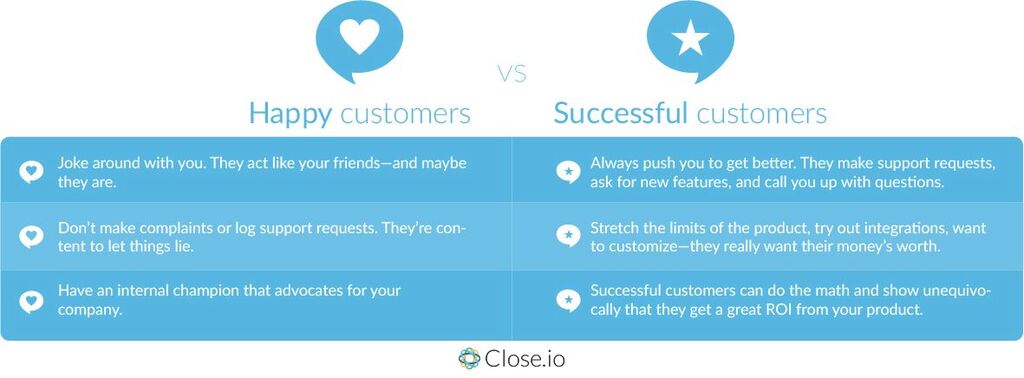
But the gap between a happy customer and a successful customer is massive, and whether you realize it or not, has huge implications for your startup’s growth. Here’s how you can identify the differences between the two:

happy-vs-successful-SaaS-customers.jpg

While happiness is nebulous and fleeting, success is something tangible you can build a business on. For successful customers, the value your product creates far outweighs what they pay for it. Customers seeing that kind of ROI are much more likely to stick around long-term. As a startup, you need successful customers to grow and scale.

types-of-SaaS-customers.png

Successful customers are a sign that you’re on the road to product-market fit. Even though your product is new and unpolished, there are already people who can’t live without it—they go to work every day and use it to get shit done. As Marc Andreessen points out, failure to find that kind of market is the “#1 company killer.” Your successful customers suggest it’s a killer you can beat.

Successful customers have a vested interest in your improvement because the better your product is, the stronger a company they are—your product is that vital to them. They give you feedback on how the product needs to evolve, which empowers you to iterate, improve, and serve your market better in the long-run. They’ll help you find more successful customers through referrals.

You form long-standing relationships with your successful customers that empower both of you to grow and thrive.

3 steps to get more successful customers, faster

Once you hit the tenth customer mark, you can’t just keep plowing ahead with the growth strategy that got you early traction. It’s time to get disciplined and come up with a process that ensures you’re only selling to customers that you know will become successful. Here’s how to do it in three simple steps.

1. Ruthlessly qualify leads

When you’re first starting out, lead qualification probably isn’t a priority. You’ll take customers however you can get them.

For example, some of your early customers are probably friends or acquaintances. As Jason Lemkin and Aaron Ross point out, you’re not ready to grow if that’s your primary customer acquisition strategy. Or maybe your salespeople are just out there throwing darts in the dark, signing anyone they can convince to buy (even though they might not be a good fit). Customers who just fall in your lap like that are buying because they like you or your company, and not for solid business reasons. That’s the definition of a happy customer.

You need a scientific, replicable way to save your salespeople from chasing the wrong customers. It starts with an ideal customer profile (ICP)—a description of the perfect hypothetical customer based on your most successful customers. Compare every lead to that ideal. When your salespeople engage those vetted leads, they need to learn how your product can solve each prospect’s unique business needs.

Lead qualification in practice

Here’s what your lead qualification should look like after early traction:

  • Identify your most successful customers. You can use a billing analytics software like ProfitWell to look over all your customers, pull the ones who have been the most successful with your product, and build an ICP.
  • Find similar-looking leads. Next, use a lead targeting service like Mattermark to hone in on companies resembling that ICP in terms of industry vertical, ARR, team size—whatever your data indicates is important.
  • Ask the right questions. When your salespeople engage those leads, they need to ask questions to uncover how your product can make that prospect more successful before they even consider closing. If I was selling content management software, it wouldn’t be enough for a company to say, “Oh, we do content.” I’d have to ask about what kind of content, whether they collaborate, how important SEO is, and make sure their use case matches the product.

That’s how to get your salespeople to only focus on prospects that will become successful customers.

2. Drive customers to your sticky features ASAP

When great prospects signs up, you can’t assume they’ll automatically be successful with your product. You need to facilitate their success and make sure customers are actually using your product—otherwise, they’re just sitting there paying you for no reason.

The key is to identify your software’s stickiest features—the ones that unlock your product’s core value and correlate with long-term success and retention. Steering new users toward those features needs to be the focus of your onboarding process.

For example, at Close.io, we know that importing contacts is the necessary first step for a customer to be successful. Our product is a CRM—its primary purpose is to manage a salesperson's list of leads. If there's no one to contact in our system, there's literally no way to get value from the product, and no reason to be a customer.

How to facilitate early customer success

Here are the strategies we’ve been successful with in getting free trial users up and running with a new SaaS product:

  • Track feature usage. Use an event-tracking platform like Amplitude or Mixpanel to see which new customers are using your most valuable features and which ones need that extra push.
  • Create a drip email campaign. Send new customers a scheduled series of 4–6 emails within their first few weeks. Make them sound conversational, but include calls to action prompting users towards those sticky features.
  • Make your free trial short. Free trials are a great way to get new customers, but most SaaS companies’ free trials are way too long. Limit yours to 14 days or less, and get customers thinking, “I don’t have much time with this thing, so I’d better be rigorous and test what it can do.”

If you’ve found a customer you know you can make successful, don’t let the opportunity go to waste. Put in the extra work during onboarding to make sure they’re able to crush it with your product.

3. Don’t be scared to talk to your customers

Talking to customers personally is incredibly valuable, but too many founders are scared to do it. They think, “Hey, if they’re gonna keep paying me, why rock the boat?” It comes back to an underlying fear that customers don’t actually need the product. Founders worry that talking to customers will make them realize, “You know, this product doesn’t actually do much for me.”

But that’s exactly why you need to talk to them. After all, what do you call someone you never talk to, who just sits there paying for your product but isn’t actually getting results? That’s right—a happy customer. You should’ve never signed them in the first place. Building sustainable startup traction requires you to do more and go that extra mile.

Talking to customers does more than let you ensure they’re successful. It’s a chance to get feedback on how the product could serve them better, build personal rapport with your clients, and even set the stage to upsell them to a higher plan. When you consider all those benefits, and the fact that the biggest risk is uncovering a happy customer, it’s a no-brainer.

How to reach out

There are several different ways to personally engage with customers. Consider the following options:

  • Set weekly calls. As Paul Graham says, in your early days you can do things that don’t scale. A weekly call gives you a set process to check in with successful customers and make sure they stay that way.
  • Visit in person. Everyone knows this is a good idea, but very few startups actually do it. Visiting your customers is a huge differentiator, and gives you the chance to enhance a customer’s experience in new ways. For example, I once visited a customer and noticed that they displayed our sales CRM on a TV in the office. It looked like crap since it wasn’t optimized for that device, but once I saw it, I called up our engineers and had a fix deployed within the hour.
  • Ask them to do a case study. Case studies of successful customers are crucial for your company’s reputation. They’re also an opportunity for your customers to get their names out there (a win-win) and the exercise itself reminds them of how valuable your product has been.

Each of these tactics is a way to verify that your customers are successful, not just happy.

Successful customers are the ultimate reward

The only way to grow and thrive in SaaS is to consistently make customers more successful. If you’ve got a wide enough base of companies your product can help succeed, you have the makings of a healthy company.

Beyond that, your customers’ success has a huge impact on morale. Your team will be crushed if they put in the work to close new customers day in and day out, only to see them churn and say, “Eh, that was okay but not a must-have.” It creates doubts about the worth of the product and the company’s future.

But on the other hand, successful customers are the most inspiring part of working at a startup. When your team sees people using your product every day, hyping it up on social media, and getting outsized results, it reminds them what they’re in this game for and makes them feel proud to be associated with your product. That's the kind of customer that can really fuel your startup's traction.

Recommended reading:

SaaS sales: Make them buy AND use your product
It's not enough to make customers buy your product. You need to sell them on using it, and make sure they get massive perceived value every month.

How can sales drive customer success?
How can sales drive customer success? At every stage—before the deal, after they signed up and after they cancel—there are customer success opportunities.

Early B2B SaaS growth: How to go from 10 to 100 customers
Your SaaS startup has a few customers but you need more. To get your first 100 customers, here are at least 3 tactics you need to start implementing.

19 Apr 16:32

I Hate Sales: How to Excel When Selling Isn't Your Forte

by david.t.rynne@gmail.com (Dave Rynne)

“I hate sales.” If you find yourself saying this every morning before work, you’re not alone. Salespeople rate their job satisfaction as 2.5 out of 5 stars on average, according to data from Career Explorer. That puts sales in the bottom 5% of careers. Yikes.

This isn’t a complete surprise, however — while sales reps are often paid well, the work isn’t easy. From tracking down new prospects to qualifying leads, sales requires ongoing and concerted efforts to see success.

So you might just hate sales, but it’s not all bad news. In this piece, we’ll look at some of the top indicators that you really hate your sales job, offer tips on how to excel in your current role, and provide advice if sales jobs simply aren’t your best fit.

Download 37 Tips for Social Selling on LinkedIn

How to Tell if You Hate Your Sales Job

Not sure if you hate your sales job or if you’re just having a rough week? Here are six ways to tell the difference.

I hate sales, signs that you hate your job. You dread going to work. You hate rejection. Talking to people drains you. You come home exhausted. You daydream about anything else.

1. You dread going to work.

There’s not wanting to go to work, and then there’s dreading the next day.

Not wanting to go to work is a shared human experience. Everyone has days they’d rather stay home in bed than fight traffic or join another Zoom call.

Dreading work is something else. If you find yourself struggling to focus on anything but the fact that you have to work the next day, you might just hate your job.

2. You hate rejection.

It’s also a pretty good bet that you’ll hate sales if you hate rejection. Rejection comes with the territory, from prospects choosing another vendor to cold calls hanging up because they have no interest in the conversation.

If the thought of getting rejected sends you into a spiral, sales isn’t for you.

3. Money isn’t your main motivator.

While some salespeople love the challenge, most are in it because the job pays well. But if money isn’t your primary motivator — for example, if you’re financially stable or you’re happy with your current pay — the constant focus on making more, more, more may start to grate.

4. Talking to people drains your energy.

If you’re someone who gets energized talking to new people, sales is often a great fit. If even talking to coworkers drains your social battery, you may quickly find yourself worn out after even a few phone calls.

Do this for days or months and chances are you’ll start hating the job.

5. You come home exhausted.

It’s one thing to come home tired. It’s another to come home so exhausted you can barely stand.

While this isn’t unusual in highly physical jobs that include large amounts of manual labor, sales shouldn’t be quite so draining. If the only thing you want to do is sleep when you get home and hope your alarm doesn’t go off, you’re probably not in the right role.

6. You daydream about doing anything else.

We all have dreams. Maybe yours is to travel the world after you retire, or settle down somewhere nice and quiet.

If, however, you spend nights and weekends daydreaming about any other job — even if it pays less and comes with longer hours — you may want to skip sales.

How to Excel in Sales (Even if You Hate It)

While “I hate sales” seems like a fairly finite conclusion, you can learn to excel in your role even if you’d rather be doing something else.

Here are some tips that can help you make the most of your current role.

 i hate sales, finding success regardless. Focus on value. Create relationships. Find a mentor. Think outside the box. Make the most of time off. Pinpoint what you don’t like. Assess your strengths and weaknesses.

Focus on value.

It’s often the “sale” part of sales that puts people off. The constant pressure to generate more conversions and make more money can significantly impact your job satisfaction.

If you’re in this position, try shifting from a sales focus to a value proposition. In other words, how can the product or service you’re selling help someone else?

If you can find a way to frame the job as having value to a person or a business, it may be easier to enjoy your sales career.

Create relationships.

Sales is about talking to people. More importantly, however, it’s about creating relationships. By looking at your job through the lens of reciprocal relationships rather than simply sales contacts, you may find greater satisfaction.

Find a mentor.

Experienced sales professionals may be able to offer approaches or insights that can help improve your sales job satisfaction.

For example, they might offer tips on how to cold-call companies without feeling nervous or show you ways to connect with decision-makers before the sales pitch starts.

Think outside the box.

Sometimes it’s worth throwing out the rulebook, especially if you’re not enjoying the job. By taking your own approach to contacting and connecting with prospects, you may be able to drive success without feeling frustrated.

If nothing else, it gives you a chance to experiment and see if there’s any way to make sales work for you.

Make the most of time off.

When you’ve got time off, take it — and enjoy it. Don’t look at your work emails and don’t answer calls from work.

To the best of your ability, think about anything else but your job. Focus on what makes you happy. This could mean taking up a hobby, doing some traveling, or just spending time at home.

These activities should leave you recharged and rested. Or perhaps they remind you sales offers some pay and lifestyle benefits that you enjoy.

Pinpoint what you don’t like.

Take the time to consider what you don’t like about sales.

For example, if cold-calling is your least favorite part, look for ways to warm up prospects before you start the pitch. Or perhaps, you don’t like sending emails. You can automate some of that communication.

During this process, you might find that only part of your job causes you stress. With guidance from a manager and the use of tech tools, you may be able to offload your least favorite parts of your role.

Assess your strengths and weaknesses.

No one is great at everything. Consider where you excel and where you could improve, and then use this information to change your sales strategy.

Let’s say you’re great at initial, off-the-cuff contact but struggle to connect with a similar sales pitch. By creating a set of talking points around the pitch, you can make it easier on yourself and improve the chances of making a sale.

What to Do if Your Role is a Bad Fit

Maybe you’ve tried everything and you still hate your sales role. It may be time to make a change.

You can take two routes to the transition, either applying for a different role at your company or applying for new jobs.

Internal Career Changes

You may be able to find another role at your current company that’s a better fit for your skills. For example, you might enjoy the challenge of crafting a great sales pitch but not like cold-calling. Perhaps, a marketing role could be a good lateral move.

It’s also worth bringing up your concerns with your manager ASAP. Even if you can’t change roles immediately, you can let them know and see what options are available.

External Postings

If internal changes aren’t an option, consider moving to another company.

Take time to pinpoint your skills and consider what type of role might work, both as a change from sales and over the long term. Then, tailor your resume based on your pivot.

Once you have a general idea of what you’re looking for, opt for a multi-pronged approach to the job search. For example, you can search for postings online, connect with staff at other companies through social networking, or even hire a recruiter.

Thanks, I Hate It

If you find yourself struggling with the signs listed above, you might hate your sales job. But it’s not all bad news. With the right approach, you can improve your sales technique and attitude to start seeing success.

And, if you really don’t like what you’re doing, there’s always the option to take what you’ve learned and apply it somewhere else.

New Call to action

19 Apr 16:26

5 Moneyball Tips for Marketing and Sales to Win Big with Partners

by Sam Harkness
5 Moneyball Tips for Marketing and Sales to Win Big with Partners

Author: Sam Harkness

Want to close 20 consecutive quarters on plan? Any interest in a 63% win rate? Need another 1,000 registrants for your next webinar?

If you haven’t seen Moneyball, you should. Based on Michael Lewis’s book on the Oakland A’s incredible 2002 season, Moneyball is the kind of movie you can watch 15 times, but then still get excited for when it pops up on Netflix. The movie blends together fan favorite themes of competition, analytics, and the underdog-taking-on-the-system. Marketing and sales teams face challenges eerily similar to the Oakland A’s in 2002: never enough budget, lofty goals, and pressure to win.

The Winning Moneyball Formula

In Moneyball, Jonah Hill plays the biographical character Peter Brand, the A’s newest assistant GM and soft-spoken economics geek from Yale. In one of the great scenes of the movie, the Moneyball formula emerges as Brand begins to transform the way the A’s leadership approaches winning baseball games. After the A’s lost several of their best players to competitors with 3x the payroll, they had no other choice but to pivot and try something new. “People who run ball clubs, they think in terms of buying players. Your goal shouldn’t be to buy players. Your goal should be to buy wins. And in order to buy wins, you need to buy runs.”

So how did the Oakland A’s put this concept into action? Their first step was to focus on recruiting and starting players with a high on-base percentage (OBP). Rather than trying to replace their best players’ batting averages, they instead focused on replacing their best players’ OBP. One example included signing a former catcher, Scott Hatteberg. This guy couldn’t really throw the ball anymore (post injury), but he could still catch it, and he had a great OBP. Hatteberg was their new first baseman. Moneyball FormulaBy prioritizing OBP over BA, the Oakland A’s elevated one of the most unsexy metrics in baseball: the “walk.” Baseball dictionary for the uninitiated: getting walked is when a batter takes four pitches outside the strike zone, and then advances to first base without an “out.” To walk more = to get on base more = to score more runs = to win more. OBPAs the Moneyball formula kicked in the Oakland A’s went on a tear, winning 20 consecutive games and finishing the season with 103 wins and 59 losses. The A’s earned the second best winning percentage in the American League (63%), and got there on a shoestring budget, spending just $260,000 per win vs. the Yankees’ $1,000,000 per win.

Moneyball Marketing

How do you apply the Moneyball formula drive more efficiency and revenue into your business? As an example, two basic metrics typically captured by marketing and sales include opportunities created and opportunities closed. When you divide these two metrics into one, you get an even better picture of your business known as “win rate.” Think of win rate in business as the equivalent to batting average in baseball. Win Rate and Batting AverageIf you open 10 opportunities and close 5 every month, that’s a great win rate; you’re batting .500. But if you open 10 opportunities and close 1 every month, that’s a bad win rate; you’re batting .100. But what is the OBP equivalent in the business world? Or better yet, what is the business equivalent to getting more walks in baseball?

Walking more in baseball translates to partnering more in business. Leveraging a partner for a warm intro and endorsement to a decision maker–that’s a walk. Asking a partner for help in an industry where they’re stronger than you–instant credibility, and less expensive. Investing in your partners and making their success and your success synonymous….now we’re getting it.

Marketing example: Our marketing team recently leveraged eight partners to help drive over 1,000 registrants to a Marketo-hosted webinar. If half of those registrants show up (500) and we close only 1%, that’s still five new customer wins with partners.

Sales example: Three of the largest deals we closed recently included highly influential strategic alliances. Our experienced sales team outsourced the implementation and consulting services revenue to a partner, while earning software revenue at 3x the average enterprise deal size. Each deal included a motivated partner working hard to make it happen. That’s Moneyball.

Follow these five Moneyball tips to win big with partners:

1. Give, then Get

The first principal of economics: People. Face. Trade-offs. As a company, every dollar you spend on project A is a dollar not spent on project B. This zero sum game demands that companies carefully balance partner interests against their own. If you can build incentives for your partners to help you (while sometimes sacrificing your own immediate self interest), in return, you may have the opportunity to build a “force multiplier.” A force multiplier is a factor that dramatically increases your scale and effectiveness as a company. Think of how many marketing and sales people you employ, and then add in the number of employees within your partner ecosystem. This incremental lift and multiplier can be a beautiful thing when you’re competing against companies 3x your size.

2. Focus & Specialization

Hiring people is expensive, and there’s a point of diminishing returns for every company. It’s simply impossible to hire for every needed specialty in every industry in every country. Instead of spending six figures on a full-time, subject matter expert, why not recruit a partner with established expertise and incentivize them to help you?

Marketo recently built a task force with an agency that has unique expertise in a specific industry. We didn’t have to go out and hire a team of experts. Instead, we focused in on this partner and made a conscious effort to include them early and often in the sales process. As a result, we’ve closed more deals in that industry in the last 12 months than in our entire history as a company.

3. All Hands on Deck

There are three key pillars to any productive partnership program:

  1. Recruitment: Identifying and recruiting highly specialized partners
  2. Enablement: Training and nurturing partners to unlock holistic value (1+1=3)
  3. Commitment: Establishing and providing incentives for both partners and internal stakeholders to rally behind a “better together” strategy

The number one partner momentum killer is “channel conflict.” Channel conflict occurs when marketing and sales compete with their channel partners’ area of expertise. Competition is a good thing–it raises the bar on quality and drives price down–but it needs to be refereed with crisp rules of engagement. Compensation drives behavior, and the most effective lever in driving a partner-friendly ecosystem is to incentivize your stakeholders to play nice in the sandbox. This step is absolutely, positively, mission critical.

4. No “Barney” Meetings

Remember Barney? “I love you, you love me, we’re a happy family…” Barney meetings with partners are not okay. These are particularly common among prospective partner discussions. As a rule of thumb, you can expect that at least 80% of these Barney meetings with partners will be a waste of time. To mitigate this, build a process that automates the discovery stage with partner prospects. At Marketo, we’ve built a partnership program with a number of prerequisites that help set the bar for a successful partnership. A thorough, automated certification program with thoughtful prerequisites can help filter out false positives.

5. Measure Success

How do you ensure partner contribution is widely recognized within your company? A clear gauge on partner progress with high visibility throughout the company is a fundamental need for any marketing and sales organization looking to build a force multiplier.

Start with a baseline and ensure your measurement system is widely adopted, simple, and always improving. At Marketo, we’ve tried a variety of partner success metrics (average deal size, customer retention, time to close, etc.), and we’re constantly tweaking and evaluating their true impact on our business. A world-class partner program should promote equal parts specialization, balanced investment, and bi-directional revenue contribution. Here’s a simple barometer to help you get started in measuring your top partners:Specialization and RevenueOverall, what I love about Moneyball is similar to what I love about business: our challenges are analogous. We have to be resourceful, creative, and approach the game differently in order to win. So if you’re a marketing or sales professional, try leaning into your partner ecosystem and invest in a force multiplier to beat the competition. Play Moneyball!

If this was helpful and you’re interested in learning more about Marketo’s evolving partner-first culture, or how to build your own Moneyball playbook, join me for my session, Marketo Moneyball, Building a Partner-First Culture, at the 2016 Marketing Nation Summit.

may-2


5 Moneyball Tips for Marketing and Sales to Win Big with Partners was posted at Marketo Marketing Blog - Best Practices and Thought Leadership. | http://blog.marketo.com

The post 5 Moneyball Tips for Marketing and Sales to Win Big with Partners appeared first on Marketo Marketing Blog - Best Practices and Thought Leadership.

19 Apr 16:24

How to Use Relevancy to Accelerate the Sales Funnel

by Troy O'Bryan

3D render of an arrow speeding through a motion blurred forest toward an archery target.

Every day we go through it. We all receive the dreaded, unsolicited email. Most are automated, a copy and paste of previous messaging that often has little, if anything, to do with your company or personal needs. It’s volume versus relevancy. The salesperson figures if he/she sends the same terrible email to everyone, at least 3% of the market will want a demo. Right? Wrong.

In 2015 the average person received 122 emails a day and this figure is expected to grow. In a perfect world these emails would be relevant—they would be timely, personalized, provide value, and even better, make us more productive. Instead our inboxes are like battlefields and we’re all just trying to survive the constant barrage. As a marketer, if you want to move prospects through the buying cycle, you have to provide custom-tailored value. Here’s how:

Understand Context to Build Trust

Resist the temptation to batch and blast a random message. Who is the person on the other side of that email? What do they care about?

Before someone will respond to you, they need to trust you. To build trust, show them you know them. Spend time reviewing their LinkedIn profile and their Twitter feed, Google them to find any recent news, then reach out with a common interest. Based on what you have learned and their interaction with your content, categorize them into a buying stage. Are they in the early research stage, figuring out their options, or evaluating vendors? Offering a demo is the salesperson’s goal, likely not the buyer’s.

Use Timing to Communicate Effectively

What’s the most important thing in comedy? Timing. Without it, the message fails to come across the way it was intended, and instead of delighting an audience, the punchline falls flat. The same goes for communicating effectively with a prospect. Timely follow-up on an inquiry within 5 minutes of a request will result in a 100 times better chance of reaching them — and a 21 times greater chance of qualification. But you can’t be relevant if you don’t first contextualize your message.

Relevancy in outbound communication involves the study of implicit and explicit behaviors. An implicit behavior might mean a prospect is reading a case study on your website, because they connected with the same challenges. When you reach out, bring up solutions from the case study. Explicit behavior is more straightforward—when a prospect fills out a contact form or downloads an asset. Continue the conversation by addressing the stage they are in, a clue that can be found in the explicit behavior they initially took.

Always Deliver Value

Zig Ziglar once said: “Help enough people get what they want and you will get what you want.” Your success ultimately rides on the value that you can deliver for others. At every stage of the sales funnel, prospects are evaluating you based on the value you could bring to them, so make sure your content addresses this. Buyers take action for two reasons: 1) to achieve an aspiration or 2) to alleviate some pain or problem.

A relevant offer doesn’t feel pushy, because it’s not. If it’s useful, the prospect will welcome it. A good offer strategy involves knowing what stage of the buying cycle they are in, and the common questions they are trying to ask at each stage.

  • Awareness – What problem do I have?
  • Consideration – How can I solve the problem?
  • Transaction – How do I make the best decision?

For example, if someone is in the Consideration stage, give them the in-depth education they’re searching for with a case study or best practice guide. They’re past the need for a basic how-to blog post, but they’re not quite ready for a free trial. It’s imperative to deliver content that meets a prospect’s needs, at the appropriate time. Offering the wrong piece of content, or not having an offer strategy at all, can harm your marketing efforts. Give them what they want…not what you think they want.

19 Apr 16:24

Why Your Photos Are Losing Business (and What to Do)

by Devin Pallone
https://c2.staticflickr.com/4/3585/5699591723_cc3bce6a38_b.jpg

https://c2.staticflickr.com/4/3585/5699591723_cc3bce6a38_b.jpg

Photos on your company’s website or social media platform can make a huge difference in the way buyers see you. Are you a professional, polished company, or a startup that’s still working out the kinks? Low-resolution photos with bad lighting can turn a buyer off, especially when there are so many other websites getting it right.

Common Mistakes Websites Make

The biggest mistake websites make when uploading visual content is not paying enough attention to image resolution, which is the number of pixels in a photo (in pixels per inch, or PPI). Most photos for the web are set anywhere between 72 PPI and 120 PPI.

Keeping photos in this range will ensure your images don’t change sizes drastically depending on the device that’s accessing it. It will also keep file sizes manageable; files that are too large can slow down your site. Pixels are the reason many photos look blurry or fuzzy (called “pixelation”). This happens when a photo is stretched beyond its original dimensions. You can avoid pixelation with some easy technical maneuvering, which will immediately boost the quality of your visuals.

Another issue to avoid is making the focal point of your photo unclear. Some shots try to encompass too much at once, losing the main product in a mix of others. Cropping photos like this to only focus on one product is not usually the best option since cropping too close can easily distort your photo.

https://i.ytimg.com/vi/qEFzy6o8yLw/maxresdefault.jpg

https://i.ytimg.com/vi/qEFzy6o8yLw/maxresdefault.jpg

In the photo above, not only is it impossible to make out which product you’re supposed to focus on, but it’s also unprofessional. The lighting is badly managed, which can be remedied using DIY reflectors. There is also a poor background, which is the next important oversight websites make.

The object of a photo is nothing without a background to contrast it. Beautiful backgrounds for products can be constructed using things you have around your home, or that are easily bought and made yourself. For example, the stunning “El Bokeh Wall” effect can be created using tinfoil. Spending extra time to make a standout background can make a world of difference.

How to Take Class-A Photos

You don’t have to invest in a $2,000 camera or pricey equipment to take great photos. In fact, the smartphone you probably have sitting next to you right now is capable of snapping some stunning shots. With today’s advances in technology, and priority being placed on smartphone camera capabilities, taking professional-looking photos has never been more within reach.

Most smartphones have high-quality sensors and backside illumination (BSI) to harness light with the efficiency of a much larger camera. They also have autofocus, which immediately eliminates blurry photos, and image stabilization. If you want to get even more in-depth than what your smartphone already offers, you can buy relatively cheap add-on equipment, such as the Photojojo or Olloclip.

Now that you have your camera, the next step is to create a backdrop. Simple backdrops are best for the clean, minimal look trending today. You can make an effective backdrop using a sheet, rolled paper, wooden boards, or a well. The best product photos utilize the “sweep” method, where the background is not just behind the product, but beneath it as well. White or light gray backdrops behind a product look professional while still keeping a clean, consistent look.

Light is the biggest issue photographers face while trying to take brilliant product photos. Most amateur photographers don’t have high-tech lighting equipment or reflectors, and don’t know the tips and tricks to getting the best lighting. Often, however, natural lighting works wonders to brighten your photos and highlight your products for free.

http://1.bp.blogspot.com/-xas9FW60sF0/UNTMGMF8iJI/AAAAAAAAFvg/pi6_-0boDIc/s1600/Three-watches.jpg

http://1.bp.blogspot.com/-xas9FW60sF0/UNTMGMF8iJI/AAAAAAAAFvg/pi6_-0boDIc/s1600/Three-watches.jpg

You can also use the DIY reflectors mentioned above, made using cardboard and tinfoil, to direct natural light or artificial light onto your product for a professional look.

http://www.hemantmedhi.com/wp-content/uploads/2013/02/Product-Photography-Shoe-1024x684.jpg

http://www.hemantmedhi.com/wp-content/uploads/2013/02/Product-Photography-Shoe-1024×684.jpg

Once you’ve captured the perfect photo, you can make it even more memorable using easy editing techniques. Several apps have come out that enables users to edit their photos to professional standards. Some of the best apps on the market help you line up your shots correctly, adjust saturation and gradient, and optimize your photos for HD. There are apps for every level of photographer, from those who need point-and-shoot direction to those wanting incredibly specific pixel-by-pixel fine-tuning.

Sharing Your Photos

It’s not always enough to only post your photos to your website. Besides, why would you want to limit your exposure after all of that hard work? There are dozens of sharing options online for users, and deciding which one is right for you will depend on your audience. For example, Instagram is a popular outlet for photo sharing used mostly by people 30 years old and under, while Twitter is used by a broad audience.

Sharing your photos has been made simple through years of technological advances. If you’ve used a smartphone to capture your images, share them instantly by just tapping on the platform you want to access. Photos will be posted immediately after you’ve captioned them, hashtagged them, tagged them, and whatever else you wish to do. If you aren’t using a smartphone, you can use other photo sharing sites like iCloud or Dropbox, or simply upload photos to your desktop and add them to social sites individually.

Spending the extra time on making sure your product photos wow your audience can drastically increase your site traffic, as studies show that people are 80% more willing to read a piece of content with colored visuals, and that content with relevant images gets 94% more views than content without images. With stats like that, putting in the extra effort to optimize your website photos is sure to give you a serious return on investment.

19 Apr 16:23

3 Open-Worthy Sales Email Subject Lines With 1 Critical Thing in Common

by apowell@hubspot.com (Ali Powell)

sales-subject-line.jpeg

I get asked this question fairly often by fellow sales reps: How do you know your buyer will open your prospecting emails?

Answer: You don’t. What the buyer does with your message once you hit “send” is beyond your control. But what is in your control is making your email stand out by getting creative.

Your prospects and buyers get emails ALL DAY long. Think about that for a minute. If you cannot get your buyer to open your carefully crafted and personalized message, then all of your research and ideas on how you might be able to help go to waste.

With this in mind, the subject line is arguably the most important part of your email because it’s what gets the buyer to open and read. The secret to writing an intriguing subject line isn’t so difficult -- you simply need to write something that would be interesting to the potential buyer (note: not something that necessarily interests you). Remember: Sales isn’t about you -- it’s about them. Always.

I want to zero in on one type of subject line in particular. In my experience, buyers always say the best way for a salesperson to reach out is through a referral.

Again, put yourself in the prospect’s shoes. Would you rather receive an email from someone you never heard of before, or would you rather receive an email from someone that a trusted friend knows and vouches for? It’s a no-brainer.

Here are three email subject lines that draw on the power of referrals. They work like a charm for me, and I’m sure they will for you too:

  • "[Name] from X company told me to talk to you"
  • "Stacy Powell" (Just put the full name of the person in the subject line and nothing else. I promise this works!)
  • "You are connected to Stacy - I sold her [product]"

However, these subject lines only work when the connection between your referral source and prospect is legitimate, and the referral source has authorized you to use their name. Don’t go trolling through a buyer’s LinkedIn network to find an obscure common connection, and then drop this person’s name as if you are all best friends. That will just make your prospect mad -- not to mention your “referral.”  

To get great at referral selling, the #1 thing to do is grow your network. Connect with people you know, people you have worked with in the past, people you work with now, customers, prospects, and anyone else you have a bond with. Then, before you reach out to a new buyer, search them on LinkedIn and see if they’re connected to someone you know. Finally, ask that person two things:

  1. How well they know your potential buyer (if they barely know each other, don’t use them as a referral -- see above)
  2. If you can use them as a referral, or better yet, if they will introduce you to the buyer themselves

Wow, that’s some powerful stuff!

Sales reps: What referral-based subject lines work well for you? I’d love to hear your thoughts and feedback.

HubSpot CRM

Editor's note: Ali Powell is an inbound marketing specialist at HubSpot. Join the Women in Sales Slack channel to connect with like-minded ladies in sales here.

19 Apr 16:23

5 FUNDAMENTALS EVERY SALES LEADER SHOULD MASTER – by Jamie Shanks

by Robert Terson
Do you know what your sales team should be doing on a daily basis to be successful? As our buyers become more in-depth with social media for business, you need to ensure your sales professionals engaging in one of the following five tasks for every single deal, every single day. Whether you’re looking to build […]
19 Apr 16:23

7 Sales Skills Reps Must Master to Get their Black Belt in Sales

by Jesse Davis

In karate, there are a lot of skills that you need to master before gaining a black belt. You might be better at breaking boards with a high kick than anyone on the planet, but that skill alone is not enough . Sales is kind of like karate in the sense that there are a lot of individual skills that must be mastered in order to become a master. Martial artists have their dojos, but for sales development reps (SDRs), that dojo is the telephone.

karate kidAs a sales sensei, it’s your job to help inside sales reps improve their phone skills. In one of my favorite all-time films, The Karate Kid, master sensei Mr. Miyagi begins teaching his student Daniel Larusso karate skills one at a time. In fact, Daniel-san doesn’t even know that, when Mr. Miyagi is teaching him how to wax his car, he is actually teaching him a vital karate skill. And just like Mr. Miyagi, you can help your reps achieve mastery by honing in on one call skill at a time.

Here is a list of seven crucial phone skills that all inside sales reps must master in order to achieve mastery.

Product Expertise

If a rep is going to sell a product, that rep should have a deep understanding of how that product works. In B2B tech sales, this often entails understanding what’s involved in implementation, possible integration points and more. The better a rep understands what she is selling, the easier time she’ll have conveying that product’s value. Begin by making sure that reps have their 30-second elevator pitch down. But then go deeper by ensuring that they truly are an expert in what they’re selling. This is key, because people buy from experts not novices.

Qualification

Reps need to be able to quickly identify whether a lead is potentially a good fit. This entails asking the right questions to ascertain a lead’s budget, needs and other factors in order to establish suitability. Help reps understand which questions to ask prospective clients based on roles. Using buyer personas can help train reps to tailor messaging to specific buyer roles.

According to Andy Paul, author of must-read sales books Amp Up Your Sales and Zero Time Selling, “If the prospect isn’t in general agreement with your estimates of the value that they receive from your products or services then, then you don’t have a qualified prospect.”

Rapport

We buy from salespeople we like. If a rep sounds like a robot or is just pitching a mile a minute without building rapport, it can diminish that rep’s ability to succeed. However, some reps spend too much time building rapport and not enough time talking business. In a fast-paced sales environment, reps probably shouldn’t be spending fifteen minutes talking about their March Madness picks with a prospect—even if that prospect is a fan of college hoops.

Tone

A rep’s overall tone should blend eloquence, authority and affability. If reps are stumbling, sound detached or seem timid, they will need some guidance. Try doing practice calls. Your whole team can even get together and offer reps feedback on tone. This skill takes a while to master, so don’t expect your rep to sound like Tony Robbins overnight.

Conveying Value

Why is your product valuable to a particular prospect? Being able to convey value requires getting inside the heads of customers. Train reps to see your offering through the eyes of customers. Again, using buyer personas can help reps understand how to tailor messaging to buyers in specific roles.

Overcoming Objections

Reps will nearly always be hit with various objections. Maybe a prospect doesn’t have the budget set aside. Perhaps they need to get approval from other team members. Sure, some prospects aren’t suitable, but for those that are, it’s important that reps are adroit at handling objections.

To quote TOPO analyst Bryan Gonzalez “In prospecting, the vast majority of objections are simply knee-jerk reactions from busy people who don’t yet see the value in working with you.” The good news is that a lot of objections can be overcome by communicating your value early and starting small. According to Gonzalez “Don’t sell the product, sell the next step…If they ask a product question, recommend that you show them in the next meeting.”

Defines and Achieves Objectives

Every sales conversation should have an objective. Sometimes the objective is to schedule a demo. Other times it’s to simply qualify a prospect in or out. Inside sales reps must be aware of what their objective is for 100% of their calls. And then, they must steadily move conversations toward that objective. This is perhaps the most important of all sales skills to master, because it’s what moves deals forward.

In order to help you train your sales reps to be “black belts” in inside sales, we’ve created the Ultimate Call Evaluation Checklist. This checklist will help you identify where reps are excelling and where they need improvement. So that you can help your reps master every skill they need to be master salespeople.

banner-tool-call-evaluation-checklist

This post originally appeared on the RingDNA blog here.

19 Apr 16:22

The Four Horsemen of B2B Conversion Rates

by Silvio Porcellana

If you have chosen to invest a large part of your marketing resources in advertising, I have good news for you… and some bad news.

Let’s start with the positive: While people are spending less time on other media (press, radio, TV), mobile keeps growing. The same goes even for professional use. According to the latest research, with now 61% of workers who spend at least part of their day outside the office, the number of mobile devices used in enterprise increased by 72% last year.  

Mobile is overtaking desktop, even in ad spending

Marketers are increasingly aware of the opportunity offered by mobile. In fact, the economic resources allocated to this channel are constantly increasing. According to forecasts, for the first time this year, mobile ad spending will exceed spending on desktop, with a total investment of approximately $40 billion.

Digital Ad Spending by Device

To make ads more effective, brands are becoming more aware of the importance of creating engaging content for the target, whether they are the final customer or another company, and the need to use more channels and new formats. This year, 96% of companies will create a B2B video campaign as well.

Conversion rates still lag on mobile

Now here’s the bad news: mobile ads still have a lower return on investment (ROI) compared to desktop campaigns. The same applies to B2B campaigns, although very little data is available since only 21% of companies are able to measure the ROI.

What does it depend on? According to Jeremy Hull of iProspect, the problem lies in understanding this particular type of communication.

Brand marketers tend to treat mobile advertising campaigns as if they are essentially equal to those carried out on desktop. Nothing could be more wrong. What engages people on smartphones and tablets follows a very different set of factors which must be taken into account in order to generate clicks.

What are these factors? Here are the four essential components to keep in mind before making any mobile campaign, accompanied by real case studies proving their effectiveness.

#1 Localized campaign

When it comes to mobile ad campaigns, reaching your target in the right place at the right time is more important than being seen by millions of people.

This is true given that we take our smartphone with us wherever we go. Those who intend to purchase or use a service for personal or professional purposes don’t want their time wasted; they need to find quick answers that are preferably nearby.

For this reason, it is fundamental to send messages to users based on geolocation. According to studies, location-targeted campaigns can increase conversions up to 2.5 times.

Location targeting can also be extended to a larger (geo standard) or a more specific area (geo-precise). In the latter case, your campaign becomes much more effective.

Mobile Location Targeting Ads

Case study: Life Technologies

Life Technologies is a biotechnology company that sells its products worldwide, with nine regional sites dedicated to various countries where it operates.

For a long time, the content and promotional campaigns had been managed in a fragmental and generalized manner, without considering the specific needs of the local target. However, with the growth of the company, it needed to act differently.

Life Technologies therefore decided to build a marketing cloud accessible by all local teams. The platform allows content and online campaigns customization in line with the company’s guidelines and at the same time closer to local needs.

This resulted in a 25% increase in online traffic and 6% increase in orders on e-commerce. Their next goal will be optimizing the design for mobile, by using videos and interactive formats.

#2 Choosing the right format

There are many different formats for digital advertising but not all work on mobile.

The recent phenomenon of ad blocking has demonstrated how many users were finding ads not helpful but annoying and intrusive. Now, try to imagine reading an article about a product that interests you and then discovering a campaign that offers a discount for the same product later on. Would this type of promotion still annoy you?

The trick is to know the channel and be contextually relevant. Unsurprisingly, a native ad or a promotional message ingeniously inserted into the content of a page is proving to be an effective format on mobile.

In this way, it appears visually and thematically less invasive. Native ads are in fact viewed 53% times more than traditional banners. Moreover, people are much more willing to share it–168% more than regular digital ads, to be exact.

If you have never made a B2B or B2C campaign, ride the wave before your competitors outperform you. Spending on native ads will be 7.9 billion dollars this year and will reach 21 billion in 2018.

Native Ads Sales

Case study: Forbes Brand Voice

The famous magazine Forbes has created a platform called Brand Voice which offers B2B marketers the option to directly publish their content. This platform allows marketers to reach a much broader and more transversal audience than what could be obtained if they only used their own channels.

Giving brands a free space for self-publishing may seem risky; it is not easy to make a good native ad without falling into a mere self-promotion. Yet the results confirm that many companies have already learned to make good use of this opportunity.

An article published by NetApp last September was the most read article on Forbes. Here’s another example: an article by Gyro has been viewed 100,000 times on Forbes, compared to an average of 5,000 views on their platform.

#3 Interactive content

People who surf on mobile are often doing other tasks simultaneously, especially at work. Their attention is greatly limited compared to that of desktop users. To capture their attention and especially their clicks, you need more than just a simple image.

There’s no rule that says that advertising for businesses must necessarily be formal and fixed. In fact, content that leads to interaction can be greatly appreciated by users in times of stress.

Video is an effective variant while interactive content such as mini-games are even more so. Through simple game mechanics, this type of advertising intrigues and impresses the user. It also meets the desire for entertainment, which has become steadily more important on mobile with games being the third most downloaded app category.

Native Ad Campaign

Case study: Ace Hardware

For St. Patrick’s Day, some retailers of an American hardware store created a themed campaign. A mini-game was sent to customers who subscribed to their loyalty program. This would allow them to win discount rewards to be used during the holiday weekend.

The CTR of this campaign was reported to be 26% and redemptions were 15%. Moreover, the success of this campaign has had a positive impact on subsequent activities. One month after the campaign, the CTR for their mobile promotions increased by 290%.

This proves that results beyond expectations can be achieved when creative and targeted marketing activities are carried out.

#4 Reward your consumers

The relationship between users and their smartphone is personal and unique, even when they are using it for work purposes. Therefore, mobile advertisers have to offer something just as exclusive and relevant to the target audience.

Interactive Mobile AdEffective mobile campaigns never put all users on the same footing, but instead they make it clear that the message is specifically sent to the user or the company.

They use an appropriate tone. They appeal to the user’s tastes and interests. And they offer exactly what the users are looking for: a coupon, a complimentary product or premium content, which entices them to click.

Case study: Fisher Tanks

For more than 60 years, Fisher Tanks, the manufacturer of steel tanks, has made its sales by contacting potential customers and focusing on referrals from existing ones.

Then it decided to start promoting online as well: it made a new site, activated social channels and above all offered a free download of some valuable content to its target.

The results were striking: in just 12 weeks, the campaign increased online traffic by 119%, conversions by 3900% and new sales opportunities by 3.4 million dollars.

Ready to improve your conversion rates?

To create a digital advertising campaign, forget about the traditional kind. To make sure your investment will produce more conversion, start thinking about the specific dynamics on mobile. Furthermore, your audience must be taken into account. 

If your target audience is B2B, try to figure out who are the professionals to address and get in tune with their interests, coming to understand them as people.

You can help your target find great solutions to improve their work while entertaining and exciting them at the same time. Make relevant campaigns that satisfy their desires and will lead them to click naturally. What’s your next conversion goal?

The post The Four Horsemen of B2B Conversion Rates appeared first on Sales Hacker.

19 Apr 16:22

New Gartner Report Examines Why Predictive Intelligence Is a Must Have for B2B Marketers

by Daniil Karp

“When Gartner first wrote about predictive lead scoring in August 2014, the practice was still in its early stages.” In their March Tech Go-to-Market report, Gartner notes that “predictive lead scoring is now a “must have” for B2B technology marketing leaders with high volumes of leads from inbound channels and events.” We believe this change in analysis is driven by widespread adoption and planned future investment in predictive intelligence. It also speaks to the live implementation of predictive tools and the tangible economic impact organizations are seeing.

The Birth of the Educated Buyer

Surprisingly, the appetite for predictive intelligence is fueled by the success of inbound and content marketing efforts, not their failure. Over the past decade content marketing has improved the buying experience of B2B decision makers. Today, before making an investment in new strategies, technologies and skill sets a manager can educate herself by looking across analyst briefings, industry reports, white papers, case studies and technical reviews. She can get a sense of her counterparts experiences at other companies by looking at product review sites and can even have her questions answered by peers on community boards. Finally, in many cases, she can even take a particular product or solution for a spin with the rise of free trials and freemium business models.

Content marketers have succeeded in creating a culture of content consumption among professionals in specialized fields. Industry magazines and continued professional education is no longer just for doctors and lawyers. The unforeseen result has been that with the rise of B2B content consumption it is now much harder to understand what type of behavior and engagement is truly indicative of buying intent.

The Death of the MQL

On the demand gen side, over the past decade marketing qualified leads or MQLs have become the standard for measuring B2B marketing performance. In 2006 getting a prospect to fill out a multi-field form to watch a webinar or download a piece of collateral might have been as good as taking them through a full sales qualification process. Today, even if an individual has engaged with multiple pieces of content and requested to be contacted, it is far from a certainty that they are in market to make a buying decision and not just self-educating themselves on a topic of personal interest.

This rise in content consumption has created the problem of the MQL trap: the assumption that higher levels of content engagement will reflect similar growth in marketing-driven revenue. Companies have discovered the fallacy of this approach and many have implemented new metrics like sales accepted leads (SAL) or have simply moved to focusing on revenue growth as an indicator of marketing success.

The Rise of Predictive Intelligence

Predictive intelligence addresses this dual problem by allowing B2B marketers to make sense of complex buyer behavior and allows B2B sales professionals to sift through unmanageable queues of prospects to find those in an active buying cycle. Here are three of the most common and effective use cases for predictive implementation today.

  1. Prioritizing SDR Follow-Up

The increase in content consumption has created a problem of “too many” for sales development teams. When any given day might mean thousands of net-new marketing qualified leads, how do you prioritize a limited workforce? Many organizations have worked on identifying account characteristics and trigger events that help triage SDR follow-up. For some company size and installed technology might be enough to qualify or disqualify a prospect.

At its most basic level, predictive intelligence helps organizations find and bubble up accounts that are a fit for their products and services. At more advanced stages, predictive intelligence also supports the continuous improvement of the filters that define a company’s market by incorporating signals from outside their digital ecosystem. This means finding prospects exhibiting interest in your products, even if they do not fit your current definition of a tier 1 target account.

  1. Adding Intent To Your Scoring Model

Improving your firmographic filters can bring appreciable gains in MQL to SQL conversion rates as well as deliver real impact on your pipeline. The problem with stopping at profile fit however, is that it gives your marketing and sales team no insight into the timing and buying stage of your prospects. In many cases you can be calling on (and alienating) decision makers who are not yet in an active buying cycle or conversely reaching prospects who are so far down the road with one of your competitors that your sales team will be playing catch up from day one.

Gartner puts their finger on this issue when they say that “traditional lead scoring essentially uses engagement as a proxy for intent, despite often providing only a loose correlation.” We feel the problem with this approach is that while downloading white papers and visiting web pages is indicative of something, there is no guarantee that it is a sign of buying intent.

Only predictive intelligence solutions that incorporate third party data from B2B publisher networks and analyze it through data science and predictive modeling can begin to get at the true intent behind certain online behaviors. Firmographic and engagement scores from your marketing automation coupled with intent information can help drive conversion rates up not by percentage points, but by orders of magnitude.

  1. Do More With Less

For some happy marketers, budget isn’t the problem. The rub is that it’s also not the solution. Throwing more money at low conversion rates won’t necessarily prove successful. That’s why, for large enterprises, predictive intelligence is of paramount importance. Being able to prioritize leads for follow up and immediately remove unworkable prospects can help save serious money in sales qualification costs. On the other hand, being able to uncover and route high intent prospects just entering an active buying cycle to your strongest closers can help shorten sales cycles and raise average deal sizes.

Regardless of how you choose to first implement your predictive intelligence solution, the experiences of marketing and sales organizations that have seen success make it is abundantly clear that having your sales team involved in a meaningful way early and often is key to success. Predictive intelligence will challenge you to rethink your lead scoring rubric, lead routing flows and engagement insight connect marketing to sales.

18 Apr 15:54

The Struggle Of New Media Is Real

by Mitch Joel

Every Monday morning at 7:10 am, I am a guest contributor on CHOM 97.7 FM radio broadcasting out of Montreal (home base). It's not a long segment - about 5 to 10 minutes every week - about everything that is happening in the world of technology and digital media. The good folks at CHOM 97.7 FM are posting these segments weekly to SoundCloud, if you're interested in hearing more of me blathering away. I'm really excited about this opportunity, because this is the radio station that I grew up on listening to, and it really is a fun treat to be invited to the Mornings Rock with Terry and Heather B. morning show. The segment is called, CTRL ALT Delete with Mitch Joel.

This week we discussed: 

  • We keep thinking that Netflix (and models like it) are the ways in which TV and film companies will make money. Famed comedian, Louis CK, isn't quite feeling it... yet. The comedian created his own web series called, Horace and Pete, starring himself (Horace) and Steve Buscemi (Pete) as co-owners of a Brooklyn Bar. The first episode cost $5 to watch; the second $2; and the remaining eight $3 each for a total of $31 for the full season. How did it do? C.K. told Howard Stern that he spent $2 million of his own money to make those first four episodes, but they didn't make nearly enough to bankroll the rest of the season. CK had to take out a line of credit, putting himself millions of dollars in the hole. Nobody said this new media business was easy or a slam dunk.
  • The creator of Napster (and the first president of Facebook) is at it again. This time, Sean Parker wants to disrupt the movie theatre business. His product is called The Screening Room, and here's the pitch: you buy a $150 box, and then you can pay $50 for a movie and watch it - in the comfort of your own home - the same date it is released in the theatres. Many movie executives are getting behind it. Many are terrified by it. What do you think?
  • App of the week: Fresh Mint.

Listen here...

Tags: app of the week chom 977 fm chom fm comedian ctrl alt delete ctrl alt delete with mitch joel digital media facebook film fresh mint freshmint google guest contributor heather beckman horace and pete howard stern j walter thompson jwt louis ck mirum mirum agency montreal radio morning show mornings rock with terry and heather b movie movie executive movie theatre napster netflix new media radio segment radio station sean parker social media soundcloud steve buscemi technology terry dimonte the screening room tv twitter wpp

18 Apr 15:54

What is Multivariate Testing?

by Stuart Holmes

abstract-21734_960_720

Optimizing a marketing strategy or SEO campaign is only possible through proper testing. Failure to do this and act on those results can quickly see a website slip down the ranks. You may be familiar with the common method known as A/B testing, but when was the last time you conducted a multivariate test?

What’s the difference?

As the name would suggest, multivariate testing involves analysis of multiple variables to uncover the best potential outcome. Unlike an A/B test where you’re measuring the performance of two versions of a web page, multivariate takes a far more intricate approach.

Individual features within a single webpage can be changed and coupled with other variables to provide a variety of possible combinations. Of course, the ultimate goal is providing insight into which of those combinations works best for your conversions.

As an example, you may choose to test 5 variations of a content banner with 2 variations of an image. This would give multiple possible combinations. With traffic directed to these different web pages, you can now determine the most effective design.

Slightly more complex than its A/B counterpart, it can have tons of benefits, allowing you to determine which features play the most important role in terms of optimizing visitor conversion and creating an unrivalled user experience.

Advantages

Multivariate tests may be most suited for the advanced marketer but its impact can be effective across a variety of campaigns. It’s especially useful for those looking to improve a specific area of conversion. Whether it be joining a mailing list or sharing content, altering a variety of elements at the same time, for the same purpose could make a surprising difference.

It can also avoid the need to conduct several A/B tests on the same page. As you can include as many variations as you wish, it can provide more meaningful results in a shorter space of time. What’s more, you can use the results from one page and apply them to the entire website.

Disadvantages

This form of testing can only be applied to those sites with a significant amount of traffic. A/B testing splits traffic 50/50 but multivariate can be split into much small segments – quarters, sixths, eighths and more – depending on the number of variations. This means, each variation that’s being tested will receive much less traffic than the traditional A/B test.

It’s also important to consider which variables have an impact on the conversion goal before getting started. Changes to a headline may improve conversion while using different images have little or no effect. In these circumstances, A/B testing would be the more straightforward approach.

Few methods of testing are more effective at specific web page analysis than the multivariate approach. Taking all the guess work out of website development, it’s the only guaranteed way to discover the best combinations in layout and design. Give it a try and you could see a major improvement in conversions.

18 Apr 15:47

How to Build a Brand that People Passionately Want to Buy From

by Don Purdum

People Passionately Want to Buy From Your BrandDo you want a build a brand that people are passionate to buy from?

Do you day in and day out see people coming and going from your website and they don’t contact you or buy from you?

Do you talk to people at events, networking meetings or on the phone and people seem to “get” you but you never hear from them again?

Does your sales funnel seem to take a long time to close sales and it leaves your checkbook emptier than you would like and your frustration level sky high?

Perhaps your story is one where people are constantly looking at your business but for some reason they are not buying in the numbers they should?

Perhaps the customer or website visitor is checking you out but they are unsure of what they want or why they are even there?

If that is your experience it can be changed fast!

Last week I was at a networking meeting near Washington, DC and it was that time in the meeting where we are allowed to share our 60 second commercial.

They started across the table from me and I could see the look of panic on virtually everyone’s face as they wondered to themselves:

  • What am I going to say?
  • How will what I say be received?
  • Will anyone in the room have an immediate referral?
  • Will anyone be interested in buying from me?
  • Should I even be here?

One by one they made their way around the room. Unintentionally the “pitches” were passionless, boring and void of any real emotion, let alone anything valuable that would contribute to anyone’s business.

I was the last one… I stood up confidently and asked:

“What business are you “really” in? What do people think of when they think of your business? What do you think of when you think of your business? Do those two things align?”…

Within twenty seconds I could tell I had them.

As I sat down, the lady sitting next to me immediately said that she needed to talk with me.

Another person in the room said he needed a consultation immediately.

What’s the point in my story?

People don’t feel your passion after the fourth time they meet you or the third time they come to your website, blog or social media pages.

They either feel it immediately or they don’t and the truth is that people are inspired to buy on emotion that is real, authentic and genuine.

There is no second, third or fourth time to pique their curiosity.

I teach that at any given event, or blog article for that matter, that only 20% are ready, able and willing to buy… but you must be specific to their needs, problems, wants or desires.

Why are So Many Exciting Brands so Boring and Feel Passionless?

Every company and every person has within them passion.

The problem is that we’ve been taught to present ourselves on features and benefits and on logic.

Features and benefits are logic based, not emotion based.

Don’t get me wrong, we absolutely need BOTH!

But, rarely do we speak to both. The majority are stuck on a passionless logic that is uninspiring and puts people to sleep.

Think of the great companies that invoke passion on the behalf of their consumers and that people never forget and are deeply loyal to:

  • Apple – Think about it… a phone that is more expensive than a laptop.
  • BMW – A car that can be as expensive as $60,000 – $100,000+ with maintenance costs that are outrageous.
  • Southwest Airlines – Low fare airline that gets you from one place to another with no frills.
  • Lands End – If your backpack ever, for any reason, breaks they replace it free.
  • Starbucks – How do they continue to sell a cup of coffee for $4?

Each one of these brands has a core message that they are passionate about and can at a seconds notice communicate with relevance, inspiration and in way that is moving.

The loyal following of a brand listens to what they say and in the end; these companies always say the same thing but perhaps in a different way.

If you want to create a passionate, loyal following that is able, willing and ready to buy from you, allow me four ways you can build a passionate brand:

#1 – Know Your Passionate Message and Deliver It with Inspiration

The first step to creating and living a passionate message is to discover it.

It’s there, it’s always been there and it will always be there.

But it’s buried.

Some struggle with this because they tie their passion too close to the business. But if discovered, it really doesn’t matter what the business is; the business is just a tool to experience the passion.

Your passion can be transferred to any business, non-profit or anything you so desire that helps you fulfill it.

You cannot fake passion, make it up on the spot or be consistent without it.

Many business owners struggle with apathy in their business’s or lose interest in it because it was never tied to their personal passion and seen as a way to find meaning and fulfillment through it.

As a result, the majority of businesses end up talking about themselves and how wonderful they think they are and just try to sell, sell, sell; without connecting the dots for the consumer.

There is no passion in that…

People get excited by brands that are relevant to their needs, problems, wants and desires.

How do you discover your passion and then message it relevantly in any environment (either online or offline)?

I take my clients through a life changing process that helps them identify these things:

  1. What are the “specific” problems you are passionate about solving?
  2. What are the tangible values your customers experience and how do they feel about the experience?
  3. What are the “specific” problems you solve for each tangible value?
  4. Who are you “specifically” solve each problem for (in detail)?
  5. How are your products or services “a” part of “a” solution?

Once you know your message it’s easy to deliver it with passion because passion is the emotion behind your business.

Passion is the reason that people connect with you.

Passion is the important part of the experience that links the business to the customer

Without a passionate brand for your business, you’re just another business trying to manipulate people into buying the same thing someone else sells for a lesser price in hope of just getting some cash flow.

Who wants to be there?

#2 – Never Stop Repeating Your Brand Message

The next mistake that many businesses make is that they either get lazy around their message or they get bored with it.

This morning I was drinking my cup of coffee when I saw a commercial for Kohl’s that was a complete disconnect.

What were they thinking?

The commercial started with a couple who had an infant in a stroller. They were comparing different restaurants and what they could afford to eat in calories based how many they would burn running there.

It’s all that was talked about in the commercial and it left me wondering what that had to do with their brand?

They immediately confused their audience because they got cute and in the process wasted millions of dollars.

They left to chance that people would identify the clothes they were wearing and come into the store to buy fitness apparel.

The problem is that the message was completely lost; the subject was calories not clothing and the problems, needs, wants or desires as clothing related to fitness and healthy living.

For those who have read my blog for any period of time, you realize that I seldom talk in my blog about what I directly do.

I could say that I do brand consulting and coaching, help develop their audience and create websites and digital marketing strategies that contribute to a business’s short and long-term growth.

Those things are just tools and without my audience understanding “what business I am ‘really” in’ those things don’t matter.

Opportunities ultimately are like the Kohl’s commercial… a distraction.

If you have a passionate business and message, never abandon it for cuteness in any way, shape, form or manner.

You will only create confusion and confusion creates complexity.

Complexity abandons passion and when passion is gone; so is loyalty to your brand.

#3 – Never Stop Getting Your Brand Message Out There

Today it’s harder than ever to consistently get in front of our audience.

Did you know that there is more content created on the internet in one day than in all of human history up to 2014?

We are told we need to create the following basic things to find new customers and be credible and relevant:

  • Website
  • Social Media
  • Video
  • Audio
  • Offline Networking
  • Email
  • Advertising

If you miss your passionate message in any of these tools, you’ll miss the opportunity to grow your business.

Your website is part of your message and vital to your business’s success.

Are you creating a message that unintentionally tells your website visitor they are not important by taking content from one website and putting it in yours?

Are you taking shortcuts and only sharing features and benefits?

In a recent article titled “How To Build a Valuable Website that is Profitable” I shared how your website ought to be contributing to the profitability of your company but for many it’s actually costing the company money.

Why?

Because it’s focusing on the business or products and services instead of the problems, needs or desires of the audience.

#4 – Build Your Community

Last, but not least important, passionate companies with incredible loyalties are built on a two-way street.

They focus on building incredible communities of loyal customers who become an extension of their marketing and sales teams.

We all know that there are few basic truths in business:

  1. It’s easier to keep a customer than acquire a new one.
  2. It’s easier to sell to someone who was a referral.

Yet, most companies are chasing new customers instead of cultivating the ones they have and rewarding them for their loyalty.

Building a community takes work and resources, but it’s a lot less work and much less expensive in the long run than it is to keep buying customers.

The old adage of “half my advertising budget is wasted, but I don’t know which half,” just doesn’t cut it anymore.

You are always buying customers.

The question is how are you doing it?

Build your community online and engage with them. They will become loyal followers, referrers and customers.

Use the tools:

  • Include a blog in your business website and use it every single week to contribute value (i.e. solve one problem, meet one need, or fulfill one desire; for one person)
  • Don’t just talk about yourself on social media. Include others liberally.
  • Connect with those who may never buy from you but serve the same audience you do but in a different way and become networking referral machines for one another.
  • Bring your offline contacts online and your online contacts offline and grow your network.

get-your-copy-of-the-shift

Do you have a thought, idea or question you would like to contribute? If so, please share below in the comments section and let’s chat.

18 Apr 15:47

How to run a high-performance office (without the office)

by CB Staff

The Frictionless Office

Carpenter talking on a smartphone

(Sofie Delauw/Cultura/Getty)

“I started the business as an experiment,” says Alain Albert, founder of virtual furniture shop Doordoer. “I wanted to explore how we could customize products online.” A former architecture student with a multi-decade career in construction, computerized manufacturing and industrial design, he saw huge potential for a kitchen cabinetry business oriented around modern trends of customization, online shopping and construction on demand. “I still meet a lot of people who say nobody’s going to buy furniture online,” he says. “I think that’s rapidly changing.”

Albert notes that unlike, say, T-shirts, which might be offered in five sizes and five colours—a total of just 25 variations—cabinetry requires measurements in three dimensions, plus options like shelves, doors and hinge direction layered on top. “These products are made to measure with infinite possibilities of sizes,” he says. “It can make for complex customizing.”

Though based in Oakville, Ont., Woodoer is a truly virtual company: Albert has no physical showroom and makes use of a variety of digital applications to run his business. His smartphone is packed with apps to help him manage his shop: his toolkit includes Evernote to gather ideas, TripLog to track mileage, CamCard to scan business cards, Voice Recorder to take notes and Dropbox to store files so they’re accessible from anywhere.

Messaging and chat tool Google Hangouts has become an integral means of interacting with clients, reducing the need to drive around the notoriously gridlocked GTA to meet in person. The web service and its accompanying iOS and Android apps are focused on three key features—instant messaging, voice calls and video chat—with the latter available for up to 10 users at a time, joining multiple parties in a single conversation. In many situations, voice calls using Hangouts are free as well, making the tool a cost-effective way for small businesses to manage communications—in addition to the added value of conferencing via video instead of just audio. “It’s equivalent to being in the same room and working together on a project rather than having to talk on the phone, go back to your drawing board, and call them again,” he says. “When I’m doing drawings on-screen, they can comment and I can explain why and show them in real time—it’s more dynamic that way.”

Albert manages his books online, too, using web-based Wave Accounting. It’s a far cry from his experience in previous ventures, when he would avoid accounting and focus on production—to detrimental effect. “I remember I had a partner who was the one taking care of the accounting,” he says. “Turns out my partner was skimming some money off the top and it would have been better if I had known more about what was going on.”

With Doordoer, Albert wanted to be sure he had a good understanding of his accounts, and he finds Wave to be an intuitive, easy-to-use tool that allows him to track expenses, send invoices and run reports—all without the services of a bookkeeper. “I’m not an accountant and I don’t want to have to learn accounting software and all the intricacies of that world,” he says. “Before, I used to have to wait until my bookkeeper or accountant could print the report and explain to me what was going on. I find that with Wave I can get a good picture of my own business and the health of my books.”

Wave’s digital invoicing tools are more convenient for customers as well, as they can receive their bills digitally and pay online. It’s less work for them and also helps with Doordoer’s cash flow. He points out that when it comes to his own suppliers, he would much prefer the time-saving method of getting and paying bills online, instead of receiving printed invoices in the mail and having to write and send a cheque. “I would much rather they let me purchase online and pay with a credit card,” he says. “Unbeknownst to them, they have to wait and process the money, whereas if I was paying on their website by credit card, they would get the money right away.”

Ultimately, Albert adds, these tools go beyond improving a business owner’s efficiency. They serve the customer better, too. “We have new generations of buyers and new tools for consuming, and it’s important that we experiment and explore other ways of doing things,” he says. “As all these tools become more mature, I think they’re going to interact seamlessly with each other. We’ll be able to virtually be with someone and collaborate with them, even though we are miles apart.”


MORE FROM THE FRICTIONLESS OFFICE:


The post How to run a high-performance office (without the office) appeared first on Canadian Business - Your Source For Business News.

18 Apr 15:46

A Nutshell Guide to Proper Keyword Research

by Julia McCoy

guide-proper-keyword-research

Keywords aren’t the end-all, be-all strategy (so to speak) in creating online content. If there’s one thing I’ve learned writing a myriad of content all over the web, it’s that you should think about your reader first and foremost. Otherwise, you won’t be creating the content necessary to stand out to your audience.

If you use keywords correctly, though, you use the voice of your customers and target audience. And keyword research allows you to target your message and stand out in your industry.

While the importance of keyword research has remained steady, the methods have evolved in concert with more intelligent search engines and changing user preference.

Here’s my brief but functional guide to keyword research.

Starting grounds: Semantic search shapes keywords

One primary reason that keyword research has become so much more complicated over the past several years is that search engines have changed. Instead of combing through content to pull out individual keyword phrases, today’s search engines are operating largely on the basis of semantic search.


Search engines today are operating largely on the basis of semantic search says @JuliaEMcCoy #SEO
Click To Tweet


Semantic search also is called intent-based search. It’s something that search engines gravitate toward more and more. The reason is that, in addition to searching from a variety of devices, today’s consumers are searching with a different set of queries. Ten years ago, a searcher may have typed, “Bagels New York.” Today’s searcher may use voice-activated search assistants and say, “Find me cheap bagels in New York,” or better yet, “Best breakfast places in New York.”

This change indicates a migration from cut-and-dry keyword phrases toward the searcher’s intent and context. While the searcher asking for breakfast places may not have explicitly mentioned bagels, today’s search engines are smart enough to understand that bagels and breakfast go hand in hand. A set of results listing bagel places likely would be relevant to this searcher.

HANDPICKED RELATED CONTENT:
Creating Content for Google’s RankBrain

3 ways to find intent-based keywords

As semantic search rises to prominence, the importance of intent and contextual meaning is more profound than ever. Today’s marketers need to research keywords with these important foundations in mind.

Here are a few tips to help you get started:

  1. Put together a list of foundational keywords

Your foundational keywords are the ones that align closely with your target phrase. These keywords give the rest of your content meaning and structure. Without them, it’s difficult to do any other keyword research that’s even moderately effective or lucrative.


Your foundational keywords should align closely with your target phrase says @JuliaEMcCoy #SEO
Click To Tweet


If you’re not sure what your foundational keywords are, write the most basic queries your customers would use to find your company’s products or services. These base keywords will be used to develop more advanced keyword ideas.

Tip: A great way to find these foundational keywords is by asking, “What is the most common phrase my clients or prospects would use to find me?”

  1. Head to auto-suggest

Auto-suggest is a surprisingly simple yet hugely effective way to figure out which keywords to target. For example, a company that sells dog toys uses Google’s auto-suggest feature to learn the keywords used more frequently by searchers:

Dog toys screenshot

While auto-suggest isn’t the holy grail of keyword research, it can help you use overlooked keyword phrases or parallel phrases you hadn’t considered.

  1. Hone and prioritize best keywords

We’re going to get a bit more technical here, so sit tight while I run down some guidelines on finding your best keywords.

What makes your “best” keyword? Well, this comes down to which keywords are the best in terms of several factors: Monthly search volume (high is best), keyword difficulty (lower means easier), a cost-per-click (cost presence on Google’s AdWords marketplace), and a competitive density.

The common factors that define a keyword’s value are:

  • Volume (amount of monthly searches)
  • KD (keyword difficulty – different tools have different names for this)
  • CPC (cost-per-click, suggested bid—this shows the monetary value of a keyword and what advertisers are willing to spend)
  • Com (competitive density)

Here is an example of how the definitions are used in the SEMrush keyword analytic search for the term copywriter.”

keyword term definitions

Click to enlarge

Remember, the way that you prioritize your keywords will depend largely on how you want to influence search results. If you want to target high-volume keywords, you’ll prioritize them first, whereas if you want to target low-volume, specific keywords, you’ll move them to the top of the list and target them more aggressively. Each approach has its pros and cons, and what you ultimately choose depends on your goals.

Modern tools to improve research

Nowadays, you can use several innovative tools and tricks to take your keyword research to the next level. In addition to helping you use keywords in a more innovative and effective way, these tools and tricks also can ensure that you’re targeting your keyword research toward today’s intent-based consumers.

  1. Survey your users

While many marketers agonize over keyword research, few think to ask their customers what search queries they’re using to find the products, goods, and services. Sites like Seed Keywords are fantastic for this. With Seed Keywords, you enter a simple scenario and instantly receive a URL to survey your customers. They respond to the scenario and you gain instant insight into which keywords you should target.

Seed Keywords

While it’s certainly not rocket science, this tool can help fill in gaps in your keyword research policy and gain insights that even some of the more expensive keyword research tools cannot afford you.

  1. Use keyword data from your competitors

Tools like SEMRush are best known for giving marketers keyword domain ranks according to Google data. This information can be helpful in choosing which keywords to target and where you’re going to diverge from your competition. Using SEMRush, you can evaluate which keywords are performing well in your industry and decide whether to add them to your keyword research strategy. (We’ll discuss more on how to use this tool later.)

  1. Write for humans

Because search engines have changed on a foundational level, the way that you include keywords in your copy needs to change as well. Gone are the days of keyword density obsessions and stuffy keyword phrases inserted awkwardly into content. Today’s content is all about user intent, which often boils down to context. By using keywords and synonyms to create context around your keyword phrases of choice, you can provide your users with a more complete, relevant, and useful search experience.

By writing content that holds reader experience at the pinnacle of importance, you’re positioning yourself to make the most of the trend toward semantic search in the post-Hummingbird world and to provide more relevant results to your users. Building content that is based around relevant topics, important themes, and valuable information for your audience is a more solid keyword strategy than targeting one or two keyword phrases. Because of this, today’s content creator can afford to focus less on keyword phrases and more on context and relevance.

5 more research tools

Thanks to the long history of keyword research, it’s not difficult to find keyword research tools that provide a wealth of information with a little investment. The previously referenced SEMRush has long dominated the keyword research field – it remains the leader. Some of the other great tools that I use include:

Wordtracker

Wordtracker allows marketers to research the highest-performing keywords. One of the most popular among SEOs, the free tool offers users access to a database that includes hundreds of millions of Google searches to gain insight into productive keywords. Ideal for finding keywords that will perform well and draw ample traffic to a page, Wordtracker is a fantastic tool for beginning to advanced SEOs and marketers.

wordtracker-screenshot

Google Keyword Planner Tool

Another oldie but goodie, Google’s Keyword Planner is free and integrates seamlessly with AdWords. Ideal for the early stages of keyword research, Keyword Planner can be used to determine a set of foundational keywords and build from there.

Sample-search-Google-Adwords-Keyword-Planner

Authority Labs

Authority Labs is a daily SEO monitoring tool that allows users to enter a keyword list and track the resulting Google rankings. The tool also allows users to track results on Yahoo and Bing. Authority Labs users can keep an eye on mobile ranking vs. desktop ranking, and get a series of extensive keyword insights to help ensure that they are targeting the right phrases for their marketing material. Finally, the tool offers an extensive report that combines Google Analytics data, competition information, and rankings in one convenient place.

authority-labs-keyword-screenshot

Keyword Spy

Keyword Spy is great for marketers to research keywords used by their competitors or to conduct keyword research on URLs. It’s also fantastic for building targeted campaigns and getting access to regional analytics and information. This paid service offers professional account options.

keyword-spy-screenshot

BuzzSumo

For marketers interested in semantic keyword research, BuzzSumo is the go-to tool. It can be used to find the most shared content on a given keyword or search phrase. That information can then be exported and analyzed with a simple text analysis service. Here’s an example of a search for “content marketing” in BuzzSumo:

BuzzSumoContentMarketingScreenshot

Click to enlarge

This simple step can allow marketers to extract a list of semantically rich keyword phrases that can be used to build content. BuzzSumo is also fantastic for marketers who want to research which topics are going to produce the most exposure and drive the most traffic to a site.

Conclusion

While keyword research is still an important part of SEO, it’s changed drastically over the last several years.

Fortunately, marketers who are comfortable focusing less on strict keyword phrases and density measurements and more on intent, context, and relevance can create a varied and profitable keyword strategy that will help them create quality content readers and that search engines will love.

Please note: All tools included in our blog posts are suggested by authors, not the CMI editorial team. No one post can provide all relevant tools in the space. Feel free to include additional tools in the comments (from your company or ones that you have used).

Stay updated on the latest evolution of content marketing tools and tricks. Sign up for the free daily or weekly CMI newsletter.

Cover image by Joseph Kalinowski/Content Marketing Institute

The post A Nutshell Guide to Proper Keyword Research appeared first on Content Marketing Institute.

18 Apr 15:46

The Six Thinking Hats

by Eric Douglas

The Six Thinking Hats method is a systematic way of thinking about individual roles and group communication. Published by Dr. Edward de Bono in 1985, the Six Thinking Hats method teaches members of a group to think about issues in specific ways. This tool explains each hat and how to use it effectively.

six-thinking-hats


What it is:

  • Neutral and objective

What it is not:

  • Does not offer interpretations or opinions

Use:

  • In practice there is a three-tier system of information:
  1. First class facts: Checked and proven facts
  2. Second class facts: Facts that are believed to be true but have not yet been fully checked
  3. Assumptions held in common
  • Use the appropriate “frame” to indicate the likelihood
  • Employ focusing questions to obtain information or information gaps.

What it is:

  • Creative thinking
  • The search for alternatives
  • Going beyond the known, the obvious and the satisfactory

What it is not:

  • Criticizing another person’s ideas

Use:

  • All in the discussion should wear the green hat simultaneously, to consider the output as a creative output
  • There need be no need to pause to judge the merits of an idea while wearing the green hat

What it is:

  • Thinking that is positive and constructive
  • Covers a positive spectrum ranging from logical and practical at one end to dreams, visions and hopes at the other end
  • Probes and explores for value and benefit
  • Constructive and generative
  • From yellow hat thinking come concrete proposals and suggestions
  • Effective at “making things happen”
  • Can be speculative, opportunity seeking; permitting visions and dreams

What it is not:

  • Not concerned with mere positive euphoria (red hat) nor directly with creating new ideas (green hat)

Use:

  • When generating a concrete proposal
  • Identifying the positive attributes of an idea

What it is:

  • Negative assessment
  • Pointing out what is wrong, incorrect and in error
  • Pointing out why something will not work
  • Pointing out risks and dangers
  • Pointing out faults in a design
  • Pointing out how something does not fit experience or accepted knowledge
  • May point out the errors in the thinking procedure and method itself

What it is not:

  • Should not be used to cover negative indulgence or negative feelings which should make use of the red hat

Use:

  • In the case of new ideas the yellow hat should always be used before the black hat

What it is:

  • Wearing allows the thinker to say: “This is how I feel about the matter.”
  • Legitimizes feelings as an important part of thinking
  • Makes feelings visible so they can become part of the thinking “map”

What it is not:

  • When a thinker is using the red hat, there should never be any attempt to justify the feelings or to provide a logical basis for them.

Use:

  • If you want to explore the feelings of others, you can ask for a red hat view.
  • The final stage is red hat thinking: do we like the idea enough to proceed further with it? This emotional judgment should be based on the available results of yellow and black hat scrutiny.
  • The red hat covers two broad types of feelings:
    1. Ordinary emotions, ranging from the strong emotions such as fear and dislike to the more subtle ones such as suspicion.
    2. Complex judgments that go into such types of feeling as hunch, intuition, sense, taste, aesthetic feeling and other not visibly justified types of feeling. Where an opinion has a large measure of this type of feeling, it can also fit under the red hat.

What it is:

  • Thinking about the thinking needed to explore the subject
  • The conductor of the orchestra
  • The blue hat thinker calls for the use of the other hats
  • The blue hat thinker defines the subjects toward which the thinking is to be directed
  • Sets the focus, defines the problems and shapes the questions
  • Determines the thinking tasks that are to be carried through
  • Responsible for summaries, overviews and conclusions
  • Monitors the thinking and ensures that the rules of the game are observed
  • Enforces the discipline

Use:

  • May be used for occasional interjections which request one or other hat
  • May also be used to set up a sequence of thinking operations which are followed just as a dance follows the choreography
  • Even when the specific blue hat thinking role is assigned to one person, it is still open to anyone to offer blue hat comments and suggestions

StrategicImpact-CTA

18 Apr 15:43

Bob Burg Explains How to Influence Buyers

by PFPS
18 Apr 15:43

5 Ways Sales Reps Can Build Trust Faster [+Templates]

by Brandon Redlinger

The Critical Element in Sales

Look at the top salespeople at any company and what you’ll find is that they all have one train in common. Despite what you may believe, the best salespeople are not all extroverts; they’re not all highly competitive with a cutthroat, do-anything-to-win mentality; they can’t sell anything to anyone at anytime.

The element that sets the best salespeople apart from the rest is they have a deep understanding of the human element in sales. People who are attuned to this human element are able to build stronger relationships, gain trust quicker and sell more.

We only buy from people we trust (click to tweet). Don’t underestimate the task at hand. Buyers have all been burned before by empty promises and defective products, making it an uphill battle to building relationships and gain their trust.

5 Shortcuts to Building Relationships

“Outbound messaging impacts the trust foundation, the most powerful force multiplier in sales. SDRs who craft personalized messaging, identify trust milestones, and implement an authentic, flexible contact plan can increase trust as part of their efforts to accelerates sales,” explains Chris Ortolano, Conversation Systems Analyst at ExecVision.

We can shortcut the path to building relationships and sell more products by leveraging certain behavioral psychology principles called cognitive biases and heuristics. This is what the most talented sales reps do subconsciously.

Cognitive biases and heuristics are mental models (sometimes irrational or flawed) used to reduce the time or energy for a task when making judgments. While there are over 100 cognitive biases and heuristics, I want to focus specifically on ones that give you the ability to build relationships quickly, and thus sell more effectively.

Here are five cognitive biases and heuristics that will help you build trust faster at each point of the sales funnel. I’ve also included some actionable examples so you can start implementing today.

1) Getting in the door with the Ingroup Bias

Most effective: Top of funnel

Think about the last prospect you were researching only to discover you two are from the same hometown or went to the same college. Didn’t you automatically feel a bond and and trust him/her, even though you knew nothing about that person?

This in the ingroup bias at work. Simply stated, the ingroup bias tells us that we like and trust people who we perceive as being similar to us, leading to an instant relational bond.

It’s human nature to seek out individuals who are like us. This similarity is the perfect place to start a relationship because it lends itself to instant trust.

Affinity can come in many forms to be effective. Having similar backgrounds, such as birthplace or alma mater, will form an instant bond and engender feelings of safety and liking. Shared experiences, like serving in the same branch of the military or playing the same sport, paves a path for trust. Identical philosophies in religion and politics will give newfound companions more credence.

When you find these points of affinity, down go the defenses, because we don’t take advantage of those who we like.

Sales Application

How can you build a better relationship using affinity and the ingroup bias?

When you’re prospecting, look for similarity, which will give you an immediate strong starting point for the relationship. Learn more advanced techniques for prospecting on LinkedIn. Beyond LinkedIn, visit your prospect’s other social media profile pages and see what they’re talking about.

Some of the best bonds of affinity are:

  • Alma Matre
  • Hometown
  • Mutual connection (a mutual friend is a stronger connection than a colleague)
  • Fraternity (group, associations, clubs, etc.)
  • Hobby
  • Sports team
  • Recent event

A cold email using the ingroup bias to start a relationship could look something like this:

Hi {{first name}},

I saw on LinkedIn that we’re connected through {{mutual colleague}}.

{{Write one sentence about why that connection is relevant}}.

Given your position, I think you may be interested in what my company does. {{Give your one to two sentence value proposition}}.

What does your schedule look like in the next few days? I’d love to jump on a quick call and see if it’s something that would be useful for you.

Thanks!
{{your name}}

2) Establishing the Relationship with the Authority Heuristic

Most effective: Top of funnel

When was the last time a doctor gave you a diagnosis and prescribed a medication? Did you do a background and credential check of the doctor, go for a second opinion or price shop the medication? Or did you follow the doctor’s orders, no questions asked?

Any sales rep would die for that kind of compliance. That’s the power of the authority heuristic at work.

Legitimate authorities have usually achieved their positions through superior experience, skill, wisdom or power. When we are unsure or unclear how to act (or buy), we often turn to authorities for guidance (click to tweet).

This shortcut allows us to utilize the knowledge of the expert so we don’t have to do all the hard work.

Sales Application

How can you display your, your product or your company’s authority to your prospect?

Sociologist Max Weber posits that there are three types of authority:

  1. Rational legal authority. This type of authority obtains its persuasive power from formal rules. For example, do you have any additional credentials, such as certifications or training, that display your authority?
  2. Traditional authority. This type of authority obtains its persuasive power from customs and social structures. For example, has your company won any industry awards?
  3. Charismatic authority. This type of authority obtains its persuasive power by demonstrating some type of exemplary trait (such as heroism or strength of character) that turns into respect and devotion for the figure. For example, is your founder a known public figure to your industry?

You can also leverage the power of authority using the power of testimonials. Do any companies or influential individuals with these types of authority use or endorse your product?

You can use these types of authority in a cold email to build relationships by including it in the email body or even in the P.S.

Your signature could a template like this:

Cheers,
{{Your Name}}
{{Your Company}}
{{Industry certification}}

P.S. Did you see we recently won the award for {{award in your industry}}?

Don’t forget to include signs of authority in your social profiles too.

Pro tip. If you include awards in your LinkedIn profile, don’t leave them hiding at the bottom of the page where no one looks. Rearrange the blocks/sections in your profile by hovering over the block when you’re in editing mode, click the arrow and drag it up to prominently display your authority.

top sales rep - authority heuristic in sales

3) Get a Little Closer with the Mere-Exposure Effect

Most effective: Mid-funnel

Have you ever bought a product because you hear or see it everywhere, from Facebook and linkedIn to chatter about around the office? Wherever you turn, there it is… until you have to have one for yourself.

This is the power of the mere-exposure effect. People tend to develop a liking and trust for things familiar. The more you see something, the more familiar it becomes, and the more likely you are to buy it.

Repetition in sales and advertising is only effective when people are not giving you their full attention. A study published in the Journal of Personality and Social Psychology found that repetitive messages increased the persuasiveness of an argument (even a weak argument) but only when low involvement processing occurred.

When your message enters your consumer’s full conscious awareness, you’re argument must be remarkably compelling because addition repetition will diminish the strength of an argument and become pestering.

Messages are below your conscious awareness play an exceptionally powerful role in influencing your thoughts and actions.

Sales Application

How can you expose your prospect to you or your product more frequently?

Sending a good personalized cold email is no longer enough. A sales rep has to get out and become active on social media. The lines between sales and marketing are becoming blurred, and the sales reps who embrace this are reaping the rewards.

Here are the top activities you can engage in to leverage the mere-exposure effect, thus building a solid relationship and healthy pipeline.

  • Regularly write a blog post for your company’s blog
  • Comment on other sales blogs
  • Actively engage prospects on Twitter
  • Contribute to discussions on LinkedIn, Facebook, Quora, etc.
  • Attend events to meet prospects in person and shake their hands

This is another compelling argument to get reps on social. After you connect with them, your valuable content will start showing up in their feeds, giving you more exposure while they’re in a state of low-involvement processing (see above).

Furthermore, if you’re writing and publishing regularly, combine the the authority heuristic and the mere-exposure effect for a powerful additional touch in your outbound campaigns. It could be as simple as this (notice there’s no pitch here):

Hey {{First name}},

Last time we talked, you mentioned one of the challenges you were facing was {{pain point}}. I just wrote a blog that I thought you would be helpful and wanted to pass it along.

{{Title of blog with linked text}}.

Let me know if you have any questions.

Cheers,
{{your name}}

4) Strengthening the Bonds with the Bandwagon Effect

Most effective: Mid-funnel

Have you ever decided which YouTube video to watch based on how many views it has?

You’ve just used the bandwagon effect to help you come to a logical conclusion of which video is the most worthy to watch. This an effective relationship builder because their is safely in numbers (click to tweet). You say to yourself, “If everyone else is buying brand X, then it must be good.”

When we see a group of people we want to be a part of, social proof kicks in and the innate need to feel a sense of belonging drives us to conformity. We want to be part of the “in crowd.” This effect is so strong that people often ignore or even override their beliefs to fit in.

Sales Application

How can you leverage the collective wisdom of the crowd to get more people to buy in?

Creating the effect (or perception) that everyone trusts you is no easy feat, but if you have already established social proof, don’t neglect its power.

Here are some ways to display your popularity:

  • How many users do you have?
  • How many people have downloaded your app?
  • How many followers do you have on social media?
  • How many five-star review do you have?

Now, work this into your sales communication. Another touchpoint in your cold email campaign could look something like this:

Hey {{first name}},

Did you know that {{specific number}} {{type of person you’re selling to}} just like you are already using {{your company/product}}?

If you’re interested in {{specific benefit}} too, let me know and I’d be happy to show you how it can work for your needs.

Is Wednesday afternoon a good time for you?

Talk soon,
{{your name}}

5) Solidifying the Relationship with the Anti-Inference Bias

Most effective: Mid and bottom of the funnel

Have you ever been flipping through the TV channels late at night, only to stop on an infomercial and see kitchen knives cutting through a plank of wood, piece of rock and a hammer (yes, a hammer!)? Did you immediately want a set? Be honest… did you buy a set?

Seeing is believing. This is the anti-inference bias, and can be one of the fastest ways to build a relationship.

People often question the validity of a claim based on facts, figures and theory, but when empirical evidence is introduced, they are converted to believers. The more dramatic the demonstration, the more awe is inspired, the more people will flock to buy the product.

Hearing something hundreds of times is not nearly as powerful as seeing it once (click to tweet).

However, you have to be careful. Just as quickly as powerful demonstration can build relationships, it can also destroy them, and along with it any chance of making a sale. With only the smallest hint of deception, incompetence or malfeasance, you’ll be banished from the hearts and souls of your prospects forever.

Sales Application

How can you demonstrate your product in such a way that it will shock and awe your audience intro trust?

You may think this responsibility lies on the Account Executive when giving a demo, but sales and business development reps can work with their company’s marketing department to create some awesome collateral to help you demonstrate the power of your product.

  • Case studies
  • Video demos
  • Blog posts
  • Testimonials
  • eBooks and whitepapers

Granted, it’s easier said than done. Planning and executing a good demo of any form is tough. But once you do, you can follow up with your prospects, offering them more value other than, “Just checking in” or “just following up.”

You can say something like:

Hey {{name}},

Many other {{type of person/company you’re selling to}} are using {{your product}} to get {{specific results}}.

In fact, {{case study company and link}} is currently using {{your product}}. You can see exactly how they’re implementing it in this case study.

Let’s schedule a 10-minute call so I can determine if you can get the same results. When works best for you?

Regards,
{{your name}}

Trust isn’t being given freely like it once was. The chances of a sales rep building a relationship with a prospect is harder than is use to be. A saturation of marketing messages and sales pitches have made everyone more sensitive to this communication. Now you, the sales rep, must step up your game if you want to stay ahead in sales.

Armed with the knowledge of these psychological triggers, you can get in the door, build relationships and close more deals.

18 Apr 15:41

A glaring omission in B2B selling systems

by Jim Burns

  Two top B2B sales problems are: Low output, measured as new customers acquired, revenue growth, margin, and product mix High selling costs measured as productivity, efficiency, revenue yield per rep, sales cycle time We’ll use one important cause of these top sales problems — low sales prospecting effectiveness — to focus our main point. Poor prospecting is an inability to create enough good opportunities, with the right prospects, quickly enough. It “shows up” as an inability to get enough first and second conversations with new prospects. This is a decades long, universal problem. It continues to get worse, despite communication and technology breakthroughs. Why is this? What’s missing? This is a complex problem. But does it have to be complicated? Complicated is often due to lack of clarity about key requirements. So this prompted us to developed a list of the primary requirements for B2B sales prospecting success. Primary Sales Performance Success Requirements Sales people, managers and organizations need the right: Mindset — Beliefs, Attitudes, Curiosity Competency — Skills, Techniques Knowledge — about markets, buyers, business problems, how to sell, products, etc. Discipline — to execute the right actions in timely manner Database — right contacts, contact info, phone # Messages — what to say Questions — how to say it Stories and Proof points — how to support it Content — situationally relevant and useful Tools and Systems Feedback — system based on reality and data Support Structures for continuous improvement (Incentives/Compensation, Environment, Management, Tools) These are inter-dependent […]

The post A glaring omission in B2B selling systems appeared first on Avitage.

18 Apr 15:40

Overcoming the Top 6 Interactive Sales Content Objections

by Alina Poniewaz-Bolton

interactive content graphicIf you’re not already talking about interactive sales content, you will be soon.

Why is interactive content so much more effective? For sales and marketing, interactivity changes the conversation from a monologue – talking at prospects and customers – to a dialogue going both ways. The results speak for themselves: According to Demand Metric’s Content & the Buyer’s Journey Benchmark Study, apps, assessments, calculators, configurators and quizzes, generate conversions moderately or very well 70% of the time, compared to just 36% for passive content. That same report found that interactive content was 93% effective at educating buyers and 88% effective at distinguishing a brand from its competitors.

From a learning and development or customer education perspective, we learn best by doing (Psychologist John Dewey developed the theory that we learn by constructing meanings from direct experiences) and retain that knowledge better. In fact, the more sensory-rich and unique a piece of content is, the more likely you are to remember it later on.

As we move from the traditional one-and-done sales training – the sales training “event” – to ongoing sales learning, we must acknowledge the new ways reps are absorbing knowledge and provide them with even more engaging, useful content that they can access anytime, anywhere. But most sales teams have yet to make the jump to interactive content. In today’s post we’ll discuss the six things that might be holding you back – and why you shouldn’t be afraid to take the dive anyway.

#1 You don’t have enough budget.
Being able to secure ample resources – translation: designers, engineers, writers, video producers, software, equipment, money – is the number one roadblock to creating content of any kind, not just interactive. Budgets are stretched thin as it is and we all know how expensive it can be to outsource every content project (outsourcing with a strategy, however, is a whole other ball game). But smart content managers know that you don’t have to overspend to see results – you just need the right people, processes, and technology in place to keep your sales enablement as streamlined and efficient as possible.

#2 You’re afraid it’ll replace you.
It’s only natural to worry that entire L&D departments may one day be replaced by a completely automated or online experience. Customer service reps have been fearing the exact same thing for years. Just because it’s interactive, however, doesn’t mean it’s designed to be a substitute for real human interaction. Facilitators and content curators aren’t going anywhere, and the best content creation technologies will know when, where, and how to bring interactive options into the mix.

#3 You don’t know how or where to host it.
Right now, most training is held in person or via webinars and is supplemented with static content that is relatively easy to deliver to the user by email. Interactive content seems a little trickier to get to sales reps and prospects – Where will you host it? Can it be accessed on a mobile device? Is the file size too large to deliver via email? These are all excellent questions, but the good news is there are more and more options becoming available. Our forthcoming Content Creator platform, for example, will package your interactive content and deliver it up wherever you need it.

#4 You’re worried about content fatigue.
Salespeople – all people, really – are being bombarded with content all the time. It’s true, there is a lot of noise out there. So whether you are training sales reps or creating customer-facing content, it’s your job to stand apart from the noise. And precisely because they are so busy is the reason why users might rather watch (or listen to) a quick video or take a short quiz on their phone as opposed to sit on a call or in-person meeting. Interactive content is available anytime, anywhere, which makes it incredibly appealing. And by using a format that involves multiple senses, like video, you’re going to see dramatically improved engagement. Win-win.

#5 You don’t even have time to create sales content the old-fashioned way.
No, we aren’t going to suggest some magical way of adding more hours to the day. We are going to propose that the old-fashioned way is actually using up more of your valuable time than you can afford to lose. Most sales organizations today are using a system that we like to call “random act of sales support,” creating one-off pieces as they are requested, with no strategy or plan in place for how to update, organize, or reuse existing content. Taking this approach, of course you don’t have enough time for sales content. With a content publishing strategy, however, your output will increase but time spent won’t. Which is kind of like magic that you can replicate – time and time again.

#6 Not sure what the ROI is. What’s in it for you?
We’ve told you how to make interactive sales content for less money than you previously thought and in the same amount of time it takes to write a white paper or design a training slide deck – but is it worth it? Without question, yes, it is. Sales productivity is still one of the most serious issues facing organizations today. Sales productivity, as measured by the number of salespeople achieving quota, has been dropping the last four years despite considerable amounts of time and money being thrown at the problem. In 2015, only 54.6% of salespeople achieved quota, barely half. It’s time to try something different. When you utilize dynamic, on-demand content as part of sales learning you will begin to see improvements in sales productivity almost immediately. Make your sales team more productive by giving them the knowledge they need to be able to attract and then keep prospects’ attention, all the way to the end of the sale.

At The Value Shift, we’ve seen the need for fast, easy, and effective interactive content within sales teams and the larger organization firsthand. That’s why we developed The Content Creator, an online platform that allows anyone to build, publish, and manage their own mobile-ready interactive videos, infographics, learning courses, quizzes, checklists, and more. Once you’ve produced a piece of content it’s easy to distribute it to your sales force (through integrations with Showpad and other popular sales enablement platforms) and then track views and usage in detailed, access-anytime reports.

The Value Shift Sales Content Grader

18 Apr 15:39

What to Do When Your A/B Test Doesn’t Win: The Essential Checklist

by Rich Page

better AB test results

Unless you are an A/B testing and CRO expert, did you realize that most of your A/B test results won’t get a winning result? You may have even experienced this disappointment yourself if you’ve tried A/B testing.

Some good news though. You can actually do something with these inconclusive A/B tests and turn them into better tests with a much greater chance of succeeding – therefore increasing your website sales or leads without needing more traffic.

Instead of simply throwing away losing A/B tests and hoping to get luckier with your next one, you have a fantastic learning opportunity to take advantage of – that most online businesses don’t know about or do well. But what should do first? And what mistakes should watch out for?

To help you ensure you succeed and maximize your learnings, I’ve put together a handy checklist for you. But before I reveal how to maximize your A/B test learnings and future results, let’s set the scene a bit…

First of all, just how many A/B tests fail to get a winning result?

A VWO study found only 1 out 7 A/B tests have winning results. That’s just 14%. Not exactly great, right?

Even a leading agency that helps run many A/B tests found quite disappointing numbers – a study by Experiment Engine revealed only 50% of tests drove a winning result. Even the best CRO agencies only claim a 70-80% success rate, so even they experience many failed test results.

Many online businesses are talking about disappointing A/B testing results too. While they sometimes got very impressive results, Appsumo.com revealed just 1 out of 8 of their tests drove significant change.

This real lack of winning results can often cause frustration and slow progress with A/B testing efforts, and limit further interest and budget in doing CRO. Very frustrating! While A/B testing is only just a part of successful CRO (web analytics, usability and visitor feedback are also essential), you can actually gain real value from failed results, as I will now reveal in the learnings checklist.

The A/B Test Learnings Checklist

1: Did you create a good clear hypothesis for your A/B test?

One of the most common reason causing inconclusive A/B test results is due to the idea behind it being poor – the hypothesis of why the element or page was tested. This is because businesses often just guess at what to test, with no clear strong hypothesis for each test idea. And without a clear hypothesis, you will find it hard to learn if the test fails – you won’t really know what you were trying to achieve or why.

So first check how good your A/B test hypothesis was – in particular, what was the proof the page or element was a problem or opportunity? If you think it was poor or didn’t even have one, you really need to create a better test idea hypothesis – looking at key web analytics reports or getting expert test ideas is a great place to start.

This high importance of a strong A/B test hypothesis is echoed by a leading CRO expert, Joris Byron:

Joris Bryon, CRO Expert at Yorro.co

“The best way to learn from failed tests is to have a clear hypothesis. I see it happening all the time. If you have a clear hypothesis, but your variation doesn’t win, then at least you’ve learned that what you thought was a problem, clearly isn’t. So you can move on to other different things to test. One nuance though: if your variation didn’t win that doesn’t always mean your hypothesis was wrong. If your research shows great support for your hypothesis, look at your variation. Maybe it wasn’t bold enough. Then test again, with the same hypothesis but with a bolder variation.”

2: Did you wait a full 7 days before declaring a result and did you change anything major?

A simple yet common mistake with A/B testing is declaring a losing result too soon. This is particularly problematic if you have a lot of traffic and are keen to find a result quickly. Or worst still, the person doing the test is biased and waits until their least favorite variation starts to lose declares the test a loss.

To avoid this mistake, you need to wait at least a week before declaring a result to allow fluctuations in variation results to level off and to also reduce the impact of differences in traffic by day.

And any time you change anything major on your website while a test is running you also need to wait at least an additional 7 days. This extra time is needed for your testing tool to evaluate the impact of this new change (this is also known as test pollution).

If you find this is the case with your failed test, then I suggest you re-run the test again for a longer period, and try not to change anything major during the period you are running the test.

3: Were the differences between variations bold enough to be easily noticed by visitors?

Next you need to check the variations that were created for the test and see if they were really that different for visitors to notice in the first place. If your variations were subtle, like small changes in images or wording, visitors often won’t notice, or act any different, therefore you often won’t see a winning test result. I’ve seen hundreds of A/B tests created by businesses and you will be surprised at how often this mistake occurs.

If you think this may have occurred with your losing test result, re-rest it but this time make sure you think outside of the box and create at least one bolder variations. Involving other team members can help you brainstorm ideas – marketing experts are helpful here.

4: Did you review click map and visitor recordings for insights about the page tested?

It’s essential to do visual analysis of how visitors interact on every page you want to improve and run an A/B test on. This helps you visually understand what elements are being engaged with the most or least. This visual analysis is particularly important to double check for pages and elements that relate to your failed A/B tests – you can learn a lot from this. Did your visitors even notice the element you were testing?

The first type of visual analysis are visitor clickmaps that show you heatmaps of what your visitors are clicking on, and how far your visitors scroll down your pages. Even more important are visitor session recordings where you can watch visitors exact mouse movements and journey through your website.

hotjar heatmap

So if you hadn’t done this visual analysis for the page relating to the inconclusive test, go ahead and do this now using a tool like Hotjar.com. You may realize that few people are interacting with the element you are testing or that they are getting stuck or confused with something else on the page that you should run an A/B test on instead.

5: Have you performed usability testing on the page being tested, including the new variation?

Usability testing is another essential piece of successful CRO – getting feedback from your target audience is one of the best ways of generating ideas for improvements and A/B test ideas. This should also be performed in advance for your whole website and before any major changes launch.

Therefore, I suggest you run usability testing on the page relating to your losing A/B test result to improve your learnings. In particular, I suggest you use UserTesting.com to ask for feedback on each of the versions and elements you tested. Ask what they liked most or least, and ask what else they think is lacking or could be improved – this really is excellent for creating better follow up test ideas.

I asked Justin Rondeau for his A/B test learning advice – he’s seen a huge amount of A/B test results:

Justin Rondeau, DigitalMarketer.com

First things first is to look at your segments (if you have the traffic) to see if the losing variation had a positive impact on any segment of visitors. Another thing I’ll do is retest that same element but with a different approach. If I see that this test doesn’t move the needle, then the element in question likely isn’t important to the visitor.

Finally, if I don’t have the time to run the ‘exploration’ style test above – I’d dig into some qualitative data. First I’d look at the clickmap of the page, then if the page is important enough run it through an actual eyetracking lab to see if they comprehend what you are trying to improve.”

6: Did you segment your test results by key visitor groups to find potential winners?

A simple way to look for learnings and possibly even uncover a winning test result is to segment your A/B test results for key visitor groups. For example you may find that your new visitors or paid search segment actually generated a winning result which you should push live. Ideally you want to setup segments for each of your key visitor groups and analyze those – you can usually setup A/B testing tool integrations with Google Analytics to make this much easier.

To go one step further, you can actually analyze each of your test variations in Google Analytics to understand differences in user behavior for each test variation and look for more learnings. A web analyst is very helpful for this. You can set up this integration quite easily in major A/B testing tools like Optimizely.

7: How good was the copy used in the test? Was it action or benefit based?

You may have had a great idea for an A/B test, but how good and engaging was the copy used in the test? Did it really captivate your visitors? This is essential to spend time on as headlines and copy can often have some of the biggest impacts on conversion rates. So if you had changed text in your test result that didn’t win, really ask yourself how good the copy was. For better follow-up test wording, always try testing variations that mention benefits, solving common pain points, and use action related wording.

Most people aren’t great at copywriting, so I suggest you get some help with this from someone in your marketing department or get help from a CRO expert.

I asked Claire Vo for her thoughts – she’s seen 1000′s of tests as the founder of ExperimentEngine.com

Claire Vo, Founder of Experiment Engine

It depends how you’re defining a “failed” test. If it is a conversion rate loss, then you’ve identified that the elements changed in the test are “sensitive areas” that contribute quite a bit to your conversions. This is a great clue into what can help conversions – see what in this sensitive area changed in the test. Did you deemphasize something? Change a value proposition? These also offer great hints at what is important to users, and you can use these hints to create future tests that maximize what the original is doing well. If a test is flat, that is again, a clue. Maybe the area you were focused does not matter that much for conversions. If you can pair this against other analytics (heat maps, click funnels, etc.) you can further refine where on a page or site you should focus your conversion efforts. Every test is a learning experience, and each round, win or loss, brings you closer to finding what matters to your users in the conversion funnel.”

8: Did you consider previous steps in the journey – what might need optimizing first?

Another key learning is to understand the whole visitor journey and look at the bigger website experience for your A/B test idea that didn’t win, and not just look for learnings in isolation to the page you were testing.

This is important because if you haven’t optimized your top entry pages first, you will have limited success on pages further down like the funnel like your checkout. So go ahead and find the most common previous page relating to your failed A/B test, and see if anything needs clarifying or improving that relates to the page you are trying to test. For example, if you were testing adding benefits in the checkout, did you test the prominence of these on previous pages?

9: Did you review the test result with a wider audience and brainstorm for ideas?

To increase learnings from your A/B tests, when looking at results you should always get regular feedback and thoughts from key people in related teams like marketing and user experience, at least once per quarter. Creative and design orientated people are ideal for helping improve A/B testing ideas.

And this wider internal feedback is even more important to get when A/B tests don’t get a winning result. So I suggest you setup a meeting to review all your previous losing test results and brainstorm for better ideas – I’m sure you will unearth some real insight gems from this wider team. Then to ensure this review happens in the future too, setup a regular quarterly A/B test results review meeting with these key people.

10: Could you move or increase the size of the tested element so its more prominent?

Another common reason for an inconclusive test A/B test result is because the element being tested is not in a very prominent position and often doesn’t get noticed by visitors. This is particularly true for testing elements that are in side bars or are very low down on pages because these often don’t get seen as much.

Therefore, to try and turn an A/B test with no result into a winning test, consider moving the element being tested to a more prominent location on the page (or another page that gets more traffic) and then re-run the test. This works particularly well with key elements like call-to-action buttons, benefits, risk reducers and key navigation links.

This last step of iterating and retesting the same page or element is essential, as it helps you determine whether it will ever have a good impact on your conversion rates. If you still don’t get a good follow up test result that means you should instead move onto test ideas for another page or element that will hopefully be a better conversion influencer.

Wrapping Up

As you have hopefully realized now, losing A/B test results happen much more often than you might have thought. So go ahead and revisit all your losing test results, review these steps and try to create some better test ideas. Which will you try first?

18 Apr 15:39

The Moment I Knew Sales+Marketing = Genius!

by Jeffrey Davis II

One of the things that I thought a lot about last year was when did I take a stand to say that “Sales and Marketing not only should work together better but they must for the survival of the business.” After much thought, the catalyst event came to mind. This event was so pivotal for me because I not only experienced a change in myself but I witnessed a change in my colleagues as well. So what happened?

I can do things you cannot, you can do things I cannot; together we can do great things. — Mother Teresa

Many years ago I was attending a typical sales meeting. These meetings usually were put together to talk about the state of the business, allow people on the team to network, share best practices, etc. Sometimes these meetings were fruitful and allowed for colleagues to think about the business in a different way; many times even energizing folks to get out there and sell better. More often than not however, they were too frequent and a superfluous repetition of the same stuff we talked about in the last meetings.

This meeting, however, was different… little did I know. Our manager had invited someone from the Marketing team to come talk about a new initiative that they were launching aimed at helping Sales become more efficient in selling to customers. While the strategy was not groundbreaking for most marketers it was a concept that wasn’t really common in Sales. What this marketer did so eloquently was explain why the Marketing team thought using this framework was important for the company, how it would help Sales sell more efficiently, and how it could be implemented by each individual in the room as soon as the next day.

lightbulb-700x400

And that is when it hit me. This wasn’t just some new strategy mandated from the Ivory Tower of Marketing because they didn’t have anything else better to do, No, this was a tool that could actually help me do my job better. Now it made sense. And not only did it make sense for me but I could see it also made sense for my colleagues. There was an excitement after the presentation that was not typical for a sales meeting. My colleagues were asking questions and trying to figure out with which customers they were going to target first with this new tool. And the questions weren’t those “I just need to seem engaged so my boss thinks I care and that I’m a leader” questions. These were genuine questions to gain better understanding.

From this point on, I recognized the power of open dialogue between Sales and Marketing. What an opportunity to take advantage of! Each group has skills that are uniquely theirs and they should be celebrated, however when each group is able to understand more precisely how their actions impact the other group it creates a powerful synergy that leads to success.

Beginning the journey to Sales and Marketing alignment doesn’t have to be a huge undertaking. It can begin with something as simple as a conversation to share ideas.

Empower people with knowledge so they may excel at what they are good at.

18 Apr 15:39

Enable Your Reps to Use Social Media in the Sales Process

by Rachel Clapp Miller

social_media_blank.jpgEncouraging your salespeople to create an account on LinkedIn or Twitter doesn’t mean that the leads will start pouring in and the sales will close themselves. Social selling isn’t a magic bullet, but another tool for sellers to engage with prospects and customers.

In fact, your salespeople can get hundreds of followers, thousands of likes, and even make valuable connections, but if you don’t employ a system that capitalizes on these interactions, you’ll never see the kind of return that drives bottom-line impact.

Sales organizations that use social platforms to demonstrate value and differentiation, while aligning social messages with their sales process, understand that social selling is more than just a fad. It’s an important tool within their customer engagement process. Here’s why:

It allows your salespeople access to the digital buying process

Social selling allows you to engage with customers and prospects in real-time and outside of the walls of your organization. It enables you to answer questions and provide valuable insights while meeting buyers where they are.

Social selling allows communication to go beyond the sale. By remaining in conversation with your customers after the initial point-of-sale, you provide ongoing value to them, increasing loyalty and assuring the opportunity to upsell down the road. It’s much more difficult for your customers to “go dark” if you’re connected to them socially.

It paves the way for an informed and effective sales conversation

Social selling gives you the ability to listen in on the conversations your prospects are having before they even reach out to you. By following groups or topics, you can keep your finger on the pulse of your network. Whether it’s news about company acquisitions, new hires or new initiatives, staying informed allows you to be more in touch with your customers and prospects.

Social selling provides you a mechanism to easily join in on conversations, in an unassuming way. Whether it’s simply mentioning a client company or responding to something a prospect posted, you can engage in a way that helps you transform from being just a salesperson to a real person.

The best salespeople have never been those who merely know the product inside and out or how to deliver a great sales presentation. Instead, great salespeople have always connected with prospects.

Discover how else Social Media can help drive your sales process forward in our FREE eBook “Social Media in Your Sales Process.” No other information needed to download!

social media in the sales process

18 Apr 15:39

You Won’t Be Successful Online Without Mastering These 7 Skills

by Adam White

7 successful online traits

I’ve been working in internet marketing and SEO since about 2000 and there are several skills I have learned that have been instrumental to my success.

As I moved into teaching people how to flip websites I kept hearing the same concern over and over again, “what do I actually need to know to be successful online?”

I get that most people don’t want to spend all day every day learning how to be a web developer but these 7 skills are absolutely necessary if you want to earn good money on the internet.

1. SEO

I’m a huge advocate of SEO. SEO is amazing because if you can get to the top of Google, you can get free targeted traffic to your website all day.

And because those people are searching for what you offer, that traffic will convert.

But how do you master the art of SEO? There are many resources out there that will teach you SEO. I’ve personally been doing SEO professionally for 14 years and the person I trust the most to give you the most up to date information that is working right now is Brian Dean at Backlinko.

He gives no nonsense training and backs it up by data. In other words, he’s not guessing.

One strategy that I invented myself and have been seeing a lot of success with is what I call building link maps. This in essence is the art of doing link building and then building links to those links (link stacking) in a strategic way so they become more powerful.

2. Email Marketing

It has been proven over and over again that nurturing leads through email will dramatically increase your conversions. People like Ryan Deiss teach very specific methods on how to do this.

There are a few good email marketing platforms that will make your job a lot easier. Here are the tools I actually use:

Aweber – I use them to collect email addresses and send out follow up emails automatically.
Mailchimp – these guys have pretty much the same features as Aweber.
Lead Pages – these guys have pop up windows to collect emails that have been tested and proven to increase subscribers.
SumoMe – similar features to Lead Pages but they do have other tools as well.

In my own businesses, I have seen email follow up increase conversions over and over again and in many different niches. This is something that will mean more to your bottom line than anything else.

3. Evaluating Potential

If you’ve ever spent any time over at my Prosperly blog, you know that I love buying undervalued websites. I am only able to do this if I can evaluate the potential of a website and understand that it is actually undervalued.

Even if I’m not buying a website, if I’m starting an online business from scratch it is the same principle. I always look at what the market looks like, and then I look at what the competition is doing online. Are they proficient in SEO? Do they understand basic internet marketing principles?

When those key indicators match up, I know the potential is there and I feel confident moving forward. If the competition is extremely knowledgeable and deeply embedded in the industry, I will typically move on.

On the other hand, when I find a website that is trying to sell donkey socks, I am able to filter that out quickly because believe it or not the demand isn’t there.

4. Backend Website Administration

I hesitated including this one in this article because, let’s be honest, you started falling asleep as soon as you read the heading for this section.

The reality is, if you really want to be successful online you must get a sound base in html. You must learn how FTP works. At the very least you need to become a WordPress master.

You also need to become proficient in working with images. I use a program called Fireworks from Adobe, but many people use Photoshop as well.

If earning a living online is something you are really serious about then you need to learn how to be a webmaster. Youtube tutorials need to become your new best friend.

5. Increasing Conversions

The only thing better than getting more targeted traffic, is taking the traffic you already have and getting more of those people to give you money.

The reason this is so great is because it is completely in your control. If your website converts at a typical 1%, all you would have to do to double your revenue is to increase conversions to 2%. Easy.

How do you do it?

Split test, split test, split test. Also known as A/B testing, this means you show one version of a page to half of your visitors and show another different version to the other half. Then you see which version generated more sales.

I bought a website with traffic one time and just made a few (but significant tweaks) to the site and in less than 30 days the monthly revenue jumped by 968%.

Google Analytics offers a free AB tool in their software. There are other paid options but I will typically just use Google’s AB tool.

6. Pricing

If you don’t price a product or service correctly, this can quickly put you out of business either because you’ve overpriced your product and don’t get any sales or because you’ve underpriced and can’t cover expenses.

You must learn how to arrive at the perfect price so that you maximize revenue and customers. After all, it is so much easier to sell to a previous customer than to a new one. Maximizing number of sales along with revenue is extremely important for the long term growth of your business.

This goes back to the testing part of this article. You need to test different prices to see which one performs better. This is not something you should guess on. There is too much at stake.

Get the price right.

7. Monetization

When I am looking to buy an undervalued website, one of the first things I look at is whether or not I can monetize the website in a way that will either greatly increase revenue or at least give me a good return on my investment of time and money.

Any site can be monetized by putting Google ads on it, but to me that is short sighted thinking. It has been my experience that Google Ads have generated the lowest amount of income on websites that I have owned.

So you need to learn what people want and what they will pay for or how to find good affiliate programs that are worth promoting.

For example, I used to run a website that was a directory of lawn care companies in the US. I sold advertising on the site and didn’t make very much money ($30-$100 a month). I had awesome traffic from SEO and knew I should be making a lot more money than I was.

I created a “how to start your own lawn care business kit” packaged with everything a person would need to know to start their own lawn care business. I priced it $97 and people bought like crazy.

Once I started selling the kit, the website made me from $30k-$50k every year.

It was a powerful lesson on monetization. I learned that I should always be trying to come up with new and better ways to monetize websites that I owned.

So those are the 7 traits I think are most important to master if you want to be successful online. Am I missing something that has been critical to your success? Leave it in the comments below.

18 Apr 15:39

7 Ways to Generate More Sales Using LinkedIn

by John Nemo

Discover the surprising path successful business owners, entrepreneurs and sales professionals are following to generate meaningful business on LinkedIn.

As someone who makes his living teaching professionals how to utilize LinkedIn to generate more business for themselves, I remain convinced that the platform is one of the most exciting – and misunderstood – business opportunities available right now.

For whatever reason, LinkedIn cannot seem to shake the notion that it’s “only” a place to find a job or hire a new employee.

But as I’ve learned spending 48 straight months selling products and services on the site, LinkedIn is the single biggest (and best) opportunity online right now for you to generate oodles of sales leads, add new clients and land new business.

I want to spend the rest of this post sharing the specific path I see successful professionals taking on LinkedIn when it comes to generating more sales leads, adding customers and increasing revenue.

Some of these tips might seem counterintuitive at first glance, but that’s why they work so well – they break from the conventional wisdom and outdated beliefs about LinkedIn.

LI Biz Card

7 Unusual Things Successful People Do on LinkedIn Every Day

  1. They invoke emotion. People are so worried about appearing ultra-professional and competent on LinkedIn that they forget a core tenet – your prospects are people! They’re human, which means they’re relational, emotional creatures. When you create content (especially images and video) on LinkedIn that has some passion and emotion behind it, you instantly stand out from the crowd and make yourself more memorable, relatable and likable with strangers, prospects and clients alike.
  2. They ooze authenticity. Yes, I know LinkedIn is not Facebook. People are not on the network to see funny videos of your dog or pictures of your kids. But when we peel back our polished profile photo and let people into our real lives in an appropriate fashion, it builds the type of trust and empathy critical to any business relationship.
  3. They give value first. One of the biggest mistakes people are making on LinkedIn is approaching prospects or perfect strangers and immediately asking for their time and attention. In today’s environment, where anyone can claim authority or expertise, what separates the players from the pretenders is proof. Utilize LinkedIn’s powerful publishing tools to demonstrate your expertise, and then use that valuable content as “bait” when fishing for new prospects.
  4. They take a personalized, 1-on-1 approach. The single most powerful feature of LinkedIn from a business perspective is the ability to build and scale hundreds of personal, 1-on-1 relationships in a fast and efficient fashion. New automation tools (see the next tip) have made that easy to achieve, great news given how critical it is to see prospects as real people when selling on LinkedIn.
  5. They are ultra efficient. When I first started training others how to sell using LinkedIn back in 2012, it was a tedious, time-consuming process. In order to scale your 1-on-1, personalized marketing efforts, you had to manually search for, sort, organize, tag and track your interactions with every single prospect you came across on LinkedIn. Now there’s one simple automation tool that does all of that for you. God bless the Internet!
  6. They get visual. Because human beings are such visual creatures, understanding how to properly utilize images and video on LinkedIn is an incredibly valuable sales and marketing tool. When used correctly, visuals generate an emotional response with potential buyers, boost your personal brand, make you appear more credible and competent and build massive trust as well. Need I say more?
  7. They stay organized. Again, this is where automation tools come into play. In addition, LinkedIn makes it easy for you to manually tag and even take notes right on a prospect’s profile page. Being organized is a must if you want to be effective and efficient with your lead generation efforts and sales using the platform.

There you have it – a proven path successful people like these folks are following each and every day to generate more sales leads, clients and revenue on LinkedIn. Make sure you start following it ASAP!

18 Apr 15:39

Velocity and Your Speed to Results

by Anthony Iannarino

In sales, fast is slow and slow is fast. This means the more time you take to to be present, create value, and help your dream client, the faster things move forward. The faster you try to go and the more you try to “cram” relationships, trust-building, and moving through your process before serving your buyer’s needs, the slower things go.

There is a serious exception to this general principle: prospecting. When it comes to opening new relationships and creating opportunities, velocity matters a great deal, especially when many salespeople and sales organizations are opportunity starved.

The List

Imagine that someone provides you with a list. This list includes the name and phone number of 1,000 prospects. The person providing you that list tells you that there is no less than $5,000,000 in new sales in this list, all that revenue coming from prospects that are right in your sweet spot. All you have to do is accept the list, and start prospecting to collect the $5,000,000 in revenue.

How long does it take you to make the calls and find the $5,000,000 in revenue?

Slow Dialing

If you made 10 calls a day, or 50 calls a week, it would take you 20 weeks to make your first contact with every person on the list. Minus holidays and vacation, that’s about half a year.

Making 20 calls a day cuts your time in half. By making 100 calls a week, you make your calls in 10 weeks, less than a quarter of the year.

But we are looking at “dials” here, “attempted” calls, not actually conversations. The reality is that most of your calls are going to go to voicemail. Even if you leave an excellent message, you aren’t likely to get a lot of calls back.

If you were to dial 40 numbers a day, you’d be through your first attempt in 5 weeks. You’d have reached some percentage of the people you dialed and, depending on how effective you are on the phone, you’d have found opportunities, more if you’ve got chops, less if you don’t.

Your Real Math

Let’s assume you have a targeted list of 200 dream clients that are qualified, not some random list of 1,000 leads full of hidden opportunities. How long does it take you make it through that list?

The speed at which you prospect is the speed you open new relationships and create new opportunities. The slower you go, the less likely you are to have a killer pipeline, and the longer it takes you to build your book of business.

Fast is slow and slow is fast in human relationships. But faster is better when it comes to prospecting. In prospecting, you want velocity.

How long it takes you to succeed is a personal decision.

The post Velocity and Your Speed to Results appeared first on The Sales Blog.

18 Apr 15:38

15 Trust-Destroying Behaviors Salespeople Need to Abandon

by pcaputa@hubspot.com (Pete Caputa)

trust-destroying-behaviors.jpg

As you might have noticed, HubSpot is on a mission to stop salespeople from using selfish, slimy, lazy, trust-destroying, profession-damaging sales tactics.

We've published a lot of articles recently that describe what salespeople should stop doing. They should stop sending self-serving prospecting emails and annoyingly persistent follow-up emails. They should stop spamming prospects on Linkedin and stop using these other underhanded social selling tricks to get appointments.

But we're not the only ones who want to help salespeople earn trust and respect from buyers, or fix our profession’s image problem. I asked salespeople and buyers alike what slimy sales behaviors they wished salespeople would ditch. As you can see below, there was no shortage of additional suggestions.

15 Sales Tactics That Destroy Trust

1) Pretending to Be a Prospect

John-Henry Scherck, a growth marketing manager at DocSend, says, "Don't pretend to be a sales lead with no intention of actually buying just so you can flip the script and try and sell them."

He's seen too many salespeople try and fail to pull this off.

"If you're going to try and sell to a company, the last thing you should do is tie up unrelated resources just so you can get your foot in the door," Scherk says. "Everyone's time is so valuable on the sales floor. Creating a fake sales opportunity is really selfish: It shows the seller is willing to try and make their quota at the expense of the organizations they are selling into. Once you're found out, your credibility and your company's reputation are sullied."

Never be dishonest about your intentions. It doesn't matter if you're approaching a C-level executive, a gatekeeper, or a sales development rep. Pretending to be a prospect is unethical and may get you in hot water. If you need to get your foot in the door, there are better ways to do it than tying up a rep's time with a bogus lead. Try a well-crafted, personalized, relevant prospecting email or just try being honest with whoever you connect.

2) Using "RE:" In Your Subject Line

"Lately, I've seen a rash of salespeople sending emails with subject lines that start with 'RE:'," says Paige Worthy, a writer and freelance marketing consultant.

Salespeople use this deceitful little trick to get prospect's attention because the "RE:" implies a prior relationship or previous communication. After all, most of us are a bit more likely to open and read an email response.

But salespeople need to do the work to form an actual relationship. As Worthy puts it, "If your product is solid, you don't need to engage in shady tactics to get my attention."

While not all prospects may be willing to engage just based on a product's merits, salespeople should stop employing this tactic because it destroys trust instantly. And experts agree.

"Nothing annoys me more than when I get a sales email from someone I’ve never spoken to in my life with “RE:” as the subject line," Jill Rowley writes. "This might earn you a few extra email opens, but it brands the salesperson as a liar and kills their credibility. And a salesperson with no credibility can’t sell much of anything at all -- no matter how many people open their emails."

3) Tricking Prospects Into Calling You Back

Just like tricking a prospect into opening an email, leaving a vague voicemail in an attempt to get a prospect to call back doesn't help salespeople gain trust either.

Rebecca Lehmann, a content marketing manager at Brad's Deals, says one of her biggest pet peeves is when reps "leave voicemails with just their name and phone number and no information about why they're calling or what company they represent."

By not sharing who they are or where they work, salespeople are trying to infer that they're a buyer or someone other than a salesperson. But most prospects are immune to this trick these days.

"If you are vague about why you're calling, I'll assume you're selling something," Lehmann says. "And I'm 100% guaranteed not to bother calling you back if I know nothing about you. Tell the truth and I might call back if I'm curious or interested. But if you hope to have a conversation with me, you need to let me decide if you're worth calling back."

If you need help compelling prospects to call you back, read these 45 sales email and voicemail prospecting tips.

4) Sending Unsolicited Calendar Invites

Recently I received a handful of calendar invites from people I didn't recognize. I asked around and found out I wasn't the only one who had recently experienced this. Salespeople seem to be using calendar invites to evade spam filters and get right on my calendar instead of calling or emailing first to connect.

Some of you are probably thinking, "That's a great idea!" Think again. I've been a victim of this tactic a few times. I got pissed that a salesperson could be so presumptuous, then even more so when I realized the rep clogged my calendar, preventing someone else (whom I wanted to meet with) from scheduling a call.

This shouldn’t have to be said, but salespeople should always get buy-in for a meeting before scheduling one.

5) Focusing Only on Yourself

Marc Wayshak, a top sales motivation speaker and Boston-based sales trainer, says, "Prospects don't care about you. Stop worrying about presenting yourself and your capabilities. Focus on them."

In the video below, Marc shares how this and six other deadly mistakes are costing salespeople sales in many ways, not just turning off prospects.

As HubSpot CRO Mark Roberge explains, the first step in building a buyer-focused sales process is to define the buyer's journey.

"Legacy sales teams build their sales process around their own needs, not their buyers’," Roberge writes. "As a result, the seller and buyer feel misaligned. Furthermore, this self-serving process delivers minimal value to the buyer. Inbound sales teams avoid this issue by starting with the Buyer’s Journey. Before they ever pick up a phone or send an email, they make it a priority to understand their buyer’s world." 

6) Showing Up to Meetings Unprepared

"Salespeople need to stop showing up to sales meetings unprepared," Dave Brock, a seasoned sales executive turned sales consultant, says. "Being unprepared is the ultimate display of disrespect to a prospect. It shows you don't value their time."

Before going to any meeting, Brock suggests asking yourself, "What value am I going to create for the customer in this meeting?"

If you can't answer Brock's question in terms relevant and important to the customer, cancel the meeting, or call back and establish better goals for the call.

Without a plan, calls are inefficient at best and a waste of time at worst. When setting an agenda, make sure your goals and the customer's goals are both covered, if not fully aligned. Salespeople must show up to sales calls with a plan and communicate it to their prospects by setting an agenda.

If a prospect wants to take a call in a different direction, that’s fine. But salespeople shouldn’t dive right into the call without an agenda or stray from a set plan, as prospects won’t be able to follow along if they can’t see the path ahead of them.

7) Not Listening

In his blog post '12 Most Annoying Behaviors of Salespeople,' sales analyst and internet marketer Douglas Rice put "not listening" as the number one most annoying thing salespeople do.

In fact, he has been instructed to ignore objections raised by prospects and to continue pitching.

"If you don’t acknowledge the customer’s concern, I’ve been told, they will forget about it," Rice writes. "I completely disagree with this approach. It is a major turn-off to the customer when you ignore them. They want to be heard before they want to be sold in the same way that a patient would want to be heard before being diagnosed."

It's important to listen to customers whether they're just shooting the breeze, sharing their ideas or expressing concerns. If someone's telling you not to, tell them to shut up and read my guide to active listening.

8) Trying to Upsell Right Away

Sometimes, prospects come in ready to buy. For companies that have a well-known brand, are in retail, and/or who effectively generate leads through inbound marketing, their prospects may show up informed about their company's offerings. They might even know which product or which type of product they're looking to buy. In fact, HubSpot Research's new study, Buyers Speak Out: How Sales Needs to Evolve, revealed that 58% and 54% of prospects wanted to talk about pricing and how a product works on their first call, respectively.

The problem? Salespeople are usually too eager to upsell on the first call. Just because a prospect talks price and product features doesn't mean they are ready to buy, let alone buy the high-priced product. Instead, focus on helping prospects choose the right product for them, even if it's the cheaper option.

This advice doesn't only apply to salespeople. Tyler Brooks, founder of digital strategy firm Analytive, almost inadvertently signed up to pay for a website membership as he was registering for his first half marathon. The website managing the registration for the event had a final screen on the checkout that looked like a simple terms of service with an 'I agree' box, but the fine print revealed he was agreeing to become a member of the site and pay an additional $70 per year.

“If you're going to make an offer, don't try and disguise it as a terms of service agreement," Brooks says. "It should be clear what the ask is. I bet [the company] makes a lot of money with this tactic but upsets a lot of people in the process."

9) The "Bait and Switch"

Steve Richard, founder of sales process improvement technology provider ExecVision, hates "the bait and switch." In software especially, Richard says, too many companies hook prospects by saying their product or service is free (or has a free trial period), then reveal on their first call that the product is paid "from day one," or that salesperson is allowed to control or shorten the trial period. In a professional services business, a different kind of bait and switch happens when a salesperson says they will personally be providing the service, then someone else shows up to provide it.

These lies damage trust and aren't even necessary. If you sell a service delivered by someone else, take the time to explain the credentials of the person delivering the service. (If they aren't qualified, you have a problem bigger than sales tactics.) If you advertise a free trial, provide one. I recently started a free trial for a service only to find that I needed to pay to do anything more than look at the interface. Meanwhile, I was barraged by phone calls and emails from the sales rep who was unwilling to answer my questions over email and desperate to get me on a phone call to sell me their enterprise plan.

Whenever you're tempted to try a bait and switch, remember Richard's advice: "Say what you are going to do. Do what you say."

10) Trash-Talking Prospects to Peers

Another one of Dave Brock's pet peeves is when salespeople insult their prospects.

"Too often, I hear salespeople talking to their peers about how clueless and incompetent the customer is," Brock says. "Their disdain for the customer is huge. They think they can mask this when they see the customer. But if they have that internal disdain and disrespect for the customers, they are probably not."

First things first, if you do this -- stop. Additionally, find joy in helping people progress. Remember, the fact that prospects don't know what we know is what pays our bills.

Also remember not to shoot the messenger. Sometimes prospects are victims of external or internal factors that prevent them from knowing or doing better. To be a great salesperson, you must be empathetic -- ask questions and use active listening so you can understand a prospect's challenges instead of judging them. This will lead to opportunities for you to help, which will lead to sales.

11) Refusing to Take "No" For an Answer

Matthew Cook, CEO of sales and marketing agency SalesHub, suggests that salespeople should be more willing to accept a "no."

Many sales experts suggest that salespeople should never take a no. That approach worked well for a while, of course. But things are different today. Buyers aren't dependent on salespeople for buying decisions. Today, persistence may lead to a sale, but applied without skill and thoughtfulness, it is just as likely to lead to a restraining order.

"If the answer is no, take it and move on," Cook writes. "Otherwise, you’ll just be wasting time, effort, and resources on a lead that is never going to buy instead of focusing on other prospects who actually will."

12) Being Too Accommodating

While you should be careful of being too pushy, salespeople can also be too accommodating. Prospects, whether they admit it or not, want to talk to experts who can open their eyes to new solutions to their challenges.

But when reps are desperate to close deals, they often don't want to rock the boat by asking tougher questions. These salespeople just focus on answering questions and accommodating requests, which rarely leads the prospect to any new insights. Salespeople must ask questions that make a prospect think critically about their situation.

13) Telling Prospects What They Want to Hear

Some salespeople don't just accommodate their prospects. They pander to them by telling them what they want to hear.

"Salespeople need to tell prospects what they need to know, not just want they want to hear," Mike Lieberman, HubSpot partner and co-founder of Square 2 Marketing, said. "In today's world, the hardest part of selling is making prospects feel like they are making a safe decision. To do this effectively, salespeople need to give prospects all the information they need, so they can make a good decision for their business even if it means not getting them as a client."

You might be tempted to cut corners when setting proper expectations for customers. Your victory will be short-lived, though -- in fact, I recently fired a company for not setting proper expectations just 30 days into our agreement. Moral of the story: Salespeople should stop skipping expectation-setting steps just to get the sale more quickly.

14) Overpromising

Author, speaker, and top sales expert Geoffrey James writes that a bad habit many salespeople have is "underestimating the complexity of the opportunity and closing the deal by promising something their firm can't deliver."

This behavior is toxic to customer relationships. James recommends sales compensation be, at least partially, tied to customer satisfaction.

"That way, you encourage a long-term view and keep the sales team from indulging in behaviors that make quarterly figures look good -- but create problems down the line," he writes.

15) Making Prospects Feel Guilty if They Don't Buy

Marie-Helene Mahy, a key account manager at sales intelligence platform CompanyBook shared a personal experience with me about a recruiter that was upset when Marie-Helene cancelled a scheduled interview. Here's her story:

A year ago, I spoke to a handful of recruiters as I was actively looking for a new job selling digital marketing to SMEs. I finally found a company and role that I knew I'd love, so I notified one of the recruiters that I was narrowing down my choices. One of the recruiters -- who had previously told me they had no relevant role for me -- lined up five other interviews through her recruitment agency.

Even though I was pretty certain I'd get an offer from the company I liked, she hounded me every hour, on the hour, to get these scheduled. When I received the offer from the company I had found on my own, I called the recruiter to tell her I didn’t want to waste the interviewers' time, since I had already made up my mind. Instead of congratulating me and suggesting to keep in touch, she decided to trash-talk the company I chose and told me that I'd regret my decision and that I'd probably call her back soon.

Mahy was shocked by the recruiter's reaction. She wondered, "Did she really think that what she was saying was going to make me change my mind?"

If the recruiter had taken the time to build a relationship with Mahy, she might have been able to source more relevant interviews or convince her to proceed with the interviews and consider another offer. But because of the recruiter's unprofessional behavior, Mahy is unlikely to take her phone call in the future.

This type of guilt certainly has no place in recruiting or any other sales role. I recently tried to buy a mattress, and the in-store rep tried a number of selfish sales tactics to get me to make a purchase, the last of which was trying to make me feel guilty for not buying an expensive option. As you can read in my post, it did nothing other than piss me off. I’ll never go back to that store, just out of spite.

We Can Do Better

All 15 of these slimy sales tactics help reps lose sales more often than they advance them. So it's a real mystery to me why salespeople keep doing this stuff. Salespeople aren't just shooting themselves in the foot, though -- one bad egg can change a buyer's perception of all salespeople. These 15 behaviors must stop if our profession is to regain the respect it deserves. We can do better. I implore you to try.

If you need help adapting your sales process to the modern buyer, take HubSpot’s free on-demand sales training course.
HubSpot CRM

  HubSpot CRM
18 Apr 15:38

The Optimal Email Writing Technique for More Responses, Based On 40 Million Emails [Infographic]

by aja.t.frost@gmail.com (Aja Frost)

email-writing.jpeg

While the average person receives 122 emails per day, he or she only sends 34 -- so if you want a response, you’ll need to be strategic about everything from your subject line to your writing style. Get access to 19 million new prospects right now in HubSpot's free CRM.

Fortunately, thanks to a new study from Boomerang, you can now hit the perfect note. First, cut the jargon and Shakespeare-worthy prose: Data from more than 40 million emails showed that writing at a third-grade level will score you 36% more responses.

Using the right amount of emotion is also key. Surprisingly, your email shouldn’t be too positive; overusing exclamation marks and words with happy connotations (such as “pleased,” “delighted,” and “great”) leads to a decline in response rates -- perhaps because messages packed with positivity don’t feel genuine.

In fact, the research showed moderately positive or negative emails were the most effective, getting 10-15% more responses than neutral ones. That means next time you’re composing a message, you should give it a dash of warmth or hostility (but just a dash!).

To learn five more techniques for improving email response rates, check out the infographic below.

email-study.png

HubSpot CRM

18 Apr 15:36

Checklist for Influencers: questions for sellers, coaches, leaders, change agents

by info@sharondrewmorgen.com (Sharon Drew Morgen)

checklist

Most of you are really good at what you do: as influencers, sellers, coaches, change agents, or leaders, your intuition, excellent skills, and history of success guide your ability to facilitate change for your clients. And yet using conventional models and questions – both designed to drive the needs of the facilitator – it’s inevitable that your interactions will have bias, and will unwittingly restrict possible outcomes accordingly. Here’s a checklist of questions to help you determine the extent of bias in your interactions:

  • When attempting to influence someone (as sellers, leaders, etc.) how can you determine the role your natural assumptions, unconscious expectations, and goals play in biasing or restricting the outcome?
  • Are you aware of, and make allowances for, your full range of biases? Can you think of how your biases might predispose specific outcomes? Do you know what you’d need to do differently to enter a conversation without bias or assumptions?
  • How do you manage your Communication Partner’s (CP) biases and assumptions to avoid unconscious resistance, fallout, and restricted choice (not to mention lost sales and difficult implementations) and expand choice and possibility?
  • Are you aware the extent to which your curiosity and questions are subjectively biased toward the goal you’ve (un)consciously set that 1. potentially lose a more congruent outcome, 2. alienate many who might need your solutions?
  • Due to conventional assumptions for information gathering, how can you be certain that you’re speaking to all (ALL) the right people, or using the most appropriate questions for their idiosyncratic knowledge and culture, to gather the most appropriate – and complete – information? In other words, are your expectations biasing your outcomes?
  • Are you aware of how much your brain filters what you hear and how much more is being said/meant than what you think you’re hearing? Are you aware of the cost of misunderstanding what’s going on outside of your goals and expectations? How much information is available that you’re not asking for due to your biases?
  • How much of the data you gather turns out to be accurate? How do you know when/if you ever get to the accurate data? How do your expectations and the bias in your questions interfere with the Other’s recognition of the full fact pattern (largely unconscious at the start)?
  • What would you need to believe differently to consider that the skill sets, biases, and expectations you enter a conversation with diminish and restrict your ability effect real change?
  • How often do you assume something is ‘working’ or was successful – a coaching client was changing, or a buyer was going to buy – and you were wrong? Do you know what happened behind-the-scenes and you could have circumvented?
  • Are you aware of how your own biases, assumptions, triggers, and filters, have gotten in the way of success – or do you always see yourself as right?

FACILITATING CHOICE

We’re all in the business of influencing, or attempting to get what we want. Yet we fail a very high percentage of the time; sellers lose 95% of their prospects; coaches lose 70% of follow on clients; implementations fail 97% of the time. It’s not our fault: we fail because our conventional skills are focused on

  • content push
  • premature goal setting
  • the facilitator’s expectations
  • listening for pre-determined details

and miss the unspoken metamessages, values, history, rules, and consensus issues that make up our CPs status quo. In other words, the biases that we use and enter our conversations with biases, and restricts outcomes. It’s possible to enable our CP to do their own change work from within (where real change takes place), without us biasing and limiting possibility.

So here’s the ‘pitch’: Using our conventional, habitual skill sets and unconscious listening, it’s pretty impossible to enter conversations without bias. To that end, I’ve developed a generic change management model (Buying Facilitation®) that facilitates decision making and change at the core unconscious, systemic level and avoids bias and resistance.

Coding my own Asperger’s systemizing brain over decades, I’ve developed a new form of listening, a new type of question, and coded the steps that happen unconsciously during all change to add to anyone who seeks to influence change in others. For 30 years, I’ve trained it to sales people, coaches, leaders, and negotiators globally. I’ve written 7 books on the subject and hundreds of articles www.sharondrewmorgen.com

The model works as an addition to most other coaching, sales, leadership, etc. models to help Others determine how to quickly and congruently buy, change, implement, etc. themselves in the area you are facilitating. In other words, you avoid bias because your job is to help them use their own idiosyncratic system of rules and relationships to make their own changes rather than trying to get them to do what you want them to do. In other words, you’re helping them discover their own Excellence.

Buying Facilitation®  is a generic model that enables real change and quicker decisions. In sales there are no more delayed sales cycles or lost prospects; in change management, you can have successful implementations that get the right people, the right issues, involved immediately; coaching clients no long resist change.

The new model makes it possible to unhook from your personal biases and enter conversations in a way that leads/ discovers/ creates all that’s possible through win/win, servant leadership and congruent change. Imagine being able to enter every conversation and have it reach its most ethical, financial, and creative possibility. Imagine. All you have to do is first be willing to help others make their own change, and get rid of your biases.

____________

Sharon Drew Morgen is a breakthrough innovator and original thinker, having developed new paradigms in sales (inventor Buying Facilitation®, author NYTimes Business Bestseller Selling with Integrity, Dirty Little Secrets: why buyers can’t buy and sellers can’t sell), listening/communication (What? Did you really say what I think I heard?), change management (The How of Change™), coaching, and leadership. Sharon Drew coaches and consults with companies seeking out of the box remedies for congruent, servant-leader-based change in leadership, healthcare, and sales. Her award-winning blog carries original articles with new thinking, weekly. www.sharondrewmorgen.com She can be reached at sharondrew@sharondrewmorgen.com.

The post Checklist for Influencers: questions for sellers, coaches, leaders, change agents first appeared on Sharon Drew Morgen.