Shared posts

18 Apr 15:48

How to Sell Like It's 1988

by brad@bswrites.com (Brad Smith)
spin-selling.jpg

Most old school sales tactics have died out for a reason.

The pushy car salesman is a thing of the past, due to the fact that before a buyer even steps foot on the lot today, they already know exactly what they want and how much it costs.

But that doesn’t mean allthe old stuff is worthless.

Let’s go back in time, and uncover why the classics never die.

How Sales Has Evolved in the Last ~30 Years

“Put that coffee DOWN.”

That infamous scene from classic sales movie Glengarry Glen Ross is the one of the greatest dialogues from Alec Baldwin since, well, anything in 30 Rock.

The public shaming. The high-stakes sales contest. The Hyundai vs. BMW comparison. Lead quality vs. the reps' inability to close. All of the classic "Always Be Closing" sales mantras we’ve come to associate with old school sales strategies and tactics that worked (until they didn’t). It’s all in there.

Fortunately (or unfortunately, depending on your perspective), that overly-aggressive, maniacal approach doesn’t work today. The internet has enabled buyers to be as knowledgeable about a product as the sales reps they’re dealing with.

Lee Salz summarized this sea change best in his article questioning the extinction of salespeople:

We don't need car salespeople to play the 'Yoda role' anymore. The Internet puts every bit of information (and even more than what the salespeople shared) at our fingertips. As a matter of fact, more and more, people are making their purchasing decisions without ever setting foot in the dealership. They research online and make a buying decision."

He goes on to say that while sales roles will never go away, the best salespeople have recognized these changes and adapted their approach to the times.

In a world where 77% of B2B purchasers said they would not even talk to a salesperson until they have done their own research … what should a sales rep do?

Social selling?

Maybe.

But not so fast.

Why "New" Isn't Always the Answer

IBM recently increased their sales by 400% thanks to an inbound social selling strategy. 

It’s obvious that social selling can be effective in an age where actually getting through to important people is becoming tougher and tougher. But social selling only scratches the surface.

Two posts from Anthony Iannarino, 15 Things I Would Train Salespeople On Instead of Social Selling and 10 More Things I Would Train Salepeople On Instead of Social Selling, rattle off some of the "basics," like better leveraging the buying cycle and how to defend your pricing. Iannarino argues that salespeople should master these sorts of skills before worrying about social selling.

The point is that fundamentals should be fundamental. Easy in theory, but rarely practiced correctly.

Does social selling work? Yes (to a point). But without a masterful understanding of the seemingly simple, old-timey stuff first, it’s going to be an uphill climb to land (and retain!) great customers.

In a world where the prospect is A) as knowledgeable as a rep and B) does their own research ahead of time before speaking with anyone, what is the role of the salesperson?

To listen, and use better lines of questioning to subtly exert influence in being the solution to a customer’s problem.     

There’s nothing new age about that. And that’s why the sales classic SPIN Selling is still relevant.

What the '80s Can Teach Us About Selling

Neil Rackham published SPIN Selling in 1988, on the premise that while traditional sales techniques (of the day) worked with small deals with quick turnover and low value, they proved less effective on major deals.

Instead these larger, consultative sales required bigger time and effort commitments. They required a build up of perceived value, and an ongoing relationship with the salesperson more as trusted advisor than expert closer.

Client nurturing is critical in these major deals, and customers need a salesperson's help during the investigation phase of the sales cycle.

Sound familiar?

The SPIN Selling questioning sequence “taps directly into the psychology of the buying process,” according to the book. We’re talking about asking a set of questions that reveals -- to both you and your potential client -- their needs.

Fortunately, this is as relevant today as it was almost thirty years ago. Here’s a quick breakdown of how the infamous SPIN questioning works:
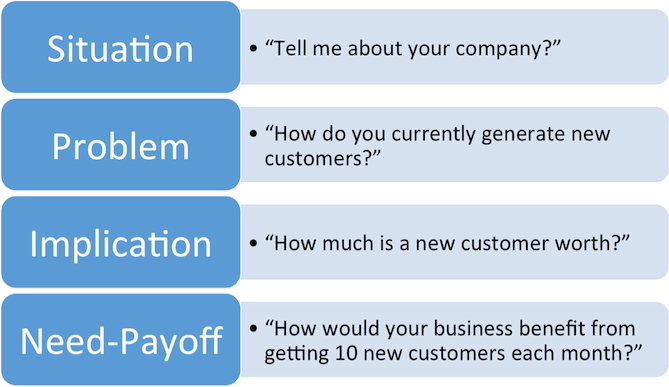
SPINsellingquestions.png

Let's break it down.

Situation

Situation questions aim to collect information about the customer’s background and where they are currently.

For example, “How are you currently logging sales calls?

Your goal is to get a lay of the land, as quickly as possible, and then move onto the important stuff below. 

Bad sales reps dwell here too long, frustrating potential buyers by turning the sales call into a game of 20 questions that resembles an interview more than a conversation. Spending too much time here also prevents the sales process from moving forward, because reps don't leave themselves enough bandwidth to establish the key motivations that ultimately have a bigger impact on whether this deal closes or not.

Problem

Problem questions begin to uncover dissatisfaction with a prospect’s current situation.

For example, “How long does it take to manually log each sales call?

Problem questions are part art, part science. You can plan many of them in advance based on your prior experiences with other prospects. You can also use research techniques such as social selling to pick up clues (ahead of time) for what your buyer is trying to accomplish and what they’re having difficulties with right now. 

Jake Reni recently gave some great tactical tips on this topic during his Sales Hacker interview that you should check out, such as watching for when key accounts express dissatisfaction with current vendors and immediately capitalizing on that opportunity. 

Implication

The goal of implication questions is to help your potential client see that their small, negligible problem is actually a big problem -- one that they need to take care of immediately. These questions are detailed and to-the-point.

For example, “How does removing 14 extra steps when logging a call help your salespeople spend more time on the phone?

Iannarino calls these "why" questions because they get the prospect to understand “why they can’t afford to continue what they’re currently doing.” Many times, salespeople emphasize the cost of inaction that prospects either aren’t aware of or don’t value highly enough because they haven’t weighed the consequences.

It doesn’t matter how good of a closer you are if a prospect lacks the understanding or motivation to make a change.

Need-Payoff

Once you’ve gotten your buyer to consider the weight of their problems, you then need to address the value or usefulness of solving that problem. 

Need-payoff questions are intended to refocus a potential client from the problem to the solution. By using need-payoff questions, you give a potential client the ability to internalize and then verbalize the benefits you bring to them.

For example, “Is it important for salespeople to save time so they can make more calls?

Well, obviously. 

Need-payoff questions are a little more general than problem and implication questions, but you still need to approach them sequentially. Now that you’ve addressed the annoying problems and the real impact those problems cause, you’re asking questions that lead the client to the realization of a payoff you uniquely provide.

Instead of having to rehash your product’s features or go on long-winded spiels about the benefits of your product, the prospect begins telling them to you.

3 Ways to Incorporate SPIN Selling into a Social Selling World

Whether we like it or not, we’re living in a social selling world. But what’s old is new again. Here’s how to give yourself a fighting chance.

1) Become sought after.

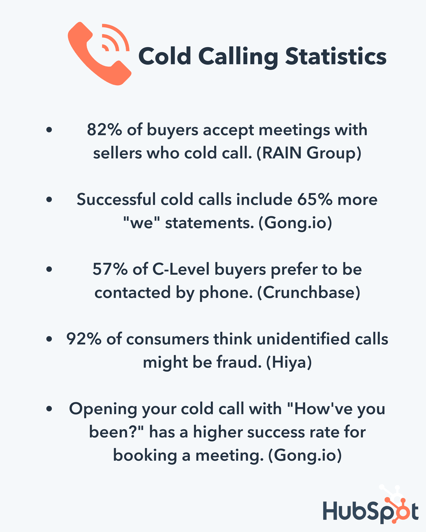
Social selling has become increasingly effective because other methods of sales outreach, like cold calling, have become less so. Even cold emails are drying up, with a click rate of less than one percent! 

But simply sending a few LinkedIn connection requests isn’t enough. Your competition are reading these stats too after all.

The SPIN Selling line of questioning is closer to consultant than sales rep. The entire first half of the book is devoted to getting sales reps to think more like a trusted advisor by developing ongoing relationships and building value.

So embrace it. "Thought leadership" might sound like an empty, meaningless cliche. But it’s also incredibly effective when done correctly. It also happens to fit perfectly with inbound methods of promotion. 

Start establishing your credentials through high-leverage activities, such as blogging. An investment in content creation provides multiple benefits:

  • Increased personal brand awareness in the form of impressions and website visits
  • Building interest and trust with your target market through social interactions or email updates

It's kind of like prospecting, but at scale.

The key here is to simplify so you can focus only on what you excel at -- diving deep into your area of expertise -- and not everything else. That means investing in tools, systems, and people to help carve enough time for you to do the important work. The HubSpot Partner Directory contains people who can worry about design and development. 

Next, make a list of the top five online sources of news and industry information your prospects read, and find a way to work with them. Contributing articles, leading webinars, sponsoring events, and other collaboration opportunities will provide exponential benefits with a single investment of your time and money.

Now repeat this process for the top two or three industry associations, which commonly are in need of high-quality educational content and volunteers. Would you forgo a speaking fee for the chance to stand in front of a room full of prospects for an hour and talk about the problems your product or service solves? Of course.

Building thought leadership is a long term bet, but the future profitability far outweighs sending a few cold LinkedIn requests.

2) Discuss, don't pitch.

Today’s sales conversations are just that: conversations. Prior to jumping on the phone, your prospect has already Googled whatever facts or figures you’re about to pitch.

Research from Invoca shows that 70% of phone calls start with a digital marketing channel. Google’s Zero Moment of Truth concept focuses on the importance of winning that critical, initial research stage prospects embark on once they recognize a need.

zmot.png

This plays into SPIN’s "consultative" approach, where the emphasis is placed on understanding prior to prescribing. You know, that whole “seek first to understand, then to be understood” bit from Covey?

The SPIN line of questioning introduced earlier is the ideal framework to base sales calls around, because it allows you to uncover the problems and pain points that will later be used to frame your solution’s value.

So you don’t have to prove yourself or "win" initial conversations. Something as simple as tracking talk time on calls can quickly increase your self-awareness of meetings that might be too one-sided, instead of a healthy, balanced discussion.   

3) Cultivate awareness.

SPIN selling is most famous for its unique line of questioning (after all, who doesn’t love acronyms?!).

But the final chapter, "Turn Theory into Practice," stresses systematic analysis as one of the key differentiating factors between top sales performers and everyone else. Specifically, the best salespeople:

  1. Dissect each call and think about possible improvement
  2. Recognize that success depends on getting the details right

The final word in the book again stresses the role that behaviors -- more than anything else -- play in driving sales success.

So take time every day to look in the mirror and self-analyze. You might have some surprising revelations. Like discovering that LinkedIn ads are more cost-effective than cold calls for outreach, or that you're spending 50% of your time each week fighting with your CRM system.

In Conclusion

New and flashy sales tactics work. Until they don’t.

But the fundamentals age gracefully, being as relevant today as they were ~30 years ago.

There’s nothing more fundamental and basic then using thoughtful sales questions to guide a conversation. As the following quote from SPIN Selling's "Selling and Persuasion Techniques" chapter recounts:

People do not buy from salespeople because they understand their products but because they felt the salesperson understood their problems."

That's about as old school as it gets.

The fundamentals that seem so stupidly obvious ultimately have a much bigger impact on sales success than the latest social selling hack. And they’re one of the biggest differentiators between what top sales reps do compared to those farther down the leaderboard.

HubSpot CRM

18 Apr 15:45

3 Questions to Quickly Qualify Prospects

by Krista Moon

Qualify Prospects Quickly

One of my clients called me frustrated about the amount of time wasted talking to people who weren’t qualified buyers. I gave her a few ideas and then remembered this article Krista wrote about a conversation she had with a mutual friend of ours Janice Mars. I shared it with her and then thought, why not share with with everyone. We all need a reminder about what it takes to talk to qualified prospects.

A Conversation on Qualifying

By Krista Moon

I was recently talking with a friend of mine, Janice Mars, founder of SalesLatitude, a sales consulting firm, about how to forecast and qualify prospects. Salespeople by trade are usually quite optimistic. We’re determined, visionaries, and persistent. That’s what makes us good, but it can also hold us back.

Pursuing prospects takes a lot of time and energy, and going after the wrong people can dramatically inhibit company growth. Janice gave me 3 simple questions that can help you quickly determine whether they are worth your time investment or not. The faster you can qualify prospects, the faster you can fill your pipeline with high-quality sales opportunities.

1. Who is Your Target Niche?

You can’t qualify a prospect if everyone is a prospect. You need to focus on the ideal type of customer that can get maximum value from your product or service. Some basic qualifying criteria might be things like; industry, location, annual revenue, and number of employees. Taking a targeted approach makes it easier to sell the right stuff to the right people.

Developing your target sounds easy enough, but it can actually be really hard. Check out our Buyer Persona Worksheet – it can help you identify your ideal customer profile.

2. Is There a Need?

Once you have a general idea of your target niche, it’s time to narrow things down even more. Just because someone fits into your general niche criteria doesn’t mean they actually need your service. In our case, for example, if a company in our niche already has a strong online presence, consistent growth, and available resources to do inbound marketing well, then they obviously don’t need our services.

On the flip side, if we come across a company that has a dated website, no blog or email marketing, and mostly self-promotional social media posts, they have a need for our services.

3. Is It a Priority?

Even if there is a need, it’s not always a priority. This is one of the most important things to remember.

For example, let’s say I come across a company that fits the “need” criteria – they have a marginal website and aren’t really doing much in the way of inbound marketing. However, their business is booming right now and they can barely handle all of the work they’re currently getting. They’re totally swamped, and can’t handle anymore with their current set up. In that case, it doesn’t make sense to invest in new growth strategies until they figure out how to scale to the next level. So while there is an opportunity for me to provide services, it’s not what they need right now.

On the flip side, I might get a prospect who has the capacity – and desire – to grow. They want to figure how to get more qualified sales leads and shorten the sales cycle. They fit into the niche, have a need, and it is a priority. Check, check, and check!

Janice said something to me that really hit home for me: “Krista, you’re not the one buying!” So yes, I can find companies all day long that I feel strongly could use our services and get results. But, if it’s not a priority for them for whatever reason, they aren’t a qualified prospect.

Important note: That’s not saying to forget them forever – the timing may just be bad. Put them on the “lead nurturing” list and use inbound marketing strategies to try to further develop the relationship until they’re more ready.

Win Fast, Lose Early

I’ll admit that one of my downfalls is that I don’t give up. If I find a prospect I know I can help, I feel like I should move heaven and earth to try to convince them to work with me.  It’s hard to let go of potentially really good customers!

Our time is our most valuable asset. What Janice reinforced to me during our conversation is to qualify quickly and move on.


Thanks to Krista for letting me share this article with you. You can find Krista at www.moonmarketingsystem.com 

Do You Need Help?

Are you having trouble quickly qualifying leads? I’d be happy to spend 30 minutes on the phone with you to help you apply the tips in this article or solve any other sales challenge. To schedule, just click the link http://www.meetme.so/aliceheiman

The post 3 Questions to Quickly Qualify Prospects appeared first on Alice Heiman, LLC.

18 Apr 15:40

3 mission-critical sales lessons from heist movies

by steli@close.io (Steli Efti)

To many, the archetypal salesperson is a deceptive scoundrel who manipulates people into buying something they don’t need. Think used car salesman meets con artist.

Ironically though, the best salespeople are the most ethical, trustworthy people in SaaS. Their primary goal is to connect customers with products that will make them more successful. As a salesperson, that’s a more sustainable strategy. Screwing someone over might win you a quick commission, but it’ll destroy your reputation long-term.

But the truth is, the salesperson-con men comparison isn’t crazy. In a lot of ways, con men would make great salespeople. They have to get intimately close with their targets, build trust, and close the deal. If they lose, they go to jail. They practically have to sell for their lives.

Nowhere is this more evident than heist movies. You know, the ones where some smooth-talking, impossibly dapper criminal puts together a crack team to steal a big sum of money? While their plots are overblown, these movies have essential kernels of wisdom any salesperson can tap into. Let’s dive into three of them.

1. Ocean’s Eleven: Build a high-powered team of specialists

sales-movie-specialists.gif

In most crime movies, the villain is some evil, lone-wolf mastermind who executes a genius plan all by himself. He doesn’t have a team so much as cronies he orders around and treats like shit.

The heist movie flips that on its head and makes the protagonist a cool, likable criminal who brings together a dynamic team of specialized experts. Film scholar Jeremy Strong writes that in these movies, “heightened significance is afforded to the group”—each member has a crucial role to play, which determines the overall success of the heist.

Ocean’s Eleven is the quintessential example. Each operative is a highly-trained specialist that fulfills a key role:

  • The sharp, charismatic leader hatches the plan and uses his charm to recruit the team.
  • The operation’s financier acts as a trusted mentor who helps everyone understand their roles.
  • The team’s slick con artist feeds the team key information from inside the casino, such as the vault's access codes.

There’s also an acrobat who maneuvers his way into the vault, an explosives expert who blows the vault's doors off and gets everyone inside, two car experts for the getaway—you get the idea. The heist process is like a stage production. If everyone plays their unique part, the result is greater than the sum of its parts.

Get your sales team tapped into that teamwork magic

assembly-line-sales_team-roles.jpg

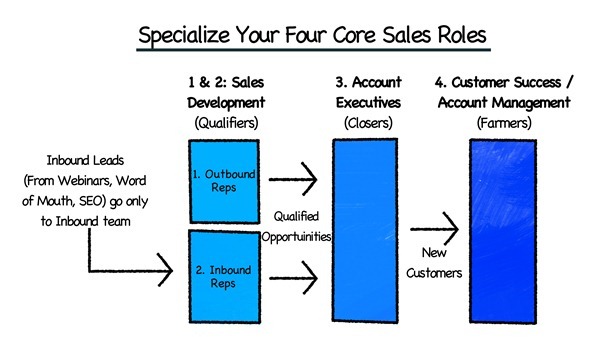
Let’s say you organize your sales team as an assembly line. Under this model, you specialize the different members of your sales team to crush a specific stage of the sales process. Customers are handed to the next specialist at each stage of the sales funnel. Think of them like the Ocean’s Eleven characters:

  • The sales development rep is your inside man. The SDR vets each lead, asks them the pain points their company needs to address, and ensures account executives only talk to qualified buyers. She’s an information-gathering machine.
  • Next, the account executive takes over. This guy needs to be a closer—just like the smooth-talking leader “closed” each team member in Ocean’s Eleven and got them on board for the heist. Your AEs will need to ask smart questions and overcome objections.
  • Finally, account managers handle onboarding. Your account managers need to set your customers up for success just as the financier set the Ocean’s team up for success with his money and wisdom. They need to teach your customers how to unlock your product’s value.

Notice how each team member plays an important role in the sale—just like the Ocean’s heist. As customers move through each step of the funnel, they’re greeted by a dedicated specialist, which creates more predictability for the sales process.

And since they’re totally separate, no one’s stepping on each other’s toes or duking it out for commission. If everyone stays focused on their specific job, the team can eliminate bottlenecks and work together as a focused, singular unit.

2. The Italian Job: Know your target

Ben Franklin supposedly once said, “Failure to prepare is preparation to fail.”

The characters in The Italian Job, out to steal a hefty sum of gold bullion back from an old accomplice-turned-enemy, practically live by that quote.

Just like in Ocean’s, the Italian Job team thrives because everyone plays a unique role. But also consider the extensive information-gathering they do before setting anything into motion.

The team taps the villain's phone and relentlessly listens in on his conversations. They even send the lone woman in the crew to woo the villain and get further into his head. They get to know him better than he knows himself.

It pays off big time. You might think that a savvy, street smart team could pull off a heist without any prep work. But in The Italian Job, they put in the time and get to know their prospect intimately. They read him like a book and prepare for his every move. When the he tries to flee with the gold, they rapidly counterattack and make off with the loot.

How a salesperson can win with research

Don’t take this lesson too literally—you definitely shouldn’t go around tapping phones. But great salespeople know that a little research can give them the information they need to close a deal.

Don’t build your whole sales process around research—it’s no substitute for actual selling. But a bit of research up front can give you the edge you need to hone in on the perfect value proposition for each prospect.

For example, let’s imagine you're selling project management software to a company with a brand new CTO. Consider these quick research strategies:

  • With a quick Google search, you can read all of her recent interviews and see what she’s said about SaaS. Maybe she mentions somewhere that she only wants products that are easy for anyone to use.
  • Or, you might try and contact any connections you share with her and see if they have actionable information. You might get an inside scoop that helps you build rapport—she appreciates straight talking, or likes dogs.
  • While you probably shouldn’t try and take her on a date, you could have an SDR reach out and ask her some questions. You might uncover that, say, she’s trying to uncover more leads on social networks, like Facebook.

By doing research, you can find make-or-break information that informs the way you frame your sales pitch. After all, you’re not selling in a vacuum—there’s a unique context for every prospect.

Preparation pro tip: Find the right tools

sales-movie-right-tools.gif

Another reason the crew scores big in The Italian Job is that they find the perfect tools for the task. In the film’s most iconic scene, the team makes off with the bad guy’s gold by driving BMW Minis through the LA sewers—the only car that could pull off the tight squeeze. That’s why film critic Joe Morgenstern called the film “the best car commercial ever.”

Salespeople can also better serve their customers if they have the right tools. Consider:

  • Close.io CRM automates tasks like lead generation, data entry, and bulk email blasts.
  • Leftronic analyzes your sales activity, funnel movement, and task management to give you a customized sales metrics dashboard. It can even integrate with Close.io.
  • ClearBit also integrates with Close.io and performs most of the research necessary for lead qualification, so you can target the customers who best match your product.

In Italian Job, it wasn’t enough for the team to have getaway cars. They had to be the right cars. But in addition to automating an ancillary part of the sales process, these tools are also customizable enough to be the “right car” for any sales situation.

3. Inception: Gain trust

sales-movie-gain-trust.gif

While not immediately obvious, Inception is a heist flick at its core. The only difference is that the team is infiltrating somebody’s mind instead of a bank or a casino. When they get in, it’s not their fancy, sci-fi technology that lets them succeed. It’s their application of social proof.

The crew’s goal is to plant the idea in their target's head that he should break up his father’s massive conglomerate. But of course he wouldn’t do that just because some stranger told him to. So when they enter his mind, they show him a dreamed-up image of his dying father telling him to (or, at least, heavily implying that he should) break up the company.

That’s the social proof—the mark accepts the idea on a deep, emotional level because he believes it’s what his father wants. By tapping into a relationship with someone he trusts, the protagonists influence their target to take their desired action.

How salespeople utilize trust

sales-trust.jpeg

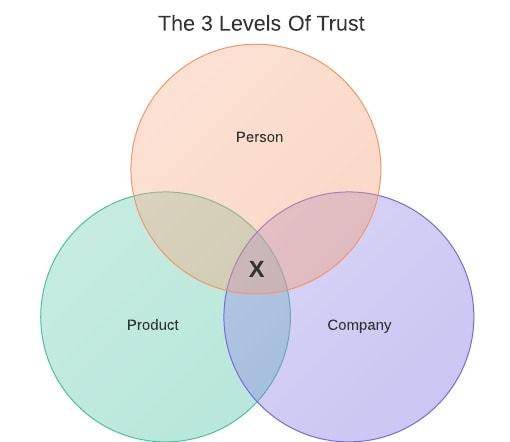
Just as the Inception crew couldn’t pull off an inception without gaining the target’s trust, you’ll never make a sale in SaaS if your prospects don’t trust you as well. The difference is that your end goal is to help them, not manipulate them.

Emotion trumps reason. Prospects might know logically that your product is the right solution for them, but they won’t buy unless they feel a sense of trust towards you and your company. If they doubt your good intentions even slightly, the deal is dead in the water.

Follow these three strategies to make sure that doesn’t happen.

  • Social proof. In Inception, the crew used the target’s loved ones—people with whom he had positive experiences—to tap into social proof and gain his trust. You can do the same thing, but leave family out of it. Try telling prospects how many other customers in their field have used your products to solve the exact same pain points they have.
  • Ask the right questions. Asking questions shows that you want to learn about the prospect's business and make sure your product can actually add value for them before you sell it to them.
  • Address the elephant in the room. Wary prospects usually have one particular doubt holding them back from buying. If you figure out what it is or give them a chance to verbalize it, you can address it directly and make the sale.

Trust is a tough thing to get in sales. But once you have it, it’s yours. If you don’t abuse it, you should have a great customer for years to come.

Same techniques, different goals

At the end of the day, the best salespeople aren’t anything like the con men you see in movies—they don’t spy, steal, or try to hoodwink their prospects.

What really unites the two is that they both need to understand how to work closely with people, inspire trust in them, and make them feel supported to get them to go along with their respective gambits.

But a good salesperson operates with a radically different mindset than a con artist—they constantly think about not only how they can promise value to their customers, but also go above and beyond to deliver on that value.

If you do that consistently, you’ll build a roster of loyal customers who will not only stick with you, but trust you enough to tout you to their friends. You’ll get more repeat customers, more referrals, and a pipeline stuffed to the brim with great leads. Unlike a con man, a good salesperson never has to skip town after getting their payday.

Recommended reading:

16 movies for salespeople
Here's a fun way to broaden your sales horizon—16 of the best sales movies for sales reps to learn and study from.

3 models of effective sales team organization
You're building your sales team but how should you organize your reps? Find out which type of sales team organization is best for your startup!

How to sell to "nonbelievers": Turn doubt into trust
How to sell to no believers and people who have doubts and fears about buying your product. This is how you build trust in sales.

18 Apr 15:40

How to Drive Sales Growth in an Age of Uncertainty

by Andrew Gothelf

In a world of real-time data and the expectation of instant results, sales leaders face a ton of pressure to meet and exceed goals. Fortunately, there are proven best practices to drive consistent sales growth in today’s fast-changing business world. On April 21 at 11am PDT, join Salesforce Growth and Innovation Evangelist, Tiffani Bova on this month’s Series Pass as we welcome Thomas Baumgartner, Senior Partner at McKinsey & Company, and Maria Valdivieso de Uster, Director of Knowledge at McKinsey & Company. The webcast, titled “Five Proven Strategies from the World’s Sales Leaders,” in partnership with Conga, will put you in a better position to drive growth in today’s market.

Here are several tips to get you started today on improving sales growth.

1. Sell How Your Customers Want You to Sell

Most organizations know they need to meet consumers where consumers spend their time: a variety of digital, social, and out-of-home channels. But selling to customers with a multi-channel strategy requires nuance and complexity that extends beyond the current simplistic approach of many sales organizations. Valdivieso de Uster and Baumgartner write, in research released by McKinsey & Company about Sales Growth, “The successful multichannel leaders we talked to emphasized flexibility—to help customers shift between channels if they wish to provide the experience they want.”

The research points to four important aspects of multichannel management:

  • Blend remote sales and field sales
  • Integrate online and offline
  • Orchestrate direct and indirect channels
  • Bring customer service into the fold

2. Stay One Step Ahead of the Competition

It’s no secret that sales leaders should always look to what’s happening around them in the market, in order to understand trends and the future of their industry. But the best and most successful sales leaders, Baumgartner and Valdivieso de Uster write, are the ones who integrate forward-looking thinking into the sales planning process. As a result, they explain, these leaders are “perfectly poised to capture the opportunities created by sudden changes in the environment.” In order to capture the benefits of forward thinking, sales leaders:

  • Surf the trends: “Tap into the big picture, watching for strategic openings in economic trends or changes in customer sectors and regions.”
  • Invest ahead of demand: “This might mean making a small investment in analytic capabilities or beefing up the number of frontline sales staff ahead of the emerging trend.”
  • Make it a way of life: “Leading sales organizations have a built-in forward perspective and mechanisms to turn insights into action.”

3. Pay More Attention to Presales

The presales team, dedicated to helping qualify, bid, and win deals, is critical to a high-performing sales team. According to the study, “ A high‐performing sales organization should have about two‐thirds of its presales team undertaking technical presales activities (crafting solutions to customers’ problems) and the rest involved with commercial presales activities (managing deal qualification, pricing, and bid).”

Leading sales teams, according to interviews conducted by McKinsey & Company, do two things particularly well:

  • Focus on quality, not quantity, of leads: Use analytics to discover the most profitable deals so you aren’t wasting the time and resources of your sales staff
  • Use expertise appropriately before and during a sale: Giving customers access to readily available presales staff to answer questions ranging from basic to highly technical can make or break a deal.

For more great sales growth tips based on research done with hundreds of executives, tune in to the April 21 Series Pass webcast; you can register here.

15 Apr 16:01

Simple Secrets to Account-Based Marketing Magic

by Greetje den Holder

Account-based marketing (ABM) is not new, but its recent rise in popularity is capturing the attention of B2B marketers looking for innovative ways to increase marketing performance. It is not yet determined whether ABM is just another buzzword or the new way to go, but its benefits seem to be acknowledged by many B2B marketers and companies.

In this blog, the concept and characteristics of account-based marketing will be explained, and the steps to get to ABM as well as its benefits will be listed. Finally, some characteristics of an ABM-ready company will be mentioned. Consequently, after reading this blog, you will know whether your company should move towards ABM and how.

‘Simple Secrets to Account-Based Marketing Magic’ This blog explains the concept and characteristics of account-based marketing (ABM), and lists the steps to get to ABM as well as its benefits. Finally, it mentions some characteristics of an ABM-ready company. After reading this blog, you will know whether your company should move towards ABM and how. Read the blog at http://budgetvertalingonline.nl/business/simple-secrets-to-account-based-marketing-magic/

What is account-based marketing?

Jon Miller, who co-founded Engagio, appears to be the one who coined the term ABM: “Account-based marketing is a strategic approach that coordinates personalized marketing and sales efforts to open doors and deepen engagement at specific accounts.” Using the 7 characteristics below, I try to give you a clearer picture of ABM.

ABM characteristic 1: for B2B

Alp Mimaroglu explains that by nature, effective ABM is best used by B2B adopters. Account-based marketers sell very specific products and services to very specific clients.

Examples of companies that use ABM include a medical device company that only sells to plastic surgeons, a design agency that only creates auto ads, or a marketing agency that only targets Fortune 500s.

ABM characteristic 2: adopted increasingly more

In 2015, SiriusDecisions has released its State of Account-Based Marketing survey. It concludes that 92 percent of companies recognize the value in ABM, but only 20 percent have had full programs in place for over one year. The study shows wider adoption is expected as more than 60 percent plans to invest in technology for ABM to align sales and marketing better over the next 12 months.

“B2B marketers are realizing that marketing to large quantities of individuals does not result in quality sales opportunities,” Peter Isaacson states. “ABM is quickly becoming the B2B strategy of choice, because it truly aligns sales and marketing while focusing their teams on the highest value accounts. I expect adoption to grow rapidly as companies that have made this switch have seen tremendous results by focusing their efforts on attracting, engaging, converting and measuring the accounts that are most likely to buy.”

ABM characteristic 3: account-centric

Inbound marketing and outbound marketing are both “person-centric.” ABM, on the other hand, is any “account-centric” form of marketing—usually outbound, as Mimarogly clarifies. Although ABM may use inbound tactics at times, it relies on tried-and-true sales methods to unlock accounts.

BudgetVertalingOnline for affordable translations into English and Dutch

ABM characteristic 4: long-term view

According to Jason Compton, marketing’s job is to listen, to advocate, and to add insights to the process at every step of a sale. Account-based marketing also relies on marketers to help sales take a longer-term view, rather than a narrow focus on quarterly results.

ABM characteristic 5: marketing automation

According to Mimarogly, the popular solution many B2B marketers are increasingly adopting is account-based marketing powered by marketing automation. By limiting their target buyers to specific accounts, leads become easier to handle, and marketing automation becomes much easier to implement.

The problem that Mimarogly identifies is that most companies outside of tech are not quite ready for marketing automation: “They are not ready for the sheer number of leads they will be qualifying, and they do not have the infrastructure to handle those leads properly. Most leads generated by marketing automation never reach sales, or are seen as off-target. Some marketers complain about getting 10,000 leads per month, because only 10% align with their target account list. It is madness.”

Compton also emphasizes the role of automation in ABM: “Marketing is responsible for identifying and understanding the triggers that indicate a prospect in the making, such as a company hiring a particular role or suddenly entering a new marketplace. Developing content that can be customized in an automated fashion is essential, primarily to avoid the need for an impractically large marketing staff to serve each account.”

ABM characteristic 6: applicable to existing accounts too

As useful as ABM is for customer acquisition, the approach also creates opportunities to engage with existing accounts in a meaningful fashion in order to increase future lifetime value, Compton argues.

To be truly successful, however, this strategy requires compensating marketers for ongoing conversions. Miller explains that “often, your most valuable accounts are your current customers, but the traditional marketing model is focused on generating net new leads and some marketing departments do not get credit if they generate a campaign response from a current customer.”

TranslationWebshop: the one stop shop for translations. TranslationWebshop: de one stop shop voor vertalingen.

ABM characteristic 7: personal

Shifting to ABM presents B2B marketers with a range of opportunities for engaging current and prospective customers in new ways. However, some relationship-focused marketers worry that the approach may seem forced or impersonal. Compton believes that the opposite is true. “Using ABM does not mean abandoning the one-to-one connection marketers have been striving to create for decades. It simply pairs that mind-set with the complex realities of the considered-purchase buying cycle.”

Account-based intelligence as foundation of account-based marketing

Falon Fatemi claims that account-based intelligence forms the foundation of an account-based strategy as it provides marketers and salespeople with the information they need to:

  • discover the right companies and best people to contact at those companies
  • identify the critical moment when customers are ready to buy
  • inform your reps of the most impactful things to say to each potential customer

7 benefits of account-based marketing

Rachel Balik finds that there is no shortage of reasons why ABM is attractive to B2B companies. Companies practicing ABM have better alignment with sales, often close bigger deals with target accounts, and increase pipeline velocity.

David Cain adds the following 4 benefits to the list:

  1. Clear ROI
  2. Reduced resource waste
  3. It is personal and optimized
  4. Tracking goals & measurement is clear

6 steps to account-based marketing

Balik says that although there are a number of touch points across the funnel where ABM will play a big part, you need a plan to identify, market and measure your target account list before you can execute on these things.

Cain is more extensive in detailing the steps to ABM. I briefly list the steps here. If you would like to see these explained, his Marketo blog What Is ABM and Is It Right for You? does just that.

  • Step 1: Discover & define your high-value accounts
  • Step 2: Map accounts & identify key internal players
  • Step 3: Define content & personalized messaging
  • Step 4: Determine optimal channels
  • Step 5: Execute targeted & coordinated campaigns
  • Step 6: Measure, learn and optimize

One key account or more?

Kate Maddox says that some marketers have developed marketing campaigns to reach just one high-level account, while other B2B marketers have created integrated campaigns personalized to a few key accounts that have similar needs and characteristics or buyer personas. She offers best practices for both options. In her blog Best Practices: How to Succeed with Account-Based Marketing in B-to-B, she explains the best practices by using two case studies. Here, I will only list the practices briefly.

Best practices for marketing-to-one campaigns

  1. Alignment of sales and marketing
  2. Heavy research into the prospect’s pain points
  3. Consistent storytelling

Best practices for marketing-to-few campaigns

  1. Give prospects a hard offer
  2. Integrate with sales

Other best practices for account-based marketing

She offers two other best practices for account-based marketing, whether one-to-one or one-to-few:

  1. Start with the right list. Know the decision-makers, the influencers and how to contact them within a company.
  2. Understand relationships between the people you are targeting to tailor the communications. You may not know where the budgets lie.

5 characteristics of an ABM-ready company

Compton argues that the following 5 characteristics prequalify a company to look deeper at ABM:

  1. A B2B model. Although households can have multiple stakeholders in large purchases, the account concept is most applicable to B2B firms.
  2. High-value products or services with a lengthy consideration-to-purchase cycle.
  3. An account-based sales model. Although not mandatory, it usually indicates that the other characteristics of the company and its customers warrant the adoption of ABM.
  4. A keenness to understand the buyer’s individual experiences and challenges as they are, not as you hope they will be.
  5. The willingness to look for prospects and opportunities outside the traditional funnel. ABM represents a deliberate shift away from standard marketing-automation practices of recent years that focused on giving prospects abundant opportunities to raise their hands and opt in to the funnel.

Compton considers that last point to be crucial as ABM expert Miller became a proponent of the approach precisely because he hit a wall with standard marketing automation. Thinking of his time at automation vendor Marketo, Miller says, “We were well-known for being a company that was extraordinarily good at demand generation, but when we tried to move up-market, that playbook just did not work with larger, named accounts.”

15 Apr 15:59

It’s not just decoration: Design is a competitive advantage

by Graham F. Scott

Why Design Matters

Family standing on a sidewalk beside their Model T in 1910.

“Any colour as long as it’s black”: a family with their Model T Ford in 1910. The Model T was a landmark success until the 1920s, when more desirable GM models wiped out its market share. (Universal History Archive/UIG/Getty)

In September 1923, six cars rolled off the assembly line of the General Motors–owned Oakland Motor Car Company in Pontiac, Mich. Each one was bright blue, with orange or red racing stripes—the result of a new kind of automotive paint recently introduced by the DuPont Company.

At the time, 80% of all cars on the road were black. This was largely due to the dominance of GM competitor Ford and its Model T, famously available in “any color, as long as it’s black,” as founder Henry Ford is said to have put it. One standard colour was cost effective because it reduced complexity and sped up the assembly line. Non-black cars tended to be custom paint jobs, which were both expensive and short-lived; the paints of the era often flaked off within months, unable to endure the elements.

DuPont’s “Duco” enamels were different. They were quick-drying, durable and available in a wide variety of colours; GM knew it now had a way to undermine Ford by offering mass-produced cars in a much wider variety of looks and styles.

The six “True Blue Travelers,” as the Oakland models were nicknamed, were each dispatched on a cross-country tour, culminating at the New York Auto Show in December 1923. GM’s growing line of vehicles, now available in an array of brilliant colours, were a hit with drivers, and GM’s sales exploded. Ford, meanwhile, owned 60% of the market in 1921. By 1927, its share had fallen to less than 10%. The drab Model T was scrapped.

The episode is an early example of a story that played out again and again throughout the 20th century and still happens all around us today. Henry Ford thought he was in the car business—the functional task of getting drivers from Point A to Point B at a reasonable cost. GM saw that the form of its cars mattered, too—what you had in your driveway expressed your personality, your status, your taste. That insight helped GM eclipse its rival for a generation.

Today, a new shade of paint isn’t enough to raise the pulse of (most) shoppers, but the principle remains the same: Design is a competitive advantage. It can capture consumer desire. It can speed up production. It can reduce costs. It can fatten margins. And the companies that grasp these realities are more likely to win in the marketplace.

But exactly how valuable is design?

In 2015, the Design Management Institute, a U.S.-based think tank that studies how companies integrate design ideas into their businesses, put together a theoretical stock index aimed at calculating this. The Design Value Index tracks a portfolio of publicly-traded U.S. companies that excel at design, including Apple, Disney, Nike and IBM. Over a 10-year period, this basket of 14 companies outperformed the S&P 500 by 219%.

“Design is the last differentiator,” says Carole Bilson, president of the Design Management Institute. In the era of offshore contract manufacturing, in which factories in China and other emerging economies can quickly tool up and churn out consumer goods at an industrial scale, making a product stand out on a store shelf (or in a page of Google results) requires more than merely meeting basic functionality requirements. An eye-catching look is a good start, but design is about more than decoration. This is one of the central problems with many boardroom conversations about design: Executives end up talking about how a product looks, not the whole experience of using it.

This is one reason why many in the field now downplay the D-word in favour of “User Experience,” or UX. Born out of software design, UX has become a useful lens for understanding everything from watches to wheelbarrows. The total experience of the customer is what counts. That includes the product’s fit and finish, its ergonomics and safety features, and how intuitive it is to use. What’s it like to call the 1-800 help line? To read the monthly invoice? Did you cut yourself opening the plastic package?

“Take chain restaurants,” says David Cronin, executive design director at GE Digital. “People have always cared about how their restaurants looked, but now I see a much more concerted effort to tie the brand experience to the in-store experience to the digital experience.”

And it’s not just consumer-facing companies that can benefit from more attention to design. Cronin points out that researching and improving UX in industrial settings can be critical. For instance, a field engineer may carry an instrument intended to measure metal fatigue, and needs to be able to use it while dangling off the side of a wind turbine. A confusing readout display isn’t just an inconvenience, but potentially dangerous. “How do we deliver that information in a direct way that enables them to focus on the task at hand?” Cronin asks. The answer is, it takes a rigorous design, testing and revision process that ties together business strategy, hardware engineering and software development.

Bilson says the best thing that companies can do to up their design game is to include designers as early as possible when developing a new product or service. “So much is lost if you’re not at the table from the outset,” she says. Having a senior manager responsible for design in the C-suite will help. But one of the big ways designers help companies innovate is by breaking down silos. Designers often work with engineering, marketing, operations, support and other departments. “The designers can see all the pain points and problems in every part of the chain,” says Bilson. That’s an opportunity to lower costs, improve service and build a seamless experience that keeps customers coming back.


MORE ABOUT DESIGN & INNOVATION:

The post It’s not just decoration: Design is a competitive advantage appeared first on Canadian Business - Your Source For Business News.

15 Apr 15:56

Why investors shouldn’t hang up on competition, especially in global telecom

by Jonathan Ratner

Rivalry among industry players is not only good for customers, but it can be good for investors too.

That’s not so much the case when it results in price competition, as this frequently hurts companies on the bottom line. Yet when it comes from differentiation, customer service and other value-added offerings, intense competition can be a big driver of investment returns.

George Lewis, a senior portfolio manager at RBC Global Asset Management, thinks this theme is one reason why much of the global telecom services sector is so attractive.

The $2.2 billion RBC Global Dividend Growth Fund, which he co-manages with Paul Johnson (along with the RBC International Dividend Growth Fund), is overweight the group, with positions in names such as Germany’s Deutsche Telecom AG, Netherlands-based Koninklijke KPN N.V., AT&T Inc., and Japan’s Nippon Telegraph and Telephone Corp.

KPN, one of the largest holdings, is one of the first in Europe to offer a converged, or bundled, offering to customers. It also offers a standalone wireless service at the lower end of the pricing spectrum.

“The market is moving away from destructive price competition — at least for the vast majority of the more profitable segment,” Lewis said. “As markets evolve more toward feature-based competition, as they are in Japan, Germany, the Netherlands and the U.S. to some extent, that’s where we play.”

The former chief executive of RBC’s wealth management business and director of research at RBC Capital Markets also targets companies that provide critical products. Telecom services certainly fits that mould more and more these days, as it’s probably one the last things people cut back on in a recessionary environment.

This is also true of companies in the industrials space, particularly among those that provide goods or services to other businesses. While those components may represent a relatively small portion of that customer’s end product, Lewis noted that it still provides the seller with a lot of pricing power.

“We look for situations where a company’s product or service is sticky, given the switching costs involved with moving to another provider, or maybe there aren’t a lot of other providers,” he said.

The manager’s investments in the telecom services space also reflect the tremendous demand growth for both broadband and data. Whereas just 35 million used cellphones back in 1995, that number has surged to 5.2 billion today, and 40 per cent of homes now use a smartphone.

In the technology space, Lewis has positions in both Apple Inc. (AAPL/Nasdaq) and Cisco Systems Inc. (CSCO/Nasdaq).

The latter, as a provider of services and data centre equipment, is benefiting  from the growth in demand for data “quite significantly.”

We look for situations where a company’s product or service is sticky

Meanwhile, Apple is creating an ecosystem Lewis believes is very defensible, even though the company has already captured a large portion of the smartphone market where growth will necessarily slow.

“They’re adding services to make that ecosystem more robust, but in many ways, the stock is trading like a hardware company,” he said. “We think they have an opportunity to move their model more toward recurring revenue and earnings — similar to telecom services — through things like the iPhone subscription service.”

Apple also happens to have a progressive dividend and share repurchase policy, demonstrating its willingness to make more effective use of its cash.

Another holding Lewis highlighted with an excellent capital allocation policy can be found in the materials sector.

They’re adding services to make that ecosystem more robust, but in many ways, the stock is trading like a hardware company

U.S.-focused petrochemicals giant LyondellBasell Industries NV (LYB/NYSE) has an advantage through its access to low-cost natural gas in North America. This has been in place for more than a few years, but it’s a phenomenon Lewis believes will last.

He noted that the company has chosen to pursue share buybacks, as opposed to greenfield expansion at the wrong time, so it manages capacity well. It also has an attractive dividend profile.

The fund’s largest holding, U.K.-based insurance company Legal & General Group PLC (LGEN/LON), has grown its dividend at between seven and 10 per cent annually, and the stock yields more than five per cent.

Lewis noted that it’s actually more of an asset manager (30 per cent of its business), as one of the world’s leaders in passive investment management solutions.

“It’s niche is helping companies in the U.K., and now in the U.S. and Netherlands — the largest defined benefit pension plan markets — immunize those liabilities by assuming the investment risk and longevity risk,” he said. “They’ve been doing this for several years very profitably, and have this multi-year growth profile ahead of it.”

15 Apr 15:56

Value Pricing Techniques to Maximize Margins for Cloud and Managed Services

… for your service offerings. Pricing Cloud Computing Services There are several factors … affect your pricing methodology for cloud computing services. You will need to … have a tougher time selling cloud computing solutions and delivering services as …
15 Apr 15:55

Sales Enablement Tactics to Improve BOFU Conversion Rates

by Alexis Getscher

Once a prospect has reached the bottom of the funnel (BOFU) they’ve done their research and have narrowed down the potential companies they’re looking to buy from to a handful at most. The questions a buyer has at this stage in their journey tend to be more logistical—how does the product actually work? What benefits can internal stakeholders expect?

To convert these prospects into customers, the sales team must be well-versed in product knowledge and have a variety of resources at their disposal. This is why it’s necessary for sales and marketing to be tightly aligned through the entire buying journey.

Marketing plays a huge role in converting prospects at every stage of the funnel and is exceptionally beneficial at the bottom. While the channels decrease as you move down the funnel, the opportunity for personalization increases.

Below is a list of sales enablement tactics that can help improve BOFU conversion rates.

BOFU_Conversion.png

Personalization

By the time a prospect has reached the bottom of the funnel, it’s likely they’ve touched multiple pages on your website, downloaded ebooks, attended webinars or all of the above. If you’re using marketing attribution, you know each and every touchpoint, whether online or offline, and you can use this information to personalize content and outreach.

Tracking all TOFU and MOFU touchpoints gives you a great idea of a prospect’s pain points and what they’re interested in learning more about. This knowledge cannot be ignored and must used as a sales advantage. Listen to the data and customize your outreach accordingly.

Case Studies

Typically when a prospect is at the bottom of the funnel, they’re looking for that little extra push to persuade them that your product or service is the right choice for their organization. Case studies are that push.

People trust peer feedback. It’s why Amazon has product reviews and consumers spend tons of time reading those reviews before making a purchase. An organization can write whatever it wants about its own product, but the opinion of a peer is perceived to have more value because it’s unbiased.

If the sales team is working on closing a deal and marketing can provide a case study for a similar company, the same industry, or that addresses similar pain points, it may be just the push they need to make a final decision. Prospects want to remove risk from the purchase. If they see that the product has provided a solution to other companies with the same pain points, they can feel confident it will do the same for them.

Targeted Blog Posts

The company blog is generally thought of as a lead generating, TOFU channel, but the blog can be a great BOFU resource as well. Super specific content won’t get a lot of views, but the views it does receive will be much deeper in their buying journey. Not only will this drive qualified organic traffic, it’s a beneficial resource for the sales team as well.

These “help desk” style articles cover very specific issues and answer them clearly. Unlike with TOFU content that is broad and educational, BOFU content should specifically position your product as a solution to a problem.

Personalized Product Demos

A demo is a great way to highlight product features in action. But to truly convert on the process, a good amount of pre-demo work must be done. Each prospect is different, they come from different company sizes, different pain points, and are looking to achieve different goals. Using a one-size-fits-all demo misses a lot of opportunities to show why your product is specifically right for the prospect.

At Bizible, we call this pre-discovery. The sales rep will get the prospect on the phone to really understand what needs they’re looking to meet, along with general company information. The goal here is to listen, most importantly, and secondly to clarify.

That way, once it’s time to do the demo, you can specifically set your product up to show how it addresses each of the needs the prospect has. Additionally, reports or features can be tailored to fit the persona you’ll be speaking with. Is it the Paid Search Manager or the CMO? Each will be interested in different product features.

Comparison Sheets

Plain and simple, comparison sheets put your product right up next to the competition. What makes it different? What makes it better? What quality or feature can you highlight that a prospect may not have thought about?

Compare apples to apples.

For example, say you’re looking to buy a car and you’ve narrowed it down to a BMW or Tesla. A comparison sheet could show things like horsepower, stereo options, and other specs. But some additional things to consider might be the total cost of ownership (with Tesla you don’t need gas or oil changes), is there any training needed (Tesla requires knowledge of, and access to, electric charging) and if so, is that included in the purchase cost?

Present the features like considerations.

  • Selling Tesla: Have you thought about how much money you spend on gas? With Tesla that cost is eliminated.
  • Selling BMW: I remember you saying you take a lot of roadtrips, would you rather plan your trip around charging stations or do you enjoy the convenience of gas stations?

Set the stage for a problem they may have and then show how you solve it. Eliminate surprises via risk, cost and implementation. Position yourself as a trusted advisor and leave the prospect feeling confident in you and your product.

To achieve successful BOFU conversion, you must create internal champions. Provide the prospect with the right knowledge and resources so they can then sell it to the internal stakeholders. Customize and personalize the experience. Simply throwing every feature at them is overwhelming and then when they bring the product to their boss, they’ll do a poor job of selling the benefits. Provide just enough of the right information to get them on board and excited, so you can go together and close the deal.

 The Revenue-Driven Marketing Survival Kit The resources you need to overcome obstacles and become a more effective revenue-driven marketer Download Now

15 Apr 15:55

The 4 Stages of Skill-Learning. And the Critical Kaizen Loop

by Terry Laughlin

The Four Stages of Learning emerged from the field of psychology in the 1970s, and has since become widely familiar and accepted. It identifies four levels of competence one must experience in learning any new skill.

According to this model, we generally start out with a blind spot: “We don’t know what we don’t know.” We must recognize our deficit to progress further. Next we must consciously acquire the skill, then consciously use it. By doing so we gradually acquire the ability to use the skill somewhat automatically.

The four stages are called:

  1. Unconscious Incompetence We fail to recognize that a higher skill level exists or that it has value. You may have escaped this stage quite early in your swimming experience. I didn’t do so for 25 years, until almost age 40. Until then, I believed my swimming potential was limited by a lack of ‘genetic’ traits. That notion was dramatically dispelled—in less than 10 minutes–when Bill Boomer taught me a balance drill, and I recognized I had a serious blind spot in my knowledge of technique. Even after coaching with great success for nearly 20 years!
  2. Conscious Incompetence Like most TI swimmers, the first skill deficit I identified was balance. For 25 years, I’d thought I had ‘heavy’ legs and the only solution was to kick harder. When Boomer taught me to align my head and spine and shift weight forward, I was stunned at how my legs automatically—and effortlessly—lifted to the surface.  That remains my single most transformative moment in 50 years of swimming.
  3. Conscious Competence For the next six months I thought of almost nothing but maintaining a straight line between head and hips, and leaning on my chest (a technique called Press Your Buoy which we taught until the late ‘90s), fearful that—after 25 years of unbalanced swimming—I would lose this magical feeling if I wasn’t explicitly focused on it.
  4. Unconscious Competence When I finally trusted that balance had become a moderately-durable habit, I immediately adopted a new skill goal—Swim ‘Taller,’ which I’d learned would reduce drag. This change was just as challenging: For 25 years I’d focused exclusively on pushing water back. Now I had to train myself to ignore the hand pushing back and focus on the one going forward.

This amounted to a change in pretty fundamental values system—that I should place a higher value on extending my bodyline, than on pushing water back. The fact that I felt markedly better convinced me. Swimming Taller kept me occupied for several more months—during which I regularly made time to check on head-spine alignment.

As soon as Swimming Taller began to feel consistent and more natural, I again chose a new skill focus—Holding My Place. After reaching forward, my focus would be to consciously hold my place with the lead hand—then spear the entering hand past it. This was a more complex and challenging skill that the first two I’d tackled. Fortunately I was prepared—in two ways.

If I hadn’t already learned balance, it would have been physically impossible to Hold My Place. As well, when I began to concentrate on aligning head and spine, it was my first experience in trying to hold a single ‘stroke thought’ for an extended period. That was surprisingly hard at first, but got easier over time.

When I tried to Hold My Place, I could feel my hand moving back. I had to learn to resolve the conflict between my intention and what I experienced. Fortunately I was prepared for this a far more demanding level of Conscious Competence, by nine months of prior conscious skill practice.

That occurred in 1989. In the 27 years since I’ve never lacked for a new skill goal to maintain in Conscious Competence. Which illustrates a critical distinction between the TI view of the learning stages, from that commonly taught.

The Kaizen Continual Loop

It is not a stairstep progression from Unconscious Incompetence, ending in Unconscious Competence, as shown in this illustration.4 Stages

Rather one’s goal should be to maintain a continual loop. Upon moving from Conscious to Unconscious Competence in one skill; immediately identify a logical next step. Recognize your Conscious Incompetence at a related, slightly more challenging, skill and bring it into Conscious Competence, then work consciously on it until it happens more autonomously. Then start the process all over again, as illustrated here.Kaizen Learning Cycle

Here’s one more thing. This process actually involves a change in the physical location in the brain where we process cognitive and motor skill. During the Conscious Competence stage, we process in the Cerebral Cortex, an area with especially dense neural connections. The Cerebral Cortex consumes a lot of energy. The same energy—oxygen and glycogen—used by the muscles.

When we achieve Unconscious Competence that activity is run by the Cerebellum, which uses far less energy. Each time we learn a new skill this way we not only increase our mechanical efficiency, we also increase our energy efficiency in a surprising way.

The post The 4 Stages of Skill-Learning. And the Critical Kaizen Loop appeared first on Total Immersion.

15 Apr 15:54

How to Increase Your Content Visibility in Google Knowledge Graph

by Varun Sharma

How to Increase Your Content Visibility in Google Knowledge Graph

As a digital marketing expert, I inevitably find myself struggling to keep up with the happenings around the world. I’m always keen to grab more and more knowledge from everything I come across, but it can be difficult.

I wonder about the enormity of the human mind. From the day we are born till the moment we die, our brain collects, loads, and stores everything. This immense knowledge aids us in dealing with our routine.

What’s even more exciting about our minds is that we can think of one thing, and thousands of other relevant thoughts will pop in our heads. It’s amazing how our mind is reshaped by the information it grabs every minute.

thoughts process answers process

The way our mind acquires, operates, and responds reminds me of the Google Knowledge Graph.

Google Knowledge Graph is the largest warehouse of knowledge in digital history—and it’s doing it with your help. (highlight to tweet) This revolutionary system has changed the definition of the online search process.

What Is Google Knowledge Graph?

Google launched a new system in 2012 to improve its search process, Google Knowledge Graph, aiming to provide an enormous amount of information in an organized way and make it accessible universally.

In a nutshell, Google knowledge graph is a systematic way of organizing facts, people, and places to improve the relevancy of search outcomes. With this approach, users now get quick access to surplus information and the option of exploring related subjects within that search.

At the launch of the Knowledge Graph, Google Product management Director Johanna Wright said, “We’re in the early phases of moving from being an information engine to becoming a knowledge engine, and these enhancements are one step in that direction.”

Google Knowledge Graph does this by organizing information into “Entities” and the “Relationships” between them.

How the Knowledge Graph Works

When you look up a person on Google, say “Barack Obama,” Google will refer to its data bank (the Knowledge Graph) and will display everything about Obama. Google’s Knowledge Graph is its own pool of data, where all the information is collected from authoritative sites. The search results are presented based on a user’s search patterns.

This is similar to how our mind functions. When we think of a person in our life, say our best friends, our mind immediately presents a picture carousel before us comprised of their names, faces, families, good and bad moments we shared together, etc.

Here, the data we look for is known as “Entities.” Knowledge Graph revolves around these entities and their “Relationship” with one another and utilizes them to organize relevant data for presenting in the search result. These entities real-world things, including individuals, places, organizations, works of art, movies, and so on.

Google no longer takes a search query as a string of keywords, but rather as distinct entities.

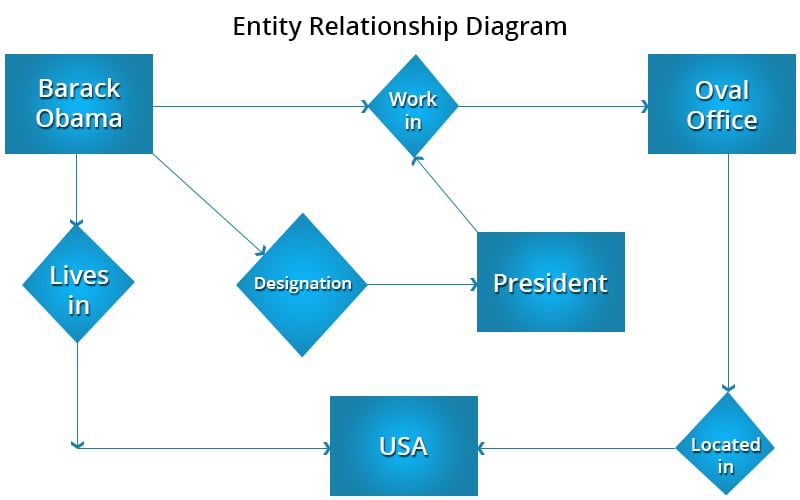
Below is a simple Entity Relationship Diagram:

entity relationship diagram

While “Barack Obama,” “Oval Office,” “USA,” and “President” are entities here, they are related to each other through relationships: “Work In,” “Located In,” “Lives In,” and “Designation.”

If you want to know the different entities on your web page, read this comprehensive post from Barbara Starr.

The Significance of Google’s Knowledge Graph

There are several English words with multiple meanings. Interpreting such words depends on their context. Till now, Google ignored the actual context used in phrases. With the launch of Knowledge graph, Google has greatly improved its semantic search; it can actually understand the meaning of a given word and its relationship with the entities.

Gone are the days when the Google search process was based on keyword match. The Knowledge Graph works just like our mind and is easily able to distinguish between the various search queries and their meanings. With the Knowledge Graph, Google has now become more flexible. It is now capable of understanding the objective of a particular search query and answering successfully by refining the search result.

5 Types of Knowledge in the Knowledge Graph

Google divides the Knowledge Graph into five main types.

Google knowledge graph types

The Google Knowledge Graph is smart, and you’ll need to get smart as well to utilize it in the most efficient way. You’ll need to cultivate a better understanding of how users can get things they’re looking for in the search. Here are six tips for increasing your visibility in Google Knowledge Graph.

1. Build Your Brand Presence in Wikipedia

Knowledge Graph collects information from authoritative sources in order to ensure data reliability and accuracy. And what could be more promising than Wikipedia?

Having your brand on Wikipedia hooks your online presence up to a high-value online encyclopedia. Wikipedia is an influential data source, open for all, but it does follow strict guidelines on what information it accepts. To get listed your page on Wikipedia, follow these tips:

  • Get mentioned in third party sources like newspapers and magazines.
  • It’s important to have multiple users contribute to the page.
  • Collect and include references to other reliable sources
  • Get referenced in other Wiki pages. This helps to bolster your notability.
  • Encourage an active discussion page.


If you can create a Wikipedia page for your brand successfully, you’ve got a higher chance of increasing your content visibility in GKG.

2. Register Your Brand in Public Data Centers

Besides Wikipedia, Google also refers to sources like Wikidata.org to retrieve relevant information about entities. Wikidata.org acts as a secondary repository for Wikipedia and Wikisource that records statements and their sources, which in turn helps in reflecting the diversity of information available and ensuring that it is verified.

Similarly, the CIA World Factbook is a reference resource that offers detailed information about the demographics, geography, government, communication, economy, and military of the 267 international entities around the world.

Registering your brand on these data centers ensures Google will collect verified information about your business.

3. Organize Your Content by Schema Markup

Schema markup is a set of predefined code that defines elements of your webpage and support search engines to return the best search results to users for a given query. Schema helps search algorithms understand your page content and provide additional information about the entities in an organized way. This is what the GKG demands.

If you really want to increase the visibility of your content in the GKG, put effort into defining important things on your website. Structured data can be used to mark up all kinds of items, including products, places, organizations, individual, events, and even recipes.

implement google knowledge graph

4. Make Your Social Media Profiles Optimized

Your social media presence serves as evidence that your business is an online entity. When you stay updated on your social profiles with regular posts and reviews, it informs Google that you’re actually using your page. Moreover, Google Knowledge Graph displays information about your social media profiles when displaying information about your business in the search result.

Also, make sure to have a Google+ page for your business. Out of all the social media channels, Google+ has the most impact on Google Knowledge Graph. In order to create your knowledge graph, Google will use the information obtained from your Google+ profile much more extensively. In addition, use Google+ author relation tag to make your recent posts and other valuable information visible.

5. Get More Mentions

A mention from the right blogger can trigger a cascade of great press for your business. Getting more mentions on the web helps you increase your brand awareness and credibility, which ultimately gets you more traffic. The more you get mentions, the more chances your business has to be recognized by Google Knowledge Graph. Sharing great content with consistency and regular tweeting are just some of the ways you can get more mentions on the business.

6. Optimize Your Google Local Business Page

According to Google, over 73% of online activities are associated with the local search. In order to learn and evaluate the companies in their area, customers often turn to local search. By appearing in the Google Knowledge Graph, you can keep your business at the top of the local search results and can get the maximum traffic.

Make sure that your Google Local business page has a 100% score, with all the information filled in completely. This means in addition to filling in the required text fields, you should fill in the optional ones as well. Your page should also contain product or service keywords in the description, customer reviews, and your contact details. This will help Google get complete and viable information about your business.

While it’s your job to provide as much information possible about your business, your place in the Knowledge Graph also depends on the Google’s ability to synthesize the information it receives over the web. Still, when it comes to user search queries, Google Knowledge Graph can have a huge impact on your content visibility.

Google Knowledge Graph is not about quick wins and tricks—it’s about high-level reliable marketing efforts. The basic aim of Google Knowledge Graph is to give useful information to the readers and allow them to make the best decision.

Get more content like this, plus the very BEST marketing education, totally free. Get our Definitive email newsletter.

15 Apr 15:53

Top Secret Listening Station: How to Listen More Than You Talk in Your Business

by Lacy Boggs

Have you ever had the feeling that the universe was trying to tell you something?

Every once in a while, I feel like the universe is beating me over the head with some message or other.

Once, when I was living in Southern California, I was feeling really self-conscious about my body as I lounged by the apartment complex pool, when a man walked up, unstrapped both of his prosthetic legs, and dove into the pool. I hid my tears behind my sunglasses and though, OK universe! I get it! Be thankful for what I’ve got. Message received!

Another time, it was as though everything around us stopped as my father, who was dying of leukemia at the age of 64, told me how pissed off he was that he’d waited his whole life to do what he wanted to do when he retired, and six months into his retirement, he got sick. That one couldn’t have been more clear if it had been in flashing neon lights.

So I’m kind of a believer in listening when the universe wants to tell me something.

Lately, the universe has been talking about just that — listening. Several smart business marketers that I admire and respect have been talking about the power of listening in your business.

When we talk about marketing, often our first impulse is to think about broadcasting. What’s the message, what’s the medium? How do we create more content? How do we promote it?

But really, the best marketing starts with the marketer who is smart enough to sit back and listen.

Writing for the one versus the many

I was chatting with Joanna Wiebe of Copyhackers a couple of weeks ago for my new podcast, and she said that even though we may have the potential to reach more people than ever before with Internet marketing, we’re not writing for the masses — we’re writing for just one person.

We are none of us Coca-Cola or WalMart — we can’t try to speak to a huge audience with our marketing. It just won’t work.

Instead, the best strategy is to try to speak to one specific person. Maybe there are actually a dozen of her out there, maybe several hundred — but we’re only writing to that one version.

And to understand her, you have to listen to her.

What’s fascinating is that this works whether you’re selling 1:1 or to groups, whether you’re selling a product or a service. You can connect with individuals who either truly are your ideal customer (as in, they are likely to make a purchase) or can stand in as an avatar for her.

And when you truly understand her through listening, you won’t have to “sell” her on anything — she’ll come to you.

Here’s what to listen for:

Listen for connections

What do you have in common with your potential customers? Do you belong to the same groups? Read the same books? Subscribe to the same magazines?

I’ve been shocked by the number of people who have spoken up since I added my love of Harry Potter to my autoresponder emails. I’m tapping into a deep cultural love that people of my generation in particular can rally around.

Listen for buying signals

People love to rant and rave online — and they’ll also talk about what’s working and what’s not long before they start looking for help.

If you can identify people at this stage of the customer awareness spectrum, you can more quickly and easily move them along your path to sales.

The best example of this in my world is Facebook groups. I often see business owners asking questions about blogging, lamenting how long it takes, or complaining that they have no idea what to write about. Not one of them is asking, “How do I put together an editorial calendar?” but I know that’s the solution they probably need. I’ve identified those as signals that they might be ready to buy my Blogstorm course soon.

What are some of the signals that your ideal clients might be ready to buy from you?

Listen for changes that could spell opportunity

It’s kind of a sad truth about human nature that we’re not good at tackling problems proactively — we wait until we have a pain before we try to correct it.

But often, there are changes that signify we may be looking for that solution soon.

Think about what kinds of changes your ideal customer might go through right before she needs your service. For me, someone might be starting a new business, a new website, or taking their business to the next level. They might be ready to start a blog or restart one that’s stalled.

I have a friend who offers coaching for women working through divorce — so she has a very distinct change she’s listening for with her potential clients.

Listen to stay informed

Apart from listening to the customers themselves, we have to listen to what they are listening to, and stay informed about what might be top of mind for them.

For example, if you work with a particular industry like doctors or lawyers, you might subscribe to the industry association websites and newsletters. Even if you’re not a doctor or a lawyer yourself, it pays to know what your potential customers are hearing and thinking about.

This might also include listening to your “Frenemies” (we don’t use the word competition around here). It’s important to know what messages your potential customers are hearing from them as well.

Listen to add value

Finally, if you can listen to all the information that’s being delivered out there around your topic, and then aggregate and curate that information to your customers so that they can focus on just what’s important (instead of wading through it all themselves) you’ll be doing them an invaluable service.

We already do this to some extent on our social media channels, but ask yourself: how much of what you share is truly intentional? Useful? Important?

To become a trusted source, you have to become the rigorous filter through which only the best information passes.

How to use what you hear

Think of yourself as the undercover agent, holed up in an empty apartment, office, or hotel room, diligently listening to your target waiting for those nuggets of information that will allow you to act.

That’s what you can be doing every day as part of your marketing strategy:

  1. Set up your listening stations. Where will you listen in? Some suggestions include Facebook groups and comments, Twitter, Instagram comments, Amazon or Yelp reviews, industry forums, newsletters, blogs, etc.
  2. Set up your recording station. I’ve created a simple document where you can record your observations, but you could also use your CRM software or any other note-taking application you’re already using. Remember: you don’t have to fill out each column for every source. Whenever possible, copy and paste the potential customer’s exact words.
  3. Follow up on opportunities. Set aside time each week to follow up on specific opportunities. That might mean sending emails, introducing yourself in groups, answering questions, or sending out proposals. But make it an appointment on your calendar, and do it regularly.
  4. Use your insights in your copy. One of the most powerful ways you can use this information is to echo your customers’ own words back to them in your copy — for your website, your blog, your emails, and your sales pages.

If you’re serious about taking your marketing to the next level, spending even an hour a week on strategic listening and following up can have an enormous impact on your business and your bottom line.

Are you interested in learning the nuts-and-bolts of how to set up your own virtual listening station? If so, comment below so I can gauge interest, and if there’s enough interest, I’ll put together a training for the Eyes Only Member Library!

15 Apr 15:52

23 Cold Calling Statistics That May Surprise You (2022)

by ebrudner@hubspot.com (Emma Brudner)

Is cold calling dead? 

Many will likely say that it has gone the way of the dinosaur; that its time has come and is rapidly declining in efficiency.

The practice, however, is not entirely dead. Read on to discover some statistics about the state of cold calling in 2022. 

Free Resource: 10 Sales Call Templates for Outreach

B2B Cold Calling Statistics

b2b cold calling statistics

  1. The majority of businesses and consumers predict their use of the voice call will increase or stay the same over the next 12 months. (Hiya)
  2. Cold calling is a form of proactive outreach, and 82% of buyers accept meetings with sellers who proactively reach out. (RAIN Group)
  3. 42.1% of respondents say that the phone is the most effective sales tool at their disposal. (Sales Insights Lab)
  4. Over 30% of leads never receive a follow-up call after initial contact. (Call Hippo)
  5. By making just a few more call attempts, sales reps can increase the conversion rate by 70%. (Call Hippo)
  6. 57% of C-level buyers prefer to be contacted by phone. (Crunchbase)
  7. B2B technology reps usually average 35 calls per day and spend a total of 55 minutes per day speaking to prospects. (Revenue.io)
  8. 92% of consumers think unidentified calls might be fraud. (Hiya)
  9. 79% of unidentified calls go unanswered. (Hiya)
  10. Successful cold calls last 2x longer than unsuccessful ones — 5:50 minutes vs. 3:14 minutes. (Gong.io)
  11. Salespeople who state their reason for calling have a 2.1x higher success rate. (Gong.io)
  12. Successful cold calls include 65% more “we” statements. (Gong.io)
  13. The last hour of the workday (between 4PM and 5PM) is a good time to reach prospects. (Call Hippo)
  14. Opening your cold call with “How’ve you been?” has a higher success rate for booking a meeting. (Gong.io)
  15. The most successful sales prospecting calls average 14.3 minutes in length. (Revenue.io)
  16. Wednesday and Thursday are the best days of the week to call prospects. (Gong.io)
  17. There is a 450% difference in response time for leads that receive a follow-up phone call within an hour of submitting an inquiry and those that didn’t receive a follow-up. (Call Hippo)
  18. Win rates are 10% higher when pricing is discussed on the first call. (Gong.io)
  19. Cold calls where reps monologue are more successful. (Gong.io)
  20. 63% of sellers say cold calling is the worst part of their job. (LinkedIn)
  21. Mentioning a common connection during a cold call can increase the likelihood of attaining a meeting by 70%. (LinkedIn)
  22. Sales reps with longer monologue duration have more successful cold calls. (Crunchbase)
  23. Asking “Is now a bad time?” on a cold call makes you 40% less likely to book a meeting. (Gong.io, 2021)

sales call templates

15 Apr 15:52

Heat Things Up: 3 Ways to Re-engage Cold Subscribers

by Bryan Hernandez
Heat Things Up - 3 Ways to Re-engage Cold Subscribers

Author: Bryan Hernandez

Too often, marketers abandon disengaged subscribers, assuming their inaction means they’re off their brand for good. But this isn’t necessarily true. A Return Path study on e-commerce re-engagement email campaigns saw an average of 12% open rates, and regardless of whether the “win-back” email were opened, 45% of subsequent emails were opened.

Together, marketing automation and programmatic advertising can help marketers understand why these subscribers may have churned and reactivate them.

Here are three smart approaches to revitalize your inactive subscribers and make the most of your hard-won contacts:

1. Target Subscribers by Intent

Essentially, cold subscribers are people who have stopped engaging with your campaigns over a period of time. For example, this might be someone who hasn’t opened or clicked on any of your emails in the last two months. With a marketing automation platform, you can set up custom triggers that identify when a contact hasn’t engaged with your campaigns for a certain period of time. You can then reach out to these prospects with content based on the actions they take (or don’t take).

Group your subscribers in the following convention to get results:

  • Shopping cart abandoners: These contacts represent the highest of intent. They browsed your products, found something that speaks to them, but, for some reason, they didn’t follow through. Send messaging to counter what you believe—and have heard from customers—is a weak point of your product. Too expensive? Offer free shipping. Out of date? Send emails out about the latest-and-greatest products.
  • Product page browsers: Browsers who view particular products but don’t purchase represent a different audience altogether. Their behavior indicates they’re interested in a product line or category, but they’re not convinced your product is right for them or they’re simply not ready to buy. Send them mid-stage marketing content that gets them acquainted with your company, perhaps a customer testimonial or case study. At AdRoll, we love to send out product one-pagers and blog posts explaining industry challenges. That way, when buyers are ready to decide, you will be on their mind.
  • Email subscribers who never open: Just over 20% of email marketing messages are never opened, and many of your once-interested and engaged customers may have gradually lost interest over time. Add a little variety to how you re-engage with them with the following methods:
    • Advertising: Target them with digital ads splashed across different channels to get them thinking about your brand again.
    • Timing: Changing the timing of your email sends to understand when your buyers are most likely to open them. A good way to do this is through A/B testing to understand what time emails are opened most often.
    • Frequency: You’re lapsed subscribers may still like what you offer, but don’t like how frequently they receive emails. Group these contacts together and send them emails less frequently.
    • Win-back Email: Let your subscribers know you miss them, and give them an incentive to come back. Tech news site CNET won 8% of their inactive subscribers back with a well worded message and a chance to be entered into a sweepstake.

2. Reach Unsubscribed Prospects Through Alternate Ways

When your prospects opt out of promotional emails or phone calls, it does not necessarily mean they’ve become cold. These contacts might simply need more subtle methods to stay informed about your products. By migrating your unsubscribed prospects to online user IDs through a CRM retargeting service, you can reach them through targeted display ads to stay connected. Retargeting campaigns leveraging an audience list from your marketing automation platform typically require less set-up than website retargeting and all you need to get started is a .csv file of email addresses or a marketing automation system that can sync to ad platforms.

3. Change the Context of Where They See You

When people surf they the web, they usually have their “blinders” on, meaning they’re tuning out marketing campaigns splashed across the web. Often, changing the context of where buyers see your messages can get them to pay attention to your content. Social media advertising allows you to change the context of your advertisements; especially through native advertising, in which ad content appears identical to social media user-generated content. An analysis of AdRoll’s pool of advertisers found a 26% increase in click-through rates and a 92% increase in impressions compared to standard display retargeting.

Getting started advertising on social media is relatively easy and starts with finding the platform that’s right for your audience and your budget. LinkedIn and Instagram, for example, are fairly engaging, albeit somewhat pricey. Facebook, meanwhile is great for small business owners with its localized user base of 1.55 billion active monthly users.

It’s impossible to know exactly what reason caused your subscribers to go cold on your brand. But thanks to advanced in marketing technology, it’s much easier to hone in on why and warm them up with the right approach.

What other tips do you have for re-engaging cold subscribers? I’d love to hear them in the comments below.

may-2


Heat Things Up: 3 Ways to Re-engage Cold Subscribers was posted at Marketo Marketing Blog - Best Practices and Thought Leadership. | http://blog.marketo.com

The post Heat Things Up: 3 Ways to Re-engage Cold Subscribers appeared first on Marketo Marketing Blog - Best Practices and Thought Leadership.

15 Apr 15:52

B2B PR vs. B2C PR: What You Need to Know

by Wendy Marx

B2B PR vs. B2C PR

Those in the B2C sector typically have full-scale PR resources at the ready. Product launches, press relations, and marketing opps demand a strong PR presence. What about the B2B realm? Do we really need that much PR? And, if so, do B2B public relations tactics mirror those of B2C public relations?

In this post, let’s explore:

  • Why B2B companies need PR
  • 5 differences between B2B PR and B2C PR

Yes, Your B2B Company Needs PR (Even if it’s small)

Which companies come to mind when you think of B2B? Perhaps super giants, such as Salesforce or IBM are the first to pop into your head. It’s easy to see why the super companies need PR.

However, even smaller companies need a good dose of PR, as it is the oxygen that breathes life into any firm. Without PR, you are simply drowning in a sea of competitors, rather than captaining your ship to sail in concert with the waves.

Good PR increases visibility, drives leads, creates awareness, and ultimately boosts revenues. What company doesn’t want those positive results?

However, if you’re just diving in to the PR world, or even if you been floating around in it for a while, you may be wondering if B2C PR tactics are just as useful in the B2B sector. Let’s tackle that next.

5 Differences Between B2C and B2B PR

1. Goals

B2C PR tends to focus on creating excitement over a product. Before a product is even launched, we get the impression (if PR is done properly) that it already exists everywhere and that it’s something we need to purchase because we’ll be out of the loop if we don’t.

To find proof of this , just take a look at the lines for the Apple Store when a new product is released.

However, B2B public relations focuses on building trust in a brand. You may be interested in a new cloud software that is about to launch, but it’s extremely unlikely you’ll enter a long-term relationship with it before knowing you can trust the provider.

In order to build trust, you must establish that you are the go-to person in your industry. Find your niche and be the source of useful, helpful information.

2. Lead Generation

B2C products and services typically have a wide audience, whereas the B2B audience is generally very specific and streamlined.

“The B2B audience is seeking products that will help their business solve problems or leverage opportunities. They are attracted to efficiency and expertise.” ~ Max Bergen, SaaS sales and business development professional

Let’s face it, if you’re selling rubber roofing material, a broad advertising net will yield few results. However, advertising an organic lip balm on YouTube just before Justin Bieber’s new video may garner similar results to advertising it on Monday night TV on the CW Network.

What’s the point for those of us in the B2B world? You need to narrow down your audience in a very intentional way and market directly to them.

You can do this by targeting social channels used by your audience and segmenting your leads so you can send select content to different groups.

3. Influencers and Advocates

Do you know who is the current CEO of Priceline? I don’t. I do know that William Shatner and Kaley Cuoco have appeared on numerous commercials for Priceline.

That’s not going to fly in the B2B PR world, though.

If your PR efforts are going to be successful, you need to brand, not just your company, but also your executives. They should be known for being industry leaders and influencers, rather than hiring influencers and advocates.

This isn’t to say that you should avoid seeking out the endorsement of bloggers and industry professionals. However, your primary objective should be to become the voice of your industry.

There are numerous ways you can accomplish this, including:

  • Joining HARO to offer quotes and expertise to reporters
  • Responding to online queries relating to your industry
  • Offering owned content that educates your audience
  • Being active on social channels
  • Contributing byline articles to media outlets
  • Speaking at industry events
  • Polishing your credentials with industry awards
  • Aligning with partners who can widen and deepen your reach

“B2B PR should be focused on educating the audiences first and providing a larger picture that helps position you as an expert in the area.” ~ BuzzNitro

4. Social Media

In B2C PR, gaining as many followers as possible on social media helps to create brand awareness, and a “need” for a product.

However, social media for B2B is a different beast. To begin with, not all social channels are appropriate for your B2B brand. If your brand doesn’t fit with Snapchat, then you shouldn’t force it. If Instagram campaigns yield few to no results, then move on.

B2B social posts tend to be more informative rather than emotional, which means platforms like Twitter and LinkedIn (the source of 80% of B2B leads) should take front and center in your social campaigns.

5. Owned Media

B2B owned media, in the form of blog posts, videos, ebooks, and other content takes a different form than B2C owned media.

For instance, a B2C blog post may be around 500 words. It will likely be entertaining and easy to digest — no concentration necessary. However, some studies show that B2B blog posts are more engaging when they are at least 1,400 words in length.

Whatever length you settle on, the content should be engaging, but most of all, it should be informative and useful to your audience.

One thing is for sure, we can select certain useful elements from the B2C PR model, but in the end, B2B PR must be specifically designed to cater to the needs of its unique audience. As PR evolves and changes, we continue to learn how to manage the nuances that make B2B PR special.

What about you? How have you learned and adapted to changes in B2B public relations?

15 Apr 15:51

7 Things to Avoid on LinkedIn

by Warren Knight

7 Things to Avoid on LinkedIn

LinkedIn is a great professional social network (the best actually) but it is only as good as the person who is using it.

The biggest reason why businesses struggle to use LinkedIn is because they are doing all of the wrong things, or treating it like every other social network when in reality, it is unique and cannot be compared.

I have been using LinkedIn for 12 years, and have over 7,500 connections, 200 long-form posts, and over 10,000 content followers on LinkedIn. One of my posts has received over 4500 views, 900 likes and 60 comments. I have also built my LinkedIn “All Star” profile to a level which generates a 5-figure income for me; so I know what works, and what doesn’t. Here are 7 things to avoid on LinkedIn.

1. WHAT DO YOU WANT TO ACHIEVE ON LINKEDIN?

One of the biggest mistakes a person can make when using LinkedIn is not having a goal. Just like every other social network, you need to know why you are using LinkedIn and what you want to achieve. Are you looking for a job, channel partners, brand awareness or, something else? Have a goal in mind when using LinkedIn.

2. BEING UNPROFESSIONAL

This is something I will touch on during my webinar on Tuesday, and go into more detail about in my LinkedIn Bootcamp. LinkedIn is a professional network, which means there are things you shouldn’t share, or discuss. Walking your dog, or talking about what you had for dinner are things that are not suitable for LinkedIn.

3. IS THAT REALLY YOU?

How recent is your LinkedIn profile picture, and how relevant is your LinkedIn headline? Having a profile that really doesn’t reflect who you are both visually, and through written content is something that should be avoided on LinkedIn.

4. DON’T BE SELFISH

Social media is a way to connect with your audience, and engage in a two-way conversation. Just because LinkedIn is a professional network, it doesn’t mean that you should focus on JUST talking about yourself. You will get more out of LinkedIn if you focus on helping others, as much as finding out who can help you.

5. DON’T FORGET TO EXPLORE YOUR NETWORK

A large number of LinkedIn users have set up their profile as their “online CV” and have not utilised the other great features LinkedIn has to offer. Have you explored your network, and reached out to the connections who you could build a professional relationship with? Don’t forget to explore your connections, and engage with your network.

6. FAILING TO GIVE RECOMMENDATIONS AND ENDORSEMENTS

A huge part of LinkedIn, and the success it has had over the last 10 years is because of its great features, including recommendations and endorsements. If you want to build your personal brand, you need both of these, and you won’t get them unless you give them. It’s a two way street so in order to get recommendations, and endorsements; you need to give them.

7. NEGATIVITY

Always stay positive on LinkedIn. If you are going through a hard time professionally, this isn’t necessarily something your connections want to read about. If you are having a difficult time, spin it so that there is a positive lesson to be learned. LinkedIn isn’t the place to feel sorry for yourself, or encourage others to do the same.

Now you know 7 things to avoid on LinkedIn, how are you going to build your “All Star” profile, and generate leads and sales using LinkedIn? I have just the answer.


Let me help you generate sales from LinkedIn for your business and click here to sign up for the webinar taking place on the 19th April at 7pm.

14 Apr 23:47

This ‘mechanical jellyfish’ could help us harvest tons of energy from the ocean

by Dyllan Furness

With a unit called Triton Wave Energy Converter (WEC), Oscilla has re-envisioned how power can be generated from wave energy.

The post This ‘mechanical jellyfish’ could help us harvest tons of energy from the ocean appeared first on Digital Trends.

14 Apr 23:43

Measuring Lead Nurturing Performance

by Jason Stewart

I was asked to answer a few questions recently for a paper by DemandGen Report and Vidyard on measuring lead nurturing. You can access the full report here, but here is the full Q&A providing some thoughts on lead nurturing and measurement of content performance.

shutterstock_403812004
How can B2B marketers identify what’s resonating and driving people through the funnel?

This is a tricky one, and it really depends on what you want to measure. If you can monitor or track all the content offers a prospect has downloaded before a purchase, it could be very telling to identify the common pieces that show up across those purchases. What you might find is that your most “popular” pieces, from a downloads perspective, might not be the ones that are actually driving revenue.

What challenges are preventing marketers from measuring lead nurturing success?

One of the biggest challenges to measuring lead nurturing success is not a new one … it can be difficult to measure interactions with content outside of the nurture program without planning for it. It’s easy to measure opens and clicks and downloads from a nurture email, but you need to also measure the prospect’s interactions with content outside of the confines of the nurture to get the full picture because the best nurtures foster further interactions with your content that might be harder to track. Blog posts, web pages, other pieces of content they fond on their own. Scoring needs to account for all interactions, not just the ones connected to responses to email.

Another huge mistake is creating only one nurture, and then assuming that every member of the buying committee will respond to it. Typically, it is a buying committee and not a single buyer in B2B but many companies cram every different persona into the same nurture, regardless of differences in priorities and pains across that committee.

How do they overcome these challenges?

Step one to overcoming this challenge is to make sure you selected the right system, that can track all of a prospect’s interactions across channels.

Step two is to build a nurture that encourages people to interact with that content — don’t make them wait for the next email before seeing more content that is relevant to their journey.

Step three is to make sure that all interactions are scored, so that prospects that are proactively seeking out valuable content get pushed through the nurture faster, and that their next email in the stream accounts for any interactions they may have had outside of the email string.

For the second issue, they need to create a different nurture stream for every member of the committee, and make sure to capture persona information up front so they can place prospects into the nurtures that are most relevant to their interests and needs.

What tips/best practices would you share to help B2B marketers measure success with lead nurturing campaigns?

Track the content accessed by prospects that have actually purchased, and use that information to help determine which offers to promote via paid channels and make sure it is featured prominently in your nurtures.

What’s data’s role in maximizing nurturing initiatives? What grade would you give the industry for their use of data insights to enhancing nurturing capabilities? Why?

Typically, B2Bs are doing a very poor job of measuring content performance — largely because they are limiting measurement to statistics like downloads and not taking into account what happens next. Which piece is more valuable, the one that had 500 downloads that led to 2 sales, or the one that had 50 downloads that led to 5 sales?

Any relevant B2B use cases you’d be willing to share that highlight effective lead nurture campaigns?

PR Newswire took all of these factors into account when they launched a nurture program optimized for multi-channel interactions and that supported multiple, very different personas. Within five months of the program’s launch, PR Newswire’s engaged leads grew by 22%, and qualified leads saw a 7% increase. By supplying the sales forces with leads that were vetted and pre-qualified beforehand, the number of sales closed also increased by 7%. You can check out a case study here.

Author: Jason Stewart @jstewart_1 is Vice President, Strategic Content for ANNUITAS

The post Measuring Lead Nurturing Performance appeared first on ANNUITAS.

14 Apr 23:39

7 Mistakes That Your Social Media Ads Should Avoid

by Justin Wilson

Social media advertising is one of the most powerful marketing mediums you can use. The adverts are easy to set up (Facebook and Twitter have got shareholders to keep happy, remember) and relatively low cost, so the barriers to someone placing a social media advert are pretty low. Which is good news, right?

Well, not necessarily.

The ease with which you can create a social media advert means that there are a lot of people who are running advertising for the first time – and some of them are making mistakes.

So, I have identified seven of the most popular mistakes so that you don’t have to make them.

The Right Network: Trying to find the right network is not as easy as you would think. For example, I work in higher education, so is that something that people regard as part of their personal life (in which case, Facebook would be a good network) or their professional life (LinkedIn), or is it both? Just because over a billion people are on Facebook doesn’t mean that is the best network for your organisation – do your research and find out where your audience are.

Audience Profile: In the first paragraph I said that social media is one of the most powerful marketing mediums you can use. I say that because of the level of audience segmentation that you can perform. Before online advertising, being able to create an audience profile by age, location and interests was very difficult and expensive. So, spend some time defining your audience and don’t define your audience too broadly if you can help it.

Copy: Your copy will need to be pretty snappy – you will probably only have 150 or so characters to communicate your message. And within that, you will need to include a compelling reason for someone to click as well as a call to action. Not an easy task, but spending some time getting this right will see your advert effectiveness soar.

Image: It is likely that the image will be the part of your advert which grabs the audience’s attention (or doesn’t). So you should steer well clear of cheesy and boring stock images, you can spot them a mile off. Your image should be exciting but also relevant – again, not easy but your image can make or break your campaign.

Manage Campaigns: One of the key advantages of social media advertising over print advertising is the fact that you can manage your campaign – if after running for a day the campaign feels like it is heading in the wrong direction, change something: bid, image, copy, audience, etc. Getting the campaign up and running and leaving it to run its course with no management while it is running is so 1990s.

Landing Page: Sending advertising traffic to a home page is the wrong thing to do 99% of the time. In an ideal world, you would have a specific landing page designed for that campaign, but in the absence of that, the landing page should be specific to the product / service / message which you are communicating to the advert. Sending traffic to the home page and expecting people to navigate to the right page will not work.

Track Success: Before you start your social media advertising campaign, you should define what success looks like. Is it driving traffic to your website? If so, will you be tracking the number of conversions, bounce rate and on-page engagement? Or is it to grow your social media audience across a particular demographic? Make sure you don’t do this stage retrospectively (that’s cheating!).

What are the common mistakes which you see? Or have you made a social media advertising mistake that you are prepared to admit to?!

14 Apr 16:43

The World's Best Marketing Tool: Writing a Book

by Wendy Keller
There is no more credible way to establish your credentials that documenting your expertise in a book.
14 Apr 16:39

Why the general wisdom on cholesterol could be wrong

Authors of a major cholesterol study conducted in the 1970s didn't publish all their findings, leading to decades of the demonization of animal fat
14 Apr 16:38

Clean energy in B.C. produces green power and sustainable jobs: report

by CB Staff

VANCOUVER – Clean energy power producers in British Columbia say their projects have energized the province’s economy through jobs and investment opportunities.

A report from Clean Energy BC finds the association’s 160 members produce 14 per cent of BC Hydro’s energy supply using wind, thermal or solar power, as well as small hydro facilities called run-of-river operations.

Clean Energy BC executive director Paul Kariya says the operations are responsible for more than $8.6 billion in investment across the province.

He says that has helped many First Nations communities suffering from the collapse in oil and other commodity markets.

In addition to creating sustainable and renewable power, the clean energy report finds projects linked to the sector are responsible for about 16,000 construction jobs across B.C.

Future green energy projects are expected to create another 4,500 construction jobs while the report says renewable power accounts for more than 800 current and future operational positions.

One dozen First Nations are members of the private-sector industry association, and the study detailed their participation in sustainable power projects through revenue sharing, employment and training.

“Over the course of a decade, clean power producers have forged deep relationships with indigenous leaders,” Kariya said.

(Clean Energy BC has) “innovated made-in-B.C. solutions to protect ecosystems and breathed new life into struggling communities all over the province,” he said.

“If the provincial government heeds the advice of its own Climate Leadership Team, then we’re going to need plenty of clean electricity. We’re ready to deliver the goods.”

The post Clean energy in B.C. produces green power and sustainable jobs: report appeared first on Canadian Business - Your Source For Business News.

14 Apr 16:37

How Airbnb's design tricks make us trust complete strangers

by Ariel Schwartz

beyonce airbnb

Airbnb has become so normalized among certain segments of the population that we rarely stop to think about the enormous feat the company has performed in getting its customers to trust complete strangers — on one side, the guests who stay in random homes, and on the other, the hosts who open up their abodes to people who they have never met.

This is no accident. Airbnb has figured out how to design for trust. Or, as cofounder Joe Gebbia put it in a recent TED talk, "We bet our whole company on the hope that with the right design, people would be able to overcome the stranger danger bias."

It's the little things in Airbnb's interface that make all the difference, Alex Schleifer, head of design at Airbnb, tells Tech Insider.

 "Across everything, even from the brand side, it ends up being a little softer and more human than most traditional marketplaces. Everything from the onboarding process to the transactions, we communicate subtly at different points," he says.

Phrasing is a big part of how Airbnb gets customers to trust its interface. "The voice and tone is relatively curious, and it asks questions that feel a little more human than filling in a field. This generates empathy and trust between parties," says Schleifer.

For example, instead of saying "Here's a pulldown menu, select a destination type," Airbnb will ask a user, "Would you prefer doing x or y?"

Airbnb also spent a significant amount of time figuring out how to communicate a sense of urgency with popular listings without making customers feel rushed. The company initially tried an alert for users saying "This listing is very popular and it might not be around in a week." People responded well to it and clicked the "book" button often. But once Airbnb followed up, the company found that the phrasing made users feel anxious.  

"We want people to feel like it’s advice, like they they have the option not to book," says Schleifer.

Here's how the phrasing looks now:

Airbnb

Hosts also have to be able to trust that they are offering a fair price for their listings. As Schleifer points out, "People might be great hosts, but they might not have the time or inclination to understand the complexities of dealing with pricing on a day to day basis." 

Airbnb recently introduced a Smart Pricing feature to make those decisions easier. The feature guides hosts through a pricing recommendation system that takes into account over 50 factors, like seasonality and location. But it's only a recommendation. Hosts still have the power to set their own prices.

"We knew the solution was between an overly automated and dry pricing setting and the other, which was just setting all the pricing by yourself. We wanted to make sure we could give you advice," says Schleifer.

Airbnb smart pricing

The most obvious way that Airbnb gets users to trust its interface is with reviews. Hosts and guests are asked to leave reviews after a stay, but they can't see what the other party said until both have left a review. This ensures that people don't leave overly positive reviews in the hopes of getting good reviews in return.

Still, if you poke around Airbnb long enough, you'll notice that most reviews are positive. Part of creating trust is ensuring that people can't hide behind anonymous reviews, but people are often reluctant to leave bad reviews under their own name, as Business Insider has pointed out.

Sometimes, the trust system fails outright, as evidenced by the high-profile Airbnb horror stories that have popped up over the years (Thrillist has a whole list, including sex and meth parties at host properties).

But these horror stories are few and far between.

Overall, Airbnb's system works. People feel like they can trust the company with their homes and vacations. For the most part, that trust is warranted.

Join the conversation about this story »

NOW WATCH: Consumer Reports just rated Samsung's new Galaxy phone better than the iPhone

14 Apr 16:36

The Ultimate Guide to Link Building With Content

by Eric Siu

link building with content

You’ve probably noticed that a lot of link building and SEO guides focus on creating high-quality content. There’s a good reason for that: it’s far easier to build links to top-quality content because that’s what gets shared. Businesses and individuals are in search of quality material to link to so that they have something of value to offer their website visitors, and if you’ll notice, few people link to a homepage, product page or shopping cart.

Of course, there’s a difference between creating content that is simply stuffed with keywords and links, and creating top-notch blogs and articles that are specifically geared towards helping you build authoritative links to your website. And just to be sure that we are speaking the same language, here are two important definitions:

Content marketing is when you create and share content (articles, blogs, infographics) for the purpose of driving traffic to your website and navigating visitors through your marketing funnel in order to acquire new customers.

Link building is when you get other websites or blogs to link to your web page in order to improve your search engine rankings. The engines crawl the web looking for links between your web pages and other websites to decide how valid your content is and thus where your page should rank in their search results.

As far as the search engines are concerned, if your website or blog contains a lot of authoritative links plus receives a lot of links to it, then you are not only considered popular, but valid, too. And search engines are constantly evolving their algorithms to discern the spammy links from the trustworthy ones, which means that valuable content and inbound marketing are more important than ever.

Because 93% of marketers use content in their marketing strategy and 42% of them regard their content marketing skills as effective, this is an area where you don’t want to get left behind! In this guide, we’re going to share tactics that will help you create linkable high-quality content for your website as well as use that content for link building to your website.

Part 1: Creating Linkable High Quality Content

In the introduction, we explained that linkable, well-crafted content is that which is specifically geared towards helping you build links to your website. But let’s step back for a moment and explain what exactly quality material is.

High-quality content is made up of:

  • Well-researched and accurate information
  • Extremely valuable material designed for your target audience
  • Impeccably-written copy
  • Supplemental images, graphs, videos or infographics
  • The most complete and up-to-date information at the time of publishing

By incorporating these five points, your work will stand heads and shoulders above the crowd.

The first thing to do is start the process with in-depth research. Find the top pieces of content about your subject and determine what each one of them is missing. You’ll probably find that out of ten posts, each one covers something different. If you combine all those ideas into one piece of content with your own unique take on the subject, you’re already well on your way to success!

In addition, aim for meaty posts with over 1,000 words. Studies from analyzing a million articles have shown that content that is 1,000+ words tends to get the most social shares and backlinks.

If you’re not a writer, don’t worry. There are plenty of freelance writers that you can hire to create content for you (but if you’d rather learn how to write killer content yourself, then this is for you). Just be sure to find someone who is an expert in your particular niche and who loves writing (trust me, you’ll be able to tell the difference in the finished product!). The fastest way to do this is to look at the top online publications in your niche and see if any of the bylines belong to freelancers. Or just do a search like this on Google:

link building with content

This search will give you the top writers in your niche along with some samples from their portfolio, which you should definitely read to ensure that their style of writing is appropriate for your brand. Run the search for sites that produce the type of content you are looking to create in order to find writers who already have a handle on the topic and are experts at crafting high-quality content.

Once you have hired someone to create some really cream-of-the-crop writing, it’s time to add the elements that will transform it into linkable material. Here are the elements that you will need to make it big with your content and how each will help you get links:

Research

It’s one thing to say that Facebook is the most popular social network on the planet, but without the numbers to back it up, it just comes off as opinion. But when you write that with 1.55 billion active monthly users, 83.5% of which are outside of the US and Canada, Facebook is the most popular social network on the planet, this is no longer opinion; it’s fact-based writing with the statistics to back it up. This is what separates the experts from the amateurs.

link building with content

Cite specific sources for every one of your claims throughout your article so that readers instantly get that they are looking at a well-researched piece of content. This gives them a reason to trust you and link to your content rather than content written by others. It also allows the readers to dive deeper into the subject to which you sourced if that interests them.

Expert Opinions

Another way to add credibility to your writing is by using quotes. For example, I could say that link-building methods of the past will no longer help your website. But again, that’s just opinion, and unless you already consider me an expert, you won’t necessarily pay heed to it.

On the other hand, if I say that John Mueller of Google suggests that webmasters should focus less on link building as it’s been done in the past and instead focus more on creating high-quality content that is easy to link to, I have now added expert opinion from Google, a source that most people trust. All the better if I can use word-for-word quotes that are hyperlinked to the source.

link building with content

Even if someone has never heard the name John Mueller, the fact that he is from Google makes him an instant expert in the area of SEO. When you can’t find specific research or statistics, expert quotes are the next best thing to back them up.

In addition to making your content higher quality by adding in expert opinion, you have also added influencers to the article who might actually help you promote it. Even if Mueller doesn’t link to your content, he might share it with his 14.4k Twitter followers, which may in turn prompt one of his fans to share it with their own audience or link to your content.

Resources

Last, but not least, are resources. Look for opportunities throughout your content to mention specific resources. For example:

Better yet, don’t just include links; include images that show what people will find when they click through to one of your recommendations, like this quick peek at a report from SEMrush.

link building with content

For the average reader, this adds more value to your content because you are giving them additional resources that provide substantial information. Remember, you’ll stand out from the competition by doing this because so few people take the time to give their readers this kind of value.

You have also added more opportunities to connect with people to let them know that you have featured them, their resource or their product in your latest piece of content. Resulting shares based on “ego-baiting” (creating content that features an influencer for the purpose of getting a link or share from them in return) have the potential to result in links.

Part 2: Building Links to Your Linkable High Quality Content

Once you’ve published your linkable high-quality content, your next goal is to actually build links to it. You’re going to do that in 4 steps:

  • Playing the numbers game
  • Getting as much exposure for your content as possible
  • Reaching out to the people most likely to link to your content
  • Answering questions

Each of these steps plays a vital role in getting links to your linkable high-caliber article.

Numbers

The first step is playing the numbers game. The number of social shares, the number of votes, and the number of comments you receive on your content all play a role in convincing people that your piece is valuable, popular and, ultimately, link worthy.

link building with content

This is why the second after you publish your content you need to start building up these numbers. Begin by sharing it to all your social media networks. Then encourage those social shares to increase by using networks like Fiverr, ViralContentBuzz, JustRetweet, and CoPromote. All these sites offer ways for you to effectively pay for social promotion.

The key is to build up your numbers somewhat evenly across all networks. In other words, don’t buy 1,000 tweets and nothing else. Look to get an even distribution of tweets, likes, +1s, shares, stumbles, and pins.

Then get it on popular voting networks like Inbound.org for marketing content, BizSugar for business content, or subreddits for any kind of content. It’s best that you reach out to people you know on each of these networks in order to get votes on your content as soon as it gets published.

The faster the votes build up, the better the chances of it getting to the homepage and driving more traffic. Just don’t do anything like buy 100 votes for a network where the top content only has 20, or you’ll likely get bumped off the homepage for voting fraud.

Finally, get comments. You’ll want to aim for a little higher quality on these as you don’t want to encourage spam on your website. The best place to start is your own email list. Send out a broadcast announcing your post and at the end of the email provide a clear call to action: that people stop by and share their thoughts on your blog post. From there, try out the groups on Facebook that are built specifically for bloggers to reciprocate one good comment for another.

Exposure

The next step is exposure. The more people that you reach with your content, the greater the number of links you’re likely to get from them. The fastest way to get exposure with your target audience beyond simply sharing it on your social accounts is through social media advertising. Specifically, create ads for:

Next, do some Twitter outreach by finding people who have shared similar content using the pro version of BuzzSumo.

link building with content

If you can find direct contact information for these people, trying emailing them. Otherwise, send them a simple tweet to let them know that you noticed they shared a particular post and that you have a good one on the same topic you think they’d be interested in. Start with those sharers who have the most followers and retweets and work your way down the list.

Just in case your outreach is ignored, you can also combine tactics by exporting lists of people from BuzzSumo who have shared similar content and then create Tailored Audiences for Twitter ads using their usernames. This is a great way to craft a relevant remarketing campaign for your target demographic.

Since Twitter takes a while to create Tailored Audiences, you might want to do this research prior to publishing your content so that your Tailored Audiences are ready when the content goes live.

Outreach

Now it’s time to reach out directly to the people who are most likely to link to your content. These will typically be bloggers who are already linking to similar pieces. BuzzSumo also offers a feature that allows you to view the articles that link to this piece of content, so as you are viewing sharers, look at the linkers too.

link building with content

BuzzSumo makes your backlink research valuable by showing you only content backlinks—i.e. links to content from other pieces of content. Seeing the social share potential of the blog will also help you determine if it’s a quality website that will drive traffic to your own site.

Using the results from that report, reach out to the blog author as well as the author who created the link to the similar post and let them know about yours. You’ll have a higher rate of success if you aim for the most recent posts, as they are more likely to be recently updated, as well as posts from authors who write link roundups, like Marketing Day (shown in the search results above).

From here, start looking for additional link roundups in your industry. They will usually have keywords like:

  • [your topic] roundup
  • best [your topic] links
  • best [your topic] posts
  • best [your topic] articles
  • top [your topic] links
  • top [your topic] posts
  • top [your topic] articles, etc.

Reach out to those people directly so that they can include you in their next edition.

Also be on the lookout for people who do roundups by email. In the SEO world, the holy grail is the Moz Top 10. Subscribe to their emails (preferably in advance), familiarize yourself with the content they share, and then reply to the latest one to let them know about your suggestion for their next email. Subscribers to those emails might have blogs of their own and might link to yours.

Answers

Last, but not least, look for ways to answer questions with links to your content. Search for these opportunities in Q&A networks like Yahoo Answers and Quora, forums, and social media groups.

link building with content

Not all of these arenas will create SEO links per say, but they will allow you to gain more exposure for your content in a helpful way. And more exposure has the potential to lead to more links.

In Conclusion

Here is a quick rundown of the steps to building links with content:

  • Create linkable high-quality content that is valuable, accurate, up-to-date, complete, and 1,000+ words.
  • Include specific research, expert opinions, and resources.
  • Build social proof immediately after publishing by getting social shares, social votes, and comments.
  • Get exposure through social advertising and social outreach to people who share similar content.
  • Get links through direct outreach to people who link to similar content.
  • Get links by answering questions on Q&A networks, forums, and social media groups.

If you follow these steps each time you write an epic piece of content, you will ultimately create a library of linkable high-quality content on your website that drives up the overall authority of your domain with great, editorial links.

This post originally appeared on Single Grain, an ROI focused digital marketing agency.

14 Apr 16:34

The Best Way to Reach Out to a Prospect For the First Time, According to 20+ Sales Experts

by aja.t.frost@gmail.com (Aja Frost)

For years, there's been a debate raging in the sales community: When reaching out to a prospect for the first time, should you call or email?

After all, first interactions with prospects are key -- you're aiming to establish trust, provide value, gather key information, and perhaps even secure a follow-up meeting. If you don't use the right medium, they'll be less receptive to your message (and that's assuming they engage at all).

Luckily for sales reps everywhere, more than 20 sales experts and practitioners on Quora decided to weigh in.

Free Download: Sales Plan Template

The Best Way to Reach Out to a Prospect For the First Time

When In Doubt, Email First

The majority of experts recommended starting with an email. "An initial email usually makes more sense because it doesn't require [the prospect to] answer at the moment they receive it," writes Robert Graham, author of Cold Calling Early Customers.

Plus, as others pointed out, you can use an email as a reason to call.

"I always start by referring to this first email to show we're one step further in our relationship," explains Stan Frering, head of Client Relationship Management for Easytrip France.

Emailing has a third advantage over calling, according to EchoSign co-founder Jason Lemkin. It lets you educate your prospect on the product's value proposition, and clearly connect it with the prospect's situation.

"The prospect needs to understand the value proposition first," he explains. "It needs to be very strong, and very clear. No one will take a random call about a product they've never heard of it's not 100% crystal clear they have a huge, pre-defined need for it."

When to Ignore the Email-First Rule

However, there is one exception to the "email first" rule.

Lemkin says once your brand has been established, it's time to start calling your prospects.

"If your prospect has already heard of [your company], they'll know if they want to speak to you about the product and learn more about buying," Lemkin writes.

For example, say you're a salesperson for Dropbox. You call a prospect and say, "Hi John, I'm with Dropbox, and I noticed your CEO tweeted that your company is almost out of free virtual storage. I'd love to discuss how we could get you some more so you can keep all your files in one place."

John already knows Dropbox and understands why it's a useful product -- so he's got a good reason to stay on the phone.

However, if you were selling a brand-new cloud storage solution, Lemkin argued that it would be better to send John an email first so he has more time to consider your value prop.

Not sure how much clout your company name carries? To quickly gauge brand awareness, go to Google Trends and compare how many people are searching for your company versus your top competitors. If your company gets the most searches, that means it probably has the highest name recognition in your space.

A Better Method Than Phone Or Email?

But to one expert, the question of "phone vs. email" is innately flawed.

SVP at LivePerson Sean Burke says that, in fact, your default shouldn't be calling or emailing. He recommends using your network to get an introduction -- great advice, considering that having a referral makes a buyer five times more likely to engage.

"You'd be surprised how often this crucial first step is ignored," Burke writes.

Once your mutual connection has agreed to introduce you, ask him or her which communication method the prospect prefers. Most people have an individual preference for calling or emailing.

However, if you don't have a shared connection, Burke suggests looking at the prospect's social media presence. If she is "social" -- meaning she's got 500-plus LinkedIn connections and an active Twitter or Instagram account -- use those channels to interact with her and start adding value. If she's "traditional" -- meaning she doesn't meet those criteria -- Burke gives you the go-ahead to call or email.

Whatever You Do, Don't Cold Call or Spam

While opinions differed on the relative merits of calls vs. email vs. social media, the experts were unanimous on one point: You should never reach out to a prospect via any channel without doing research first.

"Ultimately, you are in a much better position -- either calling or emailing -- if you have background information on the person you are contacting," notes Jeremy Boudinet, head of marketing for Ambition. "That way, you can tailor your message off the bat, since you have an idea of how you can add value to that person or company."

Sales Email or Sales Call? Experiment and Find Out

Although these guidelines should definitely guide your prospecting strategy, don't forget they're just that: guidelines. "Why not take a test-and-learn approach to this problem?" writes Nick Dellis, Weebly's VP of Business Development. "What works for you may not work for others."

Dellis suggests emailing first, then calling with 10 to 20 prospects, doing the reverse with another 10 to 20 prospects, and comparing the results.

"Taking this approach of testing ideas and optimizing is the only way to find out for yourself," he says. "And it'll help you be a better salesperson in the longer term."

First Contact Email

If you choose to start the conversation with an email, be sure you include a rapport-building element and communicate your value proposition.

Not sure what a first contact email should look like? Here's an email template you can use to start your outreach.


Hi [Prospect Name],

Because I work so much with [targeted industry], I constantly follow industry news. Recently, I noticed you've [insert company action].

Usually when that happens, [insert business issue] becomes a priority. That's why I thought you might be interested in finding out how we helped [similar company] quickly get started in a new direction with a customized solution.

Check out our [case study/research] here. If you'd like to learn how [your company] can help [prospect's company], let's set up a quick call. Schedule 15 minutes here on my calendar.

Kind regards,

[Your Name]

P.S. If you're not the right person to speak with, who do you recommend I talk to?

send-now-hubspot-sales-bar

And to learn more about sales prospecting, check out these email templates to get and keep buyers' attention next.

sales plan

14 Apr 16:34

Scott Brinker on Agile Marketing – What It Is and Why It Matters

by Kyle Lacy

Throughout history, many of the most important business innovations have been the result of one industry or discipline borrowing ideas from another. The most well-known example is Henry Ford’s adoption of the continuous-flow production methods used in industrial breweries, canneries and bakeries to create the first automotive assembly line. But he wasn’t the only one to engage in cross-industry innovation.

Scott Brinker’s new book, Hacking Marketing: Agile Practices to Make Marketing Smarter, Faster, and More Innovative (Wiley, March 2016), explores a contemporary example of an idea being adapted across disciplines – this time from programming to marketing. “Because marketing is in this digital environment, it’s wrestling with a lot of the same challenges that the software world has been wrestling with for the past couple decades,” explains Brinker. “Marketers are, to a very real degree, becoming kind of like software creators themselves. So, the question became how could we educate marketers about the processes and management tools that the software community has developed and pioneered over the past several decades and then help them see how they can use those tools to build a better, more modern marketing organization?”

The question is a fascinating one has that the potential to be particularly relevant for software startups who often already have flexibility built into their operations. Here at OpenView, we’re obsessed with continuous rapid improvement. Our marketing team follows agile practices as much as possible. In fact, I recently became a Scrum master. Based on what we’re seeing in-house and with our portfolio companies, I believe that the most successful marketing teams of the future will be the ones who can harness the power of the agile methodology.

As the co-founder and CTO of ion interactive, an agile technology platform that helps businesses get the most out of their interactive content marketing experiences, Brinker has first-hand experience in the software world. He is also the author/editor of the very popular chiefmartec.com blog and program chair for the annual MarTech Conference, the international conference series for senior-level, hybrid professionals with expertise in both marketing and technology. In these roles, he studies, publishes and speaks on the intersection of marketing and technology and the effects of that intersection on marketing strategy, management and culture.

Understanding Agile Marketing

So, what exactly is Agile Marketing? Simply put, it is the application of Scrum-inspired agile software development practices to the management of marketing initiatives. Agile marketers can choose from a buffet of agile elements including:

  • Team size and structure: A team of typically no more than eight to ten members led by a “Scrum Master” who facilitates the process
  • The sprint/scrum cycle: An iterative cycle typically lasting one to four weeks during which the team focuses on a clearly defined and constrained set of small tasks
  • Process artifacts: Old School or software tools (from physical white boards to digital options like Trello) for managing task prioritization and tracking
  • Philosophy: A mindset that puts a strong focus on concepts including adaptability, prioritization, transparency, responsiveness, empowerment and experimentation

Using these elements, marketing teams can break away from the traditional, long-term “waterfall” approach to developing campaigns and implement shorter, more focused “sprints” that are better suited to today’s constantly changing environments. Agile Marketing enables marketing teams to increase forward momentum while simultaneously maintaining the utmost flexibility so they can learn as they go and maximize both efficiency and results.

“Most marketers that I’ve seen practicing some form of agile do it in a very loose fashion,” says Brinker. “The good thing is that there are a number of very helpful tools that help companies understand and experiment with Agile Marketing in their day-to-day operations. Ultimately, each team modifies the tools to suit their own particular style and culture.”

For the OpenView team, we’ve begun becoming more agile by shifting to sprints. In his SlideShare presentation, Agile Marketing – Managing Marketing in High Gear, Brinker walks would-be agile marketers through the basics of the sprint process:

  1. When planning a sprint, you want to make it long enough to get real work done, but short enough to enable feedback, iteration and adaptation. You want a high ratio of work time to planning and review time.
  2. Ideally, commitments and priorities are not changed while the sprint is in progress. New work is queued in the backlog for the next sprint, allowing the team to focus and be more productive. (If something must be added mid-sprint, then it is prioritized relative to the other tasks. This may result in another task being bumped out of the sprint).
  3. Teammates take on tasks in order of priority.
  4. Every day during the sprint, the team meets for a 15-minute daily stand-up during which each team member answers three questions: What did I do yesterday? What am I going to do today? Are there any impediments in my way? (This keeps problems from lurking in the dark).
  5. At the end of the sprint, the team meets for a one- to two-hour sprint review to discuss/demo what was produced. These meetings may include other stakeholders and managers and are a great opportunity to give recognition, increase visibility with the rest of the organization, and collect feedback.
  6. Finally, the sprint team holds a sprint retrospective amongst themselves to discuss what went well in the sprint and how they can improve in the next one. Retrospectives explicitly enable teams and processes to continuously evolve.

Balancing Speed with Quality & Responsiveness with Long-term Goals

Two of the biggest questions that come up on the topic of Agile Marketing, and the sprint methodology in particular, are how short-term sprints can successfully support longer-term marketing plans and how teams can increase momentum without jeopardizing quality.

In response to the first question, Brinker explains the role of the sprint. “It’s really important to recognize that sprints are very much an operational mechanism, but they’re structured on careful prioritization of items coming out of your backlogs. For the most part, that prioritization is driven by the company’s strategic objectives. In this way, though you’re adjusting sprint assignments in the moment, they all map to larger strategic initiatives.” The sprint process is designed to keep everyone aligned. The planning and review meetings, for example, give teams and stakeholders an ongoing opportunity to make sure actions tie back to overall objectives at each step of the way.

Interestingly, in a world where things change so quickly, marketing teams that don’t have the support of the sprint structure are much more vulnerable to getting off track. “Fire drills can happen at any time, and in the absence of something like the sprint structure, most teams just run to where the fire is,” says Brinker. “The result is that even if, in theory, they are managing tasks against strategic objectives, their day-to-day operations are distracted and fragmented in so many ways that they lose sight of the strategic implementation.” With a sprint structure, teams have the ability to manage workflow more responsibly. They have the perspective and a lens through which they can make smart decisions about just how urgent any particular “fire” is and therefore avoid sacrificing strategic investments in the heat of the moment.

On the topic of quality vs. speed, Brinker points out that the incremental and iterative nature of the agile approach actually leaves more room for optimization and quality control. The idea isn’t to try and cram more work into less time, but to break projects into incremental steps that can be accomplished more efficiently because the process allows for greater focus, transparency, and feedback. Looking at the process from this perspective, it’s easy to see the opportunity an agile approach offers innovative teams who know how to use strategic experimentation to improve results. It’s about learning to fail fast so you can validate and improve ideas before you commit to scaling them.

Shifting Company Mindset to Maximize the Benefits of Agile

“80% of the value to agile is really the shift in thinking about how things get done,” says Brinker. “I’ve seen plenty of cases where companies adopted the formal methodology of Scrum, but didn’t actually change their thinking. As a result, they didn’t get a lot of value out of the exercise. I think that, most of the time, this is the case when agile fails.”

Unfortunately, there hasn’t been enough public dialog around the idea of Agile Marketing to bring it into the mainstream. Though the people studying the idea most closely – people like Brinker – see the immense value of the approach, marketers haven’t yet accepted the idea wholesale. “We have to be able to explain in the marketer’s own language that this is how these concepts actually apply to what they’re doing,” Brinker says. This is, in large part, the purpose of his book.

It’s not necessarily easy to get management and leadership to fully embrace the philosophy of Agile Marketing. Organizations need to learn to be truly adaptable, which means being unafraid of change. They need to implement a project management process that’s driven by prioritization, and not succumb to the usual approach in which everything is top priority. They need to be willing and able to increase transparency and empower their team members to take innovative action – to experiment quickly and frequently. All of these attributes come together to create a marketing organization that is able to implement long-term plans in a more adaptive and responsive way. And that, my friends, is what it’s going to take to succeed in marketing in the future.

Illustration by Rachel Worthman

The post Scott Brinker on Agile Marketing – What It Is and Why It Matters appeared first on OpenView Labs.

14 Apr 16:31

LIVE: Watch a doctor perform the world’s first surgery in virtual reality

by Chris Weller

medical realities VR surgeryDr. Shafi Ahmed just brought surgery even further into the 21st century.

On Thursday, April 14, the British doctor performed the world's first operation broadcast around the world via virtual reality.

The entire operation, which should last approximately three hours, is being live-streamed on Medical Realities website for people without a VR headset. For those who have one, they can download the "VR in OR" app to get immersed in the 360-degree surgery room, right beside Ahmed as he removes cancerous tissue from a male patient's bowel. 

The surgery began at 1 p.m. local time at the Royal London Hospital.

Thanks to a partnership between Barts Health and the 360-degree video company Mativision, the broadcast will serve as a training tool for up-and-coming surgeons and other medical professionals. Rather than endure an expensive flight to a hospital for on-site education, students can tune into VR and still see firsthand how it's done.

"There will be noise, there will be the immersive factor — so that will add different layers of educational value," Ahmed told the Guardian, speaking of the broadcast.

In addition to being a full-time surgeon, Ahmed is the co-founder of the site putting on the broadcast, Medical Realities. Two years ago he live-streamed another surgery using the augmented-reality powers of Google Glass.

Viewers can see firsthand as Ahmed uses the laproscopic arms.

It's also helpful for trainees who won't become surgeons themselves, but want to see what other people in the operating room are doing.

And if you really want to get up close on the action, you have that option, too. 

Join the conversation about this story »

NOW WATCH: This virtual reality system is so much better than the Oculus — but is it worth it?

14 Apr 16:27

Stop! Read This Before You Send Another Cold Email!

by Heather R Morgan

So you’ve written what you think is the perfect email, listing all the “awesome” features your product or service offers. But for some reason, your prospects aren’t responding to your email.

What’s wrong with them? They’re missing out on a great opportunity to work with you and your amazing company, right?!

Not so fast.

When you send cold emails, you’re a stranger to your audience. They don’t know anything about your company and how awesome it is, nor do they care. If you want to connect with them and receive a response, you have to tap into their emotions, and play on their existing fears and desires.

There’s nothing compelling or exciting about an email that starts out with an impersonal introduction, only to dive into half a dozen different bullet points that list out boring features. If you want your prospects to open, read and respond to your cold emails, you must be considerate of their needs and time.

These three steps will help you start many more warm conversations through cold email, and also help prevent you from becoming blacklisted as a spammer.

Step #1. Build a List of Prospects That Actually Needs Your Product

There’s no point to investing time and money on sending cold emails if you have a crummy list of leads that was put together poorly. List quality can make or break your outbound email efforts before they ever start, whether you’re targeting 20 companies or 2000. Poor contact data results in high bounce rates (anything above a 10% bounce rate can start to give you problems), which will prevent your emails from inboxing, and can potentially even get your IP address blacklisted. This will not only affect your deliverability, but every email sent from everyone at your company who is on that same IP.

Being lazy and careless by sending to an untargeted list also means that either your email copy must be extremely vague and generic to appeal to such a wide audience, or that your emails are not relevant to the majority of your audience. Sending the same email to a VP Marketing and a Chief Financial Officer won’t work well, since those roles have very different pain points and priorities.

Pro Tip #1: Think quality over quantity when it comes to outbound email, and you will have much better results.

Before you start writing a single cold email, clearly define all the criteria of your “buyer persona” as much as you can. That starts with defining their role, but can include details like company size, industry, location, etc. You can segment your list however you want, as long as everyone in your buyer persona has the same needs and would have the same use case for your product.

EXAMPLE: Let’s target VP Sales at SaaS companies with 200-500 employees.

Step #2: Take Your Prospects to the “Meat” As Fast As You Can

You’re not the only person vying for your prospects’ time and attention, so you need to grab their attention fast. The purpose and benefit of your email needs to be crystal clear so your prospects can understand your point within seconds.

The best way to create a compelling message is to focus on one core benefit at a time so that they don’t feel distracted or overwhelmed. This concept starts at the subject line, and should continue throughout the email, all the way to the Call to Action.

Highlighting the benefits of your product or service is not the same thing as listing features.

Feature are distinctive attributes, for instance, “we write email campaigns” or “build your prospecting list with automation.” Benefits show the advantage you gain from using something, such as, “our cold email campaigns triple your response rate” or “our software helps you cut your prospecting time in half.”

Benefits are more impactful than features because they elicit emotion in your prospects.

Pro Tip #2: Make a list of benefits before you even start writing a single email. Each benefit/concept can become a different email in your sequence. That will help you create a more powerful email campaign and prevent you from running out of ideas.

Step #3: Build Credibility With Compelling Social Proof

Does your cold email look and feel like a personalized request, or does it resemble something that came from an obnoxious spammer that feels like a robot?

If you want your prospects to respond to a stranger, you need to establish your credibility with them, and there’s no better way to do that than with social proof. Instead of “telling” your prospects how awesome your company is, show them why they should talk to you by giving examples of real results you’ve driven for past or existing customers.

Example of a lame sentence that feels vain and self-obsessed:

[Company Name] is the top localization provider for Fortune 5000 companies.

Instead, what would be better is:

How well does your team understand the cultural nuances of the global markets {!Company} is planning to expand into?

If you start your cold emails by talking all about yourself, you’re signaling to your prospects that you’re your own number one priority. The second example above is much better because it addresses a pain point that your prospects are potentially already contemplating. If you want your prospects to read on and respond, you have to engage them in a thoughtful and relevant introduction.

And if you don’t do that, why on earth would your prospects want to waste their time responding or taking a call with you?

Pro Tip #3: Stats and hard numbers are great for demonstrating the value your company can add, but not without context. Great cold emails paint a “before-and-after picture” of a problem your product/service solved for a customer, and how it improved their business.

Here’s an example of a solid customer case study sentence:

We helped Rango make the global launch of their app, “Space Riot,” a popular hit by localizing it into 25 languages in only 3 months. Road Riot received over 30 million downloads in 2015 and was the No. 1 racing game in the Google Play app store, with 4 million coming from China.

A Few More Tips To Help You Improve Your Cold Emails Even More

So now you know that you need to build a laser-focused list of contacts to prospect from, that every email you send should be focused on a crystal clear benefit, and that the best way to demonstrate your worth is with social proof.

If you’d like to hear more tips on cold email best practices and a step-by-step explanation on how to write effective cold emails in the Human’s Guide to Cold Email by Salesfolk.

14 Apr 16:27

Sales Lessons That 10 Sales and Marketing Experts Learned the Hard Way

by mtoohey@agsalesworks.com (Megan Tonzi)

sales-lessons-b2b-experts.jpg

After working with hundreds of sales and marketing professionals at QuotaFactory, we’ve had the opportunity to work with and learn from some of the best. From preparation to dealing with slip-ups, we've compiled some of the best B2B sales and marketing lessons that nine experts have learned during their careers.

10 Sales Lessons from Sales and Marketing Thought Leaders

1) Facts tell, stories sell

"During a conference I was presenting at in Eastern Europe, I was given the opportunity to do an on-air interview for a popular TV station in Bucharest. I had no idea what I was going to be asked about other than something to do with marketing.

Did the TV reporter ask about me or my agency? Did he ask me about the conference or my presentation? No, of course not. He asked me for quick stories about innovative advertising and marketing -- five of them. All to be told in five minutes. I learned this right before the cameras rolled.

There was no backing out, and ultimately, I was able to come up with two random stories that made it to the live interview. My storytelling was not weak, but not strong either.

The experience reinforced this lesson: Whether you are an individiual contributor in Sales or Marketing or you hold a leadership position, you must have a healthy number of stories on tap for whatever expertise you want to be known for. This applies to networking, meetings with prospects, media interviews, on social media and in your writing. To put it simply: Facts tell, stories sell." 

-- Lee Odden, TopRank Online Marketing CEO

2) Don’t chase people who don’t need or desire your offering

"Believe it or not, my career started selling restaurant coupons door-to-door. Sounds crazy, doesn’t it? But it’s true. When I was 22, fresh out of college, I wanted to move to Massachusetts, so I did. But I had no job. Forced by the reality of paying bills, I settled for a job pushing restaurant coupons door-to-door. The job was 100% commission-based. If I had a good day, I went grocery shopping. If I had a bad day, I ate whatever was cheapest at McDonald’s. I learned many things during the four months I hustled, but what stuck with me most was what I learned about personas. I didn’t call it that in those days, but they were buyer personas, nonetheless.

After a couple of weeks on the job, I started to see patterns -- neighborhoods where I’d make a lot of money, and ones where I’d make almost nothing. It wasn’t densely populated areas with lots of stay at home moms. It wasn’t retirement communities. It wasn’t even neighborhoods that had lots of mansions. It was a busy downtown with a police station, fire station and bank. I could make more in one hour visiting those three places than I could walking the other areas for six hours. Police officers hated the idea of me walking in unfamiliar neighborhoods alone. I leveraged their concern for my safety to sell more coupons. At the fire station, there were always hungry (mostly) men, who were generally a little bored with down time between calls, happy to indulge a young woman in a flirty chat. And bankers fully appreciated a good bargain and always had several people more than willing to part with their money for a good deal.

By accident, I had discovered personas. Crude, incomplete, not well researched personas, but buying signals nonetheless. And this is something that has stuck with me throughout my entire career.

We tend to spend far too much time chasing people who don’t need or desire our offering. Instead, focus on those to whom you can make a real connection and you’ll find your productivity soar."

-- Samantha Stone, The Marketing Advisory Network Founder

3) A bad slip of the tongue

"I’ll admit it. I once said something in a sales presentation that was so profoundly obscene I have not shared the actual words with anyone, not even my wife. It was a slip of the tongue, but it was a bad slip. It was a lot more like a full-blown crash-and-burn. I remember like it was yesterday.

As the phrase was coming out of my mouth, I could almost see the words hanging there in mid-air, as if I could somehow snatch them back and swallow them all. If ever I longed for a do-over, this would have been the time. Once the words were spoken, there was a deadly pause in the room. I’m not sure who was more stunned: my prospect or me. We just stared at each other for what seemed like an eternity.

Finally, I asked, “Did…did I just…did I just say what I think I just said?”

“Yes, you most certainly did,” was the reply.

Presentation over. Have a nice day. (“Do you validate?”)

The incident I have described took place very early in my sales career -- nearly 30 years ago -- but I still remember it clearly, and I do so on purpose. I no longer dwell on the embarrassment; today it is just a funny story. I just want to remember that screwing up is inevitable, but what happens after the failure is entirely up to us. I chose to use that situation as mental leverage. I made a horrible mistake, and I lived to tell the story.

Was it fun? Heck, no. Did it make me a better salesperson? Absolutely. I have since learned that mistakes, failures, and stumbles are a necessary part of learning and growing. That which does not kill us makes us stronger, correct, Mr. Nietzsche? Looking back on my sales career, if I had a dime for every stupid thing I ever said in a sales presentation, I would be a very wealthy man. And, in fact, I am. I am rich in experiential knowledge, and that is the very best kind available."

-- Jeff Shore, Shore Consulting President

4) Not all clients are the right fit

"It took me too long to realize that not all clients are created equal, and I should not treat them equally. My lesson was that there’s no law stating you must sell to everyone, or keep servicing clients that are the wrong fit for your business.

If you’re miserable working with a client that you know isn’t profitable for your company, you won’t be motivated to serve them well. And, if that client isn’t receiving the best treatment, they won’t hit their desired goals. By virtue of this predicament, you’ve created a lose-lose situation: You’re not helping the client reach their objectives, and they’re not helping you reach yours.

Here are the two customers that I discovered too late that we should never being doing business with!

  1. The ‘no one else matters’ client. These are the clients that expect you to work only for them and all the time. They drag quick calls into 90-minute meetings, and 90-minute meetings into all-day events. They call you on the weekends on your cell phone. These relationships never work and turn ugly when their inappropriate expectations aren’t met. I fired one of these ‘I expect you to be in my office at 8 a.m. tomorrow’ clients after only one month. Life’s too short.
  2. The ‘check is in the mail’ client. You aren’t a bank, even if you work for a bank! Cash flow is the lifeblood of any business. When a client starts abusing the financial aspect of the relationship, talk to them immediately. If they will not rectify the situation, stop work until they do, or fire them immediately. No matter how prestigious. Recently a software client of mine cut off software support and turned off the online database for a client who was 90 days late with payment. The check was couriered overnight that day.

Firing a client may mean a short-term hit, but it’s critical for your long-term emotional health! Firing a client now not only frees up time for you to spend on more profitable clients, it also provides a boost of morale. When you step up and fire a bad customer, you win everyone’s trust, loyalty, and respect. Especially your own."

-- Colleen Francis, Engage Selling Solutions Founder

5) Help your customers first

"The biggest lesson I’ve learned over the course of my career is how hard it is to really focus on helping your potential customers ahead of blatant self-promotion. The best businesses put customers at the center and earn the opportunity to explain how you can help them.

You have to build some level of trust, and yet so many B2B sales and marketing professionals lead with a pitch. My advice: Spend time interfacing directly with potential customers. Look at the influencers in your space, and learn how they built their audience and the influence they have. And most importantly, simply seek to answer your customers’ top questions, challenges and concerns. The brands that win are the ones who have their eyes and ears pointed out to their community, not in toward their product team or their “sales-driven” culture.

It’s counter-intuitive, because our natural instinct as a business is to want to talk about how great we are. But that’s the last thing your customers want.

Help your customers first, and you will help build a strong and growing business."

-- Michael Brenner, Marketing Insider Group CEO

6) There’s no time like the present

"A little over seven years ago, Heinz Marketing became real. Sure, I’d registered the URL a couple years earlier and occasionally pretended to be a consultant on weekends with local businesses, but the Monday before Thanksgiving in 2008, I was finally on my own.

The stock market, you probably remember, had just tanked. My wife was pregnant with our first child. So, of course, I decided to quit my job and finally start the business that had been gnawing at me. No time like the present, right?

Seven years later, what started with a guy and a laptop is now 10 people with an office in Redmond, Washington, and clients literally around the world.

I’ve learned a ton along the way, and continue to learn every day. Here are three things that stand out to me.

  1. You are never “ready”: There are three things in my life I never would have done if I’d have waited until I was “ready” -- get married, have kids, and start a business. You’re never really ready, you just have to build enough of a plan and confidence (rational or not) to step off the cliff and give it a try.
  2. Put on your hard hat every day: There are no shortcuts. Building a business isn’t all sexy (heck, it might not be much sexy at all), but it’s the little things you have to do every day, all day, to make it work. Put on your hard hat, put your head down, check your ego at the door, and get to work. Grind it out. We can talk about strategy and business plans and focus areas all day long, but once we’re done with all that, it’s about execution.
  3. It’s exciting and terrifying: The swing between those two was definitely more severe in the early days. Today, it’s definitely more exciting than terrifying. But those variances are a reality for early-stage businesses. Again, the key is to stay focused -- focus on what’s right for your business and your customers -- and keep pushing."

-- Matt Heinz, Heinz Marketing Founder

7) The dreaded 30-day plan

"Here’s a skeleton from my closet: I was once put on a plan.

It pains me to say it, but that’s the honest-to-God truth. It was early on in my sales career, and I had not been passing as many leads to my clients as my co-workers were, and even though I knew it, I never thought that I’d be put on a performance plan because of it. My boss called me into his office late on a Friday afternoon and laid down the law: “You’ve got 30 days to hit your goal, or we’re going to have to part ways.” I was shocked. I was thoroughly embarrassed.

I began to make excuses. “It’s the client’s offering,” I said. “It’s the lists,” I suggested. I was wrong on both, and regardless, it didn’t matter: The decision had been made, and I had 30 days to get my act together or it was time to leave. Rather than give up and start looking for a new gig, I buckled down and went back to work on Monday morning with a vengeance. I made a vow to myself that I would make more attempts to connect with prospects than any of my peers.

“If I don’t hit the goal, at the very least, he can’t say that I didn’t try,” I thought.

I did just that. I made sure that each night before I left the office that I had made more calls than any of the other SDRs. At the end of the 30 days, I had hit my number and then some."

-- Chris Snell, ezCater Head of Partnership Sales

8) Don’t take referrals for granted

"Wow, was that bad. I just had an in-person meeting with the CEO of a prospect that went so poorly it lasted fewer than 15 minutes. A good friend of mine joined this company as VP of Sales and wanted to bring me in to train the team on prospecting skills. It was a small and diverse team with some field reps who had been in sales for 20+ years and some newbies. The VP had been through the training before, so he knew exactly what it was about and believes in it 100%. He’s actually one of my biggest advocates. Needless to say, the CEO, who had never invested in outside training before but believed in investing in the team, wanted to meet with me to review what I was going to go through with the team.

I prepped for the meeting as usual -- did my homework, looked on LinkedIn, reviewed their website, came up with some specific questions, set my goals, etc. The one thing I didn’t do was send a “shared agenda” before the meeting and ask him what he wanted to make sure we covered during the meeting. If I had done that, I may have saved myself the headache of what happened.

I started the meeting as I usually do, reviewing what I knew about them and then asking something specific about him, their business and where he wanted to take things. He immediately hit me back with, “I could talk about that for an hour, and we don’t have that much time. I was under the impression you were going to show me what you were going to go over with the team so why don’t you just tell me what you got.” It was very abrupt and direct and usually the response I expect when someone asks a question like, “Tell me about your business.” I thought my question was a little better than that, but I guess not. The meeting went downhill from there since it now had somewhat of a negative tone to it. I tried to get it back on track, but nothing worked. He kept interrupting me and picking apart what I was saying even though a lot of what he threw at me was the information I was trying to gain from my initial questions that he didn’t want to answer. Needless to say, the meeting lasted fewer than 15 minutes, and we walked away agreeing to disagree.

So what’s the takeaway? First, regardless of how strong the referral you have into a prospective client, make sure you don’t take anything for granted. I may have been a little too comfortable walking into this meeting based on my relationship with the VP. Second, always ensure you align expectations before you walk into a meeting on what you are there to talk about. If I had sent a shared agenda and asked what he wanted to review during the meeting, I probably would have known walking in that all he wanted to do was see what I had and I could have either addressed it sooner or changed my approach.

All in all, I was actually fairly happy about the whole experience. It had been a long time since I got punched in the face during a meeting with a prospect, and this woke me up a bit. It reminded me that you always need to bring your ‘A’ game, you can’t miss steps and you need to and must focus on getting better every day in sales."

-- John Barrows, John Barrows Sales Training & Selling Techniques Owner

9) Put in the work

"I learned the hard way how important it is to actually meet your target audience, instead of simply reading a persona document and thinking you know them.

You need to hear the language that your prospects use: How they describe their world and their challenges.

Whenever we skip this step, we regret it. Whenever we invest this time and effort, the results multiply. The underlying lesson: don’t be lazy.

Put in the work.

It’ll show."

-- Doug Kessler, Velocity Partners Co-Founder and Creative Director

10) There are lies, damn lies, and statistics

"I have a confession to make. Even though I’m “the numbers guy” at The Bridge Group, Inc., my formal math education ended with high school calculus.

Early on in my career, I believed every statistic that I encountered. “Does it have a decimal point? It must be true!” Then, one day I made a pitch to my then-CFO on why we needed a new, bright, and shiny technology. I trotted out every acceleration, impact, and ROI stat the vendor supplied.

The CFO, far from being blown away by the overwhelming “scientific proof,” dug into each number -- picking them apart one by one.

I was mortified.

I learned a hard lesson that day: Math is a weapon both for good and ill. And I decided to dedicate myself to improving my math fluency. More than 10 years later, I’ve made good progress, but I have miles more to learn.

If you’re like me, and want to hold your own, here are a few resources that I can’t recommend highly enough: The book Naked Statistics, the Coursera class Analytic Techniques for Business, and Professor Jason Delaney's Youtube channel."

-- Matt Bertuzzi, The Bridge Group, Inc. Sales and Operations

Liked these lessons? Learn what it takes to customize your team’s sales messaging to attract more customers with concise, relevant and exciting copy with QuotaFactory's Sales Development Messaging Toolkit.

HubSpot CRM

14 Apr 16:26

10 Movies That Will Inspire Sales Reps To Crush Quota This Quarter

by Jesse Davis

Great films can aren’t just entertaining, they can hold the power to inspire. Thinking back, many of my favorite films have actually inspired me to learn more. As an example, watching Jurassic Park inspired me to take a paleontology class in college. More recently, I started reading about astronomy after watching The Martian.

When I see a great film about sales, it hits especially close to home. I began my career in sales. And the skills I learned as a sales rep (e.g. persuasion, attentive listening, thinking on my feet) have been integral to every position I have held since. There’s just nothing quite like a great movie about sales to inspire me to up my professional game.

Are you looking for some inspiration? Whether you’re selling pens, real estate, stocks or SaaS, here are ten awesome sales movies will get your whole sales team fired up and ready to crush quota this quarter!

Thank You For Smoking (2005)

This hilarious and satirical film stars Aaron Eckhart as Nick Naylor, a corporate lobbyist for the tobacco industry. He is charged with the task of selling the idea that there is no link between smoking cigarettes and lung cancer. Naylor is a gifted salesman. In his own words: “Michael Jordan plays ball; Charles Manson kills people; I talk; everyone has a talent.” However, he eventually has to grapple with the integrity of what he is selling. This serves as a reminder that, as salespeople, we should always believe in the value of what we are selling.

The Wolf of Wall Street (2013)

Martin Scorsese’s film The Wolf of Wall Street chronicles the rise and fall of real-life stock magnate Jordan Belfort (Leonardo DiCaprio). Belfort, now a sales trainer, is one of the more controversial figures in the game. And while some may dismiss The Wolf of Wall Street (and Belfort himself) as purely decadent, I think there is a lot for salespeople to glean from this film. In particular, it illustrates the power of using a sales playbook and effective sales scripts (tactics that Belfort strongly advocates as a coach). DiCaprio also masterfully uses vocal tonality in his sales pitch to effectively engage prospects. I freely admit that I’ve worked a few of Belfort’s techniques into my own sales emails and pitches.

Tommy Boy (1995)

If you’re stressed trying to make quota this quarter and looking for a great movie to help you unwind, you can’t do much better than Tommy Boy. The late great Chris Farley plays a bumbling traveling salesman to great comedic effect. Watching him try to sell brake pads (probably the single worst sales pitch ever to be featured in a film) is enough to make any salesperson feel great about their own selling abilities by comparison.

Diamond Men (2000)

Diamond Men is the story of Eddie Miller, an aging traveling diamond salesman on his final mission: training his replacement, Bobby Walker. What follows is an awesome buddy movie set on the open road. Though you don’t have to be a salesperson to appreciate the warm camaraderie in this film, it is especially a fun movie if you’ve ever sold anything.

The Big Kahuna (1999)

The Big Kahuna, starring Kevin Spacey and Danny Devito (two of my favorite actors), follows three industrial lubricant salesmen on their stressful 6-hour quest to chase down a big lead at a trade show. In addition to being a fun comedy of morals, this film will remind you how much easier it is to sell using an inside sales model than trying to track down leads in person.

The Internship (2013)

The Internship, which reunites Wedding Crashers‘ Owen Wilson and Vince Vaughan, is the story of two old-school salesmen who, in an attempt to adjust to the changing business landscape, take on an internship at Google. While it may be lighter on laughs than Wedding Crashers, it does do a great job of showing that no matter how technology changes, relationship building will always be an integral part of the sales profession.

Boiler Room (2000)

Boiler Room, inspired from the same source material as The Wolf of Wall Street, chronicles the story of Seth Davis (Giovanni Ribisi), a 19-year-old college dropout who goes from running a casino out of his apartment to selling stocks at a crooked brokerage firm. This movie does a great job of illustrating the importance of selling with integrity. It shows the consequences of those who falls victim for effective—but highly unscrupulous—sales pitches. This movie not only amped me up to sell, but it also serves as a powerful reminder of how important honesty is in sales.

Death of a Salesman (1985)

Someone once told me that watching Arthur Miller’s play Death of a Salesman is enough to keep anyone from going into sales. I disagree. This is one of my favorite plays because it explores the cognitive dissonance between the American Dream and the American Reality. Or in other words: “life ain’t fair.” But even though this is the story of Willy Loman, a failed salesman, I’ve never found his tale discouraging. On the contrary, Death of a Salesman, has always reminded me that lofty goals are far more attainable with a realistic plan for attaining them. This film version of the famous play starring Dustin Hoffman and John Malkovich is hard to beat.

The Pursuit of Happiness (2006)

The Pursuit of Happiness tells the true story of Chris Gardner (Will Smith), an ambitious salesman who, through ingenuity and talent, builds a better life for his family. I highly recommend this movie to anyone who does outbound prospecting. Chris exhibits many cold calling best practices including his energetic and positive-sounding vocal timbre. He also dials high, calling a CEO directly, and is rewarded for his efforts. I think my favorite part about Chris as a salesman is how focused he is on optimizing his process. He realizes that by not hanging up the phone, he’s able to save eight minutes a day. This struck a chord with me because here at RingDNA, we’re always trying to think of creative solutions to help salespeople save time. For example, our voicemail automation tool can save a single rep hours each month.

Glengarry, Glen Ross (1992)

Glengarry Glen Ross, which follows a team of real estate salesmen through a high-stakes contest, is the be-all and end-all film about sales. Anyone who has worked in the same vicinity as a sales organization has probably heard this film quoted more times than they can count (“coffee is for closers only”). Alec Baldwin’s character only hangs around in this film for around ten minutes. But the speech he gives is one of the most infamous and polarizing in film history. By the time he drives off in his “$80,000 BMW,” you’ll be left either hating him or more inspired to sell than you’ve ever been in your life. If you’re with me in the latter camp, you’ll feel instantly vindicated in your decision to enter the sales profession.

This post originally appeared on the RingDNA blog.