Shared posts

10 May 17:02

HELP! I Need More Paying Customers or My Small Business Will Fail

by Don Purdum

HELP! I Need More Paying Customers or My Small Business Will FailLast week at an event John asked me straight up; “Don, over the last year my small business has struggled to gain new clients. It’s never been a problem before but if I don’t figure this out my business will fail and I don’t want to be another statistic!”

I hear stories like John’s everywhere I go.

When it comes to the changing landscape of marketing, I hear small business owners over-and-over again say:

“I’m overwhelmed by the vast volume of things to do that don’t seem to generate income”

In fact, some of the more common refrains that small businesses are sharing include:

  • Advertising doesn’t seem to work for my small business
  • I have to spend more marketing just to make a little over time
  • I get little to no traffic to my website
  • The traffic I do get to my website does not convert into new customers
  • No one is telling me they saw … on my site when they call or stop in my place of business

Is that you?

Do you feel that your business is struggling and you don’t understand why?

Do you look in your marketing and sales funnels and you feel that all you see is money going out but little coming in?

There could be a good reason why and today I’m going to share with you what it may be.

Are you ready?

The Reason Your Small Business May Be Struggling May Be Obvious but Overlooked

Sometimes the obvious is not always obvious.

For example, some businesses are legitimately struggling and going out of business due to circumstances beyond their own control.

Perhaps it’s a Federal, State, or local regulation that is forcing higher than expected expenses.

Maybe taxes or healthcare expenses for employees are rising faster than you bring money in.

These things, and much more, may all be true.

But, I theorize that for many small businesses it comes down to supply and demand of their products and services and the ability of the business to successfully market to their audience.

Assuming that you don’t have regulatory or external challenges beyond your control, there are things you can do right now to help your business get on a trajectory to growth by excelling in marketing.

Over the last twenty years, I’ve learned that if your marketing is exceptional, your sales will be easier.

If your message is in alignment with the needs of your prospects and customers, your sales will be easier.

If you focus on marketing and messaging exceptionally well, your business has an opportunity at growth.

Marketing is as much an art as it is a science in 2016.

It used to be that all you had to do was reach a large enough audience and you could generally be assured a 1% – 3% response that might net a 3% – 20% profit.

Those days are obviously gone.

People no longer respond to being treated like a number.

What people do respond to is feeling like a business understands them, their problems, needs and desires; and is interested in a mutually beneficial relationship.

Let me tell you secret right now… you have to promise not to get mad at me if you keep reading.

Marketing Takes Work!


There I said it. I hope you’re not mad at me.

Gone are the days that a small business can throw money at people through mass marketing on TV, radio, print or even your website and people come and buy from you.

The dynamics have changed.

Here is one more secret for you…

STOP following those who create cute strategies and gimmicks that trick people into buying what they have to offer and stop doing what they are doing.

Marketing is about your prospects and customers, what makes you unique, your message and how your message aligns with your prospects and customers.

Sure, gimmicks may earn you some quick sales, but it doesn’t earn lifetime customers and clients.

Years ago, I discovered that true profits and business growth doesn’t happen with one sale.

Profits happen when you have repeat sales.

But all sales start with marketing.

So how do we earn new customers and repeat sales that help us grow our business and reduce the likely hood of failure?

I’m going to share with you in the big picture two things that can make a difference for you today!

#1 – Get Extreme Clarity on the Business You’re Really In

Marketing is a function of clarity.

Clarity of…

  1. Knowing your customers “specific” problems, needs and desires.
  2. Knowing “specifically” who your customers are; i.e. their specific situations, circumstances, dreams, goals and importantly… how they feel about each one of these things individually.
  3. How your products or services are part of the solution for them.

Many small businesses believe they have a strong message and brand until they are challenged or confronted with specifically identifying it.

Right now, if you’re feeling a little, or a lot, of anxiety or apprehension then you already know that you don’t have the specific message you need to be relevant to your prospects and customers.

Therein lays the difference between bad marketing and great marketing…

RELEVANCE!


Does the customer believe your small business is relevant to them?

Have you given them a reason to want to do business with you?

Have you demonstrated that you understand them and are the one they should use to solve their problem, meet their need or fulfill their desire?

If so, you’ve just made marketing that much easier.

Not that it’s ever going to be truly easy.

There will be periods of plenty and periods of drought.

It’s the cycle of life and business.

But if you get your message right, then your marketing cycles and sales funnels will get less extreme as time goes along.

The charts below illustrate over time what happens to many businesses.

Chart 1 / Cycle 1 – Negative Marketing Cycle

Negative-Marketing-Cycle

In this cycle many small businesses experience what I call the Negative Marketing Cycle.

When a small business first opens for business they generally have a small infusion of cash.

It could be from loans, investors, savings or even customers.

While the initial growth is exciting, so is the marketing.

But after a short period of time frustration sets in as fewer and fewer prospects enter the sales funnel.

It’s at this point that the temptation (rightly so) is to start marketing like crazy.

A few sales are earned and the business gets busy.

For whatever reason (small staff, high workload, or a mindset that business will keep coming indefinitely) the marketing comes a stop or crawl.

Just because times are good does not mean you should stop marketing!

In fact, you’ll discover that your sales cycles will be all over the board.

You’ll have some who close:

  • Immediately
  • Over a short time: weeks to a few months
  • Six months to two years

No kidding, I’m closing a client right now that first contacted me for a website over two years ago. But, the timing for them wasn’t right.

You don’t want to be in a position where things are good today and desperate tomorrow.

It happens all of the time to small businesses.

If you’re in this cycle, understand that each cycle becomes more extreme from the highs to the lows.

During the highs it feels busy and good, and maybe a significant corner was turned!

But, the sales funnel is emptying quickly and the trajectory mid and long-term becomes negative and ultimately unsustainable as illustrated in the chart.

At this point some businesses will accept failure and close.

The ones who fight will seek help and turn it around and enter into Cycle 2.

Chart 2 / Cycle 2 – Marketing Maturity Period

Marketing-Growth-MaturingFull

As a business grows, it ought to eventually enter cycle 2 and start experiencing a period of marketing maturity.

This cycle is characterized by fewer extreme marketing cycles.

The business is now marketing more consistently in both times of plenty and in times of drought and does not distinguish between the differences for purposes of marketing.

As a result, a small business has a lot more options and flexibility to choose who they provide services and products for instead of feeling the desperation to sell to just anyone.

The sales funnel is always growing and opportunities for failure are significantly decreasing to the point that sustainability is on the horizon.

Chart 3 /Cycle 3 – Full Maturity; Always Marketing

Marketing-Maturity---Full

While there are still cycles, the number of opportunities, new prospects and cash flow do not go negative any longer.

Marketing is a premium and is expected at all times.

The business now can manage growth, expectations and predict upcoming downturns and upturns easier, and plan appropriately as a result.

In this cycle, the business has become highly profitable and scaling the business becomes exciting as new opportunities are presented due to all of the marketing that is consistently happening.

What Kind of Marketing Should You Be Doing?

That can be a difficult question because there are a lot of options.

I teach that before you answer this question you must discover what business you are “really” in.

That means you have to understand your business from the perspective of the consumer.

Unfortunately, consumers believe that we as businesses (regardless of whether you’re business-2-business or business-2-consumer) don’t care about them and that we are out for number one.

There are a lot of reasons for this, but I’m going to focus on just one… it’s because your message says that you only care about you regardless of whether you do or not.

Does your website, blog, videos, emails or podcasts only express what you do and how wonderful you are?

Does your marketing only talk about features and benefits?

If so, and it likely does, then you’re message is completely off.

A message that is relevant to the prospect or customer is one that focuses on them, their problems, needs, wants and desires.

It has nothing to do with you except that you can meet their needs.

But to earn that, you have to demonstrate that you understand them and that they feel you can help them.

You have to earn their trust and prove your competent.

With that said, there are two ways to market and you must do both at one time:

#1 – In Many Different Places

Social media, speaking, networking, email, ebooks, guest blogging… these are all examples of different places to expose your business.

But beware, this can all be a trap if you’re not careful.

content-code-linkedinIn his book, The Content Code, Mark Schaefer shares a concept he calls “Content Shock.”

Mark reminds us that there is more content online created in one day than all of human history up until 2014.

How could one ever consume that much content in a lifetime?

Think about what that means.

Facebook alone has billions of users and the average person has over 200 Facebook friends.

That doesn’t include business pages that people follow.

If their “friends” are posting frequently how are you supposed to see all of their posts?

You’re not… and that’s why Facebook wants businesses to pay for access to the audience so that users generally see what they interact with or want to see on a regular basis and without feeling they are missing what’s important to them because their feed is full of marketing and sales ideas.

It just makes sense.

So, while you must be in many different platforms, realize these places aren’t generally where sales happen.

These are tools to introduce you to your prospects (who you identified in your message) and begin building a relationship with them.

It’s in #2 where your sales processes ought to be happening and if they are not, then your marketing will struggle.

#2 – On Your Website

While you may be interacting on social media, for example, you can’t stay there if you plan to grow your business.

You will need to create value through amazing content (and titles) that inspires people to click through to your website.

It’s on your website that you solve one problem, meet one need, or fulfill one desire for one person.

It’s on your website that you create your sales funnel and move people through the process where they either want to contact you, talk with you or buy from directly from you.

People rarely enter a sales funnel on another platform.

It doesn’t mean it can’t.

I have certainly made sales from social media posts and conversations.

But the ratio is around 10:1 – ten sales through my site for every one sale off it when it comes to digital marketing.

It all Works Together

Whatever you do, your small business must have a consistent, maturing, and sustainable marketing plan that incorporates many different elements at one time.

That means you have to ask yourself how you will take those you’ve met offline and bring them online to reinforce your message and the opportunity for a deeper relationship.

Do you connect with them on LinkedIn, Facebook or even via your email subscription (of course giving them the option to opt-in. Never just put them on your list without permission because you got a business card).

Do you invite them to your website?

Do you create specific landing pages for that one prospect that you met as a recap to a sales meeting or conversation?

And, do you create a short video with next steps?

What about making the online experience more personal?

Perhaps it’s a phone call, Skype video meeting or if you’re local consider meeting at a coffee shop with a goal of not selling them but getting to know them.

And of course, selling them is appropriate… what… you didn’t think I would go there?

Your small business can’t make money if you don’t sell something.

Conclusion

Your small business will fail if you don’t get marketing right.

I promise! It’s true.

Just ask the millions upon millions of small businesses that have failed over the last few years.

The biggest reason for small business failure is because they run out of cash.

But as you’ve seen, a lack of marketing is at the heart of the problem.

If you simply ride the wave and don’t consistently fill your sales funnel, in all probability, you will quickly find yourself in a negative marketing cycle that leads to failure.

Your small business is ultimately dependent upon your ability to meet new prospects, fill your sales funnel and scale with demand.

Just because business is good today, it doesn’t mean it will be tomorrow if you’re not maturing your message and marketing processes.

Would you like to learn more about mass marketing and how to overcome it to increase your sales?

For a limited time, you can have a FREE copy of my highly popular eBook titled “The Shift – Making the Fast Paced Transition from Mass Marketing to Context Marketing.”

Be sure to get it while it’s still free!

get-your-copy-of-the-shift

Do you have a question, thought or idea and want to share with me and my readers? Leave a comment below in the comments section and let’s chat!

09 May 17:01

It’s Simple for You to Get Results Using LinkedIn. Here’s How.

by Wayne Breitbarth

According to my latest LinkedIn user survey, only 23 percent of respondents said LinkedIn has helped them generate iStock_000021725199_Smallidentifiable business opportunities. As far as I'm concerned, that just stinks! That's why it's my daily mission to help you start using LinkedIn to find and build new relationships that lead to more business.

To clarify, this doesn't mean simply selling more products and services. It includes:
.

  • Finding more donors and volunteers for your nonprofit
  • Increasing and improving your list of suppliers and vendors
  • Identifying new strategic partners
  • Improving the pool of candidates for your latest job opening
  • Helping you secure your next great job

But how can you use LinkedIn to generate identifiable business opportunities?

You consistently follow my step-by-step process.
.

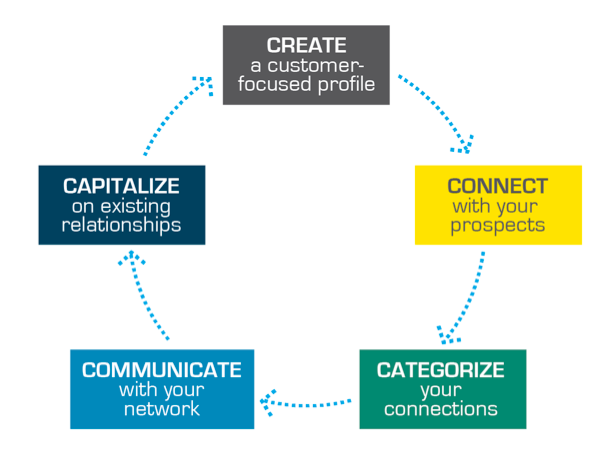
The Five C's: Using LinkedIn to Grow Your BusinessFive C's

This is the same process I share with my corporate and individual clients, people who attend my public classes, and in my online course Explode Your Revenues Using LinkedIn. Follow all five steps for maximum results.

CREATE a customer-focused profile
.

  • Use special profile sections and add media to highlight your area(s) of expertise.
    .
  • In addition to the Contact Info and Advice for Contacting sections, consider including your preferred contact information in your Summary and Current Job Experience sections.
    .
  • Include specific calls to action throughout your profile to encourage readers to engage with you.

CONNECT with your prospects
.

  • Use Advanced People Search, Company Search, Alumni, Groups, People You May Know, and Who's Viewed Your Profile to find new prospects.
    .
  • Use a five-star invitation to reach out to potential prospects. Include where you met (if applicable) and/or how you could help each other.
    .
  • Avoid LinkedIn's standard invitation language.
    .
  • Always be on the lookout for quality connections. The larger your network, the more opportunity for business growth.

CATEGORIZE your connections
.

  • Use tags to group prospects who have similar buyer characteristics.
    .
  • Download your connections database. You can then filter and sort the names for use outside of LinkedIn.
    .
  • Consider upgrading to one of the premium LinkedIn accounts to receive additional profile sorting and saving options.

COMMUNICATE with your network
.

  • Stay in front of your audience by making daily status updates.
    .
  • Add value to your relationships by sharing valuable industry information. Do this by publishing your own original content in the Published Posts section of your profile.
    .
  • Use direct messaging to contact your first-level connections and fellow group members--but don't contact them too often or sell too hard or they may remove you from their network.
    .
  • Increase your exposure by engaging in group discussions and "liking," "sharing" or commenting on other people's status updates.

CAPITALIZE on existing relationships
.

  • Connect with all of your existing clients/customers.
    .
  • Search through your current customers' connections Explode Home Page Widget-01and ask them to refer you to specific people in their networks whom you'd like to have as future customers.
    .
  • Ask for LinkedIn recommendations from your most impactful and loyal customers to display proudly on your profile.

For step-by-step instructions from me on how to execute these five LinkedIn strategies, check out my online video-based course Explode Your Revenues Using LinkedIn. And for a limited time you can purchase it for only $97 by using the promo code SALES. Click here for details and to purchase.

The post It’s Simple for You to Get Results Using LinkedIn. Here’s How. appeared first on Wayne Breitbarth.

09 May 17:01

New Tools for Old Tricks: How To Use Tech Innovations To Improve Your Team’s People Skills

by Ken Sterling

In every aspect of our lives, from the home to the office, technology is changing the way we function. Take advantage of the latest innovations to boost productivity and streamline collaboration.

The value of solid teamwork to any business cannot be overstated — companies with well-managed and diverse teams outperform those that lack cohesion. Aside from members themselves, great teams make use of the latest innovations in mobile and cloud-based technology to facilitate communication and drive productivity, thereby allowing day-to-day operations to run more quickly and efficiently than ever before.

The Virtual Workforce

From personal relationships to workplace dynamics, we are increasingly connecting with each other in a virtual space. This has allowed for unprecedented collaboration between countries and across oceans, but it has also created a need for better tools to share information and responsibilities. Email was one of the first such tools, and will likely remain a mainstay in the business world for a long time to come, but it is not always the most efficient.

Now, chat platforms like Slack are giving basic email a run for its money, allowing for instant messaging across teams and departments. Conversations can be organized into different channels, open or private, and files can be shared at any time with anyone. The program integrates seamlessly with cloud-based storage services like Google Drive and Dropbox, which give members of your organization around the clock access to documents and editing capabilities. This renders distance irrelevant, especially with video conferencing features from Google, Skype, and others. Coupled with shared online calendars, missed or rescheduled meetings will become a thing of the past.

Prioritizing Tasks

As fantastic as these tools are, they will help very little if your team’s direction and responsibilities are muddled or unclear. Overseeing those responsibilities is a challenge for any business, large or small, but project management tools such as Trello make it simple to clearly delegate tasks and track progress. The inexorably fluid nature of business necessitates adaptability, and these programs are incredibly flexible, allowing you to change and tweak your system on the go.

It also allows teams to operate autonomously while maintaining regular updates to keep disparate units focused on a unified goal. Apps like PingPong help ensure clarity during presentations or meetings so everyone is on the same page. The app lets a presenter share research and relevant material to help contextualize the project, and also create questions that other members can answer in real time during a discussion. Good communication, not surprisingly, has been shown to increase performance and productivity, and these systems facilitate the quick and clear dissemination of information.

Team Building

Technology is great, but it won’t help teams that are badly built. In the end, teams will not perform well without unity and respect, no matter how terrific the tools. There is clear value in fostering team development, whether by employing the best business leader keynote speakers or turning to specific training programs. Even these can be conducted online with virtual team building and seminars that engage employees in challenging and representative games. With clear leadership in place and a unified team, these innovative technologies will reap tangible benefits in every aspect of your business. Don’t miss out.

09 May 16:59

Are You Prepared for the B2B Content Personalization Arms Race?

by Daniel Rodriguez

An uprising is occurring among B2B organizations. B2B sales and marketing teams have been building up arsenals of tools necessary for selling effectively and efficiently—such as CRM and marketing automation—in order to address the power shift that has put buyers in the driver’s seat. But as B2B technology continues to evolve every day, the industry is becoming more saturated and organizations are left in a constant search for the newest competitive differentiation. We saw it with CRM and marketing automation tools, and in its most recent benchmark report, Demand Metric partnered with Seismic to uncover the newest secret weapon for B2B sales and marketing teams: content personalization.

The report, Content Marketing’s Evolution: The Age of Hyper-Personalization and Automation, set out to discover whether the use of content personalization can increase content effectiveness, especially in digital mediums. Leading B2B marketers intuitively understand that personalized content is more likely to be consumed or interacted with, and Demand Metric was able to validate this through the benchmark study. But just how much more effective is personalized content than generic? Should every piece of content be personalized? And what about automating the personalization process? Demand Metric and Seismic addressed all of this and more in the benchmark study, and in the process discovered how high of a priority content personalization and automation has become for B2B sales and marketing teams.

Of the participants surveyed, 61 percent personalize content in some way, and 56 percent stated that personalization contributes significantly to content marketing effectiveness. Only 29 percent of those who do not personalize content were able to give the same effectiveness rating. There is no doubt that content personalization matters to marketers and salespeople alike, as 80 percent of respondents indicated that content objectives are better met when content is personalized.

While content personalization is becoming a legitimate and established best practice for B2B marketing organizations, the means and methods of personalization still differ. Twenty-eight percent of companies surveyed have a mostly automated personalization process with some manual intervention, but around two-thirds of respondents still have a predominantly manual process for content personalization. This finding offers a huge opportunity for B2B organizations looking for a competitive differentiation in content automation.

Content automation is the final frontier for B2B sales and marketing success, as they allow both teams to deliver engaging and relevant content to the right audiences without compromising time. Over half of the organizations surveyed are currently considering, implementing or using content automation, which replaces the manual processes of customizing each and every piece of collateral delivered to sales audiences or buyers. Content automation assembles content from existing materials, contextually targets the right audiences with the right content, and makes content accessible from CRM and other programs where reps spend the majority of their time, such as email.

Sixty-five percent of business decision-makers agree that much of the content received from salespeople is useless. Content personalization helps ameliorate this dissatisfaction, and according to Demand Metric, promotes “content that was created to speak to an audience and have it perceived by that audience’s members as if it were talking directly to an individual recipient.” If your organization is one that has embraced content personalization and the automation of the personalization process, you’re right in line with this trend and will continue to reap the benefits of personalization down the road. If you’re still in the camp that personalization is a waste of time, can’t be automated effectively, or isn’t as high of a priority for organizations as Demand Metric has reported, you may find yourself scrambling to catch up in the B2B technology arms race.

New Call-to-action

09 May 16:55

How to Run a Successful User Test, Part 2: How to Find the Right Candidates

by Stefan Wolpers

TL;DR

This part of the “Lean User Testing” series focuses on acquiring the right candidates for the interviews, answering questions like:

  • How many applicants are required to fill an interview slot?
  • How to reach out to prospective candidates among your user base?
  • How to set up the application form?

There are differences in approaching candidates in the B2B versus the B2C space. However, the following general principles apply to all user interviews.

How to Identify the Right Interviewees?

The result of any user test completely depends on the selection of the right interviewees. You need to pick the right candidates, or otherwise you will waste resources on a useless user test session.

The company, for which I organized and ran the user tests, stood out due to two characteristics:

  • On the hand, many users had either never made a purchase (50%), or purchased only once. (25% of the total user base.)
  • On the other hand, a small group of users drove a large part of the overall sales.

Consequently, most of the user tests involved two questions: a) how to get new users to make the first and then a second purchase and b) how to keep the regular clients happy, that represented more than 75% of the overall revenue?

How to run user test successfully: The right candidates

The Process

The acquisition of participants for the user interviews took place by advertising a landing page with an application form. The compensation for participating in the user tests was a voucher of the company at a value of €20.

This voucher could be redeemed anywhere on the company’s platform. It could also be transferred to third parties. Last, but not least: The value of the voucher could not be exchanged for cash.

The Required Number of Applicants

Not every applicant is suitable for an interview. Even such a moderate compensation of just €20 still attracted applicants, who were only interested in the voucher.

Therefore, the number of applicants had to exceed the required number to fill the schedules interview slot by a factor of at least two or three. Thus, we could sort out those applicants, who were not suited for the task, and we could respond in a timely manner to those we wanted to invite.

Note: You cannot expect that those who apply—even if you respond to them quickly and inform them about the date of the interview—will actually confirm the invitation and show up to the interview.

Marketing for Participation

We used three methods to attract potential interviewees to apply for participation in user tests:

  • Email marketing: A list of prospective interviewees was selected jointly with the marketing department and invited by an email campaign. The recipients were mainly customers based in Berlin, who had either purchased many items or who had never bought anything. The emails contained the date and purpose of the user tests, but they otherwise referred to the landing page, where the applicants registered their interest. It took the marketing department usually a week to organize an email campaign.
  • Social media marketing: This acquisition channel was also provided by the marketing department. (And it meant mainly Facebook.) The social media marketing campaigns were a lot less targeted and returned a poor outcome.
  • Messaging: The internal messaging system of the platform in question was by far the best method to target a specific group of users. The selection of those being contacted was controlled by a specific set of rules that were matched in real-time with former customer data. The only requirement for this messaging was, that the client had to log-in to the website.

The interviewee marketing started around 3-4 weeks prior to the scheduled user test. The launch depended on the time of year, taking into account school holidays etc. It was the general perception that no user tests should be carried out in December and January, as the number of applicants would drop too far below the required number.

Also, the number of canceled appointments (or no-shows) would be significantly higher. This also applied to the two weeks before and after the Easter holiday.

During the school summer holiday, it is recommended to increase the size of the target group by 20-30%.

For the acquisition of prospective interviewees, we did not use any of the following sources that are popular in the United States:

  • Craigslist,
  • User forums or
  • Market research agencies, that offer professional castings for interviewees.

Numbers, data, and statistics:

To fill 30 interview slots (at 60 minutes each) for a compact test campaign over a period of six days, we needed approximately 100 applicants.

The user tests were intended to support the introduction of a new responsive frontend design in February 2014. The 100 applicants were picked from a group of over 4,200 customers. In the end, we had to pitch approximately 140 users to fill each interview slot.

Conclusions: Best practices to acquire interviewees are highly dependent on the product and its market. B2C is rather different from B2B. Hence, the “hiring” process usually has a steep learning curve.

Therefore, I suggest organizing the first user test sessions independently from each other, so that you can improve your approach from session to session.

The Application Form for Interview Participants

To make the selection of the best interviewees as simple as possible, the application form should provide the organizer with information to help you pick the right candidate. Technically, I suggest collecting this data via a Google form. Your benefit is obvious: It’s a tested, reliable solution free of charge and you don’t need to program anything.

Forms are a good way to separate the wheat from the chaff: The amount of information, as well as the effort the applicant puts in, are both relevant for choosing the right interviewees. Those, who put more effort into their answers during the application process are most of the time also more helpful during the interviews.

The application form should be introduced with a text that explains the nature of the user test. Let me give you an example:

Help us to optimize our website for mobile devices…

Through a permanent dialog with our customers, we aim to optimize our website continuously and make it as user-friendly as possible. We are excited, that you are considering spending 45 minutes of your time with us, to take part in our user testing.

Please note, that naturally we are receiving a lot of interest for these user tests. So many in fact, that unfortunately we cannot always consider all applications. We are looking for applicants, who will be most suitable in helping us with certain questions we may have.

If you are chosen to become one of these participants, we will invite you personally with a private email.

The application form intentionally doesn’t address two things:

  • The location of the interviews:In the beginning, when the location of those user tests had been openly communicated in the application form, we experienced a few situations, where applicants simply turned up without a prior invitation.

    In their opinion, the submission of the application form was enough for them to be considered for participation. To avoid this problem, the text of the application form was changed, so that it would no longer show the actual location of the user tests.

    This didn’t, however, result in a decrease in the number of applications. The participants were just as happy to drive from the west of Berlin all the way to former East Berlin to participate in these tests.

  • The compensation in the form of a €20 voucher:You don’t want the kind of applicant in your user test, that is only in for the money. These participants tend to answer, what they presume the interviewer would like to hear. This regularly leads to false test results and the effect is known as false positives.

The Screening Questionnaire

My screening questionnaire required the following basic information from the applicants:

  • Salutation:Choices:
    • Mrs/Miss
    • Mr
    • First name
    • Last name

    By the way, you might encounter applicants named “Donald Duck” in the process. #justsaying

  • What is Your Age?Here, we only wish to learn the rough age category. To my experience, most participants cheat about their age by a few years anyway. (Just like on every online dating site.) You shouldn’t ask for the exact birthday either because it may influence the conversion rate of the application form very negatively, as most people don’t actually put in their correct birthdays anyway.
  • Which email address is best to get in touch with you?This email address should only be used for interview-related communication with the applicant and should not be abused for any marketing activities. You should be aware that some applicants will use special email addresses for certain applications, so they can identify a probable misuse easier.
  • What day would you like to take part in the user test?Underneath this question, you should present a choice of various interview days. The best days to offer are Tuesdays, Wednesdays, and Thursdays. Although Monday has a higher response rate than Fridays, it still does not compare to the three other days mentioned above.

    To my experience, it is best to offer no more than two testing days to choose from. Less choice results in a better conversion rate of the form. This will also keep the organization of the whole task at a manageable level. (I once tried to organize three user testing days at the same time, and it proved to be complex.)

  • At what time would you like to take the test?It makes sense to schedule the interviews from 2 to 6pm, because during the morning hours most students and working people won’t be available. (The B2B environment might be different than the B2C environment in that respect.)

    For possible answers, you should provide the actual interview slots. For example, one for every hour starting at 2pm, if you will be running four slots at 60 minutes each during the afternoon session.

    There should also be an option “I am available anytime”. The applicants in this category are particularly valuable, as they are a sort of joker and can be moved around to fill the gaps in the schedule. (For example, the slots at 3 pm always proved to be unpopular.)

  • What is your occupation?This answer is not obligatory. (Choose an open text field.)
  • Are you already a customer of XYZ? (XYZ equals your company name.)Choices:
    • No, I have never heard of XYZ
    • I am not a client yet, but I do receive the newsletter
    • Not yet, but I am registered
    • Yes, I am a client and have bought things from XYZ.

    The “Not yet, but I am registered” category was of particular interest in this case: Why bother signing up for a service, but never use it?

  • Why do you wish to take part in a user test for XYZ?The reasons for taking part in user interviews may vary significantly. Applicants, who don’t give a specific answer or who are after the expected compensation or seem to be bored (typical answer: “Why not?”), are not that well suited for the task ahead.

You may, of course, add task-specific questions to the questionnaire or questions that refer to a particular group of interviewees that you would like to apply. However, I suggest keeping the questionnaire as short as possible to avoid frustrating prospective candidates. The shorter the form, the more likely people will submit their application, which also is the reason why I like to use pick-lists for answers, thus avoiding too many free text fields.

Such an application form based on a Google form can easily be incorporated into any HTML page via its iFrame. This resulting landing page will be used for the interviewee marketing campaigns.

Google forms also provide a generic HTML page each that already contains the application form. The URL of this page can be sent directly to your target group via email. This way, you do not have to bother setting up a blog post, for example. However, due to legal or marketing/branding reasons, this should be avoided. This form page, for example, doesn’t contain an imprint and may, therefore, be at risk to cause legal action by a competitor.

Next Post: Inviting Interviewees

See you in part 3, when we cover who is a suitable candidate, how to invite them and why you will need replacement candidates.

09 May 16:55

10 Productivity Tips From Startup CEO Working Across Europe & USA

by Vit Horky

10 productivity tips from startup CEO

For the past 6 months, I have been living in San Francisco to support the expansion of Brand Embassy. Four years ago, we set out on our mission to help companies become more human by designing a social customer service platform that helps businesses create deeper connections between agents and customers. While our company is headquartered in Prague, the Czech Republic, where we have grown to 40 amazing employees, raised $2M and worked with inspiring customers such as Telefonica O2, T-Mobile, GE, and Samsung, we have decided it’s important for us to expand into the US.

I took responsibility for opening the market, booked a flight to California and left. Six months later, our highest-spending customer is located in the US, and we’ve also gained a new non-executive board member and grown our pipeline of sales opportunities and business partners. Was it as easy as it sounds? No way. I will always remember the sleepless nights, the moments of absolute desperation and the months of insecurity and doubt. And we are still at the very beginning of our expansion journey.

I have continuously made and remade many plans, decisions and practices with my partners and colleagues until we recently found a system that allows both our head office in Europe and our small “office” (you wouldn’t call it an office just yet) in the US to work effectively and with mutual support and understanding. This post is a collection of best practices. They should hopefully help you avoid a few mistakes if you are about to expand your startup office to another continent. Recently I shared my overall productivity tips, which are useful for all startup employees, here.

  1. Set smart goals with your partners

Agreeing on specific goals with my partners put us on the same route and really simplified the way we handled the constantly shifting priorities that are so typical for early-stage startups. We focused on four areas (the numbers here are just examples) for our US expansion project (which we actually called our “US Pilot” because we knew it might crash):

  • Sales — Generate qualified leads worth $1M within 6 months
  • Business development — Sign distribution partnership with $3M+ sales potential within the next 18 months
  • Recruitment — identify through referrals and qualify two candidates for VP of US Sales role
  • Fundraising — qualify 10 relevant investors for upcoming financial round interested in a 2nd meeting
  1. Make routine daily status calls

Every day, I wake up by 5am Pacific time and spend 3 hours on 20-minute conference calls with my teams (we prefer GoToMeeting after also trying Skype, webex and Hangout). The time is always set in advance and is a regular event. Everyone needs to attend, including my partner, team leaders, and others, depending on the agenda. Don’t have anything to discuss today? Join anyway. On the way to a super-important presentation? Move the agenda and join the call in Uber on your way. Make the calls set in stone so everyone joins and is prepared. Listening to the team, seeing their emotions and body language via webcam and giving them continuous feedback and support have proven to be an extremely important practice I continue to do even when I’m with my team in the head office.

  1. Respond early to emotions and signals from the team

Do you have a bad feeling that something is happening but you can’t say just what it is? Address the topic on your regular status calls or set up a 1-to-1 call right away for the same day. These are the times my colleagues used to stop by my desk and say “Hey Vit, so I was thinking, why don’t we…” I made it more difficult for them to do so by being 8,000 miles away, so it’s my responsibility to let them voice their concerns as soon as possible. At one point, we wanted to try using laptop webcams to capture our facial emotions every minute or so and share it with others across locations, but not everyone liked the idea.

  1. Get involved in daily topics via team chat

One month after introducing Slack to our company, we got rid of all our internal emails. Instead, more than 300 private group chats and company-wide chat rooms have been created organically by everyone who has something to share. I am invited to dozens of new conversations every week. Although it’s easy to just rush through them right after I wake up (and it’s already 2pm in Europe), I set a regular time during the morning to read through all the important conversations and respond to everything so nobody needs to wait for me more than a few hours. My afternoon hours, when Europe is already asleep, are perfect for brainstorming new ideas and topics that my colleagues will receive when they wake up the next day.

  1. Frequently report both successes and failures to the entire company

My days in the US are like yours elsewhere. I can celebrate small success every day (“whoa, this new lead seems to be super-excited about Brand Embassy!” or “Looks like I just spoke to our next sales guy in the US!”) but too often I also encounter many failures (a great lead stopped responding, a business partner closed a deal with our competitor, I lost an entire day seeking an opportunity that turned out to be a waste of time). My colleagues need to hear all of that in order to form their own opinion on my value in another market. Therefore I share both my successes and failures with my partner every day (both of us do) and I share the same with relevant team leaders. (Additionally we hold monthly all-hands meetings where each team team shares their top successes and failures with we discuss them all together. “Failing forward” is one of our key values.

  1. Grow a relevant network through introductions

Cold mailing and cold calling doesn’t work in the US. Every valuable new contact I’ve made has been through a recommendation. My primary group of referrals included our investors, advisory board members, team colleagues and friends. I typically got two or three additional introductions from each meeting I held with relevant contacts. It’s a process that goes on and on. Within three months I’d had more than 30 meetings with leads, partners, investors and job candidates, all through recommendations. The conversion rate to set a meeting, make the meeting on the arranged date and actually have a meaningful follow-up has been roughly 100% higher than it was with cold-call leads. It works.

  1. Travel home regularly and have fun with your colleagues

I travel home every five weeks for about two weeks. When I am home with my teammates, I spend most of my time with them. Often, we have brainstorming sessions, workshops or team outings so we can do what we couldn’t do effectively when I was away. Although I try to deal with all discussion topics as soon as they come up, sometimes my colleagues want to sit down with me in person. I make sure I have plenty of time in my calendar exactly for this purpose.

  1. Continuously explore unique local opportunities

I came to a new market for a reason. So every day I work for a few hours on meaningful activities that could not easily be achieved remotely. These are typically meetings with potential customers, partners, job candidates and investors. Sometimes, people are surprised by my willingness to travel to a different city (or even state!) to meet them after a brief connecting call, but face-to-face interaction has proven to be far more efficient in building strong human connections that can then be effectively followed-up on the phone. In many cases my colleagues take over the contacts after my initial meeting and mutual introduction. Having these people meet me in person helps them trust my judgement that introducing more people into our discussion will definitely be worth their time and financial investment.

  1. Meet new friends, keep an exercise routine and read every day

Last year I read 50 books, exercised twice a week (on average, though not every month — it’s something I need to improve this year), and walked or ran 10 miles a day on average. Living 9 hours behind your family, friends and colleagues actually makes these activities simpler. But it’s very important to stay motivated because sometimes it’s hard to get out of bed and start moving through the daily to-do list. Luckily, I have my family and friends to help with that — they motivate me and I’m glad to spend at least an hour a day on FaceTime with them.

  1. Don’t write productivity blog posts on Saturday at 6am

Working a lot is great. Seeing great results from your work is even better. But working too much will not make me a great entrepreneur alone. I’m learning this the hard way, by pushing myself every year to work a bit less, to increase my productivity every month and to enjoy what I’m doing every day. Perhaps that’s why I wrote this piece one calm Saturday morning while walking through the streets of Manhattan, watching the sun rise between the tall walls of beautiful skyscrapers while my wife was still sleeping at a hotel a few blocks away. Although my work is super-important, having my family close and being healthy is even more important. Speaking of that, I should get back to my wife now. See you around soon?

A closing note:

Recently, we’ve encountered internal challenges related to our continuous push to add new features to our product based on customer requests. We have a growing need to refactor parts of our existing code, which has caused a number of pretty vivid discussions across our company and led to many bottom-up improvements which have affected all of us. Being half a world away from the epicenter of these changes made me pretty nervous, but it served as a great test for the productivity tips above. I will continue to explore and reiterate them and I am grateful for any of your thoughts and feedback.

07 May 22:26

How To Make Nurturing Calls Less Awkward

by Aaron Ross

cold callIt can be uncomfortable to talk to anyone you don’t know very well over the phone; never-mind if you’re asking for money. But if you’re always thinking about making the sale, it could end your relationship with that prospect pretty quickly.

Read more on How To Make Nurturing Calls Less Awkward…

The post How To Make Nurturing Calls Less Awkward appeared first on Predictable Revenue.

07 May 22:26

Are You Using the Right Data Science Tools for Your Big Data Projects?

by Bob Hayes

Data scientists rely on tools/products/solutions to help them get insights from data. Gregory Piatetsky of KDNuggets conducts an annual survey of data data professionals to better understand the different types of tools they use. Here are the results of the 2015 survey. He followed his initial posting with additional analyses to better understand which tools go together. In the latter posting, he looked at pairs of tools and found that some tools tend to go together (usage of tools are correlated with each other). He offered the anonymized raw data set for free to encourage other people to analyze the data, which I did.

Dimension Reduction through Principal Components Analysis

His approach looked at pairs of tools to understand their relationship with the other. I took a slightly different approach. I applied principal components analysis. The current approach groups the tools by looking at the relationship among all tools simultaneously. In general, principal components analysis examines the statistical relationships (e.g., covariances) among a large set of variables and tries to explain these correlations using a smaller number of variables (components).

The results of the principal components analysis are presented in tabular format called the principal component matrix. The factor matrix is an NxM table (N = number of original variables and M = number of underlying components). The elements of a principal component matrix represent the relationship between each of the variables and the components. These elements represent the strength of relationship between the variables and each of the underlying components. The results of the principal components analysis tell us two things:

  1. number of underlying components that describe the initial set of variables
  2. which variables are best represented by each component

Results

This use of principal components analysis is exploratory in nature. That is, I didn’t impose a pre-defined structure on the data itself. The pattern of relationships among the 95 tools drove the pattern of results. While human judgment comes into play in the determination of the number of components that best describe the data, the selection of the number of components is based on the results. The goal of the current analysis was to explain the relationship among the 95 tools with as few components as was necessary. Toward that end, there are a couple of rules of thumb that I used to determine the number of components using the eigenvalues (output of principal components analysis). The first rule of thumb is to set the number of components based on the number of eigenvalues greater than unity (1.0). Another way is to plot (called a scree plot) the 95 eigenvalues to identify a clear breaking point along the eigenvalues.

The plot of the eigenvalues appeared to break around the 13th and 14th eigenvalue. Therefore, I chose a 13-factor solution to explain the relationships among the 95 data science tools.

Table 1. Principal Component Matrix of 95 Data Science Tools – data from KDNuggets 2015 annual survey of data professionals. Click image to enlarge.

Based on a 13-factor solution, the principal component matrix (see Table 1) was somewhat easy to interpret. Some of the cell values in the matrix in Table 1 are bold to represent values greater than .33. The components’ headings are based on the tools that loaded highest on that component. For example, four IBM products loaded highly on component 6, showing that usage of these tools by a given respondent tend to go together (if you use one of IBM’s tools, you tend to use the other(s)); as a result, I labeled that component as IBM. Similarly, based on the tools that were highly related to the other 12 factors, the other 12 factors were labeled accordingly.

Tool Groupings

The results suggest that 13 tool grouping describe the data. I’ve listed the groupings below and include the tools that describe each grouping (if number of votes are greater than 20). Tools that fall within a specific group tend to be used together.

  1. Hadoop, HBase, Hive, Mahout, MLlib, Other Hadoop/HDFS-based tools, Pig, Scala, Spark, SQL on Hadoop tools
  2. Microsoft Azure ML, Microsoft Power BI, Microsoft SQL Server, Revolution Analytics
  3. Dataiku, H2O (0xdata), Python, scikit-learn, Theano, Vowpal Wabbit
  4. JMP, SAS Base, SAS Enterprise Miner
  5. Gnu Octave, MATLAB, Orange, R, RapidMiner, Rattle, Weka
  6. IBM Cognos, IBM SPSS Modeler, IBM SPSS Statistics, IBM Watson Analytics
  7. Actian, C/C++, Perl, SQLang, Unix shell/awk/gawk
  8. Caffe and Pylearn2
  9. Pentaho and QlikView
  10. Ayasdi, Datameer and Zementis
  11. XLSTAT for Excel
  12. Other Deep Learning tools, Other free analytics/data mining tools, Other Hadoop/HDF-based tools, Other paid analytics/data mining/data science software, Other programming languages
  13. C4.5/C5.0/See5, Miner3D, Oracle Data Miner

Summary

The use of specific Big Data, data mining and data science tools tend to occur together. Based on the current analysis of tool usage, the 90+ tools can be grouped into a smaller subsets of tools. The results of the current analysis are somewhat consistent with the prior results. For example, Piatetsky found that Pig usage was closely associate with Hadoop, Spark, scikit-learn, Unix shell/awk/gawk and Python. In the current analysis, we found that Pig was also associated with Hadoop and Spark. However, we found that the use of Pig was associated with HBase, Hive, Mahout, MLlib, Scala and SQL on Hadoop. It’s important to note that the former analysis used the top 20 tools while the latter analysis used all 90+ tools; this difference could explain the differences between the two analyses.

To improve your chances of success in your Big Data projects, it’s important that you select the right data tools. No single tool will do it all, and data professionals tend to use more than one data-related tool (in this study, we found that, on average, data professionals use 5 data tools). One way to help in your selection process is to identify the tools sets that other data professionals are using. The results suggest that you might want to consider tools within components as potential candidates to include in your arsenal.

Some of the tool groupings are simply based on the parent company of the tools, including IBM, Microsoft and SAS. Perhaps cross-selling data science tools is a lot easier within a major brand than it is across different brands. This makes sense to the extent that a company’s products likely work together better than with other vendors’ products. Still, more research is definitely needed to understand why certain tools tend to be used together.

I’m interested in seeing what others find with these data. Here is the link to the anonymized data set (CSV format).

07 May 22:25

After eliminating 75% of my wardrobe, I realized Mark Zuckerberg and Barack Obama are on to something big

by Business Insider

capsule

Last month, I downsized my closet by about 75% and built a capsule wardrobe composed of 30 items.

The experience was liberating, economical, and a major space-saver — so much so that I'm selling my gratuitous clothing and sticking with the minimal wardrobe.

Perhaps the most rewarding aspect of the project was how much time and energy it saved each morning.

Choosing what to wear to work became infinitely easier, simply because I had so few clothes to choose from. It was also nice knowing that I couldn't really go wrong with my decision — after all, I filled my capsule with my favorite, highest-quality items.

What's more, by simplifying the "What do I wear today?" conundrum, I wasn't wasting energy on mundane decisions, which meant more mental energy (and greater productivity) for the rest of my day.

I'm not proposing anything revolutionary — if anything, I'm behind the curve.

There's a scientific reason some of the most successful people wear the same outfit day in and day out.

Think: Mark Zuckerberg and his signature gray tee-shirt, Barack Obama and his blue or gray suit, and John Paul DeJoria and his all-black ensemble. Wearing the same thing day in and day out helps them avoid what psychologists call decision fatigue.

"Making decisions uses the very same willpower that you use to say no to doughnuts, drugs, or illicit sex," Roy F. Baumeister, a psychologist who studies decision fatigue and a co-author of "Willpower: Rediscovering the Greatest Human Strength" told the New York Times.

"It's the same willpower that you use to be polite or to wait your turn or to drag yourself out of bed or to hold off going to the bathroom," Baumeister said. "Your ability to make the right investment or hiring decision may be reduced simply because you expended some of your willpower earlier when you held your tongue in response to someone's offensive remark or when you exerted yourself to get to the meeting on time."

zuckerberg obama

As Obama told Vanity Fair in 2012, "You'll see I wear only gray or blue suits. I'm trying to pare down decisions. I don't want to make decisions about what I'm eating or wearing. Because I have too many other decisions to make."

Zuckerberg said something similar during a public Q&A session, when asked about wearing the same tee every day: "I really want to clear my life to make it so that I have to make as few decisions as possible about anything except how to best serve this community ... I feel like I'm not doing my job if I spend any of my energy on things that are silly or frivolous about my life."

I'm not quite ready to make the leap from 30 items to a mere handful or single uniform — but the option is always there, with Obama, Zuckerberg, and science in its corner.

SEE ALSO: I tried the popular 'capsule wardrobe' and whittled my closet down to just 30 items — here's why I'm never looking back

Join the conversation about this story »

NOW WATCH: Don’t be afraid to cancel cable — here’s how to watch all of your favorite shows for less than $42 a month

07 May 22:25

Google is quietly making progress on one of its most jaw-dropping tech projects (GOOG, GOOGL)

by Alexei Oreskovic

Google Soli

Google's Project Soli was one of the highlights of the company's developer conference last year, but there's been little news about it since then.

The technology uses special radar-sensors packed in a tiny chip to detect a person's physical movements (such as rubbing two fingers together), letting a person do things like turn the volume up on a radio without actual touching anything. 

The recent news that Regina Dugan, the head of the Advanced Technology and Projects lab at Google that oversaw Soli, jumped ship to go work at rival Facebook, did not seem like a good sign for the future of Soli. And with Microsoft's recent unveiling of similar technology, Google's impressive product demo last year seemed like it might not make it out of the lab.

But it appears that Google is moving forward with the futuristic technology. 

Interest from commercial partners

A recent Google job posting seeking a software architect for the Soli effort notes that the technology has "attracted significant world-wide attention and interest from commercial partners," and that Google is currently working hard to bring it to real world applications and devices.

The job posting also notes that the software architect will "drive and lead integration of Android Wear/Google Services with Soli technology." 

A separate posting for a Soli hardware engineer, also posted last week, cites responsibilities such as " integrating Soli sensor into development platforms and proof-of-concept products."

Meanwhile, FCC filings from earlier this year reveal that Google is continuing to distribute various test versions of the technology to third-party developers throughout the US. 

"Google continues to seek authority broad enough to allow testing of different chips, form factors, signal processing mechanisms, operating systems, and user interfaces and experiences for the Device and its new technology," the filing reads. 

 Soli may not be ready for prime time yet, but Google does not appear to have given up on it. And with this year's Google IO developer conference around the corner, the company may have more details to share about the product's future.

SEE ALSO: Google's new finger control technology is straight out of a science fiction movie

Join the conversation about this story »

NOW WATCH: Here's what happens to your brain when you check your phone — and why it's so addicting

07 May 22:15

Andrew Coyne: Wynne shamed into campaign financing changes while Clark just shrugs

by Andrew Coyne

I suppose the most appropriate response to Kathleen Wynne’s package of campaign finance reforms is: better late than never. Or rather, late, reluctant, incomplete, without consulting the public or the opposition parties and after she and her Liberal party had wrung every last dollar out of the system as it was. But yes, better all those things than never.

The premier, remember, had been caught taking large sums of money at private dinners, unadvertised and unrecorded, from corporations with sufficient interest in government policy and sufficient hope of influencing it as to be willing to pay thousands of dollars for privileged access to her ear. She had at first defended this practice as “part of the democratic process,” then promised to put a stop to it, then vowed to bring in wider reforms to campaign finance in the fall, finally advancing that leisurely deadline to this week.

But let’s focus on the positive. Under the system the premier unveiled this week, corporate and union donations would be banned outright. Election campaigns would no longer be an afterthought to the real campaign, the one carried out in restaurants and office suites by party bagmen. More so than in the past, campaigns would be funded by the people they are actually supposed to be about, the voters.

Second, individual donations, previously capped at just under $10,000 annually, would now be limited to $1,550. But here the exceptions and the caveats begin. The same donor could donate $1,550 to a political party, plus a total of $3,100 to its local candidates, plus another $3,100 to its constituency associations, for a total of more than $7,500 — not counting elections and byelections and leadership campaigns, when further donations would be allowed. 

None of this, of course, would apply to unions and other interest groups that wished to advertise on their own behalf. These have until now been unlimited, which is how a coterie of unions was able to spend nearly $6 million for the sole purpose of defeating the Tories in the past campaign. Now, so called third-party advertising would be restricted to $100,000 per group after the writ has dropped, plus another $600,000 during the six months before. 

But as there is no limit on the number of groups who can participate, expect to see these mushroom, much like the political action committees that now dominate the U.S. political landscape. Effectively these allow the parties to carry on under another name, even if, as in the States, overt co-ordination is prohibited. So while it’s interesting to know the parties would still face the same spending limits of $7.4 million apiece, it is less and less relevant.

As if these multiple geysers of money were not enough, the Wynne reforms would grant the parties a further $2.26 out of public funds for every vote they received in the past election. As it happens this would be to the advantage of the Liberals, as the plurality party (they could fund more than half their campaign off it), but never mind: subsidizing parties out of public funds — or rather, adding to the existing subsidy regime of tax credits and expense reimbursements — is not the logical complement to banning corporate and union donations. It’s the opposite of it. 

The point is supposed to be that people should contribute their own money, of their own free will, not other people’s money extracted from them by the state. The premise, moreover, that the parties have some objective need to spend as much as they now do on election campaigns, is wholly false. Most of what is spent is wasted, each party’s spending simply cancelling out the others’; most of what remains is actively harmful. With advances in communications, we could have better, cleaner elections for a fraction of their current cost. 

Still, lax as these reforms may be, they are the purest spring water next to the stewing cesspool that is British Columbia’s campaign finances. Like Wynne, Premier Christy Clark has been discovered lately taking thousands of dollars from well-heeled donors at private fundraisers. Unlike Wynne, some portion of those funds goes more or less directly into her pocket: the B.C. Liberal party pays her a yearly stipend on top of her public salary as premier.

And yet Clark’s only reaction has been to shrug, at all of it: the dinners, the corporate and union donations, her own cut, on the grounds that it has all been disclosed. After all, say her supporters, can you prove there was some quid pro quo? This has things exactly backward. This is not a criminal trial. It is not up to the public to prove, beyond a reasonable doubt, that their leaders are corrupt. It is up to the premier, as the holder of a public trust, to conduct herself in such a way as to prevent any such suspicion arising. People should not have to wonder about these things, as if integrity in office were just another issue to be weighed against tax cuts and health care. It should be a given.

The notion that premiers and other office holders should be able to raise funds in unlimited amounts from the industries they regulate, so long as they are not actually proved to have given them favourable treatment in exchange is frankly bananas. If even Premier Wynne can be shamed into acknowledging this, Premier Clark needs to give her head a shake.

07 May 22:11

High Velocity Prospecting

by Dave Brock

I’m a huge fan of high velocity outbound calls — at least when done well. Recently, I needed to buy a new car, my current car was coming off lease, I thought I’d take advantage of some of the end of quarter promotions.

I did my research, narrowed down to a couple of different models, configured those models at the manufacturer’s sites (Build Your Car) to get an idea of pricing. I researched the various sites to find the promotions, deals, discounts I might get for the vehicles I was considering. Finally, I made some internet queries to a few dealerships suggested as having the best pricing on the web. Many of you have done this before, you fill out a form with contact information and what you are looking for, and submit it. In the end, I was looking at 3 dealers each for the two models I was considering.

You know what happened next. Within two minutes, I had six phone calls and 9 email messages in response to my queries. I actually only answered the first one, the others went into voicemail since I was already on the phone. To be truthful, each sales person did an outstanding job. They qualified me for my purchase urgency, understood what I wanted both in the vehicles and the deal structure. Most got back to me with very responsive proposals. After a few hours, I made a decision, bought a car, did much of the paperwork online. Later in the day, I picked up my new car. All in all, a very pleasant shopping experience.

Each of the sales people were leveraging tools for high velocity responses. They knew, if they got back to me quickly, they would be likely to catch my attention and interest. The cars were still on my mind, 2 minutes after submitting my requests, so I was very interested in the conversations. What I appreciated was the speed, efficiency, and most importantly, the relevance of the conversations. They knew I had done my research (the proverbial 57-70%), I was knowledgeable, so each of the conversations was focused and highly relevant.

But high velocity can backfire tremendously.

During this same period of time, I happened to notice a few white papers and market research reports on sales productivity issues. I downloaded the white papers, then slowly started counting.

You guessed it, these B2B sellers called me within a couple of minutes of submitting my requests, just like the car dealers. In one case, I hadn’t even downloaded the white paper, in the other two cases, I hadn’t even had the ability to read the research reports/white papers. But that didn’t make any difference to the sales people calling me. All they wanted to talk about was my interest in their products, so the fact that I hadn’t seen the white papers/research didn’t deter them.

Each was confused when I responded, “I’m not interested in your products, I’m interested in understanding the research and the white papers.”

One of the sales people tried to challenge me, “Those white papers are about our products, let me save you some time…..” I was confused, “I thought I downloaded a market research report? I really don’t care about your products.” He persisted, “Companies like yours get huge value out of these products. Google, Microsoft, GE are all producing great results…..”

You know I had to interrupt, “But we aren’t like those companies, what value to companies like ours get?” He stumbled a little, “What do you do…….” You can guess where this went.

I let some of the other sales people run with their pitches, as well. Not any different. They went into their pitches, telling me about all the wonderful things their products did. None of the conversations referred to the materials I had downloaded. No one asked me about my interest in the materials. None, leveraged the “context” of my interest. All of them immediately assumed I was interested in buying their products — even after I told them I was only interested in the white papers.

All of these calls were a total waste of my time, a waste of the sales people’s time. While they were leveraging High Velocity principles, they had no idea who I was, what was driving my interest, or what might be the most relevant, engaging, or impactful conversations.

Each could have probed a little, “What was your interest in the white paper/research?” “Why are you interested in those topics?” Even better, they once they determined my interest, they could have highlighted certain parts of the materials that were most relevant, or they could have offered observations about additional points that were relevant to my interest. They might have probed about my company a little, to determine whether we were in their sweet spot as customer–in each of these cases, I knew we were far from being customers of these companies, but we might have been influential recommenders. Or they might have delayed their calls by 30-45 seconds to bring up my LinkedIn Profile to learn a little about me, but none did.

Imagine how much more effective sales people could be if they took the time to be relevant. It only takes a minute–you know what I’m interested in because of what I downloaded. Talk to me about that. Take a moment to look me up–tie that into the conversation.

Years ago, the National Traffic Safety Council had an advertising campaign, “Speed Kills.” I wonder if they were thinking about prospecting as well?

07 May 22:11

Subway is facing 2 problems that are wrecking its business

by Hayley Peterson

Subway turkey sandwich

Subway's business is in decline.

The sandwich chain's revenue fell 4.3% to $1.11 billion last year, following a 2.6% drop the previous year, according to a franchise disclosure document cited by Bloomberg.

It also recently lost its status as the second most popular fast-food chain in the US, based on systemwide sales. Starbucks overtook Subway to snag the second-place spot, behind McDonald's.

To make matters worse, the company last year lost its most lucrative spokesman, Jared Fogle, in the worst possible way: he was convicted and sentenced to more than 15 years in prison for having sex with minors and distributing child pornography.

Subway's chief marketing officer once credited Fogle for as much as half of the chain's growth since he became famous for losing more than 200 pounds while eating the restaurant's sandwiches.

Subway is trying to revive sales by making some menu changes — such as switching to antibiotic-free meats and removing artificial colors, flavors, and preservatives from its food in North America.

But the changes might be too little, too late, according to Neil Saunders, CEO of retail consulting firm Conlumino.

He says the company is facing two main problems that will plague its business going forward.

1. Subway grew too quickly.

"Especially in the US, it has expanded rapidly and therefore the opportunities to grow though new store openings are fairly limited," Saunders said. "This means that one of the key engines that once drove sales is only operating with a fraction of the power it once did."

Subway opened 911 new locations in the US last year, while closing 877, according to its franchise disclosure document.

Subway RestaurantSubway says its outlook for 2016 is positive, however.

"The outlook for 2016 is more optimistic based on the terrific feedback we received from our guests about our culinary improvements and exciting new menu offerings," the company said in a statement to Business Insider.

2. Consumers are tired of Subway's menu. Their tastes have changed, and Subway has been too slow to adapt.

"While Subway remains a top choice for many consumers who love its range and competitive pricing, other consumers have become bored with the offering," Saunders said. "This is especially true of younger millennials who prefer a more diverse range of options, including salads and healthier choices."

Subway rose to become one of the biggest restaurant chains in the world with more than 43,000 outlets by advertising a healthier, fresh alternative to traditional fast food like McDonald's or Burger King.

The chain was a pioneer in made-to-order sandwiches, prepared right in front of customers by employees taking orders in an assembly-line fashion.

But then other rivals, such as Chipotle and Panera, started offering even fresher options — like antibiotic-free meats and additive-free guacamole prepared on site.

SubwaySubway didn't evolve quickly enough to meet diners' changing ideas about what is considered fresh and healthy. As a result, public perception regarding the quality of its food has eroded.

The company's public image was hit particularly hard two years ago whenFoodBabe.com blogger Vani Hari launched an online campaign against the chain for using the additive azodicarbonamide in its bread.

The campaign was successful, and Subway was forced to change the recipe for its bread as a result.

Now Subway is committing to remove all artificial flavors, colors, and preservatives from its food over the next two years, as well as promising to switch to antibiotic-free meats.

Meanwhile the company has also been losing market share to cheaper rivals like McDonald's, Saunders said.

"Pressure is growing from chains like McDonalds," Saunders said. "While these don’t necessarily appeal to those wanting a healthier option, the introduction of offers like the all-day breakfast menu has definitely stimulated interest and has taken some share away from Subway."

SEE ALSO: Beyoncé just made a major investment in the juice business — and it's not lemonade

Join the conversation about this story »

NOW WATCH: Subway is now legally required to make this change to its sandwiches

07 May 22:10

How Mobile Marketing Is Changing The World Of B2B Lead Generation

by Sophorn Chhay

In many ways, smartphone access is responsible for B2B marketing’s growth. Lead generation has been boosted by mobile’s astounding data connection, and multiple industries are taking charge with innovative marketing approaches.

Today, mobile marketing plans are used to manage emergency notifications, handle promotions, streamline assignments, and enhance B2B effectiveness with real-time events. Buying signals, firmographics, demographics, and contact information are being used to increase business outreach depth, and they’re succeeding quite a bit. Below, we examine B2B lead generation from the mobile angle. Don’t worry: It’s an angle your business can get in on, too.

The Mobile-Made World: Data Solutions

Lead generation doesn’t happen overnight. That said, it’s being powered at all times of the day. In 2016, lead generation data is being taken from the following sources, and at the following rates:

  • 74% of marketers use site and campaign behavioral data
  • 80% of marketers use customer information
  • 87% of marketers use transaction history

B2B and B2C marketers alike are enhancing lead generation programs with the smartphone’s ability to gauge customer behavior. Together, real-time services, geolocation options, and constant alerts are making mobile marketing a go-to option for most companies. B2B professionals are acknowledging this as well, as 83% of all B2B marketers power solutions through mobile apps and cross-channel, data-retrieving sources.

Mobile Email Marketing as a Verification Tool

People.jpeg

B2B lead generation needs verification to survive. In fact, some industries carry as low as a 6.5% monthly email contact decay rate. That means that, by the end of every year, about half of a business’s CRM contacts could be inaccurate. Fortunately, mobile marketing has remedied one of the industry’s biggest stressors. By implementing instant-outreach drip campaigns, constant connection plans and B2B mobile email initiatives, the world’s most intelligent mobile marketing gurus are reworking the way email leads are re-engaged.

Short Code Texting: The World’s Newest Lead-Nurturing Tool

Text message marketing, in particular, is responsible for much of the lead generation world’s recent successes. Marketing expands far beyond a business’s subscription list, and it’s more than just writing up some messages. In 2016, a company needs to periodically reach out to generate leads. For this reason, marketers are turning to short code texting.

Short code texting is incredibly personal, which also makes it engaging. By utilizing automatic SMS senders, businesses can nurture, grow and maintain B2B relationships. Business vendors offer incredibly consistent, structured responses, making them primary candidates for short code texting solutions. Purposeful texts sent after first contact are incredibly beneficial to lead generation. In fact, sending an SMS after contact via telephone improves conversions 112.6% over average conversion levels.

mobile marketing

The Mobilized Trade Show

Trade shows, ever-popular for their lead generation ability, grant mobile holders the ability to enter contests, participate in real-time events, check out augmented reality innovations and examine potential purchases via mobile video. In fact, 77% of marketers said they generated a “somewhat high” or “very high” quantity of leads, and 82% said they generated leads of “good” or “excellent” quality at trade shows.

Events.png

Mobile marketers are shooting out text alerts, reminding others of presentations and gaining new leads. A lot of mobile marketers, for this reason, are considering changing their entire strategy from the ground up. It’s important to evaluate, compare, and present your B2B products and services effectively. Today, promotion and lead generation go hand in hand.

B2B Mobile Apps are Taking Over

Mobile_App_Trends.jpeg

At the end of the day, benefits matter the most. In 2016, mobile apps create and promote innovative value for buyers. They harness the power of GPS location, audio recognition, QR code scanners, spatial recognition services and even smartphone cameras to serve professionals. Because of this, nearly half of all small businesses will have a mobile app by 2017.

Today, 50% of American consumers make purchases after receiving deals through a mobile app’s linked discount coupon. In-depth offers aren’t only for consumers anymore. They’re being offered to professional vendors.

As the mobile world evolves, lead generation strategies will grow in number. We’ve only begun realizing the potential of B2B lead generation, and industry decision makers are constantly rolling out new, effective strategies. Take note, take charge, and take control of your strategy.

 The Revenue-Driven Marketing Survival Kit The resources you need to overcome obstacles and become a more effective revenue-driven marketer Download Now

07 May 22:09

This exotic fruit tastes like pork, and it could save millions from starvation

by Jessica Orwig

On the outside, this giant fruit resembles something out of the Jurassic era and emits a sweet yet putrid stench.

But don't be fooled: The fruit, known as a jackfruit, is being hailed as a "miracle" crop that could save millions from starvation. And the unique fruit inside of it is just the beginning of the jackfruit's many wonders.

jackfruitJackfruit is the largest tree-borne fruit in the world — one fruit can weigh between 10 and 100 pounds and contain hundreds of seeds that are rich in protein, potassium, calcium, and iron — all of which are important for bodily growth.

This enigmatic fruit is native to South and Southeast Asia; it is rare to find jackfruit in the US. Luckily, Chinatown in Manhattan sells whole, fresh jackfruit.

To get a first-hand look at this leathery, prickly food, Business Insider trekked from the Flatiron district to Chinatown where we spotted a jackfruit being offered by one of the many street vendors. The vendor was selling it for $2.50 per pound.

It is common to purchase freshly sliced jackfruit by the pound, but we were on a mission to learn everything we could about this monster fruit, so we bought the whole, uncut 10 pounds of it.

jackfruitHere's more about the strange but beneficial fruit.

'It's a miracle'

jackfruitNyree Zerega is a plant biologist at the Chicago Botanic Garden who has studied the genetic diversity of jackfruit tress in Bangladesh.

"In Bangladesh, where jackfruit is the national fruit, it is often considered the second-most important crop after mangos," Zerega told Business Insider.

"And if you have space to grow something, you almost always have a jackfruit tree — due to both its valuable fruits and timber."

Besides food, the jackfruit tree provides some of the following:

  • The leaves from jackfruit trees can be a source of food for goats and other farm animals.
  • The bark has an orange color, shown in the picture to the right, that was traditionally used as a dye for monk's robes.
  • The trees produce a sticky latex substance that can be used as glue.
  • Wood from the trees can be sold or used as timber.

As popular as jackfruit is in Bangladesh, it is avoided in India, where it is thought to have originated and where it could bring copious amounts of food to millions of people who are starving and malnourished. That's why the jackfruit tree — which can grow up to 150 jackfruits over the two harvest seasons it typically has each year — is so important.

A single jackfruit can yield hundreds of the small, yellow, fruit lobes (or bulbs) — each of which contain a highly nutritious seed. The fruit itself is a good source of Vitamin C, while the seeds are rich in protein, potassium, calcium, and iron. About one-fifth of a pound of the fruit has approximately 95 calories.

jackfruit"It's a miracle. It can provide so many nutrients and calories – everything," Shyamala Reddy, who is a biotechnology researcher at the University of Agriculture Sciences in Bangalore, India, told The Guardian earlier this year.

"If you just eat 10 or 12 bulbs of this fruit, you don't need food for another half a day."

Dry it, fry it, juice it, BBQ it — just don't let it go bad

A single fruit could feed your family for an entire meal, Zerega told Business Insider. That's partly due to its size, but also because of the many different ways that people have learned to prepare the jackfruit. It can either be eaten ripe, when it is soft, fruity, and delicious, or unripe, when it resembles a potato.

In Bangladesh and other parts of Southeast Asia, jackfruit is served in dozens of ways. Jackfruit curry, stir fry, juice, chips, ice cream, and even baking flour — made from drying and grinding the seeds or fruit — are just a few examples of jackfruit’s remarkable versatility in the kitchen.

However, jackfruit does not keep for more than a few weeks after harvest, Zerega said, so a good way to preserve it (if you're not going to make a jackfruit feast like the one in the photo below) is to store it in cans or dry it out into chips.

Here’s a table displaying over a dozen different styles of jackfruit preparation:

jackfruitThough jackfruit is still widely unknown in the US, it is cropping up in the vegan and vegetarian communities because of the flavor that unripened jackfruit adopts after an hour or so of cooking, which resembles that of pulled pork.

Zerega hasn’t tried the increasingly popular BBQ jackfruit sandwich, but some of us at Business Insider did, and you can see our assessment in the video below!

A growing movement

While millions of households in Vietnam, Bangladesh, Malaysia, and elsewhere across South and Southeast Asia are incorporating the jackfruit into their dishes, India remains reluctant.

jackfruitReportedly, up to 75% of jackfruit grown in India goes to waste, partly because the fruit goes bad if it's not eaten or preserved within a few weeks.

But more than that, jackfruit has a bad reputation to overcome.

"Historically, jackfruit has a reputation for being a poor man's fruit," Zerega said. "It's not the kind of thing that many people would ever think of buying because it grows everywhere in certain parts of India."

Fortunately for the fruit, it has a growing number of fans advocating for it, trying to raise awareness for its nutritional value.

"My country is silently allowing [the] lion’s share of our jackfruits to rot," Shree Padre, who lives in the Indian state of Kerala, told Business Insider in an email. "This disturbed me."

Padre is the editor of a 27-year-old Indian magazine called "Adike Patrike," and over the last six years he has orchestrated 16 issues dedicated to the jackfruit. Padre also helps organize jackfruit festivals in India.

"Countries like Vietnam, Philippines, and Malaysia are minting money from jackfruit. Sri Lanka proudly calls it [the] 'tree of rice,'" Padre said. "But ironically, in [the] motherland of jackfruit, we still haven’t understood jackfruit's importance."

The future of jackfruit in India

Because of its versatility, Padre estimates that farmers in India could earn about $151 per jackfruit tree because of all the different products you can make with its bark, fruit, natural latex, and more.

6403064197_acccae7789_o"It has five raw materials in one," he said. "No other crop of the world will come near to the number of products and recipes that can be made from jackfruit."

One jackfruit tree could bring in more than half the average monthly income for an Indian worker, which is $295, according to the International Labor Organization. (The average American monthly income is $3,236.)

What’s more, jackfruit trees are generally easier and cheaper to cultivate than other popular staples like wheat and corn because they don't have to be replanted every year, Zerega said.

"As long as it's growing in a climate that is conducive to its survival ... jackfruit is relatively easy to maintain," she told Business Insider.

jackfruitHowever, for India, making a business out of selling jackfruit like the Vietnamese have done will be difficult, at first, which is why Indian locals should first focus on eating the fruit

Zerega says that harvesting and processing jackfruit is currently very laborious with little mechanization, and while farming and exporting jackfruit could grow to be a lucrative business for India in the future, it is also important to focus on it as a valuable food source within the country.

"A lot of underutilized crops like jackfruit have a ton of potential to produce food more locally and more sustainable, so there's not as much reliance on imports from other countries. This local market development is important to focus on," Zerega said. "But ultimately they can also provide countless opportunities as valuable export products."

Join the conversation about this story »

NOW WATCH: 8 superfoods eaten by the super successful

07 May 22:08

The Big Data Behind Finding Business Partners

by Mike Tran

finding business partners

Big data is often overlooked when it comes to finding business partners and forging business relationships. Here’s how it works.

Building a successful partnership takes a combination of hard work, collaboration and perseverance, so it’s important to have the right company by your side when undertaking a joint project.

Thankfully, finding business partners by looking beyond the traditional methods of networking and business advisers to leverage the power of big data is now available to small and medium sized companies. But what exactly is big data, and how does it work?

What is big data?

Steve Gasner, chief data and analytics officer at Powerlinx, says big data is a buzzword that describes the massive volume of both structured and unstructured data that is so large it cannot be reasonably processed using traditional database and software techniques.

“Big data today often refers to the internet’s massive amounts of data,” Gasner says. “Many businesses can leverage the data on the internet to improve their businesses by finding new customers and suppliers, as well as researching the state of the industry and its trends.”

But while there are vast amounts of information on the internet, there hasn’t been an automated tool available for finding business partners and seeking new opportunities.

This is where Powerlinx’s matching engine tool comes in – using big data and analytics software to match prospective partners.

The benefits of finding business partners through big data

Big data itself is essentially just data and provides no direct value, according to Gasner. But once it’s incorporated with text mining analytics tools, it can find patterns within the data that are relevant for a company’s matchmaking needs.

Gasner says the sheer size of big data means it has infinitely more value than traditional networking in today’s connected world.

“Networking is a limited group of connections – take LinkedIn, for example. But there is no network that has access to as much information as the internet, so the latter can provide significant incremental value if properly mined.”

Gasner also emphasizes that big data can be used to find more accurate information for companies than existing business databases and search engines.

The limitations of search engines

Search engines and social networking searches can have a number of limitations when it comes to finding business partners. Even when companies use exact phrases in search engines, this can lead to limited results, according to Gasner.

For example, a company might enter a search term such as “cloud computing company with more than 200 staff”, which may only produce a handful of companies – when in reality there could be many more.

Additionally, business database search results offer an unranked list of companies. This forces users when finding business partners to manually research each result and rank them themselves – a time-consuming process.

Big data combined with insights

Big data and analytics software are just one piece of the puzzle in finding business partners – Powerlinx also interviews companies on their strategic goals and current business environment.

A company’s desired business outcomes, key characteristics and unique positioning are all taken into account. Based on this, the Powerlinx matching engine employs a combination of expert rules, clustering and adaptive modelling to help companies in finding business partners.

The matching engine not only finds the best-fit companies, but also ranks them by their level of relevancy and compatibility. From here, companies can request refinement, such as to include or exclude a specific geographic region or demographic.

Analytics software alone cannot properly exploit the vast potential of the knowledge residing within the internet, Gasner says. “It requires a combination of business-needs sensitivity, analysts who understand how to properly sift the data and elicit nuggets that are sensible, relevant and actionable, and of course sufficient computer hardware and specialized software.”

07 May 22:08

Losing Your Highest Performing Salesperson!

by Dave Brock

No one wants to lose their highest performing sales people. Ideally, we do everything we can to keep them challenged, excited, motivated, and contributing. Often, if we think they are in danger of being wooed away to a competitor or another job, we’ll look at adjusting compensation, incentives or other things. We do whatever we can to retain these high performers.

Yet there is one hugely stupid mistake we make that causes us to lose too many of our top performers.

We promote them into sales management!

If I had a nickel for every time I saw this happen……… (well you know the rest).

Somehow we have the mistaken impression that top sales performers make great leaders. After all, if they consistently close deals, and make their own numbers, moving them up should enable them to do that with the team.

Too often, what happens is devastating. These top individual contributors are terrible managers and leaders. They continue to try to do what made them great as individual contributors, inflicting this on the team. What happens is performance plummets. The newly minted sales manager fails, many of the people on the team may be upset and leave. On top of that, we’ve lost our top performing individual contributor!

It’s a double Whammy! A disaster!

It’s critical to recognize, the job of a front line sales leader is different from that of an individual contributor! Being a great sales person, most often, is not the critical success factor in being a great sales leader.

As individual contributors, our top performers get things done through their customers. They are masters of finding great opportunities, working with the customer, creating great value, competing fiercely, and getting the order.

But that’s not the sales manager’s job. Sales manager’s aren’t accountable for getting the order. That’s the responsibility of their people. The sales manager has to get things done through their people. They have to maximize the performance of each person on the team, making sure each person can hit their numbers and achieve their goals.

Managers do this by making sure they have the right people in the right roles. They provide the systems, process, training, tools and programs that enable their people to do their jobs. They do everything they can to remove the roadblocks to their people’s success. Then they coach incessantly, helping their people learn, develop, improve.

What it takes to be a top performing sales person and what it takes to be a top performing front line sales leader is different! Sure, every sales manager needs to leverage their rich experience as individual contributors. It helps them understand and empathize with what their people are doing. It helps them be more effective in coaching and developing their people.

But the behaviors, attitudes, skills, competencies, and experiences critical for being a top sales leader are very different from those of a top individual contributor. We need to match the people we put into sales management roles with those things, not just their past performance as individual contributors.

Losing a top performer is tragic. Losing a top performer by moving them into a management role they can’t fulfill is stupidity.

07 May 22:07

Your Closing Ratios are Too Low | Sales Tips

by Colleen Francis
Marketing is producing an overwhelming number of qualified leads…why aren’t closing ratios improving? Get the proven sales strategies that are helping sales teams across the world exceed their sales targets? Get your copy of Nonstop Sales Boom.
07 May 22:07

#EmailChat with Litmus: Writing Emails That Sell

by Olivia Dello Buono

What’s the first thing that comes to mind when you think of “sales” or “selling”?

…Not good, right?

But when you have a product to sell, sales are kind of crucial to your business model. That’s why we asked John Bonini, Growth Director at Litmus, to help explain the difference between creating “sales-y” emails and emails that sell. (Trust us, there’s a difference.)

Missed out on the chat? Here are the 7 takeaways you should know before you hit ‘send’ on your next campaign:

Here’s what we really think about sales-driven emails.

We’re not just marketers, we’re consumers. And consumers don’t like being sold to – at least not in the way we traditionally think of sales.

“When I hear ‘sales’ I automatically think $$$ – which isn’t necessarily the mindset you want consumers to be in.”

“When I hear ‘sales/selling,’ I think, ‘You want something from me,’ not ‘You have something for me.'”

Sound familiar?

As John explained, it’s easy to let the consumer-perspective of “sales” affect the way we promote ourselves. Many of us have become fearful of coming across too aggressively in our sales approach – which can cause us to use more passive language that might lead to missed opportunities.

There’s a difference between being influential and being “sales-y.”

Here’s where sales gets a little fuzzy for most people. How do you know when you’re pushing too much? How do you know if you’re doing enough?

John says influence comes from uncovering people’s needs and wants – and delivering value that helps address them.

Another great way to avoid sounding like a salesman? Speak as though you’re talking to a friend, human to human. In other words, keep your content personal and aim to solve the problem of each individual you’re reaching out to.

Be both brand- AND subscriber-centric.

You can’t be brand-centric without being subscriber-centric. After all, your subscribers are the heart of your brand.

The folks at Really Good Emails have a really good formula for keeping your content focused:

“We like subscriber-centric content with brand-centric email design. Keep the messaging personalized and experience consistent.”

The right time to make your pitch.

Not sure when you should go for the sale? The answer is…

“When it makes logical and/or economic sense for someone to buy something from you.”

There’s no right way to answer this question. Every subscriber is unique and some may take a bit more convincing than others. That’s why it’s always good to offer value from the start – for free. Segmentation also comes into play here. Subscribers that consume more of your content than others early on are more likely to buy from you sooner, so keep this in mind when planning your email strategy.

Avoid using these terms and phrases in your emails.

ROI. LTV. ARPU.

What do these words even mean to the average consumer? Avoid sales and marketing jargon and talk like a human.

Also consider the tone of your emails. Nobody likes to be talked down to.

Take note from these brands.

Think about the brands that you buy from most frequently. What’s their secret?

Personally, I love being shown the versatility of a product. If you can tell me how to use it and why it will make my life better, I’m sold.

Free shipping/free returns? I’m in.

Oh, that product plays well with this one? Add it to the cart.

Don’t be afraid to sell.

A few bad experiences shouldn’t keep you from promoting your product and services. There are many reasons why people don’t make a purchase. Maybe it wasn’t the right time/place/etc. If you’re sending your stuff to the right people, you’ll be fine.

“Don’t think of it as selling. When you “sell” to people for whom it makes logical and economic sense for, you’re not selling.”

#ComingUp

Join us Thursday, May 19th for the next #EmailChat – Guest Host TBA. And stay up-to-date on the latest news, events and announcements by following us on Twitter.

What topic do you want us to chat about? Send me a tweet with your ideas and you could see it in an upcoming #EmailChat.

The post #EmailChat with Litmus: Writing Emails That Sell appeared first on Email Marketing Tips.

07 May 22:06

5 Reasons to Say “No!” to Marketing

by Brian Neufeld

Over the course of my 15-year marketing career, I have evaluated my fair share of marketing ideas. Many of these ideas have come from co-workers, managers, and owners. I have had requests for everything from videos to exhibiting at trade shows in Las Vegas to creating printed brochures and more.

Early in my career, I didn’t spend much time evaluating their requests, rather, I would add them to my to-do list and get working on them. As I gained experience, I also got smarter, and I soon became critical of internal marketing requests.

Now, when approached by someone who says “We need to attend the annual tech conference in Seattle the first week of October” the first question I ask is “What is your business case?”.

I can’t recall a single time when someone has been able to provide a reasonable business case. Most of the time I get one sentence responses something to the tune of:

“We need to do this because our competition is doing it.”
“We have always done it this way.”
“I can’t explain it – just trust me.”
“I’m the boss – just do it.”

I usually end up categorizing these requests as RAM – Random Acts of Marketing. Sometimes they pay off and other times not so much. None of them lead to long-term growth.

So, here are five reasons to say NO! to marketing:

1. The idea has little impact on the bottom line.

If you think the issue with marketing is that only 50% of your efforts pay off but you don’t know what 50% is paying off then you’re doing it wrong. Marketing efforts can be attributed to bottom line results when benchmarks are put in place and campaigns tracked correctly. If you can’t draw the path from a marketing initiative to sales then just say “No!”.

2. The idea is not part of the company strategy.

Small businesses serious about growing will have a strategy. Most plans will outline the target consumer of the main products and services key to a company’s success. If the marketing idea does not focus on your primary audience then just say “No!”.

3. Your customers expect you to do it.

There is limited time and money in every department – marketing is no different. It would be nice to be able to do every initiative, but it doesn’t work that way. Choices need to be made every day. Where is marketing time and money best spent? If the only reason you are running a campaign is your customers expect it, then just say “No!”. Only consider the campaign if it is strategic.

4. The competition is doing it.

If you want to be a leader in your industry, then be just that – a leader. Base your marketing on a sound strategy, defined objectives, and continuous measurement. If the main reason to go through with a marketing campaign is your competitor is doing it, then just say “No!”. Second place follows. First place leads.

5. You have always done it that way.

Executing a marketing campaign simply because you have done it before is not a reason. There are variables constantly changing that impact the growth of business. What worked at one time may no longer work today. Marketing is ever-changing, and so marketers and businesses must adapt. If you’re executing a marketing campaign for the sake of tradition then just say “No!”.

The growth of a small business requires marketers to be strategic and to say “No!” is an important part. However, always saying “No!” and never saying “Yes!” will get you nowhere.

As mentioned, marketers of small businesses have limited time and resources. Removing the “noise” that doesn’t contribute to the growth of a company leaves a lot more time to focus on marketing initiatives that do have an impact on business.

07 May 22:06

Quantity vs. Quality Sales Leads: Develop a Strategy that Works for You

by Stetson Bates

In sales development, SDRs must walk a fine line between quantity and quality when prospecting into target accounts and qualifying potential customers as leads for their closing reps. Many factors come into play, such as the structure of their compensation plan, their training, and qualifying criterion, that can sometimes make this a difficult line to walk.

When measuring SDRs’ performance, it’s easy for most managers to start by looking directly at the quantity of outbound messages sent on a daily basis. But, just sitting at your desk and making a required 100+ phone calls per day is not going to get you anywhere. (It’s important to make every dial count rather than just dialing through a list; we covered this topic earlier in the month in the post, The Importance of Strategic Dialing in Sales Development.)

As an SDR, performing 200 outbound activities in one day might look great to your manager. But, cranking outbound dials is not the most efficient way to ensure success in sales development. Here are several tricks I have learned over the years to increase the amount of fully qualified leads your sales development team can produce each month.

Tip #1: Always do your research.

Yes, it may be called a cold call, but you should never go into a call “cold.” The quality of each of your dials is important. You don’t want to spend hours a day calling into an account that is not a fit for your offering or a prospect that is not the appropriate contact to have a discussion with. Therefore, it’s important to train your reps to do their research and to do it strategically. Your SDRs should begin a call with a general understanding of how their target company is operating and what tools they have in place that will complement or negate the offering they wish to introduce.

It is also important to research your prospect personally, in addition to performing research on an account. Don’t call a prospect without having their Linkedin, RainKing, or DiscoverOrg page up. Customizing your outreach and communication strategy to the prospect will help warm up a cold call and perhaps intrigue them enough to give your SDRs a better chance of gaining traction with the account.

Tip #2: Prospect with the right tools.

Having access to the right technology has done nothing but help in my career. Besides the obvious tools like LinkedIn, SDRs need access to technology that maximizes efficiency. Two of my favorites are HG Focus and InsideView. HG Data offers a free Chrome Extension called HG Focus. It offers the user competitive intelligence information on a tech stack for each of your target accounts. SDRs that can leverage their knowledge of other existing products in a prospect’s business environment and how existing products can complement their own technology offering is essential to their success.

The other tool that I use personally is InsideView. It makes building data lists almost too easy, especially with the integration in our QuotaFactory Prospect Relationship Management (PRM) platform. While SDRs perform data work, all they need to do is simply click the “+” button next to a contact or account and it is immediately added to their existing database. This saves SDRs hours per day importing prospects and also saves your company a lot of money on purchasing data lists. I’d also recommend the sales data tool Capture, which has a very similar functionality and saves time during database work.

Tip #3: Adopt an account-based strategy, not contact-based.

Once you have traction into one account, don’t stop. In my experience, it is better to prospect into 3 to 4 accounts per day rather than calling 100+ prospects all from different accounts. When you focus on a few accounts, you gain a better understanding of each of their business environments, buying processes, decision making hierarchies, and more. Focusing your energy on an account-based strategy can also help SDRs really customize their messaging in order to utilize good contact referrals, thus getting them closer to that end goal; the qualified lead.

BONUS Tip: Quality trumps quantity – but you still need to increase your outbound efforts.

Now that your SDRs are using the right prospecting tools, have captured a list of target accounts and contacts, and have adopted an account-based sales development strategy, it is still important to get the quantity of outbound activity up to an optimal level. Let’s say your SDR just imported 500 contacts into their database. Clearly, they are not going to be able to call all of them at once. But it is still essential to contact these great leads in a timely manner. That is where email campaigns come in handy to supplement strategic outbound dialing.

QuotaFactory SDRs use our Prospect Relationship Management (PRM) platform to maximize SDR output and efficiency in both inbound and outbound prospecting. Within the platform is a functionality called the broadcast tool which allows SDRs to craft customized email campaigns to target accounts. Email campaign strategies are a great way to enhance your team’s lead generation efforts but should never replace outbound dialing altogether. It is important for SDRs to strive for a specific amount of dials per day (the perfect number of dials will range by industry). But, since SDRs can’t call their entire database at once (nor would they want to), your team can create email campaigns to complement their account-based sales development outreach strategy.

As mentioned previously, outbound prospecting comes down to the fine line between quantity and quality. Use these tips to help your sales development team learn to walk the fine line of both. What’s your strategy?

07 May 22:06

The Secret of Generating Leads From Linkedin Groups – Without Getting Banned

by Alan O'Rourke

When promoting my B2B content there is one channel that consistently out performs all others. Linkedin. Last year it brought three times the traffic of Twitter AND converted significantly higher.

In particular Linkedin groups deliver great traffic and leads but it didn’t happen overnight. It took getting kicked off groups, banned and a lot of wasted effort before I figured out a process I could follow and repeat. The worst part was pulling my hair out in frustration because I couldn’t tell what was working and what was not.

I tried tracking likes and comments but they are essentially vanity metrics. The real measurement of getting traction on a group was traffic back to my website where I can capture an email address. To measure this I used URL tracking. For those who do not know Google URL tracking I will show you how. If you do know URL tracking I will show you how to do it on steroids below.

Here is a step by step guide to marketing and generating leads on Linkedin Groups.

  • First, search and join a load of groups related to your market. The groups tell you how big they are by listing the number of members they have. As an individual you can be a member of up to 32 groups at any one time.

blog-Search_LinkedIn

  • Your existing customers can be a great source to identify good relevant groups. Look at their Linkedin profile and see what groups they belong to.
  • Make sure you read the groups rules to make sure you are allowed to share your content. Some groups are happy for their members to share good content, others prefer to keep the group to questions and discussions.
  • Once your membership is approved go in to each group and scan for posts you can contribute to in some way. This is the most consuming part of this process but essential to be seen as a contributing part of the community. If you do not see any posts or discussions you can contribute to than it is probably a good indicator that your content will not fit here either.
  • Now it’s time to start sharing your content.
    Make absolutely sure your content is relevant to the group and offers some value.
    With 32 groups your content will be more useful to some and not others.

    Need I say ‘no sales pitches’? Seriously don’t do it.

    If in doubt do not post. If you are marked as a spammer it will effect what you share in future across all groups.

  • Every time before you share content, look again for other posts you can contribute to.
    We all want to enjoy the web, so give (share your knowledge and insight) every time you take (traffic and attention).
  • Create a new post and try and post the full text content. Lately Linkedin has redesigned groups and has restricted the amount of text in a post which is frustrating as I would like to give more not less. If you run out of space post as much as you can.
  • At the end of the post link to your blog where people can read the full post and download any associated bonus resources.
  • The link back to your website is important. It is when you get a reader on to your own site that you can ask them to subscribe. My own goal with my marketing is building my email list and building leads.
  • The link is also how you will track how effective the group is for generating traffic and subscribers. Give each group its own unique Google tracking code using the Google URL builder.The Google URL builder lets you add additional information to the end of a web page URL so you can track where you shared the link and how many times it was clicked on.

    You can use this handy URL builder to change a link like http://audiencestack.com into a link like http://audiencestack.com/?utm_source=LINKEDIN&utm_medium=GROUPS&utm_campaign=POSTNAME

Google-URL-Builder

  • Every month look at your campaigns in Google Analytics and see what groups brought traffic to your site. You can find this information if you click on Acquisition > Campaigns in the left sidebar in Google analytics. I started doing this last month for Audience Stack and I am tracking each LinkedIn group by its number which you can see in the below screenshot.

Google_Analytics-campaigns

  • I then track this traffic in a spreadsheet which you can download below.

linkedin-groups-tracking

  • After looking at how many people clicked each link drop the groups that did not perform and search for new groups to join.

That’s it.

The 32 group limit is for an individual but of course you can have others on your team sign up so you can test more groups at the same time.

What LinkedIn groups marketing have you tried? What worked?

You can download the tracking spreadsheet here.

07 May 22:06

How to Integrate Email Marketing With a Social Media Strategy

by Aaron Beashel

We talk a lot about the value of email marketing. After all, email marketing is the king of the marketing kingdom with a 3800% ROI and $38 for every $1 spent. Email can help lead prospects down your sales funnel, and encourage existing customers to spend more time with your brand.

But email marketing isn’t the only way marketers are getting traction in the digital space. Content marketing, Pay-Per-Click (PPC) ads, and social media are all helping marketers achieve their goals.

There’s more power when these tactics are used together, so in this post, we’ll explore how you can integrate your email marketing efforts with a social media strategy. The two can complement each other to take your marketing to the next level.

Why the most successful brands have a holistic view

The most successful brands are able to integrate all branches of their marketing together to create an amazing customer experience. These brands have a holistic view of digital marketing and believe that email and social media work best when they’re used together.

When a company has a holistic approach, the connections are seamless. Whether a customer corresponds with the brand on Twitter, gets help troubleshooting through customer support, or walks into a brick-and-mortar store, the customer feels that they’re getting a consistent experience.

But many brands don’t provide this experience, and it can negatively impact marketing efforts. When marketing teams are siloed, communication breaks down, and it’s hard to integrate new initiatives. It becomes more difficult to run and promote campaigns, and team members become frustrated because they feel they’re limited in what they can do.

If your brand is struggling to provide a seamless digital experience, you should consider integrating your email marketing and social media efforts.

Assess where you stand with your team

Before you can start sending your social media following asks to sign up for your email newsletter, you have to assess where you stand right now.

If you have a separate social media team, start by meeting with them. When you do, ask the following questions:

  • How are we already integrating email marketing and social media?
  • What social media goals can I help you reach using email?
  • Do you have any ideas for how we can use social to reach our email marketing goals?
  • What resonates on social media that doesn’t seem to do as well in email?
  • What resonates in email that doesn’t seem to do well on social?

Having answers to these questions can help the two teams work together to develop a plan for moving forward.

Get calendars in sync

You might already have an email marketing calendar, but does it effectively loop in your social media team? Is your social media team using a calendar that you don’t have access to?

Sometimes, teams wind up doing the same work twice simply because they’re not aware of what the other team is doing. For example, your social media team might have a comprehensive holiday calendar that could help your email efforts. Alternatively, you might have a holiday calendar that your social media team could leverage.

Integrated calendars can help ensure that everyone is on the same page, and has an idea of when campaigns begin and end. Calendars can make it easier to work together to promote initiatives, and can help you schedule without conflict.

Using a calendar tool can make coordination easier. Here are a few favorite options for marketing calendars:

  • Project management tools such as Trello and Asana
  • Editorial calendars like CoSchedule, Percolate, and Kapost
  • Google Sheets or Google Calendar
  • Microsoft Excel or Microsoft Outlook

Show off social profiles in your emails

Once the email marketing and social media teams are on the same page, you can begin to figure out ways to further support each other.

Email marketing can help increase engagement on social media by reminding subscribers that your brand has an active social community.

Fruit of the Loom encourages subscribers to engage with their brand in a fun and interactive way through this email:

Fruit of the Loom social media email example

Fruit of the Loom explains the benefit of social media to their brand and what you’ll get from the two main channels they use. They also have a contest to win a product of your choice when you follow the brand on Facebook.

This strategy not only helps increase engagement on social media, but it also gives subscriber’s value, and can help keep them even more connected to your brand. By focusing on the promotion of one social network– rather than three or four– it makes it easy for subscribers to make a decision about what action to take such as following your brand on Facebook for updates.

Encourage people to sign up for your email lists via social

You can promote your brand’s social media profiles in your emails, but you can also encourage social media followers to sign up for your mailing lists.

One of the best ways to do this is through the use of Twitter Cards, which allow subscribers to sign up for an email list without ever leaving the social media platform.

Here, Moz encourages Twitter followers to sign up for the Moz Top 10, a bi-weekly email of curated articles.

Encourage Email List Sign Ups via Social Media

The Barista Bar uses the same strategy to encourage followers to sign up for their Coffee Club, which requires an email address.

 The Barista Bar - Encourage Email List Sign Ups via Social Media

Just as you use Twitter Cards to promote your email initiatives, you can use your Facebook page to promote joining your email list, as well.

To do so, add a subscribe form to your Facebook Page. (It’s a simple set-up process, just follow these instructions). SXSW uses this strategy on their Facebook page to encourage their social fans to subscribe to their mailing list.

SXSW - Encourage Email List Sign Ups via Social Media

You can also remind social media followers of the cool stuff that happens on your email list, encouraging them to join. For example, Birchbox teases the benefits of signing up for their email list in many of their Facebook posts. Here, they share that people on the email list get exclusive offers.

Birchbox Facebook subscribe

Upload your subscriber lists to social networks

One of the absolute best ways to integrate your email and social media marketing strategies is to upload your subscriber lists to Facebook, LinkedIn, Twitter, and other social media networks.

You can use these uploaded subscriber lists to follow subscribers on social media, run promoted social media campaigns to those who are already interested in your brand, or simply create a customer list.

Facebook’s Custom Audience Feature is particularly good for this, and is used as a tool to increase your success using paid reach.

Uploading your subscriber lists will help put a name and face to your email subscribers. It will also help you listen to them. What are they gabbing about? What is interesting to them? What are they sharing? Knowing more about your subscribers can help you craft better emails as well as better social media posts.

Retarget ads on Facebook and Twitter to interested email subscribers

Ads are expensive, so you want to be deliberate about where you spend your funds. Retargeting those who are already interested in what you have to offer leads to better conversion rates and eliminates the chances of sending out irrelevant ads.

To set up a retargeting campaign to hit interested email subscribers, you’ll install a tracking code on your website. If you send an email to subscribers that leads to your site, you can then target ads to only the people who clicked to that page.

Wrap up

Marketers are finding more and more ways to integrate email marketing with other efforts. There are many ways to marry email and social media. We’d love to hear about how your team uses email and social together to achieve success.

06 May 18:26

Mankind is about to witness something incredibly rare in space next week

by Matthew Stuart


Mercury only comes between Earth and the Sun about 13 times every century. The last time this happened was in 2006. This rare event will occur again this Monday, May 9th, and almost the entire world will be able to see it.

Produced by Matt Stuart. Video courtesy of NASA.

Follow TI: On Facebook

Join the conversation about this story »

06 May 18:21

Concerns arise that fire may have taken out as much as half of oilsands output

by CB Staff

CALGARY – The wildfire ripping through the Fort McMurray, Alta., area continued to set back Alberta’s crude industry Friday as concerns arose that the disaster may have taken out as much as half of Canada’s oilsands output.

It is difficult to say with certainty how much oilsands bitumen is offline because production levels have fluctuated throughout the week and companies have not disclosed precise figures.

But Nick Lupick, an oilsands analyst for AltaCorp Capital, said his latest estimate is that between 1.1 million and 1.25 million barrels of oil per day have been knocked from oilsands production.

The National Energy Board calculates that the oilsands sector produced about 2.5 million bpd in January and February.

While the oilsands sites themselves have been spared from damage, many of the workers who operate them have been forced from their homes without any idea when they’ll be able to return.

“The reality is that no physical damage has been done, as of now, to any projects,” Lupick said.

“It’s more about getting people back on their feet and allowing them time to recuperate before returning to work. That’s how long this is going to take.”

On Friday afternoon, Syncrude Canada confirmed that it had closed its Aurora surface mine, about 70 kilometres northeast of Fort McMurray, but that it was continuing to operate its Mildred Lake mine, 35 kilometres north of the city, at a reduced capacity.

“We’re focusing our operations to accommodate minimal staffing while maintaining safety,” said spokesman Will Gibson, who said production from Syncrude’s upgrader at Mildred Lake had been reduced but that he didn’t know by how much.

Suncor Energy said late Thursday night that it had closed both its Firebag and MacKay River thermal operations north of Fort McMurray. Those facilities produced about 237,000 bpd during the first quarter of this year.

Earlier this week, Suncor closed its upgrader and two related oilsands surface mines, also north of the community. The upgrader has a capacity of about 350,000 bpd but was operating at a lower level due to a planned maintenance shutdown prior to the fire.

Suncor spokesman Paul Newmarch said Friday that he didn’t know when Suncor’s operations would return to normal.

Canada’s oilsands are considered the third-largest reserves of crude oil in the world. They are estimated to contain 166 billion barrels of recoverable oil covering 142,000 square kilometres — an area larger than the island of Newfoundland.

Follow @HealingSlowly on Twitter.

The post Concerns arise that fire may have taken out as much as half of oilsands output appeared first on Canadian Business - Your Source For Business News.

06 May 18:19

How to Bring New Value to an Old Industry

by Rohit Mahna

Banking is one of the oldest industries known to humankind. As long as we’ve attributed value to goods and services, banking has played a crucial role in human civilization.

But customer expectations are changing. Today’s customers expect a smarter, more connected, more personalized experience in their interactions with banks and wealth managers. And adapting to this new reality — let alone bringing new value to an old industry — is no easy feat.

Last year, Salesforce set out to deliver new value to the financial services industry by closing the gap between banks and their customers. Today, we’re doing just that — but how did we get there?

1. Know the Business Landscape

We started by looking at key industry trends in the financial services sector, which has undergone a sea change since the 2008 financial crisis. Some key drivers of change in the financial services include:

  • Shifting demographics
  • Changing investor behavior
  • Robo-advisors
  • Big-data analytics
  • Goal-based advice
  • Changing regulatory environment

2. Understand What Customers Want

Once you understand the larger industry trends, it’s crucial to figure out what your customers want. In financial services, as in many industries, shifting demographics have created a consumer who is more connected and informed — and who, in turn, expects her bank to be just as connected and informed about her. We also saw that in the wake of the financial crisis, customers were unwilling to rely on a single source of advice. Instead, they wanted to weigh their options and get a second (or third, or fourth) opinion before moving forward with an investment decision. Finally, modern customers expect big data and predictive analytics to drive smarter, more efficient guidance.

3. Create a Blueprint for Success

As we moved from customer insights to product development, we were careful to create a process that would be replicable in many different industries and sectors. We didn’t want to create an amazing product in a black box — we wanted a sort of open-source blueprint for success.

That blueprint consisted of four main phases:

  • First, building on our knowledge of the business landscape and ongoing conversations with our customers, we developed new business themes to shape our product approach.
  • Second, these themes then helped us define the business capabilities that financial services companies need in order to do business with modern consumers.
  • Third, we used Salesforce products to create an innovative digital wealth management platform to serve the needs of wealth clients and financial advisors.
  • Our fourth and final step was to define a partner strategy to bring in differentiating use cases (such as robo-advisors, account aggregation, and so on) to the wealth management digital platform.

4. Build Partnerships to Deliver Exponential Value

Salesforce is known for its unparalleled ability to connect businesses to their customers across every device, industry, and line of business. But we’re also big proponents of leveraging partnerships to exponentially increase the value of our platform. In the financial services space, this meant identifying partners who complemented each other’s areas of expertise. In complex industries like financial services, you’ll want to leverage different partners to deliver the best possible solutions for diverse capabilities such as estate planning, call center integration, and data aggregation (just to name a few).

By creating a blueprint that we could easily map to industry trends, partner capabilities, and customer needs, we’ve ensured that whatever the shape of a specific solution, we’re considering every angle and delivering maximum value. And the result is a smarter, more connected financial services industry — one in which wealth managers can focus on adding value to every client relationship.

Watch a quick demo video to learn more about Salesforce Financial Services Cloud.

06 May 18:17

7 Reasons People Unsubscribe From Your Email Marketing

by Carrie Dagenhard

unsubscribe_emails.jpg

Oh, email. It’s one of the top things we professionals love to complain about—second only to traffic, unreliable Wi-Fi connections and the length of time it takes to disembark a plane. (Seriously, though. There’s got to be a more efficient system.)

But as much as we bellyache about our over-stuffed inboxes and ruthlessly delete unreads, we expect our customers to rejoice with each new email marketing communication we send their way. And, somehow, allow ourselves to feel deflated by an ever-climbing unsubscribe rate.

It sure is comfy here in our glass houses.But the truth of the matter is, your prospects are just as burnt out by email as you are. They’re only interested in the stuff that truly enriches their lives—messages worth opening, reading and sometimes even clicking. And, unfortunately, these messages may not be yours. But they can be.

Today we’re going to talk about seven reasons your email campaigns are making prospects unsubscribe, and how you can fix this.

1. They’re a Snooze Fest

via GIPHY

Hi Carrie—Did you know our service can help you increase sales? We’re a cutting edge software service that uses big data to buzzword buzzword buzzword. Click here for a 30-minute demo.

Zzzzzz.

Do you know how many emails your customers receive asking them to buy a service, download an eBook, register for a webinar or take some other sort of action? Somewhere around eleventy gazillion. If you’re not presenting your offer in a way that’s unique, they’re going to pass it up.

The best way you can separate yourself from the noise is to WAKE UP! Be fun, interesting, humorous, exciting. … Be anything but ho-hum traditional.

For example, last May I received this adorably funny email from MarketingProfs that actually made me laugh out loud. In fact, it made such an impression I still remember it nearly a year later, and dug through my inbox to share it with you now.

MarketingProfs Email

Not only is this email design aesthetically pleasing, the language is engaging and clever. Now I faithfully open every email MarketingProfs sends.

2. You Aren’t Offering Real Value

via GIPHY

The whole point of an email is that you have something so earth-shakingly important, you had to make sure your prospects saw it immediately. You believe the content of your message is so profound, you felt it worthy of your subscribers’ valuable inbox real estate. If not, you’re just taking up space.

Never send an email for the sake of sending an email. Frequency of communication alone does not create a relationship. Each and every message should include something valuable—whether it’s a special offer, a head’s up about a great piece of content, breaking industry news or something else that makes your prospect feel their attention wasn’t wasted.

3. Your Email Design isn’t Mobile-First

via GIPHY

I could rattle off a thousand statistics about how most people check their email on a mobile device. Like here, here and here. But instead, I’m going to be brutally honest: It’s 2016. If your emails aren’t rendering beautifully on mobile—as in, they aren’t responsive to a smaller screen size—you may as well not even send them. Sure, some of your prospects might be checking from their desktop. But do you really want to take the risk? With so many people glued to their mobile devices, any email that requires pinching and zooming is getting trashed.

4. You’re Talking About Yourself Too Much

via GIPHY

Your prospects don’t care that you won some big industry award, recently redesigned your office space or added another member to your team. All they care about is what’s in it for them. Before you launch an email, ask yourself:

  • Am I addressing any persona pain points?
  • Am I helping my prospects solve a problem?
  • Am I improving my subscriber’s life, job or lunch hour with the content of this message?

If you can’t answer “yes” to at least one of the above, it’s time to re-think your strategy and shift your focus to your customers.

5. You’re Too Verbose

via GIPHY

In the world of content marketing, we often focus on being concise and exercising brevity. This isn’t because we’re trying to do less work. If anything, writing short is more work. (Mark Twain once said, “I didn’t have time to write a short letter, so I wrote a long one instead.”)

The reason we like to keep content succinct is because we know the average human attention span is about eight seconds. And the attention span of a busy professional wading through emails is even shorter. If your subscriber opens your message to see several lengthy paragraphs, there’s a pretty good chance it’s going straight to the trash folder.

A good way to keep your emails short is to introduce a topic, and link to a blog post, article or landing page with more in-depth information. Or break one lengthy message up into a series. People love episodic content.

6. You Aren’t Taking Advantage of Personalization

via GIPHY

This may be the information age, the epoch of Big Data, but businesses don’t always use their databases to guide their email strategies. That’s likely because it seems like a lot of work. And if you’re not using marketing automation software, it probably is. But if you have the technology, use it! Segment your email lists by persona, industry, life cycle stage or whatever else makes sense for your campaign, and then address the specific concerns within each segment.

This also will help keep you from sending contacts communications that aren’t relevant to their current wants and needs. For example, case studies about products or services a customer has already purchased.

7. You Don’t Really Know Your Personas

via GIPHY

If you haven’t properly assessed your buyer personas’ pain points, more than your email engagement rates will suffer. Not truly understanding the challenges your prospects encounter every day means everything from your website messaging to your sales strategy is off mark.

And as a busy professional, there’s nothing worse than being inundated with information that has nothing to do with you or your needs.

The best solution is to revisit your buyer insight process. By taking time to better understand what drives your prospects’ decisions, you can better tailor your email messaging to their experiences.

Email is still a critical part of your marketing strategy, and can be one of your best tools for building and maintaining relationships with prospects and customers. But while a certain amount of unsubscribing is common, an increase in unsubscribe rates can be a sign that you’re guilty of one or more of the above pitfalls. Take the time to ensure your campaigns are interesting, valuable, mobile-friendly, easy-to-read and focus on the specific challenges and experiences of your buyer personas so you get better ROI for your email efforts.

06 May 18:17

How to Build Your Brand on LinkedIn

by Kimberly Lynch

Why_You_Should_Build_A_Personal_Brand_on_LinkedIn.png

LinkedIn is the largest professional network in the world with roughly 124 million U.S.-based users. Surprised? Probably not. The real question is how many of those people are using the platform to its full potential.

As a marketer, one of the first questions we ask our clients when it comes to social media content promotion is, “Do you have a LinkedIn account?” And the answer we almost always get is “Yes, but I never use it.” Or worse, “Not really. I have one, but only because someone told me I’m supposed to. I don’t see the point of it, really. It’s just an online resume.”

It may not seem like there is more to LinkedIn then handing out internet high-fives, sharing your latest work promotion and keeping up with old friends, but the truth of the matter is that LinkedIn is a powerhouse for developing your brand and amplifying your message to an audience of professionally-motivated users.

Why should you build a personal brand?

Building your personal brand opens up professional opportunities by creating a vision for your company that your customers can see start to finish. This can lead to recognition, better contact with your customers or clients, and the establishment of thought leadership within your industry. People buy your thought leadership, not your products. Becoming a “thought leader” in your industry means owning a topic and building a sustainable content franchise.

“LinkedIn is a powerhouse for developing your brand and amplifying your message.”bg-twitter.png

So how do you leverage this platform effectively for you and your brand? First, your messaging needs to be tailored to your audience. People expect funny pictures and videos on Facebook and Twitter but not on LinkedIn. Take the time and think through how you can differentiate and, most importantly, tailor your messaging across channels. For example your Facebook feed might be interested in your seaside vacation, but for your industry peers and work colleagues looking to network, learn or share business-oriented material, your selfie by the water may not be the best choice for LinkedIn.

Once you get the context for messaging squared away, take a stab at the three approaches below to help get you started:

1. Post Controversial Content

Throwing yourself into the thick of a heated discussion can be tricky, but no one ever stood out by standing on the sidelines when a debate of true substance is raging. However, having a considered approach is critical when it comes to controversy. Because there’s a substantial difference between being contrary for the sake of it and actually having something of value to add. So only inject yourself if you have something to say. And when you do, state your opinion and leave it at that.

2. Comment on Hot Topics

In general, it’s a good practice to stay current and up-to-date on issues and hot topics in your industry. If you’re looking to expand your reach on LinkedIn, by commenting on these topics you will subconsiously reassure your peers, clients and prospects that you are always in touch with what’s happening in your space and making more informed decisions when it comes to your business.

3. Create Content that is Educational and Useful

Out of the three options I’m sharing here today, this approach is definitely the most time consuming, but dedicating yourself to some serious content creation can also be the most rewarding. Whether you publish something on LinkedIn Pulse, post on your blog, write an eBook or an educational whitepaper, you’ll greatly increase the likelihood that people will want to work with you, buy your product, be your customer, etc. In fact, for many of our B2B clients, we’ve seen long-term social promotion of content through LinkedIn bring in tremendous results.

Final Thought

I know this may seem like a daunting task to undertake when you already have so much on your plate. But LinkedIn is one of the best social media platforms to build a personal brand because you are already in the spotlight of your professional network. So start with some baby steps. Clean up your profile with a new headshot and more details in your summary and work history. Then start exploring. Join groups and connect with others in your field. If you find prospects where you have mutual connections, arrange for an introduction. And once you get more comfortable, schedule two to three hours in your week where you can dedicate time and energy to the three approaches listed above.

Just see where it takes you, chances are in the process you’ll learn more about your industry too!

Marketing and Sales Dashboard On Demand Webinar

06 May 18:17

5 Do’s and Don’ts for Geo-Targeted Website Personalization

by Katie Hrdy

geo-targeted website personalization

It’s a decision that marketers often wrestle with — whether to present messages that are highly relevant to a small portion of your website visitors, at the risk of alienating, annoying or turning off the rest of your visitors. Let me give an example.

Let’s say that you have a travel site. You have a number of different offers that appeal to visitors from one region of the US but not to others. One of your offers includes flights departing from New York. Someone from Los Angeles is not going to care about this particular offer — it’s just not relevant to him. Do you promote it on your homepage? If you don’t, you risk people from NY not seeing it. If you do, you risk not being relevant to any visitors outside NY.

Targeting different messages, content or product recommendations to visitors based on their geo-location eliminates the need for this tough call by ensuring that your visitors don’t have to wade through information that doesn’t apply to their location.

It’s a tactic that many marketers are having success with. Montrose Travel gained a 19% lift in bookings by promoting location-specific offers on its site, while a consumer financial services company saw a 200% lift in clickthroughs by targeting its offers to five specific regions in the US.

But targeting people based on their location has the potential to be a little off-putting to your visitors. You need to make sure you are approaching it the right way. Here are some do’s and don’ts of geo-targeting to help you get started.

1. DO target visitors with messages that are only relevant within certain area

If you have a message to share that is only relevant to those within a definable area, you have a perfect situation for geo-targeted website personalization. With this approach, you can invite visitors to your event that’s taking place near them, or share shipping information for visitors from different countries.

For example, if you offer free shipping within the US but not to international visitors, you can remove all mention of free shipping for international visitors to eliminate confusion. Or you could make sure that the options for international shipping are very prominent while the visitor is browsing.

geo-targeted website personalization

2. DO personalize your product or content recommendations based on visitor’s location

Geo-targeting provides a useful way to give recommendations to your visitors for both product and content.

For example, a retailer can suggest sweaters or long sleeve shirts to people on the east coast and short sleeve shirts to those on the west coast during the fall season. An insurance provider could suggest articles about hurricane preparation to visitors located in the southeastern US during the late summer.

3. DO use location to serve up different languages within messages

One of the first steps to being relevant to each visitor is to literally speak their language. If your site attracts visitors from across the globe, you can serve up a version of your site, or just specific messages, in each country’s language to make sure that you’re understood.

4. DON’T be creepy about it

The do’s above are subtle ways to use location-based targeting. In some instances the visitor may not even realize he or she is getting a different experience from other visitors. But you need to be careful to avoid serving a message that doesn’t provide visitors with any value and instead just tells that them you know where they are.

As consumers, I think we would all agree that a message that says “Hi, visitor from Somerville, MA” is a little unnerving and doesn’t help me accomplish anything specific on your site.

5. DON’T just use geolocation because you can

Sometimes as marketers we get caught up in the next big thing. It’s important to think it through before each geolocation campaign.

Ask yourself: is using geolocation relevant here? Are there big differences in preferences or intent in visitors from different locations? If not, there are probably more relevant ways to personalize your website — such as by what visitors are browsing for on your site.

Wrap up

Geo-targeting is just one way among many to personalize your website to individual visitors to help increase conversions and engagement.

But as with all personalization tactics, it’s important to test it first. If you think you may be too adventurous with geo-targeting, target a small number of users first to see if it negatively impacts your results then scale up from there.

Testing campaigns to learn what works and doesn’t work with your visitors is an important part of knowing how far you can go with geo-targeting and how to use it to generate the most lift (and without creepiness).

20151222_EG_CTA_Master_File_30_Ways (1)

06 May 18:15

20 Commandments of Sales

by Richard Harris

As the inside sales and sales enablement community continue to mature, we have all gotten much better at sharing our knowledge so that we can all learn from each other.

A few weeks ago, Jack Kosakowski and I were batting around a few of our Sales Commandments. Lord knows there are more than a few. Rather than just create a list of them for people to merely agree or disagree, we decided to engage a few sales leaders and ask them to explain some of their favorites.

For your review, here are the Sales Commandments of 2016 and some excellent advice from folks leading us to the promised land.

Behold, the 20 Commandments for Sales

  1. Thou Shalt Recognize That SDRs Are Not Data Scrapers and Data Cleaners.
  2. Thou Shalt Have Done Research on Your Prospect Before Picking Up The Phone
  3. Thou Shalt Know Your Desired Outcome From Every Call And Clearly Communicate It To Your Prospect At The Beginning of The Meeting
  4. Thou Shalt Not Pitch the Demo on a First Call
  5. Thou Shalt Listen More Than Thou Speaketh

Scott Leese – SVP Sales – OutboundEngine |

Scott Leese

“This is the most frequently forgotten and neglected critical piece of selling. But maybe not for all the obvious reasons: don’t be a sleazy car salesman, talk over people, come off as overly aggressive, etc.

The thing is…the more you talk…and the more I listen…the more you reveal to me. I learn how you think, and how you make decisions. I learn your fears and your perceived strengths. The more I learn about you the easier it is to help me get what you need – which is what I want as well. In order to be a superb listener in sales, you need to have total confidence in what you are supposed to say next.

It should be reflective. If you are too focused on what you are supposed to do or say next, you will not be able to hear the clues a prospect is giving you. And they are telling you everything you need to know.”


To be a superb listener in sales, you need total confidence in what you’re supposed to say next
Click To Tweet


Matt Tresidder – Director of Sales Development  – Pushpay |

Matt Tresidder “Over talking is overselling. If you are talking for more than 30% of the time during your initial call, then you aren’t asking the right questions OR you’re not asking them in the right way. Every salesperson loves the sound of their own voice and loves to talk, but when you’re on a sales call, ‘Shut up and listen.’ It’s that easy!”

Alan Tarkowski – VP Sales – SocialChorus |

Alan TarkowskiCreate the opportunity to listen intently to every word your prospect says to you by asking intelligent, provocative questions. Your prospect will be willfully challenged to think critically and communicate to you the problem they are trying to solve or opportunity they seek to capitalize on.  
As the salesperson, your prospect’s answers to your questions will earn you the insight you need to properly diagnose and solve for- therein creating a viable opportunity between both parties to work on together (or not – which is equally as valuable).”


Create opps to listen to every word a prospect says by asking intelligent, provocative Qs
Click To Tweet


  1. Thou Shalt Not Simply Read the PowerPoint to Your Prospect On A First Call.
  2. Thou Shalt Not Say “Sure, no problem.” When The Prospect Asks You To Send More Information
  3. Thou Shalt Always End Each Call With A Confirmed Next Meeting Understanding
  4. Thou Shalt Stop Saying Reaching Out, Checking-In, Touching Base, Circling Back (Tx John Barrows)
  5. Thou Shalt Demand Sales Training and Coaching From Your Organization Or Tell Them You Will Find a Company Who Does
  6. Thou Shalt Customize Your LinkedIn URL
  7. Thou Shalt Be Comfortable Picking Up the Phone
  8. Thou shalt recognize that it’s not your sales teams closing skills that are bad, it’s that their discovery skills suck

| From Mike Schmidt – VP Sales – Gainsight |

Mike Schmidt

“Oh so true!  The art of selling is really the art of asking questions.  Asking intelligent questions and being able to keep asking them without being annoying is the key.  Discovery is never done….it starts on the first call and continues after the customer becomes a customer….you will never know enough about the prospect/customer….never.”

  1. Thou Shalt Quit Wasting Time Running Demos with Titles That Can’t Make the Decision.
  2. Thou Shalt Quit Spending Time Making Excuses While Whining and Instead Work Harder Than Everyone Else and Start Winning

| Scott Leese – SVP Sales – OutboundEngine |

Scott Leese“There is only one thing that really matters in sales (and perhaps life): How bad do you want to make it happen?

If you want it bad enough you will whatever it necessary to be successful. You learn to focus on what you can control and ignore the things outside of that realm because they serve you no purpose. If you are not where you want to be – you need to be the one to take a look in the mirror and figure out what changes (big or small – a few or many) that need to be made. Nothing in life means anything other than the meaning you give it.

If you think the leads suck – you’ll prove it right. If you think the leads don’t matter and you’ll win anyways – you’ll prove it right.

Focus on what you are in control of and stop blaming anybody else or anything else for your circumstances.”

  1. Thou shalt quit stuffing pipeline with fluff quantity and start focusing on Revenue-Generating Opportunities That Are Quality
  2. Thou Shalt Qualify In and Qualify Out Before Wasting Time with People Who Aren’t Going to Buy
  3. Thou Shalt Quit Begging for Business and Start Getting Buyer-Focused and Earning the Business
  4. Thou Shalt Quit Debating Social Selling, Cold Calling, Email, and Start Mastering the Three in Unison Yesterday
  5. Thou Shalt Understand that Closing is the Natural Progression of a Strong Discovery and nothing more.

So there you have it, not just words of wisdom but actionable advice everyone in a sales role including SDRs, AEs, and Field Sales Reps, can use immediately.

What commandment do you think is most interesting and why?  We’d love to include your thoughts as we feel this post will be able to generate real revenue for those who read and implement the concepts.

Be a giver, not just a taker.

Sincerely,

Richard, Jack, and the whole Sales Hacker Community

The post 20 Commandments of Sales appeared first on Sales Hacker.