Shared posts

27 Feb 20:46

A blockchain platform for oil is making waves (JPM, BP, RDS.A, C, BNPQY)

by Mekebeb Tesfaye

This is an excerpt from a story delivered exclusively to Business Insider Intelligence Fintech Briefing subscribers. To receive the full story plus other insights each morning, click here.

UK-based Vakt, a post-trade blockchain platform for oil, has signed up two-thirds of companies responsible for all deals in North Sea crude oil trading, reports the Financial Times.

industries that global executives think are most advanced in blockchain development

The company, which recently appointed former managing director at Mercuria and JPMorgan Etienne Amic as CEO, says the move illustrates the energy trading industry's early adoption of the nascent technology.

Vakt went live last December, initially only for its direct backers, including banks ABN Amro and Société Générale, as well as major energy firms BP and Shell, and traders Gunvor and Mercuria. The platform announced that it signed up four new clients ahead of its official launch today at the International Petrolem Week, an annual oil industry gathering in London.

Here's why Vakt’s blockchain-based platform is gaining traction:

  • Commodity trading's paper-heavy process makes it prime for blockchain adoption. Commodity trading involves a myriad of complex transactions, often including multiple counterparties alongside buyers and sellers, as well as the wide network of parties responsible for moving material along the supply chain. Typically, these various parties exchange information like contracts, letters of credit, and other relevant paperwork through email, fax, or post. In addition to creating inefficiencies, this long paper trail also makes the process vulnerable to human error and tampering. Placing necessary information on a blockchain allows Vakt to eliminate this painstaking mountain of paperwork, streamlining processes and reducing the risk of fraud or tampering.
  • The growing democratization of information has resulted in thinning profit margins for traders. In the past, traders' proprietary knowledge of commodity flows allowed them to take advantage of pricing inefficiencies. However, amid growing transparency of data and access to information, these profits have become increasingly blunted: The return on equity for major commodity trading houses has dropped significantly in the past two decades, per the FT. As a result, firms are increasingly looking to technology — and blockchain in particular — to act as a buffer against these margin pressures by lowering their administrative costs and speeding up their processes.

This isn’t the first time we’ve seen the commodity industry turn to blockchain, and we’re likely to see more players enter the space. Vakt is linked to another blockchain-based platform, dubbed komgo, aimed at digitizing commodity trade financing, founded by a number of Vakt’s backers, as well Citi and BNP Paribas. The fact that so many established financial institutions (FIs) are participating in these two projects suggests a belief in blockchain’s ability to transform the commodity trading industry.

And what's particularly impressive about Vakt is that it's managed to get so many key players in the industry collaborating, making scaling of the solution and its long-term success more likely. As FIs across the finance value chain continue to explore a growing range of use cases for blockchain, they would be wise to take note of its ability to bring multiple, and often competing, players together.

Interested in getting the full story? Here are two ways to get access:

1. Sign up for the Fintech Briefing to get it delivered to your inbox 6x a week. >> Get Started

2. Subscribe to a Premium pass to Business Insider Intelligence and gain immediate access to the Fintech Briefing, plus more than 250 other expertly researched reports. As an added bonus, you'll also gain access to all future reports and daily newsletters to ensure you stay ahead of the curve and benefit personally and professionally. >> Learn More Now

SEE ALSO: A look at the global fintech landscape and how countries are embracing digital disruption in financial services

Join the conversation about this story »

27 Feb 20:46

The Worst Phrases Salespeople Can Use in a Negotiation and What to Say Instead

by Tony Perzow
sales negotiation phrase blog image

Here’s the scene: you’ve worked hard (really hard) to get a deal to the “verbal yes” stage. Then, your prospect drops this on you:

“We like you, but you need to do something about that price.”

Or this:

“We’re ready to go, but I just need to make little revision to the contract…”

Think about how you’d respond. What would you say that could help you win at this point in a negotiation?

Average salespeople cave at this point. They’ll take what they can get, so long as they close the deal. And buyers know this! They take advantage of salespeople’s fear of losing the deal.

Excellent salespeople overcome their fear of saying no and use key negotiation phrases that protect margins and still get the deal done.

By the end of this post, you will know:

  • Why you need a formal negotiation process
  • Two main tactics buyers use in negotiations
  • Exactly what phrases to use to win a negotiation, and when to use them
  • How to overcome a fear of saying “no”

Let’s get started.

Why You Need a Formal Negotiation Process

Simply put, salespeople are the last line of defense of every business’ margins.

But if you need more reason than that, here are some findings from a two-year study of sales negotiations from Huthwaite International:

  • Companies with no formal negotiation process had a 63.3% decrease in net income
  • Companies with a somewhat formal negotiation process had a 16.2% increase in net income
  • Companies with a formal negotiation process experienced a 42.5% increase in net income!

effects of sales negotiation on revenue graph

Clearly, sticking to a formal negotiation process is worth your time.

But the same study also found that 80% of the participating companies had no formal negotiation process. And 75% of the companies had no negotiation planning tools.

They weren’t helping their salespeople plan for negotiations! The deal could be for $76 million, yet the salespeople would still spend just 30 minutes to an hour preparing to negotiate.

That won’t cut it. When it comes to negotiating, lack of preparation has major financial repercussions.

Buyers seem to be far more aware of this than salespeople. And they use two very common tactics to win negotiations:

  1. The Squeeze
  2. The Nibble

The Squeeze: When the Buyer Asks for a Price Reduction at the Last Minute

Buyers will use The Squeeze in negotiations time and time again. It’s a surefire way to get untrained salespeople to decrease the price.

In simple terms, The Squeeze is where the buyer nurtures the salesperson, tells them just how much they want to work together, and gives them hope.

Then, at the last minute, they say something that puts all that hope at risk. For example:

“We like you, but you need to do something about that price.”

Don’t Say This: “Where do you need us to be?”

As a salesperson, this is the worst phrase you could use. It sends the message that there is some flexibility in your pricing, which gives the buyer an in! You also risk losing credibility.

For example, if you agree to a 10% discount without putting up much of a fight, the buyer may wonder why it was so easy. Could something be wrong with the product or service?

Other Phrases to Avoid: “list price”, “standard price”, or “typical price”

I’m a brand ambassador for Gong.io. They did some research and found that when a sales rep uses phrases like “list price,” “standard price,” or “typical price” at any point during the deal, the sales cycle is 19% longer.

This is because these terms needlessly give the buyer hope of flexibility. Don’t set that precedent.

How to Respond to The Squeeze

Responding to The Squeeze can be intimidating. But I’ve got six steps for you

1. Be Confident

Be confident when facing The Squeeze! You’ve come far in this deal, and your buyer just said they like you. Use that.

What you should do:

  • Be Brief! Top sales performers use about 102 words to explain their pricing, while the bottom sales performers use roughly 144 words. Brevity exudes confidence.
  • Speak in the first person. By using “I” rather than “we” phrases, you’ll humanize yourself and enjoy more success in your negotiations.
  • Use phrases like “approved price,” which implies a higher power than you when it comes to setting the price.
  • Pause after the pricing component of your presentation. The top sales performers pause for an average of 2.1 seconds, signaling rock-solid confidence.

2. Use “The Clinger”

How do you stand out from your competition? When the buyer says, “We like you, but you’ve got to do something about that price,” cling to the number one differentiator that you uncovered during your discovery call.

The clinger is the top thing that makes you different in your buyer’s eyes. Any mention of a discount should trigger a pivot right back to this hot-button. Cling to it with your life!

What you should do:

  • Stand tall with your pricing and explain what separates you from the competition. Is it your 24/7 customer support? The uniqueness of your product? Or possibly it’s a creative reframe that you developed highlighting an unrecognized or misunderstood pain point.
  • In addition to requests for a discount, you should also use your clinger phrase whenever a buyer makes mention of your competition. Have the courage to reiterate your clinger multiple times in the conversation.

3. Buy Time

You may feel awkward during the negotiation process, but avoid rushing through it. Instead, when the buyer asks for a lower price, take that as an opportunity to get more information.

Here’s an example of what a top-performing salesperson should say:

“I understand that pricing is something we need to address. But before we do, I’d like to make sure I completely understand your needs—that way we’ll know we’re doing everything we can to make this deal as valuable as possible for you. Is that all right?”

What you should do:

  • Find out what’s important to the buyer. To put them at ease, ask for permission to explore their needs further.
  • Ask the buyer open-ended questions. Get them talking. The more they talk, the more you’ll learn about what is truly important to them. Begin each question with one of these three phrases to ensure elaborative answers:
    • “Can you help me understand…”
    • “Talk to me about…”
    • “Walk me through…”
  • Have the courage to pry into their personal affairs. What they don’t tell you reveals a lot! Every question you ask is like a mini negotiation. Questions are the equivalent to demands, and answers are the equivalent to offers. The bigger your question, the bigger the answer. Begin your prying question with this phrase to increase the likelihood of an answer:
    • “I invite you to say ‘no’ to this question, but [INSERT QUESTION]”
  • As Dr. Chester Karrass used to say, “Ask questions like a country boy.” Don’t be too perfect, and polished. People are more likely to answer your questions if they feel comfortable and not intimidated. Be Columbo, not Tom Brady.

4. Use the “If-You” Rule

This countermeasure emphasizes perceived value. It allows salespeople to concede without really having to concede.

Here’s an analogy: Say you go to a deli or a Chinese restaurant, and you pay for your meal at the counter. Often, there’s a bowl of candy by the register. People tend to take more than one piece when it’s free.

However, if the restaurant were to charge 25 cents for every piece of candy, people would be less likely to grab a handful of sweets. Suddenly, they perceive the candy as being of value, and they become more cautious in their decision-making.

Similarly, salespeople should avoid simply giving their product away without asking for something of value in return.

What you should do:

  • Trade with the buyer for something of value when they request a lower price. Consider agreeing to a 5% discount, but only if the buyer doubles the order quantity or purchases from a second product line.
  • Only concede if you get something in return of greater value to you! If the buyer declines the opportunity to trade, guess what? Your price goes right back to where it started.

5. Trial Balloon

This is an advanced tactic for skilled negotiators. When the buyer says, “We like you, but you’ve got to do something about that price,” consider this response:

“Can you help me understand what you’re looking to achieve with a 20% reduction in price?”

What you should do:

  • Consider giving them a discount if they provide lots of information and detail. Then, you can trust what they’re saying, and you know they’re being sincere. If you do concede, remember the “If-You” rule (why not get something back in return, even if it’s an I owe you one).
  • Avoid lowering your price if the buyer stumbles over their answer. If they lack evidence in support of their request, stand your ground. They were just digging for a deal.

6. Considered Response

When the buyer asks for a lower price, take some time to think. Let a few minutes go by, make it seem like you’re mulling over their request, and tactfully say “no.”

What you should do:

  • Tell the buyer you need a minute. Then, pull out a calculator or a pad of paper, and spend some time looking like you’re trying to make the numbers work.
  • Make eye contact with the buyer, and gently tell them that you can’t accommodate their ask. They’ll be more satisfied with your “no” in this case because at least they tried.

The Nibble: When a Buyer Keeps Asking for Lots of Little Things

Like The Squeeze, The Nibble preys on your reluctance to take risks. The Nibble is when the buyer asks for small concessions at the very end of the negotiation process.

They might request more time to pay. They might ask for free shipping, an extra round of revisions, or better terms.

Regardless of the specific ask, professional “nibblers” will make these requests over and over and over again.

Don’t Say This: “We can make that work!”

Salespeople need to understand the cost of the little things they give away. They also need to understand how these costs impact their margin and overall operating profit. They need to care!

How to Respond to The Nibble:

These smaller negotiations can feel less intimidating to respond to. Still, it’s well worth preparing some of these six phrases and tactics to avoid giving up too much ground.

1. Take It or Leave It

If the buyer asks for free shipping or a reduced rate, your response might be as simple as a tactful ‘no’. For example, you could say:

“It’s against company policy to offer free shipping.”

It’s highly unlikely that the buyer will walk away at this point. Rather, they’ll likely shrug their shoulders and move forward with the deal anyway.

| Related: How to Walk Away From a Business Deal Without Burning Bridges

What you should do:

  • Take a firm position. Tell the buyer that as a rule, you can’t accommodate what they’re requesting.
  • Use legalese phrases like “policy,” “procedure,” and “regulations” to discourage the buyer from pressing the issue. These phrases will imply that your position is non-negotiable.

2. “Are You Kidding?”

This approach is ideal for one-off negotiations. If you’re hoping to enter a long-term partnership with the buyer, think twice before using this strategy. You may come off a little abrasive.

What you should do:

  • When the buyer asks for a 3% discount, make eye contact and say, “Are you kidding?”
  • Speak with conviction. When most people nibble, they don’t feel great about it. Your response will remind them of that.

3. If-You Rule

This is the same tactic we discussed in “The Squeeze”. It works just as well in response to nibbling buyers. Essentially, you are turning their small Nibbles into small opportunities for you.

4. Inject Time

This negotiation tactic is surprisingly effective. If the buyer wants you to throw in a little extra something for free, or if they request a discount, let them know they’ll have to wait a few extra weeks for the deal to go through if they want to proceed with their ask.

Here’s how you could phrase a response:

“Not a problem, we can do that for you BUT because we’re now changing the structure of this deal, I’m going to need to get our agreement revised by legal. It shouldn’t take more than a few weeks.”

What you should do:

  • Stand firm. Let the buyer know it’ll take quite a bit of time to give them what they want.
  • Keep in mind that most people don’t want to wait a few weeks for something insignificant like a change in terms or free shipping. And if they do, then maybe it’s worth making the concession.

5. Limited Authority

Similar to injecting time, you can dissuade the buyer from pushing their request by letting them know it’ll add time to the sale process.

The next time a buyer requests free shipping (or something similarly insignificant), think about using a simple phrase like:

“I don’t have the authority to change the contract terms.”

What you should do:

  • Don’t back down. If the buyer then asks to talk to someone who does have the authority to update your contract, let them know you’ll gladly put them in touch—but it might take a while for the person to get back to them.
  • Be patient while the buyer contemplates their response. Chances are they won’t want to wait, and they’ll agree to the current terms.

6. Nurture

This is more of a preventative measure than an active countermeasure to The Nibble. That said, it’s equally important.

No matter how frustrated you are, aim to be nice and nurturing to nibbling buyers. Never be angry, or show that you’re upset. This will help preserve your confidence and your professional relationship.

What you should do:

  • Take a deep breath if you’re mad or irritated. Then, refer to the countermeasures outlined above.
  • Let the buyer know you understand where they’re coming from. It may feel like they’re trying to take advantage of you, but they might not be conscious of that.

Now let’s sum up what we’ve learned…

You’ve just read a summary of buyer tactics and phrases salespeople should avoid in negotiations, as well as phrases you can use strategically in your next deal.

In closing, here are three takeaways:

  • Take the time to invest in negotiation training, practice and preparation. Research shows your bottom line will thank you.
  • Brevity is your friend. Be concise when you discuss your pricing during a negotiation, use “I” phrases whenever possible. Pause after you finish talking.
  • Saying “no” may feel uncomfortable. However, by understanding different negotiation styles and by using the phrases in this article as a point of reference, you can do so with confidence.

Now tell me what you think. Which parts of the article surprised you? Did anything validate your existing beliefs? Did you find these insights into negotiation tactics helpful?

The post The Worst Phrases Salespeople Can Use in a Negotiation and What to Say Instead appeared first on Sales Hacker.

27 Feb 20:41

Measuring and benchmarking the four vital signs of SaaS

by David Riggs
Rory O’Driscoll Contributor
Rory O’Driscoll is a partner at Scale Venture Partners.

SaaS metrics should be to a management team what patient vital signs are to an emergency room doctor: a simple set of universally understood numbers that allow a doctor to quickly know how ill a patient is and what needs fixing first.

Heart rate, blood pressure, respiratory rate and temperature are the big four vital signs in the ER. Everyone knows what they are, what they mean, and what good and bad looks like. When a patient is wheeled in, the doctor does not start by asking the EMT, “How exactly are we defining heart rate?” This shared understanding allows for rapid evaluation, then fast, focused action.

Not so much in SaaS, where discussions about definitions are all you hear. There are too many metrics, too many things to measure and too many useful but incompatible ways to measure them. This results in a loss of clarity, comprehension, and — most importantly — comparability across different companies.

At Scale we’ve spent the last 20 years evaluating investments in SaaS and other subscription companies. We have built an internal shared belief of what the Four Vital Signs of SaaS are, and how exactly to measure them. We have opted for simplicity over complexity in selecting these metrics. This has allowed us to benchmark accurately across companies and to know what a realistic version of “good” looks like.

Scale recently launched Scale Studio, an open-to-anyone tool that gives cloud and SaaS companies performance benchmarks based on these vital signs and 20 years of data across more than 300 companies.

The four vital signs of SaaS

The vital signs of SaaS are Revenue Growth, Sales Efficiency, Revenue Churn and Cash Burn. Almost everything that matters about the financial performance of a SaaS business is captured in these four metrics.

Revenue Growth matters because growth is the central purpose of a startup, and thus for an investor the most important driver of if value can be created at all. We have found that at each stage of a company’s development there is a minimum required level of growth below which a startup will struggle to attract venture capital. We’ve analyzed this Mendoza Line for SaaS growth previously on TechCrunch.

Sales Efficiency matters because software at scale is all about distribution, and thus the relationship between dollars invested in sales and marketing and dollars back via revenue is the key determinant of how much value is created per dollar invested. In a perfect world I would call this Distribution Efficiency, because calling it Sales Efficiency tends wrongly to narrow the focus on this metric to just sales, but that ship has sailed.

Revenue Churn matters because as growth slows the impact of churn escalates and provides an upper bound on how big a company can become. More fundamentally, high churn is just the financial evidence of a product that is not delivering value to customers. Products that do not deliver value cannot build value for their investors, which is why my former board colleague at Box, Mamoon Hamid, is right in saying that every company needs a non-financial north star.

And of course, Cash Burn matters because, well, duh — try running a company without it.

Measuring and benchmarking the four vital signs of SaaS

Vital Sign No. 1: Revenue Growth

There are multiple ways to measure revenue and thus Revenue Growth. ARR-based metrics are more forward-looking, but GAAP revenue tends to be calculated more accurately and is thus more comparable across companies. It typically lags ARR by about a quarter, and for simplicity we have not excluded services revenue. The simplest measure of Revenue Growth is the quarterly GAAP revenue run rate compared to the same quarter GAAP revenue one year ago (or a year from now for a forward-growth estimate). We also measure revenue growth using the ARR Growth Rate and a forward-looking measure of ARR growth that we call iCAGR.

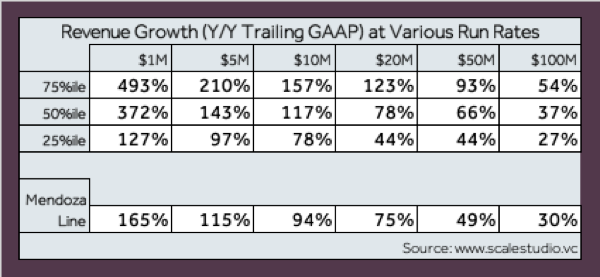
We benchmark Revenue Growth by looking at companies at a comparable revenue run rate because revenue growth rates decline fairly predictably as absolute revenue scale increases (as is clear in the chart below). This means that the top quartile Revenue Growth rate of 123 percent at a $20 million revenue run rate would represent bottom quartile growth at a $2 million revenue run rate.

The chart and table below show, for various revenue run rates, which revenue growth rates represent top, median and bottom quartile performance. The Scale Studio data set has 300+ public and private SaaS companies, some of which have become public, many of which have not and most of which have raised at least some venture capital.

Using this table, a team can quickly benchmark their company’s performance. For example, a company that grew last year 80 percent from $11 million to $20 million is growing at just above 50th percentile growth for SaaS companies at that stage, which is 78 percent. We can also generate a separate table showing the same data on a forward-revenue basis, to allow a company to answer the related question: If I am at a $20 million run rate now, and I grow next year at 50 percent, how will I be doing relative to other SaaS companies?

It is also interesting to see that the data here broadly agrees with a separate calculation we did recently around the Mendoza Line for SaaS growth that tracks at or just above the bottom quartile of growth rate. The Mendoza Line was derived by math; this table was generated from real data — it is good to see both estimates roughly agree.

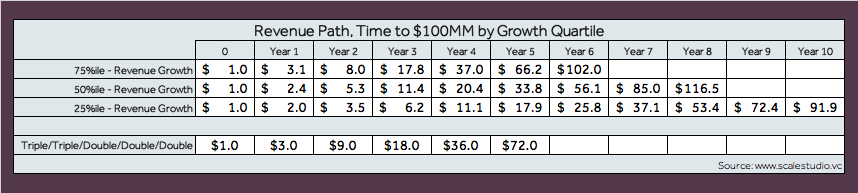
Another way to look at the same data is to think about the revenue trajectory over time, or “how many years to $100 million.”  The graph and table below show for a consistent top, median or bottom quartile company (at the cutoff points) how long it takes to grow from $1 million to $100 million. A company that grows consistently, just at the top quartile cutoff growth rate, takes six years to get to a $100 million run rate, a median performer takes eight years and a bottom quartile performer does not yet get there in 10 years. This is a calculation with all sorts of survivorship bias problems, because the slow growth companies tend to get acquired and not make it all the way to $100 million, but the analysis is roughly right.

This data also matches well to various rules of thumb. An example is the T2D3 (triple-triple-double-double-double) rule, which is also shown in the table above. T2D3 matches top quartile performance for the first four years and becomes just a little aspirational in year five. If you fail to double from year four to year five and only grow at 90 percent, we would still be glad to talk to you! (The data also roughly matches the Bessemer State of the Cloud Report, which shows an estimate of times to $100 million for best-in-class companies).

Vital Sign No. 2: Sales Efficiency

Sales Efficiency metrics (and again the reminder to think of this more broadly as Distribution Efficiency!) measure the relationship between dollars in (spent on Sales & Marketing) and dollars out (in the form of new revenue). For a recurring revenue business, by far the most intuitive way to measure this concept is by dividing the Gross or Net New ARR for the quarter by the fully loaded Sales & Marketing spend for the same quarter. The Gross SE metric measures the effectiveness of the company in generating new ARR, and the Net SE metric measures the overall effectiveness of the business in both generating and retaining revenue.

We love the simplicity of this calculation and its direct actionability. It can be explained in 30 seconds at a Sales Kick-Off meeting in a way that no other measure can. “We gave you this money, you gave us this ARR.” We are not a fan of putting lags in this method (comparing this quarter’s Net New ARR with last quarter’s S&M spend). There is some logic to the idea that there is lag between spend and results, but once you start to adjust, you end up with all sorts of special pleading. Keep it simple.

For a vital signs diagnosis, we prefer this metric to the complexity of the LTV/CAC calculation. An LTV to CAC works really well for consumer businesses and for B2B businesses that have fairly consistent deal size and low net churn. A former Scale portfolio company, HubSpot, did a brilliant job of orienting their business around this metric. However, for enterprise businesses with highly variable deal sizes and strong positive net cohort growth over time, the calculation becomes arbitrary. The underlying idea is real, namely that enterprise customers can have lower Gross SE but higher ultimate value as the cohorts grow, but trying to track and explain quarterly fluctuations is hard.

Another complexity we choose to avoid is using Gross Margin instead of Revenue. It is of course more correct to use Gross Margin, but especially at the early stages of a SaaS company, Gross Margin fluctuates based on fixed cost recovery issues that significantly distort the calculation.

The problem with an ARR-based Sales Efficiency metric is it doesn’t allow easy comparison across companies. ARR is not reported by public companies and private company ARR numbers are often suspect. Our workaround was to slightly tweak the calculation for Net SE, replacing the numerator (Net New ARR) with the intra-quarter difference in GAAP revenue multiplied by 4 (annualized). We call this formula using GAAP instead of ARR the Magic Number and it should be equal to Net Sales Efficiency with a one quarter lag (to allow ARR to convert to GAAP).

As a rule of thumb: When you’re talking to your team and want to keep it simple, talk Gross and Net Sales Efficiency; when you want to do benchmarking against other companies, use Magic Number.

The benchmarking results here are very different. Unlike Revenue Growth, which clearly declines as absolute revenue increases, we have found Sales Efficiency to be fairly consistent across the entire SaaS universe. The median Magic Number for our data set is between .8x and .7x, and the range from top quartile to bottom quartile is between .5x and 1.5x. This matches the public company data set where the median is .7x today.

Payback (on a revenue not a gross margin basis) is simply the inverse of this number, which implies that the average SaaS company is earning back in revenue what it spends in sales and marketing in one divided by .7 years — 17 months — with a top/bottom quartile range of eight months to two years.

We have also observed something that does not come in this table, which is that Sales Efficiency tends to be persistent over time for a given company, especially after $10 million. A good go-to-market model at a $10 million run rate tends to still be a good model at $100 million. And bad sales efficiency at $10 million is hard to change later.

The high top-quartile Magic Number for the $1 million revenue run rate represents an anomaly early on, as often founders are doing the selling themselves (and probably not allocating their costs to Sales & Marketing!). Pretty quickly top quartile Magic Number falls to 1.4x and then to 1.0x at scale.

Vital Sign No. 3: Revenue Churn

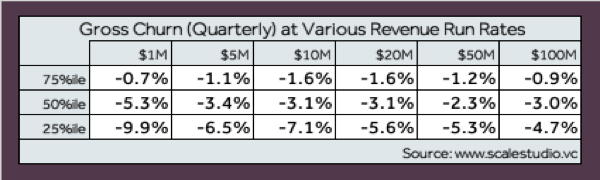
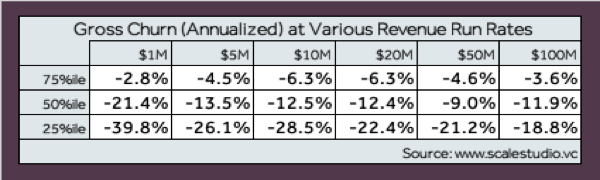
The simplest way to measure Gross and Net Churn is by taking Churned ARR (Gross) and Churned less Upsell ARR (Net) and dividing it by opening ARR for the period, usually a quarter. In the tables below, we show Gross Churn by quarter and annualized.

We acknowledge that this metric is a horrible oversimplification. For the Sales Efficiency calculation above, the simple method is also, we believe, the best method, but for the churn calculation this simplification comes at a significant cost in terms of being able to diagnosis underlying issues. At high growth rates especially, this measure understates actual churn. However, the vital signs framework calls for simplicity to allow consistent, relevant benchmarking across companies. If this simple benchmarking exercise exposes a churn problem, then a deeper dive using retention analysis and a cohort analysis is an absolutely required next step.

The data above shows Darwinian selection at work. Early on some companies have huge churn but they have to either improve or die. At a $20 million revenue run rate, even bottom quartile companies have annualized Gross Churn hovering around -22 percent.

Vital Sign No. 4: Cash Burn / Operating Income

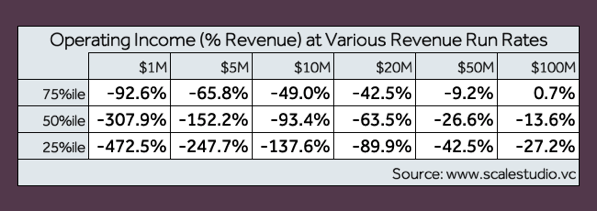
Internally, we measure cash burn by looking at free cash flow for a quarter (operating cash flow less capex) and compare it to cash on the balance sheet to calculate a cash out date. For confidentiality reasons, we do not ask for cash balances in Scale Studio. A reasonable proxy for cash burn is Operating Income, and the chart and table below show Operating Income as a percent of Revenue at different revenue run rates.

To illustrate what this metric means, at a $20 million revenue run rate the median company in the data set is losing 63 percent of revenue, $12.7 million dollars, or colloquially “burning $1 million a month.” In Scale Studio you can also further benchmark total operating expenses one level down, across each of Gross Margin, Sales/Marketing, R&D and G&A.

The most important point to make about this metric is that in a recurring revenue business, operating income, or “burn,” however calculated is not a measure of efficiency. Instead it is a measure of how aggressively a company is investing. A high operating loss coupled with a high growth rate and high sales efficiency is an aggressive but probably sensible strategy provided of course the company has access to capital. A high burn, low growth company is a disaster in the making.

Exactly how much burn for exactly how much growth will be the subject for another post, but any comment that tries to link burn rate to value creation, without taking growth rate into account, is simply wrong. Many of the most successful SaaS companies were in the bottom quartile on this metric at $100 million in run rate revenue, but were also in the top quartile on revenue growth. Worth highlighting again is the proviso regarding access to capital. If the cash runs, out even the best business dies.

The very best companies are those such as Veeva and Atlassian where a high Sales Efficiency allowed them to simultaneously be top quartile on growth, and top quartile on operating income profitability. It is no accident that companies with these characteristics get premium public valuations.

What are your company’s vital signs?

Getting started with Scale Studio is simple: you enter nine basic data points for each of your trailing eight quarters then generate a benchmark report. The benchmarks use a sample set consisting of companies at the same revenue stage as yours. This allows for much more accurate benchmarking, especially for Revenue Growth and Operating Income which, as we have said, are a direct function of revenue run rate. The benchmarks give you a sense of your performance that is clear, concise, and comparable. Your report might say something like:

“At your current revenue run rate of $5 million, your Y/Y Revenue Growth rate of 150 percent is in the second quartile for companies of your size, your Magic Number of 0.8 is in the second quartile, your Gross Churn of -1 percent is in the top quartile, and your Operating Income of -152 percent of revenue is in the second quartile.”

Vital signs don’t cure patients, doctors do. SaaS vital signs don’t fix companies, management teams do. But realistic benchmarking metrics do what ER vital signs do: pinpoint issues, provide actionable context and allow you to get to work.

Jeremy Kaufmann contributed to this article.

27 Feb 20:39

Why AI Is Your New Growth Secret Weapon

by Arsene Lavaux

Since 2016, the interest for Artificial Intelligence has increased more than twofold worldwide.

We can see that in Google trends.

There definitely is amplifying buzz around AI although it’s not a new topic. AI has been around for decades but as Ray Kurzwell says “The singularity is near”.

How much longer will it take to reach this singular point where human and artificial intelligence merge?

With a MarTech stack which now includes thousands of growth analytics SaaS solutions, AI for growth is becoming increasingly complex. Yet, growth marketers need to learn how to make new artificial entities part of their growth arsenal and an integral part of their growth team.

Today, as we iterate on growth, a lot of the growth process is still manual. Let’s take one foundational aspect of growth, for example, high-tempo ICE as described in this short video by Dan Martell, most growth marketers use a spreadsheet to align their teams around growth experiments.

Sean Ellis, one of the fathers of growth hacking, and his team at growthhackers.com, recently launched a software called NorthStar to help accelerate and streamline this cross-functional growth process.

What happens in the near future when AI is more deeply integrated into our growth teams to act on all levers of the AARRR framework?

What is AI?

Before sharing real-life AI growth actions I led in my life as a mobile SaaS startup entrepreneur and as a growth marketer, let’s start with getting a clear definition of what AI stands for as of today.

Dr. Raj Ramesh shared a very easy to understand YouTube video that does a great job at explaining what AI is about for now – and the context around many of the currently trending buzz words such as Machine learning, Deep Learning, Natural Language Processing, Convolutional Neural Networks and more.

What is AIFor People In a Hurry!

To keep it simple, there are two main sections of AI.

One that is based on symbols, symbolic learning and one that is based on data, machine learning.

The former has emerged as early as in the 19th century, as explained in this paper by Inman Harvey. A computer at the time was like a clerk employed in an accountancy or insurance office to perform immense and tedious calculations by hand and by following detailed set procedures.

Fast forward to 1997, and Deep Blue is the first form of symbolic AI to defeat chess champion Kasparov.

We can give a lot of credit to symbolic inroads to help raise the overall AI awareness. Yet, such artificial entities focus on crunching systematically through all the possibilities. Think the finite universe.

Today, data sets are becoming larger and more dynamic. Marketers can collect real-time data at each touch point of their customer journeys. Discover patterns that correlate to their north star metrics to ideate and act on an increasingly larger and more and more data-informed set of growth experiments.

The art of growth marketing is now turbocharged with actionable data learning.

Below are some real-life examples you can act on:

Cross-platform web + mobile AI for automated customer segmentation and messaging

In a previous article on mobile app growth, I had touched on how you can leverage mobile engagement analytics to spur growth.

What I find quite fascinating with an AI driven cross-platform analytics solution such as Pyze, is the simplicity of leveraging behavioral analytics to deliver personalized messaging in no time to each behavioral segment.

The first layer of AI in the Pyze experience is auto-segmentation AI.

Just by dragging and dropping segmentation dimensions, in a matter of seconds, you can make deep segmentation actionable for immediate marketing right away.

Pyze Auto-Segmentation via their Intelligence Explorer

The segments in blue, represent the Silver subscribers from the U.K. organized by increasing levels of attrition.

We can act right away on each auto-segment by clicking on it. We are now crafting an in-app message directly in Pyze.

On the left, we have the various elements of the in-app message. We can edit the picture directly in Pyze, enter the title, core message and add deep-linking CTA buttons or even CTA linking to external webpages which can be useful for survey collections as an example.

On the right, in real-time, you see exactly how your in-app message is going to render.

You can do the same if you elect to send a rich push notification. In these advanced push notifications, you can include a full picture and even a video if you want!

The other interesting layer of AI in the Pyze experience happens at scheduling.

Pyze leverages its big data mobile graph to offer the “Best time to reach per user” scheduling functionality. They use machine learning to custom send each in-app message on a per user basis to maximize tap-through rates for both in-app and push messages.

Last but not least, Pyze boasts a solid visual interface for reporting engagement data in a variety of ways in just a few drag-an-drop moves.

App Installs by Day and by Manufacturer via Pyze Data Query Builder.

Social AI for automated B2B and B2C lead qualification, activation and growth

Lead qualification, activation and growth on Instagram

Followadder is an interesting social AI web app for Instagram. It can help you achieve several aspects of social engagement and growth on top of the things that only humans will be able to do. Even in the future, it may help with Instagram Live engagement including split-screen dual broadcasts.

I found it helpful in discovering product-market fit in the early stages of mobile app experiences where the must-have persona has a strong millennial component.

For example, if you go after a niche market, you can target the followers of the instagram influencers in that niche.

Target followers of top Instagram influencers in a niche persona

You can DM a picture automatically to your followers.

The image below demonstrates how I set it up for our app.

Engage Instagram followers with automated Thank You DM including a picture

You can also test hundreds of messages to quickly iterate and focus on those that trigger the most responsiveness from your core market.

The image below is an example of a portion of a test messaging matrix’s that I used some time back to help simplify engagement comments and surface qualified leads faster.

Messaging test matrix via Instagram AI

Instagram engagement growth through human/AI collaboration – Followers graph in red above

As you combine human social interaction with relevant AI automation, you get to spur social engagement to levels that are stronger than without AI collaboration.

This form of Social AI is symbolic. You input your segmentation, targeting and positioning data for your brand. AI then goes about finding the corresponding “symbols” within the Instagram social graph and automates some of the work that many still do manually.

Yet, there is a lot of room for improvement.

With a tool like that, you can target relevant keywords included in the Instagram usernames, or relevant hashtags, or followers of influencers in your niche and more.

However, you cannot target hashtags. At least I haven’t found a tool that does that yet. Being a developer and having worked on the Instagram API years ago, it wouldn’t be that complicated to create one.

You could really zero in very precisely on must-have personas to validate product-market fit on your first-time user experience.

Here is a quick example with simple figures.

Imagine you only want to target florists who sell orchids.

#florist has 6.5 Million posts on insta.

#orchid has 2.7 Million posts.

If you can only target #florist and #orchid, the odds are that you target people posting about orchids without having nothing to do with being a florist are high. And so are the odds of targeting florists who do not sell orchids.

Now if you target “orchidflorist” as part of the insta username, you get super targeted leads, but you only skim the surface of a much larger addressable pool of orchid florist leads on insta.

See, you only get a few dozens of orchid florists when you search for “orchidflorist” as People.

Even if there are limitations with this type of symbolic social AI, it can clearly move your growth needle by far. We can also understand the power of targeting social graphs and anticipate what will happen as those graphs keep growing.

This will lead to unprecedented levels of targeting possibilities paired with very sharp personalization that will make everybody blink to determine if a human or an artificial entity is actually communicating.

This leads us to personalization API where you can dynamically change your content based on detailed target customer information.

Personalization API to generate B2B leads

Many social APIs are not exposed. Meaning, the social network who hosts the data doesn’t make it available to the developer community to build apps on top of their social graph. Or if they do, they only do it partially.

Nonetheless, there already exists some interesting AI that can help you leverage the “personalization API” angle without actually having to know any coding skills, nor having to use an existing social API.

A very human artificial B2B growth agent

LinkedHelper is a social AI solution for B2B growth.

I find it interesting as it actually mimics human behaviors and automates them. You can pretty much automate anything you would do using a B2B social network such as LinkedIn. This includes writing and sending extremely personalized messages to anyone in your 1st, 2nd or 3rd-degree network.

Here is a tangible example of how you can leverage this AI agent to generate highly targeted B2B leads at a fraction of traditional MQL and SQL costs in B2B settings.

We are going to target the “Real Estate broker” persona in our 2nd-degree network, in a very personal way. We leverage the name(s) of our common connection(s) automatically and put forward our core value proposition to make them a 1st-degree connection first. Then, we can start an automated nurturing strategy to run a demo of our app in their office.

Step 1 – Search for “Real Estate Broker” and activate deep filters

I am using the “All Filters” functionality of LinkedIn Search to make sure to target 2nd-degree connections from my “Real Estate broker” search. I also want to make sure that their current title includes “Real Estate Broker”. That way, you refine the precision of your core persona targeting.

And here we go, we just surfaced 17,926 prospective leads in the exact target persona we are looking to market.

Now we need to assign them to a collection list that we could re-use in the future.

Step 2 – Collect “Real Estate Broker” leads

We simply hit collect:

As the AI starts collecting prospective leads among our 17,926 hyper-targeted prospects, we can start setting up a personalized invite message.

Step 3 – Write personalization invitations

Now it’s time to craft a personalized invite with relevant data from your LinkedIn social graph to boost engagement rate and get a maximum number of qualified leads to connect with you. Time to reel them into your growth funnel!

Click in the body of the message for the pop-up message editor.

Now we start typing a simple invite and include a few personalized data points such as the target connections first name.

To make the invite more personal, relevant and likely to spur a higher response rate, we are going to add the name of a mutual connection. We do this by leveraging the conditional test with a very simple “IF-THEN-ELSE” statement made available by the software.

Just click the conditional statement itself, it will create a new conditional sequence inside the body of your message in the editor. Here, I am displaying the text “including {full name of common connection}”. This should work all the time since I am targeting 2nd-degree connections which by definition have at least one 1st-degree connection in common with me. Yet, just in case a common connections full name is not returned, I populate the ELSE part of the conditional statement with a dot “.” to properly punctuate the sentence and end it in this case.

The image below is what the conditional statement in the message editor looks like.

As you save your invite, you get to preview it if you want with staged data.

It’s almost funny actually!

It’s now time to send our personalized invites to our LinkedIn prospects.

Step 4 – Send your personalized invitations

As we were setting up the personalized invitation in the message editor, the collection AI worked magic. We have already collected 840 highly targeted prospective “Real Estate Broker” leads.

This is more than enough to get started and to get a feel for the response rate on that target persona. It’s best not to send more than 150 invites per day anyway, so we have a few days of prospective leads to contact ahead of us.

It’s time to stop collecting and simply press on the invite button to start sending out our personalized LinkedIn invitations.

The AI starts typing the first invitation at natural human typewriting speed and we can verify that the elements of message personalization are properly populated.

We are now making sure the conditional statements we created, works properly.

And it does!

And the invitation goes out on its own.

Done!

Machine learning in conversational intelligence to increase sales

When I started my marketing career, I marketed the French and Italian subscription of HDTV channels for a leading satellite HDTV network in the U.S.

27 Feb 20:39

Will Robotic Process Automation Save Your Company Time and Money in the Cloud?

by Jay Chapel

We’ve been hearing buzz about a new concept in AI, robotic process automation. The promise of the technology is that it can automate processes that employees are doing manually, saving your employees’ time and potentially reducing operational costs. It fits right in with the current trends in cloud computing toward optimization. We’re all about saving time and money – so let’s take a look at this trend to see if it can help you do either of these things.

What is Robotic Process Automation?

Robotic process automation (RPA) is a way to automate business processes by creating software robots to perform manual and mundane work-tasks. It allows users the ability to configure within an application the capability to handle a variety of repetitive tasks by processing, employing, generating and communicating information automatically. For example, you might program RPA bots to do first-level customer support tasks by searching for answers; copy and paste data from one system to another for invoicing or expense management or issue refunds. This video from IBM shows an example in action.

Furthermore, RPA tools can be trained to make judgments about future outputs. Many users appreciate its non-intrusive nature and the ability to integrate within infrastructures without causing disruption to systems already in place.

How can you use Robotic Process Automation?

Companies like Walmart, AT&T, and Walgreens are adopting the use of RPA. Clay Johnson, the CIO of Walmart, says they use RPA bots to automate pretty much anything from answering employee questions to retrieving useful information from audit documents. The CIO of American Express Global Business Travel, David Thompson, says they implement the use of RPA to automate the process for canceling an airline ticket and issuing refunds. In addition, Thompson is looking to use RPA to facilitate automatic rebooking recommendations, and to automate certain expense management tasks in the company.

More specific to cloud computing and IT, one great application for RPA is in automated software testing. If testing involves multiple applications and monotonous work, RPA can replace workers’ time spent testing. Additionally, RPA can be used to automate processes in monolithic legacy systems that are not worth developers’ time to update, to bring automation while work on newer microservices systems is in progress.

Is Robotic Process Automation the Best Way to Automate Cost Control?

A recent study found that not all automation is achievable with RPA. In the study, they conclude that only three percent of organizations have managed to scale RPA to a high level. Additionally, Gartner placed RPA tools at the “Peak of Inflated Expectations” in their Hype Cycle guide for artificial intelligence last year – another vote for more buzz than potential.

So can it save you time and money? If employees at your company are spending a large percentage of their time on repetitive tasks that require little to no decision making, then yes, it probably can. It’s also important to free up developer time that is spent on automatable tasks, like scripting, so they can focus on creating value for your business.

For complex and long-term automation, though, purpose-built software is a better solution. If there is already a solution to your automation needs on the market, it will probably serve you better than RPA, because there won’t be an upfront period needed to program bots, you won’t need to make frequent changes to your processes like many RPA bots will require, and it’s a better solution for the long run.

27 Feb 20:39

Innovation Nation: Why has the government put a cap on innovation success?

by Special to Financial Post

Canada has a rich history of innovation, but in the next few decades, powerful technological forces will transform the global economy. Large multinational companies have jumped out to a headstart in the race to succeed, and Canada runs the risk of falling behind. At stake is nothing less than our prosperity and economic well-being. The Financial Post set out explore what is needed for businesses to flourish and grow. You can find all of our coverage here.


The recent statements about innovation coming from politicians in Ottawa are encouraging. On more than one occasion, Minister Navdeep Bains has said he would rather see 10 high-growth Canadian tech companies scale globally than 10 more foreign branch plants open their doors in Canada.

Domestic innovators and innovation economists have long argued that to create quality jobs and prosperity, our country needs an ecosystem that enables our own high-growth anchor firms. The best returns to national economies, experts say, come from companies that generate value from intangibles like data and intellectual property — and that scale from $100 million to billions of dollars in revenue. These are the companies that provide critical public and private wealth, and that can help Canada generate the new revenues it desperately needs to fund social programs and public infrastructure across the country.

Just look at the lasting impact of Research In Motion, now BlackBerry, where seasoned C-suite talent and private wealth have transformed Waterloo, Ont., from a rural farm town into a vibrant technology and research hub.

The government’s recent Economic Strategy Table focused on digital industries concurred that anchor firms “play an important role in creating powerful business clusters and incubating other businesses. By virtue of their size and R&D spend, anchor firms help create new organizations and transform existing ones, fostering entrepreneurship and networking on local and global levels.” They also create local philanthropists, who invest in their communities and social infrastructure.

But while experts agree anchor firms are critical to prosperity, Canada’s current public policy strategies are still heavily oriented towards pre-revenue startups. What’s worse, our current innovation programs stop supporting the very companies we need to double down on. As a result, only one per cent of companies reach the 100- to 499-employee mark in Canada.

Take for instance the National Research Council’s (NRC) Industrial Research Assistance Program (IRAP). Most innovators would agree that IRAP is one of Canada’s more successful innovation programs. It allows the NRC to partner with Canadian companies on R&D projects. In the 2018 federal budget, the government increased the size of an individual IRAP matching contribution from $1 million to $10 million. Unfortunately, it did so while maintaining the rule that, to qualify for IRAP, applicants must have fewer than 500 employees — a puzzling requirement given stated promises about helping high-growth companies.

The result is a program that fails to reach its potential because the companies with the scale needed to carry out $20-million R&D projects are barred from applying. As Canada’s fast-growing companies reach a pinnacle of success, they outgrow the very programs that helped them scale rapidly along the way — and are left to compete in the global economy on their own.

Despite the hype about our tech sector, we should be concerned that fewer than five per cent of Canadian startups graduate to the scale-up stage, especially when we take stock of the time, capital and hands-on support governments give to early-stage companies. As a recent story by The Logic reported, some government programs prop up companies that are not viable and have no market traction. Rather than propping up “zombie” startups, Canada’s innovation programs need to help proven market winners continue scaling, including with access to strategic capital.

If the goal is to have more global companies headquartered and anchored here in Canada, why has the government placed a cap on success?

To scale a successful technology company in 2019, Canadian innovators need highly-skilled talent, capital and customers. All successful innovation economies exhibit a close working relationship between proven market-winning companies and their public sector, co-developing strategic economic policies and working hand-in-glove to address challenges impacting the growth of emerging industries. In a winner-take-all tech race, governments that help their domestic innovators scale-up and succeed are seeing the greatest economic dividends for their intervention. The same needs to happen in Canada.

Lifting the employee cap on IRAP is a logical step the government should take to achieve their vision of more Canadian companies growing into the large anchor companies known around the world.

Benjamin Bergen, executive director of the Council of Canadian Innovators.

27 Feb 19:56

Bye-Bye Boring B2B: Lee Odden Shows B2BMX Attendees the Power of Interactive Influencer Content

by Caitlin Burgess

Interactive Influencer Content Marketing

Interactive Influencer Content Marketing Quick question, B2B marketers: How many of you wake up feeling like this about your B2B content? via GIPHY Not so much? Hey, it’s OK. You’re a passionate and proud B2B marketer. But finding a way to create exciting, inspiring, infotaining content that connects with your audience is hard work. After all, B2B isn’t innately sexy—it’s booooooring. Oh, and between content overload, changing consumer preferences for personalization, and diminishing audience trust, it’s increasingly hard to capture and keep attention. So, here’s another question: Are you ready to say bye-bye to boring content and hello to exciting, inspiring, and infotaining content experiences? Yes so much? Good. Because, as TopRank Marketing CEO Lee Odden told a packed room at B2B Marketing Exchange this week, you can. How? By bringing two incredibly powerful content marketing tactics together: interactive content and influencer content. Why interactive? Why influencers? Why interactive and influencers? Here’s how Lee broke it down.

Why Interactive Content?

The digital content landscape is increasingly competitive. If brands don’t create great content experiences that grab and hold attention, they simply can’t compete. But interactive content can be a B2B game-changer. Interactive content informs. Interactive content engages and entertains. Interactive content connects. Oh, and interactive content converts. And as Lee pointed out, research shows that 81% of marketers agree that interactive content grabs attention more effectively than static content (CMI) and 70% of marketers say interactive content is effective at converting site visitors (Ion Interactive).

Why Influencer Content?

As Lee said, these days “buyers expect more, but trust less.” In fact, according to a HubSpot report, 65% of buyers don’t trust ads and a whopping 55% of those surveyed said they don’t even trust the companies they’re already doing business with. The good news? Buyers desperately want to trust. [bctt tweet="Buyers desperately want to trust. And we can give them trust with relevant #B2B content that features credible voices. - @leeodden #InfluencerMarketing #ContentMarketing" username="toprank"] But who do buyers trust? Simply put, buyers trust people they know—or people they think they know. (Just for fun, take a peek at where marketers rank as compared to baristas. Uh huh.) HubSpot Research (Image credit: HubSpot) Eighty-one percent of HubSpot respondents said they trust friends and family over business. In addition, DemandGen Report’s 2018 Content Preferences Survey showed that 78% of B2B buyers place a higher emphasis on the trustworthiness of the content source, and 65% have a higher preference for credible content from industry influencers. [bctt tweet="Co-creating and collaborating with influencers can play a role at every stage of the customer lifecycle. - @leeodden #InfluencerMarketing #ContentMarketing" username="toprank"]
Why Interactive Influencer Content?

To remain competitive, marketers need to create engaging experiences for their audiences while also building credibility and trust. And that’s precisely where interactive influencer content comes in. To really drive the point home, Lee pointed to a fabulous quote from Amisha Gandhi, Vice President of Influencer Marketing for SAP Ariba: “Working with influencers to co-create content delivers mutual value. When that content is interactive, it creates an experience that is more engaging and inspires action.” [bctt tweet="Working with #influencers to co-create content delivers mutual value. When that #content is interactive, it creates an experience that is more engaging and inspires action. - @AmishaGandhi" username="toprank"]

What Does Effective B2B Interactive Influencer Content Look Like?

When you put relevant, useful, and credible content in an eye-catching, engaging format, incredible things can happen. Not only are you creating an infotaining experience for your buying audience, but also for influencer partners. You’re creating mutual value.

Examples of Interactive Influencer Content

#1 - Interactive Infographic

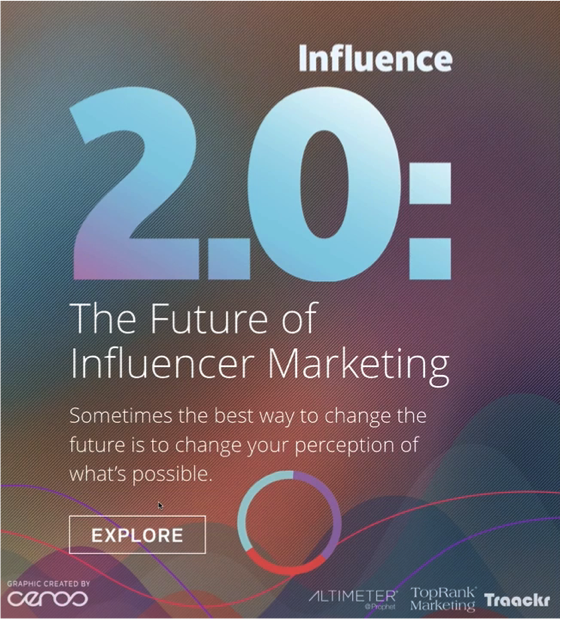
Topic: The Future of Influencer Marketing Objective: Drive leads from original research report while also repurposing influencer tips. Results: 6,971 pageviews and an impressive 42% conversion rate Future of Influencer Marketing Interactive Infographic

#2 - Interactive eBook

Topic: Future-Proof Content Marketing Objective: Leverage an entire year’s worth of content and insights around content marketing strategy, planning, and measurement to boost awareness and lead gen (small ask: participate in content marketing planning survey; big ask: request a trial). Results: Exceeded small and big ask benchmark goals four times over. Back to the Future Interactive eBook

#3 - Interactive Voice Assistant and Microsite + SEO-Driven Content

Topic: AI and the Next Evolution of Finance Objective: Build industry credibility and engagement on AI and Finance with thought leadership content. Results: 189% increase over benchmark pageview goals and 642% increase over benchmark engagement goals; 84 net-new keyword rankings Interactive Influencer Asset with Voice Assistant

Buh-Bye Boring. Hello Infotaining Interactive Influencer Content.

B2B brands need to break free of its boring-to-boring reputations if they want to engage, inspire, and convert modern buyers. Buyers are ready for bigger, better, bolder content experiences—experiences they can trust. So, B2B marketers, it’s time to ask yourself: Are your ready to create meaningful, trustworthy connects with buyers through your content? If you are, interactive influencer content deserves your consideration. Not sure where to start? Here’s Lee high-level checklist:
  • Identify a customer solution topic that is relevant to your brand’s expertise and your audience’s information needs.
  • Pick an interactive content type, story arch, and call-to-action that makes sense for the topic, audience, and objectives.
  • Identify, qualify, and validate influencers that have the topical expertise and the right audience for the end-product. And map them to your topics and subtopics.
  • Collect influencer tips, work them into the experience, and promote the heck out of the final product.
  • Nurture influencers for future engagement; strong relationships are at the center of successful influencer programs.
In the meantime, here's a little something to snack on:
For more live updates from the conference, you can follow @TopRank, @leeodden, @azeckman and @CaitlinMBurgess on Twitter. In addition to speaking and tweeting, team members from TopRank Marketing will be live blogging sessions (like this one) throughout the conference so be sure to follow the blog for more.

The post Bye-Bye Boring B2B: Lee Odden Shows B2BMX Attendees the Power of Interactive Influencer Content appeared first on Online Marketing Blog - TopRank®.

27 Feb 19:40

Product, Pricing, Marketing, and Data: Essential Building Blocks for SaaS Success

by Wendy Schott

I have always enjoyed the hands-on aspect of product development. You might say I was a geek before being a geek was cool. Early on, I also realized that I have a knack for articulating technical information in a way that business people can understand. This is a handy combination of skills in the SaaS world. It allows me to see a problem, figure out how to solve it technically and then effectively explain it to people who might not be quite as tech savvy.

These skills have served me well in a variety of roles, most recently as the CRO for Abstract, a small-but-passionate company that is addressing a technically ambitious problem: redesigning the design process. We have developed a common infrastructure that supports the modern design workflow and helps make the design process more accessible to the non-design teams within an organization. We’re working to wrangle the timeless and universal problem of version control on design projects.

My experience, throughout my career and here at Abstract, has given me the opportunity to touch so many parts of product development and marketing. I’ve learned that while the priority of the various building blocks of a SaaS company may shift a little depending on each unique organization, their audience, and their product – there are a few key elements that are always of utmost importance: your product market fit and pricing, your go-to-market strategy and your ability to capture and use your own data effectively.

Building Your Foundation: Product Market Fit and Pricing

When I started out, I spent quite a bit of time in tech sales before transitioning into a product manager role. While I loved being involved in writing specs, identifying requirements and working closely with the engineering team, I also loved being out in the field where I could engage directly with end users. This led me to focus my work more around early product market fit, which is such a crucial thing for any SaaS company to nail down.

Product Market Fit – Designing the Right Solution

Getting to product market fit demands both technical expertise and the ability to work and communicate effectively with many different groups of people. The whole process covers several key questions about a product: What will solve the end users’ problem? What will users pay for the solution? How do you define value to the user?

The beginning of the process is all about gathering information, designing a solution, and then the back and forth of multiple iterations needed to refine the original idea into a working prototype and eventually, a successful product. This process applies no matter what kind of product you’re developing. I once worked on a pharmaceutical product that was completely outside of my wheelhouse, but I was able to see the project through by simply following the process: interview a ton of scientists, help them define and articulate their biggest problems, and then translate that for the engineering team. From there, I worked with the engineering team to develop mockups that I could then take back out into the field before we ever wrote a line of code.

Pricing – Finding the Sweet Spot

Once you’ve figured out the technical solution to the user’s problem, the fun part begins—figuring out what they will pay for it. Not unlike the iterative development process of the product itself, coming up with your pricing involves a lot of experimentation. And like a product that’s always evolving, pricing is never really done; it will change depending on where you are in the product life cycle and what your customer base is willing to pay. In the early stages, you may need to set your pricing at a level that you know will get those early adopters in the door. Once you’ve established product value, your pricing may go up a little, and then it might come down a little as competitors enter the market. It’s always going to be in flux, depending on outside influences.

A big part of adapting your pricing has to do with constantly adjusting to find that nirvana between what the customer is willing to pay and the perceived value of the product. This is a constant dance, and I recommend reviewing pricing every quarter to see if you’re in the right place, based on how market factors might have shifted.

In addition to the actual dollar amount, there are other pricing factors to consider. Pricing transparency, for instance, is something that seems to follow a cyclical pattern, from being super transparent to completely opaque. At one end of the scale, you might be dealing with large, perpetual-license enterprise deals that don’t include a detailed breakdown of the pricing. These kinds of situations give a SaaS team a lot of flexibility to do value selling and really focus on figuring out where the most advantageous price break is.

At the other end, you have self-service models or smaller contract deals in which everything is up front for everyone to see. You also have to think about things like how to price differently for distinct global audiences, which might have different pain points and different ways of calculating ROI in order to justify the cost of your product. There are a lot of variables.

From the inception of the product idea to the research and development and then the product market fit and pricing, it’s important to always stay open to change. Nothing about any of these aspects of a SaaS business is ever written in stone.

Connecting with Your Audience: Go-to-Market Strategy

As the CRO, my job doesn’t end with product market fit or pricing. From there, we venture into the wild frontier of the go-to-market strategy. At Abstract, we consider ourselves to be a product-led organization that relies on our product’s ability to deliver immediate value and create loyal customers who help spread the word about what we have to offer. Our revenue model includes two paths: a traditional, self-service path and a sales-driven path. The former allows people to download our product, see value right away, and monetize on their own. This works because we established a great product market fit, we solve a real problem and the product is easy to use.

The sales-driven side of things often comes into play after a small group of designers within a Fortune 100 or Fortune 2000 company start using our product and realize they may need help in onboarding and educating their teams and decide to sign an enterprise deal. From there, the deal often expands organically across the company as disparate teams across the organization are quick to realize the value and they want to get on board.

Marketing Strategy – Solving Customer Problems

Whether your business is self-service or sales-enabled—the key to success is proving your product’s value by exceeding your customers’ expectations. For example, when dealing with a technical audience, it’s about proving your product’s value without any marketing fluff.

Abstract sells to designers, who are a unique audience and who are not huge fans of switching processes or tools. Because of this mindset, change management becomes as much a part of our sales process as product tooling. We need to help our audience get past the natural fear of change.

To do that, and to cut through all the noise, marketing to technical audiences is all about helping them solve a problem right now. They want solutions and answers, and they want them in a format that’s quick and easy to digest so they can implement them immediately, if not sooner.

When working to reach an audience like this, quality content that’s highly relevant is key. You have to address their pain points head on, give them the tools up front, and show them how other people are using your product to solve the same problems they face. Think “educational” when developing content, rather than traditional marketing materials. The technical audience appreciates it when you skip the rah-rah and get right down to brass tacks.

Marketing Tactics – Choosing the Right Tools for the Job

The most effective marketing tactic for reaching this audience is word of mouth. Whether word of mouth will work for you depends on whether you have a good product market fit. If you do, you can find influencers who use your product, and you can get them to tell their story. It’s always better, whenever possible, to have someone else say how great your product is. Social sharing is another part of this same idea. When your product is inspiring positive shares and comments online, word spreads quickly. And because the reviews are coming from other customers, your prospects will trust them more than if they were reading reviews you’d curated yourself.

Every once in a while, one or more users will engage in spontaneous content creation that showcases your product. At Abstract, for example, we had a super passionate customer in Australia who wrote a 19-part series about how to build a design system; and he built the entire design system using Abstract. You can’t really engineer these kinds of opportunities, but if you focus on delivering great value by solving real-world problems, you just might inspire this kind of activity.

Finally, another marketing tactic that worked well for us is using meetups. Technical folks attend meetups in order to learn from other people. If you can encourage (and compensate) existing customers to talk about your product in this environment—tell their stories about how they used your product to solve a universal problem—that can go a long way toward reaching new customers.

Learning from Experience: Data Analysis

In addition to being a tech geek, I’m also a data geek. I’m all about slicing and dicing the numbers to really drill down into the different stories they tell. Each morning, I review my top-level metrics. I look at revenue (both self-service and sales-driven or sales-touched). I’m looking for patterns and analyzing details like the ACV of each deal. Also, because we’re focused on the inbound model right now, I review the inbound funnel and conversion rates in order to assess which levers we should be pulling to make the biggest impact on revenue.

I also look at website traffic via Google Analytics to get a sense of how people are hearing about us. We’re just starting to use other tools like Marketo and Salesforce, but we do have a great data science team who helps us look at the behavioral patterns so we can see what designers are doing before they monetize. This will eventually help us tailor our go-to-market strategy and specific marketing tactics to dovetail with those behaviors.

We have actually built a big data warehouse that is informing many teams within our organization. Our engineering team can look at performance-based data like where users are getting stuck and where they are running into error messages. Our growth team—a combination of product, design, engineering and marketing—can look at the funnel and onboarding flows, identify speed bumps and roadblocks in those processes, and adjust accordingly to increase conversion rates and product engagement.

Ultimately, it all comes full circle when we use the data across our organization to continue iterating and refining so we’re always delivering the best experience and best value to our customers.

Putting It All Together

Whether you’re a tech geek, a marketing fanatic, or a data nerd, things will work out best for you, your company and your customers if you realize the importance of combining efforts across these three core elements into one cohesive, product-led strategy. While each one can—on its own—help you make great strides toward success, working together they can transform your business and give you a serious market advantage.

The post Product, Pricing, Marketing, and Data: Essential Building Blocks for SaaS Success appeared first on OpenView Labs.

27 Feb 17:28

Why longer term sheets are better

by Danny Crichton

Recently in a conversation, the length of term sheets came as a topic (I assure you, it was a riveting conversation). The complaint was that a term sheet which had recently been received was too long, and therefore the VC who sent it wasn’t being founder friendly. The travails of successfully raising money!

Actually though, a longer term sheet is much more founder friendly and good business practice, and founders should be leery of VCs bearing short contracts.

Historically (i.e. about 6 years ago), term sheets used to be staid affairs, printed on plain white paper in standard Times New Roman font right out of Word. It was a wretched and horrifying world until the cool VCs showed up, who added design accoutrements (Bolded section heads! Logos! Colors!) while claiming that they had a “single-page” term sheet for founders, implying that the term sheet’s simplicity and prettiness showed that they weren’t really investors, but more like a Brooklyn barista with an art side hustle (and a lot of cash).

Here’s the thing, term sheets have an incredibly important purpose, which is to set forth in clear language the terms of a deal. Unfortunately in modern venture capital, there are a lot of terms that have to be negotiated in any equity round, from financial terms to option pools, to board structure, to voting rights on major business decisions like selling the company, and much more. Simpler term sheets either relegate many of these items to “standard venture capital terms apply” or some other vague language, or just wholly don’t mention them at all.

The challenge is that once the term sheet is signed, it becomes the blueprint by which the legal counsels for the VC and founder begin to write up the legal contracts that allows the VC to buy equity in the startup. When term sheets are clear, precise, and comprehensive, the lawyers just go to work and turn those agreed-upon terms into legal language in relatively short order.

When there are key terms that are “standard” or absent from a term sheet though, lawyers do what lawyers have to do: they negotiate for their respective party. Suddenly a term that seems fairly standard is up for debate, and unless a founder (and their VC) is paying very close attention to the legal process (from experience, no one really is), then the legal bills for the round can spiral very, very rapidly. That can pose a double whammy for a startup, since many VCs continue to charge the legal fees of conducting a round to the startup they are investing in.

I’ve seen founders in absolute sticker shock after seeing the legal costs of their round total into the upper tens of thousands of dollars because their lawyers racked up time trying to plow through term after term that could have been made clearer by the parties up front.

So, what’s more founder friendly: a longer term sheet that sets the deal terms clearly up front and likely saves the founder legal costs, or a shorter (but color!) term sheet that can end up costing far more down the line?

This is mostly a problem for first-time founders raising their first round of capital. I have a sinking feeling that many VCs take advantage of this naiveté to get better terms than they might have gotten otherwise had they actually walked through all the language up front. In later rounds, founders either ask all the right questions about the next round of capital, or their other existing investors figure this out on their behalf.

It’s good legal practice to always get all material terms figured out before your lawyers start writing contracts, whether in fundraising, or customer contracts, or what have you. You can’t always predict if there is something else that will end up being a disagreement, but getting most of the terms squared away will save legal time, and that is money ultimately in your pocket.

Side note: Extra Crunch published part two of five of our comprehensive guide to legal issues facing startups, this time focused on intellectual property. Don’t miss out on part one which focused on corporate issues.

Extra Crunch’s first conference call is today

We are hosting the first conference call for Extra Crunch subscribers today at 2pm EST / 11am PST. Call-in details are being sent out to members by email roughly one hour in advance. Today, Eric Eldon and I will talk briefly about Extra Crunch, and then TechCrunch social and product maestro Josh Constine is going to talk about the strategic issues confronting the social giants. Join us!

More SoftBank Vision Fund sadness

Kiyoshi Ota/Bloomberg via Getty Images

Written by Arman Tabatabai

Get out your popcorn because there’s more drama involving SoftBank’s giant Vision Fund and its LP base. Bahrain’s sovereign wealth fund stated that it no longer planned to invest in the Vision Fund. Despite previous discussions with SoftBank, the fund plans to instead put its money into infrastructure across areas like energy, healthcare, and education.

With assets of roughly $15 billion under management, Bahrain’s fund is small potatoes when it comes to SoftBank, and its contribution likely would have been much smaller than those of its Abu Dhabi and Saudi Arabia counterparts. However, after recent reports that Persian Gulf LPs are growing frustrated with the Vision Fund and are putting more money to work in infrastructure, Bahrain’s decision could indicate a broader change in sentiment towards the Vision Fund. Just look at the comment the CEO of Bahrain’s Fund gave to Reuters:

“We talked with them and with many people, but it shows we’ve not seen something we think we can add value to or it could add value to us.”

SoftBank CEO Masayoshi Son has wanted to scale up the size of Vision Fund II, but that dream may well be fading as more large wealth managers decline to engage.

Steam and video game streaming

Photo by Andy Cross/The Denver Post via Getty Images

Extra Crunch writer Chris Morris had a dive into the challenges facing Steam yesterday. Steam is facing two trends. First, publishers are increasingly getting smart about owning their customer relationship, which is hard to do with the design of Steam’s platform. The second is that video game streaming is getting closer to reality, and that doesn’t bode well for a game store. Plus, developers want to keep more of their revenue, and Steam takes a lot.

What’s interesting here is that publishers (and I mean big, AAA publishers) are increasingly comfortable with the notion that they can attract customers to their own independent store fronts and don’t have to pay the Steam tax in order to get in front of customers. What concerns me is that indie developers both don’t have the leverage to negotiate with Steam and don’t have the marketing budgets or fanbases to reach out to a wide audience. That’s not a great world, and an opportunity I think to figure out how to create a more even playing field for independent game creators.

The chip space keeps getting hotter as Korea’s SK leads round for Chinese chipmaker

IvancoVlad via Getty Images

Written by Arman Tabatabai

TechCrunch writer Rita Liao reported overnight that the A.I.-focused Chinese chipmaker Horizon Robotics raised a $600 million round led by subsidiaries of Korea’s SK Group, including its semiconductors segment.

We’ve previously discussed the intensifying global competition in the chip space, and SK’s investment shows that no one wants to miss out on the next innovative technology like previous incumbents who now find themselves playing catch up.

It’s worth noting that Intel’s venture arm, Intel Capital, is also an investor in Horizon and led their previous fundraise, as Horizon seems to offer up another opportunity for the US chip giant to make up lost ground in AI chip innovation and to gain share in the Chinese market now that they have canceled a partnership with China’s state-backed chipmaker Unisoc.

The data point is another positive for Chinese chipmakers, who seem to still have access to foreign capital on top of more than enough domestic — often state-backed — investments. The city of Beijing just raised its first venture fund with $1.5 billion focused on chips, A.I., and other areas, while China is reportedly nearing the closing of its second state-backed semis fund that some estimate might be nearly $50 billion in size.

More news

Written by Arman Tabatabai

California may have canceled HSR, but China is moving forward with an IPO

While US high-speed rail (HSR) projects continue to fall flat on their face, China Railway Corporation is now planning to IPO its Beijing to Shanghai HSR line within the next year. There’s always some financial risk with publicly-traded infrastructure, but the line’s securely profitable and the deal should help shore up the finances of its owner as it plans to make its largest rail investments ever this year.

Japan’s antitrust investigation is the latest in Asia’s new wave of regulatory scrutiny

Japan is reportedly initiating an antitrust investigation into the country’s biggest ecommerce platforms. Investigators will be looking to see whether Amazon Japan, Rakuten and SoftBank-subsidiary Yahoo! Japan launched benefit programs that ultimately are subsidized by and cut into the revenue of its small-to-midsize vendor suppliers.

The investigation is the latest in Japan’s broader effort to increase regulatory scrutiny on big tech, a global trend that seems to be permeating Asia as seen in our previous discussions on India. While it’s unclear how the heightened scrutiny will impact companies’ perception of these markets, it’s certainly clear that the “move fast and break things” playbook is getting tougher to run.

Obsessions

  • We have a bit of a theme around emerging markets, macroeconomics, and the next set of users to join the internet.
  • More discussion of megaprojects, infrastructure, and “why can’t we build things”

Thanks

To every member of Extra Crunch: thank you. You allow us to get off the ad-laden media churn conveyor belt and spend quality time on amazing ideas, people, and companies. If I can ever be of assistance, hit reply, or send an email to danny@techcrunch.com.

This newsletter is written with the assistance of Arman Tabatabai from New York

27 Feb 17:27

This is the Stanford thesis presentation that launched Juul

by Jordan Crook

Against a backdrop of public backlash and looming federal regulations, the world’s biggest e-cigarette manufacturer has released video of the original thesis presentation that launched Juul, with the hopes of making the case that its purpose is to do no harm — or at least less harm.

The founders of Juul have told their story before — the two met and became friends over smoke breaks at Stanford University, and eventually decided to design an alternative product to cigarettes. Juul today released a video of that thesis, presented by James Monsees (MFA in Product Design) and Adam Bowen (MSME in Product Design).

Bowen and Monsees say they started with the principle of harm reduction, aiming to keep the “good” and eliminate the “bad” from cigarettes. The people they spoke to said they were attracted to the ritual of smoking, and the satisfaction of basic human cravings like an oral fixation. However, smokers were tired of smelling like a cigarette and complained that, even if they weren’t being judged, they felt judged. Of course, hanging over all of this like a storm cloud is the fact that smoking is inherently bad for your health.

Monsees says in his presentation:

“Is it even possible to make a safe cigarette? What if smoking were safe? And even better, what if smoking wasn’t offensive to others?”

Back in 2004, when the presentation was given, Monsees and Bowen identified one of the strongest pillars of Juul’s value proposition as a cigarette replacement.

“It’s not the nicotine that’s really hurting you,” said Monsees. “It’s burning tobacco, the combustion and burning plant material.”

Professor at NYU’s College of Global Public Health David Abrams, who has advised Juul but not been compensated by them, told the New Yorker that the stigma of cigarettes has followed e-cigarettes.

“Cigarettes were a wolf in sheep’s clothing,” he said. “Now, with vaping, we have a sheep in wolf’s clothing, and we cannot get the wolf out of our minds.”

Part of the reason we can’t get the wolf out of our minds is the fact that minors have taken up e-cigarettes, and Juul in particular, in staggering numbers. For young people, nicotine and nicotine addiction have a far more egregious affect on health than they would for an adult former smoker. To teenagers, nicotine is indeed a wolf.

And it’s this issue that poses the greatest existential threat to Juul Labs. The FDA has asked for Juul and other e-cig companies to create and enforce new policies that will stymie use of these products by minors, but thus far Commissioner Gottlieb doesn’t seem too impressed.

In the presentation from 2004, Bowen presents a slide that shows the future company’s predicted demographic. On a scale from social smokers to pack-a-day smokers, Monsees and Bowen estimated that it would pick up users across the spectrum, with the majority of adoption coming from social/light smokers.

Ten years later, however, when the thesis project had evolved into the Ploom which then evolved into the Juul we know today, the company made a marketing decision that surely still haunts them. The early marketing campaign for the device showed young, hip models using the device. To this day, the campaign is cited by critics of the company for starting the youth craze over the device, which the FDA calls an epidemic.

Juul Labs has taken action to reverse this trend, including a $30 million investment in youth prevention, removal of non-tobacco-flavored nicotine pods from retail stores, deleting its social media, enforcing stricter age verification for online sales, an offensive legal push against counterfeiters and copycats, and a new $10 million ad campaign focused on attracting smokers to ‘make the switch’ to Juul.

“It [underage use] is an issue we desperately want to resolve,” Chief Product Officer and co-founder James Monsees said in August. “It doesn’t do us any favors. Any underage consumers using this product are absolutely a negative for our business. We don’t want them. We will never market to them. We never have. And they are stealing life years from adult cigarette consumers at this moment, and that’s a shame.”

Whether Juul’s efforts will be enough to prevent further regulation remains to be seen.

But from an entrepreneurial perspective, it’s interesting to see the earliest seed of a company that has now become a behemoth in its respective industry. In fact, Juul has grown to the point where Altria, makers of Marlboro cigarettes, have invested $12.8 billion in the company.

It’s also fascinating to watch the rhetoric around Juul evolve based on the state of regulation. In early conversations with Juul, back when it was called Ploom, the team was highly sensitive to the concept that the device was a smoking cessation product, lest it be regulated as such. With regulation now inevitable, cessation has become the top focus of the company.

Studies show that 40 to 55 percent of adult smokers who used Juul switch fully from combustible cigarettes within 90 days.

Alongside the thesis video, Juul also released a video of present-day Monsees and Bowen recalling the product design process for Juul.

“We started this project with the firm belief that innovation could address all the problems associated with smoking,” said Bowen in the video. “I would tell people, anyone who would listen, ’50 years from now no one will smoke cigarettes, they’re going to look back and think ‘Oh my God, I can’t believe people used to do that.” And now I think that’s actually going to happen much faster. In large part because of the progress that we’ve made.”

27 Feb 17:27

4 Ways Sales Teams Could Get More Value Out of AI

by Andris A. Zoltners

Despite the hype, very few organizations are using it well.

27 Feb 17:25

Product, Pricing, Marketing, and Data: Essential Building Blocks for SaaS Success

by Wendy Schott

I have always enjoyed the hands-on aspect of product development. You might say I was a geek before being a geek was cool. Early on, I also realized that I have a knack for articulating technical information in a way that business people can understand. This is a handy combination of skills in the SaaS world. It allows me to see a problem, figure out how to solve it technically and then effectively explain it to people who might not be quite as tech savvy.

These skills have served me well in a variety of roles, most recently as the CRO for Abstract, a small-but-passionate company that is addressing a technically ambitious problem: redesigning the design process. We have developed a common infrastructure that supports the modern design workflow and helps make the design process more accessible to the non-design teams within an organization. We’re working to wrangle the timeless and universal problem of version control on design projects.

My experience, throughout my career and here at Abstract, has given me the opportunity to touch so many parts of product development and marketing. I’ve learned that while the priority of the various building blocks of a SaaS company may shift a little depending on each unique organization, their audience, and their product – there are a few key elements that are always of utmost importance: your product market fit and pricing, your go-to-market strategy and your ability to capture and use your own data effectively.

Building Your Foundation: Product Market Fit and Pricing

When I started out, I spent quite a bit of time in tech sales before transitioning into a product manager role. While I loved being involved in writing specs, identifying requirements and working closely with the engineering team, I also loved being out in the field where I could engage directly with end users. This led me to focus my work more around early product market fit, which is such a crucial thing for any SaaS company to nail down.

Product Market Fit – Designing the Right Solution

Getting to product market fit demands both technical expertise and the ability to work and communicate effectively with many different groups of people. The whole process covers several key questions about a product: What will solve the end users’ problem? What will users pay for the solution? How do you define value to the user?

The beginning of the process is all about gathering information, designing a solution, and then the back and forth of multiple iterations needed to refine the original idea into a working prototype and eventually, a successful product. This process applies no matter what kind of product you’re developing. I once worked on a pharmaceutical product that was completely outside of my wheelhouse, but I was able to see the project through by simply following the process: interview a ton of scientists, help them define and articulate their biggest problems, and then translate that for the engineering team. From there, I worked with the engineering team to develop mockups that I could then take back out into the field before we ever wrote a line of code.

Pricing – Finding the Sweet Spot

Once you’ve figured out the technical solution to the user’s problem, the fun part begins—figuring out what they will pay for it. Not unlike the iterative development process of the product itself, coming up with your pricing involves a lot of experimentation. And like a product that’s always evolving, pricing is never really done; it will change depending on where you are in the product life cycle and what your customer base is willing to pay. In the early stages, you may need to set your pricing at a level that you know will get those early adopters in the door. Once you’ve established product value, your pricing may go up a little, and then it might come down a little as competitors enter the market. It’s always going to be in flux, depending on outside influences.

A big part of adapting your pricing has to do with constantly adjusting to find that nirvana between what the customer is willing to pay and the perceived value of the product. This is a constant dance, and I recommend reviewing pricing every quarter to see if you’re in the right place, based on how market factors might have shifted.

In addition to the actual dollar amount, there are other pricing factors to consider. Pricing transparency, for instance, is something that seems to follow a cyclical pattern, from being super transparent to completely opaque. At one end of the scale, you might be dealing with large, perpetual-license enterprise deals that don’t include a detailed breakdown of the pricing. These kinds of situations give a SaaS team a lot of flexibility to do value selling and really focus on figuring out where the most advantageous price break is.

At the other end, you have self-service models or smaller contract deals in which everything is up front for everyone to see. You also have to think about things like how to price differently for distinct global audiences, which might have different pain points and different ways of calculating ROI in order to justify the cost of your product. There are a lot of variables.

From the inception of the product idea to the research and development and then the product market fit and pricing, it’s important to always stay open to change. Nothing about any of these aspects of a SaaS business is ever written in stone.

Connecting with Your Audience: Go-to-Market Strategy

As the CRO, my job doesn’t end with product market fit or pricing. From there, we venture into the wild frontier of the go-to-market strategy. At Abstract, we consider ourselves to be a product-led organization that relies on our product’s ability to deliver immediate value and create loyal customers who help spread the word about what we have to offer. Our revenue model includes two paths: a traditional, self-service path and a sales-driven path. The former allows people to download our product, see value right away, and monetize on their own. This works because we established a great product market fit, we solve a real problem and the product is easy to use.

The sales-driven side of things often comes into play after a small group of designers within a Fortune 100 or Fortune 2000 company start using our product and realize they may need help in onboarding and educating their teams and decide to sign an enterprise deal. From there, the deal often expands organically across the company as disparate teams across the organization are quick to realize the value and they want to get on board.

Marketing Strategy – Solving Customer Problems

Whether your business is self-service or sales-enabled—the key to success is proving your product’s value by exceeding your customers’ expectations. For example, when dealing with a technical audience, it’s about proving your product’s value without any marketing fluff.

Abstract sells to designers, who are a unique audience and who are not huge fans of switching processes or tools. Because of this mindset, change management becomes as much a part of our sales process as product tooling. We need to help our audience get past the natural fear of change.

To do that, and to cut through all the noise, marketing to technical audiences is all about helping them solve a problem right now. They want solutions and answers, and they want them in a format that’s quick and easy to digest so they can implement them immediately, if not sooner.

When working to reach an audience like this, quality content that’s highly relevant is key. You have to address their pain points head on, give them the tools up front, and show them how other people are using your product to solve the same problems they face. Think “educational” when developing content, rather than traditional marketing materials. The technical audience appreciates it when you skip the rah-rah and get right down to brass tacks.

Marketing Tactics – Choosing the Right Tools for the Job

The most effective marketing tactic for reaching this audience is word of mouth. Whether word of mouth will work for you depends on whether you have a good product market fit. If you do, you can find influencers who use your product, and you can get them to tell their story. It’s always better, whenever possible, to have someone else say how great your product is. Social sharing is another part of this same idea. When your product is inspiring positive shares and comments online, word spreads quickly. And because the reviews are coming from other customers, your prospects will trust them more than if they were reading reviews you’d curated yourself.

Every once in a while, one or more users will engage in spontaneous content creation that showcases your product. At Abstract, for example, we had a super passionate customer in Australia who wrote a 19-part series about how to build a design system; and he built the entire design system using Abstract. You can’t really engineer these kinds of opportunities, but if you focus on delivering great value by solving real-world problems, you just might inspire this kind of activity.

Finally, another marketing tactic that worked well for us is using meetups. Technical folks attend meetups in order to learn from other people. If you can encourage (and compensate) existing customers to talk about your product in this environment—tell their stories about how they used your product to solve a universal problem—that can go a long way toward reaching new customers.

Learning from Experience: Data Analysis

In addition to being a tech geek, I’m also a data geek. I’m all about slicing and dicing the numbers to really drill down into the different stories they tell. Each morning, I review my top-level metrics. I look at revenue (both self-service and sales-driven or sales-touched). I’m looking for patterns and analyzing details like the ACV of each deal. Also, because we’re focused on the inbound model right now, I review the inbound funnel and conversion rates in order to assess which levers we should be pulling to make the biggest impact on revenue.

I also look at website traffic via Google Analytics to get a sense of how people are hearing about us. We’re just starting to use other tools like Marketo and Salesforce, but we do have a great data science team who helps us look at the behavioral patterns so we can see what designers are doing before they monetize. This will eventually help us tailor our go-to-market strategy and specific marketing tactics to dovetail with those behaviors.

We have actually built a big data warehouse that is informing many teams within our organization. Our engineering team can look at performance-based data like where users are getting stuck and where they are running into error messages. Our growth team—a combination of product, design, engineering and marketing—can look at the funnel and onboarding flows, identify speed bumps and roadblocks in those processes, and adjust accordingly to increase conversion rates and product engagement.

Ultimately, it all comes full circle when we use the data across our organization to continue iterating and refining so we’re always delivering the best experience and best value to our customers.

Putting It All Together

Whether you’re a tech geek, a marketing fanatic, or a data nerd, things will work out best for you, your company and your customers if you realize the importance of combining efforts across these three core elements into one cohesive, product-led strategy. While each one can—on its own—help you make great strides toward success, working together they can transform your business and give you a serious market advantage.

The post Product, Pricing, Marketing, and Data: Essential Building Blocks for SaaS Success appeared first on OpenView Labs.

27 Feb 17:25

Reimagining Customer Life Cycle To Retain More Customers

by Sudarshan Ninjoor

If you are in charge of customer retention in a recurring-revenue business, you know that your competition is always trying to poach your customers — and that your customers will jump ship after a bad experience, or in pursuit of a better deal. So what can you do to reduce churn? In my experience, most subscription businesses focus on process improvement and deploying a model to score end-of-term churn risk. However, the churn risk doesn’t happen overnight, and every bad experience is leading to an incremental risk of cancellation in the future. What I believe works in such situations is looking at the whole retention process, analyzing unstructured data and deploying multiple models to optimize retention efforts. Here’s an approach that has helped me identify customers who are at risk of cancellation very early in the life cycle.

Considering The Traditional Customer Life Cycle

The traditional customer life cycle offers insight into the customer’s potential needs in four stages:

1. Onboarding: Customers enter this stage immediately after contract.

2. Service: In this stage, companies try to deliver on their commitment to the customer.

3. Retention: A customer enters this stage when they are nearing the renewal date.

4. Win-back: Customers in this stage have not renewed the contract.

How Enterprises Handle Churn Across The Life Cycle Today

In working with leaders from industries such as telecommunications, where retention is a critical business metric, I have observed that the traditional life cycle framework above puts a lot of constraints on retention efforts. In addition, businesses often rely on structured data sources (such as acquisition type, transactions, pricing issues, product issues, and tenure), which means the system doesn’t understand that a customer is at risk until they have already decided to cancel. There are a few disadvantages to this strategy:

1. Expensive retention: Winning back a customer who has made up their mind to cancel is usually expensive or futile.

2. Nonactionable churn: A big part of the structured churn (the churn indicated by structured data, such as pricing concerns) is difficult to act on because of the nature of these churn drivers.

3. Ineffective retention channels: The medium of choice for these retention campaigns is email, which is a known low-conversion channel.

4. One-size-fits-all offers: The offers are not tailored or meaningful to most customers, mainly because the marketers lack the insights to design tailored offers. This leads to low conversion rates and a waste of marketing dollars.

5. No regard for what is causing churn: Typical churn prevention efforts focus on symptoms, but tend to neglect what caused those symptoms in first place.

6. Neglect of customer lifetime value (CLV) growth: The typical intelligence that drives marketing efforts supports the prevention of revenue loss due to churn. However, since structured data can’t paint a full picture, any opportunities to grow revenue are blindsided.

Proactively Safeguarding Customer Value

Instead of trying to retain those who are either already on the brink of cancellation or have already canceled, marketers can benefit from introducing a new stage to the life cycle: safeguard. I have used this approach and found that it opens up a whole new possibility of safeguarding valuable customers instead of letting the risk build up in the background. For me, it has delivered very high conversion rates compared to typical retention marketing offers.

In the safeguard stage, the focus is on identifying at-risk customers and engaging them proactively before the risk grows into a costlier retention problem.

1. Risk-based segmentation: Customer interactions in call centers provide clues to early signs of churn risk. I have helped clients leverage machine learning models that can segments customers into high-, medium- and low-risk segments based on the inferred as well as expressed risk. This helps the marketers in tailoring campaigns to achieve specific goals based on the predicted risk for each segment — e.g., the low-risk segment can receive cross-sell or upsell offers, while the high-risk segment needs proactive offers and resolution to mitigate the higher churn risk.

2. Risk-aware care: Once the high-risk customers are identified, they can be identified (using interactive voice response) whenever they call customer care and routed automatically to a specialized group of agents who are empowered to offer proactive resolution and reverse the churn risk.

3. Risk-aware marketing: Based on the risk profile of high-risk customers, other customers who share a similar profile can be approached proactively via multiple channels (e.g., Facebook) and touch points (mobile app, website) with a tailored offer based on the root cause of their churn risk.

4. Risk-aware operations: The awareness of risk can be shared across operations such as field service in order to deliver differentiated treatment to customers who have started exhibiting higher churn risk.

How To Implement The Safeguard Approach

  • Identify untapped sources of customer experience insights. These will help achieve the additional boost in retention rates.
  • Bring all these sources into a single analytics hub, instead of siloed analytics.
  • Create a life cycle view of customer risk instead of treating retention as an end-of-term problem only. This will help you create proactive strategies to prevent churn risk escalation instead of reactive strategies, which will always have huge time constraints before the customers actually cancel.
  • Train your customer care representatives for proactive engagement and resolution while a customer is on the call — this change leads to higher conversion rates compared to any other channel.

With fleeting customer loyalties, intense competition and unprecedented technology-led changes in markets, enterprise subscription businesses can’t rely on technologies and tactics that worked yesterday. Reimagining how you view the customer life cycle and being proactive with customer issues and risk will help you boost profitability and prevail over your competition.

Originally published on Forbes

27 Feb 17:22

The Amazon Effect: How It’s Changing the Role of the Sales Professional

by Tracey Wik
Amazon logo

You might recall sales industry experts arguing not too long ago about whether selling as a career option would be viable in the Amazon age. Some experts claimed that the internet would replace the role of the sales professional. After all, customers can make decisions now with all the information they have at their fingertips, so why would they need a sales rep to help them along?

According to this theory, most (if not all) products and services would be purchased online —with the customer driving the entire process from research to tracking to delivery at their doorstep. According to this theory, the only way a company could stand out in a crowded market would be to offer a lower price for a more desirable product.

It's true that in some industries, salespeople have disappeared. Let’s consider the travel agent. Certainly, they are no longer a primary means of selling airline tickets, but the profession still exists — abeit in a slightly different form.

The internet has forced travel agents to offer a more complex suite of services to a more complex customer. What has happened is that the travel agents who are still thriving have chosen specialization in order to serve complex customers.

In many B2B industries, a similar dynamic is taking place. What the internet is good at is replacing the need for less specialized sales functions, such as simply delivering product information. What salespeople are good at is helping buyers consider complex products and purchases. The best sales professionals create and sell packages to meet their customers’ often complicated needs.

Let’s look at a specific B2B industry where salespeople remain crucial and are perhaps more important than ever. In the technology sector, simple products, such as personal computers, became commodities, and are now sold online or at big box electronics stores.

But for complex software, for example, that has impact across an entire global enterprise, salespeople are essential. Decisions that were once made by a few decision makers are now made by an entire community. Buyers now shape what they need and get products and services to fit their unique needs. With this kind of buying process, there are additional levels of scrutiny and formal approval, so how do you move something through with multiple levels in the buying process? That’s where salespeople come int. They are expected to be more creative in crafting purchasing terms and are focused on streamlining the decision for buyers.

While the future of selling is changing for the better, despite the Amazon Effect on certain sectors, here are some ways for you and your organization to adapt to selling complex products:

  1. Have more than a few contacts in a company.
    You can’t rely on just one or two contacts to sell within a company anymore.
  2. Need to have more contacts and understand the driving factors for each.
    Just like the item above, your list of contacts at a company will become more diverse, and will likely stretch across departments, verticals, and levels. People used to be organized by verticals. Today, you’ll need to have sales pros who understand multiple aspects of a customer’s business and have the ability to speak across the value chain. Now, the buyer acts as the manager of the sales function.
  3. Understand the business first.
    Once you understand a prospect’s business, you’ll be better equipped to speak in outcomes. This is the shift from selling features and benefits to selling an outcome—a desired result that your customer is after. You’ll need to clearly articulate how your product or service delivers results for your prospect.

Because of this Amazonian shift in the business of selling, sales professionals have become more, not less, important for their ability to maneuver around the stakeholders within the organization.

Keep pace with the latest thinking in sales: Subscribe to the LinkedIn Sales Blog today.

27 Feb 17:21

3 Cold Calling Scripts that Can Warm Up Your Outreach

by Alex Rynne
Ice Cubes Melting in a Flame

Editor's Note: As 2020 begins, we're looking back at some of 2019's most popular posts on the LinkedIn Sales Blog. This one ranked No. 3.

The common cold call has been known to cause severe discomfort among even the sweetest-tempered of sales prospects. Fortunately, sellers have discovered a cure: warmth.

Cold calling as we once knew it has been declared dead at a rate rivaled only by disco. And for all intents and purposes, it is: Only 1% of cold calls ultimately convert into appointments; roughly 90% of top-level B2B decision makers say they won’t respond to cold outreach at all.

Technically though, I guess there’s a chance that a sales rep could commit to some crazy call volume and find enough prospects to fill their pipeline using the “classic” edition of cold calling. But how long can the rep keep up this pace before they become demoralized by such a high rate of rejection? And who wants to work like that?  

An Up-To-Date Definition of Cold Calling

Cold calling used to refer to dialing one’s way down a list that typically only included a name, a phone number, and a company name. Today, this approach is almost laughable. Sales pros simply need more context if they are to expect any level of engagement because today’s B2B buyer doesn’t just expect personalization, they demand it.

Today, a cold call refers to any call that a sales prospect is not expecting from you.

Calling a former customer to check in? That’s a cold call. Calling someone who’s been consuming your content with vigor? Also a cold call. Calling someone from a list that includes names and numbers only? That call’s been frozen solid for years.

3 Cold Calling Scripts to Make Your Cold Calls Feel Warmer

Let me start by acknowledging the glaring discord between saying that B2B buyers demand personalization, then offering scripts as the solution. For any sales pro serious about personalization, I recommend checking out these cold calling tips, strategies, and techniques to avoid.

The scripts you’ll find below include more blanks to fill in than you might find in sales scripts of yesteryear, which traditionally only called for adding the prospect’s name and company name to the spiel. This is intentional. The idea here is to create scripts that essentially “unlock” when sufficient personalization is in place.  

Also, because the purpose of this post is to help you fill your pipeline with qualified prospects, the three scripts you’ll find below are suited for sales scenarios in which success is entirely plausible.

The “I’m Straight-Up Prospecting” Cold Call Script

The situation: You’ve used your ideal customer profile as a guide for filtering a list of sales prospects who most closely match the description of those who’ve already bought from your company and are generally satisfied with your product or service.

Why this script might just work: B2B buyers are adamant about working with sales pros who demonstrate expertise with, or knowledge of, their industry. By filtering based on ideal customer profile, you can demonstrate your (or at the very least your company’s) relevant experience and expertise.  

The script:

Hi _____,

I’m calling you today because I noticed that your company regularly works with / deals with _____. That caught my attention because in working with ____ and ____, we’ve come to learn that companies like yours often struggle specifically with _____. I also couldn’t help but notice you / your colleague, _____, talking about _____ on social media.

_____ ultimately solved their problem but I also know each company works differently and I’m curious to know how _____ affects you personally?

The “I Noticed You’re Interested” Cold Call Script

The situation: Your marketing automation system spits out the name of someone who downloaded one of your gated assets.

Why this script might just work: They’ve indicated an interest, but that doesn’t necessarily mean they’re ready to hear about your solution. By ignoring the sale for now and tailoring your message to satiate your prospect’s thirst for specific information, you can demonstrate that you have your prospect’s best interests in mind, making it more likely that you’ll eventually land the appointment.

The script:

Hi _____,

I noticed you’ve been learning more about _____. That’s been a popular topic around these parts. Most of the people I talk to know they have a _____ problem but aren’t quite sure how best to handle it yet. How have you and your colleagues been feeling about the whole ____ thing?

Interesting, we have another _____ I think you’d be interested in, particularly the section about ____. There’s also a customer story in that section, which, based on what you just told me, will probably sound eerily familiar. Can I send over a PointDrive link?

The “I Know Someone You Know” Cold Call Script

The situation: Because you’re familiar with the stat below, you perform a LinkedIn search that further filters your prospect list down to 2nd degree connections.

Why this script might just work: Sales pros are 4.2x more likely to schedule an appointment if they already have a personal connection with the buyer.

The script:

Hi _____,

I noticed you and I are both connected to _____. I met _____ through _____ and it looks like you two go back even further. How did you all cross paths?

I’m also calling you because [common connection’s] company and yours are similar in that you both _____, and if you’re anything like them, you deal with ____ quite a bit. What’s that been like over at _____?

A Final Word on Cold Calling Scripts

Clearly these scripts make a few assumptions. Rarely will you be able to use these scripts in their exact form, but the key here is to create a framework for instantly establishing relevance and building rapport so that your prospect feels comfortable enough to open up.

The “it’s not what you say, it’s how you say it” principle also comes into play here. From a prospect’s perspective, if it seems like the sales rep is reading from a script, it won’t feel personalized, even if it is.

Whether you decide to use the scripts above or create new ones that better fit your situation and personal style (which I recommend), get to know them intimately so that you can listen intently without getting lost, and communicate your key points conversationally.

For more ways to make sales prospects feel more comfortable with you, subscribe to the LinkedIn Sales blog.

27 Feb 17:21

The Coming Sales Talent Crisis

by David Brock

It’s clear that customers struggle to buy. The majority of complex B2B buying journeys end in no decision made. What we traditionally thought of as a relatively linear journey is now depicted as shown below.

It turns out the challenge in B2B buying is not what we have traditionally thought, or what we have trained our people do to: Help the customer select a solution (Ideally ours).

Our customers struggle. They are trying to solve a problem, part of that involves buying something. But they struggle to align agendas, priorities, to identify how they will make a decision. They start, stop, things, change, they restart. They wander through the buying journey and, more than 50% of the time, abandon the journey some way through the process.

But what have we done with our sales people? Most of the time, we focus them on “pitching our solutions.” Ironically, the customer can learn this independently, so pitching solutions doesn’t help them move forward in the process.

We may want them to be consultative or solutions focused. We teach them a selling process–or even a buying process, but we treat that as a linear approach: Qualify, Discover, Propose, Close–alternatively, Problem identification, Needs/Requirements, Evaluate Alternatives, Select Solution.

Even in the best of circumstances, how we train our people, the skills we focus on developing do not prepare them to address the challenges our customers face in buying.

We need to focus on new and different skills, skills that enable us to help our customers better navigate or make sense of their buying process.

These skills include: Curiosity, critical thinking, problem solving, project management, collaboration/facilitation, systems thinking. Our people must be comfortable with dealing with ambiguity, risk, uncertainty. And they must have the abilities to instill the same things in our customers as they try to make sense of what is happening to them, what they are doing, and how to achieve their goals.

We face a crisis of our own, that is, “Do we have the people that can do this? Are we training and coaching them to help our customers navigate their buying journey? Are our people equipped to help our customers make sense of what they face and to move forward.

Our customers are looking for help, they are struggling. The issue they face is no longer solution selection–virtually any solution will do. They will gravitate to those that can best help them make sense and navigate the complexity and uncertainty they face every day.

If we aren’t recruiting and developing people that have these abilities, we will no longer be able to create value with our customers. We will struggle to achieve our own goals.

What are you doing to prepare your sales people to meet this challenge?


27 Feb 17:20

Account-Based Hype: How ABM Makes Outbound Sales Cool Again for B2B

by Jarrod Wright

The thought process goes as follows:

The modern consumer doesn’t respond to cold calls or spammy emails. They’re empowered with more information and more choice than ever before. Businesses should produce quality content to win over prospects on their terms, long before they have any purchase intent.

But it’s increasingly clear to me—and to many B2B professionals—that inbound marketing alone isn’t enough. The methodology is too reliant on automation and casts too wide of a net for the niche targeting needs of most B2B businesses.

Inbound sales fundamentalists end up sifting through mounds of low-interest, low-fit leads, while waiting patiently for the best accounts to stumble into a funnel. Account-based marketing offers an alternate narrative, making outbound strategies seem cool again.

How ABM Flipped the Funnel

The term “account-based marketing” is thought to have been first used by ITSMA around 2004. The concept didn’t receive widespread attention, though, until at least 2015.

ABM didn’t evolve organically out of revenue masterminds, and it wasn’t popularized by impartial thought-leaders. ABM was marketed.

Most of the initial account-based marketing hype originated from companies selling programmatic advertising technology. Evangelists like Sangram Vajre of Terminus successfully leveraged growing industry disillusionment with the limits of inbound marketing. He and other professionals positioned ABM as the better alternative for B2B.

Leads are great — the spiel goes — but not if they don’t turn into revenue. Businesses should stop chasing every lead and focus all their efforts on engaging with the best-fit accounts.

Part of ABM’s popularity is undoubtedly due to its seemingly-diametric opposition to inbound marketing. I mean, ABM’s inverted funnel literally “flipped” the inbound script.

account based marketing tacticssource

And in fact, ABM is a better fit for many B2B businesses.

Done correctly, ABM can give revenue teams increased focus and control. The strategy is now supported by a variety of technology products. According to a recent survey, nearly 70% of B2B companies have implemented to it some degree.

Beneath a thin layer of new jargon, however, account-based marketing is little more than a revitalization of the best version of outbound sales.A quick aside…

I feel like I should clarify some terminology.

There are multiple “account-based” terms (account-based marketing, account-based sales, account-based advertising, etc.). While each can be understood to have a specific meaning, they’re largely unnecessary distinctions.

Marketing and Sales execute an account-based strategy in tandem. This requires significant alignment between the two departments, so separate terminology has far less utility than with other practices.

For clarity, in this post I will use “account-based marketing” to describe the entire technique. ABM will essentially be the “one ring to rule them all.”

I know how you sales guys and girls feel about “the M-word.” Don’t worry, it’s only semantics.

How ABM Rebranded Outbound Sales

To better understand account-based marketing, it’s helpful to break it down to its separate parts. When you do, you see no individual component is particularly groundbreaking. Rather than redefining sales and marketing, ABM seeks to reinforce the best outbound practices, while tossing out the junk.

This rebranding is a good thing. It served to rescue the outbound-baby from being ditched with the outbound-bathwater. While not offering anything particularly new, the culmination of the following elements nevertheless sets ABM apart. In this case, the whole is truly greater than the sum of its parts.

Accounts, Not Leads

One of the fundamental tenants of an account-based approach is that Sales and Marketing should focus on entire accounts rather than individual leads. By concentrating on decision makers and influencers, a company can reduce the length of sales cycles and increase customer retention. Marketing has always understood the importance of branding and non-converting engagement. Now, ABM seeks to introduce a similar concept to sales.

Personalized Outreach

The value of personalized outreach is not a new concept. But, with the arsenal of sales and marketing automation tools available, it’s easy for revenue teams to downplay its importance. With ABM, however, personalized outreach isn’t optional. Associates manage fewer accounts, so each outreach effort needs to be well-researched and personalized.

All Channels Open

“Outreach through various channels” has been a mantra since “various channels” were invented. A thought leader in the early part of the 20th Century would have advised companies to use both the phone and the radio to reach prospects. However, knowing and doing are two different things. With ABM, a multi-channel approach is mandatory. Along with email, phone and social, ABM spurred a renewed interest in direct mail and personalized gifts.

Sales & Marketing Alignment

ABM will not work without a high degree of Sales and Marketing alignment. The natural animosity between the departments has existed since the beginning of… well…Sales and Marketing. But revenue teams that adopt an ABM approach will not have the luxury of segmentation.

Targeted Campaigns

If ABM contributes something new, it’s the ability to target key people from specific accounts on programmatic ad networks. This enables Marketing to directly support Sales by targeting the same messages to the same accounts. According to ABM ad solutions like Demandbase or Terminus (not the town of cannibals in The Walking Dead), you can get extremely granular with ad targeting. This is revolutionary and has a great number of creative uses…if it’s true.

The Programmatic Problem

Account-based marketing’s popularity is due, in no small part, to the efforts of companies selling programmatic advertising technology. These products are inextricable from any understanding of the account-based model. They are often thought to be a necessary component; the linchpin on which ABM depends.

The degree of targeting these companies promise is fantastic. To be able to show display ads to a specific department, or even an individual person, at a company is incredibly powerful. But there are two main problems that should be acknowledged. Another aside…

I’m about to slag on ABM a little. I am going to back up my claim, but I feel like I should confess: We don’t currently use an ABM advertising solution. My opinions are based on hours of obsessive research, and product demos from the three largest players.

I have no firsthand knowledge and have not conducted any tests. My suspicions are purely my opinion. Readers are advised to salt them to taste.

First, these companies likely overstate their ability to target. None can clearly explain how such granular information as employer and job title could be widely available for programmatic ad targeting. Most seem to be using behavioral data and reverse IP mapping to approximate this ability.

Second, these solutions are expensive. The base product costs anywhere from $30-60K annually even before any ad buys. The recommended ad budget of at least $5K per month means that businesses would need to allocate at least $90K annually to this single channel.

The high price-tag works to obscure the issues around targeting. Think of it this way: if a dietary supplement requires its users to restrict calories and exercise, how can anyone know if the supplement or the lifestyle changes had the greater impact?

Companies that spend a minimum of $90K on a single channel, and holistically implement an ABM strategy, will certainly see results. But how much of an impact did the programmatic advertising have? And does it really matter?

At the end of the day, the businesses with the budget will benefit from these solutions. Regardless of their limitations, the new targeting methods offered by companies like Terminus are still worlds better than historical targeting techniques.

A Smarter ABM Implementation Strategy

Regardless of the methodology, account-based marketing is well-tested. According to a survey conducted by ITSMA, nearly all businesses using an ABM strategy saw a higher return on investment compared to other marketing methods. 77% of companies using ABM report an ROI at least 10% greater than with other types of marketing, and nearly one in five said ABM was over 200% more effective.

Despite the (probably) overstated claims of some programmatic advertising solutions, there is little doubt of ABM’s effectiveness. So, ditch your inbound strategy, burn everything down, open your wallet and start anew? Of course not.

The good news is that, despite the pitch, ABM is not actually incongruent with inbound marketing. You also don’t need to commit six figures annually toward your ad budget to be successful. Here are some simple ways to implement account-based marketing philosophy without overinvesting:

  • Use qualified top-of-funnel inbound leads to build your target accounts
    One flaw with inbound marketing is — it often results in leads from non-decision makers. Interns download eBooks, and low-level analysts attend webinars. Instead of being frustrated, view this engagement as an opportunity, and start targeting more people at that account.
  • LinkedIn is your friend
    LinkedIn is the only platform where a business can reliably target ads to specific job titles at specific companies. Doing so is expensive, but it doesn’t require any upfront investment. You don’t achieve the ubiquitous coverage possible through a programmatic network, but you can still find an audience.
  • Retrofit your current outbound strategy
    ABM utilizes and augments the best parts of outbound sales, so revenue teams already have the necessary elements of ABM in place. It’s just a matter of improving targeting, broadening focus, and increasing personalization.

Account-Based Marketing is Here to Stay

ABM presents revenue teams the opportunity to maximize their efforts and transform Marketing and Sales from disparate departments into a cohesive, collaborative force. B2B marketers don’t need to ditch their inbound strategy, and sales reps don’t need to take on an impossible workload.

It will take careful planning and coordination to implement, but account-based processes represent the next step for B2B sales and marketing.

27 Feb 17:20

How to Build Value During the Sales Process

by Colleen Perone

Think of your sales process as the nucleus of your business. This core process has a handful of variables that remain constant no matter the industry.

Define Steps for Follow-up and Lead Management

First, you need to create a clear and effective sales process. What happens when a lead comes in? Are you responding in a timely manner? Defining your process every step of the way will ensure no leads slip through the cracks and that you are utilizing your resources efficiently.

How you handle leads impacts revenue.

Start Building Value During the First Call

One of the most important conversations salespeople have with their prospects is the discovery call. When qualifying the lead, reference your buyer personas to show the prospect how they will benefit from your service. By asking the right questions on a discovery call, you will be able to determine whether the relationship should move forward and what the next steps will be.

Make sure your efforts are focused on the prospect’s needs by listening to what they tell you. Prospects want to be understood and have their needs addressed without feeling like they are being sold. Effectively communicating with the prospect means listening first.

Nurture Leads with B2B Content

You want your solution to be specific to a prospect’s need, not just a script asking if they want to jump on a quick call to hear what an amazing product or service you have to offer.

Continuously build value during the lead nurturing process. If a prospect is gathering information to make an informed decision, you should provide B2B content marketing pieces, including white papers, case studies, infographics; anything informative to prove to them you can help solve their issue. You are the expert so it’s critical to educate your prospect on how your solution will add value to their business.

Address Objections Clearly & Listen

You must manage objections during the sales process without sounding defensive or unclear. Ask as many questions as you can in order to show the prospect you understand their needs and concerns. Sharing stories about other clients who had similar objections and ultimately moved forward with your solution demonstrates empathy and acknowledges their concern. It is important to listen to their objections because they can turn into opportunities.

At the end of the day, it is your job to demonstrate the value of your solution and show a prospect that your product or service is worth more than the actual cost.

26 Feb 16:23

Ubiquitilink advance means every phone is now a satellite phone

by Devin Coldewey

Last month I wrote about Ubiquitilink, which promised, through undisclosed means, it was on the verge of providing a sort of global satellite-based roaming service. But how, I asked? (Wait, they told me.) Turns out our phones are capable of a lot more than we think: they can reach satellites acting as cell towers in orbit just fine, and the company just proved it.

Utilizing a constellation of satellites in low Earth orbit, Ubiquitilink claimed during a briefing at Mobile World Congress in Barcelona that pretty much any phone from the last decade should be able to text and do other low-bandwidth tasks from anywhere, even in the middle of the ocean or deep in the Himalayas. Literally (though eventually) anywhere and any time.

Surely not, I hear you saying. My phone, that can barely get a signal on some blocks of my neighborhood, or in that one corner of the living room, can’t possibly send and receive data from space… can it?

“That’s the great thing — everybody’s instinct indicates that’s the case,” said Ubiquitilink founder Charles Miller. “But if you look at the fundamentals of the RF [radio frequency] link, it’s easier than you think.”

The issue, he explained, isn’t really that the phone lacks power. The limits of reception and wireless networks are defined much more by architecture and geology than plain physics. When an RF transmitter, even a small one, has a clear shot straight up, it can travel very far indeed.

Space towers

It’s not quite as easy as that, however; there are changes that need to be made, just not anything complex or expensive like special satellite antennas or base stations. If you know that modifying the phone is a non-starter, you have to work with the hardware you’ve got. But everything else can be shaped accordingly, Miller said — three things in particular.

  1. Lower the orbit. There are limits to what’s practical as far as the distance involved and the complications it brings. The orbit needs to be under 500 kilometers, or about 310 miles. That’s definitely low — geosynchronous is 10 times higher — but it’s not crazy either. Some of SpaceX’s Starlink communications satellites are aiming for a similar orbit.
  2. Narrow the beam. The low orbit and other limitations mean that a given satellite can only cover a small area at a time. This isn’t just blasting out data like a GPS satellite, or communicating with a specialized ground system like a dish that can reorient itself. So on the ground you’ll be looking at a 45 degree arc, meaning you can use a satellite that’s within a 45-degree-wide cone above you.
  3. Lengthen the wavelength. Here simple physics come into play: generally, the shorter the wavelength, the less transparent the atmosphere is to it. So you want to use bands on the long (lower Hz) side of the radio spectrum to make sure you maximize propagation.

Having adjusted for these things, an ordinary phone can contact and trade information with a satellite with its standard wireless chip and power budget. But there’s one more obstacle, one Ubiquitilink spent a great deal of time figuring out.

Although a phone and satellite can reach one another reliably, a delay and Doppler shift in the signal due to the speeds and distances involved are inescapable. Turns out the software that runs towers and wireless chips isn’t suited for this; the timings built into the code assume the distance will be less than 30 km, since the curvature of the Earth generally prevents transmitting farther than that.

So Ubiquitilink modified the standard wireless stacks to account for this, something Miller said no one else had done.

“After my guys came back and told me they’d done this, I said, ‘well let’s go validate it,’ ” he told me. “We went to NASA and JPL and asked what they thought. Everybody’s gut reaction was ‘well, this won’t work,’ but then afterwards they just said ‘well, it works.’ ”

The theory became a reality earlier this year after Ubiquitilink launched their prototype satellites. They successfully made a two-way 2G connection between an ordinary ground device and the satellite, proving that the signal not only gets there and back, but that its Doppler and delay distortions can be rectified on the fly.

“Our first tests demonstrated that we offset the Doppler shift and time delay. Everything else is leveraging commercial software,” Miller said, though he quickly added: “To be clear, there’s plenty more work to be done, but it isn’t anything that’s new technology. It’s good solid hardcore engineering, building nanosats and that sort of thing.”

Since his previous company was Nanoracks and he’s been in the business for decades, he’s qualified to be confident on this part. It’ll be a lot of work and a lot of money, but they should be launching their first real satellites this summer. (And it’s all patented, he noted.)

Global roaming

The way the business will work is remarkably simple given the complexity of the product. Because the satellites operate on modified but mostly ordinary off-the-shelf software and connect to phones with no modifications necessary, Ubiquitilink will essentially work as a worldwide roaming operator that mobile networks will pay to access. (Disclosure: Verizon, obviously a mobile network, owns TechCrunch, and for all I know will use this tech eventually. It’s not involved with any editorial decisions.)

Normally, if you’re a subscriber of network X, and you’re visiting a country where X has no coverage, X will have an agreement with network Y, which connects you for a fee. There are hundreds of these deals in play at any given time, and Ubiquitilink would just be one more — except its coverage will eventually be global. Maybe you can’t reach X or Y; you’ll always be able to reach U.

The speeds and services available will depend on what mobile networks want. Not everyone wants or needs the same thing, of course, and a 3G fallback might be practical where an LTE connection is less so. But the common denominator will be data enough to send and receive text at the least.

It’s worth noting also that this connection will be in some crucial ways indistinguishable from other connections: it won’t affect encryption, for instance.

This will of course necessitate at least a thousand satellites, by Miller’s count. But in the meantime, limited service will also be available in the form of timed passes — you’ll have no signal for 55 minutes, then signal for five, during which you can send and receive what may be a critical text or location. This is envisioned as a specialty service at first, then as more satellites join the constellation, that window expands until it’s 24/7 and across the whole face of the planet, and it becomes a normal consumer good.

Emergency fallback

While your network provider will probably charge you the usual arm and leg for global roaming on demand (it’s their prerogative), there are some services Ubiquitilink will provide for free; the value of a global communication system is not lost on Miller.

“Nobody should ever die because the phone in their pocket doesn’t have signal,” he said. “If you break down in the middle of Death Valley you should be able to text 911. Our vision is this is a universal service for emergency responders and global E-911 texting. We’re not going to charge for that.”

An emergency broadcast system when networks are down is also being planned — power outages following disasters are times when people are likely to panic or be struck by a follow-up disaster like a tsunami or flooding, and reliable communications at those times could save thousands and vastly improve recovery efforts.

“We don’t want to make money off saving people’s lives, that’s just a benefit of implementing this system, and the way it should be,” Miller said.

It’s a whole lot of promises, but the team and the tech seem capable of backing them up. Initial testing is complete and birds are in the air — now it’s a matter of launching the next thousand or so.

26 Feb 16:21

How to Make Your List Items and Bullet Points Super Smooth

by Ali Luke

The post How to Make Your List Items and Bullet Points Super Smooth appeared first on ProBlogger.

Lists and Parallelism

This is a post by ProBlogger writing expert Ali Luke

Do you ever use lists in your blogging?

They might be bullet points, tips that you’re sharing in a list post, or even a simple list of three or four items in a sentence.

If you’ve been writing blog posts for a while, coming up with bullet points or list items might seem like second nature. But there could be a crucial factor you’re overlooking.

Parallelism.

Say what?

“Parallelism”, in this context, simply means making sure the items on your list correspond to one another – that is, they’re parallel.

It’s often easiest to understand through examples.

Seeing Parallelism in Action

Here’s an example of a list that doesn’t work.

When you’re writing a blog post, it’s important to:

  • Give it a great title
  • Crafting a strong opening line
  • To use subheadings

All of those bullet points could work. But not in the same list.

Notice how the list is introduced: it’s important to. Every item on the list needs to fit with this opening phrase.

It’s important to … give it a great title. (Yep, that works.)

It’s important to … crafting a strong opening line. (Nope. It should be “craft” not “crafting”.)

It’s important to … to use subheadings. (Nope. It repeats “to”.)

To work properly, the full list needs to read:

When you’re writing a blog post, it’s important to:

  • Give it a great title
  • Craft a strong opening line
  • Use subheadings

But a lack of parallelism isn’t always obvious at first glance.

Take a look at these (fictitious) bullet points from a sales page.

  • Grow your business faster than ever before
  • Money while you sleep
  • This is the easiest system ever invented – you can use it straight away
  • Discover the secrets you’ve been missing all this time

As well as having a rather dubious “get rich quick” vibe, those bullet points don’t quite fit together as a list. They’re grammatically correct, as there’s no introductory text. But they’d read more smoothly if they all started with an imperative verb and were all roughly the same length, like this:

  • Grow your business faster than ever before
  • Make money while you’re asleep
  • Start using this super-easy system instantly
  • Discover the secrets you’ve been missing all this time

This might seem like a small thing. But when you’re crafting a sales page, you want to make it as easy to read as possible.

Great Places to Use Parallelism in Lists on Your Blog

Within your blog posts, look out for opportunities to use parallelism:

  • Whenever you have a short list within a sentence. For instance, “Today, I wrote a letter, visited my grandma, and went for a jog”. Note how each verb is in the past tense. You probably do this naturally already, but it’s worth double-checking when you edit your post to make sure all your lists are working correctly.
  • Whenever you create a list of bullet points. Even if you don’t have a specific phrase introducing your bullet points, make them all match. That usually means starting them all in the same way – with a verb in the right form, a noun, an adjective, or whatever works for your list. It could also mean ending them all in the same way (e.g. with a question mark).
  • Whenever you write a list post. The list items (usually the subheadings) in a list post might be separated by several paragraphs of text. But they should still match one another if you want your post to seem well constructed.

Elsewhere on your blog, look out for things like:

  • Calls to action on your About or Start Here page. If you’re offering readers several options, have you phrased them all so they match?
  • Lists of bullet points on your sales pages. We took a look at this earlier: parallel bullet points look polished and professional, and help create a good first impression on a potential customer.

As well as using parallelism within a single list, it often makes sense to create several lists that all match with one another. For instance, on the home page of my Blogger’s Guides website (where I sell premium ebooks) each Guide is summarised in five bullet points, and each bullet point starts with a verb (construct, write, produce, revise, develop).

Your readers may not notice that one product has four bullet points, one has five and another has six. They might not realise you’re only using parallelism within individual lists, and not to tie all your lists together.

But even if they can’t quite explain it, they’ll probably get a sense there’s something not quite right about your blog post or sales page. And that’s definitely not what you want.

Parallelism is a simple trick, and quite possibly one you’re already using. But if you’re not, or you’re not paying conscious attention to it, try revising a recent post or a key page on your blog to incorporate it.

By making your list items match one another your writing will read more smoothly, adding that extra little bit of polish to your blog posts and (even more importantly) your sales pages.

Ali Luke is the author of the Blogger’s Guides, a set of value-packed ebooks that are on sale until Friday 1st March for just $20 (instead of the usual $60): that gets you all four ebooks plus various bonuses, as well as all future updates. You can find out more and get your hands on a great bargain here.


Image Credit: Emma Matthews

The post How to Make Your List Items and Bullet Points Super Smooth appeared first on ProBlogger.

      
26 Feb 16:21

Are You Sure Your Content is Share-Worthy?

by Colleen McKenna

Today, focus on only share-worthy content. In my last post, Your “Like” is Not So Inspiring, I focused on how a “Like” is just not enough anymore. My intent was to encourage, and perhaps, inspire a more strategic pursuit of content sharing to increase your visibility and personal brand

Not everything we post is epic or critical knowledge; I get that. However, I would venture to say that not everything you read in traditional publications is either. So, perhaps the question to consider when thinking about content is whether it’s share-worthy.

Not everything is. And, for some of you, it may be more than you think.

Everyone should pause and consider what shareworthy means. Will it add value to the recipient or is it noise? Is it sharing for attention, not value?

What do you want the content to convey about you?

Do you want to be seen as:

  • Smart
  • Generous
  • Forward-thinking
  • Domain expert
  • Interesting
  • Well-rounded
  • Connected in your community
  • Trendy
  • Silly
  • Lighthearted

If being smart, relevant and a domain expert is important to you then choose content that has substance, a position, and thought behind it. Be intentional, even rigorous in finding or creating that kind of content.

If you’re going for trendy, silly or lightheartedly, great be mindful how you do that on specific channels like LinkedIn. People are not typically on LinkedIn to be entertained.

Think share-worthy.

Be human and say something.

Tell people why you shared what you shared. Let people know what you found interesting about the post in your own language. Spare the industry-jargon and talk conversationally.

Match your content to your channel.

Our content and strategy for LinkedIn are different from Instagram. Do I think some of the Instagram content can also be effective on LinkedIn?

Yes, with different lead-ins and captions. Is it okay to have different strategies for different channels, yes, of course?

Be consistent in leveraging shareworthy content.

Marketing departments, large and small are creating shareworthy content and distributing it on their various channels.

Why aren’t you sharing any or more of your company’s content?

This question is the big question and one that comes up continually.

Here are some of the reasons I hear:

“I’m not sure how to share content.”

“Everyone’s sharing the same content.”

“I don’t have time.”

“It’s stupid.”

While all of those comments are valid, they reflect an attitude of non-committal and lack of interest in the bigger picture. The bigger picture includes building your professional brand and working on behalf of your current company.

We live in a world where out of sight, IS out of mind.

A friend of mine mentioned the other day she just doesn’t like sharing content. Remember, it’s not about whether we like it or not. There are lots of other things you do at work that you probably don’t like and you do them anyway because there’s an expectation that they need to get done.

Maybe resetting the expectation is a first step.

Decide to be in the sight line of those you want to work with and for. It does make a difference.

It would be best if you decided it’s worth your time and effort. If it is, start with building your brand and using shareworthy content to stand out.

My challenge to you? Spend 30-minutes this week focused on paying attention to good content. Study it, do you learn something from it? Does it stay with you? Does it prompt you to ask a question or take action? This, to me, is the essence of share-worthy content.

26 Feb 16:17

6 Key Behaviors That Define an Agile Salesperson

by Blake Johnston
6 behaviors of agile salesperson image

I’ll never forget the moment I realized the first sales hire I made was going to quickly become a top performing agile salesperson.

She was targeting a critical account and brought me 10 unique articles about that account. She wanted my thoughts on the best ways to use the research to get a meeting. Her curiosity about the account and her focus on learning were behaviors I knew she would carry across her entire territory.

She “got it”, so to speak. She was going to use a dynamic, flexible and data-based approach to her work.

What is an Agile Salesperson?

An agile salesperson uses elements of the Agile Methodology to adapt their style and strategy to each target account. Agile selling allows sales reps to be more flexible, data-based, and move more quickly.

As I look back on the 100+ salespeople I’ve worked with, the top-performers are almost always very agile. They try new things, measure the results, and move quickly to iterate or adapt to what prospects are telling them.

The most adaptable or agile salespeople typically have a combination of the following behaviors:

  1. A focus on learning or iterating
  2. Bias towards action
  3. Curiosity
  4. Sound decision making
  5. Assumption recognition
  6. Growth mindset

Let’s take a deeper look at all of these critical behaviors.

Six Behaviors to Look For in an Agile Salesperson

1. A Focus on Learning or Iterating

agile learning focus learning image

Great salespeople are always trying to improve.

They are hungry for growth. Whether it’s learning about the latest technology, or researching the best techniques for cold calling, they are always looking for new ways to gain new clients. They stay current with industry changes and keep a close eye on what their competitors are doing.

If you see one of your salespeople genuinely trying to improve and constantly iterating on their approach, you know they are on the right track.

2. Bias Towards Action

An agile salesperson is extremely efficient with their time. After all, time is money, and wasted time is wasted dollars!

I always tell sales teams I work with, “Don’t wait for a response from me; take action!” One of the most important areas to focus on with a bias towards action is developing and testing messaging. Taking the lead and making your own decisions will have you getting messaging out faster, with quicker response rates, rather than discussing and deliberating and not actually picking up the phone or sending an email.

In software development (where the agile methodology has its roots), teams use “sprints” of short duration, high impact activities to focus their efforts. Agile sales teams do the same thing!

There are so many unknowns in sales – taking action and reacting to the results is extremely critical.

3. Curiosity

agile learning curiosity image

Curious people solve problems. “I don’t know,” is not an acceptable answer to them. If they can’t find a solution, they keep searching until they do.

Curiosity is one of the most critical behaviors to look for in an agile salesperson. The most curious reps are typically the best at solving problems, helping your team differentiate, asking questions, and being customer-focused.

Curiosity is closely tied to another important behavior, having a growth-mindset, which we touch on a little later in this article.

4. Sound Decision-Making

You want salespeople who make good decisions (duh). This involves making rational decisions on specific actions, based on certain results.

It’s important your salespeople reflect on how and why they make certain decisions. Self-examination is another type of curiosity that can help improve decision maker. For example, a very adaptable salesperson might ask themselves:

  • Why should I focus on one buyer persona over another?
  • Why did I choose this messaging over another?
  • Should I call or email a particular client or prospect?
  • Why did I approach account X and account Y differently? Was there a good reason?

When I hire new salespeople, I discuss with them where I want them to be months from now. I describe a situation and give them a product/service to promote, some information on the target market or buyer, and then ask them to build a campaign that has a high probability of succeeding.

I’m always looking for a response like this:

“I picked this buyer persona for [a good reason] and I’m going to test this messaging because of [another reason].”

You want to hear why they are making a specific decision, and what they are expecting as the result.

Agile salespeople know that you are making hundreds of really small decisions each day that will affect your overall results. The successful ones are always better at making the right decisions.

5. Assumption Recognition

Everyone brings assumptions and bias into their thinking process. Assumption recognition happens when you realize that you are bringing assumptions or bias into solving a problem. But acknowledging that you are making assumptions is the first step to better decision-making.

The second step is testing your assumptions and using actual data to make sound decisions. Assumptions are everywhere in inside sales – when you should call, if you should call, when to send emails, messaging tone, how to run calls, etc. Assumptions are not necessarily bad, but a great salesperson knows when they’ve made an assumption, and can adjust them on the fly.

Like every good 12-step program, the first step is recognizing you have an assumption problem.

6. Growth Mindset

agile learning growth mindset blog image

A Growth Mindset describes the underlying beliefs that people have about learning and intelligence. When a person believes they can get smarter, they understand that effort makes them stronger. As a result, they put in extra time and effort, and that leads to higher achievement.

A Fixed Mindset, on the other hand, describes the underlying belief that people believe their basic qualities, such as intelligence or talent, are simply fixed traits.

A Growth Mindset is a vital characteristic for agile salespeople. It leads to increased motivation and achievement. These are necessary ingredients for success!

agile learning growth mindset motivations and achievements

I’ve seen all of these behaviors in top-performing salespeople. Without a doubt, there are other critical behaviors such as drive, emotional intelligence, and coachability that play a major factor in the success of agile salespeople.

For sales managers, ensure you are rewarding and enforcing the behaviors listed above and do your best to hire for these behaviors. The culture that managers and organizations create will either amplify or kill these behaviors.

Salespeople, it’s up to you to own things like taking action, being curious, and constantly wanting to improve.

The post 6 Key Behaviors That Define an Agile Salesperson appeared first on Sales Hacker.

26 Feb 16:17

How to Establish Your Authority with Content

by Mario Medina

If you’re a business owner, it’s crucial to establish authority in your industry. Being an authoritative leader tells customers you’re trustworthy and that your products and services are a solid investment.

One way to establish authority is to produce helpful, relevant and interesting content for your target audience. Whether you’re B2B or B2C, great content can attract your audience and eventually persuade them to convert.

Let’s look at some of the types of content you can create to establish authority in your industry.

  1. Case studies

Case studies illustrate how you helped a client solve a problem. For instance, “Bob’s Clothing Store wanted to bring in more sales. Through local search marketing, email marketing and reputation management, we improved sales by 200% in one month.”

These studies are meant to inspire potential customers and show your company’s effectiveness. According to Higher Visibility, 78% of buyers will look at case studies before making a purchase. Place the case studies in a prominent section on your website and include calls-to-action for prospects at the end of each one.

  1. Guest blogs

Publishing guest blogs on trusted and authoritative websites demonstrates that you produce top-quality content. You earn credibility simply by being on websites that people already trust.

When you’re looking for guest blogging opportunities, target the websites with authority and loyal followers, as well as sites frequented by your target audience. For instance, an entrepreneur would want to get published on sites like Entrepreneur, Forbes and Business Insider.

Your guest blogs should highlight issues in your industry or delve into topics your audience cares about, as well as include calls-to-actions so they can learn more about what you do.

  1. Company blog

When your audience visits your website, they may see pages about the products and services you offer, who is on your team and customers or clients you’ve helped in the past. But how do they ensure you know what you’re talking about? How do they know you can deliver the goods?

Along with case studies, publish blog posts that are helpful to your audience. According to HubSpot, B2B marketers that use blogs garner 67% more leads than those who don’t, and businesses that blog receive 97% more links to their websites. In addition, blogs are the fifth most-trusted source of information on the web.

When publishing blog posts, make them long-form. Online marketing expert Neil Patel recommends 2,000+ words to rank high in searches and show you can cover a topic in-depth. Post as frequently as possible without sacrificing quality for best results.

  1. Social media posts

By having LinkedIn, Twitter, Facebook and other social media accounts, you’re already establishing authority, because you’re showing that you’re active online. Use social media to showcase relevant information for your audience. Your posts should include links to your own content and content from other experts in your space. Respond to your customers’ messages and comments promptly, and be sure to use your brand’s unique voice to connect with your audience.

Additionally, build relationships with industry influencers who will retweet or repost your content to further boost your credibility and authority.

  1. White papers

White papers are longer versions of blog posts that provide an in-depth focus on industry topics. They show your audience that you’re an excellent source of information to improve their professional practices. Creating white papers establishes your knowledge on a certain topic and can establish you as a subject matter expert.

Let’s say you provide computer hardware and services to small- to medium-size businesses. Producing a paper on how to evaluate your hardware and plan for compatible upgrades gives readers valuable information while exhibiting your expertise on the topic. When it comes to B2B, 76% of buyers said they would register for and give away information about themselves (such as an email address and company size) in exchange for white papers.

Research what topics people in your industry want to learn more about and then post the white papers on your website and social media channels. Remember to include expert quotes and statistics from trusted sources.

  1. Webinars

Webinars are condensed video versions of white papers; they establish authority because they show you can teach a certain topic. The advantage of a live webinar is that you can interact with your audience as well as educate them.

Webinars are most effective when you follow these best practices:

  • Collect emails when people sign up
  • Keep webinars between 30-45 minutes long
  • Host them at 10 or 11 a.m. on a work day (specifically, Tuesdays are ideal)
  • Offer a Q&A and call-to-action at the end of each.
  1. Printed books

Printed books are still the most popular medium for reading. According to a 2018 Pew Research Center study, 67% of Americans have read a book in the past year. Today, people trust print media more than digital, and a book is an effective way to establish you as a trusted expert. It allows you to go more in-depth on topics, and you can use it to get speaking gigs and press coverage — both of which add to your credibility.

Establishing your authority with content

In the past, companies used advertisements, commercials and other forms of outbound marketing to establish their authority. Today, inbound marketing, and specifically content marketing, dominate.

If you’re ready to show prospects and customers that you’re a trusted authority in your field, content can help drive home your message while also helping drive traffic to your business.

Want to learn more about how to put on the perfect webinar? Read our ebook, 28 Secrets to a Perfect Webinar!

26 Feb 16:16

Our Numbers Aren’t Laws Of Physics!

by David Brock

We tend to think of the Laws Of Physics as fundamental truths about how things behave.* For example, F=M x A (Force is equal to Mass times Acceleration). We always calculate force using this formula, it is universal. These Laws represent fundamental behaviors of objects and very predictable properties.

Somehow, we seem to treat many of the numbers we use in sales and marketing as “fundamental and unchangeable truths.” We accept them, we accept the mathematical relationship, and all our behaviors are driven by those relationships.

We have all sorts of metrics we look at: Pipeline coverage, win rates, average transaction value, sales cycle, prospect to qualify ratios–treating each as fixed, developing our numbers and strategies based on the math.

The SaaS world has developed their on special version of these fundamental productivity numbers, creating a litany of acronyms: CLV, CAC, ARPU, MRR, ARR, ACV, Churn and on and on. We even create ratios of ratios attributing great value to those.

And we have all sorts of marketing metrics including, Visits, click through rates, response rates, download rates, dials, connects, meetings, MQLs, SQLs, SALs, ABCDEFGs…..

As managers, we track all sorts of things, including, % of People at Quota, MTD/QTD, YTD Quota Attainment, CPOD, Voluntary/Involuntary Attrition, Ramp to Productivity, as well as all the previous numbers.

I don’t want to diminish the importance of many of these metrics, they are important in tracking performance and helping us identify problem/opportunity areas.

But the problem is that we accept these numbers, particularly the ratios, as given and unchangeable. They become, perhaps, the “Unchangeable Laws of Selling/Marketing.”

As a result, the usual answer to driving growth or higher levels of performance, is simply doing more. If we want to grow sales, if we want to grow marketing leads, the answer is to do more–because, after all, the ratios are fixed, unchangeable–laws of selling and marketing.

Managing to the numbers this way, works until it doesn’t, but takes no talent or insight. All you need to do is open the calculator on your phone, or pull of your shoes and socks, counting on your fingers and toes.

Yet this is how most managers and sales people manage to the numbers!

Imagine if we started challenging these laws of sales and marketing. What if we increased our average transaction value? What if we reduce our sales cycle? What if we increase our win rate? What if we increased the relevance of our marketing outreach? What if we reduced voluntary and involuntary attrition?

Thinking about these basic numbers and relationships, figuring out how to tilt them in our favor drives tremendously different views of what is possible, and how to better hit our goals.

As we do this, we then think, “How do we make this happen?” This forces us to look at the fundamentals of what drive performance, and how do we do the things that help us most effectively improve performance.

Our jobs as managers is not to accept the numbers and ratios as “given,” hoping to achieve our goals by driving volumes. We are responsible for understanding what drives these results and what might we do to change them, tilting things in our favor.

The Laws of Sales/Marketing are not fixed, they aren’t laws at all, just arithmetic calculations.

What are you doing to drive performance? What are you doing to understand what is driving the results you and your people produce? How are you tilting the numbers in your favor?

Afterword: Some will recognize this post as a variant of the effectiveness/efficiency discussion. Too often, we focus on efficiency, where we need to first focus on effectiveness.

*The physicists or similarly minded people will correctly claim the laws of physics aren’t absolutely absolute…please grant me some literary license.


25 Feb 18:21

4 Reasons Business Owners Should Keep an Updated LinkedIn Profile

by Amanda Clark

PhotoMIX-Company / Pixabay

Did you know that LinkedIn has more than 500 million users? That is a massive network for business owners to tap into. But in order to maximize your reach, you need to not only be active on the site, but also keep your profile current. It can be easy to let this task get pushed to the back burner, so make it a point to schedule time to update or share content.

Still not convinced? Here are 4 reasons why an updated LinkedIn profile can make a difference for business owners:

1. Updated profiles attract attention.

You can toggle between turning notifications on and off for your profile and adjusting your privacy settings. Depending on how public your profile is, the more traction you can get. Let people know what you’ve been up to. Make sure your profile is SEO-friendly and incorporates keywords people looking for professionals in your industry would search. Once they land on your page, they can find a wealth of information about you and your business. Plus, LinkedIn periodically updates its layout and features, so if you haven’t been keeping up, chances are, you could be missing out on valuable opportunities to share.

2. Build credibility.

Showcase your skills and accomplishments on your LinkedIn profile so others can see just what you can do. This also gives coworkers, clients, and peers the opportunity to leave endorsements on your page further emphasizing your capabilities. When potential customers view your profile, they can read what others have said to substantiate your claims.

3. Position yourself as a thought leader.

As a business owner, you’re probably pretty knowledgeable in your field. Share what you know by posting articles you have written or liking and sharing content by others. Show that you are up-to-date on current trends and changes in the industry and give readers information they can use. When they’re looking for help, they may think back to something you shared which can bring you new business. In addition, when potential employees are considering where they want to work, they’ll have a better idea of who you are and what you value.

4. Expand your network.

Growing your business relies on building relationships and networking. Connect with people on LinkedIn who are in the same vertical, or who are existing/past clients. Reach out to individuals who can help you leverage your expertise to attract new business opportunities. Remember that LinkedIn has circles of connections, so the more people you know, they wider you can grow your reach.

It’s a great idea to launch a company page that is regularly updated as well. This broadens your reach even more because it creates a connection between you and your company page, plus any of your employees that also link to the company. You can share targeted content here as well to position your business as a leader in the industry.

Along with updating your LinkedIn profile, don’t forget to polish up your resume too. You want these two documents to be fairly similar so anyone looking at them is provided with a consistent impression.

25 Feb 18:02

With China tariffs delayed, Beijing faces startup dilemma

by Danny Crichton

China is facing a challenging juxtaposition in the coming years: can the government remain in control of business and media while also opening up the country to the knowledge economy?

China has uplifted more humans in a shorter period of time than any other country in the history of the planet. That mesmerizing growth engine, though, is starting to face an intense slog. Economic growth has slowed considerably, and while there are vagaries to these indicators, it is clear that China needs to rebuild its economy as it migrates from industrials into services.

The future (of course) is all the buzzwords that linger in Silicon Valley coffee shops: innovation, startups, and entrepreneurship, mixed in with some Chinese flavors like indigenous technology development. China has designs to be the world-leader in semiconductors and artificial intelligence. To get there though, it needs to create the intellectual environment to push the frontiers of science and technology.

That’s the debate happening right now. On one side, you have this discussion from the New York Times’ Asia business columnist Li Yuan from this weekend. Chinese entrepreneurs are supposedly fleeing the country and seeking safer waters as the government clamps down on dissent and further censors China’s already narrow internet.

Few are predicting a crash, but worries over China’s long-term prospects are growing. Pessimism is so high, in fact, that some businesspeople are comparing China’s potential future to another country where the government seized control of the economy and didn’t ease up: Venezuela.

Only one-third of China’s rich people say they are very confident in the country’s economic prospects, according to a recent survey of 465 wealthy individuals by Hurun, a Shanghai-based research firm. Two years ago, nearly two-thirds said they were very confident. Those who have no confidence at all rose to 14 percent, more than double the level of 2018. Nearly half said they were considering migrating to a foreign country or had already started the process.

Minxin Pei, a well-known writer on China’s business environment and politics, was quoted by Yuan as saying:

“It’s clear to the private businesspeople that the moment the government doesn’t need them, it’ll slaughter them like pigs. This is not a government that respects the law. It can change on a dime.”

China’s government furiously denied the article’s contention, arguing in its international-focused mouthpiece that:

Because some Western media’s always tend to smear or even subvert China’s political system. Take Chen Tianyong’s story. With ulterior motives, the New York Times tells stories of certain Chinese individuals and then exaggerates the fact, thus declaring that there are serious problems in China’s economy and political system. This is their consistent practice and some foreign people who do not understand China will fall into the Western media’s trap. Chinese people always need to be on the alert for such ill-intentioned articles.

(Really, it’s fun to read the Global Times in the morning, in the way that taking a New York City subway at 8:15am on Monday morning is fun).

Yet, for all the entrepreneurs supposedly leaving, business opportunities remain robust. China’s government announced a huge economic development plan to create a “Greater Bay Area” region around Guangdong, Hong Kong, Macau and others to compete directly with California’s Bay Area (The Lesser Bay Area: Even Better Without High-Speed Rail!™). The goal is to build upon the region’s manufacturing prowess and increasingly turn it into a source for technology innovation. If the blueprint’s economic goals are achieved, the region would rival the United Kingdom in economic size.



But that’s a big “if.”

Few areas of the economy show the tension between openness and control better than the video game industry. China has once again stopped approving licenses for games in the country last week, after a brief session of approvals following last year’s nine-month long hiatus. Tencent, which produces some of the country’s most popular games, has lost nearly a quarter of its value in the meantime, even while it puts new streaming rules into effect to try to please the government.

China has incredible potential to lead in technology (and frankly beat the United States) if it can figure out how to open its economy, perhaps not to foreign competition, but at least to its own talent. Yuan quotes several entrepreneurs saying that Trump’s trade war with China may be the country’s last hope for a more open environment. Trump’s delay implementing tariffs on China this weekend, though, highlights the danger of relying on external forces to push domestic change. Only the Chinese can rebuild China’s economy.

Across the strait, Taiwan’s Silicon Valley is fizzling

Photo by keel via Getty Images

Becoming the next Silicon Valley is every government’s dream, although few seem capable of putting all the pieces together to make it happen. Take Taiwan, which has made innovation a key watchword as it attempts to survive in the penumbra of China’s overwhelming economy.

It’s Silicon Valley plans are fizzling from lack of action and a stagnant economy according to a translated article in the Taiwan Gazette:

But according to a member of the opposition Chinese Nationalist Party (KMT), the Agency’s goal is hindered by cumbersome business regulations and restrictive visas and work permits.

“Although [the government was] targeted to issue 2200 visas, the Plan so far has disbursed a mere two,” said Jason Hsu, a KMT legislator with experience in Taiwan’s innovation sector.

Hsu said the government has not succeeded in attracting any global entrepreneurs to the island since the plan was implemented. The Agency has been slow to implement the Asia Silicon Valley plan, prioritizing other aspects, or simply failing to match action with words.

Compounding Taiwan’s global talent crunch is competition from China and the US, with graduates moving house to take advantage of higher wages and better employment opportunities.

You can’t build an innovative economy if the talent can’t or won’t show up.

U.S. slowing H-1B visas

Image by Blue Diamond Gallery used under Creative Commons

Meanwhile, the United States has plenty of talent that wants to show up of course, but increasingly wants to prevent at least some of them from staying in the country.

We previously talked about how the Trump administration was attempting to simplify some elements of the H-1B process. Now, USCIS has released new data that shows a decline in the approval rate for H-1B visa applications. In 4Q18 only 75% of H1-B applications were approved, compared to 83% and 92% in 2017 and 2016 respectively.

The application process itself has also gotten more intensive, with reviewing agencies requesting additional evidence from roughly 60% of corporate applicants in the fourth quarter of 2018, compared to 46% and 28% in 2017 and 2016, respectively. The Wall Street Journal noted that Apple, Microsoft and others had a 99% approval rate, while Capgemini was much lower at 60%.

Maybe some of these applications are marginal, and protecting the wages of American workers is a fair compromise. More transparency here would be very helpful. But if the United States wants to maintain its technological edge, it needs smart and talented workers to congregate here. These new rates do not bode well.

Intel investing heavily to regain lost ground in the battle for chip supremacy

Photo via Intel Corporation

Written by Arman Tabatabai

At a press event last week, Intel’s newly appointed CEO Bob Swan reiterated the company’s strategy of investing heavily in growth markets outside of its core competencies. The company has taken heat for racking up its R&D bills, but Swan insisted that the chip giant needs to spend that money after struggling in recent years to keep up with the industry’s transition to new technologies.

Intel invested nearly $30 billion last year in R&D with a focus on memory, 5G, and graphical processing units (GPUs), which are seen as the best option for artificial intelligence, machine learning, and any use case needing strong parallelized processing capabilities. The FT quoted Swan as saying :

…“If we want to play in a much larger market we’re going to continue to invest more in R&D, there’s no question about that,” he said. “We don’t want to get too penny wise and pound-foolish so we don’t invest for the future.”

Traditional brand names chipmakers have lost dominant share by investing heavily in whatever was driving profits at the time, while ignoring emerging tech that has become the primary source of growth. Intel is now paying for their failure to move sooner.

Are India’s nationalist policies creating a closed internet?

Photo by MONEY SHARMA/AFP/Getty Images

Written by Arman Tabatabai

India is facing a similar dilemma to China on how open it wants to make its economy.

India’s government announced draft policies that will dictate operational requirements for ecommerce, social, and messaging companies. Following the country’s heightened focus around data localization, which we have discussed before, the set of proposals announced over the weekend would require internet companies to maintain locally-housed data centers and servers, impose a legal framework for regulating the movement of user data across borders, provide the government with access to company data stored abroad upon request, and force ecommerce websites or apps operating in India to have a locally registered business entity.

At the same time, the government also announced plans to institute policies that would require social networking and messaging platforms to swiftly remove content deemed “unlawful” or threatening to the “sovereignty and integrity of India.”

While the Indian government is trying to take a hardline approach to avoid the misconduct that has followed the expansion of big tech, they’re also putting further pressure on companies that already face a tougher, more expensive operating environment behind India’s “national champion” policy push as we’ve harped on before.

As India continues to move towards nationalist policies that make it difficult for companies to compete, a Chinese-style closed and censored internet increasingly seems likely.

Obsessions

  • We’re excited since Little Brown & Co just announced a retrospective from Netflix co-founder and original CEO, Marc Randolph, coming this fall and entitled “That Will Never Work: The Birth of Netflix and the Amazing Life of an Idea.”
  • Lots of other book coverage coming this week including Billonnaire Raj by James Crabtree, The Next Factory of the World by Irene Yuan Sun, and The Next Billion Users by Payal Arora.
  • More discussion of megaprojects, infrastructure, and “why can’t we build things”

Thanks

To every member of Extra Crunch: thank you. You allow us to get off the ad-laden media churn conveyor belt and spend quality time on amazing ideas, people, and companies. If I can ever be of assistance, hit reply, or send an email to danny@techcrunch.com.

This newsletter is written with the assistance of Arman Tabatabai from New York

25 Feb 17:58

Look Before You Leap into Subscription Models

by Tobin Lehman

There’s a lot of excitement in the technology space about taking what would’ve been a traditional product or project-based engagement and turning it into a subscription.

Everyone falls in love with recurring revenue and the seeming ease of the sales process -and those two things are real benefits. But there are a few things you should think about in this process before you jump in headfirst.

First, Subscriptions End

Everyone falls in love with the idea of having new money coming into the business month after month. It sounds like a steady stream of water that will refresh the soul for a long time to come. Yes, having forecasted cash flow is an added benefit of the subscription model, but don’t forget – subscriptions end.

They will go almost as quickly as they came, and then you’ll be back in the market looking for additional sales. With a subscription model, sales can be a little bit easier (or at least there can be less friction in the process), but that fact doesn’t mean you don’t have to sell continuously. And unless you continually add value over the duration of the relationship, somebody else will end up doing what you do, but cheaper, as time and access to technology aid the competition.

And if your subscription model is simply a modified leasing schedule (meaning that you simply financed a piece of equipment for a client), that subscription will surely end abruptly as soon as the lease is done. I’d say you haven’t really achieved a subscription model in this case; you simply became a bank and didn’t know it.

Two, It’s Got to Be Better Than Financing

Again, if your subscription revenue service or product is simply financing out a larger cash outlay, you have not achieved a subscription model. The basis of a subscription model is something where value is delivered month after month for a price. If the value is only delivered upfront and you simply allow them to pay you later, you, my friend, have become a bank, not a subscription service. Even the credit card companies are wise enough not to do that without the benefit of compounding interest.

So, in setting up your subscription model, you need to think about how you can add value along the way – true value, not just perceived value, and value that the client will buy. There are two things to consider here.

First, where is the value in your service or product? And, second, how can you deliver that over time?

The “finance as subscription” approach is a big error in the hardware integration space. Companies simply do a giant, high-cost install, lower the upfront cost by financing it, and then try to tag a maintenance agreement onto the end to create the perception of recurring value. In many cases, a maintenance agreement could actually add value, but in many cases it doesn’t. The perception in many industries is that the hardware should work until it doesn’t anymore.

If you contrast that to the HVAC market, though, there are maintenance items such as filters, solenoids, etc. that do wear out and need to be replaced over time – so a maintenance agreement might make more sense. In this case, it’d be something of true value, not just perceived value.

The point is this: make sure your subscription service is not simply financing with a gratuitous maintenance plan tacked onto the end. If it is, your customer will see right through it, and the “subscription” will be over as soon as they’ve done the bulk of the financing

Lastly, Avoid Making it Complicated.

No one likes to have to decode a menu. Simplicity is key to a subscription service. It must be clear where the value is, what the relative cost savings are within the subscription model, and what the customer gets and doesn’t get.

We’ve seen many companies create a subscription service and then have a litany of add-ons and extras that the customer has to decode. This is an indication that the offering is not ready to be sold as a subscription service.

You should be able to have repeatable processes and products that fit a customer type with at least an 80% consistency. If you can’t fit the product to the customer that often, hold off on offering the subscription. You may be better off experimenting or narrowing the offer to a base level.

The reason why too many options are challenging is because an overwhelming amount of choice creates confusion for your customer. Any sales professional will tell you the last thing you want to do is confuse your customer with pricing. This is a common friction point in the sales process. If your customer does not understand how much something will cost and the value benefit they’ll get in return, you will lose. They will not switch from their current solution. They will make an assumption that it’s going to cost them more than others.

Making it simple and clear is part of the value.

Move Forward.

I hope that provides a little bit of a reality check if you’re venturing into offering a subscription service. I think the model can be fantastic. We’ve seen it work really well, but we’ve also seen it done poorly.

25 Feb 17:50

This Week’s Big Deal: Mastering Buyer Enablement in B2B Sales

by Amanda Bulat
Lending a Helping Hand

Do you remember opening a CD case to read music lyrics? How about watching movie credits to learn actors’ names? Or, for that matter, cracking open an encyclopedia?

It’s strange to think those dark ages existed within a millennial’s lifetime. Now, with the internet at arm’s reach at all times, any individual can instantly answer any question, or research any topic. The entirety of human knowledge is ours for the browsing.  

The natural result, from a sales perspective, is the emergence of self-driven buyers who need less hand-holding than ever before. In fact, they often resent overeager assistance. As digitally native millennials come to represent more and more of the B2B decision-making population, this reality only sets in further.

As such, it’s no surprise that among his rundown earlier this month of the top four trends B2B sales leaders must address in 2019, Gartner’s Scott Collins called out this one: “Enabling buyers becomes a critical commercial strategy.”

Since customers no longer follow the same linear path to purchase they once did, organizations need to deviate from the traditional marketing-to-sales handoff. “Our data tells us that customers engage with both sellers and a supplier’s Website as they complete all their buying jobs,” says Collins.

He adds that “we need to shift to a parallel commercial strategy where sales and marketing align to help customers complete their critical buying jobs.”

Let’s take a look at how to make that happen.

Why Buyer Enablement Matters Today

I’m not going to say “buyer enablement is the new sales enablement,” because sales enablement is hardly fading in importance; quite the contrary. But sales teams should start treating both with the same gravity. They are essential differentiators in modern selling.

Gartner defines buyer enablement as “the provisioning of information that supports the completion of critical buying jobs.” I’d simplify it to this: Buyer enablement is giving prospects what they need to make good decisions – ideally, without feeling pressured or unduly influenced.

“Part of buyer enablement means equipping the internal champion to do the selling for you,” according to Consensus. If you can provide a key stakeholder with the right content and resources, ultimately guiding them toward your solution without excessive nudging, they are going to feel much more confident in the decision. They’ll also have an easier time selling their own colleagues on said solution, because they can make a more objective and data-driven case.

It’s kind of like that movie Inception, where covert operatives enter people’s minds to plant ideas, except less devious and far less complicated. (I’m still trying to untangle that plot nine years later, to be honest.)

Gartner offers this helpful graphic illustrating the various functions and roles in a buyer enablement strategy:

Image Source

Enabling Buyers and Earning Good Will

We all know that selling is hard, but we should also recognize that buying is hard. People who are tasked with making important business purchases are under a lot of pressure to get it right. These decision makers will appreciate a helping hand – if it’s actually helpful.

Here are a few tips for enabling buyers to make good decisions, while also subtly nudging them toward your solution (which is – obviously – the best decision).

PointDrive Presentations
Available through Sales Navigator, PointDrive creates a frictionless experience for delivering buyer content. You can package up assets on a customized landing page, and direct someone there with a simple dedicated URL.

It might be helpful to have a general “Buyer Resources” PointDrive on hand that includes a listing of options, popular third-party review sites, feature comparisons, and more. You can share this link off-the-bat with new prospects as a launching point. So long as the information inside doesn’t come off as extremely biased or one-sided, it’s a good way to build initial trust and express genuine intentions.

Track Content Sharing Patterns
Another advantage of using PointDrive for sharing buyer enablement content is that you can track which items are being engaged with, as well as whom they’re being shared with.

If you notice that particular PDFs or videos are being opened more frequently, it’s a sign of usefulness. And if you see a recipient share a particular content piece with a colleague, you can make deductions about how to help that individual going forward. (For example: “I saw you checked out that article on conversation intelligence technology. Here’s another one from another source with added perspective and newer data. Let me know if you have any questions, I geek out over this stuff.”)

Work with Marketing to Ensure Your Website is a Robust Resource
Statistics show that today’s B2B buyer spends only 17% of their time engaging with vendors, compared to 45% researching independently. As such, it’s vital to ensure those independent touch points are working for you. Your website is a big piece of that puzzle.

Does it offer easily accessible resources for visitors in various stages of the purchase cycle? Is information presented clearly and concisely? Are there prominent opportunities to take a next step and reach out?

Many of these same considerations apply to your company’s LinkedIn Page, another spot where prospects frequently land on their research paths. These assets might fall under marketing’s purview, but sales should absolutely have a say in how they’re constructed.

Be Straightforward with Weaknesses
Acknowledging the flaws or shortcomings of your own offering is a delicate matter. The reasons to avoid it are obvious, but when done right, it can be an excellent way to establish trust and honesty. No product or service is perfect, or perfectly suited for everyone.

The ideal scenario for this is when you can transparently call out a weakness in your solution that isn’t going to be a dealbreaker for the specific person or account you’re engaging. For instance: “We don’t support Feature X because we’ve really been focused on making Feature Y, which is right in your team’s wheelhouse, the best it can be,” or “Small businesses don’t always see the value in this package, because its main purpose to is to be scalable for an enterprise like yours.”

When a buyer understands the drawbacks of going with your solution, they’ll feel more equipped to make their own solid and informed decision at the end of the day. And if they receive that information from you, instead of having to dig up complaints on a review site or hear it from competitors, they’ll be more likely to view you as a trusted advisor.

When buyers win, you win. That’s the fundamental mindset behind buyer enablement and it’s one that will separate the best B2B sellers going forward.


Want more guidance on adapting your sales approach to today’s buyer preferences? Subscribe to the LinkedIn Sales Blog and never miss out on the latest big deal in B2B sales.


25 Feb 17:50

5 Lead Generation Techniques for Small Businesses in 2019

by kniemisto

You’ve got a loyal following of delighted customers. Now it’s time to grow. But to do that, you need leads.

The question is, how do you go about getting them? What techniques and approaches will help you generate a consistent stream of leads this year and beyond?

In this blog, I’ll share five simple lead generation methods and the techniques that will help you generate new customers over time. From content creation to face-to-face events, you’ll learn the most effective and affordable ways to expand your audience and generate qualified customers for your small business.

1. Start Using Video

Did you know that YouTube is the second largest search engine in the world? With over 1.9 billion users and one billion hours watched daily, it’s almost certain that your customers are active there. Video marketing has other benefits beyond distribution and traffic generation. By telling stories, sharing value, and getting in front of the camera, you’re creating a personal one-to-one connection with your customers.

So, how should you use video in your marketing?

There are several frameworks you can use, including:

  • Show what you do: Create detailed videos about your products or services. How do the features help customers overcome their challenges? What desires are you helping them to fulfill with what you offer?
  • Introduce yourself: You can also use video to introduce your brand. These sit well on your home page and can help people build a more personal connection with who you are and what you believe in.
  • Education: Are you an expert or thought leader in your field? Use video to educate your audience on key and trending topics. Show them how to execute as well as actionable steps
  • Celebrate your customers: Video testimonials can be huge social proof points. But you can also go one step further and make your customers the star of your video marketing. Use video to tell their story. 
  • Share your culture: Is your company a great place to work? Does what you believe attract similar customers? Share what happens behind-the-scenes to attract talented new hires and customers who share your vision.

Let’s look at some examples of these principles in action, starting with Dollar Shave Club:

With over 25 million views to date, these guys did something right. How? Simple: they put their founder in the spotlight and let their humorous side come out. It was an introduction to their brand and story, sure. But it was also a highly entertaining piece of content that took the internet by storm. Everyone was talking about it because it was raw, honest and genuinely funny.

This entertaining form of video content works gangbusters. But video can also be useful and educational. Take Seattle Coffee Gear, for example:

Here, they don’t talk about their products. Instead, they show their audience the easiest way to make a delicious mocha.

What challenges are your audience trying to overcome? What are their goals? Help them alleviate pains and achieve those goals with value-driven video content. You might be thinking “this sounds expensive.” But it doesn’t have to be, especially in the beginning. You can shoot simple videos for social media platforms right from your smartphone. Even higher quality productions need not be expensive. You can find talented and affordable freelance filmmakers, editors, and animators on websites like Upwork that sit within your budget.

Ultimately, it’s not about the equipment you use, but the story you share.

2. Create a Content Marketing Funnel

Many small businesses rely on paid media to attract new customers. Social media and Google Ads make this easier than ever, with business owners and marketers alike looking to make a positive ROI from their digital advertising. But you don’t need to rely purely on outbound methods. Using inbound marketing principles, you can attract a wider audience and nurture them into new customers over time. It all starts with creating good content.

For example, pet insurance company Petplan use their blog as a hub to provide practical advice for pet owners. They rank for various pet-related keywords, such as “lionhead rabbit” and “why do cats have 9 lives?” that generate between 600 and 20,000 searches a month.

Petplan Blog Example

People searching for these keywords may not be looking to buy from them right away. But they can capture their attention, deliver continuous value and drive them down the sales funnel. When they are ready to invest in pet insurance, it’s likely they’ll consider Petplan.

Here’s a simple content marketing process for you to follow when you’re just getting started:

  1. Uncover customer challenges: Send out email surveys asking your customers about why they buy from you and what their pet-related challenges and needs are. Look for product-related and non-product related topics. Speaking to customers face-to-face allows you to dig deeper into their motivations.
  2. Select your topics: Find topics for content that resonate with your brand. For example, Petplan writes about rare dog breeds, information on specific animals and provide pet care tips. These are the topics that interest their existing customers, which is why it attracts new ones too.
  3. Create a lead magnet: Once people read your content, you’ll need to capture their details to nurture them into customers. You can do this with discounts, prize draws, ebooks, and webinars. Anything that delivers something of value up front.
  4. Nurture with email: Now you have their details, it’s time to build the relationship. Use email marketing principles to “drip” more content and add more value over time. Do this with the content they care about most.
  5. Convert leads into customers: Once in a while, it’s okay to send an offer to convert these leads into customers. For example, an ecommerce brand may hold a limited sale or entice first-time customers with discounts. Figure out the offer and call-to-action that works best with your brand.

3. Don’t Neglect Traditional Media

Yes, digital marketing must be a part of every small business’s growth plan. But traditional media still works wonders, especially “local businesses.” However, these mediums only work if your customers are consuming them. Yes, it’s great investing in an ad for a local magazine, but only if your customers are reading it. Earlier, I mentioned that email surveys are a great way of uncovering the right topics for your content efforts. They’re also effective for discovering where your customers hang out online and what publications they read. Use these surveys to see if they consume traditional media.

Print ads can be incredibly creative and inspiring. For example, this ad from Kentucky for Kentucky that was printed in Oxford American magazine used a creative way to get readers’ attention: with a great big typo in the headline:

Kentucky for Kentucky Ad Example

Luckily, the editors of the magazine found it funny, as did their readers.

Here’s what Kentucky for Kentucky did well here:

  1. They targeted a magazine who had a reader base which included their ideal customer
  2. They used humor to get their attention, not just another boring print ad

Direct mail is another medium that still works wonders (as long as you consider your local and state laws). Take this example from Neville Medhora, where he dissects a direct mail piece from a real estate agent:

Real Estate Agent Direct Mail Lead Management Example

In his guide, he shows exactly why this works so well as this ad:

  • Includes a list of events in the area, providing practical utility for the recipient
  • Provides all contact info the recipient needs to get in touch
  • Asks a relevant, persona-driven question
  • Showcases some example properties, along with their prices

If you’re targeting specific geographic regions, then consider testing direct mail. Make sure you include one offer, make it super clear on what action they should take and provide some kind of value. This should be the philosophy you use in all of your traditional media.

4. Create In-Person Events

Event marketing is another initiative that can seem expensive. But it doesn’t have to be! Indeed, if you select the right format and execute properly, it can be an affordable way of getting in front of your customers face-to-face. Take pop-ups for example. By setting up a pop-up in the street (or within another businesses’ physical location), you can affordably get in front of your customers without having to pay expensive venue costs.

For example, BarkBox took to the streets for a week with their pop-up shop “Barkshop Live.” Here, they fitted visitor’s dogs with an RFID chipped vest and let them play with their dog toys. The vest then displayed to owners which toys their dogs played with most. They could then buy these toys on the spot if they wanted to.

As well as the real-life exposure and press attention, they repurposed content for the event into a video (as seen above). Not only that, but I would hazard a guess that they used the data collected from the RFID chips to inform their product strategy. The lesson here? Squeeze as much value from every event as possible. Then there are networking evenings. Again, instead of hiring out pricey venues, simply get together with other organizations in your market/region and put on a networking event together. Hold speaker sessions, workshops, or panels that allow each business to put their expertise forward. This way, everyone brings their audiences into one place, working together to expand their audience.

For example, Lean Startup Circles bring startup founders together to discuss existing challenges, share ideas, and network with their peers:

Lean Startup Circle NYC Example

Can you bring your industry together to share challenges and new ideas? Use networking events to facilitate new partnerships and business opportunities.

5. Build Your Personal Brand

Often overlooked by small business owners, there’s much power in a strong personal brand. Take the likes of Richard Branson and Gary Vaynerchuk, for example. They’re constantly in the limelight, which in turn brings a huge amount of attention to their companies. Not to mention extending the longevity of their careers, bringing new opportunities outside of their businesses.

Here’s a quick four-step framework to building and maintaining your own personal brand:

  1. Build your platform: Create a website to act as the “hub” for your content. For example, Gary Vaynerchuk uses his website to blog about relevant content he believes in, lists the events he’s attending, and direct visitors to his social accounts:Gary Vaynerchuk Website Example
  2. Define yourself: How do you want to be perceived? Are there any topics you want to be known for by your audience? Define the goals for your personal brand, as well as your values and the “role” you want to be known for.
  3. Create content: Ultimately, your content should share your story and focus on the topics that matter most to you. Seth Godin is an excellent example of creating value-driven content:Seth Godin Blog Example Don’t forget about social media content. Focus on where your audience is and create content that works on those platforms (e.g., short-form video and photos on Instagram, long-form video on YouTube).
  4. Schedule: Your personal brand isn’t something you can show up to when you feel like it. Just like a business, you need to consistently show up and create great content. Will you create content once a week or daily? Pick a cadence that works for you.

How are you currently growing your small business? Have you found any surprising results from your marketing activities? Join the conversation in the comments below.

The post 5 Lead Generation Techniques for Small Businesses in 2019 appeared first on Marketo Marketing Blog - Best Practices and Thought Leadership.

25 Feb 17:49

Quora Marketing: How to Drive Traffic, Leads, and Sales with Quora

by Boris Mustapic

What is Quora

Quora is a question-and-answer website where people can share and gain knowledge on various subjects.

Launched in 2009, it’s one of the most popular websites in the world. As of 2018, Quora has 300 million monthly users and is currently ranked as the 92nd most visited website in the world according to Alexa.com.

On Quora, anyone can ask a question, and anyone can answer it. The most popular questions are upvoted by users and appear at the top of the Quora feed. Similarly, the best and the most upvoted answers to questions appear at the top of a question thread.

Quora members ask and answer questions on a wide variety of topics, including technology, science, business, psychology, history, etc. People use Quora to ask questions related to both their personal and professional lives, to ask for recommendations for products and services, and to get other people’s opinions on various subjects.

Since Quora seems to have discussions on every topic under the sun, it can be used to promote almost any type of business.

Why you should use Quora

There are many benefits that businesses can gain from posting on Quora. It allows you to:

Establish yourself as an authority in your industry – Providing answers to questions relevant to your industry on Quora can help you establish yourself as an authority in your industry. Share your expertise with Quora users and take the time to provide them with in-depth answers to their questions.

Answer questions related to your products or services – Quora users are asking questions on a wide variety of topics every day. Search Quora for mentions of your products or services and answer your customers’ questions.

Drive traffic to your website – If used properly, Quora can be a great source of high-quality, long-term traffic. Answer questions relevant to your business and try to incorporate links to your website in the answers.

Connect with influencers and industry experts – There are plenty of Quora users who are experts or influencers in their respective fields. You can connect with these users by commenting on their answers, answering their questions or messaging them.

Learn more about your target audience – You can use Quora to research what your target audience’s problems and pain points are. Browse through their questions and make notes about what kind of issues they’re having and how you can help.

Discover content ideas – Quora is a great place to find new content ideas. You can use it to see what topics interest people and what kind of questions they have. Use this information to create your next blog post, article, or ebook.

Best practices for posting on Quora

There are a few best practices that you need to know to have the best chance of successfully promoting your business on Quora.

Don’t spam – Quora isn’t a place to spam your sales, affiliate, or referral links. It’s a place to share knowledge and provide value to others. Don’t use every answer you post as an opportunity to promote your products or services because this can get you banned.

Don’t participate in upvote groups – There are Quora upvote groups that you can join online. They work by having members upvote each other’s posts on a regular basis. Stay away from these groups because participating in them can get your Quora account banned.

Don’t copy/paste answers – Simply copying sections of your blog posts or articles and pasting them into Quora answers can appear spammy. Take the time to write a unique answer relevant to the specific question you’re answering.

Don’t answer questions if you’re not knowledgeable on the topic – Refrain from answering questions where you’re not 100% certain of the answer. Posting wrong answers can only damage your business’ reputation.

How to promote your business with Quora

Now that you understand the importance of using Quora and the recommended practices associated with it, let’s delve into the specific ways you can use Quora to promote your business.

Optimize your profile

When you leave an answer on Quora, the first 50 characters of your profile are displayed along with the answer. This usually includes your name and a part of your profile bio. You can use this to promote your business and gain exposure for your brand. Since only a part of your bio will be displayed with each answer you post, make sure to mention your brand or business as close as possible to the beginning of your bio.

Quora also allows you to have topic-specific credentials. This can be useful if you have multiple areas of expertise and you’d like your bio to highlight specific expertise related to the question you’re answering.

To set up topic-specific credentials, go to your profile page and click on the little pen icon next to Credentials & Highlights in the upper right corner of the page.

Make sure to also fill out the other sections in your profile. You can start by uploading a photo of yourself. Then, take your time and write a detailed About Me section. Here you can add any relevant information about yourself, including who you are and what you do. You can also use this section to link to your website or your social media pages.

Next, add your interests, your areas of expertise and your credentials. It’s also a good idea to connect your social media accounts to Quora.

Filling out your Quora profile completely will help Quora users find you more easily when they’re looking for an expert to help them with their questions.

Track relevant topics

You can set up Quora to send you emails and notifications about questions that people are asking about the topics of your choice. Notifications are a great way to track what kind of issues and problems people are dealing with in your industry.

To start tracking a topic, type it into Quora’s search box, go to the topic’s page and click Follow. Once you do that, Quora will offer you similar or related topics that you can follow as well. You can also follow Quora blogs the same way you follow topics.

You can find additional topics by going to the Top Stories section and following the topics discussed there.

You can customize the type and frequency of the emails that Quora will send you by going to Settings > Email & Notifications.

Create a topic for your business

Quora allows users to create topics related to anything. You can create a topic about your business so that users can ask questions about your business as well as follow any questions asked about it on Quora.

To create a topic for your business, do a search on Quora and see if it’s already listed as a topic. If it isn’t, go to the Add Question section in the right sidebar and click on Create Topic.

Having a Quora topic for your business makes it easy to monitor for any mentions of your brand and deal with any questions, issues, or complaints.

Find the best questions to answer

Thousands of questions are asked on Quora every day. Answering them all would be impossible as well as useless. Hence, you need to focus on the best questions that will help to build exposure and promote your business.

To find the best questions to answer, you’ll first need to look for questions on a topic related to your business. You might also want to do a search for your brand name and see if there are any questions related to it. Once you’ve found relevant questions, you’ll need to filter them further. You can focus on:

Questions with a large number of upvotes – These are questions that were heavily upvoted by the community which means that they’re popular and are getting a lot of views. Answering one of these questions might get you or your business a lot of attention.

New questions – Another tactic you might want to use is to focus on new questions which no one has answered yet. Being one of the first posters on a new question could make it a lot easier for your answer to end up at the top of the page.

While answering any questions related to your industry is better than answering none, you should try to focus on answering questions that your target audience would be likely to ask.

Provide value

The only way to make sure that your Quora efforts will be successful is to provide real value to the community. When writing answers, you should focus on helping the person who’s asking the question rather than on promoting your business.

Choose the questions you’re going to answer carefully and write in-depth answers that the Quora community will appreciate. Make sure to address every part of the question, rather than provide a partial answer.

If there are already a few answers to the question you’d like to answer, don’t restate what others have already said but try to add something new to the conversation instead.

Make your answers stand out

Most popular Quora questions will have hundreds of answers. Thus, providing a basic answer will not generate any interest. You need to make your answers stand out from the rest.

You should strive to provide detailed, in-depth answers with plenty of examples, useful statistics, facts, and quotes. Point readers to additional resources (e.g., your website) where they can learn more about the subject.

Make sure to back up any claims with relevant sources. It would also be a good idea to incorporate your personal experience with the subject into the answer.

Writing a high-quality answer that stands out will increase the chances of getting your answer to the top of the page, which in turn will help to lead more people to take a look at your profile, follow you or visit your website.

Suggest edits to top answers

While writing in-depth answers is the best way to get your content to the top of a question page on Quora, it isn’t the only one. Another thing you can try is to suggest edits to top answers.

Getting your suggestions accepted by the original poster can get your content in front of a lot of people quickly. When trying to suggest additional content to be added to an answer, you need to make sure that what you’re suggesting is valuable and adds to the existing conversation.

You can do this by elaborating on some of the points the original poster made, supporting their claims with additional examples or evidence, or adding new information that the poster neglected to provide.

Note that simply suggesting that the poster adds a link to your website in their answer will almost definitely get you nowhere.

Beat the competition

You can use Quora to take advantage of questions related to your competitors. Visitors who are looking for information on one of your competitors would most likely be interested in your business as well.

Try searching Quora for questions about your competition and answer them as best as you can. Mention your business as a suitable alternative and let the community know why your product or service is superior to that of your competition.

Create a Quora blog

You can create a blog for your business on Quora. You can use this blog to either post original content exclusive to Quora or repurpose your existing blog content (or both).

Repurposing your blog content on your Quora blog can help in driving Quora users to visit your website and is something that I would highly advise if you’re looking to increase your website’s traffic.

Conclusion

If your goal is to drive consistent high-quality traffic to your website, you should try to incorporate Quora into your overall marketing strategy. Share your knowledge and expertise with the Quora community on a daily basis and you’ll quickly start seeing results.

If you take the time to write in-depth answers and truly help Quora users, they will eventually turn into your website visitors, email subscribers, and even customers.