Shared posts

10 May 17:37

Once touted as world’s soundest, Canadian banks are falling behind global peers on a key strength gauge

by Doug Alexander and Yalman Onaran, Bloomberg News

Canada’s banks, touted as the world’s soundest for eight straight years by the World Economic Forum, have become laggards to global peers on a key gauge of their ability to absorb losses.

The leverage ratio, a standard introduced globally by the Basel Committee on Banking Supervision after the 2008 financial crisis, measures Tier 1 capital as a per centage of total assets. After once boasting world-beating capital levels that helped them weather the crisis and even expand as some global competitors retrenched, Canadian banks’ advantage has dissipated under the new rules.

The country’s six biggest banks’ leverage ratio averaged 3.9 per cent at the end of January, trailing the 4.6 per cent average of Europe’s 15 largest lenders and 6.6 per cent average for the top six U.S. banks as of Dec. 31, according to calculations based on company filings. The higher the lenders’ ratio, the more capital it has available to absorb losses. A year earlier, the U.S. advantage was narrower and European banks were basically on par with the Canada.

“This is the weak spot for the Canadian banks,” said Doriana Gamboa, senior director of financial institutions at Fitch Ratings Ltd. in New York, adding that banks outside Canada have been gaining in capital strength. “Globally, there is a big push by regulators in terms of capital and having banks hold more.”

Mortgage Laden

The Basel leverage ratio treats all assets — whether cash or junk bonds — equally, while traditional capital requirements weight holdings based on riskiness. Canadian banks point out that the large amount of government-insured mortgages on their balance sheets — the result of a 15-year-long housing boom — are considered risk-free in the traditional capital calculation, but swell the asset base in the simple leverage gauge.

Canadians had $1.37 trillion of residential mortgages as of March, with three-quarters of that with chartered banks, according to Bank of Canada data. About 40 per cent of outstanding residential loans are government backed through insurance from the Canada Mortgage & Housing Corp., according to filings.

The country’s banking regulator has focused more on the risk-weighted capital levels, Fitch’s Gamboa said. Investors and watchdogs in the U.S. and Europe have pushed banks to also pay attention to the simple leverage measure.

U.S. Regulators

U.S. regulators introduced a leverage ratio that’s tougher than Basel’s 3 per cent level, requiring a minimum of 5 per cent for the eight largest U.S. lenders. That higher standard, combined with a more aggressive regulatory push for more capital, made U.S. banks fare better than their Canadian and European counterparts on that measure.

“As each year has gone by, and other countries sought to build their capital ratios, Canada has fallen further behind,” said Robert Wessel of Hamilton Capital, a Toronto-based asset manager focused on financials, who notes that the banks also trail on common equity Tier 1 capital ratio. “Of the publicly traded banks in the 35 countries we’ve reviewed, the Canadian banks rank near the bottom on both the leverage and Basel ratios.”

The Basel committee’s simpler leverage measure was introduced in 2010, after studies showed it would be a better indicator of potential failure. Investors and analysts are increasingly paying more attention to the leverage ratio than traditional capital measurements. Canada’s banking regulator, the Office of the Superintendent of Financial Institutions, two years ago established requirements for a leverage ratio that meets or exceeds 3 per cent starting in 2015.

TD Lowest

Toronto-Dominion Bank, Canada’s second-largest lender, has a leverage ratio of 3.7 per cent, the lowest among its domestic peers and more than 2 percentage points behind the closest U.S. competitor, Morgan Stanley. Only Frankfurt-based Deutsche Bank AG, with a ratio of 3.5 per cent, was lower among the global group. Royal Bank of Canada, Bank of Nova Scotia and Bank of Montreal rank the highest in Canada, at 4 per cent, with Canadian Imperial Bank of Commerce and National Bank of Canada at 3.8 per cent.

Spokesmen for the six Canadian banks declined to comment.

The difference in leverage ratios is due to differing requirements, according to the Canadian Bankers Association, an industry group. The largest European and U.S. banks are considered globally systemic and thus require higher capital, while Canadian banks don’t share that designation.

The global requirements were put in place as a result of the financial crisis, when some banks in the U.S. and Europe either failed or had to be bailed out by governments, Maura Drew-Lytle, an association spokeswoman, said in an e-mailed statement.

‘Strong, Stable’

“This did not happen in Canada,” she said. “Our banks were strong, stable and well-capitalized then and remain so today.”

Canada’s banks sidestepped the worst of the crisis, taking a fraction of the $2 trillion of global writedowns and credit losses recorded between 2007 and 2009 as the collapse of the U.S. subprime mortgage market affected banks worldwide. The lenders continued paying dividends and pursued acquisitions through the turmoil, allowing them to reshape their businesses and expand operations while rewarding investors with higher profitability than global peers.

OSFI said it will decide in 2017 on what changes, if any, need to be made on the Canadian leverage ratio after reviewing the final Basel rules, expected by year-end. “The approaches we take will need to meet international expectations and suit the Canadian context,” Annik Faucher, an OSFI spokeswoman, said in an e-mail.

Adjustments to capital standards could affect investors, according to Hamilton Capital’s Wessel.

“If OSFI decides it wants to close the gap between Canadian banks and its global peers, it would likely place downward pressure on return on equity and dividend growth,” he said.

Bloomberg.com

10 May 17:26

The 12 Best Competitive Intelligence and Benchmarking Tools

by Tom Pick

When evaluating the results of marketing and PR efforts, it’s vital to consider two perspectives: what is the trend of results (e.g., increasing social engagement, website traffic over time, etc.) and how do your results compare to your closest competitors?

Top compeititve research, intelligence and benchmarking toolsThere are a wide range of monitoring, listening, and analytics tools available to answer the first type of question. To answer the second, here are the 12 best tools for comparing your brand’s performance to your top competitors in terms of web traffic, social media brand mentions, target keywords, online advertising, organic search visibility, and other factors.

As will be the case for all posts in this series, tools will be shown with the number of results returned by Google on a search for reviews of that tool (not necessarily the actual number of reviews) and example showcase reviews. Links to all showcase reviews are near the end of this post.

1) Alexa
Google Review Count: 400,000

Provides visibility into the sources and quality of traffic to other websites.

Sample review: “This is one of the more advanced tools available, and it has been rating websites for a long time (much like a PageRank)…This tool does it all when it comes to spying on your competitors (linking, traffic, keywords, etc.) and is an excellent resource if your competitors are international.” — Kissmetrics Blog

Pricing: $10 to $149 per month

Showcase reviews: Kissmetrics Blog, StoreYa Blog

2) Compete.com
Google Review Count:180,000

A tool to measure digital results, discover business opportunities, monitor competition, and benchmark performance.

Sample review: “Want to know how your competitors are doing in terms of attracting customers to their site or how they are faring against you in terms of traffic? Compete enables you to find out what keywords are sending users both to your website and to your competitors. A very good spying tool where you can see your competitors website analytics.” — Comms Axis

Pricing: not disclosed

Showcase reviews: RazorSocial (Social Media Tools), Kissmetrics Blog, PR Daily, Comms Axis

3) BuzzSumo
Google Review Count:65,900

Supplies competitive intelligence such as what content is getting traction for your competitors, which networks they are having success on, who is sharing their content, and your content performance compares to theirs. Also useful for content curation, content planning, social media monitoring, and infuencer outreach.

Sample review: “Great content is key to great social media marketing, and Buzzsumo is just the tool for that…Buzzsumo searches through different types of content including infographics, blog articles, and videos, and shows you the popularity of each piece of content in each social media network. It’s a daily go-to tool for me as I’m researching a specific topic or looking for additional content to link to.” — Rebekah Radice

Pricing: $99 to $999 per month

Showcase reviews: Anders Pink, BuzzBlogger, Blogging Wizard, Perception System, Katie Lance, MarketingLand, Cent Muruganandam, Visually, Catherine Pham/SlideShare, Marketing Insider Group, Comms Axis, StoreYa Blog, Express Writers, Rebekah Radice, Mention, SnapApp, Robbie Richards

4) TrackMaven
Google Review Count:62,000

Offers insight into content performance for you and your competitors across all key channels – including social media, blogs, email, earned media, ads and SEO.

Sample review: “One of the best tools for monitoring competitors and tracking contents, TrackMaven helps you to filter your search what’s working. This tool also helps (you) know what your competitors are doing across all channels. You can…keep up with your competitors and (determine what’s) causing changes in your competitor’s market.” — Perception System

Pricing: not disclosed

Showcase reviews: Perception System, SnapApp

5) SimilarWeb
Google Review Count:36,900

Lets you benchmark your website against any competitors to see how well you are really doing in terms of overall visits, time on site, bounce rate and page views per visit. Almost like having access to Google Analytics for your competitors’ websites, SimilarWeb provides metrics for SEO and PPC keywords, traffic sources, popular pages, and visitor engagement.

Sample review: “SimilarWeb is very useful for spying my competitor’s sources of traffic. I find it to be very accurate and it’s great that I can see how much of my competitor’s traffic is coming from search engines, and what are their best referrals.” — Robbie Richards

Pricing: starts at $199 per month

Showcase reviews: Kissmetrics, MarketingLand, Comms Axis, StoreYa Blog, Hunter & Bard, Robbie Richards

6) Rival IQ
Google Review Count:16,900

Reveals how quickly your competitors are gaining followers on social networks, how often they post, their average engagement rate, and what their most successful posts look like. Also provides competitive SEO metrics (keywords, ranking, brand positioning), and data on paid search campaigns by comparing your adwords spend against others in your competitive landscape.

Sample review: “Rival IQ is a social media competitive analysis tool. You create one or more landscapes of competitors or clients and track their performance across both social media and the web. The platform is really nicely designed and easy to understand so you’ll get benefit from it very quickly…This is a very intuitive platform with good social media analytics.” — RazorSocial (Social Media Analytics)

Pricing: $199 to $439 per month

Showcase reviews: RazorSocial (Social Media Analytics), Comms Axis, Robbie Richards

7) BuiltWith
Google Review Count:14,700

Enter any URL to see details of the technology used to build that website, or search this tool’s database to see which sites use shopping carts, analytics, hosting and many more. Filter by location, traffic, vertical and other attributes.

Pricing: $295 to $995 per month

Showcase reviews: Siasat, Social Media Examiner

8) TalkWalker
Google Review Count:12,200

Monitor and report on social media conversations globally, across the largest social networks, 187 languages. Filter and group search results, benchmark your brand against your industry peers, and view a range of KPIs including response rate, engagement rate and follower growth.

Pricing: free to $3,000 per month

Showcase review: Comms Axis

9) iSpionage
Google Review Count:9,230

A competitive intelligence tool for PPC advertisers, iSpionage enables brands to identify competitors’ paid and organic keywords, PPC spending levels, keyword / ad / landing page groupings, and most profitable keywords.

Pricing: $59 to $299 per month; enterprise pricing available by quote

Showcase reviews: Kissmetrics Blog, Comms Axis

10) SpyOnWeb
Google Review Count: 6,330

Uses information from public sources to reveal the websites that likely belong to the same owner. The SpyOnWeb web crawler identifies ip address, google adsense id, google analytics id.

Pricing: free

Showcase review: Kissmetrics Blog

11) Serpstat
Google Review Count: 2,620

A simple competitive intelligence tool that shows how a brand and competitors are performing in paid and organic search on Google and Yandex, in multiple countries. Can also help with keyword research.

Pricing: free to $299 per month

Showcase review: Robbie Richards

12) Spyranks
Google Review Count: 52

Keyword research, backlink counts, rank tracking and competitive monitoring of all significant websites in any market segment.

Pricing: range of offerings for individuals, corporate users and SEO agencies from about $3 up to $111 per month.

Showcase review: MarketingLand

Showcase Review Links

Anders Pink
Blogging Wizard
BuzzBlogger
Catherine Pham/SlideShare
Cent Muruganandam
Comms Axis
Express Writers
Hunter & Bard
Katie Lance
Kissmetrics Blog
Marketing Insider Group
MarketingLand
Mention
Perception System
PR Daily
RazorSocial (Social Media Tools)
RazorSocial (Social Media Analytics)
Rebekah Radice
Robbie Richards
Siasat
SnapApp
Social Media Examiner
StoreYa Blog
Visually

10 May 17:25

Finders & Keepers. How the world’s most powerful customer is changing everything. Rob Schlyecher.

by Reg Nordman

Trader Joe's interior in Union Square in New Y...

Finders & Keepers. How the world’s most powerful customer is changing everything. Rob Schlyecher.2015. ISBN 9780994059307. The book is an application of work by Christopher Norton and the authors company Spring Advertising on the market vertical called the New Economic Order, or as the author calls it Finders. Finders are less than half the population, yet control 75% of the discretionary spending.  Keepers (bargain hunters, sit on their wallets and thus have a very small part of the spending).  If your product is too often all about the price ( Cars, real estate, commodities) then you are talking ot the Keepers. In other word, a race to the bottom.  Finders are foodies, love the artisan, look for out of the way shops,  love the authentic experience. Finders will often pay full retail as they respect the product value. Eg Lululemon, Subaru, iPhone, Trader Joe’s, Brew pubs, Vinyl records.  Keepers love WalMart. The premise is very easy to grasp, but the application can be difficult if your company is not Finder friendly or oriented.  Worthwhile book to read, and clearly written ( They must write good copy at Spring) . Every marketer should read this one., if only for the fascinating case studies.

10 May 17:25

Pat Riley on the Remarkable Power of Getting 1% Better

by James Clear

The 1986 Los Angeles Lakers were one of the most talented basketball teams ever assembled, but they are rarely remembered that way.

The team started the 1985-86 NBA season with a 29-5 record. “The pundits were saying that we might be the best team in the history of basketball,” head coach Pat Riley mockingly said after the season. (1)

Despite their talent, the Lakers stumbled in the 1986 playoffs and suffered a surprising season-ending defeat in the Western Conference Finals. The “best team in the history of basketball” didn’t even play for the NBA Championship that year.

As the head coach, Pat Riley was tired of hearing about how much talent his players had and about how much promise his team held. He didn’t want to see flashes of brilliance followed by a gradual fade back to mediocrity. He wanted the Lakers to play up to their potential, night after night.

In the summer of 1986, Riley created a plan to do exactly that.

Pat Riley, Los Angeles Lakers head coach

Step 1: Taking Their Number

Following the 1986 season, Riley revealed a new program that he called the Career Best Effort program or CBE. (2)

“When players first join the Lakers,” Riley explained, “we track their basketball statistics all the way back to high school. I call this Taking Their Number. We look for an accurate gauge of what a player can do, then build him into our plan for the team, based on the notion that he will maintain and then improve upon his averages.”

You’ll notice that Riley was interested in the average speed of his players. His first calculation was to see what a player’s normal day looked like, not his best day.

In her book, When the Game Was Ours, author Jackie MacMullan explains Riley’s CBE calculations by saying,

“The Lakers coach recorded data from basic categories on the stat sheet, applied a plus or a minus to each column, and then divided the total by minutes played. He calculated a rating for each player and asked them to improve their output by at least 1 percent over the course of the season. If they succeeded, it would be a CBE, or Career Best Effort.” (3)

Riley was careful to point out that CBE was not merely about points or statistics, but giving your “best effort spiritually and mentally and physically.” Players got credit for “allowing an opponent to run into you when you know that a foul will be called against him, diving for loose balls, going after rebounds whether you are likely to get them or not, helping a teammate when the player he’s guarding has surged past him, and other ‘unsung hero’ deeds.” (4)

Step 2: Calculating Your CBE

I don’t know Riley’s exact formula, but here’s what the CBE calculation might look like in practice:

Let’s say that Magic Johnson had 11 points, 8 rebounds, 12 assists, 2 steals, and 5 turnovers in a particular game. Magic also got credit for an “unsung hero” deed by diving after a loose ball (+1). Finally, he played a total of 33 minutes in this imaginary game.

If we add up all the positive numbers (11+8+12+2+1), we get 34. Then, we subtract the 5 turnovers (34-5) to get 29. Finally, we divide 29 by 33 minutes played.

29/33 = 0.879

In this example, Magic’s CBE number would have been 879. (5) This number was calculated for all of a player’s games and he was then asked to improve his average CBE by one percent during the course of the season. Riley knew that if the Lakers could aggregate many small individual improvements they would achieve a big jump in team performance.

Step 3: Historical Comparisons

Throughout the 1987 season, Riley was constantly comparing each player’s current CBE to not only their past performances, but also other players around the league. As Riley put it, “We rank team members alongside league opponents who play the same position and have similar role definitions.” (6)

“Riley trumpeted the top performers in the league in bold lettering on the blackboard each week and measured them against the corresponding players on his own roster.

Solid, reliable players generally rated a score in the 600s, while elite players scored at least 800. Magic Johnson, who submitted 138 triple-doubles in his career, often scored over 1,000.” (7)

The Lakers also emphasized year-over-year progress by making historical comparisons of CBE data. Riley said, “We stacked the month of November, 1986, next to November, 1985, and showed the players whether they were doing better or worse than at the same point last season. Then we showed them how their performance figures for December, 1986, stacked up against November’s.”

Imagine you’re one of the players. Every week you walk into the locker room and see your name ranked alongside Michael Jordan or Larry Bird or some other competitor across the league. You’re constantly aware of how you are performing relative to the competition and relative to your average performance. It is impossible to lie to yourself about whether you are playing well or poorly. You are are constantly aware of your choices, your actions, and your performance.

Compare that situation to how most of us live our lives. We don’t track or measure the things that we say are important to us. We make excuses, create rationalizations, and lie to ourselves about our daily performance. We have no evidence of whether we are performing better or worse compared to previous months or years. It’s not hard to see why the CBE program delivered results.

The Results of CBE

The Los Angeles Lakers began executing the CBE program in October of 1986. Eight months later, they were NBA Champions. The following year, during the 1987-88 season, Pat Riley led his team to another title as the Lakers became the first team in 20 years to win back-to-back NBA championships.

“Sustaining an effort is the most important thing for any enterprise. The way to be successful is to learn how to do things right, then do them the same way every time. Players can’t excel in every area, but they can strive to better themselves in the areas that we value most for each individual. Then we can show them what they need to do to have their Career Best Effort. Over the length of a season, a correlation always appears between great effort and great overall numbers. It may not show from one game to the next, but in the long run superior effort is reflected in the win column.”
—Pat Riley

What Makes Great Performers Great?

There is a surprisingly narrow gap that separates the good performance from the great performance. And that narrow gap is separated by small habits and daily rituals.

It is so easy to dismiss the value of making slightly better decisions on a daily basis. Sticking with the fundamentals is not impressive. Falling in love with boredom is not sexy. Getting one percent better isn’t going to make headlines.

There is one thing about it though: it works.

This article was originally published on JamesClear.com.


FOOTNOTES
  1. Temporary Insanity and Other Management Techniques: The Los Angeles Lakers’ Coach Tells All by Pat Riley and Byron Laursen. Los Angeles Times Magazine.
  2. Jackie MacMullan’s book (cited below), claims that Riley began his CBE program during the 1984-85 NBA season. From what I can tell, the Lakers began tracking statistics of individual players at that time, but the CBE program as it is described in this article was first used during the 1986-87 NBA season.
  3. Thanks to a friendly reader, MSW, for originally telling me about Pat Riley’s CBE model.
  4. Temporary Insanity and Other Management Techniques: The Los Angeles Lakers’ Coach Tells All by Pat Riley and Byron Laursen. Los Angeles Times Magazine.
  5. From what I can tell, the Lakers talked about CBE scores in the same way you would talk about batting averages in baseball. That is, .312 is pronounced “three twelve.”
  6. Temporary Insanity and Other Management Techniques: The Los Angeles Lakers’ Coach Tells All by Pat Riley and Byron Laursen. Los Angeles Times Magazine.
  7. When the Game Was Ours
10 May 17:25

Getting a bunch of degrees doesn’t mean you’ll find a job you love

by CB Staff

Man working at a desk with notebook

This column originally appeared at MoneySense.

We have come to expect that the more letters we have behind our name the higher the wage. That just isn’t the case. A formal education can be valuable, and some university graduates will garner a healthy salary, but how you show up for the job is a bigger determining factor in your climb up the ladder of success. In other words; be the employee you would want to hire.

When I was in school, getting a Bachelor of Arts meant you were ahead of the pack. Now you need a masters or a PhD to be considered well-educated. We have become an over-schooled society and, as a result, have watered down the “education = money” equation. So how do you thicken your chances?

Answer: Do what you love.

When you are on the right path you will feel it. It won’t seem like work. You’ll gladly participate knowing you can add value and will be eager to learn more. Your strengths will rise to the foreground with little effort. You will become a great employee.

When the market crashed in 2008 and a sea of well-educated Bay Street suits were walked to the curb, I watched the story of one man. He had a family of four to support, so the option of being unemployed wasn’t a consideration. He immediately picked up a hammer and started working in the trades. This white collar dad had learned some skills in his youth, which as his story unfolded turned out to be the “education” that not only provided for his family but allowed him to surpass his previous career success. He’s still in the trade today, working with a reputable Toronto construction firm, and he says he’s happier than ever. What was his winning formula? Practical skills, initiative and working at something he loved doing. Being a broker was on trend for his generation but it wasn’t what he was born to do.

Be careful not to put too much stock in job trends and lists of highest paying degrees. They may lead to more cash, but your lack of passion for the gig, regardless of your education, will come through and hinder your success. Do what you love and what fulfills you and the money will follow. Money doesn’t reward education. It rewards desire.

When coaching my clients I always leave them with a question, something to do or to think about. I’ve decided to end my columns the same way. Feel free to share your thoughts, comments and experiences below. Here’s my question for you:

Does your career path match your education and does your education match your desire?

Caird Urquhart is a personal and business coach and founder of New Road Coaching.


More About Canada’s Best Jobs


How booming cities made urban planning Canada’s hottest job

How booming cities made urban planning Canada’s hottest job

Urban growth—not to mention truckloads of infrastructure spending coming down the road—spell opportunity for urban planners


Best Employers 2016: The top companies people love working for

Our second annual ranking of Canada’s Best Employers uncovers the companies where people can’t wait to get to work

Canada’s Best Employers 2016

The post Getting a bunch of degrees doesn’t mean you’ll find a job you love appeared first on Canadian Business - Your Source For Business News.

10 May 17:24

Learning from Flywheel to Let the Best Sales Reps Inspire the Rest

by Kyle Poyar

Stop reading if you don’t recognize any of the following sales challenges: a portion of your sales team doesn’t have the confidence to pitch large deals, they drop price at the first sign of resistance, or they are unsure of the value of the product compared to competition. These challenges occur regularly at software startups, especially among newer or less experienced sales reps, and they erode your ability to capture full value from the products your team worked so hard to bring to market. They may even be intensified at your startup if you are approaching quarter close or if your sales reps are laser focused on acquiring new logos at the expense of revenue or profitability.

The Problem: Same Sales Situation, Wildly Different Outcomes

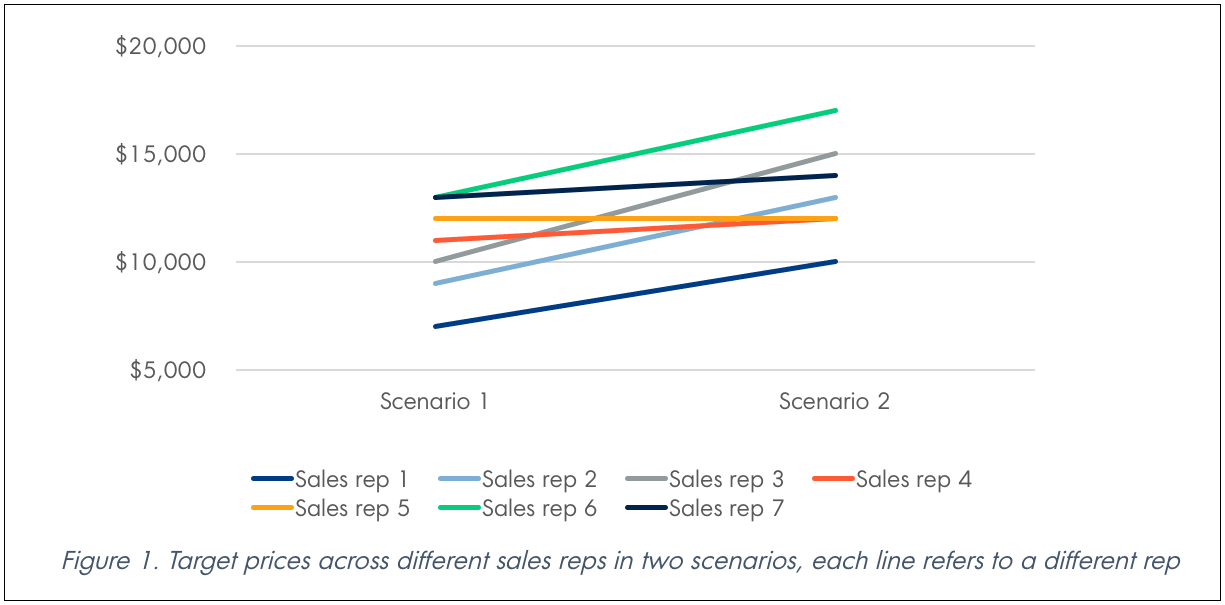
I recently polled the sales force of a later stage software company out in the Bay Area to see whether and how much these challenges held back their growth. Each rep was put through a set of sales scenarios with hypothetical customers and had to answer what would be their starting price for the deal, their target price and at what point they would walk away from the deal. I found that reps targeted wildly different prices for the same hypothetical customers. In one scenario prices ranged from $7,000 to $13,000 in ACV, in another prices ranged from $10,000 to $17,000 in ACV (see the chart below). Most reps generally knew to aim for a higher deal size in the second scenario compared to the first, but again differed on how much more they should charge.

Sales Chart

Interestingly, when I dug a level deeper I found that the best performing and most experienced sales reps (and managers) were the ones who targeted higher deal sizes. In other words, the best practices were second nature to the old pros, but never got transferred to newer or less experienced sales reps.

Imagine the financial impact if you could let the best, most experienced sales reps inspire the rest of the sales force. Doing so isn’t rocket science, you can take a page out of Flywheel’s playbook and tap into the power of transparency and (friendly) competition.

The Solution: Flywheel for Your Sales Team

For the uninitiated, Flywheel is the uber-popular indoor cycling phenomenon and SoulCycle spin off that’s sprouting rapidly across the country, hooking users on its expensive and intense classes. Flywheel differentiates itself from competitor SoulCycle by focusing on technology and performance transparency, for instance through their TorqBoard screens. The TorqBoard screens, which are visible for all to see, track exactly how each individual is performing and how they rank against their peers.

Image via LeanItUp

By making riders’ performance so transparent, Flywheel holds riders more accountable to their fitness goals and fosters a spirit of (friendly) competition. This makes it much harder to coast by with just an average workout and riders end up pushing themselves far harder than they otherwise would. You too can accomplish this performance improvement at your software company, fostering competition and building confidence across your sales force by giving transparency into what the best performers have been able to achieve.

Implementing Your Own TorqBoard

There are four fundamental steps to implementing this approach across your sales organization: segmentation, data crunching, tool building and iteration.

First, create segments of accounts that share similar characteristics. These segments should tie back to the factors that either already drive – or should drive – differences in spend and willingness to pay across your customer base. The most common segmentation criteria typically include the product line, buyer persona, company size (e.g. number of employees or annual revenue) or geography (aligning to your sales territories). It can be tempting to over-engineer the segments, but these should be kept to a manageable number with enough deal flow to draw meaningful conclusions about best practices.

Next, comes the data crunching. For each segment, analyze the distribution of ACV across recent deals to understand the best practices. A typical approach is to flag the ACV of the top 25th, 50th and 75th percentiles of deals within the same segment. Deals in the top 25th percentile are green lights – that’s what reps should be striving for and motivated to achieve. The next bucket of deals (25-50th percentile) are yellow lights – they’re perfectly fine, but not quite best practice. The third bucket of deals (50-75th percentile) are red lights – they can be done, but should be avoided if possible. Anything above that should be highly discouraged and only let through with management approval.

Third, build the transparency into systems, tools and sales enablement. This includes both the stoplights (green/yellow/red lights) so that sales reps know what ACV they should be aiming for in new deals and a ranking of reps’ performance so that there’s transparency and competition across the sales force. These should be incorporated into whatever systems, tools and documents are already in place so that they become embedded in the organization.

Finally, track the results and evolve based on what you’ve learned to continuously improve. Pending success, you can scale these ideas more broadly across a range of other business practices as well, such as sales compensation plans, pricing strategies and KPI dashboards.

If you plan to test some of these ideas, we’d love to hear from you and learn about your results!

The post Learning from Flywheel to Let the Best Sales Reps Inspire the Rest appeared first on OpenView Labs.

10 May 17:23

Cutting Your Price Has No End But Adding Value Has No Limits

by Perry Marshall
You're going to lose a race to the bottom; only the biggest firms win those. Go in the other direction, aim for the top pricing tier and watch your margins grow.
10 May 17:22

How Well Do You Know the Six Customer Experience Performance Domains?

by Annette Gleneicki

Image courtesy of ccxp.org

The Customer Experience Professionals Association (CXPA) was established in 2011 to support and to advance the customer experience profession, to set standards for the profession, and to increase the visibility of these long-unsung heroes. I’ve been a member since 2012. I’m actively involved in the association in a variety of capacities, including as an executive officer of the Board of Directors.

The success of the Association rides on its members. Volunteering for event planning committees, mentoring fellow members, or participating in the community forum are only a few examples of how members can drive member engagement and overall association success. The voice of the member is heard and incorporated into all we do. We try to practice what we preach, so to speak.

The value that the CXPA offers resides in both education and networking. Quite frankly, the two go hand in hand. Again, the association is member-driven. Members work together to share, discuss, and learn with/from others who are experiencing the same challenges in their professional roles. Through events, webinars, member calls, community forums, mentor-mentee relationships, and experts, there’s no shortage of opportunities to learn from peers.

Two years ago, the Association launched its own certification program, the CCXP, i.e., Certified Customer Experience Professional. The certification was likened to the bar exam for lawyers, giving validation that customer experience professionals have earned their stripes by completing a rigorous exam about the fundamentals of customer experience, or, as the Association refers to them: the customer experience performance domains. There are six domains that comprise the certification exam and, quite frankly, encompass what we as customer experience professionals do, talk about, and fight for day in and day out in our roles as customer experience transformists.

The following is an overview of the six domains.

1. Customer-Centric Culture
A customer-centric culture is one that encourages employees to focus on the customer. It begins with executives who are committed to the cause and talk about the customer and the customer experience before sales and acquisition. The customer’s voice is incorporated into all business decisions, i.e., how will [product, service, change, decision, etc.] this impact the customer and his experience?

Employees understand how they impact the customer experience, and they have a clear line of sight to the customer. They are trained continuously on what delivering a great customer experience means for the organization. Best practices and customer stories are shared regularly with employees.

2. Voice of the Customer, Customer Insight, and Understanding

Critical to transforming the customer experience is understanding the customer, his journey, and how well you’re performing on, or how easy it is for the customer to complete, the journey. I always say, you can’t transform something you don’t understand.

In order to understand, you’ll need to listen, characterize, and empathize. Listening to the voice of the customer (and, really, the voice of all of your constituencies) will help you learn about customers’ expectations and how well you’re performing against them. Analyze the feedback and use it to make improvements. Research your customers, identify the jobs they are trying to do, and develop personas to help the organization understand who your customers are. And map their journeys; walk in your customers shoes to truly understand the current state of the experience and the effort involved in completing some task with your organization.

3. Organizational Adoption and Accountability
Without commitment from the entire organization, a customer experience transformation is not possible. Employees drive the experience; they deliver the experience. So we need to make sure they’re on board with the things they’ll be expected to do. All of those “things” must align with business goals and desired outcomes.

Develop programs and initiatives with employees rather than forcing change on them. And whatever they’re expected to do, give them ownership. Set them free to do what they know they need to do for the customer. Empower them, but hold them accountable. Provide feedback and help them stay on the right course, if needed.

4. Customer Experience Strategy

A customer experience strategy outlines how the organization will execute on the customer experience vision. The strategy helps you define, design, and, ultimately, deliver the desired customer experience (desired, of course, by your customers). Strategy is mainly about the how, but your CX strategy may also include details about the who, what, when, and the how much of experience design and helps everyone focus on those activities or improvements that will be most impactful to your customers. (It gets everyone on the same page, marching to the same beat.) It should be aligned with your corporate strategy.

5. Experience Design, Improvement, and Innovation
We can’t do all of this work and not make improvements to the experience! This domain is where the rubber meets the road. You’ll take what you learned during listening and journey mapping and redesign the experience to meet your customers’ needs. Design thinking and customer co-creation sessions are often used to solidify the customer’s voice and place in this transformation. This domain also includes incorporating continuous improvement processes into your strategy to ensure that improvements aren’t viewed as “one and done.” Customers evolve. Needs change. Your business changes and grows. These factors must all be taken into account as you undertake any customer experience improvement efforts.

6. Metrics, Measurement, and ROI
You can’t manage what you don’t measure. You can’t track success without identifying metrics that define and measure it. Be thoughtful in your selection of the metrics, and don’t rush to tie them to employee compensation.

Important to this domain is the ever-elusive, yet oft-sought-after, ROI of customer experience. And rightly so. But ROI is important to understanding and measuring success, not just for building the case for doing something. If, in the end, we make these improvements, and there are no benefits, financial or otherwise, then the effort was wasted. No executive wants to (or will) support that.

If this all sounds like a lot of work, it is; it’s hard work. Transforming the customer experience takes baby steps. And persistence. Unfortunately, a lot of companies are still failing at the basics (they might be listening to customers, but they aren’t acting on the feedback, for example), never mind attempting to build on all six domains, and it’s the reason you feel the pain when you interact with these companies.

Good luck in your endeavors! I wish you much success.

If you’ve got any questions about CXPA membership or certification, I’m happy to answer them for you.

Buckle up, and know that it’s going to be a tremendous amount of work, but embrace it. -Tory Burch.

10 May 17:22

How to Ensure Success at Every Stage of the Partner Lifecycle

by Emily Stanford

The benefits of a channel partnership are vast, but without an effective way to manage partnerships, you’re missing out on a gold mine of value for you business. Partners are often managing multiple vendors, and they expect an effortless experience with access to instant information, personalization, and one-to-one engagement. It’s critical to partner success and sales growth that you meet their expectations so they can focus on selling your product or service.

A partner community creates a transparent bridge between two companies, combining joint business planning, shared pipeline, shared analytics, shared resources, and more, all in one easily accessible, fully mobile location.

The right partner community spans the entire partner lifecycle, from recruitment and education, to co-marketing and co-selling, to analysis. Check out the free e-book to learn more.

Recruit: According to Channel Insider, the average channel partner signs on with 2-3 new vendor programs per year. That means you aren’t the only one vying for partner attention. Consider scorecards to ensure that each prospective partner is targeted based on the same criteria, and that the same scale is used for evaluation across all prospects.

Educate: The more educated a partner is, the more likely they are to sell and become evangelists of your product or solution. A partner community enables efficient onboarding and learning by providing easy access to training modules and certification tools. The entire training process can be automated, easily guiding your new partners at every step to boost engagement.

Co-Market: The right partner community makes it easy to jointly manage marketing development funds, budget for campaigns and track co-marketing ROI. The ability to track how your marketing funds are used brings transparency to both businesses.

Co-Sell: When lead data from your partners are integrated and synchronized with your CRM, the community becomes a crucial piece of the core selling process. The community can also be the hub of sales content like whitepapers, e-books and presentations, so reps only need to look in one place to get everything they need. Collaborate easily within the community for faster lead approval, management, and distribution in a way that is transparent and fair.

Service: Nothing is more detrimental to a partner relationship than not giving partners the support they need. Partners need a single portal or source to contact product professionals for help and support. With a partner community it’s easier than ever to connect with experts to close deals — no need to try to track down a email or phone number.

Analyze: Creating a sales process grounded in data and numbers requires transparency and communication among partners. Consider sales dashboards as they allow leaders to review key metrics like an updated pipeline, deal forecasts, team quota numbers, and performance by individual reps, so every person is working with the most up-to-date numbers

Want to learn more about boosting your sales with a killer channel sales strategy? Download the free e-book, 5 Steps to Grow Sales with a High-Quality Partner Strategy.

10 May 17:09

8 Placemaking Principles for Innovation Districts

by Project for Public Spaces

PPS staff Nate Storring and Meg Walker reflect on the possibilities and challenges of placemaking in innovation districts. This article is part of the Bass Initiative on Innovation and Placemaking, a collaboration between PPS and the Brookings Institution.

South Lake Union, an innovation district in Seattle, WA

South Lake Union, an innovation district in Seattle, WA.

Increasingly, startups, incubators and accelerators around the world are clustering around leading-edge companies and institutions in dense urban settings called “innovation districts.” By creating shared value, placemaking has much to offer this emerging geography of innovation in cities. It can play an important role in an integrated strategy designed to attract, retain and cultivate talent; to improve networking and communication flows between innovators; and to make the district a distinct, memorable destination. As this article shows, by averting, sharing, and externalizing costs, quality places can also accomplish these goals with a greater return on investment than many conventional approaches.

These eight principles reflect our work with the Brookings Institution on innovation districts, combining twists on some of PPS’s well-known strategies with fresh new observations:

1. Identity: Make innovation visible and public

All too often, institutions like universities and corporate offices turn to expensive starchitect-designed buildings or public spaces to differentiate themselves from competitors and express their prestige. And all too often, these investments end up costing more than they’re worth in financial, practical, and social terms. Focusing instead on a sense of place provides a cost-effective and meaningful alternative to such expensive mistakes, and this process begins with one simple question: what are we currently doing privately that we could be doing publicly?

Yoga in Bailey Park, Wake Forest Innovation Quarter, Winston-Salem, NC

Who says a health center has to be an unhealthy place to work? Yoga in Bailey Park, Wake Forest Innovation Quarter, Winston-Salem, NC | Photo by TowniesWS 

There are many creative answers to this question. For example, a company could showcase one of the more exciting aspects of their work in a transparent ground-floor space or through programming in public space. Public spaces or coffee shops with power outlets and wifi could provide places to linger, work and think in public. With the right policies and spaces, urban-oriented startups could even test their products and services in public space. By drawing on the distinctive economic assets of innovation districts, these strategies create a one-of-a-kind identity, while the arms race of international starchitecture, on the other hand, makes Prague look like Sydney, Sydney look like Cambridge, and everywhere look like Disney.

This kind of visibility could also enhance the value of “open innovation” in such districts. As we have observed in our ongoing research on innovation in public markets, when a vendor can see what her neighbor is up to, it may prompt her to adopt her neighbor’s products or display techniques, to differentiate her products, or to collaborate with her neighbor. Multiply that dynamic by a hundred vendors, and you have an intricate, self-organizing network of economic relationships that pushes and enables each vendor to try new things. What if innovation districts worked like the very best markets—places that openly communicate the newest thinking and challenge everyone to do better?

2. Diversity: Mix innovation with a range of other uses

Although economic specialization can provide identity to innovation districts, these specializations cannot survive in a vacuum. In order to attract and retain talent, a district must also provide a reasonable amount of convenience, leisure and social uses for employees. This has long been the case, but quality of life pressures continue to rise as Millennials flock to urban places that offer choice and liveliness, and talent from abroad demands places that embrace diversity and perhaps offer a few familiar footholds.

In the mid-century geography of innovation that centered on suburban research parks, corporations attracted employees by internalized a virtual Main Street worth of uses within their fortress walls—cafeterias, gyms, game spaces, convenience stores, and even theatres, bowling alleys and beauty parlors. This trend lives on in the very biggest of our tech giants today. But such facilities require big subsidies—not because these uses must inherently lose money, but because they’re so inefficient, sitting idle most of the time. Companies like Google and Facebook, valued at hundreds of billions of dollars, can afford to balance such luxuries with other priorities, but startups and smaller suppliers cannot.

In urban innovation districts that bring together sufficient retail and multi-use public spaces (as well as residents and visitors to supplement the foot traffic of the working population) organizations can externalize and share these quality-of-life costs—particularly to the benefit of young and small enterprises. Furthermore, a diversity of small businesses can better fulfill the diverse demands of today’s workforce, while also paying their own way and building up the local economy.

3. Continuity: Start with existing people and places

The last thing that innovation districts should do is strive for a clean slate. Without any continuity in the community or urban fabric, places often lack the social capital and identity that builds up in other neighborhoods over time. This problem makes protecting existing people and places both the right thing to do and the smart thing to do.

Innovation districts are often built near (or overtop of) low-income communities, and their relationships with those communities are often tenuous, if not hostile. But the community likely has a number of assets that the district desperately needs. Long after most employees have gone home, residents are the people who can support local businesses and keep the streets lively and safe; they’re the people who attend community meetings, and band together in times of crisis; with access to educational and training opportunities, they can also provide the future talent that innovation districts need in order to remain competitive. Depending on whether or not innovation districts work meaningfully with these natural and rightful stewards of the area, nearby residents can either become either powerful allies or equally powerful opponents.

Automobile Alley, a unique part of Oklahoma City's innovation district.

Automobile Alley, a unique part of Oklahoma City’s innovation district.

The existing urban fabric has just as much to contribute to innovation districts. As Jane Jacobs once said, “new ideas need old buildings.” Rather than clearing rundown buildings in a district for new construction, or even polishing up these hidden gems, Jacobs suggested that such buildings are important economic assets as is. They add to the diversity of a neighborhood by giving low- and no-profit uses a place they can afford without subsidy. What’s more, the vernacular or historical style of existing buildings can help bolster a district’s identity, much as Automobile Alley has in Oklahoma City’s innovation district. Some pioneering developers have even found ways to conserve the affordability of such spaces while gradually improving them.

4. Sociability: Bring people together through places and programming

PPS has long considered sociability a key quality of successful public spaces, but as our colleagues at Brookings have observed, “networking assets” are also invaluable ingredients for innovation districts. “Strong ties” connect people and firms within a given field, building up a community of practice that allows deep levels of trust, collaboration, and information-sharing. “Weak ties,” on the other hand, connect people and firms more loosely across fields, and provide access to new information, new contacts and business leads outside of existing networks.

As PPS knows from over 40 years of experience working in public space, comfortable, accessible places with lots of things to do help build both kinds of sociability. They are the physical locations where formal social programming can take place, and where people unexpectedly bump into each other again and again in their daily routines. “Third places,” like coffee shops and bars, can add to this rich stew of social opportunities.

Urbanspace Gallery, 401 Richmond St W, Toronto

Urbanspace Gallery in 401 Richmond St W, one of many “third places” on the ground floor of this innovative arts and culture development in Toronto, ON.

Furthermore, as William H. Whyte observed, the best public spaces attract more people in groups. In a survey of employees and students conducted as part of our audit of Oklahoma City’s innovation district, we found that about two-thirds of serendipitous social interactions reported by respondents involved a mutual acquaintance, suggesting the need for groups in facilitating new social connections. In other words, making places that people want to share with their friends and colleagues helps generate the self-organizing network of bonding and bridging social capital so valuable to innovation.

5. Proximity: Build things close together on the ground—not just on the map

While agglomeration economics emphasizes the importance of clustering between firms, there’s little magic in simply being close together. Proximity amplifies innovation in concert with other factors like strong networking assets and a culture that accepts risk. Walkable streets with active ground floors and vibrant public spaces represent another such factor that conspires with proximity to build connections and efficiencies within the district. Great streets can make the difference between a built environment that simply puts innovators next to one another in mutually exclusive drive-in fortresses, and one where innovators meet regularly in shared spaces, both serendipitously and intentionally.

Oklahoma City's Innovation District

Oklahoma City’s innovation district lacks the ground floor uses and even sidewalks in some places to make its streets a place to meet people. Furthermore, barriers like the 235 expressway to the west, and six blocks of uninterrupted parking lots to the east cut the medical center off from surrounding neighborhoods by foot.

For example, in the same Oklahoma City survey, about two thirds of respondents considered serendipitous social interactions to be valuable to their work or research, echoing results found in Kendall Square. However, while 84% of respondents in Kendall Square reported experiencing such interactions, only 55% did in Oklahoma City. What accounts for the 30% difference between the two districts? The locations where such social interactions occur may provide a clue. While interactions in relatively walkable Kendall Square happened overwhelmingly in publicly accessible places like restaurants, plazas or the street, in car-oriented Oklahoma City, they happened more often in socially homogenous spaces like cafeterias, lobbies, and other building common areas.

Graph comparing Oklahoma City's innovation district to Kendall Square: Do you experience serendipitous social interactions in the district?

Have you ever experienced unexpected interactions with others
working in the innovation district?

Having to hop into a car and find parking, or even walking through a series of boring, empty spaces, also imposes a cost on planned face-to-face meetings. In a recent study by the Harvard Business Review, 95% of respondents agreed that in-person meetings are vital to building and maintaining strong business relationships, and for accomplishing a variety of specific tasks—from client development to negotiations to overcoming cultural barriers. While communications technologies continue to improve long-distance collaboration when necessary, research suggests that they still fail to live up to the simultaneity and subtlety of the analogue alternative. Although more research needs to be done, we suspect that the costs in money, time, and effort related to transportation mode choice likely affect the frequency of such interactions, much as it does for consumer behavior.

6. Mobility: Connect to the broader city and region through multiple transportation modes

In a recent report by the World Bank on New York City’s innovation ecosystem, researchers found that social connectedness trumped physical proximity as an indicator of a startup’s future success. This may suggest that we should emphasize the importance of sociability over proximity in our principles, however the report adds a crucial caveat to these findings. Compared to many other cities, New York City has exceptional transit and digital connectivity, which may “reinforce the importance of social connectivity compared with geographic connectivity.” In other words, in less connected places, proximity may provide a crucial venue for sociability.

However, this report suggests that multiple transportation options can broaden the benefits of innovation to the city at large. For an innovation district, solid multimodal transportation means that firms can locate in cheaper spaces outside the district while still benefiting from its assets; it means reduced costs for district firms to collaborate in person with those outside the district; and it means district employees have a greater choice of residence and lifestyle options.

Connections between local transportation networks and regional or global transportation can also give a district a competitive edge. Thirtieth Street Station in Philadelphia’s innovation district, for instance, connects the subway and trolley lines that run through the area to Washington, DC or New York within an hour and a half.

7. Flexibility: Experiment, Observe, Repeat

Since the 1980s, “Agile” has become a widespread model for software development. Most of today’s top tech startups value working software over “high quality” design, test their products with users early and often, and embrace changing requirements instead of sticking to the plan in spite of them. The economic edge that these principles provide for startups is simple: they represent “the art of maximizing the amount of work not done.”

These same principles can be applied to the design of the built environment. At PPS we call this Agile approach to public spaces Lighter, Quicker, Cheaper (LQC). In short, the most effective solutions to improve a public space are often cheap, non-permanent interventions that can be accomplished right now.

Chairs in Harvard Yard

Simply by adding moveable chairs to Harvard Yard, the university transformed this nearly 300 year old crossroads into a destination where people meet and linger. This kicked off a Common Spaces initiative of Lighter, Quicker, Cheaper interventions around campus.

Much like agile software, LQC is more about functionality than design, operations costs more than capital costs. The design can come later once you get the functionality right, and the end users—not the designers—are the experts on what functionality they want and need. Most importantly, if one idea isn’t working, it’s not prohibitive to drop it and try something new. Over time, this evolutionary approach will produce optimal results, all while avoiding the need to rectify costly, time-consuming mistakes.

8. Unity: Govern with vision and holistic, inclusive strategies

A district cannot follow any of these principles very far without encountering the issue of governance. How do stakeholders within the district collaborate and make decisions? Where does the money come from? Who has the power to implement the plans and policies? Who is going to get their hands dirty and actually do the implementing?

To truly empower placemaking as a strategy for accelerating innovation, districts must experiment with new models of Place Governance. This means breaking down silos between disciplines and addressing issues with integrated strategies of policy and place. It means planning proactively and accountably with workers, students and residents—those end users again—not just leaders and experts. It means fostering a common sense of vision for the district’s future, while also leaving room for people to make many little plans. And ultimately, it means devolving more powers, responsibilities, and funding to the district level.

These are radical changes to the way that municipalities approach governance today, however Place Governance can begin with improving public spaces. The placemaking process brings together people from across disciplines, sectors, and interests, and provides tangible little wins that form the basis of shared trust for bigger endeavors. With relatively little investment, placemaking can literally produce the common ground for a broad, inclusive vision of the innovation district.

The post 8 Placemaking Principles for Innovation Districts appeared first on Project for Public Spaces.

10 May 17:09

22 of the best companies to work for spare no expense to secure top talent

by Tanza Loudenback, Emmie Martin and Alexa Pipia

Mark Zuckerberg

When analyzing how well a company pays, salary figures alone don't tell the whole story. Instead, it's important to note how well a company pays compared to competitors in the same industry. 

Business Insider recently released its list of the 50 best companies to work for in America in partnership with compensation software and data company PayScale. The ranking took six factors into account: high job satisfaction, low job stress, ability to telecommute, high job meaning, experienced median pay (for employees with at least five years of experience), and whether a company pays above or below market price for their employees. (You can read the full methodology here.)

The last factor — also referred to as the salary delta — is reflected as a percentage showing how much more or less a company pays compared with their industry. A larger percentage means the employer pays a high premium for talent, and conversely a negative percentage would indicate employees are underpaid. 

We reranked the list based on this metric to find great places to work where employees are compensated well above market value — a premium of at least 10% — breaking any ties using the company's experienced median pay. 

With a salary delta of 25%, social media giant Facebook topped the list, followed by Microsoft and Salesforce.com in second and third. 

Keep reading to see the 22 best companies to work for who pay a premium to attract the best employees. 

SEE ALSO: The 50 best companies to work for in America

DON'T MISS: 14 of the best companies to work for if you hate stress

22. 3M

Headquarters: Maplewood, Minnesota

Experienced median pay: $85,100

Salary delta: 10%

Nearly 90,000 employees are dedicated to this industrial conglomerate's five diverse business groups: consumer, electronics and energy, healthcare, industrial, and safety and graphics. The company also offers a bevy of benefits, including on-site fitness centers, stress-management coaching, and an on-site pharmacy and medical center.


21. Intel

Headquarters: Santa Clara, California

Experienced median pay: $118,000

Salary delta: 10%

Intel wants every employee to build the career of their dreams, and it helps them do it by providing access to career advisers, networking events, certifications, and tuition assistance. Outside of the workday, employees at the semiconductor and computer-technology company enjoy perks such as on-site fitness centers, tickets to local sporting and cultural events, and discounted shopping programs.


20. NetApp

Headquarters: Sunnyvale, California

Experienced median pay: $129,000

Salary delta: 10%

NetApp, a data-storage and cloud-management company, has a slew of employee benefits that have become typical of tech companies competing for top talent, including gourmet food and on-site fitness centers, as well as coworker training programs and time off to volunteer.

Senior software engineers draw the largest salaries at NetApp, pulling in $145,000 on average, followed closely by senior product managers, who make $143,000, according to PayScale.


See the rest of the story at Business Insider
10 May 17:06

Buyers Are Deleting Your Sales Emails Because of This Huge Mistake

by lye@hubspot.com (Leslie Ye)

dumpsters.jpg

You finish the final edit on your first-touch, mass prospecting email. You make sure all your customizable fields are set -- first name, last name, and company. You check to make sure you’re pulling in the correct prospects, and then you press “send.”

Voila. 653 emails sent out and it’s only 9:05 a.m. The responses are bound to come rolling in and you should land yourself a few nice deals. Right?

Maybe in an alternate universe. While it’d be nice if the above strategy actually worked (and certainly make your job a whole lot eaiser), the reality of modern sales is that trying to write a one-size-fits-all email is a complete waste of time.

Why? Your company has buyer personas that outline what your ideal buyer looks like. Your years of sales experience have familiarized with you with the common types of business pain your customers face. Your product has a few core value propositions. Combine these three facts and you should be able to separate your target prospect list into a series of mix-and-match emails that are compelling enough to be sent to a few hundred prospects at once and still elicit a response.

While this thinking seems logical on the surface, you need to go deeper. Buyer personas, your expertise, and product knowledge can only take you so far. To craft an email compelling enough for your buyers to respond, you need to draw on all three resources and apply them to your prospect’s individual situation. And the strategy above just doesn’t cut it.

You’ve probably guessed the fatal flaw many first-touch prospecting emails suffer from: They’re simply not relevant.

Research from Vorsight shows that tailored, individual lead nurturing emails see a response rate that’s four to 10 times higher than email blasts. So while it may seem easier to send out email blasts, if you’re still prospecting by sending out mass mail merges where the only things you’re customizing are your prospect’s first name, last name, and their company, the only person you’re hurting is yourself.

While you think your email describing “challenges companies like yours face” is specific enough to warrant a response, buyers will immediately be able to tell if you haven’t put in the work of researching them first. It’s so easy to look at a Twitter feed, pull up LinkedIn updates, Google recent company information, or simply visit your prospect’s website. An email that includes zero references to any of those low-hanging pieces of information suggests one of two scenarios to your buyer:

  1. You meant to send the email to only them, but didn’t think of doing even perfunctory research. Why should they expect you’ll put any more care into developing the relationship and learning about their problems?
  2. You sent the email to dozens or hundreds of prospects, which is why you didn’t include any specific information.

Neither scenario is good for you. Either you tried to be personal but failed, or you just didn’t bother to put in the time to even try. Buyers don’t take kindly to being treated as replaceable, and they’ll take their business elsewhere.

The reason why this “spray-and-pray” technique is still employed by salespeople is simple: It’s easy. It’s easier to write one script and blast it out than to take the time to research each individual buyer and adapt a template to fit them.

But ironically, that desire to do more in less time is exactly what’s negatively impacting sales performance. You probably don’t need to send 250 prospecting emails a day. Some reps will protest and say their activity-to-close rates are low, thus requiring this type of behavior. Those reps probably don’t realize that their rates are artificially low because their prospecting is so untargeted that it’s highly inefficient. This creates a vicious cycle where salespeople churn out more terrible prospecting emails in an attempt to guarantee that X number of deals will close, which only alienates buyers and drives close rates down even further.

Sending just 35 high-quality emails will get you better results in the long run. Get really good at efficiently researching buyers, crafting templates that’ll save you time but are able to be truly tailored to your prospects, and you’ll start seeing a rise in your response rates.

Here are some resources to get you started:

HubSpot CRM

10 May 17:04

China is buying Canada: Inside the new real estate frenzy

by Chris Sorensen

Screen Shot 2016-05-09 at 2.45.26 PM

Paul Shen can tick off the reasons Mainland Chinese people buy property in Canada as surely as any fast-talking B.C. realtor. Some long to escape the fouled earth and soupy air of their country’s teeming cities, he explains, while others are following relatives to enclaves so well-populated by other Chinese expats they hardly feel like foreigners.

The richest, of course, regard homes in the West as stable vessels for disposable cash, but Shen lays no claim to such affluence. Last spring, the 39-year-old left behind his middle-management advertising job in Shanghai to seek the dream of home ownership he and his wife couldn’t afford in their home city. “We just followed our hearts to begin a totally different life,” he tells Maclean’s, adding: “We can make the house dream come true in Canada.”

The starting point was one-half of a modest duplex near downtown Victoria, close to the university where his wife is seeking a master’s degree, and priced about right for their limited means. Selling points ranged from the quiet of the street—perfect for their six-year-old son—to the stunning Vancouver Island vistas all around. High on his list, though, was Victoria’s comfortable distance from the bustling Chinese communities of B.C.’s Lower Mainland. As Shen—betraying his limited knowledge of pre-settlement Canadian history—puts it: “We wanted a place that would allow us to live with the natives.”

It’s hard not to smile at his idealism. Substitute any one of two dozen nationalities, after all, and you have a chapter in Canada’s cherished narrative of migration, settlement and shared prosperity.

But as a Chinese newcomer with a buy-at-all-costs resolve, Shen also personifies a phenomenon dividing those “natives” he’d like to call his neighbours. In the past five years, the flow of money from mainland China into Canadian real estate has reached what many consider dangerous levels, contributing to a gold-rush atmosphere in the nation’s leading cities, while stirring anger among young, middle-class Canadians who feel shut out of their hometown markets.

Its impact on Vancouver’s gravity-defying boom is the best known—and most hotly debated—example, as eye-popping price gains leave behind such quaint indicators as average household income, or regional economic activity. “We’re bringing in people who just want to park their money here,” says Justin Fung, a software engineer and second-generation Chinese-Canadian who counts himself among those frustrated by Vancouver’s surreal housing market. “They’re driving up housing prices and simply treat this city as a resort.”

Yet the amphetamine rush of Chinese cash has been felt far beyond the disappearing pastures of the Fraser Valley—especially in the last couple of years. Fully 10 per cent of new condominiums being built in central Toronto are now going to foreign buyers, according to a survey released in April by the Canada Mortgage and Housing Corporation (CMHC); veterans of the city’s rough-and-tumble real estate market believe the vast majority are mainland Chinese. On Juwai.com, an online listing service where Chinese buyers can look for international real estate, inquiries about specific properties in Ontario rose 143 per cent in 2015, with the total value of those homes hitting $11.2 billion. Quebec saw its numbers more than triple, while Alberta’s numbers rose 70 per cent.

Meanwhile, Chinese developers have made buys in locations that have left analysts scratching their heads, including Nova Scotia’s remote Eastern Shore and an abandoned mining town in the B.C. Interior. The stated reasons for such purchases don’t entirely compute (neither seems the likely site, as owners and local officials suggest, for a full-service, self-contained vacation community).

But the broader incentives are easy to see. Next to China’s own volatile real estate markets, property almost anywhere in the Western world can seem an island of financial sanity, says Matthew Moore, president of Juwai’s North American operations. “The year-on-year property increase in Shenzhen, one of China’s tier-one cities, was close to 60 per cent,” he observes. “This is about wealth preservation.” Adding to that sense of urgency: even the most privileged Chinese mainlanders have for decades been shut out of buying property, which Moore describes as the “favourite asset class” of Chinese dating back to its pre-Revolution days. This is on top of profound worries many Chinese have about their country’s overbearing political system, the lack of transparent rule of law and rampant corruption.

All of which has landed Canada in an economic paradox. In Vancouver, and increasingly Toronto, fear abounds that Chinese money has helped inflate a property balloon of Hindenburg proportions, driving house values out of reach for even well-off professionals, while raising the risk of a crash at the first sign of adverse conditions. Yet the self-same conditions are adding handsomely to the net worth of millions of homeowners, and supporting a constellation of housing-related industries, from real estate sales to interior decoration. They could be considered the main engine of Canada’s stop-and-go economy, and for those along for the ride—builders, property lawyers, revenue-hungry local politicians—the question isn’t so much what Chinese buyers are doing to the Canadian property market. It’s what might happen without them.

May 3, 2016 - Vancouver, B.C. - House for sale signs with Mandarin or Cantonese. Photo by Jimmy Jeong

A house for sale in Vancouver, B.C. on May 2, 2016. Photo by Jimmy Jeong

How far we’ve travelled down this bejewelled highway is only starting to come clear. The CMHC’s latest condo numbers tracking the ownership of condos were part of a concerted effort on the part of the Crown corporation to measure the phenomenon, based on its mandate to gather data on housing, and to foster market stability. (The agency has been roundly criticized in the past for Canada’s dearth of dependable real estate statistics.) By breaking down the numbers according to the age of the building in question, it provided the first reliable indicator of accelerated foreign buying. In Vancouver, for instance, foreign ownership of condos built before 1990 stands at just two per cent. For structures completed since 2010, that number climbs to six per cent.

CMHC’s plan now is to produce a more comprehensive report by the fourth quarter of this year, says chief economist Bob Dugan, capturing not just condominiums but all forms of residential property. But that won’t be easy. Gathering the data requires co-operation on the part of everyone from provincial property registries to local realtors—not all of whom are eager to shed light on their lucrative sources of new-found income.

Related: Just how safe is the ‘safe’ world of syndicated mortgages?

It might also require a better understanding of who constitutes a “foreign owner.” The CMHC’s current definition—an owner who does not reside in Canada—excludes all kinds of domestic arrangements under which foreigners purchase homes abroad, suggesting the recent condo numbers understate the influx of outside buyers. It’s common for foreign-based buyers to send their children and spouses here while remaining in their home country. Should such buyers be lumped in with overseas owners of income properties? Or with Chinese Canadians who spend part of the year outside the country?

Yet even the crudest measurements suggest a breathtaking upsurge in interest that would rate Canada’s big cities on par with London and New York in the eyes of Chinese buyers. National Bank of Canada economist Peter Routledge has “hypothesized” that Chinese buyers last year shelled out nearly $12 billion on real estate in Vancouver, accounting for 33 per cent of the city’s sales. For Toronto, he pegged the number at $8.4 billion, representing 14 per cent of sales.

Other analysts have dismissed the estimate, which Routledge produced by combining U.S. foreign investment figures with a survey of property ownership among 77 affluent Chinese people. But the numbers seemed to support an earlier, more controversial, study of home sales in three of Vancouver’s most expensive neighbourhoods, showing that 66 per cent of houses sold during a six-month period starting in September 2014 went to Chinese people with non-anglicized names. The author of that report, an urban planning professor named Andy Yan, interpreted that to mean the buyers were new arrivals. That assumption was enough to draw accusations of racism, but Yan was undaunted, telling CBC, “It’s about the message, not one messenger.”

Related: What’s the point of Vancouver?

At least part of the message is beyond dispute: the cash flowing out of China into assets around the world has hit tsunami proportions, driven by fears of a slowing economy and a declining currency. Estimates peg the amount Chinese investors and companies moved out of the country last year at nearly $1 trillion, up more than sevenfold from 2014. Much of that money is being spent by Chinese companies looking to snap up Western assets, such as ChemChina’s US$43-billion bid to take over Swiss seed company Syngenta, or to pay down U.S. dollar-denominated debts. But a sizable portion was directed into overseas real estate.

With diversification as the new mantra, China’s newly rich—as of 2014 there were 3.6 million millionaires in the country—are desperately seeking safer places to park their money. Most put foreign real estate at the top of their list. That’s partly due to its stability, says Jim Zhang, an RBC private banker in Toronto, whose client list includes many so-called “high-net worth” Chinese investors; it’s also born of instinctive suspicion toward their own government. “In Canada, everything in my bank account is mine, as long as I pay tax,” a client recently told him. “In China, even if the government’s name is not on my account, whenever they want my money, they’ll have my money.”

Chinese investors visit a Canadian property investment company at an international property exhibition in Beijing on May 17, 2014. (Wang Zhao/AFP/Getty)

Chinese investors visit a Canadian property investment company at an international property exhibition in Beijing on May 17, 2014. (Wang Zhao/AFP/Getty)

Fortunately for those millionaires, a thriving industry has formed to facilitate their wishes to move their money abroad—and they need not even board a plane. In mid-April, more than 40,000 people crammed into the Beijing International Property & Investment Expo, a four-day mixer of buyers eager to snag deals and sellers eager to snag deep-pocketed investors. Representatives from 31 countries attended, but many of the land-shoppers veered toward the booths covered in Maple Leaf flags. The three Canadian exhibitors barely had time to sit.

Related: The insane expectations driving the Canadian housing market

Alex Majdpour, president of Sans Souci Executive Realty, hired two additional translators to keep up with the flood of potential buyers, and came away with 100 leads. “We thought, why not take the real estate to them?” says Majdpour, whose Toronto-based company sells properties across Canada. “Why not go straight to the source?” Prospective buyers talked to the Canadian exhibitors about making purchases in cash, and expressed the greatest interest in properties located around Vancouver and Toronto. The sellers fielded repeat questions about immigration and payments, particularly how to get money out of the country. (China limits foreign purchases of currency to $50,000 per year, and has been tightening controls to keep money from flowing elsewhere. This has left lingering questions about how so many mainland Chinese have been able to afford expensive houses abroad.)

There was another factor surely lurking in the minds of prospective buyers at the expo: Canada, with its weakened currency, is on sale. The yuan is fixed to the U.S. dollar, and as the loonie fell against the greenback over the last two years, it raised the buying power of Chinese real estate buyers. “If they’re thinking of buying property in Canada now,” says Zhang, the RBC banker, “they’re getting a 25 or 30 per cent discount.”

While experts try to determine how much money is flowing out of China, there’s no question a good deal of it has come to rest in leafy Vancouver neighbourhoods, sparking anxiety and deep divides in the community. So decoupled have local house prices become from economic fundamentals that it now requires a mind-boggling 109 per cent of the average household’s disposable income to service the costs—like mortgage payments and insurance—needed to own the average home in the city, according to research by the Royal Bank of Canada. There’s no sign things are about to slow down. A recent report by real estate firm Re/Max found prices surged by 24 per cent in the city during the first quarter compared to the same time last year, and pegged the average price of a single family home at $2 million. The real estate firm noted the emergence of a vicious cycle, as intense competition for houses caused would-be sellers to hold off on listing their homes (for fear they won’t be able to afford a new one) thereby limiting the available inventory and driving prices even further into the stratosphere.

The frenzy has taken a visible toll on one of the world’s “most livable cities,” resulting in hollowed-out neighbourhoods, absentee investors, and vacant, decrepit homes as huge numbers of investment properties simply sit unoccupied. What statisticians have been slow to chart has been ruefully documented in popular blogs like Vancouver Vanishes and Beautiful Empty Homes of Vancouver, which tracks empty, multi-million-dollar character and heritage houses.

Frustration has hit a boil, and it’s been on full display at a series of “emergency” housing town halls, headlined by the front bench of the Opposition NDP. Hundreds have turned out to sit in church basements to voice their concerns, and their anger. At one held last week at St. Paul’s Church in Vancouver’s Mount Pleasant neighbourhood, a new advocacy group with a darkly intimidating acronym HALT—Housing Action for Local Taxpayers—turned up with picket signs.

Related: Can families still afford Vancouver?

David Eby, the NDP candidate running against B.C. Premier and Liberal Leader Christy Clark in the Vancouver-Point Grey riding, attends a provincial election campaign stop with leader Adrian Dix at Kitsilano Beach Park in Vancouver, B.C., on Saturday May 4, 2013. THE CANADIAN PRESS/Darryl Dyck

David Eby, the NDP candidate running against B.C. Premier and Liberal Leader Christy Clark in the Vancouver-Point Grey riding, attends a provincial election campaign stop with leader Adrian Dix at Kitsilano Beach Park in Vancouver, B.C., on Saturday May 4, 2013. THE CANADIAN PRESS/Darryl Dyck

Among the day’s speakers was David Eby. The Vancouver MLA, a lawyer touted as a future NDP leader, is among those priced out of the local market. Eby and his wife, a nurse currently in medical school, recently sold their 530-sq.-ft., one-bedroom condo in Kitsilano, which was too cramped for the two of them and their 19-month-old toddler. “A two-bedroom condo in my constituency starts at $600,000—a non-starter for us,” he says. So they’re renting a $2,700-a-month two-bedroom condo at UBC. It is, to put it mildly, a sobering thought: the man many believe could one day lead B.C. might soon be priced out of the province’s foremost city.

Eby bristles at the Boomer notion this is all just a bunch of Millennial whining. “The expectation that young people have is not as advertised—it’s not a detached home they’re after. It’s: ‘Can I have a separate bedroom for my kids?’ If you spend 10 minutes talking to any of the Millennials who are just holding on in this city by their fingernails, you’ll realize very quickly these people are anything but entitled,” he says. “They’re living in substandard rental accommodation just for the privilege of being in Vancouver, and contributing to the economy here—and they won’t do that forever. They’re going to vote with their feet.”

Last November, the 38-year-old lawyer and former head of the B.C. Civil Liberties Association helped Andy Yan, acting director of SFU’s City Program, with his headline-grabbing study on home buying in Eby’s West Side riding. In addition to the incendiary data involving Chinese names, the study revealed that 36 per cent of owners on homes worth an average of $3.05 million listed their occupations as housewives or students with little or no income. Fully 18 per cent of the 172 homes purchased were not mortgaged by banks. That means on Vancouver’s West Side alone over a six-month period last year, roughly $100 million in cash came pouring into Canada, almost all of it from China. Yet the homeowners would in all likelihood pay little or no income tax. The total value of all homes sold in the study period topped a half-billion dollars.

Predictably, when Yan’s study was published, a chorus of voices, including former developer Bob Ransford, jumped to criticize Yan: “The danger is intolerance, racism, singling out certain groups of people saying they’re to blame for this,” said Ransford. But such labels have failed to muffle the debate, particularly as more and more Chinese-Canadian voices have begun calling out white developers and academics for making the claim. Fung, the software engineer, says he’s among those “deeply pissed off” by what he considers a slur: “The only people claiming racism are white Anglo-Saxon males—that’s it. These are the same guys trying to label Andy Yan—whose grandparents paid the head tax—a racist? It’s absurd.”

Related: In B.C, a real-estate rage gets real

That sentiment is shared by Ian Young, the South China Morning Post’s Vancouver correspondent and author of the popular Hongcouver blog. Young, who is ethnically Chinese and was raised in Australia and Hong Kong, says the issue is one of money, not of race. “What defines those people in terms of their behaviour here in Vancouver, and in terms of their impact on affordability, is not their ‘Chineseness,’ it’s their ‘millionaireness,’ ” he says. “The idea that there is commonality to be found in the Chineseness—I find that kind of insulting. Why would you think that someone was better defined by the colour of their skin than the colour of their money?”

This is why Fung believes it is so vitally important for Chinese-Canadian voices to encourage a debate over the impact of foreign investment on the local market. “Chinese people have a tendency to be a little quiet, we tend to want to not create ripples—culturally it’s something we’re not comfortable with.”

1550 W 29 Street, Vancouver home with signs of exterior problems. It was on sale for 7.4 million. (Photo by Jimmy Jeong)

1550 W 29 Street, Vancouver home with signs of exterior problems. It was on sale for 7.4 million. (Photo by Jimmy Jeong)

One oft-cited culprit for the barrage of offshore money are government programs aimed at bringing wealthy foreigners to this country—namely Canada’s now-infamous Immigrant Investor Program. Created in 1986 by the Mulroney government, it granted permanent residency to any foreign citizen willing to fork over $800,000, repayable without interest after five years. In effect, Canada had a nearly two-decade run of selling passports—on the cheap. (The U.S. demanded its investor-class immigrants create at least 10 jobs each, and Australia charged twice what Canada did.)

In recent years, it became increasingly common for investor-class immigrants to set their children up in Canada to study, while the family’s main breadwinner continued to work and pay income taxes elsewhere. One federal study unearthed by Young showed that even after five years in Canada more than 60 per cent of investor-class immigrants reported no annual income earnings at all. And those who did reported earnings of just $21,000—less than that of refugees.

When the program was finally suspended in 2012, and subsequently cancelled altogether two years later, there was a backlog of some 65,000 applicants. Quebec, meanwhile, is still running its own, identical version. But very few of its investor-class immigrants actually remain in the province. Data collected by Vancouver lawyer Richard Kurland shows that 94 per cent of those who arrived in Quebec in 2008 left shortly thereafter—most bound for metro Vancouver.

David Duff, a professor at the University of British Columbia’s Peter A. Allard School of Law, calls such schemes “bizarre” since they do nothing to prevent wealthy newcomers from dodging Canadian income taxes, providing they spend less than 183 days per year in the country and maintain a residence and business overseas. “Others wonder why these folks get to be treated that way while the rest of us get taxed on our worldwide income,” says Duff, “And the consequence, as we’ve all seen, is the bidding up of house prices in Vancouver.” He’s seen it first-hand: Duff recently sold his own tony West Side home to an offshore buyer.

The old roof of the 4453 W 14 Street home in Vancouver, BC. This home sold for 2.4 million. (Photo by Jimmy Jeong)

The old roof of the 4453 W 14 Street home in Vancouver, BC. This home sold for 2.4 million. (Photo by Jimmy Jeong)

There’s another side to the story, however. Yuen Pau Woo, the former president of the Asia-Pacific Foundation of Canada, doesn’t dispute the impact of so-called “millionaire migrants” on Vancouver’s affordability crisis. But he takes issue with the notion Canada isn’t receiving anything in return. Eventually, Woo says, many wealthy Chinese who used the program to gain access to Canada seek to “align” their personal lives in Canada with their business interests overseas—if for no other reason than to minimize the stress of living apart from their families for six months of the year. As evidence, he points to the half-dozen Chinese firms, including Poly Culture Group, a division of a massive Chinese conglomerate, that he’s helped convince to set up shop in the Lower Mainland through a venture called HQ Vancouver. “Every single one has a Vancouver connection,” he says—usually a CEO or chairman who already owns a house in the city or sends his children to school there. “How many more of these kinds of opportunities are out there waiting for us to activate them?”

The silent, happy majority in all this, of course, is the thousands of Canadian homeowners who have sold their homes for an enormous profit, and the millions more watching their home values climb into the stratosphere—more than 70 per cent of Canadian households own their own home, and many are watching their property values soar with an eye to their retirement. In Richmond Hill, Ont., a Toronto suburb favoured by many Chinese investors, standard four-bedroom homes are now typically priced around $1.3 million, and routinely sell for $300,000 over asking. For now, this is a distinctly uptown economic problem.

With so much cash sloshing about, people outside Canada’s urban hot zones are understandably keen to join the merriment. Last spring, politicians and economic development officials in Nova Scotia welcomed with fanfare the purchase of a series of properties by DongDu International Group, a Shanghai-based development company touting plans for two full-service vacation resorts catering to wealthy, young Chinese professionals. It was hoped the developments would bring much-needed economic activity to the stagnant region of Guysborough County, northeast of Halifax. An additional pair of properties DongDu bought in the capital were supposed to be the beachhead for a centre of excellence for the film industry.

Draped in a souvenir tartan scarf, and accompanied by local dignitaries, the company’s founder, Li Hailin, traipsed through the grass in Guysborough last May for a groundbreaking. Since then, however, nary a shovel has touched the 1,300 hectares of land on the Eastern Shore, leaving many to wonder whether the development plans are for real. Michael Mosher, warden of the district of St. Mary’s, says his council has not yet seen a formal proposal, or a definite timeline. “Because of the state of the global economy,” he said, “they want to make sure when they launch the project, they’ve got the right timing.” A spokeswoman for the Halifax Partnership says the city’s economic development agency is no longer working directly with DongDu, noting that a memorandum of co-operation it signed with the firm expires next month. A request for an interview left with DongDu’s offices in Halifax went unanswered.

Still, even if Chinese investors are disproportionately focused on Toronto and Vancouver, there can be little doubt they’re playing a role in keeping the country’s decade-long housing boom from collapsing under its own weight. It’s difficult to overstate just how important real estate has been for the Canadian economy in recent years. A report a few years ago by Altus Group, a Toronto-based property consulting firm, estimated that home renovations alone contributed as much as four per cent of Canada’s GDP in 2014, or about $64 billion. Add in new home construction, realtors, lawyers and other associated industries and the residential housing industry is responsible for as much as 20 per cent of Canada’s economy. That’s to say nothing of the cottage industry in reality TV the country has spawned over the past decade—everything from Love It or List It and Property Brothers to the ubiquitous Mike Holmes.

With Canadians already owing $1.65 on average for every dollar of disposable income they earn, there were ready signs that domestic buyers were tapped out. The sudden influx of Chinese money over the past couple of years was akin to throwing gasoline onto a slowly dying fire. Which is why no politician in their right mind is likely to take a hard stance against foreign buyers. Says Duff, the UBC law professor, “Nobody wants to shut it down, because it’s like a drug. We always need another fix.”

The multi-trillion-dollar question for Canada’s vulnerable housing market, and the economy that increasingly depends on it, is whether China’s interest in buying Canada is a simply a passing fancy or a stabilizing long-term play. It’s one of the concerns the CMHC hopes to address by charting the behaviour of foreign buyers over time. “If investors are primarily in the market to make a quick buck—to buy a unit, make a capital gain over six months to a year, flip the unit and get out—that can be problematic behaviour,” says Dugan, the chief economist. “We would want to be able to measure to what extent that’s going on.”

Those who have studied the Chinese appetite for buying foreign properties sketch a less dramatic picture, albeit one that’s still less than reassuring. A survey of 150 agents in China by Investorist, an Australian company that markets international properties online, found the vast majority of would-be Chinese purchasers, nearly 90 per cent, have a budget between $500,000 and $1 million—not unlike many Canadians who are seeking to buy a home in Vancouver or Toronto these days. “The majority of Chinese buyers are families that can afford an investment property and possibly a second one,” says Jon Ellis, the company’s founder. “These are mom-and-pop investors who might own a car dealership or a bakery.” Moreover, the report found that most Chinese seeking to buy overseas “wish to use leverage where possible,” which may also have something to do with the need to circumvent Beijing’s $50,000-per-year limit on foreign transactions.

It all points to a group of foreign buyers that, while large and motivated, remain financially mortal, and can therefore be expected to panic alongside everyone else if Canada’s housing market begins to falter. And, as foreign money continues to flood both Toronto and Vancouver, there’s plenty of evidence of ultra-sketchy, speculative behavior that’s not limited to offshore buyers: bidding wars, properties purchased unseen and without conditions, so-called “shadow flipping” by realtors, the creation of shell corporations allowing buyers to avoid being named in transaction documents, accusations of money laundering, and unfair tax avoidance. The list goes on.

The risks for Canada don’t end there. While the turbulent Chinese economy has so far prompted China’s elite to move their money to locales perceived as safer, a full-blown crisis in the Middle Kingdom could well have the opposite effect. If offshore investors suddenly believe their livelihoods are at risk, they may have no choice but to quickly offload overseas houses and other assets in order to pay back creditors. In other words, instead of simply fretting about overzealous Canadians sparking a major housing crash, now we need to worry about a made-in-China crisis, too.

Can anything be done? In B.C., a group of economists is proposing a two per cent anti-speculation tax, which would penalize buyers who let homes sit empty. The idea is to generate a little revenue ($90 million is anticipated in the first year), but more important, to track activity: How many units are owned by people who don’t pay any tax in British Columbia? How many condo units are owned by people who don’t rent them out, and leave them vacant? How is this money entering Canada? At this point, the government doesn’t have a clue.

“If the flow starts in a clandestine way there is no way to regulate it at the other end,” says David Mulroney, former Canadian ambassador to China, adding that every time he spoke to university students in China he was asked whether it was true Canada is a haven for Chinese fraudsters. “We have no idea where the money is coming from, how it was sourced—all of it contributes to an alarming lack of awareness in the local real estate markets,” says Mulroney, current president of St. Michael’s College at the University of Toronto.

Others point to countries like Australia, which requires foreign purchases to be vetted by its foreign investment review board and approved only if they contribute to the creation of new housing stock. A similar approach has been proposed for the U.K. Ellis, however, says the policy hasn’t done much to rein in house prices Down Under, since there are many ways for determined offshore investors to circumvent the rules.

In any case, it’s not exactly Canada as the country imagines itself—cowering from foreigners willing to pay for a taste of our order and civility; wondering if the next big purchase will nudge us into social dislocation, or corruption requiring aggressive government intervention. If for no one else, you’d hope we might get ahead of the problem for the sake of Paul Shen, who’s settling into his new home in Victoria. Should such dark forebodings come to pass, the life he followed his heart to find will look eerily similar to the one he left behind.

—with files from Jessica Meyers in Beijing

The post China is buying Canada: Inside the new real estate frenzy appeared first on Macleans.ca.

10 May 17:01

3 Ways Sales Is Becoming a More Respected Profession

by Somen Mondal

sales-more-respected.jpg

When I was growing up, “salesperson” was not on the list of professions approved by my parents. “Professionals” were doctors, lawyers and engineers. That’s it. That's a mindset many other people share as well.

But after selling my first business and starting Ideal, building a startup sales team from scratch, speaking to other CEOs, senior managers, and academics, I can safely say that attitude has changed. Selling is a legitimate professional career and should always be thought of as one. 

Here are three reasons why more people should start thinking about sales as a viable, parent-approved career:

1) Educational institutions are making sales a core part of their curriculums

A profession that requires a specific educational background is more likely to be viewed as a legitimate profession. Doctors, lawyers, and engineers all have degrees in their respective fields. Twenty years ago, individuals who became salespeople often had no training at all. But it’s important to remember that “no formal training” does not mean “no skills required.” At the time, there was no such thing as an undergraduate or graduate degree in sales. Many sales professionals learned the ropes through in-house mentorship, niche training programs or simply trial and error.

sales-career.png

Today, we’re seeing the beginnings of an academic awakening, as universities start realizing that sales is one of the most in-demand and lucrative careers out there. Employers are looking for skilled and educated salespeople just as they search for marketers, accountants and consultants. 

Sales is also considered both a recession-proof and future-proof profession. Over one-third (36%) of employers plan to hire full-time, permanent sales employees in the next year. Harvard University and Queen’s College both have new sales courses offered in their business schools. Ball State University, Florida State University and many others have added majors in professional selling. I believe this trend will continue until sales courses are a mandatory part of all business degrees.

2) Sales certifications are becoming more commonplace

Most “professionals” have a designation and governing body to oversee it. Engineers share the B.E., doctors all earn MDs, and accountants are all CPAs. Each respective field has their own organization to govern the rules and processes around receiving the designation, and this standard is becoming the norm in sales as well.

In Canada, the Canadian Professional Sales Association (CPSA) governs the Certified Sales Professional (CSP) designation. The American Institute of Inside Sales professionals (AA-ISP) oversees the CISP designation. Thanks to the dedication and determination of the professionals behind these organizations, we’re well on our way to recognizing sales for the expertise it requires.

3) Public attitude is changing

I think the biggest reason sales hasn’t been seen as a profession is popular opinion. For decades, there has been a negative perception of Salespeople. Best-selling author Daniel Pink found that the most common adjectives used to describe Salespeople are dishonest, sleazy, and yuck. Wow.

We’re all familiar with the image of a slimy, used-car salesperson. We think of Boiler Room and Glengarry Glen Ross. We think that salespeople are out there to take advantage of us and trick us into buying something.

We don’t always think about the training, dedication, and talent it requires to be a top salesperson. Fortunately, that mindset is changing. With the advent of solution selling, social selling and Sales 2.0, we’re now seeing sales as a main pillar of business. On average, the sales team is about 30% of the total headcount for larger companies and 40-50% for smaller companies. Salespeople are on the frontline. They’re in the trenches. They carry the business. As the famous Harvey Mackay once put it, “Everyone is in sales. It’s the only way we stay in business.”

There is definitely a changing attitude towards sales as a profession and for good reason. Salespeople are professionals. Let’s give them the respect they deserve.

Are you looking for a sales job? Use Ideal.com, where the jobs look for you. Find your match and make more money.

HubSpot CRM

10 May 17:01

Why the sales funnel is alive and well and living on the web

by Mark Schaefer

sales funnel

By Chad Pollitt, {grow} Community Member

Do a quick search for phrases around the death of the sales funnel. There’s article after article opining that the sales/marketing funnel is dead because the buyer’s journey is no longer linear. Makes sense, right? Ok, so let’s abandon the funnel since it’s dead.

No way. You’d have to pry it out of my dead cold hands to get me to abandon the sales funnel.

Why are marketers claiming this? Because all of the articles claiming the funnel is dead are doing so under the premise that the funnel equals the actual buyer’s journey. It doesn’t, and never did. The funnel merely represents guard rails for where consumers can go on their buyer’s journey. How they decide to move within it is up to them.

The funnel model also allows us to segment and scale lead management. If you stack up all of the leads in an honest and robust CRM based on where they’re at in the buyer’s journey it will always resemble a funnel. Today, it’s useful in another way, too – it helps us prioritize marketing and sales resources.

Pre-Internet Brute Force

How do we know that the funnel never represented the actual buyer’s journey? Because pre-internet, brands were the primary gatekeepers of the content (information) about their products and services. This meant that consumers looking for information in the awareness or interest phase were force-fed lower funnel content or information by sales and marketing people.

Do you recall the “pushy sales person” persona that has been so prevalent over the years? It was that person’s job to force you out of the awareness, interest or desire phase into the action phase whether you wanted to or not. They were also the gatekeepers of the information you were truly seeking in order to naturally move through the buyer’s journey the way you wanted to.

Brands mis-prioritized the amount of time and resources they spent on marketing and sales content, too. The vast majority of resources were spent toward the bottom of the funnel. This just reflected the reality of how marketing and sales operated at the time – using brute force to move consumers to the action phase of the funnel. They were attempting to force consumers to jump the funnel.

sales funnel

Image credit: The Native Advertising Manifesto

It’s not just content production that was mis-prioritized, either. So were the resources spent of content distribution. Interruption outbound advertising led the way pushing mid to bottom funnel content into our faces. In essence, this was tantamount to asking a girl to marry you on the first date.

Brands just assumed that mid to bottom funnel content could also serve the up-funnel needs of consumers. Since there wasn’t hardly any top funnel content, it mostly did. Consumers were forced to rely, almost exclusively, on word of mouth to satisfy their up-funnel information desires.

Content developed and distributed by brands during this time was in disequilibrium with the linear guard rails of the buyer’s journey.

Zero Moment of Truth (ZMOT)

Fast forward to 2011 when Google published its breakthrough study on ZMOT. It figured out that the vast majority of consumers were doing research online before engaging with a brand to make a purchase. According to SiriusDecisions, 70 percent of the buyer’s journey is complete before a consumer engages with a brand.

sales funnel

Image credit: Winning the Zero Moment of Truth

This means that consumers are using the internet to satisfy their up-funnel content (information) needs. They’re no longer beholden to brands for the information they seek. This is also the reason that modern-day content marketing is flourishing. With the internet, brands began to see consumers share stories about their experiences with them.

A brand has two options: let others tell their story for them or attempt to steer the story by shifting marketing and sales resources up-funnel. Most have chosen the latter and re-prioritized content. In this model content production is in equilibrium with the guard rails of the buyer’s journey. But still, consumers are free to move about the funnel however they wish.

Implications 

Many brands, up until now, relied on inbound channels like search and social to drive the organic visibility they needed on their up-funnel content. For innovators and early adopters of content marketing this reliance on organic channels has been quite fruitful and will likely continue to be for some time to come, if not in perpetuity.

However, for many of the early majority to laggard brands, relying solely on organic channels isn’t driving the visibility they need for their businesses. The “build it and they will come” era for most industries is over. With social media moving towards newsfeed algorithms and reduced organic visibility it’s becoming a pay to play channel.

Add to that the highly publicized content explosion that’s happening now and many of us are wondering how ten organic positions on the first page of Google can be relied on to drive appropriate visibility. Companies new to content marketing in already over-saturated content verticals may never get the search visibility they desire due to Content Shock.

This is causing marketers to look at other new and emerging channels for content visibility. It’s this pressure on up-funnel content visibility that’s helped carve out the current native advertising landscape.

Here’s the problem, though. While brands have, for the most part, moved their content priorities up-funnel, the amount of resources spent on distribution haven’t moved up much.

The current state of content distribution looks more like the upside down funnel below in terms of prioritization and resources spent. Because of this, paid distribution priorities are in disequilibrium with content creation priorities.

This isn’t an issue for many of the innovators and early adopters because they have substantive domain authority and are still heavily rewarded by organic channels.

sales funnel

Image credit: The Native Advertising Manifesto

As the early majority to laggard brands begin to figure out their distribution priorities are in disequilibrium with their production priorities we’ll start seeing major growth in spend on native advertising. It’s already being widely predicted, too.

The build it and they will come days are over for most brands. As are the days where all sales people were trying to force us to the action stage against our will. Today, most consumers are free to move about the funnel as they choose. Most brands have or are working on aligning their content to the guard rails of the funnel. And now the paid distribution channels are just starting to move into equilibrium with content production.

Long live the marketing and sales funnel!


Chad PollittChad Pollitt, a decorated veteran of Operation Iraqi Freedom and former Army Commander, is VP of Audience and Co-founder of Relevance, an online publication solely dedicated to helping marketing and communications executives solve their online content visibility challenges. This post has been a preview of his latest book, The Native Advertising Manifesto, which is available for free to download.

Illustration courtesy of Flickr CC and ge-org

The post Why the sales funnel is alive and well and living on the web appeared first on Schaefer Marketing Solutions: We Help Businesses {grow}.

10 May 17:01

B2B Sales Cycles are Getting Longer—And That’s Okay

by Tal Vinnik

If in the past year you’ve sensed the B2B sales cycle becoming longer, you weren’t imagining things. Today’s B2B companies are coping with longer sales cycles due to a number of factors, starting with changing buyer behavior. For example, there are more channels with which to engage customers and an always-connected environment that prompts far more extensive research than what used to be possible.

Your potential customers are more content-hungry than customers of the past, leading to longer B2B sales cycles

Your potential customers are more content-hungry than customers of the past

Furthermore, buyers are more aware of risk and fearful of making a bad decision. This has prompted some companies to devise increasingly complex and collaborative buying processes. Budgets are still scrutinized closely despite an expanding economy, and the sheer number of choices for buyers can make moving forward through the B2B sales cycle slower. But this isn’t necessarily bad for B2B companies. Here’s why:

In Some Ways, B2B Marketing Has Become Easier

More of the B2B sales cycle takes place before the buyer ever interacts with a sales representative. In this sense, B2B companies may find marketing easier. Buyers are primed to do serious research when making purchases (which on the flipside challenges for B2B salespeople). When B2B companies make this research convenient, engaging, and up-to-date, certain aspects of marketing can look after themselves, at least for some of the time. And, of course, technology gives us many ways to connect with leads, so worries like playing phone tag are less of an issue. But despite certain aspects of the B2B sales cycle being easier on marketers, new challenges have emerged.

In Some Ways B2B Marketing Has Become Harder

As the B2B sales cycle has lengthened, the marketing professional must now track and analyze more steps in the buyer’s journey. The increase in the number of steps in the sales cycle means more opportunities to engage potential customers, but it also means learning how to serve them flawlessly at each one, including optimizing sales collateral that salespeople distribute. In many ways it’s an ongoing process, as technology, markets, and customers continue to evolve.

Ultimately, B2B companies that learn the details about the steps in the sales cycle and that commit to producing fresh, original content that reaches potential customers at each may expend more energy up front, but long-term gains should make it worthwhile.

Content-Driven Presence Is for the Long Term

Content marketing for B2B isn’t simple or easy—there’s a lot that you can do wrong. Reaping the rewards of a long-range content marketing plan may take time. Short-term gains wrought through hard-driven pursuit of meeting monthly or quarterly numbers may be a cold comfort later on. If you take that approach, when you’re struggling to build and maintain an audience, your competitor will enjoy engaging with the long-term audience they’ve painstakingly built.

A content-driven presence is about both quantity and quality, and it requires commitment. But the data consistently point out that this approach meets customers as they are now, giving them what they want and what they need throughout the B2B sales cycle.

Perfecting Your Follow-Up Game

Follow-up has always been important in sales. With the B2B sales cycle lengthening, it’s more important than ever. A sale that may have moved toward closure after a couple of follow-ups may now require four or five follow-up contacts. Yet, many sales professionals give up after a single follow-up. Of course, sometimes both parties realize a product or service isn’t the right fit, so there’s no sense in wasting everyone’s time. But the B2B companies that succeed today understand the critical importance of following up with customers multiple times.

The B2B sales cycle is getting longer, but that isn’t necessarily a bad thing. A lengthening sales cycle forces B2B companies to more closely examine the steps of the cycle, to take a hard look at their content marketing strategy, and to evaluate how thoroughly team members follow up on contacts. Having the right content at the right time is table stakes now. Building the connection between the sales team member and the prospect is a carefully choreographed dance, but sales professionals who are equipped and willing to take those extra steps are the ones who can make the most of the lengthening B2B sales cycle.

Learn more about the emerging role of sales consultants in the lengthening sales cycle with Mediafly and Forrester’s webinar below!

New Call-to-action


10 May 17:01

If Cold Calling is Dead I Guess My Client Didn’t Really Secure This Dream Prospect Meeting

by Mike
inconceivable

I had an experience with one of my client’s top salespeople that prompted me to break out a favorite Princess Bride quote. Like many of you, I’m tired of hearing from today’s nouveau sales experts that prospecting is Dead; that it’s foolish and stupid to even think about picking up the phone to proactively call a prospect who hasn’t yet raised their hand or asked you to call.

I get that prospecting and identifying your own leads and new opportunities is hard. And unpopular. And that the phone isn’t cool anymore. But enough already with the deception and lies (yes, I meant to use the word lies).

They can call prospecting Dead all they want, but just like when Inigo Montoya calls out Vizzini (pictured above) regarding his use of the word inconceivable, isn’t it time for us to bark back at the  fools who incessantly proclaim that cold calling is Dead?

“They keep using that word. I don’t think it means what they think it means.” 

I don’t care which blue-chip research firm, or how many “studies,” the prospecting is dead crowd cite. Because my own eyes and my own real experience in real companies prove otherwise. I’ve shared these stories occasionally before, but my experience last week was priceless. I accompanied a top salesperson on a trip to the west coast for an initial/discovery meeting with one of his largest named dream prospects. There were three of us from my client (the salesperson, the subject matter expert executive, and me). We meet with three key management personnel from the prospect. We had 90 minutes and it could not have gone better. We learned exactly what we needed to. We built credibility; we created an opportunity, and both sides agreed on appropriate next steps. We were thrilled with the outcome.

Do you know how this salesperson secured the meeting with this dream prospect? Yep. He picked up the phone and called her. And she answered! They spoke for a couple minutes. He did what people who know how to prospect do (see New Sales. Simplified. if you’re note sure what that means) and he secured the meeting.

So prospecting is Dead? It’s foolish and fruitless to use the phone? “They keep using that word (Dead). I don’t think it means what they think it means.” 

Additional Resources:

Mkt Book Podcast1.  If this topic (prospecting and proactive selling) interests you, check out this engaging dialogue with Douglas Burdett of The Marketing Book Podcast. This might have been the most fun interview I’ve done as we tackled everything from inbound vs. outbound, the straw man statistic that buyers go two-thirds through their process before engaging a salesperson, how to get get a prospect’s attention, and many more new business development best practices. Doug tells me that this episode has been listened to more than any of the 65 he’s published. Hmmm. Maybe everything has not changed in sales…

sales development playbook

2.  I’m currently reading The Sales Development Playbook by Trish Bertuzzi of The Bridge Group. I can unequivocally state that this is the best-written book I’ve read in years. Trish is succinct, funny, pointed and absolutely brilliant as she tackles this very hot topic. If you’re even thinking about sales development, SDRs, BDRs, or anything remotely related to building or leading a team of inside reps, you must read this book. I’ll do a full-blown review down the road. But don’t wait. There’s a reason this book is so hot and has such strong reviews on Amazon. Go grab this thing.

HBR-Logo13.  Last month Harvard Business Review had me lead a webinar for senior executives and sales leaders based on the major themes from Sales Management. Simplified. If you’re looking for some blunt truth about the leadership reasons hindering sales performance and a simple framework to get exceptional results from your sales team, the replay was just posted and you can access it here.

09 May 17:12

Panama Papers: Here's where some of the world's largest banks legally hide cash for rich clients

by Lianna Brinded and Will Martin

scary china tibet mask

The International Consortium of Investigative Journalists just published a huge database about how some of the world's wealthiest and most powerful people legally hide their cash — dubbed the "Panama Papers."

Nestled within the database of 200,000 companies, trusts, foundations, and funds incorporated in 21 countries, is information about where many of the largest banks around the world legally shelter cash for rich people.

The findings of the so-called Panama Papers investigation were first unveiled at the beginning of April. 

Over 11 million documents held by the Panama-based law firm Mossack Fonseca had been leaked to the German newspaper Süddeutsche Zeitung. The paper shared the information with the ICIJ, which is made up of 107 media organisations in 78 countries.

The global news outlets examined 28,000 pages of documents, also revealing the full scale of the tax breaks won by 340 companies. The ICIJ published this statement on their website along with the documents: "There are legitimate uses for offshore companies and trusts. We do not intend to suggest or imply that any persons, companies or other entities included in the ICIJ Offshore Leaks Database have broken the law or otherwise acted improperly."

The details of the investigation have already claimed the scalp of Spain's acting industry minister Jose Manuel Soria and Icelandic Prime Minister Sigmundur David Gunnlaugsson — both of whom stepped down because of activities exposed by the Panama Papers documents.

Business Insider took a quick look at what offshore entities banks and their subsidiaries are using to shelter cash. We have taken a spider map for one of the selected bank's units as an example. Each green dot represents an offshore entity with associations to the bank or bank subsidiary:

UBS AG London — 43 offshore entities. There are 29 UBS units and people listed in the database as having offshore entities or being a director of one.


Royal Bank of Scotland — 1 offshore entity. It's called Yellow River Investments Limited and has 17 other master clients. There are only two RBS units that are linked to offshore entities.


HSBC Private Bank (Suisse) SA— 18 offshore entities. There are 63 HSBC master clients and officers related to offshore entities in total.


See the rest of the story at Business Insider
09 May 17:08

Turn Your Bullet Points Into Career Stories to Make Your Resume More Compelling

by Kristin Wong

You want your resume to stand out. At the same time, you don’t want it to be unconventional to the point that it confuses recruiters and they pass over it . One way to boost your resume and still make it easily skimmable: tell a quick story.

Read more...

09 May 17:01

10 Things Our Grandparents Can Teach Us About Social Media

by Rhonda Bavaro

10 Things Our Grandparents Can Teach Us About Social Media

Your grandmother hasn’t logged into her Facebook account since you set it up for her in 2009 and your grandpa thinks Twitter is a TV channel for bird watchers. What could they possibly teach you about social media? The answer… A lot. Hear me out.

We all know social media is meant to be “social”. But in our rush to scroll through our feed we forget the reason we logged on in the first place – to connect – to each other. We need interaction. It’s good for the soul and for business. And, in our efforts to be noticed we often forget to be polite, kind and gracious.

This is where your grandparents come in.

Remember when they taught you the value of being polite. The phrase, “you catch more flies with honey than with vinegar” comes to mind. Remember how they interacted with their friends and neighbors? Recall how they interacted with the grocery store clerk, their pastor, and their business associates? They didn’t shout “Look at me, I have the most interesting, cynical, and wise remarks!” They certainly didn’t expect anything from people they hadn’t even gotten to know yet. They built relationships based on trust and mutual interests.

So, let’s take a few lessons from our grandparents and put the social graces back into our social media interactions.

10 Things We Can Learn from our Grandparents About Social Media:

1. Make A Good First Impression

What’s the first thing people see when they find you online? Your profile. Take a few minutes to review your profile images and descriptions on all your social channels. You may not have touched your profile on some channels since you set up the accounts. Update your photo and add some new information about yourself and your business. Now go a little deeper. Does your profile reflect you in a professional light? Does it reflect your brand? Check out this great article with 10 Elements of a Successful Social Media Profile for practical steps for improving your profile.

2. A Handshake And A Smile

When you meet people online, an introduction – a virtual handshake and a smile – can go a long way to establishing a relationship. Thank your new followers for taking the time to follow you. It’s the first step in becoming more than just an anonymous account. Now you “know” each other and name and profile image recognition will start to happen. Your followers will start looking for your updates because they feel a personal connection with you. All because you took a few seconds to introduce yourself. Sound too time consuming? Plan 15 minutes a day to send quick introductory messages to your new followers. Then see what happens!

3. Listen More Than You Speak

How many times a day are you posting vs. how much time are you spending reading other people’s content and interacting? If you’re pushing a lot of content, but not giving back by interacting with other people, then you may want to reconsider your approach. The way to build relationships on social media, as in life, is to listen (or watch/read in this case) and engage. Let those you follow know that they are being heard and understood. If you take the time to react to people’s content, you’re going to get noticed. You have to be a friend to get friends.

4. You’re Only As Good As Your Word

Before you hit “share” or “publish” take a few seconds to think about what you’re sending out into the world. THINK… Is it True, Helpful, Inspiring, Necessary, and Kind? Post with integrity and honesty, and be known as a source of helpfulness. That goes a long way to building a positive online reputation as a thought leader and influencer.

5. Never Air Your Dirty Laundry In Public

Social media is full of rants, public temper tantrums, and hurtful content. And, once you’ve vented publicly you can’t take it back. Social media has become a place for people to put a spotlight on their bad behavior. Putting the hashtag “#nofilter” after a rant has become the norm. As if the world is supposed to just accept rudeness and disrespect because we’re all just “being ourselves.” My grandma didn’t raise me that way and if grandma doesn’t approve it’s not going on social media! Keep your social image clean so you don’t have any regrets later.

6. Patience Is A Virtue

So, you have been following the above and now you’re waiting for all the followers and likes to roll in. Give it time. Social media relationships take time to develop. It’s a long-term strategy built on authenticity and mutual gain. Look for opportunities to be of service to your followers, then offer your services or help. Let it build naturally. This workbook will help you.

7. There Is Such Thing As Too Much Of A Good Thing

We all love chocolate cake but wouldn’t eat the whole thing in one sitting! Social media can be very time-consuming. It’s so easy to get lost down the rabbit hole scrolling through your Facebook feed or pinning organizational tips. Be mindful of how you’re spending your precious time. Set a limit on your daily social media consumption. You’ll feel less full but more satisfied.

8. Check In On Your Neighbors

Yes, social media is amazing at helping us reach an audience wider than we can even comprehend. However, are you relying too much on social media for your marketing? Are you forgetting to develop relationships and nurture leads using other avenues that are more personal? Sometimes you just have to pick up the phone and say, “Hey, I was just thinking about you.” In an effort to reach all of the “potential” online customers that are in our extended network, we sometimes forget those that are not online. Believe it or not, there are still people that prefer to do business the old-fashioned way – in person or over the phone. Good customer service never goes out of style with those folks so connect with them personally and treat them like gold. You’ll be richly rewarded when you do.

9. Share And Share Alike

There is no better way to say that you care about something you’ve read or watched on social media than to share it. Spread the good news so others can benefit from the information. Be generous in how you share your own talents and knowledge as well. Creativity and wisdom are infinite and grow the more they are shared. Abundant thinking leads to a life of abundance. So, if it’s good quality info that others can benefit from don’t hoard the information, hit the share button!

10. Don’t Forget To Say “Thank You”

Those 2 simple words go a long way in building relationships online. Thank your followers for the shares, likes, follows, retweets, and repins! They are doing a lot of the work for you and a simple acknowledgment and show of gratitude will set you apart from the thousands of other accounts in your niche.

So, take these life lessons with you into your social media interactions. You’ll make your grandparents proud.

Social Prospecting

09 May 17:00

Build Your Brand as a Relationship

by Mark Bonchek
may16-09-42181452

The way we think about brands need to change. In the past, they were objects or concepts. You had a relationship with a brand. But in this social age, brands are the relationships. By defining a brand’s particular kind of relationship, companies can create greater engagement, differentiation, and loyalty.

To understand this new mental model for brands, it is helpful to see how the concept has evolved. A brand started out as an identifying mark. Cattle owners would “brand” their cattle to indicate ownership. We can still see the “brand as object” model in the American Marketing Association’s definition: “Name, term, design, symbol, or any other feature that identifies one seller’s good or service as distinct from those of other sellers.” In this view, a brand is something applied to what you make.

In the next wave, a brand shifted from a feature to a perception, from an object to an idea. Al Ries and Jack Trout capture the essence of this model in their classic book Positioning: The Battle for Your Mind. They define a brand as “a singular idea or concept that you own inside the mind of a prospect.” In this view, a brand is not something you make, it’s something you manage.

The most recent wave focuses on brand as experience. Sergio Zyman, in The End of Marketing as We Know It, says: “A brand is essentially a container for a customer’s complete experience with the product or company.” A brand is not something you manage over time. It’s something you deliver in the moment.

Our experience working with innovative companies indicates they are redefining not only how their brands are observed, perceived, and experienced. They are also redefining the very nature of the relationship they have with their customer.

If the first three waves were brand as object, idea, and experience, the next wave will be brand as relationship.

The way to put “brand as relationship” into action is by defining the respective roles and responsibilities of the company and customer. The default brand relationship is provider/consumer. It’s a simple relationship that is one-directional and asymmetrical. The company provides the product or service, and the customer consumes it.

Brand innovators tend to create different kinds of relationships. Instead of transactional and one-directional relationships, the roles are more collaborative and reciprocal.

For example, in the hospitality industry most brands operate with the roles of host/guest. It’s one-directional, asymmetrical, and transactional. Airbnb has disrupted that model. With a mission of “belonging,” Airbnb has cultivated a neighbor-to-neighbor and citizen-to-citizen relationship on a global scale. It is reciprocal, symmetrical, and collaborative.

In the taxi and livery industry, cabs and limo services have operated with the roles of driver/passenger. Again, it’s one-directional, asymmetrical and transactional. Uber and Lyft established differentiation by introducing new roles along two dimensions. The first is a shift from driver/passenger to friend/friend. For example, Lyft passengers are encouraged to “sit up front” as if they were getting a ride from a friend. According to Kira Wampler, CMO of Lyft, “Our original tagline was ‘Your Friend with a Car’ which served not only to describe the human, peer-to-peer experience we delivered with Lyft but also to differentiate us from other private driver approaches.”

Another new brand role is entrepreneur/supporter. Uber encourages potential drivers to “build their business” on Uber. In both these cases, the brand relationship is more reciprocal and personal. As Amy Friedlander, Head of Experiential Marketing at Uber describes it, “Working with Uber is about our drivers’ needs, whether those needs are to have a fully flexible schedule or earn extra money. Uber is a platform that fits their lifestyle, not the other way around.”

In the airline industry, innovators have also redefined the brand roles. The established players like United and Delta have operated with a brand relationship of flyer/passenger. But Southwest broke the mold with singing flight attendants and a relationship that might be described as “fun friends.”  JetBlue, with its free snacks and mission of “Inspiring Humanity,” has a “human-to-human” relationship.

Virgin America went in a different direction, creating a brand relationship that is a cross between the hip friend and host of the party. The relationship is perhaps one reason Virgin customers are so upset by the sale of the airline. As one Virgin fan said, “I think of Alaska [Airlines] as more of a friendly aunt.” The sale is like someone busting up the party and telling everyone to go home.

The concept of brand-as-relationship also helps explain the rise of well-established market leaders. American Express redefined the relational roles of its industry from card issuer/card holder to club/member. Disney redefined the relational roles of amusement parks from operator/rider to cast member/guest. And Starbucks redefined not only the role of the server from waiter to barista, but the role of the coffee shop from restaurant to community hub.

Those familiar with brand archetypes may see some similarities to this approach. The difference is that in brand archetypes, the focus is on the attributes of the brand. But in the model proposed here, the focus is on the relationship that people have with Nike. As an archetype, Nike is a “Hero” brand because of its focus on victory. But Nike’s brand roles are best described as coach/athlete.

Marketers have an opportunity to redefine brand roles in every industry. Media has been defined by broadcaster/viewer for decades. Health care has been defined by doctor/patient. Education has been defined by teacher/student. In each of these industries, there is an opportunity to create a new relationship based on co-creation and collaboration.

To get started, think about the relationship people have with your brand today. Frame your answer as social roles. For example, if you are a health care provider, you probably have a brand relationship based on doctor/patient. Now think about other kinds of relationships outside your industry. For example, in health care there are aspects of teacher/student (to educate), coach/athlete (to motivate), or guide/traveler (to navigate). Be sure to consider roles that are symmetrical, like friend/friend, neighbor/neighbor or co-creator/co-creator.

Another strategy is to work backwards from the kind of relationship you want to have. Think about the value and benefits of your product. Then imagine the human relationships that would provide the same type of benefits. Nest thermostats, for example, automatically adjust the temperature to your liking, and their smoke detectors calmly direct you to safety in the case of a fire. Instead of the usual role for a device maker of manufacturer/buyer, Nest has created a brand role of being part of the family, looking out for you in an attentive and protective way. “Instead of thinking about George Jetson’s ‘smart home’ we imagine a home that is humanized and takes care of the people inside it and the world around it,” says Doug Sweeny, CMO of Nest.

Finally, look for ways to shift your brand roles from one-directional, asymmetrical, and transactional to reciprocal, symmetrical, and personal. These roles will bring to life your strategic narrative around a shared purpose. If today’s brand innovators are a guide, the result will be greater engagement, differentiation, and loyalty.

09 May 16:59

The Unique Challenges of B2B CX

by Martin Mehalchin

B2B CX presents unique challenges

While Voice of the Customer, Journey Mapping and other key techniques used by Customer Experience professionals can be equally useful in both Business to Business (B2B) and Business to Consumer (B2C) scenarios, anyone who has worked in a B2B business for more than a few months knows that B2B presents unique challenges. Rarely can you cut and paste a B2C strategy into a B2B business.

Here are 4 key factors that make B2B CX different:

  • In B2B scenarios, there is rarely one buyer. The average B2B transaction involves over 5 buyers[1]. The customer experience for each of these people can affect their likelihood to promote or block a sale, greatly increasing complexity in the overall relationship. Some B2C transactions can involve multiple buyers, for example the purchase of a family home or car, but these types of transactions are usually seen as the exception, not the norm.
  • The B2B buyer and end user are usually different people. The procurement officer is rarely the end user of the products and services they procure. More often than not, the buyer and the user have very little personal connection, beyond organized feedback about the product and service. This is in stark contrast to most B2C transactions where most products and services are purchased by the user themselves or someone very close to them.
  • B2B Customer Journeys tend to be even less linear than in B2C. In the rare B2C cases where more than one buyer is involved, the experience is usually considered as shared between the buyers. (In the example above, when a couple purchases a home, the buyer’s journey is usually seen as being roughly the same for both people.) But in B2B the group of buyers usually has specific roles assigned to each person in the group. Accounting may control budget, operations may control fulfilment, integration sits with IT and the final decision maker might be up in the C-suite. The whole process can take months for a complex transaction, with each role coming into play at different times. In addition, B2B relationships tend to exist across channels that are specific to individual functional areas. The challenge for the supplier company is to present a holistic brand across all these touchpoints and channels – but to do it in a way that is relevant for each player. For these reasons, B2B customer journeys tend to look like several parallel streams connecting for key decisions or use cases, rather than a simple path to purchase.
  • A B2B customer experience typically extends well beyond the time of purchase. Many B2B relationships involve long-term service arrangements, subscription services, upgrades or continuous supply of consumables. Even when there are no longer-term services associated with the initial purchase, there are strong motivations for B2B customers to be seen as accounts to be nurtured, rather than (heaven forbid) one-time, anonymous buyers of a simple product. While B2C brands should (and often do) consider their customer’s experience beyond the initial purchase, it is absolutely critical in the B2B space. In some cases, a good overall experience can overcome a mediocre product and a poor experience can erode the advantage of a superior product.

So how do B2B CX pros go beyond the standard toolkit to deliver great experiences? A few approaches we’ve seen work are ecosystem mapping, customer-centric implementation approaches and shifting from account management to customer success management. We will discuss some of these in future posts and in the upcoming second edition of The Art and Science of Customer Experience.

  1. [1] https://www.cebglobal.com/blogs/sales-why-you-should-teach-customers-how-to-buy/
09 May 16:59

10 Tips to Make Your Sales Emails 10X More Effective

by claire@hellosign.com (Claire Murdough)

sales-emails-10x-effective.jpg

Imagine this: You’ve just received a new email, adding yet another to the 200 messages already crowding your inbox. But once you start reading, you realize this email feels a little different from the rest. The formatting on your name is a little off and some guy you’ve never heard of before is writing to you as if you’re old pals. 

Congratulations. You’ve been targeted by automated email outreach -- and not the good kind.

Email prospecting is clearly a valuable strategy for sales reps. Unfortunately, it’s often poorly managed and poorly customized. Done right, however, it opens doors that would never otherwise be cracked. 

10 Easy Improvements to Make to Your Sales Emails

1) Eliminate “I know how you’re feeling” statements. 

We’ve become so accustomed to beginning our emails with, “I know how you’re feeling” or “I know what you’re thinking.” The problem is, we usually don’t. And when we assume we’re speaking to a prospect’s pain points, we run the risk of missing the mark by a mile. 

Try this instead: “This [piece of content] was interesting to a colleague of mine in your field. Wanted to share it in case it resonates with you, too.” 

2) Prioritize clarity over cleverness.

“A prospect walks into an email …”

What do you think? Should I continue down this road? Nine out of 10 people will probably say no.

Humor is an excellent addition to any relationship. It just shouldn’t be the main point of your outreach emails. Start out by showing buyers you’re a trusted professional who’s there to support their actual business needs.

Be diligent about the purpose of each line in your email. Try reading through an email and asking yourself, “What’s the main point I’m making in this sentence?” If there’s no compelling reason for the sentence to be there, or it’s for laughs alone, cut it. If there are multiple sentences making the same point, combine them. This will trim extra words and keep you on target. 

3) Include something a prospect can’t find on Google.

Think of the most popular person at a party. They usually have something that draws people to them, even if it’s not initially apparent. More often than not they’re appealing because they have something compelling to offer. Something that no one else has. 

The same can be said of effective outreach emails. Emails that can offer a bit of value beyond “Want to talk to a stranger on the phone?” -- whether it’s a statistic, tool, or resource -- are the ones that will engage a prospect more effectively.

So take the opportunity to demonstrate something. Link to a demo. Offer something (resources, content, a survey) besides a strong-arm tactic to start a conversation. Something, of course, that can’t simply be Googled.

4) Acknowledge that you’re strangers.

In email outreach, we often work under the assumption that people will be receptive to traditional relationship building techniques. So if we’re friendly and approachable, we expect the same courtesy. And if a prospect doesn’t respond or if they’re curt, we get frustrated.

But if you stop to think -- do they really have a reason to trust a stranger yet? Not really.

When introducing yourself, be clear that you aren’t intimately familiar with them and avoid any of the “shady” sales behaviors that destroy buyers’ trust (if you don’t know what I’m talking about, just visit here).

5) Get peer feedback on your emails.

It’s amazing how infrequently sales teams take advantage of peer-to-peer editing. Emails are usually written and edited by a single person and maybe their manager. But peer networks are pure feedback gold.

Send your email drafts to your team and ask for opinions. What sounds off? What sounds weird? What sounds a little crazy or creepy?

As people who get emails from SDRs or sales reps from other companies, your peers most definitely have an opinion on what resonates and what doesn’t. Gather and use the additional perspective. 

6) Test your emails by sending them to yourself.

Sending an email draft to a team to get feedback is incredible. But sometimes you don’t have the luxury of doing this. So at the very least, send the email to yourself. Format as you would for your regular outreach, put your email in the “To” line, and hit “Send.”

Having an email display as it would in your prospect’s inbox will give you a better sense of what they’ll see. Step in their shoes as you click it open and scan it. Nine times out of 10, there will be a few things you want to change or improve. 

We’re our own worst critics. Use it to your advantage in this case.

7) Add something of value to your signature.

Your sign-off is a part of your email, but it’s often left a blank canvas. Add a video to your signature. Media. Anything that could tell them easily what you do and how you do it.

One word of wisdom -- be selective about what you add to the signature. Some signatures get so stuffed with information they could practically be considered biographies. Start by including your name, title, and company. Then be judicious in what you add on so you don’t overdo it.

8) Proofread.

I almost feel embarrassed to add this one, but it must be included. Why? Because outreach emails are often rife with typos. Worse, some of these typos show up in the prospect’s name and/or company name.

So just take a minute to look at your emails again. If you need help spotting grammatical errors, pass it by another set of eyes. Double check prospect names for capitalization, the company name for capitalization, spacing, and CamelCase.

Grammarly is a great tool for helping to double-check, though there’s no substitute for a careful detailed-oriented eye.

9) Read your draft out loud.

You can expect 90% of your readers to begin an email by skimming through it.

Overly complicated sentences or verbose introductions become obstacles for readers. Don’t exhaust your prospects’ mental patience before they have a chance to get to the point. 

One of the most effective ways to stress test a piece of writing is to test it as an oral piece. Read your email out loud. Notice where you stumble. Take note of sentences that go on forever. Edit accordingly. 

10) Draft wildly different emails.

We’re creatures of habit. So when we sit down to write a new draft, we fall prey to producing emails that use the same syntax and the same pacing. Or we try to Frankenstein something together using old emails, copying and pasting until we have a beginning, middle, and end, regardless of whether that beginning, middle, and end flow well together. 

I challenge you to write one email as you normally would. Then write a wildly different email that uses an entirely different approach. Not only will this help you create a good sample pool of templates to test, it’ll give your brain’s creative muscles a much-needed workout.

Drafting completely different emails will also get you out of the habit of trying to write “one-size-fits-all” emails.

When we think about building relationships, we don’t usually think about how we can net 1,000 best friends using one, scripted conversation. So why do we try to land 200 prospects by sending them the same email? 

Instead of trying to craft the perfect subject line or template that will attract every person on the planet, think in terms of segmentation. Ask, “What might work with this particular segment?” Narrowing your focus only broadens your ability to connect authentically with a group of people. 

The sales reps that succeed are the ones who are willing to adapt and learn from their experiences. Use these tips to improve your current email outreach. Be ready to test, assess, and iterate. And keep me posted!

Check out the HubSpot/HelloSign integration here.

HubSpot CRM

09 May 16:59

7 Effective Sales Prospecting Email Templates That People Will Want to Open

by lye@hubspot.com (Leslie Ye)

I know how hard it can be to get started on a project when there’s no guarantee of success and every possibility of failure. When I’m reaching out to potential clients, I have to psych myself up and remember the why behind my outreach.

Prospecting can sometimes feel like talking to an empty room — especially if you’re using outdated sales tactics that make buyers roll their eyes. Having a string of unreturned calls and unanswered emails is discouraging, to say the least. But the best antidote to dead-end prospecting is better preparation.

I spoke with several experts to learn more about their approach, and I’ve gathered their advice along with my own expertise to share some practical tips for writing a prospecting email that stands out. (You’ll also find some templates you can try out today, but don’t forget to personalize them!)

Download Now: 50 Sales Email Templates  [Free Access]

Table of Contents

Prospecting emails are also sometimes referred to as “cold emails” if they‘re sent to a recipient the salesperson has never interacted with. While you might have to send a cold email every now and then, I believe it’s best to send outreach or prospecting emails to recipients who are familiar with you or your business in some way.

That familiarity could come through actions like referrals or social media interactions. You could also establish it by referencing a prospect's work or a business announcement as a reason for connecting.

As a freelance writer, I’m constantly working to keep up warm leads on LinkedIn and email. Once I get to the stage where I’m doing outreach, (ideally) the prospect will already be familiar with my name and what I do.

But how do you write a relevant and engaging prospecting email that converts?

How to Write a Prospecting Email That Stands Out

Don’t just take my word for it; I’ve gathered some expert advice to walk you through the process of writing a great prospecting email. If you want to skip ahead, check out our sales email template, which you can customize to your needs.

Try the CHAMP method.

Vince Nero is the Director of Content Marketing at BuzzStream, an end-to-end outreach platform. He recommends taking a page from successful digital PR and link-building outreach when writing a prospecting email. “The BuzzStream users who are most successful approach outreach using what I've narrowed down to the CHAMP method,” he says.

Nero explained the CHAMP method step-by-step — here’s how you can follow it:

  • Connect. Make sure your email is relevant and makes an immediate connection.
  • Help. Give the user some type of value.
  • Adopt. Mimic the user's tone.
  • Make it scannable.
  • Personalize. Tailor the message with something unique, like referencing a social media post or article they've written.

Make an immediate impression.

Most of the experts I spoke with agree: nailing the first impression is crucial to writing a great prospecting email. From the subject line to the opener, you want to make sure that you are standing out in a crowded email inbox.

Damilola Ademuyiwa, a digital marketer and SEO specialist, swears by the “unexpected opener” when reaching out to prospects. “A little humor goes a long way,” he says. “Instead of the usual introductions, I start with a quirky observation related to their industry — like commenting on a recent trend or even a funny meme.

“For example, I once referenced a viral cat video that was popular in a prospect’s niche,” he said. “It broke the ice immediately and led to a productive conversation. The key is being genuine and a bit playful; it shows you're human and not just another sales email in their inbox.”

Pro tip: Personalization is key when making an impression. Try to avoid copy-and-paste tactics and find ways to make a unique connection with the reader.

Tailor your content and solution.

Of course, you’ll want to go beyond just making a good impression and focus on delivering value in your prospecting email. This includes tailoring the content to reflect the recipient’s specific needs, preferences, and behavior, Tyler Reed, Director of Content Strategy at Biz-Write, told me.

Here are some examples that Reed shared with me:

  • You can use data to customize the email content based on the recipient’s past interactions or interests. For example, if you know the recipient has shown interest in real estate investment, include tailored content that speaks directly to that interest.
  • Send follow-up emails based on the recipient's actions, such as opening an initial email or clicking on a link. This ensures that the follow-up is relevant and timely.

Pro tip: Remember that your main goal is to prompt an action. Clearly articulate what the recipient will gain from the offer or event. For instance, outline the specific benefits of attending a webinar or workshop, such as exclusive insights or actionable strategies. You’ll also want to address common challenges the recipient may face and explain how your solution can alleviate these issues.

The 3 Key Elements of Good Sales Prospecting Emails

Hopefully, I’ve made it clear how important it is to make a good impression. Are you ready for some tactical advice? Here are three key elements that I recommend you include as you are writing a prospecting email — use this as a checklist to make sure you’re including the right info.

1. A reason for reaching out.

This reason should be your way of gut-checking yourself. Is the reason for contacting your prospect compelling? Do they fit your ideal buyer persona? Are they similar to some of your most successful customers in the past? Can you provide any value to this person?

If not, don't reach out.

Pro tip: I like to keep a checklist handy to gut-check my reason for reaching out. If it doesn’t check all of these boxes, I keep looking to find a better fit.

2. A reason for reaching out right now.

Providing a compelling reason for a prospect to buy is just as important as establishing whether a buyer is a good fit. If there’s no sense of urgency — like a relevant pain point, a trigger event, or an internal initiative — there’s no reason to buy.

So don’t just prospect companies that fit in the vertical and size you typically sell to. Is there a good reason you’re reaching out right now?

Pro tip: This is great advice that I recommend to all my clients as a copywriter. You always want to make sure that the reader knows why this message is relevant right now. Otherwise, it’s easy to keep scrolling — or inbox surfing — without connecting to your message.

3. A call-to-action.

Every touchpoint in the sales process should drive it forward. How quickly the process moves depends on your prospect’s buyer stage, but you should never send a “just checking in” email that doesn’t provide any value to your buyer.

Instead, make sure your email is helpful before asking your buyer for something. Here’s an example of a first-touch prospecting email using these three elements.

how to write a prospecting email, example from VoodooVox

Download the free prospecting email templates.

Prospecting Templates You Can Start Using Today

Still stuck? Here are seven prospecting email templates — each corresponding with an appropriate trigger event or reason to reach out.

Free Resource: 50 Sales Email Templates (Download)

sales prospecting email templates

Download These Templates for Free

1. Reference a company announcement (A).

Congrats! Have you thought about [business value]?

Hey [first name],

Because I work so much with [your targeted industry], I noticed that [company] recently [company action]. Congrats!

Usually when that happens, [business value] becomes a priority. That’s why I thought you might be interested in finding out how we helped [similar company] get going quickly in their new direction — without any of the typical glitches.

If you’d like to learn more, let’s set up a quick call. How does [specific day and time] look on your calendar?

Regards,

[Your name]

2. Reference a company announcement (B).

Your announcement this week

[First name],

Your latest announcement this week about [news] got me thinking.

I found an article on [related topic] that may be useful to you as your company progresses.

Here’s the link to read it: [article link]

Are you currently working on improving [related business value]? I have some more insight to share that could be valuable.

Hope you find this article helpful.

Best,

[Your name]

3. Connect with a customer referral.

[Mutual connection] recommended we get in touch

Hi [first name],

[Mutual connection] recommended we get in touch. I work with [him/her] for a company called [company name] that does [X, Y, and Z].

In thinking about your role at [company}, I know a few tactics that would work well for your team.

Our [product name] has been extremely well-received in the marketplace and I think it’s something that might be helpful for you!

Does this sound aligned with your current priorities?

Best,

[Your name]

4. Provide useful advice.

Can we help you achieve [goal], too?

Hi [first name],

In working with other [job titles], one of the key issues they’re struggling with is [key issue].

This past year, we helped numerous companies to [business driver], resulting in [money saved, revenue added, productivity increases, etc.].

A strategy our clients have seen a lot of success with is [key strategy]. Based on what I know about your business, here are a few ways you could put that strategy into action:

  • [Tip 1]
  • [Tip 2]
  • [Tip 3]

Does that sound similar to past challenges you’ve faced? I have some ideas that might help.

All the best,

[Your name]

5. Respond to a social media post with advice.

Ideas for [business value]

Hey [first name],

I saw that you recently posted a question on LinkedIn about how to achieve [business value] for your company.

How, if at all, would you like to improve your strategy? I’ve found that [solution] has been successful for others. Here are a few examples of what other companies I’ve worked with in the past have done that might be helpful to you:

  • [Tip 1]
  • [Tip 2]
  • [Tip 3]

Have you tried any of these strategies in the past? I have some more ideas for how we can help.

Best,

[Your name]

6. Compliment their work.

Loved your piece on [insert title/publication]

Hello [Prospect name],

I admired your recent piece on [insert topic/title] in [insert publication]. I especially liked your point about [insert salient point from article].

I thought you might appreciate this piece on a similar topic: [insert article with a tie to your product/service].

What are your thoughts on the subject?

Regards,

[Your name]

7. Reference a new role.

Congrats on the new role!

Hello [Prospect name],

I saw you took on a new role at [company name] recently. Congratulations!

I bet you're trying to figure out how to make an impressive (and immediate) mark during your first few months in this new position — and I think I can help.

I've helped companies like yours before, and they’ve loved their results:

  • [Insert impressive stat]
  • [Insert impressive stat]
  • [Insert impressive stat]

Let’s talk about how I can do the same for you. If this sounds like something you're interested in, feel free to book some time on my calendar: [Insert calendar link]

Regards,

[Your name]

Prospecting can be tough. Make it easy with a fresh approach to outreach this year.

Prospecting Email Example

All of these prospecting email templates answer two questions: “Why you?“ and ”Why now?"

Make answering these two questions the goal of every sales prospecting email you send. Here‘s an example that incorporates a little of what we’ve talked about above into one reusable template.

In this example, I'm following up with a prospect I met at a networking event and am trying to secure a second meeting.

prospecting email follow up example

Download the free prospecting email templates.

Here, I’ve followed the best practices outlined in this article. I’ve also included a warm introduction, provided a “behind the scenes” view of our team solving for their problem, and saved some space to tailor the benefits of our product directly to what the prospect needs. The subject line makes it clear that I’ve met the prospect already. The CTA at the end is front and center, along with a place for contact information.

If you want a little more practice before sending your first prospecting email, check out this crash course on email prospecting.

Pro tip: You can also test out these sales prospecting tools to see which works best for you and your needs.

Craft Emails Your Prospects Will Want to Open

Make solving for your prospect's goals and priorities the intent of every sales prospecting email you send. Unopened emails and empty calendars will become few and far between once you master the art of the prospecting email.

The biggest takeaway I learned from the experts: Always lead with the benefits you can offer and give your prospects a simple CTA to follow through the next step in the sales process. And always remember that answering “Why you, why now?” first and foremost shows the person on the other end of the message that you care about them, their business, and their success.

Editor's note: This post was originally published in May 2016 and has been updated for comprehensiveness.

09 May 16:58

The Power of Email in Loyalty

by Ross Sibbald

A couple of weeks ago, I presented on the “Power of Email in Loyalty” at the Mobile Loyalty Summit. I was subsequently asked to present the same topic to a class of Master’s degree students.

Having been a lecturer for many years, being back at a university was like a trip down memory lane. There were students huddling in the corridors, chatting around the fountain, swapping notes and that familiar smell of hot vinegar chips!

When I walked into the lecture room, the group was ready and eager to understand more about how digital communications can be leveraged as a customer loyalty tool.

My presentation began with a basic question…

Why should we be interested in customer loyalty?

A loyal customer means repeat business, which in turn drives more sales, creates new opportunities for cross-sell and helps to solidify the customer’s relationship with the business. Most importantly for me, is that a loyal customer will give you the benefit of the doubt when something goes wrong and assuming you handle the issue professionally, is more likely to return.

I then brought to their attention that, as the loyalty sector continues to become more competitive with each new program and offering, to cut through the clutter, organizations with loyalty programs must continuously evolve their customer loyalty offerings and find ways to differentiate.

Digital communication can provide differentiation

A loyalty program cannot perform its function without consistent and regular communication. An ideal channel for this is email, due to its ubiquity and ability to provide a personalized customer experience. At different points in the customer lifecycle, email can be used to nurture prospects into becoming customers; convert first timers into regular buyers and ultimately turn repeat customers into loyal customers.

Email delivers content that is relevant, targeted, personalized and adds value to the customer’s interaction with the brand.

I decided it was now time to compare email and social media…

The evolution of email and its relevancy in a social media-mad world

I believe the future of loyalty communication is mobile. Loyalty marketers need to leverage all the amazing new mobile technologies to deliver messages, offers, discounts and emotional experiences in the moment, to a mobile audience. But, did you know that email is considered to be the number 1 activity on mobile?

According to emailmonday, 55% of emails are opened on mobile first. Google recently announced that Gmail it has a BILLION active email addresses sending 192 billion emails daily. It predicts reaching 2.3 billion addresses by 2019. Pardot said 3 out 4 marketers view email marketing as core to their business.

After chatting through these points, everyone agreed that email remains a key channel for business-to-consumer communication.

We also discussed the direct correlation between email and Return on Investment (ROI). We compared a TV advert to an email campaign. A TV advert creates broad-based awareness of a brand, offer or loyalty program. It is difficult to measure the direct impact of a TV campaign and even harder to attribute a purchase to a particular advert. In contrast, an email campaign is direct, personalized, targeted and measurable. With the right reporting in place, you can determine whether an emailed offer was acted on, by tracking clickthroughs and web activity, through to online purchases.

To wrap up, I challenged the group to get inside the mind of the big spenders: Millennials…

Millennials are changing how we need to communicate

I felt it prudent to touch on how influential this segment is in terms of marketing strategies. This particular buyer segment and the technologies they use is changing how we need to communicate. Millennials show a massive propensity to spend; being responsible for an estimated $200 billion in the US market. They are ‘always on’ and increasingly, their primary device is a mobile one.

My parting shot to the group of Generation X and early Generation Y-ers. was for them to be actively thinking about how they plan to approach the younger Millennials in their loyalty communication.

Just like that, my moment of glory had come to an end

I thoroughly enjoyed being back in the lecturing environment and engaging with like-minded people on a topic which I am passionate about. It was encouraging to participate in a debate on the power of email, especially where the overwhelming consensus was that email and mobile are vital components of any loyalty communication program.

09 May 16:54

Sharpen Your Content Marketing: 4 Ways to Model the Buyer’s Journey

by George Stenitzer

4 Ways Model Buyer's Journey

The arc of your buyer’s journey is like the arc of a story. Each buyer, each story is unique. There is no one-size-fits-all model of the journey.

But that doesn’t mean you shouldn’t use buyer journey models to optimize your content marketing. The right model for your buyer’s journey adds tremendous clarity and insight to your content marketing strategy.

You can visualize your audience, where they are in the process, what information they might need at that time, and which information advances them to the next level. That means you can deliver relevant content to your prospects when they want it, the way they want it – and isn’t that what every content marketer strives to do?

If you are looking for a buyer’s journey to emulate, here are four models to consider.

1. Easy-to-convince model

Simpler models reflect purchases that require less consideration, such as:

  • Impulse buys driven by reflex or habit
  • Purchases by brand loyalists
  • Buys from one decision-maker

For example, Andrew Davis’ model of the buyer’s journey adapted from McKinsey reflects a cyclical, nonlinear buyer’s journey.

The Client Journey Model

A moment of inspiration leads to a trigger. That trigger may lead to an immediate purchase. If the customer experience is positive, then a loyalty loop may be created – which manifests as a subscription or as repeat purchases.

For easy-to-convince buyers, content marketers succeed by generating moments of inspiration, then reminding buyers of those moments to trigger purchases. For example, Red Bull creates inspiring content on extreme sports so when users see extreme sports, they thirst for Red Bull.

In more complex purchases, triggers lead buyers to add a brand to a small set of sellers they’d be willing to buy from – their considered set. Buyers actively evaluate these sellers and choose one to buy from. Note that 57% of corporate executives reach a decision before they contact sales, according to a survey by the Corporate Executive Board.

What I like about Andrew’s model is that the buyer’s experience from the first purchase clearly informs all future purchases. Many buying journeys are like this: cyclical and repeatable.

2. Before-and-after model

MXM uses a straightforward linear model for its customer journey, which reflects six stages.

Click to enlarge

This buyer’s journey model adds a layer to represent the buyer’s information needs at each step, including company and product brands, relevant content, influencers, pricing, product, store locators, and so forth.

Carefully considered purchases call for even more rigorous models of the buyer’s journey. When consumers buy a new house, car, or investment plan, most of them put in lots of research, time, and effort. After all, they’re making some of the biggest financial commitments they’ll ever make. They research everything online. They ask their families and friends for opinions at each step.

Yet business buyers may be risking even more – their reputations, jobs, or careers. That’s why the stakes are so high in carefully considered, big-ticket B2B purchases.

This model also adds peripheral vision. It extends beyond the purchase – adding the buyer’s experience and loyalty to the customer journey. That’s important because, when customers have a good user experience, they are far likelier to make repeat purchases. By the same token, bad user experiences may derail future purchases.

3. Circular model

The model from Anthony Christie at Level 3 shows six stages in a B2B customer’s journey. Its cyclical process fits carefully considered, big-ticket sales of products and services purchased repeatedly, for example, telecom services that connect companies to cloud-computing resources.

Level 3 Circular Model

This model emphasizes what employees need to do at each step in the buyer and user journey. I particularly like that the model:

  • Speaks in the simple language of the customer, not in marketing jargon
  • Makes customer expectations clear to employees in sales, marketing, customer service, operations, and accounting – all of whom play key roles in the customer’s journey.

In big-ticket B2B sales, marketers need to supply crucial content to nudge the buying committee forward. To address the differing needs of various committee members, you may need to build separate buyer’s journey models for each key member.

Remember that each member has different priorities, worries, and pressures affecting their decision. For example, the users of the product want maximum performance, IT wants good technical support, and the purchasing team wants the lowest price. It takes different content to satisfy each of these information needs.

That’s why it’s critical to understand the personas of each member on the committee – and be clear about who holds decision power and which content is relevant to each.

When you’re selling to individual decision-makers, your job is easier – since you only need to understand and serve one buyer persona. Determine which information that buyer needs at each step, which media they prefer, and then deliver content accordingly.

4. Consistency model

Consistency in content over time is the path to winning credibility. However, it’s tough to maintain consistency of message in B2B marketing for big-ticket products or services. That’s because a purchasing process may last months or years, especially for things that will be used at least five years – such as infrastructure, process equipment, a headquarters building, laboratory, or manufacturing plant.

Consistent messaging helps get all the members of a large buying committee aligned around your offering. Expect members of the committee to compare notes about what you said when you’re not in the room.

That’s when inconsistency in marketing messages leads to questions and delays. Those questions and delays frequently lead a committee to postpone a purchase decision.

Consistent messages make it far smoother to pass muster in a large buying committee.

Cognitive neuroscientist Dr. Carmen Simon found that when your message stays consistent over time, people’s brains store it in their “place cells.”

Place cells store information about things that don’t move (like your home). Unlike other memory storage in the brain, place cells never run out of capacity. That’s why consistent messages are much more likely to be remembered and believed than inconsistent messages.

If your company uses too many different messages or changes them frequently during a months-long buying process, your brand is less likely to be remembered and believed. That makes it much harder to achieve the trust needed to close a big-ticket sale.


Your brand is less likely to be remembered & believed if you don't have consistent messaging.
Click To Tweet


Here’s a buyer’s journey model I designed to help you keep your message consistent throughout a long buying journey undertaken by a large buying committee.

Buyer's Journey Model

Click to enlarge

This model takes a linear approach. If your business is based on subscriptions or repeat purchases, you can adapt this model to cyclical purchases.

This buyer’s journey includes four layers:

  1. What are buyers trying to accomplish at each step? As they move forward with a purchase, they do four things – recognize needs, evaluate options, resolve concerns, and negotiate contracts.
  1. What are buyers’ behaviors during each step? Buyers ask certain questions or seek confirmation at each step to move forward toward making a deal.
  1. How can marketers nudge buyers forward? Help buyers recognize problems, compare and differentiate solutions, reduce risk, and reinforce their decisions.
  1. Which content marketing tactics do buyers prefer at each step? Deliver your content in the formats that your buyers prefer. Remember, these preferences change during the buying process.

(Note: The tactical preferences in the fourth layer are based on the 2015 Eccolo B2B Technology Content Survey, which applies to big B2B technology purchases).

Conclusion

These four models are designed to help you think through what’s happening in the hearts and minds of buyers as they take each step in the buyer’s journey. By identifying the most helpful model for your buyer journeys, you can create and deliver content that will resonate with your buyers at their particular stage in the decision-making process.

Expand your content marketing journey with CMI’s 2016 Content Marketing Playbook.

Cover image by Negative Space, Unsplash, via pixabay.com

The post Sharpen Your Content Marketing: 4 Ways to Model the Buyer’s Journey appeared first on Content Marketing Institute.

09 May 16:54

That Functional Approach to Sales and Marketing is Killing Your Business!

by Jeffrey Davis II

Let’s start with what is a System Approach (closed loop system) to Sales and Marketing alignment (SMA).

A closed loop system tracks inputs from the front end, all the way to the results at the back end, and provides reporting for the entire process.

Why do I think a system approach is required to increase Sales and Marketing alignment? Well…today’s business environment is less about size and more about adaptability (even Charles Darwin would agree). How can you be adaptable if you are not able to work together efficiently?

It is not the strongest of the species that survives, nor the most intelligent that survives. It is the one that is most adaptable to change. — Charles Darwin

Technology has assisted in evening the playing field thus, giving smaller, more agile companies an advantage. We are no longer just able to put our heads down and “do our work”. It is imperative for the organization to achieve alignment in what needs to be accomplished for the survival of the whole. Arguably, this relationship is nowhere more important than between Sales and Marketing. Many Sales and Marketing organizations today work like an uncoordinated team during a 3-legged race at the family reunion. Even though the goal should be the same – to cross the finish line first – they have no coordinated effort and are only on the same team because they are forcibly linked together. What if the organs in your body worked together in that manner? Do you really think your heart is more important than your liver?

closed loop with hands

The key difference between a functional versus a system approach is not communication…but communication style. The vulnerability of operating in siloed functions is that the output is only as good as the input. It’s as simple as what we learned in high school algebra: f(x) = 3x +4. If you put ill-informed, inaccurate, biased information into the function how can you expect to achieve magically superior outputs?! This is essentially what companies are doing that allow one group to tell another group what to do without any established feedback loop. In addition, this myopic action also explains why the iteration process, if it even exists, takes an incredibly long time. Simply put, this type of relationship is unsustainable if attempting to achieve success.

So how can a company begin to create a system approach to Sales and Marketing alignment?

  • Discourage relationship hierarchy between Sales and Marketing.
  • Create a method for honest/candid feedback between Sales and Marketing that includes more than just leadership.
  • Ensure that everyone’s goals and incentives are aligned.
  • Reward inter-functional work that leads to results.
  • Conduct alignment meetings regularly to review and adjust business strategy as needed.
09 May 16:54

Focus on Accounts – Not Leads – for Better ROI

by Kevin Bobowski

Act-On’s account-based marketing builds on technology you already have.

Being a marketer at Act-On is great. We use Act-On for our own business and we represent our own ideal customer profile – so we know the challenges that marketers face. Our customers are marketers and executives who invest in marketing, so in our own roles as marketers and executives invested in marketing, we share their ambitions – and their pains.

This commonality sometimes spurs product innovations.

In late 2015, as we were planning for 2016, we became laser-focused on our ideal customer profile. We’d been developing buyer personas for years; this time we were looking at companies as customers, at the account level. We’d done this before, too, as part of developing scoring criteria and other qualification measurements, but this time around we had an old idea: Account-based marketing.

Account-based marketing (ABM), at its simplest, is focusing on an account as opposed to a lead. This might seem like splitting hairs, but it’s actually a profound change in emphasis.

Account-based marketing: old wine in a new bottle

ABM is enjoying a surge of media attention. It’s being talked about and written about as though it’s something new, but it’s been around a long time, and it’s been delivering positive results for a long time. Conventional wisdom says that ABM is an enterprise play. That’s because, historically, it’s been labor- and time-intensive, which made it an expensive strategy, best deployed when the potential customer is especially large and profitable.

But: Our business is marketing automation. And the whole point of marketing automation is to take the “manual” out of the labor/results equation, in order to make high-performing strategies accessible and affordable to the mid-market. We’ve done it with database marketing, we’ve done it with drip and nurture email programs, we’ve done it with behavior tracking. Why not with ABM?

So here’s what actually happened:

  • We (me the marketing guy and Tom the sales guy, with help from our teams and the finance department) built our ideal customer profile.
  • We wanted a way to serve those accounts better – with our own application – and so we went to our product guru (Gal) with a clutch of feature requests, some small and some complex.

In the meantime:

  • Gal was getting the same requests from a growing number of our customers.
  • Gal (with input from our customer success team) had found that many of our customers were already doing a version of account-based marketing, but they didn’t call it that; most people just called it “marketing.”

We realized we had an organic convergence of interests and an indication of a clear, unaddressed marketplace need. Now the research began in earnest. How could we finesse marketing automation to support an account-based marketing strategy?

The benefits of account-based marketing

Now’s probably the time to tell you why we’re getting excited about ABM. According to CEB research, the average B2B decision-making group includes 5.4 buyers. Each buyer can play a different role or represent a variety of teams and locations. They are very likely to have different needs, perspectives, and priorities; they may even have competing goals. Add in the influencers, and you have a whole passel of people involved in a decision.

As a result, in the sales process, our marketing and sales teams will inevitably interact with multiple individuals who can make or influence a decision. Those individuals all contribute to what eventually is a company decision. When we close a deal, it’s with an account, not a contact. The same goes for losing an opportunity or a renewal – we lose the account. ABM is not about forsaking the lead; it’s about understanding the lead’s context and the importance of the company the lead represents, and discovering and addressing the additional players in the mix.

ABM interaction

In the end, revenue is usually the deciding factor for which marketing strategies and tactics are worth trying. And ABM is developing a nice track record:

  • 97% of marketers that try ABM report higher ROI with ABM than with any other marketing tactic. (Engagio)
  • Contract value for ABM-targeted accounts increases an average of 40% for mid –market accounts and 35% for enterprise. (Engagio)
  • Companies using ABM generate 208% more revenue for their marketing effort. (FlipMyFunnel)
  • ABM is good for new business: 66% of companies state that more pipeline opportunities is a key benefit of ABM (DemandBase)
  • ABM is even better for customer marketing: 84% of companies believe that ABM provides significant benefits for retaining and expanding current client relationships. (FlipMyFunnel)

Marketing’s new role in ABM

Several decades ago, account-based marketing was all about getting the salespeople in touch with the roster of people who could affect a decision. It was more focused on big companies for two reasons: first, smaller companies had fewer decision-makers, and it was less difficult to get a decision, so it was less necessary to turn on the ABM machine. More important, ABM was expensive, so you needed a big deal to get a good rate of return on your investment.

But that was then, and this is now. As noted above, CEB found that today’s average purchasing decision involves an average of 5.4 decision makers. And because those buyers and influencers won’t engage with sales until relatively late in the cycle, it’s marketing’s role to first help uncover the range of influencers and decision-makers, and then market to each according to their persona, and then enable sales to surround an account purposefully.

Successful account-based marketing requires a lot of coordinated communication

We found that at the beginning of the ABM process, there’s a whole lot of attention paid to choosing which account to focus on. That’s critically important, as it drives priorities and identifies who we spend our key assets – time and attention – on. (This is generally done manually, with marketing automation providing good data to help in the decision-making process.)

The biggest stumbling block in account-based marketing has always been what happens after those accounts are identified. The communication demands – both in communicating and keeping track of the communications – are staggering. Here’s a story to illustrate the issues:

  • Your Company realizes that Whizzkers, a fast-growing company with 200 employees in three locations, is right in your sweet spot: size of company, vertical, revenue, growth pattern, media presence, market position, technology stack, and so on.
  • You know that Whizzkers is aware of Your Company; your website visitor tracking report shows you that three different people from Whizzkers have been on your website, all looking at the same product.
  • Your Company’s marketing and sales team do the research (LinkedIn, social, and other sources) and identify who those three people might be (an executive, a VP, and a senior director), plus two more people who look like they’d be the ones to actually use your product, so they potentially could be influencers.
  • Now you need to develop a communications plan to reach those people.
    • You might have three people on your team who would communicate (directly or indirectly) with Whizzkers: the marketer who manages email campaigns, the marketer who manages social campaigns, and the sales rep who would have responsibility for closing the account.
    • You have five Whizzkers people you’d like to convince of your product’s fit with their needs. It is possible that each one has a different reason for being interested in your product; it’s likely that each is in a different stage in the buyer’s journey.
    • You content library has 20 pieces of content that you can use in targeted nurturing campaigns for these people.
    • You find that these people can be reached mainly through five channels: email, social media (LinkedIn and Twitter), telephone, and direct mail.

If you multiply the number of communicators you have by the number of people you need to communicate with, and multiply that by the number of content pieces, you get 300 possible combinations of people and content. Multiply that by five channels and you’re up to potentially 1500 touchpoints of contact over the courses of a sales cycle.

You cannot manage this manually.

But you can manage it with a marketing automation platform. You can automate much of the communication, and you can track the results.

How marketing automation supports account-based marketing

Here’s where marketing automation makes account-based marketing communications feasible.

Managing communications.

Your Company’s outreach team really needs to deliver the right frequency and relevant personalized experiences to all the right people at Whizzkers at the right time, based on each contact’s role and stage in the buying cycle. Marketing automation plays the role of command center. You can use it to help orchestrate all the customer touch points – across the entire funnel.

Imagine running a nurturing campaign with if/then logic built in, so your contact was in effect creating his or her own path through your communications with them.

Tracking engagement.

What happens if five people from the account you’re marketing to visit your website and review your pricing page? If you don’t know about these visits … maybe nothing at all.

abm-account activity timeline

That’s one of marketing automation’s big wins: It watches and tracks the behavior of people and companies you care about, and then it reports to you, so you know, and can take immediate action if that’s called for. Your team needs great behavioral data to execute a successful ABM strategy – and marketing automation platforms gather some of the best behavioral data available.

Account scoring.

This is another of marketing automation’s big wins. Once your sales and marketing teams decide how to score accounts and leads, your automation platform will tie those scores to every action and attribute you have set. And just as lead scoring helps you see when a lead is becoming qualified, account scoring shows you which stage of the buying cycle an account is in, so you can gear your own actions to what that buying group needs (individually) to take the next step.

abm-account scoring

In short, marketing automation gathers intelligence you use to create strategy and content, and then helps you apply it. To our customers, it feels like a natural extension of what marketing automation does for them today.

How Act-On is changing the ABM game

Act-On’s integrated workspace now offers a module for CMOs looking to develop and execute on ABM for both acquisition of new accounts and retention of current customer accounts. In addition, Act-On has also partnered with ABM vendors to provide a true multi-channel experience.

Leveraging Act-On ABM automation, marketers can:

  • Precisely target all decision makers within an account and deliver a unified experience across the organization
  • Link individual buyer behaviors and data across a single account view
  • Create account-based campaigns to improve nurturing and engagement
  • Automatically score accounts and trigger campaigns and workflows inside and outside of the inbox

Is lead generation over?

No. Account-based marketing is an additional to your tool chest, not a replacement for everything else you’re already doing. Let both programs run and then calculate the ROI on each. If account-based marketing is much more profitable, you may want to rearrange your budget to fund the most productive programs.

Even if that happens, you’ll still have plenty of leads come in that may not align closely enough to your target account profile to warrant cultivating them with account-based marketing, but they’re still potentially nice business.

In the long view, you’re not leaving lead generation behind; you’re just changing how you do it, and how you look for the context every lead represents. You’re also working more closely than ever with your sales and success/service teams, so the leads you do get in will be followed up better than ever.

It’s all upside.

Want to know more about ABM?

We think this not-so-new strategy could really make a difference for your business. We’ve got a new eBook for you that outlines five key principles to follow, and five pitfalls to avoid as you get started with account-based marketing. Please let us know how you like it, and what we can do to help you get started.

Account-based marketing has captured the attention of the marketing industry, for good reason. According to ITSMA, 84% of B2B marketers say that ABM delivers a higher ROI than any other approach. Get your copy of our new eBook, How to Profit From Account Based Marketing, to learn the five keys you can leverage to deploy a successful ABM strategy that produces real and repeatable success – with technology you probably already have.

09 May 16:54

Increase Your Sales With These 4 Ad Management Tools

by Susan Gilbert

4 Advertising Tools You Can Use to Drive More Sales

Increase Your Sales With These 4 Ad Management ToolsToday I have some advertising resources that can truly increase your business leads and sales. Here’s four links with tips and tricks to kick start your Monday.

With so many changes to search engine and social media algorithms, it seems the wave of the future for more visibility for your brand is in paid advertising. Your business needs the best results with a minimal amount of time and expense. Do you need to improve your sales online? Take advantage of these great ad tools, and let me know how these work for you!

1) Real-time ads – Criteo

You’ve taken the time to create a great product or service, but need to reach more potential customers relevant to your niche. Criteo is a great tool that allows you to hone in on the right prospects and provide offers just when they need them. This smart resource includes an intelligent algorithm with connections to 16,000 publishers with precise CPC tracking and management. Use this state-of-the-art resource to find out more about your target market for better ad performance.

Criteo

2) Highly targeted ad solutions – ReTargeter

If you need better insights for your paid ads, and want to increase your sales then you will enjoy this intuitive tool. ReTargeter provides re-targeting services for both websites and Facebook Pages. Focus your ads to your current customers and leads based on email opens, clicks, engagement, and more. This service will not only improve your conversion rates, but also helps you manage your ads with ease.

Retargeter

3) One re-targeting solution – Perfect Audience

If you spend a few hours each day lining up ads on different platforms then you will enjoy this all-in-one solution. Perfect Audience will allow you to install one tracking code for your mobile ads, website, Facebook, and re-targeting campaigns. Easily track your revenue, manage multiple websites, and get detailed analytics from one dashboard. The tool includes helpful videos and tutorials to help your business take more control over your ads.

PerfectAudience

4) Reach more customers – AdRoll

Would you like to attract new prospects no matter what device they are using? AdRoll includes services like Apple iAd, Facebook, Twitter, and Google in a user-friendly interface. Collect customer data and engage your customers with targeted ads, especially on Facebook where users have seen a dramatic increase in revenue from using this tool. The service also includes managing your promoted tweets on Twitter with a powerful reach through mobile and desktop platforms.

AdRoll

Hopefully you will find these advertising tools helpful for your business sales. Are there any that you would like to add as well?

09 May 16:42

4 Digital Marketing Strategies to Boost Your B2B Lead Generation

by Will Humphries

b2b-content-strategy

Digital technology has opened up a whole new world of B2B lead generation channels for organizations.

However, not all tools are as effective and efficient at delivering the quality leads you want.

In the perfect world, every B2B marketing campaign you run is successful and every B2B lead generation campaign delivers a plethora of high quality prospects in to your sales funnel. However, that’s not the world we live in, is it?

There is a tonne of information (good and bad) out there about how to get more B2B leads. Today’s buyers are much more sophisticated and clued-in than ever before as you will see from the research below from Forrester and SiriusDecisions. And B2B marketers are slowly starting to take the approach that has been used by B2C marketers for some time now.

The one thing you must always ask yourself is “what is the purpose of lead generation?” Lead generation is all about bringing the right people in to your sales funnel. And chances are that each of those prospects will all be at different stages of the buying process when they arrive.

Here are four digital strategies that can deliver better results from your B2B lead generation activities.

Focus on Traffic from Social Media

Unless you have a large team of people to manage your social media marketing, it is a mistake to even attempt to be on every possible platform with social media. First, a concentrated effort to leverage the B2B lead generation capabilities of a few tools is much more effective. Beyond that, as Neil Patel states, driving traffic to your website should be a core objective of using social media.

social media platforms 650x350

Most B2B marketers will agree that you have to implement a customer-centric approach when it comes to your marketing efforts. A blanket approach is not the path to take. People are on different social media channels because those channels deliver a different experience for the user. So if you can avoid it, don’t push the same message out across all of your channels. You need to tailor your messages based on who people are and what they are interested in.

Using Twitter for brand awareness is a useful way to deliver your message and there are a range of automation tools out there to help you ensure you have regular content. But essentially you need to use it to engage with your audience and generate traffic. However, you need to ensure that the content you are pushing is good enough so that people will want to come back to your site on a regular basis.

LinkedIn offers a number of efficient lead generation features. With an audience of 414 million and counting as of February 2016, 100 million of whom use the platform on a monthly basis, it has to be the number one platform for B2B sales and marketing teams.

LinkedIn has a very strong search function where you can search for prospects based on job roles and a range of other factors, which is great if you are a sales person looking for new prospects. But I prefer networking through groups, which is a fantastic facility for driving engagement from prospective clients. Posting regular content that will be of value to readers is also a great service to avail of but don’t overdo it.

Facebook also has some nifty opportunities through event registration, sign-up forms and very granular audience targeting. YouTube offers the ability to show off your products and services, or position your company as a thought leader in its field (see the Forrester video below), and is the second most used Search Engine by people, so you need to ensure your videos are tagged correctly.

A personal favourite of mine is Google+, and one of the key reasons I like it apart from the community vibe that resides within it, is its close affiliation with Google from an SEO perspective. You have lots of choice out there and the key is to focus your time on activities that drive leads to your business.

Continue to Use Email

Despite periodic efforts to tear it down as an “old technology” for lead generation, email remains highly effective. In case you missed it, I wrote about this previously in my post “Why Telemarketing Trumps Email for Lead Generation“. This point is especially true when using marketing automation features common in customer relationship management software.

Using data gathering and analytics, marketing teams can more precisely develop campaigns that target the right prospects with the right messages. Sales teams can also set up automated campaigns that deliver messages at predetermined intervals. A call-to-action specific to the needs of the target recipient can contribute to clicks on your site and getting new leads that you can nurture over time.

If used correctly, email marketing can be a very powerful medium for staying in touch with your prospects until they are ready to engage with you more directly.

Solve Problems with Content

Content marketing has become a top element of digital B2B lead generation. It includes precisely crafted messages in such forms as articles, white papers, ebooks, and videos, that are helpful or valuable to the reader.

The most successful content marketers consider the problems and motives of the prospective customers they’re targeting. Content outlines a problem or concern from a prospect’s point of view, and presents resolutions. Optimising articles for search engines can increase the eyeballs that see content. To generate leads, though, you need a strong story that appeals to the interests of the intended reader.

Content syndication is an important extension of a content marketing strategy. It is the delivery of your content through other websites or publishers. You can manage syndication yourself, but another option is to hire a company that specialises in this method of distributing your message through the right channels that hit your target audience.

An important part of content strategy is knowing the types of content and delivery channels that work best in your B2B industry.

According to a research paper by SiriusDecisions “Demand Creation: Planning Assumptions 2015”, inbound marketing tactics that include strategies such as content syndication are responsible for driving more than 70 percent of enquiry volume for many organisations.

Engage People Directly

As important as the tools you select, you must engage your audience directly. Success on Twitter and other social media, for instance, is usually sparked by inviting reactions to your content and replying to prospects that do show an interest. This engagement process leads to conversations, and potentially a meeting. I’ve often used this method for engaging with people on a one-to-one basis, and been extremely successful with it.

Social Selling

This online engagement has become what we all now know as “Social Selling”. Ultimately, it’s about building relationships.

The challenge sales people have is using it in a manner that will add value to the buyer – from the start of the buying process. But it is a skill that all sales people need to learn – and learn quickly. If you are not using social selling on a regular basis, you are behind your best competitors.

SiriusDecisions have also stated that 70 percent of the buying process is now complete by the time a prospect is ready to engage with sales. Sales is changing and unless you are willing to change your methods, you, my friend, are going to get left behind.

Employee Advocacy

I also believe that sales has moved outside of the realm of just the sales person. It’s no longer good enough for a company to rely solely on the sales guy to be responsible for sales. It is also the responsibility of each and every person working in the organisation – starting at the top. And the best way to do that is through employee advocacy. Your teams and peers and bosses should all be engaging on a regular basis with your content and your potential prospects.

sales-is-the-whole-company

In Forrester’s US B2B eCommerce Forecast: 2015 to 2020 they state that “74 percent of B2B buyers research at least one-half of their work purchases online.” As I mentioned at the start, buyers are doing a lot of the work that the ordinary sales person used to do. And they are doing it online via the mediums I’ve written about here in this article: search engines, videos, whitepapers, content, email.

The author of Forrester’s paper, Andy Hoar also revealed that he expected 22% of B2B sales jobs to be gone by 2020.

You, the salesperson, are being replaced. Unless you are in a consultative position with your clients, or are selling complex products or services, you need to change how you engage with your clients.

In their latest video “The Changing B2B Buyer” Mary Shea, Principal Analyst at Forrester shares her latest sales and marketing research about how b2b buyers are empowered with more information than ever before and are educating themselves in going about the buying process as well as how the selling organisation needs to adapt their engagement process to meet the needs of B2B buyers.

This video is 10 minutes long and I recommend you listen to it. If you don’t have time right now, bookmark this page and listen to it in its entirety when you have time. It is well worth 10 minutes of your time. Particularly the piece around the 6 minute mark that talks about what you, as a sales leader, can do in the next two weeks to bring some of these principles back in to your company.

Conclusion

Finding digital tools to use for B2B lead generation is not a problem. There are hundreds in virtually every category. However, you need to develop a strategy and focus on efficiency when selecting the right ones for your business.

As Forrester (and others) have stated already, the B2B buyer’s journey is nearly complete by the time he or she reaches out to your sales department. So your challenge is to ensure you are reaching the relevant audience for your company with the relevant content they require.