Shared posts

14 May 16:02

Does Your Sales Strategy Need Spring Cleaning?

by Colleen Francis

There’s a canal I like to run beside in the city of Ottawa that’s cleaned out twice a year. Before the winter season, the water’s drained and the litter removed so it’s smooth for ice skating. Once the spring thaw hits, the canal is flooded and more debris floats to the surface to be taken out ahead of boating weather. This cleaning process is what allows the canal to be fully enjoyed by residents and tourists alike. It’s also similar to how we run our businesses.

We all need to regularly spring clean our sales approach in order to function at our best. This means completing an inventory of how we interact with prospects and customers and getting rid of the strategies and selling tools that just aren’t working. After all, a key element of sales success is about accurately meeting the needs of our audience, which is hard to do if you’re surrounded by the clutter of outdated methods.

Here’s a Top 10 list of the most common sales issues I see when coaching and consulting clients. By spring cleaning your approach, you can avoid making mistakes that stand in the way of closing new deals and retaining great clients.

1. Continually selling to no-potential buyers

Many salespeople fall into this trap. They hold onto a long list of poor-quality leads in their pipeline simply because they believe there’s safety to be gained with padded numbers. But bad leads will always be bad leads and will only suck time and resources out of your day. Either you qualify them in your pipeline, or you spring clean and send that list of bad leads to the garbage bin.

2. Sounding like a skipping record with old testimonials and references

Your testimonials must be current, compelling and credible! Prospects want to know if your products and services work in today’s marketplace — not the one from five or 10 years ago. This point applies similarly to references. You can’t reinforce your “social proof” in the eyes of prospects if your references can’t be reached, are retired, or simply shouldn’t be references at all. Case in point for that last item? Years ago I was with a company that sold software to Enron (very legally.) They were a great customer to work with at that time. Obviously, however, I couldn’t use them as a reference today!

So, the moral of the story? Find new references from your current clients. And do it regularly.

3. Appearing too ‘scripted” on calls

Be objective. Are you using “salesy” sounding language in your script? Do you resemble a radio ad or a telemarketer? Are you talking more than listening on your first call to a prospect? If you answered “yes” to any one of these three questions, you need to spring clean your approach and start over. By all means, practice and know what to say to potential buyers, but make sure it becomes internalized so you can then focus on personalizing the dialogue for each prospect.

4. Not creating a buying vision

Effective sales conversations need to emphasize the results your buyer is looking for. Make sure these discussions utilize real-life success stories, case studies and business-use situations that create a vision for your customer of how your solution will be implemented successfully in their company. And, as mentioned in number 2, spring clean the older materials and replace them with current examples.

5. Choosing only one marketing channel to reach customers

To get attention and be memorable in the eyes of prospects and clients, you need to implement an omni-media approach. As I discussed in Nonstop Sales Boom, you should spring clean your old methods and aim to be ubiquitous. From websites to social media, from paper-based marketing to face-to-face meetings, invest time in ensuring your message is loud and clear across a number of platforms. Each marketing channel is capable of contributing something unique to the buying experience of your customers.

6. Using cold calls as your only lead source

Cold calling is necessary, but your team should also learn a range of other methodologies, including client referrals, web inquiries, whitepaper/trial downloads, and live chat conversations. Spring clean your cold-call approach as your top lead generator. There are field-tested alternatives out there (including the ones I’ve mentioned) that will also yield results.

7. Caving when your client wants a lower price

Trash this approach! Instead, emphasize the value of what you offer to your customer and provide options rather than discounts. Also, position yourself uniquely in the market so you have less direct competition.

8. Depending on your client for referrals

Asking clients, “Who do you know?” in order to score referrals should be scrapped immediately. That question almost always yields disappointing results because it’s not specific enough and puts the onus on the customer to do all the work. That’s why the most common answer you’ll hear is: “No one comes to mind right now, but let me think about it and get back to you.” Guess what? You’ll almost never hear from them again. Instead, try this approach:

“I would like to meet Randy Smith at the XYZ Company. Can you help me with an introduction?”

Or:

“I’d love to meet your VP of Sales. Can you help me with an introduction?”

And here’s one more winning approach:

“I’m going to be calling Randy Smith at the XYZ Company this week. Can I tell him we’re doing great business together?”

9. Ignoring your leads

In my experience, I’ve found the vast majority of sales leads aren’t ready to close until there have been as many as seven follow-ups. If you regularly make fewer attempts to touch base with potential buyers, spring clean this approach. Instead, increase follow-ups by investing in the ubiquitous, omni-media approach mentioned in number 5. Keep track of every attempt with the right software. Skip relying on just sticky notes or Outlook!

10. Being unfocused

A few years ago, some salespeople could manage to eek out a living while being lazy — just sitting by the phone and waiting to take orders. In today’s economy, however, the only way to succeed is by being disciplined in how you work. It’s time to toss out those days without any scheduling and replace them with structured business hours in which prospect development and client contact are top priorities. Fill those empty blocks on your calendar with activities to build up your prospecting pipeline.

If you’ve been using any of the Top 10 poor selling strategies above, the chances are good your results are suffering. In today’s economy, what was five years ago no longer works. Sure, this message is a dose of tough love, but it’s necessary.

Make a decision right now to spring clean the methods that aren’t working for you. You can’t afford to be trapped any longer by a pile of business habits that prevent prospects from becoming customers — and new customers from becoming repeat ones! Look objectively at how you work and choose three things you can change right now. Down the road, when you measure your results, you’ll find you’ve generated a rather tidy new profit!

11 May 16:40

What Platforms Do Differently than Traditional Businesses

by David S. Evans
may16-11-68755663

One of the oldest business models in the world is using new technology to trample traditional businesses, drive innovation, and create new and immense sources of value. Matchmakers, the subject of our new book, make it easy for two or more groups of customers, like drivers and riders in the case of Uber, to get together and do business. They operate platforms that make it easy and efficient for participants to connect and exchange value.

Unlike traditional businesses, they don’t buy inputs, make stuff, and sell it. Instead, they recruit participants, and then sell each group of participants access to the other group of participants. The “participants” are the “inputs” that they use to produce the intermediation service they provide.

Today, we’re living in the matchmaker economy. It is a bigger and more pervasive part of our lives than many imagine.

Three of the five most highly valued companies in the world — Apple, Google, and Microsoft — make much of their profits from connecting different groups, like developers and users in the case of Apple. So do seven of the most valuable unicorns — startups worth more than $1 billion in their latest funding round — such as Uber, Airbnb, and Flipkart. And then many other companies that have IPO’d in the last decade, like Visa, which connects cardholders and merchants, and Facebook, which connects friends, advertisers, and developers.

And it’s not just these humongous companies. Westfield Malls operates shopping malls that help retailers and shoppers to get together. Then there are all the ad-supported media that troll for eyeballs so they can sell them to marketers.

In fact, if you think about, as a consumer and a worker, you probably use multiple matchmakers throughout your day, from the operating system on your phone, to an exchange for trading stock, to a dating app for finding a mate.

The firms that make up the gig economy and the sharing economy — the new darlings — are matchmakers too. Gig economy companies connect workers with consumers who need them, such as home care workers with families that need help, while sharing economy ones match up unused capacity, like automobiles, with people who want to rent them.

All matchmakers play by similar rules. But the rules are different than those for traditional firms.

Matchmakers have to solve the hardest problem in business — a critical mass of two or more groups of participants who value the service will sign on only if they can get access to the other groups of participants.

When OpenTable started it had trouble getting restaurants because it had few prospective diners, and had trouble getting prospective diners because it had few restaurants. It took OpenTable almost six years, and tens of millions of dollars of investment, to get enough restaurants and diners in just two cities — San Francisco and Chicago. Most platforms don’t have such patient investors and simply implode during their failed attempts to reach critical mass, like the hundreds of B2B exchanges that died in the early 2000s.

Many successful matchmakers violate the rules of pricing that every beginning econ student learns. They sell their services to one group for less than cost, maybe even giving it away for free, or perhaps providing rewards. Google’s indexing is invaluable to websites but the search giant doesn’t charge any of them for the service. But even physical platforms often do this: Shopping malls don’t charge shoppers, for instance, and sometimes provide free entertainment.

Most significant matchmakers have something that no traditional business has — an elaborate governance system of laws, enforcement, and penalties to keep their participants in line. In 2009 a fifth of Facebook’s employees were “policemen” patrolling the site for naughty stuff (we suspect the proportion is much lower today and the problem much greater). And there’s a Google Jail, at least that’s what its prisoners call it, where websites that game the search algorithm are sent to do time. And Apple hands down death sentences to apps that violate its rules or that it just doesn’t like very much.

These matchmaker businesses are extending their tentacles all through the economy. Platforms are being erected on top of platforms that are being erected on top of platforms. Android, for example, is a platform for users, developers, and handset makers. Uber’s platform for connecting drivers and passengers is built on top of Android (as well as the iPhone). And now Uber is building a platform on top of Uber that connects drivers, restaurants, and people who want a take-out meal.

Adapted from

The matchmaker business model is hardly new. Visa will turn 50 this year, the London Stock Exchange is more than 200 years old, and the Grand Bazaar in Istanbul more than 500. Today, though, matchmakers are turbocharged — powered by the cloud, broadband, microprocessors, software, and other modern technologies. Companies like Uber wouldn’t exist, for example, without the development of mobile broadband, mobile software platforms, and the internet.

These turbocharged platforms, boosted by other turbocharged platforms, are marching around the globe, trampling both traditional businesses and older platforms. No business is safe in the path of this most recent gale of creative destruction.

In Kenya, the M-PESA mobile money platform is leapfrogging traditional banking and payment cards. Around 90% of adults use it to transfer money, and many use it for savings, borrowing, and other services.

Airbnb, which seems to have come out of nowhere, is challenging the global hotel industry. It has 1.5 million rooms, making it larger than Marriott.

Once impregnable platforms, like Microsoft Windows, are in decline. PC sales declined by 10% last year, reflecting the rapid move to mobile app platforms like Apple’s iOS and Google’s Android mobile operating systems and app stores.

Whether you are an investor, an entrepreneur, a worker at a traditional firm, or an established platform, you will need to learn what the oldest business model, newly turbocharged, means for you.

We bring to bear great optimism that the turbocharged matchmakers will power a gale of creative destruction that will sweep across the economy and produce great social value. But our views are tempered with realism that most who try this business model will fail miserably, after burning through mountains of cash. Some of the copycat “Uber for Something” companies will revolutionize industries, but most, like Shuddle, the ride-sharing service for kids, will close down, and become the “Uber for Nothing.”

This digital article is adapted from Matchmakers: The New Economics of Multisided Platforms

11 May 16:38

Understanding the Psychology Behind Online Quizzes

by Meg Cannistra

Even in the days of dial-up, quizzes have been a fixture on the internet. I remember spending a lot of time on pre-BuzzFeed websites that had pages and pages of quizzes on everything ranging from “Name Every United States President” to “Which Character from Mean Girls Are You?” There’s something almost addictive about testing your knowledge or discovering more about who you are.

Our collective fascination with online quizzes hasn’t waned. In fact, it seems that as we become increasingly dependent on the internet, quizzes will continue to grow more ubiquitous in our digital lives. But why are we compelled to take quizzes, and how can marketers use quizzes to communicate with their audiences?

Read on to explore the psychology behind online quizzes, as well as the ways in which marketers use them to reach consumers.

Quizzes Give Insight into Our Life Story

Understanding the Psychology Behind Online Quizzes: Life Story

We are drawn to online quizzes for the same reasons some people shell out $20 for a tarot reading at the county fair: All of us have an insatiable need to get a deeper understanding of who we are and why. Sometimes, simple introspection isn’t enough, and no matter how enthusiastic we are about digging into the dark, earthy depths of our souls, we can never make it past the top soil without a better shovel. For many of us, quizzes—particularly personality quizzes—are a dependable shovel that help us push past the surface layers and discover who we are at our core. And, while not exactly like getting a full tarot reading, online quizzes tap into the human desire to understand our life story and get a sense of how it’ll play out.

One reason many people are drawn to taking quiz after quiz is because quizzes help flesh out their life stories. Narrative psychology theorizes that in order to iron out the creases in their lives, people organize events into tidy stories which develop into biographies. As psychologist Robert Simmermon explains to The Huffington Post, this theory “goes into our own ongoing developing narrative and it gives some credence of ourselves as heroes of our own story.” The biographies we create for ourselves are unique to each individual, which further explains why we love the personableness of quizzes. Unlike other types of content, online quizzes give people the freedom to express themselves, to make their own choices. In doing so, they have a hand in controlling how their story unfolds and the overall shape their biography will eventually take.

Professor of psychology Steven Myers goes into further detail about the value quizzes have in helping humans explore their inner selves. He says that “you could introspect and think about yourself, however that has its limits… when we take these self-assessments, they give us another mirror inward.” MIT psychologist and cultural analyst Sherry Turkle has a similar theory, explaining to Wired: “People want a read on the self, an order to it. They’ll use a [body] sensor to get the number; they’ll use a quiz to get the number. It gives people something to look at, an object to think with. I think these quizzes are a kind of focus for attention for thinking about yourself.”

As previously mentioned, quizzes are a way for people to dig deeper into themselves, for them to see different aspects of their personalities they might otherwise overlook. By serving as a tool for us to get greater insight into our true nature, quizzes help people further develop their narratives and reach a better understanding of themselves.

We Find Comfort in Being a Type

Despite our best efforts to be seen as individuals, humans have a tendency to find ways to categorize themselves and those around them. Some of us relate best to the brain while others prefer being the princess. While it’s likely each one of us possesses all the characteristics of every member of the Breakfast Club, humans really like to make sense of the world and their personalities by placing themselves into boxes.

Another good example of this behavior is our fixation with astrology signs. I must admit there are times I find myself taking comfort in believing my difficulty in making decisions is because I’m a Libra, or that my creativity stems from the time of year I was born. What quizzes and the zodiac tap into is this reassurance that our personalities aren’t random flukes and that there are other people with similar characteristics. We aren’t alone—we belong.

BuzzFeed Raverin - Understanding the Psychology Behind Online Quizzes

Source: BuzzFeed

Simmermon explains to The Huffington Post that people love taking quizzes because they provide an “illusion of authenticity.” It can be argued quizzes help us feel more confident or justified in our characteristics. He goes on to say that an online quiz “reinforces a sense of ourself, whether it has any legitimacy or not.” One of BuzzFeed’s most recent Harry Potter-inspired quizzes tells users which two Hogwarts houses they belong in based on a seemingly random list of questions. As a huge Harry Potter fan, I already had a suspicion as to which houses I’d belong to. The quiz confirmed my belief (Ravenclaw and Slytherin) and had me nodding along with the characteristics they listed in the description: I love learning, try to avoid confrontation when I can, and often weigh both sides of an argument before engaging. After getting my quiz results, I felt that reinforcement of who I am like Simmermon discussed, as well as a relief in knowing I belong where I thought I did.

How Marketers Use Quizzes

According to Kissmetrics, quizzes are the “most engaging type of content on Facebook.” Kissmetrics looked at the top million shared posts on Facebook over a 6-month time frame and organized these posts by type (quizzes, lists, videos, infographics, etc.). They concluded that quizzes were number one, with an average of 51,968 likes and shares. Quizzes are important to content marketing because they’re enthusiastically shared across social media. Sharing quiz results with friends is part of the reason many people take them. It’s fun to compare the results. This sharing can get a brand’s quiz in front of a wider audience with relatively little effort.

Another benefit of quizzes that isn’t typically found in other content types is an access to a wealth of user data. Though content giants like BuzzFeed and Zimbio say they don’t collect data from quizzes, other quiz creators like VisualDNA gather data such as demographics and personal interests. This information can help marketers focus their efforts on specific consumers that are more likely to be interested in their products or services rather than blindly casting a wide net.

As mentioned above, quizzes are more engaging than more traditional content. They let the user choose how they want to interact with the copy and let them explore the piece in ways a standard blog post or PDF don’t. A more hands-on experience resonates with users, ensuring your content stays with them long after they jump to something else.

The Bottom Line

There’s a reason quizzes have been part of the internet since its early days. We love learning more about ourselves and finding new ways to understand our who we are. We also love sharing this information with others. An often underrated content type, quizzes can help marketers create more unique content that is seen and discovered by a wide range of people. They can also give you more insight into your audience. Give quizzes a chance and implement one into your content marketing strategy!

Brand Storytelling eBook

Featured Image: PlayBuzz

11 May 16:38

Design Takeaways from 5 Gorgeous Contact Pages

by BloggingPro

When it comes to blog design, things like color scheme, layout, sidebar elements, and headers typically garner the most attention. However, it would be unwise to ignore the value of your contact page. People will reach out to you and it’s imperative that this page facilitates meaningful and effortless communication.

Built by Buffalo Web Design

buffalo

This is by far one of the best contact pages out there. It features a beautiful gray scale color scheme that’s simple and bold. The page does very little to overwhelm the user and instead features easy and convenient contact methods.

Instead of just having a contact form and a phone number, Buffalo Web Design does a nice job of including multiple contact options with convenient buttons and logos. In addition to the standard contact options, users can also tweet at Buffalo Web Design or set up a Skype call.

But the very best feature of this contact page is the map at the bottom. While a lot of companies feature maps on their websites, this map is entirely unique. In addition to providing a location marker for the office, there are also a handful of other markers on the map. These markers reveal the company’s favorite nearby locations, including restaurants, tourist attractions, and coffee shops. Nice touch!

Production Locations

production

This page makes the list because of its functionality and organization. While the design and layout are intriguing, it’s how Production Locations has divided the page that’s worth studying.

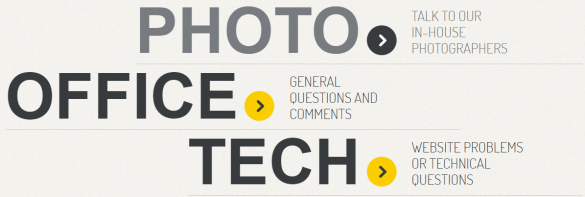
With this page, customer inquiries are carefully sorted by type. Instead of asking everyone to send an email to the same account, customers are asked to explain the nature of their inquiry. This makes things exponentially easier on the back end by allowing Productions Locations to develop a sophisticated approach to responses.

Sweet Basil

basil

From a functionality point of view, this isn’t the best contact page on the internet. However, it’s an attractive page that fits the larger website. The biggest takeaway from this page is found in the header image. The gorgeous, high resolution image sets the tone for the page and naturally feeds into the contact form. Quality images can do a lot for a page.

Epiphany

epiphany

The best policy for a contact page is to keep it simple. If your website does an adequate job of connecting with customers and addressing their pain points, then your contact page shouldn’t have to do any of this. The Epiphany contact page is the perfect example of this. It merely asks, “How can we help?” The moral of the story is that your contact page doesn’t need to be overwhelming. Sometimes, simple is best.

Modern Group

modern

Modern Group takes an entirely different approach to their contact page, but it works. Instead of featuring a standard drop down menu item that reads “Contact Us,” readers are directed to click the “Get My Free Consultation” button at the top of the page. This then directs visitors to the official contact page, which features bold colors and eye-popping design that draws the user in and encourages them to follow through with a particular action.

The biggest takeaway from this page is the use of directional cues. Everything revolves around the contact form on the right side of the page. The black arrow in the middle of the page shows users exactly where to go to get in touch with Modern Group, which is an effective technique.

This page also leverages social proof to build trust. Notice the bottom of the page where it reads, “Nearly 400,000 home improvements Australia Wide and Counting.” Whenever you have the opportunity to incorporate trust signals, make sure you take advantage of it.

Learn from the Best

When designing your own contact page, keep these five examples in the back of your mind. While you don’t want to copy them, feel free to use their techniques and designs as inspiration for your own.

How to Craft the Perfect “About” Page for Your Blog

11 May 16:37

The Three-Minute Post-Sale Exercise With Huge Payoff [+ 4 Free Templates]

by aja.t.frost@gmail.com (Aja Frost)

post-sale-thank-you-note.jpg

Sales is both a sprint and a marathon: A sprint in the sense that the leaderboard resets every month or quarter, and a marathon in that you’ve always got to keep moving. Which means that right after you close one deal, you’re probably moving onto the next one.

But spending just three extra minutes on a freshly won deal can actually make a huge impact on your sales numbers. How so? Use those three minutes to write a warm, personalized thank-you note, and your customers will repay you in referrals, renewals, and positive reviews.

Read on to discover how you can leverage the enormous power of thank-you notes.

3 Things the Best Post-Sale Thank-You Notes Have in Common

An effective thank-you note accomplishes three things:

1) It lays groundwork for a referral.

Getting a thoughtfully written note tells the prospect you really care about their business -- which means referring you to their friend or contact is actually in their best interests. After all, helping a connection discover a great product or service makes them look good.

While asking for a referral in the first thank-you note may come across as a little self-serving, asking for a referral in a separate follow-up is completely kosher. Thanks to the earlier note, you request has a strong chance of being granted (not to mention the likelihood your prospect will voluntarily refer you.

(Not quite sure how to frame your referral request? We’ve got four email-ready templates.)

2) It reaffirms the relationship.

You’ve worked hard to create a relationship with your prospect by building rapport, providing value at every touch, and establishing trust. So why throw all that work away now that the contract has been signed?

Adding a personal detail or referencing a previous conversation in your thank-you note will reinforce your relationship. When a customer feels genuinely connected to their seller, they’re far more reluctant to leave. Hello, higher retention and upsell rates.

3) It maintains your role as a trusted advisor.

Modern reps succeed by acting as trusted advisors -- and just because the ink has dried, doesn’t mean you should abandon this role. In your thank-you note, provide the customer with several ways they can get in touch if they need help or guidance. Sure, they could always contact support or their account rep, but your offer will score you some massive goodwill.

To leave no doubt in the buyer’s mind that you’re truly willing to help, add that you’ll check in on a specific date in the future.

Potential Subject Lines

Choose from any of these options:

  • Wanted to Say Thank-You
  • Thanks for Choosing Us
  • Always Here to Help
  • Thank You Again
  • Excited to Work Together

4 Post-Sale Thank-You Note Templates to Start Using Today

1) Thanks for choosing us


Hi [Prospect],

Thank you for choosing [our business] to solve [biggest challenge]. I appreciate the time you spent over the last [days, weeks, months] looking into this decision.

Going forward, my goal is to make sure you’re as happy as possible with [product]. If you’ve got a question, an issue, or some feedback, please feel free to reach out. I’m also planning on checking in on [date] to make sure everything’s going smoothly and you’re 100% satisfied.

Thanks again,

[Signature line]

P.S. [Loved your recent blog post on the tech bubble, That lunch you recommended was spot-on, Saw your area was getting a snow-storm this weekend -- stay warm!, etc.]

send-now-hubspot-sales-bar

2) Here at any time


Hi [Prospect],

Thank you for choosing us. I’m excited to see how [product] helps you achieve [high-level objective you discussed].

I also wanted to let you know I’m here at any time -- if you’ve got questions or concerns (or simply want to talk more about [common interest]), just give me a call or send me an email. To make sure you’re happy, I’m planning on checking in on [date]. Let me know if that doesn’t work for you.

Best,

[Signature line]

send-now-hubspot-sales-bar

3) Always here to help


Hi [Prospect],

It’s been a pleasure working with you and learning about [business] (not to mention discovering our mutual passion for [common interest]).

I believe you’ve already been introduced to your account rep, [Name]. Although [Name] can certainly help with any questions or issues you might have, I’m also more than happy to help -- just shoot me an email, give me a call, even text me if that’s most convenient! As I’ve said, I want to do whatever I can to make [Prospect’s company] successful in [objective you discussed].

Thank you,

[Signature line]

send-now-hubspot-sales-bar

4) Meeting business challenges


Hi [Prospect],

Thank you for giving us the opportunity to help you with [business challenge]! It’s been really rewarding on my end to learn about [Prospect’s company’s] specific challenges and objectives, and I’m excited we could develop a great solution.

To make sure everything’s going smoothly and that your expectations have been met, I plan on checking in on [date]. And in the meantime, if you have anything you’d like to ask me, please reach out. Our support team is also fantastic; they’re available at [phone number] or [email address].

By the way, [hope you enjoy your trip to Australia, good luck building that treehouse, thanks again for the restaurant suggestions, etc.]!

Best,

[Signature line]

send-now-hubspot-sales-bar

Even though you might think your job is done as soon as the prospect signs, investing a little time (less than it takes to brew a cup of coffee!) to write a thank-you note will pay fantastic dividends. So before you turn your attention to the next prospect, tell this one you appreciate their business.

HubSpot CRM

11 May 16:37

5” Devices Have 23% More App Engagement

by Caitlin O'Connell

In the last few years, smartphones have continued to – quite literally – grow. The first iPhone had a screen size of 3.5 inches and now, 9 years later, there are phones with a screen as big as 5.7 inches, like the Samsung Galaxy Note 5.

As manufacturers continue to experiment with different screen sizes on both ends of the spectrum (take Apple’s newest smaller screen iPhone SE for example), we decided to investigate how engagement differs across small and large screens.

Users Spend More Time in Apps on Larger Screens

Our research shows that users are spending 23% more time in apps on five inch, or larger, screens versus small screen devices. Time in app is measured as a function of both frequency (as measured by the average number of app launches per month) and length (as measured by the average time spent in an app across all sessions per month).

5-inch-vs-4-inch.jpg

People spend almost 66 minutes in each individual app per month on five inch screens, compared to 52 minutes a month in each app on four inch devices.

What exactly makes up this difference? The gap exists because users launch apps 21% more on five inch devices than on four inch devices. The larger screens have improved the mobile experience in many ways, and users seem to be taking advantage by visiting apps on these devices more often.

Five inch devices also have a 3.53% higher average session length than four inch devices. This is likely because larger screens make watching videos, reading, and playing games much more enjoyable; all of which can be time consuming activities.

iPhone SE: Too Early To Tell If It Meets People’s Device Needs

Looking at the engagement of Apple’s newest phone, the iPhone SE, it would be easy to see this new model as an outlier. When it comes to time in app, the iPhone SE is lagging behind similar sized models: the iPhone 5, iPhone 5S, and iPhone 5C, and the Samsung Galaxy S4 Mini.

iPhone-SE2.jpg

People spend only 34 minutes per month in an app on the SE, the lowest time in app of all the four inch models such as the iPhone 5 and Samsung Galaxy S4 Mini.

With the phone being on the market for less than one month, it is simply too soon to tell. Users are likely still experimenting with the iPhone SE, trying out their apps and finding out which ones work best on the smaller screen which impacts the model’s overall time in app.

Is Screen Size the Only Consideration?

As you can see from the above data, the Samsung Galaxy S4 Mini has a drastically higher time in app than the other four inch models. In fact, this is consistent across all screen sizes: our research shows that app engagement is higher on Samsung devices than Apple devices. Samsung users average 22.9% more time in apps than Apple users.

Samsung-vs-Apple.jpg

People spend 72 minutes per month per app on Samsung devices, compared to 57 minutes on Apple devices.

As it turns out, it’s not the device manufacturer that creates the engagement difference in apps; it’s the underlying operating system. Our data shows that overall, Android phone users spend 29% more time in app on their devices than iOS users, largely because the average number of app launches per month is 15% more for Android users.

Know Your Mobile could provide us with the answer to why that gap exists. Author Michael Grothaus writes, “Android […] is more geared towards power-users and is infinitely more customisable — you can change almost everything about it and customise to your exact specifications.”

This level of customization and power-user angle suggests that Android users are encouraged to go deeper with the personalization of their app-consumption habits, leading them to be more engaged.

Developing Engagement Strategies by Screen Size and Operating System

While there is a temptation to treat all smartphones alike when it comes to developing an app strategy, it is important to see that engagement differs by screen size. And this is likely due to the fact that the app experience itself is stronger on the larger screen phones, rather than the fact that the larger phones offer more or different features. To no one’s surprise, the power of the supporting underlying operating system also impacts the app experience.

As Gartner points out, “Smartphones and their myriad individual features will become less important in the future as consumers continue to find that the devices are becoming commodities while the apps that run on them bring more value to their lives,” (Market Trends: Device and App Fusion Creates Opportunities in Personal Technologies).

To combat this, a segmentation strategy is needed. With hundreds of device options, it is easy to be overwhelmed but with a little data into which device models drive the majority of app experiences, app owners can create the best experience for their users, a necessity in the midst of today’s mobile engagement crisis.

Methodology

Localytics is the leading mobile engagement platform across more than 2.7 billion devices and 37,000 mobile and web apps. Localytics processes 120 billion data points monthly. For this study, we exampled over 271 million unique devices across the models with the most users: Samsung Galaxy Note 2, Samsung Note 3, Samsung Note 4, Samsung Note 5, Samsung Galaxy S3, Samsung Galaxy S4, Samsung Galaxy S5, Samsung Galaxy S6, Samsung Galaxy S6 Edge, Apple iPhone SE, Apple iPhone 5, Apple iPhone 5S, Apple iPhone 5C, Apple iPhone 6, Apple iPhone 6S, Apple iPhone 6 Plus and Apple iPhone 6S Plus. For each device model, we examined the average app launches and session length per month per app. Time in app was then measured as a function of the app launches and session length. The timeframe for this analysis was March 31st (to accommodate for the iPhone SE release) to April 20th.

10-ways-to-better-engage-users-cta

11 May 16:37

How to Add Value to Your Relationships to Grow Influence

by Jess Ostroff

Jeff Barrett_InstagramSpeedboats Are Better Than Yachts

Speedboats are more fun, right?

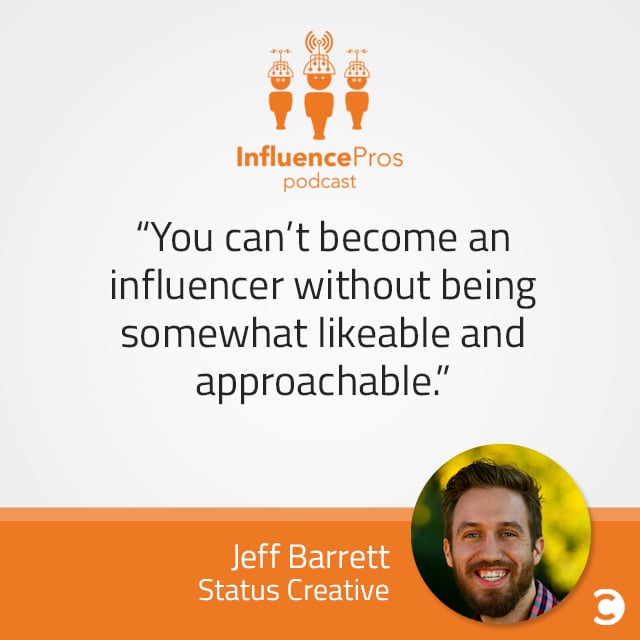
Well, they are certainly more agile, just like Jeff Barrett. Jeff dives deep and bares it all as he delves into the impatience that drove him to become an entrepreneur, the growing role PR is developing in partnership with influencer marketing, and the long-term planning and approachability that has helped him maintain and grow relationships that can be leveraged effectively.

Status Creative is a proactive PR agency driven by the desire to inspire memorable moments, stay authentic, and strive for excellence in all ways to ensure lasting growth for all their clients.

In This Episode

  • The importance of understanding that reach simply means potential
  • How to maintain long-term planning strategies for positive relationships
  • Why PR is the next wave in influencer marketing
  • How to diversify your influencer usage in order to find the perfect fit
  • How budgets are shifting to give influencers more opportunities in 2017


Quotes From This Episode

“We run a pretty small ship because we like to be a speedboat versus some other yachts in the industry.” —@BarrettAll

“I don’t think any two days are ever the same, especially when you’re an entrepreneur.” —@BarrettAll (highlight to tweet)

“There’s no reason that PR shouldn’t take hold of influence because it’s all relationship-based.” —@BarrettAll (highlight to tweet)

“We’re all inherently impatient. Because if we were patient, we would have gone through a corporate ladder, we would have done something else. So, I’m incredibly impatient and always want to try to get things done that day, or that exact second.” —@BarrettAll

“I like being able to put myself in a position where I can provide value, because the only way you grow relationships is you have to provide value. So, by churning out content and thought leadership and trust content, I’m also allowing myself the ability to grow, build bigger relationships, and slowly ascend that ladder.” —@BarrettAll

“There will be long-term campaigns with larger influencers as well. We’re just going to see a boom in that in 2017 as the budgets allow.” —@BarrettAll

“We’re a tight community too, especially when I talk to my friends that are Snapchatters, Viners, or Instagrammers in the sense that we all band together and don’t take non-paid trips and swag bags because if you always did that, then every brand would keeping offering that.” —@BarrettAll

Resources


Would You Rather

Would you rather win the Nobel Prize but not the money that comes with it, or would you rather receive the $1.2 million that comes with the prize but get no recognition?
I think I’d take the $1.2 million. Accolades are nice, but if you’re doing good work, they’re going to come to you either way. They help, but I am in this to get paid.

Would you rather not shower for a month, or not sleep for a week?
I can’t not sleep. I’m not going to shower for a month. If that means that I have to pull a Howard Hughes and just stay in a room, so be it, but there is no way I am going a week without sleep because I can’t function.

Would you rather be able to have perfect vision in the dark, or the ability to see through walls?
Of all the questions, that’s the hardest one for me. I’ll say I’d rather see through walls.

       
11 May 16:36

Why You Should Use Webinars for Lead Generation

by Jessica Weiss

Webinars for Lead Generation

You’ve probably listened in to a webinar or two – but have you hosted one? Hosting your own webinars can be a fantastic way to reach new leads online and bolster relationships with existing customers. Webinar marketing can help you provide useful information to your audience, establish your authority in your field, and showcase your personality. You can host a webinar on almost any topic – as long as it is relevant and provides value to your audience.

Wondering if webinar marketing is a good investment? Read on for our top 3 reasons to get started with webinars:

Reach a New Audience

When you host a webinar, you can reach a new audience of people interested in your topic. They may not know much about your brand yet, but they probably know that they’re interested in “Mastering Cake Decorating in 30 Minutes” (for example). Promote your event on social media, to relevant discussion groups or industry blogs, and to your email marketing list. Ask attendees to invite a friend. You may also want to pay to advertise your event through display or social advertising to your target audience.

You can increase your event’s draw if you partner with an industry influencer to promote or co-host your event. That way, your influencer can advertise the webinar to their audience, introducing more of them to you in the process. Remember to plan your webinars with enough advance notice that you have time to reach out and secure an influencer partner if you choose to work with one.

Educate Potential Customers & Establish Your Authority

Ideally, webinars provide information to attendees that they can actually use. They represent true content marketing – offering up information that can help make your audience’s lives better, easier, or more fun. In return, they’ll get to know your brand, and assuming your content is top-notch and consistent, they will ultimately view your brand as an authority in the space.

Webinars serve as effective content marketing tools because they can be customized for every stage of the buyer funnel. For example, you may want to offer “Cake Decorating 101″ for your top-of-funnel viewers, but “Tips & Tricks for Using Your Decorating Set to Its Fullest Potential” would be more appropriate for those close to converting or who have already converted. Customize your content for each audience group for improved results and retention.

Create Long-Term Content

Recorded webinars can serve a purpose long after they conclude. Upload the recording to your website either as a gated lead-generation tool or as free content on your blog and YouTube channel. Webinar content can even be re-purposed into podcast material, social media videos, advertisements, and much more. You may find that your most popular webinars can generate leads for months or years to come. You can revise webinars or add supplementary information as needed, but the core content is “evergreen” and should serve as a relatively passive lead source for some time.

Once your webinar event concludes, make sure to continue to nurture your leads with appropriate follow-up content. Thank them for attending, send them more relevant articles or downloadable resources, invite them to your next event, and survey them regarding their experience. You’ll lay the groundwork for a long-term, mutually-beneficial relationship by offering a valuable learning experience and showing you care about your attendees.


And check out our SlideShare deck for more:

3 Reasons You Should Use Webinars For Lead Generation from Vast Conference

11 May 16:35

Want To Grow Your Sphere of Influence? Engage Influencers!

by Brian Basilico

business man hand shows the world of business as conceptReach 1.3 Million People

Want to learn how I have gotten over 1.3 million posts about my upcoming book The Bacon System (book number 4)? Read on!

Getting To Know You

My wife does not understand why I get on airplanes to go to Denver, Atlanta, LA, New Jersey or San Diego to go to conferences. I do this to meet people, because many of those people are Internet marketers, authors, speakers, coaches and the like. These people are Influencers.

What’s an Influencer? These are people with huge audiences on the Internet. That have followings on Facebook, Twitter, LinkedIn, Pinterest, Google+, Blab, Periscope, YouTube, Instagram, and other social media platforms.

I have met and started (and continued) REAL relationships with people like Joel Comm, Brian G. Johnson, Ken McArthur, Felicia Slattery, Steven Memel, Rajesh Setty, Kellan Fluckiger, Cathy Demers, Lee Collins, Scott Smith, Kathleen Gage, Matt Bacak, and many others who have a HUGE sphere of influence. These names may not mean much to you, but in the Internet marketing, coaching and online worlds these people are ROCKSTARS!

I am not meeting them just for their influence and audience, I am getting to know them and serve them in any way I can. I want to start conversations and create relationships that will have some kind of mutual benefit. You have to understand that It’s Not About You!

It’s Not About You!

Winner2014That is the title of my first book, “It’s Not About You, It’s About Bacon! Relationship Marketing In A Social Media World!” and it is about just that. I am trying to leverage relationships to grow my sphere of influence, but it starts with them. That is one of the reasons I do my Podcast “The Bacon Podcast“. I get to interview these influencers.

It’s part selfish, but it is strategic too. I interview people I want to learn from, but in the process I hope that the questions I ask will help you get to know these people and learn from their awesomeness. It starts with them. I give them a platform and expose them to my audience and more with the hope that it will help them grow their businesses first.

The 100/0 Principle

There is an awesome book by my mentor, Al Ritter, called the 100/0 Principle. It basically says, “Give 100% of yourself … 100% of the time … expect nothing in return … and watch what happens!” That may sound counterintuitive, but I am here to tell you that it works. It’s called servant leadership. By serving others first, they will often be open to returning the favor (and sometimes maybe more than your original efforts).

Build A Sphere Of Influence – Through A Sphere Of Influencers

This exercise is not a selfish one. I truly want to help these people. I really want to get to know, like and trust these people, and I hope they want to get to know, like and trust me back! Having them on my podcast is step two. I meet them at conferences and convince them that they can benefit from my sphere of influence. They have nothing to lose except 30 minutes for an interview! From there, I get to expose them to thousands every month (and more on replays in the future).

If I walked up to them or hit them up on the Internet and said, “Hey I would love to have you on my podcast!” they would be hesitant at best. We all listen to radio station WIIFM (what’s in it for me). Can you blame them? They are busy and have a limited bandwidth for others. If they see value, then they will make the time; however; you have to create the value first!

The Law of Reciprocity

Business man and meeting table background

Wikipedia says – “Reciprocity is a social rule that says we should repay, in kind, what another person has provided us.[1] That is, people give back the kind of treatment they have received from you. By virtue of the rule of reciprocity, we are obligated to repay favors, gifts, invitations, etc. in the future. If someone remembers us on our birthday with a gift, a reciprocal expectation may influence us to do the same on their birthday. This sense of future obligation associated with reciprocity makes it possible to build continuing relationships and exchanges.”

It’s also known as “Pay It Forward”. “Give 100% of yourself … 100% of the time … expect nothing in return … and watch what happens!”

How I Got 1.3 Million Message Support!

ThunderclapThere is a program online called Thunderclap. It’s like doing a crowd funding with GoFundMe.com, but with social influence. By building those relationships, I was able to instant message each of those social influencers mentioned above and most of them gave me support. They do so by allowing me to message their followers with one message that will promote my upcoming book. They have to approve an app within Facebook, Twitter or Tumblr for me to do this.

It took a lot of face time and promotion, but more importantly an investment in relationships!

You can do the same on a smaller scale by getting out and networking in your local area. Start with meeting people. Help them promote their businesses first and you will get something in return (most of the time). “Give 100% of yourself … 100% of the time … expect nothing in return … and watch what happens!”

I would love to hear your thoughts, comments and reactions. Comment away!

11 May 16:35

How to Create a Need for Your Products

by Gail Oliver

Are you effectively creating a need for your products and/or services? A good rule of thumb is to always think who, what, when, where, how, why. So who would need your product, what would they use it for, when would they use it, where would they use it, how would they use it and why would they use it.

Below are two product copy examples that I will enhance, in order to create the need.

how_to_create_a_need_for_products

Creating a Need – Home Product Copy Example

Take a look at this description from ModCloth (who writes product copy really well) for this 5′ x 6′ beach wall tapestry:

how to create a need for your productsPut your longing for the wash of waves at ease with this oceanic tapestry by Lisa Argyropoulos for DENY Designs. Crystalline water sparkles under a beautifully clouded sky, bringing beachy beauty – and the carefree feeling that comes along with it – to your decor!

Now this is great for capturing the feeling of the product and creating desire. But remember, people don’t just buy products because they like them, they buy because they need them, so you need to create a need. Therefore, I would simply add a closing line that helps the reader visualize how they would use the product, hence identifying a need.

Put your longing for the wash of waves at ease with this oceanic tapestry by Lisa Argyropoulos for DENY Designs. Crystalline water sparkles under a beautifully clouded sky, bringing beachy beauty – and the carefree feeling that comes along with it – to your decor! Perfect for apartment dwellers, creating a focal wall or even as a very serene headboard.

As you can see, I gave three potential uses for the item. Even if one of these isn’t your particular need, chances are it could spark one you do have. Buyers can get gun-shy after they buy clothing items they never wear, a decor item they just couldn’t make fit, etc. So you want to ease the purchase decision by giving them ideas in advance.

Creating a Need – Jewelry Product Copy Example

Urban Outfitters is another online store that writes copy really well. Here is their description for a black choker:

Screen shot 2016-05-03 at 9.02.14 AMOur must-have styling tip this season is a wide banded choker necklace and this iteration is essential. Chic choker in a sultry gauzy chiffon complete with a lobster clasp closure + extender chain in an antique distressed finish.

So this is effective in that it quickly tells you this is a hot trend and stylishly describes the features. However, not everyone is fashion savvy, therefore I would add this line at the end:

Our must-have styling tip this season is a wide banded choker necklace and this iteration is essential. Chic choker in a sultry gauzy chiffon complete with a lobster clasp closure + extender chain in an antique distressed finish. This versatile choker looks great layered with other necklaces or on its own with everything from a little black dress to a t-shirt and jeans.

It is also only $22, so another approach would be to say:

An inexpensive way to instantly update your summer wardrobe with one of the hottest trends.

As you can see, when you create both the desire and the need, you are more likely to get a sale.

11 May 16:35

Persona Based Selling: Sales Messaging Begins with the Customer

by Sean Kester

When we talk about sales messaging as it relates to persona based selling, it all starts with understanding your customers: their roles, pains, and the context in which they have those pains.

Who is your customer?

What is their function? What do they wake up in the morning thinking about? How do they communicate — phone, email, social? How do they buy? What solutions are important to them? Where do they land in the entire buying cycle? Are they an influencer? Are they the champion? Are they the decision maker?

There are a few core personas in the average buying cycle: the Champion, the Influencer, the Decision Maker, and the Executive. Each persona is specific to their function within the stage/size of their company. The sales manager at a 100 person company could be the decision maker. However, at a 1,000 person company, they may only be a influencer or champion. Persona is not specific to title but function within the organization.

Once you have the answers to these questions, you can begin to build sales messaging that will resonate with your customers. For example:

First you have a VP of Sales at an SMB SaaS company. They’re interested specifically in the pipeline contribution of the organization’s sales development team. How many opportunities are they setting up for the Account Execs, and how large are those opportunities? What’s the overall revenue potential based on those appointments?

But the Sales Development Director at that same company cares more about qualified opportunities set, with just a portion on pipeline. Their concerns are more along the lines of: Is the process architected in a way that will scale? Is the pipeline that the SDR team is generating this quarter going to increase the hiring of the next? They want to understand the team dynamics, the management, and everything that goes into that structure.

Then you get to the manager level, where they’re not as worried about the pipeline contribution as they are the activities of their team, the morale, the process, and the workflow.

Now, given the different nature of these functions — the same sales messaging is not going to resonate with each individually. You have to cater your sales messaging in a way that shows your true empathy for their specific needs — and your understanding of their pain points — which will, in turn, allow you to give a value prop that solves those pain points.

And when we talk about sales messaging — and how it relates to the customers and buyer personas — we need to uncover how the two are synced. This is key when you’re selling to different personas within the same organization.

Say you’re selling to a Sales Ops person (likely an influencer or decision maker within the buying cycle). They’ll be more worried about making sure that the data is accurate, that it flows into Salesforce correctly, and that it’s efficient. They’ll want the ability to pull the same reports, and to make sure that no one can misinterpret or misrepresent the data, and everything’s logged efficiently and effectively.

They’re not really concerned at all about the activity numbers or the pipeline contribution, but the way that data is presented. Their pain points are going to be completely separate from that of another persona within the organization.

When you’re in these complex buying cycles (especially when you have committee sales) you have to convince each one of those personas that you are going to solve their pains. It’s so important to cater your sales messaging to the specific factors of each persona.

Now, this skill set, too often lacking within new sales teams, is nothing new for the marketing and sales industries. Let’s take Content Marketing for example: from top of the funnel, to middle of the funnel, bottom of the funnel, and retention — the entire buyer’s journey is being covered through different content.

Top of the funnel content is designed to get the customer interested in the concept from a broad perspective. It’s focused on what they’re trying to accomplish, and what you’re trying to help them solve.

Middle of the funnel content covers the understanding of these pains, and the proof that they can be solved. It answers the customer’s tactical question, “how do they help me and my organization achieve my goals.”

Bottom of the funnel content is going to be around ROI, conversion numbers, what the potential net benefit achievable with a solution like yours.

Retention content is going to be around the solution itself, and how can you enable your customers to work smarter through the strategies, techniques, processes and workflows that your solution executes.

Do your research and find a way to give them differentiated ways to solve their pains more effectively than your competitors. Show that you understand their needs more deeply than anyone else. That true level of empathy and understanding is what will bring you to the status of a trusted advisor for your customers.

You need to effectively communicate how you’ll not only help them to achieve their goals and relieve their pain points, but do so in a way that scales. Show them that your solution is both cost efficient and work efficient: keeping the customer from solving manually, building an in-house solution, or going to another vendor.

Throughout the entire process, the sales messaging needs to be catered in a way that shows that centers around the customer. The sales messaging is personalized — meant specifically for that persona function.

Going back to the Sales Ops example: that persona is less likely to be answering the phone or living on email, but it’s your responsibility to find a way to connect with them. Being over-personalized, understanding what they’re trying to accomplish, and giving them relevant content within that sales messaging is critical.

While it may mean that you have different tracks for what happens as they engage with your sales messaging, once one sentiment resonates, you’ll know where exactly to double down. And through A/B testing and experimentation, you’ll being able to go deeper and deeper with your understanding of your customer and their needs.

Once you’ve uncovered the right sales messaging based on the customer, and you’ve mapped out the buyer’s journey,  it’s imperative that you insert these insights into a workflow that matches that buyer journey and the home base for each persona. Go to social for marketing customers. Find IT customers via email. Call a sales customer.  Each one lives and responds within a different channel of communication.

The customer is at the heart of persona based selling, and each and every workflow needs to be just as centered around the customer as the sales messaging itself. And as the selling landscape evolves, it’s becoming more and more critical every day to communicate with your buyers personally and intentionally. To accomplish this, sellers must be able to quickly organize their people by similar personas, create custom messaging for those personas, and then test those messages at scale.

SalesLoft is excited to announce our May release, catered specifically to the needs and workflow of persona based sellers. Check out this video to learn more!

For a more comprehensive look into SalesLoft’s internal SDR process, download the second section of our newest playbook trilogy, The Sales Development Playbook: Executing. In this section, we share the ins and outs of efficiently using SalesLoft to call and email prospects. Download our free white paper and optimize your sales efforts to start crushing your sales development goals today.

Playbook_2

The post Persona Based Selling: Sales Messaging Begins with the Customer appeared first on SalesLoft.

11 May 16:35

The Best Appointment Setting Techniques To Get More Meetings

by Will Humphries

While closing deals is often the most emphasised part of selling, you never get this opportunity without first landing appointments. If your team is struggling to get meetings, you may need to modify your strategy or execution.

One of the mainstays of any business is getting appointments with influential people in an organisation. Notice I didn’t say the “right” person, or the “decision maker”, that will come with time. It is rare you can call the CIO or CFO and get an appointment. Although I must point out that it is something we can do for you.

Businesses today have a range of people involved with any purchase, particularly those in the technology sector. Unless you are very skilled at getting in to see the “right” people, your focus should be on getting in the front door and moving yourself up the value chain.

You have one objective and one objective only – to get your prospect at ease as quickly as possible in order to schedule an appointment with them.

Research and Prepare

Cold calling may seem like a mundane task, however you must remember that your company’s reputation is on the line each and every time someone makes a bad call. And no sales person likes making cold calls (as this feedback from BDM’s shows)

business-development-managers-reviews-payscale

Feedback from Business Development Managers via Payscale.com

Get yourself in the right frame of mind and understand the market you are calling into. Calling the wrong people with the wrong mindset and faulty information won’t get you appointments. If you haven’t done your research properly, you can forget about it. Savvy buyers will know you are simply looking to sell something.

Research and preparation is a necessary starting point for efficient appointment setting. You need to call on people that have a genuine need or preference for the solutions you offer and be able to demonstrate value if you are asked.

Part of your preparation should be understanding objections and ensuring you have a logical set of steps to help the prospect overcome their own objections. Because objections are good. You should welcome them. They allow you assist the buyer along a path that can help them overcome their objection.

Think of it this way: Which of these comments would you rather hear? “I’m not sure your solution can help us reduce our lead times for project delivery” or “Sure, send me on some information”.

Research the marketplace, align your prospecting efforts with the solutions your company provides and develop a clear profile of the audience you need to go after. If your role is in sales management, coach your reps to make calls with the intent of helping targeted prospects with a need.

As someone who has been on the receiving end of cold calls (yes, I get them too!), there is nothing worse than someone who is not prepared for questions. I recently had a call from a sales person and the conversation went something like this:

“Hello Mr. Humphries, my name is John [not his real name] from John’s Marketing Stuff Plc [not his real company] and I was hoping I could grab a few minutes of your time. We’re working with companies such as yours to help them identify visitors to their website. Is this something you’d be interested in?”

“Sure. What companies like mine are you working with?”

[Silence]

Me: “Hello?”

[Long Pause] “Ermm, we work with [names a few companies that are in totally different industries than ours]”

Me: “Yes, I know them. But you said you were working with companies similar to mine. Who are they?”

John: “I need to get back to you on that. Can I set up a 2 week demo with you?”

Me: “Not right now thanks John. Maybe send me across some information.”

Not a good pitch, right? And more importantly, it actually put me off the company itself if they couldn’t be bothered to train their sales staff on how to make a sales call. After all, there are plenty of other companies out there that offer a similar service to his.

Stop Selling

Yes, you did read that correctly. Salespeople have a natural inclination to want to sell a product when interacting with a potential buyer. Nobody wants to have something pushed upon them. Instead, appointment setting calls are designed to intrigue a prospect enough to get a face-to-face meeting. Your goal is to set an appointment, not sell them something. (Or as in the case of our friend John, a demonstration of the service.)

By calling with a genuine desire to help, it is easier for salespeople not to pressure prospects. Don’t force the issue. Instead, reps should call with a sincere belief that they are trying to help a prospect out of a situation or predicament. This helpful tone is less likely to offend buyers or put them on guard.

Remember, your goal is to arrange a meeting so don’t lose focus of that. Don’t be shy of getting to the point and asking for some time to introduce how your company has helped similar organisations. Just make sure you have your facts & figures correct.

Share Examples

People are naturally hesitant or reluctant to agree to a meeting with a salesperson. As I mentioned above, this defensive posture often comes from the belief that salespeople only want to sell something.

One of the best ways to intrigue a prospect and land an appointment is to share examples of how similar people and companies have benefited from your solution. The proof is in the pudding, as they say and nothing sells better than a referral.

Prior to or during your call, direct the prospect to a website or landing page where they can read customer testimonials or see a demonstration of your product. Alternatively, share a specific story about a buyer in a similar position, including the problem faced, solution used and benefits achieved. Case studies are excellent tools as well.

Outsource Appointment Setting

A simple but often effective way to enhance your appointment setting efficiency is to turn this role over to an outside firm. Many sales reps dread cold calling above most other tasks. You can let them focus on the selling processes they relish to close more deals and turn appointment setting over to experts in this area.

Firms that specialise in appointment setting services usually have advanced processes, highly experienced staff, and technology tools to generate high-quality appointments.

Here at Internal Results, we only charge you for the appointments landed as well. There are no extra charges or lengthy contracts.

Let’s look at it logically. And for the sake of simplicity, I’ve purposefully left out the additional costs associated with having someone on your payroll.

According to Glassdoor the average Business Development Manager salary in Dublin is €44,875k per annum (£43,719k in London, $105,218 in New York). Let’s assume that your sales person spends (a very conservative) 2 hours per day researching and cold calling for new business and prospects. That’s 10 hours a week, which is 40 hours per month.

So over the course of a year, each of your sales people spends a minimum of 480 hours just looking for new prospects.

If we take it that they work 8 hours a day, that is 60 working days just prospecting.

And if there are 20 working days in each month, you’ve just lost a whole quarter to each sales person looking for leads and not closing any sales!

To put it another way, your sales people LOSE 3 months of closing new deals because they are too busy looking for new leads, costing you a minimum of €11,250, £10,929, or $26,304 respectively. And that is per person!

We can provide you with up to 40 high-quality meetings for that cost – per sales person.

Drop us a line via our contact page, email us, or fill in your details on the form below and I will organise one of our team to walk you through how we work with organisations – like yours – in the B2B industry.

quality-control-business-woman

Outsourcing appointment setting can improve the overall quality of your selling process by enabling the best execution at each stage.

Conclusion

If you can’t get an appointment, you can’t make a sale. Therefore, salespeople need to spend adequate time researching and preparing for prospecting calls. By preparing examples of satisfied buyers and calling with a helpful attitude, reps avoid pressing the issue and can put prospects at ease.

These are all basic tips but these days sales reps have so much to do that the quality time required to focus on these key areas is lost. And with it, potential customers are lost.

11 May 16:34

The Evolution of Inside Sales for B2B Companies

by Will Humphries

For many decades, the structure of the typical sales organisation treated inside sales as a supportive role. These reps made calls and executed tasks to equip their field sales colleagues to close as many deals as possible.

In recent years, the importance and responsibilities of inside sellers has grown dramatically. The evolution of inside sales is blending more and more with the field sales reps with SBI reporting that almost 75% of your customers don’t want face to face meetings anymore. Why aren’t you paying attention to them?

Shifting Sales Structure

Primary tasks of the historical inside sales role included the following: make initial calls to prospects, setting appointments and turning the sales meeting over to the field rep. Additionally, inside sellers would update prospect records and maintain notes.

A 2013 Harvard Business Review article indicated that 46 percent of companies have shifted to a more pervasive inside sales strategy in the last two decades. Rather than developing prospects and supporting field reps, more organisations have inside sales departments that carry out all stages of the selling cycle.

Changing with Technology

One of the primary reasons that selling has moved more inside is the evolution of technology. Historically, inside reps were limited to telemarketing interactions with prospects that intrigued them enough to agree to a meeting.

At the present, sales organisations benefit from a tremendous supply of high-tech lead generation, nurturing, presentation, closing and relationship management tools. From their PC or laptop, an inside rep can identify potential prospects, make calls, take notes, articulate value, deliver visual support and often, close deals.

Even in companies with a large outside team, many of the field reps have moved much of their initial selling activities inside. Web conferencing solutions are another major technology that aids inside selling. Tools like WebEx and GotoMeeting allow your sellers to present strong sales pitches to an off-site buyer.

Inside sales

Present-day inside sales is different than scripted “telemarketing.” Top reps implement an engaged experience with technology that rivals what field reps deliver.

Dominant Industries

While inside sales has grown across the board, it is especially prominent in B2B, high-tech, software service and a number of B2C industries. These industries involve interactions with buyers who often prefer to conduct much of their initial research independently and online.

Inability to articulate clear value on the phone was a reason inside sales was mainly supportive in the past. Modern technology equips talented sellers with powerful real-time communication tools, digital demonstration platforms and deep prospect data.

Conclusion

Simply put, the ability to communicate value more effectively with technology has propelled the movement of sales activities from outside to inside. Companies can potentially expand their geographic reach by targeting more precise prospect profiles through telemarketing activities.

In many cases, companies turn to firms that specialise in inside selling support, such as lead generation, appointment setting, content syndication and data acquisition. Outsourcing these tasks frees your internal reps to focus on selling value through powerful sales presentations.

11 May 16:34

The Evolution of the Sales Playbook

by Alyssa Drury

42754319_mSales playbooks have been integral to sales training, onboarding and ongoing success for many decades. Playbooks—collections of tactics and methods that highlight salespeople’s roles and responsibilities as well as the tactics and metrics to achieve them—have served nearly the same purpose for decades’ worth of salespeople: sell effectively and productively. But as sales cycles become more complex, information becomes more accessible, and buyers become more educated and empowered, sales playbooks have gone through a drastic evolution to keep up. In order to understand how sales playbooks can still enable salespeople to sell successfully, it’s important to understand where they began and how far they’ve come. Below is a brief history of the sales playbook, including how today’s B2B salespeople are using playbooks to excel in a customer-led sales process.

The Three-Ring Binder

Before the Internet, customers relied on salespeople to help them understand how to solve a problem and make educated purchase decisions. The process for salespeople was much more linear and predictable, meaning a static, printed sales playbook was adequate for almost every selling situation. Most new sales reps walked in on their first day and were handed a printed and bound playbook or, even more forward-thinking, a three-ring binder (so pages could be added or removed if necessary). As is expected from a printed collection of assets, competitive information, product specs and training/learning materials, these playbooks were difficult to update and maintain as companies grew and evolved.

The Linked PDF Playbook

The Internet ushered in a new era for salespeople. Buyers were now able to self-search for product information, educating and empowering themselves along the way. Meanwhile, salespeople struggled to catch up to customers who were now in control of the decision-making process; they now needed quick access to key product knowledge and talk tracks for different types of buyers. The Internet did offer a quick solution for reps in lieu of printed playbooks: internal linked documents (typically in PDF format) helped reps find what they were looking for more easily. Instead of fervently flipping through their binders or books, salespeople were able to perform a quick keyword search—and pray that the information they needed was there. But this quick access often led to the realization that playbooks didn’t necessarily provide the information reps needed—and certainly did not deliver it in a customer-centric way.

Digital Playbooks

The shift towards a customer-centric sales process resulted in a need for a more digital sales playbook, one that was digitally native and contextually relevant for each sales interaction. Digital playbooks can more effectively guide a sales rep through the sales process with relevant content assets, minimizing the need to manually search for content. Digital playbooks are typically organized by sales stage and include links to assets, templates and other materials that are relevant for each stage. Some digital playbooks provide access to sales enablement resources, such as online training, FAQs (and answers), and competitive analysis information, and are specific to a sales rep’s job description. For example, if a sales rep is working in a vertical specific to manufacturing, he or she would only have access to information specific to manufacturing products and messaging. While digital playbooks are on the right track to providing sales with everything they need to sell successfully, they are still too static and rigid for the unpredictable, dynamic buyer’s journeys reps are experiencing today.

Deconstructed Playbooks

Heather Cole, Service Director at SiriusDecisions, identifies the next generation of sales playbooks as “deconstructed” versions of our earlier digital playbooks. Instead of static, rigid documents available through manual search by reps, deconstructed playbooks allow buyer-relevant content to be automatically served to sales reps where they’re spending the majority of their time—typically in CRM or email.

Heather stresses the need to align sales playbooks to the buyer’s journey, not the sales cycle, in order to provide more relevant and engaging content that helps buyers make decisions efficiently and effectively. This external content, typically referred to as activation content, should be specific to the buyer’s role, goals, industry, stage in buying process, and any other specificity necessary to have an engaging and productive interaction. Further, deconstructed playbooks should always be up to date with the organization’s newest logos, messaging, and product information.

But the most important aspect of deconstructed playbooks—and the most notable difference between the digital playbooks of yesteryear—is flexibility. Salespeople should be able to easily navigate easily through the content they need to prepare for or execute a prospect interaction. If playbook content is available in CRM, it should be tagged and mapped to specific prospects by industry/vertical, role, and stage in decision-making process so reps don’t even have to search. Organizations can also employ a tool like LiveDocs, which allows reps to quickly build and customize a unique playbook using an individual prospect’s demographic information. Using traditional digital playbooks to manually build the number of single-use playbook permutations necessary for every buyer interaction would be impossible—or at the very least, a massive waste of time.

Playbooks have come a long way since the three-ring binder era. But many sales organizations are still operating with static playbooks, which, even if delivered digitally, can become quickly outdated for sales reps and aren’t focused enough on the customer. Deconstructed playbooks are the best way for organizations to adapt to a customer-led buying process, provide reps with efficient personalization capabilities, and increase overall sales effectiveness.

New Call-to-action

11 May 16:33

How to Leverage the Power of Your Email List to Get More Leads

by Kevin Ho

How to Leverage the Power of Your Email List to Get More Leads

You’ve heard it before, an email list is the key to making sales online.

Internet marketer Jeff Walker famously said that he “didn’t have a retirement plan, he had an email list,” alluding to how lucrative and reliable a good quality email list can be.

But what is it about an email list that makes it so valuable?

Yes it’s a list of contacts, but you can find a million different contacts online.

What makes an email list so valuable is that it’s a targeted group of people who have shown an interest in a product or service. They usually fit within a specific demographic profile and can share common traits like age, gender, occupation, income level, and interests.

When marketers send out an offer to their email list, they know that the recipients will be more willing to take action because they fall within the scope of their ideal customer profile. Because of this, the language they use, the benefits they promote, and the way they position their offer can be tailored accordingly.

That’s why marketers treat their email list like gold. It’s a gateway to sales. A ticket to targeted leads who have the potential of becoming customers.

So it’s only natural that you’d want more people who fit in this category, right?

This article will break down a powerful strategy you can use to leverage your existing email list to attract new leads and bring in brand new customers.


Use The Power of the List


“If you find something that works, double down on it.” – Steve Scott

So you’re ready to double down on the value of your email list?

Excellent, you’ve come to the right place. But rather than simply doubling up on the number of emails you send each month, we’re going to double down on the data you have embedded into your list. It’s time to double down on each one of your leads.

How, you ask?

Using the Facebook advertising platform, you can upload a list of existing contacts then target a much larger audience online that meets the same profile.

This way you’ll be able to use information about people that you know are interested in your business, in order to acquire a larger group of prospects with a high chance of being interested.

So how does it work?

Using a feature called Lookalike Audiences, you can upload an email list to Facebook and then have Facebook scan their network to find similar people.

Using characteristics such as age, location, interest, and more, you can isolate an audience that looks similar to your email list within a specified region. That means for every 1 lead that you have captured on your email list, you’ll be able to leverage that to target 10 more Facebook users.

How to Leverage the Power of Your Email List to Get More Leads


Theory in Action: Banana Republic


Banana Republic faced the problem of acquiring a younger generation of buyers to supplement their aging population of fans.

They knew that competing on a CPC basis for a younger audience using general targeting would be expensive, and were looking for a more refined way to hone in on prospective customers.

Luckily, what Banana Republic did have was an email list of their younger buyers which they were able to upload as a custom audience onto Facebook. Using this list, they were able to create a Lookalike Audience targeted similar individuals in the same demographic.

And since Banana Republic had a good understanding of what made their current customers tick, they were able to create ads aimed at their Lookalike Audience using the same tone, feel, and brand positioning.

How to Leverage the Power of Your Email List to Get More Leads

The Result?

Using a Facebook Lookalike Audience, Banana Republic was able to achieve a 60% higher click through rate compared to their other display ads and almost 4 times their typical return on advert. Not too shabby!


Getting Going


Once you have an email list, creating a Facebook Lookalike Audience is easy. But to simplify the process even more, we’ve compiled a quick Slideshare to guide you through the steps:

What are you waiting for? You’ve worked to make that list, now make that list work for you. Have you tried a Facebook Lookalike Audience before? We’d love to hear about your experiences in the comments below.

11 May 16:33

Do You Speak Sales? What Sales Can Teach Us About Account Based Marketing

by Joshua Nite

Acount-Based-Marketing-and-Sales

Sales and marketing should be BFFs. We might have different focuses and methodology, but the goal is the same for both departments: make sales and drive revenue.

Too often, though, the relationship is more like a mismatched buddy cop movie than a rom-com. You decide which one is the old cop a week from retirement, and which is the young maverick who plays by his own rules.

The sales team says marketing isn’t delivering high-quality leads. We suspect they’re just not following up on the leads we generate. We create mountains of content to help sales tell the organization’s story, and most of it collects dust. Both sides end up convinced that the other team just doesn’t “get it.”

It’s high time for our buddy cops to stop squabbling and work together. There’s an up-and-coming trend in B2B marketing that presents a perfect opportunity to learn more about sales and borrow their tactics for success: account based marketing.

What Is Account Based Marketing?

Account based marketing (ABM) means using highly-targeted content to nurture your ideal audience. As the name implies, it focuses marketing down to the level of key accounts, or even individuals within those accounts. Rather than blast an e-mail and celebrate a 2% open rate, ABM hits the most valuable audience with pinpoint-relevant messaging.

ABM is not a new tactic, but it’s increasing in popularity as technology makes it easier to both target more accurately and do it at scale. In a recent survey, 80% of marketers measuring ROI said ABM performed better than their other marketing investments. A Demandbase report found that in organizations using ABM for at least a year, 60% saw at least a 10% increase in revenue, while the top 19% saw a 30% increase.

Simply put, ABM is catching on, and early adopters are seeing substantial results. Yet many marketers struggle to get started, because the central idea of ABM runs counter to what we’re currently doing.

Sales and Marketing: Together at Last

To best understand and excel at ABM, marketers need to borrow some best practices from the sales team. To quote a recent LinkedIn Marketing Solutions webcast, “Sales has always done a great job of one-to-one, handholding, white-glove service with those key accounts. But now marketing…can strategically and at scale help surround specific accounts.”

Best-in-class salespeople are a fantastic resource for ABM best practices. In their new report, The State of Sales in 2016, LinkedIn collected insights into what tactics are working for top sales performers. They found that the most indispensable sales tactic, social selling, looks a lot like marketing.

Basically, social selling involves developing relationships with prospective clients before pursuing sales goals. Social sellers use social media—LinkedIn, Facebook, and Twitter—to identify and engage with buyers. They leverage the intelligence gathered on social sites to share timely, insightful content. The goal is to establish the salesperson’s value before asking for an appointment or making a pitch.

Social selling is delivering valuable content to the right person at the right time. Sound familiar? Ironically, salespeople were initially wary of social selling because it seemed too much like marketing. But now that it’s proven effective for sales, with 90% of top salespeople using the tactic, marketers can borrow from social selling for account based marketing. It’s the circle of revenue, and it moves us all.

The main difference between social selling and marketing is that social selling focuses on key accounts. We talk about building a community as marketers, but social selling works at a far more granular level. It’s worth seeing what tools your sales department uses for social selling—how they identify prospects, follow their digital footprint, and identify trigger moments to engage with content.

Many Mini Funnels

As marketers, we’re used to working on more of a macro level. We target based on personas, aiming for the audience that contains the few who will become leads, producing content that invites a value exchange. Meanwhile, sales operates on the micro level. They focus on cultivating individual relationships.

Account based marketing works best when it’s a fusion of great content and strategy from marketing, and account-handling knowhow from sales. It’s a shift from one big funnel to represent an abstract buyer’s journey, to many mini funnels, one for each account, each with content to nurture buyers through the journey.

So if your departments are bickering like buddy cops, it’s worth doing a ride-along to see what you can learn from the other side. You may never see 100% eye-to-eye, but you can work together more closely to get results.

How do you view account based marketing? Is your organization rocking it, looking into it, or not interested?

Disclosure: LinkedIn is a TopRank Marketing client.

Header image via Shutterstock


Email Newsletter Gain a competitive advantage by subscribing to the
TopRank® Online Marketing Newsletter.

© Online Marketing Blog - TopRank®, 2016. | Do You Speak Sales? What Sales Can Teach Us About Account Based Marketing | http://www.toprankblog.com

The post Do You Speak Sales? What Sales Can Teach Us About Account Based Marketing appeared first on Online Marketing Blog - TopRank®.

11 May 16:33

The Weird To-Do List Hack That’ll Make You Super Productive

by lye@hubspot.com (Leslie Ye)

to-do-list-questions.jpg

Before you read this blog post, take a second to look at your to-do list. Notice anything off?

If you’re like the vast majority of people, your tasks are listed out in a series of declarative instructions: Make 20 prospecting calls before 10 a.m. Prepare for two demos this afternoon. Follow-up with that prospect who went dark last quarter. Source new leads in your territory. Make 20 more prospecting calls before you leave for the day.

While that may not seem weird to you (it certainly didn’t to me), this method of writing to-do lists may actually be slowing you down. Instead, to make your to-do list into a productivity tool in its own right, make one simple change: Rephrase all your tasks as questions.

Haim Pekel, CEO and co-founder of digital marketing agency Press On It, explains that this technique helps him view mundane tasks as motivating challenges.

We're more likely to read something if it has a question mark attached to it, which led me to change the way I write tasks,” Pekel writes.

Pekel applied this strategy to both his personal and professional lives, rewriting tasks like “Do the laundry” as “Can you finish the laundry by 8 p.m.?” This phrasing signals the brain that there’s a reward to be had from finishing the task, and kick-starts the process of planning how exactly the laundry will get done.

The three benefits of writing to-do lists in this way, according to Pekel, are:

  1. The question-based phrasing transforms your to-do list into a challenge to be conquered, not a list of mundane obligations.
  2. Phrasing tasks as questions motivates you to look for answers, which fights procrastination.
  3. Actions with question marks next to them force you to start planning how you’ll accomplish larger tasks.

Here’s how to transform your sales to-do list into a productivity tool that can work for you, using the sample sales to-do list referenced at the top of this article.

To-Do List: Before

  • Make 20 prospecting calls before 10 a.m.
  • Prepare for two demos this afternoon
  • Follow up with a prospect who went dark last quarter
  • Source new leads in my territory
  • Make 20 more prospecting calls before the end of the day

Reframe quantity-based tasks as challenges: “Can I make 20 prospecting calls before 10 a.m.?” If you have multiple quantity-based items, up the ante. This sales rep, for example, could reframe her second prospecting block like this: “Can I double the amount of prospecting calls I make before I leave for the day?”

Items that require more thought should be asked as “how” or “why” questions. Not only does writing the item as a question in this way automatically start the planning process (even if only subconsciously), it also helps you refine the way you approach the task and demonstrates whether it’s important at all.

For example, “Source new leads in my territory” can be rephrased as “How am I going to source new leads in my territory?”, leading to a more targeted, deliberate approach. “Follow up with a prospect who went dark last quarter” can be rewritten as “Why am I following up with this prospect who went dark?”, ensuring that there’s actually a good reason for doing so.

Here’s the to-do list after applying Pekel’s strategy:

To-Do List: After

  • Can I make 20 prospecting calls before 10 a.m.?
  • What do I need to do to be prepared for my two demos this afternoon?
  • Why am I following up with this prospect who went dark?
  • How am I going to source new leads in my territory?
  • Can I double the amount of prospecting calls I make before I leave for the day?

How do you write your to-do lists? Will you try this unusual hack? Let us know in the comments below.

HubSpot CRM

11 May 16:32

B2B Content Marketing “Molecule” [Using the Periodic Table of Marketing Attribution]

by Lauren Frye

Remember the Periodic Table for B2B Marketing Attribution? We’ve taken things a step further. Using the elements represented in the periodic table, we’ve developed molecular structures that represent how assemblages of those elements can be used in marketing campaigns. Stay tuned for more structures — but for now, take a look at this Content Marketing Campaign molecule built with attribution.

Content-Marketing-Campaign-Molecule-544.jpg

SECTION #1: ATTRIBUTION DATA

Attribution data creates new, accurate, granular data generated by tracking each individual touchpoint created by your prospects, leads, opportunities, and customers. Ad clicks, form fills, emails, and the like generate a mass of touchpoints that all comprise your attribution data.

For content marketing purposes, a lot of the touchpoints are tracked through landing pages. And when it comes to B2B marketing attribution, these landing pages can be offer downloads, blog articles, or other website pages that host a form. When the form is filled out, that particular touchpoint is linked to that particular landing page inside your attribution data.

Attribution-Data-Program.jpg

Landing pages that offer a content download, such as an eBook are viewed via a CTA, which you see in two places in this structure. The second location is a CTA that leads to a landing page where users can register for a webinar. CTAs generally segway from blog articles or emails, which is also represented.

SECTION #2: ATTRIBUTION PROGRAM

An attribution program organizes attribution data. The data generated through javascript code, UTM parameters, cookies, and other tracking methods is presented to the user inside the attribution program. Inside sophisticated attribution programs, marketing operations specialists can set up specific attribution types and models based on the number of channels they use and the types of goals they’ve set.

For a content marketing heavy campaign, we would recommend that companies use a multi-touch attribution model that splits revenue credit across multiple touchpoints. Especially for B2B purposes, where sales cycles are long and touchpoints are numerous, a multi-touch attribution model is the most accurate method to accurately represent the performance of your campaigns.

SECTION #3: MULTI-TOUCH MODEL, W-SHAPED

Attribution-Program.jpg

There are several types of multi-touch attribution models, and it’s important to select the correct one. This particular campaign would benefit from a w-shaped model, which is an advanced and highly accurate attribution model. Why? This campaign targets every stage of the funnel.

Assume each of the blog articles represented in the molecular structure target a different stage of the funnel (top, middle, and bottom). The eBook is a MOFU (middle-of-funnel) offer, and the webinar is targeted at the BOFU (bottom-of-funnel) stage. A w-shaped attribution model spreads 90% of the revenue credit for a customer’s acquisition across the three touchpoints that were responsible for key funnel-stage conversions. Here’s what this looks like…

w-shaped-attribution-multi-touch.jpg

Assume a customer signed a deal for $100,000 ARR —

  • The channel and touchpoint responsible for an anonymous user’s very first exposure to the company’s website receives 30% of the revenue credit for the closed deal ($30,000).
  • The touchpoint that converted a visitor to a lead will receive 30% of the credit ($30,000).
  • The touchpoint that converted a lead to an opportunity will receive 30% of the revenue credit ($30,000).
  • The remaining 10% of the credit is evenly distributed to all touchpoints in between, such as blog article views, ad clicks, social referrals, etc ($10,000).

SECTION #4: API INTEGRATION & CRM

The attribution program connects directly to a company’s CRM through a programming-level API connection, where data from one program flows seamlessly into the other.

The attribution program populates a contact’s data fields with the pertinent touchpoints relevant to that customer’s journey. Based on that touchpoint information, as well as the chosen attribution model, content marketers and demand directors are able to gauge the success of their campaigns based on accurate and powerful bottom-of-the-funnel metrics.

SECTION #5: POWERFUL GRANULAR METRICS

The metrics provided by an attribution program are highly granular. Because these marketers have so much relevant, accurate data to work with, they’re able to pivot their metrics any way that they’d like.

Opportunity by channel, revenue by touchpoint, and leads by blog post are only a few of the possible metrics that can be generated by an attribution program. Any of the elements in column one below can be pivoted against any of the elements in column two.

b2b-Attribution-metrics.jpg

This molecular structure is a prime example of how attribution integrates and connects all of marketing’s touchpoints with the sales team’s activities and the company’s revenue goals. Without it, it’s easy to veer off in the wrong direction and optimize using soft metrics, rather than metrics that matter. B2B marketing attribution can be the $1 difference that saves $100 in wasted marketing budget.

 B2B Marketing Attribution 101 An intro guide to attribution for revenue-driven B2B marketers Download Now

11 May 16:32

Persuasion Marketing: How to Create Personas to Better Engage Your Audience

by Expert commentator

Improve audience understanding for more persuasive marketing campaigns in four steps Gone are the days of randomly placing keywords and ranking for any term we liked. Today’s savvy marketer recognizes that in order to succeed in the Google search results, …..

The post Persuasion Marketing: How to Create Personas to Better Engage Your Audience appeared first on Smart Insights.

11 May 16:31

Why We’re Throwing Out All Of Our Lead Forms And Making Content Free

by Dave Gerhardt

This post originally appeared on Drift’s blog here.

I had just settled down at my desk at Drift and my phone started ringing:

David Cancel.

My boss. Our CEO at Drift.

“A phone call? I’m going to see him in like, an hour” I wondered to myself. “And he knows I hate talking on the phone. He hates it too. Wonder what this could be about.”

“Hey, you got a second?” David asked after I picked up the phone. “I think we should get rid of all of our forms.”

Kobe

“Uh…OK?”

I was able to muster that quick response, but wanted to see where he was going with this one.

I’m a marketer after all. Forms are how I get leads. And I love figuring out how to get more of those leads through things like content upgrades, downloadable guides, email courses, pop-ups etc.

Then David started to elaborate:

“I think marketing has kind of lost it’s way a little bit” he said. “We’ve lost the importance of a great story and truly connecting with people. We live in this world where it’s all about content, content and more content. And SEO. And ranking for this keyword and that keyword. And algorithms and conversion rate optimization. Pieces of that stuff are still important to marketing, but overall, I think we’ve lost our way. Marketing today has become more about gaming the system and get rich quick schemes.”

As he was saying that stuff, I found myself nodding my head.

I started to think about all of the products that I use and the ones that I always find myself recommending to other people. Products like Slack and MailChimp for example.

I’ve never had to jump through any hoops to get something from Slack or MailChimp. No gated content. No content upgrades. In fact, I don’t really remember filling out any type of form for either product, other than when I initially signed up.

And that’s when it hit me:

Slack isn’t winning because they were able to get more people to fill out lead forms than HipChat. MailChimp isn’t winning because they were better at lead nurturing than Constant Contact was.

They are winning because they have built amazing brands that people actually want to work with — and amazing products that people want to share with their friends and colleagues.

Plus, their products are free to start, so anyone can signup and play around before they even have to make a purchase.

David was right.

Marketing today has become more about getting someone to fill out that next form and jump through that next hoop.

A Shift In Marketing

Imagine it’s a Saturday morning and you’re heading to the Apple store because you’re in the market for a new MacBook, but you’re not really sure which one you’re going to get yet.

It’s a toss up between the 13 inch MacBook Air (does it have enough storage for all of the photos you take of your family?) and the 15 inch MacBook Pro (is it really worth paying that much more? What’s the difference between the Pro and the Air anyway?)

So you take a trip to the store to poke around on your own.

That’s the best part about the Apple story anyway — getting to play around with all of the computers, iPads and gadgets in-person before making a decision.

And right as you’re about to start typing on one of those new MacBooks they have setup on the left side of the store – boom. A sales rep jumps in front of you.

“Hey – can you fill out this form real quick?”

“Uh. I’m just looking around right now” you say back.

“I just want to learn a little more about you and what you might be interested in” the sales rep quips back.

“Learn more about what I’m interested in?” you think to yourself. “I’m right here. In your store. Right now. Testing out a new laptop!”

We’ve Started Treating People Like Leads, Not People

Too often, that exchange above is what sales and marketing can feel like today.

We’re spending so much time trying to get people to fill out forms so we can qualify them as MQLs, SQLs and move them further down the funnel.

We’re trying to write articles that get clicks from crowded newsfeeds and noisy social media streams.

We’re tinkering with landing pages and figuring out how we can get our cost-per-click down from $1.03 to $.64.

And we’re trying to figure how we can understand the algorithm of that brand new channel so we can optimize for it before our competitors do.

As a result, marketing ends up treating people like leads and email addresses instead of treating people like people.

Taking It Back To Marketing’s Roots

At Drift, we think the future of marketing looks much more like marketing’s roots in branding and story-telling.

Look around at the content that you’ve been consuming from brands lately.

Podcasts have exploded back onto the scene.

Medium is taking off.

Brands are even starting to explore Snapchat as a marketing channel — not because they can directly measure the ROI of Snapchat followers, but because they want to connect with customers the same way that those customers connect with their friends.

And more companies are making the shift to long-form, epic content, vs. publishing links everyday like a content factory, because that stuff has just stopped working.

BuzzSumo recently analyzed one million blog posts and found that 50 percent of content gets eight or fewer shares. There’s way too much content out there for people to sort through and figure out what’s actually worth their time to read.

No More Hoops, No More Hurdles

We recently made the decision to get rid of all of the hoops that you may have had to jump through to use Drift.

No more content upgrades. No more downloadable guides.

Just last week we published this 36 page eBook, and you originally had to put your email address in to get it. Now it’s completely free. Just a PDF embedded right into the post.

Maybe we’re going to lose out on hundreds and thousands of email addresses and possible leads. But we’re taking a bet that if we focus on building our brand, telling our story, and creating products that people actually want, that we’ll be better off in the long run — instead of spending all of our time trying to figure out ways to hack our way to more leads.

We’re still going to try to talk to all of our prospects while they’re live on our website and our customers that might need help inside of our product.

But we’re going to do it in a way that’s natural to them — like sending a message to a friend.

KK_HQ-110526-edited-165827-edited

You’ll only see two types of forms from Drift from here on out:

A form to join our email list. We still want to be able to send you updates when we publish new content, and since we’re committing to publish less content that is of a higher quality, we don’t think you’ll mind getting emails from us once a week or so.

And yes, you’ll still see a pop-up (for now) when you land on our blog to get on that list. But it’s our mission at Drift to make it easier for businesses to communicate with their customers — and we’re shipping new things so fast right now that we will probably end up replacing that pop-up with Drift soon.

A form on our website to start using Drift. Email is still the currency of the Internet, and today, it’s the thing you need to use in order to get started with Drift. But, we keep it super simple and only ask for one field during signup (your email address), and if things continue to evolve, we’re open to exploring other ways to get started with Drift.

No more gated content. No more content upgrades. No more hoops. No more hurdles.

All of the content we create and share from here on out will be free.

We want to build a billion-dollar business by creating things that people actually want — not by tricking people into filling out forms just so we can email them to tears until they either buy something or unsubscribe forever.

The post Why We’re Throwing Out All Of Our Lead Forms And Making Content Free appeared first on OpenView Labs.

10 May 17:40

This site lets you control your social media profiles after you've died

by Sidney Fussell

DeadSocial_Profile

Nearly one-third of the world's population has a Facebook profile. That's 2.2 billion users. What will happen to all those profiles after people die? What will happen to yours?

Tech Insider spoke with Dr. Mark Taubert, a UK expert in grief, social media, and end-of-life planning. He says people need to consider what will happen to their social media accounts after they've passed.  

"Not only do you have to think about your physical possessions, but you also have to take all the digital bits into account," he said via email. "Who can access your account, emails, photo albums, music files, who gets the passwords, what happens to all your images and videos?"

Enter: DeadSocial, an online service that helps people prepare the "digital legacy" that will remain online after they've died. Dr. Taubert is on the app's advisory board and is one of its most ardent supporters. How do you use a social media app after you've died? DeadSocial has a simple system:

Essentially, while still alive, you write and schedule messages that will be pushed to your social media accounts after your death.

While the service is free, Dead Social has distinct enrollment periods. During enrollment, they allow 10,000 users to subscribe to the service. The last enrollment period was in February and the next is coming "late 2016." In the meantime, the site offers alerts for the next enrollment period.

When you're granted access, you'll create a profile on the site. It actually looks quite a bit like a Facebook page:

DeadSocial_Profile

From your profile, you'll have several options.

The first is to write your goodbye messages. It might be hard thinking of things to say from beyond the grave. But Dr. Taubert offered the example of, if you died of heart disease, you might schedule messages every six months reminding friends to get check-ups. You may leave specific messages for loved ones' birthdays or for a spouse on your anniversary.

d0eadsocial_profile1

In addition to writing and scheduling posts, you'll assign an executor who will "activate" the messages once they feel your loved ones are prepared to view them. It's an important decision. The executors (you can assign up to six) are the ones who contact DeadSocial to tell them of your passing. While they can't alter or view the messages before they release them, they are responsible for administrating them. DeadSocial itself never releases or views the messages themselves.

d0eadsocial_profile2

DeadSocial also encourages users to draft a social media will, which details your specific wishes for your online profiles and accounts after you die. 

"What if one family member, after your death, insists that your Facebook profile is deleted, and another wants it to be memorialized into perpetuity?" Dr. Taubert asked. "If you haven’t expressed a prior opinion, then you won’t get a say. It has already caused huge legal rows and split families and friends."d0eadsocial_profile3

Given that streaming services like Twitch and YouTube can provide lucrative careers for content providers, who owns digital content after users' deaths may become a seriously contentious issue in the future. 

Outside of the digital legacy service, DeadSocial has a number of resources for the living and the recently bereaved: end-of-life guides for how to prepare Facebook, Twitter, and Instagram accounts either for your death or what to do with a loved one's after their passing. They offer advice on funeral arrangements and your end-of-life options. You can also leave a "goodbye video" for everyone.

It's all exceedingly morbid, but Dr. Taubert points out that a carefully prepared social media presence will last generations and will be the way your descendants will connect to you in the future. 

"Can you remember the full name of your great-grandmother?" Dr. Taubert asks. "Probably not. But in future, that sort of information will only be a few clicks or taps away, on a memorial page."

Sure, DeadSocial is creepy. But it's time we engage with the other use for our social media pages: a lasting image of us for the people we've left behind. For the first time in history, we'll be able to take control of how we're remembered. 

SEE ALSO: Facebook is playing a dangerous game with Apple

Join the conversation about this story »

NOW WATCH: Everything we know about the iPhone 7

10 May 17:36

Study: Long-term care costs continue to rise

by CB Staff

Long-term care grew more expensive again this year, with the cost of the priciest option, a private nursing home room, edging closer to $100,000 annually, according to a survey from Genworth Financial.

Americans also are paying more for other care options like home health aides and assisted living communities, while adult day care costs fell slightly compared to 2015, Genworth reported in a study released Tuesday.

Private nursing home rooms now come with a median annual bill of $92,378, an increase of 1.2 per cent from last year and nearly 19 per cent since 2011. That breaks down to a monthly bill of $7,698.

Genworth Financial Inc. sells long-term care coverage and didn’t address that cost in its study, which was based on information from 15,000 long-term care providers.

Coverage costs also are rising, and many people don’t understand these expenses until they face them, said Joe Caldwell of the National Council on Aging, which is not connected with the study.

“It’s really becoming more and more difficult for the average family … to even purchase long-term care insurance,” said Caldwell, the non-profit’s director of long-term services and support policy.

Medicare doesn’t cover long-term stays, so a large swath of people who need that coverage wind up spending down their assets until they qualify for the government’s health insurance program for the poor, Medicaid.

There are no cheap options for those without long-term coverage. Semi-private nursing home rooms cost $82,125 annually, a bill that has climbed nearly 17 per cent over the past five years, according to Genworth.

Nursing home costs are rising largely because residents are more likely to arrive with chronic conditions like diabetes or emphysema that need more medical attention, said Greg Crist, a spokesman for the American Health Care Association, the country’s largest trade group for nursing homes. He added that the average nursing home resident takes 11 prescription medications.

“They’re living longer, they’re not necessarily living healthier,” he said.

Genworth found that the median annual cost for assisted living communities adds up to $43,539 this year. In-home health aides, who help patients with non-medical tasks like bathing or dressing, cost $46,332 annually, or $3,861 a month.

The median annual cost for adult day care fell $224 to $17,680.

Annually, Genworth found that the cost of everything except an in-home health aide has risen by at least 11 per cent since 2011.

The post Study: Long-term care costs continue to rise appeared first on Canadian Business - Your Source For Business News.

10 May 17:25

7 Truths About Sales and Marketing (That CEOs Need to Know - Part 1)

by dan.mcdade@pointclear.com (Dan McDade)

7 Truths on Sales and Marketing Part 1Understanding the CEO’s role in eliminating wasted marketing spend and increasing sales results—the first of a 9 part blog series.

One of my favorite authors and speakers, Mike Weinberg, says the following about the CEO’s role in companies: “As goes the leader, so goes the organization. The level of the team rarely, if ever, exceeds the level of its leader.”

In his book New Sales. Simplified. Mike writes: “Where I’m from it’s the chief executive’s job to determine and articulate the company’s strategy. It’s essential to be able to inform the sales team about: our reason for existence, the direction of the company and why it’s the correct course, what we sell and why we sell it, which markets to pursue, the competitive landscape and the pricing model.”

Whether you are the CEO, or aspire to be, there’s some chance that in your opinion marketing and/or the sales organizations in your company are far from operating efficiently or effectively. That’s because in most companies:

  • Marketing measures itself on lead quantity rather than lead quality.
  • Sales measures itself on revenue generated (and sometimes margin).
  • Neither marketing nor sales are measured on the effectiveness of marketing investments as they relate to driving revenue.

So today, with available technologies, marketing is now able to drive more, poor quality, leads to sales faster than ever before. And for the most part sales ignores them because they’ve been conditioned to expect poor quality leads from marketing.

As a CEO there are 7 truths you need to know to help you eliminate wasted marketing spend and increase revenue. They are:

  1. Define a lead and gain agreement. If your teams aren’t in sync in their understanding of what you sell and who you sell it to, you’re wasting time, blowing money and giving competitors advantage.
  2. Drive revenue from all sources: Inbound, nurture and proactive outbound. Only with an allbound approach will you be able to efficiently meet your revenue goals.
  3. Make marketing accountable for sourcing revenue. Be proactive about putting skin in the game, and give credit accordingly.
  4. Document the cost per leadand the cost per sales accepted lead, -sales qualified lead, -closed deal. Understand the price you’re paying, then optimize it.
  5. Keep leads from being ignored. Borrow an idea from our forefathers, and put a Judicial Branch in place, to make sure you’re getting return on marketing investment.
  6. Nurture leads until they’re ready to turn over to sales. You’ll triple your marketing return.
  7. Develop a guide for sales “What is a Lead and How to Follow-up on One.” Make training about the guide mandatory.

I’ll cover each of these 7 Truths in subsequent blogs. Stay tuned. Your comments are welcome.

Let us help you meet your revenue goals.

10 May 17:09

Class of 2016: 16 Ways to Impress on LinkedIn

by Sydney Slavin

Class of 2016, your professional journey is soon to begin and your LinkedIn profile is the starting place for your professional story; who you are, what makes you you, and how the skills and knowledge you have acquired from experience and school furthers your passion.

For some young professionals, LinkedIn may not be a high priority as they believe it is simply an online resume, but it is so much more than that. It is a business tool that, if used correctly, will open many doors and close many deals. Until then, here are 16 ways to impress on LinkedIn that will further your knowledge, won’t take too much time, and will make you stand out.

16 Ways To Impress on LinkedIn

  1. Profile: As I mentioned, your profile is your professional story. Craft a great summary and fill out many of the various sections to tell your network more about who you are.
  2. Photo: Your LinkedIn photo should look as professional as possible and should only consist of you. Having your friends in your picture makes it harder for your network to identify who they are learning more about.
  3. Network: While you’ll want to grow your network, do not be a “quantity over quality” connector. Connect with intention. If you have held summer positions or internships, connect with those you worked with as they are great to have in your network. Professors in your field of study are also great to connect with as well.
  4. Personalized Connect Request: When connecting, LinkedIn is happy to send the default I’d like to add you to my professional LinkedIn network, however, creating a personalized message conveys thoughtfulness and that you care enough to take one or two minutes to craft your own message. If you are connecting to CEOs or to people you met somewhere, add the context in which you know or met them to help them remember who you are and how you know them.
  5. Connect with Alumni: Connecting with alumni is great for building your network. Chances are, you have already connected with your friends but did you miss anyone? What about those a year or two ahead of you that you know? Connect with them.
  6. Alumni Data: The “Find Alumni” page contains data about where alumni work, what they do, what they studied, and what skills they have. If you are looking for a job, do a little digging. You may find someone that you know who works at your dream company which happens to have an opening.
  7. Alumni Group: Joining your college or university’s alumni group on LinkedIn is a great way to stay connected and up-to-date with what is happening at the school. Plus, you may find other alumni to connect to!
  8. Young Professional Groups: There are a large number of groups on LinkedIn pertaining to young professionals. Join one. They provide tips and insight into how to navigate the working-world.
  9. Recommendations: Ask your professors or former employers for a recommendation on LinkedIn. Having a few sentences about you, your work ethic, etc. is great insight for future employers.
  10. Stay in Touch: LinkedIn provides you with ways to keep in touch. This an easy way to engage with your network. Congratulate your connections on new positions, work anniversaries, or wish them a happy birthday.
  11. Engage with Content: Your homepage is comprised of what your connections are posting. If you see something interesting, engage with the post. Either like, comment, or re-share. As important as it is to build your network, it is equally important to engage with your network. By simply liking, commenting, or re-sharing, your connections see your name… seeing your name often keeps you top of mind.
  12. Share an Update: Share informative and interesting articles, events, etc. that you believe will bring value to your network. This is a great way to keep you at the top of your news feed.
  13. Publish Post: Whereas, if you are creating original content, publish it as a post. Publishing posts help build credibility about your expertise.
  14. LinkedIn Students: Still searching for your post-collegiate job? Download LinkedIn Students. Using your LinkedIn Network, LinkedIn Students provides roles, tips, articles, and available positions to help you find your first post-collegiate job.
  15. Lynda.com: This online learning platform offers over 4,000 different courses on a wide variety of topics. If the position you are seeking requires knowledge in a specific area or skill, check out Lynda.com.
  16. Follow Up: While you want to grow your network with new connections, don’t forget about who is currently in your network. Following up every so often with your first level connections with a quick, “Hope all is well!” message is a quick way to convey your thoughtfulness and nurture your current network.

Each of these ideas are continuous and ongoing. They are not a one time deal. You will (and should) update your profile as your professional story continues and you will continue to grow and engage with your network. Turn your LinkedIn profile, network, and activity into a lifelong career asset.

Go get ‘em Class of 2016!

10 May 17:08

Your one-way ticket out of Maybeland (The place where startups go to die)

by johanna@close.io (Jo Johansson)

Yes is good. No is good. Maybe is where startups go to die.

Let’s talk about how people get to that middle ground, Maybeland. Then, let’s talk about how to get the hell out.

Truth is, most companies—most startups—have to make their way through Maybeland at some point. First of all …

What’s Maybeland?

Maybeland is that place where some things are working, some things aren’t. You’re seeing some positive and healthy numbers, and you’re seeing some bad numbers. But at this point, you’re not quite sure what any of it means.

There’s enough good stuff to be hopeful, but not enough for you to know that you’re crushing it. There’s no spike heading towards the top right corner of your screen.

Very few companies knock it out of the ballpark on their first try, and very few companies experience soul-crushing and life sucking failures from the start. Most of them end up in Maybeland. It’s that gray area where you don’t exactly know if you should keep going, or if you’re failing but not realizing it.

Most startups will be in this place at one point or another. So how do you deal with that? How do you get out of that place? Let’s find out.

1. Data first—no, wait: Customers first, data second

A lot of startups find themselves in a situation where data is not helping them. There’s two reasons for this:

  1. They don’t have enough data.
  2. They’re not looking at the data the right way.

The first mentioned is up for debate. Do you always need a huge volume of data in order to get value from it? Maybe yes, maybe no. Depends on the context.

Let’s talk about the second reason. This is the one that’s more likely to set startups up for potential failure.

What the numbers tell you vs. what the customers really think

Here’s an example. You’re a startup with 50 customers. (If you don’t have customers, go read “How to get the first 10 customers for your B2B SaaS startup", then come back to this post.) If you have usage, say a handful of your customers are using your product, here’s what to do:

  1. Talk to the customers that are using your product the way it should be used
    Ask them who they are, what they do and how your product fits into their business. Find out as much as you possibly can. Dig in, dig deep.
  2. Talk to the customers that are not using the product the way it should be used
    Same spiel. Ask who they are, what they do and how your product fits into their business. But don’t stop there. Ask them (and yourself) what you can do in order to get them to use your product more effectively and in the way it should be used.
  3. Talk to people that don’t like your product
    You’ll have plenty of people that signed up for a free trial that didn’t convert into paying customers. Maybe some of them left you some feedback already. Start with those, they will be more inclined to talk to you. Ask them why they chose not to pay for your product. This is your goldmine. Treat it as such.

Having gone through this process you’ll find out one of the following:

  • There are more people out there that are likely to use the product the way you intended people to use it, or
  • These are very unique customers and you’re operating in a niche market. Yes, they are using your product and they are happy, but it will be difficult to find and acquire more of these users.

Here’s the thing. You’re just building a business. That’s it. And the fundamentals of a business is that someone has to pay you. There has to be a transactional aspect. Go talk to people that have paid you and ask them why they did. Go talk to people that stopped paying you and ask them why they did. Start right now.

Early on in your product journey, you won’t have large quantities of data. And even if you do, there’s no guarantee that you will assess that data correctly.

So yes. Data is important. But you need to look at your customers before you look at your data.

2. Lean startup 101: Disprove your hypothesis

Most entrepreneurs set out to prove their hypothesis. Validate their assumptions. They want to prove that the world works in the way they see it, not how it actually works.

But when you set out to disprove your hypothesis, you open up your mind to an entirely different perspective.

So you have a company, a product, a team. You’ve launched and you’re in business, but you don’t know which way it’s going. Things aren’t moving and progressing in the right way, but you’re also not dead in the water.

There’s no obvious lose or failure.

If you’re looking back at the past month and look at your hypothesis and assumptions, but you don’t see anything that gives you a sense of direction to either prove or disprove those, you probably want to look at things differently. Because if you were doing things right and had proven those assumptions, would you not have customers by now?

How do you evaluate your situation and how do you look at your progress versus the things that aren’t going so well? Here are two things you can do today:

1. Go back to square one

Take your ego out of the equation. Get into the mindset of not knowing anything. From there, go forward with the intention of figuring it out, regardless of assumptions and ideas you’ve had previously.

Start from the beginning. How are people using your product? How are people not using your product? Why did they sign up for it in the first place? Once you can make an unbiased evaluation of your situation, you’ll see things a lot more clearly.

2. Set your emotions aside

It doesn’t matter if you’ve worked on your product for a day, a year or a decade. The day you go out there and try to get customers is day one of your company.

One huge obstacle in finding a solution is that you’re attached to everything that you’ve built and done so far. You’re attached to your ideas, your product, your people.

You’ve invested all your time and effort, you’ve made both physical and mental sacrifices to build your business and realize your dream. Throughout that process, becoming emotionally attached is natural.

Now, how can you develop a sense of detachment?

You are subjectively looking at the state of your business. Ask someone to take a look at your business and assess it objectively. Make sure you don’t just trust this person, but you also value their opinion. Go find someone that already has a detached view on the situation. Someone that has a good sense of business, perhaps even just a good sense of math.

Ask the questions you’re afraid of asking and purposely seek out the things you don’t want to hear. Because what you don’t want to hear is what you need to hear in order to move forward. Even one conversation could make you look at things differently and give you the sense of distance and the perspective you need.

Go back and simplify. Look at less data. You’re so polluted in the amount of things you’re doing and you’re so busy in all this work that you’re creating false signals.

3. Find ONE key metric to live and die by

Figure out the single most important metric for success. Everything else is irrelevant. Pollution. Noise. Distractions. Stuff that will keep you from getting to where you need to go to be okay.

Having one single number leading the way will make things way less ambiguous. That number will help you simplify your decision making process and cut out all the all the vanity metrics.

Ask yourself, “What is the one thing we’re going to focus on as a measure of success and failure?” Then just do that one thing.

If that number is going up or in the right direction you’re—by your standards—on your way to success. If it’s not, you’re failing. Simple! This will get you out of Maybeland and prevent you from being distracted by things that don’t matter, but seem like they do.

Push yourself. Is the way you’re thinking about things today the right way to think about things? Go out there, get perspective and get out of Maybeland. Then go out there and either kill it or crush it.

Get rid of the fluff and get clarity

Growing a startup will pull you in every direction possible. Get rid of ambiguity by making bold decisions that will lead you to clear outcomes.

Here’s how to do it:

  1. Talk to your customers: Get to know your customers before you get to know your data.
  2. Go back to the start: Remove all bias and set your emotions aside to reevaluate the health of your business and get clarity.
  3. Choose your ONE key metric: Ask yourself what you need to do in order to move in either one direction or the other. Die faster or get on the right track.
  4. Leave comfortable behind: Get to a place where “hope” means nothing and actions mean everything.

You need to do the above as quickly as possible. Set a game plan and set really tough goals and go for it. You’re either gonna win or lose. That’s it. That’s you’re one-way ticket out of Maybeland.

Curious to find out what our ONE KEY METRIC is here at Close.io? Tweet us and we'll tell you.

Recommended reading:

Customer development pitfalls that will sink your startup
The customer development methodology is powerful and effective, but too many founders wrongly apply it and fail. Here's how to avoid this fate.

B2B startup traction: Happy vs successful customers
Building traction for your early-stage B2B startup requires you to closely examine whether your customers are just happy, or actually successful ...

Why you need to call your churning customers (and how to do it right)
Your churning customers can your greatest teachers. Here's how you can learn from them how to build a bigger, better SaaS business.

10 May 17:07

Why I Fired A Client Before They Became A Client

by Keenan

giphy

They liked A Sales Guy Consulting, but our standard pricing and approach didn’t fit what they needed or could afford at the time. However, I knew we could help them, so we created a slightly different offer that would deliver the value they needed. Think a scaled down version of an existing offer.

After being flexible and accommodating this potential client enters into an extraordinarily complex due diligence process that included an hour of free time, where I provided them with tremendous insight to their business and where they should be focused. We also gave them access to one of our clients who gave them a fantastic referral, including insight into how I work and what the can expect from me. In spite of all of this, they wanted more, more client referrals etc.

They were becoming too difficult and making the process far more complicated than it needed to be, particularly undersanding the investment and how much we had already done to make this work for them. Therefore, I told my biz dev guy to cut them loose. They aren’t a good fit.

If a prospect is difficult, indecisive, demanding or just plain flakey during the sales process, you can expect they will be difficult once they are a customer.

You don’t have to do business with everyone. Sometimes, it’s best to avoid all the pain up front and not do business with the customer at all.

In a services industry like consulting and recruiting, a working relationship is EVERYTHING. We can’t afford clients who are difficult to work with, as they can cost you far more than they make.

We are flexible, nimble, engaging, fun and decisive here at A Sales Guy.  It’s how we get things done. We look for our clients to be the same way. Sometimes, they play too far down the opposite end of the spectrum. In those cases, it’s best for us to say, “Thanks, but no thanks.”

I see no need to take on a problem account. No one wins in these scenarios.

Sometimes, the best sale you can make is the one you don’t make.

A sale is the beginning of a relationship, not the end. Just like all relationships, if they don’t look good in the honeymoon phase, they most likely aren’t going to look good once you’re in the middle of it.

Have the courage and the ability to know when a deal just isn’t worth it and walk away.

We did!

10 May 17:06

When Selling with Insights, Don’t Ignore the Rest of the Pursuit

by Andrea R. Grodnitzky

An insight-based selling approached can help a seller differentiate themselves, drive business outcome-based discussions, create a sense of urgency in the buyer, and provide value to a customer or potential customer. But providing insights for the sake of insights can create risks that can have an adverse effect on the potential deal. Today we start a series of blog posts that will review three potential risks of adopting an insight selling approach. In my first post I will look at the importance of staying focused on the pursuit.

There is no doubt that leveraging insights in the sale is important today. You have been living under a rock if you are in sales and haven’t read about or experienced the changes in buyer behavior — they are more informed, have increasing demands, have set higher expectations, etc. The use of insights at the right time and in the right way can truly help a seller. Sellers can encourage customers to think about their business issues and needs in a new way. This includes helping the customer to get past their own misunderstandings and misperceptions in order to make the best decisions for the business. Sellers must bring relevant insights and ideas to create value in the buying experience itself rather than just in the solution that the seller delivers. If sellers themselves do not become a point of differentiation, they will find themselves responding to a set of requirements defined by the customer, which may be right or wrong for what the customer really needs, and which may or may not reflect the seller’s strengths. They will find themselves competing on price and struggling to differentiate.

However, insights are neither a panacea nor a silver bullet. In the quest to outsmart competitors and, in some circles, outsmart customers, many have lost sight of the fundamental truth of selling: customers want value above all else, and value is much more complex than an insight pitched over the course of one or two meetings. Selling with insights must be carefully folded into a comprehensive, customer-focused selling methodology and seen as one tool in the sales toolkit rather than the entire toolkit itself. Organizations who successfully adopted an Insight Selling approach did so because they were aware of the risks and were proactive in managing them.

The Risk – Don’t Ignore the Pursuit

To be truly and wholly effective and differentiated in the eyes of today’s buyers, sellers need to create value in the buying experience itself — that means helping customers to better understand the true nature of a business issue and how best to address it. It is not about manipulating or controlling the customer. It’s about building credibility, fostering trust, and creating value for the customer and, in turn, creating opportunities for you as the seller.

Another cold, hard truth — there is no single trick to value creation that you can teach to your people and then set them free to go and sell away. If there was, we’d all be doing it right now!  Circumstances, past experience, biases, pressure, fear, opportunities, competition, and personalities all complicate and make each opportunity pursuit unique. Sure, there are some standard best practices, but the most powerful way to navigate the buying process today is for sellers to continuously develop their skills to make smart decisions in the moment, plan and prepare better than anyone else, connect and build trust, and differentiate themselves in the ideas they bring, the way they show up, the words they use, their focus on the customer, and their passion for helping the customer achieve their business goals. Strength in opportunity planning, strategy, customer dialogues, and selling skills is an absolute pre-requisite for layering in insights. But, why is this so critical?  Stay tuned for part 2 of this series to learn more about the traps of selling with insights.

selling-with-insights

The post When Selling with Insights, Don’t Ignore the Rest of the Pursuit appeared first on Richardson Sales Training and Enablement Blog.

10 May 17:01

81 Quick Sales Tips Every Rep Should Know

by aja.t.frost@gmail.com (Aja Frost)

Looking for some quick sales tips to boost your performance and keep you on top of your game? Look no further. The data-driven, expert-approved sales tips and tricks below will help you both improve your existing approach and experiment with new techniques.

Whether you want to develop stronger presentation skills, identify new prospecting strategies, hone your closing chops, or all of the above, these sales tips will set you up for success.

Download Now: 2023 Sales Trends Report [New Data]

Table of Contents

Prospecting Sales Tips
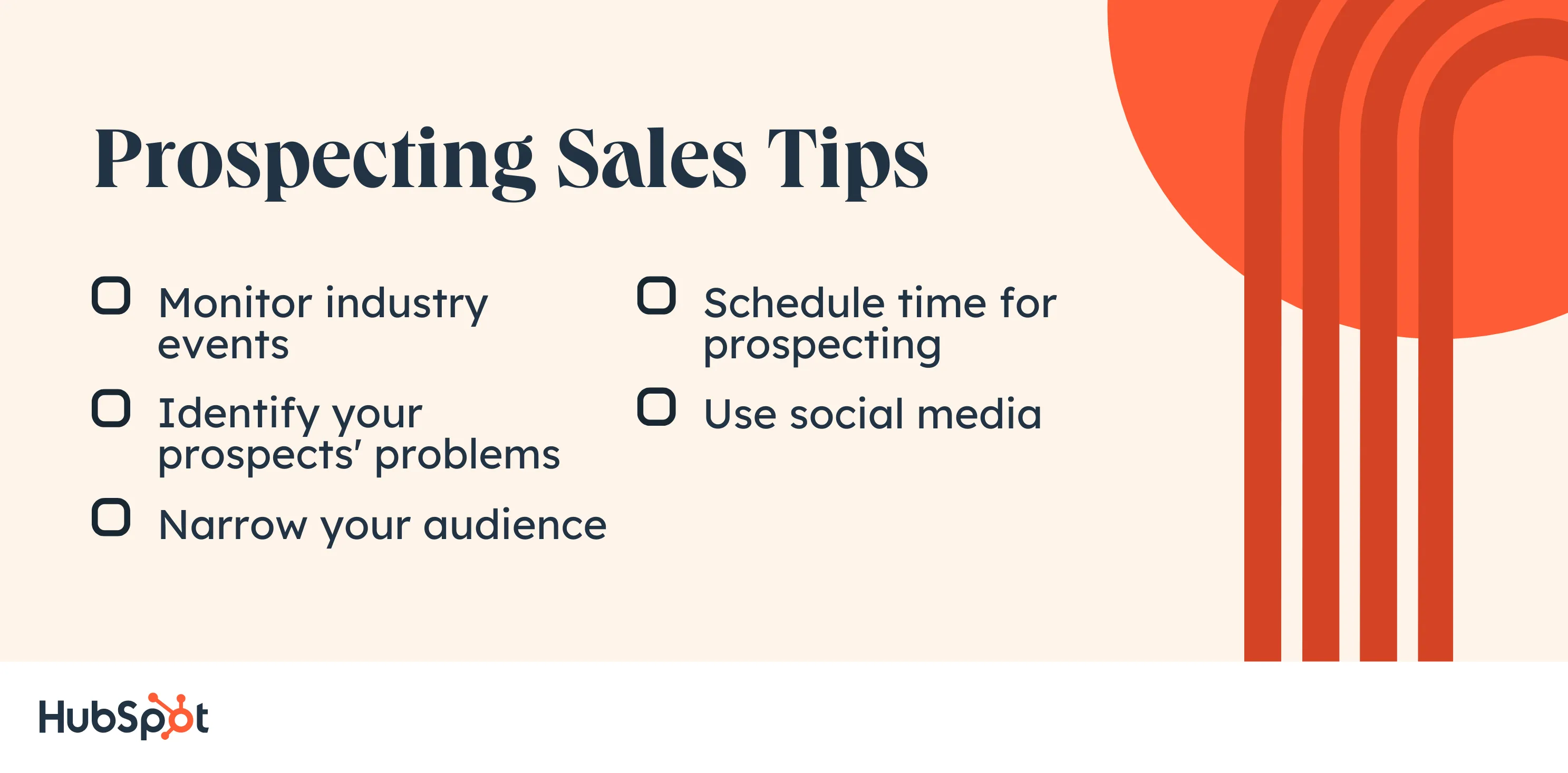
1. Monitor industry events that may trigger new demand, such as major hiring shifts, an executive leader change, or new industry legislation.

2. Before you reach out to a prospect, identify the specific problems they’re likely to be dealing with.

What we like: Researching your prospects is key to making a pitch that hits home. Your pitch should be tailored to each buyer’s pain points. The more you can personalize, the better your odds of success.

3. Narrow your audience: “When you focus your energy on targeting a narrower audience, your message can be more customized,” says digital strategist and entrepreneur Trish Saemann.

4. Schedule time for prospecting every day — even on the last day of the month or quarter.

What we like: This shows your dedication and perseverance, both to your team and to yourself.

5. In addition to traditional channels such as email, phone, events, and referrals, use social media to research new prospects. Of salespeople, 55% do, helping them build rapport and keep the top of their pipeline as full as possible.

Email Sales Tips
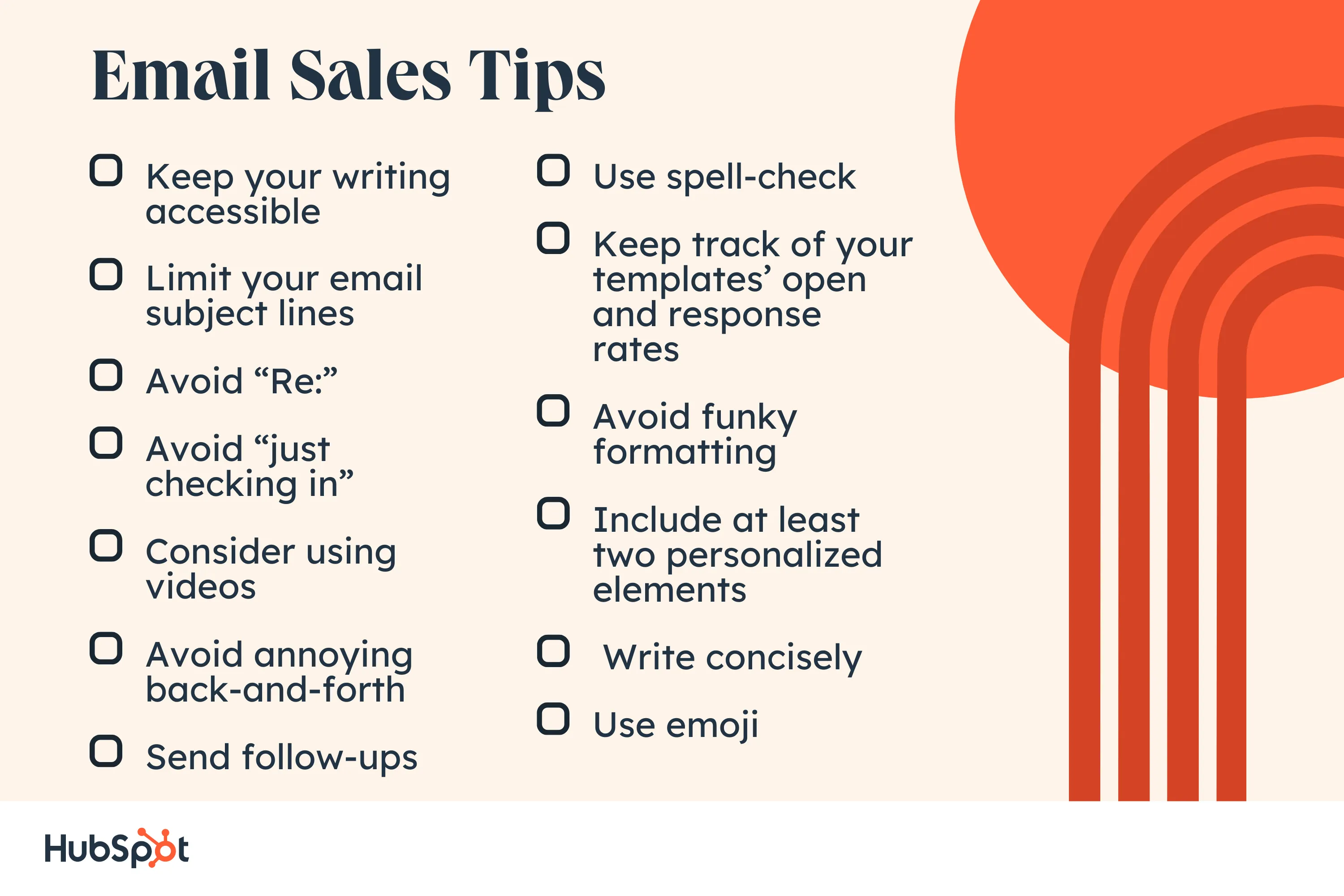
6. To get more engagement with your emails, keep your writing accessible and easy to understand.

Pro tip: Avoid unnecessary jargon or long blocks of text. You can discuss every aspect of what your product does during a demo or call. Your email is just a brief touch point.

7. Limit your email subject lines to seven words max — otherwise, they may be cut off when viewed on phones.

8. You may be tempted to use “Re:” in a subject line to increase open rates, but prospects are likely to promptly delete these messages after opening them.

9. If you’re trying to reengage a prospect who’s gone quiet, don’t guilt-trip them.

10. Emails that start with “just checking in” or “just following up” aren’t nearly as effective as those that include a reason for reaching out and a clear call-to-action.

11. Consider using videos to grab your prospect's attention and stand out in a crowded inbox.

What we like: Video is now the preferred method of media consumption, so take advantage of it and meet your prospects where they’re at. You may not be able to embed a video directly in an email, but you can create a gif with a play symbol that links to the full video.

12. To avoid the annoying back-and-forth of finding a time to meet, include a link to schedule a meeting directly on your calendar.

13. Send a follow-up email as soon as you get off the phone to ensure things don’t slip through the cracks.

14. Use spell-check or an editing tool like Grammarly to avoid embarrassing typos in your copy.

15. Keep track of your templates’ open and response rates. Then, drop your low-performing messages — and double down on the high-performing ones.

16. Think twice about using funky formatting or special fonts. They may seem fun, but more often than not, they’ll just make you look unprofessional.

17. Never send an email without including at least two personalized elements — and no, [prospect name] and [company name] don’t count.

What we like: Although email templates can help save you time, keeping things personalized allows you to make more meaningful contact with each prospect.

18. Write concisely. Rambling on and on can make you sound insecure, whereas clear, focused communication sends the message that you believe in yourself and the value of what you have to offer.

19. Emojis can be a great way to convey a more human, conversational tone — but don’t overuse them.

Calling Sales Tips
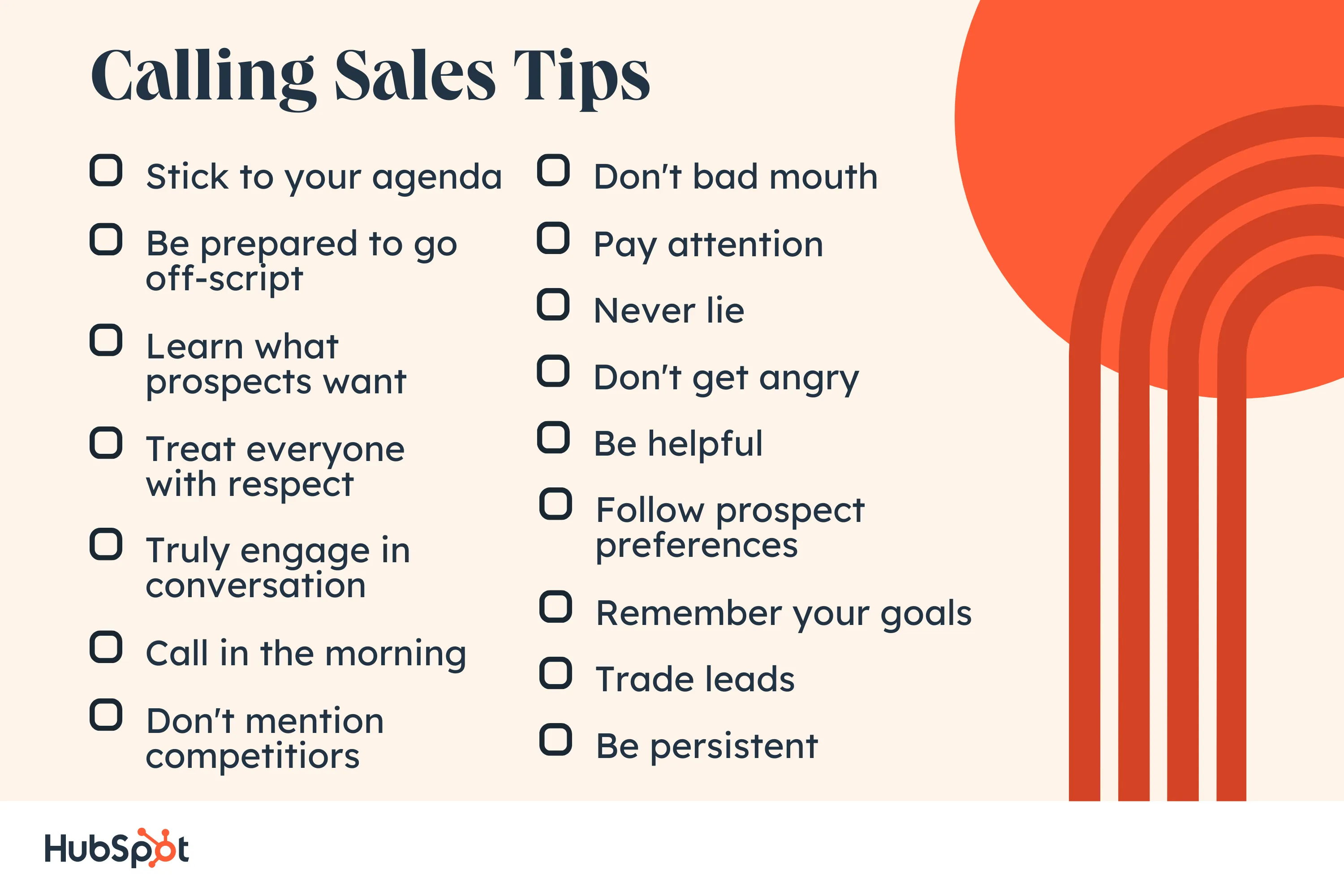
20. On a first discovery call, it’s important to balance sticking to your own agenda with addressing the pricing and product questions that prospects are likely to be most interested in.

21. Your prospects want to talk to a person, not a robot — so you can use a sales script as a starting point, but be prepared to go off-script as needed.

22. Try to get to the bottom of what your prospects want and what they may be thinking but not telling you.

Pro Tip: Databox CEO and Former HubSpot Sales Vice President Peter Caputa recommends bringing a “healthy skepticism and a willingness to ask incisive questions” into every sales conversation. He adds, “This is necessary to break down prospects’ walls and uncover the truth.”

23. Treat everyone with respect: Just because someone isn’t a final decision-maker or senior executive doesn’t mean you should dismiss them or their authority.

24. “To ensure you’re truly engaged in every conversation, pretend each call you have is the first with that customer,” advises sales strategist Babette Ten Haken.

25. Research shows that people tend to be more honest in the mornings, so if you’re struggling to pin down a flakey prospect, try scheduling an early-morning call.

26. If you also work with your prospect’s competitors, don’t advertise that in your pitch — after all, your prospect wants to be better than their competition, not exactly the same.

27. Never bad-mouth your competitors to a prospect — and if your competitors do something well, say so openly. This sends the message that you’re both honest and confident about your own value.

Pro tip: Keep a close eye on your competition and note what their strong points are. You can then tailor your approach to emulate their best practices.

28. Pay attention. According to a recent survey of 1,000+ global sales pros, being attentive and engaged is the number one most effective strategy for building rapport with prospects.

29. Never lie. “As a salesperson,” sales expert Jim Keenan explains, “truth is your greatest asset, because it builds trust.”

30. If a prospect criticizes you, don’t get angry or defensive — that’ll only make them dig in their heels, while humility and grace are more likely to get them to come around.

31. To maintain a friendly and helpful attitude, try picturing yourself sitting on the same side of the table as your prospect.

Best for: Keeping the prospect’s good in mind, especially if they’re difficult for you to work with.

32. Defer to your prospect’s communication preferences: If they clearly prefer email over phone calls (or vice versa), then go with it.

33. When motivation flags or you find yourself reluctant to get on (yet another) call, remind yourself of your financial, career, or personal goals.

34. Trading leads with another salesperson can be a great way to get out of a sales slump: You’ll feel less pressure to perform, and it could be a fun change of pace (as long as you agree in advance who’ll work the deal long-term if the prospect ends up moving forward).

35. Be persistent and don’t give up on a prospect just because you don’t get an immediate response.

Pro Tip: B2B call center expert Jeff Kalter argues, “A baseball team won’t win the game if they only try to hit the ball once. The same is true for you. If you only call leads once, you’re highly unlikely to make the sale.”

Conversation Sales Tips
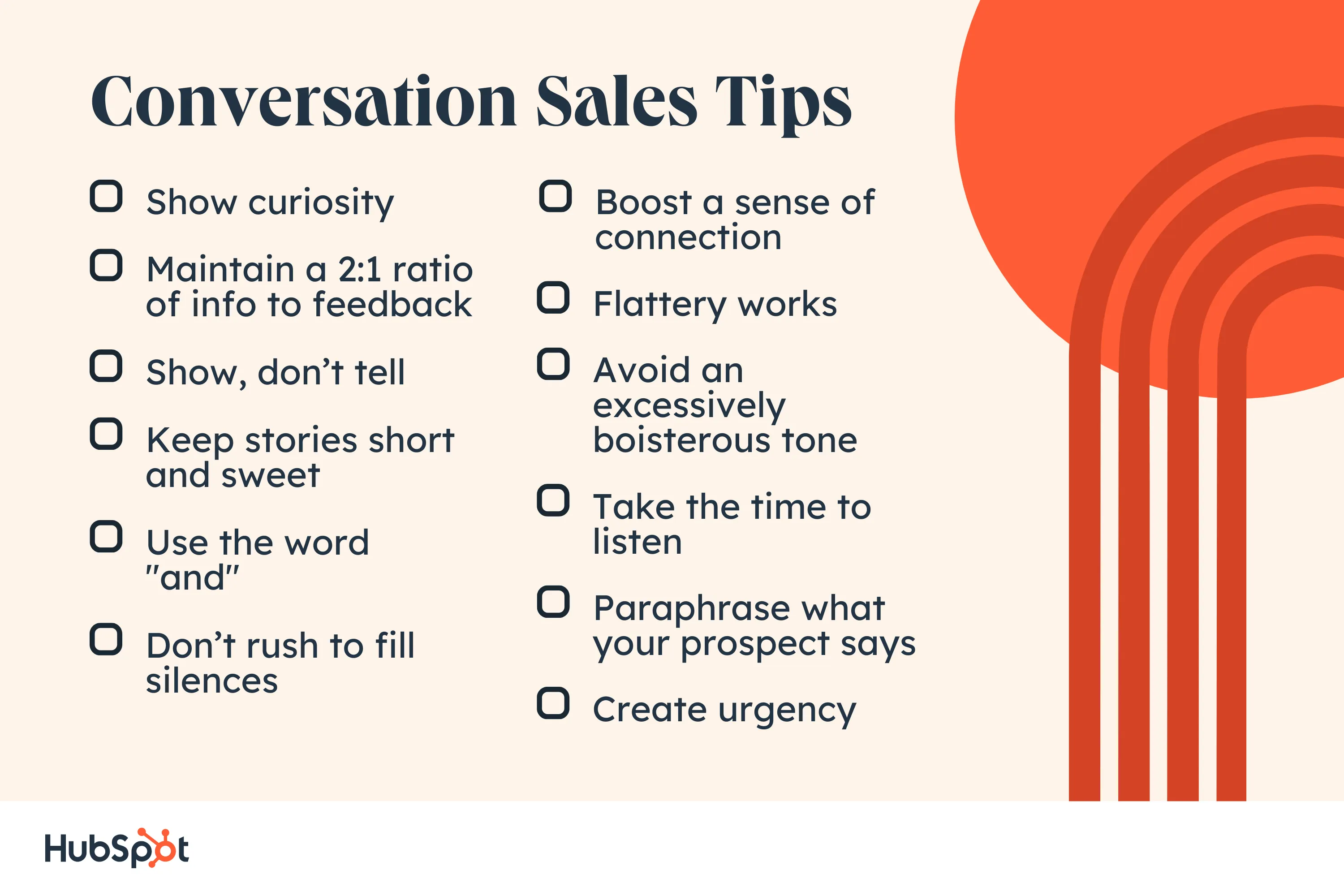
36. Sales trainer and co-author of Your Successful Sales Career Len Foley speaks to the power of genuine curiosity, reminding salespeople to “get fascinated with your prospect.”

37. Maintain a 2:1 ratio of info to feedback: For every two pieces of information you give your prospect, ask a question confirming you’re on the right track.

What we like: This tip ensures you’re engaged in a conversation, not just sales pitching. By asking questions you can also put your active listening skills to use.

38. Show, don’t tell: “The moment [you’re] tempted to tell the buyer what ‘he needs to do’... offer a story about a peer of the buyer [instead],” suggests Mike Bosworth, author of Solution Selling and What Great Salespeople Do.

39. An easy-to-follow success story is dramatically more effective than a long or meandering one — so when it comes to storytelling, keep it short and sweet.

40. When offering a counterpoint, using the word “and” instead of “but” can help you sound like you’re agreeing with your prospect, taking them off the defensive and making them more amenable to your position.

41. Don’t rush to fill silences. These quiet moments give prospects a chance to process information and make a sales pitch feel more conversational.

42. To boost your prospect’s subconscious sense of connection with you, identify the specific words they use and use those same words in your own speech.

43. Flattery works. Complimenting a prospect on a recent company achievement or personal success can go a long way to cementing your relationship.

Pro tip: Don’t overdo it. People can tell when you’re just buttering them up, so be sincere and specific in your praise.

44. Enthusiasm can be a positive, but too much can backfire. Avoid an excessively boisterous tone, and limit your use of words like “awesome,” “fantastic,” and “amazing.”

45. A recent report identified “good listening skills” as the most important skill for sales leaders — so make sure you’re taking the time to listen when engaging with prospects.

46. To show you’re listening, paraphrase what your prospect says back to them with a phrase like, “What I hear you saying is…”

47. Harvard professor and former HubSpot CRO Mark Roberge speaks to the importance of establishing urgency: “In my experience,” he reflects, a “sense of urgency is best addressed right after the goal-setting phase of the discovery conversation. Once goals are established, explore why it’s critical for the prospect to address the pain now.”

Presentation Sales Tips
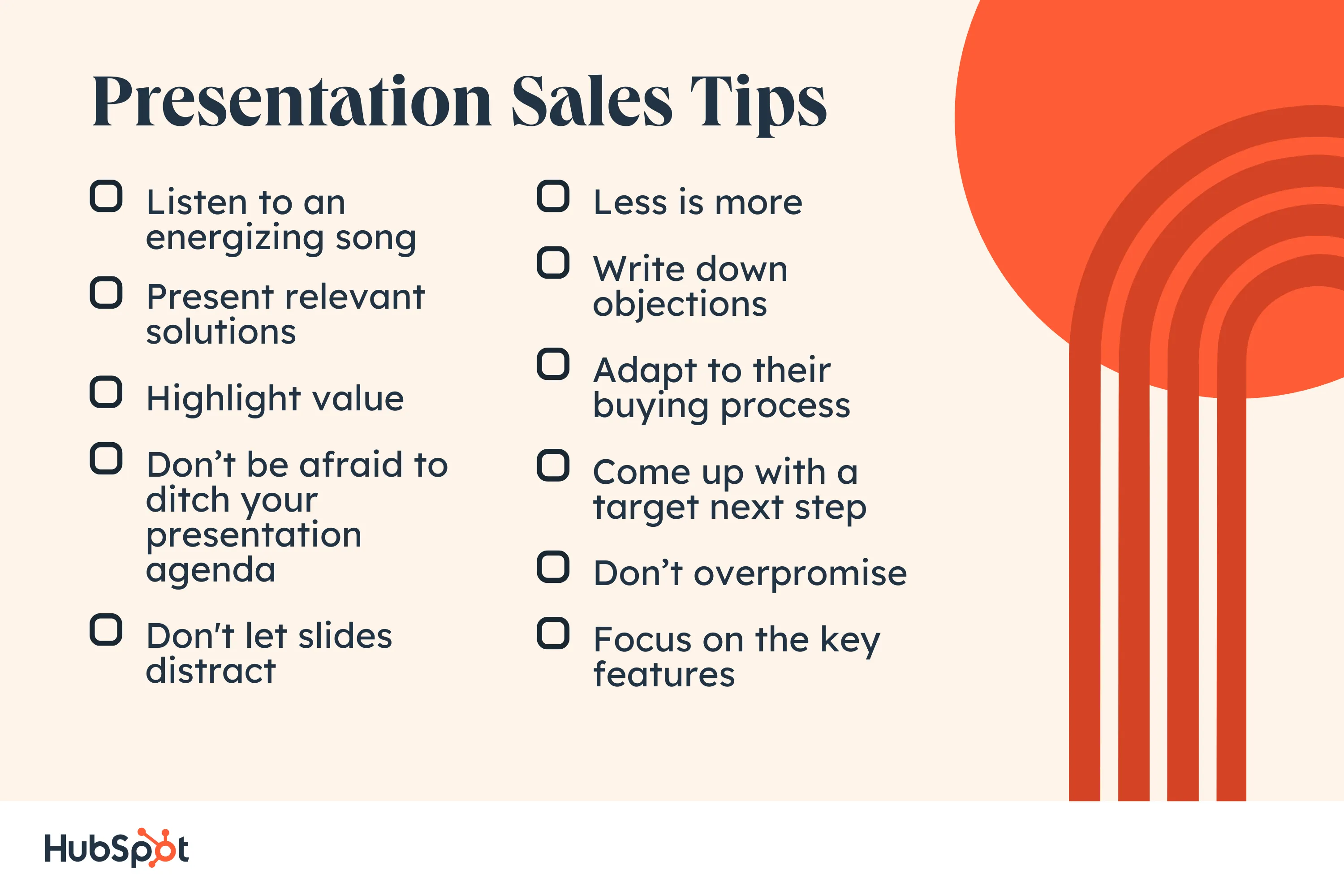
48. If you’re feeling tired or checked out, listening to an energizing song before you make calls can help you get your head in the game and come across as more upbeat and engaged.

49. Only present solutions that are relevant to the prospect (even if that means leaving a really popular feature out of your presentation).

What we like: By focusing only on the relevant solutions, you show your prospect that you understand them and want to help meet their needs. This demonstrates that you have their best interest in mind.

50. Your prospects don’t care about your product’s bells and whistles — instead, highlight how these features translate into real value for the buyer.

51. Don’t be afraid to ditch your presentation agenda if the prospect wants to focus on a different topic. This is all about putting the customer first, which is the heart of inbound marketing.

52. If you’re using a presentation deck, don’t let it become a distraction, notes SinglePlatform CEO and co-founder Wiley Cerilli: “Successful salespeople are trained to capture and manage customers’ attention. You don’t want to give authority away to the deck that’s behind you.”

53. Less is more: The longer your presentation lasts, the less impact you’re likely to have.

Pro Tip: Practice your presentation ahead of time so you know your message, are confident in what you’re saying, and can present it without rambling or being repetitive.

54. Writing down a prospect’s objections in real time shows that you’re really paying attention (plus, it’ll help you address their concerns more effectively).

55. Rather than trying to force a prospect through your funnel, adapt to their buying process.

56. Come up with a target next step to come out of the presentation (a follow-up meeting, a product trial, purchase terms) — along with several alternatives in case it’s rejected.

57. Don’t overpromise. It may win you the deal today, but it won’t be worth the unhappy customers you’ll face tomorrow.

Best for: Creating a flywheel, which relies on bringing in long-term, happy customers.

58. When demoing your product, focus on the key features relevant to your prospect, rather than whizzing around a complex interface or diving into every detail.

Closing Sales Tips

59. Don’t procrastinate: More than one in five sales professionals say the biggest reason prospects back out of deals is because the sales process takes too long.

60. To either get a “yes” or surface a prospect’s remaining objections, ask them, “If we offered you the product at this price, would there be any reason you wouldn’t do business with our company?”

Best for: Making sure your prospect has no more lingering doubts or reservations.

61. Avoid manipulative closing techniques, as most prospects today are sophisticated enough to recognize them and walk away.

62. Freemium and free trial offers can be a great way to get to yes, with 90% of salespeople who use these options reporting that they are “moderately to extremely effective at turning prospects into paying customers.”

What we like: This option allows your prospects to actually experience the value your product has to offer. Allow the product to speak for itself.

63. Go into negotiations with a few non-monetary concessions to offer, so you can negotiate on terms other than price.

General Sales Tips
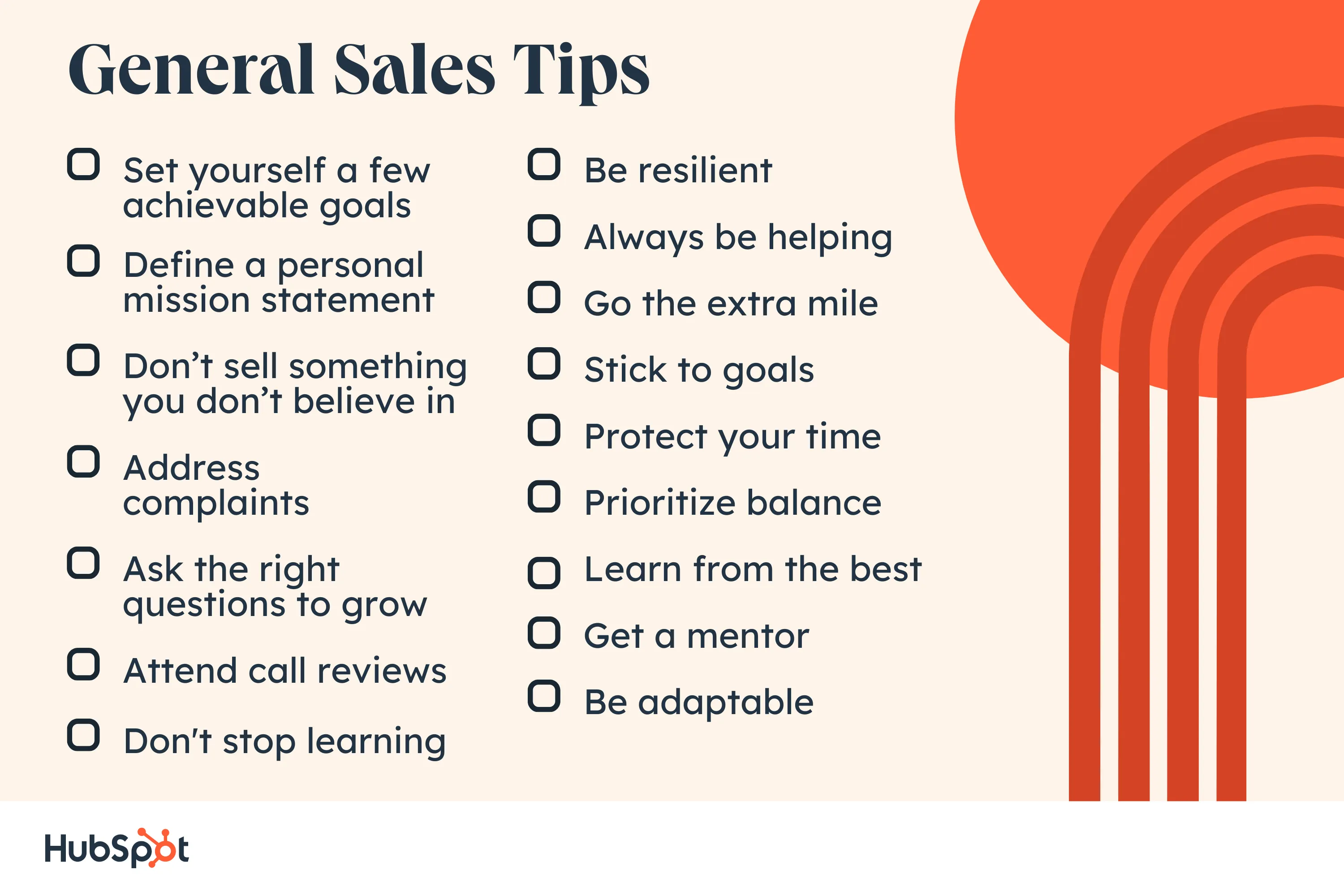
64. To boost your momentum and confidence when you’re in a sales slump, set yourself a few small, achievable goals.

65. Define a personal “sales mission statement” and use it to foster a more deliberate decision-making process.

66. Don’t sell something you don’t believe in.

Pro tip: “If you believe that all you have is your transaction, you’ll never get there,” writes Keith Ferrazzi, author of Never Eat Alone. But if you truly believe in what you’re selling, you’ll “know that you’re inviting people into what is absolutely a beautiful (and long-term) relationship.”

67. Address complaints promptly and directly. Ignoring them or being roundabout will only turn prospects away.

68. Your sales manager can be an incredible resource, but you need to ask the right questions to grow as a sales rep.

Pro tip: Don’t avoid the hard questions, like “Why do you think we lost this deal?”

69. “Attend call reviews,” says Michael Pici, director of sales at HubSpot. “If you‘re not running or attending call reviews, you’re missing a huge opportunity to improve your sales performance.”

70. Never stop learning: Keep your knowledge of the product up-to-date, role play challenging conversations, and read industry news regularly.

Best for: Staying engaged in your career and upping your sales game.

71. Research shows the top salespeople are resilient, empathetic, and ambitious, so focus on honing those traits in yourself.

72. Forget “Always Be Closing” — your mantra should be “Always Be Helping.”

73. Always go the extra mile: Even if it’s the last day of the month, even if you’ve already hit your quota, keep calling, emailing, and scheduling meetings.

74. To stay on track when you’re feeling demotivated, set yourself clear goals — and stick to them.

Pro Tip: Ask a colleague to help you hold you accountable to your goals, and you can do the same for them.

75. Protect your time: You only have so many selling hours in the day, so avoid distractions and use your work hours wisely.

76. Productivity is important — but you can’t be productive if you’re burnt out. So don’t forget to prioritize work-life balance!

77. Seek out team members who will motivate you to improve and encourage you to keep going when you're feeling down.

What we like: This is where the “team” aspect of your sales team comes into play. Make sure you’re supporting one another so that everyone succeeds.

78. Learn from the best: Take the top-performing salespeople at your company out for lunch and ask for their advice.

79. A great manager, coach, or mentor can make a world of difference — so invest in cultivating these relationships.

80. Sales pro Jeff Kalter emphasizes the importance of adaptability: “Because every buyer is different, you can’t set your sales cadence in stone. Instead, monitor prospects’ interests and how they interact with your brand. Downloading a white paper, for instance, is entirely different than a contact request.”

81. Embrace new technology: For example, more than two in three salespeople say that AI and automation tools are changing how they plan to sell.

Best for: Freeing up sales reps to make more human connections with prospects.

Getting Started

When it comes to sales, everyone has their own style. These tips aren’t one-size fits all. Start experimenting to see what works best for you. Or even better, team up with a teammate and tackle these tips together.New call-to-action

10 May 17:00

How To Make Sure Your ABM Efforts Are Driving Revenue

by Jordan Con

As far as B2B business strategies go, it’s pretty clear that 2016 is becoming the year of Account-Based Marketing (ABM). As marketers adopt the strategy and get wrapped up in how to best implement ABM efforts, it’s important to remember that generating revenue is still the marketing team’s north star. According to a study by B2B Marketing and Marketo, two-thirds of senior marketers say they feel pressure from their senior management team to produce metrics that demonstrate marketing’s business contribution. And we expect to see that number continue to rise.

Within the B2B marketing community, there have been plenty of ABM conversations around identifying target accounts, new methods to reach those accounts and new metrics that are specific to ABM. These are important conversations to have, but it’s also easy to get caught up in them. It becomes easy to be distracted by some of these things instead of optimizing and measuring around what is truly important – driving new revenue.

A common early misstep when implementing ABM is that when you start optimizing for the wrong metrics, your results disappoint. So, how do you go about making sure that your new ABM efforts are driving revenue?

ABM Attribution

The simple answer is through an attribution solution that connects all of your ABM efforts to downstream revenue.

When a prospect account becomes a customer, the revenue generated can be tied to all of the marketing interactions that the account engaged with prior to becoming a customer. Then, when your attribution solution also has the following capabilities, you can be sure that the amount of revenue credited to each ABM effort is accurate:

1. Multi-touch

2. Omni-channel

3. Lead-to-account mapping

1. Multi-Touch

The multi-touch layer makes sure that every one of those marketing interactions gets the credit that it deserves for influencing the prospect account. When it comes to ABM, multiple people make up an account, and each person may enter the funnel at a different point. In a simplified funnel, the researcher may come in at the top of the funnel, the user may enter in the middle of the funnel and the decision-maker may enter at the bottom of the funnel. With multi-touch attribution, the marketing at each of the funnel stages receives credit for driving revenue. This eliminates potential model bias to over or undervalue certain marketing efforts just because of the stage in the funnel that it is targeting.

2. Omni-Channel

Next, the measurement of your ABM efforts must be omni-channel. Because ABM is especially reliant on sales and marketing alignment, the sales team’s offline efforts — hosting sales dinners, attending conferences, outbound calling to target accounts, etc. — must be measured the same way that online marketing efforts are measured.

3. Lead-to-Account Mapping

Finally, and perhaps most importantly, ABM attribution must include lead-to-account mapping. In the ABM realm, accounts are the most important unit, not leads (like in demand generation).

When you’re targeting a certain company, you will likely want to interact with a number of different people (leads) within that organization. Let’s call them John and Jane. However, if these two leads aren’t mapped to the same account, your efforts may be redundant and your measurement and reporting will be misleading. When Jane closes as a customer, all the marketing efforts that went into engaging John will receive no revenue credit. Even though Jane’s engagements receive revenue credit, without lead-to-account mapping it will be inaccurate because it’s not taking into account the other people in the account.

Lead-to-account mapping ensures that both the marketing and sales team thinks and interacts with prospects in account terms, not individual lead terms.

Conclusion

With these attribution components, you can be confident that your ABM efforts are being credited with their accurate share of the revenue generated. Only then, can you fairly evaluate the success of efforts and make smart marketing decisions going forward.

10 May 16:59

New Research: Your Sales Database Is Killing Your Bottom Line

by Will Humphries

business, people, statistics and team work concept - close up of

An outdated sales database means the data you collect and maintain offers little value, plus it is having a negative effect on your bottom line.

At best, bad data is costly to maintain and ineffective to use. More importantly, bad data could lead to inaccurate business and marketing decisions that do more harm than good.

With new research below from Oracle, DemandGen, and Experian, here are four signs that you need to update your sales database to optimize performance and productivity.

Ineffective Sales Leads

This infographic is from last year; however, the data from it remains as relevant today – that as much as 40 percent of all B2B sales leads contain bad data. This data results from poor initial entry, missing items, outdated information and duplication.

If your team is not having much success contacting leads, often signalled by a poor lead-to-meeting ratio, outdated data may be a culprit. If you have this issue, perform an audit to examine data entry behaviours as well as verification checkpoints. Refreshing existing contacts and implementing more effective processes moving forward is necessary in this instance.

Infographic-Data-Survey

Detail Credits: http://blog.integrate.com/infographic-dirty-data

Concerning Churn Rates and Satisfaction Ratings

A major purpose of a database is to strengthen your ability to manage relationships with customers. If you experience a significant upturn in customer churn and a significant downturn in satisfaction ratings, bad data is a likely reason.

Armed with incomplete or inaccurate data, sales teams will have trouble with follow-up communication or developing effective relationship strategies. Faulty email addresses would cause a customer to miss out on messages sent through an email marketing system, or you could be targeting the wrong person due to a change in their job function.

Sales people may also have difficulty completing all-important follow-through and follow-up activities that impact satisfaction and retention.

According to Indeed.com, in the US alone, over 50 percent of workers are thinking of changing their jobs in 2016.

It can be extremely difficult to ensure your sales database is consistently accurate. Taking this jobs statistic alone, what sort of impact will that have on your sales database and marketing automation plans?

Poor Marketing Results

Predictive analytics is the use of data for automated reporting and trend identification. Marketing and sales teams rely on analytics to make decisions on which prospects to go after with specific types of communication and messaging strategies.

If your marketing and sales activities are highly inefficient and ineffective, analytics probably aren’t working well either. The common cause is bad or outdated data. Simply put, bad data in, bad data out. If you input bad data you output inaccurate information that is being used in decision-making. Decision making that is having a direct impact on your bottom line.

In DemandGen’s 2016 report “What’s Working in Demand Generation?” lead quality remains one of the top priorities for B2B marketers this year, “as they look for their increased emphasis on data-driven marketing and predictive analytics to yield more qualified leads.”

The main means of driving both early stage (77%) and later stage (85%) leads is Email, with telemarketing coming in at 24% and 42% respectively.

Top Channels For Driving Early-Stage Leads DemandGen Report 20162016 DemanGen Report Lead Generation Contact

Marketing relies on current, accurate data to develop highly targeted campaigns that support sales activities.

A Bad Bottom Line

One of the most tangible and obvious signs of the need for a database refresh is a bad bottom line. Poor revenue and low profits are common financial results when bad data is driving selling activities.

Your salespeople rely on thorough and accurate data to continually improve their selling processes. Data provides a picture of a buyer’s experience throughout the buying cycle. Without current, accurate data, it is harder to monitor sales performance. Thus, it is also hard to coach and develop reps for peak performance. Inevitably, productivity and revenue suffer.

In Oracle’s “The Future of Modern Marketing: 2016” report, a number of global marketers gave their predictions on what would be the hot trends for 2016.

“Sales enablement is the most important marketing function heading into 2016.” Matt Heinz | President, Heinz Marketing Inc

“The most useful measure of marketing automation performance is conversion rate” Jordie Van Rijn | Emailmarketing and eCRM consultant, Emailmonday

“84% of top performing businesses are using or will use marketing automation in 2016. Marketing automation needs leads, and while content is the most potent fuel for lead generation, managing and leveraging that growing library of content will be vital in order to fully utilize marketing automation.” Yoav Schwartz | CEO, Co-Founder, Uberflip

The whole point of marketing – social media marketing, content marketing, inbound marketing, email marketing, video marketing, digital marketing, traditional marketing – is to drive sales. That’s it folks! It’s all about the sales.

And with 84 percent of companies using or planning to use marketing automation to drive the sales and marketing efforts, what happens if the data you are using is inaccurate?

In a 2014 EDQ survey taken by more than 1,200 organisations in the UK, US and Europe, across a range of sectors and company sizes, it was found that inaccurate data has a direct impact on the bottom line of 88% of companies, with the average company losing 12% of its revenue.

According to DatabaseMarketing in an article from February of this year, the latest research carried out by Experian from 1,400 businesses across eight countries, shows that businesses estimate that they could increase sales by almost a third (29%) if customer data was completely accurate.

The same report stated that 75% of the respondents cited email as the most used channel for marketing communications, and of those respondents, 73% can point to a business impact as a result of the inaccuracy.

Conclusion

Bad data leads to ineffective and inefficient business activities and poor bottom line results. If your team’s performance is weak or declining, conduct a thorough audit of your data and your processes for gathering and maintaining data.

Good data is essential to maximising the value of sales leads. Simply pointing your finger at your sales teams may be the wrong option.