Shared posts

06 Jun 16:31

These 17 life hacks will change the way you use Gmail (GOOGL)

by Nathan McAlone

gmail icon

Since it debuted a decade ago, Gmail has become not just another email program, but a cultural force. It is the world's largest email service, and it has set the standard for what people expect in terms of ease of use and inbox size.

But that doesn't mean it can't be better.

A bunch of apps and plug-ins floating around the internet can make your experience using Gmail so much more enjoyable. With these amazing add-ons, you can see when people are tracking your emails, automatically know everything about people who email you, and send self-destructing emails. You can leverage the power of GIFs and even use Gmail as you would WhatsApp.

These 17 apps, tricks, and plug-ins can help you both streamline your Gmail time and do things you didn't even know were possible. And special recognition to Product Hunt, which has featured many of these products. Read on to become a Gmail pro:

SEE ALSO: The 15 best apps for keeping your life in order

Find out which websites are selling your email address to marketers by adding the "+" sign and a specific word related to the new service to sign up.

Signing up for a new service? Gmail recognizes the + sign now, so you can create an alternate version of your email and monitor if you begin to receive spam to that new address (it'll all still go to your main Gmail inbox.) So if your email was usually nathan@gmail.com, you could sign up for Hulu with nathan+hulu@gmail.com and keep an eye on your usual Gmail inbox for spam mail sent to that alternate address. Then you know who sold your contact info to marketers.

This trick works as many times as you'd like, so you can add a + sign with a specific word to create infinite alternates that will all go to your main Gmail inbox.


Sortd turns your Gmail into a set of useful lists

Sortd is a smart skin for Gmail that transforms your inbox into a set of lists you can customize to fit your workflow. You can change the list names, add as many as you please, and reorder them at will. Sortd is built around dragging and dropping, and tailoring your inbox to fit your needs is refreshingly simple. 

Get it here.


Ugly Email tells you which of your emails are being tracked before you open them

You may not know, but there are now email-tracking tools that make it easy for people to see when you open an email, what you click, and where you're located. To fight these, the Ugly Email Chrome extension (on Firefox soon) shows you when your emails in Gmail are being tracked. And it starts working before you click anything. Once Ugly Email is installed, a little eye symbol appears next to any email in your inbox that's being tracked.

Get it here.


See the rest of the story at Business Insider
31 May 17:40

10 Ways to Spruce Up Your Small Business Finances This Summer

by Nate Matherson

After a particularly brutal winter, the summer months are a welcome shift. For small business owners, the change in seasons should be a reminder to do some cleanup and organization. After long months of building your business model, generating sales and managing your company, it is important to take some time to evaluate where you are and where you want to be. With summer around the corner, vacation plans are in full swing, and the pace at work usually slows down. It is the perfect time to organize your business and your finances.

Reevaluating your business operations can help you stay on the right track. Here are ten tips for getting your business finances in shape:

Analyze Your Income and Expenses:

Cash flow issues—especially old bills piling up—can keep your company from keeping up with payables. Pay any past due invoices and check your own past due receivables to see who owes you money. As an entrepreneur, with so much going on, it is easy to miss an invoice. A simple phone call or email reminder is usually all it takes to get paid the money you are owed. Be persistent, and if clients keep stalling, eliminate customers who are regularly late. And maybe for once, put together an updated balance sheet.

Look Over Contracts

From your technology systems to paper suppliers, your business probably has several contracts with different services. Each one is an opportunity to renegotiate for significant savings. Even if your contract is not up yet, you can still negotiate based on a potential early-renewal or an increase in services. If there have been any problems with the services, such as appointment no-shows, use that as leverage for a discount.

Get Your Records Together

As a small business owner, you probably have mountains of paperwork waiting to be filed. From invoices to purchase receipts, these documents are essential records for your business. File everything away or scan the documents and file them electronically so you’ll have everything at your fingertips when it is time to complete your taxes.

Update Your Accounting Software

If you rely on accounting software, such as QuickBooks or FreshBooks, to manage your business’ finances, you may have missed important program updates. Most companies update their software every year, and if you are using the old version, you may not have new essential features. Consider using Bench or inDinero as newer, fresher, alternatives to traditional accounting software. Through personal experience, I can attest that managed accounting software can save you quite a bit of time and headache.

File Quarterly Reports

Many small business owners are shocked by quarterly and self-employment taxes. The next quarterly payment is due June 15, so now’s the time to review your income statements and expenses. If you’ve missed a deadline, talk to your CPA about how much to pay for the next tax period to minimize any penalties.

Hire Fresh Talent:

Summer is the perfect time to refresh your workforce. It is college graduation season and thousands of newly minted graduates are looking for entry level employment. Hiring recent graduates can be a great way to refresh ideas, processes, and culture at your small business. And, hiring to graduates is significantly cheaper than experienced employees. Hiring graduates is competitive. Hiring millennials is much different than hiring from previous generations. You should consider thinking outside the box with unique benefits and job responsibilities. Millennials are looking to make an impact and they might be able to give your small business a fresh boost.

Review Pricing Structure

Pricing is one of the most challenging areas for a new business. If you price too low, you give the impression of substandard quality. Too high, and you’ll lose out on customers. As your company has grown, you likely negotiated special deals or discounts with clients and, as a result, your pricing structure is irregular. Compare your services and costs those of your competitors to see what you should be charging.

Check Subscriptions and services

Over time, you may have signed up for programs or services that made your life simpler for an individual project, then have gone unused and forgotten. These recurring subscriptions add up, so take some time to review your statements and cancel any subscriptions you and your staff do not use regularly. Use tools like Trim or Truebill to find and remove unwanted subscriptions.

Set New Goals

Since the summer is usually slower, it is a perfect opportunity to do some planning and a mid-year checkpoint. Evaluate how much progress you have made, where you flourished and where you struggled and establish new goals for the rest of the year. Looking at your income receivables will help give you concrete targets for the next six months.

Establish Credit

If your business has been performing well, you should start planning how to scale up your business operations. Expanding and growing your capacity requires money, and many small businesses rely on credit to meet their needs. If you’ve been relying on your personal credit card and bank accounts, it is time to break away and open up a business checking and credit account. The credit card can give you much needed liquidity in times of emergency or opportunity so you can be nimble and respond to new challenges.

Increase Efficiencies

Entrepreneurs often find creative ways to get things done, often on the cheap with no budget at all. While the do-it-yourself route can be useful when building your business, it is not always the most efficient. Use the summer months to research and learn new processes or programs to streamline your operations, whether it is new software that manages inventory or a more secure online store. With Cloud technology, many of your programs and accounts can be synced together and automated, reducing the amount of time you spend on administrative work.

If you find yourself with a smaller to-do list than usual, take advantage of the slow period and spruce up your finances and business operations. Eliminate distractions by turning off your phone, closing your email and shutting your office door, so you have the time and space to get organized and create a more efficient and cost-effective work environment. It takes a conscious effort and dedication to go through your accounts, processes and forms, but the commitment can produce high returns and set you up for a successful second half of the year.

31 May 17:40

Fed rate hike talk sends gold spiralling below $1200 as U.S. dollar rises

by Sharon Cho and James Poole, Bloomberg News

Gold’s on the ropes. Bullion broke below US$1,200 an ounce on Monday after losing more than US$100 in less than a month as Federal Reserve policy makers land punch after punch by talking up the prospects for a U.S. interest rate rise, reinvigorating the dollar.

Bullion for immediate delivery fell as much as 1 per cent to US$1,199.80 an ounce, the lowest level since Feb. 17, and traded at US$1,207.14 at 10:39 a.m. in New York, according to Bloomberg generic pricing. With many traders in Britain and the U.S. away from their desks for holidays, prices that peaked at a 15-month high of US$1,303.82 on May 2 are down for the ninth straight day, equaling the worst daily losing run on record, Bloomberg data show.

The precious metal declined after Fed Chair Janet Yellen affirmed in comments on Friday what a procession of her officials said earlier last week: that evidence of strength in the U.S. economy meant tighter policy can now be considered. UBS Group AG warned on Thursday that gold is “going to roll over” as the Fed hikes rates twice before the end of the year. Holdings in exchange-traded products ended last week slightly lower after expanding for four straight weeks.

“The key risk for me now is not whether they will hike once, but actually whether they will hike twice: as a house, we believe they will hike twice in September and December,” Wayne Gordon, executive director for commodities and foreign exchange at UBS Wealth Management, said in an interview in Singapore on Monday. “For me, it’s all about the data that’s coming in.”

The drop has cut bullion’s gain in 2016 to 14 per cent from more than 20 per cent at the start of the month as Fed officials fleshed out the case for higher borrowing costs. Before Yellen’s remarks, officials including the presidents of the bank’s regional arms in San Francisco, Boston and Philadelphia all spoke in support of higher rates.

Bets on a rate hike have risen to 34 per cent for June and the odds are more than even for an increase in July, after data on Friday showed U.S. growth picked up more than previously estimated in the first quarter. The dollar spot index climbed as much as 0.3 per cent on Monday to the highest since March.

Producers Fall

Hedge funds took a breather from gold before Yellen’s comments on Friday. The net-long position in futures and options fell 26 per cent to 169,491 contracts in the week to May 24, according to U.S. Commodity Futures Trading Commission data released three days later.

Higher borrowing costs damp the appeal of non-interest bearing assets like bullion and strengthen the dollar, making commodities more expensive in other currencies. Among U.S. data due this week, traders will scrutinize non-farm payrolls for this month, which are due for release on Friday.

Canada’s two biggest gold producers by market value were among decliners in Toronto trading. Barrick Gold Corp. and Goldcorp Inc. lost more than 0.5 per cent as the 21-member S&P/TSX Composite gold index slipped 0.3 per cent en route to its first monthly drop since November.

* Holdings in gold-backed exchange-traded funds fell 2.04 metric tons to 1,842.9 tons on Friday.

* Silver lost 1.5 per cent, platinum slid 0.6 per cent and palladium added 0.3 per cent.

Bloomberg News

31 May 17:40

How IoT is Revolutionizing Asset Monitoring for Utility Companies

by Annie Bustos

In a previous post we briefly discussed 3 ways that utilitiy and green energy companies are getting smarter with IoT but now I want to delve a little deeper into one important area which is asset management. Assets that are linked to IoT devices allow utility operators to see real-time conditions, predict usage spikes, and proactively schedule maintenance. And there’s underlying consumer and political pressure for utilities to strive for efficiency. Previously, utilities got by with a limited amount of information, but in order to meet customer demands and best manage services, they have struggled with turning the data they do have into actionable intelligence. This is where IoT comes in, especially within asset management.

And this shift to IoT isn’t a “next decade” endeavor. In the energy sector, the adoption of smart meters is on a torrid pace, with an estimated 925 million smart meter installations by 2020. Utilities will be best served by quickly embracing IoT so they can realize the cost savings of improved efficiency, which will be essential when managing renewables and the turmoil occurring in the industry.

A global survey of 200 execs in gas, water, and electric utilities noted 58% of the respondents have in place or will implement an IoT strategy for asset management and more than half relate that asset management’s importance has grown during the past twelve months.

Implementing Asset Monitoring

Utility firms are utilizing a range of IoT-enabled devices such as embedded cameras, tiny robots, and various sensors in order to understand the status of the asset network. Working in tandem, these IoT devices collect vibration data, flow rates, pressure, and temperature readings which provide instant snapshots of asset health and performance.

IoT is integral to realizing the “smart grid” where sensors help develop more intelligent networks that span different geographic areas. With this information at hand, operators can share peak loads in real time, greatly reducing the risk of grid problems. And over time the sophistication of these sensors will grow, with embedded software and tied-in analytics that provide an even deeper picture of asset health.

Fleet management is multiple-industry area impacted by IoT, as the hardware-intensive task of management a fleet of equipment is replaced by sensor-driven data. Utility companies utilize IoT within their fleets to better detect loss or fraud, and to enable faster response times to fix outages. Reducing outage times is a critical metric for utilities that are increasingly customer-focused. IoT metrics provide fleet managers with real-time data on how to best deploy fleet assets given the current situation.

Water companies utilize IoT throughout the chain, from treatment of water quality throughout the entire process from reservoir to tap, as well as leak detection and other problem identifiers. On the business side, companies are using IoT controlled smart irrigation or refined data-informed manufacturing processes which can alter water needs in real time.

Proactive Benefits of IoT Data

A considerable benefit of IoT within utility companies is the ability to proactively spot problems. Catching these issues early has a twofold benefit of reducing waste through efficiency and avoiding a poor customer experience. Predictive asset monitoring allows operators to find weak spots in their asset chain, so they can be replaced or fixed before any problems occur.

Energy firms already possess large amounts of data through their own systems, and the explosion of smart thermostats, connected appliances, and other similar devices. The trick is how to analyze this IoT data to streamline operations, retain customers, and stay profitable.

More intelligence into usage could lead to surge pricing during peak energy demands, so energy producers could receive automatic alerts to avoid certain energy usage behaviors. These are the type of proactive services that energy retailers are presenting in order to retain customers, which is increasingly important as more choice is introduced to an often monopolistic industry.

Thought Leadership:

View Solar Energy Case Study

New Call-to-action

31 May 17:39

How To (Painlessly) Reconnect With Old Contacts

by Ian

In our last few videos we've looked at generating new leads – new initial contacts with people you don't know.

But what about all those contacts, Linkedin connection and business cards of people you met, but didn't properly follow up with? How to you reconnect with your old contacts in a way that's painless for you and them, and generates real leads fro your business?

Watch this week's 5 minute marketing tip to find out.


Find this video helpful? Subscribe to the More Clients TV channel on YouTube to get more of them:

subscribetomctv

Video Transcript

Hi. It's Ian here. Welcome to another five-minute marketing tip. We're continuing on our theme of lead generation, and this week's tip is being prompted by this email I got sent by Lauren, who replied to my video from last week and said, “Thanks very much, Ian. Perhaps your next piece could be, what to do with hundreds of leads, business cards, and Linked-in connections we've allowed to go cold.” That's a really great thought, because many of us do have tons and tons of connections that we've generated as leads in the past, but aren't really doing us any good, because we've let them go cold. I'm going to go through how to warm up and reconnect with some of your old contacts and your old leads after this swoosh.

Hi, welcome back. If you're anything like most people, you've probably collected over the years, a whole bunch of contacts, people you've worked with, had meetings with, talked about working together, all sorts of connections that you've then let go cold. Don't feel too bad about it. Everybody does it, but it can be great if you can reconnect with those people, and then keep them warm in the future. A couple of tips on doing that.

The first is, try not to let them go cold, in the first place. Don't lose touch. Secret to that is to prioritize. You're never going to be able to keep in touch on a regular basis, with 500 different people. If you try, you won't be able to keep in touch with any of them. Focus down, and prioritize. Look at say, 50 people. With 50 people, all you have to do is send out two communications every business day for about a month, and you're back in touch with 50 people on a monthly, regular basis. That's sustainable, and you can keep that going. Prioritize, and try and keep in touch on a regular basis.

If you have lost touch, and you want to reconnect, but you don't want to get all embarrassed, and you're worried about what might happen if you try and reconnect with them, a couple of things to bear in mind. Firstly, stop worrying about it so much. Relax a little bit. What's the worst that could happen? Many of us worry that, “Oh, no, I might damage my relationship, if I try and get back in touch with them.” You know what? If you're not in regular contact with someone, you don't really have a relationship with them. Over time, that relationship is decaying, and decaying, and decaying. If you just don't get back in touch with them, there is no relationship to lose. What's the worst that can happen? You get back in touch, and someone either ignores you, or even gets upset, you're no worse off than you are now, so it's worth doing.

On the positive side, you can spin it around a little bit and think about what would happen if someone who you had worked with before, who did a great job for you, you got on well with, got back in touch, after you hadn't spoken to them for a couple of years? Would you be ultra-suspicious and not want to speak to them? No, chances are, you wouldn't be. Chances are, you'd really appreciate the chance to get back in touch, swap emails with them, maybe grab a coffee or whatever it is. It's probably going to be just like that for you, when you get back in touch with people. Certainly, for the vast majority of people. As I say, relax a little bit. Probably nothing that could happen on the down side, and the up side is really quite good.

How do you go about getting back in touch? The first thing is, there's an easy route in, if you're not connected with them on Linked In. If you're not connected with someone on Linked In, an easy way of getting back in touch, is to offer to connect with them on Linked In. Don't do the automated thing, where you press it, and it just says, “I would like to make you part of my network.” Go to their profile, and hit the down-arrow on the “connect” button there, and that will allow you to send a personalized message. Then say something like, “Hi,” whatever-their-name-is. “Just trying to re-establish connection with friends and colleagues who I've lost touch with. I hope to speak with you soon.” Something like that. It's really simple. Nobody's going to turn that message down. They might ignore you. Nobody's going to get upset about it, though. Chances are, most people will reconnect. They'll recognize your name, and they'll get back in touch.

That's where Step 2 comes in, which is really vital. This is a step you jump straight to, if you're already connected on Linked In, or you go to, after they accept your Linked In connection request. That's to follow up, by adding value. If someone has accepted your Linked In connection request, or you're already connected, and you want to get back in touch, go and look at their Linked In profile. Go and look at what's happening to their company in the news. Go and look at what's happening to them in the news, if they're reasonably high-profile. See what they might be doing on Twitter, etc. Find out, and also remember from your previous experiences, what's interesting to them? What do they care about? Make a few little notes on that.

If you've got a CRM system, or something Contactually, do it on there. If not, use a piece of paper. Use a notebook. Make a few notes on what you think they're interested in and they care about. That might range from business topics you know they care about, to, you look on their Linked In profile and you notice they've worked in Valencia for the last year, and you worked there for a little bit, or whatever. Something you think would be interesting, to get back in touch with them, and talk about. You're reconnecting and adding value. The next message you send them, is going to be something useful or interesting. It might be a question. If you spot on their profile, “I noticed you worked in Valencia. I worked there for six months. Found it really great. What did you think?” You're engaging with them on a personal level there.

If you know they happen to be interested in a certain business topic, and you've written an article about it or you spot an article somewhere on the web, or go and look for a useful article somewhere on the web, or a TED Talk, or whatever it might be, send them a link to that. “Thought you might find this useful,” type of message. Reconnect by adding value, either in a personal level, by spotting and picking up something they're interested in that's not business related, or a more business-oriented thing, where you send them a link to an article or some useful piece of content.

From then on, just keep going at it. Do that thing where you can keep in touch with 50 people by just doing two a day, every month. Remember, if you're going to be looking up someone's profile, finding out what's interesting to them, sending them something of value. You can't do that for 500 people. You can only do it for 50 people. Once you get into the swing of it, maybe you can increase that to 100 people. If it takes you a bit more time, maybe it's 25 people. Either of those is a good number to be following up with, re-establishing relationships with, and then building relationships with on a monthly basis. Remember, try and add value all the time. Try and do something interesting and useful to them.

Eventually, based on how the relationship goes, maybe you then suggest a phone call, or grabbing a coffee if they're nearby, or something like that, and enhance the relationship by making it more personal, essentially. Judge it as things go, based on their reaction. If you send them something useful, and they reply to you, and they say, “Oh, that was really great. Thank you very much,” and you get chatting, great. Maybe you offer to have a phone call or a coffee. If you send them something useful, and then the next month, you send them something useful, and they never respond, maybe take them out of your 50 for nurturing relationships with them. Pull someone else in, because they're clearly not that interested in maintaining the relationship with you.

That's it. First tip, don't lose touch. Second tip, relax. What's the worst that could happen? Chances are, they really are going to be pleased to hear from you. Third tip, re-connect quickly using Linked In, and then do something that adds value, and start repeating that on a regular basis. That's it for this week. See you, next.

The post How To (Painlessly) Reconnect With Old Contacts appeared first on Ian Brodie.

31 May 17:39

Re-Thinking the National Sales Meeting

by Jennifer Sullivan

The national sales meeting is so ingrained in sales culture that its ROI is rarely questioned. Maybe it’s because it energizes the team to get everyone together for a few days, because it builds camaraderie for geographically dispersed teams, or even because it’s a great way to recognize outstanding performers. But do these events provide enough value to justify their high cost? The national sales meeting isn’t going away—and we’re certainly not suggesting it should. However, it’s time to think about how we can execute these meetings to maximize their value.

Before we dive into our approach, let’s examine the cost of getting the whole team together for a few days. Verizon presents some telling information in their white paper, Meetings in America. According to their research, a day-long meeting involving five participants—four of whom must travel to the meeting—costs approximately $5,000. Assuming your sales meeting includes 200 people for five days, your meeting could conceivably cost more than $1,000,000—not including the opportunity cost of having your entire team occupied for a week. In a time when we look so carefully at ROI on much smaller investments, it’s rather shocking we don’t look more closely at the economic return on this significant cost.

Knowing what a substantial investment the national sales meeting is for your company should be cause to step back and evaluate the effectiveness of the methods you employ at these meetings. After all, paying for all that training isn’t a good investment if your sales reps are going to lose much of what they learned soon after the meeting. Plenty of research—including this Xerox Corporation study—reveals that in-class training with little or no follow-up coaching is not effective for information retention. In fact, according to the study, 87 percent of what sales reps learn in a setting like this is likely to be forgotten unless there is ongoing follow-up and on-the-job training. These findings are magnified in an environment like the national sales meeting, where attendees are cooped up for days on end, wishing they were out enjoying the destination city, while instead being drowned in a constant fire hose of information.

Here are some thoughts on how to rework the national sales meeting to ensure you get a higher return on your investment while still maintaining the positive aspects of team-building and performance recognition:

  • Prior to the meeting, hold a sales pitch competition for the best presentation on a product or service. Encourage reps to submit the presentations via video and vote for the best online. Rather than using the sales meeting to give the presentations, use it to simply recognize the winners. Not only do you save valuable time, but best of all, the presentations are now online and accessible to the team as needed.
  • The national sales meeting is still a great opportunity to introduce new products and features that can energize the team. But be sure to capture the presentations on video and break them into small, searchable chunks so reps can easily refresh themselves on these topics as they need them. This just-in-time approach to learning ensures reps have access to the content they need at the time they need it most.
  • Distribute relevant content to your team over a matter of months or weeks, both leading up to and following your meeting. This approach helps your sales reps absorb the information over time and also allows you to potentially shorten the meeting by a day—thereby saving a significant amount of money while still achieving much higher productivity.
  • What if you were able to eliminate the drawn-out and dreaded—but often required—compliance segment of the meeting? Instead, you could reward sales reps who watch a pre-recorded compliance video with extra free time to enjoy the destination city. Quizzes or required actions can be incorporated to ensure the content was actually absorbed, making it easy to reward those who did their homework.

The “before, during, and after” nature of a sales learning platform allows reps to stay up to date—you guessed it—before, during, and after your national sales meeting, so they can retain (and apply) more information. Which is ultimately the whole point of training. If your reps aren’t able to retain and apply what they’ve learned at your meeting, it’s hard to get a return on this costly investment. Rather than eliminating this important part of sales culture—use modern technology and best practices to extract the most value from it. Your reps will benefit greatly from wider access to the information they need—and will surely appreciate a little more free time in whatever city you choose for your next national sales meeting.

31 May 17:38

The Keys to Improving Sales Forecast Accuracy

by Bob Apollo

Systematically_Improving_Sales_Forecast_Accuracy_Thumbnail.png

As we’re all very well aware, complex sales are complicated. There are subject to a wide range of factors that are outside of our direct control. It’s no wonder that forecasting if and when any individual deal is likely to come in is such a challenge.

Research by CSO Insights has shown that less than half of forecasted deals actually close on the date and at the value originally expected. Many close dates slip (often repeatedly) and many of these forecasted deals never close at all.

If you’re in a short cycle transactional sales environment, high deal volumes and the law of averages can blur the impact of this uncertainty. But if you’re involved in a high-value long sales cycle situation the impact on revenue can be much more serious…

We can’t control the truly uncontrollable, and we can’t know the truly unknowable, or anticipate the truly unpredictable. But many of the remaining forecasting errors are down to things that we could and should have known or done.

We can have a big impact on forecast accuracy – and generate a much more reliable revenue stream – if we all simply make sure that we know the knowable, do the doable, and control the controllable, and make sure that the rest of our sales organisation does the same.

That’s the underlying theme of a webinar I recently recorded with the UK’s Association of Professional Sales. You can watch it on-demand here or by clicking on the image below.

Here are my key recommendations:

STEP 1: CLEARLY DEFINED SALES PROCESS

It’s impossible to have confidence in the numbers in our forecast without a clearly defined, highly effective and widely adopted sales process. As W Edwards Deming (father of the quality revolution) so aptly put it, “If we can’t describe what we are doing as a process, we don’t know what we’re doing”.

Effective sales processes must:

  • Include a series of clearly-defined stages that reflect the buying decision journey
  • Require progress to be based on the prospect achieving verifiable milestones
  • Offer clear guidance as to what sales people need to know and do at each stage

STEP 2: UNAMBIGUOUS FORECASTING GUIDELINES

Establishing unambiguous forecasting guidelines is every bit as important as having a clearly defined sales process. We need to implement clearly defined categories, such as COMMIT, PROBABLE and UPSIDE and be clear about how each category must be implemented in practice.

We need to apply a similar rigour to “close dates”. One of the most common causes of forecast inaccuracy is to apply a close date that the sales person aspires to but the prospect has no obvious reason to comply with. Repeated close date slippage is a classic indicator.

Finally, we need to make sales people accountable for the accuracy of their forecasts – and that means measuring their actual performance against forecast. This is not an opportunity for punishment – it’s an opportunity for coaching.

STEP 3: GUIDED SELLING

It’s all very well having a defined sales process – but we need to take steps to ensure that it is adopted. That requires that our sales people believe that it is in their interest to follow it, and that they further believe that they will be more successful if they do.

Incorporating the winning habits of your top sales performers into the process is a critical element of getting buy-in – and it’s hard to imagine how you can define a truly effective sales process without their inputs.

Implementing a handful of critical checklist items per stage, highlighting relevant materials and applying simple visual RED-AMBER-GREEN status flags can have a transformative impact on process adoption.

STEP 4: ANALYSE THE PAST, VISUALISE THE PRESENT AND PREDICT THE FUTURE

We can no longer afford to rely on spreadsheets and tabular reports to help us see what’s really been going on in our pipelines or to make any sort of informed judgement about the short or long term future. Of course, selling depends on creativity but it also depends increasingly on data.

That may be why investing in sales analytics is the top technology priority for many sales leaders in 2016. Unlike traditional BI solutions, specialist sales analytics applications from organisations like InsightSquared answer key sales management questions without the need for IT involvement.

Perhaps most powerful of all, the dashboards and reports of these specialised solutions are being continuously enhanced to reflect the accumulated learning from hundreds and thousands of sales organisation. They can not only answer the questions you have already thought of, but also come up with insights you may never have dreamed of.

IN CONCLUSION

Successful selling is not just a combination of art and science – creativity and data – it is also increasingly about engineering: recognising patterns of success and failure and systematically applying proven process to amplify the former and eliminate the latter.

I hope you are able to take the time to review the contents of the webinar, and to add your comments below – please contribute your experiences.

31 May 17:37

5 Best Practices for Designing Manufacturing Dashboards

by Mark Lockwood

In today’s competitive global marketplace, manufacturers face a daunting challenge: ensuring production moves seamlessly within integrated supply chains while improving compliance and minimizing costs. To do so, plant managers need a complete view of operations, inventory and resource allocation – and that’s exactly what business intelligence dashboards deliver.

A central component of data analytics applications, dashboards provide valuable insight into operations for plant managers and executives – but they are only as effective as their design. How can manufactures ensure employees are actually leveraging analytics dashboards to gain insights into their performances?

These five best practices for BI dashboards will help manufacturers ensure high performance and user adoption:

1. Using Screen Real Estate Effectively
Manufacturing dashboards need to be concise and show data in a way that can be easily digested and acted upon immediately. They should enable any end user – from a non-technical user to a power analyst – to see whether targets are being met, understand performance discrepancies, identify bottlenecks and opportunities for improvement, and drill down on issues as they arise.

In a sense, the ability to effectively accomplish this in a visual format is an art form. And in the case of dashboards, understanding that there is a limited amount of space to display analytics can make design more effective. For instance, a plant manager may be walking the floor with an iPad reviewing the operating rates of equipment. An effective dashboard on an iPad will look a lot different than an LCD screen showing floor workers their production levels compared to goals.

For some dashboards, you might consider having separate tabs for individuals who want to look at a variety of information. For instance, placing targets, counts, downtime and overall equipment effectiveness all on the same page will only confuse the user and won’t provide the data correlations they need to make the best decisions possible.

2. Choosing the Right Visualizations
End users need to be able to glance at their dashboards and instantly understand how to take action. The only way to achieve this is to ensure simplicity in the visualizations you choose – or by giving users the freedom to select and create their own designs.

Fortunately, most analytics tools provide suggestions on which types of visualizations best suit the data. For example, progress towards a target output goal may be best shown as a gauge visual. But day-to-day or week-to-week output may be best shown as a line chart. Other visualization options include dials, pie charts, bar graphs, scatter charts, and heat maps.

3. Working with Disparate Data Sources
Many manufacturers complain about data silos and look to dashboards as a way to overcome this challenge. To do so effectively, they must understand how different information sources are interrelated; simply looking at one data source is no longer sufficient.

You should develop a framework that manages data on the back end in order to enable accurate, effective delivery on the front end. After all, if the data is not valid or reliable, the dashboard won’t have any value.

In some cases, you may not want to create a data warehouse or centralized data access point. But some form of database is still required to maintain data relationships and quality over time. Without this, dashboards will be limited to real-time data streams or one source of data.

Even in cases where business users only want to look at one data source, such as production count, it’s still important for them to understand other factors (e.g., takt time, reject ratio, overall equipment effectiveness, or downtime). Since this information resides in a variety of data sources, users will still need a consolidated view to get the most value out of the data at hand.

4. Working with Real-Time Data
More and more manufacturers have critical business applications that require operational insights. This means that the ability to access and analyze data in real time is becoming more important, especially for companies using agile supply chains.

Real-time data feeds require different visualizations than historical data. For instance, end users need to understand why they are looking at production sums or downtime data over time. In order to truly glean value from the data, they need context and a way to compare performance at multiple points in time. Therefore, design considerations should be specific to real-time data delivery.

Delivery itself is also an issue because “real time” can mean different things to different organizations. For some, it’s every hour, whereas for others, it may be per second. Meeting these demands requires back-end support so the data can be sourced and delivered within the required time frames.

5. Using Dashboards for an External Audience
Beyond the plant staff and managers, manufacturing leaders are increasingly looking outside the enterprise for information on partners and suppliers. For instance, they might look at geospatial data to track events that could affect suppliers or distribution centers, or search social media to identify future needs from customers.

By designing dashboards that reflect both performance and external data sources, these companies can gain a broader view of the marketplace and an understanding of their supply chains. In some cases, this might include partner or supplier data or some level of information sharing between multiple bodies. The more information a manufacturer can access, the more easily they can identify what is valuable and how to make better decisions.

Dashboards have become the de facto access point for manufacturing companies using data analytics – and it’s easy to see why. They give manufacturers valuable insight on plant operations, encourage data-driven decisions, and optimize supply-chain efficiency.

On top of that, modern BI dashboards are flexible, can be accessed anywhere, and provide a high level of interaction. What’s more, because dashboards enable business and technical users to customize their interactions with data, they fit the needs of all different roles within any manufacturing company – and in turn, vastly improve user adoption. All of these benefits make dashboards that keep these design best practices in mind well worth the investment for today’s manufacturers.

This article originally appeared on Supply Chain Brain.

31 May 17:37

Why Canada’s tech startups need to prepare for a funding slowdown

by CB Staff
Big VC machine doling out tiny amounts of cash

(Illustration by Josh Holinaty)

Ever since it launched in 2011, Payfirma Corp. has been on an upward trajectory. Until recently, anyway.

The company was formed during the heady infancy of mobile payment systems. Square Inc., which launched a couple of years earlier, was a rapidly growing darling of investors. And there was nothing like it in Canada. Michael Gokturk, an entrepreneur who had just ushered a payment processing company he co-founded through a successful IPO, decided to jump on the trend and turn his attention to mobile.

He co-founded Payfirma in Vancouver and raised an initial seed round of $13 million to bring mobile payment systems to Canada. The company expanded quickly, building a multi-channel platform that allowed businesses to collect payments through mobile and websites, and in-store, all on the same account. IDC Canada estimated Payfirma’s 2013 revenue at $20 million. In May 2015, the company announced a $13-million Series A funding round (the stage that follows a seed investment, which gets the company off the ground), along with plans for hypergrowth that included a push into the American market and a possible IPO as early as 2016. “We decided—let’s raise, let’s pour more fuel on the fire, let’s grow more quickly,” says Gokturk. “We started hiring and hiring and hiring.” Payfirma brought in a senior leadership team that included veteran growth manager Yves Millette, formerly of Intuit, as chief operating officer, and Robin Jones from QuickMobile as chief marketing officer. Overall, the company nearly doubled its workforce to about 80 employees, scaled its sales and marketing teams, and grew and diversified each department.

But by last fall, things were starting to look a little different. The Canadian IPO market was cooling off. Oil prices were rock-bottom. Markets were at levels that hadn’t been seen since the 2008 recession. “Everything was at an all-time low,” says Gokturk. South of the border, Square’s November 2015 IPO appraised the company at less than half the $6-billion valuation ascribed to it a year earlier. “We started realizing that the financing market in 2016 might be a little bit slow,” says Gokturk. But even a tepid funding climate can carry big consequences for startups: Payfirma decided it would be prudent cut 30 positions, more than a third of its employees.

Payfirma isn’t the only Canadian startup to have altered course. In January, Toronto-based Craigslist rival VarageSale laid off 26 of its nearly 90 employees after a stretch of rapid growth. Smartwatch maker Pebble, which is Canadian-founded though based in Silicon Valley, cut about a quarter of its workforce in the face of a chilly investment climate. And in March, Vancouver-based Hootsuite, one of only two Canadian companies to have been valued at $1 billion, was kicked out of the “unicorn club” when Fidelity Investments, which led its 2014 $60-million funding round, wrote down its investment by 18%.

Venture capital dollars are still flowing, and in some ways, the funding ecosystem is the healthiest it’s been in years. But there’s a growing consensus that sobriety is kicking in. Valuations are coming down, and venture capitalists are getting more careful about where they put their money. “There’s a new sort of economic reality that’s hitting home,” says startup consultant Mark Evans. Startups are going to have to up their games to lure investment dollars—and play it safe with what they’ve already got.

This tightening of the purse strings has been a long time coming, says Owen Matthews, a general partner at Wesley Clover. The 2008 recession ground fundraising to a near-halt, which in turn led to a surfeit of funds closing a couple of years later when markets picked up again. “There was a glut of money during that period, and investors have to put that money to work,” says Matthews. “[Investors] start competing with one another, which drives up the value of the deals that are closing.” Now that glut has largely moved through the system. Canada’s venture capital industry had a banner year in 2015. Canadian companies saw $2.3 billion invested (up 12% over the previous year) in 536 deals (an increase of 24%). Fundraising was up too, with 30 funds garnering $2 billion, up from $1.2 billion in 2014. In the U.S., however, the last quarter of 2015 saw a drop of almost US$6 billion in investment over the previous quarter, while the total number of deals fell 13%. The average deal size went down by nearly US$4 million.

Canadian startups aren’t immune to a crunch coming from the south, warns Janet Bannister, general partner at Real Ventures, the most active early-stage venture capital firm in Canada last year. While seed and early-stage investments in Canadian companies have steadily increased over the past three years, later-stage financings have dropped. In 2014, there were 78 deals worth $931 million; in 2015, 64 deals totalled just $530 million. “A lot of Canadian startups, particularly when they get to Series A and onward, are funded by U.S. venture capital,” says Bannister. “As the market gets soft in the U.S., it affects Canadian companies.”

Bannister says venture capital firms on both sides of the border are taking more time to make investment decisions, adopting a wait-and-see approach before diving in. “They’re being much more cautious in terms of how they deploy capital,” she says. Part of that is due to uncertainty in the markets, Bannister says, and firms are holding back more reserves in case companies already in their portfolios need more capital to get to the next fundraising round. And, because competition for startups isn’t as hot, there is simply less pressure to make a deal.

To survive the funding drought, entrepreneurs need to do a few key things. First, they should strive to raise money now before the picture deteriorates further. “You want to get fuel in the tank so you’ve got lots of runway,” says Brad Johns, general partner at Yaletown Partners. Second, in the heady days of yore, a lot of money went into growing the top line at all costs, but entrepreneurs need to shift toward the bottom line, he says. “You still want to have top-line growth, but you’ve got to start figuring out how you can show that you’ve got a profitable business at some point.”

The standards of VCs are going to rise as startups must compete for more limited funds, says Bannister. For example, a company peddling services with monthly recurring fees may have needed around $100,000 in monthly revenues to get to a Series A round eight months ago, she says. Now that figure is more likely between $150,000 and $300,000. Ben Zlotnick, founder and CEO of Toronto-based startup accelerator INcubes, says startups need to prove three things to investors: that they have a market, a product that fits it and the team to pull it all together. Without those three points, it’s going to be a tough slog to find investors in the coming months. “It cannot just be a pipe dream—you actually have to prove it,” Zlotnick says.

Entrepreneurs need to be exceedingly cautious about how they spend money too, says Barry Gekiere, managing director of the MaRS Investment Accelerator Fund. “Be very frugal with spending so that it’s really focused on the key items of product development and [a] go-to-market strategy. Nothing that’s frivolous,” he says.

That may entail making some tough decisions, as VarageSale discovered. Since its 2012 launch, the Toronto-based “virtual garage sale” site had raised more than US$34 million, including from heavyweight American funds such as Sequoia Capital and Lightspeed Venture Partners. But its managers knew fundraising was going to get tougher, says VarageSale CEO Andrew Sider. Many high-growth companies fuelled by investment dollars were spending as if they were about to raise another big round, he says. “The problem is, when you continue spending like that but then the market falls apart, you find yourself running into a wall at an unbelievable rate. It does scary things to companies.”

VarageSale made an early move to avoid that fate, according to Sider. In addition to axing 26 employees, the company restructured—founder Carl Mercier, who had been serving as CEO, stepped down in March to take over the chief product officer job. The move signals VarageSale’s intent to focus heavily on its core product: an online platform that connects users with others in their communities to buy and sell goods. Rather than spending on marketing and advertising, VarageSale is betting satisfied users will recommend the service to others and drive growth. Recommendations pay dividends month after month, Sider says, whereas a marketing campaign has a shorter-term effect.

He recommends other startups do the same and resist the urge to get distracted by “the latest and greatest shiny things you could be doing” or by investing in expensive, unsustainable marketing. “I think we need to echo these sentiments a little bit louder to our Canadian peers,” says Sider. “We just need to be aware that we’re in touch with the challenges that are taking place.”

Payfirma cut 30 positions, though it managed to connect about 75% of its departing employees with new jobs through its networks. The business adjusted some plans and revisited its strategy to “make sure we were focused on the right opportunities and the right strategies for growth,” Gokturk says. He insists, adding that things are actually looking up. The company has monitored its performance metrics aggressively and, over the past six months, managed to improve the effectiveness of its sales representatives by more than 100%. Payfirma is even hiring again, albeit at a slower pace than before.

Perhaps the good news is that even though it’s tougher to secure funding, Canadian startups are used to it, says Johns with Yaletown Partners. “We always get beat up for not being as aggressive and thinking as big,” he says. “Maybe things slowing down might actually be a positive. We tend to be more cautious and have a culture of using our scarce cash more efficiently, and that may help us actually get through this.” Even if some fledging firms don’t survive a downturn, that could actually benefit the startup landscape, says Marc-David Seidel, director of the W. Maurice Young Centre for Entrepreneurship and Venture Capital Research at UBC’s Sauder School of Business. When companies lay off large numbers of staff or fail completely, a fresh wave of talent is free to launch new startups that are more relevant to current markets and consumer needs. “It’s not death and gloom—it’s just part of the natural process,” Seidel says. “It’s an opportunity to kind of shake out the stuff that doesn’t make sense anymore, and it allows the new stuff to flourish.”

Historically, companies founded during leaner times do better over the long term, he adds. Those that grow during boom times aren’t forced to develop the kind of discipline and organizational routines that ensure survival during downturns. Consequently, they’re more likely to fail. The companies that get going while the going is tough, says Seidel, “have to really up their game, which is a good thing for them. It makes them strong.”


MORE ABOUT STARTUPSVENTURE CAPITAL:

The post Why Canada’s tech startups need to prepare for a funding slowdown appeared first on Canadian Business - Your Source For Business News.

31 May 17:32

6 Content Offer Examples for the Bottom-of-the-Funnel

by Andrea Willson

The buyer’s journey is extremely helpful for marketers in mapping out content to align with where people are in the purchasing process. Whether you use the Awareness -> Consideration -> Decision model or the sales funnel model; ToFu -> MoFu -> BoFu , they both describe a similar process we all go through leading up to a purchase. Leveraging your existing content and mapping it out with the buyer’s journey is a great tactic for nurturing leads, but how do you go about creating new content?

Coming up with ideas for top-of-the-funnel (or ToFu- not to be mistaken by the vegetarian protein) is often easier than other stages as there’s a ton of room for creativity. In this stage, content should be purely educational and unbranded, helping the reader identify their problem. Examples of ToFu offers include:

  • Blog posts
  • eBooks
  • White papers
  • Checklists

Next, the buyer trickles down to the middle-of-the-funnel (or MoFu). Now, the buyer has established their problem and has begun researching alternatives. Content in this stage should provide reasons to justify buying your product or service. Common MoFu content offers include:

  • Case studies
  • Comparison guides
  • Videos

But what about that critical period after your buyer has all the right information, has done their research on alternatives but still hasn’t purchased? This is when the BoFu offer steps in. Content at this stage needs to be strategically thought out and be extremely targeted to the persona. A common offer marketers promote at this stage is a product demo, but what if that’s not an option for your business?

Here are some ideas for relevant consideration stage or bottom-of-the-funnel offers (that aren’t demos) to help you accelerate conversions with your buyers:

1. Trial

If it’s within your scope, offering a free trial of your product or service has a few benefits:

  • It can convert the skeptical. Once someone uses your product and likes it, they draw to the conclusion themselves that they are interested in purchasing
  • You can gain trust
  • You reduce the risk of the product/service not meeting their expectations

A free trial is a lot like a sample, which is an effective strategy in marketing. Giving them the chance to try out the product gives the buyer that last push they may need to become a customer.

2. Consultation

A consultation is a great way to get on the phone with a lead. It allows your business to get to know the individual and get a clearer idea of their problems and concerns. Not only can you build a relationship with that particular lead, this knowledge will help you improve your services and better develop your products and marketing strategy.

3. Add-on

Providing buyers with a free add-on to be used with your existing product or service line can encourage a purchase immensely. This isn’t always an option when creating new content that easily integrates with your existing resources (and products). Many online retailers use the ‘free gift’ as an add-on incentive to increase average order size, or get rid of a product that isn’t selling well.

4. Audit/Assessment

A lot like a consultation, an audit or assessment is a highly valuable resource for your lead, however, it’s not easily scaled. It generally requires some research and insight on your end, in order to be truly effective for the persona. As your business grows, you need to determine whether or not you have the capacity to conduct audits on a consistent basis.

5. Template

A template is a great BoFu offer if you can be sure it’s completely relevant to your persona. If it’s not useful and is similar in nature to the awareness and consideration stage offers they’ve already acquired from you, you risk converting a lead into a customer. But with a solid understanding of your personas and their typical buyer’s journey, a template that helps them solve their problem and further builds trust can help accelerate conversions.

6. Introductory Incentives

Introductory incentives are given to the customer at the onset of a purchase to reduce any uncertainty. Examples of this include:

  • 2 for 1
  • Free shipping
  • Complimentary training
  • 12 month subscription for the price of 6
  • Additional licenses

These incentives should be easy sells; simple to understand in one sentence and easily communicated with a call-to-action. Complicated formulas or rules will only confuse your leads and potentially push them away at a very critical stage.

If you’re willing to share, what’s your tried-and-true content offer that qualifies leads for a sale?

New Call-to-action

31 May 17:32

'Cheap doesn't mean it can't be good': Meet the startup bringing the dollar store online

by Biz Carson

Hollar David Yeom

Bringing the dollar store online sounds like a bad idea.

Online buyers might reasonably worry that cheap items are cheap for a reason, and won't buy if they can't see them in person to judge whether they'll fall apart after one use.

Plus, there's the fundamental question of business metrics: How is a store supposed to turn a profit if it's both selling and shipping items that retail for a few bucks?

David Yeom, a former VP at The Honest Company, thinks he's found an answer with his new startup: Hollar

"You can absolutely make it a business," Yeom says. 

After six months, the retail startup has already reached $1 million a month in online sales. Before it ran out of stock, Hollar was selling 1,000 copies a day of its most popular item, a unicorn version of the Glow Pets Light-Up Jumbo Pillow Pet. It doesn't sell cheap knock-offs, but real recognizable brands like Revlon lip gloss, Cheerios cereal, or Disney backpacks. 

Yeom's making a big bet, though, that people love a good deal online as much as they do in the store. 

Turning it into a business

The idea came from Yeom's own obsession with dollar stores. He's worked at retail companies like eBay, HauteLook, and most recently, The Honest Company. Yet, Yeom would still find himself shopping at the local Daiso, a Japanese low-cost chain, after lunch with his friend, Honest Company CEO Brian Lee. 

During one of those lunches, Yeom realized there weren't many good online sources of cheap goods. And those that existed, like Wish, had problems with orders taking forever to arrive or being low-quality.

dollar storeIn early 2015, Yeom teamed up with Lee and three other co-founders, one of whom came from the 99 Cents Only store. In November, they launched the Hollar app and online store.

To turn a profit, the company set the order minimum at $10 so it doesn't lose money shipping a $2 plush toy. Customers who spend $25 or more get free shipping.

Those numbers might seem hard to hit if you're designed to sell low-priced goods, but Yeom says the average order size is actually $30. The largest order someone every placed was for 300 items, totaling $963. 

It also avoids bulky goods, so it won't sell the 50 lb. bottle of laundry detergent, Yeom says. Nor will it sell perishable items like milk or bananas. 

The other hurdle Hollar has to cross is winning customers' trust that the products on its site aren't scams or knockoffs, but the real thing.

Hollar AppPeople assume a $2 toy is low quality, but Yeom insists Hollar has been selective about the manufacturers it partners with,.
Many of the items it receives are from closeout sales, so yes, that OPI nail polish is really OPI and that box of Oreos really are Oreos. Its beauty section sells brands from Revlon to L'Oréal. Its snack food section has items like Cheerios and Kraft Mac and Cheese. The $1 pregnancy test it sells is just as FDA-certified as the ones you can pick up for much more inside a Walgreens.

The dollar store of the future

Since Hollar launched in November, sales have grown every month. Most of its ordering happens on the mobile app, not its online site, and 80% of its orders come from outside of California and New York. 

Yeom considers his main customers to be millennial mothers from middle America.

"We knew that moms would be our champion," Yeom said. 

He also says that each order is "gross margin positive," meaning that the order prices cover the cost of goods and shipping. The company is still losing money overall, though, as it invests to build scale. 

This year, Hollar plans to start manufacturing its own product line, in the way that The Honest Company developed its own line of non-toxic goods. Yeom's vision is to have more than 500 of its own white-label products in its store by the end of 2016. 

"There's such a stigma with these companies," Yeom said. "Cheap doesn't mean it can't be good."

SEE ALSO: If a startup shuts down overnight, it means the founder was 'selfish'

Join the conversation about this story »

NOW WATCH: All 460 Sports Authority stores are closing — here’s when clearance sales begin

31 May 17:29

The experience that stopped me from becoming a sleazy salesperson

by steli@close.io (Steli Efti)

Most people in sales that have done really well for themselves are those that truly create value for others.

Those salespeople all have one thing in common.

They’ve all had one experience that pointed their life in a different direction. A moment so powerful it made them realize what kind of salesperson they wanted to become.

Here’s my moment.

From simple to shady

I was 16 years old. And like any other kid my age, I needed money. My mom showed me this ad in the paper. They were looking for part-time salespeople, paying $500 base.

Sounded awesome to me.

So I went there. I was nervous as hell. I was this 16-year-old immigrant kid. I didn’t know shit about anything. They were based out of this amazing villa. A super impressive multi-million dollar estate. Blew me away.

I went through a training program. It was was pretty straightforward. We were provided with a number of leads and we called them up asking them to do a survey with us.

Ask a bunch of questions, write down the answers and get 500 bucks? Seemed simple enough. Done.

But gradually I started to realize what this business was all about.

We were cold calling people, doing a “survey” asking about their tax situation in order to figure out if they would be profitable leads for some sort of real estate scheme.

Any time we’d talk to someone that was, we had this pitch that was centered around how they could save on their taxes by buying real estate. Then we would make an appointment to send them to an expert.

Yes. It was all very, very strange.

So I quickly got the feeling that this was a shady operation. We were straight up lying to people to get them to buy.

Sure, they had this impressive villa with their Porsches parked outside. But they all seemed like selfish pricks to me.

Then again, I was just a 16-year-old cog in the machinery. All I had to do was call these people and go through the survey. So I thought, “Hey, this is not my problem, I’m just doing my job.”

Eventually, here’s what happened.

Seeing dollar signs and crossing the line

I’d been there for two weeks when they decided to add a $500 bonus if you managed to get an appointment that led to a deal.

We were all jumping up and down high fiving each other. It was like the California gold rush in there. We all had dollar signs in our eyes. An additional $500? Wow.

And of course it worked. We were a bunch of kids that needed money. The idea of an extra $500 made us hustle harder. We called more leads and made more appointments.

A week or two after the bonus announcement, an older couple showed up at the villa because they would bring people there to show them the amazing villa, the shiny cars and designer suits.

This was all a part of the pitch. To make people do what they wanted them to do. Selling them some shitty real estate, I assumed.

They were showing them around and I remembered the looks in their eyes. They were so impressed and wowed by the whole operation. You could tell that the sales guy had complete control of the situation and would take advantage of them.

For a moment I felt bad for them. They seemed like normal, decent people. Working class, just like my own family.

This was the moment when it really dawned on me. "Wow. We’re taking advantage of real people here." But I kind of shook that feeling off. I suppressed it and kept on dialing the numbers I was given.

Create value or fail

I kept making calls until one day, one of the supervisors came over to my desk and tapped me on the shoulder.

He goes, “These guys, you made an appointment with them, they’re just about to sign the contract. Which means tonight you’ll get your first $500! Isn’t that awesome?”

I could feel my heart sink.

This was the moment I realized I had a conscience. I’d never be that “whatever it takes” salesperson. The kind that takes advantage of those that don’t know any better. It’s not the way I was raised. It’s not the way I wanted to live my life.

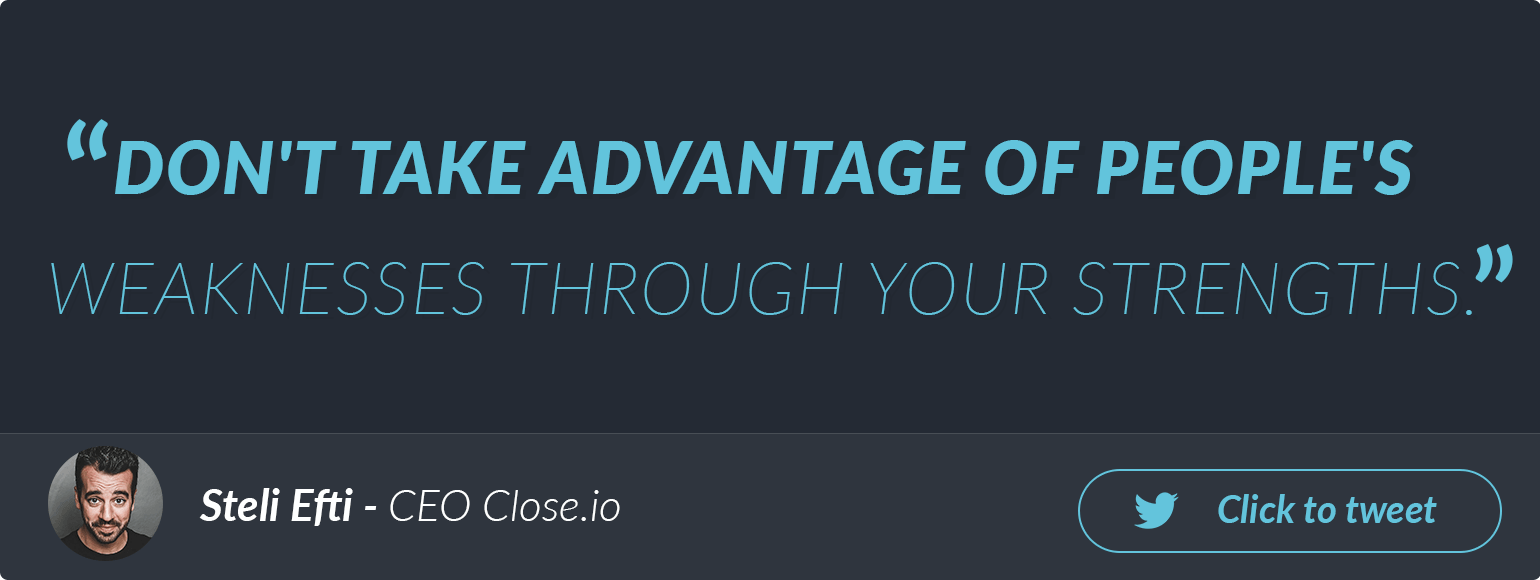
This was when I knew this wasn’t for me. I didn’t want to be a part of selling people on bad ideas and selling people on things they shouldn’t buy. I didn’t want to take advantage of people’s weaknesses through my strengths.

sales-quote-for-salespeople.png

This was the first time I came in real contact with taking advantage of others.

That day, I got up, took my stuff and quit that job.

During my walk home I also realized that so many things that I had talked about doing were not an option anymore. I would have to not only create something that was good for me, but also good for other people.

It was either that or failure.

Share your moment

This profoundly set the direction for my life and I’d love to hear your stories.

I think sales has a bad rep in the world because of operations like this. And I think it would make a big difference if people shared their stories about how they decided to not go down that path.

Maybe it’ll open someone’s eyes. Maybe it’ll steer them in the right direction. Hopefully they’ll find a way to use their talent to convince and influence people, in a way that brings value to other people.

It will make not just them, but all of us, more successful.

Share your “moment” in the comments and the best stories will be featured on our blog next week.

Recommended reading:

How I made a total fool of myself in front of Mark Zuckerberg (and what you can learn from it)
I once had a chance to talk to Mark Zuckerberg—and totally blew it. Don't make the same mistake. Here's how to stop putting your foot in your mouth.

How a tie salesman's trust changed the way I look at sales
A true sales story that will improve your sales skills if you take ten minutes out of your busy day.

The most important lesson I ever learned in sales
He who asks all the questions is controlling the direction of the conversation. Sales is all about asking questions and actively listening, and very little about talking.

31 May 17:27

7 Inbound Marketing Techniques Salespeople Can Steal to Close More Deals

by intern@weidert.com (Joel Szymanski)

inbound-marketing-tactics-in-sales.jpg

You don’t have to wait around for leads to come rolling in from your marketing team. These six techniques will help you leverage the content that the marketing team has already produced to help you get prospects into your pipeline and advance them in the sales process.

1) Exploit existing lead nurturing campaigns

This is perhaps the lowest-hanging piece of fruit. Ask Marketing how visitors who convert on a key ebooks or webinars get nurtured. This achieves two things:

You’ll know the timing of the campaign and their follow-up calls-to-action. Then, you can track how your contacts respond. When one of your prospects bites on a follow-up CTA, it’s probably a good time for a follow-up call.

If some of your active prospects have already opted in for your company’s content, add them to that lead nurturing campaign.

2) Create your own nurturing campaign

Forrester reports that 74% of buyers conduct more than half of their purchasing research online before engaging with salespeople. This is an incredible opportunity for you: Your prospects are going to be educating themselves, and your marketing team has built quality content that will help your prospects educate themselves. You can provide quite a bit of value to your prospects simply by sending them informative pieces of content.

Your marketing team has worked hard to get personas right, and hopefully they have injected your company’s story and perspective into each piece of content. Use this well-crafted and focused content to connect with your eventual buyers to become a helpful authority.

So how do you create your own nurturing campaign? Create a standard outreach sequence that serves up content answering your prospects’ most common questions. This doesn’t have to be anything elaborate -- just a quick series of email notes that include comments on the content you’re sending, and a link. If you are using the HubSpot Sales Chrome extension (And if you’re not, why aren’t you? It’s free!), you’ll know when your prospect has opened the email and if they clicked on the link that you have sent them.

3) Curate content for your target accounts

Your prospects are getting inundated with posts and videos and emails regularly. To stand out from the information overload, pick out the week’s most interesting and impactful content. Start with your company’s blog, add posts from other highly valued and trafficked sites in the industry, sprinkle in a rare gem here and there, top it off with a more loosely related news item, and what you have is a one-of-a-kind newsletter.

If you are not building your own mailing list, you should. With that list you will be able to consistently reach out to your network with valuable and helpful information. It gives you an opportunity to reinforce the story your company is telling, but also build up your own personal brand as a provider of the helpful and an expert in the field.

4) Add a valuable piece of content to your email signature

It amazes me how many reps miss this one. It is so simple to do, and while the conversion rate might not be spectacular it really only takes one quality conversion to make a difference. This is especially true if you consider the first three suggestions above here.

Have a webinar coming up? A compelling ebook offer that is converting at a high clip? A blog post that really nails the company story? Add it to your signature. No further explanation required here -- in fact, I’d suggest you stop reading right now and add something to your signature.

5) Organize case studies that work best for you

This step is one that is better oriented to the middle of the sales process. Make no mistake -- your prospects are risk adverse. There are degrees of risk aversion of course, but at the end of the day they want to know that they are not putting themselves out there before anyone else. When they see that the solution you are pitching has had success, they’ll feel more comfortable considering how to capture that same success.

This is easily done if your company already has strong customer advocacy programs in place. If your company doesn’t have testimonials or case studies at the ready, you should at least be intimately familiar with which customers have seen what success.

The great news here is you don’t need dozens of customer success stories -- you only really need one or two that powerfully communicate the way the customer saw success. Know where these case studies can be found, the summary of each, and the specific value they describe.

6) Create your own customer advocacy process

Customer advocacy is not something that should only be left to Marketing or Customer Service. You were the first person to build a deep relationship with the client or customer. Therefore, you need to curate your own references you can use as you work on the next deal in your sales pipeline.

It’s really sales 101 to maintain relationships with your customers long after the sale. And while your marketing team will make broader work of a possible case study or success story from that customer, it is up to you to tap a customer into a referral source. By leveraging the case study format your marketing team has developed, you can quickly create powerful and personalized reference materials that you can use in your sales cycle.

7) Publish your own content

Your marketing team won’t let you publish to your blog? Turn to LinkedIn or Medium. Your prospects are most certainly going to check out your Linked profile, so have your perspective ready for them when they get there. Take time to publish stories form your sales travels in this simple formula:

  • The status quo of a prospect.
  • The conflict they faced.
  • The resolution you helped them find to address the problem.

The posts don’t have to be long or elaborately written. They just have to tell the story. Use well traveled posts from your company’s blog to add color to the story that you develop.

What marketing techniques do you think sales should leverage? Let us know in the comments below.

HubSpot CRM

31 May 17:27

Best Practices to Deliver More MQLs into Your Sales Funnel

by Jason Rogers

At the end of the day, marketing departments exist for one reason and one reason only: to deliver marketing qualified leads (MQLs), which in turn should become more converted sales. This is no revelation, and is Day One stuff in Marketing 101.

Actually executing on this principle is a slightly more complex proposition. That’s why we’ve created our 4 Best Tips for Delivering More MQLs into Your Sales Funnel. Let’s jump in!

1. Properly Identify Your Target Personas

At their core, qualifying leads is about connecting with your buyer. That’s why it’s of paramount importance to take the time to properly identify whom, exactly, your buyer is. Or in this case, what your probable buyers persona looks like.

Abraham Lincoln famously said, “Give me six hours to chop down a tree, and I will spend the first four sharpening my axe.” This same notion of investing in preparation applies to securing more MQLs. Think of identifying your target persona as sharpening your axe.

Creating a clear and effective persona is about placing yourself in your buyer’s shoes. What specific pain points is your product or offering intended to alleviate? Great, now: what does that pain point actually look like in your buyer’s organization? If you are targeting HR directors in medium-to-large medical corporations on the west coast of the United States, consider their actual, low-level, day-to-day duties and work flows, and how very different in actuality they will be from those of an HR manager at a small medical office in Toronto. This level of persona specificity is crucial, and a thousand times each day it represents the difference between an MQL and an irrelevant, unopened email.

Be sure to consider the classic quandary: What’s in it for them? What does a successful job performance look like for, say, a business leader compared to an IT manager? For the former, cost and return on investment will be the big drivers. For the latter, functionality will be the highlights. These sorts of questions are the absolutely necessary bread and butter of persona targeting.

Then, identify an actual list of targets. This information can be gathered via database purchases from market intelligence providers, or it can be gleaned via clever marketing techniques like tracking and analytics. Once you know to whom you’re talking, you can begin to actually talk.

2. Create Content to Guide Your Buyer’s Journey

The buying journey, like a transatlantic voyage, is not a one-moment decision to be pounced upon. It is an ongoing, dynamic process, with different needs and desires flowing in and out of importance from step to step. That’s why creating continuous, high-quality content that enables you to engage in an ongoing conversation with your buyer is everything.

The number one challenge marketers face today is creating enough content, and the second is creating high quality content. By the time the average marketer makes first contact with a potential lead, that buyer is typically more than 50% complete with their buying journey. From bare discovery, to realization of pain points, to shopping for solutions, each of these moments is driven by a different impulse, a different need, and a different kind of content will resonate best.

This is the reason that a Content as a Service (CaaS) model is so effective. When it comes to creating content for each step of the buyer’s journey, “writing with a quill” won’t cut it. It’s slow, ineffective, and reactionary. You need a high-octane content factory, an engine; you need to plug in to great content. CaaS gives you the flexibility – both financially, and chronologically – to tailor-make great, relevant content that your buyer cares about. It empowers you to keep up a continuous dialogue, an ongoing and uninterrupted conversation, that gives you opportunity after opportunity to demonstrate your ability to add value for your customer.

Giving your buyer a one-time push in the behind at the beginning of their journey isn’t enough anymore; you need to hold their hand and guide them, each step of the way. The way you do that is with content.

3. Test and Analyze Your Results

Marketing is a show-me proposition, and return on investment is the name of the game. How can you know if you’re singing out of tune if no one tells you how you sound? This is where metrics change the game, and your marketing automation software’s analytics become your best friend.

Testing and analytics are the difference between continuing to do the wrong thing, and innovating for success. Imagine content marketing to be like taking a child – your buyer – to an ice cream shop. Traditional marketers tell the child, “Behold our many types of vanilla you can have! Here, try this one next.” Properly analyzed testing, on the other hand, gives the child the opportunity to tell you what flavor they like best.

That’s why some of the best content marketers split test, and why we recommend it, too. Split testing is the process of creating two parallel campaign designs with the same call-to-action and the same target personas, and deploying each to a small sample audience for the purposes of testing both. Perhaps the “flavor” that resonates best is a blue header with short, snappy, red copy. Maybe it’s a more buttoned-down, black and white, no-frills affair. By testing both across several key performance indicators (KPIs) like click-throughs, conversions, open rates, and so forth, the guesswork is eliminated from marketing, and you can go forward confident in the knowledge that your content is the best, most fine-tuned it can possibly be.

And we aren’t just making this up, either. Data shows that marketing campaigns that combine proper target segmentation (Tip #1) with split-tested analytics (Tip #3) see an increased response rate of 44-84% across the board.

Students get report cards. Employees get performance reviews. Doesn’t your content marketing deserve the same attention?

4. Follow Up With a Human Touch

Marketing automation software has come a long way in taking the tedium and headaches out of qualifying leads, but – despite what the Terminator might tell you – there’s just no substitute for actual human interaction.

Prospect relationship management is a too-often overlooked flourish that is far more essential to success than people realize. Personal follow-ups with targeted prospects via telephone calls and emails increase conversions-to-forecast by over 60%, and are an integral part of continuing the ongoing “dialogue” with your buyer that we spoke about above. Personal follow-ups give your buyer an opportunity to ask questions, clear up any possible confusion, learn a bit more, and in general, feel more confident and comfortable with your company and its product going forward. It gives an undeniably human face to what is otherwise a somewhat anonymous enterprise, and very often, is the difference between a qualified lead and needlessly missed opportunity.

31 May 17:27

21 Free Email Templates Proven to Increase Sales and Revenue

by ltoner@hubspot.com (Lisa Toner)

proven-sales-email-templates.jpeg

As a salesperson chasing quotas month after month, you'll inevitably spend a lot of your time writing and sending emails. The scary reality, however, is that a shocking 76% of sales emails are never even opened. How are you supposed to sell if you can’t get your prospect’s attention in the first place?

Calling leads can be a huge time investment with little return. Reps end up spending their days talking to voicemails instead of demonstrating the value of their product to an interested party.

And when you get email right, it can have a huge impact on the entire business. Top Echelon, a recruiting software company based in Ohio, has been able to free up 70% of their salespeople's time by leaning into email instead of phone calls. They have shortened their sales cycle by 50% as a result.

We want to help more companies like Top Echelon figure out their email strategy so they can spend less time on ineffective sales tactics and more time closing deals. We partnered up with Breakthrough Email and compiled 21 proven sales email templates from successful companies that you can now start using for free. These email templates are used by real companies like HubSpot, Troops, Holmes International, Objective Management Group, and Breakthrough Email and have seen huge success for them.

Results include:

  • Closing a $100,000 deal
  • An 80% response rate
  • Increased conversion rates by 1,100%
  • A 33% response rate after the prospect went dark

Start generating more opportunities and close more deals with these 21 pre-written sales emails.

New Call-to-action

30 May 16:11

NASA just released the most detailed close-up shots of Pluto’s surface yet, and they’re amazing

by Matthew Stuart

NASA's New Horizons probe flew past Pluto last July, and it took the most detailed images of the planet that have ever been seen. NASA just released some of the images, and they are absolutely gorgeous.

Produced by Matt Stuart. Video courtesy of NASA.

Follow TI: On Facebook

Join the conversation about this story »

30 May 16:08

Five reasons David Rosenberg thinks the stock market is in good shape

by Jonathan Ratner

Not only has the S&P 500 Index risen more than one per cent in May and the Euro Stoxx 600 Index is up more than two per cent, but the U.S. Federal Reserve finally appears ready to hike interest rates this summer, and the correlation between Chinese stocks and global equities is falling.

David Rosenberg, chief economist and strategist at Gluskin Sheff + Associates says there are several reasons why stocks are showing some vitality.

“First and foremost, sentiment is bearish at worst, ambivalent at best. This is a contrarian’s dream,” he wrote. “Bear markets begin with maximum complacency and optimism and that is clearly not the case today.”

Rosenberg noted that NYSE short interest climbed 1.6 per cent in the first half of May, while Nasdaq net short positions rose 1.4 per cent.

He also highlighted last week’s AAII poll that showed only 17.8 per cent of retail investors are bullish, marking the lowest reading in more than a decade.

Meanwhile, equity funds have seen net outflows for seven consecutive weeks, and “de-risking” is also coming in the form of selling high-yield credit funds and the buying of investment-grade corporate bond funds.

Next, Rosenberg pointed to receding geopolitical threats with Brexit polls suggesting the “stay” side is ahead, and Greece receiving its latest round of bailout money.

The economist also noted that with oil trading near US$50 per barrel, a dark cloud hanging over the profit outlook is finally shifting. That’s good news when it comes to credit defaults on high yield energy debt.

Fourth, Rosenberg believes the earnings recession appears to have come to an end, with first quarter GDP data including a 1.9 per cent annualized growth rate in profits.

Lastly, he highlighted the “very encouraging” recent move higher in financial stocks and small caps.

“If only the transports had not been lagging of late – the proverbial canary in the coal mine,” Rosenberg added.

30 May 16:03

Documentary Storytelling: 6 Examples From Brands That Nail It

by Clare McDermott

Documentary Storytelling

You would be hard pressed to find a marketer in 2016 who doesn’t believe that publishing content is as important or more important than paying for advertising. Yet somewhere in the race to publish more, hit more channels, and optimize reach, we’ve lost sight of the art of great content creation and the returns from more ambitious projects.

In my mind there is not a more powerful – and more underused – medium than the documentary film. Brands rarely take on artistically complex video projects because they require a level of creative and technical talent that most brands (and even many of the agencies that serve them) don’t have access to. Of course there are some that pull it off beautifully. Brands like Patagonia are master documentary storytellers. These brands are immersed in the visual world and have a clear point of view to share with their audiences.

What about brands that don’t have such a rich source of stories to pull from? Or brands you would not associate with artistic film projects? What can we learn from the projects they launch?

All about the drumsticks

In 2015, Church’s Chicken teamed up with World’s Fastest Drummer (an event that invites drummers to play the most single strokes in 60 seconds). But rather than just sponsor the event, Church’s Chicken produced an eight-episode documentary that explores the lives of those who vie for the title of world’s fastest drummer. (In case you’re wondering about the connection between fried chicken and drumming … it’s drumsticks of course.)

truestories_ChurchsWFD-1

The documentary, Fast Company, captures the quirky but oddly compelling world of speed drumming. At the heart of the documentary is Boo McAfee, speed drumming champion and inventor of the Drumometer (the machine that counts the number of strokes per minute). The series also includes vignettes with other unlikely characters – from young, fast-rising speed drummers to the guy with the fastest drumming feet. Each two-minute episode follows a condensed hero’s journey, exposing the hard work and passion required to reach the top echelons of speed drumming. The series concludes at the semi-finals of the World’s Fastest Drumming championships, teeing up the finals in Nashville, Tennessee.

The idea was the brainchild of Church’s Chicken Chief Marketing Officer Mark Snyder, who wanted to reach a new audience: young men. When Snyder’s team researched the type of content young men gravitated to, high on the list were achievement-based videos. The world of competitive speed drumming was a perfect fit, thought Snyder.

“When you step back and look at the results, you’d be hard pressed to figure out how to grow engagement with customers online and how to grow a broader customer set if you don’t get into this type of storytelling,” says Snyder.

In total, the eight webisodes generated 5 million views and 18 million impressions. The buzz from the events and films also drove a 12 percent increase in sales in a single weekend in Atlanta (where the national speed drumming event took place), and an 18 percent uptick in Nashville (where the world championships for speed drumming take place).

Why such a powerful reception? Barry Poltermann, founder of About Face Media, the documentary film group that produced the Church’s Chicken series, puts it this way: “Documentaries have huge audience appeal – just click on your Netflix menu to prove it. Documentaries also happen to be a practical and affordable way to communicate with an audience. Having said that, you should experiment with all different types of video projects, not just documentaries. You want to consider and explore any video content and video channels people voluntarily engage with.”


Documentaries have huge audience appeal & are a practical way to communicate via @onionbap #visualcontent
Click To Tweet


Nearly a year after the multi-episode documentary was completed, Church’s is still seeding content to its channels, telling the story of speed drumming. Well-crafted stories aren’t simply about the art of storytelling, they also deliver on the science of content reuse and reach.


Well-crafted stories also deliver on the science of #content reuse & reach via @soloportfolio #storytelling
Click To Tweet


Telling the right story

Milwaukee-based About Face Media is an agency that specializes in documentary films. Documentarian Poltermann has edited a number of feature films, including the Sundance-winning American Movie (for which he was also the producer) and the upcoming Raiders!: The Story of the Greatest Fan Film Ever Made.

He says that while documentaries are a powerful format for brands to reach new audiences, brands should understand the difference between true documentaries versus reality-style programming. “Authentic documentary stories are not the same as ‘real-people’ or even ‘documentary-style’ marketing pieces,” says Poltermann. “What moves people are genuine documentaries, not marketing pieces crafted to feel like documentaries.”


What moves people are genuine documentaries, not marketing pieces crafted to feel like them via @onionbap
Click To Tweet


Poltermann says his agency uses a lengthy process to unearth stories that both appeal to the brand’s audience and capture the brand’s point of view and identity. As part of that process of digging for stories, he says there are critical ingredients absolutely essential to get the project right:

Story landscape is the setting in which a brand has both the credibility and expertise to tell a great story. “When Stella Artois chose to tell a story about hand-painted billboard artists, the brand’s commitment to traditional craftsmanship gave it the permission to talk about that topic,” explains Poltermann.

Story hero is a single person or a group striving toward a common goal. The most powerful documentaries focus on someone who has a goal or quest and ceaselessly strives for it, and for whom something big is at stake. That person’s journey should intersect in some way with your brand’s mission or area of interest.

Brand documentaries: From somber to silly

Up There: The brewer Stella Artois funded a documentary that became the source material for an ad campaign about the disappearing art of hand-painted advertisements. Through poignant interviews with artists, Up There takes a loving look at the history of hand-painted billboards, and the few who still paint beautiful murals on buildings in New York City.

Stella Artois “Up There” from Visual Catch on Vimeo.

Spent: American Express created a long-form documentary as part of a larger program to teach its audience about financially underserved communities in the United States. The documentary exposes the underbelly of the U.S. financial system: payday lending, check-cashing services, and other short-term, high-interest loans marketed to those without access to traditional banking services. It shows both the heavy toll it exacts on working-class families, as well as the ways in which both the financial services industry and government can help those at risk.

The Story of Content: In a bid to explain the phenomenon of content marketing to newcomers, the Content Marketing Institute produced a 43-minute documentary highlighting content-focused brands and the marketers who fuel them.

Living off the Walls: Shoe company Vans is producing a series of documentaries that chronicle the lives of young artists and athletes who push boundaries and inspire others through their creative expression. Vans has a long history in documentary film; its original documentary about skateboarder culture in Southern California was released in 2001.

Kiss and Tell: A grooming-care company (among other things), Gillette offers a less-serious take on the medium. Clocking in at just under five minutes, the film explores the lost art of kissing … and blames facial hair as an obstacle to it. It’s a pretty hilarious look at what one participant describes as the “effort to look lazy” among young men, and the suffering that women endure by kissing men with too much stubble.

The end (or the beginning)

As our conversation ended, Church’s Chicken’s Snyder offered this advice for marketers interested in documentary storytelling: “If filmmaking is something you are trying to explore, make sure your idea is a big one and different from what people would expect of your brand.”

This article originally appeared in the April issue of Chief Content Officer. Sign up to receive your free subscription to our bimonthly print magazine.

Cover image by Joseph Kalinowski/Content Marketing Institute

The post Documentary Storytelling: 6 Examples From Brands That Nail It appeared first on Content Marketing Institute.

30 May 16:03

Sales Contests: Building a Culture of High Performance

by Ken Thoreson

Building a Culture of High Performance: Sales Games

At this time of year sales management must be looking at pipeline levels and goals for the 4th quarter and determining if there is the necessary level of activity to ensure targets will be exceeded. Organizations need to focus certainly on the short term-30 days sales cycle and end of year, but they also need to have a longer term perspective. As an executive you must also focus on creating an atmosphere of fun, high performance and teamwork.

In this blog I wanted to share a few ideas from my books on sales management: Leading High Performance Sales Teams and Creating Sales Compensation Plans for High Performance. In both books I share ideas for sales contests/games as well as how to properly roll them out and manage them. In many cases I have seen great sales contest ideas poorly executed, it is critical you think through what your objectives are and what you want the results to be and then CLEARLY write down the objectives, rules and incentives. The first rule, remember cash is not what you want to use during sales games-that is what your commission plan is designed to achieve. The second rule is that creating fun in your sales culture is the main outcome-surely you may wish to add “net new client’s” or sell certain products/services and increase sales-but it is sales leaderships objective to make the sales contest is a fun experience. “If it isn’t fun, it isn’t selling”.

You might enjoy this video on Building a High Performance Culture:

Different types of contests will help you achieve different goals. Some should be held annually to address sales objectives, company business strategies and potential seasonal fluctuations. Others can be scheduled as needed to help launch new products or services, promote new releases or upgrades or tie into your customers’ larger campaigns. Still others can consist of short-term incentive games designed to motivate sales personnel to accomplish specific objectives by a specific deadline.

A Contest Sampler

Following are a few typical goals, along with ideas for contests that may help achieve them:

  • Increasing sales volume. Consider adding a cash bounty for each additional new seat, new customer, or revenue sold beyond a certain target value. Set a quarter-to-date objective above your sales goal; that way, everyone on the team can win.
  • Improving customer service. Periodically survey your entire customer base. If satisfaction reaches a certain goal—for instance, when 95 percent of your clients say they’re “highly satisfied”—and if your company is profitable, everyone gets a cash bonus. Keep a visible scorecard of your goals and results so that everyone maintains a constant awareness of your objectives.
  • Acquiring new clients. To boost the number of new clients you add each quarter, consider creating a “bounty bonus” plan. For example, salespeople could earn a bounty bonus—either in cash or in points that can be redeemed for rewards—for each new client or each competitive replacement of a specific vendor’s customer. In addition, you could offer bounty bonuses for salespeople who exceed their quarterly or annual quotas for new accounts or net new revenues. You might even create and post “Most Wanted” posters with the bounties prominently displayed to help keep salespeople focused on contest objectives.
  • Overcoming seasonal slumps. If your sales typically slow down over the summer, try launching a prospecting activity contest in March, April and May. For instance, award sales team members points for each new face-to-face call or sales demonstrations that they make during those months, with accumulated points eventually eligible for prizes. Such an effort can go a long way toward increasing the number of opportunities in the pipeline from June through August.

Competition Considerations

Following are some issues to consider and questions to answer as you plan sales contests:

  • Determine what you want the contest to accomplish
  • Set the ground rules. Are all sales executives on an equal basis for the contest? Be sure to put the rules in writing, making provisions for those and other situations that could arise.
  • Make the contest length the same as the sales cycle.
  • Set specific goals that can be measured weekly or monthly.
  • Incorporate an exciting theme.
  • Consider making rewards gifts, rather than cash.
  • Boost team members’ motivation by getting their families involved.
  • Never run contests to the last day of the month or sales period.
30 May 16:03

Storytelling at Face Value: Visual Stories at Work

by Jess Ostroff

Doug Drexler - Instagram

The “Next Generation” of Visual Story

Doug Drexler is the first Academy, Oscar, and Emmy Award Winning story artist to join us on the Business of Story Podcast.

As a master visual storyteller and one of the FX and makeup geniuses behind operations such as “Dick Tracy,” “Battlestar Galactica,” and ”Star Trek: The Next Generation,” Doug knows his way around the storytelling realm of Hollywood.

Today we tap into his keen visual expertise to better understand the elusive ability to influence clients and customers by crafting game changing visual stories.

Maximize your visual presentations by understanding the psychology behind visual storytelling, the tools at your disposal, and how to use your innate visual storytelling powers for good.

In This Episode

  • The squint test for story visuals
  • How to gain utter confidence in front of an audience
  • The difference between seeing and looking
  • How to tap back into your innately creative storytelling powers


Quotes From This Episode

“Know how to get information across and keep it charming or funny or make people see it in a way that relates to their everyday life. That’s the trick. It’s learning how to ring those psychological bells that make Pavlov’s dogs salivate.” —Doug Drexler

“Wear your story on your face, or wear the story in your graphics or your PowerPoint. Monitor your graphics. Make sure they give data but can still be understood. Show respect, but get the information across immediately.” —Doug Drexler

“There’s a difference between seeing and looking. Everything just breezes by you when you’re just looking. But actually seeing it, that’s a whole different thing and it takes some learning.” —Doug Drexler

“When you’re communicating in a business meeting, yes, you want to get the facts across, but at the same time, you want to manipulate the feelings that the people who were watching are having—a feeling of dread or a feeling of warm-and-fuzzy, that’s for you to figure out.” —Doug Drexler

“When you’re painting a face you’re pushing it larger than life. It’s a little bit operatic. You bring out the bone structure, and in different ways you can make them more sympathetic, you can make them scarier, you can make them look unwell. So you’re telling a story about someone through their face.” —Doug Drexler


Resources


30 May 16:03

This is what Jim Chanos says he's telling his clients about China right now

by Business Insider

jim chanos

Jim Chanos, the founder of Kynikos Associates, has spent years telling the world that the Chinese economy is a "treadmill to hell" running on debt.

Now, with a few big market scares coming from China over the past year — a currency devaluation, a few stock market crashes, and economic indicators flashing red — he is looking pretty prescient.

So during an interview for our "Hard Pass" podcast, my colleague Josh Barro and I asked Chanos what's happening in China right at this moment. His view is still pretty grim.

One thing he is seeing is that, in a very telling way, China's financial system is looking a lot like Wall Street's investment banks just before the most recent crash.

"One other problem people aren't paying enough attention to — and that is the asset-liability mismatch," he said. "And if we learned anything ... during our crisis, it was you shouldn't finance hard-to-value long-term esoteric real-estate-related derivatives or securities with overnight money, which is what a lot of the investment banks ended up doing by '07/'08. They couldn't move a bunch of the gunk on their balance sheet and increasingly they were financing themselves in the repo market."

That is now happening in China, Chanos said. Banks are financing uneconomic projects and/or losses with debt carried on the balance sheets of Chinese banks. That debt is then being financed overnight in the repo market.

All of that is swirling around in the country's $33-trillion-and-growing banking system.

A few more points Chanos hit:

  • Chinese President Xi Jinping has been a more repressive, inward-looking leader than anyone expected. He has taken "steps backward" from the reform the world expected by moving against the army, the media, and the internet (which he sees as an alternate power base) in general.
  • "We're getting in some pretty scary debt to capital numbers in China," Chanos reminded listeners. "We're 300% of GDP as opposed to 100% of GDP the last time they had a big problem."
  • Countries that depend on China for trade represent 40% of global gross domestic product. "So if China really does go into decline, it's going to take a lot of countries down with it," Chanos said.

Check out the full episode below:

Join the conversation about this story »

NOW WATCH: A global intelligence analyst explains why the ‘real’ China is not the China we think of

30 May 16:02

To Win the Civil War, Lincoln Had to Change His Leadership

by Vijay Govindarajan
may16-30-nypl-civil-war
FROM THE NEW YORK PUBLIC LIBRARY

In our work with leaders, we see that great ones grow themselves and their organizations by deliberately working on three areas:

  1. They wisely manage the present, anchoring in purpose and values.
  2. They selectively forget the past, letting go of old values, beliefs, and behaviors that no longer serve them or their organizations.
  3. They purposefully create the future by adopting new aspirations, values, beliefs, and behaviors that enable a step-change in their leadership.

Most leaders are good at the first and third areas. What many leaders may not recognize is that we often need to give something up — a belief, attitude or behavior — in order to achieve a new level of performance. How is this done effectively?

We can look to one of the most celebrated leaders of U.S. history for an example. He was a leader who rallied people around vision, a vision so strong it united a war-torn country. But it took more than determination. It also took sacrifice and decisive action by cutting out what was no longer working.

Finding himself at a turning point

In early June 1863 President Abraham Lincoln faced a dire situation. He had been president for two and a half years and was reviled by most. A civil war had divided the country between North and South and the Union Army had just lost two major battles. People from his own party were attacking him for his compromising, indecisive attitude.

Just three months later, public opinion shifted. The New York Times expressed gratitude that the nation was being led by “a ruler who is so peculiarly adapted to the needs of the time as clear-headed, dispassionate, discreet, steadfast, [and] honest [as] Abraham Lincoln.” His fortunes also shifted on the battlefield. His army celebrated two key victories at Vicksburg and Gettysburg, marking a turning point in the war.

What shifted in the summer of 1863? By examining how Lincoln handled this pivotal time in the Civil War, we can learn how the three points mentioned above can help create the future we aspire to.

Taking a new tone with his generals

Lincoln realized in early summer 1863 that he had two big challenges: reestablishing control over the Army and recapturing public opinion. With this realization, Lincoln made some bold choices. First, he got rid of some old beliefs that no longer worked. And second, he started leading in a completely new way. In retrospect we can see how his bold choices in the summer of 1863 helped him become one of the greatest leaders the U.S. has ever known.

The first set of beliefs Lincoln got rid of was about how he related to his generals. Up until then, Lincoln believed that as a civil leader he should leave the running of the army to his generals; that’s how the game had always been played. Instead of giving his generals firm orders, Lincoln gave them only timid suggestions, which they, in turn, mostly ignored. Lincoln’s secretary, John Nicolay, despondently noted that the president habitually gave in to one general’s “whims and complaints and shortcomings as a mother would indulge her baby.”

After many frustrating exchanges with a string of ineffective generals, Lincoln gave up his submissive style in favor of a more assertive tone. In the summer of 1863, he issued a series of direct instructions to his generals. Rather than nudging them, he left no doubt any longer as to who was in charge. To General Joseph Hooker, who had repeatedly defied his suggestions, he wrote, “To remove all misunderstanding, I now place you in the strict military relation to Gen. Halleck, of a commander of one of the armies, to the General-in-Chief of all the armies. I have not intended differently; but as it seems to be differently understood, I shall direct him to give you orders, and you to obey them.”

Soon after Lincoln’s change in leadership style, the Union army booked a series of victories, notably at Vicksburg and Gettysburg. Instead of waiting for the perfect time, the Union army was now moving proactively, following Lincoln’s orders.

Winning over the public

From the start of his presidency, right up to his death, Lincoln’s unwavering vision was clear: preserving the Union. But despite this clarity of purpose and his recent battlefield victories, he still faced another challenge: a public exasperated and impatient with the war and the administration. His second shift came in how he related to the people.

Once elected, presidents of his time had little direct contact with the public. Their job was to run the government and share their wishes with Congress. They’d rarely leave the capitol, except for vacations. In the summer of 1863 Lincoln broke with tradition and stepped out of the social prison of the White House. Learning from the success of his recent letter-writing campaign to enlist the support of the British public for the Union, Lincoln implemented a successful public letter-writing campaign in his own country. Five-hundred thousand copies of one of his letters alone were in circulation and were reportedly read by at least 10,000,000 people. Lincoln’s public outreach was effective and helped him keep significant public support during the remainder of his presidency from 1863 until his assassination in 1865.

The President had decisively left behind the conventions of the past and created a new relationship with both the military and the general public.

To succeed in creating the future, we must also excel in letting go of the past: selectively forgetting practices and attitudes that stand in the way of the new future. How do we know what to cut? It’s important to distinguish between our roots and the beliefs we can get rid of. If we cut a tree’s roots, the tree dies. Roots, like dedication to core purpose and vision, have timeless value and leaders need to preserve and nourish them. But every person and organization also has outdated beliefs. If we do not break loose from these beliefs, we will become entangled in them and are unlikely to get to the future we so desire.

30 May 16:01

The Surprising Truth About the Best and Worst Times to Call Sales Leads [Data]

by ebrudner@hubspot.com (Emma Brudner)

sales-calls-time

The most valuable resource salespeople have is their time. And that's why studies on the "best" and "worst" times to call prospects are so popular. If there's an ideal time to connect with a buyer, why would a rep waste precious hours calling during any other point in the day?

Turns out, this thinking might be flawed from the start. A new study from Velocify dug into how much of a difference calling buyers at the "best" time vs. the "worst" time makes in terms of connect rate ... and the answer isn't pretty.

"The difference in contact rates between the 'worst' time of day to call a prospect and the 'best' time of day to call is only 2.6 percentage points," Alyssa Trenkamp wrote in a press release about the study.

In other words, saving your prospecting calls for the scientifically "best" hour to get a live person on the other end of the line doesn't result in a measurably higher connect rate. It actually makes almost no difference at all.

So what does? Time elapsed between a prospect action and the salesperson's follow-up, according to the research.

"Prospects that received a call within one minute of their initial inquiry were 391% more likely to convert than those called any time after that," Trenkamp explained. "The findings show that although 2 p.m. was the best time to call someone in general, if you receive a new inquiry at 3 p.m., waiting nearly 24 hours to call back would drastically reduce your chances of conversion."

The takeaway? Instead of stressing so much over picking the perfect time to call someone, refocus your energy on becoming hyper-responsive to activities that indicate buyer interest. Your quota just might thank you for it.

What do you think of this research? Join our new Slack channel to talk in real time, or leave a comment.

HubSpot CRM  

30 May 16:00

Sales Blind

by Tibor Shanto

By Tibor Shanto – tibor.shanto@sellbetter.ca 

One of the most common comments Sales VP’s make in speaking about their team is that they fail to ask for the order, or go in for “the close”.  Now I can hear some of you saying “close, no no no, we don’t do that in sales today”.  I don’t take that comment so literally, I think it refers to a scenario we all have seen, where there is an opportunity to move the process forward, or everything is in place, and rather than moving to implementation, both the seller and the buyer allow for creep, creating an ongoing cycle, rather than to the objectives set out at the start.  A condition I call “Sales Blind”.  The sale goes on and on, things look good, but never materialize, and then you discover another vendor won the opportunity.  I find this happens with a couple of types of reps, who are two side of the same coin.

The Forever Seller

First are those sales people who are really great at selling and love the discovery process to no end, literally.  They will reach out to anyone in the buying company to get the right answer, and the right people engaged in the process.  They ask questions that not only demonstrate their depth of knowledge of the subject, and at the same time get the prospect to think and rethink what they set out to buy and achieve.  They enjoy the process so much, completing the deal leads to their fun ending (till they start the next sale), and as a result at times it seems they make little effort to close the deal, as it will end their party.  Sounds absurd, but if you have managed many sales people, you have had one of these people on your team.  I had one, this was one of the best sales people I worked with, but would never take things to the last next step.  I was and am convinced that it was not a question of ability, but one of “the hunt being more fun than the kill”.  Being “Sales Blind” they are happy selling without regard for the outcome.

Relationship R-Us

The second is the hard core relationship seller.  I often ask groups of sales people what they want to do with new prospects they meet.  The ones who answer “create rapport” or “build a relationship”, fall in to this group.  Have you ever had someone on your team who was loved by the clients and prospects, yet continuously came up short at the end of the year?  This is them.  Relationships are great, but what they should doing for new prospects and clients is helping them achieve objectives, through that process they will also help their employer by generating revenue.

There is a Cure

The good news is that “Sales Blindness” is a curable condition.  Through active coaching and setting account/opportunity based milestones and timelines.  This will surface key barriers that the rep needs to eliminate and reestablish some deal vision.  Both these types of sellers have the requisite skills, they are just blinded a bit from seeing past a point, once you help them through that they are often your best reps and role models for other team members.

Arctic Wolf_Webinar_email-webinar--300

The post Sales Blind appeared first on Renbor Sales Solutions Inc..

30 May 16:00

4 Rules For Converting Leads into Sales

by Andrew Gazdecki

shutterstock_292248281

There are hundreds of millions of blogs cluttering the internet. The companies you are up against are not just the ones from two blocks away. Now, the competition is global. More importantly, a workforce from all over the globe aids it. While you sit here reading this post, your competitors are hiring writers from Australia, New Zealand, India or Hong Kong to write a post for them. In all this war of marketing, the only way to survive is by optimizing your leads and maximizing the profit out of them.

Following the invaluable rules below will help you convert your leads into (actual) sales.

Don’t Cast Pearls Before Swine:

Almost one-fifth of the marketers bemoan that they don’t have good sales data to use for converting leads into sales, and more than 60% say they don’t know where to start or how to consolidate their marketing channels. It’s a sorry state of affairs, and without sounding condescending in the least bit, here’s a bit of advice for all the struggling marketers: don’t cast pearls before swine.

There was a time when the biggest online advertising medium, Google Adwords, was all about getting your words out. Those days are gone for good. You can no longer relax in your chair, satisfied that you have gotten more clicks than your competitors. Now you have to put your ads before the most relevant prospects. If you are offering student loans, but your ads are showing up for people searching university job offers, your money is just going down the drain.

Getting in front of the best prospects takes a bit of work and costs slightly more but is necessary if you want to be successful. First, offering free trials and demos are a great point to start. Make sure the trial is offered to the most relevant customer and attains maximum client satisfaction. Offering free trial subscriptions of finance magazine to literature majors is a waste of time and resources, so make sure your campaigns are targeted correctly. Also, try to drive up positive word-of-mouth about you on the Internet. A few good reviews at a relevant forum praising your product can generate more sales than a thousand-dollar marketing campaign.

shutterstock_280562651

Drill Your Message into The Minds Of Your Target Audience:

After you’ve spotted the most relevant market for your product, try to engrave your presence in the minds of the audience in that market. Some marketers follow the Rule of Seven, which says that the amount of sales you are able to generate from a relevant market is directly proportional to the amount of exposure you enjoy with the audience. In simple words, the more they listen about you, the more likely they are to buy from you. The rule goes even further and states that a prospect needs to hear your message at least seven times before they’ll take action to buy. Seven times! Think about it.

Shout to Two Quarters, Not One:

Now, how do you get the loudest shout? There are two segments you should target: the average prospect browsing through the Internet as well as the Internet itself.

It gets slightly tricky here.

First, don’t follow the same approach for both targets. Google search’s comprehension level is completely different from the average Internet user’s. For the former, you need to optimize your web pages so that they show up in the most relevant sections. Remove dead links from your website and follow a clear road-map. This will let Google reach to each and every single feature on your website and show it in its results.

Understandably, targeting human beings is different from targeting search engine bots. Human beings are sentient and get attracted to the stimulus they receive from their senses. To cash in on this, use psychological triggers. Make your ads subtle, and don’t stick your sales pitch in the face of the visitor. Try to make your posts more interactive. See here how BiznessApps interacts with our prospects as an example. Notice how they make their posts more interactive in order to draw the visitor in.

Sell, Don’t Hammer:

It’s important to have the loudest shout in the town but there comes a point when you should stop shouting and start talking gently. This point arrives when your target listener is listening to you. Always remember, you shout at the top of your lungs to attract the prospect’s attention, never to turn an attentive prospect into a client. You’ll lose them if you don’t stop shouting now.

Herein lies an important lesson for all marketers: always keep your product dangling before the prospect. Never pitch it in a way that makes you seem desperate. Simply pique the prospect’s curiosity and keep arousing it.

Soon enough you’ll get them to click on the buy now button.

30 May 16:00

Demand Generation Through the Fisherman’s Eye: Three Ways Haul in Leads

by Tim Matthews

I was preparing recently to clearly explain to an executive the different marketing channels we use in demand generation. It can all get technical very quickly, and I didn’t want to cause his eyes glaze over. I was trying to come up with an analogy I could use.

I’m not sure why fishing came to mind. I was in the pool when the analogy popped into my head, but I don’t fish empathy triggered the idea. The image of hooking a lead may have shaken loose in my skull. Or perhaps it was the memory of a former sales colleague who continually brought up this old Chinese proverb:

Bring a man a fish and you feed him for a day. Teach a man to fish and you feed him for a lifetime.

In any case, the analogy did the trick with the executive. As I thought more about it, I realized it could also be instructive for marketers in figuring out their marketing mix. So I am going to teach you three ways to fish, and when you should use each. There are more than three ways to catch a fish, of course, just as there are more than three demand gen channels. But I thought about these three buckets below as convenient for segmenting, without diving too deep.

First we have trap setting. Trap setting is low and slow. You bait the trap. You put it under the water. You wait some period of time and come back and see what you got. To me, this feels a lot like SEO. You do your research. What keywords is someone looking for? What’s your bait going to be? Where are your prospects searching for answers? Just like a captain figuring out the best waters to set his traps, and the best and most effective bait.

I’ve wasted many an hour watching “The Deadliest Catch.” It’s a guilty pleasure, and addictive even to a landlubber like me. That sense of anticipation, and then elation or despair when the haul from a each trap is realized. Will all of that effort and planning pay off? This is SEO.

A second method for catching is drag netting. Drag netting to me is most like a big trade show. Especially if you have touts or booth babes pulling people into your booth. You’ll take whatever you can get, large or small, good fit or not a good fit just to build your list. Just like the fisherman, the marketer who employs the dragnet is disruptive and inefficient, but scoops up some of what he’s pursuing. When you are planning your spend for the year, ask yourself if you should be going to a lot of events, or baiting and setting more SEO traps.

The third technique is spearfishing. Whaling has been on my mind recently, as I just finished Ian McGuire’s wonderful but gruesome The North Water. You’ve got a big and elusive animal, rare and dangerous – a CIO, CFO, perhaps even a CEO. This is man on man. It takes careful study of the hunted. Spearfishing takes both patience and courage. Typically you’ve only got one shot to make it, and if you don’t, your quarry is lost. Whaling is difficult, dangerous, and expensive, and I think the same can be said for any kind of spearfishing. If your strategy is to target C-level executives, keep this in mind.

Like I said, these are merely three examples, but you get the idea. I’m also positive there are wags out there who can make ironic parallels about their marketing department’s skills in hauling in leads. Ice fishing, a truly hopeless recreational activity, sitting on the ice in the worst possible conditions for catching fish. Not only are you cold, but the fish is half asleep. Or fly fishing, what some see as rich men going on long walks to catch very, very small fish (and not many of them). Chumming, where you blow a big chunk of your marketing budget on a fancy party. Lots of people come to eat your food and drink your liquor, and then just leave. Those are pursuits for marketers who – as my wife likes to joke – enjoy the fishing more than the catching.

How many demand gen channels is enough? I recently told my sales counterpart that you can’t have too many poles in the water. You just never know where you will get the hit. But don’t boil the ocean and try one of every possible marketing channel. A good fisherman knows when it’s time to reel in and move on. Just get started. Or as an old salt would scowl, fish or cut bait.

30 May 16:00

The Prospecting Technique That Helps Salespeople Close Better Deals Faster

by lhintz@hubspot.com (Lauren Hintz)

active-over-passive-buyers.jpg

In a perfect world, a salesperson could follow up with a prospect the second after an inbound lead converts on your website. Timing is a crucial component of adapting your sales process to the buyer’s context. The closer you can be to help the buyer at the moment they express interest, the more helpful and successful you will be.

Legacy salespeople haphazardly gather contacts that seem like they’d be good-fit customers as quickly as possible. They purchase lists. They aimlessly search online networks like LinkedIn. Once they have a stockpile of hundreds -- or sometimes thousands -- of buyer names, legacy salespeople bombard this list with generic value propositions. They begin aimlessly calling these leads, either in the order they find them or maybe even alphabetically. Sound all too familiar? Here’s how you avoid this painful process altogether.

How to Prioritize Active Buyers Over Passive Buyers

The majority of buyers have already started their buying journey before engaging with salespeople. The crux of an efficient sales process is determining which of your prospects have started their buyer’s journey, and focusing your time on those prospects. You should identify the right business opportunities from the start. The Inbound Sales Methodology gives salespeople have a framework for turning strangers on your website into customers.

inbound-sales-methodology.png

The three steps outlined below are a truncated version of the ‘Identify’ class in HubSpot’s free Inbound Sales Methodology training course. This five-class course provides you with the tools to build an inbound sales process in less than three hours.

Click here to register for HubSpot’s free Sales Training course.

1) Define your ideal buyer profile.

The ideal buyer profile defines which companies are a good fit for your offering and which ones are not. If you sell to businesses, the definition should be at the company level, not the contact level.

2) Identify leads that match this profile.

Your best leads are strangers that match your ideal buyer profile and are active in their buying journey. Modern salespeople prioritize active buyers over passive buyers. Keep in mind that you should evaluate the company against your ideal profile, not necessarily your point of contact. If the company is a good fit for your business, you can be introduced to the decision maker when the time is right.

Here are four efficient ways to get started identifying active leads:

  1. Configure your website to send inbound leads to your CRM in real time. That way, when a website visitors completes forms on your website, you will be automatically notified that they are an active buyer.
  2. Create a view in your CRM to view all new inbound leads. If possible, have the CRM alert you via email when a new inbound lead is generated.
  3. If the inbound lead is from a good-fit company but the contact is a lower-level employee with no buying power, don’t worry. This is still a good lead. Perhaps an upper-level employee asked a lower-level employee to do research on solutions. Bingo -- they found you! Something is probably happening at the company that spurred them to begin researching.
  4. If the inbound lead does not fit your buyer profile, move the lead to “unqualified” status. These leads should no longer exist in the new Inbound lead view. Pursuing these unqualified leads is a waste of time, when you have better fit leads at your fingertips.

3) Enrich the data.

Enriching a qualified lead with data allows you to truly personalize the sales experience to the buyer’s context. Enrichment data comes in two categories: Information about the buyer’s interests and the buyer’s demographics.

Common enrichment data about the buyer’s interests include:

  • Information provided by the buyer in the lead form
  • Content the buyer has consumed from your company (web pages, blog articles, ebooks, etc.)
  • Conversion event of the lead (i.e. demo request, free consultation request, free trial, ebook download, etc.)
  • Lead nurturing emails the buyer has received and which emails were opened
  • Original source through which the buyer found your website
  • Relevant commentary observed in the buyer’s social media presence, or content they’ve produced or was produced about them
  • Public information you can find about the company from third parties
  • Relevant information you can find about the company by speaking with their employees, customers, vendors, or partners.

Common enrichment data around the buyer’s demographics include:

  • Title or role
  • Industry
  • Size of company (i.e. employees, revenue, etc.)
  • Geographic location
  • Longevity of the contact with the company

If possible, configure your marketing software and website to capture this enrichment data automatically and add it directly to the lead record in your CRM. Infer and Datanyze are two examples of data enrichment tools.

Remember, the key to prioritizing active buyers over passive buyers is to identify who your ideal buyers are at the right time in their buyer’s journey.

get inbound sales certified

30 May 16:00

Do You Know What Your are Selling? [Video Post]

by Kira Moore

If you’re selling your product, STOP! It’s not what your customers want.

Do you know what you’re selling?

Let me give you a hint. It’s not the product your company makes and it’s not whatever services they offer.

You’re not selling some cool feature.

You’re not selling how inexpensive it is.

You’re not selling the convenience of your product.

You aren’t selling anything that comes from your company.

_____________________________________________________

What you are selling could be improved customer service and reduced churn.

You might be selling more leads at a lower cost.

You might be selling a good time.

You might be selling the opportunity to get a better job.

You might be selling more time with grandma.

You might be selling piece of mind.

_____________________________________________________

Customers don’t want your product. They want what your product delivers. If you’re selling your product, stop!  It’s not what your customers want. Start trying to figure out what your customers want.  Then you can show them how your product can get them there.

Their used to be a saying; “NO one wants a drill, they want a hole.” Fun little quote, but no one wants a hole either.  They want a new tree house for their kid’s birthday.  They want to finish a soapbox derby for their Cub Scout.  They want to start their own carpentry business. They want to start refinishing furniture.  Each one of these scenarios requires a different sales strategy.  You better know what you are selling, because without knowing, you aren’t gonna sell a thing.

30 May 16:00

5 Sales Tools to Start Using Today

by Alessandra Ceresa

As a sales person, you are under a lot of pressure to close, close, close. To be good in sales, you have to know how to connect and relate with the person you are selling to. Between all the leads you have to manage, the customers you need to keep in touch with, and all of the other reporting and sales related tasks, there are a ton of moving parts. Thankfully, CRM is here to save the day.

Here are 5 sales tools that will make your lives easier.

CRM Workflows

Workflows are one of the most useful sales tools associated with CRM. A workflow is a preset set of actions based on a trigger. Let’s look at a simple workflow:

Trigger: Lead requests a trial/more information on website

Workflow: Sales follow up workflow (Sales person notified of triggered workflow)

Basic Workflow

This is a very basic workflow, but you see how it keeps the salesperson on track with their follow ups. Workflows ensure a consistent process with each lead, and makes sure that no leads slip through the cracks.

Website Tracking/Real-time Notifications

If a lead was perusing your website, wouldn’t you like to know? The ability to see what your leads are interested in on your website, as well as when they are on your site gives you a ton of very valuable information.

Knowing which pages your leads are looking at gives you an idea of what’s important to them so you can better focus your sales pitch. Use real-time website notifications to alert you when your leads are hot to trot. This way you have the opportunity to follow up with them while your product/service is fresh in their mind.

Opportunity Tracking

A good sales person is organized and detailed. Opportunity tracking lets you track each stage of the sales process from lead and prospect to deal won or lost. Opportunity tracking is typically used for larger deals with a longer sales cycle, but if your process is well-suited for this type of sales tool, then use it. Opportunity tracking keeps you highly organized and engaged with each and every one of your deals.

Send Personal Emails

Most CRM systems should have the ability to send trackable emails right from the contact record. This not only saves time and makes you more productive, but you can also view if your contact read or clicked on your email. The email is automatically saved in the CRM, and the activity recorded. Easy, right?

Click-to-Call Telephone

This is kind of like the send personal email, but with a phone call. Automatically track your calls to your leads using a click-to-call feature. If you have a follow up call as part of a workflow, you can easily make the call and record that activity. Just another time saving, productivity tool.

As sales executives, efficiency, organization and detail are all key components of a successful deal. A CRM should come with all of this functionality to make your lives and your jobs easier.

Do you have other sales tools that help your productivity and sales strategy? Let us know!

29 May 21:30

The Toughest Job in Sales

by Dave Brock

Sales is tough. Probably each person reading this thinks their job is the toughest.

If you are a sales person, you’ve got to hit your numbers. You’re out there trying to find enough opportunities, you need to work those opportunities through the pipeline, getting enough to make quota.

If you are a SDR, it’s taking those leads, reaching out to people, most of whom, probably don’t want to talk to you. You have to sort through the literature collectors, tire kickers, until you find the right ones to qualify and pass on .

As the top sales executive, you have the challenge of maximizing the capabilities and capacity of the entire organization to achieve it’s goals. You have to translate the business strategy into sales strategies your team can execute.

Each of these roles, and many more have their challenges. None, by any means is easy. But choosing a career in professional sales isn’t (or shouldn’t be) a choice about the “easy job.”

Having said all of this, the toughest job in sales is that of the Front Line Sales Manager.

The Front Line Sales Manager is the person responsible for leading teams of individuals. In smaller organizations , the Front Line Sales Manager may, also, have responsibility for the entire organization.

For the most part, however, the Front Line Sales Manager is caught in the middle. They aren’t responsible for doing deals—that’s the job of the sales people. They aren’t responsible for the overall strategy and priorities of the company or the sales organization–that’s the job of top management.

The Front Line Sales Manager is responsible for the day to day execution of the sales strategy. They have to translate strategy and goals into execution by their teams.

The job of the Front Lines Sales manager is tactical execution. To succeed, they have to maximize the performance of each individual on their team. They have to make sure each person has the skills, tools, training, and support to achieve their numbers. If they don’t these managers won’t achieve theirs and the organization won’t make plan.

Often they’re caught between a rock and a hard place. Expectations of top management are sometimes in conflict with the needs of the people on their teams.

Every day, they are challenged with, “What have you done for me lately?” From their people, from their managers, from their peers and others in the organization.

On top of that, there’s time. The clock is always running, the team has to meet it’s weekly, monthly quarterly, annual goals.

The manager’s job is filled with pressures around time. How to find enough time to coach? How to spend enough time with each person, in the field, with customers? How to find the time to get the resources the sales people need to do their jobs? How to respond to the incessant questions for information, status, forecasts from their management and the rest of the organization.

Then there are the problem performers. They always take time, more than the managers have, but they can’t be ignored. In fact, each person on the team needs time. Each person needs to be coached and developed to maximize their individual performances.

I could go on, but you get the point.

Where do these managers turn to for help? Where do they go to get ideas about what they should be doing, or even pragmatic advice to help them perform at the top of their own capabilities?

Certainly their own managers is one alternative. Hopefully, they have managers focused on coaching and developing them. But they’re busy too. Often they don’t have the time or take the time needed to develop Front Line Managers.

And let’s face it, we don’t want to go to our managers all the time for help and advice. After all, part of the reason we were put into the Front Line Sales Management role was our ability to figure it out. Our abilities to solve problems and get our people performing.

The Sales Manager Survival Guide is the resource to help Front Line Sales Managers deal with the day to day challenges of the job. It’s not filled with theories of an ideal sales world. It focuses on the realities–good and bad that sales managers face every day. It’s less a “how to” approach, more of “what should I be thinking about?” or “how can apply this to my role and organization.” There are no magic solutions, or techniques, just pragmatic application.

If you want to maximize your personal success, if you want to maximize the performance of your team, the Sales Manager Survival Guide will help you learn not only how to survive, but how to thrive as a Front Line Sales Leader.

Book Cover