Shared posts

01 Jun 18:30

Donald Trump is the ultimate tail risk candidate — and voters aren't focusing enough on how risky he is

by Josh Barro

In investing, risk requires compensation. Investors will expect a higher return from a risky bet, and — conversely — will pay for certainty. It's why you pay double-digit rates on your credit cards, while the federal government can borrow for next to nothing. 

Let's take this analysis into the election. A Hillary Clinton presidency is the safe bet. She offers, more or less, an extension of the Obama presidency. You might think that's a bad return, but at least you know almost exactly what it is.

Donald Trump, on the other hand, is a wild card. Who the hell knows what he would do if elected?

I put some of the possibilities on this helpful chart:

trump curve updated

Because the distribution of possible Trump presidency outcomes is wide, you'd have to expect him to be a better president than Clinton on average in order for him to merely be equally as good a pick as Clinton. That is, if Trump were a stock, you'd be demanding a risk premium to buy him.

In fact, Trump calls for a huge risk premium, because while he probably wouldn't be a disastrous president, the low-probability disasters he might cause would be immensely costly. Some of them involve nuclear weapons and global mass deaths. Pricing those risks in properly should push his share price comfortably below Clinton's, even if you think she is very bad.

One note on the word "risk": Guy Cecil, who runs the pro-Hillary Clinton super PAC Priorities USA, says you shouldn't call Trump risky "because 'risk' entails potential upside." I disagree — it's correct to call Trump "risky," because his potential presidency presents both upside and downside risks, even if the downside ones are more important.

Let's look at the upside risk first, because it's less depressing. Trump's policy statements are so vague and malleable — and often contradictory — that it is possible to pick and choose among them and cobble together a vision of a Trump presidency that looks acceptable from almost any ideological standpoint.

He's for higher taxes on the rich, and lower ones. He's for a ban on Muslim immigration, or maybe that's just a suggestion. He considered running for president in 2000 as a pro-choice, pro-assault weapons ban, pro-wealth tax candidate. Trump is a weather vane — with some luck, he could end up pointing in your direction. So when voters look at him and say "he might not be so bad as president," they're right — he might not be so bad as president.

Personally, I give Trump about a 10 or 15% chance of being a good president from my preference set. Maybe he'd push the Fed to maintain a low-interest rate policy, borrow at those low rates pursue an ambitious infrastructure investment program, break the partisan logjam in Congress and avoid getting the U.S. involved in pointless wars. Maybe his impish anti-charisma that allows him to be a rude boor and likeable at the same time will be as convincing to foreign leaders as it has been to many American voters.

That's one tail of the distribution of possible Trump presidency outcomes. But if we're going to think about that tail, we also need to consider the other tail. That is, we should consider the advice of Sen. Marco Rubio, who said in February that we should not hand "the nuclear codes of the United States to an erratic individual."

Maybe President Trump would default on the national debt. Maybe Chinese officials wouldn't love Trump's insult comic shtick as much as New York Republican primary voters do, and he'd manage to blow up a minor diplomatic incident into a nuclear war. Maybe he'd dissolve the military alliances that have helped keep Europe out of war for 70 years. Or maybe he'd just go ahead and nuke Europe.

I don't think these outcomes are terribly likely. I think Trump is probably sensible enough not to fire a nuclear weapon at Europe. But if he won't rule it out himself, why should I?

trump

The most likely outcome is that Trump would be neither good nor disastrous as president, but simply bad. For example, he might mismanage the country's finances, needlessly inflame racial tensions, undermine the rule of law, confuse and antagonize our allies, and hurt the economy through erratic policies that punish and reward investors based on his political whims.

This is the most likely outcome, and an undesirable one, but not the most important one to consider. America has survived bad presidents before, and we could survive a bad Trump presidency along these lines. What is more important — and less discussed, even by the Democrats — is the possibility of an outcome in the negative risk tail, like a nuclear war.

I understand the economic discontent in the United States. People would like their wages to be higher and their economic fortunes to be more certain. They would like opportunities to be easier to grasp. The current malaise makes people eager for radical change.

But while things in this country could be better, they could also be so, so, so much worse. We have so much to lose.

People are failing to price in the small risk that a Trump presidency could cause us to lose everything we value, and that scares the hell out of me.

SEE ALSO: All Paul Ryan has left is his dignity, and he must not let Donald Trump steal it

Join the conversation about this story »

NOW WATCH: Jon Stewart broke his silence to call out 'man-baby' Trump and the media’s 'corrupt' investment in his rise

01 Jun 18:28

You’ve Got a Sales Strategy. Do Your Sales Reps Have One?

by Peter Helmer

Your company’s sales strategy is complete. You’ve identified the market segments and the types of companies you want to reach. You know what offerings you want to sell.

You’ve got a clear message. All your sales tools and marketing programs are in place.

You’re ready to go. But what about your sales reps? Without them, nothing happens.

Putting a sales strategy together is an important exercise. But it’s pointless unless the sales team is ready, willing, and able to implement the strategy.

Don’t expect your reps to figure this out on their own. Management’s job is to give the sales team the necessary training, tools, and support to execute the plan. Here are the steps you need to take:

  1. Educate your sales reps on the strategy.
  2. Show them how to implement the strategy in their respective territories (territory plans).
  3. Coach them as they develop, refine, and execute their territory plans.

Why a Territory Plan Matters to Your Sales Strategy

A territory plan is a sales rep’s individual strategic plan. It’s also her road map. It tells her where to go (goals) and how to get there (action plan).

It’s an essential operating tool for a sales rep and an essential management tool for a sales leader.

Without a territory plan, your reps will not have a clear focus. And you won’t know what they’re working on. That’s a recipe for failure.

Get Them up to Speed

The first step is to ensure that your reps thoroughly understand the sales strategy―and buy into it. Schedule a full day workshop to go through the strategy in depth.

Focus on the following:

  • Marketplace Positioning
    • What is your market niche?
    • What are your competitive advantages?
  • Ideal Customer Profile
    • Who are your best customers?
    • What industries are they in? How big are their companies?
    • Why do they need what you’re selling?
  • Your Offering
    • What do your products or services do?
    • What problems to they solve and for whom?
    • How do you justify your pricing?
  • Sales Support
    • What are your sales tools and how do the reps use them effectively?
    • What are your marketing programs and how are they supporting the sales effort?

At the end of the session, your reps should have a clear picture of what they are selling and to whom and why.

Building The Territory Plan

Now comes the real work. Give your reps very detailed instructions on how to prepare their territory plans. This includes templates and worksheets.

Give them a tight deadline (no more than two weeks) to complete the draft plans. Then review the plans and help them refine their plans.

Each rep should have a final plan approved by the sales manager within two weeks of submitting the preliminary plan.

The territory plan is a very detailed document. But, at a high level, it includes:

  1. Revenue Plan―Let’s say Riley’s sales manager assigns her a $5 million quota. Now Riley needs to figure out how to make the number.What will she sell and to whom? Who are her best customers? Her plan should clearly identify the potential quarterly revenue from each of her key customers and prospects.
  2. Tactics and ProgramsRiley’s plan needs to be more than a revenue projection. It needs to show how she will achieve her goals. What she will offer each account, how she will present the offer, and to whom at the account she will make the offer.

Executing the Plan

Producing a detailed and realistic plan is an important step for the sales strategy to work.

Now Riley needs to execute.

Her manager should closely monitor her performance against the plan with bi-weekly or monthly review meetings. If Riley is not making her numbers, both she and her manager should know why. And they should agree on what corrective actions to take.

In general, sales reps can operate very independently. But they still need a road map. And they also need the guidance and support―and the occasional nudge―from the boss.

01 Jun 18:28

German Manufacturing Is Leading a Digital Industrial Revolution

by Thomas Kautzsch
jun16-01-76457423

Germany’s automakers, auto suppliers, machinery companies, and machine tool builders have long been considered the world’s leaders in manufacturing in large part because of their ability to unlock the potential of software, sensors, networks, and electronic devices on their assembly lines. Now, they are pioneering a new phase of global digital manufacturing that will transform the key processes surrounding the manufacturing of everything from automobiles to trains, planes, machinery, and even kitchens.

By digitizing the processes that govern how a new idea is brought to production (such as R&D, product launch, and testing), sales to delivery (pricing, demand forecasting, order fulfillment), and factory maintenance (including the inventorying of spare parts), German manufacturers in the auto industry and elsewhere are already beginning to significantly improve their margins. By 2030, we estimate there is the potential for manufacturers worldwide to realize an estimated $1.4 trillion upside by taking a page from leading German manufacturers’ playbooks.

The majority of these gains will be realized from better management of pre- and post-production processes – the rest will continue to be derived from the actual manufacturing or production. What follows describes how German manufacturers in particular are rewriting the rules for industry globally on several fronts:

Idea to production: It used to be that every new car model required 20 extra hours of work driven by quality issues or purely unplanned changes that its designers and engineers required. Each new car costs the automotive OEM anywhere from a few to several hundred dollars in extra cost. With German automakers launching several new models in huge volumes every year these costs quickly add up to billions of dollars.

Insight Center

But digital technologies now being deployed by German automakers promise to save them $100 million per new car launch on average by integrating design and change data more closely with the production process. By simulating the production of a new car on the car’s structural force field using as few as 100 prototype or validation models, engineers can now estimate what each change might do to the overall performance of the car and how much it would cost to make the change before cutting a single sheet of metal or forming a piece of carbon fiber or any other composite material.

Sales to delivery: By relying more on big data demand forecasting techniques now being pioneered by German manufacturers, we estimate that manufacturers globally could boost their margins by $600 billion over the next 14 years. Today, about 75% of global automotive production now follows a built-to-stock logic based on dealers’ judgments. Showcased cars rarely match the preferences of customers, who are reluctant to pay for options they do not require. And built-to-stock cars have extended turnover times, making dealers hesitate to order expensive options only to be forced to sell cars at discounts.

Some German automakers have already begun to boost their profit per vehicle by several hundred dollars by more systematically analyzing dealer information, customers’ online configurations, and current and past take rates to determine their built-to-stock cars to display. Soon, many will take this analysis to an even higher level by incorporating even more real-time information from sources such as third-party research data, customer-relationship managements systems, competitor information, and online forums. By doing so, they can forecast the effective demand for models and options at individual dealers even more precisely and sell cars more quickly with fewer discounts.

At the same time, other types of manufacturers can improve their assembly lines’ utilization in spite of shorter term variations by developing real-time simulation and feedback loops between their shop floor and engineering. Take high-end kitchen and cabinetry manufacturing, for example . Known for their straight line looks, expensive wood veneer finishes, gleaming stainless steel fronts, and use of granite counter tops, German kitchens have traditionally taken a long time to be delivered because their production was based on taking standardized, modular pieces, and then incorporating customer-specific elements by hand.

The process used to be labor-intensive and slow – frustrating homeowners with 3-4 month waits. But kitchen manufacturers are cutting the time required to deliver seamless German kitchens to the end consumer by automating “lot size one” manufacturing, with digital representation of every choice that the homeowner has made. Everything from the faucet to the dishwasher is integrated into the design, and all cutting, forming, and fabricating is done in collaboration with all the various suppliers of the individual pieces.

Smart maintenance and equipment performance: German manufacturers are now deploying 3D printing and modeling techniques that will eventually completely change the way manufacturers maintain their factories. Malfunctioning software used to be a major cause for delays, on-site reworks, and cost overruns at plant engineering companies.

Now, plant maintenance is being conducted faster, more reliably, and at lower cost thanks to 3D digital mocks-ups of entire factories and lines – including the modules that go into them. These mock-ups simulate processes in real-time and are developed upfront. So new software can now be commissioned and deployed without software engineering experts ever setting foot on the factory floor.

With real-time monitoring and improved analytics, German machine operators are also increasingly avoiding replacing parts too early or too late. Instead, they can bring their stock levels more in line with actual needs. By using 3D printing to obtain parts “on demand” with very short lead times, many are avoiding keeping a large stock of spare parts on hand.

A new generation of manufacturing innovations is already underway in Germany and elsewhere around the globe. But the greatest gains in what amounts to the next phase of a global industrial revolution will actually come from how algorithm-based decision making will enable manufacturers to conduct everything from pricing to product planning to supply chain management and research and development more efficiently.

Armed with real-time information with customer demand, production capacity, operational performance and product quality, German manufacturers offer a glimpse at how what product managers do in the future could change almost beyond recognition. Already, these manufacturers are making significant gains in figuring out new ways to provide customers more choices while raising the level of their products’ quality at a lower cost and a much faster pace. New digital approaches are appearing every day. If they’re not already, soon, manufacturers globally will likely follow in their footsteps.

01 Jun 18:25

10 objection handling techniques every B2B salesperson should know

by steli@close.io (Steli Efti)

Nothing defeats an inexperienced salesperson faster than an unexpected objection.

Most salespeople invest hours perfecting their pitch without a second thought to what comes afterwards. But even a perfect pitch can be ruined by poor objection handling.

If you’re tired of losing deals to responses like, “Your price is too high,” “Now isn’t a good time,” or, “We’ll buy if you add these features,” it’s time to get serious about overcoming objections.

Instead of hoping your prospects won’t have objections (they always will), spend some time preparing for them in advance.

Use our list below to start overcoming sales objections and closing more deals.

1. "Your product/service is too expensive."

When a prospect says your product is too expensive, it isn’t always about price. In many cases, they have the budget for your product, but you haven’t demonstrated enough value to justify your price.

But sometimes it isn’t about price or value. Sometimes your prospects will use the pricing objection to hide their real concerns. The first thing you need to do when you hear the pricing objection is find out what’s really going on.

2. “We’ll buy if you add these features.”

Feature demands are common when selling to enterprise customers. They’re used to getting what they want, and what they want is for you to customize your software to their needs.

When prospects demand features that aren’t aligned with your vision, the best thing you can do is walk away. You may lose some accounts over this, but that’s better than compromising the integrity of your product. Besides, you’ll be surprised how often taking the deal away is all it takes to close on your terms.

3. “Your solution isn’t a priority right now.”

When a prospect says your product isn’t a priority, one of three things is true. You’re either selling to the wrong customer, you aren’t pitching to your prospect’s priorities, or your prospect is masking their real concerns.

First things first: Uncover what’s really going on. Then you can customize your approach based on their situation. In most cases, you just misunderstood what was really important to them.

4. “You’ve got a great product, but we’re going to go with [the industry standard].”

With a failure rate of 90%, it’s no wonder prospects hesitate to commit to startups when they could keep using the proven incumbent. Your product may be better, but the industry standard is safer.

The trick to winning over these prospects is presenting an option they haven’t thought of: Using both solutions. Turn an “either-or” situation into an “and” situation and you can close even the most stubborn prospects.

5. “Just email me more information and I’ll get back to you.”

Your prospect may have good intentions when they promise to get back to you, but you’ll probably never hear from them again. When you leave the responsibility of follow-up to your prospects, you’re basically surrendering the deal.

Agree to send them more information, but don’t hang up yet. Ask them an open-ended follow-up question like, “Just so I know what to include in my email, can you tell me …”

Usually that’ll lower their guard enough to start a conversation, and you won’t end up needing that email afterall.

6. “I don’t have time to talk right now.”

If you hear this objection early in the sales cycle, your prospect is just trying to get you off the phone. Your response needs to convey that you only need a few moments of their time to provide a ton of value.

If you hear it later in the sales cycle, it means you’ve dropped the ball. They were interested, and now they aren’t. Your price has exceeded your perceived value and, until you tip the scales, you won’t close the deal.

7. “I can’t make a commitment until I meet with [other decision-makers].”

The larger the businesses you sell to, the more common stakeholder meetings will be. They slow down the sales process, but can also be powerful sales tools. The trick is getting an invite.

Next time your prospect says they need to meet with other decision-makers, find out if you can be present (even just over the phone). If this meeting is between all relevant stakeholders, you may be able to close the deal on the spot.

8. “We’ll buy soon.”

This objection is another example of good intentions. The prospect may want to buy from you next week, but something’s going to come up. Next week turns into next month, and next month into next year.

When a prospect says they’ll buy sometime soon, find out if there’s anything that could happen to derail the deal. If there is, create an action plan. If there isn’t, walk them through the virtual close so you both understand exactly what needs to happen next.

9. The gatekeeper

Gatekeepers are living, breathing objections and, in many cases, they’re the first roadblock you’ll face. How you interact with them determines the direction of the entire deal.

The gatekeeper is a unique objection because they can become one of your most valuable assets. If you can convince them to buy into your vision, they’ll become your internal champion and most vocal advocate.

10. “No,” “No…” and “No!”

There are three different kinds of “no's” in sales. Early in the sales cycle, it means, “You haven’t provided enough value,” later in the sales cycle, it means, “Not yet,” and at the end of the sales cycle, it means, “I'm not interested.”

Each “no” requires a different response, so the trick is learning to differentiate between your prospects’ rejections and responding accordingly.

Create your own objection handling plan

These 10 sales objections are some of the most common you’ll encounter, but they aren’t the only ones.

Each market has its own objections. If you aren’t prepared for those, you’re going to lose deals to someone that is.

Create an objection management document for your market. This document should be a list of the top 25 objections you face, along with a 1–3 sentence response for each. If you work with a team, collaborate on this project together.

You don’t have to recite these responses word-for-word, but you should at least have them in the back of your mind. That way, when you hear one of those 25 objections, you have a strong foundation and can deliver confident, compelling responses every time.

Anyone can close the easy deals

No deal worth closing will come easily, but that doesn’t mean you should make it harder than it needs to be. Here are a few tips to turn objections into sales:

  • Next time you practice your pitch, practice your objection handling skills.
  • Every time you successfully overcome an objection, make a note of what you did.
  • Talk with other salespeople about the responses that work for them.

And the next time you get frustrated by your prospect’s sales objections, remember: Anyone can sell to eager prospects. Salespeople exist for the difficult customers, the ones who say, “No,” “Maybe next month,” and, “Yes, but …”

So start overcoming objections, and stop letting them overcome you. Create your objection management document, practice your responses, then get out there and crush it.

Recommended reading:

Manage any sales objection successfully!
How to manage any sales objection successfully. A simple process to help you move the sale forward and close more deals.

Learn to love the “no” (and win in sales)
If you're in sales, then the reason why you have a job is because people say "no", all the time. Here's how to handle "no's" like a champ ...

Are buyers liars?
You might have heard the old sales saying, "Buyers are liars." Are buyers liars or is something else going on? Let's get to the bottom of this issue.

01 Jun 18:24

15 Communication Skills That Are Crucial to Sales Success

by lye@hubspot.com (Leslie Ye)

Good communication is crucial to sales success.

Sounds obvious, right? You can’t make a sale unless you’ve demonstrated value to a prospect. You can’t do that unless you’ve understood their problems and devised a strategy to solve them.

In turn, you can’t do that until you get your prospect to tell you what’s wrong. And so on, and so forth …

So, communication is key. We wrote this guide to unpack why communication in sales is so important and explain 15 helpful skills to cultivate across your sales team.

What's the importance of communication in sales?

The root of sales success is the ability to gather and provide information in a way that makes your prospect want to do business with you. Your value proposition, your pricing, even your product’s features — none of that matters unless you’re able to get your prospects to talk to you and also listen to what you have to say.

That means you have to be incredibly attuned to your buyer and understand what they mean when they tell you — or don't tell you — something. It also means that you can't just reel off a list of benefits or reasons to work together.

You've got to understand how your prospects learn, what they care about, what communication style they prefer, and adapt your strategy accordingly.

So, before you immerse yourself in buyer personas, case studies, and marketing collateral, work on these skills to ensure that when you’re talking to a prospect, you’re sending the right message.

1. Pay full attention.

We’re all busier than ever before, and selling can be an especially pressure-filled career. So it’s understandable that during a client meeting, your mind could wander over to the demo you have to prepare for this afternoon, the prospecting you forgot to do, or the contract you’re waiting on to come in.

Just because it’s understandable doesn’t make it acceptable. Showing up to a call isn’t just about physically being on the other end of the line. You have to dedicate 100% of your attention to each call, otherwise you’ll miss details and make your prospect repeat things they’ve already told you. It’ll be obvious when you’re not paying attention, and that’s no way to treat buyers.

2. Practice active listening.

Not only do you have to listen, you have to listen actively, otherwise your conversation won’t really go anywhere.

“Too often, salespeople are waiting for their turn to talk or thinking about what to say next, instead of truly listening to the prospect,” Databox CEO Peter Caputa says.

Caputa uses the following four-step process:

  • Truly listen to the prospect.
  • Feed back the content and feeling of the prospect’s words.
  • Confirm you heard the prospect correctly.
  • Ask a relevant follow up question to further clarify your understanding of their situation.

3. Read body language and control your own.

The same sentence said by someone who’s smiling, looking directly into your eyes, and sitting up straight is received very differently when the speaker is looking away and slouching — even if they meant the same thing both times.

That’s because while we can say pretty much anything we want, our body language often reveals our true intentions or meaning. Great communicators know how to read others’ body language so they can anticipate the direction a conversation’s heading, and also make sure their own body language isn’t sending out signals they don’t mean to broadcast.

4. Master the nuances of voice tone.

Like body language, voice tone — your voice pitch, volume, speed, and even your word choice — affects how the words you’re actually saying are interpreted. And if you’re in inside sales, the only thing you have to make an impression is your voice.

Listen to how your prospect speaks, then mirror their speaking patterns when it makes sense. While you probably shouldn’t imitate every slang word or lingo they use, slow down if they speak slowly — or speed things up if they talk rapidly. Match your level of formality and familiarity to your prospect as well. The key is to meet buyers on their turf — and that means speaking in a way they’re comfortable with.

5. Be empathetic.

You don’t necessarily have to agree with everything your prospect is saying, but you should always at least try to see things from their point of view. And that means more than just saying, “Hmm, I see where you’re coming from.”

The best sales reps are able to connect with their prospects because they actually understand the things their buyers do at work every day and the challenges they face. Not only does being empathetic make you more likable, it also increases your chances of closing a deal. When you can draw on your knowledge of your prospects’ actual day-to-day, you’re better equipped to understand what they care about, which makes it more likely you’ll be able to help them.

6. Understand what’s not being said.

Prospects sometimes don’t tell the whole truth. And that’s okay, as long as you know how to spot when it’s happening. Is your prospect just evaluating your company because his boss told him to present three options? Is your prospect sold, but her manager, the economic buyer, isn’t? These are crucial things to know, and you can’t suss them out until you learn to read between the lines.

7. Speak in specifics.

Great communicators are not persuasive because they speak in dramatic, sweeping rhetoric. They’re able to convince people because they can point to specific examples or anecdotes that support the point they’re trying to make — and in the case of salespeople, because they can demonstrate exactly how a product or feature will help their buyer.

Be as specific as you can. And if you can throw in a catchy sound bite or two, by all means do it. Just don’t rely on quippy phrases to get a deal to the finish line.

8. Be a subject matter expert.

Of course, you can’t be specific if you don’t have any idea what you’re talking about. If you sell to a specific industry, you should know that industries’ concerns, behaviors, and buying patterns down pat. If you sell to multiple industries, know your value prop as it relates to each cold and use customer references as backup.

Prospects will never trust you if it doesn’t seem like you really understand your (or their) business, so become an expert in your relevant field.

9. Know what you don’t know.

But being an expert doesn’t mean you know everything. Unless you’ve shadowed your buyer, you don’t know exactly what they do or every nuance of their business. So don’t act like you do. You should know enough to sketch out the outlines of their situation on your own, but you’ll always have to rely on your prospects to fill in the little details.

Be aware of the gaps in your knowledge, then ask your prospect to help fill them in. They’ll appreciate your honesty about what you don’t know, and you’ll avoid losing deals because of false assumptions.

10. Be genuinely curious.

The key to sales is asking good questions. And if you’re not actually curious about your prospect’s situation, it’ll be all too easy to slip into your elevator pitch before you’ve established whether any part of it is relevant to your buyer. Great communicators are naturally curious about their conversational counterparts, and that’s especially crucial in sales — ask questions first, then answer them later.

11. Assume good intent.

Sometimes, prospects leave out important deals that can change the trajectory of a deal. Sometimes, they make a commitment before they've gotten approval from the necessary stakeholders. Sometimes, they lie on purpose.

All of the above situations are frustrating — and some are certainly cause for annoyance. But it's often difficult to distinguish between situations where a buyer misled you on purpose and one where they made a genuine error. Jumping to conclusions about your prospect's intent will color the rest of your interactions in a negative light. Always assume good intent so you're not subconsciously treating your prospects with hostility.

12. Always be honest.

Just because you're assuming good intent doesn't mean your prospect will, so always be upfront about the questions you can answer, the questions you can't, and the questions with answers your prospect might not necessarily like.

Your prospects won't be forthright about their goals and areas for improvement unless they trust you. That means always being upfront when you don't know something so they believe what you're saying when youdo know the answer.

13. Don't make assumptions.

if you've been in the same sales job for a while, you can easily fall into a routine. But just because the first 100 prospects that fit a certain profile had the same problems and processes doesn't mean the 101st will.

Unless you have independently verified a piece of information or your prospect has said the words to you, never make an assumption about their situation. While it only takes a few seconds to ask a follow-up question, making a prospect feel ignored and forcing them to interrupt you to correct an assumption is a negative ripple effect that can last forever.

14. Be persistent, not pestering.

There's a fine line between persistence and pestering, and it's crucial for salespeople to understand it. Continuing to call and email your prospect without knowing why they're not responding is counterproductive and can only serve to annoy and alienate them.

If you haven't received a response to a follow-up message, try a different approach. Instead of forwarding the same email to your prospect, start fresh with a new headline and an easier call to action. Once you re-engage them, steer the conversation back to business.

15. Be comfortable with silence.

Sales veteran Jeff Hoffman says most salespeople are too uncomfortable with silence. When they ask a question and the prospect gets quiet, most reps immediately try to fill that silence by asking a follow-up question or clarifying their ask.

Hoffman recommends pausing for around three three-to-five seconds before speaking. That way, you're not interrupting an important thought your prospect might be having, and you're setting the precedent that silence is welcome in your conversations.

Communication = Sales Success

Sales communication skills are by far the most important weapon in a salesperson's arsenal. Make sure to keep yours sharp and ready to use.

Editor's note: This post was originally published in June 2018 and has been updated for comprehensiveness.


01 Jun 18:24

How to Make Buyers Feel Special: It’s Easy!

by PFPS

Think about your own preferences as a buyer. This alone will give you some ideas about how to make buyers feel special.

Why spend time thinking about how to make buyers feel special? Because we all buy from sellers who respect our time, the ones who don’t waste a single minute on irrelevant pitches, mundane questions or rework. We appreciate when sellers are efficient, coming to meetings on time, prepared and fully engaged.

This doesn’t mean buyers expect sellers to race through the agenda or to “take just a minute of your time” (as so many sellers promise when they book an appointment).

What buyers want is to invest the right amount of time to get the value they need. If, within the allotted time, a seller also creates more value, the buyer feels the return on the time invested is even greater. Sellers make buyers feel special when they respect their time and work to create value in the time they spend together. cover for site 2015

Creating value could be succinctly defined as taking the extra steps needed to let a buyer know he or she is appreciated.

10 Ways to Make Buyers Feel Special

Some of the specific ways buyers report sellers have made them feel appreciated or special include:

  • The seller took an extra measure of care to check a detail, make a call or follow through on something I was concerned about.
  • The seller anticipated my needs, responding with ideas or asking questions I hadn’t even thought of yet.
  • The seller asked me about when and how to communicate with me and abides by the preferences I outlined.
  • The seller took the time to explain how I could use her products and taught me about best practices in businesses like mine.
  • The seller gave me advance notice about deadlines so I wouldn’t have to make decisions at the last minute.
  • The seller booked meetings directly on my Outlook calendar for me which was a big help because I was in between assistants.
  • The seller tracked data and ran analysis for me so we could adjust order volume based on the early trend lines.
  • The seller introduced me to someone and networked on my behalf to help me get a firmer foothold in the industry.
  • The seller spoke my language and understood my business. We talked about what mattered most to me.
  • The seller sent me articles and information pertinent to my business.

This is all easy to do! None of these examples take much time. Every one of these examples creates new value in the buyer’s mind. Each of these seller’s actions builds trust and loyalty. Asking quality questions pinpoints buyer priorities so sellers can create value.

You can make buyers feel special by doing any (or all!) of these simple things. To get even more ideas, be sure to read the bestseller packed with buyer research: DISCOVER Questions® Get You Connected. 

Next Steps:

  • To learn more about DISCOVER Questions® and how to get connected in meaningful ways with your buyers, order your copy of this bestseller from Amazon.com
  • When you need sales or management coaching, customized sales training, or a dynamic speaker call us at 408-779-PFPS or book an appointment with Deb.
  • Check out these resources for sales managers and front line sellers. New webinars, infographics, research, podcasts and more added every month!

BlogAward

The award-winning CONNECT2Sell Blog is for professional sellers who believe, as we do, that Every Sale Starts with a Connection.

Deb Calvert, “DISCOVER Questions® Get You Connected” author and Top 50 Sales Influencer, is President of People First Productivity Solutions, a UC Berkeley instructor, and a former Sales/Training Director of a Fortune 500 media company. She speaks and writes about the Stop Selling & Start Leading movement and offers sales training, coaching and consulting as well as leadership development programs. She is certified as an executive and sales coach by the ICF and is a Certified Master of The Leadership Challenge®. Deb has worked in every sector and in 14 countries to build leadership capacity, team effectiveness and sales productivity with a “people first” approach.

The post How to Make Buyers Feel Special: It’s Easy! appeared first on People First.

01 Jun 18:23

Marketer’s Guide to the Sales Tech Stack

by Tal Vinnik

Marketer

More than ever, salespeople depend on marketers to provide them with the tools to engage with their customers and their big appetites for content, whether it’s through case studies, videos, whitepapers, and more.

With the interplay between content and technology (for example, interactive quizzes and event-triggered emails), many marketers are finding themselves delving deeper into the sales process than they would have a few years ago, sometimes even taking leadership roles in sales departments, and subsequently making purchasing decisions. After defining the tech stack for the sales rep users who might not have as much insight as the administrators, here’s our rundown for the marketers taking on a larger role in sales who might not have as much insight as the users.

Learning Management Systems (LMS)

Say goodbye to in-person, hands-on training. Well, hopefully not completely, but the training process has definitely gotten streamlined with learning management systems (LMS), which are a repository of courses and tests to get employees up to speed. These systems will most likely be administered by someone in an operations role, but marketers may have to create content that helps salespeople use one of the systems below or get the right sales assets for the right customer. Advantages of LMS include:

  • Standardizing training for all sales reps
  • Saving time and money in training costs
  • Evaluating sales reps by quickly distributing their performance to multiple parties
  • Tracking what training content works based on sales rep performance

Enterprise Content Management (ECM)

Sometimes marketers own all the content within an ECM, while other times sales and marketing collateral is one part of a system that contains all of the company’s documents including financials, product guides, etc. Google Drive, Box, and SharePoint are a few examples.

Whether salespeople get content directly from an ECM solution or marketers have them access that content from a tool that’s more user-friendly, populating content for a specific sales user, marketers will want their content management tool to have the following at a minimum:

  • Segmenting content by users and groups so reps have access to what they need (and nothing extraneous)
  • Secure sharing features
  • Ability to upload new versions of content

Marketing Intelligence Software

Marketing intelligence software takes data from different sources including web analytics and call center data, and delivers them to those that need it at your company, including marketers seeking to converts visitors to leads or sales reps looking to turn prospects into customers. While they’re called “marketing” intelligence (or more accurately, market intelligence), systems like InsideView and Radius are a boon to salespeople with time-saving contextual data about prospects.

Even if a company is using marketing intelligence solely for their salespeople, marketers will want to look into those systems themselves. There’s a lot to glean from information about prospects, which can help create and adjust messaging that will convert and qualify visitors.

Marketing Automation

Most marketers are already intimately familiar with automation like Marketo and HubSpot. And while the ability to automate emails, landing pages, and forms will generally be useful only to marketers, there are a few aspects crucial to the sales process:

  • Lead scoring. Assigning numbers to leads aids marketers in determining when someone is qualified enough to bring sales into the process.
  • Inbound companies. Some marketing automation suites are blurring the line of sales and marketing, including HubSpot with the Inbound Sales-side of their platform. Marketers now know how many people from a specific company are looking at their site, either passing them off to sales or creating targeted campaigns.
  • Lead nurturing. Longer B2B sales cycles mean that a clean handoff from marketing doesn’t entirely make sense. Marketers can nurture leads even after a salesperson has been involved, using techniques like retargeting or more specific email campaigns.

Customer Relationship Management (CRM)

CRM focuses on the front of the business and captures the details of the customer. While some marketers use CRM, if you’re a salesperson, chances are you’ve used CRM (with 91% of companies with more than 11 employees using it). CRM software is used to store information about prospects and customers; from the contact details of an individual, to the specifics about the company, notes about your conversations, or the sales stage the organization is in related to buying your product/solution.

But although it has “relationship” in the name, CRM software rarely directly enhances relationships between sales reps and the customer. Don’t get me wrong, CRM software can be a “vital nerve center” for your company, and offers up crucial information as you try to close a deal. In fact, many different parts of your sales tech stack feed information into it. At the end of the day, CRM is intended for tracking and managing the many moving pieces of the sales cycle, and though it can be used to enhance your customer interactions, it can’t do that on its own.

Sales Enablement Software

Sales enablement is probably the hardest category of any of these to define. Maybe impossible. But, very broadly, sales enablement is intended to make the sales rep more effective as they navigate through the sales cycle. Software in this space generally looks to provide tools for the sales user to ease administrative burden and ultimately sell more business. Enablement can change the way you sell, but these tools can just streamline it too.

If sales enablement is used for presentations, like with ECM, marketers act as administrators, loading and managing sales collateral for salespeople.

Customer Interactions

We’ve placed customer interactions in their own category because while many of the categories of software I’ve covered tie into the customer interaction, they’re not necessarily built for actual conversations. In fact, some of them add work before and after the discussions with a customer without empowering the sales rep for it in any way. Customers demand more than content management or sales enablement software, particularly when salespeople are face-to-face with them.

This certainly isn’t an all-inclusive list. After all, you’ve got about 4,000 marketing solutions in the tech stack—but it can be a jumping off point for marketers to take a closer look at sales solutions and how decisions for the marketing stack impact one of their most important channels: salespeople.

Now you might know what some of the different parts of the tech stack are, but do you know how they work together? Download our free eBook to help you harness the power of your sales solutions below!

New Call-to-action

01 Jun 18:23

The Four Steps of the Conversion Rate Optimization Process

by Rick Whittington

The Four Steps of the Conversion Rate Optimization ProcessHave you ever found yourself wondering how you can get more people to contact your company from your company website?

If you’re like me, you might find yourself too wrapped up in other things to regularly make improvements to your website.

Luckily, those changes don’t need to be terribly time consuming, and you don’t have to improve too much at once.

Regularly working to improve the number of website visitors that become leads is something you should make a couple hours a week for if you haven’t already.

Writing blogs and creating content can help a company get more website traffic, but getting more leads from this traffic as possible should also be a part of your plan.

Understanding the conversion rate optimization (CRO) cycle clarifies the process. Continual examination, implementation, testing and verification of changes you make to your website helps you get the most out of your inbound marketing efforts.

Here are the steps of the CRO process at a high level:

Step One: Examine

Develop insights based on business goals and market research.

You might be tempted to think that the initial step of conversion rate optimization focuses completely on discovering the desires of your customers. That’s really important. First, though, you should consider the steps your want a website visitor to take.

Knowing what you want to achieve in advance helps put context around what you’ll need to optimize.

For example, your company sales rep needs to sell $20,000 per month more. If you have a blog that’s attracting thousands of visitors per month, you have a potential of getting many more leads for the sales process if you optimize your blog.

This context gives you a way to focus your efforts.

After determining your goals, pursue knowledge pertaining to your customers. Refer back to your target customer personas. If your customer personas aren’t detailed enough, have your sales rep pick a few people from your database of contacts and reflect on their conversations. What are their greatest challenges?

You might even be able to glean information from your customer relationship management (CRM) software. What have you learned about your customers?

Step Two: Implement

Don’t hesitate to implement data-driven CRO strategy.

Using what you uncovered about your customers, try making some small changes to high impact pages on your website – those that are viewed the most.

Some changes you may consider:

  • Break up long paragraphs of text with a Q&A style format
  • Instead of long pages of text, try demonstrating it in a video
  • Add a visual call to action button as a next step at the bottom of a page
  • Add text links in web pages that lead to the next step or related information
  • Edit a web page and use more customer-focused language

What works for another company may not work for yours, so be adventurous and test! What you find may go against perceived wisdom or “best practices.” Keep in mind that when it comes to reaching your customer in a compelling way, the data doesn’t lie.

Remember that the conversion rate optimization process never ends. Improve over time, often a little at a time. You don’t need to implement sweeping changes to improve your conversion rate. Making small changes and learning from them is your best bet.

Step Three: Test

Testing improves implementation while providing valuable data.

After you implement changes, you have an opportunity to test the success of your efforts. One method involves A/B testing, which compares two different versions of your marketing content to your customers. Variations might include website layout, content and even subtle alterations like the color of an individual button.

As you test these variations, you gather data on the effectiveness of different aspects of your marketing campaign. You might even learn something that you can add to your customer personas.

Without real, measurable data, conversion rate optimization is meaningless. Make sure you have a plan to measure your changes so you can figure out if the changes actually helped.

Step Four: Verify

Trust, but verify results – numbers may deceive at first glance.

After you make some optimizations, there’s a good chance you will find that some changes worked. Instead of trusting a small increase in one metric, verify that your efforts are specifically linked to an increased conversion rate.

I like to do this by continuing to run a test until there’s statistically significant data. Then you know it’s not a coincidence.

Your changes may increase sales for unintended reasons. You might see a spike in traffic from a trade show that generates a greater number of leads rather than success due to a jump in conversion rate.

Once you’ve gone through the process, form your next hypothesis and tackle your next high impact web page. The idea here is to be scientific, document your results, but make small changes so they can be made quickly. You’ll learn more about your website and customers, and you’ll generate more leads for your sales process.

Free guide: Want to Make Your Website A Lead Generation Machine?

01 Jun 18:23

The Secret Weapon Salespeople Use to Get in Front of the Right Buyers

by lhintz@hubspot.com (Lauren Hintz)

how-to-define-your-ideal-buyer-profile.jpg

Your best leads are buyers that match your ideal buyer profile and are active in their buying journey. These prospects face similar challenges and have similar goals to your best customers, and are currently in the market for a solution.

Inbound salespeople prioritize active buyers over passive buyers. Legacy salespeople purchase lists and trawl their LinkedIn networks to cobble together a list of hundreds (or thousands!) of generic names, with little regard for who is a good fit or active in the buying cycle.

It’s far more efficient to reach out only to leads who fit your solution and want it. That’s why inbound salespeople listen to the market to determine which prospects have recently visited the salesperson’s company website, filled out a form, or opened one of the salesperson’s emails.

Register for a free sales training course to learn more.

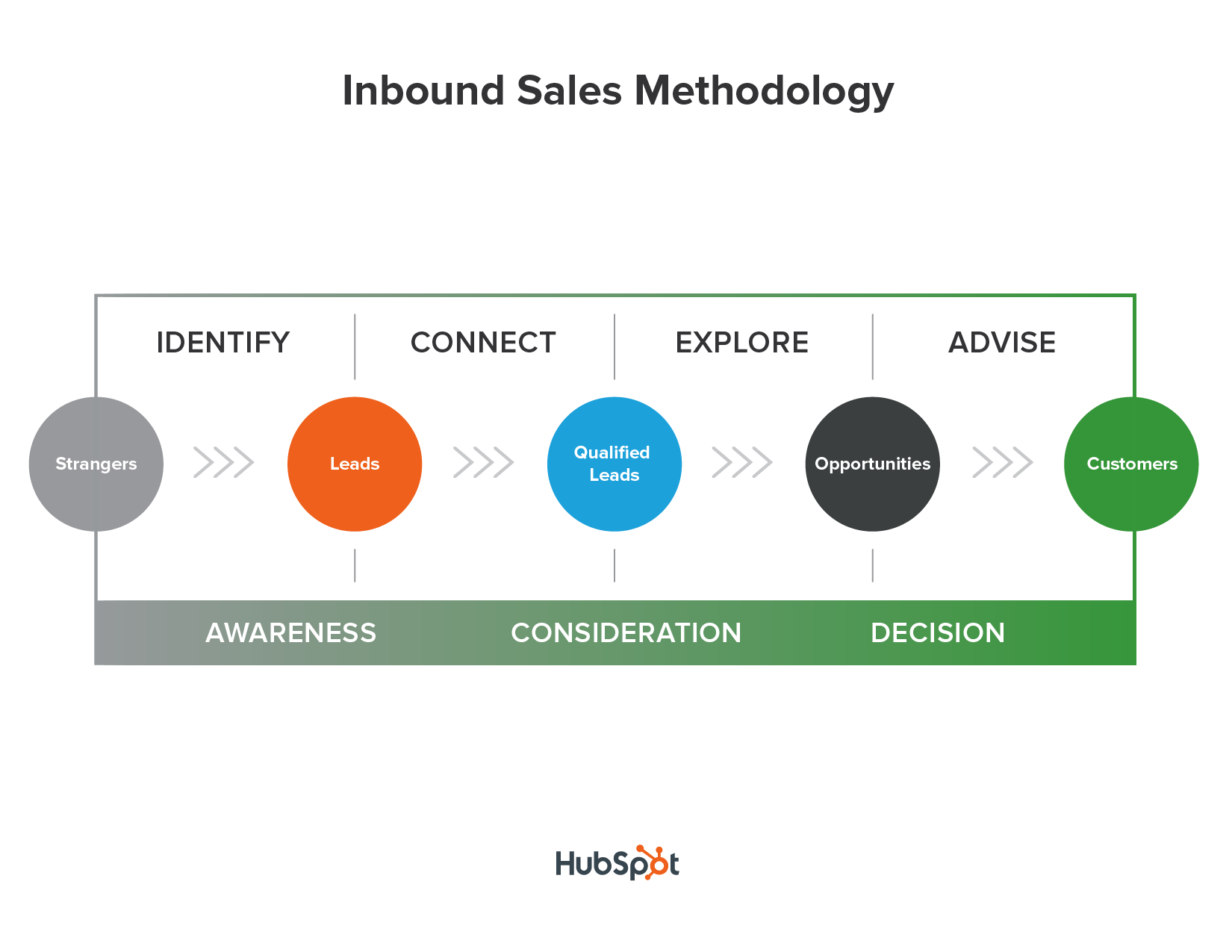
The ability to define the right business opportunities you’ll spend your time with is the difference between missing or exceeding your sales quota. It also helps you build a predictable, scalable sales funnel. When you’re laser-focused on the right prospects, you stop wasting time with buyers who are simply poor fits or not yet ready to buy. Identifying the right leads is the first step of the Inbound Sales Methodology, which salespeople use to turn strangers into customers.

inbound-sales-methodology.png

And inbound salespeople have a secret weapon they use to figure out who those leads are: An ideal buyer profile.

What is an ideal buyer profile?

Before you can identify potential buyers, you need to define which buyers you can help and which you can’t. The ideal buyer profile defines which companies are a good fit for your offering and which ones are not. If you are a B2B company, the definition should be at the company level, not the contact level -- that is, even if your point of contact doesn’t typically make the purchasing decision, they’re still valuable to speak with if their company matches your ideal buyer profile.

Here are six questions you should ask yourself to identify your ideal buyer profile:

  1. Are there company sizes that are ideal or not ideal who would buy your product?
  2. Do you define size as employees, revenue, customers, or another metric?
  3. Are there industries or verticals that are ideal or not ideal?
  4. Are there geographic locations that are ideal or not ideal?
  5. Are B2B customers better than B2C?
  6. Are there other attributes of that make the buyer ideal or not ideal?

What’s the difference between ideal buyer profiles and buyer personas?

Buyer personas define the different buying patterns of companies within your ideal buyer profile. Sometimes buyer personas are referred to as marketing personas; they are fictional, generalized representations of your ideal customers.

For example, your ideal buyer profile may be health care companies with less than 10,000 employees. Within that ideal buyer profile, you probably work with multiple buyer personas. Various roles may be involved in the buying decision at those companies. Perhaps one buyer persona is a leader of the IT department and another is the head of operations. Differentiating between these buyer personas will help you formulate a message that resonates with the goals and challenges they are each uniquely facing.

How to Use Buyer Profiles in Your Daily Routine

Now that you've defined your ideal buyer profile, how do you incorporate it into your daily selling routine? Here are five tips you can start using today to make sure you're only spending time with the right buyers.

  1. Ask yourself and your colleagues those six questions above. Physically write down the common answers. It’ll help guide you when picking out good fit prospects.
  2. Type your ideal buyer profile in Microsoft Word (it doesn’t have to be pretty) and print it out. Keep it at your desk for quick reference.
  3. When prospecting on LinkedIn, search for people who only match your ideal buyer profile.
  4. Prioritize active buyers who also fit your ideal buyer profile.
  5. If you are calling cold leads, during the initial connect call determine if your prospect is a fit for your buyer profile. Pursuing only good fit prospects will save you time in the long run.

How do you use buyer profiles in your sales process? Let us know in the comments below.

get inbound sales certified

01 Jun 18:21

SaaS Pricing Best Practices from 90 Companies: Why the Hottest SaaS Businesses Now Put Their Pricing Online

by Kyle Poyar

The idea of putting pricing online terrifies many B2B software entrepreneurs. They worry about competitors seeing their pricing, and then undercutting them. They question whether they could ever simplify their pricing enough to share it with the public. And they fear giving enterprise customers yet another negotiating lever to squeeze out lower prices.

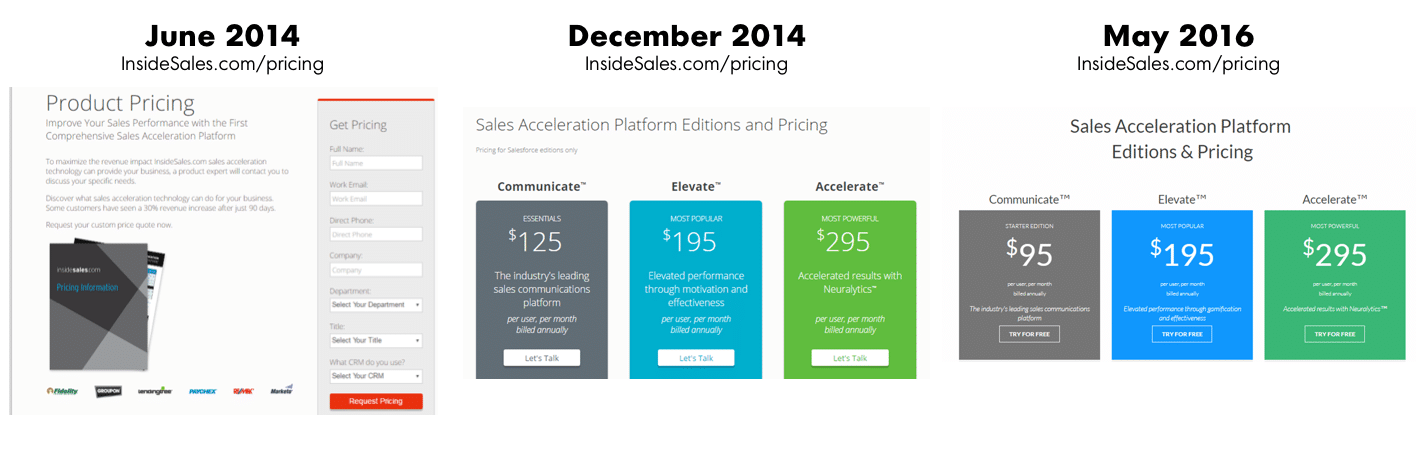
Despite these fears, many of the hottest software companies like InsideSales.com, MarkLogic and AppDynamics now put their pricing online. InsideSales.com, a sales acceleration software company valued at $1.5B as of March 2015, makes for an interesting case in point. As recently as June 2014 they shunned communicating their pricing online, and required web visitors to fill out a detailed form in order to request pricing. Now they prominently display their platform editions and price points.

Figure 1: InsideSales.com's pricing page in 2014 vs. 2016

InsideSales.com could have had several motivations for making their pricing public, the most likely ones being lead qualification, optimization opportunities and SEO improvement.

  • Lead qualification: Clearly sets expectations on how much InsideSales.com will cost so that less serious prospects or those looking to be educated do not waste the sales team’s time.
  • Optimization opportunities: Allows InsideSales.com to test different package configurations, messaging and price points, and see how each change impacts conversion. From the screenshot above, InsideSales.com has clearly optimized its pricing page from December 2014 to today, lowering the price of its entry offering from $125/user/month down to $95/user/month and adjusting its call to action from “Let’s Talk” to “Try For Free.”
  • SEO improvement: One of the first things a buyer wants to know is price, and so prominent placement in search terms related to “cost” and “price” has the opportunity to drive substantial incremental inbound traffic.

2016 Software Pricing Page Benchmarking Study

We investigated whether, when and why top software companies like InsideSales.com decide to publish their pricing. The benchmarking study covered 87 of the largest public and private software-as-a-service (SaaS) companies in the US, including 54 publicly traded companies and 33 private unicorns. Four key learnings emerged from the study, which expansion stage software companies can apply to setting their own pricing strategies.

Learning 1: SaaS unicorns are 2x more likely to publish their pricing compared to public companies

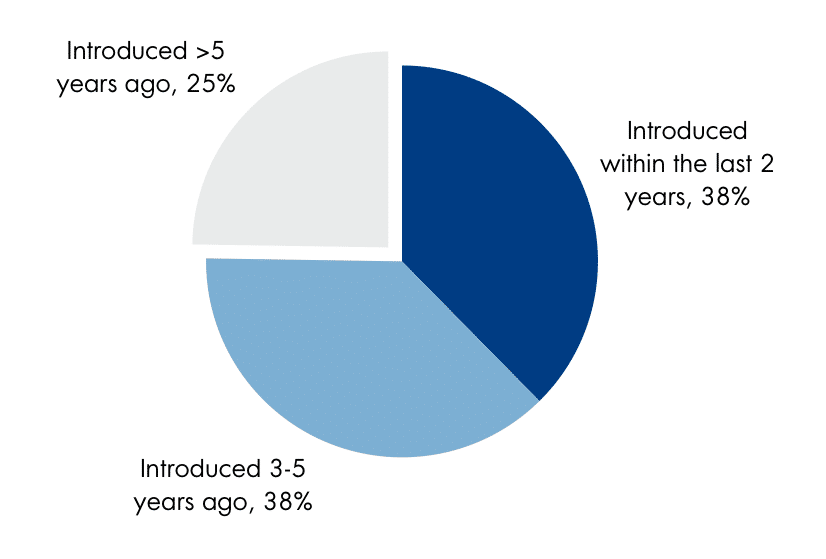
More than half of SaaS unicorns in the study publish their pricing, compared to only one-quarter of public SaaS companies. This likely reflects that it is easier to publish pricing as a younger company, before excess complexity, legacy processes and over-customization makes doing so less and less practical. It also indicates that many companies struggle with deciding whether to publish their pricing online, as there is not one right answer on the subject.

Figure 2: Percentage of software companies that publish pricing

Learning 2: Pricing pages are gaining traction, and they have gotten much better of late

Among the companies that currently publish their pricing, three-quarters started doing so within the past 5 years, based on data procured from the Wayback Machine internet archiving service. Two-in-five started publishing their pricing only in the last two years, including InsideSales.com as well as LivePerson, MongoDB and Slack. This indicates that pricing pages are gaining traction, and there will likely be even more in the near future.

Figure 3: When companies started publishing their pricing

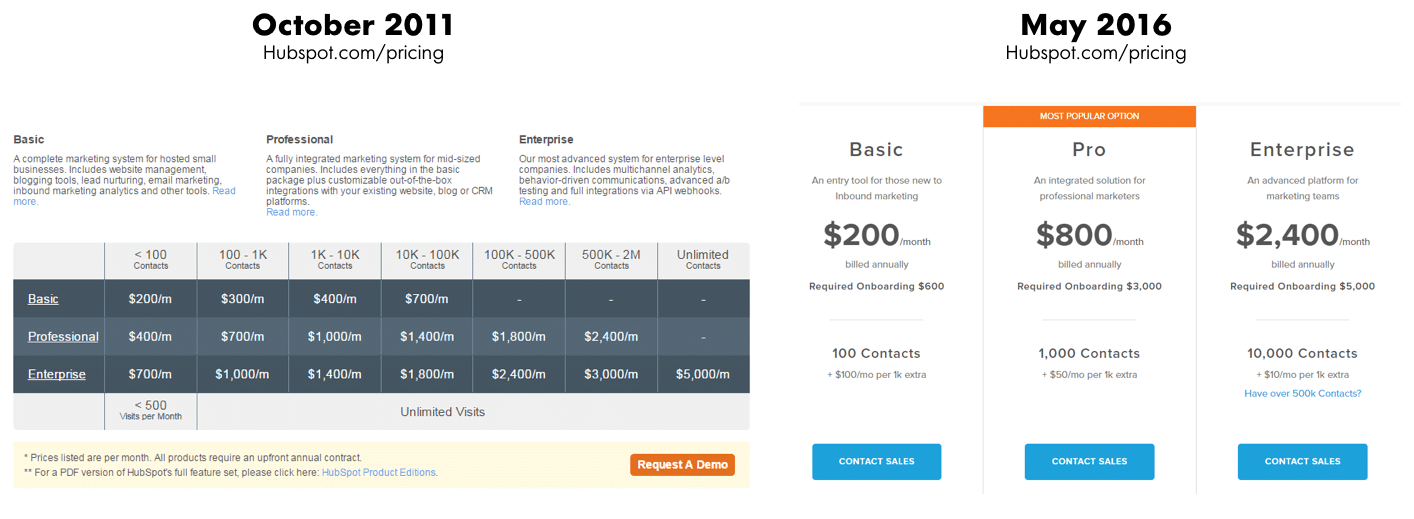
Meanwhile, the pricing page pioneers have dramatically improved and optimized their pages in recent years. Let’s look at HubSpot, the inbound marketing and sales software company that went public in 2014. Back in 2011 they published an early pricing page, which advertised three different packages (Basic, Professional and Enterprise) with a complex pricing structure that varied based on the package and number of contacts.

Fast forward to today. While they’ve kept a similar underlying packaging and pricing structure, HubSpot has seriously simplified the way they communicate their pricing and the options available to prospective customers. HubSpot has also improved the way it guides prospects into the ideal package, for instance by honing the way they describe each package and by highlighting the most popular option.

Figure 4: HubSpot's pricing page in 2011 versus 2016

Learning 3: Publishing pricing is not exclusively for consumer or SMB market segments

Even among companies that publish their pricing online, it has been a standard practice to hold back on showing the price of the Enterprise package, and instead push the buyer to call for a quote.

We found that several companies have eschewed such conventional wisdom, including MarkLogic, Splunk, LogMeIn and AppDynamics, and publish annual price points of $20k and up. Consider AppDynamics, an application performance monitoring and management software company valued at $1.9 billion as of November 2015. AppDynamics publishes pricing for up to 25 units, which costs a buyer $3,300 per unit per year, or a total of $82,500 per year. Doing so helps AppDynamics stand out in a competitive market against a host of both legacy players and younger vendors. The company does hold back on publishing price at the very top end, but only for extra large enterprises.

Figure 5: AppDynamics' pricing page in May 2016

Learning 4: Good/Better/Best packages and user-based pricing are still the norm

To attract funding, software companies need to prove that they successfully land and expand their customers. This requires selecting a packaging and pricing model that makes it seamless for customers to get started using the product, then rapidly increase spending over time.

A best practice for enabling land and expand is through a Good/Better/Best package line-up, with increasing functionality and higher prices as a customer moves from Good to Better to Best. With a Good/Better/Best line-up, a budget conscious or lower usage buyer can start out small with a light version of the product. It then provides an upsell path as customers become hooked and want to unlock more advanced features.

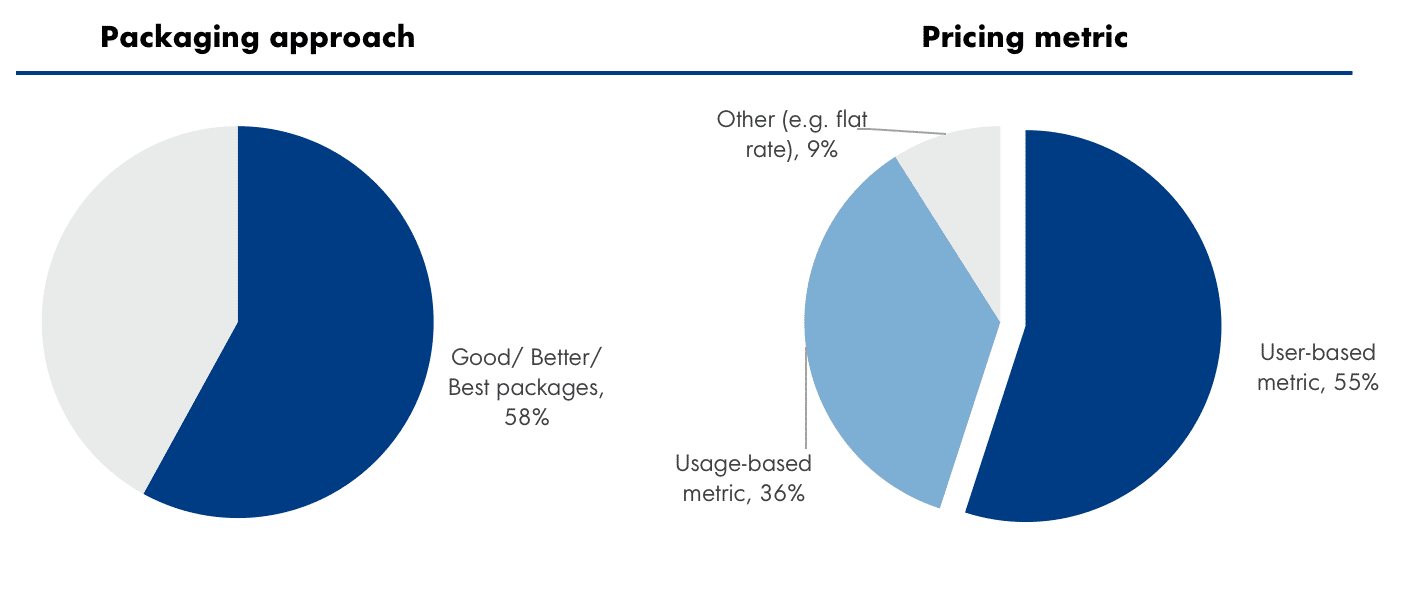
Of the companies that publish their pricing, 58% of them have some form of Good/Better/Best packaging. This includes InsideSales.com and HubSpot, as mentioned earlier, plus many others like Box, Domo and Salesforce.

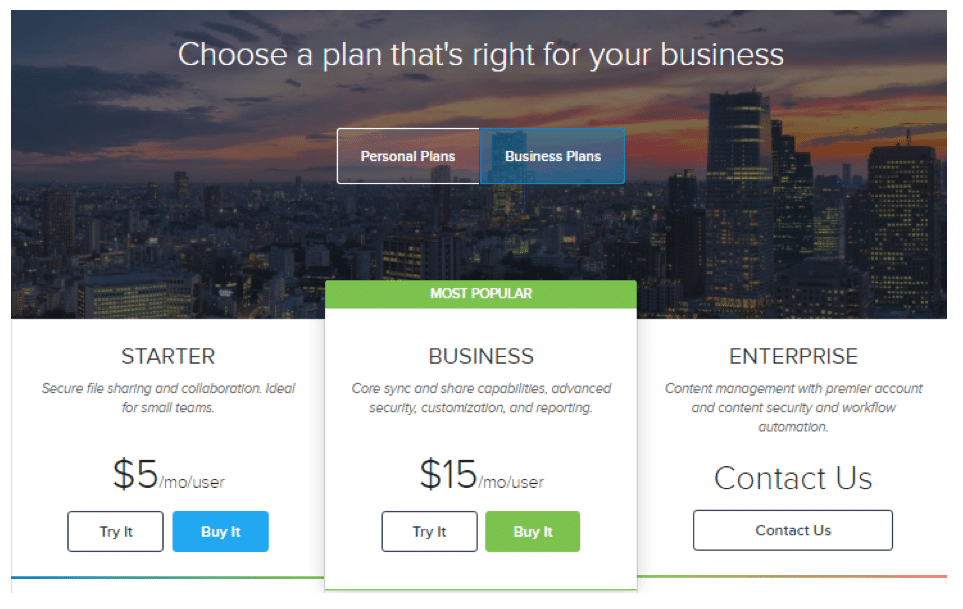
Figure 6: Box's Business pricing page, May 2016

Software companies should similarly select a pricing metric that allows them to scale ACV as a customer becomes more engaged. The traditional approach for doing so has been the seat or user-based pricing metric. User-based pricing is still the most widely used, according to our study. Of the companies that publish their pricing, 55% of them price based on the number of users. This includes Salesforce, DocuSign and Slack to name a few examples.

Figure 7: Packaging and price metric approaches

Interestingly, 36% of the companies in the study had a usage-based pricing metric. Usage-based pricing, when done right, aligns closely to the value a customer receives from the product and enables full monetization of customers who use the product the most. Companies with usage-based pricing employ a broad array of company-specific metrics, spanning from number of nodes and private repositories (Docker) to GB of usage (Splunk) to number of contacts (HubSpot).

Takeaways for Expansion Stage Software Companies

While no single approach works for all, signs point in favor of publishing pricing as an expansion stage software company. Doing so offers tremendous opportunity to optimize packages, messaging and price points, especially important to get right in order to scale most efficiently. It drives more inbound leads, and then helps pre-qualify those leads so that a time-crunched sales team can focus on the prospects who will actually open their wallets. And it only gets harder to do as time goes on, and ever more complexity creeps into the business.

Do you publish your pricing? Why or why not? We’d love to hear from you and learn about your results!

The post SaaS Pricing Best Practices from 90 Companies: Why the Hottest SaaS Businesses Now Put Their Pricing Online appeared first on OpenView Labs.

01 Jun 18:21

Key Indicators In Your Sales Dashboard

by Quentin Poiraud

key KPIs to sales dashboard

Sales dashboards can help you refine and streamline the efforts of your sales team by giving you the bird’s eye view of your department’s performance. But they can also help you track metrics, effectiveness and results for each rep on your team. These invaluable insights can serve to highlight which practices are returning the best results and which ones need anything from a slight refinement to a complete overhaul. You can prevent performance issues from escalating into more serious impediments to productivity and sales as well as recognize where your sales reps need additional coaching and guidance.

If used wisely, the metrics in your sales dashboard help you keep your department on track, streamlined and optimized. Typically, the dashboard gives you an informed, visual representation of your most significant sales metrics pertaining to categories such as product lines, sales, and performance for each salesperson. By tracking these metrics over time, you’ll reap the greatest benefit they can offer: helping you improve performance and revenues.

So what sales metrics matter the most? Here are a few that we find especially effective for both the bird’s eye view of your department and for tracking individual performance of your sales team:

For the Sales Department:

  • New Leads: The number of fresh leads coming into your sales department each month
  • New Opportunities: The number of new, qualified opportunities created in the month
  • Conversion Rate: New customers divided by the number of qualified leads
  • Real Revenue: New accounts, additions to existing accounts, and new renewal business

For Each Member of the Sales Team:

  • Lead Response Time: How quickly does your team respond to inquiries
  • Rate of Contact: How many opportunities are your reps generating per 1k calls?
  • Rate of Following up Leads: How many calls are logged per lead?
  • Clicks from Sales Emails: How many links to meaningful content is the rep embedding in follow-up emails that actually re-engage customers?
  • Social Media Usage: The more involvement with social media, the more effective the rep.

Close Ratio: An exceedingly important metric to measure sales performance.

Need to see those KPIs in action through live examples? Here are a few Sales & Retail Dashboards to check!

Happy Dashboarding!

Put your key sales metrics and performance reports & dashboards at your fingertips and share them with your teams with ClicData Dashboards. Drive smart business decisions!

31 May 17:47

How to Organize Your Entire Business with Trello

by Jaime Nacach

How to Organize Your Entire Business with Trello

The Simplicity of Trello.

Staying organized these days seems to be just as hard as ever, even with the thousands of apps and tools out there designed to make things easier. But one tool really stands out among the rest for online marketing and practically anything else – Trello – and it’s because it’s so darned simple. Imagine an old time card punch system. The card sat in the “out” slot until the employee came in, entered data to the card (by punching it) and moved it to the “in” slot. At the end of the pay period, the cards would be collected and taken to another location for processing paychecks. This is the simplicity of Trello.

Basics Building Blocks of Trello

Trello uses 3 components to manage almost anything imaginable: boards, cards, and columns. A board is the big picture or goal, the cards are projects within the goal, and the columns are identifiers of progress or change.

For instance, If a board were created to manage articles published on a blog, the columns might be Content Ideas, Assigned, Completed, Published, Guest Posts, Interviews, White Papers, Case Studies, and whatever else fits into your plan.

may 25 how to organize your business with trello
Each column is made up of cards. Each card can be assigned and followed and contains whatever information is needed for the project. Still talking article publishing, a card for an article about Pinterest marketing tools might be added to the Ideas column with notes, links, and whatever information is necessary, then assigned to a writer and moved to the Assigned column.

trello cards

Once completed, the writer would attach the document, make a note, and move the card to the Complete column. After proofing and editing the article is published and moved to the Published column, and so on. Digital marketing results for each could even be added as a column.

guide board

Adapt Trello To Anything

Anyone who is invited can view or change cards, so it makes a great team tool. Users that follow a card also get email updates about each change. The cool thing is that this simple process can be adapted to almost anything, which means that in addition with a good messaging platform like Slack, a business could manage almost every part of their operation using one simple tool. Even better, Trello integrates with many cloud-based apps.

A Few Ideas For Using Trello

  • Onboarding New Hires – Move all those checklists and documents into Trello. Set up columns for Before First Day, First Day, First Week, FAQs, whatever you need to cover.
  • Employee Reviews – Make a board for all reviews or a board for each employee individually.
  • Sales CRM – Effective small business marketing requires a CRM system, and the most powerful feature of any CRM is customization. Using Trello for your CRM means you can build it exactly how it should be for your business, and still keep it simple.
  • Employee Manual – Cheaper than printing one out, easier to change, and infinitely simpler to find what you need quickly.
  • Holiday Party – Post information, track who’s coming and who isn’t, assign or sign up for items to bring.

Trello really is one of the most versatile digital tools available for both individual and business organization, whether you’re running a marketing agency or just trying to lose weight.

Want to organize your business and your life, sign up for a FREE Trello account, and start exploring what you can do. Here’s a short video on getting started on Trello.

Wants More Ideas For Using Trello?

Checkout the hundreds of Trello board templates at Trello Inspiration.

31 May 17:47

10 Ways to Misbehave on LinkedIn

by Pam Neely

10 Ways to Misbehave on LinkedIn_FI

How’s your professional brand? Polished? Cutting-edge? Or maybe a little rough around the edges?

Any one of those is fine – so long as it works for you. Not everybody has to keep up appearances online.

But a lot of us do. Most of us, in fact. We may not have to polish our personal brand to the extent an executive would, but we still need to behave in a way that doesn’t put people off. If we happen to be in sales or consulting, or if we might want a new job soon, the stakes get higher. The rules of play are more exacting.

As you know, it’s easy to post things online that could come back to bite you later on. Often, these sorts of posts don’t seem like a big deal at the time. Usually, they’re not. I’m not talking about the overt, fringe posts of frat party material or extreme ideas. I’m talking about stuff an otherwise sane person, in a moment of weakness (or in the desperation to make a sale or land a client), might be susceptible to.

So these are social faux pas – not transgressions against humanity. They’re just a bit too off-putting, or a bit too weird. You might even be forgiven for them on Facebook. But LinkedIn in is a different story.

1. Discuss politics.

‘Tis the season, but I beg you not to spread – or smear – political opinions on LinkedIn. Pretty much anywhere else on the web appears to be fair game (especially Twitter), but leave LinkedIn alone. Besides, I think we’re all going to need a safe zone during this election.

2. Post things that are too personal.

LinkedIn is not Facebook. That said, how many promising job opportunities have been blown by posting things on even Facebook that were… unprofessional?

This doesn’t mean you can’t ever share personal stuff. Things that might make the acceptable list for LinkedIn, if you share only one or two things like this a month, might be:

  • You attending a show or some other non-political event.

For example: Got tickets to Hamilton? You may take a selfie from your seat. Did you get to go to opening day for your favorite baseball team? That’s OK to share too.

  • A pretty view from a conference or some other place you traveled to.
  • A photo of your children. Only once a month, please. Extra credit if you can link it into work.
  • Some work-related holiday. Even if it’s silly. Like this:

may the fourth

3. Pick a fight with somebody.

It’s surprising how heated things can get, even for professional topics. I almost got into a throwdown with someone over email deliverability once. But we were both professionals, so we kept our cool.

You should keep your cool, too. And don’t do things that you know will rile other people up, either. That’s harder for some people than you might think. According to a survey from YouGov, over a quarter of people under 30 enjoy riling people up online.

YouGov

Of course, there are far more subtle ways to pick a fight. You can leave a nasty comment. Or insinuate something. We’re all human, and so some things may occasionally get under your skin. But just walk away from the keyboard. Go look at those photos of your kids (or go see your kids in real life). Or go to a baseball game.

4. Complain about your company.

A recent issue of Harvard Business Review had a case study about how to handle an employee who had complained about his company on Facebook. It was his second offense of publicly casting his employer in a bad light. Some of the options raised in the case study included firing him, even though he was his company’s top salesperson.

I wonder if the experts might have responded differently if the negative post had been published on LinkedIn. It might have been taken even more seriously. On Facebook, there’s an assumption that what you post there is part of your personal life. On LinkedIn, it’s different. LinkedIn is specifically sanctioned as a professional environment. Anything you post there, you’re posting as a professional.

So when in doubt about whether it’s okay to post something less than positive about your company, don’t. Don’t risk your job. Don’t risk souring your relationship with your company or your coworkers. You’ll probably only make a bad situation worse.

What can you do? Post resources about how other companies have handled whatever situation it is that your company is struggling with. Be part of the solution. It’s human nature to resist and dismiss when we’re told we’re doing something wrong. So don’t ever trigger that response. Go with the positive – suggest solutions that “might work even better”. You just might get your way.

5. Send aggressive sales Inmails.

It’s not just the single best way to alienate your new contacts. It’s a way to get flagged, and possibly even banned from LinkedIn – if you take it far enough.

Instead, try to be useful. Typically, that starts with answering questions in LinkedIn groups, and then possibly – with a very light touch – liking and commenting on people’s updates. Commenting on the posts they publish on LinkedIn helps, too. You can also share their updates, or follow them on other platforms. If they’ve written a book, read it and leave a review. By the time you’ve done all that, they’ll definitely know who you are.

And by then, you’ll know them, too. You’ll know far more about how you can help them, and you’ll know how to talk to them about the things they care about.

I realize this is a tall order if you’ve got 300 contacts. So 80/20 it. Pick 30 people who could be valuable enough to be worth this much attention. Then go give it to them.

6. Use your LinkedIn contacts as an email list.

I hear this one a lot. Many otherwise intelligent, competent people seem to get confused about this. “After all,” they say, “I’m allowed to communicate with my contacts on LinkedIn – what difference does it make if I send them emails? Don’t I have a ready-made email list from my LinkedIn work?”

Sorry, but it’s not okay. Do not download your list of contacts from LinkedIn and use it as if it was an email list. It could get you marked as a spammer, and it might well get you in trouble with LinkedIn, too.

These people didn’t give you permission to access their inbox. They gave you permission to be connected to them on LinkedIn. Those are two different things.

7. Try to get a date.

Do not use LinkedIn for dating. Or even for flirting. Or even for expressing your admiration for someone’s looks. There are dozens – maybe hundreds of sites for this elsewhere on the Internet. Leave LinkedIn alone.

8. Say negative things about people.

This is similar to picking a fight or trashing your company, but it has a different flavor, so I’d include it here.

What I’m really thinking of here is private communications on LinkedIn (or anywhere else, for that matter). Often someone will reach out to you and ask your opinion of someone. If you’ve got something good to say, great – reply with enthusiasm. But if you don’t… avoid saying anything negative. Too often, these inquiries end up getting back to the person they’re about. That makes for awkward situations later on.

9. Make it all about you.

Symptoms of this are promoting only your own content or pitching only yourself.

If you need business ASAP, this rule can be really hard to follow. I get that. But social media marketing is never about the hard, fast sell. It’s about being friendly and helpful. The most helpful people on LinkedIn are the ones who do best.

So instead of making it all about you, flip it over: Make it all about them. In every post, every InMail, every connection request, every comment.

10. Spam groups with your content (especially if it’s some amazing opportunity to earn money online).

You won’t get very far with this in most groups. They’ll just ban you … sometimes after only two offenses.

A sister offense to this is to break the rules of a LinkedIn group. That can mean anything from posting in the wrong section to posting affiliate links.

For some groups, breaking the rules can be surprisingly easy to do. So play it safe: Actually read the rules (they’re labeled as “Group Rules” right under the “About this Group” paragraph) before you post anything.

LinkedIn Group Rules

These are the group rules for the LinkedIn group “Digital Marketing.” It has nearly one million members.

Conclusion

Every social media platform is different. What works on Facebook won’t fly on LinkedIn. And because LinkedIn is so focused on the business community, anything you say or do there will be specifically tied to you as a professional.

Consider the party metaphor we’ve all heard about social media: Behave on social media the way you’d behave at a party. Usually that means don’t talk just about yourself. Well, think of LinkedIn as a work party, a networking event, or an industry conference party. Act like you’re there to meet some amazing, influential people. It just might be true.

What are your LinkedIn pet peeves?

Are there any behaviors you’d like to stop seeing on LinkedIn? Get them off your chest by leaving a comment.

LinkedIn has evolved into a powerful lead generation tool for many businesses. Its features, like Publisher and Groups, lend themselves well to connecting businesses with prospects. With so many great features, it can be quite challenging to figure out how to use the ones that best fit your needs. To help you navigate your way through LinkedIn, we’ve put together 10 things you should be doing today to make the most of LinkedIn. Download, 10 Things B2B Companies Should Be Doing on LinkedIn.

Photo Credits: Maxxa Satori / Shutterstock.com

31 May 17:43

Supply management under siege again as Tory leadership candidate Maxime Bernier drops support

by John Shmuel

Canada’s practice of controlling prices in the dairy and poultry industries came under renewed scrutiny Tuesday as Conservative leadership candidate Maxime Bernier announced he will no longer be supporting the policy and called on other party members to join him.

Bernier revealed his position against the system, known as supply management, at a news conference in Ottawa. He said that Canada should work to rid itself of the policy in the next five to 10 years by providing farmers compensation as a transition is made to a free-market system. Bernier said this would likely cost between $18 billion and $28 billion and come from a temporary levy.

The announcement is a reversal for Bernier, who has long championed supply management — a subject of much debate in Canada.

“There is of course no way to reconcile it,” Bernier said in a statement he released Tuesday. “Supply management is a system based on keeping the prices of dairy, poultry and eggs artificially high through the control of production, the banning of imports, price-fixing by bureaucrats, and on preventing competition and entry into the market. It is a cartel. It is the opposite of free markets.”

The system has allowed the federal government to avoid subsidizing dairy, poultry and egg farming in Canada. Other countries, including those in the European Union and the United States, subsidize their own industries to the tune of tens of billions of dollars.

Supply management is currently supported by all three major political parties and it is particularly popular in Bernier’s home province of Quebec. But it is also divisive. Opponents argue that it is a harmful protectionist policy because it sets quotas on the amount of dairy and poultry produced domestically and limits imports with high tariffs. Such practices are said to stifle consumer choice and creates poorer quality products and inefficiencies in the market.

Bernier’s comments are not the first threat supply management has faced. In October, Canada signed onto the Trans-Pacific Partnership, which if ratified, would open up about 3.25 per cent of the Canadian market to international competition.

That deal was accompanied by a promise by the Conservative government of $4.3 billion in federal subsidies over 15 years to the dairy industry. But Liberal International Trade Minister Chrystia Freeland has said those subsidies will now be under review

The threat of the TPP, combined with a high-profile rebuff from Bernier, aren’t going unnoticed by corporate Canada. The chief executive of Canadian dairy giant Saputo Inc. said last year that the company is preparing for any potential change to supply management, including in the event that it is dismantled.

It is a cartel. It is the opposite of free markets.

“If the system stays as it is in Canada, it’s good for us,” CEO Lino Saputo Jr. said during the company’s annual meeting last August. “If the Canadian system changes, we will adapt.”

Bernier’s shift comes the same week as Quebec dairy farmers are planning a major protest to push thew recently elected Liberals to enforce existing supply management rules. Dairy farmers say they are losing tens of thousands of dollars a year because Canadian inspectors are allowing a U.S. protein — known as diafiltered milk — to get past the border without tariffs because it is currently not considered a dairy product.

Dairy farmers will hold a rally Thursday on Parliament Hill to voice their frustration with the loophole.

Isabelle Bouchard, spokeswoman for the Dairy Farmers, said in an interview that dismantling supply management in favour of a new system — including subsidies — would do little to save the country or consumers money.

“It would still cost money,” she said. “The U.S. farmers are still subsidized every year in order to cover their production costs.”

She also took issue with Bernier’s statements that dairy prices were unreasonably high in Canada compared to the U.S.

“His party, while in government, asked the Senate to do a report on the price discrepancy in Canada and the U.S. and it found everything in Canada is more expensive than in the U.S.,” she said. “It’s wrong to have Canadians think that milk is so much higher in Canada, because milk production is not subsidized here. Even if you don’t drink milk, you’re paying for it in the U.S., because it’s subsidized.”

Peter McKenna, professor and chair of political science at the University of Prince Edward Island, said in an interview that Bernier’s push to dismantle supply management opens up discussion about whether it will be adopted as a platform by the Conservative Party.

“It may very well force the hands of some of the other leadership contenders and force the party to accelerate its position on how much of supply management should be retained and whether we should move further along the lines of, maybe not dismantling supply management entirely, but whether we should open up these industries to more competition,” he said.

Bernier, who in the past championed supply management, said he did so because of his party’s official support for it, rather than his own personal belief.

“I was not in a position to question the party’s democratic decision, or cabinet solidarity,” he said. “And so I went along with it like all my colleagues, even though I had grave misgivings about it for all these years.”

Bernier entered the Tory leadership race in April. He is a self-described “free market guy” who has touted the benefits of removing the government’s hand from the private sector. The Conservatives will vote for a new leader on May 27, 2017.

31 May 17:40

How to Appeal to a Buyer’s Mentality Without Being a “Discount Brand”

by Madeline Boehmer

We are all attracted to discounts, no matter how large or small. It’s always better to save a few bucks than to pay full price. While consumers love discounts, the topic has caused quite the stir within the retail industry around the idea of whether or not a company should base their pricing strategy around them. However, in today’s market, consumers seem to be demanding them more and more.

Recently, the DynamicAction Retail Index: Spring 2016 study found that retailers sold 4% less at full price in Q1 2016 vs. a year ago. To top it off, promotions of up to 63 percent were applied on most orders.

While offering discounts comes with many benefits like attracting more customers and increased sales, it’s important to understand how a discount strategy affects a buyer’s mentality.

Here’s a few ways offering discounts affects the buyer’s mentality:

Reduces the desire to search and showroom – With so much technology, literally in the palm of our hands, it’s never been easier to shop at one store and compare prices on your mobile at the same time. If the item is not on sale at one store, chances are it is at another. Offering discounts upfront will reduce your customers desire to look elsewhere. If they walk in and know they can receive a discount, they are automatically more enticed to buy.

Creates a sense of urgency – Passing up a good deal is extremely hard for many of us. If we’re contemplating a purchase, we tend to ask: Will the item still be here when we come back? What if it sells out? Will the price increase by the time I come back? Typically, the thought of missing out on a good discount on an item we want is enough to go through with the purchase, right then and there. The fear of missing out is a powerful tool, which is why you almost always see time limits attached to discounts.

Reduces the need to justify the purchase – When we find an item we don’t necessarily need, it’s easy to ask yourself, do I really need this new shirt? Sometimes our self-control will kick in and say no, but when you know you’re getting a good deal, you often don’t bat an eye at putting the item in your cart and move forward with completing the purchase.

While offering discounts is a great way to get customers in your store and completing a purchase, some retailers worry that offering too many discounts can label your brand as a “discount brand.” So how do you appeal to the buyer’s mentality with discounts, without becoming a discount brand? It’s simple: Offer exclusive discounts.

Many retailers overlook the benefits of exclusive discounts. Offering exclusive discounts is the best way for your company to get new and repeat customers in your store purchasing items, specifically because of special pricing offered just for them.

Your company can offer an exclusive discounts to connect with those in hard-to-reach target markets like military, student, or teacher. Targeting a select market with exclusive discounts still has a positive effect on their buyer’s mentality and is the best way to only open up your discounts to a select group of people – ultimately getting these markets shopping at your stores and increasing ROI.

Tommy Hilfiger recently added exclusive discounts for the military, student, and teacher communities to their online store. Within three months, their three exclusive discounts accounted for 10% of total site sales and on average Tommy Hilfiger received a $15 ROI on this campaign.

If you’re looking to increase the effect your company has on your customer’s buyer’s mentality through discounts, offering exclusive discounts is the perfect opportunity for your brand to increase sales, ROI, customer engagement, and loyalty, all without being a “discount brand.” Read more about the psychology behind exclusive discounts and how they can help you attract new customers in our whitepaper, “The Unknown Benefits of Exclusivity.

31 May 17:37

McKinsey, HBR: How much support do your sales people need?

by bob@inflexion-point.com (Bob Apollo)

HBR-logo-v3-300x200.pngThere is some fascinating research just published in the Harvard Business Review by a group of McKinsey consultants. They sought an evidence-based approach to optimising the balance between front line sales people and sales support roles - and their conclusions may surprise you.


It’s an important question because having the appropriate level and type of back office support is critical to maximising the productivity and effectiveness of your quota-carrying sales people. But - unfortunately - it’s a balancing act that many organisations seem to struggle to get right…

The researchers from McKinsey concluded that the highest performing organisations (as measured by sales ROI - i.e., the gross margin over total sales cost) were dedicating between 50-60% of total sales headcount to sales support functions. You can see just how much of an impact this made in the chart below:

HBR_Optimal_Support_Levels.png

The functional balance within the sales support function turns out to be critically important. Top-performing sales organisations have about the same percentage of customer-facing sales support personnel as do their lower-performing competitors (about 30%). But there is a fundamental difference in operational and administrative support levels, where top performers employed over twice as many specialists (27% vs. 12%).

HOW MANY MANAGERS?

The study found that the ratio between non-managers to managers also has a significant impact on performance. The highest performing organisations tended to have a non-manager to manager ratio of around 8:1. This appears to be the optimal level: their lower performing peers typically had ratios above 10:1 or below 5:1.

There’s an obvious balance that must be struck between span of control and overhead cost - and the top performers have mastered it. Employ too many managers, and you incur cost without incremental benefit. Employ too few managers, and your sales people will not get enough coaching and support to allow them to realise their potential.

GOING DIGITAL

The study found that the top performing organisations have also mastered another critical function - they were successfully using digital technology to optimise the planning and operational functions in key areas such as sales analytics, opportunity allocation, forecasting and proposal development.

These results are impressive. Perhaps just as impressive are the sales performance transformations that have been achieved by organisations that have taken an informed, evidence-based approach to structuring and resourcing the sales function and balancing roles and responsibilities.

REBALANCING YOUR RESOURCES

This often involves role specialisation and a blend of consolidating certain roles and distributing others to achieve the optimal resource balance. In addition to nearly doubling the amount of productive sales time spent on customer-facing activities, these benchmark organisations also demonstrated increased win rates and shortened sales cycles.

And they didn’t just achieve a one-time upturn in performance: moving to an intentional, evidence-based structure also helped these organisations to establish the foundation for a programme of continuous incremental performance improvement.

The authors conclude, “Sales support is critical. Only by putting into place and optimising the right levels of support can companies hope to get the greatest growth from their sales organisation.”

STRUCTURE AND PROCESS

But what’s the best way of achieving this? It seems to me that having a clearly defined sales process with clearly defined roles, responsibilities and contributions for every member of the sales organisations is one of the critical foundations.

If we’re not clear what value we expect team member to generate - and if we haven’t identified how low-value tasks could be offloaded from high-value roles to a sales support function - it’s going to be impossible to optimise our sales structures.

FOCUS ON VALUE CREATION

A good place to start would be to identify how the quota carrying roles we expect to generate the highest revenue contribution are actually spending their time. How much of it is spent on low-value-added activities that divert them from their primary purpose and could be delegated to others?

How much of their time is currently being wasted “reinventing the wheel” or relearning lessons that someone else in the organisation is already aware of? How much attention is being paid to capturing collective best practice or to reducing the unnecessary burden of administration?

If we were to take a dispassionate look at the situation, the answers would probably make many sales leaders somewhat uncomfortable. We can't "hire our way" out of the problem: the solution lies more in putting the right resources to work with the right responsibilities within a well-defined structure and process than hoping more or better recruitment will solve our sales productivity challenge.

You can read the full HBR article here. If you recognise any of these challenges - and if you see the potential to do better within your own organisation - I’d love to talk. You can drop me a line here.

Bob_Signature.jpg

A Simple Guide to Compelling Messaging for the Complex Sale

31 May 17:37

Setting up Google Analytics for Success

by Alex Charalambous

Google Analytics is a powerful tool to help you better understand how your website is performing from a variety of angles. But setting up Google Analytics correctly is paramount to getting the most out of the tool.

Setting up Google Analytics for Success

Data is an essential component of websites, yet many companies either don’t have analytics, or don’t pay much attention to the analytics they have. When we start the redesign process for clients, one of the first questions we ask is “Do you have website analytics?” And to our surprise, many times the answer is no.

With Google Analytics being a free tool, there is no reason that your website shouldn’t have it. However, creating an account and adding the tracking snippet to your websites is only the start. Once you have Google Analytics account set up, follow this guide to get started and set yourself up for success.

Set up three views

Within your website property, you can create different “views” to track your analytics. You will want to set up at least these three views:

1. Unfiltered
This view will be your raw data that you should never touch. Google may also call it “All Website Data”. Don’t add any filters to this view. This is your constant and also your backup to use as a comparison for your other views.

2. Master
This will be the view that you use most frequently. In this view, you should apply filters to show the most accurate website data (i.e. ignore internal traffic IPs).

3. Test
The test view allows you test filters and settings to be sure it’s working how you want it to before adding that filter to the Master view.

If there is anything you take away from this article, it’s that you need to set up these views FROM THE VERY BEGINNING. Why? Because data will be lost if you wait to create these views later. When you create a new view, it starts collecting data from that day and on. It does NOT go back retroactively.

For example, let’s say you only set up one unfiltered view when you create your analytics account. Then, six months later you want to start filtering out internal traffic and create the Master view. The Master view will only start collecting data that day and filter out traffic from that day forward. So now you’ve lost 6 months of quality data that you could have been tracking.

Set up Goals

Goals are important because they tell Google when something significant is happening on your website. There are four main types of goals: Destination, Duration, Pages/Screening and Event. You can create up to 20 goals on your website. Be sure to choose ones that are important for your business. These may include lead form submissions, email list sign ups, or purchases for ecommerce sites.

1. Destination Goals
If one of your main goals is for people to fill out your contact form, you may want to set up a “thank you” page so you can track how many people fill out your form. In this case, this would be a “destination” page that you would track.

2. Duration Goals
One of the main goals of your website should be to keep people on there long enough to navigate through and learn about your company. This will help to gauge engagement on your site. The most common amount of time to track is 5 minutes. However, if you have a smaller site, you may want it to be 2 minutes. There is no exact science for this one, but you want to choose a time that not everyone visiting your site will reach.

3. Pages/Screens Per Session Goals
This goal is similar to duration, but it tracks how many pages a visitor sees before leaving the site. For example, you can set it to track visitors that view more than 3 pages per session. This is another good measurement of engagement.

4. Event Goals
This type of goal is a little more complicated because you have to set up Events in Google Analytics first. Here’s a guide on setting up event tracking. Once you have it set up, any element that your visitors interact with can be tracked with events. For example you can track external links, downloads, time spent watching videos, etc.

When you set up event goals, you can define one or more conditions for the event goal: Category, Action, Label and Value. You can use one or all of the conditions; however, the event goal will only trigger if the event matches EACH of the conditions. So if you define all four conditions, then the event would have to match each of them in order for it to activate.

Set up Site Search

If you website has a site-wide search, you will want to be sure to take this step to track searches. First, go to your website and run a search. Keep the page open, as you will need the URL later. On Google Analytics, go to the View column and select “View Settings”.

Under “Site Search Settings,” toggle it on. Now, look back at your URL from your search results and enter the query parameter (usually s or q) and click “Save”. By activating this setting, Google Analytics will track any searches made on your website so you can learn more about what visitors are looking for.

/ / /

This a basic starting place for setting up Google Analytics for success when you launch your new website. If you set up these three things, then you are off to a good start and will have a good platform to dig into Google Analytics even more later on!

31 May 17:36

The 10 commandments of Growth Hacking

by Tanya Hemphill

How to use Growth Hacking to get real results

The growth hacking approach (also referred to as ‘agile marketing’ and ‘growth marketing’) has generated a lot of excitement as a dynamic approach to boost awareness, lead generation and conversion.

Sean Ellis, a marketer and entrepreneur who has worked for companies such as Dropbox and Eventbrite, devised the term ‘Growth Hacking’ in 2010. Originating from Silicon Valley, growth hacking has successfully been used to build high-growth companies such as Hotmail, PayPal, Twitter, Airbnb, Instagram and Uber. Ellis says:

“Startups live and die by their ability to drive customer acquisition growth…[they] are under extreme resource constraints and need to figure out how to break through the noise to let their target customers know they have a superior solution for a critical problem…the best growth hacks take advantage of the unique opportunities available in a connected world where digital experiences can spread rapidly.

Growth hacking is now gaining traction in the UK and has recently been termed ‘the next big thing for marketing’ by Advertising Age. Even well-established organisations such as The Guardian have recently advertised related job roles, such as ‘Head of Growth Hacking’, which has further raised its profile.

Although the term ‘hacking’ has technology connotations, more traditional companies such as Regus and Penguin Books are also using the principles of growth hacking. This indicates that the concept is not just relevant to technology start-ups and this movement has wider implications. Think of it as ‘marketing digital disruption’ because technology is an enabler for marketers to understand and respond to user behaviour more rapidly.

Core Principles of Growth Hacking

The core principle behind growth hacking is to quickly and cheaply test a marketing idea, use data to analyse the outcomes, and to iterate, optimise, implement or change the experiment. Running A/B tests and checking data with analytical software such as Google Analytics, Mixpanel and Optimizely are essential components to this process.

Despite the high data analysis element of growth hacking, it is an extremely creative process that requires people to “swim against the flow” and spot emerging opportunities before anyone else does. This dichotomy of ‘intuition and rigor’ and ‘art and science’ makes it very difficult to find people with the right skill-set; which is why building a growth hacking team is so important (or finding an agency with this type of team already in place).

Although digital marketing is a key element of growth hacking (because of the analytical part of obtaining quantitative user data and gaining insights from it), it is also important to use traditional marketing methods to bridge the gap between the physical and digital world. 

Creating a Growth Hacking Mindset

Growth hacking is an approach, rather than a set of tools.

To illustrate this, we are going to tell you about a brilliant growth hack that has nothing to do with either marketing or business. Instead, it tells the story of a winning mind-set…

In 1996 Britain’s cycling team was ranked 17th in the world and had won just 2 bronze medals at the Atlanta Olympic Games. By 2012 they ranked first in the World and British riders had won 12 medals (8 gold) at the London Olympic Games.

cycling aggregate gains

Its success was largely down to the coaching of Sir David Brailsford. His approach was to breakdown everything that went into riding a bike and improve it by 1%. Putting all of the 1% margins together meant that in 2012 British Team Sky had won 70% of the gold medals in cycling at the Olympics.

There wasn’t a magic silver bullet but a series of micro, cost effective and human-centred optimisations that could be effectively scaled. This demonstrates what a growth hacking mind set looks like.

To be a good growth hacker:

  • Mindset is extremely important – growth hackers focus on accelerated growth on a minimum budget. It’s all about users (or an alternative KPI, depending on your business)
  • Being curious and creative are key elements. Don’t get fixated on spending a particular budget, go back to basics and think about tapping into human behaviour (we’re social animals)
  • The internal culture is important: the business needs to be open to experimentation – some ideas will fail
  • It needs a good (Pi-shaped) team, i.e. marketers with a broad base of knowledge in all areas, but capabilities in both ‘left brain’ and ‘right brain’ disciplines. They are both analytical and data-driven, yet understand brands, storytelling and experiential marketing

The team element is very important as one individual person is unlikely to have all of the skills needed for growth-focused marketing.

The 10 Commandments

1. Talk to your customers, identify trends, understand why they need your product or service

  • Magic bullets rarely exist; if you spend too long looking for them you’ll take your eye off the ball. Focus on the things that matter – serve amazing customer experiences (like Zappos) and product value (like Instagram and Skype)

 2. Understand the landscape you are operating in

  • Some products or services are never going to achieve viral growth because of what they are and the market the company operates in
  • Try to predict the future needs of your customer – be one step ahead of them. Never fall behind or your competition will get there first. Think about how Instagram offered a more superior photo sharing app than Facebook.

3. Develop the unique rules of growth for your particular organisation

  • What are your company’s growth metrics or KPIs?
  • What’s the one metric you need to move, to get to the next stage?
  • Be growth focused and use data to make sure you are on track
  • Be technical and have a strong market focus

4. Make extensive use of pilots and prototypes

  • Build fast, test fast. Start with a Minimum Viable Product (MVP) and talk to users about it
  • Does your product serve a real need? Be honest!

5. Experiment early and often for aggregated marginal gains

  • Don’t look for a silver bullet, test lots of small things
  • Rather than having one web page have a series of web pages and work out which one converts the best

research XL framework

The ResearchXL framework has been produced by Peep Laja. Visit his blog to find out more about each area of the framework.

The information gained from this type of analysis can then be used to test hypotheses’ relating to user growth and validate ideas. This process is essential to finding ‘non-norm’ solutions to achieve growth in a short amount of time.

6. Focus on asking the right questions

  • What’s going to make the biggest difference to your business? Working out how to get there
  • Don’t think online or offline. Think: Who am I talking to?
  • What am I trying to achieve? What is the best way to get there?

7. Use behavioural quantitative market research and to sharpen selection

This approach is basically using structured testing to improve website effectiveness. Growth optimisation is moving from data, to insight, and then to money. User data analysis is needed throughout this CRO process, so that activity can be prioritised.

  • Constantly A/B test – you can only hack something once you start testing an idea and find out what actually works
  • Analysis has to be spot on. But there’s a difference between analysis and insight, growth hackers understand the difference
  • You need to be able to take apart a top-level number…’We had ten million visits today. X of them were in this category and did this and Y were in that category, they might have done that.’

behavioural marketing

Generally, a company should use a minimum sample size of 250 to test changes for CRO. You also need to think about business cycles - e.g. if your weekend traffic is very different, ending a test by excluding that segment would make your sample unrepresentative.

8. Use qualitative research to improve intuition

  • People buy brands and emotion and this is needed whatever your business is, whatever you are working on. Growth hacking isn’t just a scientific numbers game.
  • Qualitative research is very important. It’s about understanding the ‘why’ and provides you with more of a 3D focus on exactly why things happen.
  • Use qualitative data to find out: What are our users interested in? What else are they looking for? What’s their experience like? The numbers many be going up but if people are really irritated by something you’ve pitched to them, you won’t be able to capture them again like you did in the beginning.

9. Clearly define and communicate new offers

  • Run numerous tests but have a plan for the sort of things that the hypotheses should be, they should be documented somewhere in an Excel file. Track the results. You should re-run the experiments; never assume that if you’re doing them in January, the results will be the same in June…products have seasonal customers.
  • There’s never perfect data but there’s a lot more data in the digital space than the offline world. You can serve messages to different people through testing tools like Optimizely and check analytics on email, social media, etc. which allow you to instantaneous get feedback and adapt your approach accordingly.

10. Encourage a culture of creativity and experimentation across teams

  • You can’t growth hack without the right team. They need to understand what growth hacking is. If they don’t understand it, they’re going to struggle. And you’re all going to be doing a lot more fighting and arguing internally, and you won’t get anything done.
  • If you’re running experiments, or doing things that cause problems for other teams (which they can), you need to be able to negotiate and work them out. You can’t just be in a silo.

Operational Elements of Growth Hacking

There are a few essential elements needed to be an effective growth hacker – these can be seen in the diagram below.

operational elements of growth hacking

Pirate Metrics

Investor Dave McClure of 500 Hats has often spoken about the marketing funnel and start up metrics for Pirates (AAARR). This is a useful tool for all types of organisation.

pirate metrics funnel

Download Expert Member resource – Growth Hacking Guide

This guide aims to show how growth hacking concepts can be applied to established medium and large businesses as they seek to develop more agile marketing approaches. Naturally, the checklists in this guide will also be useful for start-up and smaller businesses.

Access the Growth Hacking Guide

31 May 17:34

China could be about to plunge us all into a world of pain

by Linette Lopez

beijing park ice swimmer dive freezing frozen

The trade of the year has come back to haunt markets.

The Chinese yuan has weakened against the dollar at its most rapid rate since last August, when Chinese officials devalued the currency.

This move is also a throwback to a scary recent time — the turmoil at the beginning of this year after the Fed's first rate hike since going to zero in December 2008.

In January and February, the yuan's erosion against a strong dollar prompted Chinese people to move money out of the country, which spooked its stock market, which in turn spooked markets around the world.

And now, that recent history is repeating itself.

Along with more rate-hike talk, a swiftly plunging yuan is back.

What's more, the messaging out of China is just as confusing and aggressive as it was before. Again, the government is maintaining that the yuan is floating freely against a basket of currencies, as it has insisted since the end of last year.

Again, the government is throwing a tantrum anytime the foreign media talks about this issue.

And for the first time since the disaster during the winter, the Chinese stock market experienced an almost instant, eye-popping drop on Tuesday.

To fix or not to fix

Last week, The Wall Street Journal published a bombshell report detailing how the government is supporting the yuan's fix against the dollar. This goes against what the Chinese government promised at the end of last year: to let the yuan float more freely against an unknown basket of currencies.

The report prompted The People's Bank of China (PBOC) to rail against foreign media's "fabricated attacks."

Then, the head of a Chinese bank and Communist Party official went on the record with Bloomberg explaining how the yuan is set every day.

From Bloomberg:

The 14 contributors, which must consider the previous day's yuan closing price, have to take into account movements in baskets of currencies and have the leeway to consider the effects of client supply and demand, said Sun Wei, deputy general manager of financial markets at China Citic Bank Corp., a unit of China's largest state-run financial conglomerate. He added that the People's Bank of China spoke with lenders in February before standardizing the system.

There's one very important consideration to add to that, noted in an HSBC note released on Tuesday morning. It's "a judgment of market demand and supply, risk appetite and global market developments."

That means officials can take into consideration, say, an impending US rate hike — or whatever else they like.

janet yellen

As a result, even less so than the end of last year, Wall Street isn't taking China's public policies on the yuan at face value, which only adds even more to this deep confusion.

From HSBC's note on Bloomberg's explanation of the yuan's fixing (emphasis added):

Notwithstanding the above information about the new fixing mechanism and quotation process that are more transparent and market-oriented, it is hard for market participants to imagine that China's FX policy has become totally 'hands-off'. It is also incorrect to think that USD-CNY is no longer a managed currency. Indeed, the fact that the central bank guides how each bank should think about the fixing indicate there is still some way to go before the RMB can be considered truly market-determined.

What is and what should never be

The thing is, the yuan is weakening partly because the Chinese economy really is slowing. After the volatility at the beginning of this year, the government pumped money back into the housing market to keep things rolling. Credit growth, however, is making less of a positive impact on the economy as debt rises. The problem is that China needs productive credit, not just more credit.

This very real slowdown is evident in all kinds of data, and it's defying Wall Street's expectations with its rapid pace.

Morgan Stanley's Adam Longson and his team of analysts wrote (emphasis added):

China oil data reinforces concerns about a faster deceleration. Our economists have noted that April data showed China may be slowing earlier than the expected Aug/Sep timeline. Our proprietary MS CHEX economic gauge slowed from 11.9% in March to 3.1% in April. The data on China oil product demand (not apparent demand) reinforces these concerns. Both diesel (a proxy for industrial activity) and gasoline (a proxy for consumer) show anemic YoY trends.

So a weak yuan makes sense for China's data, even if it isn't what the world or Chinese officials want to see. The former don't want a currency race to the bottom, and the latter want stability.

Goldman Sachs/Gao Hua economist Song Yu is calling the calm that the yuan experienced over the past few months a "temporary sweet spot." He told Bloomberg in an interview that the government will likely instate capital-control measures to restrict outflows.

"But this is very much like a game of a cat trying to catch the rats," he said. "Whenever the government manages to block a hole through which capital leaks out, people can always dig another hole to bring the money out over time."

Think of this as a game of whack-a-mole, except that it can send global markets into a red alert and freak everyone out for weeks at a time ... so not a game at all, actually.

SEE ALSO: The market as we know it is 'crumbling'

Join the conversation about this story »

NOW WATCH: KRUGMAN: Wall Street Is Wrong, Janet Yellen Is Making Exactly The Right Move On Inflation

31 May 17:33

There's one major reason merger activity has gotten crushed this year

by Bob Bryan

Barack Obama Fist

Corporate deals are falling apart left and right, and a huge culprit appears to be the federal government.

The rate of merger and acquisition activity was halved in the first quarter of 2016 compared to the average over the previous seven quarters, according to strategist David Bianco at Deutsche Bank.

Both the number of deals and the value of deals completed fell off the table to start the year, and a big cause of that decline might have been the influence of lawmakers.

"Several big deals fell through upon the recent passing of new laws with more restrictions on inversion deals (PFZ-AGN) and also antitrust regulation (HAL-BHI)," said Bianco, citing regulatory restrictions on mergers intended to lower tax burdens and on the formation of overly large conglomerates.

"Total value of M&A deals in 1Q16 was $283 billion, a clear slowdown from the average quarterly deal value of $530 billion from Q214-Q415."

Bianco mentioned a few of the big name merger and acquisition attempts that have run into government problems to start the year.

The $160 billion merger of pharmaceutical titans Allergan and Pfizer was scuttled due to changes in regulations from the Treasury Department regarding the moving of corporate headquarters from the US to overseas locales to avoid taxes, also known as inversions. President Obama has also spoken put against these deals, possibly contributing to the chill in dealmaking.

Oil services giants Halliburton and Baker Hughes had their $28 billion mega-deal squashed by the Department of Justice over antitrust concerns, and smaller deals such as the possible Canadian Pacific-Norfolk Southern takeover faced anti-competitive worries from lawmakers.

While Bianco noted that dealmaking has picked up some in April and May, the government's increased anti-trust scrutiny and crackdown on tax avoidance have thrown a monkey wrench into a lot of firms' well-laid plans.

Screen Shot 2016 05 31 at 11.59.44 AM

SEE ALSO: US companies issued a staggering $517 billion of debt in the last year

Join the conversation about this story »

NOW WATCH: All 460 Sports Authority stores are closing — here’s when clearance sales begin

31 May 17:31

If I Have to Sit Through One More B.S. Sales Training Class…

by Dave Stein

Memo: To Sales Reps and First-Line Sales Managers

From: Dave Stein

Subject: Sales Training

As you know, I spent nearly a decade evaluating and comparing sales training companies, their approaches, and their effectiveness. As a result, I’ve determined, without any doubt, that you have the right to be:

  1. Assessed for your individual strengths and weaknesses not generalized,
  2. Educated and trained in areas where you need improvement in ways you learn most effectively and efficiently,
  3. Provided with the tools and support to sell,
  4. Sent back into the field with improved selling capabilities, no matter how much experience you have, and
  5. Be coached and provided with ongoing reinforcement to sustain that improvement.

A colleague of mine is a partner in an outsourced telesales firm. I know him from his past life as a sales rep. He worked for some big name technology companies and was consistently the top performer. He is a sales heavy-hitter if there ever was one. He earned a million or so a year for many years.

Boring Sales TrainingWe discussed sales training. He said, “I can’t tell you how many sales training programs I’ve sat through. The programs were too long, didn’t provide me with value. They were an incredible waste of time.” Here is what really got me. “I was offended that management would think so little of me to force me to sit through that.”

Did my colleague need training when he was a rep? Sure. He admits he did. But the training he needed had to help him do one thing—sell more. The training he received missed the mark, again, and again.

Here are some of sales training abuses from the sales rep’s perspective:

  • Being trained by someone who never sold.
  • Being trained by someone who doesn’t know anything about how my buyers buy.
  • Being trained by someone who clearly doesn’t understand how tough my competitors are.
  • Being trained by someone who is more focused on entertaining me than helping me get my job done (so the trainer gets good marks on the post-program evaluation).
  • Being trained by someone who tells me what to do, but not how to do it.
  • Being forced to sit in a training class where 80% of what I learn is irrelevant to me.
  • Being trained on a skill or a process only to find out after the program that there are no tools, no marketing support, and management doesn’t know what I am talking about.
  • Coming out of a class confused about what to do next.
  • Not having any post-program support from management or the training provider.

Why is this going on?

Here are some possible explanations:

  • Sales management made an uninformed, gut-feel decision on a sales trainer without any regard to whether that trainer would actually help the sales team sell more effectively over an extended period of time.
  • Training requirements were not formally defined. In other words, the specific selling challenges the reps face were never assessed, quantified, or prioritized.
  • There was no foundation methodology and related processes to be trained on, so the training had no foundation. It was just training on a bunch of unrelated skills. Let’s learn golf today, archery tomorrow, football the next day—with no general conditioning, like strength building, stretching, or aerobics.
  • The training program content was not relevant to your specific job. It may have come off-the-shelf, or have been designed for customers in another industry.
  • There was inadequate or no formal instructional design. Whether delivered live or online, the content may have been relevant, but it was not delivered to you in a way that would promote effective learning.
  • Your company thinks of sales training as a necessary but evil expense—nothing more than a box to check.

What should you, as a sales rep, or first-line sales manager, do?

I’ll admit that getting your colleagues together and storming into your Sales VP’s or CEO’s office is a bit extreme. But there are things you can do:

  • Understand that pragmatic sales strategies, approaches, and processes and the training that supports their proper use, is good for you, not bad. Keep an open mind. Research proves that when done right, sales training puts money in your pocket.
  • Understand that you were hired because you had a set of skills and traits that met the requirements for the job, but that professionals (think pilots, doctors, realtors, teachers, accountants, lawyers) need continuous education. If you don’t think you do, you’re probably wrong.
  • Provide management with a list of areas where you need training. Strongly request that management take the time and effort to find the right vendor to provide that training. It may not be one of the well-known providers.  There are literally hundreds of effective sales training providers out there.  There are also hundreds who will make matters considerably worse.
  • Request that a bit more work go into providing training targeted to different groups within sales. Inside sales should have a program quite different from outside sales.
  • Suggest that you and perhaps another rep or two be part of a steering committee to get this critical sales success factor right, once and for all.
  • Provide this post to your sales manager or appropriate executive.

And here’s a tip. When you’re interviewing for your next sales job, be sure to ask some tough questions around how they will extend and develop your selling abilities over time.


Photo credit: © fotodesign-jegg.de – Fotolia.com

31 May 17:31

Avoiding The Predictive Analytics Fail In Demand Generation

by Adam Needles

Everywhere we turn, study after study claims marketing and sales leaders have “already implemented or are planning to implement predictive analytics in the coming 12 months.” Everybody’s doing it, right? Are you doing it? Probably not. But I bet “you know a guy who knows a guy” who is “killing it” with predictive analytics, right? Right …

Fail

If it sounds like the stuff of urban legends, that’s probably because it is. In what has become perhaps the most over-promised and most under-delivered demand generation trend in recent years, everyone is throwing around the phrase ‘predictive analytics’ as one of their top B2B sales and marketing priorities, and yet there is no strong evidence anyone is really doing it.

Why is this? We’re all running at the shiny object but not really thinking through what it means to really build and leverage predictive analytics as a component of outcome-based demand generation.

How do you establish a ‘predictive’ connection? For predictive analytics to be meaningful, they must identify those factors that are the best indicators of a potential purchase — so it requires drawing correlations in your data between these factors and revenue outcomes. These correlations speak to two critical concepts — elasticity and velocity — which underlie structured demand generation KPIs that tell us something about how likely a buyer is to buy, and in what time frame. Except this data isn’t just lying around, and it is probably not part of a closed loop today. Before you can establish correlations — i.e., before you can predict anything — you must build a base of ‘structured’ demand generation data, and ensure this data is tied to contact-level transactional data in a closed loop.

What data is predictive? A starting place for structuring your demand generation data is building a progressive profiling model. Such a model needs to capture not only core contact and firmographic/demographic information, but also must capture key segmentation information (which may not be firmographic/demographic), as well as behavioral information at a content offer and engagement channel level. A qualified buyer will have not only descriptive characteristics, but also will show predictable patterns of sustained, multi-channel engagement and specific content consumption behaviors that indicate where (s)he is the buying process — a ‘critical path.’

You need to make sure the data you are using to predict is fully ‘predictive’ — i.e., that it is assembling a profile of your ideal buyer(s) and can discern critical path. What about so-called ‘predictive analytics’ data from third party vendors in the marketplace today? This data may be value-added to your model, and may layer in additional, meaningful information via external marketplace activity and triggers that are partially predictive — meaning it may be a factor into your model — but given the lack of buyer context in this data, it should never represent the core.

Is it contact-level predictive or account-level predictive? Time and again we find that the most actionable and ‘predictive’ data exists at the contact level. Buyers buy, not companies. So-called ‘account-based’ scoring and analytics have limited value without being able to predict individual buyer intent — and drive one-on-one conversations with these buyers. It’s what happens at the contact level that really shows patterns and behaviors, and it’s a roll-up of contact-level insights that really give you insight into what’s going on at an account level. This ‘bottoms-up’ picture is much more predictive and indicative than a top-down approach.

Is your predictivity focused on improving an outcome? Perhaps the most important element that is missed in predictive analytics efforts is that the goal must be to drive more revenue outcomes, not generate so-called ‘MQLs’ — i.e., predictive analytics must refine, improve and optimize your lead-to-revenue process over time. This underpinning is something we refer to at ANNUITAS as Demand Process and should be foundational. Thus, when you build your predictive model, it must be tightly linked to Demand Process improvement, which means that the process context must come before the predictive model, not vice versa.

31 May 17:31

The Danger In Managing To The Funnel

by Carlos Hidalgo

*This post first ran June 25, 2013 on ANNUITAS.com

B2B marketers have a love affair with the funnel. We have books about the funnel, blogs named about the funnel, personalities like my good friend the @Funnelholic … the list goes on. You would be hard pressed to sit through any marketing conference and not hear about the funnel. We are obsessed!

While the funnel has certainly made a big impact on B2B marketing and sales, there is an inherent danger in being too head over heels in love with the funnel.  In reality, the managing of the funnel in some organizations is having a negative impact on their effectiveness of connecting with their Buyers.

The danger stems from marketing and sales equating the traditional funnel with the very untraditional new buying process. To be clear, they are not the same anymore!

In a recent post on his B2B Digital Marketing Blog, Eric Wittlake frames the problem perfectly when he states, “It is called a complex sale for a reason, but B2B marketers keep trying to fit it into a simplistic measurement framework.” His supporting graphic drives home the point even further.

Sales Funnel

The point is that if marketers are truly going to align their content and Demand Generation programs to that of their Buyer’s purchase path, we need to think less in terms of the funnel and move to developing deep Buyer insights:

  • Why do they purchase?
  • What stages do they take to purchase?
  • What challenges and pain points are they trying to solve?
  • What are the trigger events that cause them to initiate a purchase?

The more you know about your Buyers and what drives them through their purchase decisions, the better you will be able to align.

I have never heard a Buyer state, “I am in the Sales Accepted Lead Stage of my Purchase Process” but this is often how sellers manage it.  I have met with many companies who have gone so far as to organize their marketing teams to match the stages of the funnel. Keep in mind, the Buyer does not care how you want to sell, they care about how they want to buy.

The funnel is useful as an internal measurement and baseline for marketing and sales to see their impact on revenue. However, be warned, those who equate their internal methodology with the purchase patterns of their Buyers do so at their own peril.

Author: Carlos Hidalgo @cahidalgo CEO/Principal, ANNUITAS


The post The Danger In Managing To The Funnel appeared first on ANNUITAS.

31 May 17:30

How to Train Your Sales Team on Soft Skills Such As Likability and Attitude

by ebrudner@hubspot.com (Emma Brudner)

handshake_introduction-1.jpg

Knowing how to prospect, connect, qualify, and close is essential to being an effective salesperson, and this is why companies train new reps on the stages of the sales process. But soft skills are just as (if not more) important in sales ... and they hardly ever get trained.

Think about it. A rep could connect with 100 buyers a day, but if they're not very likable? Those fledgling relationships are doomed to fail. 

The following infographic from Elm presents a five-step framework for training soft skills such as likability, attitude, and emotional intelligence. Start measuring these behaviors and watch your team's charisma skyrocket.

soft-skills.jpg

HubSpot CRM

31 May 17:27

7 Habits of Highly Successful Prospectors, According to Sales Leaders

by lye@hubspot.com (Leslie Ye)

Thoughtfully calculated, well-executed prospecting is central to virtually every successful sales engagement. It sets a tone — giving you the momentum and perspective you need to lock in on viable sales opportunities and ensure the rest of your sales process goes as smoothly as possible.

But as with any other skill, some salespeople have a better grip on prospecting than others — and we, here at the HubSpot Sales Blog, want to do our part to make sure you prospect as effectively as possible.

That‘s why we connected with some sales leaders for their takes on habits the most successful prospectors exhibit. Let’s take a look at what they had to say.

Download Now: Free Sales Prospecting Guide + Templates

7 Habits of Highly Successful Prospectors

1. They balance realism with aspirational goals.

According to Denise Fowler, Founder of Career Happiness Coaching, "Highly successful prospectors continually ensure that both their feet are grounded and their eyes are scanning the skies. They have tools that check themselves if they become overly stuck on the ground or unmoored in unrealistic expectations.

"They create prospect lists that allow them to focus on where realistic revenue can sustain them in the short- and medium-term business investing. At the same time, they allocate about 25% of their prospecting to focus on long-term aspirational goals.

"They understand that steady revenue must come into their business before they can increase the time spent on dream clients and business outcomes. These clients are also open to new, often ‘stretch’ conversations with people they don't know and create opportunities for random interactions.

“While some people can do this without clear systems, I have found that my most successful career clients who build sustainable businesses use practical tools like simple spreadsheets to manage and track their prospecting to ensure they maintain the right balance between grounded feet and upward-facing eyes.”

2. They utilize sales triggers for timely outreach.

Matthew Murray, Managing Director of Sales Higher, says, "The best prospectors only reach out to opportunities that activate sales triggers. For example, they've adopted new technology or announced expansion plans.

“Using sales triggers ensures your prospects are qualified, and your outreach is well-timed. Furthermore, they give context to the conversation and create opportunities to provide value.”

3. They combine determination with market Insight.

According to Alexander Havkin, Regional Sales and Project Manager at Ecoline Windows, "Effective prospecting combines determination, smart planning, and comprehensive market understanding. I've noticed a few habits that set our team apart, such as utilizing advanced CRM tools.

"Our team enhances personalization and efficiency in managing leads and client interactions, tailoring our approach to meet individual needs. Facing rejection head-on, our prospectors view each setback as a learning opportunity, staying committed to refining their approach and achieving their objectives.

“With the industry's constant evolution, our team prioritizes staying informed about new product developments and market changes, ensuring we can provide the most relevant solutions.”

4. They prioritize relationships over immediate sales.

Matt Erhard, Managing Partner at Summit Search Group, says, "I worked in sales prior to starting my career as a recruiter, and since making that switch, sales has been one of my primary areas of focus when I'm sourcing and hiring talent for our clients. Based on that experience, here are my top three habits of successful prospectors:

"When a salesperson goes into a prospecting conversation already thinking about making the sale, they‘re focused on their own needs and goals rather than the potential client’s. They are also more likely to come across as ‘salesy,’ which can be off-putting to many.

"When you focus on the relationship instead, you gain valuable information about the individual's preferences, pain points, values, and goals. This increases the likelihood of not just making that first sale — but also turning the individual into a long-term customer who is loyal to your product or service because they trust that you are genuinely interested in what they need.

"If you talk to most successful salespeople, they‘ll tell you that they don’t make the majority of their sales during the first conversation. While the exact figures vary depending on the industry and individual, sales professionals with a high close rate can usually attribute much of that to post-follow-up sales. Excellent prospectors reply to every communication they receive, and this is part of how they build that relationship and trust I mentioned above.

“It's much easier to find leads if you're well-connected and active in your industry. The most successful professionals in this field are constantly attending events like conferences or trade fairs, are members of professional communities, engage with those groups, and use their online presence wisely to form and strengthen professional relationships.”

5. They harness technology for prospecting efficiency.

Baidhurya Mani, Founder of SellCoursesOnline, says, "Successful prospectors know how to leverage technology to their advantage. They constantly explore the latest tech and tools to stay on top of industry trends and advancements.

“Whether it's LinkedIn, Google Alerts, CRM, marketing automation systems, analytics, or other tools to assist you in your prospecting, knowing how to integrate technology into your routine is a great advantage. Prospectors who don't know how to use the tools and tech at their disposal are already a step behind everybody else who does.”

6. They communicate with empathy.

Stephen Greet, Co-Founder of BeamJobs, says, "I've observed firsthand the transformative impact of certain habits on successful prospecting. Key among these is the integration of empathy and value-driven communication.

“Highly successful prospectors don't just understand their product — they deeply understand their prospect's challenges and goals. This empathy enables them to tailor communications that resonate personally, turning cold prospects into engaged conversations.”

7. They “gamify” their tedious tasks and understand the “mathematics of sales.”

Rob Scott, Managing Director at Aaron Wallis Sales Recruitment, says, "The most successful prospectors ‘gamify’ their tedious tasks, like cold calling, by setting small goals for themselves, such as making five calls before their next coffee break.

"They understand that no matter how well they are doing, the time dedicated daily to prospecting is essential to the sales cycle and will help them reduce the peaks and troughs throughout the year.

“These top performers also understand the significance of the 'mathematics of sales'; they know their ratios, which helps them forecast accurately and determine when to increase their prospecting efforts.”

And there you have it — seven traits and tactics you should incorporate into your prospecting repertoire. Obviously, this list is far from exhaustive, but if you give these methods a shot, you'll put yourself in the best position to consistently prospect productively.

New Call-to-action

31 May 17:27

Sales Pods: Lessons Learned in the First Month of Running a Strategic Pod

by Leah Bell

Sales pods are the key to scalable structure within many successful SaaS sales organizations. And in the first month of running a sales pod, we’ve learned a lot of lessons. But to truly see the benefits of setting up sales pods, you first need to understand the journey it takes for an organization to determine the goals, needs, and actions required to reach that level of scalability.

When a sales organization first looks to scale, the first strategic move is to sales development.

Why? Because sales development is the biggest movement to hit the sales industry in the last decade, and it’s the number one way to specialize, personalize, and convert more opportunities, faster. The frontline sellers are prospecting and qualifying leads, seamlessly handing off SQLs to the closing team for what optimistically will become a closed-won deal.

The next move beyond sales development? Account Based Sales Development — a targeted sales development approach in which prospective customer accounts are treated as markets of one, reached through hyper-personalized campaigns.

And as the sales organization scales and specializes, different metrics start to emerge as the most important, and goals begin to shift. Traditional sales organizations have always had these three mainstay metrics for Account Executives:

  • The concept of opportunities
  • A consistent sales cycle
  • A win rate

But with the professionalization of the SDR team, modern sales development metrics look more like this:

  • Account stages (the pre-opportunity)
  • A sales development cycle (starting at the first touch)
  • An account conversion rate

The differences are subtle, but the key to top of the funnel success is in the specialization, the personalization, and the focus on the right sales development metrics.

This is where sales pods come into play.

Sales pods are collections of cross-functional roles, each dependently intertwined to achieve a specific and scalable goal within a sales organization. The methodology behind sales pods is to use the power of community and teamwork to focus and align well-rounded groups of team members on a targeted objective.

When starting out with sales pods, the first step is to understand the full customer experience: first define the end goal, and then work backwards. To reach that end goal, should your sales pods be cross-functional? Should they be divided by territories? Industries? The goals of the organization will determine the structure of the pods.

These goals and metrics might be revenue-focused, where the pod goal is to reach a specific ARR. Or the goal could be attainment-focused based on customer percentage, such as selling into 30% of 100 key accounts. But either way, pod alignment helps coordinate efforts across strategic accounts, thus creating as scalable structure for reaching these goals.

Every company structures their sales pods differently, because every organization has different end goals and pipeline dreams for their sales pods. But when we set up our first sales pod, the overarching goal was to increase the average customer spend by tripling the average deal size. For our product, the best way to achieve this goal was through a mid-market pod.

The structure of our first mid-market pod was designed with three Sales Development Reps, two Account Executives, and one strategic Account Manager.

The theory behind this structure was to create multiple pods that each fill a representative/role for every division that touch the enterprise client experience from start to finish (i.e. find, sell, and keep).

The SDRs are structured 2:1 — two Outbound and one Farmer. The Outbounds are responsible for named accounts they go after, and can continue to cross-sell to other divisions. Their focus is on net new divisions clients in top 100 lists. The Farmer’s responsibility is to dig through current clients, and find new opportunities and new divisions.

Then, the Account Manager from Success will be responsible for any large clients subsequently pushed over. Their goal is to ensure that these clients receive the highest quality training experience, and get onboarded correctly. This role also has a stake in the game because of the opportunity to send upsell opportunities to the SDR/AE team, just as the farmer does.

These pods will eventually share the existing Marketing, Inbound SDR, Outbound SDR, Sales, Engineering, and Success figureheads (a.k.a. influencers). Some of these figureheads have ownership within the pod, and some are just there a primary contact for the pod. Their purpose is to serve as the line of coordination between all pods and departments.

For example, the Engineering figurehead provides insight into the product roadmap, and serves as an outlet for Sales to request future enterprise features within that roadmap. The Marketing figurehead, on the other hand, is leveraged to both enter into an Account Based Marketing (ABM) model, as well as help provide with the pod with promotional marketing resources (branded gifts, personalized notes, etc.) specific to the mid-market pod’s client base.

After running this mid-market sales pod for a month or so, our team has learned a few valuable lessons. These are a few of the biggest takeaways from the new structure:

  • Affiliated reps are more productive than unaffiliated reps.
  • SDRs messaging significantly improves based on proximity to AEs
  • AEs and SDRs have a mutual desire for each other.
  • We didn’t know what we were missing in terms of existing client upsells.
  • There are major creative benefits to sitting together, like bouncing ideas and tactics off of each other.

All in all, what we learned is the importance of teamwork and mutually shared results.

The success of one team member is success for all.” – Clint Green, Account Executive and Strategic Lead of Mid-Market Sales Pod

When creating your sales pods, be sure that you’re structuring compensation, career progression, goals, and metrics around this notion. What is good for the person is good for the group, and your sales pod structure, from start to finish, should always reflect this mission.

For a more comprehensive look into SalesLoft’s internal SDR process, download the second section of our newest playbook trilogy, The Sales Development Playbook: Executing. In this section, we share the ins and outs of efficiently using SalesLoft to call and email prospects.

Download our free white paper and optimize your sales efforts to start crushing your sales development goals today.

Playbook_2

The post Sales Pods: Lessons Learned in the First Month of Running a Strategic Pod appeared first on SalesLoft.

31 May 17:26

Why the Sales Funnel is Alive and Well and Living on the Web

by Chad Pollitt

Do a quick search for phrases around the death of the sales funnel. There’s article after article opining that the sales/marketing funnel is dead because the buyer’s journey is no longer linear. Makes sense, right? Ok, so let’s abandon the funnel since it’s dead.

No way. You’d have to pry it out of my dead cold hands to get me to abandon the sales funnel.

Why are marketers claiming this? Because all of the articles claiming the funnel is dead are doing so under the premise that the funnel equals the actual buyer’s journey. It doesn’t and never did. The funnel merely represents guard rails for where consumers can go on their buyer’s journey. How they decide to move within it is up to them.

The funnel model also allows us to segment and scale lead management. If you stack up all of the leads in an honest and robust CRM based on where they’re at in the buyer’s journey, it will always resemble a funnel. Today, it’s useful in another way, too – it helps us prioritize marketing and sales resources.

Pre-Internet Brute Force

How do we know that the funnel never represented the actual buyer’s journey? Because pre-Internet, brands were the primary gatekeepers of the content (information) about their products and services. This meant that consumers looking for information in the awareness or interest phase were force-fed lower funnel content or information by sales and marketing people.

Do you recall the “pushy sales person” persona that has been so prevalent over the years? It was that person’s job to force you out of the awareness, interest or desire phase into the action phase whether you wanted to or not. They were also the gatekeepers of the information you were truly seeking in order to naturally move through the buyer’s journey the way you wanted to.

Brands mis-prioritized the amount of time and resources they spent on marketing and sales content, too. The vast majority of resources were spent toward the bottom of the funnel. This just reflected the reality of how marketing and sales operated at the time – using brute force to move consumers to the action phase of the funnel. They were attempting to force consumers to jump the funnel.

It’s not just content production that was mis-prioritized, either. So were the resources spent on content distribution. Interruption outbound advertising led the way, pushing mid to bottom funnel content into our faces. In essence, this was tantamount to asking a girl to marry you on the first date.

Brands just assumed that mid to bottom funnel content could also serve the up-funnel needs of consumers. Since there wasn’t hardly any top funnel content, it mostly did. Consumers were forced to rely, almost exclusively, on word of mouth to satisfy their up-funnel information desires.

Content developed and distributed by brands during this time was in disequilibrium with the linear guard rails of the buyer’s journey.

Zero Moment of Truth (ZMOT)

Fast forward to 2011 when Google published its breakthrough study on ZMOT. It figured out that the vast majority of consumers were doing research online before engaging with a brand to make a purchase. According to SiriusDecisions, 70 percent of the buyer’s journey is complete before a consumer engages with a brand.

This means that consumers are using the Internet to satisfy their up-funnel content (information) needs. They’re no longer beholden to brands for the information they seek. This is also the reason that modern-day content marketing is flourishing. With the Internet, brands began to see consumers share stories about their experiences with them.

A brand has two options: let others tell their story for them or attempt to steer the story by shifting marketing and sales resources up-funnel. Most have chosen the latter and re-prioritized content. In this model, content production is in equilibrium with the guard rails of the buyer’s journey. But still, consumers are free to move about the funnel however they wish.

Implications

Many brands, up until now, relied on inbound channels like search and social to drive the organic visibility they needed on their up-funnel content. For innovators and early adopters of content marketing, this reliance on organic channels has been quite fruitful and will likely continue to be for some time to come, if not in perpetuity.

However, for many of the early majority to laggard brands, relying solely on organic channels isn’t driving the visibility they need for their businesses. The “build it and they will come” era for most industries is over. With social media moving towards newsfeed algorithms and reduced organic visibility, it’s becoming a pay to play channel.

Add to that the highly publicized content explosion that’s happening now, and many of us are wondering how ten organic positions on the first page of Google can be relied on to drive appropriate visibility. Companies new to content marketing in already over-saturated content verticals may never get the search visibility they desire due to Content Shock.

This is causing marketers to look at other new and emerging channels for content visibility. It’s this pressure on up-funnel content visibility that’s helped carve out the current native advertising landscape.

Here’s the problem, though. While brands have, for the most part, moved their content priorities up-funnel, the amount of resources spent on distribution haven’t moved up much.

The current state of content distribution looks more like the upside down funnel below in terms of prioritization and resources spent. Because of this, paid distribution priorities are in disequilibrium with content creation priorities.

This isn’t an issue for many of the innovators and early adopters because they have substantive domain authority and are still heavily rewarded by organic channels.

As the early majority to laggard brands begin to figure out their distribution priorities are in disequilibrium with their production priorities we’ll start seeing major growth in spend on native advertising. It’s already being widely predicted, too.

The “build it and they will come” days are over for most brands. As are the days where all sales people were trying to force us to the action stage against our will. Today, most consumers are free to move about the funnel as they choose. Most brands have or are working on aligning their content to the guard rails of the funnel. And now the paid distribution channels are just starting to move into equilibrium with content production.

Long live the marketing and sales funnel!

revcontent-98%25-of-sites-get-denied-are-you-in-the-2%25

31 May 17:25

7 Ways to Engage with Social Media Leads

by Teena Thach

You’ve built a solid social media presence, and that’s great – but it’s just the first step. Now you’ll want to put that tool to work for you.

The most important thing to remember is that leads from social media should be engaged with just like any other leads. Socially engaged leads showed email open rates of 44% and click-through rates of 6%. That’s more than double the leads from any other channel – the kind of rates marketers strive for. If your sales and marketing teams aren’t following up with these contacts, you’re missing opportunities.

Here are 7 strategies to help you keep the conversation going.

1. Add Your Contacts to a Twitter List

Audiense suggests matching your contacts’ email with Twitter handles. Following your contacts on Twitter can give you additional insight into their activity and interests, and you can segment your contacts and target relevant messages directly to them.

Contactually suggests breaking contacts into groups based on criteria such as region, job title, the type of company they work for, or even the value of their connection. Segmenting into categories based on interest or demographics also ensures your content is more customized and valuable to your contacts – a key to engagement.

2. Hang out Where Your Contacts Are

Twitter might be the primary venue your target audience prefers to use. But maybe they’re hanging out somewhere else, like Facebook, Instagram, Reddit or Pinterest. You can work on driving traffic to your favored social media venue, but Zendesk says meeting customers where they prefer to socialize can be a way to enter into conversations that are already taking place.

3. Share Your Followers’ Content

People love to see their posts retweeted and shared. Sharing content helps followers feel recognized and valued, and that can help build loyalty.

4. Respond to Leads’ Posts with Related Content

Once you’re connected on social media, you can watch for opportunities to respond to your contact’s posts. For example, if your contact mentions an influencer, send them some content such as an article about or written by that person – they’ve already expressed interest, after all. Keep an eye on your contacts’ interaction with competitors and send them information that points to why your product or service is better.

5. Ask Questions

Engage your followers and crowd-source your answers. As Social Media Examiner points out, people love to give their opinions. Asking open-ended questions not only engages your contacts, but helps open up a window to their thought processes. It also offers a boost to your marketing campaign, giving you more opportunities to directly respond. You can also turn what you learned from the Q-and-A into a blog post, including your contacts’ responses and social media handles.

6. Offer Exclusive Content

Providing exclusive newsletters, reports or webinars can be a powerful way to build your email contact list. Wishpond suggests compiling articles into an ebook, for example, and making sure the offer is urgent: Limited time only.

7. Follow up with a Personal Email

There’s a reason why email marketing works: 91% of consumers use it every day, making it the most effective way to acquire new customers, says McKinsey & Company. Emails lead to purchases at a rate about three times that of social media – another reason why following up via email after connecting on Twitter or Facebook is so important. Those followers are interested in you, so make sure you’re making the connection deeper.

A good email follow-up includes several qualities:

  1. Context: Be upfront about why you’re connecting. Is it because of a Twitter follow? Or has your contact signed up for emails through your blog? Let them know, because it lends authenticity to your message.
  2. Value: Send content that’s valuable, relevant and personal – something your contacts want.
  3. Persistence: Make sure your team has a plan to keep on top of those emails.

Keeping engaged with your social media leads will help ensure the time you spend cultivating followers pays off in new customers and a stronger ROI

Brand Storytelling eBook

31 May 17:25

4 Things You Should Never Say When Cold Calling

by Will Humphries

One of the challenges with telemarketing is you rarely get a chance to rescind an ill-advised statement. Reps only have their words and tone of voice to interact and articulate important messages.

First things first before you even think about picking up your phone – do your research! I am continually shocked at the lack of research completed by reps before making a call.

Research can include any number of items that will help you break the ice during your introduction. These could be a company announcement about expansion plans, a new product line is being launched, an award that was recently won, a major customer win (or loss), a recent acquisition, and are all excellent conversation starters.

Once you have your research completed, you can get on with the task of cold calling.

There are a number of best practices you should have when making your calls, and equally, there are a number of best practices for what not to say on your calls.

Here is a look at four things you should never say when cold calling — and some better alternatives.

“Do You Have a Minute to Talk?”

This is a common starter intended to put a prospect at ease. However, it unintentionally gives the buyer an out from the call.

Some people believe it is good practice as your prospect may be in the middle of a meeting or on their way out the door. However, if that is the case, they will tell you, and you can arrange a better time to talk.

Most people aren’t excited at the moment they answer a sales call. Therefore, a question that allows for a simple, “No,” and an exit from the conversation is unforgiving. “Sorry to interrupt,” or equivalent openers, are also too apologetic to kick off an effort to ultimately sell value.

A better option is to say, “I’m sure you get a tonne of phone calls so let me make this very brief.”or “Thanks for taking my call, let me make this brief for you.”

Then give your value statement of what you can do and follow it up with a question. Just make sure you keep your promise of making it brief!

This approach leads more assertively into your goals of building rapport and assessing needs.

“Do You Make the Decisions on Company Purchases?”

The point of this question is reasonable. You want to establish the role of the initial contact to avoid wasted time and potential redundancy.

However, many contacts are put off by this inquiry, leaving only bad results. If the buyer is the primary decision maker, your question seems direct or pushy. If the buyer isn’t involved at all or isn’t the economic decision maker, he could get offended because your question treats him as a means to an end.

You do need to identify the role of a contact soon to optimise selling process efficiency. A more strategic question is, “Who along with you is involved in buying decisions?” Or better yet, ask, “How does the buying process work in your company (or department)?”

Either of these questions should result in you learning what you need to know without alienating the contact.

“Are You Prepared to Purchase Today If I Can Show You Value?”

There are some industries out there that will sell over the phone which is why I’ve included this particular phrase.

Though assertive and inclusive of a value-oriented message, this question is too pushy and impatient. Go into the sale believing that you can win the opportunity by showing value. However, this question at the start of the selling cycle actually projects the wrong image in the buyer’s mind.

Start with a customer-centric attitude and focus on building rapport.

Then, ask needs-based questions to uncover the buyer’s central problem and deep pain points. By showing genuine interest and empathy, you prepare the buyer to hear your on-point recommendation of a solution.

best-practices-cold-calling

“Give Me a Call If You Change Your Mind.”

This is a common final message after a buyer says, “No” or goes down the dreaded “Send me some information to keep on file” route. However, it isn’t assertive and it doesn’t do much to impress a buyer looking to find a confident salesperson.

Instead, ask, “When I call you again in a month (or two or three), what do I need to research or show you to convince you that our solution is a good fit for your needs?”

This question communicates your intent to stick with the opportunity and allows you to gain insight as to how to improve your approach the next time.

It also invites them to talk further about their concerns or issues they may be having, giving you valuable information you may not have been aware of.

Conclusion

In many cases, statements or questions that are too impersonal or too aggressive get B2B sales reps into trouble.

There are 3 golden rules to successful cold calling:

  • use a customer-centric approach to ask questions and offer insights that project confidence,
  • show a desire to gain understanding and,
  • articulate value specific to the buyer’s needs.

Ensure you cover these when you are speaking to anyone for the first time. People buy from people they trust and it is imperative that you leave a good first impression, giving you an opportunity to move further up the value chain over time.

31 May 17:25

4 Tools That Will Help You Personalize Your Sales Pitches

by Ahmad Raza

Customers are growing accustomed to personalized marketing messages, with online ads and email messages promoting things they’ve shown an interest in before. Businesses that blindly deploy generic ads to everyone usually find themselves losing customers to the many competitors who do use more personalized marketing techniques.

For sales teams, changing consumer expectations means it’s harder than ever to engage sales leads. Since generic approaches no longer work well, sales professionals often must spend a great deal of time on the front end researching before they even approach a lead.

Luckily, you don’t have to spend hours researching when there are tech tools available that can help with at least part of that work. Here are a few tools that can help you personalize each sales call.

1. MailChimp

If your sales team reaches out to prospects through email, you need a sophisticated tool that can help. MailChimp’s advanced segmentation feature equips you with the tools you need to reach certain types of leads without sending an individual email to each person.

You can send one message to prospects who have never purchased from you before and another to past customers, for instance. You can use MailChimp’s reporting tools to determine whether your emails have been opened or not and choose to follow up on those that were. Over time, you’ll also be able to determine the best time of day to send messages to certain customer segments and hone your approach accordingly.

2. LeadGenius

When you email or cold call a lead, you take a chance that you’ll hear a resounding “no.” In fact, unless your leads are vetted, and your messaging tailored to each prospect, you’re far more likely to get a “no” than a “yes.”

Starting from pitching your product or service to making a sale, every information collected through the email, website or over the phone should be precise, to the point and short.

LeadGenius delivers high-quality leads based on a business’s target market, sourcing information from public and private data sources. LeadGenius’s researchers personally select new leads, letting you put your own research time toward calling on prospects. If you already have a database, you can deliver it to LeadGenius and allow them to enrich the information, eliminating bad addresses and updating contact information. Each entry has contact information and the date the data was last updated, letting sales teams know in advance that they’re working with new information.

3. Outreach

For even more advanced communications, a CRM called Outreach can help. The platform is designed to support sales teams as they turn leads into sales, walking users through each phase of the communication process.

The system can be easily set to automatically follow up based on parameters you choose, with records automatically updated as soon as any piece of communication is sent. The tool goes beyond email, helping manage a team’s LinkedIn activities, phone calls, and print marketing efforts. Since your team chooses the settings, Outreach can be set up to work the way you prefer.

4. Rapportive

Gmail is the among the most popular tools for business email, but you may not be using it to its fullest. Rapportive pulls LinkedIn data directly in, showing a person’s profile alongside his or her emails. You’ll be able to quickly access a contact’s company and position information, as well as connections you have in common.

This can help jar your memory when you receive an email from someone you don’t remember but, more importantly, it can give you a jumping-off point if you’re sending a cold email. You can also use the add-in to connect with someone on LinkedIn directly from your inbox, rather than having to make a separate effort. If they have location services enabled, you can even see if they’re nearby and suggest meeting for coffee or lunch.

When you take the time to customize each sales pitch, you are more likely to be successful. If you have the right tools in place, you can not only go into the sale with your research done for you, but you can feel more confident that a prospect’s past behavior makes it more likely you’ll close the deal. This will save your team time while also increasing your business’s income stream.