Shared posts

06 Jun 16:30

Hacking a Sales Conference in 5 Simple Steps

by Peter Strid

Sales Conference in 5 Simple Steps

Sales technologies and sales conferences are a lot alike.

They’re everywhere, they’re expensive, and you’re not always sure how to make the most of them. 

As a busy sales leader, you probably don’t have the time or resources to attend every great sales conference that pops up on your timeline or in your inbox. But that doesn’t mean you can’t reap the benefits without ever leaving your office.

Most conferences and shows today are highly focused on social engagement. From customized session hashtags to attendee Twitter lists and live-streamed videos, it’s easier than ever to virtually attend a conference from the comfort of your desk. And even when you’re not physically there to network with the best of the best, we’ve got plenty of hacks to connect you with the right people.

Here are 5 things you can do to show everyone that you’re crushing your quota and be in more than one place at a time.

1.

Do your research.

Before the conference begins, make sure you know all of the details. Think location, time, agenda and speakers. This will save you time when you’re ready to take some of the steps below.

2.

 Familiarize yourself with conference hashtags.

Depending on the size and scope of the conference, there may be one general hashtag to tweet about what’s going on, or there may be one for each different speaking session. Sometimes hosts will list hashtags alongside in the agenda alongside each presentation’s description. Check these out and determine what you’re most interested in “attending.”

3.

 Get to know the conference speakers and affiliates on social. 

While you’re at a conference to learn about trends and tools, you’re also there to network with experts in your industry. Figure out who the thought leaders and important people will be at the conference and follow them on Twitter. They’ll notice the attention, and it will be easier for you to engage with them later.

4.

 Make yourself known in the context of the conference. 

So what that you’re not actually planning on going? Everyone else who is attending is getting excited for the event, and you should too. Get in on the action by sharing the conference logo, tweeting to the hashtags and tag the speakers – when you do this, they will be notified every time someone interacts with the tweet. Also, share on LinkedIn.

5.

 Engage during the sales conference. 

Everything up until this step has been preparation. Now is your time to shine and make the most of a digitally focused conference. Follow along with the hashtags, like, retweet and reply, and be creative. It’s OK to repurpose other attendees’ content (photos, videos, etc) as long as you’re giving them credit. It’s a great way to boost the egos of some of the most important people in your industry, while establishing credibility and potentially setting yourself up for opportunities in the future. You’ll find yourself engaging with interesting people and learning a lot.

Hacking a sales conference is that simple. You don’t need to have $5,000 and 4 days to be an engaged and active thought leader in your industry. With a social selling strategy and some creativity, it’ll be like you were there the whole time.

This blog was originally published by Peter Strid of peoplelinx here.

Register for Sales 2.0 Conference in San Francisco

Receive 50% Off When You Enter Code: s2csfah50

sales 2.0 SF Twitter banner 2016

The post Hacking a Sales Conference in 5 Simple Steps appeared first on Alice Heiman, LLC.

06 Jun 16:30

Want to boost productivity? Try these five apps

by Alexandra Bosanac

The Frictionless Office

Man sitting inside a ring of desks covered with computers

(Peter Cade/Getty)

An entrepreneur’s productivity levels has a big effect on a company’s bottom line. There’s no shortage of dubious productivity tools and questionable life hacks out there, but here’s a shortlist of some actually useful ones:

1Password
Businesses are more reliant on apps and cloud-based services than ever. Having a different password for each account can quickly get unwieldy.  1Password is a tool not only remembers all your passwords for you, it creates secure new ones—you no longer have to cut corners by using the same medium-safe password for every account you have.

TimeTracker
Keeping a time sheets gives you an objective sense of how long it takes you to complete tasks. It  can also reveal when you’re the most (and the least) productive.  TimeTracker, developed by Openhour, is a time sheet tool that runs discreetly in the background while you work. It monitors time spent on various software programs, including Adobe Creative Suite, Microsoft Office, Outlook and Google apps. Toggl is another great web app that works along the same lines.

135list
The 1-3-5 method requires users to divide tasks into one big, three medium, and five small goals to accomplish each day. 135list is a web app that works based on that principle. Unlike many productivity apps, this one doesn’t require a subscription.

Pocket
Successful entrepreneurs read—a lot. Pocket is a popular tool to bank all of those articles you come across during the day.

The Smart Writing Set
List-making apps abound, but there’s still something oddly satisfying about jotting down notes using pen and paper. Popular notebook maker Moleskine now offers a line of notebooks and pens that automatically digitizes notes and imports them to a mobile device. It isn’t the first of its kind, but it’s arguably the most convenient to use: a competitor’s version requires you to send in your notebook for scanning.


MORE FROM THE FRICTIONLESS OFFICE:

The post Want to boost productivity? Try these five apps appeared first on Canadian Business - Your Source For Business News.

03 Jun 16:47

Pricing Strategies; Hyper-Specialization; Summer Poverty Camps; Harvard Exit Strategies

by Verne Harnish

"...insights for scaleups"

HEADLINES:

7 Minutes to Mastery (Scaling Up Club) -- Better understand social trends with this week's selected video clip from Michael Drew's Pendulum, but first...

June 13 Deadline -- apply to attend, free of charge, Harvard's Exit Strategies Summit August 23 - 24. More info below, but second...

When Low Prices Work...and when they don't! In this latest HBR article by pricing guru Hermann Simon, he outlines how a company can make huge profits being the low price competitor (think IKEA with 5.5x industry average profitability) so long as they follow these key strategies (all or nothing):

  • They have a low-price position from day one.
  • They have a high-growth, high-revenue focus.
  • They are extremely efficient.
  • They guarantee adequate and consistent quality.
  • They focus on core products.
  • Their ads focus on price.
  • They never mix their messages.

Take 3 minutes to get the details for each strategy. Then more importantly, read Simon's book Confessions of a Pricing Man - the best book on pricing ever written (what do you know about pricing?). Simon will also keynote our fall Growth Summit in Dallas Oct 25 - 26.

Hyper-Specialization (Gazelles Case Study) -- Denes Purnhauser, based on our "Hyper-Specialization" advise, has created a "Cloud Office Suite for Small Record Label Companies." Read more about how he's taken a general set of commoditized IT services and bundled them to create a 100% solution for a narrow niche - and then productized it. When you do this, marketing costs fall and margins skyrocket.

Bringing Out the Best in People -- the Third Edition of this business classic was released yesterday. I consider it one of the top five business books of all time. Written by the top human behaviorist in the world (for business), Aubrey Daniels has debunked most of the popular management techniques like Employee of the Month programs, quarterly reviews, etc. And his approaches are as applicable to the family (years ago his team helped Julie and me get our 2-year-old to stop screaming at meals) as they are the work setting. GPro and book club members will receive his book next week.

Two Critical Programs -- besides our Scaling Up workshops, I recommend all leaders attend two 2-day workshops as part of their executive development - Jack Stack's "Great Game of Business" workshop; and Aubrey Daniel's "Bringing Out the Best in People" workshop. Learn how to gamify your business and then get the most from your people in a positive way.

Summer Poverty Simulation Camp? -- Looking for a different kind of learning event? For those that want to experience what it's like to live in a refugee camp or live homeless on the streets, there are several options to gain empathy into the plight of the less fortunate. Without its critics, this Fortune article highlights the controversies surrounding these ventures while providing a list of camps. I participated in something similar when I was in college and it was one of the most impactful experiences of my life. For me, I finally understood the roots of terrorism (I became one very quickly in the simulation - no surprise to my closest colleagues and friends!). Anyway, I highly recommend you try it.

Harvard Summit on Exit Strategies -- are you planning to sell your company in the next 36 months for $25 million to $500 million or more? Maximize your exit by applying to attend (no charge) this 2-day symposium hosted at Harvard Aug 23 - 24. I'll be one of the speakers discussing the strategies PE firms and larger companies use to "rob" owners of their firms. It's a first class faculty aimed at helping you make the most of this big (and final) decision - and how to handle the challenges you face after exiting. Application deadline June 13.

June Scaling Up Workshops -- Montreal June 7; Portland June 9; Los Angeles June 14. For more info.

7 Minute to Mastery -- Scaling Up Club -- Understand the newest social trends in business such as collective mentality and how we can better adapt our businesses in a society leaning towards a "we" focus. This 7-minute clip looks at on how in a "we" society, businesses need to have real conversations and better understand their clients. To access the clip or signup: go here!

COACHING:

Have you ever wondered if your company would be a good candidate to work with an executive growth coach? Click here to watch Gazelles International President Keith Cupp describes the four most important attributes of successful clients.

And if you're interested in becoming a world-class certified Gazelles International coach, please contact Jean Carpenter at jean@gazelles.com / (360) 798.9471.

TECHNOLOGY:

Align Software puts everyone on the Same Page - Literally!
See, in real time every person in your organization and how they are progressing on their priorities - alongside how they Align to the Company Priorities! Scale Up your Rockefeller Habits implementation with www.alignwithgazelles.com - on your computer and on your phone.

Better Book Club
-- What's your team reading? Increase your books read per team member. Easy, Proven, and in the Cloud at http://www.BetterBookClub.com.

03 Jun 16:44

How 8 Departments That Aren’t Marketing Can Use Social Media

by Aja Frost

Whole Foods has gone all in on social media. In addition to its main Twitter account (boasting 4.83 million followers), there are hundreds of smaller ones run by individual stores.

Many locations also have their own Facebook pages, with follower counts any marketer would be happy with. For example, Whole Foods Austin has more than 32,000 fans.

Clearly, there isn’t a single department that “owns” social media at Whole Foods. It belongs to everyone: from the CEO, who blogs about the natural food industry, to individual employees, who share product recommendations and stories about their jobs.

Interested in seeing how every team within your company can use social media? Great! Let’s jump in.

Engineering

It’s no secret that the Buffer team believes in transparency. Even if you’re not sharing employee salaries or company financials, you can still give your audience a peek behind the curtain by showing them how your product is made.

That’s the idea behind many engineering-centric social media accounts. For instance, Twitter’s engineering team has its own Twitter account (@TwitterEng), sharing product updates, blog posts, and other behind-the-scenes content. More than 1.1 million people from all different industries and professions follow the account.

Social media is also a great way to recruit more engineers. It turns out that the majority of tech professionals use social media for work—which is good news if you’re one of the 82% of employers having trouble hiring engineers. By taking to social media to promote your team, culture, and opportunities, you can boost the quantity and the quality of your applicant pool.

We can see this in action with Uber’s engineering blog and Twitter account (@UberEng). The content is highly technical, as you can see from this sample tweet:

Uber

Salesforce’s engineering team uses Twitter as well, primarily to share photos and videos from their events. They’ll occasionally drive engagement with a fun contest, like the recent “May the Salesforce Be With You” giveaway.

Buffer engineers also Tweet about their experiences over at @BufferDevs and blog openly at the Overflow blog.

Design

I’m part of a pretty privileged group. Along with roughly 995 other people, I get a behind-the-scenes look into Airbnb and how it innovates.

Okay, I wasn’t exactly chosen for this role—I just follow Airbnb’s design team on Instagram, along with Spotify’s, Uber’s, and Ikea’s design team accounts. Seeing the people behind the product is fascinating, and I always feel special when I learn about an upcoming product update before everyone else.

Airbnb Design Team Instagram Account

Separate design accounts are more common on Twitter than other networks. These accounts are usually dedicated to recapping conferences, talks, and other events and sharing design-centric articles. Since most of your customers probably won’t be super interested in this content, don’t be surprised if your design team’s audience is much smaller than your primary one. For example, @spotify has 1.8 million followers, while @spotifydesign has approximately 5,000.

Also, like the engineering team, your design team probably won’t be using social media to achieve traditional marketing goals. Instead, it should use social as a recruiting channel, a way to join the larger conversation about design, a chance to engage your power users or all of the above.

PR

Social media isn’t making PR unnecessary—in fact, experts think it’ll be responsible for 75% of the industry’s growth.

Why? Well, first, it’s a great platform for building relationships with influencers. Like most writers, I constantly get emails from PR reps asking if I’d like to interview their CEO or cover their product. I delete the vast majority of these emails—unless I recognize the rep or the brand from our interactions on Twitter, LinkedIn, or even Instagram.

To give you an idea, the PR rep from InVision responded to my Twitter request for book recommendations with several awesome suggestions. So, when she emailed me a product update, I was happy to cover it.

Social media is also invaluable when it comes to monitoring the conversations around your brand and its competitors. With tools like Buffer’s Respond, Google Alerts, Mention, and Sprout Social, you’ll always be up-to-date—so if a potentially negative discussion starts brewing, you’ll be able to jump in and do damage control before it becomes a full-blown problem. Also, you can use the insights from social media to learn more about your audience’s likes, dislikes, reasons for engagement, location, etc., and plan your PR campaigns accordingly.

Lastly, you can amplify company announcements and updates by sharing them on social. But don’t renounce wire services just yet: according to HubSpot, traditional press releases are syndicated 20% more often than social media ones.

Sales

I recently spent a whole day at a B2B tech company watching Sam, a sales rep, call prospects. Before he picked up the phone, Sam would browse their various social media accounts—usually commenting on or sharing one post and liking a couple more.

“Now, when they see or hear my name, it’ll set off a little ping! of recognition,” Sam explained. “Plus, it helps me build a relationship with them.”

Sam’s not the only salesperson using social media to engage with prospects (and ultimately, close deals!) According to research from Social Centered Selling and a Sales Guy, reps who incorporate social media into their process meet their quotas 23% more often than reps who don’t. Plus, more than half of all reps say they’ve closed at least one deal in the past year as a direct result of social media.

When it comes to platforms, LinkedIn is far and away the most popular. Reps are also active on Facebook, Google+, and Twitter, in that order.

Some reps have even started using Snapchat. Sean Mitchell, an account executive, explains there are five ways salespeople can use this platform to build their brand and connect with prospects. For example, he suggests sharing a typical customer scenario, posting a testimonial, answering direct questions, or showing how your product is made.

Customer Support

Last week, seconds after clicking “Confirm” on a not-too-cheap purchase, I realized I’d unthinkingly chosen the wrong shipping address. I could’ve contacted the company’s support email or called their customer service—but who knew how long that would take, and I needed to reach them before the package was out the door.

So instead, I quickly dashed off an “SOS!” tweet to their company Twitter handle. Less than three minutes later, I got a response saying the address had been corrected.

I’m not the only person turning to Twitter rather than traditional methods of support: research from McKinsey & Company shows the number of people who have done the same jumped 70% in one year, and one in three people would rather use social media than call.

And here’s the stat that actually blows my mind: twice as many people would recommend a company that responded quickly but ineffectively as a company that responded slowly but effectively. As you can see, social media’s ability to let you respond at lightning speed is hugely important.

Some companies make separate accounts for their support teams. Evernote, for example, uses @Evernote to post tips, tricks, and other fun content, and @EvernoteHelps to respond to questions and concerns.

E

Other companies, like Jet Blue (and Buffer!), keep everything under one roof. Although this option can present some organizational challenges, it also makes it easier for your customers to get the help they need, when they need it.

Twitter isn’t the only place your customers will request help (although it is the most popular). Check out our complete guide to using social media for customer service to learn more.

Customer Success

Unlike support reps (who tend to jump in to reactively engage with customers), success reps should be reaching out to your customers from day one—helping them get as much value from your product as possible. Thanks to social media, they can connect with customers in a bunch of different ways.

For example, if you use Pipedrive’s sales CRM, you can join its user group on Facebook. Members periodically pop in to ask for product help, describe which features they’d like, and provide feedback. Plus, they don’t just interact with the Pipedrive moderators: they talk to each other as well, posing open questions like, “How do you manage existing enterprise customers?” and “How many pipelines do you use?”

HubSpot, meanwhile, has created a forum for current and former students of HubSpot Academy (its inbound marketing certification course). Not only can HubSpot use the forum discussions to improve its courses, but the team can also help users take advantage of what they’ve learned.

Some companies have taken their communities to Slack. Drift, which provides relationship marketing software, has a Slack group, while we’ve created one for anyone interested in social media. If you create this type of group, it’s unlikely that every member will use your product. However, it’s still a great way for the customer success department to deepen customer trust, loyalty, and ultimately, retention.

CEOs

Marc Benioff, the CEO of Salesforce, is a busy guy. Yet he’s also an active Twitter user, frequently sharing cool articles, company updates, and random thoughts with his 218,000 followers.

Like Benioff, it’s a safe bet your company leaders have jam-packed schedules. But social media is well worth their time: According to a 2012 BRANDFog study, having a social CEO builds greater trust, brand loyalty, and purchase intent. It also improves engagement with employees, potential job applicants, and investors. With all these benefits, it’s probably not too surprising that the number of executives on social media is expected to grow 50% in the next five years!

Seventy-three percent of CEOs dip their toes into the social waters with LinkedIn. Youtube and Twitter are the second and third most popular platforms, respectively, trailed by Google+ and Facebook.

After you’ve gotten your leadership team on board, you should work with them to develop a social media strategy. CEOs who post business-related content (product updates, info about existing products, customer stories, and company initiatives) tend to have the biggest follower counts and get the most engagement.

Why? Let’s say your CEO tweets about an award your company just won. When customers see that tweet, they feel proud and excited to be involved in your success—so they like the tweet, retweet it, or both. As this MIT Sloan Management Review article explains, retweeted tweets are highly likely to reach other people who aren’t yet invested in or aware of your company. So, not only will you make your followers feel good, but you’ll also drive more brand awareness. It’s a win-win.

Recruiting

According to a 2015 CareerBuilder study, 70% of job seekers check out a company’s social media presence before they decide to apply. So, it’s pretty important to make sure your organization not only has content oriented toward candidates—but that it’s easy to find, engaging, and representative of your culture and philosophy.

In fact, almost two in five people are most interested in content that speaks to your company’s values. They’re also looking for answers to “Why do people join the team?” and “Why do people stay?”

Let’s say you were hoping to work for Slack. Its Instagram is chock-full of photos that tell you what life with the company is like: there are silly pictures, like a stuffed animal sloth perched on a plant, along with ones of the employees at events and in the office.

Slack HQ Instagram

Your Turn

When it comes to each department at your company using social media it’s important to think about the “why” behind it as each department will most likely have very different goals.

Thanks for reading! I hope you enjoyed this post. I’d love to hear your thoughts in the comments below:

  • Do any of your non-marketing departments use social media?
  • If yes, which teams? What are their goals?
  • Do you think any departments shouldn’t use social, and if so, why?
03 Jun 16:44

Manufacturing Companies Need to Sell Outcomes, Not Products

by Michael Connerty
jun16-02-505856775

Suppose you owned an airline and ordered an engine from Rolls-Royce or GE. What are you really looking for? A piece of machinery to meet a product need? Or a powerful, safe, and reliable means to deliver air passengers to their destinations?

This question has been top of mind lately among manufacturers aiming to drive profitable growth, triggering a fundamental shift to the way a business operates that increasingly focuses on outcomes. Technology advancements and the Industrial Internet of Things are making this outcome orientation more feasible every day. For example, when Rolls Royce or GE provide a “power by the hour” engine solution, they are delivering an outcome and potentially more value to the customer.

Becoming an outcome-centric organization isn’t as straightforward as it might seem, however. The transformation requires manufacturers to redesign every major function in its organization—especially commercial functions charged with defining, selling and servicing value propositions.

For instance, in a traditional, customer-centric organization, marketers identify customer segments across multiple dimensions, then define solutions (a mix of products and services) to meet each segment’s needs. But in an outcome-centric organization, marketers target individual customers. Then they tailor value propositions to each customer in order to deliver an outcome. John Deere, for instance, has been focused on personalizing their offerings to customers by collecting more data from them. The result, or outcome, is that farmers can manage their operations more efficiently and increase crop yields.

Insight Center

For an outcome-centric company to carry out marketing’s promise, sales organizations must know the customer well enough to understand the specific outcomes it seeks. This requires a strong partnership between sales organizations and customers. In the case of an industrial equipment manufacturer selling “uptime” instead of a device, for example, sales needs to work with multiple customer stakeholders to define the service level agreement. This is inherently more complex and requires the sales team to work across its own organization much more closely, especially in areas such as pricing, operations, engineering, customer service, after-sales support and sales operations. Organizations must be prepared to improve or modify selling skills, sales incentives, internal coordination and sales and service processes to make this work right for the customer.

Becoming outcome-centric requires more than changes to marketing and sales, however. Product development teams will need to focus on delivering products as a service to enable real-time service level monitoring. This way, engineers and product designers no longer have to make educated guesses about how their products perform in the field, because they can collect actual performance data instead. For instance, Cummins, the leading diesel engine manufacturer, has been gathering real-time performance data of its engines and is using it to identify how engines can be made to work more efficiently. Customers benefit from improved engine uptime and lower maintenance costs. Another advantage of this change: It could help solve a common challenge in industrial manufacturing where customer feedback on product usage fails to make it back from the sales team and other customer-facing staff. Product performance data helps inform future improvements. But just as important, it tends to compress the new product development cycle. Industrial manufacturers may soon have to compete like technology companies, racing to beat the competition to get the next-generation product out the door.

Pricing is another function that has to adapt. While many manufacturers today use a cost-plus or market-based pricing model, pricing in an outcome-centric organization must change to something like price per outcome or usage. This is critical if manufacturers are to capture a greater share of the revenue from the outcomes they help deliver. But for many industrial companies, developing advanced pricing capabilities has not been a priority.

After-sales support and customer service are also affected as they increasingly focus on predictive interventions. For example, many equipment manufacturers are automating service scheduling and parts replacement. To deliver outcomes, customer service teams must be tightly integrated with the commercial organization so they can anticipate customer issues and proactively offer solutions (e.g., automatic rerouting of a misplaced delivery). Presently, these functions tend to be siloed from the upstream marketing and sales organizations. This will have to change for many companies seeking to become outcome-centric.

Finally, the sales operations organization may become bigger and more important. Business intelligence is a strong competency in outcome-centric companies. Wherever they are, such organizations need to gather and analyze multiple streams of real-time customer data so they can identify and recommend improvements. Sales operations may be the logical group to perform this function on top of its traditional role of supporting the sales team.

Becoming an outcome-centric organization is arguably one of the most important strategic decisions your company can make. And it’s becoming more feasible every day, thanks to technology advancements and the Industrial Internet of Things. Without an outcome-centric mindset and operational model, companies risk falling behind. But it involves a foundational shift in organization and culture. Embracing this major undertaking and maintaining the discipline to follow through will likely mean the difference between future success and stagnant survival.

03 Jun 16:37

Why Marketers Need To Get Serious About The B2B Customer Experience

by Nick Stein

Why B2B customer experience matters - 2016 SiriusDecisions Summit recap

The SiriusDecisions Summit has become one of the pre-eminent events in North America for product, marketing and sales leaders at B2B companies. Held last week in Nashville, Tennessee, the 2016 event focused on the theme of “the art and science of intelligent growth” and featured more than 50 sessions from SiriusDecisions analysts and 100 case studies.

SiriusDecisions Summit 2016 - recap

The big takeaway from the summit? B2B customer experience matters, and it’s increasingly becoming the biggest competitive advantage for leading brands. I attended the conference with several of my colleagues. Here’s a summary of the business lessons we took away from the four-day conference.

  1. Get a clearer picture of your customers.

Many speakers reiterated the importance of embracing audience-centricity. Marisa Kopec, vice president of innovation and product management at SiriusDecisions, said companies must move from a product-centric approach in their go-to-market strategy to one that is more audience-centric.

“The reality is that many B2B companies don’t naturally have 20/20 buyer vision,” Kopec said. “They can see their products and solutions, but they have a hard time seeing their buyers.”

To move to an audience-centric approach, Kopec recommended prioritizing buyer personas, defining buyer needs and mapping a company’s portfolio accordingly.

Concluded Kopec, “Don’t assume you know who your buyer is…make sure you are using both art (qualitative) and science (quantitative) to target and cross-functionally validate that your sights, and investments, are focused on the right audience.”

  1. Engage with your current customers to uncover customer needs.

In their presentation, Jeff Lash, VP and group director of go-to-market strategy at SiriusDecisions, and Rachel Young, research director at SiriusDecisions, said that in order to succeed, companies need to look beyond short-term and obvious customer needs.

“Companies focusing only on obvious needs miss out on the broader landscape of potential needs that could be addressed,” said Lash. “The ability to find and address customer needs is the foundation of marketing.”

Before they even think about building a new product and bringing it to market, companies must first do something fundamental: set a common definition of customer needs.

Explained Young, “Though the concept of a need may seem so fundamental that it doesn’t need to be described, our research shows that companies struggle to understand and act on customer needs because they lack a common definition of exactly what a need is.”

Once a definition of a need is clarified, companies should then engage with their customers. According to Lark, current customers should be the primary source for discovering what constitutes a customer need and how to meet it.

  1. Don’t ignore the post-sale experience.

While the summit featured a lot of content about lead generation and pipeline acceleration, many speakers emphasized the need to focus on the experience of current customers.

Megan Heuer, vice president of research at SiriusDecisions, gave a compelling presentation on why B2B companies need to significantly improve their CX strategy. A 2016 SiriusDecisions study shows that CX is critical for customer growth, retention and advocacy and could potentially make or a break a company’s success.

Research from SiriusDecisions shows that up to 80 percent of buying decisions in B2B are “based on a buyer’s direct or indirect customer experience.” Only 20 percent are based on the price or the actual offering.

The bad news: most B2B companies are failing to meet post-sale CX expectations. Forty-five percent of the B2B customers that SiriusDecisions talked to indicated that they aren’t getting the value they were promised. As a result, 42 percent indicated that they’re not sure about renewing with their vendors—and 61 percent aren’t willing to recommend their providers. The study also shows a widening gap in terms of how executives and customers perceive the post-sale experience.

In her keynote, Heuer said B2B companies must focus on three things right away to improve the B2B customer experience. The first step is something that Lark and Young already discussed: establish a deep understanding of customer needs. Customer intelligence should also be part of the mix: companies need to leverage customer engagement to gauge perceptions of the post-sale experience and how it can be improved. Companies should consider co-creating the post-sale experience with their customers.

“Far too often, b-to-b organizations portray themselves as customer-centric without really understanding what customers want after they buy,” said Heuer in an accompanying press release about the study. “In order to keep current customers, attract new ones and ultimately grow revenues and profits, B2B companies must listen to customers, find out where there are gaps, then take meaningful action on what they hear.”

  1. Build a community to improve the B2B customer experience.

In his keynote, the celebrity chef Marcus Samuelsson, a familiar face from Food Network shows Chopped and Top Chef, reiterated the importance of focusing on the B2B customer experience and revealed how building a community can help companies drive results.

“No one goes to a restaurant because they’re hungry,” he said. “People go because they want an experience. If you can’t give an experience that exceeds expectations and is something to talk about at the water cooler or post about on Facebook, then you don’t have a business.”

Samuelsson shared that tapping into the local community has been integral to the success of his businesses.

He explained, “Through Red Rooster, I’ve been able to articulate my dream and vision about the local community and what the word ‘restaurant’ truly means. It means to restore your community. Our job is to tell stories about our community through hospitality.”

Final thought

The message from the 2016 SiriusDecisions Summit is clear: just like their B2C counterparts, B2B marketers need to think about the end-to-end experience of customers. Companies need to pay particular attention to the post-sale experience—to make sure that they understand the wants, needs and pain points of the customers they serve.

For more info on how to improve the B2B customer experience, watch The Rise of the Chief Customer Officer, a webinar with CX pro Jeanne Bliss.

03 Jun 16:32

Lead Nurturing: Triple Your Marketing Return

by dan.mcdade@pointclear.com (Dan McDade)

7_Truths_Header-7.jpg

Nurture leads until they’re ready to turn over to sales is the sixth of 7 Truths about Sales and Marketing that CEOs need to know. This post is part of a series about the CEO’s role in eliminating wasted marketing spend and increasing sales results.

In the last blog in this series we discussed how to keep leads from being ignored and going into a black hole by using something I call the judicial branch. Today we will discuss how lead nurturing can triple the return on most marketing campaigns:

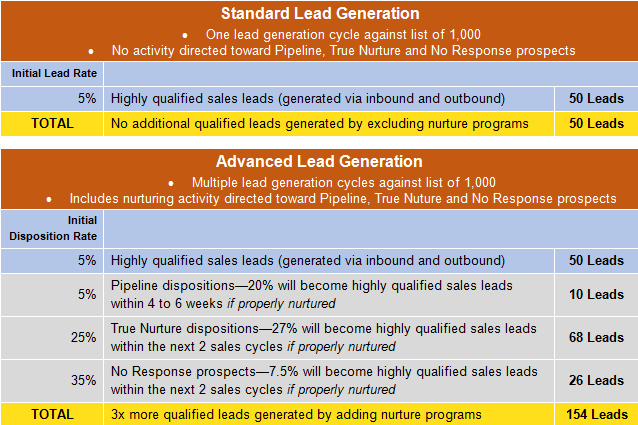
Nurturing is essential for successful lead generation—both inbound and outbound. In fact, I propose that nurturing is the most underutilized marketing activity at a marketer’s disposal. Additional contact using multiple touches and multiple media—including phone, voicemail and email—across multiple cycles is well worth the time and expense. Generally speaking, nurturing programs increase the lead rate significantly:

  • Standard B2B lead-generation programs produce an average 5% lead rate.
  • Advanced lead-generation programs (which include nurturing) produce an average 15% lead rate—a whopping three times higher.

Before we get into the details, note that there are three groups of prospects that require nurturing:

  1. Marketing Pipeline. These are prospects with a specific planned next step to be taken within a reasonable timeframe.
  2. True Nurture Opportunities. These are fully qualified prospects who are not immediately interested.
  3. No Response. These are contacts past the point of diminishing return on a given touch cycle.

Standard_lead_generation_for_blog_7_of_9.png

Nurturing is about talking to your prospective clients at every stage in the sales cycle

Per Julie Schwartz, senior vice president, research and thought leadership at marketing research, consulting and training firm ITSMA: “It’s widely believed that 60% to 70% of the buying process is over before prospects want to engage with a salesperson. The premise is that there is so much information available online that salespeople are thought to be unnecessary in the early stages. ITSMA’s data says that for high consideration technology solutions, this is a myth. In fact, we believe just the opposite: 70% of B2B technology solution buyers want to engage with sales reps before they identify their short list. In fact, buyers perceive value in interacting with sales at every stage of the buying process—even the early stages. 

In the epiphany stage they want education and unique perspectives; in the awareness stage they want product information and subject matter experts (SMEs); and in the interest stage they want benchmarks and best practices. See more …”

The bottom line is that you should be speaking to prospects from the top of the funnel to the bottom of the funnel. Prospects will move up and down in the funnel. And, there are no silver bullets regarding content that should be consumed by prospects at various stages in the sales cycle—every prospect and situation is different. Hence the growing popularity of Account-Based Marketing—the marketing approach that treats each account uniquely, addressing specific needs with specific information in a consultative way to help prospects progress toward the right solution for them.

Why do you think most organizations don’t see the value of nurturing? What sort of impact has nurturing had on your sales activity?

The eighth blog in this series discusses the importance of developing a guide for sales to make sure they understand what a lead is, and have the information needed to properly follow up on one.

how much are you paying for leads?

03 Jun 16:32

17 Gmail Extensions that Make Your Life Easier

by Vinay Patankar

Gmail Extensions

In today’s email-centric work environment, you have to make sure you’re on top of your game.

But that’s easier said than done. You likely use email to manage customer relationships, talk to your team, network and manage your to-do list. Keeping up with everything makes it all-too-easy to drown in an ocean of emails.

Luckily, tons of Gmail plugins exist that make your life way easier. Some of these Gmail extensions add handy new features and capabilities to your email account, while others make a huge difference in email optimization.

You can now send higher-quality, better-informed emails, faster than ever—so that communication with clients and peers doesn’t have to take up half your day.

Here are 17 game-changing Gmail extensions, compiled and researched by us over here at Process Street.

Use Gmail for more than email

Most businesses take advantage of numerous productivity and workflow tools—from CRM, to messenger apps, to project management software.

But sometimes all those tools get tiresome, so it’s an awesome feeling to get to combine multiple tools into one. Here are a few Gmail extensions that turn your inbox into much more than a storage platform.

1. Clearbit

Chrome Web Store rating: 5/5 stars

clearbit

Clearbit serves as a prospecting tool that helps you collect emails and fill in the blanks on leads you already have. After receiving a single email, you have instant access to all the senders info, like his or her role, the size of their company, and even how much money it raised.

This discreet but powerful plugin has done wonders for businesses that are looking to increase lead quality. In fact, thanks to Clearbit, the media monitoring startup, Mention was able to increase their signup conversion by over 54%.

2. Streak

Chrome Web Store rating: 4/5 stars

streak

Streak is a sales-oriented Gmail plugin for teams that are tired of switching between their CRM and their email. Streak literally turns your Gmail into a CRM, changing the appearance and organization of your inbox.

It allows you to organize your sales funnel, keep track of leads, set reminders, and share your workflow with your team.

3. Todoist

Chrome Web Store rating: 4/5 stars

Todoist

Todoist, one of our favorite Gmail extensions, turns your email into a task management system. Accessible straight from Gmail, this extension lets you access and amend your to-do list anytime, anywhere (even offline!).

Our inboxes are filled with questions, scheduling requests, and various other delegations. You might not realize it, but your email is probably already a to-do list—just a disorganized one.

Use Gmail extensions to secure your data

Businesses are trusted to keep their customers’ data confidential, so they have to take email security much more seriously than regular consumers.

While many emails don’t contain any valuable information about your company or clients, you want to make sure you don’t let your guard down. Passwords, personal client information, or even insider company information should be handled with great care.

Check out these Gmail extensions that ensure your actions and data stay private.

4. Mailvelope

Chrome Web Store rating: 4.5/5 stars

Mailvelope

It is well-known that Gmail is not impervious to hackers. This is why Mailvelope takes security to the next level by offering end-to-end encryption.

It encrypts any requested email and provides a unique key to the sender. Share that key with the recipient of your email (obviously not via email), and your data will be delivered safe and sound.

5. Dropbox for Gmail

Chrome Web Store rating: 4/5 stars

Dropbox for gmail

Often the most private files are sent as PDF attachments—contracts, documents, financial records. That means you’ll want to take extra precautions when it comes to email attachments.

Any documents that are uploaded to Dropbox are encrypted at rest and in transit. With this plugin, you can easily send and preview these files without leaving your window, while never having to worry about them getting into the wrong hands.

6. UglyEmail

Chrome Web Store rating: 4/5 stars

uglyemail

UglyEmail is a simple but useful Gmail extension that puts an “evil eye” next to emails that are being tracked.

With all those email trackers out there, it’s unsettling to know that some of your clients might be keeping tabs on whether or not you have checked their email. If any of your contacts know that you’ve opened their email but are not responding, you can come across as negligent or disinterested.

Eliminate context-switching

You open up Gmail and go to draft an email. Then you remember that you need a PDF file from a previous email. So you open a new tab, search your archive, find the PDF, download it, and, finally, re-attach it to the correct email. Sound familiar?

There’s nothing more annoying than switching between screens and devices to gather all the necessary, relevant information for what should have been a quick email.

Here are a few extensions that will eliminate some of that friction.

7. Checker Plus

Chrome Web Store rating: 5/5 stars

CheckerPlus

The Checker Plus Gmail extension allows you to fully customize email alerts. You can decide which emails will trigger a notification, and how Checker notifies you— whether it’s via push notifications to your desktop, a sound, or it can even read the subject line out to you.

If you enable push notification, you can also quickly interact with the emails, deleting them or marking them as read when they pop up.

8. Cloudy

Chrome Web Store rating: 4/5 stars

Cloudy

Cloudy gives you instant access to almost any cloud file—Google Drive, Box, Picasa, Facebook, Flickr, Instagram and even direct URLs.

If you store files on numerous different platforms, you are all-too-familiar with the nuisance of downloading them and then attaching them in your email. The plugin appears as a little cloud button on the bottom menu of your email and lets you access any file in just a few clicks.

9. HelloSign

Chrome Web Store rating: 4/5 stars

hellosign

HelloSign enables you to sign documents with just a few clicks, taking all paper out of the equation.

We all know what a pain it is to sign documents sent to us by email. It involves having to print, sign, scan, attach, and reply. This Gmail extension makes the process fast and easy, and don’t worry, it’s legally-binding and equipped with bank-level security.

Improve the quality of your messages

When you’re not communicating with clients face-to-face, your email has to say it all, and say it well. Your email is a small representation of the quality and professionalism of your company, so not only does it have to be clear and coherent, but it has to be free of all grammar mistakes.

Since not all of us have a copy editor handy, here are some extensions that should do the job.

10. Ginger

Chrome Web Store rating: 4/5 stars

ginger

Ginger checks for grammar, spelling, punctuation and sentence structure. And it even has a translating function that can translate words and sentences from 40 different languages.

Even if you’re a grammar whiz, when you’re sending dozens of emails a day, you’re sure to get exhausted by the last batch and let a few grammar and spelling errors slip. Use this extension to keep your emails mistake-free.

11. Google Dictionary

Chrome Web Store rating: 4.5/5 stars

Google dictionary

Not sure you’re using the right word in that email? Install this plugin, and you won’t ever have to second-guess yourself again.

You’ll be able to double-click to find out the definition of any word, in any language. And if you learn a new word, you can save it and reference it later, building a small library of great new words to try out.

12. WiseStamp

Chrome Web Store rating: 4/5 stars

Wisestamp

WiseStamp is a nifty extension that enables you to place a professional, dynamic signature on the bottom of all your emails, with links to all the profiles, blog posts, videos you could possibly want.

It also lets you easily add a custom signature, quote, or logo for some extra flair. If you put a lot of time into carefully crafting emails, then make sure that your signature is also up to par.

Draft emails faster with these Gmail extensions

According to a survey conducted by Reuters, U.S. workers spend approximately 6.3 hours daily checking email. That’s more than half a typical work day.

Navigating through your inbox, clicking through different tabs, and searching for various emails, all eats up a lot of precious time. Here are a few Gmail extensions that enable you to get through just as many emails in a fraction of the time.

13. Gorgias

Chrome Web Store rating: 5/5 stars

gorgias

If you find that you are writing the same three emails a hundred times a day, you’re in serious need of canned responses.

Gorgias is one of the best Gmail extensions out there, enabling you to save templates and then set up keyboard shortcuts to implement them. You can also set up liquid tags, which will autofill the recipients information into specific slots. And if you set up an awesome workflow with Gorgias, you can easily share it with your team.

14. KeyRocket

Chrome Web Store rating: 4/5 stars

KeyRocket

If you’ve been in a position where you’ve envied hotkey masters who have the ability to pluck away and manage their email inbox crazy fast, you’re in luck.

KeyRocket doesn’t add keyboard shortcuts the way Gorgias does—it simply teaches you to use the ones that are already there. Through subtle notifications, it guides you through workflow optimization.

15. Assistant.to

Chrome Web Store rating: 5/5 stars

assistant.to

Assistant.to enables you to view your calendar and select a few different time windows, all without leaving your window.

Almost every business has to go through some kind of back-and-forth with their clients to figure out a time to connect that works well for both parties. With this extension, when your client receives the email, he or she will be presented with different clickable options, the selection of which will update your Google calendar.

Draft on your own time

For those of us who use email as a primary method of communication, let’s face it, we’re slaves to it. We’re constantly combing through to find which emails need to be followed-up on or responded to.

And then there are all these rules. Don’t send emails in the middle of the night. You can’t send emails when you don’t have Wi-fi. We’re at the beck and call of our inbox.

Here are a few Gmail extensions that will let you take control over when and where you draft your emails.

16. Followup.cc

Chrome Web Store rating: 4.5/5 stars

followup

Followup.cc lets you draft emails at your convenience and send them off at a later time. You can also set reminders for yourself to follow-up, and see if and when your emails get opened.

This keeps your mailbox tidy and organized, so you don’t have to comb through the same batch of emails every few hours to remind yourself which need a follow-up.

17. Gmail Offline

Chrome Web Store rating: 4/5 stars

gmail offline

Gmail Offline puts the email-drafting power back in your hands. It lets you view, draft, and respond to emails, even when you don’t have Wi-fi.

This way you can choose whatever windows of time you’d like to check your email—whether that’s your morning commute, or right before bed.

We’d love to hear about the different ways you use Gmail extensions in the comments. Who knows? You may even get featured in an upcoming article!

02 Jun 16:25

Remains of the Day: Google Makes it Easier to Find Your Lost Phone

by Andy Orin

As the weather warms and I switch from jeans to my traditional summer muumuu, I always worry that my phone might slip loose from those billowing floral pockets and go astray. Luckily Google is making it a little easier to access your lost phone and even remotely swipe it, if necessary.

Read more...

02 Jun 16:18

How Pay-Per-Click Is Changing With Mobile

by John Lincoln

The only constant is change. That’s more true of technology than anything else. Unsurprisingly, digital marketing best-practices evolve with technology.

One of the most obvious ways that online marketers have been forced to adapt to changes in high-tech over the past several years is with the emergence of mobile devices. Thanks to the widespread acceptance of smartphones, tablets, and phablets as the “go to” source for casual web browsing and digital communications, marketers were left with little choice: embrace mobile marketing or go bankrupt.

How Pay-Per-Click Is Changing With Mobile

In this article, we’ll cover the dominance of the mobile market and explain how pay-per-click (PPC) has changed because of mobile technology. Finally, we’ll offer a few best-practices for modern mobile advertising.

The Emergence of Mobile

“Mobile first.”

Some online marketers and web designers have adopted that as their mantra. The whole idea behind the “mobile first” concept is that you start by designing your campaign or website for a mobile audience and then look for ways to reach a desktop or laptop audience afterwards.

It was once the case that people designed websites for desktops first, and then adapted them to mobile platforms later. The “mobile first” crowd does the exact opposite.

Many online marketers adopt a “mobile first” strategy for good reason. Google has confirmed that there are more searches now on mobile devices than desktop devices. Also, the number of mobile users has surpassed the number of desktop users.

You probably won’t need to look far to find anecdotal evidence that mobile traffic dominates cyberspace. Have a look at your own analytics and it’s likely you’ll see that much (if not most) of your traffic comes from a mobile platform. That’s especially true if you’re running a “news” type of site like BuzzFeed or Mashable.

In short: mobile dominates.

Mobile vs. Desktop Advertising

Great marketers always look for new opportunities to reach people in their target market. As mobile became more dominant over the past few years, business owners and professional advertisers alike saw an opportunity to promote their brand among a tech-savvy audience.

But mobile devices are no longer for young hipsters who adapt to high-tech instinctively. Baby boomers, grandparents, and the middle-aged are all finding mobile technology indispensable. As a result, the opportunities for digital marketers to reach people using a mobile device have never been better.

Those opportunities are reflected in the numbers. According to WordStream founder Larry Kim, mobile ad share is growing while desktop ad share is shrinking. At the same time costs-per-click (CPCs) are at an all-time high.

Why the disconnect? Mobile marketing opportunities are commanding a premium price tag because that’s where the people are.

It’s also where the smart marketers are.

Ad Blockers

Every digital marketer’s favorite boogeyman is the dreaded ad blocker. That’s technology that lives up to its name. It blocks certain types of ads from appearing.

Unfortunately, mobile browsers can use ad blockers as well. The Apple iPhone, for example, released content blocking software as part of its iOS 9 operating system. Although the content blocker doesn’t block ads itself, it enables developers to produce web apps that do block ads.

In addition to ads, ad blockers are known to block technology that’s often used by online marketers, such as cookies, auto-play videos, pop-ups and images. That makes it more difficult to retarget consumers and reach them with creative work.

There’s clearly a market for ad blockers, although one has to wonder how they advertise online. According to the 2015 Ad Blocking Report, more than 200 million people around the world are using ad blockers. That’s up 41% from 2014. According to one estimate, those ad blockers are costing advertisers $22 billion a year in revenue.

It’s enough to keep a digital marketer up at night.

There’s some good news, though. According to NiemanLab, publications have reported that only 1-2% of their visitors are using content blocking software.

The flip side to that coin is that ads on mobile devices are more of an interruption than they are on desktop platforms, thanks to the limited real estate on a mobile screen. It’s a safe bet that many mobile users, tired of seeing their screens filled with digital promotions, will follow the lead of their desktop counterparts and opt for some type of ad blocking technology.

In other words: prepare for the worst.

In-App Advertisements

There’s another bright spot in mobile marketing, though. While content-blockers will block ads running on websites, they won’t block ads running on apps.

It’s important to make a distinction here. Web apps are run from a web browser. You can think of a website like Travelocity as a web app.

Native apps, on the other hand, are apps run outside of a web browser. They have their own icon on the user’s screen and don’t require the use of a browser, such as Chrome or Safari.

Ads that run in those native apps can’t be blocked by any ad blocking technology as of this writing. In fact, free apps are often monetized with ads so it would be against the interest of the app developer to block the ads.

Fortunately, you can use your Google AdWords account to run ads on native apps. If you’re spooked by the emergence of ad blockers and you’re certain that people in your target market use one or more apps, that might be a great option.

Another good reason to opt for native app advertising: Nielsen found that mobile users spend 89% of mobile of their time on native apps. Only 11% of their time is dedicated to mobile web browsing.

Facebook Growth Is Fueled by Mobile Ads

Have you taken a look at Facebook’s stock price over the last few years? It’s more than quadrupled since its IPO in 2012.

What’s the driving force behind the company’s growth? Mobile ads.

Over the last four years, Facebook’s desktop advertising revenue has stayed flat at about a billion dollars per quarter. On the other hand, its mobile advertising revenue rose from about a billion dollars per quarter to more than three billion dollars per quarter over the same period of time.

That’s why the company’s stock price has soared.

Here’s more from Statista:

When Facebook started selling mobile advertising in 2012, not even the keenest optimists could have predicted how successful this decision would turn out. In each of the past eleven quarters, mobile ads have accounted for more then 90% of Facebook’s revenue growth. In the first nine months of 2015, all of the company’s growth came from advertising on tablets and smartphones. Mobile ad revenue now accounts for 78 percent of Facebook’s advertising revenue and 74 percent of total revenue.

Facebook made a business decision early on to adopt mobile advertising as part of its business model. It’s safe to say that decision has paid off.

Highly Targeted Marketing

If you’re familiar with the advertising options on Facebook, then you know the targeting settings are a marketer’s dream come true. You run your ad so that it only appears to people based on their demographics or interests. You can define those characteristics as narrowly as you want.

Even better for the mobile era is that you can dictate that your ads only appear to people based on the mobile device that they’re using and/or the type of network that they’re on. That makes it easier to practice mobile marketing that’s relevant to your target market and won’t leave them frustrated.

For example, if you’re running a video ad, you probably don’t want to target people who are on a 3G or 4G network. That’s because videos are data-intensive and someone in your market might be slapped with a charge for overuse of data transfer. On the other hand, the sky is usually the limit on WiFi networks when it comes to data throughput, so you’d want your video ad to be shown to mobile users on a home or office-based network.

Not only that, but you can also string together a variety of targeting criteria that include mobile usage. For example, if you want to target someone who’s interested in cooking and is also using an iPhone 6, Facebook gives you the option to do that.

Instagram Advertising

Instagram is a mobile app that also generates revenue from advertising. Since Facebook owns Instagram, it does a good job of “evangelizing” the platform with not-so-subtle suggestions to users such as: “Your friend John Smith is on Instagram.”

As of this writing, Instagram has a user base of more than 400 million. Once again, it’s a great bet that somebody in your target market is using Instagram.

Instagram is also one of those native apps that won’t be affected by ad blockers. That makes it another outstanding choice for digital advertisers who are concerned that their ads won’t be seen.

Google in the Game

Facebook and its stepchild Instagram aren’t the only high-tech companies interested in mobile advertising. As we’ve seen, advertising giant Google also offers opportunities for mobile marketers with AdWords.

But Google also offers marketing opportunities to companies that make native apps. If you’re in the process of creating a great app and you’d like to monetize it, consider using AdMob as your advertising channel of choice.

What is AdMob? You can think of it as AdSense for native app publishers. It allows apps to show ads that generate revenue per click.

One of the most attractive features of using AdMob, as we’ve seen, is that ads in native apps aren’t blocked by ad-blockers. That’s a strong selling point in and of itself.

There’s a lot more that AdMob has going for it, though. It’s also backed by Google’s powerful advertising platform. That’s good news if you’ve found Google AdWords to be a successful source for lead generation in the past.

Google for Advertisers

Google doesn’t just offer great advertising solutions for publishers. Advertisers can also take advantage of some of the company’s great marketing options.

For example, if you’re marketing a native app, Google lets you run an ad that offers people in your target market a “try before you buy” option. Since that type of marketing seems to work so well in the physical world, there’s no reason to doubt it will be successful in the digital world.

Here’s how it works: you run ads that allow people to use your app for 60 seconds. The ad is basically an opportunity to “whet the appetite” of users in your target market. If they like what they see, they can download the app with just a few swipes and/or touches.

That “Trial Run” ad format is priced per click or per conversion. Use some split testing to get an idea of which pricing model works best for you.

Google also offers interactive interstitial ads that allow advertisers to promote their brand with outstanding creatives. Here’s how some companies are using that ad format:

For example, early tester Zalora, makers of a fashion shopping app, built an ad that allows users to swipe to discover an exclusive offer. Other app marketers could create ad formats like “scratch off’s,” or use the ads to create swipeable image carousels. They can even use live app content to create real-time ad formats, says Google.

It should be pointed out, though, both interactive interstitial and Trial Run ad formats are still in beta. Contact your account manager if you’d like to be one of the beta testers.

Paid Advertising Dominates Local SERPs

Speaking of Google, it’s worth pointing out that mobile ads completely dominate the search engine results pages (SERPs) on a mobile device.

Do this experiment: take out your smartphone, hold it in portrait mode, open the browser and search for a plumber in your area (for example, if you live in Richmond, VA enter “Richmond plumber” in the search bar). Check the results.

Chances are pretty good that your first three or four results were paid ads. Then, you got the local 3-pack with a nice button that gave you the opportunity to see more local results. Only after all of that did you see organic results.

Do you see where this is going? If you want the name of your business to appear at the very top, you’re going to have to advertise on Google. If you want it to be near the top, you’ll have to ensure that you’re at the top of the local 3-pack. Otherwise, people are going to have to scroll quite a bit before they find your local listing.

Now, envision yourself as a homeowner who’s currently watching your kitchen get flooded because of a sink pipe that won’t stop leaking water. Are you going to scroll down to the 7th or 8th option on the Google SERPs to find the right plumber? No, you’ll probably just go with one of the very first options.

That’s why local businesses that advertise on Google have a competitive advantage.

Specialized Mobile Advertising

Google is also offering specialized mobile advertising to some businesses. Just this year, the search giant launched mobile ads for auto companies. That gives original equipment manufacturers (OEMs) the opportunity to run automotive ads on searches for makes and models.

Toyota and Ford have already begun running the ad format for some of their models. So far, the new campaign strategy seems to be a success.

“Across our core line of car models, we’ve seen a 45-percent increase in conversion events and a 30-percent decrease in CPA compared to standard text ads,” said Dionne Colvin-Lovely, director of traditional and new media for Toyota Motor Sales, USA.

Google enabled the ad format because more than half of automotive searches occur on smartphones. Similar formats are available for companies in the travel, finance, and shopping industries. You can expect that the company will offer those types of ad formats to other sectors that see significant search queries on a mobile platform.

Tips for Mobile Advertising

Now that we’ve provided a general overview of mobile marketing, let’s look at some specific ways that you can maximize your ROI with mobile ads.

For starters, consider the click-through destination. If somebody on a mobile platform clicks one of your ads, where is that person going? Does the click take the user to a website? If so, is that website mobile-friendly? Does it load quickly? Is it easy to navigate for a user who’s using a tiny smartphone screen in portrait mode? Even if you have the best mobile ad in the world, it won’t matter if it takes the user to a site that isn’t responsive. Make sure that your click destination is ready for a mobile audience.

Also, use clickable telephone numbers. That’s especially great advice if you’re doing local marketing. Your ad should show a phone number that a smartphone user can just touch (or click the “Call” button) to dial it. That makes life easier on the customer and gets you off to a good first impression. Also, users respond better to ads with phone numbers.

Those clickable numbers, by the way, are called “ad extensions.” They’re not the only types of ad extensions that you’ll find to be valuable in your mobile advertising strategy. You can also include a location extension that will enable people to map your address right away and even get directions to your place of business.

There are also offer extensions that people can click to receive a special discount. Usually, they’ll appear with a “View Offer” clickable text next to some detailed description about the offer, such as: “Receive 50% off of your first visit.” Users can print out the offer and use it like a coupon at some point in the future.

Finally, there are app extensions that offer users a link to the app page, where they can download the app. If you’re offering any kind of app in connection with your business, you should include an app extension in your ad so that people in your target market can easily download and install it.

Another great strategy in mobile advertising, and one that’s likely to put you ahead of the competition, is to run video ads. Yes, video ads work particularly well on a mobile platform because video ads work well everywhere. Just consider these stats from HubSpot:

  • 52% of marketing professionals say that video content offers the best ROI
  • 67% of marketing professionals found video marketing “somewhat successful”
  • 18% of marketing professionals found video marketing “very successful”
  • 81% of people offer video on their brand website
  • 59% of executives prefer to watch a video rather than read text about a specific topic
  • By 2018, 79% of consumer Internet traffic will be video traffic

Google will also be offering a “Buy” button to e-tailers soon. As of now, it’s in limited release. When it’s finally made available to the larger business community, though, it’s likely to be the next big game-changer for e-commerce marketers. That’s because the “Buy” button will appear next to the search listing, so searchers won’t even have to leave the SERPs to make the purchase.

Don’t neglect to follow many of the same search engine marketing principles that worked so well for desktop and laptop users. For example, if you found that you were doing well with highly targeted keywords (e.g., “little black dress size 6”), continue doing that when it comes to mobile marketing. Also, pay attention to your bids and don’t be afraid to max them out. Keep an eye on your Quality Score as well so that you can be sure that your ads are getting maximum exposure.

Embrace Mobile

There’s no doubt that a sound online marketing strategy at this point must include mobile marketing. If you haven’t embraced the mobile revolution and your sales are lackluster, consider restructuring your promotions with more of an emphasis on mobile. You’ll likely find that it’s a worthwhile investment.

02 Jun 16:16

Software Providers Must Learn These Microsoft Qualities

by Lawrence Anderson

Most organizations struggle to show how their investment in software supports business goals. Countless complex vendor agreements, an inability to manage software through the entire lifecycle, limited skills and resources to deploy and manage software all contribute to the challenge of measuring ROI and demonstrating business value.

Software Providers Must Learn These Microsoft Qualities

With the pervasiveness of Microsoft’s software in most organizations worldwide, this becomes a natural place to extract efficiency and business value. However, this is by no means an easy task and you, like most organizations, may lack the internal resources or capabilities to achieve this.

The positive impact that a well-managed Microsoft software estate can have on your organization should not be underestimated. That’s why it makes business sense to consider enlisting the expertise of a service partner to help you unlock the full potential of your software investments.

Obtaining –Key to maximizing your return on software assets is optimizing how you procure licenses and the structure of licensing agreements.

Distribution – When you look at your distribution strategy it is important that you align your deployment roadmap to business objectives to extract maximum value.

The measurement and management of your software is critical in order to create a compelling business case. You need to understand software utilization and manage deployed software assets to ensure optimal performance. The measurement of your software is a key component of being able to successfully prove a return and justify future software investments.

Continuous assessment of your software strategy, performance and deployment roadmap is required to ensure alignment with business objectives and goals as your organization evolves. There are a number of ways in which innovative software solutions can positively impact the success of your organization.

Steadily, Microsoft has been the profound software provider that supports millions other software. It is necessarily to know how software provider must learn from the prominent software developer.

02 Jun 16:15

Influencer Marketing Is (not) Dead: How to Breathe New Life into Your Program

by Joshua Nite

influencer-marketing-is-not-dead

What’s a marketer to do? We heard that influencer marketing was the next big thing. We heard about companies getting amazing results with it. But it seems you can’t go anywhere online recently without seeing headlines like this:

Influencer Economy

And this:

confessions of a social media executive

Note the social shares on those two articles: 242,000 for the first one and nearly 50,000 for the second one. If influencer marketing is burning down, that’s a lot of people standing by with marshmallows to roast.

But don’t panic. These two articles, and many more like them, refer to a specific kind of influencer marketing. Generally speaking: the bad kind. Specifically, the practice of writing massive checks to teenagers with a lot of followers on Instagram or Vine in exchange for product promotion. That particular economy, which converted cash to “influence” or “awareness,” was pretty much doomed from the start. You’re in trouble any time you convert real money to something fundamentally unmeasurable.

But it’s not fair to say that influencer marketing is dead, or in trouble, or collapsing because bad influencer marketing isn’t working out. That’s like declaring “Movies are dead!” because Gods of Egypt flopped at the box office. Influencer marketing works when it’s done well. At TopRank Marketing, we have achieved amazing results for our clients with the practice.

The only thing better than learning from your mistakes is learning from other people’s mistakes. So let’s take a moment to mourn the passing of bad influencer marketing—and then let’s perform an autopsy to see how we can avoid their fate. Here are four ways to make sure your influencer marketing stays alive and well:

#1 – Build Relationships

In a way, the Instagram and Snapchat “influencers” are just billboards. You stand here and hold this beverage/face wash/protein powder, we give you $500. You deliver the commodity of X number of eyeballs for the money. If a rival beverage/face wash/protein powder company comes along and offers you $550, you move on.

Good influencer marketing is more than advertising using someone’s social media presence as the billboard. It’s about cultivating an ongoing relationship that continually generates value for everyone involved. Influencer relationships should be built with care, personal attention, and respect. Yes, sometimes you may pay an influencer for their involvement, but that transaction takes place in the larger context of the relationship.

#2 – Produce Something of Value

Bad influencer marketing can be, at its worst, just a celebrity endorsement with a different kind of celebrity. The celebrity gets paid, and the audience gets… what? The vicarious thrill of seeing that they drink the same brand of face wash as that guy on Vine?

Good influencer marketing goes beyond endorsement to create something of value for the audience as well as the influencer and the brand. That’s why it works. For example, our Content Marketing World eBook series from last year rounded up advice from dozens of highly-skilled marketers. The eBooks promoted the event, and they highlighted our influencers, but they were also useful and entertaining for the audience. It’s an unbeatable combination.

#3 – Recruit More than Brandividuals

One big problem with bad influencer marketing is it focuses entirely on “brandividuals.” According to our CEO Lee Odden, a brandividual is someone who is in the business of being popular. They have a huge social media presence, sure. But they may not be able to call that audience to action. A true influencer, by contrast, may be less popular by the numbers, but is credible, authoritative, and able to affect change.

You definitely can use brandividuals to help attract a crowd, and to lure in the true influencers—but a campaign that’s all brandividuals may generate more buzz than results.

#4 – Make It Measurable

Step 1: Have influencer post about our combination face wash/protein powder on Snapchat. Step 2: ??? Step 3: Profit. It’s not the most sustainable business model, right? But for a lot of bad influencer marketing, that’s a pretty accurate assessment. These campaigns trade entirely on “awareness” or, god forbid, “brand lift.” Without any way to track ROI from the influencer activity, it was only a matter of time before the C-suite decided to spend their budget elsewhere.

Don’t let anyone tell you that you can’t measure the ROI of influencer marketing. It’s not only possible; it’s crucial. Start by having a specific goal for your campaign—an action that you want your audience to take as a direct result of experiencing the content. Then make sure you can track that action and attribute it to the influencer. Give them trackable URLs to share. Give them their own landing page to send traffic to. Either way you go about it, you should be able to demonstrate exactly what your influencer brought to the campaign.

If you’re a teenager with a huge Snapchat following, the death of bad influencer marketing is bad news. If you’re a marketer looking to partner with influencers to create cool stuff and expand your reach, there’s no need to mourn. Take these four lessons to heart, go forth, and be awesome.

Need help with your influencer marketing, we can help!


Email Newsletter Gain a competitive advantage by subscribing to the
TopRank® Online Marketing Newsletter.

© Online Marketing Blog - TopRank®, 2016. | Influencer Marketing Is (not) Dead: How to Breathe New Life into Your Program | http://www.toprankblog.com

The post Influencer Marketing Is (not) Dead: How to Breathe New Life into Your Program appeared first on Online Marketing Blog - TopRank®.

02 Jun 16:15

5 Marketing Trends to Master

by Angela Hausman, PhD

marketing trends to master

While 2016 is half over, mastering these marketing trends from Microsoft (see infographic below) will make a big difference in your bottom line before the end of the year.

Marketing Trend #1: Tech offers new opportunities

When you think marketing, think beyond advertising, which we’ll talk about later. Think about other aspects of marketing such as customer experience, logistics, customer service, and a host of other marketing activities that translate into improved profitability. The first marketing trend we’ll talk about certainly fits within those core marketing activities by providing for better customer experiences, enhanced segmentation, and opportunities to exceed customer expectations.

Obviously, Microsoft is going to tout its new tech, like Hololens, but think of the opportunities these marketing trends might open up to your business. New tech, such as VR, wearables, and IoT offer opportunities to market your business, but more importantly, they offer opportunities to learn more about your target consumers.

For instance, McKinsey reports that the IoT will have an economic impact of up to $11 trillion by 2025, based on a study of potential use-cases. This vast growth makes it possible for brands to reduce costs and provide better, richer customer experiences to consumers. Here’s what Information Week has to say about the growth in IoT predicted by McKinsey:

The report sees IoT as giving rise to opportunities that can transform existing business models through predictive maintenance, better asset utilization, and higher productivity. The authors also think that new business models will arise, such as remote monitoring, that will enable anything-as-a-service.

Improved understanding of consumer habits provides the potential to segment based on behavioral patterns in a way that’s impossible with traditional market research.

Marketing trend #2: New marketing channels

Already important, search engines are morphing beyond traditional engines like Google and Yahoo. Facebook is the first to jump into the search engine arena with both feet, but soon other social networks will likely incorporate search into their product.

New social channels emerge all the time. As a business, you need to go beyond Twitter and Facebook to explore which channels are right for you; which ones you can engage in with your target market. In general, new channels are more visual, beginning with Pinterest and its monumental growth. New channels include Snapchat and Periscope, both offering video opportunities to engage consumers, especially millennials.

Marketing trend #3: Analytics

Actually, this isn’t a new trend, it’s one that’s been increasing in importance every year. If you haven’t beefed up your social analytics, this is the year to make a commitment to metrics.

optimize your conversion funnelMove beyond vanity metrics, if that’s all you’ve done so far. All those Likes and RT definitely amplify your message, but, if they’re not contributing to your bottom line, they don’t deserve much of your marketing spend.

Understanding how each social channel or other marketing channel contributes to your bottom line requires effective attribution modeling — which monitors how each channel contributes to a sale. Inherent in attribution modeling is a recognition that top of the funnel activities are important as well as bottom of the funnel actions.

In addition to understanding how each social channel, including search and email, contributes to your bottom line, take a look at what kinds of content drives the most conversion. For instance, according to Microsoft, stories perform very well in terms of ultimate conversion. So does episodic content.

Marketing trend #4: Influencers

Again, this has been one of the marketing trends to master for several years, engaging influencers.

Reaching out to influencers has a number of marketing benefits including:

  1. expanding reach
  2. building community
  3. generating endorsements
  4. encouraging evangelists

Its easy, although time-consuming, to reach out to influencers. You can identify influencers on Twitter, for instance, by searching for folks who share using hashtags related to your industry. On Facebook, you can market directly to influencers using targeted ads.

Remember that influencer outreach is based on tit-for-tat so never expect an influencer to help you without offering something to them. And, your offer doesn’t have to be tangible, although I’ve seen effective marketing through offering a free t-shirt or other small token to influencers.

It’s important to realize that influencers vary across market niches. Hence, someone who’s influential in automobiles might have little or no influence in the clothing market.

We’re starting to see more sophisticated marketing using influencers as spokes people in traditional advertising.

Marketing trend #5: Think beyond the ad

While a new study from Adobe shows that consumers like traditional media over digital media, the fact is they don’t like any kind of advertising, especially millennials hate advertising. And, the reason they prefer traditional advertising is that it tells a story — it’s more entertaining. Given the choice, consumers skip ads (such as using Tivo), ignore them, or block them (see iPhone’s new ad blocking tool). So, as you plan your media buy for the remainder of the year, think of other way to market instead of advertising. Here are some examples:

  1. Dove did a great job marketing with its support for what real women look like
  2. Instead of buying Super Bowl ads, one year Pepsi set up a system to donate the money based on community needs.
  3. Supporting potential buyers in a B2B space attracts positive attention to your product
  4. Many businesses use content marketing as a tool to attract customers and provide useful tips that convert these visitors
  5. Make customer service friendly and ubiquitous so customers can get help across any channel
  6. Communicate your trustworthiness, corporate social responsibility, commitment to sustainability, approachability, empathy and other positive qualities

marketing strategy


02 Jun 16:14

5 Best Companies to Launch Your Sales Career

by Sean McGuigan

There are many different paths for a sales career, some people end up becoming full-time sales employees, go for straight commission sales, or become consultants. You can even start your own business once you have mastered advanced skills.

Some of the most successful companies out there offer extensive training and mentoring to their sales teams. Here, we review the top five companies and also look at their training, mentoring and career growth opportunities.

1. Heartland Payment Systems

Part of the Fortune 1000, Heartland Payment Systems is a payment processing and technology provider based in the US. They encourage their salespeople to focus on building their personal portfolio. The major incentives for sales include: 100% commission-based salary and uncapped commission.

Heartland has created a Sales Professional Bill of Rights to show their dedication to transparency and honesty when it comes to sales.

Training and Career Growth

  • They facilitate their employees to start earning from day one
  • Sales Mentors are assigned to all employees
  • The company supports you throughout the career and offers robust tools to enhance sales skills
  • New recruits are supported throughout their RAILS training programs by veteran team members
  • Learning is focused on field-training and dialogue

2. SunGard

SunGard is an American multinational company based in Wayne, Pennsylvania.

It provides software and technology consultation to educational, financial and public sector organizations.

Training and Career Growth

  • Training courses on various topics and tracks
  • SunGard emphasize growth and provides a continuous learning environment
  • Specific “Learning Days” are designated once a month
  • Leadership development and manager coaching is offered
  • Robust mentoring programs
  • Personalized career planning checkpoints are set and can be discussed with the manager
  • Availability of extensive online knowledge and training resources are available on the company’s intranet

3. ClearSlide

Based in San Francisco, ClearSlide is a SaaS company which developed the sales engagement platform also called ClearSlide. Their work culture is strong, disciplined and transformative.

Training and Career Growth

  • Often called a meritocracy due to its strong emphasis on promoting best performers
  • Younger talent gets excellent opportunities to learn from the senior sales employees
  • Sales reps are guided at each step of the sales cycle
  • The company focuses on producing high caliber talent
  • Their employee code of conduct is based on six core values:
    • Delivering true value
    • Being thoughtful and ambitious
    • Open feedback approach
    • Innovative collaboration
    • Environment-friendly and sustainable approach to business
    • Investing in employees’ future

Check out the ClearSlide career portal for more information.

4. Hilti

Hilti calls itself a family company and claims that people development is a critical success factor for the company. Their corporate culture is focused on 4 core values: integrity, teamwork, courage and commitment.

Training and Career Growth

  • Long-term attractive career prospects
  • New recruits go through a “Let’s Start Together” program to promote integration
  • 80% of management positions are filled by internally promoted employees
  • Provide cross-functional development trainings
  • Aim to convert employees into experts
  • Employees (in collaboration with their team leader) define their individual development and business targets
  • Regular feedback is given which is part of a continuous coaching process
  • Team leaders are judged on how well they develop their team and results
  • Offers an atmosphere of cooperation, respect and openness

Check out their career portal for current vacancies.

5. Iron Mountain

Iron Mountain Incorporated is headquartered in Boston. It provides information and storage management services to large enterprises. The company considers its employees the biggest asset and focuses on nurturing growth. The company’s philosophy is based on six core values: total customer satisfaction, integrity, action orientation, accountability, teamwork and candor

Training and Career Growth

  • Encourage employees to be open to new ideas
  • Training focuses on acquiring new and diverse skills
  • New recruits are guided from day one and set on a path of success
  • Offer different employee training programs such as: core skill, leadership and role-specific
  • Provide support to employees who want to pursue relevant studies

Check out the career section on the official Iron Mountain website.

A career in sales is extremely rewarding and helps you earn well. Whatever path you choose, the first step in the journey is to join the right company. Almost every major company has a dedicated sales department. So you can take your pick if you have dedication and talent.

02 Jun 16:14

11 Simple Yet Effective Edits to Instantly Improve Your Social Media Content

by Ash Read

As marketers, writers and crafters, we spend hours on bringing our content ideas to life and after all that effort, want our content to be seen.

Writing powerful social media copy to grab people’s eyes and win their hearts is a challenge, though. And often, when our content isn’t breaking through the noise we can fix it with a few slight edits and tweaks.

Editing content and copy is a key part of the creative process but is often overlooked. In this post, I’d love to share 11 editing tips and tricks to help you take your social media content to the next level.

Ready to jump in?

Here we go…

editing-post

These 11 powerful, uber-specific editing actions will help you make your social media copy more addictive, engaging, and compelling.

line

1. Focus on the reader

When you’re creating social media content, you face stiff competition for attention. Friends, family, celebrities, other brands and more are all vying for your reader’s attention on social networks. If you’d like to stand out and be seen, it’s important to create your content with the reader in mind.

Instead of focusing on ‘you’, try putting emphasis on the reader. For example, in a post about launching a new product we could say:

We’ve just launched out new product, Buffer for Video

But the focus of this copy feels a little off. We haven’t shown why the reader why they should care or how this post may be helpful to them. Something like the below copy could be better:

You can now upload, share, and schedule video from Buffer to all your social media networks. Upload once, share everywhere!

buffer-video

line2

2. Build curiosity

Building curiosity is an incredibly powerful technique to help improve your copy (especially if you’re trying to get people to click on and engage your social media posts).

In its simplest terms, curiosity is triggered when people feel there is a gap between what they know and what they want to know. Professor of Economics and Psychology, George Loewenstein, is an expert in curiosity. He conducted a study into what triggers high levels of curiosity and discovered that it peaks when:

  • something violates our expectations (often curiosity is triggered by challenging common beliefs)
  • teases a gap in our knowledge (AKA, the “information gap”)
  • it’s not overdone (curiosity can get someone to click a headline, but it won’t keep them on your site forever)

Here at Buffer we understand our audience tends to be interested in becoming better marketers and figuring out how they can use social media to attract more traffic, links, and customers to their business. We could run a Facebook post with copy like:

Why Facebook Reach is Dipping For Everyone

It might grab some attention but I have a slight hunch most people will probably feel they can live without clicking on this post.

However a headline like:

Facebook Reach is Declining: Here’s What to Do About it in Just 15 Minutes Per Day

Could be more effective for a few reasons:

  • the reader may feel there’s an information gap around how they can combat declining reach on Facebook
  • there’s a promise to solve a problem (increasing your Facebook reach)
  • it may go against common beliefs (you won’t need to spend all day implementing these tips)

Another example could be:

Check out these great Facebook marketing tips

This is cool, but there’s no hook and nothing to spark curiosity. As a reader, I may think: “Maybe I already know these tips…” 0r “I probably don’t need to click this…”

I feel like this one could work a little better:

11 Facebook tips and tricks you probably don’t already know (and how they work for real-life businesses)

The wording above feels like it opens up a much bigger information gap, “you probably don’t already know” indicates that the content may be new or a little different to what the reader already understands about Facebook. And using “real-life” also shows that these tips and tricks are working for other business, so by not clicking you could be missing out.

Here’s a real-world example from Shopify:

shopify-2

line2

3. Treat each post as a story

Stories are an extremely good way to connect with people. Stories draw readers in and engage them. And when it comes to writing social media copy, a good trick is to treat each post as a story with characters who carry out actions.

Let’s say you’re experiencing a little downtime on your website, you may share a Tweet or Facebook post along the lines of:

Apologies for the disruptions – our website is experiencing some technical difficulties right now.

When you break down this sentence there are three characters in play: ‘we’, ‘our website’ and ‘you’. However, each character’s actions aren’t really covered. A better option could be:

Apologies, you may experience a few issues getting onto our website at the moment, as we’re having some technical issues. We’re working on a fix and will let you know when we’re back up and running.

This version makes the story and how it affects each character a little easier to digest:

  • Our website: is experiencing technical issues
  • You: won’t be able to access for a little while
  • We: are fixing it and will let you know when normal service is resumed

line2

4. Focus on value

Before you share anything to social channels, stop to think about value and ask yourself: Why are you sharing this? Why will people care? What’s the value in this for our fans?

People like to be able to justify their actions and have an underlying reason for them as Dr. Robert Cialdini, explained in his book, Influence: “A well-known principle of human behavior says that when we ask someone to do us a favor we will be more successful if we provide a reason. People simply like to have reasons for what they do.” And social media is no different. Every click, Like or Retweet will be triggered by some kind of value or reason.

In your social media copy, try to focus on the value for the reader and make it clear why they should care about your post. It’s also worth focusing on value with any calls-to-action within your social media content. For example, instead of ‘click now to read more,’ you could try something that promises a little more value, like ‘discover more insights.’

The below post from Evernote clearly displays the value for the reader:

evernote

line2

5. Keep a consistent voice

Customers get to know a company’s personality through social media and across every social media post, it’s important for the company’s personality or voice to be consistent.

Mailchimp is a great example of a brand who keeps their voice consistent across all channels. They even have a website dedicated to explaining how they speak with customers. Here’s an example of how they may look to craft a Facebook or Twitter post:

mailchimp-voice

We were hugely inspired by MailChimp’s voice-and-tone guide and have published a tone guide for how we write for our customers in emails, on twitter, with product messages, on our blog, and everywhere else we might interact. Our tone guide explains:

We are grateful for our customers. We have great respect for them. We listen. We are open for the next communication. We are here for them.

In all customer communications, they’re doing us the favor. (Not the other way around. :))

To the customer, our language and tone say: I am grateful for you. I have great respect for you. I am listening. I am open. I am here.

This guide helps us whenever we communicate with customers and can be great for helping us create copy for social media posts.

line2

6. Write in second person

Brilliant social media copy speaks to readers on an intimate level. And second person is the most engaging narrative mode because it feels personal. Pronouns like “you,” “your,” and “yours” help us to connect with our audience through words.

Crafting engaging, intimate copy that entices readers to take action is extremely difficult to do, but thinking about things in second person is a great starting point. For example, instead of:

Here’s the lowdown in Instagram’s new features

You could say:

Want to master the latest Instagram features? We’ve got just the thing for you…

Here’s a great example from Shopify: shopify

line2

7. Use a copy formula

Writing catchy, captivating social copy is hard work, especially if you’re trying to share multiple posts across different platforms every day or putting together a content calendar.

Finding a great copywriting formula that works for you—whether it’s a storytelling formula, a headline formula, or any other—can be a big-time productivity boost and help you nail down some amazing, eye-catching posts.

One of my personal favorite formulas is the Before – After – Bridge (one we use frequently here on the blog). Here’s how it works:

Before – Here’s your world …

After – Imagine what it’d be like, having Problem A solved …

Bridge – Here’s how to get there.

First, you describe a problem, followed by a world where that problem doesn’t exist, then explain how to get there. I love its simplicity and versatility, at Buffer we use it for blog post titles, social media updates, email subjects and much more.

For example:

P.S. You can find out more about the Before – After – Bridge and 26 other super-useful copywriting formulas here in Kevan’s post.

line2

8. Keep it simple

Social media posts don’t need to be a work of literary art. People have incredibly short attention spans online and often it’s more effective to be short and concise with your copy. Try to lean towards short, simple words, for example:

  • show instead of indicate
  • get instead of secure
  • best instead of terrific

When it comes to social media content, simple is beautiful. Sometimes all you may need is a one or two-word caption to inspire action from your audience. Here’s a great example from The Next Web:

tnw

line2

9. Add an emoji (or two)

It’s no longer just teenagers or younger people who are using emoji’s – they’ve reached the mainstream.

Over 6 billion emoji’s are sent every single day and according to Swyft Media, 74 percent of people in the U.S. regularly use stickers, emoticons or emojis in their online communication, sending an average of 96 emojis or stickers per day.

When it comes to social media posts, emoji’s can make a huge difference to your post performance as an Amex Open Forum study on Facebook engagement discovered:

  • Posts with emoticons receive a 33% higher share rate.
  • Posts with emoticons receive a 33% higher comment rate.
  • Posts with emoticons receive a 57% higher like rate.

When you’re editing your next post or putting together your content calendar, it could be worth playing around with some emoji’s to see how they fit in with your copy.

emoji

line2

10. Ask a question

You know that amazing feeling where you’re having a great conversation with a good friend? They’re listening to you, taking it all in and sharing thoughtful replies and questions. Great social media posts can provide that exact feeling, too.

To truly engage with your audience and build genuine connections, try to see social media as an opportunity to start a conversation. Every single social media post you share can make a lasting impression with someone if you use the right copy and really connect with them.

Questions are a great way to bring your reader into the conversation and increase replies and comments on your content. For example, instead of posting:

Here are the most popular 360 videos on Facebook

You could try something like:

Have you watched any 360 videos on Facebook yet? Here are the most popular

11. Play with punctuation

The rules around punctuation can get extremely complicated. But the truth is, you don’t need to know the difference between a serial comma and an Oxford comma to write a great social media post.

Feel free to experiment with punctuation a little in your content and don’t worry about being 100% correct with every comma or exclamation mark. As long as it feels good and reads nicely, you’ll be fine and including a few extra marks could even increase your engagement as Hubspot discovered:

  • Posts with exclamation mark (!) see 2.7% more interactions on average
  • Posts that ask questions (?) garner 23% more engagement on average

end-line

Over to you

It isn’t easy to edit content and make it stand out. But hopefully, the extra time and effort put into refining each post you share will be worth it.

Sometimes you’ll have to be a little ruthless and chop some copy away. Other times all it may is one exclamation mark (!), or an emoji 😎 to turn a post from good to great and drive more clicks, engagement and conversations.

I hope you find some of these tips useful and would love to hear if you have any editing tips of your own? Please feel free to share in the comments – I’d love to learn from you and join the conversation.

02 Jun 16:13

How To Quadruple Your Email List in 13 Weeks

by Dylan Kissane

A Doz Email Marketing Case Study

A regular newsletter is one of the most effective means for reaching out to clients – existing and potential – and demonstrating the value of your brand.

Value is the key word here. Not sales, not conversions, and not revenue. Value.

A weekly or monthly newsletter allows your business or brand to reach out and give something away to people who have already connected with you.

You can offer them information, you can offer them practical advice, you can offer them products that they’ll want to use, or links to the products of others that will complement your own offer.

Approached in this way, the possibilities for long-term conversion, sales, and revenue should be clear. While it seems a little unintuitive, by not focusing on converting a customer and pushing them into a sales funnel, the sales will eventually come.

So why doesn’t everyone have an email newsletter?

Well… They do.

Most every business engaged in a sustained digital marketing effort has a newsletter. The signup forms are ubiquitous on websites across all industries and often acts as a gatekeeper to the content that people arrive on a site seeking.

But then why isn’t everyone singing the praises of their newsletter for driving awareness of the value of their brand?

The reason is because most of them don’t succeed.

They end up in spam folders, go unread, or are deleted on arrival in inboxes.

The list of subscribers doesn’t grow, and the newsletter becomes a chore instead of an outreach and branding tool. Eventually the newsletter becomes more of a drain than anything else and you quit – and your subscribers barely notice you’re gone.

To get the most out of your email newsletter you need your list to grow and your audience to expand. You need new readers, motivated readers, and for your own motivation you need to see those subscriber numbers ticking up each week.

I’ll explain exactly how you can do this in just a sec…

But first, let me tell you how I learned this strategy.

In the last 13 weeks I’ve taken our small scale email newsletter here at DOZ to new heights. Since the beginning of 2016 our audience has exploded four times over and we’re on track to meet our mid-year goal of 10x growth.

In other words, we’re not just another marketing company ‘talking the talk’ – we’ve ‘walked the walk’, done the hard yards, and have a proven strategy for blowing up an email list fast.

Our strategy is composed of four different elements and each one has played a part in helping us grow our reach and take our brand to more people.

I’m convinced that if you follow our process you’ll experience the same sort of growth we have and, yes, see the sorts of medium and longer-term benefits that we are starting to experience even just three months in.

Here’s how to do it.

Tackling a New Market

About ten months ago DOZ launched a new email newsletter we called Marketing Monday.

It was to be a weekly digest of the best in marketing from around the web and a way for our marketing team to share their favorite tips, tricks, and sites with an audience that wanted regular, fresh content.

DOZ already had a regular monthly newsletter for the thousands of experts who work in our marketing ecosystem, and a second newsletter for the people who were generally interested in the company, our work, our trajectory, and our growth.

This newsletter, though, was positioned to be something different.

It wasn’t aimed at people interested in DOZ, but at people interested in marketing. We were proud of our knowledge, proud of the content we curated internally for our marketing team, and we believed we could add value to the wider digital marketing community with a newsletter tailored to their needs.

The very first edition of our new newsletter was sent on 27 July 2015 and looked like this:

Weekly Digest Email Example

Original Weekly Digest Email

It went out to a relatively small number of early subscribers but we got great results with a 63% open rate and an 18% click-through rate.

Our audience might have been small but they were interested – now we just had to find more of them…

Over the next few weeks we built on the success of the first newsletter and managed to double our small audience by the time we sent out newsletter #6.

Our open rate remained high (+50%) and our click rate, too. We were adding value, we were reaching more people, and the newsletter was getting read.

And by the end of 2015, we had sent out 23 newsletters and doubled our subscriber list.

We were happy with the open and click rates that remained high and well ahead of the industry average, and we were happy to have doubled our list twice in around five months.

But we were also at a turning point…

An Editorial Change

At the end of 2015 the team member who had been building this newsletter left DOZ and the newsletter was passed on to me. I was set the seemingly unachievable task of growing the audience for the newsletter 10 times by the middle of 2016.

The boss here at DOZ loves a big, hairy, audacious goal and growing a subscriber list 10x in just 26 weeks was the sort of challenge he liked to challenge his team members with.

And so I took over the newsletter and set out to build the sort of list that the boss had asked for – and I did.

Here’s the steps I took…

Step One: Refresh

The first thing I decided to do was to change up the layout of the newsletter to make it more engaging. We are in the marketing business, after all, and words aren’t always enough to attract and keep eyeballs.

Here’s what the final email of 2015 looked like:

Weekly Digest Email Marketing Example 2

Weekly Digest Email format hasn’t changed in 23 weeks.

Not a lot of change between that and the first email we sent and no way to tell that this week’s email is different to the one the week before.

It’s text heavy and while the header image is something I liked and aligns nicely with DOZ’s branding overall, the newsletter wasn’t immediately engaging for readers.

So, I thought it was time for a refresh, the addition of some images, and something to catch the eye of the reader. Adding elements like this is easy with Mailchimp, our preferred email platform, and our newsletter quickly transformed to something more visually appealing:

Weekly Digest Email Marketing Example Long Form

Improved Format

Note the changes:

  • An image has been added to draw attention to the ‘lead’ link in the newsletter. There’s another one further down the newsletter for another link (more about this in a bit).
  • The ‘Read More’ prompt has been retained but it has moved to the right-hand side of the text. This is easier for readers to identify and encourages clicking.

The newsletter is now more visually appealing and a nicer reading experience for the subscribers.

Step 2: Ask for Help

One other thing that the screenshots above demonstrate is that between the standard header image and the first of the links in the newsletter is a short introduction.

This was important in getting our audience to spread our newsletter for us and help us build our subscriber base. Something as simple as:

  • A welcome that puts the email in context (“…it’s the 36th edition of…”)
  • An explanation of what the newsletter is about (for anyone who has not subscribed before
  • A request to pass the email newsletter on to others who might be interested

Every week our newsletter gets forwarded to new readers and some of those new readers sign on as subscribers. Sometimes just giving permission to your audience to share encourages them to do just that.

Step 3: Link Premium Content to the Newsletter

We produce a lot of premium content over at DOZ…

We have eBooks, white papers, slide decks, checklists and more, and our audience loves to read them. It’s a type of content that we love to publish because it is incredibly effective at helping our customers market themselves better andn the past, we had produced the content and made it available for download to the benefit of the audience, but, in reality, little immediate benefit to us.

Now, with an newsletter audience to build, I chose to install a plugin and start exchanging the premium content for an email address.

As we hadn’t done this before I was a little nervous that we might find some push-back from the audience.

After all, if we used to give something away for free and now we’re asking for an email address there’s bound to be some in our audience who might not like the new deal. So I was a little worried but, as it turned out, I didn’t need to be.

We didn’t see any appreciable decrease in downloads and while we did have some people sign on to the list, download an eBook, and then unsubscribe from the list, such occasions were rare. The bump in subscriptions when we rolled this out for our January convinced us to go back and add a similar ssign-upform to our previously published and evergreen premium content.

Step 4: Pop Ups and Drop Downs

Like any business that relies on content marketing, you hope that the content published is of the quality required to attract eyeballs and, eventually, customers.

You plan, draft, edit, then publish and – if it’s good enough – it gets some early reads, gets some shares, and then attracts a larger audience.

There will be social media shares, there will be comments on the article, and some people will even drop the author a short email with a word of thanks – really, it happens!

Some of these readers, though, won’t find their way back to your site the next time they are looking for information. You need to give them a reason to come back and inform them about your new content, and what better way to do that then your newsletter?

We’ve already used different pop ups and drop downs to gather email addresses for our general email lists but, beginning in January, we decided to adapt those pop ups and drop downs on the company blog to collect email addresses for the weekly newsletter.

It was just a small change, but it helped connect us to the readers and kept them reading our content.

Step 5: Social Outreach

The most successful of the major social networks for us has been Twitter. Beginning in January, we committed to making better use of Twitter to support the email newsletter and try and drive deeper engagement.

What we did was rather simple:

  • Every Monday in the hours before the newsletter was sent we’d tweet a reminder that there was still time to get on the distribution list.
  • In the hour after the email went out we would tweet to any company or individual influencer mentioned in that week’s newsletter to let them know that we had featured them.

Usually this would result in a couple of new subscribers on the basis of the reminder tweet. When it came to the tweets we sent to featured authors, we would almost always get some engagement in terms of likes or retweets, and we’d also pick up some additional subscribers through the increased engagement, too.

It’s simple but just telling people we had a newsletter and that we liked their content enough to include them in it proved effective in helping us build our list.

The Results

So how has this affected our growth?

Subscribers Growth Graph

In short: our email list has exploded in the best possible sense.

As the chart above demonstrates, we experienced steady growth in our mailing list from the launch of the newsletter right through to the end of 2015.

By the time we sent the last email of the year (Edition 23) we had doubled, and then doubled again the size of our mailing list.

But the special steps that we’ve explained in this post had a marked and almost immediate effect on the growth of the subscriber list.

Within two weeks our mailing list was spiking and we doubled our 2015 list in five weeks, tripled it in another five weeks, and quadrupled it by the end of March.

By the end of April, we fully expect that our list will be five times bigger than it was on the first day of the year.

And what’s more, the boss’s 10x mid-year target is not only in sight but the marketing team is quietly confident we’ll hit and surpass it with a couple of weeks to spare.

Final Thoughts

At DOZ, we’ve made some specific strategic changes in the last three months to ensure our slowly-growing newsletter audience would grow – and fast.

Nothing we’ve done is all that difficult and nothing we’ve implemented is out of the reach of most businesses and brands. Yet implemented in combination, the steps in our strategy have helped double, triple, then quadruple our email list in just a few weeks, and we’re on track to increase the size of our list 10x by the end of June.

02 Jun 16:13

How to Scout Out a Sales-First Organization


How to Scout Out a Sales-First Organization
Welcome to your first day of work in your new sales position. You look sharp in your new outfit (even though you’re remote), and you’re full of ambition to conquer your territory.
But the very moment you gain access to your CRM, your ambition quickly turns into anxiety: There’s no pipeline, all the records are out-of-date, and notes are nonexistent.
So next, you turn to the company’s website in search of any helpful sales messaging, but it’s full of incoherent marketing speak. Then, you dive into your content repository (with a friendly note from its administrator that says, “Don’t worry; everything you’ll ever need is in here!”), but you’re met with an endless archive of unorganized folders dating back 10 years.
And then, the final blow: You have your first call with your manager (who seemed helpful enough in the interviews), and he passes on the clear message that you are to “go forth and multiply” … alone.
We’ve all been there at some point in our careers: that moment when you realize you’ve taken a job with a company that doesn’t put sales first. It’s disappointing, to say the least, and it’s only the beginning of the broken processes and inefficiencies that will consume your time with non-selling, low-value activities.
Sales-first organizations — the ones you want to work for — understand that sales teams are their biggest interfaces with their customers. These companies see the sales team as an opportunity, not a threat or a risk, and they invest in each salesperson’s ability to be effective in building critical relationships. This is a culture that even the smallest of firms can possess; you need not work for a Fortune 500 company to have this experience.
What Does “Sales First” Look Like?
Falling for a sales-last company is not entirely your fault. It can be tricky to know right away whether you’re interviewing with an organization that truly supports its sales team. After all, the company you interview with is trying to sell you the position as much as you are trying to sell them on your candidacy, so it’s up to you to be cautious of the hype.
Virtually every company will introduce you to a salesperson who’s made a ton of money, but more often than not, he or she will be the exception to the rule. And further, every company will try to convince you that it’s the new disruptive thing, but keep in mind that the chance of your stumbling across the next early-stage Salesforce or LinkedIn is about as likely as your joining the NBA.
Don’t fall for it. The next time you interview for a sales position, look for these three signs that the organization puts sales first:
1. Sales-first organizations invest in people
There is no better indicator of a company’s commitment to sales than how it staffs its sales team. When you interview with an organization, check that the sales team has multiple levels of support and integration with the rest of the company.
Depending on the job opportunity, the organization should commit to an assortment of the following sales professionals: dedicated inside salespeople, shared or dedicated territory managers, solution consultants or sales engineers, contracting specialists and RFP support staff, and representatives from marketing, customer success, and customer support.
2. Sales-first organizations don’t push administrative processes on sales
As organizations grow, admin processes naturally emerge. However, this can be a double-edged sword: Too few admin processes will breed chaos, but too many will be stifling. And if the company assigns the responsibility for these processes to the sales team, you’ll find yourself spending too much time developing and managing those processes and not enough time building relationships with clients.
Throughout the interview process, be on alert to discover whether the sales team is expected to own processes such as training and onboarding, marketing lead acquisition (nurturing campaigns, events and shows, website traffic, etc.), lead and opportunity qualification, RFP and sales processes, account management, customer support, and customer retention and management.
3. Sales-first organizations use supportive technology
You’re earning only when you’re talking to clients. Organizations that ask you to spend half your time searching for content or onboarding yourself with an outdated 90-day ramp-up PDF are not using sales technology effectively, and they’re not putting their sales teams first.
When interviewing for a sales position, see whether the organization invests in enablement technology that supports your primary objectives. These will include onboarding tools specific to the sales role, mainstream CRM solutions, dedicated sales content management resources, proposal and presentation automation software, and high-quality, up-to-date IT such as laptops, tablets, and smartphones.
Keep these three words in mind during your next job interview: people, processes, and technology. If a potential employer checks all the boxes, you can be sure it will support your efforts with the resources you need to grow and achieve your goals.
Jason Keever is the U.K. country manager of SAVO Group, a high-growth sales enablement SaaS software provider. He’s tasked with launching, growing, and managing SAVO’s EMEA operations. Previously SAVO’s No. 1 sales performer, Jason successfully partnered with Fortune 500 clients to blueprint and launch SAVO’s solutions to more than 1 million global sales and marketing users. You can contact Jason through Twitter or LinkedIn.


How to Scout Out a Sales-First Organization By Jason Keever

Welcome to your first day of work in your new sales position. You look sharp in your new outfit (even though you’re remote), and you’re full of ambition to conquer your territory.

But the very moment you gain access to your CRM, your ambition quickly turns into anxiety: There’s no pipeline, all the records are out-of-date, and notes are nonexistent.

So next, you turn to the company’s website in search of any helpful sales messaging, but it’s full of incoherent marketing speak. Then, you dive into your content repository (with a friendly note from its administrator that says, “Don’t worry; everything you’ll ever need is in here!”), but you’re met with an endless archive of unorganized folders dating back 10 years.

And then, the final blow: You have your first call with your manager (who seemed helpful enough in the interviews), and he passes on the clear message that you are to “go forth and multiply” … alone.

We’ve all been there at some point in our careers: that moment when you realize you’ve taken a job with a company that doesn’t put sales first. It’s disappointing, to say the least, and it’s only the beginning of the broken processes and inefficiencies that will consume your time with non-selling, low-value activities.

Sales-first organizations — the ones you want to work for — understand that sales teams are their biggest interfaces with their customers. These companies see the sales team as an opportunity, not a threat or a risk, and they invest in each salesperson’s ability to be effective in building critical relationships. This is a culture that even the smallest of firms can possess; you need not work for a Fortune 500 company to have this experience.

What Does “Sales First” Look Like?

Falling for a sales-last company is not entirely your fault. It can be tricky to know right away whether you’re interviewing with an organization that truly supports its sales team. After all, the company you interview with is trying to sell you the position as much as you are trying to sell them on your candidacy, so it’s up to you to be cautious of the hype.

Virtually every company will introduce you to a salesperson who’s made a ton of money, but more often than not, he or she will be the exception to the rule. And further, every company will try to convince you that it’s the new disruptive thing, but keep in mind that the chance of your stumbling across the next early-stage Salesforce or LinkedIn is about as likely as your joining the NBA.

Don’t fall for it. The next time you interview for a sales position, look for these three signs that the organization puts sales first:

1. Sales-first organizations invest in people

There is no better indicator of a company’s commitment to sales than how it staffs its sales team. When you interview with an organization, check that the sales team has multiple levels of support and integration with the rest of the company.

Depending on the job opportunity, the organization should commit to an assortment of the following sales professionals: dedicated inside salespeople, shared or dedicated territory managers, solution consultants or sales engineers, contracting specialists and RFP support staff, and representatives from marketing, customer success, and customer support.

2. Sales-first organizations don’t push administrative processes on sales

As organizations grow, admin processes naturally emerge. However, this can be a double-edged sword: Too few admin processes will breed chaos, but too many will be stifling. And if the company assigns the responsibility for these processes to the sales team, you’ll find yourself spending too much time developing and managing those processes and not enough time building relationships with clients.

Throughout the interview process, be on alert to discover whether the sales team is expected to own processes such as training and onboarding, marketing lead acquisition (nurturing campaigns, events and shows, website traffic, etc.), lead and opportunity qualification, RFP and sales processes, account management, customer support, and customer retention and management.

3. Sales-first organizations use supportive technology

You’re earning only when you’re talking to clients. Organizations that ask you to spend half your time searching for content or onboarding yourself with an outdated 90-day ramp-up PDF are not using sales technology effectively, and they’re not putting their sales teams first.

When interviewing for a sales position, see whether the organization invests in enablement technology that supports your primary objectives. These will include onboarding tools specific to the sales role, mainstream CRM solutions, dedicated sales content management resources, proposal and presentation automation software, and high-quality, up-to-date IT such as laptops, tablets, and smartphones.

Keep these three words in mind during your next job interview: people, processes, and technology. If a potential employer checks all the boxes, you can be sure it will support your efforts with the resources you need to grow and achieve your goals.

Jason Keever is the U.K. country manager of SAVO Group, a high-growth sales enablement SaaS software provider. He’s tasked with launching, growing, and managing SAVO’s EMEA operations. Previously SAVO’s No. 1 sales performer, Jason successfully partnered with Fortune 500 clients to blueprint and launch SAVO’s solutions to more than 1 million global sales and marketing users. You can contact Jason through Twitter or LinkedIn.

02 Jun 16:13

The 4 Main Ways to Innovate in a Digital Economy

by Tucker J. Marion
jun16-02-130035021

Over the last 20 years, digital design and collaboration tools have fundamentally altered how firms approach innovation. In the pre-digital era, product and service development was usually conducted by experts working inside firms or through expert vendors hired by those firms.

Today, aided by digital design and  fabrication tools on the one hand and social networking communities and collaboration/sharing  tools on the other, an expanded “innovation landscape” is marked by new forms of participation and ownership, with new participants entering new markets and new arrangements of collective innovation.

The good news, of course, is that this expanded landscape creates an opportunity-rich environment for firms to innovate. The bad news is that these opportunities also create some new challenges. Managers need a framework for navigating this new landscape and harnessing the power of these new tools.

To help make sense of the opportunities and challenges ahead, we have identified four distinct innovation modes. Each mode is characterized by its own set of stakeholders and interaction dynamics, along with specific ways that companies can achieve a competitive advantage.

The specialist mode

In the specialist mode, companies will create new products and services by pushing the envelope of product performance, with improvements allowed by digital design. In this mode, high-risk, high-reward projects are typically developed and commercialized by formal organizations, using either hierarchy (in-house) or markets (out-sourced) as organizing mechanisms. Companies such as Volkswagen, Boeing, IBM, and Apple are active in this mode.

One challenges with the specialist mode is that companies must build these technical capabilities in-house to prevent imitation from competitors; to attract and retain top talent; and to maintain process rigor in the an era of increasing design churn. Tesla’s effort to develop its battery Gigafactory is an example of a specialist developing internal capabilities for competitive advantage.

The venture mode

The venture mode expands the flexibility and speed with which innovators act. These can be individuals inside corporations, but also entrepreneurs, tinkerers, and do-it-yourselfers who tend to assemble the necessary resources by using intermediate services which provide access to specialized tools and skills. Advancements in digital design tools have drastically lowered the entry barriers and allowed many more to participate in this mode. For managers of more established firms, this mode can allow small, entrepreneurial teams to develop new product and service ideas and test them at low cost. These internal “startup” teams can help seed traditional concept funnels with ideas that are more advanced in terms of design and concept testing than traditional methods.

One challenge for firms active in the venture mode is to quickly identify, select, and assemble necessary resources.  These markets are often moving fast, and the ability to protect the business through intellectual property is often limited, so the most powerful competitive advantage is high velocity.

The community mode

The third mode of the new innovation landscape attracts large numbers of new entrants due to the low barriers of entry and includes — at least in part — a trust-based form of organizing. For this reason we label this the community mode. Similar to open innovation, the setting of organizational and decision-making boundaries becomes substantially “fuzzy” as collaborating with like-minded strangers becomes an integral part for some business models. The spectacular rise and fall of Quirky, Inc., one of the first social product development companies, is an example of this mode. The opportunities for firms operating in this mode are potentially new forms of market development and user engagement. New ideas and closer ties with consumers can be the result of open innovation efforts.

Managers operating in the community mode need to understand the challenges of maintaining, incentivizing, and capturing true value-added contributions from these communities.  If the opinion of 1,000,000 community members has to be considered, for example, then the decision-making authority of the firm is more constrained.

The network mode

The network mode is characterized by the high performance product design expertise seen in specialist firms with trust-based sharing behavior typical of communities and close vendor networks. The opportunity in this mode lies in the chance to build an innovation system where the whole is more than the sum of its parts. Bringing together the expertise from a wide range of disciplines and geographies, supported and enabled by advanced digital tools, allows the emergence of entirely new solutions, potentially one which would never emerge in traditional organizational set-ups. Rearranging organizational boundaries and new incentive structures are part of this opportunity.

The challenges lie in how to successfully develop and manage the processes, which requires more coordination due to the greater levels of complexity. Building social norms, ensuring sufficient overlap, or at least information flow between designer and user communities, and orchestrating the actual work are no easy tasks.

To win in this larger, more diverse landscape, we advise managers to do the following:

Use the right managerial logic in each mode. For example, the specialist mode demands an internal incentive system, promotion rules, and organizational culture that values capability development. In contrast, an organization active in the community mode must build relationships with a large, distributed community, through both monetary and non-monetary incentive mechanisms. This in turn has consequences for the internal culture, which needs to be open-minded to input and suggestions from outside the company; it must not exhibit a ‘non-invented-here’ syndrome. You must create an alignment between your internal structures and the external innovation modes in which you engage.

Cultivate modes that have not been used yet. For example, established firms can benefit of learning how to operate in the venture mode. Today, for many firms, innovation efforts start and stop at innovation spaces and granting ‘free’ time for people to work on personal projects. However, to truly develop an internal venture culture, substantial effort needs to be put into developing a systematic process of coaching, mentoring, internal funding and executive support — and have this effort supported over a long period of time, and not just be a corporate initiative of the month. An example of a highly successful program is at EMC, who have spent the last decade implementing a system of innovation that spans incremental process improvements to more radical ideas. Their Innovation Network program has spanned 176 challenges and generated over 17,000 innovation ideas.

Learn to play in multiple modes simultaneously. This is especially relevant for larger organizations that might leverage different modes in different business units. General Electric is an example of a company that has experimented with modes such as the community in its relationship with Quirky and the venture mode in its GE Garages efforts. Decide and define when and where different modes might be applied during the innovation process. For example, communities can be the source of insight on new product features or ideas at the front-end, while the network mode can be valuable during complex engineering and design projects.

In a world of new innovation, familiarize yourself with these core focuses to establish understanding in your journey towards becoming a more innovative organization. Know when to use each mode, and what its purpose will serve your team.

02 Jun 16:12

Business Books to Watch in June

by News

We do our best to keep you up to date on all the newest releases, but we have a relatively small staff here at 800-CEO-READ and we can't cover everything with a full review. While not a complete list (and you may see some of these elsewhere on the site this month), these are some of the books we have our eyes on in June (by order of publication date).

Breaking the Trust Barrier: How Leaders Close the Gaps for High Performance by JV Venable, Berret-Koehler

Build Extraordinary Trust and Lead Your Team to a Higher Plane.

For former US Air Force Thunderbirds' commander and demonstration leader JV Venable, inspiring teamwork was literally a matter of life and death. On maneuvers like the one pictured on the cover, the distance between jets was just eighteen inches. Closing the gaps to sustain that kind of separation requires the highest levels of trust.

On the ground or in the air, from line supervisor to CEO, we all face the same challenge. Our job is to entice those we lead to close the gaps that slow the whole team down—gaps in commitment, loyalty, and trust. Every bit of closure requires your people to let go of biases and mental safeguards that hold them back. The process the Thunderbirds use to break that barrier and craft the highest levels of trust on a team with an annual turnover of 50 percent is nothing short of phenomenal. That process is packaged here with tips and compelling stories that will help you build the team of a lifetime.


Eccentric Orbits: The Iridium Story by John Bloom, Atlantic Monthly Press

The incredible story of Iridium—the most complex satellite system ever built, the cell phone of the future, and one of the largest corporate bankruptcies in American history—and one man's desperate race to save it.

In the early 1990s, Motorola, the legendary American technology company developed a revolutionary satellite system called Iridium. Iridium the satellite system was a mind-boggling technical accomplishment, surely the future of communication. The only problem was that Iridium the company was a commercial disaster. Only months after launching service, it was $11 billion in debt, burning through $100 million a month and crippled by baroque rate plans and agreements that forced calls through Moscow, Beijing, Fucino, Italy, and elsewhere. Bankruptcy was inevitable—the largest to that point in American history. And when no real buyers seemed to materialize, it looked like Iridium would go down as just a “science experiment.”

That is, until Dan Colussy got a wild idea. Colussy, a former head of Pan-Am now retired and working on his golf game in Palm Beach, heard about Motorola’s plans to “de-orbit” the system and decided he would buy Iridium and somehow turn around one of the biggest blunders in the history of business. In Eccentric Orbits, John Bloom masterfully traces the conception, development, and launching of Iridium and Colussy’s tireless efforts to stop it from being destroyed, from meetings with his motley investor group, to the Clinton White House, to the Pentagon, to the hunt for customers in special ops, shipping, aviation, mining, search and rescue—anyone who would need a durable phone at the end of the Earth. Impeccably researched and wonderfully told, Eccentric Orbits is a rollicking, unforgettable tale of technological achievement, business failure, the military-industrial complex, and one of the greatest deals of all time.


That's Not How We Do It Here!: A Story about How Organizations Rise and Fall—and Can Rise Againby John Kotter & Holger Rathgeber, Portfolio

What’s the worst thing you can hear when you have a good idea at work? “That’s not how we do it here!”

In their iconic bestseller Our Iceberg Is Melting, John Kotter and Holger Rathgeber used a simple fable about penguins to explain the process of leading people through major changes. Now, ten years later, they’re back with another must-read story that will help any team or organization cope with their biggest challenges and turn them into exciting opportunities.

Once upon a time a clan of meerkats lived in the Kalahari, a region in southern Africa. After years of steady growth, a drought has sharply reduced the clan’s resources, and deadly vulture attacks have increased. As things keep getting worse, the harmony of the clan is shattered. The executive team quarrels about possible solutions, and suggestions from frontline workers face a soul-crushing response: “That’s not how we do it here!”

So Nadia, a bright and adventurous meerkat, hits the road in search of new ideas to help her troubled clan. She discovers a much smaller group that operates very differently, with much more teamwork and agility. These meerkats have developed innovative solutions to find food and evade the vultures. But not everything in this small clan is as perfect as it seems at first. Can Nadia figure out how to combine the best of both worlds—a large, disciplined, well-managed clan and a small, informal, inspiring clan—before it’s too late?

This book distills Kotter’s decades of experience and award-winning research to reveal why organizations rise and fall, and how they can rise again in the face of adversity.


The Founder's Mentality: How to Overcome the Predictable Crises of Growth by Chris Zook & James Allen, Harvard Business Review Press

Three Principles for Managing—and Avoiding—the Problems of Growth.

Why is profitable growth so hard to achieve and sustain? Most executives manage their companies as if the solution to that problem lies in the external environment: find an attractive market, formulate the right strategy, win new customers.

But when Bain & Company’s Chris Zook and James Allen, authors of the bestselling Profit from the Core, researched this question, they found that when companies fail to achieve their growth targets, 90 percent of the time the root causes are internal, not external—increasing distance from the front lines, loss of accountability, proliferating processes and bureaucracy, to name only a few. What’s more, companies experience a set of predictable internal crises, at predictable stages, as they grow. Even for healthy companies, these crises, if not managed properly, stifle the ability to grow further—and can actively lead to decline.

The key insight from Zook and Allen’s research is that managing these choke points requires a “founder’s mentality”—behaviors typically embodied by a bold, ambitious founder—to restore speed, focus, and connection to customers. Based on the authors’ decade-long study of companies in more than forty countries, The Founder's Mentality demonstrates the strong relationship between these three traits in companies of all kinds—not just start-ups—and their ability to sustain performance. Through rich analysis and inspiring examples, this book shows how any leader—not only a founder—can instill and leverage a founder’s mentality throughout their organization and find lasting, profitable growth.


Think Simple: How Smart Leaders Defeat Complexityby Ken Segall, Portfolio

Ken Segall, bestselling author of Insanely Simple, shows how any company can leverage the power of simplicity—based on exclusive insights from business leaders around the world.

In Insanely Simple, Segall showed how Steve Jobs’ love of simplicity propelled Apple from near-bankruptcy to the world’s most valuable company. Now he explores how other companies, in a range of industries, all over the world, are simplifying their way to success—providing real-life examples that can inspire others to do the same.

Segall’s interviews with leaders from more than forty diverse companies demonstrate the power of simplicity on multiple levels. Readers will discover:

  • How South Korea’s second biggest credit card company, Hyundai Card, used the power of simplicity to turn around a business losing two billion dollars a year.
  • How adherence to a simple mission helped propel StubHub to create a consumer revolution.
  • How The Blue Man Group used the principles of simplicity to grow from a local street act to a multinational creative network.
  • How Ben & Jerry’s, Whole Foods, and Charles Schwab embraced simplicity in culture and leadership to create their own success stories.

Segall distills the philosophies and methods of all these successful companies into nine useful chapters, each of which explores a key component of simplicity—mission, culture, leadership, brand, scale, streamlining, team, love, and instinct.


You Are The One: A Bold Adventure in Finding Purpose, Discovering the Real You, and Loving Fully by Kute Blackson, North Star Way

A charismatic visionary and transformational teacher offers a bold new look at spiritual awareness providing the tools needed to live a life truly inspired by love for a whole new generation.

Kute Blackson comes from a long line of spiritual leaders and works with people from all walks of life, offering his own uniquely powerful process to transform lives from the inside out. His inspirational and life-changing YouTube videos, seminars, and conferences are known throughout the world, but it’s his trademark transformation experiences that sets him apart. The intensive one-on-one and one-of-a-kind transformational mother of all trips is a 14-day, 24/7 journey into such remote places as the bowels of India where the client—armed with nothing but a backpack, a change of clothes, and a journal—works with Blackson until he discovers what he hasn’t yet found. Whether it’s about forgiveness, confronting inner demons, letting go of self-hatred or the scars of the past, those hard-earned, sweat-proof lessons Blackson instills in his clients are right here, in this book, You Are The One. No need to pack your bags or renew your passport.

So what are you waiting for? For someone to save you? If so, you’re not alone. But it’s not going to happen. Your parents won’t rescue you. Your friends won’t carry you. No one’s coming. Know why? Everything you are seeking is within you already. Because you’re already here. You. Are. The. ONE.

You Are The One is a reflection of Blackson’s unique and distinctive thoughts, teachings, stories, and poetic inspirations to help you access your true power and live boldly and fully in the world—with no regrets.


Peter Drucker on Consulting: How to Apply Drucker's Principles for Business Success by William A Cohen, LID Publishing 

Peter Drucker is known worldwide as The Father of Modern Management. But he was also the world s most famous and successful independent consultant.

The methods developed by Drucker remain highly relevant and continue to be used in today's organizations. This book, written by Drucker's first executive PhD graduate of the program he developed, is the first book to reveal in detail Drucker's methods and ideas as a consultant.

Jack Welch noted that his success at GE was based on Drucker's consulting advice. Bill Bartmann became the 25th wealthiest man in America at one point. He, too, credits Drucker's advice in helping with his success. This book is an encyclopedia of Drucker's consulting approaches and how and when to apply them. Any consultant will find this book invaluable. However, executives and managers will also gain new insight into Drucker's thinking and methods, and why they continue to have such tremendous influence over today's organizations.


The Outward Mindset: Seeing Beyond Ourselves by The Arbinger Institute, Berret-Koehler

The Arbinger Institute helps individuals and organizations significantly improve accountability, spark collaboration and accelerate innovation by making a single change—shifting to an outward mindset.

Unknowingly, too many of us operate from an inward mindset—a narrow-minded focus on self-centered goals and objectives. When faced with personal ineffectiveness or lagging organizational performance, most of us instinctively look for quick-fix behavioral band-aids, not recognizing the underlying mindset at the heart of our most persistent challenges. Through true stories and simple yet profound guidance and tools, The Outward Mindset enables individuals and organizations to make the one change that most dramatically improves performance, sparks collaboration, and accelerates innovation—a shift to an outward mindset.


Beyond Competitive Advantage: How to Solve the Puzzle of Sustaining Growth While Creating Value by Todd Zenger, Harvard Business Review Press

The hard reality is that a competitive advantage just isn’t enough. Investors want companies to surprise them with unexpected value, which means that you can outperform market expectations only if you as a leader know how to find, create, and deliver a series of multiple competitive advantages.

This is why a corporate theory is so important. A good corporate theory provides a compass for those at the strategic helm, guiding their decisions about what assets and activities to pursue, what investments to make, and what strategies to adopt. Behind every long-term corporate success story lies a basic theory about how that company creates value.

In Beyond Competitive Advantage, strategy professor Todd Zenger describes what makes a great corporate theory and helps readers understand the many tensions and trade-offs they’ll face as they apply the theory to meet the challenge of market expectations. Based on years of research and analysis, Beyond Competitive Advantage provides managers and executives with a framework for both sustaining value and creating growth.


Invisible Influence: The Hidden Forces that Shape Behaviorby Jonah Berger, Simon & Schuster

The New York Times bestselling author of Contagious explores the subtle, secret influences that affect the decisions we make—from what we buy, to the careers we choose, to what we eat—in this fascinating and groundbreaking work.

If you’re like most people, you think that your choices and behaviors are driven by your individual, personal tastes, and opinions. You wear a certain jacket because you liked the way it looked. You picked a particular career because you found it interesting. The notion that our choices are driven by our own personal thoughts and opinions is patently obvious. Right? Wrong.

Without our realizing it, other people’s behavior has a huge influence on everything we do at every moment of our lives, from the mundane to the momentous occasion. Even strangers have a startling impact on our judgments and decisions: our attitudes toward a welfare policy shift if we’re told it is supported by Democrats versus Republicans (even though the policy is the same in both cases). But social influence doesn’t just lead us to do the same things as others. In some cases we conform, or imitate others around us. But in other cases we diverge, or avoid particular choices or behaviors because other people are doing them. We stop listening to a band because they go mainstream. We skip buying the minivan because we don’t want to look like a soccer mom.

In his surprising and compelling Invisible Influence, Jonah Berger integrates research and thinking from business, psychology, and social science to focus on the subtle, invisible influences behind our choices as individuals. By understanding how social influence works, we can decide when to resist and when to embrace it—and how we can use this knowledge to make better-informed decisions and exercise more control over our own behavior.


Play Bigger: How Pirates, Dreamers, and Innovators Create and Dominate Markets by Al Ramadan, Dave Peterson, Christopher Lochhead, and Kevin Maney, HarperBusiness

The founders of a respected Silicon Valley advisory firm study legendary category-creating companies and reveal a groundbreaking discipline called category design.

Winning today isn’t about beating the competition at the old game. It’s about inventing a whole new game—defining a new market category, developing it, and dominating it over time. You can’t build a legendary company without building a legendary category. If you think that having the best product is all it takes to win, you’re going to lose.

In this farsighted, pioneering guide, the founders of Silicon Valley advisory firm Play Bigger rely on data analysis and interviews to understand the inner workings of “category kings”— companies such as Amazon, Salesforce, Uber and IKEA that give us new ways of living, thinking or doing business, often solving problems we didn’t know we had.

In Play Bigger, the authors assemble their findings to introduce the new discipline of category design. By applying category design, companies can create new demand where none existed, conditioning customers’ brains so they change their expectations and buying habits. While this discipline defines the tech industry, it applies to every kind of industry and even to personal careers.

Crossing The Chasm revolutionized how we think about new products in an existing market. The Innovator’s Dilemma taught us about disrupting an aging market. Now, Play Bigger is transforming business once again, showing us how to create the market itself.


Scaling Lean: Mastering the Key Metrics for Startup Growth by Ash Maurya, Portfolio

A hands-on guide to the metrics that matter most to young tech startups.

In the early stages of a tech startup’s life, it’s hard to decipher the meaningful metrics from the distractions. How do you know if your product is working? Is it the number of new signups? Average amount of time spent on the site? Revenue, even if you don’t have a revenue model yet?

In Scaling Lean, serial entrepreneur and author of the startup cult classic Running Lean, Ash Maurya, offers a tactical handbook for measuring and scaling a tech startup with maximum efficiency and efficacy. Maurya pairs real-world examples of startups like Airbnb and Dropbox with techniques and language from the manufacturing world to create a new model for measuring and describing an early stage startup’s success. Scaling Lean is an indispensable handbook for startup founders graduating from the incubator stage to build their business in the real world.


Magic and Loss: The Internet as Art by Virginia Heffernan, Simon & Schuster

Just as Susan Sontag did for photography and Marshall McLuhan did for television, Virginia Heffernan (called one of the “best living writers of English prose”) reveals the logic and aesthetics behind the Internet.

Since its inception, the Internet has morphed from merely an extension of traditional media into its own full-fledged civilization. It is among mankind’s great masterpieces—a massive work of art. As an idea, it rivals monotheism. We all inhabit this fascinating place. But its deep logic, its cultural potential, and its societal impact often elude us. In this deep and thoughtful book, Virginia Heffernan presents an original and far-reaching analysis of what the Internet is and does.

Life online, in the highly visual, social, portable, and global incarnation rewards certain virtues. The new medium favors speed, accuracy, wit, prolificacy, and versatility, and its form and functions are changing how we perceive, experience, and understand the world.


The Digital Marketing Divide: Reconciling Data-Driven and Creative Marketing Styles by Ericka Wilcher, Wiley

Strike the ideal balance between art and analytics with strategies for the modern marketing paradigm.

The Digital Marketing Divide sparks a discussion on the value of marketing decisions made from a place of balance between art and science. With a deep dive into the movement toward analytics, this book tests the assumption that marketing is moving toward data-based decisions—but also questions how to get there. You'll peek inside the trend to see what happens within marketing teams as analytics gains momentum, and learn which skills will only become more and more critical. The discussion is based on survey data and qualitative interviews, but goes beyond theory to suggest strategies for finding a middle ground between artistic and analytic disciplines, and provides suggestions for slowing down and taking more intentional approach to marketing metrics. You'll learn how to identify the relationships between analytics, technology, and creativity, and how to manage each to create a strategic plan for the future.

Plenty of books justify analytical marketing, but few examine the hallmark struggles that mark the journey toward true implementation. Tools and technology are important, but people and their behaviors are critical to the change. This book describes a proactive approach that helps you formulate the ideal strategy for your team and your brand. For many, the attraction of marketing is that it accommodates certain creative freedom while remaining grounded in solid business acumen. The increasing tilt toward analytics is changing the face of the industry, and The Digital Marketing Divide gives you a roadmap for a smoother journey.


Pathways to Possibility: Transforming Our Relationship with Ourselves, Each Other, and the World by Rosamund Stone Zander, Viking

The author of the 600,000+ copy bestseller The Art of Possibility returns with a new vision for achieving true human fulfillment.

In this powerful and inspiring book, family systems therapist and executive coach Rosamund Stone Zander invites readers to shed the childhood stories that hold us back, and enter a realm of true maturity and fulfillment, where limitless growth becomes possible. She illuminates how breaking old patterns and telling a new story can transform not just our own lives, but also our relationships with others—whether in a marriage, a classroom, or a business. And she demonstrates how, with this new understanding of ourselves and our place within an interconnected world, we can take powerful action in the collective interest, and gain a sense of deep connection to the universe.

This galvanizing book expands our notions of how much we can grow and change, whether we can affect others or the world at large, and how much freedom and joy we can experience. Stimulating and profound, it is the perfect companion to her beloved first book, The Art of Possibility.

02 Jun 16:12

Article: B2B Firms Turn to Marketing Technology to Court Buyers

Research suggests a growing number of B2B marketers rely on marketing technology tools to attract and retain customers. More than half of executive respondents in a study confirmed they already invest, or planned to invest, in tools like CRM, marketing automation and content management systems in 2016.
02 Jun 16:12

Four Tips for Turning Your Presentations Into Marketing Gold

Turn any common presentation, such as a sales deck or company overview, into an asset that provides valuable information, turns prospects into buyers, and drives the bottom line. Read the full article at MarketingProfs
02 Jun 16:11

A Complex Predicament: How Our Energy, Economic and Ecological Systems are Connected (repost)

by Dave Pollard

I am reposting, in their entirety, the ten articles I wrote that were published in SHIFT magazine (which is now on hiatus) between 2013 and 2015, since some of the links have changed and so that my blog contains the full text of these articles (useful for searches etc.) Thanks to SHIFT for the graphics (much better than my originals), and for publishing and editing my work.
complex predicament map export

image courtesy SHIFT Magazine; click on image to view full-size

Part One: The Energy PredicamentFeedback loops, the Jevons Paradox, and the three End Games

It’s called the Jevons Paradox. It explains why increases in the efficiency of resource-consuming technologies tend to lead to an increase, rather than a decrease, in resource use. So, for example, it would explain that drivers of hybrid cars, rather than banking the savings on gasoline their vehicles provide, because of reductions in both cost and guilt, instead drive them further, sometimes even to the point they use more gasoline than they would have if they owned a non-hybrid.

In a broader sense, the Jevons Paradox is a way of explaining a puzzling behaviour of many complex systems. In essence, because we humans don’t really like to change, we will tend to ‘work around’ interventions in a system that were designed to bring about some desired change, so that the status quo of the system is maintained.

So, for example, Malcolm Gladwell’s research has discovered that you are actually safer driving in a convertible than in an SUV, because drivers of convertibles know the dangers of an accident and compensate by more careful and attentive driving, while SUV drivers, in the (mostly false) belief that their risk of and in an accident Is much lower, tend to drive more aggressively and less attentively, so they have significantly more accidents per mile (and in total face more injuries and deaths per mile as a result). (Don’t try to sell this logic to your insurance company, however.)

In addition, there are Jevons Paradoxes inherent in complex systems, that lead to undesired results that have nothing to do with deliberate human behaviour at all. For example, if we put a ‘carbon tax’ on fuels in the hope of reducing consumption and encouraging conservation, we may find that the reduced consumption will temporarily lower prices (as a result of lowered demand). But those lower prices will enable drivers to buy more gasoline for the same outlay, so they will fill their tanks more often — until that increased demand enables the gasoline vendors to raise their prices, completing the cycle.

And when the vendors can increase their prices, they can also economically justify exploring for and developing more costly, marginal hydrocarbon resources (fracking, deepwater oil, shale oil, tar sands). That increased supply starts another cycle, since more supply relative to demand tends to lower prices until the new supply can be fully sold. It’s all a delicate balance.

That is, until affordable oil (and other resources) run out entirely. The energy industry is fond of telling us there are centuries’ worth of potentially extractable hydrocarbons in the ground. But with the cost of extraction getting ever higher and the life of each new find getting ever shorter, the amount that can be extracted at a price consumers can afford is finite, and when it is used up we reach what Derrick Jensen calls EndGame.

This is where complex systems get especially tricky to explain, because they’re interrelated. What exactly is ‘a price consumers can afford’? This depends on our economic system, not our energy and resource systems. That system, as I will explain in Part Two of this series, is hurtling towards its own End Game. But the bottom line is that, as we come to realize that our unsustainable industrial growth economy is already hugely overextended (the debts we have incurred could only ever be repaid if we lived on a planet of infinite wealth and resources), the entire Ponzi scheme of our markets will collapse, and what ‘consumers can afford’ will plummet. End Game.

And all of this economic activity and resource development has pushed atmospheric CO2 and other global warming gases past what many climate scientists believe is the tipping point, so that ‘runaway’ climate change, and with it, massive droughts, desertification, fires, storms, water scarcity, species extinction, pandemics, infrastructure destruction and sea level rise are now, they say, inevitable in this century – a third End Game. (More about this system in Part Three below).

The very busy diagram on the next page of this article attempts to capture the most essential variables in these three systems – energy and resources, economy, and climate/ecology, and the three End Games that provide us with no futher possibility for intervention, and could well precipitate the end of our current globalized human civilization. It’s an expanded version of a chart in (Transition Movement co-founder) Rob Hopkins’ and (Post Carbon Institute Executive Director) Asher Miller’s excellent paper Climate After Growth.

It shows some of the major self-reinforcing and self-sustaining ‘feedback loops’ (e.g. how a destabilized climate characterized by rapid polar and glacial melting leads to increased methane release which in turn leads to more destabilized climate and more melting, with ‘runaway’ climate change as the result). It also shows the balancing ‘feedback loops’ that currently keep our energy/resource, economic and climate/ecological systems in ‘net stasis’ – not appreciably changing – for now.

But because of the three End Games, this stasis is not sustainable. We will, sooner or later, run out of economically affordable resources. Or we will run out of faith in the possibility of perpetual economic growth. Or we will face the realities of runaway climate change. All systems collapse when they fall out of stasis, and all civilizations end. The question is no longer how or whether we can prevent one or any of these End Games. It is, now, how do we prepare for the consequences of any or all three, as we enter the decades James Kunstler has called The Long Emergency, and how can we gauge whichever of the three is going to hit us first, and hardest.

And, once collapse comes, how we can learn from this astonishing life experience – from being at this pivotal point in human evolution – so that those living after the fall will be able to create sustainable, joyful societies (probably very localised, small scale societies that will, because they will be adapted to place, seem amazingly diverse to those of us living in our current homogeneous global human culture). And how we can help our descendants draw upon the best of pre-civilization (‘prehistoric’, since in our arrogance we presume that history only began with our civilization) ways of living, and also on the lessons of (civilization’s) history and the scientific and technological learning of today’s world, to create future human societies better than we could dream of.

But back to our complex energy/resource system chart. What this diagram explains is the futility of us trying to intervene politically or economically to bring about significant, sustained changes in the systems pushing us inexorably to the End Games. Carbon taxes, energy conservation and innovation, protests and blockades of dirty energy and resource exploitation are admirable and necessary, but they cannot hope to fundamentally change the status quo which will ultimately take us to resource exhaustion. Our entire civilization depends upon the ready availability of cheap resources that enable us to feed 7.5 billion humans today, and by mid-century 9.5 billion or more, most of whom will want to live, and hence consume resources, as we do today. If we run out – when we run out – we will find that such a horde cannot live on what we can produce with the energy of our hands and that of domesticated animals. (The average human can produce about 0.1 horsepower of energy in sustained manual labour; a car requires 150 hp or so, a train 4,000 hp per engine, an airplane 60,000 hp, a cargo ship 100,000 hp, a power plant 3,000,000 hp.)

I would like to believe, as Donella Meadows so eloquently explained in her Places to Intervene in a System paper, that a transformational human evolution, a way of fundamentally changing our whole global way of thinking and acting, our whole paradigm, is possible. As a student of history I don’t believe such changes happen, however, at least not on a large scale, not persistently, and not quickly. But even if I did believe, I would want to understand what we are facing if we are not successful in such a transformation, and how we might prepare for it.

I believe the key to doing that – to understanding what we are facing and what is possible – is through the use of story. That is how we have always learned and come to understand these things. I believe it is never too early to start to study and learn from the stories of previous civilizational and economic collapses – Ronald Wright’s A Short History of Progress, Jarod Diamond’s Collapse, and Pierre Berton’s The Great Depression are excellent starting points for this. And I believe it is the right time to start to write the story of the unfolding collapse of our current energy/resource, economic and climate/ecological systems, and hence the collapse, over the next few decades, of our own fragile civilization. Not as a story of apocalypse – the Mad Max scenario may make good cinema but a study of human history suggests it’s highly unlikely, and that collapse will occur more gradually and unevenly than we might expect, and our collective response to it will be gentler and more generous than we might imagine. We could probably learn much, too, from the homeless in our own communities, and from the people in the massive, sprawling slums of the third world, who are already living in cultures of collapse.

Through an understanding of how the complex systems of our world really work and how change happens, and through an appreciation of history and the telling of stories, I think we can move past denial and blame and start to move towards preparation for a future that will be unstable and unpredictable and much different from how many of us in affluent nations live today, but also exciting and satisfying and engaging and meaningful in a way our current culture does not provide. And that work can make us collectively resilient – not in the sense of ‘bouncing back’ to an unsustainable style of life, but in the sense of moving forward, courageously and joyfully, to a relocalized, communitarian style of life that is sustainable.

.     .     .     .     .

Part Two: The Economic PredicamentShould We Try to Precipitate Economic Collapse to Mitigate Runaway Climate Change?

David Holmgren, one of the founders of the Permaculture Movement, recently stirred up a firestorm of controversy with his Crash on Demand essay, suggesting that it would be useful for us to precipitate economic collapse as a means of mitigating both energy/resource exhaustion and runaway climate change. He summarizes:

My argument is essentially that radical, but achievable behaviour change from [being] dependent consumers to [becoming] self-reliant producers (by some relatively small minority of the global middle class) has a chance of stopping the juggernaut of consumer capitalism from driving the world over the climate change cliff. It may be a slim chance, but a better bet than current herculean efforts to get the elites to pull the right policy levers… My argument suggests this could happen by reducing capital enough to trigger a crash of the fragile global financial system.

This insight shows David’s appreciation of the nature of complex systems and the interrelationship between our global energy/resource, economic and ecological/climate systems.

As the chart at the top of this post shows, economic expansion is dependent on energy/resource supply, which is itself a function of the price, demand, investment and regulation variables I described in Part One, and in any case not endlessly sustainable even if the economy is able to support higher and higher extraction and development costs. A significant drop in energy/resource demand and use will precipitate a strong economic contraction (which has happened each time energy costs have moved significantly above the $100/bbl level).

But an even greater threat to the continuation of our current “grow or collapse” economy is the realization that current levels of debt in our economy are unsustainable. When that realization becomes impossible for markets to ignore, we will face the greatest depression in human history; no amount of ‘stimulus’ will be able to mitigate it, and there is no deus ex machina like war spending or the discovery of new cheap resources to get us out of it. More about that scenario, which even many economists can’t seem to comprehend, later in this article.

Back to David Holmgren’s proposal: The reactions to his article have been swift and sometimes harsh. Transition founder Rob Hopkins called David’s suggestions “a dangerous route to go down”. Rob remains firmly in denial about the inevitability of collapse, citing several optimistic ‘prosperity-without-growth’ economists in support of his belief that a concerted global effort by a broad coalition of knowledgeable, influential people can pull us out of the positive feedback loops currently leading us towards economic collapse (and indeed, End Games in all three major systems). I’ll look at that argument later in this article as well.

Dmitry Orlov essentially dismissed David’s argument as being inadequate to the task, but said that despite its futility, “Don’t let that stop you from trying because, regardless of results (if any) it’s a good thing to be trying to do.”

Nicole Foss, who David acknowledges as one of his influences, takes the opposite point of view to Rob’s. She has repeatedly argued that economic collapse will come soon in any case, with or without our attempts to undermine the current economic system (or for that matter, prolong it). She writes:

Once the financial system has the accident that is clearly coming, we will be looking at a substantial fall in societal complexity, but that fall in complexity will eliminate the possibility of engaging in such highly complex activities as fracking, horizontal drilling, exploiting the deep offshore or producing solar photovoltaic panels and inverters… [Because they will be completely unaffordable, none of these will ever be] a meaningful energy source.

In fact, some US states are already dealing with large-scale abandonment of quickly-exhausted fracking sites (with their commensurate ecological damage), and Shell recently announced it is abandoning its Arctic drilling programs because they are not economic, even at today’s $100+/bbl oil prices.

Nicole’s concern about David’s approach is that, since economic collapse is (she believes) inevitable and reasonably imminent anyway, taking an activist approach to opting out of the dominant economic system in order to accelerate that collapse runs the risk of stirring up virulent opposition from the rich and powerful, who could then demonize the entire transition/collapse preparation movement as anti-human, and ultimately shift the blame for the suffering that collapse will inevitably bring about to the “anti-growth” activists. She writes: “Inviting blame for an inevitable outcome seems somewhat reckless given the likelihood that many will be casting about for scapegoats.”

It is hard to explain why the Ponzi scheme that is our modern growth-dependent industrial economic system is unsustainable. It’s all really about faith in the value of money. And on the surface it seems to be holding: Governments and corporations, working together, have been able to suppress interest rates to near-zero levels for more than a decade now. The banks and institutional investors don’t need high interest rates when they can make greater profits through a combination of high user fees, arbitrage, hedged speculation, the sale of high-risk bundled ‘investments’ to unwary investors, usurious credit card and poor-credit interest rates, and foreclosures – and be bailed out by their government friends with taxpayer money when their investments go bad. They also lie about real rates of inflation and unemployment to suppress citizen dissatisfaction about the true state of the economy.

The Australian group Doing It Ourselves have put together a terrific 12-minute explanation of why and how our economic system is dependent on perpetually-accelerating growth and commensurate levels of debt – and on our faith that that is possible. That growth cannot continue because the remaining energy and resource supplies of our planet are becoming exponentially more expensive, and because the current staggering levels of debt – government, corporate, mortgages and other personal debt – can only be repaid as long as land and other prices keep going up, and incomes and borrowing capacity combined keeps rising to make the payments on those debts possible (and as long as interest rates remain very low). When this capacity peaks – and Nicole Foss and her Automatic Earth colleagues have eloquently argued it already has – buying freezes up, housing and investment values commensurately tumble, lost collateral means a plunge in available credit and an explosion of foreclosures, margin calls and debt repayment demands, falling sales, layoffs, and defaults, to the point that a positive-feedback-loop – a chronic deflationary spiral – kicks in. Japan has been suffering from this for two decades, and most Western nations are poised for a similar collapse – starting with the current fall into poverty of most of the middle class.

To get an idea of what this means, consider that the median household net worth in real currency in most Western nations is not significantly different from what it was in the 1940s, before the Ponzi scheme and the era of cheap money began – that is, a net worth essentially not much more than zero. All of the increase in apparent affluence – owning instead of renting, much larger average homes, two cars per family, more expensive ‘average’ cars, more clothes, more energy use, more stuff of every kind – has been borrowed, in the expectation that all these debts can and will be repaid. How? By whom? We dare not ask, because the answer is, nobody knows. We just keep hoping against hope that growth can continue forever, real incomes will rise, more efficiency will keep prices down and profits rising, more cheap energy will be found, our pension investments will keep rising in value, and someone will be willing to offer us more for our home than we paid for it, so we have more collateral to borrow even more against.

The Great Depression and the Recession of 2008 are just two indications of what happens when we realize this is not sustainable.

Advocates of “austerity” claim that theirs is a response to this unsustainability. But history has shown that austerity programs simply precipitate collapse faster, and place the entire burden for it on the poor, disadvantaged, ill and unemployed. That’s why progressives keep arguing for “stimulus” programs that crank up the illusory growth machine even more. But when the stimulus amounts to just printing of more money, most of which ends up in the pockets of the bankers and the already-rich, it is just an acceleration of the unsustainable, and will inevitably lead to even more spectacular collapse and greater suffering for all.

A number of “third options” to prevent economic collapse have been proffered. A transition to a steady-state economy, coupled with a large-scale re-localization to a world of more self-sufficient communities producing more themselves, living within their means, and hence more resilient to collapse, is the most popular of these options. If our economic system were not global, and was simple, with a few people controlling the whole economy, this might be feasible. But we live in a staggeringly complex, global economic system with no one in control, not even in individual countries with autocratic regimes. The “market” determines and affects our economic actions, and it is the product of all of our activities, and cannot be stewarded to some idealistic, better economic reality, even if we could agree on what that would look like. Billions of people in struggling nations want an economic life like that of the wealthy in Western nations, and they will act in accordance with that desire, regardless of what we, or their governments, seek to impose on them. It is our nature to attend to the needs of the moment, to seek short-term betterment for ourselves and those we love, and to hope that future generations will be able to do likewise, even when faced with growing evidence they will not.

Top-down reform of our economic system cannot succeed for the same reason top-down climate change prevention has not and will not succeed. No one is in control of large complex global systems. It is not the evil rich or evil corporations driving us to collapse. It is the ever-evolving systems in which we all participate and which no one influences enough to change direction in any coherent and sustained way that determine our trajectory to collapse. We want someone to blame, and even argue that “we are the system”, and we are all to blame, but we are not. The system will take its own course, as it always has. And all signs are that the courses our energy/resource, economic and ecological/climate systems are on, lead in each case to an End Game.

The economic collapse End Game has been vividly portrayed by Nicole in a ghastly list of “40 Ways to Lose Your Future”. No surprise that we don’t want to believe such collapse is now inevitable.

So back to the question that David Holmgren raises – about whether precipitating such a collapse before it happens anyway is (a) possible and (b) a good idea. I think it would be fair to say that David says ‘yes’ to both, Rob says ‘no’ to (b) and is afraid the answer is ‘yes’ to (a). Dmitry says ‘no’ to (a) but ‘yes’ to (b) anyway. And Nicole says ‘not really’ to (a) and hence ‘no’ to (b). I’d love to know what Charles Eisenstein would say. I suspect he’d agree with Eric Lindberg, who in a new article on the Historical Problem of Agency draws brilliantly on historical examples and the evolving narrative of human agency to these very tentative, thoughtful and honest conclusions:

What little agency humans might have [in complex systems] can only be achieved by understanding the underlying logic of history and by accepting the limits that logic imposes. When we realize this, we won’t try to grow the economy, develop the “developing world,” depend on genetically modified seeds and chemical fertilizers, look for a new source of fuel on Mars, and so on. Instead we will accept the coming contractions and adapt to them as best we can… Rob Hopkins is one of my heroes, but I read his response to Holmgren as a rather desperate attempt to maintain a course set by a narrative that is crumbling beneath us [as the runaway climate change narrative is eclipsing Transition’s peak oil narrative]…

Many of us understand the perils of revolution and violence, the simple fact that it has so infrequently worked. We understand, moreover, that the collapse of global economies, of civil society creates its own predictable violence. We understand that the result and consequences of any action that pursues radical, human designed change is neither controllable nor predictable. But at the same time, refraining from radical, potentially destructive, action is also a choice whose results are unpredictable and almost certainly dire. The stakes are as yet beyond comprehension.   The question is no longer whether we can make history as we please, but whether “history” itself will continue to exist.

Eric concludes with a call for patience and tolerance and dialogue, and I think that’s a very sensible response to trying to cope with three intertwined complex global systems, all overextended to the breaking point and heading in disturbing directions very quickly. The economic system is the only one we may be able to intervene in (lunatic plans for geoengineering to prevent climate change aside), and the result of any intervention in our economic systems is doubtful and probably unpredictable. We can act, or we can, as Eric says, just accept what comes and adapt to it as best we can. The question of whether or not to try to precipitate economic collapse before it happens anyway, can only be answered in the context of your own personal (who you think you are) and cultural (who you think we are) narrative.

For many, the answer may depend on what we learn, in the coming months and years, about the accelerating melting of our planet’s polar regions, and the trajectory of runaway climate change. That’s the subject of Part Three of this series, below.

.     .     .     .     .

Part Three: The Ecological PredicamentIf Runaway Climate Change is Now Inevitable, Is There Any Rational Response?

In his new book Requiem for a Species: Why We Resist the Truth About Climate Change, author Clive Hamilton writes:

It was only in September 2008, after reading a number of new books, reports and scientific papers, that I finally allowed myself to make the shift and admit that we simply are not going to act with anything like the urgency required… The climate crisis for the human species is now an existential one. On one level I felt relief: relief at finally admitting what my rational brain had been telling me; relief at no longer having to spend energy on false hopes; and relief at being able to let go of some anger at the politicians, business executives and climate sceptics who are largely responsible for delaying action against global warming until it became too late…

We [now] have no chance of preventing emissions rising well above a number of critical tipping points that will spark uncontrollable climate change. The Earth’s climate [will now] enter a chaotic era lasting thousands of years before natural processes eventually establish some sort of equilibrium. Whether human beings [will] still be a force on the planet, or even survive, is a moot point. One thing seems certain: there will be far fewer of us.

Climate scientists are of necessity experts in understanding complex systems, and over the past few years, when I’ve met with them, they’ve become increasingly pessimistic, to the point they are finding it difficult to reconcile what they have come to believe with what they are required, to keep their jobs and to keep audiences from walking out on them, to say publicly. Clive’s experience has been similar, and he says “Behind the facade of scientific detachment, the climate scientists themselves now evince a mood of barely suppressed panic. No one is willing to say publicly what the climate science is telling us: that we can no longer prevent global warming that will this century bring about a radically transformed world that is much more hostile to the survival and flourishing of life.”

Beyond the shock of coming to grips with this realization comes the challenge of trying to imagine what this “radically transformed world” will look like, and how we humans are going to respond to, and cope with it. What makes it even harder is appreciating that this will not be a sudden, overnight crisis, but what James Kunstler calls a “Long Emergency” that will unfold over decades or even centuries, in waves of varying intensity. And it will not be a temporary crisis, one we can bounce back from with courage and effort, but rather a permanent transformation of everything we now think of as our global civilized culture – the only way we know to live, the only way most of us can imagine living.

What I’m going to depict in this article is a scenario I am calling the Great Migration – the displacement and movement of billions of humans in search of a more hospitable place to live as runaway climate change makes the places most of us know and love as “home” unrecognizable and unlivable, and what will happen when those billions encounter billions of others whose home places are less affected, but not able to support even their current populations, let alone a massive influx of climate refugees.

But first, I want to return to the diagram I used earlier (see top of article), which shows the interrelationship between our economic, energy/resource, and ecological/climate systems, and how crises in one system can precipitate crises in the other two. Each of the three systems has reinforcing feedback loops that tend to accelerate disequilibrium (what we call “vicious cycles”), and other balancing feedback loops that tend to mitigate these accelerating changes and bring the system back into stasis.

As I said earlier, we are quickly running out of ways to intervene and keep these systems in balance, because our global energy/resource systems are predicated on the availability of unlimited, inexpensive resources, and our global economic systems are predicated on our capacity to generate unlimited and perpetual economic growth. Since neither system is sustainable, we are now beginning to spiral into reinforcing feedback loops that will take us to resource exhaustion and economic collapse, which will likely precipitate the end of our complex global civilization culture and a return to a much simpler, relocalized, low-tech and marginal human society (with, as Clive says, many fewer humans).

In this final part, I want to focus on our the reinforcing feedback loops in our ecological systems, shown at the top of this chart. There is now little doubt that we have passed the ‘tipping point’ to runaway climate change, and that it will now radically alter the face of our planet in this century and for millennia to come, and will do so even if we were to stop all human activity tomorrow.

Here’s a closer look at the “climate feedback loops” box in the chart above, showing what climate scientists say is now happening to our atmosphere:

climate change feedback loops

Because we were, until recently, looking at these changes in our atmosphere as linear phenomena, and ignoring (or being unaware of) the reinforcing feedback loops, we were extremely optimistic about our ability to forestall climate change through coordinated human action. Now we realize that some of the natural consequences of atmospheric warming (methane release from the arctic, more heat absorption as ice cover disappears, desertification, forest cover loss and other changes reducing natural “carbon capture” sinks, and other phenomena in the oceans we are just beginning to understand) actually reinforce and accelerate warming. As a result, some recent studies now predict a median surface temperature increase of 4oC or more as soon as mid-century, and 8oC or more by end-of-century, regardless of what actions humans take to mitigate the accelerating rise. This is far more than was predicted even just a year ago.

These scientists also agree that this quantum of change, which is comparable to the change that happened when the Earth last slid into an ‘ice age’ (though in the opposite temperature direction), is catastrophic – it will render most of the planet uninhabitable to humans without using prohibitively expensive prosthetic technologies.

Here’s what “runaway climate change” means, according to various scenarios described recently by climate scientists:

  • the uncontrollable burning of most of the world’s remaining tropical, subtropical and temperate forests due to latent heat
  • the prevalence of desertification, disappearance of glacial melt, coastal flooding, massive water shortages and/or endemic high rates of heat-related deaths in many of the world’s temperate zones
  • an ice-free world, with a commensurate rise, sooner or later, of 50-70m in sea levels
  • unprecedented and chronic floods, storms and monsoons
  • the death of almost all ocean life
  • large-scale collapse and abandonment of aging physical and technology infrastructure not designed for such extreme and frequent weather events
  • massive numbers of climate change refugees, migrating (mostly north) thousands of miles in search of lands that are still habitable and arable

How might humans respond in the face of such change, transforming our planet over the course of the next few decades?

Here’s the scenario I envision we might see, based on my study of the collapse of past cultures, on the human movements that occurred in response to ‘ice ages’, and on what I have learned about human response to crisis from studying great depressions, famines and other massive cultural dislocations.

  1. Pulling together in times of crisis, and experimentation with new ways of living: I believe the response of most people to climate and other crises will, rather than panic, violence or selfishness, be more nuanced, peaceful and collaborative. The Long Emergency will give us the opportunity to try out a variety of pragmatic responses before we need to cope with the more extreme consequences of climate change.
  2. Massive dislocation: Just as during the latest ‘ice age’ a large proportion of the planet’s people would have been forced to migrate towards equatorial areas of the planet, climate change will require the people now living in tropical areas (which will be scorched out), and in many desertified and parched, or inundated coastal subtropical and temperate areas (much of the Western US and Canada, much of Australia, all of Southern Europe and the Middle East, much of Southeast Asia and most of Mexico and Central America) to migrate north (and/or to higher ground inland). At least two billion people live in these areas now.
  3. A Great Migration: What we will see, I think, is a gradual swell of people, a Great Migration over a few decades fleeing famine, thirst and disease. Those who migrate may encounter friction from those in more temperate areas struggling with resource exhaustion, economic collapse and less severe climate crises, who will not welcome climate refugees adding to their population and resource pressures. But many of these xenophobes will then be forced to join the Great Migration further north as the habitable area of the planet continues to shrink.
  4. Squatters, encampments and a “baby bust”: There will be no money to build new infrastructure for these billions of new refugees, so most of them, I predict, will live either as nomads, scrounging what they can from abandoned land (monoculture farms, bankrupt, deserted suburbs etc.), or in massive settlement camps, reliant on food handouts. Birth rates among these billions will plummet as hopelessness and malnutrition become endemic, so most of the mid-century fall in human population will be the result of rapidly falling birth rates rather than rising death rates.
  5. Emptied cities, relocalized communities, and the collapse of large institutions: For those fortunate enough to live in sub-polar and boreal areas with adequate precipitation, or in cooler temperate regions where soils have not been seriously depleted and where urbanization is modest (high density urban areas and suburbs will fare badly when the economy collapses and essential resources become unaffordable), will likely fare relatively well – they’ll be too far away for most climate refugees to reach, and not as seriously affected by the worst effects of climate change. For them, economic collapse will mean a dramatic relocalization of society – collapse of national and regional governments, large corporations, international trade and markets, leading to devolved authority and responsibility to communities, with enough time to relearn the essential skills of living in community.
  6. Most human infrastructure abandoned: David Korowicz, an economist and complexity expert with the Irish sustainability think-tank Feasta, explains that much of our social fabric is based on large-scale ubiquitous infrastructure, which will have to be abandoned due to economic collapse and the Great Migration. In his study “On the Cusp of Collapse” [http://www.feasta.org/2011/10/08/on-the-cusp-of-collapse-complexity-energy-and-the-globalised-economy/] he writes “We are deeply dependent on the grid, IT and communications, transport, water and sewage, and banking infrastructure… amongst the most technologically complex and expensive products in our civilisation… This [ever-deteriorating] infrastructure requires continuous inputs for maintenance and repair [and] specialised components that depend upon very diverse and extensive supply-chains.” The abandonment of this infrastructure (we won’t be able to maintain it or take it with us as we move) will of necessity require a shift to a much simpler, subsistence lifestyle.
  7. Food scarcity and the need to shift to organic, sustainable permaculture: The complexity and interdependence of our systems will introduce other challenges as infrastructure essential to these systems is abandoned. David Korowicz explains: “Global food producers are already straining to meet rising demand against the stresses of soil degradation, water shortages, over-fishing and the burgeoning effects of climate change… 7-10 calories of fossil-fuel energy go into every one calorie of food energy we consume… Without nitrogen fertiliser, produced from natural gas, no more than 48% of today’s population could be fed [even] at the inadequate 1900 level. No country is self-sufficient in food production today. The fragility of the global food production system will be exposed by a decline in oil and other energy production. It is not just the more direct energy inputs, such as diesel, that will be affected, but fertilisers, pesticides, seeds, and spares for machinery and transport. The failing operational fabric may mean there is no electricity for refrigeration, for example… A major financial collapse would not just cut actual food production, but could result in food left rotting in the fields [and consequent famines].” As these massive food systems collapse, relocalized, organic, more resilient and flexible permaculture systems will replace them.

The above scenario – a Great Migration, a collapse of human numbers, economic and energy systems and infrastructure, and a relatively peaceful shift to a radically simpler and relocalized way of living — is only a guess, of course, one of a million possible outcomes. We can’t know how system collapse will play out. But those who have been paying attention know that business, and life, “as usual” will not be possible much longer, especially for our children and descendants.

So how, and when, do we prepare for such a future? How do we give up trying to perpetuate the unsustainable and instead begin to prepare for failure?

In his article “Tipping Point”, David Korowicz says:

“Part of the preparation is in the acknowledgement of our predicament, that we recognise it when we see it. That as systems fail, we spend our efforts on positive change and adaption, rather than finding scapegoats or letting anger and loss drive the cannibalisation of our social fabric… Those who, through fear or avarice, try and insulate themselves from the impacts by disproportionate hoarding or land grabs will imperil not only their community’s security and wellbeing, but their own. This will be a time when we really will need the cooperation and support of others.”

If we look at the history of peoples who successfully made the transition from a collapsing civilization to a sustainable, subsistence post-civilization culture, we can identify four viable strategies:

  1. Relearn essential skills, knowledge and capacities that have been lost as our culture has become dependent on complexity, centralization, hierarchy, imports and unsustainable infrastructure. These include technical skills, “soft” skills (like facilitation, conflict resolution and mentoring), and knowledge – including knowledge of place and self-knowledge.
  2. Learn to create and build community: Practice the arts of working, sharing, collaborating and cooperating with those in your immediate physical neighbourhood. Collapse will force us to make things work at the community level, together.
  3. Heal ourselves and each other: Understand and appreciate the damage that the stress of our fiercely competitive, scarcity-creating, horrifically unequal and morally agnostic culture has done to us, physically and psychologically, and work to help each other recover from that damage.
  4. Live an exemplary, joyful life: Most people will not be swayed by impassioned arguments from strangers about “what we need to do now”. But they will appreciate, and consider emulating, those who live and act, every day, in ways that seem inspiring, conscious, sensible, and admirable.

As the philosopher John Gray has written, it is human nature to be preoccupied with the needs of the moment, and to put off thinking about or acting on issues that, however important, do not seem urgent. Most of us are therefore unlikely to change our behaviour until it is too late, and as a result the transition – through a cascading series of existential crises to an unimaginably different way of life – will be challenging, unpracticed, unprepared for, and probably quite chaotic. As Buddha put it: “The problem is that we think we have time.”

As long as we continue to mistake our complex predicament for a merely complicated problem with “solutions” – believing blindly in new leadership, new technology, new consciousness, or salvation from a higher authority – we will continue to live nostalgic, unsustainable, irrationally hopeful and hopelessly idealistic lives.

Some of us will have to do better, and be ready for whatever is to come, as unpredictable and harrowing as that may be, and show others how to adapt and live differently. We will have to do this with the knowledge that collapse is no stranger to this fragile planet, and with the awareness that we’ll inevitably make some big mistakes in the struggle to create new cultures that are viable in a strange and turbulent new world. And with the belief that beyond that struggle is a world unimaginably different from industrial civilization, a world of real peace, equality, connection, freedom and joy.

The Great Migration, and beyond it the new and smaller role of our species aboard Spaceship Earth, is our new human story. It’s not too early to start writing it, and telling it to everyone we know.

02 Jun 16:10

Smart Tips to Launching Smarter Sales Processes

by Daniel Foster

sales eBook

In a constantly fluctuating business world where sales cycles tend to get longer and customer attrition rates continue to increase, sales professionals can’t afford to lose a single lead. Besides being proactive and persuasive, sales representatives need to have business acumen and tech-savvy. At the same time, sales representatives need to handle countless responsibilities while focusing their efforts on established business goals and sales quotas. Consequently, your sales team needs to overcome various challenges at each stage of the sales pipeline. In the complex world of B2B sales, it is crucially important for your sales representatives to dedicate their time and efforts on high quality leads. The inability to qualify leads results in lost sales:

• 56% of sales reps can access key decision makers
• 24% of sales reps perform a win / loss analysis

Creating a formalized sales process that is treated as an internal blueprint is fundamental for every sales organization. If implemented appropriately, a formal sales process is a tool to improve productivity and performance and give a clear understanding of all steps in the process so sales reps can identify what actions are needed to successfully close a deal. Your sales team shouldn’t have to guess where a particular deal stands or how they should be managing opportunities at different stages.

sales eBook

In order to improve your sales operations, a guided approach to selling is imperative. It should include steps that help reps avoid common pitfalls like failing to follow up on time.The modern business environment calls for more sophisticated tools that accelerate results with actionable data. A CRM system backed by a powerful business process management (BPM) engine provides this. Over 70% of organizations report that the tools and systems their sales reps use in the sales process are only somewhat or slightly connected. Even more shocking, 22% of organizations report that their systems are not connected at all. Bpm’online CRM offers a wide range of automation tools to right the wrongs of your sales activities and streamline the complete sales process. Download this eBook to learn essential tips for building integrated sales processes to increase win rates and revenue.

Download eBook

02 Jun 16:10

Pick Your Pain

by Tibor Shanto

By Tibor Shanto – tibor.shanto@sellbetter.ca 

There is a lot of talk in sales about pain, sales people seem to be always looking for it in buyers, trying to avoid it in their world, yet selectively being open to some pain, while completely avers to the same or lesser pain served up differently.  Many sales people seem to live a variation of an old sayings, “Better the pain you know than the pain you don’t know”; “The lesser of two pains.”  For me it all stems from prospecting, sales people willingness to prospect thoroughly and consistently.

When I ask sales people why they don’t like to tele-prospect, the number one reason I get is the fear of rejection, the pain of rejection seems so big and painful, that people would rather forfeit success, than pick up the phone and talk to a real prospect.   No doubt there is a big rejection factor, chances are you will be rejected by about 86% of the people you speak with.

At the same time, studies have shown that on average the close ratio of Sales Qualified Leads in B2B sales is 16.4%.  Looked at the other way, this is an 83.4% rejection rate.  Yet I have never heard a rep tell me they don’t want to go to a first appointment for fear of being rejected at the end.  They happily march off to battle, giving it their all, never thinking twice about the impending rejection to come, they lean in to it and make it happen, well sometimes, really about 16.4% of the time.  So what am I missing 86.00% vs. 83.40%, where in the 2.6% difference is the tipping point?  While rejection in any form is undesirable, seems to me the quick bullet between the eyes when making a cold call is much better than the slow death.  I hate it when you go down to the wire and get a no, having invested the effort time and resources required moving the sale along.  You don’t know the guy who just hung up on you, and he would not have a clue who you are when you stand behind him waiting for his “skinny soy venti double shot Iced Peppermint White Chocolate Mocha”.  It is even worse with Marketing Qualified Leads, according to some, 98% will not lead to closed business.

The key difference is the complete lack of process and metrics around prospecting vs. the rest of the sale.  Most sales people and organizations have clear process for the sales from handshake to close.  The stages are defined, activities, tools, measurements all in place.  Contingencies for different road blocks, potential alternatives, and resources.  This allows for context and understanding, we may not like the results, but we can contextualize it based on the process, and take lessons into the next sale.

The same can be said for the lead generation process.  Clear rules around what happens when there is an inquiry, how they are nurtured, etc.

But when it comes to that first contact there is little process.  Sure some give you a script, but what about the dynamics, how to deal with environment created by an interruption, how to handle the most common objections.  Metrics are absolute, rather qualitative and individual, making them limiting not enabling.

In the end though the worst pain is that of being “Rejected from President’s Club”.   Somehow some sales people would rather live with the pain, stigma and reality of missing quota, than a brief rejection from someone they do not know, who will forget them long before the next call.

Become one of the thousands of sales professionals receiving my latest updates on sales execution, tools, tips and more.

Join Now!

The post Pick Your Pain appeared first on Renbor Sales Solutions Inc..

02 Jun 16:10

7 Copywriting Strategies to Increase Your Sales Email Response Rate by 10X

by dkhim@hubspot.com (David Ly Khim)

copywriting-strategies-to-increase-your-sales-email-response-rate-by-10x.jpg 

Any good salesperson knows that the key to email is personalization. Don’t send generic emails to huge email lists -- it’s a waste of your time and won’t get you any results.

Heather Morgan, the founder of sales copywriting agency SalesFolk, knows this fact all too well.

Morgan has written and optimized over 10,000 cold emails for over 200 companies over the last decade. She’s taken email response rates from 3% to 31% -- a 10X increase -- and helped sign hundreds of new customers by personalizing email templates for her clients, who include Lyft, KISSmetrics, 15Five, and When I Work.

Here are seven best practices Morgan follows when she writes email templates for her clients.

Download 21 email templates real companies use to generate new business. 

1) Research your prospects like a journalist would.

You can’t just copy and paste a good email template without making any changes -- that’s called a script. Instead, leave fields in your emails where you should fill in personal information about your prospect.

Yes, this means changing their name and their company’s name, but go beyond that. Customize their specific business challenges, insights about their industry, and every part of the email designed to add value. It’s important to do your research and learn about each prospect in order to make your message personalized and relevant to them.

2) Write powerful subject lines. 

Subject lines are what compels a prospect to open your email. If it’s uninteresting or looks spammy, your email will be deleted. Two examples of powerful subject lines are:

  1. Asking a question: “How competitive is [COMPANY]’s _____?”
  2. Offering valuable advice: “Idea for _____”

3) Take your prospects to the "meat" as fast as you can. 

Benefits are more impactful than features because they elicit emotion. Make a list of benefits your prospects will see by working with you before you even start writing a single email. By being laser-focused on the things your prospect will get out of speaking with you, you’ll be able to write more powerful emails because you’ll only spend time writing about the things that matter most to them.

4) Build credibility with compelling proof. 

Statistics and hard numbers are great for demonstrating the value you can add, but not without context. The best sales emails paint a “before-and-after” picture of a problem your product or service has solved for a customer and how it improved their business.

5) Always make your emails feel personal.

Keep the email conversational. Always write for the person who’s receiving your email instead of trying to make it fit a list of thousands. That will help you personalize your message instead of blasting a generic email to 1,000 people. And five well-written, targeted emails can pay higher dividends than a cookie-cutter message sent to thousands.

6) Use a relevant, powerful call-to-action. 

Tailor your CTAs to your prospects’ concerns, and make sure they’re interesting enough to compel a response. Here’s an example of a call-to-action from an email template with a high response rate: “Do you have time for a short call to hear how Linkedin was able to double their sales productivity?"

7) A/B test and optimize your messages.

Don’t just send one email template to all your leads and hope for the best. Write multiple drafts, and test which email works best by splitting your list into two segments. Send one group variation A of the email and the other group variation B. Schedule the emails to send your emails to each group at the same time and compare which one gets a better response rate.

How do you optimize your sales emails? Let us know in the comments below.

New Call-to-action

02 Jun 16:10

3 Mistakes B2B Sales Leaders Make That Hurt Performance

by Carlos Hidalgo

Much is written about how the role of the B2B marketers changed over the years due to the shift in the buying process. And while this is true, and has been mentioned more than several times here on the ANNUITAS blog, I see very little being written or spoken about the role of B2B sales and how their roles have changed. Perhaps this is just me not being as deeply ingrained in the B2B sales world, but by and large, I have not seen much in the way of the changing role of sales in the B2B process. Furthermore, when I speak to prospects and engage with customers, I find that sales believes the changes are needed on the marketing side, but that there is little that they need to do to adapt. They could not be more wrong.

threeAs I continue to interact with many on the marketing side and am now also spending more time with those in sales leadership, I have seen some consistent themes that run across a good number (not all) of sales organizations. These mistakes must be corrected if B2B sales organizations are going to have any measure of success.

  1. Create Work To Keep Sales Teams Busy

I was on a call not too long ago with a client who said that they were going to start pulling industry lists from their house database and have their inside sales team begin a “call blitz”. Without getting into the specifics, I asked my client why they were taking this approach when the whole goal of us working together was to create a buyer-centric, perpetual demand generation program. The answer I received was “we need to keep them busy.” This is not the first time I have heard this plan for an inside sales team.

Simply creating work to keep a sales team busy is like running to the river to get water in a bucket rather than fixing the plumbing. It is a short-term fix that often supplies little in the way of results. The reality is that inside sales people who are very well paid should not be the “fix” for demand generation. They should be poised to either truly sell via the phone or to qualify leads that have indicated via their behavior (and corresponding demographic data) that they are at a point in their buying process that they want to have a discussion. Simply creating work to keep inside sales people busy is not only productivity problem, it is a sign that your demand generation engine is broken.

  1. They Measure The Wrong Things

I spoke this morning with a colleague who is in a fairly new role in his company and was telling me that the one key metric that their inside sales team is measured on is “call volume.” In his new role, he is attempting to move past this way of thinking and stress that quality far surpasses quantity, but he is experiencing resistance.

To be frank, measuring the volume of calls is one of the worst metrics any sales team could measure. When a buyer is in their buying process and ready to take a call, they often have many, in-depth questions. Buyers want to understand how the company’s solutions or services will benefit them, and want be sure their specific needs and challenges will be met. Calls of this nature can take 20-30 minutes or even longer and when done as part of a strategic demand generation program, will lead to a higher closed-won conversion rate, leading to increases in revenue. This is really what demand generation is about, quality over quantity. Call volume doesn’t matter.

  1. They Insist on Sticking to Their Sales Process

Not long ago I was meeting with a client and white boarding the buying journey. During this session the VP of Sales interrupted and stated, “I am not too concerned with the buying process. We have a sales process that will disrupt that and we will engage them when we need to.”

WHAT?!?

It was clear from his statement that he had no clue that the buyers do not care about an internal sales process. In fact, buyers determine when they are ready to engage with sales and buyers are no longer dependent on sales people to research and determine the right time for them to buy.

While there is a need to establish a lead management process and sales people should have a process they follow for the management of pipeline and revenue, too many sales leaders are in the dark about aligning their sales process to that of their buyers. As result, the unfortunate reality is that they are not converting potential buyers to customers at the rate they could be.

Demand Generation is not only a marketing activity. To be effective, both sales and marketing must be active participants in the process and this means changing the way many sales organizations and sales leaders approach their buyers.

02 Jun 16:10

3 Ways Dirty B2B Data Could Damage Your Business

by Suzanne Stock

B2B data is the lifeblood of a business’ marketing campaigns. Sourcing it, acquiring it and using it correctly can be the difference between gaining new leads and customers and failing to achieve this.

But have you considered the cleanliness of your data? Only “clean” data is useful data; no matter how many records you have, “dirty” data will harm rather than help your business.

Data can be dirty for a number of reasons, including:

  • It is out of date
  • It is inaccurate
  • It has been obtained unethically or illegally

In this post, we will consider three negative consequences for your business that could arise from using dirty B2B data.

1. Lost revenue

According to an infographic created by Lemonly and Software AG, bad data costs businesses between 10 and 25 per cent of their revenue. Clearly, clean data is a lot better for your bottom line.

If you are using dirty data, then you are not targeting the “right” people through your marketing campaigns. For instance, if your records are out of date or inaccurate, then your messages won’t reach their intended recipients. If, on the other hand, your records have been obtained unethically or illegally, then it is highly likely that the people you are focusing on will not be the appropriate audience for your product or service – and may even be very annoyed that you have contacted them at all.

Ultimately, these scenarios result in wasted time and resources as you pursue low-quality and inappropriate leads. This weakens your sales revenue chain – and your business as a whole. Financial goals are not met and your marketing efforts result in a poor ROI. Therefore, you end up backpedalling in an attempt to repair the damage.

2. Damaged reputation

Using dirty data on a frequent basis can quickly see your marketing messages viewed as spam. If the wrong people receive your marketing correspondence they will likely view your organisation as a nuisance and could pass this viewpoint on to others. Similarly, if someone receives a phone call or letter addressing them as Mr. Brown when their name is Mr. Smith, they are likely to perceive your company as disorganised and unprofessional.

When it comes to email marketing, using dirty data will result in more bounces, a lower open rate, and a lower click through rate. High numbers of bounces or complaints from recipients can also lead to your ISP address being blacklisted.

3. Breaking the law

In the UK, there are a number of rules in place to protect individuals and businesses
against unsolicited marketing messages. These are outlined in The Privacy and
Electronics Communications (EC Directive) Regulations 2003 (PECR). They are
derived from European law and sit alongside the Data Protection Act.

The Information Commissioner’s Office (ICO) levies significant fines for businesses that break the law. For example, in February 2016, a lead generation firm was fined £350,000 by the ICO after making over 46 million automated nuisance calls. This was the regulator’s largest ever fine.

What to do next

So how can you ensure that your business doesn’t suffer the fallout of using dirty data? The key is to only use data that has been obtained from a reputable source, is accurate and up to date.

It’s best practice to regularly review your database to check for accuracy and remove any “dead” records; and you should never buy a data list online from a random organisation whose credentials can’t be proven.

02 Jun 16:08

Closing Sales: How to Use Video to Close the Deal

by Don Purdum

Closing Sales: How to Use Video to Close the DealDo you need to be closing sales at a higher rate than you are after meeting with a prospect?

After a sales meeting, do you send out follow-up emails but you don’t hear back from your prospects?

Are you frustrated that you can’t seem to get your prospects on the phone with you?

Stop sending emails and learn how you can use video and your website to personalize the follow-up experience and start closing sales faster.

Transcript: Closing More Sales Through Video and Your Website Instead of Through Email and Phone Calls

Today I want to share with you how you can be closing more sales using video as a follow-up tool over email or even phone calls.

You might have a business that’s like mine…

You spend a lot of time out on the sales road meeting with people one-on-one or maybe you’re conducting sales calls on Skype video or the phone?

If that’s you, are you ready to learn how you can be closing more sales using video and your website as way to follow-up with your prospects?

This is something that so few people do and yet it’s so simple. Almost all of us have phones these days. Personally, I have both an iPhone 6s and an iPad Pro (the new, smaller one that is the size of the previous iPads) that boast powerful 4K video cameras.

There are all kinds of devices… there are android phones that have a camera on them as well as tablets. Almost all laptops today come with a built-in webcam.

I recommend using your phone as it’s the simplest and fastest way to create high-quality videos for the purpose of follow-up, and the video looks great.

selfie-stickI recommend you to a store like Best Buy, or wherever you like to shop, and buy a selfie stick so that you don’t have to hold your phone at awkward angles. If you have a little tripod, or if you buy the selfie stick that has a tripod with it, it’s really convenient. All selfie sticks have Bluetooth or USB plug-ins where you can just push the button to turn the video on and off.

After a sales meeting, you can easily and quickly make a video recap conversation.

How to Create a Short Video in Under 10 Minutes

Imagine for a moment that you just met with Mr. Smith and you go back to the office and you sit down or you go into the conference room. You set your phone up will quickly on the small tripod and you press start on the button on the stick.

iphone-and-selfie-stick

You say:

“Mr. Smith I want to thank you so much for the opportunity to meet with you today. As a summary here’s what we talked about… And here’s part of my next steps and here’s what I would need from you… Thank you again Mr. Smith I’m looking forward to getting to know you better and hopefully the opportunity to do business with you.”

Once you click the button on the stick to stop the recording the video is instantly saved on your phone and you’re done.

Here’s the cool part. You can upload the video straight to YouTube and then log in to your website, create the page and embed your video.

Why is Following-up With Video and Your Website Better Than Email for Closing Sales?

Building credibility and validation and competency is the road to trust and closing sales. There are fewer ways to do it that are better than video.

Why do people buy from us?

A person buys from someone first because they think the other person/business is competent.

Secondly, they buy because competency leads to trust.

When it comes to buyer behavior patterns one thing I’ve realized over the years is that people are always going to go back to your website. The more pages that they go through on your website the more you enhance trust, and the more your competency begins to shine through.

At least that’s the goal.

If your website is built properly, and if you want to know more about how to use your website to increase sales, listen to the podcast or view the transcript from my article earlier this week titled “Small Business Marketing: How to Create a Website that Will Inspire More Sales.”

If you take the time to create a short, personalized video for your prospect and upload it to YouTube (there are other ways as well), you can easily embed it into a webpage you create on your website just for your prospect.

You can change the privacy settings on YoutTube to keep the video personal and it’s easy to block the webpage on your website from a search engine so that it remains just between the two of you and can’t be found.

Now that you’ve embedded the video into your website, I recommend you create either a short transcript of the video or a personal message in a text form under the video as a summary. Be sure to include the next steps, and if you creating a proposal you can embed a PDF of the proposal on that page for them to download.

Here is why this is really cool…

Number one, they are on your website.

Number two they could interact with you visually and audibly. That creates more trust which in turn creates more opportunity.

Number three the text and proposal is there and they can download it.

Don’t just leave a meeting and go back to your office and send an email that says; “ Mr. Smith, thanks so much for your time today. I really appreciated it.

Instead, send him an email with a link back to the specific page on your website that you just created and let him know in the email there is a link to your site with a short, personal video and a summary of your conversation with next steps. If the proposal is there, let him know that’s where he will find it.

Do not email him the proposal directly. Use your website.

There are Massive Benefits to Sending Your Prospects to Your Website and Personalizing Their Experience

Once your prospect is on your website he will likely start looking at other pages and that comes with massive benefits!

If he goes to one page on your website you have about a 15% chance of closing the deal, asap. The good news is that you already have him there because he’s watching your personal video, reviewing the summary or downloading a proposal.

If he clicks through to another page, for example, you just increased your odds of closing the deal asap to about 15 to 20%. If he goes to three pages you just upped it to about 35%, and he goes to four pages or more you’re between 40% and 60% odds you are going to get that business.

You may have already closed the sale in the meeting and he’s probably already ready to buy from you, but can you imagine how you just put him over the top by impressing him and doing something different than your competitors.

Your competitors are too lazy to do this and they are looking for shortcuts while you will be closing sales. And, you can be closing sales that may have gone to them just because you took the time to do what they can’t or won’t.

They are not doing this and it only took you 15 minutes (after you get used to doing it) to:

  • Make a video
  • Upload the video to YouTube
  • Embed the video into your website
  • Write a summary of the conversation with next steps
  • If there is a proposals, embed it so they can download it right there
  • Publish the page

That’s all that is to it.

You are going to stand out from the crowd!

You are going to look different!

You are going to feel different!

Most importantly, you are going to impress your prospects and you will be closing sales at a much higher rate!

I guarantee that this will be closing sales because you are so dynamic, it’s so different.

And, you’re actually using the tools that you paid for, like your website and your phone, to help you close more business.

01 Jun 18:31

Spotify plots path to profit with videos, merchandise and new user-learning algorithms

by Mia Shanley, Reuters

STOCKHOLM — Spotify is a household name, with more paying users than any other music-streaming service in the world. But it doesn’t make a penny.

Those 30 million paid subscribers help it rake in almost half the revenues in the global industry. But most of the money goes to record labels and artists, while the privately owned Swedish company faces growing competition from Apple with its deep pockets and massive iPhone user base.

To reduce its dependence on labels and stand apart from rivals, Spotify is broadening beyond its music library. It is making its own videos, such as interviews with artists, and producing other content like pop-ups that explain lyrics. This drive is being led by a senior executive poached from YouTube.

The company is also looking to capitalize on its mobile app’s dominant subscriber base — and expand it — by investing in algorithms that “learn” users’ tastes and by offering personalized services such as concert recommendations and artist memorabilia.

How the 10-year-old company fares with this drive in coming years could determine whether it can stay independent, and perhaps go public, or go the way of many other European tech start-ups and be swallowed up by bigger Silicon Valley fish.

Its success or otherwise will be a test of whether Spotify’s “freemium” business model is viable – most of the firm’s 75 million users listen for free with commercial breaks.

It could also point to a wider reality of whether music streaming can survive as a standalone business, or must simply be one of the services offered by a big diversified tech company like Apple, Google or Amazon.

“Can streaming be a big enough business on its own, to stand on its two feet forever? I think the answer would have to be yes if you look at Netflix and what they are doing with TV,” Jonathan Forster, a Spotify vice president and one of its first employees, told Reuters at the company’s Stockholm headquarters in a meeting room called Rolling Stones.

“Even our 75 million is nothing compared to the number of people with smartphones and who like music.”

Mark Mulligan, managing director of media and technology analysis company MIdiA Research, said Spotify could become profitable – though that might be a long way off if the company continues to prioritize growth, which he believes it will.

Can streaming be a big enough business on its own, to stand on its two feet forever?

He said any new products and content would have to prove popular, allowing the company to weather the onslaught from Apple and attract even more subscribers.

Spotify does not have the luxury of being able to rack up losses in music and recoup them from phone and tablet sales. Mulligan said it was crucial for the firm to cut better deals with the music industry, which he said may not happen until it had the stronger leverage of closer to 50 million paying users.

“Investors have got to take the long view — absolutely.”

Machine learning

Spotify was born in Sweden in 2006, and was one of the biggest early drivers of music streaming, popularizing the idea of people listening to tracks they did not buy or own.

It offered digital music fans and the record industry an alternative to peer-to-peer file-sharing services like Napster which ran into legal trouble over copyright infringement.

The company, founded by Daniel Ek and Martin Lorentzon, is now present in 59 markets, and a funding round last year valued it at over US$8 billion. It employs 2,000 people, with about half of them working in Stockholm in a building dotted with crates of vinyl records from the likes of John Farnham and Midnight Oil.

It makes more than US$2 billion a year from subscription fees and advertising, a big slice of the US$4.5 billion made in music streaming last year, an industry which MIdiA Research sees growing to $8.5 billion in 2020.

But it pays more than 80 per cent of that income to record labels and artists. Last year it made an operating loss of 184.5 million euros (US$205.5 million), widening from 165.1 million in 2014.

Competition is fiercer than ever, from the likes of Pandora and rapper Jay Z’s Tidal. After launching last year, Apple Music already has 13 million paid subscribers.

“If things continue as they are, Apple should be No. 1 by the end of next year if not the start of the year after,” said MIdiA’s Mulligan.

Google is also competing on two fronts with Google Music and YouTube, the go-to site for free music videos.

In 2014, Spotify nabbed YouTube’s consumer experience head Shiva Rajaraman, now a product head in Stockholm who spends half his time making sure users are getting offered the right music on their home screens and the rest on new content.

“One of the things we are trying to do is simplify Spotify so that it actually does more of the work for you instead of you coming to do all the work,” the 41-year-old, who moved to Sweden from Silicon Valley, said in a meeting room called Elton John.

Recent purchases of companies like music data firm The Echo Nest have helped Spotify use algorithms to identify users’ tastes and build them personalized playlists, an area where rivals have also been active.

“(Users) give us a signal and then machines take that input and effectively use machine-learning models to find out what your tastes are and try to get you to have an affinity for it,” said Rajaraman, who has three test phones and a folder on his iPhone with every streaming service in the business.

Videos, tickets

Spotify will also start rolling out music-related videos to users, including exclusive performances, interviews, back-stage footage and short music documentaries.

The company has also partnered with tickets website Songkick to offer its subscribers personalized concert recommendations based on their location and taste.

It is also similarly looking to offer a merchandising service whereby users can buy T-shirts and other paraphernalia from their favourite artists from external partners.

Whether new content drives user growth remains to be seen.

Spotify, whose investors include Northzone, DST Global and Accel, does not disclose details about its ownership but the co-founders no longer own a majority, having sold off stakes.

One investor that says it is in for the long run is U.S.-based investment firm TPG which backed the music streamer this year through its credit and growth units, teaming up with Dragoneer and Goldman Sachs.

David Trujillo, who led the TPG Growth investment, said while Apple was a formidable competitor, Spotify had the advantage of being an independent provider that could address a bigger part of the mobile market.

He said the most natural path for it was to be a standalone public company.

Back in Stockholm, Forster – who said he was employee no. 7 or 8 at the music streamer – also feels that “Spotify likes being Spotify,” though rules nothing out.

“It would be emotionally hard not to be us — but who knows?”

© Thomson Reuters 2016

01 Jun 18:20

Effective Writing Strategies: How to Write Powerful Titles That Get Readers to Click

by Mark Simmons

How long does it take you to come up with a blog title that you’re happy with? 5, 10 minutes, more or less? Do you work on the title before you start writing your post or afterwards? Do you currently have an established strategy in place for composing the perfect title, or does it vary based on the subject or your mood? While there isn’t an ideal formula for writing the perfect title, the following effective writing strategies will help you write titles that get readers to click on your posts.

effective-writing-strategies-importance-mixed-digital-llc-mark-f-simmons

Why the Titles are Such a Big Deal
Article/post titles (and email subject lines) are important because they’re the first thing that a visitor/recipient sets their eyes on when they see a blog post/web page, etc. Needless to say, it’s important that this “all important” first line of text really POPS. You need to come up with something that grabs their attention, gets them excited to learn more, and revs their engines so to speak. If you don’t provide them with a compelling reason to click – end of story – because your message won’t get read.

Choose from Popular Title styles
There are numerous title/headline style ideas to choose from including “How-to’s”, benefits, lists, guarantees, tips, news etc. Here are a few examples. Some are a little on the long side (try to stay at 6 words) but they give you an idea about what to write.

  • How-to’s: “How to generate more leads”
  • Questions: “Is selling my home myself a good idea?”
  • Lists: “Top 5 ways to Improve Your Life”
  • News: “Just released: The Latest Study on Growing Your Client List”Guarantees: “Steps Guaranteed to Increase Efficiency by 80%”
  • Tips: “Tips that Reverse the Signs of Aging”
  • Benefits: “Generate Income Today with this Comprehensive e-book”

More About the Length of the Headline
While the ideal length for a headline is 6 words and it’s always better to keep it short and sweet, that’s not always possible. If you find that to get your point across you need a longer title, place your most important words toward the beginning where readers will be more likely to notice them.effective-writing-strategies-standing-out

More About Using the “Benefits” in Your Title
Essentially, the most important thing your title has to do is stand out from the countless other headlines eager to grab the attention of your readers. One of the most effective ways to accomplish this is to include a strong benefit in your headlines. When people view a headline, one of their initial thoughts is always, “What’s in it for me?” If you want your readers to click through, make sure that you clearly address this question in your titles and don’t forget to deliver on your promise with the rest of your content. If your target audience takes the time to click through to the actual post, you want them to be genuinely satisfied with the content they discover. It needs to meet and even exceed their expectations, and deliver as promised in the title.

Optimize Your Blog Titles
If you would like your blog posts to rank high on the search engines for specific keywords/phrases (and who doesn’t?), you need to use them in your titles.

effective-writing-strategies-analysis-mixed-digital-llc-mark-f-simmons

Bypass Analysis Paralysis
For a lot of writers, the best title ideas come to them after they’ve written the post. Even if you have a clear concept of the article’s ‘hook’, it can take getting into the meat of the article before a compelling title hits you. Having said that, it’s usually best to write a basic title to give you direction and get the creative juices going, jazzing it up once you’ve finished writing the post.

Subheadlines
When it comes to effective writing strategies, subheadlines have a place as well. If your product or service requires a little more explanation, subheadlines make it possible for you to expand on it. The important thing to remember though is that if you don’t give them a good enough reason to pay attention to your title, your subheadline isn’t going to get read.

If you’re into marketing, you already know that titles are crucial when it comes to content marketing. A well-crafted title will inspire action, improve your click through rates and increase sales. Isn’t that what marketing today is all about?

ADDITIONAL RESOURCES

effective-writing-strategies-headline-analyzer--mixed-digital-llc-mark-f-simmons

CoSchedule’s free blog post headline analyzer will score your overall headline quality and rate its ability to result in social shares, increased traffic, and SEO value.


ORIGINAL POST